Category: General

Original essays treating the assassinations of 1960s, their historical and political context and aftermath, and the investigations conducted.

  • Arianna Huffington, Tina Brown and the New Media: Death at an Early Age?


    Readers of this site will recall that in 2008, around this time, I wrote a three part series entitled “An Open Letter to Jane Hamsher and Markos Moulitsas.” In that article I lamented the criticisms of those two bloggers about Caroline Kennedy placing her name in nomination to replace Hillary Clinton as senator from New York. I wrote that their rather shallow, melodramatic and unfounded broadsides actually said more about them than it did her. (Click here to read that piece.) Kennedy eventually withdrew from consideration. Governor David Paterson then appointed the upstate Blue Dog Democrat Kirsten Gillibrand to fill the post. I pointed out that the two bloggers goofy outrage had resulted in the appointment of just the kind of GOP-Lite Democrat they were supposed to be opposed to.

    Later, some sordid revelations surfaced about what the governor had done in the wake of Kennedy’s withdrawal. Paterson told Judy Smith, a political hack on his staff, to start selectively leaking confidential material in order to smear Kennedy. Why? To make it appear that she withdrew because Paterson would not pick her because of ethical problems. When this happened, Hamsher actually used these manufactured smears to attack Kennedy and protect herself against my column! As more objective observers have written, Kennedy dropped out because she felt Paterson was using her to garner media attention for his re-election bid. Smith, a former GOP enforcer, was later forced to resign. Paterson became the subject of an ethics inquiry over the Kennedy smears. Which was later accused of covering up for him. (Click here for that story )

    Paterson’s handling of this episode was so bad that even Republican Mayor Bloomberg questioned why it had happened. In its aftermath a decline in Paterson’s ratings began. It soon became a shocking downward spiral. Less than three months after Kennedy dropped out, Paterson’s rating had dipped from 51% to 19% positive. His negatives soared to 78%. (New York Daily News, 3/23/09) Things have gotten so bad that the White House has tried to talk him out of running again. Not just because they think he will lose, but because they think he will bring Gillibrand down with him. And since the Blue Dog Gillibrand has been scarred, the White house has also tried to talk the more liberal Carolyn Maloney out of running against her in the primary. (ibid, 7/3/09) Which tells us that Rahm Emanuel is in charge.

    Funny how the New Media’s Hamsher and Moulitsas have been hesitant to detail the mess they did so much to cause. They sure flunked that test – all the way down to covering up for Paterson. (For the best article on the Caroline Kennedy affair, click here.)

    During that travesty, Arianna Huffington played both ends of the stick. She originally cross-posted Hamsher’s first salvo against Kennedy, which was clearly meant as a preemptive strike. It was immortally titled, “Caroline Kennedy: Thanks, But no Thanks”. (In light of the above, I would reply with: “Hamsher and Moulitsas: Thanks, But find other jobs.”) Huffington also printed a follow-up post Hamsher penned which tried to link Kennedy with, of all people, Joe Lieberman. But Huffington also printed pieces that defended Kennedy. And she ultimately printed a short essay by Sherman Yellen that roundly criticized Paterson’s pick of Gillibrand as catering to the worst aspects of the Democratic Blue Dog phenomenon. Yellen compared this choice with John McCain’s pick of Sarah Palin. This was accurate and a tonic to Moulitsas who once compared Kennedy with Palin – which shows either how dumb or how off the wall the guy was and is.

    This straddling of both sides has been a clear syndrome of Huffington Post, which is the top-rated news/blog for liberals. The key to profitability for that site has been the utilization of free content. And lots of it. This means that the editors there don’t seem to really care what goes on the site. As long as it’s free, and as long as it either has some kind of celebrity attached to it, or it addresses a topic with name recognition. (Which the editors like to play up with either visuals or flashy headings.)

    I

    Edward Epstein has something of a name as a writer, and the JFK assassination certainly is a topic with high recognition quality. Epstein began his career in 1966 with the book Inquest, a study of the make-up and process of the Warren Commission. One of the underlying themes of the book is that although the Commission was not an in-depth, exhaustive investigation, it was not really a conscious cover-up. The Commissioners were misled by not having certain pieces of evidence available, by having to hew to an unrealistic timeline, and not being fully informed by agencies like the FBI and CIA. The book tried to picture the Commission as performing something like a benign political palliative.

    Volumes by Mark Lane and Sylvia Meagher, which followed Epstein’s, undermined Inquest by indicating that the Commission did understand that it was partaking in a deception. So in retrospect, his first writing performance indicated that there was more to Epstein than met the eye.

    This was confirmed the next year. FBI informant Lawrence Schiller had co-written a book called The Scavengers and Critics of the Warren Report. This book was the first attempt to ridicule and caricature them as odd creatures not deserving to be listened to or heard. It had an accompanying LP record called The Controversy. Epstein can be heard on this album joining in on the lambasting.

    If anyone maintained doubts about where Epstein now was, they dissipated in 1968. He published a long hit piece on Jim Garrison, which would later be issued as a book called Counterplot. According to Garrison’s chief investigator, Epstein had spent all of 48 hours doing research in New Orleans. (Probe Vol. 7 No. 1 p. 15) So where did the author get his information? Documents declassified by the Assassination Records Review Board (ARRB) reveal that Epstein had been in contact with Clay Shaw’s lawyers – Bill and Ed Wegmann – quite often. He was also in contact with the lawyer for both Jack Ruby and Gordon Novel, a man named Elmer Gertz. The work of the ARRB shows just how close Shaw’s lawyers were with the CIA and FBI. (See the essay “The Obstruction of Garrison” in The Assassinations ed. by James DiEugenio and Lisa Pease.) So it is not at all surprising that within one week of publication, Epstein’s hit piece was being circulated worldwide by the CIA to all station chiefs. (CIA Memo numbered 1127-987)

    In 1971, Epstein showed he was an equal opportunity pimp: he now helped the FBI. He wrote an essay that argued that the Bureau had not really killed 28 Black Panthers as their attorney Charles Garry had argued. He added that, contrary to what observers thought, there really was no scheme by the FBI to liquidate the Panthers. He argued this on television with Garry. (FBI memo of 1/20/76) This phony tenet was exploded when the Church Committee exposed the FBI’s illegal COINTELPRO programs, one of which was directly aimed at the Panthers. The declassified record today shows that the FBI – working with state and local authorities – did all they could to destroy the Panthers, including coordinating violent action against their leaders. The most famous instance being the murder of Fred Hampton and Mark Clark in Chicago. (Anthony Summers, Official and Confidential, p. 384)

    If anyone – like the editors at Huffington Post – needed more evidence about who Epstein was, it arrived in 1978 in the form of a book called Legend: The Secret World of Lee Harvey Oswald. The sub-title is the giveaway. Because the last thing you will find here is anything about Oswald’s covert life. Nothing about his activities in the Civil Air Patrol with David Ferrie. Little suspicion about how he got out of the Marines so quickly over a phony family injury to is mother. No questions about how he just happened to meet Marina Oswald right after another ersatz defector had. Nothing about Oswald in the Clinton-Jackson area with Ferrie and Clay Shaw etc. etc. etc. You get the idea.

    At the time, many felt the book was another Epstein put up job. They were right. Again, the ARRB was helpful in proving this. In 1976, Kenneth Gilmore, Managing Editor of Reader’s Digest, got in contact with the FBI about their upcoming serialization of the book. The memo reads that “Gilmore said that the book will be a definitive, factual work which will evaluate, and hopefully put to rest, recurring myths surrounding the Kennedy assassination.” (Probe, op cit) Gilmore was requesting that the FBI give Epstein as much aid and documentation as possible to help with the book. Since the Bureau had been covering up the true circumstances of Kennedy’s murder from about the first day, they obliged. (Click here for proof this was the case.) Clarence Kelley, FBI Director at the time, gave the visit his blessing. (FBI Memo of 4/5/76)

    The timing of this contact and the beginning of Epstein’s research is interesting and relevant. The Zapruder film had first been shown on national television in 1975 and created a public furor. Three bills were then drafted in Congress to reopen the JFK case. The HSCA was about to be formed. Knowing Epstein’s history of fronting for the FBI and CIA, it is safe to say he was trying to get the jump on the formation of the committee.

    Years later, in 1992, Epstein revealed in the introduction to a reissue of the book that Reader’ Digest had promised him extraordinary access to Yuri Nosenko. This was the KGB defector who had given the CIA information about Oswald’s non-recruitment by the Soviets while he was in Russia. This probably came about because a senior editor at Reader’s Digest, John Barron, had been a close friend of CIA Mexico City station chief Winston Scott. (Probe, op cit, p. 24)

    Epstein’s chief source for the book was James Angleton, the CIA’s counter-intelligence chief for over 20 years. (Jerry Policoff called Angleton one evening and he confirmed this was so.) Angleton’s infamous reign included the assassination of President Kennedy and the later imprisonment of Nosenko. Legend was budgeted at two million dollars. Epstein got an advance of half a million. He was also furnished with a research staff. (Probe, ibid)

    Although the book is amorphous to read, it seems to say that the Soviets made a pitch to Oswald when he was with the Marines in Japan. They convinced him to defect to Russia in 1959. Oswald had good information on the U-2. In return, he was given a nice apartment and job. The Russians then directed him to return and they gave him an undisclosed mission in Texas. But the book implies that in 1963, Oswald abandoned his KGB sponsors and moved toward Cuba. This seems to have provoked him to kill Kennedy. In order to detract suspicion from any involvement, the KGB sent Nosenko over to say they had never employed Oswald. The book says that, unfortunately, the Agency ultimately bought into Nosenko. The last part clearly shows the influence of Angleton since he was the one who pushed the Agency to imprison and torture Nosenko. CIA Director Bill Colby disagreed. He, and many others, thought Nosenko was genuine. For as Director Bill Colby asked: If Nosenko was sent over by the KGB to trick the CIA about Oswald, why had he tried to defect before the assassination.

    How bad was Epstein’s approach to the book? When Jim Marrs interviewed a woman who was involved in the making of the volume, he asked her why Epstein never went into Oswald’s ties to the CIA. Which, he correctly added, were at least as obvious as his ties to the KGB. She replied that they were advised to avoid that area. Billy Lord was a traveler on board the ship Marion Lykes, the boat that he and Oswald took to Europe in 1959. After a preliminary meeting with Epstein, and one with his staff, Lord refused any more contacts. He said that Epstein is “a critic of anyone who criticizes the Warren Commission.” Because of this Lord was reluctant to deal with him further and suspected “he may be an agent for, or otherwise connected, with the CIA.” (Probe, ibid, p. 26)

    The releases of the ARRB tell us why Angleton wanted to use Epstein as a mouthpiece. As John Newman notes in Oswald and the CIA, when Oswald defected to Russia, the State Department properly notified the authorities in the USA. That notification was quickly filed in the right place at the offices of the FBI and the Navy. But it was not posted at the CIA for 31 days. And when it was finally filed, it was filed in the wrong place. Instead of going to the Soviet Russia division, it was filed in Angleton’s CI/SIG unit. (See pgs. 25-27) This was a special shop that protected the CIA from penetration agents. Newman’s book demonstrates that it was Angleton who was likely running Oswald as a counter-intelligence agent. And in the 2008 reissue of the book, Newman named Angleton as the designer of the plot. (p. 637) In other words, through Epstein, Angleton was concealing who Oswald was, and who manipulated him.

    Perhaps the most intriguing fact about this deception was Epstein’s association with George DeMohrenschildt. DeMohrenschildt, nicknamed the Baron, takes up a lot of space in Legend. Because of his Russian roots, Epstein tries to insinuate that somehow he was the Russian agent guiding Oswald in his Mission from Moscow. Today, most researchers look at the Baron the other way: He was assigned by Dallas CIA station chief J. Walton Moore to approach Oswald upon his return from Russia. As he put it, “I would never have contacted Oswald in a million years if Moore had not sanctioned it.” (JFK and the Unspeakable, by James Douglass, p. 47) The Baron then introduced Oswald to the White Russian community in the Dallas area. More importantly, he connected Marina and Lee with Ruth and Michael Paine. Once that was accomplished, he slinked off-stage. But the Paines stayed closely involved with Oswald up until and after the assassination.

    On March 29, 1977, the Baron was found dead from a shotgun blast in Palm Beach. He had been staying with his daughter Alexandra at a Florida estate owned by Alexandra’s aunt. Two things happened before he died.. Gaeton Fonzi of the HSCA had been to the home to serve notice that the Committee wanted to talk to him. Second, DeMohrenschildt had just returned from an interview with Epstein at his hotel, about 12 miles away.

    At the time of his death, there were few surviving witnesses more important than George DeMohrenschildt. For one, he could have told the HSCA about the reports that he was filing about Oswald with military intelligence. All of it was of a prejudicial nature. Why? (The Man Who Knew Too Much, by Dick Russell, p. 456, 2003 edition) He could have answered questions about his 1963 relationship with Dorothe Matlack. She was the military intelligence officer who the Baron met with after Oswald left for New Orleans in April. Did she and the CIA help arrange a $285,000 oil exploration contract with the Haitian government for him and his partner Clemard Charles? (Douglass, p. 48) In May, the Baron departed for Haiti. Was the money a payoff for his Oswald assignment? Did DeMohrenschildt also arrange for Oswald’s job at Jaggers-Chiles-Stovall after Lee returned from Russia? It seems odd that a Marxist defector would be working at a shop doing Defense Department assignments. One of which was reportedly map-making the U-2 overflights during the Cuban Missile Crisis. (ibid) These are all intriguing queries that the Baron never got to answer.

    Although DeMohrenschildt’s death was ruled a suicide, the evidence presented at the inquest does not make that verdict altogether convincing. Those who have seen the autopsy photos say that, although DeMohrenschildt was supposed to have stuck a rifle in his mouth, there is no blasted out back of the skull. As Jerry Rose pointed out in The Third Decade (Vol. 1 No. 1), although the maid and cook were in the kitchen directly below DeMohrenschildt’s room, neither of them heard the shotgun blast explosion. Rose also points out that the position of the rifle post-mortem, is weird. It was trigger side up, the barrel resting at his feet, the butt to his left, and the general direction was parallel to the chair he sat in. As Rose writes, “to the layman’s eye it will appear … that the rifle was placed in that position by a living person.” These and other oddities brought out by Rose, suggest foul play.

    One other point needs to be made in this regard. In November of 1977, Mark Lane wrote an article for Gallery. It was based on his attendance at the inquest. He wrote that Alexandra’s aunt told the maid to tape record her favorite soap opera while she was gone. The tape carried the sound of the program and the shotgun blast. The servants had testified that there was an alarm system installed which caused a bell to ring when someone entered. It rang whenever an outside door or window was opened. When the tape played, just after a commercial, a gentle bell was heard, and then the shotgun blast. Did someone enter the house right before the shooting? Was this person involved in the death? The HSCA should have explored that matter thoroughly. It did not.

    Despite all these oddities in the evidence, Epstein, who the Baron had just seen, did not testify at the inquest. He had been staying at the five-star Breakers Hotel. He was paying DeMohrenschildt three thousand dollars for four days of interviews. Lane interviewed David Bludworth, the US attorney on the case. Bludworth said that although Epstein was paying George handsomely for the interview, he let the Baron go after a very short period of time. He commented to Lane: “Why do you think that was?” Bludworth said he knew the long distance calls made from the area and he knew whom Epstein had called. He had also questioned Epstein on the matter. Epstein said he had taken no notes or tape recordings of the DeMohrenschildt interview. Bludworth told Lane he thought this was a lie. Why pay him all that money then? Bludworth continued by adding that DeMohrenschildt left in a car rented by Epstein. But only after Epstein showed him a document indicating that he may be taken back to Parkland Hospital and given electroshock treatments. Bludworth closed with, “You know, DeMohrenschildt was deathly afraid of those treatments. They can wreck your mind. DeMohrenschildt was terrified of being sent back there. One hour later, he was dead.”

    II

    The above is necessary background for the following sad disclosure: On the 2009 anniversary of President Kennedy’s assassination, Epstein did a relatively long article about Oswald for the New Media’s Huffington Post. The editors provided no background to the reader about who Epstein was i.e. his long association with the FBI or the notorious Angleton.

    Apparently, they weren’t even aware that the CIA did an internal study that discounted Epstein’s credibility. Cleveland Cram worked for the Agency from 1949-1975. He was asked to return to do two internal histories. One was a multi-volume study of the counterintelligence unit under Angleton. The other was a smaller study called “Of Moles and Molehunters: A Review of Counterintelligence Literature.” In the latter, Cram reviewed several books about the CIA which were leaked to writers from former employees. Cram appraised books by David Martin, David Wise and Tom Mangold as valuable and accurate. (p. 66) In fact, he thought the Agency was lucky that Martin’s book about Bill Harvey and Angleton was not popular, because it was quite unattractively accurate. He was critical of the work of Thomas Powers, biographer of Richard Helms. But he was even more critical of Epstein. In fact, he makes it clear that Epstein was part of a disinformation campaign constructed by Angleton. Cram knew what he was talking about. What started out as a one-year study of Angleton ended up taking six years. As Cram was allowed access to all that was left of Angleton’s work product.

    Two other points should be made about the Cram study. Like many documents declassified by the ARRB, Cram didn’t think his work would see the light of day. (The Angleton volumes are still classified.) Second, after his painstaking review, he came to the conclusion that Angleton did not fool Epstein. He believed Epstein was a willing and witting accomplice in Angleton’s plan to deceive the American public through the then wildly popular Reader’s Digest. In fact, Cram also concluded that former Angleton staffers Scotty Miler and John Bagley aided Epstein. (Miler figures in Mark Lane’s Plausible Denial as trying to give E. Howard Hunt an alibi he doesn’t have for November 22, 1963) Cram ended referring to Legend as “propaganda for Angleton and essentially dishonest.” (p. 60)

    The title of Epstein’s Huffpo piece was “Annals of Unsolved Crime: The Oswald Mystery”. Which is deceptive right off the bat. Because at the start, through some slick card dealing, Epstein solves the crime. Oswald is the murderer of both President Kennedy and patrolman J. D. Tippit. Epstein begins by asking the reader to ignore the “questions about bullets, trajectories, wounds, time sequences and inconsistent testimony that has surrounded the assassination of President John F. Kennedy”. In other words, the evidence is not important. What, pray tell, is? Well, the guy who’s true identity Epstein has been hard at work trying to conceal for a good part of his life: Lee Oswald. After the set-up comes this: “His rifle, which fired the fatal bullet into the president, was found in the sniper’s nest at the Texas Book Depository.” Actually there are three deceptions in that one sentence. First, we don’t know if that rifle belonged to Oswald. I reviewed all the questions about the ordering of the rifle in the first part of my review of Reclaiming History. Also, with the new work on Buell Frazier, it is an open question if Oswald ever carried either the paper package or the rifle into the Depository. (See Part 6 of that review, Sections 2 and 3) That is also a funny “fatal bullet” Epstein says Oswald fired. As it entered JFK’s head, it split into three parts. The head and tail hurtled through Kennedy’s skull. But the middle part somehow stopped dead at the rear of the skull. Did the tail of the bullet magically elevate to jump over the middle and end up in the front seat? (See review of Reclaiming History, Part 4, Sections 5 and 6.) Finally, was this the first rifle found in the so-called sniper’s lair? Because at least three witnesses reported finding a Mauser there first.

    From here, Epstein goes on to write that Oswald’s palm print was found on the rifle: without saying when it was found. It was not found after the rifle was dusted in Dallas, or sent to Washington to be examined by the FBI. It was found after it was finally returned to Dallas-after being examined twice. This palmprint card was returned to the FBI on November 29th. A week after the murder. (Sylvia Meagher, Accessories After the Fact, p. 123)

    Another lie quickly follows. Angleton’s acolyte writes that Oswald bought the ammunition. The FBI did an investigation of all the gun shops in Dallas. No one recalled selling Oswald the ammo. (Meagher, p. 114) And no such ammo boxes were found in his possessions. (Meagher, ibid) Epstein goes on to write that Oswald’s cartridge cases were found near the body of slain policeman J. D. Tippit. He doesn’t say that the cases did not have the initials of Officer J. M. Poe on them. And they should have since he marked them. (Henry Hurt, Reasonable Doubt, pgs. 153-54) He also does not tell the reader that the cases do not match the bullets. Two of the cases are Winchesters and two are Remingtons. Three of the bullets were Winchesters while one was a Remington. (Hurt, p. 152) Further, Epstein does not reveal that the cases did not show up on the first day evidence report made at the scene of the crime. It took six days for them to appear in the evidence summary. (ibid, p. 155) Maybe because the cases originally reported at the scene were from an automatic, but the handgun attributed to Oswald was a revolver? (ibid)

    If my case rested on evidence like this, I wouldn’t’ want to argue about it either. Because I would lose. Yet the people at Huffington Post had no problem printing this piece of slime penned by a slime artist and designed to confuse matters on the anniversary of President Kennedy’s death. The New Media sure looks like the Old Media doesn’t it?

    III

    But that wasn’t enough for the liberal Huffpo. They also printed an article about one Hany Farid. Farid runs the Image Science Laboratory at Dartmouth. He claims to have solved a great mystery about the famous backyard photos of Lee Harvey Oswald. He says that it is possible to duplicate the weird shadow pattern in the photos and make them originate from just one light source. Even though some have said there had to be two. How did he solve this puzzling problem? The same way that Dale Myers and Gerald Posner explained away the Single Bullet Theory. Farid used the ever-helpful computer simulation. Did anyone tell the professor that, in 1963, people did not have personal computers or photographic software? That a real duplicating experiment would have had to been done using the technology that was extant in 1963? Further, according to the article in Science Daily (11/6/09), Farid is an authority on digital imaging. This is a different technology than the old style chemical process used in sixties cameras.

    But that did not stop Huffpo from running their news summary of this story in advance of the 2009 anniversary. Or from Farid declaring, “Those who believe that there was a broader conspiracy can no longer point to this photo as possible evidence.” (ibid)

    Farid’s great discovery lasted about a week. It turns out that apparently the Dartmouth bigwig conducted his experiment using just one of the photos. This is startling since there could be no comparison and contrast sets done with the others. Which scientifically, leaves a large hole in his methodology. Because today there are four of the photos: the two printed in the Warren Commission, the Roscoe White version, and the one surfaced by George DeMohrenschildt. It’s hard to believe Farid did not know this. Also, if the original light source was the sun, how could one possibly duplicate that natural effect with a computer? Further, in a critique done by Jim Marrs and Jim Fetzer at OPEd News (11/18/09), it appears that the Farid study was also limited by the fact he did not do a full figure duplication. He only modeled the head and shoulder areas of Oswald. And by only using the one photo he eliminated a problem in comparison that the authors point out: Oswald’s face is tilted in different directions in the photos. But the V-shaped shadow under the nose does not vary.

    To show just how eager he was to make his above dubious declaration, Farid apparently does not know that besides not doing a comparison study, the shadows are only one of many problems with the photos. To mention just three others, there is the problem of comparing the relative heights and lengths of Oswald versus the rifle and the two papers he has in his hands; plus the problem of the line across the top of his chin; and the fact that the square chin in the photo is not like Oswald’s rather pointed chin. (For two interesting studies of the photos click here and here.)

    As should have been expected, it turns out that besides specializing in digital imaging, Farid has done work for the FBI. He defends them in court when they are accused of doctoring images. (NY Times, 10/2/07) But there is something even worse underneath it all.

    Informed observers understand that Robert Blakey had an agenda when he took over as Chief Counsel of the HSCA. If he found a conspiracy, he wanted to make it small and limit it to the Cosa Nostra. But second, he wanted to do all he could to discredit the critics who had helped reopen the case and who he had little use for. According to Jerry Policoff, Blakey actually assigned a staffer to find errors in the critical studies of the Warren Commission. Then, when the Final Report was being written, almost everyone was dismissed except Blakey, Dick Billings (who also favored a Mob-did-it scenario) and two other trusted aides. After the report and the 12 volumes on the JFK case were released, Blakey filed away in the National Archives much more material than the Warren Commission did.

    If one reads the section in HSCA Volume VI dealing with the backyard photos, one will see that whoever wrote it was out to debunk the critics and support the Commission. For instance, the author writes that the rifle and revolver in the pictures of Oswald were mailed to him on March 20th. There are no questions raised about those assertions, which today are highly questionable. (See Harvey and Lee, by John Armstrong, pgs 437-484) To explain the horizontal line at the top of the chin, the report tries to say that the line was a water spot. It then says that Oswald quite clearly had a natural line running across his chin. (Para 408) Oh really? I won’t even quote the ludicrous explanation they used to explain away the different chins. (Those interested can read para 410) The report does not even try to explain the strange provenance of the Imperial Reflex camera, allegedly used to take the photos. Why did the police or the FBI not find it until weeks after the assassination? Ruth Paine had the Imperial Reflex camera and gave it, not to the FBI or the police, but to Robert Oswald. No details on how the Imperial Reflex then replaced the Stereo Realist as the American camera in evidence, yet Marina still insisted that the Stereo Realist was the American camera Lee owned. (WC Exhibit 1155) Or how Marina eventually changed her story about the Stereo Realist camera being Oswald’s, and finally Ruth Paine claiming that that camera was hers all along. (WC Vol. 1, p. 118) All very interesting. Yet none of it is in the HSCA report.

    Something else one will not find in the HSCA volumes is a study called “Report on Fake Photography Project” by a man named David Eisendrath. Eisendrath was a consultant to the HSCA. His report was submitted to the committee in November of 1978, right before Blakey and Billings released everyone and started on the final report. Eisendrath was a photographer and lecturer “known for his understanding of photographic principles and techniques.” (NY Times, 5/5/88) He worked in the field for over 50 years. His columns appeared in several photographic magazines and he was “admired for conveying often abstruse subject matter understandably.” (ibid) He was a member of the American Society of Magazine Photographers, the Society of Photographic Scientists and Engineers, and he was a fellow of the Photographic Society of America.

    In 1978, Eisendrath wrote a letter to Mickey Goldsmith, counsel for the HSCA. Referring to his report, he said: “I have already written to you about the photogrammetry of the backyard pictures and after several re-readings still feel that this should be re-edited, re-calculated or destroyed. It’s a bombshell and should not be published in its present form.” It was not destroyed. But why was Eisendrath so worried about the report being published? Because according to John Hunt, Eisendrath’s job was to prepare fake versions of the backyard photos using three different methods. Knowing they were fakes, the panel issued detailed reports on how they were forged. Guess what? They gave the wrong reasons for detecting forgery. Eisendrath’s report spelled out how they were fooled.

    If not for the ARRB, this report would be unknown today. Because Blakey knew it rendered futile and pretentious the whole methodology of how the HSCA proclaimed the backyard photos of Oswald as genuine. This internal exercise proved that the HSCA panel could not properly detect photographic forgery. Eisendrath understood that. He also understood the culture of the HSCA-that the American public had to be protected from the truth – and he was playing the good patriot. Blakey did his best to bury the report for fifty years. If not for the ARRB, it would have worked.

    This declassified report reveals a cover-up inside a cover-up. That’s a real story for Huffpo. Hold your breath until they run it.

    IV

    The Daily Beast is another combination news/blog. It is backed by former movie executive Barry Diller and run by none other than Tina Brown. Brown was born in England and rose to youthful prominence as a tabloid editor there. She was a social climber who understood you had to know powerful people to get ahead. She cultivated what she called “contacts”, not friends. She associated with people like actor Dudley Moore and writer Martin Amis. She eventually wed Harold Evans of the Sunday Times. They were married at the home of Washington Post editor Ben Bradlee and Sally Quinn. Which, of course, tells you a lot.

    In 1984, after Si Newhouse decided to revive the magazine, she became editor of Vanity Fair. She began that magazine’s present obeisance to Hollywood, and its habit of putting movie stars on the cover. Because of his Hollywood connections-he had been a movie producer – she also hired the reprehensible Dominick Dunne. Whatever relationship to and training in the canons of journalism Dunne had were extremely well hidden. But, as one commentator has written, Brown was not really about journalism. As previously noted, she was a social climber who knew about power: “Brown had an instinct and an unrestrained affection for power, and she set about glamorizing it, whether in politics, Hollywood, business, or crime.” Her idea was that a magazine could borrow celebrity power to increase its own. (New York Magazine, 5/31/09)

    In 1992, Brown went to another Newhouse magazine, The New Yorker. She did there roughly what she had at Vanity Fair. She brought in Richard Avedon as the first staff photographer. The magazine now had more color photography and less type per page. She also increased the coverage of celebrities and rich fat cats. Eventually Brown let go of 79 writers while hiring 50 new ones. Many contributors, like Renata Adler, came to believe that Brown had turned a distinguished literary weekly journal-which at one time published the likes of Nabokov, Hersey, Cheever, Salinger, O’Hara, and Roth – into something a bit more literary and high-faluting than People Weekly.

    In 1998, Brown left The New Yorker and started Talk magazine. This time, her employer actually was from Hollywood: Harvey Weinstein of Miramax studios. This was Brown’s first failure. It was so bad it ended up resembling a Mad magazine parody of what Brown would produce left on her own, without guidelines or supervision. It was essentially a grab bag of celebrity glitz, gas and frill – lacking substance, meaning or reason d’Ítre. Talk had the weight and gravitas of a helium balloon. Due to huge losses, Weinstein pulled the plug in 2002.

    After writing a book on Princess Diana, and hosting a talk show for CNBC, she teamed with Diller to launch The Daily Beast. She proclaimed about her latest venture, “I want this to be a speedy read that captures the zeitgeist. We’ll be smart and opinionated, looking to help cut through the volume with a keen sensibility. We’re aiming for a curious, upscale and global audience who love politics, news, and the media world.” (USA Today, 10/6/08) Nothing in there about an alternative web media to counter the failure of the MSM to deal with the sorry state that America has fallen into. If that’s what you want, you came to the wrong person.

    The value of Brown and Daily Beast is epitomized by the hiring of a rather curious figure as their Chief Investigative Reporter: Gerald Posner. This partly indicates Brown’s belief in “contacts”. In 1993, after he was approached by Bob Loomis of Random House, Posner wrote his execrable Case Closed. (The Assassinations, edited by James DiEugenio and Lisa Pease, p. 369) But it was Brown’s husband, Harold Evans, who was then president and publisher of Random House. So it would appear that Brown took a tip from her hubby and hired an investigative reporter who specialized in covering up the murders of John Kennedy and Martin Luther King. For Posner also did a whitewash on the King case with his god-awful Killing the Dream (1998). Also published by Random House, very likely at the request of the CIA friendly Bob Loomis.

    Like Epstein, Posner was up to his old tricks at the anniversary. For Daily Beast he did a review of the TV special called The Lost JFK Tapes. He wrote that watching the immediate reactions of people involved reminded him of the work he had done reviewing film footage for Case Closed. He wrote, “They made it clear how the seeds for conspiracy mongering was laid that very day. Ear witnesses heard shots from different directions at Dealey Plaza. Eyewitnesses had accounts that varied about when the president seemed to be struck by bullets.” He called these first impressions “flashbulb memories” that are subject to change, especially during famous events. For as we watch the event and talk to others the new information melds together “with our own memory and changes the way we recall the event.” In other words, the eyewitnesses in Dealey Plaza somehow got it wrong by running up the grassy knoll when they heard the shots from there. Yawn.

    As I noted in my previous series on Hamsher and Moulitsas, at the start – around 2003 – everyone had high hopes for the blogosphere. We believed that without the pervading pressure of corporate sponsorship, without the inevitable ties to government officials at higher levels, this was a great opportunity to return American journalism to the days that the late Angus McKenzie recalled in his book Secrets. The days of sixties and seventies alternative journalism, hallmarked by Ramparts and the LA Free Press. So far, it hasn’t happened. If one cannot feel free to deal with the bÍte noire of modern American history – the assassinations of the sixties which altered the face of America – what can you be trusted with? And how are you fundamentally different than the MSM? To me, the difference would be at the margins. I mean, Huffpo and Talking Points Memo now want to send correspondents to the White House press room. Why? If there is one thing we have learned from the MSM its that the story is not in the press room. That place is a time and space filler that is meant to indoctrinate reporters into the “conventional wisdom” of the Beltway. Which, more often than not, isn’t what is actually happening.

    The other syndrome being handed over from the MSM to the blogosphere is the fear of the “C” word: Conspiracy. Posner’s presence epitomizes this. In fact, people like Moulitsas and Huffington have sent down orders to discourage visitor postings on things like voter fraud and 9-11. This is ridiculous. Vote fraud in not a marginal issue. Nor is it up for debate. It pervades our present political reality. In the year 2000, a conspiracy took place in broad daylight. Right under the nose of the MSM, Jeb Bush and Katherine Harris stole an election in Florida. They took it from Al Gore and gave it to Jeb’s brother, the overgrown frat boy. This turned into one of the true catastrophes of the post-war era. For Jeb’s brother turned out to be one of the worst, if not the worst, president in history. Not one newspaper, TV station, or radio network launched any kind of field investigation into what really happened down there. Yet, within 24 hours, I knew what had happened. When the networks called the Florida election for Gore, then switched to Bush, then declared a toss-up, I knew something was up. If I knew it, then hundreds of thousands did also. Yet, to name one example, the late Tim Russert didn’t?

    But then how did Greg Palast know? Palast is a British journalist who immediately smelled a rat. He spent months investigating how the plot worked and he exposed it in the pages of his book The Best Democracy Money Can Buy (See pgs. 11-81 of that book for a true piece of investigative reporting). Reading the results of that inquiry, several people should have been indicted. Nobody was. Harris did not go to trial. With the help of the MSM, she went to Congress.

    We all know what happened to the rest of us: the phony war in Iraq, with hundreds of billions dumped there, along with hundreds of thousands dead Iraqis; the cover-up of Plamegate; the Wall Street collapse, and the disappearing two trillion dollars that went with it; the punctured real estate bubble and the billions lost there; and the stealing of another election in Ohio in 2004. That heist was also covered up by the MSM. And it took Robert Kennedy Jr. two years to expose what actually happened in 2006 in the Rolling Stone. In other words, rather than expose a conspiracy, the MSM would rather see the country go to hell. To them, that’s better than being called a Conspiracy Theorist. Even if there was a conspiracy. This is what the USA and the MSM have become: A lawless state, in which criminal conspiracies run rampant while the Powers That Be cry, “You silly conspiracy theorist, you probably believe in alien abductions too!”

    It’s all a diversion, orchestrated with the help of those who commit the crimes. Many hoped that the blogosphere would call a halt to it and end the carnival of decline. With these most recent indications, that won’t be the case. Huffington, Hamsher, Moulitsas, and Brown like being on TV and part of the Media Establishment. They don’t have the guts or instincts to build their own independent alternative. They don’t believe in investigating crimes of state. That could lead to uncovering a conspiracy. So like their predecessors, they provide safe haven for cover-up artists like Epstein and Posner. The more things change …

    Katherine Harris, you can rest easy. With these people in charge, you will never be held accountable for the awful crime you visited on your nation.
  • Haslam, Ed, Dr. Mary’s Monkey


    I first encountered Ed Haslam back in 1992. He had written a letter to my publisher, Sheridan Square Press, about his accidental encounter with Guy Banister’s files in New Orleans in the 1980’s. The publisher sent me his essay. I found it quite interesting and felt he really had discovered who had Banister’s legendary files after his death. So I got in contact with him and put him in touch with the PBS team that was researching the area at the time. Haslam discovered the identity of the person who he encountered ten years previous. It was Ed Butler, the man who debated Oswald in the summer of 1963 and “exposed” him as a communist defector. Butler, of course, worked for Dr. Alton Ochsner’s rightwing propaganda outfit, INCA. It later turned out that INCA was closely associated with the CIA who rerouted their “Truth Tapes” throughout Latin America.

    Early on in our relationship, Ed made it clear to me that he was not all that interested in the JFK case. He was pursuing something related to it, but tangential. When I visited him at his home in Albuquerque, I discovered that he was much more interested in Dr. Mary Sherman and her relationship with David Ferrie. He pointed out to me that Jim Garrison had mentioned her in his Playboy interview as being associated with Ferrie. He had me read the brief passage:

    David Ferrie had a rather curious hobby in addition to his study of cartridge trajectories: cancer research. He filled his apartment with white mice — at one point he had almost 2000, and neighbors complained — wrote a medical treatise on the subject and worked with a number of New Orleans doctors on means of inducing cancer in mice.

    After the assassination, one of these physicians, Dr. Mary Sherman, was found hacked to death with a kitchen knife in her New Orleans apartment. Her murder is listed as unsolved. Ferrie’s experiments may have been purely theoretical and Dr. Sherman’s death completely unrelated to her association with Ferrie; but I do find it interesting that Jack Ruby died of cancer a few weeks after his conviction for murder had been overruled in appeals court and he was ordered to stand trial outside of Dallas — thus allowing him to speak freely if he so desired.

    Dr. Sherman, Haslam told me, was a world-class medical doctor who was a surgeon, professor, and researcher. I looked at him inquisitively and he delivered the punch line: “What would someone like that be doing mixed up with someone like Ferrie?”

    It was a good question. Haslam spent the next three years of his life searching for the answer. That search led him on a fascinating journey into the subterranean underground that made up New Orleans in the late fifties and sixties. (That search resulted in his 1995 book, Mary, Ferrie and the Monkey Virus, of which Dr. Mary’s Monkey is a re-titled, revised and expanded version.) It crossed paths with Garrison’s investigation of the JFK case and Ed got some valuable leads from it. But, as he told me, that was not the main focus of his quest. He wanted to find out the answer to three major questions:

    1. What was the relationship between Mary Sherman and Ferrie?
    2. What were the true circumstances of her death?
    3. Why were those circumstances covered up?

    His search began with the above noted passage from Garrison’s Playboy interview. It was filled in, and his interest bolstered, by encounters with local people from New Orleans in his youth. For example, Haslam went to school with the son of local coroner Nicolas Chetta. In class one day after the Shaw verdict, he talked about some of the things Garrison had turned up that were being ignored by the press:

    Then Nicky started talking about Ferrie’s apartment, which his father had seen the day Ferrie died … They found a small medical laboratory with a dozen mice in cages which he used for medical experiments. His medical equipment included microscopes, syringes, surgical tools, and a medical library. When they talked to Ferrie’s other landlords, they were told of a full-scale laboratory in his apartment with thousands of mice in cages. It seemed clear that he was inducing cancer in the mice! Ferrie claimed that he was looking for a cure for cancer, but Garrison’s investigators thought that he was trying to figure out a way to use cancer as an assassination weapon, presumably against Castro and his followers. (Pgs 45-46)

    Haslam then describes how a student then asked, “How could they induce cancer?” To which Chetta Jr. replied they had been “injecting mice with monkey viruses.” (p. 46)

    After a pause, another student mentioned something that probably did not have an apparent connection back then. Something about a “kid down at Tulane Medical School who was dying from the total collapse of his immune system. They couldn’t figure out what was causing it. They gave him every antibiotic they had and nothing worked.” Haslam describes another student commenting at this time: “That means they were developing a biological weapon. What happens if it escapes into the human population?”

    The teacher tried to change the subject at this time, but at the end of class Haslam was so provoked that he told a friend, “Well, the good news is if there’s a bizarre global epidemic involving cancer and a monkey virus thirty years from now, at least we’ll know where it came from.” (p. 48)

    This gripping exchange contains the essential thesis of the book in micro. And although one cannot say that Haslam proves it to the courtroom standard, i.e. beyond a reasonable doubt and to a moral certainty, he certainly does present a provocative and disturbing circumstantial case. For instance, several pages of Ferrie’s legendary treatise on cancer were found in the National Archives by researcher Peter Vea. Haslam examined them and has dated them to about 1957, and argues that they could not actually have been written by Ferrie. The information is too state of the art, the references too complete and exotic, the concepts and experiments described firsthand too advanced and nuanced. Clearly, it was written by someone at least at the level of Mary Sherman, and probably above that. He then traces the bibliography and ideas in the treatise and concludes that they center on proving the case for a viral theory of cancer. From certain idiosyncrasies displayed in the experimental protocol, Haslam postulates that the writer had to have been either Sarah Stewart or Bernice Eddy. And if he is correct on this then Garrison stumbled onto a real find that he was not aware of.

    Sarah Stewart and Bernice Eddy were two of the most respected and advanced cancer researchers in America who worked, among other places, at the National Institute for Health. Second, they were trying to prove that cancer could be transferred by a virus. Third, they were both around during the famous Salk/Sabin “sugar cube” mass inoculation for polio in the fifties. Although this is usually hailed as a triumph over polio, what many people do not know is that several children died right after getting the vaccine. As Haslam puts it: “Within days, children fell sick from polio, some were crippled, some died.” (pgs 203-204) One of the children who died was the grandson of Dr. Alton Ochsner who championed the vaccine against some doubts in high places about its safety. This is why Sabin had to refine the vaccine after its initial release.

    The doubts were articulated later on by Bernice Eddy. As Haslam notes:

    The vaccine’s manufacturers had grown their polioviruses on the kidneys of monkeys. And when they removed the poliovirus from the monkey’s kidneys. They also removed an unknown number of other monkey viruses. The more they looked, the more they found. (p. 207)

    In 1960, Eddy, who had harbored suspicions about these viruses and the vaccine, went public with her fears. At a talk in New York she stated that she had studied the monkey kidney cells used in the formation of the polio vaccine and found they were infected with cancer-causing viruses. As Haslam notes, “This was tantamount to forecasting an epidemic of cancer in America.” (Ibid) As documented by Edward Shorter in The Health Century, Eddy suffered professionally from her public warning. Quoting Shorter, “Her treatment became a scandal within the scientific community.” (p. 208)

    But right after this, Haslam presents several statistical charts and graphs (pgs 210-216), which present fairly convincing evidence that the Salk/Sabin vaccine may have caused more deaths than it cured. He outlines, at the very least, a provocative statistical case that the monkey viruses were behind a high growth in soft tissue cancers: lung, breast, prostate, lymphoma, and melanoma of the skin. I am not in any way a skilled or educated epidemiologist. But this part of the book certainly warrants a survey by one. The other connection Haslam makes here is to the AIDS virus. What he seems to be saying here is that the possibility exists that Mary Sherman may have mutated a monkey virus into HIV-1. The means being a linear particle accelerator she had available to her in New Orleans at the U.S. Public Health Service Hospital. (Haslam does a nice job of laying in the background of the research on monkey viruses done in the New Orleans area in the fifties that makes this theory possible. See Chapter 1, The Pirate.)

    Another exceptional aspect of the book is the work Haslam has done on the death of Mary Sherman. He clearly demonstrates that the police were puzzled by the bizarre circumstances of the case. Because someone smelled smoke in her apartment, her body was found early on the morning of July 21, 1964. Her body was horribly burned and hacked with a knife. Her car was found several blocks away with the keys thrown on a neighboring lawn. The first reports in the New Orleans papers state that the motive was burglary. Yet the door had not been forced open and her box of jewelry was left behind. Further, none of her neighbors heard anything that night, which is odd considering the brutal circumstances of the killing. The burglary angle was dropped and a psychosexual angle was then attached. Yet there was no evidence of sexual molestation. Three weeks after the murder the local papers announced a press blackout by the police. And the day after the press announced that the “police say they have no clue on the murder …” (p. 124) Further, the police and autopsy reports on her death were never published or made available to the public. Haslam found them after a lot of hard work and digging. And he includes the autopsy protocol in his document appendix. The most fascinating part of this document is that one of the causes of death was “Extensive burns of the right side of body with complete destruction of right upper extremity and right side of thorax and abdomen.” ( p. 354, italics added) Haslam takes these bizarre circumstances, especially the extreme temperatures needed to eliminate a large part of her right side and thus lays the ground work for what he sees as the real way she died. Again, it’s not probative, but it is fascinating.

    I should also add here as other distinguished aspects of the book, the two chapters devoted to David Ferrie and Alton Ochsner. Haslam found the valuable and detailed Southern Research report done on Ferrie. (Southern Research later turned into Wackenhut.) And he builds his chapter on Ferrie largely based on this report. It is quite extensive, going all the way back to Ferrie’s teenage years in Cleveland, Ohio. The chapter on Ochsner is also quite good; it is probably the best short essay on him that I have seen. No JFK book can come close to it. Finally, in this new edition, Haslam has added many more illustrations, pictures, and maps that let you visualize his story as he tells it.

    On the negative side, I believe Haslam puts too much stock in Judyth Baker. And his epilogue about Oswald entitled “The Perfect Patsy”, is both superfluous and shallow.

    But outside of that, this is quite an interesting, well-organized, and crafted book. Because he was an ordinary citizen working many years after the actual crime, Haslam could not actually solve the mystery of the death of Mary Sherman. But what he has given us is the next best thing: a documented, insightful, and arresting alternative to the unsatisfactory, or missing, official story. Except in this case, that alternative may have huge implications down to the present day. His work deserves attention and accolades.

  • 2003 Introduction to “The Seizing of the American Broadcasting Company”

    2003 Introduction to “The Seizing of the American Broadcasting Company”


    casey 2
    William Casey

    At the time it appeared, Andy Boehm’s article was the most thoughtful analysis of William Casey’s maneuvering to take over ABC. In fact, it was the only article we were aware of to consider the serious questions that this leveraged buyout posed. At the time it occurred, it was the most blatant attempt yet at controlling the broadcast media by an intelligence officer who was also a friend, ally, and investor in corporate sponsored media; in this specific case, Cap Cities, the entity Casey used to orchestrate the buyout. Of course, Casey’s 1985 maneuvering foreshadowed a creeping control by corporate-CIA friendly investors that later broke into a full gallop. Two present day examples would be the Fox Network controlled by rightwing GOP crony Rupert Murdoch, and the Clear Channel radio network whose Texas owners are friendly with President Bush and reportedly sponsored the pro-Iraq war demonstrations to blunt the effect of the huge anti-war demonstrations held last year. Perhaps if more reporters would have examined the Cap Cities/ABC buyout, the warning sounds of what was to come to pass in American media would have been clearer and louder.

    Boehm’s article was generally overlooked at the time. Although today, in light of the above, it has even more relevancy than when it was published. But the article has one serious shortcoming that necessitates this introduction. It does not spell out clearly enough why CIA Director Casey was so angry with ABC and so determined to get his friends and fellow investors at Cap Cities to move in on it. Boehm refers to this in a brief section of his essay as follows: ” The CIA was ostensibly upset because on Sept. 19-20, 1984, ABC News had aired allegations that the agency had contracted for the murder of Ron Rewald, a Honolulu swindler who claimed that his scams were directed by the CIA, of which he claimed to be a secret agent.” (Italics added)

    The added emphasis in the sentence should pose an obvious question: If Rewald’s story was so shaky and conditional, why was Casey so angry that he became the first CIA Director to move for control of a TV network in history? And why are the actual “scams” of Rewald not noted? We can think of two reasons for this. Rewald’s trial had ended in his conviction on fraud charges and the judge had sealed much of the court record. So Boehm did not have that much to go on. Also, Casey’s actions, and the growing hostility of the Establishment to independent journalism, might also have intimidated Boehm’s publishers. Whatever the case, it is possible today to tell a more complete story about Ron Rewald, his role in the investment bank Bishop, Baldwin, Rewald, Dillingham and Wong, Casey’s outrage and how it facilitated the Cap Cities takeover.

    Ron Rewald was recruited to spy on the student radical movement in America in the 1960’s. Some of his spying took place at the University of Wisconsin. In the 1970’s as a result of the exposure of this illegal activity by the Church Committee in the Senate, Rewald revisited his CIA connection. They assured him he would not be exposed or held liable for his past acts. In fact, they offered him an even better assignment. Since he was moving to Hawaii, and he was already running a small investment firm of his own, they asked him to move the firm to Hawaii and later to expand it into an investment bank. There was one qualification. Although Rewald could still do his investment consulting, the major part of the bank’s activities would be for CIA activities that needed to be sheltered from both public and Congressional oversight. Thinking these would be small activities that would not take up a large part of the firm’s time or funds, Rewald agreed.

    And for the first two years of Rewald’s reenlistment with the CIA, this was approximately true. But in 1980, something happened that changed the assignment, altered Rewald’s life, and ultimately provoked Casey to act as he did toward ABC. In January of that year, the dead body of Francis John Nugan was found in his Mercedes on the Great Western Highway in Lithgow, Australia. Thus began the unraveling of the Nugan Hand Bank. Years later, after five official reports and investigations it can logically be concluded that Nugan Hand was a proprietary of the Central Intelligence Agency. That it was on the brink of failure when Nugan either committed suicide or was murdered. The other partner, Jon Hand fled or was spirited out of the country. Nugan’s death and Hand’s flight blew the CIA cover off Nugan Hand and necessitated a displacement of its covert activities in the South Pacific to Hawaii and Bishop Baldwin. (For a good summary of the rise and fall of Nugan Hand see Jonathan Kwitny’s 1987 volume The Crimes of Patriots.)

    Now Bishop Baldwin expanded its operations greatly. Satellite offices opened up in more than a dozen cities worldwide. It now employed a staff of nearly 200 people. Rewald lived in a Hawaiian estate near Diamond Head valued at over a million dollars in 1980. Bishop Baldwin had a fleet of cars and a chauffeur to drive around Rewald and Bishop Baldwin’s clients. The company which had four accounts at its incorporation in 1979, had 110 by 1983. And in such exotic places as Hong Kong and the Cayman Islands. Rewald was now meeting with people like the Sultan of Brunei and Vice-President George Bush, and arranging secret arms deals with Rajiv Gandhi of India. In fact, this last seems to have been the major CIA use of the company i.e. to spirit weapons and arms of all types into Pacific Rim countries. Bishop Baldwin also used businessmen to collect intelligence and to direct the flow of capital into American companies. It also was used as a cover for more sinister assignments like the assassinations of leftist leaders and sympathizers.

    This all ended in July of 1983. At that time a local reporter who was mysteriously tipped off began to expose Bishop Baldwin as the shell company it was. The local report spread quickly enough to major media. The CIA went into a denial mode, cutting off all ties to Rewald and letting him take the fall for the collapsed company. Rewald attempted suicide in a Honolulu hotel but recovered. The CIA considered him dangerous and unstable so they hired an assassin, Scott Barnes, to liquidate him. They gave him the cover of a minister and placed him inside the prison Rewald was being held in on fraud charges. Barnes backed out of the assignment when he was questioned by local law enforcement authorities.

    Having decided to cut ties to Rewald, the CIA began to cover up its clear and important ties to Bishop Baldwin. The three leaders of the cover up were Casey, CIA Counsel Stanley Sporkin, and former Chief of Litigation John Peyton. The court placed a ten million dollar bail bond on Rewald which he could not possibly raise in the wake of the scandal. In addition a gag order barred Rewald’s attorney from repeating in public what he told them. Case records which are normally public records, were held from view.

    The trial was a farce. Of the four prosecuting attorneys, two were from the CIA. One was Peyton who claimed it was an utter coincidence that he ended up in Hawaii on the Rewald case. The judge forced Rewald to drop his attorney of choice, Melvin Belli. He had to employ a young lawyer from the Public Defender’s office who had not tried a case yet. Rewald was not allowed to be present when classified documents were being cleared for use during the trial. Jurors were not screened in the court but in judge’s chambers. Rewald’s lawyer was cited twice for contempt and tried to withdraw from the case when he saw the judge would not let him present a full defense of his client. The prosecution actually presented imposters in court so as not to have CIA personnel questioned about Rewald. Yet even after being convicted, Rewald testified as an expert witness at another CIA agent’s trial who also used Bishop Baldwin as a cover. Richard C. Smith was acquitted.

    What is relevant to our subject occurred in September of 1984 while Rewald was awaiting trial and after Barnes had pulled out of his assassination mission. ABC reporter Gary Shepard put together a two part report for the ABC nightly newscast hosted by Peter Jennings. It featured interviews with both Barnes and Rewald. And it told the story from their point of view. Barnes was allowed to reveal how the CIA had hired him to kill Rewald and Shepard related the fact that there was evidence to indicate Bishop Baldwin was a CIA front company. As Boehm relates in his article, Casey and the CIA began to attack ABC. But a week later, Jennings said on the air that ABC stood by its story. Then Casey began to shift his efforts into high gear with the result that Boehm describes. But Boehm does not relate that after Cap Cities completed its purchase of ABC in 1985, Jennings then went on the air and related again the CIA denial of its attempt to kill Rewald. He then stated that ABC had no reason to question the denial. (This information, as well as much of the above, can be gleaned in the Kwitny book, pgs 365-377, and in the book Disavow published in 1995 and authored by Rodney Stich and T. Conan Russell.)

    The exposure of myriad illegal activities taken part in by Rewald and Bishop Baldwin–up to and including murder-form the backdrop for the Casey-Cap Cities buyout of ABC. It also helps explain who owns and controls the major media in this country and why. And through that fact it helps give an appropriate background to why ABC is prolonging a lie about the murder of President Kennedy forty years after the fact. And why that particular lie is also publicly shared by the Central Intelligence Agency.

    Go to “The Seizing of the American Broadcasting Company

  • Capital Cities Before it Bought ABC

    Capital Cities Before it Bought ABC


    dewey
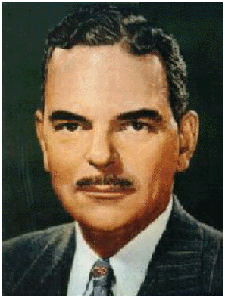
    Thomas E. Dewey

    The communications company Capital Cities was born in 1954 with the purchase by CEO Frank Smith of a UHF TV channel and a small radio station in Albany, New York. And until it purchased ABC in 1985, Cap Cities repeated that paradigm over and over: it bought stations that were performing below par due to management ineptitude and managed to change the management style by keeping operating and labor costs low and turn the station into a profitable asset.

    Another important factor in Cap Cities growth chart — as Andy Boehm points out — was its ties to government insiders and the information they could provide. For instance, when Smith bought WROW in Albany, he realized that the FCC was about to approve a VHF station in the area, the frequency to which he later switched WROW to, thus making it much more profitable and attractive to investors. Smith’s most famous partner at the time was Lowell Thomas, the famous journalistic figure who the Arthur Kennedy character in Lawrence of Arabia is modeled upon. Thomas was a member, with William Casey, in the Bohemian Grove, a kind of Trilateral Commission of the West Coast. He was also a member of the Creel Committee, the infamous propaganda camp set up by President Wilson to psychologically motivate the U.S. to take part in World War I. Meanwhile, Frank Smith, while in graduate school, had been a friend and classmate of Allen Dulles. Dulles first became the father of the Central Intelligence Agency, and then it’s Director until he was fired by President Kennedy over the Bay of Pigs fiasco. As Boehm also points out, Dulles was very friendly with another investor in Cap Cities, Thomas Dewey, to the point of serving as a manager of his presidential campaign in 1948 (both Earl Warren and McGeorge Bundy worked with Dulles on that campaign.)

    There was another important intelligence-related partner with Capital Cities in 1954, namely William Casey. Casey’s legal advice on how to reply minimally to tax, investment and FCC laws allowed the company to proceed quickly with its acquisitions strategy. One of the milestones in Capital Cities growth was securing the rights to broadcast the Adolf Eichmann trial, a gem of an acquisition that must have been aided by Casey or Dulles, or both. Even though Cap Cities owned only a small number of stations it was chosen over many larger and more appropriate networks to become the world producer and broadcaster of this event by the government of Israel. The incredible publicity given to the trial of the former Nazi gave the young company credibility and recognition.

    Two future leaders of Capital Cities, Thomas Murphy and Dan Burke, furthered the original paradigm of Frank Smith: a decentralized management plan and connections in high places. In the former regard, this means a bottom to top organizational plan which stresses cost-cutting and decision making at a lower level and rewards employees for achieving those ends. Murphy once said that his company, “doesn’t like to have more personnel than it needs. Too many people with too little to do lead to office politicking and other behavior that’s destructive for an organization.” Consequently, Cap Cities developed a ‘lean and mean’ corporate image. This meant that performance was tied to rewards in stocks and bonuses. The performance of the company was very good to its executives. In 1983, Murphy made six million dollars and Burke 4.3 million. An easy way to achieve low-cost programming — and increased profits — is to concentrate on local cop stories and shoot-em-ups. Cap Cities pioneered the genre.

    To ensure that Capital Cities would acquire more stations, the company almost never paid a dividend to stockholders. Instead it plowed all profits into more purchases. By 1970, Cap Cities had become a mini-major, owning VHF stations in Philadelphia, New Haven and Fresno. When it reached the then limit on the number of stations it held, it began to sell its stations in smaller markets. It also began to expand its holdings into print media through the purchase of Fairchild Publications. By 1977, Cap Cities also had bought a few important newspaper holdings e.g. The Fort Worth Star Telegram and The Kansas City Star. It also bought into cable companies in the seventies. And through these latter two acquisitions, it began another popular modern practice: cross-platforming of the news. That is, having its print companies provide copy for its cable news outlets. This of course rapidly accelerated to the point that today many stories, across many media platforms — cable news, newspapers, Internet — differ very little in content and phrasing.

    One of the most revealing acquisitions of Capital Cities was its purchase of The Wilkes Barre Times Leader in 1978. This episode in the company’s history is described in detail in the book by Thomas J. Keil entitled On Strike! Capital Cities and the Wilkes Barre Newspaper Unions. Like many major media companies, although Cap Cities had little difficulty paying executives like Burke and Murphy millions, it repeatedly denied union requests for higher wages, benefits, and better working conditions. Yet, it managed to keep negative publicity of these denials to a minimum. Except in the Wilkes Barre case.

    As Keil writes, the newspaper had to “control costs, increase productivity, improve the quality of the paper, and expand its market” in order to justify the Cap Cities expenditure. But the union in this small Pennsylvania town saw a secret agenda at work. They felt that by moving the paper’s editorial policy and news agenda in a more conservative direction, Cap Cities was attempting to lower wages and working conditions in the entire area, which was heavily unionized. (One of the company’s demands was for more “objective” journalistic practices.) Since the area had been historically involved in serious industrial strikes in coal and steel, it recognized a past corporate parallel in this case. From the conflict that followed, they seem to have been correct.

    During the contract struggle, Cap Cities hired security guards, used surveillance cameras, tried to get local authorities involved on their side, and built a 12 foot high fence around the newspaper building. Predictably, it hired the infamous Wackenhut Corporation as its security and investigative arm. (Wackenhut is so tied into the national security state that it is sometimes called The CIA’s CIA.) Casey played a large role in this conflict by serving as the Cap Cities counsel and the former counsel for Wackenhut. Therefore Casey was probably key in implementing one of the more controversial practices Wackenhut used leading up to the strike: the employment of virtually all African-American guards over the nearly all-white union ranks. This, of course, tended to foment racial tensions and exacerbate labor-management problems. In addition, Cap Cities wanted to hire part-time workers and install a merit system, thereby weakening the hold the union had in the workplace and increasing their own.

    When the strike escalated, and the inevitable violence broke out, Cap Cities grew angry that the local authorities did not help it end the strike by interceding on their side. So they used the newspaper to print a story that there was an FBI investigation pending of the local police for its failure to protect the replacement workers the company had hired. (Wackenhut employed many former employees of the Bureau.) The FBI looked into the matter yet ultimately took no action on the printed charge.

    When Keil interviewed some executives on the scene they admitted that the company had badly mishandled the strike. They learned a valuable lesson though. Namely to use more clandestine surveillance in order to remove popular union leaders before the strike reached a crisis stage. This, of course, is what the CIA does for major American corporations abroad.

  • ABC and the Rise of Rush Limbaugh

    ABC and the Rise of Rush Limbaugh


    limbaugh
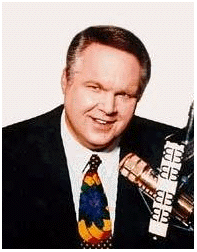
    Rush Limbaugh

    With little doubt, the two most revolutionary developments in radio in the last 40 years — since the ascension of rock music — have been the talk radio format, and then the conversion of that format to a politically conservative tone. No single personality is more responsible or representative of that explosive movement than Rush Limbaugh. If you ask the average informed person: “Who sponsored Limbaugh?” the answer you would probably hear would either be Clear Channel or Fox. The real and correct answer though would be ABC.

    Once the Cap Cities takeover of ABC was complete, the move by ABC television to a more politically friendly stance was not abrupt or dramatic. For instance, it took until 1993 for Peter Jennings to announce in an interview with TV Guide that his nightly news show would now be paying more attention to conservatives because in his view their ideas were “more provocative and less predictable on some issues.” But there was one front on which CC/ABC could move suddenly and potently and that was radio.

    Why? Because CC/ABC had a huge advantage in ownership outlets that it could capitalize on. Of the 11,000 radio stations in America, CC/ABC either owned or rented space to about half of them — an extraordinary advantage that the FCC did not challenge at the time of the purchase. Since the Fairness Doctrine had been disposed of in 1987, CC/ABC could now begin to broadcast a more conservative brand of radio without fear of being petitioned for equal time.

    Edward McLaughlin, President of ABC Radio began searching for a talk show host to lead ABC’s new direction. He found him in Sacramento. Limbaugh was doing an AM talk show there at the time and he was defending the actions of people like Oliver North and William Casey during the Iran-Contra scandal. McLaughlin noticed him and brought him to New York City for a one-month broadcast trial at CC/ABC’s flagship station WABC. McLaughlin liked what he heard and ABC promoted him by placing him on their fast track, handling all his marketing, advertising and promotion. To provide a fig leaf for ABC, Limbaugh formed his own media company, Excellence in Broadcasting. But Limbaugh broadcast out of ABC stations for decades. And for a long time, the man who followed Limbaugh on WABC was Bob Grant who continued the tirade against “bleeding heart” liberals and once called New York’s black mayor David Dinkins a “washroom attendant”.

    McLaughlin promoted Limbaugh initially by arranging appearances for him on other talk shows like Ted Koppel’s Nightline, Donahue, MacNeil/Lehrer and a primetime, and rather fawning, interview with ABC’s Barbara Walters. These appearances were all meant to give Limbaugh more mainstream exposure and publicize his show.

    When Limbaugh tried to branch out into television in September of 1992, his producer was Roger Ailes, the longtime Republican strategist who specialized in attack ads, most notably in the 1988 Bush-Dukakis race. Of course, the timing of the show was on the eve of the 1992 election so many people complained that Limbaugh’s show was clearly fronting for the Bush campaign and demanded equal time. Limbaugh replied “I am equal time.” Of course, he is not. Limbaugh featured guests who were from his point of view, blocked out all opposing views, screened callers and their questions in advance, labeled feminists, “femiNazis” and blamed all of America’s problems on “big-spending Democrats, the lazy poor and trouble-making minority rabble-rousers.” He was so offensive that the show was pulled because major advertisers did not want to be a part of it. Signifcantly, the ill-fated television show was distributed by one of CC/ABC’s partners, Multimedia. Recently, when Limbaugh made his comments about Donovan McNabb of the Philadelphia Eagles being overrated and a beneficiary of racial sympathy, it was on another subsidiary of ABC, ESPN.

    Clearly CC/ABC meant to chart a sea change in the concept of talk radio with Limbaugh’s launch. This in turn made it possible for Jennings to make his 1993 comments. If one recalls the days of talk radio before the Limbaugh Revolution, it was actually a rather interesting, exploratory and sedate domain with people like Ira Fistell and Michael Jackson in Los Angeles. Limbaugh and CC/ABC made them obsolete and paved the way for the likes of Michael Savage, another talk show host so offensive that he had to be yanked from television.

    We would like to add here that because a radio show is conservative in its orientation, this does not mean it is to be equated with Limbaugh or his clones. There are many conservative shows that do not have his agenda or practices. One example would be the Joyce Riley show out of St. Louis. This is a conservative show that is truly conservative — that is, it upholds traditional American values like the Constitution, open debate, and international law. So on her show — syndicated through 187 stations — you will hear open debate on such issues as why the CIA and FBI could not prevent 9/11, the questions surrounding Jeb Bush and Katherine Harris and the Florida election, the use of depleted uranium by Clinton in Kosovo and Bush in Iraq, and, of course, the assassinations of both Kennedys, King and Malcolm X. We admire and salute her conservative tradition and aims. We should add that there is some of this non-debate problem with stalwarts of the left also i.e. David Barsamian, Noam Chomsky, and Alexander Cockburn. Their friends and followers have tried to eliminate or minimize this kind of open debate on the Pacifica network.

    And some of their friends — like Marc Cooper — cross over into that other no-conspiracy zone in that other liberal outpost The Nation where Max Holland assures us that Oswald acted alone, and David Corn gives us limited hangouts on horrific scandals like the CIA and drugs. This “see no evil, hear no evil, say no evil” attitude about huge conspiratorial and covered up crimes leaves the public confused and angry about the media and the government at the same time that our doctrinaire “right and left” media tell us that conspiracy theories are eroding the public’s belief in the government. The obvious truth that neither wishes to establish or state is this: there is no “left or right” when it comes to the truth about these crimes. Therefore both sides choose not to tell the truth about, for example, what happened to President Kennedy, in order to please their masters and to stay part of the so-called “mainstream debate.” Which, of course, is why more and more people a) don’t believe our government, and b) don’t believe the media, and choose to listen to people like Riley on the right and Cynthia McKinney on the left. They know they are being lied to and want to find someone who is at least searching for the truth.

    Pity the nation that has to choose, thanks to ABC, between such a polarized atmosphere.


    Mr. DiEugenio would like to credit Dennis Mazzocco and his book Networks of Power for most of the material that appears in this article.

  • The Seizing of the American Broadcasting Company


    This article originally appeared in the February 20-27, 1987 issue of The LA Weekly.

    There is an untold story about the ABC television network. It is about how a company in which CIA Director William Casey is a major player took over the network. The least of the questions this raises is whether Casey used his CIA position to help drive down the price of ABC stock, thereby facilitating the takeover. The most important question it raises is, who really controls ABC, and what can be expected of these people?

    * * *

    This week network TV hit a new low with ABC’s airing of its 14 and one-half hour, $40-million dollar “epic,” Amerika. The xenophobic red-baiting engaged in by Amerika is hardly new to TV, but never before has a network spent so much time and money in such a blatant attempt to inspire in its audience jingoistic paranoia toward the Soviet Union and the United Nations. Small wonder that Mikhail Gorbachev complained to visiting American bigwigs earlier this month that “forces to which hostility is profitable … use high-powered information media to sow hatred toward the Soviet Union.”

    The commotion about Amerika has obscured a much more serious problem about network TV, one that could serve to validate Gorbachev’s complaint for years to come. Despite its length and its crass appeal to the dark side of the American character, Amerika is just a TV show. As such, it’s not likely to have much lasting effect. However, that cannot be said of the changes in network ownership and control that have taken place over the last two years. These have transformed at least NBC and ABC from tasteless schlock-meisters merely striving to sell more ads into powerful information gatekeepers with strong ties to established power blocs that have their own aggressive foreign and domestic political agendas.

    At issue in the ABC situation in particular is an extraordinary story overlooked by most of the press and never taken up by congressional investigators: Who actually took over ABC when Capital Cities Communications bought it in March 1985? For “Cap Cities” is no ordinary company, and the takeover was no ordinary case of corporate wheeling and dealing. Specifically, an L.A. Weekly investigation has found that:

    • Cap Cities’ primary executive Thomas Murphy, his family and some of Cap Cities’ founders had or have a relationship with another firm known to have excellent connections in the intelligence community through one of its subsidiaries. The same firm has also been accused of Mafia ties.
    • William Casey, the just-resigned head of the CIA and a lifelong maneuverer for that agency in the corporate and Wall Street communities, was and is a major player in Cap Cities. A founder and former director of the company, Casey placed all his stock holdings into a blind trust, except — in violation of his agreement with Congress — for his holdings in Cap Cities.
    • The CIA challenged ABC’s right to retain its broadcasting licenses just before Cap Cities bought out the company and during the period it was negotiating for the purchase. This attack had the result of driving down the price of ABC stock on the public market.

    In the Iran-Contragate aftermath, with some of the manipulations this administration and William Casey are wont to engage in becoming known, the Cap Cities-ABC deal and Casey’s possible role in it have to be considered high on the curiosity list of unexplored events of the last couple of years. For with the Cap Cities takeover, one of the three primary influences on America’s public consciousness was delivered into the hands of a company that may well have its own agenda.

    GE Whiz!

    NBC is the most obvious case of just such a potentially political takeover. Until last year, NBC was owned by RCA, whose other interests included consumer electronics, a record label, broadcast equipment and a fair amount of military electronics. Then RCA was acquired by General Electric (GE), an even larger defense contractor. The new GE, containing RCA, is one of the largest, if not the largest, military suppliers in the world. This led Ted Turner to deplore the acquisition because he felt NBC News would have a vested interest in perpetuating the arms race.

    Turner’s Cable News Network, of course, competes with NBC News. However, Turner donates much of his time, his money and his cable “superstation’s” prime time to agitating against nuclear escalation. His concern, therefore, can’t be completely written off as business jealousy. In fact, his concerns were echoed by Ralph Nader and Ohio Sen. Howard Metzenbaum, who wanted the Senate Judiciary Committee to look into the GE-RCA merger. But the committee, then controlled by ever-sensitive-to-big-business GOP, approved the RCA acquisition despite its clear potential for journalistic conflict of interest, as did Reagan’s FCC. Similarly, the so-called Antitrust Division of the Meese Justice Department continued its love affair with monopoly commerce by raising no objection to what in another era would have been considered an outstanding instance of restriction of trade. (GE and RCA will stop competing with each other in the home-electronics and TV-set market.)

    NBC’s outraged declarations of journalistic integrity after the takeover indicate it’s not likely to promote Russophobia actively a la ABC’s Amerika. More likely is a corporate zeitgeist that encourages the killing of or ignoring of stories unfavorable to the parent company and the promotion of a mindset favorable to the company’s interests. GE is also a major contractor for nuclear power plants. One should not, therefore, expect in-depth documentation from NBC on the arms race, nor on defense-contractor cheating, nor on nuclear reactors. One should expect plenty of “hot spot” coverage that makes the world seem an unsafe place for America. One can easily imagine a GE executive saying to an NBC News Executive, “Hey, how come we’re not giving more attention to the threat from Ethiopia?” As Ralph Nader has said, “Self-censorship is alive and well in American media.”

    (The influence of the military and nuclear establishments on NBC News is, of course, mitigated by the fact that inherent conflicts of interest are quite obvious to even casual observers. Thus, when the new NBC administration formed a political-action committee that would collect obligatory contributions from all NBC staffers, including those in the news division, a firestorm of indignation erupted. Once other media and the public saw that GE might pressure its journalists to support political causes, the PAC idea was quickly dropped. The incident indicated from the outset how far the parent company was willing to go in pressing its interests.

    ABCIA?

    If NBC is now tied into the defense establishment, ABC control has passed to men who, in the case of Casey, have open or, in the case of other founders and executives, questionable other links to what’s euphemistically known as the “intelligence community.” The potential for abuse at this network exceeds that at NBC because the possibility of spook-driven news manipulation at ABC has never been publicly aired or examined. (Although some may say the decision to air Amerika is one of the first signs of such manipulation, in fact the show was commissioned before the Cap Cities takeover.) On the other hand, despite much public pressure about the series, ABC executives under Cap Cities have remained steadfast in their commitment to the miniseries. While day-to-day politically motivated intrusion by management into entertainment and news decisions is not unusual — see the Mother Jones issue of November 1985 for historical precedents at ABC before the Cap Cities deal — the major impact of Cap Cities on ABC is more likely going to be in its choice of senior news and entertainment executives both at ABC and at stations owned and operated by it. The tone and parameters are set from the top down; control the top levels, and you needn’t concern yourself about day-to-day affairs.

    A closer look at Cap Cities shows three areas that beg for deeper inquiry. One is the founders themselves — who they are and what their ties may have been to the U.S. intelligence establishment. Another is the relationship of Cap Cities’ founders and execs to a company called Resorts International, some of whose divisions have been said to be intimate with intelligence agencies. And finally, there is the stock deal and William Casey’s role in it, as well as any ongoing Casey role in Cap Cities.

    Cap Cities was founded in 1954 by several men who were or would become prominent. Chief among them, and the principal players in the company, were famed explorer-newscaster Thomas; Tom Dewey, the former New York governor and twice GOP candidate for president (both, like most other Cap Cities founders, now deceased); and William J. Casey, who was Cap Cities’ chief counsel and a member of its board of directors until 1981, when he joined the Reagan administration. He still owns $7.5 million in stock in the now-merged entity called CC/ABC, his largest holding.

    Casey should require no introduction. Appointed by Reagan in 1981 as director of the Central Intelligence Agency, he brought to the job an early training in intelligence in the wartime Office of Strategic Services (which later became the CIA) and a lifelong network of friends and allies in the intelligence community. Crafty, secretive, an ardent supporter of covert action and a big-time player in corporate politics, Casey is part of an “old boy” network of intelligence hands who have frequently used American companies to help in intelligence or covert-action matters or, as in the case of ITT and the CIA in Chile, persuaded the CIA to help out in corporate affairs. (Using corporations to help out in a variety of ways — from washing money, to providing fake business to CIA “front companies,” to furnishing cover for intelligence agents — was a specialty of the man who did the most to give the CIA its power and covert network: its former director, Allen Dulles, a friend, wartime colleague and, rumor has it, business partner of Casey.)

    Lowell Thomas was a larger-than-life figure — an explorer, a broadcast personality, a film documentarist and a best-selling author. The Soviets long accused Thomas of also being an American intelligence agent because he often appeared with photographers and film crews at highly sensitive points of “communist versus the Free World” conflict. Thomas, though he had at minimum good journalistic connections in the U.S. intelligence community, always denied being a spook in the face of published articles questioning his activities. But he made no bones about his staunch anti-communist leanings. (He even appeared with John Wayne, Martha Raye and several U.S. generals in No Substitute for Victory, a denunciation of commie-coddling sponsored by the far-right John Birch Society.)

    Thomas lived in a New York state enclave for the rich where one of his neighbors was Thomas E. Dewey. (Another was Lawrence E. Walsh, later to become special prosecutor in the Iran-Contra affair.) Dewey and Thomas later were involved in another company, Mary Carter Paint, which later became Resorts International (more on this below).

    Before becoming governor of New York and a presidential candidate, Dewey had been a U.S. attorney and district attorney in New York City, where his biggest success was putting behind bars Mafia chieftain Lucky Luciano, who was Meyer Lansky’s mentor. As governor during World War II, Dewey agreed to a deal to parole Luciano in exchange for Mafia assistance to the OSS and Naval Intelligence. The assistance involved helping with the invasion of Sicily and using Mafia-controlled dock workers to guard against Nazi saboteurs.

    This led to a long association between the OSS’ successor agency — the CIA — and the Mafia. According to Rolling Stone investigative reporter Howard Kohn, much of the association passed through Dewey. Kohn has reported that both the CIA (via Dulles) and the Mafia (via Lansky) funneled money and valuable information to Dewey’s political campaigns as well as to Dewey’s protege, Richard Nixon, and to Nixon’s pal Florida Sen. George Smathers, like Nixon a close friend of the shadowy Bebe Rebozo. Kohn alleged that Rebozo and Lansky went on to further profitable associations with Resorts International.

    Even before becoming governor, Dewey had close ties to the intelligence community. He was known as “the man” in the U.S. attorney’s office who could be relied on to threaten New York publishers with prosecution if they were to publish books revelatory of intelligence matters. Dewey helped suppress several such books.

    Joining Dewey and the Murphy family in Cap Cities ownership were powerful New York GOP leader Alger Chapman and, for balance, John McGrath, who managed Democrat Averill Harriman’s New York gubernatorial races in the 1950s. Also purchasing Cap Cities stock were the following members of the U.S. House of Representatives: Leo O’Brien, Eugene Keogh and James Delaney, all New York Democrats; and Peter Rodino, New Jersey Democrat and presently head of the House Judiciary Committee.

    The final important founding player in Capital Cities is its president, Tom Murphy, who Wall Street and media executives widely consider to be among the most talented and successful businessmen alive. (He is also a director of Texaco and IBM.) A very private man, Murphy associates mainly with his relatives and business cronies, while avoiding the public attention cultivated by media moguls like Ted Turner.

    Murphy’s Gang

    In terms of knowing who the players are behind ABC, these relatives and business associates loom large. Chief among them are people prominent in Resorts International, which, as mentioned above, began as Mary Carter Paint Company and was purchased in 1959 by an investment group that included Lowell Thomas and Thomas Dewey.

    Rolling Stone in 1977, after being legally challenged by Resorts, retracted a story that CIA Director Allen Dulles was majorly involved in the buyout. Quoting CIA sources, Kohn wrote that in 1958 Dulles gave Dewey and Thomas $2 million in CIA money to set up a front company. With it they supposedly bought Crosby-Miller Corp, which merged with Mary Carter a year later. In its retraction, Rolling Stone noted that while it respected Kohn as a researcher, Resorts International had shown the magazine persuasive evidence that Kohn had been wrong or been misled by his sources.

    Tom Murphy was, according to at least one published report, another member of the purchasing group. So was a man named John Crosby, whose sone James would become chief executive of Mary Carter/Resorts International and whose daughter would become Tom Murphy’s wife.

    James Crosby, who died last April, was a close friend of Nixon (to whose campaign he donated $100,000 in 1968) and Rebozo, and he played host to the recently deposed Shah of Iran at Resorts International’s hotel on Paradise Island in the Bahamas. (The shah, of course, was put on the Persian throne in a coup engineered by the CIA, and maintained close lifelong ties to the agency; it is axiomatic that the agency would have tried to see to his welfare after he fled the country.) John Crosby, according to Kohn, had been, like Casey, a “member of the secret circle that lobbied for establishment of the CIA after World War II.”

    During the early 70s, Resort International/Mary Carter’s activities were occasionally cited in the left-wing press as evidence that it had been carrying out CIA business. When similar allegations appeared in a Las Vegas newspaper, Resorts — as in the case of Rolling Stone — threatened suit and won a full retraction.

    In 1968, the company changed names, sold the paint business and concentrated on hotels and casinos in Atlantic City and the Bahamas. Later, it acquired its Intertel subsidiary, which specializes in private “security” and in intelligence gathering for corporate and other clients. Among these clients were several with intimate CIA relationships, including ITT, Anastasio Somoza, the Shah of Iran and Howard Hughes’ vast empire of casinos and military manufacturers. Some published reports have alleged that Resorts may have engaged in money laundering, mentioning the mob, Nixon, and Rebozo as possible beneficiaries. Resorts has also been accused of having ties to Robert Vesco and the Meyer Lansky faction of the Mafia that was involved in CIA attempts to kill Fidel Castro. New Jersey state law enforcement officers who unsuccessfully opposed Resorts’ application for a license to run a casino in Atlantic City also claimed that Resorts had suspicious ties to the mob. (Resorts strongly denied this.)

    At their New Jersey casino license hearing, Resorts officials also admitted paying $431,000 that went to Lyndon Pindling when he was the Bahamas’ prime minister to obtain gambling rights in that country.

    Time magazine has characterized Resorts International as “largely a family affair run by [James] Crosby and some of his relatives.” These include the two Crosby sisters, one of whom, as mentioned, married Tom Murphy, while the other married Murphy’s brother, Henry. A cousin, Charles Murphy, is the corporate counsel. After Jim Crosby died, the Crosby-Murphy extended family inherited some of his stock and voting control of Resorts and Intertel. (The only member of this cozy clan not included in Resorts operations is brother Peter Crosby, an irrepressible swindler with Mafia ties whose Wall Street shenanigans have earned him several prison sentences.)

    With Murphy and the other key players now involved in ABC, Cap Cities and Resorts International, it’s useful to explore the significance of their other holding, Resorts’ Intertel subsidiary — the largest private security and spy organization in the U.S.

    Spies for Hire

    The vast yet secret world of private intelligence was first described at length by Jim Hougan, in magazine articles and the book Spooks (Morrow, 1978), as an unregulated “invisible industry, a security-industrial perplex whose influence is more insidious for the fact that its activities are mostly unseen.” Started largely by CIA and FBI alumni, the private espionage agencies often work for multinational corporations by “guarding ‘proprietary information’ at home, encoding communications, infiltrating governments in the Middle East, or funding counter-revolution in Latin America.”

    If this sounds like CIA work, Hougan says it’s because “agents who leave federal service for private employment often take with them not just their special expertise, but their ‘connections’ as well. Frequently, former agents retain informal access to privileged information, and it’s obvious that some even retain an ability to influence the actions of their old agencies.”

    According to Hougan, Intertel is “nothing less than the legal incorporation of an old-boy network whose ganglia reach into virtually every nerve cell of the federal investigative/intelligence community.”

    When Resorts decided to enter the private-spook biz, it picked two very well-trained and well-connected men to run Intertel. The agency’s first and only president is Robert Peloquin, a former Naval Intelligence agent and veteran of former Attorney General Robert Kennedy’s “Get Hoffa” squad. Later Peloquin headed up the Justice Department’s Organized Crime Strike Force. Peloquin’s first Intertel deputy was James Golden, formerly Vice President Nixon’s Secret Service bodyguard and later security chief of the 1968 Nixon campaign. Golden and Peloquin recruited for Intertel many CIA and FBI veterans, as well as former heads of Scotland Yard and the Royal Canadian Mounted Police. After a few years at Intertel, Golden rejoined Nixon to head the organized-crime section of the Law Enforcement Assistance Administration. Peloquin remains in charge of Intertel.

    (One other prominent Cap Cities connection is M. Cabell Woodward Jr., who was elected to the corporation’s board of directors in 1982. Woodward was also vice president and chief financial officer of ITT, a multinational corporation notorious for having meddled in the internal affairs of Chile and other nations, sometimes in concert with the CIA. (A well-documented study of ITT and the CIA was made by the Senate Intelligence Committee in the mid-70s.) ITT has long been a client of Intertel. In 1966, ITT tried to buy a TV network, but encountered enormous opposition in Congress and the FCC because of the implications of such a highly visible politicized company controlling a major news organ. The network ITT almost purchased was — you guessed it — ABC.)

    The Republican Connection

    As crucially important as it is that ABC was taken over by a firm with such a historical and ongoing relationship with the intelligence community, it shouldn’t be overlooked that Cap Cities is also a longstanding active player in the Republican establishment. Although volumes could be written about Murphy’s and Casey’s interlocking corporate/political/government scheming and manipulating — and Crosby’s ties to the Nixon crowd are sufficiently well known to have led to speculation that Resorts International’s casinos may have funneled money to the Watergate burglars — two anecdotes give a taste of the manner in which these people operate.

    In 1959, Cap Cities’ political connections led to charges of “political payola at its worst” from Wisconsin Sen. William Proxmire, who has also been Casey’s most vehement congressional critic. Proxmire believed that President Eisenhower’s press secretary, James Hagerty, had influenced the FCC to grant channel assignments and licenses that were very profitable to Cap Cities. Hagerty, who not surprisingly had earlier been Dewey’s press aide, denied it all, and the Republican-controlled Justice Department ignored the matter. After Ike left office, the scandal fizzled out. Hagerty was then hired by a close friend of Tom Murphy’s, Leonard Goldenson, to run the news department at ABC television.

    James Quello, now an FCC commissioner, was for years the general manager of Cap Cities’ radio station in Detroit, WJR. According to Morrie Gelman of Electronic Media magazine, when Quello’s performance at WJR lagged, Murphy decided to kick him upstairs to the FCC. This effort was successful in 1974, perhaps because (according to The New York Times) “Quello’s fellow executives at Capital Cities donated $120,000 to President Nixon’s re-election effort at a time when they were actively campaigning to put a broadcaster on the FCC and to make Mr. Quello that broadcaster.” By law, the empty FCC seat was reserved for a Democrat. Quello got it, even though ex-commissioner Nicholas Johnson noted that Quello had himself given $1,100 to the Nixon campaign.

    Casey’s Motives

    And then there’s the ABC takeover itself.

    On November21, 1984, the CIA asked the Federal Communications Commission to strip ABC of its five TV and 14 radio station licenses. (ABC has hundreds of affiliate radio and TV stations, but it’s legally limited to owning just a few stations, all of which are located in the biggest, most lucrative markets.) The CIA was ostensibly upset because on Sept. 19-20, 1984, ABC News had aired allegations that the agency had contracted for the murder of Ron Rewald, a Honolulu swindler who claimed that his scams were directed by the CIA, of which he claimed to be a secret agent. The story supposedly so enraged then-CIA director William Casey that he asked the FCC to strike the ultimate economic death blow to ABC by revoking its station licenses. In February 1985, the CIA reduced its demands to asking for FCC penalties under the “Fairness Doctrine,” which requires the broadcasters to air at least two sides of “controversial issues of public importance.” In both FCC complaints, Bill Casey’s CIA became the first government agency ever to seek such redress from the news media.

    On March 18, 1985, while the FCC considered Casey’s complaints, ABC agreed to be acquired by Capital Cities, a media conglomerate with the lowest profile and highest profit margins in the broadcasting business. It was a “friendly” takeover; ABC chief Leonard Goldenson and Cap Cities president Tom Murphy had been close friends for years. Cap Cities also owns daily papers in Fort Worth and Kansas City, trade journals (including Women’s Wear Daily) and, at that time, 55 cable TV systems.

    What might explain the chain of events that began with Casey attacking ABC and ended with Cap Cities buying the network? Of course, Casey may simply have been outraged at ABC for airing a false story about a CIA murder plot. (Even some CIA critics have concluded the story was untrue. Unfortunately, we’ll probably never know; the judge at the Rewald trial sealed all evidence relating to the CIA.)

    It helps to remember that we’re talking here about Bill Casey, a man whose scruples were never a match for his zest for daring and outrageous adventure. He’s a man who has illegally mined Nicaraguan harbors, and is reported to be up to his neck in Ollie North’s dirty tricks. Proxmire called him a perjurer. The Nation said he “made conflict of interest a way of life.” He’s been accused of shielding ITT and Robert Vesco from federal probes and of arranging to steal debate papers and classified documents from Jimmy Carter when Carter was president, and he was Reagan’s campaign manager. Casey has on several occasions been sued for sleazy stock swindles and once for plagiarizing an author’s work for his own book. Each time, Casey settled out of court in favor of the plaintiffs. As CIA director, he suspiciously unloaded $600,000 in oil stocks just before the bottom fell out of the market. The CIA, of course, prepares the best — if classified — ongoing report in the world on upcoming changes in the oil market.

    With that knowledge of the main actor and his associations, here are three speculative explanations of the events of November 1984 through March 1985. They are not mutually exclusive.

    1. Intimidation of Journalists: Casey’s action against ABC may have been intended to make that network’s news division less eager to run stories uncomplimentary to the CIA. Such a chilling effect could extend to the other networks, which also fear for their licenses. 
    • Infiltration of ABC News: Cap Cities’ purchase of ABC could have two non-business purposes. One is to create credible “covers” for spies — CIA and Intertel — posing as TV newsmen. Another is to ensure that one of America’s three largest sources of news refrains from investigating secret espionage activities and doesn’t go overboard in its coverage of certain critical areas. Such infiltration happened in Great Britain, where the BBC admitted in 1985 that employee security checks and promotions were in the hands of MI5, England’s equivalent to the CIA. Studies of its history have shown that the CIA has frequently planted agents as journalists and owned some newspapers and magazines outright while financing others, such as Nicaragua’s La Prensa.
    • Personal and corporate gain: The CIA’s threat to ABC’s economic lifeblood may have kept down the price of ABC stock so it would sell at “a bargain rate,” which is what the media trade press called the $3.5 billion Cap Cities agreed to pay for the network. Aside from being a major player in Cap Cities since its inception and being its former counsel of record, Casey owns $7.5 million in Cap Cities stock. His challenge to ABC came exactly during the period that Cap Cities was negotiating the buyout. (See accompanying sidebar.)

    Most observers originally dismissed charges of personal gain, since Casey had placed all his stocks in a blind trust in 1983. This meant that he wouldn’t even know if he still owned Cap Cities stock in 1985 (although he certainly knew his friends did), as the trustee could have sold the stock without telling him. However, in May 1985 Casey revealed that one of his stocks, his largest single holding, was never placed in the blind trust — due to a “misunderstanding” with the Office of Government Ethics. That stock was in Capital City Communications.

    Apparently, the CIA is unwilling even to give journalists public domain material about Casey’s interest in Cap Cities. In October 1985, the Weekly wrote the CIa for information on Casey’s stock holdings, as well as for a copy of a statement Casey issued to the press in March 1985 about his stock in Cap Cities. Many weeks later, the CIA sent us a letter saying that they had enclosed the statement to the press, but that we must make a Freedom of Information Act request for the other information. However, the statement was not enclosed. When we wrote them again, we received an official CIA card on which was printed “With the compliments of the Office of Public Affairs.” Hand-written beneath it was the message “Sorry for the inconvenience,” signed by a public affairs officer named Ann Crispell. However, nothing else was in the envelope.

    This is part for Casey’s course. He was forced into the blind trust by Congress originally because he’d invested in firms with which the CIA did business, and in oil companies.

    Why the Silence?

    There’s no absolute proof that Casey’s attack on ABC and his company’s subsequent purchase of it have any sinister implications or results. Still, the odd coincidences and peculiar connections look a little fishy, don’t they? Even if a Republican Congress and a Republican FCC ignored the matter, one would have expected considerable scrutiny from the “liberal” media Casey and his conservative pals always complain about. But it never happened, and it’s worth considering why.

    One might have expected that investigative scourge of the Nixon administration, the Washington Post, would have looked into Casey’s ties to Cap Cities and their relationship to his attacks on ABC. But a closer look reveals conflicts of interest for the Post. It seems that Cap Cities didn’t have all the cash needed to buy ABC. So Murphy invited Warren Buffett to buy 18 percent of the combined entity CC/ABC. Buffett, an Omaha resident with a well-earned reputation as a “Wall Street wizard,” single-handedly controls Berkshire Hathaway, a $2-billion holding company that owns 13 percent of the Washington Post Co., on whose board of directors Buffett sat until the ABC takeover was complete. He was then replaced by Tom Murphy’s friend, financier William Ruane. Berkshire Hathaway also owns a sizable chunk of Time, and the Post owns Newsweek. Once Cap Cities became a network, it could no longer legally continue owning its 55 cable TV systems, so it sold 53 of them to the Washington Post Co.

    More generally, there seems to be a gentlemen’s agreement tat big media companies don’t snitch on, or even discuss in public, the affairs of other media combines. That’s why you can read, hear and view the sins of every industry in America except those of the broadcast and publishing industries. As CC/ABC, the Post, Time and other major news organs also own other news media, silence is always likely to greet a takeover of one media company by another.

    We now know that two of the three national networks have potentially dirty laundry they’d prefer not be aired in public. Surely CBS, their competitor, would jump at the chance to do a little muckraking over the changes at ABC and NBC, right? Don’t bet on it. The new chief of CBS is Lawrence Tisch, who also heads Loews, Inc., whose 25 percent makes it the biggest shareholder in CBS. (Tisch’s brother, Preston, is U.S. Postmaster General.) Tisch has been involved in non-media co-ownerships (Chemical Bank of New York) with Warren Buffett, who also controls large ad agencies that Tisch would like to have buy time slots on CBS. Also, Loew’s, Inc. manages hotels. For years it managed — you guessed it — Resorts International’s hotel on Paradise Island in the Bahamas.

    Crashing the Gates

    In the Information Age, enormous power lies in the hands of a few information gatekeepers who control the flow of the news and entertainment that shapes the social attitudes and political beliefs of the public at large. The most powerful of these gatekeepers are the three major TV-radio networks, ABC, CBS and NBC, along with the almost exclusively white male corporate elite who control them. It’s bad enough that for years these media giants have exploited government-granted broadcast licenses to serve their private commercial interests. It’s nothing less than intolerable for any of the three to use their powers to fulfill secret political agendas that might run contrary to the “public interests, convenience and necessity” they are licensed to serve. Yet this is at minimum a question about ABC and NBC.

    It is high time for the federal government to determine just who owns the networks and what they are using them for. Both houses of Congress have committees that are responsible for seeing that broadcasting serves the public. The Justice Department has the responsibility of investigating the concentration of media control. The Securities and Exchange Commission (SEC) is empowered to investigate stock manipulation. It is, of course, unlikely that we will see any action from this FCC, SEC or Justice Department until January 1989 at the earliest.

    Congress, however, is ostensibly out of the control of the Reagan administration. Senate and House investigations may not change network ownership, but the information uncovered in such investigations could serve to curb the power of the network owners. Information is a powerful tool, both for the gatekeepers and — when available — for the people and their elected representatives.

    Andy Boehm

  • Barnes vs. Casey and ABC


    CIA Murder?

    Although most of the matters in the accompanying article have not been investigated by the “news” media or by government bodies, they have been noted elsewhere. A lawsuit, Scott Barnes vs. William Casey, alleges financial misdeeds by William Casey and by Capital Cities Communications.

    Scott Barnes is the man who claimed the CIA asked him to murder Ronald Ray Rewald in the Oahu Community Correctional Center in Honolulu. ABC investigated Barnes’ allegations and aired them on September 19 and 20, 1984, and said that the network believed them. This caused the CIA to ask the FCC to strip ABC of the licenses to its “owned and operated” stations (TV and radio). After much formal and informal heat from the CIA, on November21, 1984, ABC retracted the story in a manner Barnes felt w3as libelous and otherwise injurious. Barnes filed suit on July 29, 1985, with pro bono assistance from the Southern California Americans for Democratic Action (ADA) Foundation and its member-attorney, Ralph D. Fertig of West L.A. Unless otherwise noted, what follows comes out of the actual lawsuit documents or from an interview I had with Fertig on February 11, 1987.

    The Participants

    Scott Barnes, age 33 — Barnes claims to have been a free-lance professional intelligence specialist — or “contract agent” — for the CIA and others, as well as a former police officer and corrections official and counselor. In a December 13, 1984 L.A. Times article by David Crook, CIA officials were cited as denying ever dealing with Barnes and, on another occasion, having admitted to working with him. A Freedom of Information Act file convinced Fertig that Barnes had in fact worked for the CIA.

    According to both Fertig and Crook, Barnes was a source for ABC even before the Rewald affair. Barnes claimed to have been on a secret 1982 mission in Laos led by retired Green Beret Lt. Col. James (Bo) Gritz to locate American MIAs. The movie Rambo was based on this mission, but inaccuracies and exaggerations in the movie angered Barnes. He told ABC News about this. To check out his story, ABC had him tested by a polygraph expert, Christopher Gugas, who had formerly plied the lie-detection trade for the CIA. Gugas pronounced that Barnes was telling the truth about the Gritz mission and about two CIA-ordered murders in Laos. ABC felt that a genuine psychopath could fool a lie detector, so it had Barnes examined by Beverly Hills psychoanalyst Frederick Hacker, who, Fertig says, was formerly Patty Hearst’s therapist. Fertig says Hacker told him he was convinced Barnes was not a psychopath.

    The Defendants — besides Casey, Barnes also included as defendants Caspar Weinberger, Secretary of the Navy John Lehman, Capital Cities Communications, ABC Chairman Leonard Goldenson, Peter Jennings and five other ABC News employees, and four alleged CIA agents. Casey, Weinberger and Lehman were sued as government agents and private citizens.

    The Judge — Federal Judge Richard Gadbois, a Reagan appointee. Fertig calls him “very Republican but fair-minded.”

    The Suit

    Barnes vs. Casey is a complicated spinoff from the equally complicated Rewald affair. The labyrinthine financial and CIA-affiliated affairs of Ronald Ray Rewald would require an article of their own for adequate explanation. All the CIA-related material brought up and then sealed by the judge in Rewald’s fraud trial would make for a book. Suffice it to say that while awaiting trial in an Oahu slammer, Rewald was uttering stories that showed the CIA in a very bad light.

    Barnes’ story is as follows: In September 1983 in Torrance, Barnes claims to have been approached by CIA operatives who hired him to snoop on Rewald. When barnes arrived in Honolulu, he was given false IDs by the spooks and was promptly hired as a chaplain at the prison. This gave him only limited exposure to Rewald, so his CIA contacts told him to apply for a guard job. It was granted immediately. For four weeks, Barnes left reports on Rewald at a CIA “drop” in Honolulu. In mid-November 1983, Barnes met with his CIA contact and two men claiming to be from U.S. Naval Intelligence. They told him to kill Rewald. According to Fertig, Barnes, despite his other assassination work, refused because he would not “kill an American on American soil.”

    The next day, Barnes says, he was told to visit the Oahu County DA to answer unspecified charges. He decided instead to leave for the mainland. While driving to the airport, he heard a radio news report that the CIA had claimed that Barnes had broken the law in getting his jobs in Hawaii.

    A year later, when ABC issued its retraction of Barnes’ story, it questioned his credibility and reported that he had refused to take a polygraph test. Barnes insists he had frequently offered to take the test. Along with libel, his suit charged ABC with infringement of free speech, defamation of character, mental anguish (from fear of being killed himself) and other causes of action. The suit attributed all this to pressure brought on ABC by Casey in his dual role as CIA director and Capital Cities stockholder. He asked for more than $75 million in damages.

    He didn’t get it. What he got was harassment in the form of CIA-linked badmouthing to prospective employers. He also got his phone tapped, he says. Fertig alleges that his own phone was also tapped, as was that of an MGM lawyer, Harris Tolchin, who helped Fertig on the case.

    The substance of the complaint and its factuality were never ruled on. The defendants never replied to the substance of the charges. Judge Gadbois threw out the suit on several procedural grounds. As private citizens, he ruled, the government officials could only be sued in Washington. As agents of the Reagan administration, they had “governmental immunity.” Gadbois said it was conceivable that they acted in the security interests of the nation.

    As for the other defendants, Gadbois ruled that all complaints against them centered around the libel charge. Under a California law, which the judge applied in his federal court, plaintiffs suing for libel must seek a retraction within 20 days of learning about the slander. Barnes didn’t meet the 20-day deadline. Thus the judge said, it was a moot charge.

    For his efforts, Fertig was sued by the Meese Justice Department, and the government threatened to ask the state bar to disbar him. These vengeful steps, reminiscent of Casey’s action at the FCC against ABC, centered around the Justice Department’s assertion that Fertig had filed a frivolous suit devoid of merit. Gadbois threw out the countersuit, and apparently this discouraged the government from complaining to the state bar.

  • Mind-Control Part 1: Canadian and U.S. Survivors Seek Justice


    From the March-April 2000 issue (Vol. 7 No. 3) of Probe


    “Curiously, often a classic manifestation of people who are afflicted with certain psychotic disorders is the irrational fear that the CIA and FBI is conspiring to harm them. In this case, the CIA involvement is real and the covert nature of the involvement is not contested.”

    Orlikow v. United States (1988)1


    Gripping survivor-centered accounts of medical atrocities committed by CIA-funded mind-control (MC) researchers during the Cold War are rarely found in traditional U.S. media.2 Neither are they the subject of emotionally powerful TV docu-dramas commonly produced for broadcast and cable television. In January 1998, the Canadian Broadcasting System (CBC) courageously filled this void, although the blackout on government MC history is near-total in the U.S.

    The Sleep Room, a gut-wrenching four-hour miniseries, depicts the true story of Dr. Ewen Cameron’s secret MKULTRA brainwashing experiments carried out in the late 50s and early 60s at Allan Memorial Institute in Montreal. Widespread publicity accompanying this major TV event has empowered many other Canadian survivors of nonconsensual brainwashing experiments in hospitals and prisons to come forward and seek justice in the courts.3

    In Part I of the miniseries, gifted actors dramatize how vulnerable, trusting hospital patients were transformed into virtual vegetables through doses of “electroconvulsive therapy” 30-40 times more powerful than usual, sensory deprivation, hallucinogenic and paralytic drugs, and other psychological and physical tortures. Part II grippingly depicts the successful eight-year U.S. lawsuit of nine survivors, who overcame fear to confront the humiliations and frustrating delay tactics of the CIA lawyers. Joseph L. Rauh, Jr., a legendary Washington civil rights attorney, and his partner James C. Turner eventually prevailed for their clients. In 1988, the U.S. “national security” establishment agreed to an out-of-court settlement of $750,000.4

    This extraordinary CBC drama was based on Anne Collins’ prize-winning 1989 book In the Sleep Room: The Story of CIA Brainwashing Experiments in Canada. Collins exposed Cameron’s 1930s-1940s history of ethically unsupportable experiments on psychiatric patients. Many of the people methodically abused by Cameron had entered the Institute suffering only from mild disorders such as anxiety and post-partum depression. By the time they were released from the Sleep Room torture chamber, many had decades of memory completely wiped out. Some did not remember their children and even had to relearn bladder and bowel control.

    A U.S. citizen since 1941, the Scottish-born Cameron resided in Albany, New York, from which he commuted to Montreal each week. Before taking on the directorship at Allan Memorial, which is associated with McGill University, Cameron was chair of psychiatry and neurology at a medical school in Albany. He worked closely with Alan Gregg, medical-sciences director of the Rockefeller Foundation, which provided grants to found the Institute in 1943.5 As director from 1943 to 1964, Cameron achieved a worldwide reputation, serving as the first chair of the World Psychiatric Association, as well as president of the American and Canadian psychiatric associations.

    In one barely watchable scene of institutional cruelty, Cameron is filmed delivering a speech to psychiatrists about his successes in “curing” mental illness. As he drones on, the camera switches to scenes of terrified resisting patients being captured and restrained by doctors and nurses, forcibly being dosed with drugs and high-voltage electroshock, then put to sleep for weeks at a time in a room full of beds equipped with tape recorders and football helmets.

    Winner in 1998 of the Academy of Canadian Cinema and Television’s Gemini Awards in best picture and other categories, The Sleep Room touched the raw nerves of Canadian citizens. Not only did they learn their government had been the CIA’s junior consort during the Cold War against Communism, they also discovered it had secretly granted $500,000 to fund the Allan Memorial experiments. The CIA had only given Cameron $69,000 from 1957 to 1964. As the lawsuit dragged on through the Reagan presidency, Rauh was forced to expose the Canadian government’s role in helping the CIA derail the lawsuit, in complete disregard for pain and lifelong suffering of its own citizens.6 In 1992 the Canadian government coughed up $100,000 for 76 Cameron victims. To date 127 of his patients have come forward with their horror stories to seek compensation.

    CIA psychologist John Gittinger initiated contact with Cameron after reading his article on “Psychic Driving” in the January 1956 American Journal of Psychiatry. Gittinger persuaded Cameron to apply to the Society for the Investigation of Human Ecology, a CIA front set up in 1955 to disburse funding for what became a huge MKULTRA network in the U.S., Canada and overseas (in collaboration with branches of the U.S. Armed Forces). The Human Ecology Fund (its name was changed in 1961) operated secretly out of Cornell University in New York City.

    Cameron’s brainwashing grant application proposed to “depattern” patient behavior through the use of mega-doses of electroshock, to reprogram patients’ minds with repetitious verbal messages 16 hours a day for six or seven days, during which time the patient would be kept in partial sensory deprivation. Cameron called this technique “psychic driving.” Brainwashing would be completed by subjecting patients to drug-enforced continuous sleep, sometimes as long as weeks or even months.7

    The Sleep Room portrays two generations of CIA personnel as equally deadly, i.e., the 1950s Human Ecology bureaucrats who approved the funding for what were considered “terminal” experiments on non-U.S. nationals, and the 1980s CIA legal lords who maneuvered on grounds of “national security” to withhold evidence of the agency’s negligence and failure to adhere to the Nuremberg Code. The callousness of the CIA scientists is aptly captured in this fictitious dialog, where the scientists are discussing whether to fund Cameron’s proposal:

    #1: He’s going to fry his patients. I can tell you that.

    #2: Well, we won’t worry about the patients. That’s his problem. I just want to know if he can brainwash them.

    #1: He just might, you know. He’s right about the memory loss with a shock like that. You couldn’t do that to volunteers.

    #2: Well, should we give him the money?

    #1: What have we got to lose? It’s not like he’s doing it to Americans.

    While the tone is apt, the misleading impression that neither the CIA nor Cameron were experimenting on U.S. citizens (witting or unwitting) during this era is the miniseries’ biggest flaw. According to the March 15, 1995 testimony of Claudia Mullen before the President’s Advisory Commission on Human Radiation Experiments (ACHRE), Ewen Cameron was the high-voltage expert in a secret team of CIA doctor-brainwashers. Mullen and Chris DiNicola Ebner told a visibly shaken group of scientists that memory-erasing electroshock, among other horrors, was regularly used on physically healthy American children in the 1950s, 1960s and 1970s.8 Unlucky enough to be delivered into CIA/military custody by abusive or uncaring parents, children as young as eight years old were subjected to trauma-based mind control (MC) programming to mold them into “Manchurian Candidate” spies, assassins and sexual blackmailers.9 ACHRE’s final report documented more than 4000 experiments, and anywhere from 16,000 to 23,000 unwitting victims!10 The numbers run past 200,000 when if one includes the GIs deliberately exposed to radiation from atomic bomb testing.11

    During this same era, U.S. psychiatric patients were also victimized. Harold Blauer, a patient in the New York Psychiatric Institute, died in 1953 shortly after being injected with a highly toxic dose of methyl-diamphetamine (MDA), a derivative of mescaline. Blauer had entered the hospital suffering from depression after a divorce. He had made progress solely with the talking cure. Blauer did not know that his psychiatrist, Paul Hoch, was a CIA consultant secretly under contract with the Army’s Edgewood Arsenal chemical/biological warfare lab. This contract was negotiated through the New York State Department of Mental Hygiene, which allowed trusting hospital patients to be used as part of the Army’s search for “potential chemical warfare agents.”

    The MDA was not administered for any therapeutic reason. Blauer was scheduled to be released from the hospital in a few weeks. His objections to the series of injections, which were causing him great pain and discomfort, were overridden by manipulative hospital personnel. Blauer was threatened before the fourth nonfatal dose that if he didn’t give his consent, he would be moved out of the Institute to hospital settings that displeased him. The fourth dose caused a violent reaction. The fifth killed him. The Army began its cover-up immediately, the sordid details of which are recounted in the 1987 court decision awarding the Blauer estate $707,044. The court affixed blame for Blauer’s needless death totally on the U.S. government.12

    The Blauer case reveals a direct lineage between Nazi research projects and the MKULTRA program. Mescaline was tested on concentration camp inmates during the Third Reich’s search for a “truth serum.”13 These and other Nazi experiments were intensively studied by U.S. military scientists in occupied Germany. Under the CIA’s Operation Paperclip, 1600 German and Austrian scientists were secretly brought to the U.S. Some had worked for I.G. Farben perfecting Zyclon-B gas for the extermination of Jews and other doomed prisoners. Many were being investigated for war crimes when they were rescued by a government intent on using their knowledge and expertise in the Cold War against the Communist Eastern Bloc. Hundreds of chemists and other scientists were given jobs at Edgewood Arsenal, which supplied the drugs, chemicals and poisons for the CIA’s counterespionage and assassination programs during the Korean and Vietnam wars, as well as covert interventions in the affairs of many Third World nations.14

    Though the Cold War is over, the U.S. military/CIA bureaucracies still invoke “national security” and “plausible deniability” to hide a vast arsenal of sophisticated mind-control and psychological warfare technology.15 All of these weapons had to be perfected by means of human experimentation. Psychiatrist Colin Ross found that many areas of brain research heading in the direction of MC suddenly went “black” in the 1960s.16 His long-awaited book, Building the Manchurian Candidate: Deliberate Creation of Multiple Personality by Psychiatrists, will soon be published.

    A hint about mind-control research first surfaced in the aftermath of the 1963 assassination of President John F. Kennedy. When J. Edgar Hoover testified before the Warren Commission in 1964, he raised the possibility President Kennedy had been killed by a programmed assassin dispatched by the Soviet Union. Alarmed, the Commission requested the CIA to produce information on Soviet brainwashing. The resultant CIA memo (so controversial it wasn’t declassified until 1974) cryptically asserted the Soviets did not have any MC techniques or drugs “not available in the West.”17 However, neither Hoover nor the CIA told the Commission that the U.S. had an operational program of Manchurian Candidates up and running since World War II!18

    The term “brainwashing” was first coined in 1950 by Edward Hunter, a CIA employee operating undercover as a journalist, purportedly to explain how American POWs in Korea were being coerced into confessing they used biological weapons.19 Newspapers played up fears that the Soviets, the Chinese and North Koreans were using a secret psychological weapon against allied soldiers. This “brainwashing” scare was a successful CIA disinformation strategy used to build support for an unpopular war.20 It also helped insulate military and university researchers from accountability for violating medical ethics and criminal laws.

    The prevailing anticommunist hysteria that grew to justify the MKULTRA program and its unambiguous violations of the Hippocratic Oath, the Nuremberg Code and many international human-rights covenants was aptly summarized in 1954 by former President Herbert Hoover:

    It is now clear we are facing an implacable enemy whose avowed objective is world domination…. There are no rules in such a game. Hitherto accepted norms of human conduct do not apply…. If the United States is to survive, long-standing American concepts of fair play must be reconsidered… We must learn to subvert, sabotage and destroy our enemies by more clever, more sophisticated, more effective methods than those used against us.21

    The MKULTRA program began with a proposal by Richard Helms, then the CIA’s Assistant Deputy Director for Plans, to fund “highly sensitive” research and development using chemical/ biological substances to alter human behavior. It was approved by CIA Director Allen Dulles on April 13, 1953 and was overseen by chemist Sidney Gottlieb, chief of the CIA’s Technical Services Division (TSD). The first MC programs, called Bluebird and Artichoke, were subsumed under the MKULTRA umbrella. This program came to embrace an octopus-like network with names like MK-Search (1963-1973), MK-Delta and MK-Naomi (assassination programs carried out by the Army 1953-1970).22 Between 1953 and 1963 the TSD operated 149 subprojects in 80 U.S. and Canadian universities and medical centers, and three prisons, involving 185 private researchers, 15 foundations and numerous pharmaceutical companies.23

    In 1973, with the Watergate scandal looming, outgoing CIA Director Helms ordered all MKULTRA records destroyed. He testified before the Senate’s Church Committee two years later that Gottlieb:

    “…came to me and said that he was retiring and I was retiring and he thought it would be a good idea if these files were destroyed. And I also believe part of the reason for our thinking this was advisable was there had been relationships with outsiders in government agencies and other organizations and these would be sensitive in this kind of thing but that since the program was over and finished and done with, we thought we would just get rid of the files as well, so that anybody who assisted us in the past would not be subject to follow-up questions, embarrassment, if you will.”24

    Fortunately, 8,000 pages of mainly financial data escaped the CIA shredder, and were declassified pursuant to a Freedom of Information lawsuit in the 1970s filed by the Center for National Security Studies. Though woefully incomplete, these documents nevertheless became the bedrock of John Marks’ groundbreaking 1978 book, The Search for the “Manchurian Candidate”: The CIA and Mind Control.25

    All branches of the military sponsored MC research in collaboration with the CIA.26 Most civilian subjects were unwitting; even CIA employees and Army recruits who consented to drug and hypnosis experiments were not properly informed as to their dangers. MKULTRA clearly violated the Nuremberg Code requirement that subjects give “informed consent” to participate in scientific research: “This means that the person involved should have the legal capacity to give consent; should be so situated as to be able to exercise free power of choice, without the intervention of any element of force, fraud, deceit, duress, overreaching, or other form of constraint or coercion.” This Code was established in 1948 by the same U.S. Military Tribunal that tried 24 Nazi doctors for deadly experiments on concentration camp inmates. It was binding on the U.S. as of February 26, 1953.27

    How do we explain the hundreds of thousands of human guinea pigs callously sacrificed during the Cold War?28 As Paperclip researcher Linda Hunt concluded, “…we used Nazi science to kill our own people.”29 Perhaps survivor stories can help us understand what went wrong and why our secular democracy allows huge bureaucracies of unsupervised, supersecret warriors guided only by the cult-like religion of “national security” and the obsessive search for “enemies of the state.” The death of communism as a military threat has not dented the religious zeal that still inspires the military/intelligence establishment.

    James Stanley, a career soldier, suffered soul murder as an Army lab rat. He was given LSD in 1958 without being warned of its dangers, as were 1000 other “volunteer” soldiers. Stanley suffered hallucinations, memory loss, incoherence, and a negative personality change. Fits of uncontrollable violence destroyed his family, and restricted his ability to earn a living. And he never knew why until 1975, when the Army invited him to participate in a follow-up study on “volunteers who participated” in LSD testing. In United States vs. Stanley,30 the Supreme Court majority decided against Stanley’s claim for damages. However, Justices Brennan, Marshall and O’Connor dissented, asserting their belief that the Nuremberg Code’s standard of informed consent applies to soldiers as well as civilians. In 1996 James Stanley finally wrangled a $400,000 settlement from the government, but no apology for having ruined his life.31

    Unacknowledged civilian wreckage from unimaginably cruel brainwashing experiments continues to bob to the surface from a vast sea of still-classified, cold-war experiments. Survivors of ghoulish medical tortures or the families of deceased victims are turning up in Canadian and U.S. courtrooms today demanding compensation for a lifetime of suffering. Some Canadian plaintiffs appear to have a slight advantage over their U.S. cousins, who are severely hampered by the 1973 Helms/Gottlieb destruction of MKULTRA records. Fortunately for these survivors, paper trails are being unearthed in government, hospital and prison archives. The eminently freer Canadian press also helps build public support for MC survivors’ lawsuits.32

    Gail Kastner, now in her 60s, did not discover Ewen Cameron’s experiments were the cause of her “wasted life” until reading a newspaper story in the Montreal Gazette in 1992. She sued the Canadian government and Montreal’s Royal Victoria Hospital in 1999 after the government rejected her claim for damages. A “brilliant student whose domineering father checked her into the institute for depression,” Kastner says that Cameron’s electroconvulsive “depatterning” treatments and insulin-induced comas for five weeks at a time are responsible for a life of screaming nightmares, recurring seizures, loss of memory, and long-term regression to an infantile state. Her husband, son and twin sister could not tolerate her bizarre behavior, i.e. “wetting the living-room carpet, thumb-sucking, babytalk and wanting to be bottlefed.” Abandoned by her own family, she was rescued from homelessness by the Jewish Family Service.33

    During the era of Cameron’s brainwashing regimens, psychiatrists and psychologists in other Canadian institutions were using similar methods to “treat” people haphazardly diagnosed with depression, schizophrenia or, in prisons, what was perceived as “antisocial” conduct. Dorothy Proctor was a rebellious 17-year-old when she entered the Prison for Women in Kingston, Ontario on a three-year term for robbery. Primed first with sensory deprivation and electroshock, she was administered LSD in 1961 by a prison psychologist, then locked into “The Hole” to endure what for her was “Dante’s Inferno.”

    Proctor, a Native and Black Canadian from Cape Breton Island, Nova Scotia, calls this “mind rape.” She says she was singled out for such “Nazi-style science” because she had twice escaped from the prison, bringing unfavorable publicity to the authorities there. Proctor asserts that the steady prison diet of LSD and other experimental drugs led her down the path to drug addiction for 24 years. After publishing Chameleon: The Life of Dorothy Proctor in 1994, this articulate and determined woman launched a complaint with the Corrections Service of Canada (CSC), saying she suffered permanent brain damage and hallucinations haunting her to the present day.

    “I was reduced to a lab rat, a monkey in a cage,” she told the Ottawa Citizen (7/21/98), which has been covering the Proctor and other Canadian human experimentation cases for a number of years. A government inquiry turned up documentation (including clinical notes) that Proctor was not the only victim of involuntary prison experimentation 1960-1963. At least 23 other women prisoners were also used as human guinea pigs. Only four of these women have been found to date. And instead of complying with the CSC’s recommendation of an apology and financial compensation to Proctor, the Canadian government commissioned an “ethics study” at McGill University. Meanwhile Proctor hired lawyer James Newland and filed suit for $5 million in damages from the Canadian government, George Scott, MD, the prison psychiatrist, and Mark Eveson, a psychologist affiliated with Queen’s University.34

    While the emotional shock of The Sleep Room still electrified Canadian airways, the Ottawa Citizen published an expose drawn from interviews, archives, scientific journals and correspondence between doctors and prison officials. It found that hundreds of federal prisoners throughout Canada were used for pharmaceutical trials of untested drugs, sensory deprivation, and pain and electroshock studies. It uncovered a 1968 trial during which defendant Christine Bauman claimed that she suffered terrifying personality changes after being given LSD in 1961 at the Institute for Psychotherapy, not far from Kingston Prison where she had been incarcerated.35 Furthermore, archival materials released through the Proctor lawsuit indicate that some abuses may have begun as early as March 24, 1949, when a new electroshock machine arrived at Kingston Penitentiary. Electroshock has a history of being used as punishment in Nazi Germany and against Blacks in apartheid South Africa.36

    By late 1999, additional Canadian women and men came forward to claim they were used in prison and hospital experiments in the 1960s and 1970s. A class-action suit against the prison system was filed anonymously by “Jane Doe,” a 75-year-old grandmother who realized after reading newspaper stories that she was one of the 23 women who were given LSD and other terrifying “treatments” without their consent while in prison . Her lawsuit charges Scott and Eveson with assault, intentional affliction of mental suffering, and negligence. Her access to the Eveson’s clinical notes, released as a result of the Proctor suit, helped her recognize what had been done to her 38 years ago.37

    Less documented, however, are the connections of these prison experiments to U.S. mind-control funding sources. Canadian newspaper stories usually include the caveat that although prison use of LSD and “shock therapy” coincided with CIA “brainwashing” experiments at Allan Memorial Institute, no evidence has been found to link the programs. However, Allen Hornblum, author of Acres of Skin: The Human Experiments at Holmesburg Prison, said on a 1998 CBC radio show that some of the experiments conducted in U.S. prisons during this era were sponsored by the U.S. Army and the CIA. And he pointed out that shortly after seven Nazi doctors were hung at Nuremberg for horrific experiments on inmates at Bergen Belsen, Auschwitz and Ravensbruk, U.S. doctors were injecting plutonium and uranium into unwitting hospital patients.38

    Activist Lynne Moss-Sharman does not rule out a hidden connection between the Canadian prison experiments and CIA/military brainwashing research. Moss-Sharman is the Canadian contact for ACHES-MC (Advocacy Committee for Human Experimentation Survivors – Mind Control), and is herself a survivor of brainwashing experimentation during her childhood.39 The Canadian military had a close relationship with Edgewood Arsenal during the years it funded MC experiments in hospitals and prisons.40

    Moss-Sharman has been organizing support for federal prisoner Richard Carlson, who filed a civil claim in October 1998. Carlson says his use in covert brainwashing experiments from 1968 to 1974 in several Kingston-area prisons caused a lifelong psychiatric disability. According to Moss-Sharman, the authorities retaliated against Carlson going public about the prison brainwashing experiments. They unsuccessfully tried to change his status to “dangerous offender,” which would have carried a mandatory life sentence for the bank robbery charge, which he is also appealing.

    Three people connected to Carlson have died under mysterious circumstances since he launched his brainwashing claim. They include Tony Vaitelis, the second male inmate to make claims similar to Carlson’s, an unnamed former hospital orderly and potential witness to prison brainwashing, and Carlson’s 30-year-old son. Moss-Sharman says Carlson is dangerous to Correctional Services Canada because he can name the inmates who died during the prison experiments and can describe what happened in the experimental units.41

    “Insulin shock therapy” was frequently used on Ewen Cameron’s patients at Allan Memorial. In 1999 the widow of Yuan Woo (Jean-Paul Martineau), a former Royal Canadian Air Force radar technician, went public with the story of how her deceased husband had been the unwitting subject of “insulin shock therapy” experiments in Queen Mary’s Veterans Hospital in 1953. Martineau curiously changed his name to “Juan Woo” after being discharged. As a result of medical mistreatment, Ms. Woo says, her husband developed such a morbid fear of physicians, he postponed going to the doctor until he was near death from cancer in 1996.42

    In the U.S., MC survivors and their families are hard-pressed to secure files documenting their claims, if indeed such records escaped the shredder years ago. Since 1985 all litigants have been hampered by C.I.A. vs. Sims,43 a landmark U.S. Supreme Court decision that undergirds the CIA’s refusal to name its contract institutions and individual researchers on grounds of “national security.”44 Only 59 CIA/military contract institutions and a handful of researchers consented to be publicly named in the 1970s when the MKULTRA program was exposed.

    The most well-publicized U.S. victim of the MKULTRA experiments is Frank Olson, a biochemist who worked at the Army Chemical Corps’ Special Operations Division at Ft. Detrick, in Frederick, Maryland. On November 18, 1953, Olson was given a drink of Cointreau secretly laced with LSD. He immediately became agitated and severely paranoid, a condition that lasted for days. Olson was said to have committed suicide nine days later by jumping 13-stories to his death through the closed window of a New York hotel. Members of his family did not learn he had been drugged until 1975 when the MKULTRA behavior-control program was exposed. They later received an apology from President Gerald Ford and a $750,000 settlement.

    However, after studying documents declassified in later years, Eric Olson believed his father may have been pushed out the window. He had the body exhumed in 1994. A group of private forensic researchers announced on the 41th anniversary of Olson’s death that both forensic and other evidence were “starkly suggestive of homicide.”45 A second skull fracture (missed in the initial autopsy) means Olson may have been hit on the head before his body went through the window. Also the lack of cuts on Olson’s body would appear to rule out the official CIA story of his “suicide.”46 Armond Pastore, the hotel night manager who kneeled beside the dying Olson back in 1953, said, “I never heard of anybody jumping through a closed window with the blind down.”47 Last year a New York grand jury was looking at this new evidence.48

    The first CIA brainwashing case to go before a jury took place in 1999. I learned about this civil trial through two articles in the Philadelphia Inquirer.49 This civil trial centered on the tragic life of up-and-coming artist Stanley Glickman, who says that in 1952 in a Paris cafe, MKULTRA czar Sidney Gottlieb had brought him a drink laced with LSD. Gottlieb denied doing this, despite admitting he had spiked the drinks of other unsuspecting people in the 1950s. Glickman suffered a psychological breakdown from which he never recovered. After collapsing he was rushed to American Hospital where he claimed doctors there administered electroshock therapy “via a catheter up his penis” as well as more hallucinogenic drugs.50

    After learning about the CIA’s LSD experiments on unwitting subjects in the 1970s, Glickman sued in 1983. His identification of Gottlieb was based on remembering that the strange man in the bar had a club foot. Using the same delay-and-attrition tactics heaped on the nine elderly Canadians in Orlikow, the CIA was able to delay the trial for 16 years. Glickman died in 1992 but his sister Gloria Kronisch continued the lawsuit. Dominick L. DiCarlo, a conservative chief judge “on loan” from the U.S. Court of International Trade in New York City, presided.

    What happened next will some day be the stuff of high drama in a Sleep Room-type teleplay exposing the CIA’s 50-year history of crimes against humanity. Finally being called to account in a courtroom for overseeing a quarter-century of U.S.-style Nazi science, Gottlieb becomes ill, causing postponement of the February trial. On the eve of the March date, he unexpectedly dies. Both the New York Times and the Los Angeles Times obituaries report that the Gottlieb family refuses to disclose the cause of his death. The online WorldNet Daily, however, reports that Gottlieb, 80, died after a “month-long bout with pneumonia.” According to this story, he was admitted to the University of Virginia Medical Center in Charlottesburg on February 14, and “lapsed into a coma” on March 5 “from which he never recovered.”51

    Are we overly paranoid to suspect the CIA of foul play here? Did life boomerang on the aged Dr. Strangelove? Was this enthusiastic harvester of exotic poisons and inventor of bizarre assassination delivery systems somehow silenced by same to prevent his spilling the CIA’s dirty secrets in a court of law?52

    Anyway, the trial goes forward in late March, with the Glickman estate suing the Gottlieb estate (the claims against Helms and the CIA had been thrown out). As the lawyers near their final summations, Judge DiCarlo, 71, suddenly drops dead of a heart attack while exercising in a federal gym located next to the court. His New York Times obituary makes no mention of the controversial CIA trial (nor does the Times even cover the trial).53 However, the New York Daily News, with more guts and pizzazz, reports that DiCarlo’s death “created a surreal scene as paramedics and a priest called to give last rites mingled with jurors preparing to decide one of the strangest cases being heard in the city.”54 Goosebumps and paranoia strike again. Was this Reagan-appointed judge a victim of the CIA’s long-rumored, untraceable method of inducing heart attacks? Or was it the stress of a CIA trial that killed him?

    Almost on cue, Federal Judge Kimba Wood was assigned to take DiCarlo’s place, a move prejudicial to the plaintiff since she had thrown out this case in 1997. The Second Circuit Court of Appeals reinstated the lawsuit in 1998.55 After closing arguments, the jury deliberated for seven hours before ruling against the Glickman estate.

    But the evidence of foul play goes way beyond the spiking of Glickman’s drink. His Paris hospital records show that two of his doctors had been engaged in LSD research at the time. Also, CIA files from 1952 reveal a special interest in the heightened effect of LSD on people with hepatitis. One of Glickman’s American Hospital doctors had previously treated him for hepatitis, making this once-promising young artist “the ideal guinea pig.”56

    I would like to thank Lynne Moss-Sharman, Kathy Kasten, Eleanor White and Blanche Chavoustie for providing news articles and other research materials for this series.

    Endnotes

    1. 682 F. Supp. 77, 94 (D.C. 1988) (Civ. No. 80-3153). For a summary of the federal court cases cited in this article , see “The Law and Mind Control: A Look at the Law and Government Mind Control Through Five Cases”” by Attorney Helen McGonigle (http://members.aol.com/smartnews/fivecases.htm)

    2. Survivor testimonies, however, can be found on the Internet: (http://morethanconquerors.simplenet.com/MCF/)

    3. MacLean’s, 4/21/97 (p. A3) and 1/12/98 (P. 66); The Gazette (Montreal), 3/13/97 (p. A3) and 1/11/98 (p. C9); Toronto Star, 1/10/98 (p. SW10) and 1/11/98 (p. B7); Toronto Sun, 1/11/98 (TV 3); Ottawa Citizen, 1/10/98 (p. H4); CBC broadcast, “Fifth Estate,” 1/6/98

    4. For a history of Orlikow, see “Anatomy of a Public Interest Case Against the CIA,” by Joseph L. Rauh, Jr. and James C. Turner, Hamline Journal of Public Law and Policy, Vol. II (2), Fall 1990. (http://www.radix.net/~jcturner/anat-tofc.html)

    5. Collins, In the Sleep Room (Key Porter Books, 1998), pp. 94, 101-104.

    6. Joe Rauh’s lifelong history of defending victims of government abuse was postumously rewarded in 1994 when President Bill Clinton awarded him the Presidential Medal of Freedom. Rauh had died in 1992, the Canadian case against the CIA having been his last hurrah.

    7. Rauh and Turner, op. cit.

    8. A videotape of the ACHRE hearing is available from Missoulians for a Clean Environment, P.O. Box 2885, Missoula, MT 59806 (Phone: 406-543-7210). A transcript is posted at http://morethanconquerers.simplenet.com/MCF/ckln07.htm. Tape 14: “Giving testimony regarding survival as a government mind-control victim: My testimony and the backlash,” Mullen’s presentation to the 1997 Believe the Children (BTC) Conference can be ordered from BTC Repeat Performance, 2911 Crabapple Lane, Hobart, IN 46342. This tape also includes the BTC presentation by therapist Valerie Wolf, BCSW, ACSW, BCD, “Assessment and treatment of survivors of sadistic abuse.”

    9. Rappaport, Jon, Mind Control Experiments on Children, self-published book containing the supporting documentation produced by legal and medical professionals for the 1995 ACHRE hearings. (http://home.earthlink.net/~alto/index.html)

    10. Final Report of President’s Commission on Human Radiation Experiments (ACHRE), 1996 (http://tis.eh.doe.gov/ohre/roadmap/achre/index.html)

    11. ACHRE Report, ibid., Chapter 10.

    12. Barrett v. U.S., 660 F.Supp. 1291 (S.D.N.Y. 1987). See Hunt, op. cit., pp. 170, 235 for details on the Blauer case.

    13 Lifton, R.J., The Nazi Doctors: Medical Killing and the Psychology of Genocide (Basic Books, 1986), pp. 289-290.

    14 See generally, Hunt, L., Secret Agenda: The United States Government, Nazi Scientists, and Project Paperclip, 1945 to 1990 (St. Martin’s Press, 1991).

    15 “Wonder Weapons: the Pentagon’s quest for nonlethal arms is amazing. But is it smart?” U.S. News and World Report, July 7, 1997.

    16 Ross, Colin, “The CIA and Military Mind Control Research: Building the Manchurian Candidate.” A lecture given at the 9th Annual Western Clinical Conference on Trauma and Dissociation, April 18, 1996, Orange County, California. Transcript and/or audiotape can be ordered from CKLN-FM, 380 Victoria Street, Toronto, Ontario, Canada M5B 1W7 (phone 416-595-1477; fax 416-595-0226). Transcript is posted at http://morethanconquerers.simplenet.com/MCF/ckln01.htm.

    17. Russell, D. The Man Who Knew Too Much (Carroll & Graf, 1992), pp. 673-674.

    18. Ross, op. cit. See also George H. Estabrooks, PhD, “Hypnosis comes of age,” Science Digest, April 1971, pp. 44-50.

    19. Russell, Dick, op. cit., pp. 193-194. According to historians Stephen Endicott and Edward Hagerman, The United States and Biological Warfare (Indiana University Press, 1999), the U.S. did use germ weapons in Korea.

    20. Scheflin, A. & Opton, Jr., E.M., The Mind Manipulators. (Paddington Press, 1978), p. 107.

    21. Secret report to the Eisenhower White House, quoted in Hunt, Linda, op. cit., p. 263.

    22. “C.I.A. Documents Tell of 1954 Project to Create Involuntary Assassins,” New York Times, February 9, 1978, p. 17.

    23. New York Times, August 2, 1977, pp. 1, 16.

    24. Foreign and Military Intelligence, Book I, Final Report of the Select Committee to Study Government Operations With Respect to Intelligence Activities [the “Church Committee” report], U.S. Senate (April 26, 1976), pp. 403-404. Quoted in Russell, op. cit. p. 775 (Note 12).

    25 Online version of Marks’ book: http://druglibrary.org/schaffer/lsd/marks.htm

    25. Ross, op. cit.

    27. Orlikow, op. cit., at 82.

    28 Sea, G., “The Radiation Story No One Would Touch,” Columbia Journalism Review, March/April 1994 (http://www.cjr.org/year/94/2/radiation.asp)

    29. Hunt, op. cit., p. 268.

    30. 483 U.S. 669 (1987)

    31. March 6, 1996 article provided by Lynne Moss-Sharman (newspaper not identified)

    32. Some examples from the Ottawa Citizen: “Debate over prison experimentation emerges from shadows,” 9/28/98; “Minister demands answers on prison experiments: Solicitor general upset by Citizen account of inmates used as guinea pigs,” 10/1/98; “LSD trials on inmates ‘unethical’: Ignore proposal for compensation, McGill study says,” 10/31/98; “Military tested LSD on civilians: Canada funded Cold War probe into mind control,” 12/7/98. From CBC Radio, “Secret experiments on Canada’s convicts,” 11/9/98. From the Toronto Star: “Prisoners used for ‘frightening’ tests, new papers show,” 12/18/99.

    33. CBC Montreal (Ivan Slobod), 1/5/00; “Woman suing over CIA experiments,” Globe and Mail, 1/6/00; ‘Hell for my family,’ Montreal Gazette, 1/11/00; “Shock treatment victim supports suit,” The Daily Miner (Kenora), 1/21/00.

    34. CKLN Radio (Toronto) “Shrinkrap” interviews Dorothy Proctor and lawyer James Newland, August 1998; “Inmates subdued with drugs, shock therapy, report says,” Globe and Mail, 10/31/98; Ottawa Citizen: “Burden of proof on LSD inmates: Government won’t compensate women without more proof that tests caused harm,” 2/3/98; “LSD tested on female prisoners,” 2/28/98; “The case for prison’s LSD tests,” 3/1/98; “Pay LSD victims: Reform (Party): Law and Order Party calls experiments on inmates ‘sickening’,” 3/2/98; “Privacy an issue in LSD probe,” 3/20/98; “LSD experiments ‘good research back then’,” 7/10/98; “MPs demand inquiry into prison tests,” 9/29/98; “Minister demands answers on Citizen account of inmates used as guinea pigs,” 10/1/98; “Scott stalling LSD report, critics charge,” 10/15/98; “LSD trials on inmates ‘unethical’,” 10/31/98); “Government accused of withholding files on prison LSD testing,” 12/8/99;

    35. ” ‘I was in a very bad state’- LSD guinea pig says form inmate underwent dramatic personality changes,” Ottawa Citizen, 9/26/98.

    36. Eastgate, J., “The Case Against Electroshock Treatment,” USA Today (Magazine), November 1998, p. 28.

    37. “75-year-old guinea pig wants to sue,” Ottawa Citizen, 12/9/99.

    38. “This Morning,” CBC Radio, Nov. 9, 1998. Interviewers: Avril Benoit and Rosie Rowbotham.

    39. In a 1997 interview on CKLN radio, Moss-Sharman recounts her own nightmare as a child victim of CIA/military brainwashing experiments. (http://morethanconquerers.simplenet.com/MCF/ckln16.htm). Also see “Mind Games: Another woman comes forward to claim the CIA used her as a guinea pig in hideous experiments,” Ottawa Citizen, 9/13/97 (posted at http://www.cs.virginia.edu/~alb/misc/ ottawaMindControl.html)

    40. “Military tested LSD on civilians: Canada funded Cold War probe into mind control,” Ottawa Citizen, 12/7/98.

    41. Chronical Journal (Thunder Bay, Ontario): “Carlson gets access to prison file,” 5/1/99; “Carlson case adjourns,” 10/27/99; “Convicted bank robber Carlson launches appeal bid,” 2/2/00. Two letters to the Canadian Human Rights Commission re: Carlson (11/9/99 from Moss-Sharman and 12/30/99 from Patty Rehn, U.S. contact for ACHES-MC) are available from the author upon request.

    42. ” ‘The nightmares are real’: Widow blames military for man’s suffering,” Ottawa Citizen, 10/11/99; “Was Canuck in CIA experiments? Widow wants to know why hubby suffered,” Sun Media, 10/12/99.

    43. C.I.A. vs. Sims., 471 U.S. 159, 85 L.Ed.2d, 105 S.Ct. 1881 (1985).

    44. A revealing account of the difficulties U.S. citizens encounter in making claims against the government can be found in Budiansky, Goode, Gast, “The Cold War Experiments,” U.S. News and World Report, January 24, 1994.

    45. Philadelphia Inquirer, November 29, 1994, B6.

    46. Los Angeles Times, July 13, 1994, A4

    47. The Independent (London), June 4, 1994, p. 8.

    48. Baker, R., “Conspiracy: In 1952, Stanley Glickman was a promising young painter studying in Paris. Then one night he shared a drink with some fellow Americans, and his life fell apart. Did the CIA spike his drink with LSD? The Observer (Guardian Newspapers Ltd.), February 14, 1999.

    49. “Case against CIA that began with ’52 encounter winds down,” 4/30/99, and “Jury rejects suit alleging ’52 drugging,” 5/1/99.

    50. Baker, op. cit.

    51. New York Times, 3/10/99 and Los Angeles Times, 4/4/99. See http://www.sightings.com/ufo2/ gottlieb.htm for the 3/11/99 WorldNet Daily obituary.

    52. Regarding Gottlieb’s bizarre plans to assassinate Fidel Castro and Patrice Lumumba, see Impact International, April 1999 (http://www.africa2000.com/IMPACT/gottlieb.jpg)

    53. “Judge Dominick L. DiCarlo, 71, Narcotics Fighter Under Reagan,” New York Times, 4/30/99, C21. A 3/10/99 Gottlieb obituary written by Tim Weiner also makes no mention of the Glickman trial.

    54. Daily News, April 28, 1999, p. 2.

    55. Kronisch v. U.S., 150 F.3d 112 (2d Cir. 1988). Posted on New Jersey Law Journal website: http://www.nylj.com/nyljcontent/072298dd.htm.

    56. Baker, op. cit.

  • The Colosio Assassination: Chronology of Events Surrounding the Assassination of Luis Colosio, 23 March 1994


    From the January-February 2000 issue (Vol. 7 No. 2) of Probe


    Business had brought me to Mexico City on the day Luis Colosio was assassinated in Tijuana. The TV coverage of the event was every bit as obscure as the reporting of the JFK murder and worse than the coverage of the attempt on Ronald Reagan’s life. The news video of the assassination didn’t play once; instead heads talked and voxes popped…

    What follows is a chronology of events relating to, or concurrent with, the assassination of Colosio, Presidential candidate of the PRI (Partido Revolucionario Internacional) in Mexico on March 23, 1993.

    It is culled from printed sources, including the Mexico City News, Mexico City Times, La Jornada, Proceso, Los Angeles Times, AP Reports, John Ross’s reports in Mexico Barbaro and The Anderson Valley Advertiser, the invaluable Weekly News Update on the Americas, and the book Ya Vamos Llegando a Mexico… by Ciro Gomez Leyva and the staff of Reforma (Editorial Diana, Mexico, 1995. ISBN 968-13-2837-X).

    It is perhaps interesting to assassination researchers since it seems to have certain traits in common with the JFK assassination: specifically, the murder of a (presumptive) head of state on the campaign trail, competing theories of a lone assassin and multiple gunmen, photographic evidence suggesting that the accused was elsewhere, and was impersonated by a “double”, the failure of a government-run “recreation” of the crime, more than a dozen attendant murders or “suicides”, corruption or gross ineptitude on the part of the magnicida‘s bodyguards, and the inevitable presence of at least one “former” agent of the CIA…

    Organizations mentioned in the text:

    • PRI: Institutional Revolutionary Party (Partido Revolucionario Institucional)
    • PAN: National Action Party (Partido de Accion Nacional)
    • PRD: Democratic Revolutionary Party (Partido Revolucionario Democratico)
    • CISEN: Center for Investigations and National Security
    • SEDENA: National Defence Secretariat
    • PGR: Attorney General of the Republic
    • EZLN: National Zapatista Liberation Army (“Zapatistas”)
    • EPR: Popular Revolutionary Army

    1988

    Members of a Colombian drug cartel allegedly funnel $200,000 into the campaign of CARLOS SALINAS DE GORTARI, Presidential candidate of the PRI. The money is given to his brother RAUL SALINAS to protect drugs shipped through Mexico. Thereafter RAUL receives $300,000 for each cocaine shipment he protects. (From a Colombian drug dealer’s deposition to the Swiss enquiry into the $132 million RAUL deposited in Swiss banks – El Universal, Agence France-Presse, 31 August 1998)

    2 July

    FRANCISCO XAVIER OVANDO and ROMAN GIL HERALDEZ, political aides to the PRD’s Presidential candidate CUAUHTEMOC CARDENAS, are murdered in the Transito district of Mexico City, less than 72 hours before the Mexican presidential elections.

    6 July

    The elections occur. By his own count, CARDENAS defeats the PRI’s SALINAS by a 39-37% margin.

    14 July

    Interior Secretary MANUEL BARTLETT insists that the Federal Electoral Commission’s computers have crashed, and SALINAS is awarded 50.2% of the vote. Tens of thousands of partially burned ballots marked for CARDENAS are found floating in rivers or smouldering in garbage dumps.

    1990

    January

    LIONEL GODOY, a PRD special prosecutor, announces the arrest of RICARDO FRANCO VILLA, a former attorney general of Michoacan, as the mastermind of the XAVIER OVANDO and GIL HERALDEZ murders. FRANCO VILLA is jailed; no motive is ever advanced.

    FRANCO VILLA was part of a celebrated prosecutorial team that included JAVIER COELLO TREJO, later President SALINAS’ drug czar, and GUILLERMO GONZALEZ CALDERONI, a Federal Judicial Police drug agent. According to El Universal CALDERONI said that he was asked by RAUL SALINAS to contract Gulf cartel hitmen to kill OVANDO and retrieve passwords to the electoral computers. (John Ross, Mexico Barbaro, 14-20 Aug 1998)

    1992

    29 January

    CARLOS ENRIQUE CERVANTES DE GORTARI – cousin of President SALINAS – MAGDALENA RUIZ PELAYO, and others are arrested in Newark, NJ, on charges of conspiracy to import and distribute cocaine. (Weekly News Update on the Americas #371, 9 March 1997)

    November

    RUIZ PELAYO, who claims to have been the personal secretary to President SALINAS’ father, RAUL SALINAS LOZANO, is convicted.

    1993

    24 May

    Cardinal JUAN JESUS POSADAS OCAMPO and six others are assassinated at Guadalajara International Airport, by members of the ARELLANO FELIX drug clan. AeroMexico flight 112 is delayed 12 minutes on the runway so that eight men carrying large canvas bags stuffed with weapons can board the aircraft via an airport bus. On board, one of the ARELLANO brothers, JAVIER (aka “EL TIGRILLO”), is repeatedly admonished by a flight attendant for spitting on the floor.

    At Tijuana they are escorted off the plane, thru the departure lounge where their weapons set off metal detectors, to three vechicles with outlawed tinted windows parked illegally outside. Allegedly they also carry a black leather briefcase stolen from the Cardinal’s white Grand Marquis.

    The Attorney General, JORGE CARPIZO, says it is all a case of mistaken identity: in fact the bandits had mistaken Cardinal POSADAS for their rival, “EL CHAPO” GUZMAN. The Cardinal was in full regalia, sporting a prominent crucifix, in a limousine. He was shot 45 times. A right wing, anti-Liberation Theologian, POSADAS was reputed to have received drug money prior to his elevation to Cardinal in 1990. (Anderson Valley Advertiser, 22 Dec 1993)

    November

    CARLOS SALINAS nominates LUIS DONALDO COLOSIO MURRIETA as the next Presidential candidate of the PRI. This nomination, known as the dedazo or fingering, means that COLOSIO will almost certainly be Mexico’s next President: the PRI have not lost an election for President in 65 years.

    1994

    1 January

    NAFTA – the North American Free Trade Agreement – becomes operative. The Zapatista rebellion breaks out in Chiapas. NAFTA is bitterly opposed by the EZLN, who believe it will benefit only 24 billionaires and further impoverish the poor.

    10 January

    President SALINAS makes former Mexico City mayor MANUEL CAMACHO SOLIS head of his peace commission in Chiapas – a move seen by the media as sidelining COLOSIO.

    27 February

    MANUEL SALVADOR GONZALEZ, 37 and ANTONIO TREJO, 35, are murdered on I-5 near Gorman, California. The two men are believed to have been working security for the COLOSIO campaign, probably as bodyguards. SALVADOR is said by police to be a PRI and Mexican Government official, carrying documents indicating he was “in charge of special investigations for the Government of Mexico.” Also found on the bodies is a letter of introduction from JOSE MARIA CORDOBA MONTOYA, President SALINAS’s Chief of Staff.

    TREJO was driving their Cadillac at 75 mph south on the Golden State Freeway when another vehicle pulled up alongside and fired five shots from a 9-mm weapon. Because all five shots were to the neck and head, authorities suspect professional assassins. (Los Angeles Times, 13 May 1994)

    3 March

    Six Anti-Narcotics police arrest JAVIER ARELLANO. Judicial Police officers, working as bodyguards for the ARELLANO FELIX brothers, intervene and kill them. “EL TIGRILLO” is freed.

    22 March

    Chiapas peace negotiator MANUEL CAMACHO SOLIS – after 18 days spent promoting himself as a PRIista alternative to COLOSIO – withdraws his rival candidacy for the nomination.

    23 March

    COLOSIO is assassinated in Lomas Taurinas, a poor community near the Tijuana Airport. Tijuana is the capital of the state of Baja California Norte, and a stronghold of the rival PAN party. On national TV a PRI millitant accuses Baja Governor ERNESTO RUFFO APPEL; the broadcast is cut.

    Arrested for the crime is MARIO ABURTO MARTINEZ, 23, previously a factory worker in San Pedro, California, now working at the Cameros Magneticos factory in nearby Otay Mesa. Press photos show a bloodstained young man being dragged along by several bystanders. According to news reports, he claims to be a pacifist and cries out, “I saved Mexico!” Also detained are JORGE ANTONIO SANCHEZ ORTEGA and VICENTE MAYORAL VALENZUELA, former head of the homicide division of Baja California State Judicial Police in Tijuana. Police say they are being detained as witnesses. (Mexico City News, 24 March 1994)

    SANCHEZ ORTEGA tests positive for powder burns and has bloodstained clothing. SANCHEZ is an active member of CISEN (Center for Investigations and National Security), the successor organization to the DI – Direccion de Inteligencia – and to the notoriously corrupt DFS. DFS members trafficked in drugs and stolen cars and assassinated journalists including MANUEL BUENDIA, author of “The CIA in Mexico.” The DFS was disbanded in 1985. (Andrew Reding, The Nation, 27 July 1995)

    MARCO ANTONIO JACOME, an agent of the Baja California Judicial Police, was instructed by his chief, RAUL LOZA PARRA, to videoptape the Lomas Taurinas meeting. The tape appears to show the involvement of another man, OTHON CORTEZ VASQUEZ. (Ya Vamos Llegando a Mexico, p 224)

    General DOMIRO GARCIA REYES, deputy chief of the Presidential military staff and head of COLOSIO’s military security team, finds his path blocked by TRANQUILINO SANCHEZ, 58, a policeman from Sinaloa. SANCHEZ (no relation to SANCHEZ ORTEGA) is arrested five days later on suspicion of complicity in the crime. (Ya Vamos… pp 192, 235)

    After the shooting, ABURTO is knocked to the ground by the head of COLOSIO’s civil security, FERNANDO DE LA SOTA, and by ALEJANDRO GARCIA HINOJOSO, 25 years old. DE LA SOTA is the head of a secret governmental organization, “Grupo Omega,” supposedly set up to provide additional security for COLOSIO. GARCIA JINOJOSO is also a member of the security detail and of the group. Others seize VICENTE MAYORAL VALENZUELA. Allegedly ABURTO has pointed MAYORAL out to them, saying “Fue el ruco, fue el ruco [It was that guy].” (Ya Vamos… pp 193, 221)

    TRANQUILINO SANCHEZ, VICENTE MAYORAL, and his son RODOLFO, 24 (who allegedly obstructed the path of Colonel ANTONIO REYNALDOS DEL POZO during the shooting) were all hired as security guards by PRIista JOSE RODOLFO RIVAPALACIO TINAJERO, a member of a secret society of Tijuana cops called “Grupo Tucan.” (Ya Vamos… p 223)

    Meanwhile an Army Lieutenant, REYNALDO MERIN SANDOVAL, who like Gen. GARCIA REYES has become separated from COLOSIO prior to the shooting, disarms a man with a gun standing over COLOSIO’s body. The man is not identified: however, another Grupo Omega member, RAFAEL LOPEZ MERINO, “loses” his .38 simultaneously. (Ya Vamos… pp 181-3, 225, 227-8)

    Gen. GARCIA REYES is “photographed leaving the scene with an alleged second gunman.” GARCIA REYES answers directly to President SALINAS and to his Chief of Staff JOSE MARIA CORDOBA MONTOYA. (LA Times, 19 June 1995)

    Hours after the assassination, JOSE MARIA CORDOBA resigns from the Office of the Presidency (“en que cogobierno con Salinas [i.e. in which he co-governed with Salinas]”). He moves to Washington DC, where he heads the Mexican delegation at the Interamerican Development Bank and later works as an adviser to the World Bank. “Tenia gran ascendencia sobre ERNESTO ZEDILLO [He had great influence over ERNESTO ZEDILLO].” (Ya Vamos… p 217, “JC vs JC”, Reforma, 16 June 1996)

    Following the announcement of COLOSIO’s death, President SALINAS calls twice to comiserate with his widow, DIANA LAURA RIOJAS. She refuses to take his call. (Ya Vamos… pp 196-7)

    24 March

    MARIO ABURTO is transferred from Tijuana to Mexico City’s Almoloya prison. According to the PGR (Procuraduria General de la Republica – the Attorney General’s office), ABURTO has confessed, and has no visible signs of being beaten. Various commentators note a physical dissimilarity between the ABURTO photographed under arrest in Tijuana and the ABURTO now on display to the press at Almoloya.

    “One of the theories surrounding ABURTO was that a double fired the fatal shots. ABURTO’s mother [MARIA LUISA MARTINEZ] has lent evidence to that claim. She reportedly said that in a Judicial Police jail cell in Tijuana she had been about to embrace a man she thought was her son – but who was not.” (Mexico City Times, 21 Aug 1996)

    The US ATF states that the murder weapon, a Brazilian-made .38 Taurus revolver, was purchased in 1977 at a store in Northern California. ABURTO allegedly acquired it only a few weeks ago. (Mexico City News, 25 March 1994)

    GRACIELA GONZALEZ DIAZ, 27, declares herself to be MARIO ABURTO’s girlfriend. She claims that he was a member of a secret political group in which he was known as Caballero Aguila. Three days later she withdraws the accusation and denies they were romantically involved.

    JORGE ANTONIO SANCHEZ ORTEGA is released after being held for 24 hours.

    4 April

    Special Prosecutor MIGUEL MONTES GARCIA announces that at least seven people appear to have been involved in the assassination, based on analysis of videotapes that showed the men blocking COLOSIO’s path and clearing a way for ABURTO. At least five people had been arrested and jailed in connection with the hit, he said. (AP, 4 June 1994)

    One of the accused is HECTOR JAVIER HERNANDEZ THOMASSINY, 20 years old at the time of the assassination: he too is a member of Grupo Omega. Others are VICENTE and RODOLFO MAYORAL. (Ya Vamos… pp 94)

    24 April

    An attempt by 60 agents of the PGR to reconstruct the assassination in Lomas Taurinas fails. The agent playing the part of COLOSIO is unable to recreate the 180-degree spin which COLOSIO is supposed to have made in between the first and second shots. COLOSIO was shot in the right temple and the left side of his body.

    “They didn’t ask us to participate, nor ask us anything; I saw General DOMIRO [GARCIA REYES] pulling COLOSIO along by his belt loop,” said the PRI lideresa of Lomas Taurinas, YOLANDA LAZARO. (La Jornada, 24 April 1994)

    Baja Governor ERNESTO RUFFO APPEL calls for more investigation into the background of ABURTO and of the ex-policemen involved in COLOSIO’s bodyguard – particularly those arrested after the assassination.

    28 April

    FEDERICO BENITEZ LOPEZ, Chief of Public Security in Tijuana, who has been investigating the COLOSIO murder, is assassinated by narcotraffickers. The alleged hit-men are ISMAEL HIGUERA, a principal in the ARELLANO FELIX gang, and Judicial Police agents RODOLFO GARCIA GAXIOLA and MARCO ANTONIO JACOME (who videotaped the COLOSIO Assassination). (Ya Vamos… pp 159-161, 221)

    April / May

    One of the Attorney General’s top advisers, EDUARDO VALLE ESPINOZA, quits, asking in his letter of resignation, “When are we going to have the courage and political maturity to tell the Mexian people that we suffer from a sort of narco-democracy?” His boss, DIEGO VALADES, SALINAS’ fourth Attorney General, quits a few days later.

    EDUARDO VALLE, known as “EL BUHO”, testifies to Mexican investigators in Washington that Communications and Transport Minister EMILIO GAMBOA PATRON is a point man for Mexican and Colombian drug cartels. Traffickers use GAMBOA’s fiefdom of airports and highways to move drugs, VALLE claims: he also asserts that COLOSIO was murdered by drug cartel forces after he refused to meet with a brother of JUAN GARCIA ABREGO, head of the Gulf Cartel. “I cared a great deal for COLOSIO” said VALLE. “It cannot be permitted that they announce that a lone assassin killed him and that they leave it at that. I believe COLOSIO was killed because he did not [negotiate] with the drug traffickers or the ‘narco-politicians’.”

    VALLE expresses suspicion about two COLOSIO security chiefs – former federal police officers with alleged criminal pasts – and about RAUL ZORRILLA, campaign coordinator of special events and a former transportation sub-secretary under GAMBOA. He claims ZORRILLA had “immense responsibility” in the protection of traffickers while working in the Transportation Ministry. (Los Angeles Times, 1 Oct 1994)

    18 May

    At his first news conference since replacing POSADAS OCAMPO as Cardinal of Guadalajara, JUAN SANDOVAL INIGUEZ says that the “accidental assassination” theory is not believable, and calls for credible answers as to why the Cardinal was slain and how his killers were able to escape. (LA Times, 24 May 1994)

    22 May

    MARIA LUISA MARTINEZ (MARIO ABURTO’s mother) and six relatives illegally enter the United States.

    24 May

    Six relatives of MARIO ABURTO, including his mother, brother, 19-year old wife, 1-year old son, and two sisters – apply for political asylum in San Diego. Their lawyer, PETER SCHEY, says “The facts surrounding the case are extremely murky… I think their fear is of violence by armed individuals and groups seemingly outside of the control of the government. They have no confidence that the Mexican government is in a position to protect them.” ABURTO’s father and brothers, who live in San Pedro, say they have been harrassed and shot at since the COLOSIO hit. (LA Times, 24 May 1994)

    26 May

    SCHEY announces that RUBEN ABURTO, father of the accused, is willing to give testimony to MIGUEL MONTES GARCIA if his safety is guaranteed. MIGUEL ANGEL SANCHEZ DE ARMAS, the Special Prosecutor’s spokesman, says that investigators are “even willing to go to Los Angeles” to interview RUBEN ABURTO, who has said publicly that in the weeks before the shooting, his son met as many as four members of COLOSIO’s security entourage. (Los Angeles is a three-hour flight from Mexico City. The return fare is around $200) (LA Times, 27 May 1994)

    2 June

    Reversing himself, Special Prosecutor MIGUEL MONTES announces that there is little evidence of a conspiracy in the COLOSIO murder. “It strengthens the hypothesis that the murder was commited by a single man: MARIO ABURTO MARTINEZ.” The suspicious behavior of six men, on further analysis, “could be interpreted as normal.” Prosecutors still have some evidence to support the theory three guards were involved, and they will remain in prison. But the cases against at least three others have fallen apart. (AP, 4 June 1994)

    9 June

    Passed over once again as Presidential candidate by CARLOS SALINAS, MANUEL CAMACHO resigns as the Government’s Chiapas peace commissioner.

    21 August

    Presidential Election. ERNESTO ZEDILLO PONCE DE LEON, President SALINAS’s second handpicked successor, wins.

    28 September

    JOSE FRANCISCO RUIZ MASSIEU, Secretary-General of the PRI, former Governor of Guerrero, and former brother-in-law of CARLOS and RAUL SALINAS, is shot dead with a single bullet in the neck outside a Mexico City hotel. The gunman, DANIEL AGUILAR TREVINO, is arrested.

    31 October

    MARIO ABURTO MARTINEZ is sentenced to 45 years in jail for the murder of COLOSIO. Primary witnesses against him were two security officers: VICENTE MAYORAL, who claims to have tackled ABURTO seconds after the shooting, and FERNANDO DE LA SOTA, former leader of the secret Grupo Omega, now disbanded. When their depositions were taken hours after the murder, both men testified under oath that they had not seen who shot COLOSIO. At the trial, MAYORAL and DE LA SOTA swear they saw ABURTO shoot COLOSIO twice.

    18 November

    DIANA LAURA RIOJAS, the widow of COLOSIO, dies in Mexico City, of cancer. A few days previously, President SALINAS – accompanied by the press – attempted to visit her at the hospital. She refused to see him. (Ya Vamos… pp 142-3)

    24 November

    MARIO RUIZ MASSIEU – brother of the assassinated JOSE FRANCISCO RUIZ MASSIEU – resigns as Deputy Attorney General, alleging a government coverup in the COLOSIO case, which he blames on anti-reform elements within the PRI.

    November

    SERGIO MORENO PEREZ, Federal Prosecutor for Baja California, tells reporters that the ARELLANO FELIX gang “is an invention of Mexico City; here, I haven’t known anything about the ARELLANO brothers and it is not my responsibility to go around investigating them.”

    ‘MORENO PEREZ… worked for the Special Prosecutor probing the July 1988 murders of FRANCISCO JAVIER OVANDO and ROMAN GIL HERALDEZ.’ (Mexico City News, 20 May 1996)

    1 December

    ERNESTO ZEDILLO takes office as President.

    December

    Two brokerage houses, one run by ROBERTO GONZALEZ BARRERA, a Monterrey billionaire and close friend of the SALINAS family, trigger massive capital flight when they suddenly begin buying up huge amounts of short-term, dollar-based tesobonos. Proceso magazine alleges that certain high-echelon PRI insiders were given privileged information about the impending Peso devaluation. (Anderson Valley Advertiser, 5 April 1995)

    21 December

    The Peso is devalued by almost 50%. Cashing in their tesobonos, the brokerage houses make a killing and bankrupt the Mexican economy.

    1995

    January

    SERGIO MORENO PEREZ is replaced by LUIS ANTONIO IBA—EZ CORNEJO as Federal Prosecutor for Baja California.

    30 January

    U.S. President CLINTON guarantees a 50-billion dollar loan to Mexico to bail out the collapsing stock market. The Mexican market gambles of American companies like GOLDMAN-SACHS, a huge New York investment banking firm and one of CLINTON’s principal financial donors, are thereby secured.

    24 February

    The PGR announces that a second gunman in the COLOSIO assassination, OTHON CORTEZ VASQUEZ, has been arrested. CORTEZ has several links to PRI circles in Baja California.

    28 February

    RAUL SALINAS, brother of the ex-President, is arrested in Mexico City, charged with ordering and financing the murder of JOSE FRANCISCO RUIZ MASSIEU. A PRI congressman, MANUEL MU—OZ ROCHA, has been accused of organizing the plot, but he has vanished and investigators say he may have been killed. (San Francisco Chronicle, 1 March 1995)

    The arrest comes at the instigation of PABLO CHAPA BEZANILLA, whom President ZEDILLO has appointed as Special Investigator in the COLOSIO, RUIZ MASSIEU and POSADAS murder cases. (Ya Vamos… p 218)

    2 March

    MARIO RUIZ MASSIEU leaves Mexico for the US after testiflying to federal police officials who believe him to be responsible for a series of irregularities in the inquiry into his elder brother’s death. Also interviewed is his aide, JORGE STERGIOS, an inspector general in the PGR.

    3 March

    In Monterrey, CARLOS SALINAS vows to go on a hunger strike until his reputation is cleared. He calls off the strike a few hours later.

    That night, MARIO RUIZ MASSIEU is detained by customs agents at Newark International Airport as he attempts to board a plane for Madrid. He is carrying almost $50,000 in cash, despite claiming to have only $18,000. Mexican officials say they will charge RUIZ MASSIEU with obstructing his own investigation and with covering up the involvement of RAUL SALINAS. (NY Times, 5 March 1995)

    7 March

    Mexican officials say that nearly $7 million has been found in two accounts in the name of MARIO RUIZ MASSIEU at the Texas Commerce Bank in Houston. The deposits were made by JORGE STERGIOS. (NY Times, 8 March 1995)

    11 March

    Two weeks after he alleged that OTHON CORTEZ was an associate of Gen. DOMIRO GARCIA REYES and a driver for the President’s office, AARON JUAREZ JIMENEZ dies in a car accident on the dangerous road between Tijuana and Mexicali, La Rumorosa.

    The same day CARLOS SALINAS flees Mexico, supposedly to exile in Massachusetts, Canada, or Cuba, in a Falcon executive jet supplied by PRIista industrialist ROBERTO GONZALEZ BARRERA.

    20 March

    DANIEL AGUILAR TREVINO and three co-conspirators are convicted of the murder JOSE FRANCISCO RUIZ MASSIEU and sentenced to 50 years in prison. Four others are convicted on lesser charges.

    14 April

    TRANQUILINO SANCHEZ is released from high security prison; his sentence for partipation in the COLOSIO homicide having been reversed. (Ya Vamos… p 235)

    3 August

    The New York Times reports that FERNANDO DE LA SOTA, the head of Grupo Omega and director of COLOSIO’s private security force, was a paid informer of the CIA from 1990 to 1992.

    “Mexican officials say they were unaware of DE LA SOTA’s CIA connection, and that they do not believe it was relevant to their investigation.” He was fined $7,000 for making false statements to investigators. DE LA SOTA, 45, is a former DFS agent with a criminal record (he apparently accepted a payoff from the leading drug trafficker – and DFS Zone Commander – in Ciudad Juarez, RAFAEL AGUILAR GUAJARDO). (El Financiero, 7-13 Aug 1995)

    December

    The Pentagon releases a partially-censored report by US Military Intelligence regarding the terrorist threat in Mexico. Three paragraphs are devoted to the “probable scenario” for the deployment of US troops in Mexico. Two paragraphs indicate that “due to the history of Mexico-US relations it is highly improbable that the Mexicans could look with favor on the presence of US forces in their territory.” But “it is conceivable that an eventual deployment of US troops in Mexico might be received favorably if Mexico’s government confronted the threat of being overthrown as a result of widespread economic and social chaos.” (FOIA request by Jeremy Bigwood; La Jornada, 31 Sept 1996)

    1996

    7 February

    VICENTE and RODOLFO MAYORAL apply for political asylum at the San Ysidro port of entry to California. Having spent more than a year in prison before a federal judge cleared them of aiding MARIO ABURTO, they say they fear they are once again suspects as a result of new witnesses implicating them in court hearings in Mexico City the previous day.

    23 February

    Gunmen in Mexico City shoot to death SERGIO ARMANDO SILVA MORENO, operations chief for the Federal Judicial Police in Baja California until January. He had worked under SERGIO MORENO PEREZ.

    February

    DR JORGE MANCILLAS, a professor at UCLA and supporter of the ABURTO family, claims that new photographic evidence (taken by American photographer ROBERT GAUTHIER of the LA Times, and analyzed by DORA ELENA CORTES and MANUEL CORDERO, investigative reporters for El Universal) shows MARIO ABURTO about 12 to 18 feet away from COLOSIO, standing right beside VICENTE MAYORAL.

    “We took the photographs of the assassin and compared them to a man who was killed four hours after COLOSIO and there is a direct resemblance. His name is ERNESTO RUBIO and he was also 23 years old.” According to El Universal, RUBIO worked for the Federal Judicial Police and for Grupo Omega chief / CIA informant FERNANDO DE LA SOTA.

    The RUBIO murder was being investigated by FEDERICO BENITEZ, head of the Municipal Police in Tijuana – himself assassinated on 28 April 1994. (AVA, 14 Feb 1996)

    El Universal also employs a French criminologist and expert in facial reconstruction, DR JOSIANNE PUJOL, to compare photographs of the man arrested at Lomas Taurinas and the man in custody at Almoloya jail. Her conclusion is that the two “ABURTOS” are completely different persons.

    “The criminologist’s report reinforces the popular version that the man arrested in Lomas Taurinas was killed the same night of 23 March, in a mechanic’s shop in Tijuana.” (Reporter, San Pedro, March 1996)

    March

    Despite requests by the Mexican Government and Special Investigator PABLO CHAPA BEZANILLA, the United States refuses to extradite MARIO RUIZ MASSIEU to Mexico. Instead he is released on $9 milllion bail and remains, under police guard, in New Jersey.

    21 March

    COLOSIO’s father, LUIS COLOSIO FERNANDEZ, announces in an interview with a Hermosillo newspaper, that former Presidential Chief of Staff and World Bank official JOSE CORDOBA MONTOYA, “tuvo mucho que ver [had a lot to do with]” the murder of his son. “I hope the President won’t hide when the investigation focuses on CORDOBA MONTOYA.” (El Imparcial, 21 March 1996)

    17 April

    ARTURO OCHOA PALACIOS, Baja California’s former Federal Prosecutor, is shot four times at close range at a Tijuana jogging track. Police say the killing appears to be a “professional” hit.

    OCHOA was appointed Baja California’s top law enforcement authority in June 1993. He was removed from the job in May 1994, just weeks after he began investigating the COLOSIO murder.

    “OCHOA had been involved in the early stages of the COLOSIO investigation, in which investigators believe a cover-up took place to hide a conspiracy to kill the politician.” (Mexico City News, 20 May 1996)

    OCHOA was also under investigation for corruption within the PGR. “Specificallly, investigators and documents reviewed by the Times have linked OCHOA to millions of dollars in suspected payoffs to Mexico’s former second-ranking law enforcement official, MARIO RUIZ MASSIEU. OCHOA and RUIZ MASSIEU… were friends and colleagues, Mexican investigators said.” (LA Times, 18 April 1996)

    24 April

    The PGR reports that it has captured the presumed killers of Cardinal POSADAS. MANUEL ALBERTO RODRIGUEZ RIVA and JOSE GUADALUPE ARMENTA VALDEZ were arrested by Federal Police.

    MANUEL CAMACHO SOLIS calls for an opposition coalition against the PRI. “The former PRI leader also denounced former Chief of Staff JOSE CORDOBA MONTOYA for listening in on telephone conversations between him and… LUIS DONALDO COLOSIO. Claiming that CORDOBA could offer information on COLOSIO’s thoughts at the moment of his death, he repeated the call for CORDOBA to testify before the Federal Attorney General’s Office…” (Mexico City News, 25 April 1996)

    An El Centro immigration judge turns down the MAYORALS’ request for asylum.

    3 May

    DANIEL AGUIRRE LUNA, representative of Special Investigator PABLO CHAPA BEZANILLA, asks the judge to condem alleged second gunman OTHON CORTEZ to 50 years’ imprisonment.

    6 May

    CARLOS SALINAS meets political journalist JORGE G. CASTANEDA in Dublin, Ireland, where the ex-President now claims to reside. Rumours immediately circulate that SALINAS has discussed the possibility of ZEDILLO’s resignation.

    “CASTANEDA believes JOSE MARIA CORDOBA MONTOYA has returned to Mexico with a view to once again reassume his role, as it was during the SALINAS administration, as the power behind the presidential throne…” (Mexico City News, 22 June 1996)

    15 May

    SERGIO MORENO PEREZ, the former BC Federal Prosecutor, and his son OSMANI are kidnapped in Mexico City by heavily armed men.

    18 May

    The bodies of MORENO PEREZ and his son are found in a car in Naucalpan, a western suburb of Mexico City. They have been tortured.

    22 May

    The PGR announces the arrest of “EL NAHUAL” aka ALVARO OSORIO OSUNA, another of Cardinal POSADAS’ presumed killers, in Sinaloa. “OSORIO OSUNA is a member of the ‘Frog Gun Gang’ that protects the ARELLANO FELIX brothers,” the PGR say.

    “EL NAHUAL” confirms the PGR’s theory of “mistaken identity” in the POSADAS assassination, two days before the third anniversary of the murder. “There was a lot of confusion and his car was mistaken for GUZMAN’s… We were told that “EL CHAPO” would be inside a white Marquis car… then we realised it was the Cardinal.”

    JOSE FRANCISCO RUIZ MASSIEU’s personal security head, MIGUEL VILLAREAL AYALA, testifies to RAUL SALINAS’ defense team that there was bad blood between the two men. VILLAREAL says tensions ran especially high on the day of RAUL SALINAS’ marriage to PAULINA CASTANON. (RUIZ MASSIEU was married to SALINAS’ sister ADRIANA, whom he later divorced.) (Mexico City News, 23 May 1996)

    24 May

    Guadalajara Cardinal JUAN SANDOVAL, in a television statement, urges that former President CARLOS SALINAS be investigated for links to POSADAS’ murder. SANDOVAL says POSADAS had a heated argument with SALINAS just a week before he was gunned down, and that then-Social Development Sectetary COLOSIO and Mexico City Mayor CAMACHO SOLIS were also at the meeting.

    SANDOVAL further alleges that baggage handlers at Guadalajara Airport have been threatened by police officers to keep quiet about the murder. He says of the PGR accidental death theory, “I am sure that Cardinal POSADAS was not killed in the midst of confusion or a shootout. These theories are infantile and do not convince anyone.” (Mexico City News, 25 May 1996)

    23 June

    CBS’ Sixty Minutes reports that RAUL SALINAS has been linked to 70 bank accounts in 70 countries that could contain more than $300 million. His personal banker at Citibank, AMY G. ELLIOT, tells US, Swiss and Mexican investigators that SALINAS said $100 million came from a recent sale of a construction company. (Mexico City Times/Reuters, 23 June 1996)

    23 June

    The PRI’s Federal District branch lodges its monthly protest with Attorney General (and member of the PAN) ANTONIO LOZANO GRACIA, 27 months after the COLOSIO hit. The PRI also questions the re-assignment of the COLOSIO case special prosecutor, PABLO CHAPA BEZANILLA. “Why has the special prosecutor been assigned to duties that are specifically distinct from the (COLOSIO) investigation?” (Mexico City News, 24 June 1996)

    28 June

    A new masked, armed group appears – the Popular Revolutionary Army, or EPR – at a memorial for peasants massacred by police in Guerrero.

    2 July

    Seven of MARIO ABURTO’s family members are granted political asylum in the US by immigration judge NATHAN GORDON, who says, “It appears to me that this family fled… because the sins of a son, if true, have been inflicted on them.” ABURTO’s mother, MARIA LUISA MARTINEZ, 45, her four other children, RUBEN, 24, JOSE LUIS, 22, ELIZABETH, 16, and KARINA, 10, and JOSE LUIS’ wife ADELA ALVARADO 20, and their 3-yr old son, LUIS JOVANI will be allowed to apply for perminent resident status. (This is a different group from that which allegedly crossed the border on 22 May 1994. It does not include ABURTO’s wife and son.) (Mexico City News, 3 July 1996)

    1 August

    Gen. DOMIRO GARCIA REYES is given command of military zone number 32, based in Valladolid, Yucatan, according to TV Azteca. Out of active service since the assassination, he takes over the Yucatan post from Colonel ELIHU VIDAL NAVARRO. (Mexico City Times, 22 Aug 1996)

    7 August

    OTHON CORTEZ, 20, accused of being the second gunman in the COLOSIO hit, is acquitted and freed by Second District Court Judge MARIO PARDO ROBELLEDO. The half-page verdict follows a trial of 18 months with more than 112 witnesses and 130 documents. It is described in both the SF Chronicle and the LA Times as a huge blow to the credibility of Attorney General ANTONIO LOZANO GRACIA.

    The judge also acquits FERNANDO DE LA SOTA and ALEJANDRO GARCIA HINOJOSA of perjury: both had been charged with lying to investigators by claiming they saw MARIO ABURTO fire two shots at COLOSIO.

    HECTOR SERGIO PEREZ, CORTEZ’ lawyer, said that the evidence showed his client, “who is right-handed, had his right hand on the shoulder of COLOSIO’s chief of security, an army general who has also been investigated in the slaying” (LA Times). The Times does not name GARCIA REYES or mention DE LA SOTA’s CIA connection. The Chronicle piece concludes, “doubts have also been raised about whether the ABURTO arrested at the scene of the killing is really the same person now in prison for the crime.” (both articles 8 August 1996)

    16 August

    Attorney General ANTONIO LOZANO GRACIA fires 737 commanders and beat cops of the Federal Judicial Police (PJF) – out of a total 4,400 members – on grounds such as unlawful possesion of arms and illicit enrichment.

    17 August

    Gunmen in Tijuana murder JESUS MARIA MAGANO, 48 – one of the first Federal Prosecutors to question MARIO ABURTO after the COLOSIO hit. He is the fifth senior official from the PGR’s office in Baja California to be killed this year. (Mexico City News, 20 Aug 1996)

    20 August

    A taped telephone conversation between MARIO ABURTO MARTINEZ and his father is broadcast on Radio Red : “I was forced to write the confession in Tijuana… They took me to an office and dictated it to me. The director of the Federal Judicial Police, ADRIAN CARRERA FUENTES, was there and he… is witness to the fact that I was forced to write it.”

    ABURTO says it was not “mere coincidence” that COLOSIO and RUIZ MASSIEU were killed within six months of each other. “There are people in the upper echelons of government who want the public to believe I’m the only assassin… The government doesn’t want this case to escalate, because its party [the PRI] would be the one most damaged and they could lose the elections.” The government, he claims, has three goals: “First, to convince everyone that I’m the only shooter; second, to claim that I’m crazy; and third, to assassinate me… and say I killed myself. That way everyone can forget about the COLOSIO case.” (Michelle Chi Chase, Mexico City News, 21 Aug 1996)

    RUBEN ABURTO, father of MARIO, shares his son’s fears that he will fall victim to a “suicide.”

    The same day an editorial in Mexico City’s Roman Catholic Archdiocise newspaper Nuevo Criterio claims that the COLOSIO hit was the result of a conspiracy within the PRI. “The resources used to carry out the crime, but especially the way it was handled afterwards, make it clear that… the mastermind was in the highest circles of power…”

    Without directly accusing CARLOS SALINAS, the editorial says, “There is much evidence of the violent and vengeful way in which SALINAS DE GORTARI resolved his difficulties with other people.”

    21 August

    Attorney General LOZANO GRACIA insists that OTHON CORTEZ is the second gunman in the COLOSIO murder. His office is reported to have delivered 18 photographs to a court in the State of Mexico that show CORTEZ next to COLOSIO at the time of the murder.

    Political analyst ALFREDO JALIFE tells the Mexico City News “Those on top are pulling the strings. OTHON CORTEZ is a pawn – he’s nothing.” One of COLOSIO’s campaign advisers and senior PRI deputy, SAMUEL PALMA, agrees: “The conspiracy theory has never hinged on CORTEZ … The theory is backed up by an investigation of impartial scientific analysis which has proved there was a second shot and a second weapon”.(David Abel, Mexico City Times, 22 Aug 1996)

    22 August

    HUMBERTO LOPEZ MEJIA, former independent investigator and employee of the PGR, says on public radio that he deciphered a coded message sent to the offices of the President just after the COLOSIO hit. “Mission accomplished in the campaign,” said the alleged message, sent from one operative code-named “EL PINO” to another called “EL ROBLE.” LOPEZ MEJIA claims that the message was from COLOSIO’s security chief Gen. DOMIRO GARCIA REYES to former President SALINAS.

    “General REYES is no stranger to such allegations. Earlier this month he published an autobiographical aptly titled Domiro in which he set out to defend his integrity… Written for him by three prominent national journalists, the general’s book adds to prevailing public speculation that COLOSIO’s death was planned by then-government officials.

    “In one particularly emotional excerpt REYES tells of an alleged conversation between himself and Federal Attorney General ANTONIO LOZANO GRACIA in which LOZANO GRACIA intimated knowledge that COLOSIO had been ‘eliminated’ because he wasn’t toeing the party line in his campaign. REYES claims the Attorney General told him following the assassination, ‘I understand that President SALINAS DE GORTARI insinuated to you that COLOSIO must be eliminated.’ LOZANO GRACIA responded to the book… calling General REYES a liar and a man without honor.” (Pav Jordan, Mexico City News, 23 August 1996)

    28/29 August

    In a broad, coordinated assault, the EPR attack police, military and government targets in six states – Oaxaca, Guerrero, Chiapas, Tabasco, Puebla, and Mexico. At least 16 people are killed and 23 injured.

    31 August

    LUIS RAUL GONZALEZ PEREZ is appointed new Special Prosecutor in the COLOSIO case.

    8 September

    LUIS COLOSIO FERNANDEZ, father of the murdered candidate, unveils a monument to his son in Tepic, Nayarit. “I still believe in justice and reason,” he says, “even though I know many people are skeptical of the new Special Prosecutor.” (Mexico City News, 9 Sept 1996)

    10 September

    Foreign Secretary JOSE ANGEL GURRIA tells the Mexican Congress that he has declined American Ambassador JAMES JONES’ offer of intelligence and military assistance against the EPR.

    11 September

    Reuters reports that US bank accounts belonging to RAUL SALINAS may have been used to launder drug money. According to PGR documents, one of the accounts is at the Laredo National Bank in Texas, owned in part by Mexican billionaire CARLOS HANK RHON.

    PRI member and President of the Chamber of Deputies’ COLOSIO Case Commission ALFONSO MOLINA RUIBAL calls for the return and testimony of CARLOS SALINAS, JOSE CORDOBA MONTOYA, and former PGR prosecutor EDUARDO VALLE (“EL BUHO”). This is the first official, all-party concensus calling for ex-President SALINAS’ testimony. (Mexico City News, 12 Sept 1996)

    12 September

    Police raid the Mexico City offices of El Universal, formerly a pro-PRI newspaper which has recently criticized ZEDILLO and SALINAS. They arrest the owner JUAN FRANCISCO EALY ORTIZ for tax evasion.

    Political analyst ALFREDO JALIFE calls this selective prosecution: “If the government went against El Universal why did it not go against all the others? It is a common fact that certain other papers are evading taxes; some are even involved in drug trafficking.”

    JALIFE also doubts that SALINAS, CORDOBA or ZEDILLO will give evidence in the COLOSIO case: “It’s a smokescreen. Attorney General ANTONIO LOZANO GRACIA belongs to the system, and the system doesn’t want to know anything about the real perpetrators of the crime.”

    On a legal level, JALIFE says there is no longer any evidence to convict the culprits of the crime: “Within the structure of the Attorney General’s office, all the evidence has been extinguished. I have counted around 20 people belonging to the case who have been murdered.” (Robert Randolph, Mexico City Times, 14 Sept 1996)

    14 September

    28 days after becoming BC Federal Police Commander, ERNESTO IBARRA SANTES is machine-gunned to death in a taxi in Mexico City. He was in the process of updating “most wanted” posters with recent photographs of the ARELLANO FELIX brothers. (Anne-Marie O’Connor, LA Times, 16 Sept 1996)

    IBARRA was killed with three bodyguards while leaving Mexico City Airport: in his pocket were $50,000 U.S. dollars. The previous week he had led fruitless raids on abandoned ARELLANO FELIX safehouses. (Wall St Journal, 7 Oct 1996)

    GERARDO CRUZ PACHECO, a Mexican lieutenant who served in the Presidential Guard of CARLOS SALINAS, later confesses to assisting the ARELLANO FELIX cartel. He says that lawyers in the Tijuana Federal Attorney General’s office told the assassins when IBARRA was arriving in Mexico City, and names a military captain who hid the killers’ assault rifles. CRUZ also claims that Mexican Army privates have unloaded Colombian cocaine shipments at remote airstrips in Oaxaca state. (Anne-Marie O’Connor, LA Times, 5 February 1997)

    9 October

    Investigators of Special Prosecutor PABLO CHAPA BEZANILLA, with the help of a paid psychic, FRANCISCA ZETINA, aka “LA PACA”, discover a dismembered and decomposed body at La Encantada, RAUL SALINAS’ ranch. CHAPA claims this is the corpse of vanished PRI legislator MANUEL MU—OZ ROCHA, 44.

    18 October

    Forensic specialists announce that the corpse cannot be positively identified.

    The same day the Orange County Register reports that the United States plans to give the Mexican Army 73 UH-1H “Huey” helicopters and various C-26 aircraft “to help fight the drug war.” Tulane University Professor RODERIC CAMP and PETER SMITH, chairman of Latin American Studies at the University of California, San Diego, both comment that if the Mexican Army becomes further involved in the anti-drug effort, it will likely be corrupted by bribes.

    SMITH: “No other military or law enforcement structure in Latin America has been able to resist, and it is not realistic to believe that the Mexican army would not be corrupted after having close encounters with drug rings.”

    CAMP notes that, though the helicopters are supposed to be deployed along the US-Mexican border, their ultimate destinations may be Guerrero and Chiapas. (AP – Las Vegas Sun, 19 Oct 1996)

    5 November

    La Jornada reports that CASPAR WEINBERGER, President REAGAN’s defense secretary, has written a book predicting the possible invasion of Mexico by the USA. The Next War, containing fictionalized “scenarios” for the wars WEINBERGER considers most likely to occur over the next 12 years, describes a US invasion after the Mexican government is taken over by a “charismatic populist professor linked to the drug cartels.” His date for the invasion is 14 April 2003. MARGARET THATCHER, in her introduction, calls The Next War “an important book.” (La Jornada electronic edition 5 Nov 1996)

    19 November

    PABLO CHAPA orders the arrest of RAUL SALINAS’ wife, PAULINA CASTANON, on charges of giving false testimony in the RUIZ MASSIEU case; she has reportedly fled to Europe. RAUL SALINAS’ bodyguard, Lt. Col. ANTONIO CHAVEZ RAMIREZ, testifies that he disposed of a vehicle belonging to MANUEL MU—OZ ROCHA on 30 Sept 1994. His testimony contradicts that of other government witnesses, including clairvoyant “LA PACA”, and police informant RAMIRO AGUILAR LUCERO, who claims he saw RAUL SALINAS beat MU—OZ ROCHA to death with a baseball bat. (La Jornada, 24 Nov and 15 Oct, 1996)

    27 November

    CARLOS SALINAS is interrogated, regarding the COLOSIO murder, by Mexican federal investigators at the Mexican Embassy in Dublin. The questioning is led by LUIS GONZALEZ PEREZ, the fourth Special Prosecutor to investigate the COLOSIO hit. Official sources say that SALINAS’ testimony will remain sealed for some time. (LA Times, 28 Nov 1996)

    2 December

    President ZEDILLO fires Attorney General ANTONIO LOZANO GRACIA, replacing him with former Human Rights Commissioner JORGE MADRAZO CUELLAR. PABLO CHAPA is also dismissed.

    The decision to fire LOZANO is so sudden that it comes while a PGR spokesman is talking to reporters. The phone rings; the spokesman answers, hangs up: “We’ve resigned.” “Is this a joke?” the reporters ask. “No, we’ve resigned,” the spokesman answers, “I don’t understand President ZEDILLO; the Attorney General is the most loyal of his officials.” (La Jornada, 3 December 1996)

    A recent poll of journalists, academics and analysts ranked LOZANO fourth for competence among 23 top Mexican officials; ZEDILLO came in eighth. (Washington Post, 3 December 1996)

    3 December

    MADRAZO signs off on ZEDILLO’s appointment of Army General JOSE DE JESUS GUTIERREZ REBOLLO – a member of the elite Presidential Guard – as “Mexico’s new drug czar.” GUTIERREZ replaces a civilian, FRANCISCO MOLINA.

    5 December

    Journalist YOLANDA FIGUEROA, her husband FERNANDO BALDERAS, and their three children aged 9 to 18, are bludgeoned to death at their home in Pedregal, Mexico City. FIGUEROA was the author of a recent book, “Boss of the Gulf: the Life and Capture of Juan Garcia Abrego”, which alleged that RAUL SALINAS and the COLOSIO and RUIZ MASSIEU assassinations were linked to Mexico’s drug cartels.

    BALDERAS, her chief collaborator on the book, was an adviser, specializing in drug trafficking, to the Federal Prosecutor’s office until 1994. (LA Times, 7 Dec 1996)

    (Family servants are later accused of the murders by police.)

    1997

    5 January

    Tipped off by insiders in the military, AMADO CARRILLO FUENTES, head of the Juarez drug cartel, escapes a raid at his sister’s wedding at El Guachimalito, Sinaloa.

    17 January

    PABLO CHAPA is fined by a Mexico City court for failing to appear regarding the RAUL SALINAS case. His wife says he is “out of the country.” RAUL predicts that he himself will soon be released.

    President ZEDILLO nominates two senior Army generals to take over civilian airports near Mexico City which have allegedly been frequented by drug traffickers. “These appointments – and dozens of others in which military officers have quietly assumed key federal law enforcement posts, including the unannounced naming last year of an admiral to run Cancun’s international airport – are fueling a debate here about the worrisome new civilian role of Mexico’s enigmatic armed forces.” (LA Times, 10 February 1997)

    20 January

    CARLOS SALINAS is again questioned by agents of the Attorney General at the Mexican Embassy in Dublin. A news release says he has been interrogated for 16 hours, this time regarding the RUIZ MASSIEU case. (LA Times, 29 January 1997)

    31 January

    Mexico City prosecutors arrest “LA PACA”, whom PABLO CHAPA paid $130,000 to locate a corpse on RAUL SALINAS’ property. They allege that the remains are actually those of JOAQUIN RODRIGUEZ RUIZ, the elderly father-in-law of “LA PACA”, and charge her with grave-robbing. Her son in law, various relatives, and RAUL SALINAS’ ex-girlfriend are also arrested. (LA Times, 5 February 1997)

    January

    Gen. JOSE GUTIERREZ REBOLLO is welcomed at the White House by US anti-drug czar General BARRY McCAFFREY, who extolls his firmness and incorruptability. He is briefed in Washington by the CIA and DEA regarding operations, tactics, personnel, and timetables related to joint US-Mexican drug interdiction plans. In Mexico he is also briefed as to the identities of US intelligence agents. (Unclassified, No 40, Spring 1997)

    4 February

    Mexico City prosecutors issue a warrant for the arrest of PABLO CHAPA, who has not been seen publicly in a week.

    18 February

    Anti-drug czar Gen. JOSE GUTIERREZ REBOLLO is charged with taking bribes to protect AMADO CARRILLO’s Juarez Cartel. The General is sent to Almoloya jail.

    The former military commander of drug-riddled Sinaloa and Jalisco, Gen. GUTIERREZ pursued the cartel of HECTOR PALMA and JOAQUIN “EL CHAPO” GUZMAN, but allegedly protected both “Lord of the Skies” CARRILLO FUENTES and the ARRELLANO FELIX brothers’ gang. His troops preceeded police officers to the Cardinal POSADAS murder scene, and he played a key role in the ensuing investigation. (John Ross, Mexico Barbaro, #58, 16-23 March 1997)

    26 February

    The New York Times carries new information that the SALINAS family is linked to drug traffickers. According to leaked FBI documents from the MARIO RUIZ MASSIEU grand jury investigation, MAGDALENA RUIZ PELAYO claims that she was personal secetary to CARLOS SALINAS’ father, RAUL SALINAS LOZANO, from 1982 to 1988; and that during that time she repeatedly handled drug-related payoffs for SALINAS LOZANO.

    Secret witnesses in the RUIZ MASSIEU indictment also charge that LUIS COLOSIO was connected to Sonora drug lords.

    27 February

    Swiss Federal Prosecutor CARLA DEL PONTE writes Attorney General JORGE MADRAZO CUELLAR a confidential letter saying that RAUL SALINAS “received enormous sums of money for his help in connection with drug trafficking.” She has testimony from a Mexican drug trafficker, working for Gulf Cartel head JUAN GARCIA ABREGO, who delivered $20 million in 1994 to fugitive PRIista banker CARLOS CABAL PENICHE, “and personally delivered a smaller amount in cash to RAUL SALINAS.” (Miami Herald, 3 April 1997)

    A certain JOHN HALL of the US Embassy in Mexico warns the National Defense Secretariat (SEDENA) that the Miami Herald is about to publish a story charging that Gen. MARIO ARTURO ACOSTA CHAPARRO ESCIPATE, a couterinsurgency expert, and Gen. FRANCISCO QUIROZ HERMOSILLO are involved in drug trafficking. (Proceso, 27 July 1997)

    4 March

    President CLINTON recertifies Mexico as a US ally in the drug war, citing the GUTIERREZ REBOLLO arrest as evidence that President ZEDILLO is rooting out corruption.

    15 March

    A federal grand jury in Houston allows the US government to confiscate most of the $9 million MARIO RUIZ MASSIEU deposited in a Texas bank. (NYT, 16 March 1997)

    23 March

    Proceso reports that PABLO CHAPA is hiding in Chile, where he was spirited illegally, on a private plane. His escape was organized by officials of the PAN with the help of Chile’s right wing National Renewal (RN) party – lest he give testimony damaging to ANTONIO LOZANO GRACIA and the PAN before the 6 July elections. (Proceso, 23 March 1997)

    30 March

    CARLA DEL PONTE and VALENTIN ROSCHACHER, head of Switzerland’s anti-narcotics police, arrive in Mexico to continue their investigation into $84 million deposited by RAUL SALINAS in Swiss bank accounts. RAUL has a total of at least $100 million in Swiss accounts, along with $30 million in France, $30 million in Germany, $30 million in the US and $5 million in Panama. The developing scandal implicates big US banks like Citibank and Chase Manhattan in money laundering. (Miami Herald, 3 April 1997, Wall St Journal, 1 April 1997)

    9 April

    El Universal reports that DEL PONTE has linked CARLOS SALINAS, RAUL SALINAS, MARIO RUIZ MASSIEU, and JOSE CORDOBA MONTOYA to the drug cartels. The previous week she interviewed “EL CHAPO” GUZMAN – currently in the high security prison of Puente Grande – and ex-Federal Judicial Police Commander MARCO TORRES, now in the US witness protection program. Both men swore that they witnessed millions of dollars sent to the SALINAS brothers at Los Pinos, via JOSE CORDOBA “and an ex-Attorney General of the Republic.”

    TORRES also swore he saw RAUL SALINAS pay four million dollars to MARIO RUIZ MASSIEU, at his Agualeguas ranch in Nuevo Leon, for the protection of the Gulf cartel under JUAN GARCIA ABREGO. (La Opinion, AFP, 9 April 1997)

    11 May

    Proceso prints excerpts from declassified Pentagon documents indicating a close relation between US and Mexican military intelligence as far back as mid-1993. The DIA (US Defense Intelligence Agency) had accurate information about the clandestine insurgency in Chiapas as early as 9 June 1993. “This Mexican guerrilla group is tentatively identified as the Zapatista National Liberation Front,” a cable reports.

    16 May

    PABLO CHAPA BEZANILLA is arrested by Mexican and Spanish agents after leaving a restaurant in Villafranca del Pardillo, near Madrid. He is held without bail while the Mexican authorities begin extradition proceedings.

    30 May

    A US immigration judge denies the US State Department’s request to deport MARIO RUIZ MASSIEU to Mexico. Although a US jury has found that millions of dollars belonging to RUIZ MASSIEU was linked to drug trafficking and bribe taking, Judge ANNIE GARCY rules there is not enough evidence to warrant his deportation. This is the fifth deportation attempt which RUIZ MASSIEU has defeated.

    Special Prosecutor LUIS GONZALEZ reports to legislators that narcotraffickers were involved in the COLOSIO assassination. PAN deputy ANTONIO TALLABS claims GONZALEZ is attempting to shield the PRI groups which participated in the hit.

    2 July

    Gen. JESUS GUTIERREZ REBOLLO writes to Amnesty International stating that the charges against him are false and that he was imprisoned “for having discovered that drug trafficking has reached even to the President’s Office… I am a political prisoner, someone persecuted by the narco-officials.” The General claims to have evidence of the ARELLANO FELIX brothers’ involvement in the COLOSIO assassination. (La Jornada, 11 July 1997)

    3 July

    AMADO CARRILLO FUENTES allegedly checks into the Santa Monica clinic in Polanco, Mexico City, for a massive plastic surgery and liposuction session. Supposedly he dies of a heart attack during the operation.

    “Questions persist about the assertion by Chilean officials that they were shadowing the traffickers and investigating CARRILLO’s suspected presence. How could they have not spotted CARRILLO if they were indeed following the gangsters, who set up front companies and made million-dollar investments? … It is also unclear why CARRILLO went back to Mexico for plastic surgery; Argentina and Brazil have booming plastic surgery industries.” (LA Times, 20 August 1997)

    4 July

    CARRILLO’s body is seized by the PGR for fingerprinting and DNA tests.

    6 July

    Local elections deny the PRI its congressional majority for the first time ever, while the PRD’s CARDENAS is elected Mayor of Mexico City with 50% of the vote.

    The DEA announce that the corpse seized by the PGR in Sinaloa is that of AMADO CARRILLO FUENTES. Speculation continues that CARRILLO has faked his own death.

    16 July

    Mexican federal judge RICARDO OJEDA BOHORQUEZ throws out money-laundering charges against RAUL SALINAS. OJEDA rules that the PGR has failed to present sufficient evidence. The ruling gives RAUL access to more than $100 million he deposited in European banks under various false names. The European governments say they will keep the accounts frozen while their own investigations continue.

    24 July

    LUIS RAUL GONZALEZ PEREZ, latest PGR Special Prosecutor in the COLOSIO murder case, announces that the government is going back to its original “lone assassin” theory. He says the finding does not rule out a conspiracy.

    El Financero

    carries statements by a former Mexican police agent, and current DEA agent, ENRIQUE PLASCENCIA, that he has evidence that the real assassin is ABURTO look-alike JORGE ANTONIO SANCHEZ ORTEGA, an agent for CISEN. He is now said to go by the name TOMAS JASO. (El Diario – La Prensa, 28 July 1997)

    29 July

    A motorcyclist assassinates law clerk IRMA LIZETTE IBARRA NAVEJAT in Guadalajara. A former Miss Jalisco, she had also received death threats after being named as a key witness in the case against Gen. GUTIERREZ.

    13 August

    The PGR announces it has asked criminologist JUAN PABLO DE TAVIRA Y NORIEGA to resign: the previous week DE TAVIRA had declared that CARLOS SALINAS was the intellectual author of the COLOSIO murder.

    12 September

    US and Mexican officials announce that the US has frozen $26 million in a New York Citibank account as part of an investigation into money-laundering by CARRILLO FUENTES. A Citibank spokesman tells the Wall Street Journal, “We believe no Citibank accounts… have been part of a money-laundering apparatus by the CARRILLO drug cartel.” (Los Angeles Times, 13 Sept 1997)

    21 September


    President ZEDILLO cancels a scheduled meeting with Amnesty International General Secreteary PIERRE SANE, who has flown in to warn him that Mexico is in the throes of a “human rights crisis.”

    2 November

    The bodies of JAIME GODOY and RICARDO REYES – plastic surgeons who operated on AMADO CARILLO – are found in cement-filled oil drums along the Mexico City-Acapulco highway. Their fingernails have been torn out and their bodies burned.

    4 November

    Assassination attempt against San Cristobal bishop SAMUEL RUIZ of Chiapas fails; three catechists are wounded.

    1998

    May

    RAUL SALINAS is cleared of charges of money laundering, but remains charged with “inexplicible enrichment” and involvement in the assassination of JOSE FRANCISCO RUIZ MASSIEU.

    December

    CHARLES INTRIAGO, a former US federal prosecutor who edits the newsletter Money Laundering Alert, says that delays by the US government may have sabotaged a possible money laundering case against RAUL SALINAS and Citibank. According to INTRIAGO, the statute of limitations for such cases is five years, with some limited exceptions, so that “the investigators have now lost the right to present as evidence some of the first transactions.” (La Jornada, 27 December 1998)

    1999

    21 January

    Judge RICARDO OJEDA BOHORQUEZ convicts RAUL SALINAS of masterminding the JOSE FRANCISCO RUIZ MASSIEU assassination. He gives him the maximum sentence of fifty years. OJEDA rejects the PGR’s contention that RUIZ MASSIEU was killed for interfering in SALINAS family projects: he blames RAUL’s resentment over a business deal with RUIZ MASSIEU and over the latter’s divorce from ADRIANA (RAUL and CARLOS’ sister). La Jornada reports that OJEDA has previously issued “decisions that were particularly sensitive for the national political system.” (La Jornada, 22 Jan 1999)

    24 May

    A commission of representatives from the Mexican federal government, the government of Jalisco, and the Catholic Church mark the sixth anniversary of the POSADAS murder by releasing a new report on the case. Jalisco state government secretary FERNANDO GUZMAN reads from the report that there was no plot to assassinate the Cardinal.

    Cardinal JUAN SANDOVAL, a commission member, disagrees: he charges that “big fish” are “impeding the investigation” and that former Attorney General JORGE CARPIZO has suppressed videos connected with the case; he also charges that some of the witnesses are being protected by the US and others by the Mexican government. A Reforma poll shows that 83% of 400 Guadalajarans refuse to believe POSADAS was shot accidentally. (La Jornada, 25 May 1999)

    15 June

    The ZEDILLO administration announces it has been granted $23 billion in foreign loans from the IMF, the World Bank, the Inter-American Development Bank, the US Eximbank, and a little-known bailout mechanism, the North American Financial Agreement (NAFA).

    The bulk of the package – $16 billion – reschedules (i.e. delays) debt payments. Newspapers and opposition politicians claim that the additional debt is being acquired to delay another economic crash – so that the PRI can win the 2000 presidential election.

    The Financial Times calls the new loan package “excessive … It looks like ZEDILLO is expecting something worse than what the markets predict.” (John Ross, Mexico Barbaro, 21-30 July 1999)

    August

    The US government announces its intention to prosecute MARIO RUIZ MASSIEU, who remains under house arrest in Palisades, New Jersey. The New York Times claims, fantastically, that the Mexican government has refused to extradite him from the USA.

    15 September

    MARIO RUIZ MASSIEU is found dead by his wife, MARIA EUGENIA BARRIENTOS, at their home. US Justice Department officials and RUIZ MASSIEU’s family claim he has commited suicide by taking an overdose of anti-depressants. He had been scheduled to travel to Houston on 16 Sept for his first court appearance on drugs charges. Today is Mexico’s Independence Day. (La Jornada, New York Times, 16 Sept 1999)

    16 September

    RUIZ MASSIEU’s US attorney, former federal prosecutor PEGGY FLEMING, and his widow make public his alleged suicide note at a press conference in New York. “I am absolutely innocent of all the charges made against me,” he wrote, saying that “my murderers” were President ZEDILLO and a series of Mexican prosecutors and Attorneys General. “To find my brother’s murderers, an investigation has to be started that begins with ZEDILLO. He and I knew that he wasn’t uninvolved in the two political crimes of 1994.” (El Diario-La Prensa, NYT, WSJ, 17 Sept 1999)

    17 September

    Insurgent Sub-Commandante MARCOS of the EZLN claims RUIZ MASSIEU isn’t dead at all. “We’ve already seen this movie,” he writes in a communique. “The ‘suicide’ isn’t one. It’s called a ‘Witness Protection Program,’ is a frequent practice in the US judicial system in international drug trafficking cases, and announces that surprises are coming for the one who wll be ‘ex’ after 1 Dec of the year 2000.”

    ERNESTO ZEDILLO is scheduled to leave office on 1 Dec, 2000. (La Jornada, 18 Sept 1999.) 


    This article, in a longer form, first appeared in the British parapolitical journal Lobster. Like the rest of us, the editor of that publication, Robin Ramsey, got into these topics through an original interest in the Kennedy assassination. – Eds.

  • Who Murdered Yitzhak Rabin?


    From the July-August 1999 issue (Vol. 6 No. 5) of Probe


    It took almost two years for the American public to suspect a conspiracy was involved in the Kennedy assassination. It took less than two weeks before suspicions arose among many Israelis that Rabin was not murdered by a lone gunman.

    The first to propose the possibility, on November 11, one week following the assassination, was Professor Michael Hersiger, a Tel Aviv University historian. He told the Israeli press, “There is no rational explanation for the Rabin assassination. There is no explaining the breakdown. In my opinion there was a conspiracy involving the Shabak. It turns out the murderer was in the Shabak when he went to Riga. He was given documents that permitted him to buy a gun. He was still connected to the Shabak at the time of the murder.”

    Hersiger’s instincts were right, but he believed the conspirators were from a right wing rogue group in the Shabak. It wasn’t long before suspicions switched to the left. On the 16th of November, a territorial leader and today Knesset Member Benny Eilon called a press conference during which he announced, “There is a strong suspicion that Eyal and Avishai Raviv not only were connected loosely to the Shabak but worked directly for the Shabak. This group incited the murder. I insist that not only did the Shabak know about Eyal, it founded and funded the group.”

    The public reaction was basically, “Utter nonsense.” Yet Eilon turned out to be right on the money. How did he know ahead of everyone else?

    Film director Merav Ktorza and her cameraman Alon Eilat interviewed Eilon in January, 1996. Off camera he told them, “Yitzhak Shamir called me into his office a month before the assassination and told me, ‘They’re planning to do another Arlosorov on us. Last time they did it, we didn’t get into power for fifty years. I want you to identify anyone you hear of threatening to murder Rabin and stop him.’” In 1933, a left wing leader Chaim Arlosorov was murdered in Tel Aviv and the right wing Revisionists were blamed for it. This was Israel’s first political murder and its repercussions were far stronger than those of the Rabin assassination which saw the new Likud Revisionists assume power within a year.

    Shamir was the former head of the Mossad’s European desk and had extensive intelligence ties. He was informed of the impending assassination in October. Two witnesses heard Eilon make this remarkable claim but he would not go on camera with it or any other statement. Shortly after his famous press conference and testimony to the Shamgar Commission, Eilon stopped talking publicly about the assassination.

    There are two theories about his sudden shyness. Shmuel Cytryn, the Hebron resident who was jailed without charge for first identifying Raviv as a Shabak agent, has hinted that Eilon played some role in the Raviv affair and he was covering his tracks at the press conference.

    Many others believe that pressure was applied on Eilon using legal threats against his niece Margalit Har Shefi. Because of her acquaintanceship with Amir, she was charged as an accessory to the assassination. To back up their threats, the Shabak had Amir write a rambling, incriminating letter to her from prison. The fear of his niece spending a decade in jail would surely have been enough to put a clamp down on Eilon.

    Utter nonsense turned into utter reality the next night when journalist Amnon Abramovitch announced on national television that the leader of Eyal, Yigal Amir’s good friend Avishai Raviv, was a Shabak agent codenamed “Champagne” for the bubbles of incitement he raised.

    The announcement caused a national uproar. One example from the media reaction sums up the shock. The newspaper Maariv wrote: “Amnon Abramovitch dropped a bombshell last night, announcing that Avishai Raviv was a Shabak agent codenamed ‘Champagne.’ Now we ask the question, why didn’t he [Avishai Raviv] report Yigal Amir’s plan to murder Rabin to his superiors..? In conversations with security officials, the following picture emerged. Eyal was under close supervision of the Shabak. They supported it monetarily for the past two years. The Shabak knew the names of all Eyal members, including Yigal Amir.”

    That same day, November 16, 1995, the newspaper Yediot Ahronot reported details of a conspiracy that will not go away. “There is a version of the Rabin assassination that includes a deep conspiracy within the Shabak. The Raviv affair is a cornerstone of the conspiracy plan.

    “Yesterday, a story spread among the settlers that Amir was supposed to fire a blank bullet but he knew he was being set up so he replaced the blanks with real bullets. The story explains why after the shooting, the bodyguards shouted that ‘the bullets were blanks.’ The story sounds fantastic but the Shabak’s silence is fueling it.”

    Without the ‘Champagne’ leak, this book would likely not be written. Despite all the conflicting testimony at the Shamgar Commission, the book would have been closed on Yigal Amir and the conspiracy would have been a success. But Abramovitch’s scoop established a direct sinister connection between the murderer and the people protecting the prime minister.

    So who was responsible for the leak? There are two candidates who were deeply involved in the protection of Eyal but probably knew nothing of its plans to murder Rabin. They are then-Police Minister Moshe Shahal and then-Attorney General Michael Ben Yair.

    Shahal was asked for his reaction to the Abramovitch annoucement. He said simply, “Amnon Abramovitch is a very reliable journalist.” In short, he immediately verified the Champagne story.

    Not that he didn’t know the truth, as revealed in the Israeli press:

    Maariv, November 24, 1995

    The police issued numerous warrants against Avishai Raviv but he was never arrested. There was never a search of his home.

    Kol Ha Ir, January, 1996

    Nati Levy: “It occurs to me in retrospect that I was arrested on numerous occasions but Raviv, not once. There was a youth from Shiloh who was arrested for burning a car. He told the police that he did it on Raviv’s orders. Raviv was held and released the same day.”

    Yediot Ahronot, December 5, 1995

    When they aren’t involved in swearing-in ceremonies, Eyal members relax in a Kiryat Araba apartment near the home of Baruch Goldstein’s family. The police have been unsuccessfully searching for the apartment for some time.

    Everyone in the media knew about the apartment, as did everyone in Kiryat Arba. It was in the same building as the apartment of Baruch Goldstein, the murderer of 29 Arabs in the Hebron massacre of March ’94. The police left it alone because Raviv used it for surveillance.

    He was also immune to arrest for such minor crimes as arson and threatening to kill Jews and Arabs in televised swearing-in ceremonies. But police inaction was inexcusable in two well-publicized incidents.

    Yerushalayim, November 10, 1995

    Eyal activists have been meeting with Hamas and Islamic Jihad members to plan joint operations.

    This item was reported throughout the country, but Avishai Raviv was not arrested for treason, terrorism and cavorting with the enemy. Less explainable yet was the police reaction to Raviv taking responsibility, credit as he called it, for the murder of three Palestinians in the town of Halhoul.

    On December 11, 1993, three Arabs were killed by men wearing Israeli army uniforms. Eyal called the media the next day claiming the slaughter was its work. But Moshe Shahal did not order the arrest of Eyal members. He knew Eyal wasn’t rsponsible. He knew they only took responsibility to blacken the name of West Bank settlers. His only action, according to Globes, December 13, 1993, was to tell “… the cabinet that heightened action was being taken to find the killers and to withdraw the legal rights of the guilty organization.”

    After a week of international condemnation of the settlers, the army arrested the real murderers, four Arabs from the town.

    At that point Shahal should have had Raviv arrested for issuing the false proclamation on behalf of Eyal. But Shahal did not because he was ordered not to interfere with this Shabak operation. As was Attorney-General Michael Ben Yair, who was so terrified of what could be revealed at the Shamgar Commission that he sat in on every session on behalf of the government and later approved, along with Prime Minister Peres, the sections to be hidden from the public.

    After the assassination, it emerged that two left wing Knesset members had previously submitted complaints against Eyal to Ben Yair. On March 5, 1995 Dedi Tzuker asked Ben Yair to investigate Eyal after it distributed inciteful literature at a Jerusalem high school. And on September 24, 1995, Yael Dayan requested that Ben Yair open an investigation of Eyal in the wake of its televised vow to spill the blood of Jews and Arabs who stood in the way of their goals. He ignored both petitions, later explaining, “Those requests should have been submitted to the army or the Defence Minister,” who happened to be Yitzhak Rabin.

    Both Shahal and Ben Yair were, probably unwittingly, ordered to cover up Eyal’s incitements. But when one incitement turned out to be the murder of Rabin, one of them panicked and decided to place all the blame on the Shabak.

    Which one?

    According to Abramovitch, “I have a legal background so my source was a high ranking legal official.” It sounds like the winner is Ben Yair, which hardly exonerates him or Shahal for supplying Eyal with immunity from arrest or prosecution, without which the assassination of Yitzhak Rabin would not have been possible. However, Ben Yair opened a police complaint against the leaker, and as late as June of ’96, reporter Abramovich was summoned to give evidence. The leak thus came from a “traitor” in Ben Yair’s office. And because there are Israelis who know the truth and are willing to secretly part with it, this book could be written.

    The Testimony Of Chief Lieutenant Baruch Gladstein: Amir Didn’t Shoot Rabin

    Everyone who saw the “amateur” film of the assassination of Yitzhak Rabin witnessed the alleged murderer Yigal Amir shoot the Prime Minister from a good two feet behind him. The Shamgar Commission determined that Amir first shot Rabin from about 50 cm. distance. Then bodyguard Yoran Rubin jumped on Rabin, pushing him to the ground. Amir was simultaneously accosted by two policemen who held both his arms. Yet somehow Amir managed to step forward and shoot downward, first hitting Rubin in the elbow and then Rabin in the waist from about 30-40 cm. distance.

    The amateur film of the assassination disputes the whole conclusion. After the first shot, Rabin keeps walking, there is a cut in the film and Rabin reappears standing all alone. Rubin did not jump on him and Amir has disappeared from the screen. He did not move closer nor get off two shots at the prone Rubin or Rabin.

    And there is indisputable scientific proof to back what the camera recorded.

    What if the shots that killed Rabin were from both point blank range and 25 cm. distance? Obviously, if so, Amir couldn’t have shot them.

    Now consider the testimony of Chief Lieutenant Baruch Gladstein of Israel Police’s Materials and Fibers Laboratory, given at the trial of Yigal Amir on January 28, 1996:

    I serve in the Israel Police Fibers and Materials Laboratory. I presented my professional findings in a summation registered as Report 39/T after being asked to test the clothing of Yitzhak Rabin and his bodyguard Yoram Rubin with the aim of determining the range of the shots.

    I would like to say a few words of explanation before presenting my findings. We reach our conclusions after testing materials microscopically, photographically and through sensitive chemical and technical procedures. After being shot, particles from the cartridge are expelled through the barrel. They include remains of burnt carbon, lead, copper and other metals…

    The greater the distance of the shot, the less the concentration of the particles and the more they are spread out. At point blank range, there is another phenomenon, a characteristic tearing of the clothing and abundance of gunpowder caused by the gases of the cartridge having nowhere to escape. Even if the shot is from a centimeter, two or three you won’t see the tearing and abundance of gunpowder. These are evident only from point blank shots.

    To further estimate range, we shoot the same bullets, from the suspected weapon under the same circumstances. On November 5, 1996, I received the Prime Minister’s jacket, shirt and undershirt as well as the clothes of the bodyguard Yoram Rubin including his jacket, shirt and undershirt. In the upper section of the Prime Minister’s jacket I found a bullet hole to the right of the seam, which according to my testing of the spread of gunpowder was caused by a shot from less than 25 cm. range. The same conclusion was reached after testing the shirt and undershirt.

    The second bullet hole was found on the bottom left hand side of the jacket. It was characterized by a massed abundance of gunpowder, a large quantity of lead and a 6 cm. tear, all the characteristics of a point blank shot.”

    The author rudely interrupts lest anyone miss the significance of the testimony. Chief Lieutenant Gladstein testifies that the gun which killed Rabin was shot first from less than 25 cm. range and then the barrel was placed on his skin. In fact, according to a witness at the trial, Nat an Gefen, Gladstein said 10 cm and such was originally typed into the court protocols. The number 25 was crudely written atop the original 10. If the assassination film is to be believed, Amir never had a 25 cm. or 10 cm. shot at Rabin or even close to one. As dramatic a conclusion as this is, Officer Gladstein isn’t through. Far from it.

    As to the lower bullet hole, according to the powder and lead formations and the fact that a secondary hole was found atop the main entry hole, it is highly likely that the Prime Minister was shot while bending over. The angle was from above to below. I have photographs to illustrate my conclusions.”

    The court was now shown photographs of Rabin’s clothing. We add, according to the Shamgar Commission findings, Rabin was shot first standing up and again while prone on the ground covered by Yoram Rubin’s body. Nowhere else but in Gladstein’s expert testimony is there so much as a hint that he was shot while in a bent-over position.

    After examining the bullet hole in the sleeve of Yoram Rubin, I determined that the presence of copper and lead, plus the collection of gunpowder leads to the likelihood that he, too, was shot from near point blank range… The presence of copper means the bullet used to shoot Rubin was different from that found in the Prime Minister’s clothing which was composed entirely of lead. The bullet that was shot at Rubin was never found.”

    We now enter the realm of the bizarre, as is always the case when Yigal Amir chooses to cross-examine a witness. Chief Lieutenant Gladstein has provided the proof that Amir did not shoot the bullets that killed Rabin, yet Amir is determined to undermine the testimony.

    Amir: “According to your testimony, I placed the gun right on his back.”

    Gladstein: “You placed the gun on his back on the second shot and fired.”

    Amir: “And the first shot was from 50 cm?”

    Gladstein: “Less than 20 cm.”

    Amir: “If one takes into account that there is more gunpowder from the barrel, then the muzzle blast should also increase.”

    Gladstein: “To solve this problem, I shoot the same ammunition, and in your case, from the same gun, I shot the Baretta 9 mm weapon with hollowpoint bullets into the prime minister’s jacket.”

    Amir: “When I took the first shot, I saw a very unusual blast.”

    Amir is close to realizing finally that he shot a blank bullet but blows his case when he concludes, “We need a new expert because I didn’t shoot from point blank range.”

    Away all talk about far-right, conspiracy nut theories. The Materials and Fibers Laboratory of Israel Police concluded that Rabin was shot from less than 20 cm and point blank range, no matter what Amir says. Furthermore, the bodyguard Yoram Rubin was shot by a different bullet than felled Rabin or was found in Amir’s clip. Unless Israel Police’s fibers expert is deliberately promoting far-right, conspiracy nut theories, Yigal Amir’s gun did not kill Yitzhak Rabin.

    How did They Miss Amir at the Rally?

    One of the questions the media asked after the assassination is how the Shabak missed identifying Amir in the sterile area where he “shot” Rabin. The first answer given by the Shabak was that because of the thick crowd, it was impossible to pick out Amir.

    The “amateur film” purportedly made by Ronnie Kempler put that lie to rest. Amir is shown alone standing by a potted plant for long minutes without another soul in sight for yards around him. The only people who are filmed talking to him are two uniformed policemen.

    Under normal circumstances, the Shabak would have prevented Amir from getting anywhere near the rally itself, and had he somehow gained access to the sterile area, he would have been apprehended on the spot. Because, you see, the Shabak had lots of information that Amir was planning to assassinate Rabin.

    Take the famous case of Shlomi Halevy, a reserve soldier in the IDF’s Intelligence Brigade and a fellow student of Amir’s at Bar Ilan University. After being informed that Amir was talking about killing Rabin, he reported the information to his superior officer in the brigade. He told Halevy to go to the police immediately. Halevy told them that “A short Yemenite in Eyal was boasting that he was going to assassinate Rabin.” The police took Halevy very seriously and transferred his report to the Shabak where it wasn’t “discovered” until three days after Rabin’s assassination.

    The weekly newsmagazine Yerushalayim on September 22, 1996 managed to convince Halevy to give his first interview since the discovery of his report and the subsequent media fallout. The magazine noted, “Halevy’s and other reports of Amir’s intentions which gathered dust in Shabak files have fueled numerous conspiracy theories…After the uproar, Halevy went into hiding.

    “Shlomi Levy, if you did the right thing why have you hidden from the public?

    “The assassination is a sore point with the Shabak. They’re big and I’m little. I don’t know what they could do to me.”

    Halevy was the most publicized case because as a soldier in the Intelligence Brigade, the Shabak was absolutely required to take his evidence seriously, as did the police. But Halevy was not the only informant.

    Yediot Ahronot, November 12, 1995

    A number of weeks before the Rabin assassination, the Shabak received information about the existence of Yigal Amir and his intention to murder Yitzhak Rabin.

    Yediot Ahronot was informed that one of the Eyal activists arrested last week was interrogated for being a possible co-conspirator with Yigal Amir because the assassin’s brother Haggai had mentioned him in his own interrogation.

    At the beginning of his interrogation, the suspect broke out into bitter tears and told a tale that was initially viewed with tongue in cheek by the interrogators. Weeks before the murder, the suspect heard Amir speak his intentions and he was shocked. He was torn between informing the authorities and betraying his fellows, so he chose a middle route. He would give away Amir’s intentions without naming him.

    After some hesitation, he informed a police intelligence officer about Amir’s plan in detail stopping just short of identifying him or his address. He told where Amir studied and described him as a “Short, dark Yemenite with curly hair.”

    The description was passed along the police communications network and classified as important. The information was also passed to the Shabak, officers of which subsequently took a statement from the suspect. Because he was in a delicate position, neither the police nor Shabak pressed him further.

    While interrogated, the suspect named the police and Shabak officers and his story checked out. He was then released. Shabak officials confirmed that the man had previously given them a description of Amir and his plan to murder Rabin.

    Maariv, November 19, 1995

    Hila Frank knew Amir well from her studies at Bar Ilan. After the assassination, she hired a lawyer and told him that she had heard Amir state his intention to murder Rabin well before the event. As a member of the campus Security Committee, she organized anti-government demonstrations. Thus, she was torn between exposing Amir’s intentions and the interests of the state.

    To overcome the dilemma, Frank passed on her information to Shlomi Halevy, a reserve soldier in the Intelligence Brigade who promised that it would be given to the right people.

    Yerushalayim, November 17, 1995

    Why wasn’t a drawing of Amir based on Halevy’s description distributed to the Prime Minister’s security staff? Why didn’t they interrogate other Eyal activists to discover who the man threatening to kill the prime minister was?

    Yediot Ahronot, November 10, 1995

    A month and a half before the assassination, journalist Yaron Kenner pretended to be a sympathizer and spent two days at a study Sabbath in Hebron organized by Yigal Amir.

    “Who organized this event?” I asked. He pointed to Yigal Amir…He had invited 400 and over 540 arrived. This caused organizational havoc.

    When Amir spoke, people quieted down, testifying to some charisma. On the other hand, his soft tone and unimpressive stature wouldn’t have convinced anyone to buy even a Popsicle from him.

    Maariv, December 12, 1995

    During his “Identity Weekends,” hundreds of people heard Amir express his radical thoughts, amongst which were his biblical justifications for the murder of Rabin.

    Yediot Ahronot, November 24, 1995

    Yigal Amir turned into an object of attention for the Shabak beginning six months ago when he started organizing study weekends in Kiryat Arba and they requested a report on him. Raviv prepared the report.

    Maariv, November 24, 1995

    A carful of Bar Ilan students were driving from Tel Aviv when they heard the announcement of Rabin’s shooting on the radio. They played a game, each thinking of five people who might have done it. Yigal Amir was on all their lists.

    How could the Shabak have missed Yigal Amir at the rally unless they did so on purpose? Yigal Amir did not keep his intentions to assassinate Rabin a secret. He told many hundreds of people gathered at his study weekends and seems to have told everyone within hearing distance at Bar Ilan University.

    Besides the question of Amir’s most un-murderer-like desire to let the world know his plans, we must ask why the Shabak didn’t apprehend him. Yes, they knew about him. The proof is indisputable. Two people, one within Eyal, the other a soldier in the Intelligence Brigade told them. Their own agent Avishai Raviv heard his threats, along with hundreds of other people at the study weekends and reported them to his superiors.

    So why didn’t they arrest him well before the rally, outside the rally or within the sterile zone?

    Because wittingly or not, Yigal Amir was working for the Shabak.

    The Kempler Film

    Almost two months after the Rabin assassination, Israelis were shocked to read in their newspapers that an amateur film of the event would be shown on Channel Two news. The filmmaker was announced as a Polish tourist with a long, unpronounceable name. However, this story changed the day of the broadcast. The filmmaker was, in fact, an Israeli named Roni Kempler.

    There were obvious questions asked by the public. Why had he waited a month to show the film when he would have been a few million dollars richer had he sold it to the world networks the day following the assassination? In his sole television appearance the night his film was broadcast, he explained he wasn’t interested in making money. What else could he say?

    It was quickly discovered that Kempler was no ordinary citizen. He worked for the State Comptroller’s Office and was a bodyguard in the army reserves.

    It is an extremely rare occurrence when the Israeli press publishes an opinion that expresses doubt about the veracity of the Shamgar Commission, which investigated the assassination on behalf of the government. Yet in the aftermath of a most revealing expose of the testimony of General Security Services (Shabak) agents and police officers present near the murder site published by Maariv on September 27, 1996, two letters were published in response. One was from Labour Knesset Member Ofir Pines who admitted he too heard numerous security agents shout that the shots which supposedly felled Rabin were blanks. He added rather weakly that in retrospect, perhaps he heard the shouts because he wanted to believe that the bullets weren’t real.

    A second letter was from Hannah Chen of Jerusalem and she succinctly summarized some of the most blatant suspicions of Roni Kempler. The letter read:

    Allow me to add my doubts about the strange facts surrounding the Rabin assassination. First, it was said that the video filmmaker who captured the murder didn’t own his own camera, rather he borrowed one. It’s odd that an amateur filmmaker didn’t own a camera and if he borrowed one, then from whom? Why weren’t we told what kind of a camera he used? Secondly, no one initially knew that he made the film, that a film of the assassination existed. Does that mean none of the security agents on the scene spotted him filming from a rooftop? And how did the video get to the media? Shouldn’t the Shabak have confiscated the film from its owner if this was the only documentary evidence describing the crime? And why didn’t the filmmaker voluntarily turn over the film to the police?

    It is completely uncertain if the film is authentic. In my opinion, it was tampered with. Perhaps people were removed or bullet sounds added. It appears to me that we were all fooled. The filmmaker worked for the Shabak and everything to do with the film and the timing of its release were fake.

    Ms. Chen expressed the view of many. Nonetheless, the film, as edited as it obviously was during its two months of non-acknowledgement, is as valuable to solving the Rabin assassination as was the Zapruder film in putting to rest the lone gunmen lie foisted on the American public in the wake of the JFK murder.

    The event captured on the film that is becoming the center piece of doubts about the veracity of the Shamgar Commission is the door of Rabin’s vehicle that closes before he enters the car. To almost everyone who watches that door close, it is certain that someone, perhaps the murderer, was waiting in the Cadillac for Rabin. This is in direct contradiction to the official conclusion that Rabin entered an empty car. But there is more on the Kempler film that contradicts the official findings; much more.

    As the fifteen minute film begins, Yigal Amir looks in the distance and as the television commentator noted, “Seems to be signaling someone.” It is not the first time that the possibility of an accomplice was noted. At the Shamgar Commission police officers Boaz Eran and Moti Sergei both testified that Amir spoke with a bearded man in a dark tee shirt who he appeared to know, about half an hour before the shooting.

    As the film progresses, the viewer realizes that Shabak testimony to Shamgar was very wrong. One of the primary excuses given for not identifying Amir in the sterile area was because of the crowded situation. To prove the point, the testimony of police officers saying that “another well known demonstrator who works for the city rushed at Rabin and shook his hand,” is cited. Amir, then was not the only anti-Rabin individual in the sterile zone. However, Amir is not filmed in a crowd. He stood for long minutes meters away from anyone else. No one could have missed him had they wanted to see him.

    Then, two security officers strike up a conversation with Amir. He was noticed and apparently had something to say to the very people who should have identified and apprehended him.

    A few minutes later, Shimon Peres comes down the steps and walks towards the crowd at the barrier. He accepts their good wishes and walks to a spot about a meter and a half opposite the hood of Rabin’s car. He is accompanied by four bodyguards, one of whom clearly points to Yigal Amir sitting three meters away opposite them. Peres stops, looks inside the car and begins a conversation with the bodyguards. All now take a good look at the Rabin limousine windshield and turn towards Amir.

    At this point there is a cut. Suddenly Peres is talking to Rabin’s driver, Menachem Damti. Damti was nowhere in the screen previously and was likely by his post beside the driver’s seat door. The cut was significant, probably of several seconds. There was something the folks who chopped the film didn’t want the public to see. Perhaps Peres acknowledged Amir too blatantly.

    After a hard night at the rally, instead of getting into his car and going home, Peres decided it was more important to examine Rabin’s car and have a serious chat with his driver.

    Ronnie Kempler was asked to explain the cut in the film under oath at Yigal Amir’s trial. He testified that, “Shimon Peres left and I filmed him as he was supposed to enter his car. But when Shimon Peres stood on the same spot for a long time, he stopped interesting me cinematically. I stopped filming and started again the moment he entered his car.”

    Kempler’s account was wrong in every detail. If the film wasn’t cut and he shut off the camera, he decided to turn it back on while Peres was still standing opposite Rabin’s car, only now talking to Damti. Many seconds later, he started walking towards his own car. Kempler’s testimony was perjured, yet Amir’s lawyers, possibly not familiar enough with the film, let him off the hook.

    Peres enters his car and Rabin descends the steps. The camera captures the agents at Rabin’s rear clearly stopping. They abandon Rabin’s back deliberately, a huge gap between them and Rabin opens allowing Amir a clear shot at the Prime Minister. Amir draws his gun from deep inside his right pocket and the television commentator notes, “Amir is drawing his gun to shoot.” Anyone, trained or not, could see that Amir was drawing a gun and at that point he should have been pounced on. But, this was not to be. Instead, he circles a student reporter named Modi Yisrael, draws the gun and shoots.

    We now play the murder frame by frame. Rabin has supposedly taken a hollow point nine mm bullet in his lung, yet he doesn’t wince or flinch. He is not even pushed forward by the impact nor does his suit show signs of tearing. Instead, he continues walking forward and turns his head behind him in the direction of the noise.

    Three doctors watched this moment with me; Drs. B. and H. asked for anonymity and Dr. Klein of Tel Aviv had no objection to being cited. I asked if Rabin’s reaction was medically feasible if he was only hit in the lung or if his backbone was shattered. I was told that if the spine was hit, Rabin would have fallen on the spot. However, in the case of a lung wound I was told that there are two types of pain reaction, one reflexive, the other delayed. Rabin, did not display the reflexive reaction, which would have most likely meant clutching the arm. Instead, he displayed a startle reaction, painlessly turning his head toward the direction of the shot. The conclusion of the doctors was that Rabin heard a shot, perhaps felt the blast of a blank and turned quickly towards the noise. This was a startle reaction and it cannot occur simultaneously with a reflexive pain reaction.

    Rabin takes three or four steps forward and suddenly the film becomes totally hazy for just under two seconds. Cameraman Alon Eilat is convinced the film was deliberately made fuzzy by an artificial process duplicating a sudden, quick movement of the camera. To illustrate his belief, he put his finger on one point, a white reflective light on the windshield and notes that it stays in the same position while the camera is supposedly swishing. But the haze lifts momentarily almost two seconds later and Rabin appears, still standing but a step or two forward. He has taken at least five steps since the shooting. Then the swish returns and within the next round of haze, another shot is heard but not seen.

    According to the Shamgar Commission and the judges at Yigal Amir’s trial, Yoram Rubin was on top of Rabin lying on the parking lot ground when the second shot was fired. The official version is that after hearing the first shot, Rubin jumps on Rabin and pushes him to the ground. Amir approached Rabin and Rubin and while being held by at least two other bodyguards pumped one bullet into Rubin’s arm and another into Rabin’s spleen. There followed a hiatus in the shooting, during which Rubin thinks to himself, “A defect in the weapon,” and then according to Rubin, “I shouted at him several times, ‘Yitzhak, can you hear me, just me and no one else, goddammit?’ He (Rabin), helped me to my feet. That is we worked together. He then jumped into the car. In retrospect, I find it amazing that a man his age could jump like that.” (The author finds it amazing that a man his age with bullets in his lung and spleen could jump at all.)

    The Kempler film reveals that the whole story is utter hogwash. A famous photo of Rabin being shoved into the car shows up on the film as a flash. At that point, we know Rubin, injured arm and all, is not on the ground, rather he is on his feet holding Rabin. There are 24 frames/second in video film, so timing events is simple. From the time of the second shot to the flash, 4.6 seconds pass. Try repeating ,”Yitzhak can you hear me, just me and no one else, goddamit” three times in 4.6 seconds. Then add the hiatus, and how long is a hiatus before a man being shot decides it’s safe to get up, and think to yourself “A defect in the weapon.” Try all that in 4.6 seconds. Rubin’s timing is, simply, impossible.

    Further, Rubin is not filmed on top of Rabin, and Rabin does not jump into the car. The photo of Rubin pulling Rabin into the car disproves that even without the added proof of the Kempler film. Rubin’s testimony, to put it mildly, is not born out by the Kempler film.

    And now comes the piece de resistance, the most haunting moment of the tape. Two seconds before Rabin is placed in the car, the opposite back passenger door slams shut. This segment has been examined and tested by numerous journalists, every shadow on the screen traced, every possible explanation exhausted and in the end it has withstood all scrutiny. Someone, an unknown fourth person, possibly the murderer, was waiting inside the car for Rabin.

    When I show this segment to audiences, inevitably I am asked, “Why did they make this film if it’s so incriminating?” I reply, “The film convinced the whole country that Amir murdered Rabin. People always say, ‘But I saw him do it with my own eyes.’ And that is what the film was supposed to do. But the conspirators were so sloppy, they left in the truth. Either they didn’t notice it, or they thought no one else would.”

    So why didn’t Yigal Amir’s attorneys tear Kempler to bits on the stand or use the film to its maximum advantage? The truth be told, Amir’s attorneys either weren’t interested enough in his welfare, weren’t properly prepared or weren’t talented enough to challenge the kangaroo court head on. Take a look at how they handled the issue of the unexplainable closing door:

    Defence: After the event, the back right door of the car was also open.

    Kempler: I filmed what I filmed.

    The end, no followup. And it’s not that the defence didn’t have plenty of ammunition. On the night his film was shown on Channel Two in January ’96, Kempler was interviewed by commentator Rafi Reshef. The fast talking, nervous Kempler was most unbelievable, as the following interview segments show;

    Reshef: Why did you wait so long to release the film to the public?

    Kempler: A few reasons. I didn’t want to be known. Also, I thought it was forbidden to show the film so soon after the murder. The public needed time to digest it as a historic film…But after the Shamgar Commission got it, I kept hearing on the street that I’m the sucker of the country. That really aggravated me, so I got a lawyer and decided to make some money selling it.

    How altruistic! What Kempler forgets to mention is that he didn’t tell anyone he had filmed the assassination until two weeks later when supposedly he woke up to what he had and sent the Shamgar Commission a registered letter informing them. In the meantime, he was withholding vital evidence from the police.

    Reshef: Did anyone observe you filming?

    Kempler: Yes, the bodyguard…I’m sure I saw (singer) Aviv Gefen look right into my camera.

    Kempler almost let slip that the bodyguards were watching him film, and indeed this is apparent on the film itself when just before the Peres cut, one of his bodyguards turns back and looks directly up to him, but he thought the better of it and switched to a nonsensical fantasy involving a pop singer.

    Reshef: Why did you concentrate so much of the film on the killer?

    Kempler: I felt there was something suspicious about him. I let my imagination run away with me and felt murder in the air. It wasn’t so strong when Peres was there but when Rabin appeared, ‘WOW.’

    Kempler felt there was an assassination in the air and suspected Amir could be the assassin. This was truly a parapsychological feat but lucky it happened or he wouldn’t have bothered focusing in on Amir. And lucky he just happened to be the only cameraman on the balcony overlooking the murder scene. And luckily, it was so dark at the murder scene, few amateur cameras could have captured the act.

    Reshef: There has been much speculation why you happened to be the only one in the right place to film the assassination. How do you explain it?

    Kempler: I felt someone caused me to be in that place.

    Reshef: What, are you a fatalist?

    Nope, a mystic as we shall soon see.

    Reshef: Did anyone try to interfere with you?

    Kempler: There were undercover officers around. One told me it was alright to film but I had to stop when Rabin appeared.

    Yeah, sure. Now compare Kempler’s version of events as told to Reshef with what Kempler testified to at Amir’s trial. To Reshef:

    Kempler: An undercover policeman came up to me and asked me a few questions and asked to see my ID. I showed it to him and he walked away. He stopped, turned back and shouted, ‘What did you say your name was?’ I shouted it back. He said,‘Good.’ And that was that. The police had all the details of my identity.

    So why didn’t they call that night to get the film? What is described is a very friendly encounter, indeed. Here is how the incident was transformed for Amir’s trial:

    Kempler: There was an undercover cop who told me not to film. I told him he has no right to tell me not to film. I asked him if something secret was going on? I told him again he has no right to tell me not to film. And if he does it again, I would take down his particulars and issue a complaint to the police.

    A rather drastically altered situation. Someone or more than one thought that Kempler’s explanation to Reshef about why he was permitted to film in such a sensitive security location was too weak, so he painted a new, tougher picture. An updated version of his previous explanation about why he focused in on Amir painted a much goofier portrait.

    Kempler: When I stood on the balcony, I spent a lot of time in the dark and to my regret, my imagination began to work overtime. I begin to imagine many things, even God forbid, a political assassination…I have no explanation why I had this feeling. I’m not sure it wasn’t something mystic.

    And because of this mysticism, Kempler felt, “The defendant stood out. I don’t know what he did… but I recall he stood out. I can’t recall anything other than what I filmed.”

    Indeed he couldn’t because at the beginning of his testimony Kempler says the film shown to the public, “contained no changes or alterations.” By the end, he admits, “There are gaps and there are differences.”

    Why the change of heart? Because Amir’s attorneys pointed out some very suspicious contradictions in the film.

    Defence: We don’t hear everything in the film but we hear lots, including shouts. So why don’t we hear the shouts of “They’re blanks.”

    Kempler: Don’t ask me. I’m not the address.

    Defence: Yoram Rubin testified that he fell on Rabin, why don’t we see that in the film?

    Kempler: I’m not a video or camera expert. I’m not the address for questions like that.

    The address, of course, is the technical department of the Shabak, where the film was altered during the time Kempler decided not to turn it over to the police or sell it. But this was not a skilled technical department. While the film was being edited and altered, Yigal Amir was filmed a second time, during his reconstruction of the murder a few days after the event. And this reconstruction at the crime scene deeply compromised the validity of the Kempler film.

    The first error made was enormous and was pointed out to me later by a man who claimed he was the first to report it to the press. In the reconstruction film, Amir shoots with his right hand, as numerous eye witnesses saw him do. But in the still of the Kempler film released initially exclusively to the newspaper Yediot Ahronot, Amir is shooting with his left hand.

    And that’s not all. In the reconstruction film, Amir has bushy unshaped sideburns past the middle of his ear. The shooter in the Kempler photo still has squared sideburns at the top of his ear. Another person was superimposed over Yigal Amir for the still and there is maybe one possible reason why. The superimposed figure’s arm looks longer, thus reducing the range of the shot, a necessity to be explained shortly. This is just one possibility. There are others, so far, less convincing. Nonetheless, for whatever reason, Amir’s image was almost certainly removed from the Kempler film still and replaced by another.

    But the reconstruction film belied the Kempler film in other ways, as reluctantly testified to by Lieutenant Arieh Silberman, Amir’s chief investigator, at the defendant’s trial.

    Defence: Did you notice the differences between the video shown on Channel Two and the film of the reconstruction? Did you see the reconstruction film?

    Silberman: I saw the reconstruction. It was of the same event in principle but there was an obvious difference. You can see the difference.

    Defence: You’re responsible for the defendant’s investigation. Why is there a difference between the reconstruction film and the video shown on Channel 2?

    Silberman: To my eyes, the difference isn’t significant. The defendant doesn’t think so. He never brought it up. I wasn’t at the reconstruction.

    Defence: Why is there a break where we don’t hear part of the audio?

    Silberman: I didn’t make the film. It was handled by the technicians of several units. I’m responsible for investigating the defendant, not the film.

    Defence (Amir now acts as his own attorney): Is there a difference between the original film and what was shown on Channel Two?

    Silberman: Could be.

    Defence: What’s the most outstanding difference?

    Silberman: The position of the prime minister.

    Defence: In the reconstruction, I go straight toward him.

    Silberman: True.

    Defence: And in the original video I took a roundabout route.

    Silberman: According to what I saw, you circled someone before getting behind (Rabin).

    Amir reconstructed his alleged crime wrongly according to the Kempler film. And he shot with the wrong hand according to the still of the Kempler film. If Amir’s attorneys had bothered to press the issue, they might have been able to construct a plausible argument that he wasn’t even at the scene of the crime, according to the Kempler film.

    [This next section is a chapter Chamish wrote after his book, Who Murdered Yitzhak Rabin?, was published.—Eds.]

    At Long Last: Rabin’s Third Wound Proven

    November 1998. It had been a good eighteen months since the last hidden documentation about the Rabin assassination had been uncovered. Since then some serious evidence had emerged about the political side of the murder. A year before, the government released some sections of the previously closed Shamgar Commission findings which incriminated Avishai Raviv far more deeply in widespread crimes of provocation. Two months later, one former Eyal activist, Benny Aharoni signed a sworn statement to Knesset Member Michael Eitan, that under orders from Raviv, he phoned three dozen reporters and delivered the infamous “We Missed But We’ll Get Rabin Next Time” message, well before the shooting was announced on the Israeli media. And journalist Adir Zik had gathered powerful evidence of Carmi Gillon’s complicity in the murder.

    But the tap had shut tight on any new medical, police or forensic documentation. It looked as though the evidence I had collected for this book would be the last of the proofs that Yigal Amir had not shot fatal bullets into Rabin. The strongest evidence was the testimony of Police Chief Lieutenant Baruch Gladstein proving that Rabin was shot point blank and Dr. Mordechai Guttman’s surgeon’s notes describing a frontal chest wound which passed through the lung before shattering the vertebrae at D5-6.

    When this book was written I had read Guttman’s full surgical report, which included the description of three gunshot wounds and the publicly released procedural summation of November 5 which removed the frontal chest wound and shattered spine. Thus, it was Dr. Guttman’s written word from the night of the murder versus his altered version of events, co-authored with Drs. Kluger and Hausner, the next day. Whenever Dr. Guttman was confronted with his report of the chest wound on the murder night, he answered that he had mistaken Rabin’s ribs for his spine. If so, that Dr. Guttman couldn’t tell the difference between ribs and the spinal column, as one doctor attending a lecture of mine told the audience, he should be disbarred from ever practising medicine again. However, another doctor did give Dr. Guttman the benefit of the doubt: if the bullet shattered the vertebrae at the point where the ribs join the spine, such a mixup was both logical and understandable. The main problem was that we were missing reliable descriptions of Rabin’s condition before and after the doctors went to work on him. Dr. Guttman’s report of a frontal chest wound lacked overall perspective and seemed an oddity that could be sloughed off with the explanation that he was mistaken when he wrote it.

    In early December, American filmmaker Peter Goldman arrived in Israel with the intention of gathering the evidence needed to justify raising funds for a full length documentary based on my book. I gave him my contacts, who were new to him and we shared one contact in common. I expressed the opinion that visiting him would be a waste of time. I had a meeting with him a year and a half before and followed it up with two phone calls. It was all for naught; this contact had not provided me with any new evidence. Undaunted, Peter met him anyway and was well rewarded for following his instincts. Just a few hours before departing the country, Peter presented me with three new documents. I immediately understood that they were the final pieces of the puzzle. We now had a complete diary of Rabin’s treatment at Ichilov Hospital. Document one was the initial visual diagnosis of Rabin by Dr. Guttman. Hastily written in English, the diagnosis reads, “GSW Abdomen and Chest”: Gunshot wounds to the abdomen and chest. When I read the word chest, I thought I had found the smoking gun. Rabin arrived with a chest wound. Amir never shot him in the chest. Case closed. I would have to change my book. There were only two wounds, not three. There was no third shot in the hospital. Rabin was shot in the chest in the car. However, within a few days, two experts set me straight. A chest wound can also begin from the back if the bullet travels forward and injures the chest. Page two was far more detailed. It begins with a description of Rabin’s first bodily examination and provides us with indisputable proof of Rabin’s condition immediately after he was placed on the examination table. Page three was the summation of the operation. At last, we no longer had to depend on the public summation of November 5 to understand the cause of Rabin’s death. I now had the whole story in hand and it was told in the following reports:

    1. First diagnosis

    2. First bodily examination

    3. Surgical procedure

    4. Operation summation

    5. Altered public summation

    By the time I had completed my book, I had read 3 and 5. Four months after the book was released, I received 1, 2 and 4. And to my great relief, they confirmed my thesis conclusively. The documents, though not lengthy nor wordy are surprisingly complicated and packed with information which can be interpreted in different ways. Nonetheless, one piece of information cannot be disputed: Rabin’s first chest wound cannot possibly be the same one which Dr. Guttman described on the last page of his surgical procedure report.

    As recalled, Guttman operated on a wound beginning in the upper lobe of the right lung, which exited the lung in the direction of Dorsal Vertebrae 5-6, leaving a 2.5-3 cm. exit wound in the lung before shattering the vertebrae. That is the wound Rabin ended up with. Here is the wound he arrived with. According to the newly uncovered first bodily examination report, Rabin’s chest wound was caused by, “an entrance wound in the area of the right shoulder blade which lodged under the skin in ICS3 at MCL 3-4.” Translated: The bullet entered the right shoulder blade and took a straight line path to Intercostal Space 3 at Midclavicular line 3-4. Simplified: The bullet went from the right shoulder blade to just below the right nipple. Dr. Guttman could not have mixed up the ribs and the spinal column because this bullet was lodged in the mid-section of the ribs, almost as far from the spine as is possible. I received a detailed explanation from a physician who had the foresight to bring visual aids in the form of large-scale skeletal charts. In report 3, Dr. Guttman does indeed begin the operation with procedures to treat a rear chest wound. And Rabin responds. His pulse returns to 130, his blood pressure to 90. Then without explanation as to why, his pulse drops to 60, his blood pressure also to 60 and then all vital signs disappear from the monitor. It is at this point that Dr. Guttman suddenly operates on a frontal chest wound which shatters the backbone. The physician explained, “It’s as if that wound came out of nowhere. The patient’s vital organs had stopped functioning and other procedures were called for. There was no reason to begin a new operation, unless there was a new wound.”

    The physician then tried every hypothetical bullet path to match the frontal chest/spine wound Dr. Guttman finally operated on, with the rear chest wound Rabin arrived with, as described in documents 1 and 2. Even with the most deft of contortions, the wounds didn’t match. In order for one bullet to do all the damage described in reports 1, 2, and 3, it would have to take the following journey: Amir would have had to have shot Rabin in a near straight line from the side, not the back, something he did not do. The bullet would have entered the shoulder blade and carried on to the upper lobe of the right lung, switching directions to go down to Dorsal Vertebrae 5-6, which are in the mid-back. Then it would have had to have shattered the vertebrae and been deflected upward, entering and exiting the lung again before lodging just below the skin in the area of the right nipple. The physician concluded, “If that was so, and I add that it most certainly wasn’t so, why was the first diagnosis a straight line back to chest wound and why didn’t Dr. Guttman report the two additional lung punctures? Even if somehow one bullet caused these two wounds, it was incumbent on the surgeon to accurately describe the damage.”

    Finally, all three of Rabin’s wounds were revealed. The first two wounds, to the chest and abdomen occurred before Rabin’s arrival. The third, frontal chest wound, had to have been inflicted after he entered the hospital. Of the second wound, the bullet entered the abdomen via the left flank. Dr. Guttman failed to notice another rather important detail as we shall soon see. We now examine report 4, and what a tale it tells. The operation is now over and the surgical team writes its conclusion of their very busy night. And what a talented team it was. Department Heads all. No longer is Dr. Guttman the sole witness to the night’s events. Though he writes the summation, it is witnessed by Drs. Kluger and Yaacovitz, anaethesiologist Dr. Ostrovski and nurses Evelyn and Svetlana. Svetlana, co-signs the report and adds signed confirmation, finally, of Dr. Guttman’s surgical procedures. Let’s begin easy. At the bottom of the page are the times of the whole night’s events. Rabin was received at 22 hours, on the table at 22:05, under anesthesia at 22:10, operated on beginning at 22:15 and ending at 23:30. The problem here is that Rabin’s death was officially announced at 23:20. We’ll assume for now that the clock was wrong in the operating theater. The real story is at the top of the page. First, it goes a long way to confirming the laboratory conclusions of Chief Lieutenant Gladstein by noting that Rabin was shot from close range. Next, in report 1, we read that Rabin was admitted with gunshot wounds to the chest and abdomen. By report 4, some new wounds seem to have been added. The major wounds are still GSW to chest and abdomen. But now four secondary wounds are added in English. They are:

    GSW to right lung

    laceration of spleen

    hemorraghic shock

    spinal shock?! [sic]

    Dr. Guttman added the question and exclamation marks for emphasis, apparently indicating that this was the final cause of death. At least, that’s what the physician and an IDF officer from the medical corps both guessed. Laceration of the spleen and hemorraghic shock were likely internal wounds caused by the shot to the flank.

    However, the first and last wounds are highly problematic, as the physician explains. “First, you must accept that unlike the nearly conclusive evidence of two chest wounds that we examined before, this document is open to much more interpretation. Still, some really bothersome questions should be asked. “Let’s look at the secondary gunshot wound to the lung. Why would the doctors have even mentioned it? They reported a major gunshot wound to the chest and that, except in the rarest of injuries, includes the lung. What’s the point of mentioning the lung wound again unless it came from another gunshot?”

    The Shamgar Commission examined these very same documents and asked the same question. They were told that the second wound to the right lung was caused by the bullet that entered the flank. It passed through the spleen and stomach before lodging in the right lung. That is the official version held by the Israeli government and accepted by the judges at Yigal Amir’s trial.

    However the physician notes a fact the Shamgar Commission somehow missed. In order for a bullet shot in the left flank to reach the right lung, it has to pass through the left lung and most likely the heart. If the doctors were so fastidious about noting a secondary wound to the right lung, why didn’t they record the entry and exit wounds that must have occurred in the left lung?”

    And now the biggest issue of all, spinal shock. Recall that the state pathologist Dr. Yehuda Hiss conducted a limited autopsy on Rabin after Dr. Guttman’s team had completed its work and found no damage to the spinal column. Recall also, that based on this conclusion, the Shamgar Commission and the judges at Yigal Amir’s trial concluded that Rabin suffered no spinal damage. And finally, recall that the film of the assassination shows Rabin walking after the shot to his back, an impossibility if vertebrae 5 and 6 were shattered as Dr. Guttman reported.

    Well, now it’s not only Dr. Guttman reporting spinal shock. It’s also five other members of his team. Would we could put them all in a courtroom and ask each why they agreed to appear on a report which concluded that Rabin died of spinal shock when the government of Israel’s Justice Ministry and courts insist he did not.

    I asked the physician, can spinal shock be caused by something other than breakage in the vertebrae or spinal cord? Perhaps a severe bruise or shaking can cause spinal shock. “Out of the question,” he replied. “Spinal shock is the trauma resulting from a break or breaks in the spinal column. The breaks can be in the outer vertebrae or in the cord, but there is no other definition of spinal shock.”

    The physician made another poignant observation. “When the patient arrived, the doctors did not record any symptoms of spinal shock. Again this is possible but hard to understand. One of the first things doctors look for in shooting cases is spinal shock. It’s very easy to diagnosis. When the spinal nerves are severed, the blood stops pumping naturally and is forced downward by gravity. So, typically, the upper body is white and the lower body, red. The victim was shot at 9:45 and examined at 10:05. You would expect that twenty minutes after being shot in the spine, spinal shock would be detected and diagnosed.”

    The physician was reluctant to let me hear what I was waiting all these long months to prove. He would not say that the summation proved there was a third shot at Rabin from the time he was admitted to Ichilov Hospital but he stated, “If I didn’t know who the victim was or the circumstances of his death, I think I’d have to conclude that the patient received another wound subsequent to his initial admission. But I would advise you to stress your strongest points and they are that two separate chest wounds are reported by Dr. Guttman and that it is inconceivable that Rabin had no spinal damage. The six members of the operating team were too skilled to have all been wrong about that.”

    There you have it. It is a certainty that Rabin suffered a frontal chest wound and spinal shock, neither of which Yigal Amir could physically have caused. But there is even more to the documents than just the description of the wounds. There is confirmation of a vital vignette in my book.

    I recounted an episode told to me by Zeev Barcella, editor of the country’s largest circulation Russian-language newspaper, Vesti. On the morning of the assassination he received a phone call from a Russian-born operating nurse who told him, “The media is lying about Rabin’s wounds. I saw them. His spinal cord was shattered and they’re saying it wasn’t.” Ninety minutes later the nurse called Barcella back and with well-remembered fear in her voice said, “I didn’t call you before and you don’t know who I am.” Then she hung up the phone. The newly uncovered documents revealed new names to me of people who were in the operating theater that night. The nurse’s first name, Svetlana and her signature were on the surgical summation. By comparing another document I possessed, I discovered her full name, Svetlana Shlimovitz. I found her phone number, introduced myself as best I could and had the following short conversation:

    “Svetlana, I would like to know what happened to Rabin in the operating theater.”

    “How did you get my name?”

    “You signed the surgical summation report.”

    “I don’t work there anymore and I can never say what happened. Bye.”

    And she hung up. Barcella’s story was true as well. As was my book. I got it right the first time around.