I was going to delay writing this article for a couple of months since I wanted to see how the Democratic primaries played out. But after watching the performance by Kamala Harris during the first Democratic debates, I decided to move up the schedule. I am no big fan of Joe Biden, but the race-baiting stunt that Harris performed struck me as symbolizing everything that is wrong about not just her, but also certain aspects of the Democratic party and the “progressive” blogosphere. But before we get to that, let us sketch in some of the background on Harris.
Harris was born in 1964. After her parents divorced, her mother moved the children to Canada. She graduated from high school there and went to Howard University for her BA degree. She moved to California to attend law school at the University of California, Hastings. She graduated in 1989. She served as an assistant DA in Alameda County, before joining the City Attorney’s office in San Francisco. In 2003 she won the election to be the DA of the City and County of San Francisco. In 2010 she defeated Steve Cooley for the office of California Attorney General. She was reelected in 2014. In 2016, she ran for the Senate when Democrat Barbra Boxer declined to run again. After only two years in Washington, she has now decided to run for president.
Since she has held elected office for over 15 years, many of them in law enforcement, Harris has a record that people can review and discuss. And it is worth reviewing. There are many indications that, after the disappointment of Barack Obama, the uninspiring campaign of Hillary Clinton, and the extraordinarily regressive presidency of Donald Trump, the American electorate is more “liberal” now than at any time since the inauguration of John Kennedy. Perhaps even more so than in 1961. In my view, this has helped elect people like Alexandria Ocasio Cortez, Ilhan Omar, Rashida Tlaib, and Ayanna Pressley. It almost allowed Beto O’Rourke to defeat Ted Cruz in Texas.
Most remarkable is that it has produced a wave of upsets in District Attorney’s offices throughout the land. These new DA’s have almost all pledged to reassess traditional patterns of resource management in criminal trials. This is a long overdue approach which many legal scholars have recommended. The idea is rather simple: candidates have pledged to go softer on victimless crimes so they can spend more resources on violent crime. Some of the attorneys who won using this platform are Rachael Rollins in Boston, Parisa Dehghani-Tafti in Arlington, Virginia, and perhaps most stunningly—if her lead holds up—Tiffany Caban in Queens. Many of these candidates have been supported by the Democratic Socialists of America (DSA). That new and powerful lobbying group counts as its members people like Alexandria Oscasio Cortez, George Soros and film director Adam McKay.
The DSA was founded in its present form by Michael Harrington and Barbara Ehrenreich. Today it has over 50,000 members. Most observers consider that growing membership to be a reaction to the Trump presidency. Cortez and Tlaib were members of the DSA. The DSA began to rise due to its backing of Bernie Sanders in 2016 and its refusal to back Hillary Clinton after she became the Democratic nominee. In 2017, the DSA won 15 offices nationwide. In 2018, for the first time, they began to run several candidates for national and gubernatorial office. The DSA is probably the most progressive lobbying/political group to emerge since the decimation of the Henry Wallace Left in the fifties due to the second Red Scare. To me this is an important, perhaps a key political development of recent times.
In that regard it should be noted that, in February of this year, in New Hampshire, Harris specifically stated, “I am not a Democratic Socialist.” (See The Hill, February 19, 2019, story by Rachel Frazin). If one goes over to the site called Open Secrets, which lists political contributions to major political candidates, one can see why she would go out of her way to say something like that, thereby differentiating herself from people like Cortez. Since she lives in California, some of her big contributors are 21st Century Fox, WarnerMedia Group and Creative Artists Agency. She is also backed by the giants of high tech: Google (through their subsidiary of Alphabet), Cisco, and Apple. The gravy train would not keep humming if she declared sisterhood with Cortez and company. And from that declaration one can also see that Harris is not really an advocate for any real structural change. With her, these mega monopolies do not have any real dread of being broken up, no matter how massive their domination of markets are or will be. Which is, in my view, a revealing trait for a former Attorney General who bills herself as a champion of the people. In fact, when she declared her candidacy for president in Oakland, she said she went into the DA’s office because she knew that there were predators out there who often targeted the voiceless and vulnerable. (Yahoo News, 3/18/19, story by Alexander Nazaryan)
In that regard, it is interesting to note how Harris approached a major nutritional company called Herbalife while she was AG in California. In 2015, she was sent a long memorandum from prosecutors in San Diego who requested that she begin an inquiry into this company based upon evidence developed elsewhere. After that letter had been sent to her office, Harris began getting donations to run for the Senate from the Podesta family. As many know, that family has been a mainstay of the Democratic party and Hillary Clinton for years. Both Tony Podesta and his former wife Heather worked for that company as lobbyists. (See Nazaryan story)
Herbalife was actually being investigated by the FTC for several months before Harris got the memo from San Diego. There was also an activist group opposed to Herbalife in Chicago that sharply attacked the company for preying on the Latino community. Their nickname for Harris is a play on her first name, Que Maia, which translates into “How bad.” (Nazaryan). Many critics have gone after Herbalife since they see it as a disguised pyramid scheme in the form of multi-level marketing. The marketers quickly find out that the pills sold by the company are worthless, so to salvage their investment they have to recruit others into the scheme. In addition to the Podestas, another reason Harris may have passed on a lawsuit against the company is their employment of Michael Johnson as CEO. Johnson worked for Disney, another big contributor to Harris’ campaigns.
Herbalife was so bad in its business practices that it was being investigated in Illinois and in the state of New York. The FBI began an investigation in 2014. There may have been another facet to the problem. The law firm representing Herbalife employed Harris’ husband. (Nazaryan)
In another example of seeming favoritism, Harris likes to talk about the cases she filed and reached settlements with on mortgage fraud. But in the case of OneWest bank, her investigators found over a thousand cases which they thought were worthy of prosecution. And they thought they could come up with many more. But Harris declined the case. Harris received a donation from the wife of the CEO. In 2016, she was in receipt of the only donation the CEO made to a Democrat. That CEO was Steve Mnuchin who went on to become Trump’s Secretary of Treasury. (See Huffington Post, August 3, 2017, article by Jesse Mechanic)
As everyone knows the whole concept of immigration and sanctuary cities has been made a huge issue by the draconian policies of the present administration. Representatives from DSA like Cortez have gone as far as to propose abolishing ICE. Under President Obama the level of deportations had risen to levels not seen in a half century. (Huffington Post, 6/18/2019, story by Roque Planas). Since California has so many people crossing the border illegally, there were many Hispanic activist groups who disagreed with Obama’s policy. They decided to pass a bill called the Trust Act over Obama’s objections. This bill was a way to limit cooperation with ICE at the state level. In fact, before she became California AG, as DA, she supported a city policy in San Francisco that required police to turn over undocumented juvenile immigrants to federal authorities if they were arrested, “regardless of whether or not they were actually convicted of a crime.” (CNN story of February 11, 2019 by Nathan McDermott and Andrew Kaczynski) This reversed the city’s status as a sanctuary city.
According to its backers, although they tried to get Harris to back their bill, in the three-year travail they undertook, Harris sat it out. In fact, her office deemed the act too expensive to enforce. (See Planas). Backers of the bill, which eventually passed, designed it as limiting local authorities’ cooperation with ICE. They viewed Harris’ neutrality as her way to avoid conflict with Obama. David Campos, one of the strongest promoters of the bill, said, “Kamala was always seen as a very law and order type who was not very supportive of pro-immigrant legislation. At the best, she was not involved and at the worst, she opposed.” As Professor Kevin Johnson has said about her, “I think she was seeing where the state was going to go, instead of being a trailblazer on the issue.” Another backer of the bill, Tom Ammiano, has been even stronger on Harris and this issue. He has said that, with Trump as president, it is now easier for the Democrats to support sanctuary cities, “because he’s so extreme that you can confront him. But in those days, it was lack of political will. She was cautious. And sometimes in politics, you have to be inspirational.” (See Planas)
In fact, as another law professor, Lara Bazelon, has written, although “progressives urged her to embrace criminal justice reforms as a district attorney and then the state’s attorney general, Ms. Harris opposed them or stayed silent.” (New York Times, January 17, 2019). According to Bazelon, Harris even fought to uphold wrongful convictions. Even when these had been attained through false testimony and/or tampering with evidence. This included having a technician in her police laboratory who sabotaged cases. Harris stood by the employee and criticized the judge who condemned Harris’ refusal to reopen those cases. Harris lost the appeal. As Attorney General, she appealed a judge’s ruling that the death penalty was unconstitutional. She actually made a statement saying that this decision “undermines important protections that our courts provide to defendants.” (NYT,01/17/19). In 2014, Harris refused to take a position on Proposition 47, an initiative approved by the electorate that reduced low level felonies to misdemeanors—which is partly what DSA candidates are running on. She was against the recreational use of marijuana. But when public opinion shifted so hard against her in 2018, she changed course on the issue. (NYT,01/17/19)
Harris opposed a bill in 2015 requiring her office to investigate police officer shootings. She did not support statewide standards regulating use of body-worn cameras by officers. But as Bazelon writes, the worst thing about Harris is her refusal to reopen cases where it has been demonstrated that the defendant suffered a miscarriage of justice. In the Kevin Cooper case, the defendant sought advanced DNA testing to demonstrate his innocence. Harris opposed the motion. It was only when the case became a causecélèbre that she relented. (NYT 01/17/19). She even defended a Kern county prosecutor who falsified a confession of a defendant that was later used to threaten a life sentence. (The Guardian, January 27, 2019, story by Shanita Hubbard)
To this author, and to many others, the record of Kamala Harris seems to exemplify not a DSA candidate like Rollins or Caban, but a tough-on-crime Democrat who will do just about anything to protect her right flank. In other words, in the age of AOC and Bernie Sanders, she reminds many of the unlamented politics of Bill and Hillary Clinton. This brings us to three key subjects: her “war on truancy”, her attacks on Joe Biden at the first Democratic debate, and her refusal to reopen the Robert Kennedy murder case.
As AG, Harris decided to champion a bill that could lead to the arrest of the parents of students who missed more than 10% of a school year without a valid excuse. Not only did she champion and enforce this law, she did what she could to get wide coverage of her employees making arrests of the parents of the truant kids. As one parent said upon her arrest, there were so many cameras and reporters there that she felt like she had committed homicide. (Huffington Post, story of 3/27/19, by Molly Redden). The problem was that her office did not do the proper legwork to determine the causes of the truancy before they made the arrests. For instance, in one instance, the child had a severe case of sickle cell anemia which necessitated unpredictable absences from school and also special education aids. At the time of the mother’s arrest, she was arguing with the school over the provision of those aids while her child was being hospitalized. (Redden, Huffington Post). Again, when these kinds of harsh and insensitive measures were exposed, Harris now began to back away from them so she could call herself a “progressive prosecutor.” Which, from the evidence adduced above, does not seem to be the case.
With what I know about Harris, if I had been advising Joe Biden at the June 27th debate, I would have rehearsed him in advance and done it more than once. Studying her showboating career, it would have been obvious to me that she would attack the frontrunner over his comments in a 2007 book he wrote about being able to work with conservative segregationists from the south in his early says in the Senate, e.g., James Eastland of Mississippi and Herman Talmadge of Georgia. In a speech he gave recently, he talked about how he needed Eastland’s blessing to get on the Judiciary Committee, a spot he very much coveted. He also added that Talmadge was a mean man, but he managed to be civil with him. (Washington Examiner, June 28, 2019, article by Alana Goodman)
Recall, this was over forty years ago when Biden was one of the youngest senators ever elected. In fact, Biden was very collegial with almost everyone in the Senate. He understood that one had to be that way in order to get things done. When Biden was first elected to that body, she was about 9 and would soon move to Canada. I would have told Biden to remind her of that fact and also this one: Kamala, would you also condemn Robert Kennedy for working with Eastland when he was Attorney General? Because RFK called Eastland during the Freedom Riders crisis in 1961. He needed his help with local law enforcement to protect the lives of the demonstrators. RFK made a deal with the senator which both sides kept. (Arthur Schlesinger, Robert Kennedy and His Times, p. 312). As this author has shown, Bobby Kennedy was the most vigilant Attorney General to enforce civil rights in the history of this country. And that is not just my judgment, but it’s the judgment of people like Martin Luther King, and Harry Belafonte. That is not an opinion, but a proven fact. Both RFK and Biden were victims of history and the refusal of either political party to stand up to the forces of white supremacy in the south that allowed senators like Eastland and Talmadge to stay in power as long as they did. To try and score cheap political points by feigning ignorance of that reality seems to me to be typical of Harris’ career.
As to her second complaint about Biden’s objections to forced busing to integrate public schools, again I am surprised he was not better prepared. The obvious way to have replied was through her relationship with Willie Brown. Everyone knows how close that was. Willie Brown was one of the smartest politicians in the history of California. He went on Sixty Minutes one evening in the eighties and said he told everyone running in the state not to come near the busing issue. He said that stance came from a simple fact: the issue was too polarizing. Brown said that no matter how good a candidate the Democrats would put up, they would be in serious trouble—and would often lose—to a GOP candidate who would use demagoguery on the busing issue (for instance, the defeat of Jim Corman by Bobbi Fiedler in 1980). Corman was an excellent liberal congressman who had a part in the groundbreaking Kerner Commission report. That report was so honest and far reaching on the racial issue that President Johnson ignored it. Biden should have told her to call Willie Brown after the debate and ask him about that interview and about the fate of Jim Corman. In fact, I would have advised him to have Brown’s number on speed dial and just press it after Harris attacked him. That is how predictable this was.
He should also have asked her if she ever advocated for busing in California. There are many problems with public schools, but if arresting the parents of truant children is the only policy you have, then you are part of the problem, not the solution. I would suggest something like open enrollment throughout the large districts with the requirement that the district has to get the student to his school of choice. Hold your breath for Harris to propose that one.
Now, if Harris would have gone after Biden for what he did during the Anita Hill hearings, that would be different. I would not be writing this column at this time if she had done that. And I really wish someone would have asked her why she did not do that. But this is someone who is responsible for arresting African American mothers with kids who have sickle cell anemia. And then keeps them tied up in court for two years.
It’s no surprise to me that people like Van Jones praised what Harris did. This is the guy who once said that the Kennedys had to be educated about civil rights. That is utterly false. But this shows that when it comes to history, Jones is as bad as Harris.
There is one last thing that Biden could have replied with, but it would have been too much of an outlier for someone like him. He should have also lectured Harris about Bobby Kennedy and his actions at places like the University of Alabama, protecting incoming students like Vivian Malone from George Wallace with a force of 3500 soldiers and marshals under the supervision of General Creighton Abrams. Some southern politicians you could work with and some you could not. Biden then should have said something like: “Remember Bobby Kennedy Kamala? Maybe you don’t. He is the guy who’s murder you refused to reopen when you had the opportunity to do so as Attorney General. In fact, you actually worked with people who had done their best to cover up the facts of that case. It’s part of your legacy of refusing to free people who had been framed by the state.”
This is all utterly true. And it is written about by Lisa Pease in her fine new book on the RFK case, A Lie Too Big to Fail (see pp. 501-02). This is how much a part of the Establishment Harris really is. This is how protective she is of her image with the MSM. At the time of the William Pepper/Laurie Dusek appeal, she actually said that the evidence against Sirhan Sirhan was overwhelming. To anyone who reads the book by Pease, that statement is ludicrous.
Because of her Clintonesque politics and record, it is easy to explain why she is the darling of the MSM. They want more of Barack Obama. And that is who Harris really is: she is a combination of Obama and Hillary Clinton. She is about as far away from Bobby Kennedy in 1968 as one can imagine and still be a Democrat. Which may explain why she had no interest or sympathy in freeing an innocent man for his murder. A crime he did not—actually could not have—committed.
For a long time, this site has maintained that the cover up about President Kennedy’s assassination is institutional and multi-leveled. The aim is to conceal both the facts of his murder and his achievements as a politician. Those twin goals permeate almost every aspect of American society across the board: academia, broadcast media, print media, publishing, even our judicial and political system. A good example of the last is illustrated in an article written for this site by the late attorney Roger Feinman. That article was about associate Supreme Court Justice Sonia Sotomayor and it derived from Feinman’s personal experience with her. His article was quite acute at showing how these institutions crossed over and intersected and how ultimately the judiciary branch—as represented by Sotomayor—salvaged people as repulsive as author Gerald Posner and publisher Robert Loomis from exposure. (If you were not aware of this essay, please take the time to read it now.)
The message underlying Feinman’s memorable essay about Sotomayor was simple: to advance one’s career in the professional realm, one does not defy the conventional wisdom on the JFK case. Or, to put it more generally and prosaically: to get along, one goes along—and it doesn’t matter if one has to prevaricate, be a hypocrite, or dispense with one’s value system. People can learn to live with those things as long as their personal ambitions are fulfilled. Some examples in the JFK field would be the late Tom Pettit, Rachel Maddow, and Gus Russo. The denizens of the MSM have all learned that if one wants to feed off our society’s gravy train, one must submit to the absurd tenets of the Warren Commission. On the other hand, people like Mark Lane, Oliver Stone, and Feinman himself, all discovered that if one does not so genuflect, one’s career will suffer.
One of the subjects of this current essay has been dealt with on this site previously. Jeff Greenfield wrote a book in 2013 entitled If Kennedy Lived. That book was an example of what is called alternative history. As I noted previously, since it was a novel, it was in the looser category of that genre, as opposed to the non-fiction, much more historically solid category (e.g. Virtual JFK, by James Blight). For someone like me, what Blight did is much more interesting and rewarding. The Greenfield example is supposed to be more entertaining. Except, unlike say with Philip Roth and his excursion into the genre–The Plot Against America–Greenfield’s gifts as a novelist were leaden. Therefore, the entertainment value was, for me, nil.
The year before If Kennedy Lived was released, Greenfield published a work in the same genre of alternative history. That volume was entitled Then Everything Changed. In that volume, he took three different examples of alternative history. They dealt with John F. Kennedy, Bobby Kennedy, and Gerald Ford. In the first, President Kennedy was killed by suicide bomber Richard Pavlick in December of 1960. In the second, Bobby Kennedy exited the Ambassador stage a different way and was not shot in the kitchen pantry. (Although as Lisa Pease’s book, A Lietoo Big to Fail notes, this would likely not have made any difference.) In the third, Jerry Ford manages to salvage his notorious gaffe in the 1976 debate with Jimmy Carter about Eastern Europe not being under the control of the communists. And this allows him to defeat Carter in the election.
As the reader can see, Greenfield likes churning out these alternative history products. The problems I have with Greenfield are twofold, and they both loom large in evaluating his work and his persona. First, in order to do any kind of alternative history that has real value, it helps if one is an historian. Greenfield is not. He is another in the long line of journalists who tries to masquerade as such. The second problem with Greenfield is that he is a dyed-in-the-wool premium member of the MSM. These two aspects of his character combine to make his work so compromised as to be pretty much worthless.
To show just how bad Greenfield is, one should just browse through his book on the Florida voter debacle of 2000. It is entitled Oh, Waiter! One Order of Crow. In that book, he actually tries to say that the reason George W. Bush ended up in the White House was the Democrats gave out the wrong instructions on how to mark the butterfly ballot in Palm Beach. This is the same excuse that Karl Rove was droning on about to any media charlatan who would listen—of which Greenfield evidently did. A second excuse he allows for was the candidacy of Ralph Nader. In my opinion, it is pretty hard to make CNN reporter Jeff Toobin look good, but in this instance, Greenfield does. In his book on the subject, Too Close to Call, Toobin described the whole Roger Stone choreographed “Brooks Brothers riot” that stopped the recount since it would have given Gore the election. If not for that phony event, the butterfly ballot and Nader’s campaign would not have mattered. As Toobin also reveals, Stone later reported to Dick Cheney about his success. This was made even worse by the fact that Antonin Scalia overruled the Florida Supreme Court in permanently halting the recount of votes. As any lawyer can tell you, a court issued stay order should only be granted if there is irreparable harm involved. There was no irreparable harm in counting each and every vote. And if there was, the irreparable harm was to Al Gore. Plain and simple: Scalia knew Gore would win if the votes were recounted to measure the intent of the voter. He did not want to see that happen and that is why he issued his order.
There are at least three good books on the monumental heist in Florida that address this issue head on: Greg Palast’s The BestDemocracy Money Can Buy, John Nichols’, Jews for Buchanan, and Lance DeHaven Smith’s The Battle for Florida. All three of those works show that what took place in Florida was not due to the networks naming the wrong winner too early, or to butterfly ballots, or because of Ralph Nader. What happened in Florida was a preplanned, methodical deprivation of voter rights in which people of color were specifically targeted since the GOP knew that they would much more likely vote for Gore than Bush. The network calls of the state were off for the simple reason that they did not have the slightest inkling that this scheme was being enacted. The fact that no one was ever brought to justice in either state or federal court shows just how hapless and lost the system has become. But by writing such a breezy, cavalier book, Greenfield also ignored the deeper background factors that plagued the political system before their exposure in Florida—and have only gotten worse since the Florida heist. That is the planned and carefully executed methods by which the Republican Party has done all they could to dilute the votes of any demographic group that they feel will vote largely Democratic. This has come to be called voter suppression. And the Republicans have raised it to an art form.
In an interview Greenfield did for Chicago Gate in 2016, he even said there was nothing wrong with the 2004 election either. He added that only “diehards” would hold out about that one. After all, Bush won by 3 million votes. He does not note that Al Gore won by a half million votes, but lost the Electoral College due to Florida. Perhaps he doesn’t because then we would have to add this fact: if John Kerry had won Ohio, he would have emerged victorious in the Electoral College. And according to the son of the man Greenfield used to work for, what happened in Florida did happen in Ohio. And that is what gave us two terms of one of the very worst presidents in history. Greenfield began his political career as a speech writer for Senator Robert Kennedy. It was Robert F. Kennedy Jr. who wrote what is probably the best expose on how the Republicans managed to rig the vote in Ohio in 2004. Kennedy also wrote that there was a large media blackout on how this was achieved.
Why is this important to this discussion? For the simple reason that elections have consequences. And no alternative history exercise is necessary to demonstrate that fact. It was the heist in Florida that allowed George W. Bush to enact one of the worst crimes ever committed by an American president. One which everyone can be pretty certain Al Gore would not have committed. That is, of course, the disastrous American/British invasion of Iraq. There was never any reason for such utter folly. It was quite simply a war of choice. W and his neocon fruitcakes from the Project for the New American Century thought they could somehow turn the Middle East into a laboratory for democracy. To say the least, it did not work out that way. It was a disaster for the people of Iraq, it bankrupted the American treasury, and it caused tens of thousands of American casualties—God knows how many Iraqis perished. All based on nothing but a pack of lies. Not to mention that it also caused a whole new mutation of Islamic fundamentalism now represented by the likes of ISIS. So when the late Antonin Scalia requested that Americans should get over that horrendous Supreme Court decision that he initiated, someone should have flown him to Iraq, helicoptered him to an ISIS stronghold and said, “Please go negotiate with ISIS and then we can get over your decision.” These were the results of Greenfield’s—and the MSM’s—lighthearted accommodation with the Florida crime. To put it bluntly, they were part of the cover up. In reality, people should have gone to jail for what happened there.
II
Make no mistake about Greenfield. He made a U-turn shortly after his boss Bobby Kennedy was assassinated. In 1972, he and Jack Newfield wrote a book that I read at the time. I was much impressed by it. It was called A Populist Manifesto. It is a book that is worth reading even today. It would serve as a good guidebook for someone like Alexandria Ocasio Cortez. It clearly reflected the influence of Robert Kennedy and his unforgettable 1968 campaign; one which, in historical terms, can only be matched by those of Jessie Jackson and Bernie Sanders for pure populist impact. But clearly, after a few years in the wilderness, working for the likes of political consultant David Garth, Greenfield learned his lesson. The politics of Bobby Kennedy would not work in the age of Reagan. This fact is exemplified by Greenfield’s comments on his late boss Robert Kennedy and his brother, John F. Kennedy. A most recent example would be his contribution to last year’s magazine, What if, a collection of alternative history topics.
Before we address Greenfield’s specific comments, I should note something about non-historians masquerading as historians. The debilitating trend of journalists impersonating historians probably began in its modern form with David Halberstam and his book The Best and theBrightest. That volume was so pernicious because it ended up being both a critical and a popular success. It sold almost 2 million copies, and was nearly universally praised. Therefore, its portrait of John Kennedy, Lyndon Johnson, and the Vietnam conflict held sway for approximately 25 years. That is, until the coming of Oliver Stone’s film JFK and the book by John Newman entitled JFK and Vietnam. It was only at that time and with the later declassification of documents that one could finally see how utterly wrong Halberstam was.
But as with Halberstam, so with Greenfield. Somehow, he is an historian and he can pontificate about historical matters, especially those dealing with the Kennedys. Consequently, with a pseudo-historian like Greenfield, Joseph Kennedy has an “at best” questionable relationship with the Mafia. And somehow, the best biography of Bobby Kennedy was penned by Evan Thomas. (Daily Beast, April 13, 2017 “What we lost when Bobby Kennedy Died”). Concerning Evan Thomas, how any biographer who uses the late literary fraudster David Heymann as a source—which Thomas did—can be praised in any way, that claim alone makes Greenfield’s judgment laughable. But beyond that, I can name five books on RFK that are all better than Thomas’, and I could explain at length why they are better. As per Joseph Kennedy and his mythological relationship with organized crime, I was at pains to show why this concept is so clearly false in my review of Mark Shaw’s last book, Denial of Justice. In that review, I refer to two scholarly books—not alternative history novels—to show why this charge is bunk. But again, this shows that Greenfield would rather rely on the likes of Frank Ragano and Chuck Giancana—both proven liars—rather than read archived documents or scholarly works. This is why he is not an historian. He is a journalist and not a very good one.
Another reason why Greenfield is not an historian is his failure to place events in any kind of historical context. In the Daily Beast article noted above—and elsewhere—Greenfield says that RFK hated welfare programs, attacked federal aid to education, and wanted more community control over government funds. Now, if one just states those stances outright, then it sounds like politicians like the late Jack Kemp could claim Bobby Kennedy as one of their own. (Which is what some GOP hack writers do.) But as I reviewed at length in my four-part series on the Kennedys and civil rights, this is simply not the case. For example, concerning community control, RFK differed from President Johnson on the issue of community action grants—part of the War on Poverty—which originated with RFK’s assistant on juvenile delinquency David Hackett. As Hackett originally designed that program for John Kennedy’s version of the War on Poverty, he wanted the citizens in the impacted areas to vote on where the federal funds would end up in their communities. Whereas in Johnson’s version, he wanted the money to go to established bureaucracies like school districts and the mayor’s office. But in either case, the funds would come from Washington and so would the guidelines.
This is part of a larger issue that Greenfield has helped distort. That larger issue was using Bobby Kennedy’s name to help the likes of Bill Clinton, Dick Morris, and Al From phase out welfare. When Clinton decided to greatly cut back on these programs, he used Bobby Kennedy’s name to do so. Peter Edelman, who was working in the Clinton administration at the time, resigned in protest. Edelman worked with Bobby Kennedy when he was a senator from New York. It was Edelman who helped persuade RFK to fly to Delano, California and listen to the complaints of Cesar Chavez and the migrant workers there. Unlike Greenfield, Edelman never became a part of the MSM. When Clinton made his decision, Edelman got so angry with the invocation of RFK’s name that he wrote a whole book—Searching for America’s Heart—about why this was wrong. (Please note, as far as I can find, Greenfield did no such thing.) The bill that Clinton signed in the election year of 1996 turned over welfare to states in the form of block grants. From his experience as Attorney General, RFK knew what would happen to poor African Americans in the South under those conditions, which is one reason Edelman was so incensed about the issue. What Bobby Kennedy was proposing was a large reform of the welfare system, which included things like massive job creation, day care centers, plus improvements in education. His program would actually have initially cost more than what had existed. As Edelman wrote, the act Clinton signed did not even resemble what Bobby Kennedy had proposed before his death. Under Clinton’s auspices, what happened is that states have now used the 1996 bill in the worst way possible since the states were allowed to define the poverty line. Since the deaths of Martin Luther King and Bobby Kennedy, the poverty stricken had no one representing them. Therefore, it was an easy thing to do.
But distorting his former boss is only half the story. And really, it’s the smaller half. In the What if magazine noted above, at greater length, Greenfield does the same with President Kennedy. In that interview, Greenfield does say that Vietnam would likely not have happened if Kennedy had lived. Yet, he does not relate Kennedy’s policies there to JFK’s other foreign policy forays (e.g. Congo and Indonesia). Or how what happened in Vietnam under Johnson is then roughly paralleled in those two places. Kennedy’s policies about supporting a nationalist leader (e.g. Cyrille Adoula in Congo and Sukarno in Indonesia) were quickly altered beyond recognition. In Indonesia and Congo, what LBJ and the CIA designed and executed were fascist takeovers with horrible results for the populaces. Therefore, what Kennedy wished to avoid, a replacement of colonialism with imperialism, occurred and stayed in place for decades on end. Again, if Greenfield is not aware of this, he is not an historian.
Like other MSM talking heads (e .g. Larry Sabato), Greenfield says that John Kennedy came late to civil rights. He further pontificates that JFK was not really passionate about the issue. With an apparent straight face, he then says that Lyndon Johnson was. (When one notes Johnson’s record and statements in congress from 1937 until 1957, this is an almost ludicrous statement.) As I noted in my four-part series on the Kennedys and civil rights, Greenfield is simply and utterly wrong about this issue. Senator John Kennedy endorsed the epochal Brown vs. Board decision in public in 1956. He then did it again in 1957. The first instance was in New York City, the second was in, of all places, Jackson, Mississippi.
In other words, contra Greenfield, JFK was in favor of civil rights and school integration before he entered the White House. Either Greenfield was not aware of this or he chose to ignore it. If the former, then it proves he is no historian. If the latter, it shows him to be a compromised hack. When Kennedy became president, he went to work on the civil rights issue the evening of his inauguration. That day, he was disturbed that there were no African Americans in the Coast Guard procession. Therefore, that night he called up Secretary of Treasury Douglas Dillon and asked him why that was so. Within weeks, the Coast Guard policy was being changed to actively recruit young men of color. In other words, at the time he should have been celebrating the triumph of his career, he was on the phone beginning his campaign to overturn, more or less, a century of neglect on civil rights. If that is not being passionate about the issue, then what is? I would also ask: if Nixon had won the election, would he have done the same thing?
As a result of that phone call to Dillon, Kennedy decided to make active recruitment of minorities an overall policy of his government. He therefore signed an executive order to that effect. This was the beginning of affirmative action. He signed that order in March of 1961. I ask Mr. Greenfield: how does two months in office translate into being late on civil rights?
As I noted in the last part of my series, no previous president had anywhere near the positive impact on civil rights that Kennedy did. No one even came close. But again, like the VIP member of the MSM that he is, Greenfield gives credit, not to JFK for the 1964 Civil Rights Act, but to Johnson. Again, this conclusion is false. As Clay Risen showed in his fine book on the subject, The Bill of the Century, it was Bobby Kennedy and his Justice Department, Senator Hubert Humphrey, and Republican senator Thomas Kuchel who got the bill passed. And this was only after JFK organized the largest White House lobbying campaign in modern history to grease the skids. It’s a bit of a mindbender that Greenfield would actually take credit away from his former boss—and his boss’s brother—and hand it to LBJ, who, to put it mildly, Bobby did not like very much. But this is part and parcel of what can only be called a hatchet job on the subject by Greenfield. To illustrate what I mean by that, in the sources for If Kennedy Lived, he listed Nick Bryant’s atrocity of a book on the subject The Bystander. To me, this would be like doing a report on the American invasion of Iraq and using Judy Miller of the New York Times as a source.
Greenfield would not be Greenfield unless he mentioned another piece of mythology: President Kennedy’s alleged dalliance with Marilyn Monroe. As I have written for decades, this episode is dubious to the core. I tried to explain why in Part 2 of my essay The Posthumous Assassination of John F Kennedy. But the MSM never lets up on this phony issue, no matter how problematic the facts are (e.g. Robert Dallek and Mimi Alford). So, in 2005, when the late John Miner came out with what he and the MSM called tapes of Monroe talking to her psychiatrist, the media did not note that, in reality, these were not tapes. They were Mr. Miner’s notes on tapes he said he heard. Secondly, those notes are questionable since some of the things Miner presented have been discredited.
But further, how can one trust a former assistant Los Angeles DA who served as the executor to the estate of William Joseph Bryan? Which Miner was. Bryan is the man who many suspect programmed Sirhan Sirhan to assassinate Bobby Kennedy. Need I add that Bryan’s offices were immediately sealed after his death and that John Miner was part of the prosecution team at Sirhan’s trial? (The Assassination of Robert F. Kennedy by William Turner and Jonn Christian, p. 229). Jeff Greenfield would not complicate his presentation with these troublesome details. They get in the way of the MSM narrative he wants to spin.
III
Before proceeding on to Jared Cohen and Condolezza Rice, it is important to review the origins of the neoconservative movement. If someone asked me to locate the provenance for it, I would suggest it began with President Gerald Ford’s appointment of what came to be called Team B. That watershed moment—when a White House approved special committee overrode the CIA’s official estimates of Soviet military power—occurred shortly after Ford performed one of the largest Cabinet shake-ups in modern presidential history. In early November of 1975, Ford did the following:
Removed Henry Kissinger as National Security Advisor and replaced him with Brent Scowcroft.
Fired James Schlesinger as Secretary of Defense and replaced him with his Chief of Staff Donald Rumsfeld.
Dick Cheney, Rumsfeld’s deputy, now was named Chief of Staff.
Ford terminated William Colby as CIA Director and appointed George H. W. Bush to that position.
Vice-President Nelson Rockefeller was told he would not be on the presidential ticket in 1976.
Many commentators believe that these momentous maneuverings were caused by two factors. The first was pressure from the GOP far right in the form of early campaigning by California Governor Ronald Reagan for president. Secondly, Rumsfeld and Cheney wanted to curb the power of Secretary of State/National Security Advisor Kissinger. Those two friends and colleagues did not believe in the Kissinger/Nixon attempts at détente and arms agreements with the Soviets. Ford’s changes successfully sidelined those policy forays and greatly reduced Kissinger’s influence. Ford later said he regretted giving in to the ultraconservatives and—forgetting what he did on the Warren Commission—this was one of the few cowardly things he had done in his life. (Smithsonian, October 25, 2012, “A Halloween Massacre at the White House”).
Rumsfeld and Cheney had now set the stage for the construction of Team B. That journey started with the formation of a private body of conservative to centrist Democratic Party politicians and foreign policy mavens who titled their organization the Coalition for a Democratic Majority (CDM). One of the prime movers behind the CDM was Senator Henry Jackson. (Robert Gordon Kaufman, Henry M. Jackson: A Life inPolitics, p. 312) Jackson represented the Dean Acheson foreign policy school of the Democratic Party. It was this hardline attitude, especially in the Third World, which John F. Kennedy spent a large part of his senatorial career trying to ameliorate. Jackson also went up against Kennedy in the so-called “TFX Scandal”. As with the Sam Giancana mythological intervention in the 1960 West Virginia primary, this was another fabricated scandal. Since Jackson was from Washington, home of Boeing, and since Kennedy’s Secretary of Defense, Robert McNamara, had bypassed that company in favor of General Dynamics to build the F-111 fighter, Jackson urged hearings in the senate in order to placate his backers at Boeing. In fact, Jackson’s nickname was “The Senator from Boeing”. (Columbia Magazine, Vol. 11 No. 4, article by Richard S. Kirkendall)
Jackson was so hawkish on defense, so conservative in foreign policy that some of his assistants and admirers later turned into Ronald Reagan staffers e.g. Richard Perle, Jeanne Kirkpatrick, and Richard Pipes. It was Pipes who Rumsfeld appointed to head Team B in 1976. Two other members who CIA Director Bush allowed to contest Agency estimates of Soviet strength were Paul Nitze and Paul Wolfowitz. (Jerry Sanders, Peddlers of Crisis, p. 199) As journalist Fred Kaplan and analyst Anne Cahn have written, Team B’s report was so inflated it ended up being wrong on every important point. So wrong that Cahn actually labeled their estimates “a fantasy”. (Deadly Contradictions, by Stephen P. Reyna, p. 229)
Many commentators have deemed Paul Nitze perhaps the strongest behind the scenes promoter of the Cold War since 1950. In that year, he co-wrote NSC-68 and seven years later he had input into the Gaither Report. Those reports were ridiculously overwrought estimates of the Soviet threat and they did much to make the American expenditure on weaponry larger than the combined amount of the next twenty countries. For example, NSC-68 so alarmed Harry Truman that it caused a tripling of Pentagon expenditures. The Gaither Report actually stated that America was vulnerable to a Soviet first strike on her bomber force and that, by the early sixties, the Soviets would surge ahead in ICBMS. (Sanders, p. 128).It was issued in 1957, under Eisenhower. When the facts later emerged via U-2 flights, the situation was quite the contrary—the USA was wildly ahead in each leg of the atomic triad: submarines, ICBMs and strategic bombers. Concerning Wolfowitz, as almost everyone knows, he later was one of the strongest advocates—some would call him the architect—of the American invasion of Iraq. He seems to have learned from the master Nitze. Nitze taught him that one can achieve one’s goal by fixing intelligence estimates in advance, e.g. the mythological Weapons of Mass Destruction. (Mother Jones, “Secret Way to War”, May 16, 2005)
Wolfowitz learned, not just from Nitze’s prior examples, but also from his experience with Team B. As with the prior 1976 instance—which was allowed by President Ford and Director Bush—the exercise of overruling the CIA’s intelligence estimates was repeated as part of the buildup to the Iraq War. (Mother Jones, “The Lie Factory”, January/February 2004)
Like Richard Perle, Wolfowitz had worked for Henry Jackson. Wolfowitz later served in the Carter administration. In other words, he was a Democrat. In 1980, he retired from his position under Carter to work at the Paul Nitze School of Advanced International Studies at Johns Hopkins. As James Mann clearly denotes in his book, Rise of the Vulcans, this move was done in expectation of a Ronald Reagan victory. Therefore, around this time, Wolfowitz changed his party identification to Republican.
IV
Which brings us to Jared Cohen. Cohen is the author of a recently published book called Accidental Presidents. That title stems from the fact that the book is about vice-presidents who became presidents. The three chapters that concern this site are those on the transitions from Franklin Roosevelt to Harry Truman and John F. Kennedy to Lyndon Johnson. What struck me most about what Cohen does in those chapters is that they amount to almost the inverse of what Peter Kuznick and Oliver Stone did in their film and book, The Untold History of the United States. In that book and documentary series, the authors clearly stated that 1.) The choice by the party bosses of Harry Truman as vice president over Henry Wallace in1944 was a mistake that altered history and jump started the Cold War, and 2.) The assassination of President Kennedy greatly impacted the foreign policy of the USA, especially in regards to Indochina.
To understand where Cohen is coming from, one needs to know a bit about him. At the age of 24, in 2006, he had a degree in International Relations from Oxford. He went to work as an intern for Condi Rice, Secretary of State. He was then promoted to the Policy Planning department. He stayed on after the election of Barack Obama and worked with Hillary Clinton. He left the State Department in 2010 and became director of Jigsaw, a division of Google.
I began to get suspicious of what Cohen was up to when he quoted someone as saying about Harry Truman, “he had never made any racial remarks.” (Cohen, p. 280) The author did not qualify that statement in any way, which is stunning. As far back as 1991, historian William Leuchtenburg found correspondence by Truman in which he wrote, “I think one man is just as good as another, as long as he’s honest and decent and not a nigger or a Chinaman.” (American Heritage, November, 1991). Further, Truman applied for membership in the Ku Klux Klan but was rejected because he was not a strong enough anti-Catholic. (Author interview with Peter Kuznick, June 17, 2019). Later on, Truman did alter his views and tried to pass a civil rights bill as president. But to let a statement like that stand without qualification is simply not leveling with the reader.
Cohen deals with the controversy over the selection of Truman over Henry Wallace in several pages. (Cohen pp. 281-92). Oddly, he writes very little about who Wallace was and what his policies were. Cohen does not even deal with the significant accomplishments of Wallace as Secretary of Agriculture. By not doing this, he achieves two things. First, there is no comparison between the two men; therefore, there is no explication of what was lost when Wallace was forced off the ticket by the party bosses. Second, by keeping Wallace a cipher, the motivation of those bosses (e. g. Robert Hannigan and Edwin Pauley) to eliminate Wallace is not addressed. And that motivation was almost rabid. They actually stooped to telling FDR that Wallace would sink the ticket because his approval ratings were in the single digits, when in fact they were a healthy 65%. (Peter Kuznick interview, July 17, 2019)
There is not enough space in this critique to try and convey why this creates such a lacuna in Cohen’s book. But I will say that Wallace was such a visionary progressive that the reactionary right spent decades trying to label his 1948 presidential campaign as some kind of Moscow backed Fifth Column. It is hard to believe but Truman actually took direct part in this ugly smear. (The Concise Untold History ofthe United States, by Oliver Stone and Peter Kuznick, p. 139). That is how necessary William F. Buckley and his crowd felt it was to bury any scholarly look at Henry Wallace and his legacy. Wallace predicted in 1945 that the Russians would soon try and compete with America for hegemony in atomic weapons. (Ibid) He was calling for peaceful co-existence with Russia back in 1946, many years before John Kennedy and Nikita Khrushchev. Once Wallace made the following speech in Madison Square Garden, focusing on that issue, Truman fired him as Secretary of Commerce.
With the problem of comparison with Wallace tucked under the rug, Cohen can ignite the other half of his agenda: justifying what Truman did after Roosevelt’s death to help jump start the Cold War. Many recent scholars believe that this was one of Truman’s aims in dropping the atomic bombs over Japan. It is hard to comprehend, but Cohen does not source what is probably the best book ever written on this subject. That would be The Decision to use the Atomic Bomb by Gar Alperovitz. If an author does not use such a valuable resource then what is one to conclude? It would be only natural to think that Cohen is not going to inform the reader of any of the strong evidence that demonstrates Truman’s decision to incinerate Hiroshima and Nagasaki was politically and not militarily guided. (Click here for a discussion)
After the terrible fire bombings of major cities by Curtis LeMay and the horrendous losses incurred in the battles of Okinawa and Iwo Jima, the Japanese were being forced to negotiate. According to Peter Kuznick, who has done as much study on this as almost anyone except Alperovitz, if Truman had made it clear that Japan could keep the emperor and told them the Russians would join in an invasion from Asia, this would have very likely provoked a surrender—without the atomic bombs or an invasion. As many have pointed out, including Alperovitz, the Russian invasion of Manchuria started about ten hours before the second bomb was dropped. And the Russians simply overpowered the Japanese troops—it was a mismatch.
Although Cohen ignores Alperovitz, he uses David McCullough’s bestselling book on Truman. Because of this, he does something strange in his footnotes. (See page 461, note 115). Cohen uses an estimate of up to one million allied casualties in a Japanese islands invasion. McCullough did the same in his biography to defend Truman’s decision. Unlike McCullough, Cohen does not source this to General Thomas Handy. It was actually written by former president Herbert Hoover, who had little or no factual basis for his estimate. McCullough’s “error”—some suspect it was really not a mistake—was exposed by, among others, Professor Barton Bernstein. Although Cohen correctly sources the memo to Hoover, he does not tell the reader about McCullough’s faux pas. More importantly, he fails to note that Bernstein discovered the military actually ridiculed Hoover’s estimate. Bernstein wrote that the real Pentagon figures were at about 46,000 on the high side and 20,000 on the low side.
Recall, if LeMay was firebombing Japanese cities, what air force could the Japanese have had? Their navy had been pretty much rendered useless by the consecutive defeats at Coral Sea, Midway and, worst of all, Leyte Gulf. Further, the American invasion was not scheduled until November. Therefore, Truman had three months to negotiate before making a decision to either invade or drop the bombs. These factors have led some to speculate that Truman did what he did in order to, not just intimidate Stalin, but to also prevent the possibility of a shared occupation of Japan with the Russians. In fact, Tsuyoshi Hasegawa’s magisterial account of the last days of the war in the Pacific, Racing the Enemy, makes a powerful case that it was the Russian invasion that caused the Japanese surrender. (At this point it is almost superfluous to add that this book is not in Cohen’s bibliography.)
Just how much does Cohen want to defend Truman? At the Potsdam meeting in July of 1945, he describes how Stalin was not surprised when Truman hinted to him that America had developed a new and super destructive weapon. The author then adds that Stalin’s mild reaction can be explained because he likely knew about the Manhattan Project through the espionage of Julius and Ethel Rosenberg. (Cohen, p. 312) Even some conservative authors do not maintain this. The two main sources of information to the KGB on the Manhattan Project were Klaus Fuchs and the lesser known Theodore Hall. (E-mail communication with Kuznick, June 17, 2019; also Joseph Albright and Marcia Kunstel, Bombshell: The Secret Story of America’s Unknown AtomicConspiracy). Cohen is trying to justify the executions of the Rosenbergs, which is inexplicable in light of the fact that Fuchs was imprisoned for only nine years and Hall not at all. In keeping with this, Cohen also writes that Alger Hiss was convicted for espionage. (p. 324). Again, this is wrong. Hiss was convicted for perjury. And there is no doubt today that his principal accuser, Whittaker Chambers, was either a pathological liar or was enlisted by Richard Nixon and J. Edgar Hoover to create a case against Hiss. There are three good books of recent vintage on the Hiss case, those by Lewis Hartshorn, Martin Roberts and Joan Brady. The Hartshorn book, which uses recently available grand jury records, devastates Chambers’ credibility to the extent that it proves it was he who should have been indicted.
In his David-McCullough-type ode to Truman, Cohen quite naturally concludes that somehow there was continuity between Roosevelt and Truman. He thus ignores Frank Costigliola’s interesting book showing how Truman mangled Roosevelt’s plans for a continuing postwar alliance system. Costigliola begins his book with testimony from someone who was there and watched the transition, Anthony Eden. The British foreign secretary stated flatly that the turning point which began the disintegration of the alliance was Roosevelt’s death. Eden was quite disturbed at what happened between Truman, Churchill, and Stalin after FDR’s passing. He said, “had Roosevelt lived and retained his health he would never have permitted the present situation to develop.” To hammer his point home, Eden added, Roosevelt’s “death therefore was a calamity of immeasurable proportions.” (Roosevelt’s Lost Alliances, pp. 1-2).
V
Following from his treatment of Truman and FDR, his chapter on the transition from John Kennedy to Lyndon Johnson is predictable. Still, for anyone who understands the newest research in the field it is a bit shocking. He begins his chapter by saying that Kennedy would have had a tough race for reelection in 1964. (Cohen, p. 327) Which contravenes the Gallup poll published in the Dallas Morning News of November 17, 1963. That poll had Kennedy defeating Goldwater by a margin of 58-42%. The usual rule is that anything over a 10% margin is considered a landslide.
Cohen then tried to build on this foundation of quicksand. In New YorkTimes/Robert Dallek style, he writes that Kennedy had no real achievements to campaign on either at home or abroad. The author somehow missed Kennedy’s Alliance for Progress, his backing of Dag Hammarskjold in Congo, the Peace Corps, Alan Shephard and the Mercury project, the raising of the minimum wage, Kennedy standing up to the steel companies, the successful negotiations for the return of Gary Powers, the passage of the Manpower Training Act, the release of Allen Pope from Indonesia, Kennedy’s attempt to pass a Medicare program etc. (For a visual essay on JFK’s achievements, click here)
Ignoring all the above, Cohen gets even worse. He now tries to say—in an even worse way than Greenfield—that Kennedy only spoke about civil rights but it was unclear if he would do anything. (Cohen, pp. 334-35). Who does he use as his source for this? His old boss, Condolezza Rice. He uses her because she lived in Birmingham during the huge 1963 demonstration there and the September Klan bombing that killed four young girls. This shows just how completely Rice and Cohen wish to ignore the historical record. Either that or they committed a schoolboy howler. Because Kennedy had submitted his civil rights bill to congress in February of that year. (Clay Risen, The Bill of the Century, p. 36). In other words, it preceded the whole SCLC Birmingham demonstration. Another example: Kennedy’s great June 1963 speech on civil rights was made directly after his showdown with Governor George Wallace at the University of Alabama. It was Kennedy’s integration of that university—backed by a combined force of 3,500 military troops and federal marshals that spelled the end of segregation in higher education in the south. So when Rice and Cohen say Kennedy only used words and did not act for civil rights, this is either pure ignorance or pure propaganda. Knowing Rice, it is probably the latter.
It gets worse when Cohen then writes, “The Kennedy courtship of black America was an extraordinary deception.” (p. 335). Can one imagine an author who uses Condolezza Rice as a source talking about using deceptions? I again refer the reader to my four-part essay on the subject, especially the chart at the end of Part 3.
That evidence proves that the Kennedys accomplished more in less than three years on this issue than Roosevelt, Truman, and Eisenhower combined did in almost three decades. This is a fact that Cohen and Rice do not wish to face. Further, because JFK was making so much progress and achieving so many tangible benefits for the African American community, he was sacrificing his popularity in the south. Again, this is a proven fact. If one reads the figures in this link, the reader will see that Kennedy would have been clobbering Goldwater by an even wider margin if not for his devotion to the civil rights cause.
In his aversion to the historical record, Cohen, like Greenfield, tries to give credit to LBJ for the Civil Rights Act of 1964. As I noted in my discussion of Greenfield, this is simply false. (If one needs more evidence, click here) Like Michael Eric Dyson, Cohen actually wants to also give LBJ credit for the 1965 Voting Rights Act and the 1968 Housing Act. As I noted in Part 2 of my series, this is simply wrong. The 1965 act passed as a direct result of King’s Selma demonstration. I still think this is King’s greatest accomplishment. Johnson told King he could not get the bill through without something like that happening. (Louis Menand, “The Color of Law”, The New Yorker 7/8/13) The 1968 Fair Housing Act was an expansion of the bill Kennedy signed in late 1962. Johnson needed another major event to get it passed, namely King’s assassination.
But as bad as Cohen is on the civil rights issue, he might be even worse on Vietnam. What can one say about an author who uses people like Rice and Henry Kissinger as interview subjects? Does this mean that Cohen will only use National Security Advisors and Secretaries of State who qualify as war criminals for his information? Another way to look at this is if someone had the record those two have in Cambodia, Vietnam, Bangladesh, East Timor, Iraq and the Middle East, then would you be willing to give Kennedy any credit for saving America from a disaster? I doubt it.
Cohen begins to address Vietnam in a mindboggling way. He quotes Johnson as saying that Kennedy never spoke a word of importance in the senate or accomplished anything. (Cohen, p. 343) Again, this is the problem I have with pseudo-historians. Anyone can read John Shaw’s volume entitled JFK in the Senate. That book is a fairly good chronicle of what Kennedy did once he arrived in Washington. It’s simply not true that Kennedy sat around and twiddled his thumbs. Shaw published his book in 2015, four years ago.
But perhaps there is a method to the abeyance, because Shaw concluded that Kennedy’s most significant achievement in the senate was his mapping out of an alternative foreign policy to the reigning Cold Warrior ideas of John Foster Dulles and Dean Acheson. (Shaw, p. 110) Part of this included Kennedy’s doubts about the French military struggle in Vietnam. That broadened out to a whole new Gestalt view of American foreign policy in the Third World which culminated in his landmark 1957 Algeria Speech on the senate floor. Cohen mentions none of this: not one sentence about it! Perhaps because it completely contravenes Johnson’s statement, rendering it worthless?
From here, Cohen now begins to design an idea that dates from as far back as David Halberstam’s obsolete and pernicious book, The Best and the Brightest. He blames the escalation of the Vietnam War not on Johnson but on Kennedy’s advisors. (Cohen, p. 347) This completely ignores the declassified tapes made possible by the Assassination Records and Review Board. On those tapes, one can hear Robert McNamara proposing a plan to withdraw from Vietnam in October of 1963. (James Blight, Virtual JFK, pp. 100, 124). On another tape from February of 1964, we hear Johnson bawling out McNamara:
LBJ: I always thought it was foolish for you to make any statements about withdrawing. I thought it was bad psychologically. But you and the president thought otherwise, and I just sat silent.
RM: The problem is—
LBJ: Then comes the questions: how in the hell does McNamara think, when he’s losing a war, he can pull men out of there? (ibid, p. 310)
This crystallizes the difference between the two men. Johnson knew Kennedy was withdrawing from Vietnam. He disagreed with that policy. The reason being that he knew America was losing and he did not want to countenance defeat. He kept quiet about this disagreement since he was only the VP. But now he was president and the policy would be reversed, which it was. But he had to work on McNamara, which, as shown above, he did. But Johnson went even further. In another taped phone call, he now wanted McNamara to take back his announcements about withdrawing. (ibid). So clearly, Johnson knew what he was doing and was now trying to blur the line between Kennedy’s policy and his planned escalation. This was made clear by National Security Action Memorandum 288, which began to map out target areas for a military escalation of the war, a much greater commitment to the internal affairs of Vietnam, and closing down any option of withdrawal. (Fredrik Logevall, Choosing War, pp. 128-29) In three months, Johnson was now doing something that Kennedy had not done in three years: he mounted an open-ended commitment to Vietnam containing a military option with direct American intervention. As we know, that was implemented due to the (ersatz) Tonkin Gulf incident.
What about Kennedy’s withdrawal program? Cohen goes to his old boss again. Rice says, well see Jared, those were all policy planning papers. And those change all the time, they really aren’t worth anything. (Cohen, p. 350) Recall, Cohen worked in the Policy Planning Department at State. Are we to believe that he and Rice do not know the difference between a policy planning paper and a National Security Action Memorandum? I have a hard time buying that one. Kennedy’s two major NSAM’s on Vietnam were numbers 111, and 263. In neither one did he allow direct American intervention or combat troops. In the latter he ordered the advisors in theater to begin coming home. Every major military advisor to JFK has said that he was not going to commit combat troops to Vietnam. This includes Defense Secretary McNamara, in his book In Retrospect, National Security Advisor McGeorge Bundy (Gordon Goldstein’s Lessons in Disaster, p. 245) and Joint Chiefs chairman Maxwell Taylor. (Virtual JFK, pp. 357, 365). But somehow, we are to believe Ms. WMD, “We don’t want the Smoking Gun to be a mushroom cloud”, Condolezza Rice?
In truth, as any honest observer understands, Kennedy’s withdrawal plan began in April of 1962. It was ignited by ambassador to India John K. Galbraith. Kennedy sent him to Vietnam since he knew he would be opposed to American involvement in the conflict. (Interview with Jamie Galbraith, June 3, 2019) Kennedy had Galbraith deliver his report to McNamara and this began the withdrawal plan. In 1997, the Review Board declassified those Vietnam withdrawal documents from McNamara’s Honolulu Conference in May of 1963. At that meeting, all elements of the American contingent in Vietnam understood Kennedy was withdrawing, (Jim Douglass, JFK andthe Unspeakable, p. 126) In October, NSAM 263 enacted the withdrawal. These simple facts remain: there was not one combat troop in Vietnam on the day Kennedy was inaugurated, nor was there one there on the day he was killed. LBJ was inaugurated in January of 1965. By the end of the year, there were 185,000 combat troops in theater. As Fredrik Logevall proves in Choosing War, Johnson had planned his escalation around the election. Therefore, he continually lied about this during his campaign. (Logevall, pp. 171, 253). To top off Cohen’s clownish performance, he says that 250,000 South Vietnamese perished as a result. This is ridiculous. The best estimates available today place that figure about 4-5 times higher. And the total dead, on both sides, civilian and military is close to four million.
As noted above, the neocon revolution was begun by the man who did so much to cover up the death of President Kennedy. The contagion spread to the disciples of Henry Jackson and thus became a virus contaminating both political parties. Jared Cohen worked for both political versions of the virus: Condolezza Rice and Hillary Clinton. Thus, his book is not a work of history. It is an example of that strain. One of its uncontrollable symptoms is to wipe out the memory of what John Kennedy’s foreign policy really was.
For a long time this site has tried to point out that the Congo struggle was one of the most important, yet underreported, foreign policy episodes that took place during the Kennedy administration. Sloughed off by the likes of MSM toady David Halberstam, it took writers like Jonathan Kwitny and Richard Mahoney to actually understand the huge stakes that were on the table in that conflict, namely European imperialism vs African nationalism. Kennedy had radically revised America’s Congo policy from Dwight Eisenhower to favor the latter. Not knowing he was dead, JFK was trying to support Congo’s democratically elected leader Patrice Lumumba. JFK was also one of the few Western leaders trying to help UN Secretary General Dag Hammarskjold stop the Europeans from crushing Congo’s newly won independence.
In September of 1961, just eight months after Lumumba was murdered, Hammarskjold died in a plane crash. It was officially ruled an accident. But there were doubts from the beginning. For example, Harry Truman told the New York Times, that Hammarskjold was on the verge of getting something done “when they killed him.” It now turns out that Kennedy’s ambassador to Congo, Edmund Gullion, also suspected Hammarskjold’s plane was shot down. And he suspected it the night it happened. This key fact was not revealed for fifty years.
Below we link to three stories in the press of late that have finally circulated about the true circumstances of what happened to the Secretary General, the man who Kennedy called, “the greatest statesman of the 20th century.”
In the first of these two articles, Jim DiEugenio lays out the overall struggle of Kennedy and Hammarskjold to keep Congo free and united against the imperial forces of Belgium and England. In the second, Lisa Pease examines the murders of Lumumba and Hammarskjold within eight months of each other. Those assassinations left Kennedy standing alone. When he was killed, the imperialists triumphed.
During the ensuing decade, CTKA continued to focus on this important story, again underscoring the links between Kennedy and Hammarskjold, but now reinforced by the work of historian Greg Poulgrain with regard to their cooperation over Indonesia. See:
As many who are interested in the JFK case know, John Kenneth Galbraith was truly A Man for All Seasons. There are few men in public life who pulled off the triple crown like he did: serving with distinction as a public figure, an academician, and as a man of letters. Specifically, Galbraith was an advisor to Presidents Franklin Roosevelt, Harry Truman, John Kennedy and Lyndon Johnson; he served as an instructor at Harvard for over 25 years; was a writer and editor at Fortune and, all told, wrote over forty books. Two of them are considered classics: The Great Crash and The Affluent Society. To have performed just one of those endeavors would make an individual a significant figure in American life. To have done all of them is a remarkable achievement. To have done them with the wit and style that Galbraith possessed makes what he did just about unique in modern American history.
Galbraith was born in Ontario, Canada in 1908. He was granted an undergraduate degree at a branch of the University of Toronto in 1931. He then went to the University of California, Berkeley to attain his Masters and Ph. D. in agricultural economics. After graduation he taught at both Harvard and Princeton from 1934-40. He worked in the Office of Price Administration for Roosevelt, and then as one of the directors of the Strategic Bombing Survey under Truman. In the last position, he disagreed with his boss, the eternal hawk Paul Nitze, on the effectiveness of the bombing over Germany in reducing war production. After this he went to work at Henry Luce’s Fortune and then in 1949 he was appointed a full professor in economics at Harvard.
Galbraith had a role in writing the summary reports for both the bombing survey of Germany and Japan. He concluded that war production had expanded during the bombing of Germany. Some strategic targets were impacted; others were not. But bombing had not decided the war in Europe. The air war cost America more than it did the Germans; it was just that the USA could afford it at the time. The real value of the bombing was in support of ground troops. They had won the war. (Richard Parker, John Kenneth Galbraith, p. 183)
Galbraith’s input into the summary survey of the bombing of Japan was probably even more important at dispelling myths. He described the terrible fire bombings of Japanese cities that sometimes consumed as many as 16 square miles, causing massive numbers of civilian deaths, but barely touching industrial production. He then wrote that in all probability, Japan likely would have surrendered in December of 1945, or maybe even in November, without the two atomic bombs being dropped. (Summary Report, Pacific War, July of 1946, p. 26)
These insights by a skilled economist like Galbraith seem to be quite valuable, especially in light of the later emphasis placed on bombing in both the Korean War and especially the war in Indochina. The tons of bombs dropped over Indochina exceeded the tonnage dropped over both Germany and Japan during World War II. In fact, it was not even close. Yet none of the countries in Indochina—Laos, Cambodia and Vietnam—had a real industrial base as did Japan and Germany. Most of the population made its living from agriculture. So Galbraith had a real perspective on this issue during his advisory years with President Kennedy.
It was during his first stretch of employment at Harvard that he met young John Kennedy. From 1936-39, Galbraith tutored JFK at Winthrop House. (Parker, p. 324)
It is difficult to overestimate how much Galbraith liked writing and being on the faculty at Harvard. For instance, in 1946, he turned down an offer from Nelson and David Rockefeller to become chief economist for the Rockefeller family. (Parker, p. 222) I should not have to inform our readers the kind of money and status that position would have offered him.
In 1956, Senator Kennedy sought his advice on an agricultural issue. After that, Kennedy developed a rather close relationship with Galbraith as an unpaid advisor. The relationship deepened after the launch of Sputnik in 1957. The two would often meet in Cambridge when Kennedy was in Boston. Kennedy came to rely on Galbraith briefing him before his major appearances. (Parker, p. 325)
In 1960, Galbraith was one of candidate Kennedy’s floor managers at the Los Angeles Democratic convention. He then wrote several speeches for the nominee during the campaign and prepped him for the third debate with Richard Nixon. He was at Kennedy’s campaign headquarters the night of the election. (Parker, p. 336)
As most people who have studied Kennedy’s political career know, he had a genuine interest in the huge country of India. He felt that being the largest democracy in the world, and sitting in south Asia, it was of large strategic importance. In the late fifties, he wrote an article for The Progressive on the subject. With Senator John Sherman Cooper, he drew up an aid bill for the country. (Cooper had been President Dwight Eisenhower’s ambassador to India.)
But another reason Kennedy viewed India to be of central importance is because of its proximity to Red China, and also to the former countries of French Indochina. If there were tensions in that area—as there were bound to be—then India could be both a counterweight, and also a nearby emissary. If such were the case, Kennedy would need a man whom he trusted implicitly to be the ambassador there. Which is why he chose Galbraith for the position.
But with the kind of relationship the two men had, Galbraith was still advising Kennedy on a wide variety of subjects. On economics, Galbraith was a disciple of the great Englishman John Maynard Keynes. So he urged Kennedy to adapt an expansive economic policy in order to encourage growth. As almost any observer of the Kennedy presidency knows, the years 1961-66 were probably unmatched in post-war American economic history. Gross National Product averaged 5% growth each year, employment grew 2.5% each year, unemployment receded to 3.9%, poverty declined by a third and inflation was at a quite manageable 2 per cent. All of this was done with no significant budget deficits and a positive balance of payments.
To show how in sync Galbraith was with Kennedy, during his confirmation hearings, the economist suggested that the USA recognize Red China. This created quite a stir on the committee. (Parker, p. 351) But as our readers know through the recently posted interviews with State Department official Roger Hilsman, this is what Kennedy had discussed with Hilsman as early as 1961.
Galbraith tried to warn Kennedy about committing to the Bay of Pigs operation. He also warned about using American ground troops in Laos. (Parker, pp. 354-56) Kennedy agreed with this and told Richard Nixon, “I just don’t think we ought to get involved in Laos, particularly where we might find ourselves fighting millions of Chinese troops in the jungle.” (Galbraith, Ambassador’s Journal, pp. 45-48)
And, of course, there was Vietnam. Kennedy had been advised by the likes of Edmund Gullion, Nehru of India, and General Douglas MacArthur on the subject. They all advised him not to send in combat troops. Galbraith agreed with them. Inside the Kennedy White House, he sided with Chester Bowles and George Ball for non-intervention. In prior treatments of precisely what Galbraith’s role was in these debates, the picture painted of it was, to say the least, a bit murky.
For instance, in David Halberstam’s long book The Best and the Brightest, Galbraith is portrayed as being some kind of outsider, on the periphery of Kennedy’s circle. (Halberstam, p. 152) To state it kindly, Halberstam’s book has not aged well. To be unkind, today it seems quite misleading; so much so that this author would call it pernicious. In addition to getting the role of Robert McNamara wrong, the highly praised Halberstam also mischaracterized Galbraith’s part.
John Newman came closer to what the true facts and characterizations were in his milestone book JFK and Vietnam, first published in 1992. There, Newman wrote that Galbraith had written Kennedy in March of 1962 after visiting Vietnam. He was quite derisive about America being involved there at all. He suggested a neutralist political solution, similar to what the administration was negotiating for in Laos. (Newman, p. 236) This is more accurate but is still unsatisfactory since it is incomplete.
Galbraith’s role in all this began even before the famous two week long November, 1961 debate over committing combat troops to Saigon. In July of 1961, Galbraith wrote the president, warning him about the information he was getting about Indochina. He said that President Ngo Dinh Diem was not the right man to lead South Vietnam. He had alienated the public to a much further degree than the newspaper reporters have let on. (Galbraith, Letters to Kennedy, pp. 76-77) But it turns out that Galbraith was directly involved in the November debates.
The ambassador was in Washington to accompany Prime Minister Jawaharlal Nehru on a state visit. Galbraith had already heard about the mission President Kennedy had sent General Max Taylor and Deputy National Security Advisor Walt Rostow on in October. The ambassador feared America’s entry into a war in Vietnam would be a disaster. It could endanger Kennedy’s domestic programs, tear the Democratic Party apart, and perhaps provide the opening for a new conservative era in American politics. (The Nation, February 24, 2005, “Galbraith and Vietnam”)
Galbraith had arranged the luncheon to be at the Newport Rhode Island home of Jackie Kennedy’s mother, so no other State Department representative would be there. Kennedy and Galbraith asked the Indian leader to participate in a neutralist solution for Vietnam. They even asked him to talk to Ho Chi Minh about forming a UN observer team as a first step in that direction. Nehru was non-committal except for saying that America should not get into a shooting war in Indochina. (Galbraith, A Life in our Times, pp. 470-77)
The next day in Washington, Galbraith made a beeline for Rostow’s office. He questioned Rostow about the actual contents of the report. Rostow said it was highly classified. Then the phone rang. With Rostow distracted, Galbraith stole a copy of the report from his desk and left. (The Nation, 2/24/2005)
Reading it back at his hotel, the ambassador was stunned. He realized that this report and its recommendations would create the first commitment of combat troops to Saigon and that would then be the pretext for an open-ended conflict. The first group of 8,000 men were to go in under the guise of “flood relief workers”. The report recommended deepened cooperation between the CIA and Saigon’s intelligence, more covert operations and massive training of Vietnamese soldiers. Plus the use of a sprayed herbicide which Secretary of State Dean Rusk told Kennedy was really a weed killer. (At first this was called Agent Purple, it later turned into Agent Orange.)
Kennedy had seen Galbraith the day before the Newport meeting. Realizing there was going to be a long debate over the Taylor-Rostow report, he had asked him to prepare a paper to contest direct American involvement. This now became the basis for his memo to the president. JFK read both documents and then postponed the meeting on Vietnam. Meanwhile, Galbraith did something that the president had already done. (Jim Douglass, JFK and the Unspeakable, p. 107) The ambassador started leaking stories to the press that Kennedy was opposed to the escalation his advisors were pressing on him. Before Galbraith left to return to India, he told Kennedy it would be a good idea if he stopped off in Saigon. JFK agreed and then instructed the ambassador to report back to him alone. (The Nation, 2/24/2005; Parker, p. 370-72)
At the crucial meeting, which occurred on November 11, Galbraith’s biographer Richard Parker notes something that Newman did not mention, namely that Bobby Kennedy was in the room. Later, authors like David Kaiser and Gordon Goldstein did write about this information, based upon recovered notes. In what appears to be a mapped out plan, the Attorney General would repeatedly deny any suggestion of ground troops by saying flatly, “We are not sending combat troops. Not committing ourselves to combat troops.” (David Kaiser, American Tragedy, p. 113) Then the president would add that if there was ever going to be a troop detachment sent in it would be a multilateral mission, under the aegis of the UN or SEATO. (Parker, p. 371)
As most of us know, this two week long debate ended with Kennedy issuing NSAM 111. That order significantly increased the number of American advisors to over 15,000 and it sent in more equipment, like helicopters. But this is as far as Kennedy was going to go. He was going to aid Saigon, but he was not going to fight their war for them. He never allowed combat troops into theater. In fact, there was not one more combat troop in Vietnam on the day Kennedy was killed than on the day he was inaugurated. The president even wanted to replace Frederick Nolting as ambassador to Saigon with George McGhee, who he knew was opposed to intervention. But Dean Rusk, who had been one of the leaders for troop insertion during the debate, nixed this idea by saying Nolting should stay since he had Diem’s confidence. (Parker, p. 376)
It seems to this author that with the information about Bobby Kennedy’s role in the November, 1961 debates, the attempt by Kennedy to replace Nolting, and the now fully revealed role of Galbraith, this episode is even more clearly a demarcation line than before. Kennedy simply was opposed to transforming Vietnam into America’s war, and he knew that was what it would become if ground troops were placed in theater. As the president had told Arthur Schlesinger:
They want a force of American troops. They say it’s necessary in order to restore confidence and maintain morale … The troops will march in; the bands will play, the crowds will cheer, and in four days everyone will have forgotten. Then we will be told we have to send in more troops. It’s like taking a drink. The effect wears off and you have to have another … The war in Vietnam could be won only so long as it was their war. If it were ever converted into a white man’s war, we would lose as the French had lost a decade earlier. (Gordon Goldstein, Lessons in Disaster, p. 63)
Upon Galbraith’s return to Asia, he did file a report from Saigon. In fact, he eventually filed three of them. These all ended up being back channel cables, meaning they bypassed the usual State Department protocols. They were laced with Galbraith’s blend of impatience and sarcasm: “Who is the man in your administration who decides what countries are strategic? I would like to … ask him what is so important about this real estate in the Space Age.” (The Nation, 2/24/2005) And again, Halberstam was wrong about what happened as a result of these, just as he was wrong about how Kennedy regarded his advice in November of 1961. For Galbraith was not on the periphery, he was at the center of the story—in two ways.
First, Kennedy attempted to follow up on the ambassador’s proposal to open negotiations for a neutralist Vietnam settlement through India. Unfortunately, he tasked the wrong person with the mission. Averill Harriman was Kennedy’s point man on the attempts to defuse the Laotian situation with a coalition government. Apparently he did not feel the same way about Vietnam. In December of 1961, Harriman had been appointed to Assistant Secretary of State for East Asian and Pacific Affairs. Kennedy asked Harriman to send instructions to Galbraith about pursuing a peace plan by having Indian and Russian diplomats approach Hanoi. Harriman suggested a delay, which the president agreed to. But Kennedy concluded “that instructions should nevertheless be sent to Galbraith, and that he would like to see such instructions.” Harriman said he would send them. (Douglass, p. 119) Harriman did send instructions, but “he struck the language on de-escalation from the message with a heavy pencil line.” The diplomat dictated a memo to his colleague Edward Rice which changed the de-escalation approach to a threat of escalation of the war unless Hanoi accepted American terms. When Rice tried to rewrite the memo with the original instructions, Harriman again struck Kennedy’s language. He then simply killed the telegram altogether. (Gareth Porter, Perils of Dominance, pp. 158-59)
Galbraith’s other attempt at de-escalation was more successful. In early April of 1962, the ambassador was visiting the Kennedy family for a weekend at Glen Ora, their rented estate in the Virginia countryside. Jackie Kennedy had just made an official visit to India and they were watching a TV special about it. He then told the First Lady about his talk with the president about the situation in Saigon, his later visit to Defense Secretary Robert McNamara, and the memo he left behind. (Parker, p. 389)
It turned out that Kennedy had been giving the Galbraith memos about Vietnam a lot of attention. He wanted the ambassador to put his thoughts in writing and give a copy to McNamara. In that memo, Galbraith stated American policy should keep the door open for a political solution. We should also measurably reduce our commitment to the present leadership of South Vietnam. He then added that the advisors who were already there should not be involved in combat and kept out of any combat commitment. Their roles should become as invisible as the situation allowed. (Newman, p. 236)
As described in JFK and Vietnam, this memo was mightily resisted by the Pentagon, because, just five months after sending in advisors and equipment, Kennedy now had an alternative. Newman also notes that Kennedy had said at that time “he wished us to be prepared to seize upon any favorable moment to reduce our commitment, recognizing that the moment might yet be some time away.” (Newman, p. 236) In other words, Galbraith had just given Kennedy support for what he really wanted to do in Indochina. As both Douglass and Newman have written, Galbraith’s visit to Washington and the handing off of his memo to McNamara were the beginning of Kennedy’s withdrawal plan from Vietnam. (Newman, p. 237; Douglass, p. 119)
The very next month, in May of 1962, Robert McNamara now delivered a surprising message to his subordinates in Vietnam. Arriving in Saigon for one of his so-called SecDef meetings, McNamara asked some of the higher-ups to stick around after the formal meeting ended. The defense secretary now echoed what the president had told Arthur Schlesinger: “It was not the job of the U.S. to assume responsibility for the war but to develop the South Vietnamese capability to do so.” (Douglass, p. 120) He then asked when they thought Saigon would be able to assume sole responsibility for all actions. The secretary got no satisfactory reply, since everyone was shocked by the question. So he proceeded to tell the commander in charge of the American advisory command, General Paul Harkins, “to devise a plan for turning full responsibility over to South Vietnam and reducing the size of our military command, and to submit this plan at the next conference.” As Jim Douglass notes, Kennedy and McNamara only wanted a plan for withdrawal at this time. For as he had told Galbraith in November of 1961, “You have to realize that I can only afford so many defeats in one year.” (Galbraith, A Life in Our Times, p. 469) The president was referring to the Bay of Pigs and Laos, the latter of which he knew the Pentagon would consider a defeat.
It took quite a long time for the commanders of all departments in Vietnam to prepare their withdrawal schedules for McNamara. More than a year to be exact. But finally, in May of 1963, at a SecDef meeting in Hawaii, they were presented to McNamara. McNamara said they were not fast enough and requested they be accelerated “to speed up replacements of U.S. units by GVN units as fast as possible.” (Douglass, p. 126) This plan was then coordinated with Kennedy’s NSAM 263 order and its accompanying report, which dictated that a thousand men would be withdrawn from Vietnam by the end of 1963, and all American advisors would be removed by 1965. So much for Galbraith being at Halberstam’s “periphery”. In a very real sense, the ambassador had provided the rationale for Kennedy’s withdrawal plan.
Galbraith always said that he would only serve under Kennedy for a bit more than two years since he had to get back to Harvard in order not to lose tenure. How badly did Kennedy want him to stay? He offered him the ambassadorship to the USSR. (Parker, p. 406) If Kennedy had lived, and Galbraith had taken that position, one can only imagine how relations between the two superpowers would have turned out. But the fact that JFK offered him the position shows what the president had in mind for the future. He saw how visionary Galbraith was on Vietnam, and he wanted to try more of that with Russia.
Galbraith continued to be an advisor to the White House after Kennedy’s assassination. But he and President Johnson simply did not agree on Indochina policy, and Galbraith really did not like how the escalation of the Vietnam War began to downsize the War on Poverty. In January of 1966, he wrote a memo to Johnson saying that America had no national interest at stake in Vietnam. A few months later he tried again. He offered to write a speech that would set the stage for American withdrawal. Johnson did not appreciate the advice. And that was about it for their relationship. (Parker, p. 431)
But about four months before that happened, and probably provoking the exchange, Galbraith had shared a dinner with Richard Goodwin, Carl Kaysen, Arthur Schlesinger, and Defense Secretary McNamara. By this time, January of 1966, each of these men, except for McNamara, had left the White House. Galbraith described the meeting as jarring. McNamara was extremely emotional as he described what was happening in Indochina and at the White House. The Defense Secretary said the war was spinning out of control. Rolling Thunder, the bombing campaign Johnson had banked on, was not effective. Johnson was getting depressed over the results. But he still seemed insistent on victory, even if it meant more escalation. If America did not find a way out soon, we would lose the war. (Kai Bird, The Colorof Truth, p. 345; Galbraith, A Life in our Times, pp. 482-83) This is why he wrote to LBJ. Instead, Johnson escalated the war further. He then pushed McNamara out of office. But it was very likely that dinner which caused McNamara to begin the task of writing the Pentagon Papers.
Galbraith now wrote a book entitled How to Get out of Vietnam. It sold 250,000 copies. Along with Schlesinger and Goodwin, he organized a protest group called Negotiations Now. He had concluded that if LBJ would not end the war, someone who would must run against him in 1968. Things go so bitter between the two men that Johnson told White House advisor John Roche to start attacking Galbraith in the press. (Parker, p. 432)
Galbraith finally did find someone to run against Johnson. It was Senator Eugene McCarthy. When Bobby Kennedy later announced he was also in the race, Galbraith was in a sticky position. But he felt he should be loyal to his first choice, so he stuck with McCarthy, even though after Johnson made his shocking announcement not to run, it was apparent RFK was the stronger candidate with a better chance to defeat Richard Nixon in the fall.
After Robert Kennedy was assassinated, McCarthy, for all intents and purposes, dropped out of the race. After Kennedy’s funeral, Galbraith visited him in Washington. He later wrote the following about that meeting:
Gene was deeply depressed; the death of Robert Kennedy showed the hopelessness of the game. What had been real would now be pretense; what had been pleasure was now pain … I pleaded that he carry on. The banality of my argument still rings flatly in my ears. Gene remained sad and unmoved, but proposed another talk in Cambridge a few days later. This we had with Coretta King and a number of McCarthy’s local supporters present. His mood was better … but I don’t believe that Eugene McCarthy’s heart was ever again wholly in the battle. (Galbraith, A Life in our Times, p. 499)
The Kennedy administration was responsible for being the first to bring some remarkable men into the White House, or promoting them to their highest positions. These individuals were not just outstanding civil servants; they were extraordinary men in their own right. People like Robert Kennedy, George Ball, Richard Goodwin, Harris Wofford, Ted Sorenson, Sargent Shriver, Arthur Schlesinger, Edmund Gullion, Adam Yarmolinsky and G. Mennen Williams were all distinguished individuals and personalities who have yet to be surpassed in talent and achievement by those who followed. As a group no other administration comes close.
John Kenneth Galbraith is one of the most distinguished of them all.
Alex Jones has been featured prominently in the news of late for a number of reasons. None of them very flattering to his cause.
Jones has been removed from several social media sites, e.g., Facebook, Apple’s App Store, YouTube, iTunes, and Spotify. Twitter was holding out on removing him. But under pressure from the MSM and Congress, they also decided to remove him. This is probably related to the fact that Jones has been involved in several legal actions of late.
Early last year, Jones was threatened with a libel suit by James Alefantis who owns the Comet Ping Pong pizzeria. Jones had been pushing the wild Pizzagate conspiracy theory. A month later, Jones retracted his accusations and apologized. The same thing happened with Chobani yogurt. He accused them of employing refugees and being connected to child sexual assaults and a rise in TB. Again, Jones was threatened with a lawsuit. Again, he issued a retraction and an apology.
But perhaps the most infamous accusations Jones has made concern the Charlottesville racist rally and the Sandy Hook shootings. In 2012, the latter took the lives of 20 first graders and 6 adults. Like Jim Fetzer, Jones took the stance that the incident was a government-backed hoax, and that the families of the murdered students were actually actors. And as with Fetzer, this accusation is wild, unfounded and easily shown to be ersatz.
The parents’ lawsuits are based on the charge that in the five years since the event, they have been harassed and threatened by those who listen and buy into the radio and TV speeches of Mr. Jones. In fact, just recently, Jones has been accused by the lawyer for one of those plaintiffs of removing evidence from his site, Infowars, in which he did more of the same. (The Independent, August 18, 2018).
This year, Brennan Gilmore also sued Jones. Gilmore took a video in Charlottesville of a car smashing backwards into anti-racist protestors at the 2017 Unite the Right rally. That assault killed Heather Heyer and injured almost 20 other persons. Gilmore happens to live in the city and was on the scene when it happened. He gave his cell phone video to the police and posted it on social media.
As a result, Jones’ Infowars began to broadcast that ‘They had known CIA and State Department officials in Charlottesville … first being on MSNBC, CNN, NBC. The mayor is involved. … Everybody is a cut out.” They then insinuated that several of the participants in the operation were on the payroll of George Soros. (see this Washington Post article)
Gilmore has stated that he has also been harassed and threatened by some of Jones’ listeners. And for the same reason. Jones accused him of being part of some kind of false flag operation in order to enable a coup against President Trump. (watch here)
This is a complex and sensitive subject. Yes, there is the first amendment, which we all value and treasure. But as more than one writer has noted, the first amendment is not absolute. One cannot use it to harm another citizen or endanger his health and well-being. And this may be why these corporate entities heave decided to back away from carrying Jones: fear of legal exposure.
As the New York Times has reported during his recent divorce proceedings, Jones had become a millionaire due to his radio and TV programming. His programs are distributed nationally though Genesis Communications Network to almost 100 AM and FM radio stations. It is estimated that he has about 2 million weekly viewers/listeners. The Rolling Stone estimated that he has a larger online following than Glenn Beck and Rush Limbaugh combined. (March 20, 2011)
This site (CTKA) has reported on Alex Jones several times in the past. Our main author on that subject was Seamus Coogan. Seamus took the time to actually listen to the man’s program for hours on end and to investigate his various web sites. To say the least, when it comes to the JFK case, Jones does not review his information very well. What makes that so puzzling is that there is more good information out there on that case than almost anything else Jones covers.
Jones is a very successful showman. No one plays the outrage card as well as he does. I saw him do this firsthand in Dallas at the 50th anniversary of the JFK assassination. Dealey Plaza had been completely cordoned off at all intersections. The police guarded the obstructed entryways. Jones had pinned up signs outside that area that accused Lyndon Johnson of killing Kennedy—he had bought Barr McClellan hook, line and sinker—and was yelling at the police guardians with his famous bullhorn. To put it mildly, I failed to see how this helped our cause.
Jones has made millions off the exposure of his radio and TV shows and his online presence. He knows how to market products to the millions of visitors he gets each week. The reason he gets those visitors is not because of the quality of information he broadcasts. In fact, once the reader reads Seamus Coogan’s articles, he will see that Jones has very little aptitude for scholarship. That is not what he is about.
What Jones has tapped into is the aimless skepticism that much of the public, especially youths, have about both the MSM and our political system. He often calls them discredited. Which is largely accurate. The problem with Jones is simple: So is he. It is one thing to blow apart the MSM. That is pretty easy. But with his millions, Jones could have built a true alternative to them, on the order of the late, lamented Ramparts magazine. He did not. In fact, he has failed to construct any kind of credible alternative: either in his work or his overall political philosophy. In his admiration of Donald Trump, he comes off as some kind of gadfly conservative Libertarian. One who is so maniacally pro-gun rights and NRA, that when you push the right buttons, he loses control and becomes his own worst enemy. (watch here)
But the main problem for Alex Jones is the basis of his information. As Seamus shows, he is so scattershot in his approach and so careless in his renderings that he is hard to take seriously. Which is why he fails to offer any viable alternative.
Of course, there is an element of national tragedy in all this. Pity the country that has to choose between Jones and CNN.
~Jim DiEugenio
From the CTKA archives: Seamus Coogan on Alex Jones
As more than one commentator has observed, generally speaking, the Right has so much power in America that it does not have to worry about things like accuracy and morality. A good example was the journalistic trumpeting about the false charge that Iraq had Weapons of Mass Destruction. After all, people do not go to conservative martinets like Rush Limbaugh and Sean Hannity for facts and honesty in reporting. Usually it’s the left-of-center writers and reporters who are relied upon for such things. For, as Michael Parenti once noted, reality tends to be radical. Which is the reason that it sometimes has to be propagandized. Or else how does one provoke something as stupid as the 2003 American invasion of Iraq? Those on the Left insisted there was no reliable evidence for that invasion, while the MSM pretty much accepted the (ersatz) words of Colin Powell at the United Nations.
But what happens when the Left abandons its concern for such things as accuracy, morality and fact-based writing? What does one call such reporting then? Does it then not become—for whatever reason—another form of propaganda?
The above reflection was instigated by the comments of a couple of the former founders of Counterpunch magazine, namely, Jeffrey St. Clair and Ken Silverstein.
Counterpunch was started by Silverstein back in 1994. It was then based in Washington D. C. Silverstein was later joined by St. Clair and Alexander Cockburn. At this point, in 1996, Silverstein left and Cockburn and St. Clair became the co-editors. Silverstein stayed on as a regular contributor. The magazine’s headquarters now shifted to northern California.
At times, Counterpunch does good work. This writer used some of its work about the Hollywood film industry for the The JFK Assassination: The Evidence Today. But owing to the influence of the late Alexander Cockburn, when it comes to anything dealing with the Kennedys, they begin to abuse the profession. That is, the guidelines of accuracy, morality and fact-based reporting go out the window. Counterpunch becomes the left-wing version of Fox News.
This is clearly a recurrent syndrome for that journal. About three months ago, I reported on their last attack on JFK. About three months prior to that, I answered the falsities in another article, this time by a man named Matt Stevenson. In that piece, Stevenson actually tried to say that President Kennedy’s withdrawal plan for Vietnam was just “speculation”. Stevenson then said that President Johnson’s colossal escalation in Indochina was merely a continuation of Kennedy’s policies there; or as he wrote, Johnson was “singing from Kennedy’s hymnal together with his choir.” As I noted in that article, the declassified records on this issue show that this is utter nonsense. And we have the evidence now in Johnson’s own words—on tape.
So what makes Counterpunch, an otherwise respectable journal, debase itself on this issue? As noted above, it is most likely the influence of the late co-editor Alexander Cockburn. As most of us know, when Oliver Stone’s film JFK came out in late 1991, the Establishment went completely batty. This included what I consider to be the Left Establishment, i.e., Noam Chomsky at Z Magazine and Cockburn at The Nation. The Cockburn/Chomsky axis reacted to the film pretty much as the MSM did. The Dynamic Duo wrote that the central tenets of Stone’s film were wrong: Kennedy was not withdrawing from Indochina at the time of his assassination; JFK was not killed as a result of any upper level plot; and the Warren Commission was correct in its verdict about Oswald acting alone. For the last, Cockburn brought former Warren Commission counsel Wesley Liebeler onto the pages of The Nation. As if he was being interviewed by Tom Brokaw for NBC, Liebeler was allowed to pontificate on the fascinating flight path of CE 399, that is the Magic Bullet, as well as on how Oswald got off three shots in six seconds with a manually operated bolt-action rifle, two of them being direct hits. When an allegedly muckraking journalist softballs an attorney who later became a member of the Charles Koch funded George Mason School of Law, something is bonkers someplace (see NY Times, May 5, 2018, “What Charles Koch and other donors to George Mason got for their Money”).
What made that spectacle even worse was the fact that Cockburn had previously co-written an essay on the Robert Kennedy assassination. That piece was penned with RFK investigator Betsy Langman. It ran in the January 1975 issue of Harper’s. The article carefully laid out the problems with the evidence in the RFK assassination and how those problems tended to exonerate the convicted killer, Sirhan Sirhan. But now, in 1991-92, Cockburn gave his previous essay the back of his hand. He now wrote that Bobby Kennedy had turned his head, and this is how Sirhan, standing in front of RFK, shot him from behind in the back of the skull.
In typical MSM manner, Cockburn never commented on the following:
If that was so, why did no one see it?
How did Sirhan get within one inch of Senator Kennedy’s rear skull from a distance of about five feet away?
How could Sirhan shoot Kennedy in the head with hotel maître d’ Karl Uecker holding his gun hand down on a table? Wouldn’t Uecker remember such a thing?
Who delivered the other shots into Kennedy’s back then?
As the reader can see, by this time, Cockburn had joined up with his friend Chomsky—who had once harbored doubts about the JFK case. They had now both learned that discretion was the better part of valor in the murders of the Kennedys. After all, look what happened to Oliver Stone. Both men now joyfully threw overboard the Left’s shibboleths about accuracy and morality. I mean, what kind of morality is it to give safe harbor to someone like Wesley Liebeler?
It would have been one thing to have just ignored the issue. After all, if one did not think President Kennedy’s assassination was important, all right, just let it pass by. But Cockburn and Chomsky deliberately went out of their way to attack and ridicule anyone who thought differently. And they did this on numerous occasions. Since Cockburn wrote regularly for The Nation, and Chomsky was widely distributed by Pacifica Radio and Z Magazine, many on the Left were exposed to their false assumptions and smears. And that impact persists until this day.
In the August 10th issue of Counterpunch, St. Clair has a kind of round-up column that he labels, “Roaming Charges: The Grifter’s Lament”. In that string of paragraph-long notices about current events, the reader finds the following:
“Barack Obama is about to be presented with the Robert F. Kennedy Award for Human Rights. RFK, the red-baiting, anti-communist zealot who desperately wanted to assassinate Fidel? Sounds about right for the President of Drones.”
This is an excellent and made-to-order example of what I mean about the Left losing its moorings on the cases of John and Robert Kennedy. As more than one commentator has noted, both of these charges about Robert Kennedy are simply false. But St. Clair decided that he was not going to do any research. In order to stay the Cockburn/Chomsky course, he would just play the mindless stooge for them.
As William Davy noted in his fine talk at VMI University last year, the declassified version of the CIA’s Inspector General Report about the CIA/Mafia plots to kill Castro admits that the Agency had no presidential approval for enacting those attempts to kill Castro. In those pages, it is easy to see this is especially clear with regard to Attorney General Robert Kennedy, since the CIA sent two men to brief him on the plots when J. Edgar Hoover found out about them in 1962. The obvious question is: Why did Kennedy have to be briefed if he had approved them? The answer is that he had not—that is why the CIA had to tell him about them. But even more egregiously, the Agency briefers told RFK that the plots had been terminated when in reality they had not been. Again, why would they lie if they did not have to?
As the reader can see from the link above, this document has been declassified for a number of years. It is available on the web in more than one place. If St. Clair had any qualms about not being a dupe or, on the other hand, if he had thought, “Maybe I shouldn’t smear a dead man without checking the record?”, he could have easily consulted the adduced facts in the case without doing very much work at all. He chose not to.
But it’s actually even worse than that, because as part of the record that St. Clair chose to ignore, one of the authors of that report left behind his own comments on their investigation. This man was Scott Breckinridge, who testified to the Church Committee about this issue. He stated that they simply could not find any credible evidence that the CIA plots had any kind of presidential approval. When asked who gave the approval to lie to Bobby Kennedy about the ongoing nature of the plots, Breckinridge said that this went all the way up to Richard Helms, the CIA Director at the time. (see Davy’s talk)
In other words, in this case, St. Clair is actually siding with the cover-up about these plots that was supposed to save the CIA’s skin. It kept them ongoing by concealing them from Bobby Kennedy. And then later, through his trusted flunky Sam Halpern, Helms could put out a disinformation story saying that the Kennedys knew about them. (David Talbot, Brothers, pp. 122-24) Helms knew he could get away with this since the documents revealing the actual facts were classified. But today, such is not the case. Which leaves Mr. St. Clair with no excuse, not even a fig leaf, for writing what he did about RFK. Helms and Halpern would have been smiling at their dirty work.
The other half of the smear concerns Bobby Kennedy’s service on the Senate’s Permanent Subcommittee on Investigations. This was done at his father’s request to his personal friend Senator Joe McCarthy. McCarthy had appointed attorney Roy Cohn as the committee’s chief counsel. Kennedy violently disagreed with the way that Cohn and McCarthy ran the committee. And as anyone can see, he steered clear of their finger pointing tactics at certain targets like Annie Lee Moss and Irving Peress. The work that Kennedy did was actually praised even by the committee’s critics. This was a study of how the trade practices of American allies helped China during the Korean War, thereby increasing aid to our opponent North Korea. (Arthur Schlesinger, Robert Kennedy and HisTimes, pp. 104-11)
Kennedy resigned over his disagreements with Cohn after six months. He then was asked back by the Democrats on the committee when they were in a stronger position. He now became their chief counsel. He retired the Moss and Peress cases, dismissed the unfounded charges of defense plant infiltration, and furnished questions for the senators in their examination of Cohn and McCarthy. He then played a large role in writing the Democratic report, which strongly attacked both men. In fact, that report was so critical that some Democrats would not sign on to it. (Schlesinger, pp. 114-19) It constitutes the beginning of the Senate’s maneuvering to censure McCarthy. In other words, the actual record states that it was RFK who helped exculpate the victims of Cohn and McCarthy. And it was RFK who began their toboggan ride to ruin. The Democrats knew this would be the case, which is why they hired him as their chief counsel.
This information has been out there since 1978. Anyone could have availed themselves of the facts, instead of MSM malarkey. That St. Clair decided not to print the facts—for the second time—shows us how worthless his writing is on the matter. This is nothing but playing to the crowd. That, of course, is what the Right (e.g., Ann Coulter) is famous for doing.
Which brings us to the third founder of Counterpunch, Ken Silverstein. Previously, I have reviewed for this site the fascinating volume by Robert Kennedy Jr., entitled Framed. That book was about the MSM hysteria over the Michael Skakel case, a hysteria induced by Mark Fuhrman and the late Dominick Dunne. In that review I tried to show how Dunne had enlisted in the ranks of the right-wing echo chamber in order to find a way to convict a Kennedy, or any Kennedy relation, in the unsolved 1975 murder of Martha Moxley. (Michael Skakel was Kennedy’s first cousin from Ethel Kennedy’s family.) Dunne assiduously worked toward this goal for years, through a variety of flimsy and dubious methods, which I detailed in that review. Dunne then enlisted Fuhrman into the quest. He obediently did the same. Since both men had high profiles with both the MSM and the Right-wing Noise Machine, and across all platforms—radio, TV, magazines, and book publishing—they now managed to transform Michael Skakel into their prime target in the Moxley murder, despite the fact that at the time of her murder, Skakel was not considered a suspect.
Bowing to the unremitting pressure of Dunne and Fuhrman, the local Connecticut authorities then employed some rather bizarre techniques in order to indict Michael Skakel. For example, they used a one-man grand jury, rewrote the state law as to the statute of limitations, and then tried Michael as an adult even though they said he committed the crime as a youth. Throughout all of this, the MSM followed the spectacle like a herd of lemmings, even though Dunne was really not an investigative reporter (he more closely resembled an exalted gossip columnist). And, to put it mildly, Fuhrman had a somewhat checkered past as a detective. In spite of all this, not one journalist cross-checked their work. Meanwhile, the supermarket tabloids egged the spectacle on. Because of the compromising publicity and an incompetent defense attorney, in 2002 Michael Skakel was convicted.
Finally, Robert Kennedy Jr. decided this was enough bread and circuses in the Colosseum. In early 2003, he penned a long and detailed magazine essay on the case. Incredibly, this was the first public questioning of the writings of Dunne and Fuhrman in the twelve years they had been writing on the case. Kennedy’s essay made Dunne look like the aggrandized celebrity gossip columnist that he was; in some ways, it made Fuhrman look even worse.
Robert Kennedy Jr. cooperated with the series of defense attorneys who helped to air the problems with the Dunne/Fuhrman posturings. In 2016, he wrote his book on the case. That book clearly had an impact on both the public and the legal system in Connecticut. It was really the first full-scale forensic study of both the murder and the (ersatz) work of the Dunne/Fuhrman team. It made them look like the Keystone Kops—perhaps even more asinine. This evidence was so compelling that the state Supreme Court has now decided to free Skakel because his defense attorney ignored a credible alibi witness who placed him far away from the crime scene.
Returning to Counterpunch founder Ken Silverstein: When Bobby Kennedy Jr. was finishing up his book on the case, he wanted someone to review it to see if everything was in place. Through David Talbot, he asked Silverstein if he wanted to act as his researcher and offered to pay him $12,500 dollars for a month’s work.
Silverstein turned down the offer. But with typical St. Clair/Cockburn snarkiness he decided to go public. And by doing that he made himself look like an ignoramus. He said that Michael had been the boyfriend of Moxley, which was wrong. But that was not enough for Ken. He then had to add that Skakel was obviously guilty. What is so incredible about that statement is that he made it without reading the Kennedy book! Again, this is just what the so-called Left is not supposed to do.
But that still was not enough. Without reading the book, Silverstein now said that there was “a wealth of evidence demonstrating beyond a reasonable doubt that Skakel is guilty”. To show just how far Silverstein had bought into the Dunne/Fuhrman paradigm, he actually recommended for reading Dunne’s book on the case, A Season in Purgatory. Can the man be real? Dunne’s book is a novel that insinuated that John Kennedy Jr. was Moxley’s killer. With a straight face, Silverstein called the book “amazing”. What is amazing is that Silverstein could be that much of a sucker for Dunne.
But even that ludicrous display was not enough for Silverstein. He then attacked Robert Kennedy Jr. personally. How? He goes all the way over and uses a book by Jerry Oppenheimer to do so. Oppenheimer is the equivalent of, say, Randy Taraborrelli, or perhaps even David Heymann, in the field of literary biography. After all, who else would write a book entitled The Kardashians: An American Drama?
Back in 1992, when Cockburn bowed down to the Allen Dulles/John McCloy led Warren Commission and softballed Wesley Liebeler, The Progressive posed the question: Why is Alexander Cockburn shaking hands with the Devil? As the record shows, these are the kinds of people—Dunne and Oppenheimer—a writer has to jump into bed with once one discards one’s code of honor and enlists in the Cockburn/Chomsky abasement program. After all, Dulles and McCloy were two of the worst Americans of that era, and in his mad mania to trash Oliver Stone’s JFK, Cockburn ignored all the evil they had done. Silverstein and St. Clair cannot go back and say: “Well Alex was really all wrong about that film JFK. He made a mistake and we apologize for that.” No, that would be admitting too much. So instead, they take the easy way out and continue to use spurious information and cheesy New YorkPost type writers. To the point that they not only discard any standards of scholarship, but also rub noses with the worst parts of the MSM. This is how much Chomsky and Cockburn scorched the earth on this issue: up is down, Left is Right, and we don’t care who we mislead or smear.
While anticipating what the 50th anniversary of the MLK and RFK assassinations would bring in our schizoid culture, I thought, “Well, it will likely be a mixture”. The broader-based, more old-line sectors of the MSM would probably do what they could to uphold or, at least, pin down any attempt to clarify, or honestly examine, those two murders. I hoped that perhaps there would be some attempt by the newer, more independent media, to say something honest and fresh about those milestone events.
I was a bit right and a bit wrong. Netflix did put out a four-hour documentary on Robert Kennedy called Bobby Kennedy for President which, in its last hour, actually did present some of the questions about his murder. The three new documentaries on the King case—MSNBC’s Hope and Fury, Paramount Network’s I am MLK Jr, and HBO’s King in the Wilderness—avoided the circumstances surrounding his assassination in Memphis.
On the other hand, there was one magazine on the newsstands that did confront the circumstances of Bobby Kennedy’s murder. That was a long 90-page glossy journal edited by Dylan Howard, the man who has been handling Steve Jaffe’s stories about the JFK case in National Enquirer. And, unfortunately, that was about it for our side.
As Milicent Cranor writes in a story that we are running at Kennedys and King, there was an attempt by the MSM to somehow put the kibosh on those advocating a conspiracy in the JFK case. After all, the 55th anniversary of that case is this year. This consisted of an article by a previously unknown by the name of Nicholas Nalli. His article was published in an “open access journal” called Heliyon, and was noted by the MSM, most conspicuously in Newsweek. As Cranor notes in her well-reasoned essay, it should not have been noted at all. It is chock-full of holes and uses sources like John Lattimer, who has been discredited many times—most often by Cranor. Her critique shows how dubious the study is; and Nalli now appears on a long list of debunked pseudo-scientists on the JFK case like Lattimer, Hany Farid and Vincent Guinn. (We will have more to say on this spurious study in a future essay.)
To join this list of anniversary gifts was a six part series on CNN called American Dynasties: The Kennedys. This smashingly disappointing series did not deal at all with the questions about the murders of John and Robert Kennedy, but instead tried to chronicle the careers of certain members of the family. To put it mildly, it did not do a very good job in that area. (We will also be dealing with that effort in a future essay.)
But perhaps the most offensive and transparent attempt to keep the lid screwed shut on the Pandora’s box of the political murders of the 1960s was a particularly tawdry newsstand effort by Time-Life entitled Assassins: Killers Who Changed History.
This was a 96-page, slickly produced, pretentiously organized and deceptively written propaganda piece. It tried to place the assassinations of President Kennedy, Martin Luther King and Robert Kennedy into a large and sprawling historical and geographical backdrop, one that went back well over a hundred years and spread all over the globe, as far away as India. The magazine covers well over a dozen historical cases. But its analysis of those cases is, by necessity, very shallow. And the comparative analysis between those cases and the murders of King and the Kennedys is so diaphanous as to be risible.
For example, in their discussion of the murder of Abraham Lincoln, the authors clearly imply that assassin John Wilkes Booth worked alone, and they term it “his plot”. Even for Time-Life, this is pretty bad. At the end of the civil war, Booth was part of a conspiracy to kill three major figures of the Union government. The two other targets were Secretary of State William Seward and Vice-President Andrew Johnson. Booth had assigned co-conspirator Lewis Powell to kill Seward. In his attempt to do so Powell bludgeoned Seward’s son, almost killed Seward, and stabbed three others. In this desperate, failed attempt, he made so much noise that his accomplice—who was to guide his escape—fled the scene.
Booth made Johnson the target of George Atzerodt. Atzerodt checked into the hotel Johnson was staying at in Washington, and rented the room above him. But the next night, he got drunk at the bar, staggered into the street, discarded one of his weapons, and wandered into a different hotel. It took over a year to capture all of the conspirators, for one had escaped to Europe. Nine people went to trial, eight were convicted, and four were executed. Before his death, Powell said words to the effect, that they only got but half of us. If this is correct, then there were actually close to 20 people involved in this grand conspiracy. You will not read about any of the co-conspirators, or the other targets, in the four pages devoted to the subject in this periodical.
The above is only one of the asymmetrical comparisons made in the journal. The 1981 Anwar el-Sadat assassination is another. That conspiracy involved over twenty participants. It was sanctioned by a Moslem fundamentalist group. Members of that group were arrested two weeks before the murder by Egyptian security forces. But they would not talk. Four gunmen took part in the public machine gunning. Eleven people, including Sadat, were killed. A rebellion was planned in Upper Egypt to coincide with the assassination, but it was put down. Five members of the plot were executed. Nineteen others were arrested. Seventeen were convicted and imprisoned.
Further exposing the spin of this publication, let us deal with the listing of the1940 murder of Leon Trotsky. Josef Stalin had already sent a team of assassins to kill the exiled Trotsky at his fortified home in Mexico City. This attempt, sponsored by the foreign division of the NKVD, failed. So Stalin commissioned a smaller plot headed by former Cheka agent Nahum Eitingon. Through staunch Spanish communist Caridad del Rio Hernandez, they recruited her son Ramon Mercader. Mercader was schooled in Russia as a Soviet agent. Furnished by the Russians with false passports and false identities, he befriended a friend and follower of Trotsky. He followed her from Paris to New York and then asked her to join him in Mexico City, where Trotsky was living. He used the woman to gain entry to Trotsky’s home, befriend his guards, and win his confidence. Left alone with him, Mercader struck him with an ice pick. But Trotsky did not die immediately and struggled with his attacker. His bodyguards were alerted by the sounds of the struggle and apprehended Mercader. This caused his two getaway accomplices, Caridad, and the Russian intelligence officer Eitingon, to leave the scene and abandon the killer. They both hightailed it out of the country. Trotsky died a day later. Mercader served twenty years in a Mexican prison.
Therefore, the murder of Trotsky was a well-planned, long gestating conspiracy. It originated with the ruler of the USSR, and his order went down to Eitingon, then to Caridad, and finally to her son. Stalin’s political objective was to kill a former rival. It only broke down and was exposed because Trotsky did not die instantly.
Even some of the cases only mentioned in passing are spurious as comparisons. The assassination of Denver talk show host Alan Berg in 1984 was chronicled by author Stephen Singular in his book Talked to Death. Berg was a popular Denver radio host. He was an outspoken liberal and his program had a large reach throughout the country. He was provocative and pugnacious in espousing his disdain for anti-Semites and neo-Nazi groups, which flourished in the west. He engaged a member of one of these groups, The Order, on his show. He was murdered by an ambush in the driveway of his home on June 18, 1984. Five members of that group participated in the assassination. Four were rounded up and two were convicted at trial; two others were convicted on related charges. The leader of The Order was killed less than six months later during a firefight with federal agents at his home in the state of Washington.
The concept of this cheap and tawdry creation was apparently to show that the official stories about Oswald, Sirhan, and Ray have past parallels as socio-political crimes. Yet that aim is soundly defeated by the actual facts of these, and other, named cases, facts which are not fully delineated within the pages of the magazine. In the Trotsky case, for instance, the commissioning of the conspiracy by Stalin is not made clear. So what the publication actually shows is that, contrary to our schizoid culture’s declarations, political conspiracies are not at all uncommon.
This curtailed backdrop is complemented by an even worse censorship in dealing with the major targets of the journal. These are the discussions of the lives and purported crimes of Oswald, Ray and Sirhan. These reviews might have well have been written back in the sixties. They are so trite and obsolete that they seem mildewed. For instance, Ray is directly compared to the “killer” of Indira Gandhi as some kind of fanatic. Yet, Indira Gandhi was killed by two men, and they had another accomplice. One of the assassins was killed on the spot while the other two conspirators were later executed. Moreover, an investigating commission strongly suspected that Indira Gandhi’s secretary, R. K. Dhawan, was the inside operator who arranged the assassination.
The two gunmen were part of the religious sect called the Sikhs and this was the reason for the murder. Assassins tries to compare this with Ray, acting alone, somehow killing King because he was a racist. As several critics of the King case have noted, the concept that Ray was a racist does not hold water. The early authors who attempted to railroad Ray for the crime—William Bradford Huie, George McMillan—did use this as a motive. And later authors who argue for Ray’s guilt adapted this from these (false) precedents, e.g., Gerald Posner and Hampton Sides.
But as John Avery Emison wrote in The Martin Luther King Congressional Cover-Up, neither the FBI nor the House Select Committee on Assassinations (HSCA) could come up with any credible evidence to back up this presumed motive. For instance, the FBI interviewed dozens of inmates at the Missouri prison Ray had escaped from. The Bureau even talked to the warden. They still could not unearth any indication of Ray’s involvement with any race-related disturbances. (Emison, p. 73) During Ray’s three hour and forty-three minute hearing—done after his lawyer had sold him down the river—race was never mentioned as a motive. (Emison, p. 73)
When the HSCA tried to delve into the accusations made by Huie and McMillan, they were found lacking in substance. Emison deals with this issue at length in his worthy book. (See pp. 69-91) Assassins brings up the issue of Ray “working” for George Wallace’s candidacy in 1968 in California. In fact, as Martin Hay has pointed out, the extent of this work was to drive three people to the Wallace headquarters so they could register to vote. As the reader can see, the labeling of Ray as a fanatic, and his comparison with the killers of Indira Gandhi, is simply a fairy tale.
But beyond that, there is no doubt about the circumstances of the Indira Gandhi assassination. The killers were caught almost immediately and confessed to the crime. Ray was not caught for 65 days. And under his first lawyers, Arthur Hanes and son, he was ready to go to trial. He was even willing to refuse a plea bargain. It was not until the famous attorney Percy Foreman entered the case that this was changed. As Emison discusses at length in his book, Foreman—after first saying he would defend his client as not guilty—then changed his tune. He began applying all kinds of pressure to Ray in order to coerce him into pleading guilty. Emison details the unethical tactics that Foreman used in order to do this, which included bribery. (See Emison, pp. 131-64) Beyond that, during Ray’s hearing, the transcript had to be altered in order to conceal the facts of Foreman’s coercion. (Emison, pp. 175-77)
The day after the pleading, without Foreman as his attorney, Ray wrote a letter to the judge and told him he would like to change his plea. But Judge Preston Battle died before he could act on the letter, which was lying open on his desk when he had a fatal heart attack. Tennessee law clearly stated that in such situations, the defendant should be granted a new hearing automatically. (Emison, pp. 203-04) That provision of the law was systematically ignored until it was changed decades later when Judge Joe Brown took up the King case and threatened to break it wide open. Needless to say, in its haste to compare Ray with the Sikh killers of Gandhi, Assassins ignores virtually all of this.
The section on Ray, entitled “Fanatics”, also includes six pages on the Robert Kennedy assassination. There, the accused assassin of RFK is said to have killed the senator because of Kennedy’s support for Israel. First, as the facts of the RFK case dictate, there is almost no way on earth that Sirhan could have killed Senator Kennedy. Secondly, Sirhan bears next to no responsibility for the shooting he did because he was hypnoprogrammed. The key to this riddle is the presence of the famous Girl in the Polka Dot Dress. She approached Sirhan at the bar of the Ambassador Hotel, shared a coffee with him, asked him if he wanted some sugar and then led him into the pantry of the Ambassador Hotel. As Kennedy was walking through, she smiled at him and pinched him. This provoked him to start shooting. (Watch this video) The article states that Sirhan hid in the kitchen of the Ambassador Hotel before he started firing. (p. 43) But Sirhan was not in the kitchen; he was in the pantry. Furthermore, how one could hide oneself while standing next to a girl in a white dress with dark polka dots is a riddle that goes without mention. Also going unmentioned is the fact that all the bullets that struck Kennedy came in at very close range from behind, while Sirhan was always in front of the senator and at a distance of 2-5 feet away.
In Assassins, Lee Harvey Oswald gets his own chapter. In fact, it’s the opening chapter which is entitled “Changing History”. That is an odd and inappropriate title, because none of the changes in foreign policy which ensued after President Kennedy’s murder are listed in the chapter. Not the escalation in Vietnam, not the reversal of American policy in Congo, not the move towards the overthrow of Sukarno in Indonesia, not the end of attempts at détente with Fidel Castro and Nikita Khrushchev, among others. Understanding the editorial approach of the publication, it is easy to understand these excisions.
Almost all of this opening chapter could have been lifted from the Warren Report. It amounts to a mini-biography of Oswald. Words like “failure” and “rootlessness” and phrases like “fantasy life” are sprinkled into the eight pages. None of the new discoveries made by the Assassination Records Review board are included. Whole books have been written largely based on these new documents. Not even the older discoveries that upset the Warren Commission cardboard portrait of Oswald are included. There is not a word about 544 Camp Street and Guy Banister in New Orleans. Nothing about the journey to the Clinton-Jackson area north of New Orleans with Clay Shaw and David Ferrie. There is not even a sentence about Oswald’s alleged visit to Mexico City, let alone any of the startling information in the declassified Lopez Report about that crucial subject. Below one picture of a police officer holding up the rifle the Warren Commission accepted as being Oswald’s, the caption does say “The Murder Weapon?”. Beneath that, it notes, “an officer held up the rifle Oswald allegedly used to assassinate President Kennedy” [italics added]. But this is neutralized by a series of four photos picturing Oswald through various stages of life, which are labeled, “Evolution of an Assassin.” Needless to add, there is not one sustained paragraph mentioning all the problems with the medical and ballistics evidence used to convict Oswald by the Warren Commission.
We would be remiss if we did not mention one truly surprising development in the press that took place around the 50th anniversary. These were a series of four lengthy articles about the Robert Kennedy assassination. Written by Tom Jackman, and linked to on our front page, they form a serious departure from the tripe written in Assassins. These articles have been the basis for various other stories that have appeared in the media about the RFK murder. The series began with a discussion of the visit by Robert Kennedy Jr. to the prison near San Diego where Sirhan is now housed. RFK’s son told Sirhan that, after months of reviewing the evidence, he had decided that he had not killed his father. This was a bold and courageous move by Bobby Kennedy Jr. And it clearly parallels the visit by the son of Martin Luther King to James Earl Ray in 1997, where Dexter told Ray he also thought he was innocent.
Let us hope that the Washington Post series continues to be picked up and that this causes a change in some of the MSM coverage of the RFK case.
Meanwhile, we will conclude that the Time-Life special issue of Assassins would serve well as a model for a Mad Magazine revival.
In his sweeping and revolutionary Lectures on the Philosophy of History, the 19th-century Prussian philosopher G. W. F. Hegel detailed a vision of history unfolding through the bold and decisive actions of what he deemed “world historical” personalities. Having seen Napoleon and his ornate retinue of generals parade through his hometown of Jena as a young man, Hegel was impressed by the singular power of individuals to shape history, and eventually developed this notion into his rarefied theory of how unseen forces find their expression in the actions of powerful leaders who themselves—unwittingly or actively—force the grand wheel of history to turn through its great dialectical arc.
So compelling was this vision to late 19th-century Europeans, who stood at the apex of technological achievement in contrast to the developing world, that even today few realize Hegel’s version of human history is but one narrative in a vast tapestry of explanations as to how societies have organized themselves throughout the centuries. We also forget, at our peril, the pernicious implications of Hegel’s theory concerning non-Europeans, especially the retrograde, even worthless qualities he ascribes to those inhabiting the African continent. As he noted in his series of lectures presented at the University of Berlin from 1822-30, “Negroes are enslaved by Europeans and sold to America. Bad as this may be, their lot in their own land is even worse, since there a slavery quite as absolute exists; for it is the essential principle of slavery, that man has not yet attained a consciousness of his freedom, and consequently sinks down to a mere Thing—an object of no value.” He concludes, after a lengthy digression on cannibalism, polygamy and the perpetual brutality among tribal sub-Saharan African groups, by claiming, “From these various traits it is manifest that want of self-control distinguishes the character of the Negroes. This condition is capable of no development or culture, and as we see them at this day, such have they always been.” (Lectures on the Philosophy of History, p. 98)
This patriarchal view held by many 19th-century European intellectuals was the cornerstone for the many justifications used to perpetuate the brutal colonization of the African continent. The colorful flags of Denmark, Germany, France, Belgium, Portugal, England and Spain all shimmered in the hot African breeze at some point, continuously reaffirming from the colonizers’ perspective Hegel’s enduring vision of the infantile and helpless African peoples and their European “civilizers.” In this sense, the abject horror many historians have detailed at length in the Belgian Congo was not an aberration, but was more a crystalline and total distillation of the tenets of European racial subjugation as practiced elsewhere.
In 1885 King Leopold II effectively declared the entire Congo basin his personal property, akin more to a medieval kingdom than a traditional colonial region like British India, for example, where to some extant the British were compelled to integrate aspects of local culture and politics into their own system. In the Belgian Congo, as Adam Hochschild and others have detailed, unrestrained brutality was normalized to such an extent that one might have forgotten that slavery had been universally abolished decades earlier. Established in 1885 at the Conference of Berlin, the “Free State of Congo” was ostensibly created to enrich the lives of its inhabitants, incapable, as Hegel noted, of managing their own affairs. And yet almost immediately this benevolent charter was reversed, with Leopold II using his mercenary Force Publique to maim, torture, and essentially re-enslave the native Africans of the Free State of Congo. Estimates vary, particularly due to the burning of records by the colonizers, but a conservative figure is that in his twenty-five year reign, nearly ten million Congolese were killed as a result of his policies, representing fifty percentof the 1880 population. During his reign of terror, Leopold and his provincial overseers extracted ivory, rubber, and other rare goods for export to Europe, personally enriching the king to the tune of 220 million francs ($1.1. billion today) by the estimates of the Belgian scholar Jules Marchal. (Adam Hochschild, King Leopold’s Ghost, p. 276) Incentivized through a tiered system of profit-maximization, the king’s men were rewarded with bonuses and promotions for resources gathered. Reluctant or underperforming Congolese were subjected to pitiless horrors, including having their limbs hacked off or enduring a hundred lashes of the whip, most of which proved fatal. The Force Publique also kidnapped villagers’ wives, who were frequently beaten and raped, holding them as ransom to induce workers to secure their release through reaching their rubber quotas. Herded like cattle into slave labor camps and paid just enough to purchase subsistence rations from their overlords, they remained powerless to resist Leopold’s private army, cordoned off in their remote Congo basin by armed outposts, attack dogs and a complacent international community at a time when information was the stuff of rogue travelers’ tales and stories told by escaped prisoners, rather than mass media headlines. In the United States, it was the lone voice of an African American military officer, Colonel George Washington Williams, who, having visited the Free State of Congo just years after its creation, felt compelled to openly criticize the regime in the international forums, declaring the Belgian king guilty of crimes against humanity:
All the crimes perpetrated in the Congo have been done in your name, and you must answer at the bar of Public Sentiment for the misgovernment of a people, whose lives and fortunes were entrusted to you by the august Conference of Berlin, 1884—1885. I now appeal to the Powers which committed this infant State to your Majesty’s charge, and to the great States which gave it international being; and whose majestic law you have scorned and trampled upon, to call and create an International Commission to investigate the charges herein preferred in the name of Humanity, Commerce, Constitutional Government and Christian Civilization. (Washington, “Open Letter to King Leopold of the Congo”, 1890)
Tales of his terrible and sinister exploits were the stuff of legend, and it was Leopold’s Free State of Congo that inspired author Joseph Conrad to write his famous novella Heart of Darkness, in which a distant and jaded Marlowe tells his shipmates his terrifying story of going up-river into the seething heart of colonial Central Africa. Yet from this tragic past, as the twentieth century dawned and Hegel’s dialectic of history moved the peoples of the world forward in the wake of the Second World War, the powerful and latent forces of human emancipation which had been awaiting their chance to check colonial oppression found their expression in a charismatic Congolese intellectual who intimately understood the powers arrayed against an autonomous Congo.
II
A New Hope
The President observed that in the last twelve months, the world has developed a kind of ferment greater than he could remember in recent times. The Communists are trying to take control of this, and have succeeded to the extent that … in many cases [people] are now saying that the Communists are thinking of the common man while the United States is dedicated to supporting outmoded regimes. (Foreign Relations of the United States, 1958—1960, XIV, Document 157.)
The Mouvement National Congolais (MNC) had been founded and led by Patrice Lumumba. Its aim was to seek the Congo’s independence from Belgium. In December of 1959, the MNC won a majority of local elections and participated at a conference in Brussels in late January of 1960. That conference set June 30, 1960 as the date for an independent Congo after national elections for new leadership were held in May. The MNC won the May elections. Lumumba was to be Congo’s first prime minister and Joseph Kasavubu the first president.
In an impassioned and catalyzing speech to a crowd of thousands of newly liberated Congolese men and women, the Democratic Republic of Congo’s newly elected thirty-five year old prime minister, Patrice Lumumba, captivated his constituents by recounting the significance of what had just been achieved:
We are deeply proud of our struggle, because it was just and noble and indispensable in putting an end to the humiliating bondage forced upon us. That was our lot for the eighty years of colonial rule and our wounds are too fresh and much too painful to be forgotten. We have experienced forced labour in exchange for pay that did not allow us to satisfy our hunger, to clothe ourselves, to have decent lodgings or to bring up our children as dearly loved ones.
Morning, noon and night we were subjected to jeers, insults and blows because we were “Negroes”. Who will ever forget that the black was addressed as “tu,” not because he was a friend, but because the polite “vous” was reserved for the white man? We have seen our lands seized in the name of ostensibly just laws, which gave recognition only to the right of might. We have not forgotten that the law was never the same for the white and the black, that it was lenient to the ones, and cruel and inhuman to the others.
We have experienced the atrocious sufferings, being persecuted for political convictions and religious beliefs, and exiled from our native land: our lot was worse than death itself. We have not forgotten that in the cities the mansions were for the whites and the tumbledown huts for the blacks; that a black was not admitted to the cinemas, restaurants and shops set aside for “Europeans”; that a black travelled in the holds, under the feet of the whites in their luxury cabins.
Who will ever forget the shootings which killed so many of our brothers, or the cells into which were mercilessly thrown those who no longer wished to submit to the regime of injustice, oppression and exploitation used by the colonialists as a tool of their domination?
All that, my brothers, brought us untold suffering. But we, who were elected by the votes of your representatives, representatives of the people, to guide our native land, we, who have suffered in body and soul from the colonial oppression, we tell you that henceforth all that is finished with. The Republic of the Congo has been proclaimed and our beloved country’s future is now in the hands of its own people.
Freed from human bondage by a reluctant King Baudouin of Belgium in June of 1960, the Democratic Republic of Congo stood poised to capture the imagination of still-colonized and recently decolonized regions throughout the African continent. With Kasavubu as president and Lumumba as prime minister, along with a freely appointed parliamentary body, the Congolese provinces were taking the first decisive steps towards freedom. In the post-Free State of Congo period, stretching from its dissolution in 1908 to the 1960 creation of the Democratic Republic of Congo, although the abject horrors of Leopold II’s slave-labor program had largely subsided, the people of the Congo were still living under the thumb of their European overlords. In this interregnum period, education for black Africans was provided by white Catholic missionaries who proselytized their vision of what good Christians were to endure in the face of hardship. No African living in the Congo during this fifty-year period could vote, and apartheid was the default social framework in which blacks and whites co-existed. For the Congolese, these times were “free” only symbolically.
But as many have pointed out, most recently John Newman in Countdown to Darkness, Belgium had schemed in advance to make sure that the free state of Congo would have an unsuccessful launch. The mechanism would be fouled to the degree that Belgium would have to retake the country in order to save it from a descent into chaos. As Newman points out, it was not just Belgium, but the USA that was unprepared to accept the success of a newly independent African country, especially one as large and as mineral-rich as Congo. Allen Dulles, Director of Central Intelligence, had smeared Lumumba’s character at a May 5, 1960 National Security Council (NSC) meeting. Dulles also suggested that there was “Some possibility that a movement might develop in the rich Katanga area for separation from the Congo.” (Newman, p. 152, all references are to the Kindle version) In other words, the foreign economic mining interests in Congo had planned the Katanga secession before independence day. And Dulles knew about it.
On the day of Congo’s independence, there was another NSC meeting. This time Dulles was accompanied by Deputy Director Charles Cabell. Cabell now stated that Lumumba’s government would be communist-oriented and that Lumumba had already “solicited communist funds to help him obtain his present political position.” (Newman, p. 155) In other words, the CIA was doing its best to poison Lumumba’s character at the higher levels of governance in Washington.
Within weeks of Lumumba’s pivotal June 30, 1960 speech, tensions within the Congolese state’s numerous and disparate factions and its multiracial army began to spill over into the general population. In sectors of the Congolese army, many black soldiers sought the removal of white officers, who they viewed as a cruel reminder of the colonial past, and demanded increased pay, commensurate with a professional army defending a newly unified and free nation. Katanga Province soon seceded from the Democratic Republic of Congo, only weeks after its creation, with its leader, Moise Tshombe, painting a picture of Prime Minister Lumumba as a radical. The mineral-rich region in the southeastern reaches of the Congo contained vast stores of precious metals, from copper to gold to the uranium used to build the atomic bombs the United States dropped on Japan at the end of WWII. Diamonds were also in large supply in Katanga, making it a truly invaluable region in the eyes of the colonizers. Indeed, the U.S. Central Intelligence Agency, along with Belgian military and intelligence support, began to get its hands dirty in Central African developments. Having sent cash, supplies, and the tacit support of intervention should their anti-Lumumba puppets fail to secure their tenuous hold during the crisis, the Western powers were instrumental in assuring the Democratic Republic of Congo would be stillborn. To tilt the scales even more against Lumumba, all of the country’s gold reserves had been transferred to Brussels prior to freedom day. And Brussels would not allow their transfer to Leopoldville. (Newman, p. 156)
III
Hope Dims
On July 9, 1960 Belgium began to airlift paratroopers into Congo. With the Belgian troops already there, this now amounted to almost four thousand men. The next day, the provisional president of Katanga, Moise Tshombe, requested Belgian troops to restore order. To counter this, Lumumba and Kasavubu requested to meet with Tshombe, but the rebel leader of Katanga refused to let their plane land there. (Newman, p. 157) The Congolese troops now began to open fire on the Belgians and other Europeans. The Belgians returned the fire and shot scores of Congolese. (Richard Mahoney, JFK: Ordeal in Africa, p. 36) Lumumba now asked for American help in stopping the insurgency and the attempt by Belgium to reinstate control. Eisenhower turned the request down. (Mahoney, p. 37) On July 13, 1960 Belgian troops occupied the airport at Leopoldville, and shortly after this, Lumumba severed relations with Brussels. One day later, Dag Hammarskjold, Secretary General of the United Nations, shepherded through a resolution to send UN troops to the area. Hammarskjold also called on Belgium to remove its forces from the theater. This was the first time the UN had taken on such a mission. Hammarskjold was trying to make good on his intent to make the United Nations a forum where newly liberated countries could let their voices be heard against the established powers of the world.
But Hammarskjold had the deck stacked against him. The largest mining operation in Congo was Union Minière, a joint Belgian/British enterprise. When the struggle broke out, the Belgians now began to pay business taxes not to Congo, but to Tshombe and Katanga. The Russians had also expressed their disappointment in what Belgium and the United States had and had not done. Dulles used this proclamation to turn the conflict into a Cold War struggle. (Newman, pp. 158-59) Lumumba and Kasavubu did not make things easier for him; they sent Hammarskjold a written ultimatum that demanded the Belgians be removed by July 19th. Furthermore, if this did not occur, they would then turn to the USSR in order to accomplish the task. (See Foreign Relations of the United States, hereafterFRUS, Vol. 14, Document 32) As both Richard Mahoney and John Newman have noted, this demand sent the NSC into overdrive. It sealed the CIA’s objective of turning a nationalist independence movement into a Cold War crucible, and on July 19th, the American ambassador to Belgium sent the following cable to Allen Dulles:
Lumumba has now maneuvered himself into position of opposition to the West, resistance to United Nations and increasing dependence on Soviet Union … Only prudent therefore, to plan on basis that Lumumba government threatens our vital interests in Congo and Africa generally. A principal objective of our political and diplomatic action must therefore be to destroy Lumumba government as now constituted, but at same time we must find or develop another horse to back which would be acceptable in rest of Africa and defensible against Soviet political attack. (FRUS, Vol. 14, Document 136)
The problem with this cable as sent by diplomat William Burden—a Vanderbilt fortune heir who had bought his way into the State Department—was that almost every statement in it was false. As Mahoney has shown, Lumumba was actually still trying to communicate with the USA at this time. Similarly, he was not resistant to Hammarskjold; he just wanted the UN Chief to perform with alacrity. And he was not dependent on the USSR. But further, his request to Moscow for supplies would have been prevented if the United States had acceded to his earlier cable to Washington. Finally, Lumumba did not constitute any danger to American interests in Congo or Africa. In fact, Burden confabulated the first part of the cable in order to jump to the second part, namely that the USA should now be prepared to take terminal actions against both Lumumba and Congo and should begin to search for a new leader there.
As Senator John Kennedy once noted, it was this kind of State Department performance—backing the imperial powers while discounting the hopes of the native people—that was ultimately self-defeating, as France had seen at Dien Bien Phu in 1954. There, as Senator Kennedy had said, we had wrongly allied ourselves with “the desperate effort of a French regime to hang on to the remnants of empire.” (Mahoney, p. 15) This is a major reason why, in 1958, Kennedy purchased one hundred copies of that prophetic novel about Vietnam, The Ugly American, and passed it out to each of his Senate colleagues. But, unfortunately for Lumumba and the Congo, Kennedy was not yet president.
The Burden communiqué seemed to inspire Dulles to scale even further heights in smearing Lumumba as not just a communist, but in league with Egypt, the USSR and the communist party in Belgium. (FRUS, Vol. 14, Document 140). The allegation of Lumumba´s allegiance to Egypt was natural, since the CIA considered Gamel Abdel Nasser too leftist and, according to author William Blum, had contemplated overthrowing him in 1957. Nasser was also a pan-Arabist, and therefore it was claimed that the union of Nasser and Lumumba could unleash a Red Horde across Africa and the Middle East. This was all propaganda. As Jonathan Kwitny later wrote in his seminal essay on Lumumba, there was never any credible evidence that Lumumba was a communist, or that he had any interest in proselytizing that dogma either in Congo or across Africa. (Kwitny, Endless Enemies, p. 72) But Dulles was not going to let the minor matter of evidence get in his way. At this same NSC meeting of July 21st, he now said that with Lumumba “we were faced with a person who was a Castro or worse.” (FRUS, Vol. 14, Document 140) Since President Eisenhower had already approved a plan to overthrow Castro, and Dulles was privy to CIA plots to assassinate him, the CIA Director was now playing his ace in the hole. With that card, Dulles was now clearly in opposition to Hammarskjold.
In the latter part of July, Lumumba—further contradicting the Burden memo—decided to visit America. He arrived in New York to speak with Hammarskjold, and then went to Washington DC. Eisenhower avoided meeting him there by staying out of town in Newport, Connecticut. Lumumba told Secretary of State Christian Herter that Tshombe did not represent the people of Katanga and that Belgium has essentially stolen Congo’s gold assets and left the country with no treasury. (Newman, p. 218) He therefore requested a loan. Herter dodged all these requests by saying that these would all be considered by Hammarskjold and the USA would have input into these decisions—all the while Dulles, as previously noted, was working at odds with the United Nations.
Lumumba now expressed disagreement with Hammarskjold over the terms of UN intervention. He demanded that the UN expel all non-African troops and enter Katanga to stop its secession. (Newman, p. 221) If not, then he would turn to the USSR to do so. The Russian aid began arriving just after mid-August. This included military advisors and supplies, by both ship and plane. With this, all hope for Lumumba and Congo’s independence went down the drain. There was now open talk in cables about Congo experiencing a classic communist takeover, and how the United States must “take action to avoid another Cuba”, and how “the commie design now seems suddenly clear.” (Mahoney, p. 40; Newman p. 222)
All of this culminated in the August 18th NSC meeting. This meeting consisted of advisors like Maurice Stans and Douglas Dillon turning Lumumba into some kind of Red Menace. And this kind of talk eventually got the best of President Eisenhower. As Newman informs us, the turnaround time for NSC steno notes was usually a day. At the most it would extend to 3-4 days. In this case, the transcription took one week. In 1975, fifteen years after the meeting, the transcriber Robert Johnson decided to explain why the draft memo of that meeting took so long. Johnson testified that during the meeting Eisenhower gave an order for the assassination of Lumumba. (Newman, p. 224) After checking with a superior, Johnson decided not to include the order in the transcript. This issue was then followed up on a week later at another meeting. But as Newman has discovered, the Church Committee interview notes of a participant who conveyed Eisenhower’s interest in following up his assassination request with covert action have now disappeared. Luckily, however, Newman copied the notes back in 1994 before they were removed, so we know that after one week to think about it, Eisenhower had not changed his mind on the issue. (Newman, p. 232)
The day after the August 25th meeting, Allen Dulles composed what can only be called an assassination cable. It reads as follows:
In high quarters here it is the clear-cut conclusion that if Lumumba continues to hold high office, the inevitable result will at best be chaos and at worst pave the way to communist takeover of the Congo with disastrous consequences for the prestige of the UN and for the interests of the free world generally. Consequently, we conclude that his removal must be urgent and prime objective and that under existing conditions this should be a high priority of our covert action.
On the second page of the cable, Dulles authorizes the station chief in Leopoldville to spend up to $100,000 to carry out the operation without consulting headquarters about the specifics. On the same day Dulles sent the cable, Director of Plans Dick Bissell talked to the head of the CIA’s Africa Division. He told Bronson Tweedy to start thinking about “reviewing possibilities, assets, and discussing them with headquarters in detail.” (Newman, pp. 236-240)
On September 5th, 1960, only months after Lumumba’s grand speech, the President of the Democratic Republic of Congo, Joseph Kasavubu, dismissed him on Radio Brazzaville, officially of his own volition, but in actuality, with the urging of his CIA and Belgian intelligence handlers. (Stephen Weismann, “Opening the Secret Files on Lumumba’s Murder,” Washington Post 07/21/2002)
Kasavubu had been a reluctant supporter of Lumumba, and Western strategists were quick to play on his hesitations regarding Congolese independence. For months leading up to this announcement, UN Undersecretary in Charge of General Assembly, Andrew Cordier, later president of Columbia University, had been coaching the Congolese president, and carefully monitoring developments as he prodded him to fire Lumumba. (Carole Collins, “The Cold War Comes to Africa: Cordier and the 1960s Congo Crisis,” Journal of International Affairs, 6/22/1993) After this bold radio dismissal, Cordier ordered U.N. troops into the region, with orders to ostensibly shut down the airport and radio stations in Brazzaville. As Collins notes, however, there was a backhanded motive to this move:
These actions primarily hurt Lumumba because only Kasavubu enjoyed access to radio facilities in the neighboring state of Brazzaville. Similarly, Kasavubu’s allies were allowed to use the ostensibly closed airport to travel into the Congolese interior to mobilize support for the president while Lumumba’s supporters were grounded. Near the end of his three-week stay in early September, Cordier authorized the United Nations to offer food and pay to the Congolese Army. This action allowed Mobutu—a one-time Lumumba aide who had been appointed chief-of-staff of the army by Kasavubu just days earlier—to win credit for paying the soldiers their past-due salaries, and to pave the way for his coup attempt a few days later. The combination of U.N. and U.S. support was pivotal for Mobutu’s subsequent seizure of power.
Colonel Joseph Mobutu, another key figure in the tripartite struggle for indigenous Congolese independence, was, like Kasavubu, not altogether enthusiastic about Lumumba’s historic and sweeping proclamations of independence. Now the titular head of the Democratic Republic of Congo’s armed forces, after a recent promotion by Kasavubu, Mobutu was essentially an opportunist from all extant evidence. Carefully monitoring local political developments and the slow but steady marshaling of Western armed forces in the sweltering jungle basin, he hedged his risk and quietly stood poised to make his bold power play. As Brian Urquhart recalls from his station at Leopoldville on the night of Kasavubu’s announcement,
Mobutu appeared once again at our headquarters, this time in uniform. He said he was tired and nervous and needed a quiet place to relax. Our office was already jammed with jittery suppliants, so I put him in my bedroom. At his request, I lent him a radio, adding half a bottle of whiskey to cheer him up. Some time later, I looked in on our uninvited guest. He seemed to be enjoying the whiskey all right, as Radio Leopoldville continued to play the cha cha cha. But then the music stopped, and a voice was heard to say that he was suspending the president, the prime minister and the parliament and taking over the country.
‘C’est moi!’ Mobutu exclaimed, triumphantly pointing to the radio. ‘C’est moi!’
I don’t know when I have been more irritated. I told Mobutu that if he wanted to make a coup d’état, the place for him was in the streets with his followers, not listening to the radio under false pretenses in someone else’s bedroom. We then threw him out.” (Brian Urquhart, “Mobutu and Tshombe: Two Congolese Rogues,” UN News Character Sketches)
By the end of September, 1960, Mobutu and his remaining loyal soldiers and officers from the former Belgian Congo Army became the western Congo basin’s de facto functioning political body. This had been done in agreement with the Leopoldville CIA station chief, Larry Devlin. Devlin had also authorized Mobutu to eliminate Lumumba and had guaranteed him a large sum in French francs to do so. (Newman, p. 268) To the east, Lumumba’s deputy, Antoine Gizenga, assumed a provisional role as the leader of the short-lived Stanleyville government. To the south, Tshombe still held onto the Katanga and South Kasai provinces. Patrice Lumumba himself remained under house arrest, having been detained on September 16th by U.N. peacekeeping troops, ostensibly for his own safety.
But the CIA had still not given up. In September, the Agency had three agents in Congo and their shared mission was to assassinate Lumumba. These were contract assassins QJ/WIN, WIROGUE, and the CIA headquarters chemist Sidney Gottlieb. Gottlieb was to prepare a toxic agent and deliver it to Congo. From there, Devlin was to recruit a Lumumba aide to insert it in the prime minister’s toothpaste. If that failed, Devlin was also trying to recruit an assassin to break into the safe haven the UN had provided for Lumumba and simply shoot him. These were in addition to Devlin’s agreement with Mobutu. Therefore, by the end of September, the CIA had five different methods on hand to kill Lumumba. But at the end of the month, Tweedy cabled Devlin that they must choose a plot that would conceal America’s role. (Newman, p. 268)
IV
“Mad Mike”
To detail the full sweep of the Congo Crisis and its myriad twists and betrayals is beyond the scope of this article, but suffice to say, after Tshombe’s secession of Katanga province and Mobutu’s and Kasavubu’s betrayals of Lumumba, the prime minister was surrounded by hostile forces, and desperately sought outside help. Among these were the United States, which categorically rejected his pleas, and the Soviet Union, which agreed, at least ideologically, with his fight for freedom. But they were initially reluctant to commit armed forces for fear of escalating the regional conflict into a larger strategic battle with the West.
President Tshombe, who still held onto Katanga in January 1961, had the most to lose and the likeliest chance of receiving outside help, given his region’s enormous natural resources. One of his initial strategies involved creating a group of 700 to 800 foreign mercenaries, both for personal protection and as a stopgap unit to quell any potential attacks from neighboring provinces on Katanga. Belgians, Rhodesians, South Africans, and French nationals answered the call; for a decent wage, they could partake in a quixotic adventure in the Congo, led by their much-loved and no-nonsense Thomas Michael “Mad Mike” Hoare, a retired WWII captain who promoted himself to major upon answering Tshombe’s call.
Having served in the Second World War as an infantryman with the Royal Army’s London Rifles, Hoare was a veteran of the North African and Italian theaters of combat. After a brief stint in the peacetime army, he relocated to warmer climates, finally settling down in Durban, South Africa in the 1950s. Moonlighting as a safari guide and a used car salesman, he was looking for something new when he heard from a close friend that Tshombe was looking for mercenaries. Hoare flew to Katanga, and quickly placed an ad in a local newspaper. Within weeks he had mustered a few dozen able-bodied men. Among their colorful ranks were an ex-Wehrmacht soldier who flaunted his iron cross medal on deployments, former British and Australian soldiers from WWII, local Katangese soldiers trying to protect their homesteads and families, members of the former Belgian occupation and security forces, and a few former South African police officers. Hoare was quick to note that his men were seriously lacking in actual battlefield experience, with many faking feats of valor and claiming decorations and accomplishments that, when investigated, more often than not proved fictional. Through a punishing physical training regimen and a cursory demonstration of fundamental battlefield tactics and command protocols, “Mad Mike” whipped his infamous “4 Commando” (later 5 Commando) into basic shape by the early months of 1961, with his headquarters situated in the provincial capital of Elizabethville. He and a former Royal Army officer, Alistair Wicks, each led a company of sixty men, with Hoare in nominal command of the two units. (Mike Hoare, The Road to Katanga: A Congo Mercenary’s Personal Memoir)
Initially tasked with securing Elizabethville against raiding parties of the local Baluba tribe, Hoare’s account is half Arthur Conan Doyle novel, half military memoir, but always gripping:
The column had bogged down in the heart of enemy territory. The track had collapsed after days of torrential rains and more than twenty trucks had sunk into the mud up to their axles. We were surrounded by an unseen army of Baluba warriors, a tough and merciless foe. That day we had lost one of my men from a wound inflicted by a poisoned arrow. He had lasted less than sixty minutes and was one of my first casualties. Morale among my Katangese drivers was at rock bottom. My unit, 4 Commando, which was escorting the column, was on edge, several of the men down with malaria, the remainder near exhaustion from lack of sleep. (Hoare, 4)
Initially tasked with supporting transport columns carrying food and supplies to the beleaguered Belgian security forces fighting in Katanga, Hoare’s 4 Commando eventually earned the trust of the Elizabethville government enough to serve as a small but effective personal army for Tshombe, who funded the adventure through the previously mentioned Union Minière, an enormously rich mining conglomerate based in Katanga. With access to nearly unlimited ammunition, modern Belgian assault rifles and belt-fed machine guns, and a motley assortment of military jeeps and half-ton trucks, Hoare’s group of foreign legionnaires was a truly frightening sight for an indigenous uprising armed with 19th-century shotguns, bows and arrows, and a mystical courage imbued in them by local witch doctors. For many of the Baluba, who were 4 Commando’s principal opponents in the early days of his deployment, a ritual dance, along with the ceremonial drinking of beer and smoking of marijuana, combined with the soothing rhythmic words of their shamans, steeled them against the commandos. Hoare noted that, while the notion that Western bullets passed through the Baluba was obviously absurd, their belief in this was fueled only in part by wishful thinking and mysticism; in previous uprisings before the declaration of Congolese independence, Belgian security forces would often fire blanks into crowds of Balubas who were marshaling to rebel.
A man of average height and wiry build, with slicked-back blonde hair and sharp features, Thomas Michael Hoare was the spitting image of the great white hunter, which, as mentioned before, he once was. With his decorative beret, rolled up sleeves, and ubiquitous radio receiver in hand, he seemed archaic even in the mid 1960s. And yet this old-fashioned, Rule Britannia mentality was probably what saved him and his men’s lives in the depths of the jungle. Under no illusions regarding the challenges arrayed against him—especially the health risks presented by sustained deployments in the jungle without modern medical facilities—he was equally curious, in that colonial way, about the innate differences between Europeans and sub-Saharan Africans. While still under the same spell as Hegel, Kipling, Spencer, and other proponents of racial hierarchical thinking, to his credit, “Mad Mike” was more open to the African experience, if solely for practical considerations. Like an integrated unit in Vietnam, or a professional football team whose members must put their differences aside, if only temporarily, 4 Commando ultimately served, like the pirate ships of the 16th Century, as a strange meeting place for people of all walks of life. Hoare exercised executive control over the expedition, and in the case of a man who murdered a young Congolese boy after numerous other infractions, was not averse to summary execution. Another soldier under his command, who had raped and killed a local Katangese woman, was lined up in front of the trucks on the side of a house; Hoare knew the man was a semi-professional soccer player back in Europe, and saw fit to pull out his pistol and personally shoot off both of the man’s big toes.
To these ends, throughout the early months following Katanga’s secession, Hoare’s motley crew slogged through the rugged Katanga backwoods, driving through monsoon downpours and blistering heat, setting up camp at night in some of the world’s most desolate regions, firing bright green illuminating flares at the sounds of potential raiding parties gathering in the jungle, but more often than not, firing blindly at imagined armies where only wildlife and rustling bush existed. Their first real encounter with the enemy, ironically, was an armed standoff in the village of Nyunga with U.N. peacekeeping troops. Having been placed there at the behest of the Feb. 21, 1961 U.N. Security Council decision to prevent a full-blown Congolese civil war, a detachment of Malayan soldiers with a platoon of armored cars ordered Hoare and his men to stand down. In the night, while the two forces stealthily checked their weapons and sandbagged their positions across the town square, Hoare’s radioman received a report from Albertville HQ that the U.N was very likely going to arrest 4 Commando and intern them in Leopoldville; all Belgian and foreign mercenaries, under the U.N. Security Council’s resolution, were considered hostile combatants. After a brief meeting with the Malayan colonel in charge of the U.N. detachment, Hoare had to think on his feet. He told the officer he would briefly consult with his men and try to forgo the inevitable and likely suicidal shootout with a heavily armed professional army. After walking across the town square and debriefing his men in his makeshift headquarters, seven of which wanted to surrender, he ordered a breakout. Those wishing to avoid capture would cut a mad dash across town as the others approached the checkpoint to surrender. They would scatter and rush through the jungle to a prearranged rendezvous point a few miles away and take it from there. Hoare checked his compass, grabbed his rifle, blew his whistle and they were off.
V
Plausible Deniability
As long as Lumumba stayed in his UN-guarded safe haven he was relatively secure from any attempt by Mobutu to arrest him, for the simple reason that Hammarskjold’s representative would not allow the warrant to be served. Lumumba had survived several futile attempts by the CIA’s Executive Action program to eliminate him. For example, QJWIN and WIROGUE had been recruited through the CIA’s Staff D, which came under the control of William Harvey in 1960. Director of Plans Dick Bissell had himself offered the job of case officer on the operation to at least two agents and they both turned it down. But the second one, Justin O’Donnell, did agree to run an operation to politically neutralize Lumumba. The opportunity came when, under intense lobbying by America and England, the UN decided to seat Kasavubu’s delegation. This occurred just when Lumumba’s following was gaining strength in Congo. So Lumumba decided to arrange his escape to Stanleyville, his political base on the evening of November 27, 1960. (Mahoney, p. 55)
Devlin now conferred with Mobutu to plot the paths that Lumumba would have to take in order to make it to Stanleyville. The CIA helped Mobutu set up checkpoints along river crossings and to block certain roads. (Mahoney, p. 56) On November 30th, QJ/WIN offered to go to Stanleyville to kill Lumumba himself. But within 24 hours of that offer, Lumumba was captured in the rebel province of Kasai. (Newman, p. 295) Fearing that killing him on their own soil would provoke a full-blown uprising, his captors decided to send him to his certain torture and death at the hands of the rulers of Katanga province. He was moved from a temporary holding barracks in Thysville to Elizabethville, the capital of Katanga, where his previous colonizers, the Belgians, were waiting with their close friend and president, Moise Tshombe. Having contemplated killing him through a tube of poisoned toothpaste only months earlier, the CIA was relieved at news of his capture and subsequent murder, which they helped orchestrate. Indeed, Sydney Gottlieb, the American witch doctor who pioneered many of the Central Intelligence Agency’s lethal potions and covert execution methods for ZR/RIFLE (the codename of the central assassination arm of the CIA), had only weeks earlier flown in from Europe to personally deliver the goods. (NY Times 12/11/2008)
After a kangaroo court and short military trial which accused him of inciting a revolt, Lumumba, along with his two escaped aides who had all been beaten and sadistically abused throughout the night, was lined up against a tree and shot by a Belgian firing squad. President Tshombe personally oversaw the execution. After killing his two supporters, the Belgians and their Katangese paramilitary officers dumped them in shallow graves, later deciding to disinter them, dissolve their bodies in sulphuric acid, and grind their bones into a fine powder to forever erase them from history. When the sulphuric acid ran out, what was left of the corpses was set afire. (Newman, p. 296) This happened three days before John Kennedy’s inauguration. The news of his death was kept from Kennedy for almost one month. Whether this was by accident or by design, it is a fact that once Kennedy was in office his policy drastically altered Eisenhower’s. And it would have favored Lumumba.
The murder of Patrice Lumumba made it much easier for a continuation of neocolonial policies in the Democratic Republic of Congo (DRC). In one fell swoop it laid waste to the nascent progressive hopes of a people essentially freed from over a hundred years of brutal colonial slavery, and paved the way for the rise of figures like Joseph Mobutu, who would later rule the Congo until 1996, becoming a billionaire and a brutal despot. Mobutu was a great friend of Washington, a tremendous ally to the CIA, and the bane of African nationalists seeking the practical, achievable vision of figures like Lumumba, who could have stood as a beacon of hope for a Pan-African unity of purpose against their white European overlords in this time of turmoil and decolonization. With the murder only months later of U.N. Secretary General Dag Hammarskjold—and Susan Williams’ book proves it was a murder—the last best measures for preventing a downward spiral of the DRC were lost. When his airplane, engulfed in flames, crashed into the jungle outside Ndola airport as he was attempting to land and begin ceasefire talks, one of the few honest statesman from the European power structure who was truly concerned about the fate of the Congo was lost. As Richard Mahoney notes in his fine book, JFK: Ordeal in Africa, Kennedy made a strong effort to try to keep Congo independent after Hammarskjold’s death. (See further Dodd and Dulles vs Kennedy in Africa) For as Greg Poulgrain revealed in The Incubus ofIntervention, Kennedy and Hammarskjold had made a secret alliance to do all they could to keep Congo and Indonesia free from imperialism. Kennedy did his best to maintain that pledge after Hammarskjold was assassinated. (See Hammarskjold and Kennedy vs The Power Elite)
Epilogue: Why Congo Matters Today
As Jonathan Kwitny noted in Endless Enemies, after his death Lumumba became a hero in Africa. One could find his name affixed to avenues, schools, squares and parks. As Kwitny wrote: “Lumumba is a hero to Africans not because he promoted socialism, which he didn’t, but because he resisted foreign intervention. He stood up to outsiders, if only by getting himself killed.” (Kwitny, p. 72)
But there is also a larger, more epochal aspect to what happened to Lumumba and Congo. This has to do with being a historical marker for Africa as it came out of the second Age of Colonialism. Again, Kwitny eloquently summarizes it:
The democratic experiment had no example in Africa, and badly needed one. So perhaps the sorriest and the most unnecessary blight on the record of this new era is that the precedent for it all, the very first coup in postcolonial African history, the very first political assassination, and the very first junking of a legally constituted democratic system, all took place in a major country and were all instigated by the United States of America. It’s a sad situation when people are left to learn their ‘democracy’ from the Union of Soviet Socialist Republics. (Kwitny, p. 75)
One cannot understand why the so-called “Third World” remains just that if one does not confront the very harsh realities of episodes from mid-century U.S. foreign policy like the CIA’s attempts to kill Patrice Lumumba. Though mainstream media outlets eventually admit to our sad and tragic “mistakes” made in the distant past and point to “startling revelations” about this and that player and agency involved, they fail to admit the obvious: The United States, for its entire post-WWII history, up to the publication of this article, has almost entirely suppressed, held-back, or outright destroyed freedom-seeking, nationalistic movements on a global scale. It does this through a variety of means, be they the actual targeted assassination of a movement’s leader, the depreciation of a nation’s currency, the overthrow of a regime through a proxy army or CIA-backed coup, or a traditional military invasion.
This is a painful but necessary fact for its citizens to internalize, seeing as it runs counter to almost everything we are told about America in school, on the radio, or in the news. It is acceptable to critique the power structure insofar as that critique points to a technical glitch, a rogue personality, or a tactical error, as in the mainstream media´s common admission now that the Iraq War was a “mistake.” There are no mistakes at that level. The mistake was intended to be a mistake. Destabilization of a region, like the Middle East, or in our case, central Africa, is extremely helpful to people who seek to benefit from chaos. It was enormously profitable for mining interests in the Congo that the region fell into a perpetual civil war or under a brutal dictatorship. It was equally lucrative for hundreds of thousands of Indonesians to be slaughtered by Suharto’s death squads, seeing as parts of his nation contained hundreds of billions of dollars’ worth of gold veins. It was a strategic victory for nations like Libya, Iraq, Afghanistan, and others on the Project for a New American Century’s list to be decimated since this opened the way for greater geopolitical leverage against other superpowers like Russia and China, while subtly flooding the southern reaches of Europe with refugees, and spawning groups like ISIS and ISIL. What a more honest assessment of U.S. foreign policy would note is that the United States, as Martin Luther King famously noted, still remains the “greatest purveyor of violence in the world,” and yet the average citizen within its borders is blissfully unaware of this fact; and is equally unaware that it was a statement like that which likely got King killed by the very government he sought to change. Like Lumumba, figures like Dr. King, President Kennedy, and Dag Hammarskjold paid the ultimate price for seeking to effect change in the developing world and at home in America’s impoverished communities. And it is this sinister, plausibly deniable ugliness of the United States that is largely to blame.
Editor’s note: the following feature appeared in 2016, and speaks directly to the theme of the Congo’s (and Africa’s) continuing relevance today.
This document indicates just how involved Kennedy was in the colossal Congo crisis. He is actually leading the UN effort, not the other way around. After the murder of Hammarskjold, he appears to have taken over the Secretary General’s initiative there as the United Nations commitment was slackening.
As this web site has explained at length, the MSM has been completely unable to deal with the assassination of President Kennedy in any kind of rational or evidentiary manner. Since the recent presidential election touched upon the JFK case, we posted two columns dealing with it. (Click here for one published during the election and here for one dealing with the aftermath) From those two articles the reader will understand the historical factors that allowed Donald Trump to claim his victory much more clearly than the long story on the current cover of the Atlantic Monthly.
That article was written by author and radio personality Kurt Andersen. Andersen is the current host of Studio 360, a radio program carried by WNYC in New York City. I have never listened to the show, and after reading this article, I never will. It is a weekly journal devoted to arts and culture. And that is the approach Andersen took in this essay. His rather ambitious aim is to try to explain how the last fifty odd years of American history gave us Donald Trump.
The problem is that Andersen is not a historian. In any sense of that word. And his essay does not really deal with the political or economic history of that time period. Like the program he hosts, his essay (actually an excerpt from an upcoming book) is really a cultural history. It dates, of course, from the Sixties. And on the first page, Andersen makes it clear where he is coming from and how rigged his work will be. He says that America experienced the equivalent of a national nervous breakdown in the Sixties, and in his view, we are not cured yet.
Our intrepid chronicler now gears down into what one of his main themes will be: the danger of widespread belief in conspiracy theories. After concluding that too many people do believe in conspiracy theories, he then says that this has allowed America to mutate into a Fantasyland where the public does not know what to think or believe.
Why does Andersen use the Sixties as the point of demarcation for his Fantasyland mutation? A few pages later the motive becomes clear. According to our guide, the Left began believing in these constructs because of the JFK assassination. He traces this back to Thomas Buchanan’s book, Who KilledKennedy? published in 1964. He leaves out the facts that 1.) Buchanan’s book was originally published in France, which is where he was living at the time, and 2.) that other writers had addressed problems with the official story prior to Buchanan’s book being published in America. This allows Andersen to avoid the fact that it was not just Americans who had doubts about the JFK case—the rest of the world did also. And secondly, that respectable journals like The New Republic and The Nation had also voiced doubts about the JFK case before the publication of Buchanan’s book. And that, in 1966, Life Magazine actually devoted a cover story to the problems with the Warren Commission, entitled A Matter of Reasonable Doubt. Or that, in 1967, the Saturday Evening Post featured a cover story based on Josiah Thompson’s harsh critique of the Warren Commission, Six Seconds in Dallas. It was not just Buchanan and Mark Lane.
Let us now turn to a piece of absolutely essential cultural history—which Andersen also leaves out. The late Roger Feinman showed, with CBS internal documents, that in 1967, several reporters and mangers at CBS News wished to explore the problems with the Warren Commission’s evidence. This attempt was crushed at the executive level, most notably by CBS President Dick Salant. (see Why CBS Covered Up The JFK Assassination) That counter to a genuine journalistic effort was largely motivated by the fact that Salant’s administrative assistant was Ellen McCloy, Warren Commissioner John McCloy’s daughter. By the use of both carrots and sticks, the entire trajectory of the subsequent four-night CBS special was completely reversed by this upper level decision. Feinman demonstrates step by step how this proceeded with CBS’s own documents. Somehow, Andersen did not think that was an important piece of cultural history, even though it informs us about cultural gate-keeping.
What does Andersen think is important? Walter Sheridan’s 1967 NBC hatchet-job on Jim Garrison. No kidding. Andersen says that this infamous special, in which producer Walter Sheridan used bribes and threats to coerce witnesses, discredited Garrison’s ideas. (For an exposé of Sheridan’s reprehensible tactics, see Destiny Betrayed, second edition, pp. 235-258) Andersen ignores the fact that the program was so one-sided, so much a broadcast disgrace, that the FCC allowed Garrison to respond under the provisions of the Fairness Doctrine. Andersen also ridicules the idea that the owners of NBC, the Sarnoff family, sanctioned the program, when such has been proven to be the case. (ibid, p. 239)
But actually, Andersen’s argument is even worse than that. It’s not enough for him to ignore what was really happening in media boardrooms, or in New Orleans. He now says that all this doubt about JFK’s death was really caused by the Jungian psychic need to reject the idea that President Kennedy could have been killed by “just one nutty loser with a mail-order rifle.” He then throws in Richard Hofstadter’s “The Paranoid Style in American Politics.” Which shows how far down he is scraping. That essay has virtually nothing to do with the JFK case. Hofstadter focuses there on the movement that brought Barry Goldwater the Republican nomination in 1964. Hofstadter tried to dismiss it as odd, eccentric rightwing solipsism. Oh, how wrong he was! For that movement would revive itself 16 years later to elect that B movie actor Ronald Reagan. Like others, Andersen just wanted to use the title as another smear device.
On page 84, Andersen briefly halts his cascade of smears and mischaracterizations and comes up for air. After describing some American films of the seventies, e.g., Chinatown, The Parallax View and Three Days of the Condor, he allows himself this thought: “Of course, real life made such stories plausible. The infiltration by the FBI and intelligence agencies of left-wing groups was then being revealed, and the Watergate break in and its cover up were an actual criminal conspiracy.”
Perhaps nothing shows just how much Andersen has stacked the deck than those two sentences. First of all, he carefully does not describe the expanse of the Watergate plot. When it was over, 69 people were indicted, 48 were convicted, and Richard Nixon was forced to resign in the face of certain impeachment. Later, Alexander Haig arranged a deal with former Warren Commissioner and new president Jerry Ford. Nixon would be spared a trial with a pardon. Which, according to most polls, helped sink Ford’s short-lived presidency.
Second of all, Andersen fails to reveal how the press found out about “the infiltration by the FBI and intelligence agencies of left-wing groups”. Probably because he does not want to print the two words: “Church Committee”. If he did so, he would open up a Pandora’s Box that would largely burst the Fantasyland fairy-tale he is spinning. The Church Committee did much more than expose the infiltration of left-wing groups. It exposed CIA assassination plots against foreign leaders, like Fidel Castro and Patrice Lumumba. Further, members of that committee—i.e., Senators Gary Hart and Richard Schweiker—wrote a report that showed how the FBI and CIA had misinformed and misled the Warren Commission.
But there is even more to this story that Andersen fails to tell. The Church Committee sprang to life because its predecessor, the Rockefeller Commission, was largely seen as ineffective. In the wake of Watergate, many in Washington—like Senator Howard Baker, and future Senator Fred Thompson—thought that the official inquiry had not fully explored the role of the CIA in that crime. Therefore the Rockefeller Commission, led by Ford’s Vice-President Nelson Rockefeller, arose. But this body was perceived by many, even the New York Times, as being a set-up. After all, Warren Commission lawyer David Belin was the chief counsel, and people like Ronald Reagan were on the Commission. Therefore, at a closed press briefing, Ford was asked why he had arranged things as he did. He replied that there were certain things that had to be concealed from the public. When asked what he meant by that, Ford blurted out, “Like assassinations.” (See James DiEugenio and Lisa Pease, The Assassinations, p. 194) Ford is very likely talking about the JFK case since, at around this same time, he revealed to French Premier Giscard d’Estaing that, while on the Warren Commission, he had determined that some kind of organization had killed Kennedy, but he could not determine which one.
But that is not all that Andersen leaves out about the discoveries of the Church Committee. Consider the following:
He does not mention the attempts by the FBI to drive Martin Luther King to suicide.
He does not mention the campaign by the FBI to exterminate the Black Panthers. (For a summary of this, see Government by Gunplay, edited by Sid Blumenthal and Harvey Yazijian)
He does not mention the explorations by both the Church and Pike committees concerning CIA control of the media. This was later summarized and expanded upon by Carl Bernstein in Rolling Stone’s, “The CIA and the Media”. (Click here for that article)
Actually, Andersen loads the dice even more. How can anyone write an essay about the 50-year decline of America’s belief in its media or institutions without mentioning the Vietnam War? Well, Andersen can. What is his longest mention of that incredibly divisive issue which essentially ripped America apart for the better part of a decade? He talks about Norman Mailer’s 1967 book, Armies of the Night, where student protesters attempted to levitate/purify the evils inside the Pentagon. Forget about 250,000 wounded Americans, and 58,000 killed, or over 4 million total dead as a result of a war that should never have been fought. Andersen says a few pages of Mailer’s book is what we should remember about that terrible epic tragedy, during which the American public was being lied to endlessly on almost a daily basis.
By painting such a foreshortened picture, Andersen can leave out the ten years of nightly TV broadcasts, daily newspaper headlines, and weekly magazine cover-stories which pummeled the public with words and images about the Vietnam War, Watergate and the exposes of the Church and Pike Committees. It was not the American people who suffered a nervous breakdown from frivolities like the UFO phenomenon. It was the acts of Lyndon Johnson and Richard Nixon, plus the exposure of abuses by the FBI and the CIA, that shocked the country and drove down the public’s belief in government. (See the chart in The Assassinations, p. 634) And that was a natural reaction to that continuous montage of horror stories. None of this was part of a fantasy. It was all too real.
What Andersen does not understand, but Michael Parenti does understand, is this: Reality can be Radical. Those ten years exposed a huge systemic failure. And the media was a part of it. One only has to recall how difficult it was to get the true story about the My Lai Massacre exposed. And how the Pentagon and Richard Nixon then did all they could to pardon the killers. But further, as Nick Turse demonstrates in his book Kill Anything that Moves, there were many other atrocities that the military purposefully covered up. For as Colonel Robert Heinl wrote in a famous article in Armed Forces Journal, the American army collapsed in Vietnam by 1969. (Click here) Yet Nixon kept the war going for four more years and actually expanded it into Laos and Cambodia. That is history that Andersen, again, ignores.
Did things get better after that? Well, there was the Iranian hostage crisis; the American backing of radical Moslems—which included Osama Bin Laden—to fight the Russian invasion of Afghanistan; Reagan’s interventions in Central America and the El Mozote Massacre (where more people died than at My Lai) and which was also covered up; the Iran Contra scandal; the heists of the 2000 and 2004 elections, which allowed the disastrous invasion of Iraq, the worst foreign policy disaster to befall this country since Vietnam. Again, somehow none of this is important to cultural historian Andersen. Maybe the author ignores it since none of it deals with the paranormal, it’s all real. But with his loaded dice, the former counts more than the latter.
Which brings us to the payoff of the article. That includes three themes: Fake News, the rise of the Internet, and the victory of Donald Trump. I think Andersen wants us to believe that somehow the first two resulted in the last. But as anyone who watched that election closely knows, such was not the case. The whole Fake News phenomenon arose after the election. And it’s a much more complex phenomenon than Andersen portrays it to be. As he does with many issues, Robert Parry had done the best reporting on this flashpoint. (See here for an example)
The use of the Internet probably did help Trump’s campaign, but not in the way that Andersen thinks. Steve Bannon, Trump’s chief strategist, used a little-known company called Cambridge Analytica to micro-analyze social media data and target trends and tendencies with voters. (Click here for a good article on this) Using this data he was able to detect weaknesses in Hillary Clinton’s and the Democratic Party’s supposed fortress: the Northeast Rust Belt. In an interview Bannon did the day after the election, he said Trump’s strategy was twofold: 1.) They had to hold the south, that is, North Carolina and Florida, and 2.) They had to win some states in the Rust Belt. This is why Trump visited Michigan almost twice as many times as Clinton, and why he honed his message as one of economic nationalism—rounding up illegal immigrants, building a wall, tariffs on Chinese imports—this countered Clinton’s failed use of identity politics, e.g., Alicia Machado.
Bannon realized that Clinton could not effectively counter that Electoral College strategy. The reason being that her husband’s record on fair trade was pretty much indefensible. As many have commented, Bill Clinton was the best Republican president since Eisenhower. Bannon and Kellyanne Conway ran a very astute and pointed campaign. The Clinton campaign had much more money, many more workers, and much more favorable media. And they still lost. The problem was not just campaign tactics. Hillary Clinton simply could not fire up her own base the way that Bernie Sanders could have. Which is another factor that Andersen leaves out. Sanders outflanked the Democratic establishment almost as effectively as Trump did the GOP. Did he do that with Fake News? Or an alternative reality dealing with UFO’s and the levitation of the Pentagon? Further, according to a pre-election poll, Sanders would have beaten Trump fairly soundly. Which renders Andersen’s silly article even sillier.
But what happened afterwards also renders the article silly. Trump’s ratings have cratered since he was elected. Is that also due to Fake News? No. It’s because America has realized that Bannon’s campaign was really a sales pitch. Which Trump, a real estate salesman, managed to deliver perfectly. Trump and the Republican Party really have no solutions to the complex issues that have assaulted this country: like the gutting of the Middle Class. Past his campaign slogans and themes, Trump simply has no vision for America. Except to make the health care problem even worse and cut more taxes for the wealthy. The real mystery about Trump is how he changed paths so radically from 2000 until today. If one recalls, when he was pondering a presidential run for the Reform Party ticket, he was much more moderate in his policies, more like a Democrat. No reporter ever tried to explain this paradox.
Of course, Andersen mentions the Trump/Roger Stone accusations of Ted Cruz’s dad allegedly being in a photo with Oswald in New Orleans. Yet Trump endorsed the Warren Commission verdict of Oswald being the lone assassin. And it was people in the JFK community, like David Josephs, who showed that Trump was wrong about that identification.
Yes, there is a crisis of confidence in this country. And yes, it has gotten worse over time. And, as mentioned above, for very good reasons. And as Larry Sabato showed in the polling for his book The Kennedy Half Century, and as Kevin Phillips showed in his volume, Arrogant Capitol, it began with the issuance of the Warren Report. Most people today think that the Warren Report was wrong, and something went awry with the country after the Kennedy assassination. And they are right (e.g., Vietnam).
Andersen’s ridiculous essay is a pile of smoke and mirrors designed to distract from that fact.


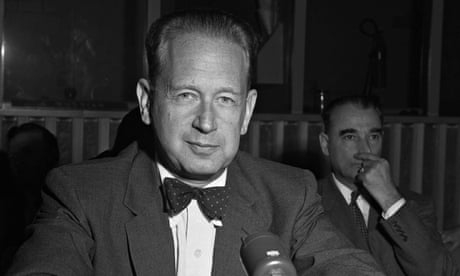
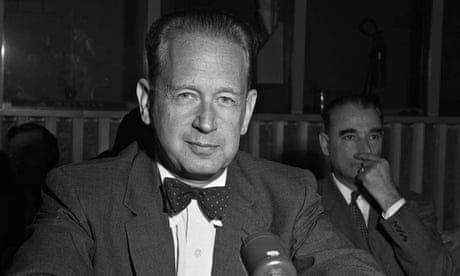 For a long time this site has tried to point out that the Congo struggle was one of the most important, yet underreported, foreign policy episodes that took place during the Kennedy administration. Sloughed off by the likes of MSM toady David Halberstam, it took writers like Jonathan Kwitny and Richard Mahoney to actually understand the huge stakes that were on the table in that conflict, namely European imperialism vs African nationalism. Kennedy had radically revised America’s Congo policy from Dwight Eisenhower to favor the latter. Not knowing he was dead, JFK was trying to support Congo’s democratically elected leader Patrice Lumumba. JFK was also one of the few Western leaders trying to help UN Secretary General Dag Hammarskjold stop the Europeans from crushing Congo’s newly won independence.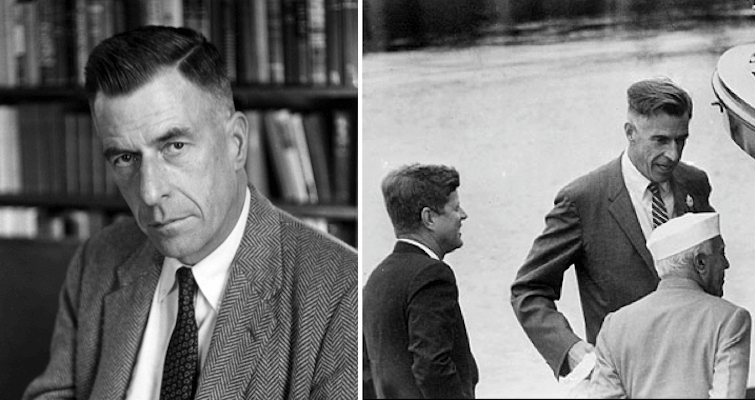


 As more than one commentator has observed, generally speaking, the Right has so much power in America that it does not have to worry about things like accuracy and morality. A good example was the journalistic trumpeting about the false charge that Iraq had Weapons of Mass Destruction. After all, people do not go to conservative martinets like Rush Limbaugh and Sean Hannity for facts and honesty in reporting. Usually it’s the left-of-center writers and reporters who are relied upon for such things. For, as Michael Parenti once noted, reality tends to be radical. Which is the reason that it sometimes has to be propagandized. Or else how does one provoke something as stupid as the 2003 American invasion of Iraq? Those on the Left insisted there was no reliable evidence for that invasion, while the MSM pretty much accepted the (ersatz) words of Colin Powell at the United Nations.


 As this web site has explained at length, the MSM has been completely unable to deal with the assassination of President Kennedy in any kind of rational or evidentiary manner. Since the recent presidential election touched upon the JFK case, we posted two columns dealing with it. (Click