Category: General

Original essays treating the assassinations of 1960s, their historical and political context and aftermath, and the investigations conducted.

  • Biden, Trump, the CIA: Reflections in a Dark Mirror, Nixon vs. Helms, 1971

    Biden, Trump, the CIA: Reflections in a Dark Mirror, Nixon vs. Helms, 1971


    Come October, President Joe Biden will make a decision on whether to release the remaining 15,834 still-repressed files that were supposed to have been released under the JFK Records Act of 1992.

    The JFK Act required that all the JFK files be made public in their entirety within 25 years, which of course, was 2017.

    But back in October 2017, President Donald Trump caved to the warnings of then-CIA director Mike Pompeo, FBI director Christopher Wray, and the National Security State, and left the remaining 15,834 files either redacted or totally under wraps.

    However, the mercurial Trump then also ordered the withheld files to be reviewed again within four years, perhaps seeking leverage over his adversaries in the intelligence communities.

    Fast forward to present, Trump has been booted from office and the betting is that Biden will also cave before the National Security State, despite the JFK assassination having happened 58 years ago.

    History is full of confounding realities. For all of his weaknesses, Trump was probably the better hope for full disclosure of the JFK records than Biden.

    For Trump was often, perhaps usually, at odds with the National Security State, variously called the “invisible government” or the “shadow government,” and, of late, “The Deep State.”

    In one of his seemingly ubiquitous running battles, Trump in 2019 detailed then-US Attorney General Robert Barr to investigate the nation’s investigative agencies, to ascertain whether elements of the Deep State illegally colluded to first try to prevent his ascendance to the White House, and then to undermine his presidency.

    At present, the criminal investigation into what is called “Russiagate” is led John Durham, now special counsel to the Justice Department and the former US Attorney for the District of Connecticut (2018–2021).

    Durham, originally tasked by Barr in May 2019 to investigate whether the invisible government had it in for Trump, has left the US Attorney’s Office with the advent of the Biden Administration, but has stayed on and is leading the criminal Russiagate investigation, as special counsel.

    Like so many modern-day Washington look-sees, the Durham inquiry promises to be interminable yet inconclusive and spun thereafter by party-based PR machines and media mouthpieces.

    Even a synopsis of the National Security State vs. Trump could consume a book. The famed Mueller investigation ended in a muddle, followed by a December 2019 report by the Department of Justice Inspector General that concluded that the FBI copiously lied to the Foreign Intelligence Surveillance Court, aka the FISA court, to gain permission to spy the former Trump campaign staffer Carter Page during the 2016 election.[1]

    To critics, Trump’s directives to Barr and Durham were the actions of a paranoid, or rank political theater. That could be. To put it mildly, Trump was and is a man of manifest flaws.

    But then, what other aspiring presidential candidate had contemporaneously written about him in the op-ed section of The New York Times, by a one-time director of the CIA: “Donald J. Trump is not only unqualified for the job, but he may well pose a threat to our national security.”[2]

    That line was penned by Michel J. Morell, professional lifer in the CIA, a onetime deputy director, and occasional acting director until his retirement in late 2013. 

    The Morell missive was run in The New York Times even before Trump became President.

    Yet Trump was hardly alone among presidents in his friction with the CIA; Presidents Harry Truman, John F. Kennedy, and Richard Nixon all had conflicts and reservations about the intelligence agency. Most famously, Kennedy has been quoted to the effect that he “wanted to splinter the CIA in a thousand pieces and scatter it to the winds,” due to the agency entangling his White House into the debacle known as the Bay of Pigs.

    Did someone say “Bay of Pigs?” That expression “Bay of Pigs” brings up Richard Nixon.

    Nixon’s Unsuccessful Struggle With the CIA

    Set the stage in 1971, with President Nixon requesting files from then-CIA Director Richard Helms. Paper files—this was largely the pre-computer days, and totally pre-internet.

    So, 50 years ago, what CIA files did Nixon want?

    “The ‘Who Shot John?’ angle,” Nixon explained to Helms, who was seated for a tête-à-tête in the Oval Office.  Nixon had circuitously outlined to Helms why he wanted to see certain files held by the intelligence agency, evidently to further illuminate the background of the assassination of President Kennedy in 1963.[3]

    All but forgotten in the voluminous White House tapes recorded by President Nixon is one of the strangest conversations ever to take place at 1600 Pennsylvania Avenue, a verbal tussle between Nixon and Helms on the morning of October 8, 1971.

    In that meeting, Nixon told Helms that he, the President—the Commander in Chief, the Chief Executive—wanted to see the CIA files on the “Bay of Pigs.”

    The end result: President Nixon never got to see those files.

    Helms sandbagged Nixon, confirming a separation of powers not pondered by the Founding Fathers nor by any sensible understanding of democratic institutions. 

    History rhymes, as they say, and Trump had wanted his AG Barr to review and then possibly make public files held by national security agencies, including the CIA.

    One could ponder if Trump, like Nixon, was effectively thwarted, meaning that the intelligence agencies remain essentially immune from Oval Office directives and oversight. 

    The Nixon-Helms Backdrop

    On that October morning 50 years ago, the cagey CIA Director Helms was mute in response to Nixon’s “The ‘Who shot John?’ angle” gambit.

    Nixon then badgered Helms with a bewildering string of questions regarding responsibility or indirect culpability for Kennedy’s death.

    “Is Eisenhower to blame? Is Kennedy to blame? Is Johnson to blame? Is Nixon to blame? Etc., etc.” asked Nixon. “It may become, not by me, a very vigorous issue but if it does, I need to know what is necessary to protect frankly the intelligence gathering and the dirty tricks department and I will protect it.”

    Nixon finished with the flourish, “I have done more than my share of lying to protect you and I believe it’s totally right to do it.”[4]

    Evidently, Helms was not moved by this Nixon soliloquy.

    The ever-scheming Nixon would later ask Helms for CIA help in derailing the Watergate investigation, by having the agency posit to the FBI that the famous Watergate break-in had actually been a CIA operation.

    Nixon advised his right-hand man and White House Chief of Staff H. R. Haldeman this way on June 23, 1973, as recorded on tape:

    Nixon: When you get in these (CIA) people when you…get these people in, say: “Look, the problem is that this [Watergate investigation] will open the whole, the whole Bay of Pigs thing…”[5]

    In other words, Nixon was implying, if the Watergate story blew open, so would the JFK assassination story.

    One interpretation of the Helms-Nixon stalemate is that Nixon wanted to know if CIA files had details on the Mafia-Cuban-CIA hit squads that had targeted Cuba-leader Fidel Castro in the late 1950s and early 1960s—efforts which Nixon had helped set up as President Dwight Eisenhower’s Vice President, along with CIA officer E. Howard Hunt, later known as the Nixon White House Watergate burglar-meister.

    Many JFK assassination researchers have concluded the anti-Castro death squads, possibly in cooperation with elements in US intelligence agencies, then turned on Kennedy after the failed CIA-sponsored 1961 Bay of Pigs invasion by Cuban exiles, in retribution for Kennedy’s decision to not provide air support for the beleaguered invaders. 

    Interestingly enough, arrested at the Watergate, on the fateful night of June 17, 1972, were five Cuban-exile operatives, including Eugenio R. Martinez, who it was revealed later was still on the receiving end of disbursements from CIA paymasters.

    H. R. Haldeman would later author a book and posit that the expression “Bay of Pigs” were Nixon code words for the JFK assassination. Certainly, if Nixon wanted to see the “Bay of Pigs” files to provide background information on “Who shot John,” then Haldeman’s intuition seems likely. To put it bluntly, Nixon was fishing for CIA files pertaining to the JFK assassination.[6]

    That October, 1971 morning, Nixon and Helms engaged in a polite, lengthy discussion about the President’s organizational and operational needs and prerogatives, to which Helms readily assented.

    But talk is cheap.

    Fast forward a year-and-a-half: Helms never coughed up vital Bay of Pigs files and White House tapes from May 18, 1973, reveal Haldeman informing Nixon that there was key memo missing “that the CIA or somebody has caused to disappear that impeded the effort to find out what really did happen on the Bay of Pigs.”

    So, in the case of Nixon vs. Helms, the CIA foiled a Presidential order to turn over files. The director of the CIA, Helms, was not answerable to the duly-elected US President.

    Of course, Nixon and Haldeman would have no way to know if many other “Bay of Pigs” files had also disappeared—national security agencies inherently have a monopoly not only on security information, but also on information about the information. 

    Ehrlichman

    The October 1971 Nixon-Helms conversation followed on the heels of an Oval Office chat between Nixon and John Ehrlichman, then Chief Domestic Adviser and previously White House Counsel.

    Ehrlichman, like Haldeman, explained to Nixon how he had been roadblocked by the CIA in his request for files and “the internal stuff.”

    Both wondered aloud how they could bring the CIA to heel and they discussed firing CIA Director Helms and replacing him with a loyalist. Then the pair discussed E. Howard Hunt, the ex-CIA officer they recently brought on-staff to the White House ostensibly to lead a “Plumbers’ Unit,” and who later organized burglaries, including the infamous Watergate break-in.

    “Helms is scared to death of this guy [E. Howard] Hunt we got working for us, because he knows where a lot of the bodies are buried,” opined Ehrlichman, in suggesting that the White House could intimidate Helms into cooperation by hinting Hunt had switched from the CIA to Team Nixon.[7]

    In the taped conversation, Ehrlichman and Nixon agreed that the CIA was pursuing “self-perpetuation” in keeping files secret—it would protect its image and could threaten that of others, with secret files.  “Helms is a bureaucrat first and he is protecting that bureau,” said Ehrlichman. Nixon retorted, “Well I am the President and the CIA is not, it [the CIA] is a self-perpetuating bureaucracy.”

    President or not, Nixon never got the files he wanted.

    The final irony is that Hunt, of whom Nixon and Ehrlichman chortled was their ace-in-the-hole against the CIA, in truth probably never stopped being a friend of the agency.

    Rob Roy Ratliff, the CIA’s liaison on the National Security Council, in 1974 provided an affidavit to the House Judiciary Committee, when it was weighing articles of impeachment against President Nixon.[8]

    Ratliff swore that Hunt, while ensconced in the White House, had used secure agency couriers to send sealed pouches to CIA Director Helms on a regular basis.

    Rather than being Nixon’s lever against the CIA, more likely Hunt was a mole for the agency, working in the White House. Like the old joke, Nixon’s paranoia did not mean no one was out to get him.

    Trump

    Of course, Trump’s relationship with the intelligence agencies and CIA was much different from Nixon’s, with no shared history in Cuba, Latin America or Iran, no alignment of fervently held ideologies, and no mutually buried bodies.

    Unlike Nixon who reveled in foreign affairs, Trump was no scholar of international relations and instinctually regarded  offshore incursions as entanglements.

    Yet Trump, like Nixon, was deeply concerned with what might be in intelligence agency files and whether the agencies answer to him, or have their own agendas, or even worse, have plans for a presidential demise.

    By many accounts, the US intelligence community and the CIA and their allies in the media strongly resist anyone from outside their sphere rendering judgment on what is secret and what is not.

    And indeed, the mass media in general sang the CIA tune during the Trump Presidency, fretting, as did The New Yorker magazine, that AG Barr would “unilaterally” declassify documents.[9] In other words, the presumption was that a President should only declassify documents if given approval by the National Security State.

    Of course, the intelligence agencies cited the well-worn and sometimes true clichés that they need to protect “sources and methods.”

    Conclusion

    Still, as in the long-ago Nixon White House, the highly politicized circumstances of the Trump Presidency muddied some underlying principles.

    Trump, like Nixon, was embattled and deeply unpopular in some circles and even considered a menace to the nation by some. Both Nixon and Trump hardly had the charm of a President Kennedy or Ronald Reagan, or even the affability of a Bill Clinton or George W. Bush.

    Yet Trump, like Nixon, was institutionally justified in his struggles with the intelligence agencies. As the elected President and Commander-in-Chief, Nixon had every right to view any file in the entire federal government. And Attorney General Barr, as deputized by Trump, had every right to look at and declassify any document at will, at Presidential direction.

    The real question remains: Will the intelligence agencies release all the relevant files to Special Counsel Durham or, like the CIA in the Nixon days, will they unilaterally withhold information?

    More speculative, but worth knowing—did  the CIA or other intelligence agencies have plants in the Trump campaign or in the Trump White House?

    And Biden?

    And looking forward: Will President Biden show the resolve necessary to release all the remaining 15,834 files that were supposed to have been released under the JFK Records Act of 1992?

    The record of Kennedy, and then Nixon, and then Trump, suggests that Biden will be unable to prevail against the National Security State, even if he tries.


    [1] Glenn Greenwald, The Inspector General’s Report on 2016 FBI Spying Reveals a Scandal of Historic Magnitude: Not Only for the FBI but Also the U.S. Media, The Intercept, 12/2/2019.

    [2] Michael J. Morell, I Ran the CIA, Now I Am Endorsing Hillary Clinton, The New York Times, 8/5/2016, see also https://www.nytimes.com/2016/08/05/opinion/campaign-stops/i-ran-the-cia-now-im-endorsing-hillary-clinton.html

    [3] Nixontapes.org. See http://nixontapeaudio.org/rmh/587-007a.mp3. See also Jefferson Morley, JFK Facts, 6/17/2014.

    [4] Ibid. 3

    [5]Smoking Gun”: Richard Nixon and Bob Haldeman discuss the Watergate break-in, June 23, 1972, Richard Nixon Presidential Library. See also Andrew Coan, Prosecuting the President: How Special Prosecutors Hold Presidents Accountable and Protect the Rule of Law, Oxford University Press, 165–166

    [6] Don Fulsom, Nixon’s Bay of Pigs Secrets, The History Reader, St. Martin’s Press.

    [7] Ibid 3

    [8] Chris Collins, Nixon’s Wars: Secrecy, Watergate, and the CIA, Eastern Kentucky University Encompass, 74.

    [9] David Rohde, “William Barr, Trump’s Sword and Shield,” The New Yorker, 1/13/2020.

  • James Moore, JFK, and QAnon

    James Moore, JFK, and QAnon


    James Moore is the chief business commentator and a regular columnist for the British online newspaper The Independent. The day before Valentine’s Day, Moore penned an article called “JFK’s assassination greased the wheels for QAnon and Covid-Deniers.” This was the sub-title to this column:

    The same type of thinking fuels the Kennedy conspiracy theories and the venomous fiction concocted by extreme right-wingers, that we see today. It needs to be laid to rest.

    You have to wonder, did Moore crib his column from the piece that Steven Gillon wrote for the Washington Post? Gillon’s was published on the 57th anniversary of President Kennedy’s assassination and made much the same false equivalency argument that Moore does here. (Click here for my discussion of this)

    Gillon was wrong on every point he made in his faux comparison. QAnon is not something that say, Mark Lane, would have gone within a mile of if he were alive. To compare the arguments in the two cases is simply bizarre. The initial critics of the Commission, like Mark Lane and Harold Weisberg, showed that, although the MSM accepted the Warren Commission’s work, they should not have. Because contrary to what reporters like Tom Pettit of NBC and Walter Cronkite of CBS trumpeted, the Commission had not proven its case that Lee Harvey Oswald was the lone gunman who killed President Kennedy. Yet, on the evening of the issuance of the Warren Report, both CBS and NBC, with those two reporters, stated to an unsuspecting public that the Commission had done just that.

    So here is the question I would like to post to both Gillon and Moore: How did those two men read 888 pages of the Warren Report—which was not subject indexed—and put together a broadcast show in less than 24 hours? The answer is they could not have. These two programs were in production well before the report was even issued. Therefore, what the rational reader can conclude is that both CBS and NBC were leaked the Commission’s findings well in advance of publication. And they made some kind of implicit or explicit agreement not to challenge those findings in return for the information. In fact, at the end of the CBS program, Cronkite made the stunning statement that it would be hard to imagine that a more thorough inquiry could have been done.

    In fact, it was even worse than that. For we later learned from film director Emile de Antonio and journalist Florence Graves that CBS instructed their on-camera witnesses to parrot the Commission’s conclusions. (Florence Graves, Washington Journalism Review, Sept/Oct, 1978) Documentary director de Antonio saw the outtakes from the 1964 CBS program. When a witness was asked where the shots in Dealey Plaza came from, and they replied with “the knoll area”, they were asked the question again. Only the take where the witness finally said, “the Texas School Book Depository” was shown to the public. De Antonio later told Graves, “The interviewer was more like a prosecuting attorney leading a witness to support the state’s case.” Graves found out that the CBS production was actually months in the making. (Click here for details)

    I would like to ask Mr. Moore: Is this your idea of journalism? Would you go along with such an illicit and unethical scheme to endorse an official story for the British government? Would you instruct a witness to change his story on camera? Would you produce a program endorsing a report months before that report was even published? Because that is what happened with the Warren Report.

    Recall, this was in the early period of the controversy. People like Weisberg were writing that the Commission had not proved its case beyond a reasonable doubt. It was way before the declassifications of the Assassinations Record Review Board (ARRB). What those declassifications revealed, and what authors like Gerald McKnight proved in Breach of Trust, was that there was no case against Oswald at all. The FBI, Secret Service, and CIA fed the Commission an incomplete and faulty record. The Commission accepted and published it. With the new information available after 1998, critics like McKnight, and several others, could finally prove the fraud in the Commission’s performance—to a legal standard.

    Such is not the case with QAnon. That movement has little or nothing to do with investigatory data or a court room legal standard. QAnon was begun by an anonymous poster at the 4chan website in late 2017. That website was often characterized as being extremist and racist. Who the man who started it really was, we do not know. He claimed to be a high ranking military officer. This person announced that Hillary Clinton was going to be arrested. It was part of a scenario that depicted a grand battle going on: good vs evil. President Trump and his Pentagon advisors were working to take down a global alliance of Satan worshiping pedophiles. That alliance included politicians, Hollywood celebrities, and figures in the media.

    According to QAnon, the battle will end with two great apocalyptic events. The first is The Storm, which will result in mass arrests of thousands of people; it will be a day of reckoning. The second event is the Great Awakening, the day everyone will realize that QAnon was correct. This will be the opening of a new utopian era. (Click here for details)

    Many commentators believe that the birth of QAnon was preceded and perhaps derived from the whole Pizzagate imbroglio. That resulted in an attack on Comet Ping Pong Pizza in Washington DC by a man named Edgar Maddison Welch. This occurred in December of 2016. Welch had a rifle, a handgun, and a shotgun. That fruity incident was based on similar themes: namely that the Clinton campaign was running a child molestation ring right out of the basement of the pizza shop, which had no basement. Promoters of this bizarre scenario were Donald Trump backers like Alex Jones, Michael Flynn, and his son Michael Jr. The motivation probably being that it went after Hillary Clinton. Mr. Welch actually thought she was murdering children. (See Huffpost, story by Hayley Miller, 12/16/2016; Esquire 7/24/20, article by Michael Sebastian and Gabrielle Bruney)

    There is no cognitive/intellectual relationship between what people like Mark Lane, Gerald McKnight, or Harold Weisberg did and Mr. Welch’s beliefs or what the backers of Pizzagate or QAnon do. The latter are mythological concepts. The former are based upon data and evidence. JFK writers can today demonstrate that the Commission was wrong on many key points. What can QAnon show? Another pizza shop with a child porn ring in the basement?

    As I pointed out with Gillon’s rubbish, in its historical origins, again there is no relationship between QAnon/Pizzagate and critics of the Commission. The followers of the former stem from over a decade prior to Mark Lane’s Rush to Judgement. The QAnon troop are mostly successors to the anti-government, pro-gun, rightwing militia corps. It was these groups that helped create the John Birch Society and helped found its sister association, the Minutemen. From the election of Ronald Reagan, the GOP has drifted more and more to the right, especially during the Bill Clinton presidency. At that time, party leaders like Rush Limbaugh advocated for every conspiracy theory out there about the Clintons: Whitewater, Vince Foster, the Rose Law Firm. None of which two Republican special prosecutors could convict him over. I might also add that Limbaugh, in February of 2020, dismissed CV-19 as being as innocuous as the common cold. (Rolling Stone, 2/17/2021, article by Bob Moser) This intellectually unmoored, anything-goes attitude eventually allowed QAnon to spread into the modern elected GOP (e.g. Marjorie Taylor Greene and Lauren Boebert). In my view, it was this anti-intellectual, ahistorical, politically packed attitude that led to the Insurrection of January 6, over another Limbaugh/Trump myth: a stolen election. As a consequence, eight people died—five were killed, three took their own lives. No such pattern exists for the critics of the Warren Commission, because the critical community is not fundamentally political and not based on a spurious, ethereal, ideological belief system.

    This leads us to the key sentence in Moore’s screed. He writes that “The Kennedy conspiracy has become a respectable conspiracy theory. Almost.” The idea that Kennedy’s murder was caused by a conspiracy is today not a theory. It is a forensic fact. And because of the Assassination Records Review Board (ARRB), we can show that in a number of ways with the so-called “hard evidence” (i.e. the ballistics and the autopsy). We can also demonstrate that previous inquiries were simply wrong in these aspects. And show why they are wrong.

    Moore scores Oliver Stone’s 1991 film JFK on this point. He does so using a sleight of hand trick. He says that JFK posited a combination of nine different organizations that wanted Kennedy killed. He actually includes groups that, after about six viewings of the film, I still don’t see (e.g. pro-Castro Cubans, the Russians, Hoover’s FBI, and the Mafia). What the film really says is that a combination of the Power Elite and the military schemed to kill Kennedy over his policies in Vietnam and Cuba. Most of the other groups are mentioned in passing, or posited as a part of the cover up.

    But Moore’s kind of trickery obscures the point of the film. The film was trying to show that, almost three decades later, we did not really know who killed Kennedy. As everyone recalls, except perhaps Moore, the end title card to the film said one reason for this was because the files of the HSCA were still classified over a decade after they closed shop. Why? This is a question that Moore does not want to deal with. Neither does he want to deal with what those files revealed once they were declassified. If he did, the problems with his lousy column would be exposed.

    Moore writes something just as bad just a couple of sentences later. He actually states that there is really not much reason for questioning the JFK case. Why? Because the doubts are only “backed by little more than the feeling that one man simply couldn’t have, on his own, changed history as Oswald did.”

    In other words, those 2 million pages of ARRB declassified documents, their inquiry into the medical evidence, the work of scientists and physicians like Dave Mantik, Cyril Wecht, Randy Robertson, Mike Chesser, and Gary Aguilar, all of this new writing, evidence, and analysis amounts to a feeling?

    Moore then doubles down. He now says that with all the declassifications, plus the studies by ballistics experts and physicists, all of these have concluded that the fatal bullet came from Oswald, which exposes him as a charlatan. Does Moore not know that Vincent Guinn’s Neutron Activation Analysis—the test that the HSCA relied upon to seal its case against Oswald—has now been exposed as “junk science”? (Journal of Forensic Sciences, July 2006, pp. 717–28) How about ballistics? Gary Aguilar, Tink Thompson, and John Hunt have shown that the Magic Bullet, CE 399—the Commission’s keystone of their case against Oswald—has no chain of custody to it. Thus, it would blow up in a prosecutor’s face at trial. (The Assassinations, edited by James DiEugenio and Lisa Pease, pp.282–84; and click here) This lack of knowledge further exposes Moore as indulging in ignorant quackery.

    Yet, near the end of Moore’s Comedy of Errors, he again says that both the JFK case and QAnon lead people down the same rabbit hole. Not so. With QAnon, there is no end to the rabbit hole; since it is at best a myth, at worst a hoax. In the JFK case, by following the best that has been written of late, one can find some definite evidentiary conclusions. Moore is either unaware of them or does not want to mention them, since it would blow up his column.

    The column ends the only way it could. Moore endorses Gerald Posner’s “exhaustively researched” book Case Closed. Well, if one wants to read what was essentially a rerun of the Warren Report, fine. But the remarkable thing about that book is that it was written before the creation of the Review Board. So how could it be “exhaustively researched”? The major part of Posner’s footnotes relied on the volumes of the Warren Commission. Meaning it could have been written in 1965 or ’66. Posner endorsed the Single Bullet Fantasy, which we know today did not happen. (Click here for details) We also know that there is a problem with the interviews Posner did. Some of the people who he says he interviewed do not recall talking to him. (Probe Magazine Vol. 5 No. 5, p. 14)

    Further, in the original edition of Case Closed, Posner wrote that there was no credible evidence that Oswald knew David Ferrie, a major character in the film JFK. (See p. 148) In fact, Ferrie had told the FBI he did not recall Oswald. (Commission Document 75, p. 286) Within weeks of the publication of that book, PBS Frontline produced a photo of the two men standing together at a Civil Air Patrol barbecue. In the declassified files of the HSCA, there was further evidence via affidavits of CAP members who recalled the rightwing, CIA associated Ferrie with the alleged communist Oswald at meetings. (Op. CIt. Probe Magazine, pp. 15–16)

    To top it off, we now know through at last three sources that, within days of the assassination, Ferrie was visiting and calling people to recover evidence that linked him to Oswald. (Ibid, p. 17) This included both his library card and the above-mentioned picture. In other words, far from not knowing Oswald, Ferrie was involved in the act of obstruction of justice in order not to incriminate himself in perjury. This is a rabbit hole?

    So much for Mr. Posner. And also Mr. Moore.

  • Caitlin Johnstone, JFK, and the Insurrection

    Caitlin Johnstone, JFK, and the Insurrection


    Caitlin Johnstone is one of my favorite journalists. She is well-informed, bright, witty, and her sympathies are in the right place. In fact, we write for two common publications: the online Consortium News and S. T. Patrick’s paper magazine garrison.

    As everyone knows, January 6, 2021, will go down in history as one of the most frightening days of the new millennium. The only thing I can compare it to is the so-called “Brooks Brothers riot,” that took place in Dade County in 2000 that helped give George W. Bush his illegitimate presidency. That, of course, was not really a riot. It was arranged by people like Congressman John Sweeney and Republican political operative Roger Stone. The idea was to stop a recount of votes in the Miami area that would have likely given the election to Vice-President Al Gore. Through violent and intimidating means, it succeeded in that aim.

    What happened on January 6, 2021, was much more lethal. So far eight people have passed on because of that insurrection. Five died as a direct result of the violence and three took their own lives afterwards: two policemen and one man who was about to be arrested. Caitlin Johnstone has been trying to tell her audience that we should discount what happened on that day; it really was not an attempt to overturn the election and thereby keep President Trump in power. (Click here for details) Besides that, she says if we did maintain it as such, we may unleash something even worse; like attacks on and censorship of the web and social media. This could be used against progressives.

    Again, let me reiterate, I like Caitlin. But I beg to disagree with her about this importance of this event. To me, that scene at the Capitol resembled the climactic, surreal riot scene from Nathaniel West’s The Day of the Locust. It was so disturbing that I went out and bought a 12-pack of beer to dull the pain of watching it. To me, it is not something to discount or try to forget anytime soon. How does one forget a gallows constructed across the street from the Capitol while the insurrectionists were looking for Vice President Pence? Another insurrectionist was looking to shoot House Speaker Nancy Pelosi. Representative Alexandria Ocasio-Cortez said that, while in hiding, she literally feared for her life. (Click here for details) She should have, since another insurrectionist has now taken back his threat to shoot her.

    We, who study the John F. Kennedy assassination, should be able to point out certain similarities that betray the event as not simply a spontaneous Westian outburst. The night before at a “Stop the Steal” rally in front of the Supreme Court, Roger Stone compared Trump to Abraham Lincoln and cheered on the crowd by saying the president had “Freed This Slave!” (Click here for details) There were credible reports that there were explosives set outside both the Democratic and Republican National Committee headquarters. Investigators later theorized that the alerts about these bombs were diversions, meant to distract police from the marching crowd, but there were not many police on hand to distract. Because, as with the security stripping around President Kennedy in Dallas, there was definitely a real problem in supplementing the terribly outnumbered Capitol Police force. (Click here for details)

    Authors Michael Kurtz and the late John Davis noted reports of people being in Dealey Plaza and looking like they were lining up targets two days before the assassination. (Kurtz, Crime of the Century, second revised edition, p. 218) In the January 6th case, there are various reports by congressmen that fellow representatives were showing people with MAGA hats around the building in the days before the insurrection. One of the “Stop the Steal” rally organizers, Ali Alexander, admitted that he received help from three representatives in organizing the insurrection. (Click here for details) At least one of the men Alexander named—Representative Mo Brooks—spoke at the rally on the Ellipse before the insurrection. The two others named by Alexander reportedly requested pardons from Trump before he left office. (Click here for details)

    This would seem to suggest that the insurrection was, at least partly, an “inside job.” There are numerous parallels to this in the JFK case. I will name just two. On the recovered Air Force One Tapes, General Curtis LeMay’s aide de camp is seeking him right after the assassination, as LeMay is flying in from Toronto to Washington DC . The Air Force officer was reportedly seen at the autopsy that evening. (Click here for details) In the film, The Parkland Doctors, there is witness testimony that either a Secret Service man or an FBI agent pulled Dr. Malcolm Perry aside after he told the press that Kennedy had been shot from the front. This man told Perry, “Don’t ever say that again!” This was about 90 minutes after the assassination.

    While the insurrection was in progress and a mob was seeking Pence, Donald Trump and Rudy Giuliani were not seeking to quell the violence. They were calling in to the besieged Capitol, trying to locate certain senators in order to attempt to stall the tallying of the Electoral College final vote. (Click here for details) This recalls the military interference with the official JFK autopsy, exposed by Dr. Pierre Finck at the trial of Clay Shaw in New Orleans.

    What should make all of the above even more distressing is that the January 6th insurrection was not, as Caitlin would like to characterize it, an outlier. Six men have been indicted in a plot to kidnap Democratic Governor Gretchen Whitmer of Michigan. That indictment was handed down just over two weeks before the insurrection. (Click here for details) As people in the JFK field know, there was an attempt to kill President Kennedy in Chicago about three weeks before he was gunned down in Dallas.

    As readers of this site will recall, I criticized historian Steven Gillon six weeks before the insurrection. He had written an editorial for the Washington Post saying that those who had tried to create confusion over the results of Trump’s election loss were doing so under the influence of the late Mark Lane. (Click here for details) I replied that Gillon was utterly wrong on this. The section of the populace espousing such subterfuge seemed to me to originate with the rightwing followers who had fallen prey to the Red Scare demagoguery of Joe McCarthy, Roy Cohn, and later, the fruitiness of the John Birch Society. From the results of January 6th, I was correct on this and Gillon was wrong. I await his apology. But since Gillon worked on the JFK case with the likes of Dale Myers, I know I will not get one.

    President Kennedy was fully aware of the burgeoning power of these ultra conservative minions. He had requested reports on them, made speeches against them, and fully understood how they hindered what he really wanted to do as president. After UN Secretary General Dag Hammarskjold was murdered—and Kennedy had received reports that such was the case—Kennedy called in a Swedish diplomat to pay his respects. Kennedy told him that, in his opinion, Hammarskjold was the greatest statesman of the 20th century. He could never equal that stature, because he had to worry about the power of these reactionary forces and their leaders in the United States. I will point out two examples. Domestically, General Edwin Walker and the John Birch Society had organized the demonstration at Ole Miss to stop James Meredith from integrating the university. This turned into a full scale riot which killed two people. As many researchers have written, Kennedy was planning his withdrawal from Vietnam around his re-election in 1964. He felt he had to, since he told his confidantes he knew he would be pilloried as an appeaser if he did it beforehand. (Ken O’Donnell and Dave Powers, Johnny We Hardly Knew Ye, p. 16) Finally, we all know how upset JFK was when he read the infamous black-bordered negative advertisement against him in the Dallas News on the morning of his death. He told his assistant Dave Powers not to let his wife see it. (Ibid, p. 24)

    This movement has mushroomed in recent decades (e.g. QAnon). On January 6th, they came armed and dangerous. Since the security on the Capitol was so unprepared, only about 70 people were arrested that day, but the arms cache discovered was formidable. It included IED bombs, Molotov cocktails, assault rifles, thousands of rounds of ammunition, a crossbow, brass knuckles, stun guns, and “stinger whips.” (Click here for details) There were reports that some of them brought climbing equipment. God knows what would have been recovered if there would have been a systematic search of all the perpetrators. How can one dismiss an armed, frenzied mob that was searching for people to execute, especially when it had been warmed up by previous demonstrations?

    In mid-November, the Proud Boys had arranged a march in Washington. During the rally, Trump drove past in his motorcade. That evening after fights had broken out in the street, Trump tweeted, “ANTIFA SCUM ran for the hills today when they tried attacking the people at the Trump Rally, because those people aggressively fought back.” (Talking Points Memo, 1/25/21, by Tierney Sneed and Matt Shuham, hereafter referred to as TPM) On December 5th, at a rally in Georgia, attorney Lin Wood and former NSC member Mike Flynn endorsed a call for martial law. Wood tweeted that the governor of Georgia and the secretary of state would “end up in jail,” if they did not help Trump overturn the election. (TPM)

    On December 12th, there was another “Stop the Steal” rally in Washington DC. At this one, Trump did a helicopter flyover as the organizers pleaded for him to call up a citizen militia “now while he is commander in chief.” (TPM) That evening, there were several stabbings and over a dozen arrests, as the Proud Boys set aflame Black Lives Matter banners which had been torn down from historically Black churches. (ibid)

    At about this time, political activist Amy Kremer of Women for America First began a bus tour through the south, including the deep red states of Tennessee, Kentucky, and Louisiana. She and other speakers would arrive in a red bus, marked with large white lettering: “March for Trump.” The idea was to recruit the crowd for January 6th. Kremer’s effort was in large part financed by Mike Lindell, the CEO of My Pillow company and a vociferous Trump backer. Kremer would stop and then speak at a prearranged gathering from a stage. She would say, “It is up to you and I to save this Republic. We are not going to back down, are we?” (Reuters, 1/11/21, story by Joseph Tanfani) These Kremer rallies were televised by the Right Side Broadcasting Network. That network was started for the purpose of giving Trump’s rallies more broadcast exposure. On December 19th, Trump tweeted for his followers to be at the Ellipse on January 6th.

    In addition to Kremer’s group, Charlie Kirk of Turning Point Action also sponsored the January 6th rally. This is a conservative campus student group. Kirk also helped finance seven busloads of students in his group to attend the rally. (ibid)

    To say the effort paid off is putting it mildly. The rally itself had to have been attended by tens of thousands. The Trump clan was assembled in what appears to be a tent off of the Ellipse, monitoring the crowd through TV screens. They are laughing and joking while urging Mike Pence to do the right thing. If you have not seen this video, you should. (Click here for details) All the while the late Laura Branigan is singing her smash hit “Gloria” in the background. (CNBC report of 1/8/21 by Dan Mangan)

    During the rally, the two main speakers were Trump and his attorney Rudy Giuliani. One can cherry pick parts of their addresses, in order to defend both men. But taken as a whole, I think there is little doubt that those two speeches caused the crowd to march to the Capitol under Giuliani’s pretense of “trial by combat.” The aim was to somehow pressure the House, the Senate, and Pence to reject the electoral college vote tally and send it back to the state legislatures to be reconsidered. There had been a prior attempt to do this in 1960 by certain deep south electors who did not want Kennedy in the Oval office, but would have accepted Lyndon Johnson with Kennedy as his VP. (Washington Post, 12/12/21, story by Ronald Shafer)

    What makes this maneuver a bit bracing is this: Giuliani had prepared for it by visiting certain gatherings of state legislators and briefing them on how the election had been stolen by Biden’s allies from Trump. (TPM) Some of the states visited were Pennsylvania, Michigan, and Georgia. In the first instance, Trump spoke to the legislators directly by speaker phone.

    The problem with all these pre-planned efforts to claim a stolen election is this: Trump could not even get his own elections supervisors to back them. Chris Krebs is a lifelong Republican who had worked security for Microsoft before coming to Washington. He was Director of Cybersecurity, meaning that, if asked, he would check all voting systems states used in advance. His goal was to get as close as possible to a complete paper ballot back up system. He decried Trump’s claims of voter manipulation. He stated under oath that the 2020 presidential election was “the most secure in American history.“ Before the senate, on December 16th, he took the time to debunk several of Giuliani’s specific claims. He was fired. Bill Barr, Trump’s Attorney General also refused to back him. He was forced to resign. Trump tried to get the officials in Georgia to go along with his fraud claims. After all, Georgia’s votes had been recounted three times. There is a now famous recorded phone call of the president talking to Georgia’s Secretary of State, Brad Raffensperger, asking him to “find” 11, 800 votes for him. Raffensperger declined to cooperate. After the call, Gabe Sterling, his chief operating officer, took the time to, again, debunk individual claims. He later showed how Giuliani had edited a tape to make it mean something it did not. He concluded one of his press conferences by saying all of these propagandistic and incendiary claims were going to result in someone getting hurt, shot, or killed. He was correct. (Click here for details)

    But perhaps the most surprising scheme that Trump dreamt up did not surface until recently. Apparently, Trump was going to also terminate his acting Attorney General Jeff Rosen. He would replace him with Jeffrey Clark, because Clark was willing to do what Rosen would not: pressure lawmakers in Georgia to overturn their election results. The only reason this did not come to pass is there was a threat of mass resignations in the Justice Department if it did. Trump did not want to face a reprise of the infamous Saturday night Massacre of Richard Nixon. (Seattle Times, 1/24/21) But part of the plan seems to have been enacted, since Trump did replace the US attorney in Atlanta after he would not go along with the scheme.

    In light of the above, I personally think it is untenable to try and maintain that there was not a serious effort in the White House to overturn the results of the 2020 election, an election which even Republican officials in Washington and Georgia say was not rigged. In fact, I do not think it is an overstatement to write that Trump spent over two months trying to overturn that election by any means at his disposal: legal or illegal.

    Trump’s agents actively recruited his followers to come to the January 6th rally. They brought arms and explosives with them. They constructed a gallows. They were looking for Pence, Pelosi, and Ocasio-Cortez. Reportedly, a newly elected representative actually tweeted about Pelosi’s location as she was hiding. (Boston Globe, 1/12/21, by Shannon Larson) During the insurrection, the mob itself communicated through the computer platform Parler, set up by the rabidly conservative Mercer family. In other words, all the elements of a criminal conspiracy to overturn the election by violence were there. What more evidence would one need: Ocasio-Cortez and Pelosi’s dead bodies? A noose around Pence’s neck? The floor of the Capitol exploded by an IED?

    On December 4, 1964, at Beverly Hills High School, there was a debate over the Warren Report. Mark Lane fiercely criticized the work of the Warren Commission. One of the defenders of their work was A. L. Wirin, a famous liberal lawyer of that era. During the proceedings, Lane was shocked when Wirin stated that we should all be happy with what Chief Justice Earl Warren had done, because if he had not, there might have been pogroms against the left. The idea being that the Commission was correct in its lone assassin conclusion, and the assassin, Lee Oswald, was a communist.

    Unfortunately for Wirin, and the rest of us, Earl Warren was wrong on both counts. Oswald was not a communist and he certainly did not shoot President Kennedy. Those of us who follow that case understand it to be an utter failure of justice, which had severe ramifications. That should not happen again.

    This author is not one of those who despises Donald Trump. Neither do I think he is the worst president in history. Anyone who thinks that does not realize how bad some of the American presidents really were. In fact, I actually agreed with some of his early foreign policy decisions. And I appreciate the fact he did not start up any new wars, but what happened on January 6th was a heinous crime against the American system of government. And there was no legal basis for it. Back in 2000, Al Gore actually did have an election stolen from him. He pursued every legal avenue he could to overturn the result. He deliberately refused to turn it over to a mob. When faced with that alternative he replied: “What do you want me to do, put blood in the streets?” It appears to this author that Trump and Giuliani took that alternative.

    The country needs a full, rigorous, no holds barred criminal inquiry into what happened on January 6th, one that is not afraid to reach into the Capitol or the White House. And if it was in any part an inside job, that needs to be exposed to us all. As Jim Garrison said, “Let justice be done, though the heavens fall.”


    Below is a link to an article by Seth Abramson which links the Trump family and his own representatives to a “war meeting” the night of January 5th at a Trump-owned hotel. The FBI should thoroughly investigate this lead. If it is accurate, it clearly suggests that Trump, his family, and his inner circle understood what would happen the next day. The name of Ali Alexander seems central to any real inquiry.

  • 25th Anniversary of Probe/CTKA/KennedysAndKing

    25th Anniversary of Probe/CTKA/KennedysAndKing


    This is now 25 years that Jim DiEugenio has been the editor/publisher of first, Probe Magazine, and then the web sites Citizens for Truth about the Kennedy Assassination (CTKA), and now Kennedys and King.com.

    You can help us stay alive, expand our reach and influence, and do more investigative in-depth stories by donating to our cause. We very rarely—if ever—directly ask for contributions. But a silver anniversary is certainly a good time to do so.

    You can help by contributing through our simple PayPal donation counter. Even better, become a regular contributor by donating a small amount each month. There is no other web site like this one. No one else brings you this quality stream of stories and news on these important subjects. Show your appreciation. Help keep us going.


    KennedysAndKing: Take us back to the beginning Jim? How did Probe Magazine start?

    Jim DiEugenio: That was due to the furor over the release of Oliver Stone’s movie JFK. A few of us who were interested in the JFK case met several times and we decided to try and accomplish something. The idea was to create an organization that would do a bimonthly journal and some speaking engagements in the local area. And that is how it started back in 1993.

    KaK: Why are you celebrating a silver anniversary this year then?

    JD: Because it was at the end of July 1995 that Lisa Pease and myself took over the editing and publishing of that journal. I was the publisher and editor. Lisa was co-editor and did the technical print layout of the magazine, at which she was quite good.

    KaK: Was there a point at which you thought you had really reached a level of achievement?

    JD: Yes, it was the issue that we timed for the release of the film Nixon at the end of 1995. We designed that issue around, not just the Stone film, but around Watergate and Nixon’s life. And we devoted a two page spread to the character inks between the Watergate scandal and how some of those same people were involved in the JFK case (e.g. James McCord, Howard Hunt and Dick Helms). Plus we did not take the conventional view of Watergate as put out by Bob Woodward and Carl Bernstein in All the President’s Men. Our view was that of Jim Hougan and his book Secret Agenda. I was surprised at how that viewpoint blindsided a lot of our readers. They simply were not aware that there was a different take on the crime.

    KaK: How did Probe Magazine morph into the web site Citizens for Truth about the Kennedy Assassination?

    JD: After we had ceased the print run of Probe, Peter Jennings did his special on the JFK assassination, which he called Beyond Conspiracy. I heard from a reliable source that his lead consultant was Gus Russo. Therefore, I knew what it was going to be like from what Russo had done in 1993 for PBS. It was even worse in some aspects. I mean there was Dale Meyers saying the Warren Commission’s major thesis was now, through his computer, the Single Bullet Fact, not theory. So John Kelin, a skilled web master, put together the original web site, which we called CTKA for short. And as with Probe, after the debut, we gained some quite distinguished contributors. Lisa and I did not have to write half the stories. We got people like Milicent Cranor, Gary Aguilar, David Mantik, Seamus Coogan, Joe Green, Martin Hay, David Josephs, and Vasilios Vazakas to write for us. That lasted more than twice as long as Probe Magazine. But it had a similar approach: we would cover news, research articles, and reviews of films and books. And we did that for all four of the assassinations: JFK, Malcom X, MLK and RFK. That was important, I thought, since I had come to the conclusion while doing Probe that they were all related in some way to each other. And I wrote about that idea in the anthology Lisa and myself published through Feral House called The Assassinations, which was kind of a best of Probe collection. I should also add that I became a semi regular guest on Black Op Radio at this time, so I now had a listening as well as a reading audience.

    KaK: And then how did CTKA change into Kennedysandking.com?

    JD: This was through the surprise efforts of my friend Al Rossi. I met Al through online correspondence, not knowing at that time he was another Lisa Pease, very well versed in the language of computer technology. In fact, that is what he does for a living. So he, at first secretly, began building a whole new layout for the web site. About a third of the way through, he told me about what he was doing: redesigning the layout and transferring all the files to another ISP. I don’t have to tell you how much that would have cost to do if I had hired a professional designer. I could never have afforded something like that. Contrary to popular belief, and the late Vince Bugliosi, there is not any money in this. We manage to scrape by. But he did it gratis on his free time.

    KaK: What about the status of the site today as Kennedysandking.com?

    JD: Al had to step down for medical reasons and, thank God, Dave Nesbitt took over as web master. I have to say, I have been lucky in that regard. In addition to John Kelin, I had Debra Conway and Gokay Hasan Yusuf as temporary web masters for the long run of CTKA. And personally, I think today, in both the format and quality of the content, we are as good as we have ever been. In some ways better, because Al was able to collect so many of our best articles into an archives at the new site. Also, because we have visual and audio files available, like my 26 part interview with Dave Emory. That interview is still one of our highest rated pieces even though it has been up for well over a year.

    KaK: What would you like to do if your fund drive is successful?

    JD: One of the things I would like to do it so increase the reach of the site through what is called an SEO company. That acronym means search engine optimizer. See, there are some very bad sites out there, that have large footprints on the web. For instance, John McAdams web site is awful. But due to Wikipedia, which has become the NY Times internet version on the JFK case, McAdams’ site gets a lot of visits. Our site, which has much better information and analysis, does not have Wikipedia as a booster. In fact, I have seen the Wiki back pages dialogue on some of their JFK articles. When someone brings up our work, inevitably someone attacks us. (See this article on that subject)

    Our articles are much better researched with much newer and more factual information than McAdams. So that is one of the things I would like to do, if we have the funds to do it. I would also like to do what is called special placement of certain pieces we run to get them more prominently placed on social networks like Facebook. I think the interest is out there, especially for high level work like ours. So, with the help of our readers, I would like to try to extend our reach. What would be great is if we could get some contributors to make a monthly pact with PayPal. We have a couple of readers who do that now. But if we could get a significant number, who would contribute say $20 or $30 or $50 dollars a month, then we could attain what is called a capital budget to achieve our goals, knowing that each month we could cover the costs. That could raise our profile. I think the quality of our content deserves it. Unlike say a rightwing/libertarian site like Quillette, we don’t have a Roger Thiel type billionaire who is sympathetic to us. We have to go about it with the help of many people contributing much smaller amounts. Unlike Quillette, we are not out to destroy; we are trying to build something.

  • Dovey Roundtree Spins her Search for Vivian

    Dovey Roundtree Spins her Search for Vivian


    One of the aims of Soledad O’Brien’s series is to picture Dovey Roundtree as some kind of female Clarence Darrow. There is no doubt that Roundtree was an accomplished attorney who threw herself into the case of her defendant Ray Crump.

    The question is, did she throw herself into the case a bit too hard?

    Every lawyer knows that having an alibi witness is important in a homicide case. Without one, the question would resound:  what was Crump doing on the towpath at the time Mary Meyer was jogging there? Crump’s first excuse was that he was fishing in the nearby river. But there was no fishing pole to be found. Roundtree then maintained that Crump was really there because he had been with a female friend named Vivian. In her book written by Katie McCabe, Justice Older Than the Law, she said that Crump only made up the fishing pole tale because he was afraid his wife would find out he had been with another woman. (Roundtree, p. 195). Crump then said that he did not want to give that woman’s name away, because the police would go after the woman in some pernicious way. Roundtree tried to explain to Crump that this woman would be potentially necessary to his defense and, as a lawyer, she would protect her any way she could.

    So Crump told Roundtree that Vivian picked him up early that morning. This was on the corner that he usually caught a ride to for his day construction job. (ibid) They then headed for the area of the canal where he sometimes fished. On their way there, the two stopped at a liquor store to buy some cigarettes, chips, and whiskey. In the wooded area, they did some drinking, “fooled around,” and then he fell asleep on the rocks at the water’s edge. He slipped into the river and climbed out to see that Vivian was gone. He looked for her and then walked in the direction headed for a bus stop. At this point, he encountered a policeman approaching him. Afraid he was under some kind of suspicion, he told the man he had been fishing.

    In her book, Roundtree said that she and her assistant Purcell Moore spent much time and energy tracking down this woman. They finally reached her by phone and, because of the ensuing conversation, the attorney was convinced the alibi was true, since Vivian said that what Crump had told Roundtree was the case. And indeed the police had found a liquor bottle and bag of chips at the scene. Roundtree said the woman’s voice was full of fear though and, therefore, she did not want to tell her story to a judge. The woman was also angry that Ray had told her about what they did and, further, that the lawyer had called her at home.

    In 2011, former Time reporter Zalin Grant wrote an article about the Meyer case. He had done some earlier research on the matter, but decided not to publish it at that time. He said he had interviewed Roundtree about the alibi aspect back in 1993. Roundtree had told him then that she did not buy the fishing story and she had to pull the truth out of her client. So Crump told her that he had missed the truck that took him to work and he had decided to stop by the home of a girlfriend to see if she wanted to do something.

    The girl had a car, so they bought a six pack of beer and a bottle of gin and went to the park and “fooled around”. This had happened previously between the two and, since they had imbibed too much, he fell asleep. The girl left on her own. Dovey knew this was a good alibi, but it would greatly pain Crump’s mother. So, when the defendant told her he did not want to involve Vivian, she pushed it no farther.

    Please note the differences in the two versions and please note they come from the same source, Dovey Roundtree. In the first version, Crump got picked up by the girl on a corner. In the second one, he went to her house, which means that Crump knew where she lived, negating the whole tale about Roundtree and her assistant turning over the town to find her. And in this earlier Zalin Grant story, Roundtree did not talk to Vivian.

    Nina Burleigh interviewed Roundtree in 1996 for her book about Meyer called A Very Private Woman (1998). This time around Roundtree said she could not find the alibi witness, which implies they looked for her and failed to find her. But further, in Burleigh’s notes, she indicates that Crump only told Roundtree this story near the end of the trial! The reader should also note that Roundtree had told author Leo Damore in 1990 that Crump had heard an explosion like the backfire of a car. But in 2009, Roundtree said that Crump did not hear anything.

    Obviously not all of these stories can be true.  But if we take the worst case scenario, it appears that Roundtree understood that Crump’s story about being near the towpath fishing without  a pole, this was simply not credible. And that dumping his cap and jacket in the river could be construed as making it more difficult for witnesses to identify him after the fact. If that was the case, it appears that she helped Crump fashion this so-called “alibi witness”.

    Roundtree, however, could not maintain a straight story about “Vivian”. When something like that occurs, it is almost always a giveaway that the tale is simply a tale and not what actually happened. Roundtree considered the Crump case very important to her and her career. The idea that she somehow could not recall significant details about a crucial witness in that case is just not credible. For example, if Crump knew where “Vivian” lived and if Roundtree had talked to the woman.

    It would appear from this adduced record, that Roundtree did something that lawyers sometimes do:  she spun a story beyond recognition to defend her client. Then what alibi did Crump have? The fishing story without a pole? That is something which, from the evidence above, even his lawyer did not believe.


    Jim would like to credit the above discoveries and inconsistencies about Roundtree to JFK researcher Tom Scully and a poster at Let’s Roll Forums who calls himself Culto.

  • Trump and Kennedy? Is Politico for Real?

    Trump and Kennedy? Is Politico for Real?


    Politico was started back in 2007 by two veterans of the Washington Post, John F. Harris and Jim VandeHei. It was reported at the time that Post management, including Ben Bradlee, did not wish to fund an online venture. Therefore, the partners went to Albritton Communications, specifically Robert L. Albritton, for startup costs. The Albritton family had consolidated and salvaged what was left of the Washington Star conglomerate. With the millions on hand, Politico began hiring MSM fellows like Mike Allen from Time, and commentators like Mike Kinsley and Joe Scarborough. Due to sites like Politico, what promised to be an online revolution in journalism was stillborn. Considering what Politico turned out to be, it’s hard to see what people like Bradlee could have objected to.

    An example would be the book published in 2008 by Harris and ABC correspondent Mark Halperin. It was titled The Way to Win: Taking the White House in 2008. That book focused on the Bush and Clinton families, father and son, husband and wife, and how they had won election sometimes using each other’s techniques. It also spent time on Karl Rove, in appreciative aspects, as being a smart presidential campaign manager. After the election, Harris and Halperin had custard pie all over their faces, because Barack Obama had won both the primary and the election, with a team not at all owed to either the Bush or Clinton camp. And Rove, since he was forcefully retired due to the Valerie Plame scandal, has not run a presidential campaign since. If nothing else, the book showed just how much Harris had invested in the status quo, i.e. in a very conservative GOP and a centrist/right Democratic Party.

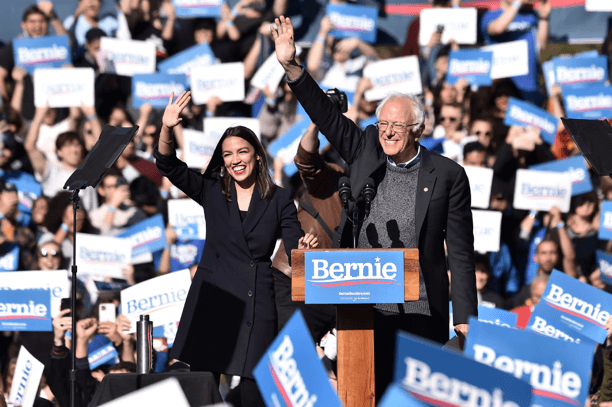
    Bernie Sanders campaigning with Alexandria Ocasio-Cortez

    From the above example, one could predict that Politico, like much of the MSM it represents, was intent on being critical of the Bernie Sanders candidacy. This was both before and after he dropped out of the race this year. (Click here and here)

    In fact, in surveying the way they headline certain events, it is hard not to write that they almost celebrate the losses of progressive candidates. (Click here for an example) They are also eager to cast many topics, issues, and political races as left vs. right, or center vs. right. (Click here for an example) In other words, the idea is to keep America divided, as Harris tried to do in his 2008 book. Consequently, there is almost no vision, insight, and too little in-depth reporting as to what the underlying truth (or truths) of these matters may be. Media Matters, for example, has frequently been critical of Politico. (Click here for details)

    Of course, this quite naturally means that Politico cannot be fair, objective, or honest about the Kennedys. Because JFK, RFK, and Ted Kennedy were trying to get at the underlying truths of many of the problems with America (e.g. race, economic inequality, education, and health care). A good example of this targeting occurred in April of 2018, when the film Chappaquiddick was released. Politico could not just review the film. They used the picture’s release to fill a huge top headline on their site, for two days. Peter Cannelos’ long essay was so negatively tilted that, in reference to the concurrent documentary mini-series The Kennedys, he implied that the series was complimentary to the family. (Click here for a more realistic view) In another example, consider their take on Robert Kennedy. On the 50th anniversary of his assassination, they ran an article entitled “The Bobby Kennedy Myth.” (Click here for the article)

    They are at it again; this time concerning John Kennedy. On June 13th, they printed an article by someone named Peter Keating. They billed Keating as an “investigative reporter”. In establishing that credential, they did not say what he investigated. It turns out that Keating is a sports writer. He writes mainly for ESPN, and his central beat is something called sabermetrics. (Click here for an example) If one does not know what that term means, please watch the Brad Pitt film Moneyball. How this area of study made Keating an authority on John Kennedy’s political career escapes this author—as it does probably many others. In fact, it shows that Politico does not mind who authors their Kennedy hit piece articles. They will bend over to cloud the author’s lack of established credentials.

    The title of Keating’s essay is “How JFK Paved the Way for Donald Trump.” I am not kidding. Just when one thinks American journalism cannot get any worse, you can rely on Politico to give us a further piece of flapdoodle. What is the point of the article? Keating is trying to insinuate that, somehow, Kennedy’s 1960 campaign for the presidency had something to do with the election of Donald Trump in 2016. To say that this is far fetched is not accurate. To anyone familiar with Kennedy’s career it’s a bunch of horse feathers. The idea is to suggest that somehow Kennedy’s campaign in 1960, particularly the primary, exemplified how Trump could win the presidency in 2020.

    The primary system had been around since the early 1900’s. It had been a reform of the Progressive Era to give the public more of a say in the nominating process, instead of exclusively being the role of the state party leaders. They were not as widespread as they are today, so they were not as definitive. But to say they had no impact at all is simply wrong. For instance, William McAdoo swept the Democratic primaries in 1924 and almost won the nomination. He had to be stopped at the convention, because he was backed by the Klan. It took 99 ballots to get rid of him.

    Amazingly, but predictably, the sportswriter completely passes over the 1952 GOP primary. There were four major candidates that year:  Earl Warren, Harold Stassen, Robert Taft, and Dwight Eisenhower. The battle winnowed down to Taft and Eisenhower and it was quite close. But Thomas Dewey, who many thought was going to run, did not. And he ended up supporting Eisenhower through his influence in New York which did not have a primary. To show how far American has come, at that time, many people in the Republican Party thought that Taft was simply too conservative to win. (Richard Bain and Judith Parris, Convention Decisions and Voting Records, pp. 280-86) In 1956, in the Democratic primary race, Governor Adlai Stevenson won out in the primary season over Senator Estes Kefauver. So to somehow say that Senator John F. Kennedy suddenly discovered the primary season as a way to the White House is simply tapering history.

    And that’s not all Keating does to fulfill his agenda. In 1956, there ended up being an intrastate battle in Massachusetts for control of the Democratic machinery for the upcoming nominating convention. Kennedy sensed, correctly, that the state pols—Congressman John McCormack and local hack William Burke—were going to try and block the nomination of Stevenson. Kennedy had supported Stevenson, would end up speaking at the 1956 nominating convention, and then placed him in his administration as representative to the United Nations. McCormack had opposed Stevenson in the primary and actually won by a write-in vote. Mr. Burke boasted about this victory and even personally insulted Kennedy for supporting the losing Stevenson. After that, JFK had no choice but to go after the duo, for both Stevenson’s sake and the personal insult. So, Kennedy, through his proxies, fought this move and, as Dave Powers and Ken O’Donnell have written, it ended up being a “Boston Irish political brawl.” Kennedy was outnumbered on the state committee, but there were enough uncommitted for him to lobby them and turn them to his side. He told Powers and O’Donnell he would call them and even ring doorbells if he had to and he did. At the end, Burke was out. (For a complete chronicle of this episode, see Johnny We Hardly Knew Ye, by O’Donnell and Powers, pp. 124-32)

    The idea that this episode taught Kennedy how to control his own delegation is undermined by the facts that Kennedy allowed McCormick to run as a favorite son at the convention and, contrary to what Keating/Sabermetrics writes, Kennedy did not appoint his own man to the state chairmanship. Pat Lynch was so unknown to him that he needed a personal audience with him to remember who he was. (ibid, p. 127) And even then, he still did not accept him. It was O’Donnell and Powers who pushed his candidacy on him.

    This was all part of Kennedy staying true to Stevenson, who was the national leader of the party. The idea that the state party, without this, would not have supported him in 1960 when he ran is a bit silly—even for sabermetrics. But Kennedy first really made a name for himself on the national level when Stevenson threw open the vice-presidential nomination to the convention that year. (ibid, p. 134) Although he did not win, most attendees were surprised at how strongly JFK ran.

    That is because, unlike Trump, the senator had already been around for ten years. In his valuable book, JFK: In the Senate, John T. Shaw chronicles his entire congressional career. (Click here for a review) And the very next year, Kennedy was going to indelibly imprint himself on the national consciousness with his famous, powerful Algeria speech, which he had been headed for ever since his visit to Saigon in 1951. (See Shaw, p. 101) If you did not know who Kennedy was before that speech, you sure as heck knew who he was afterwards. As Richard Mahoney wrote, there were 138 newspaper editorials printed over that highly controversial speech. The vast majority were negative. (Mahoney, JFK: Ordeal in Africa, p. 21) As both Mahoney and Shaw write, this speech made Kennedy the titular leader on foreign policy in his party. (Shaw, p. 110) Partly because he had deliberately singled out and criticized President Eisenhower, Secretary of State John Foster Dulles, and Vice-President Nixon in his speech and said there had to be a different approach to Third World nationalism rather than supporting European colonialism. In fact, Kennedy now made the cover of Time Magazine for December 2, 1957. The story’s title was “Man out Front.” (Mahoney, p. 29)

    As the British commentator Alistair Cooke had stated, by his purposeful attack on the White House, Kennedy had positioned himself as the man the Republicans now had to do something about. The presidential hopeful that the GOP now had to scorn: “It is a form of running martyrdom that Senators Humphrey and Johnson may come to envy.” (Mahoney, p. 29) None of this is in Keating’s article. Yet this is the way JFK had now become a national figure.

    I don’t see how much more of a contrast with Donald Trump that could be. By the time of the 1960 primary, Kennedy had been in office for 14 years. He was a prominent member of the senate not just through his high profile in foreign affairs, but also because of his service with his brother Robert on the Senate rackets committee and their opposition to Teamsters leader Jimmy Hoffa. And there was no real brilliance, Keating’s word for it, to his 1960 primary campaign. It was pretty fundamental in its planning. Kennedy got in early, had a good manager in his brother Robert, and spent a lot of money in defeating Senator Hubert Humphrey. But even here, Keating gets it wrong. As everyone but Keating knows, the man Kennedy was worried about was Lyndon Johnson. He wasn’t quite sure he could beat the Senate Majority Leader. So, he sent RFK to Texas to sound him out. Johnson told Bobby he was not going to run. This is something that even Chris Matthews knows. (See Bobby Kennedy, pp. 162-63) This assured JFK, since he thought that if either Stu Symington or LBJ won, it was going to be the same old Acheson/Dulles Cold War foreign policy all over again. (Harris Wofford, Of Kennedys and Kings, p. 37) As we have seen, Kennedy had charted out a different course that had put him near the forefront of the leadership in his party. This, as we have seen, was an important motivation for his running that year.

    But for whatever reason, Johnson did get in the race. He announced on July 5th, which was a week before the convention opened. To this day, no one knows why Johnson waited so long to announce his candidacy. But the amazing thing about it is this:  entering just one week before, he amassed more delegates than every other competing candidate combined. And it was not really close. In fact, Johnson’s late candidacy was so strong that Bobby Kennedy now had to switch tactics. He now had to pull out all the stops in order to make sure his brother won on the first ballot. He placed his agents on the floor to make sure no one was going to switch their votes to LBJ. Since if it went beyond a first ballot, there was a real danger that Johnson would outlast Kennedy. (Arthur Schlesinger, Robert Kennedy and his Times, pp. 213-15) Again, how does this resemble the Trump coronation in Cleveland? Who is to say that if Johnson had gotten in early, with all of his Texas backers, he might not have won?

    President Trump’s photo-op in front of the historic St. John’s Church

    In comparison to this, Trump never held any political office before his run for the presidency. And, in large part, that is the issue that he ran on. The public in 2016 was so sick of the political establishment on both sides that they voted for Trump and almost voted in Bernie Sanders. It was a different political universe in 2016. But further, as anyone with any knowledge of recent political history understands, the primacy of the political primaries was not forged in steel until after 1968, due to the famous McGovern-Fraser reforms. (Click here for details)

    Johnson could not have done what he did after those reforms. They were established partly as a result of what happened to RFK’s constituency after his assassination. Those changes eventually ended up mandating that each state have a primary or a caucus. The man who commandeered this new system, thus setting an example which has been mimicked by many, was Jimmy Carter in 1976. I, for one, am not convinced Trump would have made it without McGovern-Fraser, for the simple reason that almost all of the GOP establishment was opposed to his candidacy.

    Military presence in Washington, D.C.

    As the reader can see, there is no real efficacy to Keating’s article. It is just a part of the Harris agenda. And it’s not possible to fail to take note of the timing. As everyone knows, the Trump presidency, to put it mildly, has now confronted some tough times. Between COVID-19 and the George Floyd shooting in Minneapolis, things have gotten quite rocky. And between his denial of the first and his rather inept staging of a Bible pledge in Lafayette Park, he has not reacted well to either one. The Trump ally, Senator Tom Cotton, has tweeted that the Floyd protesters should not just face combat troops, but death from the skies: “Let’s see how tough these Antifa terrorists are when they’re facing off with the 101st Airborne Division.” And if that were not enough, Cotton then drew up his own battle order: “And, if necessary, the 10th Mountain, 82nd Airborne, 1st Cav, 3rd Infantry—whatever it takes to restore order. No quarter for insurrectionists, anarchists, rioters, and looters.” We all know what “no quarter” means do we not? (Fintan O’toole, NY Review of Books, 7/23/20)

    Deputy Attorney General Nicholas Katzenbach confronting Governor George C. Wallace

    As O’toole continued, that was not just bombast, because seven hundred soldiers from the 82nd Airborne did go to Washington. They were in the streets of the capitol, as were the low-flying helicopters and sand-colored Humvees. (ibid) And recall, the demonstrators in Lafayette Park who got tear gassed and clubbed were peaceful protesters. This makes for a vivid and continuing comparison with President Kennedy—which Keating does not mention. During the days of the civil rights demonstrations, Kennedy never wanted to call out troops. If needed, his graduated policy was to go from federal marshals, to the National Guard, with federal troops only called in as a last resort. And this was in aid of the civil rights cause and against the right-wing forces opposing them. For example, when governors Ross Barnett and George Wallace refused to uphold court orders to integrate, respectively, Ole Miss and the University of Alabama, Kennedy relied on federal marshals, only calling in troops—at Ole Miss—when the organized rightwing demonstration to stop James Meredith from registering grew violent. At Alabama, in addition to the National Guard, he had 3000 troops in reserve to oppose the 900 state troopers and police that Wallace had summoned to the scene. Kennedy had the National Guard handle the Alabama conflict.

    John F. Kennedy’s historic civil rights speech

    As I have demonstrated with facts, President Kennedy did more for civil rights for African Americans than any president since Lincoln. And it was not even close. He did more than Roosevelt, Eisenhower, and Truman combined in about one tenth the time. As O’toole writes, for Trump to say that he has done more in that cause than anyone since Lincoln, completely overlooking Kennedy, that is just self-promotion as well as being ahistorical. (For the evidence, click here and scroll to the chart at the end) It is startling that Trump could somehow miss Kennedy’s 1963 civil rights speech, which JFK made right after his confrontation with Wallace. But alas, Trump is the president who said there were good people on both sides at Charlottesville. In a phone conversation with Dick Gregory during the Birmingham crisis, Kennedy referred to the rightwing racists as “bastards”. In fact, some make the argument that Trump’s policies have exacerbated the impact of COVID-19 on the African American community. (Click here for details)

    It’s even more shocking that Trump can say this at a time when, as Alan Mcleod has written in MintPress, “A record 36 million Americans have filed for unemployment insurance, with millions losing their employer based healthcare plans and around a third of the country not paying its rent.” In the midst of this, working class Americans get a $1,200 check, while the Federal Reserve has given about $4.25 billion to big banks and corporate America. As Mcleod further wrote, the fact that the very upper class has risen in riches so rapidly signifies that their wealth “is barely connected to productive forces anymore and has more to do with how much wealth one can take from public coffers.”

    In reaction to all this, the man who President Trump is starting to resemble is Richard Nixon. As O’toole notes, on June 2nd, Trump issued one of his sparsely worded tweets: “SILENT MAJORITY!” If the reader recalls, with hundreds of thousands of demonstrators in the streets against the Vietnam War, Nixon used that phrase in a November 1969 speech. It was specifically about the war. Nixon was appealing to “the great silent majority of my fellow Americans” to stand with him against the demonstrators. That brief message echoes Trump’s earlier tweets in which he requested that his followers “LIBERATE MICHIGAN,” “LIBERATE VIRGINIA,” and then save your great 2nd amendment. It is under siege.” (Click here for details) How can anyone not interpret this as a call to the rightwing militias to bear arms, if they have to, in order to stop the COVID-19 lockdowns? That appeal to armed extremists has also provoked confrontations with George Floyd protestors. (Click here and here for details)

    August 28, 1963 – 300,000 people peacefully demonstrating for justice and jobs

    Richard Nixon was expert at dividing Americans along political fault lines:  Vietnam and his Southern Strategy on race. JFK tried to unite those of different races and classes. One great example being his sponsorship of the March on Washington. (See Irving Bernstein, Promises Kept, pp. 113-17) Kennedy was the first white politician to approve of this rally, on July 17, 1963. He then assigned his brother to make sure it came off perfectly and no extremists would upset it in any way. The Kennedys then got UAW chief Walter Reuther to bus in union workers, so the attendance would be both large and diverse. As many have said, that demonstration was probably the high point of post-World war II liberalism. It followed by two months, what many consider the greatest presidential civil rights speech since Lincoln.

    Make no mistake; none at all. Politico wants us to forget all about an example, so long ago, when a president and his brother were actually leading the country on civil rights. For me, it’s pretty transparent:  that is what the publication of this piece of malarkey is really about. It’s to throw sand in your eyes in hopes the public doesn’t notice how far we have fallen.

    Peter Keating should be ashamed of himself.


    Addendum:

    Click here or on the image below to see just how far Trump will go to polarize the racial issue:

  • Laurene Jobs and The Atlantic Go All In

    Laurene Jobs and The Atlantic Go All In


    If CNN and MSNBC can disseminate obvious propaganda and not be held accountable, as they did for three years during the “Russia did it hoax,” then who cares anymore? Facts? Evidence? Logic? Why did we have to go to the Rolling Stone’s Matt Taibbi and The Nation’s Aaron Mate on Russia Gate to discern that it was a mirage. (Click here for details)

    For instance, it was recently revealed through the declassification of depositions before the House intelligence committee that, in February of 2017, the Clinton campaign raised money to further the Russia Gate meme after Trump was inaugurated. (John Podesta deposition pp. 8-9, 12/4/2017) Hillary Clinton is still dodging Tulsi Gabbard’s process servers in Gabbard’s ongoing $50 million-dollar defamation lawsuit in which she is suing Clinton for calling her a “Russian asset” during the primaries. And when a man in a Wisconsin town hall meeting called Joe Biden out for his son’s questionable Ukrainian sinecure—put in place while Biden was still Vice President under Obama—Biden ignored the question and instead challenged the man to a push-up contest, to rising cheers from the audience.

    Deceptions usually trickle downward and must necessarily be both enabled and promulgated by the corporate gatekeepers masquerading as journalists for the pseudo-intellectual class of Whole Foods liberals who cannot seem to internalize their own party’s bankruptcy.

    These are the folks who with a straight face will preach tolerance and inclusion in flurries of inane Facebook “debates” and on online forums, but will attack anyone who doesn’t tow their ideological line when hard-pressed to engage in real debate. These are some of the people who all but put a scarlet letter on a woman in a New York City grocery store this week who didn’t feel like wearing a mask as she bought vegetables. I was all but physically attacked at a Chicago bar a few years ago when I told a drunk patron I didn’t think Russia “hacked the election.” Nothing serious: a few words exchanged, a shove, a few more words exchanged, a nice woman beside me made uncomfortable, etc. But I almost had to fight a fellow taxpaying citizen on U.S. soil outside of a Chicago bar thirty years after the Cold War ended, because I did not believe the “Russia Gate” probe was authentic or impartial.

    Where do Americans get these ideas? Well, some of them get these ideas from places like The Atlantic Monthly. Even the usually reliable and objective James Fallows pushed this Russia Gate meme for The Atlantic. (The Atlantic Monthly, July of 2018, “Trump-Putin Meeting: How Will Republicans React?”) That journal began way back in 1857 over the issue of slavery. Writers like Ralph Waldo Emerson and John Greenleaf Whittier outflanked the nascent Republican Party. They would brook no compromise with the south. They were abolitionists. James Russell Lowell, the illustrious poet and critic, was the first editor.

    It’s quite a long haul—and fall—from that auspicious beginning to David Bradley and the late Michael Kelly. Beginning in the eighties, Bradley made his fortune as a healthcare consultant. In the nineties, he sold two companies and became a multimillionaire. In 1999, he bought The Atlantic Monthly and made Kelly the editor. Bradley calls himself a political centrist. Michael Kelly was a strong supporter of the George W. Bush invasion of Iraq. In fact, as an embedded reporter, he passed away in that war. Prior to that, as editor of The New Republic, he not only accepted the largely fabricated stories of his contributor Stephen Glass, he defended Glass without investigating the stories. That investigatory job fell to his successor Charles Lane. Under Lane, The New Republic then uncovered a whole slew of stories Glass had made up, either in whole or in part. Glass even manufactured evidence to backstop his fabrications. The new editor had to issue an apology and listed the titles of all the stories Glass had created in whole or in part. Incredibly, Kelly was still defending Glass even after he admitted his chicanery. (Gawker, 4/03/2013, story by Tom Scocca)

    Kelly also mocked those who did not accept the pretexts for the Bush invasion of Iraq. In fact, Kelly tried to make the case that Bush’s war should be accepted by liberals. (Jewish World Review, 10/23/2002, “Anti-War effort Perverts Liberal Values”). He also allied himself with Neocon kingpin Daniel Pipes to create the fusion paranoia theory. This was a true milestone in a war of political and psychological denial by the Power Elite.

    Back in 1995, Kelly wrote an essay for The New Yorker entitled “The Road to Paranoia”. That article was then used by Pipes in his 1999 book Conspiracy. In fact, Pipes spent all of Chapter 8 addressing this idea. He used the following quote by Kelly as a blast off point:

    Views that have long been shared by both the far right and the far left…in recent years have come together in a weird meeting of the minds to become one, and to permeate the mainstream of American politics and popular culture. You could call it fusion paranoia.

    Kelly focused on the Militia of Montana and, specifically, the chief researcher and spokesman for that group, a man named Bob Fletcher. Fletcher postulated a global conspiracy theory that was something of a forerunner to QAnon. What Kelly was driving at was how left and right had beliefs in certain conspiracies. Pipes then adapted it in its broad outlines. This was dubious on its face, for more than one reason. But to give one example, Pipes drew similarities between how the modern militia movement and the Weather Underground viewed the FBI. Kelly’s above quoted tenet, that these ideas now permeated the mainstream, seems quite strained. The MSM and the political establishment do what they can to ridicule these concepts and to marginalize their advocates; never differentiating between which are true, and, therefore, deserve inspection and which are false and should be ignored.

    This is an important point, because it was this kind of automatic disdain that paved the way for one of the most lethal conspiracies in contemporary history. That was, of course, the Karl Rove/Dick Cheney plot to create an arsenal of WMD in Iraq. It included the stamping out of any dissenters, like the late diplomat Joseph Wilson. What was amazing was how much of the MSM got behind a clearly fabricated mythology, which included not just the above personages, but also people like Douglas Feith and Paul Wolfowitz. (Click here for details) And Kelly bought into this, with a vengeance. If the reader can believe it, ever since his death, The Atlantic Monthly sponsors an annual Michael Kelly award in journalism. An award named after a journalist who bought the lying Stephen Glass and also the myths about WMD which ended up killing 600,000 people.

    In July of 2017, Bradley sold the controlling interest in The Atlantic Monthly to something called the Emerson Collective. A nice sounding name which is actually run by multi-billionaire Laurene Powell Jobs, the widow of Steve Jobs. Jobs is on the advisory committee to the Council on Foreign Relations and has given loads of money to people like Hillary Clinton and Kamala Harris. (Click here for details)

    Right after this, The Atlantic Monthly printed a cover story by radio host and author Kurt Anderson. It was titled “How America Went Haywire”. That essay—an excerpt from an upcoming book—maintained that Donald Trump’s arrival as president was caused because of America’s belief in conspiracy theories. And this dated from—drumroll please—the JFK assassination! (For a review of that article, click here).

    Anderson managed to do something many historians would think impossible. He tried to draw an arc of American decline without describing the effects of 1.) The Vietnam War or 2.) The Church Committee. Here, the old joke applies: Well, Mrs. Lincoln besides your husband’s assassination, did you like the play? The Living Room War went on for ten years in all its ugliness and sickened much of America with its pointless carnage. The Church Committee explored the myriad crimes of the CIA and FBI: the plots to drive Martin Luther King to take his own life, to exterminate the Black Panthers, and the conspiracies to murder Patrice Lumumba and Fidel Castro—and those were just some of the highlights. But those two huge events deepened the cynicism of many Americans in what their government was doing and why. And it was all true. Anderson and The Atlantic Monthly decided to ignore those facts.

    One of the things the Church Committee did was delve into the CIA’s attempt to control the media. This was Director Allen Dulles’ scheme termed Operation Mockingbird. It was inspired by Dulles’s reaction in Bern, Switzerland to viewing how the Third Reich controlled the media in Nazi Germany, which, in turn, Joseph Goebbels modeled in part on the ideas of public relations wizard Edward Bernays. Bernays began as a journalist and then helped the Woodrow Wilson administration propagandize America into entering World War I. In 1928, Bernays published his classic work on the subject called simply Propaganda. It was one of the first books to use the phrase “invisible government.” Bernays thought these techniques were not just good but necessary. He later used them to attain riches through Madison Avenue type advertising for huge corporations including cigarette companies. This was while he was trying to break his wife’s smoking habit. (Click here for some information on Bernays)

    As most of us know, one of the things the CIA did was to try and control the media criticism of the Warren Commission. In 1967, the Agency issued a memorandum titled “Countering Criticism of the Warren Report”. CIA planners clearly state that “the aim of this dispatch is to provide material for countering and discrediting the claims of the conspiracy theorists, so as to inhibit the circulation of such claims in other countries.” (CIA 1035-960, “Countering Criticism of the Warren Report,” NARA Record Number: 104-10404-10376) Thus was born Kurt Anderson’s knee-jerk meme, “conspiracy theorist” in the American imagination. Prior to this, that term had been used quite rarely. As author Lance DeHaven Smith has shown, after this the term broke through the stratosphere to become a meaningless catch all term. The CIA memo stresses the importance of a full-spectrum approach to countering criticism and maintaining the official story. They deem it essential to “employ propaganda assets to answer and refute the attacks of the critics,” claiming, “book reviews and feature articles are particularly useful for this purpose.” (Ibid) After then explaining to the dispatch’s readers how best to disseminate information to the agency’s embedded Mockingbird assets in the U.S. media, the document lists the five most effective ways to combat critics of the Warren Commission’s conclusion that Oswald shot president Kennedy because he was a crazy Marxist lone nut: “Our play should point out, as applicable, that the critics are (i) wedded to theories adopted before the evidence was in, ( ii ) politically interested, ( iii ) financially interested, ( iv) hasty and inaccurate in their research, ( v ) infatuated with their own theories.”

    And now the Anderson Gang is back again. The Atlantic Monthly recently ran a piece entitled “The Conspiracy Theorists are Winning” on May 13. According to Jeffrey Goldberg, editor in chief, “America is losing its grip on Enlightenment values and reality itself.” We’d like to address both claims, since The Atlantic Monthly is now apparently running counter-intelligence on the questioning masses.

    First of all, we’d like to thank Mr. Goldberg for the admission, finally, that we’ve won. It’s probably the greatest single admission by the mainstream media we’ve ever seen. After years and years of toiling, of gnashing of teeth, of cries in the wilderness, of evidence, of testimonies, of unredacted documents released through FOIA requests, of Congressional hearings, of whistle blowers speaking out, of declassified memos, of declassified archives, we, the independent research community, have finally won.

    But that’s not really what Goldberg is saying.

    You see, conspiracies don’t exist according to the editor in chief of The Atlantic Monthly. And the only thing worse, according to his latest missive are “theories” about conspiracies. Goldberg implies that everything that has ever entered the Encyclopedia Britannica, the Congressional Record, or the text books in history classrooms from the time of the founding of the United States is a 100% accurate, unexpurgated, unredacted representation of the thousands and thousands of incalculable factors that comprise any major historical event as it happened in real time. To say that conspiracy theories do not exist is, in essence, to say that it is wrongheaded to write that people like Bernays paved the way for the acceptance of the American public to go along with Woodrow Wilson’s declaration of war in 1917. Are people also wrong who say that President Johnson was planning on declaring war in Vietnam months before he actually did so? When Adam Weishaupt founded the Bavarian Illuminati in 1776, whose entire mission statement was to conspire against entrenched European power structures in secret, he was, according to the legal meaning of acting in concert with others, engaged in a conspiracy. As any criminal lawyer will tell you, if you had the Justice Department, and all state Attorney Generals and all local DA’s order all prison inmates incarcerated on conspiracy charges immediately released you would greatly reduce the prison population of the USA.

    What is a “theory”? Well, according to the Merriam-Webster Dictionary, one definition of a theory is “a hypothesis assumed for the sake of argument or investigation.” Some theories become “the official story,” if they tow the party line at the time of their release. Others become the pejorative “conspiracy theories,” if they, at all, challenge the dominant power structure of their times. We are allowed to admit that the Gulf of Tonkin incident was a provocation in 2020, because the Vietnam War, who’s selling to the public was largely based on this lie and the unfolding “official story” narrative, is long over and is now, at best, considered a monumental mistake. Or, it can be safely referenced as a type of political crime that somehow had a benign intent to it.

    If you question anything, in essence, according to Jeffrey Goldberg, you are also “destroying the enlightenment virtues upon which America was founded”. That’s funny. Co-author Michael LeFlem wrote his Master’s degree thesis on the 18th-century Enlightenment under a world authority of that subject, Professor Darrin McMahon, at Florida State University. Tell Dr. McMahon that questioning political realities is “against Enlightenment values.” He might refer you to his excellent book, Enemies of the Enlightenment.

    Donald Trump did not win the election of 2016 because American culture went berserk with conspiracy theories. Nor did he win because of Mr. Putin’s manipulations in America; that idea has been pretty much discredited. In fact, with the revelations of the Michael Flynn case, it has been discredited with an air of finality. Without the complicity of the MSM, through the lens of carrying propaganda, the case against Flynn probably would have fallen apart even sooner. On and on they droned about Russia. But as of late May, there is mounting evidence that Russia Gate was a power play to somehow cover up the failure of the Democratic National Committee to run a fair primary campaign and also the failures at the management level of the Clinton candidacy. In other words, it was those “centrist” Democrats, like Mr. Bradley and Ms. Jobs, camouflaging their tracks.

    If we’re going to be honest, we need to face these inconvenient truths instead of ducking behind our safe-spaces of like-minded propaganda. It does us no good to try and conceal what has happened to the Democratic Party behind a smoke screen of “pernicious conspiracy thinking,” which has now become part and parcel of the Democratic party’s legacy.

    The Atlantic Monthly is part of that oligarchical problem. Let us admit it and Move On.

    Written by Michael LeFlem with consultation and contributions from Jim DiEugenio.

  • Soledad O’Brien meets Mary Meyer

    Soledad O’Brien meets Mary Meyer


    Back in 2008, on the anniversary of the assassination of Martin Luther King, Soledad O’Brien hosted a 2-hour special on the King case. As I recall, it was the only such new programming that year, which was rather predictable, but still disappointing. Considering the quality and investigatory attitude of O’Brien’s program, one was more than enough. In fact, we would have been better off without it.

    CNN broadcast her program the evening before the actual anniversary. Recall, at this time, a jury verdict in a civil lawsuit had already been adjudicated in favor of the King family. They had concluded that King was killed as a result of a conspiracy. The media had done all they could to ignore that trial in Memphis. With almost no one reporting on it, except Chuck Marler for Probe Magazine, the MSM sent Gerald Posner out to tour the media in order to denounce the verdict as being irresponsible and not to be taken seriously.

    The 40th anniversary would have been a good opportunity to revisit that trial and interview people like Chuck Marler, among others. O’Brien did not do that. Her show was, at best, a limited hangout. And as one reads the review below, even that is being too kind.

    O’Brien left CNN after ten years. Prior to that, she worked for NBC for over a decade. She now has her own production company called Starfish Media Group. Incredibly, of late she has made a name for herself as a media critic by going after, of all people, Brit Hume and Chris Cillizza. We will take Robert Parry any day of the week. He aimed much higher, but he also paid a price that she has not.

    Looking at her background, it’s fair to say that her upcoming 8 part podcast on the Mary Meyer case will be, at best, a superficial look at the whole Ray Crump/Dovey Roundtree/Mary Meyer affair. Even the likes of Christopher Dickey could not help ponder that case early this year. (The JFK Mistress Gunned Down in Cold Blood) If there was anything new to offer on the case, that would be one thing. But there has been nothing new, except a cheapjack romantic novel by, of all people, Jesse Kornbluth. Before that, there was Peter Janney’s thunderously disappointing Mary’s Mosaic, which the reader will hear about in our upcoming series.

    O’Brien’s podcast will stretch over eight weeks. We will match it and then sum it up at the end. If you do not know anything about that case, it’s safe to say that the reader will learn more about it from us than he or she will from Soledad.

  • Goodbye and Good Riddance to Chris Matthews

    Goodbye and Good Riddance to Chris Matthews


    On Monday March 2nd, Chris Matthews, host of the MSNBC program Hardball, announced on the air that he was resigning after 20 years. That resignation was effective immediately. Therefore, he would not be around for the next day’s Super Tuesday primary elections. Which suggests that this was not his idea and he was forced out. Furthering this idea was how he announced his leaving, which he said was not due to his lack of interest in politics. (For the brief sign-off, click here)

    To put it mildly, Matthews has had a pretty bad last couple of weeks. Even for a dyed-in-the-wool MSM zealot, he has made some real bonehead comments. When Bernie Sanders won the Nevada caucuses, Matthews compared that victory to the Third Reich’s successful invasion of France in 1940. After the New Hampshire debate between Democratic candidates, Matthews indulged himself in a diatribe against socialists. During that tirade, in John Birch society mode, he confused socialism with communism and said that if Fidel Castro had won the Cold War, there would have been executions in Central Park and he would have been killed while others were cheering. He then added, “I don’t know who Bernie supports over these years, I don’t know what he means by socialism.” This reveals either extreme bias or a feigned ignorance, since Sanders has held political office for about 35 years.

    In another blunder, last week Matthews confused Jaime Harrison, an African American candidate for the Senate in South Carolina, with another black politician, Tim Scott, who is the GOP incumbent senator from that state. After Harrison corrected him, Chris apologized for the “mistaken identity”. Perhaps the last nail in the coffin was a column by writer Laura Bassett appearing on Saturday in the magazine GQ. In that column she complained about some sexist comments Matthews had made to her while she was in the makeup chair.

    Jimmy Carter
    Jimmy Carter
    Jimmy Carter
    Tip O’Neill

    Matthews began in Washington as an officer with the United States Capitol Police. He then became an aide for four Democratic members of Congress before he failed in an attempt to win a congressional seat in Pennsylvania. After this, he became a speechwriter for President Jimmy Carter. When Carter failed to win reelection in 1980, Matthews signed up with House Speaker Tip O’Neill. Matthews then switched over to print journalism for 15 years.

    Jimmy Carter
    H.R. Haldeman
    Jimmy Carter
    Richard Helms

    It was in his position as a columnist that Matthews now emerged as a rabid, mocking conservative member of the Washington establishment. After Oliver Stone released his film Nixon, Matthews criticized that picture for its use of a passage from H. R. Haldeman’s book The Ends of Power. In that passage, Haldeman had described a meeting with CIA Director Richard Helms in which the Bay of Pigs invasion was discussed. Helms’ reaction was so extreme that Haldeman concluded that Nixon’s use of the incident had been code for the Kennedy assassination. In a December of 1995 column, Matthews said this was all strained interpretation by Stone that Haldeman had blamed on his co-author Joe DiMona. Matthews could write this since he did not visit with DiMona. Dr. Gary Aguilar did so, and he learned why Matthews had not. DiMona told Aguilar that the book had gone through five drafts and Haldeman made many changes, but he never altered that passage. Clearly, Matthews had realized that after his films JFK and Nixon, Stone had become a lightning rod for the MSM. And if he was going to advance up the ladder, he had to join in the assault.

    Therefore in 1996, Matthews published his book entitled Kennedy and Nixon. This was supposed to be a dual biography of these two central political characters. But to anyone who knew who Matthews was, and understood the two men, there was a not so subtle subtext to the volume. Matthews was actually trying to say that, contrary to popular belief, Richard Nixon and John Kennedy had more in common than they had differences. Oliver Stone agreed that this was an unjustified interpretation. The LA Times allowed him to review the book in June of 1996. He took the author to task for his unwarranted assumption that the two were somehow chums and comrades in arms. Two weeks later, on June 30, 1996, the Times allowed Matthews to reply. The columnist said he had nothing but contempt for Stone and all but called him a liar.

    This got his ticket punched and Matthews now made the transfer into television. He first became a commentator for ABC’s Good Morning America, and then he got his own CNBC show titled Politics with Chris Matthews. That program eventually morphed into Hardball and was then placed on MSNBC.

    While the host of this program, Matthews made good on his promise to be one of the foremost bastions of the MSM. How bad could Matthews get? He even visited the disgraced Tom DeLay at his home in Sugarland, Texas after he forcibly left Washington. The alleged Democrat admitted to voting for George W. Bush in 2000. He later defended this admission by saying that he thought Al Gore was kind of strange. Is it only a coincidence that Gore was one of the high-level politicians who had no problem admitting that he thought John F. Kennedy was killed by a conspiracy?

    For, as Doug Horne writes on his blog in the wake of Matthews’s resignation, the Hardball host was one of the foremost defenders of the Warren Commission during his 20-year span. In all of those years, this writer can only recall one small exception to the rigor with which Matthews took pains to mock and ridicule those who held a different view of the JFK assassination than the Warren Report did. This was after Jesse Ventura did an interview for Playboy back in 1999.

    Jimmy Carter
    Jesse Ventura

    At that time, Governor Ventura was making the rounds of talk shows after the controversy caused by his rather bold pronouncements during that interview. One of the interviews he did was with Matthews at Harvard. (Probe, November/December 1999) When Matthews asked Ventura about his opinion of Vietnam, Ventura very soberly said that the United States should have never sided with France in that conflict. This was a mistake that prefigured our own involvement in Indochina. Matthews replied by saying the American buildup actually started under Kennedy. When Ventura stated that there were certain elements in the country that favored us going to war in Indochina, Matthews said that it was Kennedy who was giving them what they wanted from 1961-63. Ventura did not think fast enough to say, “Chris, there was not one more combat troop in Vietnam after Kennedy’s death than when he took office. So please show me the huge expenditures made by Kennedy?”

    Matthews then shifted to the assassination itself. He tried the old chestnut about having to believe in a large conspiracy if one advocated for a plot. Ventura replied that if one thinks the Dallas Police were involved, then their negligence does not denote a wide conspiracy. Ventura turned the tables and asked a question of Matthews: Why didn’t the Commission call all the witnesses who smelled smoke on the grassy knoll? To which Chris finally made his minor exception. He beat a tactical retreat by saying that he would admit the Warren Report was a rush job and he agreed with Ventura’s critique of their work. But this author has to note that Matthews’ retreat was very limited. In his book Kennedy and Nixon, he endorsed the verdict of the Commission and said that Oswald shot Kennedy.

    Towards the end of the interview, Matthews went completely off the rails. He characterized Oliver Stone’s film JFK in a completely nutty, wild manner by saying that somehow Nixon was involved in the plot depicted in the film. Since Nixon does not appear in the film except for the introduction over the credits, this is simply a smear. In fact, even if we expand this to the film Nixon, it is still not true. But Matthews really showed who he was when, near the end of the interview, he said that Stone tried to portray Kennedy as a peacenik when, in fact, he was a Cold Warrior. He then added that no one in JFK’s administration said he was trying to get out of Vietnam. Which is astonishing. For even at that time one had people like Roger Hilsman of the State Department, and Robert McNamara, Secretary of Defense, who both said such was the case. One can also add in Joint Chiefs of Staff Chairman Max Taylor, advisor Ted Sorensen, and assistants Dave Powers and Ken O’Donnell. All of these men said that Kennedy would never have gone into Vietnam with combat troops and direct American military intervention. So what was Matthews talking about?jfk no vietnam

    But this nonsense is consistent with Matthews’ book on Kennedy, titled Jack Kennedy: Elusive Hero. In that book, Matthews never mentioned NSAM 263. This was the order issued by Kennedy in October of 1963 which began a formal withdrawal from Vietnam of a thousand advisors by the end of the year and the rest of the advisors by early in 1965. If one does not mention that document, then one can say the things Matthews does. And I do not for one moment believe that Matthews did not know about it, since it was featured so prominently in Oliver Stone’s film. Matthews chose to ignore it due to his own bias against Stone.

    He is now gone, from at least MSNBC. I cannot help but wonder who will replace him, and if that person will be any kind of an improvement. I would think he or she could not be much worse.


    Link to Jim DiEugenio’s review of Jack Kennedy: Elusive Hero : https://consortiumnews.com/2012/01/03/why-mr-hardball-found-jfk-elusive/

    Link to Jim DiEugenio’s review of Bobby Kennedy: A Raging Spirit: https://consortiumnews.com/2018/06/04/distorting-the-life-of-bobby-kennedy/

  • Vince Foster, JFK and the Rise of Chris Ruddy

    Vince Foster, JFK and the Rise of Chris Ruddy


    One of the most nauseating characteristics of the New Right is its hypocrisy. For instance, the GOP has historically been the party of sound money and banking. Yet, in their devotion to supply-side/trickle-down economics, it was their party which ran up the national debt to heights no Democrat ever dreamed of doing. And it was a Republican administration which oversaw the worst banking/real estate crisis and economic downturn since 1929. Another example: for all of their pontificating about religion and family values, most of the GOP evangelist preachers endorse a president who had to pay off two former girlfriends to keep quiet during his election campaign.

    Which brings us to the subject of this article. On December 17th, a week before Christmas, a man named Paul F. deLespinasse wrote an article for the conservative website Newsmax. It was titled: “Conspiracy Theories Merit Only Undivided Suspicion”. Mr. deLespinasse began by saying that such theories are meant to confuse the public, “often for political purposes.” As most conservative shills do, he tried to belittle this kind of thinking with a ludicrous example. He said that Nicholas II of Russia faked his overthrow and ruled from the back room. Obviously, he concedes, he made that up out of whole cloth. But the author said since it made sense to his students, he went on and “concocted new conspiracy theories about the Kennedy assassination.” He goes on to mention two truly ridiculous ones about the JFK case. The first was that Joe Kennedy wanted to have Jackie killed so she would not divorce his son while in office. So the father hired Lee Oswald, but Oswald missed. He then writes, well maybe JFK learned that his medical problems would kill him within months. Therefore he staged his own assassination to become a martyr in order to increase the chance his brothers would follow him into office. (In both of these examples, it is still Oswald as the killer.)

    As was his intention, the author then goes on to ridicule any and all other kinds of alternate ways of thinking about certain momentous events: the 9-11 attacks, Pearl Harbor, the death of Franklin Roosevelt, the idea that America never went to the moon. Note the way he has deliberately mixed in events of genuine interest and scholarship with those that amount to piffling: JFK and the moon landings, for instance. Consequently, he concludes that the best way to remain of sound mind is just to ignore “conspiracy theories and regard their propagators as probable cranks.” Which, of course, is what the Power Elite would like the general public to think, so they can continue on their rampage, killing whatever hopes we have of recovering our democratic processes.

    The reason I mention this piece of claptrap is because it was run in Newsmax. For anyone who knows something about that business entity, the irony of the posting of this article is too rich to be ignored. It underscores the hypocrisy I just pointed out. How so? Because the CEO and founder of Newsmax is Chris Ruddy. And Newsmax would not exist if not for Ruddy’s propagation of one of the wildest and most rudderless conspiracy theories of recent decades––namely, that Vince Foster was murdered by sinister forces employed by Bill and Hillary Clinton. Why would the Clintons murder their close friend and legal colleague? Well, for any number of reasons. These would include that he was having an affair with Hillary Clinton or he was about to give away the secrets of the Whitewater scandal to Congress. But since there were no secrets to that manufactured scandal, then it must have been the first reason. Even though there was no credible evidence of that either. Note that deLespinasse did not mention the Foster case in his long listing, probably because he was aware that it was Ruddy’s hand that was feeding him.


    II

    Vince Foster was a legal and political colleague of Bill and Hillary Clinton in Arkansas. He worked with her there at the Rose Law Firm. By all accounts, he was an effective and successful lawyer. After the 1992 presidential election, the Clintons invited Foster to move to Washington and work for the Clinton administration. He did so, and this turned out to be a serious mistake on his part. Foster was a sensitive soul who was not cut out for what author James Stewart later termed the “blood sport” of Washington DC during the Clinton years.

    It is important to recall an ignored historical milestone at this point. Late in the presidency of Ronald Reagan, the Republicans had managed to achieve one of their longtime goals. They negated the Fairness Doctrine and the Equal Time provisions of FCC law. This was quickly followed by ABC moving Rush Limbaugh from Sacramento to New York and channeling him nationwide. Rupert Murdoch had now become an American citizen. His purchase of Metromedia TV and a share of 20th Century Fox around this time would be the kernel that would launch Fox TV. In other words, what David Brock termed “The Republican Noise Machine”—a huge propaganda network––was now in place, well-positioned to amplify and aggrandize the so-called Clinton Scandals.

    The first two out of the box were the Travel Office affair and the Whitewater real estate imbroglio. Foster worked as Deputy White House counsel. He was involved in the first, and tangentially in the second––which was even more of a pseudo-scandal than the first. Foster was also involved in vetting candidates for positions in the administration; for example, the Nannygate episode over the nomination of Zoe Baird for attorney general. Because of the controversy over these instances, in June and July of 1993 Foster came under political attack in the Wall Street Journal. By several different accounts, Foster was now suffering from depression and anxiety over these attacks. (Dan Moldea, A Washington Tragedy, pp. 203-12). His sister recommended he see a psychiatrist, and he called one to set up an appointment. In the meantime, his personal doctor gave him prescriptions for anti-depressants. Foster was so distraught that he thought of leaving Washington and going back to Little Rock. But he felt that this would be admitting defeat. (Moldea, p. 215). On July 20, 1993 Foster shot himself at Fort Marcy Park in Virginia with a handgun given to him by his father many years previous.

    The first investigation of his death was submitted by the U.S. Park Police on August 10, 1993. The police had been supplemented by the FBI and Justice Department. Relying on that investigation and the medical examiner’s findings, they concluded that Foster had taken his own life. But now something absolutely remarkable began to occur. And for this author, it was the first manifestation of the awesome power of the advancing rightwing media.

    To fully understand the spectacle, worthy of the Roman Colosseum, that was about to be unleashed on the national stage, one needs to outline the metamorphosis that the Republican Party had undergone. To do that, one must delve into a brief––but appropriate––historical synopsis.


    III

    Prior to the election of 1960, the two leaders of the Republican Party had been Senator Robert Taft and President Dwight Eisenhower. In 1952, those two had fought a close and bitter battle all the way to the convention for the Republican nomination for president. It was only through a questionable ploy at the convention that Eisenhower managed to win the nomination.

    There are two points that should be drawn about these men in order to understand the subject at hand. First, Taft was a non-interventionist in foreign policy, to the extent that he was opposed to American involvement in World War II, the Nuremburg Trials and the formation of NATO. Second, Eisenhower more than once said that he was not about to repeal FDR’s New Deal. When Eisenhower left office after eight years, the income tax rate was 91 per cent for the highest income earners.

    One last point needs to be made in order to delineate the dichotomy that was to come. Around this time—early to middle sixties––there was actually a moderate wing to the Republican Party. People like Senator Mark Hatfield, Governor George Romney, Senator Charles Percy, Senator Jacob Javits, Governor Raymond Shafer, Senator Charles Mathias, Governor William Scranton, Senator Margaret Chase Smith, Congressman Pete McCloskey, these and others constituted a minority, but an influential one, within the GOP. As many have noted, what began to alter the Republican Party, and eventually made its moderate wing extinct, was the Barry Goldwater campaign of 1964. That nomination brought to the forefront the extreme rightwing elements of the party—the John Birch Society types—who declared war on the moderate elements in the party. Although the Goldwater forces lost, they succeeded in establishing a beachhead in the GOP. Senator Goldwater had voted against the Civil Rights Act of 1964, was against the high taxation rate, and felt President Johnson was soft on communism. He became the first Republican nominee to consciously run on a Southern Strategy, one which was designed to break up the Democratic majority in the south by employing racist symbology. That strategy, plus the fact that Goldwater was from Arizona, began to rebuild the Republican party on a Southern/Western axis.

    This included California Governor Ronald Reagan. Reagan made a last-minute televised appeal for Goldwater in 1964. And that appeal first put him on the national political map. At that time, the highest political office Reagan had attained was president of the Screen Actors Guild.

    It was not just Reagan who supported Goldwater; it was also William F. Buckley Jr. Buckley’s Young Americans For Freedom supplied the shock troops for the Goldwater campaign. Goldwater was trounced, but Buckley and Reagan now started to pull the Republican party to the far right. In a blatant effort to exterminate them, Buckley began to defame and run against those from the moderate wing of the party: for instance, Charles Goodell and John Lindsay. The very threat of a Reagan run in 1976 provoked President Gerald Ford to perform the Halloween Massacre. That panic-stricken move, for all intents and purposes empowered the neoconservative movement and triggered the rise of Dick Cheney.

    Once Reagan won the White House in 1980, he began to meet with representatives of the Religious Right in order to incorporate them into the GOP. But as writers like Sidney Blumenthal have noted, this was really a kind of flirtation that never made it to the altar. Reagan never gave people like Jerry Falwell what they really wanted, things like prayer in school or a bill banning abortion. But allowing them tea time was enough incentive to make them attack dogs against the Democratic Party. They therefore were useful politically. (Salon, 10/24/15, article by Neil J. Young.)

    Because of all this, by the nineties, the Republican Party had undergone a stunning metamorphosis. Its philosophy had become the antithesis of Taft’s non-interventionism. The GOP now went looking for wars, such as against the Sandinistas in Nicaragua. Reagan assailed the War on Poverty by saying that the result of it was that poverty had won. This kind of talk eventually allowed his acolytes like Newt Gingrich and Paul Ryan to begin the effort to privatize Social Security. Reagan had called Medicare “socialism”. His success allowed the new GOP to do what Eisenhower said he would not: assault the New Deal. (LA Times, 12/8/2017, article by Michael Hiltzik) With the cooperation of Bill Clinton, they almost succeeded at this. (See US News and World Report, 5/29/2008, “The Pact Between Bill Clinton and Newt Gingrich”)

    The new Republican Party had cultivated a more reactionary base. Through Limbaugh-led talk radio, and people like Falwell, it traded on social conservatism, Christian fundamentalism, so-called family values, xenophobia, veiled racism and hostility toward immigrants (the anchor baby syndrome). The new GOP had no problem in depriving minority groups of their right to vote by scrubbing election rolls, which gave George W. Bush his win over Al Gore in the 2000 election heist in Florida. All of this was amplified and channeled into the Limbaugh/Fox sound machine. It was designed to appeal to what many have called “the angry white man vote.” This propaganda formula was so powerful that it managed to convince millions of working-class Americans that their interests coincided with those of billionaires like Richard Mellon Scaife and later the Koch brothers.


    IV

    The staggering force of this new apparatus broke dramatically into the open during the rightwing war against Bill Clinton.

    After the first verdict in the Foster case was rendered by the Park Police, unfounded rumors now began to circulate, like the claim Foster’s body had been moved while wrapped in a carpet and there was no exit wound, even though Foster had shot himself through the mouth. As we shall see, these were both false. In fact, the autopsy report described the exit wound at the rear of the skull. But at that time, Richard Mellon Scaife was also in the process of forming the so-called Arkansas Project—hiring people to dig up dirt on the Clintons from their Arkansas days—through the conservative magazine American Spectator, and Limbaugh was now pushing that journal on his radio show. The Foster case and Whitewater were an early instance of the powerful rightwing propaganda outlets bleeding over into the mainstream media. The first book on the Foster case was published in February of 1994, entitled, The Murder of Vince Foster. It concluded that the Clintons had Foster killed. (Moldea, p. 286)

    More importantly, Chris Ruddy was about to leave Murdoch’s New York Post, where he had already written some stories on the Foster case, for the Pittsburgh Tribune Review. That newspaper was owned by Scaife. With the creator of the Arkansas Project now his boss, Ruddy had free reign to go after the Clintons and the Foster case. After 12 years of Republicans in the White House, the conservative media barons were intent on bringing down the new Democratic president––and it did not matter how they did it. The incessant work of people like Ruddy resulted in enough buzz for the appointment of a special prosecutor. Attorney General Janet Reno appointed a respected Republican lawyer named Robert Fiske to helm that inquiry. Opening an office in Little Rock, Fiske employed 15 lawyers and 25 FBI agents. (New York Times, “Muddy Water”, March 24, 1996) After a careful inquiry, during which he interviewed 125 people, Fiske concluded that the Clintons had not wielded undue influence in the Whitewater matter and that the original police inquiry was correct about Vince Foster’s death.

    On the day that Fiske issued his report, President Clinton signed the reauthorization of the Independent Counsel law, with the difference that instead of being chosen by the Attorney General, a special prosecutor would now be picked by a panel of federal judges. The panel was led by Judge David Sentelle. Sentelle was elevated to the federal court upon the request of Senator Jesse Helms. Under the influence of Helms, Ronald Reagan duly appointed Sentelle in 1985. Reno requested Fiske be reappointed. Under the influence of Helms and fellow reactionary senator Lauch Faircloth, Sentelle and his two cohorts declined to do so. (Washington Post, 8/12/94, article by Howard Schneider). In August of 1994, they replaced Fiske with the even more conservative Ken Starr.

    The Foster case was one of the most bizarre and, at the same time, most assiduous instances of a national political paroxysm this writer can remember. The entire effort to manufacture the case was backed by the late Jerry Falwell, the late billionaire Scaife, with people like reporter Ruddy and west coast political hatchet-man Pat Matrisciana. Matrisciana produced the dubious videotape The Clinton Chronicles. That infamous video began the whole fairy tale about the “Clinton body count”. This quartet perfected a combination business/political model that rose to a grand scale, prefiguring the rise of Alex Jones. Falwell raised money for Matrisciana and Ruddy by selling their productions, which then helped produce more films. Scaife paid for the ad campaigns for Ruddy’s pamphlets on the Foster case. By 1997, Matrisciana and Ruddy had a shared bank account worth over 3 million dollars.

    Some of this massive haul was spent on paying off “witnesses” to talk about the alleged crimes of the Clintons. In other words, it was checkbook journalism. This included signing up Arkansas State Troopers Roger Perry and Larry Patterson. Their contract was designed to pay them to make statements saying that Vince Foster had not died in Fort Marcy Park in Virginia. Foster had actually died in the White House parking lot. This concoction quickly collapsed when the person who was supposed to have made a phone call revealing this––White House aide Helen Dickey––testified and proved that she did not learn of Foster’s death until late in the evening, not in the afternoon, which was when Foster’s body was discovered. As reported by Robert Parry, Starr concluded that Dickey was telling the truth and the troopers were not. (The Consortium, March 30, 1998; see also New York Review of Books, August 8, 1996, reply by Gene Lyons to Ambrose Evans Pritchard)

    Just how far would these deceptive practices go? During an infomercial, Falwell interviewed a witness in silhouetted background he labeled an investigative reporter. The mystery witness said that he knew his life was in danger because not one, but two insider witnesses had been killed before he got their stories. They both died in plane crashes. (Note, the idea of neutralized witnesses was apparently borrowed from the JFK case.) The silhouetted “investigative reporter” then asked: “Jerry, are these coincidences? I don’t think so.” It was later revealed by journalist Murray Waas that the mysterious investigative reporter was Matrisciana himself. When the scheme was later exposed, Matrisciana tried to blame the idea on Falwell. (See again Parry, cited above) With this in mind, again note the hypocrisy: the name of Matrisciana’s business outfit was Citizens for Honest Government.

    What troubled me about this outbreak of rightwing profiteering designed to increase political dementia was this: When I once mentioned it in Probe Magazine, I got a letter saying that somehow I was wrong to belittle the efforts of Ruddy and Matrisciana. The author then equated the death of Vince Foster to what had happened to President Kennedy. And that somehow, the “cover-up” around Foster’s death equated to what the Warren Commission did to JFK’s murder. I was disheartened by the letter. If one of our readers could not tell the difference between the political flackery around Foster’s death and the real criminality and cover-up around President Kennedy’s demise, then I was not doing a very good job as a writer or researcher. Either that, or the forces arrayed against me were simply too awesome to contemplate.


    V

    At around this time (1994-95), another Scaife-funded journalistic entity, Western Journalism Center (WJC), began to issue pamphlets based on Ruddy’s writings on the Foster case. These were supported by full-page ads in numerous newspapers throughout the nation, including the Washington Times, Chicago Tribune and New York Times. This writer was given one of Ruddy’s WJC reports by a friend. I immediately began to note even further that the techniques Ruddy was using were reminiscent of what the early critics of the Warren Commission had done. Ruddy was questioning the forensic basis of the prior pronouncements on the case by trying to find errors, misstatements or inconsistencies in those judgments. For example, Ruddy said that, although Foster’s body was found with the gun in his right hand, Foster was actually left-handed. Like so many other Scaife-sponsored “facts”, this turned out to be false. (Sixty Minutes, October 8, 1995). But this did remind me of the strange circumstances in the death of Gary Underhill, one of the earliest witnesses to proclaim a conspiracy in the death of President Kennedy. (Destiny Betrayed, Second Edition, p. 100) So Ruddy seemed to be imitating the early Warren Commission critics. The problem as I saw it was that there was simply no comparison between the circumstances of the two cases—in any manner. And by 1995, two more judgments had been rendered on the Foster case. One by the Senate Banking Committee and one by Congressman Bill Clinger of the Government Operations Committee. Both concluded that the original police investigation was correct. What I found striking about this was Clinger was a Republican and the Senate investigation was completed under the co-leadership of the highly partisan Republican Al D’Amato. (Starr Report on Foster, Section 2, part C)

    This point was rammed home when, once Starr replaced Fiske, Brett Kavanaugh found a way to reopen the Foster case. (See article by Charles Pierce, Esquire, August 3, 2018). As any objective observer can conclude, Ken Starr had a rather unethical reign as independent counsel. More plainly: Starr had an agenda. He also utilized questionable methods in order to fulfill that agenda. (For a rather harrowing look at those methods, see Susan McDougal’s book The Woman Who Wouldn’t Talk.) Yet, in spite of this, Starr came to the same conclusion everyone else did. (Although he delayed announcing it for well over a year to keep the controversy brewing.) But he did employ the man who many consider to be the finest criminalist in America, Henry Lee. Lee is noted for his independence. He has bucked the establishment in the OJ Simpson case and the JFK case. Lee teamed up with two other experts, Dr. Brain Blackbourne and Dr. Alan Berman, to certify that Starr agreed with Fiske.

    The beginning of Starr’s Report relies upon the work of two doctors: James Beyer and Donald Haut. Dr. Haut was at the crime scene and Dr. Beyer did the autopsy. Unlike with the JFK case, the doctors identified the wound path with no ambiguities. (Moldea, p. 30) And there was an alignment between the entrance and exit wounds. In other words, there was no impossible Single Bullet Theory to contend with. Nor, as with Kennedy’s head wound, did the bullet come in from one angle and then veer 90 degrees to the right for its exit. (Read it here)

    The Office of Independent Counsel traced the purchase of the .38 handgun as far back as 1913. Henry Lee actually determined how Foster carried the weapon that day. Lee also detected blood stains on nearby vegetation. These investigators, along with the FBI lab, also determined where the carpet fibers on Foster’s clothes came from, which was Foster’s home in Washington and the White House. These two evidentiary conclusions effectively countered Ruddy’s suppositions that, first, the weapon was not traceable, and therefore was not Foster’s; second, that Foster was killed elsewhere––or took his own life elsewhere––and then his body was transported to the park; and third, contrary to what Fiske’s critics reported, that there was a considerable amount of blood at the Fort Marcy Park scene (Moldea, p. 203), thus neutralizing reports saying there was not very much there and consequently Foster must have been killed elsewhere. (See section 6 of the report, part B; see also Moldea, pp. 312-17)

    The work of Henry Lee and forensic pathologist Brian Blackbourne was devastating to the likes of Ruddy and conservative media attack dog Reed Irvine. In addition to the above, Foster’s DNA was found on the barrel of the handgun. There was a bone chip on a nearby piece of brown paper, and through DNA testing it was proven that the chip was part of Foster’s skull. Contrary to another myth, Lee found that Foster’s shoes did contain soil materials and vegetative matter. (See again Moldea, cited above)

    The findings by Lee and Blackbourne were so compelling that when Ruddy issued his book on the Foster case—The Strange Death of Vincent Foster—even critics of conservative orientation, like Byron York and Jacob Cohen, panned the book. The American Spectator, home of the Arkansas Project, also filed a negative review of Ruddy’s volume. (Moldea, p. 320). When Scaife heard about the latter, he pulled his funding for the magazine, which indicated what the whole sorry episode was really about. Because of that, the journal went into a financial tailspin and was later sold to George Gilder. (Washington Post, May 2, 1999, “Arkansas Project Led to Turmoil and Rifts”)

    As the reader can see, the Foster case and Kennedy case are not at all forensically equivalent. Virtually every forensic aspect of the JFK case is genuinely susceptible to challenge. These are challenges that, when followed through on, prove the opposite of what the Warren Commission concluded; this is especially the case with the medical and ballistics evidence, including Oswald’s alleged possession of the rifle and handgun.

    Neither was there any credible evidence that the Foster autopsy was obstructed by officials on the scene. Or that notes were burned and the autopsy was rewritten once or twice. In the JFK case, both David Mantik and Doug Horne have argued that the autopsy we have in the JFK case is likely the third version. (See Doug Horne, Inside the ARRB, Volume 3, pp. 851-878) And this change occurred the morning of Sunday the 24th, when Jack Ruby killed Oswald, a murder which guaranteed there would be no trial for the defendant. I won’t even detail the wholesale revisions made in the Kennedy autopsy by the Ramsey Clark Panel in 1968. But the record shows there has never been a true official forensic inquiry into the JFK case. What Arlen Specter and the Warren Commission did was pretty much a pathetic disgrace. The forensic examination by the House Select Committee on Assassinations was flawed beyond recognition by its use of the junk science of Thomas Canning and the late Vincent Guinn. (The Assassinations, edited by James DiEugenio and Lisa Pease, pp. 76-82) On top of that, the HSCA concealed much of their evidence, and then misrepresented the evidence that was concealed. (Essay by Gary Aguilar in Trauma Room One, pp. 208-11) This is why, in the upcoming Oliver Stone documentary, JFK: Destiny Betrayed, the public will––for the first time, fifty-seven years after the fact––see a real forensic review of the evidence in the JFK case.


    VI

    I would like to close the crime detection part of this essay with a direct comparison of the findings of a so-called expert in forensics who participated in both the Foster and JFK cases. That man is the late Vincent Scalice. Like many who worked for the House Select Committee, Scalice came out of the New York City Police Department. He was hailed as a fingerprint expert.

    As both Sylvia Meagher and Henry Hurt have noted, there was a timing problem with the discovery of Lee Harvey Oswald’s palmprint on the barrel of the Mannlicher Carcano rifle found at the Texas School Book Depository. On the night of the assassination, there was no print announced by the Dallas Police. (Sylvia Meagher, Accessories After the Fact, p. 124) Their identification expert, Carl Day, was supposed to have been working on the rifle at the time it was taken from the police and sent to the FBI. Vincent Drain was the FBI agent who picked up the rifle from Day that evening and shipped it to Washington. Drain told author Henry Hurt that no such print was pointed out to him by Day when he picked up the rifle on the evening of the assassination. (Henry Hurt, Reasonable Doubt, p. 109)

    What makes Drain’s statement compelling is that when the rifle was examined by FBI expert Sebastian Latona, he said that there were no prints of value he could discern on the weapon. (Hurt, p. 107) Latona was probably the foremost authority on the subject at that time. In conversations with Chief of Homicide in New York, Robert Tanenbaum, he told this writer that every DA in America wanted Latona for his case, for the simple reason that his pamphlet on fingerprint analysis was used by most local police departments as an instruction guide.

    What happened after Latona came up with a negative verdict on the prints shows why the Dallas Police Department was later exposed as the single most corrupt police force in the country. (James DiEugenio, The JFK Assassination: The Evidence Today, pp. 196-98) After the rifle was returned to Dallas, DA Henry Wade announced that, presto, they now had a print on the rifle. What made the late arriving print even more suspect was this: After Oswald was killed by Jack Ruby on the 24th, his body was taken to Miller’s Funeral Home in Fort Worth. In 1978, agent Richard Harrison told Gary Mack that he had driven another agent to the funeral parlor with the alleged “Oswald rifle”. His understanding was that this other agent was to get a palm print off the corpse for “comparison purposes”. This makes no sense since Oswald had been fingerprinted three times while in detention. (Jim Marrs, Crossfire, 1989 edition, p. 444) The owner of the parlor, Paul Groody, later said it took a long time to remove all of the “black gook” from the hand of the corpse. And that convinced him the agents were there to retrieve a palm print. (Hurt, p. 107) When the Warren Commission wanted Day to sign an affidavit to the effect he had identified the print before the rifle was turned over to the FBI, Day refused to execute the document. (Marrs, p. 445) Because of these rather suspicious circumstances, no serious author on the JFK case believed the palmprint was legitimate.

    Then, in 1991, a man named Rusty Livingston entered the scene. Livingston had worked for the Dallas Police, and his nephew Gary Savage later produced a book, called First Day Evidence, based on his uncle’s remembrances and souvenirs. Livingston claimed that, in addition to the palm print, there was a fingerprint Day developed on the trigger guard. He had pictures to prove such was the case. When the late Mike Sullivan of PBS heard about this, he and his crew—which included Gus Russo and Scott Malone––hurried to talk to Rusty and Gary. And this new evidence turned out to be the final sequence for their (quite flatulent) 1993 Frontline special entitled Who Was Lee Harvey Oswald?

    Savage had tried to get a confirmation that the trigger guard prints were Oswald’s from an examiner named Jerry Powdrill. Powdrill’s examination was quite weak; he only said he could match three points. This number is four times less than the usual standard in US courts, and five times less than in British courts. (Savage, p. 109)

    Sullivan was undeterred. PBS then brought in a former FBI examiner, George Bonebrake. He said the prints were not clear enough for identification purposes. But that still did not discourage Sullivan and PBS. They now brought in Vincent Scalice. As Pat Speer notes in his fine article, “Un-smoking the Gun”, back in 1978, when working for the House Select Committee on Assassinations, Scalice said these trigger guard pictures were not defined enough for identification purposes (Volume 8, p. 248). But now, Mr. Scalice determined the prints were Oswald’s. He explained this switch by saying that he now had more and better pictures to work from.

    As Speer notes, Scalice and Savage were wrong about the new and better photos which allowed the new determination. After separating out blow-ups from originals, Speer determined that Scalice worked from all of two photos––not as PBS said, “a set”. Scalice was also wrong when he said he had only seen one photo of the trigger guard prints while with the HSCA. He had seen more than one while working for that committee. (HSCA Admin Folder M-3, pp. 5-6, at Mary Ferrell Foundation Archives.) PBS was also wrong when they said that the trigger guard prints had been ignored prior to 1993. They had been examined by the HSCA and the FBI. (See preceding link)

    But as Speer points out, although the misrepresentations above were pretty bad, they were not the worst part of the dog and pony show that Sullivan and PBS had produced. Sullivan realized PBS had a problem with the FBI work on the rifle which occurred the very evening of the assassination. So when PBS presented the program for the 40th anniversary of Kennedy’s murder in 2003, they wrote the following piece of narration: “The FBI says it never looked at the Dallas police photographs of the fingerprints ….” This statement strongly implies that when Latona examined the rifle for the Warren Commission, he did not have the DPD photos.

    Again, this is false. In his Warren Commission testimony, Latona is quite clear on this point. He states that he did examine photos of the trigger guard area that were sent by the Dallas Police. (WC Vol. IV, p. 21). And he went beyond that. He says that he examined the area with a magnifying glass. (WC Vol IV, p. 20). He then adds that he called in a photographer and took his own photos. He states that they tried everything, “highlighting, side-lighting, every type of lighting that we could conceivably think of ….” Latona also said that he then processed the entire rifle, to the point of dismantling the weapon and breaking down all its parts. He concluded that there were no prints of value on the rifle. (WC Vol IV, p. 23)

    It’s one thing to make a mistake. We all do that. But when you state as fact the opposite of what happened, then the audience has a right to suspect that the producer of the program––in this case Mr. Sullivan––has an agenda. I simply do not believe that every person involved with this program had failed to read Latona’s sworn testimony. Not when this issue was the concluding segment of the show. They had to have read it. But they were so eager to pronounce Oswald guilty that they ignored it. They did not want to explain why the best fingerprint expert the FBI had––using every technique he could muster––could not find a print on the weapon while Oswald was alive; but the most corrupt police department in America did find it after he was dead. If the case had been presented that way, then the audience would have been thinking: “Where did Day’s prints come from?” And they would have been justified in asking that question. As they would have been in asking these questions: What the heck is PBS up to? Didn’t this used to be a reputable network? And also this one: Why is Scalice going along with this cheap charade? (I strongly advise the reader to peruse the rest of Speer’s article, because, if you can believe it, the smelly evidentiary trail of this print gets even worse.)

    After retiring from the NYPD Scalice had become a forensic examiner in the private field. In other words, he was for hire. And, yes sir, after his work for PBS and Sullivan, he later took part in the Foster case. And he joined it with a vengeance. In April of 1995, he issued a report through the WJC agreeing with the idea that Foster’s body had been transported to Fort Marcy Park from an outside location. (Moldea, pp. 249-50). Part of this “analysis” was based on the phony tenet that there was not any soil found on Foster’s shoes. (Associated Press Report of 4/28/95) The problem with this, as we have seen, is that Henry Lee proved it was wrong.

    But Scalice now plunged further into the Foster mire. A few months later, he switched hats and became a document examiner, one specializing in handwriting analysis. Investment advisor James Davidson was friendly with both Ruddy and Republican stalwart Grover Norquist. He also later became a board member of Newsmax. In 1995, Davidson called a press conference. Vince Foster had written a note prior to his death. He had ripped it up and thrown it into his briefcase. It expressed his discouragement with the Washington scene and his disdain for the unfair attacks on him. It was found four days after his body was discovered. Both the Fiske and the Starr inquiries had employed authorities who determined the note was written in Foster’s hand. (See Final Report of Independent Counsel, Volume 3, Part 3, p. 278, published in 2001 and finalized by attorney Robert Ray)

    Well, to counter this, Davidson put Scalice on a panel with two other men, including one Reginald Alton from England. (Alton seems to have been a bit biased against the Clintons; see Moldea, p. 373.) Their analysis differed from the prior ones and said the note was a forgery. That analysis was vitiated by Marcel Matley in the Volume 21 No.1, Spring 1998 issue of the Journal of the National Association of Document Examiners.

    After reading the above analysis, this author is compelled to note that when Scalice offered up his confirmation statement of the Oswald fingerprint for PBS, he did not furnish any comparison charts. This would have been standard procedure for any legal proceeding. As Pat Speer wrote, this should have been easy for him to do, as exemplars of Oswald’s prints were in the record going all the way back to his Marine Corps days. Because of that, and the other points mentioned above, it is safe to suggest that, by the nineties, Scalice was pretty much planning for his retirement. Masquerading as a versatile forensic expert, he was the equivalent of a think-tank academic for hire. With the confirmation bias agreed upon during the signing.


    VII

    As the reader can see, unlike the first generation of critics in the JFK case, people like Chris Ruddy and Reed Irvine had a sugar daddy who was supplying them with bucketloads of cash. This patronage both furthered their endeavors and allowed them to be publicized via full page ads in large newspapers, thus ensuring their information would be available to millions of readers. This is almost the opposite of what happened with writers like Harold Weisberg, Mark Lane, Vincent Salandria and Sylvia Meagher. Weisberg was reduced to self-publishing his books after his first. The FBI stopped Lane from publishing Rush to Judgment in the USA, leading to its first being published in England. (Mark Lane, Citizen Lane, pp. 160-61) Whatever that first generation of critics achieved was largely due to the quality of their work, not to any promotion by wealthy rightwing backers.

    But it was that rightwing backing that kept on advancing further inquiries into the Foster case. And these further official inquiries were all done by those who would be politically in line with the likes of Ruddy and misaligned with the Clintons. Again, this is contrary to the Kennedy case. The Warren Commission was clearly politically biased from the start to attain a no-conspiracy verdict. (See James DiEugenio, The JFK Assassination: The Evidence Today, Chapter 11) Once Dick Sprague and Bob Tanenbaum left the the House Select Committee on Assassinations, Robert Blakey attempted to convict Oswald, using a lot of the same dubious evidence the Warren Commission did. (See The Assassinations, edited by James DiEugenio and Lisa Pease, pp. 63-89). Because of this innate bias, there has never been anywhere close to a real examination of the true circumstances of Kennedy’s death. This bias is furthermore why both of those inquiries proffered the ridiculous Single Bullet Fantasy as the sine qua non of their verdicts against Oswald.

    But forensics was not what the Foster case was about. It was a political crusade. So––as we have seen––facts were not important. When needed, they could simply be made up. (For some further examples of this, see the Salon 12/23/97 article by Gene Lyons.) The idea, as future Solicitor General Ted Olsen told his then ally David Brock, was to publish speculation that even they understood was false, so that it would preoccupy the White House until a new scandal came along. (Washington Monthly, article by Martin Longman, 5/24/16). Can anyone in their right senses say that this stands in any comparison to what authors and activists in the Kennedy case were doing? But the underlying results in the Clinton case seem fairly obvious: it was effective. And it clearly drove Bill Clinton to the right. Which is why he hired the likes of Dick Morris to run his political office and his 1996 campaign.

    The Clinton Wars brought some of the worst political hacks into the MSM. In addition to those I have mentioned, there were Ann Coulter, Laura Ingraham, Floyd Brown, and David Bossie. And it was these characters who further decimated the Republican Party of any political beliefs it previously held under Taft and Eisenhower. They are and were simply shock troops. As congressman Trey Gowdy recently said upon leaving congress, the GOP is about one thing: winning. And since that party has been reduced to the level of Coulter and Bossie, it is about winning through a scorched earth policy, as in the case of Donald Trump Jr. trying to revive the Foster case in 2017. (CNN Report of May 11, 2017 by Andrew Kaczynski) Along with this, there was the constant refrain from the Right that the MSM was too liberal. This, of course, was preposterous. The Power Elite, which has owned the media in America for eons, was never liberal––which is why they cooperated so completely with the cover-ups of the assassinations of the sixties. As Eric Alterman has noted, this refrain about being too liberal was the equivalent of “working the refs” in sports. You softened up the gatekeepers in order to get your message on the field. And it worked. It also caused writers who had formerly been on the left to move right in order to to gain access, one example being the late Christopher Hitchens.

    The Republican Party has become so bereft, so craven by this continuing devolution that it all but ignores the real scandals that have taken place in order to distract the public with these ersatz ones. The heist of the 2000 election, the probable stealing of the 2004 election, the Iran/Contra scandal, the importation of drugs into the USA by the CIA, these all are minimized or ignored by the GOP. In fact, during the Brett Kavanaugh confirmation hearings, Senator Lindsay Graham said the fact that the Senate allowed a sexual assault accuser to testify against Kavanaugh was one of the worst things he saw in his political career. Evidently, the Supreme Court and Roger Stone stealing the 2000 election––thus allowing the deaths of 600,000 Iraqis in a phony war––this did not count for anything to Graham. That is how bonkers that party has become. Their aim is to be constantly riling up the base, which does not really understand they are being used as lemmings to ensure policies that will make their lives worse.

    To be clear: I never voted for either of the Clintons. Since I live in the safe state of California, I could vote Green in the general election. I never voted for either one in the primaries. As Robert Reich later noted, the Clintons were really Eisenhower Republicans. I mean, can anyone imagine Bobby Kennedy attending H. L. Hunt’s funeral, like Bill Clinton did Scaife’s? (CBS News, August 3, 2014, report by Jake Miller) My point here is that the political antics that surrounded them was nothing but a cheap and tawdry circus, one which, without Scaife’s money, likely would have never existed. And when all the investigations were done, what real charges were there? Monica Lewinsky. Talk about hypocrisy, as Larry Flynt later showed: the GOP was full of similar instances. (See SF Weekly, 9/15/99, article entitled “Inside Flynt”) To take the hypocrisy of the Lewinsky matter even further: Scaife himself carried on a long affair with a call girl, one which his wife found out about and exposed. (Vanity Fair, 1/2/08, article by Michael Joseph Gross) There were two good books written on the stupidity of all this. First, there is Blood Sport by James Stewart from 1997; and then The Hunting of the President by Joe Conason and Gene Lyons, which came out in 2001. The latter was made into a documentary film in 2004.

    Chris Ruddy rode the tidal wave of ridiculousness. He was well rewarded by his backers for his incessant efforts to aggrandize nonsense and create an aura of mystery where none actually existed: to suggest there was some kind of kill squad employed by the Clintons; that Vince Foster had to have been murdered and then, James Angleton style, the murder was made to look like a suicide; and that this was all over the Whitewater real estate deal in which the Clintons lost money. Today he runs Newsmax, which employs people like Mr. deLespinasse, who ridicules all ideas about conspiracies, but conveniently passes over the Foster mythology in silence. But when Ruddy does run a story and documentary on a possible JFK conspiracy, who is it about? The poseur James Files. (Report on Newsmax by Jim Myers, August 29, 2016). Ruddy has us nailed both ways.

    Donald Trump has complained that he is the most attacked president in decades. Mr. Trump has a short memory. Bill Clinton was. Just ask Chris Ruddy how he did it. And how he benefited so much from it.