Category: General

Original essays treating the assassinations of 1960s, their historical and political context and aftermath, and the investigations conducted.

  • RFK Jr. and the Unspeakable: Why This Historic Moment Matters

    RFK Jr. and the Unspeakable: Why This Historic Moment Matters


    When Bernie Sanders ran for president in 2016, he raised nearly a quarter of a billion dollars in grassroots donations to challenge Hillary Clinton for the Democratic nomination. After he dutifully backed out and endorsed the candidate chosen by the party’s super delegates, a lot of his supporters reportedly ended up voting for Donald Trump in November. When a reporter asked him how he felt about ex-members of his camp voting against Clinton, Sanders answered: “Wrong question.” If so many of his followers had decided to turn to someone whose policies were anathema to his own, he asked, then they must have been pretty angry about something, right? The media, he suggested, should figure out what ordinary voters are so mad about instead of blaming him and his populist movement for Hillary Clinton’s defeat.

    While it’s true that the campaign of Robert F. Kennedy Jr. and Nicole Shanahan has not raised Bernie-levels of grassroots cash, it’s also true that ordinary voters have less disposable income than they did eight years ago. What RFK Jr. did do, however, was gather over a million signatures nationwide through the mobilization of some 100,000 volunteers for access to the ballot in all 50 states and the District of Columbia. Sanders never had to worry about ballot access in the Democratic primaries. For some reason, RFK Jr. was not only shut out of the party’s nominating process; he also had to qualify the “hard way,” as an independent, when he finally gave up on the once-upon-a-time party of his father and uncle. 

    Thus began one of the ugliest and most vicious assaults on a presidential candidate in recent memory. Even though he decided to run as an independent, the Democratic National Committee (DNC)  launched a well-financed “lawfare” campaign through the courts to block him from the ballot in the general election. This was when he was taking more voters away from Trump than Biden! DNC-friendly mainstream media lent this discrimination campaign a helping hand by censoring him from their airwaves as much as possible. Joe Biden disgraced his presidency by denying him Secret Service protection until two days after the assassination attempt on Trump, and nearly 15 months after Bobby announced his own candidacy. Now that he’s formed a coalition with Trump, it’s fair to echo Sanders and say his supporters might have been a bit angry also.

    As someone who has volunteered for Kennedy’s campaign since shortly after he declared his candidacy, I confess to brief shock at the announcement that he was suspending his run, endorsing Trump, and calling on his supporters to refrain from voting for him in about ten “battleground states.” Those ten might include my own, Virginia, where “RFK2”– as he’s sometimes known–polls relatively high. But I’m over it. 

    In 1968, many supporters of his liberal father’s presidential campaign transferred their vote to George Wallace, very possibly in sheer protest at RFK’s untimely and highly suspicious demise. For all his faults, New York real estate mogul Donald Trump is neither the racist Alabama governor nor his running mate, warmongering Gen. Curtis LeMay, who may have been smoking a cigar in the autopsy room during the postmortem exam of President John F. Kennedy, a man he hated. Trump has never smoked, and Wallace would have thoroughly disdained Trump’s Oval Office photo ops with African-American admirers.

    With his stance on tariffs and no taxes on tips or on Social Security, Trump claims the mantle of a populist;  and whether he is or not, elites do not like populists. They did not like Sanders either. But the neocons among the “Never Trump” crowd – e.g. Bill Kristol and John Podhoretz – despise Trump mostly for what they perceive as his “nativism,” which embarrasses them as members of the urban-liberal intelligentsia. Trump’s potential isolationism (he started no new wars) is the worst of it and frightens them to this day. Yet even a populist-nativist isn’t necessarily a “threat to democracy.” I think many people sincerely believe Trump is a threat, and I respect that, but I don’t see it myself. January 6th was a tragedy, and Bobby Kennedy Jr. has described Trump’s actions during that violent, vandalistic riot as “reprehensible.” Personally, I’ve never believed Trump intended or foresaw what happened, even if he bore blame through his recklessness or negligence. 

    Moreover, three and a half years later, we have to ask who poses the greater threat to basic freedoms?  Was it those involved in the insurrection or the authorities cracking down in its aftermath? 

    A recent article by Margot Williams at Jefferson Morley’s JFK Facts (a Substack I write for), explains the excesses of federal law enforcement, which even now is rounding up and arresting people who did no more than enter the Capitol and walk around after a (small) advance mob broke in a door with a battering ram under the eyes of the immobile police. 

    RFK Jr. and the JFK Assassination

    At a fundamental level, ending the toxic polarization of American society over the last decade and figuring out how to end it has always been the main theme of the RFK Jr. campaign. But the causes of our current social crisis are deep-seated, rooted in history, and I think they find their origin in the assassination of President Kennedy in 1963, before I was even born. After much study, I now hold the sincere conviction that this isn’t just a historical issue but an extremely important current one too. Every historic episode is both a cause and an effect, but many of our problems lead through November 22, 1963, when the fundamental nature of our government changed. Jeff Morley, who has done invaluable pioneering research into the JFK assassination, opines that it isn’t the most important issue facing America today: people have bills to pay, jobs to hold down, kids to put through school. When ordinary folks are thinking day-to-day about making ends meet this week, they aren’t thinking about a violent event from generations ago. I understand that.

    But whatever John Q. Citizen is thinking as he goes about his day, I respectfully disagree with the JFK Facts editor-in-chief. It doesn’t necessarily follow that an issue is less important because most Americans think so. The “Great Crime” must stay alive as an issue in current U.S. politics and society until it’s resolved to the satisfaction of serious historians and researchers at large. Only one campaign now pledges to address that: Donald J. Trump and his new ally, Robert F. Kennedy Jr. 

    The murder isn’t just a fetish for conspiracy freaks and assassination hobbyists. It is a seminal event that still affects us. Thanks mostly to the political and media influence of RFK Jr. this election cycle, it is a live issue now as well. It may be a long shot to expect Trump and the GOP to seriously do any justice to it, but a long shot is better than no shot at all. Maybe a re-elected President Trump will have no power to force disclosure on the 61-year-old atrocity;  because maybe, as some believe, all presidents are only cyphers of the national-security state. But while cynicism makes some people feel superior, it doesn’t do it for me.

    Regarding transparency over the still-withheld files related to the assassination of JFK, Trump has already disappointed “bigly.” His postponement of full disclosure in 2017 only aroused more public discomfort and mistrust. Yet if Trump was bad on the JFK files, President Joe Biden has proven to be worse.  He is not only postponing release of the remaining withheld assassination records but also announcing the “final certification” under the JFK Records Act. Congress’s unanimous passage of that law in 1992 prevented President George H. W. Bush from vetoing it, and Biden himself voted for the law as a senator. Worse, instead of honoring the spirit and letter of the law to serve the public interest–as attorney Andrew Iler showed–Biden devised a new scheme to conceal the records and replace the JFK Act. 

    This scheme, known as the “Transparency Plan,” was devised by the CIA-led national security apparatus and essentially guts the 1992 federal statute by burying its timeframes and requirement of periodic review. By executive order, Biden handed all declassification decisions over to the CIA and other unelected agencies in control of relevant records, washing his hands of the process forever. In doing so, Biden not only grievously abused the public trust. He probably didn’t even see any records before making his fateful decision. Already in cognitive decline, he very likely just signed where he was told to sign and forgot about it. At least Trump claimed he saw something, at least according to Judge Andrew Napolitano. It’s just that what he saw was so bad, he felt he had to bow to the will of the national security state and keep it under wraps. 

    But Biden? Nothing. Now his vice president, the Democratic nominee for his job, is eventually going to have to make her own position known on JFK. Does Kamala Harris even have an opinion? Born after the assassination, she has – to the best of my knowledge – never expressed any view at all. With any luck, the subject will come up in the upcoming Trump-Harris debate, but how will Harris “get out in front” on the issue when her boss has already tried to bury it? Trump will be able to comment first-hand, but I see no cause for optimism from Harris. I therefore have little compunction over favoring Trump right now.

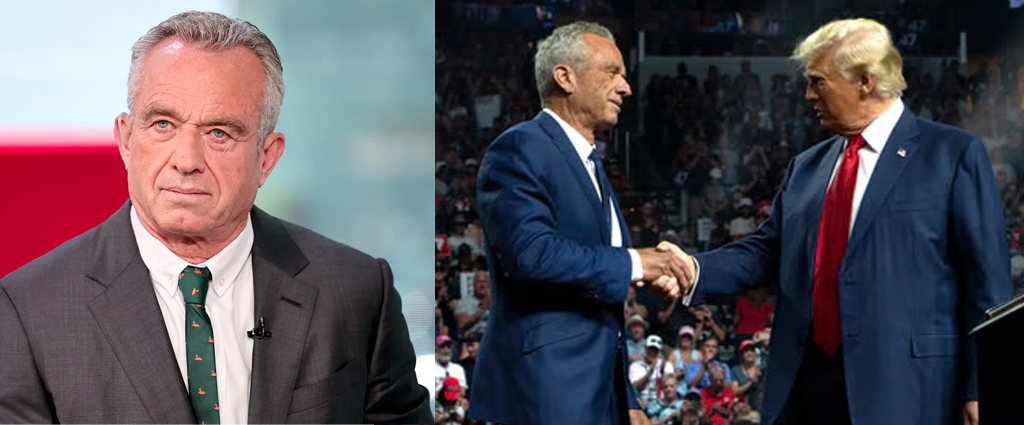
    The issue of transparency in the JFK assassination isn’t the exclusive reason I decided to support RFK Jr. for president, but it’s at least tied for first place. I already knew his position on his uncle’s assassination – as well as his father’s – and that made him a qualitatively different and unprecedented kind of candidate. But on Friday, August 23rd, confronted with the image of him on stage with Donald Trump in Arizona, I admit I trembled a bit. The former president graciously introduced RFK Jr.  as having “lost his father and uncle in service to our country.” He vowed to establish an “independent presidential commission” to revisit the JFK assassination and release all the withheld records. I imagined RFK Jr. standing there, waiting to speak, exhilarated at coming as close as anyone in the last 60 years to doing what Dorothy Kilgallen said she was going to do right before her mysterious death. 

    Maybe Bobby wasn’t thinking that at all, and when he took the podium, he never even mentioned the JFK assassination. He talked, as usual, about public health, endless war, and censorship. But I wanted to believe he was consciously hoping President Trump would speak to that morbid tragedy in Bobby’s own family for him, and that Bobby – like all of us outside the inner circle of the national security state – still put a top priority on finding out what happened to his uncle. This was probably the best chance he had ever had in his lifetime. Whether Trump was only prompted by the recent attempt on his own life seemed immaterial at that moment. The point was: millions of people were watching and listening. It was live.

    Again, full disclosure over JFK’s murder continues to be a matter of vital public interest. Without at least an official rejection of the official history as currently disseminated by government and mainstream media, Americans won’t even have a version of events that is closer to the truth than what their government now peddles to them. We will continue to languish in a social sickness complementary to the physical degradation Kennedy so passionately wants to reverse, and about which he continually warns us. We need the topic of the JFK assassination in the news cycle now more than ever, so that it resonates into the next administration and stays in the public memory, no matter who wins. In Oliver Stone’s JFK, Jim Garrison paraphrases Tennyson: “Do not forget your dying king.” To find out what happened, we have to resist forgetting.

    Kennedy, Trump, and Harris

    Whatever the political fallout from the Trump-Kennedy coalition (liberal MSM commentators quickly united in their attacks), I have no regrets about supporting RFK Jr.’s campaign. The dominant experience of working with other RFK Jr. volunteers was, primarily, an absence of hate. Plenty of fellow campaign workers had voted for Biden in 2020, and plenty of others for Trump. But when handing out campaign literature or soliciting signatures for ballot access, the only hate we ever encountered came from obvious Biden supporters. They would hiss at us, sometimes spitting inadvertently in the process, their faces red as tomatoes, telling us we were a “disgrace” or “dangerous” or should be “ashamed.” Trump supporters would sometimes refuse to sign our petition forms, but they were never mean or unhinged. The “Bidenista” passers-by were manifestly contemptuous, sometimes calling us “nuts” or “crazy” even as they boiled over right in front of us.

    How different from that experience could Bobby Kennedy’s have been at the level of the DNC high grandees? He and running mate Nicole Shanahan both said that the Biden-Harris people had refused even to speak to them, whereas the Trump campaign was at least willing to meet. Under these circumstances, why would anyone blame RFK Jr. for giving up on cooperation with the arrogant Biden-Harris cabal? Would anyone passionate about issues of vital public interest, who meets a brick wall from one side and an ajar door from the other, go on bashing his head repeatedly against the bricks and mortar? 

    Maybe a significant percentage of RFK Jr. supporters now refuse to back him for endorsing Trump as a means of advancing his own agenda of peace, public health, and free speech. I haven’t met any yet. But at the end of the day, faced with the Democratic Party’s well-financed litigation drive to keep him off the ballot, plus censorship by overwhelmingly DNC-friendly mainstream media, Bobby evidently felt he had to choose between doing something or doing nothing. He decided to do something, to take a chance on Donald Trump honoring an agreement to prioritize the issues closest to him. Even if Trump reneges on his pledge of full disclosure in the JFK assassination, I think Bobby did the right thing. 

    The drab, uninspiring Democratic Party long ceased to be the party of RFK Jr.’s uncle and father. It is not the party of FDR, JFK and RFK. It is the party of LBJ, a corrupt, brutal scoundrel desperate to use the White House for the public adulation he craved. The long-term symptom of LBJ is the Democratic Party of today. And the DNC hit squads are part of this LBJ apparatus. (NY Times, May 2, 2024 online edition or May 4, 2024 print edition, article by Michelle Cottle: “The Drive to Tell Voters What They Don’t Know About R.F.K. Jr.”)

    It is largely a party made up of elites.  Nancy Pelosi ushered out Biden, and after, there was no competition from anyone to take the spot.  Not even a token of a debate took place. And, if one recalls, there was no debate during the Democratic primaries, or what passed for primaries. Harris was anointed, she was not in any way elected.  How interesting that process becomes when compared with how Robert Kennedy Jr. was treated in the media. This is democracy?

    The censorship Kennedy speaks about is not conspiracy theory. It’s real and palpable, and Facebook CEO Mark Zuckerberg now confirms publicly that “deep state” goons pressured him to censor content related to COVID-19 and other subjects. Moreover, the “censorship-industrial complex” (as RFK Jr. calls it) traces its roots to November 22, 1963. In interviews, Bobby has repeatedly recommended James Douglass’s influential book, JFK and the Unspeakable (2008), which refers to a systemic evil, a “void” permeating official policy and discourse, making it soulless and hollow. The assassination put a kind of “final seal” on what had built up over the previous decade and a half, as an unaccountable “deep state” acquired more and more power at the expense of elected authorities. That power manifests itself everywhere, particularly through censorship. Scholarly writers, researchers, and historians of the JFK assassination are marginalized and deprived of the big, lucrative book deals and promotions, as well as prestige. There is no meaningful difference between “muzzling” these writers and state censorship.

    Ironically in the so-called “information age,” the idea that certain things are “unspeakable” is still strong. Six decades after the assassination of JFK, and 56 years after the murder of RFK, Bobby Kennedy Jr. has exhumed a range of issues buried under a mass of mainstream media talking points developed over generations. Possessed of a collective blindness residual of the Cold War, most Americans have ignored the “forever wars,” dietary and environmental toxicity, the waste of our economic resources, and the decline of our civic consciousness. A drug-addled, unhealthy nation, we’ve received a big wake-up call from RFK Jr., who has brought issues of vital public interest back into popular discourse. For instance, the revolving door between big pharma and public health agencies.

    The issues that Kennedy leads with – (1) the war in Ukraine, (2) chronic illness and disease, and (3) the mainstream-media censorship regime – are all the product of the rise in power of the unelected national-security apparatus, which secured its dominance over the political system after passage of the National Security Act of 1947. President Truman signed it into law, giving official birth to the Central Intelligence Agency. As soon as President Kennedy was assassinated, Truman sat about writing an op-ed for the Washington Post, essentially lamenting the effects of a law he was responsible for enacting. He suspected the CIA was involved in the murder of his young successor, and that suspicion permeates his op-ed. 

    The CIA had gradually accumulated more and more power under President Eisenhower, who would warn the public about the dangers of the “military-industrial complex” in his farewell speech in January 1961. By the time JFK attempted to resist its power, it was too little, too late. The title of David Talbot’s book, The Devil’s Chessboard: Allen Dulles, the CIA, and the Rise of America’s Secret Government  (2015) is no cliché. Our unaccountable “secret government” is the biggest open secret in America today. Only one candidate talked about any of this in any detail, and that is RFK Jr. It was probably that, plus his opinion of Anthony Fauci that sealed his fate at the starting gate.

    The Biosecurity Agenda and the ‘Anti-Vaxxer’ Pejorative

    One issue remains largely “unspeakable,” as mainstream media and government barriers to talking about it are still mostly intact. It is what RFK Jr. calls the “Biosecurity State.” The most recent manifestation is the attempt by governments worldwide to restrict freedom in societies over which they preside. The method is known as “PPR” – pandemic preparedness response. The World Health Organization declares a “pandemic,” and national governments stand ready to impose a series of measures, including lockdowns, school closings and other mandates, thus curtailing basic liberties. Behind PPR and restrictions on human freedom stands the obscenely profitable pharmaceutical industry – “Big Pharma” – which rolls out “cures” as soon as it can scare everyone enough. The gravy train is then off and running again. Anyone who dismisses as “conspiracy theory” the idea that Big Pharma is irretrievably corrupt should read a book by a bête noire of Warren Report dissenters everywhere, Gerald Posner’s Pharma: Greed, Lies, and the Poisoning of America (2020). When Kennedy calls Big Pharma a “criminal cartel,” he’s being gentle.

    Many educated people seem to shrug all this off, but many of us are sincerely alarmed. RFK Jr.’s recent book,  The Wuhan Cover-Up and the Terrifying Bioweapons Arms Race (2023), traces the historical continuity between Pentagon and CIA experimentation and abuses at Fort Detrick, Maryland.  This began around the late 1940s,and it spread to the Wuhan Institute of Virology in China in 2020. Which is where former National Institute of Allergy and Infectious Diseases (NIAID) director Anthony Fauci took his “gain of function” research after the Obama administration imposed a temporary moratorium on that dangerous activity within the United States. Kennedy’s previous book, The Real Anthony Fauci: Bill Gates, Big Pharma, and the Global War on Democracy and Public Health (2021), gives scholarly content to a now-widespread perception that the longtime, powerful, and highly-paid NIAID chief is corrupt, self-serving, and responsible for serious public health policy abuses in service to the bottom line of both himself and Big Pharma e.g. the whole disastrous AZT as a cure for AIDS debacle. Fauci has never even hinted at suing Kennedy despite the book becoming an instant bestseller. And it is not just RFK Jr. who has made these charges against Fauci.  Senator Rand Paul has done the same against both Fauci and Gates. Senator Paul wanted to charge Fauci for lying to congress about gain of function research and how this caused the breakout of CV 19 in Wuhan.

    Although RFK Jr. has never led with the issue specifically, he is not shy about explaining his vaccine safety advocacy in the face of accusations that he is a “nut” or (per the first sentence of his Wikipedia page) a “conspiracy theorist.” Most citizens of the industrialized West have been vaccinated for different things at various points in their lives, and I make no exception of myself. Neither does RFK Jr. But the COVID-19 pandemic ushered in tyrannical new rules about the subject.

    RFK Jr.’s Children’s Health Defense (CHD) advocacy group and its online periodical, The Defender, offered scholarly analysis for anyone entranced by the three-letter public health agencies’ scare-mongering for Big Pharma. But they had to be aware of CHD in the first place. CHD should have acquainted everyone with the “Biosecurity State” before censorship of mass media and internet in the democratic West really ramped up, since Kennedy had been warning of it for years. But social media – to say nothing of the MSM – suppressed it. Those of us who had never felt blunt censorship in America could see social media “moderating” or deleting posts for even questioning public health policy by the end of 2020. The words “false” and “falsely” became mantric in MSM, intensifying after President Trump publicly charged that the 2020 election result reflected fraud. 

    The censorship situation in the West became extreme after the “warp speed” rollout of the COVID-19 vaccines, when even wire services openly branded anyone daring to question their safety or efficacy “conspiracy theorists” promoting dangerous views. RFK Jr. became super-prominent among the targets of coordinated attacks by legacy outlets of America’s ostensibly “free press.” The pharmaceutical industry’s power over supposedly neutral organizations like Reuters and AP had been more subtle, but by the end of 2020, the “corrupt merger of state and corporate power” was brazenly and frighteningly visible every day. Another target was author Naomi Wolf, who had written more than one bestseller and was an advisor to both Bill Clinton and Al Gore.

    Friends’ acceptance of my choice to rely on my innate immune system in confronting COVID-19 has, at least, reassured me. Others have been less fortunate. The family of an unvaccinated American friend overseas told him if he wanted to come home for Christmas, he had to be COVID-jabbed. He spent Christmas of 2021 alone in a country that doesn’t even celebrate it. 

    As time has passed, and more and more vaccinated friends have contracted COVID: Jim DiEugenio contracted it twice. The realization that people like me aren’t as loony as they first imagined has become more ingrained. The full symptoms of my own bout with COVID-19 lasted four or five days. After no longer testing positive, I felt even more confident of the benefits of strengthening natural immunity. 

    Even vaccine enthusiasts have to admit to a level of adverse side effects never seen before, since this is a matter of official record, not theory. It isn’t necessary to indulge in conspiracy theory to conclude that the COVID-19 vaccines have never been proven totally safe. The CDC’s own Vaccine Adverse Events Reporting System (VAERS) has received more reports from the COVID-vaccinated than for all previous vaccines combined, yet in the late 1970s, the “swine flu” vaccine was withdrawn after a tiny number of recorded Guillain-Barré Syndrome (GBS) cases. Many more GBS cases have been recorded for the COVID-19 jabs. Again, the best explanation for why the COVID-19 vaccines survived is record levels of state and corporate stipulation. No matter how much others claim to “believe in” the COVID-19 vaccines, there is no basis for “trusting” the companies producing them. They trade in year-end profits, not long-term public health. Whatever COVID vax advocates argue, skeptics have the right to remain skeptical, especially since we cause no increased harm to anyone by remaining “jab free.”

    Warp Speed and Political Orthodoxies

    One does not have to conceive of a “plandemic” designed and implemented by a “high cabal” to reduce the world’s population through vaccine mandates. Corruption and greed can explain what happened, and why it should not happen again. After all, Operation Warp Speed broke several rules in its haste to come up with a vaccine. But there is still an important point to be made, and I felt it most intensely when I attended RFK Jr.’s “Defeat the Mandates” protest in front of the Lincoln Memorial in Washington in early 2022, with SWAT teams on the roof and police helicopters circling loudly overhead. That point is, no matter how much our friends, family, or anyone else may show tolerance toward our refusal to be vaccinated for COVID-19, if universal mandates were ever imposed, the overwhelming majority of these “friends” wouldn’t lift a finger to defend our right to refuse them. One can easily picture them, instead, shrugging, wishing us “good luck,” and sauntering off to comply with the latest Biosecurity-State rule. In short, we have to defend our own civil rights, and RFK Jr. is the most powerful tribune for our cause. 

    Among those of us who have never availed ourselves of the COVID-19 vaccines, the sense of freedom to speak more loudly about our personal choice is much stronger today, in no small part thanks to RFK Jr. His supporters – vaccinated and unvaccinated – overwhelmingly oppose mandates, and the diversity of his base reflects a healthy political realignment, resurrection of wholesome social values, and reintroduction of vital interests to public discourse. 

    As people like Jimmy Dore have shown, the  MSM relies on Big Pharma accounting for a disproportionately large share of its ad revenue. Consequently, it  has already trotted out more pharmaceutical execs posing as “independent experts,” telling us we need to mask up and get the next shot. But yet, neither Peter Hotez nor Jake Tapper for two, would debate Robert Kennedy Jr. Robert Kennedy’s response to Hotez was that he was not talking about a conspiracy, he was talking about an orthodoxy which had taken hold, one that stated silence was the best course; so many smart and moral people decided that the best road was to keep your head down and move forward.

    Reportedly Trump has offered Kennedy a role in his transition team, one in his health program, and one on a commission to declassify all the records on the JFK assassination. These negotiations began right after the attempted assassination of Mr. Trump in Butler, Pennsylvania. At the start the Vice Presidency was on the table, which Kennedy refused outright. Two of the go betweens in the talks were Calley Means, a preventivve health care advocate, and Tucker Carlson who had Kennedy on his much watched program. (NY Times, 9/2/24, story by Maggie Haberman).

    It is interesting of course that these negotiations began after Butler, since RFK was the only candidate talking about the subject of assassinations for months on end. And reportedly it was Carlson—who has famously defied the MSM orthodoxy in the JFK murder– who first connected the two candidates via text message. (ibid). As former RFK manager Dennis Kucinich has noted, the DNC had shown no such outreach to the candidate.  In fact, they had done all they could to sabotage him, similar—and perhaps worse–than what they did to Sanders. (Ibid, NY Timesarticle by Michelle Cottle) The DNC started 9 nuisance lawsuits to keep Kennedy/Shanahan off state ballots; they sandbagged particular events; and according to a talk show interview by VP candidate Nicole Shanahan, they even sent in double agents to certain offices. (Click here for this revealing interview https://www.youtube.com/watch?v=lAqVn5lRdes). And the whole time, Kennedy was denied Secret Service protection, thus forcing his campaign to spend hundreds of thousands per month on private security. This was startling,  considering the history of that family.

    If the alliance with Trump does not, in the end, produce meaningfully greater transparency in the assassination of JFK, RFK Jr. can’t be blamed. The struggle will continue. The “Justice for Kennedy Act” introduced in the House by a Republican congressmen in early 2023 is apparently dead, but the lawsuit of Mary Ferrell Foundation v President Biden and the National Archives has now reached the U.S. Court of Appeals for the Ninth Circuit, already well known for unpredictable decisions. Hopefully, the Democrats will feel forced to confront the assassination issue, perhaps with another legislative initiative, since Biden’s presidency was such a failure on the topic. So even if Trump’s executive-branch “commission” disappoints us, activism elsewhere could compensate for another letdown. There is, in sum, ample cause for hope, attributable in no small part to the influence of Robert F. Kennedy Jr. We now have Trump on tape in front in front of multiple cameras saying so.

  • Mark Shaw Insults Allen, Texas: Part 2

    Mark Shaw Insults Allen, Texas: Part 2


    Two years ago, in a slightly agitated aftermath of reading Mark Shaw’s then new publication, Collateral Damage, I wrote a lengthy and critical review of his literary effort. I published that review on my website Marilyn From The 22nd Row; and Jim DiEugenio kindly published the review on his fine website, Kennedys and King. Recently, a video presentation that Shaw delivered at the Allen Public Library in Allen, Texas, appeared on my YouTube feed. Reluctantly, I watched and created a transcription of his presentation, primarily a commercial for his book. I was not quite as agitated by his Texas presentation as I was by his book; but that fact notwithstanding, in the name of historical and factual accuracy, I am compelled to offer a few comments.

    The first half of Shaw’s presentation focused on Dorothy Kilgallen. Shaw’s fanboy fascination with the star of What’s My Line crossed, at some point in time, into a goofy type of worship that approximates a goofy form of idolatry leading Shaw to engage in hyperbole. According to Shaw, Dorothy was quite possibly thegreatest journalist who ever lived […] Walter Cronkite and David Brinkley rolled into one.Shaw realized that Dorothy had, in fact, achieved the big time because the producers of The Flintstones featured her in an episode broadcast in 1961.And you know you’ve made it, Shaw opined, when you’re on a Flintstones episode. According to Shaw, Dorothy appeared in “The Little White Lie,” the title of the episode, as Dorothy Kilgranite. Not so. She appeared as Daisy Kilgranite, just one of several errors Shaw made regarding the Flintstone episode. Admittedly, it is possible that I am making a mountain out of a cartoon mole hill; but considering the errors Shaw made regarding a twenty-six minute cartoon, readily available for his review, is there any wonder that he made more than a few egregious errors regarding the complicated life of a person as complex as Marilyn Monroe?

    In my lengthy criticism of Collateral Damage, I identified most of Mark Shaw’s errors, but not all of them. I could list them here; but I think the better approach is simply to provide links to my original evaluation of Shaw’s publication: Marilyn From The 22nd Row; link to Kennedys and King.

    Still, there are a couple of assertions made by Shaw during his video presentation that I need to discuss directly: 1) the big clue that Shaw allegedly discovered; and 2) Shaw’s assertion that Collateral Damage does not contain any ofhis opinions or speculations.

    The Big Clue. What follows is what Shaw asserted:

    […] this is the big clue. What did I do here? Well, I was in trouble because I wanted to show that Bobby could have been involved in Marilyn’s death but he wasn’t in Los Angeles at the time. He had an alibi. He was in the San Francisco area, OK. But I just couldn’t believe that he was and so I started looking into things and I found this ledger [security log]at 20th Century-Fox. […] what does it say? That at 11 o’clock on August 4th, 1962, the same day that Marilyn died, Bobby Kennedy and Peter Lawford arrive in a helicopter there. Alright. So he’s in Los Angeles […].

    With the preceding, Mark Shaw clearly took credit; claimed that he and only he uncovered a document, an August the 4th Fox security ledger or log, which proved that Robert Kennedy and Peter Lawford landed at the studio in a helicopter at 11 AM; proved that the Attorney General was in Los Angeles; and by extension, this ledger proved that Robert Kennedy visited Marilyn on August the 4th and that he was, therefore, involved in her murder. But, and there always is, how did Collateral Damage report the explosive big clue?

    In his book, Shaw reported that Bobby had what appeared to be an airtight alibi, one which placed him in the San Francisco Bay Area at the time Marilyn died. Shaw even referenced an Associated Press story confirming that Robert, Ethel, his wife, and four of their children arrived in San Francisco on Friday afternoon, August the 3rd. He even admitted that the Kennedys traveled to the Bates Ranch. Even so, as he also admitted, Shaw did not believe any of the eye-witness, first hand testimony provided by the Bates family and others present that weekend. Shaw did not believe that the ten photographs taken throughout the day, published by Susan Bernard in 2011, proved anything about Robert Kennedy’s location on August the 4th. Shaw did not believe the AP story or a 1985 NYT interview with the senior John Bates, referenced by Shaw, which confirmed that the attorney general never left the Bates ranch. Instead, Shaw accepted the mysterious security log and the testimony of one Frank Neill.

    According to Shaw, the actual security log read as follows:

    Before 11 a.m. on August 4, 1962, a helicopter landed at the Twentieth Century Fox studio’s helipad near Stage 14. Studio publicist Frank Neill, working that Saturday morning, said he saw Robert Kennedy jump out of the helicopter and rush to a dark gray limousine waiting nearby. Neill said he got a glimpse of movie star Peter Lawford, brother-in-law to the Kennedys, sitting inside.

    To begin with, in his Texas presentation, Mark Shaw asserted that both Robert Kennedy and Peter Lawford arrived at Fox’s lots in a helicopter on August the 4th. The alleged security log, on the other hand, indicated that the attorney general arrived in a helicopter while his brother-in-law, Peter Lawford, waited in a nearby limo, a clear contradiction. Which account should we accept as factual?

    Additionally and obviously, the form and wording of the security log strikes the reader as a bit odd. Clearly, a person other than Frank Neill recorded what the studio publicist allegedly said; therefore, who actually wrote down what Neill said? Shaw’s big clue was actually hearsay.

    Why was it necessary to include that Neill was a studio employee; and, by the way, who and what was Frank Neill?

    While I was a practicing architect, I encountered many security offices and security logs at corporate offices, large building material manufacturers and security trailers at fenced, and sometimes guarded, construction sites. Usually, the exact time of one’s arrival had to be recorded. The indefinite arrival time stipulated in the text of the alleged security log confused me. Before 11 AM? Also, usually a precise purpose for one’s visit had to be declared on a security log, something omitted from the Fox log. Moreover, completing a security log is usually only required when a person actually enters secured areas. But evidently, Robert Kennedy never entered the actual Fox lot; at least, that is, Shaw’s log was rather vague on that particular point. The Attorney General entered an awaiting limo which then quickly drove away. Would this necessitate an entry in a security log? And when companies require security clearances, they issue a security badge to visitors and they require the visitor to return to the Security Office, to log out–to enter a precise departure time and to return the security badge. Shaw’s mysterious security log did not include a log out time.

    Finally, the wording of this security log surprised me. Security logs that I’ve encountered required brevity; but the text of Shaw’s security log read more like an excerpt or a description that was lifted, borrowed from a larger narrative.

    Why?

    Hoping to resolve at least some of the preceding issues, and answer some of my questions, while also identifying Frank Neill and clarifying his association with Marilyn Monroe, I spent several days reviewing more than a few pertinent publications. Within the text of Collateral Damage, Shaw was particularly laudatory about one biography, Marilyn: The Tragic Venus, written by Edwin P. Hoyt. Shaw wrote:

    Published in 1965, Hoyt’s biography of Marilyn was released at a time when facts about her life and times and death were not polluted with phony sensationalism, as would be the case with many articles and books in the future. His account certainly appears credible due to the large number of primary sources […] (85).

    I began my review of books about Marilyn with Edwin Hoyt’s biography: Frank Neill did not appear therein. In fact, two decades would elapse before Anthony Summers, in his Marilyn pathography Goddess, would finally mention Frank Neill. According to Summers’ 1985 source notes, Marilyn’s Irish pathographer actually interviewed Frank Neill. From the source notes:Landing at Fox: int. Frank Neill, 1983, and former policeman on pension, who requires anonymity. According to Summers:

    Two fragmentary reports, one from a police source, one from a former member of the Twentieth Century-Fox staff, Frank Neill, suggest Kennedy arrived in the city by helicopter, putting down near the studio’s Stage 18, in an open space then used by helicopters serving the area near the Beverly Hilton. According to these sources, the President’s brother arrived in the early afternoon (350).

    Summers’ 2012 update of Goddess repeats the preceding account verbatim; and nowhere in either version of Goddess did Summers even mention a security log! Also, Summers did not provide any biographical information regarding Fox’s former staff member, Frank Neill; and once again, we have encountered a few contradictions.

    According to Summers’ account of his interview with Frank Neill, the President’s brother did not arrive during the morning: he arrived in the early afternoon. Shaw’s alleged security log stated that Robert Kennedy’s whirlybird landed on a helipad near Stage 14 while Summers reported that the helicopter put down near Stage 18 in an open space […] near the Beverly Hilton. Why the contradictions? Besides, if Frank Neill was involved in the preparation of a security log in 1962, why oh why did he fail to mention that to Anthony Summers during their interview in 1983?

    In 1991, James Spada published The Man Who Kept the Secrets. This was a Peter Lawford biography, sprinkled liberally with the spice of Marilyn and the Kennedys along with many yarns pronounced by the pathological fantasists, Robert Slatzer and Jeanne Carmen. Spada’s literary effort reported the following account:

    Frank Neill, a former employee of Twentieth Century-Fox, later stated that Bobby arrived by helicopter at a landing pad near the studio’s stage eighteen, which was often used by the Beverly Hilton Hotel for that purpose. A confidential police source supports this story(353).

    Not quite identical to Summer’s account but eerily similar. Perhaps the similarity can be explained by Spada’s following admission in his source notes: I drew many of the details of Marilyn Monroe’s last few months from Anthony Summers’s superb investigatory biography of Monroe, Goddess (533). In short, James Spada simply rephrased Summers’ account.

    With the passing of two years, in 1993, Peter Brown and Patte Barham published Marilyn: The Last Take. The first mention of a security log appeared therein. The authors reported:

    On Saturday afternoon, August 4, a Fox security guard squinted through the morning fog to catch a glimpse of the huge government helicopter that hung in the sky above the studio. Waving a fluorescent orange flashlight, the guard directed the chopper toward some hastily drawn landing marks. […] The chopper had been approved to land at just after 11 A.M., as duly noted in the studio’s security log. A dark grey limousine was parked to the side, its driver standing at attention. Studio publicist, Frank Neill, whose office was near the landing pad, wasn’t surprised to see the familiar figure of Bobby Kennedy leap from the helicopter and dash to the limousine. […] Through the open door, Neill caught a glimpse of the carefully tanned face of Peter Lawford(349-350).

    In Brown and Barham’s account, their huge government helicopter landed just after 11 o’clock in the morning; and it landed on what was evidently a makeshift, hand drawn landing target, not a helipad. However, the authors must have been confused regarding the landing time: if the chopper landed just after eleven in a morning fog, how does “Saturday afternoon” fit in? Be that as it may, the authors’ source notes contained the following curiosity: The helicopter landing on the Fox lot was discussed by Robert Slatzer and Lee Hanna, who heard of it from Frank Neill (465). Evidently, Brown and Barham did not actually interview Frank Neill. The authors received their information from either the ubiquitous Robert Slatzer or Lee Hanna, a person with whom I am unfamiliar. If Brown and Barham did not interview Frank Neill, how did they know he was not surprised by the presence of Bobby Kennedy? Well, they could not have known.

    But here is what I find truly odd. If Slatzer knew that Robert Kennedy had landed on Fox’s lot in a helicopter, why did he withhold that information from Anthony Summers during all the interviews the author allegedly conducted with one of his primary sources? I reviewed Slatzer’s 1974 publication, The Life and Curious Death of Marilyn Monroe. There, Slatzer did not mention Kennedy’s arrival by helicopter. Slatzer mentioned Frank Neill with regard to topics unrelated to the topic of this article and asserted that he had met Neill in 1952 on the sets of Niagara. In Slatzer’s The Marilyn Files, published in 1993, Frank Neill likewise appeared with regard to topics unrelated to the topic of this article. Also, Slatzer thanked Neill, and many others, for their invaluable contribution over the years (n9). Slatzer left their contribution unspecified. I can only conclude that their invaluable contribution was their assistance with Slatzer’s masquerade as Marilyn Monroe’s faux second husband.

    Several additional publications that I reviewed did not invoke the name of Frank Neill, and several did. Donald Wolfe’s The Assassination of Marilyn Monroe, published in 1998, and his 2012 update, The Last Days of Marilyn Monroe, presented the following account:

    Early Saturday afternoon, the roar of a helicopter echoed off the sound-stage walls at the Fox studios. A Fox security guard squinted into the bright blue sky as it began its descent into the heliport near Stage 14 […]. As noted in the studio’s security log, the helicopter had received approval to land shortly after 11 a.m. A dark gray limousine waited in the shade as the helicopter touched down in a whirl of dust. Studio publicist Frank Neill, who was working on the lot that Saturday, […] was surprised to see Bobby Kennedy leap from the helicopter and dash to the limousine. As the limousine door opened and Bobby jumped in, Neill caught a glimpse of Peter Lawford (564).

    Wolfe magically transformed the chopper’s landing spot from an open space with some hastily drawn marks, not into just a helipad, but a full scale heliport. The landing transpired in different weather conditions than those mentioned by Brown and Barham. Obviously, Wolfe preferred to have the chopper land under a blue sky in bright sunlight, not a morning fog. And while in the Brown and Barham account, Neill was not surprised to see Bobby Kennedy, in Wolfe’s account the appearance of Bobby did surprise Neill. How did Wolfe know about Neill’s surprise? It is clear that Wolfe did not actually interview Frank Neill. According to his source notes pertaining to page 564: Roar of a helicopter: Summers, p. 350; Brown, p. 303. It is also clear that Wolfe combined the accounts in Goddess and Marilyn: The Last Take to create a hybrid that included a security log which Anthony Summers, who actually interviewed Frank Neill, did not mention.

    Finally, fifty years after Marilyn’s tragic death, Darwin Porter published Marilyn at Rainbow’s End. In Porter’s seamy literary effort, the author transfigured Frank Neill into an implied authority on Fox’s security:Frank Neill, a security guard at Fox,Porter declared, said he saw Bobby arriving by chopper at the helipad on the studio’s lot, which was often used by the Beverly Hilton Hotel for their VIPs (457). But Porter did not mention a security log.

    Returning to the questions that I posed earlier in this article, who and what was Frank Neill and what was his actual association with the world’s most famous blonde actress? Well, Neill was either a former newspaperman, a former police reporter, a garden variety Fox publicist or a unit publicity man for the film Niagara. Not one publication that I reviewed clarified who or what the man actually was, and not one of those publications clarified his association or relationship with Marilyn Monroe. Unfortunately, my efforts to determine the who, what and why of Frank Neill proved to be futile. I could not even locate an obituary.

    So, this question remains: did Mark Shaw uncover–did he and only he discover a mysterious security log or ledger which proved that Robert Kennedy was in Los Angeles on Saturday, August the 4th in 1962? Most certainly he did not. Many other writers have mentioned that mysterious security log; and Shaw did not offer any real proof that the log actually existed. He, like all the sensationalistic conspiracist writers before him, did not publish the actual log. And he did not display a photograph of it during his Texas presentation. A fact which leads me to conclude that he did not and does not possess the security log; and that fact leads me to the real difficulty with Shaw’s assertion.

    Considering that the log was created in 1962, virtually six decades prior to the publication of Collateral Damage, is it even remotely possible that such a document would have been retained by 20th Century-Fox, retained for fifty-nine years? Would such a document have survived to see the 21st century? Speaking only for me, of course, I think not. Taking into consideration all the contradictory accounts regarding the mysterious log, taking into consideration that the actual log has never been published, never been seen, I cannot stretch my gullibility, my credulity quite that far. Speaking only for me, of course, I do not believe Shaw’s story. In fact, I do not believe that the mysterious security log ever existed. I must repeat once again: Shaw’s ledger, the security log, the alleged document has never been published. What Shaw presented in Allen, Texas, was an amalgamation of the many stories written about Robert Kennedy’s whirlybird arrival at Fox studios, an arrival witnessed by a shadow named Frank Neill. Based on actual facts, based on firsthand testimony of persons who were with Bobby that Saturday and based on documentary evidence, we know that the Attorney General was not in Los Angeles on Saturday, August the 4th.

    And finally, to put a period on this philippic, Shaw’s contention that Collateral Damage did not contain any of his opinions or speculations just might be the most absurd conceit uttered by the self-proclaimed Marilyn historian. The text of Shaw’s publication is filled with opinion and speculation; it is also filled with innuendo. For example, on page 562, Shaw wrote:

    Basically a coward in the ilk of his father, RFK would never have had the guts to poison Marilyn on his own initiative. That meant he had, it would seem, two choices: either enlist operatives to do it or engage through an intermediary, perhaps Greenson of Engelberg to do it for him. […] RFK, either on his own or through intermediaries, could have “squeezed” Greenson […] into becoming an operative in the death of Marilyn.

    In Shaw’s goofy world, the preceding does not qualify as speculation. Truly amazing.

    I could present many more examples of Shaw’s opinionating and speculative prowess. But the most incredible example begins on page 613, Shaw’s contrived scenario of how Marilyn was possibly murdered, a scenario that is gross speculation of what most likely may have happened to Marilyn during the night of August the 4th.

    Accosted by two intruders sent by the attorney general, with the president’s approval, asserted Shaw, and stunned with a chloroform-sealed cloth, Marilyn was either dragged or carried into her bedroom, stripped, deposited nude on her newly carpeted floor and callously murdered by a rectal infusion of drugs using a bulb syringe of some sort. The attorney presented absolutely no evidence to support his contrived scenario; and Shaw excused his lack of evidence as follows:

    Of course, as with any theory like this based on circumstantial evidence after so many years have passed, questions will be asked, with answers unfortunately speculative in nature. […] Such observations about Marilyn’s death provide a stop-and-think, food-for-thought considerations as to how Marilyn met her maker and by whose actions […]. If Robert Kennedy’s complicity in Marilyn’s death, through whatever means, had been exposed, causing him to be charged in a court of law, there would never have been a JFK assassination by RFK’s enemies in 1963(624).

    There was not, and there is not, one shred of actual evidence proving that Robert Kennedy was romantically involved with Marilyn Monroe, or that he was involved in any way with her death. In fact, the available evidence proves that actress and attorney general were not involved romantically. Further, Marilyn’s autopsy proves that she was not killed with some sort of bulb syringe: she ingested the drugs that killed her.

    Mark Shaw’s gross speculation that John Kennedy’s assassination could have been prevented by bringing charges against his brother for killing Marilyn Monroe is absolute nonsense of the most preposterous sort. Perhaps Mark Shaw should have stopped and thought before writing a book like Collateral Damage. Perhaps he should have asked a few more questions, like he admonished his video audience to do, before putting his pen to paper.


    Go to Part 1

  • Mark Shaw Insults Allen, Texas: Part 1

    Mark Shaw Insults Allen, Texas: Part 1


    In 2021, author Mark Shaw visited the library at Allen, Texas. Allen is a town of about 100,000 located 20 miles north of the Dallas/Fort Worth metroplex. This was an opportunity to publicize his book Collateral Damage. Some might say: but that was two years ago. Which is true. But for whatever reason, this talk has garnered millions of views on YouTube. Marilyn Monroe authority Don McGovern went ahead and transcribed it. It might be hard to believe, but in some ways this speech is even worse than the book.

    It is very important—actually it is integral—to understand that Shaw is a lawyer. And, as he has described in his prior books, he was a criminal defense attorney. In other words, Shaw is familiar with the rules of evidence and testimony in court. He therefore has to understand the concept of raising objections to such and how a judge can then rule on whether that evidence and testimony can be admitted to a jury. In fact, very often there are pre-trial evidentiary hearings so a judge can rule on these matters.

    What is shocking about Shaw’s presentation is this: there is barely anything in it that would not be challenged in court. And, as we shall see, most of those objections would likely be sustained. It’s quite a spectacle to see an attorney somehow forget the strictures he was taught in law school in order to present a case so diaphanous that it would likely never get out of the starter’s gate. This at a time when most of the JFK critical community is doing the contrary. That is, trying to present a case that would meet standards of proof.

    Mark Shaw is one of the very few in the critical field that still holds that somehow it was the Mafia that killed President Kennedy. What is so bizarre about this—actually it is almost shocking—is that he does not even seem aware of how the new evidence vitiates that conclusion. For instance, the Assassination Records Review Board (ARRB,) declassified many documents from the House Select Committee on Assassinations. The pertinent HSCA records were from November, 1978 interviews with the family of Dutz Murrett, Oswald’s uncle in New Orleans. These showed that, contrary to what the likes of author John Davis had stated, Mr. Murrett was not working for Carlos Marcello in 1963. (Michael Benson, Who’s Who in the JFK Assassination, p. 305) He had resigned his bookmaking position at least two years earlier. This poked a serious lacunae into that theory—one that tangentially connected Oswald to the Mafia Don in New Orleans.

    Further, the famous Ed Becker anecdote about Marcello, which so many have used—including Shaw in this speech—has now also come into dispute. According to Becker, Marcello allegedly stated that soon “the stone” would be removed from his shoe. This meant Attorney General Bobby Kennedy. But he was going to do it by disposing of President Kennedy. (Benson, p. 34) Len Osanic of Black Op Radio has made contact with a witness who renders that whole conversation questionable. There is now a book in preparation on the subject. Yet, as author Michael Benson notes, the HSCA used both of these aspects to bolster their Mob oriented case. As explicated by the late Carol Oglesby in the Afterword to Jim Garrison’s On the Trail of the Assassins, that case was never very strong to begin with. It has now been severely weakened.

    Mark Shaw’s third overall rail of Mafia involvement on the JFK case was that Joe Kennedy had double crossed his backers in Chicago about how he could get RFK to go easy on the Outfit. In return for that, the 1960 mob—controlled wards in Chicago would throw their support to JFK. This point was also rendered moot when it was broken down by statistician John Binder. Binder did a complete study of the voting ratios in those wards. It was not what it should have been if the basis of the book Double Cross was true. Binder’s work pretty much blows up this old wives tale. (Click here)

    Since the Mob did not go along with Kennedy’s alleged wishes, this would indicate he did not have much pull in Chicago. Which indicates that the myth of Joe Kennedy the bootlegger was just that. A myth that emerged, not when Joe was under six federal investigations for positions in government; but arose after, when the underworld, and Jack Kennedy’s enemies—like Richard Nixon—wanted to spread rumors, thereby tarring JFK’s presidential nomination, and later, his reputation. This is the sensible and evidence backed thesis that author Dan Okrent came to in his fine volume on the subject of Prohibition, Last Call (p. 369)

    But in his 2022 book Fighting for Justice—a misnomer if there ever was one—Shaw stated that the Joe Kennedy bootleg charges were all over the HSCA volumes on organized crime (Shaw, p. 66). I read the HSCA volumes on crime, which were in Books 5 and 9. Shaw was passing gas; it’s not there. It is hard to imagine he did not even look at the volumes in advance. If he did, he would have found out that, contrary to any deal, the Kennedys’ strong pressure was collapsing the Mafia. (Vol. 5, p 455)

    In the talk under discussion, Shaw also brings in the 1960 West Virginia primary as another example of the Mob influencing an election at Joe Kennedy’s request. This one was promoted not just by that fatuous book Double Cross, but also by the late Judith Exner, a woman who told so many tall tales she could not keep them straight. (Michael O’Brien, Washington Monthly, December, 1999). As Dan Fleming wrote in his book on that primary, no subsequent study—by the FBI, by the state Attorney General, by Senator Barry Goldwater—ever produced any evidence that there was skullduggery that influenced that election outcome. (Fleming, Kennedy vs Humphrey, West Virginia 1960, pp. 107-12)

    One might point to another aspect of Shaw’s reliance on rather disreputable sources like Double Cross and Frank Ragano’s book Mob Lawyer. In the former book, the authors stated that the Outfit owned the contract of Marilyn Monroe. Since Monroe is a late arriving subject of Shaw’s one would think he would be aware that this is utterly false. And it would therefore touch on the credibility of his source. Either that or it indicates the fact that he has done very little work on Monroe. For as has been shown in the book Murder Orthodoxies, the two men who had control of Monroe’s early career were producer Joe Schenck and Hollywood agent Johnny Hyde. The Chicago Outfit influence on Monroe was simply more malarkey from a book that was full of it. (McGovern, pp. 394-427)

    What is one to think of a lawyer/author who uses these kinds of sources? And still insists on using them long after they have been discredited.

    In this speech Shaw states that he first discovered the subject of Dorothy Kilgallen while he was writing his book about attorney Melvin Belli. Which is kind of odd. Why? Because that book was published back in 2007. Which is ten years before he published his first book on Kilgallen. But further, in Shaw’s first two books dealing with the JFK case there is next to nothing about the reporter, a bit over two pages. His excuse for bringing in Marilyn Monroe is that he somehow discovered that Kilgallen was friends with Monroe. As Monroe biographer Gary Vitacco Robles has noted, there is no such evidence this was the case.

    In addition to these questionable origins, in Shaw’s speech there is his tendency to aggrandize himself. Early on he calls himself a historian. It’s pretty clear from his book that he has no such credentials in that field. And if there is a worse historian of the Kennedy years, I would like to know who it is. One thing a good historian does is sift through how reliable his sources are. As we have seen, Mark Shaw did not do that. Not even close.

    Right before this there is another instance of self-praise. Shaw says the relevance of Collateral Damage is that it shows that nobody asked questions at the time of these murders. To use just one example: Mark Lane was asking questions about the JFK case within hours of the president’s death. (Mark Lane, Plausible Denial, p. 14) When Jack Ruby shot Oswald, those questions exploded into a tidal wave. Because many assumed that the reason someone would shoot the defendant in public was to silence him. This caused Lane to assemble his legal brief for Oswald, which contained plenty of questions amid its ten thousand words. (Lane, pp. 18-19). The edition of The National Guardian where it first appeared sold 100,000 copies. (Author’s interview with Lane, November of 2013). As per Monroe, the first questions were asked very soon after her death also. By, for instance, the photography/reporter team—Bill Woodfield and Joe Hyams—that took the last nude photos of her, and this is in the Fred Guilles biography of Monroe. As per Kilgallen, at her funeral, her mother accused her husband Dick Kollmar of killing her. Experts inside the medical examiner’s office, like Charles Umbarger and John Broich also suspected foul play. Lee Israel, who wrote a biography of Kilgallen, was also onto this trail. All of these sources are in Sara Jordan’s fine online article “Who Killed Dorothy Kilgallen” at Midwest Today. And when one reads that article, the introduction states that this is how Shaw actually began his book.

    Shaw is an inveterate self—aggrandizer. For instance he likes to say, as he does here, that his work is not speculative. That it is based on solid sources like documents. How is the book Double Cross a document? It was not published until three decades after President Kennedy’s murder. As lawyer Shaw has to know, it is hearsay at best. And it is compromised by the fact that the authors clearly wrote it to take advantage of a timely commercial event: the unprecedented controversy over Oliver Stone’s JFK. As I have shown, factually, every major tenet in the book is dubious.

    But it’s even worse than that. Because, concerning the subject of that book, namely Chicago Don Sam Giancana, there are much more factually based sources. One would be FBI agent William Roemer and his book Man Against the Mob. In that book, Roemer describes the almost total surveillance that Bobby Kennedy and the FBI had on Giancana. As he was a major part of it. Roemer listened to all the surveillance tapes they had on Giancana. There was never any mention of any attempt on JFK or RFK. And after the fact, there was no such indication either. (Roemer, p. 188). In court, that would make Shaw’s case pretty vulnerable.

    But again, it’s really worse than that. Because there are now three different versions of the Giancana mythology. There is the version in the novel Double Cross. There is a newer version by another Giancana relative named Pepe as revealed by producer Ron Celozzi in the documentary film Momo: The Sam Giancana Story. The assassination teams differ significantly in the two works. But there is a third version, one which Celozzi is preparing for a projected upcoming feature film on the subject. Again, the hit team is now different than Celozzi’s earlier version. (Click here for the transformations)

    Again, can one imagine presenting all these alterations in court? Showing first how Double Cross is a fraud to begin with. Then following that up with the revisions to the original story? Then finalizing it all with Roemer? Shaw’s case would be decimated. So much for the “historian” not relying on speculation.

    This is the problem when an author depends on a source about which there is no adduced record. Since for all of Shaw’s boasting about his zealotry for Kilgallen, with Kilgallen as your pillar what do you have?. As Shaw has admitted in his works, no one knows what was in Kilgallen’s JFK file. It was allegedly lost after her death. Shaw assumes that since Kilgallen went to New Orleans before her death, that somehow she was on to Carlos Marcello. How does he know this? Again, there is no evidence for it. It is his opinion based on speculation. And this ignores the fact that Oswald was in New Orleans in the summer of 1963, and this might be the reason she went there—to check out what he was doing. In this speech Shaw even says that since Kilgallen had a book coming out based on some of the homicide cases she had investigated, that this is why Marcello had her killed! As a lawyer, how could Shaw back this up?


    Go to Part 2

  • ACTION ALERT: Secret Service Protection for RFK Jr.

    ACTION ALERT: Secret Service Protection for RFK Jr.


    To Our Readers:

    There was a very strange event in Los Angeles on late Friday afternoon. Robert Kennedy Jr. was delivering a speech at a theater just two miles from the old Ambassador Hotel, where his father was assassinated. A man approached him brandishing two loaded guns with one in his backpack. The man had previously posted on Tik Tok, closing his message by saying Donald Trump was the president. The man was stopped and then arrested by the LAPD. 

    There was next to no coverage of this strange event in the MSM. But in the face of this, why has the DHS not granted Kennedy Secret Service protection? After the murder of Robert Kennedy in Los Angeles in 1968 candidates for president were provided Secret Service protection. The turnaround time after the request was usually 14 days. But when Kennedy requested it, after 88 days it was denied. Secretary Alejandro Mayorkas wrote, “I have determined that Secret Service protection for Robert F. Kennedy Jr. is not warranted at this time.” The Kennedy submission included a 67 page report describing security and safety requests including death threats. The reply was that this was only granted 120 days prior to a general election. Which would mean it would be denied to Kennedy almost throughout the primary season. Yet, to mention just one example, when Barack Obama requested it in 2007, prior to the primary season, it was accorded to him. Donald Trump was also in that category.

    This combination of the DNC and the corporate media has done everything it can to try and marginalize Robert Kennedy Jr. and his candidacy. Is this the ultimate marginalization? Whether or not the incident on Friday was real or the man was deluded, it certainly does seem to point out a need for protection. (See this segment of Strange Bedfellows for a discussion of the affair)

    Please notify Secretary Mayorkas for a reversal of this decision.

    Phone Comment Line: 202-282-8495

    US Mail: The Honorable Alejandro Mayorkas,
    Secretary of Homeland Security,
    Washington DC 20258

    Thanks and please do ASAP.

    Jim DiEugenio

  • Robert Kennedy Jr. has the Establishment Worried

    Robert Kennedy Jr. has the Establishment Worried


    On April 19th, Robert Kennedy Jr. announced his candidacy for the presidency. At that time, not very many people took him to be a serious threat. In fact, some reporters claimed this was really a stunt set up by, of all people, Steve Bannon. (Mediaite story by Jennifer Bahney, 4/5/23) Or perhaps by another notorious GOP operative Roger Stone. Kennedy had to go on Twitter to deny these spurious accusations.

    The MSM, as noted above, did everything to try and snuff out Kennedy’s candidacy out of the gate, before it could get started. There was no round of interviews on the MSM. According to the Democratic National Committee, there will be no debates between President Biden, Kennedy and Marianne Williamson.

    As an example of the MSM coverage, on the day he announced, CNN printed a story that said how members of his family had forcefully denounced his vaccine views in an online magazine. (Story by Jeff Zeleny and Eric Bradner) It also mentioned that he had been banned from Instagram “for repeatedly sharing debunked claims about the coronavirus or vaccines.”

    Yet—even though it was in dispute and resisted mightily by the MSM—a claim Kennedy made about the origins of the virus has now turned out to be true. If one recalls, Anthony Fauci and the like have always insisted that CV 19 did not originate at the infamous Wuhan Lab in China or as a result of ‘gain of function’ research. It supposedly started as a species jumping virus that went from a bat to a human at the Huanan Seafood Wholesale Market in Wuhan. In sworn testimony before congress, Fauci mightily resisted the lab leak story under questioning by Rand Paul. And the entire MSM backed him, ridiculing the Wuhan leak as a conspiracy theory.

    Today, we can say that Paul was pretty much correct and Fauci was either mistaken or part of a deception. It turns out that patient zero in the pandemic was scientist Ben Hu, who was in charge of ‘gain of function’ research at Wuhan Institute of Virology. This story was posted by Matt Taibbi at Scheer Post on June 16th. As Taibbi notes: why was the American investigation so incredibly slow? As the reporter says “numerous federal agencies appear to have designed their probes of Covid-19’s origins to discount the possibility of lab origin in advance.” Robert Kennedy’s upcoming book, entitled The Wuhan Cover-up, will explore this discovery—which he suspected a long time ago—and its implications. (For more about Fauci’s monumental errors, click here)

    Robert Kennedy has another serious ingrained problem—he is a sworn enemy of what he calls Big Pharma. That is corporate giants like Merck and Pfizer. As he has noted on many programs, he is strongly against what he calls ‘agency capture”. That is the process by which there is a revolving door between those companies and government agencies which are supposed to guard our health e.g. the Center for Disease Control and World Health Organization. This is, to say the least, incestuous, since those companies approve of and then distribute Merck’s products. He has promised to clean that operation up from top to bottom.

    Well, this entails a big problem for the candidate. Because as many have noted, Big Pharma is a major player in TV advertising. From 2018 to 2022, they spent a combined 6.5 billion buying television ads. As part of the corporate ad structure, they cranked in at number four, after retail, finance and real estate, and tech. This may help explain why Jake Tapper of CNN wanted no part of a debate with Kennedy on the subject of CV-19. Tapper is also the guy who once said on Twitter that Al Gore was never ahead in the Florida recount in 2000. What he left out was that Gore was gaining votes by the hour when Justice Antonin Scalia issued a stay for irreparable damages on George W. Bush’s behalf. That Tapper said this is even more shocking since, while at Salon, he wrote a book about the whole Florida heist: Down and Dirty in 2001.

    It is telling that Bobby Kennedy has appointed Dennis Kucinich as his campaign manager. As Howard Dean once said about himself, “I am from the Democratic wing of the Democratic party.” So is Dennis. Kucinich began his career in Ohio as a member of the city’s council and then mayor. He rose to national prominence as a congressman from 1997-2013. On Capitol Hill, he was a strong opponent of the Iraq War—in fact he moved to have George W. Bush impeached over the invasion. He was a strong proponent of single payer health care, and he was also for the impeachment of Vice President Dick Cheney, and against the NATO bombing of Libya. He ran for president in 2004 and 2008. He was voted out of office when his district was redrawn after the 2010 census. You don’t get much more populist or progressive than Kucinich. The Mafia actually plotted to kill him. If you go to Robert Kennedy’s website and click through the topics—the environment, ending perpetual wars, freedom of speech—you will see why someone like Kucinich would be in step with Kennedy.

    Either due to his campaign, his name background or the weakness of the incumbent. Bobby Kennedy is doing pretty well in this early stage. For example, 68% of the public feels that President Biden is too old for another term as president. (ABC News, May 6, 2023 story by Gary Langer) In a more recent poll, it is revealed that Kennedy, at 49 percent, ranks higher in favorability ratings than Biden and Marianne Williamson; and unfavorably by only 30 per cent. His net favorability rating of 19 was the highest among all candidates. (The Hill, story by Jared Gans, 6/14/23)

    Because the MSM would rather belittle him than talk to him in an open setting, Bobby Kennedy has decided to go around the MSM. Some of his recent appearances have been at a town hall setting with Michael Scermonish on June 5th. (Click here) But the two recent appearances that have really driven the MSM daffy were with Elon Musk and Joe Rogan. Let us speculate as to why.

    On June 5th, Kennedy gave a 2.5 hour long interview to Elon Musk on Twitter Spaces. Yet, stories about the interview were written on the same day it was broadcast.(For example, see the New York Times article) Reminds this writer of CBS reading the 888 page Warren Report and broadcasting about it the next day. That interview got close to 3 million views in about 72 hours. More than the candidate could get on any cable TV outlet or any major newspaper. One of the reasons that the candidate wanted to do this with Musk was because, as the new owner of Twitter, he had exposed their cooperation with the FBI and CIA in censoring certain views and opinions. And the candidate, also a victim of censorship, complemented him for that. This got turned into Kennedy taking up rightwing positions.

    On June 15th, Joe Rogan posted his Kennedy interview on Spotify’s The Joe Rogan Experience. Oliver Stone’s appearance for JFK Revisited on that program now has about 4 million views. Rogan has been known to get as many as 11 million. So by successfully going around the MSM, this has in turn enraged the MSM. A really good example of this was in Rolling Stone.

    On the same day the 3 hour Rogan interview was posted, a reporter for that publication named Nikki McCann Ramirez wrote an essay about it. The headline was “RFK Jr. Tells Joe Rogan He’s Aware of possibility CIA Could Assassinate him.” Since Rogan has a strong interest in the assassinations of the sixties, that subject would inevitably have come up. Ramirez wrote that the candidate believed that his uncle John Kennedy was assassinated by the CIA. This is not news of course. And it is a belief that is held by many other people in the limelight like Tucker Carlson and Ron Paul. According to testimony before the Church Committee, Marvin Watson told the FBI that Lyndon Johnson thought pretty much the same thing. (Washington Post, 12/13/77)

    Its amazing what is left out of the article. Namely that Bobby Kennedy used to write for Rolling Stone! In the June 15, 2006 issue, he wrote about the possibility that the 2004 presidential election may have been stolen by George W Bush. For another example, in 2013 he wrote about JFK’s peace speech. (Click here for that) That 2013 article was aided by the estimable Jim Douglass. Douglass’ book JFK and The Unspeakable was the volume that convinced Kennedy of a CIA plot. (August 2021 interview with the author)

    But then, the universe was altered. From 2017-19, Rolling Stone was the subject of a takeover by Penske Media Corporation. From upholding the idea of a JFK conspiracy as far back as the seventies and the House Select Committee on Assassinations, they suddenly did a turnaround. Here comes Tim Weiner from the NY Times, and any intimation of such a plot was now considered KGB disinfo. (Click here)

    What is clearly disinformation is that:

    1. Kennedy was not killed by a conspiracy, and
    2. Somehow the CIA was not involved

    The turning of the screw at Rolling Stone was the appointment of Noah Shactman. Shactman was executive editor at Daily Beast when they printed Max Holland’s utterly spurious story about how Jim Garrison was fooled by the KGB into arresting Clay Shaw on CIA grounds. As I pointed out, since Garrison had arrested Shaw before the story appeared, this created a serious problem for Holland and Daily Beast. That did not matter to Noah. Who had begun his career by founding Defensetech.org which was bought by Military.com in 2004. In 2013, he left Wired and went to Foreign Policy. He joined Daily Beast in 2014. In July 2021 he was named editor in chief of the Rolling Stone.

    Gone were the days of Jann Wenner and Carl Bernstein’s “The CIA and the Media”. Hello to Tim Weiner and Max Holland. (Click here for Bernstein’s milestone article)

    But Bobby Kennedy has learned, like Oliver Stone, to circle around the MSM and hit them from behind. It seems to be working. And we should also add in something else that is at work. There is a Jungian collective remembrance of what his uncle and father meant to this country. The candidate talked about this in his book American Values. That book remains the only volume ever published by a son or daughter of the two slain Kennedys to address their assassinations. The candidate also did a series of interviews for the Washington Post with Tom Jackman as to why he did not think Sirhan Sirhan killed his father. (Washington Post, June 5, 2018) Disgracefully, he is the only candidate who has said he will release the last of the still classified JFK assassination files. Which should have been released in 2017. But both President Trump and President Biden have refused to obey the law on this. In fact they were in defiance of both the spirit of the law and the letter of the law on this issue. (See this essay) All of these are further reasons for the MSM to take up the cudgel against the candidate. As these issues will open up a Pandora’s Box of past evils that have remained closed for far too long and plague the social fabric of this country. And if and when that happens the question will be: Where was the MSM in the midst of all this? Were they in on the cover-up? (Click here)

    Make no mistake, Bobby Kennedy understands this. During his interview with Oliver Stone for the film JFK Revisited, he addressed it. Stone asked him, do you think there is any connection between the assassinations of your uncle and father. He said that there were many holes in the story about his father’s death since there had never been a real formal inquiry into that case. And that there might be leads that do form a crossover to some of the people involved in the JFK case.

    What other presidential candidate could address that enormous issue that draws such a psychic chasm over this country?

    Addendum

    Highlights from the Joe Rogan/RFK Jr. interview of June 14th. Rely on the actual broadcast and not the spin.

  • So, What about this Conspiracy Business Anyway?

    So, What about this Conspiracy Business Anyway?


    Well, that’s as good a way as any to start.

    All over the Internet, and for years previous to its genesis, conspiracy theories have been used to explain complex issues which many times are more simply explained as random events, disjointed sets of circumstances, and just plain serendipity. Many times, these conspiracy theories take on a malevolent character: things are the way they are because of the Jews, Blacks, atheists, Christians, and so on. Things would sure be a lot better if it wasn’t for some of those “Others!”

    Yet today we hear more and more of such ideas. Why? Many psychologists claim that it is because of the stress and the overall complexity of modern life. People harken back to a simpler time—a time when life was slower, things seemed more stable, and there were more “absolutes” in people’s lives. It has gotten to so bad that many analysts are starting to propose the idea that conspiracies, in actuality, are very few and far between. The website on which this essay is published takes a more open view with respect to conspiracies—particularly in regard to political conspiracies.

    I

    As a relatively new contributor to Kennedysandking.com, let me tell you first who I am—or maybe who I am not. I am not a ballistics expert. I am not a doctor/medical expert. I am not an expert researcher who visits the National Archives in Washington D.C. or any other major repository of documents—secret or otherwise. I am simply a guy who has an intense interest in politics, history, philosophy, and various and sundry aspects of the sciences and the humanities.

    With that out of the way, what about this conspiracy business? More and more people nowadays seem to ascribe to one or another of various and sundry conspiracy theories—from the serious minded to the thoroughly ridiculous. As an educated layman, I get the following type responses to questions I raise concerning the “official versions” of many of the scenarios discussed on this website from the so-called experts, educators, and “mainstream media types.”

    You say that the Kennedys and King were murdered as part of a conspiracy? That’s ridiculous—how could something that complex be covered up for so many years without someone at the very pinnacle of the conspiracies coming clean or telling all? Or: do you realize how many people it would take to cover up such a conspiracy or group of conspiracies: tens of thousands or maybe even millions?

    In this essay, I plan to explain why I believe that, in fact, on some occasions—and, in particular, in the cases of the Kennedys and Martin Luther King, that the scenarios presented on this website are substantially correct and why such arguments about the large number of people necessarily involved or no one involved coming clean are not valid.

    It Would Take Too Many People to Carry Out a Political Assassination in the USA without Someone Spilling the Beans

    Is the above statement really true? Has a conspiracy been carried out and largely covered up for decades without anyone “spilling the beans?” I contend that despite the propaganda to the contrary, it indeed has happened in the past in the USA.

    Let us take a look at the radiation and drugging experiments carried out in the United States between 1943 and 1973 coordinated by the US government and private industry. A good source for this is the book entitled The Plutonium Files: America’s secret medical experiments in the Cold War by author Eileen Welsome. In that book, Welsome investigates the case of 18 people deliberately exposed to plutonium by the US government and elements of the private medical establishment. These experiments were carried on at such institutions as prisons, schools for the developmentally disabled, and even maternity clinics.

    One example of such an institution was the Fernald School in Massachusetts. Founded in 1848 and originally called “The Fernald School For The Feeble Minded,” this school not only was involved in a eugenics program (a topic to be discussed later in this essay), but it also was the site of an ugly, dark, secret experiment involving elementary school children. Without their knowledge or the knowledge of their parents, they were fed radiation laced food and milk to determine the absorption rate of iron and calcium. The entities involved were Harvard University and MIT along with The Quaker Oates Company. Quaker Oats was going to use the data collected by these experiments in advertising its cereal. For a more detailed example of this experiment see this page from Massachusetts Creepy.

    Another example from Welsome’s book was the experiment on pregnant women at Vanderbilt University in Tennessee in the 1940’s. Again, these women were not told exactly what they were being fed. In fact, the researchers told them that they were part of a clinic that was meant for poor undernourished women and that the health drink they were being fed was to benefit their developing fetuses. Actually, these health drinks contained radioactive iron oxide contents 30 times those of normal environmental exposure. This was another example of researchers trying to test the absorption rates of iron. Initially, the researchers thought that these health drinks did not contain any harmful amount of radioactive iron, but follow-up studies showed that at least three children died from this exposure. (For additional information about this experiment see this AP News article).

    In other sections of her book, Welsome discusses experiments performed by the military on soldiers involving radiation exposure. There are numerous examples therein. In addition, The Atomic Heritage Foundation website has numerous examples—some where the soldiers knew about the exposure and some where they did not. (Click here for details)

    In addition, while researching this subject separate from Welsome’s book, I found numerous YouTube videos concerning the issue. A general search using such terms as: “radiation experiments”, “US military and radiation experiments”, and “human radiation experiments” will display numerous such videos.

    Finally, for a brief period of perhaps two or three weeks in the summer of 1994, this information hit the mainstream media. The ABC TV network program Nightline did one program concerning the issue. On this program, a research scientist who had been directly involved in the experiments was confronted with a declassified document that he had written stating, “The contents of this research must be kept highly classified because to the general public, such experiments would sound too Buchenwald-ish.” His clumsy reply was something like, “Well I don’t know what everyone is so upset about this for, we obtained valuable research information and after all not too many people died.”

    Because of the moderate coverage by the media, a House of Representatives committee investigated these experiments for a few months and issued a report months later. They actually established a telephone hotline called “The Radiation Research Health Line” which people could call and report any suspicious type experiences and/or related health issues and the experts assigned to this project would investigate to see whether the caller was unknowingly involved in the experiments. (Click here for details) This “Health Line” was not publicized very often and with the sea change in congress—wherein, for the first time in 40 years, the Republicans took both houses of congress in the midterm 1994 elections, the line was discontinued early in 1995.

    II

    While these experiments eventually saw the light of day in the mainstream media, it took a full fifty years for even this somewhat limited exposure to occur. In the final report, the congressional committee determined that at least thirty-five thousand civilians and tens of thousands of military personnel were involved in these experiments. Some of the material is still classified and there is evidence that much more has been destroyed. While we do know substantially more about such experiments, we do not know the exact number of people involved at the governmental and private sector level. But with even the limited exposure, common sense tells us that a huge number, perhaps thousands of researchers and government officials over a half century, had to be involved!

    So, what does such an example do to the argument that something as horrific as a political assassination would take too many people and would be too easily exposed? I dare say it diminishes greatly if not vitiates such an argument. Remember, the people keeping the secrets concerning these medical experiments were not covert intelligent operators and were most certainly not trained in psychological warfare and black operations. One might pose the question: how much more likely would it be for a large conspiracy to be covered up by people who were trained in such operations?

    Let us move to another conspiracy of sorts. One might say that this was actually a conspiracy that was hiding in plain sight. This is the field of eugenics. Hundreds of thousands of people were forcibly sterilized in the United States in the period roughly from 1920 to 1970. This really wasn’t a conspiracy in the same sense as the radiation experiments discussed above. But nowadays, if you ask people about this phenomenon, many of them will think you are an extreme conspiracy theorist. It’s a topic that was not discussed openly in public during its heyday. But it is something that people in the medical field knew of and largely approved of during that roughly half century.

    Basically, eugenics grew out of a convergence of early scientific knowledge about genetics and the long-held belief in white supremacy. In the early days of genetics, some scientists believed that it would be simply possible to breed a superior race of human beings by eliminating the “defectives” within the gene pool. This error in early genetics—which was later debunked by the increased research of the twentieth and twenty-first century in combination with the preconceived notions about Northern/Western European genetic superiority—was the basis for this program.

    A good source that gave extensive accounts of this program is the CBS TV film from 1982 entitled: Marian Rose White. This movie was based on the true-life story of a California woman named Marian Rose White who was committed to a school for the “feeble-minded” in 1934 and, though she had no real mental defect, was sterilized against her will. The Institution in Sonoma County, California, was part of a group of United States hospitals and schools for “the feeble-minded” that sterilized over three hundred thousand people in the middle decades of the twentieth century. (For another good source about this school, see this article from the Press Democrat Newspaper online)

    This institution, along with several other institutions in such places as Virginia, North Carolina, and Georgia, were actually used as models by the eugenics and master race proponents of Nazi Germany in the 1930’s. At the Nuremberg trials, one of the defenses offered to the defendants was that such practices as eugenics and forced sterilization were already being done in the USA when the Nazis came to power.

    Another good source about the eugenics program in the USA is the book entitled: Imbeciles: The Supreme Court, American Eugenics, and the Sterilization of Carrie Buck by Adam Cohen. In this book, Cohen traces the development of the eugenics movement in the late nineteenth century and catalogs the court decisions that allowed for the practice of forced sterilization to become accepted by the medical establishment of the time.

    By examining the case of Carrie Buck—a Virginia resident—Cohen describes the arguments pro and con which were presented at the time, as well as the slow but steady approval by state and federal courts of this tragic attempt to create a more perfect race through sterilization. Cohen points out the kind of stereotypes that were used to promote eugenics practices. Not only did some of the scientists promote the idea of sterilizing mental defectives, but also promoted the ideas that the population of the “lesser ethnicities” such as darker skinned races: Blacks, Italians, Hispanics, and so on, should be subjected to such eugenics practices. There you have the total fusion of white supremacy and genetics.

    Again, this eugenics movement wasn’t a conspiracy in the classic sense of the word. But it was largely not discussed in public, was carried on for the better part of fifty years, and is seldom discussed today by people in general. If you go to a local social group and bring up the topic, many people won’t believe it or will accuse you of being an extremist of some sort.

    My point is that this grotesque activity went on for decades, was more or less approved of, and is almost never brought up to students in classrooms below the college level. In addition, there seems to be a current attempt to remove all such discussions of past wrongs carried out in the name of discredited beliefs of the past. However, it did happen and can be included in a discussion of large numbers of people being involved in reprehensible acts that are shoved under the rug so to speak and are largely ignored in the context of promoting American Exceptionalism.

    III

    Now let’s move to another conspiracy of sorts: the big tobacco cover-up. If you are a smoker, you are obviously aware of the warning appearing on the packs of cigarettes stating the known health risks of using this product. Of course, this wasn’t always so. The first major federal governmental involvement in the hazards of smoking appeared in 1964 with the surgeon general’s report listing the possible risks and diseases associated with smoking. But for decades, cigarette company executive, after cigarette company executive, testified before state and federal committees defending the effects of their products and labeling the critics as alarmists, radicals, and extremists. When the first lawsuits were brought in the 1990’s, various media outlets including ABC’s Nightline and CBS’ Sixty Minutes showed little snippets of cigarette company executives answering such questions as: “Do you believe cigarettes are addictive.” And receiving replies such as: “No, I don’t believe cigarettes are addictive.”

    Yet freedom of information requests by people in the medical and legal communities were eventually able to obtain individual reports as far back as the early 1950’s wherein company executives were warned about the extreme addictive nature of cigarettes and their long-term health effects. Even worse, when it came to the types of additives used in production, one cigarette company scientist even used the phrase “a cigarette is a nicotine delivery system; the more nicotine included in the cigarette the more addictive the product and the higher the sales.” So, the companies “punched up” cigarettes, giving them more nicotine and thus more of an addictive character.

    When criticism of cigarettes as a major health hazard began exploding in the press in the 1960’s, cigarette companies began propagandizing to the effect that there were actually healthy cigarettes. One company even used in their TV commercials the phrase: “This is the cigarette doctors recommend.” Finally, after decades of lawsuits, exposés and governmental investigations, cigarette companies were forced in 2006 to admit all. The conspiracy was blown wide-open and the companies were forced to publicize their deception and pay substantial amounts of money to make amends. (One good source among many for information about this issue is the website “Truth Initiative” )

    Doesn’t this prove that such a large conspiracy will eventually be disclosed? You might jump to that conclusion. But in this case, it took almost seven decades. With the tremendous amount of information available to health professionals and governmental officials, it still took that long. Again, the businesspeople who covered up this conspiracy were not black operators, psychological warriors, or assassins trained as career intelligence agents. Yet, they still succeeded for a very long time. I contend that career intelligence operatives with almost limitless resources could act in concert and keep such a conspiracy secret for even longer.

    Did It Really Take Thousands of People to Carry Out the Assassinations of the Sixties?

    My answer to the above question is a resounding no. Let me explain what I mean.

    To analyze the assassinations of the 1960’s, and in particular the JFK assassination, you must make a clear distinction about the actual assassination itself and the cover-up that followed. I do believe that the assassination of JFK resulted in a massive cover-up involving hundreds, if not more people and numerous public and private entities. I could go into great detail as to why I believe this, but this website does a more than ample job of it. Here are just a few highlights for those too busy or time constrained to do massive research on this and other sites.

    Let us use some examples from one of the earliest critical books about the Warren Commission, but one that has sources directly inside that body. As Edward Epstein notes in his book Inquest, some members “conceived of the Commission’s purpose in terms of the national interest.” Allen Dulles noted that the atmosphere of rumors and suspicions was obstructing the workings of government, especially in foreign policy. Consequently, Dulles figured that one of the main tasks of that body was to “dispel rumors.” John McCloy declared that it was very important to “show the world that America is not a banana republic, where a government can be changed by a conspiracy.” Congressman Jerry Ford stated that “dispelling damaging rumors was a major concern of the Commission.” (Epstein, The Assassination Chronicles, p. 54)

    But perhaps the most devastating indictment of the credibility of the Warren Commission was not really known until the Assassination Records Review Board went to work in 1994. At that time, the Board declassified the memorandum written by Church Committee investigator Gaeton Fonzi upon his first interview with Sylvia Odio, which occurred on January 16, 1976. During that interview, she related her post Warren Commission testimony meeting with attorney Wesley Liebeler:

    He (Liebeler) kept threatening me with a lie detector test, even though he knew I was under tremendous stress at the time. But one thing he said, and this has always bothered me, he said to this other gentleman, I don’t remember his name, he said, “Well, you know if we do find out that this is a conspiracy, you know that we have orders from Chief Justice Warren to cover this thing up.”

    Fonzi was, quite naturally, surprised. He asked Odio, “Liebeler said that?” She replied with, “Yes sir, I could swear on that.” (Probe, Vol. 3 No. 6)

    With this kind of bias, the facts of the case were malleable. Gerald Ford knew that placing the JFK back wound where the autopsy face sheet located it would make for a dubious trajectory for the Single Bullet Theory’s exit through the president’s neck. So, in the draft of the Warren Report, with the stroke of a pen, he moved it up to the neck area. Does that sound like someone interested in getting to the bottom of the truth about the assassination? (Gerald McKnight, Breach of Trust, pp. 174–75) It was also revealed that Ford, when US president, gave the game away to French president Valery Giscard d’Estaing. When the Frenchman asked him about his work on the Commission, Ford replied that Kennedy’s assassination was not the work of one man, “It was something set up. We were sure it was set up. But we were not able to discover by whom.” (JFK Revisited: Through the Looking Glass, by James DiEugenio, p. 176)

    The idea that an alleged communist like Oswald might have killed JFK for Castro, was promoted from the very night of the assassination by the CIA associated Cuban exile group, the DRE. (ibid, p. 234) Yet sitting member and dominant figure on the Warren Commission, Allen Dulles—who was part of direct and prolonged attempts to assassinate Fidel Castro—sat silent and revealed nothing about CIA subterfuge with the Cuban exiles. It was more than a decade later that accurate information began to emerge about such plots before the Senate’s Church Committee.

    IV

    Now let’s briefly examine the mainstream media’s early reporting on the JFK assassination. To understand the cover-up and/or unwillingness to challenge the emerging story, it is necessary to examine what we learned very early on—the afternoon of the assassination and within a few days after.

    At the first news conference held after JFK was pronounced dead at Parkland Hospital in Dallas, emergency room doctor Malcolm Perry described the throat wound as an entrance wound. (Ibid, p. 121) A few hours after that, JFK’s personal physician Admiral Burkley described the head shot as: “a simple matter of a gunshot through the brain.” Malcolm Kilduff, the press spokesman, pointed to his right temple while eliciting this statement. (Ibid, p. 17) And NBC newsman Chet Huntley repeated this at about 1:40 PM on network television. For a few weeks after, the mainstream media did not contradict this. But as the story about Oswald being the only shooter took hold, and the idea that only three shots from behind the car were fired, the mainstream media began trying to fit the proverbial square peg into the round hole. Some prominent media sources began explaining the early reports of Perry and Burkley mentioned above by explaining that the reason for this apparent anomaly was that the president turned almost totally around to wave at some supporters in the crowd—thus exposing his front to the shooter from behind. (See Paul Mandel in Life magazine of December 6, 1963)

    There’s a major problem with this scenario. The Zapruder film, which Life magazine actually had at the time, shows nothing of the sort. JFK was not at all facing backwards when the shots hit him. Not even close. While the film itself was not shown to the general public until 1975, media sources had to know about this. Yet as mentioned above, some mainstream media sources proceeded with this “JFK was facing backward” scenario anyway.

    In the issue of October 2, 1964, Life magazine published photos from the Zapruder film. That issue was largely dedicated to the newly published Warren Report. to As Jerry Policoff and Robert Hennelly later explained, the magazine went through three different incarnations, in order to conceal the president’s head moving rapidly rearward. This technical overhaul necessitated quite expensive alterations, like breaking and resetting printing plates twice. Both photos and captions were changed so as to camouflage indications of a frontal shot. (See the Village Voice, March 15, 1992) Years later, when the film was shown to the public, it was obvious what Life had done.

    I could go on and on about the cover-up by the Warren Commission and about early naivete/cover-ups within the mainstream media. But it would be better served for visitors to this site to do a bit of investigation of the site itself. But why early on was so much of the MSM promoting this incorrect and deceptive scenario of a lone assassin shooting three times from behind? I think the subject can be explained by examining the phone calls between the new president Lyndon Johnson and prospective members of the Warren Commission.

    Phone calls recorded on dictabelts collected by the Johnson library and released over the years show that both Supreme Court Chief Justice Earl Warren and Senator Richard Russell were reluctant to serve on the commission for a variety of reasons—both personal and professional. LBJ was able to convince them to serve by making subtle references to Lee Harvey Oswald’s visit to Mexico City and national security issues, like the threat of atomic war. This seemed to scare/prompt both Russell and Warren to participate. (See DiEugenio, p. 92)


    A thorough examination of these unsubtle references to Oswald in Mexico City reveal that early on, the CIA and FBI promoted the idea that Oswald had been in contact with Valery Kostikov—a supposed master of black operations and assassinations in the western hemisphere for the KGB. And that the revelation of which might lead to complications that would provoke a nuclear war between the US and USSR. In fact, there was ample proof of the effectiveness of this motif on view in 1964. At that time, Mark Lane was part of a debate in Beverly Hills with three other lawyers. The event was recorded, with thousands in attendance. Noted liberal lawyer A. L. Wirin stated:

    I say thank God for Earl Warren. He saved us from a pogrom. He saved our nation. God bless him for what he has done in establishing Oswald was the lone assassin. (Lane, Plausible Denial, p. 52)

    When Lane asked the famous liberal attorney if he would still say that if Oswald was innocent, Wirin replied affirmatively.

    As the above example shows, this clever plan by the plotters was able to scare the then “liberal establishment” in Washington and the mainstream media to promote the cover-up. Once the cover-up was promoted by the MSM—even with subsequent revelations contradicting the official scenario—a certain inertia set in. Imagine the fall out if sacred media icons such as the Washington Post, New York Times and mainstream TV networks had to admit that they were snookered into believing a clever lie; that they totally blew their investigation of the greatest political crime in US history—the conspiratorial assassination of the president. It would have destroyed their credibility for decades, if not permanently.


    V

    What about the actual assassination itself? While it is possible that it did involve a large number of people, I contend that it isn’t necessary to have had a large number of people. Based on what I have read on this site, as well as a large number of books associated with the JFK assassination, a relatively small number of people could have carried out the assassination itself.

    It is well established at this point that JFK had made a number of political enemies in high places within both military and the CIA. After the Bay of Pigs debacle, JFK fired three sacred cows in the CIA: Allen Dulles, Richard Bissell, and Charles Cabell. He privately blamed the CIA for misleading him and, in fact, perhaps sabotaging him early on with respect to the Bay of Pigs. He angrily swore to “smash the CIA into a thousand pieces and scatter it to the winds.” (Lane, p. 93)

    His unwillingness to invade Cuba during and after the Bay of Pigs affair, his reluctance to increase involvement in Vietnam, and his subsequent attempt to achieve a détente with the USSR and Cuba angered members of the Joint Chiefs of Staff, such as Air Force General Curtis LeMay, Joint Chiefs Chair Lyman Lemnitzer, and also veteran black operator Colonel Ed Lansdale. After the successful resolution of the Missile Crisis, White House tapes reveal that while the president was in the room during a meeting with the Joint Chiefs, one general can be heard saying words to the affect that this is: “another Munich.” (DiEugenio, p. 184)

    With such enemies as Lemnitzer, LeMay, and Lansdale in the military, and the remaining allies of the dismissed Dulles, Cabell, and Bissell, such as William Harvey, James Angleton, David Phillips, and Richard Helms, this cadre of JFK haters would have provided a nucleus of those in high places with significant experience in covert operations and assassination planning to have attempted and succeeded in orchestrating the murder of JFK.

    Now as for the “meat and potatoes” of the assassination as it was carried out on November 22, 1963, in Dallas’ Dealey Plaza, just how many people would it have taken? We are talking about what military intelligence and the CIA would generally call technicians. This term refers to those who actually follow orders, position themselves, and do the shooting and clean-up afterwards.

    The late Jim Garrison—the DA in New Orleans who was the only man in history to actually bring a trial against anyone for the assassination of President Kennedy—thought that it wouldn’t have taken any more than 10 or 15 people on the ground at Dealey Plaza. His basic scenario was: three shooters with an assistant on a radio in communication with either each other (two ways radios) or with someone on the ground along the motorcade route to coordinate the affair; and a few more people—perhaps as few as five to do a clean-up. By clean-up, I mean to collect obvious evidence such as extra bullets or bullet fragments, people with photographs that might give a bird’s eye view of things better left unknown to any investigators and so on. (Garrison lightly sketched in such a scenario in his Playboy interview of October, 1967)

    In fact, there were numerous reports of people representing themselves as Secret Service agents demanding films and photographs after the assassination, as well as agents arresting and interrogating people afterward. These individuals have never been identified or accounted for despite numerous inquiries and investigations. (Henry Hurt, Reasonable Doubt, p. 110; Michael Benson, Who’s Who in the JFK Assassination, p. 423, p. 189)

    What about involvement of the Dallas Police and Dallas County Sheriff personnel? There could have been some involvement, but for the most part, the officers on the ground were probably following orders as to just how much security to provide and how to proceed in the aftermath of the assassination. Perhaps this was influenced from Washington. On one of the dictabelt recordings there is a talk between Johnson assistant Cliff Carter and Dallas authorities. Carter can be heard saying words to the effect that: You have your man, don’t you? We need this thing to be tied up before too many rumors spread about a possible communist conspiracy. (DiEugenio, p. 92) There is obviously tremendous pressure being applied from Washington in what, by any estimation is a serious crisis and it would be understandable that Dallas may have been a victim of this pressure. While it is likely that Dallas officials like Mayor Earl Cabell could have provided some logistical support for the conspirators by altering the motorcade route, we simply don’t know enough about the exact planning of the itinerary of the Dallas trip to state definitively whether or not Mayor Cabell was a willing conspirator or perhaps a dupe of the conspirators.

    Some people in Dallas and the Secret Service made statements that, for example: JFK wanted motorcycle riders to ride behind the presidential car rather than alongside of it—thus giving the shooters a clearer shot at the president. On YouTube, there is even a film of a Secret Service agent ordered to reluctantly jump off the back of the limousine, raising his hands in puzzlement. There are also disputes about the bubble top, both the secret service and the Dallas authorities were supposedly told that JFK wanted the bubble top removed. As expert Vince Palamara has shown, we know that that was untrue.

    Could the Secret Service have been involved directly in the conspiracy? This is indeed a plausible scenario. But just how many people would it take? I believe it could have been a limited number—perhaps just the chief of the Secret Service in Washington, James Rowley, or maybe even the local on ground head of the Secret Service who was traveling with the presidential party in Dallas, Roy Kellerman. One of such people might have told the rest of the agents something like: ‘JFK wants the bubble top removed;” or “JFK wants the Dallas police to stand down or show less of a presence.” Remember, these agents are very much like a military contingent. This is not a democratic organization. They just follow orders.

    VI

    The same could be said of the autopsy doctors. Were all of them actively involved in the conspiracy itself? I doubt it. These doctors were military doctors under orders. They may have been simply told that the nation’s national security is at stake and again they may have just followed orders. In fact, one of the doctors present at the autopsy, Dr. Pierre Finck did testify at the trial of Clay Shaw that a general was directing the autopsy. When he was queried about this to the effect of the nature of this direction, he continued and he added:

    Oh yes, three were admirals, and when you are a lieutenant Colonel in the Army you just follow orders, and at the end of the autopsy we were specifically told as I recall it, it was by Admiral Kenney, the Surgeon General of the Navy…we were specifically told not to discuss the case. (Transcript, 2/24/69)

    Thanks to writer Rob Couteau, there is further evidence of the doctors involved in the cover up. For afterwards, they called Perry and asked him to change his story that very night or they would find a way to discipline him. (See article “The Ordeal of Malcolm Perry”, by James DiEugenio)

    Same thing with the FBI. Only in the discredited and baseless piece of fiction, Nomenclature of as Assassination Cabal, are they given direct responsibility for the assassination. As John Newman has shown, J Edgar Hoover was mystified by the evidence he was getting from Mexico City. And he later called it a false story. (Newman, Oswald and the CIA, p. 635) Keep in mind that Hoover was approaching seventy years of age and later reports are that he was becoming less and less competent near the end of his life. He may even have been an innocent dupe of the Oswald in Mexico City scenario and acted to participate in the cover-up as a defender of national security and the World War III scenario.

     We can go through a check list of commonly named suspects.: David Rockefeller and the business community, Organized Crime, Lyndon Johnson, Cuban exiles. The JFK administration had many, many enemies who they were rubbing the wrong way. We can then argue one way or the other on each. The exiles hated JFK for his perceived backing out of the Bay of Pigs and his second refusal to invade Cuba during the Missile Crisis. There were rumors that LBJ might be gone in a second administration. We also know that Wall Street was not happy with what President Kennedy did during the Steel Crisis. Everyone and their mother knows that Bobby Kennedy was hounding the Mafia, especially the likes of Sam Giancana and Carolos Marcello, since the fifties. We could also argue that there was a cross pollination of the plot between certain elements of these vectors of power. In fact, some authors, like the late Bill Turner, did argue a triangular plot: the CIA, Mafia, Cuban exiles. But the point I wish to make is that although a relatively small hit team could have pulled off the murder, as I have shown, larger conspiracies are not at all uncommon.

    For those of you not familiar with William Shakespeare, the great British playwright wrote a series of works generally referred to by scholars as “The Histories.” These plays are Shakespeare’s dramatizations of significant historical events from his own era back to the classical (Greek/Roman) era. One of these plays was titled Julius Caesar. This is the story of the assassination of Julius Caesar and is based loosely on ancient writings about Caesar. Caesar was assassinated in the Roman senate by his enemies. This, in turn, provoked a long, complex civil war after which Caesar’s stepson, Octavian, eventually won out; defeating both the original plotters, and his own allies: Lepidus and Mark Antony.

    Author Donald Gibson has helped point out an intriguing parallel in the two cases. In the lead up to Caesar’s assassination, according to the play, Caesar had been repeatedly warned by a soothsayer “Beware of the Ides of March.” This is the day in 44 BCE on which Caesar was eventually assassinated. Now the title of an article in Fortune magazine uses such a reference. While it doesn’t actually say: “Beware of the Ides of April,” its reference is a bit perplexing. Why not just title it: “Kennedy Wrong on Steel” or perhaps “Kennedy Jawboning a Threat to Free Enterprise.” People who were interviewed in the article were not just steel executives but also prominent Wall Street bankers and businesspeople. They all expressed outrage at Kennedy’s “jawboning” and worried that he was rapidly leading the US toward a dictatorship. (For an extensive article on the issue, visit this page on Ratical.org entitled: “Fortune’s Warning to President Kennedy: Beware of The Ides of April”)

    What this shows is that there was a real disdain at the top of the Power Elite against Kennedy. These kinds of people had connections throughout other sectors of our society. And that was the key point. This scenario is probably the more likely scenario rather than a massive business plot. Elements of the national security structure including the CIA and military intelligence knew of the general dislike of JFK by the business community and knew that if they pulled something off, they would receive little if no opposition from the economic power structure. And that men like Hoover and LBJ would fall in line and help in the cover up.

    Now, let me again further my point about large conspiracies This time in the blatantly political arena. We all recall the Watergate scandal. Over sixty people were tried and later convicted. What about the Iran/Contra affair? In this one, two presidents were clearly involved: Ronald Reagan and George H. W. Bush. And it was the latter who pardoned other higher ups in the trail of perfidy. And as many writers have noted—including two who have passed on, Gary Webb and Robert Parry—the cocaine part of that affair was never officially uncovered. But they proved that it undeniably existed. (See Webb’s book, Dark Alliance. Also click here over how the CIA watched over Webb’s downfall)

    Let me add one more example of a large conspiracy. One that was not even really well-hidden. Everyone should be watching the congressional January 6th hearings. Or at least view them on You Tube. Clearly, much evidence was kept from the second impeachment trial of Donald Trump, because today we can now see how wide and deep the plotting was to stop Joseph Biden from winning an electoral college victory. It went on for months. And it employed at least two dozen people both inside and outside the White House. It was also multi-leveled. It involved lawyers visiting state legislators, phone calls and visits to state voting officials, the gathering of thousands of Trump zealots in Washington, the stowing away of weapons nearby etc. The end game of this planned insurrection was that a total of nine people died, and over 140 were injured. Even today, key people have refused to testify, like Mark Meadows and Steve Bannon. Why?

    VII

    The evidence is rather convincing: large conspiracies have existed throughout time. Different aspects of our society have existed within them. The latest example being street provocateur Ali Alexander and very likely, White House Chief of Staff Mark Meadows. In the JFK case, all that was needed was someone or, maybe two, who had access to some of these sectors. A commonly named example would be Allen Dulles. He and his close friend James Angleton could have then focused on certain areas for the plot: Tampa, Chicago, Dallas. And they could have picked susceptible fall guys like Gilberto Lopez, Thomas Arthur Vallee, and the perfect one, Lee Oswald. If the great amount of circumstantial evidence which exists does point to major involvement of Oswald in US intelligence, then this is the missing piece of the puzzle which, when manipulated properly, would have given the conspirators their major tool to carry out and, in particular, cover-up the assassination. They scared the ‘liberal establishment’ into going along with the cover-up to avoid nuclear war.

    Let me add one more common complaint: Well, wouldn’t someone have talked? Maybe, but maybe not. But my point should really be that there has been a whole book written about this subject: Larry Hancock’s Someone Would Have Talked. In that book Hancock details the stories of two men who did say something about the plot to kill JFK: Richard Case Nagell and John Martino. Dick Russell has written a long book on the former called The Man Who Knew Too Much.

    Here is the point: large conspiracies do exist and, yes, people have talked in the JFK case. I could also add that David Phillips told his brother he was in Dallas on the day of the assassination. (Russell, p. 272)

    Conclusion

    In his book entitled The Secret Team, former Pentagon/CIA liaison Fletcher Prouty mentions just that: a secret team that could be used to carry out multiple deep cover operations such as assassinations, psych wars, and other black op/disinformation operations. He concludes, in this and other writings, that the JFK assassination, and other events in the USA, could have been a simple application of the covert operations used by American intelligence to destabilize foreign governments being brought in and utilized within the borders of the US itself. Remember, during the same time period of the assassinations, the FBI was running dozens of covert intelligence programs to destabilize such activist groups as anti-war, civil rights, black militants, and women’s rights organizations. The CIA, with Operation Chaos, also carried out a similar group of intelligence operations in the US. These are the signature methods used by US intelligence operatives in foreign countries: eliminate or neutralize the leadership and use covert operations to divide and destabilize political parties that supported the assassinated/neutralized leaders.

    In closing, it was not necessary for hundreds or even thousands of people to have been directly involved in planning and implementing the assassinations of major center-left US politicians and activists in the 1960’s. It is also possible that only a few dozen people may have actually taken part directly in the assassinations themselves. With the fear of the communist menace dominating the culture and media of that time period in general, and the fear of a world ending in nuclear incineration in particular, both the powerful and the weak were likely lulled into a sense of security/normality by the official explanations of those tragic events. Thereafter, a huge amount of government officials and media managers—down to Paul Mandel and A. L. Wirin—took part in the cover up.

    While many people nowadays believe that JFK was probably killed by a conspiracy, the other assassinations receive less exposure. Many people have little or no opinion about those events. People want to believe that their country is more or less right-minded and that its basic foundations are not corrupt and that, while there may be some significant problems we all face, the truth will eventually win out and things will progress as they should. That is why many people cannot get their heads around the idea of either a large secret government within the US national security structure or that such an element of the power structure could pull of a series of assassinations and manipulations in an ongoing manner and whose effects exist in major ways to this very day. I hope that this essay can serve to educate and inform the public as to just how realistic and plausible these scenarios are.

    Finally, and most importantly, the events of the 1960’s marked a watershed in history by which all events which followed were greatly affected. Unless we finally get to the bottom of these events, including the major assassinations of that era, we can never truly understand how we got to where we are today.

  • Marilyn, Tony Summers, and his Paper Tiger

    Marilyn, Tony Summers, and his Paper Tiger


    June 1st of this year will mark the 96th anniversary of the uncelebrated birth of Norma Jeane Mortenson. The inevitable passing of sixty plus five days will lead to August the 4th, a date that will mark the 60th anniversary of the tragic and untimely death of Norma Jeane’s unforgettable creation, Marilyn Monroe. Due to Marilyn’s exorbitant fame, the entertainment industry will undoubtedly use the occasion of her birth and her death to recycle and sell what Sarah Churchwell, eighteen years ago, correctly called the same bromides. Authors and producers that have already been involved in the Marilyn industry, have started to queue at the head of Marilyn’s Pierce Brothers Cemetery crypt. One such entrant is Anthony Summers: he has an updated publication to sell.

    In 1985, the BBC used Summers’ then recently published pathography, Goddess: The Secret Lives of Marilyn Monroe, as the basis for a documentary entitled Say Goodbye to the President. Consequently, based on the updated version of that pathography, on April the 27th, Netflix plans to broadcast a brand spanking new documentary pertaining to Marilyn’s invariably labeled mysterious death, a documentary entitled The Mystery of Marilyn Monroe: The Unheard Tapes.

    The unheard tapes. Entire books have been written about the numerous tapes allegedly obtained by all the BIG letter agencies, bureaus, and sundry criminals: CIA, FBI, KGB, MOB, Hoffa, Giancana, Marcello, Trafficante, obtained surreptitiously by the MOB’s slimy shamus henchmen: Barney Ruditsky, Bernard Spindel, and the slimiest of them all, Fred Otash. The documentary’s title, selected I assume by Netflix in consult with Summers, suggests that tape recordings heretofore never played for the public will be drawn through analogue playback heads during the Netflix documentary. Naturally, a few pertinent questions follow. Are these heretofore unheard tapes:

    1. Of Marilyn actually speaking with the middle Kennedy brothers during the many telephone and face to face conversations in which they purportedly engaged and all of which were purportedly taped by the previously mentioned agencies, criminals and slimy private-eyes;

    2. Of Marilyn actually making love with the middle Kennedy Brothers, perhaps the alleged to have occurred titillating JFK/RFK/MM threesome;

    3. Of Marilyn actually being murdered; or just

    4. Of Summers interviewing this or that testifier during the past four decades that he has pursued the facts and the truth about Marilyn’s many secret lives?

    Unfortunately, I—unfortunately we—will not know the answer to those questions until Netflix unveils their new documentary, however, like a bookish carnival barker hawking the publication of his updated Marilyn pathography and the new Netflix documentary, Summers wrote an article for Vanity Fair, a slick glossy that never passes on a juicy yarn involving Marilyn. Published two weeks ago on March the 23rd, Summers’ article collided against several topics regarding his updated version of Goddess and the Netflix documentary.  And the Irish name-dropper mentioned a few new names that he has evidently added to his inordinately long list of dropped names. Those topics and persons, their alleged names, may or may not be relevant, may or may not add any verity to testimony previously presented by Summers as issuing from anonymous sources. The alleged associations of the testifiers with Marilyn, their alleged relationships with her, and the context of their testimony, can only be evaluated after watching the documentary. However, in his Vanity Fair article, Summers repeated an anecdote that also ap­peared in his 1985 version of Goddess; and Summers’ treatment of the anecdote exemplifies his modus operandi: after analysis, and to quote the Bard, it is sound and fury signifying nothing.

    Agnes Flanagan and the Toy Tiger

    According to Summers, Agnes Flanagan, one of Marilyn’s many hairdressers, visited the actress at Fifth Helena on August the 4th, probably in the late morning. Not long after Agnes arrived, a messenger appeared and delivered a mysterious and unidentified package. Marilyn opened it and walked out to the pool carrying its contents, Summers divulged. And he then revealed the contents of the package: a stuffed toy tiger. Marilyn did not utter a word as she sat down by the pool, holding the tiger and Agnes thought that Marilyn appeared to be “terribly, terribly depressed.” Summers set off the preceding three words in quotation marks, as if the hairdresser had uttered those words to the author. However, Agnes did not offer any type of explanation, did not say why she thought the delivery of the toy tiger had abruptly depressed Marilyn; and since her host had lapsed into a sullen silence, Agnes, “wholly at a loss, got up and left.”

    Summers then began to speculate about what he labeled one of the bizarre incidents of a most mysterious weekend; and he wondered if Marilyn possibly discovered a written, devastating message that arrived with the toy tiger—or was the stuffed object itself the message? Summers then disclosed that an actual, full-size “stuffed tiger had pride of place in Robert Kennedy’s office,” not an irrelevant fact, he noted. Summers then informed his readers: Marilyn, at all events, now lost control, an odd declaration.[1] Since Marilyn would be dead a few hours later, to what events was Summers referring? But then, I digress.

    Sunday morning, August the 5th. Many photographers descended on Marilyn’s property and snapped many photographs of both the interior and the exterior of Fifth Helena Drive. One such photograph, as denoted by Summers in both Goddess and his Vanity Fair article, depicted two small stuffed animals abandoned near Marilyn’s swimming pool. “One of them could be a tiger,” Summers asserted.[2]

    More than a few writers have accepted Summers’ stuffed tiger tale. In his goofy 2012 publication about Marilyn’s life and death, Coroner’s Cold Case #81128: Marilyn Monroe, Peter Wright wrote:

    […] Marilyn received a present by messenger. It was a small, stuffed toy tiger that meant nothing to anyone except Marilyn, for its message was very special, and very dark. That present crashed her world (KE:34).

    Wright did not mention a visit by Agnes Flanagan or offer any explanation regarding why the toy animal represented a special and dark message to Marilyn, a message that destroyed her world. Six years earlier, in her wild 2006 memoir, My Wild Wild Life, Jeanne Carmen alleged that she received her account of the toy tiger anecdote directly from Marilyn during a telephone call with the actress on the evening of August the 4th. Jeanne then used the tiger tale to fabricate an elaborate and humorous yarn about a love quadrangle involving Marilyn and her publicist, Pat Newcomb, Robert Kennedy, and Ethel Kennedy. Additionally, in the globally connected world of the 21st century, Summers’ stuffed tiger tale has appeared regularly on Marilyn Monroe websites, with variations, of course. Those websites often feature wildly inaccurate articles written by journalists who play fast and loose with the truth by ignoring the facts.

    But then: What is the truth and what are the facts?

    I’ll start with this: there is no evidence at all that Agnes Flanagan visited Marilyn on the morning of August the 4th in 1962, not at any time. Donald Spoto, who comments on Agnes’ interactions with Marilyn more than a few times, does not mention a Saturday morning visit by the hairdresser or the stuffed tiger tale. Other legitimate biographers and conspiracists authors mention the Summers’ anecdote and others do not.

    But wait. We have Summers’ written account, a firsthand account delivered to Summers by the hairdresser herself who witnessed the delivery of the package and Marilyn’s obvious negative reaction. Right? Well, not exactly. Summers implied that he interviewed Agnes Flanagan and even used quotation marks which would indicate testimony that Summers actually heard, but plainly, based on Summers’ own source notes, that implication is simply not supported by the record, Summers’ own record. According to the source notes for Chapter 43, page 443, Summers interviewed a man by the name of Don Feld: Flanagan visit: int. Don Feld, 1985 (638). Therefore, Feld’s testimony was hearsay; and his story, once repeated by Summers, fell into the category of third hand hearsay. Furthermore, Summers does not stipulate that Feld’s original source was Agnes Flanagan. Don Feld possibly repeated testimony from an acquaintance who had a friend with a cousin who knew and received the story from Agnes Flanagan’s podiatrist.

    But wait. We have the photograph mentioned by Summers which depicts the stuffed tiger abandoned by Marilyn’s swimming pool. Right? Well, again not really. As verified by the photograph below, the stuffed animals were not anywhere near Marilyn’s swimming pool.


    Also, the stuffed animals can be easily identified as a dog’s chew toys: a lamb in the foreground and another stuffed animal slightly up, an obvious declination away from Marilyn’s swimming pool. That animal, which Summers asserted could be a tiger, was most certainly a floppy-eared dog, not a tiger.[3] A member of David Marshall’s DD Group, Sabine Grella, attended a Christie’s auction (possibly the 1999 event) that sold the stuffed animals appearing in the above photograph. Sabine testified that the animals sold at auction were a stuffed lamb and a dog and each was “heavily worn and gnawed.”[4] David and his investigative group finally concluded that the stuffed toys depicted in the above photograph “had been at the house long before” August the 4th; and they were not a secret message that depressed Marilyn immediately; they were nothing more than dog toys. “[…] like so many other stories that have cropped up concerning Marilyn’s last days,” David asserted, “the Stuffed Animal story is likely fiction.”[5]

    But what about the stuffed toy tiger? Should we conclude, along the lines of the DD Group’s conclusion, that the mysterious tiger did not even exist? And if it did exist at that time, from where and from whom did it cometh? And also, what about Robert Kennedy’s stuffed tiger mentioned by Anthony Summers, the one that possessed Pride of Place?

    Even though I have not been able to find photographic evidence that a stuffed toy tiger actually existed, a receipt from Vicente Pharmacy conclusively proves that Marilyn, for the huge sum of $2.08, purchased a toy tiger on April the 2nd in 1962.[6]


    Of course, the receipt does not tell us why Marilyn purchased the toy tiger; and the sum she paid in 1962 equals approximately $20 US in today’s currency, a sum that could purchase a stuffed tiger larger than her small dog. Also, the receipt does not tell us what happened to the toy. Should we follow Anthony Summers’ lead and speculate? If Marilyn bought the tiger as a chew toy for her Maltese Terrier, Maf, perhaps he destroyed the tiger during the four months leading to August; but, then again, perhaps Marilyn did not purchase the toy for Maf. Perhaps she invested the equivalent of $20 US for a gift that she gave to the child of an acquaintance or a friend, a large and plush stuffed animal, which her $2 could have purchased. Regardless of where the toy tiger landed, it was not a sinister message dispatched to Marilyn by John or Robert Kennedy, Ethel Kennedy, or Pat Newcomb. In her memoir, Jeanne Carmen suggested that the stuffed tiger could have been dispatched by Pat Newcomb who, according to Jeanne according to Marilyn, also liked Robert Kennedy.

    Summers referenced Arthur Schlesinger, Jr. as the source for the existence of Robert Kennedy’s life-size stuffed tiger. Over the years, the Kennedy biographer noted, the attorney general cluttered his justice department office with many objects, one of which was a life-size taxidermied big cat; but, Schlesinger noted, the Attorney General carefully explained to a foreign newspaperman that he had not shot the tiger himself (239).[7] In fact, Indonesian President Sukarno presented the stuffed Sumatran tiger to Robert Kennedy as an expression of gratitude and appreciation from the Indonesian government: the attorney general had helped resolve a tense territorial conflict between Indonesia and the Dutch, and the resolution generally favored Indonesia.

    Along with the Sumatran tiger, President Sukarno sent Robert Kennedy, Jr. two living Komodo dragons; but when the carnivorous lizards grew to a dangerous size, they were given to a nearby zoo. According to an article written by Kathleen O’Brien for Inside Jersey, Robert Kennedy, Jr. reported that the attorney general displayed the life-size tiger in his office only briefly before the tiger was transferred to Hickory Hill and given to the junior Robert Kennedy: I think my father gave me the tiger as a consolation. The photograph displayed below depicts a taxidermist, also named Robert Kennedy, restoring the worn and aging trophy.[8]


    If Robert Kennedy willingly gave the stuffed tiger to his son, should we therefore conclude that Anthony Summers’ comment regarding the stuffed tiger’s pride of place in the attorney general’s office was nothing more than pointed speculation. Or that he really did not know of what he spoke at all?

    As many have pointed out it is all too easy for authors to distort and misrepresent the facts pertaining to Marilyn Monroe and Robert Kennedy, particularly if the author has an agenda  to fulfill. Obviously the anecdote about the mysterious stuffed toy tiger was not presented with all of its factual background intact by Mr. Summers.  He did not present firsthand testimony obtained by interviewing Agnes Flanagan; a fact one has to dig into his footnotes to detect; and he did not present the actual facts about Robert Kennedy’s stuffed Sumatran tiger; or the provenance of the stuffed tiger that Marilyn purchased.

    When all the facts are presented, it becomes dubious as to whether the event happened. Why Vanity Fair never fact checked the article or called in a neutral outside expert to play the judge is quite puzzling, because, as of now, due to any lack of rigor the Monroe field has become a veritable cesspool.

    But at least we have a warning. As you watch the upcoming Netflix documentary, I hope you will keep this example of Summer’s Monroe journalism in mind.

    (More to follow after the documentary has been aired by Netflix.)


    [1] All quotations unless noted otherwise can be found on pages 442 and 443 in Chapter 43 of Goddess: The Secret Lives of Marilyn Monroe, published by Open Road Integrated Media, New York, 2012. According to Sarah Churchwell’s scholarly analysis of Marilyn’s many lives, in the 1985 edition of Goddess, the toy tiger anecdote, and Summers deft presentation of it, appeared on pages 350 through 352.

    [2] “Marilyn Monroe’s Final Hours: Nuke Fears, Mob Spies, and a Secret Kennedy Visitor” by Anthony Summers, Vanity Fair, March 23, 2022.

    [3] A caption that I cropped from the photograph, indentified that animal as a teddy bear, also clearly an incorrect identification.

    [4] Marshall, David. The DD Group: An Online Investigation into the Death of Marilyn Monroe. Lincoln: iUniverse. Kindle Edition, 2005. Chapter: “Timeline: The Morning of Saturday, August 4, 1962 8:00 AM to Noon.” Section: “Interlude: The Stuffed Animal Story.”

    [5] Ibid.

    [6] Receipt provided by Gary Vitacco-Robles.

    [7] Schlesinger, Jr., Arthur M. Robert Kennedy and His Times. New York: Mifflin Harcourt Publishing Company, 1978. Kindle Edition, 2002.

    [8]Robert F. Kennedy Jr.’s tiger being restored by a familiar name,” by Kathleen O’Brien, Inside Jersey, May 6. 2013.

  • Mort Sahl: An Appreciation

    Mort Sahl: An Appreciation


    America has just lost the best friend it ever had. On October 26th, Mort Sahl—actor, writer, director, teacher, political satirist and Jim Garrison investigator—passed away in Mill Valley at age 94.

    Mort invented the modern form of political satire—hell, he transcended it. In the early 1950’s in clubs along San Francisco’s North Beach with names like the hungry i and the Purple Onion, this new young talent was riffing on the political headlines of the day in an almost jazz-like, improvisatory way. Eschewing the square looking business suit look of most comedians, Mort sported a V-neck sweater, toted the day’s newspaper, and delivered his lines in a rapid-fire staccato rhythm—like a Paul Desmond or Stan Kenton on bennies (Kenton especially was an early hero and even mentor of Mort’s). Mort’s routine would equally take the piss out of a Republican or a Democrat, it didn’t matter. Mort always took up the mantle of the loyal opposition, sometimes bringing on controversy and trouble. One night in the basement club, the hungry i, after a rather tame joke targeting Ike (“They’ve just brought out the Eisenhower jacket. It has a lapel that buttons over the mouth.”) some patrons took offense and rolled the garbage cans from outside down the club stairs which opened up onto the stage.

    Word of Mort’s brand of comedy spread rapidly, especially after influential newspaper columnist Herb Caen took up Mort’s cause (“I don’t know where Mr. Sahl came from, but I’m glad he’s here”). Established comedians and other show business people were soon coming up to see the hot new comic, with Eddie Cantor providing some early mentorship. By the end of his first year playing to packed houses at the hungry i, Mort was earning $3,000 a week—in 1954 money.

    With this success came bigger venues, college campuses, and, of course, TV. Along with that came a newer circle of friends: Sinatra and Martin, Marilyn Monroe and Arthur Miller, Hefner, Belafonte, Brando, and Julie London (“Now there was a woman,” Mort once told me, not in any way lascivious). Mort and Paul Newman had once been roommates. Mort was married early on to actress Sue Babior, but after 27 months they were divorced. Mort was soon smitten with an actress names Phyllis Kirk, best remembered at that time as Nora Charles opposite Peter Lawford’s Nick on The Thin Man TV series.

    NBC hired Mort to cover the 1956 Democratic convention. Mort was a firm supporter of the Democratic candidate Adlai Stevenson. The intellectual and eloquent former Governor of Illinois (and perennial democratic candidate) appealed greatly to Mort and the two would become lifelong friends.

    Mort also led the way in the recording of comedy albums. There were a couple of studio-recorded albums out there, but when Mort took the stage on January 26, 1958, the first modern live comedy LP, The Future Lies Ahead was born.

    Naturally, Hollywood came calling and Mort was soon co-starring with Alan Ladd (All the Young Men), Sammy Davis, Jr. (Johnny Cool), and Tony Curtis and Sharon Tate (Don’t Make Waves). Bookings at the premier venue of the time, the Copacabana, soon followed. In 1960, Mort made the cover of Time magazine.

    Mutual friends brought Mort into the Kennedys’ orbit. Mort was soon writing jokes gratis for Senator John Kennedy’s presidential campaign. After the election, Mort went back to being the loyal opposition. Jack loved it, but word got back to the old man who now considered Mort persona non grata. (“Doesn’t Sahl know the meaning of loyalty?”)

    Mort split with Phyllis Kirk and was soon linked with Dyan Cannon and later Yvonne Craig. While his career thrived, his “rebellious nature did rub some people the wrong way.” Nevertheless, he was looking forward to the 10-year anniversary of his first performance at the hungry i. The date was November 22, 1963.

    II

    To many, the assassination of President Kennedy was a life altering event, few can quantify it the way Mort later could. As Walter Cronkite led the nation in “communal crying,” the country served witness to 3 murders that weekend (JFK, Officer Tippit and accused assassin Lee Harvey Oswald at the hands of “patriotic night club owner” Jack Ruby). As Mort reported shortly after, “Oswald was killed in the basement of the Dallas Police while surrounded by 40 cops—41 if you count Ruby.”

    Within days, LBJ appointed a “blue ribbon” commission, an idea actually foisted on him by National Security State veterans Eugene Rostow and Joe Alsop. Named the Warren Commission after its reluctant and browbeaten leader, Chief Justice Earl Warren, the commission was quickly hijacked by its 2 civilian members, former CIA Director Allen Dulles (who Kennedy had fired) and Cold War stalwart John McCloy, along with various ambitious junior counsel (Arlen Specter for example) who were out to enhance their resumes. The result was preordained (lone nut Oswald killed JFK on his own) and the media reaction predictable.

    Mort smelled a rat, but began working the assassination slowly into his act. The catalyst was the credible critical work that began to emerge: Mark Lane’s Rush to Judgement, Harold Weisberg’s, Whitewash and many others. Later, he would wheel out the entire Warren Report and its 26 volumes on stage. Mort would read some of the more ridiculous and irrelevant sections from the Warren volumes (Jack Ruby’s mother’s dental chart for example). Around this time, Mort also met and married amateur athlete and the first Asian-American Playboy centerfold China Lee.

    Shortly thereafter, Mort was presented with the Nielsen ratings for his LA TV show. Ostensibly, they showed that his ratings had dropped from a 3.0 to a 1.0 share overnight. Station management told him outright that “he talked too much about the Kennedy death.” (Mark Lane had been a guest four times) Mort was fired on the spot. After a 39 week successful run, Mort was convinced “outside forces” were at work. He took to the microphone to relay his suspicions. His listeners agreed. Signs began appearing along Sunset Boulevard calling for demonstrations at KTTV. The station’s switchboard lit up and over 35,000 letters came into the mail room. Mort gave a press conference where he revealed he had received a memo from management ordering him to “lay off” the Kennedy assassination. Finally, it was admitted that KTTV had “misread” the Nielsen ratings. Although there was a drop in the first hour of the show, during the second hour the show added some 30,000 viewers. In fact, Mort had as many as 250,000 viewers per quarter hour. Instead of being fired in disgrace, Mort was given a 13-week renewal and a salary increase. His first guest after his renewal was Mark Lane.

    III

    On February 17, 1967, the New Orleans States Item ran a page one story with an above the fold banner headline that read: “DA HERE LAUNCHES FULL JFK DEATH PLOT PROBE.” The article revealed that the Orleans Parish District Attorney, Jim Garrison, was investigating a New Orleans based plot to assassinate JFK and that the office had already spent some $8,000 on travel expenses so far. On the 18th, Garrison held a press conference and announced he had a suspect—David Ferrie. A CIA contract pilot, virulent anti-communist, and mentor to young Oswald when he was in Ferrie’s Civil Air Patrol unit, Ferrie denounced the whole thing as a joke. But he was hardly doing much laughing. As he had done just after the assassination, Ferrie spent his final days engaging in activities which clearly displayed a consciousness of guilt. He eventually broke down and admitted much incriminating information to the DA’s Chief Investigator Lou Ivon. Three days later, Ferrie was found dead of “natural causes”—age 48. Garrison’s number one suspect was dead, but Garrison’s case wasn’t. He turned his attention to the man he had hoped Ferrie would implicate. On March 1, 1967, Garrison announced he had arrested the manager of the New Orleans International Trade Mart, Clay Shaw. The international media descended upon New Orleans—the whole world was watching. So was Mort Sahl.

    Mort turned to China and asked, “Is he corrupt?” (China’s brother would soon be the sheriff of neighboring Jefferson Parish). “No,” she said. “I’ve known him ten years. He’s incorruptible.” Channel 11 sent Mort down to New Orleans to get an interview. Getting in the cab in New Orleans, Mort said, “4600 Owens Boulevard.” The driver replied: “That’s Jim Garrison’s house! I’ll let you off on the corner. I don’t want to get shot.” Mort walked to the door and rang the bell. A 6’6” giant of a man wearing a bathrobe answered the door. “I’m Mort Sahl and I came down here to shake your hand.” Garrison said, “I hope you’re available to do a lot more than that.”

    Later, Garrison would take Mort down to the wine cellar at the Royal Orleans Hotel and open up his case file. Mort cleared his calendar and signed on as $1 a year investigator for the DA’s office. Sahl took an apartment in New Orleans and began punching the clock at the office like any other investigator or Assistant DA. Mort went from making millions a year to approximately $13,000. To pay the bills, Mort would play college campuses and make the occasional TV appearance. On one appearance on The Tonight Show, Mort challenged Johnny Carson to have Garrison on the show. Carson took up the challenge and Garrison was booked. Mort prepped Garrison. One can only guess who prepped Carson. Since Carson’s network NBC just ran a hit piece on Garrison, it’s not hard imagining the ringleader of that farce, Walter Sheridan, having some sort of input to Carson’s belligerence. What is known is that Carson lied about who did brief him. When Mort asked Carson who would question Garrison, Carson replied, “I will. I holed up one Saturday afternoon and read the Warren Report.” As Mort noted, it took him 27 months to read the report and its 26 volumes.

    Carson’s antagonism and constant interruptions forced NBC to issue thousands of form letters apologizing for Carson and explaining that Johnny had to play devil’s advocate. Mort replied: “The devil doesn’t need an advocate.” This only further infuriated Carson, who would never again have Mort or Garrison on his show.

    Mort had better success with Hefner and set up a lengthy interview for Garrison in the October 1967 Playboy. The interviewer, Eric Norden, gave Garrison a reasonably fair hearing. The American public had never heard this level of detail before on the subject.

    The more Mort advocated for Garrison in Hollywood, the more his “free thinking” friends started abandoning him (“Let it go, Mort”). One notable exception was the brave Art Kunkin, publisher of the L.A. Free Press, who routinely covered and interviewed Garrison.

    With the acquittal of Clay Shaw in 1969, Mort still played some clubs and talk shows, but the opportunities were drying up. With the Garrison probe winding down, the staff presented Mort with a plaque:

    To

    MORT SAHL

    The Best Friend

    John Kennedy

    Ever Had

    From

                                        Jim Garrison              Jim Alcock

                                        Andrew Sciambra     Louis Ivon

    New Orleans

    May 29, 1969

    It was time to ride on from New Orleans, but Mort found that to be a hard prospect. As he wrote in 1976:

    I’ve been trying to ride out of New Orleans for ten years. New Orleans is the most important city in America in the last hundred years. It’s where Oswald was bred, where he worked for Guy Banister and Naval Intelligence, where David Ferrie was, where Clay Shaw was, where Gordon Novel was, where the command post was. It was where Victor Marchetti first reported that he heard Richard Helms express concern over Garrison’s upcoming prosecution of Clay Shaw. It was where William Colby, addressing a convention, said that he could not deny that Shaw was a CIA agent. It was where Senator Schweiker promised to focus future investigations directly on the New Orleans area and where the lawmaker pointed out that Lee Harvey Oswald had contact with anti-Castro Cuban groups. And it was there that the District Attorney made the initial, and what was to be the only, thrust to seek justice for the fallen President. Even the Senate Intelligence Committee agrees on the significance of New Orleans in the plans to murder President Kennedy.

    IV

    With the 1970’s, Mort had a seemingly bottomless resource pool from which to draw material from. With the nation embroiled in Watergate, Mort enjoyed a brief renaissance. He released an album (Sing a Song of Watergate) bringing his unique perspective to the Watergate scandal (“With Nixon’s departure, we witnessed the second assassination of a President by the CIA in ten years”).

    During this season of inquiry (Watergate, the Pike Committee, the Church Committee, Zapruder film on TV, the House Select Committee on Assassinations, etc.), the timing was right to bring a unique voice to the airwaves of DC.

    In 1978, a commercial aired on a local DC TV station. A man was shown sitting on a park bench in front of the White House reading a newspaper. A voice intoned, “Mort Sahl is coming to WRC radio. Weekdays at 4:00.” Among others, a 22-year old kid fresh out of college and sitting at home was watching.

    I had heard of Mort Sahl, but knew very little of him or his work. I knew even less about the Kennedy assassination. At 4:00 on October 16, 1978, I tuned in. To say I was gob-smacked would be an understatement. I had never heard this kind of unique perspective on current events or dissertations on history told through a covert Cold War lens. All articulated with unbelievable wit and humor. And then there was the Kennedy assassination. Mort was not only a scholar on the event, but had much first-hand knowledge through the Kennedys, etc. A dizzying array of names I had never heard of were tossed out: Prouty, Garrison, Lane, Marcus, Flammonde, Weisberg, and literally dozens of others. Somehow I needed to gain this forbidden knowledge. I began haunting the local libraries (slim pickings), which soon turned into trips to the Library of Congress where I took notes and Xerox’d pages of rare (suppressed?) volumes. One name kept coming up more than others in Mort’s monologues: Jim Garrison. I couldn’t find his book, so I had to Xerox pages at the Library of Congress. I had more luck tracking down the 1967 Playboy interview. After reading it multiple times, the Garrison thesis made the most sense to me of all of the critical literature I had read.

    I finally worked up enough nerve to call into Mort’s show—the first and only time I would ever call into a radio show. Greeting Mort with a line that cracked him up put me at ease (“Mort, you’re like a breath of fresh carbon monoxide”). Most of Mort’s call-ins lasted about 3 minutes—we talked for 10: Garrison, Clay Shaw, New Orleans, MIGS in Cuba, movies. We covered a lot in those ten minutes. Fortunately, I had my tape deck running and taped this show and many others. I had hundreds of hours of tapes which, unfortunately, over time has been whittled down to about ten. But these ten hours are some of my most cherished possessions. The quotes are priceless and timeless. Mort’s true loves, America, women, films, and justice always shined through. It’s also amazing how prescient the man was and how little the human condition has changed over the decades:

    Mort: This is the only time in history where people join groups to become individuals.

    Mort: In a world without romance, it is better to be dead.

    Mort: Garrison had, what Freud described as, “relentless integrity.”

    Mort: (After a caller had expressed concern that Ted Kennedy would be killed if he ran for President and went after his brothers’ killers.) Imagine. You’re conceding that murders are now part of the body politic.

    Caller: If David Ferrie hadn’t died, how would it have affected the [Shaw] trial?

    Mort: It would have changed American history. I can give you my solemn word on that. It would have changed American history. The names that bear on the history of this country are names that most Americans don’t know. Names like Guy Banister and David Ferrie.

    Mort: I don’t believe Ferrie was in Dallas that day. That’s not where his post was. You know, there were several posts. New Orleans was part of it. Galveston. Several cities. It was a major operation. The assassination was the crystallization of all the people that resented Kennedy making their move, because the President had promised (many people who are in the government now can verify this) that he would remove everybody from Viet Nam and that he would split the CIA into a thousand pieces. He never lived to do it.

    Later a caller identifying himself as a 20-year CIA veteran called and berated Mort for trying to obtain information from the CIA via FOIA:

    Caller: The CIA is a damn good organization. Them and the FBI both. Thank God we’ve got these boys…with every bum coming up the street having a right to read it (FOIA releases)…You don’t have the information and you’re trying to get it and you’re not going to get it! I think your naive! How do you like that? [click]

    Mort: And I think you’re a party to murder, how do you like that?

    Mort was in the right place at the right time and evoked some of the more classic Mort lines. The Jonestown Guyana mass suicide was fresh in the headlines (“You all jump on the bandwagon very easily saying Jones is a madman. Jones is crazy. The point is you don’t ask enough questions – of yourself I might add”). The House Select Committee on Assassinations was preparing their final report (“I urge everyone listening to write to Ted Kennedy to continue the investigation. Jim Garrison was vindicated. The truth hurts, but the lies will kill you”).

    Despite having a great show that performed well in the ratings, after just five months Mort was homesick and had had enough. Mort asked for and obtained permission from NBC to quit the show. The final show aired on March 9, 1979.

    V

    Mort wanted more time to focus on his film career. He had written a comedy called How the West Was Shrunk. Mort’s friend Bob Kaufman wrote the screenplay and comic actor David Steinberg was attached to the project playing the Freudian psychiatrist who travels to the Old West to introduce the cowboys to Freudian analysis. The project never got off the ground. However, Mort would spend most of the 1980’s punching up scripts (Ordinary People, Tootsie, Sabrina, and a dozen others).

    On October 11, 1987, Mort Sahl on Broadway opened at the Neil Simon Theatre. Essentially a 90 minute stand-up performance, it nevertheless garnered good reviews. It did fair business as well, but they didn’t push it very hard. The show closed shortly after the first of the year.

    In 1988, Jim Garrison penned a second volume on his investigation: On The Trail of the Assassins. As with his first book, A Heritage of Stone, Mort is once again acknowledged. Around this time, a young filmmaker named Bob Weide began filming Mort and interviewing some of his close associates from not only Hollywood and San Francisco but New Orleans as well (Garrison made an appearance, as did his Assistant DA, now magistrate, Andrew Sciambra, who rarely gave interviews). Weide eventually sold his film to PBS, who aired it as part of the American Masters series on September 18, 1989.

    During this time Garrison’s new book had been optioned by Oliver Stone and in 1991 became the blockbuster film JFK. Mort was not a technical adviser. However, Mort had landed a weekly talk/commentary series for the fledgling Monitor Channel. Mort Sahl Live! aired on November 16, 1991. It would be the highest rated show in the short history of the Christian Science Monitor network. On April 15, 1992, the Monitor Channel was shut down.

    In 1997, as I was working on my own book Let Justice Be Done, I was invited to LA by a mutual friend of mine and Mort’s. Dinner was arranged at Ruth’s Chris in Beverly Hills. As my friend and I were finishing our martinis (in honor of Jim Garrison), Mort walked in looking a little stoop shouldered and drawn. Mort had told us he had just come from a meeting with LA District Attorney Gil Garcetti. A few months earlier Mort’s 19-year old son Mort Jr. had died of a heroin overdose. Ever skeptical, Mort wanted to ask the DA his own questions. As the dinner progressed, the mood did lighten. Mort and I agreed we would hook up again. As he left the table, Mort waved a small American flag on a stick—upside down, of course.

    In 1999, at the same time my book was published, my first daughter was born. Amid this whirlwind of events, and to my everlasting embarrassment, I had neglected to send Mort a copy of my book. Word got back to me though: Could I send Mort a copy of my book and would I inscribe it? I had to pull myself up off the floor. Here was one of the most important influences in my life essentially asking me for an autograph. Who was I for christsake? I sent Mort an inscribed book straight away, along with a copy of his book, Heartland (1976) asking for his inscription. A couple of weeks later I received the book back in the mail with this inscription: “For Bill Davy—who courageously pursued the truth—and caught it! Mort Sahl” It is probably my most valued possession.

    VI

    In the fall of 2008, Mort began teaching at Claremont McKenna College. He taught one course in screenwriting and another he called The Revolutionary’s Handbook. On the required reading list, sandwiched in between Prouty and Garrison, was my own book. I must admit feeling a little humbled to be included on a college reading list along with the likes of Prouty, Garrison, Che Guevara, Shakespeare, Aristophanes, and Henry Miller. Mort invited me out to sit in on a class as a guest speaker. I flew out planning to stay a day. I stayed four. From the airport, I drove straight away to Mort’s bungalow on campus, a perk Claremont had hooked him up with. It had been a decade since I had seen Mort and was a little taken aback. He had been fighting cancer and was legally blind in one eye. Nevertheless, his spirits were high and so was his energy (I could barely keep up). After that first day, a group of us went to dinner, Mort, myself, a mutual friend, Director of the Gould Center for Humanistic Studies at Claremont Robert Faggen, and the most promising student from Mort’s class, a young man of about 19 or 20 whose name I no longer remember. A lot of good wine and good conversation flowed that evening and I remember thinking how lucky that student was to experience something like this. This is what college should be about.

    The next three days I spent almost exclusively with Mort and it was like sitting with Socrates or something (except with a sense of humor).

    A year or two later Mort reached out again. He was doing some gigs down in Palm Beach, Florida. Did I want to come down for a few days? I was on the next flight out. Mort was playing a gig at a former theatre that was now hosting stand ups and bands on nostalgia tours (KC and the Sunshine Band had played the week before). Mort had no one in his party, so I was sort of an entourage of one. I helped him get ready for the gig, assisted with the sound check, and got him a newspaper to use as his prop. Before the gig, we went back to where Mort was staying—the Palm Beach home of General Alexander Haig. Yes, that Al Haig. The Supreme Allied Commander of the NATO forces. The Secretary of State. The Presidential Chief of Staff. The “I’m in charge” Al Haig. Mort met Haig back in 1988, when Haig was running for President because, as he told Mort, he felt George H.W. Bush was a dangerous man. Mort and he found some common ground and Mort wrote a few jokes for the short-lived Haig campaign. And while the campaign may have been short lived, Mort and Haig became fast friends. I was introduced to Haig (“call me Al”) and his lovely wife. As I remember, his adult daughter was there as well. The guys retired to the living room with snacks and iced tea. I had to pinch myself and blink a couple of times to make sure this surreal scene was real. But the general was a fine host and a conspiracy theorist too! (He tried to push the Castro did it theory, evoking a laugh from Mort). As we left, Mrs. Haig took photos of all of us. It occupies a prominent place in my office.

    The gig went off without a hitch. Mort was on top of his game and the audience agreed. After the show, we went next door to a restaurant and dined with the Haigs. Mort was feeling good and held forth at dinner, while we agreed to do this again for future gigs.

    However, I had a strange premonition that this probably going to be it as I flew back the next day. I was initially proven wrong though. Sometime later, I received another call: Mort and Dick Gregory were going to do a series of shows together at the world-famous Mister Kelly’s in Chicago. Did I want to come up and assist? Same deal like Florida. My answer: “When do you need me to leave?” Soon. I just needed to stay in a holding pattern until the deal got finalized. I also knew Dick a little, as we had met in Dallas in 1998 when we both spoke at the same conference. And, of course, I was well aware of his work. Unfortunately, the gigs fell through. Doubly unfortunate was that Florida would be the last I would see of Mort. My premonition had proved true.

    I kept track of Mort over the last few years. I was delighted to see him on Facebook and even working, doing stand-up (more sit-down at this point) every Thursday night at the Throckmorton Theatre in Mill Valley, even taking Q&A over Periscope/Twitter.

    Mort’s influence is incalculable. It certainly is for me. There are currently three books in print, all published in this century either partially or in their entirety about Mort: Last Man Standing: Mort Sahl and the Birth of Modern Comedy by James Curtis, Revel With a Cause: Liberal Satire in Postwar America by Stephen E. Kercher, and Seriously Funny: The Rebel Comedians of the 1950’s and 1960’s by Gerald Nachman. Indeed, in 2017 when I spoke at a conference at VMI’s Center for Leadership and Ethics, the moderator dedicated the program to Mort Sahl.

    Mort’s closing words from his own book Heartland resonate more clearly now than ever:

    Don’t be diverted by prefab threats. The populist suspicion of the federal government is maybe what stands between you and an unstated fascism now. My story isn’t special, but it’s strenuous. I took America at its word. We were right and we were wrong. We were right to pursue the murderers among us. We were in error in pleading our case for America in Beverly Hills and New York. Don’t appeal to the intellectuals. The hope of America is the heartland.

    Vaya con dios, pal.

  • CounterPunch Whiffs Again!

    CounterPunch Whiffs Again!


    On July 15th, CounterPunch did it again.  The occasion was an article comparing the final withdrawal of American troops from Afghanistan with the American debacle in Indochina.  Author David Schultz used the famous line, this time attributed to Hegel, that the only lesson we learn from history is that we do not learn from history. He wrote that as the Taliban now takes over some of us “wonder if this is not Déjà vu all over again and that what we thought we had learned from the Vietnam War proved to be a fleeting lesson.”

    Schultz goes on to note the Kent State shooting, helicopters over the embassy in 1975, the domino theory, over 58,000 dead American soldiers, tens of billions wasted.  He then mentions some of the literature on the Vietnam War.  First off is Francis FitzGerald’s Fire in the Lake which tried to accent how different the culture of Vietnam was and how the American military did not understand it.  Then, of course, since this is CounterPunch, Schultz has to mention David Halberstam and The Best and the Brightest.

    Here is how Schultz quantifies Halberstam’s book.  He writes that it pointed to:

    ….the arrogance of the Kennedy administration in failing to understand that Vietnam was more about colonial independence than it was about communism and Cold War rivalry.

    As I have indicated too many times to enumerate here, this misses two major points about Halberstam.  First, Halberstam completely revised his view of Vietnam between his first book, The Making of a Quagmire, and his second book on the subject The Best and the Brightest.  In that first book, Halberstam  criticized Kennedy for not being militant enough in Vietnam. In 1965, Halberstam said that Kennedy should have gotten America in earlier. In fact, that book is an utterly coruscating critique of American policy in Vietnam until 1965. The hero of the book is Colonel John Paul Vann.  Why?  Because Vann knew how to win the war! (See Chapter 11) Halberstam is even more explicit about this later when he declares, “Bombers and helicopters and napalm are a help, but they are not enough.” (p. 321)  He then gives us his Schultzian lesson about Vietnam: “The lesson to be learned from Vietnam is that we must get in earlier, be shrewder, and force the other side to practice self-deception.” (p. 322)

    Halberstam’s role model in 1965, Vann, thought that if America was going to win the war, American troops were needed. (See the Introduction to the 2008 edition by Daniel Singal, p. xi) Well, Lyndon Johnson gave Vietnam about 500,000 American troops and it did not work out very well. Since Halberstam started writing The Best and the Brightest in about 1968, when this had all clearly turned out to be a disaster, the author decided to cover his tracks.  Back in 1963, Kennedy did not like what Halberstam and Vann were trying to do––which was move toward escalation by criticizing what they saw as JFK’s timidity. (David Kaiser, American Tragedy, p. 261) So therefore, even though America had been involved in Vietnam for eleven years prior to Kennedy’s inauguration, Halberstam focused a large part of 1972’s The Best and the Brightest on the years 1961-63, virtually ignoring what the Eisenhower administration had done to secure a commitment to Vietnam.  Eisenhower had, in fact, created a new country there, one that had not existed prior to 1954. And since America had created it, then America was obliged to defend it.

    By relying on Halberstam’s museum piece, Schultz gets the other part he writes about wrong also. President Kennedy did comprehend what the Vietnam war was about.  He understood the true circumstances because of his association with Edmund Gullion going back to Saigon in 1951. (Click here for details) This is why he refused to commit combat troops in theater. During the crucial debates in November of 1961, Air Force Colonel Howard Burris took notes. They are contained in James Blight’s book, Virtual JFK (pp. 282-83)

    Kennedy argued that Vietnam was not a case of aggression as was Korea. Therefore, America would be subject to intense criticism from even her allies. He then argued that the French had spent millions there with no degree of success. He also argued that the circumstances were such that even Democrats in Congress would have a hard time defending such a commitment. Further, one would be fighting a guerilla force, “sometimes in phantom-like fashion.” That would mean whatever base of operations American troops had would be insecure. Burris noted that during the debate, Kennedy turned back attempts by Dean Rusk, Robert McNamara, McGeorge Bundy and Lyman Lemnitzer to derail his train of thought.

    I don’t see how one can locate a more defining moment, or show how well Kennedy really understood what the facts of the war were than this.  One can argue that Ed Lansdale had been the first person to suggest inserting combat troops into Vietnam, something Kennedy refused many, many times. (John Newman, JFK and Vietnam, first edition, p. 20; Gordon Goldstein, Lessons in Disaster, p. 52) After Kennedy’s death, when Lansdale returned to the White House, he recommended sending John Paul Vann back to Vietnam. Vann did return in 1965, when Lyndon Johnson overturned Kennedy’s policy by sending tens of thousands of combat troops into Vietnam. (David Kaiser, American Tragedy, p. 384). Using David Halberstam today as any measure of what happened in Vietnam would be like cranking up a Model T Ford to make a cross country trip.  Halberstam was the author who called 1964, the “lost year” in Vietnam. Geez Dave, wasn’t the Tonkin Gulf Resolution kind of important? (For more on Halberstam click here”>)

    Another issue with the article is its comparison with how America got into Vietnam and how America got into Afghanistan. Schultz writes that America got into the latter as a result of the attacks of 9/11. Which is only partly true.  America was involved even before the Russian invasion of Afghanistan in December of 1979. President Carter had allowed the CIA to operate in the country at his National Security Advisor’s request. The late Zbigniew Brzezinski predicted that such aid would likely induce a Soviet invasion and that would give the USA an opportunity to hand Russia its own Vietnam. (January, 1998, interview with Le Nouvel Observateur)  As most people know, the CIA now began to back the struggle of the Islamic radicals against the Russians. This included Osama Bin Laden. Much of this aid went through Pakistan.  And in return, America agreed to look the other way as that country built a nuclear weapon. (James DiEugenio, The JFK Assassination: The Evidence Today, p. 386)

    Unlike America’s commitment to Vietnam, the Russians never had more than 120,000 troops in theater. Mikhail Gorbachev recommended a peace agreement before the Russians formally withdrew in 1989. The concept was to leave behind Mohammad Najibullah as president and he would form a coalition government with some of the more moderate tribes. The goal was to marginalize the Islamic fundamentalists. For whatever reason, the USA would not sign onto this sensible agreement. (The New Yorker, 9/29/2009, article by Steve Coll) There were warnings from people like the late Benazir Bhutto that were quite frank and accurate.  She said, “You are creating a Frankenstein.” (Newsweek, 10/1/2001, article by Evan Thomas)

    Bhutto was correct.  Unlike the Tom Hanks depiction of the late congressman Charlie Wilson, the congressman backed this decision. (DiEugenio, p. 387) America actually gave aid to some of these deplorable fundamentalists, e.g., Jalaluddin Haqqani and Gulbuddin Hekmatyar. The one decent tribal leader in the area, Ahmad Shah Massoud, only got a fraction of what those two men received. (Alternet, 12/20/2007, article by Melissa Roddy)

    As Bhutto and Gorbachev predicted, the country descended into a horrifying civil war. After three years, Najbullah was dislodged.  Pakistan then sent in its own charges, the Taliban, who backed Sharia Law. Najbullah was taken prisoner, mutilated and killed in late 1996. Massoud held out for years until he was assassinated two days before the 9-11 attacks.

    This is not just an interesting story for what it says about Tom Hanks and his cartoonish movie Charlie Wilson’s War. But also because, after Massoud’s demise, the Taliban took over the country.  It became a hiding place for Osama Bin Laden.  More specifically, the Battle of Tora Bora, featuring American special forces, took place there in December of 2001. The result was, again for whatever reason, Bin Laden escaped into Pakistan.

    On October 7, 2001, George W. Bush launched his invasion of Afghanistan, which dislodged the Taliban. President Obama reduced this operation significantly. And now President Biden will, perhaps, finally end it.

    One can argue that, in all this, America was still fighting the Cold War, except this time it was in Afghanistan, not Indochina.  But was there really a reason to do this? Especially in light of Gorbachev’s peace offering? To me, that is the real resemblance of the two situations. In the first instance, America created a country in the name of the Cold War. In the second, America decided to radically Islamize a country in the name of the Cold War.

    In the first instance, we know Kennedy did not agree with the policy and was withdrawing at the time of his death.  With what this author has discovered about Kennedy and the Middle East, I doubt very much he would have sided with the radical Moslems. (Click here as to why )

    But that is a story CounterPunch could never tell.

  • A Special Request from Editor and Publisher Jim DiEugenio

    A Special Request from Editor and Publisher Jim DiEugenio


    As every reader of this site understands, we barely get by. The reason Kennedysandking.com is able to survive is simple: our main workers—that is our webmaster and I—are not paid; and our contributors are not either. We do get some contributions and this helps us get along. For example, we do not have to pay the upkeep on the site out of our pockets.

    As of now, we have a very small number of regular contributors, that is people who make small donations regularly each month. If we could increase that number of people by a factor of three we could do what I personally have always wanted to do. We could increase the reach and scope of our site and articles.

    One does that by hiring what is called an SEO company. That acronym stands for Search Engine Optimization. What this kind of company does is it places your web site strategically into the search engines, so that it comes up on the first page of searches, by either general or specific topic, that is, in comparison to other sites or with specific articles. One method is: by auditing your web site and then doing key word searches it can greatly increase your exposure. These companies know how the algorithms on the major engines work and they can help increase traffic to the site. Not just nationally, but in some cases internationally.

    All we need is about ten of you to donate $35 monthly and we can do this. I personally think that there is no other site out there like Kennedys and King. I also think that the quality of our work deserves a wider horizon line. Don’t you? But, in a small way, we need you to help us do it.


    Please consider supporting our efforts

    and

    checking the “Make this a monthly donation” checkbox

    when you make a donation.