Category: Martin Luther King, Jr.

Original essays treating the assassination of Martin Luther King, Jr., its historical and political context and aftermath, and the investigations conducted.

  • Excerpt From John Avery Emison’s Newest Book on King Case

    Excerpt From John Avery Emison’s Newest Book on King Case

    The Deep State Assassination of Martin Luther King

    by John Avery Emison


    Excerpt From Chapter 7

    Battle’s Blunder

    Battle’s questioning of Ray included seven elements. #1) Battle wanted to establish on the record that Ray’s attorneys had counseled him regarding his rights. #2) He wanted to know if Ray understood his rights. #3) He wanted to know if Ray knew he was accepting a sentence of 99 years in exchange for a plea of guilty and waiver of the death penalty. #4) Battle wanted to establish that Ray agreed to waive his rights to appeal the sentence, and to waive the right to appeal all the motions that had been ruled against him. #5) Battle attempted to establish that Ray’s guilty plea was entered without any pressure on him to do so, and that it was entirely voluntary, but Ray gave a non-answer answer to this question. #6) Battle attempted to establish a factual basis for the guilty plea, i.e. that Ray actually committed murder. Even in the answer to this question Ray played word games. #7) Finally, Battle attempted to establish that Ray knowingly and understandingly entered his guilty plea.

    Battle had no business accepting James Earl Ray’s guilty plea without first exploring why he equivocated on his answer regarding pressure. Battle failed, but his failure to the cause of history was even greater than his failure to the cause of justice.

    A guilty plea entered as a result of pressure on the accused is anathema to justice in liberal western society. Accepting a guilty plea from any defendant, who is pressured into it, is an invitation for the police or anyone else to pressure whomever they please. It is an end to the rights of individuals that the Bill of Rights was written to protect.

    If involuntary, coerced guilty pleas are acceptable, it means prosecutors can accuse anyone they dislike, of any crime they please, and all the authorities have to do is dial up the pressure until the person breaks and confesses to a crime they did not commit. Since everyone has a breaking point, it gives carte blanche to those who prefer tyranny to justice.

    Battle further stumbled with the question he put to Ray about whether he actually murdered Rev. King. Battle’s rambling, legally technical question left the door ajar as to whether Ray murdered Rev. King “under such circumstances that it would make you legally guilty of murder in the first degree under the law as explained to you by your lawyers?”

    It is my considered opinion, having interviewed James Earl Ray in person on three occasions and once on the phone, and listening repeatedly to the audio recordings of the sentencing hearing, that if Ray actually understood that question (which is doubtful), he twisted it in his mind to construct an answer that was deliberately confounding, and devilishly teasing. Battle’s question was as obscure to non-lawyers as a schematic drawing of the inside of your computer is to non-engineers. It consisted of a question (did you kill Rev. King?) wrapped inside two other questions (did your action meet the legal definition of murder; and is that the way your lawyers explained it to you?).

    Ray seized upon Battle’s use of the term “legally guilty of murder in the first degree,” to answer “yes,” admitting he was “legally” guilty. I believe it was Ray’s way of recognizing that he was cornered and going to receive the legal consequences of the charge of murder without truly admitting that he pulled the trigger or knowingly participated in a murder plot. It was Ray’s way of distinguishing between actual guilt and legal guilt. Ray, in this instance, was more a master of words than Battle. He turned Battle’s semantics around and put his own spin on things.

    The failure of Battle to truly explore what was in Ray’s mind about pressure used on him, as well as to understand Ray’s comment that he is “legally” guilty, is compounded by the fact that the questions Battle asked Ray were not only scripted, the whole question and answer session was reduced to writing and virtually rehearsed the previous day. The questioning of Ray in open court was as carefully planned as a NASA space shuttle countdown. Spontaneity was out; robotic conformance to the script was in— and it was Battle who turned out to be the robot.

    “On the day before the guilty plea, Ray was shown a written copy of the questions which were to be asked to him by Judge Battle, at the time of the plea. Ray initialed and signed each page of this document to indicate that he had read and approved this document,” according to court pleadings filed by William J. Haynes, Jr. and William Henry Haile of the Tennessee Attorney General’s office. [8]

    I found the document that Haynes and Haile referred to in the Shelby County archives. It consisted of a petition for waiver of the death penalty in exchange for a plea of guilty; a court Order accepting the guilty plea; and the questions to be posed to Ray by Battle the following day. Ray’s scripted answers were to be a simple “yes” or “no,” and they were already written into the document, a portion of which is displayed in Figure 7-1 (below). Just as Haynes and Haile indicated, Ray and Foreman initialed or signed every page.

    On March 10, 1969 Percy Foreman told Battle that he had “prepared the defendant” to follow the script. Battle took his cue, told Ray to stand and began reading his scripted questions as Ray faced him in open court. In all likelihood Battle read from the actual voir dire document that also contained Ray’s scripted answers, which he had signed the previous day.

    When Ray deviated from the script on the question about pressure—“Now, what did you say?—and again with his answer about being “legally guilty,” Battle simply continued slogging through the script without ever missing a beat.

    One of Ray’s attorneys for much of the 1970s, James H. (Jim) Lesar told me that Battle “blew it in all sorts of ways.” He told me “there was incredible pressure on Ray to plead guilty. There’s no question about that.” Lesar says the pressure came from Ray’s attorney, Percy Foreman. [9]

    The entire episode of Battle’s questions and Ray’s answers (as well as the previous day’s rehearsal) was more akin to a dramatic matinee performance than it was to a tribunal of justice. It was a sham and a show—a hollow counterfeit of justice and a cheap knock-off for the truth. It was a charade written and practiced in secret and revealed to the public in open court as if it were the real thing. In reality a great deal of effort had already gone into ensuring that nothing would go wrong once the reporters were in the courtroom. “The show must go on,” as they say in the entertainment business. It certainly did in Memphis that day.

    The Alternate Transcript

    Doctoring a transcript is a serious offense. Any lawyer who introduces doctored evidence, even unknowingly, is on a fast tract to professional disciplinary action if not a trip to explain it to the grand jury. It is an offense against justice itself as well as the integrity of the court. I have little doubt that the party or parties responsible for doctoring the transcript were working in the background, likely beyond the knowledge of any lawyer who had no need to know the full scope of this operation.

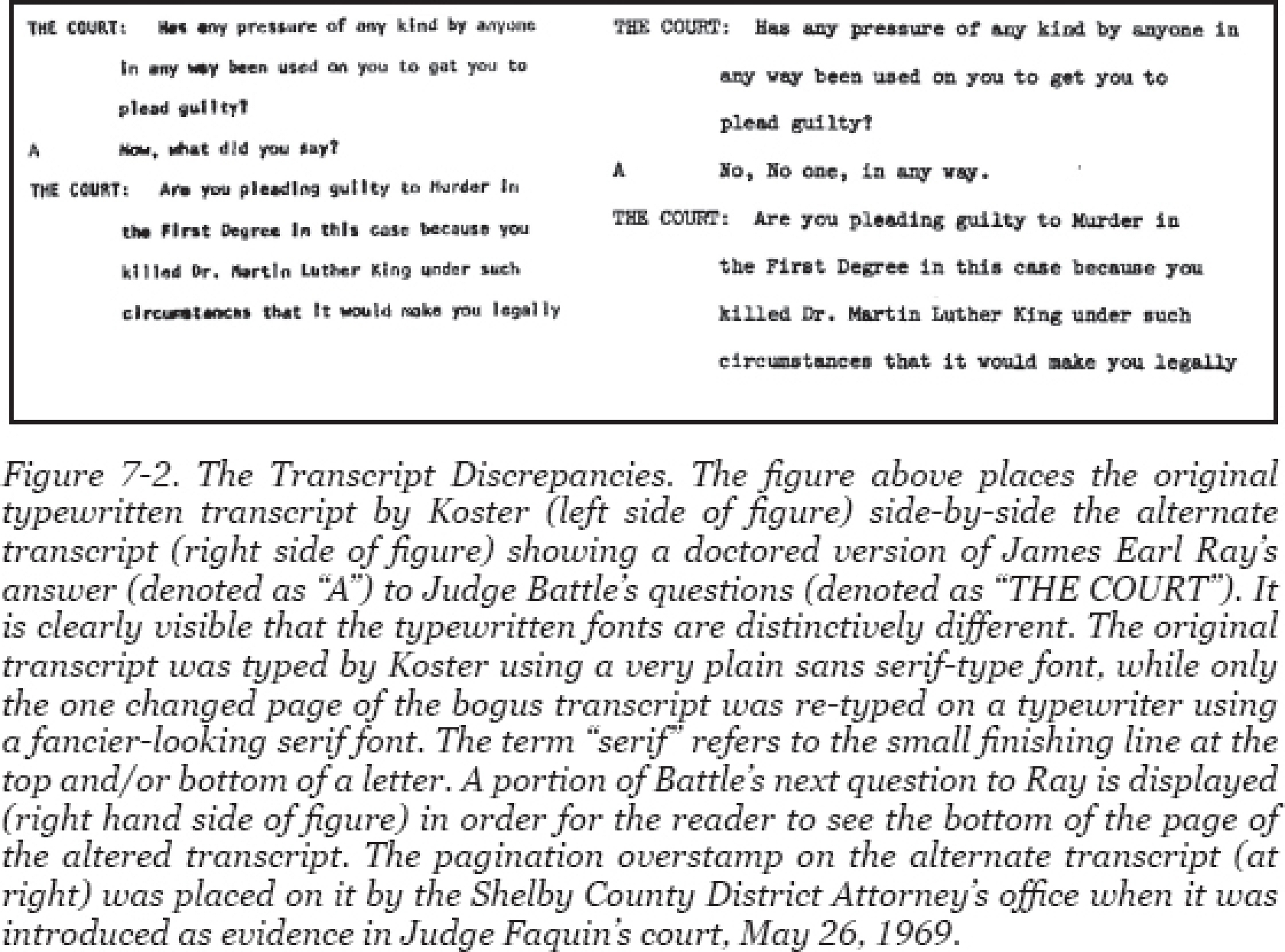
    Figure 7-2 (below) illustrates the differences between the two transcripts. The only page that was changed in the altered transcript was obviously typed on a different typewriter. Here is what the doctored transcript recorded:

    THE COURT: Has any pressure of any kind by anyone in any way been used on you to get you to plead guilty?

    ANSWER: No, No one, in any way.
    As previously indicated, the first use of the alternate transcript surfaced in the May 26, 1969 hearing for a new trial in Judge Faquin’s court. It was subsequently used in every court hearing, unchallenged by Ray’s musical-chairs string of lawyers. It was used also in the Federal courts beginning with the case of James Earl Ray v. J. H. Rose, Warden that originated in federal district court in Nashville (Middle district of Tennessee) in 1973. Ray’s attorneys filed a writ of habeas corpus, which is the legal terminology used in the first step in obtaining a federal court review of the sentence imposed on Ray in state court. The writ was denied and the case dismissed without a hearing by Judge L. Clure Morton.

    Morton justified his decision by citing specifically from the altered words of the transcript, just as Faquin had done. In fact, Morton said the counterfeit words were “central and determinative” in his decision:

    It appears to the (Federal) court that the specific central and determinative issue raised by the massive pleadings in the case is this: Were illicit pressures placed upon the petitioner [Ray] to such an extent that he did not voluntarily enter the plea of guilty? (p. 9)…

    The record of the March 10, 1969, proceedings, considered alone, shows that the petitioner [Ray] entered a voluntary, knowing and intelligent plea of guilty (p. 18)…

    To summarize this order, the factual allegations of the petitioner… are insufficient to justify a holding that petitioner’s pleas was not voluntary, knowing and intelligent. (p. 19). [10]

    Morton had no knowledge that his decision was based on a doctored, false transcript that was entered into evidence in his court by the Tennessee Attorney General’s office, which represented the State of Tennessee in Federal court. Ray’s attorneys not only allowed this poisoned transcript into evidence without objection, they never raised the issue of what Ray did, or did not say to the question about pressure.

    Jim Lesar told me he had no recollection about the altered transcript, although he thinks it may be true that there was one. He said Robert Livingston (Ray’s Memphis attorney) “particularly did not trust” the transcript introduced by the State, but has no other recollection about it. [12]

    But the damage was done in Judge Morton’s mind. Ray did not give the unequivocal negative answer to the question about pressure that Morton relied on. Morton had no way of knowing it was poisoned evidence.

    Ray’s attorneys appealed Morton’s decision to the U.S. Court of Appeals for the Sixth Circuit. The Sixth Circuit reversed Morton and ordered a full evidentiary hearing. Thereupon, Judge Morton exercised his prerogative and transferred the case to the West district federal court in Memphis where more of the witnesses were located. Judge Robert M. McRae, Jr. conducted an eight-day hearing in Memphis, Oct.-Nov., 1974.

    For this hearing in McRae’s court, the bogus transcript was “certified” as “a full complete, true and perfect copy of the transcript of March 10, 1969” by Koster. Koster’s certification is not equivalent to the court’s routine certification of a transcript, which in this case never occurred. Furthermore, we will see below that a “certified” document can be changed before it is filed with the court.

    When a court certifies a transcript it allows the lawyers on both sides to review the draft and note any discrepancies, changes, or objections. If these differences cannot be amicably resolved among the lawyers, then the court steps in and may allow oral arguments or written pleadings before deciding. A voice recording can be consulted at the option of the court. None of this ever happened with the Ray sentencing hearing transcript because Judge Battle died. So, a court clerk’s certification falls far short of the mark.

    The fact remains someone deliberately changed Ray’s answer and created the alternate transcript in order to deceive the courts and the public, and ensure that Ray would never get a full trial.

    Following McRae’s hearing, the Tennessee Attorney General’s (AG) office filed a 71-page memorandum with the court as a summary of its argument that Ray’s case should be dismissed. This document was prepared and signed by two assistants in the AG’s office, Haynes and Haile.

    Figure 7-2 (above) may be evidence of the initial effort to create an alternative transcript to Ray’s sentencing hearing. I digitally combined the bottom of page three of the Ray voir dire document and the top of page four for the convenience of getting them into a one-page figure. This figure like the previous two in this chapter is a third or fourth generation document. (All original documents were microfilmed by the Shelby County archives, then digitized, then copied by me in digital form and printed). Percy Foreman’s initials appear in the figure as they do in the real document near the bottom of page three. Ray initialed each page of this document, but his initials are lost on this particular copy. The line across the figure beneath Foreman’s initials is the page break in the actual court document. Ray and Foreman both signed the end of the document on page four.

    What’s interesting about this figure is that whomever doctored it in longhand shows the likelihood that he or she was aware of the audio recordings and listened to them, or the person was present in the courtroom March 10 1969 and near enough to Ray to hear what he said. The writer errantly penned, “legally yes” into Ray’s answers in the wrong place. Ray actually spoke the words “legally yes” as previously discussed, but not in response to the “freely, voluntarily, and understandingly” question. Rather, he gave the “legally yes” answer to the question about killing Rev. King. But just like the altered transcript, the doctored document puts the “No, no one in any way” words into Ray’s mouth in the question on pressure—words Ray never uttered.

    Arguing in this memorandum that Ray’s plea was entered voluntarily and without undue pressure, Haynes and Haile state the following: “The highest and best evidence of the voluntariness of a plea of guilty are [sic] Ray’s statements at the time the plea is entered… Some of these statements are worth repeating.” Haynes and Haile incorporated the alternate transcript version of Ray’s response to the question about pressure:

    THE COURT: Has any pressure of any kind by anyone in any way been used on you to get you to plead guilty?

    ANSWER: No, No one, in any way.

    The problem with this, as I have repeatedly stated is, this is not what Ray said. He did not utter those words, as I will explain in the following section.

    Haynes is deceased but Haile still practices law in Nashville at the writing of this book. When I interviewed him regarding the transcripts he told me, “I don’t remember anything about that.” He said, “I don’t know anything about the transcripts. Nobody ever said anything about the transcripts.”

    The memorandum prepared by Haynes and Haile referred to the alternate transcript as “Exhibit 87,” indicating that it was introduced as evidence at McRae’s evidentiary hearing in Memphis. I found this exhibit in the files of the U.S. District Court in Memphis. The page that contains Ray’s altered response is typed on a different typewriter and inserted into the document. The other 86 pages appear to be on the same typewriter. Only the page with the doctored response was changed, and nothing else was changed on the other 86 pages that appear to be duplicates of the original, see again Figure 7-1 (above).

    Haile told me he doesn’t recall anything about the source of the transcript used in Federal court: “I wouldn’t know one way or the other.” He added that Ray’s lawyers didn’t complain about its introduction as evidence. “They complained about every other thing. I’m surprised they overlooked that.” He said, “They questioned the authenticity of everything but not this (transcript).” [13]

    Koster, on the other hand, firmly recalls the details of his original transcript and knows he did not change anything about it. Even if he had changed a page, he had his own typewriter at his desk and would have retyped it on the same typewriter. Thus, the doctored page did not come from Koster.

    As for certifying Exhibit 87, the bogus transcript with the single re-typed page, Koster told me: “Of course, you know, when I certify something and give it to somebody there’s nothing that says they can’t retype it and copy it and make it look like it is part of the original. I’m not saying they did, but that’s what it sounds like.” [14]

    Furthermore, both the Blackwell and Koster sworn affidavits prove that the genuine transcript was finalized on March 10, 1969 and unchanged by either of them afterwards. Blackwell’s affidavit says, “After said transcript was distributed to news reporters on said date, I made no changes to, nor did I authorize any changes.” [16]

    Haile’s memorandum was apparently convincing because Judge McRae held that Ray’s guilty plea was entered voluntarily and he was “not coerced by impermissible pressure by Foreman.” Ray’s attorneys subpoenaed Foreman to Memphis, but being in Texas he was outside the jurisdiction of this district of federal court. Foreman was deposed by Ray’s attorneys but did not have to appear in court. McRae, using the doctored transcript that was admitted into evidence in his court ruled, “Ray coolly and deliberately entered the (guilty) plea in open court.” [17]

    Ray’s lawyers again appealed to the Sixth Circuit. This time, Judge William Ernest Miller, who had twice previously sided with Ray, unexpectedly died of a heart attack after participating in oral arguments. His death left Chief Judge Harry Phillips (a Tennessean) and Judge Anthony J. Celebrezze (former mayor of Cleveland, Ohio) on the court. The court’s ruling was clearly influenced by the bogus transcript in evidence:

    As stated, Judge Battle very carefully questioned Ray as to the voluntariness of his plea before it was accepted on March 10, 1969. Ray specifically denied at that time that any one had pressured him to plead guilty. His responses and actions in court reveal that he was fully aware of what was occurring. [18]

    The Court’s decision actually quoted Ray’s purported, but bogus response to the question on pressure: “No, no one in any way.”

    It was a mistake, but when poisoned evidence is admitted into court it always is. Whoever invented the doctored transcript accomplished precisely what he or she intended: It kept Ray in jail as the embodiment of the murderer of Rev. King. Just as the federal district courts in Nashville and Memphis, the Sixth Circuit never knew Ray’s actual answer and thus, had no way of knowing about Battle’s blunder. The U.S. Supreme Court’s refusal to hear Ray’s petition in 1976 consummated finality.

    The altered transcript created in the Shelby County DA’s office was introduced as evidence in Federal district court in Nashville in 1973. We know this because Judge Morton quoted from it in his written decision to deny a Writ of Habeas Corpus. Very little else of the paper trail of that case file remains today either with the district court or the National Archives, so there are no other documents to show who did what. Ray’s attorneys appealed Morton’s denial to the U.S. Court of Appeals for the Sixth Circuit, which reversed Morton and ordered a full evidentiary hearing. Judge Celebrezze of the Sixth Circuit quoted the same altered transcript in a dissenting opinion. Morton quickly transferred the case to Federal court in Memphis. Judge McRae conducted an evidentiary hearing that lasted eight days and denied the writ. The doctored transcript was introduced into evidence at this hearing (Exhibit 87) accompanied by Koster’s certification.

    Forensic Enhancement of the Audio Recording— “I Don’t Know What To Say.”

    The audio recordings of Ray’s sentencing hearing are available online for anyone to download from the Shelby County archives. The audio quality is very poor for several reasons. The recordings were made with Edison Voicewriter machines that cut vinyl-like records that, in playback mode, ran in the slow 15-rpm range. The technology behind the Voicewriter was 40 years old at the time the recordings were made and “probably was not suited” to the recording of court proceedings due to the fact that it had only one microphone.

    The phonograph-type records “obviously had been played so many times that it is a wonder we were able to get anything listenable off of them at all,” according to Vincent Clark of the Shelby County Archives. [19] Further diminishing the quality of the audio recordings is the fact that James Earl Ray was nowhere near the microphone when he gave his answers to Battle’s question. A few of the answers are reasonably clear, but the disputed response to the question about pressure is hard to understand. As a result, I decided to have an audio forensic expert evaluate the audio and see if Ray’s response could be enhanced.

    I sent the audio file to Sean Coetzee who is the owner of Prism Forensics LLC of Los Angeles, CA. Coetzee is a Certified Forensic Consultant by the American College of Forensic Examiners. He holds a B.A. in Music Production from Brighton University in the United Kingdom. Acting as a paid consultant, he processed the audio file to enhance its clarity. [20]

    The result of this process was an audio file that is much clearer, much less noisy, and much easier to understand Ray’s responses. And in his own voice, two things are quite clear about the disputed answer regarding pressure. First, Ray most certainly did not give the unequivocal negative answer to the question about pressure as the doctored transcript records. That is ruled out when you listen to the enhanced audio. Second, Ray clearly gave an equivocal non-answer answer to the question about pressure. In the exchange between Battle and Ray, the enhanced audio sounds like Ray answered thusly:

    THE COURT: Has any pressure of any kind by anyone in any way been used on you to get you to plead guilty?

    A [JAMES EARL RAY]: I don’t know what to say.

    Even this is open to interpretation of the final word in Ray’s answer. He either said: “I don’t know what to say,” or, “I don’t know what to think.”

    If anything, Ray’s spoken answer was even more clouded than the original Koster transcript. Koster, however, had the advantage of being present in person and only a few feet away from Ray, as well as a much clearer recording than remains today. But in either case, Ray never answered the question about pressure. If that question was important enough for Battle to ask it; if it was important enough for the district attorney and Ray’s own lawyer, Percy Foreman, to give him a scripted, negative answer a whole day in advance of the sentencing hearing; then it was important enough for the court to stop and entertain a truthful, full answer.

    Ray was off script and headed who knows where. Battle had a duty to justice to find out what was on Ray’s mind, and a duty to humanity to find out the darker truth behind Ray’s hints. Instead, in that moment he weakened and let ignorance become a substitute for truth in his court. That’s not necessarily surprising since Arthur Hanes, Jr. told me that he and his father felt Battle was under enormous pressure from outside the courtroom. He said Battle “didn’t handle it very well.” In the next three chapters we will see just how enormous the pressure really was, and from all the sources that it emanated. Perhaps Lesar put it best, Battle “blew it.”

    The HSCA’S Legacy of Using the Altered Transcript For Its Legal Analysis of Rat’S Guilty Plea

    G. Robert Blakey’s HSCA staff had it within their power to discover the altered transcript and stop the judicial charade that had kept Ray in prison without a trial, and obscured the truth from the American people. Instead of courageously blazing a trail of truth, Blakey’s staff continued a disingenuous parody of the truth.

    Blakey’s staff compiled a bibliography of 93 book and magazine titles on the MLK assassination by the time they finished their work in early 1979. [21] What they did with the bibliography is anyone’s guess since Blakey refused to say whether any staff member(s) was assigned to read them. But the bibliography is evidence of the published material that was in Blakey’s possession. Among these 93 titles includes The Strange Case of James Earl Ray by Clay Blair, Jr., and A Search for Justice by John Seigenthaler and Jim Squires. Both books accomplished what Blakey’s multi-million dollar, multi-year investigation did not: They got it right vis-à-vis the issue of the transcript.

    If Blakey had actually assigned someone to read those books and compare what those books said about the transcript, they would have discovered the alteration. Further, if Blakey had assigned someone to listen to the audio recordings of the March 10, 1969 hearing, they would have likewise discovered the problem. But Blakey did not instruct his staff to do their own diligence about the transcripts—or did he?

    Perhaps someone on the HSCA staff discovered the altered transcript and there was a deliberate order to cover it up. Blakey’s refusal to say provides no comfort to anyone who wants to believe he had nothing to do with a cover up. Yet, if Blakey had revealed that the courts had ruled against James Earl Ray based, in part, on altered evidence; this would have triggered a new round of appeals with a significant likelihood that the courts would vacate his guilty plea and order a full trial. The government’s failure to prove it had the murder weapons would have been tested in open court. The planted evidence against Ray (the green bundle that implicated him) would have been analyzed and re-analyzed. If the defense could prove the evidence was planted rather than real, a conspiracy to murder Rev. King and blame it on Ray would have been exposed. I don’t think Blakey was going to let that happen under any circumstances. Blakey turned his back to the truth.

    It cannot be disputed that the HSCA used the altered transcript in its evaluation of the evidence against Ray. After all, they quote from it right in the middle of page 316 of the Final Report:

    THE COURT: Has any pressure of any kind by anyone in any way been used on you to get you to plead guilty?

    A [JAMES EARL RAY]: No, no one in any way. [22]

    Blakey says none of these facts amount to “a hill of beans.” But he knows better. He now knows his staff relied on doctored evidence whether he knew it then or not. He now knows that a one-man investigative writer, myself, exposed what his staff did not; thus he knows how simple it would have been for his staff to do the same.

    The book may be purchased here.

    ____________________ Footnotes ____________________

    [8] Respondent’s Post-Hearing Memorandum, filed by the Tennessee Attorney General in Federal District Court in Memphis, Ray v. Rose (case C-74-166), November 29, 1974.

    [9] Interview with James H. Lesar by telephone, April 14, 2012.

    [10] Memorandum, Ray v. Rose, U.S. District Court Middle District of Tennessee, Judge L. Clure Morton (March 30, 1973).

    [11] Telephone interview with James H. Lesar, April 14, 2012.

    [12] Telephone interview with Stephen C. Small, June 4, 2012.

    [13] Telephone interview with William Henry Haile, May 17, 2012.

    [14] Telephone interview with Charles E. Koster, June 25, 2012.

    [15] Affidavit of James A. Blackwell, April 19, 2013.

    [16] Affidavit of Charles E. Koster, May 6, 2013.

    [17] Memorandum Decision, Ray v. Rose, (case C-74-166), U.S. District Court Western District of Tennessee, Judge Robert M. McRae, Jr.

    [18] James Earl Ray, Petitioner-Appellant, v. J. H. Rose, Warden, Respondent-Appellee, 535 F.2d 966 (6th Cir. 1976).

    [19] Several email exchanges between the author and Vincent Clark of the Shelby County Archives, April and May 2012.

    [20] This is Coetzee’s description of the audio enhancement process: The enhancement process was conducted in Izotope RX 2 advanced program. A band pass filter was first applied to the recording in order to reduce frequencies outside of the speakers’ vocal range. A limiter was then used to even out the volume difference between the Judge and the accused. Due to the low level of the accused voice and the amount of interfering noise, the accused voice could only be raised by a few decibels. An equalizer was then used to boost certain frequencies of the speakers’ voices for intelligibility purposes. A de-noiser in spectral subtraction mode was used to reduce the volume of interfering frequencies. An unvoiced section of the recording is used as a reference and then subtracted during the speech sections of the recording.

    [21] HSCA MLK Vol. XIII, 290-299

    [22] HSCA Final Report, 316.

  • Requiem for William Pepper

    Requiem for William Pepper


    I’ve long thought that, under normal circumstances, Hollywood would have already made a movie out of William Pepper’s first meeting with Dr. Martin Luther King. Pepper, then a photojournalist, had gone to Vietnam in 1966 and taken some of the most horrific pictures in human history – Vietnamese civilians, most of them children, burned by white phosphorus.  Those photos were subsequently published in Ramparts magazine, with a foreword by Dr. Benjamin Spock, in an article called “The Children of Vietnam.” (A few years ago I helped Dave Ratcliffe obtain a physical copy of that magazine, which he then put up on Ratical. You can find that here, although I should warn you that the photos are nightmarish.)

    That magazine found its way into the hands of Dr. Martin Luther King. Going through his mail, he opened the magazine sitting down to breakfast one morning. Moments later he said he was no longer hungry. He soon announced that he wanted to meet that photojournalist, and wound up calling him on the phone. As Pepper tells the story, he was both amazed and dubious to get the call, not less so when King asked him to speak at his church. “Why did he want this honky to address his congregation?” he thought. He had no idea what to say. Nonetheless, he did so, and he and King became friends.

    Pepper’s article was the last straw in a line that MLK had been pondering for some time. King had wanted to address the war, but that it was futile to try and address the ravages of racism and poverty without dealing with the military industrial complex. His decision to speak about it not only increased the vitriol of his enemies but alienated many of his supporters. The major newspapers, never his friend, ran open attacks on him. His brilliant speech, “A Time to Break Silence,” given on April 4, 1967, provided a political and empathetic analysis of the situation: 

    What do the peasants think as we ally ourselves with the landlords and as we refuse to put any action into our many words concerning land reform? What do they think as we test out our latest weapons on them, just as the Germans tested out new medicine and new tortures in the concentration camps of Europe?

    On April 4, 1968, precisely one year to the day after Dr. King gave that speech, he was state executed in Memphis, TN. Needless to say, Hollywood has chosen not to dramatize this final episode of the great man’s life, or the role played by William Pepper in it.

    Into this void has stepped John Barbour with a new film, A Tribute to William Pepper. Barbour is the creator of the 1970s reality series Real People, as well as two films containing important interviews with Kennedy assassination investigator Jim Garrison, The JFK Assassination: The Jim Garrison Tapes (1992), and; American Media & The Second Assassination of John F. Kennedy (2017), the latter of which I was able to see at the Texas Theatre in Dallas with a number of other researchers in a screening hosted by Barbour. Aiding Barbour on this film is Black Op Radio’s  Len Osanic, who had been a good friend of Pepper.

    This new film consists essentially of two extended interviews of Pepper, conducted by Barbour, along with an introduction by Barbour as well as cutaways for additional information and clarification on Pepper’s statements. The approach is no-frills but effective: with the first interview exploring in the main how Pepper got involved in the case; while the second interview goes through many of the details captured in Pepper’s third book on the case, The Plot to Kill King

    One thing that comes through is how remarkably well-connected Pepper was in his life. He had worked in the Bobby Kennedy senatorial campaign as his citizens’ chairman in Westchester County beginning in 1964. Then, as noted earlier, he found himself in 1966 in Vietnam, taking the photos for what would become his 1967 Ramparts article. Pepper fills in the background in response to Barbour’s questions, relating that the article was also considered for Look magazine. At that time, Look was a huge magazine, with a massively greater circulation than Ramparts, a radical leftist publication that ran articles from the Black Panthers, among others. 

    The editor at Look was William Attwood, who was sympathetic to Pepper and wanted to run the piece. Unfortunately, Attwood received a personal visit from Averill Harriman, carrying a message from Lyndon Johnson. The message? “Don’t ever publish anything by William Pepper.” Needless to say, the article was not published in Look.

    Pepper also notes that he received an opposite opinion from Attood when going out to lunch with journalist Mike Wallace, who would eventually be the face of CBS’s flagship program 60 Minutesas I’ve had related elsewhere, Wallace was partly responsible for a film called The Hate that Hate Produced, back in 1959, which both popularized and demonized Malcolm X and the Nation of Islam. Pepper says that Wallace called him a traitor for his Ramparts piece. “I almost put him through the wall,’ Pepper notes dryly.

    ***

    Following Dr. King’s assassination in April 1968, and then Bobby’s assassination two months later, Pepper found himself exhausted and understandably unwilling to continue pursuing the case. A few years later, however, around the time the House Select Committee on Assassinations (HSCA) was getting started, Mark Lane asked Pepper to look into the MLK case and represent the accused assassin James Earl Ray. Pepper met with Ray. After a ten-year deep dive into the case, Pepper was finally willing to represent Ray in 1988. In the course of his representation, he managed to arrange for Dexter King to meet with Ray.  Since this was broadcast live on TV,  it caused a stir when Dexter stated he did not believe Ray had killed his father.

    Pepper first arranged for a mock trial of Ray for HBO television in 1993. This was a well-produced and objective proceeding. This is much better than the earlier mock trial of Lee Harvey Oswald broadcast in America by Showtime. Pepper won that mock trial. Pepper’s second major achievement in representing Ray was getting a civil trial against a man named Lloyd Jowers, who was an active participant in the assassination, in 1999. The jury in that civil trial found that Jowers was responsible, along with other unnamed parties, including the U.S. government, for the murder of Dr. Martin Luther King. Naturally, of course, the media failed to report in any substantive way, on what should have been seen as an Earth-shaking outcome. In fact, they sent Gerald Posner on a media tour to try and belittle and discount the result of the trial. But yet, no less than Coretta Scott King stated: “There is abundant evidence of a major, high-level conspiracy in the assassination of my husband.” Did that make any headway? Nope. Institutional media didn’t want the story. 

    John Barbour and Len Osanic have made this a fine tribute to an accomplished and driven man. Pepper didn’t stop after Ray died. When Larry Teeter died, he later took over as Sirhan Sirhan’s attorney, the accused assassin of Robert Kennedy. The energy that kept Pepper on track is clearly evident in his exchanges with Barbour as they explore some of the details of the conspiracy that Pepper uncovered, involving both state and federal military authorities. As with his films with Jim Garrison, the conversation is the star, and it is an invaluable contribution to history. The film will be of interest to anyone looking for the truth.

    One last note.

    A few days ago, as this is written, RFK Jr. made the decision to back Donald Trump for President. I don’t wish to unpack that here, but as a result of this, his former friend Greg Palast wrote an essay blasting him. It is a startling essay for several reasons, but one paragraph stood out to me.

    Palast writes: 

    His father was murdered by Sirhan Sirhan, a Palestinian who assassinated Bobby Senior because of RFK’s vociferous, militant support of Israel. Sirhan committed the killing on television. The murder is right there on film. Yet, Bobby Jr. could not believe his own eyes and that of a million horrified witnesses. To this day, he insists Sirhan did not kill his dad. Maybe it’s some kind of denial mechanism—having to watch your own father’s head blown apart. I don’t know, I’m a scribbler, not a shrink.

    Palast has done some good work in the past. His books The Best Democracy Money Can Buy and Armed Madhouse are both worthwhile, and he wrote well about voter fraud and the Bush v Gore case. This isn’t Gerald Posner or Malcolm Gladwell or something. But for an otherwise seemingly cogent journalist to write a paragraph as uninformed and frankly idiotic as that should be impossible.

    It points to Barbour’s frequent theme of his films: the continued failure of virtually all the media to deal with its skeletons. Palast is an American who allegedly moved to England to work for the BBC so he could write honestly about the U.S. And this is his level of insight?

    When people ask “Why are you guys still going on about JFK? Or MLK? Or RFK?” This is why. Even the reporters who are supposed to be worth a damn often aren’t. Good on John Barbour and Len Osanic for continuing the fight.

    John Barbour’s film may be viewed by clicking here.

  • Hoover vs. King: The ARRB Documents

    Hoover vs. King: The ARRB Documents


    Most of us know just how bizarre and extensive J. Edgar Hoover’s obsession with the civil rights movement–and Martin Luther King Jr in particular–was. For example, in 1958, after King was stabbed during a New York City book signing, a man named Benjamin Davis donated blood for him. The FBI noted that Davis was a member of the Communist Party. (Martin Luther King Jr.: The FBI File, edited by Michael Friedly and David Gallen, p. 21) The Bureau also took note that King’s name appeared on a petition for clemency for a man who was imprisoned because of his refusal to testify before the House Un-American Activities Committee (HUAC). (ibid)

    As both Hoover and the upper level of the Bureau knew, King was not a communist in his ideology, and was never a member of that party. But Hoover was determined to use the tried-and-true tactic of guilt by association to smear King:

    Though nothing has come to the Bureau’s attention to indicate the Reverend Martin Luther King is a Communist Party member, he has been linked with numerous leftist and communist front organizations and is currently active in racial and segregation matters. (Friedly and Gallen, p. 22)

    As many observers have commented, the specter of the pitifully weak Communist Party was being used to attack liberal causes, like integration. And if this information had to be gained by breaking and entering, the FBI would do it with the Southern Christian Leadership Conference (SCLC) offices. (Curt Gentry, J. Edgar Hoover: The Man and his Secrets, p. 501) The first noted occurrence of this was in 1959. And, in a much later Justice Department review, it was revealed that the purpose was to gain information on King. It was also later uncovered that the FBI had been tapping King’s phone in Atlanta since the late fifties. (ibid)

    The conflict between King and Hoover became more direct when King wrote an article for the February 4, 1961 issue of The Nation. King argued that the FBI should be used more to combat violations of civil rights in the south. He further added that one reason it might not be was that there were so few agents of color. At the bottom of a memo on King dated May 22, 1961, this sentence appears, “King has not been investigated by the FBI.” The Director underlined that sentence and added in his usual scrawl, “Why not?” King later criticized the FBI in public for employing too many agents who were native southerners. In factual terms, that statement was not accurate. Most of the agents–seventy per cent in the south– came from above the Mason-Dixon line. (Gentry, p. 499)

    On January 8, 1962 the SCLC issued a report continuing this attack on the FBI. Most writers believe that it was this report that began Hoover’s continual assailing of King to Attorney General Robert Kennedy. Hoover’s main charge was that two of King’s supporters in the SCLC were either former or present communist agents. These were Stanley Levison and Jack O’Dell. In fact, Hoover had already spread these rumors—which turned out to be pretty much baseless—to certain politicians on Capitol Hill. (Gentry, p 503)

    When first informed of this information about Levison in 1962, through Kennedy aides John Siegenthaler and Harris Wofford, King “refused to act against the man who had been his friend and advisor for the past six years.” (Friedly and Gallen, p. 24). Levison was a wealthy attorney who gave King free legal advice and was a strong fund raiser. O’Dell worked directly for the SCLC in their New York City, and later their Atlanta, and Albany, Georgia offices. Whatever associations either man had with the CP had ended back in the fifties. (Friedly and Gallen, p. 25, 27). In fact, Levison later declared that, unlike what Hoover said about him, he was never any kind of Russian agent. He was not even a CP member. But he said he understood the worries of both Bobby and Jack Kennedy.

    They were so committed to our movement, they couldn’t possibly risk what could have been a terrible political scandal. When I realized how hard Hoover was pressing them and how simultaneously they were giving Martin such essential support, I didn’t feel any enmity about their attitude toward me. (Arthur Schlesinger, Robert Kennedy and His Times, p. 376)

    And this was a real threat. By the fall of 1962 the FBI was penning internal memos about exposing O’Dell and his CP background to various newspapers. In fact, the Long Island Star-Journal, and a few other papers, did print the story about a high-level CP member who infiltrated the SCLC New York office. (Friedly and Gallen, p. 29)

    II

    Apparently, King was sensitive to the charges. In November of 1962, with O’Dell’s consent, King announced his resignation while the SCLC did an inquiry. But King said he knew nothing about his background. King also—not altogether honestly– denied the role O’Dell had reportedly played in the SCLC up to that time. He then added that “it is also a firm policy that no person of known Communist affiliation can serve on SCLC’s staff, executive board or its membership at large.” (Friedly and Gallen, pp. 29-30) This temporary resignation later become permanent. (David Garrow, Bearing the Cross, p. 275)

    King was much more reluctant about Levison. But Levison later said that he induced King to make a direct contact break: “The movement needed the Kennedys too much.” But King managed to stay in contact with Levison through New York attorney Clarence Jones. (Ibid, Garrow.)

    Hoover now assigned Cartha DeLoach to contact King for the purpose of correcting some of his critical statements about the Bureau. Which DeLoach did try and do. But it is clear that King made up excuses to avoid talking to him. (Friedly and Gallen, p. 32)

    On January 15, 1963 DeLoach distributed a memo within the Bureau. It essentially said that King was avoiding him since he does not wish to be alerted to the facts. He then said that King had used “deceit, lies and treachery as propaganda to further his own causes….” He made reference to Levison who he called “a hidden member of the Communist Party in New York”. As some have commented, thus King may have triggered a whole new level of conflict between himself and Hoover.

    The FBI had already broken into Levison’s home in the spring of 1962. But now, in 1963, the FBI portrayed Levison as a top level functionary who was actually part of the Russian intelligence network. (Schlesinger, p. 372) This was at a time when the White House was backing King and the civil rights movement like no prior administration. In June of 1963, after a White House meeting with King and other civil rights leaders, President Kennedy took a stroll in the Rose Garden with King. (About which King observed that Hoover must be bugging JFK also.)

    During this private talk, Kennedy told King he was under strong surveillance. He asked him to remove O’Dell and Levison. He said their mutual enemies were already denouncing the March on Washington as a communist stunt. Because this administration had now tied its fate to a civil rights bill and also the upcoming demonstration, if King’s enemies shot him down, then his administration would fall with it. When King asked to see the evidence about Levison, Kennedy told him Burke Marshall—the administration specialist on civil rights– would show it to King’s assistant Andrew Young. (Schlesinger, pp. 372-73)

    Marshall met with Young at a courthouse in New Orleans. But Young remained unconvinced since all Marshall did was repeat what Deloach and Hoover were saying. (Schlesinger, p. 373) Consequently, King remained skeptical. He and Young thought this was just FBI intimidation. But as mentioned above, Levison gallantly solved the problem, and Jones provided a nexus point to avoid halting communications.

    President Kennedy was evidently satisfied with the conclusion. Feeling he had parried Hoover effectively he made a rather startling announcement on July 17, 1963. He became the first white politician in Washington to back the August 28th demonstration. He then pointedly added that there was no evidence to show that any civil rights leaders were communists, “or that the demonstrations were communist inspired.” (Schlesinger, p. 373). Robert Kennedy then wrote a letter to 2 senators saying the same thing:

    It is natural and inevitable that Communists have made efforts to infiltrate the civil rights groups and to exploit the current racial situation. In view of the real injustices that exist and the resentment against them, these efforts have been remarkably unsuccessful. (Church Committee Report, Book 3, p. 100)

    This was a direct affront to Hoover. And so the FBI said there was no way RFK could back such a definite claim. The only way to be sure was to place a tap on King’s phone. Robert Kennedy had repeatedly rejected this. But Hoover then reported that he had information that King was still communicating with alleged KGB agent Levison by telephone. (Schlesinger, p. 375) In October, the Attorney General gave in and authorized a trial tap for 30 days. If nothing came up, that would be the end of it.

    We all know what happened in November. (Harris Wofford, Of Kennedys and King, p. 217) As Kennedy’s first civil rights advisor Harris Wofford adds, all the evidence indicates—as mentioned above– the FBI had already been tapping King’s phone anyway. They just wanted a cover for it.

    III

    After JFK’s death, Hoover ripped out Bobby Kennedy’s private line into his office. Even though there was never any evidence of communist affiliation, Hoover kept the tap on King’s home phone until the middle of 1965. The FBI then added taps on 21 microphone settings in various King hotel and motel rooms. (Schlesinger, p. 375). One can write with justification that, once Hoover knew he did not have to deal with Robert Kennedy, the dam broke. As author Kenneth O’Reilly wrote, by the summer of 1964 the Bureau was not just focused on King, but had expanded its operations and surveillance to all civil rights leaders, indeed to all civil rights related events. (Racial Matters, p. 140)

    Whereas Robert Kennedy had demanded that Hoover recall a memo that the FBI had prepared attacking King, this defiance of the Director did not succeed under successors Nicholas Katzenbach or Ramsey Clark. (Schlesinger, pp. 376-77) One probable reason being that President Lyndon Johnson had a long and warm friendship with the Director.

    Hoover now set up a special desk at the Internal Security section with two supervisors to coordinate what he termed Communist Influence Racial Matters inquiries (CIRM). And he instructed them to use the rubric “communist” in the broadest view. (O’Reilly, p. 140). But the problem was the FBI struck a dry well with Levison and his alleged communist angle. Even though they burglarized Levison’s home at least 29 times between 1954 and 1964. (O’Reilly, p. 141)

    In fact, King took his issue with this to the public in 1964. During a press conference on May 10, 1964 he began to echo what the Kennedys had said in public, but without their private fears: “It is time for this question of communist infiltration t be buried all over the nation.” Fellow activist James Farmer then added, “Communism is based on a denial of human freedom. It’s tough enough being black without being black and red at the same time.” On July 23rd in Jackson, Mississippi King said he was:

    …sick and tired of people saying this movement has been infiltrated by communists and communist sympathizers…There are as many communists in this freedom movement as there are eskimos in Florida.

    Therefore, Hoover now switched to character assassination. During a November 1964 meeting with a group of women reporters, Hoover called King “the most notorious liar in the country”. (O’Reilly, p. 142) Even though DeLoach was there and tried to get Hoover to take that comment off the record, Hoover would not.

    In March of 1964, the FBI became cognizant that Marquette University was going to honor King with an honorary degree. The Bureau sent agents to tell them about all the derogatory information they had on him. The same thing happened at Springfield College. (Friedly and Gallen, p. 42) Around the end of the year, the FBI recruited its first informant in the SCLC, an accountant named James Harrison. (Garrow, p. 468)

    When Time magazine named King its Man of the Year at the end of 1963, Hoover wrote on a 12/29/63 UPI press release, “they had to dig deep in the garbage to come up with this one.” (O’Reilly. P. 136) But Hoover really went bonkers when it was announced that King, at age 35, would be awarded the Nobel Peace Prize for 1964 in Oslo—along with a cash award of almost $55,000. The honor was “for his non-violent struggle for civil rights for the Afro-American population.”

    IV

    That award would be formally bestowed at the end of 1964. Between the Time magazine honor and the Nobel announcement in the fall King made a speech in San Francisco. It was quite frank and indicated King had had it with the communist infiltration ploy:

    It would be encouraging to us if Mr. Hoover and the FBI would be as diligent in apprehending those responsible for bombing churches and killing little children as they are in seeing our alleged communist infiltration in the civil rights moment. (FBI memo of 4/23/64)

    In a memo from Alan Belmont to William Sullivan, it was revealed that Division Five was working on material which was being pushed and will be given to Hoover for his consideration (Belmont to Sullivan 4/23/64, with 2 pages denied in full) Hoover had Division Five Chief William Sullivan and DeLoach distribute tapes and transcripts of what they alleged to be King’s philandering in various hotel rooms. (O’Reilly, pp. 137-38). Division Five had the FBI lab make a composite tape of alleged highlights of various hotel bugs and taps. DeLoach offered a copy of a transcript to Ben Bradlee, who was then the Washington bureau supervisor for Newsweek. Bradlee turned down the offer. When Burke Marshall heard of this through Bradlee, he warned President Johnson about it. But Johnson did something rather weird. He reacted “by warning the FBI about Bradlee. He was unreliable, the president said, and was telling the story all over Washington.” (Ibid, p. 144) The same offer was made to the Atlanta Constitution editor, Eugene Patterson. Who also refused to listen. (Friedly and Gallen, p. 51)

    Marshall then warned White House advisor Bill Moyers that Hoover was trying to smear King through the media. Moyers informed the FBI White House liaison about it. Hoover now did something really bizarre. He accused Marshall of being a liar. In fact, Hoover ordered one of his aides to call Marshall and tell him just that. (Wofford, p. 220). What is notable about this is that it is before Johnson’s escalations of the Vietnam War in early 1965. Meaning the King/Johnson relationship was going to get even worse.

    This all culminated with the notorious letter that Hoover had Sullivan compose in November of 1964. Some have written that the implicit threat was that King had no way out except to take his own life. But FBI defenders, and Sullivan himself, replied that it was really meant to get King to step aside as leader of the SCLC. It partly reads as follows:

    King, look into your heart. You know you are a complete fraud and a great liability to all of us Negroes…King, like all frauds, your end is approaching. You could have been our greatest leader…But you are done…No person can overcome facts. The American public, the church organizations that have been helping—Protestant, Catholic and Jews, will know you for what you are…So will others who have backed you. You are done…there is only one thing left for you to do. You know what this is. (O’Reilly, p. 144)

    The FBI enclosed the compilation tape with the letter. The package was mailed from Miami to the Atlanta office of the SCLC. This was shortly before King was to fly to Oslo to accept the Nobel. Around the same time, November 24th, Hoover made a strong speech against King. This time indirectly accusing the SCLC of being run by “communists and moral degenerates.” (ibid)

    King later noted, after reading the letter and hearing the tape, it was clearly from the FBI. And this was a war in which, “They are out to break me.” (Friedly and Gallen, p. 49)

    V

    But it was not just in America that the FBI declared war on King. The ARRB declassified papers dealing with this overseas battle. Researcher Gary Majewski has sent me many of them. The FBI was determined for King’s Nobel journey to Scandinavia to have little or no impact on the leaders of Europe. These documents deal with cables and airtels from the FBI to intelligence centers in Europe, especially England. They were designed to poison any planned meetings between King and European public officials. What is so startling about these documents is that, as bad as they are, they are still heavily redacted: whole pages have been denied. But from what was left unredacted, some of the tale can be revealed.

    It appears that somehow, some way, the FBI found out just how King would journey to Oslo. Bayard Rustin, one of the organizers of the March on Washington, was acting as an ad hoc advance man. The Bureau seemed to have had a spy in Rustin’s camp. The FBI knew when Rustin would be departing and they knew who he would be contacting to arrange meetings with luminaries in Europe. (FBI Cablegram of 11/10/64) One of these people appears to be Labor Party member Peggy Duff. Rustin apparently wanted Duff to arrange for a meeting with a higher up—his identity is redacted. The Bureau’s objective was to try and get to these higher ups in advance in order to smear King as

    …surrounded by numerous advisors having present or former communist connections. He has maintained an association with and received guidance and counsel from secret Communist Party USA members, notwithstanding advice to King about their communist backgrounds. (ibid)

    This information, plus a smear of Rustin, was to be forwarded to MI 5– roughly the equivalent of the FBI in England. The Bureau actually wanted this info to be sent to Prime Minister Harold Wilson. The excisions are clearly noted as being in connection “with efforts being made by King to see British Prime Minister Harold Wilson when King passes through London enroute to Oslo…”

    Amazingly, the information did get to Wilson though MI 5 official Roger Hollis. Hollis then furnished the FBI with data about Rustin’s arrival, where he would be staying, and that MI 5 would cover Rustin’s activities and report to FBI. (Airtel of 11/13/64) The Bureau also made plans to brief the American ambassadors in London, Copenhagen, Stockholm and Oslo about the same matters. This was being done to discourage any attempt to make King a guest of honor. (FBI Memo of 11/13/64 and memo of 12/10/64). This effort ended up being at least partly effective. The American ambassador in Stockholm had planned on meeting King at the airport. He now decided to send a representative.

    In another FBI memo of 11/24/64 the State Department is enlisted to briefing the USIA on the smears of King, including information about King’s alleged immoral conduct. When Belmont heard the USIA was in agreement, he went ahead and approved the FBI reports and sent memos to that body.

    How an FBI Director was allowed to interfere or even become involved with foreign affairs is, to say the least, a very problematic question. How he was allowed to send salacious material to representatives of intelligence agencies, and to ambassadors, is a little disgusting. And that this whole story has yet to be fully revealed in 2023 is appalling. There is an inter-agency meeting of 12/8/75 between the FBI and the Justice Department on King that is nine pages long. There is no ARRB cover sheet on it. And it is almost completely whited out.

    We all know how this ended. King was shot in Memphis in April of 1968. When that news was broadcast, the agents in the FBI office shouted, “They got Zorro! They finally got the SOB!” When further word came that King was dead, “One agent literally jumped up and down with joy.” (Gentry, p. 606)

    What Hoover was trying to do with his war against King was to make him so radioactive as to split him off from other civil rights leaders. (FBI Memo from DeLoach to Mohr, 11/27/64) Prior to that, as Harris Wofford has pointed out, what Hoover was also trying to do was drive a wedge between King and Bobby Kennedy.

    Bobby Kennedy was killed in June of 1968. Early in the year, Hoover’s close friend Clyde Tolson had wished for this to happen. (Gentry, p. 606) But that was not enough. During Kennedy’s televised funeral, Ramsey Clark was drawn aside by an FBI agent. The FBI knew that Scotland Yard had captured alleged King assassin James Earl Ray the night before, but they had refused to hold the story. In fact, DeLoach had told an FBI asset the night before about it. Therefore, the media was distracted by the apprehension of Ray during the RFK funeral. (Ibid, p. 607) How could anyone trust any FBI inquiry into either man’s death?

    Hoover’s mania later spread to all black nationalist movements. Urged on and abetted by Richard Nixon’s manipulation of white backlash, he approved COINTELPRO operations against the Black Panthers. By 1969 Hoover was investigating every chapter of the Black Panther Party and over a thousand members, and also those Hoover considered sympathizers. (O’Reilly, p. 298) Many commentators hold Hoover responsible for the decimation of that group e.g., the framing of Panther Geronimo Pratt and the death of Chicago leader Fred Hampton. (See, O’Reilly, Chapter 9)

    It is a sorry story, this tale of FBI perfidy and its war on a civil rights leader. Hopefully, one day, it will be able to be seen in its entirety, without being expurgated.

    Do we need an ARRB on the King case?

  • The Media Buries the Conspiracy Verdict in the King Case


    From the January-February 2000 issue (Vol. 7 No. 2) of Probe


    (Click here if your browser is having trouble loading the above.)

  • Is the King Case Dead? Murder in Memphis—Again


    From the January-February 1998 issue (Vol. 5 No. 2) of Probe


    (Click here if your browser is having trouble loading the above.)

  • Martin Luther King’s Son Says: James Earl Ray didn’t kill MLK!


    From the May-June, 1997 issue (Vol. 4 No. 4) of Probe


    (Click here if your browser is having trouble loading the above.)

  • Jerry Ray Sounds Off


    From the July-August, 200 issue (Vol. 7 No. 5) of Probe


    (Click here if your browser is having trouble loading the above.)

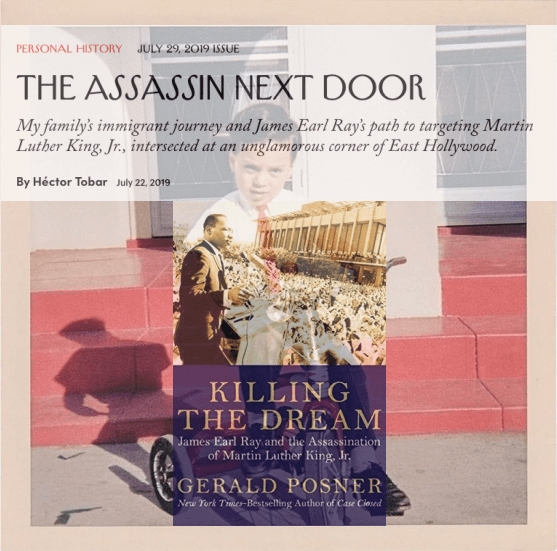
  • The Assassin Next Door Focuses On the Wrong Target

    The Assassin Next Door Focuses On the Wrong Target


    This past July, venerable The New Yorker Magazine, as part of an ongoing series captioned Personal History, published “The Assassin Next Door”, by Hector Tobar. The relatively short essay reflects a contemporary trend by using biography to negotiate the intersection of personal identity within larger cultural currents. Here, the author reflects on the individual trajectories of his Guatemalan immigrant parents and himself, born and raised in Los Angeles in the late 1960s, in a set contrast to the life and personal trajectory of the officially designated assassin of Martin Luther King, James Earl Ray. Ray, apparently, lived for a period of time in the same East Hollywood neighbourhood as Hector Tobar, a fact revealed by his reading Gerald Posner’s book on the MLK assassination Killing The Dream (1998), which he describes as an “excellent reconstruction of Ray’s life and King’s murder.”

    Cued by the Posner book, Tobar understands Ray as holding “an abiding hatred of black people” and who murdered King “in the name of white supremacy.” His pathology assumes an essentialist nature—“his whiteness meant that he deserved better than what he had”—from which the author can free associate: “I felt Ray’s presence on the building’s front steps, beneath a stunted palm tree. I imagined his ghost lurking about, disgusted at the polyglot city around him, and raging at the futility of his act of murder.” The function of this essay, it seems, is a sort of riff on various levels of meaning imbued by racial identity in America. It is Tobar’s “personal history” in conjunction with Gerald Posner’s version of James Earl Ray.

    James Earl Ray himself consistently denied holding a racist viewpoint. Those who met him during his thirty-year struggle to clear his name, including members of MLK’s immediate family, did not believe Ray to be a racist. The racial angle, such as it was initially applied, could be considered a conclusion arrived ahead of the evidence—a useful conclusion which promoted a motive for the assassination (other than a rumoured bounty), assigned to a man who otherwise lacked one. Posner also seems to start from this position, as he builds his portrait through uncorroborated statements of men who were Ray’s fellow prisoners, and over-emphasis on certain ambiguous details (such as presumed campaign work for George Wallace, discussed below).[1]

    How is it possible, in the year 2019, that an author such as Gerald Posner—whose work has been variously criticized for plagiarism, non-existent sourcing, bias, and misrepresentation of the documented record—could be considered by anyone as an “excellent” resource for historical understanding?[2] Posner’s notorious Oswald-lone-nut book Case Closed (1992) had been roundly criticized for its factual errors and fake interviews and was described by academic David Wrone (who was interviewed by Posner) as “one of the stellar instances of irresponsible publishing on this subject.” In both of his books on the 1960s political assassinations, Posner assumes the role of plucky investigator even as he presents a prosecutor’s brief, emphasizing the points which support his case and downplaying, if not ignoring, the evidence which doesn’t. Both books were timed to be released on the thirtieth anniversaries of their central event and both books became heavily promoted in the mainstream establishment media. In the case of Killing The Dream, as reporter Mike Golden put it, Posner’s legacy “is that his bogus narrative of what happened in the MLK case has become the traditional hack standard of what the (mainstream) media will allow to be considered what really happened in Memphis, April 4, 1968.”[3]

    In the mainstream media, Posner’s “bogus narrative” received rave four-star reviews. Anthony Lewis, for example, writing in the New York Times Book Review, effused that Killing The Dream was “a model of investigation, meticulous in its discovery and presentation of evidence, unbiased in its exploration of every claim.”[4] In the Times itself, Richard Bernstein praised it as “the most comprehensive and definitive story of the King assassination”.[5] This trend line continues in most all the contemporary reviews and related content, which served as the only coverage most Americans would be exposed to. These reviews, particularly from the core establishment newspapers, would create a “seal of approval” of Posner’s scholarship, largely determined by reviewers who themselves knew little of the case beyond what appeared in the book itself. The “seal of approval” carries on through the years, presumably informing Tobar’s characterization of excellence two decades later.

    A more savvy reader of Killing The Dream, understanding this is contested subject matter, would eventually pick up on Posner’s evasiveness despite his posture of certainty, particularly as applied to problematic witnesses and Ray’s contradictory behaviour. For a book praised for its biographical portrait of an assassin, the James Earl Ray presented is curiously meticulous and crafty when necessary, but lazy and drifting otherwise. Posner, in general, fails to apply honest reflection on Ray’s odd meandering journeys in 1967-68, preferring to first dismiss speculation and then speculate on what “likely” happened. A reader’s tolerance for such tactics depends on the extent the mainstream establishment’s endorsement of Posner’s investigative prowess holds sway. A sceptical attitude seems invited by his divergent descriptions of Ray as either settled in obscurity or a desperate fugitive, which serves to rationalize behaviour which never really ties together in his earnest account.

    For example, Posner steps very carefully around the salient coincidence that three of Ray’s aliases, beginning as he arrived in Montreal on July 18, 1967, were actual persons living in close proximity on the outskirts of Toronto. He argues Ray must have randomly “stumbled across” the Eric Galt name and speculates the other two were found by perhaps consulting old birth notices and phone books. The account of Ray’s quick journey from Los Angeles to New Orleans and back in January 1968 presents a jumble of motivations from participants who all seem to possess reason to be less than forthright, which doesn’t prevent Posner from highlighting the least plausible scenario as it fits seamlessly with the “white supremacist” narrative (and which Tobar jumps on).[6]

    Later on, Posner announces his intention to directly confront the fact that the only witness to place Ray near the rooming house bathroom at the time of MLK’s shooting was falling down drunk (or “less than sober” as he prefers), but he never actually does. Instead, he switches attention from Charlie Stephens’ alcoholism to Grace Waldron’s alcoholism and mental health issues and manages to make her the unreliable witness, even as the most important fact is it is Stephens’ inebriation that afternoon which calls his ID of Ray into question. That Posner must frame this entire section as responses to legal arguments made by Ray’s representatives over the years should alert any reader that his book is functioning as a prosecutorial argument rather than investigative objectivity.

    In fact, Killing The Dream eventually becomes so focussed on answering issues raised by Ray’s then attorney William Pepper, who would later represent the King family during the 1999 civil trial, that serving as a public rebuke to Pepper appears one of the book’s operative functions. Contemporary reviewers evidently picked up on this. The Washington Post Book-World noted that “members of King’s family are among the many who doubt that Ray had anything to do with it…Posner has taken on the task of liberating everyone from surmises.” The Tampa Tribune used its review to editorialize: “The King family should read Killing the Dream instead of asking the Justice Department to open a new investigation into the assassination.” If the wide publicity afforded Posner’s book had the effect of pre-conditioning the public to pay less attention to the King family’s efforts, that may have been its intention all along. The federal Department of Justice did not participate in the civil trial, and rather conducted its own review which actually referred often to Posner’s work, epitomizing the effort to shut the door on inquiry and understanding.

    Ironically or not, in his New Yorker piece Tobar relates a facet of his own personal history while, following Posner, withholding the same privilege to the late James Earl Ray, other than one filtered through presumed malignancies such as racial bigotry and “supremacy”. To be sure, Ray, on his own admission, would prove to be an unreliable narrator, such that it is difficult to really know his own motivation or reasons for anything, but the racist angle seems particularly contrived and void of hard corroborating fact. Of course, imbuing Ray with the stigma of white supremacy as determinedly as Posner does allows the negative trait to be embodied solely with the alleged assassin, such that the messier reality can be neatly sidestepped: federal and local police forces of the time were racially biased as well. If Ray’s supposed date with destiny was motivated by his innate prejudice, as Posner seems to argue, then why does the same motivation not hold for provably biased figures in the FBI or Memphis police? That Tobar does not ask that question is not entirely his fault, as it takes a fair amount of inquiry from different sources to understand it is a question worth asking in the first place. Subtle conditioning favouring establishment voices and narratives often, consciously or not, promotes deferral to whatever history the New York Times says is worth four stars. As Douglas Valentine put it : “Was institutionalized, government-sanctioned racism one of the reasons Dr. King was assassinated? You bet it was.”[7] That it is these institutionalized forces which are more in alignment with, for instance, the pressures which caused Tobar’s parents to flee Guatemala in the first place than an allegedly racist lone-nut career criminal ever could be—well, there’s a personal history also worth mulling over.

    It’s worth noting that, along with The New Yorker’s casual promotion of one side of a disputed narrative, this past summer witnessed a renewed wave of calls for various levels of censorship and fact-vetting directed at social media platforms, culminating recently in Twitter’s announcement it would not accept political advertising during the US 2020 political campaign. Two years previously, Google had announced a change in its search algorithms to promote “authoritative sources” over “alternative viewpoints.” Facebook’s CEO Mark Zuckerburg, not a free-speech firebrand, was shouted down in the mainstream media after publicly declaring “I don’t think it’s right for a private company to censor politicians or news in a democracy.” This has sparked a debate about money, politics, and free speech which has itself been largely detached from the factual realities of the intersection between the three in the real world. A deliberate focus and over-emphasis on “crazy” marginal (and marginalized) points of view has had the effect of implicitly endorsing the authority of the establishment, which is responsible for the overwhelming majority of political advertising. The point is, ultimately, not to reduce the level of spending on information management, but to reduce voices and viewpoints through vetting against “fake news” or unauthorized expression. The vetting of Gerald Posner two decades ago should caution against mis-attributed faith in establishment institutions to be somehow trustworthy.

    A groundswell of support for critical thinking and media literacy programs in the education system seems called for. Instead, a fear has been cultivated, most often by college-educated liberals, of “lies” and “fake news” lurking unseen in the water, producing an “incredibly dangerous effect on our elections and our lives and our children’s lives.”[8] Average citizens, it is declared, are not able to “discern the veracity of every political ad” and should therefore be protected from fake news in favour of the “diplomats, intelligence officers and civil servants” which “provide the independent research and facts” which are “legitimate”.[9] The New Yorker itself joined the fray, knocking Facebook for creating “the world’s biggest microphone” only to allow access for “liars, authoritarians, professional propagandists, or anyone else who can afford to pay market rate.” It is then noted approvingly that Facebook recently announced its own “official news tab…where users can find high-quality news from trusted sources”, (which, it turns out, includes The New Yorker).[10] One might get the impression that the lack of a level playing field or abandonment of professional journalistic practice is not the real concern of these self-appointed gatekeepers, it is the loss of control over the creation and reinforcement of official narratives which must be restored.

    Similarly, the term “conspiracy theory” has recently returned to some prominence, serving as an evil twin of sorts to the scourge of “fake news.” The week before “The Assassin Next Door” appeared in the New Yorker, NBC’s website featured a generalized thesis attacking “conspiracy theorists” written by Lynn Stuart Parramore, PHD,[11] which conflated the Moon landing, lizard people, and the assassinations of the 1960s while faithfully parroting—knowingly or not—a number of the directives offered by the infamous 1967 CIA memorandum on the topic.[12] Attempting to redefine the alleged “problem” as based in psychological deficiencies and narcissistic traits, Parramore rather encourages the normalization of the “paranoid style” she warns about, as the utterance of “conspiracy theory” ( or non-vetted information) becomes associated with a form of mental illness, just as the latest federal judicial theories encourage active “disruption” of “potential threats” based in part on “symptoms of mental illness.”[13] Through their own blinkered logics, the liberal intelligentsia in America are setting the foundation stones for exactly the country they claim they are trying to prevent. Critical thinking skills and clear-minded analysis remain the best tools moving forward.


    [1]On Posner’s investigative techniques see Mike Vinson “Nailed To The Cross: Gerald Posner on the King Case” Probe Magazine Vol. 6 No. 3 https://kennedysandking.com/martin-luther-king-reviews/nailed-to-the-cross-gerald-posner-on-the-king-case

    [2]Jim DiEugenio “He’s Baaack! The Return of Gerald Posner” https://kennedysandking.com/martin-luther-king-reviews/he-s-baaack-the-return-of-gerald-posner

    [3]Mike Golden “Assassination By Omission: Another Look At Serial Plagiarist Gerald Posner” Exiled Online Sept 30, 2010 http://exiledonline.com/assassination-by-omission-another-look-at-serial-plagiarist-gerald-posner/

    [4]Anthony Lewis “Beyond A Shadow of a Doubt” New York Times Book Review April 26, 1998 https://archive.nytimes.com/www.nytimes.com/books/98/04/26/reviews/980426.26lewist.html

    [5]Richard Bernstein “‘Killing The Dream’: Ray Was King’s Lone Assassin” New York Times April 22, 1998 https://archive.nytimes.com/www.nytimes.com/books/98/04/19/daily/posner-book-review.html

    [6]Tobar writes, following Posner’s lead: “In December, 1967, Ray visited the North Hollywood Presidential-campaign office of George Wallace, the former governor of Alabama, who had become a folk hero among segregationists… Ray had gathered signatures to help get Wallace on the California ballot.” Rather than “gathering signatures”, Ray claimed he stopped at the Wallace office on the request of his passengers, just ahead of the New Orleans trip. One of these passengers claimed to the FBI that Ray appeared very familiar with the office, but subsequent investigation cast doubt on this. It was suggested that Ray offered to cover the expenses to New Orleans in return for his acquaintances registering with Wallace, but that is possibly if not likely a weak rationale for behaviour and motivations the participants prefer to be less than honest about. There is no other instance of overt political activity on behalf of Ray. Posner acknowledges the overall sketchy milieu of this incident.

    [7]Douglas Valentine “Deconstructing Kowalski” Probe Magazine Vol. 7 No. 6. https://kennedysandking.com/martin-luther-king-articles/deconstructing-kowalski-valentine

    [8]Aaron Sorkin “An Open Letter To Mark Zuckerburg” New York Times October 29, 2019 https://www.nytimes.com/2019/10/31/opinion/aaron-sorkin-mark-zuckerberg-facebook.html

    [9]Thomas Friedman “Trump, Zuckerburg, and Pals Are Breaking America” New York Times October 29 2019 https://www.nytimes.com/2019/10/29/opinion/trump-zuckerberg.html. Note that The New York Times had been at the forefront of promoting two of the most consequential instances of “fake news” in this young century—Iraq WMD and Russiagate.

    [10]Andrew Marantz “Facebook and the Free Speech Excuse” The New Yorker October 31, 2019 https://www.newyorker.com/news/daily-comment/facebook-and-the-free-speech-excuse. Note that The New Yorker, not shy to publish reflexive support for one side of contested official narratives as discussed above, also bought into the empty Mueller / Russia collusion narrative with some enthusiasm.

    [11]Lynn Stuart Parramore “From Trump to Alec Baldwin, Conspiracy Theories, Narcissism, and Celebrity Culture Go Hand In Hand” https://www.nbcnews.com/think/opinion/trump-alec-baldwin-conspiracy-theories-narcissism-celebrity-culture-go-hand-ncna1029941

    [12]thelastheretik “CIA Memo 1967: CIA Coined & Weaponized The Label ‘Conspiracy Theory’” https://steemit.com/history/@thelastheretik/cia-coined-and-weaponized-the-label-conspiracy-theory

    [13]Whitney Webb. “AG William Barr Formally Announces Orwellian Pre-Crime Program” Mint Press News, October 25, 2019 https://www.mintpressnews.com/william-barr-formally-announces-orwellian-pre-crime-program/262504/

  • Garrow’s Interpretive Guesswork Presumes the Worst

    Garrow’s Interpretive Guesswork Presumes the Worst


    As everyone who reads this web site knows, the attempt to smear the four people that it focuses on—JFK, RFK, Malcolm X and Martin Luther King—is an ongoing affair. The idea is to indulge in character assassination, and few organizations are better at it than the FBI and CIA. Occasionally a lower body like the Los Angeles Police Department will dip into the dirty waters. For instance, before he passed on LA assistant DA John Miner called a press conference to publicize tapes that were supposed to reveal a relationship between President Kennedy and Marilyn Monroe. This story was eagerly picked up domestically and universally misreported. Miner did not have tapes. He had notes on tapes and some observers have shown his notes turned out to be dubious (see this article).

    Longtime Martin Luther King scholar David Garrow has written a new and controversial essay on King, informed by an interpretive analysis of recently released FBI documents. The documents, according to Garrow, reveal darker and more troubling character flaws to the revered civil-rights icon which require, according to Garrow, a harsh reevaluation of King’s personal legacy. By accepting the veracity of summaries of FBI surveillance transcriptions from the mid-1960s, Garrow is using material which cannot be verified to, in effect, publicize the ugliest features of the FBI’s acknowledged campaign to discredit King. This question of veracity led to the essay’s rejection by major mainstream news outlets such as, among others, The Guardian and Washington Post, to whom an apparently determined Garrow had been offering his essay since late last year. The essay has since been published by a lesser-known British online journal called Standpoint.

    There is nothing, on the surface, factually incorrect in Garrow’s presentation, as links to the documents in question confirm the accuracy of his source quotations. The controversy, and an accompanying peer rejection, rests on Garrow’s stated belief that the material as presented represents an accurate objective rendering of the content of surveillance audio tapes and their transcriptions, currently stored under seal at the National Archives. These items are not scheduled for release until 2027 and Garrow himself did not have access to them. In context, as Yale historian Beverly Gage noted in response to Garrow’s claims: “This information was initially gathered as part of a deliberate and aggressive FBI campaign to discredit King. That doesn’t necessarily mean that the information is false. But it does mean that we should read the documents in that context, understanding that the FBI was looking for information that it could weaponize, and was viewing events through the lens of its own biases and agenda.”1

    John Hopkins University professor Nathan Connolly struck a similar theme: “If the FBI had had information about King having been party to a sexual assault or observing a rape, that would be exactly the kind of information they would have used to bury him. The fact that this had not come to light and was not used for any previous campaign to discredit King gives me pause about considering it a credible accusation.”2

    Garrow’s essay, as published by Standpoint, is titled “The Troubling Legacy of Martin Luther King”, with a sub-heading proclaiming “Newly-revealed FBI documents portray the great civil rights leader as a sexual libertine who ‘laughed’ as a forcible rape took place.”3 This alleged incident, supposedly occurring at Washington, D.C.’s Willard Hotel in January 1964, has been the most referenced “revelation” following publication. Other incidents highlighted by Garrow include supposed “orgies” at both the Willard and in Las Vegas, a possible illegitimate child, and references to numerous supposed liaisons with individual women in various locales. While the latter information has been generally known for some time, and has been understood in the context of severe violations of personal privacy by the FBI, Garrow now maintains that the number of alleged sexual partners, as revealed in the new documents, shocked him and has forced his reevaluation: “I always thought there were 10 to 12 other women. Not 40 to 45.”4 The FBI documents, however, appear to describe any female acquaintance of King as a “girlfriend”, and assume any private meeting as a sexual liaison.

    King, it is apparent, did maintain intimate friendships outside of his marriage. This has been noted for decades, most recently in the three volume biography by Taylor Branch, who did not rely on FBI documents alone to present his case. These friendships were lasting and involved the mutual consent of adult persons. These friendships, in other words, were the private business of individuals and are largely none of anyone else’s business. If King had been publicly advocating against sexual activity or assumed a position of strict morality, then revelation of a core hypocrisy would be of public interest. That is not the case here, and the revelations over the years have been rightly seen as an attempt to discredit King and blunt his influence. Garrow’s new presentation of King as a selfish perverse “libertine” who would react indifferently or even encourage sexual assaults is an outlier, and it is worthwhile taking a closer look at the documentation he claims supports this position.

    Willard Hotel

    Garrow’s most explosive claim involves a sexual assault which allegedly occurred at the Willard Hotel in Washington D.C. in early January 1964. King and an accompanying party travelled to Washington to monitor a Supreme Court hearing which involved a large punitive fine directed by a state court against several colleagues. King and his party had reserved two rooms at the Willard, information which made its way to the FBI.

    The Church Committee interviewed former Special Agent Wilfred Bergeron of the FBI’s Washington field office in June of 1975. Bergeron described being instructed by FBI Assistant Director William Sullivan to bug the King party’s rooms at the Willard Hotel: “(Bergeron) advised that he had placed a transmitter in each of two lamps and then through the hotel contact, it was arranged to have the housekeeper change the lamps in two rooms which had been set aside for King and his party.”5 Two nearby rooms held FBI agents, wireless receivers, and tape recorders. Bergeron told the Committee that, at the time, he only listened briefly to the transmissions to check that they were functioning properly. He was also asked if he ever reviewed logs or transcripts of these recordings, to which he replied he “probably” had, but could not recall any of the content.

    Having described the King party as a “variety of ministerial friends”, Garrow then refers to the recently released documents’ description of the assault: “On January 5, 1964, King and several SCLC officials checked into the Willard Hotel in Washington, D.C. In a room nearby was a Baptist minister from Baltimore, Maryland, who had brought to Washington several women “parishioners” of his church. The group sat in his room and discussed which women among the parishioners would be suitable for natural or unnatural sex acts. When one of the women protested that she did not approve of this, the Baptist minister immediately and forcibly raped her.” A handwritten note next to the typewritten text states “King looked on, laughed, and offered advice.” An FBI file number is typed below (100-3-116-762).

    Garrow identifies the Baltimore minister as King’s friend Logan Kearse, and also claims that Kearse was staying “in one of the two targeted rooms.” Garrow insists the alleged assault was therefore tape-recorded and the description of the event appearing in the document must have been derived from the transcription of the recording. This is by no means a sure thing, and it is not clear how Garrow could have arrived at such an assertion other than a series of assumptions. The FBI’s description quoted above differentiates “King and several SCLC officials” checking into the hotel, from Kearse who is said to be in a “room nearby”. Further, Bergeron “probably” reviewed transcripts from the two rooms, but could not recall a sexual assault, even as he knew King specifically was being targeted by senior FBI officials.

    The description of the January 5 alleged incident also does not include any specific quotation of recorded dialogue, unlike a description of events the following evening (January 6) which the document turns to next. In this instance, according to the text, a dozen persons “nearly equally divided between men and women and including King, officers of the SCLC, and others bearing the title of ‘Reverend’—participated in a sex orgy. Excessive consumption of alcohol and the use of the vilest language imaginable served only as backdrop to acts of degeneracy and depravity … Many of those present engaged in sexual acts, natural as well as unnatural.” Dr King is directly quoted twice in reference to “unnatural” sexual acts. This event, then, may well have been recorded, but whether the activity constituted an “orgy” or is better described as a group of persons unwinding over drinks and bawdy discussion cannot be determined at this time. What specifically from the presumed audio recording led investigators to determine that “sexual acts, natural as well as unnatural” were occurring, may yet prove to be largely imaginative speculation.

    Las Vegas

    The document goes on to refer to an event which allegedly occurred several months later in Las Vegas, “the scene of another of King’s sex orgies.” Garrow details the supposed liaison over four prurient paragraphs, working from the original description presented in a letter delivered to the Las Vegas FBI office from a “confidential source” who worked for the Nevada Gaming Control Board.6 This official, having received information which “indicated” a local prostitute may have “been laying up” with King during his late April visit to the city, took on his own initiative to track the woman down and interview her as “it might shed an interesting side light to King’s extra curricular activities.” There is no indication the FBI tried to independently verify any of the story’s information, so it stands as a second-hand account which may or may not be accurate. Certainly the graphic detail may be more indicative of the subjective intent of the interviewer than the objective recollections of the interview subject. That is, a degree of coaching the witness or after-the-fact embellishment cannot be ruled out.

    The bizarre tale involves the distinguished gospel singer Clara Ward, who, according to the story, acts as both procurer and participant in activity which gradually involves four persons. According to the report, the prostitute eventually became “scared” due to the inebriation and “vile language” of her clients, and she managed to make an exit, telling her interlocutor “that was the worst orgy I’ve ever gone through.” Skepticism regarding this report is warranted. The identification of King is hardly conclusive. Additionally, according to a biography written by her sister, Clara Ward had earlier in life been relentlessly driven by a domineering mother toward career success and away from romantic attachment and sexual expression. Her personal unhappiness, which led to alcoholism and poor health, was offset only by a long attachment to Reverend C.L. Franklin, whose daughter Aretha was mentored by Ward.7 Despite this background, the incident as described, which would have occurred about a week after Ward’s fortieth birthday, sees her as experienced and comfortable in group sex scenarios with famous civil rights leaders and strangers, including activity which even a Las Vegas prostitute would claim as “disgusting.”8

    This is salacious gossip, or “opposition research” in current parlance, not meant to be fact-checked. The confidential source from the Nevada Gaming Control Board finishes his account with: “the good doctor (King) doesn’t exactly practice what he preaches, or does he?” The Las Vegas field office would retransmit the information in form of a secret document sent directly to Hoover, where it joined other collections of gossip and rumor, along with wiretap results, in the King file. As the FBI’s Alan Belmont once said, quoted by Garrow, referring to the Willard Hotel: “We do not contemplate dissemination of this information at this time but will utilize it, together with results of additional future coverage, in our plan to expose King for what he is.”

    MeToo?

    So is Garrow not, albeit decades later, assisting Hoover’s FBI in exposing King “for what he is”, or rather what the FBI says he is (was)?

    Garrow explained to the Atlanta Journal-Constitution: “I felt a complete obligation to confront this stuff. I did not feel I had a choice. I have always felt spiritually informed by King and yes, this changed it. I have not heard his voice much this past year.”9

    Referring to the alleged rape at the Willard Hotel and King’s alleged callous response, Garrow continued: “I think that this is very important in the whole #MeToo context. Not only is (King) witnessing this, but the FBI is in the next room and doesn’t do anything.”   Garrow picked up on this during an interview with the Pittsburgh Post-Gazette, claiming the new material “is more about gender than about race”, and expressing his concern on having publicized this information that no one “has asked me about the woman who was raped.”10

    This theme is picked up by the British publisher of the essay, who describes King as a “sexual predator.” An editorial justifying the publication of Garrow’s information states: “When the sexual mores of cardinals, presidents, writers, film directors and producers have all been exposed, why is it that questioning the behaviour of a civil rights icon is still beyond the pale? Is not the whole point of the #MeToo movement that no one, regardless of their stature or position, should be above examination of their personal behaviour?”11

    The editorial’s author, Michael Mosbacher, continues: “The wiretaps reveal (King) to be the Harvey Weinstein of the civil rights movement. They show that he was sexually voracious, frequented orgies and was present when his friend, pastor Dr Logan Kearse, raped a woman in a hotel room.”

    As detailed above, while wiretaps may reveal King as possessing “a very off-colored, obscene sense of humor”, as has long been acknowledged, as far as the major sexual allegations discussed by Garrow—that King witnessed and responded callously to a rape, that he participated in an orgy, and then a second orgy in Las Vegas—were, first, not in fact “wiretapped” or completely verified; second, may possibly be recorded but subject to imaginative interpretation and as yet unverified; and third, relies entirely on second-hand information, which may have been coached, was initiated by a non-objective source, and is unverified.

    Unfortunately, the #MeToo movement has displayed at times a certain neo-Jacobin zeal whereby, in the rush to a better world, reputations have been destroyed with little regard to establishing fact or due process. Garrow’s appeal to such forces may be an effort to gain traction for his essay, but there is a danger that the reputational smearing of King’s character based on unverified information might snowball into unpredictable misunderstandings of civil rights history.

    Garrow’s 1981 book on King and the FBI remains a solid account of the serial violations of MLK’s constitutional rights, including the obvious inference that King’s ties to Stanley Levinson were used as a pretext to justify surveillance and that the FBI was less concerned with supposed communist infiltration than they were with gaining the means to disrupt King’s influence through “weaponizing” information on his private life. There is a fair amount in Garrow’s new essay which updates information regarding these programs, and it is worth a look for that, at least. In context, the unverified salacious content which Garrow has unfortunately chosen to highlight was fully part of a policy to use official powers to gain advantage over those who would challenge the status quo.


    Notes

    1Historians Attack Pitt Professor David Garrow’s Martin Luther King Allegations”, Pittsburgh Post-Gazette, May 31, 2019, https://www.post-gazette.com/ae/books/2019/05/30/Historians-attack-David-Garrow-s-Martin-Luther-King-allegations-1/stories/201905300167

    2Biographer Garrow Pens Explosive Report on Martin Luther King, Jr”, Atlanta Journal-Constitution May 30, 2019, https://www.ajc.com/news/breaking-news/biographer-garrow-pens-explosive-report-martin-luther-king/fqPKW1dndGA5g4oAkzRoIJ/

    3 https://standpointmag.co.uk/issues/june-2019/the-troubling-legacy-of-martin-luther-king/

    4 “Biographer Garrow Pens Explosive Report on Martin Luther King, Jr”, Atlanta Journal-Constitution, May 30, 2019

    5 https://www.archives.gov/files/research/jfk/releases/docid-32989614.pdf#page=142

    6 https://www.archives.gov/files/research/jfk/releases/docid-32989551.pdf#page=82

    7 https://en.wikipedia.org/wiki/Clara_Ward

    8 https://www.archives.gov/files/research/jfk/releases/docid-32989551.pdf#page=77. It is possible that Clara Ward did secure the services of a prostitute in Las Vegas, on or around the time described, coinciding with King’s presence in the city. It is possible that rumors grew from this, such that a local official initiated contact with the prostitute and managed to link whatever occurred with King. That doesn’t make the local official’s report in any way true, or worthy of contemplation decades later. Neither King or Ward are available to dismiss this tale, and so, by focusing on the graphic depictions over four entire paragraphs, Garrow seriously disrespects their memory and legacy.

    9 “Biographer Garrow Pens Explosive Report on Martin Luther King Jr”, Atlanta Journal-Constitution, May 30, 2019

    10 Note that “the woman who was raped” was never identified, and there is no verification that the incident ever happened in the first place. “Former Pitt Professor Reassessing View of MLK After He Uncovers New FBI Documents”, Pittsburgh Post-Gazette, June 1, 2019, https://www.post-gazette.com/local/region/2019/06/01/david-garrow-martin-luther-king-jr-fbi-files-bearing-the-cross-pulitzer-prize-pitt/stories/201905310145

    11 Standpoint editorial by Michael Mosbacher, https://standpointmag.co.uk/telling-difficult-truths/

  • VICE News Botches the King Case

    VICE News Botches the King Case


    What is one to make of a scenario whereby a journalist on the “fake news” beat of a highly-capitalized upstart media empire posts material which is not only factually-challenged but actually proposes the family of slain civil rights leader Martin Luther King have been motivated by selfish money interests and are easily led? Well, anyone who is unfortunate to encounter the VICE News article “A History of the King Family’s Attempt to Clear the Name of James Earl Ray”, from January 2016, can read it for themselves and discover what to make of it on their own.1 This review will offer a contextual response.

    VICE News is a subsection of VICE Media, which in turn was an outgrowth of VICE Magazine. VICE Magazine built a cachet in the 2000s as it was distributed free of charge and available in various bars, eateries, video stores, record stores, and the like which catered to a younger hipper clientele. The magazine was glossy, slick, full-color, and relatively substantial, with most editions averaging about 100 pages. Most notably, VICE’s content specialized in an edgy cynical amorality, veering at times into exploitation, which was somehow appealing and seemingly appropriate during the dark days of the W. Bush administration.

    From modest beginnings in the 1990s, VICE Media has since become a global presence with thousands of employees, a virtual network with numerous online platforms and streaming entities largely focused on its cultivated younger demographic. VICE News was launched in 2014 as a multi-platform news and information service, partnered with HBO and enjoying a wide international presence both in content and reach. However, despite claims that VICE’s news department would apply critical scrutiny to the state of the world, at a “certain level of seriousness”,2 VICE News has received criticism for biased coverage by its reporters in Ukraine, Syria, Venezuela, and other geopolitical hotspots,3 and also has been criticized for adopting tabloid-style simplifications of complex subjects, relying on “exaggerated characters that create an extreme view of reality.”4

    A brief examination of a recent VICE News story may help identify some of the worst tendencies of this brand’s take on journalism, and also help put the article of concern in due context. A May 4, 2018 posting was titled “Trump Just Pulled Funding for Syria’s ‘White Helmets’ Rescue Group”.5 In reporting an unexpected cut in funding shortly after the White Helmets participated directly in the aftermath of a disputed “gas attack” in Syria’s Douma region, the author lists a number of familiar talking points concerning the integrity of the controversial organization, leading him to state: “Though their work has largely gained them international recognition as brave rescue workers, they’ve come under attack from a propaganda campaign pushed by Russian state media to discredit their work.”

    This assertion of a Russian state media propaganda campaign gets sourced to a December 2017 opinion article from The Guardian: “How Syria’s White Helmets Became Victims of an Online Propaganda Campaign”, written by Olivia Solon.6 Solon claims that negative publicity attached to the White Helmets is simply a collection of “half-truths” and “conspiracy theories” propagated by Russian state media and repeated uncritically by a motley group of anti-imperialists, alt-right bloggers, and malicious “Twitter bots”. Evidence of the alleged “Russian influence campaign” amounts to a review of clusters and patterns of online activity, which appears to resemble the clusters and patterns of effectively all online activity featuring breaking news and analysis. In effect, Solon herself spins a conspiracy theory, which is repeated uncritically by the VICE News writer.

    More accurately, the single article which did the most to establish awareness of the controversial aspects of the White Helmets appeared on the Alternet site in October 2016, written by Max Blumenthal.7 Blumenthal, in the guise of an actual journalist, traced the funding streams, identified the myriad organizations which directly connect to the group, and made the case that, rather than simply a neutral volunteer rescue agency, the White Helmets have a second primary task producing audio-visual evidence of presumed Syrian government atrocities, which integrates seamlessly into a larger coordinated apparatus used to shape public opinion towards a regime-change policy in Syria. The White Helmets, therefore, could be accurately described as a propaganda operation. Blumenthal noted the group operated exclusively in “rebel” zones, including areas held by UN-designated terrorist groups out-of-bounds to other NGO personnel and journalists. Blumenthal’s article was widely shared at the time and the information he presented has not been disputed. Therefore, the focus on an alleged “Russian” propaganda effort can be seen as a dubious misdirection. The VICE News author disagrees, referring to his own attempt to investigate: “The first three results for a ‘White Helmets’ search on YouTube are videos posted by RT, Russia’s state news agency.” Case closed.

    Examining this brief VICE News article, the following pattern or tendency is suggested: the journalist appears unaware of the history and context of his subject; in place of history or context, the journalist echoes an objectively biased mainstream or establishment source; the journalist is lazy and content with one side or position to a story; in the face of controversy, the journalist will employ the term “conspiracy theorist”; the journalist will refer to results from unsophisticated Google searches or cite unscientific statistical data of his own making.

    Unsurprisingly, these tendencies are also on display in the 2016 article on the King family and the civil trial. The author is Mike Pearl, whose byline is lately associated with a VICE News subject header called Can’t Handle The Truth, which often is concerned with debunking the distribution and dissemination of false information (aka “fake news”). Many of his numerous stories are innocuous renderings of current trending information, presented in the irreverent VICE style, with often snappy enticing headlines. Chronologically, the King article appeared a few days after Pearl posted his “The Ted Cruz Birther Question Just Became a Central Issue in the 2016 Campaign”, and the day before Pearl posted “Has This Microbiologist Found the Answer to Antibiotic Resistance?”. The story presumes a “stranger than fiction” approach with the tag “Martin Luther King’s son and convicted killer were on friendly terms.”

    That the author probably doesn’t know much at all about this particular story is revealed in the second sentence of the article: “(Ray) was arrested at London’s Heathrow Airport of all places …” (emphasis added). While yes, that might seem unlikely, other details of Ray’s flight are even more so, particularly the mystery of how he found the resources for his international travel and how he managed to secure the false identity he was travelling with. The author does not seem aware of either of those two pertinent issues, which factor directly in an appraisal of Ray’s position and therefore directly to the “surprising” fact the King family “briefly devoted their lives to his cause.” According to the public statements of the King family, they devoted that time in hopes of establishing a true record of the death of their husband and father (and part of that effort might, yes, “clear the name” of the designated assassin). The author assumes a more limited view—that the family “allied themselves with the legal team hell bent on freeing Ray” and were “utterly sold on the most daring claim made by any of the King conspiracy theorists: not just that Ray hadn’t acted alone, but that he wasn’t even involved.” That this “daring claim” was articulated by close associates of King in the 1970s, and was a focus of the work by the House Select Committee on Assassinations in those same years, seems to be something the author is not aware of.

    This is not surprising, as can be quickly discerned by examining the author’s sources, which appear as links dispersed across the body of the story. The first link, apparently the source of the initial paragraphs, arrives at a BBC News “On This Day” story which reprints coverage from Ray’s conviction on March 10, 19698. An “In Context” sidebar attached to the story notes that “federal authorities insisted there was no evidence of a cover-up” (which is technically true, although information from the FBI and Memphis police compiled by others seems to provide exactly such evidence), that Ray had “a fanatical hatred of black people” (strongly denied by those who knew him), and that forensic tests in 1997 on the rifle “proved inconclusive” (not exactly correct, as the testing was in fact curtailed to prevent any conclusions). So, here too is the BBC contributing its own half-truth fake news on this controversial topic.9

    The author then turns his attention to the aforementioned “hell bent legal team”, namely attorney William Pepper, with one of the most egregious slurs since Vincent Bugliosi: “Pepper, who has in recent years devoted himself to the 9/11/ truther movement …” Most anyone aware of Pepper knows that recent years had seen him finish the third of his books on the King case, represent Sirhan Sirhan in a series of extensive court challenges, and research a proposed book on political assassinations through history. Not aware of this, the author instead consults a YouTube search of his own, which discovered a talk by Pepper from 2006 as the keynote speaker at a conference titled “9-11: Revealing The Truth, Reclaiming Our Future,” where he discussed his direct experience with a government cover-up and conspiracy in the King case.10 To claim that someone is “devoted” means to “give all or most of one’s time or resources”, a standard to which a single keynote address does not apply. The author apparently does not have a dictionary, or is simply careless with language, a poor trait for a journalist. William Pepper’s own website might have served as a better indicator of what he was up to, but perhaps the YouTube searches are what VICE’s editors believe their young demographic want. Still, even on YouTube, there are many more relevant examples of Pepper’s work.11

    This is followed by the author presuming motive in a scenario he seems to know little about, influenced presumably by an opinionated news story which appeared in the Washington Post in January 1995 concerning the then current dispute between the King family and representatives of the local Park Service over the future of the King Historic District in Atlanta.12 Written by veteran Post reporter Ken Ringle, the piece takes every opportunity to question the judgment and ability of the King family while portraying their opponents as model citizens with the best intentions. The information in the article presents the viewpoints from only one side in the dispute, which should raise red flags to a trained journalist considering using it as a source. Instead, the author accepts the article’s portrayal of King family members at face value and then proceeds to sketch out his own conspiracy theory postulating that Dexter King had become focused on “ways to derive revenue from the work and likeness of his father,” and this may have motivated his interest in Pepper’s work. The author appears unaware that Pepper was friends with Martin Luther King in 1967-68, that Pepper worked directly with King on a possible third-party political campaign in late 1967, that Pepper’s work as a journalist in Vietnam in 1966 had directly influenced King’s policy of opposition to the Vietnam War, and, again, Pepper’s own interest in the conspiracy aspects of King’s death were generated by close associates of the King family in the 1970s.13

    The author proceeds with a brief summary of the 1999 civil trial in which he complains that some information presented to the court “flies wildly in the face of accepted wisdom”, wisdom which he associates with the opinions of author Hampton Sides.14 The author makes light of the civil trial verdict, and stresses the Justice Department conducted its own probe which found “no conspiracy at all”, allowing him to cue the applause line: “unsurprisingly, (this) doesn’t impress conspiracy theorists much.” The Justice Department refused to test the “weight of all relevant information” in an adversarial courtroom at the King civil trial, which belies the confidence expressed by its report.

    This is simply a terrible article, although it is not apparent that the author holds specific animosity towards the King family or William Pepper, and might instead be reflecting a personal attitude towards “conspiracy theorists” assisted by his limited grasp of the historical record. More recently, Pearl wrote about the mandated JFK document release acknowledging there is “still quite a lot of unexamined and important history there,” even as he insists there is “zero proof” Oswald was in fact a patsy.15 Nevertheless, he maintains—in a VICE kind of way—the newly released information provides a “good example of deep-state shit the public has an interest in knowing.” Which is true, but the VICE News quasi-journalist crew are not really going to be the best sources to consult.

    If there are conclusions to be reached, I would suggest they rest less with the inadequacies of the author’s journalistic practice, and more with the core function of VICE News itself. It is part of a capitalized company whose core business is to exploit the value of its consumers: a lucrative hard-to-get young demographic. VICE Media is worth an estimated $6 billion based largely on the appeal of its “brand”. It has received capitalization from Hearst, Murdoch, A&E Network, and recently $400 million from Disney and $450 million from private equity firm TPG Capital. VICE (despite its origins in Montreal) is a version of a classic American business story: the upstart winner which, when examined up close, is much less than the sum of its marketing strategies. If the journalism does not meet professional standards, it is because journalism is not the actual product VICE News is peddling.


    Notes

    1 https://www.vice.com/en_us/article/av38ab/a-history-of-the-king-familys-attempt-to-clear-the-name-of-james-earl-ray.

    2 See the Columbia Journalism Review’s “The Cult of Vice” from 2015.

    3 For example, watch this Mint News interview on how VICE often promotes official narratives.

    4 “About That VICE Charlottesville Documentary”.

    5 https://news.vice.com/en_us/article/xw7edn/trump-just-pulled-funding-for-syrian-white-helmets-rescue-group.

    6 https://www.theguardian.com/world/2017/dec/18/syria-white-helmets-conspiracy-theories. The Guardian has an established partnership with VICE Media.

    7 https://www.alternet.org/grayzone-project/how-white-helmets-became-international-heroes-while-pushing-us-military.

    8 http://news.bbc.co.uk/onthisday/hi/dates/stories/march/10/newsid_2516000/2516725.stm.

    9 According to The Guardian’s Olivia Solon, two half-truths and an incorrect assertion is certain proof of a Russian disinformation campaign.

    10 https://youtu.be/bXgPnaQKcyw?t=2703. The term “9/11 Truther” is just the latest in a long series of “conspiracy theorist” smears, often employed as a form of ridicule. That the 9/11 events were subject to a massive cover-up and that strong evidence of what might constitute a high level conspiracy—including the failure of America’s air defense systems and the CIA’s deliberate withholding of information ahead of the attacks—has been hiding in plain sight since that day.

    11 Another poor trait for a journalist is bad reading comprehension, which the author displays as he misattributes the name of Ray’s handler Raoul to the civilian shooter in back of Jim’s Grill as he summarizes Pepper’s book Orders To Kill.

    12 https://www.washingtonpost.com/archive/lifestyle/1995/01/16/whose-dream-is-it-now-the-family-of-martin-luther-king-is-battling-the-government-and-atlanta-is-losing/04369405-b416-48d7-8670-93c728146c4a/?utm_term=.bebe4720b36d.

    13 https://ratical.org/ratville/JFK/WFP020403.pdf.

    14 Hampton Sides is described as an “enemy of conspiracy theorists everywhere,” and the author links to a Newsweek article by Sides which serves as a source for many of the James Earl Ray references in his VICE News article. Sides’ 2010 book Hellhound On His Trail is reviewed here.

    15 “The JFK Conspiracy Shows Us What’s Dumb About Today’s Fake News,” Oct 28, 2017.