Category: John Fitzgerald Kennedy

Original essays treating the assassination of John F. Kennedy, its historical and political context and aftermath, and the investigations conducted.

  • Is Robert Wagner the New Paul Hoch? – Part 2

    Is Robert Wagner the New Paul Hoch? – Part 2

    Is Robert Wagner the New Paul Hoch? – Part 2

    Gary L. Aguilar, MD

    Commission Exhibit #399, the “Magic Bullet”

    Decades ago, Josiah “Tink” Thompson and I detailed the reasons we had for suspecting that CE #399, the  Magic Bullet, is not the original bullet that was found on a stretcher at Parkland Hospital on the day of the assassination. We published our findings online in an essay entitled “The Magic Bullet: Even More Magical Than We Knew?” [1]


    The crux of it is that the FBI told the Warren Commission that one of their agents, Bardwell Odum, interviewed the two Parkland Hospital employees who had found the stretcher bullet, Darrell Tomlinson and O.P. Wright. And when Odum showed them CE 399, said the Bureau, they identified it as the stretcher bullet.[2] That was false: Odum never interviewed them.* Furthermore, according to the Bureau’s own, once-secret records, the witnesses told the Agent who did, Gordon Shanklin, that they did not recognize #399. That inconvenient FBI memo never reached the Warren Commission, which was left to believe that Tomlinson and Wright agreed #399 was the stretcher bullet.

    (*Tink and I interviewed Odum in his home in Dallas in the 1990s. He flatly denied he’d ever shown any bullet to any Parkland employees, a claim backed up by the fact no FBI files exist of Odum’s supposed interview.)

    Suspicion about CE 399’s bona fides first arose in 1966 when Tink Thompson interviewed Parkland’s O. P. Wright about it. A former cop and hunter with a trained eye for ‘guns and ammo,’ Wright said that the round-tipped #399 was not the Parkland bullet. Rather, the bullet he and Parkland engineer Darrell Tomlinson had found on 11/22/63 had a pointed tip. To show what he meant, he pulled a pointed-tipped bullet from his desk that he said looked like the 11/22 shell, and handed it to Tink. A photograph of Wright’s bullet is on page 175 of Tink’s 1967 book.[3]

    But wait, Wagner exclaims. There is evidence that at least Tomlinson agreed that #399 looked like the stretcher bullet! It was dug up by Pat Speer,[4] he tells, and it comes from two credible, independent sources, Warren skeptic Ray Marcus and Earl Golz, a Dallas Morning News reporter. They both said that Tomlinson had told them (in 1966 and 1977, respectively) that #399 resembled the stretcher bullet. (p. 117-120) 

    Our counselor admits that Tink and I were right that Agent Odum didn’t interview the two men. The record shows that Dallas Special Agent in Charge (SAC) Gordon Shanklin took the interview. But Wagner evades the most important evidentiary point: what Shanklin actually said in the declassified 6/20/64 FBI AIRTEL memorandum from the FBI office in Dallas. 

    For the benefit of the jury, here’s what Shanklin wrote the DC Bureau, as Tink and I published it decades ago: 

    “SAC, Dallas” (i.e., Special Agent in Charge, Gordon Shanklin) to J. Edgar Hoover, “For information WFO (FBI Washington Field Office), neither DARRELL C. TOMLINSON [sic], who found bullet at Parkland Hospital, Dallas, nor O. P. WRIGHT, Personnel Officer, Parkland Hospital, who obtained bullet from TOMLINSON and gave to Special Service, at Dallas 11/22/63, can identify bullet … .” (emphasis added) 

    This memo is the only record, and an official record, of what Tomlinson and Wright told the FBI about CE 399 in 1964. It proves that the Bureau lied to the Warren Commission in CE # 2011 about their saying it resembled the stretcher bullet. And, as Wagner knows but prefers the jury not to, it predates whatever Tomlinson may have told Ray Marcus and Earl Golz in ’66 and ’77. Wagner credits Tomlinson’s later story even though he himself cites the evidence that Tomlinson may not have told Marcus or Golz the truth.

    Wagner recounts that Tomlinson told Marcus in 1966 that he had met with FBI agent Shanklin and O.P. Wright in 1964 (p. 118), and that he advised Shanklin that #399 looked like the stretcher bullet. That’s not what Shanklin told his bosses in Washington. No doubt Shanklin’s account is the more objective. For, if anything, Shanklin would have been happy to report that Tomlinson and Wright told him that the dubious  CE 399 was the actual bullet they found on a Parkland stretcher. Wagner discounts what Tomlinson and Wright told the high-ranking FBI agent in 1964, when their memories were fresh. And he touts Tomlinson’s questionable, later word, seemingly oblivious to the inconvenient fact that Shanklin’s 1964 memo debunks the convenient tale Tomlinson gave Ray Marcus in 1966 and Earl Golz in 1977.

    It never seems to have occurred to our counselor that when Tomlinson was interviewed by Marcus, 2 years after the FBI interviewed him, and 13 years later by Earl Golz, that by then he might have learned the benefits of aligning with official preferences.  It shouldn’t be ignored that in 1964, Arlen Specter repeatedly leaned on a balky and uncomfortable Tomlinson to say that he found the Magic Bullet on Governor Connally’s stretcher. [5][6] Tomlinson stammered and stalled under oath, but later demonstrated on film to Walter Cronkite that he found the bullet on the stretcher that Tink Thompson had described in Six Seconds in Dallas, Ronnie Fuller’s stretcher–not Connally’s.[7]

    Furthermore, after Tomlinson and Wright, the next two people in the “Magic Bullet’s” alleged chain of possession, Secret Service Agent Richard Johnsen and the Chief of the Secret Service James Rowley, were also unable to identify #399, a fact that the FBI reported accurately in CE # 2011. Wagner tries to discount this by arguing their failure to identify was merely a failure to “positively identify” the bullet because they hadn’t inscribed their initials on it, a claim Tink and I dismantled in our original essay.

    The bottom line? The first four people in the “Magic Bullet’s” chain of possession said they couldn’t identify CE 399. The FBI lied about it, and Tomlinson probably lied about it, too. Wagner does the best he can with what little he has to make this problem go away. He hasn’t succeeded.

    The X-Ray Evidence: Enhanced vs Unenhanced

    JFK’s X-ray evidence is of particular importance to our counselor. For Dr. Wecht, myself, and others have argued that the presence of tiny, “dust-like” fragments in the right front quadrant of JFK’s skull X-ray can best be explained by his having been struck in the right front quadrant of his skull by a soft-nosed, hunting round, not Oswald’s jacketed bullet. This worries Wagner. “The nature of the tiny fragments is the most persuasive argument offered by the CRC (critical research community),” he writes, “at least regarding the head wounds of the president (sic) – to establish the multiple-gunman thesis and thus conspiracy.” (p. 305, emphasis added) Wagner is right to fret about the important implications of this evidence. But why?

    Unjacketed, soft-nosed rounds don’t behave like Oswald’s jacketed bullets do. Jacketed rounds pass through bone and break up once on the other side into small, but not tiny, “dust-like” fragments. (Fig. 12) Soft-nosed ones flatten on impact and burst into a “snowstorm” of minuscule fragments that cluster near the point of impact. And because they flatten on impact, unjacketed bullets impart more directional momentum to targets than jacketed ones do. The X-ray findings of injuries from the two types of missiles are distinctly different and distinctly important in the JFK case. 

    Wagner’s “expert,” again Larry Sturdivan, correctly described those differences to the HSCA. 

    The Select Committee asked, “Mr. Sturdivan, taking a look at JFK exhibit F–53, which is an X-ray of President Kennedy’s skull (Fig. 11), can you give us your opinion as to whether the President may have been hit with an exploding bullet?”

    “Well,” he replied, “this adds considerable amount of evidence to the pictures which were not conclusive. In this enhanced x-ray of the skull, the scattering of the fragments throughout the wound tract are characteristic of a deforming bullet. This bullet could either be a jacketed bullet that had deformed on impact or a soft-nosed or hollow-point bullet that was fully jacketed and therefore not losing all of its mass. It is not characteristic of an exploding bullet or frangible bullet, because in either of those cases the fragments would have been much more numerous and much smaller. A very small fragment has very high drag in tissue and, consequently, none of those would have penetrated very far. In those cases, you would definitely have seen a cloud of metallic fragments very near the entrance wound. So this case is typical of a deforming jacketed bullet leaving fragments along its path as it goes. (emphasis added throughout)[8]

    Elaborating in his 2005 book, Sturdivan reproduced on the same page both Kennedy’s enhanced lateral skull X-ray and the unenhanced lateral X-ray of a skull shot with a Carcano round in the Biophysics Lab’s tests in 1964.[9] The pattern of bullet fragmentation was very similar, he said. He was right, but for reasons he didn’t at all understand. (Figs. 11 and 12.)

    Re JFK’s enhanced X-ray, he wrote: “… Lead fragments are scattered within the skull, reaching the frontal bone, not clustered at the entry pointFrangible bulletswould disintegrate very quickly, producing a dense cloud of fragments at the entry site … the extent of fragmentation of the bullet (in the enhanced X-ray) is characteristic of that of a fully jacketed military bullet that deformed and broke apart upon impact with the skull … It is not that of a frangible, soft-nosed or hollow-point bullet.”[10] (Fig. 11) (emphasis added)

    Sturdivan is simply wrong. Cyril Wecht and I explained why in a piece in the AFTE Journal that Wagner discusses in his book, and which he ignores. (p. 301-303) It’s not complicated. 

    Because he was neither a radiologist nor a physician, Sturdivan didn’t know how to read X-rays. He was reading the wrong X-ray when he compared Kennedy’s enhanced X-ray (Fig. 11) with the unenhanced film of the blasted test skull (Fig. 12). An apples to oranges comparison. The process of “enhancing” an X-ray renders minuscule fragments invisible. In Kennedy’s original, still secret,unenhanced X-ray, there is an obvious cloud of “dust-like” fragments that don’t show up in the enhanced film that Sturdivan discussed. And that “cloud” is located right where critics believe JFK was struck: the right front quadrant of JFK’s skull, just inside the “entry point,” to borrow from Sturdivan.

    Had he done it properly and scientifically, he would have compared Kennedy’s unenhanced post-mortem X-ray with the unenhanced X-ray of the test skull he reproduced in his book. (Why the HSCA hired someone as unqualified as Sturdivan to give an expert interpretation of the X-ray of the Century is a mystery, though perhaps not to those inclined to the view that the HSCA wanted a witness to tell them what they wanted to hear.)

    The unenhanced X-ray of the Biophysics test skull (Fig. 12) shows a pattern that is similar to Kennedy’s disanalogous, enhanced X-ray (Fig. 11) — a scattering of small fragments, but none of the “dust-like” radiolucencies that are present in JFK’s original, unenhanced X-rays. 

    The Snowstorm

    In the Biophysics experiment (Fig. 12), the test skull was shot from behind, and the missile entered where Oswald’s is said to have entered Kennedy’s, low through the occipital bone. The small fragments run across the lower portion of the skull, virtually undeflected. In this enhanced X-ray of JFK, small fragments run along the top. But the “dust-like” fragments, the “snow storm” of fragments, that are easily seen in the original, unenhanced films, aren’t seen because the process of “enhancement” has blotted them out. 

    GAWagner2 Fig11

    Figure 11. Enhanced lateral X-ray taken of JFK during the autopsy. (HSCA Exhibit F 53; 1HSCA240) 

    Red arrows: The autopsy report and Sturdivan and Wagner maintain Oswald’s bullet entered low, through the occipital bone. The Clark Panel and the HSCA’s Forensics Pathology Panel said it entered high, through the parietal bone. When the Biophysics Lab shot test skulls through the occipital bone, the resulting fragment trail was low. (Fig 12) By contrast, the fragment trail in Kennedy’s X-ray runs very close to the top of JFK’s skull, above: orangearrow. Wagner and Sturdivan maintain Oswald’s low-entering bullet left the fragments along the top of JFK’s skull, and that there were no “dust-like” fragments on his X-ray.

    However, JFK’s original, still secret, unenhanced X-rays at the National Archives do show myriad, minuscule fragments that are not visible in this enhanced image. They are clustered in the right front quadrant of JFK’s lateral skull X-ray. 
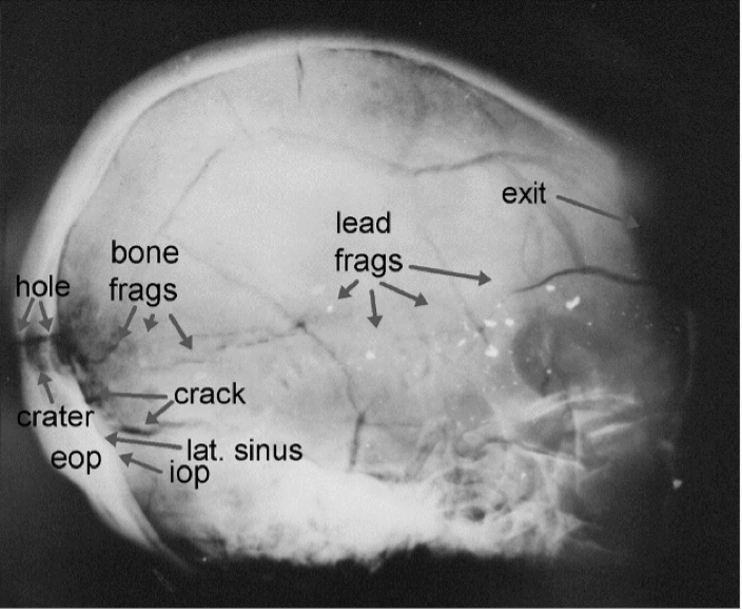
    GAWagner2 Fig12 

    Figure 12. Unenhanced, lateral x-ray of a test skull shot with a Mannlicher Carcano by the government’s Biophysics Lab.[11] The jacketed bullet entered low, through the occipital bone, as Oswald’s is said to have done. The fragment trail is low, as the undeflected Mannlicher Carcano round traversed the lower portion of the skull. 

    As with JFK’s enhanced X-ray, there is a scattering of small fragments. But no “dust-like” fragments are visible on this X-ray such as those that are visible, and were described in JFK’s original, unenhanced X-rays. JFK’s unenhanced, lateral skull X-ray would look like this X-ray if he’d been shot with a Mannlicher Carcano. But it doesn’t.

    The presence and location of the “snow storm” of dust-like fragments in the right front quadrant of JFK’s original, unenhanced skull X-rays destroys Wagner’s case for a lone gunman. It proves a non-jacketed bullet, a non-Oswald bullet, blew into the right front part of JFK’s skull. Were those X-rays available to the public, I would show them, and the issue would vanish. That those inconvenient “dust-like” fragments exist is not just my and Cyril Wecht’s opinion. 

    In fact, they were reported by Kennedy’s chief pathologist, James Humes, MD, also by a Secret Service agent, by an FBI Agent, as well as other government consulting, expert radiologists. This evidence has largely lain unrecognized and unappreciated in the record since 1964.

    • During his Warren Commission testimony in 1964, Dr. Humes said: “(JFK’s X-rays) had disclosed to us multiple minute fragments of radio opaque material…These tiny fragments that were seen dispersed through the substance of the brain in between were, in fact, just that extremely minute, less than 1 mm in size for the most part.” A few moments later, Dr. Humes was asked, “Approximately how many fragments were observed, Dr. Humes, on the x-ray?” “I would have to refer to them again (the X-rays),” he answered, “but I would say between 30 or 40 tiny dust-like particle fragments of radio opaque material, with the exception of this one I previously mentioned, which was seen to be above and very slightly behind the right orbit.”[12]
    • Secret Service Agent Roy Kellerman, an autopsy witness, testified that the fragments in JFK’s skull X-ray “looked like a little mass of stars; there must have been 30, 40 lights where these pieces were so minute that they couldn’t be reached.”[13]
    • The HSCA interviewed FBI Agent James Sibert and reported, “the X-ray had many ‘… flecks like the Milky Way… .’ Sibert said a lot of the metal fragments were tiny.”[14]
    • Russell Morgan, MD, the chairman of radiology at Johns Hopkins University, was the Clark Panel’s radiologist. “Distributed through the right cerebral hemisphere are numerous, small irregular metallic fragments,” the Panel reported, “most of which are less than 1 mm in maximum dimension. The majority of these fragments lie anteriorly and superiorly. None can be visualized on the left side of the brain and none below a horizontal plane through the floor of the anterior fossa of the skull.”[15]
    • Cook County Hospital Forensic Radiologist John Fitzpatrick, MD, examined JFK’s X-rays in consultation for the ARRB and agreed, writing: “There is a ‘snow trail’ of metallic fragments in the lateral skull X-rays which probably corresponds to a bullet track through the head, but the direction of the bullet (whether back-to-front or front-to-back) [sic] cannot be determined by anything about the snow trail itself.”[16]
    • Practicing neurologist Michael Chesser’s work requires examining skull X-rays. He examined the original, unenhanced JFK X-rays at the National Archives with special permission. He came to the same conclusion. “This location, on the intracranial side of the bony defect, is highly suggestive of an entry wound,” he wrote. “One of the principles of skull ballistics is that the largest fragments travel the furthest from the entry site, with the smallest traveling the least distance, and that is exactly what is seen on this right lateral skull X-ray. Tiny fragments are seen on the inner side of this right frontal skull defect, and the largest fragments were noted in the back of the skull.”[17]

    DiMaio’s Patriotic Folly

    Forensic pathologist Vincent DiMaio, MD, explained the meaning of a “snow trail” or “snowstorm”: “[T]he snowstorm appearance of an X-ray almost always indicates that the individual was shot with a centerfire hunting ammunition…”[18] That is, a soft-nosed, non-jacketed round. And as per Sturdivan, the right-forward location of the tiny fragments is a clear indication of what is visible in Zapruder film: an entrance wound in the right front quadrant of Kennedy’s head from an unjacketed bullet that left a tell-tail snowstorm of “dust-like” fragments in that area. 

    For, although he thought that the shot at Zapruder frame 312-313 went from back to front, Sturdivan admitted what is well understood among “ballistics/forensics” authorities: just as the X-ray “snowstorm” can’t tell you whether the bullet was going back-to-front or front-to-back, Sturdivan said that “[a] similar explosion would have taken place if the bullet had gone through in the opposite direction.”[19]

    Wagner, and his X-ray “expert” Sturdivan disagree. Our counselor clings to the theory Oswald’s bullet could have left the “snowstorm” of fragments in the right front part of JFK’s skull based on comments DiMaio made in a later edition of his book. 

    In it, he suggested that the breach of the shell’s jacket after Oswald’s bullet struck Kennedy’s skull from the rear might have released the “dust-like” fragments seen in Kennedy’s unenhanced X-rays. (p. 323) However, DiMaio never examined Kennedy’s X-rays; he offered no evidence for his theory; and the Biophysics skull-shooting tests offer stout counterevidence: they show that MCC shells don’t release “dust-like” fragments. (Fig. 12) The absence of minuscule fragments in the X-ray of the test skull crushes the DiMaio-Wagner-Sturdivan theory. For as Richard Feynman once put it, “It doesn’t matter how beautiful your theory is, it doesn’t matter how smart you are. If it doesn’t agree with the experiment, it’s wrong.”[20]

    [As an aside, Sturdivan finally did see the original, unenhanced images in 2004 at the National Archives. He was emphatic under oath to the HSCA that the absence of tiny fragments in the enhanced X-ray proved that a jacketed bullet, not a hunting round, had felled JFK. But when he reported on his examination of the originals that dramatically do show a snowstorm of fragments in the right front quadrant of JFK’s skull, he said nothing about them. (Nor did he mention them in his 2005 book, JFK Myths.) He either didn’t notice them, or elected not to say they were there.[21] The HSCA’s, and Wagner’s, X-ray “expert” conveniently didn’t see what he didn’t want to see, but what credentialed experts did see.

    X-ray Evidence of a Second Headshot?

    Besides the “snow trail” of dust-like fragments in the right front quadrant of JFK’s skull, there is also a trail of small, but not minuscule, fragments that runs along the top of JFK’s skull in both the enhanced and the still-secret nonenhanced lateral skull X-rays. It does not align with the supposed low, occipital entrance wound specified in Kennedy’s autopsy report, although the autopsy surgeons said that it did. [22]> Nor does it line up with the higher entrance wound the Clark Panel identified, although that Panel said that it lined up to that higher entrance spot that they chose. [23] In fact, as anyone can see, the fragment trail in JFK’s lateral X-ray is about 5 cm above where both the Clark Panel and the HSCA said it was. (Fig. 11, orange arrow.)

    That high fragment trail offers evidence for a second headshot circa Z-frames 327-328, one striking high from behind with a jacketed round that left small, but not “dust-like” fragments. Such a possibility is also backed up by the “jiggle” evidence in the Zapruder film (Z-frame 331 is blurred, which fulfills the 3-frame delay Luis Alvarez posited for a shot from the distant School Depository.[24]), by Professor James Barger’s acoustics analysis that indicated a shot from the rear at this moment, and by JFK’s rapidly forward-moving skull after Z frame 328, as explored by Thompson in Last Second in Dallas. Both Sturdivan and Wagner do not agree. Improbably, they claim Oswald’s bullet entered Kennedy’s skull low, was deflected upward, and left the high fragment trail at the top of Kennedy’s skull. Sturdivan, however, didn’t always see things that way.

    Sturdivan, Wagner, and the Improbable Bullet Deflection

    In 1978, Sturdivan told the HSCA that the evidence was clear and that the Forensic Pathology Panel got it right: “[T]here is no indication of any (bullet) track in the lower half of the skull. It definitely was in the upper part.” (Wagner, p. 305-6) [25] However, in 2003 he apparently changed his mind. He then endorsed the “low entrance” claim of Parkland neurosurgeon Robert Grossman, MD, with whom he had collaborated in a paper that appeared in the journal Neurosurgery. “There was a laceration approximately 1 inch in diameter located close to the midline of the cranium,” Grossman said, “approximately 1 inch above the external occipital protuberance,” and he produced a sketch of what he saw (Fig. 13).[26]<

     GAWagner2 Fig13

    Figure 13. Left: diagram prepared by Parkland neurosurgeon Robert Grossman, MD, depicting the entry wound he saw on 11/22/63. He said it was ~1 inch in diameter and slightly above the external occipital protuberance (EOP) in occipital bone. Right: Ida Dox’s drawing of the back of Kennedy’s head. It is a reasonably accurate rendition of an original autopsy photograph. [Dr. Grossman has said that JFK’s actual wound looked much different than the Dox image.[27]]

    Against the Clark Panel and the HSCA’s forensic pathologists, Wagner endorses Grossman and Sturdivan that the entry wound was low, just like the autopsy surgeons said it was (Chapter 10). Neither Sturdivan, Wagner, nor Grossman appear cognizant of the fact that X-rays, and Sturdivan’s own sworn testimony, pose virtually insurmountable obstacles for their theory.

    As per the lateral X-ray of the skull shot with Oswald’s type of ammo in the government’s tests (Fig. 12 and 15), the fragment trail is low and horizontal. Virtually undeflected, it follows the striking bullet’s trajectory across the test skull. Of course, upon impact, bullets may be deflected and veer away from the straight-line path. But the test bullet didn’t deflect much, if at all, as jacketed bullets like Carcano shells tend not to. Could Oswald’s bullet have been so severely deflected from its low entry point as to leave its fragments along the top of the President’s head, a full 100mm above the point of entry?

    Sturdivan and Wagner say: Yes, it could, and it did. No, it couldn’t, according to the government’s skull shooting tests and, ironically, Wagner’s trusty expert. Sturdivan has testified about bullet deflection. Speaking from experience, he said,

    “Well, let’s put it this way. With most military bullets, like the M-193, the bullet would curve almost immediately because the yaw begins to grow almost immediately. With the Mannlicher-Carcano bullet, it is much more stable, the yaw begins to grow much more slowly, and it curves much more slowly. So that at a target of 4 or 5 inches of soft tissue, that bullet would not deviate appreciably from its path… .” (emphasis added) [28]

    Recall that he told the HSCA that Oswald’s bullet had entered high:  “[T]here is no indication of any track in the lower half of the skull. It definitely was in the upper part.” [29]> (Wagner, p. 305-6) Sturdivan’s obvious point was that Oswald’s bullet wasn’t much deflected, so the fragment trail at the top of JFK’s skull X-ray was close to the path of the bullet. “I would place the original track as being somewhat lower than that trail of fragments indicated through there,” he testified, “certainly not much lower.” (emphasis added) [30]

    The X-ray of the test skull backs up Sturdivan’s claim: after entering the skull, the fragment trail does not deviate much from the bullet’s low trajectory. (Figs. 12 and 14)

    GAWagner2 Fig14 

    Figure 14. Left: Lateral skull X-ray of Biophysics Lab test skull shot with a Mannlicher Carcano round from the rear. The bullet entered just above the external occipital protuberance. Note the fragment trail is horizontal and low (green line). The higher, red line is the path Sturdivan/Wagner propose Oswald’s bullet took after striking near the bottom of Kennedy’s skull.

    Right: JFK’s enhanced lateral X-ray. Against Sturdivan’s testimony that MCC shells don’t much deflect, Wagner says that Oswald’s bullet entered JFK’s skull low and was dramatically deflected upward. He believes it left the fragment “trail” that we see in JFK’s X-rays at the very top of the skull, the red line. Note that there are no fragments between Wagner’s/Sturdivan’s low entrance wound and the “trail” at the top of Kennedy’s skull. 

    I’ll leave it to the jury to decide whether Wagner and Sturdivan are right about the President’s X-rays.


    Wagner “Debunks” the Acoustics

    To dismiss the HSCA’s acoustics evidence for a shot from the grassy knoll, our counselor ignores credentialed authorities who are agnostic on the question of conspiracy. Instead, he cites non-credentialed, pro-Warren Commission sources. A little context, first.

    Apparently, a Dealey Plaza motorcop’s microphone was stuck open in broadcast mode during the murder. Sounds were picked up, fed to, and recorded by the Dallas police. The HSCA hired two independent groups of acknowledged acoustics experts to analyze the recording. The first was M. R. Weiss and E. Aschkenasy; [31] the second was J. E. Barger, S.P. Robinson, E.G. Schmidt, and J.J. Wolf. [32] Both groups concluded that the recording revealed that gunshots had been fired, and that there was a high probability that one of the shots was fired from the grassy knoll. This finding arrived late in the HSCA’s proceedings, and it raised a ruckus. As the HSCA went out of business, two HSCA members recommended further study.

    “The acoustical evidence of a gunman on the grassy knoll has enormous significance for our Nation,” Congressman Christopher J. Dodd wrote. “This by itself makes real the idea of a conspiracy to kill the President. The data upon which the experts base their conclusion should, therefore, be reviewed by other noted experts in this field.”[33] (emphasis added)

    Similarly, Congressman Robert Edgar suggested, “I recommend that the Congress immediately order a full and detailed restudy of the acoustics work, perhaps through the National Science Foundation. Included in this restudy, a panel of scientific experts with knowledge of acoustics should be employed to monitor the methodology used in the study to ensure accuracy and determine the level of weight which should be given to this evidence.”[34] (emphasis added)

    As Thompson minutely documented in Last Second in Dallas, the government ignored the sensible, specific recommendations of the HSCA. Two “reinvestigations” were done. Neither used credentialed acoustics authorities. Instead, this hot potato was first handed to the FBI, which in 1964 had “proved” there was no conspiracy. A thoroughly inadequately trained Bureau agent, B. E. Koenig, wrote a paper “disproving” the HSCA’s acoustics authorities. [35] His work was promptly debunked and discredited.[36] [37]

    The Sorry Story of Luis Alvarez

    So the government then turned to its trusted deputy: Nobel Prize-winning physicist Luis Alvarez. Though lacking any acoustics expertise, the Nobelist had sterling credentials as a Warren Commission devotee, and had previously set science aside to run cover for the government on another controversy. That story is worth a few words that Wagner denies the jury. It helps contextualize Alvarez’s subsequent work on the acoustics.

    Israel and South Africa detonated a nuclear bomb in the Indian Ocean on 22 September 1979, the so-called “Vela Incident.” [38] It was inconvenient for President Carter’s nonproliferation policy that America’s ally, Israel, was testing nuclear weapons fashioned with American technology. To make the story go away, the government engaged Alvarez. He assembled a team and investigated, reporting that the “double flash” detected by the Vela satellite – invariably betokening a nuclear explosion – was, in this unique case, not a nuclear event. Rather, it was caused by a meteorite striking the satellite. As Thompson pointed out,Alvarez was promptly debunked by both expert government investigators and on-site Israeli sources that Seymour Hersh personally interviewed. [39]

    As had the Vela Incident, the conspiratorial implications of HSCA’s acoustics posed an uncomfortable problem for the government. So again, the government tapped Alvarez. Given his longstanding pro-government position on JFK’s murder, the Nobelist did not chair the Ad Hoc Committee on BallisticAcoustics.[40] But he influenced who would be on it. None of the selectees had any acoustics training or expertise, including its chair, physicist Norman Ramsey–with whom Alvarez had long collaborated on prior government projects. He also picked Richard Garwin and F. Williams Sarles, both physicists who’d served on the disinforming Vela Panel. Alvarez thereupon worked closely with the “Ramsey Panel” to debunk the HSCA’s acoustics. 

    Does Wagner embrace the experts who are truly expert in the field in which they offer opinions, such as the credentialed acoustics authorities? No. He goes instead with the uncredentialed Ramsey Panel, whose pro-government conflicts, prior history, and lack of expertise he omits any mention of–despite knowing of them from Thompson’s book, which he cites frequently. He also cites, in extenso, the conclusions of the untrained, non-acoustician Michael O’Dell (pp. 184-187, 191, 418-9, 423, 425, 428, 433.) Apparently, they told him what he wanted to hear. And with little more than that, he closes the case on the acoustics in favor of the official narrative. 

    Conclusion

    I would have much liked to have written a more favorable review, and would have if Wagner had written a different book. I’ve known him for seven years and bear him no personal animosity. He’s been a welcome guest in my home, attending JFK mini-conferences. He is invariably polite, well-mannered, and polished. Like Hoch, he presents himself as a “fair witness,” as someone who is detached, objectively minded, and willing to follow the evidence wherever it leads. But I’ve long thought that that’s not the real Wagner. Beneath a veneer of cautious, objective detachment, I see a devoted partisan. 

    My first suspicion arose in the wake of Wagner’s presence supporting anti-conspiracy activist Lucien Haag in a debate at a mock trial of Oswald in Houston in 2017. As he had in a paper in the Association of Firearms and Toolmark Examiners Journal (AFTE), Haag argued that Governor Connally’s back wound was so large and oval that it proved Oswald’s bullet (#399) had not hit point forward, undeflected. It instead must have struck the governor sideways, in “yaw,” because it had tumbled through JFK’s back and neck before it hit Connally. 

    Wecht and I had thoroughly debunked that same Haag myth two years before the Houston “trial” in the pages of the AFTE Journal.[41] It was foolish of Haag to gift us the opportunity to debunk him again in Houston. When later I read his first book, I discovered that Wagner had himself already debunked Haag’s fairy tale. Yet he remained mute as Haag tried foolishly to pass off this falsehood before the jury. This episode suggested to me that Wagner’s loyalty is likely less to truth than to the official narrative, and to junk-peddling “experts” like Haag who agitate in support of it. His latest book shows that our counselor’s stripes haven’t changed. 

    He’s still privileging pro-government nonexperts and dubious evidence while sedulously ignoring true experts and hard evidence. Does he really expect his jury of readers to accept the debunked claims of his “authorities” when their most demonstrable virtue is not their expertise in the fields in which they offer opinionson JFK, but their loyalty to the government’s lone gunman wheeze? I don’t think he can. Wagner has thus failed the jury. He has also failed his dwindling band of Warren Commission coreligionists who cleave to the official mythology, defending a government that has lied about the death of JFK since the day he was murdered. 

    But Wagner may yet redeem himself. He made a pledge that I hereby also make: “If I am wrong in certain respects, I will admit error and work to correct it.” (p. 13) I’ll do that no matter what he does, and I invite corrections. Let’s see if he does the same.

    ________________________________________

    Footnotes

    [1] https://www.history-matters.com/essays/frameup/EvenMoreMagical/EvenMoreMagical.htm

    [3] Thompson, J. Six Seconds in Dallas. New York, Bernard Geis Associates for Random House, 1967.

    [4] Speer, P. Chapter 3b: Men at Work. https://www.patspeer.com/chapter3bmenatwork

    [5] Warren Commission Hearings, V.6:130 ff. https://www.maryferrell.org/showDoc.html?docId=35#relPageId=140

    [6] Fonzi, G. The Warren Commission, The Truth, and Arlen Specter. Greater Philadelphia Magazine 1 August 1966 pp. 38-45, 79-88, 91.

    [7]https://www.youtube.com/watch?v=cvqCtaBkyyE  Watch video starting at the 30 minute, 10 second mark for Tomlinson’s explicitly identifying the stretcher he found a bullet on, which wasn’t Connally’s. See also Thompson, J. Six Seconds in Dallas. New York. Bernard Geis Associates for Random House, 1967, p. 161-164. Thompson describes the stretcher Tomlinson identified, on which Tomlinson found hospital gloves and a stethoscope It was pediatric patient Ronnie Fuller’s stretcher, exactly as Tomlinson demonstrated to Cronkite during his on-camera interview. 

    [9] Sturdivan LM. The JFK Myths, St. Paul, MN: Paragon House, 2005, Fig. 38, p. 173.

    [10] Sturdivan LM. The JFK Myths, St. Paul, MN: Paragon House, 2005, p. 177.

    [11]Source: Sturdivan, LM, Review of JFK Photographs and X-Rays at the National Archives, September 23, 2004. Available https://kenrahn.com/Noncons/LarryNARA.html

    [12]Warren Commission testimony of James H. Humes, MD, Vol. 2:353. https://history-matters.com/archive/jfk/wc/wcvols/wh2/pdf/WH2_Humes.pdf

    [13]Warren Commission testimony of Secret Service Agent Roy Kellerman. Vol. 2, p. 100. https://www.history-matters.com/archive/jfk/wc/wcvols/wh2/pdf/WH2_Kellerman.pdf

    [14] MD 85 – HSCA Interview Report of August 25, 1977 Interview of James W. Sibert, p. 3-4. https://aarclibrary.org/publib/jfk/arrb/master_med_set/md85/html/md85_0003a.htm

    [16] “Inside the ARRB: Appendices – Current Section: Appendix 44: ARRB staff report of observations and opinions of forensic radiologist Dr. John J. Fitzpatrick, after viewing the JFK autopsy photos and x-rays,” p. 2. https://www.maryferrell.org/showDoc.html?docId=145280#relPageId=225

    [17] Chesser, M A. Review of the JFK Cranial X-Rays and Photographshttps://assassinationofjfk.net/a-review-of-the-jfk-cranial-x-rays-and-photographs/

    [18] DiMaio, VJM. Gunshot wounds – Practical Aspects of Firearms, Forensics, and Ballistics Techniques, Third Edition, p. 166. https://books.google.com/books?id=8eCYCgAAQBAJ&pg=PA50&lpg=PA50&dq=soft+nosed+bullets,+Xrays,+snowstorm&source=bl&ots=0sNfkZezak&sig=ACfU3U1e6__SLS9tthavEYrGpK1kIi3rcg&hl=en&sa=X&ved=2ahUKEwiqtPCrqtfoAhUBqJ4KHSN8BSEQ6AEwFXoECA0QMQ#v=onepage&q=snow storm&f=false

    [19] Sturdivan, LM, The JFK Myths, St. Paul, MN: Paragon House, 2005, p. 171.

    [21]Sturdivan, L. “Review of JFK Photographs and X-Rays at the National Archives, September 23, 2004.”https://kenrahn.com/Noncons/LarryNARA.html

    [26] Sullivan, D, Faccio, R, Levy ML, Grossman, RG. THE ASSASSINATION OF JOHN F. KENNEDY: A NEUROFORENSIC ANALYSIS—PART 1: A NEUROSURGEON’S PREVIOUSLY UNDOCUMENTED EYEWITNESS ACCOUNT OF THE EVENTS OFNOVEMBER 22, 1963Neurosurgery. VOLUME 53 | NUMBER 5 | NOVEMBER 2003, p. 1023-1024. https://pubmed.ncbi.nlm.nih.gov/14580267/

    [27] Grossman never testified to the Warren Commission or the HSCA. Authors Groden and Livingstone reported that, “He (Grossman) said that he saw two large holes in the head, as he told the (Boston) Globe, and he described a large hole squarely in the occiput, far too large for a bullet entry wound…”. (Groden R. Livingstone. High Treason-I Groden and Livingstone, p. 51. See also “Duffy & Ricci, The Assassination of John F. Kennedy–A Complete Book of Facts, p. 207-208.)

    [31] Weiss MR and Aschkenasy E. An Analysis of Recorded Sounds Relating to the Assassination of President John F. Kennedy…

    https://aarclibrary.org/publib/jfk/hsca/reportvols/vol8/pdf/HSCA_Vol8_AS_1_Weiss.pdf

    [32]  Barger JE, Robinson SP, Schmidt EG, and Wolf JJ. Analysis of Recorded Sounds Relating to the Assassination of President...https://aarclibrary.org/publib/jfk/hsca/reportvols/vol8/pdf/HSCA_Vol8_AS_2_BBN.pdf

    [34] DISSENTING VIEWS BT HON. ROBERT W. EDGAR TO THE FINAL REPORT, p. 499. https://www.history-matters.com/archive/jfk/hsca/report/pdf/HSCA_Report_4_Remarks.pdf

    [35] Koenig, BE. Acoustic Gunshot Analysis – The Kennedy Assassination and Beyond (Conclusion) https://www.ojp.gov/ncjrs/virtual-library/abstracts/acoustic-gunshot-analysis-kennedy-assassination-and-beyond

    [36] Thompson. J. Last Second in Dallas. Lawrence, Kansas: University Press of Kansas, 2023, p. 275-300.

    [37] See also memo from HSCA Chief Counsel, Robert Blakey, to the FBI’s William Webster dated 4.2/1981 that included a technical refutation of FBI Agent Koenig’s acoustics analysis written by James Barger and the acoustics authorities at Bold, Beranak and Newman, Inc. Cambridge, Mass: http://jfk.hood.edu/Collection/FBI Records/062-117290/062-117290 Volume 25/62-117290P25b.pdf

    [39] Thompson. J. Last Second in Dallas. Lawrence, Kansas: University Press of Kansas, 2023, p. 280-284. 

    *See also” “The Vela Incident Nuclear Test or Meteoroid? Documents Show Significant Disagreement with Presidential Panel Concerning Cause of September 22, 1979 Vela “Double-Flash” Detection.” National Security Archives, 5/5/2006. Available here: https://nsarchive2.gwu.edu/NSAEBB/NSAEBB190/index.htm

    *A good summary of government evidence proving a nuclear blast in the Vela Incident is available in: Report on the 1979 Vela Incident. Available here. [“(Investigative journalist Seymour) Hersh reports interviewing several members of the Nuclear Intelligence Panel (NIP), which had conducted their own investigation of the event. Those interviewed included its leader Donald M. Kerr, Jr. and eminent nuclear weapons program veteran Harold M. Agnew. The NIP members concluded unanimously that it was a definite nuclear test. Another member—Louis H. Roddis, Jr.—concluded that ‘the South African-Israeli test had taken place on a barge, or on one of the islands in the South Indian Ocean archipelago.’” [Hersh 1991; pg. 280-281. Available here.] He also cited internal CIA estimates made in 1979 and 1980 which concluded that it had been a nuclear test. “The U.S. Naval Research Laboratory conducted a comprehensive analysis, including the hydroacoustic data, and issued a 300-page report concluding that there had been a nuclear event near Prince Edward Island or Antarctica [Albright 1994b].”

    [41]Aguilar G, Wecht CH. AFTE Journal — Volume 47 Number 3 — Summer 2015, p. 132. On-line at: https://www.kennedysandking.com/john-f-kennedy-reviews/nova-s-cold-case-jfk-junk-science-pbs

  • Is Robert Wagner the New Paul Hoch? – Part 1

    Is Robert Wagner the New Paul Hoch? – Part 1

    Is Robert Wagner the New Paul Hoch? – Part 1

    Gary L. Aguilar, MD

    Introduction

    Paul Hoch is considered by some, and was recently described as the “doyen of serious JFK assassination research.”[1] That was the impression I and several colleagues had of him when we first waded into the mysteries of the President’s murder in the early 1990s. Having immersed himself in the case since the mid-1960s, Hoch struck us then-newbies as objective, knowledgeable, and logical. His essays in the 1976 book The Assassinations were astute, informative, and justly attacked aspects of the official narrative. Particularly the dishonesty of the FBI, and the Warren Commission’s bending its knee to the Bureau despite its members’ private, serious misgivings.[2] But while he skewered the Commission, he also rubbished some of the critics’ wilder notions.[3] But when, decades ago, he boosted Gerald Posner and J. Edgar Hoover’s confidant, John Lattimer, MD,[4] and when Hoch signaled his loyalty to the official narrative, our enthusiasm subsided. As he has faded from the scene in recent years, Hoch continues to wave the Commission’s flag. And now it seems a protégé and apparent heir has stepped forward to take up that éminence grise’s banner.  His name is Robert Wagner.

    The author of two books,[5] Wagner, à la Hoch, purports to navigate the dense thicket of assassination medical, legal, and forensics data with “just one agenda,” he says, “to work toward establishing the most reasonable explanation of the assassination.”[6] To do that, Wagner, who has no credentials in medicine, law, or forensics, applies the knowledge and wisdom he’s acquired from what he says are his “many years of experience” in “providing expert opinions at state and federal trials on business and economic topics.” Those years taught him that “the jury needs to be convinced that the expert is truly expert in the field in which he or she offers opinions” and that an “expert consistently grounds his or her opinions on a reasonable assessment of known facts and overall context.”[7]

    In his latest book, JFK Assassinated, Wagner puts his courtroom experience to work weighing the contrasting claims of Warren loyalists and skeptics. He, like Hoch before him, levels broadsides at both sides. Also, like Hoch, he concludes that the battle is done, the smoke has cleared, and the government’s case, though battered and bruised, still stands.

    Pro Warren jurors will cheer, and they have.[8] Skeptics will jeer, not without good reason. For our counselor observes in the breach the very rules he advocates in real trials. He’ll never convince a fair jury that the experts he cites – Larry Sturdivan on neurophysiology, radiology, etc., Parkland Hospital’s Robert McClelland, MD on Kennedy’s head wound, Michael O’Dell, and indirectly the Ramsey Panel, on acoustics, etc., really are the best ‘experts in the fields in which they offer opinions.’ Nor does he show that they ‘consistently ground their opinions on reasonable assessments of known facts and overall contexts.’  

    In this review, as if presented to a jury, I will argue that a whiff of insincerity wafts from the pages of his book. For it’s difficult to imagine he doesn’t realize how flawed and prejudiced the sources he trusts are.

    Wagner was warned that I might take notice of his book. “Paul Hoch may have been correct,” he writes, “when he told me that I had taken over from him to be Gary’s punching bag.” (p. 343) I take no joy in lacing up the gloves. But with this book, our counselor has willingly stepped into the ring and put his guard down. I wouldn’t be taking a swing if he hadn’t jutted out his glass jaw.

    While much more could be written, in this review I will narrow the focus to areas our consultant most emphasizes: Kennedy’s head wound and evidence from the autopsy photographs; his explanation of JFK’s lurch “back and to the left” after being struck in the head at Zapruder frame 313; the bona fides of Commission Exhibit #399, the so-called “Magic Bullet;” Kennedy’s X-ray findings; and, finally, the acoustics evidence.

    To begin with, Wagner’s handling of the President’s head injuries hints at an agenda. In brief, he sides with the House Select Committee’s (HSCA’s) dubious claim, namely that the Parkland doctors were mistaken about Kennedy’s head wound. It’s a fascinating story, but a little background for the jury is in order.

    Kennedy’s Fatal Head Wound

    After the shots rang out in Dealey Plaza, Kennedy was rushed to an excellent major trauma center, Parkland Hospital. There, he was treated by a seasoned team of trauma surgeons. They said that Kennedy’s fatal wound was on the back, right side of his head. The words right “posterior,” “occipital,” “occipito-parietal,” etc., were repeatedly used. However, Kennedy’s autopsy photographs, which the HSCA said it had authenticated, showed no such rearward damage but only a wound toward the right front area of JFK’s head.[9] This posed a significant problem for the HSCA, which reinvestigated the assassination in the late 1970s.

    It announced that it had resolved the conflict. This is what it wrote in Volume 7, p. 37 of their volumes: 

    Critics of the Warren Commission’s medical evidence findings have found (sic) on the observations recorded by the Parkland Hospital doctors. They believe it is unlikely that trained medical personnel could be so consistently in error regarding the nature of the wound … In disagreement with the observations of the Parkland doctors are the 26 people present at the autopsy. All of those interviewed who attended the autopsy corroborated the general location of the wounds as depicted in the photographs; none had differing accounts … it appears more probable that the observations of the Parkland doctors are incorrect.”[10] (Emphasis added.)

    As we discovered almost 30 years ago from files declassified by the JFK Review Board–files that should never have been suppressed in the first place–the above HSCA claim was false. The autopsy witnesses did not corroborate the wounds depicted in the photographs. To the contrary, by word and diagram, they had overwhelmingly agreed with the Dallas doctors that JFK’s skull wound was rearward, on the right.[11]

    Wagner doesn’t bother with the autopsy witnesses who had more than ample viewing time, nor with most of the Texas trauma surgeons. Instead, he presents to the jury “[P]erhaps the most famous account” of JFK’s rearward wound, that of Dallas’s Robert McClelland, MD, and dissects the doctor over four pages (p. 206-10). Wagner begins by quoting McClelland’s Warren Commission testimony: “As I took the position at the head of the table … I was in such a position that I could very closely examine the head wound, and I noted that the right posterior portion of the skull had been extremely blasted.” (6H33). 

    That was an innocent mistake, Wagner says, because, as the anesthesiologist M. T. “Pepper” Jenkins reported, JFK’s “emergency room cart was elevated at the feet in order to provide a Trendelenberg position.” (Fig. 1.) (This is a common and proper maneuver in such circumstances. It increases blood flow to the brain and heart during the CPR of a trauma patient. I used it myself in emergencies during my stint as a trauma surgeon at UCLA-Harbor General Hospital.) 

    Fig. 1 depicts what Wagner is talking about. Dr. McClelland couldn’t actually have seen the back of JFK’s head, he says, because the head of the gurney had been lowered. Wagner’s conclusion? “[I]t is indeed most reasonable to believe that he observed a blast wound more on the top-right of the president’s (sic) head than on the right rear.” (emphasis added)

    GAWagner1 Fig1

    Figure 1. Dr. McClelland stood at JFK’s head in Trauma Room One. He looked down at the President, who was in a head-downward, Trendelenburg position. The back of Kennedy’s head would not have been visible to the doctor, says Wagner. So, the doctor saw a wound in the top-right of JFK’s head and mistook it for a posterior one.

    Wagner extrapolates from McClelland’s “error” to the rest of the trauma team, and lands in HSCA country. The wound McClelland described “is simply not correctly located. Perhaps this explains why other witnesses located the large wound incorrectly. After all,” Wagner argues, “if Dr. McClelland, having several minutes to observe the wound, could get this wrong, why wouldn’t others do the same?” (p. 210) Put simply, Wagner says the HSCA was right when it concluded that “it appears more probable that the observations of the Parkland doctors are incorrect.” 

    Wagner’s selection and elimination of evidence is as breathtaking as it is unsurprising. He has, rather unreasonably, left out witnesses ‘who are truly experts in the field in which they offer opinions’: the two senior head wound experts who attended Kennedy at Parkland. Neurosurgery professors Kemp Clark, MD, the most senior treating surgeon, the man who pronounced JFK dead, and who spoke at a news conference on the day of the murder, as well as his neurosurgery professor colleague, Robert Grossman, MD.

    He doesn’t black them out completely, but Wagner keeps the lights down low. He tells the jury that Clark located JFK’s wound “mostly in the back-back side of the president’s head” (sic, p. 282). And he doesn’t even mention Grossman. For the benefit of Wagner’s jury, let’s turn the lights up. 

    Kemp Clark, MD – from the record: 

    • In an undated note apparently written contemporaneously at Parkland, Clark described the President’s skull wound as “in the occipital region of the skull… Through the head wound, blood and brain were extruding… There was a large wound in the right occipitoparietal region … Both cerebral and cerebellar tissue were extruding from the wound.” (WC–CE#392)
    • In a handwritten note dated 11-22-63, Dr. Clark wrote, “a large 3 x 3 cm remnant of cerebral tissue present … there was a smaller amount of cerebellar tissue present also …There was a large wound beginning in the right occiput extending into the parietal region … Much of the skull appeared gone at the brief examination….” (Exhibit #392: WC V17:9-10)
    • He told the Warren Commission: “I then examined the wound in the back of the President’s head. This was a large, gaping wound in the right posterior part, with cerebral and cerebellar tissue being damaged and exposed.” (WC–V6:20)[12] 

    To push his theme that the Dallas doctors blew it, Wagner quotes, only to discount, what coauthor Cyril Wecht, MD, JD, and I wrote in Charles Crenshaw, MD’s second book, Trauma Room One: “it seems reasonable to suppose that not only did they have plenty of time to get a good look at Kennedy’s skull injuries, the Dallas doctors took responsible and appropriate steps to examine the skull wound before pronouncing the President dead.”[13] (p. 207) His riposte is that we were merely “inferring” that. We weren’t. 

    Which the jury would know if Wagner hadn’t knowingly cut what else we wrote on that very page: “Because the autopsy photographs show no wound in the rear of JFK’s skull, an explanation has been sought for how it was that so many Parkland physicians, including neurosurgeons, said they saw such a wound. The Boston Globe raised the issue. It reported that “some [Parkland] doctors doubted the extent to which a wound to the rear of the head would have been visible since the President was lying supine with the back of his head on a hospital cart….” The Globe immediately refuted that speculation: “But others, like [Dr. Richard] Dulaney and [neurosurgeon] Dr. Robert] Grossman, said the head at some point was lifted up, thereby exposing the rear wound.”[14]  And make no mistake, that paper is an MSM outlet.

    We also pointed out that the ARRB’s Jeremy Gunn interviewed Grossman on March 21, 1997, reporting, “[Grossman] and Kemp Clark [Chairman of Neurosurgery at Parkland] (sic) together lifted President Kennedy’s head so as to be able to observe the damage to the President’s head.”[15] Grossman has said the same thing over the years, most recently in the peer-reviewed journalNeurosurgery, where he wrote, “The President was lying supine, with his occiput on the stretcher. Kemp (Clark, MD) and I lifted his head to inspect the occiput….”[16] Grossman has repeated this numerous times,[17] which Wagner should know from work I’ve published that he discusses. [18] [19]

    That wasn’t the only credible expert Wagner omitted regarding JFK’s head injuries. Ironically, he also left out the professor of anesthesiology whom our consultant cited about Kennedy’s being positioned in Trendelenburg. In an interview with the HSCA’s Andy Purdy on 11-10-77, “Pepper” Jenkins said that he “was positioned at the head of the table so he had one of the closest views of the head wound (and) believes he was ‘…the only one who knew the extent of the head wound.’ (sic)…Regarding the head wound, Dr. Jenkins said that “a portion of the cerebellum (lower rear brain) (sic) was hanging out from a hole in the right–rear of the head.” (HSCA-V7:286-287) In an interview with the American Medical News published on 11-24-78, Jenkins said, “(Kennedy) had part of his head blown away and part of his cerebellum was hanging out.” (As elsewhere documented, poor Pepper’s inconvenient early memory underwent a sudden patriotic turn 12 years later when queried by pro-Warren loyalist Gerald Posner, who was kind enough not to remind the good doctor, or his readers, of his prior, unhelpful statements.[20])

    Furthermore, Wanger ignores other credible, official witnesses who were not rushed, who had ample opportunity to see what Kennedy’s fatal wound looked like, and whose descriptions of Kennedy’s wounds are part of the official record: the witnesses at Kennedy’s autopsy. As Wecht and I wrote in the Crenshaw book, Bethesda Naval Hospital witnesses were closely aligned with the “mistaken” descriptions of the trauma surgeons in Texas. 

    A full recitation of the Bethesda witnesses is beyond the scope of this discussion. Curious members of the jury are invited to review the official accounts of these witnesses, which have been online, with hot-linked sources, for 30+ years.[21] We summarized the autopsy witnesses’ accounts in the following table that appears on page 286 of Crenshaw’s Trauma Room One. (Fig. 2)

    GAWagner1 Fig2

    Figure 2. Screenshot of page 186 from Charles Crenshaw, MD’s Trauma Room One.

    Put simply, regarding JFK’s head wound, Wagner has ignored the best-positioned and most expert witnesses. Instead, he featured McClelland, who, though “less expert,” somehow managed to describe the wound very much like the experts did. 

    He also didn’t think to mention something else Wecht and I wrote about in Trauma Room One — published research on the reliability of witnesses.

    There we wrote:  

    Though sometimes dismissed as unreliable, the reigning authority on eyewitness testimony, Elizabeth Loftus, claims witnesses are not always unreliable. In fact, there are circumstances in which their reliability is high.[22]In part, her evidence is based upon a 1971 Harvard Law Review study. Marshall, Marquis, and Oskamp found that when test subjects were asked about “salient” details of a complex and novel film clip scene they were shown, their accuracy rate was high: 78% to 98%. Even when a detail was not considered salient, as judged by the witnesses themselves, they were still accurate 60% of the time.[23]

    Factors that would degrade witness recall were not present at either Parkland or Bethesda. Absent those factors, the research of Marquis and Oskamp, and Loftus, shows that witnesses are very reliable.[24] If Wagner is going to argue witness error is the explanation, it’s his burden to explain how so many good witnesses improbably made the same mistake by agreeing JFK had a gaping skull wound involving the back of his head.[25] Wecht and I made this challenge in the very pages Wagner cites; he does not rise to that challenge. We also documented official accounts of numerous percipient government eyewitnesses saying that autopsy photographs they took, or processed, or saw, have vanished. (Available online.[26]) For the reasons stated above, he must know about it and conveniently ignores it.

    However, Wagner doesn’t overlook the autopsy images completely. Rather, he uses one of them to (wrongly) insist that Kennedy was not struck high, in the parietal bone, as the Clark Panel and the HSCA’s Forensic Panel had determined, but low, in the occipital bone.

    Pierre Finck, MD and Kennedy’s occipital entrance Wound

    His evidence is a confusing and controversial photograph that was taken during the autopsy, which he calls the “mystery photograph”(p. 254). Wagner says that this image was taken to “document specific – and not general – wounds.” That is, it’s specific proof that the fatal bullet struck JFK low in the rear of his head, in occipital bone, where the autopsy report put it. His evidence is Finck’s memo to General Blumberg, “I help(ed) the Navy photographer to take photographs of the occipital wound (external and internal aspects) as well as the wound in the back.” (sic, p. 254) “[T]he mystery photograph was taken,” our counselor says, “to document an occipital wound of entry, just as Finck told Blumberg.”  Fig. 3 is the image Wagner refers to. 

    It is clearly not the photo Wagner says it is, which the jury would know if Wagner hadn’t cut the rest of Finck’s memo. Here’s what else he wrote, “I found a through-and-through wound of the occipital bone with a crater visible from the inside of the cranial cavity …This bone wound showed no crater when viewed from outside the skull … .” (emphasis added) [27] In other words, Finck said that no beveling was visible on the outside of the skull at the point of bullet penetration, the inshoot. But as anyone can see, “outside beveling” is plainly visible in this “mystery photograph.” (Fig. 3) (And it’s even more plainly visible in the original photo at the National Archives that I examined.) That makes this photo more likely one of an outshoot, not Wagner’s occipital inshoot. 

    GAWagner1 Fig3

    Figure 3. Bootleg copy of autopsy photograph of JFK’s skull wound. What it shows has been hotly contested for decades. 

    Wagner says it shows the entrance point of a bullet low in the back of JFK’s skull, in occipital bone, the area specified in the autopsy report. The red arrow points to a semicircular notch, the supposed entrance wound. But the “beveling” is on the outside of the skull, not the inside where Dr. Finck said it was. This, therefore, is not the photo of the entrance wound Finck meant.

    Were that not enough, Finck specifically rejected that this image was the occipital entry wound. 

    The HSCA’s Charles Petty, MD, asked Finck: “If I understand you correctly, Dr. Finck, you wanted particularly to have a photograph made of the external aspect of the skull from the back to show that there was no cratering to the outside of the skull … Did you ever see such a photograph?”

    Finck: “I don’t think so and I brought with me memorandum referring to the examination of photographs in 1967… and as I can recall I never saw pictures of the outer aspect of the wound of entry in the back of the head and inner aspect in the skull in order to show a crater although I was there asking [the photographer to take] these photographs. I don’t remember seeing those photographs.”[28]  (Emphasis added. If such images ever existed, they’ve disappeared. I elsewhere explore in detail the possibility that photographs are missing.[29]) 

    Kennedy’s lunge “back and to the left”

    Over several pages, Mr. Wagner discusses Kennedy’s pronounced left-rearward pitch after being struck in the head at Zapruder frames 312-313. He rejects the skeptics’ widely held view that Kennedy was driven backward by the momentum delivered to JFK’s skull from a shot fired from the right front. Instead, he maintains that either a “jet effect” or a “neuromuscular reaction,” or both, best explain(s) Kennedy’s rearward jolt.

    He scolds skeptics, writing, 

    I caution the CRC (critical research community, i.e., government skeptics) to be more circumspect about the back-and-to-the-left movement of the president (sic) after Z313. Frankly, the movement of the entire torso of the president (sic) against gravity because of a transiting bullet strike from the front (even hitting tangentially) (sic) seems to me as a layman, after studying expert views on this topic, at least as problematic as arguing for the jet effect or a neuromuscular reaction as an exclusive explanation of the president’s head and body movements after the fatal shot to the head. (p. 147)

    The theory that a “jet effect” explains Kennedy’s backward lunge was first put forward in 1976 in the American Journal of Physics by Luis Alvarez, a Nobel Laureate in physics.[30] It has been heralded ever since, in recent years, by Nicholas Nalli, Ph.D. Wagner likely knows that Wecht and I dismantled Alvarez’s theory in two pieces published in the AFTE Journal,[31] as well as in two online articles rebutting Nicholas Nalli’s defense of “jet effect.”[32] Even Warren loyalists no longer believe it, including one of our counselor’s most trusted allies, former government employee Larry Sturdivan. He rubbished the Nobelist’s nonsense on the basis of government-funded, skull-shooting experiments that he was a part of in 1964. (See Fig. 5, below.)

    Describing those tests, he told the HSCA that the test skulls:

    …moved in the direction of the bullet … showing that the head of the President would probably go with the bullet … In fact, all 10 of the skulls that we shot did essentially the same thing. They gained a little bit of momentum consistent with one or a little better foot-per-second velocity that would have been imparted by the bullet …  [33]

    He doubled down in his 2005 book, 

    “The question is,” he wrote, “Did the gunshot produce enough force in expelling the material from Kennedy’s head to throw his body backward into the limousine? Based on the high-speed movies of the skull shot simulations at the Biophysics Laboratory, the answer is no.”[34]

     But that isn’t the half of it. 

    Per Sturdivan, had a jet effect rocked Kennedy back and to the left, his blasted cranial contents would have been jettisoned in the opposite direction, toward the right front. It’s the forward-moving ejecta that would have provided the rearward propulsion, had there been any. But they don’t. Instead, like JFK’s head, they, too, flew off to the left and rear, and for the same reason, the government’s skulls did: momentum transfer.

    Zapruder frame 313 shows a mist of debris just in front of JFK’s face, but no real “plume” of brain and bone matter flying forward from him. Exiting bone fragments are seen flying upward, and only very slightly forward. Not discernable in the two-dimensional frame is that those bone segments were also traveling leftward. They landed to JFK’s left, not to his right-front, which they would have if Oswald’s shot from the rear had blown out the right-front side of JFK’s skull. Moreover, the “debris field” from the Z frame 312-313 headshot was principally to the President’s left-rear. (See Fig. 4.)

    GAWagner1 Fig4

    Figure 4. Zapruder frame 313 and sketch of documented debris field from headshot at Z-313. (Courtesy, Doug Desalles, MD)

    Zapruder Frame 313 (left image) shows, in two dimensions, that there is a cloudy mist above and in front of JFK’s face. Exiting bone fragments are going mostly upward and, as discussed, to Kennedy’s left. They would have blown forward to JFK’s right if Oswald’s shot had entered the rear of Kennedy’s skull and exploded out of the right front. The debris field (image right) shows that most of the ejecta moved “back and to the left,” as did the President’s head. 

    The motor police riding to Kennedy’s left rear, and Secret Service agents Clint Hill and Sam Kinney, also to JFK’s left rear, were bespattered, as was the left side of the trunk of JFK’s limousine. The right side of the car’s trunk, and motor cops riding to JFK’s right rear, were not smeared. This suggests that the Z 312-313 shot was fired from Kennedy’s right front, the “grassy knoll,” not from Oswald’s right-rearward location.

    Our counselor might counter that the cloud of debris that is visible in front of JFK’s face in frame 313 proves Kennedy was shot from behind. But his trusted expert, Sturdivan, has pointed out what is known among forensics/ballistics cognoscenti: “A similar explosion would have taken place if the bullet had gone through in the opposite direction.”[35] Noted forensics/ballistics authority, Masaad Ayoob, has elaborated on this very point regarding Kennedy.

    “The explosion of the President’s head as seen in frame 313 of the Zapruder film,” wrote Ayoob, “… is far more consistent with an explosive wound of entry with a small-bore, hyper-velocity rifle bullet … If the cataclysmic cranial injury inflicted on Kennedy was indeed an explosive wound of entry, the source of the shot would have had to be forward of the Presidential limousine, to its right, and slightly above … the area of the grassy knoll.”[36]

    Ayoob’s point was demonstrated in government duplication tests that our counsel’s trusted ally, Sturdivan, ran for the Warren Commission in 1964. These images were taken from a high-speed film of skull-shooting experiments. (Fig. 5)

    GAWagner1 Fig5

    Figure 5. High-speed film images from Biophysics Lab skull shooting tests conducted for the Warren Commission in 1964. 

    Note that while the bullet entered the back of the skull, the initial egress of debris is thrown rearward, exiting through the inshoot in the occiput. The later frames show that as much material flies back out of the entry point as from the area of exit in the front. As the skull ruptures, the skull moves swiftly away from the shooter, just as Kennedy’s did in Dealey Plaza. (Debris is not seen exiting the rear of Kennedy’s skull in the Zapruder film.)

    NEUROMUSCULAR  REACTION

    So, if not “jet effect,” what of “neuromuscular reaction” as an explanation for JFK’s lunge backward? Wagner quotes in extenso what I’ve written about that theory. I won’t repeat all of it here, but some key points bear mention. 

    First, there are two known types of “neuromuscular reactions” that may be seen in brain injuries or following head trauma: decorticate and decerebrate. Their features are well known in the medical/scientific community. It is known that they do not manifest in split seconds, as Kennedy’s reactions did. From the web, below are images depicting and contrasting decerebrate and decorticate positions (Fig. 6), images Wagner also used in his book (p. 135). JFK assumed neither posture in reaction to the headshot. 

    GAWagner1 Fig6

    Figure 6. Decorticate vs. Decerebrate Postures

    Decorticate posture results from damage to one or both corticospinal tracks. The upper arms are adducted, and the forearms flexed, with the wrists and fingers flexed on the chest. The legs are stiffly extended and internally rotated with plantar flexion of the feet.

    Decerebrate posture results from damage to the upper brain stem. The upper arms are adducted, and the forearms arms are extended, with the wrists pronated and the fingers flexed. The legs are stiffly extended, with plantar flexion of the feet.

    The Goat Experiment

    However, there is another, more instantaneous “neurospasm” that has been demonstrated experimentally in animals. Wagner’s go-to neurophysiology authority, Sturdivan, described and demonstrated this reaction – a split-second neurospastic response that he likened to the President’s response to the headshot at Z-312-313.[37] His evidence is a goat’s reaction to being shot through the head with a .30 caliber bullet, as shown in a movie produced by Edgewood Arsenal.

    As the high-speed film rolled, Sturdivan described the action to the HSCA: “…the back legs go out under the influence of the powerful muscles of the back legs, the front legs go upward and outward, that back (sic) arches, as the powerful back muscles overcome the those of the abdomen. That’s it.”[38]

    In his book The JFK Myths, Sturdivan reproduced a series of still photographs from the experiment that he said demonstrated the goat’s evanescent, “JFK-like” reaction to being shot in the head. Sturdivan writes, “His (the goat’s) back arches, his head is thrown up and back, and his legs straighten and stiffen for an instant before he collapses back into his previous flaccid state.”[39] (Fig. 7)

    GAWagner1 Fig7

    Figure 7. Images of a goat being shot in the head, per Larry Sturdivan. At left, image of a goat taken before being shot in the head. At right, the goat’s immediate reaction to being shot. His back arches, his upper and lower limbs splay outward and backward. (Unlike JFK’s, the goat’s head does not explode.)

    Elaborating to the HSCA, Mr. Sturdivan, who has no credentials in medicine, neurology, neurophysiology, etc., drew the Dealey Plaza parallel:

    …since all (of JFK’s) motor nerves were stimulated at the same time, then every muscle in the body would be activated at the same time. Now, in an arm, for instance, this would have activated the biceps muscle, but it would have also activated the triceps muscle, which, being more powerful, would have straightened the arm out (occurs in “decerebrate”). With leg muscles, the large muscles in the back of the leg are more powerful than those in the front, and, therefore, the leg would move backward (occurs both in “decerebrate” and “decorticate” postures). The muscles in the back of the trunk (the “extensor” muscles) are much stronger than the abdominals, and, therefore, the body would arch backward.[40]

    In a broadcast interview, Sturdivan demonstrated how he said Kennedy reacted to the fatal shot. (Fig. 8.)

    GAWagner1 Fig8

    Figure 8. Arching his back and head rearward, and his upper arms upward, in a filmed interview, Sturdivan purports to mimic JFK’s neurophysical reaction to the headshot.[41]

    Not only was Sturdivan’s posture one that JFK never remotely manifested, but his arms weren’t ‘straightened out’ as he testified they should have been, as the goat’s forelegs were. (Fig. 9)

    The jury can easily see that Mr. Sturdivan’s posture resembles neither of the known types of “neuromuscular reactions” depicted in Wagner’s book (Fig. 6), nor that of the goat’s response. (Fig. 7) All are unlike JFK’s actual reaction to his fatal head injury. (Fig. 9)

    GAWagner1 Fig9

    Figure 9. Zapruder frame 230, Kennedy is reacting to the first shot. His elbows are raised and abducted away from his body. His wrists are flexed inward across his mouth and neck. In Z frame 312, 1/18th second before his head explodes, JFK’s head is bent forward and to the left.

    In Z frame 320, less than ½ second later, it’s his head that has jolted backward, not his back, which has not arched backward à la Sturdivan, but instead follows after his driven skull. His right arm neither flexes inward, “decorticate-style,” nor straightens out, “decerebrate-style,” but instead falls limply toward the President’s lap. Kennedy’s reactions bear no resemblance to Mr. Sturdivan’s demonstration (Fig. 8), nor to any known “neuromuscular” reaction. (Fig.8)

    In sum, JFK’s reaction to the headshot at Z 312-313 can’t be explained by a “jet effect,” and it fails the physiological criteria of any kind of “neuromuscular” reaction.[42]

    Our counselor would have done himself and the jury a favor if he had looked at the Z film himself and not taken an anti-conspiracy activist’s word for what is in it.

    More Problems with Sturdivan

    Another counter to inexpert Sturdivan’s theory is that real neuromuscular reactions are not evanescent; they last a while. “Such decerebrate rigidity as Sherrington described,” the HSCA’s Forensic Panel correctly noted, “usually does not commence for several minutes after separation of the upper brain centers from the brainstem and spinal cord.”[43] Not only was Kennedy’s backward jolt immediate, it was not sustained.

    In the frames following Z-327, 7/10ths seconds after the headshot, JFK’s head starts driving forward. His back then follows along after it, but at a slower rate than his skull moves, which advances at as fast a rate, or faster, than his head flew backward after Zapruder frame 313.[44] Kennedy’s back thus “flexed” forward the same way it had “arched” backward: it didn’t itself flex or arch. It instead followed JFK’s head in both directions: backward after Z-313, and forward after Z-327. This is at a time when our counselor’s theory would have it that the President’s back should have been arching backward. (Fig. 10.) 

    In addition, Wagner argues that Kennedy’s backward-moving head could not have moved JFK’s torso backward; that it could not have ‘lifted him against gravity.’ Unfortunately for our counselor, the proof that it did is right in the Zapruder film in the frames following Z-327: Kennedy’s head flies forward, and his torso is visibly ‘lifted against gravity’ in the same, now forward direction. Obviously, it wasn’t the bullet itself that did all that; it was the left rearward lunge of his ~11 lb. head that tugged his upper body backward after Z-313, and then forward after Z-321.

    GAWagner1 Fig10

    Figure 10. Left: frame 320, 7/18th seconds after being struck in the head, Kennedy’s head has flown backward; his back and torso follow. At approximately frame 321, his head starts reversing direction and moving forward. 

    Right: frame 338, 17/18th seconds later, Kennedy’s head has moved far forward, and his back and torso have been “lifted against gravity” in a forward direction.

    Momentum Transfer vs. Neuromuscular Reaction vs. Momentum Transfer

    It’s clear that “jet effect” and/or “neuromuscular reaction” simply can’t explain Kennedy’s rearward lunge. The most reasonable explanation for it is momentum transfer from a bullet striking from the right front. This is consistent with the results of the Biophysics Lab’s experiments in which all the shot skulls moved in the direction of bullet travel; consistent with the fact debris from the headshot was thrown to JFK’s left rear; consistent with the observation of several witnesses who saw smoke floating across Dealey Plaza from the grassy knoll; consistent with the impressions of the 21 cops in Dealey Plaza who suspected a grassy knoll shot;[45]and it perfectly fits the acoustics evidence. 

    Click here to read part 2.

    ________________________________________

    Footnotes

    [1] Sayre, PaulThe Secrets of the JFK Assassination Archive – How a dogged journalist proved that the CIA lied about Oswald and Cuba — and spent decades covering it upNew York Magazine, 11/9/23. https://nymag.com/intelligencer/article/jfk-assassination-documents-national-archives.html

    [2] Hoch, Paul. “Ford, Jaworski, and the National Security Cover-Up.” In Scott P., Hoch, P. Stetler, R. The Assassiations – Dallas and Beyond. New York. Vintage Books, 1976, 136 ff.

    [4] John Lattimer, MD was J. Edgar Hoover’s urologist. In an ARRB interview, Parkland’s Paul Peters, MD revealed that Hoover let Lattimer privately see JFK’s restricted autopsy photographs. See ARRB transcript with Jeremy Gunn, p. 39-43: https://mail.google.com/mail/u/0/#label/Lattimer+and+Hoover+by+P.+Peters/FMfcgzGmtXDbzzLjcFwwJnRlMcnMsWpp?projector=1&messagePartId=0.1

    [5] Wagner, R. The Assassination of JFK: Perspectives Half a Century Later, Dog Ear Publishing2016, and JFK Assassisnated – In the Courtroom Debating the Critical Research Community. Mill City Press, 2023.

    [6] Wagner, R. JFK Assassisnated – In the Courtroom Debating the Critical Research Community. Mill City Press, 2023, p. 13.

    [7] Wagner, R. JFK Assassisnated – In the Courtroom Debating the Critical Research Community. Mill City Press, 2023, p. 6.

    [9] Significant question exists whether the HSCA had actually authenticated Kennedy’s autopsy photographs. As discussed elsewhere, the HSCA determined that extant images were not taken by camera that was allegedly used to take those photographs. See:  Gary L. Aguilar, MD and Kathy Cunningham. HOW FIVE INVESTIGATIONS INTO JFK’S MEDICAL/AUTOPSY EVIDENCE GOT IT WRONG, Part V: https://www.history-matters.com/essays/jfkmed/How5Investigations/How5InvestigationsGotItWrong_5.htm

    [11] Aguilar G, Cunningham K. HOW FIVE INVESTIGATIONS INTO JFK’S MEDICAL/AUTOPSY EVIDENCE GOT IT WRONG, part V:  The ‘Last’ Investigation – The House Select Committee on Assassinations. https://www.history-matters.com/essays/jfkmed/How5Investigations/How5InvestigationsGotItWrong_5.htm#_ednref273

    [12] More of Dr. Clark’s statements are available on line, here: http://assassinationweb.com/ag6.htm

    [13] Crenshaw, C A. Trauma Room One. New York: Paraview Press, 2001, p. 207.

    [14] Bradlee, Ben. “Dispute on JFK assassination evidence persists.” Boston Globe, 6/21/81, p. A-23. https://sites.google.com/site/jfkwords/full-articles/boston-globe

    [15] ARRB MD #185. ARRB interview with Dr. Robert G. Grossman, 3/21/97.

    [16] Sullivan, D, Faccio, R, Levy ML, Grossman, RG. THE ASSASSINATION OF PRESIDENT JOHN F. KENNEDY: A NEUROFORENSIC ANALYSIS—PART 1: A NEUROSURGEON’S PREVIOUSLY UNDOCUMENTED EYEWITNESS ACCOUNT OF THE EVENTS OFNOVEMBER 22, 1963. Neurosurgery. VOLUME 53 | NUMBER 5 | NOVEMBER 2003, p. 1023.

    [17] Dr. Robert Grossman’s Reaction to JFK Autopsy Photo (March 5, 1981). https://www.youtube.com/watch?v=SVTmhWdmuRo#:~:text=Full,%20verbatim,%20taped%20conversation  Listen starting at 4 min, 10 second mark. At and after the 14 minute mark, Grossman said that Clar k would be a better source than he because Clark picked up Kennedy’s head.

    [18] Roylance, Roy. Neurosurgeon recalls examining the dying JFK. Baltimore Sun, 11/22/2003. Republished by “Desert News.”https://www.deseret.com/2003/11/22/19797270/neurosurgeon-recalls-examining-the-dying-jfk/#:~:text=For%20Dr.%20Robert%20G.%20Grossman,%20this%20classic

    [20] See: Aguilar, G. JOHN F. KENNEDY’S FATAL WOUNDS: THE WITNESSES AND THE INTERPRETATIONS FROM 1963 TO THE PRESENT. http://assassinationweb.com/ag6.htm

    [21] Aguilar, G. JOHN F. KENNEDY’S FATAL WOUNDS: THE WITNESSES AND THE INTERPRETATIONS FROM 1963 TO THE PRESENT http://assassinationweb.com/ag6.htm#:~:text=In%20a%20speech%20to%20a%20gathering%20of%20Urologists

    [22] Elizabeth F. Loftus. Eyewitness Testimony. Cambridge: Harvard University Press, 1996, p, 25 – 28.

    [23] Loftus, Elizabeth F. Eyewitness Testimony. Cambridge, Harvard University Press, 1996, p. 25 – 26.  “Items that were highest of all in salience (“salience” being determined by the witnesses themselves) received accuracy and completeness scores of 98. Those that were lowest in salience received scores below 70.” 

    Note that an item judged not to be salient at all, i.e. “Salience category 0.00,” was still accurately recounted 61% of the time. See also the study to which Loftus refers, Marshall, J, Marquis, KH, Oskamp, S. Effects of kind of question and atmosphere of interrogation on accuracy and completeness of testimony.  Harvard Law Review, Vol.84:1620 – 1643, 1971.

    [24] Elizabeth Loftus, James M. Doyle. Eyewitness Testomony: Civil and Criminal, Second Edition. Charlottesville: The Michie Company, 1992.

    [25] Crenshaw, C A. Trauma Room One. New York: Paraview Press, 2001, p. 211-2.

    [27] ARRB MD 28 – Reports From LtCol Finck to Gen. Blumberg (1/25/65 and 2/1/65) file:///Users/gabrielaguilarmd/Downloads/mffpdf_609.pdf

    [28] HSCA testimony of Pierre Finck, MD. https://www.jfk-assassination.net/russ/testimony/finckhsca.htm

    [29] See: Aguilar G, Cunningham K. HOW FIVE INVESTIGATIONS INTO JFK’S MEDICAL/AUOPSY EVIDENCE GOT IT WRONG, part V:  The ‘Last’ Investigation – The House Select Committee on Assassinations. https://www.history-matters.com/essays/jfkmed/How5Investigations/How5InvestigationsGotItWrong_5.htm#_ednref273

    [30] Alvarez L, “A Physicist Examines the Kennedy Assassination Film,” American Journal of Physics Vol. 44, No. 9, p. 817. September, 1976. http://jfk.hood.edu/Collection/Weisberg%20Subject%20Index%20Files/A%20Disk/Alvarez%20Luis%20Dr/Item%2002.pdf

    [31] Both of the articles published by the AFTE Journal have been available on line since 2016. They are posted in an essay: Aguilar, G. NOVA’s Cold Case: JFK – the Junk Science Behind PBS’s Recent Foray into the Crime of the Century.    https://www.kennedysandking.com/john-f-kennedy-reviews/nova-s-cold-case-jfk-junk-science-pbs

    [32] Aguilar, G, Wecht, CH. Peer Reviewed” Medical/Scientific Journalism Has Been Corrupted by Warren Commission Apologists – Part 1.  https://www.kennedysandking.com/john-f-kennedy-articles/peer-reviewed-medical-scientific-journalism-has-been-corrupted-by-warren-commission-apologists

    Aguilar, G. Wecht, CH. Nicholas Nalli and the JFK Case, Part 2 https://www.kennedysandking.com/john-f-kennedy-articles/nicholas-nalli-and-the-jfk-case-part-2

    [33] House Select Committee on Assassinations testimony of Larry Sturdivan, 8 September, 1978. 1H404. On-line at http://history-matters.com/archive/jfk/hsca/reportvols/vol1/html/HSCA_Vol1_0204b.htm

    [34] Sturdivan LM. The JFK Myths. St. Paul, MN: Paragon House, 2005, p. 162.

    [35] Sturdivan, L. JFK Myths. St. Paul, MD: Paragon House, 2005, p. 170.

    [36] Ayoob, M. The JFK Assassination: A Shooter’s Eye View. American Handgunner, March/April, 1993, p 98.

    [37] Sturdivan LM. The JFK Myths. St. Paul, MN: Paragon House, 2005, p. 170.

    [39] Sturdivan, L M., “The JFK Myths: A Scientific Investigation of the Kennedy Assassination,” Paragon House, St. Paul, MD (2005), pp. 164, 166.

    [42] Individual Zapruder frames available on-line at: http://www.assassinationresearch.com/zfilm/ . A good video of Zapruder’s film is available, here: https://www.youtube.com/watch?v=iU83R7rpXQY

    [44] Precise measurements of this forward motion were first tabulated by Josiah Thompson in 1967. See table on page 274, in: Thompson J, Six Seconds in Dallas. New York: Bernard Geis Associates for Random House, 1967.

    [45] Morley, Jeff. “21 JFK cops who suspected a grassy knoll shot.”  https://jfkfacts.org/21-jfk-cops-who-heard-a-grassy-knoll-shot/

  • The Protected JFK Files

    The Protected JFK Files

    The Protected JFK Files

    With Donald Trump re-assuming the Presidency in January, it is time to ask the question: What will or what can President Trump do about the 3,600 protected JFK assassination records?  

    I use the word “protected” for a reason.  The ARRB had the authority under the JFK Records Collection Act of 1992 (JFK Act) to postpone the release of certain assassination records under very specific standards in the JFK Act.  The ARRB made specific postponement and release decisions on each record that agencies sought to protect after 1998 when the ARRB’s work was done.  Agencies do not have the right to protect those records in perpetuity, which is what we are facing today.  This article will dissect the problem and what Trump and Congress can do about it.  We will also discuss what information is likely found in the remaining protected records, which sheds significant light on WHY agencies are fighting so hard to maintain secrecy.  

    What will President Trump do?  We do not know for sure.  He has recently pledged to resist pressure from agencies and authorize the release of the remaining withheld records.  Trump has Robert Kennedy, Jr. in his cabinet, who is no doubt committed to this effort.  RFK, Jr. believes that the CIA is responsible for the assassination of his uncle, President John F. Kennedy.  I agree, which is discussed in detail below.  RFK, Jr.’s commitment is so serious that he is seeking to have Trump appoint his daughter-in-law as the new CIA Deputy Director.  That might rattle some cages in Langley.  

    But in reality, all the CIA has to do is abide by the final decisions that the ARRB already made when it had the chance to negotiate with the ARRB on the final release date. In no event was any record to be withheld past October 26, 2017 under the clear language in the JFK Act.  More than 7 years later, and 61 years after the JFK assassination, the agencies are still fighting harder than ever on this issue.  The bottom line is that agencies, chiefly the CIA, cling to a fierce belief that it has the unrestricted power to break the law.  The belief it has the authority to continue dictating to the President and to Congress the information that can be shared with the American public.  That has to change, and the release of the protected JFK records would be a major step toward change in this power struggle on secrecy and transparency.  

    Understanding the Problem

    Before we talk about the solutions that are available to President Trump and Congress, it is important to look at the reason for this problem.  To examine the answer to the questions: Why is the CIA still willing to break the JFK Act and ignore the ARRB’s final decisions?  Why did the CIA pressure both Presidents Trump and Biden to do the same between 2017 and today?  I believe the answers lie with Lee Harvey Oswald and the 61-year cover up of his known assignments and activities and how they probably explain what happened in Dallas on November 22, 1963.  At the very least, the protected records show that the CIA created a false identity for Oswald, used that to its advantage before and after the assassination, and has covered that up for 61 years.

    Today, we have a very good idea of what information is likely in the CIA’s protected records, and only full public disclosure of those records can prove otherwise.  Here is what we know today, and there is no legitimate dispute about it.

    We know that the CIA sponsored an operation known as AMSPELL, which was designed to infiltrate leftist organizations in the U.S. that supported Castro’s regime in Cuba.  The AMSPELL network included the DRE–Directorio Revolucionario Estudiantil–an anti-Castro organization that operated in New Orleans in the summer of 1963. Its titular head was Carlos Bringuier, and according to Howard Hunt’s HSCA testimony, it was originated by David Phillips.

    We know that the AMSPELL/DRE network had direct contact and involvement with Lee Harvey Oswald in New Orleans in August of 1963.  Those activities resulted in a public and, in all likelihood, a staged altercation with Oswald, leading to his arrest.  The result being that Oswald was detained in jail and paid a fine for receiving a punch from Bringuier.

    We know also about operation AMSANTA, a joint FBI/CIA program designed to place willing Fair Play for Cuba Committee (FPCC) members into Cuba to collect intelligence.  We also know that Oswald met at length with the FBI after his arrest—the visit lasted for well over an hour–while in police custody in New Orleans.

    After Oswald’s arrest in New Orleans, the DRE leaders arranged for Oswald to appear on local TV and radio stations, where he flashed his fake Fair Play for Cuba Committee (FPCC) credentials and talked about his beliefs as a “pro-Castro Marxist”.  The FPCC was the exact organization that these intelligence operations—FBI, CIA, DRE– were targeting.  And Oswald was in the middle of it all.

    The evidence strongly indicates that a CIA operation was used weeks later in Mexico City. Done to further advance the legend that Oswald was a “Castro patriot” desperately seeking entry into Cuba.  A bit over six weeks later, President Kennedy was assassinated in Dallas by the alleged “lone assassin” Oswald.  

    In Chapter Two of The JFK Assassination Chokeholds, Oswald’s intelligence connections are discussed at length.  To put it mildly, he was no “lone nut” assassin.

    We know that within hours of the assassination on November 22nd, CBS broadcasted to the world Oswald’s radio and TV interviews from New Orleans, where he discussed his “work” with the FPCC and claimed to be a “Marxist”.  Where did CBS get all of this information on Oswald so suddenly?  Was it through the CIA’s AMSPELL/DRE network?   

    We know of a project  known as “Operation Northwoods”, a Pentagon scheme designed to provoke war with Cuba by using a “spectacular” act of violence in the United States, utilizing covert CIA personnel to arrange for the blame to fall on Casto.  Creating pretext and public support for the President to finally invade Cuba.  Is this not similar to what happened in Dallas on November 22?  With Oswald, the Castro sympathizer, in perfect position to take the immediate blame?  Thus provoking an invasion of Cuba.

    A complete release of the withheld JFK assassination files would likely disprove the above.  Yes, the JFK Act authorized agencies to request continued withholding of sensitive assassination records that could or would disclose an intelligence “source or method.”  Those requests (thousands of them) were made to the ARRB in the 1990’s, and the ARRB was the arbiter.  Only the President had authority to continue postponement if there was still clear and convincing evidence that a record, if disclosed publicly, could still harm a current intelligence source and method.   

    But back to the ultimate problem today.  It is already known that agencies were using operations like AMSPELL and AMSANTA to infiltrate the FPCC.  It is already known that the AMSPELL/DRE network had direct and public involvement with Oswald in New Orleans.   It is already known that CIA officer George Joannides managed the AMSPELL operation in New Orleans that utilized Oswald’s fake FPCC credentials.  We already know about the CIA operation in Mexico City involving Oswald (or more likely an imposter).  Is then the AMSPELL/DRE operation involving Oswald and the FPCC still a current source and method?  No.

    There is an undeniable conclusion here.  The only plausible reason for the intelligence agencies to fight tooth and nail on the remaining withheld records is that all information on Oswald, AMSPELL, AMSANTA and Mexico City would finally be public.  And those intelligence operations played a part in what happened on November 22, 1963 in Dallas. 

    Solutions for Trump and Congress

    In November, I had the chance to speak at the CAPA conference in Dallas on the legal status of this case.  I had the pleasure of presenting with Larry Schnapf and Jacob Hornberger.  The Mary Ferrell Foundation is still working through its lawsuit seeking compliance with the JFK Act.  Of course, the Department of Justice lawyers are still fighting very hard to confuse the Ninth Circuit in California regarding the scope and purpose of the JFK Act.  The Appellate Court will ultimately decide whether that case will change the momentum on this historic issue.

    However, regardless of what happens with that lawsuit, I believe that President Trump and Congress can independently solve the problem without the need for more lengthy lawsuits.

    New ARRB

    Representatives in Congress are working on new legislation that would create an extension of the JFK Act.  If successful, this legislation would create a new independent panel that would finish the historical work of the ARRB from the 1990’s.  The new legislation should reiterate that the ARRB was the final arbiter on postponements and that only the President has the authority to make record-specific determinations on which assassination records, if any, still pose an identifiable harm to a current person or a current source or method of the agencies.  That is what the JFK Act of 1992 already says!  

    An “ARRB 2.0” would start by locating and reviewing all of the final decisions made by the ARRB in the 1990’s and ensure that agencies have complied with those postponement and release decisions.  A new ARRB should also be empowered to locate any assassination records that are still withheld entirely by agencies or not even archived at NARA as they are required to be.  The new ARRB should then have authority to make record-specific final decisions on those records, similar to what the ARRB did 30 years ago.

    In concert with this, Congress this time can actually use its oversight authority to ensure that the agencies are fully cooperating with the new ARRB.  To ensure that the President exercises proper authority over executive branch records that agencies still wish to protect.  And in the rarest of cases where an agency could still seek protection on a record or group of records, the President must make a record-specific determination on postponement under the standards of the JFK Act, as extended by Congress now.  Again, congressional oversight committees had that authority in the original JFK Act of 1992.  They did not utilize it.

    President Donald Trump

    The problem with new legislation is that we do not know if it will succeed in Washington,  or if it does, how long it will take to enact.    Trump, however, can take immediate action and has pledged to do so when he resumes office.  He can rescind President Biden’s executive orders that made the issue worse (if that was even possible).  Biden’s “Transparency Plans” practically encouraged continued secrecy from the agencies and did not actually require transparency.

    Trump also needs to address what happened in 2017 when he authorized delays on the assassination records, which eventually led to Biden’s orders.  What happened there?  Trump himself has hinted at it in a recent interview with Joe Rogan.  He privately told trusted advisor Andrew Napolitano that he wanted to release the records when he was President but was under severe pressure from agencies (namely the CIA and director Mike Pompeo) not to do so.  Trump was misled on what the JFK Act required, and he was convinced that the remaining protected records were still “too sensitive” to release.  Too sensitive in terms of who Oswald actually was and what he was doing?  Or too sensitive for the CIA to explain in terms of the 60-year cover up of the operations involving Oswald and how they resulted in Dallas?

    Trump can also address the faulty legal advice he received from the DOJ at the eleventh hour in 2017, which essentially re-wrote the JFK Act without legal authority and set the stage for more secrecy and postponements.  The DOJ is using that same legal strategy in the aforementioned lawsuit.    A new attorney general can ensure that the JFK Act is properly interpreted and that its purpose and intent is finally carried out.  

    Finally, there is talk about Trump authorizing a new Presidential Commission to investigate assassinations.  I support this as well.  No doubt this Presidential Commission would not be another Warren Commission that was set up by President Johnson  and J. Edgar Hoover to cover up both Oswald and his known domestic intelligence connections.  It could lead to a new investigation of the JFK case, the RFK case and the assassination attempt in Pennsylvania on Trump himself.

    Regardless, there is little doubt that Trump can have success on this issue if he orders compliance with the JFK Act of 1992, as currently written, and works with Congress on solutions it can provide.  If he strikes the appropriate balance of following the JFK Act, while still protecting actual living persons and current sources and methods.  

    Conclusion

    The agencies will not give up the fight.  That is clear. We have discussed solutions.  Perhaps the final withheld JFK records will not show much at all and that we are simply dealing with stubbornness and belief from agencies that they are above the law.  Logic certainly dictates otherwise.  All signs point to the withheld records containing a lot more information on Oswald and his assignments and activities in New Orleans, Mexico City and Dallas.  And that various components of the CIA were sponsoring or guiding Oswald’s activities.  Those records probably will not show a direct connection to the actual assassination operation in Dallas–but do they even need to at this point?  We already know that the Joint Chiefs and the CIA-Mafia apparatus were itching to use a “Northwoods” type event to spark an invasion of Cuba.  The intelligence operations connected to Oswald in New Orleans and Mexico City were probably the final piece to that plan.  Regardless, it is time to let the records, already reviewed with scrutiny by the ARRB in the 1990’s, speak for themselves. 

  • A Death from the First Generation

    A Death from the First Generation

    A Death from the First Generation

    Immie Feldman died on December 11th, 2024, at the age of 97. She was the widow of Harold Feldman, one of the first generation Warren Report critics.

    Immie, whose given name was Irma, had a key, if peripheral, role in one of the earliest independent investigations into the assassination of John F. Kennedy. These investigations began due to plainly spurious official pronouncements.

    In the summer of 1964, several months before publication of the Warren Report, Immie Feldman accompanied her husband Harold and then-brother-in-law Vincent Salandria to Dallas. They went there on behalf of pioneering critic Mark Lane, whose Citizens Committee of Inquiry had recruited a handful of amateur but highly capable investigators.

    Just before they left, Lane’s assistant mailed Salandria a packet with suggested witness questions. “We didn’t frame any questions for the cops because of the accessibility problem,” she said in her cover letter. “If you do find one drunk in a bar somewhere or hanging over the edge of a precipice by his big toe, I’m sure you’ll know what to ask him…

    “We’ll be eagerly and anxiously awaiting the results of your incursion behind enemy lines!”

    One of the results was a remarkable article written by Harold Feldman. “The Unsinkable Marguerite Oswald,” published in The Realist in September, is an insightful and sympathetic profile of the alleged assassin’s mother. It revealed then-shocking details about the experiences of certain witnesses.

    Feldman’s article contrasted sharply with a book that appeared a year or so later. Jean Stafford’s A Mother in History fully supported the lone-nut scenario, and thus met with favorable response from the mainstream media. Newsweek magazine’s coverage of the book so incensed Immie Feldman that she wrote a letter to the editor, which the magazine published on March 28, 1966.

    Many years later I conducted a telephone interview with Immie Feldman. At the time, I was talking to as many of the earliest Warren Commission critics as I could. What follows is an edited transcript.


    Immie Feldman Interview, Feb 16, 2001

    JK.     If you’re ready, we can just plunge right into it.

    IF.     Okay.

    JK.     You accompanied Vince and Harold to Dallas that summer…

    IF.     That’s correct.

    JK.     I wonder if you had any concerns about that. Or if you – were you looking forward to it, or just along for the ride…?

    IF      Well I was looking forward to it as an adventure. I was interested in the whole thing about it not being Oswald acting alone. And I, you know, I wanted to find out what they could find out…we were anxious to get to Dallas. And we had driven straight through, without stopping to – you know, except for gasoline, and bathroom stops. And eating, yeah. But we, Harold and Vince, and I think you say that in your [questions] – yes, you do – they took turns driving. And we just went right through.

    JK.     Okay. Let’s see, what next do we have? Your initial impressions of Marguerite Oswald. Do you remember that? First meeting her?

    IF.     Yeah, I don’t know what I expected. And so I’m not recalling…but she seemed like a very nice woman. She was very pleasant to us. She seemed, in a way, proud of her son. And she was…I don’t know, it seems like she was, may have been kind of like a distant mother. Do you know what I mean?

    JK.     Not a really warm person?

    IF.     Right, right. What else do I remember about her? She was hospitable to us. And I said we spent the night there, and Vince spent the other nights there also. And she was worried about – that people seemed to be circling her place that she lived, with an automobile that she kept recognizing. And I think that at one time there may have been a van parked in front of her place, that she thought maybe had listening devices or something. And she was constantly on the phone calling the Warren Commission to give them things that she thought were leads or clues. And mostly I think they just thought of her as being a nuisance.

    JK.     Mm-hmm.

    IF.     I think she was rather shabbily treated by people, especially the Council of Churches [in Dallas] that were collecting money [for Tippit’s widow]. And I think I wrote to you about that in my letter, that they received some money that was earmarked for her, and they returned it because they weren’t collecting money for the mother of a murderer.

    JK.     Mm-hmm.

    IF.     Of course, that was very hurtful to her. As naturally, it would be.

    JK.     Harold wrote about, in his article on Marguerite, about going to Helen Markham’s house. Or apartment, I guess it was.

    IF.     Apartment, yes.

    JK.     And Marguerite went with you, correct? It was all four of you?

    IF.     Yes, yes.

    JK.     And, do you recall, do you have recollections of that? I guess you went there a couple of times.

    IF.     Yes, we did go there a couple of times. And I don’t know why I don’t have, you know, any strong recollections there. Because I was kind of, you know, like in the background, and Vince and Harold were the ones that were proceeding with asking questions and trying to get information.

    JK.     Do you remember how you, or they, were received by – did Mrs. Markham seem at all suspicious or unwilling to talk?

    IF.     That, I’m sorry, I don’t recall.

    JK.     Okay. Now, were you with them when, I guess you went initially and she talked for a few minutes, and she was babysitting, I guess it was her granddaughter, and she said, ‘Come back later,’ and you went back a few hours later? And at that time, her husband had come home, and I – that’s when, according to Harold’s article, as you pulled up the second time, you saw, he saw, a few police cars pull away. And they apparently had been threatened by the Dallas police.

    IF.     By the police, mm-hmm.

    JK.     Do you remember that? Vince said something, I think I quoted him, he said to the effect, of having never seen anyone so scared before, and that their teeth were actually chattering. And I think the teeth chattering, I think that Harold mentioned that in his article, too.

    IF.     Yes, I do recall that the Markhams were thoroughly frightened. And apparently, you know, they were threatened.

    JK.     Do you recall noticing that the second time? When you came back a few hours later? As opposed to the first visit earlier in the day?

    IF.     Yes, it was definitely a different atmosphere the second time.

    JK.     Yeah. Okay. That pretty much is what Harold wrote.

    IF.     Yes, and of course, his recollection would have been much closer to the time that it happened.

    JK.     Yeah. Was he keeping notes?

    IF.     Both Harold and Vince did of course take notes, and Vince had brought down an IBM typewriter, and a small copier, so that they were, you know, every night…

    JK.     Busy?

    IF.     Yeah…

    JK.     Taking notes, transcribing…?

    IF.     Making notes, and getting things together. Because, I think, if I remember correctly, the original plan was that we go down and get information for Mark Lane. And then that was not, I don’t think he used that information, and Vince and Harold just used it for their own things that they wrote.

    JK.     Uh, let’s see. Going back earlier, to that first article that was in The Nation, ‘Oswald and the FBI.’ Do you have any memory of Harold becoming aware that the article had prompted, as it did, as I’m sure you’re aware, that secret meeting of the Warren Commission?

    IF.     Yes.

    JK.     And what did he think of that?

    IF.     I was, myself, very apprehensive, because I was wondering you know, what is this going to mean? What kind of difficulties would it make for us?

    JK.     You mean at the time it was first published?

    IF.     Yeah. And…I mean, I don’t know what else to elaborate on that. I was concerned if it would prove to be, make some difficulties in our lives.

    JK.     Yeah, I understand exactly what you mean. It, if you ever had the feeling you were messing with something that would get you in over your head, so to speak?

    IF.     Yes, but still I felt that we had to, Harold and Vince had to sort of, you know, work at what they thought was the truth. But it was, it was, you know. It was scary.

    JK.     Did – you may know – and I’m sure Harold must have seen the – that Gerald Ford wrote about that, mentioned him specifically, in his book. Do you have any memory of Harold thinking one way or another about that? Did he feel like he’d accomplished what he – he got the attention of some…

    IF.     Yeah, he got the attention, and he was in that book that was out there for – we have a copy of the book, or my son Vincent has a copy of the book. And it was, you know, it made an impact. Something that was a little thorn in their sides, apparently.

    JK.     After – I’m not sure exactly how many articles he wrote that were directly related to that case. But there were I think just four or five, is that about right?

    IF.     I think so.

    JK.     The last one that I think, chronologically, was the one about 51 Witnesses on the grassy knoll…?

    IF.     Witnesses on the grassy knoll, right.

    JK.     Which I think was about 1965. And he seems to have dropped out after that. But I’m sure he must have maintained an interest over the years.

    IF.     He maintained an interest over the years. He was, at that time, taking some post-graduate courses, and then in 1966 our son was born… [but] he always maintained an interest, but not actively. And he had a psychoanalytic practice, and he kept very busy. And so he didn’t have the time. He had, other things came into his life, so it wasn’t something that was all-engrossing.

    JK.     Okay. I have one more question, and feel free to not answer it, because I don’t know if I’m getting too personal here. But I was wondering whether Harold’s death was sudden and unexpected? Or was he ill for a time?

    IF.     It was rather sudden. He had had, ten years before he passed away, he had a heart attack and a stroke. And he had fully recovered from it and was able to continue his practice, and teach in this school of psychoanalytic studies here in Philadelphia, and led a very active and normal life. And then in August of ’86, he became ill, and they thought it was a stomach inflammation from medications he was taking. And it turned out to be, it was diagnosed as liver cancer, but then it proved to have come from the pancreas. And he was in the hospital on Wednesday, they made the – he went in the hospital on the weekend, and on Wednesday they made the diagnosis. And the doctor told me that he probably had six months to live. And he died that Friday.

    JK.     Wow.

    IF.     So that was quite a shock. Because he thought that he would be able to tie up some loose ends with the people he had in treatment. And as you can imagine, the shock for all of us, and for his patients, to have this happen this suddenly. 

    JK.     I don’t mean to pry.

    IF.     Sure. No, that’s okay.

    JK.     Okay. Well that’s about all I have this morning. I do appreciate your taking the time to talk to me.

    IF.     If there’s anything I can, you know, add, I’m happy to do it.

    JK.     Okay. Well thank you very much!

    IF.     Okay, you’re quite welcome.

    JK.     I’ll talk to you later.

    IF.     Okay. Bye-bye.

    With Harold Feldman, Vince Salandria and Mark Lane all passed on, she was the last survivor of that trail blazing drive into Dallas. This helps commemorate that important journey.  

    _____

    Read The Unsinkable Marguerite Oswaldby Harold Feldman.

    Read this analysis of Jean Stafford’s interviews with Marguerite Oswald, published in Kennedys and King in November 2022, and based on hearing the original interview recordings.


  • A Spy on our Side: Amaryllis Fox Kennedy and JFK Assassination Transparency

    A Spy on our Side: Amaryllis Fox Kennedy and JFK Assassination Transparency

    A Spy on Our Side: Amaryllis Fox Kennedy and JFK Assassination Transparency

    The Axios  news outlet ran a story a few days ago about Robert F. Kennedy Jr.’s endorsement of his daughter-in-law, Amaryllis Fox Kennedy, for deputy director of the CIA (“Exclusive: RFK Jr.’s secret push to prove CIA killed uncle,” Stef W. Kight, Mike Allen, Dec. 11, 2024). Fox Kennedy is a former CIA officer who worked undercover in a counterterrorism capacity and wrote a book about her experiences, Life Undercover: Coming of Age in the CIA (2019). The CIA reacted by suing her for violating non-disclosure agreements and lost. 

    The Axios piece highlights RFK Jr.’s continued prioritization of transparency in the death of his uncle, President John F. Kennedy, since a close and supportive family member in such a senior slot at the agency would further that goal. It surely couldn’t hurt. Nominees for the number-two position at the CIA don’t have to undergo Senate confirmation either, meaning President-elect Donald Trump could appoint Amaryllis directly once he takes office in five weeks’ time.

    It’s always welcome when Bobby Kennedy brings the JFK assassination back into the current news cycle, even if only briefly. Whenever a sixty-plus-year-old event, however momentous, raises its head in today’s headlines, mainstream media naturally sidelines it quickly, before the reading public even has time to focus on it, in favor of the flavor of the week. But the Amaryllis Fox Kennedy story has gained traction for more than a day. It was soon picked up by the neoconservative New RepublicThe Telegraph of the U.K., and other outlets within 24 hours. As of this writing, the (RFK Jr.-hostile) New York Times has run an update to its Dec. 11 article on Friday, Dec. 13. 

    The backlash has already started, Bobby Kennedy’s foppish nephew, Jack Schlossberg, accuses him of being a “Russian spy” for daring to suggest that the CIA had a hand in the murder of America’s 35th president. Schlossberg posted the Axios article to X with the note: “@RobertKennedyJr you are so obviously a Russian spy … You all think I’m joking. Hahahaha”. I’m guessing Jack Schlossberg justifies his failure to offer any evidence that his uncle is an agent of Moscow on the basis that, if he did, he might compromise “national security.” That’s the usual excuse for making such claims. Who can disprove them, after all? Schlossberg’s implication is, if you question the official narrative on JFK’s death, you’re an agent of a foreign power, in this case Russia. In fact, by the reasoning of more than one person I’ve encountered, anyone criticizing the CIA is one of those. 

    But what does today’s Russia have to do with the JFK assassination, a matter of U.S. national history? Schlossberg might be suggesting that JFK’s murder was the result of a Soviet conspiracy at the height of the Cold War, as one or two authors have argued.  It is thus better to keep such evidence hidden under the “need to know” principle. But why? Assuming for the sake of argument that the Soviet KGB murdered Kennedy, the U.S.S.R. collapsed nearly 33 years ago, and the Cold War ended years before that. Schlossberg’s adolescent “in the know” posturing appears baseless. He always looks like he slept on the beach the night before after partying hard, at the expense of late-night research into the assassination of his grandfather. As Trump would say: Sad!

    If the past is anything to go by, we can expect the Amaryllis Fox Kennedy story to die down in the news until Trump makes a decision on her. But again, importantly, the JFK assassination is still a live issue at the top of U.S. politics. A mutual acquaintance told me he asked RFK Jr. directly several months ago when he was running for the highest office, whether his first act as president would be to order the release of the JFK files. Bobby’s answer was that it would be second, after freeing the journalist Julian Assange of the U.S. Department of Justice’s prosecution. Now that Assange is back in Australia and not behind bars, JFK has presumably moved up a notch on the list of open government priorities. In the midst of pursuing his enduring passion to improve public health, Kennedy has found time to remind everyone that the murder of his uncle, who likely saved humanity from extinction during the Cuban Missile Crisis, is still a source of widespread public mistrust. That is a good thing.

    It also needs to be mentioned that President Trump’s nominee for FBI director, Kash Patel, has argued for some time in favor of transparency over JFK (along with 9/11 and other issues). He has vowed to take a “wrecking ball” to the Bureau and even told one interviewer he would shut down the J. Edgar Hoover building on Pennsylvania Avenue and reopen it as a “Museum of the Deep State.” While he’s at it, he could remove Hoover’s name from that monstrosity (considered, in all seriousness, to be a piece of “brutalist” architecture) as part of a national truth and reconciliation process. Alternatively, he could leave Hoover’s name on it when he converts it to a place that features halls of exhibits of the darkest chapters in 20th-century U.S. history. With members of the American public and the countless tourists descending on Washington every year from all over the world, leaving Hoover’s name on a museum like that might be apropos.

    With all that said, including assassination transparency advocates in the Trump II cabinet (Tulsi Gabbard as DNI deserves a mention) is only half the task. Trump himself has said repeatedly that release of the JFK files would be his first act on reentering the Oval Office, aptly describing it to Joe Rogan as a “cleansing” process for the country. But even with the best of intentions, Trump has to handle this carefully, or the federal agencies in control of relevant records will evade even his executive orders, just as they’ve evaded the law until now. The problem, as veteran assassination researchers know, is that the redacted files in the JFK Collection at the National Archives are only part of what’s still hidden. Trump will need a permanent mechanism to “cleanse” the government, and that means a new bureaucratic entity. With his push to “trim fat” from the federal government with the aid of Elon Musk, Vivek Ramaswamy, and a new Department of Government Efficiency, he might feel a new declassification unit would be at cross purposes. Let’s hope not.

    As many here know, I’ve written frequently for the JFK Facts publication of investigative author and historian Jefferson Morley. As vice president of the Mary Ferrell Foundation (MFF), he qualifies as an “activist” in the issue of official disclosure in the JFK assassination. So do the other principals of MFF, such as Rex Bradford and Bill Simpich. MFF is in federal court in California now, still suing the government in the civil action of Mary Ferrell Foundation v President Biden and the National Archives (MFF v Biden). Simpich is the lead attorney for the plaintiffs, who include Josiah Thompson and Dr. Gary Aguilar, and Larry Schnapf is co-counsel. In writing occasional articles about that case, I’ve acquired a greater-than-average familiarity with what’s actually at stake in advocating for government transparency in the matter of JFK. It’s as disturbing as it is fascinating.

    At the core of the litigation isn’t just the JFK Collection. That does, admittedly, include thousands of still-redacted documents that should all be released. However, in many ways the JFK Collection feels like a distraction from the main issue. Government officials and other public figures have occasionally propagated the “nothing to see here” argument about those files. In other words, they say, they’ve seen them, and there’s nothing left there that’s really relevant to the assassination of President Kennedy, so move on. Mike Pompeo said as much in an interview with John Stossel last year. Kash Patel told Glenn Beck several months ago that he had already seen “the entire JFK file,” and that what’s withheld isn’t what JFK assassination researchers are looking for. 

    With all due respect, this is very doubtful indeed. Both Patel and Pompeo basically argue that continued redactions only conceal the identities of people who are still alive and still in need of protection today. That isn’t true. It’s also not true that the still-redacted files left in the JFK Collection don’t relate to the assassination. All you have to do is select a bunch of redacted files at random, read around the redactions, and see that a ton of documents are directly relevant as defined under the controlling federal law, the JFK Records Act of 1992. No one believes that the June 1961 memorandum to President Kennedy by Arthur Schlesinger Jr. on reorganizing the CIA, for example, is unrelated. A page-and-a-half block of its text is redacted, and it’s not all names of individual CIA agents still alive. In short, there are still thousands of files in the JFK Collection kept at NARA II that need to be released in full. They are vital to the ongoing process of completing the historical record. At the same time, however, releasing those files in full won’t get to the heart of the matter.

    Recently I wrote a piece for JFK Facts on Kash Patel’s nomination, entitled, “One Key JFK File That Kash Patel Could Release If He’s Confirmed as FBI Director.” It’s a 30-page FBI file on the prolific Cuban hit man Sandalio Herminio Diaz Garcia, usually known simply as Herminio Diaz, who settled in the U.S. four months before the assassination after requesting political asylum and being debriefed by the CIA. At that time he was working for two people: Florida crime boss Santos Trafficante (as a bodyguard), and ex-Cuban premier Tony Varona (as an agent). Varona himself was a CIA agent with two cryptonyms, AMHAWK and AMDIP-1 who headed the CIA-backed Cuban Revolutionary Council (CRC), which lost its direct government funding some time in 1963, as the Kennedy administration moved toward peaceful coexistence with Castro. But anti-Castro Cuban exile groups such as the CRC had already been cooperating with Trafficante and other organized crime leaders for years, and without financial support from the U.S. government, the Mafia became more important. In the middle of all this was Herminio Diaz, perhaps the most conspicuous human nexus between the CIA and the Mob in the entire JFK assassination saga.

    Whether or not you believe Herminio Diaz took part in the assassination of JFK (as Rob Reiner and Soledad O’Brien concluded in their popular podcast of last year, “Who Killed JFK?”) and whether or not Diaz really was in Dealey Plaza at the time of the assassination, either as a gunman or some kind of facilitator, documents about him are clearly “assassination related” under the federal statute. Has Kash Patel seen the heavily redacted FBI report on Diaz? I wouldn’t bet on it. Furthermore, I’d bet that that report – despite having been created by the FBI – is in Herminio Diaz’s “personality” (201) file, and is thus in the possession of the CIA. If Herminio Diaz’s 201 file is in the JFK Collection at the National Archives, I’m not aware that anyone has located it. There’s the rub.

    The purpose of MFF v Biden isn’t just to compel the government to disclose in full all the files in the JFK Collection. It’s to make sure the process of declassification continues beyond that. As many experts on the subject (some on this site) will confirm, the CIA never honored the “memorandum of understanding” it signed with the National Archives and the Assassination Records Review Board (ARRB) in 1998 to follow up on search requests that remained outstanding when the ARRB wrapped up. Instead, the CIA just dragged its heels and directed researchers to the Freedom of Information Act (FOIA) for their requests all these years. The very purpose of the JFK Records Act and ARRB were to remedy the deficiencies of FOIA. It’s just as in 1964, when CIA counterintelligence chief James Angleton advised his agency colleagues to “wait out the commission.” It’s like from 1976-1979, when the Agency stonewalled investigators of the House Select Committee on Assassinations (HSCA) through illegal appointment of ex-CIA “liaison” George Joannides, as the former chief counsel of the HSCA, Robert Blakey, now publicly admits. And it’s just like when the CIA “waited out” the ARRB from 1994-1998, so that when records were coming in very fast in the final days of the Review Board’s life, the Agency was able to bury important files in the mass and withhold them from the declassification process, as the board’s former chairman, Judge John Tunheim, now publicly admits. As a result, not everything relevant is in the JFK Collection in the Archives today.

    With all the good will in the world, therefore, Amaryllis Fox Kennedy, Kash Patel, RFK Jr., and even President Donald J. Trump himself are going to have to do more to “cleanse” the body politic where the JFK assassination is concerned. Patel has suggested setting up a “24/7 declassification office” in the White House to “take incoming” from the American public on everything from JFK to 9/11 and beyond. Great idea, and we should all hope to see it. But Patel will have to focus on what the “Deep State” he wants to upend is really hiding with regard to JFK, and it isn’t just the names of still-living informants. It’s the 201 file of Herminio Diaz, who died in 1966 in a raid on Cuba, led by Cuban CIA agent Tony Cuesta. It’s more than 40 files on the long-dead Joannides, which the CIA – through sleight of hand – never turned over to the Review Board. It’s a CIA Inspector General’s report spotted by a CIA officer in a Secure Compartmentalized Information Facility (SCIF) in Herndon, VA, relating to CIA strategy to deceive and divert the HSCA, along with a videocassette in a case labeled “Oswald in Mexico.” People with much greater, more detailed knowledge than I have could provide a much longer list, and I would urge anyone wanting more to visit MFF’s lawsuit page (and to donate to the plaintiffs’ case if you can).

    In conclusion, I’d like to make a plug for bipartisanship in these toxically polarized times. To increase our chances of achieving full JFK disclosure, the Trump administration should reach across the aisle to Congressman Steve Cohen (D-Tenn.), perhaps the only member of our national legislature who still qualifies as a genuine “activist” on the subject of JFK. He has sought out other members of Congress over the years to oppose repeated presidential postponements and even secured the signature of a Republican on one his many letters to the White House and (murky) Public Interest Declassification Board (PIDB), urging prompt release of the records. The scheme Biden imposed by executive order in December 2022 – the CIA-devised “Transparency Plan” – is supposed to replace the process established under the JFK Records Act, essentially burying a living law passed unanimously by Congress. Biden has been deaf to all criticism of what he had done on the issue.

    Cohen is currently crafting a bill to recreate the ARRB in some form, to finish the work it was established to do before its premature termination in 1998. The Trump administration should support such an effort. I noted in my article on Kash Patel that his White House declassification office should be compatible with Cohen’s new Review Board. It’s not one or the other. We should have both, and they should work together, one housed in the White House, the other at the Archives. With advocates like Kash Patel and Amaryllis Fox Kennedy occupying high offices in the executive branch, a new statutory panel can help ensure the job is done thoroughly. Of all the issues polarizing Washington today, the JFK assassination spans the toxic divide and has the potential to bridge it. That’s what genuine “truth and reconciliation” means, and that’s what we need. 

  • Rick Perlstein and the Wages of Denial

    Rick Perlstein and the Wages of Denial

    Rick Perlstein and the Wages of Denial 

    Rick Perlstein cannot control his flatulence on the subject of John Kennedy. Perlstein is best known for his four volume set about the rise of the New Right.  This was published from 2001-20. It included the books Before the StormNixonland, The Invisible Bridge, and Reaganland

    It is my belief, and also that of authors like David Talbot and John Newman, that one cannot tell that story without discussing the suspicious assassinations and following cover ups of JFK, Malcolm X, Martin Luther King and Robert Kennedy. As I wrote in the afterword to the anthology The Assassinations, the relevant question is what would have happened if all four had lived? (See p. 636) To take just one example, all four were involved with the historic 1963 March on Washington. In fact, as Irving Bernstein noted in his book Promises Kept, President Kennedy was the first white politician to endorse that event in public. He then called in his, rather surprised, brother and told him that, as Attorney General, he was going to provide security.  This demonstration had to come off perfectly since they were laying themselves on the line and their enemies would take them apart if it did not. It did come off perfectly and many believe it is the high point of post-war American liberalism.

    Robert Kennedy was looking forward to running against Richard Nixon in 1968.  He very likely would have been the candidate, if he was not killed in the pantry of the Ambassador Hotel in June of 1968. As Lisa Pease demonstrated in her excellent book on that case, A Lie too Big to Fail, Sirhan Sirhan not only was not his killer, he could not have been the assassin. 

    And unlike what Perlstein has written elsewhere, John Newman has shown that Bobby Kennedy was part of his brother’s plan to withdraw from Vietnam. (JFK and Vietnam, Second Edition, p. 416) Even Mr. Hardball, Chris Mathews has said that Bobby Kennedy would have been the anti-Vietnam candidate in 1968. (Bobby KennedyA Raging Spirit, p. 311) Hubert Humphrey’s fatal error was in not making this clear early enough in the campaign. Thus separating himself from the man who reversed Kennedy’s Vietnam policy, Lyndon Johnson. It was RFK’s  assassination, and that issue, that brought Richard Nixon his victory in 1968. Without that victory, what would Perlstein’s tetralogy have looked like?

    Make no mistake, as a man of the  doctrinaire left—he wrote for The Village Voiceand The Nation–Perlstein understands his dilemma and the problem it poses for him.  Long ago he decided on a “take no prisoners” stance on it.  At the fiftieth anniversary of JFK’s murder he wrote a column for The Nation. (November 21, 2013) Consider how he opened that essay:

    The argument that John F. Kennedy was a closet peacenik, ready to give up on what the Vietnamese called the American War upon re-election, received its most farcical treatment in Oliver Stone’s JFK. It was made with only slightly more sophistication by Kenneth O’Donnell in the 1972 book, Johnny We Hardly Knew Ye….

    Note the way Perlstein pens this passage.  First the book he refers to was written by both O’Donnell and Dave Powers. Powers and O’Donnell told House Speaker Tip O’Neill that they heard shots from the grassy knoll area during the assassination. But the FBI talked them out of this testimony. (Man of the House, p. 178) When Kennedy was killed, Powers left the White House but O’Donnell stayed on until 1965. Therefore he was in a position to see how Johnson altered Kennedy’s Indochina policy.

    As per Oliver Stone’s picture–which came well after that book—the film’s Vietnam angle was based on the work of two men: John Newman and Colonel Fletcher Prouty. Prouty worked under General Victor Krulak, who was directly involved with Vietnam policy under both Kennedy and Johnson. Therefore, he was also in position to observe the alterations to Kennedy’s Vietnam policy.  Newman was the first person to write an entire book based on Kennedy’s policy in Vietnam and how it was changed afterwards. This included how Kennedy’s NSAM 263 was neutralized by NSAM 273. That later order was delivered to the White House after Kennedy’s murder.  Newman demonstrated how National Security Advisor McGeorge Bundy’s draft of 273 was significantly altered by Johnson, when Bundy thought he was writing it for Kennedy. (Newman, pp. 462-66)

    Newman also included an important quote from Johnson, which he made in December of 1963. This is just one month after Kennedy was killed. At a White House Christmas Eve reception the new president told the Joint Chiefs, “Just get me elected, and then you can have your war.” As writer Monica Wiesak showed in her book on the Kennedy presidency, JFK did not even want the generals visiting Saigon, let alone planning for war there. (America’s Last President, p. 133) 

    As Fletcher Prouty pointed out, there was not one more combat troop in Vietnam on the day Kennedy was killed than when he was inaugurated. And, in fact, Kennedy was at work withdrawing the advisors at the time of his murder. The declassified record of the Sec/ Def conference of May 1963 in Hawaii proves this beyond any doubt.  The Pentagon was shocked in 1962 when they first learned of Kennedy’s plans to remove the advisors. (James Douglass, JFK and the Unspeakable, p. 120)

    To get around his tract-like thinking, what Perlstein did in 2013 was to rely on Noam Chomsky.. He says that Chomsky insisted that the withdrawal plan was reliant on Saigon winning the war. How this could happen without direct American intervention is a mystery that neither Perlstein nor Chomsky ever explained. And General Maxwell Taylor underlined this reality for all to see:

    I don’t recall anyone who was strongly against sending combat troops, except one man and that was the president. The president just didn’t want to be convinced that this was the right thing to do….It was really the president’s personal conviction that the US ground troops shouldn’t go in. (Wiesak, p. 128)

    U. Alexis Johnson, Dean Rusk’s Deputy, said the same for the record. Kennedy had drawn the line at “no combat troops” in 1961.  And this line was clear and indelible. (Richard Parker, John Kenneth Galbraith, p. 371) 

    But beyond that, as a result of that Sec/Def meeting in Hawaii in May of 1963, General Earle Wheeler stated that any proposal for overt action would be treated negatively by President Kennedy. (Wheeler notes of 5/6/63, Pacific Command meeting). The final hole in Chomsky’s leaking rowboat was applied by Newman when he listened to Secretary of Defense Robert McNamara’s debriefs as he left the Pentagon. In those sessions McNamara said that it did not matter if Saigon was losing or winning.  Once the training period was over, America was getting out.  He and Kennedy had mutually decided on this policy in advance.  (Vietnam: The Early Decisions, edited by Lloyd C. Gardner and Ted Gittinger, pp. 164-67) 

    If anyone needed any more convincing of the difference between Kennedy and Johnson on Indochina just look at the first meeting LBJ helmed on the issue. As CIA Director John  McCone later wrote, the difference between the two presidents was readily apparent. Johnson said he had never been happy with our operations in Vietnam. And any person who disagreed with his policy should be removed. He actually compared losing South Vietnam to losing China in 1949. (Newman, p. 459) To put it mildly, Kennedy did not see it that way.  As he told General Lyman Lemnitzer, if we did not go into Cuba which was 90 miles away, why should we do so in Vietnam which was 8,000 miles away? (Newman, pp. 139-40)

    Johnson’s new policy was enthroned in NSAM 288 in March of 1964. This order is crucial in understanding what happened  to escalate the war in Vietnam. With NSAM 288, Johnson and the Pentagon mapped out an entire air campaign against North Vietnam, with literally dozens of targets, using American planes and pilots. Perlstein has to know about its primacy since two other sources he uses, Edwin Moise and Fredrik Logevall, mention it at length. Echoing the Pentagon Papers, Logevall wrote it was hard to exaggerate the importance of NSAM 288 on the road to direct American intervention in the Vietnam War. (Logevall, Choosing War, p. 129; Moise, Tonkin Gulf and the Escalation of the Vietnam War, pp. 24-25)  It is revealing that Perlstein did not mention this milestone in 2013.  Perhaps because it proved that what Kennedy would not do in three years, Johnson did in three months. 

    NSAM 288 was part of a  deliberate planning scheme by Johnson  to escalate the war and insert massive American air and land power into theater. That planning  eventually included a draft for a congressional declaration of war. LBJ placed William Sullivan in charge of this effort at first. (Joseph Goulden, Truth is the First Casualty, pp 87-91) The obvious question that Perlstein does not want to answer is: If as Johnson always said, his policy was a continuation of Kennedy’s, why would he have to do this? 

    The answer to that question is that LBJ knew Kennedy’s plan was withdrawal and he disagreed with it vehemently.  He even told McNamara this directly: How can you supervise a withdrawal in a war America is losing? (James Blight, Virtual JFK, p. 310) That conversation, which we have on tape, shows just how bankrupt Perlstein is in utilizing a zealot like Noam Chomsky. The war was being lost and LBJ knew Kennedy was withdrawing. The new president was not going to oversee America losing a war.

    Which relates to Perlstein’s opening piece of snark, about Kennedy being a closet peacenik. When did troops enter a combat theater under Kennedy?  There were certainly opportunities for this to happen.  For example at the Bay of Pigs, during the Berlin Crisis, in Laos, in Vietnam, and during the Missile Crisis. Kennedy did not do so in any case.  But we know that past and future presidents would have i.e. Eisenhower, Johnson and Nixon. Eisenhower told Kennedy that Laos was the key to all of Southeast Asia, and if America had to, she should intervene unilaterally. (Arthur Schlesinger, A Thousand Days, p. 163) Nixon was explicit when he told Kennedy he should declare a beachhead at the Bay of Pigs and send in the Marines. (Schlesinger, p. 288). Lyndon Johnson thought Kennedy was giving away too much in his negotiations over the Missile Crisis and not taking enough action. (The Kennedy Tapes, pp. 590—602, edited by Ernest May and Philip Zelikow). And Johnson sought and received Eisenhower’s approval  for his Vietnam escalations. (Blight, pp. 186-88). 

    Let us take another example. Does anyone think Kennedy would have sent the Marines into the Dominican Republic in 1965 to support a military dictatorship and deny the elected president Juan Bosch his office? Kennedy supported Bosch and began an economic embargo against the military coup. But Johnson sent 25,000 Marines into theater to safeguard Bosch from returning to power—which was a clear reversal of Kennedy’s policy. (Donald Gibson, Battling Wall Street, pp. 78-79). But beyond that, Johnson had lied about his reasons for sending in those combat troops.  Senator William Fulbright and his staff grew suspicious of Johnson’s changing stores for the invasion. And they discovered that the “atrocities” LBJ bandied about were either clear exaggerations or, in many cases, simply fictional. (Goulden, pp. 165). This is important because it was Fulbright’s discoveries of these deceptions that led him to think that Johnson was also lying about his reasons for escalating in Vietnam—specifically the Tonkin Gulf incident. This then caused Fulbright to open the damaging senate hearings that the senator held about Vietnam that began to divide the nation and erode the president’s support for his land-air war in Indochina. (ibid, p. 171)

    What Perlstein and his like do is end up being camouflage for Johnson. It was Johnson’s disastrous foreign policy alterations which were largely responsible for splitting asunder the Democratic Party. As senate staffer Carl Marcy, working for Fulbright wrote, his hearings should try and ascertain what happened in the last 24 months to:

    Turn the liberal supporters of President Kennedy into opponents of the policies of President Johnson and the right wing opponents of Eisenhower and Kennedy into avid supporters of the present administration.(Goulden, p. 166)

    This was no less than a polarizing sea change and pretty much spelled the end of the FDR coalition stemming from the 1930’s. It literally exploded at the Chicago convention in 1968. Largely because Robert Kennedy was not there.

    To ignore all the above is simply astonishing.

    But now Perlstein has come back for more.  On December 5, 2024 he wrote another article, this time for The American Prospect. He now says that somehow the high feelings that the American populace has for the fallen Kennedys is a cult. If one can believe it, Perlstein actually uses  a 22 year old blogger named Joshua Cohen to dismiss this “cult”.  He quotes him as saying that baby boomers believed Kennedy was doing some things that others really did not want him to do.  And they took drastic action to stop him; this was followed by the end of the American Golden Age.

    Perlstein says that this was perhaps partly true.  In 1963 Kennedy did make a  fine speech on civil rights and then he did the Peace Speech at American University. Incredibly, this is all that Perlstein can come up with as to Kennedy’s achievements while in office.  He can name not one of Kennedy’s reversals of John Foster Dulles’ foreign policy: in the Middle East, in Indonesia, in Congo to name just three examples.  Or how this all reversed back under Johnson. This is really kind of shocking considering Kennedy’s relationship with Gamel Abdul Nasser and what is happening in the Middle East right now.  And of course he pretty much leaves out Vietnam.   

    I won’t even go into how he gives Kennedy short shrift on civil rights. But I will say that it is provable that JFK did more for that issue than FDR, Truman and Eisenhower combined. And this started on his first day in office.  That night he called up Treasury Secretary Doug Dillon.  He asked him: Why were there no black faces in that Coast Guard parade? Dillon said he did not know. Kennedy told him to find out.  This eventually led to the first affirmative action order in American history in March of 1961.  It is pretty hard to avoid a milestone like that.  But Mr. Historian of the sixties does it. When one links to this series the reader will see the work that I did and Perlstein failed to do. (https://www.kennedysandking.com/reviews/the-kennedys-and-civil-rights-how-the-msm-continues-to-distort-history-part-1

    What is amazing is how much Kennedy accomplished—for example with the economy– in slightly less than three years.

    Perlstein then gets even worse. He actually mentions Vincent Bugliosi’s oversized and overlong book on the JFK case, Reclaiming History. He says that his book demolished “every existing conspiracy claim”.  One does not know whether to laugh or cry at a statement as stupid as that. Bugliosi’s book was simply and completely a fraud.  And this author himself showed that was the case in a normally sized book length treatment. I demonstrated with footnotes how Bugliosi violated his own opening statement, namely that he would not leave out anything of importance. He did just that and he did it many times. (See The JFK Assassination: The Evidence Today) That Perlstein could fully endorse a mirage like that shows what a cheap grandstander he is about the subject.

    About all the evidentiary holes in the Warren Report, like the MSM, Perlstein can chalk that up to fear of expanding the Cold War, “not an assassination conspiracy”.  He even states that this was J. Edgar Hoover’s excuse. Perlstein is unaware he is now in sci-fi land.  He apparently does not know that the FBI report on the JFK case does not include the Single Bullet Theory! But further that Hoover did all he could to cover up the bullet strike to bystander James Tague. Because that would undermine his report’s theory that all the projectiles struck inside the car. (Henry Hurt, Reasonable Doubt, pp. 130-38) In other words Hoover knew the lone assassin paradigm was baloney.  And he actually admitted this in private–not once, but twice. (DiEugenio, p. 246)

    How can one explain what the CIA did with the Oswald tale in Mexico City as “the routine passion of bureaucracies to hide their own incompetence”?  That one is a doozy, even for Perlstein. Oswald visited both the Cuban and Russian embassies five times.  So there should be ten pictures of him entering and exiting. In 61 years, the CIA has not produced one. Since both embassies were also electronically bugged, the CIA should be able to produce a tape of the man’s voice. The one they sent to Dallas while Oswald was in detention was not Oswald. This is what drove Hoover to write on the marginalia of a memo that the CIA sold him a snow job on Oswald in Mexico City. (DiEugenio, p. 304)

    There is nothing fanciful about the above.  These are all evidentiary holes in the JFK case.  There is nothing political or “mythic” about  them. But either Perlstein or his buddy Cohen do not know about them, or they do not want to admit them.  Either alternative shows just what a faux historian Rick Perlstein really is.

  • Jack Ruby: A Review and Reassessment – Part 3

    Jack Ruby: A Review and Reassessment – Part 3

    Jack Ruby: A Review and Reassessment Part Three 

    by Max Arvo

    The Direct Involvement of Jolly West

    In this final part, I discuss the direct involvement of CIA/MKULTRA psychiatrist Louis Jolyon ‘Jolly’ West in the legal defense of Jack Ruby.  I will trace this from the time of Ruby’s arrest until West’s first examination of Ruby on 26th April, 1964.

    Jolly West and the Panel of Psychiatric Experts

    Although West only became formally involved in the Ruby case by mid-April 1964, he actually first became involved within, at most five days, of the shooting of Oswald. In Chaos, Tom O’Neill reported that Louis Jolyon ‘Jolly’ West had been involved in an effort to set up a panel of psychiatric experts who would be inserted into the Ruby trial. According to the documents O’Neill found, this effort predated West’s previously known entry into the case by months. Here’s what O’Neill wrote:

    Seemingly as soon as the story of Oswald’s murder hit the presses, Jolly West tried to insinuate himself into the case. He hoped to assemble a panel of “experts in behavior problems” to weigh in on Ruby’s mental state. He took the extraordinary measure of approaching Judge Joe B. Brown, who’d impaneled the grand jury that indicted Ruby. West wanted the judge to appoint him to the case. At that time, police hadn’t revealed any substantial information about Ruby, his psychological condition, or his possible motive. And West was vague about his motive too. Three documents among his papers said he’d been “asked” by someone, though he never said who, to seek the appointment from Brown “a few days after the assassination,” a fact never before made public.[1]

    O’Neill’s citations provide some further details. A letter dated 6th January 1964 from psychiatrist Gene Usdin to Jack Ewalt, then-president of the American Psychiatric Association (APA), includes Usdin’s statement that “a few days after the assassination,” West called him to ask if he would join the roster of psychiatrists which would be submitted to the court.[2] O’Neill also cites a draft for a never-published book on the Ruby trial by West, in which the outline for Chapter 2 states that West “was asked to set up [a] panel of experts” and that this occurred “later that winter [1963] before Ruby trial started.”[3]

    During my research into this aspect of West’s involvement, I have found several documents which corroborate and expand upon O’Neill’s pathbreaking account of West’s attempt to form a panel of psychiatrists. As a result, we can now confirm a remarkable fact: West was involved in Jack Ruby’s trial by, at the absolute latest, 29th November 1963.

    Two articles published on November 30th provide the first public reference to West’s panel which I’ve yet found. The Tulsa Tribune reported that “Dr. L.J. West” of the University of Oklahoma had told the press on the night of November 29th that he was working to set up “a panel of nationally known psychiatrists [that] has agreed to serve, if asked, as friends of the court in the Texas trial of Jack Ruby,”. And that at least 10 “nationally known” psychiatrists had already agreed to serve. It seems reasonable to assume that one of these was Usdin.[4] Another Oklahoma article published the same day confirmed that West had first revealed the panel to the press the night before, on the 29th. [5] Recall, this is five days after Ruby shot Oswald.

    Both articles report that West said “the panel had been suggested by a group of Dallas medical and legal experts”. And that he had been contacted by Professor Charles W. Webster “to sound out the possibility of arranging such a panel.”[6]That group of “Dallas citizens” apparently “came together when it became known that Ruby’s attorneys were planning an insanity plea.”[7]

    Associated Press reports on the panel were published in Texas on the same day, but quoted Webster instead. Webster contradicted West, stating that “he was contacted by Dr. L.J. West” who “wanted him to ‘be the local spokesman.’”[8]Webster then directly and emphatically stated that the idea for the panel had not come from him: “This movement did not start in Dallas. It started with the American Psychiatric Association.”[9]

    The article then seems to corroborate Webster’s claim that the APA had been the source of the effort: “the American Psychiatric Association announced, meantime, that it will offer the court a group of psychiatrists to examine Ruby.” The article adds that West was “an officer in the association” and that “West told him the association was willing … ‘to furnish a panel of experts who would act only as an arm of the court to come in here and examine Ruby.’”            

    The Oklahoma articles provide further details regarding the APA’s involvement:

    The president of the American Psychiatric Association, Dr. Jack R. Ewalt, told Dr. West he would appoint a panel of three impartial experts in legal psychiatry if the Texas court requests the panel.[10]

    Webster elaborated that “nine experts in legal psychiatry have volunteered to have their names on the list” and that, from the list, “the court could select three.”

    Other documents provide further evidence suggesting that Webster’s account was factual, not West’s. Law professor, and expert in legal insanity, Henry Weihofen was quoted in a December 21st article as saying that he had been “contacted by a group from the American Psychiatric Association” to provide his “opinion on the legality of the Texas district court’s calling its own panel of psychiatrists.” He also stated that “he understood the group from the psychiatric association as working with Prof. Charles Webster of Southern Methodist University in Dallas.”[11]

    A letter from Weihofen to West dated November 30th 1963, which I found in West’s papers at UCLA, suggests Weihofen was telling the truth, as best as he knew it. Weihofen wrote to West:

    I said over the telephone last night that I would type out a short memo on the point of law you asked me about. 

    West therefore called Weihofen the night before, on 29th November – the same day he and Webster spoke to the press about the panel. Weihofen also references Webster as someone whom West said he was working with, and that his letter regarding the panel came as a result of  West’s apparently urgent request.

    I put this material together because you called me last night and I gathered you felt it would help you to have some documentation at once to support the proposition that the court has power to appoint impartial experts.[12]

    In his memo to West, which I also found in the Ruby archives, Weihofen argues clearly that the court could readily appoint a panel of experts.

    West referenced the Ruby trial and the panel of experts twice in subsequent letters to Weihofen. On December 20th, he wrote:

    At the present time there is no sign that the Dallas court will ask for any psychiatric assistance. Jack Ruby’s defense attorneys are to my knowledge appointing a couple of outstanding psychiatrists from the East Coast (Drs. Bromberg and Guttmacher) who will aid in the defense. However I believe that it is still too soon to tell whether our efforts have been entirely in vain. Please be assured that I shall keep you posted in this matter.[13]

    West’s reference to Bromberg and Guttmacher joining Ruby’s defense came two days before their involvement was reported publicly, and a day before they first examined Ruby on Dallas. West must therefore have received that information from someone directly involved in Ruby’s defense; this alone suggests that West was not seeking to assist the Ruby case in an impartial manner, but was always working for Ruby’s defense.

    On February 13th 1964, West provided a further update to Weihofen:

    You may have noticed that at least some semblance of success has eventuated from our effort to persuade the Dallas Court to appoint an impartial panel of examiners in the Jack Ruby case. That it was done at all I think is certainly a credit to the people in Dallas who wanted to bring it about. I am sure that you must be gratified by the knowledge that they were armed and strengthened by your opinion in dealing with the problem.[14]

    Once again, West suggests that the panel originated with “people in Dallas who wanted to bring it about,” even though Weihofen had said himself that he had been contacted by a “group from the American Psychiatric Association.” Although I cannot confirm definitively as to whose account was true, the available evidence supports Webster’s claim that the panel originated with West and the APA, more than it supports West’s claim that it originated in Dallas.

    3.2 – Col. Albert Glass, Oklahoma and the APA

    On the back of the second page of Weihofen’s legal memo to West, there is a handwritten note which reads: “Let’s pause, and call on Col. Glass.” This refers to Colonel Albert Julius Glass, who served in the US Army from 1941 to 1963. In 1957, an article described Glass as “the Army’s top psychiatrist.”[15] He had been a colleague, and seemingly something like a mentor, to West since at least as far back as 1954, by which time West was already working with Sydney Gottlieb on MKULTRA research. 

    Glass resigned his 22-year military career on October 31st 1963.[16] He began his new job as Oklahoma’s director of mental health on the following day, November 1st 1963.[17] By December 12th, he had also joined the University of Oklahoma’s faculty, as a clinical professor of psychiatry, neurology and behavioral sciences – the same department West headed.[18] Numerous documents I have found confirm that both of these roles were secured  for him by West himself.

    Glass’ appointment as director of mental health for Oklahoma seems to have been a contentious process. At least four members of the Oklahoma Mental Health Board, who were required to vote on Glass’ appointment, expressed concern that they were being pressured into appointing Glass by the Governor. One of these members “exclaimed” before the vote: “Are we under pressure? Do we have to take him because [Governor] Bellmon says so? We have a lot of people to interview yet.” Two other members of the board specifically cited West as a source of their concerns, questioning his role “in getting Glass to come to Oklahoma.” During the meeting, it was revealed that “it was West who arranged [Glass’] trip [to Oklahoma].” Another member of the board also cited West: “‘I had misgivings because Dr. West was responsible in getting him here,’ Dr. Smith said.” Why exactly these members of Oklahoma’s Mental Health Board were particularly wary of West’s involvement is never stated.

    Besides his evidently close and longstanding relationship with West, Glass was also one of the handful of APA members directly involved in the case. Glass was a member of the APA’s committee on psychiatry and the law, as was Manfred Guttmacher. Other members of note included Henry Davidson, Karl Menninger and Herbert Modlin. Dr. Jonas R. Rappeport later said that they would “ask what I thought and I shot my mouth off.” After President Kennedy’s assassination, Dr. Guttmacher evaluated Jack Ruby, who had killed alleged assassin Lee Harvey Oswald. Dr. Rappeport recalled Dr. Guttmacher’s discussion of Ruby at those meetings.[19]

    The presence of Glass on this committee, his long relationship with West, and the evidence that West consulted with him on the panel of psychiatric experts seems to clearly suggest that Glass was an important figure in West’s attempt to form the panel of experts. It also seems to strongly corroborate the claims and statements of Webster, Weihofen, Usdin, and Ewalt that West’s efforts were rooted in the APA.

    It also seems clear now that West wanted in some way to obscure the origins of his efforts to form the panel. His deference to Col. Glass, expressed on Weihofen’s memo of November 30th, seems to also suggest that Glass had knowledge of the effort and that West would defer to him. It therefore seems likely that West’s efforts to form the panel may have originated with Glass; at the very least, Glass – and the APA’s committee on psychiatry and the law, of which Glass and Guttmacher were members and which discussed the Ruby case at the time – played an important role in this effort.

    3.3 – Jay Shurley, Hubert Winston Smith, Jolly West

    Before he brought Glass to Oklahoma, West also brought an old friend, colleague and another mentee of Glass’ – Jay T. Shurley. West and Shurley had met while serving in the military in Texas: West for the Air Force, Shurley for the Army. A history of the early years of U. Oklahoma’s psychiatry department states:

    When the Korean War ended, Albert Glass, who was Shurley’s boss, and according to Shurley, the best army psychiatrist, conducted a month-long tutorial for his protégé and Jolly West to prepare them for the psychiatry and neurology board exams (both were required then) in Chicago in 1954.[20]

    After those exams in 1954, West became head of U. Oklahoma’s psychiatry department; Shurley joined him there three years later. 

    In 2002, Tom O’Neill interviewed Shurley during his research for Chaos. O’Neill confirms that Shurley had been a “good friend” of West’s for “forty-five years,” and that he was “one of the few colleagues [of West] who admitted that West was an employee of the CIA.”[21] In the same interview, Shurley also confirmed that he had worked for intelligence, though for the Defense Intelligence Agency (DIA), not the CIA. He also stated that both men had high-level security clearances, and that their work for their respective agencies was classified: “My classification area while I was in the service was a very high order too.”[22]

    The history of U. Oklahoma’s psychiatry department, quoted above, states that West had “charm and wit” and that “from the beginning he was known as a master manipulator.”[23] Shurley describes West in much the same way: “Jolly really could talk people into anything. He was a tremendous salesman… he really knew how to influence individuals in close personal contact.”[24]

    Shurley also discusses West’s involvement with the Ruby case. West apparently tried to get Shurley “involved in it.” Shurley said he declined, primarily because “it really had no relationship to the work I was doing.” He then also brought up Hubert Winston Smith, entirely unprompted, saying that he was a “good personal friend” of Smith and that they had known each other “for some years.” The papers of Smith’s I have viewed confirm this; Shurley was involved with Smith and his Law-Science Academy since the early 1950s, several years before West also became involved with Smith.

    Shurley then stated that, before Smith became defense lead for Ruby, he was “dicking around with authorities to the take the case.” Shurley then connects Smith to West directly, stating that Jolly used that connection and appealed to it when he asked Shurley to join the case. When Shurley declined, West “really was very disappointed he couldn’t convince me that I ought to get involved with it.”

    Other comments by Shurley clearly present West and Smith as working together on their efforts relating to the Ruby case. According to Shurley, West’s motivation to insert himself into the case derived in part from “what Hubert Smith told him,” which apparently led West to believe that “there was a good case to be made for Ruby not being compos mentis.”

    Lastly, Shurley also confirmed that “Smith and Belli knew each other well”, and that Smith was “extremely well known to the legal community in Dallas.” Shurley also confirmed that West knew Alton Ochsner and Gene Usdin, adding that Usdin was Ochsner’s “chief of psychiatry at the [Ochsner] clinic for many years.” According to Shurley, Ochsner “may or may not have been working for the CIA” and that his research was “way over the edge and unusual.”

    3.4 – Smith’s Law-Science Academy

    The records of Smith’s Law-Science Academy corroborate everything Shurley stated, confirming that all of these individuals had indeed known each other for years prior to the Ruby case. There are dozens of examples in these records demonstrating these close relationships and connections; the February 1959 Law-Science Course in New Orleans serves as a good representative example, and also features many of the individuals I have so far discussed.

    That 1959 course seems to have been the first of Smith’s Law-Science Courses which West attended. To show the influence Smith had other attendees included West’s mentor, colleague and MKULTRA researcher Stewart Wolf; Melvin Belli’s friend and future defense lawyer for Ruby, Joe Tonahill; Dr. Alton Ochsner, and Harold Rosen.

    West was one of the most prominent participants at that course, speaking at four of the eleven after-dinner or luncheon presentations.[25] West also participated in two mock trials, the second of which also featured Wolf, Smith and Herbert Modlin, who was also a member of the APA psychiatry and law committee discussed earlier, of which Glass, Guttmacher and others were members. The topics of West’s talks included ‘New Developments in Psychiatry and Behavioral Sciences’ and ‘Waking Dreams: Some Mental Disturbances in Everyday Life.’

    Harold Rosen was another prominent participant in the course, and also had a long-standing friendship with Smith. Rosen’s area of expertise was in hypnosis. The after-dinner talk on the 1959 course’s first day featured Rosen and Smith, discussing the subject ‘Medicolegal Aspects of Hypnosis and Criminal Interrogation.’

    Hypnosis played a substantial role in several MKULTRA research projects. West himself provided a detailed description across 6 pages of “the hypnosis research project” he would conduct for MKULTRA, in his 11 June 1953 letter to Sidney Gottlieb. West’s letter – the first of the letters between the two which have so far been found – is clearly written following previous discussions with Gottlieb regarding the research project. By the day of West’s letter, MKULTRA itself had only been in existence for a mere 59 days, following its approval by CIA director Allen Dulles on April 13th.

    In his 1953 discussion of “the hypnosis research project” sent to Gottlieb, West wrote that its goals included:

    A. Short-term goals

    1. Determination of the degree to which information can be extracted from presumably unwilling subjects (through hypnosis alone or in combination with certain drugs), possibly with subsequent amnesia for the interrogation and/or alteration of the subject’s recollection of the information he formerly knew.
    2. Determination of the degree to which basic attitudes of presumably hostile or resistant subjects can be altered in an advantageous way, either immediately or in a “delayed-action” manner.
    3. Elaboration of techniques for implanting false information into particular subjects, or for confusing them, or for inducing in them specific mental disorders.
    B. Long-term goals

    4. Study of the induction of trance-states by drugs, and their relationship to and usefulness in conjunction with hypnotic procedures.[26]

    Clearly, West was describing a quintessential early-1950s CIA research project into hypnosis, drugs, mind-control and brainwashing. The extent of his knowledge, and the clear parallels between West’s description and the research undertaken under Operation Artichoke over the few years preceding MKULTRA’s establishment, seems to suggest that West’s involvement predated his letter to Gottlieb and MKULTRA itself. I would not be surprised to learn that he was involved in MKULTRA predecessors like Artichoke.

    Modern hypnosis was a relatively new field during the 1950s and 1960s. According to Jay Shurley, West was 

    really the protagonist of doing hypnotism studies. … He had a lot of support too because WWII did increase the popularity of hypnosis … So at that time he was riding the crest of a wave of positive feeling about hypnosis and he took considerable pride in his skills of hypnosis.[27]

    As established, West was not just “riding the crest of a wave of positive feeling,” but was at the center of America’s vast research program into mind-control, which had hypnosis as one of its primary focuses.

    3.5 – Hypnosis, Drugs, Harold Rosen, Jolly West and the Law-Science Academy

    West was a central figure in many of the earliest organizations founded in the 1950s which focused on hypnosis. In 1958, he was chosen as one of the first members of the American Medical Association’s newly formed Committee on the Medical Use of Hypnosis. By the same year, he was a Diplomate of the American Board of Medical Hypnosis.[28]

    West was also a senior member of the Society for Clinical and Experimental Hypnosis (SCEH), whose leadership consisted of most of the foremost practitioners of hypnosis across America, several of whom also had extensive connections to intelligence. The launch of the Society’s journal “represented the official establishment of clinical hypnosis as a separate professional entity in the United States.”[29] By 1953, the SCEH had granted ‘fellow member’ status to only eight individuals, two of whom were Milton V. Kline and Harold Rosen.[30]

    Rosen was also a close friend and of Hubert Winston Smith and a regular participant in his Law-Science courses. On January 10th 1957, Smith wrote to Rosen:

    I am flattered by your suggestion that you would like to undertake a collaborative article with me on the subject of “Medicolegal Aspects of Hypnosis of Drug Induced Confessions.”[31]

    Evidently, Rosen felt that Smith was qualified enough in the field of hypnosis and in drug-induced confessions that he could co-author an article on the topic with him – five years before the Ruby trial.

    Rosen was also close to George Estabrooks, a foundational figure in the postwar field of hypnosis and father of ‘direct suggestion’. In 1959, Jolly West recommended Estabrooks’ seminal 1943 textbook Hypnosis to a student who asked him for recommendations. West replied that he was “flattered that you decided to consult me on the subject of hypnosis,” then said of Estabrooks’ text that it was “published about fifteen years ago. It is still one of the best.”[32]

    In Estabrooks’ papers, there are dozens of letters between Rosen and Estabrooks, just as there are dozens between Estabrooks and Milton V. Kline. Estabrooks was a crucial consultant and advisory figure for the military and various intelligence entities, principally the FBI; he corresponded regularly with J. Edgar Hoover directly over many years. 

    His papers also include an undated essay on ‘The Military Implications of Hypnosis,’ in which he discusses significant recent research on the subject. He references “sensory deprivation,” stating that “work at McGill, Princeton, Georgetown, indicates that sensory deprivation produces neurotic, even psychotic, symptoms. Some form of personality disintegration seems to occur.” His reference to research at McGill must surely refer to the work of infamous MKULTRA researcher Donald Ewen Cameron, whose brutal techniques focused exactly on these topics. Jay Shurley also confirmed to Tom O’Neill that Cameron was “important … in connection with Jolly’s participation in the CIA experiments about LSD on unsuspecting soldiers and civilians.” Shurley added that “they knew each other from a good while back,” and that they had probably met when West was training at Cornell.[33]

    Estabrooks then also specifically cites the work of John C. Lilly, another MKULTRA researcher and colleague of Jay Shurley, who was also focused on sensory deprivation and isolation.[34] Lilly was also a longtime colleague of Hubert Winston Smith, whose papers include correspondence with Lilly dating back as far as 1957.[35]

    Another of the primary leads he discusses regarding methods of increasing susceptibility to hypnosis is “the whole field of pharmacology.” He writes that “it would seem reasonable that some one drug out of the hundreds now being synthesized could have a great affect on hypnotizability.”[36]

    Milton V. Kline, West and Rosen’s fellow SCEH member and hypnosis researcher, also had verified and deep connections to the CIA. In 1980, it was reported that Kline was a “former consultant to the CIA’s super secret behavior-modification project Bluebird,” which was the predecessor to Artichoke, which then led to MKULTRA. Kline always emphatically stated that “one of the central goals of these experiments — to create a hypnotized, remote-control assassin — was entirely possible, though he denies knowledge of any ‘terminal experiments’ that would have tested his theories.” Kline emphatically stated that: “It cannot be done by everyone. … It cannot be done consistently, but it can be done.” According to Kline, he could “produce such a killer in three to six weeks.”[37]

    Even if we choose to disbelieve Kline’s claims here, what this confirms is that Kline – and Estabrooks, and Rosen, and West too – did believe in the efficacy of hypnosis, and that it was systematically applied and studied to intelligence and military operations throughout those postwar years. 

    West’s expertise in exactly this subject – the induction of ‘abnormal’ mental states – was publicly well-known enough that he was asked to author a volume of McGraw-Hill’s series on Abnormal Psychology. West’s volume was to be titled: ‘Experimental Psychopathology: The Induction of Abnormal States.’ In the April 1966 proposal, the publisher describes the volume’s focuses as: 

    the conceptual and empirical literature of brainwashing, sensory deprivation, sleep deprivation, psychotomimetic drugs, hypnosis (in some instances) and other situational contexts that induce aberrant behavior in essentially normal individuals.[38]

    Although the volume was ultimately abandoned, we can see that it would have focused on the central research focuses of not just West’s career but of MKULTRA and postwar military and intelligence behavior-modification research overall.

    It is hopefully clear by now that research into these methods of behavior modification, or mind control, had continuities and a history extending from the postwar period through the 1960s (and arguably extending further before and after that time period). Many of the figures I have discussed were at the heart of this research throughout, and built their careers and reputations on this intelligence-backed research.

    Smith’s Formal Entry to the Ruby Legal Defense

    All of this evidence confirms that West was involved in the Ruby defense as soon as 29th November, and that he and Smith had extensive, direct and longstanding connections to US intelligence agencies and to US postwar research into interrogation, torture, behavior modification and mind control. Both were also both involved in the Ruby case much earlier than they, or anyone else, ever reported that they were. 

    Smith was first reported to have become Ruby’s defense lead on the night of March 24th, the same day he apparently met Ruby for the first time.[39] He left the case on June 3rd, and so was only formally attached to Ruby’s defense as an attorney for 71 days. 

    March 25th – 28th 1964

    On March 25th, the day after he joined the case, Smith told the press that he wanted Ruby “to undergo another long series of medical and mental tests” and argued that, if Judge Brown refused, “it would be grounds for a reversal or Ruby’s murder conviction.” He also declared that “the entire Law Science Academy at the University [of Texas] will be asked to aid in Ruby’s defense. Through the academy, he said, the defense will have access to the nation’s top trial lawyers and medical experts.”[40]

    Smith also told the press that he “hoped to be able to use truth serum and hypnosis in the [new] examinations.”[41] Two days later, he told the press that he would “look around today for a top psychiatrist to treat Ruby for death-cell gloom.”[42] It was also reported that Smith was specifically given this “authority to hire an internationally known psychiatrist” by “Jack Ruby’s family,” who were concerned that Ruby was “becoming despondent in his isolated jail cell in Dallas.”[43]Although Smith said he would “look around” for such a psychiatrist, he said at the same time that “‘some great specialists’ had offered to treat Ruby’s despondency.”

    April 1964

    On April 2nd, it was reported that Smith wanted Ruby “moved to the Austin State Hospital for more lab tests.”[44] On April 5th, Smith met with Ruby again in the Dallas County Jail. Though he “declined to discuss the visit,” he did say that he “just stopped by to cheer him up.”[45]

    On April 9th, one of Smith’s students told the press that Smith “was keenly interested in the Jack Ruby case from the very start. He is probably more familiar with the case than some of those who were physically present and followed the trial day after day.”[46]

    The first legal actions of Smith’s tenure as defense lead came on Monday April 13th. Central to Smith’s strategy was receiving an extension on the motion for a new trial. Smith claimed that he had “only a vague idea of what went on during the trial,” which, based on the numerous examples I’ve already cited, seems obviously untrue, and that he was “thoroughly shocked at how much evidence was not introduced at the trial.” He also claimed that he had “learned recently ‘of new brain tests’ he would like to have Ruby undergo.” Smith’s pleadings did not succeed and Judge Brown “set April 29th as the date for an open hearing on a defense motion for a new trial.”[47] Smith therefore had 15 days until the hearing. 

    Five days later, on the 19th, Smith wrote to Jack Ewalt, APA president, lamenting that Ruby “was never hospitalized for complete studies including hypnosis, sodium pentothal interviews, etc.,” before claiming that “Ruby had agreed in his contact with us to submit to any studies or examinations we propose.” In a manner strikingly similar to the efforts of West, Ewalt and the APA in November 1963 to get a panel of experts appointed, Smith then asked Ewalt to directly involve the APA in “appointing accredited men to conduct thoroughgoing studies in the hospital.” 

    He specifically suggests West, stating that he had already “agreed to function without fee,” as had Robert Stubblefield, who had already been appointed by Judge Brown as a court examiner of Ruby. Smith then asked Ewalt that, as “president of the APA to consider the above two men as competent examiners.” Smith also confirmed that “time is very important” and that the exams needed to be completed “by Wed [22nd] or Thursday [23rd]” in time for the hearing on a new trial on the 29th. Smith also asked Ewalt to consider “Herbert Modlin (or Dr. Roy Menninger) of Menninger Clinic.”[48]

    In short, Hubert Winston Smith turned to a small network of friends and colleagues, and to the APA, when seeking to formally introduce new psychiatrists to the Ruby case, in such a manner that they could directly examine Ruby, and specifically to administer hypnosis and sodium pentothal (i.e., ‘truth serum’). As discussed, by this time that precise combination had been researched and practiced extensively for two decades.  By people like West, Smith, Watson, Diamond, Wolff, Grinker, Overholser, and many others, both within this small group of individuals, and across the national academic, military and intelligence communities.

    April 24th – 26th: The Weekend of Jack Ruby’s Acute Psychotic Break

    On the 25th April, Smith was already 33 days into his 72-day stretch as Jack Ruby’s defense lead; Jolly West was due to examine Ruby for the first time on the following day. Bizarrely, on the very day that his entire insanity defense would be ‘tested’ he was one thousand miles away in Chicago, hosting a law-science course. On the afternoon of the 25th, hours before Ruby had his acute psychotic break or perhaps during it, Smith hosted a discussion with Harold Rosen on the “Medicolegal Aspects of Hypnosis in Civil and Criminal Cases.”[49] According to West, Smith had asked him “four days ago” – so, on the 22nd – to visit Dallas and examine Ruby. They had discussed using “hypnosis and intravenous sodium pentothal” to “provide further information concerning Mr. Ruby’s state of mind at the time he shot Lee Harvey Oswald on 24 November 1963.”[50] The next day, on the 26th, after Ruby had suffered a psychotic break and West examined him, Smith held five more sessions, three of them with Rosen and himself. Each of those sessions focused on hypnosis.

    On the 22nd, Smith filed a motion for “order by court for immediate hospitalization of defendant,” arguing that Ruby needed “not only examination, but strengthening of ego of the individual through psychotherapy. Such measures call for full hospitalization with continuing psychotherapy.” He then insisted upon the importance of “deep-level study of the accused under hypnosis by a person who is a qualified specialist in that field, such as Dr. Jolyon West.” Smith provides West’s U. Oklahoma role, then adds that he was “Director of the Institute of Hypnosis.” He also told the court that West “was competent to perform and evaluate so-called “truth-serum” tests which involve the administration of sodium pentothal to the subject, and the exploration of his personality and mental content while the subject is in a state of partial reduction of cortical control.”[51] Smith concludes his motion by requesting that Ruby be hospitalized in Parkland Hospital or any other large, well-equipped hospital in the state, and that “Dr. Jolyon West and his associates be given full and complete access and opportunity to study and evaluate said Jack Ruby,” including by doing “heretofore neglected tests, including studies under hypnosis and sodium pentothal.”[52] Three days after Smith submitted this motion, and the day before the court ruled on Smith’s motion, Ruby had an acute psychotic break.[53]

    The only primary sources for information regarding Ruby’s break seem to be the Dallas police and Jolly West himself. In an interview on the 26th, Dallas Sheriff Bill Decker said that:

    The guard got up to get some water and attempted to turn the key in the door. Just as he placed the key in the door to turn it, to open the door, he heard commotion and looked and Jack had backed away from the wall and then ran some two or three steps striking his head on a plaster wall, which caused an abrasion of about an inch and a half, inch to an inch and a half, and also … caused a large welt or knot to be raised on the top of his head.[54]

    The script for that same news broadcast added the further detail that Ruby was apparently “playing cards with his guard, S.J. Belin, early [that] morning, when Belin started to leave the cell for a drink of water. Ruby then broke back in the news, by butting his head against a wall.”[55]

    Wests Account of Ruby’s Psychosis

    In his report on his examination of Ruby, West wrote:

    Upon arriving at the jail this afternoon I met Sheriff Bill Decker, who informed me that last night after midnight Mr. Ruby had tricked his guard into stepping out to get him a glass of water, and then had run and struck his head against the wall. It was not clear whether or how long the prisoner was unconscious. According to the Sheriff, Mr. Ruby had subsequently been taken to a hospital where a physician examined him (including X-ray films of the skull) and stated that he was without serious injury. It was also said that Mr. Ruby had been caught stripping out the lining of his prison garb, apparently to fashion a noose for himself.[56]

    Based on these reports from West and Decker, we can only say that, sometime early on the 26th, “after midnight” and “early this morning,” Ruby suddenly took the opportunity during a game of cards with his guard to run headfirst into the wall. This caused an abrasion and a “large welt” on his head. They provide no confirmation as to whether Ruby was ever unconscious. 

    When West examined him in the afternoon of that same day, he reported that Ruby was “obviously psychotic” and also that “the experiences of last night are not only grossly delusional but include auditory and visual hallucinations as well.” In the accounts of the previous night, there is no mention of any such psychosis, or of hallucinations or delusions. Crucially, West concluded that it “made it clear that there has been an acute change in” Ruby’s condition since the “earlier studies” of Bromberg, Guttmacher et al. 

    West also states that “it was possible gradually over the course of an hour to obtain a reasonable sample of the patient’s mental content.” However, according to the doctor’s visiting list for Ruby, West only saw Jack for 33 minutes, from 4:42 pm to 5:15 pm.[57] That same visiting list does not include West’s examination of Ruby the following day, on the 27th.

    West examined Ruby “in a private interview room.” Ruby appeared “pale, tremulous, agitated and depressed” and “disheveled and unkempt. He stared fixedly at the examiner with an expression of suspicion; his pupils were markedly dilated.” He had a large cut on his head, and his left cheek was “swollen and reddened.” This injury was not mentioned in other counts of Ruby’s wounds from that night; the police accounts only mentioned wounds to the top and back of his head. Ruby was also apparently “at first … unwilling to be left alone” with West and “seemed to anticipate some terrible news or fearful event.”

    According to West, during the previous night, Ruby “became convinced that all the Jews in America were being slaughtered. This was in retaliation against him, Jack Ruby, the Jew who was responsible for ‘all the trouble.’” As a result of “distortions and misunderstandings derived from his murder trial,” Kennedy’s assassination “and its aftermath were now being blamed on him.” In Ruby’s hallucination, he was the “cause of the massacre of ’25 million innocent people.’” 

    The details of his hallucinations only become more terrifying. He apparently had “seen his own brother tortured, horribly mutilated, castrated, and burned in the street outside the jail; he could still hear the screams.” As for his vision of an American holocaust, “the orders for this terrible ‘pogrom’ must have come from Washington, to permit the police to carry out the mass murders without federal troops being called out or involved.”

    Ruby apparently resisted West’s attempts to persuade him that “these beliefs were incorrect, or the symptoms of mental illness”. He became “more suspicious” of West. Even suggesting repeatedly that he was being “mocked or ‘conned’” by West, as Ruby believed West “must know all about the things he was telling” him. 

    Whatever had happened the previous night, it apparently made Ruby lose all hope, to the extent that he became suicidal:

    He kept repeating that “after what happened last night” there was nothing more in life for him. He had smashed his head against the wall in order to “put an end to it.”

    West also states that “some material pertinent to his shooting of Oswald was elicited, but is not included in this report.” I have found no reference anywhere else to what that information may have been, nor any suggestion that it was recorded anywhere else. Once again, this seems hard to fathom, and surely any such information would be of tremendous significance. It’s also worth noting that, although Ruby was apparently hopelessly psychotic, he was still able to discuss his shooting of Oswald with West, in a manner coherent enough that West noted the information as “pertinent.”

    West concludes that “At this time Mr. Ruby is obviously psychotic,” and provides a specific diagnosis of “acute psychotic reaction: paranoid state.” As for its causes, West said they were “not fully determined,” but that the “stress of the patient’s recent life situation is undoubtedly an important factor.” Other factors “including organic brain disease chronic or acute” (such as psychomotor epilepsy) may have also contributed. Based on this diagnosis, West recommended “immediate psychiatric hospitalization, study, and treatment. Close observation. Suicidal precautions.”

    West’s recommendations were exactly what Hubert Winston Smith had already requested and publicly stated that he desired for Ruby– weeks before Ruby had this apparent psychotic break. West also states in his report that “the unexpected discovery” of Ruby’s acute psychotic break meant that he would have to “postpone consideration of the special examinations into his mental status at the time of his shooting last November.” Once again, this aligned with Smith’s requests for more time to develop his own defense. 

    In short, it seems that Ruby’s acute psychotic break happened to exclusively benefit the defense as orchestrated by Hubert Winston Smith and Jolly West. The specific ways it benefited them, and the recommendations it allowed West to make, also aligned exactly with Smith’s previously stated desires and beliefs.

    The timing of the break was also unbelievably convenient. By the morning of Monday 27th, Smith was back in Dallas. Later that day, Smith, West and Ruby returned to Judge Brown’s court, where Brown denied Smith’s motion for Ruby’s hospitalization, which he had filed on the 22nd, before Ruby’s psychotic break.[58]

    However, during that same court hearing, Eva Grant filed a motion for a sanity hearing, which Brown did not rule on at that time. The prosecution told the press that Brown “has no alternative but to grant” such a motion for a sanity trail before a jury. Based on West’s report on Ruby, the defense were now able to claim, as they indeed did, that “Jack Ruby has positively become and now is insane.”[59]

    When West examined Ruby a second time, on the 27th, he found “his condition to be considerably improved over last night.” Ruby tried to “avoid discussion of his delusional preoccupations that the Jews were being murdered.” West stated confidently that “there were many signs of considerable improvement of symptoms overnight.” Ruby’s psychotic break therefore seems to have – if West’s account is to be trusted – had a sudden onset after midnight on the night of the 25th. West first saw Ruby in the late afternoon of the 26th. When he saw Ruby again on the 27th, it was “from 8:00 to 9:30 this morning,” on the 27th. According to West’s reports, Ruby’s psychotic episode therefore lasted somewhere between 6 to 36 hours. 

    Yet, psychotic episodes typically last several days, and can last for weeks or months. If an acute temporary psychosis is induced by some substance, such as LSD or other potent hallucinogens, the psychosis will typically last until the drug’s effects wear off. In the case of LSD, effects typically begin to appear somewhere between 30 to 90 minutes after it is consumed. Their strength peaks around 3 to 5 hours later, and they last on average between 6 to 12 hours. The full effects can take around 24 hours to wear off. Sudden and severe psychotic breaks, of the kind Ruby suffered, which last for a matter of hours, as Ruby’s also did, and which are not preceded by a history of such breaks or related mental illnesses, can have relatively few causes. The most likely cause of such a break seems to be consumption of some kind of potent drug. Stress can also contribute to the development of such breaks, as can prolonged isolation. 

    During a June 1967 discussion between defense lawyer Phil Burleson and prosecution lawyer Bill Alexander, Alexander stated that:

    when West first testified on Jack Ruby’s mental condition, in 1964, (according to Alexander) he said that Jack needed treatment for what Alexander thinks is just “deathrow psychosis” and fairly normal, and suggested that he be treated with LSD (then in an experimental stage).[60]

    LSD is not mentioned in any of West’s official reports on Ruby, or anywhere else in material related to the case. Alexander – attorney for the District Attorney’s office and Ruby’s prosecutionnot the defense – had no reason to defend or protect Ruby or any member of his defense team. His comment seems credible; based on the notes of the discussion taken by West’s assistant Elizabeth Price, Burleson did not challenge Alexander’s claim. Which then led Alexander into a discussion of the Tusko LSD experiment. In short, Alexander’s claim that West advocated using LSD on Ruby seems to have been accepted by those in the room.

    Given everything I have already discussed, I would suggest that the use of LSD on Jack Ruby, perhaps by West himself, was entirely in keeping with the methods and preoccupations of West and all of his colleagues and the organizations with which he was associated. As also discussed, LSD was particularly utilized in combination with hypnosis by intelligence-affiliated researchers in their attempts to establish the extent to which a human mind could be subject to behavioral modification. We also know that the use of drugs and hypnosis on defendants had been studied, advocated and practiced by the like of Hubert Winston Smith for many years prior to 1963. In Smith’s case, his interest dated back to 1943, to his first law-science symposia, which also featured numerous future MKULTRA researchers and the likes of J. Edgar Hoover, Winfred Overholser and Harry Anslinger.

    Conclusion

    On the basis of everything I have discussed in this paper, I believe it is reasonable to make several significant allegations, or suggestions, regarding the treatment of Ruby, after he shot Lee Harvey Oswald.

    1. It seems inarguable that the individuals most influential upon Ruby’s defense, and his handling during that time, were involved within a week after Oswald was shot. It also seems inarguable that those individuals – chiefly, West and Smith – sought to obscure how soon they had become involved, the nature of their involvement, and their motives for that involvement. Smith made one reference later in 1964 to having been kept informed on the trial throughout by Tonahill. West never said he was involved prior to his first examination of Ruby on April 26th 1964. As I have established, both Smith and West were involved within days of Ruby’s arrest. Their involvement was from the very start focused on ensuring that psychiatrists, all of whom were long-time colleagues and friends and many of whom shared the same kinds of intelligence connections, were introduced to the Ruby case and would be able to directly examine Ruby. Although their efforts were always on behalf of Ruby’s defense, every time they sought to get psychiatrists involved, they worked to frame their involvement as deriving from impartial, external sources, chief amongst which was the American Psychiatric Association, led by Jack Ewalt. I would therefore suggest that these individuals sought to systematically confuse the timing, nature and reason for their involvement from the very start.  And they also sought to obscure their interest in introducing psychiatrists and their efforts to do so, seeking instead to have the psychiatrists appear to have been recommended not by individuals closely involved with the defense, but by distant, impartial national bodies like the APA.
    2. Jack Ruby’s defense, led by Melvin Belli but fundamentally shaped by his long-time friend Hubert Winston Smith, pursued an obscure and partially obsolete diagnosis of psychomotor epilepsy, which there was no evidence Jack Ruby had ever suffered from. By pursuing this diagnosis, the defense team were successfully able to introduce numerous psychiatrists and medical professionals to the case, e.g. Manfred Guttmacher, Walter Bromberg, Roy Schafer, and various others. The involvement of these individuals was also accompanied by myriad psychiatric tests, administered to Ruby at nearby hospitals. Although their effort to argue Ruby’s insanity failed during the initial trial, they did succeed at raising doubt as to Ruby’s sanity and thus credibility, while also successfully gaining control over Ruby’s clinical and psychiatric treatment.
    3. After Ruby was convicted in March 1964, Hubert Winston Smith emerged suddenly from his previously obscured involvement in the case to become defense lead. Within days, he requested further psychiatric tests.  He also requested a delay in the motion for a new trial, and the hospitalization of Ruby, specifically for a prolonged, deep study of Ruby under hypnosis and using sodium pentothal, all conducted by Louis Jolyon West. All of these motions were rejected by Judge Brown, and Smith found himself with just a handful of days to try to somehow prove Ruby’s insanity to the court. On April 19th, he told Jack Ewalt that West had agreed to join the case, and that Ruby should be examined as soon as possible, ideally by April 22nd or 23rd. On the 22nd, he asked West to fly to Dallas to examine Ruby. On the 25th, Smith traveled to Chicago, where he discussed hypnosis and interrogation in criminal trials. On the same night, Ruby had an acute psychotic break and apparently attempted suicide. On the afternoon of the 26th, West saw Ruby and reported that he was hopelessly insane. As a result, he requested the exact same things that Smith had requested just a few days earlier, when he filed the motion to have Ruby hospitalized. On the 27th, Smith was back in Dallas, and he asked the court again to hospitalize Ruby for hypnosis and sodium pentothal tests. Brown rejected that motion, but, on the basis of Ruby’s psychotic break and West’s report, Ruby’s sister Eva Grant filed a motion for a sanity trial, which Brown would be unable to dismiss. I would therefore suggest that Smith and West, their hands forced by Ruby’s conviction and Brown’s rejections of their subsequent motions, found themselves with no choice but to join the case publicly, and then to attempt every possible method they had at their disposal to ensure that Ruby was deemed imbalanced; was discredited as a witness; would continue to be subject to extensive psychiatric tests and examinations; and that they would retain control over Ruby from then on. 
    4. I would suggest that they did in fact manage to do exactly that. I would specifically suggest that Jolly West was involved in the induction of Jack Ruby’s acute psychotic break, perhaps inducing it directly, and that a potent hallucinogenic drug like LSD was used. During that time, techniques like hypnotic suggestion may have also been used. The effect of this was that the defense – as led by Smith and supported by West – achieved everything they had always been seeking and had directly requested from the court.
    5. I would indicate that they did this to Ruby in order to secure control over him and any information he may have possessed. This enabled them to neutralize Ruby as a credible witness. They managed to do this shortly before Ruby testified to the Warren Commission in early June.  During that testimony, he repeatedly asked Earl Warren to bring him to Washington D.C. so that he could testify safely about everything he knew regarding the Kennedy assassination and Oswald. As we know, Warren denied Ruby this opportunity.
    6. I would finally suggest that the ultimate conclusion that can reasonably be drawn from all of the above is the following.  A small group of lawyers and psychiatrists with extensive, verifiable and direct connections to US intelligence agencies, primarily the CIA, and to all branches of the US military, worked systematically, with intent, to secure control over Jack Ruby, his credibility, his information, the popular perception of him, and essentially every other aspect of his life in order to prevent him from in any way revealing information that would pose a major threat to those same organs of US power. If Ruby did indeed possess just such highly threatening information, it must have related to his killing of Lee Harvey Oswald and thus to the entire official account of the JFK assassination and related events. 

    The author thanks Tom O’Neill and Jeffrey Kaye for their help and advice during the research and writing of the article.

    Click here to read first of three parts.

    Notes

    [1] Chaos, Tom O’Neill, 2019, p.378.

    [2] Ibid., p.495.

    [3] Ibid.

    [4] ‘OU Professor Aids on Ruby Trial Panel’, The Tulsa Tribune, November 30th 1963, p.8.

    [5] ‘Psychiatrists Offer Aid in Ruby Trial’, Tom Laceky, The Daily Oklahoman, November 30th 1963, p.1 and 3.

    [6] Ibid., ‘OU Professor Aids…’

    [7] Ibid., ‘Psychiatrists Offer Aid…’

    [8] Ibid.

    [9] ‘Man Who Sold Shooting Photos Won’t Comment’, Corpus Christi Times, November 30th 1963, p.1 and 8.

    [10] Ibid., ‘Psychiatrists Offer Aid…’

    [11] ‘Weihofen Backs Court Action in Ruby Case’, The Albuquerque Journal, December 21st 1963, p.1.

    [12] Letter from Weihofen to West, Nov. 30th 1963, UCLA archives, box 28, folder 1.

    [13] Letter from West to Weihofen, December 20th 1963, UCLA archives, box 28, folder 1.

    [14] Letter from West to Weihofen, February 13th 1964, UCLA archives, box 28, folder 1.

    [15] ‘Psychiatrist Claims Disasters Don’t Step Up Mental Illness’, The Springfield News-Leader, February 7th 1957, p.12.

    [16] U.S. Army Register, Volume 1, United States Army, Active and Retired List, 1st January 1966, Washington, U.S. Government Printing Office, p.706. https://archive.org/details/officialarmyregi19661unit/page/706/mode/2up?q=%22albert+Julius+glass%22

    [17] ‘Bellmon Denies Report Mental Shift Dropped’, The Tulsa Tribune, July 31st 1963, p.13.

    [18] ‘Personnel Changes Okayed by OU Board of Regents’, The Norman Transcript, December 12th 1963, p.6. Also, Medical Education in Oklahoma, Mark R. Everett, 1972, p.341.

    [19] ibid. p.290      

    [20] ‘The Early Years: Jolly West and the University of Oklahoma Department of Psychiatry’, Richard Green, The Journal of the Oklahoma State Medical Association (JOSMA), vol. 93, no. 9, September 2000, p. 446.

    [21] Chaos, Tom O’Neill

    [22] Tom O’Neill, October 2002 Interview with Shurley, O’Neill’s notes.

    [23] Ibid., footnote 22, ‘The Early Years….’, Richard Green, JOSMA, vol. 93, no. 9, September 2000.

    [24] Ibid. footnote 24, O’Neill’s notes from October 2002 interview with Shurley.

    [25] Surreally, a participant at the event immediately prior to their evening talks was Jim Garrison. It was one of many mock trials which took place on these courses, and Garrison’s had this weirdly specific title: ‘Trial of a Case Allegedly Involving Homicide With A Blunt Instrument Where Defense Claims Decedent Came To His Death Accidentally by Negligently Setting Fire to His Bed While Intoxicated.’ It’s therefore likely that Garrison spent that afternoon debating that strange mock case in the presence of some senior MKULTRA doctors, one of whom was West; they may then have all had dinner together, as Garrison listened to their talks, four years before the assassination which ultimately consumed Garrison’s life and career.

    [26] West to ‘Sherman Grifford’ letter, 11 June 1953, page 1

    [27] Jay Shurley Interview with Tom O’Neill, October 2002, O’Neill’s notes.

    [28] The International Journal of Clinical and Experimental Hypnosis, July 1959, Vol. 7, Iss. 3, p.104-107.

    [29] The History of Clinical Hypnosis from 1933-1971, Henry Lloyd Phelps, Jr., 1987, United States International University, p. 134.

    [30] Ibid., p.170.

    [31] Letter from Hubert Winston Smith to Harold Rosen, January 10th 1957, p.2. Dean Charles McCormick papers, UT Tarlton Law Library, Special Collections.

    [32] West letter to Miss Freda Elliott, March 4th 1959, UCLA archives, Box 21, Folder 10.

    [33] Jay Shurley 2002 interview with Tom O’Neill, O’Neill’s notes.

    [34] ‘The Military Implications of Hypnosis’, George Estabrooks, undated, p.4. Estabrooks Papers, Colgate University.

    [35] Letter to John C. Lilly from Hubert Winston Smith, December 13th 1957, Dean Keeton papers, UT Tarlton Library, Hubert Winston Smith folder.

    [36] Ibid., p. 5-6.

    [37] ‘Ex-CIA Doc Leads Fight to Limit Hypnosis’, Jeff Goldberg, High Times, January 1980. https://www.cia.gov/readingroom/docs/CIA-RDP90-00552R000303090037-8.pdf

    [38] Letter from Norman Garmezy to Louis Jolyon West, April 1st 1966, West papers. https://archive.org/details/jolyon-book-deal/mode/2up

    [39] ‘New Lines of Defense Set In Ruby Case’, AP, The Durham Sun, March 25th 1964, p.1.

    [40] ‘Smith Will Seek New Tests For Ruby’, UPI, The Palm Beach Post, March 26th 1964, p.23.

    [41] ‘New Lawyer Plans Tests For Ruby’, UPI, The News-Herald, March 27th 1964, p.6.

    [42] ‘Newest Attorney For Ruby Seeks Top Psychiatrist’, The Buffalo News, March 27th 1964, p.10.

    [43] ‘Lawyer Indicates Ruby Would Testify’, The Knoxville News-Sentinel, March 27th 1964, p.15.

    [44] ‘More Spending Means More Sales Tax Collection; State in ‘Black’’, Mirror Austin Bureau, The Gilmer Mirror, April 2nd 1964, p.9.

    [45] ‘Defense Chief Visits Jack Ruby At Dallas Jail’, Corpus Christi Times, April 6th 1964, p.29.

    [46] ‘Turnstile’, Thomas Thompson, Amarillo Globe-Times, April 9th 1964, p.2.

    [47] ‘Judge Sets April 29 To Hear Ruby Trial Bid,’ The Post-Standard, April 14th 1964, p.8.

    [48] ‘HWS to Ewalt’ letter, April 19th 1964, p.1, West UCLA archives.

    [49] Ibid., p121.

    [50] ‘T25 Report of Psychiatric Examination of Jack Ruby by Dr. Louis Jolyon West’, April 26th, 1964, Sixth Floor Museum at Dealey Plaza Collection, object number 20002.034.0002, p.1. https://emuseum.jfk.org/objects/21745/t25-report-of-psychiatric-examination-of-jack-ruby-by-dr-lo?ctx=c092f7f4ac446dc2c16ebd8f6d99d41d0cd06b37&idx=1

    [51] ‘Case Number E. 4010-J. Full Proceedings, 1963-1964, p. 228-230. https://texashistory.unt.edu/ark:/67531/metapth1117918/m1/467/?q=%22jolyon%20west%22

    [52] Ibid., p.234.

    [53] Ibid., p.241.

    [54] ‘News Clip: Ruby’, WBAP-TV, April 26th 1964, 3 min., 25 sec. https://texashistory.unt.edu/ark:/67531/metadc1390875/?q=jack%20ruby

    [55] ‘News Script: Ruby’, WBAP-TV, April 26th 1964, p.1. https://texashistory.unt.edu/ark:/67531/metadc959631/m1/1/?q=jack%20ruby

    [56] ‘Report of Psychiatric Examination of Jack Ruby’, Louis Jolyon West, 26th April 1964, p.1. UCLA West papers.

    [57] Brush With History: A Day in the Life of Deputy E.R. Walthers, Eric Tagg, 1998, p.88. https://archive.org/details/brushwithhistory–adayinthelifeofdeputye.r.waltherserictagg1998/page/n123/mode/2up?q=%22Ruby%22

    [58] ‘Ruby Certain To Get Final Sanity Tests,’ UPI, The Lead Daily Call, April 27th 1964, p.1.

    [59] ‘Ruby Mental Tests Refused By Court’, UPI, The Honolulu Star-Advertiser, April 28th 1964, p.2.

    [60] ‘Notes on Burleson-Alexander Panel Discussion’, Radio-Television News Directors Association, WKY Studios, Oklahoma City, June 3, 1967. Notes by Elizabeth Price. Document in West’s UCLA papers, Box 164, Folder 3, p.1.

  • Review of The Plot to Kill President Kennedy in Chicago

    Review of The Plot to Kill President Kennedy in Chicago

    The Plot to Kill President Kennedy in Chicago

    by Vince Palamara

    Vince Palamara begins The Plot to Kill President Kennedy in Chicago with a quote by Martin Martineau of the Chicago office of the Secret Service.  In an interview from 1993 Martineau said that he was certain there was more than one assassin on 11/22/63.  And he added that one reason he knew this was his own role in the investigation.  A second was his knowledge of and experience with firearms.

    Palamara then continues with a surprise phone call he got from a man named Nemo Ciochina.  Ciochina had a go between actually do the calling.  But he wanted to talk to Vince since he knew he was dying.  And, in fact, he passed away about two  months later. Nemo wanted to tell Vince that he was aware of his work. But he wanted to point out that, to him, the real conspiracy was in Chicago and not in Dallas. Nemo was in fact an agent in the Chicago field office who later served in Indianapolis. (Palamara, p. 6)

    He wanted to give Vince some information he thought was relevant but had been ignored. But he specified that he wanted to leave his name out of things until after he had passed.  The main piece of information that Nemo gave Vince was about a man who was named Lloyd John Wilson, which was an alias, but the most common one he used.

    Wilson was in the Secret Service files as of September 10, 1963. And there were continuing reports on the man after 11/23.  According to these reports Wilson had enlisted in the Air Force in late October of 1963 and been sent to Texas on November 2nd. (Palamara, p. 13). He was discharged from the Air Force on December 17, 1963 and turned himself in to the FBI a couple of days later.  He said he was part of a plot to kill JFK.  And he said he wrote a threatening letter he did not send.  An anonymous caller to the FBI said he had seen the letter. (Palamara, p. 41)  Wilson  also claimed he paid Oswald a thousand dollars to kill Kennedy. (p. 16). Wilson said he left this letter in a hotel in Santa Clara, in northern California.  But when the Bureau checked the room they did not find it. (p. 45). They concluded he was a nutcase.

    But Wilson was interviewed on October 29, 1963.  This was in Spokane after his file was flown in from San Francisco. The FBI took a ten page statement from him. The review was sent to an assistant US attorney named Carroll D. Gray in Spokane.  Wilson denied to Gray that he was organizing a white supremacist group; said he did not now own any weapons; and he was looking forward to being in the Air Force. He also added that he did not mean he was going to kill JFK personally, but destroy him politically.  (Ibid, pp. 47-49)

    The case was closed, prosecution was not enacted, and Wilson went on to duty in the Air Force in Texas.  Later on we learn that Wilson claimed to have met Oswald in San Francisco through a contact who heard Oswald was anti-Kennedy and had threatened the president. Wilson gave Oswald a thousand dollar bill and told him to go ahead.  This was at the Cow Palace in either late August 1963 or early September 1963. Allegedly Wilson paid him with a thousand dollar bill. (Palamara, p. 60)

    There are some problems with this story. To my knowledge, I have never seen any evidence that Oswald was in San Francisco at this time.  And I also have never seen any evidence that Oswald came into a thousand dollars, which today would be the equivalent of ten thousand dollars in this time period. Wilson was discharged from the Air force on December 17, 1963 because he appeared to be mentally imbalanced.  And I should add he also threatened President Johnson. (Palamara, p. 16)

    Its good to get this information out there I think.  And it probably would have been wise to maintain Wilson under some kind of surveillance.  But I tend to agree with Mr. Gray that it seems to me that Wilson was simply unstable.

    II

    The author now picks up his real subject which are the major threats to JFK toward the end of his life.  These include instances in El Paso in June of 1963, in Billings in September of 1963, the famous Joseph Milteer case, and the Walter telex made famous by Jim Garrison, which the author corroborates with a San Antonio telex of November 15, 1963. (Palamara, p. 79)

    Palamara reveals a couple of new details  on the November 18th Tampa threat.  (p. 82)  It turns out that Ted Shackley and William Finch assisted the Secret Service on this visit by JFK.   And the original threat was “posed by a mobile, unidentified rifleman with a high powered rifle fitted with a scope.” 

     Palamara also mentions the famous Cambridge News story. This is one of the strangest events in the entire JFK case, which does not get enough attention. About 25 minutes before the assassination, the Cambridge News in Britain was given an anonymous tip.  Someone called a senior reporter working the East Anglia area of England.  The caller said there was going to be big news from the States very soon. He advised the reporter to call the American Embassy in London.  The reporter then called  MI 5, the British version of the FBI.  The MI 5 said that the reporter had a reputation for being of sound mind with no prior record. (p. 86)

    One of the most telling parts of the book is a section where the author compares the protection afforded Kennedy in Dallas with what happened in Tampa. Palamara lists eleven significant differences. (pgs. 104-06). This includes agents riding on the rear of the limousine, the guarding of nearby rooftops,  Dr. George Burkley riding close to the president, and multiple motorcycles riding next to Kennedy in a wedge formation.  The author points out that what makes this even more odd is that Tampa was the longest motorcade President Kennedy ever took domestically. Dallas was much shorter, so it should have been more manageable. 

    III

    The book then focuses on several Secret Service agents who seem to have merited some special attention by subsequent investigations, but did not get it.  We will deal with only five of them here.

    Paul Paterni was a direct assistant to chief James Rowley.  During World War 2, he served in Italy with James Angleton and Ray Rocca.  Both men ended up being influential with both the Warren Commission and the Jim Garrison investigation. As the author learned from Chief Investigator Michael Torina, Paterni served in the OSS concurrently while on the Secret Service. (p. 115) Which mean that, potentially, Paterni would be a good nexus point for the CIA to have a listening post inside the Secret Service. It was Paterni who made Inspector Thomas Kelley liaison to the Warren Commission, where, to put it mildly, he performed questionably. Paterni was involved in the Protective Research Section about threats against JFK prior to the visit, and he reported none prior.

    Forrest Sorrels was Special Agent in charge of the Dallas Secret Service field office.  He took part in the dubious planning of the motorcade route.  According to Palamara, Sorrels was involved in the 1936 route for FDR in Dallas, which used Main Street instead of Houston and Elm. (p. 118)

    On November 27, 1963 the FBI was in receipt of a call from a woman who did not give her name.  She said she was a member of a local theater guild, and on numerous occasions she had attended functions where Sorrels had spoken.  She advised he should be removed from his position since he could not have protected Kennedy. She stated that Sorrels was “definitely anti-government, against the Kennedy administration, and she felt his position was against the security of not only the president, but the US.” (p. 118)

    Mike Howard was an agent who was proficient at putting out rather unsound stories concerning the assassination.  For instance, that a janitor had seen Oswald pull the trigger from the Depository building.  It was Howard and Charles Kunkel who tried at first to manipulate Marina Oswald into saying her husband had been to Mexico City, an overture she first resisted. Howard was also one who effectively smeared Marguerite Oswald  as being an eccentric and unreliable source. (pp. 134-36)

    Roger Warner, like Paterni, served both in the CIA  (12 years) and the Secret Service (20 years).  He was also in the Bureau of Narcotics for three years. He was on the Texas trip when JFK was murdered and it was his first protective assignment. (p. 121)  According to the late Church Committee witness Jim Gochenaur, Warner was the man who later accompanied fellow Secret Service agent Elmer Moore to Parkland Hospital with the Kennedy Bethesda autopsy in hand. They used that to align the Parkland witnesses not with what they saw, but what was in that very questionable document. (p. 125)  

    Of course, Palamara lists Moore as one of the agents about which an extensive inquiry should have been made. Jim Gochenaur talked about Moore at length in Oliver Stone’s films JFK Revisited and JFK:Destiny Betrayed. Not only was Moore involved in the Parkland doctors’ testimony, but Palamara notes that Moore was also involved in influencing Jack Ruby’s in a substantive way.  This included his movements on the day before the assassination. (p. 125)

    And it was not just Ruby and the Parkland doctors.  As exposed in Secret Service Report 491, there is evidence that Moore was one of the agents involved  in the interviews of Depository workers Harold Norman, Bonnie Ray William and Charles Givens.  In that interview these men changed some of their testimony that they had given earlier, and in a dramatic way. For instance, in the later report Norman mentioned hearing a gun bolt working and cartridge cases falling on the floor above him.  There was no mention at all of these noises in his November 26th FBI report.  Or to anyone else prior to Moore getting the interview. (James DiEugenio, The JFK Assassination: The Evidence Today, p. 55)

    To put it mildly, the Secret Service did not perform admirably either before, during or after the Dallas assassination.

    IV

    Palamara concludes the book with his examination of the threats against Kennedy emanating from Chicago in November of 1963.  There was one early in the month and one late.   The later one, on November 21st was suppled by informant Thomas Mosley who was negotiating a sale of machine guns to Homer Echevarria, part of the Cuban exile community.  According to Mosley, an ATF informer, Homer said they now have new backers who are Jews, and they would close the arms deal as soon as Kennedy was taken care of.  When Kennedy was killed, Mosley reported the conversation to the Secret Service. (Palamara, p. 154)

    Echevarria was part of the 30th November Group which was associated with the DRE, who Oswald has associated with that summer.  According to Mosley, the arms deals was being arranged and paid for through Paulino Sierra Martinez and his newly formed well financed group, Junta of the Government of Cuba in Exile.

    Agent David Grant said that he had conducted surveillance on Mosley and Echevarria, prior to the assassination. All memos and files and notebooks went to Washington, and he was told not to talk about the case with anyone. For whatever reason this inquiry was later dropped.

    Palamara adds that interestingly, Chief Jim Rowley had written an article for Reader’s Digest in November that outlined how easy it would be to assassinate a president using a high powered rifle. (p. 155) To say the least it was odd timing that went unnoted after the fact.

    Earlier that November month, Rowley phoned the agent in charge in Chicago, Maurice Martineau.  The FBI had gotten wind of an assassination plot featuring a team of four men.  Martineau called in his men and briefed them on the call and said this inquiry was going to be hush hush.  It would have no file number and nothing was to be sent by interoffice teletype. (p. 156). It was never made clear why this was so.

    One of the most interesting parts of the book is the substantiation Palamara gives for this early November plot in Chicago. Over 7 pages the author lists 16 direct and indirect sources to prove such a plot was was in the making and that it was thwarted. It was not just journalist Edwin Black.  Not even close. And like Sorrels, Martineau did not like JFK, especially his stand on integration. (p. 167)

    The book concludes with Palamara’s discussion of Abe Bolden, recently pardoned by President Biden for a crime he very likely never committed. The frame up  was clearly retaliation for Bolden trying to tell the Warren Commission about the early November Chicago plot.  In fact, the man who set up Bolden later admitting to doing so. (p. 200).  Plus there was a man, Gary McLeod, who tracked Bolden to Washington when he was trying to talk to the Commission. 

    The book ends by listing all the Secret Service failures that took place that day in Dallas that should not have been allowed to occur.  But these led to the murder of Kennedy. Palamara lists 13 of them. This book shows—through descriptions of what happened in Tampa, Chicago, and Dallas and elsewhere–that for whatever reason, Kennedy was not getting out of 1963 alive.

  • Jack Ruby: A Review and Reassessment – Part 2

    Jack Ruby: A Review and Reassessment – Part 2


    Jack Ruby : A Review and Reassessment – Part 2

    By Max Arvo


    During that first week after the shooting of Oswald, while Belli, Woodfield, Shore and Earl Ruby were making plans in California, other crucial individuals were inserting themselves into the Ruby case. One of these individuals was lawyer and doctor Hubert Winston Smith, who was, at the time of the trial, a faculty member at the University of Texas. He was a professor both in the Law School, based in Austin, and of the Medical Branch, based in Galveston. He also ran the Law-Science Institute, based out of the University, which he had established.

    The intersection of law and science had been at the heart of Smith’s career since at least the mid-1940s. Born in Texas, Smith received his AB and MBA from the University of Texas (UT), before receiving his law degree from Harvard in 1930. He then practiced law in Dallas for two different firms, until he entered the medical school of Scotland’s University of Edinburgh. He then returned to Harvard to complete his medical training; after that, he was an associate in medical-legal research for three years on the Harvard Law and Medical Schools. During World War Two, he served in the US Navy, running the Legal Medicine Section of the Bureau of Medicine and Surgery. He then worked as a Professor of Legal Medicine at the University of Illinois from 1946 to 1949, at which time he moved to Tulane University in Louisiana, where he held three faculty appointments and ran a newly established Law-Science Program.

    In 1952, he&nbspreturned to UT. He founded the Law-Science Institute, which was tied to the University of Texas but, while there, he also founded the Law-Science Academy and Foundation. With these organizations, Smith’s law-science work became private, unaffiliated with any university, for the first time. The tension between these private entities and the law-science work tied to UT would ultimately be a primary reason behind Smith’s departure from UT in 1965.

    All of Smith’s various law-science organizations offered courses which sought to share with attorneys the latest scientific and medical research and the various ways by which they might utilize it in court. They were attended by many of America’s foremost lawyers, scientists, doctors and psychiatrists. I have found syllabi, calendars and correspondence from almost all of the Law-Science courses Smith organized and attended between 1953 to 1964; those materials provide a detailed and extensive picture of Smith’s associations, closest colleagues, research, primary interests and activities throughout that time.

    These materials, and various articles and other documents published during the trial, confirm that Smith had longstanding, close relationships with most, if not all, of the lawyers and psychiatrists who became involved in the Ruby case from the time Belli took the lead (between end of November to early December) to the time Smith left as defense lead, on June 3rd 1964. They also confirm that Smith’s involvement began months before he formally joined the defense team and that he was a hugely influential presence on Belli’s defense.


    2.1 – Smith’s Early Involvement


    The first three psychiatrists brought onto the Ruby case by any member of the Ruby defense team were Manfred Guttmacher, Walter Bromberg, and Roy Schafer. Belli himself wrote in his 1964 account of the trial Dallas Justice that Smith picked all three for him:

    The scientists who examined Ruby for the defense, all recommended to us by Hubert Smith, were Dr. Roy Schafer…, Dr. Walter Bromberg…, and Dr. Manfred S. Guttmacher…. Dr. Schafer’s report was the building block for the others. … this brilliant scientist, after evaluating three days of psychological tests, unhesitatingly pinpointed the probable physical cause of Ruby’s mental troubles and put his findings on the line by suggesting—actually urging—neurological examinations to test them. [1]

    Firstly, this confirms that Smith was involved directly in Belli’s defense at least as early as mid-December, because Guttmacher and Bromberg first examined Ruby on December 21st. This never seems to have mentioned during the trial, in court or to the press. It also doesn’t seem to have been discussed anywhere since.

    This also confirms that Smith’s involvement as early as mid-December was crucial. Even if the selection of these psychiatrists was all Smith had contributed, his role would still have been decisive. The entirety of Belli’s defense – as he states in the quote above – was predicated on the examinations and conclusions of these three individuals. They were also the first medical professionals to examine Ruby since the shooting, with the exception of Holbrook, who had conducted a very brief examination of Ruby within a day of Oswald’s shooting.

    It’s also worth stating the obvious but crucial point that Belli and the defense team would have been completely neutralized if medical experts, after examining Ruby, presented any doubt, hesitation or skepticism regarding the defense’s foundational claim that Ruby had killed Oswald during an episode of  psychomotor epilepsy. They also announced that Ruby had this condition before any psychiatrists had examined Ruby, and without any evidence that Ruby had ever even suffered from anything remotely comparable to epilepsy, or had even suffered from any severe mental illness of any kind.

    Belli’s defense team and the psychiatrists they introduced to the case therefore needed to work backwards from the assertion that Ruby had killed Oswald during an episode of psychomotor epilepsy. They needed psychiatrists to examine Ruby, and they then needed them to conclude that Ruby did indeed have that obscure condition; once they had done that, they then needed them to conclude that Ruby had suffered from a psychomotor epileptic episode during the Oswald shooting. 

    Smith therefore needed to be as sure as he could possibly be that the psychiatrists he selected would produce the results and conclusions they needed. By taking Smith’s recommendations, Belli therefore also must have had complete trust and confidence in Smith and in the doctors he chose. They simply could not afford to produce any examination results, analyses, conclusions or diagnoses which suggested anything other than that Ruby had psychomotor epilepsy at the time of the shooting.

    Their evident confidence in both the legal strategy and that the doctors would conclude Ruby had the condition already seems somewhat surprising, and, from the outside, perhaps a tad premature and unfounded. Ultimately, however, the psychiatrists Smith selected did indeed produce exactly the conclusions they needed. 

    2.2 – Psychomotor Epilepsy

    Besides being a stroke of almost unbelievable good fortune for Belli and his defense, our current medical knowledge makes their diagnosis of psychomotor epilepsy seem even more suspect. Psychomotor epilepsy has been an obsolete term for decades; the claim that any form of epilepsy could allow a complex, criminal act to be committed during a seizure has also not been considered possible for a long time.

    To the extent that the diagnosis has some verifiable basis in biological reality, it is now referred to as ‘temporal lobe epilepsy’ – i.e., epilepsy originating in the temporal lobe of the brain. A 1966 paper on the condition stated that, even by then, ‘psychomotor epilepsy’ was no longer used as a term:

    Twenty-five years ago the phrase psychomotor epilepsy was in vogue, but this phrase led to so much misunderstanding, not the least being the attribution of purpose to the events seen in the attack, that in 1951 Lennox suggested that the phrase temporal lobe epilepsy was inclusive and more reasonable, and it has now been widely adopted. [2]

    Besides confirming that Ruby’s defense team were using an already outdated term, that same 1966 article argues that the condition could not be blamed for complex acts, let alone targeted killings:

    If complex activity is in fact directed towards a goal, it is most unlikely to be due to temporal epilepsy. [3]

    Numerous other articles from around the same time made the same point:

    Epilepsy is often considered a possible medical defense against violent crimes. … It is concluded that automatic behavior is a rare explanation for the crimes of epileptic patients… [4](1971)


    Defendants in criminal cases often plead innocent on the grounds that they committed the offense in a state of automatism. The results of this study therefore have legal implications: 1) Acts of violence are unusual in epileptic automatism; 2) the automatic behavior appears suddenly and precludes the possibility of premeditation and planning; 3) automatic behavior lasts only a few minutes; and 4) epileptics will have no amnesia for events occurring prior to loss of consciousness. [5](1968)


    I am, however, of the opinion that the possibility of psychic anomalies presenting themselves in man on a sub-ictal basis has not yet been sufficiently investigated. There are no indications that on this basis criminal offenses are committed by epileptics on any significant scale. [6]

    … Such aggressiveness will mostly be found in epileptic patients with mental deterioration. In these cases there is actually no question of a ‘specific’ relation between epilepsy and offense, even if this mental deterioration is a result of cerebral hypoxia caused by epileptic seizures. [7](Jan. 1963)

    In short, research published as early as January 1963 demonstrated that epilepsy had no relation to criminal acts and that, even when prisoners diagnosed with epilepsy were surveyed, it was consistently found that epilepsy had nothing to do with their crimes.

    We also now know that epileptic seizures last from a few seconds to two minutes, at most, and that complex acts cannot be committed during them. A 2023 overview of temporal lobe epilepsy confirms that a patient may or may not have awareness of the seizure as it occurs. If they do have awareness, they may experience ‘auras’, during which they may experience

    depersonalization (out-of-body feeling), déjà vu (a feeling of familiarity), jamais vu (feeling of unfamiliarity), déjà entendu (hearing familiar sounds), or panoramic visions (a rapid recollection of episodes from the past). Dysphoric or euphoric feelings, fear, terror, anger, and other sensations can also occur. [8]

    They may also experience shaking in one part of their body, nausea, rapid and/or irregular heartbeat, dilation of their pupils, goosebumps, and flushed skin. This type of seizure lasts at most two minutes.

    Such a seizure (a ‘focal-aware’ seizure) may then develop into one in which some awareness is lost (a ‘focal-impaired’ seizure):

    With the loss of awareness, patients have a behavioral arrest and portray a blank staring facial appearance, which is followed by the development of … automatisms such as lip-smacking, chewing, sucking, or swallowing, which is usually accompanied by … automatisms such as repetitive hand movements, picking and/or fidgeting behavior, disrobing and contralateral dystonic posturing of limbs. 


    Occasionally, such a seizure may then develop into a ‘tonic-clonic’ seizure. They typically last 1 to 3 minutes and are characterized by, first, the tonic phase, in which all muscles stiffen and consciousness is lost, followed by the clonic phase, in which arms and often the legs jerk rapidly, along with various other possible symptoms. [9]

    Hopefully it is clear from all of the above that, even if Jack Ruby did have psychomotor – or, temporal lobe – epilepsy, and even if he did experience a seizure during the minutes in which Oswald was shot, he still would not have been able to shoot Oswald. Clearly, in the midst of such a seizure, Ruby would have been essentially immobilized. 

    In 1983, the directors of The Epilepsy Institute in New York succinctly and emphatically expressed the numerous problems with legal defenses based on psychomotor epilepsy, and epilepsy of any kind:

    Like the cyclical menstrual cycle, it becomes periodically fashionable to attribute violence [to] epilepsy, as a convenient way to explain any phenomenon that is not understood. … 

    This defense has been used over the years with some limited success, not because it is based on fact but rather because it is legally expedient. It is well known medically that during a seizure a person cannot perform any act that is complicated and/or goal directed. [10]

    Given all of the above, we can therefore confidently state that Belli’s psychomotor epilepsy defense had the following flaws:

    1. it used an outdated term and diagnosis which are not only considered outdated now, but had been outdated for years prior to the Ruby trial;
    2. even if Ruby had the condition, there has never been a form of epilepsy whose seizures can cause, or allow, a sufferer to commit a complex and/or goal-directed act;
    3. the idea that epilepsy has any meaningful connection to criminal acts was already being dismissed and opposed in scientific literature.

    How, then, did this diagnosis appear in the Ruby defense, and how did highly esteemed psychiatrists argue that Ruby had the condition?


    2.3 – Hubert Winston Smith’s 1953 Paper on Psychomotor Epilepsy


    Belli was primarily a civil, not a criminal, lawyer; his expertise lay particularly in tort law, hence his nickname – the King of Torts. It was therefore already somewhat odd that he took the lead on Ruby’s murder case, in which the most severe sentence was not a fine but the death penalty; it was stranger still that he chose a defense as obscure and specific as that of psychomotor epilepsy. At this point in this essay, it is therefore hopefully unsurprising that Hubert Winston Smith, and not Belli, seems to have been the source of that obscure defense. 

    Smith had published papers on psychomotor epilepsy at least a decade before the Ruby trial. In a 1953 issue of the Texas Law Review which Smith himself edited, he published an essay titled ‘Medico-Legal Facets of Epilepsy.’ [11]

    In that paper, Smith provides a summary of what he suggests are the three main types of epilepsy – major epilepsy (grand mal), minor epilepsy (petit mal), and psychomotor epilepsy. This is his definition of psychomotor epilepsy:

    Psychomotor epilepsy or so-called “psychic equivalents”: the subject, in lieu of convulsions or of complete unconsciousness, passes into a state of altered consciousness, often called automatic behavior, during which he may carry out complicated acts. Medical and legal authorities agree that during a true psychomotor seizure the subject is so affected in his mental functioning as to be deprived of mental competency. [12]


    This clearly aligns with the story Belli presented as to how and why Jack Ruby shot Oswald. Smith’s definition does not, however, align with any actually existing form of epilepsy. 

    His suggestion that it can be used as an insanity defense seems to hinge on his assertion in the first sentence of the above quote, that a subject “may carry out complicated acts” while in a state of “altered consciousness” or “automatic behavior” induced by a psychomotor epileptic seizure. As already discussed, that is not possible. To the extent that epileptic seizures can produce automatisms, they only include small repetitive motions like lip smacking, picking, twitching of limbs, etc.

    Smith also claimed that sufferers of the condition would have total or partial amnesia of acts committed in that state but, as also discussed above, persons with epilepsy only experience amnesia if consciousness is lost; there is not even amnesia before loss of consciousness, if consciousness is indeed lost. 

    After providing a definition of psychomotor epilepsy which differs from real forms of epilepsy in the exact details needed for it to be used as a possible insanity defense, Smith then lays out the various ways such an insanity defense should be constructed, offering a lengthy discussion of how it could be used to satisfy the McNaghten rules. He does state that proving the defendant has psychomotor epilepsy is not enough, but that, if it is a “genuine case” of a crime committed due to the condition, the defendant would have been “unable to ‘appreciate the nature and quality of his act’, thus meeting the most basic of the McNaghten tests.” [13]

    Whether he knew it or not, Smith’s suggestions for psychomotor epilepsy as a possible insanity defense was based on an incorrect definition and understanding of the condition. However, given the less extensive and widely known understanding of epilepsy at that time, and stigmas surrounding the condition, that may not have mattered – it just needed to convince a jury of a defendant’s innocence, or at least their alleged lack of premeditation.

    The legal theory Smith describes in the paper was ultimately the same defense Belli presented ten years later. An April 1964 article also confirms that Smith had specifically advised Belli on exactly that defense, as early as “last December [1963]”:

    “I know how to get the facts out of Ruby if they will let me,” Dr. Smith testified.

    He did not say how he would go about it. However, he said that last December he advised Ruby’s former chief lawyer, Melvin M. Belli of San Francisco, to look into the psychomotor epileptic aspects of the case.

    They did, but they did not go far enough,” he said. [14]

    Psychomotor epilepsy only appears to have been referenced in public reports on the Ruby trial beginning January 20th, 1964, when Roy Schafer’s testimony, as the first defense witness, was reported on. In that testimony, Schafer claimed Ruby had psychomotor epilepsy. Schafer was, as discussed, a psychiatrist Smith had introduced to the case when he chose Schafer, Guttmacher and Bromberg for Belli. All these details therefore seem to suggest that, by December 20th, Smith had presented the psychomotor epilepsy defense to Belli, and then selected three doctors who could be used to support that defense. Even though epilepsy could never have caused Ruby or anyone else to commit a murder, and even though their diagnosis of psychomotor epilepsy is now not considered to align exactly with any known form of epilepsy, the doctors Smith selected did, indeed, support the defense’s insanity defense on the basis of psychomotor epilepsy.

    However, according to Smith in the above quote, even though it seems clear that Smith had a crucial role in crafting Belli’s defense, Belli’s defense “did not go far enough.” What did Smith suggest was needed to “get the facts out of Ruby?” On March 25th 1964, the same day Smith became defense lead, he told the press that “he would like to see Jack Ruby interviewed while hypnotized, or under the influence of truth serum.” [15]

    Smith had also known about truth serum and its relevance to defense cases for a long time. An April 1953 course held by Smith’s Law-Science Academy included a section on ‘Special Devices and Techniques in Criminal Interrogation,’ which covered the following three topics:

    A. The Polygraph (the so-called “Lie Detector”)

    B. The Use of Drugs (the so-called “Truth Serums”)

        (A) Administration and Effects of the Drug on the Human Subject

        (B) Some Medicolegal Implications of the So-Called “Truth Serums” [16]

    Smith presented that last section, on the “medicolegal implications” of ‘truth serums’ (sodium amytal, sodium pentathol, etc.).

    He had also been pushing the use of truth serums in criminal cases for insanity defenses as far back as 1950, when he was brought into a murder case to examine the defendant, Louis Eugene Hoover, after he had been convicted of the murder of millionaire James A. Mahoney. Hoover’s attorney Monk Zelden selected Smith and his Law-Science Institute at Tulane University to perform the “truth serum (sodium pentothal) and brain wave (electroencephalographic) tests.” Interestingly, this suggests that it was Smith and his institute themselves that would administer those tests, not just arrange and analyze them. [17]

    Smith also said that Hoover told him he didn’t even know if he had committed the crime, but that his tests would help to confirm the truth, just as he would later tell the court of the Ruby trial that he could “get the facts out of Ruby.” 

    Hoover’s defense told the court on appeal that “Hoover did not remember details of the night the murder occurred until Dr. Hubert Winston Smith of the Tulane University made psychiatric tests after the trial.” With his newly found memories of the event, Hoover said that he had attacked Mahoney because Mahoney had “made improper proposals to him in the hotel room,” thereby suggesting it could have been an accidental incident deriving from self-defense. [18]

    Hoover’s attorney Monk Zelden, who hired Smith for the case, said he was called by Dean Andrews who “asked him if he would be interested in assisting in the defense” of Lee Harvey Oswald; during that call, however, “a news report came in that Oswald had been shot.” Andrews told this story to the FBI the following day, on the 25th. [21]

    So – in 1963, Dean Andrews, at the request of Clay Bertrand, worked to arrange a defense for Oswald, and turned directly to Monk Zelden. Zelden was the same attorney who had turned to Hubert Winston Smith in 1950 to handle psychiatric tests for a client of his, a convicted murder who did not remember if he had committed the crime; Smith administered those tests, which used sodium pentothal, and the defendant suddenly regained memory of the event, including crucial details which pointed towards diminished responsibility, if not innocence. The parallels to the Ruby case are striking.


    2.4 – The Long Relationships Between Smith, Belli, Tonahill, Guttmacher and Bromberg

    Smith had known Belli since at least as early as October 1950, which is the earliest date the two corresponded in the papers I’ve been able to view. They discuss Smith’s 1951 law-science course in New Orleans, which Belli confirms he would attend and speak at various events. Having confirmed his attendance, Belli specifically tells Smith that he hopes he includes courses on “toxicology, common and new drugs and their effect; poisons…, food poisonings; spinal and caudal anesthesias….” [22]

    Smith’s papers contain dozens of letters between the two lawyers for every year after 1950. In a November 4th 1952 letter, Smith discusses his efforts on the 1950 Hoover case (which in a 1951 letter he referred to as “my pet murder case”), confirming that “we won what some regard as a great victory – saving Hoover from the chair,” and references Monk Zelden. [24]

    This correspondence also confirms that Smith had been directly helping Belli with the scientific and medical aspects of his cases throughout that time. In an October 8th 1951 letter, Belli wrote to Smith regarding a Houston case, stating that “if I am in it, that means that I necessarily must have you to help me on the psychiatric aspects. That’s going to be a terrific case. There’s a lot of money in it.” [25]

    Smith was also in contact with Joe Tonahill throughout the Ruby trial, as well as Belli. On March 25th, the day Smith was announced as defense lead, an article stated that:

    He met Ruby for the first time Tuesday (March 24th) but said he had kept up with the trial through another defense lawyer, Joe Tonahill. [26]

    Given that he verifiably was also in contact with Belli, to the extent that he shaped the psychomotor epilepsy defense and selected the doctors whose conclusions Belli founded that defense on, Smith is – whether intentionally or not – obscuring the truth of his involvement here. He confirms that Tonahill was directly updating him on the trial throughout, but does not mention that he had also been crafting the defense throughout directly with Belli.

    Tonahill was another close friend of Smith’s since the early 50s. Smith’s correspondence also includes letters between Smith, Walter Bromberg and Manfred Guttmacher, the first two defense psychiatrists to examine Ruby and hand-picked for that role by Smith.

    Smith’s correspondence with Bromberg also dates back to late 1951, but it’s clear they had been close for some time before that; Bromberg’s September 24th letter references earlier correspondence and ends with “Until I see you in New Orleans, As ever, Walt.” Bromberg reveals that he was also involved in the Hoover murder case: 

    I will hold myself in readiness for the Hoover trial: I hope it comes off at least before the New Year. You know I realize how expenses creep up on one, so I plan to do what you ask as expeditiously as possible. [27]

    In his reply, Smith describes plans in Texas to greatly expand the “Texas Hospital System” and, specifically, “the mental hospital in Austin.” He related these details as they had been told to him by Dr. George W. Jackson, who had become director of the Texas Board of Hospitals and earlier in 1951. Prior to that, Jackson had been superintendent of the Arkansas State Hospital, which he greatly expanded. His assistant, Dr. Hayden Donahue, resigned his Arkansas post and joined Jackson in his Texas role. 

    Donahue had worked with Roy Grinker during World War Two; they developed the technique of ‘narcosynthesis,’ in which “under the influence of the narcotic a synthesis of the personality conflicts is attempted.” [30]

    Grinker also once wrote that “latent psychotics are disintegrating under the influence of even single doses” of LSD, demonstrating once again that the psychiatrists in the orbit of West, Smith and MKULTRA were well aware of the ease with which severe and sudden episodes of insanity could be rapidly induced, with substances like LSD which they all had easy access to. [31]

    Grinker was also known to Jolly West; he was one of the over 20 individuals West sent the same letter to on 1st February 1956, seeking their participation and advice for an Air Force program examining “advisability of employing certain methods of training flying personnel in survival techniques.” The others West sent the letter to include most of MKULTRA’s most prominent and infamous researchers, such as Harold Wolff, Lawrence Hinkle, John Lilly, Stewart Wolf, and Jules Masserman. [32] By then, West had been working with MKULTRA’s director Sidney Gottlieb for at least three years.

    Donahue would later return to Oklahoma where he worked as mental health director, in which capacity he worked closely with Jolly West and a subsequent Oklahoma mental health director, Col. Albert Glass (I’ll discuss Glass at length later).

    To return to Bromberg – Smith discussed his detailed knowledge of the plans Donahue and Jackson had for the Texas and Austin mental hospital system in November 1951. He also describes his efforts to help Bromberg secure a position in Jackson and Donahue’s Texas hospitals, which Smith describes as “the number one opportunity in the United States.” Smith even tells Bromberg that “I do not doubt that adequate arrangements could be made to have the interesting criminal offenders sent to that hospital if a man like you were there.” [33]

    In subsequent letters, Smith and Bromberg discuss the Hoover case at length. Smith frequently mentions Monk Zelden, confirming that Smith worked closely with him on the case. Smith discusses the urgency of getting Bromberg down to New Orleans to testify at the trial, which Bromberg did ultimately do. He also references Bromberg’s thoughts on Hoover and his possible psychiatric state during the murder: “I believe you are right in suggesting that a “fugue state” might explain the situation more satisfactorily than just amnesia.” [34]

    Over ten years later, in a motion for a bail hearing submitted by Belli and Tonahill on January 20th 1964, Bromberg’s conclusions regarding Jack Ruby are quoted, and they are remarkably similar to his thoughts on Hoover, provided after Smith got him involved, just as he did on the Ruby case. Bromberg said that Ruby had been in a “fugue state,” was “without conscious knowledge,” suffered an “episodic psychosis” and had “amnesia — no recall.” [35]

    Correspondence in Smith’s papers with Manfred Guttmacher dates back to 1950 and reveals that they were extremely close, personally and professionally. Like Bromberg, Guttmacher had particular expertise in the relation between psychiatry and law. Once Smith established his Law-Science Academy, both Bromberg and Guttmacher would be regular attendees. 

    They had both also held senior military and government roles during World War Two, when much of the leadership, structure and priorities of US postwar mental health were established. Guttmacher had been a Lieutenant Colonel in the Medical Corps, and had also led the neuropsychiatry consultants division of the Surgeon General’s office; in his various senior roles, he worked closely with the most powerful figures in US psychiatry at the time, including Brig. Gen. William C. Menninger and Winfred Overholser (who was also Superintendent of St. Elizabeth’s Hospital, where extensive drug and brainwashing research took place; Overholser also led the wartime research seeking a truth drug, which began in 1943).       Bromberg had been a Lieutenant Commander in the Medical Corps of the US Naval Reserve. He was also head psychiatrist for the Navy’s Hart Island operations, where he ran a psychological rehabilitation program. [37]

    Like Bromberg, Smith also served in the Medical Corps of the US Naval Reserves, where he worked as Officer in Charge of the Legal Medicine Branch of the Bureau of Medicine and Surgery.

    Numerous other characters in this story also had senior medical roles in the US military during the war; if they weren’t already members of the national medical and psychiatric leadership by the end of the war, they were close to that leadership, and took those same leadership roles once the older guard moved on. Jolly West, for example, was a Major in the US Air Force and received his medical training through various US military programs. After the war, he worked on research for the Air Force, exploring topics like brainwashing, susceptibility to interrogation, hypnosis; by 1953, he was working directly with Sidney Gottlieb on research for the CIA (which, in their letters to each other from 1953, Gottlieb coyly refers to as “our organization”). With Gottlieb’s help and connections, he extricated himself from the Air Force and moved to the University of Oklahoma, becoming head of its psychiatry department at only 29 years old. While at Oklahoma, he hired various longtime colleagues, who also had long histories of working for various military branches and intelligence agencies on the same kinds of issues: brainwashing, interrogation, prolonged sensory deprivation, hypnosis, the effects of drugs like LSD and sodium pentothal, psychosis, schizophrenia, and on, and on. Some of those old friends he brought to his department at U. Oklahoma included Jay T. Shurley, a psychiatrist who had published research on insulin shock therapy and sensory deprivation by the time he joined West, had also served in the US Air Force, and was, as he himself admitted, employed by the Defense Intelligence Agency. Another old colleague West brought to Oklahoma was Col. Albert J. Glass, the US Army’s foremost psychiatrist, pioneer of combat psychiatry, leading spokesperson against the threat of communist brainwashing, senior member of numerous government and military outfits, and mentor to Shurley and West. West didn’t just get Glass a professorship at his Oklahoma psychiatry department; he arranged for Glass to become Oklahoma’s director of mental health, recommending Glass directly to Oklahoma’s Governor Bellmon. Following West’s recommendation, Glass was given the role, which began November 1st 1963. He resigned his 22-year military career to take the job, leaving the military just the day before, on October 31st 1963. By December 12th, he was a clinical professor in West’s Oklahoma psychiatry department. On 29th November, 28 days after he began his role at Oklahoma, West was consulting him on his panel of psychiatric experts, which he was coordinating in order that those psychiatric experts – longtime colleagues of his, Glass, Shurley, et al. – could join the Ruby case and examine Ruby himself. 

    West had that panel entirely ready just five days after Ruby shot Oswald. Until Tom O’Neill published his book Chaos in 2019, that aspect of West’s involvement – both the panel of experts and the strikingly early date of his involvement – was entirely unknown. All anyone knew was that he was the psychiatrist who examined Ruby, around the time Ruby had an extremely severe, sudden and brief psychotic episode, leading West to conclude that Ruby was entirely and hopelessly insane, needing psychiatric care and hospitalization as soon as possible. 

    As I have argued, it seems that not only was West involved by 29th November, but so were Melvin Belli and Joe Tonahill; by the end of the 27th, Belli was already discussing which psychiatrists to use. If Hubert Winston Smith somehow wasn’t also involved by then, he certainly was within a few days, when he recommended Bromberg, Guttmacher and Schafer to Belli, and began to craft the psychomotor epilepsy defense. 

    In the next part, I will argue that West’s efforts during that first week after Ruby shot Oswald also involved Col. Albert Glass; the American Psychiatric Association and its director Jack Ewalt; lawyer Charles W. Webster, who ran a law enforcement training program out of his offices at the Southern Methodist University in Dallas, and who had been in the Dallas Police Department for much of November 22nd, the day of Kennedy’s assassination; Henry Weihofen, nationally renowned law professor, expert in legal insanity and longtime colleague of Guttmacher, Bromberg, Smith, and Winfred Overholser; and several other individuals and organizations. 

    The efforts of all of these individuals were focused on both ensuring that Jack Ruby was deemed to be insane, and to ensuring that psychiatrists were introduced to the case, in order to examine Ruby one-on-one and administer endless batteries of tests, which also typically required him to be taken out of prison and police custody to major Texas hospitals, like Parkland. 

    Why did this close-knit grip of the most esteemed and well-connected psychiatrists and lawyers in America care so much about Jack Ruby’s mental state? The most rose-tinted options include that they actually did believe Ruby was insane at the time of the shooting, and thus was innocent and needed professional help, but they committed themselves to the insanity of this previously unknown Dallas strip club owner within a week of his being charged, and without any evidence that Ruby was, or ever had been, insane. When they did then get involved, they said he had psychomotor epilepsy, a diagnosis which, besides the fact that it was halfway obsolete and known to be incorrect even by then, didn’t even succeed in the courtroom. So, if they really did believe Ruby was insane, it seems they committed to that belief within days and without any evidence that he was or ever had been. If they then really did believe that he had psychomotor epilepsy and that it actually did lead him to not just shoot Oswald but to have no awareness in the moment that the shooting was ‘wrong’ and illegal, they were medically wrong and completely failed Ruby in the end anyway.

    Another optimistic possibility is that they wanted to use the national spotlight on the Ruby case to create a new, widely publicized legal precedent which might finally lead to the replacement of the McNaghten criteria for legal insanity. However, by suggesting that, I’m offering an excuse which nobody involved in the case ever really advocated themselves. I also don’t think it explains why or how they all became involved, and why their involvement began so soon after the shooting. If they were trying to use the case to establish a new precedent, they picked a case with a defendant who had no evidence of ever having been anything close to insane, either temporarily or permanently; having picked such a case, they then labored to prove that he had an obscure condition, which was already partly obsolete, and then failed to convince the jury that Ruby – who was in the courtroom throughout, in a suit, sitting quietly and calmly – had been insane for the minutes or seconds during which he killed the alleged assassin of JFK on live TV. 

    If they believed Ruby was insane, it seems they made that diagnosis without evidence and from a distance, which would have been deeply incompetent and unprofessional. If they used the case to create new legal precedent, they picked a terrible case for it and ultimately failed anyway, and failed Ruby too. In short, if they had any good motive and meant what they said, they were wildly incompetent. If they sought to exploit the case for legal ends, they were exploitative and also incompetent.

    What, then, did all these esteemed lawyers and psychiatrists actually accomplish? They secured total control of Ruby, his public perception, his legal defense, his medical and psychiatric treatment, and all access to Ruby. Amidst all of that, they also secured – rapidly and completely – control over any ability Jack Ruby had to share information with the world. 

    They also managed to get psychiatrists involved in the case, who were able to spend hours alone with Ruby, examining him and conducting psychiatric tests. They were also able to get Ruby removed from police custody and taken to hospitals, for further testing and examination, away from the prying eyes of police, journalists, the court, and so many others. They also did manage, to some extent, to convince the public – or at least have it widely reported that experts believed – that Jack Ruby was hopelessly insane, which would therefore discredit him as a credible witness – if, that is, he had anything to report.

    In the end, however, all those legal efforts and arguments over psychomotor epilepsy became irrelevant. A few days after Ruby was convicted and sentenced to death, Hubert Winston Smith became defense lead. He immediately requested psychiatric tests using hypnosis and sodium pentothal, and that the CIA’s psychiatrist Jolly West administer those tests. West was an expert hypnotist, who had researched interrogation, torture, brainwashing, and the mind’s susceptibility to manipulation for years, on behalf of the US Air Force and the CIA; he had also conducted extensive research on the experimental induction of psychosis, or insanity, also for the CIA, research for which he and the CIA, as well as all branches of the military and the FBI amongst others, used powerful drugs to which only they had access, chief amongst which was LSD. Hours before West first saw Ruby, Jack had a severe, acute psychotic break. 

    The author thanks Tom O’Neill and Jeffrey Kaye for their help and advice during the research and writing of the article.

    Click here to read part 3.

    ________________________________________

    Footnotes

    [1] Belli, Dallas Justice, p. 63.

    [2] ‘Temporal Lobe Epilepsy’, Denis Williams, British Medical Journal, Vol. 1, No. 5501, June 11th 1966, p.1439.

    [3] Ibid., p.1442.

    [4] “https://www.thelancet.com/journals/lancet/article/PIIS0140-6736(71)91676-X/fulltext”

    [5] ‘Epileptic Automatism and Violence’, S.J. Knox, Medicine Science and the Law, Vol. 8, Iss. 2, April 1968, p.96-104.  https://www.ojp.gov/ncjrs/virtual-library/abstracts/epileptic-automatism-and-violence

    [7] Ibid., p.255.

    [11] Smith,]‘Medico-Legal Facets of Epilepsy’, Texas Law Review, vol. 31, no. 6, June 1953, pp. 765-793.

    [12] Ibid., p766-7.

    [13] Ibid., p769-770.

    [15] ‘Ruby Lawyer: Medical Testimony His Field’, UPI, Austin American-Statesman, March 25th 1964, p.37.

    [16] Smith/McCormick/Keeton papers.

    [17] ‘Science May Reopen Case Of J.A. Mahoney Killing’, Bristol virginia-Tennessean, January 13th 1950, p.1.

    [18] ‘Hoover To Die For Murder Of J.A. Mahoney’, Kingsport News, February 2nd 1950, p.1 and 3.

    [20] Ibid., p.3/308.

    [21] Ibid., p.16-17.

    [22] Hubert Winston Smith papers, UT Tarlton Law Library, Special Collections,  Box M90, Folder 11 . Letters dated December 8th 1950 and October 16th 1950.

    [23] Ibid., letter dated November 4th 1952.

    [24] Ibid., letter dated December 10th 1952.

    [25] Ibid., letter dated October 8th 1951.

    [26] ‘Prepares Data for Appeal]— Pick New Chief Ruby Counsel’, Peggy Simpson, The Indiana Gazette, March 25th 1964, p1 and 4.

    [27] Ibid. Hubert Winston Smith papers, letter dated September 24th 1951.

    [28] Psychiatry In A Troubled World, William C. Menninger, 1948, p.310.

    [32] West letters to Grinker, Wolff et al, 1st February 1956, West UCLA archives.

    [33] Ibid., Smith letter to Bromberg, 2nd November 1951. 

    [34] Ibid., Smith letter to Bromberg, 9th October 1952.

    [35] Motion for Bail Hearing, January 20th 1964, Ruby trial complete proceedings, p.58-59.

    [36] ‘The Navy’s]“Problem Children”’, Dayton Daily News, July 14th 1944, p.12.

    [37] ‘Osteopaths Plan Capital Meeting’, Springfield News-Sun, 19th February 1946, p.16.


  • Jack Ruby: A Review and Reassessment – Part 1

    Jack Ruby: A Review and Reassessment – Part 1


    Jack Ruby : A Review and Reassessment – Part 1

    By Max Arvo


    Jack Ruby’s first lawyer after he shot Oswald was Tom Howard. Howard was present at City Hall before, during and after the shooting. He filed a writ of habeas corpus, seeking Ruby’s release on bond, with his law partner Colley Sullivan; their law offices were directly across the street. They filed before it was confirmed that Oswald was dead; as such, Ruby had not yet been charged with murder. 

    Howard called Judge Joe B. Brown to request the writ. Howard described the call in his memoir about the trial:


    [Howard] telephoned me at home and told me about the shooting. It was the first I had heard about it.

    You’re kidding,” I said.

    Tom, who was an old friend, wanted me to issue a writ of habeas corpus, since Oswald was not then dead. Ruby was being held on a charge of assault to murder and was eligible for release on bond. 

    Let’s wait and see what happens to Oswald,” I told him. [1]

    Brown suggests here that Howard did not file the writ because he had told Howard to wait until Oswald’s condition became clear. That is demonstrably not true, because the court records confirm that it was filed. Regardless, Brown contradicts himself on this very point a few pages later, when he writes that “Ruby’s first attorney, Tom Howard, had asked for a writ of habeas corpus as early as December 27, 1963.”

    Besides contradicting himself on whether the writ was filed, Brown also provides an incorrect date. In the previous paragraph, Brown wrote that “nobody wanted Ruby to get out on bond, least of all the defense.” Once again – even based purely on what Brown had written earlier in the same book – that was not true. These may be small details, but they are, I think, instructive and representative of all the proceedings related to Ruby. The record is hazy, incomplete, and contradictory; much of that derives from the contradictory testimony of many participants, who often also provided accounts which were demonstrably untrue.

    Howard then initiated the insanity defense for Ruby, very shortly after the shooting. On the 25th, Howard told the press that “I think he was probably temporarily out of his mind. … If he was in the same state at the time of the shooting as when I saw him, I think he is emotionally disturbed.” [2]  This seems to have been based on nothing but Howard’s own thoughts; it was certainly not based on any psychiatric examination or evidence.

    The prosecution, under District Attorney Henry Wade, managed to get Dr. John T. Holbrook to examine Ruby on the 25th. Holbrook testified during the trial that he saw Ruby around noon” and that he stayed with Ruby about two hours.” During that examination, he administered a routine psychiatric examination” and a mental status examination.” He told counsel that Ruby had a good recall of recent events,” that he had ruled out any type of schizophrenia,” “involuntary melancholia,” as well as all functional mental psychoses.” He also ruled out epilepsy. It seems that Howard did not have access to Holbrook’s conclusions when he launched the insanity defense; regardless, an insanity defense was just about the only option Howard had available, given that Ruby had shot Oswald on live TV. The only question was how that defense would be presented.

    The legal criteria for insanity in Texas at that time were based on the McNaghten rules. Devised in 1843, they were by 1963 already widely disliked due to their outdated foundation. Regardless, they were the criteria Ruby’s defense had to meet if they were to prove him legally insane. The McNaghten rules required that the defendant, at the time of the crime, either did not know “the nature and quality of the act” due to a “disease of the mind” or, if they did know of the act, that they did not know that it “was wrong.” [3]  As Ruby did know of his crime, and because they had already presented Ruby as having been only ‘temporarily’ insane, the defense therefore had to prove that, at the time of the Oswald shooting, Ruby’s temporary insanity prevented him from knowing the difference between right and wrong.

    This was why the prosecution, who had called Holbrook as a witness, asked him if he had “an opinion as to whether he knew the difference between right and wrong and understood the nature and consequence of his act.” Holbrook simply replied “yes, sir.” [4] This confirmed that the first psychiatrist to examine Ruby, the day after the shooting, and then again on December 4th and January 27th-29th, detected no mental illness or disorder of any kind, including epilepsy, and that he believed Ruby was clinically and legally sane when he shot Oswald. 

    The defense therefore had an almost impossible challenge. Judge Brown wrote later that “in justice to Melvin Belli, it should be said that he didn’t have a chance.” [5]  Howard’s attempt when he was defense lead seems to have been a loose, non-specific attempt to prove insanity. Once Melvin Belli was leading the defense, their strategy revolved around the very specific and obscure diagnosis – now obsolete – of ‘psychomotor epilepsy’.

    Most accounts of Ruby’s defense seem to assume that Howard was Ruby’s first defense lead from shortly after the shooting on 24th November to sometime around mid-December, when flamboyant California lawyer Melvin Belli, whose expertise was primarily in civil cases and specifically tort law, arrived in Dallas and took the lead until Ruby’s conviction on March 14th 1964. He proposed a strange and confusing insanity defense based on a diagnosis of ‘psychomotor epilepsy,’ bored and bewildered the jurors with dense psychiatric testimony and a procession of nationally esteemed psychiatrists, lost the case as emphatically as possible, at which point he seemingly let his ego finally get the better of him, and he unleashed a vicious public tirade against Dallas and its citizens, resulting in the Ruby family firing him a day or two after the conviction. The perception, then and now, seems to be that Belli – this most image-obsessed, self-absorbed, egotistical, fame-hungry of lawyers – muscled his way into the ‘trial of the century’, waltzing in from his California world of wealth and celebrity, at which point it became clear he was in over his head, failed Ruby and embarrassed himself. 

    While some of that may well be true, I believe the evidence clearly demonstrates that Belli was committed to the trial as defense lead by the end of the day on 27th November, three days after the shooting. Belli says as much in his account of the trial, Dallas Justice, even though, when he first arrived in Dallas at the start of December, he told the press he hadn’t yet decided whether he would take the case. [6]  In truth, he had signed on weeks earlier.

    Earl Ruby called his brother Jack the day after the shooting, on the 25th. Earl told the Warren Commission that Jack


    mentioned somebody wanted some information on his life or something, a life story or something, something to that effect, and he said to contact Mike Shore in California, in Los Angeles, who is a friend of ours, and he was a pretty well known publicity man. [7]

    Earl then said that he had known Shore “since high school days in Chicago” and had subsequently done “some business with him.” Shore was also a long-time friend of Jack; he was one of the numerous individuals Jack called in the weeks leading up to the assassination. In 1963, between October 25th and October 31st, he called Shore four times and, on October 30th, he sent Shore “a special delivery letter.” Prior to that, he called Shore twice on August 2nd. [8]


    Earl said that he called Shore “just a day or two” after Jack shot Oswald (i.e., on the 25th or 26th). Earl described his conversation with Shore:


    I mentioned that Jack had said that people were interested in a story on Jack and Jack had said to contact him, ask his advice. And so he [Shore] says, “Gee, that is a coincidence,” he says, “because I’ve got somebody sitting right here in my office that would be the perfect man to do a story on Jack if one is going to be done.” And he says, “His name is Billy Woodfield.” His real name is William Woodfield. So he says, “I think you ought to come out here,” the conversation got to that, “so we can talk it over.” So I flew out there a day or two later. [9]


    Earl is quite vague regarding the exact dates of any of these events, but, given that Belli told Earl on the 27th that he would lead the Ruby defense, and that Jack told Earl to call Shore on the 25th, it seems almost certain that Earl flew to California on the 26th, having called Jack and Shore on the 25th. 

    Earl said that Woodfield and Shore met him at the airport and that the “first thing they ask is ‘have you got a lawyer?’” He says he is “not sure yet,” at which time they immediately start talking about Belli, telling Earl “how great he was.” They then told him that “By coincidence he is in town. He is in L.A.” [10]

    I’ll restate these details for clarity’s sake. In this part of his Warren Commission testimony, Earl has just told a story in which he was only ever meeting Woodfield and Shore to explore selling the rights to Jack’s story, in order to raise much-needed funds for his defense. The question of legal representation had never been discussed. He had also stated that he’d told Woodfield and Shore that they did not have a lawyer yet, and that he had never heard of Melvin Belli.

    Having said all this, Earl then – just a few sentences later – is asked if Shore “had mentioned Belli” during their phone call, to which Earl replies “we must have talked about him on the phone.” He thereby contradicts himself – they had been discussing legal representation from the start, and he did know of Belli.

    It therefore seems clear that, despite Earl’s obfuscations, Earl went to LA to meet with Shore and Woodfield, and that all three of them were working to find a lead defense counsel for Jack, with Belli already in mind. Earl also told the commission that “they probably did” ask Belli to come to LA; he thereby again contradicts himself, mere sentences apart, by first saying that they had said Belli was in LA “by coincidence” and then saying that he thought it “probably” wasn’t a coincidence at all. [11]

    Earl told the commission that he then met with Belli that evening and they discussed plans for Jack’s story and Belli joining the case. Belli discussed “what he thinks we ought to do, and psychiatrists we might need, and different things that, he mentioned he would bring in Tonahill. He worked with Tonahill before.” [12]  Belli tells exactly the same story in Dallas Justice, writing that, following his meeting with Earl on the evening of the 27th, he signed up to the case: 


    And so, even before I had recovered from the shock of that awful weekend that had stunned all Americans, I was involved in the Jack Ruby case, the final formal postscript to the tragic series of events that began when a sniper’s bullets killed the President of the United States. [13]

    According to Belli, it was always going to be him. He wrote a few pages later:


    As far as I can find out, I was the only one seriously considered, and it turned out I was Jack’s own choice. He had lived in San Francisco for a time, and he knew of my experience with medical cases. [14]

    In summary, Melvin Belli had committed to lead the Ruby defense by the end of the day on 27th November. He discussed which psychiatrists they could use with Earl, and also insisted that his old friend and colleague Joe Tonahill join the case with him. Belli and Tonahill were longtime friends of Hubert Winston Smith, who was already in Texas. 

    As I’ll discuss shortly, the three of them seem to have quickly got to work crafting the defense they would present once the trial began. I believe I can also prove that that defense was almost entirely crafted by Hubert Winston Smith, who was advising Belli throughout. By the end of the day on the 29th, MKULTRA psychiatrist Louis Jolyon ‘Jolly’ West had also inserted himself into the Ruby case, along with the American Psychiatric Association, and several other prominent psychiatrists and lawyers.

    Smith and Tonahill had known West since at least as far back as February 1959, when they all participated in that year’s Law-Science course, organized by Smith under the auspices of his Law-Science Academy. Other attendees at that course in New Orleans included Stewart Wolf, another MKULTRA psychiatrist and mentor of West; Alton Ochsner, the influential highly conservative and rabidly anti-communist New Orleans-based physician, with numerous intelligence connections; and Harold Rosen, one of the most influential postwar psychiatrists, a foundational figure in the flourishing field of hypnosis, and verifiably connected to the CIA.

    The author thanks Tom O’Neill and Jeffrey Kaye for their help and advice during the research and writing of the article.

    Click here to read part 2.

    ________________________________________

    Footnotes


    [1] Dallas and the Jack Ruby Trial: Memoir of Judge Joe B. Brown, Sr., Joe B. Brown, location 318 of 4047, ebook edition.

    [2] ‘Self Appointed Avenger Kills Assassin Suspect’, The Sacramento Bee, November 25th 1963, p. 1 and 4.

    [3] ‘M’Naghten Rules – defense of insanity’ Exchange Chambers’, August 1 2022, https://www.exchangechambers.co.uk/ian-harris-mnaghten-rules/

    [4] Jack Ruby Trial Transcript Vol. 6, March 11 1964, p. 106. https://www.maryferrell.org/showDoc.html?docId=217788#relPageId=106&search=holbrook

    [5] Dallas and the Jack Ruby Trial, Brown, location 970 of 4047, ebook edition.

    [6] ‘Melvin Belli May Join In Ruby Defense’, UPI,  The Sacramento Bee, 10th December 1963, page 12.

    [7] Earl Ruby, Warren Commission Testimony, p. 96.

    [8] HSCA Volume 9, Chronologies, p.1079-1101. https://www.aarclibrary.org/publib/jfk/hsca/reportvols/vol9/pdf/HSCA_Vol9_5G_Chronologies.pdf

    [9] Ibid. On p.111, Earl says that “only a day or so” had elapsed between his talk with Shore and traveling to California, seeming to confirm that he did in fact fly out there on the 26th.

    [10] Ibid., p.111.

    [11] Ibid., p.112.

    [12] Ibid., p.119. 

    [13] Ibid. p.9.

    [14] Dallas Justice, Belli, p.8.