From the March-April, 1997 issue (Vol. 4 No. 3) of Probe
(Click here if your browser is having trouble loading the above.)
see also Paul Bleau’s Oswald’s Last Letter: The Scorching Hot Potato
Original essays treating the assassination of John F. Kennedy, its historical and political context and aftermath, and the investigations conducted.

(Click here if your browser is having trouble loading the above.)
see also Paul Bleau’s Oswald’s Last Letter: The Scorching Hot Potato
(Click here if your browser is having trouble loading the above.)
In this issue we are glad to be able to excerpt parts of a new book by Dr. Martin Schotz. This new work, History Will Not Absolve Us, is an anthology of essays on varying aspects of the Kennedy case. In that regard it resembles previous anthologies like Government by Gunplay, and The Assassinations. This new collection compares favorably with those two. One of the glories of the book is that it includes Vincent Salandria’s early, epochal essays published in 1964 and 1965 on the medical and ballistics evidence. These essays were written in direct response to comments given by another Philadelphia lawyer, Arlen Specter, at the conclusion of the Warren Commission’s work. Working only from evidence available to the Commission and in the public record, Salandria shatters the case against Oswald almost as soon as it was issued. It is a shame that we have had to wait so long to see Salandria’s wonderful work collected in book form.
There is more. Schotz has included a speech made by Fidel Castro, in which, from just reading the press reports off the wire services, he 1) exposes the murder as a conspiracy, 2) shows Oswald for what he was, 3) points towards the elements in American society from where the plot emanated, and 4) indicates the reasons for the murder. All this within twenty hours of the assassination. Shotz’s opening essay furthers his ideas used in Gaeton Fonzi’s book, The Last Investigation, dealing with concepts of belief versus knowledge and what that means for the mass psychology of American society. This fascinating, intuitive essay gives the book both its tone and its title – a play on a phrase used more than once by Castro.
There is much more to recommend the book. We choose to excerpt here two particular selections: one in whole, the other in part. They both deal with the response of the left, or as Ray Marcus terms it the “liberal establishment”, to the Kennedy assassination. The first excerpt is an analysis by Schotz of the early editorial policy of The Nation to the assassination. The second section is from Ray Marcus’ monograph Addendum B, originally published in 1995. We chose to excerpt these for three reasons. It shows both Schotz and Marcus at their best. Both the people and institutions they discuss are still around. And finally, what they deal with here is an emblematic problem that is so large and painful – the response of liberals to high-level assassination as a political tool – that no one left of center wishes to confront it.
Concerning the second point,The Nation repeated its pitiful performance when the film JFK was released by giving much space to writers like Alexander Cockburn and Max Holland. Neither of these men could find any evidence of conspiracy in the Kennedy case, any value to Kennedy’s presidency, or any validity to the scholarship within the critical community. In other words, a leading “liberal” magazine was acting like Ben Bradlee and the Washington Post. As far as The Nation is concerned, their editorial policy has been quite consistent throughout a 33 year period. Their article policy, with very few exceptions, has also been uniform.
Ray Marcus extends this analysis. Marcus is one of the original, “first generation” group of researchers. In 1995 he privately published his Addendum B, which is a personal and moving chronicle of his attempts to get people in high places interested in advocating the Kennedy assassination as a cause. Ray has allowed Schotz to include sections of that important work in the book. Probe has excerpted the parts of Ray’s work which touch on the reaction of the left, both old and new, to the assassination. We feel that the section entitled “Five Professors” is especially relevant. For in this section, Ray reveals his personal encounters with some of the leading intellectuals of that ’60’s and ’70’s movement called the “New Left”, namely Howard Zinn, Gar Alperovitz, Martin Peretz, and Noam Chomsky. He shows how each of them rejected his plea. The instances of Peretz and Chomsky are both important and enlightening. For Peretz, in 1974, purchased The New Republic, another supposedly liberal publication. He owned it during the period of the House Select Committee on Assassinations. Except for excerpting declassified executive session transcripts of the Warren Commission in the mid-seventies, I can remember no important article in that publication dealing with the JFK case during his tenure. In fact, at the end of that investigation, The New Republic let none other than Tom Bethell have the last word on that investigation. Ray shows why Peretz allowed this bizarre, irresponsible choice. Bethell’s 1979 article tried to bury Kennedy’s death. Five years later, his periodical tried to bury his life. It actually made a feature article out of a review of the tawdry Horowitz-Collier family biography The Kennedys. Who did that publication find suitable to review this National Enquirer version of the Kennedy clan? None other than Midge Decter, wife of neo-conservative godfather Norman Podhoretz, mother-in-law of Elliot Abrams. Decter, presumably with the Peretz blessing, canonized this Kitty Kelley antecedent.
Ray’s encounter with Chomsky is especially revealing and will be disturbing to adherents of the MIT professor. In his book, Looking For the Enemy, Michael Morrisey includes parts of a 1992 letter from Chomsky. In discussing a government conspiracy to murder and cover-up the assassination, the esteemed professor writes:
That would be an interesting question if there were any reason to believe that it happened. Since I see no credible evidence for that belief, I can’t accept that the issue is as you pose it. (p.6)
Apparently, Chomsky never thought that Marcus would include their three hour session over just three pieces of evidence. This exposes the above statement, and Chomsky’s public stance since Stone’s film, as a deception.
Chomsky and his good friend and soulmate on the JFK case, Alexander Cockburn went on an (orchestrated?) campaign at the time of Stone’s JFK to convince whatever passes for the left in this country that the murder of Kennedy was 1) not the result of a conspiracy, and 2) didn’t matter even if it was. They were given unlimited space in magazines like The Nation and Z Magazine. But, as Howard Zinn implied in a recent letter to Schotz defending Chomsky, these stances are not based on facts or evidence, but on a political choice. They choose not to fight this battle. They would rather spend their time and effort on other matters. When cornered themselves, Chomsky and Cockburn resort to rhetorical devices like exaggeration, sarcasm, and ridicule. In other words, they resort to propaganda and evasion.
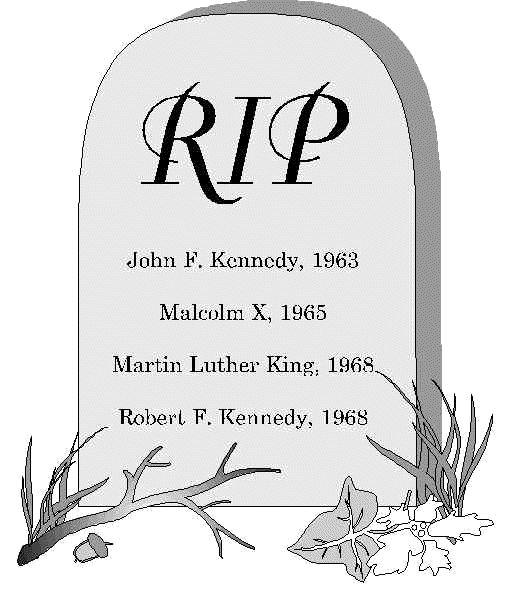
CTKA believes that this is perhaps the most obvious and destructive example of Schotz’s “denial.” For if we take Chomsky and Cockburn as being genuine in their crusades – no matter how unattractive their tactics – their myopia about politics is breathtaking. For if the assassinations of the ’60’s did not matter – and Morrisey notes that these are Chomsky’s sentiments – then why has the crowd the left plays to shrunk and why has the field of play tilted so far to the right? Anyone today who was around in the ’60’s will tell you that the Kennedys, King, and Malcolm X electrified the political debate, not so much because of their (considerable) oratorical powers, but because they were winning. On the issues of economic justice, withdrawal from Southeast Asia, civil rights, a more reasonable approach to the Third World, and a tougher approach to the power elite within the U.S., they and the left were making considerable headway. The very grounds of the debate had shifted to the center and leftward on these and other issues. As one commentator has written, today the bright young Harvard lawyers go to work on Wall Street, in the sixties they went to work for Ralph Nader.
The promise of the Kennedys or King speaking on these issues could galvanize huge crowds in the streets. But even more importantly, these men had convinced a large part of both the white middle class, and the younger generation that their shared interests were not with the wealthy and powerful elites, but with the oppressed and minorities. Today, that tendency has been pretty much reversed. Most of the general public and the media have retreated into a reactionary pose. And some of the most reactionary people are now esteemed public figures e.g. Rush Limbaugh, Newt Gingrich, Howard Stern, people who would have been mocked or ridiculed in the ’60’s. And the Washington Post and Los Angeles Times, under no pressure to disguise their real sympathies, can call Limbaugh a mainstream conservative (12/2/96).
What remains of the left in this country today can be roughly epitomized by the nexus of The Nation, the Pacifica Radio network (in six major cities), and the media group FAIR (Fairness and Accuracy in Reporting). We won’t include The New Republic in this equation since Peretz has now moved so far to the right he can’t be called a liberal anymore. The Nation has a circulation of about 98,000. Except for its New York outlet, WBAI, Pacifica is nowhere near the force it was in the sixties and seventies. The FAIR publication EXTRA has a circulation of about 17,000. To use just one comparison, the rightwing American Spectator reaches over 500,000. To use another point of comparison, the truly liberal Ramparts, which had no compunctions taking on the assassinations, reached over 300,000. As recently declassified CIA documents reveal, Ramparts became so dangerous that it was targeted by James Angleton.
One of this besieged enclave’s main support groups is the New York/Hollywood theater and film crowd, which was recently instrumental in bailing out The Nation. As more than one humorous commentator has pointed out, for them a big cause is something like animal rights. Speaking less satirically, they did recently pull in $680,000 in one night for the Dalai Lama and Tibet. Whatever the merits of that cause, and it has some, we don’t think it will galvanize youth or the middle class or provoke much of a revolution in political consciousness. On the other hand, knowing, that our last progressive president was killed in a blatant conspiracy; that a presidentially appointed inquest then consciously covered it up; that the mainstream media like the Post and the Times acquiesced in that effort; that this assassination led to the death of 58,000 Americans and two million Vietnamese; to us that’s quite a consciousness raiser. Chomsky, Cockburn and most of their acolytes don’t seem to think so.
In the ’80’s, Bill Moyers questioned Chomsky on this point, that the political activism of the ’60’s had receded and that Martin Luther King had been an integral part of that scene. Chomsky refused to acknowledge this obvious fact. He said it really wasn’t so. His evidence: he gets more speaking invitations today (A World of Ideas, p. 48). The man who disingenuously avoids a conspiracy in the JFK case now tells us to ignore Reagan, Bush, Gingrich, Limbaugh, Stern and the rest. It doesn’t matter. He just spoke to 300 people at NYU. Schotz and Marcus have given us a textbook case of denial.
With the help of Marty and Ray, what Probe is trying to do here is not so much explain the reaction, or non-reaction, of the Left to the death of John Kennedy. What we are really saying is that, in the face of that non-reaction, the murder of Kennedy was the first step that led to the death of the Left. That’s the terrible truth that most of these men and organizations can’t bring themselves to state. If they did, they would have to admit their complicity in that result.
(Click here if your browser is having trouble loading the above.)
(Click here if your browser is having trouble loading the above.)
(Click here if your browser is having trouble loading the above.)
Almost every JFK assassination researcher is aware that the Dallas police found and inventoried a tiny hi-tech Minox camera amongst Oswald’s personal effects during the search of Ruth and Michael Paine’s home after the assassination.This camera was later omitted from an inventory list once the FBI took over the investigation. What is not generally known is the Paines’ role in the “appearance-disappearance”charade.
There were 3 separate inventory lists itemizing the evidence from the Paine household. This is typical of the routine procedures used by law enforcement in establishing chain of custody of physical evidence. First, there was the Dallas police list identifying a “small German camera and black case on chain and film”. A pedometer and camera timer were also itemized; there was no mention of a light meter but there was mention of a “brown case (camera) with long chain”.1 Then there was the joint DPD and FBI list which was prepared in response to the FBI’s assertion of jurisdiction over the crime. The camera is described in aggregate Item #375 as a “Minox camera” together with a pedometer and a camera timer; there is no mention of a light meter. Rolls of undeveloped Minox film and two rolls of exposed Minox film were also inventoried as Item #377. An unidentified electronic device in a brown case was listed as an unsubmitted and unnumbered item as having come from the Beckley Street rooming house.2 When the evidence was taken to Washington, D.C., the FBI Lab prepared its very own inventory by way of a third list; any reference to the Minox camera would disappear from this third list.3
There were four separate sets of photographs of the items removed from the Paine household and Beckley Street residence. First, there were the photos made by the Dallas Police Crime Lab before the evidence was turned over to the FBI which shows the evidence grouped together on the floor of the police station and which depicts the Minox camera.4 At the joint police and FBI inventory of November 26th, a second set of photographs were taken depicting each individual item or selectively grouped items with the numbered photos corresponding to the numbered items. The items ranged from #1 through #455 and required 5 rolls of film. It was understood that the FBI Lab would develop these 5 rolls of film and furnish a set to Police Chief Curry. This intact set of photos from the original 5 rolls have disappeared from the National Archives – assuming that the FBI even turned them over to the Warren Commission or the Archives in the first place.5
The third set of photos consist of 2 rolls of microfilmed photos which the FBI Lab made after developing the photos jointly taken in Dallas; this microfilmed series was furnished to the Dallas Police which in turn furnished copies to other agencies, including the Secret Service.6 In a letter dated December 3, 1963, Police Chief Curry advises the FBI that items #164 through #360 were missing and apparently did not record; he requests the FBI to re-photograph the items.7 The fourth set of photos consist of the FBI’s “re-photographed” items which were sent to the Dallas police to supplement the missing photos.8
Not only were there missing frames but some of those that existed had been altered. The Minox camera itemized in #375 of the joint inventory list ceased to exist in the set of microfilmed photos first returned to the Dallas Police by the FBI. Photo #375 which was supposed to be a group photo of the Minox – along with several other camera items – is now just a Minox light meter.9
It is generally unknown in the research community that much, if not all, of the evidence seized from the Paine household and Beckley Street residence was “loaned” to the FBI on the weekend of the assassination even before the FBI took charge of the crime. The FBI assigned number #Q-5 to the Minox camera and/or Minox film at that time. The evidence was returned to the Dallas police after the FBI’s inspection. It was then turned over once again to the FBI on November 26th when the FBI assumed jurisdiction.10 We know that the Minox film recovered from the Paine household was in possession of the FBI as of November 25th because on that date the FBI requested a comparison of the Minox film as recovered from the possessions of Oswald with Minox film designated as Specimen Q5. The laboratory results were that Minox film Q5 was not taken with the same camera as the other Minox film.11 Was the FBI comparing the Minox film later designated as Item #377 with the cassette still remaining in the Minox camera recovered by the Dallas police?
The FBI’s early efforts to conceal the existence of the Minox camera did not stay secret for long. According to author Gary Savage, a controversy ensued within the first two months following the assassination when news reporters received information that the FBI had altered the inventory list. Furthermore, the FBI had pressured Dallas police detective Gus Rose to change his recollection of what he had found from a Minox camera to a Minox light meter. Detective Rose steadfastly refused to alter his findings and insisted that he found the camera in Oswald’s seabag the weekend after the assassination.12
The FBI was now squarely in the middle of an evidence tampering dilemma before the Warren Commission investigation was barely underway. One solution would be to produce the original camera, or any Minox camera for that matter, in order to resolve the discrepancy. This is precisely what the FBI did.
We now know that the controversy over the Minox camera reached the highest levels of the FBI because on January 27, 1964, Mr. William A. Branigan, Chief of the FBI’s espionage section, telephoned SAC Gordon Shanklin in Dallas to point out the inconsistency in the inventory lists. Branigan also advised Shanklin that the FBI Lab in Washington did not have the Minox camera in its possession.13 On January 28, 1964 Shanklin responded by advising FBI Inspector Moore of the FBI Lab that no such Minox camera had been found – only a Minox light meter.14 This, of course was an outright lie on Shanklin’s part. FBI Director J. Edgar Hoover apparently found this reply unacceptable because on January 30, 1964, Hoover sent a teletype to Shanklin advising once again that the FBI Lab had all Minox related items except for the Minox camera. Hoover then instructed SAC Shanklin to immediately investigate this matter and to contact the Dallas Police, Mrs. Oswald and Mrs. Paine, if necessary.15
In an effort to “locate” the camera, Dallas FBI Agent Bardwell Odum on January 30, 1964, contacted Ruth Paine to inquire into whether the Paines owned a Minox camera.16 Ruth recollected that her husband had a Minox which he had dropped into salt water several years ago; she was sure that he had thrown it away but she would ask him about it and get back to him. She also stated that the police took a Minox camera case along with a light meter belonging to Michael which may or may not have been a Minox light meter.17 The next day on January 31, 1964, Ruth Paine called Odum to tell him that her husband still had the camera and that it was in a coffee can in the garage.18 If this was true, one would have to conclude that the local police not only did a poor job of searching the garage the weekend of the assassination but also fabricated the Minox camera on both its original inventory list and joint DPD/FBI list. Since this was not the case, the collusion of the Paines is readily apparent.
…
1 The first DPD inventory list, undated, was obtained from the Dallas Police Archives. It is attached to an undated joint statement of the officers which in turn is followed by a supplementary report dated 11/23. The inventory list does not seem to distinguished between those items recovered on the 22nd, and those items recovered on the 23rd pursuant to a search warrant. With respect to felonies, police officers have the power to search and seize what is in plain view. Closed containers, such as Lee Oswald’s boxes, envelopes, suitcases, and seabags, etc. would require a search warrant. While the weekend reports are somewhat sloppy in this regard, the undisputable fact remains that the Minox camera was recovered at that time regardless of whether it was the 22nd or the 23rd. This author has entertained the possibility that the police officers’ search on the 22nd went beyond proper legal limits and this was “rectified” by obtaining a search warrant the next morning.
2 See Commission Exhibit #2003 at Vol. 24, p. 340. The evidence was delivered to the Dallas FBI office on 11/26. On forms supplied by the Dallas police, a detailed inventory list was prepared by police property clerk H.W. Hill and witnessed by FBI Agent Warren De Brueys and police captain J. M. English. The Minox camera is identified on Receipt No. 11192-G as one of the items voluntarily given to the police by Ruth Paine and Marina Oswald on the 22nd suggesting that the first police search went beyond its permissible scope as is often the case in criminal proceedings. The listing of the electronic device in the brown case from the Beckley Street address (set forth in the joint list at Receipt No. 11199-G) further clouds the issue of what items came from where and when – at least insofar as the weekend police search is concerned. The police department version in the Dallas Police Archives differs from the FBI’s list of the 26th in only one respect: the Dallas list contains the signatures of the FBI agents receiving the property. The accompanying affidavit of Dallas officer H. H. Hill describes the process by which a joint inventory was made wherein FBI Agent De Brueys called out the items, one by one.
3 See evidence list set out in CD 735. Item 375 has been altered to omit the Minox camera and turn it into a Minox light meter. For some reason this list contains the Dallas field office file number instead of the Headquarters file number suggesting that the FBI’s own property list was prepared in Dallas before departure to Washington, D.C. We do know from an FBI document that Agent DeBrueys delivered the evidence to the FBI Lab on November 27th. Another document suggests that a 4th list was prepared by the FBI Lab which superseded all prior lists.
4 JFK First Day Evidence by Gary Savage, pp.208, 210.
5 See 11/26/63 report of FBI Agent Ronald E. Brinkley describing how the photos were made with the DPD photo-record camera. 5 rolls of photos were taken using 35mm Kodak High Contrast Copy microfilm. FBI agent James P. Hosty states in his recent book, Assignment: Oswald, p.77 that the photos were taken with a Minox camera. This is a mistake or falsehood on his part as Minox cameras use only Minox film. The documents setting forth the joint photo session with the Kodak film were supplied by Researcher John Armstrong and were obtained from the Dallas Police files. At Mr. Armstrong’s request, the National Archives searched for these 5 rolls of photos and could not locate them.
6 See FBI agent Robert Barrett’s report of statement from Assistant Chief of Police, Charles Batchelor, dated 7/6/64, and available from the microfilmed collection of Dallas Police Archives. See also FBI memo dated 11/29/63 from Branigan to Sullivan.
7 Curry’s 12/3/63 letter from the Dallas Police Archives furnished by Mr. Armstrong.
8 Author’s conversation with John Armstrong whose opinion is based in part upon an undated FBI document bearing Agent Wallace Heitman’s name, referencing dates of 1/23/64 and 2/4/64 and referring to 85 photographs of Oswald’s belongings.
9 Indeed there are two separate photos of #375, one still in the possession of the Dallas Police Archives showing the surrounding items covered up by scraps of paper and the one in the National Archives showing a blow up of the Minox light meter all by itself; copies furnished to author by John Armstrong. The National Archives also has a copy of the same DPD group photos that Gary Savage depicts in his book. However, these photos were enlarged, then cropped to omit the Minox camera featured in the top 1/3 of the original photograph. A copy of the NARA cropped photo was furnished to the author by Anna Marie Kuhns-Walko.
10 See deposition of FBI Lab expert, James C. Cadigan, NARA: HSCA Record No. 124-10086-10013.
11 The author’s copy of this document was furnished to her by John Armstrong without the benefit of a RIF cover sheet from the NARA. It appears to be part of report prepared by Dallas FBI agent, Robert Gemberling. Note that the Minox film analysis was filed away in a New York City FBI field office file #65-22483 of the Espionage-Russia division. According to John Armstrong, a FOIA request failed to turn up this file.
12 See Savage pp. 212-215,and transcript of Gus Rose’s statement to the HSCA made on 4/13/78.
13 FBI #105-82555-1643, memo dated 1/28/64.
14 Ibid.
15 FBI #105-82555-1580, teletype dated 1/30/64, RIF citation omitted. This teletype also clarifies the fact that there were two Minox cassettes, one of which contained film.
16 Dallas FBI field office file, #100-10461, Odum report of 1/30/64 interview with Ruth dictated on 1/31/64 and typed on 2/3/64
17 Ibid.
18 FBI #105-82555/#100-10461, report of 1/31/64 interview with Ruth Paine, dictated on 1/31/64 and typed on 2/1/64
19 FBI #105-82555/#100-10461, report of 1/31/64 interview with Michael Paine, dictated on 1/31/64 and typed on 2/3/64
20 Ibid.
21 Ibid.
22 Ibid.
23 Ibid.
24 FBI #105-82555/#100-10461, Bulky Exhibit Inventory Receipts, two versions, dated 1/31/64 and 2/8/64
25 2/2/64 cover letter with Airmail from Dallas to FBI Lab
26 FBI #105-82555/#100-10461, report of 1/31/64 interview with Michael, dictated on 1/31/64 and typed on 2/3/64
27 See Warren Commission Exhibit #2003 at Vol. 24, p. 333.
28 FBI #105-82555/#100-10461, teletype dated 1/31/64
29 Assignment: Oswald, p.86, by James P. Hosty
30 See Warren Commission Vol. 9, p.444
31 See Warren Commission Vol. 10, p.313 and p.325. It is not clear if Shasteen’s relationship with Odum originated with the FBI investigation into the assassination or if it was pre-existing.
32 See HSCA, Vol. 12, p. 373
33 See HSCA, Vol. 12, p. 390
34 See p. 211 of Gary Savage’s book, JFK: First Day Evidence and Dallas Morning News reports by Earl Golz dated 6/15/78 and 8/7/78.
Original Probe article
(Click here if your browser is having trouble loading the above.)
(Click here if your browser is having trouble loading the above.)
Just declassified at the National Archives is the record of Gaeton Fonzi’s interview with Silvia Odio for the Church Committee. We choose to reprint it here in full for two reasons. First, because it is interesting to note the actions of one Wesley Liebeler, UCLA law professor, in his apparent attempt to discredit her. There are still some who believe today that the Warren Commission was actually a fairly neutral body that was just tricked and lied to by the FBI and CIA. We find this an untenable position. We think the Commission, from top to bottom, was prejudiced against Oswald from its inception.
Wesley Liebeler is a good example of this. Liebeler was one of the strongest voices against the critics in their early days. As noted elsewhere (see page19), he spoke out against Jim Garrison early and often. The day after David Ferrie’s untimely and mysterious death, the New York Times and Associated Press quoted him to the effect that there was nothing of consequence to Ferrie’s role, the man was uninvolved and that was the reason for his name not appearing in the Warren Report. After that, it is apparent from one of his talks at UCLA, that he had been in contact with James Phelan and was preaching that FBI informant’s line on the “circus atmosphere” of the Garrison investigation. According to a memo from Sylvia Meagher’s 1965 files, when David Lifton was speaking to Liebeler about an upcoming private critics’ conference in New York, Liebeler corrected Lifton on the date of the meeting. Perhaps most revealing of all, before the HSCA, Liebeler had the following colloquy:
Q: Had you prior to going to work for the Warren Commission had any prior experience with any of the federal agencies, investigative agencies, FBI, CIA?
A: I was interviewed by a CIA agent once when I was younger.
Q: Did you form any impressions about them?
A: I was favorably impressed.
The second reason we have decided to print the document is because of the treatment of the Odio incident in the recent La Fontaine book, Oswald Talked. In our last issue, Carol Hewett pointed out some serious errors that the La Fontaines made in their assessment and treatment of the John Elrod story. There are some other questionable aspects to this rather curious book. In some ways it attempts to take us back to 1964. Relying on Gerald Posner’s new variation, the book contains support for the single-bullet theory (p. 376). Ignoring the work of John Newman, John Armstrong, and the now indisputable evidence of Oswald’s Minox camera, they conclude that Oswald was a true Marxist (p. 161). Concerning David Ferrie, they take the rather breathless stance that he was an unwitting dupe hired to create a phoney trail that would unwittingly link him to the assassination (p. 189). Consider this logic: we are to believe that cagey Guy Banister decked Jack Martin because he knew that Martin would spill the beans about Ferrie and lead Garrison back to Banister himself.
All of the above are reminiscient of those two veteran researchers Paul Hoch and Peter Dale Scott. The pair figure prominently in the book’s acknowledgements. Scott wrote a rave review about this book for the current issue of Prevailing Winds. Since Scott and Hoch have seen many of the new file releases, we find it odd that they would back a book that claims, in its very subtitle, to be based on the “New Evidence in the JFK Assassination.” For the truly new evidence completely contradicts the above deductions. For instance, it now appears that the cover-up about Ferrie and Clay Shaw goes all the way up to Allen Dulles’ old friend and protégé; McGeorge Bundy. In a recently declassified FBI memorandum of 5/10/67, the following paragraph is included:
Branigan advised all information concerning investigation by SA Kennedy had been forwarded to the Department and to the Warren Commission, that certain of this information was sealed and this decision had been made by GEORGE McBUNDY [sic], Presidential Advisor, and members of the Warren Commission, and principally pertained to information showing certain people were homosexuals, etc., was not germane to the investigation, and McBUNDY [sic] and the Commission decided this should be sealed…
(“SA Kennedy” refers to New Orleans FBI agent Regis Kennedy. )
Since Bundy and Dulles had worked together since the Dewey campaign of 1948, and Bundy, according to “the new evidence,” was the point man in the White House delivering propaganda briefings on the Warren Report two months before it was issued, we find it hard to believe that the above is all completely innocent. Especially since both Shaw and Ferrie worked for the CIA when Dulles was chief.
The above also belies another underlying tenet of the La Fontaines, namely that only the FBI was employing the Marxist Oswald while this brilliant Marxist manipulator was infiltrating all those unsuspecting, naive CIA agents and assets in New Orleans and finally Dallas. To do this, they ignore the fact of Oswald’s CIA files being shepherded by Counterintelligence Chief James Angleton through the darkest sections of the Agency; the highly suspicious roles of Ruth and Michael Paine; the fact that the FPCC was the subject of a CIA operation launched by David Phillips and James McCord; that Phillips then followed Oswald to Mexico City in October to prepare the false and incriminating transcripts in the Cuban embassy that Hoover was in the dark about on November 23rd!
But the most disturbing aspect of the book is the chapter on the Odio episode. It is quite simply – in tone, method, and intent – a hatchet job that would bring smiles to the faces of Walter Sheridan and, of course, Liebeler. The method of personal ridicule extends down to comparing Odio to a delusionary victim of a UFO sighting and portraying her sister Annie as a dim-witted, weak-willed accomplice. In a case like this, no witness is above question, as long as the questioner plays fair and square. We won’t go into the La Fontaines’ specious methodology of carefully selecting certain aspects of the Odio record. Like Carol Hewett, Steve Bochan does a good expose of their incomplete presentation in the current Summer issue of Assassination Chronicles. Suffice it to say that we have problems with any researcher who chooses to trust and use the likes of Burt Griffin and Liebeler over Gaeton Fonzi and Sylvia Meagher.
We would like to make one additional comment on the document below. This may further elucidate Odio quoting Liebeler about Earl Warren in regard to covering “this thing up” (see the callout on this page). When Probe interviewed an HSCA staffer about Odio, he told us that the reason Warren did not believe the “Odio incident” was because Liebeler told him that Odio was a “loose woman.” The reader will understand the import of that remark by reading the report below.
REPRODUCED AT THE NATIONAL ARCHIVES
RELEASED PER P. L. 102-526 (JFK ACT) 5-2-96
Notes – Silvia Odio interviewed 1/16/76
She first heard of the Kennedy assassination on the radio while on the way back from lunch and she immediately thought of the visit of the three men to her apartment and the conversation she had with them. It produced a tremendous amount of fear in her and she later passed out. (She had been under mental strain of marital problems and the responsibility of caring for her four children after her husband deserted her.) The next thing she remembered was watching television with her sister and seeing Oswald and both recognizing him as one of the men who came to the apartment. “We were just so scared because we both recognized him immediately.” They both were extremely frightened and very anxious about the welfare of their eight brothers and sister (10 children in the family) and their mother and father in prison in Cuba and, since they didn’t know what was going on or whether or not there had been a conspiracy of many involved in the assassination, they both decided not to bring their experience to the attention of the authorities. (“I never wanted to go to them, I was afraid. I was young at the time, I was recently divorced, I had young children, I was going through hell. Besides, it was such a responsibility to get involved because who is going to believe you, who is going to believe that I had Oswald in my house? I was scared and my sister Annie was very scared at the time, she was only 14.)
She recalls when she was interviewed by Hosty that he kept pressing her to remember the specific day that the three men came to her apartment and she couldn’t specifically remember. Still they kept pushing her for the exact date. (I kept telling them that I don’t remember the date but I know that it was in the last days of September because we were moving at the time and that we had boxes all over the living room and that in order to open the door we had to jump all over the boxes. But I could swear I don’t remember the day, but when I read the Report I found they had set a day and that they had done it for me.”) (“I only remember it must have been the last days of September because we had already a lease for another apartment and that it was the middle of the week, not a Saturday or Sunday.”)
She says she doesn’t specifically remember being asked about Loran Hall, Lawrence Howard or William Seymour but she was shown numerous photographs, many even after she had moved to Miami in September of 1964, but was never told the names of anyone whose photograph she was shown. She recognized no one but Oswald. (I showed her photographs of Hall, Howard and Seymour which were in Tattler, Sept. ‘75, and she recognized none of them.) I asked her about the possibility that it might have been someone who looked identical to Oswald. She said, “When you see someone as close as I’m seeing you now, even closer because we were standing by my door for about 15 minutes and the light was just coming down upon their faces, when I saw him on television I recognized him immediately. And this guy had a special grin, a kind of funny smile. He kept smiling most of the time, he kept trying to be pleasant, but the other guys did all the talking.”
“Well, you know if we do find out that this is a conspiracy you know that we have orders from Chief Justice Warren to cover this thing up.”
She remembers specifically that he was introduced to her as “Leon Oswald,” and he himself said, “My name is Leon Oswald.”
She says the thing she remembers most about one of the guys is that he had a “funny kind of forehead. It just sort of went back, with no hair on the side. It was peculiar and it’s hard to explain.”
She has the feeling, also, that the three men wanted her to know that they were going on a trip, that they specifically mentioned that they were going on a trip.
She wrote her father and told him of the men but he said he didn’t know them and not to trust anyone.
She also told her psychiatrist, a Dr. Einspruch, then at Southwestern Medical School, of the incident.
She wonders why, after she was questioned by the FBI, they waited so long to call her back. It wasn’t until the middle of the summer that Liebeler came to Dallas to question her.
She asked how candid she could be with me and I said I wished she would be totally candid. She said she could say something but she’s afraid she could get in trouble because it would be only her word, although she would swear to it. She said she hasn’t told this to anyone except a Mr. Martin Phillips who came to talk to her about putting her on Dan Rather’s CBS assassination special television show. She refused to [go] on the show but she did talk to Phillips. She said she told part of this story to Phillips but has never mentioned it to anyone else.
She said that after Liebeler questioned her for the second time that day (the first interrogation started at 9 a.m.; the second at 6:30 p.m.) he asked her out to dinner. “That surprised me, but I was afraid and I went. We didn’t go out alone. We went out with someone who was supposed to be Marina Oswald’s lawyer. I don’t remember his name, but Mr. Phillips from CBS knew. We went to the Sheraton to eat dinner. I thought perhaps there was something behind it and there was a kind of double talk at the table between the lawyer and him. I wasn’t sure they wanted me to hear the conversation or they wanted to convince me of something or wanted me to volunteer something. He (Liebeler) kept threatening me with a lie detector test also, even though he knew I was under tremendous stress at the time. But one thing he said, and this has always bothered me, he said to this other gentleman, I don’t remember his name, he said, “Well, you know if we do find out that this is a conspiracy you know that we have orders from Chief Justice Warren to cover this thing up.” (I asked: Liebeler said that?) “Yes, sir, I could swear on that.” At the time, she said she thought that maybe it was a bait for her because she had the feeling that they thought she was hiding something more, that she was involved with other Cuban groups perhaps or that she knew more than she was saying. “That was the feeling that I got by the time that they took me to dinner, that maybe if I had a few drinks and the conversation became very casual, I would go ahead and volunteer information he thought I was hiding. I wasn’t hiding anything. But what he said struck me. I remember I had a Bloody Mary and thinking to myself, “My God, I’m not that drunk.” I had one Bloody Mary and that’s all I was having. If it was for my sake that he was saying that, it if it was a little game they were playing with me, I don’t know. That’s when I said to myself, “Silvia, the time has come for you to keep quiet. They don’t want to know the truth.”
“But that made me angry. Not only that, he invited me to his room upstairs to see some pictures. I did go, I went to his room. I wanted to see how far a government investigator would go and what they were trying to do to a witness. Of course nothing happened because I was right in my right senses. He showed me pictures, he made advances, yes, but I told him he was crazy. He even mentioned that they had seen my picture and that they had even joked about it at the Warren Commission, saying like what a pretty girl you are going to see, Jim, and things like that. To me that was all so, I don’t know, anti-professional. I wasn’t used to this sort of thing and I was expecting the highest respect, you know, and I wasn’t expecting any jokes in the investigation of the assassination of a president. So that’s why I’m telling you why my feelings changed because I saw something I wasn’t expecting to see. I wanted to see someone who was carrying on an investigation who was serious about it but somehow I had the feeling it was a game to them and that I was being used in this game.”
The fellow who Liebeler identified as Marina Oswald’s attorney had not been at her questioning but they picked him up on the way to dinner. He left after dinner and did not go up to Liebeler’s room with them.
(Showed her all the photographs I had with me and she could identify only Oswald in any of them. Except for one photo which I believe was taken of individuals coming out of courtroom following hearing in New Orleans concerning the Bringuier-Oswald fracas.) She identified the man in the background (center left) as her uncle and said she didn’t know her uncle was involved with Bringuier. I told her that according to an FBI report, her uncle, Dr. Augustin Guitart, admitted to being at that court hearing. She said her uncle never mentioned his involvement with Bringuier but that she knew he was a “fierce” anticommunist. (She herself, she earlier said, was associated with the more liberal element of Manolo Ray’s party and had always been a Kennedy fan.)
She said she has always wondered who the other two men who came with Oswald were and has always looked for photographs of them. She says she is pretty sure that one of them was a Mexican. Again she mentioned the “weird forehead.”
“…he invited me to his room upstairs to see some pictures. I did go, I went to his room. I wanted to see how far a government investigator would go and what they were trying to do to a witness. Of course nothing happened because I was right in my right senses. He showed me pictures, he made advances, yes, but I told him he was crazy.”
I asked her why she thought she was selected for the visit. She said probably because her father was well known. He was a millionaire who helped Fidel in the mountains. He transported all the arms that went into the Sierra Maestras. He supplied arms and medical supplies. There was hardly anyone in the underground, she said, who didn’t know who her father was. The family was exiled for three years when Batista was in power because her father refused to sell his transportation business. He was described in Time magazine as the “transport tycoon” of Latin America. She says he had a tremendous number of enemies, both business and political. He supplied the truck for the assault on the palace on the 13th of March. He went into exile after that in Miami. (I asked if she knew Pawley. She said she didn’t but that her father knew almost everyone.) “We were very strong supporters of Castro until we felt betrayed by him.”
She said she was surprised at the details of her father’s life that was known by the three men who came to her apartment, the fact that they knew where her father was in prison. They mentioned the movements that her father had been in politically and called him Amador-Odio. They said they belonged to the JURE movement and knew she belonged to the JURE Movement, as did her father. (That was Manolo Ray’s movement.)
But she also says that when she thought about it later it wasn’t that difficult for anyone to know of her and her involvement with JURE because the Cuban community in Dallas wasn’t that large and they all lived in about the same section of town. Also, there had been a big rally in a park on a liberation day (she didn’t remember which day) and she delivered the invocation. That was covered by the newspapers and the television stations and she said the FBI later told her that it thought that Oswald could have been there mingling with the Cubans.
Also it was possible, she later thought, that the three men knew of her because when her father had been sentenced to prison it was a big story in the Dallas newspapers. It had all the information about a millionaire and his family and it also carried her sister Serita’s picture. (Serita had come to Dallas before Silvia and was attending the Univ. of Dallas.) At first her father was sentenced to die and that’s why it was such a big story. Silvia was still in Puerto Rico at the time. (Serita is now in Mexico.)
She says that when the three men came to the door they first asked for Serita and that they seemed confused, but when she told them she was Silvia and that she was the oldest they said it was she they wanted to talk with.
That reminded her of Johnny Martin. “Johnny Martin came out of the blue,” she said. “That was a very strange thing. I don’t know how he got involved with my sister Serita, how he was introduced to her. The strange thing about him was that his family lived somewhere in a Latin American country and he had this laundry, this coin laundry he operated. He would tell Serita to being (sic) her clothes there and he wouldn’t charge her. And then Serita brought him to our house and we started talking about a lot of things. He was very clever and we were very young and soon he was telling us he could get arms for our movement. I got in contact with Eugenio (Rogelio Cisneros) and he told Ray he was coming to Dallas to meet Martin.” Martin she says always seemed to be broke yet he said he had a lot fo (sic) contacts in Latin American governments. Nothing came of the meeting between Martin and Cisneros because Cisneros didn’t trust him.
Re: Lucille Connell. She was a Protestant who got involved in the Catholic Welfare Bureau. She came on very strong with Silvia as soon as she arrived in Dallas and, in fact, had sponsored her trip from Puerto Rico. Connell had known her sister Serita first. “She struck me as the most fantastic, the most kind and considerate person I ever met,” says Silvia. “She was just so generous, and I had tremendous admiration for her.”
“She was very involved with a lot of different groups and talked to me about them. She was very intense about the John Birch Society. She was also involved with the Rosicrusians. And also with the Mental Health Association in Dallas.”
She was a very wealthy women (sic), married to a wealthy man but she divorced him and is now living in Long Island, remarried. (Name now Lucille Light
50 Wynn Court-Muttontown
Syoset, Long Island 516-921-3519
Her husband (Connell) had a large CPA firm in Dallas. J. B. Connell?)
Connell had even gotten her psychiatrist, Dr. Einspruch (who later went to Philadelphia Naval Hospital.) (She later visited him there; he was wearing a uniform.)
She described Mrs. Connell as a person who knew all the key people in Dallas.
“She was a very strong person. She tried to use the fact that I was ill in order to control me, my thoughts, my friends, my goings and comings, the way I raised my children. It came to a point when she called me every night to get a report on what I had done for the day, who I had seen, where I had been. She had a tremendous memory, a very tremendous memory. She could recall something, something she had seen or heard right away. I remember I mentioned the fact of the men’s visit just once to her and she never forgot.
“You have to remember that I arrived in Dallas under tremendous pressure, I had just suffered the trauma of divorce, I had four children, I had all this responsibility of my brothers and sisters, it was a tremendous burden. And Lucille took me under her wing, took me to the country club, wanted to buy me dresses, wanted to introduce me in certain circles. I always had the feeling she was getting me ready for something.”
“Then came this Father McChann. Father McChann and I became very close friends and he was going through his own crisis in his life. Lucille used him, managed him, handled him. I don’t know how to say it. Lucille tried to get us together and then tried to get us apart and got jealous of our relationship in the meantime. People are very complex. She was very moody and enjoyed playing with our lives. There was a time when I couldn’t say no to her for anything, She would call me at two o’clock in the morning and say, “I don’t want to sleep now, would you talk to me? and I felt I had to even though I didn’t want to and had to go to work the next morning.” Only with Dr. Einspruch’s help that she got strong enough to pull herself away from Mrs. Connell.
“This is why she was angry with me and maybe why she called the FBI. She was very angry with me because I was pulling away from her and getting stronger.” She had also developed a relationship with a wealthy couple named Rodgers and Mrs. Connell was very jealous of that, also. (John Rodgers was the president of Texas Cement.)
(I asked her about her knowledge of Reinaldo Gonzales and Alpha 66 founder Antonio Veciana.) She knew of them and of her father’s role in hiding Gonzales. She had never met Veciana and did not know what he looked like.
She said she also knew Jorge Salazar (mentioned in O’Toole-Hoch piece as Dallas Alpha 66 leader whose home at 3126 Hollandale was meeting place where Oswald was seen), but was never at that address and was never involved with Alpha 66. Actually, she only knew of Salazar and doesn’t actually know what he looks like.
(I had her review her testimony and she recalled certain details:)
(re Mrs. Connell again: I asked her about Connell’s report to FBI re Gen. Walker and Col. Castorr) “Mrs. Connell was apparently involved in more than she pretended. Whenever she wanted to find out some information she would take me out to lunch. I wasn’t aware at the time she was using me. I knew she was involved with key people in Dallas and she was continually getting phone calls where she would lock herself in her library when she answered them. She was always mysterious, and always very careful not to mention information, she always asked. She did mention Gen. Walker, we talked about Walker. I knew she was involved with his movement and with the John Birch Society. I think that’s why she was involved with the Cubans, because we were very usable people, and expendable. (Did she ever mention Conservatives of the USA?) “Yes, she did. We discussed that, I remember the name.” (Re Connell-cont.) “And then all of a sudden one summer she decided to become a Rosicrusian, and she started traveling, was it Oklahoma or someplace where the Rosicrusians have a headquarters? She traveled quite a bit on that, I remember because she showed me a card, they issued her a card.
She married a guy who takes tours to Europe and has a lot of money…
Another association she recalled was the name of Russo, which she heard mentioned as part of Garrison’s investigation. She says the name rang a bell and she finds it interesting that he knew Oswald by the name of Leon Oswald also.
Connell was not only involved with the Mental Health Association but very interested in psychology, mind control and brainwashing. She had a lot of books on the subject.
That’s when I said to myself, “Silvia, the time has come for you to keep quiet. They don’t want to know the truth.”
Silvia specifically remembers that when Leopoldo called her back on the telephone and told her about Oswald talking about killing Kennedy, it was not a weekend day (Sat. the 28th or Sunday the 29th) because she remembers working that day and getting the call after she came home from work, about 7:30 p.m. She is pretty sure it was not the day after their visit, but the following day (which would make it Friday the 27th at the latest; because Monday was the 30th and she was moving by then.)
(Click here if your browser is having trouble loading the above.)
(Click here if your browser is having trouble loading the above.)