Category: John Fitzgerald Kennedy

Original essays treating the assassination of John F. Kennedy, its historical and political context and aftermath, and the investigations conducted.

  • The JFK Files Volume II: Pieces of the Assassination Puzzle

    The JFK Files Volume II: Pieces of the Assassination Puzzle

    The JFK Files Volume II: Pieces of the Assassination Puzzle

    By Jeffrey Meek

    Jeffrey Meek is the only writer I know who is allowed to pen a regular column on the JFK case. He writes for the Hot Springs Village Voice newspaper. He has now published his second collection of articles from that paper and added two long essays he wrote for the new version of George magazine. I have previously reviewed his first collection on this site. (Click here for that critique https://www.kennedysandking.com/john-f-kennedy-articles/the-jfk-files-pieces-of-the-assassination-puzzle)

    The main title of this anthology is The JFK Files, Part 2. This second collection leads off with an interview of the late Jim Gochenaur. People who have watched Oliver Stone’s JFK Revisited will know who Jim was. Jim was interviewed by the Church Committee. As the witness says here, and he said to Stone off-camera, that interview transcript went missing. When he arrived in Washington, he was first interviewed by staffers Paul Wallach and Dan Dwyer, and then by Senator Richard Schweiker himself. Schweiker, of course, made up half of the subcommittee running the inquiry into the JFK case for Senator Frank Church. The other half is Senator Gary Hart.

    What makes that loss even odder is that the man he was interviewed about, Secret Service agent Elmer Moore, was also brought in for an interview. The transcript of that interview is available. Jim met Moore back in early 1970 in Seattle when he was doing an academic assignment concerning the JFK case. The following year, he went to visit Moore in his office. Moore agreed to talk to him about his Secret Service inquiry into the JFK case, which began about 72 hours after Kennedy was killed. But he would only speak to him on condition that he took no notes or made no tapes, and he understood that if anything he said appeared in public, Moore would deny it. (p. 5)

    Since most of this site’s readers have seen Stone’s documentary, I will not repeat the things that Jim said on camera for this review. There are some things that Stone and I did not cover in that interview (we did that one jointly). For example, Jim told Jeff that Moore considered George DeMohrenschildt—nicknamed The Baron–a key player in the case. But unfortunately for Moore, he could not get access to him once President Johnson put the FBI in charge of the investigation. Moore also told Jim that he could not understand why Captain Will Fritz did not make a record of his questioning of Oswald, since he knew that there were two stenographers on hand for the Dallas Police. (p. 6). Moore also had a print copy of one of the infamous backyard photographs of Oswald with a rifle and handgun. Jim noted that one could easily see a line through Oswald’s chin. I don’t have to inform the reader why that is of central importance.

    Jim was also interviewed by the House Select Committee on Assassinations (HSCA). Strangely, that was only a phone interview. Even though the HSCA lasted much longer than the Church Committee and was a direct investigation of the JFK case, the Church Committee was chartered with only inquiring about the performance of the FBI and CIA for the Warren Commission. But further, Jim said they were more interested in another acquaintance he made in Seattle, namely, former FBI agent Carver Gayton. Gayton had told him that he knew James Hosty–whom he met after the assassination. The former Dallas agent told Carver that Oswald was an FBI informant. (p. 11) This action by the HSCA is odd since Jim always insisted that Moore was a more important witness than Gayton was. This two-part interview with Jim Gochenaur is one of the volume’s three or four high points. Made all the more important and poignant since Jim has passed.

    II

    Another interesting interview that Jeff did was with a man named Lee Sanders. Sanders was on the Dallas Police force at the time they were participating in a reconstruction of the assassination. This was for the acoustics testing that the HSCA did towards the end of their term. Sanders was involved with crowd and traffic control during a five-day assignment. Live ammunition was being used in these tests. (p. 49)

    Sanders said that the DPD’s best marksman, a man named Jerry Compton, took part in the tests. He and an FBI sharpshooter took their shots from the sixth floor of the Texas School Book Depository. Between test firings, Compton would come down out of the building. Sanders overheard Compton say that they were having problems repeating what the Warren Commission said Lee Oswald had done. As Meek writes, “The scuttlebutt from other officers was that there must have been other shooters.” (p. 49). Sanders then added, “We just didn’t think that one guy could have done this. We didn’t say that in public because it wouldn’t have been good for your career, not if you wanted to stay in good stature with the department.”

    Meek interviewed former Commission counsel Burt Griffin about his 2023 book, JFK, Oswald and Ruby: Politics, Prejudice and Truth. As an interviewing journalist, Meek is rather merciful with Griffin. His technique was to let him burn himself. Griffin tells Jeff that Jack Ruby shot Oswald out of anti-Semitism. He wanted to be seen as an avenger due to the infamous black bordered ‘Wanted for Treason’ ad in the papers. That was signed by a Bernard Weissman. This is Griffin’s money quote about Jack Ruby: “He was convinced at the time, and for the rest of his life, that antisemites were involved, with the goal being to blame the Jews for the president’s assassination.” (p. 56) Griffin properly labels this as his conclusion. He then adds that Jews were being blamed for the attack on General Walker in April of 1963. He then states, “So, antisemitism was an important factor in Dallas at the time.”

    Griffin then continues in this nonsensical vein by saying that there is no evidence that anyone else was involved in the JFK assassination except Oswald. He then adds the antique adage that the Commissioners always use: that the Commission’s goal was to locate a conspiracy. And if he could have done so he would have had an acclaimed political career. Meek does not say if he giggled during these comments. I assume he did not. His goal was to keep Griffin spouting these absurdities, which Griffin did by using Howard Brennan as a reliable eyewitness to the assassination.

    Something puzzling comes up next. It appears to be Griffin who surfaces the fact that the Commission has Jack Ruby entering the basement through the Main Street ramp. The book says that Sgt. Patrick Dean was the head of security, and Dean said no, Ruby did not come down that ramp. ( Meek, p. 57) But if one reads the Warren Commission volumes, one will see that it was Dean who was the first person to say that Ruby proclaimed he did come down the Main Street ramp. And this was right after the shooting. This information is also contained in Paul Abbott’s recent book about the shooting of Oswald by Ruby. (Death to Justice, pp. 226-27) In fact, Abbott implies that Dean might have manufactured this quote by Ruby since, initially at least, no one else heard it. It did not catch on as a cover story for the DPD until November 30th. (ibid) In fact, according to one disputed journalistic account, Dean even said he saw Ruby come down the ramp, which was not possible. (Abbott, p. 229).

    But here it states that Dean said that Ruby did not come down that ramp. It was then this dispute that caused a blow-up between Griffin and Dean. (Meek, p. 57). But yet in Seth Kantor’s book on Ruby he has excerpts from some of Griffin’s contemporaneous memos. This is what one of them says:

    If Dean is not telling the truth concerning the Ruby statement about coming down the Main Street ramp, it is important to determine why Dean decided to tell a falsehood about the Main Street ramp. (p. 288)

    In that memo, Griffin wrote that he thought Ruby came in some other way. And that Dean, who was responsible for security that day, “is trying to conceal his dereliction of duty.” In fact, Griffin even theorized that Dean “simply stated to Ruby he came down the Main Street ramp.” Evidently, through the intervening decades, something got lost in translation or dissipated down the memory hole.

    III

    One of the most fascinating tales in the book was not directly told to Meek. He relates it from an MSNBC show in 2013, an interview with HSCA staffer Christine Neidermeier. She said there was a lot of pressure for the committee to downplay any talk about conspiracy. It also became clear that it was going to be difficult getting straight answers from the CIA, and to a lesser extent, the FBI. (p. 69)

    She then related that she got a call from a man she thought was an FBI agent. Because he seemed to know everything she had told another agent. One of the things she said was that she leaned toward the conspiracy verdict since the HSCA could not duplicate what Oswald did in their rifle tests. The caller then revealed that he knew all about her classes at Georgetown, and also some of her friends. He then said that, with such a bright future ahead of her, maybe she should rethink her position. Niedermeier said this call rocked her back on her heels.

    Three other highlights of the book are interviews by Meek with Morris Wolff, Dan Hardway and Marie Fonzi.

    Wolff was a Yale Law School graduate who was employed by Attorney General Bobby Kennedy in his Office of Legal Counsel, where he worked on civil rights, and also contributed to the famous Peace Speech at American University. (Meek, pp 74-75) According to Morris, he was also a bicycle messenger between the AG and the president when Bobby wanted to get around J. Edgar Hoover. After JFK was killed, Bobby suggested that he go over to the staff of moderate Senate Republican John Sherman Cooper. According to Morris, when Cooper served on the Warren Commission, he was strongly opposed to the Single Bullet Theory. (p. 71)

    The interview with Dan Hardway was for a three-part review of the investigations of the JFK case by the federal government. HSCA staffer Dan tells Jeff that, at first, he and his partner Ed Lopez were stationed at CIA headquarters and allowed to have almost unrestricted access to requested files. That changed in 1978 when Scott Breckenridge, the main CIA liaison, told the HSCA that they were bringing in a new helper, namely George Joannides. George was coming out of retirement. And he assured the HSCA that he had nothing to do with the JFK case back in the sixties. (p. 150)

    As most everyone knows, this was false. Joannides was a CIA propaganda officer who was instrumental in running the Directorio Revolucionario Estudiantil (DRE) faction of anti-Castro Cubans in New Orleans. And they had many interactions with Oswald in the summer of 1963. It was around the arrival of Joannides that Dan and Ed were moved out of the CIA offices and into a new building with a safe, and then a safe inside the larger safe. They would now have to wait for files and would get them with missing sentences. They would then have to turn over both the files and their notes into the safe at night. This might indicate that the pair were getting too close to Oswald’s association with the CIA and what really happened in Mexico City, which were the subjects they were working on.

    IV

    The closing three-part essay is an exploration of the life and career of the late Gaeton Fonzi. It is greatly aided by the extensive cooperation Meek had with his widow, Marie. Gaeton Fonzi began as a journalist, first for the Delaware County Daily Times and then for Philadelphia magazine. It was his meetings in Philadelphia with first Vince Salandria and then Arlen Specter that got him interested in the JFK assassination. After consulting with Vince, he was prepared to ask Specter some difficult questions about the Single Bullet Theory, which was the backbone of the Warren Report. Fonzi was troubled by Specter’s halting replies to his pointed questions. (pp. 172-73). He then wrote an article about this for Philadelphia called “The Warren Commission, The Truth and Arlen Specter.”

    In 1972, Gaeton moved south to Florida. He began working for Miami Monthly and Gold Coast. In 1975, he got a phone call that would have a great impact on his life and career. Senator Richard Schweiker was from the Philadelphia area and had apparently heard about Fonzi’s article about Specter. He and Senator Gary Hart now made up a subcommittee of the Church Committee. Their function was to evaluate the performance of the CIA and FBI in aiding the Warren Commission. Schweiker was inviting Gaeton to join as chief investigator, which he did.

    In only one year, that committee made some compelling progress. The combination of their discoveries and the broadcast showing on ABC of the Zapruder film helped cause the HSCA to be formed. Fonzi continued his work there and was hot on the trail of CIA officer David Phillips. That pursuit actually began under Schweiker. And when the HSCA began, the first Deputy Counsel on the Kennedy side, Robert Tanenbaum, went to visit the senator. After a general discussion, Schweiker asked Tanenbaum’s assistant to leave the room. The senator then opened a drawer and pulled out a folder made up largely of Fonzi’s work. He handed it to Tanenbaum and said, “The CIA killed President Kennedy.” (click here https://www.kennedysandking.com/john-f-kennedy-articles/robert-tanenbaum-interviewed-by-probe) That file is what got Fonzi the job with the HSCA.

    As we all know, once Tanenbaum and Chief Counsel Richard Sprague were forced to resign, the writing was on the wall for that committee. And Fonzi did a very nice job outlining this in his memorable book, The Last Investigation. That book was presaged by a long article Fonzi did for Washingtonian magazine, which had a significant impact on the critical community. (p. 174) Fonzi clearly implied in both the article and the book that the findings in the HSCA report were not supported by the research that the committee conducted. When the Assassination Records Review Board ordered the HSCA files declassified, this was proven out in spades.

    A column that Meek apparently got a lot of reaction to involved an interview with this reviewer. It was about John Kennedy’s evolving foreign policy views from 1951 until his death. This included his visit to Saigon and his signal 1957 speech on the Senate floor about the French crisis in Algeria. (p. 103) No speech Kennedy made up to that time elicited such a nationwide reaction as the Algeria address. The Africans now looked to Kennedy as their unofficial ambassador. Meek follows through on this with the Congo crisis: how Kennedy favored Patrice Lumumba, while Belgium and the CIA opposed him. This was at least partly the cause of Lumumba’s death in January of 1961, about 72 hours before Kennedy was inaugurated.

    There are two essays that I find problematic. The first is with Antoinette Giancana, daughter of Chicago Mafia chieftain Sam Giancana. As I have been at pains to demonstrate, the Mob had nothing to do with either Kennedy’s primary win in West Virginia or the result in the general election in Illinois. Dan Fleming proved the former in his important book Kennedy vs Humphrey, West Virginia, 1960. He conducted extensive interviews and found no evidence of any Mafia influence on anyone. And he also outlines three official investigations of that election, on a state level, on a federal level, and one by Senator Barry Goldwater, which all came up empty. As per Illinois, Professor John Binder did a statistical study showing that, in the wards controlled by Giancana, not only did the results not show his support for Kennedy, they indicated the contrary: that he might have discouraged voting for candidate Kennedy. That essay first appeared in Public Choice, and it has been preserved at Research Gate.

    The second essay I find problematic is the one dealing with the whole Ricky White/Roscoe white imbroglio from the early nineties. In August of 1990, Ricky White was presented as the son of the Grassy Knoll shooter, namely Roscoe White. Roscoe was also supposed to have killed Patrolman J. D. Tippit. Meek bends over backwards to be fair to Ricky White. I will not take up space to deal with all the problems with this story. But for a contrary view, I include a link to Gary Cartwright’s 1990 article critiquing this concept. (https://www.degruyterbrill.com/document/doi/10.7560/711990-014/html?lang=en)

    All in all, Jeff Meek has done some good work. We are lucky to have him toiling in the vineyards of the JFK case oh so many years afterwards. I hope he keeps it up.
  • “Death to Justice” by Paul Abbott – A Review

    “Death to Justice” by Paul Abbott – A Review

    Death to Justice

    By Paul Abbott

    Paul Abbott’s Death to Justice is, as far as I know, a unique volume. There had never been an entire book devoted largely to the shooting of Lee Oswald by Jack Ruby. This is the first one.

    When I say ‘largely’, the first three chapters deal with what I would call background to the main subject of the book. This would include things like the oddities around the shooting of Patrol Officer J. D. Tippit, which led to the apprehension of Oswald at the Texas Theater. (pp. 8-9) Oswald’s stay in the USSR and the newly discovered presence of a five-volume KGB set about that visit; the U2 spy plane episode and the case of Robert Webster. (pp. 17-19).

    When the book gets to the actual assassination of President Kennedy, Abbott deals in broad outline with some of the more controversial aspects of that incident. For instance, Roger Craig and his testimony about Oswald escaping the Dealey Plaza area in a Nash Rambler, and the back-up witnesses for that incident; the Prayer Man issue about an image of Oswald at the top of the front steps of the Texas School Book Depository; the Butch Burroughs episode with him saying Oswald was at the Texas Theater before the time frame when the Warren Commission placed him there; and witness Bernard Haire saying he thought Oswald was taken out of the movie house by the back door. (pp. 32-40)

    In a brief outline form, Abbott then deals with four of the official Washington inquiries into the JFK case. (Technically, the Assassination Records Review Board was not really an inquiry into the JFK case.) The first was the Rockefeller Commission, which he justifiably dismisses since it was appointed by President Gerald Ford and supervised by former Warren Commission counsel David Belin. (pp. 41-42). He then shifts to the senatorial Church Committee, its focus on assassination attempts against foreign leaders, and the Richard Schweiker/Gary Hart subcommittee’s critique of the performance of the FBI in service to the Warren Commission. The Church Committee was followed by the House Select Committee on Assassinations. (HSCA). Abbott justly characterizes that as being reduced to the status of a “toothless tiger”, due to political infighting and sabotage. (p. 43). To give the HSCA some credit, Abbott writes that, in comparison to the Commission, they did “a more critical and insightful overview of Lee Oswald’s shooting” (ibid). But in his view, it was still incomplete. Hence, the genesis of his book.

    II

    The author then concisely goes over the serious shortcomings of Oswald’s short stay in the hands of the Dallas Police. First, the fact that, for whatever reason, Oswald never had an attorney to represent him. That he was paraded in some unfair line-ups. Second, there was no evidence that any of his interrogations were either taped or made into stenographic form. And to this day, there is a debate on whether or not he was properly charged in the JFK case. (pp. 45-47). In fact, when Oswald was asked about this, he said he was not charged. (p. 80)

    Methodically, the author describes what the scene was like in the Dallas City Hall basement. He lists the fact that there were at least six cameras on hand at various times during the approximate 48-hour time span Oswald was being held. (p.54). When Oswald was shot, Captain Will Fritz almost immediately proclaimed that the case was now closed since Oswald was the killer. (p. 61) Abbott notes the irony of this statement since, as anyone can see, it was Fritz’s negligence that allowed Oswald to be killed. In the films of the shooting that are not cropped, the viewer can see that Fritz broke from his position—which was supposed to be in front of Oswald—by at least five feet. It was this empty space that allowed Jack Ruby to step forward and shoot Oswald in the abdominal area. That single shot hit about every major organ it could have: the spleen, kidney, liver, aorta and vena cava. (p. 54). Oswald was pronounced dead at Parkland Hospital on Sunday at 1:07 pm, about 90 minutes after his arrival.

    The Dallas Police did an investigation after the shooting. Predictably, they concluded that murderer Jack Ruby came down the Main Street ramp. And that there was no collusion with anyone, either on the police force or in the press. His entry was allowed due to what they termed “unfortunate circumstances”, and these resulted with a “momentary breakdown” of security. (p. 62)

    Abbott concludes that this inquiry was sorely incomplete and the listing of witnesses on the scene during the murder ”neglects to account for others who were confirmed by the DPD as being there at the time of the shooting.” (p. 63) He points out that of the 70 police personnel that were interviewed, 22 were not in the basement at the time. Neither were 12 of the 21 reserve officers interviewed. (p. 64). One of the reserves was Kenneth Croy, who has already attracted attention from me and others in the murder of Tippit.

    There was a search of the basement done before Oswald was brought down, and unauthorized personnel, like maintenance workers, were cleared away. Guards were placed at all entrances. They were told that only police and credentialed media were to be let in. (p. 67) The original plan was for Oswald to be transported to the county jail by armored car. This plan was changed shortly before Oswald was brought down. The transfer was going to be done by unmarked police cars. But this was done late. So both armored cars were on the scene anyway, one for the transport and one in reserve: one was in the entryway at Commerce Street, and one was parked down the street. The protection pocket for Oswald was arranged with two men on either side of the prisoner, then one behind and Fritz in front. As we have seen, that formation was broken when Fritz broke out too far in front of Oswald. Thus leaving a clear opening for Jack Ruby to dart out of the crowd and mortally wound him.

    In their reporting, the police verified that Ruby sent a money order to one of his employees, Karen Carlin, that morning. This was done via Western Union, which was in direct proximity to the City Hall building.

    They measured the distance from Western Union to the top of the Main Street ramp and proceeding into the basement. They concluded it would take a minute and thirty-five seconds to walk, which was more than enough time for Ruby to leave that office and position himself in the crowd for the shooting.

    That above conclusion was adduced as factual—even the points that, as we shall see, were quite problematic, e.g., Ruby coming down the Main Street ramp. The police had to do this, of course, because— in probably the most shocking scene ever broadcast— the murder took place on live TV.

    One of the main problems that is implicit in that police report, and also in watching films of the shooting, is that the DPD allowed far too many media people to be in the direct area of the transfer. And not only were there too many people, there was too much equipment. This included distracting lights, which likely made it harder to detect Ruby as he rushed out to fire. (p. 68). Why the police allowed all these press people to be so close is a recurring question the author brings up throughout the book. (See, for example, p. 76, where the police themselves misrepresented where the press was at the crucial time.)

    III

    When the Warren Commission examined the murder of Oswald, it spent only 35 of its nearly 900 pages on that case. And since the Commission was so reliant on the FBI, that is where much of its info came from. They also concluded that Ruby had slipped into the basement unaided. (p. 72) The most relevant criticism made by the Commission was that the transfer should have been done the night before, and Chief Curry should not have announced the time in public.

    The author points out that witness Jimmie Turner had his testimony distorted by the Commission. They said that Turner was confident that he saw Ruby coming down the Main Street ramp. This was not what the man said. He said he saw him at the bottom of the ramp, and he had never seen Ruby before. And this also differs from Turner’s original statement to the police. With them, he said he did not see Ruby until just before the first shot was fired, and he did not recall seeing him in the basement. This is how desperate the FBI and the Commission were to find a witness to their preordained scenario. Their problem was that no one saw Ruby coming down the Main Street ramp. (pp. 74-77)

    Because of his questioning of Oswald, Fritz was behind schedule as to when the transfer would be effected. (pp. 80-81) Sheriff Decker did not even know how it would happen, but that office had received death threats over the phone. The FBI had gotten at least one and relayed it to the police.

    After reviewing the overall security setup, Abbott concludes that not every point of entry was covered. (Pp. 91-93, p. 100). There was also a mysterious man in the locker room just before the shooting, and he was not identified by the two witnesses who saw him. The Commission never found out who he was either.

    Tom Howard’s law firm was located across the street from City Hall. He was on the scene, as he told the FBI, since he had received a call from someone at the jail on behalf of another party. (p. 102). He managed to get in through Harwood Street. He heard a shot but did not see Oswald or Ruby. He turned around and walked back the same way he came and onto Harwood Street. This all begs the question: How secure was the building? Because Howard was not a cop or a press person.

    As per the sheer number of press people, the author shows that the DPD simply left out 24 of them from their schematic drawing of the scene. (p. 128). Then, at all levels of the inquiry, there were three of them who were relied upon: Ike Pappas, Jerry O’Leary and Maurice Carroll. As the author is at pains to show, these men were not reliable as to where they were right before the shooting. (pgs. 116-17)

    The two men who were to arrange for security in the basement were Sgts. James Putnam and Patrick Dean. But even during the search that morning, the media was not ordered to depart the scene. And, in fact, the author thinks this was done on purpose for publicity reasons. (pp. 153-55). Dean then assigned officers to locations at Elm, Commerce and Main. He also assigned officers for the convoy to Decker’s office. Detectives were called in at 11 AM to form an escort for Oswald. At this point, the author reveals that at the time of Oswald’s entry into the foyer, there were as many press representatives on hand as there were police officers, 46-46. How this was allowed to happen is bewildering. Because the larger the crowd, the easier it was for an unauthorized person to hide himself.

    Then, about 10-15 minutes before Oswald appeared in the basement, two men were moved from their guard assignments: Gano Worley and Alvis Brock. (p. 171) Their positions were on the eastern side of the basement car park. Brock was switched at about 10:45 AM to Elm and Ervay. Worley was moved about 15-20 minutes later. (pp. 171-73) He was also moved outside, to Commerce and Central Expressway. As the author notes, this was odd since there was already someone at that location. Worley said it was Ben McCoy who told him to move. McCoy said he got that instruction from Dean. Worley said there was a man called in to replace the pair, but as the author notes, this is problematic. Since the man who was the likely replacement, William J. Newman, never mentioned it. (p. 174) As the author notes, it was this entrance that was adjacent to where the Oswald transfer was to take place.

    IV

    Officer Roy Vaughn was posted at the Main Street ramp at 9:30 AM. He recalled every person he allowed to pass, and he followed his instructions on that matter. He was joined by a former member of the force, Napoleon Daniels. As the author notes, his testimony to the DPD, FBI and Warren Commission is of questionable value. Like some other important people, namely Patrick Dean, he failed his polygraph. (p. 177, p. 182)

    Across the street, leaning against his car, was Sgt. Don Flusche. He never saw Ruby approach the ramp or proceed down it. And he knew Ruby. He reported this to his supervisor, Lt. Earl Knox. He never heard back from him. (p. 178). He was not interviewed by either the Warren Commission or the FBI.

    When Oswald was escorted out, many of the police were looking back at him. They should have been looking forward, clearing a path— and also keeping the reporters, like Tom Pettit, from getting too close. Although there were accusations of people screaming out at the time, for example, calling Ruby an SOB, the author says none of these were recorded on any audio he could find. (p. 193)

    If one watches the prelude to the murder in the film Evidence of Revision, one will see Ruby clearly hiding behind the football player sized Blackie Harrison before he darts out. This would be bad enough. But the author points out that Harrison said he tried to grab Ruby. But this is not backed up by the photo evidence. (p. 196). After Ruby shot Oswald, he seemed to try to lunge forward, but he was held back by detectives Jim Leavelle and L. C. Graves. The book then states something jarring that I had never noticed before. Abbott writes that Detective Miller then placed a dark garment over Ruby’s head, apparently to hide his face. He adds that it happened so quickly and surely that it is almost like he was prepared to do so. But still, no questions were asked as to why. (p. 205)

    Oswald was not whisked off to the hospital. He was taken back to the jail office. The first man to tend to Oswald was the first aid specialist for the police. And it took him a few minutes to get to the mortally wounded prisoner. In his first interview, Fred Bieberdorf said that when he arrived, he thought Oswald was dead. He then did what was probably the worst thing he could have done: he began to massage the sternum, this for a very critical abdominal wound. (pp. 208-09)

    After almost five minutes, the ambulance arrived. And even at that, the driver had to wait for almost another minute for the armored car to clear the driveway. Dr. Charles Crenshaw has said that if Oswald would have been treated properly and quickly he could have survived. (p. 218)

    V

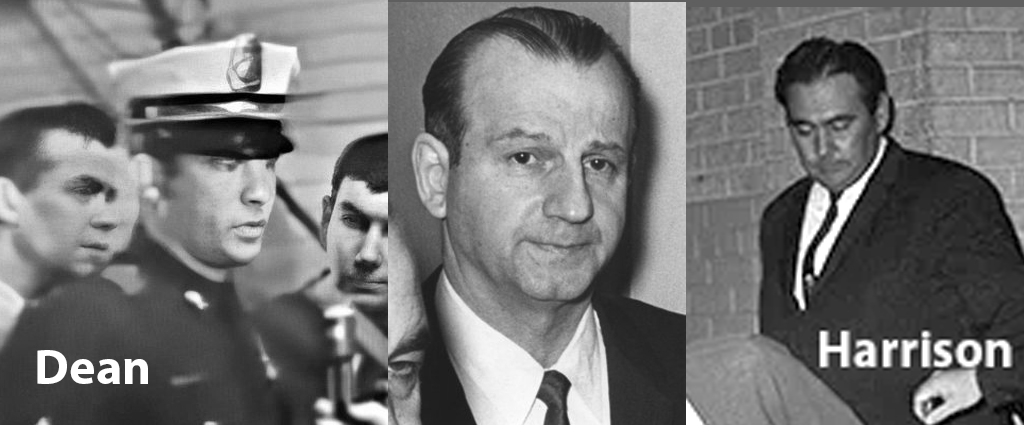
    In his denouement, Mr. Abbott points his finger at two main suspects: Dean and Harrison. It was Dean who said that, just after Ruby was handcuffed, Ruby declared he came in off the Main Street ramp. No one else recalled this at that time. (pp. 226-27) Abbott suspects that Dean made up this quote, and later, others recalled it out of necessity—for instance, in condemning Ruby to the death penalty at his trial. According to one journalist, Dean even told him he saw Ruby come down the ramp, which Abbott states was not possible. And which Dean later denied he said.

    After talking to Tom Howard, his first attorney, Jack Ruby came up with his motive for murder: grief over Kennedy’s death and pity for his family. (pp. 231-32) He now declared he came down the ramp. To which Fritz said, No, you did not. Ruby then shut his mouth. Abbott argues that it was Howard who told him to say these things. And Abbott believes Ruby went along with it to cover up his real role in the conspiracy. The author bases this on the testimony of Julia Ann Mercer, which was well depicted by director Oliver Stone in his film JFK. He also uses the quote by Robert Vanderslice, who said that Ruby called him that morning and asked him if he ”would like to watch the fireworks.” He met Ruby in Dealey Plaza, and they were there at the time of the assassination. Ruby then left and headed towards the Dallas Morning News building without saying anything. (p. 239)

    At about 1:30, based on the reliable testimony of journalist Seth Kantor, Ruby was at Parkland Hospital. Later that afternoon, Ruby began his daily visits to the police station. At about 6 PM, Ruby was seen trying to enter Fritz’s outer office door, where Oswald was being questioned. He was stopped by an officer who said, “You can’t go in there, Jack.” (p. 242) Ruby then showed up for DA Henry Wade’s infamous midnight press conference. Ruby later lied about this by saying this was the first time that day he was at the station.

    Abbott does a neat job tracking Ruby’s weekend, and—as others have pointed out—it’s difficult not to conclude that Ruby was stalking Oswald. There is one matter I wish he would have delineated at more length. After studying the topic, it seems clear to me that it was Ruby who arranged to wire one of his dancers, Karen Carlin, a loan the next morning. Which put him at Western Union at the correct time he needed to be there. (p. 248)

    Abbott spends several pages demonstrating how Ruby really got into the building that morning. It most definitely was not by marching down the Main Street ramp. We have the testimony of Don Flusche and Roy Vaughn, who said that he did not. They are much more trustworthy than Dean.

    This is a creditable book that focuses on what was, in relative terms, a rather inadequately explored subject. Mr. Abbott has now made two contributions to the vast topic of the JFK murder: this book and his index to the files of Jim Garrison.

  • Gayle Nix Jackson Family Sues the Sixth Floor

    Gayle Nix Jackson Family Sues the Sixth Floor

    Gayle Nix Jackson Family Sues the Sixth Floor

    by Jeffrey L. Meek

    Earlier this month, Gayle Nix Jackson and her father, Orville Nix Jr., sued the Sixth Floor Museum at Dealey Plaza. In a letter to me from their lead attorney, Leland C. de la Garza: “The lawsuit seeks to rescind the agreement between Nix and the Sixth Floor Museum at Dealey Plaza and legally require the Sixth Floor Museum to return the copyright to the Nix film and the physical copies of the Nix film based on wrongdoings (only recently uncovered) that Plaintiffs contend in the Lawsuit were committed by the Sixth Floor Museum and Mr. (James) Silverberg during the negotiation of the agreement. The basis for the lawsuit is set out in the Petition filed in district court in Dallas. We are confident in our legal position and that the court will correct the wrong that was done to Mr. Nix by the Sixth Floor Museum and Mr. Silverberg.”

    The Orville Nix Sr. film is arguably the second most valuable film taken during the November 22, 1963, assassination of President John F. Kennedy. As Nix panned his camera from the opposite side of Elm Street as Abraham Zapruder, the grassy knoll area comes into view. The original film may provide the best look researchers have at that area, long since seen as a location of a second gunman in Dealey Plaza.

    Two weeks after the assassination, Nix licensed the original film to United Press International (UPI) for a term of 25 years. UPI transferred the film to the House Select Committee on Assassinations (HSCA) during their investigation. HSCA then sent it to the Aerospace Corporation in California to be scanned and enhanced, but incorrectly recorded that the Nix film was sent to a lab in Los Alamos instead. There are no records suggesting that the Nix film was ever returned to the HSCA, or that the HSCA ever returned the film to UPI.

    After Nix Sr. died, his interest in the film passed to Orville Nix Jr. In 1988, when UPI’s license was about to end, Gayle Nix Jackson asked UPI to return the film and believed it was in possession of the National Archives and Records Administration (NARA). UPI said they did not have the film; the National Archives had it. Nix Jackson learned NARA only had a copy, not the original.

    For many years Nix Jackson searched for the original, and the government continues to deny possessing the film. An archivist later told Nix Jackson that the original film had been lost while in the custody of UPI. In 2015, she sued the government, but the case was dismissed in 2017.

    But then on December 11, 2024, the Orville Nix Jr. v. The United States case was overturned in a Federal Claims court. Thus, the government’s attempt to dismiss the case was denied.

    On February 4, 2000, Nix Jackson and her father sold the copyright on the film along with a number of physical copies to the Sixth Floor Museum. Now they have learned that their lawyer, Mr. James Silverberg, had an undisclosed conflict of interest while negotiating the Nix Film Agreement. The Museum had hired Silverberg as an attorney for itself due to his expertise in copyright law and intellectual property matters.

    From the Petition, filed in Dallas on April 3, 2025: “Under established Texas law, a fiduciary relationship exists between an attorney and his client, as a matter of law. This relationship requires the most abundant good faith, perfect candor, openness and honesty, and the absence of any concealment or deception. An attorney is obligated to make full and fair disclosure of facts material to legal representation.”

    The current lawsuit seeks to rescind the Nix Family Agreement and recover damages and other equitable relief of $1,000,000.

  • The Nothingburgers? Nope.

    The Nothingburgers? Nope.

    The Nothingburgers? Nope.

    The MSM is at it again. The New York Times, for example, is saying that there is nothing notable in the declassified files released by executive order of President Trump. Well, if you know anything about the case, that is not an accurate statement. Which is what one would expect from The Grey Lady about the JFK case.

    I make no claim to having gone through all 77,000 pages of these documents. But I did go through a few hundred files at random. I have already explained the paramount importance of Arthur Schlesinger’s memorandum about President Kennedy’s desire to reorganize the CIA in the wake of the Bay of Pigs fiasco. (Click here https://www.kennedysandking.com/john-f-kennedy-articles/the-schlesinger-memo-jfk-v-cia) That plus the revelations by attorney Andre Iler about how the CIA did not want anyone to see that memo anywhere near in its entirety—a matter which I noted before the Luna Committee– is an important story in and of itself. (Click here for that addendum https://www.kennedysandking.com/john-f-kennedy-articles/the-schlesinger-memo-jfk-v-cia-addendum)

    When these newly declassified files appeared, they were not in OCR form, that is, they were not accessible by optical character recognition. Which meant they were not easily accessible for search functions. But the Mary Ferrell Foundation, under Rex Bradford, has cured that problem, and Rex has also arranged them by agency. He deserves credit for doing so.

    In appearances on Len Osanic’s Black Op Radio, Coast to Coast with Richard Syrett, and Katie Helper’s podcast with Oliver Stone, I have shown that, just in a random sample—before Rex made the files truly accessible– there were several notable things in these files. Which I believe have been ignored by the MSM. So let us take up some of them.

    First, as most people engaged in this case know, Fidel Castro was very curious about what happened to President Kennedy. Within 24 hours of the assassination, he went on Cuban TV and said he had suspicions about who Oswald really was. He predicted he was a likely FBI undercover agent. He also predicted that Cuba would be blamed for the assassination. (Click here for that speech https://www.kennedysandking.com/john-f-kennedy-articles/fidel-castro-s-first-speech-on-the-jfk-assassination-11-23-1963) Five days later, he was talking to a group of students. He detoured from his original subject and said that he was familiar with rifles from his experience in the Cuban revolution against Batista. He could not understand why an assassin would use a manual bolt-action rifle. (Click here for that speech https://www.kennedysandking.com/news-items/castro-figured-out-the-jfk-case-in-five-days-speech-of-november-27th-1963)

    Well, according to the new documents, in 1969, Castro was still bothered by the JFK assassination. He was speaking to another group of students, explaining all the problems with the Oswald scenario. After which, he ordered a reconstruction. He wanted his three best marksmen to try and duplicate what Oswald did.

    None of them could do it. To my knowledge, this is the third time this was attempted—and it was the third failure. In his book, Kill Zone: A Sniper Looks at Dealey Plaza, Craig Roberts describes consulting with Carlos Hathcock about the subject. He asked Carlos if he thought Oswald could have done what the Commission said he did. Hathcock was the greatest sniper of the Vietnam War. He had 95 confirmed kills. He was so lethal that Hanoi put a bounty on his head. For about two decades, he held the record for the longest kill shot: he hit a man from a mile and a half away. After he retired from the service, he opened up a SWAT team school with an obstacle course. He replied to Roberts that they had tried it more than once. And they did everything according to the book. They could not accomplish what Oswald did.

    As I noted in my article about the CBS special of 1967, their original sniper could not achieve it either. So what they did was they cheated in the tests by enlarging the target. (Click here for that story https://www.kennedysandking.com/john-f-kennedy-articles/why-cbs-covered-up-the-jfk-assassination) If America had an objective media on the JFK case, this latest revelation about Castro would be more dirt on the grave of the Warren Commission.

    Another fascinating memo has been noted by some other critics and on YouTube. As most of our readers know, one of the most incriminating pieces of information that the CIA released in the wake of Kennedy’s assassination was that, while in Mexico City, Oswald had met with a Soviet agent under diplomatic cover, namely Valeri Kostikov. And further, that Kostikov was secretly a part of the KGB’s Department 13, which handled liquidations in the Western Hemisphere. (The Assassinations, edited by James DiEugenio and Lisa Pease, p. 223). This then suggested that Oswald had killed Kennedy for the USSR.

    Well, in 1971, the CIA wrote a memo about this subject. In that memo, they said they had no credible evidence that Kostikov was part of Department 13. To say that this is fascinating is really an understatement. Because it would seem to indicate that the CIA, in 1963, was using the Kostikov story as a prop in an attempt to frame Oswald. In fact, J. Edgar Hoover, just a few weeks after the assassination, wrote a note saying that the FBI should not trust the CIA anymore since the Agency had given them a “false story re Oswald’s trip to Mexico….” (ibid., p. 224). If this recently declassified memo is accurate, it would appear to be incriminating of the Agency.

    Related to this, in blind memos the CIA wrote during the House Select Committee on Assassinations, this is the way they referred to Oswald in Mexico City. Referring to the visit to the Soviet embassy, it was “Oswald allegedly visited the Soviet Embassy.” Referring to the visitor himself, it was “alleged to be Oswald”.

    During that House Select Committee on Assassinations inquiry, it turns out that Chief Counsel Robert Blakey made requests to the Agency for the reasons they would open a 201 file on any subject. He then asked for the Oswald file at the CIA, prior to the opening of the 201 file.

    This is indicative that Blakey was aware of the work of his investigator, Betsy Wolf. Wolf’s monumental discoveries about the Oswald file were first unearthed by Malcolm Blunt. They were not declassified by the ARRB. They were placed on a time-stamped basis and not released until the new millennium. They were featured in Vasilios Vazakas’ seven-part series “Creating the Oswald Legend”, most prominently in Part 4. (Click here for that essay https://www.kennedysandking.com/john-f-kennedy-articles/creating-the-oswald-legend-part-4)

    Wolf’s work was only released in handwritten notes form. To my knowledge, they were not typed up into official memoranda. Why they were not is inexplicable. For, as revealed in these requests by Blakey, they are of utmost importance. Therefore, it is perfectly logical as to why the MSM does not note Blakey’s requests or why he made them. Because they have no idea what Wolf was pursuing.

    Wolf was given the assignment of analyzing the Oswald file at the CIA. After requesting all the charters and taking notes on them, she figured out what the Oswald file should do. As noted above, Blakey then requested the file. Wolf was surprised to discover that it did not do what it should have. It did not go to the Soviet Russia (SR) division as, according to its own charters, it should. It went to the OS division, or Office of Security. Further, no 201 file was opened on Oswald for 13 months. This is why Blakey was asking for the reasons a 201 file is opened, because Wolf has discovered there was not one on Oswald, even though the CIA knew he had defected and had threatened to turn over radar secrets to Moscow.

    Once Wolf got this list, she determined that there should have been a 201 file opened on Oswald. She called in CIA retirees to discuss her quandary. They all agreed with her: 1.) Oswald’s file should have gone to the SR division, and 2.) There should have been no 13-month delay in the opening of the 201 file. She eventually got to the then-current OS Director, Bob Gambino. He said: It did not matter how many documents came in or if they were pre-stamped. If the client has gone to the first gate, the Office of Mail Logistics, then the papers will go there and there only.

    In other words, someone had rigged Oswald’s file from the time he went to Russia. Why? How did they even know about him? And why did Blakey not include this vital information in the HSCA volumes? He seems to have known about Wolf’s work due to these specific requests.

    Let me briefly make note of two other matters of interest. On November 23rd, 1963, the newest tanks Castro had were rolled into the area next to Havana. The information in this informant’s notes did not say if this was related to the JFK case. But it might be since Castro said in his speech that day that he thought Washington would blame the murder of JFK on Cuba. Secondly, the Warren Commission was very curious about Oswald’s activities in Helsinki, Finland. Assistant Counsel David Slawson was especially interested in how quickly he had been given an entrance visa.

    Just based on this very limited review, there should have been stories about the following:

    1. If three reconstructions, of what Oswald was supposed to do, first-rate marksmen all failed. How likely is it that Oswald was the lone assassin?
    2. Did the CIA, perhaps James Angleton, put out a false story about Oswald and Kostikov in 1963 in order to incriminate the Soviets? After all, Richard Case Nagell said that the Russians thought this would be the case. (Dick Russell, The Man Who Knew Too Much, pp. 153-54)
    3. Did the CIA itself, during the HSCA hearings, think that there may have been an impostor for Oswald in Mexico City? Let us not forget, David Phillips said words to this effect in a debate with Mark Lane in the fall of 1977. (Lane, Plausible Denial, pp. 75-87)
    4. Betsy Wolf and likely Robert Blakey knew that the Oswald file at the CIA had been rerouted almost at the time he defected to the Soviet Union. Should not a journalist have asked both Wolf and Blakey about this highly suspicious matter?
    5. Did the Warren Commission and David Slawson ever wonder how on earth did Oswald know that Helsinki was the one capital in Europe that issued Soviet visas with extreme speed? Should this question not have been in the Warren Report? (The WR adroitly avoids this question, see p. 258)

    Any interested reader can please indicate to me when the MSM addresses these matters. On past experience, I will not hold my breath for that moment.

  • Impact of the Luna Hearing

    Impact of the Luna Hearing

    The Impact of the Luna Hearing

    by James DiEugenio

    Oliver Stone, Jeff Morley and myself testified before congress last Tuesday before the committee helmed by Anna Paulina Luna, congresswoman from Florida.  Her committee is tasked with declassifying documents on several controversial cases from contemporary history: the murders of John Kennedy, Martin Luther King and Robert Kennedy; plus the Jeffrey Epstein case, the origins of CV-19, files on 9-11 and UFO’s. 

    The announcement of this committee, which she call a Task Force, met with several stories in the MSM, including one in Newsweek. (2/11/25) She stated that it would not make bold promises and then fade into irrelevance.  She continued, “This will be a relentless pursuit of truth and transparency, and we will not stop until the American people have the answers they deserve.” (ibid). Luna said she will be cooperating with people like Attorney General Pam Bondi and Secretary of State Marco Rubio.  She then said the following:

    We will cut through the bureaucracy, challenge the stonewalling and ensure that the American people finally get the truth they have been denied for too long.  If we are to endure and thrive as a nation, we must restore trust, trust through transparency. (ibid)

    On January 19th, President Trump said that: 

    In the coming days, we are going to make public remaining records related to the assassinations of President John F. Kennedy, his brother Robert Kennedy, as well as Dr. Martin Luther King. (ibid)

    On his third day in office, President Trump signed an executive order to that effect.  As he signed it, Trump said, “That’s a big one, huh? A lot of people are waiting for this for a long—for years, for decades.” (ibid). Luna added that, 

    The American people must be trusted to think for themselves, to form their own judgments from the truth they are entitled to know. We’ve been treated like children for too long and kept in the dark by those we elected to serve us.

    She then added that she would be calling her first hearing soon.  That first hearing was, wisely, on the JFK case.  And she managed to secure a large room with a five row gallery, that was almost full.  Oliver Stone, Jeff Morley and myself were on her first witness panel.  There were twice as many Republican in attendance as there were Democrats. And it was the GOP side which stayed longer, asked the most pertinent questions, and seemed the most interested in what happened to JFK.

    The hearing was televised by CSPAN and taped by PBS.  (One can see it here posted at You Tube https://www.youtube.com/watch?v=WF6qlr3KLtI)  For the first time perhaps in congressional history, the viewer was allowed to hear about the disappearing hole in the rear of Kennedy’s skull, and the spurious chain of custody concerning the Magic Bullet, Commission Exhibit 399. Jeff Morley declared that the true authors of the plot to kill JFK were likely to be found in the ranks of the CIA and Pentagon. Oliver Stone ended his evocative opening statement by quoting a very high suspect in the case, namely James Angleton  about him being fated to end up in Hades. I tried to concentrate in my opening statement about how Kennedy’s murder and the failure of the Warren Commission resulted in a loss of trust and belief by the public in their institutions of the press and the government.  The entire hearing lasted over the 2.5 hours that Luna said it would. Afterwards, Oliver, Morley and myself addressed a press gaggle.

    That was not the end of it.  Not even close.  It’s the after effects of this hearing that I wish to address here.  If one goes to You Tube you will see over thirty postings of the hearings, either in full or in part. I located most of them, for instance by Forbes, Fox, CSPAN, Global News, The Blaze and accumulated total was over 2.6 million views!  Even Joe Rogen posted a segment focusing on Oliver.

    But  in addition to that, Oliver and myself, Morley and Matt Crumpton—a co-author of The JFK Assassination Chokeholds who attended—all did appearances on TV shows.  Oliver and myself did the Jesse Waters show on Fox and two spots on the News Nation network.  Morley did Waters and Glenn Greenwald.  Matt did a spot on Newsmax.  If one adds up all of these for their average viewership, that total is about 8.95 million.  So the rolling total would be about 11.55 million.  And since You Tube would be growing daily, it will probably be 12 million by the end of this week.  Which is remarkable for a 62 year old event.

    But yet, I have not even included the newspaper and online new stories about the hearing.  It was covered by USA TodayPolitico, AP and ABC among many others.  So we can add at least hundreds of thousands more.  As I said in my opening statement, the JFK case simply will not go away.

    We all owe thanks to Congresswoman Luna and also to Oliver Stone for attending.  A lot of the publicity was caused by him.  We all await the next step in the Task Force’s inquiry.

    (Click here for an inside view of the Washington experience https://jamesanthonydieugenio.substack.com/p/jim-and-oliver-meet-the-luna-commitee)

  • The Schlesinger Memo: JFK v CIA – Addendum

    The Schlesinger Memo: JFK v CIA – Addendum

    The Schlesinger Memo: JFK v CIA – Addendum

    by James DiEugenio

    Addendum A – Highlights of PFIAB Meeting Notes

    Researcher David Denton uncovered a sheaf of documents that show why Kennedy wanted to reform the CIA. 

    The documents are sourced from the PFIAB. Though this advisory board has changed names over the years, Wikipedia describes it as ‘an advisory body to the Executive Office of the President of the United States. According to its self-description, it “provides advice to the President concerning the quality and adequacy of intelligence collection, of analysis and estimates, of counterintelligence, and of other intelligence activities.” ’ (link to the Wikipedia PFIAB page).

    See the next addendum for the entire file.

    This first highlighted section gives voice rather dramatically about his frustration at not knowing what the Agency was doing most of the time. 

    DiEugenioSchles Addend 01

    (pp 7-8, highlight 1)

    Denton also uncovered another group which shows how those close advisors around him are also frustrated with their lack of knowledge of Agency activities and the CIA’s apparent reluctance to let them know about them.

    DiEugenioSchles Addend 02

    (p 8, highlight 2)

    DiEugenioSchles Addend 03

    (p 9, highlight 3)

    DiEugenioSchles Addend 04

    (p 10, highlight 4)

    DiEugenioSchles Addend 05

    (p 11, highlight 5)

    DiEugenioSchles Addend 06

    (p 12, highlight 6)

    DiEugenioSchles Addend 07

    (p 16, highlight 7)

    DiEugenioSchles Addend 08

    (p 16, highlight 8)

    DiEugenioSchles Addend 09

    (p 19, highlight 9)

    DiEugenioSchles Addend 10

    (p 20, highlight 10)

    DiEugenioSchles Addend 11

    (p 22, highlight 11)

    Addendum B – Raw PFIAB Meeting Notes

    The entire raw PFIAB document may be found here or in the same file with highlighting (starting at page 7) from Addendum A here.

    Addendum C – Schlesinger Memo

    Thanks to attorney Andrew Iler, please view the rarely seen 1993 5-page CIA version of the Schlesinger memo that shows desired redactions here and the 15-page White House redacted version here. The unredacted version may be found here. The first version above shows just how strongly the CIA did not want this document out there in full, unredacted form.

    It took the ARRB to get it in that form. Why? Because it would show just what JFK was upset about: how the CIA was controlling policy. And how their policy in Cuba at the Bay of Pigs–one of direct intervention–opposed his. Secondly, although the memo is admirable, Schlesinger makes an error on page one. He assumes there was no CIA involvement in the attempts to overthrow de Gaulle over Algeria, and to aid the rebel group, the OAS in doing so. In the book JFK Revisited, Oliver Stone and I found several sources that indicate otherwise. (pp. 72,73) This information was found in American, French, and British sources.   According to David Talbot, Kennedy told the French ambassador that he had nothing to do with the attempted overthrow but he could not be sure if the CIA was involved. (The Devil’s Chessboard, pp. 412-419).

    As Iler points out, multiple entities submitted different copies of the memo to the ARRB, this is why there are different RIF#s and different Originating Agencies listed. The two Originating Agencies for the documents linked above are (1) The White House and (2) The CIA. The RIF for the White House version does not appear to be a typical ARRB RIF sheet. Iler also notes that on both RIFs that there are no Opening Criteria pursuant to section 6 of the JFK Records Act. This is atypical.

    The documents may also be viewed at the Mary Ferrel Foundation:

    The White House Version (15 pages)
    RIF#: 176-10033-10145

    The CIA Version (5 pages)
    RIF#: 157-10002-10056


    Click here to read the main article.

  • The Schlesinger Memo: JFK v CIA

    The Schlesinger Memo: JFK v CIA

    The Schlesinger Memo: JFK v CIA

    by James DiEugenio


    As everyone who studies the presidency of John F. Kennedy knows, the seminal moment in his education about the treacherous ways of Washington occurred rather early.  It was in April of 1961 with his ill-fated decision to launch the Bay of Pigs invasion of Cuba. As many commentators have said, the president had no real enthusiasm about this operation.  And even CIA Director Allen Dulles admitted as much. (Destiny Betrayed, by James DiEugenio, second edition, p. 36) When White House advisor Arthur Schlesinger asked the president what he thought about the plans for the operation, Kennedy pithily replied that he thought about it as little as possible. (ibid)

    Due to this reluctance, the CIA–in the persons of Dulles and Director of Plans Dick Bissell–had to entice Kennedy into going along with their concept. Therefore, they told him that Fidel Castro’s popularity was diminishing, that only 20 % of the public supported him, and that many native Cubans thought his regime would soon fall. The capper was this: if a rebellion would begin, the vast majority of the militia units would defect. (Peter Kornbluh, Bay of Pigs Declassified, pp. 294-95)

    But even with that, Kennedy decided to put the decision up for a vote of his advisors. Secretary of Defense Robert McNamara described the scene in his memoir. As Kennedy went around the table, only one person dissented from approval.  And that person was not even a member of the administration–it was  Senator William Fulbright. (Robert McNamara, In Retrospect, pp.25-27) But everyone else, the Joint Chiefs, members of the National Security Council, Secretary of State Dean Rusk, and McNamara himself, all endorsed it. In fact, McNamara had passed a note to Kennedy saying that the Pentagon predicted that, even if the attack did not succeed, it would lead to Castro’s downfall.

    Needless to say, everyone but Fulbright was wrong. But what made it even worse was this: the CIA had deceived Kennedy.  The truth was that Dulles and Bissell knew the operation would not succeed. This was first discovered by Attorney General Robert Kennedy as part of the White House inquiry into the debacle helmed by General Maxwell Taylor.  In his interrogation of Allen Dulles, RFK was simply stupefied at some of the answers to his questions.  For instance, if the initial assault failed, the fallback plan was for the brigade to resort to guerilla tactics.  The problem with this was that when the AG went to one of the Cubans involved in the training for the operation, Manolo Ray, he said they had no training at all in those kinds of maneuvers. But further to have resorted to that, the brigade would have had to retreat into the hills, which were about 80 miles away through swampland. (Michael Morrisey, “The Bay of Pigs Revisited,” at Mary Ferrell Foundation)

    From his experience questioning Dulles, Bobby Kennedy suspected his brother had been snookered.  He decided that Dulles had to go.  So he consulted with his father, Joseph Kennedy, and discovered that Robert Lovett and David Bruce, two scions of the Eastern Establishment, had tried to dispose of Dulles years earlier. RFK brought in Lovett to join him to talk about what Dulles had done both to the Agency in general, and to him personally regarding the Bay of Pigs. (DiEugenio, pp. 48-50). President Kennedy not only terminated Dulles, but also Bissell and Deputy Director Charles Cabell.

    II

    Bobby Kennedy was correct about the subterfuge. Many years later scholar Lucien S. Vandenbroucke discovered notes that Dulles had made concerning an article that he was going to pen for Harper’s about the Bay of Pigs.  It turns out that Dulles understood that the project was fey.  But what he was banking on was that Kennedy would intervene with American might rather than face a humiliating defeat. (Diplomatic History, Fall, 1984)  When Vandenbroucke published the article, Bissell replied in a letter.  The architect of the plan said that he and Dulles, “had allowed Kennedy to persist in misunderstanding about the nature of the Cuban operation.”

    It’s clear that the president was convinced by his brother and Lovett.  He said as much to his longtime friend Paul Fay. He confided that, when he first came into office, he was shocked at what poor judgment the military had shown. Being a former Navy man, as was Fay, he looked up to high officers. He assumed they had earned their stature by wise judgment and honest achievement. He now thought he was wrong. And he would not instinctively follow their advice in the future. Alluding to the Bay of Pigs, he said:

    They wanted a fight and probably calculated that if we committed ourselves part way and started to lose, I would give the OK to pour in what was needed. (Paul Fay, The Pleasure of His Company, p. 189)

    At this point we should note that Schlesinger wrote that it was Dulles’ assurances that the brigade could go guerilla that ultimately convinced Kennedy to put the operation to a vote. (A Thousand Days, p.257) It is also through Schlesinger that we know about the Lovett-Bruce report, since he found it among Robert Kennedy’s papers when he was writing his biography of RFK.

    This is all pertinent to the complete declassification of the 16-page Schlesinger memo that he wrote up for JFK in the wake of the Bay of Pigs. As David Talbot wrote in his book about Allen Dulles, Schlesinger saw the capsizing of that operation as an opportunity to “bring the CIA under presidential control, which neither Truman nor Eisenhower had been able to do.” (The Devil’s Chessboard, p.438) As a former OSS operative, Schlesinger thought he was the man to provide Kennedy with the plan to do so.

    Schlesinger decided to strike while the iron was hot. He wanted to propose something before any kind of official committee loyal to Dulles performed an apologia. As he wrote to Kennedy in the aftermath of the disaster, “It is important, in my judgment, to take CIA away from the Club.”  (Ibid) In that regard, Schlesinger had reservations about Taylor managing the White House inquiry into the operation.  To him, he was not the kind of crusader who would capitalize on the president’s initial response to “splinter the CIA into a thousand pieces.” (Talbot, p. 439)

    Although Kennedy stayed with Taylor for the analysis of what had gone wrong, Schlesinger convinced the president that he was the right choice to pen a reorganization plan for the Agency. He told JFK that he served in the OSS during the war, and had been a CIA consultant since.  He would not call himself a professional, but an experienced amateur. (ibid)

    According to David Talbot, Schlesinger took the job quite seriously.  He consulted with senate liberals like George McGovern, and a mysterious CIA whistle-blower who told him, “The Central Intelligence Agency is sick.” He also collected critiques from left-of-center journals like The Nation and The New Republic.  He handed the memo to the president on June 30th.  Before President Trump’s executive order, we only had the memorandum in partly censored from. We now have the whole memo, unredacted.

    III

    Schlesinger began his statement by saying that the CIA had simply been caught in too many overseas disasters. They had used up their allowed quota in that area. He then wrote that the problem as he saw it was “the autonomy with which the Agency has been permitted to operate.”  He then got more specific as to the causes:

    1. An inadequate doctrine of clandestine operations 
    2. An inadequate conception of the relationship between operations and policy
    3. An inadequate conception of the relationship between operations and intelligence.

    Schlesinger said that this autonomy, and the resultant three shortcomings, were the result of lack of input from the State Department.

    When the CIA began the State Department looked on this new venture with suspicion and renounced the opportunity to seize firm control of CIA operations. It did not, for example, try to establish any effective system of clearance for CIA activities; and some ambassadors frankly preferred not to know what CIA was up to in their countries. (p. 2)

    He then noted that after 1953, when the Director of CIA—Allen Dulles– and Secretary of State—John Foster Dulles– were brothers, this made the problem even worse. (This was, if anything, an understatement.) As a result, the CIA began to grow in stature and reach. CIA paid better and also Allen Dulles had protected his employees from McCarthy’s witch hunts.  This resulted in the employment and assignment of several capable and independent-minded employees. Thus began the more active role the CIA played in foreign policy.

    Schlesinger now comments that by the time State realized just how potent the CIA had become, the cat was more or less out of the bag. The CIA had assumed control over clandestine intelligence collection and operations, and even in the realms of political reporting and diplomatic conduct. (p. 2) Therefore with this non-supervision, the CIA developed a set of parallel functions to State and even Defense.  That is it had its own political desks, and “ in effect, its own foreign services”. Schlesinger added “it even has its own air force.” (p. 3). With its large budget, “The contemporary CIA possesses many of the characteristics of a state within a state.” (ibid)

    This power had been augmented by the fact that “there is no doctrine governing our conduct of clandestine operations.”(p. 3). As a result, the CIA has used the standard that if the communists do it, then we must do it, a sort of “fighting fire with fire” ethos. At this point, Schlesinger observed that those in power have not thought through this dilemma of how to maintain an open society alongside covert activities. Since America maintained freedom of speech and press, they could comment on the covert actions of the CIA.  He now stated that covert activity was allowable when it did not corrupt the principles of a free society.

    Schlesinger categorized some areas of CIA activity and to its relationship to the problem he had outlined. Going up the ladder from intelligence collection, to espionage, to covert action.  The last he found most objectionable.  And he cogently wrote that such operations which relied 

    …on the suppression of news, of lying to congressmen and journalists, and on the deception of the electorate should be undertaken only when the crisis is so considerable that the gains really seem to outweigh the disadvantages.

    The author then said, these problems are co-existent with the size of the operation.  (As this writer would comment, obviously the Bay of Pigs would be a prime example of this.)  Schlesinger warned that before such an operation is launched the case for its overwhelming necessity must be made. (p. 4). 

    IV

    Schlesinger went on to observe that the above was not the only consideration. Another important aspect was that CIA activities should be “subordinate to US foreign policy.” Which they had not been. (p. 5) And this could be a problem at any level of Agency activity, including recruiting double agents. Because the proposed target might be leading the CIA into a trap. And since the Agency does these things by itself, the ramifications of failure are a blow to the State Department, who were unsuspecting. Schlesinger argued that State, along with the ambassador,  should be informed of the possible approach and they should be able to measure the risks and rewards, and hold ultimate veto power over the operation. (p. 5)

    Schlesinger now addressed a problem he himself encountered during the Bay of Pigs operation. Namely, that State had not cleared and did not even know who many of the operatives were. And in that operation, the CIA recruited many Cuban exiles of questionable character. (p. 6). In this memo, he refers to his experience of going down to Florida at Kennedy’s request and observing that representatives of the Cuban Revolutionary Council had been detained by Operation Forty operatives, a group of thugs with their own secret agenda who were running parallel to the main operation. This might be the first time the rubric had been used in White House memoranda. Schlesinger implies that these types of men would never have been cleared by State. (For a fuller discussion of what Schlesinger knew about Operation Forty, see DiEugenio, pp. 50-52)

    Since the CIA considered itself more or less independent of State, the latter did not find itself aware of many covert actions until they were about to be launched. Therefore this gives these projects their own momentum of inevitability. This makes the advocate appear tough and realistic and the man with reservations legalistic and soft. (p. 7). The inescapable outcome is that the CIA was creating policy. Yet this was something that Allen Dulles himself said at the inception of the Agency should not be done: “The Central Intelligence Agency should have nothing to do with policy.” (p. 7). Here, Schlesinger mentioned in passing the attempted overthrow of Sukarno in Indonesia in 1958, which was exposed as a CIA operation. Schlesinger strongly urged that this system be revised so that State can exercise control over covert actions which impact their policy.

    Schlesinger now addressed an issue that had been partly censored before the Trump order.  It is a subject he called “The Controlled American Source”. Today we call it the use of CIA employees acting under State Department cover, many of them in foreign embassies with diplomatic titles. Schlesinger pointed out that the Agency has nearly as many employees overseas under these covers as actual State Department employees. (p. 7) Again this was something Dulles had warned against.  In the Dulles-Correa-Jackson report of 1948, the authors wrote that this practice should be kept at a minimum and the CIA should find its own covers to lessen reliance on State. The reverse had happened. And at some embassies, in certain sections, the number of CIA people outnumbered the actual State Department employees. (p. 8). And at times the higher-up CIA people advocate for different policies than State;  Schlesinger mentioned Laos as an example. What made it worse was that these CIA people had access to the local presidents and/or prime ministers.

    The memo also mentions Paris as another example of this trend. There were 128 CIA people in that embassy and the Agency occupied the top floor of the building. They tried to dominate conversations with certain important political personalities. (p. 8). So far from weening itself off of this usage, the Agency was now committed to it for overseas cover. Schlesinger noted the obvious dangers in all this and strongly recommended it be curtailed. (p. 9)

    V

    Kennedy’s advisor now turned to the subject of paramilitary warfare. He began by saying, “There is almost no CIA function more peculiarly dependent on the political context than paramilitary warfare.”(p. 9) Schlesinger warned of a situation that Kennedy was familiar with: when the opposition has the support of the populace, it is much more difficult to defeat. (p. 10) So Schlesinger pointed out that this kind of low-level fighting needed a political goal for it to be successful.  And he quoted a leader familiar with all this, Mao, to back up this idea. Schlesinger concluded that this type of warfare “cannot be considered as primarily a military weapon.  It is primarily a political weapon….” (ibid)

    He then pointed out how the British model for policy control worked.  There, they kept “clandestine activity under strict Foreign Office control.” (p. 11) He then recommended this system for adaptation in the USA.  He warned JFK about the problem that State might be reluctant to do so.  He wrote that they had to overcome “inbred habits of diffusion, negativism and delay and to take a firm and purposeful grip on the situation.” (p. 12) He also pointed out that in the British system, clandestine collection of intelligence is done by the intel service. But the analysis and estimating part was in the Foreign Office. In America, the CIA did both.

    Schlesinger said that it was Dulles himself who argued for this method back in 1947.  Dulles said that facts should not be blinded by policy. The presidential advisor countered with the argument that if one is too much in favor of a covert action, one will select intelligence to support that operation. Which we have seen, and as Schlesinger wrote, was very much the case with the Bay of Pigs project. What was needed was an analysis by a joint group of authorities familiar with the aim of the project but not directly involved with it.

    In conclusion, Schlesinger states that what he was proposing was “a fairly drastic rearrangement of our present intelligence set-up.” (p. 14) He was also pleading for a stronger role for the State Department. He even suggested changing the name from CIA to National Information Service. (p. 15) And each and every covert activity would need to be cleared in advance by the Deputy Undersecretary of State for Intelligence. (p. 15). He also suggested changing the responsibility for collection and interpretation of data. He would retitle this to the Foreign Research Agency.  

    David Talbot pointed out that Schlesinger sent rough draft copies of the memo to future Defense Secretary Clark Clifford, diplomat Chip Bohlen, and speechwriter Ted Sorenson. Once it was sent to the White House, and National Security Advisor McGeorge Bundy was a recipient, the Dulles forces began to organize a counterattack. Maxwell Taylor argued against it by saying this was no time for major surgery since it would hurt morale. On the same grounds, Taylor also argued against changing the title. (Talbot, p. 440)

    Two weeks after his memo was submitted, RFK told Schlesinger that his reorganization plan was on hold until they could find a proper candidate to helm the plan. That man ended up being Fowler Hamilton. Hamilton was a Wall Street lawyer, a former prosecutor in FDR’s Justice Department, and was also a bombing analyst in the Army Air Force. Schlesinger thought he was qualified. But the reaction to Fowler was very strong. So Kennedy turned to Republican John McCone. 

    Schlesinger was quite disappointed in this choice. He protested that he was the wrong man for his plan:  “He sees the world in terms of a set of emotion-charged stereotypes.” (Talbot, p. 441). Schlesinger was correct on this. But some of the reforms that he had recommended came to pass: Kennedy issued orders that ambassadors should lead foreign policy in foreign countries. He also requested that the Joint Chiefs be more vigorous and direct in advice to him on paramilitary projects like the Bay of Pigs. Third, that all paramilitary operations be presented to a Strategic Resources Group which would appoint someone to run the operation. (DiEugenio, pp. 52-53) 

    But Schlesinger’s bold and reformist plan more or less died when Fowler was rejected. Kennedy apparently did not want a full-fledged internal battle on his plate at the time. So he settled for a piecemeal reform plan. It took the 9-11 disaster for an office superseding the CIA to be created: the Director of National Intelligence. But the very fact that JFK commissioned such a study, that he seriously entertained it, and that he had someone in mind to man it, tell us how opposed he was to what Dulles had created, represented, and run.  And how it had all combined to create the Bay of Pigs debacle, or what he called, “the worst experience of my life.” (DiEugenio, p. 52) 

    Click here to read the addendum.

  • The Anna Paulina Luna Task Force

    The Anna Paulina Luna Task Force

    The Anna Paulina Luna Task Force

    Mark E. Adamczyk Esq.

    If you are interested in the history of the JFK assassination and want to know what actually happened to President Kennedy on November 22, 1963, you have probably heard or read about the recently-appointed “Task Force on the Declassification of Federal Secrets”. This is a congressional panel established by the U.S. House Committee on Oversight and Accountability, chaired by Representative Anna Paulina Luna (R-Fla.). 

    The stated primary mission of the task force is to investigate and recommend the declassification of long-held government records related to significant historical events and topics of public interest.  The task force was formed in response to President Trump’s executive order signed on January 23, 2025, titled “Declassification of Records Concerning the Assassinations of President John F. Kennedy, Senator Robert F. Kennedy, and the Reverend Dr. Martin Luther King Jr.,” which mandates federal agencies to prepare plans for releasing these records. According to journalist Jeff Morley, both CIA Director John Ratcliffe and DNI Chair Tulsi Gabbard are in favor of the order.

    As of today, the task force has made notable headlines. On February 25, 2025, Representative Luna announced via X that she met with the National Archives and Records Administration (NARA), securing a commitment to make declassified JFK files publicly accessible through a dedicated NARA website. She indicated that documents would be uploaded in real time once declassified, and she addressed efforts by some within the NARA agency to delay access, claiming those “obstructionists” were being removed. Additionally, Luna has scheduled the task force’s first hearing for March 26, 2025, which will focus specifically on the JFK assassination. This hearing aims to examine evidence and interview firsthand witnesses, including doctors who treated Kennedy at Parkland Hospital in Dallas, where the task force plans to travel as part of its investigation.

    A visit to Dallas to interview the Parkland doctors and a tour of Dealey Plaza would be educational for the task force.  Representative Luna has publicly questioned the official Warren Commission findings, asserting her belief in a “two-shooter” theory based on conflicting evidence and abnormalities she claims were overlooked.  

    But here’s the problem: Why spend the task force’s time and money investigating things we have known for years?  As written by JFK Assassination Chokeholds co-author Paul Bleau, we already know that over forty witnesses, including almost all of the medical personnel at both Parkland and Bethesda Medical Center—where the autopsy was held—clearly saw the massive injury to the back of JFK’s head, describing what could only be an exit would.  The evidence we already know makes it all but impossible to conclude that there was not at least one shot fired at JFK from the front of his limousine, which vitiates the Warren Commission’s conclusion that only three (3) shots were fired by Lee Harvey Oswald from the rear.  

    The task force is on the correct path by investigating NARA and the Archivist’s inaction and failures under the JFK Records Collection Act of 1992 (JFK Act). Pursuant to the JFK Act, the Assassination Records and Review Board (ARRB) in the 1990s already made final declassification decisions on the thousands of assassination records still withheld in full or in part.  Under the exhaustive rights afforded to agencies still seeking postponement of assassination records to this day, they already had their complete legal opportunity to appeal those final declassification decisions to the ARRB and the President for continued postponement.  

    Which brings us back to the focus that should be front and center for Representative Luna’s task force – the Archivist.  As discovered by JFK Assassination Chokeholds co-author Andrew Iler, the ARRB’s final declassification decisions from the 1990s have been buried at NARA.  Why?  The Archivist should immediately be called into an oversight hearing with the task force to explain why NARA did not follow the ARRB’s final agency orders on postponed assassination records and release them as ordered by the ARRB.  The Archivist should be compelled to explain why it is nearly impossible to find the ARRB’s final declassification orders at NARA.  The path to the proper declassification of the JFK assassination records lies in the ARRB’s final orders.  

    The final point, and this is critical, is revealed in comments recently made by Representative Luna in an interview with Clayton Morris on Lear Redacted.  Luna stated that she is confident, based on discussions with the White House and Gabbard (Director of National Intelligence), that there will be a full release of assassination records through the efforts of the task force.  I have no doubt in Representative Luna’s confidence, and her energy and passion on this effort should be commended.  

    However, here is the troubling comment Luna gave in the interview.  The Archivist has apparently told Representative Luna that even if President Trump orders the declassification of assassination records, the President’s decision then needs to go back to the originating agency for a “re-review” by the agency head.  Representative Luna disagrees with NARA’s assessment, and she is correct.  The Archivist’s position is directly contrary to the JFK Act.  Under the Freedom of Information Act (FOIA) standards, an agency head does have the authority to make declassification decisions in their discretion.  The JFK Act is not FOIA, and it is not close.   Under the JFK Act, the final declassification decision, short of the President, was with the ARRB and only the ARRB.  If the ARRB ordered the full release of a record by a specified date, the agencies (many years ago) had a final 30-day right of appeal.  And the following is important: Short of an appeal based on clear and convincing evidence justifying continued postponement, the Archivist had a legal duty to release the assassination record and publish it for public disclosure. 

    Luna said that if a record is ordered declassified, then “do it, and call it a day…declassification does not need to go through bureaucratic nonsense.”  Again, she is correct.  Under the standards of the JFK Act, only the President in 2017 had the final call on declassification. And any further Presidential decisions for continued postponement must be stated in a public Presidential certification stating a current identifiable harm to the United States or a living person.  

    The correct legal path on the declassification process under the JFK Act is simple.  After the Archivist is compelled to make the ARRB’s final release decisions available and easily searchable, President Trump and his legal advisors need to review the ARRB’s final decisions in the Archivist’s possession.  If there is no longer a current identifiable harm in the withheld record to a living person or current intelligence source or method, the record must be released in full today pursuant to the JFK Act.  Further, President Trump needs to immediately order all originating agencies to turn over (to the Archivist) any assassination records that were not provided to the ARRB in the 1990s as required by the JFK Act.  The same Presidential review process would apply to those records as well.  The task force, with Congressional oversight powers in the JFK Act itself, has the authority to make sure all of this happens without further delay.  No further “plans” are necessary, especially not from the intelligence agencies who are determined to maintain secrecy.  

    In 2025, it is fiction to believe that a record from 1963 could still pose an identifiable harm.  Maybe a handful of records by a stretch of the imagination, but not thousands.  In short, President Trump should not tolerate more obstruction from the intelligence community.  As explained in JFK Assassination Chokeholds, the American people have already tolerated more than 60 years of obstruction of justice in the JFK case.  Unless President Trump can explain how and on what basis a withheld record still poses a current and identifiable harm to the United States or a living person, the record can and must be released today pursuant to the clear Congressional mandates in the JFK Act. 

  • The Oswald Puzzle: The Pieces That Won’t Fit – Part 2

    The Oswald Puzzle: The Pieces That Won’t Fit – Part 2

    The Oswald Puzzle: The Pieces That Won’t Fit – Part 2

    By Johnny Cairns


    U.S. Military Policies on Communist Affiliation: A Zero-Tolerance Stance

    “I am a Marxist and have been studying Marxist principles for well over 15 months”. Letter to Socialist Party of America, October 3rd, 1956; (Greg Parker, Lee Harvey Oswald’s Cold War; p.250)

    Larry Hancock recently said to me that “as an individual (Oswald) was an American citizen and free to espouse any beliefs that were legal and did not espouse violence.” (Dave Boylan. Private Correspondence with Johnny Cairns.) This argument is fundamentally incompatible with the rigid security measures, legal precedents, and ideological purges of Cold War America.

    Yes, as a private citizen, Oswald would have had the constitutional right to hold Marxist beliefs. However, as we’ve already explored, such beliefs were not merely frowned upon but actively treated as subversive and dangerous. Even vague associations with leftist ideology were enough to end careers, prompt surveillance, and trigger legal repercussions.

    But more importantly, Oswald was not a private citizen—he was an active-duty U.S. Marine, bound by the strict regulations of a military institution that explicitly prohibited Communist affiliation. His open, repeated expressions of Soviet allegiance, his reverence for Marxism, and his vocal disdain for American capitalism weren’t just ideological posturing—they were direct challenges to the national security apparatus of the United States. And yet, the Marine Corps did nothing.

    Oswald’s status as an active US Marine placed him under an even stricter loyalty standard than a civilian. Upon enlistment, he swore an oath:

    “I, Lee Harvey Oswald, do solemnly swear that I will support and defend the Constitution of the United States against all enemies, foreign and domestic; that I will bear true faith and allegiance to the same.”

    Oswald also signed the Loyalty Certificate for Personnel of the Armed Forces. The number one provision of this certificate read: The Department of Defense has the authority to establish procedures implementing the national policy relating to loyalty of persons entering on duty with the Armed Forces. This has been determined by proper authority to include restrictions as to certain standards of conduct and membership in, or sympathetic association with, certain organizations.” (Parker, p.263)

                                                 II

    Let us add, the Uniform Code of Military Justice (UCMJ) Article 134; Marines found possessing, distributing, or promoting Communist literature could face disciplinary action, dishonourable discharge, or court-martial. Disloyalty statements, such as Oswald’s repeated praise of the Soviet Union and his accusatory references to fellow Marines as You Americans, American imperialism” and “exploitation” were grounds for immediate scrutiny. (Epstein, p.82)  https://www.govinfo.gov/content/pkg/USCODE-2011-title10/html/USCODE-2011-title10-subtitleA-partII-chap31-sec502.htm

    And how about this: The Communist Control Act of 1954 (CCA) made membership in or association with the Communist Party USA (CPUSA) illegal, classifying it as a subversive organization working to overthrow the U.S. government. The CPUSA’s official publications, The Daily Worker and The People’s Daily World—which Oswald openly subscribed to and read while stationed at Santa Ana, California—were directly linked to this illegal organization. Under Cold War-era policies, merely consuming Communist literature was considered a national security threat. 50 USC CHAPTER 23, SUBCHAPTER IV: COMMUNIST CONTROL

    Beyond the CCA, federal policies actively sought to root out any Communist influence within government and military institutions:

    The Attorney General’s List of Subversive Organisations; (AGLOSO) catalogued groups deemed Communist-affiliated, and association with these groups led to termination, blacklisting, and potential prosecution. Prelude to McCarthyism: The Making of a Blacklist | National Archives

    Executive Order 9835 (1947); established by President Harry S. Truman, mandated the Federal Employee Loyalty Program, mandating investigations into federal employees and military personnel suspected of disloyalty. https://www.trumanlibrary.gov/education/presidential-inquiries/trumans-loyalty-program

    Executive Order 10450 (1953); President Dwight D. Eisenhower further expanded these investigations, stating that even sympathies toward subversive organisations could be grounds for dismissal. https://www.dni.gov/files/NCSC/documents/Regulations/EO_10450.pdf

    House Un-American Activates Committee; (HUAC) hearings paraded suspected Communists before Congress, demanding loyalty oaths and public confessions. Government employees lost their jobs for past associations, and yet an active-duty U.S. Marine, stationed at a military base, openly consuming Communist literature, escaped scrutiny? If loyalty investigations were aggressively enforced across all levels of American society, how did Oswald’s Marxism on a military base not trigger an immediate inquiry? House Un-American Activities Committee – Wikipedia

    Yet the historical record simply does not support the idea that such behaviour was tolerated in the U.S. military. Other servicemen—guilty of far less—were swiftly discharged, disgraced, or investigated under Cold War security measures.

    Radulovich, Abramowitz, Peress: The Harsh Reality of the Red Scare

    The Cold War’s loyalty purges were merciless, cutting through government, academia, and the military with ruthless efficiency.

    One of the most infamous cases was that of Milo Radulovich, a U.S. Air Force reservist who was discharged. But not for his own political beliefs. But because his father, a Serbian immigrant, subscribed to a Serbian-language newspaper that the U.S. government deemed to have Communist affiliations. His sister, too, was suspected of leftist sympathies. 

    Radulovich himself had never engaged in subversive activity, but mere association with “questionable” individuals was enough to end his military career. He became yet another casualty of Cold War hysteria, a victim of an era that demanded absolute ideological purity. https://en.wikipedia.org/wiki/Milo_Radulovich

    Simply getting Russian magazines, books, or progressive news magazines, etc. was perfectly legal.”
    – Larry Hancock, via Dave Boylan (Private Correspondence with Johnny Cairns)

    Oswald did not simply “get” Russian or progressive news magazines—he subscribed to publications directly linked to the Communist Party USA. His subscription history alone would have been enough to trigger an investigation, security clearance review, or outright discharge under Cold War loyalty policies. His fellow Marines confirmed that Oswald did not hide his Communist affiliations.

    Paul Edward Murphy provided an affidavit stating:

    “Oswald had a subscription to a newspaper printed in English which I believe was titled either The Worker or The Socialist Worker. Members of the unit saw copies of this paper as they passed through the mailroom; when the paper was identified as being directed to Oswald, few were surprised.”

    Erwin Donald Lewis, another Marine, corroborated this:

    “It was a matter of common knowledge among squadron members that Oswald could read, write and speak Russian. I knew from personal observation that he read the ‘Daily Worker.’ I heard he had a subscription to that publication.” (WC Vol VIII; p. 323.)

    The People’s Daily World, another Communist newspaper Oswald subscribed to, gained infamy shortly after World War II when several of its editors were convicted under the Smith Act for conspiring to overthrow the U.S. government! (Summers; p.147)

    While Radulovich was expelled over his father’s newspaper, Oswald was actively subscribing to CPUSA newspapers while serving in the military.  And not only was he not investigated, but he was also allowed to continue service without disruption.  The inconsistency is staggering.

    Howard Abramowitz & Irving Peress: Expelled Without Evidence of Subversion

    Radulovich was far from alone. In 1954, Howard Abramowitz, a decorated Korean War veteran, was forcibly discharged from the Enlisted Reserve. But not for active Communist ties, but simply for past membership in leftist organizations. Even honorable military service was not enough to protect him from the Red Scare. Howard D. Abramowitz – Wikipedia

    Captain Irving Peress, a U.S. Army dentist, was expelled from the military after refusing to answer questions about his political affiliations. He had not been caught in any subversive activities, nor had he been accused of actively promoting Communist ideology. Yet his silence alone was enough for Senator Joseph McCarthy to brand him a “Fifth Amendment Communist,” leading to his immediate discharge. Irving Peress – Wikipedia

    III

    The military was not the only institution where ideological purity was ruthlessly enforced. The Red Scare cast its shadow over every facet of American society, reaching deep into government offices, university halls, and even the glamour of Hollywood. Professors, civil servants, and filmmakers alike were compelled to renounce any association—real or perceived—with leftist ideology or risk professional and personal ruin.

    Academics and scientists saw their careers disintegrate for nothing more than distant affiliations with suspected radicals, while schoolteachers were blacklisted for the simple act of refusing to sign loyalty oaths. In this climate of paranoia, there was no room for nuance, no distinction between passive interest and active subversion. Mere suspicion was a death sentence for livelihoods—proof was optional.

    And then there was Lee Harvey Oswald—a man who openly and unapologetically declared his allegiance to Marxism. A man who spoke Russian in the barracks, studied Communist texts, and loudly praised the Soviet system while serving in the military at the height of the Cold War. A man who, by every precedent of the era, should have been immediately arrested, blacklisted, or imprisoned.

    And yet, he faced nothing. No investigation. No dishonourable discharge. Why was he tolerated? The answer is inescapable.

    U2 Realties?

    “Nothing Lee Oswald knew or could have provided had to do with the loss of the U2 aircraft…” (The Oswald Puzzle; p.50)  To put it mildly, this is contested by the testimony of Francis Gary Powers and works such as Oswald & The CIA, Spy SagaDestiny Betrayed, etc. 

    The Motherland Awaits

    “Oh, what a tangled web we weave, when first we practice to deceive!”  Walter Scott.

    Lee Harvey Oswald’s hardship discharge from the U.S. Marine Corps remains one of the most striking anomalies in his so-called “legend.” Discharges of this nature typically took months. Yet, for Oswald, the process unfolded with astonishing speed; as if the bureaucracy had stepped aside to expedite his path to the Soviet Union.

    Nelson Delgado recalled the rapidity of the process: Oswald’s discharge “must have been a fast processing, because I wasn’t gone over 15 days and when I came back, he was already gone.” (WC Vol. VII; p.255)

    Even those familiar with standard military procedures were perplexed by the urgency of Oswald’s departure. Delgado continued: “I knew he was putting in for a hardship discharge… but, like I say, it usually took so long to get a hardship discharge.” (WC Vol. VII; p.257)

    Colonel B. J. Kozak, a military officer with direct knowledge of dependency discharges, provided an even more specific timeframe: “It normally took between 3 to 6 months for a hardship discharge to be approved.” (DiEugenio, Destiny Betrayed; p.136). Yet, for Oswald, all standard protocols were seemingly cast aside. He submitted his request on August 17, 1959—and by August 28, just eleven days later, the Dependency Discharge Board had already approved it.(WCR; p.688)

    Why did the system move mountains to ensure that Oswald could leave his post without delay? Why was “Oswaldovich” granted a swift exit from a fiercely anti-Communist institution at the height of the Cold War?

    Serious Questions arise about Oswald’s pilgrimage to the USSR

    Lee Harvey Oswald’s journey to the Soviet Union is riddled with contradictions, logistical anomalies, and inexplicable conveniences. It is a tale of a man who, by all accounts, was of limited means. Yet, he managed a journey that required substantial finances, elite accommodations, and a series of improbably smooth bureaucratic processes—each step raising more questions than answers.

    Oswald has long been characterized as frugal, a man of limited financial resources. As The Oswald Puzzle states, “Oswald had limited funds and was frugal by nature.” (The Oswald Puzzle; p.68) 

    Yet how do the authors reconcile this claim with the fact that, upon his arrival in Helsinki, Oswald did not seek out a modest or budget-friendly hotel but instead took residence in two of the most opulent establishments the city had to offer?

    His first stop was the Hotel Torni, a five-star hotel renowned for hosting VIPs, including former U.S. President Herbert Hoover. The late Ian Griggs, a highly respected researcher and founder of Dealey Plaza UK, who visited the hotel, described it as the Finnish equivalent of the Savoy in London. (Destiny Betrayed;p.138.)

    Oswald then moved to the Klaus Kurki Hotel, another prestigious institution, located on Bulevardi, one of Helsinki’s most exclusive streets. According to Griggs, if the Torni was Helsinki’s premier luxury hotel, the Klaus Kurki was not very far behind. (Ibid; p.138.)

    So, how do we square this with the image of a cash-strapped, penny-pinching Oswald? Why did a supposedly frugal ex-Marine, who had only just embarked on an arduous defection journey, opt for deluxe accommodations that would have strained his already limited funds?

    IV

    Then, there is the larger financial mystery: How did Oswald fund this trip at all? At the time of his departure from the United States, Oswald’s bank account contained a mere $203.00, yet the cost of his journey to the Soviet Union amounted to at least $1,500(Melanson p.13)  Nelson Delgado was also baffled: “I couldn’t understand where he got the money to go… it costs at least $800 to $1,000 to travel across Europe, plus the red tape you have to go through.” (WC Vol.VIII; p.257.)

    This raises the obvious question: Where did Oswald obtain the additional funds? Travel expenses aside, what about his day-to-day living costs? How did he afford food, toiletries, laundry, clothing, and grooming essentials over a period of over a month?  How did he pay for Soviet “tourist vouchers” which cost a total of 300 dollars. (WCR, p. 690) Every journey requires sustenance—so how did Oswald survive on what was, by all accounts, an insufficient sum?

    Even more suspicious is the manner in which Oswald was granted a visa for the Soviet Union.

    The Oswald Puzzle claims, “It is true that Oswald’s tourist visa for Russia was granted relatively quickly in Helsinki, but that was not particularly exceptional for that location.” (The Oswald Puzzle; p.68) Yet this claim obscures a crucial detail: Oswald’s visa was processed in record time, in just 24 hours, at the Soviet consulate in Helsinki—an embassy known for expedited handling of special cases. Normally, a tourist visa took at least a week to process. (Destiny Betrayed; p.139.) In fact, the only Soviet embassy in Europe where a visa could be issued in such a short span of time was the one in Helsinki. (Ibid.)

    Who arranged for this remarkable convenience?

    The answer may lie in a man named Mr. Golub, an official at the Soviet consulate in Helsinki, who handled Oswald’s visa. Mr. Golub had direct ties to the American Embassy in Helsinki, where U.S. officials reportedly sent select individuals to him for “priority processing.” (Ibid, p.138.) So, was Oswald simply the recipient of a string of coincidental bureaucratic miracles? Or was someone ensuring his seamless transition into the Soviet Union?

    Upon his arrival in Moscow, Oswald wasted no time in making his intentions known. “I was warned you would try to talk me out of defecting,” Oswald declared at the U.S. Embassy in Moscow in 1959. ( John Newman, Oswald & the CIA; p.5). This statement alone raises an obvious question: Who warned Oswald that U.S. officials would attempt to dissuade him from defecting? Who had prepared him for this moment?

    V

    Yet the most damning aspect of Oswald’s embassy visit was not his declaration of intent. It was the information he freely offered to American officials. According to The Oswald Puzzle, “Even though he did not state that such information was classified—if he had, he might well have been detained by security on the spot.” (p.72).

    This claim is demonstrably dubious. Because, by multiple accounts, Oswald did state that he had classified information and was prepared to share it with Soviet officials.

    According to CIA records, Oswald openly declared that he had been a radar operator in the Marine Corps.  Also, he had voluntarily informed unnamed Soviet officials that, as a Soviet citizen, he would make known to them the information he possessed concerning the Marine Corps and his specialty. He even intimated that he might know something of special interest. (Newman, p.6). John McVickar, an official at the U.S. Embassy in Moscow, later recalled that Oswald explicitly stated his intent to turn over “classified things” to Soviet authorities. (Ibid)


    Rimma Shirakova, an Intourist guide who met Oswald upon his arrival in Moscow, agreed with this. She recalled that Oswald told her outright that he was in possession of classified information about U.S. airplanes. (Destiny Betrayed;p.140)

    Oswald’s open declaration at the U.S. Embassy in Moscow that he intended to provide classified military information to the Soviet Union constituted serious violations of U.S. law, military regulations, and his sworn oaths. 

    Espionage Act of 1917 (18 U.S.C. § 793-798) Violation: Wilfully conveying or attempting to convey classified national defense information to a foreign government. Espionage Act of 1917 – Wikipedia

    Penalty: Up to life imprisonment, or the death penalty in cases of extreme national security risk. 

    Treason Clause of the U.S. Constitution (Article III, Section 3) Violation:Levying war against the U.S. or “giving aid and comfort” to an enemy nation. Penalty: Death or imprisonment. U.S. Constitution | Constitution Annotated | Congress.gov | Library of Congress

    Uniform Code of Military Justice (UCMJ) Article 94 (Mutiny and Sedition) –Encouraging or aiding an enemy. 10 USC 894: Art. 94. Mutiny or sedition

    Article 104 (Aiding the Enemy) – Attempting to supply intelligence to a foreign power. 904. Article 104. Aiding the Enemy – UCMJ – Uniform Code of Military Justice – Military Law

    Article 134 (General Article) – Conduct unbecoming a Marine. Penalty: Dishonorable discharge, court-martial, life imprisonment, or death. What is Article 134 of the UCMJ? – UCMJ – Uniform Code of Military Justice – Military Law

    Communist Control Act of 1954 Violation: Affiliation with or providing assistance to a Communist government or organization. Penalty: Denaturalization, deportation, or imprisonment. 

    Oath of Enlistment – United States Marine Corps Violation: Oswald swore to “support and defend the Constitution of the United States against all enemies, foreign and domestic.” Penalty: Immediate dishonorable discharge and legal action under military law. 

    What Should Have Happened at the U.S. Embassy in Moscow?

    Immediate Detainment:

    Any U.S. citizen, let alone a Marine veteran with a security clearance, admitting to plans of turning over classified information should have been immediately detained by security personnel. 

    Interrogation by Military & Intelligence Agencies: On the spot, Oswald should have been subjected to intense questioning by CIA and military intelligence officers to determine: What classified information he had already revealed. If he was acting alone or under foreign influence. And his true intentions and affiliations. 

    Revocation of U.S. Passport & Citizenship Review: Oswald’s passport should have been confiscated immediately. The State Department should have initiated proceedings to revoke his U.S. citizenship under laws barring Americans from aiding enemy nations. 

    Legal Charges & Potential Arrest: Oswald’s admission that he was offering classified material to the Soviets should have resulted in formal espionage or treason charges. The FBI and CIA should have been notified immediately to launch an investigation. 

    Monitoring & Surveillance: At the very least, Oswald should have been flagged as a national security threat, placed under continuous surveillance, and denied re-entry into the U.S. until a full security review was conducted. 

    And yet, despite these laws, despite his explicit statements, Oswald walked out of the U.S. Embassy a free man.

    Had any other American—especially an active-duty Marine—made such declarations during the height of the Cold War, their fate would have been sealed in an instant. But Oswald? Oswald was allowed to continue on his Soviet adventure.

    The question is: why?

    Click here to read part 1.

