Category: John Fitzgerald Kennedy

Original essays treating the assassination of John F. Kennedy, its historical and political context and aftermath, and the investigations conducted.

  • Warrior for Peace

    Warrior for Peace


    From Time Magazine


     jfk intro 0702

    John F. Kennedy’s loyal White House aides, Kenneth O’Donnell and Dave Powers, titled their 1972 J.F.K. memoir Johnny, We Hardly Knew Ye — despite the fact that they had served him since his days as a scrawny young congressional candidate in Boston. So it’s no surprise that Americans are still trying to figure out nearly half a century after his abbreviated presidency who Jack Kennedy really was. Was he a cold war hawk, as much of the history establishment, Washington pundit class and presidential hopefuls of both parties — eager to lay claim to his mantle of muscular leadership — have insisted over the years? Or was he a man ahead of his time, a peace-minded visionary trying to untie the nuclear knot that held hostage the U.S. and the Soviet Union — and the rest of the world?

    As the U.S. once again finds itself in an endless war — this time against terror, or perhaps against fear itself — the question of Kennedy’s true legacy seems particularly loaded. What is the best way for America to navigate through a world where its enemies seem everywhere and nowhere at the same time? What can we learn from the way Kennedy was trying to redefine the U.S. role in the world and to invite Americans to be part of that change? Who was the real John Fitzgerald Kennedy?

    The conundrum begins with Kennedy himself, a politically complex man whose speeches often brandished arrows as well as olive branches. This seemingly contradictory message was vividly communicated in J.F.K.’s famous Inaugural Address. While Kennedy vowed the nation “would pay any price, bear any burden, meet any hardship, support any friend, oppose any foe to assure the survival and success of liberty” — aggressive rhetoric that would fit right in with George W. Bush’s presidency — the young leader also dispensed with the usual Soviet bashing of his time and invited our enemy to join us in a new “quest for peace, before the dark powers of destruction unleashed by science engulf all of humanity.” It would be hard to imagine the current occupant of the White House extending the same offer to Islamic jihadists or Iran’s leaders.

    Young Jack Kennedy developed a deep, visceral disgust for war because of his — and his family’s — experiences in it. “All war is stupid,” he wrote home from his PT boat in the Pacific battleground of World War II. That war destroyed the family’s sense of godlike invincibility. His older brother Joe — a Navy pilot — died in a fiery explosion over the English Channel after volunteering for a high-risk mission, and the young husband of “Kick” Kennedy, J.F.K.’s beloved sister, was also killed. As Jack wrote to Claiborne Pell in 1947, the war had simply “savaged” his family. “It turned my father and brothers and sisters and I upside down and sucked all the oxygen out of our smug and comfortable assumptions… Now, after all that we experienced and lost in the war, we finally understand that there is nothing inevitable about us.”

    But Kennedy and his brothers were also bred to be winners by their father — to never accept defeat. And when he entered the 1960 presidential campaign against Richard Nixon, one of the dirtiest fighters in the American political arena, he was prepared to do whatever it took to prevail. At the height of the cold war, that meant positioning himself as even more of a hawk than his Republican opponent. Kennedy had no interest in becoming another Adlai Stevenson — the high-minded liberal who was easily defeated in back-to-back elections by war hero Dwight Eisenhower. J.F.K. was determined not to be turned into a weakling on defense, a punching bag for two-fisted GOP rhetoric. So he outflanked Nixon, warning that the country was falling behind Russia in the nuclear arms race and turning “the missile gap” into a major campaign theme. Kennedy also championed the cause of Cuban “freedom fighters” in their crusade to take back the island from Fidel Castro’s newly victorious regime. Liberal Kennedy supporters, such as Harvard economist John Kenneth Galbraith, were worried that J.F.K. would later pay a price for this bellicose campaign rhetoric. But Kennedy’s tough posture helped secure him a wafer-thin victory on Election Day.

    Working with the newly elected President at the Kennedy family’s Palm Beach villa in early January 1961, speechwriter Theodore Sorensen struggled to interweave the two sides of J.F.K. as the two men crafted the President-elect’s Inaugural speech. Looking back, says Sorensen today, the most important line of that ringing address wasn’t, “Ask not what your country can do for you — ask what you can do for your country.” It was, “For only when our arms are sufficient beyond doubt can we be certain beyond doubt that they will never be employed.” This peace-through-strength message “was the Kennedy policy in a nutshell,” Sorensen observes.

    But the Pentagon and CIA hard-liners who thrilled to the more robust strains of Kennedy’s soaring Inaugural message wanted not only the massive arms buildup that the new President promised. They wanted also to employ this fearsome arsenal to push back communist advances around the world. And no enemy bastion was more nettlesome to these national-security officials than Castro’s Cuba, less than 100 miles off U.S. shores.

    Washington’s national-security apparatus had decided there was no living with Castro. During the final months of the Eisenhower Administration, the CIA started planning an invasion of the island, recruiting Cuban exiles who had fled the new regime. Agency officials assured the young President who inherited the invasion plan that it was a “slam dunk,” in the words of a future CIA director contemplating another ill-fated U.S. invasion. J.F.K. had deep misgivings, but unwilling to overrule his senior intelligence officials so early in his Administration, he went fatefully ahead with the plan. The doomed Bay of Pigs invasion in April 1961 became the Kennedy Administration’s first great trauma.

    We now know — from the CIA’s internal history of the Bay of Pigs, which was declassified in 2005 — that agency officials realized their motley crew of invaders had no chance of victory unless they were reinforced by the U.S. military. But Allen Dulles and Richard Bissell, the top CIA officials, never disclosed this to J.F.K. They clearly thought the young President would cave in the heat of battle, that he would be forced to send in the Marines and Air Force to rescue the beleaguered exiles brigade after it was pinned down on the beaches by Castro’s forces. But Kennedy — who was concerned about aggravating the U.S. image in Latin America as a Yanqui bully and also feared a Soviet countermove against West Berlin — had warned agency officials that he would not fully intervene. As the invasion quickly bogged down at the swampy landing site, J.F.K. stunned Dulles and Bissell by standing his ground and refusing to escalate the assault.

    From that point on, the Kennedy presidency became a government at war with itself.

    A bitter Dulles thought Kennedy had suffered a failure of nerve and observed that he was “surrounded by doubting Thomases and admirers of Castro.” The Joint Chiefs also muttered darkly about the new President. General Lyman Lemnitzer, Chairman of the Joint Chiefs, said “pulling out the rug [on the invaders ]was… absolutely reprehensible, almost criminal.” Admiral Arleigh Burke, the Navy chief, later fumed, “Mr. Kennedy was a very bad President… He permitted himself to jeopardize the nation.”

    Kennedy was equally outraged at his national-security advisers. While he famously took responsibility for the Bay of Pigs debacle in public, privately he lashed out at the Joint Chiefs and especially at the CIA, threatening to “shatter [the agency] into a thousand pieces and scatter it to the winds.” J.F.K. never followed through on this threat, but he did eventually fire Dulles, despite his stature as a legendary spymaster, as well as Bissell.

    Weeks after the Cuba fiasco, J.F.K. was still steaming, recalled his friend Assistant Navy Secretary Paul (Red) Fay years later in his memoir, The Pleasure of His Company. “Nobody is going to force me to do anything I don’t think is in the best interest of the country,” the President told his friend, over a game of checkers at the Kennedy-family compound in Hyannis Port, Mass. “We’re not going to plunge into an irresponsible action just because a fanatical fringe in this country puts so-called national pride above national reason. Do you think I’m going to carry on my conscience the responsibility for the wanton maiming and killing of children like our children we saw [playing] here this evening? Do you think I’m going to cause a nuclear exchange — for what? Because I was forced into doing something that I didn’t think was proper and right? Well, if you or anybody else thinks I am, he’s crazy.”

    This would become the major theme of the Kennedy presidency — J.F.K.’s strenuous efforts to keep the country at peace in the face of equally ardent pressures from Washington’s warrior caste to go to war. Caught between the communist challenges in Laos, Berlin, Vietnam and Latin America and the bellicosity of his national-security élite, Kennedy again and again found a way to sidestep war. In each crisis, he improvised a strategy — combining rhetoric that was alternately tough and conciliatory with aggressive backdoor diplomacy — that found the way to a peaceful resolution.

    Kennedy never again trusted his generals and espionage chiefs after the 1961 fiasco in Cuba, and he became a master at artfully deflecting their militant counsel. “After the Bay of Pigs, Kennedy had contempt for the Joint Chiefs,” historian Arthur Schlesinger Jr. recalled over drinks in the hushed, stately rooms of New York City’s Century Club not long before his death. “I remember going into his office in the spring of 1961, where he waved some cables at me from General Lemnitzer, who was then in Laos on an inspection tour. And Kennedy said, ‘If it hadn’t been for the Bay of Pigs, I might have been impressed by this.’ I think J.F.K.’s war-hero status allowed him to defy the Joint Chiefs. He dismissed them as a bunch of old men. He thought Lemnitzer was a dope.”

    President Kennedy never thought much of the CIA either, in part because he and his indispensable brother, Attorney General Robert Kennedy, became convinced that the agency was not just incompetent but also a rogue operation. After the Bay of Pigs — and particularly the Cuban missile crisis — the Kennedys seemed more concerned with defusing Cuba as a political issue at home, where it was a rallying cry on the right, than with actually enforcing a regime change. The darker efforts against Castro — the sinister CIA plots to assassinate him in partnership with the Mafia — began before the Kennedy Administration and continued after it ended. Robert Kennedy — a legendary crusader against organized crime — thought he had shut down the murder plots after two CIA officials sheepishly informed him of the agency’s pact with the Mob in May 1962. But there was much that the Kennedys did not know about the agency’s more shadowy operations.

    “I thought and I still feel that the CIA did wet work on its own,” says John Seigenthaler, Robert Kennedy’s administrative aide at the Justice Department and later publisher of the Tennessean. “They were way too in thrall to 007… We were caught in the reality of the cold war, and the agency obviously had a role to play. But I don’t think the Kennedys believed you could trust much of what they said. We were trying to find our way out of the cold war, but the CIA certainly didn’t want to.”

    Nor did President Kennedy have a firm hand on the Pentagon. “Certainly we did not control the Joint Chiefs of Staff,” said Schlesinger, looking back at the Kennedy White House. It was a chilling observation, considering the throbbing nuclear tensions of the period. The former White House aide revealed that J.F.K. was less afraid of Soviet leader Nikita Khrushchev’s ordering a surprise attack than he was “that something would go wrong in a Dr. Strangelove kind of way” — with a politically unstable U.S. general snapping and launching World War III.

    Kennedy was particularly alarmed by his trigger-happy Air Force chief, cigar-chomping General Curtis LeMay, who firmly believed the U.S. should unleash a pre-emptive nuclear broadside against Russia while America still enjoyed massive arms superiority. Throughout the 13-day Cuban missile crisis, Kennedy was under relentless pressure from LeMay and nearly his entire national-security circle to “fry” Cuba, in the Air Force chief’s memorable language. But J.F.K., whose only key support in the increasingly tense Cabinet Room meetings came from his brother Bobby and Defense Secretary Robert McNamara, kept searching for a nonmilitary solution. When Kennedy, assiduously working the back channels to the Kremlin, finally succeeded in cutting a deal with Khrushchev, the world survived “the most dangerous moment in human history,” in Schlesinger’s words. But no one at the time knew just how dangerous. Years later, attending the 40th anniversary of the crisis at a conference in Havana, Schlesinger, Sorensen and McNamara were stunned to learn that if U.S. forces had attacked Cuba, Russian commanders on the island were authorized to respond with tactical and strategic nuclear missiles. The Joint Chiefs had assured Kennedy during the crisis that “no nuclear warheads were in Cuba at the time,” Sorensen grimly noted. “They were wrong.” If Kennedy had bowed to his military advisers’ pressure, a vast swath of the urban U.S. within missile range of the Soviet installations in Cuba could have been reduced to radioactive rubble.

    Vietnam was another growing source of tension within the Kennedy Administration. Once again, Washington hard-liners pushed for an escalation of the war, seeking the full-scale military confrontation with the communist enemy that J.F.K. had denied them in Cuba and other cold war battlegrounds. But Kennedy’s troop commitment topped out at only 16,000 servicemen. And, as he confided to trusted advisers like McNamara and White House aide O’Donnell, he intended to withdraw completely from Vietnam after he was safely re-elected in 1964. “So we had better make damned sure that I am re-elected,” he told O’Donnell.

    Fearing a backlash from his generals and the right — under the feisty leadership of Barry Goldwater, his likely opponent in the upcoming presidential race — Kennedy never made his Vietnam plans public. And, in true Kennedy fashion, his statements on the Southeast Asian conflict were a blur of ambiguity. Surrounded by national-security advisers bent on escalation and trying to prevent a public split within his Administration, Kennedy operated on “multiple levels of deception” in his Vietnam decision making, in the words of historian Gareth Porter.

    Kennedy never made it to the 1964 election, and since he left behind such a vaporous paper trail, the man who succeeded him, Lyndon Johnson, was able to portray his own deeper Vietnam intervention as a logical progression of J.F.K.’s policies. But McNamara knows the truth. The man who helped L.B.J. widen the war into a colossal tragedy knows Kennedy would have done no such thing. And McNamara acknowledges this, though it highlights his own blame. In the end, McNamara says today, Kennedy would have withdrawn, realizing “that it was South Vietnam’s war and the people there had to win it… We couldn’t win the war for them.”

    Today’s hawks like to claim J.F.K. as one of their heroes by pointing to his steep increase in defense spending and to defiant speeches like his June 1963 denunciation of communist tyranny in the shadow of the Berlin Wall. It is certainly true that Kennedy brought a new vigor to the global duel with the Soviet Union and its client governments. But it is also clear that Kennedy preferred to compete ideologically and economically with the communist system than engage with the enemy militarily. He was supremely confident that the advantages of the capitalist system would ultimately prevail, as long as a nuclear catastrophe could be avoided. In the final months of his Administration, J.F.K. even opened a secret peace channel to Castro, led by U.N. diplomat William Attwood. “He would have recognized Cuba,” Milt Ebbins, a Hollywood crony of J.F.K.’s, says today. “He told me that if we recognize Cuba, they’ll buy our refrigerators and toasters, and they’ll end up kicking Castro out.”

    Kennedy often said he wanted his epitaph to be “He kept the peace.” Even Khrushchev and Castro, Kennedy’s toughest foreign adversaries, came to appreciate J.F.K.’s commitment to that goal. The roly-poly Soviet leader, clowning and growling, had thrown the young President off his game when they met at the Vienna summit in 1961. But after weathering storms like the Cuban missile crisis, the two leaders had settled into a mutually respectful quest for détente. When Khrushchev got the news from Dallas in November 1963, he broke down and sobbed in the Kremlin, unable to perform his duties for days. Despite his youth, Kennedy was a “real statesman,” Khrushchev later wrote in his memoir, after he was pushed from power less than a year following J.F.K.’s death. If Kennedy had lived, he wrote, the two men could have brought peace to the world.

    Castro too had come to see J.F.K. as an agent of change, despite their long and bitter jousting, declaring that Kennedy had the potential to become “the greatest President” in U.S. history. Tellingly, the Cuban leader never blamed the Kennedys for the numerous assassination attempts on him. Years later, when Bobby Kennedy’s widow Ethel made a trip to Havana, she assured Castro that “Jack and Bobby had nothing to do with the plots to kill you.” The tall, graying leader — who had survived so long in part because of his network of informers in the U.S. — looked down at her and said, “I know.”

    J.F.K. was slow to define his global vision, but under withering attacks from an increasingly energized right, he finally began to do so toward the end of his first year in office. Taking to the road in the fall of 1961, he told the American people why his efforts to extricate the world from the cold war’s death grip made more sense than the right’s militaristic solutions. On Nov. 16, Kennedy delivered a landmark speech at the University of Washington campus in Seattle. There was nothing “soft,” he declared that day, about averting nuclear war — America showed its true strength by refraining from military force until all other avenues were exhausted. And then Kennedy made a remarkable acknowledgment about the limits of U.S. power — one that seemed to reject his Inaugural commitment to “oppose any foe” in the world. “We must face the fact that the United States is neither omnipotent nor omniscient, that we are only 6% of the world’s population, that we cannot impose our will upon the other 94% of mankind, that we cannot right every wrong or reverse each adversity, and that therefore there cannot be an American solution to every world problem.”

    Sorensen — the young progressive raised in a pacifist, Unitarian household who helped write the speech — calls it today “one of Kennedy’s great speeches on foreign policy.” If J.F.K. had lived, he adds, “there is no doubt in my mind [that] we would have laid the groundwork for détente. The cold war would have ended much sooner than it did.”

    Kennedy reached another visionary pinnacle on June 10, 1963, when — eager to break the diplomatic deadlock with the Soviet Union — he gave wing to the most poetic foreign policy speech of his life, a speech that would go down in history as the “Peace Speech.” In this stirring address, J.F.K. would do something that no other President during the cold war — and no American leader today — would dare. He attempted to humanize our enemy. No matter how “profoundly repugnant” we might find our foes’ ideology or system of government, he told the American public, they are still — like us — human beings. And then Kennedy launched into a passage of such sweeping eloquence and empathy for the Russian people — the enemy that a generation of Americans had been taught to fear and despise — that it still has the power to inspire. “We all inhabit this small planet. We all breathe the same air. We all cherish our children’s future. And we are all mortal.” The following month, the U.S. and the Soviet Union reached agreement on the Limited Test Ban Treaty, the first significant restraint put on the superpowers’ doomsday arms race.

    The speech that Kennedy was scheduled to deliver in Dallas on Nov. 22, 1963, was to strike a similar peace chord. It was a courageous address to give in the Texas city, a seething hotbed of anti-Kennedy passions. Dallas had voted for Nixon in 1960 by the widest margin of any major city. It was the base of far-right agitators like General Edwin Walker, who after being forced into retirement by the Kennedy Administration, had launched a national crusade against J.F.K.’s “defeatist” foreign policy and “socialistic” domestic agenda. The day of the President’s Dallas motorcade, angry street posters and an ad in the Dallas Morning News accused J.F.K. of treason. But Kennedy was undeterred. This is what he planned to tell his audience at the Dallas Trade Mart that afternoon: The most effective way to demonstrate America’s strength was not to threaten its enemies. It was to live up to the country’s democratic ideals and “practice what it preaches about equal rights and social justice.”

    Immediately after John F. Kennedy’s death, he was wrapped in gauzy myths of Arthurian gallantry. In more recent years, he has suffered from a revisionist backlash, portrayed in books and the media as a decadent prince who put the nation at risk with his reckless personal behavior. Journalist Christopher Hitchens has gone so far as to dismiss him as a “vulgar hoodlum.” While Kennedy’s private life would certainly not pass today’s public scrutiny, this pathological interpretation misses the essential story of his presidency. There was a heroic grandeur to John F. Kennedy’s Administration that had nothing to do with the mists of Camelot. It was a presidency that clashed with its times and found some measure of greatness. At the height of the cold war, Kennedy found a way to inch back from the nuclear precipice. Under relentless pressures to go to war, he kept the peace. He talked to his enemies; he recognized the limits of American power; he understood that our true power came from our democratic ideals, not our military prowess.

    He is still a man ahead of his time.
  • Time Magazine on the JFK Conspiracy and Presidency


    David Talbot’s book Brothers is clearly the inspiration for the July 2, 2007 issue of Time featuring President Kennedy on the cover. In a long center section from pages 44-67, the magazine features seven essays on Kennedy, including one by Caroline Kennedy. The first one is by Talbot and is a general overview of Kennedy’s foreign policy. This is a kind of magazine type summary of his book, which treats Kennedy fairly, judiciously, and insightfully. The last essay is a point/counterpoint conspiracy/no conspiracy argument on the assassination itself between Talbot and Vincent Bugliosi. In between there are essays on Kennedy’s civil rights policies (by Robert Dallek), how he confronted the Roman Catholic faith issue in the 1960 election, and two essays on Kennedy’s style as president.

    This issue is remarkable for two reasons. First, as Talbot notes in his book, the Luce press (i.e. Time and Life) were strong critics of Kennedy while in office. They then did much to cover up the true facts of his death after the assassination. In fact, the last cover Time devoted to Kennedy was when Seymour Hersh published his absolutely horrendous hatchet job of a book on him, The Dark Side of Camelot back in 1997. This, of course was in keeping with the magazine’s tradition. So this issue offers a clean break with that tradition. Second, Talbot’s book, and his essay in the magazine focus on Robert Kennedy as the first to suspect a conspiracy in the JFK case. For instance, Talbot writes in Time: “…Bobby immediately suspected the CIA’s secret war on Fidel Castro as the source of the plot.” (p. 66) He then traces RFK ‘s secret search for the truth about his brother’s death through to 1968. He concludes with, “Kennedy told confidants that he himself would reopen the investigation into the assassination if he won the presidency, believing it would take the full powers of the office to do so … Bobby never got a chance to prove his case.” (ibid)

    This is extraordinary. I can’t recall a previous time when Time actually printed a genuine pro-conspiracy essay on the Kennedy case in its pages. Let alone describing Robert Kennedy as a conspiracy investigator who was going to “Let the Heavens Fall” when he became president. The even more remarkable thing about this is that if the reader was unawares of RFK’s inquiry before, he could come to the subliminal conclusion that, “Hey, RFK was killed before he got to so this. Maybe that was the reason.” In other words, Time may have opened the door for some on the RFK case also.

    David Talbot’s book, which rose as high as number thirteen on the New York Times non-fiction bestseller list, is having a salutary effect.

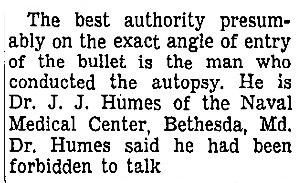
  • Forbidden

    Forbidden


    From The New York Times, Dec. 6, 1963, p. 18, “Kennedy Slaying is Reconstructed.”


    forbidden


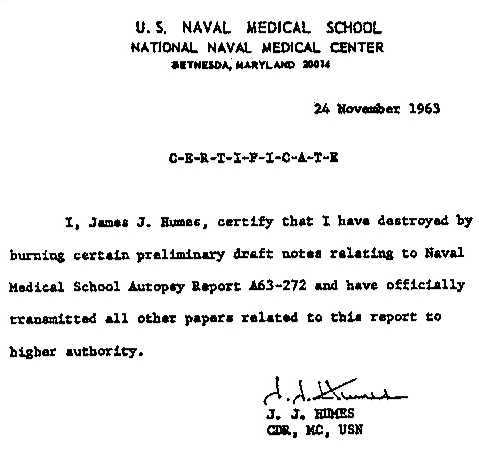
    Commission Exhibit 397


    humes note


  • Parkland Doctors

    Parkland Doctors


    Below is just a small sampling of the medical personnel who saw JFK’s head wound.


    docs 1 L-R: Dr. Robert McClelland, Dr. Paul Peters, and Dr. Kenneth Salyer, all of Parkland Hospital.


    docs 2 L-R: Dr. Charles Crenshaw, Dr. Richard Dulaney, and Nurse Audrey Bell, also all of Parkland Hospital.

  • The new Dallas DA Files: Craig Watkins vs. Henry Wade


    In November of 2006 the citizens of Dallas elected Craig Watkins their first African-American DA. The 40-year-old Democrat defeated his Republican rival Toby Shook in a close election even though he was outspent by a factor of 18-1. Clearly, Watkins benefited by the wave generated against the Bush administration. But he also ran a reform-minded campaign that clearly appealed to a segment of the population.

    Watkins vowed to place as much focus on crime prevention and redemption of criminals as possible. Many in the district attorney’s office resisted this. Many of them worked for Shook. Shook was perceived as the heir apparent to retiring DA Bill Hill. Hill, in turn, represented the legacy of longtime DA Henry Wade. Wade, of course, was the DA at the time of the Kennedy assassination who — within 36 hours — broadcast to the world that he had no doubt Oswald was the killer of President Kennedy. Wade’s office once issued a memo instructing assistant DA’s not to take Jews, Negroes, Dagoes, Mexicans or members of other races on a jury, no matter how rich or well educated.

    Unlike many other candidates who promise reform, Watkins has, so far, followed through, to the point where many of the lawyers in the office who backed Shook have left. For instance, Watkins set up a task force to partner with the Innocence Project of Texas to do DNA testing for convicts on death row. Several of them have had their verdicts overturned. He also issued new guidelines on how Dallas DA’s would perform interrogations and how line-ups would be conducted, two procedures with which Kennedy researchers were quite familiar with. He even fired those who were not content with his accent on protecting the rights of the accused.

    Now, as the accompanying story details, Watkins has focused his reform attitude on the assassination of President Kennedy. He has made public the existence of a secret stash of both exhibits and 15, 000 pages of documents that his office has been holding for over forty years. The trivial media has made much of a supposed transcript between Ruby and Oswald discussing the murder of President Kennedy on 10/4/63 at the Carousel Club. This document is clearly some kind of play on the dubious testimony of attorney Carroll Jarnagin. Some problems with this testimony are 1.) Jarnagin admitted he was drunk that night 2.) His companion did not recall any such conversation 3.) He failed a polygraph test. (See Seth Kantor, The Ruby Cover-Up, pp. 391-392).

    This has distracted from the real question that should be asked about this disclosure. Namely, why did neither Wade nor Hill turn over this evidence in the decades preceding? They could have done it on at least four separate occasions: in 1964 to the Warren Commission, in 1977 to the House Select Committee on Assassinations, and in the nineties, to local and federal agencies.

    In January of 1992, the Dallas City Council passed a resolution directing the City Manager to collect all documents related to the Kennedy assassination in the Dallas Police Department, Sheriff’s Department and the Dallas DA’s Office. They were to be turned over to the Secretary of the Records Management Division at city hall. There they were archived and indexed by the city archivist Cindy Smolovik. There was much publicity generated by this event since it was the first such collection done in the wake of Oliver Stone’s film JFK. The DA’s office was disobeying the City Council and hiding artifacts from the City Manager. But then later, in 1993, the Assassination Records Review Board was constructed. They actually visited Dallas, held a public hearing, and asked for cooperation from anyone who had any more hidden documents or evidence. Obviously, the DA was not listening or forthcoming. Even though this hidden collection is actually larger than the one archived by Smolovik.

    It’s a sorry tale. Over forty years after the fact and the public is still learning that trusted officials are keeping private potentially important records dealing with the unsolved murder of President Kennedy. And pundits and politicians wonder about why the citizenry has grown cynical about the process. At his press conference, Watkins said that he never believed Oswald acted alone. He added, “I believe in conspiracies. I think that’s just too simple of an explanation.”

    Finally, after 44 years, the people of Dallas get a DA who thinks like the majority of them do.

  • Hugh Aynesworth Never Quits


    If you do a search of this web site on the name “Hugh Aynesworth,” you will come up with several matches. None of them are complimentary. Probe magazine did a lot of work on Mr. Aynesworth. We discovered that in regards to the JFK case, to call him a “journalist” was, to be kind, rather stretching the term. As Bill Davy notes in his book Let Justice be Done, even journalists in New Orleans covering the Jim Garrison inquiry questioned his practices (and also those of his friend and partner, the late James Phelan).

    Well, it appears that Hugh Aynesworth is still carrying a torch for Clay Shaw. At a time of life when he could be enjoying retirement, the 75-year-old Aynesworth is believed to be the principal source for a screenplay centering on Jim Garrison’s investigation. The screenplay is now being shopped around Hollywood. But unlike Oliver Stone’s 1991 blockbuster JFK, this version of events portrays Clay Shaw in a favorable light.

    The screenplay was written by one Jim Piddock, a writer and actor who is apparently a babe in the woods on the JFK case. He actually takes Aynesworth seriously. Well, worse than seriously. He trots out this golden oldie: that Aynesworth and a few other intrepid reporters protected the world from the deluded Garrison and helped save the saintly Clay Shaw. (Yawn.)

    Just how under the spell of Aynesworth is Jim Piddock? Piddock calls Oliver Stone’s film “entirely fictional” and a piece of “nonsense.” He actually quotes Aynesworth as saying: “Well, at least Stone got two things right about Kennedy’s death: the time and the date.” There’s an objective source.

    Piddock states that the Garrison case against Shaw has parallels with today. These parallels are “in terms of the abuse of power after a national tragedy and the manipulation of the public by powerful but unscrupulous and corrupt men…” Yeah Jim, just look at the guy you’re talking to.

    When Oliver Stone’s JFK came out, Aynesworth went on one of his patented mini-rampages. He was on one of the news networks claiming that he saw Garrison bribing someone. (The reporter didn’t bother to ask: Who was it and for what purpose?) And he wrote a series of articles that appeared in some Texas newspapers basically recycling a lot of the anti-Garrison propaganda that he had originated years before. Clearly, the Stone film disturbed him since Garrison was allowed to make a lot of his case to the public directly, without Aynesworth and Phelan et al biting him in the back.

    None of Aynesworth’s antics in the early 1990s were much different from his assassination work in the 1960s. In 1964 he wrote a hatchet job review of Joachim Joesten’s Oswald: Assassin or Fall Guy?, one of the very first books on the Kennedy assassination. “If you would listen to [Joesten],” Aynesworth sneered, “he would have you thinking that Lee Harvey Oswald was a polite little misunderstood youth who just got mixed up in the wrong company … It’s the same old tripe with some new flavoring.” And in a notorious May 1967 Newsweek article, Aynesworth called Jim Garrison’s investigation “a plot of Garrison’s own making.” He alleged the New Orleans DA offered a witness $3,000 “if only he would ‘fill in the facts’ of the alleged meeting to plot the death of the President.”

    Jim Garrison himself said Aynesworth “seemed a gentle and fair enough man” when Aynesworth interviewed him. But the DA found out different. “As for the $3,000 bribe, by the time I came across Aynesworth’s revelation, the witness our office had supposedly offered it to, Alvin Beaubeouff, had admitted to us it never happened.” If the Newsweek article was typical of Aynesworth’s work, Garrison observed, then it was hard to undertand how he kept getting his stuff published.

    With the work of the Assassination Records Review Board, many more pages of documents have been released showing how tightly bound Aynesworth was with the intelligence community. It has been demonstrated that Aynesworth was — at the minimum — working with the Dallas Police, Shaw’s defense team, and the FBI. He was also an informant to the White House, and had once applied for work with the CIA. As I have noted elsewhere, in the annals of this case, I can think of no “reporter” who had such extensive contacts with those trying to cover up the facts in the JFK case. And only two come close: Edward Epstein and Gerald Posner.

    Whatever Hugh Aynesworth and Jim Piddock might say, it is important to remember the simple fact that Clay Shaw committed perjury. He lied to his own defense counsel in open court about his supposed non-relationship to the CIA. And he lied twice in a 1967 interview with the CBC’s Gordon Donaldson. Donaldson asked Shaw if he ever worked for the CIA and whether he had an affiliation with that agency. To the first question Shaw answered: “No.” To the second question Shaw replied: “None whatsoever.” We know better today.

    Jim Piddock has been involved in some of the worst movies put out by Hollywood of late — which is saying a lot. But take a look, if you can, at things like The Man and An Alan Smithee Film. Piddock says that he knows that films like his Garrison/Shaw opus are not easy to get made. Let’s hope that with his track record — and his sources — it doesn’t. What the world needs now is anything but more Hugh Ayesworth.


    Read some more about Piddock’s project.

    Read some more about Hugh Aynesworth.

  • These Are Your Witnesses?


    Priscilla Johnson McMillan has been against Oswald from the start. But who is she? And why wasn’t the public allowed to know until 1993?

    Hugh Aynesworth The former Dallas newspaper reporter says rejecting a conspiracy in the JFK assassination is his life’s work.

    Gerald Posner As Harold Weisberg once said, “All hail Gerald Posner!” Find more evidence of faulty research on the part of ABC, in a collection of articles examining the author of Case Closed.

    Ed Butler Among the suspect talking heads from the ABC special was an anti-Communist activist with links to Lee Harvey Oswald.

  • Hugh Aynesworth:  Refusing a Conspiracy is his Life’s Work

    Hugh Aynesworth: Refusing a Conspiracy is his Life’s Work


    hugh
    Hugh Aynesworth

    At the time of the assassination, Hugh Aynesworth was a reporter for the Dallas Morning News. He has maintained that on November 22, 1963 he was in Dealey Plaza and a witness to the assassination — although there is no photograph that reveals such. At times, he has also maintained he was at the scene where Tippit was shot — although it is difficult to locate a time for his being there. He has also stated that he was at the Texas Theater where Oswald was arrested — although, again, no film or photo attests to this. Further, he has written that he was in the basement of the Dallas Police Department when Oswald was killed by Jack Ruby. Like Priscilla Johnson, Aynesworth soon decided to make his career out of this event. As we shall see, it is quite clear that he made up his mind immediately about Oswald’s guilt. Long before the Warren Report was issued. In fact, he tried to influence their verdict.

    On July 21, 1964 Aynesworth’s name surfaced in the newspapers in Dallas in a column by his friend Holmes Alexander. Alexander implied that Aynesworth did not trust Earl Warren and therefore was conducting his own investigation of the Kennedy murder. He was ready to reveal that the FBI knew Oswald was a potential assassin and blew their assignment. He also had talked to Marina Oswald and she had told him that Oswald had also threatened to kill Richard Nixon. Alexander goes on to say that these kinds of incidents show the mind of a killer at work. That “of a hard-driven, politically radical Leftist which is emerging from the small amount of news put out by the Warren Commission. If the full report follows the expected line, Oswald will be shown as a homicidal maniac.” Holmes concludes his piece with a warning: If the Commission’s verdict “jibes with that of Aynesworth’s independent research, credibility will be added to its findings. If [it] does not there will be some explaining to do.” Clearly, Aynesworth contributed mightily to the article, had decided Oswald had done it even before the Commission had revealed its evidence, and was bent on destroying its credibility if it differed from his opinion.

    The story about Marina and Nixon was so farfetched that not even the Warren Commission bought into it (Warren Report pp. 187-188). It has been demolished by many authors; most notably Peter Scott who notes that to believe it, Marina had to have locked Oswald in the bathroom to keep him from committing this murderous act; yet the bathroom locked from the inside. Also, as the Commission noted in the pages above, Nixon was not in Dallas until several months after the alleged incident. Further, there was no announcement in any local newspaper that Nixon was going to be in Dallas at this time period — April of 1963. Since Aynesworth was quite close to Marina at this time (he actually bragged to some friends that he was sleeping with her) it may be that he foisted the quite incredible story on her in his attempt to portray Oswald as the Leftist, homicidal maniac he related to Holmes Alexander.

    Aynesworth was also out to profit personally from the tragedy. In late June of 1964, Oswald’s alleged diary from his Russian days appeared in Aynesworth’s newspaper with a commentary by the reporter. Two weeks later it also appeared in U. S. News and World Report. An FBI investigation followed to see how this material leaked into the press. In declassified documents, it appears that the diary was pilfered from the Dallas Police archives by the notorious assistant DA Bill Alexander and then given to his friend Aynesworth. Aynesworth then put it on the market to other magazines including Newsweek. It eventually ended up in Life magazine also. Alexander, Aynesworth and the reporter’s wife Paula split thousands of dollars. Oswald’s widow was paid later by Life since, originally, Aynesworth had illegally cut her out of the deal. In another FBI report of July 7th, it also appears that Aynesworth was using the so-called diary for career advancement purposes. A source told the Bureau that part of the deal with Newsweek was that Aynesworth was to become their Dallas correspondent. As the Bureau noted, Aynesworth did become their Dallas stringer afterward. (It is interesting to note here that the “diary” has been shown to have been not a real diary at all. That is, it was not recorded on a daily basis but rather in two or three sittings.)

    Right after this, in August of 1964, another trademark of Aynseworth’s Kennedy career appeared: his penchant to attack and ridicule anyone who disagreed with him. Aynesworth published a review of Joachim Joesten’s early book on the case entitled Oswald: Assassin or Fall Guy. The review is not really a review at all, it is just a string of invective directed at the author for believing such silly notions that Oswald could have been innocent and that he could have been an agent of the FBI and/or CIA. When rumors circulated that Oswald had been an FBI informant, which he apparently was, Aynesworth went to work discrediting them saying that it was all a joke he had made up — even though he was not the source of the quite specific information.

    In December of 1966, Aynesworth surfaced again on the Kennedy case. At this time Life was doing its ill-fated reinvestigation of the murder led by Holland McCombs and Richard Billings. Somehow, probably through McCombs who was a good friend of Clay Shaw, Aynesworth was a part of this investigation. Aynesworth began informing on the intricacies of the probe to the FBI. For instance on December 12th, Aynesworth informed the Bureau that they had discovered a man who connected Oswald with Ruby. Aynesworth turned over a copy of this report to the FBI. He also then told the Bureau that Mark Lane was a homosexual and had to drop his political career because of these allegations. At the end of the interview Aynesworth “specifically requested” his identity and his sources not be disclosed outside the Bureau.

    Billings’ investigation eventually and perhaps inevitably ran into the initial stages of the secret probe being conducted by District Attorney Jim Garrison. And because a mutual acquaintance of Billings and Garrison, David Chandler, was involved, Aynesworth was one of the first people to discover what Garrison was doing. The unsuspecting Garrison actually granted the duplicitous reporter an interview in his home. After the interview, Aynesworth wrote a note to McCombs that they should not let the DA know they were playing “both sides.” Recall, this was the first time they had met face to face! So much for a modicum of objectivity.

    Almost immediately Aynesworth set out to smear Garrison in the national press, to obstruct him by cooperating with law enforcement agencies who were opposed to the DA, and to defeat him in court by extending his services to Shaw’s lawyers. All of the above is readily provable today as it had not been before the releases of the ARRB. It would not be hyperbole to write that no other reporter in recorded history had as much to do in opposing a DA both covertly and overtly as Aynesworth did in New Orleans from 1967-71. Especially when one extends Aynesworth’s actions to connect with his two allies in this effort, namely James Phelan and the late Walter Sheridan. (Significantly, when the ARRB requested the files of Sheridan on the 1967 NBC special he produced, Sheridan’s family sent them to NBC. And the network refused to turn them over.) Aynesworth’s actions are too lengthy to be discussed here but they are recorded in detail in Probe Magazine (Vol. 4 No. 4) and also in the book The Assassinations: Probe Magazine on JFK, MLK, RFK, and Malcolm X (pp. 24-29). Aynesworth published an attack on Garrison in Newsweek on May 15, 1967 (about a week after Phelan’s broadside had appeared in The Saturday Evening Post.) The “report” was clearly a venomous hatchet job that had one aim: to stigmatize Garrison and, by doing that, to neutralize his investigation by turning the public’s attention away from his discoveries and toward the controversy being manufactured by Aynesworth, Phelan, and NBC’s special which was to follow the next month. The article depicted Garrison as a modern day Robespierre whose investigation had bribed witnesses into making false claims, whose staff had threatened to murder a witness, and finally that Garrison was so possessed he held the entire city in thrall by terrorist tactics.

    We have seen how Aynesworth informed on the Billings investigation with the FBI. On the Garrison case, he extended his reach. Before his article was printed, he forwarded a copy to George Christian who was press secretary for the White House. But not before he had called him and discussed his inflammatory and deceitful article. The actual telegram he sent is interesting in revealing his psychology. He tells Christian that he is informing because he is aware of what Garrison is up to. What, in Aynesworth’s view, is he up to? He is trying “to make it seem that the FBI and CIA are involved in the JFK plot.” But further, “he can —and probably will — do untold damage to this nation’s image throughout the world.” Finally, he tells Christian that although Garrison wants the government to defy him or to pressure a halt to his probe, that is not what they should do, “for that is exactly what Garrison wants.” Of course, he again asked that his role be kept a secret. These last two assertions imply that Aynesworth would serve as the intermediary to obstruct Garrison clandestinely while claiming to be a reporter so that the government could keep its hands clean as he did their dirty work for them.

    Further insight into Aynesworth’s peculiar psychology came in an interview in 1979 on KERA, the Dallas PBS affiliate. He said there, “I’m not saying there wasn’t a conspiracy. I know most people in this country believe there was a conspiracy. I just refuse to accept it and that’s my life’s work.” In other words, what the facts are do not really matter to him. It’s keeping the lid on a conspiracy to commit homicide that matters. (Wouldn’t it have been interesting if Jennings would have confronted Aynesworth with that statement and asked him to explain his view of journalism in light of it?)

    By the 1990’s Aynesworth’s role had been so exposed to those in the know that he couldn’t appear at research conferences. So he did not show up at them himself — as he may have, for surveillance purposes, earlier. Instead he arranged other conferences to eclipse them, as he did in 1993 for the 30th anniversary of the assassination. At this one in Dallas, someone asked him this: Had he ever cooperated with the government on a story prior to its publication? He denied it of course. Then the questioner read him the Christian memo quoted above.

    Why couldn’t Jennings do the same?

  • Death of the NAA Verdict


    Since the time of the House Select Committee on Assassinations (HSCA), Oswald-did-it-advocates have trumpeted the neutron activation analysis test as the crown jewel of their case against the accused assassin. Former Chief Counsel of the HSCA, Robert Blakey leaked the results of the NAA testing to the press in advance of its actual presentation in the public hearings in a clear attempt to influence media coverage of his verdict against Oswald. Let me quote from The Assassinations in this regard:

    Guinn’s findings were very important to Blakey. He leaked them to the press early in 1978 as the final nail in the HSCA’s verdict against Oswald. It was the rigorous scientific analysis that he so much admired and enthroned. And it showed that the single bullet theory was not just possible but that it actually happened.

    Yet today, after the peer reviewed and published work of Erik Randich and Patrick Grant (Journal of Forensic Science, July 2006), Blakey is singing a different tune. The work of these two men has been so destructive of both the HSCA analysis and their NAA interpretation that Blakey now has termed the whole exercise “junk science”. Further, the FBI has made the decision they will not use the process in court again. To understand why this astonishing retreat has taken place in broad daylight, let’s go back to the beginning.

    According to the Warren Commission, the FBI had done what was called “spectrographic analysis” on some of the ballistics evidence in the JFK case. According to Henry Hurt’s discussion of this in his book Reasonable Doubt, both the FBI and the Commission were maddeningly vague about the results of the analysis. According to Hurt, this issue was to be addressed by the last witness called by the Commission, who was involved in the spectrographic analysis. Yet, during his interview, the commissioners never asked him a question on the issue. The Warren Report then noted that there were similarities in the metal composition of some of the bullet fragments. With the actual analysis not present and these vague generic terms in play, most considered that what the FBI did was not of any forensic value.

    But it was later revealed that the FBI had gone beyond spectography to a much finer testing of the bullet fragments for trace metal testing of what the lead cores were made out of: namely neutron activation analysis. Yet although this kind of testing is much more exact for analysis of what metals are in the bullet lead and to what degree, according to Hurt, there is no mention of it in the Warren Report or the accompanying volumes of evidence and testimony. But in a later declassified letter from J. Edgar Hoover to the Commission, the so-called 1964 NAA tests were noted. Although Hoover tries to put the best face on the results, the sum total of his letter was that they were inconclusive. (Hurt, p. 81)

    The whole NAA issue seemed to be a dead end. But that did not discourage HSCA Chief Counsel Robert Blakey. Blakey decided to do a “retest” of the compositional analysis of the lead cores of the bullets involved in the case for the HSCA in September of 1977. Dr. Vincent Guinn, a nuclear chemist at Cal Irvine, did the testing and the HSCA called him as a witness at its public hearings. Guinn was called upon on September 8, 1978. The difference between what Hoover had reported, or not reported, in 1964 and what Guinn and the HSCA declared in 1978 was startling. The scientific test called NAA went from being “inconclusive” to showing that:

    1. Only two bullets struck the presidential limo and its occupants, thereby upholding the Warren Commission.
    2. All bullet lead trace metal analysis showed that the ammunition came from Western Cartridge Company’s Mannlicher-Carcano (WCC MC) manufacture. This would seem to link the ammunition to the alleged rifle found on the sixth floor.
    3. Fragments from Connally’s wrist were “matched” with CE 399, or the stretcher bullet that allegedly went through Kennedy also. This would seem to indicate the Warren Commission was right about the single bullet theory.

    In fact, the HSCA went out of its way to take a crack at Cyril Wecht here using Guinn’s testimony. Wecht had passionately argued that one bullet could never have remained as intact as CE 399 if it had done all the damage in two men this bullet was supposed to have done. On the basis of the new NAA testing, counsel Jim Wolf asked Guinn if Wecht was right on this point. Guinn replied: “Well, I think that is his opinion; but like many opinions and many theories, sometimes they don’t agree with the facts.” (HSCA, Vol. 1, p. 505) This was where the matter was left at the conclusion of the HSCA in 1979. Bullet lead analysis by NAA was taken seriously and Guinn and Blakey’s “findings” bolstered the Warren Commission. Advocates like Gerald Posner in his book Case Closed summarized the NAA as such: “Guinn’s finding ended the speculation that CE 399 had been planted on the stretcher, since there was now indisputable evidence that it had traveled through Connally’s body, leaving behind fragments.” Ken Rahn and Larry Sturdivan wrote in an academic journal that, “The NAA results were the most important new physical evidence that surfaced as a result of the House Select Committee on Assassinations investigation. It knits together the core physical evidence into an airtight case against Lee Oswald.”

    The first serious broadside against Guinn and the NAA was issued by Wallace Milam at the COPA Conference in Washington in 1994. Milam questioned the very basis of Guinn’s conclusions. Guinn had said that the metallic make-up of WCC MC could vary widely from bullet to bullet, the term for this being “heterogeneous” or irreproducible. But Guinn also added that the metallic make-up of a single MC bullet was not; the term for this was “homogeneous”. But Milam showed that Guinn’s data did show large variations within a single bullet, especially in the measure of the trace element antimony, which Guinn placed much weight on. He also noted that his testimony on this issue seemed to contradict a paper he wrote that very same year in Transactions of the American Nuclear Society. There he wrote that: “In the U. C. Irvine INAA background studies of the Mannlicher-Carcano ammunition, it was found that this bullet lead is remarkably heterogeneous somewhat within a given bullet.” (Emphasis added) Yet, for the HSCA, Guinn seemed to place the efficacy of the findings on the intra-bullet lead being homogenous or uniform and consistent throughout. And really, if this were not the case, then Guinn’s whole testimony would dissolve.

    Milam’s logic was penetratingly simple on this point. In the 1964 tests the FBI had taken microscopic samples from the same bullet and come up with different concentrations of antimony ranging from 636 parts per million (PPM) all the way up to 1125 PPM. With this wide range of data within one bullet, then it would be possible to match varying PPM values to differing fragments if one were to allow a large enough variance. And it appears that this variance is what led the Bureau to declare the earlier NAA results “inconclusive”.

    Milam’s discussion was well informed, pointed, and well documented. (It is available online at the site Electronic Assassinations Newsletter, under the title “Blakey’s linchpin”.) Later on Art Snyder, a physicist, questioned the statistical analysis used by Guinn. Interestingly, although Guinn prepared such an analysis, when challenged to assign a probability number for the certainty of his work, he declined. (For instance, the two acoustical analysts for the HSCA gave their work a 95% probably certainty statistic.) Snyder later commented that Guinn probably did not assign such a figure because the number would have been too high, signaling a high probability of error due to the high variables involved in his findings.

    In the face of these two trenchant attacks on the Guinn/Blakey analysis, Warren Commission defenders like Rahn and Sturdivan continued to defend the viability of the NAA analysis, saying that somehow Milam had misinterpreted Guinn’s work. (Yet, when Milam challenged Rahn to a simple test comparing heterogeneity and homogeneity in WCC MC bullets, Rahn declined.) Rahn and Sturdivan will not be able to ignore the content of the new work by Randich and Grant. It goes beyond the estimable critiques of Milam and Snyder to question the underlying tenets of Guinn’s NAA analysis.

    This new analysis shows that although the critiques of Milam and Snyder are valid, they don’t go far enough. The reason being that neither of them, or Guinn for that matter, was a metallurgist. Which Randich is. (And as Randich told me, Guinn should have had a metallurgist consulting him in his work.) The following startling facts have been left out of the debate over NAA.

    Randich and Grant declare that a major fault in the HSCA work is Guinn’s tenet that WCC MC lead “was found to differ sharply from typical bullet leads.” This is not the case: WCC MC bullets do not differ sharply from most bullet leads. They are much like other metal-jacketed leads. The MC lead seemed different to Guinn because he compared it to unjacketed handgun rounds. In his talk in San Francisco of July 15, 2006, Randich said that outside of .38 and .22 handguns, most bullet manufacturers use the same lead alloy. (He put the figure at about 75%.) This is shocking. What it says is that the lead alloy for MC ammunition, far form being unique, is the same that say, Remington would use. So one of the pillars of Guinn’s work, the singular identifiability of MC ammunition, has now fallen.

    Randich and Grant also discussed a crucial phenomenon in lead smelting called “segregation”, i.e. how the lead and trace elements distribute themselves through the heating and cooling process. During this process, the lead, because it is heavier, stays in the center, while the antimony “floats” to the edges. So depending on where one draws the sample from, that particular location will determine the levels of antimony. Further, copper tends to coagulate in clumps, so if you drew a sample from just one spot you might get a high concentration of copper. If you drew it from a few millimeters away, you could get a very low concentration. In fact, this is precisely what happened to Guinn. Which is why he tended to ignore his copper findings in favor of antimony and silver.

    Randich and Grant also concluded that Guinn’s sampling number for his conclusions was way too small to allow for the possibility of random matches. Randich said that the FBI held until recently that you could not get random matches with NAA analysis. It was later determined that they had never looked for any. After 2004, when Randich became a witness against them, they did look and they found one.

    Perhaps the most arresting piece of evidence produced by the duo was a chart measuring the trace elements of the five pieces of evidence Guinn analyzed: the bullet left in the rifle at the so-called “sniper’s nest”, the bullet that Oswald allegedly fired at General Walker, and the three samples from the Kennedy assassination. The values varied widely, but especially for the “sniper’s nest” bullet and the Walker bullet. Peter Dale Scott looked at this chart and surmised that it looked like those two bullets came from a different gun or type of ammunition. Right before this chart was placed on the overhead, Randich was talking about how trace metal values can vary widely in a particular run if one of the ingots used for the metals has been replaced on the production line. I asked him if he was then saying that theoretically all of those bullets, with their wide trace metal values, could come from one box. He replied that yes, they could. I then asked him, “Then what’s the basis for this science?” He replied, “You’re talking to the choir.” Today, this new analysis is so convincing that the man that originally sponsored it and then advocated it to convict Oswald, Robert Blakey, has now joined the choir. Unfortunately, like many things in this case, the truth has emerged 28 years too late.

    It is relevant to remind the reader of two other relatively recent discoveries in the bullet evidence field. The work of Josiah Thompson and Gary Aguilar has shown that CE 399 was not positively identified by the two witnesses who the Warren Commission relied upon for their alleged identification. So there is no positive proof that the “magic bullet” was the one found on the stretcher at Parkland Hospital. Secondly, the painstaking work of John Armstrong in his book Harvey And Lee raises the most serious questions about whether or not Oswald actually ordered the alleged murder weapon. That work, when combined with the writings of Randich and Grant, has undone the so-called “core physical evidence” against Oswald. Far from composing an “airtight” case against Oswald, the most serious questions need to be asked about the origins of this evidence, and where the linkage to Oswald can be found. Like the medical evidence in the nineties, these new developments in the bullet and rifle evidence have left both the HSCA and the Warren Commission foundering in a sea of questions and doubt.


    (Stuart Wexler will be writing another article for this site on the dubious validity of Guinn’s NAA study with new evidence and analysis questioning the statistical basis of his work.)

  • Letters to The Nation magazine re: Max Holland


    Pennington, NJ

    I’m the author of A Farewell to Justice: Jim Garrison, JFK’s Assassination and the Case That Should Have Changed History, my seventeenth book, whose credibility is attacked by Max Holland. Nation readers might give pause to Holland’s five-year campaign of outright falsehoods about the investigation into the Kennedy assassination by New Orleans District Attorney Jim Garrison that have appeared in a range of publications from The Wilson Quarterly, The Atlantic, New Orleans and the Washington Post to, now, The Nation.

    Garrison focused on the clandestine service of the CIA as sponsor of the Kennedy assassination as a result of facts he discovered about Lee Harvey Oswald, specifically Oswald’s role as an FBI informant and low-level CIA agent sent to the Soviet Union by the CIA’s Chief of Counterintelligence, James Angleton, as part of a false defector program. What Garrison had not yet discovered was that Oswald also worked for the US Customs Service in New Orleans.

    Contrary to Holland’s assertions of the innocence of Clay Shaw, the man Garrison indicted for participation in the murder of President Kennedy was indeed part of the implementation of the murder and was guilty of conspiracy. That Shaw was acquitted does not exonerate him for history. New documents indicate overwhelmingly that Shaw did favors for the CIA. On his deathbed he admitted as much. Shaw’s repeated appearances in Louisiana in the company of Oswald demonstrate that Shaw was part of the framing of Oswald for Kennedy’s murder. Shaw took Oswald to the East Louisiana State Hospital in an attempt to secure him a job there, one event among many never investigated by the Warren Commission or the House Select Committee on Assassinations (HSCA).

    Holland’s assertion that Garrison based his conclusion that the CIA sponsored the assassination on a series of articles in an Italian newspaper is also incorrect. Garrison had focused on the CIA long before he learned that Shaw was on the board of directors of a CIA-funded phony trade front called Centro Mondiale Commerciale (CMC), based in Rome. Indeed, the newspaper Paese Sera broke the story of Shaw’s involvement after a six-month investigation into CIA interference in European electoral politics, only to discover that Garrison had indicted Shaw a few days before the first article was to appear. Moreover, the new documents reveal that CMC and its parent outfit, Permindex, were indeed CIA fronts.

    The 1992 Assassinations Records and Review Act has disgorged dozens of documents showing that Shaw was a CIA operative. This is directly contrary to what Holland suggests — that Garrison was a willing victim of “the KGB’s wildest fantasy.” To cite one example, Shaw was cleared for a project dubbed QKENCHANT, which permitted him to recruit outsiders for CIA projects. Shaw was no mere businessman debriefed by the CIA. One document reveals that among those Shaw recruited in New Orleans was Guy Banister, former FBI Chicago Special Agent in Charge running an ersatz New Orleans detective agency whose side-door address (544 Camp Street) Oswald used on a set of his pro-Castro leaflets, until Banister stopped him.

    The former editors of the now-defunct Paese Sera, whom I interviewed, from Jean-Franco Corsini to Edo Parpalione, insisted adamantly that neither the Italian Communist Party, nor the Soviet Communist Party, nor the KGB had any influence on the paper’s editorial policy. Outraged by Holland’s accusations, Corsini said that he despised the KGB and the CIA equally.

    The roots of Holland’s charge that Garrison was a dupe of KGB propaganda may be traced to an April 4, 1967, CIA document titled “Countering Criticism of the Warren Report.” In it the CIA suggests to its media assets that they accuse critics of the Warren Report of “Communist sympathies.” In April 1967 Garrison was at the height of his investigation: He is clearly the critic the CIA had in mind.

    In 1961 Richard Helms had already developed the charge that Paese Sera was an outlet for the KGB and for Soviet propaganda. Helms was indignant, but the truth had appeared in Paese Sera: The attempted putsch against Charles de Gaulle by four Algerian-based generals had indeed been supported by the CIA. Holland has merely picked up where Helms, later to become a convicted perjurer, left off — repeating a scenario developed for him by Helms, with the addition of making the accusation of Soviet influence on Garrison.

    My book is hardly a “hagiography of the DA,” as Holland states. I present a flawed man who exhibited great courage in facing down both the FBI and the CIA in his attempt to investigate the murder of the President. Indeed, Garrison family members were dismayed that I did not present him in a more idealized form. I depicted him as an ordinary man who rose to distinction because of his single-minded commitment to the investigation.

    Among the many errors in Holland’s latest diatribe is that Shaw died “prematurely,” as if somehow Garrison’s prosecution hastened his end. In fact, Shaw was a lifelong chain smoker and died of lung cancer. Holland attacks Robert Blakey, chief counsel for the HSCA, for using acoustic evidence to suggest that there was a conspiracy in the Kennedy murder. In fact, the acoustic evidence of at least four shots being fired has been established scientifically by Donald Thomas in the British forensic journal Science and Justice (see also Thomas’s well-documented paper, available online, “Hear No Evil: The Acoustical Evidence in the Kennedy Assassination,” delivered November 17, 2001).

    Blakey certainly can be criticized for his close relationship with the CIA throughout his HSCA investigation. His letters of agreement with the CIA are at the National Archives. The CIA decided how key witnesses were to be deposed, and Blakey acquiesced in all CIA demands and intrusions upon the investigation.

    Before Blakey was hired, former Supreme Court Justice Arthur Goldberg considered accepting the job as counsel. Knowing that the CIA had at the least covered up the facts of the assassination and at worst been involved, Goldberg telephoned CIA director Stansfield Turner and asked him whether, should he take the job, he would have full CIA cooperation. Silence emanated over the wires. Goldberg, naïve perhaps, asked Turner if he had heard the question. “I thought my silence was my answer,” Turner said. Goldberg declined the job. Blakey took it. It is no surprise that Holland, who has consistently defended the CIA, does not raise the issue of Blakey’s cooperation with the CIA during his HSCA tenure but focuses instead on Blakey’s conclusion, forced by the irrefutable acoustic evidence, that there was a conspiracy.

    It is one thing for Holland to spread his disinformation in the CIA’s Studies in Intelligence. It is quite another for The Nation to allow him continued access without debate to its pages to obfuscate, slander authors like myself and deny evidence fully established — in particular about Jim Garrison and how the new documents establish his credibility and reveal how close he came to the truth, and in general about the Kennedy assassination’s sponsors and accessories.

    JOAN MELLEN


    Charlottesville, Va.

    It began with a CIA document classified Top Secret. How do I know that? A decade after the assassination of President Kennedy, with the assistance of the ACLU, I won a precedent-setting lawsuit in the US District Court in Washington, DC, brought pursuant to the Freedom of Information Act. The court ordered the police and spy organizations to provide to me many long-suppressed documents.

    The CIA document stated that it was deeply troubled by my work in questioning the conclusions of the Warren Commission. The CIA had concluded that my book Rush to Judgment was difficult to answer; indeed, after a careful and thorough analysis of that work by CIA experts, the CIA was unable to find and cite a single error in the book. The CIA complained that almost half of the American people agreed with me and that “Doubtless polls abroad would show similar, or possibly more adverse, results.” This “trend of opinion,” the CIA stated, “is a matter of concern” to “our organization.” Therefore, the CIA concluded, steps must be taken.

    The CIA directed that methods of attacking me should be discussed with “liaison and friendly elite contacts (especially politicians and editors),” instructing them that “further speculative discussion only plays into the hands of the opposition.” The CIA stressed that their assets in the media should “point out also that parts of the conspiracy talk appear to be deliberately generated by Communist propagandists.” Further, their media contacts should “use their influence to discourage” what the CIA referred to as “unfounded and irresponsible speculation.” Rush to Judgment, then the New York Times number-one bestselling book, contained no speculation.

    The CIA in its report instructed book reviewers and magazines that contained feature articles how to deal with me and others who raised doubts about the validity of the Warren Report. Magazines should, the CIA stated, “employ propaganda assets to answer and refute the attacks of the critics,” adding that “feature articles are particularly appropriate for this purpose.” The CIA instructed its media assets that “because of the standing of the members of the Warren Commission, efforts to impugn their rectitude and wisdom tend to cast doubt on the whole leadership of American society.” The CIA was referring to such distinguished gentlemen as Allen Dulles, the former director of the CIA; President Kennedy had fired Dulles from that position for having lied to him about the Bay of Pigs tragedy. Dulles was then appointed by Lyndon Johnson to the Warren Commission to tell the American people the truth about the assassination.

    The purpose of the CIA was not in doubt. The CIA stated: “The aim of this dispatch is to provide material for countering and discrediting the claims” of those who doubted the Warren Report. The CIA stated that “background information” about me and others “is supplied in a classified section and in a number of unclassified attachments.”

    With this background we now turn to Max Holland’s Nation article, which states that there was a “JFK Lawyers’ Conspiracy” among four lawyers: former Senator Gary Hart; Professor Robert Blakey; Jim Garrison, the former District Attorney of New Orleans and later a state judge in Louisiana; and me.

    Before I wrote Rush to Judgment I had never met any of the other three “co-conspirators.” I still have not had the pleasure of meeting Senator Hart, and I know of no work that he has done in this area. I met Professor Blakey only once; he had been appointed chief counsel for the House Select Committee on Assassinations, and at that meeting I told him that I was disappointed in his approach and methods. Not much of a lawyers’ conspiracy.

    Each of the other statements as to alleged fact are false and defamatory. Holland states that I am not scrupulous, that I am dishonest and that I spread innuendo about the sinister delay in the Warren Commission investigation, an assertion not made by me but fabricated in its entirety by Holland. As a silent echo of his CIA associates Holland does not point to one assertion as to fact, of the thousands I have made about the facts surrounding the death of our President, that he claims is inaccurate.

    Finally, Holland strikes pay dirt. He uncovers, are you ready for this, the fact that I had asserted that “the government was indifferent to the truth.” I confess. Is that now a crime under the Patriot Act? Isn’t that what The Nation is supposed to be asserting and proving?

    Holland states that the KGB was secretly funding my work with a payment of “$12,500 (in 2005 dollars).” It was a secret all right. It never happened. Holland’s statement is an outright lie. Neither the KGB nor any person or organization associated with it ever made any contribution to my work. No one ever made a sizable contribution, with the exception of Corliss Lamont, who contributed enough for me to fly one time from New York to Dallas to interview eyewitnesses. The second-largest contribution was $50 given to me by Woody Allen. Have Corliss and Woody now joined Holland’s fanciful conspiracy?

    Funds for the work of the Citizens Committee of Inquiry were raised by me. I lectured each night for more than a year in a Manhattan theater. The Times referred to the very well attended talks as one of the longest-running performances off Broadway. That was not a secret. I am surprised that Holland never came across that information, especially since he refers to what he calls “The Speech” in his diatribe.

    Apparently, Holland did not fabricate the KGB story; his associates at the CIA did. There is proof for that assertion, but I fear that I have taken too much space already. For that information, contact me at mlane777@cs.com.

    Am I being unfair when I suggest a connection between Holland and the CIA? Here is the CIA game plan: Fabricate a disinformation story. Hand it to a reporter with liberal credentials; for example, a Nation contributing editor. If the reporter cannot find a publication then have the CIA carry it on its own website under the byline of the reporter. Then the CIA can quote the reporter and state, ” according to…”

    Holland writes regularly for the official CIA website. He publishes information there that he has been given by the CIA. The CIA, on its official website, then states, “According to Holland…” If you would like to look into this matter of disinformation laundering, enter into your computer “CIA.gov + Max Holland.” You will find on the first page alone numerous articles by Holland supporting and defending the CIA and attacking those who dare to disagree, as well as CIA statements attributing the information to Holland.

    A question for The Nation. When Holland writes an article for you defending the CIA and attacking its critics, why do you describe him only as “a Nation contributing editor” and author? Is it not relevant to inform your readers that he also is a contributor to the official CIA website and then is quoted by the CIA regarding information that the agency gave him?

    An old associate of mine, Adlai Stevenson, once stated to his political opponent, a man known as a stranger to the truth — if you stop telling lies about me I will stop telling the truth about you. I was prepared to adopt that attitude here. But I cannot. Your publication has defamed a good friend, Jim Garrison, after he died and could not defend himself against demonstrably false charges.

    You have not served your readers by refusing to disclose Holland’s CIA association. The Nation and Holland have engaged in the type of attack journalism that recalls the bad old days. If I fought McCarthyism in the 1950s as a young lawyer, how can I avoid it now when it appears in a magazine that has sullied its own history? The article is filled with ad hominem attacks, name calling and fabrications, and it has done much mischief. I will hold you and Holland accountable for your misconduct. I can honorably adopt no other course.

    To mitigate damages I require that you repudiate the article and apologize for publishing it. That you publish this letter as an unedited article in your next issue. That you do not publish a reply by Holland in which he adds to the defamation and the damage he has done, a method you have employed in the past. That you provide to me the mailing addresses of your contributing editors and members of your editorial board so that I may send this letter to them. I am confident that Gore Vidal and Bob Borosage, Tom Hayden and Marcus Raskin, all of whom I know, and many others such as Molly Ivins, John Leonard and Lani Guinier, who I do not know but who I respect and admire, would be interested in the practices of The Nation. In addition, I suggest that ethical journalism requires that in the future you fully identify your writers so that your readers may make an informed judgment about their potential bias.

    If you have a genuine interest in the facts regarding the assassination you should know that the House Select Committee on Assassinations (the United States Congress) concluded that probably a conspiracy was responsible for the murder and that, therefore, the Warren Report that Holland defends so aggressively is probably wrong. In addition, the only jury to consider this question decided in a trial held in the US District Court in a defamation case that the newspaper did not defame E. Howard Hunt when it suggested that Hunt and the CIA had killed the President. The forewoman of the jury stated that the evidence proved that the CIA had been responsible for the assassination.

    I have earned many friends in this long effort. Those who have supported my work include Lord Bertrand Russell, Arnold Toynbee, Professor Hugh Trevor-Roper, Dr. Linus Pauling, Senator Richard Schweicker, Paul McCartney, Norman Mailer, Richard Sprague, Robert Tannenbaum and also members of the House of Representatives, including Don Edwards, Henry Gonzales, Andrew Young, Bella Abzug, Richardson Preyer, Christopher Dodd, Herman Badillo, Mervyn Dymally, Mario Biaggi and, above all, according to every national poll, the overwhelming majority of the American people. I have apparently earned a few adversaries along the way. Too bad that they operate from the shadows; that tends to remove the possibility of an open debate.

    MARK LANE


    Washington, DC

    While many thought the 1979 report of the House Select Committee on Assassinations was the final word on President Kennedy’s murder, it wasn’t. In 1992 Congress passed the JFK Act. As a result, a huge volume of new materials are available for study.

    One significant revelation is the extent to which the CIA was a focus of the committee’s probe. Another is the discovery by Jefferson Morley, a columnist for WashingtonPost.com, that the CIA corrupted the committee’s probe. The CIA brought former case officer George Joannides out of retirement to handle the committee’s inquiries about the relationship between Lee Harvey Oswald and DRE, a CIA-funded Cuban exile organization. The CIA never told the committee that Joannides was DRE’s case officer when Oswald and DRE were in contact. Joannides then thwarted committee efforts to obtain CIA records about the DRE-Oswald relationship. Thus, the last official word on the assassination is that of a Congressional committee that was subverted by an agency that itself was a focus of the investigation.

    These facts raise serious issues. The CIA’s conduct undermined democratic accountability and compromised the integrity of Congressional oversight on a matter of national security. Shouldn’t Congress now investigate to determine why the CIA sabotaged the probe? Was it because, as some former committee staffers have said, an element of the CIA was involved in the plot? Or is there some other explanation?

    In 2004 and 2005 the Assassination Archives and Research Center (AARC) held conferences to discuss the JFK assassination. On the issue of conspiracy, two scientists from Lawrence Livermore National Laboratory discredited the last remaining basis for the single bullet theory (SBT), which theorized that both Kennedy and John Connally were hit by the same bullet, fired from Oswald’s Mannlicher-Carcano rifle — the sine qua non for the lone assassin theory. These eminent scientists said that due to scientific advances not only can the SBT not be substantiated but the fragments tested could have come from one — or as many as five — bullets, including a Remington or some other rifle. Holland mentions none of this.

    Holland denounces the acoustics evidence proving there was a conspiracy. He misrepresents acoustics as being the only evidence the committee had of a conspiracy and mistakenly says that it is uncorroborated. In fact, the first acoustics panel was corroborated by the second. Both were further corroborated and strengthened by Donald Thomas’s study. Holland doesn’t mention Thomas, but does obliquely refer to the work of Richard Garwin.Thomas debated Garwin at the AARC conference. But as Pulitzer Prize-winning reporter George Lardner reported, Thomas “upstaged” Garwin, showing “how the noises coincided precisely with frames from the Zapruder film and echoes off buildings in Dealey Plaza reflecting the gunfire.” Lardner also noted that Garwin said he “had not studied the echoes.” Again, none of this is in Holland’s account.

    Holland, winner of a CIA award for Studies in Intelligence, has been working on a book since 1993 defending the Warren Commission. In applying for an Anthony Lukas work-in-progress award in 2001, he said that as a result of his study “the Commission can emerge in a new light: battered somewhat but with its probity and the accuracy of its findings intact.” He also stressed that he had spent a full year researching “the remarkable effort of KGB disinformation on Garrison’s probe.” Holland debated this thesis with Gary Aguilar at the 2004 AARC conference. In my view, Holland lost hands down (a DVD of the conference is available through aarclibrary.org). In advancing his thesis, Holland relies on dubious materials, including the word of former CIA director Richard Helms, who was charged with perjury but copped a plea of withholding information from Congress.

    Holland now uses the AARC’s 2005 conference to theorize that a vast conspiracy of lawyers “less scrupulous” than those at the Warren Commission spread KGB disinformation and convinced Congress and the American people that the Warren Report was wrong. This is a McCarthyite tactic for discrediting the AARC conferences and Warren Commission critics generally. It seems no one ever saw the Zapruder film showing JFK thrown violently to the left rear, no one ever looked at the Magic Bullet and concluded it was so undeformed it could not have done all the damage alleged. No, it was them bloody KGB disinformation lawyers that brainwashed them.

    In 1967 the CIA directed its stations to tamp growing criticism of the Warren Report by discussing it with “liaison and friendly elite contacts (especially politicians and editors)” and “point out that parts of the conspiracy talk appear to be deliberately generated by Communist propagandists.” The dispatch further instructs that stations “employ propaganda assets to answer and refute the attacks of the critics,” saying that “book reviews and feature articles are particularly appropriate for this purpose.”

    Holland’s piece on our conference looks as if it were written to specification. While I had not expected favorable coverage from Holland when I overrode the advice of friends and associates and honored The Nation’s request that he be given journalistic privileges and courtesies, I hadn’t expected an attack of this character. The general opinion of attendees, repeatedly expressed to me personally, was that the 2005 conference was the best ever on the subject. Max Holland echoed this in an e-mail to me: “Having Garwin, Hart and Blakey give presentations made the conference superior to any I’ve attended. I’ll do my best to get an article in.”

    JIM LESAR, president, AARC


    Vallejo, Calif.

    Max Holland has engaged for years in propagating disinformation on behalf of the CIA concerning the investigation of its role in the official execution of John F. Kennedy. Holland’s Nation article expatiates upon his fabricated thesis that Jim Garrison’s evidence of the CIA’s role in the Kennedy murder derived from a series of articles in Paese Sera in 1967.

    I sent those articles to Jim Garrison in my capacity as director of the Who Killed Kennedy? committee in London, whose members and supporters included Bertrand Russell, Hugh Trevor-Roper, Arnold Toynbee, Field Marshall Sir Claude Auchinleck and Lord Boyd Orr. The Bertrand Russell Peace Foundation, of which I was then executive director, had conducted an extended investigation of the role of the CIA in fomenting and coordinating brutal repression, disappearances and assassinations, which culminated in a military putsch in Greece. Our Save Greece Now Committee unearthed concrete data regarding the role of the CIA and the Greek colonels that helped mobilize the movement for which Deputy Grigoris Lambrakis paid with his life. In the aftermath, our committee and its Greek leader, Michael Peristerakis, led a demonstration of more than 1 million that brought down the regime.

    CIA activity across Europe led Paese Sera to undertake a six-month investigation into the role in Italy of the CIA, with its plans for a military coup. The CIA colonels’ coup in Greece unfolded shortly after Paese Sera’s prescient series. Prominent writers and intellectuals, including Rossana Rossanda, K.S. Karol, Lelio Basso, Bertrand Russell, Jean-Paul Sartre and Simone de Beauvoir, supported Paese Sera.

    This investigation was entirely unrelated to events in the United States or the assassination of John F. Kennedy. It was fortuitous that the CIA front organizations in Italy that emerged from CIA plans to overthrow the Italian government included Centro Mondiale Commerciale and Permindex, of which Clay Shaw was a director in New Orleans.

    Jim Garrison was well on the trail of Shaw and his role as a CIA handler of Lee Harvey Oswald before Paese Sera published its series of articles. When I sent them to Garrison, he had already charged Shaw in relation to the murder of Kennedy. Jim found the Paese Sera series confirmatory and important, but the articles were not admissible as evidence in court.

    Holland has written repeatedly that Paese Sera was a “communist” paper and a conduit for KGB disinformation. In fact, Paese Sera was not unlike The Nation before Holland’s infiltration of it as a contributing editor (except Paese Sera was less inclined to defend the leaders of the Soviet Union than was The Nation during the decades since the 1930s). The Paese Sera fiction is real intelligence disinformation arising not from the KGB but from an April 7, 1967, directive by Helms to CIA media assets, “How To Respond to Critics of the Warren Report.”

    What emerged from the investigative work of the Bertrand Russell Peace Foundation and Paese Sera was the full evidence of the forty-year campaign of the CIA in Italy, now known as Operation Gladio, a campaign of terror that included the kidnapping and murder of Prime Minister Aldo Moro and the bombing of the Bologna railway station.

    I worked with Jim Garrison for twenty years and sent him many documents, e.g., Secret Service Report 767, which cites the disclosure by Alan Sweat, chief of the criminal division of the Dallas Sheriff’s Office, of Lee Harvey Oswald’s FBI Informant Number S172 and Dallas District Attorney Henry Wade’s citation of Oswald’s CIA number 110669.

    Finally, Philip Zelikow, national security adviser to both Bush administrations and appointed by George W. Bush to his Foreign Intelligence Advisory Board immediately after the 9/11 attacks, has endorsed Holland’s specious charges in Foreign Affairs, even as he and Holland were colleagues at the Miller Institute. Zelikow, as head of the 9/11 Commission, has been a point man in covering up the role of US intelligence in the planning and implementation of the events of September 11.

    It is fitting that the very individuals who protect the treason at the top that defines the official assassination of President Kennedy are performing that role in relation to the events of 9/11 — a precise correlative to Operation Gladio, first exposed by the investigative work of Paese Sera, which linked the CIA murder apparatus in Italy to the one that murdered the head of state in America.

    Holland seeks to present the investigators into official murder in America not as people of principle and daring but as disinformation tools of an intelligence service. When it comes to being a pimp for the imperium, Mr. Holland, Physician, heal thyself!

    RALPH SCHOENMAN


    Kirtland, NM

    I commend The Nation for publishing Max Holland’s insightful article. In 1963 I worked in New Orleans as a cameraman for WDSU TV, and I met and talked with Lee Harvey Oswald on three occasions. I also knew Jim Garrison, and I knew the Cuban refugee Carlos Bringuier, who scuffled with Oswald on Canal Street on August 9, 1963. Three days later I photographed Oswald and Bringuier coming out of court after their “disturbing the peace” trial, and on August 16, I photographed Oswald handing out pro-Castro leaflets in front of the International Trade Mart on Camp Street.

    In 1968 Garrison phoned me in San Francisco, where I was living, and asked if I would sell him a copy of my Oswald Trade Mart footage. I told him I’d gladly give him a copy. Then he went on to tell me a wild story about how the FBI was keeping WDSU and NBC News from providing him with a copy of the film because the bureau had had secret spies or agents with Oswald at the Trade Mart, directing his activities as part of a government “conspiracy.” Garrison said the Feds didn’t want him to see my film, since he might identify the government spooks with Oswald.

    I was so shocked by that story that a day or so later I called a supervisor at the San Francisco FBI office and asked if he would call an appropriate person at the Washington headquarters to see if they would not want me to release the film to Garrison. I indicated that I might not release it if it involved “national security.” My objective was twofold: to find out if Garrison was wrong about the FBI trying to cover up my film, and to find out if he was right. If he was right, that was indeed a big story. But the supervisor called me back a day or two later and said that the guys in Washington didn’t care whether or not I gave Garrison the film. So I sent it to him, and after several months of studying it, the net result was that neither Garrison nor any of his investigators was able to turn up any FBI or other spooks with Oswald in the footage.

    I worked and talked with Garrison many times when I was a news cameraman, and I always thought of him as an intelligent and sensible man. But after he began working on the JFK case and trying to invent bizarre government conspiracies about it, I came to realize the guy was going a bit bonkers and was apparently in the process of having a long, slow nervous breakdown.

    Thirty-seven years after his phone call to me, a retired history professor found in some archives a copy of an FBI memo about my 1968 telephone call to the San Francisco FBI supervisor, and the professor fraudulently referred to it in his JFK conspiracy book as “documentation” that I had worked as an “FBI informant” in New Orleans in 1963!

    Of course I had not, and the memo does not suggest in any way that I did. The professor’s story was simply fabricated, like hundreds of other phony JFK “conspiracy” stories. I was a young liberal/leftist in 1963, and I didn’t have any feelings of ill will toward Oswald at that time, nor did I have any contacts in the FBI. I thought Oswald was a little goofy and something of a crackpot to be handing out pro-Castro leaflets in a conservative Southern city just ten months after the Cuban missile crisis. But I learned in the news business long ago that crackpots do what crackpots think they need to do to modify the world in some way, and Oswald did what he thought he needed to do.

    As I have carefully studied the JFK case myself, I’ve come to the conclusion that Oswald did act alone, and that President Kennedy might still be alive today if he had never made that trip to Dallas, or if Oswald had still lived in New Orleans on November 22, 1963. But the chance event of President Kennedy riding in an open limousine slowly down a street right in front of a building where a crackpot worked, especially a crackpot who owned a rifle with a telescopic sight, was just too much of an opportunity for the crackpot to pass up.

    I’ve also come to realize that so many of these stupid, inaccurate and idiotic “conspiracy” stories are a waste of time and a distortion of history. Every minute wasted on pursuing a 1963 “conspiracy” while ignoring current important ongoing conspiracies is a minute lost.

    And the conspiracy buffs who condemn honest, hard-working journalists like Holland remind me of the old 1950s film clips of Senator Joe McCarthy. I would hate to think that truth in historical reporting might be adversely influenced today by the use of such McCarthyite tactics against journalists like Holland who stick their necks out to report the truth about the JFK case and Jim Garrison’s ridiculous investigation of it.

    J.W. RUSH


    HOLLAND REPLIES

    Washington, DC

    Apparently, a word needs to be said about the article I wrote for Studies in Intelligence, a journal published by the CIA. The first iteration of this story, which exposed the impact of Soviet disinformation on Jim Garrison’s persecution of Clay Shaw, actually appeared in the Spring 2001 Wilson Quarterly. However, the Quarterly, like The Nation, does not run footnoted articles, and I wanted a fully documented version to appear, since I had conducted extensive interviews and research in Italy, and into CIA documents at the National Archives. There are only four English-language journals that print scholarly articles on intelligence (and if one is so inclined, it is a snap to “prove” they are all CIA-connected). Studies is the oldest, and I went there first. That’s the whole story, except that, yes, the article (available online) then also won an award.

    Now to some brass tacks in the space I have available. Both Joan Mellen and Mark Lane make much of a CIA document that sounds very sinister — until you actually read it and put it into context. The document was written in April 1967, the height of the bout of madness otherwise known as the Garrison investigation. As one of the government agencies now being accused of complicity in the assassination, the CIA was very concerned about having such allegations gain widespread acceptance abroad in the midst of the cold war. “Innuendo of such seriousness affects…the whole reputation of the American government,” observed the CIA. So the agency launched a campaign, using its media assets abroad, to counter criticism of the Warren Report by the likes of Mellen, Lane and others. Is that really shocking?

    Joan Mellen’s penchant for accuracy can be summed up in the fact that she cannot even bother to spell correctly (here or in her book) the names of Gianfranco Corsini and Edo Parpaglioni. Ordinarily, this would be nit-picking, but in this instance her elementary sloppiness is as good a window as any into the miasma of bald lies, misrepresentations and truthiness that she calls a book.

    The claim that Paese Sera’s lies about Shaw were the fortuitous result of a “six-month investigation” is a belated fiction embraced by Mellen and other Garrison acolytes. The co-author of the articles in question, Angelo Aver, claimed no such thing when interviewed in 2000, nor did any Paese Sera editors I contacted (including Corsini).

    I find it illuminating that Lane has taken no legal action (not even in Britain!) against the authors (Christopher Andrew and KGB archivist-turned-defector Vasili Mitrokhin) and publishers of the 1999 volume that revealed “the [KGB’s] New York residency sent [Lane initially] 1,500 dollars to help finance his research” through an intermediary. That doesn’t necessarily mean it came in a lump sum. And neither Andrew/Mitrokhin nor I alleges that Lane was a witting recipient, just a useful one.

    All the reliable forensic and scientific evidence developed around the JFK case either positively supports or does not negate the findings of the Warren Report. An explanation of the so-called acoustic evidence can be found at mcadams.posc.mu.edu/odell.

    Jim Lesar has often attempted to impede The Nation’s coverage of AARC conferences when I have been designated to cover them. On this go-round he hinted (before backing off) that a press credential would not be forthcoming unless The Nation guaranteed there would be an article. After the conference, impressed as I was by AARC’s ability to attract the likes of Dr. Richard Garwin, former Senator Hart and Professor Blakey, I wanted to assure Lesar that I would do my best to submit an article that the editors would deem worthwhile, even though it’s harder than ever to get into the magazine when writing about a largely historical subject. That didn’t mean, however, that I had checked my brains at the door.

    MAX HOLLAND