Category: John Fitzgerald Kennedy

Original essays treating the assassination of John F. Kennedy, its historical and political context and aftermath, and the investigations conducted.

  • Master Class with John Hankey, I: A Note for the Hankey Noviates

    Master Class with John Hankey, I: A Note for the Hankey Noviates


    Jim DiEugenio and I had no idea what we would kick up when I wrote my first article for CTKA. Since then my name and CTKA’s have been nearly synonymous with John Hankey. I do not know how I feel about that. I personally prefer that people discuss my article on James Bamford, or JFK and the MJ-12 hoax. One thing I do know is that Hankey hates being associated with Jim, CTKA, and myself. Considering how bizarre Hankey’s work has been of late, I really don’t know how to interpret that. This present essay was going to be short piece. But it ended up as a three-part essay discussing the latest hilarious installments in Hankey’s (and Jim Fetzer’s) career.


    Here are the three Hankey related articles and a reply to one of Mr. Fetzer’s silly articles.

    “The Dark Legacy of John Hankey”

    “Onwards and Downwards with John Hankey”

    Hankey/DiEugenio Debate Murder Solved

    DiEugenio’s Review Update of “Dark Legacy”

    Coogan Reply to Fetzer at Deep Politics Forum

    There are another three new additions (including this) I shall link to later.


    Veterans Today a new Hankey Haven

    In Part I, we learn he has teamed up with Jim Fetzer and written a spectacularly ridiculous article on the silly “Veterans Today” site. We discuss his new positions and get feedback from Joseph McBride. In Part II, to celebrate the 50th last year he debated a tape recording of Jim DiEugenio and still lost the argument. Part III discusses his interpretation of the Zhou En-Lai assassination attempt and his delusions concerning Prescott Bush, whom according to Hankey, was the real power behind the CIA.

    Fetzer, Hankey’s Ally against CTKA Oppression

    CTKA, essentially set Fetzer’s JFK agenda in all of this Hankey imbroglio. And almost anything we criticize Fetzer seems to admire e.g. Philip Nelson, Russ Baker. So much so, he writes about us much at Veteran’s Today. At last count, he has at least five articles defending the honor of numerous jokers we have attacked. He also has two Hankey inspired essays.

    The first article “Was George Bush Involved in the Assassination of JFK?” was a belated reply to the Bush articles we have posted here. Hankey co-authored the piece with Fetzer. My reply to Mr Fetzer’s lame critique is linked above. You will note that Mr Fetzer could not reply to any of my questions concerning his own argument against me. Furthermore, the reader will see Fetzer asked Jim to call me off in the very fight that he started, with his silly article.

    Hankey: The Gift That Just Keeps Giving

    John Hankey’s central illusion revolves around a certain FBI memo which, according to him, contains mystical properties. These properties have elevated GHWB into the realms of Kennedy assassination kingpin. Nevertheless, the person who discovered it has recently challenged Hankey’s interpretation of the document.

    Before I get to that tasty morsel, let us explore some new Hankeyian standards.

    First, perhaps in reaction to CTKA, he has dropped many of his bogus angles. To list all of the stuff he has changed since we began tracking him closely back in January 2010, is just plain boring. He is still misappropriating Mark Lane’s work badly, so badly he now believes Lane’s Rush to Judgement was the book that mentioned the Hunt and Bush connection. Consider the following:

    “But then Mark Lane, in Rush to Judgment, did the fabulous work of demonstrating, and in fact persuading a jury, that E. Howard Hunt, a major lieutenant in the CIA’s “misguided anti-Castro Cuban” program, was in Dallas and involved in the assassination. With this background – with this framework to guide the researcher-it was then possible to assemble the evidence linking Bush to Hunt.”

    The book he is discussing is not Rush to Judgment, It’s actually Plausible Denial. If he had said this in an interview, I could understand; we all make mistakes live. What I do not understand is he actually wrote this down and has included a photo of the reprinted 1992 version. Everyone knows Rush to Judgement was based off Lane’s posthumous defense brief for Oswald. Hankey’s excuse will be there is some mention of the Hunt case in a new edition of Rush to Judgement. Which is ludicrous as it is hardly the book’s topic. Here is a shot of his comment.

    Table 1: Hunt’s Trial Main Point of Rush to Judgment

    seamus 01

    Hankey simply does not know the contents of the book. Anyhow, what is scary is my examination of John Hankey’s new angles has barely started. After this short essay, I have an interview to annotate and Bill Corson to straighten out.

    Bogus George Bush, the Vengeful Nut Sack, and Ed Lansdale

    Hankey now leaps onto Russ Baker’s book. He is trying to pull Russ’s old line about Bush using his political campaign in 1963 as a figleaf for his covert activities that day. Hankey has never really pushed this angle too heavily. Indeed, I recall he initially dismissed the Bush outside the depository angle, and I admired him for that. Yet he now clutches at straws about an old statement from Roger Craig discussing the arrest of an “Independent oil operator from Houston.”

    “Jim also asked me about the arrests made in Dealey Plaza that day. I told him I knew of twelve arrests, one in particular made by R. E. Vaughn of the Dallas Police Department. The man Vaughn arrested was coming from the Dal-Tex Building across from the Texas School Book Depository. The only thing which Vaughn knew about him was that he was an independent oil operator from Houston, Texas. The prisoner was taken from Vaughn by Dallas Police detectives and that was the last that he saw or heard of the suspect.”

    Considering how many oilmen from Houston there are to call him “Bush” is slightly selective. Indeed, Hankey’s expert analysis begs some questions…

    • Vaughn offered no physical description whatsoever. How could anyone know who this man was?
    • In Hankey’s debacle of a debate, he insists GHWB was arrested with a “frigging gun in his hand” departing dramatically from his VT article.
    • If Bogus Bush got arrested outside the Daltex building why is he supposedly outside the Texas School Book Depository un-cuffed.
    • Why does the blurred image not give any indication of a bloke in a suit and tie, Bogus
    • George’s white shirt would have stuck out in the shadows?
    • Would Russ Baker approve of this take on his ID?
    • In the Garrison book, On the Trail of the Assassins (page 205-206). Garrison describes the arrest of two men one was arrested running out of the Daltex building was picked up by Police and disappeared. This is supposedly a panicked GHWB in Hankey land. The other man arrested was inside the building, Jim Braden, whose real name was Eugene Hale Brading. He claimed he was there on oil business and was based in LA. He was obviously lying if so why didn’t bogus George give a phony business are we led to believe the police took his real name.

    Hankey has now added the alleged photos of Ed Lansdale in Dealey Plaza that day into his lexicon. Jim DiEugenio is a little more skeptical concerning photo identifications in Dealey Plaza than I am. I have always been a little more open to the idea some images may depict Ed Lansdale and another depicting Orlando Bosch. However, I happily sit on the fence with these images, my belief in a conspiracy does not hinge on their being in these photos.

    Hence, where I agree with Jim is that for every balanced observation of a suspect there are a host of irresponsible writers making all kinds of discoveries. An example of cheapening the Lansdale ID is the addition of an individual who is clearly not GHWB. However, this is just the tip of the iceberg; it seems as if every major U.S. Cold War era crook can be identified as being there, not to mention every character in the Oswald saga.

    Another problem is some like to have their cake and eat it with any photo or film. A case is Fetzer’s hypocritical and goofy OIP (Oswald Innocence Project). Fetzer insists upon the veracity of the Lansdale and Bush images. Yet if the conspirators supposedly rubbed Oswald’s face off the steps at the TSBD (a main point of the OIP) then surely, the defacement of suspects like Lansdale and Bush to protect their identities would be a matter of routine.

    Hankey rounds off another emphatically poor performance with Bruce Willis’ belief in a conspiracy. This is another favourite party trick of his. Bar a celebrity having the balls to discuss the topic. Willis is cosmically irrelevant to JH premise about anything what Bruce Willis believes about a conspiracy. Yet, the maestro somehow has the temerity to call the mass of evidence we use to bury him under irrelevant?

    Hooke, Lies, and Stinker

    Much of this information the sophomoric Richard Hooke discussed in his laughable article “Did George Bush Coordinate a JFK Hit Team”, it will be covered in my upcoming review of Phil Nelson’s book. Nevertheless, he is worth a quick mention as it was Hooke’s coloration of the Altgen’s image that gave us the multi headed blue nut sack called Bogus George and identifying George ‘W’ Bush himself in Dealey Plaza! Now if that is not ridiculous enough, Hooke also claims Mac Wallace was a Skull & Bones man alongside George Bush. Hankey once had a real fetish for the Skull & Bones angle before CTKA came along.

    Hooke’s evidence is a photo of someone who looks vaguely similar to Wallace. After looking around, I deduced the person to be one the following individuals: John Erwin Caulkins, William James Connelly, Jr, George Cook III, Richard Elwood Jenkins, Howard Sayre Weaver, and one Richard Gerstle Mack.

    Well as it turns out, I was able to contact the relatives of Mr. Gerstle Mack.

    “Dick was a member of Skull and Bones and was my uncle. He is the 3rd person on the left in the Skull and Bones photo you all are speculating about.” (Email Gerstle and Sloss Family Reunion 8/4/2014)

    I was then given the rundown on who Gerstle Mack was. He was one of the first Jewish people to join Skull and Bones. He didn’t rule the world either. He invented a baby carrier called the “Hikeapoose.” The Bush family would help him out with his medical expenses in later life. Wow, he sounds, and looks like Mac Wallace doesn’t he?

    Hooke, a man truly qualified to stand beside Fetzer and Hankey, has no evidence of Wallace attending Yale; dare I say there is no evidence of Wallace at Yale. Furthermore, Bonesmen are all tapped from the same year. Most of the lads back in the day were blue bloods that had familial connections to previous Bones members. Wallace was born in 1921, and George in 1924. Hence, it is impossible for Wallace and Bush to have been playmates.

    There is a good takedown (bar the incorrect date) of this ludicrous scenario at the “Oswald Innocence Campaign is a Fraud.”

    “Just long enough for him to be accepted to Yale in the first place, of which there is no proof, and then accepted into the Skull and Bones society, of which there is no proof, just long enough to be photographed for the 1947 edition of the Skull and Bones society? And then he said, okay, I got into the photograph, bye-bye, and went back to Texas? He didn’t stick around and graduate from Yale? He decided the Univ of Texas at Austin was a better school?”

    I could not have said it better myself.

    Hankey is now trying to forge himself something of a new identity as an anti-LBJ did it researcher. Unfortunately his reputation has been ruined by his inane dabbling in the Bush zones. From what I have seen, he has been cribbing a lot of his anti-LBJ stuff from CTKA anyway. Nevertheless, this is not the point. The main issue is Fetzer’s acceptance of Hankey’s stance.

    Addendum: John Please Read The Following

    Here it is my grand finale… at least for Part I anyway.

    John Hankey has long been fixated with the supposed mystical properties of the discovery by Joseph McBride of a Bush/CIA document. But Hankey has misconstrued this memo and Mark Lane’s book “Plausible Denial” that published it so often and so badly, he has created his own nearly solipsisitc unvierse.

    Mark Lane

    Answering questions on a 2/4/2012 thread at the Education Forum Mark Lane said the following concerning Bush’s non-appearance in Rush to Judgement, the Hoover/Bush memo, and E Howard Hunt’s role that day.

    “No, I did not mention George Herbert Walker Bush in Rush to Judgment. I did report in Plausible Denial (pp. 329-33) the facts about Bush, the former director of the CIA and later president, and his suspicious engagement which demonstrates that he had been involved in the CIA before the assassination of President Kennedy — a statement that he falsely denied — as well as his likely involvement during 1961 with the CIA’s planned Bay of Pigs invasion. I was asked why I have not spoken much about that subject. I published it in full in the New York Times bestselling book, Plausible Denial, and I discussed it during lectures on the Kennedy Assassination. Since I was not asked by network TV to discuss anything in Plausible Denial, I did what I could.”

    Lane also commented on E Howard Hunt’s role. Note he does not back the idea of Hunt being a sniper. Or actually being in Dealey Plaza that day despite the Trento memorandum, Lane appears to believe it was a limited hangout.

    “I don’t know where Hunt and Sturgis were during the shooting, but I know they were in Dallas the day before the shooting helping to plan the operation. If they had any sense of self preservation, they got out of town before the shots were fired.”

    Now ain’t that a kick in the head for Hankey’s hypothesis all based on Lane’s book?

    Joseph McBride

    The Deep Politics Forum is a fascinating place with some crackling reseaerchers, including Joe McBride. McBride is a jouralist/author in the vein of the illustirous Jim Hougan. In The Dark Legacy of John Hankey I quoted the following from Joe:

    “Bush’s duties with the CIA in 1963 – whether he was an agent for example or merely an “asset” – cannot be determined from Hoover’s memo.”

    At the DPF I emailed Joe at the start of the year and asked him about Hankey’s use of the document that he (McBride) had unearthed. This is what he said in reply: “I have read the Hankey piece. It is bizarre what he has done with the information.”

    If you do not believe me John, contact Joe. I am sure he would love to hear about how after all the hard work he did identifying it as GHWB, that it was actually you who destroyed the idea of the memo not referring to him. Can you remember saying the following…

    “I will give myself props for destroying Bush’s claim that the memo did not refer to him.”

    Prop away John, prop, prop, prop away, and deny you ever said it.


    Part 2

    Part 3

    Part 4

  • “Maurice Bishop … was David Atlee Phillips”

    “Maurice Bishop … was David Atlee Phillips”


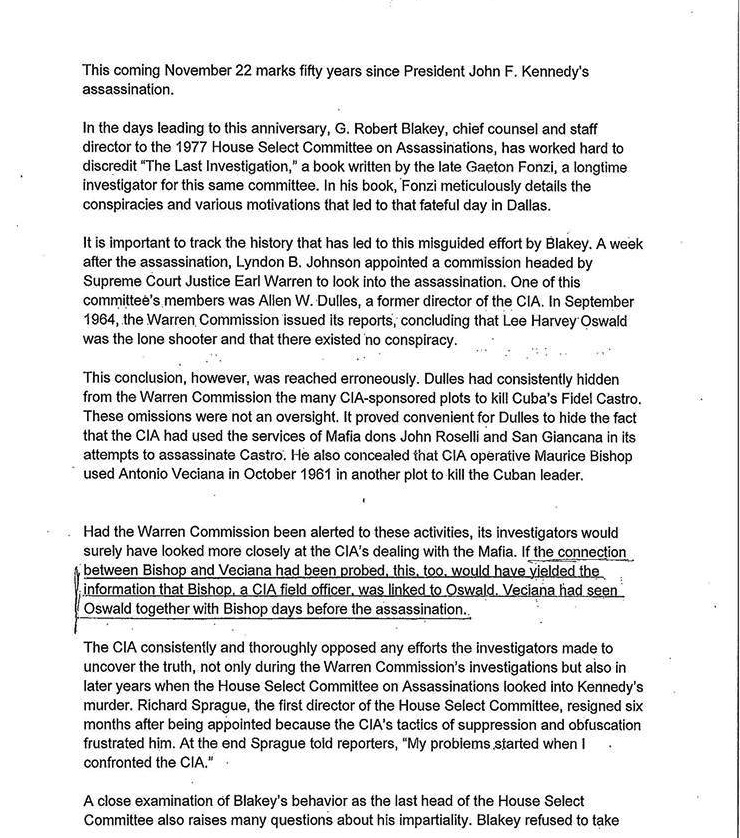
    When he first confirmed that David Atlee Phillips was the CIA contact known as “Maurice Bishop,” Cuban exile leader Antonio Veciana did so tacitly. But Veciana’s meaning was so clear, and his guile so transparent, there was no doubt; both he and House Select Committee investigator Gaeton Fonzi began laughing.

    Now, decades later, Veciana has explicitly stated that Phillips (right) was indeed Bishop, and that he did indeed see Phillips with Lee Harvey Oswald in September 1963 – thus formally linking a high ranking CIA officer with the JFK assassination.

    Veciana’s admission came in a written statement issued November 22, 2013, the fiftieth anniversary of the assassination. In a letter to Fonzi’s widow Marie, Veciana, the elderly, former leader of Alpha 66, said, “Maurice Bishop, my CIA contact agent was David Atlee Phillips. Phillips or Bishop was the man I saw with Lee Harvey Oswald in Dallas on September 1963.”

    phillips

    Fonzi wrote of his encounters with Veciana in his 1993 book The Last Investigation, which describes his experience with the House Select Committee on Assassinations in the 1970s.

    At the time of his first meetings with Veciana, Fonzi was a staff investigator for Sen. Richard Schweiker (R-Pa.), a member of the Senate Select Committee on Intelligence and co-chair of the Sub-committee on the John F. Kennedy Assassination. Fonzi told Veciana he was exploring links between government agencies and Cuban exile groups.

    On March 2, 1976, Veciana told Fonzi that two months before the assassination he rendezvoused with his CIA contact “Maurice Bishop” in the lobby of a downtown Dallas office building. Bishop was already there when he arrived, Veciana said, and in the company of a young man he later recognized as Lee Harvey Oswald, the alleged JFK assassin.

    In subsequent HSCA testimony, however, Veciana did not identify Phillips as Bishop. But Fonzi independently determined that “Bishop” and Phillips were one and the same.

    Phillips was also called before the HSCA, and under oath, denied both using the name Maurice Bishop and knowing Veciana. That ended the matter. Although Fonzi believed they could make a case for perjury, HSCA Chief Counsel G. Robert Blakey declined to bring charges against Phillips.

    In the early 1960s Alpha 66 was a leading anti-Castro organization, funded by the CIA. During the course of their meetings Veciana never explicitly told Fonzi that Bishop was really Phillips. Fonzi believed that Veciana would not make the identification because he thought Bishop/Phillips could further aid him in his goal of toppling Cuban leader Fidel Castro.

    David Atlee Phillips was a CIA officer for 25 years. At the time of the assassination he was Chief of Cuban Operations, based in Mexico City. He died in 1988.

    Initial reports of Veciana’s 2013 statement erroneously said Veciana had died.

    CTKA obtained a copy of the statement from former HSCA staff member Dan Hardway, who got it from Marie Fonzi.

    The bulk of this account is derived from the Appendix to Hearings Before the Select Committee on Assassination of the U.S. House of Representatives, Vol. X, pp. 37-56, and from The Last Investigation, by Gaeton Fonzi, Chapters 16 and 44.

  • Gary Mack’s “Magical” Powers of Dissuasion


    During the last half century, the assassination of President Kennedy has seen a lot of obfuscation and disinformation. All of it presented as evidence to support the guilt of Lee Harvey Oswald as the lone assassin of JFK. A lot of these demonstrations, as exposed on this web site, have been shown to be calibrated lies. Many of us are not knowledgeable enough in certain intricate areas of the JFK case to fully grasp this disinformation campaign. But in this field, we cannot afford to rely on most evidence shown through the medium of television because that medium, since the issuance of the Warren Report, has been firmly on the side of the perpetrators. Who can forget Walter Cronkite and Dan Rather putting together a program to support the Warren Report the day it was published. Once we understand this, then we should view almost all TV presentations touting the verdict of the Warren Commission as nothing but a continuation of the Cronkite-Rather production, and we unfortunately just experienced a blitzkrieg like effort last November leading up to the 50th anniversary. Truth was hit hard. But sometimes when a perpetrator covers truth with a falsity, it therefore causes even more to submerge than the original lie, and more knowledge to become illuminated.

    Having established this as a touchstone, let us take a closer look at some past instances of fraudulent evidence portrayed as factual on mass broadcasted cable TV and perhaps learn more about who or what was behind it. Ten years ago, the Discovery Channel, ran a JFK episode on its series Unsolved History. In 2003’s Unsolved History entitled “The Conspiracy Myths” a live shooting recreation was featured along with a laser trajectory test done in Dealey Plaza

    Michael Yardley was the weapons and terrorism expert who was chosen to do the live shooting and the night time laser trajectory tests. According to his web site, Yardley thinks that Oswald fired at least one shot that day, but that he was not just a lone nut. Yardley also thought that until his simulation, all previous attempts to do so had been flawed. But as we will see Yardley was not aware of how flawed his own test was. And that the laser recreations in Dealey Plaza were flawed scientifically, causing their conclusions to be false.

    The voice that serves as the narrator for this show told us things like “We scientifically search for evidence”, and “Was the book depository the only place where a gunman could have fired the fatal shots?” My personal favorite from the narrator was, “In order to find out we will turn the city of Dallas into a laboratory.” But as we will find out for ourselves, as with all these programs, their methods do not end up being fully scientific. At times, even being quite contrary to scientific methods. We shall see that their flaw was that the film-makers had to alter known facts and images, and even their own supposed conclusive findings in order to disprove an only hypothetical frontal shot trajectory. And when all the hocus pocus is exposed, it becomes quite believable that they knew of the plausibility of such a shot.

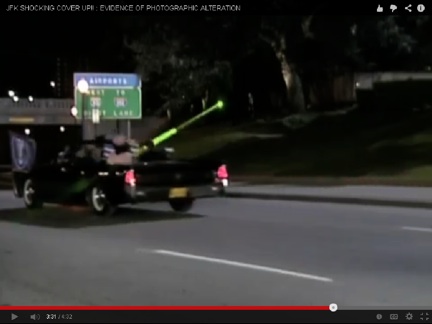
    Let us now take a close look at the night-time possible trajectory tests with the lasers, and their supposed scientific claims. The lasers were used as an attempt to check the possibility of sources of shots from in front of the motorcade and possible scenarios for a sniper. As the narrative voice chimes, “This is an experiment,” and “We will turn the city of Dallas into a laboratory”, it gives the show a feeling of importance and honesty. But now we’ll see ourselves how credible and objective these experiments actually were. After Yardley tries out a few locations, which never really seemed to have much credibility as a potential frontal shot source, he then moves up behind the picket fence, to a location known as the North storm drain. This is where the western end of the picket fence, which sits atop the grassy knoll, approximates the railroad overpass bridge. Yardley readies his Mannlicher-Carcano carbine with a trigger-activated laser and opens fire as the motorcade stand-in rides down Elm Street.


    This illustrates a potential trajectory to a JFK stand-in, and Yardley hits him on the right side of the head. Which is where many think he was actually hit by the fatal shot. Along with Yardley that night, are historian Daniel Martinez, and of course, the spokesman for the Sixth Floor Museum Gary Mack. (Mack must be making quite a living these days off these cable TV programs.)  (Watch the video segment embedded below.)

    Now, as we see the alignment of Yardley’s rifle with the head of the person standing in for JFK, the narrator reiterates that yes, the shot did line up, but there are some complications. Gary and Daniel Martinez huddle on the street like an officiating team during a football game. Gary Mack (real name Larry Dunkel) now proceeds to inform us of these complications: “We know from the pictures there were three men standing on the middle of the steps, so they were in the way.” He also says there was a tree in the way, but it’s no longer living, and he then spoke of the trouble finding the target from that angle. According to Mack/Dunkel, “You would only have a fraction of a second to find him in the motorcade.” Yet, Yardley the weapons expert, certainly had no problem locating the target, did he Gary? Also, in a 2008 episode when Yardley did a daytime test run, again from near the same storm drain, he stated that there was, “Plenty of time to track the vehicle”, and who is a better witness to the validity of a potential shot, than a weapons expert?

    So the main complications Gary Mack claims prevented a shot from the drain were the three men, who were standing basically at the Elm Street sidewalk base. And they display a night time background shot of the grassy knoll, along with a cut out portion of the Mary Moorman photo. This cut out segment contains the three men and the cement staircase on which they stood. It seemingly represents a collaged image of then and now, and should be visual proof of the terrain and obstacles from 1963, merged with that of the background of today. But it is not a factual representation. It may have been visually verified by a said “Kennedy assassination expert”, and on a show under the titular rubric of “solving history”, but things are not always what they seem. They precisely merged a modern background shot with the Moorman segment with the three men.

    But upon proper scrutiny of this collage, one can see that some of the alleged obstacles that would have been there that day have been altered. Most blatantly the three men who stood on the steps the day Kennedy was shot have now – in the altered collage – taken a slide down Gary Mack’s Magical Staircase, into the pages of some sort of a fictitious Hollywood annual of history. Obviously this alteration was done to conceal the fact there was a true line of sight from JFK to the north storm drain. The three men on the stairs would not have been in the way of an assassin’s bullet. But with a simple altered collage and the help of Gary Mack and his magical power of dissuasion, it seems as if the trio would have blocked this shot. Although one can hardly anymore believe what is seen or said about Kennedy’s assassination on television. In other words, someone or more than one person at Unsolved History manipulated this collage and placed the three men from the Moorman photo all the way to the bottom of the Elm Street sidewalk. And somehow, they got Gary Mack from the Sixth Floor to verbally agree with this altered image and supposed reality. This tinkering with time, space, and images now allows the storm drain location to be labeled as another “outrageous theory”. Yet in the altered image, there are as many as seven steps missing to make the men appear as if they are all the way down at street level. So if anything is an outrageous theory, its this altered collage through which the producers and Gary Mack try to trick the uninitiated into thinking something is not possible. When in fact it most certainly is and most likely did happen. As we shall see, Mack had to have known the true locations of the three men. As he was at another filming location for the show where the trio was recreated in their true locations.

    Because of this fakery, the lead man of the trio, Emmett Hudson is shown as being all the way down on the sidewalk. This would have made him the closest witness to the shooting. But he was not. In fact, it actually appears that the program created a new staircase. While looking at the forgery one can see the white reflection off the concrete middle beak on the staircase, just to the left of the men. This is because in order to falsely prove that the men were in the way, a separate staircase had to be created. Let us now refer to it as, Gary Mack’s Magic Staircase. So basically when the faked collage was superimposed over the nighttime background shot in 2003, the creators took the overblown cut out of Moorman, and pasted it using the three men to cover over the area of the bullet path, and used Gary Mack to say: Well see these three men would have blocked the path of such a shot. In the genuine unaltered Moorman photo, the top of the limo windshield blocks us from seeing Emmett Hudson’s feet. But in the altered version they just have him standing on the sidewalk anyway – without his feet. Another obvious point of forgery is when Mack first points to the knoll, we can see the concrete wall and the pergola. But when the collage is completed, this whole area disappears, and the grossly enlarged clip covers over the true background of the knoll. All that is intact is a small portion of the pergola not blocked by Mack’s head or covered over by the blown up segment. The concrete wall and pergola are true landmarks still standing today. So they should be visible. But because of this overblown cut-out, it causes the portion of the picket fence to approximately double in size. It then blocks out the concrete wall and much of the pergola.

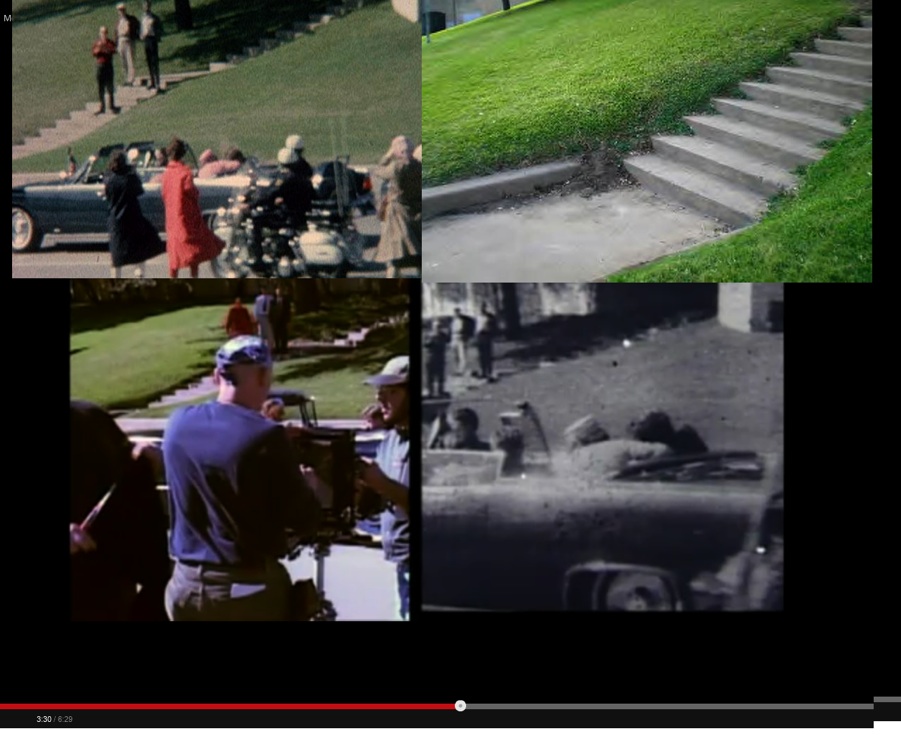
    Let us now take a look at another episode of this series called Unsolved History. This installment also featured the ubiquitous Gary Mack who, at the very least, should have no problem sending his son to college. This one was called “Death in Dealey Plaza” and was aired in early 2003. It includes a segment attempting a photo recreation or staging of the Moorman photo. The recreation was also done in Dealey Plaza, and there is an attempt to take a photo with the same type of camera Mary Moorman used, and from the nearly exact spot that she took her famous photo from. Since the three witnesses on the staircase were part of Moorman’s photo, stand-ins for the trio of men are placed on the staircase for the Moorman photo recreation. The men are shown in the still taken from the show, seen below, and it gives one quite a shock,. For this time they are placed in their correct locations. From the top left, we have a still from the Muchmore film, a known verified image along with the Moorman photo. On the top right is a close up of the cement staircase where it meets a walk up from the T intersection with the sidewalk. This is how the staircase was then, and is still today. So this is further visual proof that the collage shown in 2003’s “The Conspiracy Myths”, was faked. One can detect this because none of the three men could be standing on the staircase where it meets the sidewalk, because it does not even exist in physical terrain in this manner. Not then and evidently still not now. This also causes the sidewalk barrier where it turns a ninety degree angle and meets the staircase, to vanish.


    In the graphic at right, the images in the bottom left and right quadrants are an intact screen grab that was a double split screen image shown in Death in Dealey Plaza. Their Moorman recreation is on the left, and on the right, the original intact Moorman photo without alterations. The reason this is so important is that Gary Mack was on hand for this. Not merely present, but by his own admission, a participant. “I was fully involved in the restaging,” he said in response to a question on a Discovery Channel viewer page. So how in the world could Gary have not known the true locations of the trio in November of 2003, when we see that yes, he already did know their accurate locations for the earlier show airing in February of 2003?

    If there is no cover up going on today in the media then why were these 2003 images altered, and yet only months before the same person was admittedly so “fully involved” in the restaging, and had the three men placed in their correct locations. In other words basically in the earlier show when it was not necessary to disguise the origins of a frontal shot trajectory, the men’s positions were truthful, but when they did need to discredit a frontal shot they were not honest in their image overlay shown in the later 2003 episode. Seemingly so to deny the validity of a shot from the storm drain area, even after their laser trajectory aligned, and how strange for Gary Mack to be the one who verbally denies this possibility. Since Gary has been involved directly with the Mary Moorman photograph for decades, he had to have known the true locations of the three men, and has admitted being fully involved with the Moorman photo staging in the earlier filmed episode. How strange it is to have two separate placements that supposedly represent the three men’s locations, in a span of one year, on the same series, and Gary Mack involved with both. There must be a grand reason for this strange historical contradiction.

    Let us look at another attempt at disinformation. This one is also associated with Gary Mack, and another Unsolved History production. This time Gary and the show say that no one could have fired from the storm drain because there were too many witnesses in the area and two railroad workers nearby. According to Gary, these two RR men were to have been so close, that no shot could have come from there without them hearing the shot, or the supersonic crack of the bullet. Again, Michael Yardley lines up there, this time with a rifle without a laser attached. He makes an attempt to line up a shot and fire at a stand in. But now there is shrubbery in the north storm drain area, and it blocks his view. So Yardley now moves to the front of the picket fence, standing on the grassy knoll. Everyone can see that Yardley has a clear shot at Kennedy, even though the program director has Jackie Kennedy giving her husband a bearhug – something she is not actually doing at this time. It’s apparently done to make it appear she would get hit by such a shot, and further discredit this ateempt. Still Yardley notes “There is plenty of time to track the vehicle”, and this is a potentially viable shot.

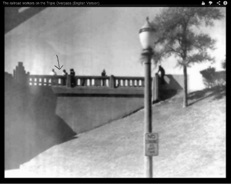
    But then, old reliable Gary Mack informs us there is a “historical problem.” There were two railroad men “not ten feet from there.” A shot from a video taken from behind the presidential limousine shows these railroad men standing on the overpass bridge as the car passes underneath. Unfortunately for Gary Mack, a still photo exists of these same two men dressed in white, and still standing in basically the exact placements when the shots were fired.


    One can see from this photo, and by estimating these men as being close to six feet tall, it’s quite obvious they were more like the 40-50 feet away from the storm drain., and not less than 10 feet. In a talk I had with Dave Perry, a close associate of Gary Mack, he agreed that the closest witnesses were not ten feet away, but more like 40-50 feet away. It’s interesting that even after Gary Mack dumped his bad information on Yardley, the expert sniper adds, “Nevertheless, with all that going on, I’d still take this spot into consideration, provided I could get away.” Which he could since the parking lot was adjacent to the storm drain.

    I also asked Perry about the claim made by Gary Mack about the three witnesses being on the stairs and in the line of sight for an assassin from the storm drain. Perry referred to a plan of Dealey Plaza prepared by Greg Ciccone and said, “Using the Ciccone drawing, a shot from this location fired to the point of the fatal head shot would not have an effect on the three individuals standing on the steps. The bullet would pass several feet to the south of their position with Emmett Hudson being the closest to the path of the bullet. So if Mr. Mack claims the men would be in the way, that would be incorrect.” (Emphasis in original.)

    Kennedy assassination researcher Dr. David Mantik also chimed in on this issue. He said that he thought the storm drain was a very good spot for an assassin. Mantik said he had been to this spot, “and I have seen how isolated one could be there…Because of the way the fence was angled at this point, it would have been difficult for anyone actually on the grassy knoll, or on the overpass, to see any activity in the storm drain.” Even though Mack has stated how a shot would surely have been noticed, even having to exaggerate the proximities of witnesses, but still Dr. Mantik and Yardley see it as a potential sniping location. In his review of the Unsolved History show, Dave Mantik said, “My own observations of the skull X- rays suggested to me a shot from about this direction.” So here a medical doctor agrees, and he is not the only one. President Kennedy’s personal physician, Dr. George Burkley, who saw his head-wound said, “It was a simple matter of a bullet right through the head”. Later when acting Presidential Press Secretary Malcolm Kilduff parroted this to the press, as he said , Kennedy died of a gunshot wound to the head, and he pointed to his right temple. Strange that this is the same right head/temple location that aligned for Yardley’s laser, only to be falsely denied as possible. Did they at Unsolved History know the likeliness of this right temple shot, and how it best matches only to the North storm drain?


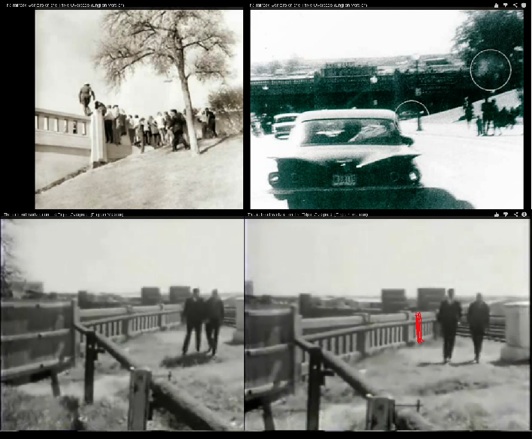
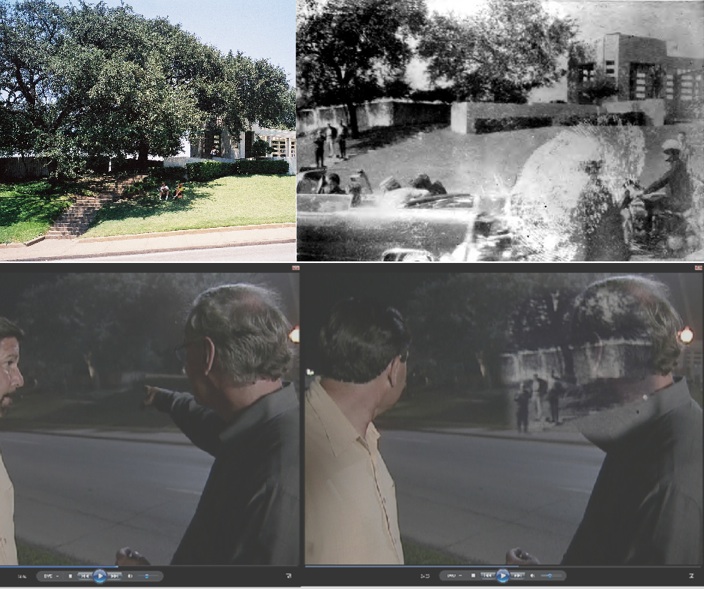
    Later on Dr. Mantik saw the image (graphic at right, top left) of a crowd of witnesses and a police officer who first ran up the knoll to the storm drain area. On the top right is an enhanced photo taken seconds after the last shot. Circled at right in this image is a possible cloud of gunsmoke; it too appears to come from the drain area.

    The images at the bottom, left and right, are from Mark Lane’s film Rush to Judgment, and it is a clear view of the north drain from behind. The red mark denotes as close as the 2 railroad men stood to the drain and clearly one can see how far away these two RR men were from a potential shooter at the fence at the drain. They are not the 10 feet away Gary said, but more like the 40-50 feet away as Perry admitted they were.

    According to Unsolved History, they were shedding light on the assassination, and seemingly solving history. Well, with an unbiased viewpoint, let us shed some light on true known images, and also see how they accomplished their forged images and trickery. By literally illuminating some images from the episode, we will enhance contrast and see how it was actually done.

    The narrator back in 2003 told us that lasers did find a possible trajectory from the north storm drain, but that “witnesses and obstacles in the way conclusively eliminate these storm drain theories.” Yet, from the images here, we see that there are no obstacles nor were there any witnesses that day that would have prevented such a shot trajectory. We can see that the actual photos show the three men at the staircase break, well above the sidewalk. (SEE IMAGES BELOW)


    The image seen at top left is the grassy knoll seen from the south side of Elm Street. Notice the white cement retaining wall sticking out above the bushes, and the full, intact staircase on the grassy slope, with its reflection off the middle break in the steps. There, just below the middle break is where the trio stood, and this image helps us see the men’s positions in relation to the road. Clearly as Dave Perry also noted, we all can see the shot would have gone below the men. That must have been the reason that they created the faked collage, seen at bottom right. In the same image atop left, also note the white cement cage structure just to the right of the staircase, known as the pergola. Part of this structure seems to magically vanish when the cutout of the three men is inserted. Also we can see in the altered collage that the fence grows nearly to the height of the pergola, which becomes quite ridiculous when comparing the fence’s height difference to that of the pergolas, seen in the images at top. Next is Mary Moorman’s photo taken at just about the impact moment of the head shot, and it clearly shows the three men standing just below the middle break on the staircase. Below are two screen captures from “The Conspiracy Myths”. At bottom left is Gary Mack, pointing to where he claims these three men stood. But he falsely portrays them at the sidewalk base, seen in the picture on the bottom right. Just look at the two photos on the right, top and bottom, and see how the three men have been moved. They clearly have been swept down in the form of half of an X, riding down on Gary’s magical staircase, only to become the physical vanguards of denial for a frontal shot.

    Now go back to the bottom left, and we can see the top of the white cement retaining wall, and we can just see the upper edge about the bush line. Look right above the top of Gary’s pointing finger and we see the wall; which is visible in all the photos except the bottom right. So we see that this section in missing in the right bottom image, #4. It is missing because the collaged section containing the three men has been overblown to falsely portray the men in the line of fire; whereby it causes the cutout section containing the fence to be grossly enlarged. But without a contrast change, the deception is hard to pick up. Surely, the producers at Unsolved History knew the dark backgrounds during the night filming eased their deceptions. By simply performing a contrast enhancement, we all can see how easily the forgery was created.

    It would seem from this that the show’s producers and Mr. Mack are not working from empirical evidence in their deductions. They had an agenda. Their agenda was to make the audience believe that there was no frontal shot. If the reader recalls, Mr. Mack did the same thing for Discovery Channel’s Inside the Target Car, even altering the position of Jackie Kennedy’s stand in inside the limousine. Mack tried to say that a shot from a much more oblique angle up the picket fence would not work. Now we have shown that it appears he tried a similar ploy, except with the shot further down, near the end of the fence. Except that this is just as fatuous as his former pretext. Can we trust these were just errors? Even if they are now done at least twice to the same effect? Someone should pose that question to Mr. Mack.

    Or perhaps the Oswald family, Marina and her daughters should investigate filing a lawsuit for fraud.

  • In Search of a JFK Second Shooter


    A second shooter at Dealey Plaza on November 22, 1963, is part of a major problem. At the sniper’s nest in the Texas School Book Depository (TSBD), Tom Alyea (WFAA-TV) filmed a 40.2″ bolt action short rifle Mannlicher-Carcano with telescopic sight, but the Warren Commission (WC) reported that Oswald got a 36″ Mannlicher-Carcano carbine ordered by mail to Klein’s Sporting Goods (Chicago), which placed scopes on the carbines, not on the short rifles.

    An expert in rifles with scopes, Fidel Castro, ascertained that “Oswald could not have fired three times in succession and hit the target” in the available time, since “once a rifle with telescopic sight is fired against a target, it gets lost due to the shot itself and the shooter needs to find it again, moreover in case of a bolt action rifle.” Thus, searching for a second shooter should not cloud that even the first shooter has not been established beyond any reasonable doubt.

    Trying to dismiss a second shooter, the lone gunman theorist John McAdams (Marquette University) came through with the two main directions from which the shots would have come: the TBSD and the Grassy Knoll, according to 64 and 33 earwitnesses, respectively. Among these latter ones, 21 were law enforcement officers experienced in firearms and crime scene investigation, including Dallas Police Chief Jesse Curry. As Jeff Morley noted, these 21 cops were dispersed within 150 feet from JFK when the shots rang out and would have heard different echo patterns, but unanimously reacted by going to search the grassy knoll.

    Dealing with the Sources

    According to Anthony Summers, none of the previously named plotters has the qualifications of Cuban henchman Hermino Díaz, a.k.a. Herminito, for shooting a gun accurately from behind the stockade fence on the grassy knoll.

    Marking the fiftieth anniversary of JFK’s death, the updated edition of Summer’s book Not in Your Lifetime brought to light his 2007 interviews with the late Reinaldo Martínez, a former Cuban political prisoner who came to Miami in the 1980 Mariel boatlift. He had called former HSCA Chief Counsel George Robert Blakey to get something off his chest before dying. He sounded credible and was interviewed vis-a-vis by Blakey and Summers. Both agreed on having found “the first, perhaps plausible, claim to identify a previously unknown gunman.” What did they base this on?

    As an inmate, Martínez worked at the infirmary in a Castro prison and treated the anti-Castro commando Tony Cuesta. They happened to have a common acquaintance with Herminito, who along with Cuesta had infiltrated Cuba on May 29, 1966, for the purpose of killing Castro. Herminito died on the spot and Cuesta was seriously wounded in a gunfight 10 miles off the coast.

    Cuesta told Martínez that, while waiting for the landing, Herminito had confided to him of having taken part in the JFK assassination. Cuesta did not elaborate and Martínez abstained to press him, because in a Castro prison you couldn’t converse too much even “with your own shadow.”

    Shortly after arriving in Miami, Martínez met his old friend Remigio “Cucú” Arce, a veteran anti-Castro fighter, who had actually introduced Herminito to him in pre-Castro Cuba. Arce dropped in his cups: “Listen, the one who killed the President was our little friend, Herminio.” Martínez furnished the info to the FBI, but the duty officer “did not seem interested.”

    Martínez admitted he had “no evidence to know whether it was true” what Cuesta and Arce told him. During a visit to Cuba in 2005, he would have even discussed the issue with retired General Fabián Escalante, former head and current historian of the Cuban State Security. At a meeting with JFK historians in Nassau Beach Hotel on December 7-9, 1995, Escalante identified Herminito as “one of the people we feel was most definitely involved in the plot against Kennedy.” He added that in early 1978 Cuesta referred to Eladio del Valle as a plotter, but “we didn’t know if it was true or not.”

    Escalante must have corroborated the intel, since he flatly stated in the Cuban-Brazilian TV documentary ZR Rifle (1993) that “according to our investigations, the participants in the shooting were: Lenny Patrick, David Yaras, and Richard Gaines, all members of the Chicago Mafia, and Eladio del Valle Gutiérrez and Herminio Diaz-Garcia, Cubans and CIA agents.” The Minister of Foreign Affairs Roberto Robaina told Reuter that Cuba had waited so long to produce a theory on the JFK assassination because the investigations had been long and thorough.

    Herminito’s résumé

    There was a printed version of Escalante’s findings, ZR Rifle (Ocean Press, 1994). This was written by Brazilian journalist and filmmaker Claudia Furiati who consulted extensively with Escalante. Here, the “long and thorough” documented case of the quintet of shooters does not come across as such

    Escalante didn’t argue his claim that fifty-year-old hoods Yaras and Patrick were “expert riflemen.” Del Valle had appeared as JFK shooter in W.R. Morris’ The Men Behind the Guns (Angel Lea Books, 1975) and in Double Cross (Warner Books, 1992. The latter was by a half-brother (Chuck) and a nephew (Sam) of Chicago mob boss Sam Giancana. These latter authors also mentioned another JFK shooter identified (and misspelled as Gaines) by Escalante: Richard Cain, a police officer and made man in the Chicago Outfit.

    Herminio Diaz stands out for his curriculum vitae, but it’s unlikely that a very fresh Cuban exile had been recruited for such a very sensitive plot as killing a sitting U.S. President. Lamar Waldron states in Legacy of Secrets (Counterpoint Press, 2009) that Herminito “had left Cuba in July 1963, first going to Mexico City, where David Atlee Phillips ran Cuban operations” (page 268). Herminito actually entered the U.S. (INS File A 13319255) with his wife Alicia Teresa Mackenzie and their infant daughter on July 3-4, 1963. They arrived at Port Everglades (Florida) aboard the SS Maxima, the last ship bringing Cuban civilians as part of the Castro-Donovan agreement for releasing the Brigade 2506 prisoners after the Bay of Pigs fiasco.

    The CIA station in Miami was advised that Herminito (CIA Personality File 201-203040) was “fond of gambling and committing any crime for money.” At the refugee debriefing center in Opa Locka, he was spotted either as KUDESK agent or MHAPRON asset. MHAPRON coordinated operations focusing in the rift among Cuban militaries and even a coup d’état; KUDESK enrolled refugees as intermediaries for recruiting people in Cuba.

    Herminito was close to Efigenio Ameijeiras, former Chief of Castro’s Police. He alleged that Major Ameijeiras was part of “a small passive group” against the Commies in the Cuban government, although not personally opposed to Castro.

    Diaz had been bodyguard of Mafia boss Santo Trafficante Jr. and worked afterward as security chief (1959-60) at Havana Riviera Hotel, but was demoted to cashier. At the time of Bay of Pigs, he was incarcerated for 70 days. On March 1962, he was imprisoned again for 20 days by Castro G-2. He earned respect as a marksman in the gang Revolutionary Insurrectionary Union (known by its Spanish acronym UIR), to which Fidel Castro himself belonged. UIR leader Emilio Tró was riddled in the massacre of Orfila on September 15, 1947. The gang split and Herminito headed a faction. He avenged Tró’s death by killing former deputy chief of Cuban secret police, Rogelio “Cucú” Hernandez, at the Cuban consulate in Mexico City on July 17, 1948, and allegedly escaped to Cuba with the help of Mexican artist Diego Rivera.

    Apart from several shootings in Havana, Herminito was involved in plots against the Dominican dictator Rafael Trujillo (Havana Police Report 1185, April 16, 1949) and the Cuban dictator Fulgencio Batista (Havana Urgency Court, Case 318, June 6, 1956). He sought asylum at the Haitian embassy in Havana on June 28, 1956, and ended up flying into exile in Costa Rica. Here he would be arrested on May 17, 1957, under charges of conspiracy for kidnapping President José Figueres. The legend says Herminito was released thanks to Ameijeiras’ arrangement.

    Monte Barreto

    On May 29, 1966, he got on board a boat at Marathon Key (Florida) together with Tony Cuesta, Armando Romero, Eugenio Zaldívar, Guillermo Álvarez and Roberto Cintas. The Cuban army and militia were still in combat readiness after the killing of a border guard by U.S. Marines at Guantanamo Bay on May 21, 1966.

    Herminito and Romero went ashore in Monte Barreto, near the former Comodoro Yacht Club, in the residential Havana suburb of Miramar. They ran to Fifth Avenue in order to take position for shooting Castro on his usual way. However, the former club was now housing a fishing school full of Castro militiamen. They killed Herminito and Romero. The others re-embarked, but were intercepted by two patrol boats. Álvarez and Cintas were missing in action; Cuesta and Zaldívar were wounded and captured.

    Escalante feels that Herminito was sent to Cuba for the purpose of getting rid of him as a man who knew too much. Nonetheless, he had revealed to FBI Special Agent George E. Davis on January 27, 1966, the plan of another mission against Castro on his own, after an “only for propaganda” attack on Havana on November 14, 1965. Herminito told Davis that the Cuban Representation in Exile (RECE) will provide financial support and that, once his mission was accomplished, Major Ameijeiras will cooperate in a new government.

    Coda

    Making the Cuesta case murkier is that when Escalante explained in Nassau why the written report on Cuesta can’t be supplied: “It is a Cuban document.” Likewise, two U.S. files on Cuesta were “postponed in full,” id est: they wouldn’t be declassified until October 2017 under the JFK Assassination Records Act (1992). A full disclosure of records is needed on both sides of the Florida Straits, because Cuesta is not a reliable source.

    After being released on October 21, 1978, Cuesta told Tom Dunkin the specious story that he wasn’t driven straight to the airport because Castro asked to see him. Cuesta affirmed: “I was forced by circumstances to shake the hand of the one man in the whole world whom I most wanted to kill.” The circumstances included sitting on a deep-pile sofa, smoking a huge cigar, drinking scotch on the rocks, and Castro talking “in a low, soft, sweet, gentle tone.” Cuesta crowned his story with a tribute to vanity: “I stiffened my spine, taking advantage of the phenomenon that had always galled him. I was a half inch taller (…) He knew I had lost the hand in a last attempt to kill him (…) The only reason he had not executed me 12 years ago was his fear of my power as a martyr.”

    There is one piece of evidence that does help the Blakey/Summers case. As “mulatto” (Waldron, page 107) or “mestizo” (File 30-1949, Cuban Police), Herminito would even fit the dark-skinned man seen by witnesses Arnold Rowland and Ruby Henderson at the TSBD (Summers, page 38). On February 15, 1966, the FBI provided a photo to the Secret Service, due to his “potentially dangerous” background and connections with groups “inimical” to the U.S. This “daring person [was] a fearless individual [ready] to assassinate Fidel Castro.” That photo appears at his Spartacus Educational’s bio. Summers shows another in the video of his 2007 interview with Martinez, but it zoomed in on Cuesta, instead of Herminito, who stands on Cuesta’s left. The confusion spread.

  • The Pigs Grunt

    The Pigs Grunt


    “What do you expect from a pig but a grunt?”

    – Kevin Costner as Jim Garrison, JFK


    In early February 1967, Warren Commission critic Ray Marcus received a letter from Robert Richter of CBS News. The news organization was thinking of producing a new program on the Warren Report, Richter said, and was contacting some of its critics. One of them, Vincent Salandria, had given Richter a copy of The Bastard Bullet and described some of Marcus’s other work. Perhaps Marcus would be willing to give CBS a hand.

    Marcus wrote back on February 14: “I shall be happy to assist as best I can.” He described his Zapruder film analysis and his conclusions on the assassination shot sequence, and some of his photographic work, including the #5 man detail of the Moorman photograph, which he believed revealed a gunman on the grassy knoll.

    no 5

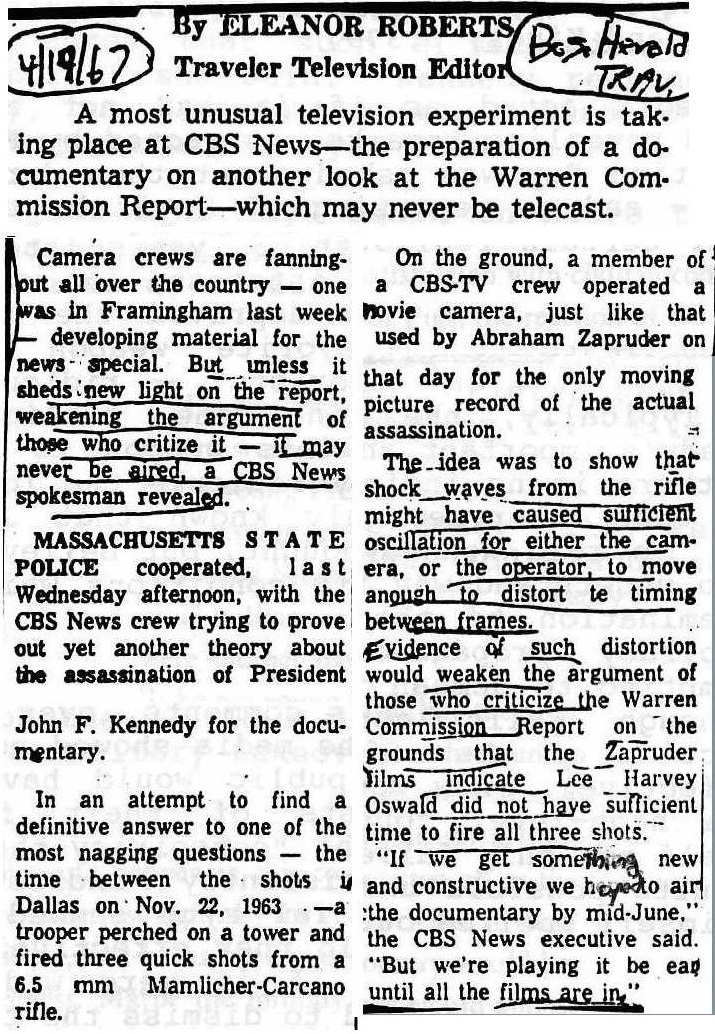
    A few months later Marcus nearly changed his mind. He was in Boston attending to some business interests when he happened to see an article in The Boston Herald-Traveler by the paper’s television editor, Eleanor Roberts. The article’s first sentence told most of the story. “A most unusual television experiment is taking place at CBS News—the preparation of a documentary on another look at the Warren Commission Report—which may never be telecast.” Unless CBS could develop new information that weakened the arguments of the Commission’s critics, Roberts wrote, the project might be shelved.

    Immediately, Marcus telephoned Roberts. She would not tell him the source of her story, but did say it was a CBS executive who had been a reliable contact in the past.

    A few weeks later Marcus heard again from Bob Richter. The CBS program was in development and he wanted to discuss Marcus’s work with him. But Marcus said no, he had changed his mind; he had seen the Roberts article, and it was plain that CBS was not approaching the subject impartially.

    But Richter had a good comeback. “Some of us here are trying to do an honest job,” he said, “and if those of you who have important information don’t cooperate with us, you’re just guaranteeing that the other side wins.” Richter seemed sincere and his reasoning sound. Marcus agreed to meet with him.

    The two men met several times and Marcus outlined the work that he had done. Richter was impressed with the Moorman #5 man detail (below right), discovered by David Lifton in 1965, which Marcus and Lifton both believed revealed a Dealey Plaza gunman. Richter agreed that the murky image was almost certainly a man. He saw a series of ever-larger blow-ups of the picture, which Marcus had placed in a special portfolio. Richter arranged to have duplicates made of the entire set, and said he would show them to his superior at CBS, Leslie Midgley, the producer of the program.

    article 3

    Midgley, it turned out, said he could not see anything resembling a man in any of the pictures when Richter showed them to him. But he agreed to meet with Marcus to go over the portfolio one more time. They met, along with Richter, in Midgley’s office. Included in the portfolio was a detail from a photograph of civil rights activist James Meredith moments after he was shot—a photo which revealed, unambiguously, his assailant in the shrubbery along the side of the road. Marcus had included an enlargement of the gunman for purposes of comparison to the #5 man detail, since the lighting and the figure obscured among leaves—this one known to be a man—were similar in appearance. Flipping through the series of #5 man enlargements, Midgley kept repeating that he couldn’t see anything that looked human. Then he came to an especially clear photo, and he said, “Yes, that’s the man who shot Meredith.”

    Marcus and Richter immediately glanced at one another, in what Marcus took to be obvious and mutual understanding of what had just happened. Midgley was looking not at the photo of the Meredith gunman, but of the clearest enlargement of the Moorman #5 man detail, which he had previously looked at but dismissed.

    Midgley understood what happened, too. He visibly reddened but did not acknowledge the error. Marcus must have felt completely vindicated, for this was an absolute, if tacit, admission: in order for Midgley to wrongly identify the #5 man detail as “the man who shot Meredith,” he first had to be able to see #5 man in the picture.

    Marcus politely reminded Midgley he was looking at #5 man. The meeting ended shortly after this, without further discussion of what had just happened.

    After the incident in Les Midgley’s office, Marcus had met again with Richter and stayed in touch with him by telephone. By June, the broadcast date was drawing near, and the CBS project had developed into a four-part special. On June 19 Marcus wrote Midgley an eleven page letter describing, in great detail, the incident in Midgley’s office, and calling the mis-identification “a very understandable error. But one which would have been impossible for you to make had you not promptly recognized the #5 image as a human figure, despite your earlier denials that you saw anything in the pictures that looked like a man.” With its vast resources, both technical and financial, CBS was obviously capable of presenting the #5 man image clearly and objectively. “Need it be stated,” Marcus told Midgley, “that if CBS fails to do so—especially considering your positive reaction to #5 man—that fact in and of itself will constitute powerful evidence that the entire CBS effort was designed to be what I fear it to be: a high-level whitewash of the Warren Commission findings?”

    The next morning Marcus mailed the letter to Midgley and enclosed additional copies of #2 and #5 man and other photographs. That same day he telephoned Bob Richter in New York. He wanted Richter to confirm, in writing, the mis-identification of the #5 image that had taken place in Midgley’s office, which Richter agreed to do. Then Richter, while cautioning that Marcus would probably be unhappy with the overall content of the four programs, added that some of the Moorman details might make it into the final edit of the show. Richter described one of images but Marcus said it wasn’t the best one to use. Which one was? Richter asked. The most advantageous one to show, Marcus replied, would be the clearest one of the bunch—the one Richter’s boss, Les Midgley, had mistaken for the man who shot Meredith.

    cbs ad

    That same evening, the CBS television network broadcast the first of its four-part CBS News Inquiry: The Warren Report. CBS was touting the documentary as “the most valuable four hours” its viewers might ever spend in front of their TV sets. It was anchored by Walter Cronkite, a broadcasting legend already considered the Dean of American television newsmen. Cronkite said later it would have been “the crowning moment of an entire career—of an entire lifetime—to find that Oswald had not acted alone, to uncover a conspiracy that took the life of John F. Kennedy.” But, he continued, “We could not.”

    Each segment of the CBS News Inquiry posed a series of questions and answered them with an unbiased evaluation of the evidence. That, at any rate, was the appearance. The actual content of the four programs left many wondering whether CBS had really taken a disinterested approach to the subject. The Boston Herald Traveler article Ray Marcus had seen, stating that the CBS documentary might really be aimed at “weakening the arguments of those who criticize” the Warren Report, may have been accurate, after all.

    Mark Lane also had a stake in the program. “I decided to watch the CBS effort very closely,” he said later. Like Ray Marcus, Lane had met with Bob Richter in the months preceding the broadcast, and had also been interviewed for the documentary. After watching the series he concluded that the programs were highly deceptive. “What had evidently been the original approach—to present the evidence and permit the viewer to draw his own conclusions—bore no resemblance to the final concept.”


    In 1964, Thomas G. Buchanan observed that the facts of the assassination as they were initially reported in the media changed several times, but the conclusion of Oswald’s lone guilt never did. “If, as a statistician, I were solving problems with the aid of a machine and I discovered that, however the components of my problem were altered, the machine would always give me the same answer, I should be inclined to think that the machine was broken.”

    CBS was such a machine. It altered its components with firearms and ballistics tests that improved on the original FBI tests; with new analyses of the Zapruder film; and with new interviews with witnesses to the events of November 1963. But its answer was the same one it had always reported, the same one delivered by the Warren Commission: Lee Oswald, for reasons not entirely fathomable, had murdered President Kennedy without direction or help from anyone.

    To answer the questions it posed, CBS used a number of experts. One of them was Lawrence Schiller. Schiller was the photographer and journalist who had once acted as Jack Ruby’s business agent, and had played a role in developing research that became an anti-critic triple threat: an article in a World Tribune Journal supplemental magazine, a record album called The Controversy, and a book called The Scavengers and Critics of the Warren Report. CBS used Schiller to refute allegations that a photograph of Lee Harvey Oswald brandishing the alleged assassination rifle was a forgery.

    Schiller, Walter Cronkite said, had studied both the original photograph and its negative. Appearing on-camera, Schiller said that the critics “say that the disparity of shadows, a straight nose shadow from the nose, and an angle body shadow proves without a doubt that [Oswald’s] head was superimposed on this body.” But Schiller said he had gone to the precise location in Dallas where the original was taken, and on the same date, at the same hour, had taken a photograph of his own. This picture, he said, perfectly reproduced the controversial shadows, indicating the Oswald picture was genuine.

    Mark Lane was not able to respond to Lawrence Schiller on the CBS program. But he later said that the negative for the photograph was never recovered by the authorities, suggesting the photograph was not genuine. Lane wrote: “It is interesting to fathom the CBS concept of the life of the average American if it imagined that watching Jack Ruby’s business agent after he studied a nonexistent negative might constitute ‘the most valuable’ time spent watching television.”

    On the second installment of the CBS documentary, Dr. James J. Humes, the Navy doctor who had been in charge of the President’s autopsy and had burned his autopsy notes, was interviewed. Asked about the discrepancy between the schematic drawings that placed an entry wound at the base of the neck, and the autopsy “face sheet” that indicated this wound was really lower down on the back, Humes said that the face sheet was “never meant to be accurate or precisely to scale.” The exact measurements were in fact written in the face sheet margins, and conformed to the schematic drawings.

    Sylvia Meagher was so incensed by this that she wrote to CBS News President Richard Salant. The CBS documentary was “marred by serious error and fallacious reasoning which inevitably will have misled and confused a general audience.” In the case of Dr. Humes, while he insisted the measurements written in the face sheet margin were correct, “CBS failed to pursue or challenge this explanation, as in conscience it should have done, by pointing out no marginal notations giving precise measurements for any other wound, cut-down, or physical characteristic appear on the diagram; that every other entry in the diagram appears to be accurate, as opposed to the crucial bullet wound in the back; that the clothing bullet holes match the diagram, not the schematic drawings; that a Secret Service agent saw a bullet hit the President four inches below the neck; and that another Secret Service agent, summoned to the autopsy chamber expressly to witness the wound, testified that this wound was six inches below the neck.”

    The third part of the CBS special proved to be especially newsworthy. A portion of this segment was devoted to the JIm Garrison investigation in New Orleans, although for much of it Garrison was put on the defensive. CBS included a sound bite with Clay Shaw, who said: “I am completely innocent … I have not conspired with anyone, at any time, or any place, to murder our late and esteemed President John F. Kennedy, or any other individual … the charges filed against me have no foundation in fact or in law.”

    Most damaging to Garrison was the appearance of William Gurvich, a former Garrison investigator introduced as his “chief aide” who, Cronkite told his viewers, had just resigned from the DA’s staff. Asked why he quit, Gurvich said that he was dissatisfied with the way the investigation was being conducted. “The truth, as I see it, is that Mr. Shaw should never have been arrested.” Gurvich said he had met with Senator Robert F. Kennedy “to tell him we could shed no light on the death of his brother, and not to be hoping for such. After I told him that, he appeared to be rather disgusted to think that someone was exploiting his brother’s death.” The allegations of bribery by Garrison investigators, Gurvich said, were true. Asked whether Garrison had knowledge of it, Gurvich answered: “Of course he did. He ordered it.”

    Garrison himself was interviewed by Mike Wallace. Reflecting on all the bad publicity he was getting, which included allegations of witness intimidation and bribery, the DA said, “This attitude of skepticism on the part of the press is an astonishing thing to me, and a new thing to me. They have a problem with my office. And one of the problems is that we have no political appointments. Most of our men are selected by recommendations of deans of law schools. They work nine to five, and we have a highly professional office—I think one of the best in the country. So they’re reduced to making up these fictions. We have not intimidated a witness since the day I came in office.”

    Not missing a beat, Wallace pressed on: “One question is asked again and again. Why doesn’t Jim Garrison give his information, if it is valid information, why doesn’t he give it to the federal government? Now that everything is out in the open, the CIA could hardly stand in your way again, could they? Why don’t you take this information that you have and cooperate with the federal government?”

    “Well, that would be one approach, Mike,” Garrison countered. “Or I could take my files and take them up on the Mississippi River Bridge and throw them in the river. It’d be about the same result.”

    “You mean, they just don’t want any other solution from that in the Warren Report?”

    “Well,” the DA replied, “isn’t that kind of obvious?”

    Garrison told Wallace there was a photograph in which assassins on the grassy knoll were visible. He was referring, of course, to the #5 man detail of the Moorman photograph. As he had for CBS, Ray Marcus had supplied Garrison with a portfolio of images from the picture, including the clearest copies of the #5 man enlargement.

    “This is one of the photographs Garrison is talking about,” Wallace told his viewers, holding up one of the Moorman pictures Marcus had given to Bob Richter. It was not the one that Marcus had recommended to Richter. Instead Wallace held up a smaller version—the smallest one, Marcus recalled, that he had given CBS. “If there are men up there behind the wall,” Wallace said, “they definitely cannot be seen with the naked eye.”

    Marcus had urged Bob Richter to use the enlargement that the producer of the CBS New Inquiry, Les Midgley, had mis-identified as “the man who shot Meredith.” Some months after the airing of the CBS documentary, Midgley was asked to reflect on the broadcasts. Echoing Walter Cronkite, Midgley said, “Nothing would have pleased me more than to have found a second assassin. We looked for one and it isn’t our fault that we didn’t find one. But the evidence just isn’t there.”


    The final segment of the CBS Inquiry on the Warren Report was broadcast on the evening of June 28. It posed viewers with the question, Why doesn’t America believe the Warren Report?

    “As we take up whether or not America should believe the Warren Report,” said correspondent Dan Rather, “we’ll hear first from the man who perhaps more than any other is responsible for the question being asked.” That man was Mark Lane.

    Lane said that the only Warren Commission conclusion that was beyond dispute was that Jack Ruby had killed Lee Harvey Oswald. “But, of course, that took place on television,” Lane said. “It would have been very difficult to deny that.” Beyond that, Lane continued, there was not a single important conclusion that was supported by the facts. The problem was compounded by so much of the Commission’s evidence being locked up in the National Archives where no one was allowed to see it.

    The photographs and X-rays of the President’s body, which represented some of the most important evidence in the entire case, were not seen by any of the Commission members, Lane said. This was a very serious shortcoming, since these films could show decisively how many wounds the President had suffered and precisely where they were located.

    Rather than immediately address this, however, CBS chose to question Lane’s credibility, presenting a Dealey Plaza eyewitness named Charles Brehm, who accused Lane of misrepresenting his statements in his book Rush to Judgment.

    But the most notable feature in the final installment of the CBS documentary was the appearance of former Warren Commission member John McCloy. Aside from his comments to the Associated Press the previous February when the Garrison case first broke, these were his first public statements about the Warren Commission investigation. “I had some question as to the propriety of my appearing here as a former member of the Commission, to comment on the evidence of the Commission,” McCloy told Walter Cronkite as their in-studio interview began. “I think there is some question about the advisability of doing that. But I’m quite prepared to talk about the procedures and the attitudes of the Commission.”

    The Warren Commission, McCloy said, was not beholden to any administration. And each Commission member had his integrity on the line. “And you know that seven men aren’t going to get together, of that character, and concoct a conspiracy, with all of the members of the staff we had, with all of the investigation agencies. It would have been a conspiracy of a character so mammoth and so vast that it transcends any—even some of the distorted charges of conspiracy on the part of Oswald.”

    McCloy insisted that the Warren Commission had done an honest job. Its Report may have been rushed into print a little too soon, he said, but the conclusions in it were not rushed. McCloy did, however, indulge in a little second-guessing. “I think that if there’s one thing I would do over again, I would insist on those photographs and the X-rays having been produced before us. In the one respect, and only one respect there, I think we were perhaps a little oversensitive to what we understood was the sensitivities of the Kennedy family against the production of colored photographs of the body, and so forth. But … we had the best evidence in regard to that—the pathology in respect to the President’s wounds.”

    At the outset of this last installment of the CBS News Inquiry, Walter Cronkite had informed his audience: “The questions we will ask tonight we can only ask. Tonight’s answers will be not ours, but yours.” In wondering why America didn’t believe the Warren Report, CBS asked two underlying questions: Could and should America believe the Warren Report? “We have found,” Cronkite said at the program’s conclusion, “that wherever you look at the Report closely and without preconceptions, you come away convinced that the story it tells is the best account we are ever likely to have of what happened that day in Dallas.” He criticized the Commission for accepting, without scrutiny, the FBI and CIA denials that there was any link between Lee Oswald and their respective agencies. And he criticized Life magazine for its suppression of the Zapruder film, and called on Time-Life to make the film public. Nevertheless, Cronkite said that most objections to the Warren Report vanished when exposed to the light of honest inquiry. Compared to the alternatives, the Warren Report was the easiest explanation to believe.

    “The damage that Lee Harvey Oswald did the United States of America, the country he first denounced and then appeared to re-embrace, did not end when the shots were fired from the Texas School Book Depository. The most grevious wounds persist, and there is little reason to believe that they will soon be healed.”

  • The State of the JFK case: 50 Years Out


    What occurred at the 50th anniversary of Kennedy’s murder was one of the most bizarre outbursts of controlled hysteria that the MSM has put on in years. Perhaps since its mad rush to protect the exposure of George W. Bush’s transparently phony excuses for invading Iraq. In fact, the basic underlying tension was evident everywhere. The most blatant example was the cordoning off of Dealey Plaza with 200 police officers. The public, and most of the media, both knew that what was being broadcast was false. But in order to fulfill their function as tribunes for the Establishment, the media was going to put their heads in the sand again.

    Another good example would be the Tom Brokaw/Gus Russo NBC special, Where Were You? This show interviewed several famous people about their initial reaction to the news President Kennedy was dead e.g. Jane Fonda, Steven Spielberg. But alas, if that is all the show had been about, Brokaw would not have needed Gus Russo. The big-name celebrities were there to pull in the ratings. The show made no bones about wanting to 1.) Reinforce the Warren Commission verdict that Oswald was the lone assassin, and 2.) insinuate fairly openly that all this residual affection the public has for Kennedy is misplaced. He really was not that good of a president. The ultimate proof of this was the interview done with film director Oliver Stone, the man who made JFK. His spot on the two-hour show ran about 15 seconds. Yet, when I talked to Stone about this program, he told me he was actually interviewed for about an hour. (Author interview with Stone, 12/20/2013.) The fact that almost all of this was cut shows that Brokaw and Russo had no intention of letting the other side have anything like equal time at this important point in the JFK assassination saga.

    What makes that undeniable element of MSM control so unbelievably bizarre today is this: There had been no change in the media’s attitude in this regard since 1964! To those old enough to recall, almost immediately after the Warren Report was issued, CBS News put together an evening special hosted by Walter Cronkite. Now, this program was broadcast within hours of the report being issued to President Johnson. In other words, neither Cronkite nor anyone else on his production staff had read the 26 volumes of supporting evidence, which would not be published until the next month.

    In 1967, due to the investigation by New Orleans DA Jim Garrison, the CBS network launched another special program on the JFK case. This ended up being a four night special. It again ended up siding with the Warren Commission in every significant aspect. There was a story behind this that CBS did not want anyone to know about. After a similar 1975 special, CBS employee Roger Feinman began writing letters to the network’s Standards and Practices department about how Cronkite and Dan Rather had violated the company’s code of ethics in both the ’75 and 1967 programs. Executives at the company moved to terminate him, but Roger did not go quietly. In subsequent hearings he asked for certain documents that he knew existed since he heard of them through other employees.

    Those documents showed that producer Les Midgley had originally planned for a real and open debate between the Commission counsel and some of the more prominent critics of the report. [Some of this is described in a 2009 CTKA articleEd.] He even wanted to spend one night interviewing witnesses the Commission had ignored. Then a panel of law school deans would decide the case. But as this proposal was passed up the corporate ladder to executives like CBS President Frank Stanton and News Chief Dick Salant, this idea became diluted. When the executives passed the proposal on to two northern California attorneys, Bayles Manning of Stanford, and corporate lawyer Edwin Huddleson, both of them cited the “political implications” and “the national interest” in shooting it down. Manning suggested that CBS ignore the critics, or even convene a panel to criticize their books. When Midgley persisted in critiquing the Commission, Salant did something behind his back. He showed his memo to former Commissioner John McCloy. McCloy now fired back a broadside at Midgley’s proposal. This was the beginning of Midgley becoming emasculated on the issue, and McCloy becoming an uncredited consultant on the program. Something CBS would keep secret. In fact, during Feinman’s dismissal proceeding, both McCloy and Stanton would deny this secret relationship.

    But some say, that was then. This is now. Surely with all the information that has surfaced in the intervening decades, the media would now grant the critics equal time. As Pat Speer showed in his valuable blog, “The Onslaught,” such was not the case. (Click here for that report) Not by a longshot. What is most disturbing today is that even alternative media, like PBS, now joined in the mass denial exercise. Online journalists who had a reputation for being mavericks, like Fred Kaplan also turned tail.

    What makes this all even more puzzling is the results of polls on the issue by first class professional Peter Hart. Done for the University of Virginia Center for Politics, the work of Hart essentially shows that, after decades of being pounded on this issue by both the MSM and the Establishment, the public still does not buy the official story. Either about the assassination, or about President Kennedy. A full 75% responded that they do not accept the Warren Commission verdict that Oswald acted alone. (Larry Sabato, The Kennedy Half Century, p. 416) That figure is stunning. Because since the last major poll by ABC in 2003, it has remained unchanged. Even though every aspect of the national media, has been unrelenting in their attempt to make the public believe the whole Commission propaganda tale about Oswald as the lone assassin. It hasn’t taken. But further, and perhaps even more stunning, Kennedy is, far and away, the most admired of the last nine presidents. (ibid, p. 406) Perhaps the most stunning number of all was this one: 91% said that Kennedy’s assassination altered the United States a “great deal.” The general reaction described by Hart was that a “deep depression set in across the country, and the optimism that had mainly prevailed since the end of World War II seemed to evaporate.” (ibid, p. 416) The respondents’ reactions when discussing President Kennedy were “eye-popping” to political scientist Sabato. Kennedy was perceived as “the polar opposite of the very unhappy views they have of the country today. Whereas contemporary America is polarized and divided, Kennedy represents unity and common purpose … as well as a sense of hope, possibility and optimism.” (ibid, p. 417) Brokaw and Russo tried to attack this image also in their tawdry special.

    So the question arises: Why is the country schizoid on this issue? Why does the Establishment and the MSM continue to hold these views of the Kennedy case, which the public simply does not believe, and have not since about 1966? What makes this even more puzzling now is the fact that the state of the evidence today is much more powerful with respect to the fact of conspiracy than it was back then in the sixties with Jim Garrison.

    II

    Due to the work of the Assassination Records Review Board, the database about the John F. Kennedy murder was greatly expanded. If one is talking only about sheer volume of paper, the document page count was doubled. But if one is talking about the actual knowledge base, the increase was much exponentially larger. Because as many people felt, what the government was hiding was of paramount importance. But secondly, the many authors who used these documents incorporated them with previous knowledge to create large advancements in the case. Some would call these quantum leaps.

    For instance, the ARRB finally declassified the HSCA’s Mexico City Report, commonly called the Lopez Report. Despite what Vincent Bugliosi has written, this legendary document has lived up to its reputation. The sheer quantity of information in the 400-page report was staggering. No one ever got inside a CIA operation – in this case the surveillance of the Russian and Cuban embassies in Mexico City – the way that authors Ed Lopez and Dan Hardway did. But besides the sensational disclosures in that report, at Cyril Wecht’s recent Passing the Torch conference, we learned that the HSCA had prepared three indictments over their inquiry into Mexico City. There were two separate perjury charges for David Phillips, and one for Anne Goodpasture. One would have thought that this would have merited some kind of attention by the media during their three-week extravaganza over the 50th anniversary of Kennedy’s death. In their attempt to reassert the Warren Commission, it was bypassed. Even though, the credibility of Phillips and Goodpasture are of the utmost importance to the Warren Commission’s story about Oswald in Mexico. For as Phillips himself later admitted, there is no evidence that Oswald ever visited the Soviet Embassy there. (Mark Lane, Plausible Denial, p. 82)

    In fact, today, one can question each aspect of the original report assembled by the Warren Commission of Oswald’s supposed purpose and itinerary in Mexico City. To the point that one can argue whether or not Oswald was there at all. And if that is the case to any degree – even if Oswald was only impersonated at the two compounds – then it is highly unlikely that there could be any benign explanation for such a deception. Which is why Phillips and Goodpasture risked going to jail. Mexico City looms more importantly today than it ever did. (Read the summary of these discoveries.)

    The attempt to kill Kennedy in Chicago in early November was also ignored during the three-week exercise in denial. This is incredible. Because before the publication of Abraham Bolden’s The Echo from Dealey Plaza, and Jim Douglass’ JFK and the Unspeakable, almost no one had done any real work on this very crucial topic. But thanks to the work of the ARRB and Douglass, Edwin Black’s exceptional 1976 report about Chicago was finally recovered and placed online. As Douglass pointed out, it is very hard to exaggerate the importance of both Black’s work, and the outline of the conspiracy in Chicago. Why? Because its outline unmistakably resembles the successful plot in Dallas. So much so that it is very hard to believe it could be a coincidence. If it is not, then it appears that the same forces that failed to kill Kennedy in Chicago, succeeded three weeks later. With a similar plan. Why would the MSM ignore such an important discovery dealing with the methodology of the crime?

    In another aspect, what we know about Oswald today, and his associations with the CIA and FBI, completely vitiates the paradigm the Warren Commission tried to sell to the public about him. Its quite clear now, as John Newman and Jefferson Morley have pointed out, that both intelligence agencies had much more information about Oswald than they ever admitted to in public. In fact, this began as soon as Oswald defected to Russia in 1959. At that time both the FBI and CIA began to keep files on Oswald. According to John Newman’s updated edition of his milestone book, Oswald and the CIA, counter-intelligence chief James Angleton was the man at the Agency who had access to all of the Oswald files. (Newman, p. 636) The fact that the CIA had so much paper on Oswald is something that the Agency had tried to conceal for three decades. One of these documents is quite tantalizing. Before Oswald returned from the USSR, the chief of the Soviet Russia division wrote, “It was partly out of the curiosity to learn if Oswald’s wife would actually accompany him to our country, partly out of interest in Oswald’s own experiences in the USSR, that we showed operational intelligence interest in the Harvey (Oswald) story.” (Destiny Betrayed, Second Edition, p. 150)

    Newman did much to rebuild this file on Oswald in his book and show what it revealed about who knew what about Oswald at both the FBI and CIA prior to the assassination. Along the way he revealed that the CIA and FBI had continually misrepresented what they knew about the man. This rebuilt file trail – which the Warren Report did not even approximate – raises the most compelling questions about Oswald, especially in conjunction with what happened in Mexico City. The surviving counsels of the Warren Commission have repeatedly said they saw these files. They most recently reiterated this antique plaint to Philip Shenon for his apologia, A Cruel and Shocking Act. Yet, none of those survivors, e.g. Howard Willens or David Slawson, has ever explained why they never noted the significance of this trail in the Warren Report. For example, why did the CIA not open a 201 file on Oswald until over a year after he defected? Why did it take over a month for the CIA to file its acknowledgement of Oswald’s defection? And then, when it did, why did it go to the wrong place at the Agency? (DiEugenio, Destiny Betrayed, pgs. 143-44)

    Today, the portrait we have of Oswald as an undercover intelligence agent is substantively more well-defined than when Philip Melanson published his important book on Oswald, Spy Saga, in 1990. This career began in the Marines with Oswald’s language training as part of the CIA’s fake defector program. (ibid, p. 139) To the KGB it was fairly obvious what he was up to in Russia. Therefore they shipped him out of Moscow and put up a security net around him in Minsk. (ibid, pgs. 145-46) After his return from Russia, he was working in New Orleans, out of Guy Banister’s office, as part of the Agency/Bureau attempt to discredit the Fair Play for Cuba Committee. That effort was being run on the Agency’s side by David Phillips and James McCord. (DiEugenio, Reclaiming Parkland, p. 155) Again, its truly remarkable that except for Shane O’Sullivan’s documentary Killing Oswald, there was no serious attempt to deliver to the public any of this new information we have about the alleged assassin of President Kennedy during the 50th anniversary. ()

    The ARRB conducted a rather lengthy inquiry into the medical evidence in the JFK case. Today, this is one of the most controversial areas of evidence in the case. The official story, as first assembled by the Warren Commission, is today riddled with so many holes it simply cannot be taken seriously. That spurious tale was assembled mainly by Commission counsel Arlen Specter, with help from chief pathologist James Humes. (DiEugenio, Reclaiming Parkland, p. 119) It is clear from Shenon’s disgraceful book that he had help on it from the deceased Specter, and also Specter’s former co-author and collaborator, Charles Robbins. One of the worst parts of Shenon’s travesty is his failure to confront the problems with the autopsy in the Kennedy case. This surely must be the only autopsy in which the official story had the victim hit by two bullets – but yet neither of those two bullet tracks was dissected! And Specter never explained why this was not done in the Warren Report.

    Further, the Warren Report never explains the crucial difference between the witness reports about the hole in the back of Kennedy’s head and the failure of the autopsy photos to reveal this fact. Through the work of the ARRB we now know that the House Select Committee lied about this by saying this hole was not seen at Bethesda Medical Center, when in fact it was seen. The problem was, apparently no one took a photo depicting this wound. Probably because it would clearly suggest an exit wound. Which would mean Kennedy was hit from the front.

    Then there is the problem with Kennedy’s brain, perhaps the most important exhibit in the medical side of the case. Why was the brain not weighed the night of the autopsy? Why are there no photos of the brain sections in order to trace directionality? Why is there no written description of the sectioning process? Why did photographer John Stringer deny he took the official photos of this exhibit? And finally, if so many witnesses saw a brain with so much matter missing and damaged, why do the photos and Ida Dox drawing of the brain show pretty much an intact brain? (DiEugenio, Reclaiming Parkland, pgs. 136-41) This problem is so inherent in the case that “Oswald did it” writers – like Shenon and Larry Sabato – talk about a severely damaged brain, without understanding that these statements vitiate the official story they are upholding. Again, the reader should ask himself, was any of this absolutely crucial evidence discussed during the anniversary extravaganza?

    Finally, as far as forensics goes, there are the questions surrounding the weapon and the ammunition. For many, many years the upholders of the official Commission mythology e.g. Tom Brokaw, would always maintain, that well, the rifle in evidence is the one that Lee Harvey Oswald ordered. Due to work by the late Ray Gallagher, and John Armstrong, this aspect of the case is also rendered dubious. In two respects. First, there are simply too many irregularities in the evidence trail of this rifle transaction – both in the mailing in of the money order, and in the sending and picking up of the rifle. Secondly, the rifle in evidence today is not the rifle the Commission says Oswald ordered. The Commission says Oswald ordered a 36-inch Mannlicher-Carcano carbine. The weapon in evidence is a 40.2 inch short rifle. The HSCA discovered that Klein’s Sporting Goods placed scopes on the carbine. But not the short rifle. Yet the rifle in evidence has a scope. Not only did the Warren Commission not answer this question. They never even outlined any of these problems. (DiEugenio, Reclaiming Parkland, pgs. 56-63)

    Then there is the shell evidence found at the alleged “sniper’s nest” on the sixth floor of the Texas School Book Depository. We now know that the photos found in the Commission volumes depicting these shells scattered in a haphazard way were staged. Police photographer Tom Alyea was the first civilian witness on the sixth floor. He states for the record that when he first arrived on the scene, the shells were spaced within the distance of a hand towel. They were then picked up and dropped by wither Captain Will Fritz or police photographer R. L. Studebaker. (DiEugenio, Reclaiming Parkland, p. 70) Which suggests that the police understood that for forensic photographic purposes the initial arrangement was not credible. It was too indicative of the shells being planted.

    What makes the shell evidence even worse is the condition of CE 543. This was the infamous dented shell. This exhibit cannot be explained away, and for multiple reasons. Unlike the other shells, it had markings on it indicating it had been loaded and extracted from a weapon three times before. The other shells did not have these markings on them. (ibid, p. 69) Further, of all the markings on this shell, only one links it to the rifle in evidence. And that mark comes from the magazine follower, which marks only the last shell in the clip. Yet, this was not the last shell since the clip contained a live round. This suggests that this shell had been previously fired from the rifle, it was recovered and then deposited on the sixth floor. (ibid)

    To further that thesis, as Josiah Thompson, the late Howard Donahue and British researcher Chris Mills have all shown, the dent on CE 543 could not have been made during normal usage. That is, from either falling to the floor or from ejection. Mills has demonstrated that this dent could have only originated during dry loading, that is with only the shell in the breech. (ibid) Finally in this regard, and also exculpatory of Oswald, there was never any evidence entered into the record that Oswald purchased any of the ammunition that was used in the assassination. The evidence trail the FBI did produce indicated he had not. (ibid)

    Finally, as we all know today, the evidence which the HSCA used as the “lynchpin” in its case against Oswald has now been thoroughly discredited. That would be the Comparative Bullet Lead Analysis, sometimes called Neutron Activation Analysis for bullet lead traces. That FBI procedure always had questions surrounding it. In fact, the first time it had been used was in the JFK case. Today, after the painstaking reviews by two professional teams of metallurgists and statisticians, it has been so vitiated that the FBI will never use it again in court. (ibid, pgs. 72-73) Unfortunately, that verdict came a bit late for Oswald.

    When approaching CE 399 today, the so-called Magic Bullet, one wonders how Warren Commission defenders can keep a straight face discussing it. All the desperate schemes used in the past decade on cable TV shows with their preposterous computer simulations and numerous trajectories all avoid the main point. And it is the similar problem that we have with CE 543. Today, the adduced evidence trail indicates that CE 399 was never fired in Dealey Plaza. The work of people like Gary Aguilar and Josiah Thompson, John Hunt, and Robert Harris, clearly indicates that CE 399 is, and always was, a plant.

    To quickly sum up this work, Aguilar and Thompson discovered that the FBI likely lied about showing CE 399 to the witnesses at Parkland Hospital, O. P. Wright and Darrell Tomlinson. Because the agent who was supposed to have done so, Bardwell Odum, said he never did. (ibid, p. 66) Secondly, Hunt discovered that the FBI lied again about this exhibit. The Bureau said that agent Elmer Lee Todd placed his initials on it. It turned out that Hunt discovered at the National Archives that Todd’s initials are not on it. (ibid, pgs. 224-26) But beyond that, Hunt also found out that, although the FBI was not in receipt of the magic bullet from the Secret Service until 8:45 on the evening of the assassination, the FBI lab had already checked in the “stretcher bullet” at 7: 30. Which indicates that either there were too many bullets and one was deep-sixed, or that someone later substituted the present CE 399 for another bullet. If the latter, that would jibe with Wright’s statement to Thompson in 1966 that the bullet in evidence today is not the bullet he gave to the Secret Service. Finally, Robert Harris has noted with quite compelling evidence, from witnesses like Henry Wade, that a separate bullet fell out of Governor John Connally’s body and was picked up by a nurse.. The FBI then covered this up, realizing it would create problems since this bullet was supposed to have been found on an empty stretcher. (ibid, p. 67)

    As noted above, all this new evidence strongly indicates that there never was any Magic Bullet trajectory through Connally and Kennedy. Just as there never was any miraculous minimal loss of mass from the bullet. For the simple reason that bullet was never fired in Dealey Plaza. In fact, all this so-called “hard evidence” is clearly so suspect today that it does not deserve to be seriously considered. Because in a real court of law, with adequate defense counsels employed, it would all be skewered and roasted like hot dogs on a griddle. And without this evidence, where is the case against Oswald?

    III

    The above is the actual state of the evidence today in the JFK case. There is such a split between the above and what was broadcast and printed for the 50th anniversary that it seems that America is divided up into two countries: a reality based one and a mythological one. The MSM is clearly in the latter. But a veteran newsman like Tom Brokaw is smart enough to employ people like Gus Russo to help him navigate through the ponderous and complex evidence trail. They know people like Russo will keep them from stumbling, however accidentally, onto the truth. After all, that is what Gus Russo gets paid to do these days.

    And this, as well as the above, shows a rather disturbing conclusion about the Kennedy case. Which is that even today, fifty years after the fact, there has never been a real investigation done of it by either the federal government of any MSM outlet. Today we know that the Warren Commission was a haphazard body at best. Most of the staff quit before the investigation was completed. Howard Willens then hired assistants that were barely out of law school, with no experience in criminal cases, to finish writing the document.

    But even before that, we know today that the FBI investigation was severely compromised. Even before Nicolas Katzenbach typed his memorandum about satisfying the public that Oswald was the lone assassin and he had no accomplice, J. Edgar Hoover had expressed similar aims the day before, on November 24th. (DiEugenio, Reclaiming Parkland, pgs. 252-53) But, as we have seen from above, Hoover actually was in a position to falsify the evidentiary record. And he did. We know this not just from the sorry chain of evidence, but also from people in the FBI who talked about the alterations later. This includes agents and employees like Harry Whidbee, William Walter, and most recently, Don Adams. Adams is especially interesting in that he was stationed in Dallas in the summer of 1964 while the FBI inquiry was still ongoing. He had an opportunity to see the Zapruder film with two other agents. Afterwards, he told them it was clear that Kennedy was hit from two different directions. They replied that they were aware of that but Hoover did not want them to go down that path. So they would not. (Ibid, p. 221) Since the Commission was overwhelmingly reliant on the FBI for their information, the Warren Report was doomed to be a counterfeit inquiry from the start.

    Most people today know what happened to the House Select Committee on Assassinations. It began as a promising, open-ended inquiry into the case led by two veteran criminal prosecutors, Richard Sprague and Robert Tanenbaum. When the MSM saw this was going to be a real criminal inquiry, which would expose the fallacies of the Warren Commission, they began to attack, and eventually derailed, the committee. Both Sprague and Tanenbaum then resigned. The handwriting was now on the wall for the new chief counsel Robert Blakey. And he ran a much more controlled operation. In its published volumes we know that the HSCA never really challenged the crime scene evidence noted above. When the Assassination Records Review Board declassified its working papers we discovered that the HSCA was even worse than we imaginedsince it knowingly lied and manipulated evidence e.g. about the location of the wound in Kennedy’s back, about the Zapruder frame where Kennedy was first hit, and, as described above, also about the condition of the back of Kennedy’s head.

    What we know today would indicate that, if anything, the first generation of critics on the JFK case did not go far enough. They erred in accepting pieces of evidence like Oswald ordering the Mannlicher-Carcano rifle, and that Oswald had been in Mexico City. Things like this were allowed to enter the record for the simple reason that the Warren Commission never obeyed any kind of rules of evidence or the adversarial legal procedure. Which is startling since the body was overwhelmingly made up of attorneys, including the Chief Justice of the United States. And Earl Warren was primarily responsible for advocating for the rights of the accused to have sufficient counsel so that justice would not be denied to them. But in this case, Oswald was never represented by any counsel. As far as being a fact-finding commission, the HSCA criticized the performance of those duties by the Commission in no uncertain terms. (See especially Volume11 of the HSCA volumes.) In fact, every attorney who has looked into this case in any official capacity since 1964 has nothing but disdain for the work done by the Commission. (DiEugenio, Reclaiming Parkland, p. 315) The fact that almost none of this coruscating criticism was aired during he MSM’s three week media blitz shows how deep the denial runs.

    In fact, it has become so bad that two staples of the Commission’s fraudulent case – Ruth Paine and Wesley Frazier – resurrected themselves for the occasion. They were revived, resuscitated and polished, as if there were no questions to be asked about their bona fides. When , in fact, in keeping with the mass ritual of denial, there were literally dozens of pointed questions that should have been posed to these two witnesses. But just like the prospective indictments of Phillips and Goodpasture, the MSM put up a sign saying, “Stop! Don’t go there!”

    The irony in all this is that the head in the sand attitude perfectly exemplifies the attitude of the MSM in “going down with the ship”. We all know today that the MSM is dying. Newsweek recently sold for a pittance. As Jefferson Morley revealed at the Passing the Torch conference in Pittsburgh, he tried to get the Washington Post to cover the Kennedy case repeatedly. They refused. Even though as he noted, their circulation numbers continued to decline. The Post was recently sold to Jeff Bezos of Amazon.com for the shockingly low price of 250 million dollars. The LA Times has also declined radically in circulation from a peak of 1.1 million to almost half of that today. The LA Times was purchased by Tribune Company, which filed for bankruptcy protection in 2008. There have been numerous reports about the precarious financial position of the New York Times. One of the problems of course has been a loss of readers to the Internet. Not just because it’s mostly free, but also because it offers a wider variety of information. For example, this year, CTKA.net broke all of its records for readership, with over 3.5 million hits. Much of this was aided by the blackout by the MSM in November. But the MSM still does not get the message. Not only does hardly anyone else believe them anymore on this and related subjects, but with the competition from the web, they are now on the endangered species list as financial entities.

    But that doesn’t appear to matter to them. That is how wedded they are to the Commission’s follies. Even when all the new evidence indicates they are wrong, they ignore it. In fact, as we saw with the case of Mayor Mike Rawlings in Dallas, he and the Power Elite did not even want to hear anything about it. Even if it meant violating the first amendment rights of American citizens.

    That is the state of the JFK case today. There is more evidence now of what really happened than there has ever been. The problem is that the general public is not aware of it. Because the MSM refuses to countenance it. Even if it is to the detriment of themselves, this country, and democracy. The MSM and the Power Elite continue to deny it all. That death wish, of course, says much more about them than it does the Kennedy assassination.

  • Anti-Conspiracy theories: Why the media (and Shermer) believe the implausible


    A reply to Michael Shermer and the Los Angeles Times


    In the JFK assassination, why do the media refuse to accept the overwhelmingly obvious conclusion that Oswald was framed?

    Michael Shermer is the publisher of Skeptic magazine, to which I once subscribed. [1] Skeptic has printed at least two pieces that favor a JFK conspiracy, but now Shermer paradoxically promotes the lone gunman theory. Ironically, for that case in particular, he has dropped his pretense of skepticism.

    In a November 26, 2013 Op-Ed, Shermer purports to explain away a JFK conspiracy via psychology. However, if this notion is logically extrapolated, no one (not even the judicial system – nor even string theorists) would ever need to consult any facts, i.e., merely identifying an author’s motives would suffice to discern the truth. But what is good for the conspiracist is good for the anti-conspiracist – perhaps some day Shermer will reveal what deep psychology motivates his own persistent obfuscation of the JFK case.

    Shermer believes that conspiracy theories offer tidy and simple-minded explanations. But what could be more simple-minded than Oswald as a lone gunman?

    Shermer claims that we have had a surfeit of documentaries favoring conspiracy. On the contrary, in my three decades of observing this event, we have never had such a deluge of mainstream support for Oswald. (See my critique of just one of these – on NOVA.)

    He claims that evidence points toward Oswald. For once, he is correct. Unfortunately, nearly all of it is suspect. An itemized demolition of these fraudulent claims has come from a fellow Wisconsin Badger (see Into the Nightmare, pp. 195-205, by Joseph McBride). Is Shermer truly ignorant of all this soiled laundry? Moreover, this is hardly the first case in history of misleading evidence. The French had their own Dreyfuss Affair, where virtually all the “official evidence” pointed toward an innocent man. And the Lincoln assassination was a lone gunman case before additional evidence emerged. Even in Watergate, the evidence of conspiracy only evolved across time.

    A conspiracy, by definition, requires only two persons. Given the pervasive tendency of humans to socialize, that is the natural state of human affairs. Most curiously, the original meaning of conspiracy theory was neutral. Only since the mid-1960s (suspiciously right after the JFK assassination) did it become a term of ridicule. It is now a term of derision, whose sole purpose is promptly to strangle any serious examination of the evidence. Oddly enough, The Paranoid Style in American Politics (by Richard Hofstadter), was first published in Harper’s Magazine on the first anniversary of the JFK assassination – in November 1964.[2]

    Michael Parenti has observed that even the CIA is, by definition – via its covert actions and secret plans – a conspiracy. Ambassador David K. E. Bruce, in his formal report on the CIA to President Eisenhower, disclosed the devastating impact these conspiracies had on US foreign policy.[3] Even the Mafia (by its very nature) believes in conspiracies.

    Justin Fox of Time magazine describes most Wall Street traders as conspiracy-minded; he adds that most good investigative reporters are also conspiracy theorists. For conspiracy theorists in this JFK case, see my long list (with supporting documentation – see Addendum 5). Here are several: Lyndon Johnson, Richard Nixon, John Connally, J. Edgar Hoover, John McCone, David Atlee Phillips, Robert Tanenbaum, James Rowley, George Burkley, Jesse Curry, Roy Kellerman, Evelyn Lincoln, Richard Russell, Bertrand Russell, G. Robert Blakey, and Robert Kennedy, Jr.

    Cass Sunstein, in a 2008 paper, offered his own remedies for conspiracy theories; he proposed infiltrating them to cause internal disruption. In other words, his response to conspiracy theories was to propose a conspiracy of his own. Several years ago, I sent him a rebuttal. I am still waiting for his reply.

    My own view of the JFK assassination has evolved from mere belief into actual knowledge. Based on my seeing (on nine different occasions) the JFK artifacts at the National Archives, I now know that the JFK skull X-rays are copies, not originals, and that the mysterious 6.5 mm bullet-like fragment (supposedly at the back of the skull) was added to the X-ray in the darkroom, merely to incriminate the supposed weapon – a 6.5 mm Mannlicher-Carcano.

    On November 22, 2013, I met with James Jenkins, who had been Dr. Boswell’s technician at the JFK autopsy. He confirmed my conclusion (based on hundreds of data points via optical densitometry on the extant JFK skull X-rays) – that the images of the brain in the National Archives are fraudulent. But this was no surprise; after all, the official autopsy photographer, John Stringer, had long ago disavowed these photographs as those he took.

    David W. Mantik earned his Ph.D. in physics at Wisconsin and his M.D. at Michigan. He is Board Certified in radiation oncology by the American Board of Radiology. A former fellow of the American Cancer Society and director of residency training in radiation oncology at Loma Linda University, he has also used proton beams to cure cancer.


    “A reliable way to make people believe in falsehoods is frequent repetition, because familiarity is not easily distinguished from truth.”

    “It is the consistency of the information that matters for a good story, not its completeness. Indeed, you will often find that knowing little makes it easier to fit everything you know into a coherent pattern.”

    “The confidence that individuals have in their beliefs depends mostly on the quality of the story they can tell about what they see, even if they see very little. We often fail to allow for the possibility that evidence that should be critical to our judgment is missing – what [you] see is all there is (WYSIATI).”

    “They didn’t want more information that might spoil their story.”

    – Thinking Fast and Slow (2011) by Daniel Kahneman
    (Winner of the Nobel Prize in Economic Sciences for his seminal work in psychology)

    Postscript: A Rebuttal from Shermer (and the Los Angeles Times)


    Before my critique had even been submitted to the Los Angeles Times, Shermer had already struck back. Here is what the Times printed on Saturday, November 30, 2013 (p. A15).

    Facts or Conspiracies?

    Almost all of the readers who responded to Michael Shermer’s November 26, 2013 Op-Ed didn’t buy his idea that psychology helps to explain why JFK assassination theories persist. Reader Stephany Yablow of North Hollywood wrote:

    “J. Edgar Hoover came up with the lone-gunman scenario within 24 hours of the assassination as a cover-up. Lyndon Johnson backed it, demanding that the case be closed quickly.

    “The Warren Commission was political window dressing. It failed to thoroughly investigate, interview witnesses and experts and conduct forensic studies. It produced a shallow report.

    “Maybe people would believe the lone-gunman theory if Jack Ruby didn’t waltz into the jail and kill Lee Harvey Oswald; hence, the theory that someone directed Ruby to do so. There must have been at least two people (the requisite number of actors to define a ‘conspiracy’). If the lone-gunman proponents had a better answer, they haven’t convinced us yet.”

    Michael Shermer responds:

    [Note by Mantik: Misleading statements so densely infest this manifesto that each opinion is itemized, followed by my comments. Shermer’s words are in italics.]

    1. The Warren Commission report was shallow? At 880 pages, I wonder what would be considered deep.

      Reply (based on the work of Walt Brown): Of the 488 witnesses who testified, only 93 did so in the presence of any of the seven members of the Commission. Here is the scorecard: Earl Warren – 93, Allen Dulles – 70, Gerald Ford – 60, John Sherman Cooper – 50, John McCloy – 35, Hale Boggs – 20, and Richard Russell – 6. What value would be placed on a judicial proceeding in an American courtroom in which the prosecutors, the defense attorneys, or certain jurors just came and went as they pleased? Furthermore, anyone who has even glanced at these volumes quickly recognizes that trivia and irrelevancies populate the pages, but critical witnesses are often studiously avoided. Insofar as a “deep” analysis, one example is Douglas Horne’s five volume set: Inside the Assassination Records Review Board. Horne’s book is 1880 pages. (The Warren Report is actually 888 pages.) Another would be Walt Brown’s Chronology of the JFK Assassination.

    2. In any case, five different government investigations – along with countless private inquiries – have concluded that the evidence overwhelmingly points toward Oswald as the lone assassin.<

      Reply: Shermer apparently has not read that brilliant piece by Dr. Gary Aguilar and Kathy Cunningham: “How Five Investigations into JFK’s Medical Autopsy Evidence Got It Wrong.” Insofar as private investigations, Shermer likewise seems hopelessly lost – the vast majority favor conspiracy. (See his last statement here, which implies that he does know this.)

    3. Oswald’s Carcano rifle with his fingerprints on it was found on the sixth floor of the Texas School Book Depository.

      Reply: The weapon (actually a carbine, not a rifle) in evidence is not the one ordered by LHO. The Commission states that he used a coupon from the February 1963 issue of The American Rifleman (but this ad does not appear in the Commission). The ad is for a 36″ Carcano weighing 5.5#. The weapon in evidence is supposedly 42″ and weighs 8# (with sling and sight). The first weapon reported in the Texas School Book Depository was a 7.65 German Mauser; Eugene Boone filed two separate reports to this effect, and Seymour Weitzman filed a confirming affidavit. Boone later testified that Captain Fritz and Lt. Day also identified it as a Mauser. The weapon in evidence, however, clearly reads “Made Italy” and “Cal, 6.5″.” Furthermore, no one has explained why a wannabe assassin would purchase a weapon by money order through the mail – instead of paying cash locally (with no trace of ownership). In addition, on the supposed purchase date (March 12), Oswald was at work from 8 AM to 12:15 PM (see Harvey and Lee by John Armstrong for company employee records). If the post office records can be believed, LHO walked 11 blocks to the General Post Office, purchased a money order, but then did not mail it from there. Instead, he walked many bocks out of his way (eventually using a mailbox) before returning to work, where his absence was not noted. This order then arrived the very next day at Klein’s (in Chicago) – and was already deposited at the bank that same day! Unfortunately, the bank deposit actually reads February 15, 1963 – not March 13, 1963. Of course, if the date really had been February, then the serial number C2766 could not apply to the weapon in the backyard photographs. For even more anomalies on the MC see Reclaiming Parkland by James DiEugenio.

      Insofar as fingerprints go, none were initially found on the weapon. Only after a visit by federal agents to the morgue, where Oswald was fingerprinted – according to the mortician, did a palm print appear on the weapon. Moreover, during the last several decades much doubt has been cast on fingerprint evidence in general; see my review of John McAdams’s book.

    4. Three bullet casings there match what 80% of eyewitnesses in Dealey Plaza reported hearing: three shots.

      Reply: The initial report described only two casings. The so-called Magic Bullet (which should have matched the casings) could not be identified at Parkland Hospital by the man who handled the actual bullet. Josiah Thompson (a private detective) and Dr. Gary Aguilar have demolished the chain of possession for this bastard bullet. Regarding witnesses, a long list of them reported that the final two shots were very close together, much too close for the Mannlicher-Carcano. [4]

    5. It was the same rifle Oswald purchased in March 1963, which he then used the following month in an attempt to assassinate the rabidly anti-communist Army Maj. Gen. Edwin Walker.

      Reply: Walker denied that Oswald had shot at him. The bullet was not matched to any weapon owned by Oswald. At the time of the event, the Dallas Morning News reported a 30.06 bullet. (Of course, the Warren Report omitted this.) A witness, Kirk Coleman, saw two men, but neither was Oswald. A photograph of a car behind Walker’s house turned up at Ruth Paine’s house and was ascribed to Oswald. While the police had that photograph, the license plate disappeared from the back of the car. However, Chief Curry’s book (1969) contains a photograph of Oswald’s possessions, including that Walker photograph. In that version, the license plate is intact – which strongly implies that the police had cut it out of the other one.

    6. Co-workers saw Oswald on the sixth floor of the depository shortly before JFK’s motorcade arrived, and saw him exit soon after the assassination.

      Reply: Oswald worked in the building and might well have been seen there. But Shermer fails to tell us when he was seen there. The only witness the Commission could round up was Howard Brennan, who had poor eyesight; he could not identify Oswald in a line-up later that same day. Furthermore, the window in the sniper’s nest was partly closed, making it virtually impossible for Brennan to get a good look at the man’s face. Arnold Rowland and Carolyn Walther saw a man with a rifle, but neither identified Oswald. Furthermore, both said they saw two men! Within 90 seconds of the shooting, Roy Truly spotted Oswald drinking a coke in the second floor lunch room. Victoria Adams walked down the same stairs (from the fifth floor) right after the shooting and did not see Oswald.

    7. Oswald went home and picked up his pistol and left again, shortly after which he was stopped by Dallas Police Officer J. D. Tippit, whom Oswald shot dead with four bullets.

      Reply: “The official story of the Tippit killing is full of holes.” [5] McBride has devoted most of his book (and much of his life) to the Tippit case. If Shermer truly likes long books (as he claimed about the Warren Report), then he will love this book (662 pages). It is mostly devoted to the Tippit case. The author firmly denies that Oswald shot Tippit. Another author, John Armstrong, has investigated this murder for two decades and has now developed a detailed scenario of the event. Has Shermer done as much research on this as Armstrong or McBride?

    8. He then ducked into a nearby theater without paying, which resulted in a police confrontation.

      Reply: Theater employee Warren Burroughs said that Oswald went to the balcony. A police dispatcher (at 1:46 PM) stated that Oswald was in the balcony. However, Oswald was arrested on the main floor. Bernard Haire saw a second man (who was flushed, as though he had been in a struggle) leave the rear of the theater and then be placed into a police car. Until Haire saw Oliver Stone’s film, he had always thought that he had seen Oswald’s arrest. Can Shermer explain any of this?

    9. Two days later, Oswald was himself assassinated by a pro-Kennedy nightclub owner named Jack Ruby, who said his motive was “saving Mrs. Kennedy the discomfiture of coming back to trial.” Thousands more pieces of evidence all converge to the unmistakable conclusion that Oswald acted alone.

      Reply: Does Shermer truly know more than these legal minds, which were deeply immersed in the case? (None of them believed in a lone gunman.)

      Senator Richard Russell, member of the Warren Commission
      John McCloy, member of the Warren Commission
      Rep. Hale Boggs, member of the Warren Commission
      Senator John Sherman Cooper, member of the Warren Commission
      Rep. Henry Gonzalez, chair of the HSCA
      Rep. Don Edwards, chair of the HSCA
      Robert Blakey, Chief Counsel for the HSCA
      Robert Tanenbaum, Chief Counsel for the HSCA
      Richard A. Sprague, Chief Counsel for the HSCA
      Gary Cornwell, Deputy Chief Counsel for the HSCA

    10. In the 50 years since, conspiracy fabulists have concocted more than 300 different people and organizations allegedly involved in the assassination, and yet not one line of evidence conclusively supports any of these suspects. It’s time to move on and let JFK R.I.P.

      Reply: If Shermer had paid any attention to JFK books or meetings during the past year, he would know that the evidence of a cover-up by federal agencies is now overwhelming. Instead, he has responded like an automaton, programmed to recite the Commission’s dogmas. He even evades the last official government investigation (the HSCA), which declared a probable JFK conspiracy. We might well ask: What about history? For example, what if the Dreyfuss affair had simply been left to lie dormant? Or what if the Lincoln assassination had never been pursued – or if no investigation had been done into Watergate, or into Iran-Contra, or into BCCI? What then Mr. Shermer?


    Notes

    1. I let my subscription lapse after I became skeptical of some of these alleged skeptics.

    2. According to Wikipedia, on November 21, 1963 (sic) Hofstadter delivered the Herbert Spencer Lecture at Oxford University (on this same subject)

    3. Timothy Weiner, Legacy of Ashes (2007), pp. 133-135. The complete report is still unavailable!

    4. Assassination Science (1998), edited by James Fetzer, p. 296.

    5. Joseph McBride, Into the Nightmare (2013), p. 201.

  • Fifty Reasons for Fifty Years

    Fifty Reasons for Fifty Years


    FULLER EPISODE SUMMARIES: here

    EPISODES:

  • Conspiracy Theory? Why No One Believes the Warren Report

    Conspiracy Theory? Why No One Believes the Warren Report


    For most Americans, the assassination of John F. Kennedy is just a history lesson: a national calamity, to be sure, yet something that happened a long time ago. But for an ever-dwindling number it is much more than that. What happened fifty years ago on November 22 is a remembered event, as vivid as September 11, 2001: a day the world turned upside down.

    lho

    Whether or not you can remember that awful day, chances are good you don’t believe that Lee Harvey Oswald, acting alone, shot President Kennedy. Few people do. That may have something to do with Oliver Stone, whose incendiary film JFK pointed the finger of blame squarely at government insiders. But it probably has more to do with some people most have never even heard of: ordinary Americans who, back in the 1960s, were the first to demonstrate that the assassination could not have happened the way the government said it did. Their work may one day become an American legend, as familiar as the ride of Paul Revere.

    These early critics were mostly private citizens, but they shared an intense interest in an extraordinary event and a determination to do something about it. There were barely a dozen of them, at first, and they were scattered about the United States. Most did not know each other in 1963. Independently, they launched amateur investigations into one of the major events of the twentieth century. Amateur, but effective: over the years, their work has had an enormous impact on public opinion.

    Today, on the eve of its fiftieth anniversary, research into the Kennedy assassination is very much alive. Yet the issue has a serious public relations problem; when modern-day critics are acknowledged it is usually derisive. “These people should be ridiculed, even shunned,” The New York Times Book Review sneered in 2007. “It’s time we marginalized Kennedy conspiracy theorists the way we’ve marginalized smokers.”

    But the earliest critics were not conspiracy theorists, and this is an important point. They analyzed the government’s case on its merit, testing the official evidence to see whether it could stand on its own. And their analyses led to an inescapable conclusion: there had indeed been a conspiracy to assassinate President Kennedy. Who conceived and carried out that conspiracy was an entirely different question.

    lifetime
    The New York Times, Feb. 5, 1964

    A special commission concluded in 1964 that Lee Oswald, alone and unaided, killed JFK and wounded Texas Governor John Connally. They implied it was an open-and-shut case, yet its chairman, Chief Justice Earl Warren, said that for national security reasons not all of the evidence would be made public right away. “There will come a time,” he told a reporter. “But it might not be in your lifetime.”

    It didn’t seem to follow. If Oswald was indeed the lone assassin, where was the issue of national security?

    President Kennedy had come to Texas to mend political fences, with an eye toward re-election in 1964. Arriving in Dallas late on the morning of November 22, 1963, he rode in a motorcade through the city headed for the Dallas Trade Mart, where he was scheduled to speak to a business luncheon. The streets were crowded with cheering spectators. As the motorcade passed the Texas School Book Depository building in Dealey Plaza, shots rang out – ending the life of the thirty-fifth president of the United States, and touching off an enduring mystery.

    Before the day was done, the Dallas police not only arrested Lee Harvey Oswald in connection with the assassination, but also charged him with killing a police officer who had tried to arrest him soon afterward. Oswald vigorously maintained his innocence, yet authorities declared that same day the case was all but closed. “It was obvious,” one critic later said, “that even if this subsequently turned out to be true, it could not have been known to be true at that time.”

    A week later, the accused shot dead, new president Lyndon Johnson appointed a commission “to study and report upon all facts and circumstances” relating to these shocking crimes. Known popularly as the Warren Commission after its chairman, it would produce two significant works: a single-volume report and a 26-volume set of hearings and exhibits, the latter being the raw data from which the report was ostensibly derived.

    Once those materials were issued, the Warren Commission’s work was finished. But for the first generation of critics, it was just getting underway.


    Perhaps the best known of the early critics was an attorney and former member of the New York State Assembly named Mark Lane. Lane briefly represented the mother of accused assassin Lee Harvey Oswald and even appeared before the Warren Commission, which had grown curious about his investigative activity.

    lane NYT

    Disturbed that Oswald had been denied fundamental constitutional rights, Lane wrote a long defense brief on his behalf and sent it to the newly formed Warren Commission. Lane said that even though he was by then dead, Oswald, “from whom every legal right was stripped,” deserved representation before the Commission.

    The National Guardian published the brief on December 18, 1963, and The New York Times summarized it in an article that same day. A Times reporter asked if Lane planned to represent Oswald. “He would be willing to take on such a role,” the reporter wrote, “but was ‘not offering’ to do so.”

    In Texas, Lee Oswald’s mother welcomed Lane’s appearance on the scene. Marguerite Oswald saw the Times article after an Oklahoma woman named Shirley Martin sent it to her. The two women did not know each other, but Mrs. Martin, concerned that something wasn’t right, instinctively reached out. “My suspicions did not take long surfacing thanks to the Keystone Kops in Dallas,” she recalled years later. After sending the article, Mrs. Martin telephoned Mrs. Oswald about Lane. “We were both excited. Here was Richard Coeur de Lion riding to the rescue in the form of a stouthearted New York lawyer. Marguerite took it from there.”

    Mrs. Oswald contacted Lane and asked him to represent her dead son before the commission. But Lane hesitated: the obstacles before him, principally a lack of money, seemed too great. If he took the case he would almost certainly lose his sole corporate client, his bread and butter.

    “He’s being tried by the Warren Commission,” Marguerite Oswald countered. “He has no lawyer. Will you represent his interests or didn’t you mean what you wrote?”

    Lane agreed to do what he could.

    In Los Angeles, businessman Ray Marcus wrote a letter to Earl Warren shortly after the chief justice agreed to head the commission that would soon bear his name. “I join the overwhelming majority of other Americans in extending to you and to your committee my heartfelt support in the arduous and trying task that history has laid before you.”

    Raymond Marcus
    Raymond Marcus

    Marcus had already begun tracking media coverage of the assassination, and conflicting accounts of what happened fueled his skepticism. He still hoped for an honest investigation. “But with each day,” he recalled, “it was clear that that wasn’t going to be the case.”

    Within a few days of the assassination Marcus made a key observation, after Life magazine published an extraordinary series of photographs documenting the entire shooting sequence. These were frames from an eight-millimeter home movie taken by an assassination eyewitness named Abraham Zapruder. “In one of those pictures, a picture of Connally immediately after he was hit, I saw something which led me to believe that at least that shot could not have come from the Book Depository Building,” Marcus said. He couldn’t be sure from Life’s fuzzy reproductions. “But the direction in which the shoulders slumped presented a picture of the man just as he was hit, and it indicated to me that the shot could have come from the front.”

    The authorities had already said Oswald, acting alone, shot from behind the motorcade. But the Zapruder film seemed to tell a different story. For the next several years, Marcus would study its frames closely; he would emerge as an authority on the film documenting what have been called the most intensely studied six seconds in United States history.
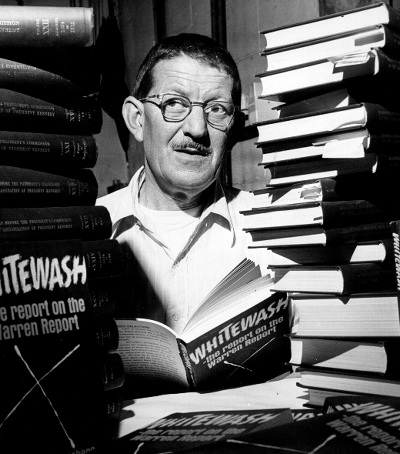
    Harold Weisberg
    Harold Weisberg

    At the time of the assassination, Harold Weisberg was trying to jump-start a writing career he had abandoned some years before. The son of Ukrainian émigrés and the first member of his family born in the United States, Weisberg was a former Senate investigator and journalist living in Maryland. He was immediately skeptical of the lone gunman story out of Dallas, so he drafted an outline for an article and sent it to his literary agent.

    The agent, Weisberg always recalled with astonishment, told him that nobody would consider publishing anything other than what the government said. “Can you understand how shocking that was to me?” he later asked. “With my background? And my beliefs about the functions of information in a country like ours?” Weisberg went on to write Whitewash and other books, all of them detailed analyses of the official case, and highly critical of the government’s handling of it.

    Other early critics included Mary Ferrell, a Dallas legal secretary; Vincent J. Salandria, an attorney in Philadelphia; Maggie Field, a housewife in Beverly Hills, California; and Sylvia Meagher, a researcher at the World Health Organization in New York, who later wrote a penetrating analysis of the case called Accessories After the Fact. Each was a product of that era some call America’s greatest generation.

    For most of these critics the assassination was nothing less than all consuming. “‘Oswald’ is the most spoken word in our house,” Salandria’s wife remarked in 1965. The objective: force a re-opening of the investigation. Although they began following and writing about the case immediately, it wasn’t until 1966 these critics began to get much media attention. Most labored in relative obscurity, and only gradually became aware of each other and their common goal. As they did, they began exchanging ideas and information by telephone, and by what today we refer to as snail mail. There was much the early critics didn’t know. But what they did know was that something was terribly wrong.

    For nearly all of the first generation critics, their initial research was simply tracking the assassination story as it was reported in the press, and noticing, in the first days and weeks, its inconsistencies.

    Like the rest, Mary Ferrell’s suspicions stirred almost immediately. At the time of the assassination she had just emerged from a Dallas restaurant not far from the scene of the crime. A passerby alerted her to what had happened. At almost the same moment police squad cars sped by, sirens blaring. “I ran into a bookstore and called my husband,” she recalled. He heard Kennedy had been shot in the head, Buck Ferrell told his wife, and no one could survive that kind of wound.

    Someone had a radio, and Mrs. Ferrell listened to the first sketchy descriptions of the wanted man. “I stood on Elm and thought that they would never find him with no more than that to go on, in an area containing over a million people.” She was thus astonished when the police arrested Lee Harvey Oswald about an hour later – and even more astonished that he did not match the broadcast description she had heard. “The Dallas Police were not gifted with ESP,” she wryly recalled. “And it just – it didn’t fit. And I said, Something is wrong. And I just, I thought, I’m going to find out what everybody said.”

    And so she sent Buck and their three sons to the loading docks of The Dallas Morning News and The Dallas Times-Herald where, in shifts, they awaited each updated edition of the daily papers. “Kind of a round robin, for four days,” Mary Ferrell remembered. “And we got every issue of every paper.”

    Mrs. Ferrell came across an article in the November 25th issue of the Times Herald hinting at something ominous. The article, “Anonymous Call Forecast Slaying During Transfer,” stated: “An anonymous telephone call to Federal Bureau of Investigation headquarters at 2:15 a.m. warned that Leo [sic] Harvey Oswald would be killed during his transfer from the city lockup to county jail.” The FBI alerted Dallas authorities – yet still Oswald was gunned down. Both papers were putting out multiple editions of each issue, but that article appeared in just one edition and there was no follow-up. “They junked that,” Mrs. Ferrell said. “There were very few copies of that that got loose.”

    Mary and Buck Ferrell
    Mary and Buck Ferrell

    Her interest further stimulated, Mrs. Ferrell continued collecting assassination-related material and never did stop. By 1970 her collection had become so vast that her husband added a room to the back of their Dallas home. “I can move all my books, papers, file cabinets, etc., out there and give the house back to Buck,” Mrs. Ferrell told a friend. She created an extensive database – originally on index cards, but in later years on a personal computer – and with another researcher, a series of chronologies that charted the people and events relating to November 22, 1963.


    In the end, the Warren Commission did not allow Mark Lane to represent the deceased accused assassin. “We are dealing with the mother of Oswald and this lawyer by the name of Lane,” Earl Warren told his commission colleagues in January 1964. “He wants to come right into our councils here and sit with us, and attend all of our meetings and defend Oswald, and of course that can’t be done.”

    A few days later, at New York’s Henry Hudson Hotel, Lane spoke about his preliminary findings to a crowd of about five hundred people. For the balance of the year he would lecture publicly about the case, at first just in New York, but soon during an ambitious lecture tour that criss-crossed the nation and even ventured as far away as Eastern Europe.

    On February 18, he was in New York for a speech that included an appearance by Marguerite Oswald. An enthusiastic crowd of 1,500 heard Mrs. Oswald say, “All I have is humbleness and sincerity for our American way of life.” She described how she tried to meet with her jailed son before he was murdered, but the Dallas police would not permit it. “Why would Jack Ruby be allowed within a few feet of a prisoner – of any prisoner – when I could not see my own son?”

    Sylvia Meagher
    Sylvia Meagher

    Among those in the hall that night was Sylvia Meagher, a 42-year-old researcher at the World Health Organization. “At that stage, I had little or no thought of doing any independent work or writing on the case,” she recalled. “I contributed both money and information unreservedly to Lane or his associates, and I would have been delighted to help in any possible way.”

    Yet she had already written a memorandum recording bitter thoughts. When the Warren Commission published its single-volume report she read it with a critical eye, and soon produced a 40-page article that she began shopping around to major magazines. “The Warren Report,” she wrote, “gives us no justification for declaring that the case is closed.”


    There were a lot of questions, just after the assassination, about how many times the President was hit, and where his wounds were located. Even after fifty years, these questions have never had definitive answers.

    Harold Weisberg was appalled that so many unanswered questions remained. “None should exist,” he declared. “This was not a Bowery bum; this was the President of the United States.” Post-mortem photographs of the late president’s wounds were never entered into evidence and the Commission members never saw them. Autopsy surgeon James Humes said he was “forbidden to talk,” and acknowledged having burned his autopsy notes. JFK’s neck wound was first reported to be one of entry, but later reported to be an exit wound. The first mention of a back wound was not made until nearly a month after the assassination. “As one version of the wounds succeeded another with dizzying speed and confusion,” Sylvia Meagher observed, “only one constant remained: Oswald was the lone assassin and had fired all the shots from the sixth floor of the Book Depository. When facts came into conflict with that thesis, the facts and not the thesis were changed.”

    The conclusion that one bullet caused multiple wounds in JFK and Texas Governor John Connally – the Single Bullet Theory – was undermined by the Warren Commission’s own evidence, the critics argued. That bullet, Commission Exhibit 399, was virtually undamaged, its appearance nearly pristine. The critics compared it to an identical bullet, Commission Exhibit 856, which had been test-fired by ballistics experts at the Army’s Edgewood Arsenal in Maryland. “The test bullet had been fired through the forearm of a cadaver,” said Ray Marcus, whose interest had expanded to include C.E. 399. That test bullet performed “only one of the multiple tasks allegedly executed by 399. Even so, the difference in the appearance of 856 and 399 is striking, as the former is grossly deformed.”

    In April 1964 Marguerite Oswald ended her relationship with Mark Lane. Almost immediately Lane formed an organization called the Citizens’ Committee of Inquiry to coordinate an independent investigation into the assassination. From its New York office, the CCI recruited a small army of volunteer investigators, some of who were dispatched to Dallas to interview assassination witnesses on Lane’s behalf.

    Vincent J. Salandria
    Vincent J. Salandria

    Among these volunteers were Vince Salandria and his brother-in-law Harold Feldman, a writer and translator. Both men were keenly interested in the assassination when it happened, and together had researched an article published in The Nation the previous January. On the morning of June 24, 1964, they left Philadelphia together in Salandria’s 1955 Buick sedan, armed with lists of names, notes, and other material supplied by Lane’s office. Feldman’s wife Immie accompanied them. Driving almost non-stop, they arrived in Dallas late the next day.

    Feldman and Salandria immediately contacted Marguerite Oswald. Media accounts had prepared them for a belligerent, uncooperative woman. “What I heard instead,” Feldman recalled, “was a pleasant ladylike welcome – not a trace of cautious ambiguity, not a second of hesitation in the warm courtesy that carried within it only a faint suggestion of loneliness.” The Feldmans and Salandria met with Mrs. Oswald over the next several days, and Marguerite even had them as overnight guests in her Fort Worth home.

    Harold Feldman, Immie Feldman, Marguerite Oswald

    (L-R): Harold Feldman,

    Immie Feldman, Marguerite Oswald

    Mrs. Oswald escorted the volunteer investigators to some of the key sites in the case. Together they visited Helen Markham, the Warren Commission’s star witness against Lee Oswald for the murder of Dallas Police Officer J.D. Tippit. Mark Lane had already spoken with Mrs. Markham by telephone, and her identification of Oswald as the killer of Tippit seemed shaky. A follow-up interview was important.

    Mrs. Markham lived in a small apartment over a barbershop. Mrs. Oswald, Salandria and the Feldmans found her at home, cradling her infant granddaughter in her arms and pacing back and forth. She declined to talk to them because, she said, she had to care for the baby. She would not let them pay for a babysitter, but did finally agree to let them return later in the day. As they spoke, Mrs. Markham allowed Marguerite to briefly hold the baby.

    Helen Markham, although a grandmother, was still young, Feldman observed – “but shabby, beaten, and spiritless.”

    They returned later that afternoon. As they approached the apartment they noticed two Dallas police cars, which had been parked right outside, pulling away.

    What happened next, Feldman later wrote, was “the most pitiful spectacle in our experience.” They knocked on the Markham apartment door. Mr. Markham was now home, and he stood barring the entrance as his wife cowered to one side.

    “I’ve never seen that kind of terror,” Salandria recalled years later. “Their teeth were actually chattering. And we could get little from them because of their terror.”

    “Please go away,” Mr. Markham had groaned. “Please go away, and don’t come back.”

    Marguerite broke in. “You’ve been threatened, haven’t you?”

    “Yes,” Mr. Markham replied. “Please, go away!”

    Shocked, they did as they were asked. As they got back out to the street and headed toward Mrs. Oswald’s car, Marguerite fought back tears. “That poor man!” she said. “He was frightened to death. What right do they have to threaten him? This is still America, by God.”

    Since alerting Marguerite Oswald to Mark Lane’s article, Shirley Martin had gone to Dallas several times to find assassination witnesses and talk to them. Not in any official capacity, of course: curiosity, and the feeling that something was not right, motivated her. Her proximity to Dallas – it was only two hundred miles away – proved an irresistible lure.

    By the summer of 1964 Mrs. Martin was in contact with Lane’s office, and Lane asked her to speak with a Dallas woman named Acquilla Clemons. Acquilla Clemons was not an eyewitness to the Tippit murder but was nearby, and witnessed some things that were at odds with what was reported in the press.

    The Warren Commission had not called Mrs. Clemons to testify, and these early Citizens’ Committee-sponsored trips first brought her story to light. There were at least three interviews with Mrs. Clemons by committee volunteers over the summer of 1964: by two Columbia University graduate students named George and Pat Nash; Salandria and the Feldmans; and Shirley Martin.

    George and Pat Nash were unimpressed with Acquilla Clemons. They wrote that her description “was rather vague, and she may have based her story on second-hand accounts of others at the scene.” Unfortunately the Nashes did not say why they doubted her.

    Salandria and Feldman interviewed Mrs. Clemons in early July. No record of their conversation appears to exist, but Salandria later said, “I thought she was entirely credible.”

    Shirley Martin
    Shirley Martin

    Shirley Martin spoke to Mrs. Clemons in August, about a month after Salandria and Feldman and the Nashes. She was not at all confident that Acquilla Clemons would talk to her. And so her daughter Vickie, who accompanied her mother, hid a tape recorder in her purse.

    For much of the conversation, Mrs. Clemons gave Mrs. Martin a lot of reasons why she didn’t want to talk to her. Mrs. Martin seemed to sense her nervousness. “I’m a private citizen,” she said. “I’m not representing any group.” Still Mrs. Clemons demurred; her employer, she said, did not want her involved in the case in any way.

    Undaunted, Shirley continued. “This friend of mine was here…I don’t know if you remember. Mr. Nash? Mr. Salandria? They talked to you?”

    “Someone came by my house about two months ago,” Mrs. Clemons replied. They promised to send her a picture of Lee Oswald, she said, but never did.

    Finally Mrs. Clemons began to talk. She described seeing two men, neither of them Oswald, in the vicinity of the Tippit killing. More than once since then, she said, the police had warned her not to talk to anyone about what she had witnessed on November 22nd.

    “So the police said you’d get a lot of publicity and you’d better not do it?”

    “Yeah, I’d better not,” Mrs. Clemons replied. “Might get killed on the way to work.”

    “Is that what the policeman said?” Shirley Martin asked.

    “Yes,” Mrs. Clemons answered. “See, they’ll kill people that know something about that…there might be a whole lot of Oswalds…you know, you don’t know who you talk to, you just don’t know.”

    “You scare me…”

    “You have to be careful,” Mrs. Clemons said. “You get killed.”


    The Warren Commission’s single-volume Report was published in September 1964, and two months later its 26 volumes of hearings and exhibits. This was the moment that the early critics had been waiting for. “I was wildly excited,” Sylvia Meagher recalled. “I opened the box. There were the 26 volumes, everything I’d been looking forward to studying for a long time.” Meagher went on to write a devastating analysis entitled Accessories After the Fact.

    The news media, too, greeted the Warren Report with great enthusiasm – but from a much different perspective. Time magazine called it “amazing in its detail [and] utterly convincing,” while The New York Times said “the evidence of Oswald’s single-handed guilt is overwhelming.” The CBS, NBC and ABC television networks all hailed the Report as the final word on President Kennedy’s assassination, and devoted much airtime to its findings.

    Mark Lane, who had been speaking publicly about the weaknesses in the government’s case since January, now began debating the Report and its validity. In October 1964 he sparred with Melvin Belli, the celebrated attorney who had unsuccessfully defended Jack Ruby for murdering Lee Oswald. Belli performed badly and was even jeered by the audience; he conceded that Lane “was bright and he had an almost encyclopedic knowledge of the facts.”

    On December 4 Lane took part in a much more important event, appearing with a Warren Commission staff attorney named Joseph Ball at a high school in Beverly Hills, California. It was the first time anyone associated with the Commission agreed to publicly defend its findings. At the time of this confrontation, the Commission’s Hearings and Exhibits had only been available for about a week.

    To help Lane prepare, several critics met a few days beforehand and began pouring over these 26 volumes. Their meetings took place at the home of Maggie Field. Most there had been in contact with Lane’s Citizens’ Committee office, but it was the first time they were meeting each other. And it was the first time many of them were getting a good look at the Warren Commission’s official evidence.

    While technically not a debate, the strengths and weaknesses in the government’s case were given a thorough airing that night before an overflow crowd of several thousand. For forty-five minutes, Lane held the audience spellbound with a summary of the deficiencies in the case against Oswald. And he assured them it was their right to know the truth. “We are going to remain with this matter until such time as the American people secure that to which we are all entitled in a free, open, and democratic society. And that is some intelligible answers to the thus far unanswered questions of Dallas on November 22.”

    But Joseph Ball assured the audience that the Commission had performed with honesty and integrity, and had found the correct answers. He emphasized his independence and impartiality. “It didn’t make any difference to me whether I discovered Oswald was the assassin or that someone else was.”

    Mark Lane, Ball charged, was picking and choosing from the evidence, and ignoring that which implicated Oswald. Lane interrupted to challenge this point, and the two argued back and forth. Each managed to call the other a liar. Finally Ball seemed to have had enough: examining Mark Lane, he declared, would only result “in a cat and dog fight.”

    “Well that’s all right,” Lane countered. “It’s about time we had a dialog in America on this question.”

    When the event was over, a reporter asked audience members about what they had witnessed. “It was like, a shocking drama,” said one. Several added that they found it troubling that someone of Joseph Ball’s stature was unable to answer many of the points Lane made. Most agreed that Lane had won. “The byproduct of his defense of Oswald,” one man said, “is to show that there has been, no matter what the motivation on the part of the Warren Commission, and many areas of government, an attempt to cover up.”


    In spite of their diverse backgrounds and political orientations, the first generation critics maintained informal, sometimes uneasy alliances with each other for several years. There were occasional meetings, most notably in October 1965, when some of the critics, including Vince Salandria and Maggie Field, gathered in Sylvia Meagher’s home.

    There was great excitement in the fall of 1966 when Republican Congressman Theodore Kupferman proposed a special committee to review the Warren Commission’s work. Nothing ever came of the freshman lawmaker’s idea. But just a few months later there was even more excitement with the electrifying news that New Orleans District Attorney Jim Garrison had launched his own investigation into the Kennedy assassination.

    Garrison freely acknowledged his debt to the work of the critics, in particular that of Mark Lane, Harold Weisberg, and a newcomer named Edward J. Epstein. Lane was among the first of the critics to get actively involved in Garrison’s investigation, lending his expertise; Harold Weisberg, Vincent J. Salandria, and others soon followed. Maggie Field raised funds for the D.A. and made plans to visit New Orleans.

    “I have repressed the occasional impulse to rush to the airport and fly to New Orleans,” Sylvia Meagher said in April 1967. But her enthusiasm was short-lived. By that summer Meagher and several others had lost all faith in Jim Garrison. It proved to be an irreconcilable issue between them, and by that fall, Meagher had severed ties with most of the other critics. For better or worse, Jim Garrison’s case ultimately failed. Afterward it seemed to many that the search for truth had been dealt a devastating setback.


    That the Warren Commission’s lone gunman theory is so widely rejected today suggests that the critics’ work proved it was wrong. And it did – yet it is also true that public skepticism has always run deep. Surveys taken within a few weeks of the assassination showed widespread doubt about the official story. The numbers have fluctuated over the years, but public opinion polls have consistently revealed this doubt. Perhaps what the critics really did was provide the details to what most Americans, in their bones, already knew.

    So who killed JFK? We still don’t know for sure, although theories abound. And while later generations of assassination researchers pursued this question with great zeal, many of the earliest critics stopped short of affixing responsibility. “After all these years,” Sylvia Meagher remarked in 1975, “I still do not know if it was the CIA, the military, LBJ, the Cubans, or the Mafia, or any combination of them. But I always knew, know, and will always know for a certainty that C.E. 399 is a fake, that the autopsy is a fraud, that much of the other hard evidence is suspect or tainted, and that the Warren Report is false and deliberately false.”

    Maggie Field once told an interviewer that finding the truth about the murder of JFK was of paramount importance. “Until we can get to the bottom of the Kennedy assassination, this country is going to remain a sick country,” she said. “No matter what we do. Because we cannot live with that crime. We just can’t.”