Category: John Fitzgerald Kennedy

Original essays treating the assassination of John F. Kennedy, its historical and political context and aftermath, and the investigations conducted.

  • Ayton, Mel and David Von Pein, Beyond Reasonable Doubt


    I can honestly say that Beyond Reasonable Doubt fully lived up to my expectations. I expected that authors Mel Ayton and David Von Pein would add nothing to our understanding of the assassination of President Kennedy, and that is precisely what they did. I expected they would regurgitate the same tired old arguments and trot out the usual roster of long-discredited witnesses, and they did just that. And I expected that they would pontificate on the evils of “conspiracy theorists” at every available opportunity and, lo and behold!, they did.

    Beyond Reasonable Doubt is a standard format lone nut book, cut from the same cloth as Reclaiming History, Case Closed, and Conspiracy of One. It spends half its time trying desperately to convince readers that the Warren Commission was right all along and the other half-blaming conspiracy theorists for the confusion. Von Pein suggests in the book’s preface that for the last fifty years JFK’s murder has been “falsely shrouded in mystery” and those pesky conspiracy theorists are to blame. Which is ridiculous. Conspiracy theorists are not to blame for the Dallas Police Department’s mishandling of both its suspect and the physical evidence against him. Nor are they responsible for J. Edgar Hoover’s rush to judgement and his decision to limit the FBI’s investigation to Lee Harvey Oswald. It was not the conspiracy theorists who illegally removed Kennedy’s body from Dallas so that it could be flown to a military hospital where under-qualified and inexperienced pathologists bungled the autopsy. And no mere conspiracy theorist is accountable for crucial autopsy photos, X-rays and even the President’s brain being surreptitiously removed from the archive never to be seen again. The sad truth is that every confusion at the core of this case was created by those in officialdom who failed or refused to conduct a proper investigation and chose instead to cover their own butts whilst papering over the holes in the case against Oswald.

    To be fair to the authors, it is true that a good number of conspiracy theorists have, as Von Pein puts it, “twisted and misrepresented the evidence” in the Kennedy case. But the exact same thing is true of Warren Commission apologists. For example, in 1993, Case Closed author Gerald Posner appeared before a congressional subcommittee claiming that he had interviewed Kennedy’s autopsy doctors, Dr. James J. Humes and Dr. J. Thornton Boswell, who told him they had changed their minds about the location of the entrance wound in the back of JFK’s skull. They now agreed, Posner claimed, that the bullet wound was 10 centimeters higher than stated in their autopsy report and he promised to provide congress with a tape recording of these interviews. But the tape never materialized. Consequently, researcher Dr. Gary Aguilar telephoned Humes and Boswell and was surprised to discover that not only did both doctors deny telling Posner any such thing, but Boswell was adamant that he had never been interviewed by Posner at all. And he was not the only individual to make this complaint. In his book, Posner cited personal interviews with others; including James Tague and Marina Oswald; who said that they too had never even spoken to him. Of course, none of this stops Ayton and Von Pein frequently citing Posner’s book, calling it a “well-written account of the assassination.”

    Beginning with the Warren Commission who, as historian Gerald McKnight put it, “went through the motions of an investigation that was little more than an improvised exercise in public relations,” (Breach of Trust, p. 361) the twisting and misrepresenting of evidence in the Kennedy assassination has been carried out by those with an agenda. And Ayton and Von Pein have such a massive agenda that they manage to one-up the Commission by making not even a pretense of objectivity. The authors shamelessly omit important facts contradicting their position whilst promoting any scrap of information that appears to support it without giving consideration to the reliability of its source. As such, they happily rely not only upon disgraced authors like the aforementioned perjurer Gerald Posner, but also on the likes of Priscilla Johnson McMillan, whom the CIA describes as a “witting collaborator,” and Max Holland; recipient of the Agency’s “Studies in Intelligence” award. In light of the fact that internal documents have shown that as far back as 1967 the CIA has committed itself to employing “propaganda assets to answer and refute” critics of the Warren Report, no objective scholar would overlook these relationships.

    Of course, Ayton and Von Pein have little choice but to rely on dubious sources because if they were to employ a more rigorous standard they would not be able to write a book like Beyond Reasonable Doubt. For as we shall see, the lone gunman theory is simply not in accord with the evidence and, no matter how “damning” they may want you to believe it is, the case against Oswald cannot survive scrutiny.

    I

    As is obvious from the title of their book, Ayton and Von Pein want you to believe that there is no “reasonable doubt” about Lee Harvey Oswald’s sole guilt in the assassination. The authors even treat us to their (very unusual) definition of the term, writing that “If the preponderance of evidence points to the guilt of the accused, it is not reasonable to say a particular anomalous piece of evidence shows innocence. Even when more than one anomaly arises, as it certainly does with respect to the JFK assassination, it is still not ‘reasonable’ to assume innocence if the preponderance of evidence shows guilt.” (p. 118)

    Why is this so unusual? Because the above is not the legal definition of the term as used in American criminal courts. The legal definition of beyond reasonable doubt in that venue is that 12 reasonable jurors have no doubt as to the defendant’s guilt; they are convinced to a moral certainty that the accused committed the crime. If they do have doubt, they are not reasonable doubts. Which means that, during the deliberations, the one or two people who were reserving judgment had their doubts washed away by the other 10 or 11 jurors’ arguments. Another way of explaining it is this: the prosecutor has judiciously, methodically and conclusively closed off all other avenues of possible explication to the defense. The crime could have happened no other way. It is the most stringent standard in American jurisprudence. That is because a man’s life or liberty is at stake. The second most stringent standard is, “by clear and convincing evidence.” That standard is used in many administrative hearings, such as those by the ABA to disbar an attorney. The standard the authors quote above is actually the lowest standard and is used in most civil courts. It is very hard to believe the writers do not understand the difference. Ayton is from the UK, but Von Pein is an American. Yet, at least the book editor should have pointed out this serious discrepancy which, in and of itself, mitigates the portentousness of the title. This reversal reduces the book to a utilitarian, not a fact finding or judicial inquiry. In other words, because of the Ayton/Von Pein switcheroo, the many serious evidentiary issues repeatedly highlighted by critics over the last fifty years do not amount to reasonable doubt. Needless to say, actual legal experts; lawyers who understand the different standards and why they are used; would feel differently.

    For example, General Counsel for the Assassination Records Review Board (ARRB), Jeremy Gunn, said recently, “If we actually ask the question was Oswald guilty beyond a reasonable doubt…I am convinced that Oswald would have been found not guilty beyond a reasonable doubt. To me there is just no question he is not guilty beyond a reasonable doubt.” Former prosecutor, and Deputy Chief Counsel for the House Select Committee on Assassinations (HSCA), Robert Tanenbaum, agrees. As he stated during a lecture in 2013, “I can tell you from my experiences having tried several hundred cases to verdict, and being responsible for thousands of cases as head of the criminal courts, and running the homicide bureau, that I don’t believe there’s any courtroom in America where Oswald would have been convicted on the evidence that was presented before the Warren Commission.” Numerous lawyers and professional investigators have come to the same conclusion as Gunn and Tanenbaum after studying the case against Oswald, simply because it falls so far short of the genuine standard of proof.

    Let us begin with the Warren Commission’s claim, repeated by Ayton and Von Pein, that on the morning of November 22, 1963, Oswald smuggled his cheap, mail-ordered rifle into the Texas School Book Depository building inside a paper bag. As first generation critics of the Warren Report like Harold Weisberg, Mark Lane and Silvia Meagher quickly discovered, reasonable doubt is cast on this allegation by the very testimony on which it is based.

    Broken down, the sixth floor rifle was 34.8 inches long. (WR, p. 133) But witnesses Buell Wesley Frazier and Linnie Mae Randle repeatedly swore that the package they saw Oswald carry that morning was, at most, 27-28 inches long. For Ayton and Von Pein this poses no problem at all and they blithely state that Frazier and Randle both “made mistakes in describing the parcel’s length…” (ibid, p. 69) As to how they deduced that Frazier and Randle were mistaken when there is literally no evidence overturning their consistent and corroborative estimates is difficult to fathom. Nobody else saw the package Oswald carried that morning, and the fact is that the two different ways in which Frazier and Randle saw Oswald holding the bag corroborate their estimates and prove that it had to be considerably shorter than the rifle it was alleged to contain.

    Frazier saw Oswald carrying the bag with one end cupped in his hand and the other tucked under his arm. However, as he discovered during his Commission testimony, it was impossible to carry the rifle in that manner. Commission lawyer, Joseph Ball, handed Frazier the disassembled rifle inside a paper bag and asked him to demonstrate how Oswald had held the package. But when Frazier cupped the bottom end in his hand, the top end extended several inches above his shoulder, almost up to the level of his eye. As Frazier made clear, none of the bag he saw Oswald carrying had been sticking up above his shoulder and he was certain the bottom end was cupped in Oswald’s hand. “From what I seen, walking behind,” Frazier testified, “he had it under his arm and you couldn’t tell he had a package from the back.” (WC Vol. 2, p. 243, hereafter expressed as 2H243)

    Ayton and Von Pein try to get around this by writing that “…in 1986, Frazier confirmed via Vincent Bugliosi’s questions…that the package could have extended beyond Oswald’s body and he might not have noticed it.” (Ayton and Von Pein, p. 69) This is a gross distortion of what Frazier agreed to, which is that the package could have been “protruding out in front of [Oswald’s] body” without him seeing it. He never said that it could have been sticking up above the shoulder or below the hand. To this day Frazier is adamant that the package he saw was around two feet long and that Oswald carried it with one end cupped in his hand and the other tucked under his arm. In other words, it was smaller than the rifle.

    Often overlooked is the manner in which Oswald was carrying the package when Randle saw him. She was looking out of her kitchen window as she watched Oswald cross the street toward her house holding a “heavy brown bag.” At this time, he held the package by the top and the bottom did not quite reach the ground. (2H248) The only way the 5 foot 9 inch Oswald could have carried a 34.8-inch long rifle down by his side without it dragging along the ground behind him is if he had arms like a T-Rex. Given that Oswald was a normally proportioned human male we can safely conclude from Randle’s testimony that the package she saw him carry was considerably shorter than the rifle. It is readily apparent, then, that despite Ayton and Von Pein’s assurance that Frazier and Randle “made mistakes in describing the parcel’s length,” their estimates actually make little difference. Because the two different ways in which Oswald carried it are entirely corroborative and clearly establish that it could not have contained the rifle.

    Ayton and Von Pein would no doubt argue that the testimony of Frazier and Randle on this point is negated by the long paper bag; apparently made from wrapping paper and tape from the book depository’s shipping department; allegedly found by Dallas police in the so-called “sniper’s nest,” on the sixth floor of the depository building. But that bag is, to say the least, of dubious origin. As retired British police detective Ian Griggs pointed out in his seminal essay, “The Paper Bag That Never Was,” it does not appear in any of the official crime scene photographs, and the first officers on the scene did not see it there. For example, Police Sergeant Gerald Hill told the Commission that the only paper bag he had seen was a “small lunch sack” and remarked of the larger bag, “…if it was found up there on the sixth floor, if it was there, I didn’t see it.” (7H65) As Griggs points out in his essay, Deputy Sheriffs Luke Mooney and Roger Craig and Police Detective Elmer Boyd all said much the same thing. (See, Griggs, No Case to Answer, pgs. 173-214)

    One fact overlooked by Griggs was that on the evening of November 22, 1963, Buell Frazier was given a polygraph examination by Dallas Police Detective R.D. Lewis and, while it was in progress, Lewis showed Frazier the long paper bag supposedly found in the “sniper’s nest.” Frazier told him that “he did not think that it resembled…the crinkly brown paper sack that Oswald had when he rode to work with him that morning…” (FBI 105-82555 Oswald HQ File, Section 17, p. 100) If Frazier, who got the best look at the package Oswald carried that morning, could not identify the bag produced by Dallas Police, it is difficult to imagine that it could ever have been introduced as evidence in court.

    Nevertheless, the bag is seemingly linked to Oswald by a partial right palmprint and a partial left index fingerprint. Yet the obvious question this raises is how these could be the only two prints Oswald left on the bag when he supposedly made it himself using paper and tape from the depository, carried it with him to the Paine home in Irving, used it to wrap his rifle, carried it at least two different ways on his journey back into the depository, and unwrapped his rifle again on the sixth floor. In light of everything outlined above; Frazier and Randle’s testimony, the fact that the bag does not appear in crime scene photographs, was not seen by the first officers on the scene, and was not identified by Frazier during his polygraph; the prints cannot be said to in any way prove that Oswald used the bag to carry the rifle. Realistically, all the prints tell us is that he handled the bag briefly at some point. This reviewer would not be the least bit surprised if that occurred whilst Oswald was in police custody.

    Though they are careful to omit it all from their book, Ayton and Von Pein are no doubt aware of the serious issues outlined above, so they try to give themselves an out by writing that, “The question of whether or not Oswald took his rifle into work that morning, however, is a moot point. Oswald had plenty of opportunities to hide his rifle in the Book Depository on other occasions.” (p. 69) Informed readers will recognize this for the smokescreen that it is. According to the official story, for the two months leading up the assassination, Oswald’s alleged rifle was wrapped in a blanket in Ruth Paine’s garage. If he did not retrieve it on the morning of the assassination then he never did so because at no other time was he seen taking a package from the Paine home, at no time was any rifle seen at his rooming house, and at no other time did he take a package into the Book Depository. November 22 was his one and only opportunity. Which means that if the package he carried that morning did not contain the rifle–and the preponderance of evidence tells us it did not–then someone else placed it on the sixth floor of the depository building, and Oswald was exactly what he said he was: A patsy.

    Just from this instance, one can see why the authors lowered the legal standard. But even at that, an informed reader can see that they do not meet even that lower standard.

    Before moving on, let us take note of another example of Ayton and Von Pein misrepresenting Frazier’s words to suit their needs. The authors allege that when Frazier and Oswald “arrived at the Book Depository parking lot, Oswald hurried to the building 50 feet ahead of his co-worker…Oswald had never previously walked ahead of Frazier to the building. But Friday, November 22nd was different.” (Ibid) The implication here is that Oswald immediately got out of the car and rushed ahead of his workmate because he was in a hurry to get his rifle into the building. The reality is quite different. As Frazier testified, upon arriving at the depository, he sat in his car, “letting my engine run and getting to charge up my battery.” (2H227) Oswald had gotten out of the vehicle but, upon realizing Frazier was not with him, stopped and stood “at the end of the cyclone fence waiting for me to get out of the car.” (Ibid, 228) Once Frazier shut off the engine and exited the car, Oswald carried on walking but Frazier said he “didn’t try to catch up to him because I knew I had plenty of time so I just took my time walking up there.” As Frazier told the Commission, he was less interested in catching up with Oswald and more interested in taking a minute to watch the nearby railroad tracks because “I just like to watch them switch the cars…” (Ibid) So quite contrary to the impression Ayton and Von Pein attempt to convey, Oswald did not end up 50 feet ahead of his co-worker because he “hurried,” he did so because Frazier purposely lagged behind. Clearly the truth is less supportive of Ayton and Von Pein’s agenda than their own version of events.

    [NOTE: Over recent years, a number of very knowledgeable researchers have begun to question whether or not Oswald carried any kind of package with him that morning at all. They suggest that Frazier was pressured into telling this story after he was arrested by police on the evening of the assassination. Whilst, on balance, the reviewer believes that Frazier and his sister were telling the truth, the inconsistencies these critics have highlighted should not be summarily dismissed. Readers are referred to chapter 8 of Jim DiEugenio’s excellent book, Reclaiming Parkland, for details.]

    II

    Ownership and possession of the Mannlicher-Carcano rifle found on the sixth floor of the Texas School Book Depository has, of course, always been a key issue. It goes without saying that Ayton and Von Pein regard it as an “incontrovertible fact that Oswald owned the assassination weapon.” (p. 66) But this bold declaration overlooks many inconsistencies, not the least of which being that the rifle was ordered under the name “A. Hidell,” yet when Oswald opened PO Box 2915 in October, 1963, he listed “Lee H. Oswald” as the only person authorized to receive mail. (17H679) U.S. Postal regulation no. 355.111 clearly states that “Mail addressed to a person at a PO Box who is not authorized to receive mail shall be endorsed ‘addressee unknown’ and returned to sender.” How then could Oswald have received a rifle ordered in the name of A. Hidell? Incidentally, it will come as no surprise to many to learn that, although the Post Office should have retained the signature of the person picking up the rifle for four years, it was “missingî by the time the FBI began it’s work.

    For the sake of argument, this reviewer will overlook numerous issues and accept the notion that, for some unknown reason, Oswald chose to break the law by ordering a rifle through the mail using a false name; despite the fact that he was living in Texas where it was easy to obtain a firearm over the counter without leaving an extensive paper trail. It is nonetheless indicative of Ayton and Von Pein’s intellectually dishonest methods to state without qualification, as they do, that “Lee Harvey Oswald’s wife, Marina, identified the rifle in testimony to the Warren Commission during its 1964 hearings.” (p. 80) Anyone who is familiar with Marina’s ever-changing stories will no doubt be rolling their eyes at that particular pronouncement. During her Commission testimony, Marina rather melodramatically described the sixth floor weapon as “the fateful rifle of Lee Oswald.” When asked, “Is that the scope that it had on it, as far as you know?” she said “Yes.” (1H119) However, when she was interviewed months earlier by the Secret Service, Marina swore that the only rifle her husband ever owned did not have a telescopic sight. In fact, she said that before she saw the sixth floor rifle on television, “she did not know that rifles with scopes existed”! (CD344, p. 24) How does one reconcile these two statements? And what does it say about the integrity of an author who informs readers of one but not the other?

    Regardless, the central question is not “did Oswald order the rifle?” but “did he have it in his hands at the time of the assassination?” We have already seen that he did not have it in his possession for at least the two months leading up to the assassination and he most likely did not carry it into the depository building that morning. So it will come as no great shock to learn that there is no compelling evidence he handled the rifle at all that day, and Ayton and Von Pein have to resort to misrepresenting testimony and omitting relevant facts in order to make it seem as if there is.

    The authors state that the FBI found a “tuft of cotton fibers…clinging to the butt of the rifle” that under microscopic examination “matched those in the shirt worn by Oswald the day of the assassination.” (p. 67) What they do not tell readers is that the shirt to which the fibers were “matched” is the one Oswald was wearing when he was arrested, but this was apparently not the one he was wearing at the time of the assassination. During his interrogations, Oswald told police; without any reason to lie as he knew nothing of any fibers being found on the rifle; that between the time of the assassination and the time of his arrest, he had returned to his rooming house and changed his shirt and trousers. (R622) Oswald’s word was corroborated by Dallas Policeman Marion Baker who saw him on the second floor of the Book Depository less than two minutes after the shots were fired, and then again at the police station later in the day. As Baker told the Commission, when he saw Oswald the second time, “He looked as though he did not have the same thing on.” (3H262)

    Additionally, FBI hair and fiber expert, Paul Stombaugh, testified that although the fibers he found on the rifle butt “appeared fresh,” there was no way of knowing for sure how long they had been on the weapon. As he explained it, “They could conceivably have been put on 10 years ago and then the gun put aside and remain the same. Dust would have settled on them, would have changed their color a bit, but as far as when they got on the gun. I wouldn’t be able to say. This would be speculation on my part.” (4H84) And that’s not all Stombaugh had to say. Despite Ayton and Von Pein’s unqualified assertion that the fibers “matched” the shirt, Stombaugh explained that “there is just no way at this time to be able to positively state that a particular group of small fibers came from a particular source, because there just aren’t enough microscopic characteristics present in these fibers. We cannot say, ‘Yes, these fibers came from this shirt to the exclusion of all other shirts.’” (Ibid, 88) So, to summarize, fibers that had been on the rifle for an indeterminate amount of time were inconclusively matched to a shirt Oswald may not have been wearing at the time of the assassination. Yet all Ayton and Von Pein saw fit to tell readers was that the fibers “matched.”

    The authors go on to claim that “Dallas Police Lieutenant J.C. Day…found and lifted a palm print from under the rifle barrel which he sent to the FBI laboratories in Washington. It was later identified as ‘the palm print of Lee Harvey Oswald.’” (p. 72) There is so much relevant information left out of the above passage that it is difficult to know where to begin to critique it. Day claimed to have found the print on the disassembled Carcano when he inspected it on the evening of November 22. But when the FBI’s fingerprint expert, Sebastian Latona, carefully inspected the entire rifle just a few hours later, he found “no latent prints of value” anywhere on it. (4H23) It was not until after Jack Ruby had gunned Oswald down in the basement of Dallas Police headquarters that it was suddenly announced his print had been found on the rifle. Lt. Day claimed that he had “lifted” the print before sending the rifle to the FBI lab but could never adequately explain why he had failed to inform the Bureau; or anyone else; when he handed the rifle over. Nor could he explain why he failed to follow proper procedure by photographing the print before it was “lifted.”

    Day said that the lifting had been accomplished by applying a strip of cellophane tape to the print, which had been dusted with powder. But Latona found no evidence whatsoever of a print, the tape, or the dusting powder. And let us not minimize the difference between Latona and Day. According to professional prosecutor Tanenbaum; a man who never lost a murder case; Latona’s word was gold on the stand. He had written a pamphlet on the subject of fingerprinting which was used by almost all police departments at the time. He was so much in demand as a witness that it was not easy to secure him on your witness list. If you could, you felt lucky.

    An FBI memo that was suppressed until 1978 reveals that even the Warren commission was troubled by all of this. The memo dated August 28, 1964 states: [Warren commission general counsel J. Lee] Rankin advised because of the circumstances that now exist there was a serious concern in the minds of the commission as to whether or not the palm impression that has been obtained from the Dallas Police Department is a legitimate latent palm impression removed from the rifle barrel or whether it was obtained from some other source, and that for this reason this matter needs to be resolved.” Recall, this is August, eight months after the Commission’s first meeting. The Bureau reported to the commission that they had investigated the matter and said that the “[FBI] laboratory examiners were able to positively identify the lift as having come from the assassination rifle in the area of the wooden fore grip.” (26H829) However, the same report notes that Day “preferred” not to make a signed written statement about his finding of the print. This is probably because not only would he have been impeached by Latona, but also by FBI agent Vincent Drain. Drain was the agent who was tasked by FBI Director J. Edgar Hoover with picking up the evidence the night of the assassination and spiriting it to Washington. What he told author Henry Hurt about that transfer is devastating. Drain told Hurt that when Day gave him the rifle he never pointed out a print, or evidence of a print. (Hurt, Reasonable Doubt, p. 109)

    As if failing to make any mention of the above was not bad enough, Ayton and Von Pein are also careful to omit what is perhaps the most crucial detail: Even Lt. Day did not claim that the print; which was only visible in its entirety when the rifle was disassembled; placed the Carcano in Oswald’s hands at the crucial time. In fact, he described it as an “old dry print” that “had been on the gun several weeks or months.” (26H831; Anthony Summers, Conspiracy, p. 54) So even if we accept the palmprint as genuine, it only places the disassembled rifle in Oswald’s hands “weeks or months” before the assassination. That the authors of Beyond Reasonable Doubt were comfortable hiding this fact from their readers is truly mind-boggling. And, if you can believe it, it gets worse.

    Without a trace of caution, Ayton and Von Pein trumpet the claim made in 1993 by Vincent J. Scalice that he had positively identified fragmentary fingerprints found on the trigger guard of the rifle as being those of Lee Harvey Oswald. Once again, the authors leave out that which they find inconvenient. The prints in question were first observed by Lt. Day who told the Commission “…from what I had I could not make a positive identification…” (4H262) They were next examined by Sebastian Latona, who judged them to be “of no value,” (4H21) and a second FBI expert, Ronald Wittmus, who agreed. (7H590) That makes three witnesses within 24 hours.

    A decade and a half later; and this is crucial– Scalice examined the prints on behalf of the HSCA and, at that time, he too agreed that they were “of no value for identification purposes.” (8HSCA248) In 1993, both Scalice and the head of the FBI’s latent print section, George Bonebrake, reviewed the prints for the PBS documentary, Who Was Lee Harvey Oswald?, and Bonebrake reached the same conclusion as every expert who came before him; including Scalice. He stated that the prints were “simply not clear enough to make an identification.” Finally, in 2003, researcher James K. Olmstead reported that a new analysis had been conducted using the FBI laboratory computer software and the computer had failed to find a match. (Donald Thomas, Hear No Evil, p. 85) So how was it that Scalice was able see what no other expert; or, indeed, computer; was able to see?

    Scalice claimed to have found no less than 18 “points of identity” by using a composite of four enhanced Dallas Police photographs. But back in 1963, the FBI did not just have a few 30-year-old photographs to work with, they had the rifle itself with the actual latent prints on it. And as Latona explained to the Commission, the Bureau experts spent considerable time “setting up the camera, looking at prints, highlighting, sidelighting, every type of lighting that we could conceivably think of, checking back and forth in the darkroom; we could not improve the condition of these prints. So, accordingly, the final conclusion was simply that the latent print on this gun was of no value, the fragments that were there.” (4H21) Simply put, whatever enhancements Scalice carried out on the photographs he used could not bring out detail that did not exist in the actual latent prints. Even as a minority opinion, Scalice’s claim is just not worthy of serious consideration. And this is especially so given that neither he nor anyone else has ever made a chart of his alleged 18+ points of identity available for verification by an independent expert.

    By promoting Scalice’s assertion, Ayton and Von Pein demonstrate an extreme confirmation bias and a willingness to repeat anything that supports their theory, no matter how questionable it may be. This, and their handling of the palm print and fibers on the rifle, are perfect examples of what makes Beyond Reasonable Doubt such an Orwellian read. The authors spend much time up on a high horse denouncing conspiracy theorists for their “wrongful use of the physical evidence,” and for misrepresenting the facts “through selective use of witnesses,” yet these are the very methods they repeatedly and unashamedly employ throughout their book. Unfortunately, this type of hypocrisy is par for the course when dealing with many of those who defend the official lone nut legend.

    III

    Only one witness was ever claimed to have been able to identify Oswald as the man who fired a rifle from the sixth floor window: Howard L. Brennan. He is described by Ayton and Von Pein as “The most important witness to the shooting.” (p. 59-60) A better and more accurate description was provided by Warren Commission critic Howard Roffman who wrote that “The best that can be said of Howard Brennan is that he provided a dishonest account that warrants not the slightest credence.” (Presumed Guilty, p. 197) The numerous problems with Brennan’s supposed identification of Oswald were noted in detail by first generation critics and his claims were completely discredited during the 1960s. Using Brennan as a witness in 2015 is a true sign of desperation.

    Brennan told the Commission that shortly before the assassination, from his position sitting atop a wall opposite the Book Depository, he saw a man in the sixth floor window who he watched leave and return “a couple of times.” (3H143) Once the shooting started, Brennan said, he glanced back up to the man in the window and saw that he was “standing up and resting against the left window sill, with gun shouldered to his right shoulder, holding the gun with his left hand and taking positive aim and fired his last shot.” (Ibid, 144) Brennan’s description of the gunman’s position at the time he fired his final shot is the first of many problems with his account. The gunman could not have been “standing” as Brennan claimed because the window was only half-open and the ledge was just one foot high. As Roffman pointed out, “Had the gunman been standing, he would have been aiming through a double thickness of glass, only his legs visible to witness Brennan.” (Presumed Guilty, p. 193) Yet Brennan claimed that he could see the assassin “from his belt up.” (3H144)

    In his Commission testimony, Brennan also contradicted his own claim to have seen the gunman fire his last shot. As many rifles do, the Carcano emits a small amount of smoke (26H811), and manifests a recoil (3H451), but Brennan testified to seeing neither of these things. (Ibid, 154) Years later, he wrote in his memoir, Eyewitness to History, “Simultaneous with the third shot, I swung my eyes back to the Presidential car which had moved on down to my left on Elm, and I saw a sight that made my whole being sink in despair. A spray of red came from around the President’s head.” (Eyewitness to History, p. 13) If Brennan saw the President’s head explode, then unless he could move faster than a speeding bullet, it is without question that he could not have seen the sixth floor sniper fire the shot.

    On the evening of November 22, Brennan was taken to view a Dallas police line-up where he failed to identify Oswald as the man he saw in the sixth floor window. Four months later when he appeared before the Commission, however, he was willing to positively identify Oswald as the gunman. (3H148) His justification for failing to pick Oswald out of the line-up was that he believed at that time, and still believed at the time of his testimony, that the assassination had been the work of a communist conspiracy and that if word got out that he was the only eyewitness he and his family “might not be safe.” (Ibid) But this excuse is invalidated by the fact that he had to know of at least one other eyewitness, Amos Euins, because Brennan himself had pointed him out to Secret Service Agent Forrest Sorrels. (7H349) Additionally, as Mark Lane noted, “Brennan’s anxiety about himself and his family did not prevent him from speaking to reporters on November 22, when he gave not only his impressions as an eyewitness but also his name.” (Lane, Rush to Judgment, p. 92)

    As he admitted to the FBI on January 10, 1964, Brennan’s real reason for failing to identify Oswald on the evening of the assassination had nothing to do with fear of a communist conspiracy. He explained to agents of the Bureau that “after his first interview at the Sheriff’s Office…he left and went home at about 2 P.M. While he was at home, and before he returned to view a lineup, which included the possible assassin of President Kennedy, he observed Lee Harvey Oswald’s picture on television. Mr. Brennan stated that this, of course, did not help him retain the original impression of the man in the window with the rifle…” (24H406) Based on this admission alone, any subsequent identification Brennan gave was completely and utterly worthless.

    It has been suggested that Brennan’s own eyesight would have prevented him from witnessing what he said he did anyway. As Commission lawyer Joseph Ball told author Edward Epstein, during a “reconstruction” on March 29, 1964, Brennan had such difficulty even seeing a figure in the window that “it seemed doubtful that Brennan could have positively identified a man in the partially opened sixth-floor window 120 feet away.” (Epstein, Inquest, p. 110) Ayton and Von Pein counter this by saying that “It was only AFTER the assassination, in January 1964, that Brennan suffered an accident that impaired his vision.” (p. 60) But their only source for this claim is Brennan’s own self-serving testimony which the Commission did not take any steps to verify.

    It has also been suggested that Brennan, like a number of other witnesses, was pressured into changing his story. His job foreman, Sandy Speaker, told author Jim Marrs, “They took [Brennan] off for about three weeks. I don’t know if they were Secret Service or FBI, but they were federal people. He came back a nervous wreck and within a year his hair had turned snow white. He wouldn’t talk about [the assassination] after that. He was scared to death. They made him say what they wanted him to say.” (Marrs, Crossfire, p. 26) Whether Speaker’s story is true or not, it is interesting to note that years later Brennan refused to cooperate with the HSCA.

    When House Select Committee staff first contacted him, it was with the idea of talking quietly with him at his home in Texas. But, according to an outside contact report dated March 13, 1978, Brennan “stated that the only way he will talk to anyone from this Committee, is if he is subpoenaed.” A month later the Committee asked him to reconsider and, when he refused, informed him that he would be subpoenaed to testify before the committee on May 2. Brennan wasted no time in informing the Committee staff that he “would not come to Washington and that he would fight any subpoena. And, in fact, Brennan was belligerent about not testifying. He stated that he would avoid any subpoena by getting his doctor to state that it would be bad for his health to testify about the assassination. He further told me that even if he was forced to come to Washington he would simply not testify if he didn’t want to.” (HSCA contact report, 4/20/78, Record No. 180-10068-10381) Between May 15 and May 19, 1978, 11 attempts were made to present Brennan with previous statements he had made which were finally left with him on May 19. But when Committee staff returned a few days later to collect the form asserting that his previous statements were correct, a very odd lacuna appeared in the record. It was discovered that Brennan had refused to sign the form. The HSCA went as far as granting Brennan immunity from prosecution, but he would not budge.

    The above would suggest to most reasonable-minded people that Brennan had something to hide. And understanding that the HSCA might actually subject him to a real cross examination, he did not want anything like that to surface. Whether this was the fact that he was pressured into identifying Oswald, or that he pretended to have knowledge he never really possessed to begin with in order to gain attention, we will likely never know. In the end, what matters is that he failed to identify Oswald on November 22, 1963, and he admitted that seeing Oswald’s picture on television shortly after the assassination had clouded and influenced his own recollections. Needless to say, none of this appears in Beyond Reasonable Doubt because it does not matter a lick to Ayton and Von Pein. When he appeared before the Commission, Brennan was willing to state that Oswald was the gunman. On that day he said what Ayton and Von Pein want to hear and, truthful or not, that is all that matters to them. That is the kind of book this is.

    IV

    In Beyond Reasonable Doubt we are told that, for conspiracy believers, it is an “inconvenient truth” that several months before the assassination, Oswald demonstrated his “potential for violence” by executing “a bold plan to eliminate former Army General Edwin A. Walker, a leader of ultra-conservative groups.” (p. 149) For Ayton and Von Pein, the Walker attempt “is the most compelling pre-assassination evidence for Oswald’s propensity to meticulously plan and carry out an act of political assassination, alone and unaided.” (Ibid) Furthermore, they claim that the evidence Oswald took a shot at Walker is “overwhelming.” Which, as overloaded with hyperbole and empty rhetoric their book is, still manages to stand out as a particularly egregious exaggeration. In truth, the evidence is virtually non-existent.

    In the several months the Dallas Police investigated the attempt on Walker’s life, Oswald was never considered a suspect. But the day after the assassination, Michael Paine; a man whom Robert Oswald immediately suspected was involved in the assassination (1H346); unexpectedly told the Houston Post that “Oswald may have been involved in the Walker affair.” (DiEugenio, Reclaiming Parkland, p. 83) Then on December 5, 1963, Marina Oswald, who up until that point had insisted that she knew of no acts of violence perpetrated by her deceased husband, suddenly claimed to the FBI that Lee had told her he took a shot at the right-wing General. This, of course, was during the two month period that she was held at the Inn of Six Flags in Arlington, Texas, being repeatedly interrogated by the Secret Service and FBI and threatened with deportation. (see 1H79 & 410) Just as she did when she “identified” the rifle for the Commission, Marina was telling her interrogators what they wanted to hear. Which is something she became very adept at doing.

    Over time, Marina’s description of Lee changed from that of a good husband who loved to help with the kids to a selfish, vicious wife-beater. Mark Lane noted in his classic book, Rush to Judgment, that “In the course of her variegated testimony, she became richer. She admitted at an early date she had received public donations amounting to $57,000.” She even acquired a business manager, James H. Martin, who “testified that advances for her stories alone totalled $132,500.” (Lane, p. 307) As the money rolled in, she painted herself more and more as a victim which was something even members of the Warren Commission and its staff found difficult to swallow. Commission lawyer, Norman Redlich, once noted in a secret memo to J. Lee Rankin that although Marina and her business manager had “attempted to paint a public image of Marina Oswald as a simple, devoted housewife who suffered at the hands of her husband…there is a strong probability that Marina Oswald is in fact a very different person; cold, calculating, avaricious, scornful of generosity, and capable of an extreme lack of sympathy in personal relationships.” (11HSCA126) Although Marina was clearly under pressure, when she saw what she had to gain by selling her dead husband down the river, she took to her role with relish. Unfortunately she could never quite keep her stories straight and ended up being such a terrible witness that investigators for the HSCA were compelled to prepare a 30-page report titled Marina Oswald Porter’s Statements of a Contradictory Nature. Clearly, to any objective observer, anything Marina said is to be taken with a rather large grain of salt. Perhaps a tablespoon would be more adequate.

    Once we dispose of Marina’s worthless testimony, any case against Oswald in the Walker shooting flies out the window. In its quest to tie Oswald to the Walker attempt, the Warren Commission produced a mangled bullet, dubbed CE 573, that had all the appearances of being a 6.5 mm copper-jacketed round like the ones fired from “Oswald’s” rifle. The trouble is that, despite the Commission’s claim, this bullet does not appear to be the one recovered from Walker’s home on April 10, 1963. The actual Walker bullet was described by police at the time as being a 30.06 that was steel-jacketed. (Dallas Morning News, April 11, 1963 & 24H40) General Walker himself, who had held the real bullet in his hand on the night of the shooting, vehemently protested when he saw CE 573 that there had been a “substitution” and demanded that it be withdrawn from all files pertaining to the Kennedy assassination. (see McKnight, p. 51) “The bullet before your select committee called the Walker bullet is not the Walker bullet” he told the HSCA. “It is not the bullet that was fired at me and taken out of my house by the Dallas City Police on April 10, 1963. The bullet you have was not gotten from me or taken out of my house by anyone at anytime.” Not surprisingly, there is no reference to Walker’s protests anywhere in Beyond Reasonable Doubt.

    Ayton and Von Pein make much of a note that Oswald apparently wrote for Marina, telling her what to do should he get arrested. The authors state that anyone who rejects the “proof that Oswald tried to shoot General Walker” will have to accept the “preposterous” idea that “Somebody faked the note that Oswald left for his wife.” (p. 164) In reality, we need accept no such thing because the note is undated and makes absolutely no reference to General Walker or any other attempted shooting. Additionally, as researcher, Gil Jesus pointed out, the note instructs Marina that the “money from work” will be “sent to our post office box. Go to the bank and cash the check.” But the last job Oswald had before April 10, 1963, was at Jaggars-Chiles-Stovall and they did not mail his paychecks. Which strongly suggests the note was not written around the time of the Walker attempt.

    The only remaining “evidence” consists of photographs of Walker’s home that were found amongst Oswald’s possessions in the garage of Ruth and Michael Paine (yes, that’s the same Michael Paine who was the very first person to suggest Oswald had taken a shot at Walker). But the very existence of these photographs in November, 1963, is baffling. According to Marina’s story, these photos were in a notebook that Oswald had kept, detailing his Walker plans. Yet she also claimed that she watched him burn the notebook a few days after he failed to kill the General. She did not say she saw him pull out a few pictures to keep. And why on Earth would he do such a thing anyway? What was he planning to do, put the photos in the family album so that one day they could all look back and chuckle about the time Papa lost it and tried to murder a fascist? There is just no logical, believable reason for Oswald to have kept those photographs around and that fact leads to the possibility that they were planted among his possessions. Perhaps by someone who had access to the Paine garage and seemed to want to implicate Oswald in the Walker episode long before the thought of his involvement had occurred to anyone else. Now, who might that have been?

    V

    One thing you will not find in Beyond Reasonable Doubt is an in-depth, meaningful discussion of the medical evidence in the assassination. There is, in fact, virtually no discussion of the subject at all. The obvious reason being that Ayton and Von Pein understand full well that, if they tell readers too much about that subject, the cut-and-dried case for a lone gunman they are trying to sell would look decidedly less cut-and-dried. So the authors leave out troubling details like the fact that the autopsy doctors failed to notice one wound, and failed to dissect one that they did, leaving us with an ambiguous record; that they incorrectly described the location of bullet fragments in the brain; that they failed to locate wounds according to fixed anatomical landmarks; and that the pathologists burned the first draft of their autopsy report. Clearly, this sort of information is inconvenient when you want people to believe there is no room for doubting a lone gunman was involved. In any case, even the few details Ayton and Von Pein do bother to include they manage to get wrong.

    It goes without saying that the authors believe the only bullet to strike JFK’s skull came from the rear. In support of this contention they write that the Zapruder film “clearly shows the President’s head bursting open in the front and the right…a large flap of scalp hangs down from the large exit wound…And, as HSCA pathologists testified, the particulate matter (brain tissue) from the President’s head, after the head shot, is spraying forwards, as can be seen from a high-contrast photo of frame 313 of the Zapruder film.” (pgs. 98-99) From this it appears that Ayton and Von Pein are under the impression that the massive wound on the right side of JFK’s head was an exit wound and the cloud of matter seen in Z-313 is exit spray. Neither of these things is true.

    As ballistics expert, and Warren Commission apologist, Larry Sturdivan, stated in his 2005 book, The JFK Myths; a book Ayton and Von Pein cite but either did not read or failed to comprehend; “the explosive rupture of the side of the president’s head over his ear was not caused by an exiting bullet fragment.” (Sturdivan, p. 186) In actual fact, the explosion, which occurred after the bullet had already exited the skull, was a typical “Kronlein Schuss,” named for the German ballistics expert who first demonstrated the effect with clay-filled skulls. The energy deposited as the bullet passed through the brain imparted a momentum so great that a temporary cavity was formed. Consequently, a violent wave of hydraulic pressure was applied to the cranium at which point fractures radiating from the point of entrance gave way to the brain fluid and tissue which burst upwards through the cracks. As Sturdivan explained, “the center of the blown-out area of the president’s skull was at the midpoint of the trajectory; not at the exit point.” (Ibid, p. 171) Sturdivan noted that the blood and matter seen in Z-313 “appears to be directed upward and only slightly forward…Since the tears [in the scalp] were so extensive, the spray went in all directions, just like the skull fragments did.” (Ibid, p. 175) A “similar explosion would have taken place” whichever direction the bullet was travelling. (Ibid, p. 171) As Dr. Donald Thomas put it in his book on the Kennedy assassination forensic evidence, Hear No Evil, “While the Kronlein Schuss effect explains why the brain matter and bony fragments flew upward, it does not reveal the direction of the bullet.” (Thomas, p. 351) As medical expert Milicent Cranor, based upon her reading of authority Dr. Vincent DiMaio, has written, another term for this is cavitation.

    The cloud of matter in Z-313 was not exit spray, and the hole which encompassed most of the right side of Kennedy’s head was not an exit wound. In actual fact, JFK’s lead pathologist, Dr. James J. Humes, testified to the Commission that after a “careful examination of the margins of the large bone defect” the doctors were unable to find a point of exit on the skull. He attributed this failure to the fact that there was a large amount of missing bone. (2H353)

    The two most obvious features of JFK’s post mortem skull X-rays are the aforementioned large absence of bone on the right side, and the trail of bullet fragments that runs along the top of the skull. Ayton and Von Pein make one quick reference to this second feature, stating without elaboration that “The dispersal of bullet fragments comes from the back to the front.” (p. 99) They provide no citation for this claim which is not at all surprising since it is completely wrong. To begin with, let us take stock of what the very presence of these numerous metallic particles in the brain tells us. The bullets fired from “Oswald’s” rifle were full metal jacket, military ammunition. As wound ballistics expert Vincent Di Maio wrote in his classic textbook, Gunshot Wounds, “Military bullets, by virtue of their full metal jackets, tend to pass through the body intact…[they] usually do not fragment in the body or shed fragments of lead in their paths.” (Di Maio, p. 192) He goes on to say that “the presence of small fragments of metal along the wound track virtually rules out full metal-jacketed ammunition.” (Ibid, p. 334) However, he does allow that “in rare instances” a few small fragments may be seen on X-ray “if the bullet perforates bone.” (Ibid) In Kennedy’s case we are, of course, talking about the skull so obviously the bullet did indeed pass through bone.

    Tests performed for the Warren Commission at Edgewood Arsenal demonstrated clearly that Di Maio is correct. At Edgewood, “Oswald’s” rifle and ammunition was used to fire at rehydrated skulls filled with ballistic gelatin. These bullets did indeed deposit a few small fragments in the skull. However, this did not occur until after the jacket ruptured which, as Sturdivan explained, occurred when the bullet was “well inside the skull…the scattering of small lead fragments began about midway through the skull.” (Sturdivan, p. 204) Howard Roffman included two X-rays from these tests in his book and they showed around 5 or 6 small fragments deposited near the exit. (Roffman, photo section) Being a Warren Commission supporter, Sturdivan apparently picked the best of the bunch for his book, but even his carefully chosen X-ray showed only around 10 fragments; all located in the front half of the skull. (Sturdivan, p. 173) This is absolutely nothing like the lead snowstorm seen in President Kennedy’s autopsy X-rays where we see dozens of metallic particles running from one end of the skull to the other.

    It seems quite clear that the bullet which left the trail of fragments in the brain was not a full metal jacket round of the type Oswald is alleged to have used. And not only do the fragments tell us that a different type of ammunition was used, the pattern of their distribution gives us an idea as to the direction of travel. When a bullet disintegrates into fragments upon striking bone, the smaller, dust-like fragments are found closer to the entry point and the larger particles are found closer to the exit. This is because, as Sturdivan noted in his HSCA testimony, “A very small fragment has very high drag in tissue” (1HSCA401) whereas fragments with greater mass have greater momentum which enables them to travel further. What we see in JFK’s autopsy X-ray is that the smaller particles are located near the right temple and the larger ones are found near the upper, right rear of the skull. Therefore, the bullet appears to have been heading front to back.

    It should be noted at this point that Dr. Humes and his colleagues at the autopsy did find an entry wound in the back of the skull, “2.5 centimeters to the right, and slightly above the external occiptal protuberance [EOP].” However, this hole; which is readily visible on the X-rays; is around 4 inches below the rear end of the fragment trail. As neuropathologist, Dr. Joseph N. Riley, has stated, “The fragments distributed in and the damage to the cerebral cortex cannot be due to the shot described by Humes et al.” because “the wounds are discontinuous.” Dr. Riley, who holds a Ph.D. in Neuroscience and specializes in neuroanatomy and experimental neuropathology, describes two seperate areas of damage to the cortical and subcortical areas of the brain that he says are “anatomically distinct and could not have been produced by a single bullet.” (See The Third Decade, Vol. 9, Issue 3, p. 1) The best possible explantion for JFK’s head wounds according Dr. Riley and others; including radilogist, Dr. Randy Robertson, and former President of the American Academy of Forensic Science, Dr. Cyril Wecht; is two seperate bullet strikes; one from the rear and one from the right front.

    VI

    When the Zapruder film was first shown on American television in 1975, it created a public outcry so great that Congress had little choice but to reopen the Kenendy case. The sight of President Kennedy’s head snapping violently backwards by several inches in just a few 18ths of a second appeared to most as obvious evidence of a frontal shot. As Congressman Thomas N. Downing noted after a private viewing of the film on April 15, 1975, “It convinced me that there was more than one assassin.” (David Wrone, The Zapruder Film, p. 69) Over the years, Warren Commission defenders have offered a variety of theories intended to explain why a shot from the rear would cause Kennedy’s head to snap backwards. Predictably, Ayton and Von Pein invoke the two most popular of these hypotheses: the “neuromuscular reaction” and the “jet effect”. (p. 96-97)

    As Larry Sturdivan explains it, the neuromuscular reaction theory suggests that, “The tissue inside [Kennedy’s] skull was being moved around. It caused a massive amount of nerve stimulation to go down his spine. Every nerve in his body was stimulated…since the back muscles are stronger than the abdominal muscles, that meant that Kennedy arched dramatically backwards.” (NOVA Cold Case: JFK, 2013) However, as Donald Thomas explains, “Sturdivan’s postulate suffers from a patently anomalous notion of the anatomy. In any normal person the antagonistic muscles of the limbs are balanced, and regardless of the relative size of the muscles, the musculature is arranged to move the limbs upward, outward, and forward. Backward extension of the limbs is unnatural and awkward; certainly not reflexive. Likewise, the largest muscle in the back, the ‘erector spinae,’ functions exactly as its name implies, keeping the spinal column straight and upright. Neither the erector spinae, or any other muscles in the back are capable of causing a backward lunge of the body by their contraction.” (Thomas, p. 341) Not only is the reaction that Sturdivan describes highly implausible, it is also in conflict with the Zapruder film. It is quite clear from watching the film that Kennedy’s movement did not begin with an arching of the back. As the ITEK corporation noted following extensive slow motion study, his head snapped backwards first, “then his whole body followed the backward movement.” (ITEK report, p. 64)

    If Sturdivan’s theory seems plausible before closer analysis, that is more than can be said for Luis Alvarez’s jet effect hypothesis. Alvarez, a Nobel Prize-winning physicist, suggested that in a similar fashion to the thrust developed in a jet engine in response to its exhaust, the explosive exiting of blood and brain matter from the right side of Kennedy’s head created a corresponding propulsive momentum in the opposite direction, pushing it backwards. He claimed to have proven his theory by firing a rifle at melons wrapped in tape which, as Ayton and Von Pein write, were “propelled backward in the direction of the rifle.” (p. 97) But, as should be immediately obvious, a melon is nothing like a human head. It weighs around half as much and so requires far less energy to set in motion. It also lacks a bone and, therefore, offers little resistance to a bullet. This means that there is little deposition of momentum and, consequently, very little force to overcome.

    Alvarez first presented his theory and the results of his melon tests in the September 1976 issue of the American Journal of Physics. As author Josiah Thompson discovered a few years ago when he acquired the raw notes and photos from all of Alvarez’s tests, the physicist had kept some important information to himself. Alvarez had reported on tests performed on May 31, 1970, during which 6 out of 7 melons had recoiled “in a retrograde manner.” What he did not divulge was that there had been two earlier rounds of testing which painted a very different picture. During those earlier firings, Alvarez had used larger, heavier melons which apparently did not behave the way he wanted them to. In later tests he reduced their size by half and jacked up the velocity of his bullets to 3000 fps. Alvarez also fired at a variety of other objects besides melons. There were coconuts filled with jello which were blown 39 feet forward; a plastic jug of water which went 6 feet downrange; and 5 rubber balls filled with gelatin; all of which were blown away from the rifle. In fact, as Thompson noted during his presentation at the Wecht Institutes’ Passing the Torch symposium in 2013, “in these tests, every time they shot anything but a melon it went with the bullet. But Alvarez didn’t tell anybody that.” Nor did he disclose the fact that his JFK experiments had been funded by the U.S. Government. (Wrone, p. 103)

    According to Ayton and Von Pein, “a key point that is often overlooked or downplayed by conspiracy theorists is the fact that when JFK is struck in the head with a bullet…the President’s head initially moves forward, not backward…which is consistent with the head shot coming from behind…” (p. 98) Can they be serious? Far from being “overlooked or downplayed” this alleged forward motion was actually first discovered by a “conspiracy theorist,” Josiah Thompson, who wrote about it in detail in his classic book, Six Seconds in Dallas. Thompson measured the forward movement between Zapruder frames 312 and 313 as approximately two inches and, together with the much larger backward motion, took it as evidence of two shots striking the skull almost simultaneously. However, Thompson has since realised that he made a crucial mistake.

    In his online essay, Bedrock Evidence in the Kennedy Assassination, Thompson writes, “In the years since those measurements were made, I’ve learned I was wrong. Z312 is a clear frame while Z313 is smeared along a horizontal axis by the movement of Zapruder’s camera. The white streak of curb against which Kennedy’s head was measured is also smeared horizontally and this gives rise to an illusory movement of the head. Art Snyder of the Stanford Linear Accelerator staff persuaded me several years ago that I had measured not the movement of Kennedy’s head but the smear in frame 313. The two-inch forward movement was just not there.” Thompson further explained in his 2013 Wecht symposium presentation, “Since highly exposed areas; that is bright areas of the film; have a whole lot of energy to them, if the shutter is open and the camera moved, then those highly energized areas will intrude into low energized areas. It’s a basic photographic principle.” Indeed, during his presentation Thompson demonstrated how this principle affected other objects in the Zapruder film besides Kennedy’s head.

    What all this means according to Thompson is that “there is no longer any solid evidence whatsoever; whatsoever; that John Kennedy was hit in the head from the rear between 312 and 313.” As Thompson’s co-presenter, Keith Fitzgerald, demonstrated, JFK’s head actually exhibits its fastest forward movement between frames 328 and 330, which just so happens to be precisely when the final shot from the Book Depository appears on the Dallas Police dictabelt recording if we align the Grassy Knoll shot with frame 313. This synchronization of audio and visual evidence fully supports the belief of Drs. Riley, Wecht, and Robertson that Kennedy’s head was struck by two bullets; one from the front and one from the rear.

    VII

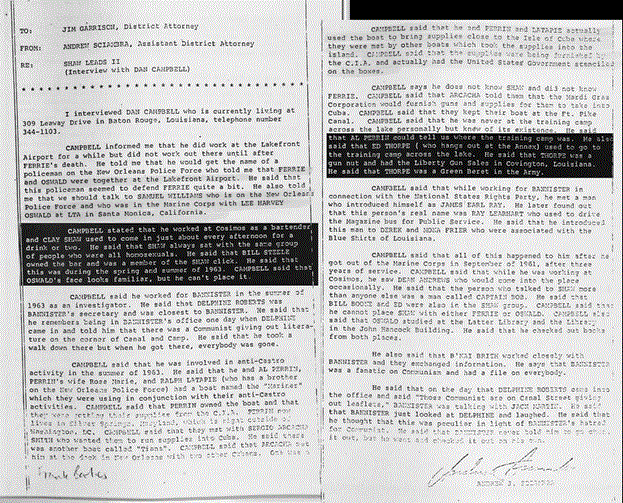
    No Krazy Kid Oswald book would be complete without the obligatory gratuitous attack on Jim Garrison, so it comes as no surprise to find one in Beyond Reasonable Doubt. Although there is literally nothing new or original anywhere in the book, the chapter entitled “The New Orleans Debacle” still manages to stand out as the most outdated and ultimately worthless chapter in the entire volume. Which, as the reader can see, is quite a negative achievement. The authors make no reference to any of the numerous files from Garrison’s investigation which were made public in the 1990s by the ARRB. Or any of the official government documents detailing just how his probe was obstructed at a federal level. Instead they dust off the same tired old fabrications, half-truths and innuendoes that were long ago debunked and discredited by real researchers like Jim DiEugenio, Lisa Pease and Bill Davy.

    Ayton and Von Pein launch their assault by claiming, without a shred of evidence, that the former District Attorney of New Orleans “came to prominence through corruption and a dangerous lust for publicity,” (p. 262); and by shamelessly repeating a ridiculous charge that Garrison was a “psychopath” of the “charming con artist” variety. (p. 263) With nothing of substance to support any of this garbage the authors quickly move on to the overly used Mafia smear, implying that Garrison was lenient on organized crime because of some unspecified relationship with Mob boss, Carlos Marcello. In support of this they offer a September, 1967, article from Life magazine. What they don’t tell readers is that the author of the piece, Sandy Smith, was an FBI collaborator whom the Bureau itself described as “a great admirer of the Director” who had been “utilized on many different occasions.” (Davy, Let Justice Be Done, p. 162) Additionally, one of the researchers for the article was one David Chandler; a close friend of Clay Shaw; the man whom Garrison had indicted for conspiracy to kill the President. Pointedly, the Life article offered nothing of substance beyond the “revelation” that Garrison’s tab had been picked up by management when he stayed at the Sands Hotel in Las Vegas. Garrison himself laughed off the insinuation, pointing reporters to a hefty valet and telephone bill. “Apparently I am not very highly regarded by the Mafia”, he quipped, “if they won’t even pick up my phone bill.” (Ibid, p. 153)

    Ayton and Von Pein claim that Garrison’s initial investigation of the assassination “stalled when he found no evidence to support his suspicions” and that after a 1966 conversation with Senator Russell Long he “reopened his investigation immediately and found an alleged getaway pilot…David William Ferrie.” (p. 265) This is not even close to what happened.

    On the weekend of the assassination, private detective and police informant, Jack Martin, had telephoned assistant DA, Herman Kohlman, to inform him of a seemingly mysterious trip to Texas that Ferrie had taken with two friends, Alvin Beauboeuf and Melvin Coffee, on the day of the President’s murder. Martin told Kohlman that Ferrie had known Oswald for some time and may have been his superior officer in the Civil Air Patrol. (HSCA Report, p. 143) When Ferrie arrived back in New Orleans on November 24, waiting police officers took him to the DA’s office for questioning. Garrison found “indigestible his explanation that he had driven through a thunderstorm to go ice-skating in Texas” and turned Ferrie over to the FBI for further questioning. (Garrison, A Heritage of Stone, p. 102) But the Bureau was not looking to find a conspiracy. So they quickly let Ferrie go without charge. Even though Ferrie committed perjury numerous times in his FBI interview. (DiEugenio, Destiny Betrayed, Second Edition, pgs. 176-77)

    Three years later, his conversation with Long now made him question the efficacy of the Warren Report. Garrison again wondered about the drive through a violent thunderstorm Ferrie and his companions had taken on the evening of the assassination to go ice-skating in Texas. Of course, Ayton and Von Pein maintain that there was nothing suspicious about this trip, and they quote Beauboeuf as saying that it was not even Ferrie’s idea, it was his. (p. 269) Indeed this is precisely what Beauboeuf told the DA’s office, adding that he had planned it a week in advance and they had left around 4:00 PM. The trouble is, Coffee gave a different story. He claimed that the trip was Ferrie’s idea, that he had made arrangements a couple of days in advance, and that the trio had departed after dark, around 7:00 PM. Ferrie gave a third version of events, claiming that the trip was an entirely spontaneous affair. They had left after supper time to go ice-skating and duck hunting, each taking a shotgun along. Yet Beauboeuf and Coffee both insisted that there were no weapons in the car. (Davy, pgs. 45-46) The conflicts in their accounts understandably heightened Garrison’s suspicions. The only point that Ferris and his friends agreed on was that at some point that evening they arrived at an ice-skating rink in Houston. Intriguingly, the owner of the rink, Chuck Rowland, told Garrison’s office that Ferrie did no skating. Instead, he spent his time making and receiving calls on the public telephone. (Ibid)

    Before he left for Houston, however, Ferrie had an important errand to run. As Oswald’s former landlady, Jesse Garner, told the HSCA, Ferrie turned up at her house that evening asking about Oswald’s library card. Apparently, Jack Martin had circulated the story that Ferrie’s card had been found amongst Oswald’s possessions after his arrest and Ferrie was worried that it might be true. When Garner refused to talk to him, Ferrie visited her neighbour, Doris Eames, asking if she “had any information regarding Oswald’s library card.” (10HSCA113-114) Ayton and Von Pein want this connection between Ferrie and Oswald to disappear so they withhold Ferrie’s actions from their readers and point out that the story of his card being among Oswald’s possessions was simply made up by Martin. (p. 271) But the truth of the story is irrelevant. What matters is that Ferrie himself clearly believed it was possible that Oswald had his library card, which demonstrates that he had been in contact with Oswald in the summer of 1963. And right then and there, any objective person would wonder what the rightwing, CIA affiliated Ferrie would be doing associating with the former Marxist defector.

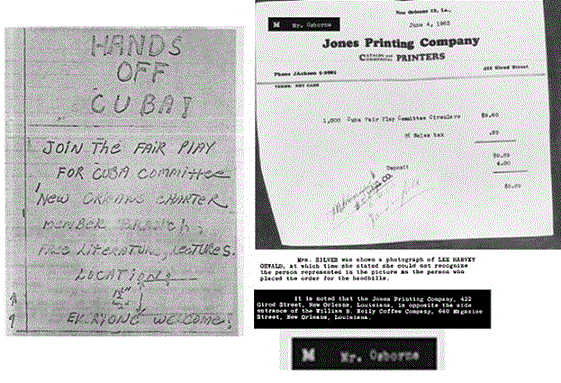
    Ayton and Von Pein admit that Ferrie and Oswald were photographed together at a Civil Air Patrol picnic when Oswald was 15 but they downplay the significance. They can get away with this because they do not reveal Ferrie’s search for his library card after the assassination. Or the fact, that Ferrie was trying to track down that photo in the wake of the assassiantion. (DiEugenio, Reclaiming Parkland, p. 152) And they do not inform readers of yet another connection between the two men. During his summer in New Orleans, Oswald had launched a one-man chapter of the Fair Play for Cuba Committee and stamped the address “544 Camp Street” on some of his FPCC leaflets. That famous address was one entrance to the Newman building, which also housed the offices of former FBI agent turned private investigator, Guy Banister. And guess who was doing investigative work for Banister in 1963? None other than David Ferrie. Not only did Oswald stamp the address of a building Ferrie was working out of on his pamphlets, numerous witnesses placed Oswald himself in Banister’s office. (see DiEugenio, Destiny Betrayed, second edition, pgs. 110-113) The fact that Oswald was associating with CIA-connected, violently anti-communist activists like Banister and Ferrie obviously suggests that his FPCC activities were a ploy; part of a plan to discredit the organization. And it is now known that both the CIA and FBI were running projects aimed at doing just that. The idea that Oswald was involved in this effort is re-enforced by the fact that his activities only resulted in embarrassing the FPCC when Oswald was eventually “exposed” as a communist during a radio debate.

    Regardless, Ferrie did have an association with Oswald and, since Banister had died before Garrison began his investigation, Ferrie became the DA’s principle suspect. That is, until the investigation went public and Ferrie suddenly turned up dead. At that point, Garrison concentrated on finding the mysterious “Clay Bertrand;” a name that appears in the Warren Commission volumes thanks to the colorful testimony of French Quarter lawyer, Dean Andrews. Andrews told the Commission that he had recieved a call from Bertrand on the day of the assassination asking him to fly to Dallas to represent Oswald. According to Ayton and Von Pein, this was just “one version of Andrews’s story. In another, he told the FBI the whole thing had been a hoax.” (p. 266) In actual fact, as Andrews testified for the Commission, he had been pressured by the FBI to the point that he told them to “Write what you want, that I am nuts. I don’t care.” Which is precisely what the Bureau did. Despite the fact that Andrews’s secretary, Eva Springer, and his employee. R.M. Davis, both confirmed that Andrews had told them about the Bertrand call on the weekend of the assassination. (Davy, pgs. 51-52)

    Ayton and Von Pein do not care about such facts, though, they just want to pretend that Bertrand either did not exist or had nothing to do with Oswald and the assassination. Needless to say, they choose not to tell readers that FBI agent Regis Kennedy confirmed under oath at the trial of Clay Shaw that he been seeking a Clay Bertrand in connection with the assassination before the FBI had even spoken with Andrews. (Ibid, p. 194) The truth is that Clay Bertrand most defintely existed and his real name was Clay Shaw. As declassified documents have revealed, the FBI knew this to be true at least as far back as February, 1967. One particular memorandum, dated March 2, states, “On February 24, 1967, we recieved information from two sources that Clay Shaw reportedly is identical with an individual by the name of Clay Bertrand…” Another, dated March 22, reports that “three homosexual sources in New Orleans and two homosexual sources in San Francisco have indicated that Clay Shaw was known by other names including Clay Bertrand.” (Ibid, p. 193)

    Like just about everyone else who appeared on Garrison’s radar, Shaw was heavily connected to the CIA. Ayton and Von Pein recite the apologists mantra that Shaw was just one of many normal businessmen who supplied information to the Agency’s Domestic Contacts Service. Unfortunately for the authors, at the 2013 Wecht Symposium, author Joan Mellen presented a newly discovered internal CIA document which states in black and white that “Clay Shaw was a highly paid CIA contract source until 1956.” His relationship with the Agency clearly extended for quite some time past 1956, however, as other documents show that he retained a covert security clearance until at least March 16, 1967. (Ibid, p. 195) Unfortunately for Garrison, he could not prove this at the time and it hurt his case because it left him unable to provide a motive for Shaw to participate in a conspiracy.

    One thing Garrison could and did prove is that Shaw was seen in the company of Ferrie and Oswald when the trio made visits to the small towns of Clinton and Jackson, Louisiana in the summer of 1963. The witnesses to these appearances remain as credible and convincing as ever despite numerous attempts to make them appear otherwise. Ayton and Von Pein have little choice but to suggest that they were all liars and; relying on a far-fetched conspiracy concocted by Garrison-basher, Patrica Lambert; write that the Clinton witnesses “embellished the truth” and “conspired to invent stories…” (p. 277) This is laughable idiocy. The Clinton-Jackson folk whom Lambert suggests were plotting together included both right-wing whites; some of whom were actually Klansmen; and oppressed blacks! It also included the two children of State Representative, Reeves Morgan. How on Earth did these folks all come together? And to what end? It boggles the mind. As Jim DiEugenio recently noted, “…to propose that dozens of witnesses, young and old, white and black…all lied for Jim Garrison is simply a non starter.”

    Although Garrison had a number of witnesses who could place Shaw with Ferrie and Oswald, he only had one whose testimony directly implicated Shaw in the assassination. A young insurance salesman named Perry Russo said that he attended a gathering at Ferrie’s apartment in September, 1963, where Shaw, Ferrie, “Leon” Oswald and some Cubans discussed the assassination. Ayton and Von Pein give us the usual spiel that Russo did not begin talking about the so-called “assassination party” until after he was administered Sodium Pentathol (commonly known as “truth serum”) and hypnotized. But this claim was flatly disputed under oath by both Russo and the assisstant DA who first interviewed him, Andrew Sciambra. (DiEugenio, Destiny Betrayed, second edition, pgs. 218, 246)

    The authors also allege that “At the time of the Shaw trial, Russo had second thoughts about his testimony…refused to repeat the fabrication about the Ferrie party” and “recanted” to Shaw’s lawyers. (p. 280) This is unmitigated nonsense. At Shaw’s trial, Russo spent two and a half days on the stand repeating and defending the testimony he gave at the preliminary hearing. It was almost two years after the trial was over, whilst Garrison was rightly attempting to prosecute Shaw for perjury, that Russo approached Shaw’s lawyers. From the time of Shaw’s arrest, Russo’s integrity had been under attack and he came to feel that his involvement in the case had ruined his life. Consequently, he told Shaw’s lawyers that he no longer wished to testify for either side. But he never said that the assassination discussion at Ferrie’s had not happened. His “recanting” really only amounted to saying “Not really” when asked if he was positive that Shaw was Bertrand. And this was after Shaw’s lawyers threatened to make an issue of Russo’s sexual proclivities. (Joe Biles, In History’s Shadow, p. 123)

    The veracity of Russo’s account, and Shaw’s participation in the assassination, will likely be debated forever. At the end of the day, the jury at Shaw’s trial did not believe that Russo’s testimony alone was enough to prove Shaw’s guilt beyond a reasonable doubt. But this in no way, shape, or form indicates any wrongdoing by Garrison and his staff. Garrison had every reason to believe Russo, especially after he attempted to verify Russo’s account using Sodium Pentathol and hypnosis. Lone nut authors like Ayton and Von Pein like to repeat claims made by Walter Sheridan and NBC that Garrison’s staff bribed and intimidated witnesses and used “other questionable tactics.” (p. 267) Yet all of these ridiculous allegations were long ago proven to be completely false. In fact, the unehtical witness intimidation and bribery was done by Sheridan, NBC, Hugh Aynseworth and James Phelan: all allies of Clay Shaw. (See the second edition of Destiny Betrayed, pgs. 237-55, for a long and detailed expose of these matters.) Garrison noted in his famous 1967 interview for Playboy magazine that the entire purpose of such charges was “to place our office on the defensive and make us waste valuable time answering allegations that have no basis in fact.” This still holds true today as false allegations of improprieties by Garrison’s office provide Warren Commission apologists with a useful tool to distract others from the valuable facts the DA uncovered.

    Ayton and Von Pein seem to be implying that Garrison violated Shaw’s rights when they say that he “leaked details of the case” and “presented his findings on ‘The Tonight Show Starring Johnny Carson’”. (Ibid) Yet one of the very first things Garrison said to Carson during his appearance on the show was “I wish you’d also ask me any questions, of any kind that occur to you, as long as they don’t touch on Mr. Shaw. I haven’t made a comment about Mr. Shaw since the day we arrested him, and I don’t intend to talk about him.” The authors also recite the age-old smear that Garrison “had not brought the case of Shaw to trial to solve the assassination, but to further his own ambitions.” (p. 283) Which makes very little sense. Garrison provided an eloquent response to this in his Playboy interview: “…I’m inclined to challenge the whole premise that launching an investigation like this holds any political advantages for me. A politically ambitious man would hardly be likely to challenge the massed power of the federal government and criticize so many honorable figures and distinguished agencies…why would I climb out on such a limb and then saw it off?…I was perfectly aware that I might have signed my political death warrant the moment I launched this case; but I couldn’t care less as long as I can shed some light on John Kennedy’s assassination.” In reality, Garrison threw away a very promising political career in pursuit of the real facts about Kennedy’s death. One that very likely would have led to the governor’s office. (DiEugenio, Destiny Betrayed, seocnd edition, pgs. 169-74)

    The truth is that the too-trusting, sometimes gullible Jim Garrison did make some serious mistakes, and there are a number of legitimate criticisms than can reasonably be made of his investigation. But you will not learn of any of them from reading Beyond Reasonable Doubt.

    VIII

    This review could go on and on. But pointing out everything that is wrong with, or missing from, Beyond Reasonable Doubt would require an encyclopedia-size book of its own. And there is no need because it has already been amply demonstrated above that Ayton and Von Pein care little about the truth. They have an agenda, a theory to push, and like all theorists they deal only in what is convenient to them. In the process, they repeatedly make blatant hypocrites of themselves. The authors stand on their soapbox, yelling about how “conspiracy advocates…have continually abused the evidence in the case” and “mispresented the facts through selective use of witnesses”. (p. 348) But, as I have shown time and again above, these are the very tactics they themselves employ throughout their tedious, unoriginal, and uninformative volume.

    As I have tried to make clear in this review, Ayton and Von Pein prove themselves to be masters of cherry-picking and misrepresenting evidence. Further examples could be gleaned from just about any page of their book. For instance, in their treatment of the Single Bullet Theory, they allege that “All wounds to both men [JFK and Governor Connally] are perfectly consistent with the Single-Bullet Theory” (p. 90). But they are witholding the fact that the throat wound was missed at autopsy and the emeregncy room doctors who did see it said that it appeared to be consistent with an entrance wound. The authors further state that “All three…wounds on JFK and Connally line themselves up in such a fashion on the bodies to give the general appearance that they could have all been caused by just a single missile…” (Ibid) What they do not admit is that, although the precise location of the back wound was not recorded by Kennedy’s pathologists, experts agree that it was anatomically lower than the hole in the throat. Or that the diameter of the back wound was larger than the throat wound. And nowhere in Ayton’s and Von Pein’s defense of the indefensible SBT is there any mention of the fact that the only physical inspection of the back wound ever conducted indicated that it was shallow and with no point of exit.

    As well as all the selectivity and misrepresentation, the authors show themselves to be more than willing to stoop to the construction of straw man arguments. For example, they write that multiple gunmen in Dealey Plaza is “very unlikely from the popular ‘Oswald was framed as the patsy’ perspective. Would any conspirators have deliberately been so foolhardy and utterly reckless as to fire several bullets into JFK’s body…and yet still expect every last scrap of ballistics evidence to get traced back to only Lee Harvey Oswald’s rifle..?” (pgs. 91-92) The reason this qualifies as a straw man argument is because it conflates the conspiracy to kill Kennedy with the conspiracy to cover it up. We have no reason to believe that the two were orchestrated by the same people and no reason to believe that Kennedy’s killers wished to hide the existence of a plot. In fact, there is a general consensus among sensible researchers that those responsible for the assassination may have wanted it to appear as if Oswald was part of a hit team organized by Fidel Castro. And the fear of what might happen if word should get out that Castro killed Kennedy is what led to the cover-up and the creation of the lone nut legend.

    Perhaps the most troubling thing about Beyond Reasonable Doubt is that it tries to push the notion that Lee Harvey Oswald should be treated as guilty until proven innocent. In the final chapter, Ayton and Von Pein try to outdo the prince of hyperbole, Vincent Bugliosi. The authors actually state their absurd belief that “not a ‘scintilla’ of evidence has been found which would call into question Lee Harvey Oswald’s guilt, beyond all reasonable doubt.” (p. 346) Not only is this statement laughably wrong on a factual level, the attitude behind it is one that attempts to turn the American judicial system on its head. Had Oswald lived to face trial, he would have been legally entitled to a presumption of innocence until proven guilty. In death, the Warren Commission and its acolytes have attempted to strip him of that right. Yet the cold, hard fact remains that no one has ever come remotely close to proving Oswald’s guilt beyond a reasonable doubt; least of all Ayton and Von Pein.

    What do the authors offer? They give us the testimony of Howard Brennan; a man who failed to pick Oswald out of a line-up and admitted that his own recollection had been clouded by outside influences. They give us an old, dry palm print and some fibers on the rifle that may or may not have come from a shirt Oswald was probably not wearing at the time of the assassination. And they offer a highly contradicted, uncorroborated, and probably false claim that fragmentary fingerprints on the rifle could be matched to Oswald’s prints. In the end, their entire case rests on the dubious claim that the rifle found on the sixth floor belonged to Oswald. Yet assuming that to be true; which is a big assmumption–what does it actually prove? Would it not make sense for someone wishing to set Oswald up to use a rifle traceable to him? The inarguable fact is that Oswald did not have the rifle in his posession for at least two months leading up to November 22, 1963, and nobody can vouch for its whereabouts during that time.

    As former Dallas Police Chief, Jesse Curry, candidly admitted to the Dallas Morning News in 1969, “We don’t have any proof that Oswald fired the rifle, and never did. Nobody’s yet been able to put him in that building with a gun in his hand.” This statement remains as true today as it did in 1969, whether Ayton and Von Pein like it or not. In the words of attorney Jeremy Gunn “…there is just no question that [Lee Harvey Oswald] is not guilty beyond a reasonable doubt.”


    (Editor’s Note: Ayton and Von Pein rely on the work of Michael O’Dell to discredit the HSCA’s acoustics evidence of a second gunman. Don Thomas had at one point indicated he would publish an appendix to this review showing the “faults” in that work; in the meantime, one may refer to Thomas’s 2001 article, “Echo correlation analysis and the acoustic evidence in the Kennedy assassination revisited”, published in the peer-reviewed Science & Justice.).
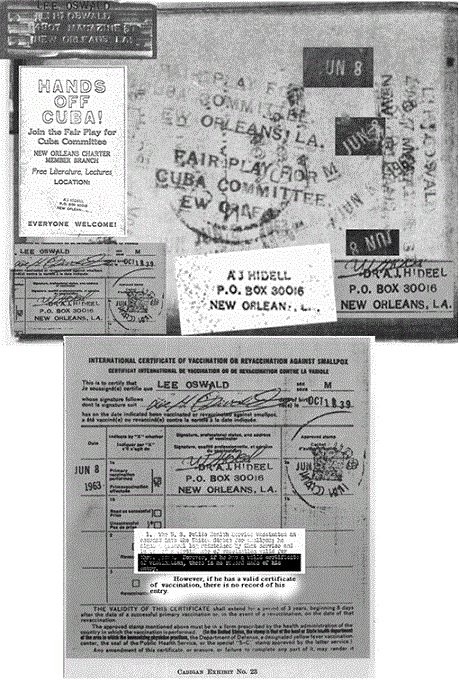
  • Philip Shenon’s Crap Detector


    Shortly after Ernest Hemingway won the Nobel Prize (1954), Time Magazine writer Bob Manning visited him in Cuba to do a cover story interview. A decade later, Manning joined The Atlantic Monthly. He revisited his notes and published “Hemingway in Cuba” in the August 1965 issue of that periodical. One remembrance from that piece was Hemingway’s notion of fiction writing as “to produce inventions that are true.” Hemingway elaborated: “Every man should have a built-in automatic crap detector (…) If you’re going to write, you have to find out what’s bad for you.”

    Philip Shenon, a veteran investigative journalist who spent most of his career at The New York Times, uses this machine for nonfiction writing on the JFK assassination. But in reverse, as a way of bringing forward the detected crap as good arguments for supporting his nonsensical hypothesis. Which is, “Oswald did it, Castro helped.”

    After Shenon’s crap detector worked flat out in A Cruel and Shocking Act (Henry Holt and Co., 2013), it is now doing overtime in the new paperback edition of the book by Picador (2015). From its afterword Shenon has just drawn an essay, “What Was Lee Harvey Oswald Doing in Mexico?” (Politico Magazine, March 18, 2015). Here Shenon does his, by now, usual high wire balancing act about how the Warren Commission was not really fraudulent or wrong, it just did not have all the facts it should. And therefore “historians, journalists and JFK buffs…would be wise to look to Mexico City.” What balderdash.
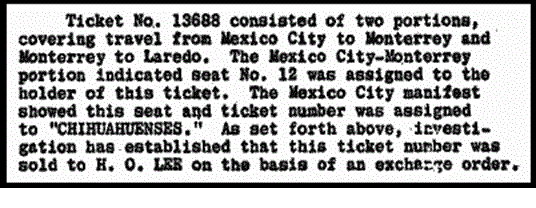
    Why? Because Shenon deliberately ignores all the sound and provocative investigations that have been conducted about Mexico City since the creation of the declassification process by the Assassination Records Review Board. These inquiries would include, among others, the integral and seminal “Lopez Report” done for the House Select Committee on Assassinations, John Newman’s work in Oswald and the CIA, John Armstrong in his book Harvey and Lee, Jim DiEugenio in the second edition of Destiny Betrayed and Bill Simpich in State Secret. All of these authors; along with the most recent investigator, David Josephs–get the back of Shenon’s hand. As if nothing they produced has any relevance at all to the mystery of what Lee Harvey Oswald was doing in Mexico City; or if he even went there. Because, as both Josephs and Armstrong conclude, he did not; at least not the way the Warren Commission and FBI say he did.

    Which brings up another dubious point about Shenon’s piece. In it, he writes that the FBI never adequately investigated Oswald’s voyage to Mexico City. This is simply not true. With ample evidence, both John Armstrong and David Josephs demonstrate that the FBI did investigate this aspect of Oswald’s life as well as they could. The problem was that the evidence trail they found was so full of holes, and so patently falsified by both the CIA and the Mexican authorities that it was almost made to fall apart upon any rigorous review. To use just one example: to this day, no one knows how Oswald even got out of New Orleans to Houston on the first leg of his journey. Or when he actually left the Crescent City. Its not that the FBI did not investigate this aspect. They did. But they could not find any ticket made out to Oswald from New Orleans to Houston or New Orleans to Laredo, which is where the official story has Oswald headed after Houston. The FBI did an extensive check on the two bus lines that could have gotten Oswald out of New Orleans after he closed his post office box and cashed his unemployment check. They could not come up with anything to substantiate Oswald’s travel to Houston. (See Commission Document 1553, based upon Bureau investigation by agent Stephen Callender.)

    Or how about this one by our New York Times veteran. He writes that the CIA had Oswald under surveillance in Mexico City. If that is the case then why, when the FBI got the audiotapes of Oswald in Mexico, the tapes did not match Oswald’s voice? (James DiEugenio, Destiny Betrayed, Second Edition, p. 357) And why has the Agency never been able to produce a photo of Oswald entering the Cuban or Soviet embassies there? Why did they send a photo of a person who was clearly not Oswald to the Warren Commission? And why did the Commission then print it in its volumes? (ibid, p. 354) Shenon tries to cover up this lacuna by saying that there is evidence some people saw a photo, and maybe station chief Win Scott saw a photo of Oswald in Mexico City at the time. For instance, if Mexico City station chief Win Scott saw a photo of Oswald why did he then not show it to David Slawson and Bill Coleman of the Warren Commission, when they visited him? They were there for that express purpose: to inquire about Oswald’s activities in Mexico City. (ibid, p. 360)

    Shenon fails to point up the reason we know about all these problems in the evidentiary record about Oswald and Mexico City. We know about them because of the work of Dan Hardway and Ed Lopez of the House Select Committee on Assassinations. While preparing their 300-page report about Oswald in Mexico City, they found the work of Slawson and Coleman to be completely inadequate. They then got access to the CIA cable traffic record to and from Mexico City for the period of September,1963 to November 22nd. This is something the Warren Commission never even thought of doing. Their report is largely based upon that traffic; along with the records of the raw data as produced by the CIA’s electronic and photographic surveillance of the two embassies. This latter record, is again, something that Slawson and Coleman never even approached as evidence while they were there. This is why, in the Warren Report and in the Slawson-Coleman report, one comes away very puzzled over two further lacunae. Neither source record mentions either David Phillips or Anne Goodpasture. Both of these people had cleared access to the surveillance raw data out of the embassies. And there is evidence that both of them helped falsify the record of Oswald allegedly being there. (ibid, pgs. 354-55) If Slawson and Coleman had done their jobs correctly this information and falsification could have been caught back in 1964. Shenon does not mention these facts.

    Nor does Shenon measure Slawson’s hoary canard about how any plot could not have been a far flung or complex one since Oswald did not get his job at the Texas School Book Depository until October, and the motorcade route was not announced until November. Shenon ignored the facts that the first announcement about Kennedy’s trip to Texas was made April 23, 1963. It was made by Lyndon Johnson in Dallas and reported in the Herald Tribune the next day. This was echoed with a specific note to Kennedy from a local Dallas resident already working on the visit. Again, Dallas is mentioned in the note dated June 12, 1963. There is also a story in the same paper in September which also states Kennedy will be coming to Dallas. Further, people organizing the visit that fall knew it would have to be late in November due to scheduling problems. In other words, maybe be Commission was in the dark about this, and the public. But not people in the White House, advance man Jerry Bruno, or the business and political elite in the Dallas-Fort Worth areas. (See the online essay “Why JFK Went to Texas” by Joe Backes) Further, Shenon fails to mention that the failed Chicago plot to kill JFK mirrored, in its design and mechanics, the successful Dallas one. If that is not complex planning in advance, I don’t know what is. (See Jim Douglass, JFK and the Unspeakable, pgs. 202-18) Could Castro have really done all of this maneuvering in two cities?

    Instead our intrepid NY Times veteran peoples his mission of twisting conspiracy “facts” against Castro with the following “experts:”

    – Thomas Mann, U.S. Ambassador in Mexico; who “suspected” and “was under the impression…”

    – Winston Scott, CIA Chief of Station in Mexico City, who also “suspected…”

    – David Slawson, WC investigator, who “believes” and has another “suspicion…”

    – Clarence Kelley, FBI Director, who “came to believe”

    – William Sullivan, FBI Assistant Director, who “admitted huge gaps” in the record

    – David Belin, WC staff lawyer, who “came to believe…”

    – Charles William Thomas, U.S. diplomat, who “was told by a friend…”

    – And finally, “people who suggest that Oswald had many more contacts with people in Mexico City who might have wanted to see JFK dead…”

    Let’s summarize. None of the Shenon’s sources brought a single quantum of proof for turning plausible his Castro hypothesis. Their suspicions, impressions, beliefs, admissions, second-hand tales, and suggestions are linked to long-ago debunked stories. For sticking with them along the substantiation of his hypothesis, Shenon must concoct, among others, these facts:

    “Oswald had visited Mexico City (…) apparently to obtain a visa that would allow the self-proclaimed Marxist to defect to Cuba.”

    Knowing that appearances deceive, Shenon fabricates this one to get around the fact; proven by both CIA transcripts of taped phone calls and eyewitnesses at the Cuban Consulate; that “Oswald” asked the Cubans for an in-transit visa with the declared intention of going to the Soviet Union. For defecting to Cuba, he would have only needed to say it at the spot. Shenon simply hides that Marxist Lee in Mexico City perfectly blends with Castroite Harvey in New Orleans due to a CIA-FBI joint operation to discredit the Fair Play for Cuba Committee (FPCC). As Jim DiEugenio discusses in Destiny Betrayed Oswald was not connected with Castro, but with the CIA and anti-Castro Cuban exiles. (See especially pgs. 101-66)
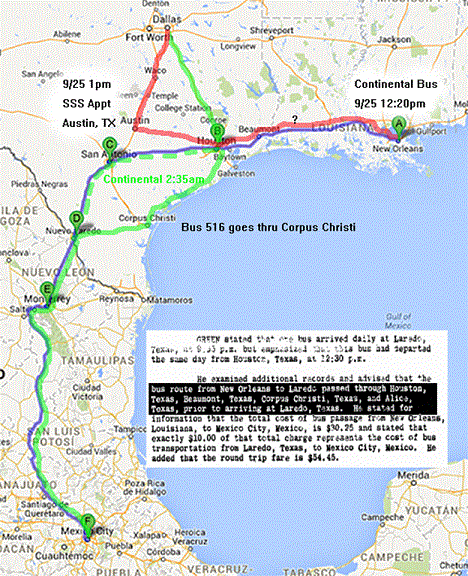
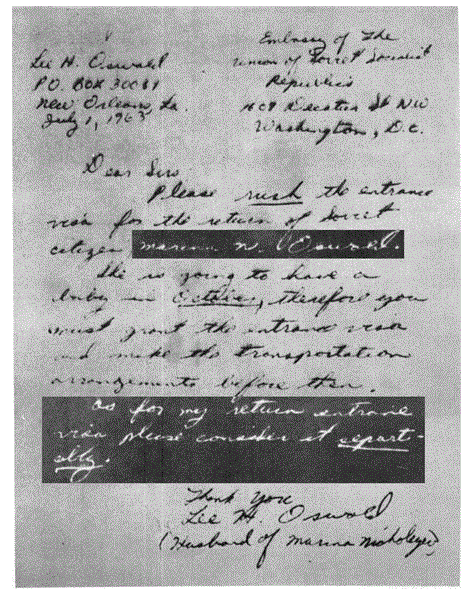
    “Oswald’s six-day trip to Mexico was never adequately investigated by the CIA… and the State Department.”

    Shenon is correct here. But not in his nonsense that the plot to kill Kennedy was hatched in Mexico by Castro agents, and the U.S. agencies covered it up to avoid World War III. The cover up by the CIA started before the assassination, as John Newman has so thoroughly established since Oswald and the CIA. When CIA officers like James Angleton began to bifurcate the Oswald file in advance of the trip to Mexico. (See Newman, p. 393)

    “And in fact, lots of evidence has accumulated over the years to suggest [it] would be wise to look to Mexico City.”

    Shenon is writing as if the HSCA’s Mexico City Report, also known as the Lopez Report (1978) wouldn’t have been almost fully declassified in 2003. It provides lots of collusion going on with the CIA in regard to Oswald in Mexico City, from phony cables to senior officers blatantly lying on facts as they were happening before the JFK assassination. It’s almost as if Shenon does not want the reader to know about this bombshell report.

    “Much evidence about Oswald’s Mexico trip; including CIA tape recordings of wiretaps of Oswald’s phone calls in Mexico; never reached the [Warren] Commission.”

    That’s half-true. These tapes not only never reached the WC, but also have been never produced by the CIA, even though their transcripts were found. Since the CIA remained silent before the assassination about calls indicating that Oswald had been impersonated, no tapes at all is a conspiracy fact; as Gaeton Fonzi crystal clearly explained in The Last Investigation (Thunder’s Mouth Press, 1993; that turns Shenon’s hypothesis into excrement. (See Fonzi, p. 294)

    “If Oswald openly boasted about his plans to kill JFK among people in Mexico, it would undermine the official story that he was a lone wolf whose plans to kill the president could never have been detected by the CIA or FBI.”

    FBI super spy Jack Childs reported on his mission (SOLO-15) to Cuba in March 1964 that Castro himself had told him: “When Oswald was refused his visa at the Cuban Embassy in Mexico City, he acted like a madman and started yelling and shouting on his way out, ‘I’m going to kill this bastard. I’m going to kill Kennedy’.” Shenon recycles this discredited report and magnifies such an outburst; at the Embassy, not at the Consulate; as an assassination plan. Even though the HSCA already put the issue to rest in its Final Report (1979): “Nothing in the evidence indicated that the threat should have been taken seriously, if it had occurred, since Oswald had behaved in an argumentative and obnoxious fashion.” (italics added) And, in fact, as both John Newman and Arnaldo M. Fernandez have shown, it likely did not happen. (See section six of the following review for details, http://www.ctka.net/reviews/shenon.html)

    Shenon’s “Oswald did it, Castro helped” must match with the notorious fact that a former Marine, re-defector from the Soviet Union, who had openly engaged into pro Castro activism in New Orleans, according to Shenon, this man was spotted by the CIA in Mexico City on September 27, 1963, as soon as he visited the Cuban and the Soviet diplomatic compounds. Since the CIA and the FBI missed him as a security risk in Dallas by the time of JFK visit, Castro could have helped the killing only in a conspiracy of silence with the CIA. Thus, Shenon’s crap detector didn’t find out what’s good for him.

    “State Department and CIA records declassified in recent years show that the agencies rebuffed Thomas in his requests for a new investigation.”

    That’s another half-truth. Thomas’ request was rebuffed on the grounds that the subjacent story; told by his friend, Mexican writer Elena Garro; was mere crap, like all the other allegations of red conspiracies in Mexico City made by Gilberto Alvarado, Pedro Gutierrez, Salvador Diaz-Verson, Vladimir Rodriguez Lahera, Antulio Ortiz Ramirez, Marty Underwood… etc. Shenon interweaves some of these, and other inventions that are not true, in order to arrive beforehand at a fact-free analysis on the Castro connection. As Hemingway told Manning, “no good book has ever been written that [way].” Accordingly, Shenon’s latest essay on the JFK assassination is another cruel and shocking act against his readership. But before leaving it at that, let us add one other pertinent and disturbing fact about Shenon and his latest diversion from the truth.

    Why did he write such a book? In his original 2013 edition, Shenon wrote that his inspiration for writing the volume was a call he got from a junior counsel to the Commission. Once he agreed to the project, this unnamed counsel then got him in contact with the other surviving staffers. According to researcher Pat Speer, the mysterious caller was none other than Arlen Specter, Mr. Single Bullet Theory himself. Since Specter died in 2012, and Shenon’s book was first published in 2013, it turns out that; via Shenon–the Philadelphia lawyer was continuing the JFK cover up from his grave.

    with Jim DiEugenio

  • Introduction to the 2013 Presentation on the HSCA

    Because of the creation of the Assassination Records Review Board (ARRB) we now know a great deal more about what went on behind the scenes during the years of the House Select Committee on Assassinations (HSCA). When Robert Blakey took over that committee, a veil of secrecy descended over it. This differed from the approach his predecessor, Richard Sprague, had taken. Sprague realized that a serious problem with the Warren Commission was that it had worked too much in secret. There was no kind of open, transparent democratic process involved in their efforts. Sprague wanted to avoid this. Therefore he announced that he would have open hearings and public experiments.

    When Sprague was forced out, Blakey pretty much reversed this policy. He did have public hearings near the end of the inquiry, but as we know today, these were largely scripted. And that was about it for transparency. This was actually even worse than the Warren Commission. Because with the executive branch agencies—which the Commission was—one can use the Freedom of Information Act (FOIA) to ferret out records and testimony. And to a degree, this did happen. (Although, contrary to what some obtuse commentators say, there was still material being withheld by the Commission even after the ARRB closed down. Like the working papers of David Slawson.)

    But there is no FOIA law for the legislative branch, which the HSCA was. Thus it was not really possible to find out if their reports concealed anything from their proceedings. With the declassification of the ARRB, we now know that the HSCA did do this. For example, as Gary Aguilar has noted, the HSCA medical report lied about witnesses at Bethesda Medical Center not seeing a gaping hole in the rear of Kennedy’s head during the autopsy. So today, there is large agreement about both witnesses from Parkland Hospital and Bethesda seeing this large, avulsed wound in the rear of Kennedy’s head. Which strongly indicates a shot from the front. We also know that the HSCA covered up evidence in their report that proved it was Clay Shaw driving the car in the Clinton-Jackson incident with David Ferrie and Lee Oswald, not Guy Banister, because Sheriff John Manchester swore to this under oath in executive session (William Davy, Let Justice be Done, p. 106). The HSCA also concealed the fact that it was not just Jack Martin who saw Oswald at Guy Banister’s office in the summer of 1963. Several other witnesses also saw him there (James DiEugenio, Destiny Betrayed, Second Edition, pgs. 110-14). The HSCA Report also did not reveal that investigators Dan Hardway and Ed Lopez prepared perjury indictments for David Phillips and Anne Goodpasture for lying to them about Mexico City. And lastly, Robert Blakey did not mention in his report that there was massive interference with the committee’s work by the CIA. He does admit that today.

    Further, many of the so-called scientific panels and experts that Blakey relied upon have also been called into serious question. For example, Vincent Guinn’s bullet lead analysis has today been completely discredited (James DiEugenio, Reclaiming Parkland, pgs. 71-76). Thomas Canning, his trajectory analyst, has also been undermined (Destiny Betrayed, p. 344). And Blakey accepted the so-called sniper’s nest evidence of the rifle and three shells. Further analysis has proven this evidence is dubious (ibid,, pgs. 343-44).

    There were some good things in the published HSCA volumes. For example, Gaeton Fonzi’s work on Sylvia Odio and Antonio Veciana; the panel on Jack Ruby’s polygraph; the report on Rose Cheramie. But today most informed observers understand that this was a blown opportunity, the last chance to actually find out who killed President Kennedy became a victim of politics.

    That political maneuvering was hidden at the time of the HSCA’s published report. Therefore, some critics – Peter Scott, Paul Hoch, and Josiah Thompson – actually took the report seriously. They then wrote an unpublished manuscript called Beyond Conspiracy. They worked from premises that were (falsely) developed by the HSCA. For example, that the single bullet theory was valid, and that the Chicago Mafia was a real player in the plot. Thank God, this book was never published. If it has been it would have 1.) given more ballast to a false narrative, and 2.) eventually would have deposited a lot of egg on the authors’ collective faces – though that may be hard to do in Hoch’s case, since at the end of the inquiry, he actually said he preferred Blakey’s approach to Sprague’s. As Gaeton Fonzi noted, Tony Summers also fell for Blakey’s mob did it scenario. As he was reviewing the galleys for Summers’ first edition of Conspiracy, he was taken aback by how much of the mob angle Summers included. But it was actually worse than that. In a later edition, Summers actually included the CIA memo saying that John Roselli had met with Jim Garrison in Las Vegas. This was preposterous on its face. But not only Garrison, but as Joan Mellen has shown, Roselli and even Richard Helms denied it happened.

    Today, with the declassification process, we know much more about the HSCA and why it failed. This visual presentation does not at all pretend to the tell the whole story of how that happened. It serves only as a précis of that wasted opportunity. But it does so with much new information culled from those files. And it shows, as Ben Franklin said long ago, that secrecy is the enemy of democracy, not security.


    {aridoc engine=”google” width=”400″ height=”300″}images/ppt/HSCA.ppt{/aridoc}


    Version in .pdf

  • Mexico City, Part 4 – Leaving Mexico, Part 1

    Mexico City, Part 4 – Leaving Mexico, Part 1


    Mystery Man with Oct 4 1964 notation – see p5

    INTRO

    In virtually every research piece related to Mexico City from Sept 25 – Oct 4, 1963 there exists an acceptance that the Oswald killed by Jack Ruby actually took the trip, while the calls from the Cuban Embassy themselves, especially Saturday the 28th’s activity, are understood as neither Oswald or Silvia Duran.

    One must accept that the famous and published “Mystery Man” photo in question was taken on October 4th. The FBI claims the reason for its existence was related to Ruby, and proving Marguerite Oswald was not shown a photo of Ruby in Mexico. If Oswald’s movements were actually closely watched as Win Scott claims; no one in their right mind associates our Oswald with the man in the photo. This only comes from the self-incriminating “This is LEE OSWALD” phone statement and the translator’s claim the voices are the same as the “others” from previous calls, on which the caller did not state his name.

    If the desire of a PLAN was to leave evidence of this trip to implicate Oswald at some later date, the job was poorly done; as there does not appear to be any significant evidence to corroborate the stamped dates on the famous tourist visa; the FM-8, with any travel evidence along the way. In fact, the evidence, as I will show, makes it appear that either a tourist visa was created after the fact, or the means of travel had nothing to do with buses. If an Oswald crossed into and out of Mexico on the dates reflected on that stamped visa, it was not a result of the bus trips offered, or the witnesses who place him on these buses. In fact, the original information on these dates of travel come from a completely different source.

    If Lee or some other impersonator was to establish that Oswald traveled from New Orleans to Mexico City, a 4-part bus ticket for the full round trip would fit the bill. What we find instead are elements of the CIA, FBI and DFS working together to piece together the elements of the trip based on the TIMINGS of the transportation and the events attributed to this Oswald rather than the physical evidence.

    The concerns over this Mexico Trip immortalized in the October CIA cables were front and center in the minds of many on the evening of Nov 22. That the name “OSWALD” was transcribed in a CIA/DFS operation of extreme sensitivity, and connected with information on one Lee HENRY Oswald by CIA HQ , one who had little if anything to do with the photos which would ultimately be associated with the name. Some claim this was part of a mole hunt on the part of the CI-SIG section of Angleton’s CIA.

    What is ultimately the purpose of the calls and the evidence related to them may never been known.

    One certainty remains though; Ms. Sylvia ODIO and her sister were truthful about our Oswald at their home on Sept 27th when the EVIDENCE tries to suggest he is in transit to Mexico in the days immediately after Ruth Paine takes his family away. In this truth we find once again that the FBI is more than willing to create evidence of their own as well as believe the evidence the CIA created to fit the desired conclusion. Surely a CI/SIG mole hunt at the Mexican CIA station would have little if anything to do with the lack of evidence related to the trip itself. With relative ease the authorities found the records of anyone and everyone who may have traveled WITH this Oswald; just not the evidence for his travel.

    If an innocent loner was traveling to Mexico innocuously to get he and his wife back to the USSR, to Odessa for the birth of their 2nd child in mid-Oct; there would be little if anything to hide in the way of travel arrangements. The record shows the numerous attempts Marina and Harvey took to secure a Russian visa thru normal channels. Instead we find that CIA assets inside and outside the Mexican government conspired to create a story of travel which fits the need yet could not overcome the lack of its reality.

    In our final article we will show who these assets are, what they were doing in these early hours and days after 11/22 and how the most contradictory of evidence can be accepted without a question in the face of what our non-Oswald entity is doing in Mexico City.

    CE3097: Vaccination card supposedly found at Beckley

    Oswald’s stamp kit practice pad shows the signs of what would appear on the FPCC handbills and the date June 8, 1963 which I could never understand until the Mexico connection to the requirement that those returning to the US must either get vaccinated or show a valid certificate of vaccination was found. It is quite obvious that the stamped letters on these forms match the stamp kit. Problem being this kit was never found or listed on the DPD inventories prior to Nov 26th nor do we see the DPD initials on either side of this card which ALL items sent to DC had; not all of them had these initials when the evidence was returned. This kit only comes into existence when all the items are returned to Dallas by the FBI on Nov 26th; in other words, it was never found in Oswald’s possessions, it was added to his inventory after the fact.

    To Recap Part 2b:

    – The TRAVEL portion of the Mexico Trip was “correctly established by the WC” so much so that the HSCA (or any other subsequent investigation) did not bother to even attempt to analyze this information and accepted it at face value (in fact few if any researchers have deeply analyzed this travel which the WCR claims put Oswald at the Cuban Embassy making calls starting Sept 27th at 10:37am… his bus supposedly arrived at 10am)

    – The photos of the “Mystery Man” were all taken AFTER the evidence establishes this man left Mexico City – before 8am Oct 2nd and that a call to the Embassy attributed to Oswald was made on Oct 3rd when Oswald was in Dallas at a Texas Employment Commission meeting.

    – The document which informs us that the only NEW ORLEANS to Houston bus Oswald could have been on to corroborate the McFarlands’ statement about his being on the Houston to Laredo bus was backdated from September 21, 1964 to December 10, 1963.

    – The statement of the McFarlands is the ONLY evidence which specifically places Oswald on the bus from Houston to Laredo. The McFarlands were not called to testify.

    – The passport with all the Russian stamps as mentioned by an Australian woman, Ms. Mumford, either had to be the 1959 passport, not the newest passport from June 1963 which had no stamps at all CE 1969; a completely different passport entirely; or the information was provided her about the passport which places Oswald in Russia. The normally tight-lipped Oswald behaved as contrary to his persona as possible as told by the McFarlands and Ms. Mumford.

    – David Atlee Phillips arrives in Mexico as Chief of CUBAN OPERATIONS on October 7th According to Tad Szulc, his biographer, E. Howard Hunt was Temporary Chief of the Mexico Station during the summer of 1963.

    – Many, many more Mexican INS inspectors were working at Nuevo Laredo on Sept 26th than are acknowledged by the FBI evidence while the McFarlands are checked into Mexico by neither Maydon nor Ramos while supposedly being on the same bus as Oswald. The mode of transportation for BOWEN and OSWALD was not stated in the FM-11.

    – Bowen/Osborne does not corroborate the evidence by stating that is was not OSWALD sitting next to him on the bus from Nuevo Laredo to Mexico City. (Note: we will find the same thing occurring on the Mexico City to Laredo trip; those on the acceptable bus who were asked did not recall anyone matching Oswald’s description)

    – While the pre-assassination evidence shows the person traveling was known as H.O. LEE, the post-assassination evidence shows that the name was treated as if it was L.H. OSWALD for alphabetization and investigative purposes.

    – ARTURO BOSCH changed the Transporte Frontera passenger manifest from a 1pm NOVEMBER 1 departure to a 2pm OCTOBER 2 departure and added the name “OSWLD” and “Laredo” to the manifest (among other things). We come to learn that Mexican Presidential Officials were at the Frontera bus line office (Mexico City to Nuevo Laredo) before they came to the Flecha Rojas offices (Nuevo Laredo to Mexico City) to take that evidence “soon after the assassination.”

    – A conflict exists between the bus schedule times of the Flecha Rojas bus which states it leaves Monterrey at 3:30pm and the Continental bus schedule which shows its sister bus leaves Monterrey at 7:30. Mumford claims to have taken the 7:30 “Del Norte” bus (corroborated by McFarland’s statement about them getting on the bus in the evening of Sept 26th) which arrived in Mexico at 10am Sept 27th. Anyone traveling on the 3:30pm bus would have arrived at 6am in Mexico City.

    – There is no evidence offered about a 7:30 Del Norte bus from Monterrey to Mexico City other than as a result of an inquiry by SS Inspector Kelly asking SAIC Sorrels about travel from Dallas or Houston to Laredo. The bus schedule shows a bus leaving Monterrey at 7:30pm and arriving in Mexico at 9:45am Sept 27th. Sadly, the only piece of evidence for this portion of the trip is one of the documents taken “soon after the assassination” – the baggage manifest listing Lee H Oswal(j/t) leaving Nuevo Laredo at 2pm Sept 26th with one piece of checked luggage.

    OPENING EYES: THE EVIDENCE IS THE CONSPIRACY

    In virtually the same manner as the “Oswald at the window with a rifle” evidence was created and submitted as evidence circumstantially incriminating Oswald, the evidence for this trip to and from Mexico follows the same M.O. We can definitely understand the need not to tip the Cubans or Russians regarding one of the, if not THE world’s largest communication interception operation by either publishing the Mystery Man’s photo or by publishing anything in the report which would divulge sources and means. This carefulness cannot be said for the travel portion of this trip, the location of his stay or in the activities he would have engaged while there. These details of the Mexico story take a backseat to the serious events related to his supposed time there and the events recorded which would incriminate our man Oswald. Their relative unimportance in the scheme of things makes them that much more easy to hide them in plain sight within the evidence.

    While speculation is grand, there remains not a stitch of corroborated evidence that our, or any Oswald, existed outside of the hotel or the Cuban/Russia embassy/consulate. There is also no corroborated evidence it was actually Oswald at the hotel or government buildings at all.

    The orchestrated removal of Richard Sprague from leading the House Select Committee’s investigation into the assassination of JFK had more to do with the CIA’s evidence from Mexico than anything else. From Gaeton Fonzi’s, The Last Investigation, we learn from Sprague that the CIA’s Secrecy Agreement was born out of Sprague’s desire to see ALL the Mexico City evidence; the “In Mexico” incriminating evidence of which we come to find there are thousands upon thousands of pages all with the same conclusion: we really don’t have the evidence to corroborate that any one person took any part of this trip, so they created some.

    Before we proceed, let’s take a moment and take a mindset break. In 1963 the average citizen did not exhibit the same levels of paranoia towards their government as we see today. And for good reason, “Conspiracies” were something the Commies ran when trying to steal our secrets and upset our way of life. Who believes anything we’re told anymore? Today we KNOW conspiracies are part of how government is, was and always will be run. In 1963, the US government was still the good guys to the everyday person. The WCR and a handful of wolves within the democracy would change all that forever.

    The stay in Mexico itself is defined by CIA/DFS documentation and FBI reports. In the Mary Ferrell Warren Commission Documents (CIA/FBI/SS/State) database alone there are over 1200 references to “MEXICO,” with thousands of other references in a variety of other locations related to the CIA’s Mexico records. What we have not finally concluded is whether a real person actually traveled in and out of Mexico at the start and end of these activities; whether there is a direct connection between the man claimed to be traveling to and from Mexico and the activities at the Cuban and Russian consulates/embassies; or whether select parts or the entirety of the Mexico visit evidence was created in reports and provided in testimony to tell a story.

    To begin, we will look at how the evidence of the trip ended with Oswald in Dallas. Then we can address a call on the morning of Nov 23rd which must convey the start and end dates of this trip as well as which border crossing was used when, according to records reviewed to date, there was no communication between the CIA and anyone else related to this trip from Oct 24th thru Nov 22nd; especially nothing having to do with the travel aspect such as mode of transport, location of border crossing, hotel, etc…

    Treasury’s INS officers in Laredo (or Washington DC for that matter) were made aware of these dates and that specific border crossing (especially given that the photos are from Oct 4th yet the info offered pointed to his leaving on the 2nd) from an “unnamed governmental agency.” We will attempt to prove that the limited knowledge of those following the request of this “unnamed governmental agency,” who asked Lester Johnson of the INS to call Mr. PUGH, Mr. KLINE and Mr. MAY in Laredo, had to have come to them from a very small circle of possibilities.

    Keep in the back of your mind the real possibility that the CIA and FBI knew our Oswald was in Dallas, as most of the affiliated Cubans were connected to the CIA, and more specifically David Phillips. They may have even sent him there as part of his infiltration into Communist organizations in order to keep him out of the way.

    Yet, on the return, before our man Oswald reaches Laredo, Texas, he must first travel from Mexico City thru Monterrey and arrive in Nuevo Laredo, across the border, exchange his Del Norte ticket #13688, and proceed on.

    Strangely, the evidence first received from confidential Mexican sources describes an entirely different trip than what was finally settled upon by the WCR and FBI.

    LEAVING MEXICO

    Before we actually get into the buses and other travel evidence, we should address the evidence regarding the date of the Mystery Man photo published in the WCR, since one has such a huge bearing on the other. In this Russ Holmes exhibit we see the Same Mystery Man photo yet now with the date October 1 on the back instead of October 2. So far this is the only document I have found which connects these photos with a date other than October 2nd, 4th or 15th.

    This CIA chronology of photos is taken from Russ Holmes’ work files shows that no photos were taken on October 1, 1963; that instead they were taken on the 2nd, 4th and 15th of October by LIMITED, LILYRIC and LIONION…

    Every single image we are shown of the mystery man was taken after the travel plans attributed to him take him from Mexico City. There are numerous photos of the WHITE SHIRTED mystery man at the above referenced and offered link; all dated October 2 at 12:22pm. One can understand now how a bus had to be found which left AFTER these photos were taken; the FRONTERA manifest was changed to reflect just such a departure time: 2pm Oct 2nd. Later in this paper we will learn why the FRONTERA bus was used at first.

    But let’s not get ahead of ourselves. For now we’ll stay with the Official Oct 2nd 8:30am Del Norte departure which makes the Mystery Man timings all the more confusing and complex. Bill Simpich’s State Secret, and many other articles, delve deeply into the potential reasons for the Mystery Man interest and what might have been going on at the Mexico Station. For this series though we will stay with the evidence that tries to corroborate Oswald’s trip out of Mexico City NOT by auto, but by Del Norte to Greyhound buses.

    MEXICO CITY TO LAREDO OCT 1, 2 OR 3- DEL NORTE

    While we can talk about our traveling Oswald asking PEDRO RODRIGUEZ LEDESMA to call for a taxi between 6:30 and 7am for his leaving early in the morning of the 2nd (while evidence suggests he left the 1st and did not stay at the hotel that night), the taxi evidence winds up recapped in FBI reports which only have the most dubious of corroboration. This man signaled with his hands and said “taxi” which PEDRO interpreted as his not being able to speak Spanish. We are to believe that Pedro does not know the name of the taxi driver nor his passenger’s destination and simply left this gringo in a cab without any word of help. We are to remember from his arrival that the bus terminals are within a short walk of the hotel and that no one sees this man with more than a small brown zippered bag. The report of this activity is contained within CE2121 p56 and CE2532 p13-14:

    We will learn a bit later that the Hotel Registry was also taken “soon after the assassination” by the same person… But I get ahead of myself. The FBI said they had to search through 1600 hotels to find where he stayed while a main Mexican contact provides the hotel registry “soon after the assassination.”

    The evidence offered begins with this Sept 30th receipt #14618 for Mr. H O LEE to travel on the Del Norte line from Mexico City on October 2nd leaving at 8:30am. CE 2530:

    (Note: As we know, our Oswald was pretty good at causing disturbances both real and contrived. If the CIA needed a memory to stand out in witnesses’ minds (think Azcue and the argument) Oswald was their man yet these impressions where not left with anyone with whom he came in contact as they could have been.)

    From the ARRB’s release “Trip to Mexico” p4:

    What I find strange about this “receipt” is that the logo at the top covers the name of the business and does not look like part of the original. Also, the normal two-hole punch in these exhibits seems to only have one hole punched with the other covered by this black area. Finally, the translation says the name of the travel agent was “Agencia de Viajes Transportes Chihuahuenses”

    But that is not what it says:

    The result of this purchase is shown in CE 2536 which in turn becomes the basis for the Greyhound exchange transaction which occurs in Laredo, TX. Once again we will find discrepancies between the dates of the purchase, the dates of travel, and the date of the exchange. What I will proceed to show now is that ticket #13688 was never issued or used, yet represents the only argument against the FM-11 stating Oswald left Mexico in an auto. CE 2123 p674 is the WCR copy of the FM-11 page in question. Please notice that Mr. LEE is alphabetized as Mr. Oswald even though all of the travel plans for the exit from Mexico are made out to H.O. LEE.

    When the ticket stub for the Mexico City to Laredo portion of the trip, FBI D-237, is found in a suitcase in the possession of Marina Oswald (which had been at the Paines at the time of the assassination) the creation of this travel evidence comes full circle and is laid once again at the feet of Marina and Ruth.

    WCD1518 p33 (below) is an FBI report which states that Marina informed Wesley Liebeler that she had found a bus ticket stub for the Mexico City to Laredo portion of the trip only 9 months after the fact.

    Also found in this one suitcase:

    – Paperback pamphlet (English and Spanish tourist guide) from the week of September 28 to Oct 4, 1963 supposedly with Oswald’s writing inside

    – The book, “Learning Russian”

    – A guide map to Mexico City printed in Mexico DF; Marina confirms this was Oswald’s (how exactly is unknown and one would think that Ruth’s place and Oswald’s belongings had been picked over pretty well by then)

    – A paperback pamphlet “FIESTA BRAVA” also published in Mexico

    – A Russian library pass good at libraries in Russia.

    The image below these descriptions is a composite of FBI D-202, the 2 stubs provided by the Mexican Authorities:

    And D-237:

    These, the envelope they came in, the seat #12 Chihuahuenses ticket #13688 passenger manifest with an “X” thru it and the receipt for their purchase are the sum total of the evidence which gets our Oswald from Mexico City to Laredo Texas aboard Del Norte bus #332 leaving at 8:30am, getting to Monterrey at 9:30pm and arriving at Laredo around 2am. This timing will come into play later when Mr. Voorhees, a passenger supposedly on this bus, makes his statement about when he arrives in and leaves Monterrey.

    It was determined that D-202 was attached to D-237 at some point using the magic FBI evidence confirmation pixie dust. (Or the fact that they themselves separated them?)

    So, Okay. There IS a bus that is scheduled to leave and arrive when it needs to if ANY of this evidence is authentic. But we did not start with Del Norte.

    FRONTERA FIRST; THEN NOT SO MUCH

    We are to remember that the evidence which FIRST was associated with this trip from Mexico City to Laredo comes from the Arturo Bosch altered FRONTERA passenger manifest. Eventually, when it was decided that our man Oswald was NOT on the FRONTERA 340 bus at 2pm, it was dropped like a hot potato.

    Yet thru March/April 1964 it was believed that this evidence was accurate. WCD 684 p2-CE2122 even though the rest of CE2122 is dedicated to explaining away the conflicting evidence for what is seen on this manifest. There is no mention of ARTURO BOSCH or his handiwork in this Exhibit. CE2122 p5:

    CE 2470 (below) lets us know that ALVARADO was interviewed extensively on Dec 7th; again no mention of BOSCH in this report (which appear to be confined to info from WCD 1084). In this earlier Feb 15th report we are informed that officials simply could not find a ticket to cover Oswald’s travel on FRONTERA bus #340 leaving Mexico at 2pm.

    CE2471 dated February 20, 1964 reinforces that FRANCIS ALVARADO from the Transportes FRONTERA terminal in Mexico City was interviewed and had no explanation for “OSWLD” or the other changes to the FRONTERA manifest. It also confirms that this information was received between Dec 7 and Dec 17, 1963.

    CE2471 p1:

    As we continue thru this mountain of back-peddling muck we need to remember that the evidence says that our Oswald was at Odio’s on Sept 27th and in Dallas from the 27th of Sept “possibly” thru Oct 4th when he finally calls Marina.

    (NOTE: FBI 124-10230-10450 dated Nov 27th is a memo from J.B. Garcia to Legat which tells us that he spoke with SA CHAPMAN in Laredo and “no pertinent info had yet been developed re: exact time or specific mode of travel of subject” [Oswald]. Now while that is no great revelation considering what we know at this point yet the more interesting thing to me is the last sentence of the memo where CHAPMAN advises that “Dallas had info subject was in Dallas [Oct 4 notation] and made LD call to another city in Texas (Irvin or Irvine).” Marina did get a call from Harvey on the 4th asking her to ask Ruth to come get him as he’s been in Dallas QUOTE a few days UNQUOTE. Marina supposedly was so mad about his not contacting her sooner she said no and Oswald hitchhiked to Irving)

    How is it possible that Dallas is aware of a call from a payphone to Marina on the 4th of October; which did actually happen; yet cannot pull it together enough to find authentic evidence of this massive bus trip.

    Our Oswald did not make this trip in the manner suggested nor is there any authenticated evidence which links our Oswald to being in Mexico. With this understanding we may better see the iterations the FBI went thru to find the means of travel to and from Mexico City while we operate under the conclusion that IF an imposter (or even our Harvey) went on this trip they would have left a wake of easily found evidence taking him from New Orleans to Mexico and onto Dallas.

    What could have caused the FBI to cling so tightly to FRONTERA as the means of transportation given what they learned from ALVARADO and LOPEZ in early December? Well, a few pages after CE2122’s “BACKGROUND OF INQUIRY” lets us know that the “OSWLD” on the FRONTERA manifest is “clear evidence” that Oswald took that bus leaving at 1pm (sic), CE2122 tells us that the check with Transportes Del NORTE turned up “completely negative results” for any record of LEE, HARVEY or OSWALD on the only two buses Del Norte offers to Laredo.

    With only Flecha Rojas and FRONTERA left as bus related options for Oswald to not leave Mexico in an AUTO, the FBI was running out of options. We must remember that we are offered EVIDENCE that Oswald was on both these buses without regard for why either or both of this fraudulent evidence even exists. Furthermore, once FRONTERA id dropped, “WHY” this evidence was created by Mexican Authorities is never explored.

    CE2121, WCD1084 and WCD1063 make up as large portion of the haystack in which the FBI attempted to hide the needle which was that Oswald did not take the trip as offered. Any other option includes either outside help to get him into Mexico (although there is very thin evidence he actually was there) or he was impersonated purposefully. If the person the FBI claims was OSWALD left by AUTO, either driving himself or with others, conspiracy possibilities as to the purpose of the trip come more clearly into focus. This also fits more neatly into the Duran, Alvarado, CIA/DFS games. When our Oswald becomes a LONE NUT, this wonderful corroborative evidence for a conspiracy involving Castro gets flushed. Since the FBI could not allow these options to surface, and the photos are taken at 12:22 on Oct 2nd, we are treated to the mid-March declaration that our man Oswald was on the FRONTERA bus.

    So here we are in mid-March, Del Norte investigations have resulted in no information to show H.O. LEE or Lee H. Oswald purchased or traveled on a Del Norte bus. ALL other investigations into travel produced negative results related to Oswald. By default, the FBI stays with the FRONTERA bus leaving Mexico at 2pm (not 1pm as stated above) and arriving in Laredo at 7am, Oct 3rd.

    – that is until it was realized that leaving Mexico City at 2pm on the 2nd of October (which describes the created FRONTERA manifest departure time) would not get Oswald to Dallas in time for his Texas Employment Commission meeting in the afternoon of the Oct 3rd . The following is yet another mid-March FBI report dealing with the conflicts brought about by retrofitting Oswald onto buses which do not fit with the timing; the same thing occurred for the 4:40pm to 12:20pm bus out of New Orleans to Houston. Since the 12:20 was the only bus that arrives close to the right time, Oswald must have been on it. It’s not that there is no evidence for these trips, just that the evidence was created, altered or never offered, or in fact contradicts the reality of this travel.

    Like finding out about Tague and changing 3 shots to 2 shots, discovering the conflicts of working Oswald piece-meal thru this trip caused the same changes and impossible explanations.

    Well prior to these March revelations is a report from Dec 3, 1963. The driver of FRONTERA BUS #340 leaving at 2pm on Oct 2 FRANCISCO SAUCEDA VELEZ tells us his bus does not arrive until 6:45am in Laredo and that his relief driver was old and tired so he drove all the way thru to Laredo. Eugenio GARCIA tells us that the stubs of all tickets sold in Mexico City make their way back to Monterrey in 2-3 months yet the ticket sold to OSWALD was never received. Mr. GARCIA also mentions that “agents of the Presidencia had picked up all information re OSWALD’s trip… Including the “talonario” (block of ticket stubs)

    It is not until Mid-March again that the FBI figures out FRONTERA cannot possibly be the bus he left Mexico City riding. Furthermore, it is Del Norte that has the relationship with Greyhound.

    The problem being that this FBI report (at Armstrong’s Baylor collection p 2 below) states the conflict and somehow mixes up the 2pm FRONTERA departure time and the Del NORTE 8:30-9am departure (if they got the information from the above report they may have missed it was a FRONTERA report and not Del Norte). The FRONTERA trip was not expected to arrive in Laredo until the morning (6:45am) of October 3rd which in turn would be too late an arrival for Oswald to travel the remaining 10-12 hours from Laredo thru San Antonio to Dallas to arrive by the time he is seen at the TEC and then check into the YMCA by 4:30pm.

    For the FBI’s story to continue to work, Oswald MUST arrive in Laredo, process his exchange ticket and get on a bus leaving before 3am; and even that is cutting it close to try and have Oswald at the Dallas TEC before 4:30 and check into the YMCA between 4:30 and 5:00.

    The following offers the evidence which put Oswald in Dallas in the afternoon of Oct 3rd:

    Baylor Armstrong collection TEC folder p40-43:

    Only one Greyhound bus leaves Laredo TX and arrives in Dallas with enough time; bus #1265 leaving Laredo at 3am. We will of course examine the evidence which places Oswald on this bus shortly.

    Yet, the evidence offered states Oswald left by “AUTO”. This is an image of the photostat of a TYPED COPY of the original FM-11 information given to US Customs official CASH on Nov 23rd. The FM-11 as mentioned and partially shown above is the Mexican Immigration alphabetized by day master list created from the cancelled FM-8 tourist visas and will be discussed at length later in this article. (Typed FM-11 info – Hood collection)

    And here is the line from the FM-11 CE2123 p676 from which the Oct 3rd information was supposedly taken:

    This information in turn MUST come from the FM-8; the Mexican tourist visa. Now, I have to stop here for a second since I recently had an “Aha” moment related to this visa. The application for this visa from Sept 17th and addressed in part 1 of this series was always shown one way, with the CE# sticker at the bottom and the signature cut off… CE2481 p677. The next page though is SAME EXHIBIT yet adjusted to show the entire bottom of the exhibit while losing the header, Application # and the serie (sic) number 24085 seen on the visa. CE2481 p678. The following is a composite of the two copies of the application which to me appears to suggest that an FM-5 was applied for with a different number and Oswald’s signature while 24085, without his signature could have been created after the fact. These are COPIES of COPIES of COPIES which make alteration virtually impossible to detect.

    An FM-8 is good for 15 days after entering Mexico. An FM-5 is good for 6 months after entry. The Oswald FM-8’s have typed on them “VALIDA POR 15 DIAZ” yet the bottom of this “other” copy of the application states that this tourist card would be good for a “six month stay.”

    Fast forward a few more days and we have a report over Hoover’s name which squarely puts Oswald on the Del Norte bus at 9am Oct 2nd. On April 7th two ticket stubs for seat #12 on the Del Norte bus at 9am are acknowledged. These tickets (as shown above) bear the number 13688 and are related to this early morning departure of Del Norte bus 332. (Even though the search from Del Norte produced no results)

    Can THIS finally be the evidence which corroborates the FM-11 info about “Viaja en Auto” being a typographical error based on a mistake by a clerk?

    THE SHIFT TO DEL NORTE, TICKET #13688 & THE GREYHOUND EXCHANGE

    WCD 828 p1 (below) offers the evidence that on April 7th D-202, the #13688 ticket stubs and envelope prove that Oswald was on bus #332 and #373.

    Can these ticket stubs with seat #12 (or is it seat #2 with a “1” added later?) be connected to Oswald?

    As mentioned above, in late August 1964 Marina finds the corroborating evidence for Del Norte bus ticket #13688. WCD 1518 p34 (below) discusses the details of what would ultimately become FBI D-237.

    In an undiscovered, small brown suitcase which was in Ruth’s garage on 11/22 yet was neither opened or inventoried by the DPD, Dallas Sheriffs or FBI during the previous 9 months, we find pamphlets specific to that one week along with other Mexico related travel documents that were again, not found until August 1964. No matter for these could at least get Oswald to Laredo which in turn allows us to connect this arrival via Del Norte to the Greyhound Exchange order CE2537. CE 2537 p761:

    The only major discrepancy found here is the DATE OF SALE and stamp of October 1, 1963, when according to the evidence offered, this passenger actually purchased this exchange order from the travel agency mentioned at the bottom of this order on September 30th as shown above in CE 2530. It was also during this transaction that Del Norte ticket #13688 was supposedly purchased.

    WCD 785 p15 (below) is a recap of ticket #13688 which jumps to the conclusion that the Greyhound bus exchange order is what connects seat #12 to H.O. LEE.

    CE 2531 (below) shows the recording of this sale and transfer from the Del Norte bus where he supposedly used ticket #13688 from Mexico City to Laredo, to a Greyhound bus from Laredo to Dallas for one “Mr. H. O. Lee.” So far so good, right? The FBI may have finally gotten one right! Yet we both know that wasn’t going to happen here. Let’s find out why.

    For all this evidence to be authentic and to represent something that actually happened, our traveler had to have been on the Del Norte 8:30am bus using #13688 in the first place. Once again we come to find that while the TIMING WORKS, there is no corroboration that an Oswald was on these buses.

    The next part of this final article will look at the evidence which attempts to corroborate that Oswald was on these buses.


    The Evidence IS the Conspiracy, Table of Contents


  • Mexico City, Part 3 – The Trip Down, Part 2

    Mexico City, Part 3 – The Trip Down, Part 2


    At this point we’ve shown:

    -Oswald in New Orleans while simultaneously in and around Dallas with Jack Ruby during the summer of 1963

    -The New Orleans Oswald working with anti-Castro forces while publically being recognized as pro-Castro

    -The Dallas Oswald was seen with Maurice Bishop aka CIA’s David Phillips

    -The Dallas Oswald visited Robert McKeown requesting to purchase scoped rifles at ridiculously high prices

    Ruth Paine and children arrive in New Orleans to whisk Marina and child away to Irving, TX leaving Oswald alone to his own devices 3 days before Nagell’s predicted assassination dates of Sept 26-29.

    -The Lee Harvey Oswald who left 4905 Magazine a mess and owing back rent carried two suitcases onto a downtown bus the evening of Sept 24th only to return the following day in order to retrieve and cash a $33 unemployment check from the Texas Employment Commission.

    -The FBI could not locate Oswald for the evening of Sept 24th, nor could they find any record of Oswald leaving New Orleans on ANY bus which could get him to Houston in time to perform activities the evidence shows he did.

    -The Australian women who spoke with Oswald on the Monterrey to Mexico City leg of the trip claims to have purchased Transporte del Norte bus tickets yet describe a journey that has been documented to have occurred on a Flecha Rojas bus. The WCR simply states she was wrong about the bus line. (We will show in this article how Mumford, Bowen nor the McFarlands could have been on this Flecha Rojas bus leaving Monterrey and in turn presented or was given a fabricated story)

    -Witnesses claim to have seen Oswald sitting on this bus with Mr. Bowen aka Albert Osborne.

    -The man representing himself as Lee Oswald presumably purchased a Houston to Laredo Ticket after midnight in Houston.

    -There is no record of a bus ticket purchased which would carry Oswald from Nuevo Laredo to Mexico City.

    In this part we will continue to examine evidence related to the bus travel to and from Mexico, testing the theory that this evidence does not corroborate the Commission’s conclusion, and even suggests that the entire body of evidence getting Oswald in and out of Mexico was created just for that purpose.

    The “Lopez Report,” an excellent reexamination of the WCR’s Mexico trip focusing on the Embassy/Consulate visits and transcripts but offers the following and little else related to evidence of Oswald’s travels into and out of Mexico. This is from page 3 of the introduction.

    Asking whether Oswald was proficient with a rifle evades the evidence that he was not at the window and the rifle was never in his possession. Discussing whether an OSWALD may be our Oswald performing this or that act in Mexico while the evidence does not support his having traveled by the means the FBI evidence suggests seems to me two sides of the same conspiracy. Since the FBI/CIA presents evidence of an Oswald in Mexico, he must have traveled to Mexico and NOT been at Odio’s.

    We will present FBI/CIA evidence this same Oswald calls the Soviet Military Attache again at 3:39pm on October 3rd when our Oswald is at the Texas Employment Commission in Dallas. According to the evidence, the very first call on Sept 27 at 10:33am was also to the Soviet Military Attache and NOT the Embassy or Consulate. This call dealt specifically with what Win Scott tells us about Oswald; he was attempting to get visas to Odessa (how Oswald has the number to the Soviet Military Attache in Mexico City remains a mystery). This call on the 3rd confirms we are dealing with an imposter and the fact these mystery man photos are taken on Oct 2nd, 4th and beyond, and not on the 27th, 28th or the 1st strikes me as yet another very strange inclusion to the evidence for no “apparent” reason.

    We will be concluding this series in the next and final article with a look at this “In Mexico” evidence to determine whether this evidence corroborates my developing theory that whoever was in Mexico playing Oswald had nothing whatsoever to do with the person claimed to be on these bus(es)s or in that hotel. Another thread running through this whodunit involves the inner workings of a plot not entirely related yet conveniently available for CYA within the assassination investigation.

    Thanks to Russ Holmes’ collection at Mary Farrell’s site we have info about Mexico akin to the autopsy’s Sibert/O’Neill report with truths seen thru the eyes of evidence rather than the filter of deception. The following image from Oct 4 becomes Odum Exhibit #1 – Vol 20; with a touch of widening it appears; and the CIA has the chutzpah to claim this is Lee HENRY Oswald without mentioning this is 2 days after he supposedly left. One has to wonder about the purpose of this photo at all other than as a breadcrumb in a trail.

    The FBI could not admit Oswald had entered Mexico under unknown circumstances as this would trigger thoughts of a conspiracy. On Sept 26th an innocent man was supposedly traveling to Mexico. It is concluded he takes a bus from his home and has no visible means to secure or drive an automobile. In fact, Lee Harvey Oswald needs to take a series of buses from New Orleans to Mexico City as he is both alone and does not drive. A journey of biblical proportion way back in the day… just extremely long bus rides for our purposes.

    NUEVO LAREDO TO MONTERREY TO MEXICO CITY

    There is no record in Evidence which shows that H.O. LEE (his Mexican travelling aka) bought a bus ticket on Flecha Rojas bus #516 leaving Nuevo Laredo at 2pm Sept 26th arriving in Mexico City 10am Sept 27th after stopping in Monterrey.

    The Evidence will show that the Australian women who speak with Lee Oswald could not have been on the same bus which left Monterrey at 3:30pm and arrives in Mexico City at 10am. We will attempt to show it is highly likely her and other first-hand witness testimony about these bus rides and the stay in Mexico is fabricated like pieces of a jigsaw to form a picture in the minds of those observing. A loosely bound together series of lies which becomes a story potentially needed in a few weeks to silence remorseful or inquisitive thoughts.

    The baggage manifest for the Flecha Rojas bus trip from Nuevo Laredo thru Monterrey to Mexico City and the entrance stamp on his tourist visa (FM-8) is the physical evidence offered by the WCR to place Oswald on this bus or, in fact, anywhere else on Sept 26th/27th.

    CE2482 – Flecha Rojas baggage manifest:

    WCD 306 p.4 suggests that the man claiming to be Oswald had to have shown these girls the passport taken to Russia in 1959 since Oswald’s June 1963 passport would not have these Russian stamps. The one with the 1959 photo of LEE Oswald does not match the man’s photo from only one week later and as I will show, does not match the arrested image of Oswald. (Under the premise the story was provided to aid with the self-incrimination of Oswald; none of this actually happened. What the props were in this fictitious account is of no consequence)

    WCD 306 p.5 offers the FBI’s version of how Mumford and Winston realized that the Oswald in Dallas on Nov 22 was the Oswald they remembered from the trip to Mexico City. Interesting how this man from New Orleans tells them:

    Miss MUMFORD. No, I can’t really put it into his words; not at that stage. He then proceeded to tell us about himself.

    Mr. BALL. What did he say?

    Miss MUMFORD. I will have to refer to notes. Oh, yes; the first thing he told us was that he was from Fort Worth, in Texas

    The man Ruby killed arrived in NJ from Russia on June 13, 1962. He went to 7313 Davenport in Ft. Worth to stay with his brother ROBERT. His “mother” quits a job and moves to Ft. Worth to be near her “son.” Oswald leaves Ft. Worth about 4 months later for Dallas (604 Elsbeth) where he lives until May 1963 when he moves to NOLA (4907 Magazine).

    Robert Oswald lived in and around Fort Worth most of his civilian life up to the Mexico Trip. We will be offering a tidbit of evidence in the final article via US INS thru Mexican INS at Miguel Aleman that Oswald’s brother entered Mexico at Miguel Aleman the same day Lee enters at Nuevo Laredo.

    The Oswald Ruby killed could generously be called tight-lipped, loner, unto oneself and detached when in non-intelligence related activities like cover-work and home life. Yet for this scenario we are fully expected to believe he is a self-incriminating chatter-box with suggestions of communist leanings as if something important hinged upon the performance… or it was one really good story provided witnesses and without corroboration.

    The Evidence IS the Conspiracy. Why was this Dallas/NOLA boy talking about his home in Fort Worth…?

    The only constant related to Ft. Worth TX is 2220 Thomas across the street from STRIPLING JR HIGH where Marguerite lived in 1947 and was living on Nov 22, 1963; and where Robert Oswald lived in and around during the months/years prior to the Mexico Trip. Harvey Oswald was living at 4963 Collinwood in Ft. Worth with his “mom” when he joined the Marines; depending on which records you believe.

    For some reason, the Oswald referred to by Ms. Mumford has his voided 1959 passport rather than (or in addition to) the reissued new one from June 1963. The photo from the June 1963 passport: CE1969

    The following is a simple 4 step transition of a photo of the arrested Oswald and the image attached to Oswald’s 1959 passport. I’ve sized and lined up the left eyebrow on both men to be identical. The obviously have similarities yet there remains an incredible amount about those images that do not match at all including the size of the head, the location/slope of the shoulders, the location of the mouth and nose related to the eyes, and the position of the ears.

    (Disclaimer: Images used are from the offered and available evidence from the JFK assassination. Nothing was done to change aspect ratio and everything was done to be as exact as possible)

    When Mumford (and Winston) ID Oswald via that FBI report as “Texas” they were referring to images of Oswald after the assassination. Images of the man Ruby kills. I have to ask a rhetorical here; If you were shown the 4th image at the far right above and then saw Oswald’s image on TV and newspapers would you make the same connection and say they were the same man; or just the same name was used?

    How comfortable would you be with this identification when the investigative body writes their report without ever showing the witness a photo of the accused to confirm his identity? In my mind this helps build our case that this testimony of the self-incriminating Oswald is a puzzle piece and not the true account of what occurred.

    (May 19, 1964)
    Mr. BALL. Well, you were shown pictures of a man (Bowen/Osborne) later on by the Federal Bureau of Investigation agent, were you not?

    Miss MUMFORD. Yes.

    Mr. BALL. And they showed you pictures of Oswald, didn’t they; Lee Harvey Oswald?

    Miss MUMFORD. No.

    Mr. BALL. You didn’t ever see a picture of Oswald?

    (Miss MUMFORD. No.

    Evidence now follows which shows that Mumford at the very least, and possibly the McFarlands as well, were provided with their recollection of Oswald on that bus to support the FBI’s story. Only Mumford testified, while the McFarlands only offer a 1 page affidavit. We do not have any direct testimony from Ms. Winston; only the recap by our old friends the FBI. Bringing this full circle, the man the WCR claims sat next to Oswald, Mr. Osborne, claims it was NOT OSWALD who sat next to him on the trip into Mexico. The WCR chose not to believe him.

    NOLA to HOUSTON before HOUSTON to LAREDO – A Simple Sleight of Hand

    I need to correct something from part 2a. I mistakenly dated the first identification of buses from New Orleans to Mexico as Dec 16th from WCD 183 p22 when in reality it was from Dec 10th. What this means is the FBI asked Mr. Green of Continental which buses went from NOLA thru Houston to Mexico on the 10th and the reply was the 4:40pm and 8:15pm buses.

    The WCR source-less criteria for our Oswald taking this bus is that it is the only one leaving after 8am on the 25th and arriving in Houston before midnight.

    WCD 231 p12, embedded in the following image which I used in part 2a and dated Dec 16th, is from a Dec 24th report and advises that there is a bus from NOLA to Houston at 12:20pm that arrives at 10:50pm on the 25th.

    As luck would have it, by catching this error I stumbled upon an amazing example of how the Evidence IS the Conspiracy. The following is CE2533 taken from WCD 231 p12 which stands alone. I used it above to show that according to the FBI’s evidence Mr. Green tells us of a 12:20pm bus to Houston on the 16th of Dec only 6 days after telling us how the 4:40 and 8:15pm buses are the only buses to Houston which then go on to Mexico via Laredo and Monterrey. One could assume from this information that GREEN remembered something about the 12:20 bus that only goes to Houston and is not part of a complete trip to Mexico or Laredo yet could serve the purpose of getting Oswald to Houston at the right time.

    CE2534 which follows CE2533 is the Secret Service report on travel from DALLAS to Houston and then how the bus gets from Houston to Laredo by 1:30pm on the 26th and will be used near the conclusion of this article to corroborate how the FBI pulled off some of its Mexico Evidence charade.

    Next is CE 2464 – again stand-alone – referred to as “FBI report of investigation conducted on December 16, 1963, of schedule of Continental Trailways buses from New…” [Orleans to Houston TX]. The way CE2463 ends with a paragraph beginning with “On December 9, 1963…” CE2463 final page – Dec 9th one is given the impression CE2464 follows naturally both from the investigation and the dates.

    So here we are. Two identical stand-alone WCE’s showing the same exact thing; that there were two more buses leaving NOLA on the 25th of Sept headed to Houston yet not part of a complete purchasable trip to Mexico City or Laredo. Both show what looks to be the body of an FBI report without the reports details at the bottom: On, of, File #, by and Date Dictated

    Those two WCR Exhibits above are copies of a re-typed version of the information from a DATED and correctly copied source FBI report from the Warren Commission’s 1555 “Documents.” A great many of the WC Exhibits originate with info from these “working papers” of the FBI’s investigation. MFF WCD listing.

    To establish that the FBI and WC knew from the Dec 24th report that Oswald would be put on the 12:20pm bus from New Orleans to Houston which would serve the purpose of Oswald’s fictitious trip, it APPEARS they used the following report from SEPTEMBER 21, 1964 and simply added a more appropriate date for their needs.

    This is the SA Callender report of Sept 1964 we find in Warren Commission Document #1553 (of 1555) which appears to be the source report for the discovery of the 12:20 bus. WCD 1553 p6:

    Let’s take this in. On Dec 10th Major GREEN, terminal manager for Continental bus lines tells us of the only two buses from New Orleans through Houston to Mexico leaving when it needs to in order to complete the timeline. The 4:40pm bus investigation determined that Oswald was not on that bus while the WCR as shown above, says he “probably” took the 12:20pm. Ten months later; which puts into question how much of this Dec 16th report (or any other report) was compiled prior to its date; Major GREEN includes 2 new buses. The report was already written. “Probably the 12:20pm to Houston” almost works with the Twiford story and gets our Oswald character to Houston and Laredo “correctly” so that HAS TO BE the bus he took.

    What would be the purpose of re-interviewing GREEN in September 1964 if the information about the buses was already in FBI hands on December 16th? There is no contact report for GREEN on the 16th, only the copy of WCD 1553 p.6.

    I believe this clearly proves that the FBI backdated this report, while at some point a predetermined conclusion regarding Oswald’s travel was made (provided) and dumped into the festering vat of all the other lies from which the official explanation scoops. The absurdity that we are expected to believe Oswald piecemealed his way to Mexico City by specifically NOT purchasing the full round trip ticket in New Orleans but first the trip to Houston (for which no evidence is offered), then to Laredo (for which no direct evidence is offered), Nuevo Laredo to Monterrey and Mexico City (for which false evidence was created), Mexico City back thru Monterrey to Laredo (offered thru Mexican authorities and Marina Oswald), and finally Laredo to Dallas thru San Antonio is par for our expectations course. We are at the very simplest expected to believe that any normal processes of business or procedure, physics or reality were suspended for Mr. Oswald.

    In each one of these WC Documents related to his travel to and from Mexico one would think the summary would start out something like, “Oswald purchased a X-part bus ticket #XXX in New Orleans on the XYZ bus line leaving at such a time and arriving when it did”. For it seems that there are no problems knowing for certain the names of witnesses who say they were NOT on the buses with him. Passenger after passenger is identified and questioned and this lone bright white man just traveling to Mexico is not only elusive but travels like a ghost. What we find as we do in every area of the case is that the FBI must offer pounds of paper to NOT SAY upon what they base their pre-determined conclusions.

    With the FBI inserting the line, “On December 16, 1963…” to information from 10 months later to support a conclusion not referenced or footnoted to anything in the WCR, I believe we can proceed safe in the knowledge that this Evidence IS the Conspiracy. It would take a project in itself to cross check Commission Exhibits with their source Warren Commission documents to see how many such deliberately fraudulent acts were committed. What we do see easily are the differences between complete FBI report records with authorship, dates and signatures and Commission Exhibits that only show the photo-copied body of the report.

    It is this author’s view that the PHYSICAL evidence cannot get Oswald from New Orleans to Mexico City on Sept 27, 1963 because he was visiting Sylvia Odio in Dallas during this time period. There is very little to offer for not believing the testimony of Sylvia and her sister Annie in their identification of Harvey Oswald as the “Leon Oswald” who visited her apartment. Even if wrong, the implication that this was yet another imposter is no less comforting.

    This re-typing of an earlier date on a subsequent report is indicative of the Conspiracy in that it establishes either:

    1. The impersonation was real and part of incriminating Oswald/CIA/FBI/??? while not necessarily connected to the assassination (yet very effective at forcing cooperation) OR

    2. We have a CI/OP to create the proper trail of fictitious evidence implicating Oswald as an agent of a foreign government which may be more naturally connected to the assassination, if needed. (Peter Dale Scott’s Phase 1 – ALL of this evidence is second hand or worse and exhibits the tell-tale signs of a Maurice Bishop/David Atlee Phillips Op for which he was famous. Phillips comes to Mexico City on Oct 7 – the first “Oswald in Mexico” memo goes out Oct 8)

    Whether an Oswald was on any bus between New Orleans and Mexico City is a matter of faith in the FBI’s evidence from the Mexican authorities with the CIA’s oversight. If this evidence is as trustworthy as the CIA’s regarding our Oswald calling the Russian and Cuban Consulates/Embassies and what we read in the WCR; the entirety of OSWALD in MEXICO may very well have been a hoax.

    According to our witnesses, an “Oswald” possibly bought a ticket to Laredo in Houston and boarded bus #5133 in Houston leaving at 2:30am and was noticed around 6am as they approached Laredo.

    The following affidavit was executed By John Bryan McFarland and Meryl McFarland on May 28, 1964.

    Q. When and where did you first see the man later identified as Lee Harvey Oswald?

    A. We changed buses at Houston. Texas, at 2:00 a.m. September 26th and it was probably about 6:00 a.m. after it became light that we first saw him.

    Q. How many suitcases was Oswald carrying when he boarded the bus at Houston, Texas, or any or-her time?

    A. We did not see him carrying any suitcases at any time (McFarland).

    The WC chose only to offer a short affidavit from the McFarlands as corroborative evidence for Oswald being on the bus, through Laredo to Nuevo Laredo and onto Monterrey since the testimony of Albert Osborne (BOWEN; which will be discussed below) contradicts this evidence by claiming the man next to him was NOT OSWALD.

    No matter how many different ways the FBI tried, there was simply no (real or imagined) evidence available which gets Oswald from New Orleans to Houston in order to buy the Houston to Laredo ticket on Continental Trailways, and no evidence of a ticket for the Nuevo Laredo to Mexico City portion of the trip. So instead of stating the obvious, that Oswald did not make this trip in this manner, the FBI is desperate to find evidence to connect New Orleans to this Houston departure. The 12:20pm special fit the bill while, as I believe we’ve proven, creating more breadcrumbs from which to follow the conspiracy trail.

    Is it realistic to assume that the September 24, 1964 WCR’s written conclusion on page 731 about the 12:20 bus from NOLA would not be discovered until September 21, 1964? WCR p731:

    CROSSING INTO MEXICO

    With our grain of sand irritating the evidence in such a way as to make ALL of the reporting suspect, we continue to explore how the Evidence IS the Conspiracy.

    The WCR/FBI/STATE DEPT. information about Oswald’s crossing into Mexico from the US comes exclusively from the same Mexican (Intelligence) authorities who worked side-by-side, first with the FBI’s Special Investigation Service* and later with the CIA. There exists no US record of Oswald’s crossing or returning. Eugene Pugh, as reported by the Herald Tribune 11/26/63, was the man in charge of the US Customs Office in Laredo at the time and claims to have said this regarding the checking of Oswald thru INS while entering AND EXITING Mexico, “This was not the usual procedure, but US Immigration (INS) had a folder on Oswald’s trip.” (We will return to Mr. Pugh and chain of command later)

    *This seems an especially appropriate moment to review the Bureau’s role in the earliest development of US intelligence capabilities. One of the most interesting, but least documented, chapters in the history of the FBI is the experience of its Special Intelligence Service (SIS) during World War II. Established in 1940, the FBI’s SIS was the first foreign-intelligence bureaucracy in US history, created years before the Central Intelligence Agency and even before the Agency’s forerunner, William “Wild Bill” Donovan’s Office of Strategic Services (OSS). Excerpt from “New Insights into J. Edgar Hoover’s Role – The FBI and Foreign Intelligence” by G. Gregg Webb (Map is from the FBI’s SIS History Vol 1 showing a presence in both Monterrey and Mexico City prior to the creation of the CIA and even OSS)

    (Continental Bus terminal – The US/Mexico border at Laredo/Nuevo Laredo)

    Our familiar FM-8, the tourist visa, with the dated entrance stamp from Sept 26th and reference to Helio Tuexi Maydon who worked from 6am-2pm on the 26th remains the ONLY physical detail in the evidence that Oswald entered Mexico at this time. WCD 598 2nd p2:

    WCD 1063 p15 identifies the two Mexican INS workers between 6am and 2pm who would process visitors to Mexico as MAYDON and RAMOS.

    They were working when the bus carrying Oswald, M/M McFarland and John Bowen aka Albert Osborne dropped them off in Laredo, TX before these passengers cross into Mexico and secured Nuevo Laredo transportation. Maydon and Ramos should be the only two Mexican Immigration inspector’s names seen stamped on FM-5/8’s for all persons entering Mexico at Nuevo Laredo at that time. We find once again that this is simply not true. Yet before continuing to that, we have the expected excuses for why standard procedure, which could help identify Mr. Oswald as the passenger, was not performed (as opposed to Mr. LEE).

    CE 2193 – March 16, 1964:

    Those who were going on to points in Mexico made their way across the border and would presumably be processed in Mexico by one or the other of these men, RAMOS or MAYDON. At least according to SA Chapman’s report.

    Also dated March 16th is WCD 676. WCD 676 – Bowen is a breakdown of the FM-5 and FM-8 tourist visas which were stamped on Sept 26th and become the FM-11 master sheet. One can reasonably expect to see SOME of the names of the passengers on the baggage manifest for Flecha Rojas bus #516 to Monterrey/Mexico City. Bowen and the McFarland’s are shown to have been processed yet additional Mexican Immigration Inspectors are listed. The McFarland’s inspector is not mentioned as being on duty with Maydon and Ramos while Bowen was supposedly processed by Maydon.

    (ELEVEN additional Inspector names not mentioned as working these same hours yet named as having processed tourists on the FM-11: Antonio Ramon Guajardo, Manuel Buentello Ortegon, Zeferino Frumencio Gonzalez Perez, Alberto Arzamendi Chapa, Pedro Castro Romero, Hector Raga Lopez, Felipe Gonzalez Echazarreta, Jesus Govea Herrera, Jorge Luis Solalinde L., Eduardo De Leon Siller & Raul Luevana Trujillo).

    One has to wonder why all these other Inspectors were left off by SA Chapman when, if you go thru WCD 676 you will see these other men processed FM-5’s and FM-8’s on the 26th of Sept. The cooperation of one or two to support a story is obviously much easier than a dozen.

    Looking thru the rest of WCD 676’s listings we come to find that not a single name other than BOWEN, McFARLAND and OSWALD are both on the FM-11 and the Flecha Rojas baggage manifest. CE2463 is the re-typed Flecha Rojas manifest which states that 18 passengers boarded bus #516 in Nuevo Laredo. We must then assume from this information that the other 14 passengers did not come thru Mexican Immigration that morning or did not travel with a bag to check. That all 14 of these passengers were already on the Mexican side and boarded bus #516 going thru Monterrey to Mexico City while traveling with only a carry-on.

    The above report explaining MAYDON’s failure to record info – CE 2193 – March 16, 1964 – created on Nov 30, 1963 is dated March 9, 1964 and basically tells us that the Form Mexican Immigration FM-11, created from Oswald’s FM-8 tourist visa acquired Sept 17th in New Orleans which should have had these three vital pieces of information but did not, could not have had that information. The FM-11 is created from the original and duplicate of the FM-8 and FM-5 tourist visas. Like so many other pieces of evidence, the WC does not offer any comparison images of FM-8’s (15-day tourist visas) to see what standard practice looks like. The FM-8 should have the time of entry, mode of transportation, nationality, and the corresponding number for the FM-11 based on that day’s alphabetical listing of entries. Oswald would have been #45 based on them placing him under “O” for Oswald even though all the documents related to this trip state his name as Mr. LEE, H.O. LEE or LEE, Harvey Oswald.

    From all the Mexican Evidence offered we must accept that according to THEIR RECORDS the man’s name was H.O. LEE as it is listed below. It appears that only after 11/22 does Mr. LEE get treated as if his name was Mr. OSWALD all along and what should be standard operating procedure does not occur in his case. CE2469 goes on to show that one “PAULA RUSIONI” while listed on the del Norte manifest does not appear on any other documentation and could simply not be located. Both the following Exhibits, CE2470 & CE2471 attempt to explain more about the created “Frontera bus line” evidence by regurgitating other reports.

    Never explained is the switch from Mr. LEE to “OSWLD” on each and every created piece of evidence… somebody forgot to follow the script.

    806-Moore, 807-LEE, 808-Ouellet.

    Why would Mr. LEE be filed between MO and OU?

    WCD 676 p20 – HARVEY OSWALD LEE #807:

    Figuring out that Mr. LEE, placed in the “O” spot, should have had the number 45 on his tourist visa was simple matter of finding the starting number for FM-8’s and counting. 807 minus 762 equals 45.

    WCD 676 p11:

    The number 45 should be written on the face of this original FM-8 when it was organized for the chronological and alphabetical FM-11 when in fact we should see the number 38 if Mr. LEE was filed correctly as #800, just before Mr. Mason. WCD 676 #799-#800:

    The speed with which these records were found and removed (on the 23rd; Trust me, we’ll get there) and the fact we learn that his travel was recorded in Mexican documents as H.O. LEE and not OSWALD is very difficult to reconcile. More amazing is the lack of a “mode of transportation” for Bowen/Osborne. He was claimed to be on the same bus sitting next to Oswald with the McFarlands also on the bus. They entered Mexico at the same time and have the same destination as Oswald and the McFarlands. Unless of course the theory is correct and these actions never took place.

    The question that keeps coming to my mind is whether the evidence of Oswald being on this bus as told by the witnesses is a complete fabrication to corroborate fraudulent physical evidence (Flecha Rojas baggage list CE2482) or the truthful telling of information they actually experienced. Since there is little if any evidence for Oswald having been anywhere in Mexico other than what was offered by the Mexican government and CIA/FBI documents; the concept that Mumford and the McFarlands were provided with a plausible story of their encounter with Oswald is not far-fetched. And it appears that Albert Osborne, the man the WCR states sat next to Oswald on the trip from Nuevo Laredo to Mexico City, did not make that statement at all. Bowen claims there are no other English speaking people on the bus. We find that while the evidence names BOWEN, the WCR only names Osborne while not once mentioning Bowen. WCR p733:

    CE2195 – Bowen, who happens to be on the same bus to Mexico City as Osborne (hmm) claims that even after seeing a photo of OSWALD, he does not ID him as the man next to him and proceeds to provide a detailed description of said man in direct contradiction to the aforementioned witnesses.

    On the Nuevo Laredo through Monterrey to Mexico City leg of the trip we get yet more confirmation that this is the same man all along, as Bowen also claims this person traveled with only a small brown zippered bag which was parroted by hotel staff as well as Ms. Mumford and Winston. Yet Bowen/Osborne had told us that is was NOT OSWALD carrying this bag and making this trip. How can they both be correct and why would Bowen/Osborne do that if he was “helping?”

    Well my friends, we have seen time and time again where witness statements supporting the “official story” and what actually occurred rarely matched. At this point we can be reliably sure that incriminating evidence (self-incriminating especially) against Oswald brings with it asterisks, footnotes, side-stepping and confusion. In our situation where the Evidence IS the Conspiracy, nothing can be accepted at face value.

    We repeatedly bring up the single piece of luggage since Oswald is known to have left New Orleans with 2 suitcases while not a single witness; no matter how hard the FBI tried; connects our Mexico Oswald with more than this single zippered bag. It is not stated he did NOT have an additional bag, there is only the late arrival of the suitcase from the Paine garage as evidence and the intimations of these few key witnesses. Even the library books returned on October 3rd in New Orleans add to the mystery, since on October 3rd it is claimed that Oswald was in a Dallas YMCA after traveling the many, many hours it takes from Mexico City.

    BOWEN/OSBORNE AND THE PASSENGER ID PROBLEM

    McFarland interview:

    Q. Did you see Oswald speaking to any other persons?

    A. Yes. We observed him conversing occasionally with two young Australian women who boarded the bus on the evening of September 26th at Monterrey, Mexico. He also conversed occasionally with an elderly man who sat in the seat next to him for a time.

    (As we will show later in this article; McFarland’s statement about “the evening” corroborates Mumford’s 7:30 del Norte departure time from her testimony and conflicts with the departure time for the Flecha Rojas bus from Monterrey)

    Yet, while it was obvious that these descriptions referred to the same man, the WCR attempts to separate Bowen from Osborne so as to claim that is was BOWEN and not Osborne on the bus. What we find in fact is the WCR claiming it was OSBORNE and not BOWEN on the bus to Mexico City with Oswald even though there is no record in evidence which refers to BOWEN as Mr. OSBORNE and as the man on that bus.

    (A thorough look at Bowen/Osborne can be found here: http://hobrad.angelfire.com/osborne.html. “From Grimsby with Love The Travels of ‘the Reverend’ Albert Alexander Osborne” by Ronald L. Ecker June, 2005.) The photo on the left was his 1963 passport photo. On the right is from an unknown date.

    Mr. BALL. Now, who were the English-speaking people that you mentioned? Will you describe them?

    Miss MUMFORD. There was a young English couple who were traveling down to the Yucatan to study the Indians and their way of life. There was an elderly English gentleman in his mid or late-sixties, I should imagine. He told us during the journey that he had lived on and off in Mexico for 25 years. Then there was the young Texan, Lee Harvey Oswald, and Patricia and myself.

    So what are we to make of this conflicting evidence? CE2195 devotes over 85 pages to the investigation of Bowen/Osborne the man identified by the WCR as the one sitting next to Oswald on his trip to from Nuevo Laredo to Mexico City. Yet we come to learn that the name BOWEN does not appear in the WC report and the evidence that places Osborne on the bus is the Flecha Rojas baggage manifest listing BOWEN with no reference to Osborne. It would appear yet again the FBI is trying to give the impression of two different people when there was only one, or at least make the distinction confusing without the rest of the investigation’s documents.

    It would seem that by default the WC report and evidence equates Bowen to Osborne as the same person even though they attempt to make it seem they are two different people for the McFarlands to identify. This same person seems to be identified by Mumford and the McFarlands as being on the same bus with them.

    Mr. BALL. But they showed you pictures of a man, did they not?

    Miss MUMFORD. Yes; they showed us two pictures the first time, one picture I was fairly certain was the same gentleman. The other picture. whom they said was the same man, I couldn’t give that description–I couldn’t say definitely that it was him or even the same man. The second time the FBI official showed me a photo was some weeks or months later, and I could make a definite what is the word I want?

    Mr. BALL. Identification?

    Miss MUMFORD. Identification of that picture.

    Mr. BALL. What did you tell the agent?

    Miss MUMFORD. Well, that third picture on the second time he had showed it to me, was, I was certain, the same man

    SIDE TRIP…

    One of the strange “coincidences” related to Osborne is the name on the receipt for 1000 FPCC flyers from June 4, 1963 CE1410 – Osborne FPCC. Oswald had just started working at Reily Coffee across the street in early May. The printing on the rough draft appears like printing we’ve seen associated with Oswald yet it was not Oswald who dropped off the order, paid, or picked it up. The crossing back and forth between block and script writing will have to be saved for another Evidence Is the Conspiracy article.

    If this is the same Osborne, it may explain why BOWEN/OSBORNE tries to distance himself from OSWALD. One would think though, that if Osborne is in the know regarding FPCC in New Orleans, he would corroborate the McFarland’s and Mumford, not contradict them.

    WHAT THEY KNEW & WHEN

    WCD 78 p1 tells us that by Nov 23th the FBI had information that the Mexican Officials were able to find and relay information from the “official records” of the Mexican government which they had been alerted to no later than the early morning of Nov 23rd. A few pages later the FBI tells us that according to their Mexican confidential sources, Oswald was on the Transportes Frontera bus #340 leaving Mexico City at 1pm Oct 2nd. This information not only turns out to be wrong but specifically created by a Mexican Presidential Staff Official Arturo Bosch in front of the bus line personnel. (Part 3 will delve deeper into the evidence related to Mr. Bosch)

    While we may compliment the FBI for not immediately claiming on Dec 5th the information in the following report was accurate, we are still left wondering at whose request the evidence collected was changed to reflect that Oswald was definitely on the Frontera bus based on “confidential Mexican sources.”

    .

    How about a simple passenger list or record of ticket purchases which would include all passengers regardless of baggage? Well my friends, we will begin to see a pattern emerging related to all the Mexican sourced evidence. Not only were originals taken but so were the file duplicates at the home office. The FBI likes to use the term “borrowed.” We will also see how these early erroneous reports of Oswald associated with the Frontera bus line were in fact created for that purpose after Mexican officials are somehow able to locate all these MASTER records within a day of the assassination.

    On March 19th and 24th we learn that the original and duplicate copy of the Sept 26-27th PASSENGER MANIFEST/LIST (not the baggage list) had been borrowed by Mexican Investigators and not returned.

    WCD 1084 p106:

    Again in April we learn that yet another confidential source tries to get these passenger lists FROM THE MONTERREY Flecha Rojas terminal only to be informed they too were “picked up” “shortly after the assassination.”

    WCD979 p2:

    As reports relating to Mexico poured into FBI HQ during March and April 1964 it appears as if any and all evidence related to this trip and these specific buses are taken from their original source locations within hours or “shortly after the assassination.” One has to wonder how the Mexican authorities knew so quickly where to look, and which documents needed “review and analysis.”

    In the next part of this series we will show that, other than the October cables from Mexico City, which do not mention any form of transportation or dates of travel, there is no communication in evidence which relates these days of travel or any attempt to ascertain how & when this travel occurred. That is until the morning of Nov 23rd.

    The “results of investigation” mentioned in Kemmy’s report which they refer to below is that they are NEGATIVE concerning any corroboration for Oswald entering or leaving Mexico which is recapped in the summary of WCD 188 on page 1.

    Pages 10-12 of FBI Agent Kemmy’s report (WCD 188 p10) is the typed version of CE2482 – the Flecha Rojas BAGGAGE list with Bowen, OSWALT, and McFarland.

    This is the synopsis from page 1 of WCD-188 (WCD 188 Summary) which, like all the Mexican documents states the result of investigation to corroborate Oswald on ANY mode of transportation into and out of Mexico as NEGATIVE.

    In both CE2532 and CE2121 p32 (the NY Times account of the trip) we find the FBI concluding that this Oswald traveling as H.O. LEE, took a 2:30pm 9/26 Flecha Rojas bus from Nuevo Laredo to Mexico City.

    The 2 to 2:30 departure time for this Flecha Rojas bus from Nuevo Laredo conflicts with the next bus’ departure time from Monterrey as we will show shortly.

    One also has to wonder about the reference in WCD 762’s title page (WCD 762 p2) which claims that the BAGGAGE list is now the PASSENGER MANIFEST CE2482 – Flecha Rojas Baggage List given that we learn that this PASSENGER list was never found along with the reasons why.

    WCD 1084, from June 10, 1964, is a 200 page report that reinforces among many things that these records were not available, nor were the duplicates at HQ. WCD 1084 continues with ALEJANDRO SAUCEDO describing what he experienced not long after the assassination when these unknown authorities take their desired records.

    WCD 1084 p106-108 In Summary:

    -Alejandro SAUCEDO, manager Flecha Rojas bus terminal Mexico City, tells us that “soon after the assassination” the Flecha Rojas evidence was taken by “unidentified investigators” of the Mexican Government. He felt the name LEE HARVEY OSWALD did not appear thereon.

    -SAUCEDO claims these men were only interested in the info related to bus #516 on Sept 26th.

    -These men tell SAUCEDO that THEY WERE JUST AT FRONTERA where they located the PASSENGER list for Oswald’s departure from Mexico City.*

    -Mr. SAUCEDO, as told by the same informant: T-12, added on April 2nd that the two men who took the evidence were Policia Federal Judicial (PJF) and that they already had Flecha Rojas duplicate from Nuevo Laredo.

    -On March 24th, a week or so earlier, the DFS Assistant Director BARRIOS informs us that the DFS did NOT conduct an investigation with regards to Oswald’s travel. *We come to find only a few pages prior in this same report that the FRONTERA evidence was “corrected” by Arturo Bosch of the Mexican Presidential Staff. WCD 1084 p103:

    -Rather than BARRIOS looking in the direction of the PJF for these records, he asks the Mexican INS to find the docs. As of May 1, 1964 the Mexican INS was making every effort to find them. Other than the Baggage Manifest which incorrectly gives Bowen 2 seats, no Flecha Rojas documentation has ever been offered.

    WCD 1084 p106, 107 and 108:

    Please note that “shortly after the assassination” as mentioned in most of the statements related to these travel documents, the “Policia Federal Judicial” appear at the Flecha Rojas terminal specifically looking for bus 516 of Sept 26th. How again would they have known?

    In addition, p.108 states that on April 9, 1964 these passenger lists were made available on instructions from SAUCEDO. In the next sentence we are told that the passenger list for bus 516 on Sept 26 was NOT located when it was later looked for in its appropriate location. We wonder how it was so easy to find all these other bus passengers to ask questions about Oswald yet impossible to find Oswald’s records.

    Also in the next chapter, we will be looking into the actual ticket stubs offered as evidence for Oswald’s Monterrey to Nuevo Laredo portion of the trip. Stubs found by Marina in a batch of personal belongings which were at the Paine’s on Nov 22nd. These were found in August, 1964. Evidence will be presented to show that these items are complete forgeries and created solely to incriminate Marina’s dead husband.

    US EVIDENCE OF US TRAVEL

    So what US records would there have been to show Lee Harvey/Henry Oswald left the US via the Laredo-Nuevo Laredo bridge shown on page 1 of this paper? What physical evidence can be offered from strictly US sources to confirm Oswald traveled from Houston to Laredo, crossed the bridge leaving the US and had or purchased a ticket for the Nuevo Laredo to Mexico City portion of the trip?

    As we recall from part 2a a Mr. Hammett from Continental Trailways claims to recall someone looking like Oswald coming to his counter around midnight asking about the Houston-Laredo trip. He returns at about 1:30am to complete purchase of this ticket even though he could purchase a ticket to take him all the way to Mexico City. (when Mr. Green first offers bus schedules out of NOLA he mentions the only two buses which originate in NOLA and go all the way thru to Laredo…)

    It was reported in Agent Dalrymple’s report of Feb 20, 1964 that a bus ticket from Houston to Laredo was purchased between Sept 24 and Sept 26 as a result of an interview with Mr. Hammett showing him the auditor’s stub for ticket #112230 and photos of OSWALD and of a small zippered bag; there was no mention of another suitcase. (WCD640 p5):

    The information regarding ticket # 112230 is discovered on January 9, 1964 and is referred to in WCD640 as “Previous investigation at the Continental Bus Terminal in Houston” (same link as above).

    WCD332 p4:

    We also come to learn that like the New Orleans purchase, the Houston purchase could have been for the entire trip if desired, not just for a small portion of the trip. This evidence suggests that our Oswald had to purchase yet another ticket in Nuevo Laredo for the Flecha Rojas or Transporte del Norte bus to Mexico City thru Monterrey. The WCR as quoted above states that Oswald was on the Flecha Rojas bus at 2:30pm from Nuevo Laredo to Monterrey then on to Mexico City based solely on the baggage manifest and the statements of Ms. Mumford and the McFarlands. The WCR also states he crossed into Mexico between 1:30 and 2pm. Below is a current “travel agency” in Mexico where anyone crossing the bridge can purchase a bus ticket to destinations in Mexico; you can even see it says “DEL NORTE” under the window.

    In essence, the way the WCR tells the story of the trip, Oswald, instead of purchasing a 3 or 4-part ticket from New Orleans to Mexico City, supposedly buys a NOLA to Houston ticket on bus #5121 leaving at 12:20pm because it is the only bus which arrives in Houston with enough time for the second. In Houston he supposedly buys a ticket to Laredo, again when he could have bought a ticket for the entire trip to Mexico City, yet based on the testimony of the Twifords he would have arrived in Houston well after Mrs. Twiford says he called. The evidence for the Houston to Laredo trip consists of the ticket stub from the only Houston to Laredo ticket purchased between Sept 24 and Sept 26, and the word of the McFarlands. McFarland affidavit:

    Q. When and where did you first see the man later identified as Lee Harvey Oswald?

    A. We changed buses at Houston, Texas, at. 2:00 a.m. September 26th and it was probably about 6:00 a.m. after it became light that we first saw him.

    Something a bit strange about the affidavit is in response to the 2 questions about checking his luggage; they are identical. (One of the distinct possibilities is that this Oswald was not on the bus to Mexico City and that the information provided by Mumford and the McFarlands; which contradicts Bowen/Osborne as to whether Oswald was even on that bus; was provided to them or written for them in advance, so it could add to Oswald’s pile of conveniently incriminating evidence). Can we consider this a typo when H.O. LEE’s “luggage” was such a problem for the FBI?

    Q. Did Oswald check any luggage with the bus company so it would have been carried underneath the bus in the baggage compartment?

    A. We never actually saw him check any luggage in with the bus company. But in the bus station at Mexico City the last we saw of him was waiting at the luggage check-out place obviously to collect some luggage.

    Q. What kind of luggage was he carrying?

    A. We did not notice but presume he must have been carrying some hand luggage.

    Q. Did he check any suitcases or other packages at a place en route to Mexico City or otherwise dispose of them?

    A. We never actually saw him check any luggage in with the bus company, but in the bus station at Mexico City the last we saw of him was waiting at the luggage check-out place obviously to collect some luggage.

    Obviously.

    This statement rings about as true as Michael Paine’s declaration about the rifle being in his garage. It HAD to be there since it was so obvious. What is visually obvious and what is reality does not often mesh especially when incriminating evidence is needed.

    Finally, in Nuevo Laredo, he MUST buy a ticket on the Flecha Rojas bus to Mexico City; unless he had purchased one in Laredo for which, of course, there is no evidence. (Flecha Rojas is the sister company to Continental in Mexico while del Norte and Greyhound share the same type of relationship) Once again witnesses MUST be wrong about what they remember. Bowen/Osborne states that Oswald was NOT the person sitting next to him and Ms. Mumford tells us that she and Ms. Winston took the Transporte del NORTE bus to Monterrey and then Mexico City. Mumford Testimony:

    Miss MUMFORD. Well, we traveled by bus on a scheme which allowed us to travel on Trailways buses for a period of 3 months for a certain amount. We just got on and off at various places we wanted to see: For instance, Washington, D.C.; Miami, where we stayed a week; then we went across to New Orleans, down through Texas to Laredo, and from Laredo we crossed the border also by bus and went to Monterrey.

    We spent one day in Monterrey and left by bus at 7:30 p.m. at Monterrey, and it was on that bus that we met Lee Harvey Oswald. (NOTE: Let’s remember what McFarland said… the Australian girls boarded the bus in the evening of Sept 26)

    Miss MUMFORD. Well, the ticket we had on this deal enabled us only to travel in the States, not in Mexico. So, we bought the ticket on the bus at Laredo and that enabled us to stop off in Monterrey. But the ticket was from Laredo to Mexico City.

    Mr. BALL. And from what company did you buy the ticket?

    Miss MUMFORD. As far as I can remember, it was a bus company called Transporter del Norte.

    Mr. BALL. Now, you got on the bus at Monterrey on the evening of September 26 at 7:30 p.m., you just told me?

    Miss MUMFORD. Yes.

    Mr. BALL. And what was the company that operated that bus, do you know?

    Miss MUMFORD. That was also Transporter del Norte.

    Miss MUMFORD. Oswald was the first one we spoke to. He left his seat and came down to the back of the bus to speak to us.

    Mr. BALL. That was after the bus had left Monterrey?

    Miss MUMFORD. Yes… Then we arrived in the Mexico City bus station and he didn’t speak to us, attempt to speak to us at all. He was one of the first off the bus and the last I remember seeing him he was standing across the end of the room.

    WCD1245 p274 is the beginning of the typed version passenger list #11889 for Flecha Rojas bus #516 for passengers who ONLY got on in Monterrey (i.e. Mumford and Winston). Their names, as expected, do not appear on this list.

    Except as we just read, Mumford claims it was a del Norte bus leaving Monterrey at 7:30pm on which they met “Texas” aka Lee Oswald. If bus #516 leaves Nuevo Laredo at 2pm and it is 135 miles to Monterrey on a bus that travels no more than 40-50 mph it appears impossible for bus #516 to arrive in Monterrey, load and unload passengers, and leave by 3:30pm only 1.5 hours later.

    The evidence shows that 1) Mumford claims she was on a 7:30pm del Norte bus out of Monterrey, that 2) the 516 Flecha Rojas bus thru Monterrey leaves at 3:30pm AND 3) the originals and duplicates of these manifests were taken “shortly after the assassination.” This adds further corroboration that the person claiming to be OSWALD was also not on the Flecha Rojas bus leaving Nuevo Laredo at 2-2:30pm or the Flecha Rojas bus leaving Monterrey at 3:30 on September 26th. The FBI once again has no physical evidence of how this Oswald gets from Nuevo Laredo to Mexico City and the physical evidence they do offer IS the conspiracy.

    CE 2534-p731 XXV was an attempt by the Secret Service (Inspector Kelley asking SAIC Sorrels on AUGUST 27, 1964) to see what the schedules of Continental buses from DALLAS to Laredo and for HOUSTON to Laredo.

    Note: AUGUST 1964?? We saw above how the FBI dated a Sept 1964 report to Dec 16, 1963. With as much evidence as I’ve posted that is dated between Nov 22nd and April 30th which spells out which buses, when and where; I find it disconcerting to see this ongoing “Oswald’s travel to and from Mexico” investigation still producing evidence as the Report is being printed. The trouble, and what the FBI and WCR compilers banked upon, is that the only way to become aware of this conflicting evidence is to have it all spread out before you. By spreading the evidence across thousands of documents, most of which was never included in the report of the Hearings/Exhibits section published later, it would take years and years before these conflicts could be presented easily as in a paper like this.

    Oswald’s name was witnessed being added to the Flecha Rojas baggage manifest after the fact and that Oswald may or may not have even been in Mexico at all is a realistic possibility. The other realistic possibility is that as records showed, this person entered and left Mexico in an “auto.” Since Oswald was known not to drive or have a license, and that the trip to Mexico had the very specific result of implicating (or trying to implicate ala Alvarado and to some extent the hijacked testimony of Pedro Gutierrez Valencia) Oswald in the assassination, he was either helped into and out of Mexico suggesting a conspiracy; he drove himself and therefore the FBI knew very little about this man, he traveled in and out of Mexico by some other manner which left no trace OR the evidence was created by instruction to certain criteria, certain dates, certain activities.

    As we’ve shown, the original and duplicate of the Flecha Rojas passenger list for bus 516 from Nuevo Laredo to Mexico City were taken from both the Mexico City and Nuevo Laredo Flecha Rojas records “shortly after the assassination” by Mexican Authorities. Again I must ask myself, “David, if the information related to these BUS trips was not known by the FBI until Dec 6th at the very earliest, (a Dec 5, 1963 teletype from San Antonio to Hoover stated that, “Investigation to date has failed to establish subject returned to US on October 3 last or entered Mexico on September 26 last”), how did these Mexican Authorities know to “borrow” the Flecha Rojas baggage manifest for bus #516 leaving Nuevo Laredo at 2pm on the 26th as early as the morning of November 23rd?

    Well, the truth of the matter is found in WCD 462 p3-4 dated January 29, 1964. Mr. Kline, Assistant Agent in Charge US Customs, Laredo TX receives a call from LESTER JOHNSON, Assistant Commissioner of Customs in Washington DC on the morning of November 23rd and is directed to inquire about the alleged trip by OSWALD on Sept 26th and his return on October 3rd.

    We will investigate the activities and evidence related to the directions given the US INS in Laredo, TX from November 22-23 along with a more detailed analysis of the conflicting evidence regarding Oswald’s leaving Mexico and arriving in Dallas. We will show that the ticket in evidence from Mexico City to Laredo, for which there is exchange evidence onto a Greyhound bus thru San Antonio to Dallas, is a forgery and no such ticket was ever used or issued by Oswald or anyone else.

    Since so much has been written about the transcripts and lack of Oswald photos from Sept 27th thru the 1st of Oct, I will not be going into the subject in deep detail. I will instead attempt to show that this travel evidence is all a fabrication like the phone calls of Saturday the 28th, that there was no Oswald on these buses at all but someone unrelated given credit for being him, and this traveling ghost was not the same person who the evidence says called and visited embassies during those 3 days.


    The Evidence IS the Conspiracy, Table of Contents


  • Introduction to the Warren Commission at Fifty: Worse Now than Ever


    This visual essay was put together for the 2014 JFK Lancer Conference. It is a more brief and visual version of my literary Five Plaques proving the Warren Commission is inoperable today.

    The main idea behind it is that today, the Commission is not just untenable. Today, it is almost ludicrous. With the recent diary entry of Howard Willens we now have it in writing that the Commission was made up of four, not seven, members. That those four men; John McCloy, Allen Dulles, Jerry Ford and Earl Warren; gave absolutely free rein to young lawyers like Arlen Specter to ignore any and all rules of evidence in a homicide case. We also now know that even after the work of the ARRB in the nineties, key evidence is still being discovered, like crucial omissions from the Air Force One Tapes.

    Further, after the ARRB we made discoveries based on their work that now completely negates the whole legend of the Magic Bullet, labeled by the Warren Commission as CE 399. To the point we can now demonstrate with both exhibits and eyewitness testimony that the FBI lied about this crucial evidence. And, without any legs to stand on, it alone destroys the Commission verdict. We owe thanks to Gary Aguilar, Tink Thompson and especially John Hunt for finally exposing the FBI fraud around this artifact.

    And on and on and on. With the rifle, with the alleged photos and drawings of Kennedy’s brain, with the testimony of Marrion Baker on the first day (which was changed by the Dallas Police and the Warren Commission), with the questionable testimony of Wesley Frazier and Linnie Randle, and the Bureau’s rigging of Jack Ruby’s polygraph, this is an exposed record today of horror and shame. The investigation of John Kennedy’s murder was worse than non-existent. It was a fraud. And for writers like Philip Shenon to defend that fraud today is disgraceful.

    Read this new record at your own risk.


    {aridoc engine=”google” width=”400″ height=”300″}images/ppt/JimDWC-Lancer2014.pptx{/aridoc}


    Version in .pdf

  • Introduction to JFK’s Foreign Policy: A Motive for Murder


    In a little over a year [2013-2014], I have spoken at four conferences. These were, in order: Cyril Wecht’s Passing the Torch conference in Pittsburgh in October of 2013; JFK Lancer’s 50th Anniversary conference on the death of JFK, in Dallas in November of 2013; Jim Lesar’s AARC conference in Washington on the 50th Anniversary of the Warren Commission in September of 2014; and Lancer’s Dallas conference on the 50th anniversary of the Commission in November of 2014.

    At all four of these meetings, I decided to address an issue that was new and original. Yet, it should not have been so, not by a long shot. The subject I chose was President Kennedy’s foreign policy outside of Vietnam and Cuba. I noted that, up until now, most Kennedy assassination books treat Kennedy’s foreign policy as if it consisted of only discussions and reviews of Cuba and Vietnam. In fact, I myself was guilty of this in the first edition of Destiny Betrayed. My only plea is ignorance due to a then incomplete database of information. I have now come to conclude that this view of Kennedy is solipsistic. It is artificially foreshortened by the narrow viewpoint of those in the research community. And that is bad.

    Why? Because this is not the way Kennedy himself viewed his foreign policy, at least judging by the time spent on various issues—and there were many different topics he addressed—or how important he considered diverse areas of the globe. Kennedy had initiated significant and revolutionary policy forays in disparate parts of the world from 1961 to 1963. It’s just that we have not discovered them.

    Note that I have written “from 1961 to 1963”. Like many others, I have long admired Jim Douglass’ book JFK and the Unspeakable. But in the paperback edition of the book, it features as its selling tag, “A Cold Warrior Turns.” Today, I also think that this is a myth. John Kennedy’s unorthodox and pioneering foreign policy was pretty much formed before he entered the White House. And it goes back to Saigon in 1951 and his meeting with State Department official Edmund Gullion. Incredibly, no author in the JFK assassination field ever mentioned Gullion’s name until Douglass did. Yet, after viewing these presentations, the reader will see that perhaps no other single person had the influence Gullion did on Kennedy’s foreign policy. In a very real sense, one can argue today that it was the impact of Gullion’s ideas on young Kennedy that ultimately caused his assassination.

    These presentations are both empirically based. That is, they are not tainted or colored by hero worship or nostalgia. They are grounded in new facts that have been covered up for much too long. In fact, after doing this research, I came to the conclusion that there were two cover-ups enacted upon Kennedy’s death. The first was about the circumstances of his murder. That one, as Vince Salandria noted, was designed to fall apart, leaving us with a phony debate played out between the Establishment and a small, informed minority. The second cover-up was about who Kennedy actually was. This cover-up was supposed to hold forever. And, as it happens, it held for about fifty years. But recent research by authors like Robert Rakove and Philip Muehlenbeck, taking their cue from Richard Mahoney’s landmark book, JFK: Ordeal in Africa, have shown that Kennedy was not a moderate liberal in the world of foreign policy. Far from it. When studied in its context—that is, what preceded it and what followed it—Kennedy’s foreign policy was clearly the most farsighted, visionary, and progressive since Franklin Roosevelt. And in the seventy years since FDR’s death, there is no one even in a close second place.

    This is why the cover-up in this area had to be so tightly held, to the point it was institutionalized. So history became nothing but politics. Authors like Robert Dallek, Richard Reeves, and Herbert Parmet, among others, were doing the bidding of the Establishment. Which is why their deliberately censored versions of Kennedy were promoted in the press and why they got interviewed on TV. It also explains why the whole School of Scandal industry, led by people like David Heymann, prospered. It was all deliberate camouflage. As the generals, in that fine film Z, said about the liberal leader they had just murdered, Let us knock the halo off his head.

    But there had to be a reason for such a monstrous exercise to take hold. And indeed there was. I try to present here the reasons behind its almost maniacal practice. An area I have singled out for special attention was the Middle East. Many liberal bystanders ask: Why is the JFK case relevant today? Well, because the mess in the Middle East now dominates both our foreign policy and the headlines, much as the Cold War did several decades ago. And the roots of the current situation lie in Kennedy’s death, whereupon President Johnson began the long process which reversed his predecessor’s policy there. I demonstrate how and why this was done, and why it was kept such a secret.

    It is a literal shame this story is only coming to light today. John Kennedy was not just a good president. Nor was he just a promising president. He had all the perceptions and instincts to be a truly great president.

    That is why, in my view, he was murdered. And why the dual cover-ups ensued. There is little doubt, considering all this new evidence, that the world would be a much different and better place today had he lived. Moreover, by only chasing Vietnam and Cuba, to the neglect of everything else, we have missed the bigger picture. For Kennedy’s approach in those two areas of conflict is only an extension of a larger gestalt view of the world, one that had been formed many years prior to his becoming president.

    That we all missed so much for so long shows just how thoroughly and deliberately it had been concealed.


    {aridoc engine=”google” width=”400″ height=”300″}images/ppt/JimDFP-Wecht2013.pptx{/aridoc}


    {aridoc engine=”google” width=”400″ height=”300″}images/ppt/JimDFP-Lancer2014.pptx{/aridoc}


    Wecht 2013 Presentation

    Lancer 2014 Presentation


    Version given at November in Dallas, November 18, 2016

    {aridoc engine=”google” width=”400″ height=”300″}images/ppt/JimDFP-Lancer2016.pptx{/aridoc}

    Lancer 2016 Presentation


    Revision, presented on March 3, 2018, in San Francisco

    {aridoc engine=”google” width=”400″ height=”300″}images/ppt/JimD-JFK-FP-2018.pptx{/aridoc}

    2018 Revision

  • Mexico City, Part 2 – The Trip Down, Part 1

    Mexico City, Part 2 – The Trip Down, Part 1


    Lee Harvey (or Henry ala CI/SIG) Oswald; whose plans about the assassination the WCR says was not related to this trip–decided to go to Mexico City in order to secure passage thru Cuba to Russia. For months his wife was writing the Russian Embassy, including a questionaire, pleading to get back to Russia; with or without her husband (CE 6-2/17; CE 9-3/17; CE 12-undated questionaire & CE 14-7/8. Even her husband joined in the effort: CE 13 7/1/63:

    and again in CE 15 on 11/9/63 (although this typed letter may be a creation of Ruth Paine’s: typed letter from Irving.) In response to Marina’s Feb 7 letter, the Russian Embassy replied CE-8 with specific instructions on how to accomplish the process and that once a completed application and questionaire was received it would take 5-6 months.

    His June 1963 passport application was approved and his passport issued. On this June 1963 application Oswald stated he would be leaving between Oct & Dec 1963 from NOLA on a ship (he took the SS Marion Lykes of the Lykes Brothers Steamship line from NOLA to Europe on his “trip” to the USSR in 1959) and he’d be gone 3 months to a year. Lykes Questionaire CE1948. The Lykes Brothers line is the same one taken by George DeMorenschildt on his trip back from Haiti thru NOLA to Dallas. (WC testimony of Mr. DeM GDeM testimony).

    If the USSR was his (and Marina’s) desired destination (and the reason for his calls/action in Mexico), going through Cuba was unnecessary. Further it would specifically incriminate him 7 weeks later, as well as be difficult and time consuming, unless he had the help of the US Communist Party… or help from the people fighting them. Like so many activities attributed to the pre-determined guilty Oswald, there is little rhyme or reason for the activities reported during this trip, other than self-incrminiation.

    On Nov 22, in fact not even very late that evening, wheels were spinning as to how to deal with what people knew about Oswald’s trip from New Orleans to Mexico and then to Dallas. While oh so conveniently Ruth Paine was accommodateing and spiriting away his pregnant wife and child. There is also the question as to what the FBI would find out when they started digging and asking questions. The morning of Nov 23rd:

    Sure enough, in the face of the absurdity of the WHY behind this trip, the Commission concludes he made it and the voice; in the face of contradictory evidence; is connected to our Lee Harvey Oswald. Sure enough, evidence will be produced which tells THAT story. For how hard can it be to find the paper trail of a person leaving the US by bus with tickets and manifests, hotels and sightseeing, and then returning the same way. Especially a man the FBI and CIA had kept pretty close tabs on through that Summer of ’63.

    All the FBI had to do was trace Oswald from New Orleans the morning of Sept 25th thru Houston to Laredo and across the border to Nuevo Laredo Mexico, thru Monterrey and then to Mexico City. A few days in Mexico; Friday to Wednesday; to get done on that weekend what is hard enough during regular working hours with appointments.

    The Mystery of the Luggage

    The FBI and CIA will admit that the Cuban and Russian buildings in Mexico were some of the most watched; spied upon; places on the planet at that time, with no less than 30 listening devices, at least 2 inside assets and numerous automatic and fully-manned photographic stations making sure to intercept and identify EVERYONE, especially non-Mexicans, entering, speaking and/or leaving these compounds. Surely the comings and goings of at least 5 separate arrivals and departures would be recorded by the numerous devices trained on these locations.

    Yet, the WCR offers the only pieces of physical evidence they can; a record of a checked medium-sized bag listed on a baggage claim master sheet to corroborate Oswald went from Neuvo Laredo to Mexico City, along with a small handful of witnesses who supposedly remembered seeing him and even spoke to him. The second bag, which the FBI repeatedly finds difficult to keep in Oswald’s possession, and which magically appears and disappears in both reality and in the evidence.

    The FBI could not discover where Oswald spent the evening of September 24th after Eric Rogers sees him getting on a bus towards downtown at around 7pm. Mr. Rogers says he was carrying 2 zippered bags, green in color… So our FBI shows him photos, black & white photos, of a variety of bags:

    Mr. LIEBELER. So in your estimation, he had two bags like Exhibit 126?

    Mr. ROGERS. If I am not mistaken, they are the two bags that my wife and I identified when they came over to the house, somebody from Oklahoma. He was transferred down here.

    Mr. LIEBELER. An FBI agent?

    Mr. ROGERS. Yes.

    Mr. LIEBELER. They actually brought the bags over?

    Mr. ROGERS. They had the pictures like this.

    Mr. LIEBELER. Did he show you pictures like these two that I have got here?

    Mr. ROGERS. Sure did.

    Mr. LIEBELER. They had bags like Exhibit 126?

    Mr. ROGERS. Yes. This is the type. That’s the green type of looking luggage.

    Mr. LIEBELER. You say again that he did not have a bag that looked like Rogers Exhibit No. 1?

    Mr. ROGERS. Yes.

    Why all the interest in ROGERS Exhibit #1? It turns out that a number of weeks after the 22nd Ruth Paine finds these two pieces of luggage in her garage; the very magical Paine garage which grows rifles, luggage, and all sorts of other necessary evidence. Even more peculiar are the markings on one of the sides of this luggage: “9/26;” the date Oswald was supposed to have entered Mexico. It is also claimed that a Continental Trailways sticker was affixed to the side.

    Yet we must remember that this bag was NOT identified among the ones Oswald had when he left 4905 Magazine. The WCR states on page 731 that Oswald took BOTH CE126, a small, blue zippered bag (the one Rogers identified he was carrying in both hands) and a “large, olive-colored bag” footnote #1121 which is, of course, Rogers Exhibit #1, the bag provided by Ruth and DENIED by everyone asked as a bag Oswald took to Mexico.

    The Warren Commission Report proceeds on the assumption of Oswald’s guilt; yet we find the Evidence IS the Conspiracy. All we need do is look. Consider the following from the WR about Oswald in New Orleans and Mexico City:

    A side note: The FBI teletype from SAC, New Orleans to FBI Director, 12/11/63 mentions the bags as black bags, not green, rectangular and about 18″ across. If the rifle was NOT packed into the station wagon and NOT taken with Oswald, was that rifle, or those suitcases, ever put in the Paine’s garage by an Oswald? From Part I we mentioned that there was no proof that a rifle was transported from New Orleans to Irving with Marina and Ruth, specifically to the garage wrapped in a blanket. A rifle was not taken with Oswald to Mexico or from his apartment. This adds additional corroboration to the notion that the evidence related to the “murder weapon” was also created to support the conspiracy.

    In Mexico, the FBI asked Hotel personnel what they remembered about the young American visiting them; the only American staying at that hotel we may add – CE2540 contains some of these interviews. Both the Front desk clerk and the maid handling Oswald’s room state he only had one, small brown bag and not the two bags, one blue and one green that Mr. Rogers sees Harvey leave with and board a downtown bus:

    The Two Girls: Mumford and Winston

    There is no record of his travel from New Orleans to Houston. No record of a ticket from any mode of transportation; the FBI checked. There is a record of a bus ticket being purchased in Houston by 2am which should have covered Oswald’s travel from there to Mexico City (FBI report of SA Edwin Dalrymple, 2/20/64). There are the affidavits of Mr. & Mrs. McFarland (McFarland) and the testimony of one of two Australian women; Pamela Mumford (Mumford); who, with Patricia Winston, spoke with the man who called himself Lee Oswald after the women boarded in Monterrey and continued on to Mexico City. And finally, as the only physical proof of the trip itself, the Flecha Rojas (Red Line) baggage manifest:

    Miss MUMFORD. Well, we traveled by bus on a scheme which allowed us to travel on Trailways buses for a period of 3 months for a certain amount. We just got on and off at various places we wanted to see: For instance, Washington, D.C.; Miami, where we stayed a week; then we went across to New Orleans, down through Texas to Laredo, and from Laredo we crossed the border also by bus and went to Monterrey.

    We spent one day in Monterrey and left by bus at 7:30 p.m. at Monterrey, and it was on that bus that we met Lee Harvey Oswald.

    Miss MUMFORD. Well, the ticket we had on this deal enabled us only to travel in the States, not in Mexico. So, we bought the ticket on the bus at Laredo and that enabled us to stop off in Monterrey. But the ticket was from Laredo to Mexico City.

    Mr. BALL. And from what company did you buy the ticket?

    Miss MUMFORD. As far as I can remember, it was a bus company called Transporter del Norte.

    Mr. BALL. Now, you got on the bus at Monterrey on the evening of September 26 at 7:30 p.m., you just told me?

    Miss MUMFORD. Yes.

    Mr. BALL. And what was the company that operated that bus, do you know?

    Miss MUMFORD. That was also Transporter del Norte.

    Miss MUMFORD. Oswald was the first one we spoke to. He left his seat and came down to the back of the bus to speak to us.

    Mr. BALL. That was after the bus had left Monterrey?

    Miss MUMFORD. Yes… Then we arrived in the Mexico City bus station and he didn’t speak to us, attempt to speak to us at all. He was one of the first off the bus and the last I remember seeing him he was standing across the end of the room.

    The normally tight-lipped Oswald is free with “incriminating info” and shows off a passport with Russian stamps. Yet, and this is a key point, that would mean it was Oswald’s old passport, which had been replaced by a clean one he applied for in June. This one does not have a stamp on it. (See CD 1969) Patricia Mumford has some problems as a witness.

    We come to learn the man traveling as Oswald was reported to have entered and exited via a personal automobile and not on any of these buses. Does this mean that the person on the bus with Oswald’s Passport used on his trip to and from Russia was yet another person representing himself as Lee Harvey Oswald?

    Lee Henry Oswald?

    “At 2:05 pm, 11/27/63, while talking to Inspector Don Moore of Division 5 … I read to him an article from The Houston Press, dated 11/27/63, which was telephonically furnished to this office … in which article stated Oswald left the US by private car, ownership unknown, and returned on 10/3/63, through Laredo, Texas. He advised that Oswald did travel by car and did return to the US through Laredo, Texas on 10/3 /63.(FBI memorandum from ASAS J.T. Sylvester, Jr., to SAC New Orleans, 11/27/63.)

    In Warren Commission Document 442 we find a telegram from Mexico City to Sec of State Rusk stating the records show on October 3, 1963 a Lee HENRY Oswald left Mexico by Automobile. WCD 442 p.9

    This is not the first time Lee “HENRY” Oswald is referred to related to Mexico City. The saga of Lee Henry begins with Ann EGERTER of Angleton’s CI/SIG unit who, on Dec 9, 1960 submitted a 201 file request (for people the CIA takes an active interest in as either being a threat or asset) which offers no other name aliases for Lee Henry Owsald. Given that we, the Navy, the CIA, State and FBI have seen his military records, “Henry” was no simple mistake or oversight… it appears purposeful and resurfaces in connection with correspondance to and from Mexico’s station chief Win Scott. We will be discussing the evidence which was generated after the visit in the final part of the this series.

    Excerpt from Inside the Company, by P. Agee:

    “Files are maintained on all agents and they always begin with the number 201 — followed by a number of five to eight digits. The 201 file contains all the documents that pertain to a given agent and usually start with the PRQ and the request for POA. But the 201 file is divided into two parts which are stored separately for maximum security. One part contains true name documents while the other part contains cryptonym documents and operational information. Compromise of one part will not reveal both the true name and the operational use of the agent.“)

    If LEE, or the Oswald impersonator did return by private auto, the reasons for the sightings in south Texas (Alice, Pleasanton, Freer, Corpus Christi, San Antonio & Leming) of a man with a foreign wife (not pregnant) and small children becomes a bit more clear. If this information is correct it strongly indicates ALL the evidence related to the bus trips is either completely fraudulent or describes a person specifically impersonating Oswald for specific reasons; only weeks in advance of the president’s trip to the South and what winds up being 7 weeks prior to Dallas.

    During the summer of 1963 when Harvey and family are in New Orleans, we come across a great deal of evidence that someone repeatedly referred to as “Lee Oswald” was in Dallas with Ruby.

    Robert Roy, Ruby’s mechanic told the FBI he had repaired Ruby’s car numerous times which had been dropped off by the man he knew as Lee Oswald after which he would drive Oswald to Rubyís club and drop him off. A number of people claim to have seen Oswald at Ruby’s Carousel Room in June/July 1963 including: William Crowe, Wally Weston, Dixie Lynn and Kathy Kay (p555, H&L). The supression of information related to Ruby and Lee Oswald not only knowing each other but being very close is formidable.

    (NOTE: Whether this is LEE Harvey Oswald, born in New Orleans on Oct 18, 1939 or an imposter remains the subject of a couple of books and numerous researchers’ speculation. We know for a fact that HARVEY and family are in New Orleans during this time period. We also know that virtually everything related to Lee Oswald in Dallas in the summer of 1963 has been suppressed and/or surrounded in mystery and fear.)

    CE2814 contains much of the FBI’s investigation and their reports on those who placed Ruby and Oswald together. A bit more revealing though are the reports of H.M. Hart, Detective in Dallas’ Criminal Intelligence Section (we should remember that the CIA/FBI took especially close care to remain connected with the intelligence divisions of the major cities’ police departments).

    Detective Hart, through Reville to Gannaway writes that, via a previously trusted informant, Ruby, as well as the man known in Dallas that summer as Lee Oswald, were homosexual and ran in those circles at least in Dallas. Of course, the homosexual aspect of the case also surfaces in New Orleans with Shaw and Ferrie and yet again in Irving when Oswald is repeatedly seen in the company of a young boy in the weeks leading up to Nov 22nd.

    Where was Oswald?

    Mr. JENNER. You live at 2214 Fairfax in Irving, Tex. As I understand it, you are the owner and operator of Clifton’s Barbershop?

    Mr. SHASTEEN. Yes.

    Mr. JENNER. At 1321 South Storey in Irving, Tex.?

    Mr. SHASTEEN. Right.

    Mr. JENNER. How many times–you personally, now, without someone else having told you the boy was in the shop, how many times do you recall when he was in your shop?

    Mr. SHASTEEN. The 14-year-old boy?

    Mr. JENNER. Yes.

    Mr. SHASTEEN. Three times–I know.

    .Mr. JENNER. You have a distinct recollection that on occasions when this man came into your shop for a haircut, he drove an automobile up to your shop?

    Mr. SHASTEEN. He drove that there 1955, I think it’s a 1955, I’m sure it’s a 1955 Chevrolet station wagon. It’s either blue and white or green and white it’s two-toned–I know that.

    I bring this up only to suggest that a Lee Oswald was known in Dallas and known to be in the company of Jack Ruby, all the while another Oswald was living in New Orleans. Years later Dan Campbell of Baton Rouge LA connected Ferrie and Oswald, explained how he saw Shaw daily with a group of homosexual men, and had worked for Bannister.

    For our purposes, the fact that Ruby’s Lee goes to see an old associate of Ruby’s, Robert McKeown the gunrunner, to establish Oswald’s desire to purchase scoped rifles at incredible prices over Labor day 1963 helps reinforce the premise that Ruby and Oswald were together in Dallas in the summer of 1963.

    Further supporting evidence was receivied again through Dallas T-1, http://jfk.ci.dallas.tx.us/37/3793-001.gif Box 18 folder 6 doc #8:

    One final mention of LEE in Dallas (for our purposes) comes on the heels of a confirmation by Antonio Veciana that he met with Maurice Bishop aka David Atlee Phillips at the Southland Building in Dallas in late August or early September. (Is it possible that Bishop either leads Oswald to McKeown or is debriefed after Lee’s visit to McKeown’s house over the first weekend, Labor Day weekend in Sept.)

    Ruby’s Notepad with Bishop
    (Ruby’s notebook with BISHOP RI8-7991. A “Bishop” was not found to be either a first or last name among those who Ruby knew)

    Lee Oswald, or someone doing a very good impersonation of him was in Dallas and seen with Jack Ruby at the same time Harvey was working with Guy Bannister, Gaudet, Ferrie and others both FOR and AGAINST the Fair Play for Cuba Committee organization and members.

    Back in New Orleans on the morning of September 25th, we have evidence that “an” Oswald cashed an Unemployment check at Winn-Dixie at 4303 Magazine, less than 2/10th of a mile from what was his Magazine Street apartment. Although his whereabouts on the night of the 24th is a mystery (the WCR assumes he dropped his bags as the bus terminal and found a rooming house or “inexpensive hotel” even though the FBI offers no evidence of his staying at any of the over 40 places they checked), yet after 6am on the 25th someone retrieves an Unemployment Check from his PO Box, returns to a spot not far from his apartment and cashes his $33 check. (FBI D-51 is an exhibit referred to by a number of authors yet I have not been able to find. It is claimed to show that Oswald did NOT sign this last $33 check, even though the Winn-Dixie store does show it deposited on Sept 26th)

    What I found somewhat interesting about his unemployment claims was the timing, August 3, 1963. Which was six days before he was arrested outside of Shaw’s ITM for handing out Fair Play for Cuba Committee flyers. On that application, Oswald lists the UNITED FRUIT COMPANY as one of the businesses where he applied for work (Burcham Ex#1 p.240). The vast majority of his job hunting, to that point, had been related to photographic or darkroom work. There was indeed a United Fruit southern headquarters set up in New Orleans, so it could be a coincidence. Still, that is a company with plentiful CIA and intelligence ties.

    Getting Oswald out of New Orleans

    Returning to September 25th, there is no mention of the transportation needed to get Oswald from the downtown bus station area back to his PO Box or to the Winn Dixie and then back again to leave on the 12:20pm bus to Houston; the ONLY bus that fits the WCR description of his travel. The problem the WCR could not overcome yet chose to add in their narrative on p.731 posted above is Oswald’s evening call to the Twiford’s in Houston and the affidavit of Mrs. Twiford.

    As we read on page 731 of the WCR above, according to Marina, he left New Orleans by bus; the fact that Marina had already left the city the day before should give you some clue as to the depths of investigation performed to determine this “fact”. With Mexico City his final destination, Oswald could have (and should have) purchased the three part ticket to take him from New Orleans to Houston, Houston to Laredo and from Nuevo Laredo to Mexico City. Yet for ANYONE to reach Houston in time to catch the 2:35am Houston to Laredo CONTINENTAL bus; which is the first place there is ANY evidence that “an” Oswald purchased a ticket for transportation to Mexico; they had to leave New Orleans on the Sept 25th CONTINENTAL 12:20pm bus. There are NO OTHER CHOICES. This conclusion was arrived at by process of elimination as there remains no evidence to support Oswald, or anyone claiming to be Oswald, boarding and traveling on that bus. In fact, even the 12:20 pm bus was not originally discussed as an option.

    Oswald had to be on the September 25th 12:20pm Continental Trailways bus from New Orleans to Houston regardless of the fact that there is:

    -No record of his purchasing a ticket for the New Orleans to Houston portion of the trip on Continental Trailways bus #5121 at 12:20pm.

    -No record of his boarding a bus, presenting a ticket, or checking luggage

    -No record of any bus drivers recalling the uniqueness of a New Orleans to Mexico City 3-part ticket and when shown photos of Oswald, no recognition of that man being on the only bus from New Orleans to Houston

    Hang on a second now… a 12:20pm bus to Houston huh… On Dec 16, 1963 Mr. Major Green of the CONTINENTAL TRAILWAYS bus line stated that there were two (2) buses that traveled from New Orleans to Laredo. (One might assume that if Oswald was going all the way to Mexico he would buy a bus ticket for the entire trip as opposed to simply traveling to Houston and buying yet another ticket there for the rest of the trip.) These buses were the 4:40pm and 8:15pm Sept 25th buses arriving in Houston the next day, the 26th, at 2:15am and 7:00am, respectively. (WCD183) The 2:15am arrival would have been just in time for the 2:35am from Houston to Laredo… The FBI looked into the 4:40pm bus, its driver and passengers with no indication that Oswald was aboard.

    This arrival time also contradicts the information related to the Twifords of Houston.

    On p.731 of the WCR (WCR page image above) we learn that in Houston Oswald contacted the home of Horace E. Twiford, a Socialist Party member who receives names and addresses from the Party so he can send them the official publication, “Weekly People.” Oswald identified himself to Mrs. Twiford over the phone and since there was no operator involved, Mrs. Twiford felt it could have been a local call. Since the WC believed Mrs. Twiford’s affidavit, (Twiford Affidavit), the fact that she did not mention a specific date for this call and only placed the timing of the call between 7pm and 10pm, the WC had to conclude that Oswald arrived in Houston prior to 10pm. Neither of the two Continental buses Mr. Green identified in Dec 1963 arrives prior to 10pm on September 25th.

    AFFIDAVIT (only relevant portions)

    2. …He also said that he had hoped to discuss ideas with my husband for a few hours before he flew down to Mexico. He said he only had a few hours. I assume he was calling from the Houston area since he did not, to my knowledge, place a long distance call. However, he did not specifically say that he was in Houston. I have no information concerning his whereabouts when this call was placed. I told him if he desired to correspond with my husband, he could direct a letter to 7018 Schley Street, Houston, Texas, and I would see that my husband received it.

    3. I cannot recall the date of the call, but I think it occurred during the week prior to the weekend my husband flew home to visit me from New Orleans where his ship was docked. I recall, my husband had shipped out the weekend prior to the call.

    4. I cannot recall the exact time he called, but I think that it was in the evening, sometime between 7:00 and 10:00 o’clock. I was not working during this period.

    Signed this 2d day of July 1964.
    (S) Mrs. Estelle Twiford,
    Mrs. ESTELLE TWIFORD

    This bit of evidence seems to stand contrary to FBI investigatory practices. If a call was placed, a record is surely available from the phone company. If this was a long distance call, even more phone records would be created. Given the witness cannot recall the time or date of the call; the WC could have concluded it was not the 25th at all, yet then the call would have come from Mexico; also easily traced; yet does not fit in the story or timeline. The Twifords were never called to testify. We all know how much evidence and/or testimony was overlooked in the name of Oswald’s guilt. Why even mention this call, opening the door to taking an affidavit, and in turn the realization that what Twiford says Oswald told her conflicts with much of the Mexico evidence.

    According to the evidence the Warren Report another bus HAD to be found. His apartment on Magazine was vacant; his wife, Ruth Paine and all the kids left on the 23rd. Oswald was seen carrying suitcases and went out of the way to retrieve and cash his $33 unemployment check. Even though he stated he had $300 for his trip and was already downtown where the buses would be leaving, he supposedly returned to his PO Box, and to within a couple blocks of his recent home, to cash said check and the evidence quoted states that there was no signed endorsement on this check.

    On September 21, 1964, almost 10 months later and only a few days before the presentation of the WCR, an FBI report which becomes WCD 1553 (and accompanies a letter from Hoover dated Nov 9, 1964; after the WCR is delivered) was written up. This is from a September 9, 1964 re-interview of Mr. Major Green by FBI agent Callender in New Orleans. In THIS report, Mr. Green adds two more buses which travel from NOLA to Houston at 6:00am and 12:20pm arriving in Houston at 4:30 pm and 10:50 pm, respectively. The WCR places Oswald on the 12:20pm bus #5121 which arrives in Houston at 10:50 pm since it is known that Oswald retrieved and cashed his $33 unemployment check down the street from his apartment at 4905 Magazine after the 6am bus had already left New Orleans (even though this check was unsigned).

    The Odio Incident

    It is in this WCD that the FBI tries and fails to make its case against Hall, Howard and Seymour. WCD 1553 p.39.

    The bus Oswald is supposedly on arrives well after 10pm in Houston. How then does Oswald call the Twifords from Houston between 7-10pm, if he is not yet in Houston? If the call was placed from outside of Houston; there might have been a record. Yet Oswald states that he has a few hours before his plane leaves to come by and speak to Mr. Twiford. Of course this does not prove he was in Houston at the time of the call, yet the evidence indicates he presented himself and was perceived as if he was. The man leaving Houston at 2:35 am on Continental #5133 (ticket # 112230 purchased at 1:30am) Hammett in Houston who spoke with the McFarland’s and was vocal about his FPCC connections is just as likely the person who called the Twifords from Houston earlier that evening who had “a few hours before he left for Mexico.”

    From all the evidence the FBI offered, there is simply nothing to support Oswald leaving New Orleans on a bus headed to Houston. But there is reliable and corroborated evidence that another Oswald was in Austin, TX early in the afternoon on Sept 25th. And he arrived on the following evening on the 26th in Dallas, at Sylvia Odio’s with Leopoldo and Angelo. Coupled with the total lack of evidence regarding a bus trip out of New Orleans, it all suggests this Second Oswald, and his two Cuban riding companions, either left New Orleans together, or the Cubans met up with Harvey Oswald at some other location and traveled to Dallas between the 25th and 26th of September, stopping in Austin. The WC and FBI also did all they could to suggest that three other men (Loran Hall, Lawrence Howard and William Seymour) were the three visiting Ms. Odio; yet those efforts proved fruitless; but not in time to change the WCR conclusions.

    On October 1, 1964 Sylvia was shown the photos of these three men and stated that “none of these individuals were identical with the three persons… who had come to her apartment in Dallas in the last week of September, 1963.” Her sister, Annie Odio, who was also in the apartment at the time, also stated that “none of the photographs appeared similar to the three individuals in her recollection.”

    On 16th September, 1964, FBI agent Leon Brown interviewed Loran Hall on behalf of the Warren Commission. Brown claims that Hall admitted that he, Lawrence Howard and William Seymour made a visit to a woman who could have been Silvia Odio. However, when Hall was re-interviewed on 20th September and was shown a photograph of Odio, he claimed she was not the woman he met in New Orleans.

    Lee Dannelly, Ronnie Dugger and Oswald

    There is evidence available which places an Oswald at the Selective Service System Office in Austin, TX just after lunch on September 25th at about the same time he’d be leaving NOLA on the only bus the FBI could conclude he used, bus 5121 leaving at 12:20pm. The WCR, on the following page 732, explains that since there is no corroboration for Mrs. Dannelly’s story (which is eerily the same as our conclusion regarding his trip from NOLA to Houston) she must have heard the news and “all of the information she furnished (snip) could have been derived from news media.”

    Austin Texas is 80 miles to the north west of the trip from Houston to Laredo, which in itself is about 325 miles and a 10 hour trip to the south. What will become clear is that an Oswald traveled from NOLA thru Austin on his way to Dallas and Sylvia Odio while another Oswald traveled AWAY from Dallas to Houston and caught the 2:35am bus early in the morning of Sept 26th .

    To avoid corroborating her story we find the FBI once again trying to discredit witnesses. While they all give Mrs. Dannelly (and Jesse Skrivanek) the benefit of the doubt, they determine that two more people could not be right. One of these witnesses, a waitiress who claims to have served Oswald stated she had Wednesdays off. Sept 25th was a Wednesday and it was the day Mrs. Dannelly saw Oswald, so by process of elimination Mrs. Norman could not have seen Oswald. When shown a photo of Oswald, both Ronnie Dugger and Mrs. Stella Norman claim the person they met was “identical with Oswald.”

    The Texas Employment Commission building is but 4-5 miles from the cafe where Mrs. Norman worked, L.B. Day confirms her story while Leon Oswald is not at Sylvia Odio’s in Dallas until the early evening of the 26th. Sylvia’s testimony suggests that the 26th or 27th was possible and that she had been to work that day (although she finally does settle on the evening of the 26th as the time and date). Oswald being seen in Austin while another Oswald impersonator makes his way to Houston for a trip to Mexico begins to take shape.

    There is nothing offered to deny the possibility of Oswald staying in Austin until the following day, when on the morning of Thursday the 26th Mrs. Norman could be serving Oswald coffee, alone. Given Harvey’s cheap ways, milking a $.10 cup-a-joe while waiting for his comrades to get ready to leave for Dallas can explain the sighting and trip to Austin just as easily as the FBI dismissing it on such weak grounds.

    This is a good place to note here the title of this series. The story of Oswald’s guilt is craftily told by prosecuting attorneys; the explanation of why this telling of the tale is so skewed is no better told in a lawyerly, assumptive fashion. Guilt requires proof… Innocence is one of the rare human qualities which civilized society purposefully “assumes” within its basic rule of law. One is presumed innocent until proven guilty. If the guilt can be shown to have come from inauthentic evidence, the presumption must remain. Oswald was presumed guilty with evidence supporting that conclusion brought front and center while all other evidence is buried, altered, destroyed or simply ignored. When this selective evidence is shown to be inauthentic in the years after his murder, the presumption of innocence MUST be a foregone conclusion.

    As Mr. Redlich put it to Mr. Rankin on April 27, 1964 at the beginning of evidence evaluation and the taking of statements (there is no record of this memo being discussed at any Executive sessions):

    Our report presumably will state that the President was hit by the first bullet, Governor Connally by the second, and the President by the third and fatal bullet. The report will also conclude that the bullets were fired by one person located in the sixth floor southeast corner window of the TSBD building…

    Our intention is not to establish the point with complete accuracy, but merely to substantiate the hypothesis which underlies the conclusions that Oswald was the sole assassin…

    I should add that the facts which we now have in our possession, submitted to us in separate reports from the FBI and Secret Service, are totally incorrect and, if left uncorrected, will present a completely misleading picture.

    The powers that were/are in charge of the evidence made sure that Ms. Odio’s story was not heard in a timely manner. Her WC interview was in mid July 1964 while the FBI reports, CE3147 & 3148 are dated September 1964. The report itself was finished and delivered on September 24, 1964. Ms. Odio’s story is summarized on pgs. 321-322, followed by the declaration that since OSWALD was traveling on a bus to Mexico at the time he could NOT have been at Odio’s home in Dallas at the same time and it has been developed “that he was not in Dallas any time between the beginning of September and October 3, 1963.” Until the Hearings and Exhibits were published, this was the only mention of Sylvia Odio, 2 Cubans and Leon Oswald.

    In essence; because he couldn’t have met Odio since he was on a bus to Mexico, he didn’t. The Evidence IS and will always remain, the Conspiracy.

    Hamilton interviews Oswald but not same man

    Mr. Olin Hamilton of the AL SEMTNER Drug Dept in Dallas was reported by the FBI to have interviewed LEE OSWALD just after Sept 23, 1963; when the WCR tells us he was not in Dallas during that time. Much like the WCR’s statement that no one saw Oswald between 11:50 and 12:30 on 11/22, the above declaration that Oswald was not in Dallas at all in the month of September is easily disproved. Oswald was in New Orleans all summer, so one wonders how the Texas Employment Commission has recent Dallas information on this man, and is able to send him on this interview.

    Mrs Martinez Salvation Army

    Mrs. Ambrose Martinez told the FBI that prior to the assassination in Aug/Sept Lee and Marina and 2 children visited her Salvation Army welfare office in Dallas. (at 500 N Ervay not far from the FBI offices in Dallas at the time) She gave the FBI details related to their references to Mrs. Paine and Marina only speaking Russian. Lee told her they were living in Irving with Mrs. Paine and that he had met her in New Orleans. Ruth, on the following page mentions that Marina never went to downtown Dallas after Oswald joined them on October 3rd. Furthermore, Oswald’s 2nd child was not born until mid-October.

    As we can see, there is quite a bit going on with conflicting evidence just for Sept 23rd thru the 26th… and we haven’t even gotten to Laredo yet.

    Hammett – Oswald from Houston to Laredo

    Mr. E.P. HAMMETT, the ticket agent at the Continental Trailways counter in Houston on the night of Sept 25th remembers distinctly selling a single ticket for travel from Houston to Mexico City; a rare event as that trip’s tickets are not sold but more than 1 or so a week, according to Mr. Hammett. In this report the FBI shows Mr. Hammett a photo of Oswald and a small Zipper bag (but not the larger olive-colored canvas bag which is ultimately recorded on the Nuevo Laredo to Monterrey, Flecha Roja busline portion of the trip.

    The description of the man’s clothes offered by Mr. Hammett; a brown and white pullover sweater, white dungarees and white canvas shoes; and the lack of these items being found in any of Harvey’s possessions, suggest that like the light colored medium sized jacket found “on the escape route from Tippit”, these clothes were never Harvey’s.

    From all appearances, the man claiming to be Lee was in Houston getting on a bus at 2:35am now the 26th, while Harvey was still in Austin on his way to Dallas; most probably with the two Cubans Odio sees on the evening of the 26th.

    Surely there are records kept as tourists leave the USA and enter a different country. The stamping of passports is something we can usually count upon yet in 1963 traveling to Mexico or Canada did not always result in these stamps. So what else can we find which would show that Oswald, with no known nefarious thoughts at this point, left the US for Mexico. Surely he was not actively trying to hide this travel; given the discussions Marina claims they had about the trip, the lack of any motive and the ease with which he befriends others on the way.

    CE2121 p14-15 & 23; From Mexican Immigration forms FM-5 and FM-8 (this FM-8 appears imprinted at the top of the tourist visa card #24085 made out to Harvey Oswald Lee) the FM-11 form is created which is an alphabetical listing of those entering Mexico prepared every 2 weeks. For those people entering the 1st of the 15-day cycle, the person with the first alphabetical listing would have the #1 written on their visa and they’d be recorded on line #1 in the FM-11.

    Info for the FM-11 is taken from the ORIGINAL tourist card and then, “a number is placed on the tourist card” which are used to make entries by day, in alphabetical order until the end of the 15 day period. Oswald was given # 807 on the FM-11 which started at #762 for FM-8 passengers on Sept 26th. The number we should see on the original visa would be 807 minus 762 or 45. It does not appear there is any number written on the “original” visa in evidence that corresponds to this process.

    http://www.history-matters.com/archive/jfk/wc/wcvols/wh25/html/WC_Vol25_0352b.htm

    For CE2121, FM-5 and FM-8 entries are separated. For the period starting Sept 16 we are shown that entrance #368, Margarita Alanis, was recorded as the first person entering Nuevo Laredo on Sept 26th. On page 18 the FM-5 numbers end with #399; Tobias Zarember and start again with the FM-8 entry: Felix Alonzo. The number for the alphabetized FM-8 form entries begins with 762.

    On page 23 of CE2121, after the name Buell Moore and before Maurice Ouellet we have “HARVEY OSWALD LEE, FM-8 #24085.” Except according to the Mexican officials, they believed the passenger’s name from the visa was Lee, Harvey Oswald which becomes “H.O. Lee” on his departing documents. LEE comes well before MOORE. In fact, Mr. LEE should have been #800 before Mr. Mason. One has to wonder who in Mexico would have known this passenger to be Mr. OSWALD when preparing this list as opposed to Mr. LEE as stated by his travel documents.

    CE 2121 p.23

    The exhibit goes on to mention that even though baggage may be listed; this does not insure that the person actually traveled on the bus.

    Below is a piece of CE2469 which establishes H.O. LEE as the name the Mexican authorities related to the person traveling out of Mexico and back to the US. We will return to this important Exhibit as it fits into the controversy surrounding which bus line the FBI and the WCR finally decides Oswald was on: Transportes del Norte or Transportes Frontera and why, if he was actually on one or the other, there appears to be evidence which supports either scenario. What the Frontera evidence reveals is the speed and efficiency with which Mexican intelligence was willing to create documents which supported the story of his travel. In subsequent parts we will examine this trip in detail starting with the arrival in Mexico, the evidence of his activities in Mexico and the return trip to Dallas.

    There were three bus lines which service Mexico City: Transporte del Norte, Transporte Frontera and Flecha Rojas. The evidence for Oswald’s return trip will pit evidence created by Arturo Bosch against the assumptions and evidence regarding the del Norte line and the simple statement of Hoover that Oswald did NOT take bus #340 at 2pm; and that the evidence which suggests this was created after the fact.


    The Evidence IS the Conspiracy, Table of Contents


  • The Harper Fragment – Dramatis Personae


    NOTE:  Dr. Mantik’s four-part essay on the Harper Fragment, orginally posted at CTKA on November 11, 2014, has been superseded by his e-book:

    With his permission, we have republished this useful tabular summary of the researchers and doctors who have contributed to the discussion of the Harper Fragment.

       
    Aguilar, Gary, M.D. Ophthalmologist and major contributor to the anti-Warren Commission (WC) literature; he compiled a long list of Dallas witnesses who saw an occipital defect. He also viewed the JFK autopsy materials with me at the Archives.
    Angel, Lawrence, Ph.D. Physical anthropologist and consultant to the Forensic Pathology Panel of the HSCA (1977-1979); in his opinion, HF is right parietal bone.
    Baden, Michael, M.D. Chairman of HSCA Forensic Pathology Panel; he concluded (incorrectly) that frontal bone was entirely intact. Robertson has (mostly) agreed with him about this.
    Bolleter, M. Wayne Chief Medical Photographer at Methodist Hospital in Dallas; photographed HF before it was turned over to the FBI.
    Boswell, J. Thornton, M.D. Navy pathologist at the JFK autopsy; his sketches clearly show (significant) missing occipital bone. He also verbally recalled missing occipital bone.
    Brown, Walt, Ph.D. Author of many books critical of the WC, including the essential resource: Master Chronology of JFK Assassination (over 32,000 pages), available for Kindle.
    Burkley, George, M.D. Admiral and JFK’s personal physician, who was present at Parkland and at Bethesda; last known possessor of HF. He later refused to comment on the number of headshots. Not interviewed by the WC.
    Cairns, A.B., M.D. Chief Pathologist at Methodist Hospital in Dallas; with Drs. Harper and Noteboom, he examined HF before transferring it to the FBI. All three concluded that HF was occipital bone.
    Costella, John, Ph.D. Expert in optics and electromagnetism; he has extensively studied the Zapruder film and concludes that it is a reconstruction. His stabilized version of the film is an invaluable resource for researchers. So also is his essay, “What Happened on Elm Street? The Eyewitnesses Speak”, which is a compilation of eyewitness statements from the WC’s 18 volumes — about what they saw on Elm Street.
    Cranor, Milicent Story Editor at WhoWhatWhy.org; author of many incisive, and cleverly titled, anti-WC articles.
    Ebersole, John, M.D. The (sole) navy radiologist at JFK’s autopsy in Bethesda; he spoke to Mantik about his recollections of the autopsy. In particular, he recalled (to Mantik) a “big” occipital defect. He later practiced Mantik’s own specialty of radiation oncology.
    Evans, Kathy Former nurse, now in eager pursuit of silver ingots from sunken ships. With Dr. Aguilar, she co-authored the classic paper on (inept) governmental investigations into the JFK murder.
    Fetzer, James H. Ph.D. Chair or co-chair of five national conferences (1999-2013); organizer of the first Zapruder Film Symposium at JFK Lancer (1996); editor of Assassination Science (1998), Murder in Dealey Plaza (2000) and The Great Zapruder Film Hoax (2003). His M/W/F radio show, “The Real Deal” (with over 880 episodes), featuring “The New JFK Show“, has gone video at “The Real Deal on MBC TV”. His latest articles are at http://veteranstoday.com/author/fetzer, while he co-edits assassinationresearch.com with John P. Costella.
    Fiester, Sherry Certified Senior Crime Scene Investigator and author of Enemy of the Truth: Myths, Forensics and the Kennedy Assassination. Mantik’s review of her book is here.
    Finck, Pierre, M.D. Army pathologist summoned to participate in the navy JFK autopsy at Bethesda. In his written summary, he recalled missing occipital bone. Contrary to the extant Zapruder film, but like Dan Rather and CarthaDeke” DeLoach, Finck (after watching the film) also recalled that JFK fell forward after being shot. (James Altgens also agreed with this forward motion — see footnote 222 below.)
    Fitzpatrick, John, M.D. Forensic radiologist and consultant to the ARRB. He observed that significant frontal bone was missing, but he was particularly puzzled by the 6.5 mm object, which he could not explain. No one saw this object on the X-rays during the autopsy.
    Harper, Jack, M.D. Uncle of Billy Harper; together with Drs. Cairns and Noteboom, these three pathologists examined HF before turning it over to the FBI.
    Harper, Billy Discovered HF on the infield grass in Dealey Plaza on Saturday, November 23, 1963.
    Horne, Douglas Chief Analyst for Military Records for the ARRB and author of Inside the ARRB: The U.S. Government’s Final Attempt to Reconcile the Conflicting Medical Evidence in the Assassination of JFK. He is the only former member of the ARRB to publish his insights and recollections.
    Humes, James J., M.D. JFK’s chief pathologist at Bethesda; while before the ARRB, he identified his EOP entry site in such a way that autopsy photograph F8 must be a posterior view. His official autopsy report describes the skull wound as extending into the occiput.
    Hunt, John Independent researcher who has made many visits to the National Archives; he supplied the images in this essay of the HF X-ray and also the FBI photographs of HF.
    Jenkins, James C. Autopsy technician at Bethesda Naval Hospital. He stood next to JFK’s body during the autopsy and recalled a large occipital defect. He also saw a bullet entry near the right ear and a plastic bag with bullet fragments and bone fragments (which he had not seen being removed) lying next to JFK’s head during the autopsy.
    Kirschner, Robert, M.D. Forensic pathologist and consultant to the ARRB. Like me, he saw fatty tissue in the corner of autopsy photograph F8, which he interpreted as abdominal fat. This is consistent with F8 as a view of the posterior skull.
    Law, William Matson Author of In the Eye of History: Bethesda Hospital Medical Evidence in the JFK Assassination (2005). This book contains Law’s interviews with Dennis David, Paul O’Connor, James Jenkins, Jerrol Custer, James Sibert, Francis O’Neill, Harold Rydberg, and Saundra Spencer. Mantik wrote the Foreword.
    Lifton, David S. Author of Best Evidence, a best seller and also a Book of the Month selection. He also produced extensive videotapes of the key JFK medical witnesses. The latter can now be viewed for free on YouTube. Lifton is chiefly remembered for raising the issue of body alteration between Parkland and Bethesda.
    Mantik, David W. Ph.D. in physics (Wisconsin); post-doctoral fellowship in biophysics (Stanford); tenure-track physics faculty (Michigan); M.D. (Michigan); radiation oncology residency (USC); certified by the American Board of Radiology; director of residency training at Loma Linda University, where he treated cancer with proton beams. He has viewed the JFK autopsy materials at the Archives on nine separate visits and has made hundreds of optical density measurements directly from the extant JFK skull X-rays. His lecture on altering X-rays is here.
    McAdams, John C., Ph.D. Polemicist and acerbic supporter of the WC, he attended Kennedy High School in Kennedy, Alabama. He taught courses on American politics and public policy at Marquette University in Milwaukee, but he is now suspended (with pay) and may be dismissed from the faculty. Mantik’s review of McAdams’s JFK book is here.
    Nicholson, Tim Stanford-trained engineer and bicycle enthusiast; he has developed detailed mathematical models of the shooting in Dealey Plaza.
    Noteboom, Gerard, M.D. Pathologist at Methodist Hospital in Dallas; he examined HF together with Drs. Cairns and Harper; all three concluded that it was occipital bone.
    Purdy, J. Andrew, J.D. Staff lawyer for the HSCA; he interviewed many medical personnel, including Drs. Cairns and Harper.
    Riley, Joseph, Ph.D. Neuroanatomist who placed HF into the right parietal area. His (mistaken) view was based on his claim that occipital bone does not contain vascular grooves or foramina.
    Robertson, Randy, M.D. Diagnostic radiologist who accepts the JFK autopsy photographs and X-rays as authentic. He does not accept any medical witness (at Parkland or Bethesda) who saw a large occipital defect. He also (1) accepts a variant of the single bullet theory and (2) believes that JFK’s cerebellum was intact.
    Seaton, Paul Single-minded WC supporter, who has posted his online discussion of HF.
    Speer, Pat Independent researcher, usually critical of the WC. He cites at least three posterior shots (but no frontal shots), and he places HF into the parietal area. He also apparently believes that the autopsy photographs and X-rays have not been altered.[2] My critique of Speer’s whimsical scenarios is here.
    Schwinn, Quentin Imaging specialist who, while a student at the Rochester Institute of Technology (several years after the sunset of the HSCA), saw an apparent authentic autopsy photo with a frontal entry wound in the right high forehead, near the scalp.
    Stringer, John Navy employee and chief photographer at the JFK autopsy. He initially recalled a large occipital defect, but then later changed his mind (without seeing any new evidence).
    Thomas, Donald, Ph.D. U.S. government entomologist and expert on the acoustic evidence from the police Dictabelt. He places HF into the parietal area. He also accepts a variant of the single bullet theory. Mantik’s review of Thomas’s book is here.
    Thompson, Josiah, Ph.D. Former professor of philosophy, who later became a private detective. One of the first generation of WC critics, he wrote Six Seconds in Dallas, but more recently has written Last Second in Dallas.
    Tobias, Richard Independent researcher who has posted his opinions of HF online.
    Wecht, Cyril H., M.D., J.D. Member of the HSCA Forensic Pathology Panel and archnemesis of the WC, but especially of the single bullet theory. He was coroner of Allegheny County and is past president of both the American Academy of Forensic Science and the American College of Legal Medicine. He has authored many books and articles, especially of high-profile forensic cases. He co-authored an article on JFK’s brain with Mantik and also visited the Archives with Mantik.