Category: John Fitzgerald Kennedy

Original essays treating the assassination of John F. Kennedy, its historical and political context and aftermath, and the investigations conducted.

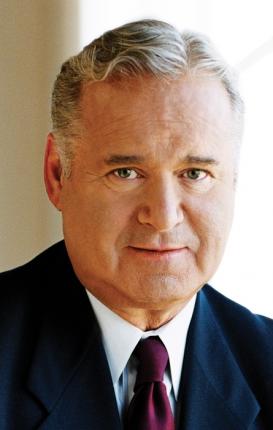
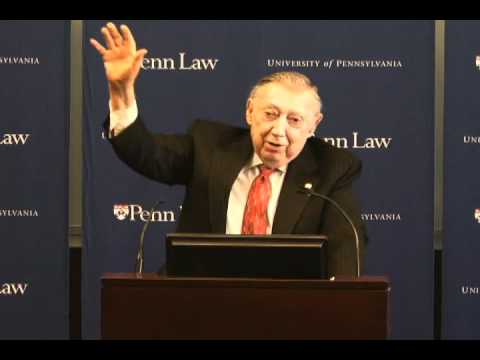
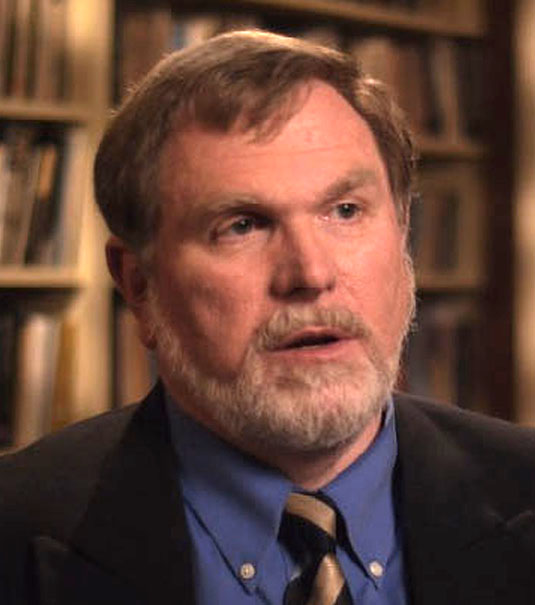
  • Howard Willens and The American Scholar

    Howard Willens and The American Scholar


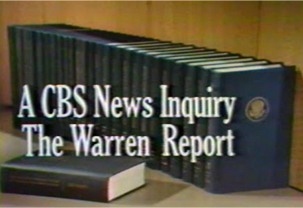
    How far the Warren Report has fallen in public estimation is an almost humorous subject. When it was first issued in the fall of 1964, the report was met with almost universal acclaim as an historically unquestionable document. All branches of the media – the press, television, periodicals and radio – accepted it with almost no reservations. Perhaps because none of the commentators had read the nearly 15,000 pages of accompanying evidence, which was not published until a month later. To show just how strange this reception was, and how lacking in rigor the media examination was, CBS prepared a two-hour documentary on the Warren Report the day it was published! Clearly, this show was being prepared in advance of the release of the report. In other words, CBS had accepted the Warren Report without reading it. Or, someone in the government passed them a copy before anyone else had it.

    Yet, this mass propaganda deployment did not hold. Within three years, the majority of Americans now doubted the main tenets of the Warren Report. And that figure has never dipped below a majority in the nearly fifty years since. Which is a tribute to both the work of the critical community and the good sense of the American people. Because the members of the Warren Commission have never let up in their attempts to reinculcate the public with their fallacious verdict based upon, at best, incomplete evidence.

    For instance, when Oliver Stone’s film JFK was released, David Belin appeard at the National Press Club to criticize the film. (Click here for that appearance https://www.c-span.org/video/?25215-1/kennedy-assassination-controversy). When the late Dr. Charles Crenshaw, who was in residence at Parkland Hospital in 1963, published his book Conspiracy of Silence suggesting something was awry with the autopsy of President Kennedy, Belin appeared in the pages of the Dallas Morning News to denounce his book. Years earlier, Commission attorneys David Slawson and Wesley Liebeler communicated with the Justice Department to construct a limited medical examination that would hinder Jim Garrison’s investigation in New Orleans. And as Pat Speer has shown, in all probability, before Arlen Specter passed away, he got in contact with New York TImes journalist Phil Shenon to coax him into writing his limited hangout book, A Cruel and Shocking Act. (Click here for our review)

    Wesley Liebeler, Arlen Specter and David Belin have all since passed away. So today, Commission counsel Howard Willens is the most active participant in sustaining the verdict of the Warren Commission into the new millennium. In 2013, he wrote an ill-titled volume called History Will Prove Us Right. The review at this site by Martin Hay was so scathing, Willens actually replied to it on his personal web site. (Click here for Hay’s review http://www.ctka.net/reviews/willens.html, and here for Willens’ reply http://howardwillens.com/jfk_history/conspiracy-communitys-response-book/) Willens’ reply was so weak and unfounded that Martin had little trouble demolishing it also. (Click here http://themysteriesofdealeyplaza.blogspot.com/2014/06/the-watchman-waketh-but-in-vain-howard.html) Apparently, Willens did not learn his lesson. Or he is a glutton for punishment. He has sallied forward again. This time he has joined forces with survivng member Richard Mosk.

    Attorneys Willens’ and Richard Mosk’s latest defense appears in, of all places, The American Scholar. This essay on their work for the Warren Commission they served on is more notable for what they omit from the official record than what they include. “What the critics often forget or ignore,” they write, “is that since 1964, several government agencies have also looked at aspects of our work” (American Scholar, Summer, 2016, p. 59). As if the Church Committee and the House Select Committee on Assassinations (HSCA) had reviewed and applauded the commission’s work. Indeed, they did look at it. But rather than plaudits, they issued stinging rebukes, principally for the commission’s having been rolled by J. Edgar Hoover, and to a lesser extent, by the CIA and the Secret Service.

    “It must be said that the FBI generally exhausted its resources in confirming its case against Oswald as the lone assassin,” the HSCA concluded, “a case that Director J. Edgar Hoover, at least, seemed determined to make within 24 hours of the of the assassination.”1 In essence, the experienced investigators concluded that Hoover had divined the solution to the crime before the investigation began, and then his agents confirmed the boss’s epiphany. The intimidated commission went right along. And with good reason, only part of which Mr. Willens tells.

    He admits that the “FBI had originally opposed the creation of the Warren Commission,” and that Hoover “ordered investigations of commission staff members.” But he doesn’t reveal that Hoover deployed one of his favorite dirty tricks to deal not only with lowly support staffers, such as Mr. Willens, but also with the heralded commissioners themselves. “[D]erogatory information pertaining to both Commission members and staff was brought to Mr. Hoover’s attention,” the Church Committee reported.2 (emphasis added)

    Willens and Mosk also forgot to mention that Hoover had a personal spy on the Warren Commission, then Rep. Gerald Ford, who tattled on Commissioners who were (justifiably) skeptical of the Bureau’s work. “Ford indicated he would keep me thoroughly advised as to the activities of the Commission,” FBI executive Cartha DeLoach wrote in a once secret memo. “He stated this would have to be done on a confidential basis, however he thought it should be done.”3 At the bottom of the memo, Hoover scrawled, “Well handled.”4 The success of Hoover’s machinations was obvious to subsequent government investigators.

    The HSCA’s chief counsel, Notre Dame Law Professor Robert Blakey, an experienced criminal investigator and prosecutor, was impressed with neither the Commission’s vigor nor its independence. “What was significant,” Blakey wrote, “was the ability of the FBI to intimidate the Commission, in light of the Bureau’s predisposition on the questions of Oswald’s guilt and whether there had been a conspiracy. At a January 27 [1964] Commission meeting, there was another dialogue [among Warren Commissioners]:

    “John McCloy: ‘… the time is almost overdue for us to have a better perspective of the FBI investigation than we now have … We are so dependent on them for our facts … .’

    “Commission counsel J. Lee Rankin: ‘Part of our difficulty in regard to it is that they have no problem. They have decided that no one else is involved … .’

    “Senator Richard Russell: ‘They have tried the case and reached a verdict on every aspect.’

    “Senator Hale Boggs: ‘You have put your finger on it.’ (Closed Warren Commission meeting transcipt.)”5

    Testifying before the HSCA, the Commission’s chief counsel J. Lee Rankin shamefully admitted, “Who could protest against what Mr. Hoover did back in those days?”6 Apparently not the President’s commissioners. The HSCA’s Blakey also reported that, “When asked if he was satisfied with the (Commission’s) investigation that led to the (no conspiracy) conclusion, Judge Burt Griffin said he was not.”7 Moreover, author Gus Russo reported that Griffin also admitted that, “We spent virtually no time investigating the possibility of conspiracy. I wish we had.”8

    Thus, despite their clear misgivings, rather than truly investigate, the Commissioners bowed to the notoriously corrupt and imperious Bureau chief. This policy had serious repercussions when the Commission confronted two key issues: published claims that Lee Harvey Oswald had been an FBI informant, and the possibility Jack Ruby had a relationship with organized crime.

    “The Commission did not investigate Hoover or the FBI, and managed to avoid the appearance of doing so,” HSCA investigators determined. “It ended up doing what the members had agreed they could not do: Rely mainly on the FBI’s denial of the allegations (that Oswald had been a Bureau informant).”9 Hoover merely sent the Commission his signed affidavit declaring that Oswald was not an informant, and he also “sent over 10 additional affidavits from each FBI agent who had had contact with Oswald.”10 And with those self-exonerating denials, the case was closed.

    About Jack Ruby: in 1964 the FBI had his phone records, yet failed to spot Ruby’s obvious, and atypical, pattern of calls to known Mafiosi in the weeks leading up to the assassination. After performing the rudimentary task of actually analyzing those calls, the HSCA determined that, if not a sworn member of La Cosa Nostra, Ruby had close links to numerous Mafiosi.11 Thus the HSCA found that the Commission was wrong in concluding that, “the evidence does not establish a significant link between Ruby and organized crime.”12

    The list of Commission shortcomings the HSCA assembled is not short. A brief summary of them runs some 47 pages in the Bantam Books version of the report (pp. 289-336), which outlines what required much of the 500 pages of HSCA volume XI to cover (available on-line).13 “The evidence indicates that facts which may have been relevant to, and would have substantially affected, the Warren Commission’s investigation were not provided by the agencies (FBI and the CIA). Hence, the Warren Commission’s findings may have been formulated without all of the relevant information.”14 The Church Committee said that the problem was that “… the Commission was perceived as an adversary by both Hoover and senior FBI officials.” “Such a relationship,” Committee observed, “was not conducive to the cooperation necessary for a thorough and exhaustive investigation.”15

    But the FBI did more than just withhold evidence from the Commission. Although he mentions that the FBI destroyed a note Oswald wrote to Agent Hosty and withheld that information from the Commission, Mr. Willens doesn’t mention that Agent Hosty reported that his own personnel file, and other FBI files, had been falsified.16 Nor that author Curt Gentry learned from assistant FBI director William Sullivan that there were other JFK documents at the Bureau that had been destroyed.17

    Although too numerous to explore here, American Scholar readers should understand that legitimate questions persist about issues Messrs. Willens and Mosk consider settled. These include the notorious Single Bullet Theory and JFK’s hapless autopsy,18 to name but two. But if the authors cannot even be completely honest with what the HSCA and Church Committee wrote about them, then should one trust them with those two radioactive issues?


    Notes

    1 House Select Committee on Assassinations Final Report, p. 128. On-line at: https://www.maryferrell.org/showDoc.html?docId=800#relPageId=158&tab=page.

    2 In: Final Report of the Select Committee to Study Governmental Operations, Book V, p. 47, on-line at: https://www.maryferrell.org/showDoc.html?docId=1161#relPageId=53&tab=page. Also cited by: Curt Gentry. J. Edgar Hoover – The Man and His Secrets. New York: W. W. Norton & Co., 1991, p. 549.

    3 “Ford Told FBI of Skeptics on Warren Commission”, By Joe Stephens, Washington Post Staff Writer, Friday, August 8, 2008. On-line at: http://www.washingtonpost.com/wp-dyn/content/article/2008/08/07/AR2008080702757_pf.html.

    4 See copy of actual memo at Mary Ferrell: http://www.maryferrell.org/showDoc.html?docId=61488#relPageId=100.

    5 In: R. Blakey and R. Billings. Fatal Hour – The Assassination of President Kennedy by Organized Crime. New York: Berkley Books, 1992, p. 29. This testimony was also published in: Mark North. Act of Treason. New York: Carroll and Graf, 1991, p. 515-516.

    6 House Select Committee on Assassinations, Vol. XI, p. 49, on-line at: http://www.maryferrell.org/showDoc.html?docId=83#relPageId=55&tab=page.

    7 Blakey and R. Billings. Fatal Hour – The Assassination of President Kennedy by Organized Crime. New York: Berkley Books, 1992, p. 94.

    8 Gus Russo. Live by the Sword. Baltimore: Bancroft Press, 1998, p. 374.

    9 HSCA, Vol IX, p. 41. On-line at: http://www.history-matters.com/archive/jfk/hsca/reportvols/vol11/pdf/HSCA_Vol11_WC_2_FBI_CIA.pdf.

    10 HSCA, Vol IX, p. 41. On-line at: http://www.history-matters.com/archive/jfk/hsca/reportvols/vol11/pdf/HSCA_Vol11_WC_2_FBI_CIA.pdf.

    11 See excellent discussion in: House Select Committee on Assassinations Final Report, p. 148-156, on-line at: http://www.maryferrell.org/showDoc.html?docId=800#relPageId=178&tab=page.

    12 Warren Report, p. 801. On-line at: http://www.archives.gov/research/jfk/warren-commission-report/appendix-16.html.

    13 http://www.history-matters.com/archive/contents/hsca/contents_hsca_vol11.htm.

    14 HSCA, Vol. XI, p. 59. On-line at: http://www.history-matters.com/archive/jfk/hsca/reportvols/vol11/pdf/HSCA_Vol11_WC_2_FBI_CIA.pdf.

    15 In: Final Report of the Select Committee to Study Governmental Operations (Church Committee), Book V, p. 47, on-line at: https://www.maryferrell.org/showDoc.html?docId=1161#relPageId=53&tab=page.

    16 James P. Hosty, Jr. Assignment: Oswald. New York: Arcade Publishing, 1996, pp. 178-180, 184-185, 243-244.

    17 Curt Gentry. J. Edgar Hoover – The Man and His Secrets. New York: W. W. Norton & Co., 1991, p. 546, footnote.

    18 The Chairman of the Forensics Panel of the HSCA, former New York Coroner Michael Baden, MD, has written, “Where bungled autopsies are concerned, President Kennedy’s is the exemplar.” See Baden, Michael M., Unnatural Death: Confessions of a Medical Examiner. New York: Ivy Books, published by Ballantine Books, 1989, p. 5. See also, Larry Sturdivan, The JFK Myths, chapter 10, “Bungled Autopsy,” St. Paul, MN: Paragon House, pp. 185-220.

  • Hammarskjold and Kennedy vs. The Power Elite

    Hammarskjold and Kennedy vs. The Power Elite


    indonesia header


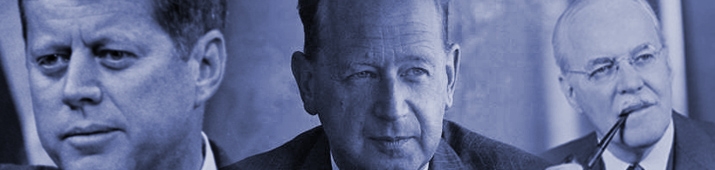
    As many CTKA readers and observers of JFK symposiums will know, since the 2013 Cyril Wecht conference in Pittsburgh, one of the topics I have been researching and talking about is John F. Kennedy’s reformist foreign policy. To some people this seemed kind of pointless. After all, in virtually every JFK assassination book Kennedy’s foreign policy boiled down to Vietnam and Cuba. What else was there?

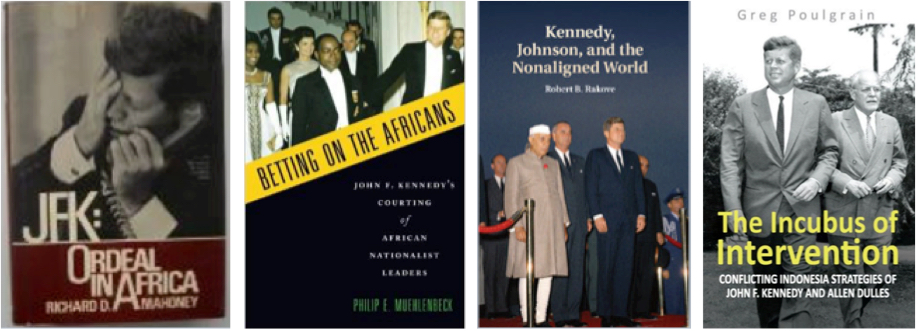
    Quite a lot. What was new in my speech mostly came from Philip Muehlenbeck’s volume, Betting on the Africans, which had been published the year before. (Click here for a review) Later, I discovered Robert Rakove’s book, Kennedy, Johnson and the Nonaligned World. That book serves as a fine compliment to Muehlenbeck. (Click here for the CTKA review) I used much of the Rakove material to present my altered versions of the 2013 presentation at both the JFK Lancer in 2013 and 2014 and the AARC Conference in 2014.

    These two books form a thematic line that extends back to Richard Mahoney’s landmark volume JFK: Ordeal in Africa. That book was a trailblazing effort in the field of excavating what Kennedy’s foreign policy really was, and where its intellectual provenance came from. It was published in 1983. Even though it bore the Oxford University Press imprimatur, it had little influence. It virtually had little or no impact in the categories of Kennedy biography, studies of the Kennedy presidency, or the JFK assassination field. Which, in retrospect, is stunning. Because what Mahoney did in that book was revolutionary. In a systematic way, he traced the beginnings of President Kennedy’s foreign policy ideas. He did this with a wealth of data he garnered from weeks spent at the JFK Library. He used this ignored information to show how Kennedy’s ideas on the east/west struggles in the Third World originated, why they were different than President Eisenhower’s, and how they manifested themselves once he became president. No other book I had read elucidated this progress in such a detailed and rigorous way. In fact, when I was done with the book I actually felt like I had been snookered by relying on historians like Herbert Parmet, William Manchester, and Richard Reeves for my information on Kennedy’s presidency and foreign policy. Mahoney made them look like hacks.

    It became clear to me that there was, quite literally, a war going on. And as unsatisfactory as the Parmet, Reeves, and Manchester books were (with Manchester I am referring to his presidential profile book Portrait of a President) these would be superseded by even worse JFK books later: biographies by John H. Davis, Robert Dallek, Thomas Reeves, and worst of all—perhaps the worst imaginable—Sy Hersh’s pile of rubbish The Dark Side of Camelot.

    In 2008 Jim Douglass made a clean break with all the calculated trash. His fine volume, JFK and the Unspeakable, has become something of a classic. It has actually crossed over and is sourced in books outside strictly the JFK assassination or JFK presidency fields. I wrote a very approving essay about Jim’s book. (Click here)

    Douglass did an exceedingly good job in elucidating Kennedy’s Vietnam and Cuba policies between the covers of one book. But with the new scholarship by Rakove and Muehlenbeck, the Douglass book seems rather narrowly focused today. And with the even newer book by Greg Poulgrain, The Incubus of Intervention (see my recent review), we can now add Indonesia to Africa and the Middle East as objects of Kennedy’s reformist foreign policy. In fact, Douglass is on to this. He actually pointed out that I should read and review the Poulgrain book.

    Four trailblazing books on Kennedy’s foreign policy

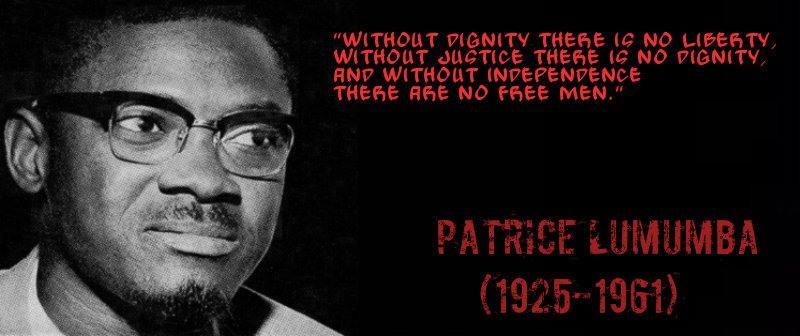
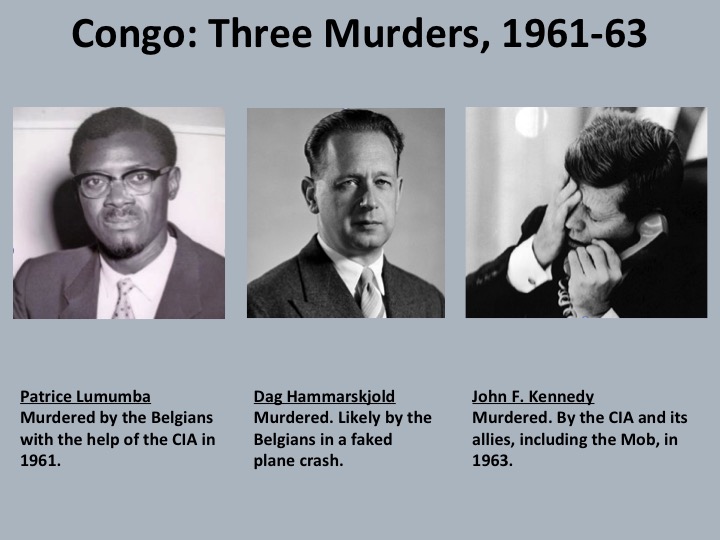
    But the Kennedy Enlightment really began with Mahoney. And although his book dealt with three African trouble spots, the majority of the book was focused on the colossal Congo crisis. Which, like other problems, Kennedy inherited from President Eisenhower. As we learn more about the Congo conflagration, we begin to see how large and complex that struggle was. Large in the sense that, in addition to the UN, several nations were directly involved. Complex in the sense that there were subterranean agendas at work. For instance, although England and France ostensibly and officially supported the United Nations effort there, they were actually subverting it on the ground through third party agents. In fact, when one studies the seething cauldron that was the Congo crisis, there are quite a few villains involved. There are only three heroes I can name: Patrice Lumumba, Dag Hammarskjold and John F. Kennedy. All three were murdered while the struggle was in process. Their deaths allowed the democratic experiment in Congo to fail spectacularly. Ultimately, it allowed one form of blatant exploitation, colonialism, to be replaced by another, imperialism.

    II

    To sketch in the background: In 1960, Belgium was going to leave Congo after brutally colonizing the country for generations. But their plan was to leave so abruptly that the nation would collapse inwardly for lack of leadership. Belgium would then return in order to protect the Belgian assets still there. As we shall see, the CIA was in agreement on this. Especially when Patrice Lumumba was democratically elected as Prime Minister. As Jonathan Kwitny noted, Lumumba was the first democratically elected leader of an African nation emerging from the long era of European colonialism. Ideally, Lumumba could have set a precedent. That did not happen. And the reason it did not happen was largely because of outside interference.

    Within days of June 30th, Congo independence, the Belgian plan began to work. Rioting took place and Belgian soldiers began to fire into crowds. On July 11th, the regional governor of the immensely wealthy Katanga province, Moise Tshombe, declared his state was seceding from Congo. Tshombe was egged on by the Belgians and British who wanted mineral rights. In exchange, they promised him military aid and mercenaries if Lumumba attacked Katanga. (Kwitny, p. 55)

    As Kwitny notes in Endless Enemies, the CIA and the National Security Council did not like Lumumba. After all, he had the gumption to ask for aid in kicking out the Belgians, who were now parachuting troops back in. Lumumba asked for aid from the USA, the USSR and the United Nations. The first declined, the second seemed amenable to sending arms, and Secretary General Dag Hammarskjold decided to send in a UN expeditionary force. The fact that Lumumba went to the USSR was enough for CIA station chief Larry Devlin to portray him as a communist. On August 18th he wired DCI Allen Dulles that Congo was experiencing a classic communist takeover. He then added that anti-West forces were rapidly gaining power and Congo was on the verge of becoming another Cuba. (ibid, p. 59)

    This was preposterous. There was no “anti-West force” build-up in Congo. In fact, England and Belgium were sending in troops and mercenaries. These were later joined by the French, who also wanted a stake in Katanga. But Devlin concluded by saying that Lumumba should be “replaced” by a pro-Western group. (ibid) This is just days after Lumumba visited the USA asking for help to expel the Belgians. Ambassador Clare Timberlake contributed the same kind of utter distortion. He told Washington that Lumumba wanted troops in order to expel the Belgians and then nationalize all industry and property. Lumumba would then invite communist bloc experts in to run the economy. (ibid, pp. 59-60)

    The Devlin/Timberlake cables had their intended impact. Within 48 hours DCI Allen Dulles and President Eisenhower agreed that Lumumba had to be neutralized. (ibid, p. 62) The CIA took two tracks to achieve this aim. First, Timberlake and his deputy Frank Carlucci tried to get President Kasavubu to stage a coup. He said no. So Devlin went to military colonel Josef Mobutu and asked him to eliminate Lumumba. In September, Kasavubu finally relented and dismissed Lumumba. Lumumba then said he was dismissing Kasavubu. With a Mexican standoff holding, Devlin then went to Mobutu and asked him to arrest Lumumba. But the UN emissary there, Rajeshwar Dayal, prevented the action. And Lumumba now became somewhat of a prisoner in his own home. Kasavubu then dissolved parliament, which had backed Lumumba. (p. 66) The second track of the CIA’s program now kicked in: assassination plots to kill Lumumba. (ibid, p. 67)

    As the reader can see, in the space of two months, the Americans and Europeans had pretty much destroyed whatever hope there was for the first democratic nation to emerge and survive in post-colonial Africa. In fact, one could fairly say that they strangled African democracy in the cradle. From here, it got worse. Devlin now wanted Mobutu to eliminate not just Lumumba, but his deputy Antoine Gizenga. (ibid) But Dayal and Hammarskjold kept him protected also.

    When Mobutu’s troops began to battle with the UN mission, Lumumba made an impulsive, perhaps reckless, decision. He escaped from Dayal’s protection and tried to flee to Stanleyville, his political base. With Devlin’s help, Mobutu captured him. And after severely beating him, returned him to the capital of Leopoldville.

    Three things then happened that sealed Lumumba’s fate. First, Russian planes carrying supplies and arms started arriving in Stanleyville. Second, two CIA assassins also arrived on the scene. And third, John F. Kennedy was about to be inaugurated. Because of these factors, , instead of having Lumumba killed by the CIA agents, or risk a more sympathetic policy under Kennedy, on January 13, 1961, Mobutu had Lumumba shipped to Moise Tshombe in Katanga. As Devlin must have known, this meant he would be killed soon. Four days later, he was. (ibid, p. 69)

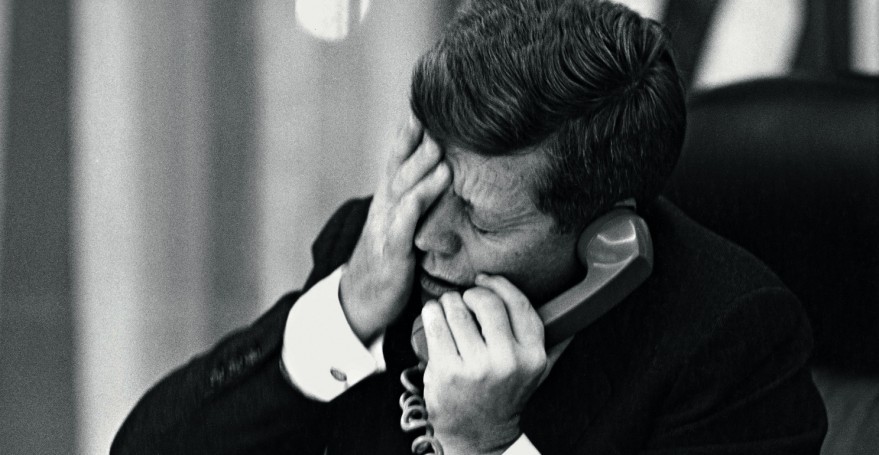
    The information about his death was kept from President Kennedy for almost a month. He did not learn about Lumumba’s murder until February 13th. He learned of it on a phone call with UN Ambassador Adlai Stevenson. White House photographer Jacques Lowe captured the moment in a crystalline photograph:

    Kennedy hears of Lumumba’s murder from Adlai Stevenson
    (photo by Jacques Lowe)

    Perhaps no photo from the Kennedy presidency summarizes who Kennedy was, and how he differed from what preceded him and what came after him, than this picture.

    III

    In the wake of Lumumba’s murder, Dag Hammarskjold was not about to give up. Secretary General Hammarskjold was from Sweden and his family had a long history in public service. His father had been a regional governor and then Sweden’s prime minister. Two of his older brothers had also spent time in government service, one as a governor and the other working with the League of Nations. As an economist, Dag worked for the Finance Ministry and coined the term “planned economy”. He and his brother Bo helped launch the Swedish welfare state.

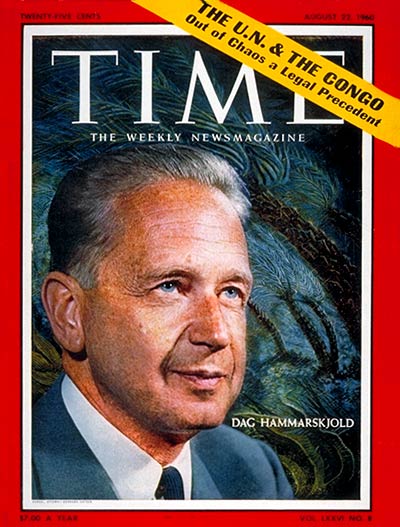
    Dag Hammarskjold
    August 27, 1960

    Hammarskjold first worked with the Swedish delegation at the United Nations. He then, rather unexpectedly, was voted its second Secretary General in 1953. As writer Susan Williams notes, his ascendancy coincided with the beginning of the de-colonization process in Africa and Asia. By 1960, 47 of the 100 UN members came from this Afro/Asia bloc. (Williams, Who Killed Hammarskjold? p. 23) In 1960 alone, 16 African nations had joined the UN. Hammarskjold decided to tour the continent in late 1959. He had harsh words for the apartheid regime of the Union of South Africa. Therefore, he became an enemy of white supremacists on that continent. And with those nations who still held colonies there, or were trying to unduly influence their former colonies e.g. France, England, Portugal and Belgium. (ibid, p. 24)

    Because of his Swedish background and his work in civil service and planned economies, Hammarskjold had a special sensitivity to these new and awakening nations. He understood that, individually, these states felt weak and isolated. But as members of the UN, they felt part of a world community that could elevate their stature. Or, as he put it, the function of the UN was to protect the weak against the strong. (ibid)

    Hammarskjold suspected what the Belgian secret agenda was before they pulled out of Congo. Therefore he sent Ralph Bunche, part of the American delegation, there as independence was enacted. King Baudouin of Belgium was there for the official proceeding. He actually praised what Belgium had done for Congo and specifically singled out Leopold II for praise. Which would be like giving credit to John Calhoun in the struggle for civil rights for Black Americans. Lumumba felt he had to respond. He said, words to the effect, “we are your monkeys no more”. (Williams, p. 31)

    There can be little doubt that tensions began to build because of this exchange. Also because, in the ranks of the army, Belgians still remained in command centers. When violence broke out, Lumumba blamed it on the Belgians in the military and accused the former mother country of trying to recolonize Congo—which was accurate. As civilian Belgians tried to leave the country, Baudouin sent in troops to protect them. A week later, Tshombe announced the Katanga secession. Katanga contained about 60% of Congo’s mineral wealth. Tshombe was clearly in alliance with the giant mining conglomerate Union Miniere, a Belgian/British transnational. For immediately after this announcement, the company said it would not pay its corporate taxes to the Congo capital of Leopoldville anymore. It would now pay them to Elisabethville, the capital of Katanga. (ibid, p. 33) The company also extended Tshombe a large loan. Further, Belgian advisors began to flock to Katanga as well as British mercenaries from nearby Rhodesia. Congo was going to be stillborn.

    Lumumba now turned to Hammarskjold for help. The Secretary General immediately passed UN Resolution 143. This demanded that the Belgians leave Congo and promised assistance to Lumumba until the nation was able to defend itself. Within 48 hours, there were 3,500 UN troops on the ground in Congo. Although he was now being accused of acting too late by the USSR, Hammarskjold proclaimed he would not recognize either Mobutu or Kasavubu as the leader of Congo. (Williams, p. 39) But when Lumumba was murdered, the Russians again criticized the Secretary General for doing too little, too late.

    Hammarskjold replied by passing resolution 161. There were now 15,000 UN troops in Congo, they were now allowed to use military force. The mission was to expel all foreign troops, and Parliament would be reconvened under UN protection. The Secretary General clearly saw Congo as a defining moment for both the UN and his leadership. (ibid, p. 41)

    The UN commander on the ground, Conor Cruise O’Brien, demanded Tshombe step down and Katanga rejoin Congo. To strengthen himself, Tshombe now recruited French veterans of the OAS, the terrorist group of army veterans who had split off from French president Charles DeGaulle over Algerian independence.

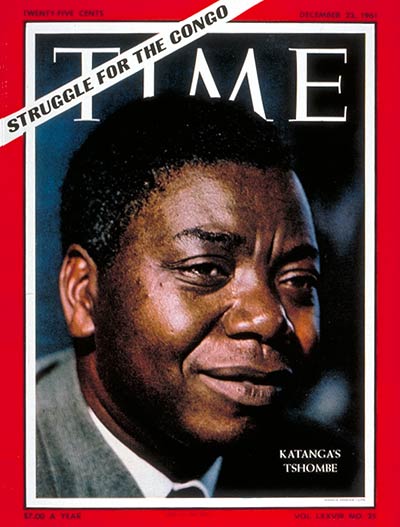
    Moise Tshombe
    December 22, 1961

    In the face of this, O’Brien launched two offensives into Katanga. The first was called Operation Rumpunch, and the second was named Operation Morthor. The first operation was quite successful, the second was not. About half of Elisabethville was still under Tshombe’s control. (ibid, p. 49) By this time, the British premier of the African Federation—Roy Welensky— was clearly favoring Katanga, as was the Union of South Africa. Welensky, working with his colleague on African Affairs, Baron Cuthbert Alport, was also secretly supplying mercenaries from Rhodesia to Tshombe. (ibid, p. 51)

    As a result of this secret policy, Welensky now shifted troops into Ndola, the main airport for Rhodesia, which was just a few miles from the border with Congo. Welensky shipped in food, supplies and arms from as far away as Australia. (ibid, p. 53) Rhetorically, Welensky went as far as to compare the UN troops in Congo to the Nazis.

    This information is important. Since we are about to discuss the second high profile murder over the Congo Crisis: that of Dag Hammarskjold. Today I, and many others, call it a murder, not a suspicious death. The state of the evidence seems to me to clearly denote that this was a planned assassination. After considering some of the work of Susan Williams and others, the reader will likely agree.

    IV

    Hammarskjold flew into Congo on September 13, 1961. He was surprised to hear about Operation Morthor, since he maintained he had not authorized it. While there, the Battle of Jadotville began. This was fought between a company of Irish UN troops and mercenaries employed by Tshombe. During the battle, Tshombe requested a meeting with Hammarskjold.

    This was to occur on September 17th, in Ndola, a city in British controlled Rhodesia. Tshombe requested no reporters be alerted. But, Baron Alport was there. He stationed himself in the airport manager’s office, right below the control tower. As previously stated, also on hand was a temporary arm of the Rhodesian Ministry of Defense set up by Welensky. Hammarskjold was to arrive aboard a DC6 piloted by a Swede. Below him, on the runway, were 18 Rhodesian planes and two American DC3’s. (ibid, p. 68) In referring to the last, a Rhodesian air squadron leader told the UN Commission that there were “underhand things going on” at the airport, “with strange aircraft coming in, planes without flight plans and so on. There were American planes sitting on the airfield with engines running, likely transmitting messages.” (Lisa Pease, “Midnight in the Congo”, Probe, Vol. 6 No. 3 p. 20) Further, another witness said the American planes were full of sophisticated communications equipment. (Williams, p. 188)

    Hammarskjold’s flight never landed at Ndola. And there is no tape recording of the approach of the plane. But there were notes kept. According to the written record, the last message from the plane was that the pilot was descending from 16,000 to 6,000 feet. (Williams, p. 70) At this point, Ndola lost contact with the plane. Because it was around midnight, no search party was sent out. Alport made a comment that the plane must have landed elsewhere. He then suggested the control room staff retire at around 3:00 AM. Yet, there were reports being filed around this time that several witnesses had independently seen a large ball of fire go off in the sky in the nearby vicinity. (ibid, p. 72) At 7 AM, a UN plane flew into Ndola to begin a search for Hammarskjold and the 15 other lost passengers of the Albertina. The pilot was arrested upon touching down. (ibid, p. 73)

    The airport manager did not return until 9 AM, three hours after dawn. The search did not start until an hour later. The wreckage of the plane was found at about 3 PM, eight miles from the airport. There was one survivor, Harold Julien. He would pass away six days later. But not before he said the plane was in flames before it hit the ground. Further, the plane was determined to be under power, and the landing gear was lowered. Although all the passengers were severely burned, Hammarskjold was not—at all. Further, in something that simply cannot be explained, there was a playing card stuffed into his ruffled tie. Although it is not possible to determine what the card is from the photos, a witness at the scene said it was the ace of spades. (Williams, p. 7) Another oddity, Alport ended up with Hammarskjold’s briefcase. (ibid, p. 85) These anomalies suggest someone was at the crash scene before the official first responders arrived. As we shall see, the evidence for this is more than circumstantial.

    Two of the security guards on the plane had bullets in their bodies. This was officially explained by saying that the heat of the crash had caused ammunition to explode. But a Swedish expert who had done experiments on this topic said that, even if this were so, the projectiles would not have enough force to penetrate the bodies. (See Pease, and Williams, p. 6) What makes this even more fascinating is the testimony of Major General Bjorn Egge. Egge had been the head of the UN military information mission in Congo. He had flown to the Ndola hospital, where the victims had been transported. When he saw Hammarskjold’s body he noticed what appeared to be a bullet hole in his forehead. (Williams, p. 5) That hole is not apparent in the autopsy photos Williams saw. But when the photos were shown to forensic experts, two of them said it appeared the photo had been retouched at the forehead. (ibid, p. 9)

    Let us now consider sole survivor Julien’s crucial testimony: that the plane was in flames before it hit the ground. (Williams, p. 94) There is much evidence to corroborate this key point. Charles Southall was a Navy intelligence analyst in 1961. At the time, he was attached to the NSA base on the island of Cyprus. On the night of the crash, he was at home. His commanding officer called him and said he should come out and listen to a recorded communication intercept he had captured. This was the only time such a thing happened while he was in Cyprus, so Southall did so. He said that, on the recording, he heard a pilot say he was descending on the DC6. He then heard what he thought was the sound of a cannon firing. Then, the pilot said, “I’ve hit it…It’s going down.” (Williams, p. 143) Someone in the office recognized the pilot’s voice, and the NSA had a dossier on him. When the Swedish government reopened the case in 1992, Southall tried to communicate with them through the American State Department. But the Swedes found out about him through an independent source and he was interviewed more than once. (ibid, p. 147)

    Southall’s testimony is echoed by the words of Swedish flying instructor Tore Meijer. He was stationed as a flight teacher to the Ethiopian Air Force in 1961. On the night of the crash, he was listening to a short wave radio he had just bought. Therefore, he was testing various frequencies. (ibid, p. 152) He picked up a conversation that included mention of the Ndola airport. In his own words, he then described the following: “The voice says, he’s approaching the airport, he’s turning—he’s leveling—where the pilot is approaching the actual landing strip. Then I hear the same voice saying, “another plane is approaching from behind, what is that?” The voice then said, “He breaks off the plan…he continues.” Meijer said he lost the contact at this point.

    The idea that another plane intercepted Hammarskjold’s is corroborated by at least seven witnesses on the ground. (Pease, p. 20) For example, Dickson Buleni said he saw a smaller plane above the larger plane dropping something that looked like fire on it. (Williams, p. 117) This testimony is similar to that of Timothy Kankasa and his wife. (ibid, pp. 93, 122) But the Kankasas revealed something that may be even more interesting. They said that the crash was not initially discovered at around 3 PM on the 18th. Timothy and a few other residents of Twapia Township discovered it about six hours earlier. Further, the couple stated that this information was reported to local officials. Timothy also said he had reported it to the first investigating body from Rhodesia, but it had been edited out of his testimony. (ibid)

    Again, there is independent corroboration for this earlier successful search, which punctures the 15-hour official lag time between the crash and the discovery of the plane wreckage. Colonel Charles Gaylor had been instructed by the USAF to fly to Ndola to help escort Hammarskjold to any other destination he wished to fly to as a result of his work there. Therefore, he was awaiting the landing of the Albertina that night. When Hammarskjold’s plane did not land, Gaylor retired so he could wake up and begin searching for the lost plane. He found it the next morning and relayed the information to the Ndola airport. Gaylor said that the Rhodesian planes did not show up until four hours later. (ibid, p. 188)

    Another witness, who also saw a second plane in the sky, built on this disturbing indication of a deliberate and immediately enacted cover up as to the discovery of the wreckage. He saw two Land Rover type vehicles rushing at high speed toward the scene within an hour of the crash. (See Pease, “Midnight in the Congo”, p. 20) He and another witness then saw the vehicles return after they saw and heard a large fireball explosion. (Williams, p. 105)

    One should note in regards to this testimony: when studying the photos of the wreckage of the Albertina, it certainly does not look like the plane simply crashed. Because the damage is just too extensive. It does appear that there was at least one explosion. But further, there do not seem to be any photos taken of Hammarskjold in situ. (Williams, pp. 13, 111) Because of this lack, because of the delay in the “discovery”, because of the testimony of Bjorn Egge about a bullet hole in Dag’s forehead, because of the experts who detected signs of tampering with the photos, because of the lack of any burns, because of all this, some have suggested that Hammarskjold may have survived the crash. And I should add one more point on this issue. Williams could not find any official autopsy reports. There are only summaries and conclusions. (p. 8)

    From just this brief précis of the evidence, the reader can see that the original story, which said the crash was due to pilot error, is simply not credible today. The evidence indicates that Hammarskjold’s plane was sabotaged. A cover up, which seems preplanned, then ensued. The motive—as with Lumumba’s murder— was to make sure that Congo would not be an independent country. One in which the citizenry would be able to enjoy the fruits of its own prodigal resources. Which is what Lumumba had promised his followers during his campaign. With both Lumumba and Hammarskjold done away with, that aim now seemed unattainable.

    V

    As Susan Williams writes in her book, John Kennedy was an unflinching admirer of Hammarskjold. After his death, Kennedy summoned one of his assistants into the oval office. The president told Sture Linner that, compared to Hammarskjold, he was a small man. Because, in his view, Dag Hammarskjold was the greatest statesman of the 20th century. (p. 239)

    When Kennedy came into office, one of the reversals he made of President Eisenhower’s foreign policy was in Congo. He had tried to make the issue of the rising tide of African nationalism part of the 1960 campaign. For he attempted to differentiate himself from his opponent Richard Nixon on the point. (See Philip Muehlenbeck, Betting on the Africans, pp. 37-41) This was a legitimate point of difference. At a National Security Council meeting, the vice-president once claimed that “some of the people of Africa have been out of the trees for only about fifty years.” Budget Director Maurice Stans replied that he “had the impression that many Africans still belonged in trees.” (ibid, p. 6) Kennedy did not at all share in this view. From at least 1957, with his powerful Senate speech on the French/Algerian crisis, Kennedy had become a staunch advocate of favoring African nationalism and liberation over the concerns of our European colonialist allies. (ibid, p. 36) For in that speech he actually stated that a true ally of France would not have done what Eisenhower and Nixon had with Algeria. Which was to either remain silent on the conflict, or even supply France with weapons. A true friend would have pointed out the folly of the colonial struggle. And then escorted France to the bargaining table to foster her exit from a hopeless and expensive civil war. (The full text of this visionary speech is in the book The Strategy of Peace, edited by Allan Nevins, pp. 66-80)

    When Kennedy was inaugurated, he immediately enacted policies to carry out these differing views on Africa. As Muehlenbeck demonstrates, he did so on a number of different fronts. But the policy reversal that was done fastest was in Congo. Which he requested his first week in office. And which he approved on February 2nd. (See “Dodd and Dulles vs. Kennedy in Africa,” by James DiEugenio, Probe, Vol. 6 No. 2, p. 21) Upon hearing of this, Ambassador Timberlake sent word to Allen Dulles that Kennedy was breaking with Eisenhower, and his new program was more or less a sell-out to the Russians. When Hammarskjold got wind of the reversal, he told Dayal that they could soon expect an organized backlash to Kennedy’s reformist policy. Which, in large part, backed Lumumba—not realizing he was dead—and was open to negotiations with Russia over a militarily neutralized Congo. Kennedy also opposed the secession of Katanga and was willing to cooperate with the UN in an attempt to keep Congo free and independent.

    In other words, for all intents and purposes, Kennedy agreed with the outlines of what Hammarskjold was doing. To make the distinction clear, he recalled Timberlake. (ibid, p. 22) Then, in September, Hammarskjold was killed.

    At this point two remarkable things occurred in the immense Congo struggle. First, former President Harry Truman made a stunning comment. He said, “Dag Hammarskjold was on the point of getting something done when they killed him. Notice that I said, ‘When they killed him.’ ” (Williams, p. 232) Author Greg Poulgrain later shed some light on the origins of this surprising comment. He interviewed Hammarskjold’s close friend and colleague at the UN, George Ivan Smith. It turns out that Hammarskjold and Kennedy were cooperating, not just on Congo, but on the problem of the Dutch occupation of West Irian, which Indonesian leader Achmed Sukarno felt should be part of Indonesia. (Poulgrain, The Incubus of Intervention, pp. 77-78) Smith also added that Kennedy had let Harry Truman know about these discussions. Which seems logical, since Truman was the only previous Democratic president still alive.

    The second remarkable development was that Kennedy decided to shoulder on with what Hammarskjold had begun in the Congo. In other words, by himself, he was going to oppose the imperialist forces of England, France, and Belgium. Which all desired to split Katanga away from Congo. And then make both states pawns for European multinational corporations. There can be very little doubt that this was Kennedy’s aim. Why? Because, after Hammarskjold’s demise, he went to the UN to pay tribute to his legacy. He then appointed Edmund Gullion as his ambassador to Congo.

    Anyone who knows anything about Kennedy will realize, it was Gullion who first altered JFK’s consciousness on the subject of the appeal of communism in the Third World. This occurred on Senator Kennedy’s visit to Saigon in 1951. JFK never forgot the prediction that Gullion made at that time. Namely that France would not win the war in Indochina. When Kennedy gained the White House, he brought Gullion in as an advisor on colonial matters. And now he sent him to Leopoldville to attempt to compensate for the loss of Hammarskjold. As Richard Mahoney wrote, this indicated just how important Kennedy thought the Congo was. Because no ambassador in the entire administration had more secure access to the oval office than Gullion. (Mahoney, JFK: Ordeal in Africa, p. 108) Kennedy then went further. He made George Ball his special advisor on Congo inside the White House. Ball later became famous as the one man willing to argue against President Johnson during his disastrous escalation of the Vietnam War. But even in 1961 Ball had a reputation as something of a maverick on foreign policy.

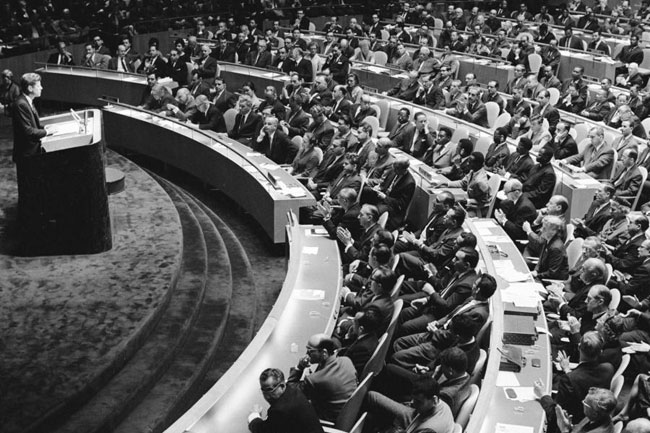
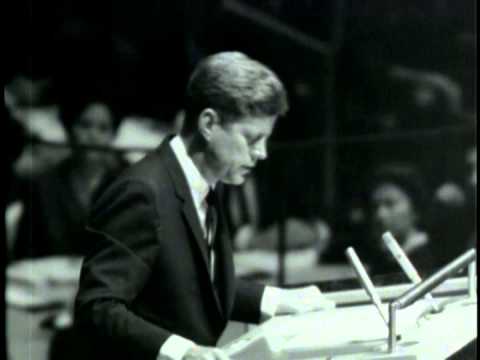
    Kennedy addresses U.N. General Assembly
    September 25, 1961

    Addressing the General Assembly at the memorial for Hammarskjold, Kennedy said, “Let us here resolve that Dag Hammarskjold did not live or die in vain.” He backed this up by having his UN delegation vote for a use of force resolution to deport the mercenaries and advisory personnel out of Katanga. (DiEugenio, p. 23) In doing so, Kennedy was militarily moving against his formal allies, the British, French and Belgians. For those nations were all paying lip service to the UN forces. But not so clandestinely, they were undermining the mission. Therefore, Kennedy was not just honoring Hammarskjold rhetorically. He was continuing his policies—and pushing the UN into following him. In fact, when hostilities broke out in Katanga with Tshombe trying to block highways used by UN troops, Kennedy told the new UN leader U Thant, who was wavering on the commitment, not to worry at all about European reaction. He would take care of that. He then said in public, these leaders should spend less time criticizing the UN and more time convincing Tshombe to negotiate a truce with the new leader of Congo, Cyrille Adoula. (Mahoney, p. 117)

    Kennedy also had to deal with the big guns of the MSM who seemed to favor Tshombe. That is: Time magazine, who put him on their cover; William F. Buckley, who (incredibly) compared Katanga’s secession to the Hungarian uprising of 1956; and Sen. Thomas Dodd, who actually visited Tshombe in Katanga to show his support. In the face of this, Kennedy decided to use economic warfare. He told the representatives of the giant Union Miniere mining corporation that unless they significantly cut their monthly stipend to Tshombe, he would unleash a terrific attack on Katanga, and then turn over the company’s assets to Adoula. This achieved its aim. The stipend was significantly reduced. (DiEugenio, p. 24)

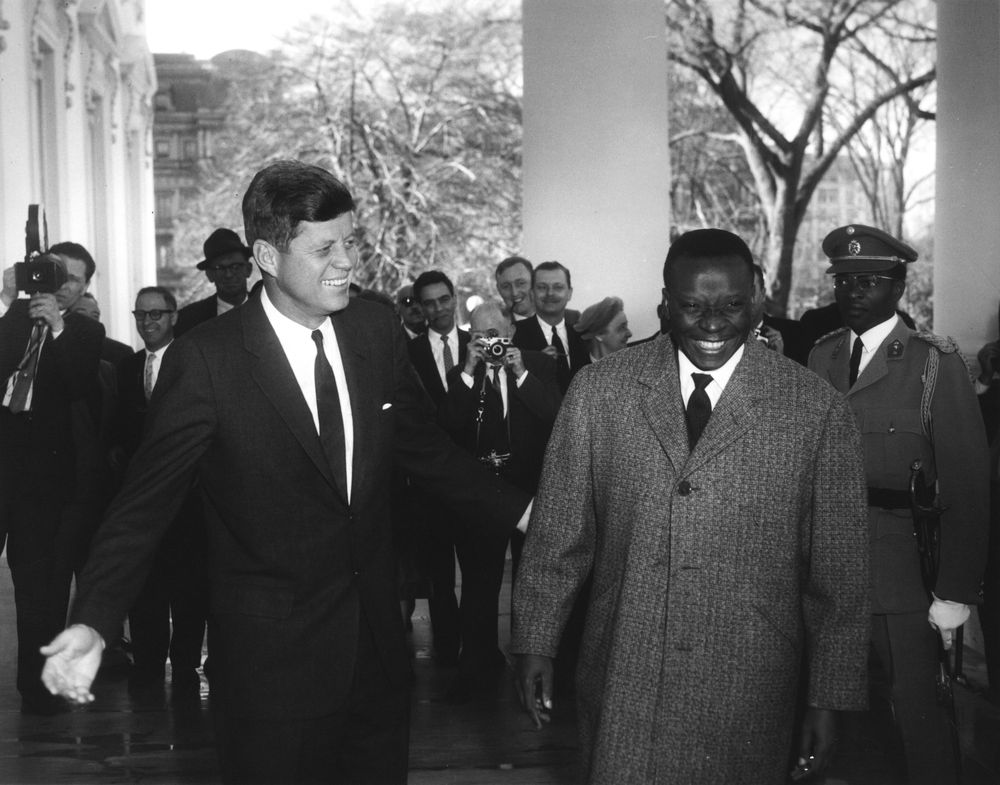
    Kennedy and Cyrille Adoula at the White House

    Kennedy then brought Adoula to New York. In his address to the United Nations, the African leader criticized Belgium and praised Congo’s national hero, Patrice Lumumba. (Mahoney, p. 134) In reaction, Tshombe’s supporters then wanted to bring him to the USA to counter this appearance. Gullion argued against it. He suggested denying Tshombe a visa on the basis that he was not a real representative of Congo. Kennedy listened to arguments for and against the denial. He then sided with Gullion and denied the visa. (DiEugenio, p. 24)

    On the day before Christmas of 1962, Katangese troops fired on a UN helicopter and outpost. Kennedy had previously forced the issue on his White House staff by demanding a unanimous vote to back the military invasion of Katanga. George Ball, who was holding out for more negotiations, came over to the Kennedy/Gullion side. So now the USA fully backed Operation Grand Slam, the UN attempt to finally take Elisabethville, capital of Katanga. By January 22, 1963 Grand Slam had succeeded on all fronts. Tshombe, predictably, fled to Rhodesia. As Adlai Stevenson, Kennedy’s representative to the United Nations wrote, it was that body’s finest hour.

    VI

    Kennedy addresses U.N. General Assembly
    September 20, 1963

    The UN had never before done what Hammarskjold had committed it to in Congo. That is, send a large military force into an independent nation to put down an internal civil war. But Hammarskjold had done so at Lumumba’s request. Both men had been murdered over that struggle. With Hammarskjold gone, the United Nations did not want to stay after Grand Slam was completed. In fact, it’s an open question if Grand Slam would have been launched without Kennedy’s visit to the UN the year before. But because of the expense, controversy, and length of the expedition, the UN leadership wanted to leave Congo in 1963. Even with Adoula’s position precarious and the Congolese army a rather unreliable force. Again, Kennedy took it upon himself to go to New York. On September 20, 1963 Kennedy addressed the UN General Assembly on this very subject. He said he understood how a project like this would lose its attraction after its initial goals were met. Because then the bills would come due. But he urged the UN to do what it could to preserve the gains they had made. He also asked that they do all in their power to maintain Congo as an independent nation in its fragile state. He concluded the UN should complete what Hammarskjold had begun.

    Kennedy’s speech turned around the consensus opinion to depart. The UN voted to keep the peacekeeping mission there. But later in 1963, things began to unravel. Kasavubu decided to disband Parliament. This ignited a leftist rebellion from Stanleyville. There was an assassination attempt on Mobutu. With this, Mobutu, already a darling of the CIA, now became the Pentagon’s poster boy at Fort Benning.

    Mobutu Sese Seko
    with Prince Bernhard of the Netherlands
    (1973)

    After Kennedy’s murder, President Johnson sided with the CIA and the Fort Benning crowd. As the Stanleyville rebellion picked up steam, the CIA now descended on the American embassy and took it over. It became the base for an air operation run by Cuban exile pilots. Incredibly, Belgium now became an ally of the USA. Tshombe was asked back to Congo by Mobutu. Tshombe immediately found a treasure trove of Chinese documents and a defector who now said China was behind the leftist rebellion. (Kwitny, p. 79) Needless to say, within 18 months, Johnson and the CIA had reversed the Kennedy/Hammarskjold program. Adoula and Kasavubu were dismissed or forced out; Gullion left. In 1966 Mobutu installed himself as military dictator. The riches of the Congo were now mined by the European forces Lumumba asked Hammarskjold to remove. Like Suharto in Indonesia, Mobutu became one of the richest men in the world. His holdings in Belgian real estate alone topped 100 million dollars. (Kwitny, p. 87) Like Suharto, he reigned for three decades. And like the Indonesia dictator, when he fell, he left his country in a destabilized, anarchic state with poverty predominating. In other words, where they were at the beginning.

    One of the most fascinating revelations in Greg Poulgrain’s The Incubus of Intervention was this: In addition to JFK working with the Secretary General Hammarskjold on Congo, the two were also working on a design for Indonesia. (Poulgrain, p.77) They were planning on a solution to the West Irian problem. Which was part of the former Dutch Empire that Netherlands did not want to let go. Probably because of the great mineral wealth there, which likely even surpassed that of Katanga. Further, the two men were also working on a plan to aid countries coming out of colonialism. This was called OPEX. This was a UN group that would send professionals of all kinds into these areas to aid their development. Not as advisors, but as servants of the new country. This is the plan Hammarskjold had in mind for West Irian. In their original concept, Hammarskjold would play the lead role in both Congo and Indonesia, with Kennedy supporting him. With the Secretary General’s 1961 murder, Kennedy had to soldier through both situations himself. He was doing a fairly good job, until he too was assassinated. In fact, he had planned on a state visit to Jakarta in 1964, a first for an American president.

    As one can see from this discussion, and also Poulgrain’s book, Kennedy’s policies were reversed in both countries shortly after his murder. (See again the above-cited review; also, this interview with the author) The results were horrendous for the citizens of both countries. For when Mobutu and Suharto took over, any idea of having the prodigal natural resources of both states aid in fostering its citizenry was lost. Because of the two overthrows, Lumumba and Sukarno did not funnel the money into improvements for the daily lives of their citizens, through building infrastructure, energy sources, hospitals, primary and secondary schools etc. Instead it went to the shareholders of the exploiting companies and into the pockets of Mobutu and Suharto.

    As Jonathan Kwitny has noted, Congo could have been a sterling example of a nation crippled by colonialism, now being set free. And aided by the USA, allowed to grow and nurture, and thereby be a model—for not just Africa—but the rest of the world. That is what Hammarskjold and Kennedy had hoped for. Just as they had imagined for Sukarno and Indonesia. Instead, something contrary to that occurred. Or as Kwitny wrote:

    The democratic experiment had no example in Africa, and badly needed one. So perhaps the sorriest, and the most unnecessary, blight on the record of this new era, is that the precedent for it all, the very first coup in post-colonial African history, the very first political assassination, and the very first junking of a legally constituted democratic system, all took place in a major country, and were all instigated by the United States of America. (Kwitny, p. 75)

    Kennedy and Hammarskjold understood this moral and practical quandary. It was not until recently that the importance of the Hammarskjold/Kennedy relationship has been highlighted. I and others have also tried to show that Kennedy’s foreign policy should be seen not just as a series of individual instances, but in the gestalt. That is, as part of an overall pattern. Largely because of his sensitivity to these Third World issues—which was not at all the case with Eisenhower, Johnson and Nixon. But this gestalt concept has been very late in arriving. Because the cover up about the facts of Kennedy’s real foreign policy has been more stringent and assiduous than the cover up about the facts of his assassination.

    Too often we think of that foreign policy in terms of just Cuba and Vietnam. As seen above, that view foreshortens history. It’s the way the other side wants us to see Kennedy—a view without Hammarskjold. Constricted by this deliberate obstruction, we fail to see who Kennedy really was. Not only does that foreshortened view cheat history, it cheats Kennedy—and helps conceal the secrets of his assassination.

    from “JFK’s Foreign Policy: A Motive for Murder”
    JFK Lancer conference, November 2014

    Addendum

    See now U.N. to Probe Whether Iconic Secretary-General Was Assassinated for the discovery of the original SAIMR documents.

  • JFK and the Unforgivable: How the historians’ version of the JFK assassination dishonors the historical record – Addendum


    The JFK Assassination According to the History Textbooks

    From: Paul Bleau
    Sent: Wednesday, August 3, 2016 7:57 PM
    To: ltownsend@historians.org
    Subject: Complaint

    Hello,

    A few years ago I completed a study on how history books cover the JFK assassination and how the authors justified their writings. Overwhelmingly the authors portray it as a crime committed by a lone nut who was killed 2 days later by another loner. The Warren Commission is the key source (as well as a few authors who back the lone nut scenario). The other subsequent investigations as well as work done by independent researchers who back conspiracy scenarios are not on the radar. The result is that young students who are part of a captive audience are being given an incomplete, biased account of this historical event.

    I believe that on this issue, historians are violating their code of conduct by not honoring the historical record. Two articles about this issue are published on the following website: http://www.ctka.net/2016/PaulBleau1.html and http://www.ctka.net/2016/bleau-historians/historians-and-the-jfk-assassination-part-1.html.

    Interviews were also given on BlackOp radio: http://www.blackopradio.com/archives2016.html.

    I am hoping that the AHA can look into this situation and encourage its members to reconsider how to present this information to students in a more balanced and up to date manner.

    Thank you, Paul Bleau College Professor


    Return to Part 2

    Return to Part 1

  • JFK and the Unforgivable: How the historians’ version of the JFK assassination dishonors the historical record – Part 2

    JFK and the Unforgivable: How the historians’ version of the JFK assassination dishonors the historical record – Part 2


    United States House of Representatives Select Committee on Assassinations (HSCA)

    Established in 1976 to investigate the assassinations of Martin Luther King and John F. Kennedy, the HSCA issued its final report in 1979. It found that there was a “probable conspiracy” in the JFK case.

    The following is a summary of their findings (source: National Archives):

    Findings of the Select Committee on Assassinations in the Assassination of President John F. Kennedy in Dallas, Tex., November 22, 1963:

    1. Lee Harvey Oswald fired three shots at President John F. Kennedy. The second and third shots he fired struck the President. The third shot he fired killed the President.
    2. President Kennedy was struck by two rifle shots fired from behind him.
    3. The shots that struck President Kennedy from behind him were fired from the sixth floor window of the southeast corner of the Texas School Book Depository building.
    4. Lee Harvey Oswald owned the rifle that was used to fire the shots from the sixth floor window of the southeast comer of the Texas School Book Depository building.
    5. Lee Harvey Oswald, shortly before the assassination, had access to and was present on the sixth floor of the Texas School Book Depository building.
    6. Lee Harvey Oswald’s other actions tend to support the conclusion that he assassinated President Kennedy.
    7. Scientific acoustical evidence establishes a high probability that two gunmen fired at President John F. Kennedy. Other scientific evidence does not preclude the possibility of two gunmen firing at the President. Scientific evidence negates some specific conspiracy allegations.
    8. The committee believes, on the basis of the evidence available to it, that President John F. Kennedy was probably assassinated as a result of a conspiracy. The committee is unable to identify the other gunman or the extent of the conspiracy.
    9. The committee believes, on the basis of the evidence available to it, that the Soviet Government was not involved in the assassination of President Kennedy.
    10. The committee believes, on the basis of the evidence available to it, that the Cuban Government was not involved in the assassination of President Kennedy.
    11. The committee believes, on the basis of the evidence available to it, that anti-Castro Cuban groups, as groups, were not involved in the assassination of President Kennedy, but that the available evidence does not preclude the possibility that individual members may have been involved.
    12. The committee believes, on the basis of the evidence available to it, that the national syndicate of organized crime, as a group, was not involved in the assassination of President Kennedy, but that the available evidence does not preclude the possibility that individual members may have been involved.
    13. The Secret Service, Federal Bureau of Investigation and Central Intelligence Agency were not involved in the assassination of President Kennedy.
    14. Agencies and departments of the U.S. Government performed with varying degrees of competency in the fulfillment of their duties. President John F. Kennedy did not receive adequate protection. A thorough and reliable investigation into the responsibility of Lee Harvey Oswald for the assassination of President John F. Kennedy was conducted. The investigation into the possibility of conspiracy in the assassination was inadequate. The conclusions of the investigations were arrived at in good faith, but presented in a fashion that was too definitive.
    15. The Secret Service was deficient in the performance of its duties.
    16. The Secret Service possessed information that was not properly analyzed, investigated or used by the Secret Service in connection with the President’s trip to Dallas; in addition, Secret Service agents in the motorcade were inadequately prepared to protect the President from a sniper.
    17. The responsibility of the Secret Service to investigate the assassination was terminated when the Federal Bureau of Investigation assumed primary investigative responsibility.
    18. The Department of Justice failed to exercise initiative in supervising and directing the investigation by the Federal Bureau of Investigation of the assassination.
    19. The Federal Bureau of Investigation performed with varying degrees of competency in the fulfillment of its duties.
    20. The Federal Bureau of Investigation adequately investigated Lee Harvey Oswald prior to the assassination and properly evaluated the evidence it possessed to assess his potential to endanger the public safety in a national emergency.
    21. The Federal Bureau of Investigation conducted a thorough and professional investigation into the responsibility of Lee Harvey Oswald for the assassination.
    22. The Federal Bureau of Investigation failed to investigate adequately the possibility of a conspiracy to assassinate the President.
    23. The Federal Bureau of Investigation was deficient in its sharing of information with other agencies and departments.
    24. The Central Intelligence Agency was deficient in its collection and sharing of information both prior to and subsequent to the assassination.
    25. The Warren Commission performed with varying degrees of competency in the fulfillment of its duties.
    26. The Warren Commission conducted a thorough and professional investigation into the responsibility of Lee Harvey Oswald for the assassination.
    27. The Warren Commission failed to investigate adequately the possibility of a conspiracy to assassinate the President. This deficiency was attributable in part to the failure of the Commission to receive all the relevant information that was in the possession of other agencies and departments of the Government.
    28. The Warren Commission arrived at its conclusions, based on the evidence available to it, in good faith.
    29. The Warren Commission presented the conclusions in its report in a fashion that was too definitive.

    The committee had other troubling conclusions: Neither Lee Harvey Oswald nor Jack Ruby were the loners depicted by the Warren Commission, and were involved in relationships that could have matured into a conspiracy; Lee Harvey Oswald was connected to David Ferrie and Guy Banister- two conspirators according to Jim Garrison; Jack Ruby was in fact connected to the Mafia (an issue sidestepped by the Warren Commission); Marina Oswald’s incriminating statements against her husband were found to be lacking in credibility; they were inclined to believe Sylvia Odio who asserted that she was visited before the assassination by two Cuban exiles and a Leon Oswald in an attempt to portray Oswald as unbalanced and hostile to JFK. Her testimony was rejected by the Warren Commission even though she had related the event before the assassination; The Lopez Report established that someone was impersonating Oswald seven weeks before the assassination in Mexico City in an attempt to get a visa to travel to Cuba and that the CIA had tampered with the electronic evidence.

    While the HSCA asked the Justice Department to re-investigate the case- it chose to only look at the acoustical evidence, which it rejected based on science that itself is also contested.

    For those who have used this final point to argue that the Warren Commission got it right and discard all the other incriminating findings- It will prove useful to read what the key members of the Committee had to say:

    Gaeton Fonzi  – Church and HSCA investigator

    Gaeton Fonzi was interviewed a number of times after the investigations. The information he brought forward in his 1993 book, The Last Investigation was considered credible and explosive. Fonzi described an exchange he had with Arlen Specter (the Warren Commission’s principal proponent of the Single Bullet theory) where he described him as being unnerved when discussing the Commission’s evidence. He also revealed how Cuban exile group Alpha 66 leader Antonio Veciana exposed his CIA handler Maurice Bishop (a cover name for top ranking CIA officer David Atlee Phillips) who he witnessed meeting with Oswald. He discussed how close contacts of CIA officer David Sanchez Morales heard him admit a conspiracy in the assassination. He described how the HSCA was stonewalled by the CIA. He also complained about second Commission head Robert Blakey’s submissive relationship with the CIA.

    Gaeton Fonzi(mid-1970s)

    In a speech in 1998 while receiving the Mary Ferrell JFK Lancer Pioneer Award he had this to say about the Warren Commission: Is there any doubt that the Warren Commission deliberately set out not to tell the American people the truth?

    There is a brief glimpse, an illustration of the level at which that deceit was carried out, in an incident that occurred during the Warren Commission’s investigation. Commission chairman Earl Warren himself, with then Representative Gerald Ford at his side, was interviewing a barman, Curtis LaVerne Crafard. Crafard had worked at Jack Ruby’s Carousel Club. But he was seized by the FBI as he was hightailing it out of town the day after the assassination, having told someone, “They are not going to pin this on me!”

    In the interview, Warren asks Crafard what he did before he was a bartender.

    “I was a Master sniper in the Marine Corps,” Crafard answered.

    The next question that Warren immediately asked was: “What kind of entertainment did they have at the club?”

    In a 1999 interview he gave to Michael Corbin, Fonzi contradicted Robert Blakey by stating that the HSCA investigation also lacked thoroughness. He also wonders out loud whether the “…the Government itself or a power elite within the government was a controlling element here”.

    He opined that the failed Bay of Pigs, the Missile Crisis followed by the cessation of secret anti-Castro operations were probably a guiding motivation for operatives linked to the JM Wave CIA station in Miami to remove the President and which end up dovetailing with Oswald’s movements in 1963.

    He makes the claim that Oswald was an agent of the intelligence establishment who was coded as a leftist. He was not a lone nut. He believes that he was also a patsy who did not fire a shot and that Dealey Plaza became a shooting gallery on November 22nd 1963.

    He describes also how David Phillips was not only seen with Oswald by Antonio Veciana, but how a lot of the cover-up and misinformation campaigns about Oswald were linked to him.

    He concludes the interview by stating :“there is no doubt that it was a coup d’état”!

    Dan Hardway and Edwin Lopez – HSCA “staffers”

    (authors of appendix 13 of the HSCA Report, “Oswald, the CIA and Mexico City”, also known as the Lopez Report)

    History Matters provides an excellent introduction about this report only released in 1996:

    The “thirteenth appendix” to the HSCA Report on the JFK assassination is a staff report entitled “Oswald, the CIA, and Mexico City.” This report describes what the Committee learned about Lee Oswald’s trip to Mexico City less than two months prior to the assassination. Questions it grapples with include why the CIA was apparently unable to obtain a photo of Oswald from any of its photographic surveillance stations (and instead produced a photo of a “Mystery Man” who was clearly not Oswald), whether Oswald was impersonated in Mexico City, and what credibility to attach to any of the indications and allegations of Communist conspiracy emanating from that city.

    The so-called “Lopez Report,” written by staffers Dan Hardway and Edwin Lopez, was released in its present form in 1996, but remains redacted in several places. It is a good starting place for grappling with some of the many mysteries of the Mexico City affair. Newly released files have provided new information not present in this report. The LBJ taped phone conversations for instance, include startling corroboration for the claim that audio intercepts of an Oswald impersonator were listened to by FBI agents in Dallas while Oswald was in custody. Declassified testimony of David Phillips, the Tarasoff couple who translated the tapes for the CIA, and others illuminate some areas and deepen the mystery in others.

    The “Lopez Report” is a good point of departure for a journey into this mysterious affair.

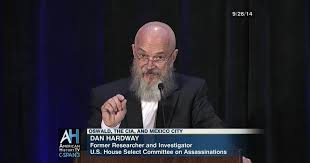
    Dan Hardway

    In 2014, for an ARRC conference, both Hardway and Lopez talked about their experience on the HSCA and the report. A lot of focus was put on how they had been making progress in the HSCA investigation until the CIA placed George Joannides as their resource person in charge of supervising the CIA’s interaction with the HSCA. Despite claims that Joannides was impartial, it was confirmed that he was directly involved with the Cuban exile organization called the DRE in 1963. Oswald had direct interaction with the DRE in events that became very public and were used to paint him as a communist. Hardway concludes his speech with:

    “The CIA has something to hide; Joannides knew what they had to hide. The CIA knew he knew and knew we did not know who or what he was hiding; Joannides hid what he had to hide.”

    Edwin Lopez

    Edwin Lopez confirmed the stonewalling and gave examples on how they were being spied on. He referred to the continued holding back of documents as a mess we all needed to work on together.

    They also confirmed that they felt that there were either fake phone calls done by an Oswald impostor while he was allegedly in Mexico or at least faked transcripts.

    Hardway hypothesizes that because of compartmentalization Phillips and Oswald may have found out on November 22, 1963 that Oswald was a patsy and Phillips received orders to tie the murder to Castro.

    In a critique of Phil Shenon’s work written for the AARC in 2015, Dan Hardway expresses the opinion that the CIA is heading to what he calls a limited hang-out by admitting that Oswald may have received guidance from Cuba and that the CIA director at the time, John McCone, was involved in a benign cover-up.

    In an interview he gave to Black Op Radio that same year, he recommended The Devil’s Chessboard by David Talbot, a book which exposes incriminating information about Alan Dulles and William Harvey, who can be seen now as persons of high interest in the case.

    In 2015, for a civil action where plaintiff Jefferson Morley, was suing the CIA for access to information, Dan Hardway signed a Sworn Deposition that underscores CIA obfuscation techniques as well as some of his findings during the investigation. The following are some of his statements:

    Beginning in May of 1978, the CIA assigned George Joannides to handle liaison with Edwin Lopez and me. In the summer of 1978, Mr. Joannides began to change the way file access was handled. We no longer received prompt responses to our requests for files and what we did receive no longer seemed to provide the same complete files that we had been seeing. The obstruction of our efforts by Mr. Joannides escalated over the summer, finally resulting in a refusal to provide unexpurgated access to files in violation of the Memorandum of Understanding previously agreed to by the HSCA and the CIA;

    During the course of the spring and summer of 1978 I had been looking into several areas of research which were actively impeded under Mr. Joannides’s direction. These included back channel communications methods used by the CIA’s Mexico City Station, William Harvey’s Office of Security files and his continuing relationship with certain Mafia figures, the use of an impulse camera to photograph the Cuban Consulate in Mexico City, missing production from one of the photographic installations that covered the Soviet Embassy in Mexico City as well as the impulse camera at the Cuban Consulate, and David Atlee Phillips’ possible involvement in stories about LHO that appeared after the assassination of John F. Kennedy.

    Before our unexpurgated access was cut off by Joannides, I had been able to document links between David Phillips and most of the sources of the disinformation that came out immediately after the assassination about Oswald and his pro-Castro proclivities. I confronted Phillips with those in an interview at our offices on August 24, 1978. Phillips was extremely agitated by that line of questioning, but was forced to admit that many of the sources were not only former assets that he had managed, in the late 50’s and early 1960’s, but were also assets whom he was personally managing in the fall of 1963. Mr. Phillips was asked, but could not explain, why the information that came from anti-Castro Cuban groups and individuals pointing to Cuban connections, all seemed to come from assets that he handled personally, but acknowledged that that was the case.

    We have, since 1978, learned that George Joannides was running the propaganda shop at the CIA’s Miami JMWAVE Station in 1963. It is extremely unlikely that Mr. Joannides could have occupied that position and not have known, and worked with, David Atlee Phillips. In addition, in 1963, we now know, George Joannides was the case officer handling the DRE. In 1977 the CIA specifically denied that DRE had a case officer assigned when asked that question by the HSCA.

    Robert Tanenbaum –  Chief Counsel HSCA

    In a Probe Magazine interview in 1993, Tanenbaum explained why he and Richard Sprague resigned from the Commission:

    Q: I interviewed a friend of yours down in New Orleans, L.J. Delsa. He said that he felt that one of the reasons the Congress turned against the Committee was, because of Sprague’s approach. It could have set a precedent in Washington to have really serious investigations instead of fact-finding commissions. Did you get any feeling about that?

    A: In my opinion, Congress never wanted to go forward with these investigations at all. That’s just based upon my having spoken with a lot of the membership of the House as I was asked to do by the Committee, in order to get funding. That’s something I never thought would be an issue before I went down there. They sort of politicized into it with some very distinguished members of Congress who were retiring in 1976, requesting that the Kennedy portion be investigated because they had seen Groden’s presentation of the Zapruder film and were very persuaded by it. Then the Black Caucus got involved and said well, investigate the murder of Dr. King. It was an election year and they said, “Ok, why not? We’ll do that.” But there was no commitment to really do it, unfortunately, which regrettably we found out while we were in the midst of investigating the case. They pulled our budget, they pulled our long-distance phone privileges, our franking privileges, we couldn’t even send out mail. And all of this was happening at a time when we were making some significant headway. So, L. J. may be right with respect to his perception, but at the same time I don’t believe they were ever committed to it. Tip O’Neill, who was the Speaker, was never committed to it. Only many, many years later did he realize that he’d made a tragic mistake.

    He also reveals troubling information about David Atlee Phillips:

    JD: Another thing you’ve discussed and it’s featured in your book, is this incredible movie of the Cuban exile training camp.

    BT: To the best of my recollection, we found that movie somewhere in the Georgetown library archives. The movie was shocking to me because it demonstrated the notion that the CIA was training, in America, a separate army. It was shocking to me because I’m a true believer in the system and yet there are notorious characters in the system, who are being funded by the system, who are absolutely un-American. And who knows what they would do, eventually. What if we send people to Washington who they can’t deal with? Out comes their secret army? So, I find that to be as contrary to the constitution as you can get.

    JD: Was it really as you described in the book, with all the people in that film? Bishop was in the film?

    BT: Oh, yeah. Absolutely! They’re all in the film. They’re all there. But, the fact of the matter is the Committee began to balk at a series of events. The most significant one was when [David Atlee] Phillips came up before the Committee and then had to be recalled because it was clear that he hadn’t told the truth. That had to do with the phony commentary he made about Oswald going to Mexico City on or about October 1st, 1963.

    JD: Would you describe that whole sequence, because I feel that is one of the real highlights of your book.

    Robert Tanenbaum

    BT: As I said, I had never followed the sequence of these events and I wasn’t aware of any of this, before I went to Washington. If you had told me all this before I went, I would have said, “This is madness. Talk to me about reality!” So, Phillips was saying that an individual went to Mexico City on or about October 1st and the CIA was claiming this was Lee Harvey Oswald, just as the Warren Commission claimed. However, the following occurred: “Oswald” goes to the Russian Embassy and identifies himself as Lee Henry Oswald. He wants to fake everybody out by changing his middle name. There were tapes of what he said because the CIA was bugging the Embassy the same as they were doing to the U.S. Embassy, according to Phillips. And the CIA was photographing people going in and out of the Embassy, the same as they were doing to the U.S. (We found out, from our own sources that the CIA had a contract employee named Lee Henry Oswald, in their files.) Phillips testimony was that there was no photograph of “Oswald” because the camera equipment had broken down that day and there was no audio tape of “Oswald’s” voice because they recycled their tapes every six or seven days. The problem with his story was, we had obtained a document, it was from the desk of J. Edgar Hoover, it was dated November 23rd, 1963, the very next day after the assassination. This document was a memo to all FBI supervisorial staff stating, in substance, that FBI agents who have questioned Oswald for the past 17 hours approximately, have listened to the tape made on October 1st, by an individual identifying himself as Lee Henry Oswald inside the Russian Embassy, calling on the phone to someone inside the Cuban Embassy and the agents can state unequivocally that the voice on the tape is not the voice of Lee Harvey Oswald, who is in custody.

    JD: Did you have this document while you were questioning Phillips?

    BT: No. It was a whole separate sequence of events that occurred. But, I wanted to get him back before the Committee so we could confront him with this evidence, because we were in a position to demonstrate that that whole aspect of the Warren Report, and what he had testified to, was untrue. And of course, the Committee was not interested in doing that.

    Tanenbaum also vindicated Garrison, incriminated Clay Shaw and shared thoughts about leads that were not followed up on:

    JD: You’ve said that you’ve actually seen a CIA document that says they were monitoring and harassing Jim Garrison’s witnesses.

    BT: Right. We had that information. I was shocked to read that because I remember discounting everything Garrison had said. I had a negative point of view about Garrison based upon all the reportage that had gone on. And then I read all this material that had come out of Helm’s office, that in fact what Garrison had said was true. They were harassing his witnesses, they were intimidating his witnesses. The documents exist. Where they are now, God only knows. It’s a sad commentary on the lack of oversight on the executive intelligence agencies.

    JD: I read something about you to the effect that during the brief period you ran the Committee, after Sprague left, one of the areas that really interested you was New Orleans and its connection to JM/Wave and Miami. Also, Delsa told me, as far as he was concerned, that was one of the most productive areas they were working.

    BT: That’s correct. The meeting in Clinton and the Clay Shaw connection and the fact that the government was lying about Clay Shaw and the aliases and so on. That the fact that the government and the executive intelligence agencies, not Garrison, were lying about that, was definitely an area to probe to find out what the justification for that was. Why were they involved in all this, if in fact, nothing had occurred? If it was meaningless, why get involved in creating a perjurious situation for a prosecutor in New Orleans? What was he really on to?

    JD: What’s interesting about the day that Sprague resigns, is that’s the day De Mohrenschildt is found dead.

    BT: Right. The night before the Committee vote, we had sent an investigator to serve him a subpoena. The night of the day he received the subpoena from the Committee is when he was found dead.

    JD: I guess the Committee was so crippled at that time that it couldn’t really pursue whatever investigation there may have been into his murder. And he was a key witness, right?

    BT: Right. We desperately wanted to find out what happened. He was someone who had not been subpoenaed before, certainly not by the Warren Commission. [CTKA note: he was questioned, but not subpoenaed.] And you’re right, he was a key player.

    JD: Another thing you guys were on to that Blakey never seemed to be on to, was the connection between the people in the background of the assassination and the scandal that had just happened in Washington – namely, Watergate.

    BT: Right. E. Howard Hunt, Frank Sturgis. Interestingly, some of them had been with Castro in the Sierra Maestra during the revolution and became players after the revolution. And then wound up in the Nixon White House as the “plumbers.”

    JD: You’ve stated that the Committee never got any cooperation from the Kennedys.

    BT: We called Senator Kennedy 20-30 times. He never responded once to an inquiry. I found that to be astounding, because after all, he is a member of this legislative branch of government. He conducts probes, he engages in fact-finding missions. How could he stonewall from his brethren in the other chamber? He could have just simply acknowledged a phone call. How could he know what information we wanted? The fact of the matter was, as a matter of courtesy, we wanted to let him know we knew he was around and we wanted to discuss with him areas that he felt we should look into and get his opinions. We certainly felt that they would be valid. So, we were very disappointed in that regard. Frank Mankiewicz came by as a representative of the Kennedy family, wanted to see whether or not Sprague and I had two or three heads. He told us, interestingly, Bobby Kennedy couldn’t put a sentence together about the assassination, he couldn’t even think about it, he couldn’t focus on it. Which explains, in large measure why the Kennedy family was willing to accept what the Warren Commission said, without concern. The event was so horrific, in and of itself, they really weren’t concerned with bringing someone to justice other than what the Warren Commission had said. In their minds, from what Mankiewicz said, if it wasn’t Oswald-some nonperson-then it was some other nonperson. What difference would it make?

    JD: When the attacks on Sprague began, most notably in the New York Times and a few other newspapers, did you begin to see a parallel between what was happening to Sprague and what had happened to Jim Garrison?

    BT: Of course. But, I didn’t pay much attention to it because it didn’t mean anything to me. I’m not moved to any great extent, by what people write in newspapers. They were trying to cause controversy. But, we were on a mission to do a job and nothing some dope in the New York Times or any other newspaper was going to write, that was blatantly untrue, was going to interfere with what we were doing. Whether it was a positive article or a negative article, it didn’t matter.

    In 2003, Tanenbaum spoke at the Wecht Conference and what he had to say would certainly give students of American History new insights in the assassination that would not have pleased Earl Warren or Gerald Ford and some of their disciples.

    Here are but a few of the points he made:

    What I am saying is that from the evidence we produced, there were substantial questions about the assassination …

    What I’d like to do very briefly is to explain some of the reasons why, from a prosecutorial point of view, from what our investigation revealed, there was, in my judgment, no case to convict Lee Harvey Oswald of murdering the President …

    The assassination was approximately 12:30; at 12:48 a description of a suspect was sent out: “‘white male, approximately thirty, slender build, height five foot ten inches, weight 165 pounds.” Where did that description come from?

    And the answer the Warren Commission gives is that this fellow Brennan was… looking up at the Depository window. And he allegedly sees this person – the shooter – Oswald the Warren Commission maintains, and was able to give a description, a miraculous feat … because if he stood up in the window you would only see a partial of his body [his knees] because the first few feet was opaque. [the window was close to the floor]

    Whoever the shooter was that was in that window – in that Sniper’s Nest, he was crouched down looking out that window which was raised about 12 inches. At best, if anybody saw anybody in that window, they would have seen a partial of their face, at best.

    During a 2015 interview on Len Osanic’s Black Op Radio, he talked about how the Warren Commission did not want look into a conspiracy, including Oswald’s links with intelligence and Ruby’s to the mob and the Dallas Police Department.

    Richard Sprague – Chief Counsel

    Historians can be illuminated by what this top level insider of impeccable credentials thought about the assassination and the ensuing cover-up from the many interviews he gave.

    In the BBC Documentary The Killing of President Kennedy, Sprague related the following about Oswald:

    His trip to Russia raised a number of questions that we wanted to get into. For example, when any American went to Russia and renounced his American citizenship and subsequently changed his mind and wanted to come back to this country, upon returning to this country there was a thorough debriefing by the CIA, with one exception as far as we could ascertain- Oswald…

    The photographs allegedly of Oswald going into the Cuban embassy as we all know in fact are not photographs of Oswald. Secondly it turns out that those photographs, even if they were of the wrong person, you would expect they would be of a person entering the Cuban embassy but it turns out they are photographs of someone entering the Russian embassy and the question raised how could they so mix up even what building they are talking about. In addition when we inquire where are the photographs you took of the people entering the Cuban embassy the day in question we are told the cameras were not working that day. I want to talk to the camera people I want to find out if that’s true and that’s where we got stopped.

    The CIA said they had re-used the tape prior to the assassination of President Kennedy, yet the FBI has a document stating that some of their agents listened to the tape after the assassination of President Kennedy and that the voice on there was not Oswald’s. In addition the CIA presented a transcript of that conversation; we had interviewed the typist who typed it up who said that the transcript presented was not in fact what was typed up by whoever it was who spoke in that conversation. These are areas that I wanted to get into.

    From the photographic evidence surrounding the sixth floor window, as well as the grassy knoll, Sprague, Tanenbaum and most of the staff knew Oswald had not fired any shot, they suspected no shots came from the sixth floor “sniper’s nest” window, and knew there had been shots from other points in Dealey Plaza. They knew the single bullet theory was not valid, and strongly suspected there had been a pre-planned crossfire in Dealey Plaza. They were not planning to waste a lot of time reviewing and rehashing the Dealey Plaza evidence, except as it might lead to the real assassins.

    They had set up an investigation in Florida and the Keys, of some of the evidence and leads developed in 1967 by Garrison. Gaeton Fonzi was in charge of that part of Sprague’s team. They were going to check out the people in the CIA that had been running and funding the No Name Key group and other anti-Castro groups, e.g., Willaim Seymour, Manuel Garcia Gonzalez, Jerry Patrick Hemming, Loran Hall, Lawrence Howard, and Rolando Masferrer and Carlos Prio Socarras.

    This new situation, with Richard Sprague and his team garnering so much knowledge of the CIA’s role in the murder and the cover-up caused the Establishment to face a crisis. They knew they had to do several things to turn the situation around and keep the American public in the dark. Here is what they had to do:

    • Get rid of Chief Counsel Richard Sprague.
    • Get rid of Committee Chairman Henry Gonzalez.
    • Get rid of Sprague’s key men and keep them away from more incriminating CIA evidence.
    • Install their own chief counsel to control the investigation.
    • Nominate a new HSCA chairman who would go along, or who could be fooled.
    • Limit Sprague’s investigations of CIA people. Make sure some of the people aren’t found or, if necessary dispose of CIA people who might talk.
    • Create a new investigative environment whose purpose would be to confirm all of the findings of the Warren Commission and divert attention away from the who-did-it-and-why approach.
    • Control the committee staff in such a way as to keep any of them separate from other teams and silent by signing non-disclosure agreements.
    • Control the media by not holding any press conferences.

    These things all happened. And they fundamentally altered the temperament and goals of the HSCA. It simply was not the same. As many observers think, this was the last, best chance to solve the JFK case.

    How did it happen? According to Gaeton Fonzi in The Last Investigation:

    Richard Sprague

    The key factors that drove Richard Sprague to resign as Chief Counsel of the Assassinations Committee appeared, at the time, to be apparent and on the surface. His proposed use of certain investigative equipment, his demand for an expensive, unrestricted investigation, his refusal to play politics with Chairman Gonzalez – all were apparent grounds for the vociferous criticism which, in the long run, was debilitating to the Committee’s efforts to get on with its job. However, after his resignation and a brief respite from the turmoil of Washington, Sprague was able to view his experience in a broader perspective.” … “If he had it to do over again, he would begin his investigation of the Kennedy assassination by probing “Oswald’s ties to the Central Intelligence Agency.” Recently, I asked Sprague why he had come to that conclusion. “Well,” he said, “when I first thought about it I decided that the House leadership really hadn’t intended for there to be an investigation. The Committee was set up to appease the Black Caucus in an election year. I still believe that was a factor. But when I looked back at what happened, it suddenly became very clear that the problems began only after I ran up against the CIA. That’s when my troubles really started.

    In a 2000 interview for Probe Magazine with John Williams, he described his being fired this way:

    SPRAGUE: We were just going to do that type of thorough thing. I demanded the records from the CIA, and now there was an abrupt refusal, and I subpoenaed them. At that point, Gonzales, who was Chairman of the Committee, ordered the CIA, or told the CIA that they need not respond to my subpoena, and fired me, and ordered the U.S. Marshals come in and remove me from my office.

    WILLIAMS: Oh, so that firing was directly after you had subpoenaed the records from the Central Intelligence Agency.

    SPRAGUE: Right. But there’s more involved in it than the timing …

    WILLIAMS: Right.

    SPRAGUE: … if you checked the record. That came up after that. He ordered my firing. He ordered marshals to remove me from my office in what I’m sure was the first and only time in the history of the United States Congress. The rest of the Committee, backed me to a man and overrode the Chairman, and ordered that I remain, and the marshals were directed to get off.

    Of course, that led to Gonzales taking it up in the House of Representatives, and the House backed the rest of the Committee. And he resigned and Stokes came on. [Louis Stokes was the Representative from Ohio. Eds. Note] I’m sure that’s the only time in the history in the United States Congress that in a fight between the Chairman and the Director, that the Chairman got bounced.

    But there’s a terrible price paid for that. Every Congressman dreams of being Chairman of a Committee and being all powerful. It ultimately did not sit well with the Congress that a Chairman got ousted …

    Robert Blakey – Chief Counsel and staff director 1977-79

    While Sprague’s replacement, Robert Blakey, frustrated some investigators for being too trusting of the CIA, he too did not buy the Warren Commission’s final conclusions.

    While at first Blakey felt that the HSCA had investigated the CIA enough to absolve them of any role in the assassination, in 2003 in an addendum to an interview with PBS, his opinion evolved. Because he found out that the CIA misled him and the HSCA by bringing George Joannides out of retirement as the CIA liaison with the Committee and hiding the role he had with an anti-Castro group called the DRE which played an important role by its interaction with Oswald:

    I am no longer confident that the Central Intelligence Agency co-operated with the Committee. My reasons follow:

    The Committee focused, among other things, on (1) Oswald, (2) in New Orleans, (3) in the months before he went to Dallas, and, in particular, (4) his attempt to infiltrate an anti-Castro group, the Directorio Revolucionario Estudiantil or DRE.

    These were crucial issues in the Warren Commission’s investigation; they were crucial issues in the committee’s investigation. The Agency knew it full well in 1964; the Agency knew it full well in 1976-79. Outrageously, the Agency did not tell the Warren Commission or our committee that it had financial and other connections with the DRE, a group that Oswald had direct dealings with!

    What contemporaneous reporting is or was in the Agency’s DRE files? We will never know, for the Agency now says that no reporting is in the existing files. Are we to believe that its files were silent in 1964 or during our investigation?

    I don’t believe it for a minute. Money was involved; it had to be documented. Period. End of story. The files and the Agency agents connected to the DRE should have been made available to the Commission and the Committee. That the information in the files and the agents who could have supplemented it were not made available to the Commission and the Committee amounts to willful obstruction of justice.

    Obviously, too, it did not identify the agent who was its contact with the DRE at the crucial time that Oswald was in contact with it: George Joannides.

    During the relevant period, the Committee’s chief contact with the Agency on a day-to-day basis was Scott Breckinridge. (I put aside our point of contact with the office of chief counsel, Lyle Miller) We sent researchers to the Agency to request and read documents. The relationship between our young researchers, law students who came with me from Cornell, was anything but “happy.” Nevertheless, we were getting and reviewing documents. Breckinridge, however, suggested that he create a new point of contact person who might “facilitate” the process of obtaining and reviewing materials. He introduced me to Joannides, who, he said, he had arranged to bring out of retirement to help us. He told me that he had experience in finding documents; he thought he would be of help to us.

    I was not told of Joannides’ background with the DRE, a focal point of the investigation. Had I known who he was, he would have been a witness who would have been interrogated under oath by the staff or by the committee. He would never have been acceptable as a point of contact with us to retrieve documents. In fact, I have now learned, as I note above, that Joannides was the point of contact between the Agency and DRE during the period Oswald was in contact with DRE.

    That the Agency would put a “material witness” in as a “filter” between the committee and its quests for documents was a flat out breach of the understanding the committee had with the Agency that it would co-operate with the investigation.

    The Committee’s researchers immediately complained to me that Joannides was, in fact, not facilitating, but obstructing our obtaining of documents. I contacted Breckinridge and Joannides. Their side of the story wrote off the complaints to the young age and attitude of the people.

    They were certainly right about one question: the Committee’s researchers did not trust the Agency. Indeed, that is precisely why they were in their positions. We wanted to test the Agency’s integrity. I wrote off the complaints. I was wrong; the researchers were right. I now believe the process lacked integrity precisely because of Joannides.

    For these reasons, I no longer believe that we were able to conduct an appropriate investigation of the Agency and its relationship to Oswald. Anything that the Agency told us that incriminated, in some fashion, the Agency may well be reliable as far as it goes, but the truth could well be that it materially understates the matter.

    What the Agency did not give us, none but those involved in the Agency can know for sure. I do not believe any denial offered by the Agency on any point. The law has long followed the rule that if a person lies to you on one point, you may reject all of his testimony.

    I now no longer believe anything the Agency told the Committee any further than I can obtain substantial corroboration for it from outside the Agency for its veracity. We now know that the Agency withheld from the Warren Commission the CIA-Mafia plots to kill Castro. Had the commission known of the plots, it would have followed a different path in its investigation. The Agency unilaterally deprived the commission of a chance to obtain the full truth, which will now never be known.

    Significantly, the Warren Commission’s conclusion that the agencies of the government co-operated with it is, in retrospect, not the truth.

    We also now know that the Agency set up a process that could only have been designed to frustrate the ability of the committee in 1976-79 to obtain any information that might adversely affect the Agency.

    Many have told me that the culture of the Agency is one of prevarication and dissimulation and that you cannot trust it or its people. Period. End of story.

    I am now in that camp.

    Anyone interested in pursuing this story further should consult the reporting by Jefferson Morley of the Washington Post. See, e.g., Jefferson Morley, “Revelation 1963”, Miami New Times (April 2001).

    Robert Blakey

    During his appearance for the AARC Conference in 2014, Blakey’s views seem to have crystallized by stating that at first he felt the CIA had cooperated but that he had come to change his mind. He also explained how he was sold the idea by the CIA of bringing in a facilitator in Joannides to help in the liaison between the CIA and the HSCA, and that that was when things went downhill. He also said that they were refused the DRE file and were told by Joannides that there was no case agent for the DRE, when in fact he was the case agent! It was also discovered subsequent to the HSCA hearings that Joannides was acting as an undercover agent in his dealings with the HSCA. He also said that FBI agent Regis Kennedy described Marcello as a tomato salesman who was not part of the mob.

    During this presentation and on a 2015 Black Op Radio program he confirmed his belief in the single bullet theory, but also that a shot came from the grassy knoll due to witness testimony from several people who the Warren Commission made every effort to undermine. This includes Secret Service agents, S. M. Holland, and presidential assistant Dave Powers. He said this caused him to lose confidence in the Warren Commission report. He said that “It’s not an investigation … It’s a justification to assert that Oswald acted alone … They used the testimony of Lenny Patrick – a mob shooter – to exculpate Ruby from mob connections …”  He concluded that the committees, including the ARRB, were had.

    Comments on the HSCA


    A diligent historian who prides himself in honoring the historical record should really take the time to digest the conclusions of the report and the statements of the high level insiders who are in the know… They do not buy the Warren Commission version of the assassination; they do not conclude that Oswald acted alone; they do not find that the murder was adequately investigated!

    Liberty Lobby vs. E. Howard Hunt

    Contrary to the other investigations which were governmental, this instance was a civil trial which pitted CIA operative and Watergate burglary planner E. Howard Hunt against Mark Lane. Lane came in because Spotlight was a publication which ran a piece in 1985 reporting that the CIA had a memo confirming its intention to out Hunt as having been involved in the JFK assassination, acting as something like a rogue agent. Hunt sued and won for slander but lost on appeal after Liberty Lobby hired Lane to represent them.

    Spotlight wrote the following about its victory: “Scattered news reports did mention Hunt had lost a libel case against The SPOTLIGHT. However, no media reported what the jury forewoman had told the press:  ‘Mr. Lane was asking us to do something very difficult. He was asking us to believe John Kennedy had been killed by our own government. Yet when we examined the evidence closely, we were compelled to conclude that the CIA had indeed killed President Kennedy.’”

    Mark Lane, who passed away in 2016, was among the earliest researchers who detailed problems about the Warren Commission, which he related in the best-seller Rush to Judgement. His books Plausible Denial and the Last Word cover the trial extensively.

    Comments about the Liberty Lobby – Hunt trial

    While many Warren Commission defenders have tried to discredit Mark Lane through the years, an open-minded historian should consider the jury members who were asked to play an important role in ensuring that justice was served. They took in and evaluated all the evidence. And have added themselves to the already overwhelming number of insiders who do not buy what is written in most history books, i.e., the Warren Commission version of events.

    ARRB Assassination Records Review Board

    This Board was created in 1994 after the movie JFK put pressure on Congress to pass the 1992 JFK Assassination Records Collection Act. During a four-year period, it declassified millions of documents. Its mandate was different from the other investigations:  The major purpose of the Review Board was to re-examine for release the records that the agencies still regarded as too sensitive to open to the public. In addition, Congress established the Review Board to help restore government credibility. To achieve these lofty goals, Congress designed an entity that was unprecedented.

    It was not set up to re-investigate the case, nor to solve what happened on November 22, 1963.  It nevertheless provided valuable information to assassination researchers that historians seem oblivious to. It achieved the following:

    • Reviewed and voted on over 27,000 previously redacted assassination records.
    • Obtained agencies’ consent to release an additional 33,000+ assassination records.
    • Ensured that the famous Zapruder Film of the assassination belonged to the American people and arranged for the first known authenticity study of the Zapruder Film.
    • Opened previously redacted CIA records from the Directorate of Operations.
    • Released 99% of the “Hardway/Lopez Report” documenting the CIA’s records on Lee Harvey Oswald’s trip to Mexico City before the assassination.
    • Conducted its own inquiry into the medical record of President Kennedy’s autopsy and his treatment at Parkland Hospital by deposing 10 Bethesda autopsy participants, five Parkland Hospital treating physicians, and conducting numerous unsworn interviews of Parkland and Bethesda personnel.
    • Secured records relating to District Attorney Jim Garrison’s prosecution of Clay Shaw for conspiracy to assassinate President Kennedy, including Shaw’s diaries, records from Shaw’s defense attorneys, investigative records from the District Attorney’s office, and grand jury records.
    • Made available to the public all FBI and CIA documents from previous official investigations, like the HSCA.
    • Sponsored ballistics and forensic testing of Warren Commission Exhibit 567, the bullet “nose fragment” from the front seat of the Presidential limousine (the HSCA Firearms Panel first recommended the testing in 1978, but the testing was not conducted until the Review Board existed).
    • Permanently preserved all the extant autopsy photographs of President Kennedy in digitized form, and conducted sophisticated digital enhancement of selected, representative images.

    Jeremy Gunn – Executive counsel

    On November 10, 2013 he made the following remarks for NPR:

    “There were many things that were disturbing.”

    J. Thornton Boswell (left)James J. Humes (center) Pierre Finck (right)

    When Gunn pored over the material, what stuck out most for him was the medical evidence. For instance, what he learned in his 1996 deposition of James Joseph Humes. Humes, who died three years later, was one of the doctors who performed the autopsy on Kennedy’s body.

    For one thing, Humes told Gunn that the autopsy was not performed strictly by the book; some procedures were left out, such as removing and weighing all the organs. Then, Humes made an eye-opening revelation.

    “Dr. Humes admitted that the supposedly original handwritten version of the autopsy that is in the National Archives is in fact not the original version,” Gunn says. He says Humes had never said that publicly before, even to the Warren Commission.

    Saundra K. Spencer

    When Gunn showed Saundra Spencer, the Navy Warrant Officer who processed the autopsy film, the official photos from the National Archives during her deposition in 1997, she said they were not the pictures she remembered processing. What’s more, the official pictures weren’t anything like the ones she remembered. “The prints that we printed did not have the massive head damages that is visible here,” she told Gunn. “… The face, the eyes were closed and the face, the mouth was closed, and it was more of a rest position than these show.”

    “[I] can recite a litany of other unresolved questions surrounding the Kennedy assassination — ones the Warren Commission failed to answer. For example, in New Orleans in 1963, Oswald came in contact with the FBI. When he was arrested after a scuffle at a demonstration, he asked to meet with the FBI. Why would Oswald ask to see someone from the FBI?” Gunn asks. “But an FBI agent went and interviewed Oswald, came back and wrote a memo on it, put it in the file.”

    Jeremy Gunn

    “For me, it’s quite simple,” Gunn says. “I don’t know what happened.”

    “There is substantial evidence that points toward Oswald and incriminates Oswald,” he says, “and the only person we can name where there is evidence is Oswald. But there’s also rather important exculpatory evidence for Oswald, suggesting he didn’t do it, and that he was framed.”

    “So they wanted to write the document in a way that would reassure the American public that it was a single gunman acting alone, somebody who’s a little bit unstable, and that that’s the explanation for what happened. Since the facts aren’t clear, though, that document can look like a whitewash.”

    For the Warren Commission, transparency had its own difficulties. “There are serious problems with the forensics evidence, with the ballistics evidence, with the autopsy evidence,” Gunn says. “And, in my opinion, if they had said that openly, it would have not put the issue to rest.”

    “If the president had been killed as part of a conspiracy, that needed to be known,” he says.

    “The institution that had the opportunity to best get to the bottom of this, as much as it was possible, was the Warren Commission, and they didn’t do it,” he says. “Now it’s too late to do what should have been done originally.”

    Doug Horne – Senior analyst

    Doug Horne reviewed the military records including the military autopsy for the ARRB. What he found was revealed during interviews as well as the book he wrote, Inside the ARRB, published in 2009. Its contents are fascinating and would surprise students of American history who base their beliefs on many of the history textbooks.

    Numerous persons the ARRB deposed or interviewed (FBI agents Sibert and O’Neill, mortician Tom Robinson, and others) have essentially disowned the autopsy photographs showing the back of JFK’s head intact. O’Neill said the photos of the back of the head looked “doctored” (by which he meant that he thought the wound had been repaired – put back together – not that the photo looked altered), and Sibert said the back of the head looked “reconstructed.” Tom Robinson of Gawler’s funeral home said there was a large hole in the back of the head where it looks intact in the photos. Pathologist J. Thornton Boswell said that there was a lot of bone missing in the right rear of the head behind where the scalp looks intact, but did not explain how the scalp could be intact if the bone in the right rear of the skull was missing! (See the ARRB deposition transcripts of Frank O’Neill, James Sibert, and J. Thornton Boswell, as well as the unsworn report of the ARRB interview with Tom Robinson.)

    Doug Horne

    But perhaps Horne’s most stunning conclusion was that the photographs of “the President’s brain” in the autopsy collection are really photographs of someone else’s brain … a major deception in this case. These images, which appear to show damage consistent with a shot from above and behind, were disowned under oath to the ARRB by John Stringer, the photographer who took the official brain photos at JFK’s supplementary autopsy. He disowned the images because of the angles at which they were shot, and because they were taken on the wrong film – film he did not use. (FBI agent O’Neill also disowned the brain photos in the autopsy collection, saying that there was too much tissue present, and that at autopsy over one half of the President’s brain was missing.) These photos have been used for years by supporters of the Warren Commission’s conclusions to support their shooting scenario, and to discount those who claim there were shots from the front or right front.

    General conclusions

    Most historians who talked about their sources when writing about the JFK assassination were not aware of the ARRB and the wealth of new evidence made available starting a year after Gerald Posner wrote Case Closed. As a matter of fact, not one cited any of the official investigations as a source other than the Warren Commission. Which, of course, is the oldest, most contested, highly rushed, poorly investigated, biased governmental source possible.

    That assessment does not come from independent authors who are trying to sell books. It comes from written reports of subsequent investigations and the statements of a very significant cross-section of insiders that participated in the investigations including the Warren Commission:  Senators (some Republicans, some Democrats), counsel, staff members, attorneys, researchers, historians, archivists, investigators, FBI, DPD and Louisiana State law enforcement agents. As well as from the highest ranking members of the HSCA and Church committees. As well as an impressive number of dissenting participants of the Warren Commission itself, who have voiced their opinions in reputable magazines, newspapers, documentaries and books, all easily accessible on the web. We are not talking about zany, fringe, book peddling conspiracy theorists here. These are persons that witnessed the autopsy, questioned persons of interest under oath while looking them in the eye, poured over reports and secret documents, worked in teams to analyze the evidence, etc. – people who the U.S. government entrusted to investigate the crime of the century and who curious historians may learn from.

    While they may not all know what in fact happened, they all agree on certain key points: The Warren Commission conclusions are not reliable; the investigations into the assassination were deficient (especially the Warren Commission’s); they are far from certain that Oswald and Ruby acted alone. Many of them believe that: government agencies hid the truth; the Single Bullet Theory is a fabrication; that there has been a long-lasting cover-up; that Oswald and Ruby were involved in very suspicious relationships, and the list goes on and on. All diametrically opposed to what historians, for money, are telling adolescents as part of a captive audience! Which is that Oswald did it and the Warren Commission got it right! End of story!

    The American Historical Association statement of conduct stipulates that historians are to honor the historical record.. To do so they first need to know what it is! If the next edition of their history books continues to support the cover-up, their behavior should be considered nothing less than unforgivable.


    Go to Addendum

    Go to Part 1

  • JFK and the Unforgivable: How the historians’ version of the JFK assassination dishonors the historical record – Part 1

    JFK and the Unforgivable: How the historians’ version of the JFK assassination dishonors the historical record – Part 1


    In April 2016 CTKA published this author’s article[i] that revealed how history books portray the JFK assassination as a crime perpetrated by Oswald alone and how authors’ sources are restricted to the Warren Commission and a few books that mostly support the Lone Nut scenario. Information and conclusions coming from other major investigations and pro-conspiracy authors are almost completely ignored.

    The article went on to show how the historians violate their own code of conduct on this issue and looked into possible outside influences that may have affected their work and mindsets. The unfortunate result of the lack of diligence on this issue is that captive audiences of young students have been unfairly exposed to a biased, unsound and incomplete account of the Kennedy assassination in most history textbooks.

    Another point that came out was that many historians find that independent researchers that write about possible conspiracies lack credibility. There has been much propaganda to discredit them and their work. They are called zany, dishonest, and greedy and their claims are said to be baseless and off the wall. Furthermore they are accused of undermining their own institutions, government and country. Before a serious historian can zero in on whom the reliable researchers are and focus on the soundness of their arguments, they have to cut through clutter caused by hostile, omnipresent anti-conspiracy messaging as well as the cast of shaky researchers peddling low quality work.

    This article focuses on what interested historians can easily learn from the official investigations and the opinions and statements from the actual investigators, lawyers, and staff members who were involved in six investigations that were mostly (all but one) government initiated and managed. The Warren Commission was the first one, the one most historians count on almost entirely for their writings, and as we will see, it is the most obsolete and least reliable.

    For an historian who finds research on this issue very daunting, this should serve as a starting point – especially for those who, as they did with the Warren Commission Report, have faith in their government institutions and their representatives. What follows is what can be learned from not only the official investigation reports but from the mouths of those who were direct participants in them … the real insiders: Those who were mandated and given special powers to access witnesses and evidence! It therefore discounts the theories and opinions of independent authors.

    It may prove difficult to fluff off these sources as being zany, dishonest and greedy … Doing so would suggest a far-fetched governmental conspiracy to deceive its own people and undermine important American institutions.

    It is this author’s opinion that historians are disrespecting the American Historical Association statement of conduct about honoring the historical record when they assert that Oswald alone assassinated the president based on the conclusions of the Warren Commission. If they read this article and continue to do so, their actions cannot be blamed on mere ignorance of the facts, or confusion caused by obfuscators. Thereafter, if the historian does not feel compelled to dig deeper to find out what really happened, then the word unforgivable should be added to the word subservient – at least on this issue – when describing their performance. Especially when one considers the age of the subjects who are victimized in what is supposed to be a learning environment.

    If they continue to cite the Warren Commission as their key source, they may want to consider taking up smoking cigarettes; after all some of the first studies about this product concluded that it was good for your health.

    The President’s Commission on the Assassination of President Kennedy (aka The Warren Commission)

    Established on November 29, 1963, it was set up by President Lyndon Johnson to investigate the November 22, 1963 assassination of President Kennedy. The Commission presented an 888-page report[ii] and twenty-six volumes of evidence on September 24, 1964. Its major conclusions were that Lee Harvey Oswald acted alone in killing JFK and that nightclub owner Jack Ruby also acted alone in killing Oswald two days later.

    The Commission had “not found evidence” linking either Oswald or Ruby to a conspiracy. (WR, p. 21)

    The first hint of dissension among the members of the commission is the following bewildering statement in the report which points to a rift concerning the Single Bullet theory and Connally’s testimony: “Although it is not necessary to any essential findings of the Commission to determine just which shot hit Governor Connally, there is very persuasive evidence from the experts to indicate that the same bullet which pierced the President’s throat also caused Governor Connally’s wounds. However, Governor Connally’s testimony and certain other factors have given rise to some difference of opinion as to this probability but there is no question in the mind of any member of the Commission that all the shots which caused the President’s and the Governor’s wounds were fired from the sixth floor of the Texas School Book Depository.” (WR, Page 19)

    What is not being said directly here is that certain members of the Commission, as well as John Connally and his wife, did not believe that a single bullet caused all seven wounds, which is in fact necessary to the essential conclusions. Because if one bullet caused Kennedy’s head wound and another caused bystander James Tague’s injury, then for Oswald to be the lone shooter, he would have had to have caused all remaining seven wounds with his only other shot, because even the Warren Commission acknowledges that Oswald could not have fired more than three shots.

    Statements and opinions of Warren Commission members, consultants and investigators

    While most historians continue to place their faith in the Warren Commission, it is most noteworthy that an important number of important participants in the investigation had serious doubts about crucial elements in the report.

    Roger Craig – Dallas Deputy Sheriff

    Roger Craig was very well regarded up until the assassination. He was on duty and in Dealey Plaza at the time of the assassination. In a number of interviews he explains what he witnessed on November 22, 1963: He was in the Book Depository when the alleged murder weapon was found which he confirmed as a Mauser and not the Mannlicher-Carcano that the Warren Commission claimed Oswald owned. (Contrary to what some have written, the brand name Mauser and the calibre are stamped on some editions of the Mauser rifle; see here The Mauser, the Carcano and the Lt. Day Rifle ) Furthermore Craig claimed to have seen Oswald entering a station wagon a few minutes after the assassination, which would contradict the Warren Commission’s chronology of Oswald’s movements and implicated a getaway driver – the following is part of his Warren Commission testimony:

    Roger Craig: I drove up to Fritz’ office about, oh, after 5 … about 5:30 or something like that and talked to Captain Fritz and told him what I had saw. And he took me in his office … I believe it was his office … . it was a little office, and had the suspect sitting in a chair behind a desk … beside the desk. And another gentleman, I didn’t know him, he was sitting in another chair to my left as I walked in the office. And Captain Fritz asked me “was this the man I saw” and I said, “Yes,” it was.

    David Belin: All right. Will you describe the man you saw in Captain Fritz’ office?

    Roger Craig: Oh, he was sitting down but he had the same medium brown hair; it was still … well, it was kinda wild looking; he was slender, and what I could tell of him sitting there, he was … short. By that, I mean not myself, I’m five eleven … he was shorter than I was. And fairly light build.

    David Belin: Could you see his trousers?

    Roger Craig: No; I couldn’t see his trousers at all.

    David Belin: What about his shirt?

    Roger Craig: I believe, as close as I can remember, a T-shirt … a white T-shirt.

    David Belin: All right. But you didn’t see him in a lineup? You just saw him sitting there?

    Roger Craig: No; he was sitting there by himself in a chair … off to one side.

    David Belin: All right. Then, what did Captain Fritz say and what did you say and what did the suspect say?

    Roger Craig: Captain Fritz then asked … . “What about this station wagon?” And the suspect interrupted him and said, “That station wagon belongs to Mrs. Paine” … I believe is what he said. “Don’t try to tie her into this. She had nothing to do with it.”

    In Craig’s 1971 book When They Kill a President, he describes that many in the DPD despised Kennedy, and how the DPD was excluded from security duties the day of the assassination. The following is David Ratcliffe’s summary of the Book:

    … He was a member of a group of men from Dallas County Sheriff James Eric “Bill” Decker‘s office that was directed to stand out in front of the Sheriff‘s office on Main Street (at the corner of Houston) and “take no part whatsoever in the security of that motorcade.” Once he heard the first shot, Roger Craig immediately bolted towards Houston Street. His participation in the formative hours of the investigation during the rest of that day and into the evening included observations and experiences that would have singlehandedly destroyed the entire Warren Commission fairy tale before a grand jury or a Congressional investigation.

    Roger Craig was named the Dallas Sheriff‘s Department “Officer of the Year” in 1960 by the Dallas Traffic Commission. He received four promotions while he was Deputy Sheriff. Among the most important events he witnessed: At approximately 12:40 p.m., Craig was standing on the south side of Elm Street when he heard a shrill whistle coming from the north side of Elm and turned to see a man—wearing faded blue trousers and a long sleeved work shirt made of some type of grainy material—come running down the grassy knoll from the direction of the TSBD. He saw a light green Rambler station wagon coming slowly west on Elm Street, pull over to the north curb and pick up the man coming down the hill. By this time the traffic was too heavy for him to be able to reach them before the car drove away going west on Elm.
    Roger Craig

    After witnessing the above scene, Deputy Craig ran to the command post at Elm and Houston to report the incident to the authorities. When he got there and asked who was involved in the investigation, a man turned to him and said “I‘m with the Secret Service.” Craig recounted what he had just seen. This “Secret Service” man showed little interest in Craig‘s description of the people leaving, but seemed extremely interested in the description of the Rambler to the degree this was the only part of the recounting that he wrote down. Immediately after this Craig was told by Sheriff Decker to help the police search the TSBD. Deputy Craig was one of the people to find the three rifle cartridges on the floor beneath the window on the southeast corner of the sixth floor. Originally, all three were no more than an inch or two apart. One of the three shells was crimped on the end which would have held the slug. It had not been stepped on but merely crimped over on one small portion of the rim. The rest of that end was perfectly round.

    He was among those present after the rifle was found. And, along with Deputy Eugene Boone who had first spotted the weapon, was immediately joined by police Lt. Day, Homicide Capt. Fritz, and deputy constable Seymour Weitzman, an expert on weapons who had been in the sporting goods business for many years and was familiar with all domestic and foreign makes. Lt. Day briefly inspected the rifle and handed it to Capt. Fritz who asked if anyone knew what kind of rifle it was. After a close examination, Weitzman declared it to be a 7.65 German Mauser. Capt. Fritz agreed with him. At the moment when Capt. Fritz concurred with Weitzman‘s identification of the rifle, an unknown Dallas police officer came running up the stairs and advised Capt. Fritz that a Dallas policeman had been shot in the Oak Cliff area. Craig instinctively looked at his watch. The time was 1:06 p.m. (The Warren Commission attempted to move this time back beyond 1:15 to create a plausible claim Oswald had reached the Tippit murder scene in a more humanly possible time-frame than would be the case if Tippit had the encounter with his murderer earlier.)

    Later in the afternoon Craig received word of Oswald‘s arrest and that he was suspected of being involved in Kennedy‘s murder. He immediately thought of the man running down the grassy knoll and made a telephone call to Capt. Will Fritz to give him the description of the man he had seen. Fritz said Craig‘s description sounded like the man they had and asked him to come take a look. When he saw Oswald in Fritz‘s personal office Deputy Craig confirmed that this was indeed the man, dressed in the same way, that he had seen running down the knoll and into the Rambler. They went into the office together and Fritz told Oswald, “This man (pointing to me) saw you leave.” At which time the suspect replied, “I told you people I did.” Fritz, apparently trying to console Oswald, said, “Take it easy, son—we‘re just trying to find out what happened.” Fritz then said, “What about the car?” Oswald replied, leaning forward on Fritz‘s desk, “That station wagon belongs to Mrs. Paine—don‘t try to drag her into this.” Sitting back in his chair, Oswald said very disgustedly and very low, “Everybody will know who I am now.”

    The fact that Fritz said ‘car’ and this elicited Oswald‘s outburst about a station wagon—that no one else had mentioned—confirms the veracity of Roger Craig‘s story.

    Junior counsel for the Warren Commission Dave Belin, was the man who interviewed Roger Craig in April of 1964. After being questioned in what Craig recounts as a very manipulative and selective way, Belin asked “Do you want to follow or waive your signature or sign now?” Craig noted, “Since there was nothing but a tape recording and a stenographer‘s note book, there was obviously nothing to sign. All other testimony which I have read (a considerable amount) included an explanation that the person could waive his signature then or his statement would be typed and he would be notified when it was ready for signature. Belin did not say this to me.” After Craig first saw the transcript in January of 1968 he discovered that the testimony he gave had been changed in fourteen different places.

    Deputy Sheriff Roger Craig never changed his account of what he witnessed and experienced on Friday, November 22, 1963. The passage where he describes the methodology employed by David Belin in selectively recording his testimony is highly illuminating and provides us with a glimpse of how the Commission interviewed witnesses in a very controlled way. (And is echoed by the experience of Victoria Adams, another key witness, as described in Barry Ernst’s book, The Girl on the Stairs.) Craig remained convinced, for the rest of this life, that the man entering the Rambler station wagon was Lee Harvey Oswald. He was fired from the Sheriff‘s office on July 4, 1967, and from that day forward he never again could find steady work. Multiple attempts were made on his life, his wife finally left him, and in the end, he allegedly shot himself on May 15, 1975.

    Jesse Curry (Chief of Dallas Police)

    Jesse Curry – Dallas Chief of Police

    Curry who was in the motorcade just in front of the president and interviewed Oswald after the assassination is on the record for saying: “There is a possibility that one (a shot) came from in front of us … By the direction of the blood and the brains of the president from one of the shots, it just seems it would have to be fired from the front … I can’t say that I could swear that there was one man and one man alone, I think that there is the possibility that there could be another man … “. He also stated they were never able to place Oswald on the sixth floor with the rifle in his hands.

    James Sibert and Francis O’Neill – FBI agents

    Sibert and O’Neill witnessed the autopsy in Bethesda and wrote a report about it which disproves the Single Bullet theory and explains why junior counsel Arlen Specter, who interviewed them, prevented them from talking to the Warren Commission and also kept their report hidden.

    The eventually declassified report, Sibert’s deposition to the ARRB and his interview with William Matson Law for his 2005 book In the Eye of History: Disclosures in the JFK Assassination Medical Evidence do not help Specter’s case whatsoever:
    James Sibert (FBI)

    Law: Here’s a piece I don’t know what to think of. He said – Custer again – he’s talking about finding a bullet fragment in the autopsy room. I’ve talked to quite a few people and no one else remembers this: “I called one of the pathologists over and said, ‘Hey, we have a bullet here.’ As soon as they heard that, they came down off the raised platform, they ran over and then picked it up. Then Sibert and O’Neill also came over and said, `Well, we want that.’

    Sibert: We never … the only thing we took position of, William, was a little jar with bullet fragments that had been removed from the brain. You know, metal particles?

    Law: That’s the only thing I’ve ever had reported to me, and Mr. Custer has since passed away.

    Sibert: I don’t remember anything about a bullet – you know they couldn’t find that bullet wound in the back – and they probed that and there was no exit. So, I said, “Well, let me go and call over at the lab, see if there is any kind of an ice bullet that might have fragmentized completely.” That was when I called agent Killion over at the lab, and he said, “Have you learned about the bullet they found under the stretcher over at Parkland?” Now, I came back and reported that to Humes, the chief pathologist, and that’s the only – I never saw that bullet. They were sending that bullet in, but it didn’t come into the autopsy room. I think they flew it into the Washington area, and that went directly to the FBI laboratory, the firearms section.

    Law: I’ve talked to Mr. O’Neill quite a bit about this and asked him about his belief in the single-bullet theory, and he said, “Absolutely not, it did not happen!”

    Sibert: Well, you can put me in the same category! Have you read Arlen Specter’s latest book, Passion For Truth?”

    Law: No, I haven’t. I do not believe in the single-bullet theory from all I’ve read, and how can …

    Sibert: I told them before they asked me to come up for the [ARRB] deposition, I said: “Well, before I come up, I want to tell you one thing: I don’t buy the single bullet theory.” And they said, “We don’t expect you to.”

    Law: Yes, when I talked to Mr. O’Neill, he was adamant that it did not happen.

    Sibert: In the first place, they moved the bullet wound, the one in the back. See, I don’t know if you recall, but over at Parkland, they weren’t even aware of the back wound, because they had a big fight over there as to who had jurisdiction. Texas had a law that any kind of a murder done in Texas, the autopsy had to be performed there. They didn’t know about the back wound. But they get to Bethesda – here’s the pathetic part – they found the wound in the back, of course, they took the wound in the neck as a straight tracheotomy and they didn’t find out that it was a bullet wound until the next morning when they called Parkland.

    Law: Do you think it was a straight tracheotomy?

    Sibert: Oh! They said over there that the … I forget who the doctor was there but he said he made that tracheotomy right over a bullet wound.

    Law: That was Malcolm Perry.

    Sibert: Perry, yeah. And you know, a lot of them over there said first that they thought it was an entrance wound. So, you had Parkland not knowing about the back wound, you had Bethesda not knowing about the bullet wound in the neck, taking it as a tracheotomy; which really gets you off on the right foot.

    Law: Were you surprised you weren’t called before the Warren Commission?

    Sibert: I was at the time, but now I can understand why.

    Law: Why do you think you weren’t called?

    Sibert: Why? In other words, with that single-bullet theory, if they went in there and asked us to pinpoint where the bullet entered the back and the measurements and all that stuff, how are you going to work it? See, the way they got the single-bullet theory, was by moving that back wound up to the base of the neck.

    … Law: I was going to ask you to tell me your thoughts on Mr. Specter and the single-bullet theory.

    Sibert: Well I – that single-bullet theory – when they had me come up to the ARRB deposition there at College Park, I said, “Well before I come up there, I want you to know one thing. I’m not an advocate of the single-bullet theory.” I said, “I don’t believe it because I stood there two foot from where that bullet wound was in the back, the one that they eventually moved up to the base of the neck. I was there when Boswell made his face sheet and located that wound exactly as we described it in the FD 302.” And I said, “Furthermore, when they examined the clothing after it got into the Bureau, those bullet holes in the shirt and the coat were down 5 inches there. So there is no way that bullet could have gone that low then rise up and come out the front of the neck, zigzag and hit Connally and then end up pristine on a stretcher over there in Dallas.”

    Law: You don’t believe in the single-bullet theory. Period.

    Sibert: There is no way I will swallow that. They can’t put enough sugar on it for me to bite it. That bullet was too low in the back.

    Law: Where do you remember seeing it, exactly? Your partner, Frank O’Neill, if I remember right, credits you with finding the bullet hole in the back.

    Sibert: Well, let me clarify that. When they had the body over at Parkland, they had a shoving match between the fellow who was going to do the autopsy who said that the autopsy had to be done in Texas – and they were going to do it there – and you had Kellerman telling them that he had orders from the Secret Service and also from Bobby Kennedy that it was going to be done in Washington. At Parkland, they never knew there was a bullet wound in the back. That body left there and they did not know about the bullet wound in the back. Then, Bethesda did not know there was a bullet wound where the tracheotomy was made. So that is a pathetic situation. It could have been handled if they had made a phone call. The smart thing to have done – if there hadn’t been such animosity between the partners over there – put one of those Parkland doctors on Air Force One to come right into Bethesda and say, “Here’s what we did.” And the clothing should have come in with the body. But they held the clothing – they didn’t even undo the tie over there at Parkland and there was a nick in the knot – and here you had this entrance or exit wound in the throat where the tracheotomy was.

    Law also interviewed O’Neill:

    Law: Were you surprised you were not called before the Warren Commission?

    O’Neill: Yes. Because we had pertinent information and the information that was given to the Warren Commission as a result of our interview with Mr. Specter was not a hundred percent accurate ….

    Law: I have your testimony to the ARRB. They asked you about the bullet wound in the throat and you said, “Well, I question it. I’ll tell you more later.” Why did you question the bullet wound to the throat?

    O’Neill: Because there was no such thing as a bullet wound in the throat at that particular time. We only learned about the bullet wound in the throat in particular – well, let me see – we learned about that after the doctors – not “we” – but it was learned by the doctors who performed the autopsy after they had called down to Dallas to speak to the hospital. Ah, I think it was Malcolm Perry?

    Law: Malcolm Perry was the attending physician.

    O’Neill: That’s the only time that they became aware that there was a bullet wound in the throat.

    Law: Do you believe there was a bullet wound in the throat?

    O’Neill: I have no idea. It was not a question – I mean it was a question – there was not a question in my mind about a bullet wound in the throat, it just never came up. It was a tracheotomy, period, until we found out that it was performed over the bullet wound – over a wound – because they weren’t sure it was a bullet wound at that time.

    As Law concluded, “O’Neill and Sibert are adamant that the single-bullet theory is wrong. ‘That’s Arlen Specter’s theory,’ O’Neill told me. It’s quite evident from my conversations with them that they have no respect for the one-time assistant counsel to the Warren Commission, now Senator from Pennsylvania. When I questioned Jim Sibert about the single-bullet theory and Arlen Specter, he went as far as to say, ‘What a liar. I feel he got his orders from above – how far above I don’t know.’”

    The single-bullet theory is key to the “lone-nut” scenario. If, in fact, a bullet did not hit Kennedy in the back, come out his throat, hit Governor Connally in the back, exit his right chest, slam into his right wrist, breaking the bone and cutting the radial nerve, and then pierce his left thigh and fall out in remarkably pristine condition onto a stretcher at Parkland Hospital, then there was more than one assassin and, hence, conspiracy. The single-bullet theory is the linchpin of the government case against Lee Harvey Oswald. If the theory is false, the lone-assassin concept crumbles to dust.

    Alex Rosen – Former FBI Assistant Director

    Alex Rosen told the Committee (Church Committee testimony) that the FBI was not actively investigating a conspiracy, but was “in the position of standing on the corner with our pockets open, waiting for someone to drop information into it … “ (Source: Mary Ferrell Foundation)

    Charles Shaffer – Staff member – Former Justice Department Investigator

    In a 2014 Washington Post interview Charles Shaffer admitted that he now thinks that JFK was assassinated as a result of a mob-related conspiracy involving Santos Trafficante and Carlos Marcello. He also claimed that Warren’s biggest blunder was not allowing Ruby to testify in Washington where he may have exposed a conspiracy.

    Alfredda Scobey – Staff member – Law assistant to court of appeal State of Georgia

    Scobey wrote down notes taking the position of what a defense lawyer for Oswald could have argued with respect to the evidence presented by the Warren Commission. Her observations underscore many problems the prosecution would have faced including: The denial of Oswald’s right to legal counsel; the inadmissibility of his wife’s testimony; the poor quality of Helen Markham as witness to the Tippit assassination; the number of witnesses that refused to identify Oswald as Tippit’s assassin; the lack of pertinence of the Walker incident; the evidence obtained from the Paines’ without a warrant; the chain of possession of the rifle, etc.

    Burt Griffin and Leon Hubert – Assistant counsels

    Burt Griffin and Leon Hubert were charged with investigating Jack Ruby and while they had not concluded that Ruby was involved in a conspiracy, they were clearly not satisfied with the investigation and information transferred to them by the FBI or CIA. This is made clear by memos written by them and answers Judge Griffin gave in his HSCA testimony.

    Lisa Pease, in an August 1995 Probe article, gives a good summary of the memos:

    Assistant counsels to the Warren Commission Burt Griffin and Leon Hubert wrote, in a memo to the Warren Commission members dated March 20, 1964, that “the most promising links between Jack Ruby and the assassination of President Kennedy are established through underworld figures and anti-Castro Cubans, and extreme right-wing Americans.” Two months later, Griffin and Hubert wrote another memo to the Commission, significantly titled “Adequacy of the Ruby Investigation” in which they warned, “We believe that a reasonable possibility exists that Ruby has maintained a close interest in Cuban affairs to the extent necessary to participate in gun sales or smuggling.”

    Ruby had talked about it himself while in jail, reportedly telling a friend, “They’re going to find out about Cuba. They’re going to find out about the guns, find out about New Orleans, find out about everything.” Tales of Ruby running guns to Cuba abounded in the FBI reports taken in the first weeks after the assassination, yet neither the Warren Commission nor the House Select Committee pursued those leads very far. Griffin and Hubert expressed concern over this, saying that “neither Oswald’s Cuban interests in Dallas nor Ruby’s Cuban activities have been adequately explored.”

    Burt Griffin

    Hubert and Griffin expressed in their memo of May 14 to Rankin that “we believe that the possibility exists, based on evidence already available, that Ruby was involved in illegal dealings with Cuban elements who might have had contact with Oswald. The existence of such dealings can only be surmised since the present investigation has not focused on that area.” They expressed concern that “Ruby had time to engage in substantial activities in addition to the management of his Clubs” and that “Ruby has always been a person who looked for money-making ‘sidelines’.” They even suggested that since the Fort Worth manufacturer of the famous “Twist Board” Ruby was demonstrating the night after the assassination had no known sales, and was manufactured by an oil field equipment company, that “[t]he possibility remains that the ‘twist board’ was a front for some other illegal enterprise.” But what Griffin and Hubert kept coming back to is that there was “much evidence” that Ruby “was interested in Cuban matters”, citing his relationship to Louis McWillie; his attempted sale of jeeps to Castro, his reported attendance of meetings “in connection with the sale of arms to Cubans and the smuggling out of refugees“; and Ruby’s quick correction of Wade’s remark that Oswald was a member of the Free Cuba Committee, a group populated with such notables as Clare Booth Luce, Admiral Arleigh Burke, and CIA journalistic asset Hal Hendrix: “Bits of evidence link Ruby to others who may have been interested in Cuban affairs.”

    During his HSCA testimony, Griffin made it clear that the requests to investigate Ruby further were not followed up on.

    In the documentary The Killing of President Kennedy, Griffin is even blunter: “I feel betrayed … the CIA lied to us …” He goes on to state CIA concealed their efforts to kill Castro and their links with the mafia, which would have been very important for the investigation. Griffin is also on the record as saying: “In any area where Oswald’s relation to the FBI … We could not trust Hoover”. This is important because the Warren Commission had very little investigative resources and relied heavily on the FBI for information gathering.

    Senator Richard Russell – Warren Commissioner

    Senator Russell in a stunning phone conversation with LBJ on September 18, 1964 voiced his disagreement with the Single Bullet theory very directly:

    Sen. Richard Russell

    “They were trying to prove that the same bullet that hit Kennedy first was the one that hit Connally, went through him and through his hand, his bone, into his leg and everything else. … The commission believes that the same bullet that hit Kennedy hit Connally. Well, I don’t believe it.” … “And so I couldn’t sign it. And I said that Governor Connally testified directly to the contrary, and I’m not going to approve of that. So I finally made them say there was a difference in the commission, in that part of them believed that that wasn’t so. And of course if a fellow was accurate enough to hit Kennedy right in the neck on one shot and knock his head off in the next one … and he’s leaning up against his wife’s head … and not even wound her … why, he didn’t miss completely with that third shot. But according to their theory, he not only missed the whole automobile, but he missed the street! Well, a man that’s a good enough shot to put two bullets right into Kennedy, he didn’t miss that whole automobile.”

    Just before his death Russell said publically that he believed that someone else worked with Oswald.

    Senator John Cooper – Commissioner

    Sen. John Sherman Cooper

    Senator John Cooper is also on the record for having written about the Single Bullet theory: “it seems to me that Governor Connally’s statement negates such a conclusion.” He later confirmed his stance in an interview for the BBC documentary The Killing of President Kennedy.

    Congressman Hale Boggs – Commissioner

    Boggs was neither convinced that Oswald was the assassin, nor that Ruby acted alone. According to legal advisor Bernard Fensterwald:
    Rep. Hale Boggs

    “Almost from the beginning, Congressman Boggs had been suspicious over the FBI and CIA’s reluctance to provide hard information when the Commission’s probe turned to certain areas, such as allegations that Oswald may have been an undercover operative of some sort. When the Commission sought to disprove the growing suspicion that Oswald had once worked for the FBI, Boggs was outraged that the only proof of denial that the FBI offered was a brief statement of disclaimer by J. Edgar Hoover. It was Hale Boggs who drew an admission from Allen Dulles that the CIA’s record of employing someone like Oswald might be so heavily coded that the verification of his service would be almost impossible for outside investigators to establish.”

    According to one of his friends: “Hale felt very, very torn during his work (on the Commission) … he wished he had never been on it and wished he’d never signed it (the Warren Report).” Another former aide argued that, “Hale always returned to one thing: Hoover lied his eyes out to the Commission – on Oswald, on Ruby, on their friends, the bullets, the gun, you name it.”

    Congressman Gerald Ford – Warren Commissioner

    Pres. Valéry
    Giscard-d’Estaing

    In public Gerald Ford was a staunch defender of the Warren Commission’s findings and conclusions, describing the report as a Gibraltar of factual literature. However, in private he seems to have held a very different discourse.

    Gerald Ford

    Valérie Giscard D’Estaing, ex-president of France, claimed the following in an interview he gave to RTL:

    Gerald Ford (president of the United States from 1974 to 1977, editor’s note) was a member of the Warren Commission», he resumes. «Once I was making a car trip with him, he was then President as I was myself. I said to him: ‘Let me ask you an indiscreet question: you were on the Warren Commission, what conclusions did you arrive at?’ He told me: ‘It’s not a satisfactory one. We arrived at an initial conclusion: it was not the work of one person, it was something set up. We were sure that it was set up. But we were not able to discover by whom.’»

    In 1997 the Assassination Records Review Board (ARRB) released a document that revealed that Ford had altered the first draft of the Warren Report to read: “A bullet had entered the base of the back of his neck slightly to the right of the spine.”

    LBJ – President

    In a 1969 interview with Walter Cronkite, Lyndon Johnson said that he had not completely discounted the possibility of international connections to the murder.


    Comments about the Warren Commission

    As we can see, the conclusions of the Warren Commission are far from convincing, for they are belied by many of those who played important and direct roles in the investigation. Far from the Gibraltar that Gerald Ford referred to, it was on weak footing from the outset and things only went downhill from there.

    It is clearly unsound for historians to refer to the Warren Commission as their key and only source when describing Ruby and Oswald as lone perpetrators of the crimes related to the November 22, 1963 tragedy. Considering the other government investigations that followed which impeach its modus operandi and many of its conclusions, it is like ignoring a judgement reversal after an appeal and only citing the discredited judgement of the original trial.

    The Jim Garrison Investigation

    Starting in 1966, New Orleans DA Jim Garrison investigated the assassination. This led to the 1969 trial of Clay Shaw, a well-known local businessman, who was accused of being part of a conspiracy. While the jury found Shaw not guilty, according to Mark Lane – who had advised Garrison – most jurors felt there had nevertheless been a conspiracy.

    This investigation shed light on many, up to then under-reported, issues. Let us consider some of them:

    Pierre Finck
    1. Garrison demonstrated that Oswald, while in New Orleans in the spring and summer of 1963, was seen handing out Fair Play for Cuba flyers. For which he received a lot of negative publicity in conservative New Orleans. However, in what seems to have been a blunder, some of these flyers had the address of 544 Camp Street on them. That faux pas placed his supposed office virtually within Guy Bannister`s detective office, which was, according to Garrison, really a CIA-linked hub for organizing Cuban exile paramilitary operations to overthrow Castro, and also Communist witch-hunts.
    2. Many witnesses confirmed associations of Oswald with Bannister, David Ferrie and Clay Shaw, who Garrison linked with the CIA.
    3. Garrison argued that Oswald`s learning of the Russian language while a marine, and his journey into the USSR demonstrated his links to intelligence. He also concluded that Oswald’s Fair Play for Cuba role was an attempt to sheep-dip him as a pro-Castro villain.
    4. Garrison was also probably the first person to cast doubt on a strange trip Oswald allegedly made to Mexico in September 1963.
    5. Pierre Finck, who was part of the Bethesda autopsy team, during his testimony at the Clay Shaw trial demonstrated just how incompetently the autopsy was conducted and how the pathologists were being controlled by high-level military officers.
    6. During the Shaw trial, for the first time, Garrison showed the jury the Zapruder film, and demonstrated the weaknesses of the lone shooter claim.

    Francis Fruge – Garrison case investigator – Louisana State Police Lieutenant

    Francis Fuge’s entry into the case actually began a few days before the assassination when he first encountered and questioned Rose Cheramie, a heroin addicted call girl and drug courier, who predicted the assassination, and talked about her links with Jack Ruby while she was hospitalized from November 20-22, 1963. He met her again right after the murder. Fruge later became an important investigator for Jim Garrison. His account of this extremely incriminating story was summarized in a thoroughly documented July 1999 Probe Magazine article:

    As Fruge so memorably recalled to Jonathan Blackmer of the HSCA, Cheramie summed up her itinerary in Dallas in the following manner: “She said she was going to, number one, pick up some money, pick up her baby, and to kill Kennedy.” (p. 9 of Fruge’s 4/18/78 deposition)

    At the hospital, Cheramie again predicted the assassination. Again, before it happened on November 22nd, to more than one nurse. The nurses, in turn, told others of Cheramie’s prognostication. (Memo of Frank Meloche to Louis Ivon, 5/22/67). Further, according to a psychiatrist there, Dr. Victor Weiss, Rose “…told him that she knew both Ruby and Oswald and had seen them sitting together on occasions at Ruby’s club.” (Ibid., 3/13/67) In fact, Fruge later confirmed the fact that she had worked as a stripper for Ruby. (Louisiana State Police report of 4/4/67.)

    Fruge had discounted Cheramie’s earlier comments to him as drug-induced delusions. Or, as he said to Blackmer, “When she came out with the Kennedy business, I just said, wait a minute, wait a minute, something wrong here somewhere.” (Fruge, HSCA deposition, p. 9)

    He further described her in this manner:

    Now, bear in mind that she talked: she’d talk for a while, looks like the shots would have effect on her again and she’d go in, you know, she’d just get numb, and after awhile she’d just start talking again.” (Ibid.)

    But apparently, at the time of the assassination Cheramie appeared fine. The word spread throughout the hospital that she had predicted Kennedy’s murder in advance. Dr. Wayne Owen, who had been interning from LSU at the time, later told the Madison Capital Times that he and other interns were told of the plot in advance of the assassination. Amazingly, Cheramie even predicted the role of her former boss Jack Ruby because Owen was quoted as saying that one of the interns was told “…that one of the men involved in the plot was a man named Jack Rubinstein.” (2/11/68) Owen said that they shrugged it off at the time. But when they learned that Rubinstein was Ruby they grew quite concerned. “We were all assured that something would be done about it by the FBI or someone. Yet we never heard anything.” (Ibid.) In fact, Cheramie’s association with Ruby was also revealed to Dr. Weiss. For in an interview with him after the assassination, Rose revealed that she had worked as a drug courier for Jack Ruby. (Memo of Frank Meloche to Jim Garrison, 2/23/67) In the same memo, there is further elaboration on this important point:

    I believe she also mentioned that she worked in the night club for Ruby and that she was forced to go to Florida with another man whom she did not name to pick up a shipment of dope to take back to Dallas, that she didn’t want to do this thing but she had a young child and that they would hurt her child if she didn’t.”

    Francis Fruge

    These comments are, of course, very revealing about Ruby’s role in both an intricate drug smuggling scheme and, at the least, his probable acquaintance with men who either had knowledge of, or were actually involved in, the assassination. This is a major point in this story which we will return to later.

    Rose Cheramie

    Although Fruge had discounted the Cheramie story on November 20th, the events of the 22nd made him a believer. Right after JFK’s murder, Fruge “…called that hospital up in Jackson and told them by no way in the world to turn her loose until I could get my hands on her.” (Fruge’s HSCA deposition, p. 12.) So on November 25th, Fruge journeyed up to Jackson State Hospital again to talk to Cheramie. This time he conducted a much more in-depth interview. Fruge found out that Cheramie had been traveling with the two men from Miami. He also found that the men seemed to be a part of the conspiracy rather than to be just aware of it. After the assassination, they were supposed to stop by a home in Dallas to pick up around eight thousand dollars plus Rose’s baby. From there Cheramie was supposed to check into the Rice Hotel in Houston under an assumed name. Houston is in close proximity to Galveston, the town from which the drugs were coming in. From Houston, once the transaction was completed, the trio were headed for Mexico.

    How reliable a witness was Cheramie? Extermely. Fruge decided to have the drug deal aspect of her story checked out by the state troopers and U. S. Customs. The officers confirmed the name of the seaman on board the correct ship coming into Galveston. The Customs people checked the Rice Hotel and the reservations had been made for her under an assumed name. The contact who had the money and her baby was checked and his name showed that he was an underworld, suspected narcotics dealer. Fruge checked Cheramie’s baggage and found that one box had baby clothes and shoes inside.

    Fruge flew Cheramie from Louisiana to Houston on Tuesday, the 26th. In the back seat of the small Sesna 180, a newspaper was lying between them. One of the headlines read to the effect that “investigators or something had not been able to establish a relationship between Jack Ruby and Lee Harvey Oswald.” (Fruge’s HSCA deposition p. 19) When Cheramie read this headline, she started to giggle. She then added, “Them two queer sons-of-a-bitches. They’ve been shacking up for years.” (Ibid.) She added that she knew this to be true from her experience of working for Ruby. Fruge then had his superior call up Captain Will Fritz of the Dallas Police to relay what an important witness Cheramie could be in his investigation. Fruge related what followed afterwards:

    Colonel Morgan called Captain Fritz up from Dallas and told him what we had, the information that we had, that we had a person that had given us this information. And of course there again it was an old friend, and there was a little conversation. But anyway, when Colonel Morgan hung up, he turned around and told us they don’t want her. They’re not interested.

    Fruge then asked Cheramie if she wished to try telling her tale to the FBI. She declined. She did not wish to involve herself further.

    Aftermath of the Garrison case and general comments

    Perhaps no other person who believed there was a conspiracy was vilified more than Jim Garrison. He has been called a charlatan, a publicity-seeker and crazy, among other things. With time however, many of his claims have been vindicated. While some described his case as a farce, it is often overlooked that Garrison had presented his evidence beforehand to a three-judge panel who concluded that he was justified to bring it to court, and that the subsequent HSCA investigation concluded that Garrison and his office “had established an association of an undetermined nature between Ferrie, a suspect in the assassination of President Kennedy, and Clay Shaw and Lee Harvey Oswald” – a devastating blow to Garrison detractors.

    Other information from later investigations reveals that his efforts were sabotaged by adversaries who infiltrated his volunteer team and weakened his efforts; well-orchestrated propaganda attacking both his case and reputation; refusals to his subpoenas for out-of-state witnesses and the harassment, turning and untimely deaths of some of his key witnesses, including the suspicious deaths of star-witness David Ferrie and the murder of Eladio Del Valle. Other evidence that began to emerge showed that Clay Shaw, despite his denials, was in fact a CIA asset and part of a CIA organization of interest called Permindex.

    To form their own opinion about Garrison, historians who are not of a pre-judging nature or overly stubborn are advised to read his highly revealing Playboy interview and his book: On the Trail of the Assassins.

    The United States President’s Commission on CIA Activities within the United States (The Rockefeller Commission)

    After a 1974 New York Times report on illegal acts committed by the CIA, Gerald Ford set up the Rockefeller Commission headed by his Vice-President Nelson Rockefeller in 1975. It publicized the CIA MK/Ultra mind control experiments and revealed its illegal mail opening and US protester surveillance programs (MH/Chaos). It also held a very narrow investigation into the Kennedy assassination focusing on the Zapruder film, some of the medical evidence and whether Frank Sturgis and E. Howard Hunt, who had just gained notoriety because of their roles in the Watergate scandal, were involved in the assassination. In a short eighteen-page chapter about the assassination it concluded that the CIA had not been involved and that only three shots were fired from behind the motorcade.

    Many distrusted this Commission because of the involvement of key Warren Commission members such as Ford and David Belin. It was largely superseded by the Church and HSCA committees that succeeded it and that were much farther reaching.

    It was during this period that, as Daniel Schorr later wrote, Ford let slip the bombshell that the CIA had been involved in assassinations. Which, as we saw previously, he probably learned about on the Warren Commission. But CIA Director Bill Colby then spun this to mean the assassination of foreign leaders.

    United States Senate Select Committee to Study Governmental Operations with Respect to Intelligence Activities (The Church Committee)

    This U.S. Senate Committee was chaired by Senator Frank Church and issued 14 reports in 1975 and 1976 after interviewing hundreds of witnesses and studying thousands of files from the FBI, CIA and other agencies.

    It delved into U.S. assassination plots against foreign leaders, which were a key component of CIA regime control or change operations. Their targets included Congo’s Lumumba, Castro of Cuba, the Diem brothers of Vietnam, Gen. Schneider of Chile, President Trujillo of the Dominican Republic. Ex CIA leader Allen Dulles’ pact with the mafia to assassinate Castro was also part of their findings. This information, which could have impacted the Warren Commission investigation, was kept secret by Dulles while he was one of its commissioners.

    Volume 4 of the report sheds light on HT/LINGUAL, the illegal mail intercept programs involving both the CIA and the FBI.

    The Committee also reported on the extent the CIA partnered with media and academia, in an effort to control the media, later called Operation Mockingbird: “The CIA currently maintains a network of several hundred foreign individuals around the world who provide intelligence for the CIA and at times attempt to influence opinion through the use of covert propaganda. These individuals provide the CIA with direct access to a large number of newspapers and periodicals, scores of press services and news agencies, radio and television stations, commercial book publishers, and other foreign media outlets.”

    Lead by Senators Gary Hart and Richard Schweiker, the Church Committee also conducted a focused investigation (Book 5) of the Kennedy assassination, concentrating on how the FBI and CIA supported the Warren Commission. Its report was very critical of these agencies: ” … developed evidence which impeaches the process by which the intelligence agencies arrived at their own conclusions about the assassination, and by which they provided information to the Warren Commission. This evidence indicates that the investigation of the assassination was deficient.”

    If this conclusion does not shake historians blind faith in the Blue Ribbon Warren Commission, perhaps comments from the sub-committee leaders might help create some doubt.

    Senator Gary Hart

    An interview Hart gave to the Denver Post after his stint on the committee clearly showed that he did not buy the Warren Commission depiction of Oswald, nor did he find that the FBI and the CIA were transparent with what they knew:

    “Who Oswald really was – who did he know? What affiliation did he have in the Cuban network? Was his public identification with the left-wing a cover for a connection with the anti-Castro right-wing?”

    Hart believed that Oswald was a double agent which was one of the reasons why the FBI and CIA had made “a conscious decision to withhold evidence from the Warren Commission.”

    During the fiftieth anniversary of the Kennedy assassination Hart was interviewed by the Huffington Post and one can only deduce that his views about the inadequacy of the Warren Commission investigation and mainstream media’s efforts into getting to the bottom of things had hardened based on the following statements:

    “It’s amazing to me that American journalism never followed up on that story very much, because if you found out who killed those two guys, you might have some really interesting information on your hands.”

    “I went down to Miami when [Johnny] Roselli was killed and talked to this Dade County sheriff from the Miami Police Department, and they showed me pictures of him being fished out of the water in the barrel and how he’d been killed — nightmarish stuff. And [Momo Salvatore] Giancana was killed in his own basement with six bullet holes in his throat with a Chicago police car and an FBI car outside his house.”

    “I was always amazed in that particular instance of the CIA-Mafia connection and the Cuban connection 12 years — coming up 12 years — after Kennedy was killed that somebody didn’t go after that story … New York Times, Washington Post, anybody. And they didn’t. They reported the deaths and that was it, and the strange quirky coincidence, you know, but nothing more.”

    “You don’t have to be a genius to believe that they knew something about the coincidence of events — Cuba, Mafia, CIA and Kennedy — that somebody didn’t want that out in the public 12 years later.”

    Sen. Gary Hart

    The article also underscores the following intriguing insight: According to Hart, the Warren Commission — the presidential commission charged with investigating Kennedy’s assassination that concluded Lee Harvey Oswald acted alone — remained unaware of the connections between Cuba, the CIA, the Mafia and Kennedy. Only then-CIA director Allen Dulles, who was on the commission, knew, according to Hart, but Dulles said nothing to the other members.

    During a day-long symposium in May 2015 featuring former Church Committee members and staff, held by the Brennan Center for Justice at NYU School of Law at the Constance Milstein and Family Global Academic Center of the New York University in Washington, D.C, Hart on a panel with former Church Committee Colleague Senator Mondale, added this powerful affirmation:

    ” … THE THREE MAFIA FIGURES INVOLVED IN THE CASTRO PLOT WITH THE CIA. WE HEARD FROM ONE OF THEM TWICE. THE 2nd TIME – THE 1st TIME HE CAME AND WENT WITH NO PUBLIC NOTICE AT ALL. HIGHLY SECRET. THE QUESTIONS OBVIOUSLY WERE WHO ORDERED CASTRO KILLED, WHAT ROLE DID YOU PLAY SO FORTH. I FELT AT THE TIME THAT HE WAS GENERALLY FORTHCOMING HE STILL KNEW A LOT HE WASN’T TELLING US. HE WENT HOME TO MIAMI AND DISAPPEARED AND ENDED UP DEAD. HE WAS IN HIS 70s. AND MAFIA TIMES IN THOSE DAYS THAT WAS RETIREMENT. FOR THE REST OF US NOW IT’S MIDDLE-AGED. THE 2nd FIGURE WAS PROBABLY THE TOP MAFIA FIGURE IN AMERICA. PREPARED TO SUBPOENA HIM WITH THE HOUSE COMMITTEE. HE WAS KILLED IN HIS BASEMENT. KILLED IN HIS BASEMENT WITH SIX BULLET HOLES IN HIS THROAT. NEITHER OF THESE CRIMES HAVE BEEN SOLVED. NOW, BY AND LARGE THE MEDIA INCLUDED WITH THESE WERE DISMISSED AS MAFIA STUFF. THERE IS NO DOUBT IN MY MIND THEY WERE KILLED IN CONNECTION WITH OUR COMMITTEE. THE QUESTION IS WHY? WHO DID IT AND WHY? “

    Sen. Richard Schweiker

    Sen. Richard Schweiker

    Schweiker’s comments are even more explosive.

    In 1975 he made the following statement to the Village Voice: “We do know Oswald had intelligence connections. Everywhere you look with him, there are fingerprints of intelligence.”

    In 1976 he told CBS News that the CIA and FBI lied to the Warren Commission and that the case could be solved if they followed hot new leads. He also claimed that the White House was part of the cover up.

    In a BBC documentary the Killing of President Kennedy he made the following blistering statement about the Warren Commission investigation:

    “The Warren Commission has in fact collapsed like a house of cards and I believe it was set up at the time to feed pabulum to the American people for reasons not yet known, and one of the biggest cover-ups in the history of our country occurred at that time.”…

    “The most important thing was that the intelligence agencies did all the wrong things if they were really looking for a conspiracy or to find out who killed John Kennedy.”…

    “The key is why did they let him (Oswald) bring a Russian-born wife out contrary to present Russian policy, he had to get special dispensation from the highest levels to bring his Russian-born wife out, that in itself says somebody was giving Oswald highest priority either because we had trained and sent him there and they went along and pretended they did not know to fake us out, or they had in fact inculcated him and sent him back and were trying to fake us out, but he had gotten a green light no other American had gotten.”

    In the documentary he goes on to say that the highest levels of government were behind him and his committee being mislead, and were continuing the cover-up and also that Oswald was clearly involved with pro-Castro and anti-Castro groups, which smacks of an intelligence role as a double agent, and that these relationships were not investigated.

    In an interview Bob Tanenbaum (first Deputy Counsel for the HSCA) gave to Probe Magazine, here is how he describes an exchange he had with Schweiker where the senator directly accuses the CIA:

    Q: One of the more interesting subjects you’ve mentioned in some of your talks is this meeting you had with Senator Schweiker which, I’m assuming, you give a lot of weight to, because of the evidence and because of who it was coming from.

    A: Well, it was shocking! I went up there with Cliff Fenton and Schweiker told me in his opinion the CIA was responsible for the assassination. That’s a heck of a statement to come from a United States Senator and one who had even been Ronald Reagan’s running mate in 1976, even though they didn’t make it.

    Q: Was it just you in the room when he told you that?

    A: Yeah, it was just the two of us. I was stunned! He had asked Cliff to leave and he had his own staff people leave. I had that material he had given us which contained all that information about Veciana and the Alpha 66 group and this Bishop character.

    Q: When I interviewed Schweiker, one of the last questions I asked him was if he had been on the oversight committee, for which he had not been nominated, which avenue would he have pursued. And he said, “I would have gone after Maurice Bishop.”

    A: Well, as I said, I was stunned. Even after investigating this case, I’m not going to say that the CIA did it. He was saying it definitively. What the evidence suggested when we were in Washington was there were certain rogue elements who were involved with Bishop and others, the “plumber” types in the Nixon White House, who were involved with Oswald, who were substantially involved with anti-Castro Cubans who, the evidence suggests, were involved in the assassination. I keep saying that the evidence suggested it because we weren’t there long enough to make the case. So, there was a short-circuiting that occurred. But, that’s the area we were moving inexorably toward. And then I spoke with Gaeton Fonzi and Gaeton would corroborate this to the extent that he worked with Schweiker, he knew what Schweiker’s feelings were and he knew all about that file on Veciana. And that’s when we asked Gaeton to come on board, because he had worked on the Church senate oversight committee and he had a lot of connections that would be very helpful. And he’s a very honest guy.

    Comments about the Church Committee

    Any conscientious historian who has reached this point in the article and continues to cite the Warren Commission as the key historical record in their textbooks read by unsuspecting students to conclude that Oswald acted alone, that person deserves the scorn of all who entrust academia to help shape the minds of our youth. The case against the Warren Commission made by Government officials so far is devastating; things are about to get even worse. The HSCA investigation into the assassination will turn Gerald Ford’s Gibraltar into a bowl of Jello.


    [i] The JFK Assassination According to the History Textbooks, Part 1, Parts 2 and 3

    [ii]http://www.history-matters.com/archive/contents/wc/contents_wr.htm


    Go to Part 2

    Go to Addendum
  • Mark Lane Part III: The Ryder/Russo Graveyard Smear

    Mark Lane Part III: The Ryder/Russo Graveyard Smear


    Dale Myers

    The Dark Syde did not let Mark Lane’s passing go unnoticed or uncommented upon.  At his web site, Dale Myers, also known as Mr. Single Bullet Fact, printed Keith Schneider’s New York Times obituary of May 12.  Which, surprisingly, was relatively fair to the deceased. Schneider’s obituary was incomplete about Lane’s rather remarkable life.  But when one is trying to do things on a deadline, such things happen.  In retrospect, I would say that even my eulogy for Lane was incomplete, mainly because I tried to get it out there fast in anticipation of what I thought would be some rather negative notices.  But I have to say, considering who Lane was and what he represented, the MSM really did not treat his passing that badly.

    It was the Dark Syde denizens who could not present his death as objectively as Keith Schneider did.  Within one day of Myer’s posting Schneider’s obituary, a non-entity named Barry Ryder jumped on the comments thread.  To this person’s knowledge, Ryder has no published track record or literary trail in the JFK field.  What he does is troll around amazon.com to criticize any book advocating a conspiracy in the JFK field.  And he does so with saliva dripping venom and viciousness.

    Without dealing with one iota of the totality of Lane’s career—Wounded Knee, the Vietnam War, the Wassaic prison scandal, James Richardson—Ryder started in with the usual Krazy Kid Oswald ranting about Lane. He actually wrote that Lane’s writings on the JFK case “have done irreparable harm to the general understanding of the murder.”  In other words, writing and speaking throughout the country in 1964 and telling the public that 1)  The official story was dubious; and 2) The real killers may have gotten away with the murder of the president constitutes “irreparable harm” to the public on the JFK case.  Talk about Eric Blair aka George Orwell.

    Then, channeling David Belin, Ryder now states that Lane made “big money” off the JFK case.  As Lane revealed more than once, he made exactly $100 dollars from his original National Guardian essay published in December of 1963. He tried to sell the piece to larger venues but every single outlet turned him down.  For the next three years he largely abandoned his promising and growing legal practice to live a hand to mouth existence trying to alert the public, both here and abroad, that there was a distinct probability that Oswald was not guilty.  Most of the money he did make was funneled into his Citizens Commission of Inquiry.

    I would like to ask a question to Mr. Ryder:  Did Arlen Specter ever make that kind of sacrifice for the JFK case?  Did David Slawson?  Did William Coleman?  Did Wesley Liebeler?  Not to my knowledge. For that matter, did anyone on the Warren Commission? In comparison, the senior counsel on the Commission only worked part time even though they were being paid.  Many of them left by the summer of 1964 when the job was incomplete and they had only been there for about six months.  Six months of paid part-time work was too much of a sacrifice for them. After all, it was only the murder of the president. These are the kinds of men that Howard Willens of the Justice Department chose to solve the murder of President Kennedy.  And the comment troll Ryder has no problem with that.

    Ryder then says that Lane “showboated” before the Warren Commission.  Let us be simple: Lane was treated as a hostile witness by the Commission.  Anyone who reads the testimony can understand that. As Marcus Raskin wrote in 1967 in the Yale Law Journal, “Reading through the Commission Report and its record gives one the impression that Lane was put on continuous trial.”  (see Volume 74, p. 583)  And he was, because, as Raskin also disclosed, the FBI reports on Lane were forwarded to the Commission.

    How hostile was the Commission towards Lane?  Chief Counsel Lee Rankin requested that the local BAR in New York begin deliberations to discipline him. (Mark Lane, Citizen Lane, p. 155) Lane had to hire an attorney to represent him in the proceedings. 

    Beyond that, FBI agents followed him around almost everywhere he went.  At times, they were waiting for him outside his house. (Mark Lane, A Citizen’s Dissent, p. 21) They talked to radio and TV hosts, attempting to cut Lane off the airwaves.  They talked to publishers, trying to prevent anyone in America from publishing his book.  It got so bad that Lane had to find a publisher in England.  But even then, the CIA sent an agent there to try and sandbag the editing of the manuscript.  (Citizen Lane, pgs. 164-165)  Then, when the British publisher found an American outlet, the CIA tried to talk Arthur Cohen of Holt, Rinehart and Winston out of signing a contract with Lane.  (ibid, p. 357)  Does Mr. Ryder think that, say, David Belin had any of these problems publishing his books proselytizing for the Warren Report? No, Belin had help from the New York Times.

    But it wasn’t just his profession that was at stake, it was his life. Lane had a number of death threats made against him, especially when he went on tour for his book. In other words, it was not enough for the Power Elite to illegally surveil him, to try and deprive him of his ability to earn a living. Now the man had to undergo the mental duress of death threats, with at least one attempt apparently Agency sanctioned. (ibid, pgs. 168-70)

    Of course, much of  this could have been prevented if the Commission had simply abided by the request of the murdered defendant’s mother, Marguerite Oswald.  She wanted Lane to represent her deceased son’s interests before the Warren Commission.  Rankin replied that it would not be appropriate for Lane to see the investigative files of the Commission or participate in the hearings.  (CE 2033, p. 445, Vol. 24 of the WC)  Then, almost risibly in retrospect, Rankin assured Lane that the Commission would pursue the case concerning Oswald as accurately and fairly as possible. (ibid)  

    Question for Mr. Ryder:  How could that be done if Oswald had no counsel during the proceedings? 

    But beyond that, as everyone knows today, the Commission, during the entire time it was in session, worked in secret. The only information known about their proceedings was largely that which was leaked to the press by men like FBI Director J. Edgar Hoover, and Warren Commissioners Allen Dulles and Gerald Ford.  In other words, only that which incriminated Oswald.  Further, the only hearings that were open to the public were the two with Lane.  And that was because he insisted they be open!

    Why? Because if the case against Oswald was really an open and shut one, why not let the public see and hear the proceedings?  Why not let members of the press sit in on and even record the hearings?  If for no other reason than to preserve them for history.  This was a point that Lane vigorously protested: the American people should be allowed to witness the investigation of their murdered president, especially since the alleged assassin had been killed while in the custody of the very police that had arrested him.  But further, why was it necessary to lock up so much of the evidence for over 30 years? In fact, it took an act of Congress to declassify some of the Commission records; that act of Congresss became the JFK Act of 1994.  Yet, even today, over 50 years later, there is still material being withheld. (See (http://whowhatwhy.org/2016/02/04/breaking-news-list-of-withheld-jfk-assassination-documents/)

    Why Mr. Ryder?

    The obvious answer to that question is that, contrary to what Ryder wants you to think, the JFK murder was not an open and shut case. Far from it.  And, as we know today, the Warren Commission understood that. Commissioners Russell, Cooper, and Boggs did not buy the Magic Bullet fantasy. (James DiEugenio, Reclaiming Parkland, pgs. 258-60)  Later on, Gerald Ford admitted to the French president that the Commission understood there was more to the case than Oswald. (“The Kennedy Assassination: «The dream was assassinated along with the man», Giscard says.”) Junior counsel Wesley Liebeler told Sylvia Odio that the Commission had instructions to bury any leads indicating a conspiracy. (DiEugenio, Reclaiming Parkland, p. 254)  This is obviously a reflection of Warren’s first staff meeting, recorded by Commission counsel Melvin Eisenberg. (ibid, pgs. 253-54)  During that initial meeting, Warren alerted the working staff about his meeting with President Johnson in which LBJ intimidated him into taking the leadership job on the Commission.  How? By saying that if  he did not, a nuclear war would result.  In other words, the fix was in and the Commission was not going to let any defense counsel for Oswald reverse that decision. Whether it be Mark Lane or anyone else.  Somehow, none of this is worth mentioning for Ryder as well as other lone-nut supporters.

    Yet, Ryder does say that Dealey Plaza witness Charles Brehm was misrepresented by Lane in his book. Ryder mentions this and immediately drops it.  This issue first surfaced publicly in 1967.  In his book, Rush to Judgment, Lane had quoted Brehm as saying that he saw something that appeared to be part of Kennedy’s head go back and to the left as the second bullet struck him.  (Lane, Rush to Judgment, p. 56)  That is as far as he quotes Brehm.  In fact, that is the only page of the book on which Brehm’s name appears.

    Title card from 1967 CBS Special. Instead of being an honest critique of the Warren Report, the program became a one-sided account that Krazy Kid Oswald did it all by himself.

    In 1967, CBS was preparing its four-night special in support of the Warren Commission.  As the documents attained by former CBS employee Roger Feinman proved, this program began as an honest attempt to question the worth and value of the Warren Report.  Through various decisions made by the executives at CBS, especially by president Dick Salant, it turned out to be nothing but a rather sickening four-hour panegyric for the Warren Report.  This was due in large part because CBS let former Warren Commissioner John McCloy be one of the clandestine advisors—without telling the public about it. (https://consortiumnews.com/2016/04/22/how-cbs-news-aided-the-jfk-cover-up/)  Lane was one of the critics that CBS targeted.  They brought Brehm on the show to say that he never told Lane the shots came from the right and front of Kennedy, the grassy knoll area.

    This is a non-sequitur because Lane never quotes Brehm as saying that in his book.  Therefore, Brehm was not misquoted.  CBS was desperate for something to throw at Lane.  So they created this non-issue.  And when Lane asked for time to reply to this smear, CBS declined his request.  (Letter from General Counsel Leon Brooks of CBS to Lane of July 6, 1967)

    Ryder then says that Lane made up an interview with Mary Woodward.  Mary was another Dealey Plaza witness Lane used in his book to indicate the directionality of the shots. Again, Woodward is mentioned on just one page of Lane’s book. There, on page 41, Lane quotes her as saying she thought the shots came from behind her, which would indicate the picket fence.  But if one looks at the footnote, one will see that the information  does not come from an interview.   It comes from a newspaper report of November 23, 1963.  One really has to wonder: in his incontinent compulsion to urinate on Lane, did Ryder even read Rush to Judgment before he jumped on the web to trash his memory?

    Ryder then brings up the interview Lane did with Helen Markham. Markham was a witness to the murder of police officer J. D. Tippit.  The Warren Report famously gave her testimony “probative value.”  Yet, as many of the Commission counsel, including Joseph Ball, argued, she was an “utterly unreliable” witness. (Edward Epstein, The Assassination Chronicles, p. 142)  Ball said that her testimony was “full of mistakes.”  She said she leaned into Tippit’s car, yet photos showed the windows to be closed.  Markham said she talked to Tippit as he lay bleeding on the street.  Yet, the autopsy showed that the policeman died instantly.  She said she was the only person on the street, yet there were others on the scene.  Ball did not want to use her at all. (ibid, pgs. 142-43)  In fact, at a public engagement, he once famously called her an “utter screwball.”

    Wesley Liebeler, a colleague of Ball’s, felt the same way and he had also examined Markham.  He called her testimony “contradictory” and “worthless.”  (ibid, p. 143) In the famous Libeler memorandum,  he wrote that using her in the Warren Report would eventually backfire on the Commission, that no matter how the Report tried to hide her, its critics would find her and make hay with her testimony.

    Which is what happened.  And, as can be seen from the above, the Commission knew this in advance. Liebeler even mentioned Mark Lane as a person who would capitalize on Markham’s liabilities as a witness.

    Now, anyone can read Lane’s conversation with Helen Markham.  He taped it and then turned it over to the Commission and they printed it in the volumes. (See Volume 20, p. 571 ff)  Since the late Vincent Bugliosi’s bloated and empty book on the JFK case was published, it has become standard fare for Commission backers to use this tape to discredit Lane. So Ryder calls this conversation “disgraceful.”  Again, one has to wonder, did Ryder read the transcript in the Warren Commission?   Or did he just rely on Bugliosi’s boilerplate?  For instance, Bugliosi writes that Markham agreed to talk to Lane because he introduced himself as Captain Will Fritz of the Dallas Police. (Bugliosi, p. 1006)  That would be pretty bad.  But when one turns to the actual transcript in the Commission volumes, one can see that he introduces himself with this: “My name is Mr. Lane.”  (Op cit, p. 572)

    Bugliosi then goes on to write that somehow Lane did not want to give up the tape because it showed that he was unduly leading the witness.  Anyone can read the transcript. First of all, this was not a legal proceeding.  It was simply a private interview for an investigation Lane was doing for Marguerite Oswald.  Whenever Lane suggests something to Markham from newspaper interviews she gave, he lets her dispute what the report says.  And he does not then discard her revisions. In reading the transcript, one sees that the way he summarized her description of the killer of Tippit does contradict the description of Oswald.  Markham said he was short, a bit heavy, and his hair was a bit bushy.

    Witness Helen Markham: Perhaps one of the worst witnesses in the JFK case where both Warren Report apologists and conspiracy supporters agree was unreliable at best.

    Markham went on to say to Lane that no one indicated to her who she should pick out of the police lineup as the suspect she thought had killed Tippit.  How can one reply to this without being needlessly cruel?  Anyone, except perhaps Ryder, can read the examination by Ball of Markham on this point.  Ball asked her if she recognized any of the men in the line up.  She replied in the negative. Ball then asked if she recognized anyone’s face.  She again replied in the negative.  She then said she did not recognize any of these men in the line up.  Ball then replied with this leading question: “Was there a number two man in there?”  Markham, obviously cued about the number, now replied with “Number two is the one I picked.  When I saw this man I wasn’t sure, but I had cold chills just run over me.”  (WC Vol. 3, pgs. 310-11)

    Bugliosi, somehow, found no fault with Ball’s leading of the witness here.  And neither did his acolyte, Ryder. But they both found fault with Lane.

    Next up for Ryder is Lane’s treatment of the testimony of Jack Ruby. To be clear, this is another Krazy Kid Oswald shibboleth. Writers like Jean Davison and John McAdams have gone out of their way to criticize Lane’s discussion of Ruby’s testimony in Rush to Judgment.  For instance, Davison begins her (atrocious) book, Oswald’s Game, by saying that Lane shortened the context of Ruby’s testimony as to why he wanted to leave Dallas, which Ruby requested to do more than once.  Ruby even added that his life was in danger in Dallas.  (See WC Vol. 5, p. 196)  Which considering the way he died, with CIA MK/Ultra doctor Louis West attending him, may likely have been true. Davison says that the reason Ruby wanted to leave Dallas was not to tell his story further but simply to take a polygraph test, and this was going to show that Ruby was not part of a conspiracy. (Davison, p. 18)  Davison never addresses the issue of why a polygraph could not be done in Dallas if that was all Ruby wanted. Then Davison, like Ryder does in other regards, inserts her foot into her mouth. She writes that the test, taken in Dallas, proved he was telling the truth. 

    Like Ryder, this was how desperate Davison was to nail Mark Lane.  Even though she was writing almost five years after the HSCA volumes had been published, she failed to note their report on this polygraph test.  Their distinguished panel of experts reversed the Warren Report.  They determined that Ruby was not telling the truth. Because the whole test, conducted by the FBI, was a sham. It violated at least ten standard practices in the field, including the fact that the Dallas DA’s office representative was in the room for the test—and he talked to Ruby.  But further, the FBI turned down one of the biological indicators for deception on the test; it was called the GSR, Galvanic Skin Response. (For a review of this tawdry episode, which both the Commission and Davison accepted, see DiEugenio, Reclaiming Parkland, pgs. 244-46.  And the reader will see there how Bugliosi covered this up.)

    Without the Ryder/Davison censorship of the facts, the questions then become quite interesting.  First, why did the FBI rig the test?  Did J. Edgar Hoover know that Ruby was going to lie?  (I mention Hoover since it is hard to think that the operator would have done this on his own.) Second, if Ruby had gone to Washington, would he have been more truthful once away from his prosecutors?  Third, with an honest investigation, which the Warren Commission was not even close to being, could the results of the test have been used to try and break Ruby?  After all, as Jim Marrs points out, Ruby later indicated—more than once—that there were higher forces in the country that had placed him in this position.  (Marrs, Crossfire, pgs. 430-33.  See also Anthony Summers, Conspiracy, p. 472) 

    The other reason that Commission apologists give to cloud Ruby’s testimony is that he wanted to go to Washington to discuss the issue with President Johnson. John McAdams uses this one.  The problem is that Ruby brought up the Washington angle at least four times in his testimony. (See WC Vol. 5, pgs. 190, 195, 196, 210) Only near the end does he bring up Johnson’s name. Since the other requests had been turned down, Ruby may have thought if he dropped the president’s name it may have changed things.  It did not.

    In other words, Lane quoted Ruby accurately. He did say some provocative things and it turned out that he was lying during his polygraph test.  Further, from what we know today, the Warren Commission’s description of Ruby—having no significant ties to organized crime and knowing perhaps fifty Dallas policemen—is a sick joke.

    Gus Russo

    On the Myers blog, Gus Russo later joined Ryder. They both criticized the use of Marita Lorenz by Lane in his libel case against Howard Hunt.  Whatever one thinks of Lorenz, it’s pretty obvious that Lane believed her. (See Lane’s Plausible Denial, pgs. 291-303)   He also said he later talked to Gerry Hemming who backed up her story about Howard Hunt leading an assassination team to Dallas.  Is the story true?  Maybe, maybe not.  But it was not the heart of his case against Hunt.  The heart of his case was 1) There really was a CIA memo written by counter –intelligence chief  James Angleton saying that Hunt needed an alibi for 11/22/63 since he was in Dallas that day (ibid, p. 167); and 2) Lane destroyed Hunt’s purported alibi on the stand.  (ibid pgs. 272-283)  Which leaves most objective observers with the clear implication that Hunt was in Dallas on 11/22/63. If so, why? And one may add, what was David Phillips doing there? Since he himself admitted late in life he was there. (Destiny Betrayed, Second Edition, by James DiEugenio, p. 364) And, as David Talbot reveals in The Devil’s Chessboard, why was William Harvey there in November? And is it just a coincidence  that all three of those men were there along with Allen Dulles? (ibid, pgs. 197-98)

    Russo has a simple reason for going after Lane: because Lane, and to a greater extent Oliver Stone, were his entrée into the MSM.  As I revealed in an article for Probe magazine,Russo had been ostensibly in the Warren Commission critics’ camp for a while.  But right after Stone’s film JFK came out, he began to flip sides.  (Who is Gus Russo?) He first began to work with Dan Rather on his 1993 CBS special.  For Newsweek, he attacked Lane and his book Plausible Denial, specifically going after Marita Lorenz.  From there, it was onward and upward.  In addition to Rather, Russo then worked for PBS in 1993, for the late Peter Jennings at ABC in 2003, and Tom Brokaw at NBC in 2013.  In those instances, he has been well compensated. In his own words, he was flying around first class, all done in order to revivify the rotten corpse of the Warren Report. One way a media hack’s MSM ticket gets punched on the Kennedy case is by attacking Mark Lane. Russo’s career included, of course, the Dale Myers public atrocity: his computer concoction about the Single Bullet Fact for Jennings.  No one who was associated with that blatant and shameless deception should attack someone like Mark Lane regarding his work with Marita Lorenz or anything else. (Click here for a course on Myersvision, as sponsored by Russo: Dale Myers: An Introduction)

    Before closing out my comments on this tawdry instance of posthumous character assassination (actually more like urination),  I should address one more  instance of this Lane posthumous mania.  One of the witnesses that Mark Lane interviewed in Dallas was Lee Bowers.  Lane had read his Warren Commission testimony. It intrigued him since it looked to him as if Bowers was about to describe something he saw from his vantage point in the railroad yard behind the picket fence, up and above the grassy knoll. The subject was then changed.  In his Commission testimony he described three cars coming into the area behind the fence.  He then described what he called a “commotion,” one that  that he was unable to describe, except that it was out of the ordinary.  So much so that it attracted his eye.  (WC Vol. 6, p. 288)  When Lane interviewed Bowers in 1966, Bowers elaborated on this issue.  He said that he saw something like a flash of light, or smoke, “in the immediate  area on the embankment.”  (Lane, Rush to Judgment, p. 32)

    As one can see, Mark Lane was such an effective critic of the Warren Report that his ghost is haunted by its shameless defenders even in death.

    Decades later, when this interview transcript was given over to a university, it became a bone of contention between the late Gary Mack and Myers because Lane left a bit of ambiguity over exactly where on the embankment Bowers was referring. It became part of a feud concerning Mack’s concept of Badge Man and Myers’ attempt to discredit it. Which side of the fence was Bowers referring to – the inside, toward the railroad yard, or the outside toward the street? Years later, Debra Conway settled the dispute.  She interviewed Lee Bowers’ supervisor.  He said that not even Lane got the whole story from his employee, because Bowers told him he saw one of the two men throw something metallic to the other and the second man then threw it in the car.  This settled the matter, since such a thing could only have happened behind the picket fence.  (E-mail communication with Conway, 6/11/16)

    As one can see, Mark Lane was such an effective critic of the Warren Report that his ghost is haunted by its shameless defenders even in death.  But yet, it is they who are guilty of what they say he was: namely, presenting the facts in a one-sided, polemical way.  Russo did what he did because Lane was instrumental in advancing his MSM career.  So there was no way he was going to let Lane’s ghost alone.  But Barry Ryder is truly a bizarre and offensive piece of work.  We should all be on the lookout for this strange personage in the future, a personage who does not even check the database before he unleashes his baseless invective.

    Meanwhile, this will close out CTKA’s tribute to a fine lawyer, an admirable advocate for progressive causes, and a man who tried to use his skills and education to correct what was wrong around him. As the old saying goes, nobody’s perfect.  But the record of Mark Lane was far above those who opposed him. So much so that he renders the attempts by the likes of Ryder and Russo to belittle him as little more than bitter flapdoodle.


    UPDATE: The estimable British Warren Commission critic and CTKA contributor, Martin Hay, lends us some more info on Mr. Ryder. A while back, Ryder was doing his trolling at amazon.uk. This time about Jim Garrison’s On the Trail of the Assassins. He was posting the usual anti-Garrison sludge. Martin jumped on and began to counter each and every charge–eventually demolishing it all. A couple months later, when Martin checked back, he saw that Ryder had erased both his review and all of the comments by both himself and Martin. This is the kind of man that Mr. Single Bullet Fact aka Dale Myers, and Gus Russo cavort around with.

    Unfortunately for Ryder, he will not be able to erase what I wrote here at CTKA.

  • Why CBS Covered Up the JFK Assassination, Part 2

    Why CBS Covered Up the JFK Assassination, Part 2


    Part Two

    In the first part of this article we saw that, as the controversy over the JFK assassination rose in 1966, some employees at CBS News wanted to deal with the subject in a fair and objective way. Specifically, in either a debate or mock trial format, with both sides—both critics and advocates of the Warren Report—represented equally. But CBS President Richard Salant, in consultation with the CNEC—the secret executive committee at CBS—took control of this proposal, and more or less hijacked it. Salant and the CNEC brought in his own consultant to the proposal. One who would not abide by the critics being allowed a fair and equal voice in this debate. Former Warren Commissioner John McCloy would now have a powerful voice about the upcoming special. His back channel to the show would be through his daughter, Ellen McCloy, who worked for Salant. Not only would this be kept under wraps, but also when CBS moved to terminate Roger Feinman in 1975, Salant would deny any such relationship.

    Once McCloy was brought on board, the complexion of both CBS and their programs—both in 1967 and 1975—were altered. The amount of time given over to the critics of the Warren Report would be severely curtailed. But beyond that, CBS would now employ other consultants, besides McCloy, for both their 1967 and 1975 programs. Men who would be rabidly pro-Warren Report. Some of them would appear on the shows as guest speakers. Some would be hidden in the shadows. But in no case would CBS make clear just how biased these men were. In addition to the clandestine role of McCloy, some of these consultants included Dallas police officer Gerald Hill, reporter Lawrence Schiller, physicist Luis Alvarez, and urologist John Lattimer.

    Gerald Hill

    Gerald Hill was just about everywhere in Dallas on November 22, 1963. He was at the Texas School Book Depository, he was at the murder scene of Officer J. D. Tippit, and he was at the Texas Theater—the place where Lee Harvey Oswald was arrested. Hill appears on the 1967 show as a speaker. But Roger Feinman found out that Hill was paid for six weeks work on the 1967 show as a consultant. During his consulting, Hill revealed that the police did a “fast frisk” on Oswald while in the theater. They found nothing in his pockets at the time. Which poses the question as to where the bullets the police said they found in his pockets later at the station came from. That question did not arise during the program, since CBS never revealed that statement. (Click here and go to page 20 of the transcript.)

    John Lattimer

    During World War II, John Lattimer traveled with Patton’s Third Army across France. He treated the wounded during the D-Day invasion. At the end of the war, he was the court-appointed doctor for the Nazis accused of war crimes at Nuremburg. As researcher Milicent Cranor discovered, Lattimer was J. Edgar Hoover’s physician. Fittingly then, he had been defending the Commission since at least 1966 in the pages of the Journal of the American Medical Association. In 1972, he became the first doctor allowed to enter the National Archives and inspect the autopsy evidence in the JFK case. He reaffirmed the Warren Commission verdict without telling the public that Kennedy’s brain was missing from the archives. In 1975, Dr. James Weston was the on-camera witness for the medical evidence. Lattimer consulted with Weston and prepared some visual aids for him. Lattimer spent a large part of his career writing articles and performing dubious experiments propping up the Warren Report. (Click here, and here)

    Luis Alvarez

    Luis Alvarez worked on refinements in radar detection during World War II. He then had a role on the Manhattan Project. He actually witnessed the destruction of Hiroshima from an observation plane, the B-29 The Great Artiste. In 1953, Alvarez was on a CIA-appointed study group for UFO’s called the Robertson Panel. In the sixties, he was part of the JASON Advisory Group; this was a powerful organization of top-level scientists that advised the military on things like fighting the Vietnam War. Along with people like Henry Kissinger, Ronald Reagan and George Schultz, he was a member of the secretive and quite conservative Republican private club, the Bohemian Grove. Alvarez was part of the Ruina Panel, which was put together to conceal evidence of Israel exploding nuclear devices. (Click here) Like Lattimer, Alvarez spent a considerable amount of time lending his name to articles and questionable experiments supporting the Warren Report. In fact, as demonstrated by authors like Josiah Thompson (in 2013) and Gary Aguilar (in 2014), Alvarez actually misrepresented his data in some of his JFK experiments. (Click here and go to the 37:00 mark for Aguilar’s presentation.)

    Lawrence Schiller

    The same year of the 1967 CBS broadcast, Lawrence Schiller had co-written a book entitled The Scavengers and Critics of the Warren Report. This was a picaresque journey through America where Schiller interviewed some of the prominent—and not so prominent—critics of the report and caricatured them hideously. The book was simultaneously published in hardcover and softcover, and was also accompanied by an LP record album. But this constituted only Schiller’s overt actions on the JFK case. Secretly, he had been an informant for the FBI for many years on people like Mark Lane and Jim Garrison. These documents were not declassified until the Assassination Records and Reviews Board was set up in the nineties. (See Destiny Betrayed, Second Edition, by James DiEugenio, p. 388) How bad was Schiller? He attacked New Orleans DA Jim Garrison even though he himself had discovered witnesses who attested that Garrison’s suspect, Clay Shaw, actually used the alias of Clay Bertrand. Which was a major part of Garrison’s case against the man. (ibid)

    As the reader can see, with this cast of consultants, the 1967 CBS Special was wrongly titled as “A CBS News Inquiry: The Warren Report”. For the last thing these four men, plus McCloy, wanted to do was to unearth the methodology and process by which the Warren Commission had come to its conclusions. For if that had been done, the results would have shown just how superficial, how haphazard, how agenda-driven the Commission really was. What CBS was going to do was—come hell or high water—endorse the Warren Report. And this became obvious right at the start of the program in the summer of 1967.

    Walter Cronkite

    For instance, Walter Cronkite intoned that, as a crowd of people rejoiced at the sight of President Kennedy approaching Dealey Plaza, “another waited”. Cronkite then said that, faced with dangerous conditions, President Johnson appointed the Warren Commission. Yet, Johnson never wanted a blue ribbon panel from Washington. He wanted a Texas-based investigation founded upon an FBI report. People outside the White House, like Yale Law School Dean Eugene Rostow and columnist Joseph Alsop, foisted the idea of the Warren Commission upon him. (see The Assassinations, edited by James DiEugenio and Lisa Pease, pp. 7-16) Cronkite then names the men on the Warren Commission while showing their pictures on screen, affirming that this inquiry would be made “by men of unimpeachable credentials”. Needless to say, Cronkite does not mention the fact that President Kennedy had fired Commissioner Allen Dulles in 1961 for lying to him about the Bay of Pigs.

    Cronkite then got to the crux of the program. After stating that the Warren Report assured the public the most searching investigation in history had taken place, he now began to show books and articles that were critical of the Commission. He then revealed certain polling results that demonstrated a majority of Americans had lost faith in the Warren Report. This signalled what the program had now become. It was the first network special that took aim at the work of those critical of the Warren Commission. Its raison d’être was to take on the work of the critics and reassure the public that these people could not be trusted. They had given the Warren Report a bum rap.

    Cronkite then went through a list of points that the critics had surfaced after reading the report and its 26 volumes of evidence. These were:

    1. Did Oswald own a rifle?
    2. Did Oswald take a rifle to the book depository building?
    3. Where was Oswald when the shots were fired?
    4. Was Oswald’s rifle fired from the building?
    5. How many shots were fired?
    6. How fast could Oswald’s rifle be fired?
    7. What was the time span of the shots?

    To shorten a four-hour story: CBS sided with the Warren Report on each point. Oswald fired three shots from the sixth floor with the rifle attributed to him by the Warren Commission. Two of three were direct hits—to the head and shoulder area—within six seconds. Not only that, but using men like Alvarez they came up with novel new ways to endorse the Warren Report. But as we shall see, and as Feinman discovered, CBS was not candid about these newly modified methods.

    One way that CBS fortified the case for just three shots was Alvarez’ examination of the Zapruder film—which the program did not actually show. This was Abraham Zapruder’s 26-second film of Kennedy’s assassination taken from his position in Dealey Plaza. Alvarez proclaimed for CBS that by doing something called a “jiggle analysis”, he computed that there were three shots fired during the film. What this amounted to was a blurring of frames on the film.

    Dan Rather

    Dan Rather took this Alvarez idea to a Mr. Charles Wyckoff, a professional photo analyst in Massachusetts. Agreeing with Alvarez, at least on camera, Wyckoff mapped out the three areas of “jiggles”. The Alvarez/Wyckoff formula was simple: three jiggles, three shots. But as Feinman found out through unearthed memos, there was a big problem with this declaration. Wyckoff had actually discovered four jiggles, not three. Therefore, by the Alvarez formula, there was a second gunman, and a conspiracy. But as the entire executive management level of CBS had committed to McCloy and the Warren Report, this could not be disclosed to the public. Therefore Wyckoff’s on-camera discussion of this was cut out and not included in the official transcript. It is interesting to note just how committed Wyckoff was to the CBS agenda, for he tried to explain the fourth jiggle as Zapruder’s reaction to a siren. As Feinman noted, how Wyckoff could determine this from a silent 8 mm film is rather puzzling. Even more damning is the fact that, as Life Magazine had deduced, there were actually six “jiggles” in the Zapruder film, and they only allotted one to a “startle reaction”. (See Josiah Thompson, Six Seconds in Dallas, Appendix F) But the point is, this (censored) analysis did not actually support the Commission. It undermined it.

    And in more than one way. For Wyckoff and Alvarez placed the first jiggle at around Zapruder frame 190, or a few frames previous to that. As most people who have studied the case know, this would have meant that Oswald would have had to be firing through the branches of an oak tree—which is why the Commission moved this shot up to frame 210. But CBS left themselves an out here. They actually said there was an opening in the tree branches at frame 186, and Oswald could have fired at that point. This is patently ridiculous. The opening at frame 186 lasted for 1/18th of a second. To say that Oswald anticipated a less than split second opening, and then steeled himself in a flash to align the target, aim, and fire—this is all stuff from the realm of comic-book super heroes. Yet, in its blind obeisance to the Warren Report, this is what CBS had reduced itself to.

    Another way that CBS tried to aid the Commission was through Wyckoff purchasing five other Bell and Howell movie cameras. (CBS was not allowed to handle the actual Zapruder camera.) The aim was to cast doubt on the accepted speed of the Zapruder camera, and suggest it might have been running slow (so that there would have been more time to get off three shots). The problem was that both the FBI and Bell and Howell had tested the speed of Zapruder’s actual camera, and they both decreed it ran at 18.3 frames per second. Wyckoff proceeded to time these other cameras using the same process that Lyndal Shaneyfelt and Bell and Howell did: by aiming the cameras at a large clock with a second sweep hand, and running them for a determinate number of frames. Wycoff announced the results for these timings as 6.90, 7.30, 6.70, 8.35, and 6.16 seconds. Rather concludes this interview by asking, “So, under this theory, the shooter, or shooters, of the shots could have had up to how many seconds to fire?” And Wyckoff replies, “They could have had, according to this, up [to] as much as eight and thirty-five hundreds [sic] of a second–which is a pretty long time.” (CBS Transcript, Part 1, p. 19) Thompson points out that CBS did not clarify here that they had computed these timings from a run of 128 frames, not 103. In other words, they begged the question concerning frame 186. If they had not played fast and loose with the public, they would have told them that at 18.3 fps, Zapruder’s camera would have run through 128 frames in 6.9 seconds (as opposed to 5.6 for 103 frames), thus making the difference between Zapruder’s camera and the slowest running of the other five considerably less remarkable with respect to the total running time for the supposed three-shot sequence. In fact, Zapruder’s camera seems to be running at an average speed, if one combines the other cameras’ running speeds and divides by five (op. cit., pp. 293-294). As Thompson states, the whole experiment really proves nothing about whether the camera was running slow. Even Dick Salant commented that it was “logically inconclusive and unpersuasive.” But it stayed in the program.

    Why did Rather and Wyckoff have to stoop this low? Because of the results of their rifle firing tests. As the critics of the Warren Report had pointed out, the Commission had used two tests to see if Oswald could have gotten off three shots in the allotted 5.6 seconds revealed in the Warren Commission, through the indications on the Zapruder film. These tests ended up failing to prove Oswald could have performed this feat of marksmanship. What made it worse is that the Commission had used very proficient rifleman to try to duplicate what the Commission said Oswald had done. (See Sylvia Meagher, Accessories After the Fact, p. 108)

    So CBS tried again. This time they set up a track with a sled on it to simulate the back of Kennedy’s head. They then elevated a firing point to simulate the sixth floor “sniper’s nest”, released the target on its sled and had a marksman fire his three shots.

    In watching the program, a question most naturally arises. CBS had permission to enter the depository building for a significant length of time, because Rather was running around on the sixth floor and down the stairs. In the exterior shots of Rather, it appears that the traffic in Dealey Plaza was roped off. So why didn’t CBS just do the tests right then and there under the exact same circumstances? It would appear to be for two reasons. First, the oak tree would have created an initial obstruction for the first shot. Second, there was a rise on Elm Street that curved the pavement. This was not simulated by CBS.

    CBS first tried their experiment in January of 1967. They used a man named Ed Crossman. Crossman had written several books on the subject and many articles. He had a considerable reputation in the field. But his results were not up to snuff—even though CBS had enlarged the target size! And even though they gave him a week to practice with their version of the Mannlicher Carcano rifle. (Again, CBS could not get the actual rifle the Warren Report said was used by Oswald.) In a report filed by Midgley, he related that Crossman never broke 6.25 seconds, and even with the enlarged target, he only got 2 of 3 hits in about 50% of his attempts. Crossman stated that the rifle had a sticky bolt action, and a faulty viewing scope. What the professional sniper did not know is that the actual rifle in evidence was even harder to work. Crossman said that to perform such a feat on the first time out would require a lot of luck.

    Since this did not fit the show’s agenda, it was discarded: both the test and the comments. To solve the problem, CBS now decided to call upon an actual football team full of expert riflemen—that is, 11 professional marksmen—who were first allowed to go to an indoor firing range and practice to their heart’s content. Again, this was a major discrepancy with the Warren Report, since there is no such practice time that the Commission could find for Oswald.

    The eleven men then took 37 runs at duplicating what Oswald was supposed to have done. There were three instances where 2 out of 3 hits were recorded in 5.6 seconds. The best time was achieved by Howard Donahue—on his third attempt. His first two attempts were complete failures. It is hard to believe, but CBS claimed that their average recorded time was 5.6 seconds. But this did not include the 17 attempts CBS had to throw out because of mechanical failure. And they did not tell the public the surviving average was 1.2 hits out of 3, and with an enlarged target. The truly striking characteristic of these trials was the number of instances where the shooter could not get any result at all. More often than not, once the clip was loaded, the bolt action jammed. The sniper had to realign the target and fire again. According to the Warren Report, that could not have happened with Oswald.

    There is one more point about this experiment. Neither at this stage, nor any other, was there any mention of the hit to James Tague. On his one miss, the Warren Commission said that Oswald’s shot hit the curb beneath bystander James Tague. This then bounced up off his face, drawing blood. Perhaps they avoided this because Tague was on a different street than Kennedy and about 260 feet away from the limousine. How could Oswald have missed by that much if he was so accurate on his other two shots? Further, the FBI found no copper on the curb where Tague was hit. This defies credulity, because the ammunition used in the alleged rifle is copper coated. (James DiEugenio, Reclaiming Parkland, pp. 228-29) Again, this was surgical-style censorship by CBS.

    Related to the ballistics evidence is what CBS did with the medical evidence. The two chief medical witnesses on the program were Dr. Malcolm Perry from Parkland Hospital in Dallas, where Kennedy was taken after he was hit; and James Humes, the chief pathologist at the autopsy examination at Bethesda Medical Center that evening.

    In their research for the series, CBS had discovered a document that the Warren Commission did not have. The afternoon of the assassination, Perry had given a press conference along with Dr. Kemp Clark. Although it was filmed, when the Commission asked for a copy or a transcript, the Secret Service said they could not locate either. (Doug Horne, Inside the ARRB, Vol. 2, p. 647) This was a lie. The Secret Service did have such a transcript. It was delivered to them on November 26, 1963. The ARRB found the time-stamped envelope.

    Robert Pierpont

    But Feinman discovered that CBS had found a copy of this transcript years before. White House correspondent Robert Pierpont found a transcript through the White House press office. One reason it was hard to find was that it should not have been at the White House; it should have been at the Kennedy Library. But as Roger Feinman found out, it had been relabeled. It was not a Kennedy administration press conference anymore; but the first press conference of the Johnson administration. So it ended up at the Johnson Library.

    None of this was revealed on the program by either Cronkite or Rather. And neither the tape nor transcript was presented during the series. In fact, Cronkite did his best to camouflage what Perry said during this November 22nd press conference, specifically about the anterior neck wound. Perry clearly said that it had the appearance to him of being an entrance wound. And he said this three times. Cronkite tried to characterize the conference as Perry being rushed out to the press and badgered. Not true, since the press conference was about two hours after Perry had done a tracheotomy over the front neck wound. The performance of that incision had given Perry the closest and most deliberate look at that wound. Perry therefore had the time to recover from the pressure of the operation. And there was no badgering of Perry. Newsmen were simply asking Perry and Clark questions about the wounds they saw. Perry had the opportunity to answer the questions on his own terms. Again, CBS seemed intent on concealing evidence of a second assassin. For Oswald could not have fired at Kennedy from the front.

    Commander James Humes did not want to appear on the program. He actually turned down the original CBS request to be interviewed. But Attorney General Ramsey Clark pressured him to appear on the show. (This may have been done with McCloy’s assistance.) As Feinman discovered, the preliminary talks with Humes were done through a friend of his at the church he attended. There were two things that Humes said in these early discussions that were bracing. First, he said that he recalled an x-ray of the president which showed a malleable probe connecting the rear back wound with the front neck wound. Second, he said that he had orders not to do a complete autopsy. He would not reveal who gave him these orders, except to say that it was not Robert Kennedy. (Charles Crenshaw, Trauma Room One, p. 182)

    Like the Perry transcript, this was exceedingly interesting information. Concerning the malleable probe, the problem is that no such x-ray depiction exists today. As CBS stated, Humes had been allowed to visit the National Archives and look at the x-rays and photos prior to his appearance. Needless to say, the fact that this x-ray was missing is not mentioned on the program. Because of that, the pubic would have to wait almost 30 years—until the creation of the Assassination Records Review Board—to find out that other witnesses also saw a malleable probe go through Kennedy’s back. But neither pictures nor x-rays of this are in the National Archives today. The difference is that these other witnesses said that the probe did not go through the body, since the wounds did not connect. This may be the reason they are missing today. (DiEugenio, Reclaiming Parkland, pp. 116-18)

    On camera, Humes also said that the posterior body wound was at the base of the neck. Dan Rather then showed Humes the drawings made of the wound in the back as depicted by medical illustrator Harold Rydberg for the Warren Commission. This also depicts that wound as being in the neck. Humes agreed with this on camera. And he added that they had reviewed the photos and referred to measurements and this all indicated the wound was in the neck.

    Even for CBS, and John McCloy, this is surprising. In the first place, the autopsy photos do not reveal the wound to be at the base of the neck. It is clearly in the back. (Click here and scroll down) The best that one can say for CBS is that, apparently, they did not send anyone with Humes to visit the archives. Which is kind of puzzling, since good journalistic practice would necessitate two witnesses to such an important assertion. And beyond that, CBS should have sent its own independent expert, because Humes clearly had a vested interest in seeing his autopsy report bolstered, especially since it was under attack by more than one critic.

    The second point that makes Humes’ interview surprising is his comments on the Rydberg drawings’ accuracy. These do not coincide with what Mr. Rydberg said later. To this day, Rydberg does not understand why he was chosen to make these drawings for the Commission. Rydberg was only 22 at the time, and had been drawing for only one year. There were many other veteran illustrators in the area whom the Commission could have called upon. But Rydberg came to believe that it was his very inexperience that caused the Commission to direct the doctors to him. For when Humes and Dr. Thornton Boswell appeared before him, they had nothing with them: no photos, no x-rays, no official measurements. Everything they told him was from memory. And this was nearly four months after the autopsy. (DiEugenio, Reclaiming Parkland, pp. 119-22) The Rydberg drawings have become almost infamous for not corresponding to the pictures, measurements, or the Zapruder film. For Humes to endorse these on national television, and for CBS to allow this without any fact checking—this shows what a National Security project the special had become. In fact, the Justice Department had scripted the Humes/Rather interview in advance. (ibid, pp. 125-26)

    As noted, CBS also knew that Humes said that he had been limited in his autopsy pathology for the Kennedy autopsy. This would have been another powerful scoop if CBS had followed it up. Since they did not, the public had to wait another two years for the story to surface. This time it was at the trial of Clay Shaw in New Orleans, when autopsy doctor Pierre Finck took the stand in Shaw’s defense. Finck said the same thing: that Dr. Humes was limited in what autopsy procedures he was permitted to follow on Kennedy (ibid, p. 115). This story would have had much more exposure and vibrancy if CBS had broken it, because the press bias against Garrison was very restrictive and controlling. But, as we have seen, the Justice Department control over Humes and CBS was also restrictive—the difference being that CBS was a much more powerful institutional entity than the rather small DA’s office of a medium sized city.

    What CBS did with the Humes/RFK story should be followed up on to show just how badly CBS was willing to mangle the truth.

    In early 1975, when the JFK case was heating up again, Sixty Minutes decided to do a story on whether or not Jack Ruby and Lee Oswald knew each other. After several months of research, Salant killed the project. Those investigative files were turned over to Les Midgley, and became the basis for the 1975 CBS special, which was entitled The American Assassins. Originally this was planned as a four-night special: one night each on the JFK, RFK, Martin Luther King and the George Wallace shootings. But at the last moment, in a very late press release, CBS announced that the first two nights would be devoted to the JFK case. Midgley was the producer, but this time Cronkite was absent. Rather took his place behind the desk.

    Franklin Lindsay

    In general terms, it was more of the same. The photographic consultant was Itek Corporation, a company that was very close to the CIA. In fact, they helped build the CORONA spy satellite system. Their CEO in the mid-Sixties, Franklin Lindsay, was actually a former CIA officer. With Itek’s help, CBS did everything they could to move up their Magic Bullet shot from about frame 190 to about frames 223-226. Yet Josiah Thompson, who appeared on the show, had written there was no evidence Governor Connally was hit before frames 230-236. Moreover, there are indications that President Kennedy is clearly hit as he disappears behind the Stemmons Freeway sign at about frame 190: his head seems to collapse both sideways and forward in a buckling motion. But with Itek in hand, this now became the scenario for the CBS version of the Single Bullet Theory. It differed from the Warren Commission’s in that it did not rely upon a “delayed reaction” on Connally’s part to the same bullet.

    Milton Helpern

    CBS also employed Alfred Olivier. Olivier was a research veterinarian who worked for the Army wound ballistics branch and did tests with the alleged rifle used in the assassination. He was a chief witness for junior counsel Arlen Specter before the Warren Commission. (See Warren Commission, Volume V, pp. 74ff.) For CBS in 1975, Olivier said that the Magic Bullet, CE399 was not actually “pristine”. For CBS and Dan Rather, this makes the Single Bullet Theory not impossible but just hard to believe. Therefore, it could have happened. Apparently, no one explained to Rather that the only deformation on the bullet is a slight flattening at the base, which would occur as the bullet is blasted through the barrel of a rifle. There is no deformation at its tip. And there is only a tiny amount of mass missing from the bullet. In other words, as more than one author has written, it has all the indications of being fired into a carton of water or a bale of cotton. And if CBS had interviewed the legendary medical examiner Milton Helpern of New York, that is pretty much what they would have heard. (Henry Hurt, Reasonable Doubt, p. 69) It is odd they did not do so, since CBS Headquarters is in New York, and Helpern was still alive in 1975.

    James Weston

    As we have seen, Dr. James Weston would be the on camera medical witness in 1975. Both Weston and Lattimer had seen the medical exhibits before the show was filmed. Taking that into consideration, what they said is not surprising; it is what they left out that is. Predictably, Weston said that there were only two shots, both from the rear. Yet Weston makes no mention of the brain being missing, a fact that both he and Lattimer had to know. Without that exhibit, there was no proof of the brain being sectioned, which is the standard procedure for tracking bullets inside the skull. If this was not done, there is no proof of directionality. Further, there was no mention of the new feature to the x-rays that was found in a Justice Department review in 1968: this was a disk-shaped 6.5 mm fragment in the rear of the skull. Its size fits perfectly the ammunition caliber of the Mannlicher Carcano rifle. It was not seen the night of the autopsy by any of the pathologists. Third, in that same Justice Department review, particle fragments Humes described in his report as going upward from the entry wound, low in the back of the skull, had disappeared on the x-ray. Weston mentioned none of these changes in the evidence. One wonders if he actually read the autopsy report, or just relied on his briefing by Lattimer.

    George Burkley

    Finally, Rather realizes, without being explicit, that something was wrong with Kennedy’s autopsy. He actually said to the audience that the autopsy was below par. And he also reversed field on his opinion of Humes. After praising his experience in 1967, Rather now says that neither Humes nor Boswell were actually qualified to perform Kennedy’s autopsy, and that certain things were actually botched. In other words, what Humes told CBS through a third party in 1967 was accurate. But, in contradiction to Humes’ denial that it was Bobby Kennedy who did so, Rather claims that it was Kennedy physician George Burkley who actually controlled the autopsy. Burkley could not have done any such thing unless it was approved by RFK. And Robert Kennedy had given orders to do a full autopsy. That same order was co-signed by Burkley. (Crenshaw, ibid, p. 182) In this author’s opinion, this piece of disinformation sounds like it was created by Lattimer.

    In its perniciousness, in its “blame the victims” theme, Rather’s comment echoes what John McCloy said to Cronkite on camera in 1967. McCloy said that if the Commission made a mistake, it was in not demanding the autopsy materials for their examination, adding that these were under the control of the Kennedy family. If anything shows how “in the tank” CBS and Cronkite were to McCloy, this exchange does. First of all, the medical exhibits were not in control of the Kennedys in 1964. They were under control of the Secret Service that year. Secondly, the Commission did have these exhibits. And McCloy had to have known that. (Gerald McKnight, Breach of Trust, p. 171)

    Let us make no mistake about what CBS was up to here. The entire corporate upper structure—Salant, Stanton, Paley—had completely overrun the lower management types like Midgley, Manning and Schorr. And the lower managers decided not to utter a peep to the outside world about what had happened. There was only one recorded instance where CBS let on to how they had fixed their proceedings. In 1993, CBS did another special endorsing the Warren Report. This time, as in 1975, Rather was the host. He called both Bob Tanenbaum of the HSCA, and David Belin of the Warren Commission, to Dealey Plaza. They both discussed their differing views of the case. But Tanenbaum stated that, unlike, Belin, he had tried well over a hundred felony cases through to verdict. Evidently, Rather was impressed with Tanenbaum’s honesty and experience. When the camera was off, Rather stated quietly to the former prosecutor: “We really blew it on the JFK case.”

    Not only Cronkite and Rather participated in this appalling exercise; so too did Eric Sevareid. He appeared at the end of the last show and said that there are always those who believe in conspiracies, whether it be about Yalta, China, or Pearl Harbor. He then poured it on and said some of these people still think Hitler is alive. He concluded by sneering that, anyway, it would be utterly impossible to cover up such a thing. (Watch it here)

    No it would not Eric. You, your network, and your cohorts just gave us an object lesson in how to do it. Only Roger Feinman, who was not at the top, or anywhere near it, had the guts to try and get to the bottom of the whole internal scandal. And he got thrown under the bus for trying. In that valiant but doomed effort, he showed what hypocrites the top dogs at CBS were, how easily they were cowed and cajoled by their bosses. Everyone then took the Mafia vow of silence about what they had done. Which is despicable, but considering the magnitude of the crime they committed, also understandable.


    (This essay is largely based on the script for the documentary film Roger Feinman was in the process of re-editing at the time of his death in 2011. The reader can view that here)


    Addenda

    A.  The CBS rifle tests

    The author has been informed by Josiah Thompson that the deception by CBS went even further than Roger Feinman knew. CBS line producer Bob Richter revealed some fascinating information to author Thompson after the 1967 special was broadcast.  CBS stated for the internal record that many of their rifle attempts were faulty since the weapon jammed or malfunctioned. Thus was not the case.  This misreporting deliberately concealed the fact that in the majority of those instances, the marksman just could not duplicate what the Commission said Oswald did. CBS simply did not want to admit those failures, and add them to the ones they did admit to.  (04/26/2017)


    B.  Documents

    Thanks to the efforts of Pat Speer, some of Roger’s documentation can again be examined. The hard-to-find reproductions can be found at Pat’s’ website. These are screenshots taken from a copy of Roger’s original PowerPoint presentation. For this reason, a few of them are unfortunately legible only with difficulty. But the reader will see that they represent in substance the story recounted here. We are grateful to Pat for making these available.


    Back to Part 1

  • Why CBS Covered Up the JFK Assassination, Part 1

    Why CBS Covered Up the JFK Assassination, Part 1


    Part One

    When Warren Commission critic Roger Feinman passed away in the fall of 2011, he was freelancing as a computer programmer. That was not his original choice for a profession. Roger started out in life as a journalist. In fact, while in college, he actually submitted reports on campus anti-war disturbances to local radio stations. When he graduated, he got a job at the local New York City independent television station WPIX. In 1972, at the rather young age of 24, he began working for CBS News in New York. There, among other things, he assisted in producing “The CBS World News Roundup with Dallas Townsend.” Under normal circumstances, Roger could have expected a long career at CBS, a few promotions, a nice salary, a munificent benefits package, and a generous pension. He never got any of that. In fact, he was terminated by his employers in the fall of 1976.

    Roger Feinman

    Why? Because in 1975, Roger saw the CBS News Department preparing for another multi-part special defending the Warren Report. The reader should be aware that this was the third time in 11 years that CBS had used its immense media influence to propagandize the public into thinking all was right with the official version of President Kennedy’s assassination. Back in 1964, upon the Warren Report’s initial release—actually the evening of the day it was published—CBS preempted regular programming. Walter Cronkite, assisted by Dan Rather, devoted two commercial-free hours to endorsing the main tenets of that report.

    But something happened right after Cronkite and Rather did their public commemoration. Other people, who were not in the employ of the MSM, also looked at the report and the accompanying 26 volumes. Some of them were lawyers, some were professors, e.g., Vincent Salandria and Richard Popkin. They came to the conclusion that CBS had been less than rigorous in its review. By 1967, the analyses opposing the conclusions of both CBS and the Warren Report had become numerous and widespread. Books by Edward Epstein, Mark Lane, Sylvia Meagher and Josiah Thompson had now entered into public debate. Some of them became best sellers. Thompson’s book, Six Seconds in Dallas, was excerpted and placed on the cover of the wide circulation magazine Saturday Evening Post. Lane was actually appearing on popular talk shows. Jim Garrison had announced a reopening of the JFK case in New Orleans. The dam was threatening to break.

    Therefore, in the summer of 1967, CBS again came to the aid of the official story. They now prepared a four-hour, four night, extravaganza to, again, endorse the findings of the Warren Commission. As in 1964, Cronkite manned the anchor desk and Rather was the main field reporter. And again, CBS could find no serious problems with the Warren Report. The critics were misguided, CBS said. Walter and Dan had done a seven-month inquiry. At the time of broadcast, it was the most expensive documentary CBS ever had produced. And they found the following: Acting alone, Oswald killed President Kennedy and police officer J. D. Tippit. Acting alone, Jack Ruby killed Oswald. And Oswald and Ruby did not know each other. All the controversy was Much Ado about Nothing. Cronkite was going to “shed light” on these questions for those in the public who were confused.

    To show how much “light” Cronkite was going to shed, he began the first installment by saying that there was no question that Oswald ordered the rifle in evidence. Yet, as John Armstrong and others have shown, there are many doubts about whether or not Oswald ordered this rifle. Apparently, among other things, Walter and Dan didn’t notice that the money order allegedly used to pay for the rifle never went through the Federal Reserve system.

    Eight years after this broadcast, in 1975, two events occurred to raise interest in the JFK case again. First, the Church Committee was formed to explore the crimes of the CIA and FBI. The committee revealed that, way before Kennedy was killed, the CIA had farmed out the assassination of Fidel Castro to the Mafia. Yet, the Warren Commission was never told about this. Even though Allen Dulles—the CIA Director when these plots were formulated—was on the Commission. Secondly, in the summer of 1975, in primetime, ABC broadcast the Zapruder film. This was the first time that the American public had seen the shocking image of President Kennedy being hurled back and to the left by what appeared to be a shot from his front and right. A shot Oswald could not have fired. The confluence of these two events caused a furor in Washington. A congressional resolution was passed to form the House Select Committee on Assassinations (HSCA), a reopening of the JFK case.

    CBS decided they were going to try and influence the outcome of the HSCA in advance. So they now prepared still another special about the JFK case. (And since the congressional resolution forming the HSCA sanctioned an inquiry into the Martin Luther King case also, CBS was going to a do a special on that assassination too.)

    Richard Salant, former president of CBS
    William J. Small, former president of NBC News and executive with CBS for 17 years

    There was a small problem. Roger Feinman had become a friend and follower of the estimable Warren Commission critic Sylvia Meagher. Therefore, he knew that 1) The Warren Commission produced a deeply flawed report, and 2) CBS had employed some questionable methods in the 1967 special in order to conceal those flaws. Since Roger was working there in 1975, he began to write some memoranda to those in charge warning them that they had repeated their poor 1967 performance in November of 1975. His first memo went to CBS president Dick Salant. Many of the other memos were directed to the Office of Standards and Practices.

    In preparing these memos Roger had researched some of the rather odd methodologies that CBS used in 1967, and again in 1975. Since, in 1975, he had been there for three years, he got to know some of the people who had worked on that series. They supplied him with documents and information which revealed that what Cronkite and Rather were telling the audience had been arrived at through a process that was as flawed as the one the Warren Commission had used. Roger requested a formal review of the process by which CBS had arrived at its forensic conclusions. He felt the documentary had violated company guidelines in doing so.

    As Roger’s memos began to circulate through the executive and management suites—including Salant’s and Vice-President Bill Small’s—it was made clear to him that he should cease and desist from his one-man campaign. But he would not let up. CBS now moved to terminate their dissident employee.

    On September 7, 1976, CBS succeeded in terminating Roger Feinman. But the collection of documents he secured through his sources was, to my knowledge, absolutely unprecedented. This remarkable evidence allowed us, for the first time, to see how the 1967 series was conceived and executed. But further, it takes us into the group psychology of a large media corporation when it collides with controversial matters of national security.

    Daniel Schorr

    One of the most remarkable discoveries Roger made was this: the initial proposal for the special was made from certain employees inside CBS. The proposal was originally sent to Salant by CBS Vice-President at the time, Gordon Manning. Two men who had relayed the idea to him were Daniel Schorr and Bill Small. Later on, Les Midgley would join the effort.

    Gordon Manning, executive at CBS, NBC and Newsweek

    Small was the CBS Washington Bureau Chief from 1962-74 who was now vice-president. Schorr had joined CBS in 1953 and worked under the legendary Edward R. Murrow as a reporter. Manning was hired away from Newsweek to CBS by executive Fred Friendly in 1964. By 1967 he had also become a vice-president. Midgley had also started in print media. But by 1963, he had become a top prime time news producer at CBS.

    The first proposal was sent to Salant by Manning in August of 1966. It was declined. Manning tried again in October. This time he suggested an open debate between the critics of the Warren Report and former Commission counsels. It would be moderated by a law school dean or the president of the ABA.

    One month after Manning’s debate proposal, Life Magazine published a front-page story in which they questioned the Warren Commission verdict with photographic evidence from the Zapruder film (which they owned). They also interviewed Texas Governor John Connally who disagreed that he and Kennedy had been hit by the same shot. That idea, the Single Bullet Theory, was the fulcrum of the Warren Report. Without it, the Commission’s verdict was rendered spurious. The story ended with a call to reopen the case. In fact, Life had actually put together a small journalistic team to do their own internal investigation.

    Les Midgley, CBS producer

    A few days after this issue appeared, Manning again pressed for a CBS special. This time he suggested the title, “The Trial of Lee Harvey Oswald”. Here, a panel of law school deans would review the evidence against Oswald in a mock trial setting. Including evidence that the Warren Commission had not included.

    At this time, Manning was joined by producer Les Midgley. Midgley had produced the two-hour 1964 CBS special. His suggestion differed from Manning’s. He wanted to title the show “The Warren Report on Trial”. Midgley suggested a three night, three-hour series. One night would be given over to the commission defenders, one night would include all the witnesses the commission overlooked or discounted. The last night would include a verdict conducted by legal experts. On December 1, 1966, Salant wrote a memo to John Schneider, president of CBS Broadcast Group. He told him that he might refer the proposal to the CNEC. That acronym stood for CBS News Executive Committee. According to information Roger gained through discovering secret memos, plus through secondary sources, CNEC was a secretive group that was created in the wake of Edward R. Murrow’s departure from CBS.

    Edward R. Murrow

    Murrow was a true investigative reporter who became famous through his reports on Senator Joe McCarthy and the treatment of migrant farm workers. The upper management at CBS did not like the controversy that these reports attracted from certain segments of the American power structure. After all, they were part of that structure. Salant went to Exeter Academy, Harvard, and then Harvard Law School. He had been handpicked from the network’s Manhattan legal firm by CBS President Frank Stanton to join his management team. From 1961-67, Stanton was chairman of Rand Corporation, a CIA associated think tank. During World War 2, Stanton worked in the Office of War Information, the psychological warfare branch. President Eisenhower had appointed Stanton to a small committee to organize how the USA would survive in case of nuclear attack. The other two members of CNEC were Sig Mickelson and founder Bill Paley. Mickelson had preceded Salant as president of CBS News. He then became director of Time-Life Broadcasting. Mickelson said nothing when founder Bill Paley—who had also served in the psywar branch of the Office of War Information, in World War 2—met with CIA Director Allen Dulles and agreed to have CBS overseas correspondents informally debriefed by the Agency.

    Frank Stanton, former CBS president and chairman of the Rand Corporation from 1961-67

    When Salant had reached his crossroads with CNEC, the writing was on the wall for any fair minded, objective treatment of the JFK case at CBS. For as Roger wrote, “The establishment of CNEC effectively curtailed the news division’s independence.” Further, Salant had no journalistic experience and was in almost daily communication with Stanton. As Roger further wrote, Salant “frequently exercised editorial supervision over CBS news broadcasts.” And further, his memoirs did not mention the supervision of CNEC. Or the Warren Commission documentaries made under his watch. These hidden facts “belied Salant’s frequent public assertions of CBS News’ independence from corporate influence.”

    Sig Mickelson, former president of CBS News and director of Time-Life Broadcasting

    The day after Salant informed the CNEC about the proposal, he told Manning that he was wavering on the mock trial concept. Salant’s next move was even more ominous. He sent both Manning and Midgley to California to talk to two lawyers about the project. One of the attorneys was Edwin Huddleson, a partner in the San Francisco firm of Cooley, Godward, Castro and Huddleson. Huddleson attended Harvard Law with Salant. Like Stanton he was on the board of Rand Corporation. The other lawyer the men saw was Bayless Manning, Dean of Stanford Law School. Both men told the CBS representatives that they were against the network undertaking the project on the grounds of “the national interest” and because of “political implications”. Gordon Manning reported that both attorneys advised them to ignore the critics of the Warren Commission, or to even appoint a panel to critique their books. Huddleson even recommended having scientist Luis Alvarez as a consultant to counter the critics. Which CBS actually did.

    On his return to CBS headquarters, Gordon Manning realized what was happening. He suggested a new title for the series, “In Defense of the Warren Report”. He now wrote that CBS should dismiss “the inane, irresponsible, and hare-brained challenges of Mark Lane and others of that stripe.” Gordon Manning’s defection left Midgley out on a limb. Salant, with the help of the White House, was about to cut it off.  (Bayless Manning had played a significant role in reversing the aim of the program.  It is perhaps of interest here to note that in 1971, David Rockefeller made Bayless Manning first president of the Council on Foreign Relations.)

    Unaware of what Salant was up to, on December 14, 1966, Midgley circulated a memo about how he planned on approaching the Warren Report project. He proposed running experiments that were more scientific than “the ridiculous ones run by the FBI.” He still wanted a mock trial to show how the operation of the Commission was “almost incredibly inadequate.”

    William S. Paley, creator of CBS television, and founder of CNEC

    In response, Salant now circulated an anonymous, undated, paragraph-by-paragraph rebuttal to Midgley’s attack. The secret author of that memo was none other than Warren Commissioner John McCloy—then Chairman of the Council on Foreign Relations. Ellen McCloy, his daughter, was Salant’s administrative assistant. In this memo, McCloy wrote that “the chief evidence that Oswald acted alone and shot alone is not to be found in the ballistics and pathology of the assassination, but in the fact of his loner life.” [emphasis added] As most Warren Commission critics had written, it was this approach—discounting or ignoring the medical and ballistics evidence, but concentrating on Oswald’s alleged social life—that was the fatal flaw of the Warren Report. From this point on, Ellen McCloy would be on the distribution list for almost all memos related to the Kennedy assassination project. She would now serve as the secret back channel between CBS and her father in regards to the production and substance of the project.

    John J. McCloy. His daughter, Ellen, who was Salant’s administrative assistant, admitted to acting as his clandestine liason with CBS during the production of the 1967 Warren Report special.

    Clearly, the tide had turned and Salant was now in McCloy’s corner. For Salant then asks producer Midgley, “Is the question whether Oswald was a CIA or FBI informant really so substantial that we have to deal with it?” Midgley, still alone out on the limb, replies, “Yes, we must treat it.”

    This clandestine relationship between Salant and McCloy was known to very few people in 1967. In fact, as Feinman later deduced, it was likely known only to the very small circle in the memo distribution chain. That Salant deliberately wished to keep it hidden is indicated by the fact that he allowed McCloy to write these early memos anonymously. For as Feinman also concluded, McCloy’s influence on the program was almost certainly a violation of the network’s own guidelines. Which is probably another reason Salant kept it hidden. In fact, as we will see, Salant was actually in denial about the relationship.

    After Feinman was terminated he briefly thought of publicizing the whole affair (which he eventually decided against doing). So he wrote McCloy in March of 1977 about the CFR chair’s clandestine role in the four night special. McCloy declined to be interviewed on the subject. He also added that he did not recall any contribution he made to the special.

    But Feinman persisted. About three weeks later, on April 4, 1977, he wrote McCloy again. This time he revealed that he had written evidence that McCloy had participated extensively in the production of the four night series. Very quickly, McCloy now got in contact with Salant. McCloy wrote that he did not recall any such back channel relationship. Salant then contacted Midgley. He told the producer to check his files to see if there was any evidence that would reveal the CBS secret collaboration with McCloy. Salant wrote back to McCloy saying that at no time did Ellen McCloy ever act as a conduit between CBS News and McCloy.

    This, of course, was false. And in 1992, in an article for The Village Voice, both Ellen McCloy and Salant were confronted with memos that revealed Salant was lying in 1977. McCloy’s daughter admitted to the clandestine courier relationship. Salant finally admitted it also, but he tried to say there was nothing unusual about it. Which leaves the obvious question: If that were the case then why was it kept secret from almost everyone? Including the public. (See further “JFK: How the Media Assassinated the Real Story”)

    Betty Furness doing a Westinghouse ad

    As alluded to previously, there was still work to be done with the last holdout, producer Les Midgley. While the four-night special was in production, Midgley became engaged to one Betty Furness. Furness was a former actress turned television commercial spokesperson. At this time, President Lyndon Johnson now appointed her his special assistant for consumer affairs. Even though her only experience in the field had been selling Westinghouse appliances for eleven years on television. She was sworn in on April 27, 1967, about two months before the CBS production first aired. Two weeks after it was broadcast, Midgley and Furness were married. We should note here, as Kai Bird’s biography of McCloy, The Chairman, makes clear, Johnson and McCloy were both friends and colleagues.

    But there is another point to be made about how Midgley was convinced to go along with McCloy’s view of the Warren Commission. Around the same time he was married to Furness, he received a significant promotion. He was now made the executive editor of the network’s flagship news program, “The CBS Evening News with Walter Cronkite”. This made him, in essence, the number one news editor at CBS. Such a decision could not have been made without consultation between Salant, Cronkite and Stanton. And very likely the CNEC.

    We have now seen—in unprecedented detail—how the executive level of CBS completely altered a proposal to present a fair and balanced program about the murder of President Kennedy to the public, and at a very sensitive time in history. Consulting with their lawyers, they decided such a program would not be in “the national interest” and would have “political implications”. We have also seen how the president of CBS News secretly brought in a consultant, John McCloy, whose participation was a violation of the standards and practices of the network. We have seen how both McCloy and Salant then lied about this secret back channel, which was never revealed to the public. We have also seen how Gordon Manning and Les Midgley, through a combination of the carrot and stick treatment, were made to go along with the Salant/McCloy, CNEC agenda.

    We should now look at the impact this secret relationship would have on what CBS was going to broadcast to an unsuspecting public. For their widely trumpeted “examination” of the Warren Report was anything but.


    Go to Part 2

  • Donald Trump, JFK, Oswald and the 2016 Presidential Election

    Donald Trump, JFK, Oswald and the 2016 Presidential Election

    Many of the serious people in the JFK community wish that the Kennedy assassination would figure more prominently in our political elections. Especially those for president. For example, back in 1992, both Bill Clinton and Vice-Presidential candidate Al Gore said they felt there were unanswered questions about the JFK assassination and the public had the right to know what was in the declassified files. In 2008, Hillary Clinton said she would open declassified files on the JFK case.

    Unexpectedly, the JFK case has been injected into the presidential race this year. Although not the way most of us would like to have seen it done. The subject has not surfaced in relation to the final 2017 release date on the JFK Act. That would have been most welcome. Instead the controversy is about something that no one could have imagined in advance. The question being posed by Republican candidate Donald Trump is about the father of GOP presidential candidate Ted Cruz, Rafael Cruz. On May 3rd, Trump was on the TV interview show “Fox and Friends.” He said this about candidate Cruz:


    “His father was with Lee Harvey Oswald prior to Oswald’s being, you know, shot! I mean the whole thing is ridiculous. What—what is this right, prior to his being shot. And nobody even brings it up. I mean they don’t even talk about that, that was reported and nobody talks about it. But I think it’s horrible. I think its absolutely horrible, that a man can go and do that….I mean what was he doing with Lee Harvey Oswald, shortly before the death—before the shooting? It’s horrible.”


    Ted Cruz called these accusations “nuts,” “kooky,” and characterized the source material as “tabloid trash.” He then went on to call Trump a “pathological liar,” a “narcissist.” a “bully” and “amoral.” It’s not often that this publication agrees with Ted Cruz on anything. But we do on this one.

    The 1963 photo allegedly showing Lee Harvey Oswald (left) with Ted Cruz’s father Rafael Cruz

    Cruz got one thing wrong about the sourcing. Although the National Enquirer did carry an article on the Cruz/Trump controversy, the original story did not actually begin there. It actually started with Wayne Madsen. Madsen published a story in the April 7th issue of his online journal called the Wayne Madsen Report. In that report, Madsen showed a famous photo of Lee Oswald passing out pro-Cuba handbills outside of Clay Shaw’s International Trade Mart in New Orleans. This incident occurred on August 16, 1963. There are some fascinating facts about this incident. But Madsen ignored those to center on a sensational, unsubstantiated accusation. He centered on a Latin looking man standing to Oswald’s left with a tie on, and what appears to be a white, short sleeved shirt. Although he is not the only man who is unidentified, Madsen used him to make a wild claim. He wrote that this was the father of Ted Cruz, Rafael Cruz.

    As far as this author can tell, this claim is about as well established as Bill O’Reilly saying he heard the gunshot crack that killed George DeMohrenschildt in Florida, since he was standing on the doorstep when it happened. From what I could see in this story, Madsen had two pieces of evidence to make the claim with. Cruz was in New Orleans that summer, and he produced a photo of Rafael for comparison purposes. Neither of which comes close to proving the charge.

    As this site has complained many times before, with very few exceptions, photographic comparisons are not reliable. We went through this a few years ago with Shane O’Sullivan getting on the BBC and saying there were three CIA operatives at the Ambassador Hotel the night Robert Kennedy was killed. This turned out to be wrong. And it appears to be wrong again here. Gus Russo has surfaced a clear photo of Rafael in his younger days, and it does not look like the man in Madsen’s story. He also found an identification card for Rafael, which states he was six feet tall in 1967. The man in the photo appears to be shorter than Oswald, who was 5 feet 9 inches. (See JFK Files blogspot of May 3, 2016) Finally, in the May 3rd issue of The Hill, Rafael Cruz denied he was in the Crescent City on that day.

    As the late Mike Ruppert used to point out, Madsen was not the most accurate or factually addicted reporter to arise during the Internet revolution. In many instances, as Mike showed, Madsen’s reach exceeded his database of facts. Which appears to have been the case here. In other words, because of the questionable source, and the lack of substantiation, the story should have had no legs.

    But it did. The National Enquirer then picked it up. This was interesting, for two reasons. The owner and publisher of the Enquirer is David J. Pecker, CEO of American Media. According to New York, and several other sources, Pecker and Trump are friends. In fact, Trump tried to push his friend for the editorship of Time magazine in 2013. (See New York issue of 10/30/2015). Once the Republican primary season got started, the Enquirer served as a journalistic surrogate for the Trump campaign. They did this by running timely hatchet jobs on both Carly Fiorina and Ben Carson.

    When the ridiculously large Republican field finally narrowed to a trio of candidates—Trump, Cruz and John Kasich—something really weird happened which involved another character recently involved with the JFK field.

    Author and political operative Roger Stone

    Roger Stone had been a GOP operative specializing in what has been (kindly) called “dirty tricks.” He has been at it for a long time. He started off with the master of the genre Richard (Dirty Dick) Nixon. His last famous op was his alleged role in the so-called “Brooks Brothers Riot” in Florida during the 2000 Bush vs. Gore recount. This was when a cadre of congressional GOP aides masqueraded as Dade County citizens to protest a recount being held there. A recount that showed that Al Gore was gaining fast on George W. Bush. On top of this phony “grass roots” protest, Stone allegedly spread rumors that scores of Cubans were also coming to the recount location to protest. Along with the perverse ruling by the late Supreme Court Justice Antonin Scalia to stop the recount, this helped shut down a legitimate and legal voter tally that almost surely would have reversed the election result.

    Stone and Scalia helped present us with one of the worst presidents in history. A man who, among other things, gave us the invasion of Iraq and the real estate/stock market crash of 2007-08. The latter was the worst economic crisis since the Great Depression. The former was the worst foreign policy disaster since the Vietnam War. (Although, to be fair, Stone has had second thoughts about his role in that sordid affair and its horrific results).

    Roger Stone has been friends with Trump for a long time. He actually consulted with him in 1999 when Trump was first considering an entry into the White House race. In this election cycle, Stone was actually on Trump’s advisory staff. He allegedly departed over the Trump dispute with Fox host Megyn Kelly.

    I say “allegedly.” Why? Because Trump and Stone are both very knowledgeable about how to manipulate the media without their knowing it. I mean the “Brooks Brothers Riot” was not exposed until many months after its tumultuous effects had taken hold. In late March, the Enquirer ran a story about Ted Cruz and his five “extramarital affairs.” The only on-the-record source for that story was Roger Stone. As reported by “Real Clear Politics,” Stone then took to talk radio to promote the story himself, challenging Cruz to file a lawsuit if the story was false. He then added smears about the senator’s wife, alleging she had a mental breakdown. (See Slate, March 24, 2016, story by Michelle Goldberg.)

    David Pecker, publisher of The National Enquirer and good friend of Donald Trump

    Interestingly, it appears that Madsen knew about the “Five Mistresses” story in advance. Madsen then surfaced the equally dubious Rafael Cruz story. Which Pecker and the Enquirer then picked up. What makes this interesting is that Roger Stone has of late developed another career, this time as an author. He has written or co-written a few books dealing with, among other things, the JFK assassination. Because of his high profile with the media, his books have attained some notoriety.

    In a radio interview with AM 970 “The Answer,” hosted by former actor Joe Piscopo, Roger Stone was pushing this equally dubious story. Who did he use as a source? Who else but Judy Baker. He also said he talked to a guy who did computer facial recognition and he said it was Rafael Cruz. To put it lightly, whoever could say such a thing about a facial comparison is either a Trump operative, half blind, or both.

    But this is what politics has become in America today: a three-ring circus. And in all these stories, Oswald is presumed to be the assassin of President Kennedy. Try and find the word “alleged” anywhere. Did I say “three ring circus?” With Trump and Stone it’s more like a five ring P. T Barnum special. And recall the famous line (falsely) attributed to Barnum: “There’s a sucker born every minute.” In a sensible world, with a responsible press, the people to go to for an affirmation of the Rafael Cruz story would be writers who have studied the New Orleans aspect of the case for decades. And to use one reputable source, William Davy, according to the files of the late Jim Garrison, there was never any credible evidence that Cruz was in that photo. And since the present author also had access to those files, he can affirm Davy’s studied opinion. But in our upside down media universe, an authority like Davy gets ignored while someone like Roger Stone becomes the source of record.

    Whatever the merit of his books on the JFK case, Stone surely has no expertise in New Orleans. Yet he is allowed to pontificate about the matter. After which one has to ask: If Stone was still working for Trump, could he have done any better for the man? Because it appears that these two stories—which our pitiful mainstream media actually picked up on—were part of the fatal fusillade that eliminated Cruz from the race and pushed Trump over the top.

    Which all seems part of a rather unusual, perhaps unique, presidential election cycle of 2016. It is unique in the sense that both insurgent candidates—Trump and Senator Bernie Sanders—decided to run within the two party system. There was no serious consideration of a third party candidacy, as was the case with previous insurgents like Ross Perot or George Wallace. Surprisingly, both present candidates were quite successful. In lieu of a bitter fight at the convention, Trump appears to have won the GOP nomination. If it were not for the Gillis Long/DLC inspired and created “superdelegate” convention class, Sanders would be able to make a powerful convention challenge in Philadelphia. In fact, the main difference in the success factor was probably the fact that the MSM, in its worship of celebrity, was addicted to Trump. The man had more free publicity than any presidential candidate in modern American history.

    With Stone’s help, Trump managed to do two things that supercharged his campaign. First, in a protean makeover worthy of Laurence Olivier, he altered his political profile. Trump first contemplated running for president back in 1999. At that time, he was encouraged by Jessie Ventura to run as the Reform Party candidate. Trump set up an exploratory committee helmed by—who else: Roger Stone. His ideas back then appeared to be moderate to liberal. They included universal healthcare, doing away with NAFTA, and higher taxes on the rich. He eventually dropped out of the race in February of 2000. He thought the Reform Party could not sustain a national campaign. In retrospect he was correct on that. He also objected to the entry into the party of people like Pat Buchanan and David Duke. As everyone knows this year, when Duke seemed to endorse him, Trump said he did not know what Duke was about.

    Rush Limbaugh (top) and Glenn Beck

    To say the least, Trump has transformed his public image since then. When he and Stone decided to run in the GOP field, they performed a bit of jiu jitsu magic right out of the gate. Since the presidency of Ronald Reagan, the GOP has existed along two super highways that, schematically, run parallel to each other. On the lower highway, close to the ground, highly paid shills like Rush Limbaugh and Glenn Beck mobilize and anger the Republican base. The red meat issues they use are things like immigration, nationalism, thinly disguised racism, and anti-abortion rights. Meanwhile, the real movers and shakers in the GOP have structured a higher, less visible highway made up of foundations, think tanks, and lobbyists that promote a much more broad and business minded agenda. This includes things like economic globalization, attacks on environmentalism, anti-unionism, and anti-healthcare. They also seek to destroy the public education system and limit upward social mobility through education. In other words, the agenda of this upper class drastically and negatively impacts the daily lives of the beer drinking proletariat that Limbaugh and Beck manipulate. Limbaugh and Beck use emotional pleas and shell games to divert from that fact.

    What Trump did was to co-opt the Limbaugh/Beck arm of the party by being even more extreme than they were. By advocating for things like the construction of a wall on the Mexican/American border, and mass deportations of illegal aliens, Trump was actually out clowning Limbaugh for the Archie Bunker vote.

    Trump in pursuit of the Archie Bunker vote (above)

    Trump is too smart not to realize how unrealistic these things are, how susceptible they are to legal challenges. So he says them knowing that they will very likely never come close to fruition. But it inoculates him in the rightwing world of talk radio. He then tries to portray himself as a job creator who will make America Great Again, thereby outflanking the upper highway of the GOP. Tactically, Trump ran a very smart race. And the fact that the MSM never tried to really expose him helped a lot.

    The problem with Trump’s candidacy is this: with his Proteus like switches and his bombastic promises, it is very hard to figure just what Trump would be like if he won the White House. And that is really bad. Because we know what happened between another well-disguised presidential candidate and his handler. In 2000, Karl Rove sold George W. Bush as a compassionate conservative. Which, to put it mildly, he did not turn out to be. With Trump, who has said just about anything about himself and everyone else to get elected—including accusing his opponent’s father of being involved with Oswald in New Orleans—you have a very large joker as a wild card.

    He should not remain so. It is way overdue for someone in the media to do the real digging and exploring about who Trump really is today and what his presidency would actually be like.


    Update:  In the above, I left out two other factors that would seem to support the idea that Roger Stone’s late-arriving writing vocation was at least partly done in the aid of Donald Trump. Stone has written or co-written four books in less than four years. Two of them directly figure in his work for Trump. In 2015, Stone co-wrote The Clintons’ War on Women. In this effort he shared billing with one Robert Morrow. Morrow is a Texas-based researcher who is also a rather late arrival on the JFK scene. But in addition to his Kennedy efforts, Morrow reportedly has a library of over one hundred books on the Clintons. This weekend, Trump was speaking about this very issue from the podium. That is, his treatment of women versus the Clintons. Clearly, the candidate is trying to overcome the gender advantage Hillary Clinton enjoys. One wonders if Roger Stone anticipated this months earlier.

    Before Stone co-wrote a book with Morrow, he did the same with Saint John Hunt. This one was titled Jeb! And the Bush Crime Family. That book was published in October of 2015; in other words, about three months before the primary season began. At that time Jeb Bush was perceived as being one of the strongest candidates in the race – if for no other reason than he was the most well-funded. The GOP establishment had funneled over 100 million dollars into his war chest.

    So when one adds it all up, one has to wonder if Stone had this planned out in advance. That is how his newfound writing career would help his friend Donald Trump. In regard to his support for these two National Enquirer stories described above, was the alleged divorce between Stone and Trump really genuine? One has to ask: Isn’t it better for a man with Stone’s reputation to perform his tasks while not being directly affiliated with the candidate? It is a bit startling that no MSM reporter has written about this subject.

    One last point should be amplified. The unprecedented success of Trump and Sanders reveals much about how tired the public is with the status quo of our political parties. It would be the equivalent of two third party candidates getting more votes than all but one of 23 Republicans or Democrats in a primary season. This is how much unrest and frustration there is after eight years of Oprah Winfrey’s “Change” candidate, Barack Obama.

  • The JFK Assassination According to the History Textbooks – Parts 2 & 3

    The JFK Assassination According to the History Textbooks – Parts 2 & 3


    The JFK Assassination According to the History Textbooks – Part Two

    (Click here if your browser is having trouble loading the above.)


    Part 3: Afterword

    DE-NORMALIZING THE WAY HISTORY BOOKS COVER THE JFK ASSASSINATION

    The community of serious researchers on the JFK assassination, today’s and yesterday’s, deserves high praise for their resilience and dedication. With very limited means and facing the risk of constant ridicule, they have persevered and brought us into places considered taboo. It’s a territory where journalists, politicians and, as we can see, historians refuse to go. Their names are slandered in writing, and on the Web, some are threatened with lawsuits and others are intimidated. But through it all, they have shown that, in addition to the major conclusions of the Warren Report, there are even serious questions about how Dorothy Kilgallen died as she was working on the JFK case following her interview of Jack Ruby. (Click here for a review)

    Yet still, they persevere by revealing witnesses that the Warren Commission refused to talk to, getting their hands on the quasi-confiscated Zapruder film and showing it on national TV, accessing revealing documents through information initiatives, combing through the national archives and getting their messages out through books, articles, interviews and seminars.

    While their efforts – with the help of people like Jim Garrison and Oliver Stone – have somewhat paid off, with the creation of the HSCA, and the important releases of documents through the ARRB – with more to come in 2017 – they have not succeeded in changing the outdated narratives in mainstream media and history books. As shown through the AHA professional standards code, what is in these history books is not history. It is more like stenography for the MSM.

    As opposed to the broadcast of the Zapruder film on national TV, and the release of the JFK movie, most JFK books, articles, and interviews are seen and heard by a small, albeit knowledgeable audience with almost no support from mainstream media. Therefore, for the vast majority of time, these authors are preaching to the already converted.

    The first phase of research, carried out by people like Vincent Salandria and Sylvia Meagher, was characterized by a lone wolf approach. It involved a lot of grunt work, directly in the trenches: reading through the 26 volumes of the Warren Commission, searching for first-hand witnesses, identifying inconsistencies and concluding that there must have been a conspiracy. Except for Jim Garrison, very few of the pioneers could make a strong case about who the conspirators actually were.

    The Mary Ferrell Foundation, National Archives, COPA and Lancer conferences, and shows hosted by the likes of Alan Dale and Len Osanic, helped bring in a second phase. This allowed researchers to network better with one another and speed up research and information sharing. With the ARRB release of documents, persons of interest confessions and other key findings, there are now clearer templates of what could have happened that are more convincing than the notion of one misguided outcast, waiting for the sixth floor to be deserted, putting together a disassembled rifle and “sniper’s lair” in no time flat, then firing off three lucky shots in six seconds with an unreliable bolt-action rifle. A man with no discernible motive, who was then bumped off two days later by another lone-nut nightclub owner who got himself incarcerated and condemned to the gas chamber out of sympathy for Jackie Kennedy.


    From left to right: Dorothy Kilgallen; Sylvia Meagher; Jim Garrison; Oliver Stone

    It is this author’s opinion that the research community now needs to enter a new phase if it wishes to reach a universal audience, one that sees research efforts bolstered by business administration support focused on an approach called “De-Normalization,” which was used successfully against the tobacco industry as discussed in Part 1 of this article. There was a time when all the following was true: Cigarettes were smoked inside schools, bars, restaurants and places of work; they were advertised on TV with cowboy and soldier personalities and healthy-looking models; claims were made that cigarettes were good for your health and that they did not cause cancer; they were part of logistical planning during war time. Much of this changed around the Truth campaign launches, where legislation (no smoking in public places and restrictions on product marketing), price control and communications (anti-Big Tobacco ad campaigns) combined to de-normalize its free reign.

    The two ingredients that paved the way for this successful strategy were: 1) The victims were young; and, 2) They were being manipulated. Public relations specialists will tell you that they relish this type of situation, which is certain to get media and political attention.

    These very same ingredients are present in the issue of historical accounts of the assassination. It may be an overstatement, for now, to claim that students are being wittingly manipulated, but they certainly are not being transmitted a balanced and complete picture of this tragic landmark event. And furthermore, they constitute a young captive audience in a “nurturing” place that is dedicated to developing the minds of our youth with useful and accurate information often funded by the public. This makes the history books narrative on the JFK assassination a logical target for De-Normalization.

    THE SIX STEPS TO DE-NORMALIZING THE CURRENT HISTORICAL NARRATIVE


    1. Forming a task force and its consultants

    The team that would lead this endeavor would be made up of knowledgeable researchers and other concerned specialists who have a reputation of doing diligent work and presenting information in a convincing way. They have the respect of their peers, they understand academia and they are not seen as loose cannons. Their areas of research and expertise are complementary.

    2. Involving youth, parents and open-minded historians

    The anti-tobacco crusaders’ message was strongly enhanced by the aid of teenage spokespeople and other concerned parties. It is one thing to hear a hardened pro-conspiracy messenger taking on an equally experienced historian, it is another to hear a student say that he would have liked to know more about how the HSCA contradicted many of the Warren Commission conclusions.

    3. Preparing the case smartly and choosing the right narrative

    By early 2018, hopefully after the release of the remaining unclassified archive documents, there should be a compelling case file that relies on the input of the very best research specialists in the field which can be communicated as effectively in classroom as in a courtroom. At this point the primary objective should be to gain the admission that the HSCA concluded that there was a probable conspiracy and to eliminate the affirmation that JFK was killed by a lone nut. It may be overly ambitious at this point, and perhaps not necessary to focus on whether or not Oswald was a conscious participant in the conspiracy.

    The task force here should focus on strong evidence and discard the uncertain variety like some of the photo analysis. The case needs to be comprehensive and easy to digest. Also, the narrative must avoid making irresponsible statements like the CIA killed Kennedy. The Democratic Party of the slavery era is not today’s Democratic Party. The CIA has changed a lot since 1963. In 1963, the CIA did influence the government quite strongly and at times negatively. However, during the weapons of mass destruction propaganda offensive, it was the CIA that was fighting off proponents of that claim, like Dick Cheney. Second, the persons of interest who were CIA identified by a number of authors are few in number and in some cases were no longer working for the CIA at the time of the assassination – such as Dulles and Cabell. In other cases, they were outcasts on their way out, like Harvey. (This does not mean however that it deserves the blind confidence Blakey had for it during the HSCA hearings.)

    4. Packaging the case

    It is soon time for the all-defining documentary series to be produced that presents the real history of the assassination and the current research into it. This tool will provide a real go-to source for those, including the student, who wants to learn about the case and by-pass unreliable or incomplete sources.

    5. Presenting the case

    A small number of historians did show some degree of open-mindedness towards changing their accounts and listening to arguments. There should be a reach-out campaign to those who write the books, as well as history associations and their members. Also, those who choose the curriculum at the board and government levels should be targeted diplomatically at first. If this fails, the question that can be asked is if the continuing of the current narrative is even legal and if it should be challenged.

    6. Publicizing the case

    The Monkey trials, de-normalization strategies and youth and academia topics have in the past proven to be of great media interest. One school board or education department prohibiting the current portrayal of the assassination, or a legal challenge would be certain to draw universal attention to the case and the documentary while creating further doubt in the obsolete Warren Commission conclusions and also forcing history teachers to answer direct questions about the subject.

    Obviously a De-Normalization operation requires financial, marketing, legal and administrative resources to go along with the researchers. The investment in time and money is important. The payoff however may be a lot more than one can imagine, especially if it helps expose the statement that was made about the real state of American democracy on and after November 22, 1963. Something that historians should be interested in.