Category: John Fitzgerald Kennedy

Original essays treating the assassination of John F. Kennedy, its historical and political context and aftermath, and the investigations conducted.

  • Edmund Gullion, JFK, and the Shaping of a Foreign Policy in Vietnam

    Edmund Gullion, JFK, and the Shaping of a Foreign Policy in Vietnam


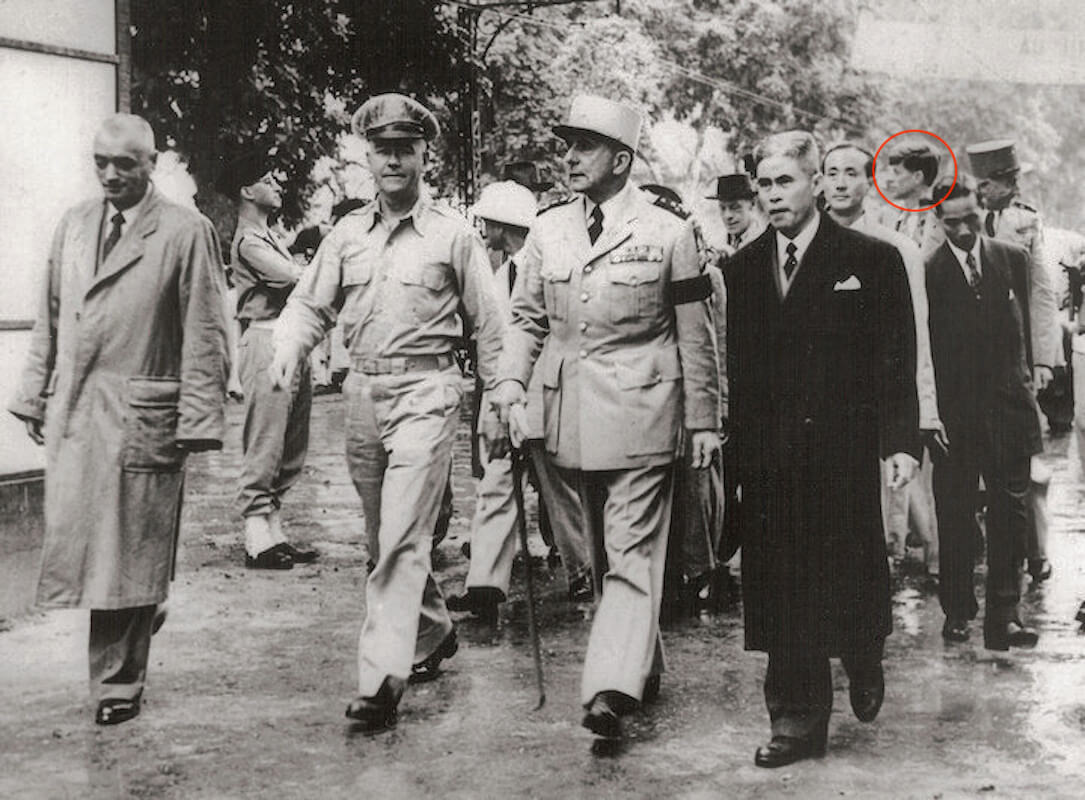
    In the 1951 photograph above, General Jean de Lattre de Tassigny is leading a contingent through the streets of Saigon at a time when France was engaged in a losing cause during the First Indochina War. In the back of the pack, a young congressman from Massachusetts, John F. Kennedy, is observing the conditions on the ground in a war effort that was at the time receiving substantial American aid. Kennedy’s younger brother Robert accompanied him on the trip. RFK later ran on an anti-war platform at the height of the Vietnam War, shortly before his assassination in 1968. This study explores the impact of the 1951 trip to Vietnam on John F. Kennedy, his association with the diplomat Edmund Gullion, and the evolving vision of JFK for American foreign policy in Vietnam, which was articulated in a major address given in 1954.

    Edmund Gullion (1913-98) enjoyed a distinguished career as a diplomat followed by a second life in academia as Dean of the Fletcher School of Law and Diplomacy at Tufts University, where he trained a generation of foreign officers. As a Southeast Asian specialist, he held senior positions at the American Embassy in Saigon from 1949-52 during the First Indochina War. At a time when the Truman administration was ramping up aid for France in an effort to salvage its colonial outpost in Southeast Asia, Gullion was an advocate of Vietnamese independence. Later, at a critical juncture in America’s involvement in Vietnam in 1963, Gullion asked a colleague, “Do you really think there is such a thing as a military solution for Vietnam?”1

    Gullion was also a confidant of the young Congressman and World War II hero John F. Kennedy, who visited Saigon in 1951. Congressman Kennedy was there to observe up close the conditions of a foreign colonial war in progress, in preparation for his run for the Senate the next year against Henry Cabot Lodge. Later, he used Gullion as a sounding-board as he was shaping his own views on America’s role in Southeast Asia and the Third World. During his presidency, JFK appointed Gullion as ambassador to the Congo.2 Gullion’s oral interviews and the words of JFK himself help to shed light on the congressman’s formation as a statesman in the period before he acceded to the presidency. The year 1954 is an especially important crossroads in the history of Vietnam and a turning point for JFK in articulating a foreign policy for Southeast Asia.

    Young John F. Kennedy was an inveterate traveler. When he was a Harvard student, he took time out to travel to Europe, the Balkans, and the Middle East in 1939, witnessing first-hand the ominous signs of the coming war. During the war itself, he survived an attack on his PT boat in the Solomon Islands, heroically rescuing a badly burned crew member and guiding his men to safety until they were rescued. At the close of the war in 1945, he worked as a journalist, attending the United Nations Conference on International Organization in San Francisco and the Potsdam Conference. As a congressman from Massachusetts, Kennedy embarked on a seven-week, 25,000-mile trip in 1951. Accompanied by his brother Robert and his sister Patricia, Kennedy visited Israel, Pakistan, Iran, India, Singapore, Thailand, French Indochina (Vietnam), Korea, and Japan. Upon his return home, he conveyed to the press that his goal for the trip was to learn “how those peoples regarded us and our policies, and what you and I might do in our respective capacities to further the cause of peace.”3

    At the time, he described in a radio interview what he believed should be the primary goal of combatting communism in the Third World, which was “not the export of arms or the show of armed might but the export of ideas, of techniques, and the rebirth of our traditional sympathy for and understanding of the desires of men to be free.”4 When Kennedy met with Indian Prime Minister Jawaharlal Nehru, he asked Nehru for his view on the current war in French Indochina. Nehru replied that the military and financial assistance provided to the French by the United States was a “bottomless hole” because the war was an example of doomed colonialism.5 Upon arriving in Vietnam, the Kennedy entourage observed Charles de Gaulle and the top brass of the French military as the war was in progress. But, more significantly, the young Congressman was to have a fateful meeting with an American consular officer named Edmund Gullion.


    II

    While the French were optimistic about retaining their colonial empire with American support, Gullion had recognized in 1951 that they would not prevail. Kennedy had known Gullion since 1947 when they had conferred about a speech the congressman was to give on foreign policy. Now, they met privately on the top of the Hotel Majestic in Saigon. Earlier in the day, Kennedy had been told by the French commander, General Jean de Lattre de Tassigny, that with 250,000 troops, it would be impossible for the French to lose.6 But as JFK listened to the twilight mortar shells exploding in the distance from the artillery of the Viet Minh, Gullion informed him that

    In twenty years there will be no more colonies. We’re going nowhere out here. The French have lost. If we come in here and do the same thing, we will lose, too, for the same reason. There’s no will or support for this kind of war back in Paris. The homefront is lost. The same thing would happen to us.7

    Congressman Kennedy would never forget the prophetic words of Gullion. A decade later, in the now famous debates in the White House in November of 1961, he recalled them to his cabinet members. As John Newman and James Blight have described, these men were pressing him as commander-in-chief to augment military advisors in Vietnam with American combat troops, a request that JFK adamantly rejected.8

    When Kennedy returned from his 1951 trip, it was clear that he was deeply affected by the words of Gullion. Robert Kennedy later recalled that the experience had been “very very major” [sic] in shaping his older brother’s vision for American foreign policy in the countries he had visited.9 In describing this period in Kennedy’s life, historian Herbert S. Parmet writes that,

    … at a time of containment as the sine qua non of meeting the spread of the ‘international Communist conspiracy,’ Jack Kennedy was evolving into a spokesman for a more sophisticated view. He was beginning to call attention to the soft spot of the Western cause, to the frustration of a region that had long contended with colonial domination.10

    In March of 1952, Kennedy spoke to an audience in Everett, Massachusetts, voicing his opposition to sending American troops to assist the French in Indochina. In April, he addressed a Knights of Columbus chapter in nearby Lynn, stating that “we should not commit our ground troops to fight in French Indochina.”11 In an editorial in The Traveler,the Congressman received praise for taking a stand against the status quo: “Mr. Kennedy is doing a service in prodding our conscience.”12 It was clear in 1952 that Kennedy was as outspoken of American aid to the French as he was against the French colonial war itself.

    Gullion returned to Washington in 1953, at which time he renewed his association with Kennedy, who had recently been elected to the Senate. They had many conversations and bonded in their minority opinion about the policy of pouring aid into the French war effort in Indochina. The State Department even suspected Gullion of contributing to Kennedy’s speeches on foreign policy. But Gullion recalls an independently minded Kennedy, who not only did not require Guillon’s assistance as a speechwriter, but was shaping a vision entirely on his own. In reflecting on his meetings with Kennedy in an oral history interview in 1964, Gullion modestly recalled that from the very first speech in which Kennedy had sought Gullion’s aid in 1947, the young politician was thinking for himself:

    Actually, it was a very realistic and an advanced kind of perspective that he had, and it was his own. My own contributions to it were factual, and I volunteered some opinions and some sentences, but I was somewhat surprised and, I suppose, my own very youthful egoisms somewhat checked when I saw the finished product and realized how much of this was Kennedy and how little of it was mine. It was quite an interesting product.13

    Gullion also recalled that after his 1951 trip, Kennedy’s “stance on Indochina certainly went against the prevailing opinion …. Now when he came back he prepared an address in the Senate which was one of his most important.”14 In his work on this major address, Kennedy conferred with Gullion, and, once again, his views were “entirely his own,” according to Gullion.15

    JFK’s speech in the Senate came at a turning point in the modern history of Vietnam in the year 1954. After a brutal, fifty-seven day standoff in northwestern Vietnam, Dien Bien Phu fell to the forces of Ho Chi Minh on May 7. With aid from the Chinese and Russians, the Viet Minh commander Võ Nguyen Giáp had amassed troops and, most importantly, heavy artillery that negated the formidable French airpower. The collapse and surrender of the French that followed were the result of Giáp’s brilliant tactical campaign at Dien Bien Phu. In July, French Prime Minister Pierre Mendès-France put his signature to the Geneva Accords that effectively marked the end of French control of Indochina. The Geneva agreement stipulated that in the nation’s transition to independence, there would be a temporary partition of the country pending a national election to be held in the summer of 1956.

    But the United States never signed the Geneva agreements, and almost immediately, the CIA aggressively began to transform Vietnam with the same zeal that had just effected regime changes in Iran and Guatemala. Now, to counter Ho Chi Minh in the north, the search was on for a United States backed leader in the south, whose rise to power would be facilitated by the CIA specialist in black operations, Edward Lansdale. In early 1954 and prior to the French defeat at Dien Bien Phu, Ngo Dinh Diem was made prime minister of Vietnam by France’s longstanding puppet ruler Bao Dai. Within the next two years, Diem would take control of South Vietnam through the sophisticated psychological warfare and propaganda campaigns of Lansdale.16 With Diem in place, Secretary of State John Foster Dulles was able to boast that, “We have a clean base there now, without a taint of colonialism. Dien Bien Phu was a blessing in disguise.”17 The elections that were to unify Vietnam never occurred in 1956, because the United States knew that Ho Chi Minh would be elected in a landslide. Instead, the partition between North and South Vietnam was no longer “temporary,” the North Vietnamese were identified as the “communists,” and, propped up by American economic and military support, the “free” nation of South Vietnam under Diem came into existence.18


    III

    As the turbulent events of 1954 were unfolding in Vietnam, and a month before Dien Bien Phu collapsed, John F. Kennedy rose to deliver an address in the Senate on April 6, 1954. The structure of the speech was a detailed, year-by-year recapitulation of the massive American support given to the struggling French mercenary army through administrations of both a Democrat (Truman) and a Republican (Eisenhower). Kennedy had done his homework for the speech. This included sending a list of forty-seven detailed questions to Secretary of State John Foster Dulles about the purpose of American involvement in Vietnam.19 But Kennedy was not aware that the United States national security network had already recognized the futility of American intervention in Vietnam by 1954. In 1971, the release of the secret Pentagon Papers revealed that in 1954,

    … unless the Vietnamese themselves show an inclination to make individual and collective sacrifices required to resist Communism, which they have not done to date, no amount of external pressure and resistance can long delay complete Communist victory in Vietnam.20

    With that knowledge, the Eisenhower administration continued its unalloyed engagement in Vietnam.

    On the floor of the Senate, Kennedy prefaced his chronological survey by demanding the government’s accountability to the American people for adventurism and potential war in Vietnam:

    If the American people are, for the fourth time in this century, to travel the long and tortuous road of war—particularly a war which we now realize would threaten the survival of civilization—then I believe we have a right—a right which we should have hitherto exercised—to inquire in detail into the nature of the struggle in which we may become engaged, and the alternative to such struggle. Without such clarification the general support and success of our policy is endangered.21

    Kennedy was most likely expressing to Eisenhower his personal outrage when he had learned that secret discussions had occurred about deploying atomic warfare in Vietnam to support the fading French prospects of victory. In his speech, Kennedy’s concerns for disclosure were being raised prior to the outcome of the battle of Dien Bien Phu and months before the American subversion of the Geneva Accords that resulted in the artificial division of Vietnam against the will of the Vietnamese people. As he was speaking in the Senate, there was as yet no design for a portion of Vietnam to become an American client state led by a puppet ruler like Diem. It was precisely such a scenario that Kennedy feared.

    Kennedy then went on to warn of the dangers of an American military commitment to Vietnam in the wake of the French struggle he had observed in 1951, based on his first-hand experience and the perspectives he had gleaned from Edmund Gullion:

    But to pour money, materiel, and men into the jungles of Indochina without at least a remote prospect of victory would be dangerously futile and self-destructive. I am frankly of the belief that no amount of American military assistance in Indochina can conquer an enemy which is everywhere and at the same time nowhere, “an enemy of the people” which has the sympathy and covert support of the people.22

    In hindsight, the prophetic nature of Kennedy’s 1954 address underscores a set of lessons that would eventually be learned the hard way by the policymakers after the horrific number of American and Vietnamese casualties during the war that unfolded between 1965-75. Kennedy closed his address by issuing a warning about the potential consequences of military adventurism in Vietnam, including a nod to Thomas Jefferson’s prudence and caution, prior to leaping into the unknown with a military entanglement abroad:

    The time to study, to doubt, to review, and revise is now, for upon our decisions now may well rest the peace and security of the world, and, indeed, the very continued existence of mankind. And if we cannot entrust this decision to the people, then, as Thomas Jefferson once said: “If we think them not enlightened enough to exercise their control with a wholesome discretion, the remedy is not to take it from them but to inform their discretion by education.”23

    This coda to Kennedy’s speech could have been a road map to the future to avoid what became the tragedy of the Vietnam War.


    IV

    JFK’s tour-de-force Senate address of 1954 was not political grandstanding. Rather, it was a carefully formulated examination of the question of American intervention in Vietnam at a pivotal moment for both nations. Prior to the Senate speech, Kennedy had spoken to the Cathedral Club in Brooklyn, New York, stressing that the French could not withstand the united forces of Ho Chi Minh, who “has influence penetrating all groups of society because of his years of battle against French colonialism.”24 As he would say again in late 1961 to his advisors, the situation was far different from the recent Korean conflict, wherein an independent government in the south was threatened by the invading communists from the north. Even before the Geneva Accords had mandated free elections to unify Vietnam and before Eisenhower began to use the expression “domino theory,” Kennedy had identified the unique circumstances of Vietnam’s long struggle for independence, as distinct from a nation that America could potentially “lose” to communism.

    After the Senate speech, Kennedy followed up with a television appearance, indicating that the French could not possibly retain Indochina and that again, as he would say seven years later, “American intervention with combat troops would not succeed.”25 In another 1954 speech in Los Angeles, Kennedy asserted that the American people “have been deceived for political reasons on the life and death matters of war and peace.”26 He reiterated this theme before the Whig-Cliosophic Society of Princeton University and the Executives Club in Chicago, stressing above all the importance of recognizing independent movements for nationhood in the Third World and distinguishing them from the global expansion of communism. In response to Vice President Richard Nixon’s call to send American ground troops into Vietnam, Kennedy responded that if we were to do that, “We are about to enter the jungle to do battle with the tiger.”27 By the end of 1954, an imaginary line would be drawn across Vietnam as a result of the Geneva Accords. But a very different line was being drawn in the sand by John F. Kennedy: one that proscribed American military intervention. The 1954 Senate speech, which was addressed to President Eisenhower, was a prescient warning about repeating the mistakes of the French. Ultimately, it was advice that was ignored after the death of President Kennedy by his successors, Lyndon B. Johnson and Richard M. Nixon.

    In Adlai Stevenson’s bid to unseat Eisenhower as president, Kennedy delivered speeches in support of Stevenson in the run-up to the 1956 presidential election. But when he discussed foreign policy, Kennedy refused to engage in partisan politics. In describing American interference in the developing nations of Africa and Southeast Asia, Kennedy observed that

    … the tragic failure of both Republican and Democratic administrations since World War II to comprehend the nature of this revolution, and its potentialities for good and evil, has reaped a bitter harvest today. And it is by rights and by necessity a major foreign policy campaign issue that has nothing to do with anti-communism.28

    After such speeches, the Stevenson election team asked Kennedy to refrain from making further foreign policy remarks in the course of the campaign. Senator Kennedy was unsuccessful in his quest for the nomination of Vice President on the Stevenson ticket. Which was probably a blessing in disguise.

    During the late 1950s, the focus of Southeast Asian foreign policy of the Eisenhower administration was on preventing the nation of Laos from becoming the first fallen domino. During the 1960 presidential campaign, Kennedy stressed that we would never succeed in Laos against “guerrilla forces or in peripheral wars … We have been driving ourselves into a corner where the choice is all or nothing.”29 As a senator, Kennedy had recognized that “public thinking is still being bullied by slogans which are either false in context or irrelevant to the new phase of competitive coexistence in which we live.”30 By the time he was elected President in 1960, Kennedy had the wisdom to see beyond the Cold War slogans of “the domino theory,” “godless communism,” and “Soviet master plan.” In his first year in office as President, Kennedy traveled to Vienna for a summit with Khrushchev. While en route, he was warmly received in Paris by President Charles de Gaulle. After Kennedy presented de Gaulle with a gift of an original letter written from George Washington to the Marquis de Lafayette, de Gaulle proffered advice to Kennedy on Vietnam, telling him that intervention in Southeast Asia would be “a bottomless military and political quagmire.”31

    This counsel reflected the lessons learned by de Gaulle himself from Dien Bien Phu and Algeria. But John F. Kennedy hardly needed this advice from de Gaulle, as his thinking about the emerging nations of Africa, the Middle East, and Southeast Asia had been formed after a decade of close study and hands-on experience during his travels. His 1954 address in the Senate could be a blueprint even today for correcting the misguided American attempts at “nation building” abroad.32 From the time he traveled to Vietnam until his death, Kennedy had the clarity of thinking to understand that the struggle in Vietnam was the story of nationalism, not a Cold War intrigue. And the thinking that informed his vision was guided at the outset by the words he had heard in 1951 from Edmund Gullion.


    Afterword

    The history of the Vietnam War is invariably delineated by historians as a continuum of escalating involvement from the administrations of Eisenhower to Kennedy to Johnson to Nixon in the form of an incremental progression.33 This essay challenges that notion as apparent in the vision of John F. Kennedy, one that vehemently opposed conventional warfare in Vietnam. According to JFK’s speechwriter Theodore Sorensen, Vietnam was

    … not central to the foreign policy of the Kennedy presidency. Berlin was, Cuba, the Soviet Union, but not Vietnam. Vietnam was a low-level insurrection at that point.34

    While there were sixteen thousand military advisors in Vietnam at the time of his assassination on November 22, 1963, Kennedy had resisted the pressure to send in combat forces. According to Sorensen, Kennedy listened to his hawkish advisors, “but he never did what they wanted.”35 Similarly, Võ Hong Nam, the son of the North Vietnamese general Võ Nguyên Giáp, informed researcher Mani Kang, in an interview in 2011, that “President Kennedy was finally changing his foreign policy in regards to Vietnam in 1963” and “he was withdrawing.”36

    The military historian John M. Newman observes that “at 12:30 P.M., on Friday, November 22, the rifle shots rang out in Dealey Plaza that took the president’s life. His Vietnam policy died with him.”37 Lyndon Johnson’s decision to use the Gulf of Tonkin affair as the pretext to send combat troops into Vietnam, escalate the war, prop up a string of South Vietnamese dictators in a client state, and, finally admit failure, when choosing not to run for reelection as President in 1968, has tended to erase the memory of JFK’s goal of withdrawing all military advisors no later than 1965.

    Speaking before a large gathering at the LBJ Library on May 1, 1995, Robert McNamara, JFK’s Secretary of Defense and, later, one of the principal policymakers of the Vietnam War under LBJ, recalled the strategic meetings of the National Security Council (NSC) on October 2 and October 5, 1963, wherein, against the will of the majority of the NSC committee members, President Kennedy had made the determination for complete withdrawal of United States military advisors from Vietnam by December 31, 1965. Historian James DiEugenio has effectively summarized the psychology that JFK was using against a powerful national security network that opposed his plan for withdrawal from Vietnam:

    Kennedy had based his withdrawal plan on taking advantage of the differences between what the real battlefield conditions were and what the Pentagon said they were. Knowing that the American-backed South Vietnam effort there was failing, the Pentagon was disguising this with a whitewash of how bad things really were. Therefore, Kennedy was going to hoist the generals on their own petard: If things were going so well, then we were not needed anymore.38

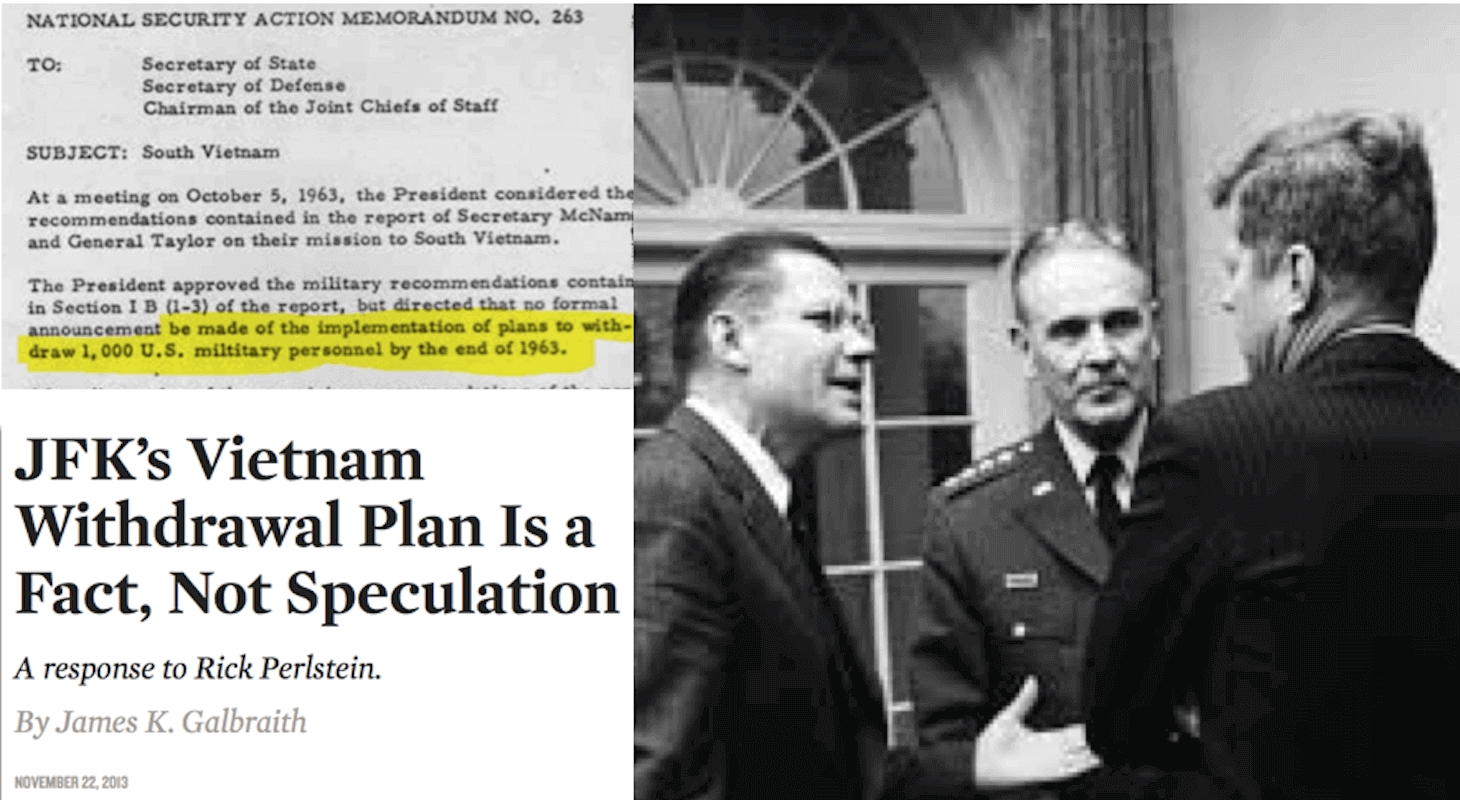
    In Kennedy’s plan, the initial phase-out of one thousand advisors would be accomplished by the end of 1963. A public announcement would be made to set these decisions “in concrete.”39 McNamara’s recall of the NSC meeting was corroborated when, in the late 1990s, the Assassination Records Review Board (ARRB) released tape recordings of key meetings during the Kennedy presidency, including those of the National Security Council sessions of October 2 and October 5, 1963, wherein all of McNamara’s points were confirmed. McNamara’s voice appears on the tape, stating, “We need to get out of Vietnam, and this is a way of doing it.”40 Shortly after the NSC meetings, JFK approved the Top Secret National Security Action Memo 263. Declassified in the early 1990s, the document identifies the first phase of the withdrawal of one thousand U.S. military personnel by the end of 1963. The combination of contemporary eyewitness testimony, oral history, recollections of statesmen, tape recordings of meetings, documentary evidence, and, above all, President Kennedy in his own words, points to his capacity as commander-in-chief to steer the United States away from what became the tragedy of the Vietnam War following his assassination.


    Notes

    1 Wolfgang Saxon, “Edmund Asbury Gullion, 85, Wide-Ranging Career Envoy,” obituary, The New York Times, March 31, 1998. (https://www.nytimes.com/1998/03/31/world/edmund-asbury-gullion-85-wide-ranging-career-envoy.html)

    2 At a critical stage in the crisis of the Diem regime in Vietnam in the summer of 1963, JFK wanted to appoint Gullion as ambassador in Saigon. But Secretary of State Dean Rusk opposed the nomination of Gullion in favor of an opposition party member, the Republican Henry Cabot Lodge. In an effort to show bipartisan unity, JFK went along with Rusk. But the appointment of Lodge was a grave mistake that eventually JFK would regret. Robert Kennedy had also preferred the selection of Gullion, warning his brother that Lodge would create “a lot of difficulties in six months.” RFK’s words were prophetic, especially at the time of the CIA-backed assassination of Ngo Dinh Diem that occurred six months later and unbeknownst to the President. James W. Douglass, JFK and the Unspeakable: Why He Died and Why It Matters (Mary Knoll, NY: Orbis Books, 2008), 151.

    3 Robert Dallek, An Unfinished Life: John F. Kennedy—1917-1963 (New York: Little Brown and Company, 2003), 165.

    4 Dallek, 167.

    5 Dallek, 168.

    6 Douglass, 93.

    7 Douglass, 93.

    8 Kennedy’s advisors included Robert McNamara, Dean Rusk, McGeorge Bundy and his brother William, and Eugene Rostow and his brother Walt. These were the men identified by journalist David Halberstam as “the best and the brightest” of the intellectuals in JFK’s administration. After the president’s assassination, these civilian policy makers would be complicit with Lyndon Johnson as the chief architects of the disastrous war in Vietnam.

    9 Herbert S. Parmet, Jack: The Struggles of John F. Kennedy (New York: The Dial Press, 1980), 228.

    10 Parmet, 228.

    11 Parmet, 228.

    12 Parmet, 228.

    13 Oral History with Edmund A. Gullion, July 17, 1964.

    14 Oral History with Edmund A. Gullion, July 17, 1964.

    15 Oral History with Edmund A. Gullion, July 17, 1964.

    16 The clandestine operation of Lansdale has been documented with great thoroughness by Talbot and Douglass, as per bibliography.

    17 Richard Mahoney, JFK: Ordeal in Africa (Oxford and New York: Oxford University Press, 1983), 139. Quoted in James DiEugenio, Destiny Betrayed—JFK, Cuba, and the Garrison Case, second edition (New York: Skyhorse Publishing, 2012), 24.

    18 The 1958 bestselling novel The Ugly American, written by Eugene Burdick and William J. Lederer, exposed the smooth tactics of counterintelligence, propaganda, and force exerted by American operatives to win “hearts and minds” in a fictitious Southeast Asian nation. The thinly veiled portrait of Lansdale was apparent in the wily character of Colonel Edwin Hillendale, whose psychological ploys sought to convert the nation to the American way. Senator John F. Kennedy loved the novel and purchased one hundred copies for distribution to the entire United States Senate. He also paid for a large advertisement of the book in The New York Times.

    19 Mahoney, 15.

    20 The Complete Pentagon Papers, The New York Timesonline, 1945-67 (http://www.documentcloud.org/documents/205509-pentagon-papers-part-iv-a-4.html)

    21 John F. Kennedy, Senate Address on Indochina, April 6, 1954 (https://www.jfklibrary.org/Research/Research-Aids/JFK-Speeches/United-States-Senate-Indochina_19540406.aspx)

    22 John F. Kennedy, Senate Address on Indochina, April 6, 1954. Shortly after the period in which Edmund Gullion was stationed in Vietnam, Charlton Ogburn became an intelligence officer in Southeast Asia, writing memos to the State Department and warning of the dangers of military involvement in Vietnam. His voice was completely ignored by the overconfident civilian leaders in Washington. Ogburn believed that the reach of the authorities was “totalitarian” in nature, a reality that was grasped by Plato, who may have been the first to identify the amorphous power of the “State” in the example of ancient Athens. For Ogburn, Vietnam was a “laboratory” for understanding how dogma is wielded by authority figures. He later recalled that “we lost over fifty thousand lives in Vietnam because the authorities could not be budged. Their appraisal of themselves was based on their being right …. They had to be right.” 
The passage of time would prove Ogburn to be correct in his assessment of Vietnam. Writing in 1989, Andrew Jon Rotter in The Path to Vietnam—Origins of the American Commitment to Southeast Asia (Ithaca, New York: Cornell University Press, 1989) refers to Ogburn’s dispatches to State Department officials as “startling and prophetic” in his early critique of the false assumptions guiding U.S. policy. Ogburn concluded one of his memos to Dean Rusk with a statement that spoke for the rights of Third World nations caught up in the Cold War. Referring to the people of Southeast Asia, Ogburn wrote, “Darn it, they are the ones who are threatened with a fate worse than death—not we.” Around the same time, John F. Kennedy was making virtually the same argument in his Senate speech of April 4, 1954.

    23 John F. Kennedy, Senate Address on Indochina, April 6, 1954.

    24 Parmet, 281.

    25 Parmet, 286.

    26 Parmet, 285.

    27 Parmet, 285.

    28 Remarks of Senator John F. Kennedy at the Los Angeles World Affairs Council Luncheon at the Biltmore Hotel on September 21, 1956. (https://www.jfklibrary.org/Research/Research-Aids/JFK-Speeches/Los-Angeles-CA-World-Affairs-Council_19560921.aspx)

    29 Arthur Schlesinger, Jr., A Thousand Days—John F. Kennedy in the White House (New York: Fawcett, 1965), 310-11.

    30 Quoted in James DiEugenio, Destiny Betrayed—JFK, Cuba, and the Garrison Case, second edition (New York: Skyhorse Publishing, 2012), 25.

    31 Dallek, 397. Prior to acceding to the presidency, Kennedy paid a visit to General Douglas MacArthur who, like de Gaulle, advised him to “never get involved in a land war in Asia.” (https://www.cnn.com/2016/09/08/politics/caroline-kennedy-axe-files)

    32 As observed by biographer David Talbot, “Kennedy’s thinking about the historical imperative of Third World liberation was remarkably advanced. Even today, no nationally prominent leader in the United States would dare question the imperialistic policies that have led our country into one military nightmare after another. Kennedy understood that Washington’s militant opposition to the world’s revolutionary forces would only reap ‘a bitter harvest.’” Talbot, The Devil’s Chessboard—Allen Dulles, the CIA, and the Rise of America’s Secret Government (New York: Harper Collins, 2015), 362.

    33 In the popular Steven Spielberg film The Post, the screenwriters lump together on multiple occasions the American Presidents from Eisenhower to Nixon, suggesting that each President was on board with military intervention in Vietnam, as the American commitment grew exponentially from one administration to the next. But the historical record suggests that this was not the case during Kennedy’s thousand-day presidency.

    34 David Talbot, Brothers—The Hidden History of the Kennedy Years (New York: Free Press, 2007), 215.

    35 Talbot, Brothers, 215.

    36 Mani Kang, “General Giap Knew,” Kennedys and King, August 30, 2013. (https://kennedysandking.com/john-f-kennedy-articles/general-giap-knew)

    37 John M. Newman, JFK and Vietnam—Deception, Intrigue, and The Struggle for Power (self-published, 2016), 458.

    38 James DiEugenio, Reclaiming Parkland—Tom Hanks, Vincent Bugliosi, and the JFK Assassination in the New Hollywood (New York: Skyhorse Publishing, 2016), 188.

    39 James K. Galbraith, “Exit Strategy: In 1963, JFK Ordered a Complete Withdrawal From Vietnam,” Boston Review (September 1, 2003).

    40 Galbraith.


    Works Cited Bibliography

    The Personal Papers of Edmund A. Gullion. The John F. Kennedy Library, Boston, Massachusetts (https://archive2.jfklibrary.org/EAGPP/EAGPP-FA.xml )

    Historic Speeches of John F. Kennedy. The John F. Kennedy Library, Boston, Massachusetts (https://www.jfklibrary.org/JFK/Historic-Speeches.aspx )

    The Complete Pentagon Papers, The New York Timesonline, 1945-67 (http://www.documentcloud.org/documents/205509-pentagon-papers-part-iv-a-4.html )

    Dallek, Robert. An Unfinished Life: John F. Kennedy—1917-1963. New York: Little Brown and Company, 2003.

    DiEugenio, James. Destiny Betrayed—JFK, Cuba, and the Garrison Case, Second Edition. New York, Skyhorse Publishing, 2012.

    DiEugenio, James. Reclaiming Parkland—Tom Hanks, Vincent Bugliosi, and the JFK Assassination in the New Hollywood. New York: Skyhorse Publishing, 2016.

    Douglass, James W. JFK and the Unspeakable: Why He Died and Why It Matters. Mary Knoll, NY: Orbis Books, 2008.

    Galbraith, James K. “Exit Strategy: In 1963, JFK Ordered a Complete Withdrawal From Vietnam,” Boston Review, September 1, 2003.

    Mahoney, Richard. JFK: Ordeal in Africa. Oxford and New York: Oxford University Press, 1983.

    Newman, John M. JFK and Vietnam—Deception, Intrigue, and the Struggle for Power, second edition. Self-published, 2016.

    Parmet, Herbert S. Jack: The Struggles of John F. Kennedy. New York: The Dial Press, 1980.

    Rotter, Andrew Jon. The Path to Vietnam—Origins of the American Commitment to Southeast Asia. Ithaca, New York: Cornell University Press, 1989.

    Saxon, Wolfgang. “Edmund Asbury Gullion, 85, Wide-Ranging Career Envoy. “ Obituary, The New York Times, March 31, 1998.

    Schlesinger, Arthur, Jr. A Thousand Days—John F. Kennedy in the White House. New York: Fawcett, 1965.

    Talbot, David. Brothers—The Hidden History of the Kennedy Years. New York: Free Press, 2007.

    Talbot, David. The Devil’s Chessboard: Allen Dulles, the CIA, and the Rise of America’s Secret Government. New York: Harper Perennial, 2016.

  • The Tippit Case in the New Millennium

    The Tippit Case in the New Millennium


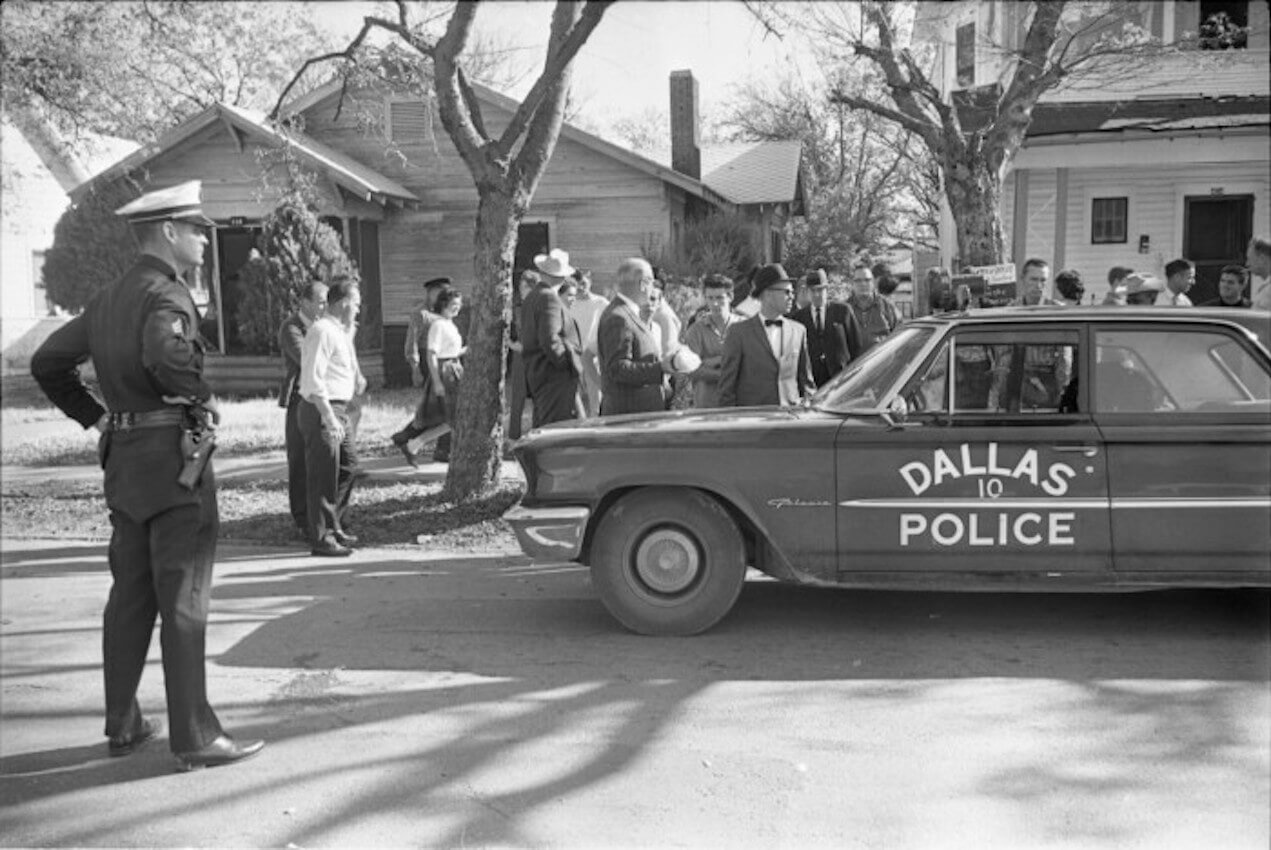
    Original black and white photographic negative taken 
     by Dallas Times Herald and United Press International
    photographer Darryl Heikes.

    Up until the earthquake caused by Oliver Stone’s film JFK, there was an accepted paradigm in the critical community regarding the murder of Dallas Police patrolman J. D. Tippit. Two good examples of what that case looked like under critical scrutiny could be accessed in Henry Hurt’s book Reasonable Doubt, and Jim Garrison’s memoir, On the Trail of the Assassins. The former was published in 1985, and the latter in 1988. Garrison asked some cogent questions about the ballistics evidence in the case, which, in turn, cast aspersions on the honesty and efficacy of the handling of the evidence.

    As Garrison wrote, the Warren Commission version of the Tippit shooting said that Oswald alone killed Tippit at about 1: 15 PM. After President Kennedy’s assassination, Oswald departed work at the Texas School Book Depository and took a taxi to his boarding house. The official story then has Oswald walking to the crime scene at 10th and Patton from his rooming house at 1026 North Beckley in the Oak Cliff area of Dallas, a distance of around 9/10 of a mile. In itself, as both Hurt and Garrison noted, this created a problem. It began with Oswald’s landlady testifying that she had seen him standing on the corner across the street from the rooming house waiting for a bus after he went into his room at about 1:00 PM. When asked what time she saw him there—waiting for a bus that would take him in the wrong direction from 10th and Patton—she replied it was about 1:04. (Garrison, p. 194; Hurt p. 144) The idea that someone could traverse the nearly one mile distance from the rooming house to the crime scene in something like 11 minutes is hard to swallow. I know two researchers—both of them much taller than Oswald—who tried to negotiate that distance and actually walked the route. Neither of them came close to equaling what the Commission said Oswald did. And neither of them walked normally; they both power-walked the distance. As Henry Hurt added, no one saw Oswald running that distance, or walking for that matter. Recall, this is about a half hour after President Kennedy’s assassination. If Oswald had been running, wouldn’t someone have noticed him? (Hurt, p. 145)

    But, as both Garrison and Hurt showed, the idea that Tippit was shot at the 1:15 PM time is not supported by the weight of the evidence. For instance, Mrs. Donald Higgins was later interviewed by Barry Ernest for his book, The Girl on the Stairs. She told Barry that the time of the shooting was 1:06. And she lived only a couple of doors down from the crime scene. (See the e-book version, p. 58.) Roger Craig said that, when the news of the shooting came over the radio, he looked at his watch, which said 1:06. (Garrison, p. 194) Even Helen Markham, who became hysterical after the shooting, said Tippit was shot at the latest about about 1:07 PM. (Hurt, p. 144) As Hurt notes, T. F. Bowley came on the scene after the shooting, with Tippit’s body lying in the street. He had to stop his car, and then walked over to the abandoned Tippit car, and he then picked up the radio. He said that the time on his watch after he arrived at the scene and stopped his car was 1:10. It is important to hold in mind that the Warren Commission did not interview either Mrs. Higgins or Mr. Bowley. (Garrison, p. 196) In fact, the Warren Report actually says that another witness, Domingo Benavides, made the call to the police that Bowley actually made. (WR, p. 166) The late Larry Ray Harris was probably the foremost authority on the Tippit case at the time of his death in a car accident in 1996. When I spoke to him at an earlier seminar in Dallas, he told me that the most likely time of the shooting was probably 1:08 PM.

    This, of course, is a key evidentiary point. Because if it is hard to believe that Oswald was at the scene at 1:15, it is not possible to think he could be there at 1:08 PM—that is, unless someone drove him there, and no evidence of that has surfaced in over fifty years. Consider this fact: Just 9 years earlier Roger Bannister became the first man to run the mile in less than four minutes. The idea that Oswald could do something similar—in street clothes, on cement sidewalks—and that no one would recall him doing so, that would be absurd. I doubt if even Dan Rather could have swallowed it. This may be the reason that Bowley and Higgins were not interviewed.

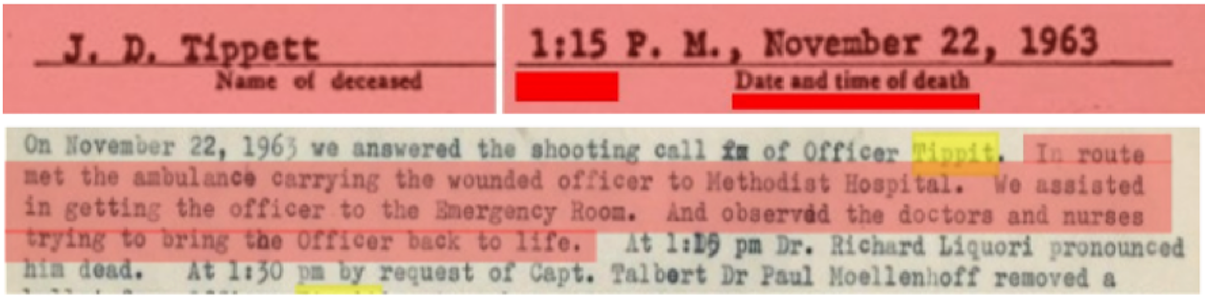
    But the riddle of the time of death is even more complex. Because the legal death certificate document pronounced Tippit dead at 1:15. This was done by Dr. Richard Liquori at Methodist Hospital.

    Tippit death certificate
    (note the time of decease 1:15 pm typed over
    what appears originally to be 1:09)

    If one allows for the time for the ambulance to get to the scene of the crime and return, this would appear to back up Mrs. Higgins’ claim that the shooting occurred at 1:06 PM.

    What made the situation worse was this: the witness who was closest to the actual shooting scene could not identify Oswald as the shooter. This was Domingo Benavides. (Hurt, p. 145) This is compounded by the fact that the Dallas Police never even took Benavides to a lineup in order to identify Oswald. (WR, p. 166)

    Warren Reynolds was also an eyewitness. He also could not identify Oswald as the killer. He worked about a block away from the scene. When he heard the shots, he ran out on a patio and peered in that direction. He said he saw a gunman running towards him stuffing a handgun under his belt. He began to follow him, but after a block, he lost him when he ducked into a building. Reynolds gave interviews to the press and his name was in the news for about two months. Yet no official investigator talked to him in this time period. Finally, in late January, the FBI interviewed Reynolds. He said he could not feel free to offer a positive identification of the man as Oswald. Two days later, Reynolds was shot through the head. He miraculously survived. Evidently, the down time did his memory some good. He now was ready to identify the fleeing man as Oswald. (Hurt, pp. 147-48)

    With these kinds of witnesses, the Commission felt they had to rely upon Helen Markham for probative value. (Sylvia Meagher, Accessories After the Fact, p. 256) At this point in time, I do not think it is necessary to pile on this poor woman. But what I would like to accentuate here is the following fact: the Warren Commission understood what a liability she was to their case, before they published. They used her anyway. At a public debate in Los Angeles in 1964, Commission lawyer Joe Ball characterized her testimony as full of errors and called her an “utter screwball”. (Anthony Summers, Conspiracy, p. 87). Neither Ball nor fellow lawyer Wesley Liebeler wanted to use her in the first place. Liebeler labeled her testimony with the ultimate insult. He called it “worthless”. (Edward Epstein, The Assassination Chronicles, pp. 142-43) The men doing the heavy lifting in the trenches were clearly overruled from above.

    Why did the Warren Commission overrule their own working lawyers and decide to make Markham the chief witness in the Tippit case? One problem was that a witness they billed as being a direct eyewitness to the crime was not. This was taxi driver William Scoggins who had his view of the shooting obstructed by hedges. (Joseph McBride, Into the Nightmare, p. 455) When Scoggins was shown a few pictures of Oswald, he narrowed it down to two. He then picked the wrong one. (WC 3, p. 335) Another problem was that his identification took place during the infamous Dallas Police lineups. Scoggins was at the same lineup as another cab driver, William Whaley. Whaley said about this proceeding: “You could have picked Oswald out without identifying him, by just listening to him because he was bawling out the policemen, telling them it wasn’t right to put him in line with these teenagers.” Whaley continued by saying Oswald told the police they were trying to railroad him and he wanted his lawyer. Whaley concluded, “Anybody who wasn’t sure could have picked out the right one just for that.” But further, when asked their names and occupations, the others in the lineup—who were policemen—gave fictitious answers. Oswald said his true name and that he worked at the Texas School Book Depository. (Meagher, p. 257)

    Another witness who said he saw Oswald fleeing the scene was Ted Callaway. The problem with his testimony is that Benavides worked for him at a car lot. Callaway asked Benavides if he saw the man escaping. Benavides said he did. Before he took off looking for him, Callaway asked his employee: Which way did he go? As Meagher asks, is not Callaway’s testimony therefore paradoxical? Why did he have to ask his employee where the guy went if he already saw him? (Meagher, p. 258) In addition to that, before Callaway viewed the lineup, he was given some input by Leavelle. He was told that the police wanted to wrap up the Tippit case real tight since they thought the man who killed Tippit also killed Kennedy. (Joseph McBride, Into the Nightmare, p. 474) As Hurt points out, time after time, witnesses to a man fleeing the scene were not questioned until late January. And at that late date they were only shown one photograph: Oswald’s. (Hurt, p. 147) This was two months after the media had begun its daily pounding of the public consciousness with the idea that Oswald was Kennedy’s killer. (As we shall see, the FBI went even further in this case in its violations of investigative protocol.)


    II

    The ballistics evidence in the Tippit case is also a morass. First of all, there is the enigmatic message sent out over the police radio by the ubiquitous Sgt. Jerry Hill. A message Hill actually tried to deny before the Warren Commission but which he admitted to decades later. Further, Hill once told a writer that the shells were arrayed within a hand towel of each other. Such was not the case, since they were recovered yards apart from each other. (See Bill Simpich, “Jerry Hill’s Lies: The Heart of the J. D. Tippit Shooting,” 3/12/16)

    Hill reported that one of the shells at the scene indicated “that the suspect is armed with an automatic .38 rather than a pistol.” This was shortly after another Dallas cop described the man escaping the scene—who did not match Oswald’s description—as being armed with an automatic. (Garrison, p. 198) Michael Griffith wrote in a review of Dale Myer’s book about the Tippit case that, in 1986, Hill admitted he had picked up one of the casings for examination This is important because the shells are marked with ‘.38 AUTO’ at the base. And Hill said he specifically looked on the bottom.

    As Garrison went on to explain, an automatic is clip loaded from its handle and its spring action ejects cartridge cases from the spent round. A revolver keeps the cartridge shells in the chamber as the turret rotates to the next round. As several authors have shown, including Garrison, it is hard to believe that experienced policemen could mistake an automatic handgun and ammo for a revolver. (For a telling visual presentation of this key point, see Robert Groden’s book Absolute Proof, p. 298) Especially since the Dallas police used .38 Special ammo and the shells were marked at the bottom. (see again Simpich, “Jerry Hill’s Lies”) This is an important point to recall as we progress through the ballistics evidence, and later, the issue of possession of the weapon.

    Of the bullets taken from Tippit’s body, three are Winchester Western manufactured and copper-coated. The last is a lead bullet made by Remington-Peters. As Garrison noted, this seemed to suggest that two men might have fired at Tippit. (Garrison, p. 199) But further, the shells did not match the bullets. Two of the shells were made by Remington and two by Winchester. (Garrison, p. 201) This has led some to think that perhaps there was a shot that missed and a shell that was not recovered. The House Select Committee on Assassination suggested this but labeled it as speculation. (McBride, p. 256)

    But the automatic/revolver dispute and the mismatching of the manufacturers and the ammo is only the beginning of the problems with the ballistics evidence. On the day of the shooting, the police made out an inventory of the evidence found at the scene. There was no mention of cartridge cases of any kind. (Garrison, p. 200) Moreover, it is also standard police procedure to send the bullets and shells to the FBI lab the day of the crime to have them identified and matched to the weapon. In the Tippit case, the authorities sent only one bullet to the Bureau. The police said this was the only projectile recovered from the victim’s body. (Joseph McBride, Into the Nightmare, p. 244) The FBI could not match this bullet to the weapon allegedly taken from Oswald later at the Texas Theater. And further, that bullet was described by the FBI as “so badly mutilated that there is not sufficient individual microscopic characteristics present for identification purposes.” (WC 24, p. 263)

    There was a complicating factor to this issue. As Henry Hurt explained in Reasonable Doubt, and John Armstrong amplified on in Harvey and Lee, the Smith and Wesson .38 revolver in evidence had been altered by its purchaser George Rose and Company, located in Los Angeles. The company sent 500 of these guns to its gunsmith in Van Nuys, California. Among the modifications made were the re-chambering of the cylinder so the weapon could accommodate a .38 Special cartridge. This altered chamber made for a slight slippage upon firing and thus did not allow the usual markings to be placed on the bullet. (Armstrong, p. 482; Hurt, p. 143)

    When they could not get a match on the first bullet, in March of 1964, the Commission sent FBI technician Cortlandt Cunningham to Dallas to find the other bullets. The police said they had misfiled them. But they turned up in the dead files, a point that the Commission tried to paper over. (McBride, p. 254) Predictably, four months later, the same thing happened: the bullets did not match. (Garrison, p. 199)

    Thus, the emphasis was now on the shells. It was not until six days after the police sent the first bullet to the FBI that they finally marked the evidence inventory sheet with four shells. These the FBI were able to match to the weapon. The delay in getting the shells on the inventory list and the failure to send all the ammunition exhibits promptly to the FBI has led some to suspect that the police fiddled with the evidence—to the extent that it suggests that the original weapon perhaps really was an automatic. This is not at all a critic’s meandering speculation. Warren Commissioner Hale Boggs himself expressed similar reservations about the delay. Boggs asked Commission counsel Melvin Eisenberg, “What proof do you have though that these are the bullets?” (McBride, p. 258)

    But even that is not the end to the problems with the Tippit ballistics. Benavides had found two cartridge cases at the scene. He handed them to Officer J. M . Poe. Hill told Poe to mark the shells with his initials. His marks were not evident when the policeman inspected the exhibits for the Commission. (Hurt, pp. 153-54) Further, when the witnesses who found the other two shells were asked by the FBI to identify them as the ones they originally recovered, they could not. (WC 24, p. 414)

    One would think it could not get any worse. But, in the JFK case, it usually does. When McBride interviewed Detective Jim Leavelle in 1992, the crusty old cop tried to put the whole issue of police identification to rest by throwing a giant curveball at it. He now said that neither Poe, nor the man Poe gave the shells to, Sgt. Barnes, ever marked the cartridge cases at all. (McBride, p. 256) Consider the ramifications of this charge. First, Poe is now a liar. But by labeling him as such, it attempts to rid the Dallas Police of the substitution of evidence accusation. What it really does, however, as McBride notes—as if it had not been done already—is it makes the whole “chain of custody on the shells highly suspect.” (McBride, p. 256)


    III

    As noted above, Jim Garrison came to suspect that there were probably two assailants. His judgment relied on the mismatching ballistics and the testimony of witnesses not in the Warren Commission.

    Acquilla Clemmons worked as a caretaker for an elderly woman on the next block. She ran down the street after she heard the shots. She saw two men, one with a gun. The gunman was “kinda chunky, he was kinda heavy, he wasn’t a very big man. He was a kinda short guy.” (McBride, p. 492) The gunman’s accomplice, who was tall and thin, then waved at the shooter and told him to “go on.” The two men left the scene heading in different directions. Two days after the shooting, a man Clemmons thought was from the DPD visited her and told her she should not talk about what she saw. If she did, she might get hurt. So when a reporter visited her with a camera, she refused the interview. After giving a long and filmed interview to Mark Lane in 1966, Clemmons apparently disappeared. (McBride, p. 492) It seems clear from looking at who was brought before the Commission and who was not that, as Jim Garrison pointed out, the Warren Commission had an agenda as to who they would and would not hear. (Garrison, p. 197) In fact, after Garrison was interviewed for Playboy, an anonymous writer mailed in a letter that was printed in the January 1968 issue. He said that, like Clemmons, he had seen two men shoot Tippit and they both ran off in different directions. Neither man was Oswald. (p. 11)

    As if the witness censorship and the oddities with the ballistics evidence were not suspect enough, let us now turn to the radio transcripts. As most of us know, there were three versions of the radio messages that were eventually delivered to the Warren Commission. Sylvia Meagher pointed out that the first transcript the police turned over did not include what was perhaps the most important instruction given to Tippit that day. That was the order for him to move into central Oak Cliff at 12:45 PM. (Meagher, p. 260) This was about 15 minutes after President Kennedy was killed. But as has been noted by others, this order created some serious evidentiary problems. First, there were three DPD witnesses the Commission had already heard from on the issue of Tippit’s location. They were at a loss to explain why Tippit was in Oak Cliff, about four miles out of his area. None of them proffered this order at 12:45 as the reason for it. (Meagher, p. 261) Second, just prior to this message, the dispatcher had said, “Attention all squads, report to downtown area Code 3 to Elm and Houston with caution.” (WCE 705, p. 397) Which, of course, makes perfect sense. (The police tried to disguise this order in the first transcript, but the FBI actually listened to the tapes and this was their accurate transcription. Police Chief Jesse Curry confirmed this in a letter to the Warren Commission, see WCD 1259, p. 3)

    In fact, one can reverse the question for effect: Why at this time would the police detail anyone to any location except Dealey Plaza? Further, why would the dispatcher take the time to give out such a superfluous order in the immediate wake of the tumult that followed the biggest crime ever committed in the history of the city? Yet the Commission accepted this since it was one way to explain the fact that Tippit was out of his assigned territory at the time he was shot. (Hurt, p. 161) And, one might add, what on earth was so important about central Oak Cliff? No one had radioed in any disturbance in the area.

    But that does not end the controversy. On the transcripts, there is no acknowledgement of this order, even though it was given to two men, Tippit and R. C. Nelson. (WCE 1974, p. 26) What’s more, the police already had a man in Oak Cliff. His name was William Mentzel. (McBride, p. 427) In other words, at a time when cars were being directed from the outermost areas to Elm and Houston for Kennedy’s assassination, not one, but two cars are being directed to Oak Cliff—when there is already a patrol car there. And, in fact, the dispatcher does not try and contact Mentzel to check on his location before he sends in two other cars.

    But that is not the capper about this order. The capper, at least for me, is that Nelson did not head to Oak Cliff. He went to Dealey Plaza. As Henry Hurt noted, there was nothing said about this apparent discrepancy by the Commission; indeed, neither the Warren Commission, nor the House Select Committee on Assassinations, called Nelson as a witness. (Hurt, p. 162)

    At 12: 54, Tippit stated he was at Lancaster and 8th. The dispatcher replied with—considering what had happened and what was about to happen—one of the strangest police radio instructions imaginable. Murray Jackson told Tippit to, “Be at large for any emergency that comes in.” (Meagher, p. 263) As we will see, what makes this exchange even more notable is that Tippit might not have been at Lancaster and 8th.

    We now come to the message at 1:08. Between 12:45 and that time there were four messages involving Tippit. Three went from the dispatcher to the patrolman and one allegedly came in from Tippit; this was at 1:08. In one version of the messages, Tippit called the dispatcher twice and got no answer. In the FBI version, Tippit’s call number at that time, 78, is missing: the message is assigned to No. 488. The FBI notes the sound is garbled and No. 488 is not identified by his name, and there is no other message that is assigned to whoever this person is. Tippit researcher Bill Drenas, who wrote an interesting essay, “Car #10 Where are You?”, did a thorough examination of the tape and transcripts. He concluded that the voice is not Tippit’s either. But he disagrees with who the real caller is. He says it is call number 388. Which would be from the Criminal Investigative Division.

    From this perspective, Mrs. Higgins’ time for the shooting, 1:06, may be correct. If that is so, then the other salient point she told Barry Ernest is also relevant. Higgins said that after the shots rang out, she went out to her porch. She saw a man fleeing the scene. It was not Oswald. (James DiEugenio, Reclaiming Parkland, p. 125)


    IV

    The above is the author’s attempt to present a précis of what the evidence in the Tippit case consisted of in the early nineties. For after the tsunami caused by Stone’s JFK, the calculus of the Tippit case was altered.

    The first tremor occurred in 1995 when Dallas FBI agent James Hosty published his book on the Kennedy case entitled Assignment Oswald. In that book he revealed a stunning piece of information, one that had been concealed for 32 years. Hosty wrote that his FBI colleague Bob Barrett had told him something unusual occurred at the scene of the Tippit murder. Barrett told him that one of the policemen, Captain Westbrook, asked him if he had ever heard of a Lee Harvey Oswald. When Barrett said he had not, he then asked him: How about an Alek Hidell? Again, Barrett replied he had not. As Barrett was answering the questions, Westbrook was leafing through a wallet found at the scene.

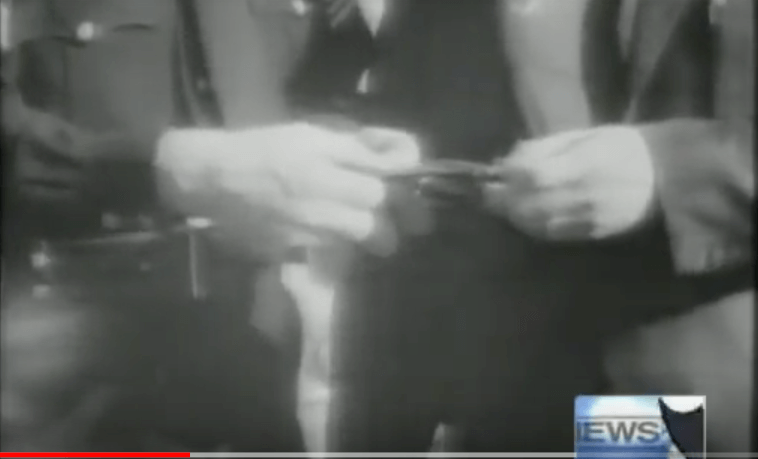
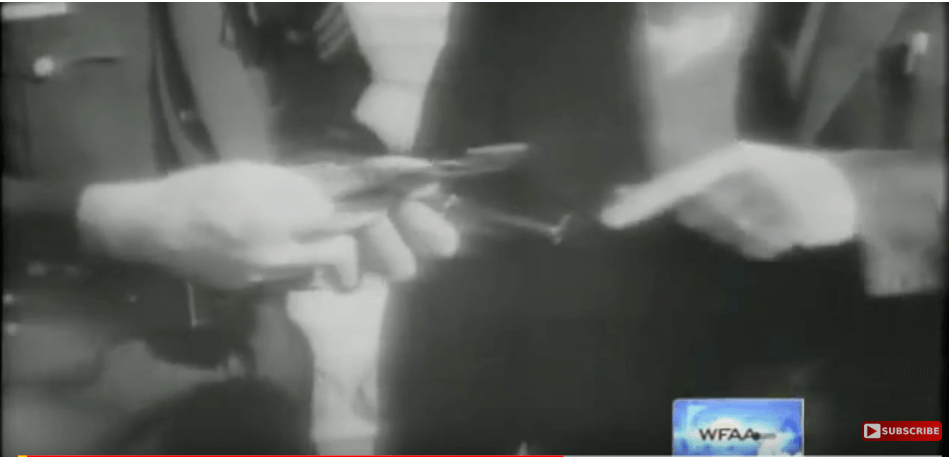
    This extraordinary development was raised from the realm of memory into that of fact when a film from TV station WFAA was later uncovered. That film shows three policemen handling the wallet at the scene of the Tippit murder.


    WFAA footage of police handling wallet

    These images were captured at 01:24 and 02:50 of this ABC news feature from 2013.

    This reinforcement drove diehard defenders of the official story into overdrive in a mad attempt to camouflage the damage it did. For the question now became: Who carries three wallets? The Warren Report has Oswald’s wallet being taken from him in the police car after he was apprehended at the Texas Theater. The report also says Oswald left a wallet at the home of Ruth and Michael Paine, where his wife Marina was staying, that morning. (DiEugenio, p. 126) The late Vincent Bugliosi tried to squirm out of the dilemma by saying the wallet was most likely Tippit’s. This explanation is effectively neutered since three Dallas police officers were sent to Methodist Hospital to recover Tippit’s effects at 2:00 PM. They delivered them to the station at 3:25. Among the artifacts was Tippit’s wallet. (DiEugenio, p. 126) But, even further, at a JFK Lancer seminar several years ago, intrepid researcher Martha Moyer told this author that she had talked to another officer at the scene, patrolman Leonard Jez. He told her not to let anyone bamboozle her: it was Oswald’s wallet.

    The implication of the wallet at the crime scene would be that someone dropped it there in order to implicate Oswald. Beyond that, since the official story had Oswald ordering a handgun and rifle in the name of Alex Hidell, it would demonstrate he ordered the weapons and then used them to kill both policeman Tippit and President Kennedy. But from that hypothesis extends another problem. According to researchers John Armstrong and Bill Simpich, no one ever saw the wallet on the ground. The best estimates are that the film of the wallet being shown to others was taken at about 1:30-1:40 PM. With the ambulance arriving and departing, with patrol cars there, with so many bystanders on hand by that time, how could so many people have missed the wallet on the pavement? And in point of fact, some of the witnesses actually said there was no wallet on the ground. (See Bill Simpich, “Who Found Oswald’s Wallet,” 4/21/14)

    Therefore, under examination, this new evidence seems to indicate the possibility that someone brought the billfold to the scene. That idea now focused attention on three people who had been more or less ignored prior to the discovery of the WFAA film. Those three are Westbrook, reserve officer Kenneth Croy and witness Doris Holan.

    409 10th Street, where Doris Holan
    resided at the time of the shooting

    Holan was never called by the Warren Commission. Nor is there any evidence she was ever interviewed by either the Dallas Police or the FBI. Like many important witnesses in the JFK assassination, she was discovered by private citizens many years after the fact. Local Dallas researchers Bill Pulte and Michael Brownlow were the first to talk to her. Which is weird since she lived only one door down from the crime scene, at 409 10th Street, on the second floor. This placed her in a perfect position to see what she was about to disclose. The most remarkable information to come to the fore in the two interviews she granted was this: As she looked out her window upon hearing the shots, she saw a second police car at the scene. It was in the driveway between 404 and 410 East Tenth. This was adjacent to the spot on the street where Tippit’s car stopped. Knowingly or unknowingly, Tippit had blocked the driveway, which led to an alley at mid-block. She said a man got out of the car, looked at Tippit’s body and then went back down the driveway. He was alongside the car, which was retreating back toward the alley. She also saw a man fleeing the scene in a different direction. (McBride, pp. 494-95)

    Brownlow had previously found a second witness to the police car. This was Sam Guinyard, a porter at a used car lot at 501 East Jefferson. And as McBride further notes in his book-length study of the Tippit case, Virginia Davis had said that when she heard the shots and ran out, the police were already there. Years before he talked to Holan, another witness who wished to remain anonymous related to Pulte that he had been told there was a man in the driveway who approached Tippit. (see Harrison Livingstone, The Radical Right and the Murder of President Kennedy, p. 348)

    Diagram courtesy of David Josephs

    To my knowledge, the Holan testimony made its first appearance in book form in the 2006 Livingstone reference just cited. This was late but fortunate, since Holan had passed on in the year 2000. Holan’s revelation opened up a new vista for the Tippit case. Now writers began to focus on Westbrook and Croy, since Croy was the first known person to handle the wallet and Westbrook was the last. Of course, the Warren Commission did no inquiry into the existence of the Oswald wallet at 10th and Patton, even though there was a film available. And, as mentioned, they were oblivious to Holan. But, in retrospect, there were still some notable things to be garnered from the Commission testimony of both William Westbrook and Kenneth Croy.


    V

    The first is that neither man was a detective or a patrolman. Yet both were at the scene of the Tippit murder quite quickly. In fact, Croy was reportedly the first man there. Westbrook was the chief of the personnel department. (WC 7, p. 110) That is, he handled background inquiries for applications and investigated complaints. He did not even wear a uniform. On the day of the assassination, Westbrook sent his men to the Texas School Book Depository. After the office was empty and he was the only one there, Westbrook told the Commission he got antsy, so—and he fittingly prefaced the following with “believe it or not”—he decided to walk to the Depository alone. He also added that, even though he had a radio, he would stop occasionally to get an update on a transistor radio from groups of people standing on the sidewalk. The distance between the police station and the depository is about one mile. If one adds in the stopping to listen to civilians with radios, one could say that Westbrook’s unaccounted time here could amount to as much as 20 minutes or more.

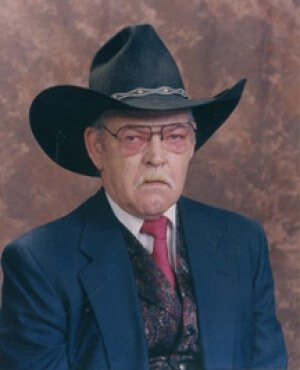
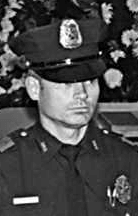
    Capt. William Ralph Westbrook

    Westbrook testified that while he was at the depository, he heard someone say an officer had been shot in Oak Cliff. He felt —and again this may also be hard to swallow—that since he was in personnel he should investigate the homicide. (WC 7, p. 111) Although Westbrook mentioned Barrett in his Commission testimony, he never noted the wallet he questioned the FBI agent about. Strangely, Barrett did not appear before the Commission.

    While at the scene of the Tippit murder, Westbrook said the word about a suspect at the Texas Theater came over the radio. So Westbrook got a ride to the theater with another officer and Barrett. Almost immediately upon arrival there someone tipped him off as to where the suspect was sitting. Westbrook witnessed his arrest and directed he be escorted out of the theater and to the station. (WC 7, p. 113) Westbrook said that after this he went back to his desk at personnel.

    In other words, it was all in a personnel officer’s workday. Thanks to being bored at his personnel desk, Westbrook became one of the few officers who showed up at the depository, the Tippit murder scene and the Texas Theater. But this does not actually do his busy day justice. As former British detective Ian Griggs has noted, Westbrook is also credited with finding the Tippit killer’s jacket and going to a nearby library to investigate a false alarm about the assailant being there. (Ian Griggs, No Case to Answer, p. 131-32) As Griggs points out, although he is credited with finding the jacket, Westbrook actually denied he did so. He said some other policeman gave it to him—but he cannot recall his name. Further, he did not place the discovery of the jacket on the report he gave to the Commission. Attorney Joseph Ball had to ask him, “Did you ever find something?” (WC Vol. 7, p. 115) Westbrook immediately said he did not find it; some other officer did.

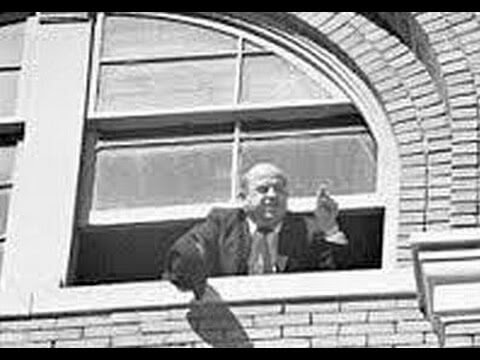
    Kenneth Croy

    That declaration of not knowing who gave an officer an important piece of evidence applies to Croy also. But before getting to that point, we should, as we did with Westbrook, review Croy’s Warren Commission testimony. And we should keep in mind that, as with Westbrook, the Commission never challenged Croy, nor tried to corroborate what he said.

    First of all, Croy was not a regular officer. He was a reserve officer. He drove patrol car duty perhaps once a month. (WC 12, p. 195) On the day of the assassination, Croy said he was just off of Main street when he heard President Kennedy was shot.

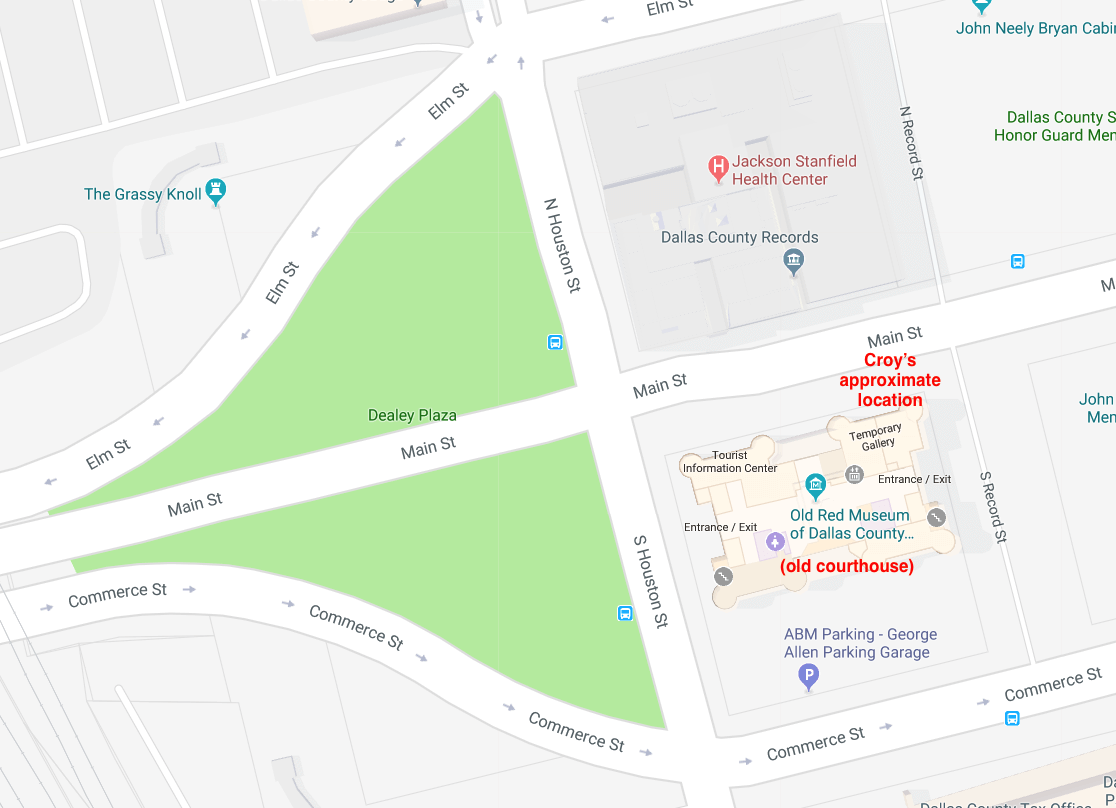
    Croy was just a few blocks from Dealey Plaza at this time. He then said that he drove to the nearby courthouse to see if the police might need some help. (WC 12, p. 200) Considering the circumstances, it is hard to believe that Croy had to ask this question, or that the police would say no if he did. But Croy said he could not recall whom he asked, and Commission counsel Burt Griffin did not probe the answer to Croy’s question on November 22, 1963. Croy added that, amid all the tumult going on a few blocks away, he decided to go home. He then said that he heard a call about an officer being shot.

    As the reader can see, there really is no way so far to corroborate Croy’s whereabouts from the time of the assassination to the time of him arriving at the scene of the Tippit shooting. And Croy insisted he was the first policeman there. (WC 12, p. 201) From his description, once he was there, he talked to Helen Markham. But as Griffin questioned him about his discussion with Markham, a surprising admission came into the record. Croy claimed he did not file a report on his activities that day. Once Griffin elicited this piece of information, he just passed it by, making no comment or inquiry about it. Which is remarkable considering Croy’s insistence he was the first officer at the scene.

    Croy stated he was at 10th and Patton for approximately 30 minutes, perhaps a bit more. (WC 12, p. 202) When Griffin asked him what he did after he left, Croy answered that he went to get something to eat. He also said he stayed home the rest of the day. Again, Griffin let this pass. There was no question as to why Croy did not go to the station to pen a written report or give an oral report. When Griffin asked Croy if there were any officers at the scene that he knew, Croy replied in a curious way: “There were several officers there that I knew. I don’t know their names.” (WC 12, p. 203) He went on to say that he only knew them by sight. In other words, we are led to believe that even if Croy had written a report he would not have been able to relate it to any other officer.

    As Croy left 10th and Patton, he said he drove near the Texas Theater and saw squad cars around the building. He decided not to stop since he felt the situation was well in hand. After first telling Griffin he was going to get something to eat and go home, he then said that he actually met his estranged wife at Austin’s Barbecue. (WC 12, p. 205) And this is where Croy’s story gets even more retroactively bizarre. He now added that right after Kennedy’s assassination, the cops he did talk to told him he was not needed. The wife from who he was separated happened to drive up next to him and he asked her if she wanted to get something to eat. Consider this fact: Croy was in uniform. He was just off Dealey Plaza; sirens, and scores of policemen are pouring into the area; searches are being organized of the depository building and the area behind the picket fence.

    Approximate location of Croy when he and his estranged wife arranged to meet for lunch after the assassination. If this really happened, it would make for a good SNL skit.

    Croy now added something even more puzzling. He said that before going to the diner, he intended to go to his parents’ house to change his clothes. Presumably, this was when he heard about the Tippit shooting. Due to his job duties, he was late for the dinner with his estranged wife. He colorfully adds that she was angry. Apparently sharing a hamburger was more important than the murder of a police officer. (This writer is not aware if Griffin ever called her to confirm this tale.)

    Croy is important because when the story about the wallet finally did break, he was the policeman who was credited with first handling it. His story was that he was handed the wallet by a civilian. Of course, Croy never asked the name of this witness. (See again Simpich, “Who Found Oswald’s Wallet”)

    Considering his modus operandi that day, it was as if Croy were operating in a fog. To show how thick the fog was, Croy once told one researcher that he did not examine the contents of the wallet. He then told another researcher that there were seven different ID’s in it and none were Oswald’s. (See part 2 of Hasan Gokay Yusuf’s review of Myers’ book)

    With a hapless performance such as his, whether that fog was designed or accidental is a natural question to pose.


    VI

    With the new evidence arrayed as it is above, the question most objective observers would ask is: What would have happened if you had a real investigation in the Tippit case instead of the somnolent Warren Commission? To show the difference that would have made, consider a speech that former HSCA Deputy Counsel Robert Tanenbaum made in Chicago in 1993. Tanenbaum was an experienced prosecutor who rose to Chief of Homicide in New York City. He never lost a murder case. After listening to a highly sophisticated and complex debate over the medical evidence, Tanenbaum stepped to the podium and said words to the effect: I like to get down to basics. My opening question for an investigation would be: Why did Tippit stop Oswald?

    Which is an interesting query. As most people know, the official story attributes a description of the alleged assassin to Dealey Plaza witness Howard Brennan. The Commission said that by his looking upward from about a hundred feet away, and through a window six stories up that he managed to convey a description of the man he saw down to his height and weight. Add in the fact the window was only partly open and as Tanenbaum said, it was not a floor to ceiling window. So how could that description be accurate? The professional prosecutor also added that if one goes with the Commission’s sniper’s nest scenario, then how could Brennan see anything but a partial view of the subject? Further, not only did Brennan not identify Oswald in the police lineup that evening; there is a serious question whether Brennan was even at the lineup. (Griggs, pp. 90-96)

    Moreover, it is simply not possible to verify a chain of communication from Brennan’s alleged description of a man who was 5’ 10” and 165 pounds to the Dallas Police. The official story has Brennan giving his description to Inspector Herbert Sawyer. But Sawyer would not confirm Brennan was the man. (WC 6, pp. 322-25) Also, Brennan did not identify Sawyer. (WC 3, p. 145) Nevertheless, in the face of this, writers like Gerald Posner still insist that the description came from Brennan to Sawyer. (Posner, Case Closed, p. 248) Yet when one looks at the footnote Posner refers to, one can read that Sawyer testified that he based his broadcast description from evidence that did not make it clear whether the sniper had been on the fourth or fifth floor, or even in the building. (WC 6, p. 322) So how could this be Brennan?

    The FBI spent many weeks trying to find out who the source for the description was. They gave up and J. Edgar Hoover decided to label the source as an unidentified citizen. (FBI memo of 11/12/64 from Richard Rogge.) The HSCA chose not to rely on Brennan in any way. (Summers, p. 79) But what makes the description even more odd is that it also included the information that the suspect was armed with a rifle: namely, either “a 30-30 or some type of Winchester.” (WC 6, p. 321) So why would Tippit stop someone clearly armed without calling for a back-up first? But, of course, we know that whoever shot Tippit did not likely have a rifle. So, again, why did Tippit stop the person?

    This lacuna in the official story has driven the other side into overdrive. As with the tall tale of the wallet being Tippit’s, they offer a palliative explanation: that Oswald changed directions on 10th Street, and because that action looked suspicious, Tippit thus stopped the man who killed him. But as Michael Griffith has ably pointed out, to do this one must rely on witnesses who altered their testimony, plus testimony offered 14 years after the fact by a witness who saw something that no one else saw. As Griffith noted, none of the police or Secret Service initial reports found any witnesses who said this occurred. They all said the assailant was walking west, toward the patrol car, not away from it. (Michael Griffith, “Did Oswald Shoot Tippit?”)

    This puzzling hole in the evidence allows for the alternative that Tippit did not pull the man over because of the radio message. If in fact Doris Holan was correct, Tippit stopped his car almost right in front of the driveway where the second police car was situated. That would leave open the suggestion that Tippit was being lured, not just out of his proper area, but onto some kind of disguised trapdoor.

    At this point in our analysis, it would be appropriate to chronicle the rather strange itinerary that Tippit’s life took during its last hour. Before I begin to trace this schedule, I wish to stress that the reader will find none of the following information in the Warren Report. This tells us all we need to know about the Commission’s completeness and honesty. The source I will use for this information is Joseph McBride’s Into the Nightmare; that book is, in my view, the best compendium of information on the Tippit case today.

    Between the hours of approximately noon and 12:35, Tippit was most likely on a shoplifting call and then home for lunch. (McBride, pp. 506-17) At approximately 12:40, he was seen in his car by five witnesses at a GLOCO filling station. Interviewed by author William Turner, the witnesses said Tippit appeared to be watching the Houston viaduct, which crosses over from Dealey Plaza. That viaduct connects to the Kennedy crime scene within ninety seconds. (McBride, p. 441) We should recall that, at about this time, the order came on the radio: “Move into Central Oak Cliff area.” Yet, according to five credible witnesses, that was not really what Tippit was doing.

    Another piece of the millennium’s new evidence now enters the equation. Just a few moments after this, Tippit pulled over a car driven by insurance agent James Andrews. Andrews told a Dallas researcher that Tippit drove in front of him and cut him off on the 300 block of West Tenth. Tippit jumped out of his car, walked forward and inspected the space between the front and back seat. Perplexed, Andrews looked at the officer’s nameplate. Without saying anything, Tippit got back in his car and drove away. Andrews commented that Tippit “seemed to be very upset and agitated and acted wild” (McBride, p. 448)

    Tippit was next reported at the Top Ten Records store at 338 West Jefferson Boulevard. Two witnesses, Dub Stark and Louis Cortinas, saw him there. Cortinas said that Tippit was in a hurry and asked people to move aside. Tippit, whom he knew fairly well, then commandeered the phone, called someone, and apparently did not get an answer. He then hung up and walked off, looking worried or upset about something. (McBride, p. 451) At around this time, 1:00 PM, the dispatcher called Tippit and got no answer.

    As McBride comments, it seems logical to assume that—unless this was the first time he ever saw the viaduct—Tippit was waiting for someone to cross over by car or bus. He then actually did stop a car, apparently to look for someone hiding in the back. Frustrated at both places, he then tried to make a phone call in order to get further directions. Finally, he proceeded to his death at 10th and Patton, driving his car very slowly, as if he were looking for someone. (WC 3, pp. 307, 324) In this new light, it is possible to see his death more fully and accurately than either Henry Hurt or Jim Garrison did.


    VII

    One of the most interesting parts of McBride’s book is the fact that he interviewed someone no one else did. That would be Edgar Lee Tippit, father of the patrolman. Through that long interview, McBride attained some new background information on Tippit and his family. This and other research the author performed revealed a much fuller picture of Tippit than allowed by the Commission. As Sylvia Meagher once said, the portrait drawn in the Warren Report reduces Tippit to little more than a cipher. (Meagher, p. 253) There was almost no background investigation done for the report. As Meagher pointed out, it did not even appear that they talked to his widow.

    William D. Mentzel

    Edgar Lee did talk to Marie Tippit. He told McBride, “They called J.D. and another policeman and said he [Oswald] was headed in that direction. The other policeman told Marie.” (McBride, p. 426) But he added something more. Marie also told him, “The other boy stopped—he would have got there but he had a little accident, a wreck. They both started but J. D. made it. He’d been expecting something. The police notified them Oswald was headed that way.” (McBride, p. 427) Marie said this information was given to her by the other officer. McBride concluded that the officer who spoke to Marie was William D. Mentzel. As noted above, Mentzel was in the area already and he told the HSCA that he responded to an accident at a bit after 1:00. As we have seen, there is at least one instance where Tippit did use a phone, and as McBride notes, Mentzel also reported that he contacted the station by phone, not by his police radio.

    In an interview McBride did with Gary Revel, he stated further that Wade told him that “Somebody reported to me that the police already knew who Oswald was, and they were looking for him.”

    For someone to have put together the wallet Croy initially produced at the scene, the contents of which Westbrook described to Barrett, implies that some special part of the DPD had been alerted to who the patsy was earlier than the rest of the police force. After all, when Jerry Hill announced on the radio at 1:52 that Oswald had been apprehended at the theater, it was only in relation to the Tippit case, not the JFK case. (Griggs, p. 138) Because the information about the wallet did not become known until the mid-nineties, in their examinations of the Tippit case, neither Garrison nor Hurt mentioned Westbrook or Croy. (Although, to his credit, Garrison did write that it seemed probable to him that part of the Dallas police colluded in the crime before it happened: see Garrison, p. 203)

    But both Garrison and Hurt did mention the name of officer Jerry Hill. Like Westbrook, Hill holds the distinction of being one of the very few cops who maintains he was at the three main scenes: the Depository, 10th and Patton, and the apprehension of Oswald at the Texas Theater. In addition, he was in the unmarked car that escorted Oswald to the station. If the reader recalls, Hill was the policeman who first reported from the Tippit scene that the shells fired there were from an automatic. When Henry Hurt confronted him with this discrepancy, along with the fact that, even though Hill instructed Poe to mark the shells with his initials, those markings had disappeared, Hill responded with one of the most farcical comments available in the literature. Hill said that he could not imagine any kind of evidence manipulation because the Dallas Police Department was so clean it scared him. (Hurt, p. 155)

    Hill at the TSBD

    Surely the reader must know that statement is so contrary to the facts that it actually lends suspicion to Hill. As this author wrote in his examination of Vincent Bugliosi’s elephantine book Reclaiming History, the contrary is true:

    No other county in America—and almost no state, for that matter—has freed more innocent people from prison in recent years than Dallas [Tarrant] County where Wade was DA from 1951 through 1986. (James DiEugenio, Reclaiming Parkland, p. 196)

    Henry Wade, of course, was the DA who supervised the Kennedy and Tippit cases. What makes this even more deplorable is that none of this would have ever been exposed except for the power shift that took place in 2006. That year, the city elected its first African American DA in over a half century. Craig Watkins was not from the good-ole-boys network. He never worked for Wade or met him. In fact, he said of the previous regime, “There was a cowboy kind of mentality and the reality is that kind of approach is archaic, racist, elitist and arrogant.” He began a review of prior convictions. Literally dozens of innocent people were set free. In three cases, the charge was murder. As Watkins said, many of Wade’s cases “were riddled with shoddy investigations, evidence was ignored, and defense lawyers were kept in the dark.” In other words, the combination of Wade and lead detective Will Fritz made for a thoroughly corrupt local law enforcement system—in pure numbers, the worst in America at that time.

    Take the following example. More than one witness said that that Tippit’s killer leaned into the police car, touching it with his hands. So the police had the car dusted for prints. The DPD said the prints were not legible. But it turned out that the HSCA discovered there were actually two sets of prints taken, and the second one was legible. Dale Myers took the prints to a reputable analyst. After comparing them to Oswald’s, he said they did not match. This was about par for the course for the DPD in defending the rights of the accused. (James DiEugenio, Reclaiming Parkland, p. 126)

    And Jerry Hill knew about it; in fact, he was part of it in 1963. As stated above, Hill was a member of the police team that apprehended Oswald at the Texas Theater. In 1967, he was hired by CBS as a consultant for their four-part series on the Warren Commission. As part of his duties on that show, he did a long interview with correspondent Eddie Barker. In that interview, he said the police did a “fast frisk” on Oswald at the theater and found nothing in his pockets at the time. This poses a serious problem for both Hill and the police, because they later claimed that Oswald had five live bullets in his pockets at the station. Since Oswald was handcuffed at the theater, where did they come from? (See my “Why CBS Covered up the JFK Assassination, Part 2”)

    In October of 1963, Hill went on what he called a “special assignment”. He was detailed over to the personnel division to work under Westbrook. (WC 7, p. 44) There was never any question by Commission lawyer David Belin about why this happened at that time, a notable omission in light of the fact that Westbrook already had six people working for him. (Griggs, p. 15)

    According to the Warren Commission, it was Hill who had possession of the handgun taken from Oswald upon the arrival of the suspect at the police station. But as Gokay Hasan Yusuf has pointed out in his essay, “Gerald Hill and the Framing of Lee Harvey Oswald”, there is some confusion about who actually took a handgun from Oswald at the theater and when it was transferred to Hill. When Hill arrived at the station, he placed the gun in Westbrook’s office while he wrote a report. This was so odd that Westbrook himself admitted to the Commission that the gun should not have been there. (WC 7, p. 118) Concerning this point, Hill testified that he had tried to turn over the gun to Lt. T. L. Baker, but for some reason Baker did not accept it at that time. (WC 7, p. 51) It would have been nice if the Commission had asked Baker about the matter and why he did not accept the weapon, but when Baker did testify, he was only asked eight questions, none about this episode. (WC 4, p. 248)

    One last point about this .38 Smith and Wesson. According to the Warren Report, that weapon was ordered by Oswald and was delivered not by the post office but by a private company called Railway Express Agency (REA). This was a forerunner of FedEx. They required certain legal restrictions on firearms delivery, specifically on small firearms, like pistols and revolvers. For instance, one had to show an ID, and an affidavit of good character. (James DiEugenio, Reclaiming Parkland, p. 128) This was to be done at the REA office in Dallas. So the procedure should have been that REA would send a card to Oswald’s post office box first. Then Oswald would pick it up and walk over to REA office. He would then show his ID and affidavit, pay for the revolver, get a receipt and the transaction would be recorded by REA.

    To make a long story short, there is no proof that any of this happened. In other words, there is no paper trail that leads from the card being picked up by Oswald to the transaction being processed by REA. In fact, there is not even any proof that the FBI ever went to the REA office. The Warren Report glides over this without referring to it, leaving yet another of its innumerable lacunae. The Commission does not even ask: Why would Oswald order the weapon under an alias, namely Hidell, knowing the summons card by REA had to go to a post office box in his real name? But the bottom line is that there is no proof Oswald ever picked up the gun. So how do we know he had it?


    VIII

    According to Hill, while he was making out his report, Captain Westbrook told him he should change the report to say that Oswald was the suspect in not just the Tippit case, but also the murder of President Kennedy. (WC 7, p. 60) There is no trace in the transcript that the Commission lawyer batted an eyelash at that jarring disclosure, let alone asked Hill to detail the reason Westbrook told him to do that. And again, in going through Westbrook’s testimony, this author could find no cross-check on that exchange, that is, no inquiry as to whether Westbrook actually told Hill to do this, and if he did, what the reason was behind it. Hill was part of the circle of policemen who stated that Oswald somehow tried to fire a handgun at the theater. This was proven false by Cortlandt Cunningham of the FBI for the Commission. (WC 7, p. 61; McBride, p. 202) It would have been an important part of the case to have the names and interrogations of the 24 spectators in the theater at this time. But after giving the order to collect that information, Westbrook said he did not know what happened to the list. (WC 7, p. 118; Griggs, p. 137)

    That afternoon, at approximately 5 PM, Hill did an interview on the radio that went national. It is important to note that Hill was an experienced print and TV journalist who, as Bill Simpich discovered, had worked the Dallas police beat out of an office at the station. (WC 7, p. 44) During this interview with Sacramento’s KCRA host Bob Whitten, Hill did about everything he could to incriminate Oswald in the public mind. This was before Oswald had been arraigned on either charge, before the FBI had linked him to the weapons, and before the Bureau had tested for fingerprints, or ballistics. Hill accused Oswald of being a violent person who may have shot another policeman previously—an accusation that he seems to have manufactured out of thin air. Hill also said that Oswald would not even admit he pulled the trigger on the gun in the theater. Which, as Cunningham showed, he did not. He then said that Oswald had admitted during interrogation he was an active communist. Hill talked about Oswald’s time in Russia, how he had defected and returned with a Russian bride. How Hill attained this (mostly false) information is unclear, as is his motive for conveying it on the air. But his story was that he got some of it from Westbrook. (WCD 1210; “Gerald Hill and the Framing of Lee Harvey Oswald”)

    As most people familiar with the JFK case understand, there is usually a punch line in these kinds of mysterious and unexplained matters. In this one it is the following: Within a year of the publication of the Warren Report, Westbrook resigned the force. He then became an advisor to the security forces in Saigon. That assignment was handled through the Agency for International Development. Those who follow the JFK case know that AID often worked under the auspices of the CIA. (Gokay Hasan Yusuf, “A few Words on former DPD Captain, William Ralph Westbrook”, 9/13/14)

    In light of these latter revelations, the murder of J. D. Tippit takes on a new evidentiary significance. There had been hints of what it all really meant before. As Deputy DA Bill Alexander once said to Henry Hurt: he knew that the man who killed Tippit had killed Kennedy. (Hurt, p. 157)

    As Evan Marshall, a former 20-year homicide investigator, told the late Harrison Livingstone:

    The Tippit shooting has always been to me a Red Herring of the first order. As someone who spent 20 years as a big city cop, I can assure you that nothing affects a cop like the murder of a brother officer. Perhaps the hope was that the officers who responded to the theater would kill him there. (Livingstone, The Radical Right and the Murder of John F. Kennedy, p. 339)

    Detective Jim Leavelle stares
    as Ruby shoots Oswald

    When Joe McBride was researching his book on the Tippit murder, Marshall’s comments were both amplified and certified by another lawman, Detective Jim Leavelle of the Dallas police. In commenting on the differences between the murder of President Kennedy and Tippit, he described the first as such:

    As the old saying goes back then, “It wasn’t no different than a south Dallas nigger killin’.” When you get right down to it—because it was just another murder inside the city limits of Dallas that we would handle. It was just another murder to me. And I’ve handled hundreds of ‘em. So it wasn’t no big deal. (McBride, p. 240)

    Leavelle differentiated that case from Tippit’s with the following: “What some people don’t realize is that when a police officer gets killed, that takes precedence over the shooting of the president, because that’s close to home.” (McBride, p. 241)

    As I have tried to show here, this seems to be what happened. Of course, I cannot prove it beyond a reasonable doubt. Not even close to that standard. However, as Tanenbaum said in the speech referred to above, it is not the duty of private citizens to do the work that should have been done by the FBI, the Warren Commission and the HSCA. But I have little doubt that if someone like HSCA chief counsel Dick Sprague had been running the Warren Commission, and he had this information, he would have honed in on Westbrook, Croy and Hill like a laser. He would have moved heaven and earth to find out the source for the assassin’s description which, in all likelihood, did not come from Howard Brennan. He would have been at the scene with Doris Holan, walking her through what she saw. He then would have looked for corroboration. And those witnesses would have been provided protection. He personally would have gone to both the post office and REA to try to figure out how the heck Oswald got that handgun.

    That, and much more, would have all been part of what a real investigation of the Tippit case would have been like. None of that is in the same universe with what really happened. And as a result, the people who really arranged for and killed Tippit succeeded tactically in a spectacular way. For within about 30 minutes after the ambulance carted Tippit’s body away, more than a half-dozen police cars descended on the Texas Theater in response to a reported infraction—the infraction being that some unknown person had gone into the theater without paying. That was enough to lower the noose around Oswald’s neck. Once apprehended and handcuffed, Westbrook ordered the arresting officers to get Oswald in the car and take him to the station. (Griggs, p. 138) At 1:52, under Radio Call Sign 550-2, Jerry Hill made the announcement that they had their man in the murder of officer Tippit. As we have seen, Westbrook—the man who would soon be working with the CIA—then told Hill to add President Kennedy as the other victim.

  • Biological Map in JFK’s Neck Points to South Knoll

    Biological Map in JFK’s Neck Points to South Knoll


    If you want to know where one of the shots that hit John Kennedy came from, you can consult a biological map, and the one in Kennedy’s neck is pretty reliable. Other researchers present bullet paths through the head, but the one in the neck is easier to see.

    If the wound in Kennedy’s throat was an entrance, this of course means that one shooter was firing from in front of the motorcade. (Please go here to see some reasons to believe it was an entrance.) But the path through Kennedy’s neck can tell you approximately where in front the shooter was. Consider the three dots below that represent damage reported by Parkland Hospital:

    • A small hole in the skin in the middle of the neck
    • A larger hole in the right side of his trachea
    • Bleeding in the area of the right mediastinum over the lung

    Connect these three dots and you have a diagonal line across Elm Street that leads to an area in front—and to the left of Kennedy. The south knoll.

    In other words, the damage in the neck shows the path of a bullet going northeast—which means it came from the southwest.


    No Fourth Dot

    If the wound in Kennedy’s throat was an exit instead of an entrance, then we would have to assume that a bullet entered the back and exited the throat. But in an article published long ago, the late John Nichols, MD, PhD explained why this could not have happened: the wound was only 5 centimeters or 1.9 inches from the midline of the back and even closer to outer edge of the spine itself. In its hypothetical journey to the middle of the throat, the bullet would have to go through the spine.

    And he showed that for the bullet to avoid hitting the spine, it would have to have entered the back further to the right than it actually did.

    Here is a scan showing the cross-section of the neck of a man whose size was very similar to Kennedy’s. It was done by David Mantik, MD, PhD to demonstrate what Nichols was talking about.

    The red line begins in the lower right-hand corner—where the bullet wound was in Kennedy’s back. The wound could not be probed and seemed to stop within an inch after penetrating. In any case, a medium-high velocity bullet could not have followed the path below without creating tremendous, obvious damage, shattering the bones it went through as well as damaging tissue lateral to its path.

    mantik scan

    X-rays of Kennedy’s spine showed no such damage. The shadow of a line appeared between two parts of the spine, suggesting a separation of the transverse process and where it attaches. Promoters of the Lone Nut Theory have tried to use it as proof of a shot at the seventh cervical level—but buried in the HSCA Hearings is an expert radiologist’s report of several additional shadows, proving they are all meaningless artifacts:

    Unenhanced x-ray: “The first rib appeared to be separated from the sternum …” (JFK Exhibit F-34). Enhanced x-ray: “there appear to be fractures of the posterior aspects of the 2nd, 3rd, and 4th ribs. These are artifacts.” (7 HSCA 219)  (Please go here to see my story on this, and more.)

    The lead pathologist who performed the autopsy, James Humes MD, testified that they saw no fractures in the vertical column, that is, the spine. His words:

    … we examined carefully the bony structures in this vicinity [of the back wound] as well as the X-rays… and we saw no such evidence, that is no fracture of the bones of the shoulder girdle, or of the vertical column, and no metallic fragments were detectable by X-ray. [I believe “vertical” should have been “vertebral,” possibly a transcription error.]


    Reversing the Path

    Any bullet—whether from the front or the back—missed all parts of the spine. And so I propose we use, as a biological map, Nichols’s diagram of a path that misses the spine:

    nichols

    Where the bullet stopped, we do not know. Nor do we know what happened to it. It is entirely possible that it was found during the autopsy and furtively removed by one of the pathologists, his back to the audience, his body obscuring Kennedy’s.

    Trusting the Parkland Hospital doctors’ report—but not the pathologists’—we do know the damage suggests the bullet went to the right somewhere inside Kennedy, just above the right lung. And so I suggest we use the uppermost path in Nichols’s diagram as our map. It goes far enough to the right to miss the spine.

    Below is another diagram from the Nichols article which I have cut to include only the path through the front of the body. In other words, I have disconnected it from the back wound. It shows a simple overhead drawing of Kennedy and his right arm:

    angle schematic

    You will have to orient this diagram in relation to where the limousine was at the time of the strike, and it may be impossible to get it exactly right. I suggest finding several possible locations, bracketing them—no earlier than this position, no later than that position.

    I would wish you happy hunting, but this is really a grim business. 

  • The CIA and Mafia’s “Cuban American Mechanism” and the JFK Assassination

    The CIA and Mafia’s “Cuban American Mechanism” and the JFK Assassination


    KUsomething:

    “Jesus, you don’t look so good!”

    WOsomething:

    “Look who’s talking, I’ve never seen you so baggy-eyed.”

    KUsomething:

    “I don’t handle the heat very well. I wonder how the Old Man is doing. Apparently, it’s a lot hotter a few floors down.”

    WOsomething:

    “Tell me, have you seen AMHINT-24 around?”

    KUsomething:

    “You mean the one who bumped into GPFLOOR in the courthouse after his rumble on…”

    WOsomething:

    “No that was AMSERF-1.”

    KUsomething:

    “Then was it the guy who got all those articles written about him with the help of AMHINT-5? … I thought he was AMDENIM-1.”

    WOsomething:

    “AMHINT-24 was in on the brouhaha on … uh, Canoe  Street; he also helped Don Santo Junior recruit AMLASH with the help of their friend AMWHIP-1. It gets a little confusing because many were part of AMSPELL… Then when you throw in the 30 or so AMOTs living here… Maybe AMSHALE-1 will help clear things up when he joins us.”

    KUsomething:

    “I don’t think we will be seeing him here, he seems to have gotten most of his shit together… I doubt he would even speak to me anyway, after getting shot at and all…”

    WOsomething:

    “Well, I can think of only a few others who might be soon joining us. Hopefully, they won’t blame us like the others do.”

    KUsomething:

    “Man it’s hot!”


    Introduction

    In 2013, just before the fiftieth anniversary of JFK’s assassination, this author completed a study on how North American history books describe the JFK assassination and how their authors justify their writings. The most distributed books overwhelmingly portrayed the crime as one perpetrated by a lone nut, and their key sources are the Warren Commission along with a few authors who re-enforce this notion.

    After corresponding with the historians, it became clear that almost all were unfamiliar, if not completely unaware, of critical information that came out in the half-century that followed. Many of the post-Warren Commission sources cannot simply be fluffed off as conspiracy theorist machinations. These include five subsequent government investigations; one civil trial; a number of mock trials; three foreign governments’ analysis of the assassination; and some groundbreaking work by a number of dedicated, independent researchers.

    In a subsequent article, it was demonstrated that most government investigations that followed (and therefore should have trumped) the Warren Commission, as well as the only civil trial about the case, proved that a conspiracy took place and that the Warren Commission hardly even investigated this possibility.

    When one considers the written conclusions from many of the reports, jury decisions and comments from investigation insiders, which contradict the Warren Commission report, it is clear that many of these historians were in breach of their own code of conduct by woefully disrespecting the official record. Furthermore, they showed no effort in following the proper historical research methodology that can be summarized as follows:

    1. Identification of the research problem (including formulation of the hypothesis/questions);
    2. Systematic collection and evaluation of data;
    3. Synthesis of information;
    4. Interpreting and drawing conclusions.

    By stopping all research beyond the obsolete Warren Commission report and limiting themselves to a few discredited authors, historians never made it to step two in their work. In fact, the impeaching of the Warren Commission by both the Church Committee and the HSCA should have stimulated investigators, journalists and historians to start anew with one of the hypotheses being that there was a probable conspiracy.

    Over and above underscoring historians’ ignorance of the work of their own institutions, this author sought to contribute to the data collection step in the research by analyzing previous plots to assassinate JFK and bringing out patterns that should have been impossible to ignore and that clearly pointed the finger at persons of interest in the case. In a fourth article, Oswald’s touch-points with some sixty-four plausible or definite intelligence-connected characters (since updated to seventy-five) underscored the Warren Commission’s hopelessly inaccurate and simplistic description of him as a lone malcontent.

    Another source of valuable information that historians are oblivious to comes from what foreign governments knew about the conspiracy. Cuba in particular was very motivated to monitor many of the persons of interest in the Kennedy assassination; for them their survival was at stake!

    Gaeton Fonzi, as an investigator for both the Church Committee and the HSCA, was perhaps the first to sink his teeth into the confusing world of Cuban exiles who were involved in plots to remove Castro. This allowed him to better connect the dots with CIA and Mafia forces that were influencing them. In doing so, researchers who were effective in disproving Warren Commission conclusions would now be better prepared to identify the plotters. Malcolm Blunt, John Newman, Bill Simpich and others began deciphering CIA cryptonym codes related to a hornet’s nest of secrets and covert operations that Allen Dulles kept hidden from his Warren Commission colleagues. In doing so, he deprived them of crucial information that could well have brought the spotlights right back on him.

    On the Mary Ferrell Foundation website, we can now find a database of CIA cryptonyms and pseudonyms carefully designed to designate people, organizations, operations and countries. For example, cryptonyms that begin with the letters AE relate to Soviet Union sources, in particular defectors and agents, and those that start with LI refer to operations, organizations, and individuals related to Mexico City. The category, which has by far the most cryptonyms, is the one that starts with the letters AM, which were used for protecting the identity of operations, organizations, and individuals relating to Cuba. As we will see, an impressive number of crypto-coded jargon revolves around the world of Oswald and the Big Event.

    In this article, we will: first, assess what some foreign intelligence services concluded about the assassination; second, explore how seemingly different factions came together to form one of America’s most ruthless team of covert operators, assassins, saboteurs and terrorists that wreaked havoc abroad and on American soil for decades; third, describe the make-up and some of the covert actions of what the Cubans called The CIA and Mafia’s “Cuban American Mechanism”; and finally, see how this obscure, misunderstood entity came to play a role on November 22, 1963.


    France, Russia and Cuba nix the Warren Commission report

    It is important to preface this section by recognizing that the quality of foreign government data is sometimes difficult to evaluate. Some would argue, perhaps rightly, that it does not always come with primary source information, that the data is old and that there could be hidden biases. On the other hand, we will see that foreign intelligence also had different sources that would logically have been well connected and positioned to observe the goings-on in and around the persons of interest, including Oswald himself; that they may in fact have had fewer biases than those controlling U.S. investigations; and that their research is much more recent than the sources lone-nut backers rely upon. As a matter of fact, Cuban analysis takes into account key ARRB declassified documentary trails that Warren Commission backers’ hero Gerald Posner could not do when he wrote Case Closed just before the ARRB vaults of classified documents were opening. In an open-ended investigation, not looking into what these sources can reveal is simply derelict.

    It was not only foreigners who suspected foul play the minute Ruby terminated Oswald; dark thoughts were omnipresent in the U.S. The very first media reactions clearly indicated that Oswald was bumped off in order to seal his lips.

    In an article written for the Washington Post, and published one month after the assassination, former president Harry Truman, who had established the CIA in 1947, opined that the CIA was basically out of control:

    For some time I have been disturbed by the way the CIA has been diverted from its original assignment… This quiet intelligence arm of the President has been so removed from its intended role that it is being interpreted as a symbol of sinister and mysterious foreign intrigue– and subject for cold war enemy propaganda.

    He said the CIA’s operational dutiesshould be terminated.” Allen Dulles, then sitting on the Warren Commission, tried unsuccessfully to get Truman to retract the story. Some have speculated that the timing of the writing of this article was linked to the assassination.

    Shortly after the media congratulations greeted the Warren Commission Report release, valiant independent researchers such as Vincent Salandria, Penn Jones, Sylvia Meagher and Mark Lane played key roles in debunking it. Some foreign governments were also forming their own opinions about what really took place.

    Neither Jackie Kennedy nor Bobby Kennedy believed the Warren Commission, nor did they trust U.S. intelligence to find the underlying cause of what really happened. According to the late William Turner and Jim Garrison investigator Steve Jaffe, they received information from French intelligence, which had monitored Cuban exiles and right-wing targets in the U.S. (perhaps because they felt some of the attempts on De Gaulle’s life stemmed from the U.S.). They reported that the president had been killed by a large rightwing domestic conspiracy.

    As for the Russian reaction to the JFK assassination, the most recent ARRB releases leave no doubt about where they stood on the matter. In 2017, a CIA note describing Nikita Khrushchev’s feelings about the assassination was declassified. It revealed a May 1964 conversation between the Soviet leader and reporter Drew Pearson, where the head of state said he did not believe American security was so “inept” that Kennedy was killed without a conspiracy. Khrushchev believed the Dallas Police Department to be an “accessory” to the assassination. The CIA source “got the impression that Chairman Khrushchev had some dark thoughts about the American Right Wing being behind this conspiracy.” When Pearson said that Oswald and Ruby both were, “mad” and “acted on his own … Khrushchev said flatly that he did not believe this.”

    The research community also gained access to a J. Edgar Hoover memo sent to Marvin Watson, Special Assistant to the President on December 2, 1966, which described what Russian intelligence believed about the murder:

    The Memo also adds this explosive point made after two years of Russian intelligence efforts that had been intended for internal use only:

    We can safely guess that this only hardened Khrushchev’s opinions.

    When interviewed by NBC’s Megyn Kelly in 2017, Vladimir Putin stated, “There is a theory that Kennedy’s assassination was arranged by the United States intelligence services,” Putin told Kelly. “So if this theory is correct, and that can’t be ruled out, then what could be easier in this day and age than using all the technical means at the disposal of the intelligence services and using those means to organize some attacks, and then pointing the finger at Russia?”

    Though one can question his motives, there is no doubt that the ex-lieutenant colonel in the KGB had easy access to the intelligence on which he could base such a tantalizing statement.

    The most vocal foreign leader about the assassination was Fidel Castro.

    The Cuban leader was perhaps the first person to remark publicly that something was awry in the JFK case. He learned of the assassination on the day it happened while engaging in diplomatic discussions with one of JFK’s secret envoys, a French journalist named Jean Daniel. Immediately upon getting the news, Castro remarked to his visitor: “This is an end to your mission of peace. Everything is changed.” Later Castro commented: “Now they will have to find the assassin quickly, but very quickly, otherwise, you watch and see, I know them, they will try to put the blame on us for this thing.” A day later, after frantically following all the cables about the subject, the early ones linking Oswald to pro-Communist and Cuban interests, he felt it confirmed a plot to blame him so as to give the U.S. the excuse it needed to invade his country.

    Cuba was plunged into crisis-mode, the overthrow of the Island was already a clear and present danger and it would be under assault for decades. Its security and intelligence forces went into even higher gear. Among them, some Cuban exiles in the U.S. who had access to privileged information on plots to remove Castro, which intersected with the one to remove Kennedy— perceived to be the biggest roadblock into regaining an empire to be plundered once again by ruthless opportunists.


    The hit team: Was it a mosaic of diverse groups and organizations, or a well-tuned, synchronized network?

    One of the biggest problems researchers have in convincing skeptical audiences that there was, in fact, a large-scale conspiracy behind the coup d’état is that the involvement of so many different factions would have been too complex to pull off. In fact, here is what two historians remarked in their correspondence with me when I challenged their writings:

    • Was it Cubans, the CIA, the Mafia, Lyndon Johnson, the Federal Reserve . . . many of the villains contradict each other?
    • I’m always reminded of the headline in the comedy newspaper, The Onion, which read something like: JFK ASSASSINATED BY CIA, FBI, KGB, MAFIA, LBJ, OSWALD, RUBY, IRS, DEA, DEPT OF ED, DEPT. OF COMMERCE AND MORE! That about sums up the feeling from professional historians about those proposing we rethink the JFK assassination.

    Of course, it would have helped to ask who the persons and groups of interest were. Something the Cubans did. Out of all the foreign governments that looked into the assassination, Cuban intelligence efforts were the most persistent and the best connected. Their findings were eventually revealed. Thanks to some of their writings and exchanges with serious assassination researchers, we can better understand how interrelated some of the suspects were before, during and after the assassination. Their stories begin in the early part of the twentieth century.


    Cuba pre-revolution: Enrique Cirules, The Mafia in Havana, a Caribbean Mob story, 2010
    Enrique Cirules (1938 – 18 December 2016) was a Cuban writer. His books include Conversation with the last American (1973), The Other War (1980), The Saga of La Gloria City (1983) Bluefields (1986), Ernest Hemingway in the Romano Archipelago (1999) The Secret life of Meyer Lansky in Havana (2006) and Santa Clara Santa (2006).
    Enrique Cirules  

    His The Mafia in Havana won the Literary Critic’s Award in 1994, and its 2010 edition is the basis for most of this section.

    This book goes significantly farther than what its title suggests, as it chronicles how a network of imperialist-exploiters from 1930 to the revolution in 1959 plundered the Island. It sheds light on how the foursome of the Mafia, U.S. intelligence, Captains of U.S. industry and the Cuban elite ran a rigged system with an invisible government pulling the strings using Cuban figureheads for the benefit of so few.

    The Mafia actually began running alcohol in Cuba in the early 1920s; however, the creation of a large criminal empire began in 1933 when Lucky Luciano tasked Meyer Lansky, the top Mafia financier, to begin a relationship with Fulgencio Batista who by then controlled Cuba’s Armed Forces. Batista used this position to influence Cuban presidents until he was elected president in 1940 and would go on to become a long-lasting American puppet dictator who made off with some 300 million dollars by the time he was forced to leave as Castro and his band of rebels were closing in on Havana.

    Cuba was an ideal location for the Mafia: only ninety miles off U.S. shores, virgin territory, with neither laws nor taxes to worry about, and Cuban leaders in their pockets. For a long time the Mafia operations were organized under Lansky who was the number one chieftain in Cuba, drug tsar Santo Trafficante Sr., Amadeo Barletta, and Amletto Batisti who actually established a bank to finance his Mafia interests. By the 1940s, the Mafia was careful to select Cuban nationals to participate in their operations. One wealthy Cuban who did well under this regime was Julio Lobo (AMEMBER-1) who was an important player in the sugar and banking industries. He also connects well with some of the Cubans of interest in the JFK assassination.

    By the end of World War II, the Mafia controlled casinos, prostitution, and the drug trade. Cuba was a stopping point for heroin destined to the U.S. and a key market for cocaine. They also began taking over banks they used to finance shady deals, get their hands on Cuban subsidies and launder Cuban and U.S. based rackets. At around the same time they took over important parts of the media. Trafficante even began training undercover agents within Cuban political groups. Barletta at one point was the sole representative of General Motors in Cuba. He also owned media outlets and many businesses.

    By far the most powerful of the foursome was Lansky, who is said to have been aware of everything that went on in Cuba. He intimidated all the leaders, including Batista. Lansky always kept a low profile, but he was well known by all the power brokers and key operators who governed the country. He was suspected of having maneuvered to block his ex-boss Luciano from gaining entry on the Island after his expulsion from the U.S. His high rank in the pecking order could be seen by his refusal to allow credit to the Vice-President of the republic in one of the casinos, his snubbing of the Minister of the Interior who sought to exchange greetings with him and by even pressuring Batista himself into protecting Mafia-friendly policies. An invisible government was now in charge of Cuba where profits of the Mafia empire were greater than the rest of the Cuban economy.

    By 1956, other U.S. mobsters, including Sam Giancana and Carlos Marcello, wanted in, which led to a bloody mob battle in the U.S. coined the Havana Wars.

    U.S. industry leaders took their share of the spoils as the Rockefellers used their banks to quickly take over large segments of the economy in the early 1930s. By the 1950s, Rockefeller interests owned much of the sugar, livestock and mining industries.

    Where one could find American imperialism thriving, not far away was Sullivan & Cromwell, the leading international lawyer/lobbyists of the era who joined their clients on Cuban soil and opened doors for others like the Schroeder Bank. Through the Dulles brothers, who were partners in the firm, the symbiosis with U.S. intelligence and government was ensured as John Foster Dulles later became Secretary of State and Allen Dulles would go on to head the CIA.

    The free reign in Cuba could not have worked without the efforts of U.S. intelligence, who became the gatekeepers of the Island as early as 1902 when they infiltrated the Cuban military. By the 1930s, they were using Mafiosi, journalists, lawyers, businessmen, politicians all over the Island. During the war years, Franklin Roosevelt became alarmed by the trend towards Marxism and was particularly worried about Cuba. The key diplomat he designated to ensure that Batista would squash any rebellion was no other than Meyer Lansky, because of his excellent relations with the dictator.

    Fearing a revolt, the U.S. took steps to fake a demonstration of democracy to give the Cuban people the impression that they had a voice. They convinced Batista to call an election in 1944 that the U.S. rigged to place another puppet, Doctor Ramon Martin (AMCOG-3), in power. The new leader could not take two steps without a Batista henchman breathing down his neck. During this era, Carlos Prío would have a stint as prime minister while Tony Varona was second in command—both of whom would go on to become key leaders of Cuban exiles in Miami. The invisible government later created a crisis around these political leaders so that Batista could come back in 1952 and save the day—so many smoke screens all marketed to the populace as a showcase of democracy by the Mafia and CIA-run media.

    By 1955, when a rebellion threat was growing again, Lyman Kirkpatrick, inspector general of the CIA, was making repeated trips to Cuba to help Batista, who had been scouted by the U.S. in the early 1940s. Cirules produced a letter from Allen Dulles to Batista where he reminds him of their recent meeting and the decision to have the new head of the Bureau of Repression of Communist Activities, General Tamayo, come to Washington to receive special training.

    In 1958, Castro took over and the Imperialist-Finance-Intelligence-Mafia network was forced out with many of their Cuban protégées. But not without a futile last stand from Tony Varona, who haplessly tried to lead the police forces.

    As we will see, many of the persons of interest in the JFK assassination did not just join forces sometime around 1962 to develop a plot to remove JFK. They were part of a well-connected network of very cunning people in existence for many years, if not decades, who desperately shared the same goal to regain their former power and wealth, who were very secretive, who planned the removal of Castro and who came to see JFK as an obstacle and a traitor. For some of them, their obsessions and their violence persisted for decades.

    Journalists and historians never asked themselves who these people whose names kept popping up from deep event to deep event were. If they had looked into their backgrounds, they would have discovered a ruthless cast of characters, who were linked to the Mafia and/or intelligence and/or U.S. imperialist forces and/or the Cuban elite. This network, which scattered away from Cuba in 1958, would quickly coalesce again in Miami and spread to New Orleans, Dallas and other American cities. What followed was an onslaught of assassination attempts against Castro, acts of terrorism that would span 40 years and a regime change in the U.S. on November 22, 1963, during lunchtime in full public view on a sunny day.


    American style state-sponsored terrorism

    The network of many of the persons of interest in the JFK assassination had its origins some thirty years before the revolution, and while many faces changed over time, the gangs lived on for decades with a moral compass that was pointed towards hell.

    Before discussing this partnership and Dealey Plaza, it is worth underscoring the forty years of fury unleashed on Cuba, and its friends, in the form of covert action according to the perpetrators, terrorist acts according to the victims. We will let the reader decide. The following is a partial list:

    • In March 1960, the Belgian steamship La Courbe loaded with grenades was blown up in Havana, killing 101 and injuring over 200;
    • In 1961, a volunteer teacher and a peasant were captured and tortured to death;
    • Also in 1961, explosives in cigarette packages were used to blow up a store;
    • In 1962, the Romero farming family were murdered by counter-revolutionaries;
    • In 1964, a Spanish supply ship was attacked;
    • In 1965, led by Orlando Bosch, terrorists bombed sugar cane crops;
    • In 1970, two fishing vessels were hijacked and their crews of 12 kidnapped;
    • In 1981, dengue fever broke out in Cuba killing 151 people, including 101 children; terrorist Eduardo Arocena admitted to the crime in a federal court in New York;
    • In 1994, terrorists from Miami entered Cuba and murdered a Cuban citizen;
    • In 1997, explosives were detonated in the Copacabana, killing an Italian tourist;
    • In 2003, the Cuban vessel Cabo Corriente was hijacked.

    The targets were not only confined to Cuban territory:

    • During the years that followed the revolution, British, Soviet and Spanish ships carrying merchandise to and from Cuba were attacked;
    • In 1972, Cuban exiles blew up a floor where there was a Cuban trade mission in Montreal killing one person;
    • In 1974, Orlando Bosch admitted sending letter bombs to Cuban embassies in Lima, Madrid and Ottawa;
    • The terrorists were particularly active in 1976: explosions were set off in the Cuban embassy in Madrid and the offices of a Cuban aviation company; two Cuban diplomats were kidnapped, tortured and assassinated; two other Cuban diplomats were murdered in Lisbon; a bomb exploded in a suitcase just before being put on a Cuban airline in Jamaica; terrorists downed a Cuban airliner that had departed from Barbados, killing all 73 aboard.

    Even U.S. soil was fair game for the terrorist cells:

    • In 1975, a Cuban moderate living in Miami was shot and killed;
    • Cuban diplomats were killed in New Jersey and New York City in 1979 and 1980;
    • In 1979, a TWA plane was targeted, but the bomb went off in a suitcase before departure.

    Overall, Cuba counted 3500 who died and 2000 who were injured because of these acts of aggression to go along with billions of dollars in damage.

    The terrorists, who had become full-fledged Americans, were well known to authorities but acted with impunity:

    • Orlando Bosch (AMDITTO-23) told the Miami press that “if we had the resources, Cuba would burn from one end to the other.”
    • There was not much remorse if we base ourselves on what Guillermo Novo Sampol had to say after a Cuban airline exploded in midflight, killing 73 passengers: “When Cuba pilots, diplomats or members of their family die—this always makes me happy.”
    • Convicted terrorist Luis Posada Carilles (AMCLEVE-15) confirmed in a New York Times interview that they had received training in the use of explosives by the CIA.

    Fabian Escalante’s investigation
    Fabian Escalante joined the Department of State Security in 1959. Escalante was head of a counter-intelligence unit and also part of a team investigating a CIA operation called Sentinels of Liberty, an attempt to recruit Cubans willing to work against Castro. At the request of the U.S., he presented the HSCA with a report on Cuban findings about the JFK assassination that was never published by the committee because of some of the information it contained. He is recognized as a leading authority on the CIA in Cuba and Latin America.
    Fabian Escalante  

    Some of his critics state that he seems to base most of his analysis on the work of American researchers and that he is biased. In his defense, it is important to note that very few American investigators have gone through as much committee-based research as Escalante. While it is true that some of his sources like Tosh Plumlee and Chuck Giancana are not convincing for many, he himself tempers his observations by often emphasizing that more research should be done to follow-up on leads ignored by U.S. media and intelligence. His exchanges with people like Dick Russell and Gaeton Fonzi helped push the analysis forward. As we will see, some of his insights certainly go an awful lot farther than what we can see on CNN. In the following sections, we will look at Escalante’s work, which will be at times bolstered by findings from other sources that dovetail with his analysis.

    Cuban intelligence, though lacking in structure during the days that followed the revolution, had privileged access to informants in the U.S. and Cuba who at times penetrated exile groups in the U.S. and their antennas on the Island. They also captured combatants who revealed secrets they kept about the assassination. Furthermore, they were able to obtain information from their Russian counterparts. Finally, they kept abreast of all U.S. research in the subject to a degree far superior to what historians or mainstream media ever did. By 1965, a Cuban spy, Juan Felaifel Canahan, had infiltrated CIA special missions groups in Miami and won Cuban exile leader Manuel Artime’s confidence. Artime was involved in the plot to assassinate Castro code-named AMLASH, which brought together the CIA, Mafia, and Cuban exiles in the master plan. It was only after 1975, after the publication of a Church Committee report, that they suspected that this partnership was behind the assassination of JFK.

    In 1993, during his retirement, after launching a security studies center, he again put together all the pieces of the puzzle he could put his hands on. His research would be enriched by ARRB releases. Even Escalante admits that he does not have full access to all the Cuban files, but what he does know is worth listening to.

    In 1995 Wayne Smith, chief of the Centre for International Policy in Washington, arranged a meeting on the assassination of John F. Kennedy, in Nassau, Bahamas. Others in attendance were: Gaeton Fonzi, Dick Russell, Noel Twyman, Anthony Summers, Peter Dale Scott, John M. Newman, Jeremy Gunn, John Judge, Andy Kolis, Peter Kornbluh, Mary and Ray LaFontaine, Jim Lesar, Russ Swickard, Ed Sherry, and Gordon Winslow. In 2006, his book analyzing the assassination, JFK: The Cuba Files, was published. While some of Cuba’s sources are deemed contestable by some reputable researchers, it is clear that they had access to sources that not even the FBI could have tapped. Their findings may not be perfect but they certainly are more fact-based and up to date than anything a historian will find in the Warren Commission report.


    The network factions

    In JFK: The Cuba Files, Escalante describes how the departure of Cuban exiles, CIA operators and Mafiosi from the Island, where they had originally joined forces, gave birth to what he called the CIA and Mafia’sCuban American Mechanism”. Its members were based mostly in Miami and were trained to do a lot of the dirty work to get their empire back in a manner that was plausibly deniable by their supervisors.

    Most researchers are aware of the influence the business elite had on U.S. foreign policy. It is now fully accepted that regime change in the 1950s in the Middle East was for the benefit of U.S. and British oil magnates, and the removal of Arbenz in Guatemala was asked for by United Fruit and made good on by Dulles and a cadre of CIA officers who mastered the art of delivering a coup. Many of these specialists were involved in covert actions against Cuba and some became persons of interest in the JFK assassination.

    Escalante demonstrates the importance of the corporate elite in dictating U.S. policy by quoting a statement made by Roy Robottom, Assistant Undersecretary of State for Hemispheric Affairs: “… In June 1959 we had taken the decision that it was not possible to achieve our objectives with Castro in power … In July and August, we had been drawing up a program to replace Castro. However, certain companies in the United States informed us during that period that they were achieving some progress in negotiations, a factor that led to a delay …” By the end of 1959, J.C. King, head of the CIA’s Western Hemisphere Division, recommended the assassination of Castro. In March 1960, Eisenhower approved the overthrow under a project codenamed Pluto.

    The Mechanism assumed a life of its own after the failed Bay of Pigs in 1962, and held JFK responsible for the debacle.


    Structuring the Cuban exiles

    The author describes how “venal officials, torturers, and killers from the Batista Regime fled Cuba and sought refuge in the United States” to escape justice in Cuba, and began forming groups with an eye to re-taking the Island. In this chaos, the Mafia, the CIA, and the U.S. State Department would quickly aid them. This is what also gave birth to the Miami Cuban Mafia. Some of the prominent leaders were of course Batista puppets, including Carlos Prío Socarrás, who was President of Cuba from 1948-52, and Tony Varona, who was Vice President under Prío, also a Mafia associate. They led the Revolutionary Democratic Front (FRD) (AMCIGAR), an umbrella group for hundreds of smaller groups. The FRD was eventually replaced by the Cuban Revolutionary Council (CRC) (AMBUD) which was conceived by the CIA as a government in waiting.

    The command structure of the Cuban exiles was focused at first on the Bay of Pigs invasion. After this fiasco, in 1961, the management of the Cuban exiles centered on acts of sabotage and terrorism under the Operation Mongoose program led by Edward Lansdale and William Harvey. Harvey was later exiled to Rome after almost messing up the delicate Missile Crisis negotiations when he intensified covert actions against Cuba.

    In the early 1960s, JMWAVE in Miami became the largest CIA station with over 400 agents overseeing some 4000 Cuban exile assets, Mafia partnerships and soldiers of fortune. The Cuban exile counter-revolutionary organizations were so numerous (over 400) and weirdly connected that Richard Helms of the CIA had to send Bobby Kennedy a handbook to explain the situation. Some groups were more political in nature, others military. Many had antennas in Cuba.

    The handbook describes the unstable structure as follows:

    Counter-revolutionary organizations are in fact sponsored by Cuban intelligence services for the purpose of infiltrating “unities” creating provocations, collecting bona fide resistance members into their racks and taking executive action against them. It is possible that the alleged “uprising” on August 1962, which resulted in the well-nigh final declination of the resistance ranks, was the result of just such G-2 activities.Guerrilla and sabotage activities have been further reduced by lack of external support and scarcity of qualified leadership. Exile leaders continue to hold meetings, to organize to expound plans of liberation, and to criticize the United States “do nothing policy.”But it is the exceptional refugee leader who has the selflessness to relinquish status of leadership of his organization or himself by integrating into a single strong unified and effective body. “Unidades” and “Juntas” are continually being created to compete with one another for membership and U. S. financial support. They print impressive lists of member movements, which in many instances are only “pocket” or paper groups. Individuals appear to leadership roles in several or more movements simultaneously, indicating either a system of interlocking directorates or pure opportunism.

    In order to place in perspective the hundreds of counter-revolutionary groups treated herein, it is necessary to understand the highly publicized CRCConsejo Revolucionario Cubano—Cuban Revolutionary Council). The CRC is not included in the body of this handbook because it is not actually a counter-revolutionary group, but rather a superstructure, which sits atop all the groups willing to follow its direction and guidance in exchange for their portions of U. S. support for which the CRC is the principal channel.

    The CRC was originally known as the FRD (Frente Revolucionary Democratica) and was not officially called CRC or Consejo until the fall of 1961.The Consejo has always been beset with factionalism and internal dissension. It and its leader Dr. Jose Miro Cardona have been continually criticized by Cuban exile leaders for a “do nothing” policy. The CRC does not participate in activities within Cuba but acts as a coordinating body for member organizations. It has delegations in each Latin American country as well as in France and Spain. Besides the main office located in Miami, it has offices in Washington, New York, and New Orleans. CRC gives financial support to member groups for salaries, administrative expenses and possible underground activities in Cuba.

    The following is a list of the groups (the handbook gives additional information on each group-membership numbers in U.S. and Cuba, key members, year of foundation etc.):

    Part I: Leading Organizations [7 groups]

    1. Movimiento Revolucionario 30 de Noviembre – 30 Nov, MRTN, M-30-11 — 30 November Revolutionary Movement
    2. Movimiento de Recuperacion Revolucionario – MRR — Movement for Revolutionary Recovery
    3. Unidad Revolucionaria – U. R., Unidad — Revolutionary Unity
    4. Directorio Revolucionario Estudiantil D.R.E. — Students Revolutionary Directorate (DRE) (
    5. Rescate Democratico Revolucionario RDR — Revolutionary Democratic Rescue
    6. Movimiento Revolucionario del Pueblo — Revolutionary Movement of the People
    7. Movimiento Democrata Cristiano MDC — Christian Democrat Movement

    Part II describes those organizations currently judged to be above average in importance. [52 groups]. See appendix 1 (note: in this author’s opinion Alpha 66 in this group became very important).

    Part III describes those judged to be of little apparent value, paper organizations, or small disgruntled factions.

    The CIA ensured funding to the tune of $3 million a year according to CIA operative E. Howard Hunt. U.S. militia forces recruited some of the other Cuban exiles. Two CIA stations were key in the destabilization efforts: one in Mexico City, where David Phillips played a key role; the other in Madrid, headed by James Noel. Both spies were very active in Cuba before the revolution.

    Captain Bradley Ayers trained commandos. Training grounds could be found in Florida and near New Orleans, where Guy Banister, David Phillips, and David Ferrie were seen in the company of Cuban exiles and soldiers of fortune. According to Escalante, the Mafia, represented by John Roselli, exercised control as an executive and got involved as a supplier of weaponry. The Mafia could even count on CIA watercraft to bring in narcotics and arms. Finally, as Escalante continues, organizations created by private citizens interested in freeing “Cuba” popped up in various cities seeking additional and illegal funds for the huge cost of the operation and lobbying effort. Escalante cites as examples: in his native Texas, George H. W. Bush as one of those “outstanding Americans”, along with Admiral Arleigh Burke and his Committee for a Free Cuba; and in New Orleans, there was the Friends of Democratic Cuba.

    A repressive police and intelligence apparatus, called Operation 40, was formed to cleanse captured territories of communists and other adversaries. Mercenaries like Gerry Patrick Hemming, through his group called Interpen, and Frank Sturgis and his International Anticommunist Brigade, offered their services for waging the secret war. Private citizens and corporations joined the Mafia by getting involved in financing operations and launching NGOs such as the Friends of Democratic Cuba in New Orleans, located at 544 Camp Street. Here, Lee Harvey Oswald would eventually set up his Fair Play for Cuba Committee office and hob-nob with Cuban exiles he was supposedly at odds with.

    Operation Tilt, undertaken in 1963, and sponsored by Clare Boothe Luce (Life Magazine) and William Pawley (QDDALE), who were two close friends of Allen Dulles, is a clear example of how big business, Mafia, Cuban exiles and intelligence teamed up on an anti-Castro mission that went against JFK policy. Described by Gaeton Fonzi, among others, the scheme can only be seen as reckless and quasi-treasonous. In the winter of 1962, Eddie Bayo (Eduardo Perez) claimed that two officers in the Red Army based in Cuba wanted to defect to the United States. Bayo added that these men wanted to pass on details about atomic warheads and missiles that were still in Cuba despite the agreement that followed the Cuban Missile Crisis. Bayo’s story was eventually taken up by several members of the anti-Castro community, including Nathaniel Weyl, William Pawley, Gerry P. Hemming, John Martino, Felipe Vidal Santiago and Frank Sturgis. Pawley became convinced that it was vitally important to help get these Soviet officers out of Cuba. William Pawley contacted Ted Shackley at JMWAVE. Shackley decided to help Pawley organize what became known as Operation Tilt or the Bayo-Pawley Mission. He also assigned Rip Robertson, a fellow member of the CIA in Miami, to help with the operation. David Sanchez Morales, another CIA agent, also became involved in this attempt to bring out these two Soviet officers.

    On June 8, 1963, a small group, including William Pawley, Eddie Bayo, Rip Robertson, Virgilio Gonzalez, Eugenio Martinez, John Martino. Richard Billings and Terry Spencer, a journalist and photographer working for Life Magazine, boarded a CIA flying boat. After landing off Baracoa, Bayo and his men got into a 22-foot craft and headed for the Cuban shore. The plan was to pick them up with the Soviet officers two days later. However, Bayo and his men were never seen again. It was rumored that he had been captured and executed. However, his death was never reported in the Cuban press.

    William Pawley’s background is particularly revealing. Gaeton Fonzi points out in his book, The Last Investigation: “Pawley had also owned major sugar interests in Cuba, as well as Havana’s bus, trolley and gas systems and he was close to both pre-Castro Cuban rulers, President Carlos Prío and General Fulgencio Batista.” (Pawley was one of the dispossessed American investors in Cuba who early on tried to convince Eisenhower that Castro was a Communist and urged him to arm the exiles in Miami.)


    Lee Harvey Oswald and the subterfuge according to Escalante

    Like most Americans, the Cubans found Oswald’s murder by a nightclub owner in the basement of the Dallas Police headquarters simply too convenient. His immediate portrayal as communist and pro-Castro made them strongly suspect that this was all a ruse to attack Cuba.

    Within days of the assassination, Castro stated the following: “ … It just so happened that in such an unthinkable thing as the assassination a guilty party should immediately appear; what a coincidence, he (Oswald) had gone to Russia, and what a coincidence, he was associated with FPCC! That is what they began to say … It just so happens that these incidents are taking place precisely at a time when Kennedy was under heavy attack by those who felt his Cuba policy was weak …”

    When Escalante analyzed all they could find on Oswald (post-assassination cryptonym: GPFLOOR), he was led to the following hypothesis:

    1. Oswald was an agent of the U.S. intelligence service, infiltrated into the Soviet Union to fulfill a mission.
    2. On his return, he continued to work for U.S. security services.
    3. Oswald moved to New Orleans in April 1963 and formed links with Cuban organizations and exiles.
    4. In New Orleans, Oswald received instructions to convert himself into a sympathizer with the Cuban Revolution.
    5. Between July and September 1963, Oswald created evidence that he was part of a Cuba-related conspiracy.
    6. In the fall of 1963, Oswald met with a CIA officer and an agent of Cuban origin in Dallas, Texas, to plan a covert operation related to Cuba.
    7. In September 1963, Oswald met with the Dallas Alpha 66 group and tried to compromise Cuban exile Silvia Odio.
    8. Oswald attempted to travel to Cuba from Mexico.
    9. Oswald was to receive compromising correspondence from Havana linking him to the Cuban intelligence service.
    10. The mass media, directed by the CIA and Mafia’s “Cuban American Mechanism,” was primed to unleash a far-reaching campaign to demonstrate to the U.S. public that Cuba and Fidel Castro were responsible for the assassination.

    Through his investigation, he found evidence of the parallel nature of plans of aggression against Cuba and the assassination of Kennedy. The Cubans simply found that there were too many anti-Castro Cuban exiles in Oswald’s realm, suggesting a role in a sheep dipping operation. They show that his history as a provocateur in his pre-Russia infiltration days was similar to his actions in New Orleans, and that James Wilcott, a former CIA officer in Japan, testified to the HSCA that “ … Oswald was recruited from the military division with the evident objective of turning him into a double agent against the Soviet Union …” Escalante also received material on Oswald in 1977 from their KGB representative in Cuba, Major General Piotr Voronin. Then, in 1989, while in the Soviet Union, he met up with Pavel Iatskov, colonel of the first Directorate of the KGB, who had been in Mexico City during Oswald’s visit.

    Iatskov stated the following: “At the end of the 1970s, when the investigation into the Kennedy assassination was reopened, I was in Moscow, and at one point … one of the high-ranking officers from my directorate … commented that Oswald had been a U.S. intelligence agent and that his defection to the Soviet Union was intended as an active step to disrupt the growing climate of détente …” They speculated that Oswald was there to lend a blow to Eisenhower’s peace endeavors by giving away U-2 military secrets, which dovetailed into the downing of Gary Powers a few short weeks before a crucial Eisenhower/ Khrushchev summit.

    It was through some of their intelligence sources in the U.S. that the Cubans found out about the formation of the Friends of Democratic Cuba and its location in the famous Camp Street address. They identified Sergio Arcacha Smith, Carlos Bringuier and Frank Bartes as exiles who were often there and who were visited by Orlando Bosch, Tony Cuesta, Antonio Veciana, Luis Posada Carilles, Eladio del Valle, Manual Salvat, and others. This same source recognized Oswald as someone who was in a safe house in Miami in mid-1963. Escalante believes that Oswald did in fact visit Mexico City with the intention to try to get into Cuba, to push the incrimination of Castro even further.


    Letters from Cuba to Oswald—proof of pre-knowledge of the assassination

    In JFK: the Cuba Files, a thorough analysis of five bizarre letters that were written before the assassination in order to position Oswald as a Castro asset is presented. It is difficult to sidestep them the way the FBI did. The FBI argued that they were all typed from the same typewriter, yet supposedly sent by different people. Which indicated to them that it was a hoax, perhaps perpetrated by Cubans wanting to encourage a U.S. invasion.

    However, the content of the letters and timeline prove something far more sinister according to Cuban intelligence. The following is how John Simkin summarizes the evidence:

    The G-2 had a letter, signed by Jorge that had been sent from Havana to Lee Harvey Oswald on 14th November, 1963. It had been found when a fire broke out on 23rd November in a sorting office. “After the fire, an employee who was checking the mail in order to offer, where possible, apologies to the addressees of destroyed mail, and to forward the rest, found an envelope addressed to Lee Harvey Oswald.” It is franked on the day Oswald was arrested and the writer refers to Oswald’s travels to Mexico, Houston and Florida …, which would have been impossible to know about at that time!

    It incriminates Oswald in the following passage: “I am informing you that the matter you talked to me about the last time that I was in Mexico would be a perfect plan and would weaken the politics of that braggart Kennedy, although much discretion is needed because you know that there are counter-revolutionaries over there who are working for the CIA.”

    Escalante informed the HSCA about this letter. When he did this, he discovered that they had four similar letters that had been sent to Oswald. Four of the letters were post-marked “Havana”. It could not be determined where the fifth letter was posted. Four of the letters were signed: Jorge, Pedro Charles, Miguel Galvan Lopez and Mario del Rosario Molina. Two of the letters (Charles & Jorge) are dated before the assassination (10th and 14th November). A third, by Lopez, is dated 27th November, 1963. The other two are undated.

    Cuba is linked to the assassination in all the letters. In two of them an alleged Cuban agent is clearly implicated in having planned the crime. However, the content of the letters, written before the assassination, suggested that the authors were either “a person linked to Oswald or involved in the conspiracy to execute the crime.”

    This included knowledge about Oswald’s links to Dallas, Houston, Miami and Mexico City. The text of the Jorge letter “shows a weak grasp of the Spanish language on the part of its author. It would thus seem to have been written in English and then translated.

    Escalante adds: “It is proven that Oswald was not maintaining correspondence, or any other kind of relations, with anyone in Cuba. Furthermore, those letters arrived at their destination at a precise moment and with a conveniently incriminating message, including that sent to his postal address in Dallas, Texas …. The existence of the letters in 1963 was not publicized or duly investigated, and the FBI argued before the Warren Commission to reject them.”

    Escalante argues: “The letters were fabricated before the assassination occurred and by somebody who was aware of the development of the plot, who could ensure that they arrived at the opportune moment and who had a clandestine base in Cuba from which to undertake the action. Considering the history of the last 40 years, we suppose that only the CIA had such capabilities in Cuba.”


    Jack Ruby’s links to Trafficante

    Escalante is of the opinion that Jack Ruby and Trafficante were acquainted and that Ruby did in fact visit Trafficante when the latter was detained in Cuba in 1959. Here is his rationale:

    1. Ruby’s close friend Louis McWillie ran Trafficante’s Tropicana Casino;
    2. Ruby’s visits to Cuba after accepting invitations from McWillie, coincide with the detention of Trafficante and other Mafiosi;
    3. McWillie told the HSCA that he made various visits to the Tiscornia detention center during Ruby’s visits;
    4. After Ruby’s stays in Miami, he met with Meter Panitz (partner in the Miami gambling syndicate) in Miami. McWillie spoke with Panitz shortly before the visits. Trafficante was a leading gangster in Florida. Ruby kept this hidden from the Warren Commission;
    5. Ruby’s entries and exits logistics dispel any idea that he went to Cuba for vacation purposes;
    6. Ex-gun-runner and Castro friend Robert McKeown told the HSCA that Ruby approached him to try and get Castro to meet him in the hope of getting the release of three prisoners. McKeown also had contacts with Prío before and after the revolution and had met Frank Sturgis;
    7. John Wilson Hudson, a British journalist, was also detained in Tiscornia at the same time as Trafficante (confirmed by Trafficante). Wilson gave information to the U.S. embassy in London recalling an American gangster-type called Ruby had visited Cuba in 1959 and had frequently met an American gangster called Santo. Prison guard Jose Verdecia confirmed the visits of Trafficante by McWillie and Ruby when shown a photo. He also confirmed the presence of a British journalist.

    Operation 40

    “We had been operating a damned Murder Inc. in the Caribbean.”

    ~ President Johnson

    In 1973, after the death of Lyndon Johnson, The Atlantic published an article by a former Johnson speechwriter named Leo Janos. In “The Last Days of the President,” LBJ not only made this stunning statement but also expressed a highly qualified opinion that a conspiracy was behind the murder of JFK: “I never believed that [Lee Harvey] Oswald acted alone, although I can accept that he pulled the trigger.” Johnson thought such a conspiracy had formed in retaliation for U.S. plots to assassinate Fidel Castro; he had found after taking office that the government “had been operating a damned Murder Inc. in the Caribbean.” It is very likely that Johnson garnered this information from reading the CIA Inspector General Report on the plots to kill Castro.

    There is compelling evidence that it is through Operation 40 that some of the assassins that Johnson may have been referring to received their training and guidance. The existence of this brutal organization of hit men was confirmed to the Cuban G-2 by one of the exiles they had captured: “The first news that we have of Operation 40 is a statement made by a mercenary of the Bay of Pigs who was the chief of military intelligence of the invading brigade and whose name was Jose Raul de Varona Gonzalez,” says Escalante in an interview with Jean-Guy Allard:

    In his statement this man said the following: in the month of March, 1961, around the seventh, Mr. Vicente Leon arrived at the base in Guatemala at the head of some 53 men saying that he had been sent by the office of Mr. Joaquin Sanjenis (AMOT-2), Chief of Civilian Intelligence, with a mission he said was called Operation 40. It was a special group that didn’t have anything to do with the brigade and which would go in the rearguard occupying towns and cities. His prime mission was to take over the files of intelligence agencies, public buildings, banks, industries, and capture the heads and leaders in all of the cities and interrogate them. Interrogate them in his own way.

    The individuals who comprised Operation 40 had been selected by Sanjenis in Miami and taken to a nearby farm “where they took some courses and were subjected to a lie detector.” Joaquin Sanjenis was Chief of Police in the time of President Carlos Prío. Recalls Escalante: “I don’t know if he was Chief of the Palace Secret Service but he was very close to Carlos Prío. And, in 1973 he dies under very strange circumstances. He disappears. In Miami, people learn to their surprise—without any prior illness and without any homicidal act—that Sanjenis, who wasn’t that old in ‘73, had died unexpectedly. There was no wake. He was buried in a hurry.”

    Another Escalante source concerning Operation 40 was one of its members and a Watergate burglar: “And after he got out of prison, Eugenio Martinez came to Cuba. Martinez, alias ‘Musculito,’ was penalized for the Watergate scandal and is in prison for a time. And after he gets out of prison—it’s the Carter period, the period of dialogue, in ‘78, there is a different international climate—Eugenio Martinez asks for a contract and one fine day he appears on a boat here … and of course he didn’t make any big statements, he didn’t say much that we didn’t know but he talked about those things, about this Operation 40 group, about what they had done at the Democratic Party headquarters …”

    In the Cuba Files, Escalante underscores a reference to Operation 40 by Lyman Fitzpatrick, CIA Inspector General, in his report on the Bay of Pigs: “…the counter-intelligence and security service which, under close project control, developed into an efficient and valuable unit in support of the FRD, Miami base, and the project program. By mid-March 1961, this security organization comprised 86 employees of whom 37 were trainee case officers, the service having graduated four classes from its own training classes, whose instructor was (censored) police officer. (Probably Joaquin Sanjenis)”

    A memo by Arthur Schlesinger Jr. refers to this organization and its dark mission:

    Schlesinger’s Memo June 9, 1961
    MEMORANDUM FOR MR. RICHARD GOODWIN

    Sam Halper, who has been the Times correspondent in Habana and more recently in Miami, came to see me last week. He has excellent contacts among the Cuban exiles. One of Miro’s comments this morning reminded me that I have been meaning to pass on the following story as told me by Halper. Halper says that CIA set up something called Operation 40 under the direction of a man named (as he recalled) Captain Luis Sanjenis, who was also chief of intelligence. (Could this be the man to whom Miro referred this morning?) It was called Operation 40 because originally only 40 men were involved: later the group was enlarged to 70. The ostensible purpose of Operation 40 was to administer liberated territories in Cuba. But the CIA agent in charge, a man known as Felix, trained the members of the group in methods of third degree interrogation, torture and general terrorism. The liberal Cuban exiles believe that the real purpose of Operation 40 was to “kill Communists” and, after eliminating hard-core Fidelistas, to go on to eliminate first the followers of Ray, then the followers of Varona and finally to set up a right-wing dictatorship, presumably under Artime. Varona fired Sanjenis as chief of intelligence after the landings and appointed a man named Despaign in his place. Sanjenis removed 40 files and set up his own office; the exiles believe that he continues to have CIA support. As for the intelligence operation, the CIA is alleged to have said that, if Varona fired Sanjenis, let Varona pay the bills. Subsequently Sanjenis’s hoods beat up Despaign’s chief aide; and Despaign himself was arrested on a charge of trespassing brought by Sanjenis. The exiles believe that all these things had CIA approval. Halper says that Lt Col Vireia Castro (1820 SW 6th Street, Miami; FR 4 3684) can supply further details. Halper also quotes Bender as having said at one point when someone talked about the Cuban revolution against Castro: “The Cuban Revolution? The Cuban Revolution is something I carry around in my check book. Nice fellows.

    Arthur Schlesinger, Jr.

    Frank Sturgis, one of its members and a Watergate burglar, allegedly told author Mike Canfield: “this assassination group (Operation 40) would upon orders, naturally, assassinate either members of the military or the political parties of the foreign country that you were going to infiltrate, and if necessary some of your own members who were suspected of being foreign agents … We were concentrating strictly in Cuba at that particular time.”

    In November 1977, CIA asset and ex-Sturgis girlfriend, Marita Lorenz gave an interview to the New York Daily News in which she claimed that a group called Operation 40, that included Orlando Bosch and Frank Sturgis, were involved in a conspiracy to kill both John F. Kennedy and Fidel Castro. “She said that they were members of Operation 40, a secret guerrilla group originally formed by the CIA in 1960 in preparation for the Bay of Pigs invasion … Ms. Lorenz described Operation 40 as an ‘assassination squad’ consisting of about 30 anti-Castro Cubans and their American advisors. She claimed the group conspired to kill Cuban Premier Fidel Castro and President Kennedy, whom it blamed for the Bay of Pigs fiasco … She said Oswald … visited an Operation 40 training camp in the Florida Everglades. The idea of Oswald, or a double, being in Florida is not far-fetched. The 1993 PBS Frontline documentary “Who Was Lee Harvey Oswald?” had a photo of Oswald in Florida, which they conspicuously did not reveal on the program.

    In Nexus, Larry Hancock not only provides another confirmation of this outfit’s existence but describes part of its structure and its role: Time correspondent Mark Halperin stated that Operation 40 members “had been trained in interrogation, torture, and general terrorism. It was believed they would execute designated Castro regime members and Communists. The more liberal and leftist exile leaders feared that they might be targeted following a successful coup.”

    Hancock also asserts that “documents reveal that David Morales, acting as Counter-intelligence officer for JMARC, had selected and arranged for extensive and special training of 39 Cuban exiles, designated as AMOTs …. Sanjenis was the individual who recruited Frank Sturgis … They would identify and contain rabid Castroites, Cuban Communists …” A final confirmation of Operation 40 comes from Grayston Lynch (a CIA officer involved in the Bay of Pigs): “The ship Lake Charles had transported the men of Operation 40 to the Cuban landing area. The men had been trained in Florida, apart from the regular Brigade members, and were to act as a military government after the overthrow of Castro.”

    Other than Morales, Sanjenis, Sturgis, and Felix (probably Felix Rodriguez), it is difficult to pin down names of actual members with certainty. This author has not found any documentary traces. But there is no doubt that it existed and that it was a Top Secret project that was rolled over into the Bay of Pigs so that President Kennedy would not know about it. It was so secret that, according to Dan Hardway’s report for the HSCA, Richard Helms commissioned the study on Operation 40 to be done by his trusted aide Sam Halpern. Hardway wrote that only one person outside the Agency, reporter Andrew St. George, ever saw that report. Exactly who was in Operation 40 is a moot point; what is important to retain is that the most militant and violent Cuban exiles were recruited and trained by the CIA to perform covert operations against Cuba, Castro, and anyone who would get in their way no matter what country they were in and no matter who they were.


    The Mechanism’s Team Roster: The Big Leagues

    Out of the thousands of Cuban exiles living in the U.S., only a select few could be counted on to be part of the covert activities that would be used to remove Castro, and that became useful for the removal of Kennedy. These received special training in techniques used for combat, sabotage, assassinations and psychological warfare. The training would be provided by people such as Morales, Phillips and perhaps some soldiers of fortune.

    When analyzing these figures, it is easy to see how many were, or could easily have been, linked to one another before and after the revolution and during the November 22, 1963, period. It is only by understanding the universes of the factions that worked together on that dark day that we can explain how Oswald and Kennedy’s lives came to their tragic ends.

    The first 18 persons profiled were considered the most suspicious by the Cuban researchers. Because the Cuban data precedes 2006, we will enrich some of the pedigrees with more current information.

    Table 1

    Other persons of interest come from JFK: The Cuba Files and various other sources:

    Table 2


    Aftermath of the assassination

    “Operation 40 is the grandmother and great-grandmother of all of the operations that are formed later.”

    ~ Fabian Escalante

    The assassination of JFK was a landmark moment in American history. The country would go on to be rocked by a series of scandals that would see public confidence in politicians and media go into a tailspin. LBJ gave us Vietnam and Martin Luther King, Malcolm X, Bobby Kennedy and John Lennon saw their freedom of speech rights contested, with extreme prejudice. Watergate, Iran/Contra, George Bush Junior’s weapons of mass destruction, and the Wall Street meltdown would follow. Now even U.S. grounds are the target of foreign rebels who have mastered the art of using terrorism tactics similar to those that were used against Cuba.

    The role some of the members of the Mechanism played in future deep events adds credence to what is alleged about them regarding the removal of JFK. Their murderous accomplishments have their roots in the Dulles brothers’ worldviews. Allen Dulles’ protégé E. Howard Hunt became one of Nixon’s plumbers. In 1972, after Arthur Bremer attempted to assassinate presidential candidate George Wallace, Nixon aide Charles Colson asked Hunt to plant evidence in Bremer’s apartment that would frame George McGovern, the Democratic opponent. Hunt claims to have refused. Hunt, with his ex-CIA crony James McCord, and Cuban exiles Bernard Barker, Virgilio Gonzalez, Eugenio Martinez, together with Frank Sturgis, would all be arrested, and then let off rather easily for their roles in Watergate. Hunt would even demand and collect a ransom from the White House for his silence. In 1985, Hunt would lose the Liberty Lobby trial that, in large part, verified the infamous CIA memorandum from Jim Angleton to Richard Helms stating that they needed to create an alibi for Hunt being in Dallas on November 22, 1963.

    Recruited by David Morales in 1967, Felix Rodriguez succeeded in his mission to hunt down and terminate Che Guevara in Bolivia. Rodriguez kept Guevara’s Rolex watch as a trophy. He also played a starring role in the Iran/Contra scandal. In the 1980s, Rodriguez was the bagman in the CIA’s deal with the Medellin cartel and often met with Oliver North. He was also a guest of Ronald Reagan and George H. W. Bush at the White House.

    In 1989, Loran Hall and his whole family were arrested for drug dealing.

    As discussed earlier, Novo Sampol, Carilles (who also had links to Iran Contra), and Orlando Bosch continued in their roles in American-based terrorist activities for decades. Arrested in Panama, Luis Posada Carriles and Guillermo Novo were pardoned and released by Panama, in August, 2004. The Bush administration denied putting pressure on for the release. The Bush administration cannot deny providing safe haven to Bosch after an arrest in Costa Rica, which saw the U.S. decline an offer by the authorities to extradite Bosch to the United States.

    Veciana continued for a while to participate in attempts to assassinate Castro. He eventually outed David Atlee Phillips. For his candor, he was possibly framed and thrown in jail on narcotics trafficking charges. He was also shot at. The Mafia may not have regained their Cuban empire, but they no longer had the Kennedys breathing down their necks. American imperialists and captains of industry set their sights on the exploitation Vietnam, Indonesia, the Middle East, Africa and cashed in on conflicts.


    Risky Business

    Being a member of the Mechanism also came with its share of professional risks—namely, short life expectancies. When the Warren Commission whitewash was taking place, there were few worries. When the more serious Garrison, Church and HSCA investigations were in full swing, the word cutoff took on a whole new meaning. Intelligence did not seem to bother too much about being linked to rowdy exiles and Mafiosi when it came to removing a communist; the removal of JFK … well, that must have been a different matter. There were many deaths that occurred before 1978 which were timely and varied from suspicious to murderous:

    William Pawley died of a self-inflicted gunshot wound, in January 1977.

    Del Valle was murdered in 1967 when Garrison was tracking him down, shortly after David Ferrie’s suspicious death.

    Sanjenis simply vanished in 1973.

    Artime, Prío, Masferrer, Giancana, Hoffa, Roselli and Charles Nicoletti were all murdered between 1975 and 1977.

    Martino, Harvey and Morales all died of heart attacks.

    Out of some 45 network members discussed in this article, 18 did not survive the end of the HSCA investigation, 8 were clearly murdered and 7 of other deaths were both timely and suspicious.


    Trafficante’s links

    The unholy marriage of the CIA and the Mafia with the objective of removing Castro was initiated by Allen Dulles and Richard Bissell. They had Sheffield Edwards go through Robert Maheu (a CIA cut-out asset), to organize a partnership with mobsters Giancana and Trafficante using Johnny Roselli as the liaison. The CIA gave itself plausible deniability and the Mafia could hope to regain its Cuban empire and a have the ultimate get-out-of-jail-free card in their back pockets.

    William Harvey, author of executive action M.O. ZR/RIFLE, eventually oversaw the relationship between himself and Roselli, which involved assassination expert David Morales as Harvey’s special assistant.

    Trafficante, who spoke Spanish, was the ideal mobster to organize a Castro hit because of his long established links on the Island. He was also seen as the CIA’s translator for the Cuban exiles. Through Tony Varona and Carlos Tepedino (AMWHIP-1), they tried to get Rolando Cubela (AMLASH) to murder Castro. Trafficante and his friends have very close ties to the Kennedy assassination, to the point where Robert Blakey (head of the HSCA) became convinced the mob was behind it. Blakey now seems to be open to the idea that the network was a lot larger.

    Trafficante’s links to persons of interest

    Victor Hernandez connects to Trafficante through his participation in the attempts to recruit Cubela, a potential hitman who had access to Castro. He wound up joining Carlos Bringuier in a Canal Street scuffle with Oswald that the arresting officer felt was for show. This was a key sheep-dipping moment of the eventual patsy. Loran Hall met Trafficante when the two were in jail in Cuba. He ran into him a couple of times in 1963. When the Warren Commission wanted the Sylvia Odio story to go away, Hall helped in the pointless tale that he in fact was one of the people who had met her.

    Rolando Masferrer had links with Alpha 66, Trafficante and Hoffa. According to William Bishop, Hoffa gave Masferrer $50,000 to kill JFK. Frank Sturgis connects with so many of the people of interest in the JFK assassination that it would require a book to cover it all. He likely received Mafia financing for his anti-Castro operations. He is alleged to have links with Trafficante. So does Bernard Barker, who some think may have been impersonating a Secret Service agent behind the grassy knoll.

    Fabian Escalante received intelligence (in part from prisoner Tony Cuesta) that Herminio Diaz and Eladio del Valle were part of the hit team and were in Dallas shortly before the assassination. Robert Blakey had the Diaz story corroborated by another Cuban exile. Diaz was Trafficante’s bodyguard and a hitman. Del Valle worked for Trafficante in the U.S. and was an associate of his in Cuba. It is important to note that Diaz’ background fits well with what is alleged, however some doubt the hearsay used to accuse him.

    John Martino showed pre-knowledge of the assassination and admitted a support role as a courier. He also helped in propaganda efforts to link Castro with Oswald. He worked in one of Trafficante’s Cuban casinos.

    As we have seen in an earlier section, Jack Ruby’s links to Trafficante are many. He is known to have spoken often with underworld personalities very closely linked to Trafficante, Marcello and the Chicago mob during the days leading up to the assassination. These include McWillie, James Henry Dolan and Dallas’ number two mobster Joe Campisi. We all know what he did two days after the coup. His seeming nonchalance in implicating others may have led to his demise while in jail.

    The following excerpts from the HSCA report should leave no doubt in the historians’ minds about the significance of just who Ruby’s friends were, what he was up to, and just how badly the Warren Commission misled the American people by describing him as another unstable loner:

    … He [Ruby] had a significant number of associations and direct and indirect contacts with underworld figures, a number of whom were connected to the most powerful La Cosa Nostra leaders.

    … Ruby had been personally acquainted with two professional killers for the organized crime syndicate in Chicago, David Yaras and Lenny Patrick. The committee established that Ruby, Yaras and Patrick were in fact acquainted during Ruby’s years in Chicago.

    … The committee also deemed it likely that Ruby at least met various organized crime figures in Cuba, possibly including some who had been detained by the Cuban government.

    … The committee developed circumstantial evidence that makes a meeting between Ruby and Trafficante a distinct possibility …

    … The committee concluded that Ruby was also probably in telephonic contact with Mafia executioner Lenny Patrick sometime during the summer of 1963.

    … The Assassinations Committee established that Jack Ruby was a friend and business associate of Joseph Civello, Carlos Marcello’s deputy in Dallas.

    … Joe Campisi was Ruby’s first visitor after his imprisonment for murdering the President’s alleged assassin. (Incredibly, the Dallas Police did not record the ten-minute conversation between Oswald’s murderer and a man known to be a close associate of Carlos Marcello’s deputy inDallas.)

    … The committee had little choice but to regard the Ruby-Campisi relationship and the Campisi-Marcello relationship as yet another set of associations strengthening the committee’s growing suspicion of the Marcello crime family’s involvement in a conspiracy to assassinate President Kennedy or execute the President’s alleged assassin or both.

    As for Jack Ruby’s connections with the Marcello organization in New Orleans, the committee was to confirm certain connections the FBI had been aware of at the time of the assassination but had never forcefully brought to the attention of the Warren Commission.

    Jack Ruby’s connections to the mob and his actions before, during and after the assassination were obviously a chokepoint for HSCA investigators. If we analyze Trafficante’s points of contact with very suspicious figures, one can easily argue that we have another.

    All these relationships should be enough to suggest that Trafficante played a role in the hit, at the very least in the recruitment of Ruby to eliminate Oswald. Over and above being tightly connected with key leaders of the Cuban exile community, he has at least nine (seven definite) links with people who became actors in the Kennedy assassination and/or Oswald’s universe (five definite and four plausible). Any serious investigator cannot file this away as coincidental or innocuous.


    David Phillips’ links to Oswald

    For a historian, pushing data collection further in this area and synthesizing the data would lead them to a new hypothesis: They would concur with Blakey that the mob was involved in the assassination.

    This would lead to a completely new area of investigation (that Blakey sadly dismissed) regarding who was complicit with the mob, which would invariably lead to data collection around CIA mob contacts such as William Harvey and David Morales who link up with our next subject. David Phillips’ overlap with the world of Oswald left some investigators from the Church and HSCA Committees with the feeling that they were within striking distance of identifying him as one of the plotters. That is when George Joannides and George Bush came in and saved the day.

    For exhibit 2, we can lazily accept that the entwinement of Phillips’ world with Oswald’s was mere happenstance, or conclude logically that it was by design:

    Phillips’ links to Oswald

    If Oswald was in fact a lone malcontent who somehow drifted by chance into the Texas School Book Depository, how can one even begin to explain so many ties with a CIA officer who just happened to be in charge of the Cuba desk in Mexico City, running the CIA’s anti-Fair Play for Cuba Committee campaign, and one of the agency’s premier propaganda experts? The perfect person to sheep-dip Oswald and to apply ZR/RIFLE strategies of blaming a coup on an opponent, ties into over 20 different events that were used to frame Oswald, blame Castro or hide the truth. He also connects well with up to six other patsy candidates who, like Oswald, all had links with the FPCC and made strange travels to Mexico City. It is no wonder the HSCA and Church Committee investigators found him to be suspicious and lying constantly, even while under oath.

    He made no fewer than four quasi-confessions, and his close colleague E. Howard Hunt confirmed his involvement in the crime.

    David Phillips’ name does not appear anywhere in the Warren Commission report. Nor in the 26 accompanying volumes. Which is especially startling in light of the fact that he was running the Agency’s anti-FPCC crusade.


    Conclusion

    JFK’s assassination has been partially solved. The arguments that can satisfy the skeptics are not yet fully streamlined and the willingness of the fourth estate and historians to finally shed light on this historical hot potato is still weak.

    Blue-collar and violent crimes perpetuated by individuals get the lion’s share of the publicity and serve to divert attention away from what is really holding America back. Behind the Wall Street meltdown, there were scores of white-collar criminals who almost caused a full-fledged depression. How many went to jail? Who were they? It is pure naiveté to believe that such crimes will get the attention of politicians, yet the limited studies on the matter indicate that they cost society over ten times more than blue-collar crime.

    State-crimes are almost never solved, let alone investigated. Politicians, media and the power elite fear being dragged into the chaos that would be caused by a collapse of public trust and avoid these issues like the plague. However, every now and then, a Church Committee does come along and exposes dirty secrets that, instead of hurting the country, will help straighten the course. The catalyst often comes from the youth who were behind the downfall of Big Tobacco and are now taking on the NRA.

    This article helps dispel the notion that the Cuban exiles, Mafia and CIA partnership was too complicated to have taken place. There is still explaining to do on how the Secret Service and Dallas Police Department were brought in to play their roles, but researchers like Vince Palamara have already revealed a lot in these areas. At least four of the people Oswald crossed paths with in the last months of his life had cryptonyms (Rodriguez, Hernandez, Bartes and Veciana). If the alleged sightings of him with other Cuban exiles are to be believed and other cryptonyms were to be decoded, that number would more than triple. Still other crypto-coded figures, who may not have met him, played a role in framing him. Still others are persons of interest in the assassination itself. By really exploring Oswald’s universe, we can get a glimpse of who some of the first line players and their bosses were. It is world of spooks, Mafiosi, Cuban exiles and shady businessmen who were part of, or hovered around, the “Cuban-American Mechanism”.

    If we were to push this exercise even further and explore the universes of Phillips, Morales and Harvey, we would fall into the world of Allen Dulles, a world brilliantly looked into by David Talbot in The Devil’s Chessboard and also by Fletcher Prouty. Understanding Dulles’ CIA and Sullivan & Cromwell’s links to the power brokers of his era would probably go a long way in explaining how the plot was called.

    It is this author’s opinion that today’s power elite are not far away from having the conditions needed to let this skeleton out of the closet. Their cutoff is time: most of the criminals have already passed away. Another cutoff may be Allen Dulles himself: he is long dead and he was not a formal part of the CIA when the crime took place. But as Talbot showed, the trails to him are still quite palpable.

    He may end up being the one who takes the most heat. And deservedly so.


    Appendix: Cuban exile groups judged to be of average importance in CIA handbook


    Asociacion de Amigos Aureliano AAA — Association of Friends of Aureliano

    Asociacion de Amigos de Aureliano – Independiente AAA-I — Association of Friends of Aureliano – Independent

    Accion Cubana AC — Cuban Action

    Asociacion Catolica Universitaria ACU – Catholic University Group

    Agrupacion de Infanteria de Combat AIC — Combat Infantry Group

    Alianza para la Libertad de Cuba ALC — Alliance for the Liberty of Cuba

    Agrupacion Montecristi (AM) — Montecristi Group

    Buro Internacional de la Legion Anticomunista BILA — International Bureau Anti-Communist Legion

    Batallon de Brigada BB — Brigade Battalion

    Bloque de Organizaciones Anti-Comunista BOAC — Bloc of Anti-Communist Organizations

    Comite Anti-Comunista de Ayuda a la Liberacion Cubana CACALC — Anti-Communist Committee to Aid Cuban Liberation

    Comite Coordinador de Organizaciones Democraticas Cubanas en Puerto Rico CCODC — Coordinating Committee of Democratic Organizations for Cuban in Puerto Rico

    Cruzada Femenina Cubana CFC — Cuban Women’s Crusade

    Confederacion Profesionales Universitarios Cubanos en el Exilio — Confederation of Cuban University Professional in Exile

    Confederacion de Trabajadores de Cuba en Exilio CTCE — Confederation of Cuban Workers in Exile

    Directorio Magisterial Revolucionario DMR — Revolutionary Teachers Directorate

    Ejercito Invasor Cubano EIC — Cuban Invading Army

    Ejercito Libertador de Cuba ELC — Liberating Army of Cuba

    Ejercito de Liberacion Nacional (ELN) — National Liberation Army

    Frente Anticomunista Cristiano FAC — Christian Anti-communist Front

    Fuerzas Armadas de Cuba En El Exilio (FACE) — Armed Forces of Cuba in Exile

    Fuerza Anticomunista de Liberacion (in US) FAL — Anti-Communist Liberation Force

    Fuerzas Armadas y Civiles Anticomunistas FAYCA — Armed Forces and Civilian Anti-Communists

    Federacion Estudiantil Universitaria FEU — University Students’ Federation

    Frente de Liberacion Nacional FLN — National Liberation Front

    Frente Nacional Democratica Triple A (FNDTA) — National Democratic Front (Triple A)

    Frente Organizado Anticomunista Cubano FOAC — Organized Anti-Communist Cuban Front

    Frente Obrero Revolucionario Democratico Cubano FORDC – Labor Revolutionary Democratic Front of Cuba

    Frente Revolucionaria Anti-Comunista FRAC — Anti-Communist Revolutionary Front

    Frente Unido de Liberacion Nacional FULN — United Front of National Liberation

    Gobierno Interno de Liberacion Anticomunista GILA — Internal Government of Anti-Communist Liberation

    Ingenieros de Combate Commando 100 — (Commando 100 Combat Engineers)

    Juventud Anticomunista Revolucionaria JAR — Revolutionary Anti-Communist Youth

    Junta Nacional Revolucionaria JNR — National Revolutionary Unity

    Junta Revolucionaria Cubana JURE — Cuban Revolutionary Unity

    Movimiento de Accion Revolucionaria MAR — Revolutionary Action Movement

    Movimiento Democratica Liberacion MDL — Democratic Movement for Liberation

    Movimiento Democratico Martiano MDM — Marti Democratic Movement (also Frente Democratico Martiano)

    Movimiento Masonico Clandestino MMC — Masonic Clandestine Movement

    Movimiento Revolucionario Accion Cubana MRAC — Cuban Action Revolutionary Movement

    Movimiento Recuperacion Revolucionaria Cubano — Cuban Revolutionary Recovery Movement

    Organizacion Autentico OA – Authentic Organization

    Operacion ALFA 66 — Operation ALPHA 66

    Organizacion del Ejercito Secreto Anticomunista OESA — Organization of the Anti-Communist Secret Army

    Pro-Gobierno Constitucional de Cuba en Exilio PGCC — Pro-Constitutional Government of Cuba

    Partido Revolucionario Cubana (Autentico) PRC — Cuban Revolutionary Party (Autentico)

    Resistencia Agramonte RA — Agramonte Resistance

    Segundo Frente Nacional de Escambray SFNE — Second National Front of the Escambray

    Unidad Cubana de Accion Libertadora UCAL — Cuban Union of Liberating Action

    Unidad de Liberacion Nacional (de Cuba) ULN — National Liberation Unity

    Union Nacional Democratica “Movimiento 20 de Mayo” UND — Democratic National Union “May 20”

    Union Nacional de Instituciones Revolucionarias UNI — National Union of Revolutionary Institutions


    The author wishes to express his thanks to Kennedys And King and to Chris La May for their proofreading and assistance with graphics.


    Addendum

    The following FBI teletype shows how the cooperation between the Mafia and the anti-Castro Cubans continued right up to the month of the assassination, despite JFK’s orders to cease and desist. The FBI informant states that Trafficante offered to pay for the arms and ammo purchased from the mob by the Cubans through him, provided they could demonstrate it would be used in efforts against Castro. [The editors]
    fbi trafficante

  • Does Paul Street get paid for this junk?

    Does Paul Street get paid for this junk?


    I really hope the answer to the question posed by this article’s title is no. Why? Because Street’s latest exercise in fruitiness is nothing but a recycling of two previous columns he wrote. His current article, which was supposed to be a salute to the memory of Martin Luther King, is really no such thing. It is actually a cheapening of King’s memory, because Street chose to elevate King at the same time that he denigrates President Kennedy. But beyond that, the article is ironically titled, “Against False Conflation: JFK, MLK and the Triple Evils”, since Street himself is guilty of conflating one column he did in January on King with another he did in February on Kennedy. The latter was posted at Truthdig; the former at Counterpunch. What he does in his current effort at the latter site is largely a cut-and-paste job of the two articles. Which is what I mean about hoping he does not get paid for this stuff.

    I demolished his February piece on Kennedy at length already. (See Paul Street Meets Jane Hamsher at Arlington for the ugly details) But what he does now is make believe that demolition did not happen, and he simply modifies it slightly to serve as the first part of his worthless essay. So if he is getting paid, it’s easy money.

    When I heard of what he had done, I emailed Counterpunch and asked if I could reply on site. After four days I received no reply. Therefore, I will reply here again. And to place Street on warning: whenever I hear about more of his nonsensical writing on the subject, I will reply in the future. Especially since his scholarship is so bad that this is like shooting fish in a barrel. In fact, Kennedys and King may end up with a special section called “Street is a Dead End”.

    As I stated, Street slightly modified the first part of his hatchet job on President Kennedy. He opens his article by aseerting that he does not pretend to know the full stories behind who killed Kennedy or King. But he cannot help but list the lone gunman option first. Anyone who has the slightest interest in the subject would howl with laughter at anyone who would proffer that option today. That Street leaves it open tells us a lot about the argument he wishes to make. For if he did admit that JFK was killed by a high-level plot, it would tend to undermine his nonsensical thesis.

    This is especially true in light of the fact that so many of President Kennedy’s policies were altered and then reversed after his death. For example, there were no American combat troops in Vietnam on the day Kennedy was killed. By the end of 1965, not only were there 175,000 combat troops in theater, but also Rolling Thunder—the greatest air bombardment campaign in history—was operating over North Vietnam.   We can make other comparisons to the same effect from the scholarly literature that Street refuses to consult. For example, by reading Richard Mahoney’s JFK: Ordeal in Africa, one can see that a very similar trend followed in Congo. By reading Lisa Pease’s essay about the giant conglomerate Freeport Sulphur, one can see the same trend line in Indonesia. (See JFK, Indonesia, CIA & Freeport Sulphur) By reading just a few pages from Donald Gibson’s masterful volume, Battling Wall Street, one can see that it occurred in the Dominican Republic as well. (See pages, 76-79) By reading Robert Rakove’s fine overview of Kennedy’s revolutionary foreign policy, one can see that the same thing happened in the Middle East, where Kennedy favored Gamel Abdel Nasser. After his death, Johnson and Nixon moved back to favoring Iran and Saudi Arabia, with disastrous results. (See Kennedy, Johnson and the Non Aligned World.) The story of Africa outside the Congo also followed a similar plot line. And the reader can see that by reading Philip Muehlenbeck’s Betting on the Africans.

    What is remarkable about Street’s articles is that there is no evidence at all in any of them that he read any of this material. Consequently, in addition to the ignorance he shows on the subject, there is also a tinge of arrogance involved. Does he think that since he knows better, somehow he is above reading the latest scholarship on the subject? Well, that is one way that he can keep his screeds coming, isn’t it?

    The other point that he implies with his opening is that the assassinations of the Sixties are not really linked in any way. Again, this is quite a difficult thesis to swallow. Lisa Pease and I wrote a 600-page book on that very subject called The Assassinations. There, with rather intricate and up-to-date evidence, we tried to show how the four major assassinations of the decade—President Kennedy, Malcolm X, King, Robert Kennedy—all shared similar characteristics in both their outlines and design, and in the cover-ups afterwards. We also offered a final essay in which we tried to show that it was the cumulative effect of those murders that brought us to the election of 1968: the coming of Richard Nixon and the rise of the hard right to power—a phenomenon that drastically altered the social and economic landscape of this country, and from which it may never recover. One only needs to look at what happened after Nixon left office: how Jerry Ford allowed Donald Rumsfeld and Dick Cheney to bring the Committee on the Present Danger into the White House and do battle with the CIA over their estimate of the Soviet Threat, an unprecedented event. The people they brought in—Paul Nitze, Paul Wolfowitz—thought as Rumsfeld and Cheney did: namely, that Henry Kissinger, Nixon, and Alexander Haig were too moderate. (See Jerry Sanders, Peddlers of Crisis.)  

    That remarkable, little noted occasion had two effects. First, it gave birth to the neoconservative movement, and its later cast of characters, e.g., Jeanne Kirkpatrick and Richard Perle. Second, it was the final burial of Kennedy’s progressive, visionary foreign policy. And I do not just mean his attempt at détente with Cuba and the USSR. I also mean his attempt to mold a policy concerning the Third World which was not bound to Cold War ideology, but which was characterized instead by an effort to understand and ameliorate the problems of nations coming out of the debilitating state of European colonialism.

    Indonesia and Congo offer the two most notable examples. And if Street had done a little bit of reading on the subject he would have known better. For as Susan Williams wrote in her study of the murder of Dag Hammarskjold, Harry Truman made a curious comment when he heard about the UN Secretary General’s death. He said, “Dag Hammarskjold was on the point of getting something done when they killed him. Notice, I said ‘When they killed him.’.” (Susan Williams, Who Killed Hammarskjold?, p. 232) Why on earth did Truman say this? We did not learn why until Australian scholar Greg Poulgrain published another book Street has never read.   It is called The Incubus of Intervention. In examining how Kennedy’s Indonesian policy was opposed by Allen Dulles, the author talked to George Ivan Smith, a close friend and colleague of Hammarskjold’s at the United Nations. Smith revealed that Hammarskjold and Kennedy were secretly cooperating not just on the Congo, but on the problem of Dutch occupation of West Irian, which Indonesian leader Achmed Sukarno felt should be a part of Indonesia. Smith added that Kennedy had let former Democratic president Truman in on that cooperation. That is why Truman made the comment he did. (Poulgrain, pp. 77-78. For a fuller discussion of the Hammarskjold/Kennedy nexus, see Hammarskjold and Kennedy vs. The Power Elite)

    What is so remarkable—in fact, admirable—about this revelation is this: Kennedy kept his pledge to Hammarskjold even after the UN Secretary General was killed! As anyone who reads Mahoney’s book, or Lisa Pease’s essay, or Poulgrain’s book will see, Kennedy was diligent throughout his abbreviated term on both fronts. He personally visited the United Nations on two occasions to ensure that the UN would not forget what Hammarskjold was doing in Congo after he died. And Kennedy allowed American troops into battle to stop the secession of the Katanga province, a move sponsored by Belgium and, to a lesser extent, by England. (See Desperate Measures in the Congo)

    The same was true of Indonesia. Kennedy stuck by Sukarno until the end. He engineered the ceding of West Irian to Indonesia under the negotiated guidance of his brother Robert. President Kennedy had also arranged a state visit to Jakarta in 1964, in part to stave off the confrontation between Sukarno and the United Kingdom over the creation of the Malaysia federation. When Sukarno wanted to expel foreign corporations, Kennedy negotiated new agreements with them so that Indonesia would benefit from the profit split, which JFK requested be 60/40 in Indonesia’s favor. After Sukarno was overthrown, that split was 90/10 in favor of the companies. (Poulgrain, p. 242) Without Kennedy, Sukarno lasted less than two years. President Johnson now backed Malaysia in the dispute with Sukarno, and consequently, Sukarno withdrew from the United Nations. As Lisa Pease notes in her above-referenced article, President Johnson altered Kennedy’s policy towards Sukarno very quickly, and within 12 months the CIA started to plot his overthrow.

    These are just two examples. But they typify President Kennedy’s overall foreign policy. If Street can show me another president since him who did these kinds of things in two separate instances—that is, attempt to foster a revolutionary, nationalist government against European imperialists, and work with the United Nations to do so—I would very much like to hear about them.

    Ignoring the above two cases, Street brings up Vietnam in relation to the issue of Kennedy and the Third World. Here Street says that there has been since 1991 an ongoing debate on whether Kennedy was going to withdraw. He states that the debate was between Oliver Stone and Jamie Galbraith on one side, and Noam Chomsky and Rick Perlstein on the other. He then claims that, somehow, the latter two writers have won that debate. First off, Chomsky has not done any new work on Vietnam since before 1991. But secondly, other authors have done new and important work that is based on new material. Real historians like Howard Jones, David Welch and David Kaiser have uncovered new evidence to make the original argument, first offered by John Newman in 1992, even stronger. For Street to even bring up Perlstein shows just how threadbare he is. For Perlstein did nothing but reiterate Chomsky’s dated, musty and unconvincing polemics. To note just one difference in the quality of scholarship: Welch offered up declassified tapes of Lyndon Johnson actually admitting that he knew Kennedy was withdrawing from Indochina and thus had to cover up the fact he was breaking with that policy. (Welch, Virtual JFK, pp. 304-14) I ask the reader, how much more proof does one need? Well, how about Assistant Secretary of Defense Roswell Gilpatric revealing that his boss Robert McNamara told him that Kennedy had given him orders to wind down the war? (Welch, p. 371) Is Street, who was not there, going to say he knows better than Johnson and Gilpatric, who were in the room?

    This relates to the overall comparison of King with the Kennedys. As anyone who studies American history understands, after the Civil War, the states of the former confederacy passed local and state laws which created the conditions of segregation throughout the southeast: from Texas to the Atlantic Ocean. No one wanted to challenge these laws out of fear of violent retribution from white terrorist groups, but also because of the political price that was going to be exacted. The most that any president did was Harry Truman, who decided to integrate the armed forces. Which really did not cost him much politically, since it was invisible stateside.

    From the beginning, the Kennedys decided that they were going to take the issue on, no matter what the price. They decided they were going to use the Brown vs. Board decision as a legal basis to break down the structure of segregation. Kennedy announced this before he was elected. And he stated he was prepared to lose every southern state at the Democratic Convention because of that stand. (Harry Golden, Mr. Kennedy and the Negroes, p. 95) Which, of course, completely contradicts Street’s dictum that the Kennedys were constricted on civil rights because of votes in the South.

    But prior to that, during the debate over the 1957 civil rights act, Kennedy stressed the prime role of Title 3 in the bill. That clause allowed the Attorney General to enter into a state to enforce school desegregation. When Kennedy, in no uncertain terms, came out for Title 3, he began to lose support in the South. It got worse when he made a speech in Jackson, Mississippi—let me repeat: Jackson, Mississippi—where he reiterated that he supported the Brown vs. Board decision as the law of the land. (Golden, p. 95) Again, this is before he entered the White House.

    It did not change once he was elected. Kennedy had his civil rights advisor Harris Wofford draft a long memorandum on how to strategically attack the segregation problem. Wofford advised that the president use a series of executive actions to forge a path and build momentum until it was possible to pass a bill over a filibuster in the Senate. (Irving Bernstein, Promises Kept, p. 47) To anyone who studies Kennedy’s presidency, it is common knowledge that this memorandum furnished the design of his plan to attack the bastions of southern racism.

    His brother, Attorney General Robert Kennedy, understood this out of the gate. To the Kennedys, civil rights were simply a matter of doing the right thing. As RFK said, “it was the thing that should be done.” (Robert Kennedy in his Own Words, edited by Edwin Guthman and Jeffrey Schulman, p. 105) The Attorney General announced this in public at his famous Law Day speech at the University of Georgia in May of 1961. In other words, three months after the inauguration, RFK went into the Deep South and said he was going to support Brown vs. Board in the courts. Does Street think this helped him get votes for his brother in the South?

    Quite the contrary. But, as many have noted, what these pronouncements did was provide a catalyst for the civil rights movement. They finally had someone in the White House who was on their side. This sparked King and his allies to incite even larger displays of civil disobedience. As Bobby Kennedy noted later, the emerging images and films of Bull Connor’s actions to stamp out the Birmingham demonstration were the impetus that made his civil rights bill possible. JFK used to joke about it by calling it ‘Bull Connor’s Bill’. (Guthman and Schulman, p. 171) It was that, plus Kennedy’s showdown with Governor Wallace at the University of Alabama, that provoked Bobby Kennedy to suggest his brother go on national television and make his famous speech about civil rights. That powerful oration was then followed by the Kennedys helping King arrange the March on Washington in August of 1963. (Bernstein, pp. 103; 114-15) This provided the ballast to start Kennedy’s civil rights bill on its path through Congress.

    One of the most bizarre things Street says in his article is that, somehow, the Kennedys were responsible for things like the killing of civil rights workers in the South. In his mad crusade, is he trying to blame the Kennedys for the rise of the Klan? That began about ninety years before Kennedy entered the White House. Or is Bobby Kennedy to be blamed for J. Edgar Hoover’s lack of rigor in counteracting white racists? As Burke Marshall, who was in charge of the civil rights division at Justice, once noted, it was Bobby Kennedy who had to push Hoover and the FBI into investigating civil rights matters. (Guthman and Schulman, p. 139)

    In his zealous jihad, Street can do what he wants to rewrite history and rearrange the make-up of government bodies. He can blame the whole Reconstruction Era on President Kennedy. He can ignore what Hoover failed to do. He can discount all the previous Attorney Generals before RFK. He can erase the record of all the presidents from Lincoln to Kennedy who did next to nothing on civil rights issues. He can cast a blind eye to the virtual inaction of President Eisenhower and Vice President Nixon in the six years after Brown vs. Board. But there is one simple truth that no one can deny: the Kennedys did more for civil rights in three years than all the previous 18 presidents did in nearly a century. That is an ineradicable fact.

    And Street’s hero, Martin Luther King, knew it. This is why, in March of 1968, King told his advisors that he would be behind Bobby Kennedy in the election. At this time, both McCarthy and President Johnson were in the race, but RFK had not formally declared. King preferred Bobby Kennedy over McCarthy for the specific reason that Kennedy had a stronger record on civil rights than the Minnesota senator. And he knew Kennedy would withdraw from Vietnam. (Martin Luther King, Jr: The FBI File, edited by Michael Friedly and David Gallen, p. 572)

    But further, as Arthur Schlesinger revealed through Marian Wright, it was Bobby Kennedy who gave King the idea for the Poor People’s Campaign in Washington. He suggested it to her, and then she relayed it to King. (Schlesinger, Robert Kennedy and His Times, pp. 911-12) So much for Street’s charge that the Kennedys never wanted to redistribute wealth. King very much liked what RFK offered as a candidate. As he told his inner circle, Bobby Kennedy could become an outstanding president and there was no question that King was going to formally endorse him. (Schlesinger, p. 912) But I am sure Street would say: Well, King was wrong about that one. Even though he was there.

    The judging of presidents is a comparative exercise. There is no absolute standard to propose. Mother Theresa, or an equivalent, would not have been a viable candidate. With the declassification process we have had—and which Street is apparently oblivious to—presidents like Johnson and Nixon have looked worse, Nixon much worse. But the more documents we get on JFK, the better his administration appears. Street does not read them, so he does not know. But whether he denies it or not, the bottom line is simple: King was right.

    It’s always nice to be able to hoist a pretentious gasbag on his own petard.

  • Noam Chomsky Needs an Intervention

    Noam Chomsky Needs an Intervention


    Does Noam Chomsky have permanent foot-in-mouth disease? It looks like that. In his latest, he almost outdoes himself. Yet his acolytes still print his nonsensical meanderings. The question, as we shall see, is why. On March 22nd, Lynn Parramore at Alternet posted an interview Chomsky had done with her at the blog of the Institute of New Economic Thinking. Apparently neither Parramore nor Alternet believe in fact checking anything before they post it. Since they do not, then we must.

    Parramore asked the professor emeritus about what he sees as continuities in politics and international relations. Citing Thucydides’ History of the Peloponnesian War, the esteemed linguist said that a general rule would be “the powerful do what they wish and the weak suffer what they must.” When asked how he saw the rule being modified, Chomsky immediately started in on something that was false in and of itself and even more false as a mode of historical comparison. And Parramore did not just fail to call him out on anything; she never even asked a clarifying question.

    Chomsky said that there had been “some steps towards imposing constraints and limits on state violence. For the most part, they come from inside.” He then said that if you looked at the actions Kennedy and Johnson carried out in Vietnam, “they were possible because of almost complete lack of public attention.” He then went on to say that it was hard to stage an anti-war demonstration back in 1966 because it would be broken up with the support of the press.

    Where does one begin with such malarkey? First of all, note how the linguist immediately equates what Johnson did in Vietnam with what Kennedy did. Parramore did not ask: But Mr. Chomsky, there were no combat troops in Vietnam under Kennedy, and there was no Operation Rolling Thunder—the greatest air bombing campaign in history—under Kennedy. It was LBJ who instituted both. I, for one, would have liked to hear Chomsky answer that. But it was not to be. In reality, there was not a heck of a lot to protest until after Kennedy was killed.

    In fact, the protests really began in 1964. Maybe Chomsky forgot this, but planning began in March at Yale for demonstrations in May. The New York City socialist journal, The National Guardian, then announced its support for this movement. And in May, there were coordinated demonstrations all across the country including New York City, San Francisco, Seattle and Madison, Wisconsin. And, I don’t know how he missed it, but also in Boston. This was two years before Chomsky says it could not be done. That same month, the first draft card burning protest took place in New York City. That fall, Mario Savio began the free speech movement at UC Berkeley. This was a milestone in both campus organization and demonstrations. In December of that year, there was another coordinated series of anti-war demonstrations by several leftist groups. This time they occurred in more than a dozen cities across the country, from San Francisco to, again—need I add—Chomsky’s Boston. Maybe Chomsky was not part of these, and so he thinks they could not have happened without him?

    I won’t even begin to enumerate all the demonstrations that took place in 1965. It would take up too much space. But to name just one, the Students for a Democratic Society sponsored a march in April in Washington DC that had 25,000 participants. It was hosted by journalist I.F. Stone and featured entertainers like Joan Baez, Judy Collins and Phil Ochs. But the point is made: this is what a poor and slanted historian Chomsky is.

    The reason these demonstrations began to spread that year—and to grow in size and scope—was simple. President Johnson had now openly broken with Kennedy’s policy of no direct American military intervention in Indochina, something that professor James Blight has shown LBJ, in his own words, had been planning to do almost from the week after Kennedy had been killed. (See Blight, Virtual JFK, pp. 304-14) This is what most historians call the cause-and-effect view of historical events. Chomsky can avoid it since he pretty much simply denies the events took place. And the questioner lets his adulteration of history slide.

    Chomsky then adds that by 1966, South Vietnam had been pretty much destroyed and the war had spread to other areas of Indochina. Again, to put it mildly, such a general statement is dubious. Operation Rolling Thunder had only been ongoing for a year and those bombing campaigns targeted the North. Further, when the North mounted the Tet Offensive in January of 1968, General Giap’s forces invaded well over thirty cities, all in the South. Therefore, many major population centers were in existence at that time—which was two years beyond when the professor says the country had been pretty much destroyed. What Chomsky is trying to state—that by the first year of Johnson’s escalation the country had been leveled—is pure polemical hyperbole. Which is why polemicists make very bad historians.

    The other part of the statement, that the war had spread to others areas, specifically Cambodia and Laos, is, for Chomsky, relatively accurate. Johnson almost immediately exceeded the limits Kennedy had formed in cross-border intelligence operations. (John Newman, JFK and Vietnam, pp. 447-48) But the actual air strikes against Cambodia and Laos did not begin until mid-December of 1965. These were sporadic in nature, and meant to disrupt supply lines into South Vietnam. Johnson’s Ambassador to India, Chester Bowles, visited Prince Sihanouk of Cambodia in December of 1967 to tell him that America had no desire to run any kind of military operations against Cambodia. (William Shawcross, Sideshow, p. 70) As any serious student of the war in Indochina knows, the expansion of the war into Cambodia and Laos did not begin in earnest until Richard Nixon was elected president. Within two months of his inauguration, the secret bombing of Cambodia had begun. It would go on for fourteen months. Within a year of its advent, Sihanouk would be deposed. This was the beginning of the rise to power of the Khmer Rouge.

    As the reader can see, Chomsky likes to use a loose form of historical revisionism. He transfers events that took place under LBJ to Kennedy; and those that took place under Nixon to Johnson. His is a kind of “anything goes” philosophy of historical study. Chomsky sticks everything into a blender and he comes out with a milkshake. Unfortunately for him, real historians do not work like this. A large part of what people like David Kaiser and John Newman have done is to draw distinctions so that there can be clear discernment of who was responsible for what.

    From here, Chomsky does something that is bizarre. He says that the Reagan administration tried to duplicate what Kennedy had done in Vietnam by the issuance of a White Paper about Central America. But somehow the White Paper was proven faulty by the Wall Street Journal and therefore there was no invasion of Central America. First of all, Kennedy never issued any “White Paper” about Vietnam. What I think Chomsky is referring to here is the 1961 Taylor/Rostow report which Kennedy used to debate the merits of American involvement in South Vietnam. Kennedy ended up overruling its recommendations. Against the advice of almost all of his advisors, he refused to enter combat troops into Vietnam. (Newman, p. 138) But prior to that, as Gordon Goldstein notes in his book, Lessons in Disaster, Kennedy had rejected at least seven previous attempts to do the same. (See pp. 47-65) At the same time, Kennedy then dispatched John Kenneth Galbraith to Saigon to write a report to counter Taylor/Rostow. That report was then delivered to Secretary of Defense Robert McNamara in April of 1962. (David Kaiser, American Tragedy, p. 132) This constituted the beginning of Kennedy’s withdrawal plan. That plan culminated the next year with NSAM 263, which ordered the withdrawal of a thousand advisors. (Newman, p. 407) How one can compare a White House-commissioned and -backed public White Paper with a private trip report that the president himself ended up not just rejecting, but countering—this is Chomsky’s secret.

    Unchallenged by Parramore, Chomsky then jumps to the American invasion of Iraq. Here, Chomsky gets even stranger. He actually tries to say that the demonstrations against the Iraq War were successful. No joke. That in some way, President Bush and Secretary of Defense Rumsfeld were restrained by these protests. Did Chomsky somehow forget ‘Shock and Awe’, Fallujah, Haditha?

    It’s a little surprising that Chomsky could write such a thing in the wake of two important articles that were just published at Consortium News about the Iraq War. On March 22nd, Nicolas J. S. Davies wrote an important essay which tries to estimate the total casualties that had been sustained by the Iraq War after 15 years. He came to the conclusion that the figure is about 2.4 million. The number is not final since the war is still going on. The invasion caused an explosion of terrorism and the creation of ISIS which demanded a new battle for Mosul. How can this be considered a success for the pre-war demonstrations? As I argued in my four-part review of the Burns-Novick PBS series The Vietnam War, one can make a cogent argument that the massive 1968-69 anti-war demonstrations did help bring an end to the war because, as Jeffrey Kimball has shown, they discouraged Nixon from implementing his plans for a large expansion of the war effort. But this was almost five years after Johnson committed American combat troops. As a point of comparison, there was one anti-war demonstration in 2008, the fifth anniversary of the Iraq invasion.

    The other article at Consortium News is by Nat Parry, the son of the site’s late founder Bob Parry. His article tries to measure just how bad the war has been for Iraq. As Parry notes, at the time of the 2003 invasion, “Iraq was a country that had already been devastated by a US-led war a decade earlier and crippling economic sanctions that caused the death of 1.5 million Iraqis.” But in addition to forgetting that, Chomsky also managed to forget that on the first day of the war America hurled 400 cruise missiles at Baghdad. On the second day, this was repeated. Then an air bombing campaign ensued which entailed 1,700 air sorties. To accompany the invasion, there were 10,800 cluster bombs dropped. Many of these were fired into urban areas in March and April of 2003. In Bush’s mad attempt to kill Saddam Hussein, four bombs were dropped on a residential restaurant, leaving a 60-foot crater.

    Although the assault was officially over in April of 2003 and President Bush made his Mission Accomplished speech on May 1st, the war against the resistance was just beginning. Then there was also the residue of the illegal weapons that had been used, like phosphorus and depleted uranium. These kinds of weapons, plus the nighttime bombing that the Pentagon and CIA had kept from the press junkets at Fallujah, Ramadi and Mosul, hid the fact that, as Parry describes them, those three cities had been largely reduced to rubble. By 2014, a former CIA Director had conceded that the nation of Iraq had basically been destroyed. As Michael Hayden stated, “I think Iraq has pretty much ceased to exist.” Hayden went on to say that it was now broken up into parts, which he did not think could be placed back together again.

    This was not the case with Vietnam. The war ended in 1975 and the country was reunified. Ten years later, Vietnam welcomed American investment. Does anyone think this will happen anywhere in the near future with Iraq? So what was Chomsky talking about with the “success” of those 2003 demonstrations? And the limitations placed on warfare? Can the man be serious?

    As I have pointed out previously, Noam Chomsky is not a historian. He is a propagandist. Historians try to find the truth about an historical event or era by sifting through the facts: documents, exhibits and testimony. They then create a thesis by inductive reasoning from the evidence. Chomsky does not do this. He creates a conclusion first, and then grabs onto anything he can think of to sustain it. Which is why, as I have shown, he is easy to disprove.

    But for me, that is not the worst part. The worst part are the people (like David Barsamian) and the forums (like Democracy Now) that have allowed him to ramble on, with no checks or balances on his blathering. The man needs an intervention, but none of his backers feel strong enough to give him one. Probably because they have been lulled into a zombie-like state by listening too long to his sputtering pontifications.

  • Ricochet of a Lie

    Ricochet of a Lie


    Ricochet of a Lie

    And Kennedy’s Throat Wound

    (A version of this essay was previously published under the title “The Magic Throat.”)


    If you believe the gaping hole in the front of Kennedy’s neck was the result of body alteration by unknown persons, the facts below may change your mind.


    Commander James Humes, M.D., the lead pathologist who performed the autopsy on President John F. Kennedy, was interviewed in 1992 by the Journal of the American Medical Association (JAMA).1 Once again, he and his team were going to set the record straight.

    As often happens on these occasions, Humes provided a fresh crop of contradictions.   One such contradiction is the subject of this article: the size Humes gave JAMA for the incision in Kennedy’s throat: less than half the size he reported earlier,2 3 and less than half the size as it appears in autopsy photographs.  

    What intrigues me about this new size is its striking similarity to the one described by Malcolm Perry, M.D., to David Lifton, author of “Best Evidence.”4


    1964, James Humes: Large Incision

    According to Humes’s autopsy report,5 the tracheotomy incision was 6.5 centimeters, but Humes told the Warren Commission it was between 7 and 8 centimeters.6 The latter description seems to match what shows in autopsy photographs. (Note: “tracheotomy” is sometimes spelled “tracheostomy”; both are correct.)


    1980, Malcolm Perry: Small Incision

    The best selling Best Evidence by David Lifton was published in 1980. In it, Lifton quotes Malcolm Perry as saying the incision was only 2 to 3 centimeters wide. When Lifton asked if it could have been 3.5 centimeters, Perry agreed. Could it have been 4 centimeters? Perry “hesitated a bit, then said yes.” How about 4.5 centimeters? Perry said he “really doubted it was that large. It just wasn’t necessary.” Lifton added, “Perry sounded distinctly uneasy.” Lifton quoted other Parkland doctors who corroborated Perry’s claims.7

    Perry’s first answer, “2 to 3 centimeters wide,” is consistent with the routine tracheotomy incision as diagrammed in Lifton’s book.

    Not the kind of incision made on a victim of a penetrating neck trauma.


    1992, James Humes: Small Incision

    Humes told JAMA that “The tracheostomy was a gaping wound, about 3 to 4 centimeters around ….”8

    Only 3 to 4 centimeters “around”? This is how one describes a perimeter. Translated, this would make the incision across no more than 2 centimeters in horizontal width—about the size Malcolm Perry gave David Lifton. A very interesting match indeed.


    What Did Malcolm Perry Actually Do?

    Small incisions are created for routine tracheotomies—the kind performed for patients with severe breathing problems, such as those due to pneumonia, for instance. David Lifton investigated and then publicized the appearance of a routine tracheotomy incision.

    What David Lifton did not investigate at all, apparently, was this relevant question:

    How do emergency room doctors respond to a penetrating wound in the neck, regardless of whether the patient has wounds elsewhere in the body?

    Doctors must quickly find and repair any life-threatening damage that has been done—and that means creating a fairly wide incision, one large enough to visualize the carotid arteries, for example. (These arteries are not in the middle of the throat; they are off to either side of the neck.)

    From Perry’s and Humes’s descriptions, it sounds like Kennedy had a “collar incision,” similar to the one shown below from the Journal of Trauma 1978; 18 (1) : 2-77 (see the Addendum at the end of this article for more extensive documentation).

    incision

    In Kennedy’s case, it was already clear that he was having trouble breathing, and one doctor placed an endotracheal tube which proved to be inadequate. So when Perry arrived, he performed a tracheotomy. And, he said, he “made an incision right through this wound which was present in the neck.”9

    But that was not all that Perry did. He made an incision large enough to allow him to inspect the carotid arteries, the mediastinum, and other structures.

    “Once the transverse incision through the skin and subcutaneous tissues was made, it was necessary to separate the strap muscles covering the anterior muscles of the windpipe and thyroid. At that point, the trachea was noted to be deviated slightly to the left and I found it necessary to sever the exterior strap muscles on the other side to reach the trachea.”10 (His testimony on another day is similar.11)

    “I also made it big enough that I could look to either side of the trachea … I didn’t know whether I was going to encounter carotid arteries or whatever. But the path of the bullet clearly put those vessels at risk as well as the trachea, so I made the wound big enough to do that … How big it [the incision] was, I don’t know … . I made it big enough to control an underlying bleeding blood vessel if necessary.”12

    Please see the Addendum for quotations from articles on this subject—including some from a chapter in a textbook written by Malcolm Perry himself.


    Why Perry Described Such a Small Incision: A Theory

    Malcolm Perry was aware of Humes’s sworn testimony that, on the night of the autopsy, he knew nothing about a bullet wound in the throat, that he thought only a tracheotomy had been done.

    Caught off guard by Lifton’s question, Perry probably thought he had better not say anything that would contradict Humes’s story. 

    Perry was apparently confident that Humes’s earlier report of a large incision was not well known. He has said more than once that he never met anyone who had read the Warren Commission Hearings.


    Why Humes Revised the Size: A Theory

    Small incisions are not done in the presence of a penetrating wound in the throat.

    If Kennedy only had a small opening in his throat, this would have made it easier to believe Humes’s story of thinking the president only had a tracheotomy. This may have been the reason Humes gave such a different description of the incision to JAMA.

    Furthermore, he may have worried that, had he described a wider incision, one that was more consistent with those performed in the presence of trauma, then one of JAMA’s readers might well have asked, how could he have been so sure the only abnormality in JFK’s throat was the remains of a tracheotomy? Especially in the presence of a bullet wound in the back?


    What May Lie Behind the Revisions

    Had Humes admitted to being aware of a throat trauma, he would have then been obliged to deal with it: dissect its path, obtain tissue specimens, document its characteristics, photograph it close-up and under magnification.

    What if a proper study of the wound showed it to be an entrance? This would mean that at least one shooter was in front of Kennedy. But Humes and his team were under a great deal of pressure to prove the president’s wounds were created by one sniper, located above and behind.

    Better to feign ignorance of a wound that may contradict that conclusion. Better to wait until after the body was gone, when it was too late to document its nature—entrance or exit—and its alleged connection with the wound in the back.13


    But Humes Did Know

    It seems that, even on the night of the autopsy, Humes et al. did know that a bullet had passed through Kennedy’s throat, either coming or going.

    The bruising in the neck is what told him, bruising that could only have occurred during the motorcade—when the heart was still beating normally. What’s more, possibly out of vanity (and to avoid looking stupid to his peers), he wanted the Warren Commissioners to know that he knew, that he had not missed something so important, or its significance.

    “When examining the wounds in the base of the President’s neck anteriorly … we noted, and we noted in our record, some contusion and bruising of the muscles of the neck of the Present. We noted that at the time of the postmortem examination.”14

    He went on to describe wounds that were created by the Parkland doctors: incisions made in the chest for the placement of chest tubes, and in the arm and ankle for administering intravenous fluids—wounds that did not lead to bleeding and bruising, because they were made later, when the heart was barely beating.

    “Those wounds [made at Parkland, on the chest and in the arm and ankle] showed no evidence of bruising or contusion … which made us reach the conclusion that they were performed during the agonal moments of the late President … when the circulation was … seriously embarrassed, if not nonfunctional. So that these wounds … were performed about the same time as the tracheotomy wound …”15

    “So, therefore, we reached the conclusion that the damage to those muscles on the anterior neck just below this wound were received at approximately the same time that the wound here on the top of the pleural cavity was, while the President still lived and while his heart and lungs were operating in such a fashion to permit him to have a bruise in the vicinity … so we feel that, had this missile not made its path in that fashion, the wound made by Doctor Perry in the neck would not have been able to produce, wouldn’t have been able to produce, these contusions of the musculature of the neck.”16

    Ignoring Humes’s comments above, Commissioner Allen Dulles then completely changed the subject.17

    In later years, J. Thornton Boswell, the pathologist who assisted Humes, actually described seeing, on that same night, the remains of the bullet hole itself, “part of the perimeter of a bullet wound in the anterior neck”,18 and they concluded that night that the bullet exited the throat.19 When talking to the ARRB in 1996, Humes denied seeing the remains of the bullet wound, or knowing anything about its existence.20

    The lead photographer, John Stringer, described the pathologists putting their fingers into the gaping hole trying to feel for anything sharp, looking for bullet fragments, in other words.21 John H. Ebersole, M.D., Acting Chief of Radiology, said that Humes had been in touch with the Parkland doctors that same night, and, clearly, had been informed of the bullet wound in the throat.22 (This is not a comprehensive treatment of the subject; there is yet other testimony relative to this issue not included here.)


    Comic Relief: Humes “Explains”

    “And we wondered, where’s the bullet? You know. Should have called Dallas right then and there. It would have saved me a lot of worry and grief for several hours, because x-rays hadn’t found it for us. Like it could have been in his thigh or it could have been in his buttock. It could have been any damn place …”23

    So, it could have gone any damn place—except a few inches away out the hole in the front?

    “We didn’t know where it went. It was obvious after we talked to the doctors the next morning where it went. It went out. That’s why we couldn’t find it. And we weren’t going to spend the rest of the night there, you know. Meantime, George Burkley is telling me, you know, the family wants to get out of here sometime tonight. Then we proceeded with the dissection of the lungs, heart and abdominal contents and so forth.”24

    Note: Kennedy was not shot in the abdomen.

    “… it wouldn’t make a great deal of sense to go slashing open the neck. What would we learn? Nothing you know.”25

    Have sympathy for the late James Humes. He not only had to cover his own ass, he had to cover the collective ass of those who were pressuring him to come up with the “right” answers. He never did seem sure of the script.


    Was it an Entrance Wound?

    We have no way of knowing what the nature of Kennedy’s throat wound was but, considering all the lies told about it, Humes et al. probably thought it was an entrance. Based on the wound’s characteristics as reported, nothing seems to justify declaring it an entrance or an exit although, grossly, it was most typical of an entrance.

    • Exit wounds can be small;
    • Ragged wounds can be entrances;
    • Entrance wounds need not have abrasion collars, but often do;
    • Shored exit wounds always have pronounced abrasion collars.
    • Non-shored exit wounds do not have abrasion collars.

    One thing does seem certain: if the wound had been an exit, the bullet had to have exited above the shirt; it could not have gone through the shirt (the bottom part of the collar band), as alleged. This would have created a “shored wound.” In shored wounds, an obvious abrasion collar is created26 with little bits of skin hanging (like the flakes of a sunburn) as the shoring material—which usually sticks to the wound—is pulled off the victim.27

    Furthermore, skin would have been left behind on the shirt: upon exiting, the bullet would have crushed the skin against the shirt on its way out, skin that would have been visible to the naked eye.28 The FBI would surely have loudly announced such evidence had they found any.

    Kennedy’s throat wound did not have the wide, pronounced abrasion collar of a shored exit wound, but it apparently did have the abrasion collar of an entrance wound.29

    As mentioned above, exit wounds can be small, but would a jacketed bullet travelling at medium high velocity through the loose, wrinkled, tanned, leathery skin of Kennedy’s neck leave a small wound?

    Or—unhindered by any shoring material—would the bullet pull the skin forward on its way out, tenting the skin, creating the lacerations of a typical “stellate” wound of exit?

    (All of the small exit wounds in the photos that I could find were in what looked like taut, young skin in areas not unexposed to the sun and not subjected to a lot of stretching, and wrinkle-causing movement, like the neck and wrists.)

    For more on the subject of bullet wounds (including photographs and additional references) please see my article, Trajectory of a Lie Part I. The Palindrome” at www.history-matters.com.


    Conclusion

    Commander James Humes testified that, on the night of the autopsy, the only abnormality seen in Kennedy’s throat was a tracheotomy incision. For the following reasons, this seems to have been a cover story:

    • Context: there was an entrance wound, only inches away, in the back;
    • The incision was larger than one for a typical tracheotomy, though, by itself, this is not reason to suspect trauma;
    • The strap muscles were severed; this is not done in routine tracheotomies;
    • Humes testified he saw bruising in the throat muscles that he said he knew could only have occurred during the motorcade, when the president’s heart was still functioning normally;
    • Other doctors testified that they all knew of the bullet wound in the throat;
    • Part of the perimeter of the hole created by the bullet was seen.

    By denying awareness of the wound, Humes avoided documenting its nature. (He also avoided properly documenting the back and head wounds, all for the same reason apparently.)

    A few years later, in an apparent effort to support Humes’s story, the surgeon who performed the incision, Malcolm Perry, M.D., described it as small enough to be typical. This same surgeon was most accommodating when it came to revising other trajectory-related details.   Nearly 30 years later, Commander Humes himself reported the incision as small, radically contradicting his own testimony to provide a description that just happened to agree with Malcolm Perry’s.

    It is also possible that each doctor simply had a malfunction of memory.


    ADDENDUM

    Standard Response to Penetrating Wounds of the Neck

    What was the standard emergency response to a penetrating injury of the throat—whether or not the trachea (windpipe) is injured, and whether or not there is another life-threatening wound?

    Exploratory surgery—however quick and limited—was and is the standard. The incision Perry made was apparently similar to the one shown in the diagram below:30

    incision

    According to the 1971 issue of the American Journal of Surgery, the performance of an “exploratory” in these circumstances had been standard since World War II:

    “The general surgical principle of mandatory exploration of all penetrating wounds has become established during the past three decades.” 31

    Parkland Policy on Penetrating Neck Wounds

    “Since 1957 it has been the policy at Parkland Memorial Hospital to explore virtually all penetrating wounds of the neck regardless of the clinical impression as to the severity of the injury …”

    “The incision was planned to allow full exposure of the tract of injury. Proximal and distal control of the major vessels was also considered in the length and position of the incision. The sternocleidomastoid (“strap”) muscle and/or other neck muscles were taken off the insertion or transected whenever necessary to provide adequate exposure.”32

    The textbook Principles of Trauma Care contains a chapter written by Malcolm Perry, “Penetrating Wounds of the Neck.”33 Perry’s list of findings that indicate the need for exploration include some that applied to Kennedy:

    • Bleeding
    • Large hematoma
    • Shock
    • Respiratory distress
    • Subcutaneous emphysema
    • Blood in the oropharynx

    Finally, an exploratory is even appropriate in the absence of these signs because life-threatening damage can hide behind a superficial looking wound. The authors of the 1971 paper discovered the following:

    “… one third of the patients with injury to a major structure had no clinical evidence for this. This latter group included one patient with a through and through bullet wound of the carotid artery.”34


    Notes

    1 D. L. Breo, “JFK’s death-the plain truth from the MD’s who did the autopsy.” Journal of the American Medical Association 1992; 267: 2794-2803, here p. 2798.

    2 Autopsy Report. MD3, ARRB Master Set of Exhibits.

    3 J. J. Humes, Warren Commission Hearings, Vol. II, p. 361 (“some 7 or 8 cm in length”).

    4 D. S. Lifton, Best Evidence. Carroll & Graff, 1980, p. 238.

    5 Autopsy Report.

    6 WCH II, p. 361.

    7 Lifton, p. 238.

    8 Breo, p. 2798.

    9 M. Perry, Warren Commission Hearings, Vol. VI, p. 10.

    10 WCH VI, p. 10.

    11 Perry, Warren Commission Hearings, Vol. III, p. 370.

    12 Perry, ARRB Testimony, August 17, 1998, pp. 24-25.

    13 Humes, HSCA Testimony, September 7, 1978, p. 330.

    14 WCH II, p. 367.

    15 WCH II, p. 367.

    16 WCH II, p. 368.

    17 WCH II, p. 368.

    18 J. T. Boswell, HSCA Testimony, August 7, 1977, pp. 8, 12.

    19 Boswell, ARRB Testimony, February 26, 1996, pp. 34, 45.

    20 Humes, ARRB Testimony, February 13, 1996, p. 115.

    21 J. Stringer, ARRB Testimony, July16, 1996, pp. 191-2.

    22 J. H. Ebersole, HSCA Testimony, 1978, p. 20; pp. 51-52.

    23 Humes, ARRB Testimony, p. 113.

    24 Humes, ARRB Testimony, p. 113.

    25 Humes, ARRB Testimony, p. 36.

    26 V. J. M. Di Maio, Gunshot Wounds, Practical Aspects of Firearms, Ballistics, and Forensic Techniques, Second Edition. CRC Press, 1999.

    27 J. C. Aguilar, “Shored gunshot wounds of exit.” American Journal of Forensic Medicine and Pathology 1983; 4(3): 199-204.

    28 Aguilar, “Shored gunshot wounds of exit.”

    29 M. Perry, HSCA p. 302; C. Baxter, Warren Commission Hearings, Vol. VI, p. 42.

    30 For the diagram: J. D. Saletta, R. J. Lowe, L. T. Lim, J. Thornton, S. Delk, and G. S. Moss, “Penetrating trauma of the neck.” Journal of Trauma and Acute Care Surgery 1976; 16(7): 579-587; D. C. Blass, E. C. James, R. J. Reed, C. W. Fedde, and A. L. Watne, “Penetrating wounds of the neck and upper thorax.” Journal of Trauma and Acute Care Surgery 1978; 18(1): 2-7.

    31 “Exploratory since WW II”: C. Ashworth, L. F. Williams, and J. J. Byrne, “Penetrating wounds of the neck. Re-emphasis of the need for prompt exploration.” American Journal of Surgery 1971; 121: 387-391.

    32 Parkland: R. F. Jones, J. C. Terrell, and K. E. Salyer, “Penetrating wounds of the neck: an analysis of 274 cases.” Journal of Trauma and Acute Care Surgery 1967; 7(2): 228-237.

    33 M. Perry, Chapter 16, “Penetrating Wounds of the Neck.” In: G. T. Shires, ed., Principles of Trauma Care, Third Edition. McGraw-Hill Book Company, 1985.

    34 Ashworth, Williams, Byrne, “Penetrating wounds of the neck.”

  • Alec Cockburn Lives: Matt Stevenson, JFK and CounterPunch

    Alec Cockburn Lives: Matt Stevenson, JFK and CounterPunch


    The late Alexander Cockburn was an influential figure on the American Left for a long time. Born in Ireland, he moved to London and became both a journalist and author in his early twenties. About ten years later, in 1972, he moved to America and became a regular columnist for The Village Voice. In 1984 he moved over to The Nation. In 1993 he helped establish the bimonthly journal CounterPunch. He stayed an integral part of CounterPunch until his death at age 71 in 2012.

    Cockburn had a loyal following on the Left and this allowed him to publish about 20 books. I could never understand his appeal, as I learned little from either reading his columns or his books. He seemed to me to be more of a showman and self- promoter than a serious author or researcher. To me, his ambition was to be a trendsetter on the Left. Yet at the same time he did very little to justify that ambition or do anything to establish, configure, or revivify the Left. I felt that way about him both before and after his attacks on Oliver Stone’s film JFK. One of those polemics actually featured an interview with Wesley Liebeler of the Warren Commission. He never once challenged one thing Liebeler said.

    Cockburn specifically attacked one of the central features of Stone’s film: namely, the thesis that, at the time of his murder, President Kennedy was intending to withdraw from Vietnam. In advancing that thesis, Stone had relied on the work of both the late Fletcher Prouty and Dr. John Newman. Newman published a volume in 1992 that was the first book-length treatment of the subject. JFK and Vietnam was a milestone in modern American historical studies. It confronted one of the most established shibboleths of both the Left and Right: Lyndon Johnson continued John Kennedy’s Vietnam policy. Not only did the book disprove that concept, it demolished it. To the point that, after reading it, one had to think: How did that myth ever get started?

    The answer to that question was in some of the tapes declassified by the Assassination Records Review Board. The culprit was Lyndon Johnson. As shown in James Blight’s valuable book Virtual JFK, knowing that Kennedy was withdrawing, President Johnson deliberately set out to conceal that fact by coopting Secretary of Defense Robert McNamara, to the point that he even wanted McNamara to write a memo saying that he did not really mean it when he announced American advisors were coming home from Indochina. The verbatim transcripts of these conversations are sometimes startling. (See Blight, pp. 304-10) But Virtual JFK is not the only new book that abides by the Newman/Prouty thesis. Other books published since that time do the same, and with new evidence; e.g., David Kaiser’s American Tragedy, Gordon Goldstein’s Lessons in Disaster, and Jim Douglass’ JFK and the Unspeakable, to name just three. But further, in surveying those books, one will note that all of Kennedy’s military and national security advisors are on record as stating that President Kennedy was not going to enter combat troops into Indochina. This would include Secretary of Defense McNamara, National Security Advisor McGeorge Bundy, and Chairman of the Joint Chiefs, Maxwell Taylor.

    In addition to those three men, there is the written evidence of the withdrawal plan: National Security Action Memorandum 263, and the Taylor/McNamara report. The latter was the underlying basis for the former, which ordered the withdrawal of a thousand advisors by the end of 1963, and the rest by 1965. As both Prouty and Newman showed, that report was not written by Taylor or McNamara. It was written by General Victor Krulak and Prouty himself in Washington under the supervision of Bobby Kennedy, who was carrying out the orders of President Kennedy. (Newman, p. 401) It was then jetted out to Hawaii and handed to Taylor and McNamara in bound form. (Douglass, p. 187) That is how determined President Kennedy was to control the report so he could base his withdrawal order upon it.

    As Jim Douglass demonstrated in his popular book, there were several witnesses JFK had confided in about his intent to withdraw from Vietnam. Two examples would be the Prime Minister of Canada, Lester Pearson, and journalist Charles Bartlett. (Douglass, pp. 181, 188) As Douglass also noted, in his last conversation about the subject, right before he left for Dallas, Kennedy confided in someone who wanted to commit combat troops in theater, but who later admitted he was wrong about this and Kennedy was right. This was National Security Council assistant Michael Forrestal. Forrestal stated that Kennedy told him the USA had virtually no chance of winning and he wanted to educate his advisors to that point of view, so that they, like he, would begin to question the underpinnings of American intervention there. (Douglass, p. 183)

    Perhaps the most important document declassified by the ARRB was the record of the May, 1963 Sec/Def meeting in Hawaii. That document was declassified in late 1997. It actually made headlines in the MSM—for example, The New York Times and Philadelphia Inquirer. McNamara had requested timelines for each department’s withdrawal from Vietnam. When he got them at this meeting, he rejected them as being too slow. (Douglass, p. 126)

    Professor James K. Galbraith has recently done a similar summary of the case for Kennedy’s withdrawal plan. The evidence in this regard is today so plentiful that Galbraith uses a number of items not mentioned here. But still, there are elements of what this author calls the doctrinaire Left that resists this evidence. In addition to the founders of CounterPunch, there are also Tom Blanton and John Prados of the National Security Archive at George Washington University. Blanton is a case study in himself. When Michael Dobbs’ book on the Cuban Missile Crisis, One Minute to Midnight, was published in 2009, Blanton used the occasion to say that Dobbs now showed it was not JFK who saved the world from Armageddon, but a Soviet submarine commander. This was in spite of the fact that Dobbs had said on national television that Kennedy’s conduct of that crisis marked him for greatness. And anyone can see this if they read a previous book on that event, The Kennedy Tapes. That book is a near complete account of the discussions during the 13-day episode that has led even MSM authors like Fred Kaplan to pay homage to JFK’s stewardship.

    But there seems to be an almost unwritten law with the doctrinaire Left that the more one holds out against appreciating JFK, the more credence one has. This idea seems to me to be utterly silly as it is both anti-historical and anti-intellectual. One relatively recent example of this was displayed by another co-founder of CounterPunch, author Ken Silverstein. In 2015, Silverstein went public with an offer he said was made to him by Bobby Kennedy Jr. Kennedy was preparing a book on the Michael Skakel case and he asked Silverstein to be his researcher. Silverstein turned him down and said words to the effect that he would not be part of a cover up since Skakel was obviously guilty. Silverstein made a retroactive fool of himself, since Kennedy’s fine book on that case showed that Skakel had been the victim of an almost maniacal frame-up. That effort was led by the likes of Dominick Dunne and Mark Fuhrman. (See my review)

    The occasion for the preceding discussion is a recent article in CounterPunch. As part of a kind of Indochina travelogue series written by Matthew Stevenson, the author brings up Kennedy’s Vietnam policy. The title reveals the puerility of the piece: “Why Vietnam Still Matters: JFK Should have Known Better”. After an introduction describing smog problems today in Vietnam, Stevenson gets to the main theme of the piece. He describes Kennedy’s withdrawal plan as nothing but “often-heard speculation”. In other words, all that I have described above—NSAM 263, the rewriting of Taylor/McNamara, the Sec/Def meeting of May 1963, the testimony of Bundy, McNamara, and Taylor—all that and more somehow does not mean what it says.

    But Stevenson goes further than that. He traces Kennedy’s record back to his 1951 trip to Saigon. At that time France was involved in a war to regain control of its former Indochina colony. Stevenson does two very tricky things in this part of his piece. It would seem impossible today to describe that 1951 journey without mentioning Kennedy’s discussion with State Department official Edmund Gullion. But Stevenson manages to do so. That discussion was first described by Richard Mahoney 35 years ago in his seminal book, JFK: Ordeal in Africa. Gullion told Kennedy that France would not win the war because Ho Chi Minh had inspired the Viet Minh to such an extent they would rather die than return to a state of colonialism. France could not win a war of attrition in Vietnam because the home front would not support it. (Mahoney, p. 108) The strong influence this conversation had on Kennedy is evidenced by the fact that he called Gullion into the White House in 1961 to become, first his point man on, and then the ambassador to, Congo. Throughout that three-year struggle, Gullion advised Kennedy not to give in to the imperial designs of Belgium and England. Which Kennedy did not. Kennedy stayed true to the secret alliance he had made with U. N. Secretary General Dag Hammarskjold and ultimately approved a United Nations military mission there to hold Congo together in the face of Belgian/British efforts to break off the wealthy region of Katanga. (See Hammarskjold and Kennedy vs the Power Elite) That policy was altered and then reversed after Kennedy’s death by the CIA and President Johnson. (Mahoney, pp. 225-31) If you don’t mention Gullion, one does not have to mention his White House influence or relate this key angle of Kennedy’s foreign policy.

    The other trick he uses is to present a long quote from David Halberstam’s obsolete book The Best and the Brightest. What Halberstam always wanted everyone to forget, and what Stevenson goes along with is this: Halberstam wanted more, not less, American involvement in Indochina up to at least 1965. That is when he published his book The Making of a Quagmire. That book was perhaps the most extreme condemnation of American policy in Vietnam written to that point in time. And it was an attack from the Right! Kennedy knew that Halberstam’s reporting made it more difficult to execute his withdrawal plan, because it asserted that America was losing. Kennedy was using the false intelligence reports that America was winning to implement his withdrawal plan. This is why he was upset with Halberstam’s and Neil Sheehan’s reporting in 1962-63. Again, Stevenson does not elucidate this state of affairs. (See part 2 of my review of the Burns and Novick Vietnam documentary)

    After this alchemy, Stevenson then writes that Kennedy changed his tune on the issue in the mid-fifties. He can say this because he ignores Kennedy’s great Algeria speech made on the floor of the Senate in June of 1957. That speech assailed the French colonial war in Algeria and explicitly stated that the US should not ally itself with that conflict since we saw what happened to France three years earlier in Vietnam. (Mahoney, pp. 20-24) As Mahoney notes, Kennedy was attacked on all sides for this speech, including by the leaders of his own party like Dean Acheson. Now it is true that Kennedy tried to make the best of Ngo Dinh Diem. But Senator Kennedy had little or nothing to do with his installation. That was done by the Eisenhower administration, i.e., CIA Director Allen Dulles and Secretary of State John Foster Dulles. And it is strange that they are absent from this article. Because it was those two men, along with Vice-President Richard Nixon and President Eisenhower who made the commitment to install Diem. As Anthony Summers noted in his biography of Nixon, it was Nixon who first said America should commit combat troops to save the French from defeat in 1954. It was Foster Dulles who proposed using atomic weapons at Dien Bien Phu. A policy that Senator Kennedy strongly objected to. (Mahoney, p. 16) It was Foster Dulles and Eisenhower who then reneged on the Geneva Accords that were supposed to reunite the country after national elections. The Eisenhower administration then backed up Diem for five years as he and his family usurped all power and began to imprison tens of thousands of dissidents in the cities and summarily execute rebels in the countryside. In other words, Kennedy was presented with a problem that should not have been there if the free elections allowed for by the Geneva Accords had been held.

    One of the most ignorant statements in the article is the following: “Kennedy could only view Vietnam and Diem through the prism of the Cold War.” This is ridiculous. Kennedy had decided not to bail out the Bay of Pigs operation. He had opted for a neutralist solution in Laos. As noted above, the record today shows that he was willing to leave Vietnam after the 1964 election.

    After this, another statement of colossal ignorance follows. Stevenson writes that although it was LBJ who sent in combat troops and started Rolling Thunder, he was “singing from Kennedy’s hymnal together with his choir.” If anything shows the utter intellectual bankruptcy of Stevenson’s piece it is this statement. As shown above, if this happened, Johnson was unaware of it. As Virtual JFK shows, Johnson consciously overturned Kennedy’s policy and then coopted McNamara into going along with that change. I mean, how much clearer can it be than this taped conversation: “I always thought it was foolish for you to make any statements about withdrawing. I thought it was bad psychologically. But you and the president thought otherwise, and I just sat silent.” (Blight, p. 310) This plainly indicates LBJ knew that Kennedy was withdrawing and that McNamara was his point man on that plan. LBJ was so opposed to it that he thought it was “foolish”. He suffered through it because he was in a subordinate position. If one needed any more proof, in another conversation, just two weeks later, Johnson asked McNamara to take back his announcement of the withdrawal plan! (Blight, p. 310) The idea that Rolling Thunder and the troop insertion were “singing from Kennedy’s hymnal” is utter and complete malarkey. It’s a statement made not with support from the record but in defiance of the record.

    To conclude his piece of piffling, the author brings up the overthrow of Diem and the subsequent assassination of him and his brother Nhu. The author actually quotes Roger Hilsman and Averell Harriman—whom he calls Harrison—in the drafting of the infamous “coup cable” of August 1963. He then says that Kennedy went along with the telegram.

    Again, this is not writing history. It is fulfilling an agenda. There are two good sources for what happened with this cable. The first is in JFK and Vietnam by John Newman. The second is by James Douglass in JFK and the Unspeakable. Newman clearly delineates the maneuvering in the State Department by those who wished to be rid of Diem. (pp. 345-51) This included Hilsman, Harriman and Forrestal. Which is why it is not good to use them as sources. After the South Vietnamese defeat at the Battle of Ap Bac, this circle had become convinced that Diem could not win the war. (Newman, pp. 302-04) They therefore hatched a plot to deceive Kennedy into approving their plan to confront Diem with an ultimatum. As Newman describes it, they waited for the weekend of August 24, 1963, when most of the principals in the cabinet were out of town. They then manipulated the phones to get approval for a cable to Diem. They told Kennedy that CIA Director John McCone had approved the cable. This was false. (Newman, p. 348) The cable essentially told the ambassador to tell Diem that, in light of the Buddhist crisis, he must begin to discard his brother Nhu as commander of the security forces. If he did not, America would look elsewhere for leadership. If Diem refused, then the ambassador should inform the military commanders of the situation.

    The new ambassador in Saigon was Henry Cabot Lodge. As Douglass notes, Lodge disobeyed the instructions on the cable. He showed it to the military before he showed it to Diem. (Douglass, p. 164) When Kennedy returned to the White House on Monday, he was enraged when he found out what had happened. He said, “This shit has got to stop!”. When Forrestal offered to resign, Kennedy barked back, “You’re not worth firing. You owe me something … .” (Douglass, pp. 164-65) As Lodge later stated in the 1983 PBS series, “Vietnam: A Television History,” Kennedy sent him a cable that cancelled the coup. And it did not go through, at least at that time. (Newman, p. 355) But since Lodge had shown the cable to the generals, there was a perceived incentive for them to proceed at a later time.

    There had always been a question as to what ignited the coup that took place several weeks later. It turns out that Jim Douglass was correct on this point. In his book, he describes a meeting between Kennedy and AID officer David Bell in September. At that meeting Bell informed the president that the CIA had already cut off the commodity support program to Saigon. Kennedy asked him to repeat what he just said. Bell did so. Kennedy then asked him, “Who the hell told you to do that?”   Bell replied that it was done automatically when deficiencies mounted with a client government. Kennedy shook his head and muttered, “My God, do you know what you’ve done?” (Douglass, p. 192)

    William Colby was the Far East chief at the time of the Diem overthrow. Prior to that he had been the CIA chief of station in Saigon. His top-secret testimony on the matter before the Church Committee in 1975 was declassified last year by order of the JFK Act. He confirmed that the suspension of the commercial import credit program was the critical factor in reigniting the coup. (Colby testimony, June 20, 1975, p. 37)

    But getting all of this wrong, and ignoring the declassified record, this is still not enough for Stevenson. He then says that with the killing of Diem and his brother Nhu, America took ownership of the war and the debacles that were to follow.   As we have seen, before Kennedy left for Dallas, he told Forrestal America had virtually no chance to win, and when he returned he wished to lead a discussion of how the USA had even gotten involved. This was after the overthrow of Diem. On November 14, 1963 Kennedy replied to a reporter’s question that an upcoming meeting in Hawaii was about how we can bring Americans home. He then added, “Now that is our object, to bring Americans home, permit the South Vietnamese to maintain themselves as a free and independent country.” (Gordon Goldstein, Lessons in Disaster, p. 96) In other words, America had done as much as it could do to aid Saigon. And Kennedy was not going to commit American combat troops to save the day. Again, those comments were made after the Diem overthrow. It was Johnson’s decision to enter combat troops into Vietnam. There were none in theater at the time of Kennedy’s death. There were 175,000 there at the end of 1965. And Bobby Kennedy, who knew what his brother was up to in 1963, tried to convince Johnson not to militarize the conflict. (John Bohrer, The Revolution of Robert Kennedy, p. 70)

    Stevenson ends his piece with some of the most unimaginable nonsense that I have recently read on the subject. He says that Kennedy was not able “to separate the Cold War or the lessons of Munich from regional or local politics.” In Mahoney’s book, one will read an entire chapter on how Kennedy did just that from 1951-57 in written and oral communications for the entire world to see. This culminated in his Algeria speech in 1957. After that he became a hero in Africa and the unofficial ambassador to that continent, while working hard as both senator and president to decolonize the continent.   The idea that somehow Kennedy thought about losing Vietnam being the equivalent to Neville Chamberlain appeasing Hitler at Munich, is actually laughable, since that is precisely what he planned on doing after the 1964 election. He could not do it before, since it would create too many political liabilities. (Ken O’Donnell and Dave Powers, Johnny We Hardly Knew Ye, p. 16)

    Can Stevenson really not know how ignorant he is revealing himself to be? It was not Kennedy, but Johnson who voiced that opinion of Vietnam. He did so in quite literal terms, to his biographer Doris Kearns. He told Kearns the following:

    Everything I knew about history told me that if I got out of Vietnam and let Ho Chi Minh run through the streets of Saigon, then I’d be doing exactly what Chamberlain did in World War II. I’d be giving a big fat reward to aggression. And I knew that if we let communist aggression succeed in taking over South Vietnam, there would follow in this country an endless national debate … that would shatter my presidency, kill my administration and damage our democracy. (Blight, p. 211)

    In other words, not only does Stevenson attribute a false psychology to Kennedy—there is, in fact, no evidence that Kennedy ever valued Vietnam as a prime national security interest of the USA—but it was actually Johnson who thought that way about the matter. And that was the difference in the two men and their conduct of the war. If Stevenson was not aware of this then he is simply ignorant of important matters. To the point that his essay finally descends into a grotesque parody of the facts.

    CounterPunch is at times a valuable journal. In fact, I used some information from it for my book JFK: The Evidence Today, which will be released in early April. But apparently they cannot outgrow the legacy of Alec Cockburn, which they perceive as some kind of banner of lefty bona fides. As seen above, what Cockburn represented on Kennedy and Vietnam was a gross distortion of historical fact. Which is a shame when it’s done by the Left as well as the Right.


    Note: the interested reader might wish to consult an essay I wrote 18 years ago, on Cockburn’s misrepresentations in reaction to the Oliver Stone movie, “Alexander Cockburn and Noam Chomsky vs. JFK: A Study in Misinformation”, at Lisa Pease’s Real History Archives.

  • Paul Street meets Jane Hamsher at Arlington

    Paul Street meets Jane Hamsher at Arlington


    About a decade ago I fell out of love with the liberal blogosphere. Prior to that time, I had read many of their sites assiduously, e.g., Think Progress, Daily Kos, Firedoglake and so on and so forth. Then, in December of 2008, I came across a rather mindless attack by Jane Hamsher at her Firedoglake site on Caroline Kennedy. That irresponsible and jejune jeremiad was picked up by Markos Moulitsas at Daily Kos. It was about whether or not JFK’s daughter was fit to serve in the Senate seat that Hillary Clinton was going to leave to become Secretary of State under President Obama.

    I was taken aback by the lack of any historical perspective, by the fundamental errors, and—there is no way around it—the deliberate distortion of the record. I decided to reply, and my reply ended up evolving into a three part series. This was the beginning of the end of my romance with the so-called “liberal blogosphere”. Later on, someone who worked for one of those sites read my series and confirmed all of my fears about what it had become. When I mentioned in my series the hopes some had for a revival of the likes of Art Kunkin and LA Free Press and Warren Hinckle’s Ramparts, he said, “Art Kunkin? You are dreaming my friend.” He then added words to the effect that: These people fell into this field. They don’t understand at all what real journalism is, let alone investigative reporting and research. And, what is worse, they are not interested in learning about it.

    Evidently my series did not have much of an impact, because someone named Paul Street has now repeated the hit piece begun by Hamsher and Moulitsas. Street writes for journals like Z Magazine and Counterpunch, former homes to the likes of Noam Chomsky and the late Alex Cockburn. They are part of what I call the doctrinaire Left that has done so much to lead so many good-hearted people astray in both history and politics.

    What is the occasion of Street picking up the cudgel to attack both President Kennedy and, to a lesser extent, Senator Kennedy? Well, it is similar to the occasion that Hamsher embarrassed herself about. Street did not like the fact that the Democratic Party chose Bobby Kennedy’s grandson, Joseph Kennedy III, to counter President Trump’s State of the Union address. As far as I could tell, Street did not mention anything that Congressman Kennedy said in his speech. Nor did he point to his attacks on Trump’s tax plan, or the Affordable Care Act, both of which were vigorous and effective. So, right at the start, we know that Street is going to be playing the usual shell game in his screed. This consists of distorting the adduced record, leaving key points out, and relying on folklore and not scholarship to jimmy together another cheap smear job.

    This gaming begins with the title: “Joe Kennedy III, Just Another False Progressive Idol, like JFK”. So from the outset, Street has no equivocations about what he is about to say, even though almost none of his essay is footnoted. Like many before him, he begins with the whole mildewed cliché that JFK has a stellar image today because of his glamorous wife, his charisma, and his two cute kids. Yawn.

    If you can believe it, Street begins his assault by referring to a book that is over forty years old, Bruce Miroff’s musty and obsolete Pragmatic Illusions. From here, Street now begins to argue that Kennedy was part of the upper class—what we would call the 1 per centers today—who wanted to perpetuate inequalities and had no interest in altering the “established socioeconomic arrangements.”

    How anyone could write something this false and have it published by any kind of journal—whether electronic or print media—is almost beyond imagining today. And why would one use Miroff’s book on the subject and ignore Donald Gibson’s classic volume on Kennedy’s economic policies, Battling Wall Street? Gibson’s book was published almost twenty years after Miroff’s and constitutes the most definitive statement in the literature on Kennedy’s economic program. Thus, right off the bat, Street shows us that he is not being honest with the reader; he has an agenda about a kilometer wide. Gibson’s volume was an example of real scholarship. He used documents and reports that had never been discussed in any kind of depth before. And after presenting these materials, reviewing President Kennedy’s showdown with the steel companies, and analyzing the long-term design of his national and international economic plan, he concluded that Kennedy’s economic concept was the most progressive he had seen since Franklin Roosevelt’s.

    One of the many valuable things Gibson did was to demonstrate the split between David Rockefeller and President Kennedy (Gibson, pp. 73-74). To anyone who knows anything about the structure of the Power Elite at that time, such a split would not have existed if Kennedy were part of that “one percent” exclusive club, for, as Gibson points out, when Kennedy took office, David Rockefeller had emerged as its leader. (Gibson, p. 73) In an exchange of letters, Rockefeller requested that Kennedy place reins on spending; that he raise interest rates, and also tighten the money supply. As Gibson notes, Kennedy shunted aside each of these requests. Kennedy’s chief economic advisor was Walter Heller, a noted Keynesian. Heller had nothing but derisive scorn for the rising policies of the Austrian School of Economics, soon to be popularly represented by Milton Friedman, who would become the darling of the GOP Eastern Establishment. Further disproving Miroff, both Henry Luce’s Fortune and the Wall Street Journal strongly attacked Kennedy’s expansive and remedial domestic economic policies and programs. (Gibson, pp. 58-67) For instance, in 1962, Kennedy instituted the Manpower Development and Training Act and attempted to pass a Medicare bill. (Irving Bernstein, Promises Kept, pp. 187, 256-57) Questions for Street: How would those programs uphold the status quo? And why doesn’t he mention them?

    Kennedy also opposed Rockefeller in his international economic policy, as exemplified by the Alliance for Progress, which extended loans to Latin America from the Treasury Department, thereby bypassing the IMF and Export-Import Bank. In fact, after Kennedy’s death, Rockefeller expressed his relief that Lyndon Johnson had done much to eviscerate this program. (Gibson, p. 84) But further, as Philip Muehlenbeck and Robert Rakove have also pointed out, Kennedy eschewed using military force in the Third World and instead wanted to use aid and loan programs to curry favor with nationalist leaders in these emerging nations, e.g., Sukarno of Indonesia, Kwame Nkrumah of Ghana. (See, respectively, Muehlenbeck, Betting on the Africans, pp. 73-96, and Rakove, Kennedy, Johnson, and the Nonaligned World, pp. 148-49)

    Continuing with his exercise in absurdist theater, Street now goes on to say that, somehow, President Kennedy and his brother Robert were also on the wrong side of the civil rights issue. He even writes that the Kennedy brothers were calculating their moves in this arena by counting how far they could go without losing white votes in the South. Before Mr. Street wrote that, he should have read the opening pages of John Bohrer’s new study of the Attorney General. The Revolution of Robert Kennedy begins with the AG pondering whether or not he should resign his position because he has lost the South for his brother due to his aggressive backing of Martin Luther King’s cause. That was on November 20, 1963. The reason for his quandary was that, from the beginning—when Robert Kennedy was being questioned by Senator James Eastland of Mississippi during his confirmation hearing—Eastland reminded him that his predecessor had never brought a legal action against discrimination or segregation in his state. (Harry Golden, Mr. Kennedy and the Negroes, p. 95) That was true. But in one year it all changed. In that time span, RFK doubled the number of lawyers in the Civil Rights Division, and in 12 months he had more than doubled the amount of cases that President Eisenhower had filed in eight years! By 1963, the number of lawyers in the Civil Rights Division had nearly quintupled. (Golden, p. 105) RFK then hired 18 legal interns to search microfilm records for evidence of discrimination in voting rights; and that led to him opening up 61 more cases.

    This was all a part of a preplanned strategy by President Kennedy. In October of 1960, Kennedy had told his civil rights advisory board that this was the legal strategy he planned on using in order to break the back of voting discrimination in the South. (Golden, p. 139) President Kennedy felt that with the Brown vs. Board decision, plus the civil rights acts of 1957 and 1960, his brother would be able to win these court cases and defeat the voting rights problem in the Southern states.

    President Kennedy had chosen this path since he understood that he could not get an omnibus bill through Congress because it would be filibustered in the Senate. In fact, when President Kennedy submitted one in 1962, it went nowhere (Robert Kennedy in his Own Words, p. 149, edited by Edwin Guthman and Jeffrey Shulman.) Therefore, as he had been advised by civil rights advisor Harris Wofford, he kept on using administrative actions as far as he could, e.g., the New Orleans Schools case (Guthman, pp. 80-82), the integration of interstate busing through the ICC (Guthman, p. 100), the integration of higher education at Ole Miss and the University of Alabama, the formation of the 1961 Committee on Equal Employment Opportunity, the Fair Housing Act of 1962, and the industry agreements to hire minorities involving all federal contracting (Golden pp. 60-61). There were many more, all of which Street is either ignorant of, or deliberately ignores in order to complete his hatchet job.

    In conjunction with the legal proceedings, what these unprecedented administrative actions did was to inspire African American groups and individuals to heights they had not scaled before. James Meredith applied to go to the University of Mississippi the day after Kennedy’s inauguration. (Bernstein, p. 76) As can be seen on the DVD of the film Crisis, Vivian Malone defied George Wallace in Tuscaloosa because she trusted the Kennedys to protect her, which is what RFK did by assembling over 3,000 federal troops against Wallace’s 845 state troops. All of this, and much more, gave the leaders of the civil rights movement more ballast and backing.

    It culminated in Birmingham. It was there where Governor Wallace and Police Commissioner Bull Connor overplayed their hand. The ugly images of fire hoses and barking dogs repelled Americans outside of the South, and even many in the South. Dick Gregory was on the scene. One night he left Alabama to fly home. When he got there, his wife told him that President Kennedy called and said he wanted him to phone the White House. Gregory said, “But it’s midnight.” She replied, “He said it didn’t matter what time it was.” Gregory called the White House. Kennedy picked up the phone. He told the comedian, “I need to know everything that went on, even the stuff not on TV.” Gregory spoke for about ten minutes. After he was done, Kennedy said, “Good. We’ve got those bastards now.” Gregory started to weep. (Author interview with Gregory on the Joe Madison Show in 2003)

    It was things like that, and the public face-off with Wallace, that allowed Kennedy the leverage to make his epochal civil rights speech to the nation in June of 1963. That speech is commonly referred to as the greatest presidential oration on civil rights since Lincoln. A month later he became the first white Washington politician to endorse King’s March on Washington, which occurred that August. (Bernstein, p. 114) This was the beginning of the passage of the two bills that guaranteed both civil rights and voting rights for African-Americans throughout America. It is why King, in 1968, told his advisors they would back RFK over Gene McCarthy. (Martin Luther King: The FBI File, edited by Michael Friedly and David Gallen, p. 572) I will take King’s judgment over Street’s any day of the week.

    But, Street actually outdoes himself when he begins to address President Kennedy’s foreign policy, ignoring the fact that the day before Kennedy made his civil rights speech, the president delivered his famous Peace Speech at American University. In the face of that address, Street can actually call Kennedy’s foreign policy record “militantly imperial and militarist.” He ignores not just Sukarno, who Kennedy backed to the end of his life, but also Patrice Lumumba, who the CIA helped to get rid of before JFK was inaugurated because they knew once he was in the Oval Office Kennedy would try to restore Lumumba to power. (James DIEugenio, Destiny Betrayed, Second Edition, p. 29) Street also ignores the new work by Australian Greg Poulgrain, who has broken new ground with his discoveries about the informal alliance between Kennedy and UN Chairman Dag Hammarskjold over Congo and Indonesia, one that Kennedy continued by himself after Hammarskjold was murdered. (See Poulgrain, The Incubus of Intervention, pp. 71-83)

    Street writes that somehow Kennedy was involved in the planning of the coup to overthrow President Goulart in Brazil. As A. J. Langguth wrote, the group behind the coup was called the Business Group for Latin America. It was headed by David Rockefeller. As we have seen, and as Donald Gibson has demonstrated, Rockefeller was not on good terms with President Kennedy. In fact, he had been given the cold shoulder by JFK for three years. But once Kennedy was killed, this all changed. With President Johnson in the White House and his new assistant on Latin America Thomas Mann in charge, Rockefeller and his group were now warmly received. (Langguth, Hidden Terrors, p. 104) Within a few months, a CIA operation, which Warren Commissioner John McCloy was part of, was aimed at Brazil. It was codenamed Brother Sam and this overthrow, plus Johnson’s 1965 invasion of the Dominican Republic, essentially spelled the beginning of the end of the Alliance for Progress. (Kai Bird, The Chairman, pp. 551-53; Gibson, pp. 78,79)

    In keeping with his utter ignorance of the declassified record, Street now turns to Cuba and Vietnam. He repeats the mantra that somehow the Kennedy White House was behind the plots to kill Castro. This was discredited with the declassification of the CIA’s Inspector General report in the nineties. There, the Agency admitted that there was no plausible deniability for them on this issue. But as William Davy has further discovered, when the Church Committee interviewed the co-author of that IG report, he admitted the same thing. He then went further and said the CIA had deliberately deceived Robert Kennedy about the plots being terminated. (Church Committee interview with Scott Breckinridge, June 2, 1975, pp. 30-33, 49)

    On Indochina, Street now says that somehow there is still a debate going on over whether or not Kennedy was going to withdraw advisors from South Vietnam. Again, this completely discounts the declassified record, either out of pure ignorance or by purposeful design. The record of the SecDef meeting in May of 1963 was probably the single most important declassified document released by the Assassination Records Review Board. That document shows that Secretary of Defense Robert McNamara had ordered all State Department, CIA officers, and Defense Department employees from Vietnam to show up in Hawaii with withdrawal plans in hand. When McNamara read the plans, he said the schedules were not fast enough and had to be hastened. (DiEugenio, pp. 336-37) This is all in black and white; it is not a Rick Perlstein/Noam Chomsky stunt over language. If Street has not read these records, then a conclusion is necessitated: He should not be writing about the issue, for the simple reasons that he is misinforming his readers and therefore resorting to propaganda. And it is this deliberate approach that allows him to ignore a very simple fact: When Kennedy was killed, there was not one combat troop in Vietnam. By the end of 1965, Lyndon Johnson had inserted 175,000 in theater. By the end of Johnson’s presidency there were over a half million there.

    If one can believe it, and by now one can, Street concludes his discussion of JFK’s foreign policy by saying that the kudos Kennedy gets over his leadership of the Missile Crisis is nauseating. Yet he somehow finds room to praise Nikita Khrushchev’s actions instead.

    Let us be clear about this: Khrushchev provoked the crisis by secretly moving a first strike force into Cuba. This included all three arms of the nuclear triad: bombers, submarines and ICBMs. All told, there were well over 100 delivery systems in this armada. Enough to knock out every major city in America except those in the Pacific Northwest. (DiEugenio, p. 60) The Russians lied to Kennedy when he wanted to discuss their presence there. They did this knowing he had repeatedly warned Moscow not to do what they had just done. Even after this Soviet subterfuge, and ignoring most of his advisors, Kennedy resorted to the least violent alternative: a blockade. He refused to bomb the missile silos since he felt too many civilians would be killed. And he refused to authorize an invasion even after the Cubans had knocked down an unarmed U2 plane, killing the American pilot. Which was the only fatality of the 13-day crisis. If one reads the transcripts of the tape-recorded discussions, any rational person—which Street is not—would admit that Kennedy was the person who saved Cuba from both a bombing campaign and an armed invasion. And it was his brother who helped defuse the crisis through his secret meetings with undercover KGB agent Georgi Bolshakov and Russian Ambassador Anatoly Dobrynin. All one has to do to see the difference is to read what almost everyone else was saying toward the end, especially Lyndon Johnson. (The Kennedy Tapes, pp. 590-91, edited by Ernest May and Philip Zelikow) Not just Kennedy’s advisors, but Senators Richard Russell and William Fulbright were also for a full invasion. (DiEugenio, p. 64) By the end, one can safely say that it was John Kennedy who rammed through a deal with Khrushchev: he would get his missiles out of Cuba, we would pledge not to invade the island and get our Jupiter missiles out of Turkey and Italy.

    Needless to say, Street makes not one mention of the détente that Kennedy was working on with both Castro and Khrushchev at the time of his assassination. Or the pain that both communist leaders felt about his death once they heard the news. Or that both men also believed that Kennedy had been the victim of a high-level government plot. This is the crazy cul de sac one arrives in following on the heels of Noam Chomsky.

    The truth is that Kennedy’s foreign policy—like his plan for civil rights—was largely arranged before he entered the White House. It was germinated on his first trip to Saigon in 1951 and his meeting with State Department official Edmund Gullion. It was later honed and refined until it was eloquently stated in his 1957 speech on the Senate floor attacking Eisenhower’s support for the French colonial war in Algeria. (The Strategy of Peace by Allan Nevins, pp. 66-80) In that speech, Kennedy directly referred to Eisenhower, Nixon and the Dulles brothers as repeating the same mistake they had made three years prior in Vietnam by not negotiating a peaceful way out before the inevitable French defeat at Dien Bien Phu.

    Did that tragic episode not teach us that, whether France likes it or not, admits it or not, or had our support or not, their overseas territories are sooner or later, one by one, inevitably going to break free and look with suspicion on the Western nations who impeded their steps to independence?

    Kennedy went on to say, “The problem is to save the French nation, as well as free Africa.” If Street can point out any other Washington politician who made these comments in public at this time I would like to read them. As Audrey and George Kahin wrote, in their book Subversion as Foreign Policy, at no time since World War II

    … has violence—especially on a militarized level—in the execution of covert American foreign policy been so widespread as during the Eisenhower administration. Especially was this so with respect to US relations with Third World countries … .” (p. 8)

    All one needs to do is recall Arbenz in Guatemala, Mossadegh in Iran, the attempted coup against Sukarno, and the murder plots against Lumumba. Kennedy formulated his foreign policy in opposition to this Dulles/Eisenhower/Nixon backdrop. And he specifically said on the eve of the 1960 Democratic convention that he had to win, because if the nominee was Johnson or Stu Symington, it would be a rerun of Foster Dulles or Dean Acheson. (Muehlenbeck, p. 37; I should note that Kennedy was correct about Johnson, as exhibited in Vietnam, Brazil, the Dominican Republic and Greece.) As George Ball said, Kennedy’s policies stated that if we did not encourage nascent nationalism, then America would be perceived as part of the imperial status quo and we would lose out to the USSR. Therefore, to compete with the Russians we had to side with those promoting change. (Muehlenbeck, p. xiv)

    It was these ideas about the Third World which stopped Kennedy from bailing out the CIA’s failed Bay of Pigs invasion, prohibited him from admitting combat troops into Vietnam, and prevented him from bombing the missile sites in Cuba during the October, 1962 crisis. This gestalt concept is easy to understand if one studies Kennedy’s career. And I have been at pains to elucidate these distinctions on more than one occasion. The last time I did so, I pointed out how Kennedy’s ideas were opposed to the stated objectives of the Council on Foreign Relations, proving once more that Mr. Street is flat wrong about Kennedy being part of the Eastern Establishment.

    As I wrote, the occasion for this leap into the abyss is Street’s outrage over Joseph Kennedy’s speech answering Trump. He is about as reliable and honest on the younger Kennedy as he is on JFK and RFK. For example, he writes that the congressman is against single payer health care. Not true. And he does not link to his speeches on Trump Care or Trump’s tax plan.

    As I noted at the start, I left the liberal blogosphere a decade ago. From reading Street, I made the right choice.

  • The Enemy Within: The Rise and Fall of the Alliance for Progress

    The Enemy Within: The Rise and Fall of the Alliance for Progress


    with Jim DiEugenio


    In March of 1961, President Kennedy gave a moving address at a White House reception for members of Congress and the Diplomatic Corps of Latin America in which he detailed his bold vision for a progressive South and Central American future:

    We propose to complete the revolution of the Americas, to build a hemisphere where all men can hope for a suitable standard of living and all can live out their lives in dignity and in freedom. To achieve this goal political freedom must accompany material progress … Let us once again transform the American Continent into a vast crucible of revolutionary ideas and efforts, a tribute to the power of the creative energies of free men and women, an example to all the world that liberty and progress walk hand in hand. Let us once again awaken our American revolution until it guides the struggles of people everywhere­ –– not with an imperialism of force or fear but the rule of courage and freedom and hope for the future of man.

    To many, the Alliance for Progress—as the ten-year, $20 billion dollar foreign aid program for Latin America was known—was a necessary, if somewhat controversial move on the United States’ part to quell social upheavals in developing nations. Some felt that the inherent instability of post-colonial Latin America would inevitably lead to the continent’s adoption of communism, that omnipresent Cold War specter largely deployed as a bogey-man for the continuance of U.S. imperialism and intervention, whose very real atrocities in Europe were, by default, exported to the wider world to justify almost every post-war intervention by the United States military-industrial apparatus. While the Soviet Union was far from the ideal society outlined by its founding members after the Russian Revolution of 1917—not to mention the absolutely shocking treatment of its citizens during and after World War II—its international ambitions were far from inevitable. And certainly not always as sinister as U.S. foreign-policy planners insisted, particularly in the Khrushchev era, into which President Kennedy stepped after winning the 1960 election.

    A few key ideological underpinnings of those American policy makers in power during the 1950s and early 1960s must be mentioned. These include, but are not limited to, a myopic paternalism towards non-white governments in the developing world; an irrational, reactive fear of anything resembling socialism or neutralism; and a steadfast belief in allying with the greater of two evils, namely a pro-U.S. dictator over an independent, “potentially communist” official interested in his own country’s well-being. It was in this context that the spymasters at the Central Intelligence Agency, and their friends on the board of United Fruit Company, cooked up Operation PBSUCCESS, the half-baked 1954 overthrow of the democratically elected leader of Guatemala, Jacobo Árbenz. This plot, hatched from Washington by the likes of Allen Dulles and Walter Bedell Smith, to name but two, was intended to redeem the exploitative profits of the United Fruit Company’s banana farms—which Árbenz asked to be fairly taxed and repurposed for general occupancy by the poor—and to destroy any possibility of his land and tax reforms from going “communist.”

    Árbenz himself had no ties to Moscow, was only trying to reverse the decades of dictatorial excess plaguing his nation from its previous rulers, and noted that there wasn’t even a Russian embassy in Guatemala. In the climate of mid-century McCarthyism, it wasn’t a hard sell to discredit Arbenz’ regime.

    In the congressional debate from June of 1954, just weeks before the coming overthrow, both Lyndon Johnson and his fellow Texan, representative Jack Brooks, were staunchly pushing for intervention on Capitol Hill. Eerily echoing rhetoric used to justify the later U.S. support of the Nicaraguan Contras, Congressman Brooks argued, “A communist-dominated government in Guatemala is only 700 miles from Texas—only 960 miles, or a few hours’ bomber time, from the refiners, the chemical plants, and the homes of my own Second District in Texas.” (Congressional Record, Senate, 25 June 1954, pp. 8922-8926) In 1986, Ronald Reagan emphatically reminded those in attendance in his Cabinet Room that if the counter-revolutionaries he was funding through his illegal arms deal with Iran failed, it would create “a privileged sanctuary for terrorists and subversives just two days’ driving time from Harlingen, Texas” (Ronald Reagan, “Remarks at a White House Meeting for Supporters of United States Assistance for the Nicaraguan Democratic Resistance”).

    One of the only opposing voices to the Brooks tirade, Senator William Langer of North Dakota, was largely ignored, and did not even receive comments after his views were expressed. He noted:

    I do not believe that the Members of the Senate have been adequately informed as yet as to what is going on in Guatemala. We have had inadequate time to consider such a major declaration on foreign policy. Is there a foreign invasion of Guatemala, or is there a civil war? …. Of course we are opposed to external interference with the affairs of any nation, especially so with regard to our sister republics of Latin America. But even more, we will, or we ought to be, committed to the principle that every sovereign nation has a right to determine for itself its own form of government. (Congressional Record, Senate, 28 June 1954, pp. 9065-9066.)

    In the end, none of this mattered. And the story, which has been covered in exhaustive and painful detail by the likes of Nick Cullather in Secret History and William Blum in Killing Hope, is well known. Both psychological and direct warfare were employed to achieve their dramatic effect: Miami-based anti-Árbenz radio broadcasts, leaflets dropped by B-26 bombers, and vicious strafings of the harbor’s oil reserve tanks and the city’s capital buildings combined to spread chaos and terror. Renegade pilot Jerry DeLarm and a former Flying Tiger named Whiting Willauer, whose P-47s buzzed Guatemala City, bristling with eight .50 caliber machine guns, searched the city for anything that moved, scattering citizens and forcing Árbenz to steal away to his headquarters with his security detail. The implied threat of a full-blown United States Marine Corps landing eventually forced Árbenz to concede. Days later, fearing for his life in his presidential suite, he appeared on a nightly radio broadcast and announced his reluctant resignation: “Workers, peasants, patriots! Guatemala is going through a hard trial. A cruel war against Guatemala has been unleashed. The United Fruit Company and U.S. monopolies, together with U.S. ruling circles are responsible. Mercenaries have unleashed fire and death, respecting nothing.” (FOIA Guatemala 0000920952 U 3 May 1, 1954)

    Following this, he fled the capital with his remaining loyal staff members and sought refuge in a nearby Mexican embassy. Team members of the coup went so far as to plant Marxist literature in his personal bookshelf. And they left behind a crate of Soviet weapons and ammunition, which was quietly discredited by the international media because of their sloppy work, though Time Magazine predictably parroted the CIA’s disinformation. It has also come to light that on June 3, 1954, just weeks before the coup, Allen Dulles privately ordered Arthur Hays Sulzberger, the publisher of the New York Times, to keep his foreign journalists out of Guatemala. After attempting to convince him that one of his best reporters, Sydney Gruson, was a communist who could not be trusted to provide an accurate picture of the unfolding political situation, Dulles demanded he be prevented from flying to Guatemala City to cover the events. Eventually, Sulzberger conceded: ‘‘I telephoned Allen Dulles and told him that we would comply with their suggestion.” (NY Times, 6/7/1997) It should be noted that Gruson eventually became an executive of the Times, and later a director and vice chairman. He retired from the paper in 1987 and went into investment banking. This was Allen Dulles’ idea of a communist. (NY Times, 3/9/1998)


    II

    In the wake of Árbenz’ removal, and the subsequent removal of Colonel Díaz, who was Árbenz’s final supporter and was in power all of one day, the brutal and corrupt former chief of Guatemalan police, Carlos Castillo Armas arrived. He had been leading a 150-man CIA-funded and trained band of guerillas through the jungles of Honduras on this way to the capital during the air raids. After a brief discussion with Col. Monzon—who had become the third leader of Guatemala in as many days—Armas came to power. He immediately ordered the arrests of all former high-ranking Árbenz supporters. That list of supporters came from John Peurifoy, the U.S. Ambassador the CIA had placed on site before the coup. Over the next few months, he then sent death squads roaming into the countryside, killing thousands of landless peasants and blaming the murders on Árbenz, going so far as to immediately publish a picture book of the mass graves called Genocidio sobre Guatemala, a disturbing Alice in Wonderland revision of history I don’t recommend reading. Within the first few months, over 72,000 people were arrested and detained without trial for alleged ties to communism.

    In the United States, Castillo-Armas was invited by President Eisenhower to a gold-star dinner reception and given a ceremonial party of the highest order. Their man in Guatemala had been installed, and another threat to world stability had been removed. Days after the coup, U.S. Secretary of State John Foster Dulles established the official lie in a United States television and radio broadcast, “Led by Colonel Castillo-Armas, patriots arose in Guatemala to challenge the communist leadership—and to change it. Thus the situation is being cured by the Guatemalans themselves.” (Jonathan Fried, Guatemala in Rebellion:Unfinished History, Grove Press, 1983, pp.77-79). The truth was that, had it not been for United Fruit and the CIA, Árbenz would not have been overthrown. Castillo-Armas was simply an appendage manufactured by Washington.

    Árbenz’s daughter committed suicide years later, citing the coup and their uncertain wanderings in exile as her source of depression. Her father died in 1971, an alcoholic by then, in a strange bathtub accident in Mexico City; aides forced their way into his hotel bathroom when they noted steam coming from under the door sill. He was found face down in scalding water. Towards the end of his life he actually did join the Communist Party, since he believed the Soviet Union was the only bulwark against Western imperialism, a trajectory later taken by Fidel Castro after the Cuban revolution, and after multiple attempts had been made on his life by the CIA and its Cuban exile mercenaries, and the implications of the Operation Mongoose terror campaign sank in.

    It was nearly forty years later that the death squads, random political kidnappings, and utter chaos of the overthrow and its aftermath finally abated. Nearly 200,000 Guatemalans were killed in the wake of PBSUCCESS. The nation has never fully recovered from the coup. It not only served to harden the hearts of those with any inkling that the United States was their friend, but fundamentally radicalized figures like Ernesto “Che” Guevara, who himself was in Guatemala City during the coup, and who witnessed the betrayal by the purported beacon of democracy in the free world.

    In a way, PBSUCCESS, along with the overthrow of Mohammad Mosaddegh in Iran only a year earlier, was the template that would be repeated throughout the Cold War: plausible deniability, the co-opting of corrupt insiders seeking power or revenge, crates of weapons and cash, and voilà: peace. Only the total opposite resulted, as both Shah Reza Pahlavi in Iran (1953) and Carlos Castillo Armas in Guatemala (1954) displayed unusual violence once they came to power, essentially condemning their populations to lives of abject misery and despair during their reigns, forever terrified of being tortured and imprisoned by the nations’ respective secret police forces and their embedded CIA handlers and trainers. This was largely lost on policy planners, removed as they were from the scenes of their crimes. Life went on in Georgetown and at CIA headquarters. Figures like E. Howard Hunt and Allen Dulles went on puffing their wooden pipes in their plush, book-lined studies, carefully reading foreign cables and memoranda, dutifully planning the next overthrow, the next dictator to be installed, the next assassination. As E. Howard Hunt’s son observed in a 2007 interview, when he asked his father about the deaths of all those Guatemalans following PBSUCCESS, he said, surprised, “Deaths? What deaths?” (Rolling Stone, 4/5/2007)


    III

    It is in this context that President Kennedy’s struggle to reconcile with the intelligence agencies was born. When he took the oath of office, he had unknowingly filled an essentially compromised position of statesmanship, whose real power lay not in the democratic or executive processes, but in shadowy, essentially rogue organizations like the Central Intelligence Agency, and to a lesser extent, Hoover’s FBI, who at the time were more concerned with subverting peaceful demonstrations domestically and wiretapping elected officials for personal exploitation than with solving major crimes. Indeed, Hoover was in something of a double bind himself, as James Angleton, the CIA’s Chief of Counter-Intelligence, allegedly possessed an incriminating photo of Hoover having sex with his Deputy Director Clyde Tolson, a telling accusation given Hoover’s unusually bitter hatred of homosexuals. (Lisa Pease, Probe, Vol. 7 No. 5., 2000)

    Philip K. Dick’s The Man in The High Castle is a counterfactual scenario in which the Axis forces won World War II. There it is detailed how a triumphant Nazi Germany secretly plotted to undermine their ostensible Japanese ally while fulfilling their commitment to the Final Solution. While this thankfully never took place, what is remarkable about the postwar period is the amount of actual influence these Nazi forces continued to have on Western policy in the wake of their military defeat, and how, in many ways their members shaped the creation of the CIA. Consider for a moment the fact that the OSS, and later the CIA, almost entirely relied on former Nazis to provide intelligence on all Soviet activity in Europe immediately after the war. That Germany had pledged a war of racial extermination against the Russian people only a few years earlier apparently didn’t factor into American officials’ interpretation of their Nazi agents’ reports on Soviet activity and its relative threat to the West. Reinhard Gehlen, a former SS Major General who ran this “Gehlen Organization” which later became West Germany’s Bundesnachrichtendienst (Federal Intelligence Service), was personal friends with Allen Dulles, who exchanged letters with him years after he was acquitted of war crimes and put on the U.S. payroll to establish his spy network. One letter, from April 1957 begins, “May I extend to you my heartiest and most sincere wishes for your birthday and wish you health and continuing success for your responsible task during the next years of your life. I would like to take this opportunity to enclose my kindest thanks for your cordial hospitality my co-workers and I enjoyed during our stay over there.”

    This should come as little surprise, given Allen Dulles’ own dealings with the Nazis during the war in which his own country was trying bitterly to defeat Hitler, at great loss of life and materiel. Sullivan and Cromwell, the law firm of which John Foster Dulles was managing partner, was instrumental in keeping I. G. Farben, Krupp, and other Nazi industries in business during the ostensible embargo and trading freeze imposed by the United States during World War II. Mirroring their dual powers as Secretary of State and Director of Central Intelligence in the 1950s, John and Allen respectively tested their powers when Allen was OSS station chief of Berne, Switzerland in 1942, and Foster was running his law firm in New York. As David Talbot noted in a recent interview:

    In one case a German industrialist had seen Auschwitz being built and had heard what they were going to be using it for. He slipped across the border with this eyewitness account and Dulles basically did nothing with this to make this an urgent priority of the Roosevelt administration. He was not concerned about the Jews’ fate. He was more concerned about his clients, his German clients: making sure their assets would be carefully hidden and that Germany would emerge from the war defeated but a strong bulwark against the Soviet Union, whom he always regarded as the true enemy. (Reader Supported News, 10/20/2015)

    This historical backdrop is crucial to understanding the future conflation, in the 1950s and 60s, of communism with nationalistic independence movements in the developing world. For it was people like the Dulles brothers and their colleagues who would convince President Truman to create the CIA, under much pressure, and through the presentation of the Red menace as gleaned from the not-entirely-objective Gehlen Group and their Nazi members who were enjoying U.S. salaries and protection. Indeed, not only was Gehlen protected, but also Wernher von Braun, who handpicked Jewish slaves for use at his Peenemünde Mittelwerk rocket facility during the war; von Braun subsequently became the leading scientist for the U.S. space program, going so far as to design the boosters that put the first American astronauts on the moon. Similarly, while seemingly random Nazis were tried and executed at Nuremberg, those with truly useful knowledge in the eyes of U.S. foreign policy officials were conveniently released on strange case-by-case dismissals. Otto Skorzeny, who rescued Mussolini from the Gran Sasso hotel with his elite glider-borne troops, was never convicted of war-crimes, despite being Hitler’s personal bodyguard and despite his equipping SS commandos with captured U.S. uniforms and weapons to sow discord during the Battle of the Bulge. Incredibly, it was three SS soldiers masquerading as U.S. military police officers that broke him out of Darmstadt prison while he awaited his verdict. Maintaining it was always the United States that aided his escape, he quickly found new work after the war from the highest bidders. These included the fascist government of Peron’s Argentina, Franco’s Spain, Israel, and even the United States, which denies ever dealing with him, but whom Skorzeny, in a brief interview, claims hired him to remove Castro. This is actually supported by the CIA’s own records. In a memo from August of 1966, they noted,

    Otto Skorzeny, the former SS Colonel who rescued Mussolini, planned to kidnap Fidel Castro and take him to an undisclosed place, according to a feature article in the Sunday supplement to La Cronica published in Lima, Peru on August 7, 1966. The article says that the plan, known as “Project Tropical,” having the approval of Allen Dulles, head of CIA, was to have been carried out in 1961 but was vetoed by President Kennedy. (FOIA3B3: “Otto Skorzeny Planned to Kidnap Fidel Castro.”)

    In many ways, to figures in the American intelligence agencies, President Kennedy represented a radical departure from previous administrations. For instance, he favored figures like Indonesia’s Sukarno, and Patrice Lumumba in the Congo, both nationalists seeking financial and political independence from Western colonial and industrial policies. Therefore, in the eyes of those who championed the Dulles brothers, he was a traitor. That the CIA tried to overthrow Sukarno and actively participated in the successful assassination of Lumumba did not escape his attention, and from almost the first few months of his term, Kennedy came to discover the truly sinister machinations of an agency which ostensibly existed to gather intelligence against foreign threats, but which in reality had become a well-oiled coup d’état and assassination machine. Hoping that he would carry the torch from the Eisenhower administration’s support of overthrows against developing nations, policy planners in the CIA and other agencies were sorely disappointed by his rhetoric and actions in the face of defiant, outspoken liberation leaders, who they were quick to subsume under the communist umbrella which they saw unfolding across the world in their Manichean ideology of the post-McCarthy era. Kennedy stated in his March 1961 address outlining the Alliance for Progress words which, in the eyes of planners like Dulles, seemed reminiscent of the Kremlin: “We call for social change by free men, change in the spirit of Washington and Jefferson, of Bolivar and San Martin—not change which seeks to impose on men tyrannies which we cast out a century and a half ago. Our motto is what it has always been—progress yes, tyranny no—progreso sí, tiranía no!”


    IV

    As a number of authors—like Richard Mahoney—have shown, unlike Eisenhower, Kennedy understood the evils that colonialism and imperialism had wrought in the Third World. He also understood that the regimes that had been set up in the second Age of Colonialism were beginning to break apart during the fifties. A good example of this was his landmark 1957 speech in the Senate assailing France’s colonial war to maintain its regime in Algeria. In that speech Kennedy specifically targeted American aid to France to fight its imperial war against the Algerian natives. Because of that famous speech, he subsequently became the man to see in Washington for visiting African dignitaries.

    In early 1961, Kennedy had sent Arthur Schlesinger on a tour of Latin America. (Schlesinger, A Thousand Days, pp. 175-185) Schlesinger had a strong interest in the area since he had studied Franklin Roosevelt’s Good Neighbor Policy. He admired the aim but felt it was limited as it emphasized the diplomatic and legal dimensions of American aid. Its only economic aspect was the Export-Import Bank. Later on, the International Monetary Fund (IMF) also entered the picture. But as Schlesinger quickly grasped, the terms placed on loans from the IMF demanded too many restrictive measures, like deflation, which resulted in higher unemployment and reduced per capita income.

    The solution, as far as the Eisenhower/Nixon administration was concerned, was to supply mostly military aid—and then let private companies invest in these Latin American countries in hopes of creating economic development through foreign investment. The problem with this was that the IMF and Export-Import Bank would usually make loans only to nations that had what they considered stable governments. As Schlesinger pointed out, this usually meant right-wing governments. It was this kind of thinking that sent Vice President Nixon to Havana to praise the “competence and stability” of the completely corrupt Batista regime. (Schlesinger, p. 174) These debilitating IMF programs, as well as other private American loans, were well described in John Perkins’ 2004 book Confessions of an Economic Hit Man. There, Perkins observed that far too high a ratio of the loan packages ended up aiding the plutocracy that was already in power.

    As Schlesinger acutely observed, this paradigm ignored how the United States had actually developed as a business and commercial power. Congress had made very large investments in transportation and infrastructure, e.g., canals, highways, and railroads. Congress had also granted large amounts of property to states to create land grant colleges, many of which specialized in agricultural education. The federal government also encouraged the settling of the frontier through what were essentially land giveaways in states like Oklahoma. Therefore, historian Schlesinger concluded, the Eisenhower/Nixon model contradicted the American model. At the same time, the model was inadequate to the needs of these many developing countries. Or as one Latin American leader told Schlesinger, “The United States has given me just enough rope to hang myself.” (Schlesinger, p. 182) It therefore encouraged the image of America as an imperial power from the north. And it also gave an appeal to communists like Fidel Castro. As another leader told Kennedy’s representative:

    There is much poverty in my country. The communists have made themselves the advocates of the just demands of the workers and peasants. That makes it hard for us to oppose them without seeming to oppose what we regard as a just social program. (p. 183)

    Thus it was not just an ethical, and humanitarian dilemma, but also a practical one in terms of the Cold War. America had to be able to compete with the communists on the basic sustenance level in Latin America. If not, then we would encourage violent unrest leading to guerilla warfare. What made the New Frontier’s approach even more attractive was that when Schlesinger talked to most of the leaders in Latin America, they preferred aid from Kennedy more than they did Castro. In other words, the Eisenhower/Nixon approach squandered a welcome opportunity. (p. 185)

    Schlesinger returned in February and briefed the president. On March 13, 1961, the Alliance for Progress was formally announced in the East Room of the White House. Kennedy summoned all Latin American ambassadors to the proceedings, and had them broadcast in Spanish, Portugese, French and English through Voice of America. The president then sent a request to Congress for funding. The basic idea was that aid money would now come from the Treasury Department, bypassing the punitive restrictions of the IMF, Export-Import Bank and private loans. Kennedy declared that he wanted the Alliance to transform the Western Hemisphere “into a vast crucible of revolutionary ideas and efforts.” (Theodore Sorenson, Kennedy, p. 601)

    Five months later, Kennedy arranged for a meeting in Punta Del Este, Uruguay. The president sent Schlesinger, Latin American specialist Richard Goodwin, Adolf Berle (a veteran of the Good Neighbor Policy), United Nations representative Adlai Stevenson, Treasury Secretary Douglas Dillon and many foreign aid officers. (Although Dillon was a Republican, he understood Kennedy’s strategy to counter Castro’s appeal.) The Punta del Este concept was similar to a giant business seminar at which Americans were supposed to brainstorm with Latin Americans to write up programs and proposals to advance economic development. Nothing like it had ever occurred before in South America. After the meeting, Kennedy was startled by the scope of the problems he was facing. He had originally conceived a ten-year plan. But now he was skeptical that the problems could be solved in a decade, even with his planned 20 billion dollar investment from the American treasury. (Sorenson, p. 602)

    As Ted Sorenson noted, one of the obstructions Kennedy ran into was the resistance of the landed aristocracy that was already in power. They were quite influential in all facets of the status quo, e.g., the newspapers and the military. They did not want to alter that status quo with land grants, tax reform, or increased wages. And Kennedy did not envision the Alliance as just a funding program. He also wanted it to be a reform program, one that would extend not just economic benefits but political rights. (p. 602) As he expressed with one of his most famous adages, “Those who make peaceful revolution impossible will make violent revolution inevitable.” (p. 602)

    But in spite of all the obstacles, Kennedy’s Alliance for Progress managed to build housing projects, schools, create individually owned farms, and provide food rations for the hungry. And he got many letters from former street urchins who now, for the first time, had a new home to live in. (p. 604)

    Beyond these goals, Kennedy was planning on putting structures in place that would guarantee long range and self-sustaining reform. He was also constructing central planning agencies, technical assistance programs, progressive tax structures, and encouraging the submission of detailed development plans to the Organization of American States. And he did experience some success. In its first year, aid to Latin America tripled. In two years, ten of the nineteen member nations hit their targeted growth rates. (p. 604) One of which was a 2.5% increase in per capita income.

    Like many programs Kennedy had launched, once he was killed in Dallas, the CIA and President Johnson at first neutralized it, and then as Johnson gave way to President Nixon, it was reversed. As every commentator on the Alliance for Progress has pointed out, when Johnson took office, this marked the ascendancy of Thomas Mann in Latin American affairs. Mann, the ambassador to Mexico under Kennedy, like others in the State Department, had been busy in the wake of his assassination trying to put together Oswald as part of a Cuban conspiracy. Mann and Johnson had long been friends. And, like Johnson, Mann was a conservative in his foreign policy views. Johnson quickly made Mann his de facto chief officer in Latin America. Within 18 months, the new president gave Mann three titles in the area, including the directorship of the Alliance. This was significant for one simple reason. Mann had opposed such an aid program for the area as far back as 1959. (Walter LaFeber, Inevitable Revolutions, p. 156) In other words, while Johnson kept up the Kennedy rhetoric about the Alliance for Progress, Mann was the perfect figure in the bureaucracy to start to extinguish the program. As LBJ speechwriter Harry McPherson once said about Kennedy’s eloquent opening address back in March of 1961 in the East Room, it was a “lot of crap”. (p. 156)

    Mann did two things to start to stamp out the program. First, the overall allotment was greatly reduced for fiscal years 1967-69. Second, what was left was mainly directed to military, not economic, aid. The excuse for this was the increasing massive expenditures going to Indochina. (p. 156) These future planned reductions were accompanied by a speech Mann made in March of 1964, less than four months after Kennedy’s assassination. This address was given to Mann’s Latin American employees in what was supposed to be an off-the-record conference. In the speech, he made no reference at all to the Alliance for Progress. Nor did he address any need for structural changes. What he did point out was the need to spur economic growth while maintaining the status quo. He went as far as to say “this meant quickly recognizing military regimes that overthrew civilian governments” (p. 157) Thus, in short order, two of Kennedy’s aims for the Alliance were stopped cold: encouraging wider democratic participation, and expanding economic opportunity.

    The further erosion of the Alliance was continued the next year in the Dominican Republic. President Kennedy was opposed to the military coup that had expelled the elected president Juan Bosch. Bosch had been elected in December of 1962 in what many declared the first free election in that country’s history. He immediately announced both economic and political reforms in keeping with the Alliance for Progress aims. But he was overthrown in a military coup in September of 1963. As Donald Gibson has described in his book Battling Wall Street, Kennedy took the lead in beginning a hemisphere-wide condemnation and economic boycott of the new regime in order to help Bosch regain power. At the time of his assassination, Kennedy’s actions were picking up steam. (Gibson, pp. 78-79)

    Bosch went into exile in Puerto Rico. While there he arranged for his backers to slowly gain strength in hopes of returning to power. This very likely was about to happen in 1965. But unlike Kennedy, Johnson and Mann were opposed to Bosch. As with Allen Dulles’ view of Arbenz, they saw him as another Castro: a second communist dictatorship in the Caribbean. With the help of the CIA, including Bernardo De Torres, a chief suspect in the JFK assassination, they infiltrated Bosch’s forces, and created a huge propaganda campaign that attributed atrocities to his followers. (James DiEugenio, Destiny Betrayed, Second Edition, p. 228) This set the stage for the landing of about 30,000 Marines in April of 1965 in order to maintain control and prevent Bosch from taking power. In the name of a souped up and false charge of anti-communism (Bosch was not a communist), Johnson had violated the nonintervention pledge the USA had made when it joined the OAS in 1948. This was consistent with what he felt about that body since he once said it “… couldn’t pour piss out of a boot if the instructions were written on the heel.” (LaFeber, p. 158) Johnson’s invasion of the Dominican Republic told members of the OAS that the Alliance for Progress was all but buried.

    In 1969, President Nixon presided over the last rites. He sent Nelson Rockefeller on a tour similar to Schlesinger’s for Kennedy in 1961. Except Rockefeller came back with a quite different message. He wrote in his report that there was really little America could do in the area and he said that the USA should drastically cut back on its aid programs. (Jeffrey Taffet, Foreign Aid as Foreign Policy, pp. 181-88) This message was similar to Patrick Moynihan’s infamous memo to Nixon in January of 1970 about the plight of African Americans; his recommended solution was to begin a period of “benign neglect”.

    But as author John Bohrer points out in his book The Revolution of Robert Kennedy, it really had entered that phase four years earlier. When Senator Robert Kennedy was preparing for a journey to several countries in South America, he was briefed by the State Department. After listening to their instructions, he replied it looked to him as if what the Alliance for Progress had come down to was that you can “abolish political parties and close down the Congress and take away the basic freedoms of the people … and you’ll get a lot of our money. But if you mess around with an American oil company, we’ll cut you off without a penny. Is that it?” His briefer said that that was about the size of it. As he walked out RFK told an assistant, “It sounds like we’re working for United Fruit again.” (Bohrer, p. 231)

    President Kennedy’s ideas for a more peaceful world were almost universally reversed after his death, the Alliance for Progress being one that has been little noticed by anyone who is not a foreign policy aficionado. But not only did President Kennedy wish to join in a collaborative effort with the Soviet Union to reach the moon; he saw in the concept of mutually assured nuclear destruction a horrifying and unnecessary scenario, going so far as to ratify the Nuclear Test Ban Treaty in August of 1963 with Nikita Khrushchev, which essentially took the first major step to wind down the specter of atomic holocaust. Similarly, Kennedy had asked Schlesinger to draw up a written plan to greatly decrease the covert action wing of the CIA, and even restructure it to allow transparency and Congressional oversight. (David Talbot, The Devil’s Chessboard, p. 439)

    The legacy of this brief moment in American history has largely been relegated to the cult of Kennedy’s personality: his playboy image, his charisma, and his superficial sheen. And yet, at least to my knowledge, no president had come so close as to actually delivering on the promises of the United States’ purported mission of fostering peace across the world. There is substantial evidence for his withdrawal plan from Vietnam, which, if he had lived, could have prevented one of the greatest humanitarian crises in 20th-Century history, not to mention preserved the reputation of the world’s leading superpower. In addition, with his assassination came a full retrenchment of the intelligence-industrial complex, whose actions and efforts basically ran unchecked until the cursory reviews of Congress in the mid-to-late 1970s in the wake of Watergate. And with Martin Luther King’s and Robert Kennedy’s assassinations only months apart in 1968, it is safe to say that all of the major players for human progress and actual co-operation among nations and among those at home had been removed. Symbolically, the Sixties ended that hot night in June of 1968 at the Ambassador Hotel, a tragic evening which served as a somber bookend to the brief window of hope that had opened in the election of 1960 for a generation genuinely seeking change.