Category: John Fitzgerald Kennedy

Original essays treating the assassination of John F. Kennedy, its historical and political context and aftermath, and the investigations conducted.

  • The Saga of Eugene B. Dinkin:  Part Three

    The Saga of Eugene B. Dinkin: Part Three

    In 1963, PFC Eugene Barry Dinkin, Rose Cheramie, Richard Case Nagell, Joseph Milteer, U. S.  Air Force Sergeant David Christensen, and some others had some kind of advance knowledge that a plot about President John F. Kennedy’s assassination was in the works. In this part 3 of my series entitled “The Saga of Eugene B. Dinkin”, I will show examples of some of the “psychological sets” that Dinkin retrieved and presented to the House Select Committee on Assassinations in 1977. Also, I will present info he found about an Air Force Captain named T.D. Smith III.

    Here is a recap of some basic information about Dinkin’s attempt to alert the world to the plot that was in place to assassinate President Kennedy.

    Regular Army Private First Class Dinkin was serving in Mannsweiler, Germany in the 529th Ordinance Group. He held a secret security clearance for his job in the crypto section of his unit. Prior to enlisting, he had attended the Champaign/Urbana campus of the University of Illinois. He and his family had lived in Chicago. His studies at the university included psychology. His duties would have included deciphering cable traffic from the European Commands, NATO, and so forth.

    In the summer of 1963, Dinkin noticed material in the Army newspaper, Stars and Stripes, and other print publications that was negative toward Kennedy and his policies, implying that he was a weak president in dealing with the Russians. The examples that he found became more negative:  the suggestion being that if Kennedy were removed as president it would be a good thing.

    By October, Dinkin had found enough information—some of it subliminal—that he was convinced that a plot was in the works. One that was driven by some high-ranking members of the military, some right-wing economic groups, and with support by some national media outlets. (Dick Russell, The Man Who Knew too Much, p. 349)

    He did not tell his superior officers about this information—given that he believed that the military was involved. He did tell quite a few Army friends and some others that I noted in my original article. This information probably got back to Army authorities, because Dinkin was transferred to the Army Depot in Metz, France, where his duties did not require a secret clearance.

    Dinkin’s studies led him to conclude that the plot would happen around November 28, 1963 and that the assassination would be blamed on “a Communist or a Negro”. He then sent a registered letter to Attorney General Robert Kennedy. When he got no reply, he decided to resort to other options. (Russell, pp. 349-50)

    In late October, 1963, Dinkin gathered up the material that he found in psychological sets—which Dinkin would be sensitive to because of his college studies. Psychological sets are a batch of information that is used to induce a particular state of mind in an individual being exposed to the mixture. The sets can be a series of pictures, events, written statements, or a combination of the aforementioned examples used by advertisers and others to implant ideas into the mind of the people that have been exposed to them. In advertising, of course, the goal would be to get you, the target audience, to be interested enough in the product or service that you would buy it.

    In a letter written by his mother to Robert Kennedy on December 29, 1963, she said that DInkin had figured out the outlines of a plot against JFK through what she called semantics studies of various journals, especially the Stars and Stripes military magazine. He predicted the date of the murder to be November 28th.  It should be noted that in his civil suit of 1975, DInkin wrote to CIA Director Bill Colby in July of that year. He requested all information that the Agency used for “subliminal and illusory distortion techniques in visual communications.  Include also any psychological studies regarding the propaganda effectiveness of such techniques.” That letter was not declassified until 1998, the last year of the ARRB’s existence.

    Dinkin took his material to Luxembourg, where he visited the American Embassy. There, he tried to see Ambassador William R. Rivkin, but Rivkin was out of the embassy at the time. The Charge d’Affaires, a Mr. Cunningham, refused to read or keep a copy of the data that Dinkin had with him. (Russell, p. 350) Dinkin did share some of the material with a U.S. Marine guard at the embassy.

    Disappointed, Dinkin returned to his unit. Shortly after his return, he learned that he had been scheduled to take a psych exam. This caused him to believe that his superiors had learned about his visit to the American Embassy in Luxembourg. (Since CIA Stations in Europe are located at or near the embassies, it is likely that the CIA, also knew of his attempt to pass on his assassination material.)

    Shortly after his return to his unit, Dinkin decided to try one more time to get his info to someone who could warn President Kennedy. He went AWOL to Switzerland to find some agency that would help. He visited a number of offices including the newspaper, the Geneva Diplomat, and Time/Life Europe. There, a stringer, Alex des Fontaines, and another female stringer took down the details of Dinkin’s story. (Letter from Richard Helms to the Warren Commission, of May 19, 1964.)  As Noel Twyman has shown, the Helms letter to the Commission was not declassified until 1976.  And at that time, Dinkin’s name was redacted.  It was not released in full until 1992 by the Assassination Records Review Board (ARRB). (Twyman, Kennedy Assassination Chronicles, Vol. 4, No. 1)

    There was another source which was used by Helms before he wrote his letter to the Commission.  This was a teletype that was not declassified until 1995 by the ARRB. It was a report by John Whitten, who was the original CIA liaison to the Commission. In that source it was revealed that, about three weeks in advance, Dinkin had predicted the assassination of JFK would take place in Texas. That particular piece of information appears to be missing from the Helms letter. (See Twyman)

    Dinkin also went to Germany, but could not find anyone to pass his info on to the White House.  Even the editor of Overseas Weekly would not take his claim seriously. The editor told him to return to his base in order to avoid an AWOL charge.

    When he returned to his unit at Metz, France, he was arrested and delivered to the stockade by the Army.  This was on November 13, nine days before the assassination. He was then placed in a mental hospital in a closed ward. After the assassination, and while Dinkin was in custody, he was visited by a man who identified himself as a Defense Department official. This man questioned Dinkin about how he knew about the assassination. The official also asked Dinkin for his research material, saying that he would give Dinkin a receipt. Dinkin told him where the material was stored at his barracks. Later when he was able to go to the barracks, he discovered the data was gone and the official did not return to give him a receipt. Had the FBI and Secret Service wanted to identify the DOD official, they could have easily done so. Since Dinkin was in the stockade, anyone visiting him would have had to provide identification and then sign in. The FBI and Secret Service, working for the Warren Commission, did not interview the soldiers, embassy officials and others that Dinkin had shared his information with.  The Paris Legation of the FBI inadvertently acknowledged the fact that Dinkin had told his story to several entities. Not long after his psych exam, Dinkin was ordered to report to Walter Reed Army Hospital in the Washington, D.C., area.

    Here I will describe some of the examples of “psychological sets” that Dinkin found in various print media sources.

    One psych-set demo Dinkin found that had an implied threat to the president was in the July 2, 1963, edition of Look Magazine. The title of an article inside was, “Why Kennedy’s in Trouble”. The title was inside a black border, but the print title was colored blood red.

    The article inside the magazine referred to President Kennedy as a new Adam. The analogy would be that Kennedy, like Adam being kicked out of Eden, would be kicked out of his place, the White House. The inside title, “Why There’s Trouble in the New Frontier” is partly colored blood red.

    A second example Dinkin deemed significant was from July 5, 1963 edition of Life Magazine. In it, there is a photo of President Kennedy riding in a motorcade in Germany. JFK is standing in the limousine looking back and to the side. There is a dark spot/defect on the back of his head that looks like a chunk of his scalp is missing.

    Inside this edition there are pictures of the president’s visit to Ireland. In one of the photos, there is a gravestone with the name John Kennedy on it. 

    Another article was in the October 15th edition of Stars and Stripes, titled, “Prospective Bosses Fire Jack with Enthusiasm.” The men in both articles resemble Lee Oswald, they are both named pierce/peirce, which can mean putting a hole in something.  President Kennedy was often referred to as “Jack.”

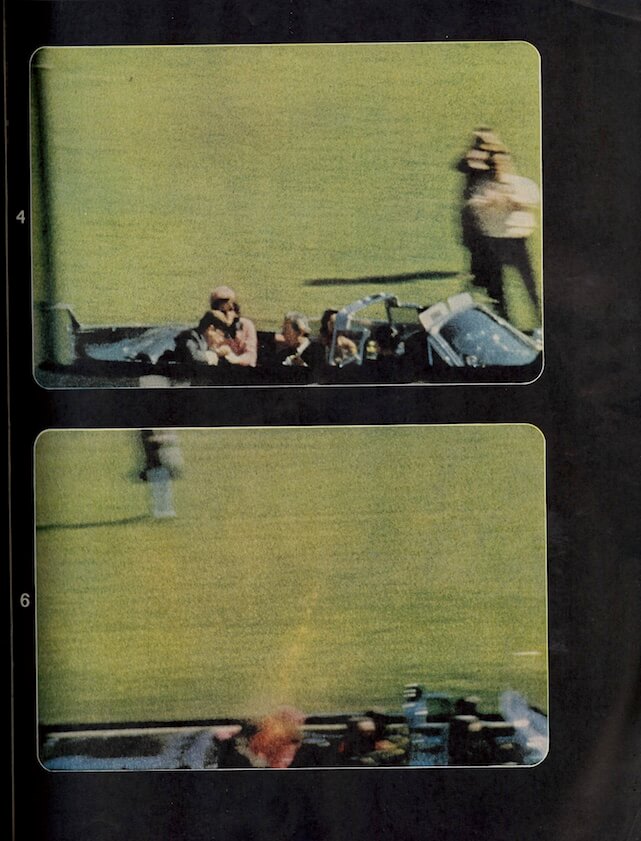
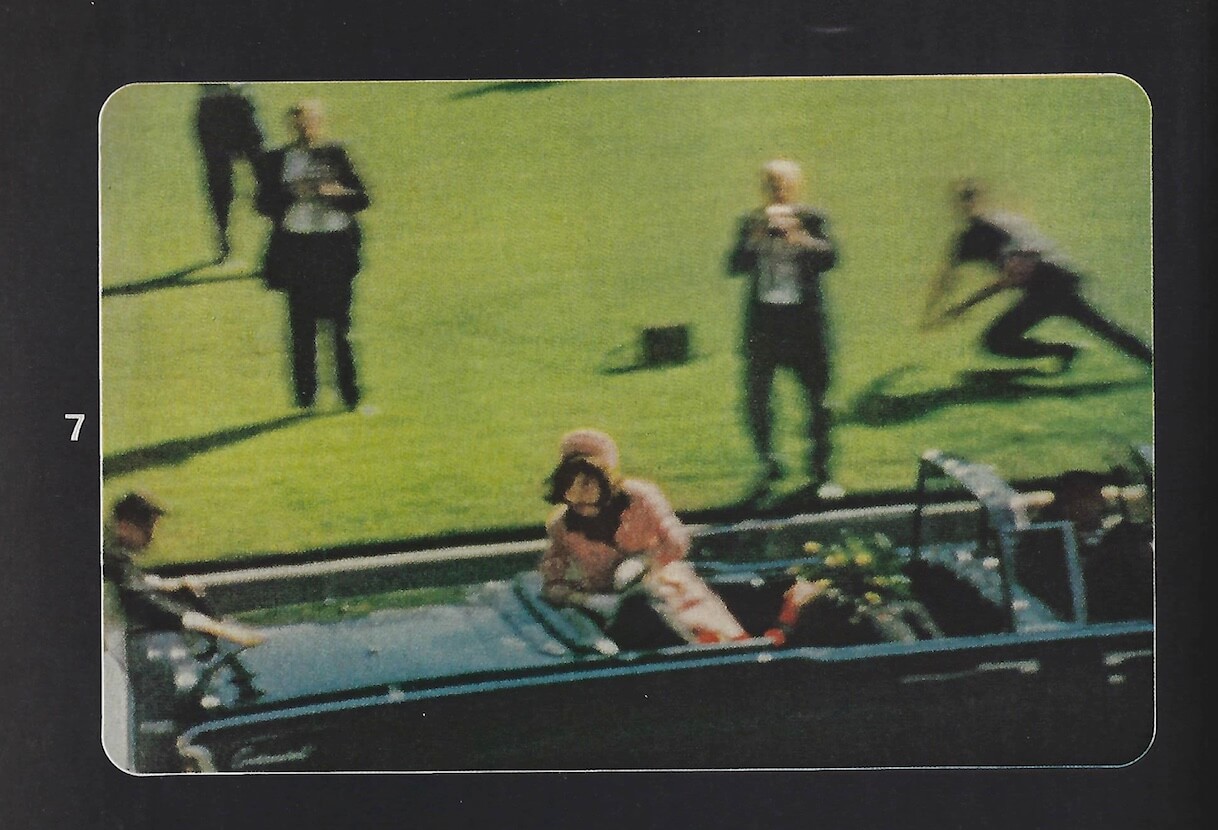
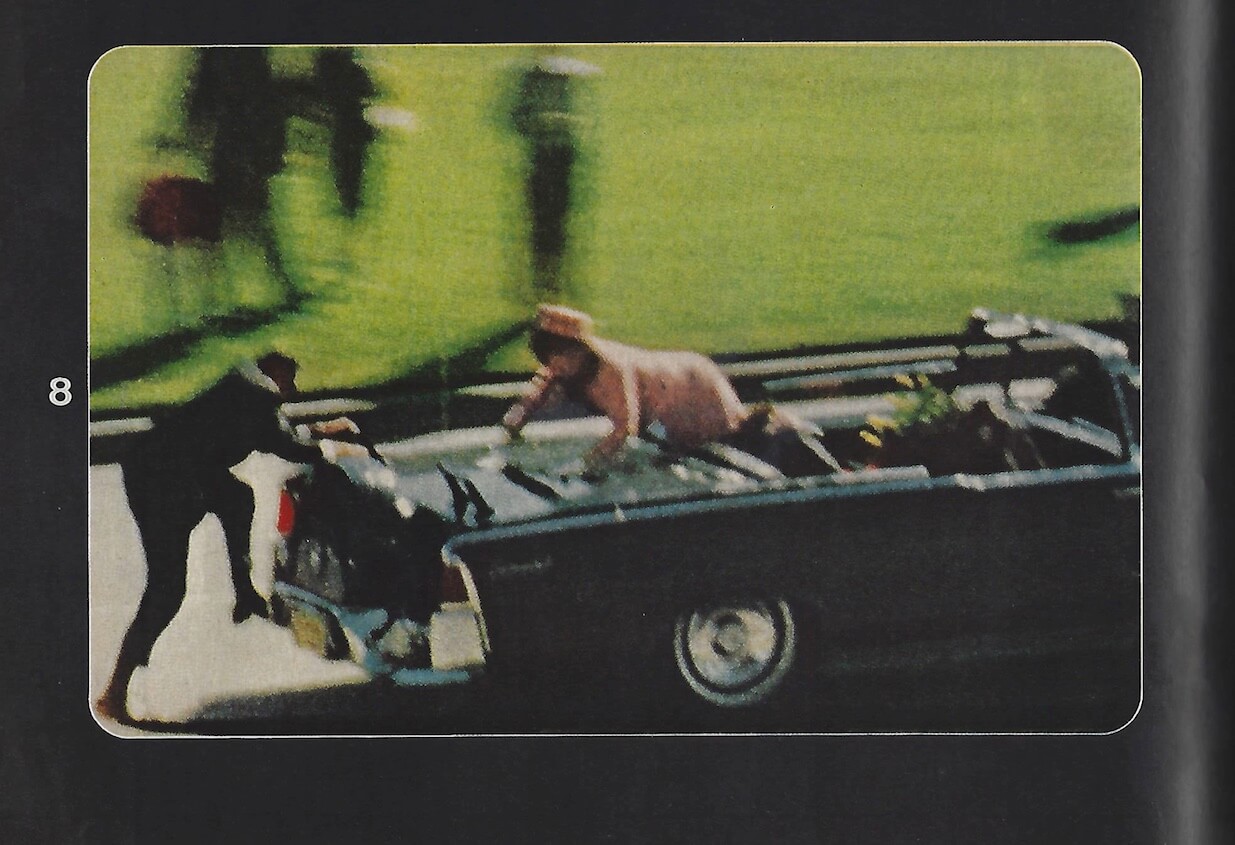
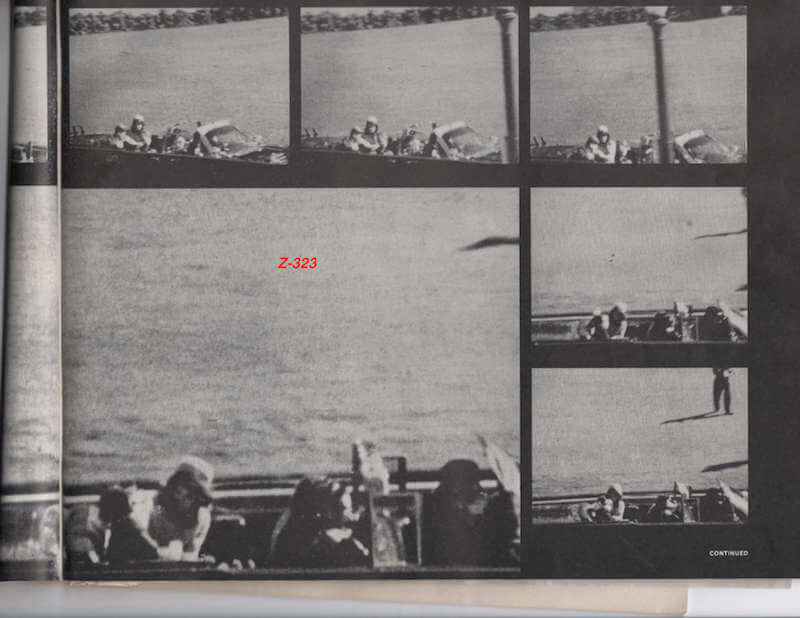
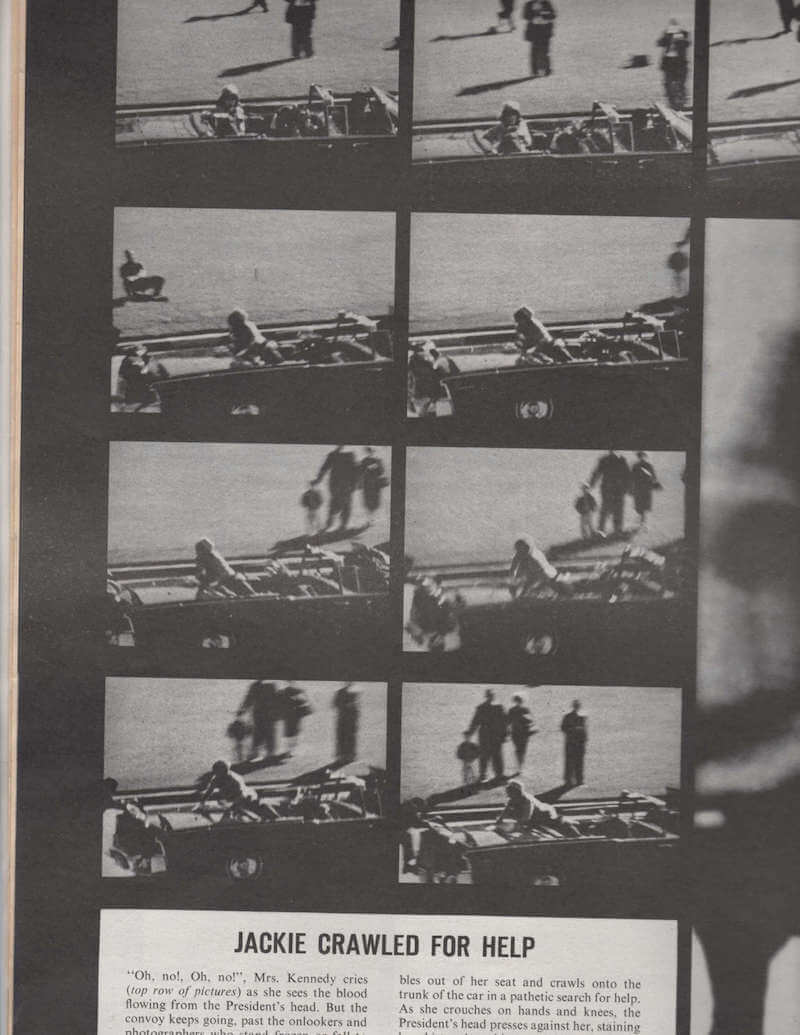
    On the management staff of Life Magazine, during the time that Life bought the Zapruder film and kept it from the public for more than 10 years, was C. D. Jackson. Jackson was President Eisenhower’s psychological warfare expert. Jackson would have known executive staff in all of the print media where these psychological sets were found by Dinkin. If Jackson was instrumental in the handling of the purchase Zapruder film and subsequent unusual happenings to the film at that very powerful magazine.  For instance, their refusal to depict the rearward head moment of the president as he was struck at Z frame 313. And their explanation of a frontal neck wound in Kennedy by saying he was turned around looking at the Texas School Book Depository when that bullet struck.  As they must have known, Kennedy is never rotated like that in the film.

    While her son Eugene was in the psych ward of Walter Reed Army Hospital, Mrs. Dinkin wrote to Robert Kennedy at the Justice Department. In the letter, she noted that Eugene had asked her to write to Robert Kennedy.  Mrs. Dinkin said that Eugene knows through his semantic studies how the assassination was planned and that if you can send someone to talk to him some very important information may come of this. Her letter did not reach Robert Kennedy, but was intercepted by Assistant Attorney General  Herbert “Jack” Miller.  At this time, Jack Miller had been appointed liaison to the Warren Commission by Deputy Assistant General Nicholas Katzenbach. Miller coordinated the investigation in Dallas into the murder of the President.

    Ironically, if the FBI had conducted an honest investigation, Miller as liaison would have been the perfect person for Mrs. Dinkin to have contacted. However, with Miller in control, the FBI hid much important information, did not interview witnesses that could have substantiated Dinkin’s foreknowledge of the plot, and kept many of the films and photos that were taken during the shooting in Dealey Plaza from the public.

    Miller, in his answer to Mrs. Dinkin’s letter requesting that someone from the Justice Department go to Walter Reed Hospital to talk to Eugene, lied to her by saying that the Justice Department could not contact Eugene, because he was in the military. President Johnson’s Executive Order creating the Warren Commission gave the FBI, the investigative arm of the Justice Department, the power to find and collect all information about the assassination from any and all agencies.

     (In 1967, as James DiEugenio details in Destiny Betrayed, Second Edition, during New Orleans District Attorney Jim Garrison’s re-investigation of the murder of the President, Miller attempted to sandbag Garrison’s probe.)

    During the House Select Committee on Assassinations investigation into the murders of President Kennedy and Dr. Martin Luther King, Eugene contacted Jacqueline Hess, the Asst. Director of the committee. He offered to help the investigation by providing information that he had found. He was not called as a witness and his offer of information was rebuffed by a form letter from HSCA Director Robert Blakey.

    There are significant differences between Dinkin’s military record and the information that the FBI supplied to the Warren Commission. I will cover that and some other series.

    I hope eventually that Mr. Dinkin gets the posthumous recognition that he deserves.

  • Jim Garrison vs NPR:  The Beat Goes on (Part 3)

    Jim Garrison vs NPR: The Beat Goes on (Part 3)

    Sticky Wicket is an NPR program series that is a co-production of two radio stations in Louisiana.  The series’ objective is to cover controversial subjects in that state’s political history between important figures and the press (e.g. Huey Long’s relationship with the media).  Quite naturally, the series decided to devote a segment to Jim Garrison and his inquiry into the assassination of President Kennedy.   The producer and hostess of the show is one Laine Kaplan-Levenson.  She is a reporter for WWNO in New Orleans. 

    One would think that a reporter/producer affiliated with NPR would have noted something as important as the creation of the Assassination Records Review Board (ARRB) and the fact that they declassified 2 million pages of documents on the assassination of John F. Kennedy in the nineties. Especially since many of those documents dealt with the New Orleans aspect of the Kennedy case. In fact, when the ARRB closed up in 1998, they kept on releasing documents on what was called a phased publication platform.  That is, a document would be delayed for release until say, 2005.  One would naturally have thought Levenson would have been interested in what was supposed to be the final releases scheduled for 2017.  Or perhaps there would be a question or statement as to why it has taken over fifty years to release all the secrets Washington has been keeping about the murder of President Kennedy. And since the show on Jim Garrison did not air until November of 2018, one would think that Levenson would have taken notice of the fact that President Trump reneged on his promise to release all the JFK documents.  After all, this happened in late 2017 and dominated the air waves for about three weeks.  Trump faltered and instead announced a panel to review the final documents and delayed their release until 2021.  Which means, as Jim Garrison predicted in his famous Playboy interview, two generations of Americans—nearly three—will have died off by the time of the last release of JFK documents.

    If you listen to Levenson’s program, you will not hear anything about the ARRB.  Or about what President Trump did in stopping the release of JFK classified documents.  You will not hear anything about how Jim Garrison predicted such a thing would happen back in 1967.  Nor will you hear anything about the new documents concerning Oswald’s activities in the summer of 1963 in New Orleans. In fact, in listening to the program and taking notes, I do not recall anyone uttering a sentence about Oswald being in New Orleans in the summer of 1963.  Let alone describing his rather odd activities there.  (If anyone can show me where I missed that information please let me know.)

    Why is all that important and relevant information ignored?  First of all, if Levenson read anything on New Orleans and the JFK case, she did not reveal it.  (She even gets the title of Garrison’s bestselling book on the case wrong.) Second, her two main interview subjects were Alecia Long and Rosemary James.  Long is a professor of history at LSU.  She was the subject of the first essay in this series. If one goes to the end of that article, the reader will see that Professor Long said that she does not intend to look through FBI and CIA documents for the rest of her life on the JFK case.  Her essay showed that she probably didn’t spend half an hour doing that kind of work. But if one does not at least spend some time on those pieces of evidence, then what does one base one’s research on?  Well, if one reads that article, one will see that Long recycled just about every ersatz cliché that the MSM constructed back in the sixties in its mad crusade to destroy Jim Garrison.  In Long’s ten-page essay, there was not a single reference to any of the treasure trove of declassified documents that the ARRB produced. And that is a huge lacuna in her work, because these documents tell us so much about what happened to Jim Garrison. For example, there was something called the Garrison Group at CIA headquarters. That body was created by order of Director Richard Helms. It was designed to calculate the implications of what Garrison was doing in New Orleans before, during, and after the trial of Clay Shaw. At the first meeting, Counter-Intelligence chief James Angleton’s first assistant predicted that, if left alone, Garrison would attain a conviction of Clay Shaw. (James DiEugenio, Destiny Betrayed, Second Edition, p. 270) As the documents then show, task forces were designed and there was much interference in the Shaw legal proceedings. (Ibid, pp. 271-78) This interference continued all the way up to and during the actual trial itself. It included the actual physical harassment of Garrison’s witnesses (e.g. Richard Case Nagell and Aloysius Habighrost). (Ibid, p. 294) At a talk he gave in Chicago in 1992, Deputy Chief Counsel of the House Select Committee on Assassinations, Robert Tanenbaum, said he saw the CIA documents describing these kinds of actions. They came out of Helms’ office. (Probe Magazine, Vol. 3 No. 5) If she had surfed the web, she could have found that interview. 

    Just how bad is this program?  Well, right off the bat, the intent to distort and demean is blatant. In speaking of Garrison’s campaign to clean up the French Quarter of B girl drinking, the show says that Garrison was actually picking up known prostitutes and then letting them go.  And that Garrison actually participated in the raids on the French Quarter.  This is almost as absurd as Fred Litwin saying that the raids were targeted at gay bars. Garrison was out to stop a racket by which the ownership of the club got some of its girls to more-or-less cozy up to a patron with hints at consensual sex. As the B girl got the mark more and more intoxicated, the drinks would be watered down.  At the end of the night, the guy was so drunk that the club would have to call for a taxi and the girl did not go back to the hotel with him.  There was then a split afterwards between the club and the girl.  (Washington Post 2/10/63)

    This practice had been going on for years. It is really difficult to believe that no one involved with this program, especially James and Long, could misconstrue it as prostitution.  Or that Garrison would go on the raids himself.  That would have tipped off the bar owner as to what was happening.  The reason it had been going on for years is that the previous DA and the police department were either on the take or just looked the other way.  Garrison did not.  He planned his campaign in advance using teams of undercover agents who would make notes of what happened.  This would be used as evidence and the DA would then make arrests.  But the real object was to shut down the illicit clubs in order to make the owners pay a financial price. Garrison would often go to civil court, where he could extract larger fines against the owners. His campaign went on for months and was exceptionally successful.  To use one example:  the DA shut down nine clubs in just two days! (DiEugenio, p. 170)

    I think the reason that the show wishes to completely distort Garrison’s achievement is simple:  because it makes it easier for the program to demean the man and then disfigure his Kennedy assassination probe.  Therefore, right here, in the opening moments we know this will not be journalism. 

    The program goes on to play a short snippet from Garrison’s appearance on NBC in the summer of 1967. Sticky Wicket tries to say that Garrison held himself out as the only person who could tell the truth to the American public about the JFK case. To anyone who knows the facts, what is so impressive about this appearance is how well this speech has held up in light of the facts revealed since.  Like Alecia Long, Sticky Wicket does not fully reveal the reasons why Garrison was on NBC.  The reason was that Garrison petitioned the Federal Communications Commission under the Fairness Doctrine. Producer/former intelligence officer Walter Sheridan and NBC had made a one-hour program that was such a hatchet job that Garrison was granted 30 minutes to reply. (The Fairness Doctrine does not exist today; it was eliminated by the FCC under the Reagan administration.)  As the ARRB has shown, Sheridan used all kinds of unethical and shocking practices in the production of this program. (DiEugenio, pp. 237-43) Sticky Wicket is so conceptually and intellectually shoddy that it tries to say a witness that Sheridan recruited against Garrison was actually suborned by the DA.

    Rosemary James was the reporter who took credit for first exposing Garrison’s inquiry in the New Orleans States Item. Her story ran on the front page for February 17, 1967.  This program states that James found out about the story through a combination of leaks and going through receipts the DA had filed to in order to pay for investigators travel expenses to inquire into the JFK case.  The program then says that she was shifted over to the DA’s office and that is how she ran into the Garrison inquiry. 

    In reality, what happened is that the newspaper’s original reporter on the police beat and the DA’s office had discovered that Garrison was calling witnesses before the grand jury for questioning on the Kennedy case. The paper had run a rather short notice on this on January 23, 1967, over three weeks before the James front page story.  The original reporter’s name was Jack Dempsey. William Davy and myself interviewed him at length in New Orleans in 1994. It turns out that, contrary to what James has tried to say, Garrison was very upset with the first story by Dempsey. He called him into his office and threatened him with a jail term if he refused to tell him who his source was.  When Dempsey said he could not reveal his source, Garrison threatened him with contempt. Clearly shaken, the editors decided to switch reporters.  Unlike what James has maintained, Dempsey said that Garrison was furious when James told him they were going to run the story as a feature.  He denied everything. (DiEugenio, pp. 221-22)

    The reason for this is easy to understand.  As the declassified files reveal, before Garrison’s probe was exposed, he was making a lot of progress. Afterwards, it was open season on him.  And he was targeted by the big guns of the media.  NBC sent in Sheridan, Newsweek sent in Hugh Aynesworth, and the Saturday Evening Post sent down James Phelan. Many writers have shown how these men obstructed Garrison once his inquiry was out in the open.  In fact, the only sensible thing that is uttered through the entire 30 minutes of this program is by James when she says if she had known what was going to happen, she would have recommended leaving that matter alone.

    One reason she may have said this is due to another matter that, surprisingly—almost shockingly—the program leaves out.  Five days after the James story ran, David Ferrie was found dead in his apartment. Although the coroner ruled Ferrie had died because of a ruptured berry aneurism, he left two typed, unsigned suicide notes.  A later coroner, Frank Minyard, pointed out that in photos, one could see bruising on the inside of Ferrie’s mouth and inside the lower lip. Minyard theorized that Ferrie could have been poisoned with some kind of solution that could have caused the aneurism. (DiEugenio, pp. 225-26) About three days prior, Ferrie had talked to Lou Ivon, Garrison’s chief investigator. Ivon later told William Davy that Ferrie seemed frightened to the point that he acted like “a wild man”.   He admitted he worked for the CIA and that he knew Lee Oswald. (William Davy, Let Justice be Done, p. 66) When one adds to this the fact that Oswald was seen with Ferrie in the summer of 1963 at the office of Guy Banister and in the Clinton-Jackson area north of New Orleans, then this would help demonstrate why he was Garrison’s chief suspect. (Davy, pp. 41, 103-110) After all, Oswald was supposed to be a communist.  He was the sole member of the Fair Play for Cuba Committee (FPCC) in New Orleans. He had stamped one of the FPCC pamphlets he was handing out in New Orleans with the address of Guy Banister’s offices. Banister’s place was a clearing house for anti-Castro Cuban exiles. Yet, the rightwing extremist Banister had given the allegedly communist Oswald a room there to print up his FPCC literature. (Davy, p. 39) If you leave out all of these key evidentiary details—which Levenson, James and Long do—then you can avoid the obvious question: Why would the rightwing nut Banister give a room to a communist?

    If you are this one-sided, you can also leave out how Garrison got on to Clay Shaw. The program tries to insinuate that somehow the media was losing interest in Garrison’s inquiry and, therefore, Garrison’s arrest of Shaw was some kind of ruse to gain attention.  As Bill Davy and others have demonstrated, Garrison had called Shaw in for questioning as early as December of 1966.  Davy analyzed why Shaw’s answers during questioning provoked Garrison’s further interest in the man. (Davy, pp. 63-64) As his inquiry began to pick up steam, Garrison discovered that Shaw knew Ferrie, Banister, and Oswald. And he was seen in the Clinton/Jackson area with Ferrie and Oswald. (Davy, pp. 93-94, 106) The idea that this program leaves, that somehow Shaw was an admirer of President Kennedy, is contradicted by no less than Ferrie himself. Ferrie said that Shaw hated JFK. (Davy, p. 66)

    How shoddy is this program?  It says that the name ‘Clay Bertrand’ is in the Warren Report as someone who plotted with Oswald to kill Kennedy. Question:  Does NPR employ fact checkers?  Anyone can check the index of the Warren Report and find that the name Bertrand is not there. The name of Bertrand came up because New Orleans attorney Dean Andrews mentioned him in his testimony to the Warren Commission.  (See Commission volumes, at Volume XI, pp. 325-39) Andrews told the commission that Bertrand had called him on November 23rd to go to Dallas to defend Oswald.  No one could find a Clay Bertrand in New Orleans.  Therefore, this had to have been an alias.  Sticky Wicket tries to say that Garrison also could not locate Bertrand, since Andrews was not going to reveal his true identity. This is misleading in two senses. First, it leaves out why Andrews would not reveal who Bertrand really was.  The reason being that he feared for his life if he did. (DiEugenio, p. 181) Secondly, Garrison found out that Bertrand was Shaw.  The evidence for this is simply overwhelming today and appears in more than one form. This includes declassified FBI reports that Alecia Long won’t read. (Davy, pp. 192-93; DiEugenio, p. 388) Those reports reveal that the Bureau was investigating Shaw in 1963 as part of their JFK inquiry. By not revealing any of this information, NPR does not then have to pose the questions as to:

    1. Why was the FBI investigating Shaw in 1963?
    2. Why did Shaw lie about using the Bertrand alias?

    The program also uses the same technique that James Kirkwood did in his abysmal and obsolete book, American Grotesque. Namely, that somehow Garrison’s prosecution ruined Shaw’s life. But Sticky Wicket goes beyond that and says that New Orleans high society dropped him like a hot potato. As anyone who studies Shaw knows, he had at least three sources of income during his career. These included his job as manager at the International Trade Mart (ITM), his real estate holdings in the French Quarter, and the fees paid to him by the CIA as a highly valued contract agent.  Shaw had retired from the ITM in 1965. Therefore, Garrison’s prosecution had nothing to do with that. The idea that this would impact his real estate holdings is simply a non-starter. (Click here for an example) The CIA eventually declassified documents which show he was well compensated for his services dating back to the fifties.  This was another point, Shaw’s declassified CIA career, which the defendant lied about and which the program completely ignores. (Joan Mellen, Our Man In Haiti, p. 54) As per the expenses for his defense, everyone except NPR knows that Shaw’s defense team was getting tons of help from Washington.  They refused to admit this, but in those pesky declassified documents that Long does not read, it is clear that his lawyers actually solicited this help. (The Assassinations, edited by James DiEugenio and Lisa Pease, pp. 33-50) And they ended up getting aid from the CIA and the FBI.  This included the CIA planting informants in Garrison’s office (e. g. Bill Boxley). (DiEugenio, pp. 278-85)

    As per the falling out with the Sterns, this tenet by Rosemary James would appear to contradict what Kirkwood wrote in his book. The Sterns hosted dinners at which they wined and dined incoming media in favor of Shaw after he was charged. (Destiny Betrayed, first edition, p. 157; Davy p. 78). Further, their local TV station, WDSU, served as an outpost for Garrison critics like Jim Phelan and Rick Townley. (Davy, p. 136; Destiny Betrayed, first edition, p. 202). Finally, the Walter Sheridan produced NBC attack program was partly produced out of WDSU and Sheridan used money funneled to him by the CIA associated local law firm of Monroe and Lemann for its creation.  (DiEugenio, Destiny Betrayed, second edition, p. 238). These all occurred after Shaw was charged.

    The idea that Garrison pursued publicity for his inquiry, proposed by Long and repeated here, is simply fatuous. As noted above, his appearance on NBC was provoked by Sheridan’s hatchet job under the Fairness Doctrine. His appearance on The Tonight Show, which is also mentioned, was prompted by Mort Sahl.  Garrison did not “pursue” either one.  The program actually says that Shaw’s home was “raided” in July. And this is how Garrison uncovered proof of Shaw’s far out homosexual practices.  In my interview with assistant DA Jim Alford, he told me that Shaw’s home was searched when he was arrested.  And Garrison did not say anything about this homosexual aspect in the two years between Shaw’s arrest and his trial. The idea that Garrison once proposed that Kennedy’s assassination was done as a homosexual thrill killing is something not backed up in Garrison’s files. The only place I have ever seen that subject proposed is in the work of the late Jim Phelan, who—with the release of declassified documents—has real credibility problems on this matter today. (Destiny Betrayed, Second edition, pp.243-49) And, of course, the program says that Perry Russo was hypnotically programmed to recall the name of Bertrand.  This worn out cliché was exposed in detail by both William Davy and also Joe Biles, in his book In History’s Shadow. (Davy, pp. 121-23, Biles, pp. 44-46) After reading those two accounts, it can be seen that this was a cheap trick put together by Phelan and Shaw’s lawyers.  The MSM, which I did not think NPR, was part of, then latched on to it.  Another error is that private investigator William Gurvich defected from Garrison’s staff toward the end of the investigation. Gurvich defected in 1967, on the eve of Sheridan’s broadcast special. (Davy, pp. 136-37). And, from reading his testimony before the Grand Jury, they did not take his charges against Garrison seriously.

    Toward the end, the show goes bonkers.  Levenson does nothing to try and rein in the anti-Garrison mania of either James or Long. They propose the idea that Garrison did not suffer any consequences at all because of the pursuit of his case against Shaw. Pure bunk. Jim Garrison was one of the most popular figures in the state in 1966. Many commentators thought he could be either governor or senator. Because of his prosecution of Shaw, the Power Elite in New Orleans ganged up on him and backed the Justice Department attempt to remove him from office.  This was done through the candidacy of the DOJ liaison to the Shaw trial, Harry Connick. That was coupled with two phony prosecutions against Garrison originating from the US attorney’s office, where Connick worked. Garrison exposed these trials at length in his book, On the Trail of the Assassins. (See Chapter 19) It was the publicity from those trials that weakened him and eventually let Connick into the DA’s office. It is incredible that no one on the program notes that this was a calamity for the city of New Orleans.  For the simple reason that Connick was a disaster as a DA. (For just one serious problem, click here; click here for another)

    As a result of his case against Shaw, Garrison went from being a probable governor to renting an office in a large law firm and Connick became one of the most incompetent DA’s in America.  But the aim of the ordeal Garrison went through was not just to get him out of office.  It was also to serve as an example to others:  “See what we did to the guy who was set to be the governor of the state?  Try and mess with the JFK case and the same thing will happen to you.”  With one exception, Richard Sprague and the House Select Committee on Assassinations, it has worked. 

    There is barely a mention at all of what befell Garrison.  Alecia Long actually says that Clay Shaw’s civil liberties were violated.  This is ridiculous. Shaw was not just indicted by a grand jury.  He also had a preliminary hearing, after which the presiding judge could have thrown out Garrison’s case.  He did not.  Therefore, what civil liberties were violated in the criminal case? No one on the program mentions that Connick incinerated much of the evidence Garrison had left in his office after he left.  And he fought the ARRB in court not to give back what he had left. (DiEugenio, Destiny Betrayed, second edition, p. 320) In that respect, the American people were deprived of the results of one of the very few valuable inquiries into the murder of President Kennedy, which no one on this show seems to give one iota about.

    When asked by one reader about how bad her work was on Jim Garrison and JFK, Long replied that she had her sources and the reader had his. What she did not add is that FBI and CIA associated journalists like Phelan, Sheridan, and Hugh Aynesworth, are not credible sources. But ARRB declassified documents, which the government hid for generations, are. They tell us why the Kennedy case and the Garrison inquiry were so dangerous to the power elite. And they show us how NPR, Long, James, and Laine Kaplan-Levenson have produced a pile of irrelevant rubbish. Better no one broadcasting on the subject than tripe like this.

  • Thomas, Lattimer, and Reality: A Study in Contrasts

    Thomas, Lattimer, and Reality: A Study in Contrasts


    Whenever I open a book on the Kennedy assassination, I never know what rabbit hole I’ll fall in to. And I wonder if I’ll ever be able to crawl out—especially when I start checking an author’s references.

    Lately, I’ve been browsing through Hear No Evil. Politics, Science & the Forensic Evidence in the Kennedy Association by Donald Byron Thomas—and it is full of surprises. (Please go here to see my earlier story on Thomas’s presentation of Kennedy’s throat wound.)

    Thomas, a scientist with the US federal government, has a PhD in entomology. He specializes in beetles, and is former president of the Coleopterists Society.

    This report concerns the puzzling way in which Thomas represented the work of the late John Lattimer, MD with respect to what has become known as the “Thorburn reflex position.”

    Lattimer—former head of the Department of Urology at Columbia Presbyterian Hospital, private physician to many prominent men, including J. Edgar Hoover—is the author of many articles (infomercials really) promoting the lone assassin theory,

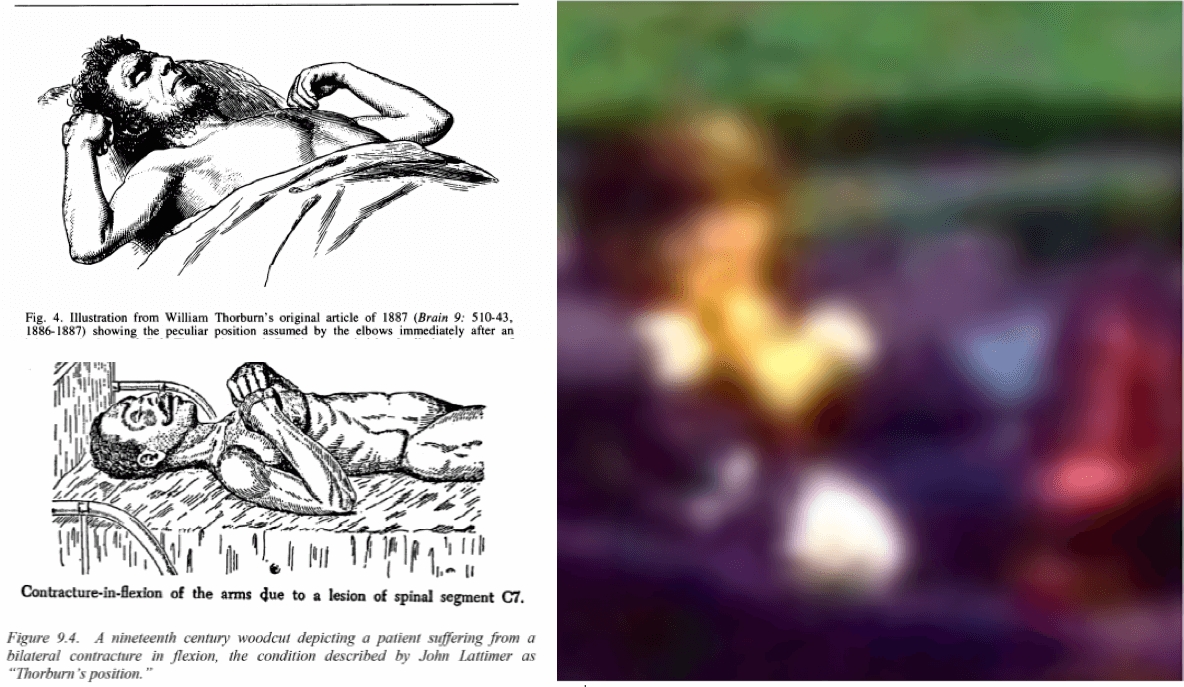
    William Thorburn was a 19th-century neurologist who documented specific neurological consequences associated with traumas to different levels of the cervical spine. One of his articles featured a picture of a man whose arms became locked into position after damage to his spinal cord at the sixth cervical (C-6) level.

    Because the position of the man’s upper arms superficially resembled that of Kennedy’s, Lattimer seized upon the picture as “proof” Kennedy was struck at the C-6 level—that is, higher than the throat wound, establishing a downward path from the alleged sniper’s nest. (Bull NY Acad Med 53, 1977) (The back wound was actually much lower.)

    Lattimer’s co-author, distinguished neurosurgeon Edward Schlesinger, admitted to me that neither he, nor a third coauthor, neurologist H. Houston Merritt, ever saw the Zapruder film, knew very little about JFK’s reactions, and never read the manuscript that carried their names.

    They did not take its publication seriously. They knew Lattimer’s JFK stories appeared in the “Biography” or “Historical Medicine” sections in journals with lenient standards.

    So, what was the point of publishing in such journals? The answer is, doctors were not the intended audience—you were.

    Every time Lattimer published a seemingly peer-reviewed story, the mainstream press was tipped off, and quotes supporting the official view were selected and widely disseminated.

    Thomas did not accept Lattimer’s use of neurology to establish a high wound in the back of Kennedy’s neck. Yet, he gave space to it in his book—only he put together a revised version.

    You may find this report confusing. It’s about one man’s revised version of another man’s revision of history. Well, let the confusion begin!

    Lattimer’s Version of Kennedy’s Position

    Let’s start with Lattimer’s “proof” the bullet struck near the sixth cervical vertebra, a woodcut of a patient treated by William Thorburn, MD, which Lattimer claims resembled Kennedy’s, soon after he was hit for the first time:

    In his book, Kennedy and Lincoln (1980), Lattimer began his chapter on this subject with the question “Why Did the President’s Elbows Fly Up When He Was Hit?” And in all of his writings on this issue, he has used this picture to illustrate JFK’s reaction. In 1993, he said the same thing, “Finally, by frame 236, President Kennedy has assumed the reflex position illustrated by Thorburn almost 100 years ago…” (JAMA, March 24,1993, p. 1545)

    Thomas’s Version of Lattimer’s Version of Kennedy’s Position

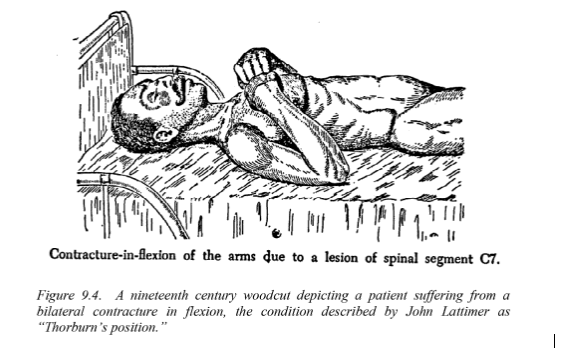
    Here is what Don Thomas presented as Lattimer’s choice of an illustration from Thorburn’s long article on multiple cases. This is not the same Thorburn patient Lattimer used as a model. His arms are obviously not in the same position as that of the man shown above (or Kennedy’s!). Furthermore, the position below is related to damage to the seventh cervical vertebra, not the sixth.

    In the above picture, the man’s elbows are most certainly not “flying up!” Clearly, his upper arms are down by his side. But Thomas said “Lattimer proposed that Kennedy’s reaction, bringing his arms into a folded position with the elbows outward…”

    But Lattimer always said the elbows were raised. He never said JFK’s arms were in a “folded position.” And he never used the picture above.

    Kennedy’s Actual Position

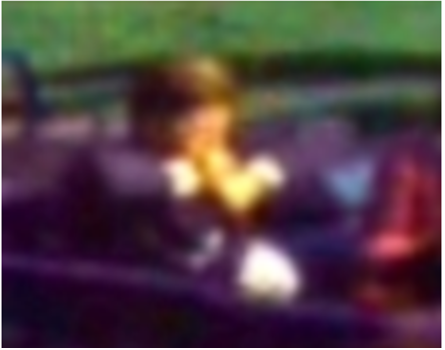
    As you can see from the Zapruder frame below, Kennedy’s actual position looks like neither Lattimer’s nor Thomas’s false representation of Lattimer’s depiction of his position.

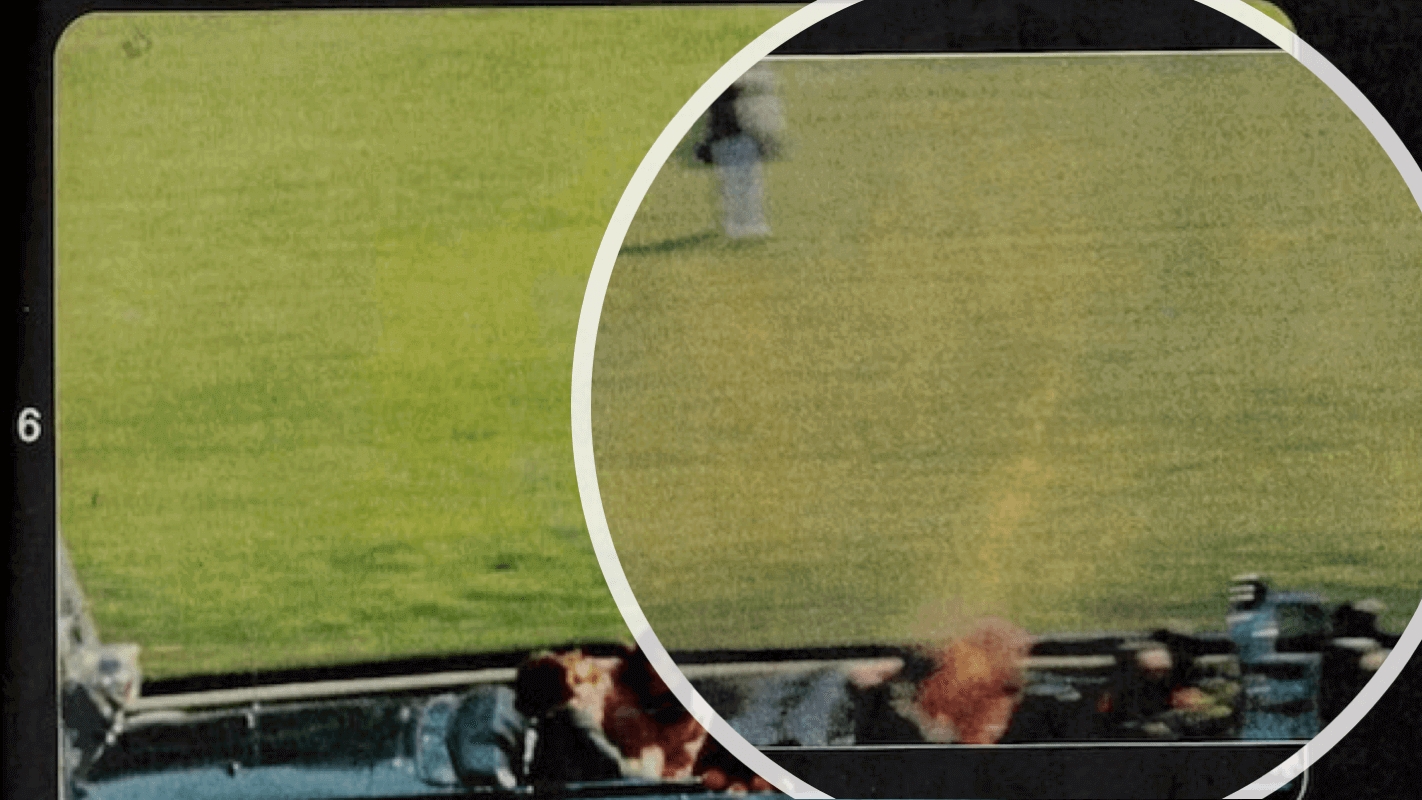
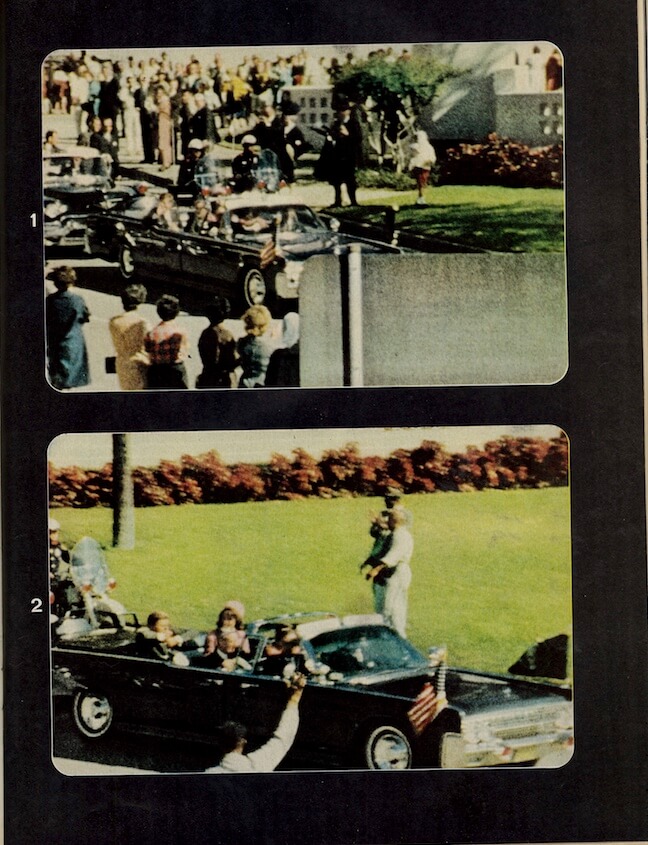
    Here is what Kennedy actually did as shown in Zapruder frame 236.

    Kennedy’s elbows are definitely up and out—much further up than in the picture Lattimer featured. But Kennedy’s elbows are bent, bringing his forearms high across his chest, while the Thorburn patient’s forearms and hands are twisted outward. In the picture Thomas falsely presented (below, middle) as Lattimer’s choice, the patient’s elbows and forearms are not up at all. Here you can compare all three:

    How Thomas Gave Appearance of Backing Up His Version of Lattimer’s Claims

    On page 318 of his book, Thomas wrote,

    Lattimer invented the ‘Thorburn position’.78 Lattimer proposed that Kennedy’s reaction, bringing his arms into a folded position with the elbows outward, was a reflex resulting from stimulation of the nerve cord at the level of the seventh cervical vertebra.79 Lattimer noted that the innervation of the upper arms, the brachial plexus, occurs at this level, and also credited a nineteenth century physician, William Thorburn, for first associating this particular anatomical posture with a lesion to the cervical spinal cord.80

    In the above passage, it is reference #79 that is the most misleading. Thomas’s words: “Updated Thorburn reaction in Lattimer (1993) JAMA March 24, 1993.”

    As mentioned earlier, Lattimer never described Kennedy’s position that way, not even in his 1993 article which Thomas says is “updated.” The only change Lattimer made was to associate the trauma to “C6-7” instead of “C-7.” And he used the same illustration that he always used. Not much of an “update.”

    For decades, Lattimer’s disinformation has been a major contaminant in the corporate media’s representation of the Kennedy assassination. (Most recently, atmospheric scientist Nicholas Nalli used some of Lattimer’s “research” to support his own pseudoscience promoting the lone nutter view on the head wound. Please go here to see these darkly amusing grotesqueries, and their illustrations.)

    Why give Lattimer’s false Thorburn story a makeover? Was he trying to restore Lattimer’s reputation with what he thought was a better Thorburn story?

    After all, Thomas does depend in part on Lattimer’s presentation of Governor John Connally’s back wound in his own efforts to promote the single bullet theory. In his book, Thomas repeats—without any revision—all the demonstrably false information Lattimer published, which I exposed long ago, in my article, “Big Lie About a Small Wound.” (I was told that Vincent Bugliosi was about to use the same false information in his book—Reclaiming History: The Assassination of President John F. Kennedy—but did not after being shown my findings.)

    In the beginning of this article, I commented on the rabbit hole nature of references. Had Thomas dropped down even one of these holes in the Connally back wound tale, he might not have repeated it. Unless he could think of a way to give it a makeover.

  • CBS and their 1964 JFK Cover-Up

    CBS and their 1964 JFK Cover-Up


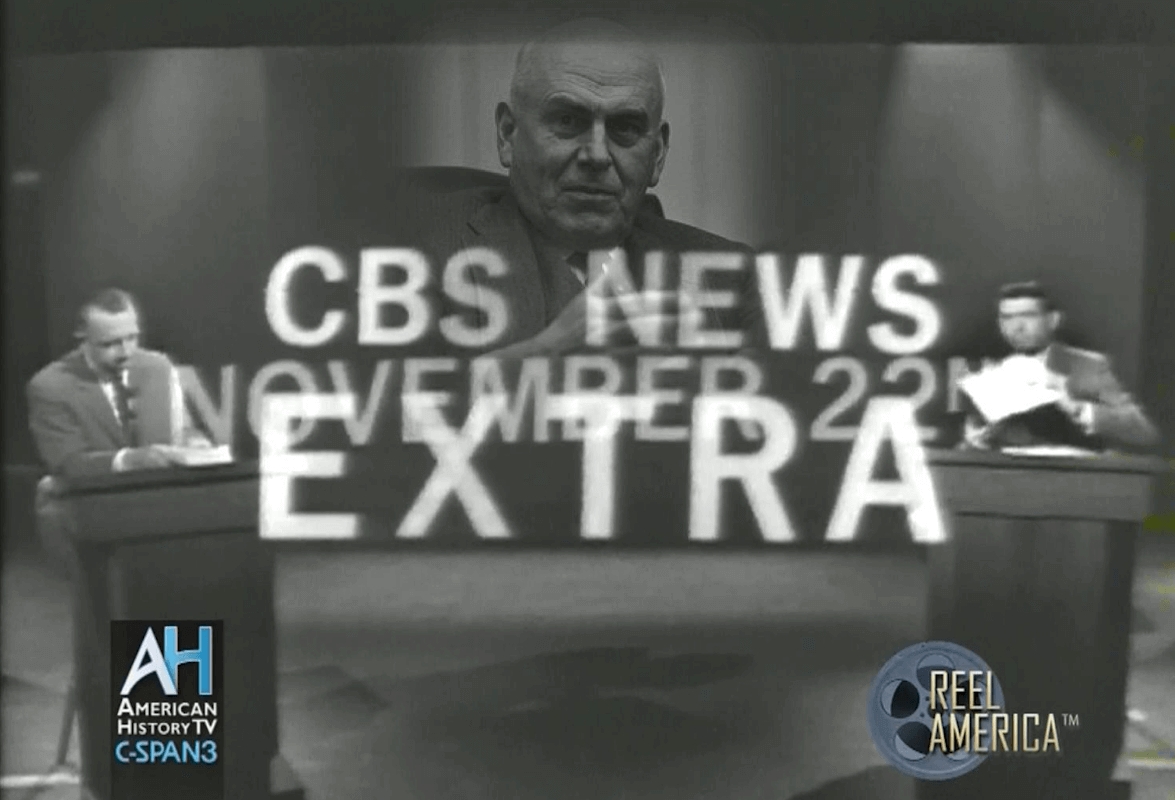
    cbs warren reportAs most people who read this site understand, the MSM has not been trusted or admired for their work relating to the assassination of President John F. Kennedy. In fact, one can effectively argue that the major media bastions—newspapers, magazines, and broadcast media—were so biased in favor of the official story that they have little or no credibility on the case today. This began almost from the start, and continues to the present.

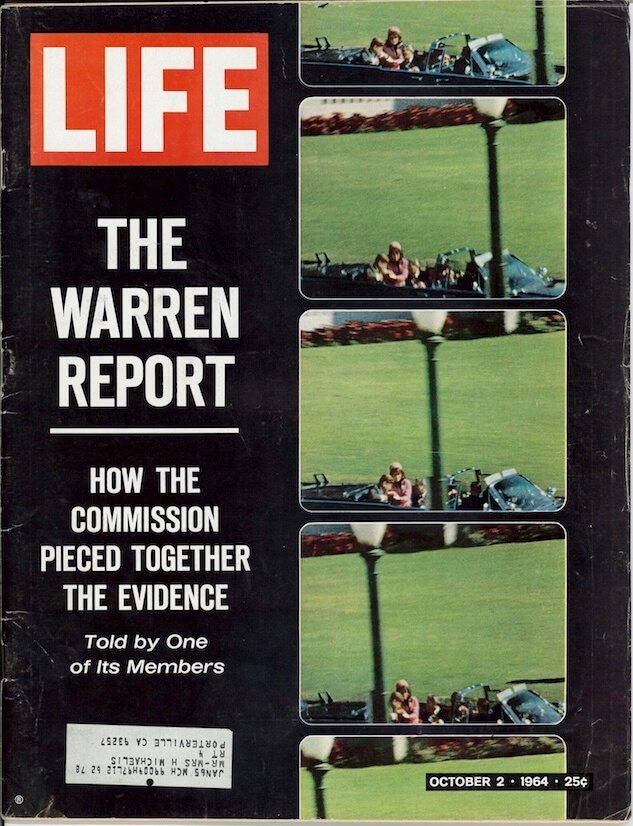
    One of the worst instances of the media’s obeisance to the Powers That Be concerning the JFK case occurred upon the issuance of the Warren Report. If the reader will recall, this happened in late September of 1964. The report was handed to President Lyndon Johnson on Thursday, September 24. There was an official photograph taken on that day in the Oval Office. All seven commissioners, plus Chief Counsel J. Lee Rankin, were pictured. Chief Justice Earl Warren handed LBJ the 888-page report. This was, for all intents and purposes, a photo op, as the report was not released to the public until Sunday evening, the 27th.

    A funny thing happened that Sunday evening. Both the CBS and NBC networks broadcast specials on the JFK case. Both were based upon, and endorsed, the Warren Report. This was odd in two respects. First, how could anyone have read the quite lengthy and complicated report that fast? What makes that even harder to understand is that the Warren Commission worked in almost complete secrecy. Their hearings were closed to the press and the public. The only exceptions among the approximately 500 witnesses the Commission itself interviewed were the two depositions of Mark Lane. They were excepted for the simple reason that Lane insisted his appearances be done in the open. (Walt Brown, The Warren Omission, p. 244)

    As author Seth Kantor notes, inside the Commission itself, the working staff of attorneys was pretty much kept away from the seven commissioners and the chief counsel. (Seth Kantor, The Ruby Cover-Up, p. 163) This information above leads to the conclusion that the two broadcast programs were produced by directed leaks from the top level of the Warren Commission. The only other logical possibility would be that they were done with the help of FBI Director J. Edgar Hoover, since he did the great majority of the investigative work for the Commission.

    It was very soon discovered that, although the Warren Commission tried to label itself a fact-finding committee, that rubric is not really accurate. After one studies their deliberations, their conduct of interviews, and their methods of investigation, it is quite obvious that there were significant holes in their fact-finding quest; for instance: Oswald in New Orleans, Oswald in Mexico City, Kennedy’s autopsy, Jack Ruby’s entry into the Dallas Police basement. But even with their foreclosed database, the Commission clearly produced a prosecutor’s brief. (Mark Lane, Rush to Judgment, p. 378) For two reasons, that end result was almost inescapable. First, the Commission decided that Oswald had been the lone gunman before they interviewed their first witness. (Lane, pp. 365-66) Secondly, the Commission refused to grant Marguerite Oswald the right to appoint a counsel to represent her deceased son’s interests. (Lane, p. 9) On the issue of fairness to the alleged assassin, the Commission tried to cover itself by saying that they had enlisted the services of one Walter Craig, the president of the American Bar Association, to find if the “proceedings conformed to the basic principles of American Justice.” (Sylvia Meagher, Accessories After the Fact, p. xxix) Craig only attended hearings from February 27 to March 12, 1964. Any suggestion he made in deference to Oswald’s rights is not visible in the record. As Sylvia Meagher concluded in this regard, “The whole sorry arrangement was a mockery that further compromised the Commission’s claim to impartiality.” (p. xxix)

    What is so fascinating in reading and viewing the immediate endorsement of the MSM upon issuance of the report is that none of the commentators even mentions this large lacunae in the Commission’s procedure. As any attorney will state, the whole basis of the American justice system is the adversary procedure. One of the fulcrums of that adversary procedure is the cross-examination of witnesses, the right to examine documents, the right to make objections, etc. Even in fact-finding procedures done for Congress (e.g., Watergate or Iran/Contra), there was a majority and minority counsel, so one gets something resembling an adversary procedure. To put it mildly, that did not happen with the Warren Commission. But somehow, in their eagerness to embrace the official story, the press ignored this issue with a completeness that is almost astonishing. It is made even worse by the fact that the reporter who did the immediate endorsement for the New York Times, Anthony Lewis, had just written a best-selling book on the subject. Lewis’ book was called Gideon’s Trumpet. It was about the 1963 Gideon v. Wainwright Supreme Court case. In that case, the court ruled that defendants in criminal cases must be supplied an attorney even if they could not afford one. How Lewis could turn his back on his own book is puzzling.

    The press did not just accept the Warren Report, it did not just embrace it, but as the evidence above indicates, they colluded with its creators to present it to the public as the ultimate truth about the murder of President Kennedy. Near the end of the 1964 CBS special, Walter Cronkite goes so far overboard in this regard that today it is almost embarrassing to view. Cronkite says that it is hard to imagine a more thorough inquiry could have been done, and that Oswald lied about every major point he was questioned on.

    What makes these pronouncements patently absurd is the fact that the 26 volumes of testimony and evidence the Warren Report based their conclusions on would not be published for two months: that is, November 23, 1964. Those volumes contained over 17,000 pages to inspect. With that paradox, we are left with two alternatives to ponder. Either someone on the Commission leaked both the report and its evidentiary volumes to the media, or someone associated with the inquiry gave them advance summaries of what that evidence would say. I should not have to add the serious journalistic problem in this collusion. As demonstrated above, the Commission was extremely biased in their presentation. They would not even allow a representative for Oswald. Since they worked in secret, there was no way to cross check their procedures or methodologies. So to accept at face value the Commission’s presentation was a huge gamble. People like Cronkite and Lewis risked losing the trust of the public in both the government and the media if they were wrong.

    The CBS special that was broadcast on the night of September 27 was longer than the NBC rendition. It ran for two hours. The producers interviewed a number of witnesses who the Commission relied upon for its guilty verdict: Ruth Paine, Marina Oswald, Howard Brennan, and so forth. The story about how Brennan was included on the CBS special bears mentioning. At first, he was not going to appear. This probably owes to the fact that there was a debate inside the Commission as to whether or not the man was credible, or whether his liabilities outweighed his probative value. (Edward Epstein, Inquest, p. 136) When CBS first announced its schedule of over twenty witnesses, Brennan was not included. But when the Commissioners decided that Brennan was necessary, the CBS script was revised and Brennan was sent to New York to be interviewed before the program’s deadline. This is how close the ties were between CBS and the Commission. (Mark Lane, A Citizen’s Dissent, pp. 77-78)

    In 1964, Emile de Antonio had released a cinema-vérité-style documentary about the fall of Senator Joseph McCarthy. For Point of Order de Antonio relied largely on film from the CBS kinescope archives. (Lane, A Citizen’s Dissent, p. 75) In 1966, de Antonio was working with Mark Lane on a documentary about the Kennedy assassination. It would eventually take the same title as Lane’s book, Rush to Judgment. The director got in contact with the CBS library and proposed to repeat the process of purchasing film from that network. The response from librarian Virginia Dillard was positive. (Washington Journalism Review, Sept-Oct, 1978, article by Florence Graves; hereafter referred to as Graves in WJR) Lane and de Antonio arranged to go to the CBS archives after hours and sit in front of a movieola to view the outtakes from that 1964 production.

    As Lane writes in A Citizen’s Dissent, he and de Antonio were unprepared for the interviewing techniques they saw being used. If a witness was asked where he thought the shots came from and answered with “the knoll area”, the interview was halted. There was an interim that was not accounted for and now the witness would reply that although he originally thought the shots came from the knoll, he now thought they came from the Texas School Book Depository. On the third take, the witness would be asked where he thought the shots came from and he would reply, the depository building. This would be presented as the interviewee’s answer. (Lane, A Citizen’s Dissent, p. 78)

    De Antonio described the same pattern in an interview he did for journalist Florence Graves in 1978. He said that what he recalled was people in these outtakes saying things that did not get on the program since they contradicted the official story. He then said that it was clear that the interviewer was leading the subjects to a predetermined conclusion. He summed it up with, “The interviewer was more like a prosecuting attorney leading a witness to support the state’s case.” In other words, CBS not only served as an outlet for the Commission, they even did their dirty work for them. (Graves in WJR)

    Lane and de Antonio now ordered up the outtakes they wished to use. But the next day Dillard told them the deal was cancelled. She said that CBS never sold outtakes. (Graves in WJR) This, of course, was pure malarkey. They had done so with Point of Order, and they had just agreed to do so in the JFK case. This reversal must have come down from the executive suites at the network. Either Dillard or the movieola operator had informed them what was happening. Someone like CBS president Richard Salant then overruled the Dillard agreement and the previous de Antonio precedent. The Kennedy case was that important.

    In the 1978 Florence Graves article, it is revealed that one of the producers of the 1964 CBS program, Bernard Birnbaum, admitted there were leaks from the Commission for that special. He added that some of the interviews went on for as long as an hour. But further, and perhaps most importantly, he said the production was months in the making.

    Why did Graves write her piece in 1978, 14 years after the original special aired? Because in the fall of that year, there was a controversy in the press about whether or not the House Select Committee on Assassinations (HSCA) had tried to secure these important pieces of film that had been denied to Lane and de Antonio. The Washington Post reported at the time that the HSCA had not tried to secure the 70 hours of film that CBS still had. (Washington Post, 9/17/78, report by Larry Kramer) And they used Robert Blakey, chief counsel of the HSCA, as their source. That article quoted witnesses landlady Earlene Roberts and cab driver William Whaley as saying things to CBS that contradicted what was reported by the Commission. The Post reporter speculated, as did Graves, that what the witnesses said could back up the concept of a Second Oswald, an idea that some critics had postulated as far back as 1966.

    For the Post article, the pretense that Salant was using to keep the outtakes away from Lane, de Antonio and the HSCA evolved into comparing the film with an investigative reporter’s notes. Which is hard to comprehend. The latter is tied in with the whole idea of a reporter’s need to keep certain sources secret in order to develop information that would benefit the public. Usually, arrangements are made prior to the interview about these special circumstances. Nothing like that would exist in the CBS example. Birnbaum told Graves that the only guarantee he made to the witnesses was the broadcast would not be aired until the Warren Report had been released. Also, why could a witness agree to go on camera if there was anything dealing with personal secrecy involved? In the CBS case, clearly, the value of the transmittal would greatly outweigh the value of keeping the information secret. Or as de Antonio said to Graves for the WJR article, “Does CBS have an Official Secrets Act like the CIA? What is it afraid of?… What is CBS hiding? I won’t guess.”

    For the Graves article, Salant contradicts what Blakey said about the matter. Salant told her that the HSCA did make such a request for all film, including outtakes, in both the JFK and Martin Luther King cases. This was done both orally and in writing. Graves found out from other sources that the HSCA did want the outtakes but CBS would not surrender them. Realizing that this would be a long legal battle that would detract from the investigation, the Committee decided not to issue a subpoena.

    As this site had explored before, CBS was and is one of the worst media agencies to ever broadcast on the assassination of President Kennedy. Through former employee Roger Feinman, we showed that the upper level of management vetoed and then reversed the desire of the reporters and lower managers to honestly investigate the JFK case in their 1967 four night special. In that article we intricately demonstrated how the CBS cover-up of the facts worked and how it pervaded that special. We also showed how CBS then denied that it had done the things it did, such as employing Warren Commissioner John McCloy as a secret advisor to the program. Based on Feinman’s inside information, plus the testimony of Lane and de Antonio, it is not unwarranted to suspect the worst about 1964, and Salant’s refusal to admit it in 1978. After all, Salant refused to admit the role of McCloy in the 1967 special as late as 1977, just one year before the Graves article appeared. Salant finally did admit to the McCloy role in 1992 when Jerry Policoff confronted him with written evidence of the memos McCloy wrote. (Go here for that story) In other words, Salant covered up what he knew to be true for 25 years about what McCloy had done in 1967.

    With that record, who would believe his protestations in 1978 about what had happened in 1964?


    (The author would like to thank Bart Kamp and Malcolm Blunt for the sources used in this piece.)

  • Truthdig, Major Danny Sjursen and JFK

    Truthdig, Major Danny Sjursen and JFK


    truthdigOn April 6, 2019 Truthdig joined the likes of Paul Street and Counterpunch in its disdain for scholarship on the subject of the career and presidency of John F. Kennedy. To say the least, that is not good company to keep in this regard. (see, for instance, Alec Cockburn Lives: Matt Stevenson, JFK and CounterPunch, and Paul Street Meets Jane Hamsher at Arlington) What makes it even worse is that the writer of this particular article, Major Danny Sjursen, was a teacher at West Point in American History. In that regard, his article is about as searching and definitive as something from an MSM darling like Robert Dallek. The problem is, Truthdig is not supposed to be part of the MSM.

    Sjursen’s article is part of a multi-part series about American History. The title of this installment is “JFK’s Cold War Chains”. So right off the bat, Sjursen is somehow going to convey to the reader that President Kennedy was no different than say Dwight Eisenhower, Harry Truman, or Richard Nixon or Lyndon Johnson in his foreign policy vision.

    Almost immediately Sjursen hits the note that the MSM usually does: Kennedy was really all flash and charisma and achieved very little of substance in his relatively brief presidency. And the author says this is true about both his foreign and domestic policy. Like many others, he states that Kennedy hedged on civil rights. I don’t see how beginning a program the night of one’s inauguration counts as hedging.

    On the evening of his inauguration, Kennedy called Secretary of the Treasury Douglas Dillon. He was upset because during that day’s parade of the Coast Guard, he did not see any black faces. He wanted to know why. Were there no African American cadets at the Coast Guard academy? If not, why not? (Irving Bernstein, Promises Kept, p. 52) Two days later, the Coast Guard began an all-out effort to seek out and sign up African American students. A year later they admitted a black student. By 1963 they made it a point to interview 561 African American candidates. (Harry Golden, Mr. Kennedy and the Negroes, p. 114)

    This was just the start. At his first cabinet meeting Kennedy brought this incident up and said he wanted figures from each department on the racial minorities they had in their employ and where they ranked on the pay scale. When he got the results, he was not pleased. He wanted everyone to make a conscious effort to remedy the situation and he also requested regular reports on the matter. Kennedy also assigned a civil rights officer to manage the hiring program and to hear complaints for each department. He then requested that the Civil Service Commission begin a recruiting program that would target historically black colleges and universities for candidates. (Carl Brauer, John F. Kennedy and the Second Reconstruction, pp. 72, 84) Thus began the program we now call affirmative action. Kennedy issued two executive orders on that subject. The first one was Executive Order 10925 in March of 1961, three months after his inauguration.

    Kennedy’s civil rights program extended into the field of federal contracting in a way that was much more systematic and complete than any president since Franklin Roosevelt. (Golden, p. 61) In fact, it went so far as to have an impact on admissions of African American students to private colleges in the South. As Melissa Kean noted in her book on the subject, Kennedy tied federal research grants and contracts to admissions policies of private southern universities. This forced open the doors of large universities like Duke and Tulane to African American students. (Kean, Desegregating Private Higher Education in the South, p. 237)

    I should not have to inform anyone, certainly not Major Sjursen, about how this all ended up at the University of Mississippi and then the University of Alabama. The president had to call in federal marshals and the military in order to escort African American students past the governors of each state. In both cases, the administration had helped to attain court orders that, respectively Governors Ross Barnett and George Wallace, had resisted. That resistance necessitated the massing of federal power in order to gain the entry of African American students to those public universities.

    After the last confrontation, where Kennedy faced off against Governor Wallace, he went on national television to make the most eloquent and powerful public address on civil rights since Abraham Lincoln. Anyone can watch that speech, since it is on YouTube. By this time, the summer of 1963, Kennedy had already submitted a civil rights bill to Congress. He had not done so previously since he knew it would be filibustered, as all other prior bills on the subject had been. Kennedy’s bill took one year to pass. And he had to mount an unprecedented month-long personal lobbying campaign to launch it. (Clay Risen, The Bill of the Century, p. 63) When one looks at Kennedy’s level of achievement in just this one domestic field and locates and lists his accomplishments, it is clear that he did more for civil rights in three years than FDR, Truman and Eisenhower did in nearly three decades (see chart at end).

    The reason for this is that the Kennedy administration was the first to state that it would enforce the Brown vs. Board decision of 1954. The Eisenhower administration resisted enacting every recommendation sent to it by the senate’s 1957 Civil Rights Commission. (Harris Wofford, Of Kennedys and Kings, p. 21) As Michael Beschloss has written, Eisenhower actually tried to persuade Earl Warren not to vote in favor of the plaintiffs in that case.

    Kennedy endorsed that decision when he was a senator. In fact, he did so twice in public. The first time was in New York City in 1956. (New York Times, 2/8/56, p. 1) The second time he did so was in 1957, in of all places, Jackson, Mississippi. (Golden, p. 95) Attorney General Robert Kennedy then went to the University of Georgia Law Day in 1961. He spent almost half of his speech addressing the issue: namely that he would enforce Brown vs Board. Again, this speech is easily available online and Sjursen could have linked to it in his article. So it would logically follow that in 1961, the Kennedy administration indicted the Secretary of Education in Louisiana for disobeying court orders to integrate public schools. (Jack Bass, Unlikely Heroes, p. 135)

    Once one properly lists and credits this information, its easy to see that the Kennedy administration was intent on ripping down Jim Crow in the South even if it meant losing what had been a previous Democratic Party political bastion. (Golden, p. 98) Kennedy’s approval rating in the South had plummeted from 60 to 33% by the summer of 1963. He was losing votes for his other programs because of his stand on civil rights. But as he told Luther Hodges, “There comes a time when a man has to take a stand….” (Brauer, pp. 247, 263-64)

    In addition to that, Kennedy signed legislation that allowed federal employees to form unions. (Executive Order 10988 , January 17, 1962) This was quite important, since it began the entire public employee union sector movement, today one of the strongest areas of much diminished labor power. In March of that same year, Kennedy signed the Manpower Development and Training Act aimed at alleviating African American unemployment. (Bernstein, pp. 186-87)

    On April 11, 1962 Kennedy called a press conference and made perhaps the most violent rhetorical attack against a big business monopoly since Roosevelt. Thus began his famous 72-hour war against the steel companies. Kennedy had brokered a deal between the unions and the large companies to head off a strike and an inflationary spiral in the economy. The steel companies broke the deal. Robert Kennedy followed the speech by opening a grand jury probe into monopoly practices of collusion and price fixing. He then sent the FBI to make evening visits to serve subpoenas on steel executives. No less than John M. Blair called this episode “the most dramatic confrontation in history between a President and corporate management.” (Donald Gibson, Battling Wall Street, p. 9) When it was over, the steel companies rescinded their price increases.

    Three months later, Kennedy tried to pass a Medicare bill. It was defeated in Congress. But on the day of his assassination, he was working with Congressman Wilbur Mills to bring the bill back for another vote. (Bernstein, pp. 256-58) In October of 1963, Kennedy’s federal aid to education bill was passed. This was the first such bill of its kind. (Bernstein, pp. 225-230)

    At the time of his assassination, due to the influence of Michael Harrington’s The Other America, Kennedy was working on an overall plan to attack urban poverty. As careful scholars have pointed out, the War on Poverty was not originated by Lyndon Johnson. Kennedy had been working on such a program with the chairman of his Council on Economic Advisors, Walter Heller, for months before his murder. (Edward Schmitt, The President of the Other America, pp. 92, 96) As more than one commentator has written, what Johnson did with the Kennedy brothers’ draft of that plan was quite questionable. (Wofford, p. 286 ff.) To cite just one example, LBJ retired the man—David Hackett—who the Kennedys had placed in charge of the program.

    I could go on with the domestic side, pointing to Kennedy’s almost immediate raising of the minimum wage, his concern for lengthening unemployment benefits, his establishment of a Women’s Bureau, the comments by labor leaders that they just about “lived in the White House”, etc., etc. In the face of all this, for Sjursen to write that Kennedy’s administration contained “so few tangible accomplishments” or did nothing for unemployed African Americans, this simply will not stand up to a full review of the record.

    Sjursen’s discussion of Kennedy’s foreign policy is equally obtuse and problematic. He begins by saying that Kennedy fulfilled “his dream of being an ardent Cold Warrior.” He then writes that “Kennedy was little different than—and was perhaps more hawkish than—his predecessors and successors.”

    In the light of modern scholarship, again, this will simply not stand scrutiny. Authors like Robert Rakove, Philip Muehlenbeck, Greg Poulgrain, and Richard Mahoney—all of whom Sjursen ignores—have dug into the archival record on this specific subject. They have shown, with specific examples and reams of data, that Kennedy forged his foreign policy in conscious opposition to Secretaries of State Dean Acheson, a Democrat and Republican John Foster Dulles.

    This confrontation was not muted. It was direct. And it began in 1951, even before Kennedy got to the Senate, let alone the White House. His visit to Saigon in that year and his meeting with a previous acquaintance, State Department official Edmund Gullion, about the French effort to recolonize Vietnam, was the genesis for a six-year search to find a new formula for American foreign policy in the Third World. Congressman Kennedy was quite troubled with Gullion’s prediction that France had no real chance of winning its war against Ho Chi Minh and General Vo Nguyen Giap. Upon his return to Massachusetts, he began to make speeches and write letters to his constituents about the problems with America’s State Department in the Third World. In 1954, Senator Kennedy warned that

    … no amount of American military assistance in Indochina can conquer an enemy which is everywhere and at the same time nowhere, an enemy of the people which has the sympathy and covert support of the people.

    In 1956, he made a speech for Adlai Stevenson in which he criticized both the Democratic and Republican parties for their failures to break out of Cold War orthodoxies in their thinking about nationalism in the Third World. He stated that this revolt in the Third World and America’s failure to understand it, “has reaped a bitter harvest today—and it is by rights and by necessity a major foreign policy campaign issue that has nothing to do with anti-Communism.” (Richard Mahoney, JFK: Ordeal in Africa, pp. 15-18) Stevenson’s office wired him a message asking him not to make any more foreign policy statements associated with his campaign.

    My question then to Mr. Sjursen is: If you are too extreme for the liberal standard bearer of your party, how can you be “little different than” or even “more hawkish” than he is?

    This was all in preparation for his career-defining speech of 1957. On July 2 of that year, Kennedy spoke from the floor of the Senate and made perhaps the most blistering attack on the Foster Dulles/Dwight Eisenhower Cold War shibboleths toward the Third World that any American politician had made in that decade. This was Kennedy’s all-out attack on the administration’s policy toward the horrible colonial war going on in Algeria at the time. He compared this mistake of quiet support for the spectacle of terror that this conflict had produced with the American support for the doomed French campaign to save its colonial empire in Indochina three years previously. He assaulted the White House for not being a true friend of its old ally. A true friend would have done everything to escort France to the negotiating table rather than continue a war it was not going to win and which was at the same time tearing apart the French home front. In light of those realities, he concluded by saying America’s goals should be to liberate Africa and to save France. (John F. Kennedy, The Strategy of Peace, pp. 66-80)

    Again, this speech was assailed not just by the White House, but also by people in his own party like Stevenson and Harry Truman’s Secretary of State Dean Acheson. (Mahoney, p. 20) Of the over 130 newspaper editorials it provoked, about 2/3 were negative. (p. 21) A man who was “little different” than his peers would not have caused such a torrent of reaction to a foreign policy speech. To most objective observers, this evidence would indicate that Kennedy was clearly bucking the conventional wisdom as to what America should be doing in the Third World with regards to the issues of nationalism, colonialism and anti-communism. As biographer John T. Shaw later wrote about these speeches, what Kennedy did was to formulate an alternative foreign policy view toward the Cold War for the Democratic party. And this was his most significant achievement in the Senate. (John T. Shaw, JFK in the Senate, p. 110) But for Mr. Sjursen and Truthdig, this is all the dark side of the moon.

    By not noting any of this, Sjursen does not then have to follow through on how Kennedy carried these policies into his presidency. A prime example would be in the Congo, where Kennedy pretty much reversed policy from what Eisenhower was doing there in just a matter of weeks. The man who Kennedy was going to back in that struggle, Patrice Lumumba, was hunted down and killed by firing squad three days before the new president was inaugurated. Eisenhower and Allen Dulles had issued an assassination order for Lumumba in the late summer of 1960. (John Newman, Countdown to Darkness, p. 236) After he was killed, the CIA kept the news of his death from President Kennedy until nearly one month after Lumumba was killed. But on February 2, not knowing he was dead, Kennedy had already revised the Eisenhower policy in Congo to favor Lumumba. (Mahoney, p. 65) In fact, this was the first foreign policy revision the new president had made. Some have even argued that the plotting against Lumumba was sped up to make sure he was killed before Kennedy was in the White House. (John Morton Blum, Years of Discord, p. 23)

    How does all of the above fit into the paradigm that Sjursen draws in which the Cold War heightened under Kennedy and his vision had no room for nuances of freedom and liberty? Does anyone think that Eisenhower would have reacted to Lumumba’s death with the pained expression of grief that JFK did when he was alerted to that fact? Eisenhower was the president who ordered his assassination. (For an overview of this epochal conflict and how it undermines Sjursen and Truthdig, see Dodd and Dulles vs Kennedy in Africa)

    One of the most bizarre statements in the long essay is that Kennedy was loved by and enamored of the military. The evidence against this is so abundant that it is hard to see how the author can really believe it. But by the end of the 1962 Missile Crisis, the Joint Chiefs of Staff were openly derisive of JFK. They told him to his face that his decision to blockade Cuba instead of attacking the island over the missile installation was the equivalent of Neville Chamberlain appeasing Hitler at Munich. (James DiEugenio, Destiny Betrayed, Second Edition, p. 57) They were also upset when he rejected the false flag scenarios outlined in their Operation Northwoods proposals, e.g., blowing up an American ship in Cuban waters. These were designed to create a pretext for an invasion of the island. He also writes that Kennedy deliberately chose the space race since it was a popular way to one-up the Russians. This ignores the fact that Kennedy thought it was too expensive and wanted a joint expedition to the moon with the Soviets. According to the book One Hell of a Gamble by Tim Naftali and Aleksandr Fursenko, Kennedy actually attempted to do this earlier, in 1961, but was turned down by Nikita Khrushchev.

    Sjursen blames the failure of the Bay of Pigs on Kennedy. First of all, the Bay of Pigs invasion was not Kennedy’s idea. And anyone who studies that operation should know this. It was created by Eisenhower and Allen Dulles. Dulles and CIA Director of Plans Dick Bissell then pushed it on Kennedy. They did everything they could to get Kennedy to approve it, including lying to him about its chances of success. The important thing to remember about this disaster is that Kennedy did not approve direct American military intervention once he saw it failing. This had been the secret agenda of both Dulles and Bissell, who knew it would fail. (DiEugenio, p. 47)

    Kennedy later suspected such was the case and he fired Dulles, Bissell and Charles Cabell, the CIA Deputy Director. There is no doubt that if Nixon had won the election of 1960, he would have sent in the Navy and Marines to bail out the operation. Because this is what he told JFK he would have done. (Arthur Schlesinger, A Thousand Days, p. 288) And today, Cuba would be a territory of the USA, like Puerto Rico. Again, so much for there being no difference between what came before Kennedy and what came after.

    Sjursen then tries to connect the Bay of Pigs directly to the Missile Crisis. As if one was the consequence of the other. Graham Allison, the foremost scholar on the Missile Crisis, disagreed. And so did John Kennedy. After the Bay of Pigs, Kennedy had a meeting with Khrushchev in Vienna. He found the Russian leader obsessed with the status of Berlin. So much so that during the Berlin Crisis in the fall of 1961, the Soviets decided to build a wall to separate East from West Berlin. In the fine volume The Kennedy Tapes, still the best book on the Missile Crisis, it is revealed that Berlin is what Kennedy believed the Russian deployment was really about. (See Probe Magazine, Vol. 5, No 4, pp. 17-18) That whole crisis was not caused by Kennedy. It was provoked by Nikita Khrushchev. And again, Kennedy did not take the option extended by many of his advisors, that is, using an air attack or an invasion to take out the missiles. He insisted on the least violent option he could take. One person died during those thirteen days. He was an American pilot. Kennedy did not take retaliatory action.

    I should not even have to add that Sjursen leaves out the crucial aftermath of the Missile Crisis: that Kennedy developed a rapprochement strategy with both Fidel Castro and Nikita Khrushchev. Both of these are well described by Jim Douglass in his important book JFK and the Unspeakable. (see pp. 74-90 for the Castro back-channel; pp. 340-51 for the Kennedy/Khrushchev détente facilitated by Norman Cousins) The rapprochement attempt with Russia culminated with Kennedy’s famous Peace Speech at American University in the summer of 1963. Which, like Kennedy’s Algeria speech, Sjursen does not mention.

    Predictably, Sjursen ends his essay with Kennedy and Vietnam. He actually writes that Kennedy’s policies there led the US “inexorably deeper into its greatest military fiasco and defeat.” What can one say in the face of such a lack of respect for the declassified record?—except that all of that record now proves that Kennedy was getting out of Vietnam at the time of his murder. (Probe Magazine, Vol. 5 No. 3, pp. 18-21) That Johnson knew this at the time, and he consciously altered that withdrawal policy, and then tried to cover up the fact that he had. And we have that in LBJ’s own words today. (Virtual JFK, by James Blight, pp. 306-10) There was not one combat troop in Vietnam when Kennedy was inaugurated. There was not one there on the day he was killed. By 1967, there were over 500,000 combat troops in theater.

    Many informed observers complain about the censorship and distortion so prevalent on Fox News. But I would argue that when it comes to this subject, the journals on the Left do pretty much the same thing, ending up with the same result: the misleading of its readership. I would also argue the very process—from the editor on down to the choice of author and sources used—skews the facts and sources as rigorously and as stringently as Fox. On two occasions, I have asked Counterpunch to print my reply to anti-Kennedy articles they have written. I sent an e-mail to Truthdig to do the same with this essay. As with Counterpunch, I got no reply. This would suggest that there is a Wizard of Oz apparatus at work, one which does not wish to see the curtain drawn. Such a contingency reduces this kind of writing to little more than playing to the crowd. With Fox, that crowd is on the right. With Counterpunch and Truthdig, it is on the left. In both cases, the motive is political. That is no way to dig for truth.

  • Was there a Wedding Ring?

    Was there a Wedding Ring?


    THE RING, Part One: An Untrustworthy Narrative

    I never expected my research on the provenance of Lee Oswald’s wedding ring to take so many twists and turns. I didn’t start with any expectations at all. It started as just a mental exercise in staying the course and following the evidence and new leads as they appeared; a necessary endeavor to discipline myself for larger tasks.

    It is a complex story, but only in the telling. As it played out, it was akin to a carnival shell game spread over 50 years where no one paid attention because no one knew the game was even being played. Each new story about which shell the ring was under became “the facts” and all previous sets of “facts” ceased to exist. Well, that’s not quite right. They still exist. They had just never been remembered, assembled, or compared, until now.

    The result of this work:
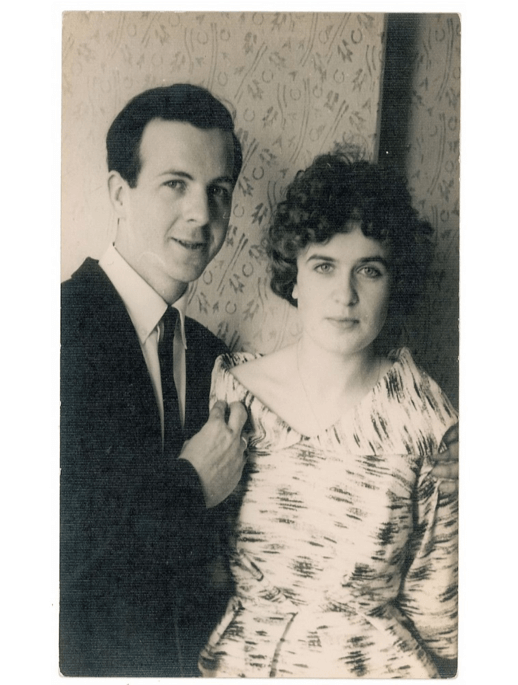
    Wedding photo showing ring worn
    on right hand per Russian tradition

    The wedding ring held and on exhibit through the Sixth Floor Museum as once having belonged to Lee Oswald, did not belong to him. It is most likely a Soviet era wedding ring of the type Oswald did indeed wear at his wedding—but as far as can be ascertained, never again thereafter. Leading to the conclusion that the ring he wore that day was borrowed for the occasion.

    The evidence leading up to the above conclusion, broken down into specific areas:

    Did Lee Oswald buy himself a wedding ring?

    What little evidence there is suggests he did not.

    Oswald made inquiries with Ella German about marriage customs in the Soviet Union—referencing silver engagement rings being swapped for gold wedding rings. He was clearly only talking about the bride-to-be. (Oswald’s Ghost, by Norman Mailer, p. 127). This fits with his noted frugality. Two rings for Marina is one thing. Another for himself is out of character.

    It should also be noted that Western males wearing wedding rings at all had only started to take off during the second half of the 20th century. (“Wedding rings: Have men always worn them?”, by Stephen Robb, BBC News Magazine, Dec 8, 2011) and that until the 1960s, wedding rings were frowned upon in the Soviet Union as a symbol of “bourgeois decay, ostentation and sanctimoniousness.” (The Land of Weddings and Rain: Nation and Modernity in Post-Socialist Lithuania, by Gediminas Lankauskas, p. 254)

    After this discussion with Ella, he purchased a silver engagement ring with a red stone, and for the wedding, a small plain gold band. After Lee’s death, undertaker Paul Groody was quoted in a newspaper account of Oswald’s funeral saying that the casket was open before burial and he had helped Marina place two rings on his finger but couldn’t get them “over the joint”. He described one as a “little ring with a red or black stone-maybe all they could get for an engagement ring in Russia.” (FBI 62-109060 JFK HQ File, Section A3, p12) The two rings placed on Oswald unquestionably belonged to Marina, with the second being her gold wedding ring. At the 2nd autopsy in 1981, the rings were taken from the little finger of the left hand. This confirms that the rings were too small to fit on Oswald’s ring finger—again indicating they had belonged to Marina.

    Tom Bargas was Shop Foreman at Leslie Welding. He told the FBI that he knew Oswald was married only because it said so on his application. (Oswald 201 File, Vol 3, Folder 9B, Part 1, p. 40) Bargas had interviewed Oswald for the job, (WCH Vol X, p. 163) so we know from this, that Oswald was wearing no wedding ring at the time of the interview—or at work at any other time.

    There are no photos available that clearly show Oswald wearing a wedding ring. There are very few photos showing a ring at all.
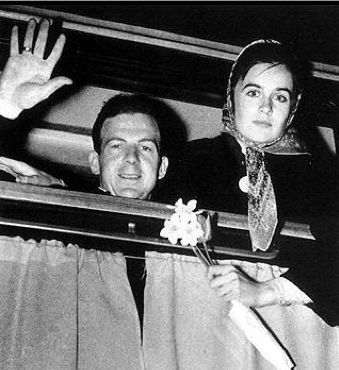
    Lee and Marina leaving Minsk

    The first of these is a black and white photo showing Lee and Marina leaving the Soviet Union. This shows a ring being worn on the right hand. Although some assume it is a wedding ring, it could just as easily be his Marine Corps ring. The assumption is largely based on claims made some days after the assassination when the ring-left-on-the-dresser story was developed. Marina buttressed the importance of this story by claiming that Lee never took his wedding ring off.

    The day before leaving Minsk, Oswald offered his friend, Ernst Titovets “a large silver ring that he had bought in Japan and wore constantly. Titovets told Oswald he was touched but could not accept the ring. It was too expensive. Oswald, we’re told, complied with his friend’s wishes and put the ring back on his finger…” (The Interloper: Lee Harvey Oswald inside the Soviet Union, by Peter Savodnik, unpaginated ebook edition).

    Since Oswald was following local traditions and wearing any rings he had on his right hand, we will logically assume that this is the “large silver ring” he had tried to give his friend just the day before. We also now know, as a result of that quote from Titovets, that it was his Marine Corp ring that was worn constantly and not a wedding ring.

    The next photos showing a ring are two of the Backyard photos. Without getting sidetracked by the authenticity debate of these photos, and that the ring seems to jump from one hand to the other, the consensus is that the ring is the Marine Corp ring.

    The last is one of the arrest photos and is something of a duel-edged sword. It clearly shows that the ring he is wearing—back on the left hand as per Western tradition—is his Marine Corp ring. It later appears in evidence lists under that description. The problem is that in not showing a wedding ring, the “ring-left-on-the-dresser” story gets additional support. It is a neat trick indeed, to use something you don’t see as evidence that it exists. God would be smiling.

    Was a ring left on the dresser on the morning of Nov 22, 1963?

    The short answer is “no, there was no ring left on the dresser of the morning of Nov 22, 1963”.

    A list of some of Marina’s purported statements on the subject, speaks for itself.

    …the following day (Friday) when she got up from bed, after the departure of her husband, she noticed his wedding ring laying on the top of their bedroom dresser. She stated that he never, to her knowledge, took off his ring before, and at that time she thought it a strange thing to do.” (CD 79, p. 3 Nov 30, 1963)

    “…she had not discovered Oswald’s wedding ring on the dresser in her room at the Ruth Paine home the morning of November 22, 1963, upon getting up that morning. She said she had not seen it until the police came to her house to search it, following the arrest of Oswald on November 22, 1963.” (CE 1820, Jan 14, 1964)


    Marina advised that on November 22, 1963, when the police came to the Paine house and searched it, they had found Oswald’s marriage ring on the dresser in the room which she, Marina used.” (FBI 105-82555 Oswald HQ File, Section 16, p. 93)

    MARINA: At one time, while he was still in Fort Worth, it was inconvenient for him to work with his wedding ring on and he would remove it, but at work—he would not leave it at home. His wedding ring was rather wide, and it bothered him. I don’t know now, he would take it off at work.

    RANKIN: Then this is the first time in your married life that he had ever left it at home where you live?

    MARINA: Yes.

    (WCH Vol 1, Feb 5, 1964)

    Juror: Did the ring have his name on it?

    Marina: I don’t know but I think I have this ring somewhere.

    (New Orleans Grand Jury testimony of Marina Oswald Porter, Feb 8, 1968, p. 69)

    “Marina later made a terrible discovery. She happened to glance at the bureau and saw that, again by a miracle of oversight, the police had left another of her possessions behind. It was a delicate little demitasse cup of pale blue-green with violets and a slender golden rim that belonged to her grandmother. It was so thin that the light glowed though it as if it were parchment. Marina looked inside. There lay Lee’s wedding ring. (Marina and Lee, by Patricia Johnson McMillan p. 544)

    Mrs. PORTERWell, I do not—I remember the demitasse, but it is missed. I don’t know where it is. Are you asking me did I find Lee’s ring?

    Chairman STOKESDid you find his ring?

    Mrs. PORTER—Yes, sir.

    Chairman STOKESAnd then did you tell Miss Johnson this: “Oh, no,” she thought, and her heart sank again, “Lee never took his ring off, not even on his grimiest manual jobs. She had seen him wearing it the night before. Marina suddenly realized what it meant. Lee had not just gone out and shot the President spontaneously. He had intended to do it when he left for work that day. Again, things were falling into place. Marina told no one about Lee’s ring.” Did you tell Miss Johnson that?

    Mrs. PORTERYes.

    (HSCA Report, Vol 2, p. 301)

    Marina Oswald is the sole witness to a ring left on the dresser that morning and as we can see, her statements about the ring have little or no consistency. Nor were they made early on. The claims did not start emerging until at least a week after the assassination, during a period in the protective custody of the Secret Service. We will look more closely at this later.

    Was a ring left on the dresser later that day?

    The closest statement to the truth made about this subject by Marina was possibly one made to Priscilla Johnson McMillan for her book, Marina & Lee. In this statement, she said that “by some miracle” the police missed seeing it in their search. Since the police took Marina, Ruth Paine and Michael Paine in for questioning immediately after the search, she most likely put her own ring there some time prior to leaving the Paine household for good. In short, it was not there at the time of the police search. This explains the police not taking it. It also explains why she did not lead them to it.

    What happened after that?

    The following day, November 23, Marina and Marguerite were given three rooms at the Adolphus Hotel paid for by Life Magazine. (WCH Vol 1, p. 444) After visiting Lee that day, Life moved the women to the Executive Inn to hide them from rival journalists. While there, Marina phoned Ruth Paine to advise her “about the ring” on the dresser. (CD 329, p. 116). Although this FBI report dated January 16, 1964 alludes to the ring as belonging to Oswald and that he had left it there before going to work, the truth is more likely to be that Marina phoned upon realizing that she had forgotten her own wedding ring and she was asking Ruth Paine to look after it until it could be picked up with her other belongings.

    Ruth Paine was not asked, nor did she volunteer any information about this call before the Warren Commission. On November 24, the mother, wife and daughters of the accused were taken into protective custody by the Secret Service. According to Marguerite, they were picked up after Lee was murdered. According to Peter Gregory, who was among the entourage who arrived at the Executive Inn, they only heard the news regarding Lee en route to Robert Oswald’s house, and this caused them to divert to the house of the Irving Chief of Police instead, where Marina again phoned Ruth. (WCH Vol 2, p. 345) I believe that Marguerite’s version is the more accurate regarding the timing of being picked up. It was done with great urgency, and with a Secret Service escort. Something triggered that urgency. That trigger could only be Lee’s death.

    Marina Oswald testified that “They [the entourage that had picked her and Marguerite up] stopped at the house of the Chief of Police Curry [it was actually the Irving Police Chief, but Marina would not have been familiar with either of them]. From there, I telephone Ruth to tell her that I wanted to take several things which I needed with me and asked her to prepare them. And that there was a wallet with money and Lee’s ring [or as more likely, her own wedding ring].” (WCH Vol 1, p. 81)

    Just a little while later, in the same session, the questions and answers seemed to get muddled as to sequence of events when she responded to the question, “what did you do after you went to the motel?” by saying, “I left with Robert and we prepared for the funeral.” This must be out of sequence because she had testified previously that Robert had left by then. It therefore must have occurred prior to going to the house of the Irving Police chief and phoning Ruth. Mortician Paul Groody is known to have gone through the same things he did with all bereaved by asking Marina about what clothes and jewelry she would like Lee to be laid to rest in.

    We then go to Ruth Paine’s testimony:

    Mr. JENNER—Do you recall an incident involving Lee Oswald’s wedding ring?

    Mrs. PAINE—I do.

    Mr. JENNER—Would you relate that, please?

    Mrs. PAINE – One or two FBI agents came to my home, I think, Odum was one of them, and said that Marina had inquired after and wanted Lee’s wedding ring, and he asked me if I had any idea where to look for it. I said I’ll look first in the little tea cup that is from her grandmother, and on top of the chest of drawers in the bedroom where she had stayed. I looked and it was there.

    Did Ruth take a lucky guess at where to look or did Marina tell her exactly where it was because she herself had put it (her own ring) there? We are not told when this happened, but we do at least know that the request by Marina was made on the afternoon of her husband’s murder. We also know from Marina’s testimony that she had advised Ruth that she “needed” the items requested. This is curiously as absent from Ruth’s testimony as the date for the pick-up is. The question is, was Marina ‘s need for the ring so that it could be placed on Lee’s finger for burial? Was Ruth deliberately vague on detail because, the ring having magically transformed from Marina’s ring to Lee’s ring, it now cannot be associated with the ring put on at the funeral?

    The real sequence of events would be:

    • Nov 22 am—Lee Oswald leaves for work. Marina gets up later
    • Nov 22 pm—JFK is assassinated. Paine home is searched. No ring is found on dresser because no ring is there. Marina and Ruth and Michael Paine are taken in for questioning
    • Nov 23—Marina and Marguerite are moved into rooms at the Adolphus Hotel before being moved again to the Executive Inn on the edge of town. Marina phones Ruth to let her know she has left her ring/s and savings behind and asks Ruth to look after them
    • Nov 24—Lee Oswald is murdered. Robert Oswald, Peter Gregory and some Secret Service agents hustle the women into moving quickly to another location. They are now in Secret Service protective custody. Robert takes Marina to the Mortician, Paul Groody, and she tells Groody she wants Lee buried in her wedding and engagement rings as the police have his ring and bracelet. They go to the home of the Irving Police Chief where Marina again phones Ruth, telling her she needs the ring and that someone is coming to collect it. It is picked up by FBI Agent Bardwell Odum. Ruth knows where the ring is because Marina has told her
    • Nov 25—Lee Oswald is buried after a quick service at Rose Hill Cemetery. The casket is open until just prior to internment and Groody assists Marina in placing the rings on Lee’s little finger as they are too small for the traditional ring finger (FBI 62-109060 JFK HQ File, Section A3, p. 12)
    Marina at City Hall on Nov 22. She is still wearing her ring

    What this timeline shows is the improbability of the ring/s (it was more likely both her wedding and engagement rings) on the dresser having belonged to Lee Oswald. Moreover, it makes sense of the phone calls to Ruth on consecutive days and shows that the second call fits with the need for the rings in time for the funeral. It is surmised that Marina took her rings off sometime before leaving the Paine household on Nov 23 as Marguerite testified that both babies had diarrhea. This would cause a lot of changing of nappies and wiping of bottoms—something best done without jewelry on the fingers.

    The three-ring circus
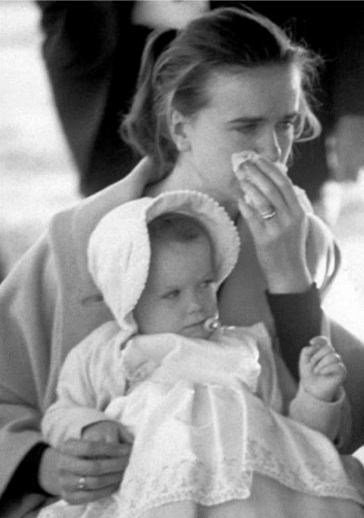
    Two rings on left hand and one on right

    As we can see above, on November 22, Marina wore one ring. Yet on the day of Lee’s funeral she was photographed wearing what looks like three almost identical plain wedding bands. I have no explanation for this other than to suggest that there were a number of rings left in that demitasse saucer picked up from the Paine’s by Odum and delivered to Marina—all of which belonged to Marina—as shown from they way that they fit.

    Where did the story originate that the dresser ring belonged to Lee?

    As shown above, the Secret Service took Marina and Marguerite into protective custody immediately after Lee Oswald was murdered. The day after the funeral, Nov 26, serious interrogations began, with both the Secret Service and the FBI. These went through until Dec 1, though further interviews were conducted periodically after that.

    The interrogators quickly realized that Marina was the person they needed to concentrate on. She was vulnerable on several levels, but more importantly, she was also more flexible and pragmatic of mind. It would be a mistake to suggest this made her submissive. She was simply a survivor first and foremost. Marguerite on the other hand, had a clear and immovable portrait of her son, and it was not the portrait that investigators wanted to hear. She would be set aside and marginalized as an avaricious, nutty and neglectful mother. In fact, Marguerite testified to the Warren Commission that “I was never questioned by the Secret Service or the FBI at Six Flags. My son, in my presence, was questioned and taped, and Marina was continuously questioned and taped. But I have never been questioned.

    The Reid Interrogation Technique

    The Reid Interrogation Technique is practiced throughout most law enforcement agencies and police forces in the US where suspects and witnesses are routinely interviewed. This includes the FBI and the Secret Service. It was developed in consequence to Brown Vs Mississippi (1936) which held that confessions obtained through physical violence would be inadmissible in court. It simply replaced the violence with social psychology involving isolation, induced despair, limiting opportunities for denials and alibis, and the delay of legal counsel at least until the person has been broken down and has provided a confession. Other tools used to get to this point include lying to the suspect, pretending to have witnesses or evidence that don’t exist, or showing evidence that is fraudulent, giving leading questions and finally, throwing a lifeline by offering excuses for the crime and offering support if they will only make the admission. Parallel to that is the construction of a scenario around the crime that goes to the guilt of the suspect.

    The method works. The method also does not discriminate. If you are the focus of an investigation, it may only be because your psychological reactions have not been within the “norm”. For example, a woman finding her husband or child dead would be expected to be an emotional wreck. Other signs of guilt are also looked for, such as an inability to make eye contact, fidgeting, stuttering etc. All too often, once police become convinced of your guilt, based solely on their psychological evaluation, lack of evidence is of secondary importance. They will either break you or frame you.

    Or in the case of Oswald, arrange your televised execution.

    The method is not confined to suspects. It is also used on witnesses to get them on board with a scenario that helps their case.

    Marguerite intuitively knew that something was happening, even if some of her conclusions may not have been accurate.

    Mrs. OSWALD. No. I am saying—and I am going to say it as strongly as I can—that I—and I have stated this from the beginning—that I think our trouble in this is in our own Government. And I suspect these two agents of conspiracy with my daughter-in-law in this plot.

    The CHAIRMAN. With who?

    Mrs. OSWALD. With Marina and Mrs. Paine, the two women. Lee was set up, and it is quite possible these two Secret Service men are involved.

    Mr. RANKIN. Which ones are you referring to?

    Mrs. OSWALD. Mr. Mike Howard and the man that I did not—did not know the name, the man in the picture to the left. I have reason to think so because I was at Six Flags and these are just some instances that happened—I have much more stories to tell you of my conclusions. I am not a detective, and I don’t say it is the answer to it. But I must tell you what I think, because I am the only one that has this information. Now, here is another instance——

    What Marguerite witnessed between the agents and Marina and assumed to be evidence of conspiracy between them in the assassination was really the Secret Service coopting Marina to assist with building the case against her husband. What Marguerite witnessed was initially Marina being isolated, threatened, asked leading questions and finally being offered all manner of assistance as her cooperation grew and she saw the money rolling in from a shocked nation. Meanwhile, Marguerite was being denied a ride home for more clothes and having her news clippings and mail confiscated. In all other respects, she was totally ignored.

    Marina’s cooperation with the Secret Service then was vouchsafed by early promises arranged through immigration that she would not be deported, and by having firemen sitting within view of her as they counted the money coming in from concerned citizens around the country—a reminder that the money was within reach—but not hers until the Secret Service was happy enough with her to hand the money over. Both measures infuriated the FBI as they left Hoover’s men no bargaining chips whatsoever—and that was probably another outcome the Secret Service hoped to achieve. They now owned Marina. (Assignment Oswald, by James P Hosty, p 89). The money ended up totaling $70,000—the equal of nearly $600,000 today. Given her parlous state, the murder of her husband, two small children, and poor prospects in a foreign and now possibly hostile environment, no one should blame Marina for effectively going along with the stage play. Taking the carrot in America was certainly a better prospect than facing the stick back in the Soviet Union.

    The sole purpose of the evolving ring story was simply to imply motive. Lee, it would be claimed, knew his marriage was over so he planned instead to make his mark in history. But the marriage was not over. The savings also found on the dresser—and often cited as another clue he was never coming back, had been an amount accumulating on that very dresser every pay day, not left all at once. It was money meant for an apartment to reunite the family and there is solid evidence he had found one. That information too, had to be buried and left uninvestigated. Unfortunately, it is also outside the bounds of this work.

    (With thanks to Ed Ledoux for the photos used.)


    THE RING, Part Two: Authentication, Sale & Acquisition

    If, as shown in Part One, it is likely that Lee Oswald never owned a wedding ring, it stands to reason such a ring could not be sold at auction.

    Yet a wedding ring purported to have belonged to the accused assassin was indeed sold at auction in 2013. Here, we will try and trace the history of how this came about.

    2004 and the Markward file

    Ring and receipt discovered by Dave Perry

    In July 2004, the Fort Worth law firm of Brackett & Ellis located the Marina Oswald file of retired lawyer Forrest Markward.

    At 90 years old, Markward was long retired and by now in the early stages of Alzheimer’s, so the law firm instead, called in local JFK assassination expert, Dave Perry to go through the material.

    Inside the file, Perry found an envelope containing a gold wedding ring and a receipt—allegedly from the Secret Service. This is suggested by the file reference at the top right which was the reference the Secret Service used for all JFK assassination related material. (Lost History episode, air date december 1, 2014).

    Stan Dane’s MS reproduction matches perfectly

    Issues with the receipt as photographed

    As can be seen, the receipt bears no signature or date and is not on Treasury or Secret Service letterhead. In short, it is the type of document that could easily be typed up by anyone. Indeed, it looks very much like it was typed using MS Word using 10-point fonts or, alternatively it was typed on an IBM Selectric typewriter using 12 pitch characters (all but identical to the 10-point fonts of MS).

    Author Stan Dane proved the point by reproducing the receipt using MS Word and comparing the result to the original.

    Issues with the ring as photographed

    Building on the work of Dane, Jake Sykes measured the ring size with the following formula:

    “Using 1/16″ (the 10-point font measurement) yields 9-1/2 lower case “s” letters. 9.5 x 1/16″ = .594″ for the ring diameter.” This means the ring is just below the average woman’s ring size of .60”. (reference.com article, What Is the Average Ring Size for a Woman?)

    What we are left with is a receipt that bears indication of fakery and a ring too small to have been worn by Lee Oswald, but quite possibly one that would fit Marina.

    The strange articles of Dave Perry and Hugh Aynesworth

    Before getting into those articles in detail, allow me to note one of the first things that struck me about the pair—they both spell lawyer Forrest Markward’s surname as “Marquart” indicating a certain amount of cribbing from each other. I have found no indication that the name was ever spelled any other way than “Markward”. It is for instance, spelled that way in Secret Service records dated Feb 7, 1964 and in online obituaries (findagrave.com, date of death Nov 30, 2009), so if Perry went through the lawyer’s file on Marina, how on Earth did he manage to misspell his name? I will leave that detail for others to ponder.

    Is This Lee Oswald’s Wedding Ring? By Dave Perry, undated

    Perry starts out appearing to be wearing his investigative reporter hat. He does this by going through some (but not all) of Marina’s different and contradictory statements concerning the ring. He then notes that Oswald was buried on Nov 25, 1963 before quoting Linda Norton, the doctor who headed the exhumation autopsy in 1981:

    “Upon entry into the casket a moderate malodor emanated from the decomposing body. As measured in the casket from superior skull to heel region on the left, a body length of 177cm (69½ in.) was obtained. A gold wedding band and a red stone ring were removed from the fifth digit of the left hand (subsequently identified by Mrs. Porter as representative of items placed upon the body at the time of initial burial).” (The Journal of Forensic Sciences, V. 29, N. 1, January 1984, p. 24)

    To get the full flavor of the Perry piece from this point, it would be best just to quote it directly.

    Originally, I believed the ring in the possession of Attorney Luke Ellis of Brackett & Ellis of Fort Worth, TX was the wedding ring removed by Dr. Norton. I thought a member of the firm, Attorney Forrest Marquart, had appeared with Marina at the exhumation autopsy.

    When I visited the law firm, I found documents showing that Marina was using the firm’s services in 1964—after the burial but well before the exhumation autopsy. Marina went to the law firm in 1964 to sign documents (for example: the contract with Priscilla McMillan and publisher Harper & Row for the book that would become Marina and Lee.) and at that time presented the ring to Attorney Marquart.

    With the ring is the following typed notation:

    CO-2-34, 030

    Receipt is hereby acknowledged of a gold wedding band which had been turned over to the United States Secret Service on December 2, 1963 by Mrs. Ruth Paine.

    _____________________________

    Date _________________________

    I surmised the law clerk that received the ring, transcribed Marina’s comment that this was the ring that Ruth Paine turned over to the Secret Service on December 2, 1963. The Secret Service then gave it to Marina who brought it to the law firm as payment for services.

    I now had no idea what ring the law firm had until I found the following:

    “The lid was raised. Forty reporters peered over the (police) officers’ shoulders. Marina, who had been following TV and was learning about images, kissed her husband and put her ring on his finger.” (The Death of a President, by William Manchester, p. 568)

    It would seem Marina put HER wedding ring on the body only to retrieve it years later at the exhumation. And this means the ring in the law firm’s possession is Lee Oswald’s wedding ring.

    The issues and items not mentioned are just as telling as his inevitable “nothing-to-see-here” conclusion. This includes the circumstances of his appearance to inspect Markward’s file on Marina, the exact date this happened, any description or photo of the envelope and any contact he had with Marina about the discovery.

    Coming Full Circle by Hugh Aynesworth, September 1, 2004

    This should have been subtitled “Wither Thou Goest” such are the ties that bind the two Keepers of the Warren Commission Flame, though carrying it on opposite sides of the street.

    Aynesworth, continuing the path beaten by his ally, opens with the hortative that a small gold wedding band

    believed to have been worn by Lee Harvey Oswald until just a few hours before he purportedly assassinated President John F. Kennedy has been locked in a safe at a law firm here for more than a generation.

    Is this really Aynesworth? “Believed”? “Purportedly”?

    “Oswald’s friends and family, and lawyers and doctors involved in the case, say that the ring may be the one that the suspected assassin wore.”

    And there is the trifecta—“may”. And we really don’t get told who these people are. Sure, Marina and Ruth. But who are the others? Markward had Alzheimer’s and had no memory of any of it. The other lawyers who called Perry in had no inkling regarding the history or ownership of the ring. The doctors is one doctor, not two or more—Linda Norton—and all they had from her was the quote made in the Journal of Forensic Sciences and that quote says nothing about who owned the ring. Aynesworth is stretching credulity big time.

    “JFK investigator Dave Perry, of Grapevine, Texas, believes that the ring was Oswald’s and might have been given to federal authorities in December 1963 either by Oswald’s widow, Marina, or by Ruth Paine, the Irving, Texas, woman who let Mrs. Oswald and her two young children live with her during the fall of 1963.”

    With five qualifiers in three short paragraphs, Aynseworth is suddenly in unfamiliar territory. And remember also that these qualifiers are about the history and ownership of a ring which would eventually be sold in 2013 as a bona fide historical artifact. Clearly though, as of 2004, there was far from any certainty about either ownership or history.

    The next few paragraphs just add to the uncertainty. Luke Ellis, representing the law firm that held Markward’s file, admits he has no clue about what to do with any of the material. Ruth Paine is contacted. She falls back on how long ago it all was but concedes it is possible she gave the ring to the Secret Service on the date noted. The fact is though that Ruth Paine consistently stated during the days of the various investigations, that she gave the ring to the FBI—moreover, she names the agent as Bardwell Odum. The only thing she never mentioned was when she gave it to him. But since Marina advised her that she needed it on November 24, and the likely reason for needing it was to place on her husband’s finger for burial the next day, it is a good bet that it was collected no later than the morning of November 25.

    The next piece of information of any value is that the Times contacted Marina during late August about the ring and was told by her that she did not recall seeing the ring after the police raid on the Paine home. When pressed as to what she thought happened to Lee’s ring, Marina simply replied “Oh, I don’t know. It’s been so long ago. If someone else has it, I don’t care.

    Compare that to what she told the Grand Jury in New Orleans

    So, in 1968, She thought she still had the ring somewhere but could not recall if it was even inscribed, then by 2004, her memory was that she had not seen it since November 22, 1963! And I again remind readers that her stories constantly changed on the subject beyond these two versions. We know this is not the only subject in which Marina has given mutually exclusive accounts, with most of those being in legal settings

    Back to Aynesworth:

    Though the ring having been stored along with several legal documents might appear to indicate that Mrs. Oswald had given the ring to Mr. Marquart as payment for legal services, Mrs. Oswald did not recognize the lawyer’s name and said that she could not recall having the ring at any time after the Kennedy assassination.

    Originally, Mr. Perry and another investigator, David Murph of Grapevine, Texas, conjectured that the ring might have been removed from the casket when the body of Oswald, who was killed by Jack Ruby two days after Kennedy’s death, was exhumed in 1981.

    But Mrs. Oswald and the doctor who led the team that exhumed the body dispute that theory.

    Dr. Linda Norton, a forensics specialist from Dallas, said last week that there was no male wedding band on Oswald when he was disinterred to confirm that the body buried under his name was indeed him.

    “There were two rings, one small wedding band and a ring with a small red stone in it,” she said. “The wedding band was too small even for his little finger—so that couldn’t have been his.

    “Afterward, I replaced both on his fingers before they closed the casket and reburied him,” she added.

    There we have it. It could not have been Marina’s ring from the corpse because it was placed back on the body before reburial. Not explained is how they could have ever considered this was the ring in the files when they maintain that the ring in the files was a male size and not female (as the ring on the body was). But as we have shown already, the ring in the files was indeed a ladies’ size. Moreover, it looks like Linda Norton’s memory of putting both rings back on the body was not accurate.

    Morgue: A Life in Death by Dr. Vincent Di Maio, Ron Franscel, pp. 114-122

    Dr. Norton was assisted in the 1981 autopsy by Dr. Vincent Di Maio. This is what di Maio tells us in his autobiography

    “First, we removed the rings on the corpse’s finger and gave them to Marina… Back in the autopsy room, before Oswald’s new casket was closed and he went back into the damp earth of Rose Hill, a grateful Marina gave Dr. Norton an odd gift: the red gemstone ring we’d taken off the corpse’s pinky. It was her way of saying thanks for the team’s work. But Linda was visibly uncomfortable with this morbid reward. As soon as Marina left the room, she inconspicuously slipped it into my hand. She didn’t want it. Neither did I. As well-meaning as it might have been, it was a sordid souvenir of a grim task and an even grimmer history. I wished for the whole wretched mess to just be buried once and for all. So just before they sealed Lee Harvey Oswald’s coffin for his next eternity, I dropped the ring into the box with him and then drove home to San Antonio in the dark.

    There is just too much detail here to have been made up. In any case, for what purpose would he make such a thing up?

    We can see here that both rings were given back to Marina, but only the ring with a stone was returned to the coffin. Put anther way, Marina kept the gold wedding band—which we know was hers.

    Where does this leave us? As of 1981, Marina had her own wedding band back in her possession. But we also know from Di Maio that Marina was keen to be rid of the rings and whatever memories they held. She in fact believed she had successfully given away the engagement ring. Given this mindset, Perry’s initial impression that she had given the band to Markward who was representing her interests at this autopsy, holds up perfectly well. This in turn, fits with the measurements showing the ring found was that of a female, not a male. Again, it was Marina’s own ring.

    “Mystery surrounds Lee Harvey Oswald’s ring”, by Hugh Aynesworth for the Dallas Morning News, October 27, 2007

    This is basically an updating of the 2004 story. The only new information apart from declaring that the Sixth Floor Museum has an interest in acquiring the ring, is the following.

    “A Secret Service document that Marina signed Dec. 30, 1964, indicates that federal agents returned the wedding ring to her on that date. The Secret Service had been given the ring, the memo said, on Dec. 2, 1963, by Ruth Paine, the Irving woman who had provided a home for Marina.”

    Since when does the Secret Service get the civilian subjects of memos to sign said memo? Nor does Aynesworth attempt to explain why it took from December 2, 1963 when it is alleged that the Secret Service took possession of the ring from Ruth Paine, until December 30, 1964 to return it to the rightful owner. In fact, the prejudicial word used in all the stories about the sale of the ring and its background, is “confiscated”—that is, the ring was “confiscated” from Ruth Paine—indicating that the Secret Service had taken it forcefully as “evidence”. This is at complete odds with what Ruth Paine maintained throughout 1964 and beyond. She has steadfastly stated that the FBI came to collect it at Marina’s request on an unspecified date, but in context, had to be November 24 or 25, 1963. It is only in recent years, under apparent pressure, that she has claimed she cannot recall, and so concedes it is possible that the Secret Service did pick it up on December 2, 1963. It became obvious a long time ago that Marina and Ruth had separated into different “teams”. Marina gave her allegiance to the Secret Service while Ruth gave hers to the FBI.

    As far as this writer has been able to ascertain, such a memo has never surfaced, and as stated above, it was not mentioned in the original story.

    It seems at some stage, the “memo” was dropped as quickly as it had been “discovered” because all it states in what purports to be the official ring timeline as published by the Dallas News is this:

    Dec. 30, 1964: The Secret Service returns the ring to a Dallas lawyer who once represented Marina Oswald; that lawyer included it in files transferred to a Fort Worth attorney, Forrest Markward of Bracket & Ellis, who represented Marina Oswald from late 1963 to early 1965. (“Lee Harvey Oswald’s wedding Band Heading to Auction Block” by James Ragland, July 2013)

    The only thing left of the claim is the date. But that is far from the only issue with this timeline entry. Who was the lawyer who supposedly took receipt of the ring? Why was the ring not passed on directly to Markward by the Secret Service since he was the one currently acting for Marina? The Secret Service certainly knew about Markward since he is named in a Feb 7, 1964 memo as attending a meeting with Marina, James Martin and his family, Secret Service agents and a Mr. Louis Saunders in the Grand Prairie office of John Thorne (CD 372, p. 12). Saunders was Executive Secretary for the Fort Worth Area Council of Churches—all-in-all, a diverse group meeting indeed. No doubt the agenda items would have been intriguing. Lastly, there is a key error of fact in that entry. Brackett & Ellis is on record as stating that Markward did not begin with the firm until the late 1970’s. (“Coming Full Circle”, by Hugh Aynesworth, Washington Times, September 1, 2004) Any files transferred to him in 1964 were not therefore transferred to him while working at Brackett & Ellis. The fact is that Markward not only represented Marina in the 1963-65 period, but also for the 1981 exhumation—a fact that Perry hints at early in his “investigation” of the ring, but then drops like the proverbial hot potato when it becomes an inconvenience to his predictable conclusion.

    The RR Auction sale of the ring

    Forrest Markward died on November 30, 2009. It took until July 24, 2012 for Brackett & Ellis to formally write to Marina and advise of the ring’s discovery. That is about 30 months after the death of the lawyer and a full 8 years after it was discovered in his old files. By the same token, Marina was in no rush to obtain it; not picking it up from the law firm until early 2013. Then in May of that year, she wrote a 5-page document outlining the history of the ring for RR Auctions—a history she has constantly rewritten through questioning under oath and through numerous interviews with various law enforcement officials, authors and the media. In that light, it is unsurprising that she wrote this history on the proviso that certain parts of it would not be made public. Five months later, the ring sold for $108,000. As a 14k gold ring, it has an intrinsic value of about point one or two percent of that amount.

    Authentication

    RR Auctions commissioned David Bellman of Bellman’s Jewelers to authenticate the ring. In 2017, Mr. Bellman posted a video to You Tube as part of a series called Jewelry in History. This episode was titled Lee Harvey Oswald—Authenticating His Wedding Band. What this video demonstrates is a basic process of showing it was a Soviet made 14 karat band by the markings inside it. But does this prove it belonged to Lee Oswald as claimed? Of course not. Marina’s secret statement was accepted as the sole authentication of that.

    By the time I found this video, someone else had already asked what size the ring was. The jeweler replied that as best he could recall, it was .95 (of an inch)—which is the average size of a male ring (the Sixth Floor Museum lists as having a diameter of 15/16”). He failed to respond to my request for personal contact regarding the matter.

    The Sixth Floor Museum

    Two years later, the Sixth Floor Museum acquired the ring. During my research for this essay, the museum was contacted to alert them to the issues surrounding the ring. Here is that email, along with the reply:

    Regarding the acquisition of Lee Oswald’s wedding ring:

    I understand that Marina Oswald wrote a 5-page history of the ring to go with the it when she sold it at auction. Did the museum acquire it, as well?

    I also understand that the ring you have was found in the files of a Fort Worth lawyer, in an envelope also containing a receipt from the Secret Service dated Dec 2.

    So as to provide accurate information to the public, you need to know that this story conflicts with past stories—which are themselves all mutually exclusive.

    Ruth Paine testified to the Warren Commission that the ring was picked up from her home by Bardwell Odum of the FBI.

    Marina herself is documented as telling the FBI that the police found the ring on Nov 22.

    But then during her testimony to the New Orleans Grand Jury, Marina testified that she found the ring after Lee went to work that morning and that she still had it “somewhere”.

    That is 4 different versions, when including the Secret Service version. Two of those conflicting versions came from Marina herself. I would like to know if the 5-page note contains yet another version or incorporates one of her earlier versions.

    In any case, the provenance of the ring you have, must be treated with some trepidation.

    The story that Oswald always wore the ring and therefore leaving it on the dresser that Friday morning, shows he knew he would not be coming home, in my opinion, is the reason for these conflicting stories. Marina did testify that she knew Lee had taken the ring off once at work.

    Here is what she said:

    “At one time while he was still at Fort Worth, it was inconvenient for him to work with his wedding ring on and he would remove it, but at work—he would not leave it at home. “

    I think a lot of manual laborers would take rings off while working. It makes sense to me that Oswald did not do this just once but did it as a matter of habit. Additionally, her claim that he would never leave it at home makes no sense. Why would he wear it to work, but then take it off and carry it in his pocket all day? Wouldn’t it make better sense to leave it at the Paines’—especially if he expected to be returning there that evening?

    What should have been regarded as evidence of his innocence (or at the very least, evidence of nothing either way), was completely turned on its head to make him look guilty.

    I also note that in his 2013 book, Mr. Fagin pushes the line that Oswald not only left his ring, but also $170.00. This is not true. He did not “leave” it there. That wallet was kept there, and he added to it every pay day—that is according to Marina’s testimony on it.

    Any museum needs to ensure it gets its facts straight and does not simply push official propaganda that is not supported by the evidence. Not unless the museum is in a totalitarian country, anyway.

    Five days later, I received the following reply from Stephen Fagin:

    Good afternoon Mr. Parker,

    Thank you for your interest in the Museum’s Collection. As our educational and public programs have demonstrated over the years, there is rarely one way of exploring evidence in a case that remains controversial and fiercely debated around the world. We value your feedback regarding Lee Harvey Oswald’s wedding ring, and the resources that you cite are available to students, researchers and the general public via our Reading Room.

    We do have the May 2013 letter from Marina Oswald that you referenced in your e-mail. In it, Marina indicates that she did not see the ring that morning but believes—based on records associated with the ring—that Ruth Paine gave it to the Secret Service. She assumed that the government had kept all of their personal belongings (including the ring) and did not learn that the ring had been returned until “receiving a letter from a Fort-Worth law firm in July 2012 stating that they had it in their files for past 49 years.” She recalled that Forrest Markward, the attorney who had possession of the ring, had provided her with some pro bono legal work following the assassination. Marina recognized the ring upon examining it.

    The Museum is confident, based on available documentation and research, in the provenance of the ring we currently have on display.

    Again, we appreciate your interest.

    Sincerely,

    Stephen Fagin | Curator

    Mr. Fagin failed to respond to two follow-up emails made in response to this carefully crafted, polite brush-off.

    So, let us put the reply under the microscope here:

    What does “there is rarely one way of exploring evidence in a case that remains controversial and fiercely debated around the world” even mean in terms of arriving at an accurate conclusion? It is nothing but a throw-away line meant to sound profound. Either the ring held is authentically one that belonged to Lee Oswald, or it isn’t. The next statement that “the resources that you cite are available to students, researchers and the general public via our Reading Room” is equally misleading in its banality. The resources cited would not be found unless specifically searched for and it is a painstaking exercise to run down all sources and all versions of and about the one story. The only version that is easy to find, is the official one because it is plastered all over the net. Mr. Fagin’s laisse-faire attitude to real history is offputting, yet still unsurprising. Being a water-carrier with only make-believe water does at least have the saving grace of being wryly amusing.

    it is, however, his description of the 5-page statement regarding the history of the ring, made by Marina in order to procure a sale, that is really telling.

    In it, Fagin states that according to Marina,

    • She did not see the ring that morning (of Nov 22, 1963). My response: Yet she is on record as saying otherwise in the past.
    • She believes, based on the records, that Ruth Paine gave it to the Secret Service. My response: Yet there are no such records that I have been able to find, apart from the alleged receipt found with the ring. And as already established, Ruth Paine testified she gave it to Mr. Odum of the FBI.
    • She did not know about the existence of the ring until receiving the letter from Brackett & Ellis in July 2012. My response: Yet we have seen that she was contacted by the NYT (possibly by Hugh Aynesworth himself) for Aynesworth’s 2004 story on the finding of the ring.

    Based on the results of this investigation, Mr. Fagin’s assertion that “The Museum is confident, based on available documentation and research, in the provenance of the ring we currently have on display” is a bit risible.


    THE RING, Part Three: Timeline & Conclusions

    1957-1958: Lee Oswald buys a Marine Corps ring while stationed in Japan

    1960-61: Lee is making inquiries about Russian marriage customs concerning silver engagement rings and gold wedding rings for the bride-to-be. He makes no inquiries about rings for grooms-to-be. (Oswald’s Ghost, by Norman Mailer, p. 127)

    Jan 1960-Nov 22, 1963: Lee takes his Marine Corps ring off while at work (WC testimony of Marina Oswald “At one time while he was still at Fort Worth, it was inconvenient for him to work with his wedding ring on and he would remove it, but at work—he would not leave it at home. His wedding ring was rather wide, and it bothered him. I don’t know now, he would take it off at work.” There is no reason to believe that Oswald ever wore a wedding ring at any job and the ring that he wore constantly was his Marine Corp ring—a wide ring, which is what Marina described)

    1961: Lee buys a silver engagement ring and gold wedding ring in Minsk for Marina Prusakova.

    April 30, 1961: Lee marries Marina. Speculation: Lee borrows a ring for the ceremony. This must be true since Marina testified as above that the wedding ring was inconvenient to work in because of its width. The wedding photo does not show a wide ring. As above, the wide ring could only be his Marine Corp ring—this being the same ring that Titovets said Lee wore constantly as shown in next entry)

    May 22, 1962: Lee offers to give his friend, Ernst Titovets his Marine Corps ring as he is departing the next day to the US and wants to leave his friend something to remember him by. Titovets refuses to accept it, noting that Lee wears it “constantly” (The Interloper: Lee Harvey Oswald Inside the Soviet Union, by Peter Savodnik, ebook, unpaginated)

    Nov 22, 1963: After the search of the Paine house, Marina is taken in for questioning by the DPD and provides an affidavit This statement contains nothing about a ring being left by Lee that morning. (affidavit of Marina Oswald, Nov 22, 1963). Just after 4:00 pm, Lee gives his USMC ring to Det. Sims during a body search.

    Nov 23, 1963: Speculation: Marina takes her own wedding ring off while changing nappies of her babies, both of whom have diarrhea and places it in a cup or saucer on her dresser. She then leaves the Paine household for good, initially being looked after by Life Magazine. She phones Ruth later that day to let her know she left a ring behind. (FBI report dated Jan 16, 1964). The report is non-specific about which ring is being referenced. Speculation: Specifically, this call is to let Ruth know she has left her wedding ring inside the cup on her bedroom dresser and asks Ruth to keep it until she is able to pick it up.

    Nov 24, 1963: Marina phones Ruth Paine again after Lee is murdered. She tells the Warren Commission on Feb 3, 1964 “I telephone Ruth to tell her that I wanted to take several things which I needed with me and asked her to prepare them. And that there was a wallet with money and Lee’s ring.Speculation: it is not Lee’s ring she mentioned at all since the only ring he had was a Marine Corp ring and it had been taken by police. She is referring to her own ring. This call is really to ask for the return of the rest of her belongings and for the return of her ring so it can be placed on Lee before burial. Ruth Paine testified that Robert Oswald came by for all Marina’s other belongings—but the ring and money were given to FBI agent Odum.

    Nov 25, 1963: Lee Oswald is buried at Rose Hill Cemetery. Marina’s wedding and engagement rings are placed on Oswald’s little finger on the left hand. Historian William Manchester tells us that “the lid was raised. Forty reporters peered over the (police) officers’ shoulders. Marina, who had been following TV and was learning about images, kissed her husband and put her ring on his finger.” (The Death of a President, by William Manchester, p. 568). And from Dr. Vincent Di Maio, one of the autopsy team at the 1981 exhumation, we have “…Groody placed two rings on Oswald’s fingers. One was a gold wedding band and the other a smaller ring with a red gemstone that Oswald’s wife had requested he be buried with.” (Morgue: A Life in Death, by Dr. Vincent Di Maio and Ron Franscell, p. 106). Paul Groody was the mortician who prepared the body for burial. He himself was quoted in a newspaper article saying that he assisted Marina in putting the rings on Lee. (Associated Press, Lee Harvey Oswald Casket Controversy Continues by Mike Cochrane, p. 36 Aug 16, 1981)

    Nov 26—Dec 1, 1963: Marina Oswald is subjected to intense interrogation by the FBI and Secret Service. (see especially, CE 1787) Speculation: It is during this period that the story of Lee leaving his wedding ring on the bedroom dresser first emerges. This is typical of the Reid Technique. Isolate a witness, create a narrative incriminating the accused and use any and all manner of psychological tools to get the witness to “own” that narrative. The incrimination was implicit in the alleged act because, claim the authorities, Lee knew his marriage was over and that he was not returning. He was instead, going to leave his mark on history. Speculation: The FBI and/or Secret Service built this part of the narrative based on finding out that Marina had left her own wedding ring at Ruth’s and had asked the FBI to pick it up for her so it could be placed on Lee’s finger at the funeral. All they had to do was act like the ring on the dresser had been Lee’s and truthfully say that the ring placed on Lee for the funeral was Marina’s. Now, instead of it being the same ring—Marina’s ring in both cases—they have transformed it into two different rings. From here on, Lee’s (fictional) wedding ring would be the one it would be claimed he never took off (when this was really his Marine Corp ring per Titovets). The last requirement would be to blur what happened to the (fictional) wedding ring. The fact of FBI Agent Odum picking up the “dresser ring” to give to Marina prior to Lee’s funeral, was replaced with the Secret Service “confiscating” the ring on Dec 2, 1963, before finally returning it to Marina on Dec 30, 1964. This in turn got changed to a scenario in which it was given to an unnamed lawyer who had been representing Marina who in turn passed it on to Forrest Markward.

    Dec 2, 1963: this is the day that the official time-line designates as the date that the Secret Service “confiscates” the ring from Ruth Paine. An exhaustive search of records in the Mary Ferrell Foundation data base has failed to locate any evidence of this. It is, however, the day following the FBI and Secret Service interrogations of Marina and is the day both agencies began serious investigations—largely based on the Marina Oswald interviews, as well as those of Ruth and Michael Paine, Buell Wesley Frazier and his sister Linnie Mae. Together, this group of witnesses provided, or agreed to, the dot points cobbled together to form the backbone of the case. The investigation was meant to add the flesh to this burgeoning false narrative.

    By 2004, Ruth Paine’s memory is a little fuzzy as she allegedly tells Hugh Aynesworth, that she may have given the ring to the Secret Service (“Coming Full Circle”, by Hugh Aynesworth, Washington Times, Sep 1, 2004). It is much more likely that Aynesworth told her it was the Secret Service and she simply agreed it may have been. She does stick solidly to the bit about it being done at Marina’s request.

    Dec 30, 1964: This is the day that the official timeline designates as the date that the Secret Service rids itself of the ring. According to a 2007 article—again by Aynesworth. This is supposedly based on a Secret Service memo signed by Marina. To quote from the Aynesworth article, “A Secret Service document that Marina signed Dec. 30, 1964, indicates that federal agents returned the wedding ring to her on that date. The Secret Service had been given the ring, the memo said, on Dec. 2, 1963, by Ruth Paine, the Irving woman who had provided a home for Marina.” (“Mystery Surrounds Lee Harvey Oswald’s Ring”, by Hugh Aynseworth, Dallas Morning News, Oct 27, 2007). Not explained is why it took from Dec 2, 1963 to Dec 30, 1964 to return the ring. Also not explained is what Marina is doing signing a Secret Service memo. It appears some of these issues finally dawned on those involved. In an article by Aynesworth written three years earlier on the same subject, there is no mention of any Secret Service document signed by Marina acknowledging the return of the ring. Now, in the official timeline, the only part left of these claims is the date. The alleged document signed by Marina acknowledging return of the ring on Dec 30, 1964 has disappeared and what we now have is “December 30, 1964: The Secret Service returns the ring to a Dallas lawyer…” No Marina—no Marina signing a memo…

    Oct 4, 1981: Lee Oswald’s body is exhumed through legal pleadings from author Michael Eddowes and Marina Oswald-Porter. Eddowes had written a book claiming the person buried was a Russian imposter, switched with Oswald while he was behind the Iron Curtain. Here we again run into differing versions of what transpired regarding the rings on Oswald’s fingers. In fact, there are even two different versions regarding Marina’s presence during the second autopsy. Dealing with the latter first, we have “Her [Marina’s] presence was unusual—most widows don’t attend their husbands’ exhumations and autopsies—but she didn’t seem to be shaken by the macabre nature of the moment.” (Morgue: A Life in Death, by Dr. Vincent Di Maio, Ron Franscel, p. 115). Then we have this, from a contemporaneous news report: “The 40-year-old Mrs. Porter, who married a carpenter, Kenneth Porter, refused to view the remains but had trusted friends do it.” (“Oswald’s Body Is Exhumed; An Autopsy Affirms Identity”, New York Times, Oct 5, 1981, p. 1).

    To the first part concerning the ring(s), we have these versions: “Dr. Norton explained that examiners found two rings on Oswald—one a small wedding band, the other a ring with a small red stone in it. The rings were re-buried with him. That small ring was ‘too small even for his little finger [and] could not have been his,’ said Dr. Norton.” (“Mystery Surrounds Lee Harvey Oswald’s Ring”, by Hugh Aynseworth, Dallas Morning News, Oct 27, 2007). Against that, there is this from Dr. Di Maio, “First, we removed the rings on the corpse’s finger and gave them to Marina… Back in the autopsy room, before Oswald’s new casket was closed and he went back into the damp earth of Rose Hill, a grateful Marina gave Dr. Norton an odd gift: the red gemstone ring we’d taken off the corpse’s pinky. It was her way of saying thanks for the team’s work. But Linda was visibly uncomfortable with this morbid reward. As soon as Marina left the room, she inconspicuously slipped it into my hand. She didn’t want it. Neither did I. As well-meaning as it might have been, it was a sordid souvenir of a grim task and an even grimmer history. I wished for the whole wretched mess to just be buried once and for all. So just before they sealed Lee Harvey Oswald’s coffin for his next eternity, I dropped the ring into the box with him and then drove home to San Antonio in the dark.(Morgue: A Life in Death , by Dr. Vincent Di Maio, Ron Franscel, pp. 114-122). What we see here is a key to the mystery. Marina was given both rings at the start of the 1981 autopsy. She later gives her engagement ring to Dr. Norton who did not want it and passed it surreptitiously to Dr Di Maio—who also did not want it, and he drops it back in with the corpse. Marina kept her wedding ring. Since we now know she tried to give away her engagement ring, it is plausible that she did give the wedding ring to one of her lawyers—just as originally suspected by the law firm and by Perry. We know she had more than one lawyer looking after her interests during this 2nd autopsy because we have this from the same New York Times story as previously cited; “Mrs. Porter spent hours yesterday in meetings with lawyers in Dallas planning the event. She recalled the years of work leading to it.”

    Jul 2004: The Markward Marina Oswald file is found. It is unclear as to the exact circumstances. This is what Aynesworth wrote in 2004, “Mr. Ellis said that Mr. Marquart had joined the firm in the late 1970s and just recently mentioned the materials in the firm’s safe.” Yet in 2007, Aynesworth was reporting that, “We (Brackett & Ellis law firm) have tried to get him to talk about the ring and his files, but he has refused… The firm had sent representatives to Mr. Marquart’s home ‘on several occasions’ to determine how the ring came to be with his materials, ‘but he apparently doesn’t remember,’ Mr. Ellis said.” Aynesworth goes on to say that “Marina Oswald used the services of Mr. Marquart shortly after the assassination to set up and manage a trust fund for her young daughters, June Lee, 2, and Rachel, 2 months…

    It is also noteworthy that Aynesworth claims Markward was used by Marina to set up trusts for the two girls from all the money donated post-assassination, while Perry claims the work done by Markward was sorting out the book contracts with Priscilla McMillan and Harper & Row. The end result of all of this important legal work? According to Aynesworth, McMillan “never heard of Mr. Marquart and couldn’t recall Marina discussing him during lengthy interviews with Marina in 1964.” And Marina “likewise has said she did not recall Mr. Marquart or what he might have done for her.” Miraculously however, Marina suddenly recalled who Markward was when writing up the ring history for RR Auctions in preparation for its sale. Meanwhile Markward was, as of 2004, over 90, suffering Alzheimer’s, didn’t want to discuss any of it and claimed no memory of any of it—all according to Luke Ellis. Yet we do know Markward did at the very least, meet with Marina (CD 372, p. 12 shows Markward met with Marina and Louis Saunders in the office of John Thorne at 6:10 pm on Dec 23, 1963. The nature of the meeting is not noted). The fact that Markward was one of the lawyers assisting Marina with the exhumation has been deep-sixed after the initial (and accurate) speculation that Marina had given the ring to this lawyer—just as she had given the engagement ring to Linda Norton.

    The ring itself is allegedly found by Dave Perry among the newly discovered files of the retired lawyer. This was stated in a 2014 History Channel show called “Lost History” and Perry himself confirmed it was true after the show aired—but again without revealing the circumstances of the find. In sum, we have Dave Perry finding a ring among files discovered in a law firm office, with said files belonging to an ex-partner in that firm and who it is claimed, did very important legal work for Marina in the 1963-64 period. The law firm itself, however, somehow missed seeing the ring among those files. The lawyer in question, Forrest Markward, had—or may have had—no memory of the files (reports on this are conflicting), nor of the ring and—neither Marina nor Priscilla McMillan recall Markward or what legal work he did for Marina, although Marina did finally recall him in 2013. These are the circumstances that the Sixth Floor Museum relies upon to verify the authenticity of the ring. Which is perfect. Perfect that is, that the ring is not found until after it becomes known that the owner of the files has Alzheimer’s and can’t recall a gosh darn thing! Sort of like Bob Woodward naming Mark Felt as Deep Throat when he is suffering from old age dementia.

    Perry claimed in his undated online article that “originally I believed the ring in the possession of Attorney Luke Ellis of Brackett & Ellis of Fort Worth, TX was the wedding ring removed by Dr. Norton. I thought a member of the firm, Attorney Forrest Marquart, had appeared with Marina at the exhumation autopsy.” Perry eventually ditched this theory on the basis that Dr Norton claimed to have placed the ring back on Oswald’s corpse—thus Marina could not have given it to anyone. Let us deconstruct this. Firstly, Perry would have been well aware that the ring placed on Oswald at the original burial was Marina’s wedding ring. For Perry to consider the ring found in the files could be this very ring, it would have been obvious it was not a man-sized ring, but one to fit a petite female. If it had been a man-sized ring, he would not have considered this theory for a nanosecond. Secondly, on what basis did he think Markward had represented Marina at the 1981 autopsy? Since the ring was found with files of the work Markward had done for Marina, maybe those same files revealed this work as well as the work done in 1963-64? If so, as previously suggested, that evidence would have been destroyed once the deception was mapped out.

    Oct 2007: Luke Ellis tells Aynesworh that “We could file a lawsuit, get a judicial determination of ownership, but that’s very time-consuming and nobody really wants to do it if you don’t have to.” Yet three years have already sailed by without any claimant to a ring which would eventually fetch over 100K at auction.

    July 24, 2012: A letter from Luke Ellis informs Marina Oswald-Porter of the ring’s discovery in Markward’s files making it another five years—eight in total, without a determination, before the most logical owner is formerly notified of its existence—yet still no court has determined legal ownership.

    Early 2013: Marina Oswald-Porter goes to Fort Worth and gets the ring back from Luke Ellis. It seems Marina’s word is good enough, despite the discrepancies and contradictions in her stories about the ring over the years being big enough to drive a truck through—and despite there being no paper trail for it, except a quite dubious, undated, unsigned receipt.

    May 5, 2013: Marina Oswald-Porter writes a five-page letter for RR Auctions documenting the ring’s history. She advises that only a very small specific section of this document may be released to the public.

    Oct 24, 2013: The ring sells at auction for $108,000.

    Oct 2015: The ring is acquired by the Sixth Floor Museum, Dallas, which had expressed interest in obtaining it since at least 2007.

    Conclusions

    I. Oswald did not buy himself a wedding ring.

    II. The ring left on the dresser was Marina’s and was not placed there until after her interview with Dallas police on Nov 22, 1963.

    III. After being taken away by Life Magazine, Marina phoned Ruth Paine on Nov 23 to advise she had left the ring behind and asked her to look after it and the wallet until she could pick up the remainder of her belongings.

    IV. After Lee is murdered on Nov 24, Marina phones Ruth again and advises she needs the ring and will arrange for it to be picked up. The wallet and ring are picked up that day or early the next morning by FBI Agent Odum. Other belongings of Marina’s are picked up on a later date by Robert Oswald.

    V. Marina’s wedding and engagement rings are placed on Oswald’s left little finger by Marina and mortician Paul Groody in preparation for the burial service on Nov 25.

    VI. The rings are removed from Oswald by Dr Linda Norton on Oct 4, 1981 in preparation for a second autopsy. They are given to Marina who is present during the whole procedure.

    VII. After the autopsy, Marina gives the engagement ring as a gift to Dr Norton. Once Marina is out of sight, Dr. Norton gives the ring to Dr Di Maio who likewise does not want it and places it back in the casket. Marina still has her wedding ring.

    VIII. In July 2004, a ring is discovered among files pertaining to Marina. The files belong to a by now retired lawyer named Forrest Markward who had done legal work for Marina in the past. Markward has no memory of the ring due to Alzheimer’s. The finder of the ring, Dave Perry, initially assumes that the ring was payment, or a gift for legal services during the second autopsy. This was possible because ( a ) we now know it did not go back into the casket and ( b ) we also now know that Marina gifted the engagement ring to the head autopsist, Dr. Norton

    IX. The ring found in 2004 was Marina’s wedding ring, either placed in the files by Markward after being given the ring by Marina in 1981, or it was placed there by someone else later for Perry to discover when he was called in to assess the legal documents. (Though the former seems more likely, it may be telling that the lawyers who found the files, missed seeing the ring themselves). Additionally, the receipt found with the ring is almost certainly a forgery to try and authenticate the original false narrative of the ring on the dresser as belonging to Oswald, and that it was picked up from Ruth Paine by the Secret Service and not the FBI as Paine testified

    X. The ring sold at auction was a male size ring and not the ring found and photographed with the alleged receipt which has been shown to have been a female ring size. Further it was misrepresented as belonging to Lee Oswald, making it a valuable historical item. The authentication of the ring done by a jeweler was simply authenticating it as a Soviet made wedding ring. The authentication that it belonged to Lee was solely on the say-so of Marina. The sale of historical memorabilia is a huge and largely unregulated industry where many fraudulent transactions have come to light in recent years. In this case, sourcing a Soviet made 14-karat gold wedding band, men’s size 9 1/2 would not be difficult as a quick search of the internet will reveal.

    Here is a size 13 Soviet 14K wedding band for sale on Ebay as at March 13, 2019. Asking price is $269.00.

    XI. In the end, the babies having diarrhea and needing lots of diaper changes on the morning of Nov 23, causing Marina to take her ring off and leaving without it, is what made a very questionable narrative about the ring possible. That narrative would lead to the sale of a ring presented as Oswald’s, with the only evidence being Marina’s word and a dubious, undated, unsigned receipt. As commented to me by a reviewer of this series of articles, Ebay wouldn’t even buy this story to satisfy the bona fides of the sale item. But it’s good enough for the auction house who sold it and the Sixth Floor Museum who later purchased it.

    Which shows that Mr. Fagin has enough money at the Sixth Floor where a hundred grand does not really mean that much. As long as it backs up the official story.

    The sale of this ring should be the subject of a police bunco investigation.

  • Suppressed Evidence of JFK Throat Entry

    Suppressed Evidence of JFK Throat Entry


    For years, distinguished pathologist Cyril Wecht, MD, JD has expressed doubts that Kennedy’s throat wound was an entry because no one could tell him where the bullet went. “The throat is all soft tissue, where did it exit?”

    Good question, but it’s based on the premise that if the bullet had been found … we would know about it.

    Well, we don’t know where that bullet went, but we do know about another bullet that was found—but never mentioned in the official record.

    A Navy doctor published an obscure memoir in which he reports that petty officers sent to retrieve bone fragments from JFK’s car also found a misshapen, but whole bullet in the back of the car. (Official reports only mention bullet fragments, and they were found in the front of the car.)

    That doctor, James Young, briefly inspected it, then gave it back to the petty officer who gave it to James Humes, the lead pathologist. Then where did it go? Humes made a big show of looking for bullets that night.

    Young was puzzled when, years later, he could find no report on that bullet. He wrote to President Gerald Ford asking about it, and got a useless response. We have researcher Randy Robertson to thank for this discovery. (To see more on this, please go here.)

    Maybe you can’t quite believe the above story, but you should be even more skeptical of anything you are told by the government. And you should wonder about what you are not told.


    Humes et al Suppressed Fundamental Evidence:

    (1) Kennedy’s cerebellum. You will not find one word about it in the main autopsy report, which only describes the upper brain, as well as organs not even relevant to the murder. Nor will you find mention of it any of Humes’s testimony. (The supplementary report mentions a microscopic analysis of a small piece of it.) The Parkland Hospital doctors described massive damage of this organ, damage inconsistent with the official narrative. (For more on this, go here and here.)

    (2) Kennedy’s throat wound. Humes et al pretended they were completely unaware of it on the night of the autopsy, when the body was still available. And so they did not document it or explore it further. Years later, a pathologist who assisted Humes, said they saw the remains of the bullet hole itself, part of the perimeter of a bullet wound in the anterior neck.” (For the complete story on this, go here.)

    And so again I ask, why assume no bullet entered JFK’s throat because you don’t know where it went?


    Throat Wound: Abrasion/Contusion Collar

    Not long ago, I saw an email in which a researcher said Kennedy’s throat wound had no abrasion collar. He didn’t say that he saw no report of one, or that blood obscured the wound so that none was seen (a lone nutter claim). He just omnisciently asserted that none had existed. People are entitled to their opinions, but they should be given along with all the facts readers need for making up their own minds.

    Here is probably the most relevant fact of all: When Malcolm Perry—the Parkland Hospital doctor who worked on the throat wound—was specifically asked by the HSCA to describe the wound’s edges, he included these words: “The edges were bruised.” A bruise is a contusion. Perry seems to have been referring to a contusion collar—which, like an abrasion collar, is definitive of an entrance wound.

    Some authors use the expressions “abrasion” and “contusion” rings or collars interchangeably. But though related, they are not the same. Both are said to be caused by temporary over-stretching of the skin. And the skin on the perimeter of the bullet hole is abraded. A few millimeters away, damaged blood vessels in the dermis bleed beneath the skin, resulting in a visible bruise. Here’s an illustration from an article on the characteristics of entrance wounds by jacketed bullets, fired at a distance.entrance wound

    Note: Jacketed bullets from centre fire rifles do not always cause abrasion collars. Also, entrances can have slightly ragged edges. (Gunshot Wounds Aspects of Firearms, Ballistics, and Forensic Techniques, Second Edition, by Vincent J.M. Di Maio, MD, CRC Press, 1999.)

    To the Warren Commission, Perry had described a typical entrance wound: “approximately 5 mm in diameter…exuding blood slowly which partially obscured it. Its edges were neither ragged nor punched out, but rather clean.”

    Later he was again asked about the wound, and this time Commissioner Arlen Specter clarified something significant. Perry seems to have said the wound was “not punched out,” but he also said it was “not pushed out.” Specter specifically asked if the wound was “pushed out”—“everted” in the language of forensics—and characteristic of an exit. Perry said it was not. (Nor did he say it was pushed in.)


    Don Thomas: Throat Wound Was an Exit

    In his book Hear No Evil. Politics, Science & the Forensic Evidence in the Kennedy Association (Mary Ferrell Foundation Press, 2010), Donald Byron Thomas promotes the idea that the wound was an exit.

    The author seems to believe the back and throat wounds were proven to be connected when in fact there was no proof. This was an inference based on incomplete information. Very few researchers claim the back wound was anything but an entrance, but we cannot explain where that bullet went. Since it created such an apparently shallow wound, it may have fallen out. It may have been the slightly bent bullet found in the limousine.

    As for explaining what happened to the bullet that we say entered the throat, we cannot. But, based on all the other key evidence that went unreported, it’s not unreasonable to assume that if it had been found during the autopsy, it would not have been reported. (Thomas does not mention any of the known suppressed key evidence described above.)

    Thomas also seems to believe the pathologists who performed the autopsy saw no evidence of the bullet wound in the throat. On page 238 of his book, he said “The precise nature of the wound cannot be determined because the wound was obliterated.” In fact, it was only bisected, not obliterated and, as mentioned above, one of the pathologists reported seeing part of it.

    The author does not report any of the telling details Perry described, aside from the wound’s smallness. And instead of providing recent information on wounds, Thomas quoted from a not very informative book written in the early 1920s:

    Provided no bone lesion is present, the exit aperture is often difficult to discriminate from the entrance wound. The two wounds maybe [sic] equal in size, the entrance wound may show inverted edges, while in the exit wound the edges are generally everted [pushed out]. When the bullet has passed through soft parts alone, the exit wound is apt to be circular in shape. (Thomas, p. 238) [Emphasis added.]

    But Perry had specifically said the edges were not everted, that is, not pushed out. More important, Thomas said nothing about the bruised edges.


    An Invalid Explanation for Wound’s Smallness

    Thomas said that, though the wound was small, it was still an exit, and its size could be explained by the phenomenon of “shoring” or “buttressing.” Meaning the skin was held in place by Kennedy’s collar and necktie. And he quoted experts who say that when the skin is held in place by something, like a wall, floor, chair back, or supportive clothing, the bullet can’t stretch the skin outward until it tears (one reason why exits are small and star-shaped)—and a small “shored” wound is created.

    But for this to be possible, the wound has to be right behind the shoring material.

    Parkland Hospital’s Charles Carrico, MD—who saw the wound while Kennedy was still fully dressed—said the wound was “right above” the neck tie. And Malcolm Perry, the doctor who cut across the wound, said the bullet struck at the level of the second or third tracheal ring, just below the Adam’s apple.

    Instead of deferring to these doctors who provided facts, Thomas gave his opinion, based on a photo showing JFK in an unnatural position with his neck hyperextended: “… it would seem more likely that the bullet passed below the necktie.” (p. 236)

    Below the necktie? As you can see from this photo, his Adam’s apple is well above his collar and necktie.jfk

    Though Thomas disagreed with what Carrico said about the wound’s location, he argued the idea of shoring even if Carrico was right: The amount of buttressing would still be appreciable whether just above or just below the exiting bullet’s path.” (p. 236) He did not buttress this assertion with any references.

    Here’s another good reason to doubt the wound was buttressed. Take a close look at what actually happens: Skin between the outgoing bullet and the buttressing material is crushed, and it becomes stuck to the material. When that material is pulled away, it creates a wide abrasion collar consisting of skin tags that resemble a peeling sunburn. More important—grossly visible skin is left behind on the material. (Am J Foren Med Path 1983; 4(3): 199-204)

    The FBI closely inspected Kennedy’s shirt and tie, and did not report seeing skin on either garment.


    Relevance of Bullet Velocity

    What Malcolm Perry said about the internal damage in the neck reveals that if a bullet entered the throat, it was probably traveling at medium velocity (as defined circa 1963.).

    There’s some concussive damage to surrounding organs—these are the kind of things one sees with gunshot wounds, in a blast injury … And with high velocity, we do see a lot. Now the low velocity stuff, it’s often just a track, a wound track, with very little concussive or blast injury. This one was in between. There was evidence of some blast injury, but not like, say, what one sees with a high velocity rifle, like a 3006 or 223 …

    A bullet traveling that fast would have left a much larger exit wound. And this was proven by Army experiments involving the assassination of goats.

    Yet other experiments proved that when non-deformed jacketed bullets exit straight out—as opposed to sideways—the size of the wound created is directly proportional to their exiting velocity. (J Trauma 1963; (March) 3(2): 120-128, p. 122) (Gunshot Wounds: Aspects of Firearms, Ballistics, and Forensic Techniques, Second Edition, by Vincent J.M. Di Maio, CRC Press, 1999.) (Thomas did not report this, but possibly he was unaware of these experiments.)

    Translated: When all other things are equal, the slower the bullet, the smaller the exit wound. Put another way, the smaller the exit, the slower the bullet.

    Translated further: If a bullet really did exit the president’s throat, it would not likely have had the energy to make it through Connally’s mohair jacket, let alone his chest and wrist.

    And there goes the Single Bullet Theory.

  • Life Magazine Warren Commission Issue, October 2, 1964

    Life Magazine Warren Commission Issue, October 2, 1964


    Findings of the Warren Commission

    “Like most of us who are interested in the Kennedy assassination, I was aware of the existence of different versions of the Life Magazine Special Warren Commission issue dated October 2, 1964. I had read that there were three versions of the issue. The explanation researchers have given for the different versions is that Life Magazine was trying to make the issue released to the public (the newsstand issue) support more clearly the lone assassin Warren Commission results.

    It turns out that I subsequently was able to confirm firsthand the existence of at least two different versions, by a bit of serendipity. I already possessed the newsstand version but wanted a copy in a better condition. I checked out the best issue on e-bay that was available and purchased it. When I received my newly acquired issue, I was surprised at this version’s Warren Commission results. They were indeed different from the newsstand issue that I previously owned. It appeared to be the first version of the three versions of this issue that Life produced.”

    The main purpose of this article is to demonstrate for the readers of Kennedys And King what those differences are. The three versions of this issue are as follows:

    • Version one [V1]: issue with different frame 6 of Zapruder film stills shown and different caption describing frame 6 shown (different from newsstsnd copy). This copy I possess.
    • Version two [V2]: issue with different frame 6 of Zapruder film stills shown (different from newsstand copy) and caption describing frame 6 the same as the newsstand copy. This is alleged since I do not own this version.
    • Version three [N]: newsstand issue. This one I possess.

    These were produced in the order shown above, with version three being the final result sent to subscribers and the newsstands.

    The following set of images are reproduced from the two versions I own. I have included here the cover of the October 2, 1964 issue, the first page of the Warren Commission article (p. 42), and the eight still frames of the Zapruder film shown directly after page 42. First, the final newsstand issue [N], with exhibits numbered one through seven:

     
    Exhibit 1: Newsstand Cover   Exhibit 2: Newsstand p. 42
     
    Exhibit 3: Newsstand Frames 1 & 2   Exhibit 4: Newsstand Frames 3 & 5
       
      Exhibit 5: Newsstand Frames 4 & 6  
     
    Exhibit 6: Newsstand Frame 7   Exhibit 7: Newsstand Frame 8

    Next, the copy of the earlier version [V1], with exhibits numbered eight through fourteen:

     
    Exhibit 8: Alternate Cover   Exhibit 9: Alternate p. 42
     
    Exhibit 10: Alternate Frames 1 & 2   Exhibit 11: Alternate Frames 3 & 5
       
      Exhibit 12: Alternate Frames 4 & 6  
     
    Exhibit 13: Alternate Frame 7   Exhibit 14: Alternate Frame 8

    The feature begins with a story by Gerald Ford on the workings of the Warren Commission. On this same page are also eight captions describing the corresponding eight still frames of the Zapruder film displayed on the next four pages.

    The difference between the two issues (I reserve comment on the putative second version [V2] since I have not seen it) centers on the frame 6 Zapruder film still and its corresponding caption. The earlier alternate version [V1] (produced before the final issue version was sent to the newsstands) shows JFK’s head and body up against the rear seat cushion, suggesting, when seen in sequence with the preceding frames, that he had moved backwards and to the left (see exhibit 12). This frame corresponds to Z-323. The caption for this frame on page 42 reads as follows: “The assassin’s shot struck the right rear portion of the president’s skull, causing a massive wound and snapping his head to one side” (see exhibit 9). The caption, however, seems to be telling you something different from what your own eyes tell you. Would you, from comparison with frame 5, exhibit 11, be led to conclude that JFK’s head was “snapping to one side” or backwards and leftwards?

    With the newsstand issue [N], this Zapruder frame has been swapped out in favor of Z-313, which shows the famous halo of red exploding on the right side of JFK’s head (see exhibit 5). The caption for this version now reads: “The direction from which shots came was established by this picture taken at instant bullet struck the rear of the president’s head, passing through, caused the front part of his skull to explode forward” [sic] (see exhibit 2).

    While arguments have been made that the preceding frame, Z-312, in sequence with this one, shows the head moving forward, that motion (which may not be due to a bullet strike) is so imperceptible as to be negligible to the normal viewer, much less one perusing a selected sequence of stills. In fact, judging from the motion of the head, there really is no unequivocal proof of a bullet strike from the rear in the film, much less so in the frame that was originally chosen to represent the fatal shot (Z-323). One can only conjecture here that this was recognized by redaction. The misleading description of what is depicted in Z-323 already raises the suspicion that the authors of the feature struggled to choose a frame for the fatal shot which would unamibiguously support the offical story. The further possibility that Z-323 might actually suggest just the opposite (motion backwards) must have eventually led them to opt for the more gruesome frame they were evidently avoiding, because the latter showed that some blood, brains and skull went forward, implying (for the non-expert, at least) a rear-to-front bullet trajectory.

    It is the substitution of this telltale frame and caption that suggests an effort to make the newsstand version of the Life issue better conform with the Warren Commission’s single assassin findings; the swap was ostensibly made both to be more visually consistent with them, and to mask from the public the motion of Kennedy’s head and body which could denote, even via a still sequence, a bullet fired from the right front.


    There is a rather bizarre déjà vu in this legerdemain by the editors of the October 2, 1964 Life issue: something very similar had already been done once before. On November 29, 1963, Life published an issue mainly dedicated to John F. Kennedy and the assassination. This was a regular issue in that it contained, along with the assassination reportage, the usual full-page ads, unrelated features, and so forth. Shortly thereafter, Life decided to excerpt and rerun the relevant material from the November 29th issue in a separate, ad hoc volume, the John F. Kennedy Memorial Edition, of about 80 pages in length (only about 20 pages less than the total number of pages in the regular issue). The date is not clearly given on the cover or credits page, but the issue appears to have been published December 14, 1963.

    As can be seen from the covers, these two versions are readily distinguishable.


    The special edition, while carrying over what was originally published on November 29 (including the insert on LBJ), has also greatly amplified the text and photos for its now multifeatured retrospective on Kennedy’s life, presidency, and assassination. But what is most noteworthy for our purposes is the difference between the two versions in their respective presentation of the Zapruder film. What was in the regular issue a black-and-white, fuller sequence of frames is swapped out for a more limited, in-color, and somewhat magnified sequence of frames. The captioning is also very different.

    The November 29, 1963 issue carries the caption for the entire sequence:

    SPLIT-SECOND SEQUENCE AS THE BULLETS STRUCK

    There is no explicit commentary on the direction of the shots in this issue, except for what has been underlined. Here is a partial reproduction of the frame sequence, which is spread out over four pages:


    The December 14th Memorial Edition, on the other hand, carries the caption for the entire sequence, now running across the first two pages of the four-page color spread:

    SPLIT-SECOND HORROR AS THE SNIPER’S BULLETS STRUCK

    One immediately notes the not-so-subtle variant, “horror”, and the addition of “the sniper’s” in the singular. The selected frames are now larger and fewer:


    One could, of course, argue that some of these changes were constrained by marketing choices. Color reproductions, something Life was famous for, would undoubtedly sell more copies. Given the relative expense of color vs. black-and-white, and the further magnification of some of the frames on the page, it might seem inevitable that parts of the previous frame sequence would be curtailed. On the other hand, the special edition contains a number of other color photos besides the full-page blow-up, also in the November 29th issue, of Jack and Jackie as they step off Air Force One at Love Field, which tends to undercut the idea that the change in the presentation of the Zapruder frames was guided by purely economic considerations. In any case, what was (quite conveniently) excised is telling: the frames following Z-323 depict JFK bouncing off the rear seat and Jackie scrambling out onto the hood, image sequences capable of raising questions in the reader about why JFK would move this way, and what Jackie actually might have been doing (other than crawling for help). The fuller sequence also hints at the embarrassing interval before Clint Hill reached the limo (we see in the special issue only three of those frames, two of which occupy the entire fourth of the four pages, not shown here). At the very least, providing answers to these questions would have embroiled the magazine in something more easily left to silence.

    But even if these frames were innocently removed as a result of some sort of design decision, one frame substitution cannot so be explained. Indeed, we may ask ourselves, how is the fatal shot indicated in the black-and-white sequence in the original issue? The captioning is vague, but given the absence of both Z-312 and Z-313, and the fact that it is one of the larger frames, the only candidate for this is Z-323 (marked in red in the reproduction above). But where is this frame in the Memorial Edition? It has once again been removed, with Z-312 (also in red, above) now being used to “demonstrate” the bullet strike to the rear of the head (Z-313 was probably considered just too shocking for public consumption at that time). Granting Life the benefit of the doubt and attributing this change to “clarifications” afforded by the passage of two weeks between the two editions, it is still remarkable that no frame from the fatal wounding sequence after Z-312—much less Z-323—is printed in the special edition.

    Aside from this sleight of hand with frame selection and elimination, the Memorial Edition also exchanges the original text for significantly modified copy, which names Oswald and clearly places him in the TSBD, firing three shots with a carbine, and in general adds details that follow the official story more explicitly. In this regard, one is tempted to reflect further on the main caption it has borrowed from the original issue, not only because it now declares the shots to be from a single gunman, but because the switch to “horror” there almost seems too glib. At first blush the new diction might suggest an effort to render more vividly the shared experience of Dealey Plaza witnesses, to invest the description with evaluative, rather than simply objective, content (and direct that judgment squarely at the sole perpetrator). But the word also serves as a trace, a verbal stand-in for what has been visually erased, naming the very emotion that is simultaneously denied the reader through a fuller graphic re-experiencing of the event. If this rhetorical ploy is not cynical in origin, its final effect is nonetheless ironic.

    That such editorial “rethinking” occurred twice at a distance of ten months, both times involving, among other things, the suppression of the same Zapruder frame (Z-323), is astonishing and, from the standpoint of what was going on internally at Time-Life, puzzling. But in connection with this peculiar repeat performance, let us not forget what Life reporter Paul Mandel wrote in the December 6, 1963 issue in another article on the assassination, “End to Nagging Rumors: The Six Critical Seconds”. Mandel realized that Kennedy’s treating doctor, Malcolm Perry of Parkland Hospital, had said the bullet hole in his throat was an entry. Since the moment of that impact was considerably past the time Kennedy’s limousine could have been in front of the Depository building, and in fact, Kennedy’s back was now facing the alleged sniper, Life and Mandel had a serious problem with directionality. They solved it by blatantly misrepresenting what is in the Zapruder film:

    Since by this time the limousine was 50 yards past Oswald and the President’s back was turned almost directly to the sniper, it has been hard to understand how the bullet could enter the front of his throat. Hence the recurring guess that there was a second sniper somewhere else. But the 8mm film shows the President turning his body far around to the right as he waves to someone in the crowd. His throat is exposed—toward to the sniper’s nest—just before he clutches it.

    As Life must have known, since they had the film, no such movement exists. On December 14, Life is still sticking to this story, as can be seen by the caption to frames 1 & 2 above:

    Past the book warehouse the President turned to his right to wave to someone (1). Just as his car passed behind the road sign shown in the foreground the first bullet struck him in the neck. He clutched at his throat (2).

    Though less clearly articulated here, one has only to read further in the issue to find Mandel’s article reprinted under a slightly different title (“First Answers to Nagging Rumors: What Lay Behind Six Crucial Seconds”), but with essentially the same text containing the crucial gloss quoted above. The only way to sustain this ruse was to omit the intermittent frames which would have given the lie to this explanation. The frame with Kennedy waving has purposely been made the focus here; interestingly, it was missing from the black-and-white sequence in the November 29th issue, which shows only three of the frames before the limousine emerges from behind the Stemmons Freeway sign. In just four more days, however, this entire charade will no longer be necessary: on December 18th, the NYT and Washington Post will relate “autopsy findings” which appear to derive either from the FBI or possibly some earlier, destroyed version of the autopsy report, where the wound in the back/shoulder does not exit and the puncture in the throat is from an exiting fragment from the head shot; see this article by Jefferson Morley from 2012.

    Together with the Mandel story, the frame sequence evidence we have presented above establishes that at least three times in less than a year Life colluded in deceiving the American public about the circumstances of President Kennedy’s assassination.

  • Bullet Trails on the Zapruder Film?

    Bullet Trails on the Zapruder Film?


    Years ago, on a shadowy website for snipers, I saw an interesting complaint. It had to do with the problem of killing people in very humid weather. The sniper was concerned about bullet trails leading back to his hidden position. These tell-tale bullet trails are condensation, not muzzle flashes, and certainly not tracers.

    The trails he was worried about are water vapor. A bullet creates a partial vacuum in its path, and a vacuum is very cold. Moisture in the air condenses around things cold. If you quickly pump an aerosol can until it’s nearly empty, it will become cold inside, and the can will “sweat,” that is, moisture in the air will condense on it.

    In dry air, any vapor trails created are quickly absorbed. But in humid weather, vapor dissipates more slowly. That’s why you can see your breath in the winter only when it’s cold enough and humid enough.

    Here is what a trail caused by a 6.5mm, 122 grain bullet traveling very fast (over 3000 feet per second) through “very humid” air looks like, as recorded by a high speed camera:


    https://www.youtube.com/watch?v=LZ2a80vxvrY

    We do not know what kind of bullets were fired at Kennedy, or their muzzle velocity, but it is doubtful they were as fast as the one above. (Weatherman Dan Satterfield told me in a private email that at 12:30 in Dallas on that day it was 66 degrees, with a west wind of 15-20 MPH. He did not know the humidity, but it had rained earlier.)


    Trails on the Zapruder Film?

    I suspected that such trails show on the Zapruder film of the Kennedy assassination, especially in frame 313. But what I claim to be bullet trails leading to the head are assumed to be matter leaving from the head—the two long, fairly straight, white lines.

    On some of the earlier copies of the film, the lines are longer. On other copies, the lines are not only shortened, they are smeared together. I have been unable to find a copy of the film as clear as the one I saw years ago, but here is a copy of frame Z-313 that isn’t bad:

    Over 20 years ago, I showed those Zapruder frames to two scientists—one from the Jet Propulsion Lab in Pasadena, California, and one from the Weizmann Institute of Science in Israel—both of whom wish to remain anonymous. Both agreed: the lines are most likely bullet trails.

    In any case, they said condensation trails from bullets had to have occurred, whether seen or not.

    Since they would not allow me to quote them by name, I asked for a textbook reference on the phenomenon. One suggested a book I could not get my hands on. The other told me to look into the work of Daniel Bernoulli—and the phenomenon of an aircraft’s “wingtip vortices”, which are easy to see:

    Go here for a fuller explanation. (Note: these are not the “contrails” that come from a jet engine’s exhaust. The wingtips are not excreting vapor, they are causing it to form.)

    (I am not the only researcher to suggest the white lines are bullet trails. In the early 90s, when I went to Jim Lesar of the Assassination Archives Research Center to tell him of my findings, he had no comment, but showed me a letter from Robert Morningstar, another researcher interested in the white lines. Morningstar’s interpretation was nothing like that of the scientists. He called them “heat tracks.”)


    Exploding Brain

    Bullet-related exploding brain looks nothing like those lines.

    Consider what happens when a bullet fired by a high powered rifle perforates the skull: the bullet goes in and out, leaving holes in the skull that are almost the same size. Milliseconds later, a process known as “cavitation” takes place. Exploding brain thrusts open the skull, creating adherent as well as loose bone fragments, and a massive wound—usually on top, regardless of where the bullet enters. This process is known as “cavitation.” How it happens:

    “With high-velocity wounds, there is … a sudden sharp increase in intracranial pressure … (and a) temporary cavity … formed by the radial motion imparted by the missile, through creation of oscillating positive and negative pressure along the path of the missile …” (Youmans, J.R. (ed.), Neurological Surgery, Vol.4, p. 2056, W.B. Saunders Company) 

    Scientists discovered the difference between holes created by cavitation, and those created by exiting bullets when they shot empty skulls. Without brain or brain simulant, there is no cavitation. And both entrance and exit wounds were almost the same size. The exit wound is usually only slightly larger because the bullet deforms or tumbles. Sometimes the bullet takes a small amount of adjacent skull with it, and then the hole is bigger.

    If exploding brain creates massive holes—and we know JFK had a massive hole at the top of his head extending into the right rear—then how could exploding brain appear as two long, rather straight, slender lines? Or, as some say, exiting bone fragments leaving the head, one behind the other?

    Fluid forced through small holes under high pressure will come out as long streams—but would such streams have the strength to blow off so much bone?

    And why would they remain in the air—afterward?

    The more visible line seen on the Zapruder film is broken into small, fairly evenly spaced, individual bits. Magnified, the bits seem to be little spirals. The most prominent one lies across Kennedy’s head in frame 313, leaning to the right at about a 50 degree angle.

    This bullet trail—if that indeed is what it is—suggests the bullet skated across Kennedy’s right temple, creating a shallow tangential wound that flipped out a flap of bone—and kept on going.


    Did Rockefeller Commissioner See Those Lines?

    An exchange between Robert Olsen of the Rockefeller Commission and John Lattimer, MD, who examined the autopsy materials (President’s Commission on CIA Activities, 1975, pages 28-30):

    Doctor, did you find any evidence whatever that would support postulating a tangential shot from the front or right front which would not have penetrated the President’s head, but merely would have glanced off the right side of his skull?.

    Lattimer said he saw no such evidence.

    What about the possibility of the President having been struck from the rear … and then that being followed, within a fraction of a second, by a tangential blow by a bullet from the front, or the right front, glancing off the right side of the head? Is there any possibility?

    Again Lattimer said he saw nothing to indicate that. But why did Olsen ask such questions?


    Following the Trail

    In the early 90s, I went on a fool’s errand to Dealey Plaza to see if I could find where that bullet trail might have led back to. The most likely spot, in my non-expert opinion: The sniper was to the left of Zapruder, firing from behind the pergola through one of the lattice holes, about midway between the left and right side of the crescent-shaped structure, concealed from behind by the parked cars. The shot would have been nearly horizontal.

    All just conjecture, of course.

  • JFK and Far-right Conspiracy Rhetoric

    JFK and Far-right Conspiracy Rhetoric


    The untimely demise of John Fitzgerald Kennedy has been an event of deep analysis and obsessive investigation. His death has even been used as a political tool to justify the belief systems of various individuals and groups. We’ve seen this extensively with the far-right, and its use of assassination conspiracy rhetoric to prove the existence of a “deep state” or shadow government e.g. Roger Stone. In their minds, the JFK assassination was a coup that toppled the government and proved that even the US president wasn’t untouchable. I plan to examine these theories, and determine whether there’s any truth behind them. Is the Kennedy assassination truly a product of the “deep state”, or the paranoid delusions of far-right conspiracy theorists?

    Far-right JFK assassination conspiracy rhetoric is not new

    One of the earliest far-right groups to discuss a conspiracy behind the Kennedy assassination was the John Birch Society. Founded by wealthy candy manufacturer Robert H. Welch in 1958, the John Birch Society was and is a right-wing anti-communist group. Mr. Welch named the society after an American airman killed by Chinese communist militants at the end of World War II. Welch believed that communists were inherently evil and omnipresent and that they were involved in a far-reaching conspiracy to rule the world. Welch was so fixated on this idea that he actually made up a quote by Lenin in order to propagate the world conquest concept. (Mulloy, p. 139)

    The John Birch Society did not just believe, as Joe McCarthy did, that certain elements of the government were infiltrated by communists. They also believed that, for example, the civil rights movement was being run from Moscow. They therefore opposed Kennedy’s civil rights act which was eventually passed after his death in 1964. Their excuse for opposing the bill was that it was an example of Washington overriding the doctrine of states rights. (Mulloy, p. 110) In that regard, it may be important to note that Harry Lynde Bradley and Fred Koch were among the society’s founding members. (Mulloy, p. 9) Bradley was part of the Lynde and Harry Bradley Foundation, and Fred Koch was the father to Charles and David Koch, who to become incredibly influential in the political field today.1

    Mr. Welch describes his view of the worldwide communist conspiracy in The Blue Book of the John Birch Society:

    Communism, in its unmistakable present reality is wholly a conspiracy, a gigantic conspiracy to enslave mankind; an increasingly successful conspiracy controlled by determined, cunning, and utterly ruthless gangsters, willing to use any means to achieve its end. (Mulloy, p. 3).

    Welch’s beliefs–which remind us a bit of George C. Scott’s General Turgidson in the film Dr. Strangelove–were major components of the John Birch Society. They seemed to be pervasive amongst its membership. And as in Dr. Strangelove, Welch preached against water fluoridation as some sort of an anti-American plot.

    Revilo Oliver and the JFK Assassination

    Therefore, it was no surprise that when Kennedy was assassinated the JBS formed a conspiracy narrative surrounding his death. In a Dec. 15, 1963 advertisement the JBS proclaimed: “We believe that the President of the United States has been murdered by a communist within the United States” (Mulloy, p. 84). This was a fair assumption, seeing as Lee Harvey Oswald was considered the perpetrator, and was a fairly well known communist in New Orleans. But their views get muddier down the line.

    Welch believed that the assassination was planned by communists “high up in their hierarchy” within the U.S. (Mulloy, p. 85). Welch’s colleague, former congressman Martin Dies, disagreed with this assertion. He believed that Oswald “was acting under instructions which had their original source in Moscow” (Mulloy, p. 85). These instructions were relayed to Oswald by Fidel Castro. (Although he never had solid proof of this accusation). Another founding member of the JBS, Revilo Oliver, believed there was a “communist conspiracy” that killed the President.

    Surprisingly, all three men did agree on one aspect of this large scale communist conspiracy. They believed Kennedy was assassinated to “…attack and discredit, if not destroy, anticommunist and other conservative forces within the United States, including the Birch Society” (Mulloy, p. 85). This was largely based on the prominent rightwing elements and figures in the city of Dallas, where JFK was killed. They agreed that this communist conspiracy was planning to blame “right-wing extremists” for the assassination, and this would lead to the persecution of conservatives:

    Thus the mind of America was to be converted temporarily into an unreasoning mob mind, boiling over with misunderstanding, anger, and excitement. And with that springboard from which to jump, the wholesale arrests of anti-Communists was to have been carried out just as rapidly as possible. (Mulloy, p. 85).

    If this sounds a bit illogical—a communist assassin causing pogroms against the right—prominent Bircher Revilo Oliver tried to elucidate it all. Oliver’s February, 1964 article Marxmanship in Dallas adds more layers to this communist takeover conspiracy. According to Mr. Oliver, Kennedy was a part of the secret communist conspiracy that assassinated him. These communists were also planning for a large-scale domestic takeover of American soil.

    And if the vermin succeed in the occupation of our country, Americans will remember Kennedy while they live, and will curse him as they face the firing squads or toil in a brutish degredation that leaves no hope for anything but a speedy death. (Mulloy, p. 87).

    In Welch’s Blue Book he stated that both the American and Soviet governments were being controlled by the same secret cabal of internationalists, banking interests and corrupt politicians. Someone like Armand Hammer, who did business with the Soviets from an early date, would be an example. Later on, the Rockefeller family became a prominent target of their suspicions. This was done largely through the writings of Gary Allen. Allen brought out his first three books through the publishing group Western Islands, which was owned by the John Birch Society. Allen wrote about an internationalist conspiracy executed through groups and organizations like the Council on Foreign Relations. The Birchers saw as this group’s ultimate aim a betrayal of America to a one-world socialist movement. They considered the United Nations as a stalking horse for that goal. The gradual movement would be from welfare state, to socialism and finally to communism. In Welch’s view, American liberals gave cover to this movement and were, in fact, acting as traitors. This is how President Kennedy fit into Revilo Oliver’s view of what happened on November 22, 1963.

    Revilo Oliver was a professor of the classics at the Univeristy of Illinois for a number of years before joining up with Welch and publishing in his journal American Opinion. There, in February of 1964, he published a two-part article entitled Marxsmanship in Dallas. Those articles met with some notoriety and he decided to do a series of lectures based on them. (WC Volume 15, p. 732) When he was called to testify before the Warren Commission, attorney Albert Jenner seemed mainly interested in finding out his sources for the article. It turned out that Oliver was strongly plugged into the rightwing propaganda network throughout the country, and one of his sources was the infamous and notoriously unreliable reactionary pamphleteer Frank Capell. (ibid, p. 724)

    Robert Alan Greenberg discusses more of Revilo Oliver’s views in Enemies Within: The Culture of Conspiracy in Modern America. “The conspirators had become impatient with Kennedy when his efforts to foment domestic chaos through the civil rights movement and ‘economic collapse’ had fallen behind schedule” (Greenberg, p. 110). Oliver’s article was heavily criticized throughout the media, and even lead to boycotts against the John Birch Society. Oliver was later expelled from the Society in 1966, for exhibiting anti-semitism during a speech. (For samples of Oliver’s work, click here http://www.revilo-oliver.com/news/tag/lee-harvey-oswald/)

    The JBS vs Chandler, Kennedy and Buckley

    By early 1961, the John Birch Society had an estimated 60,000 to 100,000 members.2 It published a journal which later came to be called American Opinion and later added a magazine called Review of the News. It had a central office staff and dozens of field coordinators throughout America. (Mulloy, p. 75) One of its favorite targets was Earl Warren and the Supreme Court. The John Birch Society is sometimes credited with beginning the “Impeach Earl Warren” movement. The Bircher view was that the Brown vs. Board decision coupled with the 1957 Watkins case—which allowed suspected communists to refuse to answer questions before congress—had now given the communists a free hand to infiltrate the civil rights movement. (Mulloy, pp. 110-12)

    It is important to note here that, even prior to Kennedy’s assassination, there began to occur significant splits in the conservative movement. In 1961, the newly appointed publisher of the Los Angeles Times, 32 year old Otis Chandler, decided that he was going to break with the much caricatured past of that predictably conservative daily. He began to hire reporters, sportswriters and even cartoonists away from other newspapers. He also decided to commission a five part study of the John Birch Society in southern California by reporter Gene Blake. That series was capped by a negative editorial about the organization. In fact, the editorial was rewritten by Chandler since he did not think it was hard hitting enough as a first draft. (“Otis Chandler: A Lion of Journalism” LA Times, February 28, 2006) His rewrite ended with this: “Subversion whether of the left or right is still subversion.” Richard Nixon approved of the editorial and so did Occidental College president Arthur Coons. (Pasadena Star News, August 29, 2017, “John Birch Society a Local Issue in 1961”.) In November of 1961, and perhaps not coincidentally, President Kennedy criticized both the Minutemen and the John Birch Society. (Mulloy p. 61) The founder of the Minutemen was a former Bircher, Robert DePugh. They were seen as a more militant version of Welch’s group who often had caches of arms on hand. Kennedy described these groups as “discordant voices of extremism” at work in America. He accurately described Welch as equating the Democratic Party “with the welfare state, the welfare state with socialism and socialism with communism. They object quite rightly to politics intruding on the military—but they are anxious for the military to engage in politics.” Kennedy was likely referring to the removal of General Edwin Walker from his command in Germany that year for distributing John Birch Society literature to his troops. (Mulloy, p. 43)

    Just three months later, William F. Buckley also joined in the continuing fusillade against the JBS. In the pages of his magazine–the February 13, 1962 issue of National Review–he penned a polemic entitled “The Question of Robert Welch”. Buckley’s attack was really about the competition for the leadership of the Republican Party. For in The Politician, a privately distributed manuscript, Welch had called President Eisenhower and his brother Milton, communist agents. (Mulloy, pp. 15,16) Buckley did not care much for Eisenhower himself, but he understood that this kind of unfounded accusation was a real liability for the future of the GOP. As he put it: “How can the John Birch Society be an effective political instrument while it is led led by a man whose views on current affairs are, at so many critical points, so critically different from their own, and, for that matter, so far removed from common sense?” Buckley ended up winning this struggle for control of the party, as the more Welch led the John Birch Society into a web of dark forces and unfounded conspiracy plots–the Illuminati and Adam Weishaupt–the more marginalized the Birchers became.

    In November of 1964, on the eve of the smashing Barry Goldwater defeat, in the pages of Harper’s, Richard Hofstadter had written his celebrated essay, “The Paranoid Style in American Politics”. It was largely about McCarthyism and how it had influenced Robert Welch. In October of 1965, Buckley moved to eliminate the John Birch Society from the Republican Party. (Mulloy, p. 102)

    The Spotlight

    Another major right-wing group that espoused assassination conspiracies was The Spotlight. The Spotlight was a weekly publication created in 1975, that was owned and operated by the Liberty Lobby. (Liberty Lobby was a far-right advocacy group created by Willis Carto, a radical right activist and Holocaust denier). Just like the JBS, Spotlight was permeated by far-right conspiracy rhetoric. “The paper endeavors to ‘get behind’ the important stories of current affairs, and often in doing so, expose the sinister machinations of conspiracies imputed to them” (Michael, p. 104). As such, it was no surprise that they presented their own conclusions of the Kennedy assassination.

    In 1978, The Spotlight published an article by former CIA officer Victor Marchetti detailing his investigation into the Kennedy assassination. Marchetti accused E. Howard Hunt (the famous Watergate burglar) of being involved in the plot to kill Kennedy. Mr. Hunt then sued The Spotlight for libel, and won in 1981. The case was retried. This time with famous JFK conspiracy author Mark Lane as Liberty Lobby’s defense attorney. The retrial was a success for Lane. In 1995 the jury decided that Liberty Lobby had not committed libel. The Spotlight was ecstatic, and believed the retrial answered a lot of questions about the Kennedy assassination.

    In Liberty Lobby’s 1986 book JFK: The Mystery Unraveled, they discuss all of the evidence discovered during the trial. A witness named Marita Lorenz was able to place Hunt in Dallas the day of the shooting; Hunt and Lee Harvey Oswald were said to be a part of the Bay of Pigs operation; Hunt supposedly bought guns from Lorenz and Frank Sturgis while he was in Dallas, etc. The list goes on and on. The book is filled with these types of statements, but never actually proves who killed Kennedy. “This series has not proven who killed Kennedy. But it has presented material in a form that has never been done before and it has shown you how to think about the assassination” (Liberty Lobby, p. 107).

    Liberty Lobby doesn’t even say that Hunt is the killer–just that he was involved in some way. “Hunt was a mid-level operative who took orders as well as giving them. Was he brought to Dallas (something he denies) to confuse the issue?” (Liberty Lobby, p. 107). However, the book does list 16 possible suspects including Jacqueline Kennedy, Aristotle Onassis, and “political zionists”. They spend a particular amount of time discussing the Kennedys and their pro-zionist, (or in Joseph’s case “anti-zionist”) policies. They even discuss the possibility of the Zionists conspiring with other groups to kill Kennedy. “Could internationalist Zionists, perhaps in cooperation with the international ‘movers and shakers’ of the Bilderberg group and Trilateral Commission, have planned and executed not only the assassination of JFK but the cover-up as well?” (Liberty Lobby, p. 107). This shows a remarkable lack of academic insight because recently decalssified documents show that, with the exception of Jimmy Carter, President Kennedy was the most fair arbiter in the entire 70 year saga of the Arab/Israeli dispute.

    The Patriot Movement        

    The Nineties saw an increase in far-right conspiracy rhetoric, particularly among the militia movement. The militia movement is a far-right social movement that focuses on the formation of small, antigovernment, paramilitary groups. Militias are a part of the overarching Patriot Movement, which is a large-scale far-right social movement. (Tax protesters, sovereign citizens, and Christian survivalists are also a part of the Patriot movement). Some commentators trace the origins of the movement to the JBS, and the Liberty Lobby.

    According to D.J. Mulloy’s American Extremism, the ideology of militia groups is completely influenced by conspiracy theory. “The embrace of conspiracy theories by militia members is the most well-known and most thoroughly documented aspect of their ideological and rhetorical concerns” (Mulloy, p. 169). Mulloy goes on to state that the Patriot Movement itself is dominated by conspiracy theory. “The conspiracy theories that dominate Patriot propaganda all have as a central theme the notion that the U.S. government, in collusion with international powers, is intent on disarming Americans and creating a one-world government” (Mulloy, p. 169). In fact one of the member groups, the National Alliance has published what many consider the battle cry book of the movement, The Turner Diaries, originally published in 1978.

    One of the top conspiracy theorists of the militia movement was the late William “Bill” Cooper. Cooper was a radio host and author who Alex Jones listened to as a youth. Which is ironic, as Cooper later denounced Alex Jones as a “liar” (“The Strange True Story of the Godfather of Conspiracy Theories,” Vice News, Aug 27, 2018). Cooper claimed to have been a former naval intelligence officer and to have served in Vietnam. He became a conspiracy theorist in the late 1980’s. His 1991 book Behold a Pale Horse, was considered his magnum opus. It was so popular among the members of the militia movement that it sold 300,000 copes. The Guardian even proclaimed his book: “the manifesto of the militia movement” (Vulliamy and Dirks, 1997). While Cooper began as a UFO researcher, he quickly transitioned into an investigator of the “New World Order”. In Cooper’s mind, the NWO was behind almost every sinister event in human history- even the JFK assassination.

    Cooper believed that President Kennedy was assassinated by Secret Service agent William Greer, as he drove Kennedy’s limo. “His assassination was ordered by the Policy Committee and the order was carried out by agents in Dallas. President John F. Kennedy was murdered by the Secret Service agent who drove his car in the motorcade and the act is plainly visible in the Zapruder film” (Cooper, p. 215). Cooper’s wild accusations didn’t just stop there. According to him, every witness that was close enough to see Greer was killed. “All of the witnesses who were close enough to the car to see William Greer shoot Kennedy were themselves all murdered within two years of the event” (Cooper, p. 215). Many will ask where is Cooper’s proof of Greer shooting Kennedy? And why would the Policy Committee (a secret subcommittee within the Bilderberg Elite Committee) order JFK’s assassination? Cooper had answers to both those questions.

    According to Cooper, he bought the Greer footage from a man named John Lear in 1981. John Lear had obtained this film from a CIA acquaintance, but Cooper found out it originated from a man named Lars Hansson. “John told me that he obtained it from a CIA acquaintance whom he was not at liberty to name. I later found out the originator of that version of the Zapruder film was Lars Hansson” (Cooper, p. 216).
    As for the explanation behind the Policy Committee’s decision to assassinate Kennedy; it gets very outlandish. Cooper said that the Policy Committee was ordered to kill JFK because he planned to reveal the existence of aliens to the American people. “He informed Majesty Twelve that he intended to reveal the presence of aliens to the American people within the following year, and ordered a plan developed to implement his decision” (Cooper, p. 215).

    Much of Cooper’s “evidence” was completely disproved by Jim Marrs in the 2013 edition of Crossfire: The Plot that Killed Kennedy. Marrs explains the origins of Mr. Hansson’s copy of the Zapruder film, and notes that it is a defective copy. “…Lars Hanson of California, who upon viewing a bad fourth-or fifth-generation copy of the Zapruder film, speculated that the driver turned and shot Kennedy” (Marrs, p. 229). Marrs also discusses how Cooper was warned of his copy’s inauthenticity, yet still continued to assert that it was real. “Upon careful inspection of the film and further reflection, Hansson denounced his own theory but this did not stop Cooper from selling bad copies (some so bad there was no color) of the Zapruder film and continuing to assert the driver had shot JFK even though Hanson and several other JFK researchers, this author included, warned him it was a false claim” (Marrs, 229). As for Cooper’s Policy Committee theory, it’s debunked by the fact that he gave no sources whatsoever to prove the existence of the Committee. He blatantly says it happened, with no evidence or proof to back it up.

    Cooper’s life came to a close in 2001. He died in a hail of gunfire from local deputies, and he remains a martyr for the Patriot movement. Cooper’s JFK theory was used to connect the nebulous tendrils of the “New World Order”, and to show that there are people so powerful they can murder a President and get away with it. The NWO and shadow governments were (and still are) a fixture of the Patriot movement, and JFK’s death stands a testament to their power.

    JFK conspiracy rhetoric in modern political discourse

    Conspiracism seems to be a regular aspect of American political discourse. Going back to the 19th century, movements such as the anti-Masonic party and the Know-Nothing movement propagated mass conspiracies against both Catholics and freemasons. This conspiracy-minded sentiment still exists today, and still ties into the JFK assassination.

    A 1963 Gallup poll showed that 52 percent of Americans believed that there was a “conspiracy” involved in JFK’s death (Swift, 2013). By 1973 the number had “swelled to 81%” (Swift 2013) A 2013 poll by The Washington Post showed that 6 out of 10 (60%) believed there was a plot to kill Kennedy. And a 2017 NBC poll released around the time of the JFK document release, said “more than 60 percent of people believe Lee Harvey Oswald did not act alone” (Chinni 2013). It’s obvious from these figures that JFK’s death still resonates with the American people, and the majority of those polled believe he was killed via a conspiracy of some kind.

    The October 2017 release of JFK documents by the Trump administration brought new life back into the world of JFK conspiracism. (And just conspiracism in general). Mainstream and alternative news outlets alike were pouring through thousands of files to give their readers a summary of these documents. Websites such as Who.What.Why even hired volunteer researchers to help them catalogue and analyze thousands of government documents.

    The fact that the Trump administration decided to release these documents is quite interesting considering the far-right fascination with President Trump. To the far-right they both face a common enemy: the Deep State. JFK was assassinated by a deep state conspiracy, and Trump is being subverted by deep state forces. We can see this with the popularity of the Seth Rich conspiracy, Pizzagate, and QAnon.

    In many of these narratives liberal politicians are a part of a secretive shadow government that, behind the scenes, causes tragedies. The Clintons killed Seth Rich to silence him, the Democratic establishment sex trafficked children, and according to QAnon, Trump is waging a secret war against the deep state. These narratives should sound familiar to any Kennedy assassination researcher. JFK was killed to silence him, the conservative establishment staged a coup against him, and JFK was killed because he was waging an all out war against the Mafia and the national security state. Conspiracy rhetoric rarely seems to change, even in a modern political context. Especially, when this narrative is being formed on the far-right.

    Is the far-right correct? Does the deep state really exist?

    To answer the question of whether there’s really a deep state, I must first define the phrase “deep state”. Time magazine reporter Alana Abramson discussed the origins of the term. “The term, which emerged toward the end of the 20th century, was originally used to describe a shadow government in Turkey that disseminated propaganda and engaged in violence to undermine the governing party.” (Abramson 2017).

    As Abramson said, the “deep state” is a secretive section of the government, one that operates with impunity and usually engages in illegal actions to accomplish some sort of political goal. This concept is almost interchangeable with the term “shadow government”, as both describe a hidden government behind the guise of the public government. The only difference is that members of a shadow government are generally supposed to be unelected officials. (Businessmen, clergymen, financial leaders, etc.)

    But the question at hand is whether or not the far-right version of the deep state exists, and whether Kennedy was killed by the deep state. To answer that, we must look at some of the evidence that has come to light over the years. We will look at the most important details, as it will be difficult to discuss every single clue that has been found by researchers over the years. (I’m not Jim Marrs or Vincent Bugliosi, so I’m not going to write a magnum opus of JFK research).

    To start off, there were two investigative commissions, each came to different conclusions. The Warren Commission states: “10. In its entire investigation the Commission has found no evidence of conspiracy, subversion, or disloyalty to the U.S. Government by any Federal, State, or local official. 11. On the basis of the evidence before the Commission it concludes that Oswald acted alone” (United States 22). The HSCA states: “The Committee believes, on the basis of the evidence available to it, that John F. Kennedy was probably assassinated as a result of a conspiracy. The Committee is unable to identify the other gunman or the extent of the conspiracy” (United States 6).

    According to a 2015 article by Politico, John McCone (the CIA director in 1963) hid evidence from the Warren Commission. “McCone and other senior CIA officials were ‘complicit’ in keeping ‘incendiary’ information from the Warren Commission” (Shenon, 2015). McCone specifically withheld information about the CIA’s plots to kill Castro, which would have allowed the Committee to ask questions about Oswald’s involvement in these groups.

    The CIA also withheld (until November 2017) 676 records that detailed Oswald’s visit to the Soviet Embassy in Mexico City. According to The Washington Post, one of these files details a conversation between Oswald and a KGB operative. “…a CIA cable about Oswald’s contacts in Mexico City that had up until Friday been partially redacted. The Oct. 8, 1963 cable discussed Oswald’s interactions with a Soviet consular official named Valery Kostikov, the reputed head of the KGB’s assassinations operations.” (Shapira, Miller 2017). But what makes this even more interesting is that in the declassified Lopez Report, it is revealed that the voice on these calls is not Oswald.

    FBI Director J. Edgar Hoover later wrote on the marginalia of a memo that he did not trust the CIA anymore because of the snowjob they had given him about Oswald being in Mexico City. He also supposedly said: “The thing I am concerned about is having something issued so that we can convince the public that Oswald is the real assassin” (BBC News 2017). In addition, an FBI memo details how the Dallas PD was warned about possible attempts against Oswald’s life. Hoover said: “We at once notified the chief of police and he assured us Oswald would be given sufficient protection. However, this was not done” (BBC News 2017).

    According to The Guardian, Charles Thomas (a diplomat who worked at the U.S. Embassy in Mexico City), repeatedly attempted to reopen an investigation into Oswald’s Mexico trip. “Previously declassified records referring to Thomas show that he was repeatedly rebuffed when trying to reopen an investigation of Oswald’s Mexico trip” (Shennon 2018). In 1969, Thomas was denied a promotion and removed from his post in Mexico City. In 1971, he committed suicide.

    And for my final fact, I will use some of the original evidence from the Warren Commission. The Warren Commission report describes the discovery of the single bullet, or the so-called “magic bullet”. In the report it states: “…Darrell C. Tomlinson, the hospital’s senior engineer, removed this stretcher from the elevator and placed it in the corridor on the ground floor, alongside another stretcher wholly unconnected to the care of Governor Connally. A few minutes later, he bumped one of the stretchers against the wall and a bullet rolled out” (United States 81). The report goes on to say: “Although Tomlinson was not certain whether the bullet came from the Connally stretcher or the adjacent one, the Commission has concluded that the bullet came from the Governor’s stretcher” (United States 81). Numerous questions should come to mind from reading these quotes. How did the Commission conclude that this bullet came from Connally’s stretcher when Tomlinson is unsure which stretcher it came out of? Why does the report not mention any blood or deformities found on the surface of this bullet? (One would think the bullet that penetrated two men would have some sort of blood evidence on it).

    In conclusion, I cannot decisively state that JFK was assassinated by the “deep state”. Nor can I say that the far-right version of the deep state exists. What I can say, is that the government has lied and covered up numerous details surrounding Kennedy’s death. I can also agree that in certain moments, the U.S. government operates like a deep state. I think many of the far-right assassination conspiracies I’ve discovered are preposterous, and don’t mesh well with the evidence that’s been uncovered by the ARRB and the top researchers. I think the evidence does point to a coverup, but the motive behind this coverup is still a mystery.


    Emendata

    1 This sentence should be replaced by the following: “Robert Welch invited 12 men to attend the founding meeting in December 1958 at the home of Marguerite Dice in Indianapolis IN. Eleven accepted his invitation. Bradley was NOT among those invited.” See Documentary History of the John Birch Society, Chpt. 9.

    2 This sentence should be replaced by the following: “Internal financial documents show that the JBS’ membership was around 9,200 in 1961.” See again Documentary History of the John Birch Society, Chpt. 9.


    Bibliography

    • Abramson, Alana. “Donald Trump and the Deep State: What’s the Deep State?” Time, 8 Mar. 2017, time.com/4692178/donald-trump-deep-state-breitbart-barack-obama/.
    • Bump, Philip. “The Kennedy Assassination Is a Rarity These Days: A Bipartisan Conspiracy Theory.” The Washington Post, WP Company, 26 Oct. 2017,
    • Chinni, Dante. “The One Thing All Americans Agree on? JFK Assassination Conspiracy.” NBCNews.com, NBCUniversal News Group, .
    • Cooper, Milton William, and Joanna Heikens. Behold a Pale Horse. Light Technology Pub, 1991.
    • Ferranti, Seth. “The Strange True Story of the Godfather of Conspiracy Theories.” Vice News, 27 Aug. 2018, www.vice.com/en_us/article/ne55p8/the-strange-true-story-of-the-godfather-of-conspiracy-theories
    • Goldberg, Robert Alan. Enemies Within : The Culture of Conspiracy in Modern America. Yale University, 2001
    • “JFK Files: FBI Anxious to ‘Convince Public’ about Oswald.” BBC News, BBC, 28 Oct. 2017, .
    • JFK: the Mystery Unraveled. Liberty Lobby, 1986.
    • Marrs, Jim. Crossfire : The Plot That Killed Kennedy. Revised and updated ed., Basic Books, 2013.
    • Mulloy, D. J. The World of the John Birch Society : Conspiracy, Conservatism and the Cold War. Vanderbilt University Press, 2014.
    • Shapira, Ian, and Michael E. Miller. “New Batch of JFK Assassination Files: Oswald in Mexico City and the Watergate Burglars.” The Washington Post, WP Company, 4 Nov. 2017,.
    • Shenon, Philip. “JFK Documents Could Show the Truth about a Diplomat’s Death 47 Years Ago.” The Guardian, Guardian News and Media, 22 Apr. 2018, .
    • Shenon, Philip. “Yes, the CIA Director Was Part of the JFK Assassination Cover-Up.” POLITICO, POLITICO, 6 Oct. 2015, .
    • Swift, Art. “Majority in U.S. Still Believe JFK Killed in a Conspiracy.” Gallup.com, 15 Nov. 2013, news.gallup.com/poll/165893/majority-believe-jfk-killed-conspiracy.aspx.
    • United States. Congress. House. Select Committee on Assassinations. Final Report of the Select Committee on Assassinations, U.s. House of Representatives, Ninety-Fifth Congress, Second Session : Summary of Findings and Recommendations. U.S. Govt. Print. Off, 1979.
    • United States. Warren Commission. The Warren Commission Report : Report of the President’s Commission on the Assassination of President John F. Kennedy. St. Martin’s Press, 1992.
    • Vulliamy, Ed, and Bruce Dirks. “New Trial May Solve Riddle of Oklahoma Bombing.” The Guardian, Guardian News and Media, 3 Nov. 1997, www.theguardian.com/world/1997/nov/03/mcveigh.usa.