Read Jim’s article at CovertAction magazine.
Category: John Fitzgerald Kennedy
Original essays treating the assassination of John F. Kennedy, its historical and political context and aftermath, and the investigations conducted.
-

James Saxon and John Kennedy vs. Wall Street
In this author’s opinion, the best book ever written about President John Kennedy’s economic policies is Donald Gibson’s Battling Wall Street. It was first published in hardcover in 1994. It was re-released in 2014 in a trade paperback edition. Before addressing my main subject, I would like to review a bit of that important book. The main reasons being:
- It is relatively rare, and
- No other book I know of equals its thoroughness of subject matter.
As Walter Heller, the Chairman of the Council of Economic Advisors, stated, Kennedy was very interested in the details of economic policy and he was a good student of worldly philosophy. One of his major goals as president was to attain higher rates of growth and productivity. (Gibson pp. 6, 20) As early as 1961, Kennedy said that he supported “long range planning for national economic growth.” (ibid p. 21) This included a multipronged program of tax policy, trying to balance the budget, investment in technology and education, and the use of fiscal policy for capital improvements.
In the decades since, the Republican Party has tried to use Kennedy’s tax cut proposal—achieved after his death by Lyndon Johnson—as intellectual support for the whole Arthur Laffer/supply-side economics concept. There are many, many problems with this faulty comparison. First, any economist should know that Kennedy was a Keynesian, not an apostle of what we call today, the Austrian School, best represented by the late Milton Friedman. (Heller had nothing but disdain for Friedman, considering him something of a clown.) As Heller later said, Kennedy chose the tax cut option as a stimulant, because he knew it would be an easier sell to congress and it would cure the mild recession faster than a capital investment program. (Gibson, p. 21) Once the recession danger had subsided, he would then begin a capital investment program.
Further, as Timothy Noah pointed out in 2012, when congressman Paul Ryan was selling this false comparison, there was a distinct difference between the Kennedy/Heller tax cut and the Mitt Romney/Ryan proposal. The latter was an across the board cut. The Kennedy proposal was weighted toward the middle and especially the lower classes. (The New Republic, 10/11/2012) As Noah wrote, this, in itself, demonstrates that it was a demand, not supply, oriented cut. As Noah also pointed out, Ronald Reagans’ 1981 tax cut was also supply-side oriented, since the higher ratio of tax cuts went to the upper class. Budget director David Stockman later admitted that the upper-class cuts were the point of the act. But it was hard to sell ‘trickle-down economics.’ So, they dressed it up with a new term: ‘supply-side’. (Ibid) And let us not forget: at the time JFK entered office, the top marginal rate was 91 percent. Kennedy was proposing to cut it to around 71%. When President Reagan was done with it, that top rate was eventually reduced to 28 per cent. In other words, Reagan cut it by more than 60 per cent. There can be little doubt that this colossal cut for the already wealthy contributed to the very serious problems of income inequality and the bankruptcy of the treasury.
As Gibson points out, that marginal cut was only part of Kennedy’s tax reform program. He also wanted to encourage investment in plant and technology, so he provided an investment tax credit for corporations to do so. (Gibson, p. 21) Kennedy added a caveat to this: it was only good on materials located in the USA and had an operative life of six years or more. In other words, it was aimed at improving domestic production in the long term. One of the specific aims of this incentive was to make American goods more competitive in world markets by increasing productivity. (ibid, p. 22) In other words, it was a nationalist program.
Related to this, Kennedy wanted to end the policy of tax deferral for companies investing abroad, especially in low tax countries and places like Switzerland. His tax reform program would move to eliminate these kinds of tax breaks. (The only exception to this was to preserve certain tax breaks if a company invested in a developing country emerging from colonialism, e.g. Indonesia.) As Gibson comments, Kennedy’s overall program was not anti-business. It was really pro-production and nationally oriented.
II
Kennedy’s tax proposal was also aimed at securing for the treasury billions of dollars “in income from interest and dividends going unreported and untaxed each year.” (Gibson, p. 23) His proposal was to use an annual withholding tax, as with middle class income. For dividends, he proposed a higher rate of tax on families with incomes over $180,000 per year—almost two million today. He also proposed tax code alterations to prevent the wealthy from concealing income garnered through advantages like investing in holding companies.
As Gibson notes, many of these proposals—and others—did not make it through congress or to the ultimate revenue bill passed in 1964. It’s not possible to predict if Kennedy would have brought them back if he had lived. But even in their raw proposal state, they would indicate where Kennedy was headed. And that would be on a notably liberal—today the word is progressive—pathway. Kennedy felt that wealth should be acquired and used through productive investments that benefited society as whole. He was not in favor of profits accrued through financial speculation and inheritance. As Gibson notes, Kennedy’s overall program was trying to guarantee that the
…search for profit would not end up destroying rather than creating economic prosperity for the country. In this he was very clear, consistent and coherent. (p. 24)
Kennedy did not like running deficits, but if they were necessary, he would utilize them in aid of economic expansion and low unemployment, in other words, for Keynesian aims. (Gibson, p. 27) Part of that aim was to prepare a stand by program to prevent future economic downturns. A future downturn was to be alleviated through a combination of tax cuts, capital improvements—including direct grants in aid to cities and states—and expanded unemployment insurance. In this regard, and as we should all be cognizant of today after CV 19, JFK seems to be granting options to himself from the domain and prerogatives of the Federal Reserve. (Gibson, p. 29)
The program as a whole was to be greater than the sum of its parts. In other words, Kennedy meant to have it perform in a synergistic fashion. As Gibson wrote, “each specific policy would reinforce and intensify the other initiatives.” (ibid, p. 30) Kennedy wanted to shift capital from non-productive to productive investments. He was specifically interested in expanding low cost energy production. (Gibson, p. 24)
The above program, combined with Kennedy’s policies overseas (which this site had reviewed at length), made the president rather unpopular with the corporate aristocracy. The early sixties were the maturation of the multinational corporation. But beyond that, Kennedy had made himself a target for big business by his stand in the U.S. Steel case in 1962. As the late John Blair wrote about that conflict, it was “the most dramatic confrontation in history between a president and a corporate management.” (Blair, Economic Concentration, p. 635)
Kennedy had taken much time to negotiate a freeze on both wages and prices in the steel industry, in order to head off an inflationary spiral in the economy. After he thought this had been accomplished, on April 10, 1962, Roger Blough of U. S. Steel requested a personal meeting with the president. This was about ten days after the agreement had been signed. Blough flew into Washington and handed the president a press release saying that his company would announce a 3.5% price increase in six hours. (Gibson, p. 10)
Kennedy was outraged that Blough would turn on him at the last minute. He perceived that what the steel companies were trying to do was to humiliate him and cripple leadership of his economic program in public. Most readers of this site know how this turned out. Attorney General Robert Kennedy had FBI agents serve subpoenas on the chief executives of the steel consortium in the wee hours of the morning for suspicion of collusion and price fixing. JFK went on national television to condemn their actions. In no uncertain terms he said that the:
…simultaneous and identical actions of United States Steel and other leading steel corporations increasing steel prices by some $6 a ton constitutes a wholly unjustifiable and irresponsible defiance of the public interest. (Click here for details)
Beyond that, he then went even further in his priority of the pubic good over corporate greed. He stated that the American people would find it hard to accept,
…a situation in which a tiny handful of steel executives, whose pursuit of private power and profit exceeds their sense of public responsibility, can show such utter contempt for the interests of 185,000,000 Americans.
Within hours, one by one, the steel companies capitulated. (Gibson, p. 11) I don’t have to ask the reader the last time he recalls a president speaking up like this for the interests of the common man over the Wall Street oligarchy. In fact, Fortune magazine theorized that Blough may have been acting as an emissary for the corporate class to discourage the Kennedy example of cooperation between government and business. (Fortune, May, 1963) That article said that this hidden motive could explain the bizarre timing and inherent disdain of Blough’s audience with JFK. The article also stated that it was almost as if the intent was to provoke the maximum friction between the new president and the business world. Author Grant McConnell agreed that Blough’s awkward move was meant as a direct challenge to Kennedy. (Steel and the Presidency, 1962, pp. 6–7) McConnell then developed this idea further:
Acceptance would have had the result of forcing the administration to abandon any hope of dealing actively with economic issues, which was of course, one of the chief desires of many business leaders.
III
There are indications that Blough was representing more than himself in his conflict with Kennedy. One such indication was the continual attacks on Kennedy and his administration in what many have called the Lucepress, that is Henry Luce’s Time-Life-Fortune magazine empire. In fact, one of the earliest and most lasting assaults on Kennedy was published in Fortune magazine. Fortune was a business-oriented monthly publication at that time, e.g. publishing the annual Fortune 500 and Fortune’s Investors Guide. It was designed for the Wall Street, high-end investor class to inform them about business directions and places where capital could be increased through speculation.
Yet, in September of 1961, reporter Charles Murphy was allowed to publish an article called “Cuba: The Record Set Straight.” It was not at all a business article. Without exaggeration, it was an all out attack on Kennedy’s foreign policy. And it was not actually written by Murphy; he was the ghostwriter. It was actually designed by Howard Hunt, under the supervision of Allen Dulles. Hunt himself spent two days working on the formal composition with Murphy. (James DiEugenio, Destiny Betrayed, Second Edition, p. 54) That Luce would allow his flagship business magazine to be used in such a way tells the reader how highly he valued Dulles and, inversely, what he thought of Kennedy.
The article is written in pure Hunt/Dulles, heightened Cold War style. Although its title refers to Cuba, it attacks Kennedy for seeking a neutralist solution in Laos and for not backing Ngo Dinh Diem strongly enough in Vietnam. It then leaps to the conclusion that because of those weak policies, Kennedy had to resort to the Bay of Pigs invasion of Cuba. It was this article which began the whole myth of the cancelled D-Day air strikes. The idea that, on the morning of the actual landing of the Cuban exiles, there was a scheduled air strike from Guatemala intended to knock out the last remnants of Castro’s air force and thereby allowing the invading force to land freely and proceed up the beach uncontested.
At the time this article was being composed, President Kennedy had already decided to terminate Dulles as CIA Director. His brother Robert had served on the Taylor Commission, the White House inquiry into the Bay of Pigs debacle. RFK had the opportunity to examine Dulles and he had concluded that Dulles had lied to his brother about the operation’s chances of success and certain crucial elements of its staging. (DiEugenio, pp. 42–43) It was Robert who then motivated his brother to terminate Dulles for this subterfuge.
As we know today, and as President Kennedy knew back then, there were no such D-Day air strikes scheduled from Guatemala or anywhere else except Cuba. Both the CIA and Kennedy understood that the president wanted further sorties to be flown from a secured air strip on the island. (DiEugenio, p. 45) As Bobby Kennedy later concluded, Dulles knew the operation would fail on its own. He was gambling that Kennedy would send in the Navy to save the expedition, rather than sustain a humiliating defeat. Dulles was wrong. Kennedy found out about his scheme and decided to relieve him. Through his friend Luce, Allen Dulles now had Hunt and Murphy covering for him. He would blame the failure of the Bay of Pigs on Kennedy.
In 1963, Fortune opened up on Kennedy’s general economic policies. They scored his Keynesian approach to the economy. The editors said the real wise men of economics were monetarists like Milton Friedman and Friedrich Hayek. They also criticized JFK for running budget deficits to create growth. As Gibson observes, “Fortune was among the leaders in rejecting virtually every major aspect of Kennedy’s domestic economic program.” (ibid, p. 59)
But that was not all. Charles Murphy wrote another article in Fortune in March of 1963. It was entitled, “Billions in Search of a Good Reason.” This one went after Kennedy’s foreign aid program. Murphy criticized Kennedy’s efforts to try to promote industrialization and growth in the Third World. He concluded that this process had gotten out of hand.
Murphy also criticized Kennedy’s attempts to deal with these nations directly in bypassing international organizations, e.g. the World Bank. Murphy also scored his failure to stipulate that aid must be linked to agreements to purchase goods from America. This seems to be partly a reaction to Kennedy’s Alliance for Progress, which offered direct aid from the Treasury to Latin American nations. As Walter LaFeber notes in his book Inevitable Revolutions, that program was stripped down under Lyndon Johnson. When Nixon became president, he assigned Nelson Rockefeller to write a report on the program. Once Rockefeller’s report was submitted, the president eliminated the alliance. (Click here for details)
Murphy concluded his article by saying that a large and important part of the banking community was against Kennedy’s foreign aid program. He specifically named the chairman of the board of Chase Manhattan and the president of First National Bank of Chicago. To even have Murphy writing these articles was clearly a conflict of interest on a personal level. Because once Kennedy had read the 1961 article on the Bay of Pigs, he was so angry that he stripped Murphy of his Air Force reserve status. In a letter to Edward Lansdale, Murphy said this did not bother him that much. Why? For his true loyalty was not to President Kennedy but to Allen Dulles. (DiEugenio, p. 46)
As anyone who knows what Kennedy was trying to do in places like Congo and Indonesia, it would be fitting that the banking community would be opposed to his reformist policies. As John Perkins outlines in his book, Confessions of an Economic Hit Man, the aim of the international banking community was and is to keep emerging nations in debt so that they can control investment, thereby substituting imperialism for colonialism. Kennedy actually mentioned his opposition to this policy in his Inaugural Address: “…we pledge our word that one form of colonial control shall not have passed away merely to be replaced by a far more iron tyranny.” To this writer, that statement—and Kennedy’s policies in places like Indonesia and with the Alliance for Progress—seems to be in opposition to the emerging globalist agenda of the American banking community. As the European colonial era was ending, Wall Street saw an opening for American imperialism to take its place.
IV
Douglas Dillon was ambassador to France as part of the Eisenhower administration. He was quite familiar with the Rockefeller family, since he attended the elite private school of Pine Lodge in New Jersey with three of the Rockefeller brothers: Nelson, Laurence, and John. After the war, he became chairman of his father’s firm, Dillon, Read, and Company, a large investment bank on Wall Street. He was a lifelong Republican, who aided Dwight Eisenhower in his campaign to secure the GOP nomination in 1952. He was also a large contributor to Ike’s general election. As many authors have pointed out, John Kennedy did not really appoint his own cabinet. His brother-in-law Sargent Shriver and, to a lesser extent, Ted Sorenson and Phil Graham of the Washington Post organized a search list, which they then brought to Kennedy. (Arthur Schlesinger, A Thousand Days, p.132) According to Arthur Schlesinger, it was Paul Nitze who first suggested Dillon as Treasury Secretary. Then Graham and Joe Alsop pushed him on Kennedy. What made this even more odd is that Dillon had contributed to Nixon’s campaign in 1960. (ibid, p. 135) When Schlesinger pointed this out, Kennedy replied he really did not care about that issue. What he wanted to know was if Dillon was able and would he go along with his program?
Dillon was able, but if Kennedy had demanded a bit more research, he would have found out that Dillon was a questionable enlistee in his program. For instance, from before he was elected, it was clear that Kennedy was going to support the democratically elected Patrice Lumumba in an independent Congo. Dillon had backed the Allen Dulles view that Lumumba was in the arms of Moscow—which he was not. He also feared Lumumba’s powers of oration to rally the army about him. (David Talbot, The Devil’s Chessboard, p. 379–80) Another African leader that Kennedy favored was Kwame Nkrumah of Ghana. Dillon thought that Nkrumah was a Castroite and, therefore, Kennedy should not aid Nkrumah’s pet project, the Volta Dam. (Philip Muehlenbeck, Betting on the Africans, pp. 84–85)
As Donald Gibson notes, one of the things that many of his critics were disturbed about was Kennedy’s willingness to loan what they called “easy money” for credit purposes. Which, of course, is what the Alliance for Progress was about: low interest or no interest loans for infrastructure and capital improvement. By 1962, Dillon seemed to have gone over to the side of Kennedy’s critics on this and other issues. For example, he was pressing for less government spending, except for defense expenditures. The Wall Street Journal, another consistent critic of Kennedy, wrote in 1963 that the activists in the administration, like Heller, had gained the upper hand over the conservatives like Dillon. (Wall Street Journal, 10/3/63, article by Philip Geyelin) The article said that Kennedy did not want to rely on monetary policy to cure a balance of payments problem. And, in fact, the president had come to think that such problems were too important to be left to bankers. He also did not agree with another of their notions, namely letting interest rates rise. (Hobart Rowen, The Free Enterprisers: Kennedy, Johnson and the Business Establishment, p. 179)
By 1963, there was a split within the administration over general economic policy. There was on one side the activist Kennedy group which included JFK, Heller, and Franklin Roosevelt Jr. of the Commerce Department. On the other side was Dillon, the Federal Reserve, and their outside backer David Rockefeller of Chase Manhattan. (Gibson, p. 74)
V
One way that it appears that Kennedy tried to get around this logjam was through James Saxon. Saxon was Kennedy’s Comptroller of the Currency. That position charters, regulates, and supervises all national banks and, back then, thrift institutions. It also had control over branches and offices of foreign banks in America. I first recall reading about Saxon in the late Jim Marrs’ book, Crossfire. As Marrs described it, Saxon had been:
…at odds with the powerful Federal Reserve Board for some time, encouraging broader investment and lending powers for banks that were not part of the Federal Reserve System. Saxon also had decided that non-Reserve banks could underwrite state and local general obligation bonds, again weakening the dominant Federal Reserve banks. (p. 275)
From here, Marrs went on to the controversy surrounding Executive Order 11110, where Kennedy authorized printing silver certificate currency out of the Treasury. I believe Marrs was wrong about that issue, as many others have been. (Click here and scroll down to EO 11110) But he was correct about James Saxon’s struggle.
In November of 1963, Saxon granted an interview to US News and World Report. The interview was given before the assassination, but not published until after Kennedy’s death, in the issue of 11/25. In the introduction to the interview, the editors wrote that:
A little-known federal banking agency suddenly has burst into the news, stirring controversy. James J. Saxon, Comptroller of the Currency, who has shaken up many banking regulations, now finds himself at odds with the Federal Reserve Board and some of this country’s leading bankers. The Comptroller approved scores of new national banks, and branches, spurred key mergers, revised outmoded rules. Result: Keener competition for deposits and loan customers.
In this interview, Saxon explained why he was taking these rather exceptional measures. He attacked the banking establishment for not doing all they could to fulfill their customers’ needs; whether they be individuals or businesses. He specifically criticized low interest rates on saving accounts and the shortage of installment loans. He also complained about the reluctance of banks to make loans to farmers. He added that some of this was due to over-regulation, but he was also clear that banks “ought to be out working with all sorts of businesses, with industry, with farmers finding ways to be helpful. Many haven’t been doing it.” Saxon noted that he was attempting to relax rules in certain areas in order to encourage more widespread granting of credit. He said that he was very well received among commercial entities interested in borrowing.
Saxon went on to say that his reform agenda had run into opposition within the banking industry itself, mainly from bankers of the older generation. He also specifically said he had problems with the Federal Reserve Board. He mentioned the Chairman of the Board, William McChesney Martin, as being in disagreement with him. The interviewer stated that when Saxon went to congress, Martin opposed all of his reform suggestions.
Saxon thought the Fed had too much power over what banks could offer as interest rates on accounts and also too much control over loans on large construction projects. In regards to that, he specifically stated that the Fed should not determine how money can be used. In the interview, he said that Rockefeller’s Chase Manhattan had too much sway with the Fed. Saxon wanted more competition in banking and he wanted more new banks in more communities, since he felt banks had much to offer to the life of a community, no matter how small. I encourage everyone to read this remarkable interview.
At the end, he clearly implies he had John Kennedy’s backing and no one had resisted his policies from above. In reading the interview, one wonders if Saxon was the man Kennedy sent forward to duel with Chase Manhattan, since Dillon would not. It turns out that Kennedy and Saxon had a common problem, namely Dillon.
After Kennedy’s death, on May 18, 1964, Saxon sent Dillon a memo. It was really more of a complaint. Saxon’s office had sent three bills to Dillon to pass on for approval to congress. They all coincide with the tenor of the Saxon interview. The first was to expand the comptroller’s office powers over foreign banking and financing corporations. The second was to clarify requirements of reports on conditions of national banks. The third was “to remove the power of the Board of Governors of the Federal Reserve System to examine National Banks.” Saxon was quite upset that Dillon had stalled on all three, to the point that he felt his office was being discriminated against. He complained that his views were being ignored, especially when the Federal Reserve took a contrary opinion, which they likely did in regards to the third bill he mentioned to Dillon. One has to wonder if, with Kennedy dead, Dillon felt free to marginalize Saxon.
At the end of Part 6 of his “Creating the Oswald Legend” series, Vasilios Vazakas points to the upper levels of the American Power Elite as to where the final approval over JFK’s assassination came from. As Gibson points out, and as I have tried to indicate here, the economic powers in America had been pushing for a globalist agenda even during Kennedy’s presidency. They wanted European colonialism to be replaced by American imperialism, which would allow American business entities to be shipped abroad. They also wanted old-fashioned tight-money monetarist rules in banking. Kennedy opposed both.
As David Talbot notes in The Devil’s Chessboard, Doug Dillon supervised the Secret Service back in 1963. Even Howard Willens of the Warren Commission was surprised as to how Dillon managed to escape a real grilling, including refusing to turn over certain Secret Service records. (Talbot, p. 584) Willens later found out that Dillon had enlisted Warren Commissioner John McCloy in his cause and McCloy had gone to President Johnson to give Dillon more backup. McCloy was employed at the time by the Wall Street law firm of Milbank, Tweed, Hadley, and McCloy. McCloy’s office was located in New York, at Rockefeller Center.
-

Creating the Oswald Legend – Part 6
- A WILDERNESS OF MIRRORS
The Man Who Knew too Much
Jim Garrison called Richard Case Nagell the “most important witness there is.” A detailed examination of Nagell’s actions is not within the scope of this essay, since he has been the subject of extensive research, beginning with Dick Russell’s books The Man Who Knew Too Much and On The Trail of the JFK Assassins. Other books that document his life and actions are Larry Hancock’s Someone Would Have Talked and Jim DiEugenio’s second edition of Destiny Betrayed.
What is important to take away from the Nagell story is that both he and Oswald appeared to have some similarities and that Nagell had come very close to unraveling a plot concerning the assassination of John Kennedy. Not only had Nagell met Oswald in Japan while both were stationed there, he had also visited the American Embassy in Mexico City on September 28, 1962, where he stated that he was “bitter, disgusted, disillusioned and disaffected” and that he might go to another country. He returned to the Embassy, on October 1, 1962, to ask what would happen if he renounced his United States citizenship and what the penalty would be if he would go to a country behind the Iron Curtain.[1]
His behavior was very similar to Oswald’s, when the latter tried to renounce his citizenship and defect to the Soviet Union during his visit to the American Embassy in Moscow.
Nagell claimed that it was in Mexico where he was recruited by a CIA official who he had met previously in Japan and was given the mission to work as a double agent. Larry Hancock believes this was Henry Hecksher and his job was to establish contact with the Soviets and KGB officers in Mexico. His real task was to feed disinformation to the Soviets during the Cuban missile crisis.[2] The Soviets, on their turn, gave him another mission, to find out about a violent anti-Castro group, Alpha 66, that was plotting to assassinate the American president; and to keep tabs on a certain Lee Harvey Oswald who was not a stranger to the Russians, since he had defected and lived in the Soviet Union.
Nagell discovered that the Cuban exiles were plotting to assassinate Kennedy in Miami and later in Los Angeles. In California, the scapegoat was Vaughn Marlowe who, like Oswald, was involved with the FPCC: he was an executive officer of the Los Angeles branch[3]. However, these alleged plots did not come to fruition.
Before Oswald moved to New Orleans, Nagell visited the city and began investigating people who later came up in the Jim Garrison investigation, specifically Eladio Del Valle, Sergio Arcacha Smith, and David Ferrie.[4] He then discovered that the Cuban exiles had learned of the secret back channels of communication between Kennedy and Castro and felt betrayed. They now wanted to avenge Kennedy and were planning to assassinate him. Oswald was being set up by the Cubans and the CIA. Among those setting him up were David Ferrie and the two strange Cubans who visited Sylvia Odio, Leopoldo and Angel. Nagell claimed to be in possession of a tape recording of four men plotting to kill President Kennedy. One was Arcacha Smith and another was identified as “Q,” probably Carlos Quiroga, who was Arcacha’s right hand man and had very likely supplied Oswald with pro-Castro literature.[5]
What makes that interesting is that when Garrison polygraphed Quiroga, he asked him if Arcacha Smith knew Oswald and if he had seen any of the guns used in the assassination. Quiroga’s answers to both questions were negative; but the polygraph test indicated that he was trying to be deceptive.[6] Garrison had asked Nagell to testify at Clay Shaw’s trial, but Nagell decided that it was not a good idea when a grenade was thrown at him from a speeding car in New York.[7] Garrison tried to extradite Arcacha back to New Orleans, but he was denied his request. Any real investigation would have revealed that Arcacha was Howard Hunt’s man while trying to set up the CRC in New Orleans, was identified by Rose Cheramie and Mac Manual, and also was one of the men who accompanied Rose and had knowledge of the upcoming hit in Dallas. Additionally, as we saw in Part 5, Arcacha was involved in gun running and the drug trade.
In this regard, it is appropriate to link to Nagell’s first interview with Jim Garrison’s office, where he specifically mentioned Sergio Arcacha Smith. To show how important the Agency thought both Garrison and Nagell were, the reader should keep this in mind: William Martin, the interviewer for Garrison in who Nagell confided, was CIA.
Nagell then found out that Angel and Leopoldo were trying to recruit Oswald to help them assassinate Kennedy in Washington D.C. This was to be done sometime in late September. They passed themselves on to Oswald as Castro G-2 intelligence agents and reasoned that they wanted to retaliate for Kennedy’s efforts to assassinate the Cuban leader. So Nagell met with Oswald in New Orleans and tried to convince him that Angel and Leopoldo were not Cuban agents, but were anti-Castro Cuban exiles working in accordance with CIA and wanted to kill Kennedy to provoke an invasion of Cuba to avenge his death by Castro. (Click here for more details)
Oswald denied there were discussions to kill Kennedy and that he was a friend of the Cuban revolution.[8] It is possible that Oswald, whose role was to infiltrate subversives and Castro sympathizers, had found out about the plot and was trying to spy and monitor the Castro agents in a desperate effort to stop the attempt. As to how important Nagell was in the JFK case and how much corroboration his testimony had, I refer the reader to Jim DiEugenio’s discussion of the second edition of Dick Russell’s book about the man.
Nagell believed that Oswald did pull a trigger in Dealey Plaza, but he could be excused on this point. Nagell was not aware of the information that researchers have in their possession today. For example, the near certainty that Oswald was not on the sixth floor makes it impossible for him to have fired those shots. The latest research indicates that Oswald was probably on the first floor during the shooting and possibly outside the building watching the parade.[9]
So, if Oswald was not the culprit, who were the shooters in Dealey Plaza and who organized the ambush in such a way to ensure its success and the safe escape of those involved without being caught?
Nagell’s allegations about Angel’s and Leopoldo’s attempt to set Oswald up as a patsy corroborate John Martino’s claims that the “Anti-Castro Cubans put Oswald together.” Larry Hancock in his recent e-book “Tipping Point”[10] presents such a case where CIA Cuban exile teams in JM/WAVE were trained to kill Castro, but later shifted their focus to Kennedy after they learned that JFK was secretly negotiating to restore relations with Castro. To them, this constituted the ultimate betrayal. It is likely that such information would have been passed down from William Harvey to Johnny Roselli. Therefore, in this scenario, those most likely involved in the conspiracy to kill Kennedy were Roselli, Harvey, David Morales, Rip Robertson, Felipe Vidal Santiago, Roy Hargraves, John Martino, CIA paramilitary officer Carl Jenkins, and Cubans like Chi Chi Quintero, Felix Rodriquez, Carlos Hernandez, Nestor Izquierdo, and Segundo Borgas.
Researcher William Kelly holds a similar view and believes that the operation in Dallas was based on the “Pathfinder” plan, which was a covert contingency plan to assassinate Castro with a high-powered rifle from a high building as he drove in an open jeep. When the Kennedy brothers rejected “Pathfinder,” it was re-directed from Castro to assassinate John Kennedy instead.[11]
The above theories are prevalent today and many researchers believe that they come close to the truth. However, there are other suspects and theories regarding the shooters. One of them implicates the French paramilitary group OAS and/or the French intelligence service SDECE in the assassination.
Dinkin’s Prognostication
The story of Private First-Class Eugene Dinkin has been told by Noel Twyman in his book Bloody Treason and Dick Russell in his book The Man Who Knew Too Much. Dinkin was a cryptographic code operator stationed in Metz, France and he had concluded that there was a plot being prepared to assassinate Kennedy involving “some high-ranking members of the military, some right-wing economic groups, with the support of some national media outlets.”[12] Dinkin tried to warn many different people about the conspiracy, but no one really believed him. He claimed to have written a letter to Robert Kennedy before the assassination to warn him:
…that an attempt on President Kennedy would occur on November 28th, 1963; that if it were to succeed, blame would then be placed upon a Communist or Negro, who would be designated the assassin…[13]
Dinkin was arrested on November 13, 1963, placed in a psychiatric hospital, and later was transferred to Walter Reed hospital. Many researchers believe that Dinkin had learned about the assassination plot by intercepting and decrypting sensitive military communications. According to an FBI report based on interviews with Dinkin, he found out about the plot after studying the military publication Star and Stripes, where he could detect subliminal information regarding the assassination. This is a hard thing to accept and seems to be an unlikely fit. It is more likely that he decoded messages that revealed the plot, but it was his psychiatric confidant that “forced him” to come up with the military publication explanation.
DA Jim Garrison discovered that one of Dinkin’s duties as a code breaker was to decipher military messages, especially those originating from the French paramilitary organization OAS.[14] Garrison discovered that Clay Shaw was associated with the mysterious company named Permindex, which reportedly had been involved in assassination attempts against French president Charles De Gaulle. Jack Soustelle, a leader of the OAS, was a personal friend to Ferenc Nagy, a founding member of Permindex.
The OAS vs JFK
In 1977, a CIA document dated April 1, 1964, revealed that the French authorities wanted to know why a French national—Jean Souetre aka Michel Roux, aka Michael Mertz—had been expelled from the US at Fort Worth or Dallas 48 hours after the assassination, to either Mexico or Canada.[15] Jean Souetre was a member of the OAS (Secret Army Organization), which was violently opposed to France granting Algeria its independence. This poses the question as to whether or not the OAS provided the shooters in Dallas. The OAS had a motive to kill Kennedy, since he had strongly and openly supported the cause of Algerian independence since 1957.
To mystify things even more, Souetre might have been impersonated by Michael Mertz, a SDECE agent who, in the past had infiltrated the OAS and eventually saved De Gaulle’s life. Mertz was involved in drug trafficking from France to the US, so he was another suspect as being one of the shooters in Dallas. It is possible that neither of these men were involved in the JFK assassination, which would mean someone implicated them in such a way to make it look as if they were in Dallas. The effect would be to draw attention from the real culprits and obscure the truth even further.
In 1988, Stephen Rivele alleged that the Corsican mafia had assassinated Kennedy and an individual named Lucien Sarti was one of the shooters in Dealey Plaza. Later Howard Hunt, in his deathbed confession, implicated Lucien Sarti as being the gunman behind the fence on the Grassy Knoll. Sarti was killed by the Mexican Federal Police in Mexico City in 1972. It was Hunt and Lucien Conein who were the driving forces behind Richard Nixon’s great heroin coup, designed to replace the French heroin network, and ordered the kidnapping and killing of the Corsican mafia members. How convenient it was that Rivele’s allegations and Hunt’s confession implicated their arch enemies, the Corsicans and the old French connection to the assassination of a US President. Before that, it was Edward Lansdale and Lucien Conein who had defeated the Corsicans in Southeast Asia thus clearing the path for Santo Trafficante to control the opium smuggling from the Golden Triangle.
Harvey and ZR/Rifle
It was Bill Harvey who had written in his notes on the ZR/RIFLE program that “Corsicans recommended Sicilians lead to Mafia.” [16] Oddly, Hunt wrote that he was a bench warmer in the plot, in that he did not want to be part of a conspiracy that had anything to do with William Harvey, who was an alcoholic psycho. Hunt was likely deflecting attention from himself by implicating Harvey and his Corsicans in the assassination of Kennedy.
Many theories name William Harvey as the man who selected the assassins from his ZR/RIFLE program and may have designed the Dallas hit. Mark Wyatt, Harvey’s Deputy in Rome, revealed that Harvey was in Dallas in November 1963. According to Wyatt, he had bumped into Harvey on a plane to Dallas sometime before the assassination. When he asked Harvey what was doing in Dallas, he replied vaguely, “I am here to see what’s happening.”[17]
However, to be fair to Harvey, he was not in Dallas on November 22, 1963. Wyatt said that they were both attending a Gladio meeting in Sardinia, Italy, when they heard about the assassination. Later that afternoon, Wyatt found Harvey collapsed in his bed after drinking martinis.[18]
If Harvey was part of the plot, you would have expected him to be in Dallas instead of lying unconscious in bed after heavy drinking. Could it be possible that Harvey’s trips to Miami and his involvement with ZR/RIFLE were unrelated to the assassination and had to do with operations against Castro?
There is something interesting that Malcolm Blunt discussed about Harvey with Alan Dale. The information that in August 1963, Harvey wanted to meet with Clare Boothe Luce, some months prior to the assassination. Again, could it be possible that he did not want to meet her about the assassination, but to discuss her anti-Castro operations? We cannot really be certain if Harvey was involved in the assassination, that he only had prior knowledge, or knowledge at all.
Edward Lansdale in Texas
Some researchers believe that Edward Lansdale was the man who masterminded the Dealey Plaza operation. This is based on Fletcher Prouty’s assertion that Lansdale was in Dallas that day and is seen in a photograph walking by the three tramps.
If that’s the case, there is no way in the world that Lansdale would have accepted to cooperate with Harvey, and vice versa, in such a crucial event. Lansdale remarked about Harvey, “People who ‘d been up against the Soviet types were always very strange to me…I am sure they thought I was strange.”[19] Harvey not only found Lansdale wacky, but he thought he was a security risk. It was impossible for them to communicate about how to bring down Castro during Operation Mongoose. The final break between the pair came on August 13, 1962. Lansdale wrote a memo: “Mr. Harvey: Intelligence, political (including liquidation of leaders), Economic (sabotage, limited deception) and Paramilitary.” Harvey was furious with Lansdale after that and called him to let him know how stupid he was to put such comments in a document.[20]
Then there is the question of where Lansdale’s loyalty was located? To the Pentagon, since he was an Air Force General, or to the CIA? In Malcolm Blunt’s book The Devil is in the Details, Alan Dale, Blunt and John Newman were pondering this question. Blunt brought up Robert Gambino from the Office of Mail Logistics who had written a memo on Lansdale. There he offers the information that although Lansdale was a military man, he was working mainly for the CIA.[21] Then Blunt and Dale mention that Lansdale resigned or retired temporarily from the army in October 1963. A short time later he returned to the army and he was promoted. The man who was pushing for his promotion was none other than Allen Dulles himself.[22] Not only that but Lansdale headed the first mission in Saigon in 1954 and this mission was a CIA creation.[23]
We have established that Lansdale was mainly a CIA guy with an Air Force uniform. But was he in Dealey Plaza as Prouty claims? John Newman found out that after his retirement, Lansdale visited his friend Sam Williams in Denton, Texas, which was near Dallas around the time of the assassination. He discovered a letter from Lansdale to Williams saying, “Hey, I am coming down to see you Sam.”[24] As Newman said, this proves that he was in the Dallas area, but it does not prove he was in Dealey Plaza. A little discussed factor about Lansdale is that he had connections to the Power Elite, specifically to the Kennedy family’s nemesis clan: the Rockefellers. He was Nelson Rockefeller’s clandestine associate in Southeast Asian propaganda activities. Lansdale was an adviser to the Rockefeller Brothers Fund/Special Studies Project and was appointed head of new counterinsurgency office at the Pentagon after the Bay of Pigs.[25]
Deliberate Obfuscation?
Whoever designed the Dealey Plaza scenario seems to have designed a confluence in Dallas that day. Everyone who had a motive to want Kennedy killed was somehow in the area: anti-Castro Cubans, the Mob, right wingers, Minutemen, Pentagon members (James Powell, army photographer), and the Texas oilmen who would distribute hostile flyers containing accusations against the President. It seems the anti-Kennedy universe was in Dallas for the purpose of killing Kennedy.
If that was so, the script writer could ensure that if anyone ever tried to search for the truth, he would encounter such a tangled web of both contradictions and dead ends, that it would be impossible to separate facts from fiction. Then again, the best, most successful disinformation mixes facts with fiction and the truth, which is best hidden between lies. Unfortunately, we do not know the identity of the person who designed this diabolical scenario. It could have been Lansdale, Harvey, David Phillips, Hunt or any other covert action officer. But it’s likely we will never know who orchestrated the Dealey Plaza operation and who the shooters were.
James Jesus Angleton’s favourite phrase to describe the world of espionage was “a wilderness of mirrors.” In the case of the Dealey Plaza assassination, the wilderness of mirrors was reflecting a confusing, distorted picture where everything was possible, but nothing was certain.
Is it possible that Larry Hancock’s theory about the shooters and those involved in Dealey Plaza is the one closer to the truth? The main problem would be that the Cubans talked too much and gossiped around; even the CIA officers would find it hard to trust them with sensitive information. If you add to this the fact that the Cuban exiles were infiltrated by Castro agents, it would have been difficult to keep the assassination plot secret. The same probably happened in the plots against Castro, but that was not a problem if the plots to kill him all failed. After all, to those who wanted Kennedy dead, it would have been in their best interests for the assassination attempts against Castro to fail. As John Newman postulates in his new series of books: “for the plot that was used in the JFK assassination to work, Castro had to be alive after the president’s death.”[26] In the case of the JFK assassination, it was imperative for the plot to succeed, because the stakes were so high. If it was to fail, or if Oswald talked, those involved would face charges of treason.
A better, safer solution that would guarantee absolute secrecy and confidentiality would be to bring in a military or paramilitary team from Laos. That unit could be flown to Mexico or the USA with Air America via the drug trade routes. They would finish the job and return to Laos where they would possibly end up being killed in a risky mission against the Viet Cong. Admittedly, this is speculation and nothing more. But it does indicate a more surefire way of concealment.
- ELITE CONNECTIONS
In part 3, we reviewed Oswald’s appearance on Bill Stuckey’s New Orleans radio show “Carte Blanche”. There, he talked about his political views and debated with Ed Butler and Carlos Bringuier. The result of this interview was a record production by Dr. Alton Ochsner’s INCA, an album with the title, “Oswald: Self-Portrait in Red.” On the front cover was a drawing of Oswald’s face and on the back of the album was the headline “I am a Marxist” with the date of August 21, 1963, at the bottom were photographs of Congressman Hale Boggs, psy war specialist and Ochsner employee Ed Butler, and Dr. Alton Ochsner himself. Ed Butler did not only have connections to the previously discussed American Security Council, but he was also in contact with General Edward Lansdale and CIA Deputy Director Charles Cabell.[27]
Dr. Ochsner and the CIA
This is all fitting, because a CIA document of May 23, 1968, has finally been released completely unredacted. It was secured by Malcom Blunt. It reveals that Ochsner was a cleared source of theirs since May of 1955. But also, the CIA had sources inside Ochsner’s large New Orleans clinic. The memo continues by saying that Crescent City CIA officers, Hunter Leake and Lloyd Ray, were both socially familiar with Ochsner. In the document, the CIA admits they are in contact with INCA. The memo concludes with this: “Mr. Edward Butler, Staff Director of INCA, is a contact of our New Orleans Office and the source of numerous reports.” In light of this, we should also note that in about 24 hours, the CIA sponsored DRE put out a broadsheet saying Oswald killed Kennedy for Castro. (Click here for details) As noted, Carlos Bringuier of the CIA sponsored DRE was the other participant in Stuckey’s debate.
Dr. Ochsner was working closely with Butler to fight Communism in Latin America and promote free trade. He had also been President of the American Cancer Society, President of the American College of Surgeons, President of the International Society of Surgeons, and President of the Alton Ochsner Medical Foundation.[28] Ochsner had the reputation of an extreme right-winger: anti-welfare, anti-Medicare, and racist. The truth of the matter is that he was all that and more and he was part of the local aristocracy and the elite establishment. He was the President of the International House (IH) and he was also a member of the International Trade Mart (ITM), where he worked with Clay Shaw, who was once a Managing Director of the IH. There is a photograph of Ochsner with Shaw at the New Orleans Public Library.[29] Ochsner sat on the Board of Directors of the Foreign Policy Association of New Orleans with Shaw. This organization invited CIA Deputy Director Charles Cabell to New Orleans to discuss the Communist threat.[30]
Ochsner was also a member of the exclusive New Orleans Boston Club and he had been invited to the secretive west coast Bohemian Club. During his time at Tulane University, he managed to attract financial support from the Rockefeller and Carnegie Foundations.[31]
Ochsner would count among his friends, Turner Catledge, managing editor of the New York Times, Samuel Zemurray of United Fruit, and Edgar and Edith Stern of the Sears Roebuck fortune. John J. McCloy served as an honorary chairman of the IH, while David Rockefeller was a trustee and Chairman of the IH’s executive committee.[32] Ochsner’s INCA organization was getting financial support from Standard Oil, the Reily Foundation, Mississippi Shipping Company, the Hibernia bank, and ITM.[33]
In the late 1930’s, the New York IH Chairman was Henry L. Stimson, former Secretary of War and former Secretary of State, among his trustees were John D. Rockefeller III and Frederick Henry Osborn Sr.
Osborn, Allen Dulles and the Paines
The last was an interesting individual, well rooted in the upper classes of the Eastern Establishment. He was a trustee of Princeton University and a member of the Rockefeller Institute and the Carnegie Corporation. Osborn was a Director of the Population Association of America, the American Eugenics Society, and of the Association for Research in Human Heredity. He was also an associate of Dean Acheson. Acheson appointed Osborn in 1947 to be one of the US representatives to the United Nations Atomic Energy Commission.[34] In 1947, John D. Rockefeller III established the Population Council and appointed Osborn the Council’s first Director.[35]
Osborn, along with Wickliffe Preston Draper, founded the Pioneer Fund; the purpose was to advance pro-eugenic research and propaganda. In 1937, Osborn stated that the Nazi’s racial sterilization program was “the most important social program which has ever been tried.”[36]
Like his friend Allen Dulles, Osborn had graduated from Princeton and both worked together to establish an organization called Crusade for Freedom that merged with Radio Free Europe in 1962. There are letters exchanged between him and the Dulles brothers at Princeton University.[37]
It was his son Frederick Osborn Jr. and his wife Nancy who provided character references for Ruth and Michael Paine, when the FBI was investigating them for their close relationship to Marina and Lee Oswald. Why a prominent member of the Eastern Establishment like Osborn would bother to explain to the FBI that the Paines had nothing to do with the assassination is a question that has never been answered.[38] Maybe the answer was that both Ruth and Michael Paine’s families were considered to be upper class, with links to the Eastern Establishment.
Ruth and Michael, the Good Samaritans
Michael Paine’s ancestry goes back to the Boston Brahmins: the Forbes and the Cabot families. His grand uncle Cameron Forbes was the Governor and Ambassador to the Philippines and later joined the board of United Fruit. Michael’s cousin, Thomas Dudley Cabot, was a former President of United Fruit and his brother John M. Cabot was in the State Department discussing with Maurice Gatlin the CIA plan to overthrow the Guatemalan government on behalf of United Fruit. Gatlin was a close associate of Guy Banister. Cabot was also President of the Gibraltar Steamship Corporation, a CIA front through which David Phillips established Radio Swan.[39]
Michael’s mother, Ruth Forbes, was a very good friend of Mary Bancroft. Bancroft was an ex OSS agent who worked under Allen Dulles in Switzerland. Dulles and Bancroft were romantically involved for a short period, but later remained friends. Bancroft was also a friend of Henry Luce of the Time-Life Empire.[40]
Ruth Forbes divorced Michael’s father and she married Arthur Young. Young was a famous inventor and one of the creators of Bell Helicopter. That connection helped his step-son Michael Paine get a high tech/high security clearance to work at Bell Helicopter in Fort Worth. Before that, Michael was employed by the Franklin Institute, a CIA conduit.[41]
Ruth Paine had a great fondness for Arthur and Ruth Forbes Young and would regularly ask their opinion on undisclosed topics. She visited them in the summer of 1963 in their home in Philadelphia.[42]
Ruth Paine’s father, William Avery Hyde, and his wife Carol were prominent members of the Ohio Unitarians. Her father had worked for the OSS during WWII and he later became the USAID’s regional director for Latin America.[43]
CIA Agent Joseph Dryer, a friend of George DeMohrenschildt, was asked by the HSCA to identify from a list certain people who might have connections to DeMohrenschildt. Dryer identified two of them. One was Army Intelligence officer Dorothe Matlack and the other was William Avery Hyde.[44] A 1993 CIA declassified file revealed that Ruth’s sister, Sylvia Hyde Hoke, had worked for the Agency as a psychologist. It is worth noting that Sylvia’s husband John Hoke was employed by the USAID.[45] It is also worth noting the following in this aspect: Ruth did some traveling in the summer of 1963. She visited with her sister at her home. Yet, during her grand jury appearance with Jim Garrison, not only did Ruth deny knowing what agency of government Sylvia worked for in 1963, she also pleaded ignorance about where her sister lived at that time. (Click here for details, see pp. 55–62) Obviously, with Ruth drawing a blank, it made it more difficult for Garrison to attain this information, since the CIA was hiding it from him.
On his return from New Orleans, Oswald had applied for employment through the Texas Employment Commission. Ruth Paine had arranged for Oswald to get a job at the Texas School Book Depository and told him about it on October 14th. Oswald was interviewed on October 15th and started work the following day. However, on the 15th, an employee of the Texas Employment Commission phoned the Paine residency and asked for Oswald. He wanted to inform him that they had found him a job at Trans Texas Airport. Ruth Paine answered that he was not home and so they called back the next day to hear that Oswald had taken a job elsewhere. Ruth never informed Oswald about this job, even though it paid about $100 more per month than the TSBD one.[46]
The backyard photographs of Oswald posing with a rifle were found by the police at the Paines’ home. But a week later, another piece of evidence turned up out of the blue— on November 30. It was a note found inside a book incriminating Oswald in the attempted murder of General Walker, which is bizarre since Oswald, for seven months, had never been considered a suspect in that case .[47]
Ruth Paine also provided other evidence: a betting guide and a English-Spanish dictionary that allegedly proved that Oswald had visited Mexico.[48] Ruth was also responsible for discovering the well-known “Kostin letter“ allegedly written by Oswald saying that he met Comrade Kostin (meaning Kostikov) in Mexico City.[49] What makes this odd is that in an FBI phone interview of November 28, 1963, Ruth told agent Don Moore that she had no idea Oswald had been in Mexico. And when Oswald showed up in Dallas, “neither he nor his wife furnished any info to Mrs. Paine to the effect that Oswald had been in Mexico.” That report then concludes with: “In fact, Oswald claimed that he had been in Houston and then had been in Dallas a few days before he called his wife at Mrs. Paine’s.” This is one more disturbing discovery made by David Josephs, who has all but proven that Oswald was not in Mexico City as the CIA says he was. If this is so, then one has to ask: why was it so necessary for Ruth Paine—and then Priscilla Johnson—to turn up evidence that imputed he was?
What makes this doubly odd is that some of these items were discovered after the Dallas Police searched the Paine home and garage—twice! A good example would be the Imperial Reflex camera which was allegedly used to take the backyard photographs. That camera was not on the original Dallas Police inventory list. It was found by Ruth two weeks after the assassination. It would appear from the above information that Ruth Paine was instrumental in maneuvering Oswald and somehow finding certain pieces of a puzzle for a murder he did not commit.
C. D. Jackson and Life magazine
Another person from the Upper Class that left his traces in Dallas post assassination was C. D. Jackson. He was an expert in wartime propaganda, public relations, advertising, publishing, psychological warfare, black ops, and he was an opinion maker. During the Eisenhower Presidency, he was the Special Assistant to the President for International Affairs and he had been an editor-in-Chief of Henry Luce’s Time, Life, and Fortune magazines. Henry Luce was the man who invented the term “American Century,” which involved global American dominance projected by American businesses leading a worldwide economy. Jackson shared Luce’s vision and he had been called Henry Luce’s “designated choreographer” for the “American Century.”[50]
The evening of the assassination Luce’s reporter Patsy Swank called Richard Stolley of Life magazine and informed him that a local clothing maker, Abraham Zapruder, had filmed the assassination. So Stolley contacted Zapruder and arranged to meet him the next morning. He viewed the film and then reported his findings to Jackson who, in turn, ordered him to buy the film. Stolley purchased the original copy as Zapruder claimed to him for $50,000.[51]
When Jackson viewed the film, he “proposed the (Time Inc.) company obtain all rights to the film and withhold it from public viewing at least until emotions had calmed.”[52] On 29 November 1963, Life published a special issue on the assassination that included only thirty-one selected frames, which did not allow the readers to understand the sequence and direction of the shots, especially the fatal head shot.[53]
Marina Oswald was isolated at the Inn of the Six Flags by the Secret Service. James Herbert Martin was the manager and later became Marina’s agent and she even stayed at his home for a while.[54] Martin, who sold the infamous “back yard photos” to Life magazine, also arranged for Marina to pen a book. That was arranged from C. D. Jackson and Life’s Edward K. Thompson, through their Dallas representative Isaac Don Levine.[55] It was Allen Dulles who had urged C. D. Jackson to have Marina’s story written by Levine, but that book never materialized.[56]
C. D. Jackson was indirectly connected to the Pawley-Bayo mission (CIA crypt Operation TILT). This was a sea voyage into Cuba. It was allegedly designed to exfiltrate Soviet scientists who wanted to defect and testify before Senator James Eastland’s Senate Internal Security Subcommittee. That testimony was to state that the Russians still had missiles present in Cuba. Journalist Carl Bernstein believed that in the 1950s Jackson was so intertwined with the Agency that he went so far as to arrange for CIA employees to travel with Time-Life credentials as cover.[57]
Apart from millionaire William Pawley and Cuban exile Eddie Bayo, others that took part in the operation were John Martino, Eugenio Martinez, and CIA agent Rip Robertson. Pawley had asked CIA Deputy Director Pat Carter and Ted Shackley of JM/WAVE to help him with the mission. Pawley would have used his private yacht, while David Morales supervised the mission. Operation TILT failed, since the exile Cubans disappeared on their way to Cuba and were never heard from again.
Peter Dale Scott has written that the real purpose of the mission was to assassinate Castro. Jack Anderson reported the Johnny Roselli story that the assassination team was captured in Cuba and Castro “turned them” and sent them to Dallas to assassinate Kennedy instead.[58] At one point, Bayo had asked for help from a wealthy Kennedy supporter, Theodore Racoosin, who later reported that someone from within the White House—possibly Robert Kennedy—had authorized him to organize meetings with Cuban exiles and learn details of CIA Cuban operations. Scott believes that this operation was used to blackmail the Attorney General, so he would not investigate his brother’s assassination.[59]
Henry Luce had funded the raid and Life magazine was allowed to send a journalist to report and photograph the mission. That journalist was Richard Billings, an in-law of C. D. Jackson. After the assassination, Billings was sent to Dallas to investigate the murder and later pretended to help Jim Garrison in his investigation. But he later turned on Garrison and began a Life campaign to smear and deter Garrison’s efforts.[60]
We can surmise that C. D. Jackson was handling the damage control after the assassination for Life. He could control the Zapruder film and probably influence Marina Oswald’s testimony, to assure that the public would not find out all the facts, thus altering their perception of what happened in Dallas. This would fit a psychological warfare and propaganda expert connected to the CIA.
Shaw, Ferrie and Freeport Sulphur
The connections to the Eastern Establishment would not end with C. D. Jackson. There were more links in New Orleans to be explored. During his investigation, Garrison was contacted by a witness who revealed to him that a Mr. “White” of Freeport Sulphur company had contacted him to discuss a possible Castro assassination plan. The same witness had heard Clay Shaw or David Ferrie talking about some nickel mines in Cuba.[61]
Another witness, Jules Ricco Kimble, told Garrison’s office that a Mr. “White” along with Shaw and David Ferrie had flown in a plane to Cuba to make a deal regarding some nickel mines.[62] Garrison discovered who Mr. “White” was:
“One man whose name we first thought to be WHITE apparently is WIGHT, Vice President of Freeport Sulphur who reputedly made the flight.”[63] It could be a coincidence, but Johnny Roselli testified that he “represented himself to the Cuban contacts as an agent of some business interests of Wall Street that had nickel interests and properties around in Cuba and I was getting financial assistance from them.”[64] This, of course, was when Roselli was associated with the CIA and trying to arrange the murder of Fidel Castro. It would have been interesting if Roselli had named those nickel interests in Cuba, but it may be more than an assumption that he was talking about the same nickel mines involving Freeport Sulphur. What may be more important though was Freeport Sulphur itself.
Freeport Sulphur was established in Texas in 1912 and later moved to New York. The company’s activities were mining sulphur that was essential in the production process of chemicals, papermaking, pigment, pharmaceutical, mining, oil-refining, and fiber manufacturing industries. New York City multi-millionaire John Hay Whitney supported the corporation financially and, for a while, he was the head of the company.[65]
Freeport Sulphur’s Board of Directors included Admiral Arleigh Burke and Augustus Long, Chairman of Texaco Oil Company and Director of the Chemical Bank. It also included Jean Mauze, husband of Abby Rockefeller, who was granddaughter of John D. Rockefeller and a sister to David and Nelson Rockefeller; Godfey Rockefeller, the brother of James Stillman Rockefeller, and Benno C. Schmidt one of the original partners of J. H. Whitney.[66]
As Donald Gibson pointed out, Jock Whitney’s New York Herald Tribune was promoting the Lone Nut theory within 24 hours of Kennedy’s assassination. Finally, the last member of Freeport Sulphur’s Board of Directors was Robert Abercrombie Lovett, a former partner of Brown Brothers Harriman and a trustee of the Rockefeller Foundation and of the Carnegie Corporation.[67] Among his closest friends were Henry Luce, John McCloy, and Dean Acheson. It was McCloy, Lovett, and Acheson that later advised LBJ on Vietnam and recommended escalation of the war.[68]
- A PAWN ON THE GRAND CHESS BOARD
In light of what we know today, Oswald was an expendable pawn in the grand scheme of things. It seems that the Cuban exiles and their Mafia co-conspirators—especially those from the Santo Trafficante and the Nevada Casino group—were manipulated to implicate Oswald in the Kennedy Assassination. They falsely believed that by framing Oswald to make it look like the Cubans and Castro were the driving forces behind him, this would have led to an American invasion of Cuba to avenge the President’s murder.
However, they were betrayed by the real instigators who never had Cuba as their real target. And simultaneously set up both the anti-Castro Cubans and the Mafia as false sponsors of the crime. It was J. D. Tippit’s murder that led to Oswald’s arrest and the consequent swearing in by LBJ in Dallas that put a halt to their plans. Certain elements of the CIA and the Eastern Establishment turned around the Bringuier/Butler “Cuba did it” theories and designated Oswald as a lone nut who had acted alone, driven by personal sociopathy. LBJ was not the mastermind of the assassination and it may be that he was not privy to the plot. He might have been informed, but without knowing the details. It is also possible that he was manipulated in such a way to make sure that he would stop the Pentagon from invading Cuba and then force a cover up so the responsible parties would have never been brought to justice. (Click here for details) What is certain beyond reasonable doubt is that LBJ reversed JFK’s foreign policy in Vietnam and in Southeast Asia in general.
Johnson and Vietnam
Kennedy had been preparing to withdraw from Vietnam for months, but a few days after his death LBJ altered NSAM 273 to allow American navy ships to patrol near North Vietnamese waters. In August of 1964, this resulted in the Gulf of Tonkin incident. That provided the excuse for committing both US air attacks and then combat troops into Vietnam. That incident had been preceded in March, 1964, by Johnson’s approval of NSAM 288. This allowed the US Air Force to directly bomb scores of targets in Vietnam.[69] So when Tonkin happened, LBJ just pulled out the target list. In three years, Kennedy would not approve such an agenda. In three months, Johnson had.
Newly released tapes reveal that LBJ told McNamara on February 20, 1964 that “I always thought it was foolish for you to make any statements about withdrawing. I thought it was bad psychologically. But you and the president thought otherwise and I just sat silent.”[70] In another tape, LBJ asked McNamara on March 2, 1964, to write a memo explaining that he never meant that he and Kennedy wanted to withdraw a thousand men from Vietnam; it was only a test.[71]
One has to wonder: why the freeze to invade Cuba? After all, there had been efforts through Operation Mongoose to harass Castro and these efforts led some to think it was designed to recover all the lost American business interests that had been damaged by Castro’s policies in Cuba. It is possible that the perpetrators knew they could not invade Cuba without risking a confrontation with Russia. Therefore, the idea was to avoid a nuclear holocaust.
For Moscow, Cuba had become the equivalent of East Berlin. This emotional attachment would have created extreme tension and heightened paranoia in the Cold War arena. Most importantly there was a new territory to advance their business interests, immensely vaster and more profitable than Cuba. That was Southeast Asia. The Cuban exiles and the Mafia were not to be left in the cold and outside of the merry dance. As journalist Henrik Kruger outlined in his book The Great Heroin Coup, they were compensated for their efforts by access to the Golden Triangle and world drug trafficking by replacing the Corsicans and the French network. The drugs would now enter from Mexico to the US instead of Marseilles. Lansky’s Miami and Caribbean banks were given the privilege to launder the profits from the illicit drug trade.
Laos had been a target of American interests. The concept was to take control of its opium fields and after the American intervention it worked splendidly. That area became the third largest producer of opium in the world.[72] Opium, of course, can be refined into heroin.
On August 30, 1959 there was a crisis unfolding in northern Laos near the Vietnamese borders. The Washington Post reported that “3,500 Communist rebels, including regular Viet-Minh troops have captured eighty villages in a new attack in northern Laos.” Later, a UN investigation found out that it was a minor incident and that no North Vietnamese invaders were discovered and that most Vietnamese soldiers had crossed over to Laos to surrender.[73]
The truth, however, was distorted by none other than Joe Alsop, the man who, five years later, tried to convince LBJ to create a presidential commission to investigate JFK’s murder. He arrived in Laos in time to report about a “massive new attack in Laos” by “at least three and perhaps five new battalions of enemy troops from North Vietnam.”[74] Later he wrote of “aggression, as naked, as flagrant as a Soviet-East German attack on West Germany.”[75]
There was more than opium at stake. There were big interests represented by the munitions and oil industries. LBJ’s friends from Texas were to be hugely compensated from the war that the new president was promoting. The Texas located company manufacturing Bell helicopters—where Michael Paine worked—would profit immensely from their use in Vietnam. General Dynamics plane production—located in Fort Worth—would gain huge contracts during that war.
Another of LBJ’s friends who profited from the Vietnam War was David Harold Byrd, owner of the Texas School Book Depository. In early November, 1963, Byrd and his investment partner James Ling bought $2 million worth of stock in Ling-Temco-Vought (LTV), a defense company they owned. It may have been a coincidence, but the fact is that the navy awarded LTV the first major contract in February 1964 to construct the A7 Corsair fighter plane for operations in Vietnam. Peter Dale Scott calculated that this sum of money was worth $26 Million by 1967.[76]
LBJ was a close friend to the Brown Brothers, who owned a construction company named Brown and Root. In 1962, a consortium of private American construction corporations made up of Raymond International and Morrison-Knudsen (RMK) were building Vietnam’s infrastructure. But the construction was limited. The original contract was for $15 million. But in the beginning of 1965, the sum had reached $150 million. RMK could not keep up with the demands of construction. They added to their team two large American companies, Brown and Root and J.A. Jones, to form the largest ever consortium, RMK-BRJ.[77] This consortium took the largest share of all Vietnam construction work, around 90 percent of the total. The US Navy granted RMK-BRJ a cost-plus-fixed-fee to quickly prepare Vietnam for a major U.S. military presence.[78]
The Rockefeller brothers also made huge profits, since they had ownership and shares in big defense contractors like Standard Oil of California, Standard Oil of New Jersey, Boeing, and General Motors. That last company gained more than $1.3 billion in military contracts in 1968.[79] But these were short-term profits for the Rockefellers. The real deal was in reconstructing the infrastructure after the war had ended and financing would be needed to achieve that. Under this mistaken assumption, in 1965, Rockefeller’s Chase Manhattan Bank opened a branch in Saigon—a huge fortress with no windows but thick glass blocks and stone walls that could withstand mortar attacks.[80]
A major force behind the Vietnam War was the Rockefeller’s Southeast Asia Development Advisory Group (SEADAG). That membership included Rockefeller Brothers Inc., Chase Manhattan Bank, the Rockefeller Foundation, Standard Oil of California, Standard Oil of New Jersey, and Standard Oil of Indiana.[81] SEADAG’s Samuel P. Huntington believed that cheap labor created by forced relocation would help Saigon win the conflict.[82] Anthropologist Jules Henry explained that the war would create cheap labor that would be able to compete with the lower productive costs of Chinese and Japanese industry and that “the destruction of the Vietnamese countryside is the first, and necessary, step to the industrialization of Vietnam and nationalization of its agriculture.”[83]
LBJ and Congo
Vietnam was not the only issue among JFK’s policies that the elites were opposing. Kennedy was determined to change Eisenhower’s policy in Belgian Congo and had decided to let the UN bring all opposing armies under control. On his own, and behind the scenes, JFK called the Russians and informed them that he was ready to negotiate a truce in Congo. Clare Timberlake, the US Ambassador to Congo, learned of this and alerted CIA Director Allen Dulles and Joint Chiefs Chairman Lyman Lemnitzer that Kennedy was selling out to the Russians and breaking away from Eisenhower’s policy.[84] Senator Thomas Dodd was one of the major forces who opposed Kennedy’s Congo policy. He initiated hearings in the senate on the “loss” of Congo to Communism.[85]
Congo, especially its Katanga region, was full of minerals. JFK had agreed with Prime Minister Patrice Lumumba that the riches of Congo should be shared among its people. Also, that more of the profits from the foreign investments should be used to counter unemployment and improve Congo’s standard of living. Lumumba made a critical mistake when he informed US businessmen that he wanted to break away from the Belgians and negotiate directly with the Americans about Congo’s uranium while bypassing the Belgians. Lumumba thought that this would please the Americans. But he did not know that US corporations had a big stake in Belgium’s monopoly of copper and uranium in Katanga province through Tanganyika Concessions Limited: a company in which the Rockefellers were shareholders.[86]
The Rockefellers and the Guggenheims held stocks in the Belgian diamond mining operation in Kasai province, Northwest of Katanga. Their investment was $20 million, while their Belgians partners had invested only $2 millions.[87]
Kennedy’s Treasury Secretary Douglas C. Dillon also had a stake in Congo. He was an investor in Laurence Rockefeller’s textile mill and also in Laurence’s automobile import company in Congo.[88]
Unfortunately, the Belgians and the CIA murdered Lumumba and eventually replaced him with dictator Joseph Mobutu. At around this time, early in 1964, LBJ reversed Kennedy’s policy in Congo. The CIA recruited Cuban exile pilots to fly operations against the Congo rebels involved in the Simba Rebellion. Once the UN withdrew, LBJ sent airplanes, advisors, and arms to the Belgians for support.[89]
Sukarno and Indonesia
An all too familiar situation occurred in Indonesia, where Kennedy was determined to cooperate with the neutralist and left leaning President Sukarno. Kennedy decided to help Sukarno acquire control of the Dutch New Guinea area the Indonesians called West Irian. He assigned his brother Robert to negotiate the return of West Irian to Indonesia from Dutch colonial rule.[90] What Kennedy did not know, but Allen Dulles did, was that West Irian was a region extremely rich in minerals, even richer than Katanga.
In the 1920s and 1930s, Allen Dulles was a lawyer at the giant corporate law firm Sullivan and Cromwell. He represented the Rockefellers there and he knew that Indonesia had huge mineral and oil potential. One of the oilfields in Sumatra exploited by Caltex was the size of similar oilfields in Saudi Arabia.[91]
In 1936, a joint Dutch and American expedition—including explorer/geologist Jean Jacques Dozy—was organized by Allen Dulles through Sullivan and Cromwell. That expedition discovered two enormous mineral deposits in West Irian. The American firms that financed the expedition were two divisions of Standard Oil. One of the two colossal deposits was called the Ertsberg and the other the Grasberg. Both were extravagantly rich in gold, silver, and copper. Just the gold content was much larger than the wealthiest gold mine in the world, then located in South Africa.[92]
In 1962, a second expedition involving Freeport Sulphur’s geologist Forbes Wilson, took place. But neither man revealed the enormous gold content. According to Australian scholar Greg Poulgrain, they both gave the impression that the main mineral was copper with smaller amounts of silver and gold.[93]
Two Rockefeller companies were also doing oil business in Indonesia: Stanvac (jointly held by Standard Oil of New Jersey and Socony-Mobil, Socony being Standard Oil of New York); and Caltex, (jointly held by Standard Oil of California and Texaco.)[94]
Freeport Sulphur, a Rockefeller controlled company, would be hugely rewarded by the West Irian mineral mines. As Lisa Pease explained, 1962 was a very difficult year for Freeport. They lost their Cuban nickel mines. And they were planning with Clay Shaw to arrange a scheme to bring in nickel from Canada. They were under investigation about stockpiling surpluses that President Kennedy was determined to make an issue in his 1964 presidential campaign.[95]
When LBJ became president, he quickly reversed Kennedy’s Indonesia policy. As Poulgrain notes in his new book, JFK vs Allen Dulles: Battleground Indonesia, the State Department and the CIA began planning to replace Sukarno in late 1964. In the summer of 1965, when Marshall Green became the new ambassador, these plans went into operation. Sukarno was overthrown and a huge massacre of the PKI took place. More than a half million were killed. The minerals of West Irian did not go to the Indonesians, but to the new President Suharto and foreign business interests. Later Freeport Sulphur subcontracted Bechtel to handle the engineering aspects of the mining.[96] Freeport was later renamed Freeport McMoran. It became one of the two largest mining corporations in the world. The eventual wealth mined from the two deposits topped 100 billion dollars. (Click here for details)
As Carol Hewett discovered, Allen Dulles was close to the DeMohrenschildt family. According to Poulgrain, Dulles managed to transfer George DeMohrenschildt to West Irian to work on Standard Oil’s drilling since the region had one of the largest oil deposits in Indonesia.[97]
Dulles lied to Kennedy on several occasions regarding the Sino-Soviet split. He told him it was not real, but a Cold war ploy to fool America. It was real and Dulles was using Indonesia as a wedge to further the split between China and the Soviet Union. Both were trying to influence and gain the support of the PKI, Indonesia’s large communist party, which backed Sukarno. Dulles wanted to depose Sukarno and eliminate the PKI. The result would make the Chinese and the Soviets accuse each other of being at fault. Dulles and Henry Kissinger participated in the Rockefeller Brothers Panel Report in 1958–1959, where the Sino-Soviet split was first mentioned.[98] It is worthwhile to note that Anatoliy Golitsyn, the Russian defector who was influencing James Angleton, had convinced him that the Sino-Soviet split was fake. With that nonsense, one has to wonder how genuine a defector Golitsyn was.
Kennedy was planning to visit Jakarta in early 1964. If he had not been killed, he would have met with Sukarno and that would have helped Sukarno consolidate his regime in three areas: social, political, and economic. And Dulles would have seen years of covert work thrown into the trash can. From 1958, his first attempt to overthrow Sukarno, Dulles was planning on regime change. That would have allowed his clients to control the oil, gold, copper, and silver reserves of Indonesia rather than go to the citizenry of Indonesia, as Kennedy and Sukarno had planned. The policy of wedge against China and the Soviet Union would have been disrupted.
Foreign policy was not the only arena in which the Rockefellers would clash with Kennedy. There was a White House state dinner taking place for France’s Cultural Minister Andre Malraux in May of 1962. David Rockefeller was invited. Kennedy asked Rockefeller to write a letter presenting his views on the economy. David responded with a long letter, where he advised Kennedy:
Because of the vital need for increased investment, the requirement of lower taxes and the importance of fiscal responsibility, I would urge upon you a more effective control of expenditures and a determined and vigorous effort to balance the budget.[99]
David also tried to focus on the nation’s tax system and the urgent need to take it apart and re-examine it:
Today the tax burden falls much too heavy on investment—more heavily in fact than any other industrialized country in the world. In my opinion, this tax burden must be lightened, and soon—preferably through a material reduction in the corporate income tax rate.[100]
Kennedy replied that his administration had tried to cut business taxes, reduce tariffs, increase trade, reduce labor cost, and keep the dollar strong.[101] Most importantly he insisted that, “our tax laws should surely not encourage the export of dollars by permitting ‘tax havens’ and other undue preferences.”[102] This point must have angered David, since the Rockefellers had many such tax havens in small Caribbean banks, Swiss Commercial banks, private investment firms in Luxemburg, and stock holdings in foreign companies. American corporations overseas had ‘parked’ profits in foreign commercial banks and in foreign subsidiaries. Kennedy’s 1962 tax bill targeted these tax havens by subsidiary companies. Kennedy published his correspondence with Rockefeller in Life magazine to show that he was on agreement with David on most economic issues. But David Rockefeller was not very impressed with Kennedy’s public relations move.[103]
In November 1963, David’s brother announced himself a candidate for the Republican Party to oppose Kennedy in the 1964 general elections. Nelson accused Kennedy of “jeopardizing the peace and demoralizing America’s allies with a weak foreign policy.”[104] After Kennedy’s assassination Nelson called his loss a “terrible tragedy.” But to his friend Alberto Camargo, he showed his true colors when he said to him: “For Latin America, Kennedy’s passing is a blackening, a tunnel, a gust of cloud and smoke.”[105]
To exemplify what he meant, David Rockefeller met with LBJ in January of 1964. As A. J. Langguth wrote in his book Hidden Terrors, this is something Kennedy would not welcome. Soon after, the coup in Brazil was enacted. Johnson also began to eat away at Kennedy’s Alliance for Progress, particularly through his friend diplomat Thomas Mann. As Walter LaFeber notes in Inevitable Revolutions, Richard Nixon then had Nelson Rockefeller write a report on the Alliance. At Nelson’s recommendation, Nixon eliminated the program. That was some blackening tunnel filled with smoke Nelson foresaw.
Unfortunately, we will never know the true identity of those that ultimately decided that President Kennedy had to be erased, thus instigating the assassination. But it probably was not the CIA or the Pentagon per se; they were likely the executive arm of powerful people, among the elites of the United States. The CIA has overthrown foreign governments in Iran, Guatemala, and Chile. But they were urged in those actions by big corporations whose interests had been comprised by new leftist governments. Another way to pose the question is not just by asking, Cui bono? But also, in how many ways did they benefit? Can all these changes going in one direction, can all this and more, be just a coincidence?
It would have been very dangerous for the CIA and/or the Pentagon to have dared to assassinate a US President on their own—not some president from a banana republic. This would have been murder and treason. They were likely first given reassurances from the Powers Elite that a cover up would take place, one that would guarantee their impunity.
It is more likely that those involved in the crime were a mixture of CIA and military elements serving big business interests in a fashion similar to the mentality and ideology of individuals that converged in the American Security Council. However, this should not give the mistaken notion that the American Security Council instigated and executed the assassination. It came from much higher up.
Go to Part 1
Go to Part 2
Go to Part 3
Go to Part 4
Go to Part 5
Go to Conclusion
Go to Appendix
References
[1] Russell Dick, The Man Who Knew Too Much, Carroll & Graf, 1992, pp. 39–140.
[2] Russell Dick, On The Trail of the JFK Assassins, Skyhorse Publishing 2008. p. 160.
[3] Russell Dick, The Man Who Knew Too Much, Carroll & Graf, 1992, chapter fourteen.
[4] DiEugenio James, Destiny Betrayed, Skyhorse Publishing, 2012, p. 96.
[5] DiEugenio James, Destiny Betrayed, Skyhorse Publishing, 2012, p. 97.
[6] DiEugenio James, Destiny Betrayed, Skyhorse Publishing, 2012, p. 184.
[7] DiEugenio James, Destiny Betrayed, Skyhorse Publishing, 2012, p. 294.
[8] Russell Dick, On The Trail of the JFK Assassins, Skyhorse Publishing 2008. p. 161.
[10] https://www.maryferrell.org/pages/Tipping_Point
[11] JFKcountercoup: PATHFINDER – Parts 1 – 5 The Plan to Kill Castro Redirected to JFK at Dallas
[12] https://kennedysandking.com – The Death of Eugene B. Dinkin
[13] Russell Dick, The Man Who Knew Too Much, Carroll & Graf, 1992, p. 349.
[14] Russell Dick, The Man Who Knew Too Much, Carroll & Graf, 1992, p. 352.
[15] Russell Dick, The Man Who Knew Too Much, Carroll & Graf, 1992, p. 353.
[16] Malcolm Blunt archives, William King Harvey – Google Drive
[17] Talbot David, The Devil’s Chess Board, Harper Collins Publishers, 2015, p. 477.
[18] Talbot David, The Devil’s Chess Board, Harper Collins Publishers, 2015, p. 476.
[19] Martin David, Wilderness of Mirrors, Harper Collins Publishers, 1980, p. 136.
[20] Martin David, Wilderness of Mirrors, Harper Collins Publishers, 1980, pp. 137–138.
[21] Blunt Malcolm, The Devil is in the Details, 2020, p. 102.
[22] Blunt Malcolm, The Devil is in the Details, 2020, p. 102–103.
[23] Blunt Malcolm, The Devil is in the Details, 2020, p. 103.
[24] Blunt Malcolm, The Devil is in the Details, 2020, p. 318.
[25] Colby & Dennett, Thy Will Be Done, Harper Perennial, 1995, p. 358.
[26] Newman John, The assassination of President Kenendy, vol I, p. xxi.
[27] https://kennedysandking.com/john-f-kennedy-articles/ed-butler-expert-in-propaganda-and-psychological-warfare
[28] Haslam Edward, Dr. Mary’s Monkey, Trine Day, 2007, p. 169.
[29] DiEugenio James, Destiny Betrayed, Skyhorse Publishing, 2012, p. 157
[30] Haslam Edward, Dr. Mary’s Monkey, Trine Day, 2007, p. 183.
[31] Gibson Donald, The Kennedy Assassination Cover-Up, Krosha Books, NY, 2000, p. 163.
[32] Gibson Donald, The Kennedy Assassination Cover-Up, Krosha Books, NY, 2000, p. 165.
[33] Gibson Donald, The Kennedy Assassination Cover-Up, Krosha Books, NY, 2000, p. 167.
[34] Gibson Donald, The Kennedy Assassination Cover-Up, Krosha Books, NY, 2000, p. 184.
[35] Evica, George Michael, A Certain Arrogance, Trine Day 2011 p. 306.
[36] Evica, George Michael, A Certain Arrogance, p. 307.
[37] DiEugenio James, Destiny Betrayed, Skyhorse Publishing, 2012, p. 195.
[38] Evica, George Michael, A Certain Arrogance, Trine Day 2011, pp. 304–305.
[39] DiEugenio James, Destiny Betrayed, Skyhorse Publishing, 2012, p. 196.
[40] DiEugenio James, Destiny Betrayed, Skyhorse Publishing, 2012, p. 195.
[41] DiEugenio James, Destiny Betrayed, Skyhorse Publishing, 2012, pp. 195–196.
[42] Evica, George Michael, A Certain Arrogance, Trine Day 2011, p. 287.
[43] DiEugenio James, Destiny Betrayed, Skyhorse Publishing, 2012, pp. 195–196.
[44] Evica, George Michael, A Certain Arrogance, Trine Day 2011, p. 284.
[45] DiEugenio James, Destiny Betrayed, Skyhorse Publishing, 2012, p. 197.
[46] DiEugenio James, Destiny Betrayed, Skyhorse Publishing, 2012, p. 163.
[47] DiEugenio James, Destiny Betrayed, Skyhorse Publishing, 2012, p. 200.
[48] DiEugenio James, Destiny Betrayed, Skyhorse Publishing, 2012, p. 203.
[49] Scott, Peter Dale, Dallas ‘63, Open Road Media, 2015, chapter. 2, kindle version.
[50] Robert E. Herzstein, Henry R. Luce—A Political Portrait Of The Man Who Created The American Century (New York, Scribners, 1994), p. 217.
[51] Stern John Allen, C.D. Jackson, Cold War Propagandist for Democracy and Globalism, University press of America, 2012, p. 146.
[52] Evica, George Michael, A Certain Arrogance, Trine Day 2011, p. 232.
[53] Evica, George Michael, A Certain Arrogance, Trine Day 2011, p. 234.
[54] Scott, Peter Dale, Deep Politics, University of California Press 1993, p. 288.
[55] Hinckle & Turner, Deadly Secrets, Thunder’s Mouth Press, 1992, p. 185.
[56] Scott, Peter Dale, Deep Politics, University of California Press 1993, p. 55.
[57] https://spartacus-educational.com/USAluce.htm
[58] Scott, Peter Dale, Dallas ‘63, Open Road Media, 2015, kindle version.
[59] Scott, Peter Dale, Dallas ‘63, Open Road Media, 2015, kindle version.
[60] Hancock Larry, Someone Would Have Talked, JFK Lancer Productions and Publications Inc. 2006, p. 11.
[61] Pease Lisa, https://kennedysandking.com/john-f-kennedy-articles/david-atlee-phillips-clay-shaw-and-freeport-sulphur
[62] Pease Lisa, https://kennedysandking.com/john-f-kennedy-articles/david-atlee-phillips-clay-shaw-and-freeport-sulphur
[63] Pease Lisa, https://kennedysandking.com/john-f-kennedy-articles/david-atlee-phillips-clay-shaw-and-freeport-sulphur
[64] HSCA Report, Alleged Assassination Plots Involving Foreign Leaders, p. 76.
[65] Pease Lisa, https://kennedysandking.com/john-f-kennedy-articles/david-atlee-phillips-clay-shaw-and-freeport-sulphur
[66] Pease Lisa, https://kennedysandking.com/john-f-kennedy-articles/freeport-sulphur-s-powerful-board-of-directors
[67] Gibson Donald, The Kennedy Assassination Cover-Up, Krosha Books, NY, 2000, p. 169.
[68] Gibson Donald, The Kennedy Assassination Cover-Up, Krosha Books, NY, 2000, p. 170.
[69] DiEugenio James, Vietnam Declassified, 2017 Lancer presentation.
[70] DiEugenio James, Vietnam Declassified, 2017 Lancer presentation.
[71] DiEugenio James, Vietnam Declassified, 2017 Lancer presentation.
[72] Scott, Peter Dale, The War Conspiracy, Marry Ferrell Foundation Press, 2008, p. 240.
[73] Scott, Peter Dale, The War Conspiracy, Marry Ferrell Foundation Press, 2008, p. 72.
[74] Scott, Peter Dale, The War Conspiracy, Marry Ferrell Foundation Press, 2008, p. 73.
[75] Scott, Peter Dale, The War Conspiracy, Marry Ferrell Foundation Press, 2008, p. 73.
[76] Scott, Peter Dale, The War Conspiracy, Marry Ferrell Foundation Press, 2008, p. 342–343.
[77] Carter James, Inventing Vietnam, Cambridge University Press, 2008, p. 158.
[78] Carter James, Inventing Vietnam, Cambridge University Press, 2008, p. 159.
[79] Colby & Dennett, Thy Will Be Done, Harper Perennial, 1995, p. 562.
[80] Colby & Dennett, Thy Will Be Done, Harper Perennial, 1995, p. 562.
[81] Colby & Dennett, Thy Will Be Done, Harper Perennial, 1995, p. 559.
[82] Colby & Dennett, Thy Will Be Done, Harper Perennial, 1995, p. 564.
[83] Colby & Dennett, Thy Will Be Done, Harper Perennial, 1995, p. 564.
[84] DiEugenio James, https://kennedysandking.com/john-f-kennedy-articles/dodd-and-dulles-vs-kennedy-in-africa
[85] DiEugenio James, https://kennedysandking.com/john-f-kennedy-articles/dodd-and-dulles-vs-kennedy-in-africa
[86] Colby & Dennett, Thy Will Be Done, Harper Perennial, 1995, pp. 325–326.
[87] Colby & Dennett, Thy Will Be Done, Harper Perennial, 1995, p. 326.
[88] Colby & Dennett, Thy Will Be Done, Harper Perennial, 1995, p. 326.
[89] DiEugenio James, https://kennedysandking.com/john-f-kennedy-articles/dodd-and-dulles-vs-kennedy-in-africa
[90] DiEugenio James, JFK’s Foreign Policy: A Motive for Murder, 2014 Lancer presentation.
[91] Poulgrain Greg, JFK vs Allen Dulles: Battleground Indonesia, Skyhorse, 2020, p.44.
[92] DiEugenio James, https://kennedysandking.com/john-f-kennedy-reviews/poulgrain-greg-the-incubus-of-intervention
[93] DiEugenio James, https://kennedysandking.com/john-f-kennedy-reviews/poulgrain-greg-the-incubus-of-intervention
[94] Pease Lisa, https://kennedysandking.com/john-f-kennedy-articles/jfk-indonesia-cia-freeport-sulphur
[95] Pease Lisa, https://kennedysandking.com/john-f-kennedy-articles/jfk-indonesia-cia-freeport-sulphur
[96] Pease Lisa, https://kennedysandking.com/john-f-kennedy-articles/jfk-indonesia-cia-freeport-sulphur
[97] DiEugenio James, https://kennedysandking.com/john-f-kennedy-reviews/poulgrain-greg-the-incubus-of-intervention
[98] Poulgrain Greg, JFK vs Allen Dulles: Battleground Indonesia, Skyhorse, 2020, p.45.
[99] Life, July 6, 1962, p. 33.
[100] Life, July 6, 1962, p. 32.
[101] Colby & Dennett, Thy Will Be Done, Harper Perennial, 1995, p. 402.
[102] Life, July 6, 1962, p. 33.
[103] Colby & Dennett, Thy Will Be Done, Harper Perennial, 1995, p. 403.
[104] Colby & Dennett, Thy Will Be Done, Harper Perennial, 1995, p. 411.
[105] Colby & Dennett, Thy Will Be Done, Harper Perennial, 1995, p. 416.
-

An Open Letter from James DiEugenio
TO:
Joe Scarborough, MSNBC Cable TV host
Annette Gordon-Reed, Harvard historian
Fredrik Logevall, Harvard historian
Van Jones, CNN contributor and sometime host
Kevin Young, U of Mass/Amherst historian
Steven Gillon, U of Oklahoma historian, Scholar in Residence, The History Channel
RE: John F. Kennedy and Civil Rights
A reader of our web site, KennedysAndKing.com, recently sent me a clip of Mr. Scarborough’s 12/11/2020 program which featured Professor Gordon-Reed. The concept of the show was to enumerate certain past presidents and what our elected president, Joe Biden, could learn from them.
When Mr. Scarborough got to President Kennedy, he said that Biden could learn from JFK how to “brush back” on the civil rights issue, which President Johnson then had to take up the mantle on. Professor Gordon-Reed replied to this that Kennedy talked to people and eventually came around on civil rights, since he did not want events to overtake him.
On November 22, 2020, on the anniversary of Kennedy’s assassination, a similar declaration took place. Professor Logevall made an appearance on the radio program Speakola. During that appearance, he said that, until the last year of his life, Kennedy was not really moved by the plight of those who were denied their civil rights; he added that this only came late to Kennedy.
Prior to this, in 2018, on the CNN documentary series, The Kennedys: An American Dynasty, Mr. Jones said that JFK was not really interested in civil rights when he entered the White House and he had to be lectured about the issue.
Going back to May of 2010, Professor Gillon made a speech at the Miller Center in Virginia, where he briefly touched on the civil rights matter. Included in his remarks, he said that LBJ did not think Kennedy was pushing the issue enough and that Kennedy did not submit a bill on civil rights until after he gave his speech the evening of his confrontation with Governor Wallace at the University of Alabama in June of 1963. He concluded by saying that it was only through Johnson’s dogged determination and parliamentary wizardry that the bill passed.
Professor Young might be the most extreme. In a much more recent article, November 21, of this year, at the web site Truthout, he wrote that Kennedy had done virtually nothing for civil rights for almost two and a half years. Only after the Birmingham violence did he finally send a civil rights bill to Congress, which passed the following year. Further, he said JFK only did this because of the threat of economic demobilization generated by a mass movement in the south. (I admit I really do not understand what Young means by that last statement.)
Let me begin by saying that none of this comes close to aligning with the actual record of events. And the fact that four of you are history professors makes this rather embarrassing for your profession.
The idea of making Lyndon Johnson some kind of hero on civil rights is, to be kind, misleading. From 1937–56, Congressman—then Senator Johnson—voted against every civil rights bill that was submitted to Capitol Hill. And this was not done passively. Johnson voiced the southern shibboleth of States Rights, which meant, of course, that there was never going to be any progress on the issue at all.
It was only in 1957 that LBJ began to change his tune on the subject. Why? For two reasons. First, he was contemplating a run for the highest office and he had seen what Richard Russell’s anti-civil rights views had done to his mentor’s aspirations. So he knew he had to begin to alter his previous voting record. The second reason was even more a matter of political expediency. The White House had sent a bill to Congress on the issue. President Eisenhower and Vice-President Nixon did not care about civil rights themselves. In fact, Eisenhower had advised Earl Warren to vote against the Brown vs. Board case. But Nixon and Eisenhower understood that they could split the Democratic Party geographically on the issue: northern liberals against southern conservatives. Johnson tried to soften the blow to his party. So, he produced a pretty much papier mâché bill. One which Senator Kennedy did not like. In fact, Johnson had to send an assistant to make sure JFK would vote for it. Later, Kennedy wrote a constituent that he hoped the Senate would pass another bill; this time with some real teeth to it.
That Robert Caro makes so much out of this, and the 1960 bill, is a classic example of the old adage: if you have lemons, make lemonade. As Harris Wofford wrote, the newly minted civil rights advisory commission, the new department of civil rights in the Justice Department, and the collection of voting data were all pretty much useless. For the simple reason that Eisenhower and Nixon had designed it that way; and LBJ went along with it. It was all a fig leaf to disguise the damaging facts that the White House did not support Brown vs. Board and Eisenhower had allowed Governor Orval Faubus to create a weeks long insurrection at Central High in Little Rock. Wofford should know, since he was the attorney for the Civil Rights Commission.
As Judge Frank Johnson of Alabama later said, this all changed under Kennedy. He said that when Kennedy and his brother entered office, it was like an electric current going off in the south. As noted above, virtually all of you have said that President Kennedy waited until his third year to do something, since he needed wise counsel on the issue. This is simply false. I don’t see how you can act faster than on the first day of your presidency, which is what Kennedy did. After watching his inauguration ceremony, Kennedy made a call to Secretary of the Treasury Douglas Dillon that evening. He asked him why there were no black faces in the Coast Guard parade. Dillon said he did not know why. Kennedy told him: Find out.
Following from that, at his first Cabinet meeting Kennedy asked the members to bring in statistics on how many minority employees were in each department. Kennedy was quite disappointed when he heard the numbers. This caused him to write America’s first affirmative action executive order on March 6, 1961. In other words, far from waiting for two and a half years, Kennedy was acting right out of the gate. In a bit over six weeks, he had done what none of his predecessors had. Kennedy later extended this order to include all federal contracting and all federal programs concerning loans and grants. In other words, if you ran a textile mill in North Carolina which made uniforms for the Army, you now had to hire African Americans to work in your mill or you risked closing your doors.
I will not go through each of Kennedy’s actions as I did the above, since this letter would get too long. Let me just list some of them:
- The administration filed charges against the Secretary of Education in Louisiana for scheming to dodge court orders under Brown vs. Board. This was in February of 1961.
- When the state of Virginia refused to fund local education in Prince Edward County, the Kennedys assigned William Vanden Heuvel to attain private funds in order to create from the bottom up an entirely new school district.
- Attorney General Robert Kennedy spoke at the University of Georgia Law Day. For the first time in anyone’s memory, he spoke about civil rights in the South. He concluded by saying he would enforce the Brown decision. This was on May 6, 1961.
- RFK did this in part to aid the Fifth Circuit Court in the South. That federal court was made up of moderate to liberal judges on the issue. He would use that court in his future civil rights cases after losing in lower court.
- By September of 1961, the administration successfully petitioned the Interstate Commerce Commission to integrate travel between states.
- In his first year, Bobby Kennedy filed twice as many civil rights cases as the Eisenhower administration did in eight years. By 1963, the Department of Justice had quadrupled the number of lawyers in the Civil Rights Division.
- The Kennedy administration was the first to raise private funds to finance large voting registration drives in the south. In today’s currency, the sum would be well over seven million dollars.
- Kennedy was the first to get the FBI to detect voting rights violations and to use that information to grant African American voters suffrage in Alabama and Louisiana. This was before the Voting Rights Act.
- Kennedy tried to get a voting rights bill through congress in 1962. That effort failed due to filibuster. It evolved into the 24th amendment eliminating the poll tax.
- Kennedy established the Committee on Equal Employment Opportunity, which evolved into the EEOC to protect civil rights in hiring, employment and firing.
- Kennedy was the first to use federal contracts and grants to force private universities in the south to integrate, e.g., Tulane and Duke.
- The administration worked through the Fifth Circuit to sue the public universities of Mississippi and Alabama to force integration.
I could go on. Yet, just that list is more than FDR, Truman, and Eisenhower did put together. (See part 3 below) But let me add: Kennedy did not submit a wide-ranging civil rights bill to Congress after the confrontation with Wallace or after the violent confrontations in Birmingham. He submitted his bill in February of 1963. And as Clay Risen notes in his book length study of the bill’s passage, it did not owe its success to Johnson. The four major players who got it through were JFK, Bobby Kennedy, Hubert Humphrey, and Senator Thomas Kuchel. In the summer of 1963, President Kennedy began what was probably one of the largest lobbying programs in contemporary history. He brought in over 1500 people from professional groups all over the country: lawyers, mayors, and clergy to convince them to back the bill. It was the last group that Richard Russell later said ultimately forced the collapse of the filibuster.
Further, as most of us know, it was not Johnson who got the Voting Rights Act passed in 1965. He told Martin Luther King he probably could not do so by himself. So King began the Selma demonstration, in order to give Johnson the torque to do so. And it was not Johnson who got the expansion of Kennedy’s housing act through either. He actually could not. It was the occasion of King’s assassination that allowed it to pass.
No post Civil War president ever did as much for civil rights as President Kennedy did. That is not conjecture, it is the undisputed record. And I demonstrated it in Part 3 of my series, which I attach below. The only reason he did not pass an omnibus civil rights bill sooner is that it would have been filibustered as his narrower bill was in 1962. And it was LBJ who advised him not to even try.
For historians and TV hosts to parrot a compilation of rightwing and leftwing myths in the place of this historical record is simply irresponsible. It is, in fact, pernicious to the public. Lyndon Johnson commandeered a ruinous presidency. Contrary to what Mr. Gillon said in his talk, LBJ could not have won the nomination in 1968. After New Hampshire, his campaign started to collapse on every leg in Wisconsin. He was given the word he was going to lose in a landslide. Contrary to what President Johnson had said, he did not “continue” what President Kennedy had begun, not in foreign policy and not in domestic policy. (See my Part Four below) He did not just wreck his own presidency. He ripped asunder the Democratic party. Staffer Carl Marcy wrote to Senator William Fulbright after the senator had discovered Johnson had lied to him about American invasions of both Vietnam and the Dominican Republic. Marcy wrote that what these dishonest interventions had done was:
… turn the liberal supporters of President Kennedy into opponents of the policies of President Johnson, and the rightwing opponents of Eisenhower and Kennedy into avid supporters of the present administration. … We have tried to force upon the rest of the world a righteous American point of view which we maintained is the consensus that others must accept. Most of the tragedies of the world have come from such righteousness.
It was this false righteousness that polarized the Democratic Party and paved the way for the election of Richard Nixon.
I would like to conclude by drawing your attention to a recent article in the Washington Post. It is entitled “Hijacking the Electoral College: the Plot to Deny JFK the Presidency 60 years ago.” Donald Trump was not the first to scheme to sabotage the electoral college. The electors from Alabama and Mississippi decided not to vote for Kennedy in 1960, even though he defeated Nixon in those states. They agreed to halt their scheme to negate the election results, if Kennedy would switch positions on the ticket with Johnson. In other words: Johnson would be President and Kennedy Vice-President. Kennedy had endorsed Brown vs. Board twice as a Senator, once in New York and once in, of all places, Jackson, Mississippi. These deep southern segregationists understood who JFK was in 1960. They had seen him up close. So should you.
(I did not annotate the above letter since my material is properly referenced in the series attached below)
The Kennedys and Civil Rights: How the MSM Continues to Distort History – Part 1
The Kennedys and Civil Rights: How the MSM Continues to Distort History – Part 2
The Kennedys and Civil Rights: How the MSM Continues to Distort History – Part 3
The Kennedys and Civil Rights: How the MSM Continues to Distort History – Part 4
Listen to Jim being interviewed on this subject on AM 1480 WLEA News.
-

Steven Gillon: Mark Lane Equals Donald Trump?
On the 57th anniversary of President John Kennedy’s death, historian Steven Gillon was given a platform to write an opinion piece relating to Kennedy’s assassination, except he did not write about John Kennedy’s presidency; nor did he address any new facts about his assassination. The title of his column for the Washington Post was: “The Tie Between the Kennedy Assassination and Trump’s Conspiracy Mongering.” Gillon was going to comment on the refusal of President Trump to concede the election and the failure of his lawyers to turn his loss into a legal victory.
As a lead in to his real subject, Gillon wrote:
…conspiracy theories have a long history in right-wing politics. But tempting though it may be to chalk conspiracies up as a conservative phenomenon, the truth is more complicated.
In itself, that statement is an historical humdinger, because what Gillon is trying to do is not just sweep the right-wing QAnon under the rug; which would be quite a magic trick in and of itself. But when he only alludes to the fact that “conspiracy theories have a long history in right-wing politics”, he is trying to somehow neuter the entire ultra-conservative movement that sprung up against President Dwight Eisenhower, because of his perceived mild reaction to the Cold War. To give that movement the back of one’s hand is both irresponsible and ahistorical, because it morphed and mushroomed into the pernicious and frightening far right force we live with today.
That began with the pure force of the second Red Scare. In large part, this was caused by Richard Nixon as a member of the House Unamerican Activities Committee (HUAC). That committee was designed to pursue Nazi espionage activities in America, but the HUAC was quickly sidetracked by conservative Republicans. It now explored any kind of suspected domestic communist infiltration. Nixon used that committee to advance the questionable case of journalist Whitaker Chambers against former State Department employee Alger Hiss. Nixon, and FBI Director J. Edgar Hoover, used an array of questionable tactics both in congress and then at two trials. At the second trial, Hiss was convicted of perjury. He could not have been convicted for espionage simply because Chambers had so many liabilities as a witness. Plus, as we have come to learn, the typewriter produced at the trial was the wrong machine. (There has been a flurry of recent books on this case that show just how unethical the Nixon/Hoover case was e.g. Joan Brady’s America’s Dreyfus.)
It was this case that added great torque to the second Red Scare of the fifties. This resulted in the faux senate investigations of Senator Joe McCarthy and his chief counsel Roy Cohn. Robert Kennedy was an attorney on the committee, but resigned after he saw what Cohn was really up to. He later returned as counsel for the Democrats. And it was through his efforts, plus the exposure of McCarthy on national television by Edward R. Murrow, that brought an end to the McCarthy/Cohn demagoguery.
But there can be little doubt that a certain part of the Republican Party found the McCarthy/Cohn movement politically useful. The constant refrain of innumerable communists infiltrating 1.) the State Department, 2.) the Pentagon, 3.) the CIA and 4.) even the White House, this created a climate of fear, loathing, and paranoia. When this was turned on the Democratic Party, it could be used for political impact e.g. the slogan that the Democrats lost China.
It was this emotional, almost pathological, anti-communist appeal that led to the rise of the John Birch Society (JBS) and its affiliated rightwing groups e.g. the Minutemen. The founder of the John Birch Society wrote a controversial book called The Politician. In the original draft of the manuscript, Robert Welch tried to insinuate that somehow President Eisenhower was really a kind of Manchurian Candidate, that is, he was a communist plant. (D. J. Mulloy, The World of the John Birch Society, pp. 15-16)
Welch’s view of the worldwide communist plot is depicted in The Blue Book of the John Birch Society:
Communism, in its unmistakable present reality is wholly a conspiracy, a gigantic conspiracy to enslave mankind; an increasingly successful conspiracy controlled by determined, cunning, and utterly ruthless gangsters, willing to use any means to achieve its end. (Mulloy, p. 3)
But that was just the beginning of Welch’s accusations. Welch thought water fluoridation was a communist plot. The JBS thought the civil rights movement was run out of Moscow. For that reason, they ended up opposing John Kennedy’s civil rights bill. Their legal pretext was the doctrine of states’ rights. (Mulloy, p. 110) In that respect, it should be noted that both Fred Koch and Harry Lynde Bradley were early promoters and members of the JBS. (Mulloy, p. 9) Fred Koch was the father of Charles and David Koch. Bradley was a co-founder of the Lynde and Harry Bradley Foundation. These present clear and powerful ties to the GOP establishment of today, which, for whatever reason, Gillon wants to air brush out of the picture.
It is significant to note that, through their publishing house, Western Islands, the JBS sponsored writers like Gary Allen. Allen propagated the idea that both the American government and the USSR were actually controlled by international bankers and financiers like David Rockefeller and Armand Hammer. Allen and the JBS saw the United Nations as a kind of front for this group to create a world government. Professor Revilo Oliver, a contributor to the JBS magazine American Opinion, wrote a two part essay about the Kennedy assassination for that journal. It was called Marxmanship in Dallas. (See Warren Commission, Vol. 15, p. 732) It turned out that some of the information Oliver used for that rather wild piece came from Frank Capell. Capell was another far right journalist and professional Red hunter who helped create the pernicious mythology about Robert Kennedy being involved in the “murder” of Marilyn Monroe. (Click here for details) Robert Alan Greenberg, in his book Enemies Within: The Culture of Conspiracy in Modern America, describes some of what Revilo Oliver thought about the murder of President Kennedy:
The conspirators had become impatient with Kennedy when his efforts to foment domestic chaos through the civil rights movement and “economic collapse” had fallen behind schedule. (Greenberg, p. 110)
By 1960, the JBS had become a fairly powerful political force that was threatening to enter the mainstream of the Republican Party and the conservative movement. It posed such a threat that, as Welch got further and further out in his conspiracy thinking e.g. Adam Weishaupt and the Illuminati, he sustained a series of attacks from first, the new publisher of the Los Angeles Times, Otis Chandler in 1961, then from William F. Buckley in his magazine The National Review. (February 13, 1962) In November of 1964, on the eve of the election, historian Richard Hofstadter wrote an article for Harper’s, “The Paranoid Style in American Politics”. This much misrepresented essay was really about how the McCarthy movement had influenced Welch and how, in turn, that had impacted the rise of Barry Goldwater.
Although many observers thought that the defeat of Goldwater would end the JBS, that was not really true. It exists to this day. (Click here for their website) Note that they greet the viewer with the slogan “America Needs Patriots.” This is how its influence has stayed alive: through the birth of the Patriot Movement and the growth of armed militias, for Robert DePugh, who founded the Minutemen, was originally associated with the JBS. This group was militaristic and featured training camps with caches of arms. DePugh later formed something called the Patriotic Party in 1966. President Kennedy criticized both groups in a speech in November of 1961. (Mulloy, p. 43)
Many commentators have noted that today’s militia groups are powerfully influenced by far-right conspiracy theories. D. J. Mulloy once wrote that, “The embrace of conspiracy theories by militia members is the most well-known and most thoroughly documented aspect of their ideological and rhetorical concerns.” (American Extremism, p. 169) As Mulloy writes, the themes of these theories center around an international cabal which is intent on disarming Americans and creating a formal One World government. A member group, the National Alliance, published what many consider to be the keystone piece of literature of the movement. The Turner Diaries has sold over half a million copies. Reportedly, after the Oklahoma City bombing in 1995, Tim McVeigh had a copy of that book when he was pulled over for speeding in a vehicle with no license tag.(The Medusa File II, by Craig Roberts, p. 130)
In these anti-government/pro-gun circles, President Trump is depicted as a hero: exposing and expelling a Satan worshipping international pedophilia ring based in Washington. QAnon is also reminiscent of the JBS because of its not so lightly veiled anti-Semitism. (Revilo Oliver was expelled from the JBS when his anti-Semitism got too obvious.)
Everyone, except maybe Gillon, knows that the QAnon movement is tied to the modern GOP. Marjorie Taylor Greene of Georgia, a former member of the group, is a Republican representative in Congress. So is Lauren Boebert of Colorado. (Click here for details) After Trump lost the election, QAnon followers began to send the bizarre claims of Trump election attorney Sidney Powell across the web. A movement follower was quoted as saying that Powell was “our attorney doing God’s work to preserve our Republic.” QAnon had to do this since the group was expecting Trump to win in a landslide. (CNN Business, 11/24/20, story by Donie O’Sullivan)
But it’s even worse than that. Lisa Nelson, an employee of the sprawling Charles Koch political network, met with a group of conservative activists back in February of this year. She told them that, although she wanted Trump to win in the fall, they had already been working with three attorneys on how to dispute the election results if he lost. She specifically mentioned how to foul the electoral college. This talk is captured digitally. (Crooks and Liars, 11/23/20, story by Susie Madrak) And we all can understand by now that President Trump’s complaints about Jeff Bezos and his influence over the USPS was a pretext. Trump knew that the Democrats were most likely to use mail in ballots than Republicans. Once Trump installed Louis DeJoy as Postmaster General, he went to work disposing of high-speed automatic sorting machines in states where mail in ballots would be impacted. (Click here for details)
Furthering this concept is the fact that certain key state legislatures would not allow mail in ballots to be counted on the day of the election. They had to be counted afterwards. This gave the White House an interval in which to create a controversy about election fraud. (USA Today, 11/4/20, story by Katie Wedell and Kyle Bagenstose) Trump cooperated with this by going on TV on November 5th and saying there should be doubts about continued counting of the ballots. He said, “They’re trying to rig an election and we can’t let that happen.” (Raw Story, November 9, 2020, “Has Donald Trump had his Joe McCarthy moment?”)
But that is not all. On his twitter account, Trump has cross posted the rather weird ravings of actor Randy Quaid. This was part of an attempt by the president to attack Fox News and Tucker Carlson, because, on his show, Carlson kept asking Powell for her evidence of vote fraud. In other words, Trump was even losing Fox News. In one of his videos, Quaid talks about a day of reckoning coming, which is similar to QAnon and their idea about the Storm: the day when Trump will root out the Washington pedophilia ring. (NBC News, 11/24/20, story by Minyvonne Burke)
In the face of all this discernible evidence about how the dispute over the election was foreseen and planned for by forces on the right, how does Gillon confront it? He doesn’t. He ignores it. Who does he blame for this instead? A man who has been dead since 2016: Mark Lane.
The way he explains controversy within the Republican party is by saying that it was all really caused by the critics of the Warren Commission, beginning with Mark Lane back in 1966. I‘m not kidding. Gillon writes that, beginning with Lane’s book Rush to Judgment, an entire “conspiracy culture” arose in America “that now permeates every aspect of American society.”
This is an historian? I have just pointed out how the rise of the so-called giant communist conspiracy preceded Mark Lane’s book by a decade. But Gillon has to discount that in order to create his phony argument. He then, of course, adds in Oliver Stone’s 1991 film JFK as contributing to all this disbelief in our government and institutions.
I have to inform Gillon about the following: the assassination of Malcolm X, the war in Vietnam, the murders of Martin Luther King and Robert Kennedy, Watergate, the colossal Iran-Contra scandal, the CIA/cocaine scandal, the heist of the 2000 election in Florida, the 9/11 attacks, the debacle of the Iraq War, our prolonged involvement in Afghanistan, the heist of the 2004 election in Ohio, the rise of ISIS, the near collapse of the world economy in 2007–08, the bombing war on Gaddafi, and Operation Timber Sycamore in Syria. Steve, these are not attributable to Mark Lane. If many Americans are frustrated with the way our government works, they have a lot of good reasons to feel that way. And this is what Trump was suggesting with his Make America Great Again slogan.
It is also logical to think that, since many people are fed up with this sorry trail of folly, they voted for a perceived outsider like Trump in 2016. In fact, if the powers that be in the Democratic Party would have not worked against him, another outsider, socialist Bernie Sanders, likely would have won the Democratic nomination that year.
What makes Gillon’s argument even more nonsensical is this: Trump does not think the JFK case was a plot. One only has to look in the pages of Michael Cohen’s book Disloyal, to understand that. Trump and his pals at the National Enquirer used a phony relationship between Ted Cruz’ father and Lee Harvey Oswald to defeat the Texas senator in the GOP primaries in 2016. Obviously that could only have an effect if one assumes Oswald was the killer the Warren Commission says he was. Somehow Gillon missed that important point also.
Gillon is a scholar in residence at History Channel. If you know what he did there at the 50th anniversary of Kennedy’s death, it helps explain his rancidly over the top column. In 2013, Gillon co-produced a documentary—with the liberal use of recreations—called Lee Harvey Oswald: 48 Hours to Live. All one needs to know about this program is that, in addition to Gillon, two of the other talking heads were the late Gary Mack and Dale Myers. Myers was the guy who, in 2003, got on national TV and said that the single bullet theory was not a theory but a fact. In other words, he was telling the public that something that never happened—and could not have happened—actually occurred. Gillon put this guy on his show.
The result was predictable. This program was made 15 years after the Assassination Records Review Board closed its doors. One would think that a “scholar-in-residence” like Gillon would utilize at least some of the massive amount of new information made available by that body. Wrong. In the face of a veritable flood of new documents and interviews—which altered the calculus of the JFK case—this program was nothing more than a regurgitation of the Warren Report.
This helps explain why Gillon wrote what he did on November 22nd. People who back a lie as big as the Warren Report are always eager to attack those who know just how utterly false their position is. This helps explain why Gillon ignores the real reason why Trump’s claims of electoral fraud can prosper in the modern GOP, because followers of QAnon and the militia movement are daily stoked and amplified. Due to Ronald Reagan’s striking down of the Fairness Doctrine and Equal Time provisions of the Federal Communications Act, plus the liberalization of ownership laws under Bill Clinton, the Right has been able to create a giant communications network. It exists in television (Fox, OAN, Sinclair Network, Newsmax), in radio (iHeart and Cumulus), and in print, both online and newspapers (Newsmax, New York Post, Washington Times). The reach of this network is nothing less than staggering in scope. It’s hard to believe Gillon is not aware of it, since he worked for Rupert Murdoch and Fox News for two years.
Now that we know a little more about Gillon, it helps explain his vituperative column for the Washington Post. The professor definitely has a dog in this fight. And that is something a real historian should not have.
-

Trump, Biden and the JFK Act: Something Can and Should be Done
About a year ago, as an attorney, I wrote about the delayed release of the JFK assassination records. More specifically the government’s blatant disregard for the full disclosure required by the JFK Records Collections Act of 1992 (The JFK Act). (That article can be found here.)
As explained in my previous article, under the aegis of that 1992 Act, the US government was required to release all records pertaining to the JFK assassination, in full, by October 26, 2017.
On the eve of the 10/26/17 release date, we saw tweets from President Trump stating that he was looking forward to having ALL the records on the JFK case released. Then, the intelligence agencies must have intervened and convinced him otherwise. The president then announced a six-month delay and in April of 2018 more records were released. That should have been a good sign. The JFK Records Collections Act had essentially been ignored since the mid-nineties, when the Assassination Records Review Board—the ARRB—worked tirelessly to declassify thousands of assassination records. A six-month delay seemed reasonable, given the clear requirement in the JFK Act to explain to the American public why certain records must still be withheld.
But as I discussed in my last article, the records that were released still have significant redactions. Many have the same redactions that were approved by the ARRB in the mid-nineties. And there are still thousands of documents that have not been released at all. According to journalist Jefferson Morley, a grand total of over 15,000 records are still being withheld in whole or in part.
Why? What “national security” concerns remain in 2020, in connection with an assassination in 1963 that was reportedly carried out by a lone gunman? Or, if the Chief Counsel of the House Select Committee on Assassinations (HSCA), Robert Blakey, was correct in 1979 in concluding that there was a “probable conspiracy” involving organized crime and anti-Castro Cubans—how does the full release of assassination records harm the United States in 2020? By law, the JFK Act requires an explanation, a detailed explanation for each and every record still withheld.
Fast forward to 2020, what progress has been made? None that I can see. Our government continues to treat the JFK Act as a mere suggestion. Well, it isn’t. It’s a law and every law can and should be enforced.
The goal of this article is to explain how the JFK Records Collections Act can be enforced, based on the plain language in the statute itself.
First, let’s get back to what was supposed to happen by October 26, 2017. The JFK Records Act required that each assassination record be publicly disclosed, in full, no later than 25 years from the date the law was created (again, that would be October 26, 2017). The only mechanism in the statute for postponing a full release of records was a certification from President Trump stating that:
- continued postponement is made necessary by an identifiable harm to the military defense, intelligence operations, law enforcement, or conduct of foreign relations; and
- the identifiable harm is of such gravity that it outweighs the public interest in disclosure.
Critically, the certification from the President was supposed to specify, in writing, the specific reason(s) for postponement of each and every record. A certification that postponement was necessary for reasons of “national security” is not enough under the JFK Act. Rather, the President was required to provide the ARRB with an unclassified written certification specifying the reasons for his decision to deny public disclosure of a record. That written certification must state the justification of the President’s decision and state the applicable grounds for postponement under the JFK Act. This record for postponement, as directed by the President, is to be published in the Federal Register, unclassified, and be made available to the public.
What do we have instead?
- A random selection of records newly released, with information redacted;
- The same records released that were released in the 1990’s, with the same redactions;
- A thousand assassination records still withheld in full;
- And no certification from the President regarding the reasons for redactions or for continued postponement, at least, not that we know of.
In other words, after all the media hoopla that attended that October 2017 date of final release—nightly cable segments, magazine and newspaper stories—no one mentioned that President Trump was in violation of the law in his choice to delay release of so many documents without the required explanation.
So, what can we do about it? Section 11 of the JFK Act provides for judicial review. Specially, that provision states: “Nothing in this Act shall be construed to preclude judicial review, under chapter 7 of title 5, United States Code, of final actions taken or required to be taken under this Act.”
5 U.S. Code, Chapter 7 is intended to assist persons suffering a legal wrong because of “agency action.” A claim can be brought stating that an agency of the United States, or an officer or employee thereof, acted or failed to act in an official capacity or under “color” of legal authority. The United States government may be named as a defendant in a legal action and a judgment or decree may be entered against the United States. The caveat is that the court order or decree shall specify the Federal officer personally responsible for compliance.
We know what the JFK Act says and we know who was is responsible for full compliance as of October 26, 2017, the executive branch and the President. At this point, more than 3 years after the mandated deadline for full public disclosure, the President should be held accountable under 5 U.S. Code, Chapter 7. Of course, the simplest and least divisive alternative is for the President—whether that is Trump in his last 74 days, or Biden—to work together with Congress on a brief amendment to the JFK Act which operates to reconvene the ARRB. The ARRB did a lot of hard work in the mid-nineties to start the process of public disclosure; but it did not have nearly enough time or resources to complete the job.
The original JFK Act required the termination and winding up of the ARRB after only three years. Literally thousands, perhaps tens of thousands, of assassination records must still be reviewed for their unexplained and repetitive redactions. And many, many hundreds, if not thousands, of documents are still withheld in full, without any explanation whatsoever. Who is going to do the remaining work required by the JFK Act? Clearly, not the president or congress. It should not require a lawsuit initiated by taxpayers—who already paid for the creation of the JFK Act and the ARRB’s initial work—to finally get compliance and full disclosure of assassination records. But if that is what it takes, there is the outlined mechanism to resort to. Either way, the American public is entitled to a full release of unredacted records, or a certified explanation as to why assassination records are still being withheld.
The last question in this article for the reader to ponder is: Why, 57 years after the JFK assassination, are there so many records still being withheld IN FULL? We know that the CIA was working with organized crime in the early sixties to eliminate Fidel Castro. That has been public knowledge since the seventies. We know that the FBI and CIA withheld critical information from the Warren Commission and the House Select Committee on Assassinations, the two major federal inquiries into John Kennedy’s murder. We even know that the CIA’s liaison charged with “assisting” the HSCA in 1978, George Joannides, is the same CIA officer who supervised the anti-Castro organization which was connected to Lee Harvey Oswald in New Orleans in 1963. It is quite probable at this point that the remaining records will explain what the CIA knew regarding Oswald and why one of the CIA’s chief supervisors of Cuban exile forces in 1963 was appointed to control the flow of information and records to the HSCA in 1978.
If that information and those records indicate that Oswald was an intelligence asset set up to take the fall in the assassination—probably in a designed intelligence scheme to lay the blame on Cuba and/or the USSR—then so be it. There are certainly strong signs that indicate that conclusion. Release the records and prove there is a less sinister explanation for the assassination of President Kennedy.
-
Nasser, Kennedy, the Middle East, and Israel
For decades, the critical community overlooked areas of Kennedy’s foreign policy outside of Vietnam and Cuba. KennedysandKing has attempted to correct that oversight in recent years. We have tried to educate our readers on issues like Kennedy’s policies in Congo, Indonesia, Dominican Republic, and Laos. We have also tried to show how, after his murder, those policies—as well as his policy toward Vietnam and his attempts at detente with Moscow and Havana—were also altered.
But there is still another area of the world about which Kennedy’s reformist foreign policy is overlooked. That area is the Middle East. This is odd since many commentators justifiably perceive that the Middle East is one of the most important areas on the globe. It is a geographic sector which, for decades, has been looked upon as something like a tinder box. A tinder box that has gotten even more potentially explosive, because, after Kennedy’s assassination, both Israel and Pakistan acquired atomic weapons. As we shall see, Kennedy was greatly opposed to any more countries acquiring these devices. This was not the policy of the presidents who followed.
Perhaps the best way to approach this subject is to define the phrase used above: reformist foreign policy. That phrase can only be rendered into practical form by showing what preceded Kennedy and to then demonstrate how he attempted to alter that which preceded him. Under President Eisenhower, Secretary of State John Foster Dulles was pretty much allowed to steward foreign policy. (A difference with Kennedy, since JFK largely ran his own foreign policy.) Dulles followed Truman’s Secretary of State, Dean Acheson. As strong a cold warrior as Acheson was, John Foster Dulles was probably even worse.
For example, as discussed in my four-part review of the Ken Burns/Lynn Novick 18-hour mediocrity, The Vietnam War, it was Acheson who made the initial American commitment to the French in their struggle to retake Vietnam after World War II. (Click here for that critique) From 1948–50, the United States had more or less a neutralist policy towards Indochina. If anything, we were trying to persuade France to grant Vietnam independence under a nationalist leader. The State Department also found that there was no compelling evidence of the Soviets influencing Ho Chi Minh, the man who was then leading the struggle for independence in Vietnam. (Pentagon Papers, Vol. 1, p. A-6)
American policy changed in 1950. It was caused by the fact that France now transferred administrative functions not to a nationalist leader, but to Bao Dai, the veteran French puppet in Indochina. This angered Ho Chi Minh, as he knew what was coming next. And at this point Ho’s Democratic Republic of Vietnam was formally recognized by China and Russia. (Ibid, p. A-7) In reaction to that recognition, Acheson decided to alter America’s neutralist policy. In May of 1950, Acheson agreed to the first French request for American financial aid to Bao Dai. Later that year, America stationed a Military Assistance Advisory Group in Saigon to provide support to the French effort to salvage their colonial empire. (ibid, p. A-8) In other words, knowing what the true facts were, Acheson decided that standing by a European ally during the Cold War was more important than siding with Third World nationalism. Even though, as I noted in my Burns/Novick critique, Franklin Roosevelt wanted former colonies to be able to choose their form of government after World War II. Roosevelt was a Democrat and Acheson was serving a Democratic president, Harry Truman.
John Foster Dulles’ Cold War attitudes were even more extreme, since they were amplified by an almost mystical religiosity. And unlike Acheson, Foster Dulles would not even seriously consider a doctrine of neutrality towards the Third World. (Robert Rakove, Kennedy, Johnson, and the Nonaligned World, pp. 5–8) Under Foster Dulles and Dwight Eisenhower, the aid to France increased exponentially. It is common knowledge that by the last year of the French civil war, that is 1954, America was supplying nearly 80% of France’s military costs. In fact, as John Prados has noted in his book Operation Vulture, Dulles put together a plan to save the French garrison at Dien Bien Phu by way of a huge air armada and the planned use of atomic weapons. When Eisenhower backed out of the operation due to his failure to get British cooperation, Foster Dulles himself offered the atomic bombs to the French foreign minister, who respectfully declined. (David Talbot, The Devil’s Chessboard, p. 245) As the reader knows, after Dien Bien Phu fell, Eisenhower and Foster Dulles decided to split Vietnam in two. This move necessitated Allen Dulles inserting the CIA into Vietnam, in large part at the employ of General Edward Lansdale.
America now assumed the role the French had played previously. And the American-educated Catholic, Ngo DInh Diem, became America’s version of Bao Dai: our puppet run by the CIA and Lansdale. To show what a dyed-in-the-wool Cold Warrior Foster Dulles was, around this point, in 1957, he made this startling statement: “We have a clean base there now, without a taint of colonialism. Dien Bien Phu was a blessing in disguise.” (Emmett John Hughes, The Ordeal of Power, p. 208)
II
As Acheson and Dulles were paving the way for an epic tragedy through their Cold War maneuvering in Indochina, Senator John Kennedy was doing something different. He was trying to find an alternative way to navigate the troubled Cold War straits, one that resisted the spread of communism, but encouraged the flow of nationalist decolonization movements. In 1951, on a visit to Saigon, he began questioning America’s growing involvement in Indochina as an exemplar of the mushrooming Cold War. At that point, while still a congressman, he began to doubt whether France was going to win the war. Also, if France lost, was the United States going to replace her as the imperial power on the scene. (Click here for an excellent precis of Kennedy’s attitudes on the subject)
After much thought and analysis, Kennedy concluded that what Acheson and Dulles had designed in Indochina—and what Foster Dulles had extended throughout the globe with his string of foreign treaties such as SEATO, CENTO etc.—was flawed and short-sighted. This is why, when the book The Ugly American became a best seller, Kennedy purchased a hundred copies and sent one to each of his colleagues in the senate. That 1958 novel was a thinly disguised portrayal of America’s growing crisis in Vietnam. It depicted the main cause of the crisis as the incompetence and insensitivity of the State Department to the desires and aspirations of the native population. In fact, the publishing company used the advertising line that the book was an expose of how America was losing the Cold War. (Rakove, p. 23) Kennedy thought the book was aimed at the misguided, overweening anti-communism of Foster Dulles and Eisenhower. As the book’s authors tried to show, there was a way to fight the Cold War without resorting to atomic threats or backing brutal dictators. And if that was all the United States had to offer, she might as well just stay home. (ibid)
Many of the leaders of these Third World countries were upset and apprehensive at what the Eisenhower administration had done in the name of anti-communism in Iran in 1953 and Guatemala in 1954. To put it mildly, the citizens of those two countries were not better off after Foster Dulles and Eisenhower decided to have CIA Director Allen Dulles covertly overthrow their popularly elected leaders. In fact, in direct response to those two actions, some of the leaders of these independent nations decided to call a conference and start a movement. This took place in April of 1955 at the city of Bandung in Indonesia. The two key organizers were Sukarno of Indonesia and Nehru of India. The general idea for the conference was that human rights should be honored throughout the world and the sovereignty and territorial integrity of all nations should be obeyed. Thirdly, that new nations had the right to trade with and have dealings with any other country they chose. Finally, if international disputes arise they should be dealt with peacefully and in conformity with the charter of the United Nations. This was the beginning of what was called the Nonaligned Movement.
As author Robert Rakove has noted, neither John Foster Dulles, nor Dean Rusk looked upon the conference with affection or sympathy. In fact, Foster Dulles thought of staging his own conference to counter Bandung. Rusk, then at the Ford Foundation, looked at this idea with favor. Rusk said of the leaders at Bandung, “Some of these fellows were just plain rascals.” (Rakove, p. 52) Kennedy disagreed. He looked at these leaders as the wave of the future. (Philip Muehlenbeck, Betting on the Africans, p. xviii) Once he got to the White House, he wanted to deal with them and he did. One of the leaders at that conference was Gamal Abdel Nasser of Egypt. In fact, Egypt hosted what many historians see as the follow-up to Bandung: the Cairo Conference of 1957.
Nasser did this after telling John Foster Dulles he would not join the Baghdad Pact (which eventually became CENTO). He told Dulles he could not join any organization that included the United Kingdom as a silent partner, since they were the largest colonial empire in the world. If he did such a thing, he would lose his stature in both Egypt and the Arab world. Philip Muehlenbeck wrote, “Clearly Nasser feared losing domestic popular support and being labeled as a ‘sellout’ or ‘western stooge’ unless he took a strong anti-British line.” (Muehlenbeck, p. 11)
III
Kennedy consciously rejected the similar paths taken by Acheson and Foster Dulles. For example, he told Harris Wofford prior to his nomination for the presidency that they had to win in Los Angeles, because if either Stuart Symington or Lyndon Johnson took the nomination it would just be more of Dulles/Acheson. He went on as follows:
The key thing for the country is a new foreign policy that will break out of the confines of the Cold War. Then we can build a decent relationship with developing nations and begin to respond to their needs. We can stop the vicious circle of the arms race and promote diversity and peaceful change within the Soviet Bloc. (Muehlenbeck, p. 37)
As the reader can see from above, Kennedy did not limit his approach to the African/Asian countries emerging from colonialism. He also wanted to promote American aid to those nations in the Eastern Bloc. (The Strategy of Peace, by John F. Kennedy, pp. 82–98) As George Ball, a Kennedy advisor in the State Department said, JFK wanted to alter the dynamic of American foreign policy. He thought that what Foster Dulles had done was to cede the decolonization issue to the Soviets. And by doing that, America had given an advantage to Moscow because they were now perceived as being for independence and nationalism. (Muehlenbeck, p. xiv)
Nasser fit into Kennedy’s new calculus in a basic, but visionary, manner. In 1957, Kennedy gave his milestone speech on Algeria in front of a (virtually) empty senate. It did not matter that almost no one was there. That speech was so compelling, far-sighted, and harshly critical of the White House that it still created a mini-sensation in Washington and throughout the country. It essentially said that the administration was dead wrong in standing by France in its attempt to stop the secession of Algeria from the French commonwealth. We were on the wrong side of history. And what was going to happen in Algeria was the same thing that had just occurred three years prior in Vietnam.
But there is a small section of that speech that has been overlooked. In fact, I myself had missed it until I read the speech for the third time back in 2013. Kennedy stated that the USA, instead of aiding France in its doomed war, should be starting exchange programs in Algeria in different fields, including education. That would help Algeria build up a civil servant class. And also tradesman and professionals and this could lead to “progress, stability, and good will.” He then followed that passage with this:
In these days, we can help fulfill a great and promising opportunity to show the world that a new nation, with an Arab heritage, can establish itself in the Western tradition and successfully withstand both the pull towards Arab feudalism and fanaticism and the pull toward Communist authoritarianism. (Kennedy, p. 75, italics added)
Kennedy had studied for this speech and knew Algeria was a predominantly Muslim country. The work he did is revealed by the follow up article published on the subject in Foreign Affairs magazine. (October, 1957, pp. 44–59) He understood that there was something of a tug of war going on in the Middle East. To Kennedy, John Foster Dulles had miscalculated the dynamics of that struggle.
Nasser was a secularist leader who led a republic and had developed many socialist policies in Egypt, including land reform. He was also the most popular and charismatic leader in the Middle East and Arab world. This is remarkable since Nasser was not a fundamentalist. (Click here for a video)
In fact, as he noted in the speech above, Nasser had tried to deal with the extremist Muslim Brotherhood in Egypt, but he found them unreasonable to the point that they had planned several assassination plots against his government. Therefore, in 1954, he decided to go to war with that group. The Egyptian legal authorities arrested several leaders, raided their mosques, and stripped some of them of citizenship. This culminated in an assassination attempt by the Brotherhood against Nasser in October. That caused a fatal reprisal by Nasser. Thousands of members were arrested, many got long prison terms, and several were hanged. (Robert Dreyfuss, Devil’s Game, pp. 103–04)
But there was a complicating factor behind Nasser’s war with those who advocated Muslim states and Sharia Law in the Arab world. First, the Muslim Brotherhood in Egypt owed its start to the British, through a grant from the Suez Canal Company. And the British would use the Brotherhood as a counter to nationalists and communists in Egypt. (Dreyfuss, p.47) Second, the Brotherhood was later financed by Saudi Arabia. As Robert Dreyfuss has written, what Nasser opposed—a pan Islamic state—was begun by the cleric Jamal Eddine al-Afghani. He proposed it to the British and they helped sponsor his movement, turning him into a 19th century Islamic version of Pat Robertson. (Dreyfuss, p. 20) As Dreyfuss also noted, it was Afghani’s ideas which gave rise to Hasan al-Banna, who formally began the Muslim Brotherhood in Egypt in 1928. This was years after Afghani had offered to go to Egypt as a British intelligence agent. (Dreyfuss, p. 20)
The reader might ask: why would the British do such a thing in the Middle East? First, because at that time—through its financing of the Suez Canal—Egypt was an imperial appendage of England. And, therefore, England believed that the Islamists would work as a counterweight to nationalistic and revolutionary movements, both in Egypt and throughout the Middle East. (Dreyfuss, pp. 27–28) As Dreyfuss also notes, and it’s a key point, this fundamentalist messaging was new at the time. As he writes in Devil’s Game, “Not in centuries had Muslims heard a challenge to renew their societies according to the methods of the early caliphs.” (p. 30)
The other reason that developed to favor British support was monetary. They began to realize that there was a wealth of petroleum lying under Middle East sand. (Dreyfuss, pp. 35–36). They then reasoned that it would be easier to deal with the states that had oil if they stayed Islamic monarchies than if they were transformed into secular, nationalist, republics. The United Kingdom was willing to do this even if it meant actually allying itself with the extreme form of Islam practiced in Arabia called Wahhabism. These Muslims were almost demonic zealots pledged to their belief in Islamic fundamentalism. And the Muslim Brotherhood had roots in Ibn Saud’s organization of the most militant wing of his followers. The first formal treaty between England and Saudi Arabia was signed in 1915. (Dreyfuss, pp. 38–39)
IV
With this background, the reader can see how someone like Nasser could pose a threat to England. Because he did turn Egypt into a secular, nationalist republic. He then became a hero throughout the Middle East, when he nationalized the Suez Canal. But beyond that, what the British and the USA really feared was that Nasser could create a pan Arab league which would then utilize the massive amounts of oil and cash to turn the Middle East into an area of productivity, education, and republics. That is how insanely appealing Nasser was to the Arab world. To use one example, Prince Talal of Saudi Arabia defected to Egypt and demanded a republic be established in Arabia. (Dreyfuss, pp. 97–99)
On July 26, 1956, Nasser announced he was nationalizing the Suez Canal. This triggered meetings at the United Nations in order to stave off desperate measures by the co-builders and operators of the canal, England and France. Foster Dulles tried to arrange a deal within the Security Council. Prime Minister Anthony Eden of England was particularly virulent in his hatred of Nasser and discounted any UN conciliation. Eden now joined France and Israel—which looked upon Nasser as a formidable Arab nemesis—to stage an assault on Egypt. This was called the Suez Crisis. It began on October 28, 1956, with Israel crossing the Sinai to take the canal. President Eisenhower was not informed of this attack. (Leonard Mosley, Dulles, pp. 412–15) Eisenhower then got confirmation that the Israeli land invasion had been complemented by a British air strike on Nasser’s air force. Foster Dulles subsequently informed the president that both the British and French had sent battleships and troop carriers across the Mediterranean toward Egypt. (Mosley, pp. 418–19)
Eisenhower was quite upset about all this being done behind his back. And Eden later said it was a mistake to launch the assault without directly consulting with Ike. (Mosley, p. 412) Foster Dulles now flew to New York to address the General Assembly, bypassing the Security Council where France or England could veto the resolution. He condemned the invasion of Egypt in the harshest terms and demanded a resolution demanding it be halted. This passed overwhelmingly. (Mosley, p. 423)
During the crisis, Nasser had blocked the canal by sinking the ships in the waterway. (Mosley, p. 424). He emerged from this crisis more wildly popular than ever.
But Foster Dulles had an erratic posture toward Nasser. The Secretary of State did not like Nasser’s support for Algerian independence or his recognition of China. And just before the Suez Crisis began, Foster Dulles pulled American support for the Aswan Dam to be built on the Nile. Some commentators think this is what caused the crisis, since Nasser now needed another source of income to build the dam. (Rakove, p. 11)
As many commentators have noted, the end of the Suez Crisis was a golden opportunity to make amends with Nasser. That did not happen. And Nasser now turned to the USSR for aid in building Aswan. Also, in January of 1957, the White House announced the Eisenhower Doctrine. This allowed foreign countries to ask not for aid, but for American direct intervention in the face of a Soviet threat. It was motivated by growing influence in Syria and Egypt by Russia following the Suez Crisis and, also, because Nasser was now the undisputed leader of pan-Arab sentiments in the Middle East. (Muehlenbeck, pp. 13–16) Dulles’ policy was so schizoid toward Nasser in 1956 that some authors have concluded that he had tricked Eden. And this was the real reason America had done what it did during Suez. In a personal visit with the British prime minister, Eden had clearly hinted to Dulles an intervention was coming in Egypt. But Dulles told him he did not want to hear the specifics. By not telling Ike about the unnamed impending action, Dulles was able to take advantage of the president’s anger. And this allowed him to teach England a lesson: America was now in the driver’s seat and England was a passenger. (Mosley, pp. 424–25)
But then Foster Dulles and Eisenhower did something even more inexplicable. Foster Dulles once told the National Security Council, “Although Nasser is not as dangerous as Hitler was, he relies on the same hero myth and we must try to deflate that myth.” Vice President Nixon, as he usually did, warned the NSC that Nasser’s influence could facilitate communist influence in Africa.
Eisenhower later wrote that he feared Nasser becoming “an Arab dictator controlling the Mediterranean”. (Muehlenbeck, p. 14) In order to counteract Nasser’s appeal to secular nationalism, they now turned to King Saud of Saudi Arabia. Eisenhower wrote to Foster Dulles: “If we could build Saud up as the individual to capture the imagination of the Arab world, Nasser would not last long.” When Saud visited Washington in 1957, Eisenhower got him to agree to the principles of the Eisenhower Doctrine, which Nasser would not go along with. (Muehlenbeck, p. 15)
In fact, one reason for the formulation of the doctrine was to try and curb Nasser’s influence in places like Jordan and Lebanon. Nasser understood this also. He said it was an attempt to isolate Egypt, thereby, “Accomplishing the aims of the Suez aggression by peaceful means.” (ibid) But if the goal was to distract from Nasser, the choice of Saud was as unwise as backing Ngo Dinh Diem against Ho Chi Minh. A longtime diplomat in the area characterized Saud as “weak, stupid and corrupt” and surrounded by Levantine courtiers. On top of his lack of understanding of the modern world, Saud was also personally dissolute: a drunk and a sex addict. He had countless children from a string of wives and concubines. So not only did he not appeal to those who advocated Arab nationalism and republicanism, he could not really appeal to the religious fundamentalists. (Dreyfuss, p. 122) But yet, that is what Eisenhower and Dulles were trying to do, to the point of conducting talks with close advisors to Saud. One of whom plotted to assassinate Nasser. But we must also note the following: Saudi Arabia was actively using its immense wealth to spread and sanction the Muslim Brotherhood worldwide. In other words, a terrorist fundamentalist group which advocated for Sharia law. (Dreyfuss, pp. 124–25) In a page right out of The Ugly American, America was ready to jump in bed with anyone who opposed nationalism, republicanism, and socialism.
V
As he did in most areas, John Kennedy devised much of his policy in opposition to what Eisenhower and Foster Dulles advocated for and acted upon. He was opposed to the landing of Marines in Lebanon in 1958 and the USA essentially allowing a military takeover there. (Click here for details) He and his brother also did not like what had happened in Iran, with the Shah essentially running a royalist dictatorship. The Kennedy administration held an internal debate over whether or not to try and help a nationalist government displace Shah Reza Pahlavi. (Dreyfuss, p. 225)
But where Kennedy thought Foster Dulles had really screwed up was with Nasser. In his opinion, Foster Dulles had left Nasser with little choice but to go to the Soviets for partial funding of Aswan. During the 1960 campaign, Kennedy explicitly criticized Eisenhower on this issue. He said that Washington had to find a way to “recognize the force of Arab nationalism” and to “channel it along constructive lines.” (Muehlenbeck, p. 124). He also added this:
But if we can learn from the lessons of the past—if we can refrain from pressing our case so hard that the Arabs feel their neutrality and nationalism are threatened, the Middle East can become an area of strength and hope. (ibid)
As with other areas of the globe, Kennedy felt he could compete with the USSR in the Middle East. But he could only do so by working with Nasser rather than ostracizing him. Kennedy immediately set out to mend fences with the Pan Arabist. First, he appointed Dr. John Badeau as the American ambassador to Egypt. Badeau spoke Arabic, had been the head of the Near East Foundation, and probably knew more about Egypt than any other American. Kennedy then appointed Robert Komer to the NSC and made him a specialist in Middle East affairs. Komer was an efficient and loquacious bureaucrat who advocated for furthering a relationship with Nasser and was not beholden to Israel in disputes between the two. Finally, Kennedy told National Security Advisor McGeorge Bundy that he should put the question of better relations with Egypt near the top of the foreign policy agenda of the New Frontier. (Muehlenbeck, pp, 124–25).
As the reader can see, as with another country in Africa, Congo, Kennedy pretty much broke with what had come before him. The president now began to exchange correspondence with Nasser on controversial areas of the world, like Cuba, Congo, and Palestine. As Badeau later wrote, “…the success of President Kennedy’s dealings with Arab leaders was the clarity and frankness with which he spoke and wrote to them…always in a spirit of respect and equality.” (ibid, p. 127)
In September of 1961, the new relationship underwent its first crisis. The United Arab Republic, Egypt’s union with Syria, was broken up by the military. Nasser suspected this was done at the instigation of the CIA, which had previously plotted against him. Badeau tried to assure him that the USA was not involved. And Kennedy swiftly went to work to make the break up less jarring. He refused to recognize the new government in Syria until Nasser was ready to do so. Secondly, he requested both more aid and a large loan to Egypt to cushion the impact of the split. (Muehlenbeck, pp. 127–28). These two moves were effective in establishing a further rapport with Nasser. In fact, by late 1962, when Kennedy decided to sell surface to air missiles to Israel, he told Nasser about it in advance of any public notice. Nasser did not like the sale, but his respect for Kennedy and his appreciation of the heads up, stopped any formal or public protests against it.
Kennedy also made it clear that he did not like having to deal with the dissolute Saud and his extremist monarchy. For him, Nasser represented the hopes and aspirations of Arab nationalism. He was the reformer who could lead into a new and different future. Consequently, JFK wanted to disconnect America from the relic of the past, namely the Saud family. This was demonstrated in the fall of 1962, when the monarch was in a Boston hospital. Kennedy deliberately did not go to Hyannnis Port at this time. After the king was released, he rented a home in Palm Beach, fifteen minutes from the Kennedy compound in Florida. Still, Kennedy did not want to visit the man. Finally, the State Department insisted Kennedy visit the ruler of Saudi Arabia. Even at that, on the way over, he kept on telling his driver, “What am I doing calling on this guy?” (Muehlenbeck, pp. 133–34)
By late 1962, the State Department had agreed that Kennedy’s effort to heal the rift with Nasser had largely succeeded. This policy had forestalled Soviet gains in Egypt and Syria, he had reoriented trade in both places toward the West, and Nasser had agreed to keep the Palestine issue from gumming up relations. (Muelhenbeck, p. 134)
But something had now erupted in the area, which was about to disrupt the growing friendship. Similar to today, there was a war in Yemen. Today, the opponents are really Saudi Arabia and Iran and the war is fought through their proxies. In 1962, the war broke out because of the overthrow of the royal monarchy by a republican force. Quite naturally, Saudi Arabia supported the former and Nasser supported the latter. Egypt even sent ground troops. In addition to Saudi Arabia, the royalists were supported by Jordan (a monarchy), England, and significant for this essay, Israel. In defiance of London’s specific request, Kennedy declared he was backing Nasser and his desire to turn Yemen into a republic. (Muehlenbeck, p. 135) This was another example of Kennedy forsaking a European ally in order to forge a bond in the Third World.
The problem was that Saudi Arabia saw this as an opportunity to drive a wedge between Kennedy and Nasser, who they despised. Therefore, they had no intention of negotiating for a truce, much less a peace settlement. Both British Prime Minister Harold Macmillan and Israel’s foreign minister, Golda Meir, tried to influence Kennedy to withdraw his backing of Nasser in Yemen. Kennedy decided to send Ellsworth Bunker to start negotiations. Bunker had a personal letter from Kennedy with him which he gave to Nasser. He reminded the Egyptian leader of how much he had withstood in order to back him and how much was now on the line. Kennedy was clearly frustrated by the failure to secure a truce either by Bunker or through the UN. (Muehlenbeck, p. 137)
VI
The other problem Kennedy had in his pro-Nasser approach was with Israel. Perhaps the only group of people who disliked Nasser more than the Muslim Brotherhood were the leaders of Israel. In 1954, Israel had commissioned a false flag bombing operation against Nasser, which is today called the Lavon Affair, after Israel’s then Minister of Defense Pinhas Lavon. In 1956, prior to the Suez Crisis, then Prime Minister David Ben Gurion was open about what he wanted Israel to get from the defeat of Nasser: the elimination of Jordan as a state, the East Bank would go to Iraq as the home for the Palestinians, the West Bank would be annexed by Israel, expansion of Israeli borders into south Lebanon, and annexation of parts of the Sinai (Patrick Tyler, Fortress Israel, pp. 82–83) But after the failure of the operation, UN Secretary General Dag Hammarskjold brought in a large peacekeeping force, in order to maintain the previous borders. In one of his first disagreements with Ben Gurion, Kennedy wanted this peacekeeping force strengthened,and he wanted no intervention by Israel in Jordan. (NSC memo by Robert Komer to JFK of 12/22/62; Samuel Belk memo to McGeorge Bundy of 8/23/63; Kennedy memo to Tel Aviv of 5/1/63)
It is very clear from the cable traffic that the Israelis knew about Kennedy’s communications with Nasser. It is also clear that they did not like it and took every opportunity to demonize the Egyptian leader to Kennedy. This went as far as comparing Nasser with Adolf Hitler and saying that if Egypt were to win a war with Israel, Nasser would do to the Jews what the Third Reich did to them in Eastern Europe. (5/12/63 letter from Ben Gurion to Kennedy; memo of meeting between Kennedy and Ben Gurion of 5/5/30/61)
From the partly declassified record secured by researcher Malcolm Blunt, Kennedy took this in stride and considered it to be boilerplate. In fact, at a press conference on May 8, 1963, Kennedy encouraged progress in the region as a whole,and this included acceptance of the aspirations of the Arab population for unity. (State Department cable of May 9, 1963) Kennedy then wrote a letter to Nasser and acknowledged the problems he was having with Israel. But added that this would not deter him from pursuing his relationship with Egypt. He then wrote that he would not oppose Nasser’s attempt to form a Pan Arab union. He closed by saying that Nasser could be reassured against any Israeli expansionism in the region. (Letter sent to Badeau in May of 1963)
But not only were the Israeli leaders anti-Nasser per se, they looked askance at the idea of Pan Arabism. In a two for one sale, they tried to smear the movement by labeling it “Nasserism”. (State Department meeting with Israeli Minister of Education Abba Eban of 5/7/63) This is a key point for the future and the reader should keep it in mind as we progress.
As anyone who followed the career of Prime Minister David Ben Gurion and his foreign minister Golda Meir would know, fundamentally they were opposed to negotiating with the Palestinians or with a third party representing the Palestinians. This was over the Palestinian homeland issue, in general, and the refugee dilemma, in particular. For instance, when asked during the 1948 war what should be done with the Palestinian population, Ben Gurion looked at his military commander Yitzhak Rabin and waved his hand in the air. (New York Times, October 23, 1979, story by David Shipler) In 1937, in a letter to his son, Ben Gurion had written, “We must expel Arabs and take their place.” (Journal of Palestine Studies, Vol. 41 No.2, pp. 245–50) Once he was in power, in 1948 during the Nakba, as quoted in Michael Bar Zohar’s biography, Ben Gurion had written in his diary that the Palestinian refugees should never return to Israel. (p. 148)
Kennedy had a problem with this. He did want the refugees to return—and he even went beyond that. As a special envoy for the United Nations, Joseph Johnson had devised a plan in this regard. The United Nations would sponsor a program which would give the refugees a three-sided choice:
- They could stay where they were
- They could move elsewhere outside of Israel
- They could return to their homes in Israel prior to the Nakba
The United Nations would pay the bill if they chose the last two options. Kennedy had backed this option plan even before it was officially stated by the UN. But it had been rejected by Ben Gurion in a cable to Secretary of State Dean Rusk. (January 24, 1963) What is remarkable about Kennedy in this regard is that, through his ambassador to Israel, Kennedy was still fighting for it into May of 1963. And at that May meeting, both Ben Gurion and Meir were in attendance.
VII
The other major issue Kennedy had with Israel was, of course, over the atomic reactor at Dimona. Again, when one studies the life and career of Ben Gurion, one can see that he wanted atomic weapons for Israel for decades on end. He once said that, “What Einstein, Oppenheimer, and Teller—the three of them are Jews—made for the United States, could also be done in Israel for their own people.” (Jeffrey Goldberg, The Atlantic, September, 2010) He felt that this was necessary especially in the case of the rise to power of someone like Nasser. As Zachary Keck wrote in The National Interest, this dated back to the founding of Israel in 1948:
Ben Gurion viewed nuclear weapons as a last resort for ensuring the survival of the Jewish state in case its enemies used their much larger populations and economies to build conventionally superior militaries. (4/4/2018)
Ben Gurion and the other Israeli leaders were so devoted to this aim that they resorted to two illicit means in order to secure the goal. First—there is no other way to say this—they involved themselves in a government-wide conspiracy to deceive Kennedy about the true nature of the Dimona reactor. Israel already had a small reactor in place at Soreq in the Negev Desert. This was legitimately used for research purposes and for energy in 1956 under the auspices of the Israel Atomic Energy Commission. It could not produce weapons grade plutonium.
But, in 1958, Israel began building a much larger reactor nearby. At the beginning of construction, they were aided by France. This was seen as a favor by the French in return for Israeli cooperation in the plot to invade Egypt and dethrone Nasser during the Suez Crisis. Eventually the French pulled out when they concluded that the aim of the reactor was to produce weapons grade plutonium. After this, France discovered that Ben Gurion was trying to buy uranium from both Gabon and the Union of South Africa. (Cable from State in Paris to Dean Rusk, 8/14/63)
Once Kennedy began receiving information like this—and from more than one source—he suspected he was being lied to. He was correct. In the cables and correspondence secured by Malcolm Blunt, this author noted six different instances where Kennedy, or his direct representative, was assured by Ben Gurion, Meir, or Abba Eban that Dimona was not designed to produce atomic weapons.
I should note something for the record here before proceeding. Kennedy had been harshly opposed to Foster Dulles attempting to use atomic weapons in 1954 at Dien Bien Phu. He had tried to attain a test ban treaty with the Soviets and succeeded in 1963. Roger Mattson, an authority on DImona, has written that no president—before or since—was more opposed to nuclear proliferation than Kennedy. (Mattson, Stealing the Atom Bomb, pp. 38–40, 256) Therefore, Kennedy was not singling out Israel. He was simply and strongly against the spread of atomic weapons. Period. Consequently, he requested inspections of Dimona.
To say that Israel was slow to respond and rather reluctant to allow full inspections is severely understating the case. Israel allowed two visits under Kennedy, one in 1961 and one in 1962. Each was about forty minutes in length and the inspectors were not given full access to the plant. (Memo from Robert Komer to Kennedy, 12/12/62) What made this worse was the fact that the State Department had told Nasser that Dimona was being built for peaceful purposes. (Cable from State in Cairo to Rusk, 4/25/63)
In early summer of 1963, National Security Advisor McGeorge Bundy and Under Secretary of State George Ball joined Komer in his disdain for the mendacity and unfairness of what Israel was doing. On May 10, 1963, Kennedy sent a letter to Ben Gurion expressing his frustration at the state of affairs. He said Tel Aviv had not responded to a request for regular inspections. This puzzled him, since no other country in the Middle East was even close to being able to produce highly enriched uranium or weapons grade plutonium. He closed the letter with something no other president, before or since, had done with Israel: he threatened to pull American funding for Israel if no regular inspections were forthcoming.
Ben Gurion called for a cabinet meeting before preparing a reply. The Ben Gurion letter was the usual boilerplate Kennedy had seen many times before. He again compared Nasser to Hitler and requested a bilateral defense treaty with America. (Letter of 5/12/63 from Ben Gurion to Kennedy) On May 27th, he replied a bit more rationally, but there was still no proposal about regular inspections.
On June 15, 1963, Kennedy replied to Ben Gurion. And there was a supplementary note sent by Dean Rusk to the American ambassador in Tel Aviv. Kennedy repeated his warning: either there would be full and regular inspections or Ben Gurion would be placing future American aid in limbo. Rusk’s note said that these inspections had to be arranged before the reactor reached criticality.
One day after Tel Aviv was in receipt of this letter, David Ben Gurion resigned his post as prime minister. He had held that office for a combined 14 years. To this day, there is a controversy about whether or not his retirement was caused by his conflict with Kennedy. Levi Eshkol now assumed office. About two weeks after Ben Gurion’s resignation, Kennedy wrote the following to Eshkol:
This government’s commitment to and support of Israel could be seriously jeopardized if it should be thought that we were unable to obtain reliable information on a subject as vital to peace as the question of Israel’s effort in the nuclear field. (Letter of July 4, 1963)
At the time of Kennedy’s assassination, Bundy was negotiating with Eshkol the terms of biannual inspections of Dimona. One sticking point was that Eshkol did not want Nasser to know about the visits. Whereas for Kennedy, this was one of the predicates for the inspections. (Bundy memorandum to Kennedy, 8/23/63)
VIII
A familiar pattern took place with American policy in the Middle East after Kennedy’s assassination—a pattern which has lasted until today. As with, for example, Sukarno in Indonesia, Lyndon Johnson did not see the point in keeping up the relationship with Nasser. Slowly but surely, President Johnson slipped back to the Eisenhower/Dulles policy in the Middle East. One problem between the two men was the new president’s escalation of the war in Vietnam. Quite naturally, Nasser was opposed to this new militaristic policy. When this difference came out into the open, Johnson retaliated by cutting aid to Egypt and shipping more arms to Israel. As could have been predicted, and as what happened under Eisenhower, this gravitated Nasser toward the USSR (Rakove, pp. 241–42)
To make the split with Kennedy even more marked, Johnson now grew closer to Saudi Arabia. In fact, he began to set up what was essentially a military alliance with this fundamentalist monarchy. First, he equipped them with a 400-million-dollar air defense system. Then, he designed plans for military bases and also a 100-million-dollar grant for trucks and other transport vehicles. (Dreyfuss, p. 142) Saudi Arabia later declared Nasser an infidel. To this day, that brutal monarchy spends millions smearing Nasser’s legacy. (Consortium News, 10/15/2020, “In Defense of Nasser”)
American policy toward Israel also changed under LBJ. As Roger Mattson notes in his book on the subject, when the CIA alerted the new president that it appeared that Israel had now developed the atomic bomb, Johnson barely reacted. (Mattson, p. 97) There was no official investigation launched. In fact, Johnson told the CIA not to alert either State or Defense about the discovery. Through Mattson, and also author Grant Smith, we know today that Israel had stolen hundreds of pounds of highly enriched uranium out of what was essentially their shell plant in Apollo, Pennsylvania, called NUMEC.
During the Six Day War in 1967, Johnson clearly favored Israel. The ultimate proof of this is the infamous Liberty Incident. Israeli jets attacked an American communications vessel for hours. This resulted in 34 dead and 171 wounded. Johnson did not break relations with Israel. And there were no trials held over this atrocity. As the late Peter Novick noted in his controversial book, The Holocaust in American Life, it was after this war and this incident that the Holocaust seemed to loom ever larger in American culture. (Click here for a Novick lecture)
Although it was praised at the time, the Carter/Anwar Sadat Camp David Accords were largely bilateral, that is between Egypt and Israel. Unlike with Kennedy, there was no address made to the Palestinian right of return. This is why the agreements were not accepted by the United Nations. In fact, as a result, Egypt was expelled from the Arab League for the next ten years. Most commentators believe that Nasser, who had died in 1970, would not have accepted such an agreement. As historian Jergen Jensehaugen wrote about the Accords in his book Arab-Israeli Diplomacy under Carter, the president was left,
…in an odd position—he had attempted to break with traditional US policy but ended up fulfilling the goals of that tradition, which had been to break up the Arab alliance, sideline the Palestinians, build an alliance with Egypt, weaken the Soviet Union and secure Israel. (p. 178)
This policy was accelerated and perhaps epitomized by Secretary of State Hillary Clinton’s disastrous war on Libya under President Obama. Again, Muammar Gaddafi was an Arab nationalist and socialist. He deposed a monarchy in 1969, attempted to turn his country into a republic, and allied himself with Nasser. A problem he had in Western eyes was his support of revolutionary movements elsewhere. And as John Ashton shows in his 2012 book on the case, it is much more likely that the Lockerbie bombing was done by Iran than Libya. Nevertheless, Hillary Clinton convinced Obama to go to war with Libya through NATO. This resulted in a disaster as it turned the country over to fundamentalists who sponsored terrorism. One would have thought that Obama would have learned the lesson of George W. Bush’s invasion of Iraq and the rise of ISIS. (Click here for details)
Which brings us to Donald Trump and his son-in-law Jared Kushner. Kushner had no foreign policy experience prior to entering the White House. Apparently his qualifications in this area were that he was married to Trump’s daughter Ivanka. Yet Trump placed him in charge of an overall Middle East peace plan. The Palestinians were dead set against Kushner’s role for the simple reason that he had a longstanding, friendly relationship with Israeli’s rightwing Prime Minister Benjamin Netanyahu. Trump also seemed oblivious to the cross purposes Kushner’s actions would have in regards to Secretary of State Rex Tillerson’s ideas. Tillerson thought Kushner’s Middle East plans were short on historical perspective and relied on money grants to function. Tillerson also thought that Kushner’s actions with Netanyahu were “nauseating to watch. It was stomach churning.” (Bob Woodward, Rage, pp. 64–65)
Like Obama, Trump came into office talking about fairness for the ignored Palestinian interests. It appears that this disappeared under Kushner’s influence. In May of 2017, Trump was in Tel Aviv meeting with Netanyahu. Kushner called Tillerson into the meeting—which tells you something right there. When Tillerson got inside, Trump told him to watch a video that Netanyahu had just showed him. Tillerson deduced that the Israelis had spliced together a falsely edited presentation of Palestinian Authority leader Mahmoud Abbas. Abbas was supposed to be Israel’s partner in Kushner’s plan, yet here he was ordering the murder of children. Netanyahu played the tape again and then said, “And that’s the guy you want to help?” He then left.
Tillerson tried to inform Trump that what he just saw was a piece of fabricated propaganda. Trump ignored this. He now turned on Abbas and the Palestinians. He closed the office of the Palestinian Liberation Organization in Washington, cancelled nearly all US aid to the West Bank and Gaza, as well as 360 million in annual funds for the UN plan to aid Palestinian refugees. (Woodward, p. 67) This story is important, since it illustrates how easily Trump was deceived by propaganda and how resolute Kennedy was in the face of it.
Netanyahu was the leader of Likud during the campaign of 1995, which resulted in the assassination of Labor’s Rabin. That race was marked by a definite attempt by Likud to polarize the voting populace into two opposing camps. If one had a conciliatory attitude toward the Palestinian problem, one was smeared as an appeaser. Rabin was campaigning on an anti-violence platform, in support of the Oslo peace process. Netanyahu characterized the land for peace program as not being in the Jewish tradition or maintaining Jewish values. This rhetoric inspired the worst aspects of the Likud to draw posters of Rabin in a Nazi uniform in the crosshairs of a gun. Netanyahu even led a mock funeral procession featuring a coffin and a hangman’s noose at an anti-Rabin rally. (Ben Caspit, The Netanyahu Years, p. 123) Urging his crowds on, they began to shout “Rabin is a traitor” and “Death to Rabin.” Even when he was alerted to a plot against Rabin and was asked to tone down his rhetoric, Netanyahu declined. (Charles Smith, Palestine and the Arab-Israel Conflict, pp. 464, 466) Netanyahu never accepted responsibility for building the polarization that resulted in Rabin’s murder. In the face of this, one has to wonder about Jared Kushner and Trump accepting a falsified video from a character like him. One is also reminded of Trump’s refusal to condemn White Supremacy and his characterization of Charlottesville as featuring fine people on both sides. As in the case of Rabin, these public pronouncements likely contributed to the kidnapping plot against governor Gretchen Whitmer.
As the reader can see, the breakage in Kennedy’s policy in the Middle East has now led us to just about a reversal of his policy. Kennedy wanted to appeal to the Arab forces he considered moderates, in hope of spreading the elements of moderation—republics, socialism, free education—throughout the Middle East. He then could move on a solution to the Palestine problem. What has happened there today is that American policy now attempts to accent the extremes. This includes Trump saying that he helped save Saudi Crown Prince Mohammed bin Salman’s “ass”, in the murder of author Jamal Khashoggi. ((Woodward, pp. 226–27) Make no mistake, this also extended to Hillary Clinton’s attempt to overthrow Syria’s President Bashar al-Assad via Operation Timber Sycamore. Assad is another secularist Middle East leader who does not wear a hajib. Evidently, President Obama saw the results in Libya and decided one disaster was enough on his watch.
But after Iraq, Libya, and Syria, who could not see the pattern? As Kennedy warned in 1957, all of this unleashed Muslim fundamentalism. By simultaneously supporting Likud and the Saudis, the policy of polarization stays intact. It preserves Likud, as it retards any modernization and progress for the Arab citizenry. By doing so, it constitutes the posthumous triumph of the neocon philosophy over Kennedy’s attempt to befriend the last great leader of the Arab world.
Jim extends his personal thanks to Malcolm Blunt for unearthing the research documents used in this article from the JFK library.
-

Sylvia Meagher and Clay Shaw vs. Jim Garrison
In writing my elegy for Vincent Salandria, I reviewed his career in the JFK field, cataloguing his achievements and his characteristics as a critic—the first critic—of the Warren Report.
In reviewing that impressive record, I was again struck by his personal relationship and his lifelong fairness to New Orleans DA Jim Garrison. What made this aspect more salient was something I may have underplayed in my article: Salandria spent decades as a practicing attorney in Philadelphia. In my article, I noted that Vince was a high school teacher in 1964 when he encountered Arlen Specter talking about the Warren Report at a Philadelphia bar association event. That was true, but Salandria taught part time. He practiced law in the afternoons, and after he retired as a teacher, he worked for the Philadelphia school system as an attorney.
Salandria had attended law school at the University of Pennsylvania in Philadelphia. That university is a member of the Ivy League and their law school is habitually rated in the top ten of the US News and World Report rankings in the field. (For 2021, they are rated number 7). Therefore, Salandria was one of the few early critics who was also a lawyer. In fact, in the early critical period of 1964–66, aside from Mark Lane, he may have been the only one. (They would later be joined by attorney Stanley Marks of Los Angeles.) This placed him in a position to not only understand more precisely what the Warren Commission had done with the evidence, but also to understand what Jim Garrison was up against when he began his criminal investigation in New Orleans. As I noted in my requiem, Salandria told me that at his first personal meeting with Garrison he told him he probably would not succeed in his attempt to flush out the conspiracy by beginning at the lower level and leveraging them against the upper level. But he would be able to learn something about the plot by the acts of those who would try and interfere with his inquiry.
With what the Assassination Records and Review Board declassified about New Orleans in this regard, Salandria—as he usually was—proved to be prescient in that prediction. For as we now know, very soon after Garrison’s investigation was made public, the CIA was recruiting local attorneys in New Orleans to defend certain suspects and defendants (e.g. lawyers like James Quaid, Edward Baldwin, and Steve Plotkin). In September, at the request of Director Richard Helms, the Agency assembled its first meeting of the Garrison Group. At that meeting, Ray Rocca, James Angleton’s first assistant, declared that if things were to proceed as they were, Clay Shaw would be convicted. (James DiEugenio, Destiny Betrayed, second edition, p. 270) The meeting was convened by Helms in order to consider the implications of Garrison’s actions before during and after the trial of Clay Shaw. From the declassified record, the result was that certain counter measures were now taken to obstruct, cripple, and negate Garrison’s inquiry (e.g. blocking service of subpoenas, flipping witnesses, recruiting infiltrators). (Ibid, pp. 271–85)
I should add here another key action taken by the Agency around this time. In April of 1967, they issued worldwide a memorandum which was titled “Countering Criticism of the Warren Report”. This memo was essentially a call to action to all station chiefs to use their assets in order to attack the critics of the Commission. It even outlined techniques to use in the attacks, for instance: accuse them of being interested in monetary gain, of having been biased from the start, or of having leftist political orientation. As author Lance deHaven Smith has noted, it was around this time that the New York Times began to use the phrase “conspiracy theorist” in a much more profuse and pernicious manner than before.
Later—in July of 1968—the CIA distributed an attack article on Jim Garrison which had been written by Edward Epstein and published in The New Yorker. The memo advised all station chiefs to use the article in order to brief any political leaders; or assign it to assets in order to counter any attacks. This important memo, and the article’s author, should be kept in mind as we progress.
Since Salandria predicted that things like the above would occur, and since he visited Garrison in New Orleans and served as an advisor for the Shaw trial, he appreciated what Garrison was doing in the face of the forces arrayed against him. Some others who did so were Mark Lane, Penn Jones, Maggie Field, Ray Marcus, and, at the time, Harold Weisberg. (Lane and Weisberg were actually working with the DA.)
But there was a prominent Commission critic who, quite early, did not appreciate the warnings Salandria had issued about what Garrison was doing or the countermeasures taken against him. That critic was Sylvia Meagher of New York. At a rather early date, she staked out a position that separated her from the above writers and researchers. She also fostered a counter-movement in the critical community against Garrison. That movement would eventually include Josiah Thompson, Peter Scott, Paul Hoch, and, later, Anthony Summers.
I am going to say some adverse things about Meagher in this regard, but I want to make it clear at the outset that none of this should detract from her achievements in the field. Her subject indexes to both the Warren Commission and the House Select Committee volumes were and are valuable assets to the research community. Her critique of the Warren Commission, Accessories After the Fact, is still one of the signal achievements in the literature on the case.
It is one thing to expose a patently phony murder investigation, especially one that furnished the critic with 26 volumes of testimony and exhibits in order to dismantle itself—since so much of the 26 volumes contradicted, or at least compromised, the conclusions in the report. It’s quite another to try and find out what actually happened in a complex political assassination and what the smoke and mirrors were all about. As Vincent Salandria once said, the Warren Report was just too easy to tear apart. To the point that he came to think that it was designed to collapse.
II
Sylvia Meagher was born in New York City in 1921. Her maiden name was Sylvia Orenstein. She grew up in a rigidly orthodox Jewish home in Brooklyn. (Praise from a Future Generation, by John Kelin, p. 148) She dropped out of college and took a job as an analyst at the World Health Organization (WHO), which was directly associated with the United Nations. She briefly married her college instructor, James Meagher. He turned out to be an alcoholic, so she divorced him. (Kelin, p. 147)
Although Gerald Posner called her a radical leftist, this was not accurate. What angered Meagher about the fifties was McCarthyism. She greatly resented President Truman’s obeisance to the Red Scare by his creation of Loyalty Boards. She was also resentful that the first Secretary General of the UN, Trgve Lie of Norway, allowed American officials to question employees of the UN and WHO in that regard. (Kelin, p. 114) He allowed the FBI to fingerprint his employees and to set up an office inside the Secretariat. As a result, many employees went before Senator Pat McCarran’s Senate Subcommittee on Internal Security and 47 went before a New York grand jury. There was a case where a woman did not take the fifth and admitted to attending a communist meeting some years prior; she was terminated. Several had to file a lawsuit for a monetary settlement, since not even Secretary General Dag Hammarskjold would rehire them. (Kelin, p. 115)
Meagher insisted that if she was loyal enough to hire in the first place, she should not be called before a board. There was no reason in the record for her to reply to questions about who she was or what party she was loyal to. She was not fired, even though when she did appear before a board she refused to answer any questions. (Kelin, p. 118)
Within an hour of the assassination—and perhaps because of this experience—Sylvia Meagher predicted that either a leftist or pro-Castro suspect would be arrested for the crime. But even she was surprised when it happened within 90 minutes of the assassination. (Kelin, p. 145) Unaware of how Earl Warren was coerced by President Johnson to serve as chairman of the Warren Commission, she wrote to the Chief Justice. She said, “I have no doubt whatever that you personally will do everything humanly possible to determine the truth.” (ibid)
As we all know today, such was not even close to what Warren was about to do. Let us grant the lack of knowledge about Johnson intimidating Warren with the threat of atomic annihilation. (See Mark Lane, Plausible Denial, p. 51) One should have been able to figure out something was wrong with Warren from two early matters. First was his famous utterance that some of the material given to the Commission might not be seen in the lifetime of current reporters. (Lane, p. 53) The second giveaway was Warren’s failure to grant representation for Oswald’s interests before the Commission. The excuse for this was, again, secrecy. (See WC Volume 24, Commission Exhibit 2033) While in session, no outside attorney was going to get to see even a small percentage of the documents that the executive intelligence agencies had given the Commission.
That second reason should have been a very clear “tell,” because of the Gideon vs. Wainwright case which Warren had just presided over in early 1963. In that case, his Supreme Court stated that a guilty verdict against Clarence Gideon had to be overturned, since the defendant had no lawyer. As a result, Gideon was granted a new trial with an attorney and he was acquitted. (James DiEugenio, The JFK Assassination: The Evidence Today, p. 309) But now, with the JFK case, Warren was willing to toss that decision aside. In other words, while in session, the proceedings would be virtually secret and Oswald would have no representation. In other words, Warren was presiding over what was pretty much a star chamber.
After attending a lecture by Mark Lane in New York, Meagher’s interest in the case grew. Within two months of reading the Warren Report, she composed a 15,000 word critique. (Kelin, p. 146) She complained about the lack of “objective criticism” of the report. That critique was not published. In 1965, she composed her own index to the 26 volumes of testimony and exhibits that were issued about two months after the Warren Report. When this was finished, she then expanded her original critique into a book entitled Accessories After the Fact. It was published late in 1967 by Bobbs Merrill of Indianapolis.
During this period, there was a debate in the media about the Warren Report. Surprisingly, some luminaries on the left sided with Earl Warren, for example prominent attorney and author A. L. Wirin, maverick journalist I. F. Stone, and The Nation magazine. (Kelin, p. 196; pp. 179–82; p. 195) The fact that the MSM and some of the left was arrayed against the critics made it difficult for them to get their writings out to the public. It was made all the worse by the newspaper of record in Meagher’s hometown.
III
Meagher lived at 299 West 12th Street, an apartment building in Greenwich Village. She was well acquainted with the New York Times. On November 25th, the headline of the self-proclaimed paper of record read as follows: “President’s Assassin Shot to Death in Jail Corridor by a Dallas Citizen.” In other words, the day after Oswald was killed, he became the assassin of President Kennedy. Not the accused assassin, or the alleged assassin, just plain the “President’s Assassin.” The man who did not even know he had been charged with Kennedy’s death, who never had an attorney, who talked for hours and always maintained his innocence while in detention. In spite of all that, the Grey Lady maintains its November 25th rubric about Oswald until today.
But as the late Jerry Policoff proved in his milestone article about the Times coverage, that is really too mild a characterization, because the Times did not just back the Commission. It worked assiduously to promote the Warren Report. While the Commission was in session, it reported leaks denying there was evidence of a conspiracy in the case. (March 30, 1964) When the report was released in late September, the Times composed an accompanying editorial which stated that the report destroyed any basis for a conspiracy theory. (September 27, 1964) That was on the day the 888 page report was made public. In other words, the praise was already composed and in place the night before. But consider this fact: it was still almost two months prior to the 26 volumes of testimony and exhibits being published. Since the report had over 6,000 footnotes—almost all of them to those 26 volumes—how could anyone make any kind of binding analysis and evaluation of the report before they saw the testimony and exhibits It was based upon?
But in spite of all this, in 1966, criticism of the Commission produced best-selling books by writers like Edward Epstein (Inquest) and Mark Lane (Rush to Judgment). On November 25, 1966, Life magazine ran a cover story based upon frames from the Zapruder film entitled, “Did Oswald Act Alone? A Matter of Reasonable Doubt.” Therefore, in late 1966, Times reporter Tom Wicker wrote a column in which he said that a number of impressive books had opened up questions about the Commission’s “procedures, its objectivity, and its members’ diligence.” (September 25, 1966) In the November 1966 issue of The Progressive, Times editor Harrison Salisbury admitted that some authors had produced “serious, thoughtful examinations” and convinced him that questions of major importance had gone unanswered.
At about that time, November of 1966, the Times quietly undertook a new inquiry into the Kennedy case. It was under Salisbury’s direction. He told Newsweek, “We will go over all the areas of doubt and hope to eliminate them” (Newsweek, December 12, 1966) About a month into the inquiry, Salisbury was sent to Hanoi at the invitations of the North Vietnamese. Reporter Gene Roberts told Policoff that there really was no relation between Salisbury’s journey and the end of the quiet inquiry.
But such was likely not the case. In 2017, the JFK Act declassified an informant’s message to them about the Salisbury investigation. The CIA had passed it on to the FBI and this version was released fifty years after the fact. Peter Kihss, who actually knew Meagher, was one of the reporters assigned to the Kennedy investigation. He told an informant that the Times was working on “a full scale expose of the Warren Report, which will find that the Warren Commission’s original findings were not as reliable as first believed.” (CIA to FBI 1/23/67, based on original report of 12/22/66) This tends to undermine both the removal of Salisbury—why not send another editor?—and what Times reporter Roberts said to Policoff.
With the “full scale expose” squelched, the Times now went back to its “see no evil” posture. On February 28, 1968, the Grey Lady reviewed both Meagher’s Accessories After the Fact and Thompson’s Six Seconds in Dallas. The writer they used for the assignment was the man they usually utilized, Supreme Court correspondent Fred Graham. He found the Meagher book, “a bore” and he thought Thompson’s scientific approach ignored “the larger logic of the Warren Report.”
It is important to go a bit beyond this early time frame. For on April 20, 1969, The New York Times Magazine published an article entitled, “The Final Chapter in the Assassination Controversy?” It was written by Edward Epstein, the author of the article carried in the aforementioned CIA memo from 1968. Written in the wake of Clay Shaw’s acquittal, it was a harsh attack on the critics as being politically motivated. Epstein had no problem using the word “demonologist” in this regard. In regards to Meagher and Thompson, he wrote that they brought up only two major issues: The Single Bullet Theory and the backward recoil of Kennedy’s head in the Zapruder film. Epstein replied that CBS News in their 1967 special had noted, on the observances of scientist Luis Alvarez, that there were only three “jiggles” in the Zapruder film and this confirmed the Commission’s three shot analysis. In other words, Abraham Zapruder was reacting to the sounds of the three shots and his camera shook slightly.
There was a serious problem with Epstein’s reasoning. For as had leaked out by this time, and as CBS employee Roger Feinman later revealed, there were more than three jiggles in the film. And Epstein knew this, since he had written Meagher a letter concerning the issue. In that letter, he condemned CBS and told Meagher that she had shown that it was “extremely unlikely, even inconceivable, that a single assassin was responsible.” Meagher wrote a letter to the Times about Epstein’s deception and asked them to print it, “in the interests of fair play and of undoing a disservice to your readers that was surely unintended.” Needless to say, it was not printed.
But as the reader can see from this analysis, it is clear that by 1968 Edward Epstein had gone from being a critic to being the MSM’s spokesman for the official story. The idea that this conversion happened in the seventies, while he was working on his book Legend, is not accurate. As we will show, there was even more in this regard.
IV
Sylvia Meagher worked on the index for Epstein’s book Inquest. (Kelin, p. 283) When it was published in May of 1966, she praised it in M. S. Arnoni’s journal A Minority Of One. On this, she disagreed with both Harold Weisberg and Salandria. Salandria explained what was wrong with Inquest. Epstein had conjured up his concept of “political truth,” in order to explain why the Commission did what it did. That creation now defined a spectrum on the issue. Anyone who still agreed with the Commission could be labeled as followers from “blind faith.” Anyone who specifically attacked, not the politics of what the Commission did, but the underlying forensic fraud it had assembled, these people could now be labeled “demonologists”. (Which, as we saw, Epstein did for the Times in 1969.) This would include those who understood that the Commission had fabricated a case against Oswald. Because of this jerry-built spectrum, Epstein now represented the “respectable” center of the debate. (Kelin, p. 294)
In fact, the term “demonologist” was actually coined by Epstein. And he used it in the author’s preface to Inquest. (p. xvii) How could one decide at an early date in 1966 as to how fraudulent the Warren Report really was? Or how limited was the cooperation it received from agencies like the FBI, the CIA, the State Department, and the National Security Agency? Especially when one’s main interview subjects were the Commissioners and their working lawyers? (Epstein, p. xviii)
We know today, and can prove, that the Warren Commission, and the agencies who served it, did do what Epstein says they did not. To use just one example, the FBI lied about the chain of possession concerning Commission Exhibit 399, perhaps the key exhibit in the case. And the Commission accepted that lie. (See The Assassinaons, edited by James DiEugenio and Lisa Pease, pp. 272–86)
In December of 1966, Epstein was the main author of a special section of Esquire magazine, which was apparently composed for the third anniversary of Kennedy’s murder. It contained rubrics like “Who’s Afraid of the Warren Report” and “A Primer of Assassination Theories.” It was written and designed to reduce the growing public debate to the level of a satirical board game. Apparently, still enamored by Epstein at that time, Meagher contributed a brief journalistic outline called “Notes for a New Investigation”.
Shortly after, Richard Warren Lewis and FBI informant on the JFK case, Larry Schiller, combined to write the book The Scavengers and Critics of the Warren Report. In its almost manic attempt to smear every consequential critic of the Commission—Field, Lane, Weisberg, etc.—this book might have followed the 1967 CIA memorandum. It was clearly a hatchet job all the way. It was excerpted in The New York World Journal Tribune magazine. But what is interesting is that there was an accompanying LP album to the book called “The Controversy.” (Kelin, p. 355) On that album, one can hear Epstein briefly joining in some digs at the critics. If there was one volume that attempted to “demonize” the critical community, this was it. But even months before that release, Salandria had suspected Epstein was a plant. (Letter from Meagher to Field, June 30, 1966)
In retrospect, there was always something off balance about Epstein. For instance, he did not want to do any publicity tour for his book. (Kelin, p. 319) But when he did do a radio show in New York, it was a debate with Commission junior counsel Wesley Liebeler, who many suspect supplied much of the material for Inquest. As Meagher noted, Epstein was routed in this debate, which supplies an interesting fugue to our next point about Epstein.
Between Thanksgiving and Christmas of 1966, there was a debate arranged in Boston about the Warren Report. Epstein was invited to be a participant, but he declined the invitation. Vince Salandria did participate and his main opponent was a young scholar named Jacob Cohen. Cohen had presented an article defending the Commission in the July 11, 1966 issue of The Nation. To say this was an interesting event does not begin to describe its importance. John Kelin does a nice job summarizing its aspects in his fine book. I will only focus on this odd fact: although Epstein declined to participate, he did show up. During a break, he approached the stage and addressed Salandria. (Kelin, p. 334) The following exchange took place:
Epstein: What are you doing in Boston?
Salandria: I’m telling the truth to the people. What are you up to Ed?
E: I’ve changed Vince.
S: You mean you made a deal? That’s OK Ed. You made a deal, that’s alright. But if you get up before a TV camera again and pretend you’re a critic, I’ll tell all about you, Ed Epstein.
E: You know what happened.
After that, Epstein went over to the other side of the stage and talked to Salandria’s opponents. Less than two months later, a young journalist named Joe McGinnis came to a lecture that Salandria gave in Philadelphia. Afterwards, he interviewed him at his home. He then published a smear job on Salandria in The Philadelphia Inquirer. (Kelin, pp. 336-39)
I leave it up to the reader to decide if the two events were related.
V
As the reader can see, what Salandria said would happen to Jim Garrison, was actually happening to the critics already, before the exposure of Garrison’s inquiry in February of 1967. Forces were being arrayed against them, pressure was being applied to make them turn, the MSM was out to do them in. (See my discussion of the “Rita Rollins” affair in my obituary for Vince Salandria for another example.) Because Jim Garrison was a DA of a medium sized city and therefore had certain powers prosecutors have, these pressures were ratcheted upwards. I have already mentioned Helms’ formation of the Garrison Group at CIA; the Countering the Critics Memo; the Cleared Attorneys panel in New Orleans. I also believe that, when Garrison’s inquiry was made public, the decision was made at NBC to attack him through their 1967 special and certain aspects of the CBS four-night special were modified to include the DA. I will not review those two programs here, since I have dealt with them at length previously. (See Destiny Betrayed, Second Edition, by James DiEugenio, pp. 237–58; click here for the CBS essay)
As Paris Flammonde once noted, the specific attack on Garrison began with an article by James Phelan in the Saturday Evening Post, followed by another smear by Hugh Aynesworth in Newsweek, capped off by the NBC special produced by Walter Sheridan. But I should add one detail about the last, which was sent to me recently by ace researcher Malcolm Blunt. When the Review Board was being formed in 1993, Sheridan requested his personal papers on the Garrison NBC special housed at the JFK Library be returned to him. This was made up of 13 file folders. According to my sources on the ARRB, the Board was not able to secure these papers. After Sheridan passed on in 1995, his family gave them to NBC which refused to surrender them. This would seem to indicate that, as I pointed out in Destiny Betrayed, Sheridan and NBC had a lot to hide about the techniques they used in their special in order to produce what any objective reviewer would have to consider a hatchet job.
One of the odd things about Meagher’s reaction to Garrison’s probe is she never noted any of this. And when I write “never,” I mean never. Until the day she died, she never acknowledged these attacks as an extension, an expansion, and diversification of the techniques that had been used against the critical community already. For a person noted as being careful in her research and objective in her analysis, this makes for a jarring dissonance in any examination of her record in this regard. Because, as has been demonstrated convincingly, what Sheridan and NBC were doing was interfering with and obstructing a state sanctioned murder inquiry. And they were using a variety of illicit methods to do so, up to and including bribery and physical intimidation. (For a brief description, click here)
As authors like Ray Marcus noted, in all of her writings and letters on the JFK case, Meagher wrote not a single sentence on any of these disruptive techniques. (Letter from Marcus to Meagher of January 18, 1968) This included physical attacks on Garrison’s witnesses. And these attacks went all the way up to and took place during the trial of Clay Shaw. (DiEugenio, Destiny Betrayed, p. 294)
As we shall see, what makes Meagher’s reaction even more odd is that she was warned in advance of what was about to happen. Author Philip Labro told her that he thought Garrison would come up with new evidence. But he also predicted there would be an effort made to destroy the DA. (Meagher’s notes to phone call by Labro 2/25/67). Another indication of just how loaded the dice had become was Wesley Liebeler’s announcement about Garrison’s chief suspect David Ferrie. One week after the exposure of Garrison’s probe, in the New York Times of February 23, 1967, Liebeler said, “It was so clear that he was not involved that we didn’t mention it in the report.” (p. 372) Oh really? Liebeler was saying this about David Ferrie, a man who, right after the assassination, was trying to scoop up all evidence that connected him to his friend Oswald. This included a photo of the two in the Civil Air Patrol. (DiEugenio, Destiny Betrayed, p. 81) Also, Ferrie had lied his head off to the FBI during their interview with him in 1963. (ibid, p. 177) The third indication that Salandria was correct in his ominous warnings was a story seen by Ray Marcus in the Boston Herald Traveler of April 19, 1967. Reporter Eleanor Roberts wrote that a television series about the Warren Report was in production at CBS. But her sources revealed it may never be broadcast unless the producers could develop information that weakened the arguments of the Commission’s critics.
But in the face of these formidable forces out to mutilate the facts of the JFK case, Meagher decided that it was really Jim Garrison who was the problem. In fact, as we shall see, she even compared his efforts to the Commission’s. Even though when Garrison went on Mort Sahl’s radio show in Los Angeles, the DA complained that a serious problem he was having is that witnesses did not want to come forward to speak on the record. (Kelin, p. 384)
Meagher sent Garrison an advance section of her book entitled “The Proof of the Plot.” (ibid) It was the part of Accessories After the Fact which would focus on the Sylvia Odio incident. (See pp. 376–87). This was all well and good, but as the reader can see, virtually everything there is sourced to the Warren Report or its accompanying volumes. Garrison had ordered three sets of the Commission volumes. He had one at home, one in his office, and one in his car. And as anyone who worked with Garrison, understood—and as investigator Lou Ivon attested to—he knew the volumes quite well.
VI
The first thing, that Meagher went after Garrison over, was the alleged postal code found in Shaw’s address book. This contained a name and address as follows: Lee Odom, P. O. Box 19106, Dallas, Tex. Garrison noted that same numeral in Oswald’s notebook. But there the numbers were preceded by certain letters of the Cyrillic alphabet. So Garrison decided there had to be some kind of code that connected the two and that this code led one to Jack Ruby’s telephone number of WHitehall 1-5601. Meagher investigated this issue and concluded that Garrison was wrong about the matter—which he was. On May 16, 1967, she sent him a registered letter stating why this was so.
In John Kelin’s book, he spends approximately 100 pages chronicling in detail the disputes between the critics over the New Orleans investigation. It’s pretty clear that Meagher never forgave Garrison for this error. Whereas someone like Maggie Field felt it was excusable as a mistake, Meagher went on a crusade about the issue. Instead of just discarding it and never using it again—which he did—Meagher wanted Garrison to call a press conference and explain the whole mistake. By this time, in late May, both the James Phelan and Hugh Aynesworth smear articles had been published. Millions of people had read them in the Saturday Evening Post and Newsweek. And amid all of this, Meagher wanted Garrison to join in on his own scrum.
In fact, she said this to Harold Weisberg in a letter. And unless Garrison did this, her position was final and non-negotiable about him and his investigation. (Kelin, pp. 403-04) This ended up being the case. Without ever visiting New Orleans, without ever looking at any of Garrison’s files, without ever doing any ground work of her own in the Crescent City, Meagher had closed the book on anything and everything that would ever come out of Garrison’s inquiry. The date of that letter to Weisberg was June 1, 1967. Garrison’s investigation would continue for over a year and a half. His investigatory files would fill several four-drawer filing cabinets. Garrison would discover things that the Warren Commission either lied about, covered up, or never contemplated. But as far as Sylvia Meagher was concerned, as of June 1, 1967, Jim Garrison was now the Anti-Christ.
And she made good on her word. She now joined the scrum. Following the lead of FBI informant James Phelan, she now wrote that Perry Russo’s testimony was “enhanced at Garrison’s suggestion.” James Phelan and Shaw’s lawyers had fouled this issue to the point that only someone who was willing to look at the original record and talk to corroborating witness Matt Herron could penetrate their camouflage. The idea that the name of Bertrand was suggested to Russo is vitiated by looking at the original transcript. If one looks at that document in the original order it was taken, one will see that Russo came up with the name and description on his own. Shaw’s lawyers reversed the order to make it appear to be something it was not. Secondly, unlike what James Phelan contended, Russo told him that he had talked to Garrison’s assistant Andrew Sciambra about that matter at his home in Baton Rouge, before he ever got to New Orleans. Phelan was accompanied to Baton Rouge by photographer Matt Herron. Phelan never wanted anyone to talk to Herron, so he misrepresented his position. This author did talk to Herron. Not only did he back up Russo, Herron said that his testimony was stronger in 1967 than it was at the trial of Clay Shaw in 1969, which would suggest that Russo had at least partly succumbed to the media battering he had gotten in the interim, much of it due to Phelan. (DiEugenio, Destiny Betrayed, pp. 246–47)
Meagher also did not accept Vernon Bundy. (Kelin, p. 413) Bundy was the drug addict who said he saw a man who fit Shaw’s description giving a man he identified as Oswald some money at the seawall on Lake Pontchartrain in the summer of 1963. He also added that as the younger man placed the money in his pocket some leaflets fell out. After they both departed, Bundy went out and looked at the leaflets, which concerned Cuba.
John Volz was the assistant who handled Bundy for Jim Garrison at the start of the legal proceedings against Shaw. Bill Davy and this author interviewed Volz in his law office back in 1994. It was clear that Volz was not enthusiastic about pursing the Kennedy case after the death of David Ferrie. In fact, he left Garrison’s office during the inquiry and went to work elsewhere, before returning later. But with those qualifiers, Volz was struck by two things that Bundy said. When Bundy first saw Shaw at city hall, he said that he knew this was the guy because of his slight limp. One could argue that, since this identification took place in the second week of March, 1967, Bundy could have seen Shaw in a picture after he was charged on March 1. But the picture would not reveal the limp. The experienced criminal prosecutor Volz pressed Bundy further. Since the witness said he saw flyers fall out of Oswald’s pocket and he looked at them afterwards, he asked the witness: What color were they? Bundy replied with an odd answer. He said they were yellow. When Volz checked up on this, he found out that Oswald did distribute flyers of that color that summer. (Memorandum from Volz to Garrison, March 16, 1967) And when this author visited the Historic New Orleans Collection after interviewing Volz, he saw these yellow flyers in a glass case. If one was bluffing, why use that offbeat color? The other alternative would be that Bundy somehow studied the actual exhibits in the case at NARA.
In spite of all the above information, which Meagher did not know about and never bothered to seek out, she compared these two witnesses with the likes of the Commission’s Helen Markham and Howard Brennan. (Kelin, p. 413). To go into all the reasons as to why this is wildly unfounded would take another essay in and of itself. But to say just one thing about each:
- Markham was clearly an hysterical witness who actually said she talked to J. D. Tippit after he was dead for about 20 minutes. (See Mark Lane, Last Word, pp. 146–54)
- The best case one can make for Brennan is he was perhaps looking at the wrong building when he said he saw someone on an upper floor, but he certainly did not see Oswald.
I believe this shows the bias Meagher had developed at a rather early stage. And it worked in two directions. It would be one thing to question certain witnesses, but Meagher—like the MSM—found any case and any accuser against Garrison to be credible. In an argument with Penn Jones, she actually referred to William Gurvich as Garrison’s chief investigator, which, for a few reasons, is utterly ridiculous. (Kelin, p. 414) It’s clear today that Gurvich was a plant inside Garrison’s office and, when Garrison suspected who he was, he “defected” to Shaw’s defense team and worked for them. But only after he stole many sets of files. He then served as a witness for CBS against Garrison during their special. He also asked to appear before the grand jury to testify against Garrison. But they had a problem with him. After making all kinds of charges against the DA, Gurvich could not produce any evidence to back them up. (DiEugenio, Destiny Betrayed, pp. 229–31) Yet somehow, Meagher found this guy credible enough to invoke in an argument?
VII
To show just how self-righteously far out Sylvia Meagher got in her jihad, it’s not just that she was out to attack Garrison—which she did at almost every opportunity, including radio appearances. She was also intent on defending Clay Shaw. Weisberg’s book, Oswald in New Orleans, featured an introduction by Jim Garrison. Weisberg wrote that Dean Andrews knew Clay Shaw under the alias of Bertrand. (p. 107) Meagher hammered at Weisberg for having found Shaw guilty of using the alias of Clay (or Clem) Bertrand. She concluded her blast with this: “You assertion has no foundation in fact or in law.” (Kelin, p. 424)
Perhaps nothing else shows Meagher’s near mania about Garrison. Weisberg replied to her that, in that same book, he related how Attorney General Ramsey Clark had said that Shaw was previously investigated by the FBI at the time of the assassination and later, a Justice Department source admitted to the New York Times that Shaw and Bertrand were the same person. (Weisberg, p. 212; Davy, pp. 191–92)
But Meagher was even more wrong than that. As Weisberg later admitted in an unpublished manuscript entitled Mailer’s Tales of the JFK Assassination, New Orleans attorney Dean Andrews had admitted to him that Shaw was Bertrand. (See Chapter 5, p. 13) But Andrews swore him to secrecy on this point, since, as he told both Garrison and Mark Lane, he feared for his life. But consider the following in relation to both The Times and Meagher’s position. Three months later, on June 2nd, the Justice Department now backtracked on their original New York Times attribution about Shaw being Bertrand. They now said that Clark had been in error and Shaw was not investigated back at the time of the assassination. (New York Times, June 3, 1967)
Living in Greenwich Village, and with her interest in the Kennedy case, Meagher had to have been aware of both stories. How could one reconcile the differing information? Anyone with any sense would have to interpret it as Clark, not being a part of the FBI brotherhood, had blurted out something the Bureau thought he should not have said. And now, the FBI was attempting to fix that hole in their story, especially since J. Edgar Hoover did not like what Garrison was turning up on the Kennedy case. That is what a logical, objective person would conclude.
As I have noted, in relation to Jim Garrison and Clay Shaw, Sylvia Meagher was neither logical nor objective. And she was dead wrong on this point, because the FBI did investigate Shaw back in December of 1963 in their original Kennedy assassination investigation. They did this because “several parties” had furnished them “information concerning Shaw.” (FBI memo from Cartha Deloach to Clyde Tolson of March 2, 1967) And the FBI had several sources who told them that Shaw used the alias of Bertrand. (See FBI memos of February 24, 1967 and March 22, 1967) Besides these sources, Jim Garrison had several other sources he uncovered who said that Shaw was Bertrand. (DiEugenio, Destiny Betrayed, pp. 387–88) For Meagher to tell Weisberg that this claim had no foundation is, and was, ludicrous. Its ultimate benefactor was Clay Shaw. Since he did not have to answer the rather intriguing question: Why did you call Andrews and ask him to go to Dallas and defend Oswald after he had been apprehended?
But even beyond that, the FBI inquiry verified many of the discoveries that Garrison had made concerning both Shaw and Ferrie and the many lies they told to keep themselves out of jail. (Click this PowerPoint presentation for that evidence) I am not going to go through all the material we now know Garrison had. William Davy, Joan Mellen, and myself have all written entire books based on these newly recovered files. But just to mention a few of these subject areas: Rose Cheramie, Sergio Arcacha Smith, Freeport Sulphur, Richard Case Nagell, the Clinton/Jackson incident, and Kerry Thornley—who author Joe Biles thinks Garrison had a better case against than he did Shaw. And in all these areas, unlike what Meagher wrote to Weisberg, the evidence Garrison developed had strong foundations in both fact and law. As I noted previously, the information about these subjects were either concealed, camouflaged, or not noted by the Commission.
The late Jerry Policoff was a friend and follower of Sylvia Meagher. He attended her funeral in New York in 1989, but even he had to admit that Meagher was simply “irrational” about Jim Garrison. He told me that she actually donated money to Shaw’s defense. On top of that, she even offered him unsolicited legal advice. In an exchange of letters they had in July of 1968, she advised Shaw that his lawyers should not introduce the Warren Report into evidence. He replied on July 8th defending the report. She promptly replied to this two days later. I think it’s necessary to cite the closing of her letter:
You, more than any man in this country, know that it is possible for a wholly innocent man to be accused by high officials of conspiracy to murder the President. Perhaps in time and with tranquility, you will come to agree that Oswald too, was falsely accused. In closing, I should like to reiterate my confidence in your complete exoneration and my good wishes.
Shaw must have had a good chuckle over this. Because as he knew, ten months earlier, his attorneys had arranged a deal in Washington. In meetings with the Justice Department, they had made a loose agreement to support the Commission. In return, they eventually got voluminous aid and support from Justice, the FBI, and the CIA. What makes this even worse is that, as noted above in the PowerPoint presentation, the FBI knew Shaw was lying his head off. (DiEugenio, Destiny Betrayed, p. 269ff)
Let me close with some new information as to why Shaw was probably grinning while reading Meagher’s letters. Doug Caddy is an attorney in Houston. He has a strong interest in the JFK case. He noted online that he had a friend who lives in Houston who had told him for years about a meeting he had with Shaw. His name is Phil Dyer, and at that time—late 1972—he would regularly visit an acquaintance of his in New Orleans who was an interior designer. It was usually on weekends. The reader must comprehend that, at this time, Garrison’s case had been thrown out of court. Shaw had now gone on the offensive and filed a civil suit against Garrison. Therefore, Shaw was in the clear as far as any legal liability went. Because of the two (phony) tax cases the Justice Department had filed against him, Garrison was not going to be DA much longer. In fact, in several months, he would be voted out of office.
Phil and his friend had a mutual female companion, who was a gynecologist. On the weekend under discussion, they were staying with her. Phil planned on leaving on Sunday after they had brunch. His friend had arranged for them to meet an acquaintance of his named Clay Shaw for that brunch. Since at this stage of his life Shaw was restoring homes and turning them over for nice profits, that relationship would make sense.
Shaw was impeccably dressed and had sharp blue eyes. He was accompanied by an older woman. Phil recalled the Shaw trial and he came from a family who practiced hunting. So, during the conversation, and over some drinks, he asked Shaw if he knew Lee Harvey Oswald. Shaw replied that yes he did, he knew him fairly well. Phil asked him what kind of a person he was. Shaw said that he knew him to be pretty active in the French Quarter, but he was always kind of quiet around him. Phil now asked his last question about Oswald. He told Shaw that he did not think that Oswald could have done what the Warren Commission said he did, getting off those precise shots in that time sequence. Shaw said quite coolly that Phil had to understand. Oswald was just a patsy. He was also a double agent. When I told Phil that Shaw had denied knowing Oswald on the witness stand, he replied with words to the effect: if you were in his position would you have admitted knowing him? In other words, everything Shaw’s defense presented in court was false. And Shaw knew it was false. (Interview with the author on August 8, 2020)
In retrospect, how Sylvia Meagher could equate Oswald with Clay Shaw is both baffling and shocking.
(The notes for this essay from John Kelin’s book were from the E-book version of Praise from a Future Generation)
(Sylvia Meagher was much better at breaking down the Warren Report and she should be remembered for that contribution. Please click here for a radio interview with her from April of 1967.)
-

Rand Development and U.S. Intelligence
Foreword by Paul Bleau
It is well known that some of the best intelligence the CIA collected throughout its existence came from natural allies who were involved abroad in the course of their everyday operations. CIA friends included businesses, media, NGOs, their own embassies, aide organizations etc.
Data, photos, and information on persons of interest to the CIA were kept in 201 files. These files, and other information related to people related to the JFK assassination, have been the subject of much scrutiny. Lesser known and explored are the 301 files where information on organizations of interest is kept.
In 1996, the CIA handed over 64 boxes of material to the AARB that they had provided to the HSCA. A description of their contents can be found in ARRB files, in them you will see some focus on events, 201 files, and individuals of interest to the JFK assassination, but almost nothing on organizations of interest:
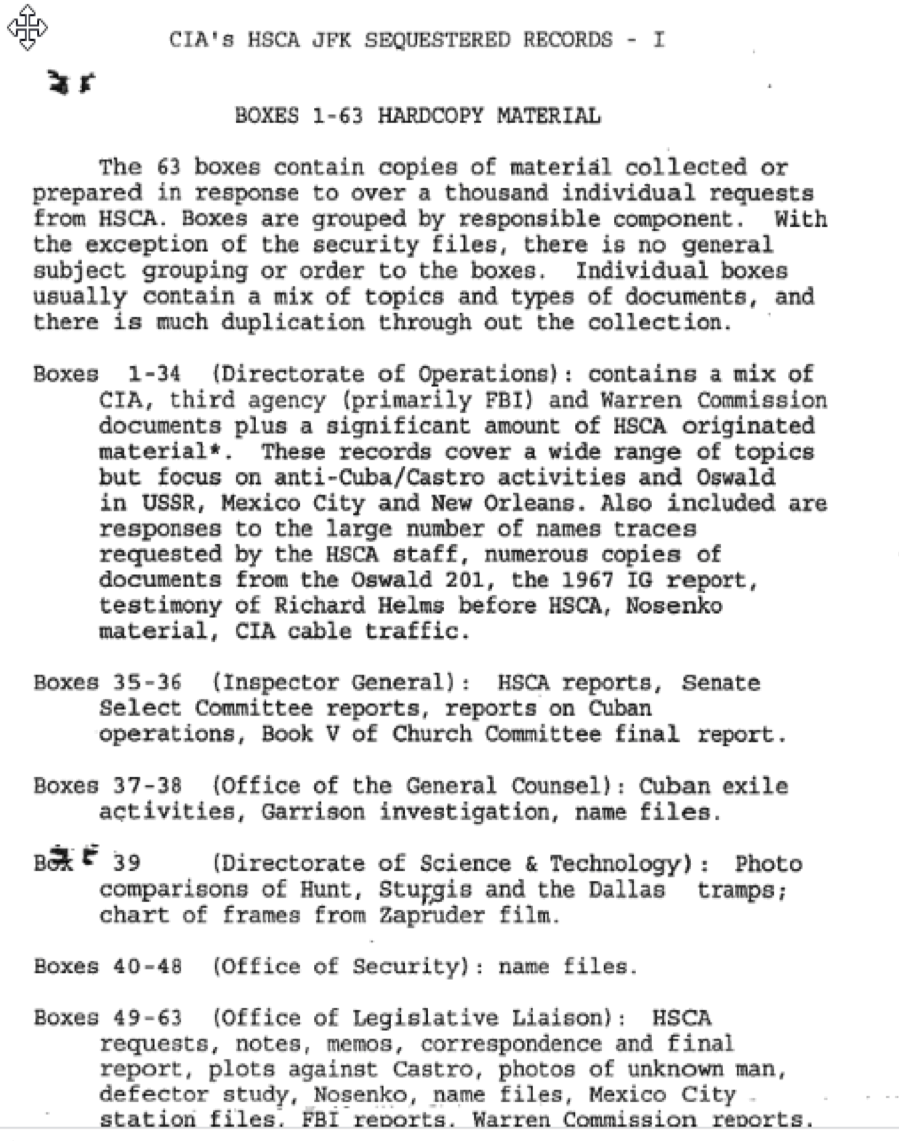
Relatively little has been done to connect the dots on the role organizations may have played wittingly or unwittingly in the coup.
We know that many organizations in Oswald’s orbit had links to intelligence including the Riley Coffee Company, the FPCC, Banister and Associates, Albert Schweitzer College, Alpha 66, the DRE, INCA, WSDU, and the Texas School Book Depository. Permindex and the International Trade Mart connect to both Clay Shaw and intelligence. Sullivan and Cromwell, United Fruit, Freeport Sulphur, and a number of other movers and shakers, as well as countless media organizations, were known to have hovered around U.S. security endeavors during the Dulles reign. They, of course, prefer that this dark history exclude their names, which was accomplished by the lone nut tale peddled by the Warren Commission. Knowing more about some of these interests would help us understand Oswald’s murky path that allowed puppeteers to “place him” strategically in the right spot at the right time to become a patsy.
For instance, it is impossible to imagine that the FPCC does not have a very thick file, given the surveillance programs of this outfit by both the FBI and CIA and its heavy infiltration by informants. Imagine if we could know more about who the informants were and their supervisors from the CIA and FBI.
Gary Hill in his book “the Other Oswald” explores the strange case of Robert Webster, who defected to Russia and returned to the U.S. at nearly the same times as Oswald. He shows how the Rand Development Corporation, Webster’s employer, is closely linked to intelligence, MKULTRA, and Webster’s saga.
In this article, he expands on his research on Rand and demonstrates just how much we could learn by understanding organizations Oswald and other of the main characters are linked to.
RAND Corporation
The RAND Corporation’s the boon of the world,
They think all day long for a fee,
They sit and play games about going up in flames,
For Counters they use you and me.”[1]
In researching my book on Robert Webster[2], The Other Oswald, A Wilderness of Mirrors, I came to see that Webster’s employer, Rand Development Corporation, and his boss, Dr. Henry J. Rand, played important roles in determining Webster’s destiny. Their shadowy presence, always lurking behind the scenes, permeates his story. I decided to try to find out what this mysterious organization was about and why it was manipulating this easily influenced man.
Although Anthony Summers[3] labeled Rand Corporation as Rand Development’s parent company, I was unable to find any connection between the two companies.
General H. H. “Hap” Arnold
Rand Corporation’s website describes its 1948 origins as follows:
As [WWII] drew to a close, it became clear that complete and permanent peace might not be assured. Forward-looking individuals in the War Department, the Office of Scientific Research and Development, and industry thus began to discuss the need for a private organization to connect military planning with research and development decisions.
Commanding General of the Army Air Force H. H. “Hap” Arnold articulated this need in a report to the Secretary of War:
“During this war, the Army, Army Air Forces, and the Navy have made unprecedented use of scientific and industrial resources. The conclusion is inescapable that we have not yet established the balance necessary to insure the continuance of teamwork among the military, other government agencies, industry, and the universities. Scientific planning must be years in advance of the actual research and development work.”
Other key players involved in the formation of this new organization were Major General Curtis LeMay; General Lauris Norstad, Assistant Chief of Air Staff, Plans; Edward Bowles of the Massachusetts Institute of Technology, consultant to the Secretary of War; Donald Douglas, president of the Douglas Aircraft Company; Arthur Raymond, chief engineer at Douglas; and Franklin Collbohm, Raymond’s assistant.
The name of the organization? Project RAND.

Curtis LeMay
Similar to the Russians’ “doomsday machine” in the satirical movie, Dr. Strangelove, RAND was to be a machine whose purpose was to fuel the fires of the cold war through research and development and inter-agency cooperation. The involvement of General Curtis LeMay[4] in such a project is no surprise. It was LeMay who was responsible for promoting RAND as his own project. It is apparent that the Air Force seems to have played a major role in the birth of RAND and oversaw its operations in the early years.
Wikipedia lists the birth of RAND Corporation as 1945, not 1948 as RAND’s website declares. However, its actual charter is dated March 1, 1946. Wiki says:
RAND was created after individuals in the War Department, the Office of Scientific Research and Development, and industry began to discuss the need for a private organization to connect operational research with research and development decisions. On 1 October 1945, Project RAND was set up under special contract to the Douglas Aircraft Company and began operations in December 1945.
Since the 1950s, RAND research has helped inform United States policy decisions on a wide variety of issues, including the space race, the U.S.-Soviet nuclear arms confrontation, the creation of the Great Society social welfare programs, the digital revolution, and national health care. Its most visible contribution may be the doctrine of nuclear deterrence by mutually assured destruction (MAD), developed under the guidance of then-Defense Secretary Robert McNamara and based upon their work with game theory. Chief strategist Herman Kahn also posited the idea of a “winnable” nuclear exchange in his 1960 book On Thermonuclear War. This led to Kahn being one of the models for the titular character of the film Dr. Strangelove, in which RAND is spoofed as the “BLAND Corporation.”
Pravda labeled RAND as the American “Academy of Science and Death.”
By its own definition, it is apparent that RAND’s purpose was to serve the Military Industrial Complex.
Rand Development Corporation
Rand Development is a more elusive entity. When I first saw that there was no mention of Rand Development in the history section of the RAND Corporation website, I thought that it was because of its involvement with the MKULTRA project. Or maybe because an employee, Robert Webster, defected while working on a Rand Development project in the Soviet Union. Or it could be because Rand Development went bankrupt in 1972 and no longer exists.
Whereas RAND Corporation’s name came from the initials of “Research ANd Development,” Rand Development got its name from its founder, James Henry Rand III also called H.J. Rand.
H. James Rand
Dr. James Rand III,[5] turns out to be an extremely fascinating entrepreneur.
James set up the Rand Development Company in 1950 with the primary aim to devise medical devices to benefit patients. He developed the first artificial larynx, which enabled an East Cleveland policeman to be reinstated in his job afterward.
By 1951, at age 38, Rand had 100 inventions to his credit. These included: the mechanical respirator, a tank respirator that replaced the bulky iron lung, an oxygen regulator for aircraft, a pulsating air mattress to eliminate bedsores, a plastic shoe sole, and a completely mechanized wheelchair that could be operated by mouth.
Rand also invented the Bendix automatic washer, the first Remington shaver, a non-leaking faucet valve, and a metal-impregnated cloth called Milium, used to line coats. He was also a co-inventor of a defibrillator and a respirator for chest surgery.
Rand Development prospered under James Rand. The company was even featured in a cover story in Business Week magazine in 1956.
James worked in the mid-1960s on a controversial cancer vaccine and began marketing it in 1966. In 1967, the federal government took his firm to U.S. District Court and won a ban due to not enough testing on animals first and manufacturing they determined was performed under unsanitary conditions. They banned the vaccine’s manufacture and use in the United States. The cancer vaccine never became available to the public. The trial was fraught with desperate cancer patients pleading for continued use of the vaccine.
In 1968, a federal grand jury indicted Rand Development on charges of stock manipulation and mail fraud. Those charges were later dropped in 1970, because they were based on the 1967 vaccine ban case that Rand had testified in and violated his right against self-incrimination.
An improved version of the vaccine was later tested in Mexico and showed some excellent results, as Rand said in a 1977 interview. The results of the tests had been published in Austria, but not accepted in this country.
Rand Development went bankrupt in 1972, and the assets, contents of labs, and offices were sold at auction.
According to his obituary,
James Henry Rand III was born on February 23, 1913, in Pelham, New York, to James Henry Jr. and Miriam Rand. He was a brilliant young boy for whom conventional schooling was inadequate. At age thirteen, Rand ran away from Peekskill Military Academy in New York, where he felt he would not learn anything new in science. He jumped a freight train and emerged from the boxcar in Cleveland, where he spent two weeks living at the Salvation Army before he was caught and returned to his family.
He returned to the military academy, which he completed in two years instead of the usual four. He spent a year in Europe, first at the University of Vienna and the University of Berlin. He enrolled at the University of Virginia at age 16 using two names: H. J. Rand and James H. Rand, to complete both his freshman year and his first year of Medical School.
James elected not to work at his father’s business, Remington Rand. While in his early twenties, he put together a chain of fifty-eight radio stations, that was later taken over by a larger company. His first invention was an instrument to mix the cabin atmosphere in the airplane with hydrogen, enabling pilots to get the correct mix of oxygen while flying. He sold this to the Bendix Corporation, who also hired him, where he worked out several inventions, including the automatic washing machine and the Remington electric shaver for Remington Rand, his father’s firm.
James Rand had a distinguished World War II record. He worked as a spy with the French underground until 1942, when he joined the Army Air Corps and the Office of Strategic Services. He worked in the White House map room until presidential aide Harry Hopkins discovered that he was the son of a prominent Republican and was banished.
He then became assistant chief of guided missiles, assigned to the guided missiles section in Sicily and Italy; he captured several enemy radar stations. Before the capitulation of Berlin, Rand, as a member of a secret mission, entered the city and brought out several German scientists to America.
As a lieutenant colonel in the U.S. Army, Rand flew the first plane to carry guided missiles in combat and received many decorations, including the Legion of Merit, the Bronze Star, ten battle stars in the European Theater, and the Merit Ribbon.
Rand was past president of the Cleveland Museum of Natural History and chairman of the 1949 heart campaign. Bethany College gave him an honorary doctorate and the Cleveland Jaycees named him 1949 Young Man of the Year. He founded the Cleveland Heart Society in 1953, as well as the National Inventors Council.
His wife Mary filed for separation in 1969, stating that her husband was guilty of gross neglect of duty. Rand had not paid her support money or given her funds to operate the home. He later married Martha Osborne.
James, who had diabetes since the age of 38 and also was using a heart pacemaker since 1974, died on November 6, 1978, of abdominal cancer, the disease he tried to conquer. He had used his cancer vaccine on himself.[6]
Rand and the Intelligence Community
Rand’s wartime connections to the Army Air Corps and the Office of Strategic Services explains his close links to the CIA and Air Force intelligence, ATIC, after the war. His OSS secret mission, rescuing German scientists from Berlin in 1945, links him to Operation Paperclip and Allen Dulles. Later, Rand Development Corporation became a CIA proprietary.
President, James “Henry” Rand, and top executive, George Bookbinder, had served together in the O.S.S., the forerunner of the CIA. Bookbinder worked under Frank Wisner[7] in Bucharest during the war.[8] He had close ties to the Rockefeller-owned Chase Manhattan.[9] Rand’s Washington representative Christopher Bird was a self-admitted agent of the Central Intelligence Agency.
The CIA ties to the Rand Development Corporation were exposed in 1968, when the Department of Interior conducted an expense inquiry into an anti-pollution contract between the Rand Development Corporation and that Agency. A Congressional Expense Inquiry showed that Rand Development held several CIA contracts. Doctor H.J. Rand was one of the first to undertake negotiations with the USSR for the purchase of technical devices and information on behalf of the Agency. An FBI Memorandum[10] tells of Sperry-Rand[11] developing an ink that “came out only under certain light.” The same document reveals that H.J. Rand received an $80,000 fee for the part he played in a law suit undertaken by the U.S. Department of Justice against the USSR. At this time, Rand Corporation was also conducting detailed studies of the Soviet economy in order to find out what proportion of the Russian GNP went into national defense.
It would seem to me that “invisible ink” might be used as a tool for spying. In fact, it’s hard to think of many other applications it would be useful for.
At the time of the U2 incident involving Francis Gary Powers, H.J. Rand had been trying to get the Russians to take out U.S. patents on several devices, including a sleep-inducing electric pulse generator he said would be very useful in surgery on patients whom anesthetic drugs are dangerous. Once the Russians took out the patents, Rand would buy the patents and market the Soviet products in the United States. However, the negotiations ended when Rand’s Russian offices were shut down in fallout of the U2 incident.

George H. Bookbinder, New York Times, November 15, 1959
Powers being shot down also foiled a plan to abduct Robert Webster—who had defected while working for Rand Development in 1959—and get him out of Russia in H.J. Rand’s car. Rand had left his car in the Soviet Union and planned one “last trip” to Moscow to bring the vehicle back. Accompanying Rand on the trip would be his usual sidekick, George Bookbinder, and also Dan Tyler Moore. Moore, whom Rand was reluctant to contact because of his erratic behavior and connections to journalist Drew Pearson, was his brother-in-law. Moore, formerly OSS, lived in Cleveland and was, at one time, affiliated with The Middle East Company. The branch office of the Middle East Company located in Turkey was referred to by the Soviets as a US Intelligence Operation. Rand described Moore as “a flamboyant type who is willing to try anything once or twice.” Rand’s hair-brained abduction scheme was never pulled off, due to the Powers incident that resulted in a tightening of security on all things American. The same document (the Grant-Gleichauf telecon) relating to Moore contains a provocative statement, “…the purpose of this notification is to provide some warning that an accident may be on its way to happen.” What accident? This document was dated May 4, 1960. Could the accident be the Powers downing? Were they anticipating this happening ahead of time? The event happened on May 1. This document is dated May 4, so it had already happened. However, as Bill Simpich believes, the key is the April 26 letter, that makes it clear they were planning to get Webster out of Russia over the weekend. It is credible that these words were spoken before May 1. In State Secret, Bill writes:
On April 26, Rand called the CIA Cleveland field office and told them that he and Bookbinder were heading to Moscow in the next ten days to try to get Webster out. On April 28, the CIA Miami chief got the word that Rand, Bookbinder, and their colleague Dan Tyler Moore were heading for Moscow. Like Rand and Bookbinder, Moore was ex-OSS. Moore was also the brother-in-law of Washington Post columnist Drew Pearson and had the savvy to put together a plan to smuggle Robert Webster into Rand’s car and out of the USSR. The Miami chief ended his message by saying that his note was ‘some warning that an accident may be on its way to happen.’ The plan was to smuggle Webster out on May 4.
Anthony Ulasewicz, a field officer of Nixon’s White House/Special Operations Group, described his first meeting with Nixon counsel and crime boss, Murray Chotiner: “When I first met Chotiner, the first thing he did was hand me a file on Rand Development Corporation and its officers.” Chotiner’s file on the Rand Development Corporation disclosed that, during the 1968 presidential campaign, Rand was named as a defendant in a lawsuit started by some angry Minnesota businessmen. The charge was that the Small Business Administration and the Government Services Administration were guilty of fraud and conspiracy in the way a government contract for some postal vehicles was awarded to a wholly-owned Rand Development Corporation subsidiary, the Universal Fiberglass Corporation. The Universal Fiberglass Corporation, the lawsuit charged, was born for the sole purpose of obtaining this contract. “Despite apparent lack of qualifications, a crony of Senator Hubert Humphrey awarded the contact to the Universal Fiberglass Corporation. The Universal Fiberglass Corporation defaulted and disappeared under Rand Development’s umbrella.” Murray Chotiner was trying to bring this situation to the attention of the media.[12]
But the CIA was not the only intelligence agency connected to Rand Development. Air Force Intelligence, ATIC, also worked closely with them in projects dealing with the Soviet Union.
An FBI memo states, “In as much as James H. Rand, President of the Rand Development Corporation, Cleveland, OH, is cooperating with the U.S. Air Force in obtaining information from the Soviets, it is possible that Rand has already furnished information to the Air Force bearing on this matter.”[13]
H.J. Rand’s father was Vice President (chairman) on the board of Sperry-RAND, which also worked closely with the United States Air Force. Sperry-RAND had initially funded the Rand Development Corporation. James Rand III was a twin son of Remington-Rand founder James Henry Rand Jr. who turned over the operation of Remington Rand in 1958 (which had previously merged with Sperry Corp), to James’s twin brother Marcell. Vice-president of research and development for Remington-Rand in those years (1948–1961) was the former chief of the Manhattan Project, General Leslie R. Groves. Among other sundry defense contracts, Remington-Rand was collaborating with Bell Labs on nuclear missile guidance systems.
Internal memos from the CIA requested by the HSCA investigation note that Rand and Bookbinder had traveled previously in 1958 to the USSR with “Brigadier General” W. Randolph Lovelace, an eminent physician with Atomic Energy Commission contracts who co-founded the Lovelace Clinic in Albuquerque New Mexico. One memo reads: “For your information, only Rand, Bookbinder, and Lovelace have had frequent contact with Soviet officials both in the United States and the USSR, including Mikhail Ilich Bruk, formerly with the Soviet Ministry of Health, who was identified by AEDONER [Yuri Nosenko] as an agent of the KGB.”
When Robert Webster defected in 1959, he did so as an employee of Rand Development at a Moscow Trade Exhibition. On October 17, 1959, Webster was living in Moscow. He attended a meeting at the central office, visas and registration (OVIR); with the original Soviet representative he had contact with, an unknown Soviet, H.J. Rand, his assistant George H. Bookbinder, as well as Richard E. Snyder of the U.S. Embassy. Webster stated he was free to speak and told Snyder when he had applied for Soviet citizenship that he had been granted a Soviet passport on September 21, 1959. He filled out a form entitled “Affidavit for Expatriated Person” and wrote his resignation to Rand Development Corp.
While it is possible that Webster may have been a witting asset in a false defection stratagem, his pre- and post-Russia odyssey behavior and treatment lead me to believe that, unlike Oswald, he was a genuine, albeit confused defector, who went to Russia, not for ideological reasons, but mostly to escape a complicated personal life at home. We may never know for sure.
My research further revealed that Webster was part of an ATIC project called LONGSTRIDE. Internal CIA memos revealed that Webster was known as “Guide 223” and fellow Rand Development employee Ted Korycki was known as “Lincoln Leeds.” The fact that the CIA approached ATIC at the Moscow Fair, rather than Rand Development itself, indicates inter-agency cooperation.
Rand’s liaison with ATIC was Major Joseph Carels. In light of the recent revelation of Webster’s role in Project LONGSTRIDE, it appears that Carels was lying when he advised that Air Force Intelligence Headquarters had no information regarding Webster. As a result of a teletype inquiry by Carels to Air Technical Intelligence Center (ATIC), Wright-Patterson Air Force Base, Ohio, (this organization handles covert projects of AF), Carels was advised that the subject was an employee of Rand Development who could not be located and thus was reported as missing. The message stated that the subject has taken a 20-day in-tourist tour to Kiev. “Subject (Webster) is a technician and is not witting or involved in ATIC[14] activities.”[15] Rand Development Corporation’s connection to the U.S. Air Force at the Moscow Fair may have been unknown to Webster, however it is likely that Webster’s movements were likely being choreographed by Air Force intelligence, whether he knew it or not.
Dr. Rand was obviously a source for ATIC as is indicated by an AIRTEL TO BUREAU NY 105-37687 stating: “Inasmuch as James H. Rand, President of Rand Development Corporation, Cleveland, Ohio, is cooperating with the Air Force in obtaining information from the Soviets it is possible that Rand has already furnished information to the Air Force bearing on this matter.”
Another FBI memorandum states; “Rand cooperates with Air Force Intelligence on technical intelligence projects.”[16]
An area that needs more research is that involving the connections of Sylvia Hyde Hoke, the sister of Ruth Paine. Sylvia, a psychologist, was employed by the Air Force as a “Personnel Research Technician.”[17] It was the Personnel Research branch of the Air Force that implemented Project LONGSTRIDE, of which Webster was involved. Hoke was also employed by the CIA since at least 1961. Perhaps it is just a coincidence that the two Hyde sisters are somehow linked with the two defectors, Oswald and Webster. The same two that James Angleton was dangling to the Soviets in his mole hunts?
There also seem to be connections between the elusive triad of espionage entities (CIA, ATIC and Rand Development) and experiments in behavior and mind control.
The CIA’s MKULTRA projects are well known. But what is known of the role of Rand Development and ATIC’s in this murky misadventure of controlling human minds?
Rand Development’s Washington representative, Christopher Bird, served as ‘Biocommunications Editor/ Russian Translator’ for Mankind Research Unlimited, Inc., a Washington think-tank specializing in parapsychology and other behavioral sciences. Dick Russell reports that “MRU’s Company Capabilities list included brain and mind control…acquiring on a daily basis, a large amount of unique bio-cybernetics data from Eastern Europe.”[18]
According to CIA psychiatrist, Dr. Louis Jolyon (Jolly) West,[19] ATIC and Rand Development worked closely together in behavior modification research. He claimed that Air Force Intelligence, like the CIA, was also involved in mind control research projects. West himself, although he initially denied it, was conducting LSD research under the MKULTRA banner.
It is now clear that the H.J. Rand Foundation was a part of MKULTRA SUB-PROJECT NO. 79. The document below lists Rand as a “cut-out” for the purpose of funding organizations engaged in very “sensitive” research. The document is dated 1957–1962, the very time in which Robert Webster was employed by Rand. It encompasses his defection and return from Russia (59–62). Also, this is the same time period of Oswald’s Soviet odyssey. It also states that “all” of the Rand Development’s participants were witting of the agency (CIA) relationship. That would include plastic’s expert Robert E. Webster. Note that this document is approved by C.V.S. Roosevelt.
Roosevelt, grandson of Theodore, who served as the chairman of the Technical Surveillance Countermeasures Committee, which involved securing American facilities against electronic eavesdropping. Richard Bissell’s testimony during the Church Commission, as well as CIA source documents, connect Roosevelt directly to plans to poison Castro. Roosevelt, as a head of the CIA technical division, was Sidney Gottlieb’s supervisor. According to Roosevelt, his work for the CIA mainly involved creating devices to detect listening devices. He also mentioned that he took part as a subject in the CIA experiments on LSD as part of MKULTRA. Retiring from the CIA in 1973, he served in retirement as a defense consultant and on the board of Aerospace Corporation.
Further evidence of Rand Development’s involvement in MKULTRA is their 1958 study revealing that, “a defensive use for hypnosis was a more practical use than the previously sought offensive goal of a Manchurian Candidate.”
NARA Record Number: 157-10014-10093
TESTIMONY OF RICHARD BISSELL, 10 SEP 1975

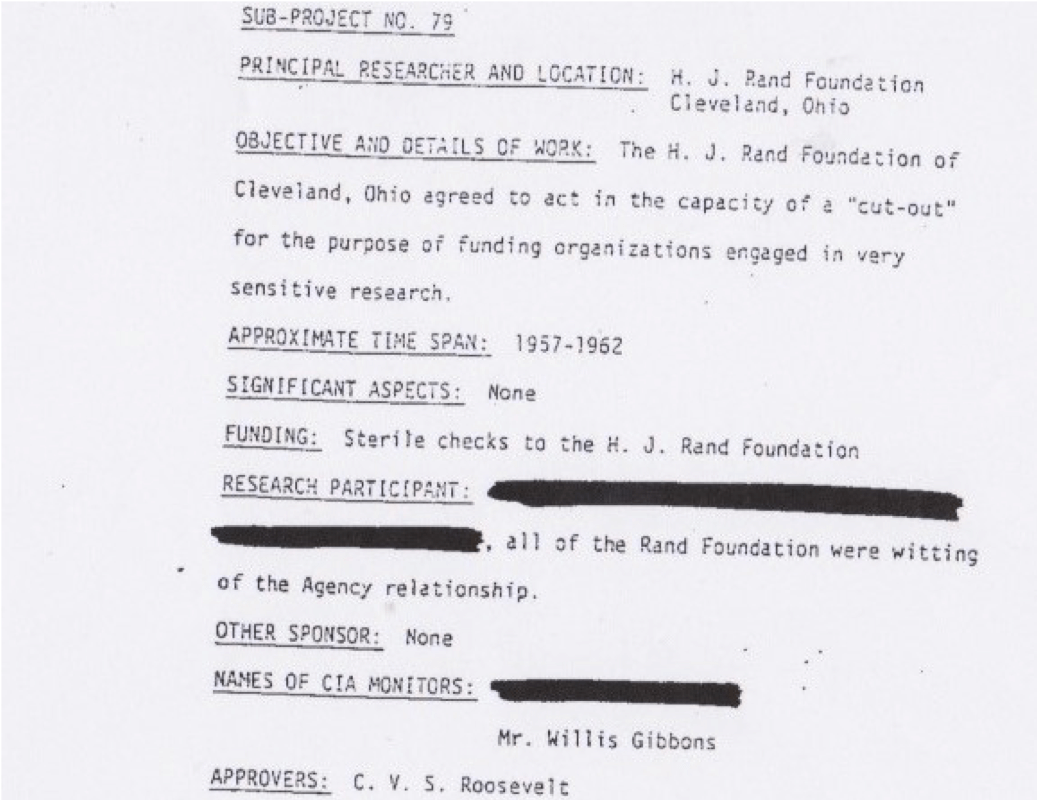
RAND Corporation was the CIA think-tank where Daniel Ellsberg copied the Pentagon Papers. According to the New York City phone directory, Rand Corporation and Rand Development were located on opposite sides of Lexington Avenue in New York City. However, this seems to have been a deception.
Researchers Alan J. Weberman and Michael Canfield visited the address of Rand Development Corporation listed in the NYC phone directory. The building registry had no listing for Rand Development Corporation. The doorman told them that he had worked there for 33 years and there had never been a Rand Development Corporation in the building. He suggested they go to Rand Corporation across the street at 405 Lexington Ave. From what I could find, RAND’s NYC office was part of a HUD study group for LBJ’s Great Society described as an Urban Institute.
Another odd coincidence involving the Air Force is that four of Oswald’s fellow employees at Reily Coffee went on to employment with NASA. Oswald himself cryptically hinted that working there might be in his future. He told Adrian Alba, proprietor of the Crescent City Garage next door to the Reily Coffee Co. in New Orleans, that he had “found his pot at the end of the rainbow,” and that he expected to get a job at NASA in New Orleans. As stated, four of Oswald’s coworkers at Reily did get jobs at NASA in New Orleans within weeks of his departure.[20] However, by the time he had returned to Dallas, in the fall of 1963, he was telling his landlady, Mary Bledsoe, that he would soon be working for Collins Radio, a CIA front company deeply involved in the military industrial complex.[21]
In fact, it is obvious that Oswald had ties or links to an array of CIA/Military Industrial Complex friendly companies; Collins Radio, NASA, Reily Coffee, Guy Banister Associates, Jaggars-Chiles-Stovall, and perhaps the TSBD.[22] In addition, he wrote or belonged to organizations being investigated by the FBI and CIA; the FPCC, the American Civil Liberties Union, C.O.R.E., and the American Communist Party. In addition, Oswald was as an underage worker with the Gerald F. Tujague Inc., a freight broker on the New Orleans water front. Tujague was a friend of Guy Banister. In addition, Tujague was Vice President of the Friends of a Democratic Cuba. The purpose of the FDC was to raise funds for the CIA-backed Frente Revolucionario Democratica (FRD-Cuban Democratic Revolutionary Front.) Tujague told FBI agents that Oswald was in regular contact with the U.S. Customs Export Office, yet another government agency.
Summary
In essence, RAND Corporation rose out of the ashes of WWII. The Manhattan Project had shown that pooling the best minds; scientists, physicists, mathematicians, and technicians had resulted in a huge leap forward in weapons development. The prospect of these great thinkers going back to work in the private sector was anathema to Hap Arnold, the only five-star general in the Air Force. He and Franklin R. Collbohm became the fathers of the RAND PROJECT. But it was General Curtis LeMay who took the project by the horns and became its godfather. Subsidized and more or less subservient to the Air Force, the project arose out of the Air Force’s interest in developing intercontinental ballistic missiles. In addition to General Arnold, key players involved in the formation of Project RAND were: Edward Bowles of M.I.T., a consultant to the Secretary of War; General Lauris Norstad, then Assistant Chief of Air Staff, Plans; Major General Curtis LeMay; Donald Douglas, President of Douglas Aircraft Company; Arthur Raymond, Chief Engineer at Douglas; Franklin Collbohm, Raymond’s assistant.
The RAND (Research And Development) Corporation of Santa Monica, California, began as a United States Air Force Project in 1945 under contract to the Douglas Aircraft Company. Its broadly defined function was to study American national security and, in particular, the role of airpower in that context. Three years later, the Ford Foundation endowed RAND as a private, nonprofit research corporation “to further and promote scientific, educational and charitable purposes” to the nation’s general benefit. As one of the first American “think tanks,” however, its staff focused primarily on military and strategic issues funded by the U.S. government. For the first two years of its existence, RAND allocated the lion’s share of its Air Force research funds for applied science projects to subcontractors like Bell Telephone, Boeing Aircraft, and Collins Radio Company.[23] Other RANDites who would later play a role in American politics include: Condeleezza Rice, Dr. Luis Alvarez, and Donald H. Rumsfeld, who at one time was Chairman of their Board of Trustees.
Rand Development was a separate entity used primarily by the CIA, but also working closely with Air Force Intelligence (ATIC). The areas of the corporation’s usefulness included information related to the Soviet economy and military budget; negotiations with the USSR for the purchase of technical devices and information on behalf of the CIA; cooperation with Air-Force Intelligence on technical intelligence projects such as LONGSTRIDE; and acting as a CIA “cut-out” in an MKULTA sub-project defined as funding of organizations involved in very sensitive research. This research included mind and behavior control, a subject of interest to both the CIA and ATIC. In return, Rand received financial rewards through favoritism in the securing of government contracts, as well as a monopoly in being allowed negotiations involving Soviet technology.
My research on Robert Webster led me to believe that H.J. Rand was not only his boss, but his close friend and mentor. Their relationship was very similar to that of Oswald and George de Mohrenschildt. I doubt if we will ever know whether James Rand played any role in encouraging Webster to defect or connecting him, knowingly or unknowingly, with an ATIC project (LONGSTRIDE). But it seems odd that Webster, a man with no connections to the Air Force (an ex-navy man), was involved in this Air Force Intelligence project while in the Soviet Union. In addition, he became a Soviet citizen. Think about it. A defector who gave up his U.S. citizenship to become a Soviet citizen is now part of a U.S. intelligence project? If he was aware of this he could be defined as an American spy or at the very least some kind of dangle.
Bibliography
Conspiracy, Anthony Summers, McGraw-Hill Book Co., 1980.
Soldiers of Reason, Alex Abella, Mariner Books, 2008.
The Man Who Knew Too Much, Dick Russell, Carroll & Graf Publishers, 1992.
The Other Oswald, A Wilderness of Mirrors, Gary Hill, TrineDay, 2020.
[1] The Rand Hymn, by Malvina Reynolds
[2] “The Other Oswald, A Wilderness of Mirrors,” Gary Hill, TrineDay 2020. www.theotheroswald.com
[3] Summers says: “Rand Development Corporation was formed by the Rand Family. The name ‘Rand Corporation’ is a title made from the contraction of the words ‘Research and Development.’” It seems he may have linked the two unintentionally by inference of name. Also, Dick Russell, in his book The Man Who Knew Too Much, said: “Like its parent, Rand Corporation, it (Rand Development) also held several CIA contracts.” The footnote for this statement reads: Rand Development ties; WCE915, WC XVIII, HI 13; Summers Conspiracy pp 177–178. But the WCE915 document says nothing about Rand. It is a letter from Richard Snyder to the State Department about citizenship of defectors.
[4] It was LeMay that was responsible for the firebombing of Tokyo in WWII that resulted in the deaths of 100,000 civilians. These were mostly women, children and old men. It was also he that proposed a first strike on the Soviet Union during the Kennedy administration. His take was that we would only lose 30 or 40 million Americans. That, he felt, was an acceptable sacrifice. In his book, The Fog of War, he was quoted as saying, “If we had lost the war, we’d all have been prosecuted as war criminals.”
[5] Also known as H.J. Rand.
[6] https://bratenahlhistorical.org/index.php/james-rand/
[7] In the OSS Wisner was transferred to Germany where he served as Liaison to the Gehlen Organization. Later, in the CIA, he ran the Office of Special Projects (OSP), which later became the Office of Policy Coordination (OPC). J. Edgar Hoover called the OPC “Wisner’s Weirdos.”
[8] NYT 6.15.59; Smith OSS Univ. of Calif. Press London 1977, p. 397.
[9] State Secret, Chapter One, Bill Simpich.
[10] See this document in appendix C of “The Other Oswald, A Wilderness of Mirrors, Gary Hill, TrineDay, 2020. www.theotheroswald.com
[11] Rand III’s father (James Rand Jr.) founded American Kardex, an office equipment and office supplies firm which later merged with his father’s (James Rand Sr.) company, the Rand Ledger Corporation. Rand later bought out and merged with several other companies, notably the Remington Typewriter Company, to form Remington Rand. In 1955, Rand merged his corporation with the Sperry Corporation to form Sperry-Rand, one of the earliest and largest computer manufacturing companies in the United States.
[12] Ulasewicz, Pres. Priv. Eye, 1990.
[13] 124-10210-10354
[14] ATIC later evolved into NASIC.
[15] Memorandum from P.H. Fields to F. A. Frohbose 105-81285-3.
[16] 124-10210-10354
[17] NARA Record Number: 1993.07.24.08:39:37:560310-FB1105-1261128-7,12/12/63; also, CIA memo dated 7/30/71 claims Hoke a CIA employee since 1961.
[18] Ibid from A.J. Weberman “Mind Control: The Story of Mankind Research Unlimited, Inc.” CovertAction (June 1980), p. 17.
[19] “Jolly” was appointed by the court in his capacity as a brainwashing expert in the Patty Hearst trial and worked without a fee. Believing that Hearst displayed all the classic signs of coercion and brainwashing, after the trial, he wrote a newspaper article asking President Carter to release Hearst from prison. West also visited Jack Ruby several times in his jail cell along with Dr. Robert Stubblefield, who was also involved in the MKULTRA program. What went on in that cell, no one knows. But Ruby was suddenly found insane.
[20] In Deadly Secrets, Warren Hinckle and William Turner write, “Oswald told Adrian Alba, the owner of the garage next door to where he was working, that his application was about to be accepted ‘out there where the gold is’—the NASA Saturn missile plant in suburban Gentilly. NASA of course didn’t employ security risks. But tucked into its Gentilly facility was an active CIA station that provided a Kelly Girl service for operatives in between assignments” (p. 239). The endnote reads, “The CIA’s practice of providing interim employment for its agents and assets is well known,” The passage in Turner repeats the familiar statement from Adrian Alba, then adds, ”On the face of it, the idea that [the Marxist] Oswald could get a job at a space agency installation requiring security clearance seems preposterous…But [Jim] Garrison pointed out that it is an open secret that the CIA uses the NASA facility as a cover for clandestine operations.”
[21] Bledsoe on Oswald’s activities: 6 WCH 404 and Oswald on Collins Radio WCE-1985.
[22] Another possible link he made was his travel arrangements on the first leg of his trip to Russia through “Travel Consultants,” a New Orleans based travel agency also used by Clay Shaw. On the agency’s questionnaire he gave his occupation as “shipping export agent.”
[23] See chapter 12—“The Other Oswald, A Wilderness of Mirrors,” Gary Hill, TrineDay 2020, for Collins links to the JFK Assassination.