Category: John Fitzgerald Kennedy

Original essays treating the assassination of John F. Kennedy, its historical and political context and aftermath, and the investigations conducted.

  • A Presumption of Innocence: Lee Harvey Oswald, Part 3

    A Presumption of Innocence: Lee Harvey Oswald, Part 3


    Part 1

    Part 2

    I. The Disposition and Discovery of the Shells

    The discovery of the rifle shells on the sixth floor that go by the labels Commission Exhibits 543, 544, and 545 add more controversy into the investigation of the murder of President John F. Kennedy.

    The shells, which the Commission concluded had been used in the assassination, were discovered, according to the Warren Report, by Deputy Sheriff Luke Mooney. According to the report:

    Around 1pm, Deputy Sheriff Luke Mooney noticed a pile of cartons in front of the window in the south-east corner of the sixth floor. Searching that area, he found at approximately 1:12 p.m. three empty cartridge cases on the floor near the window. (WR, p. 79)

    A few obvious questions arise with regard to the subsequent discovery of the alleged “Snipers Nest” and the shells allegedly contained therein.

    1. With various witnesses reporting to the police in the immediate aftermath of the Presidents murder that they had indeed witnessed a rifle in the possession of a man or men on the upper floors, then why did the Dallas police not immediately converge upon the book depository’s sixth floor? Instead, the police decided to commence a floor by floor canvass of the building in search of a gunman or evidence linked to the crime. This was in spite of the various witness testimonies to a man (men) with a rifle on the upper floors.
    2. Why did it take Mooney 12 minutes between his discovery of the alleged “sniper’s nest” to his apparent discovery of the three spent cartridges? According to Mooney’s testimony once he had ventured down from the seventh floor:

    LM – So I went back down. I went straight across to the south-east corner of the building, and I saw all these high boxes. Of course, they were stacked all the way around over there. And I squeezed between two. And the minute I squeezed between these two stacks of boxes, I had to turn myself sideways to get in there—that is when I saw the expended shells and the boxes that were stacked up looked to be a rest for a weapon. (WCH, Vol. III, pp. 283284)

    Mooney’s testimony refutes the information contained in the Warren Report regarding the 12-minute discovery between the “Shield of Cartons” and the expended shells. And in reference to the earlier quoted testimony, “the minute I squeezed between these two stacks of boxes…that is when I saw the expended shells.” (ibid) It would seem that the authors of the report were too busy to re-acquaint themselves with the testimony which was deposed before them, choosing instead to print in error that 12 minutes had elapsed between the discovery of the shield of cartons and the discovery of the shells.

    In reference to Fritz and his conduct in handling the evidence, we find the following printed within the Report:

    When he was notified of Mooney’s discovery, Capt. J W. Fritz, chief of the homicide bureau of the Dallas Police Department, issued instructions that nothing be moved or touched until technicians from the police crime laboratory could take photographs and check for fingerprints. (WR, p. 79)

    This account is disputed by cameraman for WFFA TV Tom Alyea, who was present on the sixth floor after the assassination. Alyea stated that:

    After filming the casings with my wide-angle lens, from a height of 4 and half ft., I asked Captain Fritz, who was standing at my side, if I could go behind the barricade and get a close-up shot of the casings.

    He told me that it would be better if I got my shots from outside the barricade. He then rounded the pile of boxes and entered the enclosure. This was the first time anybody walked between the barricade and the windows.

    Fritz then walked to the casings, picked them up and held them in his hand over the top of the barricade for me to get a close-up shot of the evidence. I filmed between 3–4 seconds of a close-up shot of the shell casings in Captain Fritz’s hand.

    Fritz did not return them to the floor and he did not have them in his hand when he was examining the shooting support boxes. I stopped filming and thanked him. I have been asked many times if I thought it was peculiar that the Captain of Homicide picked up evidence with his hands.

    Actually, that was the first thought that came to me when he did it, but I rationalized that he was the homicide expert and no prints could be taken from spent shell casings. Over thirty minutes later, after the rifle was discovered and the crime lab arrived, Capt. Fritz reached into his pocket and handed the casings to Det. Studebaker to include in the photographs he would take of the sniper’s nest crime scene.

    We stayed at the rifle site to watch Lt. Day dust the rifle. You have seen my footage of this. Studebaker never saw the original placement of the casings so he tossed them on the floor and photographed them. Therefore, any photograph of shell casings taken after this is staged and not correct. (https://www.jfk-online.com/alyea.html)

    It should be noted that Alyea also said that the shells were in close proximity to each other at first appearance. There are two other witnesses who back him on this: Roger Craig and Mooney. (Cover-Up, J. Gary Shaw with Larry Harris, p. 70) That is not the way they appear in the Commission volumes. (Commission Exhibit 512) Once the “official crime scene” photographs were taken, Lt. Day and Detective Sims proceeded to collect the shells from the sixth floor.

    II. Chain of Custody of the Shells

    During his testimony before the Commission, Day stated what course of action he took in relation to preserving the shells as evidence.

    Mr. Belin – All right. Let me first hand you what has been marked as “Commission Exhibit,” part of “Commission Exhibit 543, 544,” and ask you to state if you know what that is.

    Mr. Day – This is the envelope the shells were placed in.

    Mr. Belin – How many shells were placed in that envelope?

    Mr. Day – Three.

    Mr. Belin – It says here that, it is written on here, “Two of the three spent hulls under window on sixth floor.

    Mr. Day – Yes, sir.

    Mr. Belin – Did you put all three there?

    Mr. Day – Three were in there when they were turned over to Detective Sims at that time. The only writing on it was “Lieut. J. C. Day.” Down here at the bottom.

    Mr. Belin – I see.

    Mr. Day – Dallas Police Department and the date.

    Mr. Belin – In other words, you didn’t put the writing in that says two of the three spent hulls.

    Mr. Day – Not then. About 10 o’clock in the evening this envelope came back to me with two hulls in it. I say it came to me, it was in a group of stuff, a group of evidence, we were getting ready to release to the FBI. I don’t know who brought them back. Vince Drain, FBI, was present with the stuff, the first I noticed it. At that time there were two hulls inside. I was advised the homicide division was retaining the third for their use. At that time, I marked the two hulls inside of this, still inside this envelope.

    Mr. Belin – That envelope, which is a part of Commission Exhibits 543 and 544?

    Mr. Day – Yes, sir; I put the additional marking on at that time.

    Mr. Belin – I see.

    Mr. Day – You will notice there is a little difference in the ink writing.

    Mr. Belin – But all of the writing there is yours?

    Mr. Day – Yes, sir.

    Mr. Belin – Now, at what time did you put any initials, if you did put any such initials, on the hull itself?

    Mr. Day – At about 10 o’clock when I noticed it back in the identification bureau in this envelope.

    Mr. Belin – Had the envelope been opened yet or not?

    Mr. Day – Yes, sir; it had been opened.

    Mr. Belin – Had the shells been out of your possession then?

    Mr. Day – Mr. Sims had the shells from the time they were moved from the building or he took them from me at that time, and the shells I did not see again until around 10 o’clock.

    Mr. Belin – Who gave them to you at 10 o’clock?

    Mr. Day – They were in this group of evidence being collected to turn over to the FBI. I don’t know who brought them back.

    Mr. Belin – Was the envelope sealed?

    Mr. Day – No, sir.

    Mr. Belin – Had it been sealed when you gave it to Mr. Sims?

    Mr. Day – No, sir; no. (WCH, Vol. IV, pp. 25354)

    Belin also elicits the following:

    Mr. Belin – Your testimony now is that you did not mark any of the hulls at the scene?

    Mr. Day – Those three; no, sir. (WCH, Vol. IV, p. 255)

    Further, in his testimony, Day states he recognizes CE 543, because it has the initials GD on it. Surprisingly, Day failed to acknowledge the other defining characteristic on 543. Contained on the lip of the shell is a dent, which has led many experts to conclude that this shell could not have held a bullet which was fired during the assassination. But he did admit that this very peculiarly dented shell was not sent to the FBI the night of the assassination. It is surprising that after Day admits this, Belin does not ask the obvious question: Why was it not sent up?

    Mr. Belin – Now, I am going to ask you to state if you know what Commission Exhibit 543 is?

    Mr. Day – That is a hull that does not have my marking on it.

    Mr. Belin – Do you know whether or not this was one of the hulls that was found at the School Book Depository Building?

    Mr. Day – I think it is.

    Mr. Belin – What makes you think it is?

    Mr. Day – It has the initials “G.D.” on it, which is George Doughty, the captain that I worked under.

    Mr. Belin – Was he there at the scene?

    Mr. Day – No, sir; this hull came up, this hull that is not marked came up, later. I didn’t send that. (WCH, Vol. IV, p. 255)

    Note what Day seems to be saying. He says it was marked by someone who was not at the crime scene. Again, Belin asks for no clarification as to when Doughty marked the shell. What makes this questioning even more off key is that Belin admits that he pre-interviewed Day in Dallas. And now Day has changed his story. At that prior interview, he admits that he told Belin that he did initial the shells. He now tells Belin that after he thought it over, no he did not mark any of them at the scene. (Ibid, p. 255). At this point, Belin actually said he should strike everything and start all over again.

    It later got even worse. In a letter to the Commission dated April 23, 1964, Day then throws his identification of CE 543 and their subsequent chain of custody into serious doubt:

    Sir:

    In regard to the third hull which I stated has GD for George Doughty scratched on it, Captain Doughty does not remember handling this.

    Please check again to see if possibly it can be VD or VED for Vince Drain.

    Very truly yours,

    J. C. Day

    Through Day’s testimony, we elicit that he did not mark the shells at the scene of the crime even though they were in his possession. Furthermore, he placed these unmarked shells into an unsealed envelope.

    This is a weird situation. And Belin does not seem to bat an eyelash while he is discovering it or the fact that the witness changed his story. Under these circumstances, how could Day swear under oath that the shells being presented in evidence against Oswald were the same ones allegedly found in the aftermath of the president’s murder? When he neglected to mark them at the scene and then proceeded to place them in an unsealed, unmarked envelope?

    III. Tom Alyea writes to the ARRB

    Lt. Day’s testimony is also disputed by press photographer Tom Alyea. He was the first such cameraman allowed entry into the crime scene. In a letter to the ARRB’s Tom Samoluk dated 8-15-97, Alyea states that:

    Regarding the perjured testimony given to the Warren Commission Investigators by members of the Dallas Police Department. I understand there were several cases, but the one I checked for myself by reading the printed testimony in the Warren Report, involves Lt. Day and Det. Studebaker. These are the two crime lab men who dusted the evidence on the 6th floor. Their testimony is false from beginning to end.

    This is what should have happened. According to Tom Alyea, Fritz was the first detective on the scene to come into contact with the shells. Fritz should have marked these shells at the scene in accordance with the chain of custody. Fritz then gave the shells to Det. Studebaker.

    Studebaker should have then proceeded to mark these shells at the scene. But what the evidence seems to indicate is that Studebaker then threw the shells down on the floor of the south east corner window and captured the “crime scene” photos.

    Lt. Day then retrieved the shells from the floor with help from Det. Sims. Day should have marked these shells at the scene and then put them into a sealed envelope, clearly stating what lay therein. Instead, Day gave up possession of the shells without adding his markings, which in turn lay in an unmarked, unsealed envelope.

    The envelope remained unsealed when Day took back possession of these hulls at 10 p.m. on 11/22/63. Sims should have marked the shells at the crime scene while in his possession. But yet, Sims did not even recall picking up the shells. In a remarkable exchange with David Belin, he admitted that in his first Commission interview with Joe Ball, he did not mention doing this. In fact, at that time, he attributed the carrying of the envelope with the shells to Lt. Day. When Ball asked him if he took possession, he denied it. (WCH, Vol. VII, p. 163)

    There had to have been a conference between Belin and Ball about this and Sims must have been made aware of their worries. Because two days after the April 6th Ball interview, Sims was recalled. This is what worried them: Belin knew that Day was going to testify that he turned over the unsealed envelope with shells to Sims. Therefore, they needed Sims on the record for this transfer. (WCH, Vol. IV, p. 256) Therefore, when he was returned to the stand, this time his questioner was Belin. And in almost no time flat, Belin is asking Sims about this specific point: the chain of custody of the shells. Sims now says that two days ago, he did not recall who brought the shells to the police station. But now, mirabile dictu, he says it was him! (WCH, Vol. VII, p. 183) So he has done a virtual 180 degree turn on this. After this pirouette, Belin asks Sims: Well, how did you remember that it was you who brought the cartridges to the station? Sims replies that, in the interval, he talked to Captain Will Fritz and his partner E. L. Boyd; they helped refresh his memory as to what happened.

    So, in handling the most important pieces of evidence in the biggest case he ever worked on, Sims forgot he brought the cartridge cases to the station. But then, thanks to Will Fritz, he now recalled he did. But even then, this was included in his testimony:

    Mr. Belin – Do you remember whether or not you ever initialled the hulls?

    Mr. Sims – I don’t know if I initialled the hulls or not. (WCH, Vol. VII, p. 186)

    There are established rules in the judicial system that every police department must follow with regards to the preservation of evidence. By no stretch of the imagination did the Dallas Police comply with any of them. It is a fact that had Oswald been permitted to stand trial Commission Exhibits 543/544/545 would have been a focus of serious questioning by defense counsel.

    For example, in addition to all the above, there is the dent problem that CE 543 presents. Ballistics expert Howard Donahue has said this cartridge could not have been used to fire a bullet that day since the weapon would not have discharged properly. (Bonar Menninger, Mortal Error, p. 114) People like Gerald Posner, Vince Bugliosi, and Robert Blakey have said, well it could have been dented in the firing. Donahue replied to this by saying, “There were no shells dented in that manner by the HSCA…I have never seen a case dented like this.” (Letter dated September 11, 1996, emphasis in original.) Both Josiah Thompson and British researcher Chris Mills tried in every way to dent a 6.5 mm Western Cartridge case like this one was. They failed. Mills concluded that the only way it could be done was through loading empty shells, and only on rare occasion. (James DiEugenio, The JFK Assassination: The Evidence Today, p. 95)

    If only that were the end of it. Thompson wrote in Six Seconds in Dallas that CE 543 contained three identifying marks revealing it had been loaded and extracted at least thrice before. (Thompson, p. 144) These were not found on the other cartridge cases. But it’s even more puzzling than that. As Thompson wrote:

    Of all the various marks discovered on this case, only one set links it to the follower. Yet the magazine follower marks only the last cartridge in the clip… (Thompson, p. 145)

    The last cartridge in the clip was not this one. It was the live round.

    IV. Lt. Day versus Sebastian Latona

    With the alleged discovery of the Mannlicher Carcano on the sixth floor in the aftermath of the president’s murder, the rifle was bound to be subjected to fingerprint analysis by the Dallas police. Lt. Day, who had applied fingerprint powder to the rifle on the sixth floor, had apparently discovered partial prints near the trigger guard of the weapon. Day testified to that effect.

    John McCloy – When was the rifle as such dusted with fingerprint powder?

    Lt. Day – After ejecting the live round, then I gave my attention to the rifle. I put fingerprint powder on the side of the rifle over the magazine housing. I noticed it was rather rough. I also noticed there were traces of two prints visible. I told Captain Fritz it was too rough to do there, it should go to the office where I would have better facilities for trying to work with the fingerprints.

    JM – But you could note with your naked eye or with a magnifying glass the remnants of fingerprints on the stock?

    JCD – Yes, sir; I could see traces of ridges, fingerprint ridges, on the side of the housing. (WCH, Vol. IV, p. 259)

    Upon the discovery of such incriminating evidence it would be logical to assume that Day would leave the depository, post haste, to process the latent prints found upon the suspected murder weapon. These prints could have been paramount for the Dallas police in their case in unmasking the President’s murderer. But while Day indeed had left the depository with the rifle, he opted to return to the Depository without processing the prints in order to conduct a press tour of the sixth floor. Thus, meaning that valuable evidence lay unprocessed whilst Day played tour guide to the media!

    Later that night Day eventually proceeded to take photographs of the latent prints found on the rifle. These were taken around 8pm on 11/22/63. (Sylvia Meagher, Accessories after the Fact, p. 122) Day was alleged to have been ordered by Chief of Police Jesse Curry to “go no further in the processing of the rifle,” because the evidence pertaining to the murder was to be sent to the FBI crime lab in Washington DC. (Meagher, p. 122) The assassination of President Kennedy would not fall under federal jurisdiction until after the public killing of Lee Oswald. So why was the bulk of the core evidence being transferred to the FBI on 11/23/63? Amongst the evidence sent to the FBI were negatives of the partial prints, along with the Mannlicher itself. Here is what FBI fingerprint expert Sebastian Latona said with regards to the partial prints found on the trigger guard:

    SL – There had, in addition to this rifle and that paper bag, which I received on the 23rd—there had also been submitted to me some photographs which had been taken by the Dallas Police Department, at least alleged to have been taken by them, of these prints on this trigger guard which they developed. I examined the photographs very closely and I still could not determine any latent value in the photograph. (WCH, Vol. IV, p. 21)

    He then goes on to describe that:

    SL – I made arrangements to immediately have a photographer come in and see if he could improve on the photographs that were taken by the Dallas Police Department. Well, we spent, between the two of us, setting up the camera, looking at prints, highlighting, sidelighting, every type of lighting that we could conceivably think of, checking back and forth in the darkroom—we could not improve the condition of these latent prints. So, accordingly, the final conclusion was simply that the latent print on this gun was of no value. (WCH, Vol. IV, p. 21)

    Latona then concluded the following about his overall attempt to garner any such print evidence from the rifle.

    SL – I was not successful in developing any prints at all on the weapon. (WCH, Vol. IV, p. 23, we shall return to this testimony later)

    The latent prints were, therefore, deemed to be valueless by the FBI. And valueless they remained until 1993 when author Gary Savage co-published a book with former Dallas police officer Rusty Livingston titled First Day Evidence. Savage was the nephew of Livingston. This publication would claim that not only did the Dallas Police have evidence of Oswald’s “palm-print” on C2766, but they also had a partial print, identified as Oswald’s, near the trigger guard of the weapon. According to researcher Pat Speer, Savage came to this conclusion by

    …working with a fingerprint examiner named Jerry Powdrill, [of the West Monroe, Louisiana, Police Department, who] claimed that the most prominent print apparent on the DPD’s photos of the trigger guard matched Oswald’s right middle finger on three points, and shared “very similar characteristics” on three more. Powdrill said, moreover, that this gave him a “gut feeling” the prints were a match. (Pat Speer, Chapter 4e: Un-smoking the Gun)

    “Gut feelings” do not always produce forensically sound and reliable evidence.

    In 1993 PBS aired the Frontline series program, “Who Was Lee Harvey Oswald?” Up for evaluation was the partial print found near the trigger guard which First Day Evidence claimed belonged to Oswald. PBS decided to run Rusty’s pictures through various fingerprint experts. Their first two experts, Powdrill and George Bonebrake, would not go on the record as saying such prints were Oswald’s. There simply were not enough points of identification. For example, in the British system, fifteen points are necessary. In the USA, depending on which state you are in, it’s between eight and twelve. Powdrill, for example, could only find three. (Gary Savage, First Day Evidence, p. 109)

    What makes this notable is the following, Bonebrake was a longtime veteran in the fingerprint field. In fact, according to the book Forensic Evidence, Science and Criminal Law by Terrence Kiely, Bonebrake worked for the FBI as a fingerprint examiner from 1941–78. In his last three years with the Bureau, he was in charge of its latent print section. He supervised 100 examiners and 65 support people. He then went into private practice. (Click here for another source)

    Come hell or high water, Frontline was determined to use this alleged Oswald fingerprint. We shall see how determined they were. But first let us pose some queries that the late producer of the show, Mike Sullivan, should have asked Rusty. Recall, the Dallas Police were getting all kinds of challenges about any prints of value from the media back in 1963–64. Since the illustrious Latona had declared there were none he could find, very few people accepted the Lt. Day palm print on the stock of the rifle. For one, the palm print on the barrel “was under the wooden stock of the rifle and could not be disturbed unless the weapon was disassembled.” (Meagher, p. 121) So would this not protect it from any kind of disturbance? How could the FBI have missed it?

    Secondly, unlike the rest of the rifle, there was no trace of powder on the area the palmprint was supposed to be. Although Latona did get pictures from the Dallas Police of their examination of the rifle, there were none for where this palm print was alleged to be located. Further, there was “no verbal or written notification by Lt. Day calling attention to it.” (Meagher, p. 122) Day tried to excuse this by saying he took no pictures of the palm print since he had been directed to give the evidence over to the FBI. As Meagher notes there is a serious problem with this statement. Day was working on the rifle at 8 PM. He did not get the order about the FBI from Curry until “shortly before midnight.” (Meagher, p. 122) Four hours is a long time to remove the wooden stock and take a photo. Also, why did the police not photograph the palm print before lifting it? Latona testified this was common practice.

    As Henry Hurt later wrote, even J. Lee Rankin, the Commission’s chief counsel doubted the authenticity of the palm print. He even suggested that it may have come from “some other source.” (Hurt, p. 108) Vincent Drain, the courier to the FBI from Dallas, told Hurt in 1984, that Day never indicated to him anything about such a print. He said “I just don’t believe there was ever a print.” Drain said there was lot of pressure on the DPD. This pressure got to the police which is why DA Henry Wade took until Sunday night, after Oswald was killed, to say someone had found a palm print on the rifle. So, it took nearly two days and the murder of Oswald for Wade to be informed of the palm print? And then it took another two days for it to be sent to the FBI. Finally—and this is telling—when the Warren Commission asked Day to sign an affidavit that he had identified the print before the rifle was turned over to the FBI, Day refused to do so. (Jim Marrs, Crossfire, p. 445)

    Because of all the above, and more, no credible researcher took the palm print as being legitimate.

    V. The Sullivan/Scalice Dog and Pony Show

    As written above, in the midst of all the dubious points about the palmprint, in 1993 PBS and Frontline were determined to use Rusty’s other print, the one on the trigger guard. How did producer Mike Sullivan get around the morass presented above? Right off the bat, Sullivan should have called Rusty into his office and asked the following questions:

    Sullivan – You knew all the problems that the Commission was having with the FBI about the palm print. If you had this other alleged fingerprint laying around, why did you not send that one to the Commission?

    Rusty – Well…

    Sullivan – Alright, but then why not send it to either Jim Garrison or Clay Shaw’s lawyers for use at the Shaw trial in 1969? I mean that went on for two years and was all over the media.

    Rusty – Well…

    Sullivan – Alright, but then why not send it to the Church Committee? They had a sub-committee that was inquiring into the JFK case. My God that was the lead story on the nightly news for months on end, it was in all the papers and news magazines. Jack Anderson wrote about it. You couldn’t have missed that.

    Rusty – Well…

    Sullivan – Alright, but then why not send it to the House Select Committee on Assassinations? They were around for three years!

    Rusty – Well Mike…

    Does anyone think that an experienced TV producer like the late Mike Sullivan was not aware of the value of asking such questions? Especially after Powdrill and Bonebrake refused to go on camera. The latter told Frontline that the prints were not clear enough to make an identification of anyone. “They lack enough characteristic ridge detail to be of value for identification purposes,” (Speer, Chapter 4e: Un-smoking the Gun)

    As we shall see, it is utterly bizarre that it was Vince Scalice who finally did decide to go on camera. And this shows just how desperate Mike Sullivan and Frontline were. Why? Because Scalice posed serious liabilities as an authority, because he had previously studied these prints in 1978 for the HSCA. At that time, he came to the same opinion that the other two Frontline experts had. It was this earlier opinion which he and Sullivan tried to obfuscate out of the record. (See HSCA, Vol. 8, p. 248)

    As Speer has noted, Scalice, after viewing Livingston’s copies of the prints, now proclaimed to PBS FRONTLINE:

    I took the photographs. There were a total of four photographs in all. I began to examine them. I saw two faint prints, and as I examined them, I realized that the prints had been taken at different exposures, and it was necessary for me to utilize all of the photographs to compare against the inked prints. As I examined them, I found that by maneuvring the photographs in different positions, I was able to pick up some details on one photograph and some details on another photograph. Using all the photographs at different contrasts…I was able to find in the neighbourhood of about eighteen points of identity in the two prints.

    Further from the PBS transcript:

    When Vincent Scalice examined photographs of the trigger guard prints in 1978 for the House Select Committee on Assassinations, he apparently only had the one or two Dallas police photographs that were part of the Warren Commission files. “I have to assume,” says Scalice, “that my original examination and comparison was carried out in all probability on one photograph. And that photograph was apparently a poor quality photograph, and the latent prints did not contain a sufficient amount of detail in order to effect an identification. I know for a fact that I did not see all these four photographs in 1978, because if I had, I would have been able to make an identification at that point in time.” (Speer, Chapter 4e: Un-smoking the Gun)

    Note the use of words like “apparently,” phrases like “I have to assume” and “in all probability.” Amid all this Scalice is claiming that, back in the day, the HSCA only furnished him with one photograph and this exhibit was substantially lacking in pictorial quality in order for him to make a positive identification as to the origin of the print.

    There is a serious problem with Scalice’s statement. The records of the HSCA don’t support it. Consider the following:

    Captioned: Red’d FBI 11/22/63

    6-5 mm Mannlicher-Carcano Rifle

    Photos of Latents on rifle

    Contents 8 small negs w/10 small prints.

    (HSCA Admin Folder M-3, p. 6)

    So how could Scalice claim to work from only one “poor quality photograph” when the HSCA, who had employed him to ID the partial prints, had 8 small negatives with 10 small prints of the partials on the trigger guard? That number and date suggests that the HSCA had both the FBI and DPD prints of this area.

    The other problem is this new technique Scalice was trying to sell. As Gil Jesus, a former investigator with experience in fingerprinting, has said: that is not the way it’s done. One does not piece partials together. One analyzes each individual partial and you compare it to the whole print. As Gil concluded, what Scalice claimed he did was like using a door of a Dodge, the hood of a Chevy and fender of a Ford, and then you claim it’s a Cadillac. (Gil Jesus posting on the Education Forum, July 15, 2021)

    But further, in some quarters, the Livingston pictures were hailed as being a new “set.” Note that Scalice said he had four different pictures. When one separates the blow ups from the originals, this is not the case. It is very likely that the actual photos Livingston produced were just two. (Click here for details) PBS also tried to say the trigger guard prints had been ignored prior to 1993. This was also false. They had been examined by both the FBI and the HSCA. And it is with that statement that Mike Sullivan and Frontline probably committed their most grievous journalistic sin. For at the 40th anniversary of Kennedy’s murder in 2003, they wrote the following piece of narration: “The FBI says it never looked at the Dallas police photographs of the fingerprints…”

    In his Warren Commission testimony, Latona said the opposite. He stated that he did examine photos of the trigger guard area sent by the DPD. (WCH, Vol. IV, p. 21) In fact, the FBI’s Gemberling Report states that at least three of these were sent to FBI headquarters. But Latona went beyond that. He said he examined the area with a magnifying glass. (WCH, Vol. IV, p. 20) He then called in a photographer and took his own pictures. He tried everything, “highlighting, side-lighting, every type of lighting that we could conceivably think of…” He then broke down the weapon into its assembly parts. It was at this point that he concluded there were no prints of value on the rifle. (WCH, Vol. IV, p. 23)

    It is one thing to be in error. Everyone makes mistakes. But when a program states as fact the contrary of what happened, then the public has the right to suspect that Mr. Sullivan and Frontline had an agenda. Does anyone really think that everyone involved in the program failed to read Latona’s sworn testimony?

    In a court of law, Vincent Scalice would have been required to produce evidence which would support his new and revised conclusions and explain why he had reversed himself. He would have to show a chart with photos of the (new) 18 points of identification between the prints on the rife, C2766, and those of the accused Lee Harvey Oswald. He would have had to explain why he could do it now, but not before. And also, why Powdrill, Bonebrake, and Latona could not do what he did.

    Yet Scalice never offered up any evidence to support his conclusions. No charts were produced by Scalice, or by PBS. These are necessary in order to show, irrefutably, the points of comparison between a print of Lee Oswald and that of the latent print on C2766. Supplementary material such as an evidence chart is a basic fundamental requirement in order to evaluate an “expert” opinion. And like many of the other pronouncements of “evidence” against the accused, these proclamations almost never hold up under any sort of scrutiny. At a trial, with a knowledgeable attorney and an opposing authority, Scalice would have been in a very sorry position.

    But, at the foot of Mike Sullivan, Scalice had learned how to sell himself in the world of partisan politics. Two years down the line he joined the board of Newsmax. Now, as a document examiner, he said that the note Vince Foster had written and placed in his briefcase before shooting himself was really a forgery.

    This is what the JFK case does to the fields of legal identification and examination. The late Mike Sullivan has a lot to answer for in this regard, because PBS was duplicating the same evidentiary hijinks on the 50th anniversary. And these were also exposed as empty subterfuges of the actual facts. (Click here for details)

    By his work in 1993, Mike Sullivan helped transform PBS into the equivalent of a forensic circus on the JFK case.

  • Final Deadlines on JFK Records – What is Biden Going to do?

    Final Deadlines on JFK Records – What is Biden Going to do?


    The JFK Assassination Records Collection Act of 1992 (the “JFK Act”) mandated the final release of all assassination records by October 26, 2017. In October of 2017, President Trump publicly committed to authorizing the release of all records, as mandated by the JFK Act. However, on the eve of the October 26, 2017, deadline, President Trump changed course and issued an executive memorandum authorizing an additional delay of six (6) months. We can only assume that agencies protecting these records (namely the CIA and FBI) pressured Trump at the eleventh hour for more time. We will never know exactly what happened. What we do know is that Trump’s executive memorandum was a violation of the JFK Act. At the very least, President Trump was supposed to issue a document that certified the specific reasons for postponement as required by the JFK Act.

    After the six (6) month “extension,” agencies were supposed to provide their final reasons for postponement to the President and the Archivist. Compliance with the JFK Act was to be finally accomplished by April 26, 2018. Inexplicably, President Trump then issued another executive memorandum granting agencies an additional three (3) years to “complete” their review of assassination records. This was on the heels of a twenty-five (25) year mandatory review obligation imposed by the JFK Act and then an additional six (6) month period to complete that review.

    In that same memorandum of April 26, 2018, the President required final action from agencies by April 26, 2021. By that date, the President required that all information on declassification of JFK Records be delivered to the Archivist. That would, according to the executive memorandum, put the Archivist in the position of making final recommendations to President Biden by September 26, 2021. After receiving recommendations from the Archivist, President Biden would then be in an informed position to authorize a final release by October 26, 2021. That was the plan, at least designed by President Trump in 2018 with legal advice from the Office of Legal Counsel.

    What happened instead? We do not know of any action taken by agencies in the three (3) year period between April 2018 and April 2021. We saw no press releases from the Archivist and the President in April 2021 indicating that agencies (protecting these records) did their jobs. We saw no press releases from the Archivist and the President this summer indicating that they were making serious progress, in anticipation of the artificial “deadlines” authorized by President Trump in 2018.

    The Archivist is not to blame here. I sincerely believe that the Archivist wants to see these records released. These records are based on an event that happened in 1963. The problem is that the Archivist is a custodian of records and does not have the authority under the JFK Act to compel the release of assassination records. Only the Assassination Records Review Board (ARRB) had that power under the JFK Act, but unfortunately the ARRB only had authority and funding through 1998.

    Congressional oversight committees had authority to ensure compliance with the JFK Act after the winding-down of the ARRB. Those committees have done nothing that we know of, despite receiving correspondence from lawyers and researchers interested in compliance with the JFK Act. At this stage, President Biden has the authority to ensure compliance. President Biden should no longer entertain continuing and stale requests from agencies to postpone assassination records. In order to do his job under the JFK Act, a federal statute, President Biden needs legitimate and transparent reasons from agencies for continued postponement. If the President receives that information, he can then make an executive decision on continued postponement. If the President authorizes postponement of more records, it must be accompanied by a written and unclassified certification of the reason(s). That is what the JFK Act requires. Vague explanations based on “national security” do not come close to meeting the standards of the JFK Act.

    Congress declared that continued classification of records would be warranted in only “the rarest of circumstances.” That was in 1992, almost 30 years after the assassination. We are now almost 30 years after the passage of the JFK Act, and almost 60 years after the assassination itself.

    I recently signed a letter and legal memorandum to President Biden expressing the importance of this issue. That document can be viewed here. I strongly encourage you to contact the White House with a simple request. Follow the law. Stop the delays based on unfounded (and undisclosed) arguments from agencies that wish to continue hiding these records.

    This effort is not about proving a conspiracy or validating the previous findings of the Warren Commission or House Select Committee on Assassinations. It is about following the law, which was passed by Congress in 1992. It is worth noting that Joe Biden was the Chairman of the Senate Judiciary Committee when the JFK Act was passed by Congress in 1992. The executive branch recently authorized the release of 9/11 records and it has the same chance to earn trust from the American public by authorizing the release of the JFK records. It should not be a difficult decision. It is what the law requires.

  • The Mysteries Around Ida Dox

    The Mysteries Around Ida Dox


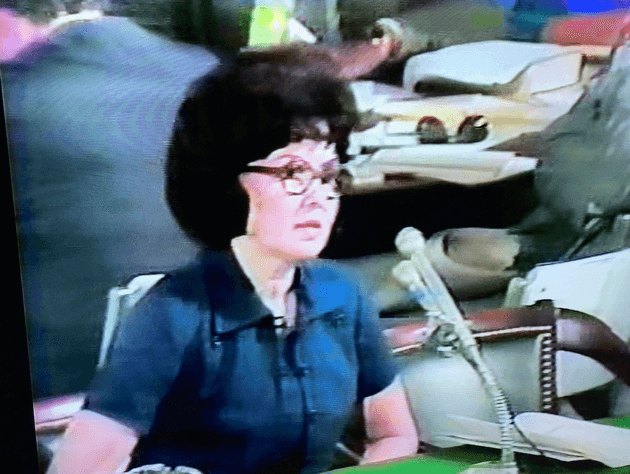
    This is chapter four of a book I’ve written concerning the 52 witnesses that appeared and gave public testimony before the House Select Committee on Assassinations. Ida Dox gave her very brief testimony, only 11 questions, on September 7, 1978, in the Rayburn House Office Building, though the majority of testimony was given in the Cannon House Office Building.

    I tried to do with Ms. Dox, as I did with all of the witnesses, and that was lift out the salient points and update the evidence when necessary.

    The name of my book is Hidden In Plain Sight. It is an attempt to demonstrate that a large amount of evidence was obvious early in the investigation of the case. In other words, it was there all the time, but we didn’t see it, sometimes because we weren’t looking for it.
    Ultimately, it is a guide that will tour you through the labyrinth of testimony and evidence of the case in 1978 and then updated as the years have gone by.

    Chief Counsel Robert Blakey told me in an interview in the late 90’s that these witnesses were a way for the HSCA to present their evidence to the American public.

    Ida Dox, September 7, 1978

    On September 7, 1978, 9:09 a.m. session, EDT—Room 2172, Rayburn House Office Building, Washington, D.C., the House Select Committee on Assassinations took testimony from Ms. Ida Dox.

    Ida Dox was born on July 8, 1927 in Honduras, Central America and came to the United States in 1947. She received her Bachelor of Fine Arts from Newcomb College of Tulane University in New Orleans in 1950. She obtained her Master of Science degree from Johns Hopkins University in 1954 and her Doctorate of Philosophy from the University Maryland in 1990.

    She was a medical illustrator at Georgetown University Medical Center in Washington D.C. from1954–1969. She was chosen to be the medical illustrator for the Select Commission on Assassinations of John F. Kennedy and Martin Luther King, Junior of the United States House of Representatives in Washington D.C. from 1978–1979. She has been a medical illustrator and author, in Bethesda, Maryland, since 1969.

    At the time of the public hearings, she was a medical illustrator for the Department of Medical-Dental Communication at the Georgetown University Schools of Medicine and Dentistry. She was also an author of many textbooks on illustrated medical dictionaries, one of which I purchased off of Amazon.

    She died on October 18, 2013, at the age of 86. Dox was her maiden name, but her married name was Ida Melloni, as she married John Melloni in 1954.

    The HarperCollin’s Illustrated Medical Dictionary

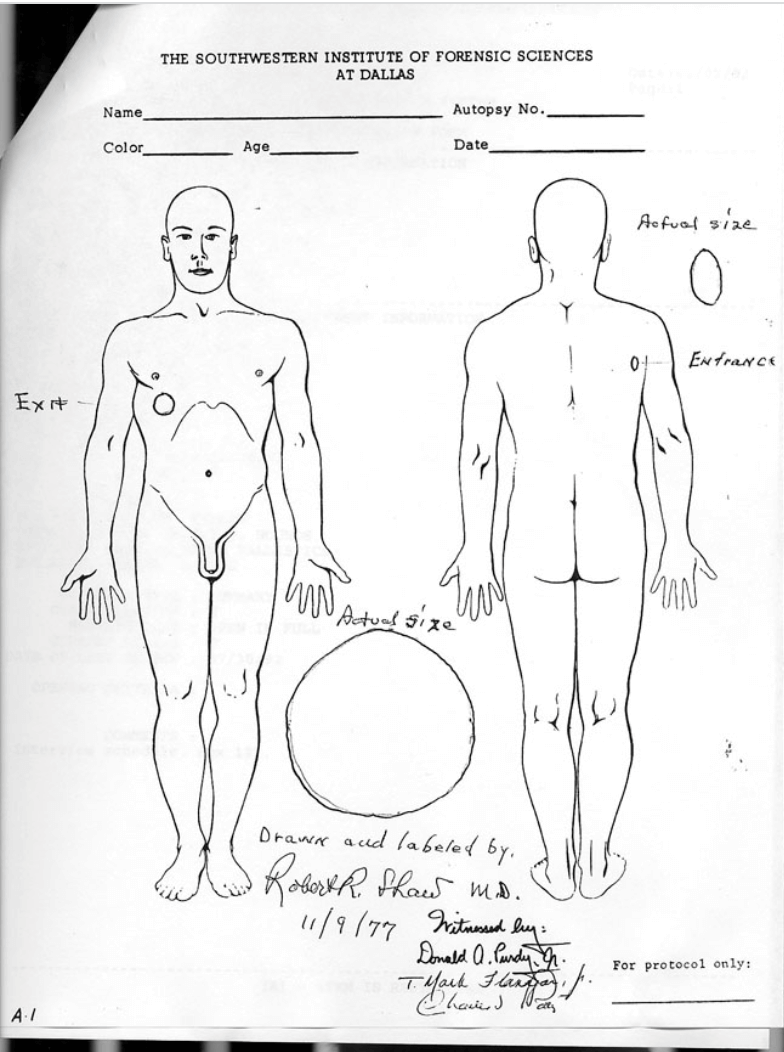
    The House Committee on Assassinations contacted the Georgetown Medical School, which in turn recommended Ida Dox as a medical illustrator. She appeared before the Committee to testify in public session. She had been working with the medical panel for some time and was asked to explain her role, working with the autopsy photographs and x-rays, which would demonstrate the location and severity of the bullet wounds.

    Before her appearance, Robert Blakey read a list of rumors that had circulated regarding the location and nature of those wounds, specifically to JFK. Amazingly, what he stated was a lot closer to reality than the Humes, Boswell, and Finck autopsy findings.

    Blakey then commented on past presidential assassinations, as they related to the specific autopsies. He marginalized the credibility of the Parkland doctors by comparing the comments of Dr. McClelland, “a massive head and brain injury from a gunshot wound of the left temple,” (an obvious misspeak and red herring by Blakey, when he understandably meant right temple) to the wholly different description of neuro-surgeon Kemp Clark, who “observed a large gaping hole in the rear of the President’s head.” Blakey further weakened the import of their testimony by stating that they only worked on the President for a short time and they were trying to save him, which was not a possibility either way.” (I HSCA 142)

    If Ida Dox was to malign the rumor department, it would have been binding upon her to testify that she enhanced the wounds in the drawings that she made, especially Fox-3. More about that in due course.

    Andrew Purdy, who handled much of the medical aspect of the questioning, was called upon to question Ms. Dox. He began by asking her to expand on how it was determined what to illustrate for the Select Committee. A seemingly fair question. She said, “the committee, the medical panel, and myself…decided that the photographs taken at autopsy should be copied to illustrate the position of the wounds. The photographs that were selected were the ones that best showed the injuries.” (I HSCA 146) Why would a medical illustrator be involved in that decision-making process? She’s an artist, not a doctor. She sketches and traces; she does not slice and cut.

    “The photographs taken at autopsy should be copied to illustrate the position of the wounds.” (I HSCA 146) Wouldn’t the photographs illustrate that? This seems to be a wasted step. This has the appearance of an imitation of the Warren Commission, where Commander Humes told medical illustrator Harold Rydberg lies, but Rydberg followed orders, which he argued both strenuously and vociferously against years later. Dox would never argue in that same vein, unfortunately.

    The Warren Commission’s excuse was that to introduce the photos into evidence would mean publishing them; did the House Select Committee on Assassinations believe that by using drawings that they could keep the nature of the injuries from becoming public? The Dox drawings are some of the least graphic of the autopsy photos that we know about, but even still, they don’t hide what little graphic nature there is in those prints. The Warren Commission could get away with it, because nobody was going to see the photographs and that was a censuring that remained in place years later, when the HSCA chose drawings, identical to a couple of the autopsy photos, instead of the photos, for their study. Nothing had changed fourteen years after the Warren Commission, as neither the Commission nor the House Committee on Assassinations, and much to their shame, put the autopsy photographs into evidence.

    In her testimony of how she made the illustrations, at no time did she give any indication that the results used by the committee were in any way different from the actual photographs themselves. I am sure at some point, someone told Ida Dox exactly what to do with the red spot on Fox-3, the back of the head autopsy photograph. In fact, some of the records obtained from the National Archives do everything, except come right out and say just that. Does this make Ida culpable? Probably. I am sure she was just doing what she was told and may have been told it would illustrate what the medical panel was trying to explain. She is less culpable than Baden, to be sure.

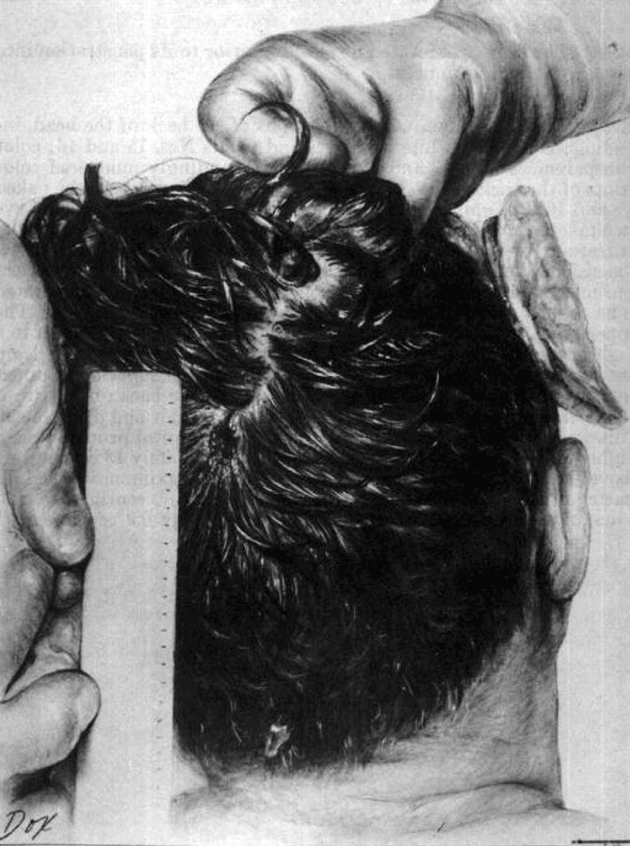
    They would never publish the photos and the drawings by Ms. Dox in the same volumes, as it would easily demonstrate the differences between the two. The differences would have been recognized immediately, particularly with reference to the wound in the cowlick, not discernable in the photograph, but manifestly obvious in the drawing.

    Mr. Purdy: Ms. Dox, prior to today, did you have the opportunity to review the enlargements of your drawings to ensure that they are accurate?

    Ms. Dox: Yes, I did. I looked at them very, very carefully and they are my drawings except that they are photographically enhanced. [my emphasis] (I HSCA 148)

    The witness was asked if the drawings are accurate? Her answer was that she compared them to make sure that they were, in fact, her drawings and they had not been rehabilitated in any way. She had to know this wasn’t true, as the documents I received from the National Archives indicate in this chapter.

    In two investigations into the murder of the President of the United States, when it comes to medical evidence, the most crucial evidence of all, the deception seems to explode all over the place.

    This is a sleight of hand worthy of the Warren Commission, suggesting that the House Select Committee at least had a tutorial in coverups; they agreed for the sake of the Kennedy family’s privacy not to use the actual photos, but to use identical sketches made by a medical illustrator.

    I am not sure how that would have put anyone at ease in the Kennedy family. The President’s image was displayed, in death, and on television. Whether it was a photograph or a true rendering by a medical illustrator, it is truly much ado about nothing. The American public had already seen the graphicness of the Zapruder film on national television in March of 1975.

    But make no mistake, the autopsy photo that Dox copied of the back of the head and the resulting sketch she made are ages apart. Ida Dox deceptively depicted the rear head entrance wound, exposed as such when the inquiring public was finally allowed to see the actual wounds fifteen years after the event. Who knows what she was thinking, as she did what Dr. Baden told her.

    The decision not to use the original photographs was probably made by the Committee members. An arrangement was reached that they would publish the drawings, but only those deemed essential. The Dox drawing of the head wound was withheld from publication and it was not in the hundreds of pages of her file I received from the National Archives.

    She also responded to Purdy’s question by stating that “the photographs that were selected were the ones that best showed the injuries.” (I HSCA 146) Ms. Dox said she copied four photographs: the back of the head (Fox-3), the upper back (Fox-5), the side of the head (Fox-4) [not shown during public testimony], and the front of the neck (Fox-1 & 2). Key photos were clearly withheld, some say on grounds of taste. They were examined by the forensics panel and other experts, but not displayed or published. The top of the head photo (Fox-6 & 7) was not chosen. As stated, the side of the head photo drawn by Ms. Dox was not shown during public testimony either. She was asked to draw the head wound photo, but when they saw it, they decided not to publish it. I am not sure what they thought they would see before they looked at it, as they had seen the autopsy photograph on which it was based.

    The back of the head photo (Fox-3) was shown during the public testimony of Ms. Dox. The only problem is that the alleged entrance wound in the cowlick area is much more visible in her drawing, than on the original Fox-3 photograph. Conversely, her drawing of the back wound (Fox-5) omits the possibility of an entrance wound that has been alleged by some critics and his back was cleaned up quite a bit. Whether there are other possibilities concerning Fox-5, it should have at least been drawn. It also places the back wound much too high. The autopsy face sheet, as did his suit coat and shirt, as did Dr. Humes, places the back wound in the upper right posterior thorax at about the level of the third thoracic vertebra, which would be approximately five and three-eighths inches below the top of the collar. The Dox wound appears much too high.

    When Mr. Purdy asks how she copied the photographs, Ms. Dox stated that she did it by “placing a piece of tracing paper directly on the photograph, then all the details were very carefully traced…so that no detail could be overlooked or omitted or altered in any way.” (I HSCA 147) As noted, the upper entry head wound was altered. Period. Perjury, most likely, but I really believe it is more of being afraid to disagree with Dr. Baden, when he had told her what he wanted. Hard to tell. Things were omitted, especially on the back wound (Fox-5), where obvious detail is missing, and also on the back of the head wound (Fox-3), where the alleged cowlick area wound is much clearer and pronounced in her drawings than in the autopsy photographs themselves, as I stated earlier. Isn’t this really much ado about nothing? Couldn’t all of this have been avoided knowing that the drawings are no substitute for the photos? The original photos should have been available to researchers at least as soon as the Warren Commission closed up shop, but legally they haven’t been released to this day.

    Purdy goes on to say that Ms. Dox made other drawings to illustrate the conclusions of the forensic pathology panel. We are not exactly sure what these other drawings are, only to assume they are in the Committee’s files. The release of the Assassination Records Review Board medical materials did not tell us any more on this subject. I don’t recall this issue even being addressed. The truth is, in relationship to Ms. Dox, the ARRB made no difference at all. I’m frankly amazed that nobody at the ARRB asked the obvious question: Why are the Dox drawings and the photographs from which they are exactly made, so different? Sadly, Ms. Dox was not questioned by the ARRB and she could have been, since she didn’t pass away until 2013, but this was never addressed.

    In her next to the last question, Ms. Dox says that a frame of “film taken during the motorcade was photographed and the outline of the President’s head was used, so that the…head of the President…in the position that the medical panel decided was necessary.” (I HSCA 147-148) They were probably doing what they thought was adequate, but left themselves open to immense criticism, just as the Warren Commission did.

    Ms. Dox worked for the Committee, under the direction of Professor Blakey. In that capacity, she was assigned to assist the Committee by preparing drawings from the autopsy photos for possible publication. She was working under Blakey’s direction and Dr. Baden, or perhaps Andrew Purdy’s, since he guided most of the medical aspects of the case. Ultimately, Dr. Baden made the call on what Ms. Dox drew and, in some cases, how to draw it. As you listen and read the testimony of Ida Dox, you can only reflect about what should have been asked.
    I contacted Ms. Dox in October of 1999. I had two conversations with her on the telephone. It all started with a question I had regarding HSCA Exhibit F-302, which was a drawing of President Kennedy’s brain, that was put into evidence during the testimony of Dr. Humes. What followed was both puzzling and frustrating. I will go into detail about what Ms. Dox said about that sketching of JFK’s brain, parts of her testimony that she now denies ever saying, enhancement of the wounds that she drew for the Committee (which has to do with some correspondence between her and Dr. Baden that I requested and received from The National Archives and publish in this chapter), and other sundry matters.

    I prepared for my conversations with Ms. Dox by reading documents I received from the National Archives concerning her. There was a sense of discovery, but more so of clarification. I’m not one who looks for a demon under every shingle, nor is it my purpose to attempt to discredit someone who appears on the surface to be a nice lady who was just following orders and instructions. There were some things that did seem a bit odd and other things that I still don’t understand as I write this. The following information is based on those two telephone conversations I had with Ms. Dox.

    In the first conversation I had with here on October 14, 1999, I asked her the following questions:

    Question #1: How many photographs were you shown?

    When I asked Mrs. Dox this question on the phone, she quickly replied, “I can’t remember.” This is intriguing. If she had been shown 75 photos, okay, she can’t recall, but she testified before the HSCA that it was four, at least that is how many she drew. She doesn’t seem to be guessing before the HSCA during her public testimony. I don’t care how many zillion wounds she has illustrated, as one of the first humans on the planet to see those autopsy photos of JFK, you would think she could remember the number. Maybe not perfectly, but certainly not, “I don’t remember.” Even an estimate would have been nice.

    Question #2: Were you ever shown a photograph of the brain?

    She emphatically stated, “No!” This first surfaced for me when I noticed HSCA exhibit F-302 in David Lifton’s book, Best Evidence. During Dr. Humes’ testimony, exhibit F-302 is introduced, with no data whatsoever. It is said, then, to be a drawing of the brain. There are two kinds of representations in Lifton’s book. In the cases of the actual line drawings, they are represented in full, the throat wound, cropped so as not to show the face. The brain drawing, however, is in mid-text, so that may be why it is different from the others. It also has no signature on it. The other Dox drawings are reproduced in full and have a signature in the lower corner. It may have been a simple matter of a tracing of a tracing, or some sort, so it could be reproduced in text, without going to the photo section, which is different paper.

    The only available rendering of the brain, however, absent the photographs, is the drawing/tracing created by Ida Dox and I have already noted my criticisms of her efforts. In her brain illustration, the left cerebral hemisphere is intact, while the right cerebral hemisphere resembles a swirling pattern.

    The two lobes of the cerebellum are intact and unremarkable. That flies in the face of the doctors from Parkland, who testified to seeing cerebellum extruding from the large wound in the back of the head and here we are presented with no cerebellum damage and no large wound in the back of the head.

    Question #3: Were the wounds enhanced for the sake of clarity?

    Her response, “No, of course not.” This is interesting. At Wecht 2003, I asked Dr. Baden about this and was told that Dox was given other gunshot wounds to draw in order to enhance the visibility. You have to look for something even resembling a wound in the Fox-3 photograph. It looks more like a blood droplet, but not a bullet wound.

    He told me that Dox had been given other photos (see later in the text for the documents), of other individuals with wounds, in order that she would be able to highlight JFK’s wound, so people wouldn’t miss where the actual head wound was. Other researchers have talked with Dr. Baden about this and received similar responses.

    What follows after this paragraph is a copy of the Dox drawing of Fox-3 and the actual Fox-3 autopsy photo and then a few pages of documents I received from the National Archives, both of which were sent to Ida Dox by the HSCA, including “you can do much better, Ida,” from Michael Baden. How can you do “much better” than the autopsy photos you are directly looking at and tracing. Or, is “much better” referring to placing a bullet wound where there isn’t one in the cowlick area? Ida Dox lied to me on the phone, when she said she wasn’t given any pictures to use to enhance what wasn’t there. Here are some of the documents I got from the Archives, after I requested every document they had concerning Ida Dox. Unlike the Ida Dox drawing, the actual wound is not visible in Fox-3 and no other photographs show it either.

    Dox drawing of Fox-3
    Fox-3
    Ida—“You can do much better”—Michael Baden
    Bullet wound to the head from the pathology book written by Baden, et. al.

    The Forensic Pathology Panel of the House Select Committee was so thoroughly caught up in their findings, that the upper artifact, the red spot, and what they said was the actual entry wound, that they failed to realize how badly they had been duped.

    This is critical to the ongoing investigation and needs to be considered again. Originally, the HSCA worked from medical illustrations, done by medical illustrator Ida Dox. Unfortunately, Ms. Dox, who was allowed to commit perjury before the House Select Committee, altered the wound that some have identified as simply a red spot or droplet.

    Fox-3 (Color)
    Fox-3 Comparison with Dox Drawing
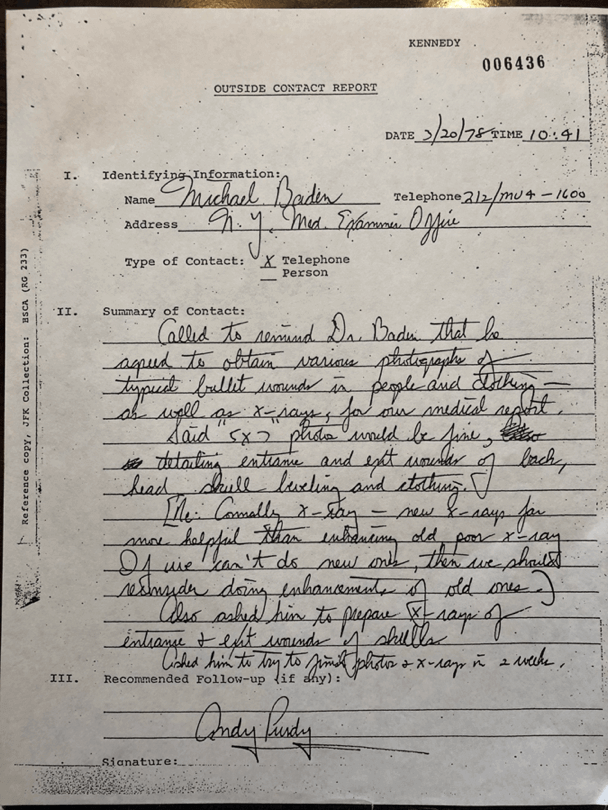
    Purdy Asking for Photos of Typical Bullet Wounds
    (Keep in mind, this is in the Dox materials sent to me from the National Archives)
    Flanagan to Baden, Asking for Photos of Typical In-Shoot Wounds

    Any assessment of the photographs show nothing even slightly comparable to what Dox drew. I often show the autopsy photos to friends or at talks I give at local libraries and they always produce the same shocked reaction. I show them the Fox photo of the back of the head and ask, “Do you see the entrance wound?”

    Nobody can ever see the entry. Then I show them the Dox drawing of the back of the head and ask if the wound is visible and unanimously and they say it is. Then I put them side-by-side and there is usually some kind of verbal gasp, as if they were watching the Zapruder film for the first time.

    Now they can see up close and personal that something sinister was going on with the medical evidence. The alteration becomes obvious.

    Ida Dox was given the autopsy photographs and requested to make sketches for the HSCA, a procedure that, in itself, calls into question the sanity of the people doing it, as a drawing of gore is almost as unpleasant as a photo of gore.

    The reader is invited, even strongly urged, to view the photographs in question and then view the same cowlick area in the Dox (Fox-3) drawings. You will be surprised, if you have never done this before.

    What is cited as an artifact and is not by any means proof of an entry wound in the photograph, becomes a glaring bullet hole thanks to Ida Dox, who was given additional photos as stated, showing bullet wounds of other people and not of John Kennedy, so that she could highlight and forge the JFK sketches. There is no doubt in my mind that the reason for moving the back of the head wound four inches higher is to explain the massive wound in JFK’s right temporal area of his skull. If you move the wound, then you have a perfect inshoot-outshoot scenario. If not, you have to explain how a bullet traveling downward from sixty feet in the air and behind can emerge on the upper right side of Kennedy’s temporal bone.

    The explanation I can assert is what I have already said in chapter one concerning Governor Connally, that a second head shot at c. Z-327, 7/10ths of a second after Z-313, explains this precisely and, if so, then there was no need to invent a head wound in the cowlick area, as Z-327 explains it perfectly. What is disheartening is that chapter one on Governor Connelly documents that the HSCA was suggesting a shot c. Z-327, but then the Committee wasn’t (as it was a Select, not a Standing committee) renewed and the data became inactive.

    That alone brings into question the honesty of the entire HSCA investigation and the charge against Dox is not a pointless one. The question then becomes two-fold:

    1. Why, (excepting the necessity to maintain the lone-assassin fiction) was the wound altered in order to make it obvious to any John Q citizen viewing the Dox drawing, when trained pathologists could not and did not identify it from the photograph which Dox claimed she copied exactly?
    2. Whose decision was it to alter the wound and whose decision was it not to make the obvious comparison between the actual photo and the altered drawing during the HSCA hearings? Baden seems to be candidate number 1.

    A little background on Baden and the Clark Panel is probably appropriate at this point. In the late 1960’s, the public was screaming for a reinvestigation. David Slawson at the Department of Justice wrote a memo to Ramsey Clark explaining that if they don’t do something the conspiracy fringe will get Congress to reopen the whole thing. It also is happening at the same time as the Garrison investigation, which scared the intelligence community, so they needed to calm the storms in Louisiana. Slawson suggests an investigation limited to the medical evidence and so the Clark panel is born. The Clark Panel relocates all the wounds, four inches higher on the head and four inches lower on the back. Why? If left where they were in the autopsy report, then Oswald didn’t do it. The plan succeeds and the public is quieted. Meanwhile, the prominent pathologists, having been thrown together to make up the Clark Panel, decide together to write a book on pathology. Ramsey Clark writes its forward. A young, inexperienced pathologist named Michael Baden is asked to contribute to the book. It’s not much, but associating his name with theirs launches his career.

    Ten years later, Baden is asked to head the HSCA’s medical panel. He insists he not serve on it alone, so that there is no question of impropriety, so he fills it up with friends, save a lone critic named Dr. Cyril Wecht. Before they would ever meet, Baden went in to examine the autopsy materials. He then sat down and wrote a memo which echoes every point made in the Clark Panel report. He moved the wounds and to the exact same points they had chosen.

    At the first meeting of the medical panel (Baden is the only panelist to have seen the materials at this point, though Wecht had gotten permission to see them in the early seventies), he presents them with his findings and calls for a vote to see if another meeting of the panel is necessary. Wecht says yes. The record does not reflect how the others voted, but plans for the other panelists to see the materials were not initiated for several weeks.

    This brings us back to Dox and Baden. Dox is permitted to see the photos and to make a set of drawings, which she denied to me on the telephone (though this is exactly what she stated in her public testimony in September of 1978). She then leaves them for Baden to approve. Baden sees the drawings and calls Purdy, who writes a memo to himself that says, “get a photo of a typical wound of entry.” (In another memo dated 4/24/78, Purdy states that he needs to remind Baden to get wound comparison photos and X-rays.) The next document in the record is a photocopy of a page out of the pathology book Baden and the Clark Panelists wrote. At the top of the photo of a tiny bullet wound to the head, Baden wrote, “Ida you can do much better.” Again, and as I stated earlier, I am not sure how you outdo the original autopsy photos. So better, in what sense? Location? The wound itself? Quite baffling, if not disturbing.

    On October 28, 1999, I called Ida Dox for the second time. She hung up on me at the end our first conversation. This time the conversation lasted a bit longer and was much more detailed. The following questions were asked Ida Dox at this time:

    Question #1: Did you see color or black and white photographs?

    She quickly said, “Color.” The color photos certainly show the wounds better, but still not as good as the Dox tracing. You would also think that black and white would be better to trace from. The fact that a lay observer can tell in a second that the tracings are accurate, except for the wounds, should raise questions immediately. The aforementioned data, along with the Baden and Purdy memos speak volumes to this point.

    Question #2: I asked her again about how many photographs she saw?

    This time she got defensive. I simply reminded her that my previous notes stated that she could not recall, but that she had stated in her testimony that she had drawn four. I was seeking clarification and thought, perhaps, there was a possibility she had been shown others. I was very polite and was genuinely not trying to trick her or confront her in any way. She was silent and so I proceeded.

    Question #3: I asked her if security was tight while viewing the autopsy photographs in the National Archives?

    She indicated that security was very tight. I was reminded that RFK was in a panic that such stuff would go public. It was difficult enough that the Dox drawings went public, but something had to. Her public testimony suggests she had worked from some kind of originals while being watched at the Archives. This led me to the next obvious question.

    Question #4: Did she have a set of autopsy photographs made, so as not to take up the Archives’ employees’ time?

    At this point she got very defensive, especially when I read her public testimony where she says this is exactly what had transpired. I was lucky the conversation went any further at all, as she was not happy. I was not accusing her of anything, still only seeking clarification. Her testimony, again, indicates she was given knock off copies to use outside the Archives, as she added detail like Humes’ gloves, so as not to keep the Archives busy.

    Question #5: I then asked her again if she had drawn F-302, which is JFK’s brain?

    She simply said, “I can’t remember.” I don’t care if it has been twenty years plus, you can’t tell me that you wouldn’t remember drawing a picture of the brain, which just happens to be of the President of the United States! The absurdity of this is beyond belief. Exhibit F-302 does come up during Dr. Baden’s testimony. He uses the drawing of the brain, which he says that Ida Dox drew, to show the intact nature of the cerebellum, thus attempting to prove that Dr. Humes et. al. could not possibly be correct in locating the entrance wound to the rear of JFK’s head in the area of the external occipital protuberance. It wasn’t until Dr. Humes’ testimony that F-302 was formally entered into evidence.

    During the session at the end of each testimony, when everyone is given five minutes to ask questions if they want to, Mr. Fithian asks about the possibility of metal fragments being in the brain. In Baden’s testimony, he displayed F-302 and says that in the right, front area side of the brain there was an oblong, blue discoloration, but that it was not a metal object. He stated that the Forensic Pathology Panel determined that it was blood vessels that had been sheered away. Baden went on to explain that there were many pictures taken of the brain and that some had toothpicks in the damaged part for identification purposes by the doctors at the autopsy.

    It still, however, doesn’t explain why Ms. Dox told me that she never saw any photographs of JFK’s brain, let alone drew them for the committee. Dr. Baden said there were several pictures of the brain and that Ms. Dox drew from them for the committee to illustrate for the Forensic Pathology Panel, that the cerebellum was not injured because of the rear entrance head shot to President Kennedy (I HSCA 304).

    Question #6: Did the photographs of JFK’s neck wound show the face as well?

    She told me that the pictures did show his face and that there had been some talk of blurring the face. The tracings, however, do not show the face of the President. That was all she addressed with this question.

    Question #7: I again asked her if she was shown other photographs of wounds in order to enhance the ones on her tracings/drawings?

    She got very defensive and refused to talk any further. In fact, she said, “I don’t think I want to talk about this any further.” I again tried to assure her that I was not attempting to confront her, only clarify what I had discovered from other researchers and documents from the National Archives. This didn’t seem to quell her anger, but she suggested I contact Professor Blakey, which I did. The data from the first conversation has already dealt with this question in full, but nonetheless, I thought I would give her another chance to verify what I had documentation for from the National Archives. I still refuse to believe you would forget doing something like this, especially in reference to the President of the United States. I don’t care how much time has passed, certain events in our lives are indelibly engrained in our psyche. This event would have to at least be up for a possible nomination.

    Question #8: I asked if there were any other medical illustrators besides her?

    She told me that she was the only one. In fact, she also worked for the Committee on the tracings/drawings concerning Dr. Martin Luther King, Jr. She received $16,000, not counting $125 per day, plus expenses for services rendered. This also included appearing as an expert during the public hearings. She was not required to write any reports, only that her medical illustrations would appear in the Committee’s final report. She spent 125 and one-half days consulting and providing services. The final tally, financially speaking, would be: $31,625, plus expenses. That’s not bad money for 125 days’ worth of work, especially in 1978.

    Question #9: I asked her how long it took to make the illustrations?

    She was kind enough to explain that it took a long time, months as far as the entire process, and that it is very tedious work.

    There were some things that were missed in her public testimony, that was gone over with her in her practice questions beforehand, which I still have copies from the National Archives. She was supposed to mention that she was to duplicate the autopsy photographs which show the key wound areas, reconstructions of wound areas with internal structures, and illustrate what happens to soft tissue and bones when they are struck by bullets. Most of these can be seen in Volume I of the HSCA Hearings when Dr. Baden is testifying.

    She also stated in her practice questions that blood on the skin and blood on the gloved hands were removed, as well as background details. She stated in her public testimony that she worked very closely with the medical panel, especially Dr. Michael Baden. Based on the previously mentioned discoveries from the Archives, her statement was only the tip of the iceberg.

    All in all, I found Ida Dox to be somewhat reticent to talk about the issues that I brought up to her. She was kind and cordial, but obviously on edge during the two conversations. I was never aggressive or combative, only attempting to clarify what I had discovered. I was told by one researcher, in reference to my questioning her about whether she drew the brain, that it is hard to believe that something called the Dox drawing and entered into evidence (or at least referred to constantly) during the hearings, that were nationally televised, could now be credibly disclaimed as not being her work. He told me to think about what I was suggesting here. I never suggested she didn’t draw F-302 (the brain), only wondered why she didn’t sign off on it, when she did on every other illustration. I also was puzzled as to why she would deny something like this; I wasn’t implying something sinister.

    I was also told that I was probably running into a simple failure of memory, after two decades. I was cautioned not to go down this path and get involved in a hypothesis alleging major forgery of evidence, when all I had was a simple error of memory.

    I really did appreciate the words of caution and took them seriously. I generally respect my colleagues in this field and take their words thoughtfully. I wasn’t implying forgery of evidence or even questioning whether she had drawn the illustration of F-302, again, only seeking clarification of the data I had before me. It made me question the integrity of Dr. Baden more than that of Ida Dox. She was merely following orders and protocol; the others, well, I’ll leave that up to each individual researcher to decide.

    A Final Comment: The fourteen questions they asked Ms. Dox is nothing but procedural, chain of evidence testimony and makes no statement about that which was under scrutiny, except that it is frightfully dishonest, and certainly Ida Dox had to know it when she was testifying.

    The first question that needed to be asked was, Why were so-called exact drawings or tracings necessary to be used in place of the actual photographs?

    There is absolutely no rational answer to this question. It does not seem like it was done out of respect for the President or the President’s family, because the drawings are just as graphic as the original photographs in some areas.

    Certain background material had been removed from the tracings. In the drawing which shows the circular bone extending from the right-front scalp, the inference from the drawing would be that the photo would have been taken with the President’s body posed, sitting up.

    In actuality, the body was laying on its left side. In the photo, one of the pathologists looms up from Kennedy’s side as the pathologist is standing and Kennedy is on his side on the examining table.

    If there can be one reason attributed to the use of drawings, it was to certify that which the House Select Medical Panel wanted. I have written elsewhere that a number of researchers have noted the difference between the photographs, particularly the back of the head photo, with its absence of any visible wound, and the Dox drawing, which clearly showed an obvious entry wound in the cowlick.

    The difference has to be placed in time perspective. As Dox noted in her testimony, she was under observation all the time while she was working at the National Archives with the originals of the photos. Yet she could have access to copies of those photos, to complete the tracings of the doctors’ hands, or rulers, in HSCA rooms.

    In 1978, those photographs had never been seen by the general public and an individual could only get into the National Archives to view them if they were a medical doctor.

    Thus, the first time the wounds were truly seen in some manner other than the Zapruder film or the absurd Rydberg drawings, contrived for the Warren Commission, were the Dox drawings.

    And therein lies the reason for the drawings. With the Fox photographs in my possession, and other researches too for some time and prints available in quantity, it was clear that the back of the head photo and the back of the head drawing were very different.

    From here, it was now a matter of forcing Commander Humes to change his testimony to reflect that the cowlick entry was the correct site and not the original autopsy finding, located four inches lower. Humes refused to change his findings when testifying before the Medical Panel, but he sold out altogether when he was on television in front of the HSCA itself.

    He moved both wounds—the head and the back—approximately four inches. Disgraceful.

  • Larry Schnapf’s letter to President Joe Biden

    Larry Schnapf’s letter to President Joe Biden


    To the Reader:

    In the following two posted documents, attorney Larry Schnapf explains what happened to the JFK Act under the Trump administration. As he demonstrates in detail, the law was actually rewritten. We can only assume that somehow the CIA and the FBI put the fear of God into the President back in 2017. He not only went along with further postponement, he got the Justice Department to rewrite certain parts of the 1992 JFK Act. As explained by Larry, what the Gannon Memo did was it relieved the president of writing up individual exceptions as to why he was deferring the release of certain documents. Even though this had been the explicit intent of the law as written and passed back in 1992. It also postponed making a final determination from 2017 until 2021.

    What You Can Do:

    Please contact President Biden at the White House and let him know that enough is enough: Let us get everything out about JFK’s murder, whether it’s important or not. No matter what, the law should be obeyed. John F. Kennedy was killed 58 years ago. We are in a new millennium. Here is how you can get your message across:

    How to contact the White House:

    Phone Comments: (202) 456 – 1111

    Snail Mail: The White House, 1600 Pennsylvania Avenue, Washington DC 20500

    E mail: https://www.whitehouse.gov/contact/

    (Click here if your browser is having trouble loading the above.)


  • Exposing the FPCC, Part 2

    Exposing the FPCC, Part 2


    see Part 1

    “Follow the money” is one of the things that the FBI and Warren Commission did not do in trying to understand how such a destitute person like Oswald could run an FPCC chapter, raise a family, and save money for Marina (at least $1600 in today’s money).[1] He was so poor that the White Russians paid for his YMCA fees.

    The FPCC added the following to this drifter’s cost of living: FPCC membership fees, renting of a space, hiring leafleteers, paying a fine for disturbing the peace, the purchase of rubber-stamping equipment, personal displacements, printing of up to five different pieces of literature, correspondence with the FPCC, and use of a Post Office Box…with not one single member to help absorb the costs.

    The following exchange between Oswald’s lawyer and Wesley Liebeler of the Warren Commission suggests something more plausible than Oswald giving away time and money for a passé organization rather than focusing on his growing family—he was paid $25 a day (Note that Oswald’s job at the Texas Schoolbook Depository paid $1.50 per hour):


    Oswald’s slip was showing

    Admitting his remuneration to Dean Andrews and stamping 544 Camp Street on his handouts were not Oswald’s only mistakes that would ultimately blow his cover.

    Shortly after launching the FPCC Chapter in New Orleans, Lee sent out two honorary membership cards to Gus Hall and Benjamin Davis, two senior members of the American Communist Party, even though after his return from Russia he wrote the following in his diary:

    The Communist Party of the United States has betrayed itself! It has turned itself into the traditional lever of a foreign power to overthrow the government of the United States; not in the name of freedom or high ideals, but in servile conformity to the wishes of the Soviet Union and in anticipation of Soviet Russia’s complete domination of the American continent.

    In a letter dated August 1, 1963, postmarked August 4, Oswald wrote to Vincent T. Lee, head of the Fair Play for Cuba Committee in New York,

    In regards to my efforts to start a branch of the Fair Play for Cuba Committee in New Orleans…I rented an office as planned and was promptly closed 3 days later for some obsure [sic] reasons by the renters, they said something about remodeling, ect. [sic] I’m sure you understand after that I worked out of a post office box and by useing [sic] street demonstrations and some circular work have substained [sic] a great deal of interest but no new members. Through the efforts of some cuban-exial [sic] ‘gusanos’ a street demonstration was attacked and we were oficialy [sic] cautioned by the police.

    The problem with this letter was that the incident Oswald seems to be referring to occurred on August 9th, more than a week after he first wrote about it. Was Oswald describing a scenario for the upcoming theatrics on Canal Street over which he would be arrested and arraigned in court?

    When Oswald debated anti-Castro Cuban exile Carlos Bringuer, he was asked how he lived in Russia: “Did you have a government subsidy?” Oswald answered; “Well, I worked in Russia and, I was under the protection of the United States, Uh I was under the Uh that is to say, I was not under the protection of the United States Government. But, I was always considered a United States citizen.”

    It was not just Oswald who blew his own cover. Antonio Veciana, who was David Phillips’s go-to guy in the Cuban exile community for some thirteen years, told Gaeton Fonzi—and later the whole JFK research community—that he had seen Phillips talk to Oswald in Dallas in September 1963.

    Oswald’s participation in the training of anti-Cubans was caught on film according to Robert Tanenbaum, Chief Counsel of the HSCA, during his interview with Jim DiEugenio:

    JD: Was it really as you described in the book, with all the people in that film? Bishop was in the film?

    BT: Oh, yeah. Absolutely! They’re all in the film. They’re all there. But, the fact of the matter is the Committee began to balk at a series of events. The most significant one was when [David Atlee] Phillips came up before the Committee and then had to be recalled because it was clear that he hadn’t told the truth. That had to do with the phony commentary he made about Oswald going to Mexico City on or about October 1st, 1963. (Probe Magazine, Vol. 3 No. 5)

    John Newman shows how Dallas FBI claims that they lost track of Oswald, while he was setting up the FPCC in New Orleans all the way up to August 5, lack credibility, especially given his multiple FBI scrutinized correspondences—all occurring before June 6—with the Post Office, the Communist Party, the Soviet Embassy in Washington, and the FPCC, where his New Orleans address was easy to find.[2]

    Another astute observation by Newman is that before August 5th, Oswald’s FPCC recruitment activities were done quietly, almost undercover. They were likely done that way in order to help Banister and the CRC with their background investigations. As of August 5, when he meets Bringuier up until September 25 when he meets Silvia Odio, Oswald repeatedly acts overtly with anti-Castro Cubans while, at the same time, seeking media attention for his FPCC activities.[3]

    On September 16, 1963, the CIA informed the FBI that it was considering action to counter the activities of the Fair Play for Cuba Committee in foreign countries. In New Orleans, on September 17, 1963, Oswald applied for, and received, a Mexican travel visa.[4]

    Another indicator of Oswald’s informant role is what the FBI did not do: Infiltrate the New Orleans FPCC. The FBI did this with FPCC chapters throughout the country, often with multiple informants. And as we saw with Bill Stuckey, New Orleans was well prepared for an FPCC presence in their city. It would have been very easy to have informants answer Oswald’s leafleting by signing up to spy on him—as they did in Tampa, NY, Detroit, Chicago, L.A., Indiana, and elsewhere. But, for whatever reason, they chose not to.

    There seems to be a logical deduction from all this. Oswald was informing on both pro- and anti-Castro operations in New Orleans. But he was also creating a portfolio similar to other FPCC participants in the past to be able to eventually travel to Cuba by way of the Mexico City-Cubana Airlines route.

    Are we to believe that Oswald just stumbled into these right-wing fanatics, Cuban exiles, and old acquaintances who shared a hatred for Castro?

    The FPCC template of informants and/or potential patsies

    In this author’s article, The Three Failed Plots to Kill JFK eight subjects were profiled who shared similar traits to Oswald as represented in the ensuing chart:


    As we can see:

    • Eight of the nine subjects profiled are connected to cities visited by Kennedy during the six months that preceded his assassination.
    • Each of these cities was a territory exploited criminally by Mafiosi of interest in the assassination.
    • At least three moved to the cities and got employment in strategically located buildings along the motorcade route shortly before the planned presidential visit.
    • Seven were ex-military.
    • Eight of them exhibited behavior that can very plausibly be linked to intelligence gathering or Cuban exile interaction.
    • Seven were directly linked to the FPCC. Seven of them had visited Mexico City
    • Six attempted to visit Cuba, three of them successfully.
    • Seven had links to Cuban/Latino exiles.
    • Six were described as having psychological problems.
    • Seven exhibited anti-Kennedy behavior.
    • None were probed seriously by the Warren Commission.

    Intelligence services, notably the Secret Service, kept crucial information about these subjects, as well as the prior plots, totally secret from the Warren Commission.

    By reading the Failed Plots article, the reader will discover how many of the above characters were being potentially framed through linkage to prior plots attempts and their links to the FPCC and how some used their FPCC allegiance to spy on the organization or as a ruse to enter Cuba.

    Another ruse that became clearer with time was that the associations of many of the potential patsies/informants would have had the impact of tearing down the FPCC once and for all, while placing the blame on Castro and providing Psy-Ops propagandists with a storyline tainting the FPCC operations outside the U.S. borders, as well as organizations like the SWP, the U.S. Communist Party, CORE, and others seen as threats to U.S. security.

    Framing the FPCC – a coordinated effort by the usual suspects[5]

    In the Failed Plots article, we show how the FPCC-tainted Oswald, not only put the final nail in the Fair Play for Cuba Committee, he was used to frame Castro as well. A tactic straight out of the CIA’s ZR/Rifle executive action playbook written up by assassination guru William Harvey. Here were some of the P.R. tactics that were described:

    • Cuban exiles: Immediately after the assassination, Carlos Bringuier and John Martino, as well as Frank Sturgis—also a Watergate burglar—pushed the Castro was behind it story.
    • Castro frame-up stories were very quickly leaked to Hal Hendrix, a JM/WAVE friend, and other CIA media assets.
    • Antonio Veciana, leader of the Cuban exile group Alpha 66, confirmed that David Phillips—whom he had seen talking to Oswald shortly before the assassination—had asked him to bribe a cousin of his in Mexico City to say that Oswald was being paid by Castro agents to assassinate JFK.
    • HSCA investigator Dan Hardway confirmed that almost all of the Mexico City stories that incriminated Oswald and framed Castro were created by assets of Phillips.

    On the night of JFK’s assassination and Oswald’s arrest, Dallas District Attorney Henry Wade erroneously stated during a press conference that Oswald was a member of the Free Cuba Committee. Out of all the many onlookers present, it was nightclub owner and future patsy killer Jack Ruby who corrected the D.A.

    Let us now add a few more frame-up artists and their propaganda contributions:

    Ed Butler (INCA) and Bill Stuckey

    Butler’s role in the post-assassination tale got quite interesting. For as Time magazine noted in its 11/29/63 issue, “Even before Lee Oswald was formally charged with the murder, CBS put on the air an Oswald interview taped by a New Orleans station last August.” That night, according to New Orleans Magazine, Butler and the INCA staff churned out news releases about Oswald in order to offset the “rightist” and “John Bircher” charges flying about. Then, Senator Thomas Dodd, who ran the Senate Internal Security Subcommittee, was called up by Butler.

    The Kennedy-hating Dodd invited his acquaintance Ed Butler to testify before his Senate Subcommittee. Apparently completing Butler’s public relations tour, the tape of the WDSU interview was forwarded by the CIA to Ted Shackley at the Miami station and used in the CIA’s broadcasts into Latin America, furthering the legend about Oswald the communist killing President Kennedy. Declassified files reveal that the label on the box with the tape says, “From DRE to Howard.” Howard signifies either Howard Hunt or George Joannides, whose codename was “Howard.” This means that Bringuier’s group (DRE) probably gave a copy to Howard Hunt who forwarded it to the CIA’s Shackley. The Agency in spite of later denials was still funding the DRE at the time of the assassination.[6]

    Ruth Paine (2 deliveries)

    Ruth was not only the Warren Commission’s busiest witness in making the case for the lone nut scenario, she was a prolific provider of timely evidence against Oswald coming straight out of her garage. One of her go-to guys was Irving Police Captain Frank Barger (FBI informant T-4). Barger also had informants who revealed to him a phone conversation between Michael and Ruth Paine on November 23, 1963, confirming their perceptions of a conspiracy when one said[7]:


    From Ruth Paine’s home came important evidence linking Oswald to the Fair Play for Cuba Committee:


    And then you have these strange FBI notes that are at NARA:

    Page 1
    Page 2

    These have, to my knowledge, never been fully analyzed, so I can only give a personal impression: Ruth seems to have asked Barger to send a Russian cookbook and toys to Marina. In the same breath, there are notes identifying two, if not three, FPCC members in Dallas including two Dalmans who, on Harlandale Street, are a stone’s throw away from an anti-Castro Cuban exile meeting place on that street where Oswald was said to have entered.

    We have long suspected that the Paines kept files on Communist sympathizers. Was this some of the fruit of their labor? Did Oswald help supply the names through his short-term Dallas activities?

    Al Lewis Los Angeles FPCC

    Oswald was not the only FPCC member who was slandered. According to Dick Russell,

    Al Lewis, executive director of the Los Angeles FPCC in 1963 and now a retired psychiatrist, remembered: ‘The FBI called me after Kennedy was assassinated, and apparently wanted to involve me in it some way. They tried to pin a relationship with Oswald on me, because apparently, I’d been in Mexico at the same time he was, on my way to Cuba. Well, that was the first I heard about it. And I never heard of Oswald and the New Orleans Fair Play for Cuba Committee in the movement. That whole thing to me was a setup of some kind by the intelligence services.[8]

    Johnny Rossen Chicago and National FPCC

    Johnny Rossen, who had been the head of the Chicago chapter and later became a National Chairman, was also the victim of wild rumors. An FBI report dated November 28, 1963, summarizes a slander campaign by an informant stating that he was a sex degenerate who slept with a Puerto Rican mistress named Carmen Osiokowski, who knew Oswald, who had sent money to him periodically and who hated Kennedy. His source was the mistress. When she was questioned, she denied everything. Upon re-questioning this informant’s story completely fell apart.

    Tony Perez, an informant in Chicago, qualified as a reliable source by the Chicago FBI. He was an anti-Castro Cuban and had provided dirt on Rossen.[9] In a November 30, 1963, TELETYPE from SAC Chicago to Director and SAC Dallas, the FBI is given the following information: That Johnny Rossen had held a number of late-night meetings in his Chicago Theater with FPCC subjects during the days leading up to the assassination. Some two years earlier, Perez a representative of the Chicago Council for a Democratic Cuba, had debated Rossen at Northwestern University in opposition of his FPCC activities.

    Like Oswald, Rossen was able to taint major organizations as he had always been an active pro-communist agitator having been the secretary of the U.S. Communist Party in St. Louis, where he ran for mayor for the party. Later, he would show Russian films in his Chicago Theater. He was active in the American Peace Crusade and Civil Rights Congress. He also used a number of aliases.

    Robert Beaty Fennell San Francisco FPCC

    On December 21, 1963, another Oswald-like character was arrested by the Secret Service in San Francisco for having on him notes containing threats to assassinate LBJ. Not much is known about Robert Beaty Fennell, but this article[10] reveals that he was said to be a member of the San Francisco FPCC, that he had mental problems, was involved in agitations and that he had received an honorable discharge from the Air Force five years earlier.

    Richard Taber National FPCC

    The framing of Oswald and even the FPCC as a group, were not the only lofty objectives of the anti-Castro forces. They planted the ridiculous story[11] that the inaugural head of the FPCC, while in refuge in Cuba, had actually met a Lieutenant Lee Harvey Oswald in 1961 when he himself had “accompanied Castro during the Bay of Pigs Invasion.”


    Given that Oswald was in Minsk at this time, along with Taber’s vehement denials,[12] we can chalk this one up as another red herring designed to stimulate the invasion of Cuba.

    Bringuier’s last gasp

    Even when it became clear that the U.S. was steering clear of any scenario implying a conspiracy and stratagems to attack Cuba, there was an ultimate Hail Mary thrown by a Cuban Freedom Fighter (most likely Carlos Bringuier) in the form of an open letter to the President in October 1964 which stated:


    Vincent T. Lee and Harrold Wilson National and Tampa FPCC

    Vincent Theodore Lee, actually Army veteran Vincent Tappin, was elected Head of the Tampa Chapter in June 1961. On the Board was treasurer Harrold Wilson, who eventually replaced Lee when Lee took over from Richard Gibson as the national Chapter Chairman in 1962.

    Oswald’s actions in New Orleans parroted Lee’s. Lee was heavily involved in leafleting, media coverage, and direct confrontations with anti-Castro Cubans featuring a near riot in November of 1961 in Marti Park, where Sergio Arcacha Smith led CRC forces against the FPCC. Lee appeared on WBAI radio.

    On December 26, 1962, Vincent T. Lee flew from New York City to Mexico City. From there, on December 28, he flew to Havana via Cubana Airlines where he stayed for nearly one month. Oswald corresponded multiple times with Lee, reporting his FPCC agent provocateur coups. V. T. Lee, while providing him with advice, is the one who connected Oswald with Wilson so as to be better coached for his N.O. mission.

    Other than this, not that much is known about Lee, because as a witness during the Eastland Senate hearings, other than defending the FPCC and confirming his military record, he mostly took the Fifth Amendment. The Warren Commission did very little to go into his background during their typical probe light questioning.[13] Lee also lied his head off by claiming he did not know Oswald. The HSCA never got him in as a witness despite obvious interest.

    The following articles are fascinating because they also associate the FPCC with high-profile murderous activity in the U.S., taint Black Liberation Front activists and suggest that Lee and Wilson are informants.


    Here is the lead-in to the article on the Statue of Liberty bombing plot:

    On 16 February 1965 three Americans and one Canadian were arrested in connection with a plot to destroy three of the United States’ most treasured monuments: the statue of Liberty, Liberty Bell, and Washington Monument. The Americans—Robert Steele Collier, Walter Augustus Bowe, and Khaleel Sultran Sayyed—were part of a small extremist organization known as the Black Liberation Front (BLF). The Canadian, a white woman named Michelle Duclos, was a member of a Quebec separatist party.

    In the article, the reader will discover how some of the perpetrators visited Cuba, met Che Guevara who provided “technical information,” and became involved in yet another major incident that would have favored the blaming of Cuba while tarnishing a “subversive” group.[14] (Click here to read)

    Gilberto Policarpo Lopez

    Another extremely important detail in the first article is that the Tribune claims to have a source that places V. T. Lee in Tampa on November 17, 1963, with Gilberto Policarpo Lopez. The FBI would easily know this based on the important number of informants at every FPCC meeting.

    The HSCA described parts of what it called the Lopez allegation:[15]

    Lopez would have obtained a tourist card in Tampa on November 20, 1963, entered Mexico at Nuevo Laredo on November 23 and flew from Mexico City to Havana on November 27. Further, Lopez was alleged to have attended a meeting of the Tampa Chapter of the FPCC on November 17…CIA files on Lopez reflect that in early December 1963 they received a classified message requesting urgent traces on Lopez…Later the CIA headquarters received another classified message stating that a source stated that “Lopes” had been involved in the Kennedy assassination…had entered Mexico by foot from Laredo on November 13…proceeded by bus to Mexico City where he entered the Cuban embassy…and left for Cuba as the only passenger on flight 465 for Cuba. A CIA file on Lopez was classified as a counterintelligence case…

    An FBI investigation on Lopez through an interview with his cousin and wife as well as document research revealed that…He was pro-Castro and he had once gotten involved in a fistfight over his Castro sympathies.

    The FBI had previously documented that Lopez has actually been in contact with the FPCC and had attended a meeting in Tampa on November 20, 1963. In a March 1964 report, it recounted that at a November 17 meeting…Lopez said he had not been granted permission to return to Cuba, but was awaiting a phone call about his return to his homeland…A Tampa FPCC member was quoted as saying she called a friend in Cuba on December 8, 1963, and was told that he arrived safely. She also said that they (the FPCC) had given Lopez $190 for his return. The FBI confirmed the Mexico trip (Lopez’ wife confirmed that in a letter he sent her from Cuba in November 1963, he had received financial assistance for his trip to Cuba from an organization in Tampa) …information sent to the Warren Commission by the FBI on the Tampa chapter of the FPCC did not contain information on Lopez’ activities…nor apparently on Lopez himself. The Committee concurred with the Senate Select Committee that this omission was egregious, since the circumstances surrounding Lopez’ travel seemed “suspicious.” Moreover, in March 1964 when the WC’s investigation was in its most active stage, there were reports circulating that Lopez had been involved in the assassination…Lopez’ association with the FPCC, however, coupled with the fact that the dates of his travel to Mexico via Texas coincide with the assassination, plus the reports that Lopez’ activities were “suspicious” all amount to troublesome circumstances that the committee was unable to resolve with confidence.

    One can add this from DeBenedictis’ well-sourced thesis:[16]

    A Cuban national by the name of Gilberto Policarpo Lopez, attended the viewing of “Ted Lee in Cuba,” at Mary Quist’s home on November 17. Lopez was staying at the Quist residence, while waiting for a phone call with the “go ahead order” for him to leave the United States and go to Cuba. The day after the film showing, President Kennedy visited Tampa.

    One file showed that there were several teletypes and airtels regarding Lopez and Oswald and the possibility that they may have had contact. The airtel message told of Lopez’s travel to Mexico and later to Cuba. The airtel also told of post-assassination correspondence between FBI offices in Dallas, San Antonio, and Tampa. All intended to identify Lopez. Another part of this file, which was released later than other Tampa FPCC FBI files, told that the San Antonio FBI office was the source of the information in the post-assassination period regarding Lopez crossing the border at Laredo. From the 1964 Warren Commission to the 1976 House Select Committee on Assassinations, the change in time was more of a change in broadening of information rather than in a lessening of secrecy. Neither investigation showed a desire for opening assassination files until well into the Twenty-First Century. Since the FPCC was the subject of dossier compilation since its inception, there was much in the way of information. But in its post-assassination classification period, the secrecy surrounding the FPCC had more to do with the Kennedy assassination, and lack of cooperation from intelligence agencies, than from consideration of sensitive material due to the ongoing Cold War.

    Combining the article information and FBI intelligence, what we have is the FPCC National Chapter’s V.T. Lee possibly meeting, at Tampa FPCC’s Mary Quist’s home on November 17, with FPCC tainted assassination suspect Lopez, who, considering his Texas and Mexico travels, likely would also have been linked to Oswald had the pro-Castro conspiracy scenario not been deep-sixed. This also would have torn down the FPCC worldwide, if not the U.S. Communist Party, and could easily have stimulated the invasion of Cuba, given the direct link between Lee and Castro.

    There is a difference between a series of ads and an ad campaign. Ad campaigns have a coordinated rhythm, where there is a huge bang at the launch, followed by reminder advertising in a timely manner. They also have a central theme (called a USP) such as Castro was behind all of this. This P.R. push certainly has all the earmarks of being coordinated by propaganda specialists. Which brings us to the next two sections.

    George Joannides

    Towards the beginning of the HSCA investigation, much headway was being made in investigating CIA files. Things took a turn for the worse when George Bush senior, CIA Director since 1976, decided to clamp down on the scrutiny. A year later, George Joannides was brought in as a liaison between the CIA and HSCA investigators. The HSCA was lied to when they were told that Joannides was not involved in the areas of interest the HSCA was exploring. Quite the contrary.

    George had been the person in charge of overseeing anti-Castro operations in New Orleans. He was now obstructing the HSCA. Joannides had joined the Central Intelligence Agency in 1951 and later became chief of the Psychological Warfare branch of the CIA’s JM/WAVE station in Miami. In this role he worked closely with the Directorio Revolucionario Estudiantil (DRE), a militant right-wing, anti-Communist, anti-Castro, anti-Kennedy group. This was the group that Oswald was in direct contact and conflict with in New Orleans in August 1963.[17]

    Jefferson Morley is credited for much of what we know about Joannides and the fight for the release of files about him. He adroitly underscored the following about him: “Among his primary responsibilities were guiding, monitoring and financing the Revolutionary Cuban Student Directorate or DRE, one of the largest and most effective anti-Castro groups in the United States. CIA records show, and the group’s former leaders confirm, that Joannides provided them with up $18-25,000 per month, while insisting they submit to CIA discipline. Joannides, in his job evaluation of July 31, 1963, was credited with having established control over the group.” Morley also revealed Joannides travels from JM/WAVE to New Orleans in 1963.

    David Phillips

    In a previous article,[18] I have penned for Kennedys And King, I wrote a section on how this legendary disinformation artist for the CIA was a person of interest in the scenario plans around Lee Harvey Oswald in 1963. By reading it, you will discover how his background, role with Amsanta, motives, track record, omnipresence around Oswald, lies to the HSCA, his being outed by colleague E. Howard Hunt and asset Antonio Veciana all point to something sinister. Readers are encouraged to follow the above hyperlink to review the case against Phillips.

    The remarkable thing about Phillips and this story is that he was associated with both of these groups we have examined. In other words, he was at least partly involved with both sides of this pseudo-conflict and street theater. As we have seen, in Oswald and the CIA, John Newman showed that Phillips had a role in the CIA’s campaign to infiltrate and destabilize the Fair Play for Cuba Committee.[19]

    During his questioning by the HSCA, Howard Hunt was asked about his knowledge of the DRE. He replied that, “Dave Phillips ran that for us.” (Deposition of 11/3/78, p. 77) Phillips was in on the beginnings of the DRE. William Kent, a psy war officer out of JM/WAVE, signed-off on Joannides’ reports in 1963. Kent was very familiar with what the DRE was doing at this time. Later on, to private family members, he was asked about Oswald. He said that Lee Oswald was a useful idiot. When asked about the Kennedy assassination itself, he said, “Its better you don’t know.”[20] Any objective person would have to say that, based on this information, New Orleans was quite important to the Kennedy assassination. HSCA investigator Hardway also revealed in 2013 at Cyril Wecht’s Duquesne Conference that he and Ed Lopez had prepared a bill of indictment for perjury against Phillips specifically keyed around what he had said about Oswald’s alleged activities in Mexico City.

    James Phillips was the brother of David. He was a writer, a CIA pilot, and a member of the Flying Tigers. A former Marine, he later wrote for Leatherneck magazine. He was the father of Shawn Phillips.

    Shawn Phillips

    His recounting (email to Gary Buell) of his uncle David’s last conversation with his father represents one of a number of quasi confessions made by the high-level intelligence officer:

    The “Confession,” you refer to was not in so many words as such. I cannot remember the time frames involved, but this was what was told to me by my father, James Atlee Phillips, who is deceased. He said that David had called him with reference to his (David’s), invitation to a dinner, by a man who was purportedly writing a book on the CIA. At this dinner, was also present a man who was identified only as the “Driver.” David told Jim that he knew the man was there to identify him as Raul Salcedo, whose name you should be familiar with, if your research is accurate in this matter. David then told Jim that he had written a letter to the various media, as a “Preemptive Strike,” against any and all allegations about his involvement in the JFK assassination. Jim knew that David was the head of the “Retired Intelligence Officers of the CIA,” or some such organization, and that he was extremely critical of JFK, and his policies. Jim knew at that point that David was in some way, seriously involved in this matter and he and David argued rather vehemently, resulting in a silent hiatus between them that lasted almost six years according to Jim. Finally, as David was dying of irreversible lung cancer, he called Jim and there was apparently no reconciliation between them, as Jim asked David pointedly, “Were you in Dallas on that day?” David said, “Yes,” and Jim hung the phone up.

    If you add just how intertwined Phillips was with Oswald during the months in and around the assassination, there is simply too much to dismiss all of this as mere happenstance. Where there is still some debate is to what level, if any, Phillips was involved in the planning of the assassination. Where there is very little debate is in his involvement in the messaging and frame-up efforts.

    Summary

    Given Oswald’s adventure in Russia and the state the FPCC was in when Oswald opened a chapter in New Orleans—perhaps the most hostile city for such an endeavor—and at a time when the FPCC was in a downward spiral, the most plausible premise would be that it was also an intelligence operation. When he joined, the FPCC was infested with informants, the FBI and CIA were countering it through their respective COINTELPRO and Amsanta programs, and New Orleans intelligence was fully prepared for the arrival of the FPCC. In fact, Stuckey was on the prowl for the FPCC two years in advance.

    Oswald’s choices in terms of timing, location, networking, recruitment activities, as well as the budget constraints he overcame, along with the lack of infiltration of his chapter, these all point to his being an informant on pro-Castro and anti-Castro goings-on in New Orleans.

    The campaign to position Oswald as Castro-linked was clearly coordinated and performed by intelligence assets. Two persons of extreme interest linked to the operatives and the strategies used were Joannides and Phillips. By 1963, the FPCC appears to have been no more than a tool for intelligence gathering, creating a portfolio to enter Cuba and lying in wait to be a perfect platform on which to hoist a patsy, and through him, implicate Castro.

    If it is confirmed that both V.T. Lee and Harrold Wilson were Intel related, we have yet two more cut-out operatives who add themselves to the above cast of characters (e.g. Dave Ferrie, Ruth Paine, Frank Bartes, and Clay Shaw) who helped build the Oswald myth.

    The plot succeeded in removing JFK, but failed to stimulate an invasion of Cuba. It helped launch a new era of suspicion of government and media that has been exacerbated by other political murders, Vietnam, Watergate, Iran Contra, Weapons of Mass Destruction, and the list goes on! No wonder the U.S. cannot get its people vaccinated! No one can put their trust in faith, it has deserted the country.

    Conclusion

    Oswald’s adventure in Russia has been analyzed by many. Most serious researchers concur that it was an Intel mission and was part of a false defector program. Oswald’s dance with the FPCC is lesser understood, but perhaps even more important, as it brought him right into the realm of the plot.

    There has never been an all-defining write-up of the FPCC within the context of the assassination. This is somewhat normal, because as DeBenedictis noted, FPCC files have been kept under wraps. There should be hidden files on most of the potential patsies, informants, chapter leaders and a lot more… detailed ones. I have tried to make a start with this essay.

    If we understand who gave Oswald his orders, as well as those for the other ex-marine informants and potential patsies, we will understand the propaganda side of the assassination.

    Gaeton Fonzi opened incredible windows into the world of JM/WAVE, which led to an area of research taken up by authorities in this field including Larry Hancock, Bill Simpich, John Newman, and others who have figured out hierarchies, operational activities, and timelines through which these specialists focused on a number of assassination professionals who are leading suspects in the November 22nd ambush. Having recently read Tipping Point by Larry Hancock, we can see that much progress has been made in nailing down the players, the ambush preparations, and logistics around the hit.

    Jim Garrison paved the way for understanding the very important roles those who gravitated around Oswald in 1963 played in setting up the whole Castro did it scenario. The work done by contemporary researchers Joan Mellen, Jim DiEugenio, William Davy, and conclusions by the HSCA have all vindicated the New Orleans DA and shed light on many of the operatives working outside of Miami.

    Understanding organizations like the FPCC, the DRE, ALPHA-66, Operation 40, and persons like Joannides, Phillips, the Rodriguez family, and Sergio Arcacha Smith will help us merge the bodies of research Fonzi and Garrison began and gain a better comprehension of organizational structure and interrelations between the murder and propaganda divisions.

    While conducting the research for this document, I have seen some compelling arguments that many subversive organizations, including the FPCC, were intelligence vehicles from the outset. While I have not yet reached that conclusion, I am all ears.

    Acknowledgements

    I would like to thank Malcolm Blunt, Alan Dale, Bart Kamp, and Jim DiEugenio for their support in providing me with many of the files they have uncovered and archived. I also want to underscore the incredible efforts of the researchers, investigators and authors mentioned in this article plus other sources, who have paved the way to where we are now at…A case that, if I may say so, has been largely solved.

    see Part 3


    [1] Paul Bleau, “Marina’s Sponsor and Oswald’s Fifth Wallet,” Kennedys And King.

    [2] John Newman, Oswald and the CIA, Chapter 16.

    [3] John Newman, Oswald and the CIA, Chapter 17.

    [4] Dan Hardway, “Declaration,” Case 1:03-cv-02545-RJL Document 156-1, Civil Action No. 03-02545 (RJL).

    [5] Paul Bleau, “The Three Failed Plots to Kill JFK,” Kennedys And King.

    [6] James DiEugenio, “Ed Butler: Expert in Propaganda and Psychological Warfare,” Kennedys And King.

    [7] William A. Branigan, “Memorandum for Mr. Sullivan Re: Lee Harvey Oswald,” 105-82555, January 17, 1964.

    [8] Dick Russell, The Man who Knew Too Much, pp. 685–686.

    [9] Herbert Stallings, FBI report, 29/11/1963, File 62-6115.

    [10] Associated Press, “Threat to Kill LBJ is Charged,” December 21, 1963.

    [11] INFORMATION FBI HQ RECORD NUMBER 124-10008-10043 FILE NUMBER AGENCY 105-82555-194.

    [12] FBI report 2/12/64, File NY 105 38431.

    [13] Warren Commission, testimony of Vincent T. Lee.

    [14] The Journal of Counterterrorism, “The Monumental Plot,” Volume 16 -No. 04 2010.

    [15] House Select Committee on Assassinations Final Report.

    [16] Frank S. DeBenedictis, “Cold War comes to Ybor City: Tampa Bay’s chapter of the Fair Play for Cuba Committee,” Florida Atlantic University, December 2002.

    [17] James DiEugenio, Destiny Betrayed, 2nd edition, pp. 159–61.

    [18] Paul Bleau, “Oswald’s Intelligence Connections: How Richard Schweiker clashes with Fake History,” Kennedys And King.

    [19] John Newman, Oswald and the CIA, pp. 240–242.

    [20] Dan Hardway, “An Operation Sketch,” 2014.

  • Exposing the FPCC, Part 1

    Exposing the FPCC, Part 1


    Introduction

    In January 2019, a petition began circulating where, among other startling affirmations, the 2500 signatories, including prominent JFK assassination experts, agreed that, “As the House Select Committee on Assassinations concluded in 1979, President John F. Kennedy was probably killed as the result of a conspiracy. In the four decades since this congressional finding, a massive amount of evidence compiled by journalists, historians and independent researchers confirms this conclusion. This growing body of evidence strongly indicates that the conspiracy to assassinate President Kennedy was organized at high levels of the U.S. power structure, and was implemented by top elements of the U.S. national security apparatus using, among others, figures in the criminal underworld to help carry out the crime and cover-up.”

    The destruction of classified documents pertaining to the JFK assassination and the refusal to release others 58 years after the assassination only strengthens the perceptions of the conspiracy researchers.

    One of the premises that is key to this scenario is that when ex-marine Oswald entered the Soviet Union in 1959 and spent two and a half years there, he did so as a false defector within a program called REDSKIN.1

    Given the above, shouldn’t the most plausible premise for Oswald launching the Fair Play for Cuba Committee chapter in New Orleans, perhaps the most hostile city for such an endeavor at a time when the FPCC was in a downward spiral, be that it was also an intelligence operation?

    Oswald’s strange dance with the FPCC in the months leading up to the assassination is not scrutinized enough––as this quest put Oswald right in the realm of those who would later accuse him of being Kennedy’s killer.

    What do we really know about the Fair Play for Cuba Committee? It lacks scrutiny even though, like his adventure in Russia, the evidence of intelligence is everywhere. However, context and insight about the FPCC is lacking, even though it should have been turned inside out by the WC and the HSCA. But it was not, thanks largely to Allen Dulles, George Joannides and other spies who knew what to hide and were perfectly placed to obstruct real investigations.

    Research into the FPCC will help lay the groundwork for what should have been a leading hypothesis that should have guided the investigations:  that is, that Lee Harvey Oswald was again following orders when he penetrated the FPCC, thereby turning him into an ideal patsy for the assassination of the President.

    The FPCC: A Brief History

    In 1993, author Van Gosse wrote Where the Boys Are: Cuba, Cold War America and the Making of the New Left. It gives one of the more complete accounts of this odd association.

    The FPCC was founded in the spring of 1960 by Robert Taber and Richard Gibson––CBS newsmen who covered Castro’s ascent to power––as well as Alan Sagner, a New Jersey contractor. Its original mission was to correct distortions about the Cuba revolution. It was first supported by writers, philosophers, artists and intellectuals such as Norman Mailer, Truman Capote and Jean-Paul Sartre. It also touched a chord with university students. Some estimates place its African American membership at one third of its roster. In April 1960, Taber and Gibson ran a full-page ad in the New York Times.

    Around Christmas time 1960, it organized a huge tour to Cuba, which led to a travel ban to the country by early 1961. According to Gosse, its high point was after the failed Bay of Pigs invasion. There was no official membership headcount, but organizers claimed the FPCC had between 5 and 7 thousand members and 27 adult chapters, almost all in the Northeast, a few on the West Coast and only one in the Southeast in Tampa.

    When it became clear that the U.S. would not tolerate the revolution, it began dissipating. After a short-lived peace demonstration binge during the missile crisis in 1962, its spiral downwards was accelerated and the FPCC died not long after one of its members allegedly killed JFK.

    The FPCC was characterized as “Castro’s Network in the U.S.A.” by the HUAC. Membership within this anti-U.S. organization was described during hearings as an effective door opener to enter Cuba via the Cuban Embassy in Mexico City and Cubana Airlines. Though the HUAC had been seriously rattled by the McCarthy-era witch hunts, Castro was breathing some new life into this outfit for political showcasing of American patriotism. The FBI may even have bribed an FPCC insider to testify that a launch ad placed by the FPCC was financed by Cuba.

    The Senate Internal Security Subcommittee (also known as the Eastland Committee) questioned Dr. Charles Santos-Buch, a young Cuban physician, who was a self-described FPCC organizer. On January 6, 1961, Santos-Buch told chief prosecutor Julian Sourwine that he and Taber had received the needed money from “eight different people.” The documents reveal that Santos-Buch changed his story on January 9 at a subsequent executive session, and that he was also given a promise that the CIA would help get a number of family members out of Cuba. He changed his story, at least in part because of his desire to extricate his family from Cuba. On January 10, Santos-Buch publicly testified that he and Robert Taber obtained $3,500 from the Cuban government through the son of Cuba’s Foreign Minister Raul Roa. This money, along with $1,100 in funds from FPCC supporters, paid for the full-page FPCC ad in the April 6, 1960, edition of the New York Times. A week later, Jane Roman from James Angleton’s counterintelligence office in the CIA reported that security concerns made it too dangerous for the CIA to keep its promise to Santos-Buch.

    According to one of its national leaders, Barry Sheppard, the Socialist Workers Party (SWP) was very involved with the FPCC: “We came to be part of the leadership of the FPCC partly as the result of a crisis in the organization. The original FPCC leadership was somewhat timid, and shied away from forthright defense of the revolution as it radicalized. In response, Cuban members of the 26th of July Movement living in the U.S. aligned with the SWP and some other militants, and took over the leadership of the Committee.”

    Sheppard’s memoir shows that the SWP was much larger than the FPCC. He describes protest mobilization during the Missile Crisis in 19622 this way:

    We stood up to it. The PC discussed and approved the thrust of a statement to appear in the next issue of The Militant. It ran under the headline, “Stop the Crime Against Cuba!” We alerted SWP branches and YSA (Young Socialists of America) chapters that night to mobilize to support the broadest possible actions against the threat. In New York, there were two major demonstrations. One was called by Women Strike for Peace and other peace groups. We joined some 20,000 protesters at the United Nations on this demonstration. Then the Fair Play for Cuba Committee held its own action, more specifically pro-Cuba in tone, of over 1,000 people, also near the UN.

    The following points concerning the July 1963 SWP convention cast even more suspicion around the timing and motives of the already suspiciously late openings of FPCC chapters in the deep south by Santiago Garriga in Miami and Oswald in New Orleans and the continued involvement with the FPCC by other odd subjects:

    At the convention, a meeting of pro-Cuba activists discussed the situation in the Fair Play for Cuba Committee. Cubans living in the United States who supported the 26th of July Movement had helped us build the FPCC. Now most of them had returned to Cuba. In most areas, the FPCC had dwindled down to supporters of the SWP and YSA. Since we did not want the FPCC to become a sectarian front group, the meeting decided to stop trying to build it. The FPCC then existed for a while as a paper organization, until the assassination of President John Kennedy dealt it a mortal blow.3

    FBI reports confirm that FPCC National Chapter meetings plummeted from 25 meetings a year to 3 in its last year of existence.

    Red Scares, the HUAC and McCarthyism

    The first Red Scare in the U.S. took place in 1919-20 because of the Russian Revolution in 1917 and the fear of this movement spreading to the United States as well as the influx of immigrants that did include a small number of anarchists. In one case, a bomber blew himself up by accident in an attempt to assassinate John Rockefeller and J.P. Morgan. Because of this, the General Intelligence Division (the forerunner of the FBI) was formed and J. Edgar Hoover was chosen to lead it.

    In 1938, The House Committee on Un-American Activities (HCUA) was formed to investigate individuals, groups and organizations considered subversive or disloyal with a special focus on communist-leaning credos.

    The second Red Scare is considered to have begun shortly after World War II in 1947, when President Truman signed an order to screen government employees, and lasted 10 years. Through the propaganda and grandstanding of politicians, working in symbiosis with the press and the FBI, panic and hysteria was omnipresent. The HUAC went into overdrive, with Senator Joe McCarthy as its poster boy and with the Communist-hating Hoover eager to oblige.

    By 1956, after overstepping and ruining hundreds of lives, McCarthy was taken down by lawyer Joseph Nye Welchin his heroic “Have you no decency” retort during the Army-McCarthy hearings.

    This, however, did not stop the anti-communist fervor of the FBI and CIA. They just became even sneakier with no regard for the rule of law.

    COINTELPRO and AMSANTA

    The Church report,4 in its section “USING COVERT ACTION TO DISRUPT AND DISCREDIT DOMESTIC GROUPS,” describes the illegal activities of the FBI that were put in motion between 1956 and 1971 under the acronym COINTELPRO [Counter Intelligence Program], which claimed to have as a motive the protection of National Security.

    The FBI acted as a vigilante by not just breaking the laws but by taking the law into its own hands against both violent and nonviolent targets. Some of the targets were law-abiding citizens who were advocating change, but were labelled as domestic threats unilaterally by the FBI, e.g., Martin Luther King. Others were violent groups such as the Black Panthers and the Klan, where due process was ignored. Once the FBI started down this dangerous path, they not only targeted the kid with the bomb but also the kid with the bumper sticker!

    Organizational targets fell under five umbrella groups: The Communist Party; The SWP; White Hate groups; Black Hate groups; and the New Left. This opened the floodgates to investigate any group that had a potential for violence, including nonviolent groups such as The Southern Christian Leadership Conference, which was labelled as a Black Hate Group, as well as sponsors, civil-right leaders, students, protesters; and the list goes on …

    The FBI used five main methods during COINTELPRO: infiltration; psychological warfare; harassment via the legal system; illegal force; undermining of public opinion.5 

    These actions stepped up in the wake of the Communist takeover in Cuba. Church Committee members exposed the dimensions of the mail opening program, and discovered that the CIA and FBI had placed the names of 1.5 million Americans in the category of “potentially subversive.” Together, both agencies opened about 380,000 letters.6

    Larry Hancock, in Someone Would Have Talked, describes the FBI program called AMSANTA:

    The program was initiated by the FBI as part of its effort targeting the FPCC as a subversive group and involved the CIA in briefing, debriefing and possibly monitoring travel of assets through Mexico City to and from Cuba. The program began in late 1962, had one major success in 1963 and appears to have been abruptly terminated in fall 63.

    According to John Newman (Oswald and the CIA)7, the CIA, led by David Phillips and James McCord (of Watergate fame), began monitoring the FPCC in 1961. In December 1962, the CIA joined with the FBI in the AMSANTA project.  A September 1963 memo divulged an FBI/CIA plan to use FPCC fake materials to embarrass Cuba.

    There are strong indicators that the CIA efforts to penetrate and use the FPCC were local and illegal––such as spying on U.S. citizen/members of the FPCC. As a David Phillips asset stated, it was “At the request of Mr. David Phillips” that, “I spent the evening of January 6 with Court Wood, a student who has recently returned from a three-week stay in Cuba under the sponsorship of the Fair Play for Cuba Committee.”8

    The opening of a Miami FPCC chapter in 1963 by Santiago Garriga is more evidence of illegal domestic espionage on or through the FPCC by the CIA. According to Bill Simpich, author of State Secret, Garriga’s resumé was perfect for patsy recruiter/runners––interaction with Cuban associates in Mexico City; seemingly pro-Castro behavior; and his crowning achievement: like Oswald in 1963, he opened an FPCC chapter in a market deemed very hostile for such an enterprise.

    Garriga is the potential fall guy who is the most clearly linked with intelligence. Like Oswald, he could be portrayed as a double agent by those who packaged him. What makes Garriga so unique are, as Simpich writes, his pseudonym and close links with William Harvey’s (CIA Cuban Affairs) team. To cover this intriguing lead, it is best to cite a few excerpts from State Secret:

    During October 1963 Garriga worked with other pro-Castro Cubans to set up a new chapter of the Fair Play for Cuba Committee in Miami  … Although it appears that Garriga’s ultimate loyalty was with the Castro government, it’s likely that Garriga’s FPCC activity was designed by Anita Potocki (Harvey’s chief aide at the wiretap division known as Staff D) to set up a flytrap for people like Oswald.  Maybe even Garriga himself was considered as a possible fall guy.

    However, in the days before 11/22/63, the FBI ran an operation that investigated the Cuban espionage net that included Garriga and shared the take with the CIA. The CIA referred to this investigation as ZRKNICK. Bill Harvey had worked with ZRKNICK in the past … The memos that identify Garriga were written by Anita Potocki.

    Was there something sinister in this effort to set up FPCC Miami? It certainly looks ominous, given that AMKNOB-1 is the main organizer and that Anita Potocki is one of his handlers. The FPCC leadership recognized that it was dangerous to set up such a chapter in Miami due to the possibility of reprisals by Cuban exiles. For just these reasons, the FPCC leadership had discouraged Oswald from publicly opening an FPCC chapter in the Southern port town of New Orleans.

    The fingerprints of AMSANTA and COINTELPRO were also all over Oswald.

    Targeting the FPCC 

    By the time Oswald opened his Crescent City chapter of the FPCC, it was under the intense scrutiny which had started in 1960, the year of the national launch. An FBI report9 in response to NSAM 43 and 45 to the attorney general, dated April 24, 1961, outlines steps taken by then to counter pro-Castro organizations. It was already a full-court blitz.

    In this document, the FBI makes it clear that the Castro movement is a serious threat to the U.S. The FPCC is underlined as a key target pursuant to Executive Order 10450. The overall coverage of pro-Castro activities in the U.S. is described as having begun in November 1955 when Castro came to the U.S. looking for financial support for the rebel cause, and the 26th of July Movement started up in the U.S. When Castro took power in January 1959, the FBI had files on this organization as well as lists of members it shared with other intelligence agencies and sharply expanded its surveillance operations. Spying on Cuban diplomatic institutions, questioning defectors and the infiltration of pro- and anti-Castro groups with informants, are listed as key Intel tactics.

    By the time the report was written10, the FBI numbers the pending matters at 1000 and information sources at over 300. The FBI had by then identified 140 Castro supporters in the U.S. who constituted a threat to security. “We are maintaining close coverage of the various Cuban establishments as well as pro-Castro groups and their leaders,” which was shared generously with other intelligence groups. The FPCC is described as the most important such group, and received support from Cuba as well as the SWP and CP, according to the report.

    The FBI claimed that Cuban agents were receiving assistance from their surveillance targets and that Cubana Airlines was an important tool for their activities. The FBI was keeping close tabs on pro-Cuba propaganda. Covert informants were given a T symbol,11 preceded by a location identifier such as NY for New York, followed by a number. Also identified were the locations they could report on and the subject matter. Some informants were government employees, post-office workers, intelligence assets on assignment (June Cobb was assigned to spy on Richard Gibson and slander Oswald in Mexico City)12 and freelancers (as we will see later Ruth Paine quite possibly was a provider of FPCC intelligence), etc., who could oversee documentary movement around targets. Others infiltrated FPCC chapters and were present during meetings. These would report on who was present, who said what, and the materials shown and exchanged. License plates of parked cars of meeting attendees were recorded. In some cases, chapter officers were key sources: Thomas Vicente (National), Harry Dean (Detroit), Harrold Wilson (Tampa), John Glenn (Indiana) were all definite or likely snitches for the FBI.

    In April 1963, aided by Thomas Vicente, the FBI broke into FPCC NY offices for a black bag operation.  FBI files indicate that NY alone had over 25 covert informers who were being used along with other sources. Tampa had at least 11 informants carrying the TP-T code.

    The CIA also was all over the FPCC.  Two days after the FPCC ad in the NY Times, William K. Harvey, head of the CIA’s Cuban affairs, told FBI counterintelligence chief Sam Papich: “For your information, this Agency has derogatory information on all individuals listed in the attached advertisement.” Other files confirm that Jane Roman and James Angleton were also monitoring the FPCC.

    Recipients of intel included the Secret Service, the CIA, Customs Bureau, the Immigration and Naturalization Service, the Post Office Department, the Aviation Agency, the Federal Communications Commission, the Department of Health, Education and Welfare, the U.S. Information Agency, the Treasury Department, the U.S. Information Agency, the Bureau of Foreign Commerce. The report also stresses the importance of coordinated efforts with other intel agencies as well as local FBI offices.

    After the failed Bay of Pigs and the Missile Crisis, we can assume that when Oswald, already notorious for his Russian adventure, opened an FPCC chapter in, of all places, New Orleans by the middle of 1963, he was a known quantity.

    Frank S. DeBenedictis on the Tampa FPCC

    In 2002, Frank S. DeBenedictis submitted a thesis13 about the Cold War coming to Ybor City, and the Tampa FPCC, for his Master of Arts at Florida Atlantic University.  DeBenedictis adroitly points out that the reason FPCC files have been very difficult to access is that after the assassination of JFK, these files were categorized as classified JFK assassination files instead of Cold War files.

    The following represents some of the key information/passages from his thesis.  It is based largely on government and intelligence investigations of the FPCC, declassified JFK assassination documents, Van Gosse’s research, newspaper articles as well as FPCC propaganda and correspondence. Almost all of the FPCC chapters were situated in the North of the U.S. or along the West Coast. The reason Tampa was unique in hosting an important FPCC chapter was because it had a large Cuban exile population who were anti-fascist and had fled the brutal Marchado and Batista regimes. In 1955, Castro raised money there for his rebellion and had satellite followers to his 26th of July Movement. Ybor City (part of Tampa) was known for its Latino culture and its cigar industry.

    By 1961, Eisenhower cut all ties with Castro, and the 26th of July Movement ceased activity in the U.S. It was being replaced by the FPCC. As Frank writes, “It was somewhat different from the older pro-Castro groups, since it came about after Castro was already in power. When Cuba formed ties with the Soviet bloc, the FPCC and its defense of Castro increasingly became part of the Cold War. By late 1961 the very active Tampa chapter had established its own newsletter, and drew attention from both Castro supporters outside Florida, and anti-Castro Cuban exiles and a variety of government operatives.”

    The influx of anti-Castro Cuban exiles (including Batista followers as well as other Cubans who were disappointed by Castro’s political and economic systems as well as his strong-arm tactics) took refuge in large numbers in Florida and were ready to counter the FPCC on all fronts––with the support of intelligence forces. Violence among Cubans ensued: riots, intimidation, vandalism directed at FPCC sympathizers were the order of the day. Hosting chapters in the deep south became perilous, with strong anti-Castro sentiment coming from Latinos, business, government, intelligence and Americans from all walks of life.

    “An organization formed in rebellion at this time, against the Castro regime. It called itself the Cuban Front. The group was made up of Cuban exiles and residents, which at this early date of disaffection with Castro, was composed primarily of Batista supporters. Since Cuba and the United States had by early 1961 experienced two years of deteriorating diplomatic relations, the Cuban Front’s strategy was to raise the specter of communism coming to Cuba.” One violent confrontation called the Marti Park Incident featured CRC leader Sergio Arcacha Smith, who entered Oswald’s universe in 1963.

    The Bay of Pigs invasion commenced on April 17, 1961, and FPCC chapters organized protests against the U.S. action. Five days before the invasion, Tampa chapter leader V.T. Lee wrote a letter to the Tampa Tribune deriding both the Tampa daily and the Senate Internal Security Subcommittee, which was investigating the organization. His letter lambasted Senators Thomas Dodd and James 0. Eastland, whose strident anti-communism began accusations that the FPCC was run by a foreign government.

    On April 22, 1961, when FPCC-led public protests against the Bay of Pigs operation became prevalent on a daily basis, the Kennedy administration’s National Security Council passed National Security Action Memo [NSAM] 45. This memo ordered the Attorney General and the Director of Central Intelligence to “examine the possibility of stepping up coverage of Castro activities in the United States.” On April 27, 1961, J. Edgar Hoover issued a general order for FBI agents to report on pro-Castro agitation. Hoover noted that the Fair Play for Cuba Committee’s actions showed the capacity of a national group organization to mobilize its efforts.

    Florida Congressman William C. Cramer testified on April 3, 1963. A primary subject was, in the words of the Senate Committee, “the flow of subversives through the open door of subversion, the Cuban Embassy in Mexico City, by way of Cubana Airlines.’’

    For the Tampa FPCC, in large part this meant that the Florida Legislative Investigative Committee [aka––Florida Johns Committee] became involved in investigating the activities of the pro-Castro group. Its investigation of the pro-Castro 26th of July Movement and Fair Play for Cuba Committee began in 1959 and continued into 1964.

    Local police intelligence unit “red squads” and state investigative committees filled the anti-Communist void in the post-McCarthy era. Florida’s Johns Committee had a counterpart in Louisiana, which was the Louisiana Un-American Activities Committee [LUAC].

    The following passage by DeBenedictis explains the degree of FBI infiltration of an FPCC chapter, and the stunningly high number of informants per FPCC meeting attendee ratio.

    A January 30, 1964, FBI report told of meetings the pro-Castro group had at the Tampa residence of Christine and Manuel Amor. Information about this meeting came from October 13, 1963, reports by FBI Special Agents Charles C. Capehart and Fredrick A. Slight. This data was gathered by taking down automobile license plate numbers registered to individuals in attendance. Eight cars were at the Amor residence. An FBI informant inside reported that a meeting cancellation notice had been sent to members, but several still showed up. Slide presentations and a tape recording of V.T. Lee’s Cuba trip were planned on this October date. Background reports provided data on FPCC members past affiliations with the Communist and Proletarian Parties. Jose Alvarez, who in June 1962 was elected the organization’s financial secretary, was identified by TP T-7 as a Communist Party member in Tampa in 1943. Other members, at late 1963 FPCC meetings, were listed as protestors and supporters of radical causes. Among these causes were opposition to the McCarran Act, and support of Cuba’s right to have Soviet missile stations. In addition, these members had links to the Communist Party in northern cities. FPCC informants were given the cryptonyms TP T-1 through TP T-11. Among them was TP T-2, who was identified as M. Miller, Superintendent of Mails at Ybor City’s post office. The FBI’s mail surveillance program complemented the CIA’s HT/LINGUAL mail opening program. FBI agents relied extensively on informants in the Tampa FPCC.

    The key with Tampa is that it served as a model for Oswald’s agitation activities as well as FPCC countering strategies for many of the people Oswald would network with in New Orleans.

    The FPCC in New Orleans

    At least three city police intelligence units kept files and conducted surveillance on the Tampa FPCC. These included Miami, Tampa, and New Orleans. In addition, the police units also cooperated with each other and with the U.S. Senate Committee investigating the organization.14

    Perhaps the most interesting of the police intelligence correspondence is the one between the Tampa Police Intelligence Unit and its New Orleans counterpart. The NOPD Intelligence Unit collected data about the FPCC from March to September 1961 from newspaper articles. In 1962 this changed when the NOPIU initiated a chain of correspondence with the TPIU. Sgt. J.S. de Ia Llana, supervisor of the TPIU, replying to a December 1962 information request on the Tampa Fair Play for Cuba Committee chapter, informed P. J. Trosclair (NOPIU): “The Tampa Chapter (of the FPCC) is very active in Tampa, these members hold secret meetings and distribute various types of literature. Also, movies are shown. Enclosed are some of the circulars which are distributed. This unit maintains a current file on the local chapter and its members.” The Tampa PD Intelligence Unit enclosed several circulars for its NOPD counterpart, and promised them its full cooperation.15

    Early in 1963, the Tampa PD would write to New Orleans, giving them information about a Dr. James Dombrowski, a left-wing activist in New Orleans, claiming that he was an active FPCC member. The NOPD investigation of the FPCC collected a copy of Tampa Fair Play; a list of 202 travelers to Cuba, which can also be found in FBI files, and Florida Johns Committee files.  Also included are the pre-Kennedy assassination arrest records and post-assassination warnings on Lee Harvey Oswald.  For the NOPD, their late-1962-initiated correspondence to Tampa was odd since New Orleans had no known FPCC chapter in late 1962 and early 1963. Also unusual was the NOPD inquiry to Tampa about FPCC activity in New Orleans!

    Oswald and the FPCC in Dallas

    According to an FBI report, there is evidence that Oswald agitated for the FPCC in Dallas before moving to New Orleans. Dallas confidential informant T-2 advised that Lee H. Oswald of Dallas, Texas, was in contact with the Fair Play for Cuba Committee. According to T-2, Oswald had a placard around his neck reading, “Hands off Cuba Viva Fidel.”

    The following day (April 19), Oswald wrote to the FPCC in New York and said:

    I do not like to ask for something for nothing but I am unemployed. Since I am unemployed, I stood yesterday for the first time in my life. with a placard around my neck. passing out Fair Play for Cuba pamphlets, etc. I only had 15 or so. In 40 minutes they were all gone. I was cursed as well as praised by some. My homemake [sic] placard said: ‘Hands OFF CUBA! V IVA Fidel’ I now ask for 40 or (50) more of the fine, basic pamplets-14. Sincerely, Lee H. Oswald16

    The following lead merits investigation. One of the Cuban exiles who was cursing during the so-called skirmish involving Oswald and Carlos Bringuier was Celso Hernandez, who may have met Oswald before. According to Bill Simpich’s research, the CIA examined Celso Hernandez as a Castro penetration agent.  There is an intriguing report of FPCC member Oswald being arrested with Celso Hernandez in New Orleans in late 1962. The ID of Hernandez was made years later and is admittedly shaky. The ID of Oswald is more substantive, as he identified himself to the police as an FPCC member––but he was living in the Dallas area. The story is that the two men were picked up at the lakefront in Celso’s work truck, owned by an electronics firm that was Celso’s employer.17

    FBI agency file number 97-2229-7 even states that Oswald was the FPCC organizer and chairman in TEXAS!

    FBI agency file number 97-2229-7

    (Note: also explosive in this document is the statement that Oswald was being polygraphed on November 22––sounds like another offshoot, sigh!)

    Oswald’s first attempt at interacting with the FPCC may have been as early as late summer 1962, when the head of the FPCC at the time, Richard Gibson, responded to a request for information from a Lee Bowmont from Fort Worth, Texas. Gibson felt he may have been in a group of three Trotskyites he had met shortly after.18

    And then we have the following mind-boggling correspondence(s)  courtesy of Malcolm Blunt:

    Oswald FPCC envelope return address

    This envelope, with the FPCC return address, as it stands is difficult to analyze because of the unclear postmark and its content has not been revealed as far as I know (which would once again represent obstruction of justice if this were the case).  However, we do know Oswald lived at the above address from about July to October of 1962. This confirms that Oswald/FPCC relations began clearly before 1963. The following May 5, 1961 letter is food for thought:

    May 5, 1961 letter

    It was not only Oswald who was interested in the FPCC before he went to New Orleans; others from the Big Easy were gathering information. Guy Banister was also a member of the Scotch Rite19 which figures on the letterhead. What on earth is this organization doing corresponding with the FPCC in 1961?

    May 5, 1961 letter, letterhead close-up

    Oswald and FPCC Worst Practices

    Location, Location, Location!

    As we have seen by chronicling the demise of the FPCC, Oswald’s sense of timing was horrendous when he launched the New Orleans chapter in the summer of 1963. His choice for a location was even worse.

    The two most dangerous places to open chapters in the U.S. at the time were probably Miami and New Orleans. Dallas would not have been far behind. New Orleans perhaps stood out as the worst because of its dependence on North-South trade. Its proximity to Cuba caused many sleepless nights during the October 1962 missile crisis. V.T. Lee had urged Oswald to avoid New Orleans.

    When the HSCA published its completed Final Report in 1979, it showed two areas related to the FPCC that the Warren Commission failed to investigate adequately. One overlooked area was the identity of occupants at the address Oswald used for his FPCC literature distribution. The address 544 Camp Street appeared on materials that Oswald was handing out. This address was the New Orleans Newman Building. The Warren Report stated that, at an earlier date, the building was occupied by an anti-Castro group, but the name was not revealed in the final report. Later it was found to be the Cuban Revolutionary Council. Another resident of the Newman Building was the private detective agency of Guy Banister. He also was not mentioned in the Warren Report. Banister was the retired FBI Special Agent in Charge of the Chicago FBI field office. After his FBI retirement in the mid-1950s, he moved to New Orleans and helped set up that city’s police intelligence unit. Guy Banister, a staunch anti-communist, continued his anti-subversion work well after his official ties with the FBI were severed. The HSCA determined in their investigation that in 1961 Banister and Sergio Arcacha Smith of the CRC were working together in the anti-Castro cause.20

    The 544 Camp Street address, which Oswald foolishly stamped on some of his handouts, was also surrounded by intelligence organizations, including the ONI, CIA, Secret Service and the FBI.

    The HSCA did take a closer look at the Camp Street enigma. Here were some of the findings:

    (467) During the course of that investigation, however, the Secret Service received information that an office in the Newman Building had been rented to the Cuban Revolutionary Council from October 1961 through February 1962.

    (466) The investigation of a possible connection between Oswald and the 544 Camp Street address was closed. The Warren Commission findings concurred with the Secret Service report that no additional evidence had been found to indicate Oswald ever maintained an office at the 544 Camp Street address.

    (469) The committee investigated the possibility of a connection between Oswald and 544 Camp Street and developed evidence pointing to a different result.

    (482) The overall investigation of the 544 Camp Street issue at the time of the assassination was not thorough. It is not surprising, then, that significant links were never discovered during the original investigation. Banister was involved in anti-Communist activities after his separation from the FBI and testified before various investigating bodies about the dangers of communism. Early in 1961, Banister helped draw up a charter for the Friends of Democratic Cuba, an organization set up as the fundraising arm of Sergio Arcacha Smith’s branch of the Cuban Revolutionary Council.

    (489) The long-standing relationship of Ferrie and Banister is significant since Ferrie became a suspect soon after it occurred.

    (491) Witnesses interviewed by the committee indicate Banister was aware of Oswald and his Fair Play for Cuba Committee before the assassination. Banister’s brother, Ross Banister, who is employed by the Louisiana State Police, told the committee that his brother had mentioned seeing Oswald hand out Fair Play for Cuba literature on one occasion.

    (492) Ivan F. “Bill” Nitschke, a friend and business associate and former FBI agent, corroborates that Banister was cognizant of Oswald’s leaflet distributing.

    (494) Delphine Roberts, Banister’s long-time friend and secretary, stated to the committee that Banister had become extremely angry with James Arthus and Sam Newman over Oswald’s use of the 544 Camp Street address on his handbills.

    (495) The committee questioned Sam Newman regarding Roberts’ allegation. Newman could not recall ever seeing Oswald or renting space, to him … Newman theorized that if Oswald was using the 544 Camp Street address and had any link to the building, it would have been through a connection to the Cubans.

    Roberts claimed Banister had an extensive file on Communists and fellow travelers, including one on Lee Harvey Oswald, which was kept out of the original files because Banister “never got around to assigning a number to it.”

    (514) Significant to the argument that Oswald and Ferrie were associated in 1963 is evidence of prior association in 1955 when Ferrie was captain of a Civil Air Patrol squadron and Oswald a young cadet. This pupil-teacher relationship could have greatly facilitated their reacquaintance and Ferrie’s noted ability to influence others could have been used with Oswald.

    (515) D. Ferrie’s experience with the underground activities of the Cuban exile movement and as a private investigator for Carlos Marcello and Guy Banister might have made him a good candidate to participate in a conspiracy plot. He may not have known what was to be the outcome of his actions, but once the assassination had been successfully completed and his own name cleared, Ferrie would have had no reason to reveal his knowledge of the plot.

    On page 145 of its final report, the HSCA states that “it was inclined to believe that Oswald was in Clinton, August – early September 1963, and that he was in the company of David Ferrie, if not Clay Shaw. The Committee was puzzled by Oswald’s apparent association with David Ferrie, a person whose anti-Castro sentiments were so distant from those of Oswald, the Fair Play for Cuba Committee campaigner.”

    Research since this very accusatory report has only re-enforced this conclusion.  We now know for certain that Clay Shaw was a well-paid CIA asset, something that he vehemently denied during the Garrison inquiry. He was also using the alias Clay Bertrand and that he was seen in the company of Oswald in Clinton.

    Birds of a Feather

    If Oswald’s sense of timing and choice of location for opening an FPCC chapter were awful, his networking strategies were catastrophic … if you believe he was serious about promoting Fair Play for Cuba.

    Jim Garrison had already pointed out how Oswald’s hobnobbing with White Russians in Dallas was diametrically opposed to his supposed pro-Marxist credo. His universe of contacts in New Orleans was even worse––unless he was involved in something else, like infiltrating pro- and anti-Castro groups to help the FBI in their oversight objectives. Let us highlight a few (for a more in-depth coverage of Oswald’s contacts read this author’s article Oswald’s Intelligence Connections: How Richard Schweiker clashes with Fake History):

    David Ferrie

    David Ferrie
    David Ferrie

    Oswald’s first intel connection is one of the most important for confirming Schweiker’s assertion. David Ferrie plays an important role in Oswald’s fate during two phases of Oswald’s short life. In 1955, both Ferrie and Oswald were members of the Louisiana Civil Air Patrol where Ferrie taught, among other things, aviation. Ferrie later became a contract CIA agent flying bombing missions over Cuba. During the summer of 1963, Ferrie and Oswald linked up once again at 544 Camp Street. During this period, Ferrie was frequently seen in the building and elsewhere, in the company of Banister, CIA agent Clay Shaw, the CIA-connected Sergio Arcacha Smith, Oswald and others of this ilk who became key suspects in the Garrison investigation.


    Kerry Thornley

    Kerry Thornley
    Kerry Thornley

    When Oswald was stationed back to California in 1959, Thornley wrote a book about him before the assassination called The Idle Warriors, and then another in 1965. In the summer of 1963, Thornley popped backed into the picture in New Orleans where several witnesses saw him with Oswald either in public or at Oswald’s apartment. There is evidence that Thornley picked up Fair Play for Cuba flyers for Oswald. An FBI memo states that Thornley and Oswald went to Mexico together. And despite preliminary denials, he eventually admitted links to David Ferrie, Guy Banister, Carlos Bringuier and Ed Butler.


    Victor Thomas Vicente

    When Lee Oswald wrote his first letter to the Fair Play for Cuba Committee HQ in New York in April 1963, he asked for “forty to fifty” free copies of a 40-page pamphlet. The author of the pamphlets, Corliss Lamont, turned out to be holding a receipt for 45 of these pamphlets from the CIA Acquisitions Division. These pamphlets were mailed to Oswald by FPCC National Chapter worker Victor Thomas Vicente. Vicente was a key informant for both the CIA and the FBI’s New York office.

     John Martino

    John Martino
    John Martino

    Martino showed pre-knowledge of the assassination and also admitted observing Oswald during the summer of 1963. Martino certainly did have CIA connections in 1963, primarily to David Morales and Rip Robertson.

    William Monaghan and Dante Marichini

    During the summer of 1963 in New Orleans, Oswald gained employment at the Reilly Coffee Company, an organization of interest because of its links to Caribbean anti-communist politics. The Reilly brothers backed Ed Butler’s INCA (the CIA-linked Information Council of the Americas, which factors heavily in Oswald’s later Marxist PR activities) and the CRC (Cuban Revolutionary Council).

    Reilly Coffee Co
    Reilly Coffee Co

    William Monaghan was the V.P. of Finance there who ended up firing Oswald. He was also an ex-FBI agent. He was listed as a charter member of INCA in a 1962 bulletin. Other employees there of interest to researchers included four of Oswald’s co-workers who joined NASA during the summer of 1963. Dante Marichini, who was a friend of David Ferrie’s and the neighbor of Clay Shaw, was one of these.

    Guy Banister

    Guy Banister
    Guy Banister

    What emerges from all we know about 544 Camp Street is that Oswald was assisting Banister, a known communist hunter, in identifying Castro-sympathizers and that Banister was deeply involved in activities supplying weapons to anti-Castro groups like Alpha 66––a key organization of interest in the assassination.

    Clay Shaw

    Clay Shaw
    Clay Shaw

    Thanks to Jim Garrison, we were introduced to a key person of interest in Clay Shaw. The HSCA investigation concluded that New Orleans district attorney Jim Garrison and his office ”had established an association of an undetermined nature between Ferrie, a suspect in the assassination of President Kennedy, and Clay Shaw and Lee Harvey Oswald.”

    In Destiny Betrayed, Jim DiEugenio underscores other Shaw links with the CRC and with Banister, CIA-cleared doctor Alton Ochsner, and Ed Butler, who are all connected to the Information Council of the Americas, which appears to have played a role in the sheep-dipping of Oswald (see Ed Butler). He also shows that Shaw was cleared for a project called QK/ENCHANT during the Garrison investigation. Howard Hunt also belonged to this project, which was part of the CIA’s Domestic Operations Division, according to CIA insider Victor Marchetti.

    William Gaudet

    William Gaudet
    William Gaudet

    Gaudet had worked for the CIA before he crossed paths with Oswald. He most likely continued freelancing for it. He worked virtually rent-free out of Clay Shaw’s International Trade Mart. It seems plausible that Gaudet played a part in monitoring Oswald, perhaps for the benefit of Shaw.

    Dean Andrews

    Dean Andrews
    Dean Andrews

    Lawyer Dean Andrews was called by Shaw, under the pseudonym Clay Bertrand, and given instructions to represent Oswald, as told by Garrison in his famous interview with Playboy.


    Sergio Arcacha Smith

    Sergio Arcacha Smith
    Sergio Arcacha Smith

    The CIA selected him to be a key leader of Cuban exiles as a representative of the Cuban Revolutionary Council. That group was created by Howard Hunt as an umbrella organization of many Cuban exile groups such as Alpha 66 and the DRE. The FDC was allegedly organized for his benefit, and it  borrowed Oswald’s name when he was in Russia. It is in this role that he associated closely with Clay Shaw, Guy Banister, David Ferrie and Doctor Alton Ochsner. Gordon Novel claims that David Phillips participated in at least one meeting where Smith and Banister were in attendance.

    At the time of the working relationship between Banister and CRC leader Sergio Arcacha Smith, the CRC became involved in Tampa’s Marti Park demonstrations against the FPCC. (Frank S. DeBenedictis thesis).

    Carlos Bringuier, Carlos Quiroga, Celso Hernandez and Frank Bartes

    Carlos Bringuier
    Carlos Bringuier

    Bringuier was part of the DRE, a militant right-wing, anti-Communist, anti-Castro, anti-Kennedy group. Bringuier, based in New Orleans, was placed in charge of DRE publicity and propaganda. According to Bringuier, the following summarizes his strange encounters with Oswald:

    On August 9, 1963, Oswald, while leafleting FPCC flyers on Canal Street, drew the ire of Bringuier and his Cuban associates Celso Hernandez and Miguel Cruz. Bringuier did the swinging while Oswald tried to block his blows. Oswald was then interviewed on a Bill Stuckey show along with Bringuier where his Marxist and FPCC credentials were discussed for all to hear.

    According to E. Howard Hunt, the DRE was started by David Phillips, who is the CIA career employee with the most links with Oswald. The DRE was eventually overseen in 1963 by George Joannides, who helped sabotage the HSCA investigation.

    Smith, Gil and Quiroga
    Arcacha Smith, Manuel Gil,
    & Carlos Quiroga

    A Jim Garrison polygraphed interrogation of Quiroga, plus other research, proved that Quiroga knew Banister and Sergio Arcacha Smith, had met Oswald more than once, and had supplied Oswald with Fair Play for Cuba literature on the orders of Carlos Bringuier. One of the Cuban exiles arrested during the so-called skirmish was Celso Hernandez, who may have met Oswald before. According to Bill Simpich’s research, the CIA examined Celso Hernandez as a Castro penetration agent.

    While Oswald and Bringuier were in court after their altercation, a sympathizer and friend of Bringuier’s, Frank Bartes, showed up to offer moral support. This Cuban exile went on to conduct anti-Castro press relations. Bartes followed Smith as the CRC leader in New Orleans based in the Newman building with Banister. In 1993, the ARRB released files confirming that Bartes was an informant for the FBI agent who just happened to be monitoring Oswald: Warren DeBrueys.

    Jesse Core

    Core was Clay Shaw’s right-hand man who was present during the incident on Canal Street and Oswald’s leafleting in front of the Trade Mart. He contacted Shaw’s friends at WDSU TV. He also is the one who warned his team about Oswald’s blunder of placing Banister’s address on some of the literature he was handing out.  Jesse Core’s reports about Oswald made their way to intelligence outfits.

    John Quigley and Warren DeBrueys

    Warren DeBrueys
    Warren DeBrueys

    After the altercation with Bringuier, while under arrest, Oswald made a bizarre request. He asked to see an FBI agent. The FBI sent agent John Quigley, who spent somewhere between 90 minutes and three hours with Oswald. It’s safe to say that they were not discussing Bringuier simply being mean to the alleged communist. Quigley stated that Martello told him that Oswald wanted to pass on information about the FPCC to him. Joan Mellen’s research finds that Oswald actually asked specifically for Warren DeBrueys. DeBrueys, who ran Bartes as an informant, would further nail down the real reason Oswald started an FPCC chapter in a hostile place like New Orleans. William Walter, an employee at the New Orleans FBI office, claimed to have seen an FBI informant file on Oswald with DeBrueys’ name on it.

    Arnesto Rodriguez and family

    Before his approach to Bringuier, Oswald had contacted the head of a local language school, Arnesto Rodriguez Jr., expressing an interest in learning Spanish. One of Arnesto’s closest associates in New Orleans was Carlos Bringuier, and both men acted as sources for the FBI (Arnesto aka Ernesto was assigned FBI source number 1213 S).

    The father of the Rodriguez family, Arnesto Napoleon Rodriguez Gonzales, had his own intelligence connections, having worked for the Office of Naval Intelligence during World War II; he had also served as an on-island source for the CIA before leaving Cuba. In terms of Lee Oswald’s being known to JFK conspirators, the most important point is that Arnesto’s father and Arnesto Jr. were both in routine touch with a relative in Miami, a CIA officer deep within JM/WAVE intelligence operations. That individual (son to Arnesto Sr; brother to Arnesto Jr.) was Emilio Americo Rodriguez Casanova (crypt AMIRE-1). Emilio was a close friend to both David Morales and Tony Sforza as well as a number of other SAS and JM/WAVE officers. He had also worked with, and appears to have been in contact with, David Phillips in 1963.21

    Orestes Peña, Joseph Oster, David Smith, and Wendell Roache

    Orestes Peña
    Orestes Peña

    Curiously, the evidence that Oswald collaborated with Customs is stronger than with almost any other agency. Cuban exile Orestes Peña testified that he saw Oswald chatting on a regular basis with FBI Cuban specialist Warren DeBrueys, David Smith at Customs, and Wendell Roache at INS. Peña told the Church Committee that Oswald was employed by Customs. Informant Joseph Oster went farther, saying that Oswald’s handler was David Smith at Customs. Church Committee staff members knew that David Smith “was involved in CIA operations.” Orestes Peña’s handler Warren DeBrueys admitted he knew David Smith.

    Ed Butler and Bill Stuckey

    Butler & Bringuier
    Butler & Bringuier

    The Canal Street incident led to Oswald being part of a debate on WDSU reporter Bill Stuckey’s weekly radio program called Latin Listening Post. Later, Butler and Carlos Bringuier were also invited to debate Oswald about his Marxist views on a show called Conversation Carte Blanche.

    To fully comprehend the significance of Oswald’s media exposure during his debate with Carlos Bringuier on WSDU, it is critical to have some insights on Ed Butler and INCA as well as Bill Stuckey and WSDU. These were dissected by Jim DiEugenio22:

    INCA was, in essence, a propaganda mill that had as its targets Central and South America, and the Caribbean. It would create broadcasts, called Truth Tapes, which would be recycled through those areas and, domestically, stage rallies and fund raisers to both energize its base and collect funds to redouble its efforts. By this time, as Carpenter and others point out, Butler was now in communication with people like Charles Cabell, Deputy Director of the CIA, and Ed Lansdale, the legendary psy-ops master within the Agency who was shifting his focus from Vietnam to Cuba. These contacts helped him get access to Cuban refugees whom he featured on these tapes. Declassified documents reveal the Agency helped distribute the tapes to about 50 stations in South America by 1963. There is some evidence that the CIA furnished Butler with films of Cuban exile training camps and that he was in contact with E. Howard Hunt––under one of his aliases––who supervised these exiles in New Orleans. Some of the local elite who joined or helped INCA would later figure in the Oswald story e.g. Eustis Reilly of Reilly Coffee Company, where Oswald worked; Edgar Stern who owned the local NBC station WDSU where Oswald was to appear; and Alberto Fowler, a friend of Shaw’s; plus future Warren Commissioner Hale Boggs who helped INCA get tax-exempt status. Butler also began to befriend ground-level operators in the CIA’s anti-Castro effort like David Ferrie, Oswald’s friend in New Orleans; Sergio Arcacha Smith, one of Hunt’s prime agents in New Orleans; and Gordon Novel, who worked with Banister, Smith and apparently, David Phillips, on an aborted telethon for the exiles.

    Two other acquaintances of Butler were Bill Stuckey, a broadcast and print reporter, and Carlos Bringuier, a CIA operative in the Cuban exile community and leader of the DRE, one of its most important groups in New Orleans. 

    Stuckey claimed that his show helped destroy the FPCC in New Orleans. It is during this show that Oswald let slip that he was under the protection of the government while in Russia.

    So, as we can see, the arrival of Oswald in New Orleans, his behavior and his network were very closely linked to the demise of the FPCC and his own tragic fall, as well as a ploy to blame Castro.

    His short stint in the Big Easy was not only a godsend for right-wing fanatics; it was planned and welcomed. FBI files discovered by Malcolm Blunt, as well as Stuckey’s testimony to the Warren Commission, confirm that the radio host was making inquiries about whether or not the FPCC was present in New Orleans as early as 1961. In other words, Stuckey was not just a free-lance journalist.

    FBI-Stuckey

    INCA WDSU
    INCA WDSU
    “Conversation Carte Blanche”

    Both Butler and Stuckey were briefed in advance about Oswald’s defection to Russia: Stuckey by the FBI, Butler by the House Un-American Activities Committee (HUAC). Therefore, they were able to ambush Oswald and expose him as a Soviet defector, which compromised his debate position as one who desired “fair play” for Cuba. The records of this show were used immediately after the assassination (through Butler and Bringuier) to paint Oswald as the lone-nut Marxist. In fact, Butler was flown up to Washington within 24 hours to talk to the leaders of the HUAC.

    According to author Ed Haslam, Butler also became the secret custodian of Banister’s files years after his death.23

    see Part 2


    Notes

    1 AEBALCONY_0005.pdf (cia.gov).

    2 Barry Sheppard, The Party, p. 83.

    3 Sheppard, The Party, p. 103.

    4 Church Report, p. 211, Section: “Using Covert Action to Disrupt and Discredit Domestic Groups.”

    5 Brian Glick, War at Home.

    6 See n. 13 below.

    7 Newman, Oswald and the CIA, location 1329, Kindle.

    8 Newman, location 3122.

    9 FBI report (CR-109-12 210-2990).

    10 FBI report (CR-109-12 210-2990).

    11 FBI document James Kennedy Report 11/29/1963.

    12 FBI file 124-10324-10098.

    13 Frank S. DeBenedictis, Cold War comes to Ybor City: Tampa Bay’s chapter of the Fair Play for Cuba Committee (Ph.D. diss., Florida Atlantic University, 2002).

    14 DeBenedictis, Cold War comes to Ybor City.

    15 DeBenedictis, Cold War comes to Ybor City.

    16 John Armstrong, Harvey & Lee,  p. 542.

    17 https://www.opednews.com/populum/page.php?f=THE-JFK-CASE–THE-TWELVE-by-Bill-Simpich-120825-173.html.

    18 CIA file, NBR 89970 Dec 18, 1963.

    19 William Guy Banister (1901-1964) – Find A Grave Memorial.

    20 DeBenedictis, Cold War comes to Ybor City.

    21 Hancock, Tipping Point, part 4, “Oswald in Play.”

    22 James DiEugenio, “Ed Butler: Expert in Propaganda and Psychological Warfare“ (2004).

    23 Haslam, Dr. Mary’s Monkey, pp. 161-165.

  • JFK Assassination Records—The Picture is Getting Clearer

    JFK Assassination Records—The Picture is Getting Clearer


    I have written a series of articles for Kennedys and King  regarding the John F. Kennedy Assassination Records Collection Act of 1992 (the “JFK Act”).  The main focus of the previous articles has been the failure of agencies and the Executive Branch to timely release all assassination records by October 26, 2017.  That was the mandated date under the JFK Act for final declassification of all assassination records.  This article will focus on the actual steps taken by agencies and the Executive Branch to delay the process of declassification since 2017. We will also examine what can be done to ensure compliance with the JFK Act at this point in time.

    In recent months, I have been working with a group of skilled lawyers in an effort to determine why, in 2021, the American public still does not have access to tens of thousands assassination records.  Let me say that again.  In 2021, agencies and the Executive Branch are still classifying tens of thousands assassination records: almost 58 years after the Kennedy Assassination.  Even worse, we do not have a valid explanation from the Executive Branch as required by the JFK Act.  We will get back to that point later in the article.

    Brief Early History of the JFK Act and Declassification Efforts

    Congress overwhelmingly passed the JFK Act in October of 1992.  Only one member of Congress did not vote in favor.  The JFK Act required the formation of the Assassination Records Review Board (ARRB): an independent panel of academics, archivists and/or attorneys to begin the declassification process.  In the opening declarations of the JFK Act, Congress made its intent very clear.  Congress stated that all assassination records carried an immediate presumption of disclosure, and that only in the rarest of cases would continued postponement be possibly warranted.  Remember, Congress declared that in 1992, almost 30 years ago.

    The ARRB did a tremendous amount of work between 1994 and 1998.  The result was declassification of thousands of assassination records, which was a significant step for American citizens and researchers who seek to understand the history of the Kennedy Assassination.  It is worth noting that the “Public Interest” was a compelling reason for the creation of the JFK Act.  The JFK Act itself states that the “Public Interest” means the “compelling interest in the prompt public disclosure of assassination records for historical and governmental purposes and for the purpose of fully informing the American people about the history surrounding the assassination of President John F. Kennedy.”

    The ARRB, by Congressional mandate, completed its term by 1998.  Congress then left further declassification efforts in the hands of agencies and the Executive Branch.  That is where we start to see the problem.

    The JFK Act required agencies to engage in a process of “periodic review” after the winding down of the ARRB.  Even if the ARRB had initially determined that an assassination record warranted postponement under the evidentiary standards of the JFK Act, agencies were still required to review those determinations from the 1990’s and “address the public disclosure of additional assassination records.”  The purpose of the “periodic review” by agencies was to continue the downgrade and the declassification of protected assassination records.  Further, for any records initially approved for postponement by the ARRB, agencies were required to deliver to the Archivist (and publish in the Federal Register) an unclassified written description of the reason for continued postponement.

    Brief Explanation of the Mandated Deadline—October 26, 2017

    Agencies and the Executive Branch were given 25 years to complete the declassification process for JFK Records.  As discussed above, this started with disclosures to the ARRB and requests for continued classification.  Then, the agencies had between 1998 and 2017 to complete the declassification process through periodic review and additional disclosures to the Archivist.  As of October 26, 2017, precisely 25 years after the passage of the JFK Act, only the President had authority to postpone the release of certain individual records, based on specific standards in the JFK Act. Specifically, President Trump was required to certify that 1) continued postponement was made necessary by an identifiable harm to the military defense, intelligence operations, law enforcement, or conduct of foreign relations; and 2) the identifiable harm was of such gravity that it outweighs the public interest in disclosure. 

    What happened instead?  On October 26, 2017, President Trump authorized a six (6) month “temporary” postponement for government offices and agencies to comply with final disclosure under the JFK Act.   We do not know exactly what President Trump reviewed, or did not review, in terms of actual assassination records that posed an apparent “concern” for agencies.   We do know that President Trump did not issue a record-specific certification for each record that agencies and/or the Executive Branch sought to postpone, as required by the JFK Act. 

    We also now know that a legal rationalization for “temporary postponement” was provided to President Trump on October 26, 2017.  That rationalization was in the form of a legal opinion from Curtis E. Gannon, who was then an Acting Assistant Attorney General in the Office of Legal Counsel. The rationalization proposed, in contravention of the Act, a delay of only “a few months.”  In apparent reliance on the Gannon Memo, President Trump issued an order authorizing a 6-month delay for agencies to complete their review and disclosure obligations and comply with the JFK Act.  As explained in this article, the Gannon Memo does not correctly interpret the JFK Act as written and was, from the outset, clearly designed to justify a certain outcome desired by agencies who wish to continue withholding assassination records from the American public.

    Brief Review of the “Temporary Postponement” Period

    Following the 6-month postponement discussed above, the President should have been in a position to authorize the release of all assassination records. At the very least, the President should have been in a legal position under the JFK Act to certify postponement of a handful of records and with record-specific explanations. That is not what happened. In fact, matters became far worse. On April 26, 2018, President Trump then authorized an additional three year period for agencies to “re-review” withheld assassination records and report to the Archivist on their continued requests for postponement.  In that same executive memorandum of April 2018, President Trump established a new deadline of October 26, 2021 for the Archivist and the President (now President Biden) to make final decisions on the release of assassination records.  Yes, you read that correctly – October 26, 2021.  The 6-month delay, and the multi-year delay, were completely unwarranted under the JFK Act, and mark a clear departure from law.

    It is now clear that President Trump’s decisions in October 2017 and April 2018 were based on the October 26, 2017 Gannon Memo. The Gannon Memo concluded that a delay of a “few months” was warranted based on purported concerns of the Archivist in terms of agencies not following the procedural and evidentiary requirements of the JFK Act.  The Gannon Memo did not, however, discuss the Archivist’s concerns in any detail, nor did the Gannon Memo provide the complete written report or findings of the Archivist.  Regardless, even if the 6-month delay in October 2017 was arguably warranted based on legitimate concerns of the Archivist, there is no legal justification for the President’s decision in April of 2018 for a multi-year postponement of legal obligations under the JFK Act. 

    The Gannon Memo Explored

    Gannon’s analysis is contrary to the provisions of the Act. There is no authority in Section 5 of the JFK Act for a “temporary certification” authorizing postponement.  Section 5(g)(2)(D) of the JFK Act clearly states that all assassination records were to be disclosed in full by October 26, 2017.  The President only had authority to postpone release of records past this date with a written certification “as required by this Act.” 

    The words “as required by this Act,” as cited in Section 5(g)(2)(D) of the Act, are critical to a proper legal interpretation of the JFK Act and explicitly require that Section 5(g)(2)(D) be read in context with the JFK Act as a whole.  Starkly absent from the Gannon Memo is any reference to the applicable provisions in Sections 5, 6, and 9 of the Act, which set forth the specific requirements and standards under which the President may authorize postponement.  Specifically, when the JFK Act was enacted in 1992, each Government office was promptly required to: 1) determine whether its assassination records, and particular information therein, were covered by the standards for postponement of public disclosure; and 2) specify with particularity, in an identification aid, the applicable postponement provision contained in Section 6 of the Act.  An identification aid is a standard form for identifications or findings for use with each assassination record subject to review under the JFK Act.

    In addition to the process referenced in the preceding paragraph, Section 5 of the Act then required a specific reporting action from affected agencies for any continued postponement.  Again, this was required in the early 1990’s. In 2017 and 2018, agencies had no basis to request continued postponement without providing written and unclassified reasons for postponement under the Act.  Specifically, under the agencies’ periodic review obligations, Section 5 of the JFK Act required:

    [A]n unclassified written description of the reason for such continued postponement.  Such description shall be provided to the Archivist and published in the Federal Register upon determination.” 

    In other words, without the unclassified reporting from agencies for each record sought to be postponed, the President was required to release the remainder of the protected JFK collection on October 26, 2017. The “temporary certification” of an unspecified group of records, as recommended by the Gannon Memo, can only be viewed as the Executive Branch acquiescing to last-minute appeals from agencies that did not follow the standards of the JFK Act.

    Gannon Memo Prevents a “Premature” Release Based on a
    “Strong Likelihood of Sensitivities”

    Notwithstanding the clear requirements and procedures set forth in Sections 5, 6 and 9 of the Act, the Gannon Memo, twenty-five (25) years after the creation of the JFK Act, speculated that President Trump was somehow authorized to order a “short-term” postponement necessary to avoid a “premature” release of records.  It was further supposed that said “premature” release would constitute the “identifiable harm” which would satisfy President Trump’s decision under Section 5(g)(2)(D) of the Act—although there is no clear evidence that President Trump was even aware of what specific records were being withheld and what the identifiable harm was with regard to such withheld records.  A vague presumption of a “premature” release is not a specified identifiable harm under the JFK Act. However, that appears to be the legal justification given to President Trump.

    Further, the Gannon memo presupposed a “strong likelihood” that many of the records in question would implicate the kinds of sensitivity about national security, law enforcement, and foreign affairs contemplated by the JFK Act. 

    One searches in vain for any factual or legal basis in the Gannon Memo for such a sweeping presumption. Instead, the unsupported assertion of any such “strong likelihood” that the withheld records pose an identifiable threat stands contrary to both the spirit and letter of the JFK Act.

    The Gannon Memo Creates an Escape

    Finally, and most notably, the Gannon Memo hypothesized that President Trump could satisfy Section 5(g)(2)(D) of the Act by determining that a “group” of records somehow warranted postponement, but that the President was not required to articulate record-specific justifications for further postponement of each individual record.  Again, a proper reading of Sections 5, 6 and 9 of the Act does not support the “temporary postponement” certification for an unspecified “group” of records.

    The JFK Act is void of any authority for a “short-term postponement,” or any postponement at all without the evidentiary findings required by Sections 5, 6 and 9 of the JFK Act.  Agencies had an obligation of periodic review starting with the enactment of the JFK Act in 1992, which “served to downgrade and declassify security classified information.”  By 2017, according to a tacit admission in the Gannon Memo, each record already had gone through “an extensive and individualized multi-year review process to verify that public disclosure would have been harmful in the 1990’s and would continue to be harmful through October 26, 2017.”  The Gannon Memo acknowledges that the ARRB and responsible agencies had already gone through the scrutinizing review process required by the Act, but at the same time the Gannon Memo recommended a “temporary postponement.”  Even worse, President Trump in April of 2018 authorized an additional multi-year extension for final compliance with the Act, relying on the same Gannon Memo.

    The bottom line is that, by October 26, 2017, the Executive Branch should have had at its disposal anything necessary to certify a record-specific postponement based on clear and convincing evidence and unclassified explanations filed in the Federal Register.  Yet, as acknowledged and admitted in the Gannon Memo, there are still approximately 31,000 assassination records (an indeterminable number of pages) withheld in full or in part.  The President has an obligation to either release the JFK assassination records or certify the specific reasons for continued postponement, even if agencies did not fully meet their declassification obligations under Sections 5, 6 and 9 of the JFK Act.  The evidence for postponement is available to the President based on the findings of the ARRB and a 25-year obligation for periodic review by agencies, and the American public is entitled to an unclassified certification for any records that may warrant continued withholding under the standards of the JFK Act.  President Trump, according to the Gannon Memo, had the data necessary in order to issue the proper record-specific certification under Section 5(g)(2)(D) of the JFK Act.  President Biden presumably has access to the same data and the authority to ensure compliance with the Act.

    As of the date of this article, we have not seen anything from the White House or Office of Legal Counsel in terms of resolving the purported “significant concerns” of the Archivist.  Under President Trump’s executive order of April 26, 2018, all agencies were required to report back to the Archivist by April 26, 2021 on their efforts to properly continue declassification of withheld records.  Any such reports’ existence should be a matter of public record. What is of public record, is a letter dated March 26, 2018, from the Archivist, David S. Ferriero, to then President Trump, wherein he clearly stated that, “I further recommend that you only certify further postponements through 26 October 2021, contingent upon any further recommendations for postponement being made in writing, on a document-by-document basis, by 26 April 2021 (to allow sufficient time for review by NARA and consideration by the President).” The Archivist recommended that a postponement certification by the President be contingent on a document-by-document review of a written request.  The Archivist’s statement strongly suggests that he had an interpretation of the Act that departed from the conclusions in the Gannon Memo. The Archivist’s statement is the correct interpretation of the Act.

    If the agencies did not fully or properly perform what was required under the Act, their neglect (whether intentional or not) should not be rewarded with unwarranted postponements.  This in turn places President Biden in the position of having to issue yet another executive order that does not comply with the JFK Act. 

    Crucial Difference between FOIA and JFK Act

    Unlike the Freedom of Information Act (FOIA)—and this is a key point—the burden under the JFK Act is on the government offices and agencies to meet their evidentiary burden on each assassination record before continued classification is legally warranted.  Regardless of the Gannon Memo’s interpretation of the President’s certification authority under Section 5(g)(2)(D) of the Act, the American public is entitled to a record-specific and unclassified explanation of the reasons for postponement under the JFK Act.  A broad and unsubstantiated assumption that the withheld records could contain sensitive information, is contrary to the historical and legal foundation of the JFK Act.  The operative mandate of the JFK Act is that the relevant records are presumed to be declassifiable. 

    The Gannon Memo concludes, however, that President Trump was authorized, under Section 5(g)(2)(D) of the JFK Act, to issue a temporary postponement of a “group” of records without record-specific explanations.  The rationale in the Gannon Memo is that Section 5(g)(2)(D) of the Act is “silent” as to whether the President must make a certification regarding each individual record, or whether he may make a certification applicable to a group of withheld records that raise an unspecified identifiable harm. 

    Again, the rationale in the Gannon Memo fails to account for the entirety of Sections 5, 6 and 9 of the JFK Act.  The entire purpose of the Act is to require declassification and public disclosure of all related assassination records based on specific standards.  Those standards are set forth in Section 6, and the specific statutory reason for postponement must be in unclassified form and available to the American public even if postponement is properly authorized. Section 5(g)(2)(D) of the Act cannot be interpreted in a vacuum, as was attempted in the Gannon Memo.  Doing so would unjustifiably allow the President to authorize postponements in perpetuity based on vague and opaque requests from agencies that seek to maintain secrecy, contrary to the express purpose and provisions of the Act.     

    An example of the crucial difference from FOIA, and an abuse of the JFK Act by agencies, is found in an identification aid discovered by our group of lawyers. This particular record we found listed section 5(g)(2)(D) of the JFK Act as the grounds for postponement. The evidence apparently provided was “Approval by the CIA.” Let that sink in. This is one of the most egregious things I have seen in my research of the JFK Act. What this means is that records have been withheld upon “approval by the CIA.” That is not the legal standard under the JFK Act! Only the ARRB had the legal authority to approve postponements in the 1990’s, and only the President had the authority to approve postponement in October of 2017. And if the President did authorize postponement, such a decision required unclassified written descriptions from the agencies under the JFK Act.

    Continuing Effect of the Gannon Memo

    In the broader scheme of the JFK Act, it would be completely antithetical to the entire purpose of the JFK Act to simply abandon all of the required grounds for postponement under section 6, and the detailed procedural, reporting and transparency requirements under sections 5 and 9 of the Act.  However, that is exactly what the Gannon Memo did.  Such a scheme has encouraged the various agencies to wait out the clock on the release deadlines, and then seek to postpone the release of the records on an ongoing basis for perpetuity. This is what happened at the October 26, 2017 statutory deadline, and also the April 26, 2018 and April 26, 2021 “deadlines” authorized by President Trump. Such actions are in flagrant disregard of the general purposes and the specific procedural requirements of the JFK Act, and contrary to the will of the American people as expressed by Congress when the JFK Act was enacted.

    Conclusions and Remedies

    Congress made its intent very clear in the Declarations of the JFK Act.  Specifically, Congress declared that the “legislation is necessary because Executive Order No. 12356, entitled National Security Information, has eliminated the declassification and downgrading schedules relating to classified information across government and has prevented the timely public disclosure of records relating to the assassination of President John F. Kennedy.”

    Executive Order 12356 was issued by President Ronald Reagan in 1982, in the middle of the Cold War.  Classification levels included “Top Secret” information, “Secret” information, and “Confidential” Information.  Under this Order, the President and agency heads were given classification authority under one or more of these classification levels, all on the grounds of “national security.”  A broad assertion of “national security” is not sufficient for classification under the JFK Act.  In the JFK Act, Congress clearly declared that historical executive orders have prevented the timely disclosure and declassification of assassination records, and that legislative action was required to ensure proper and timely declassification.

    Section 11 of the JFK Act is also crucial for a proper legal review of the President’s obligations under the JFK Act.  Specifically, Section 11(a) of the JFK Act states:

    When this Act requires transmission of a record to the Archivist or public disclosure, it shall take precedence over any other law (except section 6103 of the Internal Revenue Code), judicial decision construing such law, or common law doctrine that would otherwise prohibit such transmission or disclosure, with the exception of deeds governing access to or transfer or release of gifts and donations of records to the United States Government.

    In other words, when evaluating the government’s obligations for accounting to the Archivist and disclosing assassination records to the American public, Congress declared that the JFK Act is the law of the United States with only very few and extraordinary circumstances.

    The President can and should meet his legal duty to either 1) release the assassination records in full (now almost 60 years from the date of the assassination), or 2) order agencies to comply with the law and certify continued postponement only in the rarest of cases and based on record-specific findings and the “clear and convincing” evidentiary standard in the JFK Act.  Failure to do so would be an abuse of power and contrary to the intent and clear language in the JFK Act.

    I believe it is appropriate and legally warranted that President Biden rescind any prior executive orders or memoranda issued by President Trump, with respect to the JFK Act, since October 26, 2017. There is clearly a legal basis for rescission of those orders.  Regardless, President Biden should take the appropriate measures to release all assassination records without further delay; or comply with the clear and express language of the JFK Act and issue record-specific and unclassified reasons for continued postponement, based on clear and convincing evidence, as required by the JFK Act.

  • A Presumption of Innocence: Lee Harvey Oswald, Part 2

    A Presumption of Innocence: Lee Harvey Oswald, Part 2


    Part 1

    CE 399

    How does one go about verifying the authenticity of Commission Exhibit 399? That is a very important question. Had Lee Harvey Oswald survived long enough to see a public trial, no doubt one of the most important pieces of evidence against him would have been the nearly pristine bullet found on a stretcher at Dallas’s Parkland Hospital in the wake of the president’s murder. One of the most important aspects of any criminal case is verification of physical evidence which is being presented in a court of law. This high-profile murder case is no exception; therefore the provenance of CE 399 must be explored if we are to make a determination as to its authenticity. This exploration begins through the study of the variety of documentation and witness statements relating to this core evidence. This legal doctrine behind this exploration is termed ‘chain of possession.’ In relation to CE 399, we want to determine:

    1. Who found the bullet?
    2. Who took possession of the bullet?
    3. What documentation and markings exist in relation to the bullet?
    4. What do the witnesses say about the bullet?

    The discovery of the bullet is credited to Parkland maintenance employee Darrell C Tomlinson. Mr Tomlinson was in the process of moving a stretcher which was blocking an area in front of an elevator in the hospital’s emergency department. Tomlinson stated before the Commission that:

    Mr. TOMLINSON.  I pushed it back up against the wall.

    Mr. SPECTER.      What, if anything, happened then?

    Mr. TOMLINSON.  I bumped the wall and a spent cartridge or bullet rolled out that apparently had been lodged under the edge of the mat.

    (Testimony of Darrell C Tomlinson)

    Upon the retrieval and inspection of this bullet, Tomlinson handed it over to Mr. O. P. Wright, who was Parkland’s personnel director. Mr Wright was a retired Dallas deputy chief of police, in charge of patrol division in the 1950’s. Upon close inspection of this bullet, Wright sought out a Secret Service agent. That agent was Richard E Johnson. Agent Johnson kept in his possession the Parkland bullet until he had flown back to Washington D.C. with the slain president’s body. Once in Washington, Johnson handed over possession of the bullet to chief of the Secret Service, James Rowley. In turn, Rowley handed the bullet over to FBI agent Elmer Lee Todd. Todd, who is alleged to have placed his markings upon the bullet, handed the bullet over to Robert Frazier of the FBI crime lab. That is the official explanation as to how the bullet found in Dallas ended up in Washington D.C. on 11/22/63.   Let us examine some of the participants in this chain:

    Tomlinson => Wright => Johnson => Rowley => Todd => Frazier

    Darrell C Tomlinson

    Tomlinson appeared before the Warren Commission on March 20th, 1964. Amazingly, Mr. Tomlinson was not shown CE 399 during his hearing and consequently was not asked to ID it as the bullet that he found on the stretcher at Parkland Hospital on 11/22/63. This is strange behaviour from the Commission as Mr. Tomlinson was an important witness to the identification of this key piece of evidence.

    According to one memo (Commission Exhibit 2011, p.2), on June 12, 1964, Darrell C. Tomlinson, maintenance employee, Parkland Hospital, Dallas, Texas, was shown Exhibit C1 (CE 399), a rifle slug, by Special Agent Bardwell D. Odum of the Federal Bureau of Investigation. To quote from that report, “Tomlinson stated it appears to have been the same one he found on a hospital carriage at Parkland Hospital on November 22, 1963, but he cannot positively identify the bullet as the same one he found and showed to Mr. O. P. Wright.” Did Tomlinson at least concede that CE 399 resembled the bullet he held in his possession that day?

    O P Wright

    As incredible as it sounds, Mr. Wright was not called to testify before the Commission. According to an FBI Memo which was printed in the Warren Commission hearings (Commission Exhibit 2011, p.2), on June 12, 1964: “O. P. Wright, Personnel Officer, Parkland Hospital, Dallas, Texas, advised Special Agent Bardwell D. Odum that Exhibit C1 (CE 399), a rifle slug, shown to him at the time of the interview, looks like the slug found at Parkland Hospital on November 22, 1963. He advised he could not positively identify C1 (CE 399) as being the same bullet which was found on November 22, 1963.” But does the evidentiary record support the notion that Wright conceded that the Parkland bullet looked like CE 399?

    In November of 1966, Josiah Thompson visited Tomlinson and Wright at Parkland Hospital in Dallas. Thompson later asked Wright to describe the bullet he got from Tomlinson on 11/22/63. Wright described the bullet he obtained as having a “pointed tip.” (Six Seconds in Dallas, p. 175)

    In reference to an earlier re-enactment done with Tomlinson, Wright stated to Thompson that the stretcher bullet looked “like the one you got there in your hand,” referencing the .30 calibre projectile used for the re-enactment. (Thompson, Last Second in Dallas, p. 24)

    This description from Wright must bring into question Wright’s alleged concession to Odum that CE 399 looked like the bullet he had in his possession that day. When Thompson showed Wright a picture of CE 399, similar bullets from Oswald’s alleged rifle and CE 606, similar bullets from Oswald’s alleged revolver, Wright denied that any of these resembled the bullet Tomlinson found on 11/22/63. 

    Thompson stated that later, while getting ready to leave Parkland, Wright approached him and said, “Say, that single bullet photo you kept showing me … was that the one that was supposed to have been found here?” Thompson replied “Yes.”  Thompson states that Wright “looked right at me, his face expressionless, and said, ‘Uh…huh.’ Then Wright turned and went back to his office.” (Last Second in Dallas, p. 26)

    To Thompson, Wright had rejected CE 399 as the bullet Tomlinson handed over to him that day. Tomlinson also could not identify CE 399 as the bullet he found on the stretcher on 11/22/63.

    In a declassified document dated 6/20/64 from Gordon Shanklin, SAC Dallas, to FBI Director J Edgar Hoover, Shanklin states: “Neither Parkland’s DARRELL C. TOMLINSON, nor O. P. WRIGHT, can identify this bullet.”

    So as of June 20th 1964, the FBI knew that neither Tomlinson nor Wright could identify CE 399 as being the bullet which came from a stretcher at Parkland Hospital on 11/22/63. 

    Richard E Johnson

    Richard E Johnson was another important witness whose testimony the commission neglected to hear. Maybe it is because, contained within the document CE 2011, we find the following information with regard to his identification of CE 399:

    On June 24, 1964, Special Agent Richard E. Johnson, United States Secret Service, Washington, D.C., was shown Exhibit C1 (CE 399), a rifle bullet, by Special Agent Elmer Lee Todd, Federal Bureau of Investigation. Johnson advised he could not identify this bullet as the one he obtained from O. P. Wright, Parkland Hospital, Dallas Texas, and gave to James Rowley, Chief, United States Secret Service, Washington D.C., on November 22, 1963. (Commission Exhibit 2011, Volume XXIV, p. 412)

    James Rowley SS Chief

    On June 24, 1964,  James Rowley, Chief, United States Secret Service, Washington, D.C., was shown exhibit C1(CE 399), a rifle bullet, by Special Agent Elmer Lee Todd. Rowley advised he could not identify this bullet as the one he had received from Special Agent Richard E. Johnson and gave to Special Agent Todd on November 22, 1963. (Commission Exhibit 2011, Volume XXIV, p.  412)

    Elmer Lee Todd

    On June 24th, 1964, Special Agent Elmer Lee Todd, Washington D.C. … identified C1 (CE 399), a rifle bullet, as being the same one he had received from James Rowley, Chief, United States Secret Service, Washington D.C. … on November 22, 1963. This identification was made from initials marked thereon by Special Agent Todd at the Federal Bureau of Investigation Laboratory upon receipt, November 22, 1963. (Commission Exhibit No. 2011, Volume XXIV, p.  413)

    So according to CE 2011, SA Elmer Todd was able to identify CE 399 because of the initials Todd had placed upon the bullet to establish chain of custody.  

    Well respected Kennedy researcher John Hunt wanted to establish if the bullet which sits in the National Archives today in fact bears the marking of Special Agent Elmer Lee Todd. Hunt managed to put together an illustration using photographs of CE -399.” He was thenable to track the entire surface of the bullet using four of NARA’s preservation photos.”

    As Hunt states in his fine essay on this subject:

    There is no question but that only three sets of initials appear on CE -399. There is likewise no question that they have all been positively identified:  RF was Robert Frazier, CK was Charles Killion, and JH was Cortland Cunningham … It can be stated as a fact that SA Elmer Lee Todd’s mark is not on the historical CE -399 bullet.” (Phantom Identification of the Magic Bullet: E. L. Todd and CE-399)

    We also find further collaboration for Hunt’s work from Dr David Mantik. At NARA in June 1994, Mantik and astronomer Steve Majewski confirmed that Todd’s initials are not on the historical CE 399.  In an email communication with me, Mantik stated, “The other initials are precisely as described by John Hunt.”

    Robert Frazier FBI

    Another of John Hunt’s masterclasses comes in the form of the essay, “The Mystery of the 7:30 Bullet.” Hunt discovered through his examination of Robert Frazier’s detailed notes that the Parkland bullet was recorded as “Reed Elmer Todd, 11/22/63 – 7:30 p.m.” According to Frazier himself, he took custodianship of the bullet from Todd as of 7:30 p.m. on 11/22/63.

    However, upon further analysis of the documentation, Hunt came across an envelope which was filled out by SA Elmer Lee Todd upon receipt of the bullet from Chief Rowley. This documentation states:

    Received from Chief Rowley, USSS, 8:50 p.m. 11/22/63 E. L. Todd. (The Mystery of the 7:30 Bullet)

    Question: How could Todd have given Frazier the stretcher bullet at 7:30 p.m. when Todd had not yet received that bullet from Chief Rowley until 8:50 p.m.? This discrepancy further casts the authenticity of the prosecution’s evidence into the most serious doubt.


    Gary Aguilar and Josiah Thompson Track Down Odum

    Dr Gary Aguilar and Josiah Thompson tracked down former FBI agent Bardwell Odum. The following encounter is well documented in their fine essay, “The Magic Bullet: Even More Magical Than We Knew?” (The Assassinations, edited by James DiEugenio and Lisa Pease, pp. 282-84)

    On September 12th 2002, Aguilar phoned Odum and the two conversed about various things, but naturally the discussion turned to the assassination of John Kennedy. Odum agreed to look over various documents for Aguilar. Mr. Odum was sent three separate documents. The three were CE 2011, which states that Odum had shown CE 399 to Tomlinson and Wright at Parkland, the FBI airtel dated June 12, 1964, and the three-page FBI memo dated July 7, 1964. After a few weeks, Aguilar phoned Odum back. During that second phone call, Bardwell Odum then made the following statements: “Oh I never went to Parkland Hospital at all. I don’t know where you got that?” When Gary Aguilar asked Odum about CE 399, Odum replied, “I didn’t show it to anybody at Parkland. I didn’t even have any bullet. I don’t know where you got that from, but it is wrong.” (The Magic Bullet: Even More Magical Than We Knew?)

    Mr. Odum then went on to state that he never even saw CE 399, let alone had it in his possession. What makes it all worse is that Mr. Odum was a personal friend of O. P. Wright. Surely if Odum had at any time taken possession of this important piece of evidence relating to the murder of President Kennedy and presented it to his friend for identification purposes, then Odum would have remembered, would he not have?

    Summary 

    It is pretty clear that CE 399 would have been an evidentiary debacle for a prosecuting attorney trying Lee Oswald. In order for evidence to be ruled as admissible in a court of law, the item must have an intact chain of possession. If a certain piece of evidence does not meet that standard, then this evidence is wide open to serious questioning by a defense attorney. Why would any prosecutor want Tomlinson, Wright, Johnson, and Rowley to testify that CE 399 was not the bullet each of them took possession of that day? Why would the prosecution want Todd testifying that he had indeed marked the Parkland bullet, when the historical CE 399 which sits in evidence today does not bear his marked initials? Why would the prosecution want Frazier to take the stand and testify under oath that he had received the bullet from Todd at 7:30 pm, when the bullet from Dallas wouldn’t be received by Todd until 8:50 pm?

    Mark Lane, quoting Mark Twain, summed it up best:  “Who so clinging from a rope by his hands severeth it above his hands must fall. It being no defense to claim that the rest of the rope is sound.”


    C 2766 Palm Print

    Leaving behind CE 399, I now would like to turn our attention to another piece of evidence which is cited against Lee Oswald: the alleged presence of his palm print upon the rifle claimed as the murder weapon of John Kennedy. This alleged discovery of the print was made by J. C. Day of the Dallas police on 11/22/63. Even at that early stage it is alleged that Day had tentatively identified the palm print as coming from the main suspect, Lee Oswald. (Sylvia Meagher, Accessories After the Fact, p. 123) Is there any photographic evidence in existence of the print on C2766? The shocking but unsurprising answer to that question is there is no contemporaneous photographic evidence. Standard practice is to photograph a lift before an attempt at its removal is made. This step is taken to safeguard against the possibility of losing the print. Take, for example, the statements of FBI Fingerprint Expert Sebastian Latona: “Primarily, our recommendation in the FBI is simply in every procedure to photograph and then lift.” (Meagher, p. 123)  The absence of any contemporaneous photograph of the print on the rifle is even more dumbfounding when we learn that Lieutenant Day attended an advanced latent print school conducted in Dallas by the Federal Bureau of Investigation. (Meagher, p. 123)

    There are photographs of other partial prints taken by Day which were found on the exterior of the rifle. These prints were found to be valueless by the FBI.  Day claimed that he had taken these photographs around 8 p.m. on 11/22/63.

    Day claimed that he did not take a photograph of the most important latent palm print because he was given orders by Dallas Police Chief Jesse Curry to “go no further with the processing.” However, prior to his Commission testimony, Day related to the FBI that he received these orders from Curry shortly before midnight. So by his own admission, Day had almost 4 hours to photograph the print he identified as Oswald’s before receiving the orders from Chief Curry. (Commission Exhibit 3145)

    Why, then, did he not photograph the latent print? He must have known that this would be important evidence in any trial of Oswald. Not only is there no evidence that the palm print was ever present on the rifle, but when the FBI received the weapon and tested it for prints, they found no evidence of any fingerprint traces and no evidence of a lift ever being performed. (Henry Hurt, Reasonable Doubt, p. 107) Day testified that “the print on the gun … still remained on there … there was traces of ridges still on the gun barrel.” (WC Vol. 4, pp. 261-62) Which is in stark contrast to the findings by the FBI.

    There is also no independent collaboration to Day’s alleged lifting of the print, as Day claimed to be alone when he attempted the lift. (CE 3145)

    Day also apparently neglected to inform FBI agent Vincent T. Drain. Drain transferred the rifle to Washington D.C. on 11/23/63.  Day said he informed Drain he had indeed found a palm print on the rifle which he believed was Oswald’s. As Henry Hurt wrote, Drain clearly disputes this:  he says Day never showed him any such print or left any indication on the rifle where to look for it. (Hurt, p. 109)

    Once the rifle arrived in Washington D.C., FBI hair and fibre expert Paul Stombaugh examined it, stating, “I noticed immediately upon receiving the gun that this gun had been dusted for latent fingerprints prior to my receiving it. Latent fingerprints powder was all over the gun.” (Meagher, p. 121)

    In Accessories After the Fact, Sylvia Meagher states, “How could powder survive on the gun from Dallas to Washington, but every single trace of powder and the dry ridges which were present around the palm print on the gun barrel under the stock vanish?” (Meagher, p. 122)

    Now when Capt. Will Fritz was asked on Saturday, November 23, if Oswald’s prints were found on the rifle, he stated “No sir.”  Chief Curry also made no mention of this important discovery to the media. (Meagher, p. 124) In fact, the first mention of a palm print discovered on the rifle was announced on 11/24/63 by Dallas DA Henry Wade. (Hurt, p. 108) This was after the rifle was back in Dallas and after Oswald was murdered. The following is very hard to swallow:  Day allegedly informed Fritz and Curry on 11/22/63 that he had found a palm print on the rifle which allegedly was used in the killing of President Kennedy and that he had tentatively identified the palm print as coming from the main suspect, Lee Oswald. (Meagher, p. 124)

    With this powerful information in their arsenal, neither Fritz, Curry nor Wade, who were guilty of making many fraudulent and prejudicial statements of “fact” against the accused, offered not once to the assembled media on 11/22 or 11/23 that the existence of Oswald’s palm print had indeed been found on the suspected murder weapon.

    The statements emanating from law enforcement officials were so prejudicial against Oswald that they warranted comment from various sources, one of these being Attorney Percy Foreman. According to the St Louis Post Dispatch, Foreman suggested that “authorities are running a serious risk of jeopardizing their case against Oswald by failing to observe his constitutional rights.” He went on to state: “Officials may have already committed reversible error in the case by permitting the accused to undergo more than 24 hours of detention without benefit of legal counsel.” Citing grounds for reversal, Foreman further asserted: “Under recent decision of the United States Supreme Court, Federal procedural guarantees must be observed in state prosecutions. Their abridgment can be grounds for a reversal or even a conviction. This is a new law. They could get a conviction in Texas and get it thrown out on appeal, but it takes a long time for these dim-witted law enforcement officers to realize it.”  (St Louis Post Dispatch, 11/24/63)

    After Oswald’s murder, all the evidence pertaining to the murder of President Kennedy was transferred from Dallas to Washington for good on November 26th. Day’s alleged lift of the palm print on the rifle did not reach Washington until November 29th. Why did this important piece of evidence not arrive with the others? (Meagher, p. 123)

    In his book Reasonable Doubt, Henry Hurt interviewed retired FBI agent Vincent T Drain. Remember, Drain was the man who transferred the rifle from Dallas to Washington in the early hours of 11/23/63. When Drain was asked about the authenticity of the palm print, he replied: “I just don’t believe there was ever a print.” He noted that there was increasing pressure on the Dallas police to build evidence in the case. Asked to explain what might have happened, Agent Drain said, “All I can figure is that it (Oswald’s print) was some sort of cushion because they were getting a lot of heat by Sunday night. You could take the print off Oswald’s card and put it on the rifle. Something like this happened.” (Hurt, p. 109)
    From Latona’s testimony it appears that the FBI never did find any of Oswald’s prints on C 2766. Latona confirmed Oswald’s prints from pictures supplied to him by the Dallas Police on November 29th. (WC Vol. 4, pp. 24-25). To put it mildly, any accomplished defense attorney would have moved for what is called an evidentiary hearing prior to any trial of Oswald on both these pieces of evidence. He would likely have had both declared inadmissible. If not, he would have demonstrated to any jury that they were worthless as evidence since no chain of custody existed with either one. Beyond that, people were lying in order to create the illusion of a chain.


    Part 3

  • The Death of the Tumbling Magic-Bullet Theory: the Governor’s Shirt, the President’s Shirt, and the Overlooked Dr. Robert Shaw

    The Death of the Tumbling Magic-Bullet Theory: the Governor’s Shirt, the President’s Shirt, and the Overlooked Dr. Robert Shaw


    In the vast collection of JFKA literature and research, some of the simple truths have been buried, including veracities that refute that a lone gunman armed with single-shot rifle could have inflicted all the wounds, or fired as quickly, as seen Nov. 22 in Dallas.

    So, let us ponder anew the shirts worn that fateful day in Texas by President John F. Kennedy and Governor John B. Connally and then observations of Connally’s attending surgeon, Dr. Robert Shaw.

    And as we review, the tumbling single magic-bullet theory will die.

    First, consider the Texas State Libraries and Archives Commission. Though little noticed even in the JFKA community, back in 2013, the commission featured a display of John Connally’s suit and clothes worn on Nov. 22, and prepared an online photo exhibit.

    And here is the photo of Connally’s shirt with a bullet hole in the back, described as 3/8ths by 3/8ths of an inch, and possibly torn along the thread lines adjacent to the spot where the bullet entered. More on the thread lines later.

    The Connally Shirt

    Of course, right away there is a problem—the Mannlicher-Carcano 6.5 rifle fires a large slug, actually 6.77 millimeters in diameter, or a little more than 1/4 inch in diameter and 1 and 1/4 inch in length.

    That size of the Mannlicher-Carcano slug, manufactured by Western ammo, means that the resulting hole in Connally’s shirt was but 1/8th of an inch larger than the diameter of the slug, or a mere 1/16th of an inch on all four sides, assuming the slug was centered in the hole.

    If the magic bullet that struck Connally was tumbling, that is, hit Connally sideways rather than nose-on, how did it make such a small hole, as in 3/8ths of an inch square?  And not a hole 1 and 1/4 inch long?

    Yet here is a depiction by researcher John Lattimer, positing the path and yaw of the “tumbling” bullet:

    Lattimer’s Tumbling Bullet

    But with the re-introduced evidence of Connally’s long-forgotten shirt, it is plainly impossible that the tumbling magic-bullet struck Connally sideways.

    (There are additional complications with Connally’s shirt, but all of which point to an even smaller original hole. The straight edges on the top and bottom of the bullet hole in Connally’s shirt may be the result of fabric removed for testing. Unbelievably, Connally’s shirt and other clothes were sent to a cleaning service directly from Parkland. The FBI indicated it was not able to find metallic traces around the bullet hole, due to the cleaning. It is not clear whether the FBI removed cloth from near the bullet hole, as they did with a hole in JFK’s shirt. In any event, the FBI lab work would have only enlarged the final hole in Connally’s shirt.

    Oddly, the House Select Committee on Assassinations (HSCA) chose to describe the Connally shirt rear bullet hole as “1.3 centimeters (1/2 inch) in transverse diameter.”  Transverse diameter meaning diagonally—and those who remember Pythagoras Theorem can compute that 1/2 inch is a diagonal of a square about 3/8ths by 3/8ths inch. It appears the HSCA was trying to make the Connally shirt hole, already possibly artificially enlarged by the FBI lab, as large as possible, in its report.)

    Also, in the evidence of the shirt President John F. Kennedy wore in the motorcade, the single-magic-bullet theorists posit JFK was actually leaning a bit forward when struck from behind, meaning that the shot from sixth-floor of the Texas School Book Depository struck him cleanly and nearly at a right angle to his body.

    But here is JFK’s shirt from that day:

    Kennedy’s Shirt (1964)
    Kennedy’s Shirt (1993)

    We quickly see a puzzle. The bullet hole in JFK’s shirt is about the same size as the hole in Connally’s shirt. Yet, there is also some uncertainty about this hole in JFK’s shirt. As stated, the squarish cuts on the top end of the hole also may have been made by FBI lab technicians removing cloth to be examined for metallic traces.

    There is a second image of JFK’s shirt, curiously showing an even larger, seemingly double hole.

    There are additional fudge-factors in the Connally shirt, such as possible wrinkles or bunches in material at moment of impact, but all of which would have made the resulting hole larger, rather than smaller.

    In any event, the rear hole in Connally’s does not indicate a sideways hit by a 1 and 1/4-inch long tumbling bullet and is similarly sized as the hole in JFK’s shirt.

    But there is more.

    Dr. Robert Shaw

    Dr. Robert Shaw was the surgeon who attended to the injured Connally on Nov. 22 at Parkland Hospital, and the Governor was immensely lucky in that regard.

    Not only did Shaw have superb credentials—a veteran practicing physician, a professor at the University of Texas—but during Shaw’s WWII service he had personally worked as a surgeon on more than 900 wartime patients who had suffered bullet and shrapnel wounds.

    Dr. Shaw, upon viewing Connally, “found that there was a small wound of entrance (in Connally’s back), roughly elliptical in shape, and approximately a centimeter and a half (5/8th of an inch) in its longest diameter.”

    Connally’s elliptical or oval wound, below his right shoulder, was 5/8ths of an inch along its vertical axis, that is, aligned with Connally’s body or pointing “north-south,” so to speak.

    The vertical elliptical or oval shape of the original wound is a tell, close to conclusive.

    From PathoilogyOutlines.com, in an article entirely unrelated to the JFKA: “Oval shape: suggests an acute angle of fire with respect to the skin.”

    A clean non-tumbling shot, entering Connally’s back from behind and above, such as from the Texas School Book Depository or the Dal-Tex building roof, would leave a vertical elliptical shape, which is precisely the original wound that Connally had.

    The length of ellipse would vary, depending on whether Connally was leaning forward or back at the moment of impact. Connally was almost certainly leaning back, as will be explained later, which would tend to lengthen the resulting elliptical wound.

    In contrast, a tumbling slug might make a ragged hole, as when the bullet’s butt-end struck the body sideways. Such a hole could be largely sideways to the body, or at a three-quarter angle, or oddly shaped in 100 different ways.

    In his testimony to the Warren Commission (WC), and to the House Select Committee on Assassinations (HSCA), Shaw said he thought the rear entrance wound on Connally likely resulted from an unobstructed shot from above, a conclusion bolstered upon his review of the Zapruder film and discussion with the Governor.

    Here is Dr. Shaw’s sketch indicating the vertical, elliptical shape of Connally’s wound—that is, up and down, not horizontal.

    Connally’s Back Wound

    There are other indications that Connally was struck by a non-tumbling bullet. For example, Shaw told the HSCA in 1977 that “there was a tunnel made by the missile in passing through (Connally’s) chest wall.”

    A “tunnel?” Do tumbling bullets make “tunnels”? Yes they do, but according to Dr. Shaw that is not what happened in this case.
    Connally’s Coat

    But there is even more and Shaw was almost certainly correct in his assessment of the wound, for we have a photo Connally’s jacket from Nov. 22 featuring the exit hole the bullet made.
    Connally’s Coat Exit Hole

    And we see a small hole in the front of Connally’s jacket, exactly as if the bullet had cleanly exited. Note the size of the button, for reference.

    Thus, the tumbling single-bullet theory just gets deader and deader.

    To sum up: the tumbling-magic-bullet theorists posit the bullet struck JFK in the upper back, then exited Kennedy’s neck so straight and cleanly that it left a small hole below Kennedy’s Adam’s apple—a hole so small that attending doctors in Parkland Hospital thought it an entrance wound.

    Then (the magic-bullet theorists posit) the bullet tumbled after exiting Kennedy, although it somehow made a small hole in Connally’s shirt, and a small elliptical wound, and then stopped tumbling to tunnel through the Governor. And then the bullet exited exactly nose first, leaving a small hole in Connally’s coat.

    At the risk of piling on, there is even more evidence the shot Connally received that day in Dallas was not tumbling.

    Blundering Pathologists and Lawyers

    Proponents of the single-magic-bullet theory posit the bullet must have tumbled upon leaving President John Kennedy’s neck and then entering Connally. Why?

    That tumbling, proof that the magic bullet passed through JFK’s neck, is why the single magic bullet left a large wound on Connally’s back, the reasoning goes.

    However, the original wound on Connally’s back was not a large one, as is sometimes erroneously asserted, including, embarrassingly, by not only the HSCA’s top lawyer, but also by its top pathologist!

    As stated, Dr. Shaw clearly informed the WC and the HSCA that Connally’s original wound was a small vertical elliptical (or oval shape) injury 5/8ths of an inch long.

    Some of this ground has been covered previously in an excellent article by Millicent Cranor, “Trajectory of a Lie,” at History Matters.

    As noted by Cranor and in the record, Shaw explained to the WC and the HSCA that in order to clean and debride (cut away devitalized tissue) the wound, he enlarged the injury to twice its original size, to a final 3.0 centimeters long (1 1/4 quarter inch long).

    OK, so the final surgically enlarged wound is a one-a-one-quarter inch long, on Connally’s back.

    Here is how Michael Baden, who was chairman of the HSCA Forensic Pathology Panel, described Connally’s back wound in a book he authored: “He (Connally) removed his shirt. There it was—a two-inch long sideways entrance scar in his back. He had not been shot by a second shooter, but by the same flattened bullet that went through Kennedy.”

    Huh?

    So, the original wound, as described by the surgeon Shaw, was a vertical elliptical injury 5/8ths of an inch long.

    But the final scar is a “two-inch long sideways entrance scar,” according to the triumphant Baden, and that means the bullet that struck Connally in Dallas had been tumbling?

    How can Baden, a medical professional, bungle truth and common sense so badly? Had he never considered the small entrance hole in Connally’s shirt? Did he never read the reports by Dr. Shaw?

    And how did a one-and one-quarter-inch final, surgically enlarged wound, as explained by the surgeon Dr. Shaw, become “two-inch long sideways entrance scar” in Baden’s version?

    Even worse, Robert Blakey, chief counsel for the HSCA, fell into the same inexcusable misdiagnosis, also asking Connally to remove his shirt, and also describing the size of scar he had witnessed on the Governor’s back as proof of a tumbling bullet, and thus verifying the single-magic-bullet theory.

    Were the topic not so grave, Team Inspectors Clouseau comes to mind.

    But there is more.

    Dr. Shaw also believed the bullet that coursed through Connally could not have struck a body beforehand, or “it would not have had sufficient force to cause the remainder of the Governor’s wounds.” After tunneling through five inches of Connally’s rib, the bullet then struck and shattered Connally’s wrist before burrowing onto Connally’s left leg.

    But then, what did Shaw know? He had only worked on 900 bullet- and shrapnel-victims during WWII, and then another couple hundred such victims in Dallas.

    Nevertheless, Baden and Blakey would have the final wording of the HSCA report, a type of indelible excrement on the committee’s escutcheon.

    What the Connallys Said

    But there is even more.

    Governor Connally testified resolutely before the WC, and in many other forums (and has been recorded) that there were three shots that day in Dallas: The first shot struck JFK; the second shot struck the Governor in the back and immediately incapacitated him, and the third shot also struck JFK, with awful and fatal result. In other words, three shots, three hits, no tumbling.

    (There may have been and likely were more shots that day in Dallas, but the gunfire may not have been audible in the Presidential limousine, variously due to simultaneous fire, silencers, or use of a pneumatic weapon. In addition, non-simultaneous shots can be heard simultaneously if shooters are at different distances from ear witnesses.)

    Connally’s wife, at his side in the presidential limo, confirmed her husband’s account of the shot pattern many times. Secret Service agents Clint Hill and Sam Kinney, and presidential aide David Powers, all close at the scene on Nov. 22, also all say there were three separate shots that struck JFK and Connally that day, among many other witnesses.

    As Connally stated: “Beyond any question, and I’ll never change my opinion, the first bullet did not hit me. The second bullet did hit me. The third bullet did not hit me.”

    But Governor Connally, like Dr. Shaw—what does he know?

    Zapruder Film

    The Zapruder film almost certainly confirms the Connally’s version.

    Here is Zapruder film frame 226, as JFK emerges from behind the Stemmons Freeway sign. JFK appears to have been struck, perhaps just before or while he was behind the sign. Jackie Kennedy looks concerned. Connally is blurry, but sitting upright.

    Z-Film Frame 226. Kennedy is struck; Connally is upright.

    Here is Z-film frame 245. Connally is halfway through a turn over his own right shoulder, just as he has recounted to the WC. Note, in order to turn around, Connally is leaning back. (Note: Try this yourself. Try to look over your own right shoulder at someone sitting behind you. Try leaning forward, and then leaning back, to look over your right shoulder.)

    Z-Film Frame 245. Connally is turning around.

    In the process of leaning back, Connally exposed his back at a more-acute angle to an elevated gunman, resulting in the original small elliptical wound described by Dr. Shaw.

    This is Z-film frame 280. Note Connally has made a near-180-degree turn in his chair. The WC and HSCA and magic-bullet theorists posit this about-face by Connally happened after he has been shot through the chest and suffered a fractured wrist.

    Connally and his wife said the Governor was trying to catch a glimpse of JFK, given commotion and gunfire, and this is before Connally has been shot. The Connally version appears to be true, beyond reasonable doubt.

    Z-Film Frame 280. Connally has made an 180-degree turn in his seat.

    This is Z-film frame 290. Unable to catch a view of JFK, who has slumped out of view, Connally is now returning to face forward.

    Z-Film Frame 290. Connally turns to face forward.

    And then Z-film frame 296. This appears to be when Connally was struck. Unfortunately, we cannot see Connally’s torso, but his face begins to grimace.

    Z-Film Frame 296. Connally is struck.

    And this is Z file frame 300. Connally appears to be in agony.

    Z-Film Frame 300. Connally is in pain.

    Z-film frame 313 follows, and shows a head shot to JFK.

    The elapsed time between frame 296 and frame 313 is less than eight-tenths of one second, and by all accounts, a single-shot bolt action rifle requires a bare minimum of two seconds to even operate between shots, let alone aim and fire.

    Conclusion

    The reasonable, indeed nearly inevitable and all but certain conclusion is that a bullet did not tumble before striking Connally, and that the timing between shots cannot be explained by a lone gunman operating a single-shot bolt-action rifle.

    The tumbling bullet theory was a desperate fiction invented to give support to the idea that single bullet caused all of Governor’s and the President’s neck wounds on Nov. 22. Otherwise there are too many shots to have been accomplished by a lone gunman with a single-shot bolt-action rifle.

    But from the too-small hole in the rear of Connally’s shirt, to the small elliptical wound in Connally’s back, to the Connally’s testimony, to the observations of Dr. Shaw, and from a review of the Z-film, it is abundantly clear that the Governor was struck by a clean and separate shot.

    Addendum

    Recently, in the oft-excellent pages of the Education Forum, the WC testimony of Dallas Sheriff Seymour Weitzman was reprised in an interesting post by John Butler.

    The relevant passage, in this context, regarding Nov. 22:

    (WC Attorney) Joe Ball: How many shots did you hear?

    Seymour Weitzman: Three distinct shots.

    Joe Ball: How were they spaced?

    Seymour Weitzman: First one, then the second two seemed to be simultaneously.

    But like Connally and Dr. Shaw, what did Weitzman Know?

    Second Addendum

    Interestingly, Dr. Shaw even suggested more than one bullet might have struck Connally. Why?

    The entrance wound on Connally’s wrist was on the side that most people wear the wristwatch, that is the non-palm side, also called the dorsal side. The bullet then exited through the palm side of the wrist.

    Dr. Shaw wondered how Connally could hold his arm so the bullet would pass through his chest and then through the wristwatch-side (or dorsal side) of his wrist. And indeed, try sitting down, and then try to touch the face of your wristwatch (worn on the right wrist) to your chest. You can’t do it. You can place the palm side of your wrist against your chest easily.

    One deduction is another bullet struck Connally’s wrist directly.

    And indeed, Connally testified before the WC that bullets were entering the Presidential limousine as if from “automatic” weapon fire.

    Yet the WC and HSCA posit the magic bullet passed through Connally’s chest, and then through dorsal, non-palm side of his wrist, a nearly impossible scenario, anatomically speaking.

  • Jonathan Chait meets Michael Kazin

    Jonathan Chait meets Michael Kazin


    Almost any notice in the media about John F. Kennedy will supply an excuse for someone in the MSM to write a derogatory article about him. As we have seen, Michael Kazin used the occasion of a recent book about Kennedy to do a hit piece on him in The New York Review of Books. (Click here for details) Recently, a panel of scholars for C-SPAN did a poll ranking past presidents, including Donald Trump. Journalist Jonathan Chait didn’t like it. Why? Because Kennedy ended up in eighth place. Chait thinks this was unwarranted. Therefore, New York Magazine let him do a Kazin: that is a hit job on the slain president. (June 30, 2021)

    What is immediately noticeable about these rants is this: None of the writers knows very much about Kennedy or his presidency. But they pretend they do. For instance, Chait writes that Kennedy made some promises on civil rights in his presidential campaign, but abandoned them when he saw this would offend southern conservatives. The thinking being that it would stop the passage of his other domestic programs.

    As I have explained before, this is a liberal orthodoxy that has a serious problem with it. It isn’t true. This author spent months studying the issue for a four-part series about the Kennedys and civil rights. (Click here for that series)

    Kennedy did not abandon civil rights at all. He was advised by his specialist on the issue, Harris Wofford, that it would be very difficult to pass an omnibus civil rights bill in his first year and probably even in his second year. After all, there had been nine different attempts to pass such a bill since 1917 and they all failed. (Irving Bernstein, Promises Kept, p. 39) Wofford therefore advised Kennedy to issue executive orders and also to rely on the court system, through the Attorney General, to further the cause. The hope being that this would create a furor over the issue that would tilt the balance in the House and Senate. That would then make it possible to pass such a bill.

    That is what Kennedy did; and that is what happened. Anyone can read about this in more than one book (e.g. Wofford’s Of Kennedys and Kings, or Irving Bernstein’s Promises Kept). (Bernstein, pp. 40–41, 48–50)

    To list all the things that Kennedy did for civil rights in just his first year illustrates the utter fallacy of what Chait is trying to sell. Right out of the chute, JFK and his brother intervened in the New Orleans school segregation court case, something that President Eisenhower had avoided. (Jack Bass, Unlikely Heroes, p. 122) Eisenhower’s failure to act allowed the state legislature to pass laws attempting to curtail and avoid the court’s decision to implement Brown v Board. When Bobby Kennedy got the news about this scheming he replied, “We’ll have to do whatever is necessary.” (Bass, p. 131)

    The Kennedy administration did something that the Eisenhower administration would never have dreamed of doing. The Attorney General filed charges against the state Secretary of Education, Shelby Jackson. The idea was to stop the governor’s attempt to cut off funding for integrated schools. (Bass, p. 135) When a trial date was set, Jackson backed off and said he would not interfere. This episode began in February of 1961, a month after Kennedy’s inauguration.

    A similar case occurred in Prince Edward County, Virginia. Due to scheming by the governor and legislature, Prince Edward County had no schools to attend. Again, Eisenhower said he could not do anything about it. Shockingly, he even said states were not required to maintain a school system and, therefore, the president was “powerless to take any action.” (Brian Lee, Ph. D. thesis, A Matter of National Concern, p. 50)

    Again, the Kennedys reversed Eisenhower’s course. The president now began to remake the 4th Circuit Court of Appeals governing Virginia and nearby states. (Lee, p. 6) But the Kennedys also began doing two things that were, again, unprecedented. First, they joined the NAACP lawsuit as a plaintiff, not a friend of the court. Secondly, realizing the court reworking would take time, they appointed family friend William Vanden Heuvel to raise a large amount of money. The idea was to build, from scratch, a free school system to educate the African American students, so they would not fall further behind. (Lee, pp. 145–50)

    Did Chait miss all of this? Well, no surprise, since he also missed those two executive orders that Kennedy signed for affirmative action. The first was written in his first year, which again, no president had ever done before. (Bernstein, p. 56) Finally, Attorney General Bobby Kennedy made it a point to speak at the University of Georgia Law School. He spent half the address talking about civil rights. He said he would enforce the Brown v. Board decision. As historian Carl Brauer wrote, this was the first time anyone could recall an Attorney General speaking out on the issue in the South. (Carl Brauer, John F Kennedy and the Second Reconstruction, p. 95)

    That was in May of 1961. Again, we are to assume that Chait missed all of this, which is weird, since it was all unprecedented in the field. But that was just the beginning of a crescendo that led to the submission of Kennedy’s omnibus civil rights bill in February of 1963. (For the rest of the story, click here)

    Chait leads off his article by saying that Kennedy was elected due to his youth and his campaigning about the missile gap. He leaves out the fact that there was only a four-year difference in age between himself and his opponent Richard Nixon. Considering his second point, in Kennedy’s acceptance speech in Los Angles at the Democratic convention, there was no mention of a missile gap. He talked about things like separation of church and state, racial discrimination, the plight of the poor, and said this was no time to try and uphold a status quo that was not working. (Click here for the address) At a famous speech in September, which he gave before the Liberal Party in New York, again one will find no mention of a missile gap. But one will find the following: Kennedy tried to define what he thought the word liberal meant in a political sense, as opposed to how the Republicans defined it:

    But if by a Liberal, they mean someone who looks ahead and not behind, someone who welcomes new ideas without rigid reactions, someone who cares about the welfare of the people—their health, their housing, their schools, their jobs, their civil rights and their civil liberties—someone who believes that we can break through the stalemate and suspicions that grip us in our policies abroad, if this is what they mean by a Liberal, then I’m proud to say that I’m a Liberal.

    Kennedy went on to say that he also believed “…in a government which acts, which exercises its full powers and full responsibilities.” He continued by saying that when government “has a job to do, I believe it should do it.” This was then exemplified by his above actions in his first year on the civil rights issue, which, as I showed, were starkly different than Eisenhower’s. (For the whole speech click here)

    One of the nuttiest things that Chait writes is that Kennedy was a man out of his time period, because he thought there were no great problems to solve, no great dragons to slay, and no great compromises to be made. That Chait could borrow that comment from one of the worst biographers of Kennedy, the late Richard Reeves, tells you just what his game is, because Kennedy says just the opposite in both of these speeches. A constant refrain is his haranguing the GOP for not facing up to the problems as he perceives them: of the urban poor, of dispossessed farmers, of creating an imaginative foreign policy. And he clearly implies that a party of Coolidge, Hoover, and Taft simply could not really do anything about these dilemmas. He contrasted that with people like FDR, who chose to act in a time of crisis. And he compared the 1960 election to that of 1932. In other words, the Democrats could do something and would use government to solve problems.

    Chait tries to define Kennedy’s foreign policy by using the Bay of Pigs as an example. He then says, in regards to the Missile Crisis, that the president bungled his way into a nuclear showdown over Cuba. I hate to confront Mr. Chait with the facts, but I must. It was the Russians who placed a first strike capability in Cuba. This featured all three arms of the nuclear triad: long and medium range missiles, bombers, and submarines. In addition, they had 45,000 troops on the island and had also given Fidel Castro tactical atomic weapons. (James DiEugenio, Destiny Betrayed, second edition, p. 66) These would have annihilated any large invading force. This was all done in secret, knowing that Kennedy had insisted there be no offensive weapons in Cuba. And when, due to U2 photography, Kennedy inquired about them, the Soviet foreign minister lied to him about their presence. (Ernest May and Philip Zelikow, The Kennedy Tapes, p. 169) When it came time to confront the situation, Kennedy chose the least provocative action: no invasion, no air strikes, but a blockade. Choosing that option gave each side time to resolve the crisis peacefully. Anyone can read the transcripts of these taped conversations. Clearly, Kennedy was keeping the hawks at bay almost throughout. For a good example, read the record of his meeting with the Joint Chiefs, especially note their derisive comments about the president after he leaves the room. (May and Zelikow, pp. 173–88)

    As we can see, Chait’s article, like Kazin’s, is not factually based. His real point is to try and reverse the concept that somehow there was a step down in class and achievement from Kennedy to Lyndon Johnson. For instance, he writes that two programs that Kennedy was trying to get passed, but could not, were federal aid to education and health care for the elderly. As Irving Bernstein has written, Kennedy did get federal aid to education through the senate in October of 1963. (Bernstein, p. 241) Kennedy failed to get a Medicare bill through in 1962, but what Chait leaves out is that Kennedy was bringing it back for consideration through powerful congressman Wilbur Mills in 1963. And on the morning of November 22, 1963, Kennedy’s congressional liaison, Larry O’Brien wrote that “with Mill’s objections met, the passage of Medicare was assured.” (Bernstein, p. 258) In other words, Kennedy had set the table for Johnson on these two bills.

    This meme is continued when Chait lists the Civil Rights Act of 1964, the Voting Rights Act of 1965, and the War on Poverty as Johnson’s achievements, giving no credit to Kennedy or anyone else. As I have mentioned several times, the idea that Johnson got the Civil Rights Act of 1964 passed is a myth supported by establishment figures like Robert Caro. Clay Risen, who wrote a book about the passage of the act, has shown why it is a myth. (Click here for details)

    President Johnson told Martin Luther King that he could not get the Voting Rights Act passed on his own. The only way he could so was if King did something to give him the torque to implement it. King did so by staging the Selma demonstration, which he was already arranging before Johnson told him this. (Louis Menand, “The Color of Law”, The New Yorker, 7/1/2013)

    The War on Poverty began after Kennedy read Dwight MacDonald’s review of Michael Harrington’s The Other America. (Thurston Clarke, JFK’s Last Hundred Days, pp. 242–43) In June of 1963, JFK was already thinking past the Civil Rights Act he had submitted to congress. So he called in his chief economic advisor, Walter Heller, and they began to formulate a plan to counteract pockets of poverty. After Kennedy was assassinated, Heller told Johnson about this plan he and Kennedy had formulated. In other words, the War on Poverty was not Johnson’s concept. It was Kennedy’s. In his jihad to inflate LBJ and downgrade Kennedy, this is how anti-historical Chait becomes.

    If one can comprehend it, Chait even tries to elevate LBJ at Kennedy’s expense over what became Johnson’s disaster in Indochina. With all we know about Vietnam today, I would have thought no one would even think of doing this. But one should never underestimate the stubbornness and perversity of the MSM. Chait begins by saying that it is an unproven assumption that Kennedy would have pulled out of Vietnam. That worn out standby is not sustainable today. With all the information that the Assassination Records Review Board declassified, combined with the work of writers like Gordon Goldstein, Howard Jones, David Kaiser, Jim Douglass, James Blight, and the revised version of John Newman’s JFK and Vietnam, there is little or no question about the issue: Kennedy was getting out of Vietnam. We have a veritable cornucopia of evidence to prove it. And he was going to enact that withdrawal around the 1964 election. (Click here for details)

    Johnson was aware of this plan and within 48 hours of the assassination he started to reverse it. (James Blight, Virtual JFK, p. 310; also see Chapter 23 of the 2017 version of Newman’s JFK and Vietnam.) Contrary to Kennedy, Johnson’s concept was to work his escalation plan around the 1964 election. In other words, as he was saying things like he wished no wider war and he did not want to send American boys to die in a war that Asian boys should be fighting, he was arranging to do just that. This has been proven by too many scholars to belabor the point here. But to name just three: Gordon Goldstein’s Lessons in Disaster, Fredrik Logevall’s Choosing War, and Edwin Moise’s Tonkin Gulf and the Escalation of the Vietnam War.

    Chait now writes that Kennedy’s policies laid the groundwork for Johnson’s escalation; due to the calculation that no Democrat could lose a territory to communist expansion. I threw my arms up at this one. If Kennedy was withdrawing at the time of his death and Johnson stopped that withdrawal, planned on going to war in Indochina, effectively declared war on Vietnam, and then invaded the country with hundreds of thousands of combat troops—how did Kennedy lay the groundwork for that? In November of 1961, with NSAM 111, Kennedy drew the line: he refused to send combat troops to Indochina. He never crossed that line. There was not one more combat troop in Vietnam on the day he was killed than on the day he entered office. Johnson not only sent half a million combat troops there, he also initiated one of the largest American air wars ever devised, Rolling Thunder, to try to bomb North Vietnam into submission. Does any credible person think that Kennedy would have countenanced these things, let alone allowed them to happen?

    This relates to Chait’s other point about the fear of “losing Vietnam.” Kennedy simply did not think that Vietnam was worth going to war over. Just like he did not want to commit combat troops to Laos, even though Eisenhower had advised him he might need to do so. (Newman, p. 9) Kennedy was a more sophisticated thinker about the Cold War than Johnson was. For him, Berlin was a flash point, since he was not going to let the Atlantic Alliance be challenged, but Vietnam was simply not worth the price. And this indicates how uninformed Chait is about JFK. Kennedy understood just how hopeless an imperial conflict would be in Vietnam. He comprehended this due to his relationship with diplomat Edmund Gullion in Saigon way back in the early fifties, where he saw firsthand the doomed French effort to recolonize the area. (Click here for details) He also understood the problem from his Ambassador to India, John K. Galbraith who wrote him a memo to counter the hawks who wanted him to intercede in 1961. (Click here for more)

    Compare that to LBJ. Johnson actually said that, if he left Vietnam, he would be doing what Neville Chamberlain did at Munich with Hitler and Mussolini. He then compared losing Vietnam to losing China and that the former would be even worse than the latter. He concluded that reverie with the following:

    Losing the Great Society was a terrible thought, but not so terrible as the thought of being responsible for America’s losing a war to the Communists. Nothing could possibly be worse than that. (Blight, p. 211)

    Can anyone conceive of Kennedy saying such things? There is no evidence for it. In fact, as I noted in my review of John Newman’s revised version of JFK and Vietnam, Kennedy told many people that Vietnam was a hopeless struggle, which America could not win. Therefore, he was getting out. (James Douglass, JFK and the Unspeakable, p. 183) What is so incredible about Chait’s abomination is that, at the end, he concludes that Kennedy’s rating in the poll is due to a lack of analysis. We have just seen what analysis does to Chait.

    Make no mistake, Chait’s handiwork is not an accident. As Jeff Morley wrote in his recent e book about his lawsuit against the CIA, no one ever got ahead in the journalistic world trying to expose new facts about Kennedy’s assassination. Well, since 2013, the same figure applies to Kennedy’s presidency, especially in light of the fact that we now know what happened in Indochina as a result of his death. And since that switch in policy came so fast, perhaps—just perhaps—the two events were related. And if such was the case, how could the MSM have missed it with such completeness?

    As noted at the start, I recently wrote about Michael Kazin’s similar hatchet job about Kennedy’s presidency, disguised as a review of Fredrik Logevall’s book JFK: Coming of Age in the American Century. Well, if one looks back to 2013, Kazin did the same in the pages of The New Republic. At that time, he was allegedly reviewing Thurston Clarke’s book JFK’s Last Hundred Days. (July 15, 2013) As was the case of Kazin with Logevall, it was a review that was not a review. It was a way to downgrade Kennedy and wonder out loud: Geez, why does anyone pay any attention to this guy at all? The title of the article was: “On the Fiftieth Anniversary of JFK’s Assassination Don’t Bother with the Tributes.”

    As I have written before, the MSM drive to conceal who Kennedy really was has become as systematic and assiduous as the attempt to cover up the circumstances of his assassination. As noted above in regards to Vietnam, it’s pretty obvious as to why.

    Mr. Chait meet Mr. Kazin. Future employment for both is secured.

    Action suggested:

    Contact at twitter: https://twitter.com/jonathanchait

    The editor of New York Magazine is David Haskell, david.haskell@gmail.com


    See also Brian E. Lee’s Ph.D. thesis from 2015 on the Kennedy administration efforts to restore public education to Prince Edward County, VA.