Category: John Fitzgerald Kennedy

Original essays treating the assassination of John F. Kennedy, its historical and political context and aftermath, and the investigations conducted.

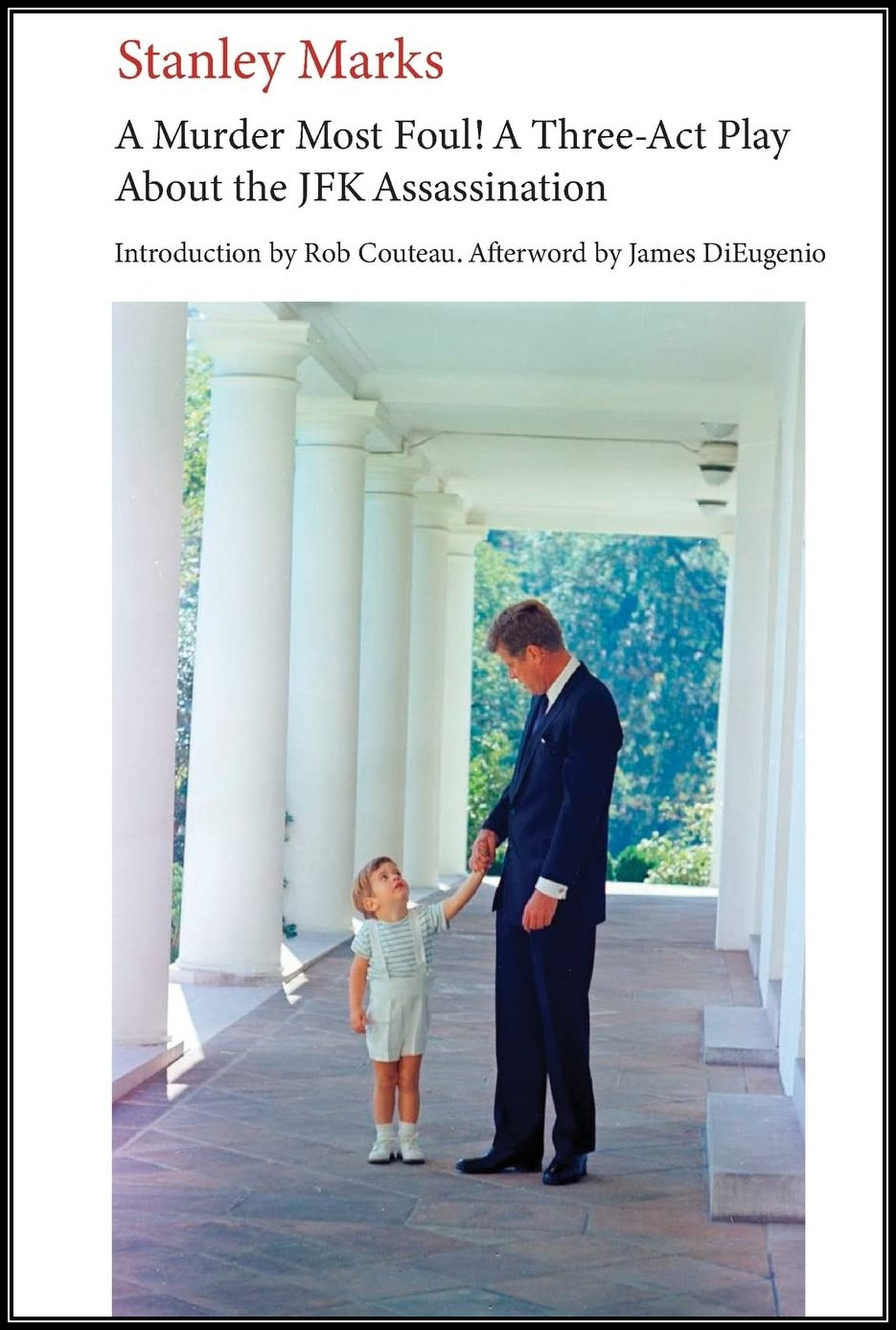
  • The Ripple Effect: An Introduction to Stanley J. Marks’ Three-act Play about the JFK Assassination

    The Ripple Effect: An Introduction to Stanley J. Marks’ Three-act Play about the JFK Assassination


    Barbara Garson’s MacBird!, a satire based on Macbeth that borrows lines from Shakespeare, was the first widely publicized play about the JFK assassination. Privately printed in 1966, the playscript was reissued by both Penguin and Grove the following year, eventually selling over 200,000 copies. After opening at Manhattan’s Village Gate in February 1967, it was produced in Los Angeles — the adopted home of Stanley Marks — and at the Committee Theater in San Francisco.

    As a devoted assassination researcher and connoisseur of theater, it’s likely that Stan Marks witnessed at least one performance of MacBird! during its long run. We can also assume that he was outraged by its cynical, insipid treatment of the Kennedy legacy, which portrayed the most empathy-driven president as being “heartless.” Garson even has Robert Kennedy (as “Robert Ken O’Dunc”) declaim that this “heartless” state was deliberately arranged by his own father:

    To free his sons from paralyzing scruples
    And temper us for roles of world authority
    Our pulpy human hearts were cut away. […]
    And so, MacBird, that very man you fear,
    Your heartless, bloodless foe now lifts his spear.[1]

    Thus, in a bizarre inversion of actual events, the scene portrays Robert as the murderer of President Johnson (“MacBird”) in a cold-blooded act that he tries to cover up. Garson also had the temerity to remark that if President Johnson had helped to assassinate JFK (a point of view that she didn’t necessarily advocate) it would have been “the least of his crimes.”[2]

    Perhaps as a response to all this Marks decided to write his own play: one informed by far greater insight into the actual case. He never lost sight of the fact that the forces that reaped untold financial profits with Johnson at the helm were the same ones that had removed JFK and plunged the nation into a turmoil from which it has never recovered. But none of this is even hinted at in Garson’s drama, which soon received blessings from major media outlets, including approving reviews in the New York Times, the Washington Post, the New York Review of Books, and the Chicago Daily News.

    While Garson and her reviewers were focused on the animosity flaring between Robert Kennedy and Lyndon Johnson (an example of what Joan Didion derisively refers to as the “sentimental narrative” that passes as American “journalism”), Marks was asking questions about the true nature of mass media and about its infiltration by embedded CIA agents. Such inquiries were rarely posed in 1967, the year that he published his first assassination inquiry, also titled Murder Most Foul! and subtitled The Conspiracy That Murdered President Kennedy: 975 Questions & Answers.

    That text appeared in September 1967, five months before he copyrighted his play on February 19, 1968. The questions raised, the evidence gathered, and the jigsaw puzzle assembled in his first JFK book (MMF-1) were still fresh in his mind when he tackled his playscript, “A Murder Most Foul! Or, A Time to Cry; A Time to Die” (MMF-2). And so, it remains of interest to compare these two works and to see how, in the play, he focuses on several of the more salient points raised in his nonfiction, now lending them an alternate form of expression via the dialogue of various characters.

    For example, in MMF-1, Stanley writes: “That the CIA controls many of the news columns in both the press and magazines is now known. What is not known, and what will never be known, is how many agents of the CIA now work for various organs in the mass communication media.”

    In MMF-2 we witness the following dialogue that occurs between King (a leading backer of the plot) and his henchmen, Noslen and Prince, as they discuss Oswald in relationship to the assassination of Patrolman Tippit and the attempted murder of Major General Edwin Walker:

    NOSLEN: From the television and other newspaper reports published last year, there seems to be no doubt that Patsy was the only one involved in those affairs.
    KING: Let me say that those reports were made by organizations who know on what side their bread is buttered.

    And later in the play:

    KING: And the owners of the press didn’t give a damn and they still don’t give a damn. In fact, I would venture a guess that ninety percent of them applauded his [JFK’s] murder.

    Stanley continually reminds us that one of the greatest weapons at the disposal of the American Empire is a brainwashed populace. For how else can the Establishment continue to finance, without serious objection, its illegal wars of conquest, both economic and political?

    Like the first MMF, the play also pokes fun at the absurdities put forth by the Warren Commission. For example, MMF-1 hosts a chapter titled “Rifles, Rifles, Everywhere,” referring to the fact that, shortly after the assassination, police discovered more than one firearm in the Texas School Book Depository, and the press published photos of more than one type ofMannlicher-Carcano rifle in the hands of police.(Besides that infamously dilapidated, rusty oldMannlicher-Carcano that FBI investigators initially refused to test, for fear it would explode in their faces, there was also a more sophisticated weapon: a7.65 German Mauser.) Marks explores this same set of facts inMMF-2 with a scene that’s also titled“Rifles, Rifles, Everywhere.” But this entire episode now occurs in silence, minus any dialogue, with only one character, who conducts a “dry run” of the murder using two rifles, each with telescopic sights. Fittingly enough, the weapons are hidden in golf bags.

    Pause for a moment to linger over this potent symbol. For me, it calls to mind how President Eisenhower, who mollycoddled the CIA and allowed it to mushroom to gigantic proportions as it assumed autonomous powers in the 1950s (one of Kennedy’s aides even called it a “state within a state”),[3] was known as the president who “brought golf to the White House lawn.” During his tenure there, Eisenhower carded over eight-hundred rounds of this leisurely activity while the CIA was busy overthrowing democratically elected governments around the world. Thus, how fitting that King stuffs a box of bullets into a pouch on the bag that’s normally reserved for golf balls!

    Marks may or may not have consciously drawn this connection to Eisenhower, but in his stage direction for this scene he includes an even more overt symbol: “On the mantelpiece, centered, is a large derrick, painted or glazed in gold. At the top of the derrick is a small Confederate flag.” This clearly alludes the Texas oil cabal that would have rejoiced over the president’s death, especially because JFK wanted to end the oil depletion allowance: the largest tax loophole in American history. But the derrick also points to that “bigger picture” perspective that Marks has always assumed: that, beyond the theatrical stage of Dealey Plaza, one must also investigate the money trail leading to corporate interests and their role in changing the course of history.

    Later in the play, in a wonderful cross-pollination with nonfiction, King uses a slide projector to display Deputy Sheriff Weitzman’s affidavit, which testifies to the fact that Weitzman discovered a German Mauser inside the Texas School Book Depository. But of course, Weitzman was later compelled to alter his testimony to match a new “script,” now claiming that the rifle in question must have been an Italian Mannlicher-Carcano all along. This despite the fact that he was a firearms expert who would never have made such a foolish error. But just as a playwright wouldn’t hesitate to alter a first draft, the Warren Commission report was always a fictional “work in progress.” One of the classic lines in Stanley’s drama sums this up rather nicely:

    Prince: At least the Commission was consistent; it started and finished with lies.

    This is not the sort of thing that one would encounter in a mainstream media-endorsed drama about the assassination — especially back in 1968. And what other playwright from that era would include the following “Notes to producer and director”:

    In Act II, Scene I, two false Oswalds are seen but not heard. There is more than sufficient evidence in the report and the hearings to prove that, in the conspiracy, a minimum of three Oswalds were used.

    The scene that follows depicts “Executor,” the leader of a hit team, interacting with his ruthless subordinates Lion, Hawk, and Bulldog:

    (LION walks to rear right door, opens it, and motions with hand. In walk two men, dressed in the identical clothes worn by Marine, hair combed the same way, and the same height and build. They walk only about ten feet into room, stop and face the others.)
    CUBANS: It can’t be! Three of them! What’s up?
    EXECUTOR: Yes, these two men look like Marine. They are decoys chosen to protect us and him. At no time will anyone of you speak to any one of them unless they speak to you first. That’s an order!
    (EXECUTOR waves his hand to the two new actors who turn and walk out of door, closing it behind them.)

    Speaking of Oswald look-alikes,[4] this might be the place to examine Marks’ ideas about Oswald as seen through the evolution of his oeuvre. Marks has always maintained a fluid position regarding the two classic schools of thought about this former marine who, in the words of Senator Schweiker, “had the fingerprints of Intelligence all over him.”

    On the one hand, we have the notion that Oswald was manipulated into assuming an active role in the assassination.

    On the other hand, we have the possibility that he was simply chosen to be an unwitting patsy who could be tricked into shouldering the blame for the president’s murder.

    Throughout his nonfiction Marks has always leaned more toward the patsy position, though he adds that, as an attorney, he cannot definitively discount the other possibility simply because we don’t have all the evidence at our disposal. Thus, I was surprised to learn that, in the drama, Marks inserts Marine directly into a group that plans and executes the assassination.

    Marine / Oswald is told that he’s to serve as a “decoy,” and he plays no role in the shooting. But he’s referred to as “Patsy” behind his back, as the plotter’s have earmarked him to take the fall.

    But a careful reading of the play opens up another possibility regarding Marine’s true role:

    When Prince asks King if “Patsy” was either an FBI informant or a CIA agent, after carefully defining the term “agent” King confirms that Patsy served in both these roles:

    Look at Patsy’s record. He was ordered to learn the Russian language while he was a Marine. He was trained at a Japanese airfield as an agent. He was ordered to Russia as an agent while he was still in the Inactive Reserve and retained his Class A Marine security clearance. He returned and again acted his part as a Red and Bearded One [Castro] sympathizer. He operated a one-man pro-Bearded One committee out of a room next door to an EIA-controlled agency [the CIA]. He was subject to arrest when he returned from Russia, yet no federal agency made the arrest. Why?

    This represents a view that the author consistently held throughout his nonfiction work. As early as 1967, in MMF-1 Marks asks:“Who was Lee Harvey Oswald?” Answer: “Evidence is now accumulating that he was a minor cog in the CIA.” He continues: “Was Oswald any type of Agent for the CIA?” “The evidence is accumulating that the answer is ‘yes.’” “Was Oswald either an FBI agent or informer?” “Yes, as to being an informant, as distinguished from being an agent.” In his next nonfiction book, Two Days of Infamy: November 22, 1963; September 28, 1964 (1969), headds that even if Oswald was “part and parcel of the conspiracy” he represents no more than a “piece of string [tied] around the conspiracy package.” And in Coup d’État! Three Murders That Changed the Course of History. President Kennedy, Reverend King, Senator R. F. Kennedy(1970), he further refines this view:

    … a conspiracy murdered President Kennedy; but whether Oswald was a part of the conspiracy cannot be ascertained. Under the “basic principles of American justice,” if a person enters into a conspiracy to commit murder, and the murder is committed, then the degree of the participation is of no consequence — that person is guilty of the full penalty. If, however, a person takes some action of which he has no knowledge that his action is part of a conspiracy, he cannot be guilty of any crime. There is evidence that Oswald was used as a “patsy”; that he executed a part of the conspiracy but he had no knowledge of what was to occur.

    In the playscript we have a patsy who is fully cognizant of the upcoming assassination and who also serves as an FBI informant and CIA asset. This leads to the question: Is Marine reporting back to either bureau about the plan to murder the chief of state, perhaps trying to prevent it? And what sort of follow-up orders is he receiving from his handlers in these respective agencies? The author doesn’t tell us; and so, the mystery of Marine remains intact, lending the drama a more resonant, intentional ambiguity.

    But we are offered a clue about Marine’s own execution. Executorhas decided that Marine must be eliminated, because he can’t be trusted to remain silent:

    Do you think the Department has forgotten that he tried to commit suicide, and failed, while in Russia? He will crack wide open. You don’t think for a minute that we would let him go on trial? How asinine do you think we are? Oh, he will play his part to perfection, but to us he is nothing more than our great, big, beautiful patsy. And in this game, as you know, Lion, the only good patsy is a dead one.

    The Oswald episode also features a droll exhibition of Marksian wit. In early radio broadcasts of Marine’s arrest, Stanley has police officials refer to Marine as “P. Patsy.” The solemn tone of these announcements, which otherwise read like actual transcripts from November twenty-second, make the reference to a “Mr. Patsy” seem all the more surreal. One can also imagine the playwright giving us a sly wink when we learn that a radio host even bears the same name as the author: “Stan.”

    By comparingMarks’ nonfiction to his dramatic work we witness the power of dialogue, of the spoken word, to enunciate complex ideas in a highly condensed, direct fashion. Whether MMF-2 works as a successful play that will rivet an audience’s attention is another question entirely. Such a didactic scenario is faced with numerous challenges, as the presentation of ideas (rather than the dramatization of a character’s shifting emotions) serves as its primary spine. Stanley even alludes to this in his stage direction when he writes: “The play can thus deal only in fact and the characters are subordinate to the main theme of the play, which reveals the methods used to murder President John F. Kennedy; why he was murdered; and how his murder changed the course of history.” But as a text that presents the keynotes of the assassination, it remains fascinating.

    The various characters also personify broader social tendencies. For instance, Noslen is appropriately named because he fails to see things that are right under his nose. In contrast, King possesses a sort of royal sagacity as well as an ability to wed logic to common sense. He’s even able to adduce evidence for a conspiracy merely by examining the daily press. And King is a “kingmaker” thanks to his leading role in the plot.

    The characters also give voice to some of the principal notions of the author, who often speaks directly to us via King and Prince. (At one point, Prince even says that he’s an attorney, just like Stanley.)

    PRINCE: My God, this is worse than Alice in Wonderland.
    KING: No, more like Orwell’s 1984. The worst is yet to come.

    King is speaking about the revelations he’s about to unveil regarding the assassination and its cover-up, but he could just as easily be referring to what will happen after Kennedy’s demise: the resumption of a Cold War sensibility once this radical change of government arrives via coup d’état. And Marks would not have been surprised to learn that the cover-up continues to this day, with thousands of assassination-related documents still being illegally held under lock and key — not to mention files that are “missing,” illegible, or destroyed. But he holds out a sliver of hope that, eventually, at least part of the truth will emerge. This involves not only an understanding of Dealey Plaza events but also a macro view regarding the financial interests of transnational corporations:

    KING: […] We may be able to keep the reasons why the chief was murdered from our generation. However, sometime in the future, students of the event will finally discover the fact that he was done away with because our group believed that the chief’s conduct of our national and international affairs was inimical to both us and the nation. Another man said it in another manner: What was good for GM was good for the nation. Just as he placed his interests first, so do we.

    Executor voices similar concerns:

    We have discovered that the chief has sent a secret agent to open negotiations with the Bearded One [Fidel Castro]. He is attempting a détente with the Reds. His feelers with the various Red nations to obtain some sort of peace, a “live and let live” attitude, does not appeal to us and to various sectors of our economy. Internally, there’s too damn much socialism. So, we believe he must go, and go he will.

    As with Marks’ nonfiction, such statements transcend a microanalysis of the assassination (e.g., how many bullets were fired; where was Oswald when JFK was shot) and expand into a broader perspective of what was really behind it. Sometimes, this is rendered in a single sentence:

    KING: […] Mr. Noslen, do you think we will ever get out of Vietnam?

    We also have this startling remark made by King, shortly after Patsy’s assassination:

    You know, when I organized this event, I never thought the ramifications would be so great … I found that a conspiracy is like throwing a stone in the water. From the center, the ripples keep getting larger and larger until it seems that the whole body of water is agitated. Everything those ripples touch reacts in a different manner. We murdered one man today, but a thousand, no, hundreds of thousands are going to die. No one on this earth will ever be the same.

    This climactic statement captures the central concept of the play and transforms it into a highly condensed, potent simile. When we place this illuminating dialogue into the context of what will occur in places such as the Congo, Indonesia, and Vietnam as a result of a radical shift away from JFK’s anticolonialist policies, we realize that it can be read as an understatement. For, millions upon millions of were indeed killed in paramilitary operations that were essentially vast programs of extermination.[5] Thus, by fashioning such pithily rendered phrases, Marks is utilizing the full power of dialogue to condense and yet amplify such ideas, some of which are prescient.

    Marks also extends the scope of the play by examining things not normally associated with a JFK assassination chronicle. For example, Ronald Reagan appears here, thinly disguised as “Hameger,”the“governor of Khalif” (California). King reminds us that

    The governor of Khalif’s approach to Vietnam was to make a parking lot out of North Vietnam. In other words, his Christian approach was the complete extermination of approximately eight million men, women, and children. […]

    The North Vietnam are all dead, and you have used their blood, bones, and muscles to mix with the cement that made the parking lot. Now, what do you use it for?

    Indeed, Governor Reagan once infamously remarked: “It’s silly talking about how many years we will have to spend in the jungles of Vietnam when we could pave the whole country and put parking stripes on it and still be home for Christmas.” Marks rightfully equates this with a policy of extermination. Even after Reagan became president (an event that Marks predicts in this play, a dozen years before it occurred), Reagan never renounced such disturbing views.

    The grim imagery of this scene in which “blood, bones, and muscles” are amalgamated with “the cement that made the parking lot” resonates with another set of dark images that appear later, in Act III. Although Marks doesn’t draw a direct line between these two points in the drama, the language employed connects them. In this latter scene, he portrays a chaplain addressing American troops in Vietnam from a pulpit on the battlefield:

    Oh, Lord, our God, I summon your help for the mighty task you have imposed upon your soldiers. That task of crushing those who believe not in your words. […] May we have the strength to use our weapons of flame to burn, to ground into dust the bodies of all those who refuse our command that they give unto thee their loyalty and devotion. May our weapons make the soil unfertile; the women to cease childbearing; the blood, bones, and sinews of the men ground into the dust as your punishment for their defiance of your holy command.

    The hypocrisy of praying to God for one’s success in committing barbaric atrocities has rarely been captured with such bitter, acerbic irony. And all this belongs in a play about the assassination, because what’s also being portrayed here is what will occur after Kennedy’s policies are reversed by President Johnson.[6]

    * * *

    Perhaps the most unusual tack that Marks takes in this dramatic journey is to introduce a buyer’s remorse into the mind of the main protagonist. By allowing King to question whether the assassins did more harm than good, Marks is able to shift the focus of the play to a new point: the snowballing of cynicism in the American psyche, the increasing distrust in government, and the incremental annulment of the American Dream, all of which are rooted in the events of November twenty-second. A debate over this topic that plays out between King, Prince, and Noslen reaches its culmination in Act III, and it foreshadows the final action in the drama.

    But is King’s “character shift” artfully accomplished? It appears to arrive out of “left” field, and one might argue that the author has failed to convincingly foreshadow such a result. But setting this reservation aside for a moment, it’s certainly not unheard of for a person with radical beliefs to undergo a sea change that results in the assumption of a diametrically opposed viewpoint. The ancient Greeks even had a word for it, first coined by Joannes Stobaeus in the fifth century: enantiodromia. This concept is also foreshadowed in the philosophy of Heraclitus, a Greek from the late sixth century BCE, who writes: “It is the opposite that is good for you.”

    In 1921 the psychologist Carl Jung theorized that enantiodromia is triggered by a mechanism in the unconscious that engenders a new equilibrium in consciousness. According to Jung, “when an extreme, one-sided tendency dominates conscious life, in time an equally powerful counterposition is built up,” resulting in the “emergence of the unconscious opposite.”[7] Jung was also drawing onPlato’s aphorism in the Phaedo: “Everything arises in this way, opposites from their opposites.”

    But apart from the psychological dynamics that might be at work in such phenomena, this sort of vociferous political debate among “patriotic” right-wingers was not all that uncommon in the late 1960s. King is clearly an “old school” zealot: in his view, JFK veered too far to the left and needed to be removed to preserve the status quo business interests. But as a former soldier who fought against Hitler and Tojo on the battlefields of World War II, he has a problem with some of the neo-Fascist notions that are now being espoused by his murderous colleagues. King is also no fool, and he realizes that economic disparity sends some men off to war to die in the rice paddies of Vietnam while others escape a military draft by lingering in expensive Ivy League colleges. In other words, King gets his hands dirty in supporting Establishment interests, but he does so without deluding himself: he knows how things really work. In addition, he’s one of those right-wingers who don’t necessarily buy into the Vietnam War jingoism or the need to emulate Hitlerian solutions of racial extermination (in this case, the liquidation of
    the Southeast Asian masses). He wonders: Isn’t that the sort of thing that he and his generation fought against — and a cause that so many died for?

    But Prince and Noslen are incapable of comprehending all this. To these neo-Fascists, the ends justify the means, no matter how vicious or inhuman. When this is revealed via a witty but bleak dialogue in the play’s concluding scenes, the author sets the stage for a final twist of fate; and the thickheaded Prince feels he has no other choice but to usurp the assassins’ throne.[8]

    Besidescreating a drama that pivots upon King’s enantiodromian reaction, Marks is also implying that the forces that killed Kennedy (at first, symbolized by King) eventually metastasized into even more demonic elements (personified by Prince and Noslen), leading to the imperialist policies of Nixon to Reagan to George W. Bush — a presidential rogue’s gallery. And one that Marks not only witnessed firsthand, in real time, but that he continued to chronicle and critique until shortly before his death in 1999. He was one of the few who saw where all this was leading, and he tried to warn us through the vehicle of his self-published screeds — like a voice ringing out in the wilderness.

    For example, one of the most percipient points raised in MMF-1 concerns what will happen in the aftermath of the Warren Commission. Marks boldly asserts that its lies will only serve to poison our collective national psyche:

    It can now be said that the American people do not believe anything stated in the “Report.” Due to this lack of belief, a cynicism has now gathered among the Citizenry that bodes ill for the Nation. A Nation whose moral fiber has been torn and shattered cannot long live; for when the Nation’s spirit is destroyed, no Nation will live […]

    As a result of this toxic brew of cynicism and despair, the nation’s youth will grow disaffected, the American Dream will invert into nightmare, and a sense of hopelessness and a loss of vision will escalate throughout the decades and well into the future.

    This is precisely what we, as a nation, have inherited today.

    The same theme is exploredin a final scenein the play,fittingly titled“Decay in the American Dream,” when King tells Prince: “A nation without vision can never progress toward the future.”In Marks’ next assassination text, Two Days of Infamy (March 1969), he writes:

    Perhaps it was the cynicism, inherent in citizens of all nations, that convinced the American citizenry that the “Report” issued by the Warren Commission was supported by rotten timbers incapable of supporting the truth. The suspicion increased in the same ratio and in the same speed as smog increased with the density of automobiles on a Los Angeles freeway. The American people were becoming deeply convinced that the Commission had perpetrated a gigantic, gruesome hoax the like of which concealed a conspiracy that reached into the very gut of American government and society.

    And in Coup d’État! (February 1970) he adds that the Commission’s misdeeds led to the public’s “erosion of faith” in governmental institutions.

    In his play about the Sixties assassinations, A Time to Die, A Time to Cry, or, Murders Most Foul! (1979), Marks introduces a new character: Noslen’s brother Ramal. In one scene Ramal remarks: “The country is out of kilter. Nobody trusts anyone. Something’s cooking. I can’t see what’s in the pot.” Reflecting on the JFK assassination, he inquires: “But was it worth it? Look at our country today. Faith has been destroyed in the governing process.” To which Noslen concludes: “I guess this lack of trust started when the Warren Commission whitewashed the whole thing.”

    In that version of the play, Marks is unequivocal about who was the mastermind behind the assassination, when he has Ramal add: “[CIA Director] Dulles marked him for death when he resigned.”

    * * *

    I have yet to come across a public notice or advertisement for Marks’ first play in any of the media archives covering this period. Other than the fact that it was copyrighted on February 19, 1968 almost nothing is known about its genesis or history. It was only due to a search of his work in the Copyright Office that I was made aware of its existence. With the help of Marks’ daughter, Roberta Marks, after filling out numerous forms and affidavits and responding to seemingly endless emails, on April 30, 2021 we finally managed to pry a copy of this eighty-one page manuscript from the labyrinthine Library of Congress.

    Unlike Marks’ subsequent plays, this particular version is never listed as a published work on any of his book jackets. But later versions of the drama were issued under his “Bureau of International Affairs” imprint, and they appear to have been substantially altered and expanded. For example, in 1970 he published a playscript with the title A Time to Die, A Time to Cry and described it as “A three-act play concerning the three murders that changed the course of history: President Kennedy, Martin Luther King, and Senator Robert F. Kennedy.” And the 1979 version of A Time to Die, A Time to Cry is subtitled Murders Most Foul! (note the plural phrase: Murders).

    Although we don’t know if this first playscript was ever given a public reading, one may infer that it was rehearsed or performed at least once. For, in his “Note to Producers and Directors,” Marks writes: “Originally the actors had played the scene ‘Who Speaks for God?’ as Scene I of Act III. Some people liked it in that place; others were outspoken in saying that it belonged in the […] final scene of Act III.”

    I suspect that he refrained from publishing the manuscript because, less than two months after he registered it, Martin Luther King was assassinated, on April 4, 1968;and about two months later, on June 6, 1968 Robert Kennedy was also felled by assassins’ bullets. With such historic events rapidly unfolding, Marks probably felt obliged to catch up with them. However, he may have been overwhelmed; for the first version is far more successful than the 1979 playscript, which I also obtained from the Copyright Office. The latter treatment attempts to go in so many different directions that it becomes bloated and is difficult to follow with any degree of enthusiasm.

    Marks continued to rework his play all the way through 1988, when a final version was deposited in the Copyright Office: one that’s since been reported as “lost.” All the more reason to be thankful that this first version managed to survive, tucked away in one of the dusty cardboard boxes of our nation’s disordered archives for fifty-three years.

    Order your copy of Stanley Marks’ book A Murder Most Foul! A Three-Act Play About the JFK Assassination here.

    NOTES:

    [1] Barbara Garson, The Complete Text of MacBird!, New York: Grove Press, 1967, p. 107.

    [2] And if anyone has any doubts about JFK’s remarkable empathy, this eloquent statement made by his wife four months after the assassination should put them to rest: “Just as an example of him having a heart — I can remember him being so disgusted, because once we had dinner with my mother and my stepfather, and there sat my stepfather putting a great slab of paté de foie gras on his toast and saying it was simply appalling to think that the minimum wage should be a dollar twenty-five. And Jack saying to me when we went home, ‘Do you realize that those laundrywomen in the South get sixty cents an hour?’ Or sixty cents a day, or whatever it was. And how horrified he was when he saw General Eisenhower — President Eisenhower, I guess — in their Camp David meeting before inauguration — and Eisenhower had said to him — they were talking about the Cuban refugees — and Eisenhower said, ‘Of course, they’d be so great if you could just ship a lot of them up in trucks from Miami and use ‘em as servants for twenty dollars a month, but I suppose somebody’d raise a fuss if you tried to do that.’ You know, again, so appalled at all these rich people just thinking of how you can live on — not thinking how you can live on just twenty dollars a month, but just to use these people like slaves. He was just so hurt for them, though he’d say it in a sentence [.…] And then, another time, when you were trying to raise money for the cultural center, and a Republican friend of my stepfather said, ‘Why don’t you get labor to do it? If you took a dollar a week out of all of labor’s wages, you could have the money raised in no time at all.’ And he was just really sickened by that and said, ‘Can you think what a dollar a week out of their wages would mean to all those people?’ So all those things show that he did have a heart, because he was really shocked by those things.” Interviewer Arthur M. Schlesinger, Jr. adds: “Of course, he had a heart, [but] it wasn’t on his sleeve … But he was deeply affected.” See Jacqueline Kennedy, Historic Conversations on Life with John F. Kennedy, New York: Hyperion, 2011, p. 66-67. Jacqueline also recalled a telling incident involving Robert Kennedy. When the CIA failed to protect Oleg Penkovsky, a secret agent in Moscow who was arrested and executed, RFK approached Jacqueline, “just looking so sad … and he said, ‘It’s just awful, they don’t have any heart at CIA. They just think of everyone there as a number. He’s Spy X-15.’ And he said that he’d said to them, you know, ‘Why? This man was just feeding you too many hot things. He was just bound to get caught. And they’d keep asking him for more. Why didn’t someone warn him? Why didn’t someone tell him to get out? He has a family. A wife or children or something.’ Bobby was just so wounded by them — just treating that man like a cipher.’” Ibid., pp. 192-93.

    [3] After noting “the autonomy with which the agency has been permitted to operate,”Arthur Schlesinger, Jr. warned President Kennedy: “The contemporary CIA possesses many of the characteristics of a state within a state.”Arthur Schlesinger, Jr., “CIA Reorganization” memo to President Kennedy, June 30, 1961, p. 3. (For more on this memo, see my essay “On the Life and Times of Stanley J. Marks,” below.)

    [4] Tenacious researchers have continued to plumb the depths of this mystery ever since the appearance of Richard Popkin’s The Second Oswald (New York: Avon Books, 1966), a text cited by Stanley in MMF-1.

    [5] When I asked JFK historian James DiEugenio for a rough estimate of how many were killed as a result of Kennedy’s policies being reversed, he replied: Vietnam: 5.8 million, and this includes the Cambodian Holocaust. Indonesia: a low estimate is 500K; a high estimate would be 850K. Congo: usually given as 100K, but, after the overthrow of Mobutu, the number exploded to well over five million.” Private communication with DiEugenio, December 24, 2023. See also Greg Poulgrain, JFK vs Allen Dulles: Battleground Indonesia (2020) and Richard D. Mahoney, JFK: Ordeal in Africa (1983). There were also dire consequences in Latin America: “I believe that if President Kennedy had remained in office for eight years, he would have left a tradition of political unity between the two Americas, of working together. It did not happen that way. The fatal bullet did much harm to you, but greater harm to us.” Juan Bosch, former president of the Dominican Republic,interviewed by Lloyd Cutler, June 9, 1964, p. 15; John F. Kennedy Library Oral History Program. Cf. Robert F. Kennedy’s famous “Ripple of Hope” address at the University of Capetown, South Africa, on June 6, 1966: “Each time a man stands up for an ideal, or acts to improve the lot of others, or strikes out against injustice, he sends forth a tiny ripple of hope, and crossing each other from a million different centers of energy and daring those ripples build a current which can sweep down the mightiest walls of oppression and resistance.” The first half of the quote is engraved on RFK’s memorial at Arlington National Cemetery.

    [6] In this regard, certain remarks made by Jacqueline Kennedy proved to be rather farsighted. As early as June 2, 1964, speaking about Laos and Vietnam, she said: “Jack always said the political thing there was more important than the military, and nobody’s thinking of that. And they don’t call the people who were in it before [back] in. And so that’s the way chaos starts. If you read the story of the Bay of Pigs in the papers now, I mean, the CIA just operating so in the dark, saying, ‘Even if you get an order from the president, go ahead with it.’ Well, that’s the kind of thing that’s going to happen again.” Jacqueline Kennedy, Historic Conversations on Life with John F. Kennedy, pp. 272-73.

    [7] See Carl Jung, Psychological Types, first published in German in 1921.

    [8] Regarding this passage in the play, my colleague Al Rossi adds this insightful remark: “I am impressed particularly by the sophistication of Marks’ characterization of the plotters as having different agendas. We should probably not forget the Brutus vs. Cassius paradigm here from Julius Caesar in this regard. Moreover, though not quite the same, it’s also reminiscent of the uneasy alliance between neoliberals (the financier / corporatist / rentier class) and neoconservatives (the crazy military brinkmanship imperialists) that has had its ups and downs over the years but continues to function. To see this dynamic as having emerged from the alignment of interests that resulted in the assassination of JFK is definitely vatic, whether realized by Marks in an accord with dramatic or psychological principles of verisimilitude or not. There’s also something of this in the screenplay of Executive Action, with differing viewpoints emerging from the characters played by Burt Lancaster, Robert Ryan, and Will Geer, but it certainly is not problematized in the same way in which Marks makes this a kind of linchpin for his denouement.” Al Rossi, private communication, December 26, 2022.

  • Sy Hersh Falls on his Face Again, Pt. 2

    Sy Hersh Falls on his Face Again, Pt. 2


    On March 29th, Sy Hersh was at it again. He wrote about a split between the CIA and the Kennedy White House over the plans to do away with Fidel Castro. In a reversal of the factual record, he makes the Agency out to be reluctant to do such a thing, while the Kennedys were urging the plots forward.

    As I wrote in Part 1, this is utterly false. And both the Church Committee and the CIA’s own Inspector General Report proved it so. John Kennedy was so opposed to these kinds of plots that when Senator George Smathers proposed it to him, he literally broke a plate over a table and said he did not want to hear any of this anymore. (Alleged Assassination Plots, p. 124) Smathers also told the Church Committee that the Agency frequently did things Kennedy was not aware of and this troubled the president. He said that JFK thought that assassination was a stupid thing to do, and he wanted to get control of what the CIA was doing. (The Assassinations, edited by James DiEugenio and Lisa Pease, p. 329). When one combines this with the fact that the CIA’s own Inspector General Report—which is the most extensive study of the Castro plots—concluded that the Agency never had any presidential approval for the plots, that is the ultimate word. (See IG Report pgs. 132-33) Hersh can rattle on as much as he wants but it’s the equivalent of urinating into the wind.

    That IG report was filed for Director Richard Helms at the request of President Johnson. (Click here for it) The Church Committee heard testimony from FBI official Cartha Deloach that, after Johnson read the IG report he concluded that the CIA was involved in the JFK assassination. (Washington Post 12/13/77) Until the Church Committee inquiry, Helms reportedly kept only one copy of this report stashed safely at CIA headquarters. Presumably because he did not want the word to get out that the Agency, under Dick Bissell and Allen Dulles, had sanctioned the plots and kept them secret from Presidents Eisenhower, Kennedy and Johnson. In an interview Helms did with Vincent Bugliosi for his book Reclaiming History, the former CIA director said that the Kennedys were not privy to the plots.

    All of which vitiates Hersh’s latest piece of nonsense concerning the plots themselves. He says that Richard Helms understood there was no turning down the mission. Since there was no request from the White House to do so, that statement is malarkey. But further, Helms had the plots ongoing on the very day JFK was killed. In preparation for a meeting with a proposed assassin in Paris, Helms cleared a CIA officer to invoke Bobby Kennedy’s name in conduct of the plots, knowing that RFK never granted such permission to do so! (IG Report, pp. 89-93) This would indicate to any objective person that Helms knew Bobby would never allow it and he would have stopped the plots, since he knew how his brother felt about such things. And also, as we shall see, after the CIA told Bobby they had been stopped.

    Further showing how wrong Hersh is, the plots did not stop with JFK’s death as he says they did. Helms full well knew they were continuing into 1966. That phase was called Project AM/LASH. And it is listed right in the Inspector General’s table of contents, dates and all. (See pp. 78-111) Therefore, the plots began in 1960, before JFK was president, and continued until 1966, encompassing three presidents who the CIA decided not to reveal them to. So everything that Hersh says in his first two paragraphs of his latest is wrong.

    Hersh then goes from just being wrong, to being ridiculous. He actually says he did not really understand this CIA/Kennedy dispute until he talked to—please sit down—CIA officer Sam Halpern. Hersh undermines himself by explaining about Halpern: “…the only reason he ever talked to a reporter was to spread a lie.” Hersh, never noted for his humor, misses the self-parodic overtones here. As Lisa Pease notes in her book, A Lie too Big to Fail, Halpern made sure that his version of the plots reached the media: “In fact, nearly every author that has claimed Robert Kennedy was in on the Castro assassination plots sources Halpern.” (p. 479) As Lisa points out, Halpern once gave his game away. Sam worked for CIA Officer Bill Harvey. Harvey and Halpern complained that the White House only used pinpricks against Castro. Sam, I hate to tell you, assassinating Castro is not a pinprick. (ibid) Needless to add, if you read the IG report, Halpern was in on the AM/LASH plots. As was Nestor Sanchez, assistant to Helms. (IG Report, p. 92)

    For any author today to use Sam Halpern in a discussion of this subject betrays a solipsistic bent. Because not only has Lisa Pease shown Halpern to be a liar, but so did David Talbot. (Brothers, pp. 105, 122-23). But beyond that, Halpern was demolished by John Newman with a completeness that was pretty much total. Let us review that demolition in order to understand just how bad Hersh is on this subject.

    II

    Newman published Into the Storm back in 2019, four years before Hersh penned his latest columns. I find it hard to comprehend that Hersh never heard of this book and never read it. For the simple reason that Newman, using declassified records, spent four chapters knocking the stuffings out of Hersh’s two sources on the Castro plots, namely Dick Bissell and Halpern.

    Sam Halpern was the executive assistant to Harvey, who was a major Agency player in the Cuba operations. It is not news to anyone that—for reasons stated above—Bobby Kennedy and Harvey shared a mutual animus. It also needs to be stated that when Bobby Kennedy was told about these Castro assassination plots, the CIA lied to him about their being discontinued. They were ongoing at the time of his May 1962 briefing and the Agency briefers knew they were lying to the Attorney General. (Newman, pp. 231, 242; Pease pp.481-83) This new phase of the plots was being run by Harvey and gangster John Roselli.

    Perhaps as early as 1967, but certainly by the time of the Church Committee, Halpern had created a cover story for the CIA. What is so odd about it is that Halpern’s phony story existed in a mythological netherworld, outside of what had really happened. Which the Church Committee revealed a good deal about.

    Sam’s fairy tale was arranged around a deceased CIA officer who Halpern knew and knew well. His name was Charles Ford. To understand what Halpern and Hersh did to him, one must review how and why Ford met Robert Kennedy. This was over two calls that the Attorney General received in the spring of 1962 about goings on in and around Cuba. One dealt with an attorney interested in the legal proceedings against the Bay of Pigs prisoners. The other concerned a group that was encouraging an uprising on the island. RFK called CIA Deputy Director Marshall Carter for assistance and advice on both issues. (Newman, pp. 260-64)

    Ford was chosen to consult with RFK on both assignments. On the former, Ford used the alias Charles Fiscalini, assigned by CIA; for the latter it was Don Barton, which was more or less chosen by him. Ford did a satisfactory job in investigating the two assignments. He concluded by telling the Attorney General that neither he, nor the CIA, should be involved in either endeavor. And here is where Newman exposed the Halpern mythology under stadium spotlights.

    In his book, The Dark Side of Camelot, Hersh quotes Halpern as saying that Ford went to places like Chicago, San Francisco , Miami and one trip to Canada. But Hersh then adds that Ford never delivered any paperwork as to what he was doing to Harvey’s office. Hersh then quotes Halpern to hammer this point home: “We never got a single solitary piece of written information.” Hersh then concludes by saying these must be in classified files on the RFK papers at the John F. Kennedy Library. (Hersh, p. 287) Under the hocus pocus of Hersh and Halpern, ipso facto, Ford was working with mobsters under Bobby’s orders in order to murder Fidel Castro. And that dirty rat Ford kept it all hidden from the CIA.

    Let us be plain: Everything in that above paragraph is false. As Newman discovered, for this assignment, Ford filed at least ten reports with CIA from March 30, 1962 to October 4, 1962. (Newman, pp. 258-260) Many of them went directly to Harvey’s office and Halpern signed off on at least one of them. Therefore, as Newman wrote, Halpern had to be aware of what Ford was actually doing. (Newman, p. 264) But further, Harvey wrote to the Attorney General twice about Ford’s negative conclusions. (ibid, p. 268). There was no secret since there was nothing to conceal.

    To any normal thinking person, the above would be enough to show that Halpern was an immoral con artist. But it’s even worse than that. Charles Ford did two interviews with the Church Committee. The first one is lost. (Newman, p. 270). Which is unfortunate since Ford refers to the first interview in the second surviving transcript five times. But in the second interview, Ford says he often got assignments from Halpern. Which is something Halpern never revealed. But further, Ford says that he worked for RFK on just the two assignments as outlined above. And he specifically said he was never directed to make contacts with the underworld. Further, that he never talked to anyone about plans to assassinate Castro. Finally, he reported to Bill Harvey at this time and his title was special assistant. (Newman, pp. 274-75)

    As Newman concluded, the idea that Hersh and Halpern were trying to convey—that Ford never told anyone about his work for RFK—is now exposed as simply wrong. Ford told everyone about his work for the Attorney General. As his reports were circulated to many inside the Agency. But because they did not say what Hersh and Halpern wanted them to say, they were useless to the con artist and his (rather easy) mark. Specifically, they would portray what was really happening and expose a fairy tale. And further and fatally: that Halpern knew the true facts all along.

    Let us recite a recurring refrain with Hersh: How bad is bad?

    III

    What necessitated Bobby Kennedy’s briefing on the CIA/Mafia plots in May 1962? This occurred because Sam Giancana asked a favor from the man the CIA used to recruit the Mob into the plot. That was Robert Maheu. Maheu decided to help Giancana. He found a wiretapper for a hotel room since Sam thought his girlfriend, Phyllis McGuire, was sleeping with comedian Dan Rowan in Vegas. This scheme was foiled by local authorities and the FBI found out about it. When Kennedy was briefed, he asked why Maheu was so interested in pleasing Giancana. This is when he learned about the CIA’s plots for the first time. (Talbot, Brothers, pp 85-86) The rather logical deduction is that the CIA would never have had to brief him if he or his brother had been in on the plots already.

    Since Giancana was a number one target for RFK as Attorney General, this made him even more angry at what the CIA had done. But unlike what Hersh suggegsts, Bobby did not stop pursuing Giancana. And Giancana eventually did go to jail for contempt in 1965. When he got out a year later, to avoid more prison time, he fled to Mexico.

    This takes us to the next—and most bizarre—part of Hersh’s 3/29 pile of sludge. I had to read this section over twice to really understand it since it was like reading science fiction. As most of us who follow the career of Robert Kennedy know, the AG took a goodwill tour in February of 1962. Hersh distorts this journey also. He tries to convey that it was only to Italy. Not even close. This was a world wide goodwill tour that began in the Far East, went through the Middle East and ended up in Europe. The main point of this long tour was not Italy. Two of the stops were in Indonesia and the Netherlands. RFK was in Jakarta to negotiate the release of CIA pilot Alan Pope, shot down during the failed Agency coup of 1958. He was in Netherlands to talk the Dutch into surrendering West Irian to their former colony Indonesia, since JFK was backing their nationalist leader Sukarno. That mission, which you will not read a word of from Hersh, was successful. The other main spot for Europe was West Germany, where Bobby actually said “Ich bin ein Berliner” before JFK did.

    From that mischaracterization, Hersh descends further into his own morass. He now says that RFK went to Italy in January—before the goodwill tour. This writer, and others, tried to find any notice of this January journey. I searched the following sources:

    • New York Times index
    • The Washington Post microfilm
    • Newspapers.com
    • RFK’s appointment book

    The last was done for me by Abigail Malangone, the archivist at the JFK Library. (E mail message of 4/10/23) It eludes me as to how the Attorney General could go to Italy without a trace left behind. And, recall, back then the major newspapers and syndicates had reporters assigned to the Justice Department, as some of them do today. Bobby lived in Virginia at the time. But no reporter or anyone else saw him leave for Italy? And I could find no story about anyone who saw him in Italy either.

    But Hersh now goes a step beyond. He says that Charley Ford was doing the same. John Newman got the records for what Ford was doing. There were none depicting any trip to Sicily. (Newman, pp. 258-60) Ford’s only trip out of the country was to Canada and that was not for RFK, but the CIA. If Hersh has evidence to counter this, I would like to see it. Because John was working with declassified files, the ones Hersh says are still hidden.

    Now, why does Hersh say this stuff in the first place? Please allow me to indulge in some informed speculation. But it is based on Hersh’s past record in the field—which goes way back to his Marilyn Monroe baloney. Hersh wants to somehow depict RFK and Ford as fomenting the first Mafia War that broke out in Sicily in January and February of 1962. He actually says as much. But according to the NY Times, Bobby did not get to Rome until late in February. (NY Times, 2/21/1962) Which was after the war began in earnest. (See John Dickie’s book, Cosa Nostra: A History of the Sicilian Mafia, pp. 241-57) Hersh pulls another one when he writes that RFK had two days of private meetings in Rome. RFK was only there for two days total. And the second day he met with Pope John XXIII. According to extant CIA records, Ford did not get there at all. Did Hersh take a page out of Sam Halpern’s book of fairy tales? But in this case, going even further than his mentor?

    On, lest I forget. Hersh always has sources on the inside. (David Talbot, Brothers, p. 123) We have seen how worthless those sources are in Bissell and Halpern. And we are also supposed to think that Hersh does not know how much the CIA did not like the Kennedys.

    IV

    To wrap up, on 3/29 Hersh again brings up the false info from the novel Double Cross about Joe Kennedy making a deal with Sam Giancana for the 1960 election. Again, this has been proven to be ersatz. (Click here)

    But let me conclude with some questions readers relayed me about the Nord Stream explosions, Hersh’s latest ‘scoop’. Apparently, people did not click through to the links I posted. These were by Rene Tebel, Russ Baker and Oliver Alexander. As Tebel notes, Hersh is again relying on his “sources inside the system” who he takes at face value to write his story, without doing any apparent hard questioning or cross checking. (Geopolitical Monitor, story by Rene Tebel, 3/2/2023) Tebel notes that Hersh insists that the explosives were dropped during a BALTOPS exercise, more than three months before the explosions detonated. Thus ignoring more than one opportunity to do so later without such a long wait time.

    For instance, during the Polish exercise Rekin-22 on September 16-18. But Tebel also notes that there were 25 ships passing in the direct or adjunct area of the explosions in the days preceding the detonations. Of those ships only two did not have transponders. These two ships were between 95 and 130 feet long and were within miles of the Nord Stream leak sites.

    Russ Baker noted how thinly sourced Hersh’s story was, a recurrent theme in a lot of Hersh’s later work. He later added that news organizations rarely publish such stories. The error rate risk is too high. But yet Hersh wrote as if the story was completely sound. The questions then abound: 1.) How did the source come into all this info?, and 2.) If it is so sound why tell Hersh for Substack, why not reveal it to a writer with a major news organization? When Baker emailed Hersh about this, the reply by Hersh was “Russ…I wrote what I wrote..not much I can add…sy”. Well, same thing applies to much of the above Substack stuff, which I already exposed as dubious.

    Baker went on to ask, the kind of high level source that actually knows about such things would likely not reveal it to anyone because of the huge penalties involved in being discovered. Finally, Russ pointed to how vapid the story really was. He quotes the following lines: “Nevertheless, in early 2022, the CIA working group reported back to [Jake] Sullivan’s interagency group: “We have a way to blow up the piplelines.” Russ writes that this sounds like inside info, but anyone could write such a thing not having any real knowledge. There was really very little detail, the kind of technical details that turn speculation into fact. (Russ Baker, “Nord Stream Explosion, Plenty of Gas, Not much Light” Who What Why, March 4, 2023)

    Oliver Alexander showed that even those details are simply not very sound. As I previously noted, there was no need to add mine searching to BALTOPS, as it had been a part of the programs since 2019. Hersh could have easily checked that one.

    Hersh said on a broadcast that the USA needed Norway in order to reveal the shallow part of the sea. So, the Pentagon had no such charts? Secondly, the Nord Stream 1 explosion was detonated in one of the deepest parts of the area.

    Hersh now says that the divers deployed off a Norwegian Alta class mine hunter. Yet no Alta class mine sweepers took part in that particular BALTOPs exercise. Also, Hersh wrote that the charges would be detonated by a Norwegian Navy P8 surveillance plane with a sonar bouy. These planes were not active at that time. They were only in training usage in the northern part of Norway, many hundreds of kilometers away.

    When Hersh was confronted with the information about the Alta, he reacted the same way he did when confronted with the forged signature of Janet DeRosiers on the phony Marilyn Monroe trust documents. He lashed out at the source and called it a stupid lie. The problem is that the last time that ship moved under its own power was about ten years ago. It was towed for scrap iron on June of 2022.

    Even if Hersh made an error, not uncommon with him, ships close to that class were not in the area at the time or in a position to have planted the charges. (See Oliver Alexander’s “Blowing Holes in Seymour Hersh’s Pipe Dream”.)

    Does all this mean that the USA had nothing to do with Nord Stream? No it does not. As I noted, Hersh would be a fine messenger for a faulty story. Since he has no pesky editor. Great way to distract from the real story. But I would also not rule out Ukraine or the Poles.

    V

    What I think Hersh is up to with his writings on Substack about the Kennedys is redemption. When The Dark Side of Camelot came out in 1997 it was roundly blasted by just about everyone. And this includes the LA Times, Newsweek, New York Review of Books etc. Most of the stories said that the book revealed more about the Dark Side of Hersh than Kennedy. Which is about the worst thing a critic can say about a book. What I think Hersh is trying to do is to appeal to the ignorance of a new generation of readers born in the Internet age. Whether it will work is up to those readers. And if they are willing to investigate beyond Substack, to see just how bad Sy Hersh is in that case, and some others.

    In my view, Hersh was never the ace reporter he was alleged to be. And I wrote at length about the reasons why many years ago. (The Assassinations, edited by James DiEugenio and Lisa Pease, pp. 367-70) In my view, the stellar reporter of that time period was Robert Parry. Parry ended up leaving MSM journalism and started his own publication, Consortium News.

    The problem with Substack is this: it’s too easy. There is no editor above you to check on the facts of your story. This is one reason that both Glenn Greenwald and Hersh are on it. Greenwald did not like being edited at The Intercept. Hersh could not get some of his stories through David Remnick at The New Yorker. As the reader can see, this article which you are reading—and which you do not pay for—is plentifully referenced with credible sources. I serve as my own editor, since I know from my graduate studies what the rules of scholarship are. This kind of work takes days, at times weeks, sometimes even months, to complete. It’s not something you can turn out every other day. This kind of writing means visiting certain libraries, placing books on Inter Library Loan, driving to distant research repositories—in this case the Young Library at UCLA. Which is about a 40 mile round trip. And I did it twice. I would like to send Hersh my invoice for all this, but I know he would never repay me. He would call me something like a Kennedy apologist, as he did Janet DeRosiers.

    The problem with that is simple: DeRosiers was correct. The Marilyn Monroe trust was a fraud. Do those people on Substack know that? I hope so. But I doubt it.

    ADDENDUM

    When I emailed Hersh about his source for Bobby Kennedy’s Italy trip in January of 1962, he asked who I was. He then said he was doing so because it was obvious from the article. I asked him if it was so obvious why could I find no source for it anywhere? That was the last communication we had. I guess this is one of those Russ Baker, “I wrote what I wrote” matters.


    Go to Part 1

  • Assume Nothing about Edward Epstein

    Assume Nothing about Edward Epstein


    To those who were curious about the career of Edward Epstein and how such a person ever advanced in the literary world, his memoir is revealing. It’s called Assume Nothing and although its kind of an uphill grind to read, I am glad I read it since I now understand a lot more about Epstein. And how he got to where he was and is.

    Epstein’s father died at the age of 28. He left him some money he was entitled to at age 21. The author dropped out, or flunked out—its not clear which—from Cornell and decided to become a film producer. For his first film he was nothing if not ambitious. He was going to make a picture out of Homer’s Iliad. But there was a bit of a problem, actually more than one.

    He did not have a completed script.
    He did not have a director signed.
    He did not have an actor to play Achilles.

    I think Epstein tries to play all of this off as a comedy of errors: youthful indiscretions. I did not take it that way. All I could think of is this: What kind of a moron goes to Europe and tries to make an epic movie under those conditions? And even puts up some of his own money to do so.

    As anyone with any experience, or just common sense could have advised him, the whole effort turned out be a disaster.

    Epstein wandered back to Cornell and he happened to be with Professor Andrew Hacker on the day Kennedy was assassinated. (p. 38. All footnotes to the E book version.) They were continually watching the news and Epstein writes about Oswald calling himself a patsy, except he puts that word in quotes. Hacker said that establishing the truth about the murder “would be a test of American democracy.”

    Hacker helped get Epstein back into Cornell and Epstein suggested that he could write about the JFK case for his master’s thesis. (p. 40). Hacker agreed and said once Epstein read the Warren Report and the 26 volumes, he would write him letters of introduction for the seven commissioners. Epstein does not say if he read the 26 volumes. He just says he satisfied Hacker the he had done so. (p. 40) Hacker now writes the letters and all the commissioners agree to see him except Earl Warren. And its this part of the book that was for me the most interesting.

    II

    Instead of seeing Warren Epstein got to visit J. Lee Rankin, the chief counsel. Rankin tells him he was surprised that Warren chose him for the job. And that was that. I decided to go back and look at Epstein’s book about this issue, since it has become a seminal part of the literature about the Warren Commission. In Inquest, which became the book Epstein fashioned out of his thesis, this is how the episode is treated:

    The next order of business was the selection of a general counsel. The first person suggested for this position was rejected because he was “too controversial.” Warren then proposed J. Lee Rankin, a former Solicitor General of the Unites States, and the Commission, “immediately and unanimously” agreed upon him. (Epstein, The Assassination Chronicles, p. 31)

    And that was that? No it was not. Not by a long shot. Epstein deals with this key chapter in three sentences. Gerald McKnight spent three pages on it in his fine book Breach of Trust, and Warren did not propose Rankin. (pp. 41-44). J. Edgar Hoover was adamantly opposed to Warren Olney since he had been an FBI critic. Two days before this session where Warren tried to nominate Olney, Hoover learned through Nicolas Katzenbach of the Justice Department that Olney was in the cards. The FBI now went to work through Gerald Ford to detonate Olney. It was Ford and John McCloy who objected to Olney and it was McCloy, not Warren, who nominated Rankin. Rankin eventually got the job with the help of Allen Dulles.

    This is an important episode and Epstein missed its significance, then and now. It showed that, first, Warren was pretty much a figurehead. Secondly, that the nexus of power inside the Commission was with Ford, McCloy and Dulles. Third, that the three southern commissioners—Richard Russell, John Sherman Cooper and Hale Boggs—were outside that nexus.

    Later on, after visiting with Ford and Howard Willens—Katzenbach’s man on the Commission—Epstein writes that Ford had been absent from most hearings. (p. 50). That deduction completely collides with Walt Brown’s tabulation of which commissioners were at how many hearings. Ford’s attendance record was remarkable for a sitting congressman. By any method of accounting, Ford was in the top three for attendance and he was second in the number of questions asked. (Walt Brown, The Warren Omission, pp. 83-85) If he was going to be a spy for the FBI, he had to be there a lot.

    But that is not all that is notable about how Epstein describes Ford. He says that Ford had a reputation for candor. This is almost ludicrous. But if he did, then why did Ford not tell Epstein that he changed the draft of the Warren Report. Namely that he moved Kennedy’s wound in the back up to his neck to make the Single Bullet Theory more tenable. (LA Times, July 3, 1997) In the face of that it is just plain goofy that Epstein kept that judgment in this book. Because in the light of that alteration, Epstein’s quote about Ford makes perfect sense, he says that he had a keen grasp of the Warren Report’s ramifications on the stability of America’s system and how he saw each issue in that context. He concludes with Ford by saying, “Indeed, it was from him that I first heard the term ‘political truth’, a concept in which facts may be tempered to fit political realities.” (Epstein, p. 52)

    If Epstein had been a little bit more eager, penetrating, and curious researcher he might have found out something about just how political the Warren Commission really was. As Oliver Stone showed in his documentary JFK Revisited, Senator Richard Russell had serious doubts about the Commission from the start. He did not like how Katzenbach attended the first executive session meeting, how the FBI was largely going to be in charge, and how the conclusions seemed to be decided on well in advance of the inquiry.

    Russell had two allies in his severe doubts: Senator John Cooper and congressman Hale Boggs. They cooperated together in the last days of the Commission to form a united front against the other four. This is how Epstein treated this subject in his book:

    The Final Hearing. On September 7 Commissioners Russell, Cooper and Boggs went to Dallas to re-examine Marina Oswald. Under Senator Russell’s rigorous questioning, she changed major aspects of her story and altered her previous testimony. More rewriting was thus necessitated. Finally on September 24, the Report was submitted to President Johnson. (Epstein, p. 49)

    To be fair to Epstein, he does describe a debate, which was at the last executive meeting—although he does not describe it as being there. That debate was over how much certainty would be placed on the Single Bullet Theory (SBT). (Epstein, pp. 156-57). But incredibly, Epstein missed the most important aspect of this whole debate. Namely that the commissioners who backed the SBT snookered those who did not. Russell had come to that final meeting prepped and loaded. At the prior hearing with Marina, Warren, Ford, Dulles and McCloy were not there. Rankin was. It is pretty obvious that Rankin was there to see what the three dissidents were up to. And this helped lay the trap.

    That Epstein missed this—and that he does not even mention it in his memoir—this is kind of stunning. Because to many, it holds the key to the whole story behind the Warren Commission. That last executive session meeting, the one where Russell laid bare all his objections to the Magic Bullet, that meeting was not transcribed. Therefore we have no way to read about how this debate was enacted and who said what about which points. McKnight devoted the better part of an entire chapter of his book to this matter. (Breach of Trust, Chapter 11). He calls this betrayal, “one of the most disgraceful episodes in the history of the Kennedy assassination investigation.” (p. 284). It indicates that Rankin reported back to the Commission, and they then arranged a charade, complete with a woman there who Russell assumed was the stenographer. This is how desperate the Commission was to conceal the fact that they themselves did not think this was an open and shut case.

    That Epstein did not discover this back in 1965-66, and he does not include it in his memoir today, that tells us a lot about the man. As does the fact that he says that Allen Dulles retired as CIA Director in 1961. (Epstein, p. 59). This characterization is as bad as how Sy Hersh described it in his putrid book The Dark Side of Camelot. Dulles was fired by President Kennedy. JFK allowed him leniency as to when he was leaving. Therefore Dulles departed when the new building for the CIA was ready in the late fall of 1961. Kennedy terminated him over his lies about the Bay of Pigs invasion. Again, this tells us something about Epstein. Because in the index to Inquest, as contained in his The Assassination Chronicles, you will not see a reference to the Bay of Pigs.

    III

    Perhaps the most interesting interviews that Epstein describes in his memoir are the ones he did with Arlen Specter and Francis Adams.

    Adams did not last long on the Commission. He had been a former NYC Police Commissioner. Along with Specter, he was going to inquire into the facts of the case against Oswald as the sole assassin. In his memoir, Epstein now says that Adams left because he disagreed with running a compartmentalized investigation. He also disagreed with the delay in going to Dallas to investigate. Which Warren said could only occur later in March of 1964, after the Jack Ruby trial. (p. 67). In his book Inquest, Epstein did mention an investigative disagreement, but the main reason was his law firm needed Adams. (The Assassination Chronicles, p. 90)

    Interestingly, Epstein wrote back then that Rankin kept Adams’ name on the report because if he did not, it would be a sign of dissension amid the Commission. Which, if we believe Epstein’s memoir, it was. So—including his role in the Richard Russell deception—this is how much of a cover up artist Rankin was. Which helps explain why Hoover and McCloy wanted him and not Olney.

    But the really fascinating revelations are from the man Adams was going to be partners with, namely Arlen Specter. These are nothing less than bracing. First of all, Specter said that Warren briefed him about the problem with Dr. Malcolm Perry’s 11/22/63 press conference and his mention of the neck wound being one of entrance. Specter tells Epstein that he cleared up that problem. In his memoir, Epstein leaves it at that. Which again, is kind of inexplicable. Except that if you look back at his book, he swallowed this Specter story back then also. (The Assassination Chronicles, p. 92). I could find no indication that Epstein interviewed Perry.

    With all we know about this today, we can pretty much say this is utter baloney. With the testimony of Dr. Donald Miller in Stone’s documentary, Perry always thought the throat wound was one of entrance. And with the work done on this issue by reporter Martin Steadman, we know that the pressure began on Perry to alter his story the might of the assassination, and it was from Washington. So again, Epstein missed the real story.

    But then, Epstein reveals a couple of quotes which I never recalled from Specter. First, he asks Specter: When the Secret Service did a reconstruction on December 7, 1963, why did they not arrive at the magic bullet concept? Specter replies like this:

    They had no idea at the time that unless one bullet had hit Kennedy and Connally, there had to be a second assassin. (p. 69)

    In other words, Specter just confessed that the SBT was a matter of necessity not evidence. But then, Specter tops that one. Epstein asks him how he convinced the Commission about this concept. This is Specter’s reply:

    I showed them the Zapruder film, frame by frame, and explained that they could either accept the single bullet theory or begin looking for a second assassin. (p. 70)

    I don’t recall either of these being in Inquest. To me they are more or less confessions to the very worst thoughts the critics had about how the Commission decided on their conclusions. Why Epstein waited until now to reveal all this is rather puzzling.

    IV

    I figured that this was all too candid and that Epstein could not continue with it. I was correct. Right after this Specter tells Epstein he never saw the autopsy photos. This is not true and Epstein did not do his homework. In 2003, at a conference in Pittsburgh, Specter revealed that Secret Service agent Elmer Moore showed him an autopsy photograph.

    What this does is blow up a story that Epstein is trying to propagate. That somehow the Commission did not have the autopsy materials, and that the reason no one saw them is that Robert Kennedy controlled them. (Epstein, p. 70). Obviously, if Elmer Moore had them, then the Secret Service had access to them. And if Moore was the assistant to Warren, which he was, then the Commission had them. The truth is that the Secret Service had control of these materials until 1965. And the Commission had them in a safe in their offices. (McKnight, p. 171)

    One of the things the memoir shows is that in addition to Hacker, Epstein’s other initial career benefactor was Clay Felker. Felker was a prolific magazine editor of the sixties and seventies who, among other periodicals, founded New York magazine, was publisher of The Village Voice, bought Esquire and edited Manhattan Inc where Epstein had a column. Once the manuscript for Inquest was ready to be published, Felker was instrumental in getting it to Viking Press. (pp. 71-76). Felker held a book signing party in New York in which everyone who was anyone was invited: Tom Wolfe, Gloria Steinem, Saul Bellow, Norman Mailer, Peter Maas, David Frost, and Paul Newman among others. Epstein is an incontinent name dropper and we see that this was really the beginning of his entry into the New York/Washington power nexus. From here he would migrate to Harvard along with another mentor, Daniel Patrick Moynihan. And he would get a position at The New Yorker through William Shawn.

    I think all this is apropos of relating a story that is not in the book. Before Felker’s big book signing for Inquest and before its sale to Viking, Epstein attended a gathering in New York City. Except this was not among the gliterati. It was a meeting of the JFK critical community at the time: Sylvia Meagher, Vince Salandria, Thomas Stamm and several more. At that gathering at Meagher’s New York apartment, Epstein revealed another story which I could not find in his book Inquest. He said that in the late summer, early fall of 1964, the Commission was in danger of collapse. That many of the counsel were about to give up since there was no case or real evidence against Oswald. These letters went to Howard Willens who had the job of sewing it together, which he did. (John Kelin, Praise from a Future Generation, p. 255).

    There is more. Sylvia Meagher called him up later and asked him if he thought Lee Oswald was guilty. Epstein said he might be, he might not be. But he thought the murder was carried out by a group of conspirators. (Kelin, p. 259)

    After his book came out, Epstein appeared on some TV shows. Meagher watched one of these and was shocked by how poorly Epstein did. He was taken over the coals by Commission counsel Wesley Liebeler. She called him and told him to not do these debates anymore, he was hurting both his book and the critical community. (Kelin, p. 319)

    I think its safe to say that something happened to Epstein between when he finished his book and a bit after Felker’s party. I base that on two things. First, there was a debate in Boston in late fall of 1966. Vince Salandria was there to present the critical side, Jacob Cohen was among those to defend the Warren Report. Epstein was supposed to be there but declined the invite.

    Once the debate began, Salandria was surprised to see Epstein was there, but not part of the debate. The following is reconstructed from notes Vince made that evening:

    E: What are you doing in Boston?
    V: I’m telling the truth to the American people. What are you doing Ed?
    E: I’ve changed Vince.
    V: You made a deal, that’s alright. That’s OK, Ed…But if you get up before a television camera again and pretend you’re a critic, I’ll tell all about you, Ed Epstein.
    E: (Smiles, and says) You know what happened. (Kelin, pp. 334-35)

    The other thing that clearly denotes a sea change in Epstein was this. In January of 1967, Richard Warren Lewis and Larry Schiller wrote a book called The Scavengers and Critics of the Warren Report. It was an all-out smear of the Commission critics, and declassified files later revealed Schiller was a prolific informant for the FBI on the subject. Well, there was also an LP record album to accompany the book. Epstein is on the album ridiculing the critics. In the space of a few months, Epstein had apparently done a back flip.

    V

    I am not going to go into Epstein’s utterly horrendous article for The New Yorker on Jim Garrison.(You can read about that in the links below.) It was turned into a book called Counterplot. I will say this: that with all that was declassified about Garrison by the Assassination Records Review Board, Epstein’s book is pretty much an obsolete relic from ancient times. His last book on the JFK case was called Legend. That book was sponsored by the management of Readers’ Digest and James Angleton was an informal consultant on it.

    Epstein devotes certain chapters, or parts of them, to other books he has written, like News from Nowhere, Deception and his book about Edward Snowden, How America Lost its Secrets. He tries to insinuate that somehow the first book is still a valuable look at the mass media, especially television. I have read several books on the subject and I do not recall it figuring prominently in any of those studies. He admits that Deception, dealing with how intel agencies try and deceive each other, was released around the same time the Berlin Wall fell. Which would mean that if the KGB deceived the USA, it was not very effective in the overall scheme. Finally, his book on Snowden is one he apparently is running away from. Since it was pretty much blasted in the formerly friendly confines of The Nation (2/14/17) and The New York Review of Books (4/6/2017).

    I would like to close this critique with Epstein’s meetings with Richard Nixon and Henry Kissinger. Because I thought these episodes were revealing of who the man is, and what he is about. Epstein met Nixon through his friendship with the late James Goldsmith, who some would call a financier, others would call a corporate raider. After Goldsmith failed to take over Goodyear, he created a huge estate in Mexico called Cuixmala. Epstein would spend ten Christmases there. And Goldsmith allowed him to take a worldwide tour with him on his 737. (Epstein, pp. 257-60)

    Since Goldsmith was so wealthy and Nixon did not want the government to run his library, RMN and his entourage visited him for a donation. (p. 263) Nixon arrived with Bill Simon, Bebe Rebozo and Robert Abplanap. To put it mildly, Epstein writes rather kindly about RMN. From his description one would never know that Nixon would have been imprisoned over Watergate if not for his VP Gerald Ford pardoning him.

    For example, he praises Nixon’s comeback in 1968, without saying that it was Nixon’s undermining Lyndon Johnson’s Vietnam peace plan that allowed him to win the election. (Click here) And that does not even include the chaos of the Chicago Democratic convention due to the assassination of Senator Robert Kennedy.

    He also praises Nixon for his effort to open up relations with China, saying that no other president thought of that. Not accurate. Kennedy was going to do it and he told his Far East diplomat Roger Hilsman about it.

    Epstein then says that Nixon’s move toward China changed the politics and economics of the world. (p. 285). What is really surprising is how little was done with that opening back then, forget later. As scholar Jeff Kimball notes in his research at the Nixon Library, Nixon seems to have made the visits to the USSR and China to get them to cooperate with him on Vietnam. Which they did not do. We know what happened as of today: China and Russia and India are now a putting together a new world order. And it was not because of Nixon.

    How did Epstein meet Kissinger? He was invited to a gathering at the home of former CIA Director Richard Helms and his wife. The other two guests were columnist Joe Alsop, and Arnaud de Borchgrave, the latter was a founding member of Newsmax Media. That guest list says a lot. And Epstein is even more fawning over Kissinger, who he says has ”spellbinding insights into past and present events.” (p. 291)

    I wish I was kidding about the above but I am not. Some of the questions I would have had for these two men:

    1. For Nixon: Why did you steal the 1968 election in order to make the Vietnam War last five more years? Especially in light of the fact that, according to Jeff Kimball, as early as 1968, you knew it could not be won? (Kimball, Nixon’s Vietnam War, p. 52)
    2. For both of you: Do you think that the secret bombing and invasion of Cambodia was justified for whatever military advantage there was? According to William Shawcross’s book, Sideshow, this destabilization led to the deaths of about 2 million innocent civilians.
    3. For both of you: Was it worth the assassinations of both General Schneider and President Salvador Allende to install a brutal dictator in Chile like Pinochet? After all, at his death, Pinochet had been arrested twice and had 300 charges outstanding against him. Do you know how many people he killed after he rounded them up in that stadium?
    4. For Henry: How does it feel to be the world champion of genocides? I mean, 3 in the space of about 5 years. That’s no mean feat: East Pakistan, Cambodia, and East Timor.

    But alas, Ed did not ask or say anything like this in his adulation of Nixon and Kissinger. Which is one reason why the documentary about him, Hall of Mirrors, did not go anywhere. In fact, the first time I heard of it was in this book. I think the fact that he felt so cozy with those two men tells us a lot about whatever success he has had.

    ADDENDUM

    For more on Epstein and his JFK writings, click here.

  • The Kennedy Withdrawal, by Marc Selverstone

    The Kennedy Withdrawal, by Marc Selverstone


    Marc Selverstone begins his book The Kennedy Withdrawal with a curious, self-serving statement. He says that Kennedy’s withdrawal plan has not previously been treated in an extensively scholarly way. Is the author saying that somehow the works of John Newman, James Galbraith, David Kaiser, Jim Douglass, Gordon Goldstein, Howard Jones and James Blight do not matter? Its clear from his references that he has read virtually all of these works. But he barely refers, for example, to John Newman.

    In 1992, the combination of John’s book, plus Oliver Stone’s film JFK—which utilized his data—had a powerful public impact, since much new information was conveyed to the audience. It eventually caused the formation of the Assassination Record Review Board which, among 60,000 documents, declassified hundreds of pages on Vietnam. John’s work, and those newly declassified pages, showed how, with very few exceptions, the prior work in this field had relied on false premises and ongoing empty cliches. Many of them owing to none other than Lyndon Johnson. This might be the reason Selverstone wants to ignore John.

    II

    The first thing that one notices about this book is that there is little background to the years under question: 1961-64. That is, there is not much detailed information about how America got caught in such a predicament in Indochina. And further, what Kennedy’s views on colonial matters were, as opposed to his predecessors: President Eisenhower, Vice President Nixon and the Dulles brothers, i.e. John Foster at State, and Allen at CIA. Not only is this dealt with rather briefly, the small portion offered is delivered in a sweeping, synoptic manner. But, even worse, Selverstone distorts the little he does offer.

    For example, he tries to imply that somehow, Kennedy never considered a neutralist solution in Vietnam. (p. 18) Not only did Kennedy consider it, he even tried for one. But he was betrayed on this by Averill Harriman. (James Douglass, JFK and the Unspeakable, p. 119) In his comments on the general subject of neutralism, Selverstone uses Robert Rakove’s Kennedy, Johnson, and the Nonaligned World. But he uses it in an argument to turn Kennedy into a Cold Warrior. (Selverstone, p. 18)

    Yet, the whole point of Rakove’s book is to demonstrate how JFK did battle with the Dulles brothers and Eisenhower in the fifties. And to show how, once in the White House, his policies broke with the Cold War ethos they had created. Rakove illustrates this in places like the Middle East and Africa. In fact, Kennedy was clear about this in conversations with Harris Wofford prior to the 1960 primary season. He said, “The key thing for the country is a new foreign policy that will break out of the confines of the Cold War.” He then continued by saying, if LBJ or Stu Symington won the 1960 nomination, “we might as well elect Dulles or Acheson, it would be the same cold war foreign policy all over again.” (Wofford, Of Kennedys and Kings, pp 36-37)

    But that is not all Selverstone is up to. He is determined to portray Kennedy as not just a Cold Warrior, but something like a conservative Democrat. So he says that Kennedy had a halting pursuit of civil rights as president. (p. 52) Again, this is simply wrong. As I have proven, Kennedy did more for civil rights in 3 years than Roosevelt, Truman and Eisenhower did in three decades. That is simply a fact. (Click here) Yet, this is how comprehensive the author is in his attempt to caricature JFK.

    Selverstone mentions, like others, that in 1961 Kennedy would break certain aspects of the 1954 Geneva Accords. (p. 48) I have always thought this to be patent nonsense. Those peace accords were shattered in 1956 when Eisenhower refused to conduct the national elections which were to unify Vietnam, after a division that was only temporary. But also, neither side was to form any foreign military alliances. Not only did Eisenhower and Foster Dulles do that, they placed in power a whole new government through Colonel Edward Lansdale. It was through Lansdale that South Vietnam had Ngo Dinh Diem installed as fiat leader. Further, in late 1955, France let America set up a Military Assistance Advisory Group in Saigon, superseding and dispelling their own. That cinched a new military alliance. For this, and other reasons—like Hanoi’s infiltrations into the south—the Accords were a dead letter as far back as 1955. Selverstone is using transparent camouflage.

    For example, he writes that Kennedy set up a task force for Vietnam. He leaves out the fact that that this was part of Kennedy’s wholesale revision of Eisenhower’s approach. JFK also did this for other trouble spots like Congo and Laos. (Kaiser, American Tragedy, p. 38) It was done so he would not be imprisoned by prior Eisenhower and Dulles policies— to halt the bureaucratic momentum Ike had set in motion. Laos is a good example of this. The day before Kennedy was inaugurated, Eisenhower told him that Laos was the key to all Southeast Asia. If Laos fell, America would have to write off the entire area. (Newman, JFK and Vietnam, 2017 edition, p.9)

    With respect to Laos it took about five months to bring the government around to JFK’s views. (Kaiser, p. 39). This included Paul Nitze, Dean Rusk and Walt Rostow. They agreed with Eisenhower, who favored intervention. As did the Pentagon who wanted to mass 60,000 men, use air power, and, atomic weapons in case China intervened. As David Kaiser wrote, the joint chiefs had “thoroughly absorbed the Eisenhower-Dulles doctrine of treating nuclear weapons as conventional weapons.” (Kaiser, p. 43) Kennedy disarmed the hawks by estimates of how many men the Chinese and Hanoi could get into Laos for a war. He also talked in private with Ambassador Winthrop Brown and steered him to a neutralist approach. (Kaiser, pp. 40-41) As Kennedy told Arthur Schlesinger, referring to the Joint Chiefs on the Bay of Pigs and Laos: “If it weren’t for Cuba, I might have taken this advice seriously.” (Mike Swanson, Why the Vietnam War? p. 284)

    To most prior writers on the subject, Kennedy’s handling of Laos is an important precedent.

    III

    If Kennedy was a prototypical Cold Warrior on Southeast Asia, why was he promoting the book and film The Ugly American from 1958 through 1962? That book was one of the most trenchant, bitterest indictments of American Indochina foreign policy in all literature. It essentially says that if all America had to offer in the Third World was anti-communism, then she might as well close shop and go home. Kennedy bought a copy for all 100 senators and helped purchase a full page ad for the book in The New York Times. He then helped get the film made in Thailand. (See, the film JFK : Destiny Betrayed or click here) The imaginary country the action takes place in, Sarkhan, is meant to symbolize Vietnam.

    Continuing in this vein, Selverstone also wants to display the image of JFK abiding by the Domino Theory. (See p. 148). Even if he has to use the unmitigated hawk Walt Rostow to do so. (p.230) Again, Selverstone is not telling the whole story. In 1961, Kennedy told journalist and family friend Arthur Krock that he had serious doubts about the Domino Theory, and did not think the USA should get into a land war in Asia. (Swanson, p. 335)

    McGeorge Bundy also commented on this whole “falling dominoes” concept, which allegedly would have trapped Kennedy in Saigon. Bundy once said that, although Kennedy was not prepared to be an anti-domino theorist, “he certainly was not in the sort of straightforward way, ‘you lost this and all is gone’ kind of fellow….” (Goldstein, p. 230). Bundy then said something very important about Vietnam: “He was deeply aware of the fact that this place was in fact ‘X’ thousand miles away in terms both of American interest and American politics.” (ibid)

    In short: Was Vietnam an inherent part of America’s national security? Kennedy famously asked General Lyman Lemnitzer in November of 1961, words to the effect: If we did not go into Cuba, which is so close, why should we go into Vietnam, which is so far away? Lemnitzer replied, that the Joint Chiefs still felt we should go into Cuba. (Newman, pp. 139-40). This crystalizes Kennedy’s dispute with the vast majority of his advisors. And it shows that Selverstone’s attempts at diminishing that dispute and foreshortening Kennedy’s attempts to break out of the Cold War paradigm are persiflage. As we shall see, those two traits did not apply to Lyndon Johnson.

    The November 1961 epochal debates over combat troops and what we should do in Vietnam is given rather short shrift by Selverstone. More importantly, the mission given to John Kenneth Galbraith right after is also discounted. (Selverstone, pp. 43-45) To me, those two events, plus the November 27th meeting of Kennedy with his advisors, are crucial to understanding what happened in 1963 and how JFK’s policies were reversed by LBJ.

    The November meetings are key since they show Kennedy disarming the hawks just as he did with Laos—by asking a series of probing questions. (Howard Jones, Death of a Generation, p. 126) Upon General Maxwell Taylor’s return from Saigon, Kennedy was shocked by his combat troops request. Because he had advised Taylor in advance not to do so. He was so taken aback “that he recalled copies of the final report.” Kennedy also planted stories in the press that Taylor had not really recommended combat troops. (Newman, pp. 137-38).

    IV

    One reason Kennedy was adamantly opposed was the simple reason that he had been in Vietnam during the imperial war in the early fifties and saw what had happened to France. Therefore, to Kennedy, the war was Saigon’s to win or lose. If it became a “white man’s war” America would be defeated, just as the French had been. (Jones, pp. 125-26). Selverstone leaves out that part of Kennedy’s quote and he (shockingly) writes that, whether Kennedy was going to make a 300,000 man combat troop deployment is unclear. (Selverstone, p. 42) As many have written—including Newman, Jones, Goldstein and James Galbraith—such a thing is pretty much unimaginable. Because the line Kennedy drew on the “no combat troops” issue in 1961 was indelible. In fact, U. Alexis Johnson, Dean Rusk’s Deputy, said for the record that “the line has clearly been drawn in Vietnam.” (Richard Parker, John Kenneth Galbraith, p. 371)

    As per John Kenneth Galbraith’s journey to Saigon, Selverstone has this happening almost out of nowhere: somehow Galbraith decided to take a sight-seeing tour of Saigon on his way back to India. (p. 45) The record shows that Galbraith had been in Washington during a part of these November debates. He had stolen a copy of the Taylor/Rostow report off of Walt Rostow’s desk. He took it back to his hotel room and was horrified. (Parker, pp. 367-68) Kennedy asked him to write a memo to counter it, and JFK used some of these points in his warding off the hawks. On the day Galbraith was going to leave Washington, Kennedy gave his instructions to the Ambassador for India: he was to visit Saigon as quickly as possible and report back to him personally and to no one else. He wanted Galbraith’s advice as to what should be done next. (Parker, p. 372)

    The third critical point, the November 27, 1961 meeting, is not even noted by Selverstone. Yet this event is of maximum importance. This White House meeting was attended by Secretary of State Dean Rusk, Defense Secretary Robert McNamara, National Security Advisor McGeorge Bundy, Joint Chiefs Chairman Lyman Lemnitzer and Max Taylor among others. Although he called the meeting, Kennedy was the last to arrive. After making a bit of small talk, the president forcefully unloaded on the reason for the meeting. He was clearly frustrated by how hard he had to fight to get NSAM 111 approved, which denied combat troops but raised aid and advisors to Saigon. Kennedy said as clearly as possible, “When policy is decided on, people on the spot must support it or get out.” He demanded whole hearted support for his decisions. He then asked: Who was going to implement his Vietnam policy. McNamara said he would. (Newman, p. 145-46)

    Why is this so important? And why is it inexplicable that Selverstone left it out? Because, in April, Galbraith would be in Washington again. And what Selverstone does with this trip is once more, just strange. He seems to want to make Galbraith the MC running the whole agenda. But the record does not support that. Galbraith had written another report in early April arguing against any further involvement with the Ngo Dinh Diem regime. He even warned of the possibility of an escalation to a Korean War conflagration. (Letter to Kennedy of April 4, 1962). Kennedy was very taken by this communication. And he read it to diplomat Averill Harriman and NSC assistant Mike Forrestal. Galbraith was then directed by Kennedy to talk to McNamara about the memo. (Newman, p. 235) According to Galbraith McNamara got the message. (James Blight, Virtual JFK, p. 129; Pentagon Papers, Vol. 2, pp 669-671)

    So in a very real way, after the November 27th meeting, Kennedy directed Galbraith to his man on Vietnam policy, McNamara, and this begat the origins of the withdrawal program. This is double sourced through McNamara’s deputy Roswell Gilpatric, who said the withdrawal “was part of a plan the president asked him [McNamara] to develop to unwind this whole thing.” He also added, that Kennedy:

    …made it clear to McNamara and me that he wanted to not only hold the level of US military presence in Vietnam down, but he wanted to reverse the flow and that’s when this question of bringing back some of the US military personnel came up. But it was in keeping with his general reluctance to see us sucked in militarily to Southeast Asia. (Jones, pp. 381-82)

    The reason I think that Selverstone does this curtailing is because he wants to suggest that somehow the withdrawal plan was really McNamara’s doing. (See p. 71 for an example)

    But not only does the above record not indicate this, but to buy into it one has to explain how McNamara, on his own, did a 180 degree pirouette on the issue. During the November debates, he advised Kennedy to commit six combat divisions to Indochina. (Goldstein, p. 60) I have shown above how McNamara’s reversal was caused by JFK. The last certifying event is when McNamara attended the Sec/Def meeting of 5/8/62. He told Commanding General Harkins, along with General Lyman Lemnitzer, to stay after. Reciting Kennedy, McNamara said Vietnam was not America’s war. The American function was to help train the ARVN, the army of South Vietnam. He then asked Harkins when the ARVN could take over completely. After the shock wore off, the Defense Secretary said he wanted plans for how the American military structure was going to be dismantled. (Jim Douglass, JFK and the Unspeakable, p. 120)

    It is clear how this May 1962 order came about; and it was not McNamara’s doing.

    V

    Before getting to Selverstone’s off the wall denouement, let me point out four other absurdities.

    At times, the author actually tries to suggest that, somehow, the withdrawal was done to curry favor with the media. (p. 122, p. 135) I had to go back to Daniel Hallin’s book, The Uncensored War to look this one up. Hallin’s fine study concluded that up until the Tet offensive, the media embraced the war and had no strong objections to escalation. (Hallin, p. 174) The best example of this was what they did to Governor George Romney of Michigan. When Romney went against that grain on Vietnam in 1967, suggesting America should not be there, he was literally destroyed as a viable presidential candidate for 1968. In fact, as he often does, Selverstone later admits that the press supported a firm commitment to remain in Vietnam. So the author contradicts his thesis.(p. 149)

    But JFK understood this. This is why he tried to keep his decision to begin the withdrawal low key. So low key that some historians had a problem locating it for decades on end. There was no political upside in withdrawal at that time. Kennedy was doing it since he felt it was the right thing to do. Newman notes in his book that it was Kennedy’s enemies—the military in Saigon— who actually publicized his decision and forced him to formulate it into NSAM 263. (Newman, p. 435)

    Selverstone also tries to repeat a Chomskyite strophe which I thought was long ago obsolete. That somehow Kennedy’s withdrawal plan was based on the course of the war. (p. 128) Way back in 1997, the release of hundreds of pages of documents more or less put an end to that maneuver. (See Probe Vol. 5 No. 3, pp. 19-21) As I wrote back then, after reading these documents, everyone in the loop seemed aware that Kennedy would begin his pullout in December of 1963 and end it at the end of 1965. Even General Earle Wheeler observed that any proposal for overt action invited a negative presidential decision. And the specific transition plans are laid out in black and white.

    As James Galbraith and Howard Jones wrote, Kennedy’s withdrawal was unconditional and did not rely on victory. (Boston Review, “Exit Strategy” September 1, 2003) Newman made this issue deader than a doornail when he listened to McNamara’s debrief from the Pentagon. McNamara said that once the training period was over, he and Kennedy had decided the effort was complete. They could not fight the war for Saigon. They were leaving. (Vietnam: The Early Decisions, edited by Lloyd C Gardner and Ted GIttinger, pp. 166-67)

    Third, Selverstone has no mention of the circumstances of the writing of the Taylor/McNamara Report of October 1963. Once the plans for turning the war over to Saigon were handed in, Kennedy sent those two men to Saigon in order to pen a report that would certify his decision to begin his withdrawal. Realizing what Taylor had done back in 1961, he was taking no chances. It was written before the party departed. (Jones, p. 370) But still, on the return, people like William Sullivan forced the removal of the section on withdrawal. Selverstone has Taylor putting it back in. (p. 167) Newman writes that Kennedy called Taylor and McNamara into his office. When they emerged, McNamara had the section put back in the report. (Newman, p. 411) As the reader can see, as with the origins of the withdrawal plan, Selverstone is trying to keep Kennedy’s hands off its result.

    The book moves toward the famous last words of Kennedy to Mike Forrestal before JFK went to Dallas. Forrestal said in 1971 that before the president departed Washington he told him that there would be a review of Indochina policy when he got back, Selverstone writes that, since in an earlier interview Forrestal did not mention that, then somehow Forrestal was embellishing. Since Forrestal had long passed, that is easy to say. He then writes that this typifies the ‘expansion of claims about Kennedy’s intentions” at a time when they seemed most laudable and prophetic. Meaning, by 1971, the war was a mess.

    When I read that, I realized that this was what the book was really about. But, like any zealot, Selverstone is not aware that he has set himself up to have the plank sawed off beneath him. Because, as Peter Scott has noted, way back in 1967 Charles Bartlett and Edward Weintal wrote a book called Facing the Brink. It has a chapter dealing with the transition between Kennedy and Johnson on Vietnam. They confirmed what Forrestal said: That shortly before he was assassinated, JFK had ordered a complete review of American policy in Southeast Asia. (p. 71). That book was released in 1967, so it was likely being written in 1965-66. Which was before the war had gone south, before the media had altered course, and while Johnson was still rallying public opinion to save South Vietnam. Therefore, far from indicating any “expansion” of Kennedy’s intentions, what Selverstone has shown is his insistence on ignoring what the president was actually doing.

    That insistence extends much further than Forrestal. In my review of Newman’s 2017 revision of JFK and Vietnam, I listed 19 people who Kennedy had revealed his intent to withdraw from Vietnam. This included senators, generals, ambassadors and journalists. Were all these people being deceitful? Or was Kennedy a pathological liar? If you do not deal with this evidence in any real way, then you can simply—and, as we have seen, wrongly—chalk it up as an “expansion of claims about Kennedy’s intentions”.

    VI

    The subtitle of Selverstone’s book is “Camelot and the Commitment to Vietnam”. The reader might ask himself, is not the full title somewhat of an oxymoron? The McNamara/Taylor report states three times that the American forces would be out by 1965. But agreeing with Howard Jones, Selverstone states that it allowed for a small amount of advisors to be left for further training. In either case, it would have been 1,500 at the most.

    So here is my question: If that would have been the case—and Johnson had not first stopped and then reversed Kennedy’s policies—what would have happened? I can tell you what would have happened. The same thing that occurred in 1975, when Hanoi overran South Vietnam in two months. In 1965, Hanoi had a total armed force, including reservists, of about 750,000 men. (Some estimates go beyond that into seven figures.) That does not include about 80,000 Viet Cong in the south. That army was being supplied with munitions by both the USSR and China. The idea that a thousand or so American advisors, plus the ARVN, was going to stop that force from taking Saigon is so ridiculous that it almost seems satirical. To use another example, Hanoi’s Easter Offensive of 1972 would have succeeded except for extreme American bombing, some of it laser guided, by the Air Force and off of aircraft carriers of the Seventh Fleet. Hanoi had defeated France, but been robbed by the cancellation of the Geneva Accords. They understood that to unify their country they would need a military victory over Saigon and that is what they were prepared to do. And eventually did do. For Selverstone to compare this situation to Afghanistan is ridiculous.

    As we all know, instead of America being out by the end of 1965, Johnson sent 170,000 combat troops to Vietnam. Thus breaking a line that Kennedy had drawn back in 1961. How does the author explain this? He says that the withdrawal plan was flexible and conditions changed. (Selverstone, p. 244) As John Newman explained to me, the only way it was flexible is that Kennedy did not want Saigon to fall before the election. So the outflow of advisors could be adjusted to prevent that. (2020 Interview for Oliver Stone’s film JFK Revisited)

    But that is not at all what happened. And conditions do not change over a space of four days. Which was the space between Forrestal’s talk with JFK and the first meeting Johnson had on Vietnam. One example of the latter: Henry Cabot Lodge had been recalled to Washington for the purpose of Kennedy firing him. (Douglass, p. 374) Not only did that not happen, but the people at that meeting understood that a new martial tone was now being installed. How else does one explain this: “I am not going to lose Vietnam. I am not going to be the President who saw Southeast Asia go the way China went.” (ibid, p. 375)

    As Scott wrote many years ago, this kind of talk in relation to Vietnam was pretty much not part of Kennedy’s lexicon. For New Year’s, a month later, Johnson wrote a letter to the new leader of Vietnam, Duong Van Minh. In that letter LBJ proclaimed “…the fullest measure of support…in achieving victory.” (NY Times, January 4, 1964) Achieving victory? Even the Times admitted that this communication appeared to cancel any deadline for removing American forces by 1965. Clearly, McNamara understood that Johnson was enacting a sea change in policy. For as Scott also adds, McNamara and CIA Director John McCone went to Saigon in mid-December and announced the change to Minh. McNamara told him that America was ready to help “as long as aid was needed.” How could the alteration of JFK’s policy be any more clear? (Government by Gunplay, edited by Sid Blumenthal and Harvey Yazijian, p. 183)

    These almost immediate changes could not be due to a sudden reversal of military conditions. Which is what Selverstone wants us to think. This was simply the difference between Johnson and Kennedy. And Johnson was explicit about this: “…the only way to subdue the Viet Cong was to kill them and not to bring the New Frontier to South Vietnam.” (Ibid, p. 155). Again, can anyone imagine Kennedy saying this?

    As delineated by Newman, Selverstone tries to get around Johnson’s alterations to NSAM 273. For instance, he says that any changes Johnson would have made to the draft of the document would likely have been made by Kennedy anyway. (p. 208) This ignores two key points: McGeorge Bundy drew up the draft in anticipation of what he thought JFK would want. Secondly, one of the major changes allowed the CIA and military to actually use US forces in hit and run raids in the north. Bundy knew Kennedy was against that from the start. Which is why he did not include it. LBJ had no such compunctions and altered it. (Newman, pp. 456-57)

    In regards to that overall issue, Selverstone actually writes that “Johnson’s determination to prevail flowed in part from his understanding that it was Kennedy’s as well.” (Selverstone, pp. 205-06) The idea that Johnson did not know that Kennedy was withdrawing in a losing situation, and he was now reversing that policy is undermined by Johnson’s own communications with McNamara. In fact, one reason that, one by one, Kennedy’s advisors left was because they now felt that Johnson was blaming his escalation on JFK. (Blight pp. 306, 309-10)

    The ultimate proof of that difference is NSAM 288. As most commentators agree, this was the beginning of planning for a total war against Hanoi, including massive air power and bombing. It had been urged on and commented on by the Joint Chiefs. (Kaiser, pp. 302-305) , Kennedy did not even want military men visiting Vietnam, let alone drawing up his policy. (America’s Last President, by Monika Wiesak, p. 133) But what JFK refused to countenance in three years, Johnson was now doing in three months.

    For this book, that, and many other things, are not really difference makers. Marc Selverstone’s The Kennedy Withdrawal is so agenda driven, so littered with dubious assumptions, so averse to logic and common sense, that its less a book than a curiosity piece.

  • Arun Starkey Strikes the first Blow for the Sixtieth

    Arun Starkey Strikes the first Blow for the Sixtieth


    As many of us noted a long time ago, the so called online revolution in journalism did not pan out the way we hoped. And we are being constantly reminded of that fact. The latest example is from an online culture ‘zine from London. Founded in 2010, Far Out is supposed to be a cultural journal: music, films and the arts. It was founded in 2010 by a then student Lee Thomas-Mason, who had been a sports reporter. Their contributing reporter, Arun Starkey, is also London based and according to his billing, he tries “to find the political angle in music or cinema whenever possible.”

    It is not very difficult to find a political angle with Oliver Stone’s 2021 documentary JFK Revisited. That film is generally about three things:

    1. John F. Kennedy’s foreign policy ideas and how they differed from those who came before him.
    2. The truly atrocious performance by the Warren Commission in investigating the murky circumstances of his assassination.
    3. The disastrous results of Kennedy’s assassination in both Africa, and Indochina.

    There are other areas one could note, like Kennedy’s showdowns with southern racist governors in Mississippi and Alabama. But for any objective writer looking for a “political angle” in the film, this was it. Those themes are presented with plentiful evidence both in the film and in the book accompanying the documentary, JFK Revisited: Through the Looking Glass. Evidently reporter Arun Starkey never bothered to read the book, which contains over 500 footnotes to the statements in the documentary.

    On March 4th he penned an article that, to this writer, looks forward to the upcoming 60th anniversary of JFK’s murder. Why do I say that? Because his ostensible subject, Oliver Stone’s film JFK Revisited, was released in 2021. We are much closer to the 60th anniversary than the release date of the film. And the documentary played in England on the Sky Network.

    Arun begins his piece by saying Oliver Stone has a way of dividing people due to conspiracy theories. He quite naturally mentions the 1991 film JFK, which Stone directed. Are we to really understand that Starkey does not know why JFK was divisive? It is because the entire Establishment jumped on board the Warren Report before it was even published. He then jumps to the 2021 documentary and mentions that Stone stated in that documentary that he was trying to find out what happened on November 22, 1963. What he leaves out is that the film shows how the media swallowed the Warren Report in advance.

    At this point, Starkey performs a neat sleight of hand trick. One would think any fair minded reporter would now go through some of the new evidence Stone presented in the 2021 documentary. For instance, on the Kennedy autopsy, or the ballistics evidence, or Oswald’s activities in New Orleans in the summer of 1963. And how this contradicted or was ignored by the Warren Commission.

    Starkey does not mention one single evidentiary point from the film. This is incredible, because that is what the film is about. It is clearly focused on the creation and the discoveries of the Assassination Records Review Board (ARRB). That body worked from 1994-98 declassifying a new database of information about the circumstances of a high-level plot which took Kennedy’s life and how several foreign policy reversals followed.

    Incredibly, Starkey never once mentions the ARRB: what it was, who was on it, or what it did. That is quite a negative achievement since the film features three prominent members of that body: Chairman John Tunheim, his deputy Tom Samoluk and Military Records analyst Doug Horne. Can one imagine covering a baseball game and never describing the pitching, hitting, scoring or who won the game?

    Like many who wish to avoid the matter of who killed President Kennedy and why, Starkey now leaps to a conclusion. And, while leaping, he jumps into the arms of the Rolling Stone’s Tim Weiner. Weiner wrote his non-review of the documentary back in November of 2021. So again, this is old news. But Starkey wants to deflect the contents of the documentary and onto why Stone wanted to film Jim Garrison’s book On the Trail of the Assassins back in 1991. This is so off kilter that its almost ludicrous. Why? Because JFK Revisited has next to nothing to do with Jim Garrison. There might be five minutes in the film about that aspect of the Kennedy case. So what is Starkey’s end game?

    He wants to play the same violin solo that Weiner did. But before he does that musical concerto, he admits that what Weiner wrote “has holes”. He has to admit that since both Oliver Stone and myself replied in no uncertain terms to Weiner’s piece of junk review. What Weiner tried to say is that somehow 1.) Oliver Stone fell for a disinformation story out of Moscow about Allen Dulles supporting an overthrow of French president Charles DeGaulle and 2.) Jim Garrison did the same in his indictment of Clay Shaw.

    As Stone and myself both stated, this is double barreled malarkey. On December 2, 2021 Stone posted his reply on his Facebook page. He noted that neither the film, nor its writer, namely me, referred to any such Moscow related sources—specifically the Italian newspaper Paese Sera—for the Dulles/DeGaulle accusations. Stone then listed the sources we did use, like author David Talbot, and The London Observer and the New York Times, among others. This was a grave error for Weiner to make back then. It is even worse for Starkey today because of the publication of the book. Our sources are described in detail on pages 99-100 of the book JFK Revisited: Through the Looking Glass. And we also note there how Weiner fell on his face by claiming we did something that we clearly did not. If Starkey can show how any of those 5 references were Moscow oriented stories or sources, please do. If he cannot then he, like Weiner, has committed a schoolboy howler. Weiner’s article, like Starkey’s, should have been fact checked.

    As Stone further replied, it’s just as ignorant to state that Jim Garrison based his case about the JFK murder on that same Italian newspaper. He based his inquiry on Oswald’s activities in New Orleans that summer, plus the people he discovered Oswald associated with. None of this key information was covered in the Warren Report. Stone’s film discusses this material through authors like John Newman and Jeff Morley. Starkey, like Weiner, does not mention these facts or those two men.

    Garrison had been investigating Clay Shaw since December of 1966! (William Davy, Let Justice be Done, p. 63). And this was because of his relationships with Lee Oswald and Dave Ferrie. Shaw was indicted before any story about him in Paese Sera appeared. I will wait for Starkey to prove that Garrison had a relationship with the reporters working on that story in Italy before that time. I will have a long wait, since none existed. So the idea that Garrison fell for some Russian disinformation to indict Shaw is simply wrong. In fact, in the longest and most widely read interview the DA gave, in Playboy in October of 1967, he never even brought that subject up. (Click here for that interview) Just like he never brought it up at Shaw’s trial.

    Starkey then does something utterly goofy. Relying on Weiner, he writes that Shaw was not a CIA operative. I have to wonder, did Starkey see the documentary? Or did he just blindly crib Weiner? We show the documents in the film that the ARRB declassified on Shaw. Shaw was a longstanding, well paid, contract agent, and he had a covert security clearance. Again, the accompanying book to the film goes into this at more length. But Starkey apparently thought that the referenced facts were irrelevant. (See JFK Revisited, pgs. 64-65; 197-98)

    Mr. Starkey then goes even further with this baloney. Neither he nor Weiner apparently knew that the book publisher who picked up Garrison’s On the Trail of the Assassins, Sheridan Square Press, did so because the managers—Bill Schaap, and especially Ellen Ray— were longtime friends of the DA. Even on these kinds of simple matters, Starkey slips on a couple of more banana peels. There is no cover up of how Oliver Stone got hold of the book. Ellen gave it to him at a film festival in Havana. That was revealed back in 1991. And it had nothing to do with Stone being an assassination freak, because-at the time— he was not. Ellen thought that since he made some political films, one about Vietnam—Platoon—that the subject would interest him.

    Starkey’s conclusion is absurd. Neither JFK nor JFK Revisited are based on Jim Garrison’s “delusions”. Stone hired a staff of researchers for the first film and they contributed new material that is not in Garrison’s book e.g. like all the Vietnam scenes. (See, 1992’s JFK: The Book of the Film.) As stated above, the 2021 film is not based at all on Garrison’s book. I should know since I wrote the script. It is based on the discoveries of the ARRB—which Starkey does not wish to discuss or even mention. If he had done so, he would not have been able to write his penultimate statement: namely that everything dealing with the JFK murder is “so oblique” and “blurred by subjective readings”.

    No they are not Mr. Starkey. Which is why you did not mention things like autopsy photographer John Stringer denying he took the pictures of JFK’s brain, and the denial by FBI agent Bardwell Odum that he ever showed CE 399—the Magic Bullet,— to the two men who found it at Parkland Hospital. There is nothing oblique or subjective about those facts. What is oblique is the inability and unwillingness of an alleged alternative journal to inform the public about them. If Starkey thinks I am kidding, I will gladly debate him about those facts he chose to avoid. I predict in advance that like James Kirchick and Gerald Posner he will not accept this offer.

  • Oswald and the Shot at Walker: Redressing the Balance

    Oswald and the Shot at Walker: Redressing the Balance


    Many of those who believe that Lee Harvey Oswald assassinated President John F Kennedy, and then killed Dallas Police Officer JD Tippit on 22nd November 1963, also advocate the view that Oswald attempted to shoot and kill General Edwin Walker on 10th April 1963. In fact, it is often presented as a historical fact, and that Oswald used the same Mannlicher Carcano rifle seven months later to murder JFK.

    Oswald’s guilt in the Walker case was largely predicated on the testimony of his wife, photos of Walker’s house found amongst his belongings, an incriminating note attributed to Oswald that predicted an imminent event and, possibly, his own arrest or death arising from it.

    As we approach the 60th anniversary of the Walker shooting incident, this article seeks to summarize some of the key evidence and arguments that cast doubt on Oswald being the mystery shooter who tried to take the General’s life. As we shall find out, it was not a fait accompli by any stretch of the imagination. First though, let’s go back to the night in question and briefly recap the generally known facts.

    It was around 9pm on 10th April 1963. It had been a warm, sweltering Texas day and General Walker was sitting at his desk in the northwest ground floor room of his mansion in the Turtle Creek neighbourhood of Dallas completing his tax returns. This large house on Turtle Creek Boulevard also acted as an HQ for Walker’s political operations. He had, in fact, only just returned a few days earlier from a six-week speaking tour of the US with political sympathizer and evangelical preacher, Billy James Hargis. They controversially called their tour Operation Midnight Ride.

    Suddenly, Walker heard what he initially thought was perhaps a firecracker. He then saw a hole in the wall next to where he had been sitting and realized that someone had just taken a shot at him. The bullet had deflected off the wooden window frame. This changed its trajectory and probably saved Walker’s life. When he knew it had been a shot, Walker told police that he ran upstairs to get his pistol. He heard a car leave but saw no shooter. Walker was lucky. The only injuries he sustained were minor cuts to his lower right arm, possibly caused by fragments of the bullet. Walker reported the incident to the police around 9:10pm. When they arrived at the scene, a mangled bullet was soon found in the next room on stacks of paper.

    During the weeks and months that followed, the police were never able to positively identify who had taken the shot. A Scotsman by the name of William Duff, who was a former volunteer worker of Walker’s but left the house a month earlier, was arrested on 18th April 1963 and considered to be a suspect but this came to nothing (for more on William Duff, click here to see my presentation on him at the Dealey Plaza UK 2022 conference).

    The attempted murder was unsolved until shortly after the assassination of JFK when the finger of suspicion was pointed directly at Lee Harvey Oswald. This started in late November/early December 1963. Of course, by then Oswald was conveniently dead and could not defend himself.

    How did Oswald first become a suspect in the Walker shooting incident?

    It was a right-wing German newspaper called the Deutsche National-Zeitung und Soldaten-Zeitung that first highlighted Oswald’s possible involvement in the Walker shooting incident when they published an article on 29th November 1963. This was based on interviews General Walker had given to the newspaper in the days following JFK’s assassination. It was likely Walker who planted the seed with them about Oswald being the person who took the shot at him.

    We then have Ruth Paine visiting the Irving Police Department on 2nd December 1963 to hand over some of Marina Oswald’s belongings. Included was a Russian book called “Book of Useful Advice.” When the book was inspected by the Secret Service later that day, they found a two-page note inside written in Russian. This note was allegedly written by Oswald with instructions for his wife on what to do if he was killed or taken prisoner. Marina told law enforcement officials the day after the note was found that it was written by her husband, and she had first seen it on the night of the Walker shooting. She said that Lee had arrived home late that night and admitted to taking the shot and burying the rifle, which he would retrieve later.

    From then on, it was a slam dunk! Oswald had shot at Walker, displaying a propensity for political assassination that ultimately led to JFK’s death. That has been the popular narrative ever since.

    Did the note found in the book have another meaning?

    The conventional wisdom has been that Oswald did indeed write the note in advance of the Walker incident, as he was aware that he could have been arrested or killed at the scene, or shortly afterwards. This is the Warren Commission exhibit and English translation of the note originally written in Russian (see original note here).

    scott01

    It is clear that whoever wrote the note was planning a dangerous activity. But the note did not mention the specific event. There is no mention of General Walker, and the note is not signed or dated. If Walker had been killed, and Oswald arrested (or worse), it is fanciful to suggest that there would not have been anything about the shooter or the incident in the newspapers. Walker was a high-profile political figure at the time, and this would have been a major national news story.

    The reference to the Embassy probably means the Soviet Embassy. But would they have been quick to come to Marina’s assistance as the note suggests if Oswald had killed General Walker? Isn’t it more likely that they would not have wanted to associate themselves with such a violent and political act on American soil? However, maybe the note referred to a different event.

    It is also interesting that the FBI examined the note in early December 1963 and “seven latent fingerprints were developed thereon. Latent prints are not identical with fingerprints of Lee Harvey Oswald or Marina Nikolaevna Oswald.” This is an odd finding given that Oswald was the alleged author of the note and Marina had also probably handled it (click here to see the latent print memorandum dated 5th December 1963).

    Sylvia Meagher in her influential 1967 book, Accessories After The Fact suggests though on page 287 that “Oswald wrote the undated letter in relation to a project other than an attack on General Walker – one that also involved risk of arrest or death – and that Marina Oswald was informed about her husband’s plans in advance.”

    Could Oswald have been planning a different dangerous mission or project around the time of the Walker shooting that was completely unrelated, but also involved risk of arrest or death?

    The answer is that he was.

    Oswald, Dallas and the Fair Play for Cuba Committee

    Most people with an interest in the JFK assassination are aware of Lee Oswald’s activities in New Orleans on 9th August 1963 and 16th August 1963 when he handed out leaflets for the Fair Play for Cuba Committee (FPCC) on Canal Street and Camp Street. However, many do not know that it is likely that he had done something similar four months previously while still residing in Dallas.

    On or around 19th April 1963, Oswald wrote a letter to V.T. Lee in New York, who was essentially the head of the FPCC in America. Oswald wrote:

    I do not like to ask for something for nothing but I am unemployed. Since I am unemployed, I stood yesterday for the first time in my life with a placard around my neck, passing out Fair Play for Cuba pamphlets, etc. I only had 15 or so. In 40 minutes they were all gone. I was cursed as well as praised by some. My homemade placard said, “Hands OFF CUBA! VIVA Fidel.” I now ask for 40 or (50) more of the fine, basic pamphlets.

    The letter was signed Lee H. Oswald (click here to see the letter).

    This would indeed have been an extremely dangerous activity to be involved in. Since Dallas at that time was a political hotbed of right-wing extremism with the John Birch Society very active. The Dallas Morning News made no secret of its contempt for Castro’s Cuba and President Kennedy and, of course, General Walker made Dallas his home after he resigned from the Army and became active in politics. Lyndon and Lady Bird Johnson were accosted by a mob in the city in November 1960. Could the note found in the Russian book on 2nd December 1963 have been written with the FPCC leafleting in mind and the potential for harm to come to Oswald? It is not unreasonable to say so, especially as his letter to V.T. Lee was sent just around a week after the Walker assassination attempt, an event that would have greatly agitated his supporters. This is also a scenario where the Soviet Embassy would have been more likely to assist Marina if harm had come to Oswald.

    Corroboration of the leafleting in Dallas comes from two police officers. Dallas Chief of Police, Jesse Curry, wrote to J. Lee Rankin (General Counsel, Warren Commission) in May 1964 with two reports from Sergeant Harkness and Patrolman Finigan regarding a man passing out pro-Castro literature on the streets of Dallas in early 1963. Finigan wrote the following on 15th May 1964:

    On a day in late spring or early summer of 1963, which was approximately one year ago, I was on the northeast corner of Main and Ervay Streets and observed an unidentified white male on the northwest corner of Main and Ervay Streets. This white male was passing out some sort of literature, and had a sign on his back which read Viva Castro.

    I went to the phone in Dreyfuss & Son and called for Sgt. Harkness to meet me on the corner. While I was waiting for Sgt. Harkness, US Commissioner W. Madden Hill came across the street and said “Something should be done about that guy passing out literature.” Mr Hill seemed to be very angry.

    About this time, Sgt. Harkness drove up on his three-wheel motor-cycle and stopped on the northeast corner where I was standing. As we started to discuss the situation, the white male removed the “Viva Castro” sign and ran into H. L. Green Company. I started after him but was told by Sgt. Harkness to let him go. Another unknown white male told us that when Sgt. Harkness came up, this unidentified white male said “Oh, hell, here come the cops.”

    This unidentified white male was of medium weight and height and had on a white shirt and was bare headed. I can not identify this white male because he was across the street and I was waiting for Sgt. Harkness to make the initial contact with him.”

    (Click here to see Finigan’s statement)

    Sergeant Harkness tells the same story and that he “could not get a good description of the man because he ducked behind a post in the entrance to the store” but that he “appeared to be medium build and he had on a white shirt.”

    (Click here to see full statement from Harkness)

    I think it is fair to speculate that the man Finigan and Harkness saw was Lee Harvey Oswald.

    It’s also interesting to note that the H. L. Green store where the leafleting took place was the first store in downtown Dallas to desegregate their lunch counter. Civil rights protests took place outside the store during the 1960’s so it was probably felt to be a good place to hold the demonstration (see picture below).

    It is wrong to suggest therefore that the note found in the Russian book could only have referred to the Walker incident.

    scott05

    Marina’s Testimony

    It has been well documented over the years that much of Marina Oswald’s testimony against her husband was contradictory, controversial, and selective. It should be acknowledged that shortly after her husband was arrested on 22nd November 1963, and in the months that followed, she would have been under intense pressure and was threatened with deportation if she did not comply with investigating authorities. She was a mother of two young children in a strange land and who hardly spoke the language. She would likely have said anything to protect her children.

    The reader should be aware that the House Select Committee on Assassinations (HSCA) in the 1970’s produced a thirty page report called Marina Oswald Porter’s Statements Of A Contradictory Nature. This report included conflicting statements given by her about the Walker shooting, such as when she first found out Oswald had lost his job at Jaggars-Chiles-Stovall (just prior to 10th April 1963) and when she first saw photographs allegedly taken by her husband of Walker’s house.

    Even Warren Commission lawyers such as Norman Redlich had serious concerns about relying on Marina’s testimony. In February 1964, he wrote “Marina Oswald has repeatedly lied to the Service, the FBI, and this Commission on matters which are of vital concern to the people of this country and the world.” When being questioned by the House Select Committee on Assassinations, Redlich added that “she may not have told the truth in connection with the attempted killing of General Walker.”

    When Marina was first questioned about the note by Secret Service officials on the evening of 2nd December 1963, she denied any knowledge of it (Commission Exhibit 1785). However, the next day her story had completely changed, and she admitted to being aware of its existence and meaning.

    Marina had volunteered nothing to authorities about the note or the Walker shooting from the day of the JFK assassination (when she was first questioned) until the 3rd December 1963. She may have been protecting her husband, but it is surely reasonable to at least be skeptical about how and when she began to speak about the note, which was both convenient and suspicious.

    How the incriminating note found its way into the hands of the police, the FBI and Secret Service is also troubling. In her Warren Commission testimony, Ruth Paine advised that officers had come to her house with a search warrant. This was 23rd November 1963. She was about to go grocery shopping but allowed the search to go ahead in her absence. The last thing she saw before she left to go shopping was officers “leafing through books to see if anything fell out but that is all I saw.” Why didn’t the officers find the note during that search? Some have said that they were simply not as thorough as they should have been, but this explanation is hardly credible given the nature of the charges against Oswald at that time and they were specifically “leafing through books.”

    The note was eventually found nine days later on 2nd December 1963 when Ruth Paine took some of Marina’s personal belongings round to the police, including the book where the note was found. This was also only a few days after the German newspaper ran the article alleging a connection between Lee Oswald and the Walker shooting incident. Coincidence or something more sinister?

    Were there any eyewitnesses who saw Oswald shoot at General Walker?

    The answer is no. There were no eyewitnesses who came forward and said they saw Oswald shoot at General Walker. In fact, nobody even said they saw Oswald at the scene of the crime or in the vicinity.

    The best witness to the Walker shooting incident was fourteen-year-old, Walter Kirk Coleman. He lived on Newton, which was just north of Walker’s house and overlooked the Mormon Church and parking lot.

    On the evening of 10th April 1963, he was at home standing in the doorway which led from his bedroom to the outside of the house. He heard a loud noise which he first thought was a car backfire. He immediately ran outside and stepped on top of a bicycle propped up against the fence. This allowed him to look into the church parking lot. The journey from the doorway to the fence would only have taken him a few seconds.

    Coleman was first interviewed by the Dallas Police on 11th April 1963 (click here for Police report). He said he saw a man getting into a 1949 or 1950 Ford who “took off in a hurry.” He saw a second man further down the parking lot at another car, bending over the front seat as if he was putting something in the back.

    When Coleman was interviewed again in June 1964 (click here), he provided additional details. He added that the first man was hurrying towards the driver’s side of the Ford car. The motor was running, and the headlights were on. He saw nobody else in the car. The man glanced back towards him. This time Coleman said the car drove off at a normal speed. The second man was seen walking away from the alley entrance and towards a 1958 two door Chevrolet sedan. Coleman confirmed his initial report that this man was leaning through the open car door and into the back seat area. Was he placing something there? Coleman did not notice if this second man was carrying anything as his attention was mainly drawn to the first man, but it was possible.

    Coleman provided a detailed description of both men. By this time, he must have seen many pictures of Lee Harvey Oswald and stated that neither man he saw on the night of the Walker shooting incident resembled Oswald. It is possible that these two mystery men were leaving the scene because they also heard the shot and were naturally alarmed and concerned by it. The shooter could have gone down the alley in the opposite direction from them and the church parking lot towards Avondale Avenue.

    Sixty years later, the identities of the two men have yet to be uncovered. The attempted assassination of General Walker was big news so it should have been important for the police to follow up on Coleman’s firsthand testimony and try to find them. The men could even have come forward to eliminate themselves as suspects and help the police with their inquiries. They were there on the night and if not personally involved surely saw what was going on.

    Two unidentified men were also seen acting suspiciously around Walker’s house on 8th April 1963. Robert Surrey was a close associate of General Walker and had set up a publishing company with him. It was actually Surrey who was responsible for the Wanted for Treason leaflets distributed around Dallas at the time of JFK’s visit.

    Surrey told police and the FBI that around 9pm to 9:30pm on 8th April 1963, he had just arrived at Walker’s house and was planning to drive up the alley (where the shot was fired two nights later). He observed two men sitting in a 1963 Ford just off the alley. Surrey parked elsewhere and went back to see what these men were up to. He saw them get out of the car and walk up the alley. They went into the area at the rear of the property and looked in windows. Surrey took the opportunity to check their car. There was no license plate. He opened the glove compartment but saw nothing that would help identify the men. About 30 minutes later, the men returned to their car and Surrey followed them in his. He did not follow them long.

    Surrey confirmed that he had never seen the men before or after that night. Like Coleman, he also provided a description to police and confirmed to them in June 1964 that he was of the opinion that neither man was Lee Harvey Oswald (click here for FBI report on Surrey statement).

    Were these the two men that returned to the Walker house two days later and were they the same ones seen by Walter Kirk Coleman? Their identities will probably never be known now, which is just another mystery in this case that has so many.

    Further intrigue, as if we needed any, about the night of the Walker shooting is provided in Chapter Five of Gayle Nix Jackson’s interesting 2016 book, Pieces of the Puzzle: An Anthology. She tells the story of seeing a 2012 video interview with Robert Surrey’s eldest son, David. In the interview, David recalls being at Walker’s house with his father when the shot was fired. Father and son then went out in their car, looking for the shooter. After circling the area for a while, Surrey pulled up behind a car and got out to speak to a guy who got out of his car. Surrey asked the guy, “Did you get him?” The man replied that he missed.

    Coleman and Robert Surrey’s statements are important when assessing if Oswald was involved in the Walker incident or if more than one person was involved. Their statements are rarely told.

    The Bullet and the Photographs

    The bullet that narrowly missed General Walker’s head was retrieved by police on the night of the shooting. It was described in their contemporaneous report as appearing to come from a high-powered rifle and “was a steel jacket bullet.” Presumably, police officers are familiar with identifying different types of bullets. Early newspaper reports, including from the day after the shooting by the Dallas Morning News, also reported the bullet as of 30:06 caliber. They may have been passed this information from sources in the Dallas Police Department.

    Police officers also thoroughly searched the alley at the rear of the house from where the shot was fired with “negative results.” They found no spent cartridges or other evidence of value.

    If Oswald did take the shot at General Walker, he was obviously more careful about cleaning up the scene of the crime than he was when he allegedly shot President Kennedy and Officer Tippit. On those occasions, he left the rifle, cartridges, bullet casings and a wallet behind, even emptying his revolver of the rest of its contents at the Tippit scene. He may as well have left a calling card!

    The police did identify the spot from where they felt the shot at Walker was fired, a lattice fence at the rear of the house and in the alley. This was a distance of roughly 100 feet to the spot where Walker was sitting. Walker’s house was illuminated that night, so there is the obvious question of how the shooter could have missed, especially a so-called sharpshooter like Lee Harvey Oswald. According to the Warren Commission, Oswald successfully pulled off a far more difficult shot, and at a moving target, seven months later from the sixth floor of the Texas School Book Depository.

    And, in a way similar to how a German Mauser rifle morphed into an Italian Mannlicher Carcano in the hours following the JFK assassination, investigating authorities seemed to want to modify a 30:06 steel jacketed bullet into a 6.5mm copper jacketed bullet and then link it to Oswald. Remember that the bullet retrieved from the Walker house was very badly damaged and in a mangled state (see Commission exhibit CE 573 below).

    scott02

    In fact, during the HSCA investigation in the 1970’s, General Walker himself said that the bullet in evidence was not the same bullet that was found in his house on 10th April 1963. He wrote to the Attorney General in February 1979 and said that it was “a ridiculous substitute.” He went on to state that “I saw the hunk of lead, picked up by a policeman in my house, and I took it from him and I inspected it carefully. There is no mistake. There has been a substitution for the bullet fired by Oswald and taken out of my house.”

    We should exercise caution when reviewing statements made by Walker and not necessarily take them at face value. But it cannot be denied that he was there the night the bullet was found and had decades of experience in the military and in handling firearms.

    What we can say with confidence is that it has never been established beyond doubt that the bullet found at the Walker house on 10th April 1963 was fired from the same rifle allegedly used to assassinate President Kennedy. Even the Warren Commission, hardly the biggest defenders of Oswald, recognized that their experts were never “able to state that the bullet which missed General Walker was fired from Oswald’s rifle to the exclusion of all others.”

    The photographs of Walker’s house found among Oswald’s belonging are also presented as evidence of his involvement in the assassination attempt. We are told that he took these photos weeks before the shot was fired and as he was planning the event. At face value, it looks incriminating. Why would Oswald have pictures of the back of Walker’s house and the alley from where the shot was fired? I would respond initially by saying that just having such photographs in your possession does not prove you fired a shot.

    There has been very credible research carried out over the years that Oswald had assignments as a government agent and was an FBI informant. If Oswald did take these pictures, and it has not been established beyond all doubt that he did or even owned the camera that took them, maybe they were taken in such a capacity. Could Oswald have been keeping tabs on right-wing individuals and groups visiting the Walker house and reporting back to his superiors on all the comings and goings? Is it possible that he was trying to infiltrate such groups? In October 1963, Oswald is said to have attended the Walker inspired “US Day” at the Dallas Memorial Auditorium at which the General was a keynote speaker. He then attended a meeting of the John Birch Society shortly afterwards. Was he involved in such surveillance activities right up until the time of his own death?

    Another piece of vital information that cannot be ignored, is the photograph of the back of Walker’s house with the parked car, identified as a 1957 Chevrolet (see Commission Exhibit 5). The license number of the car has clearly been punched out. When police officers found this picture at Ruth Paine’s house in the days following the JFK assassination, they said that this was how the picture looked and that it had already been mutilated.

    scott03

    However, in 1969 when Dallas Police Chief Jesse Curry published his JFK Assassination File it showed on page 113 an exhibit of Oswald’s possessions that included this controversial photograph (see section of photograph below – red arrow added by me). The license number in this picture appeared to be intact. Certainly, the area punched out looks very different in the picture published in Curry’s book. Was evidence tampered with?

    scott04

    If Oswald was a lone gunman, what motivation would he have to punch out the license plate or even hold on to the photographs? Marina stated that he burned pages of a notebook that had plans included for the shooting of General Walker. It doesn’t make sense to retain evidence that would incriminate him, such as the photographs, when he was also burning other evidence that could possibly link him to the crime.

    In Conclusion

    What I have attempted to do in this article is briefly lay out some of the counter arguments to the popular belief that Lee Harvey Oswald definitely took the shot at General Edwin Walker. Anyone who can say this with absolute certainty is either being disingenuous or has information and knowledge about the night of 10th April 1963 that has not been shared yet.

    Even after researching and writing this article, I would not be so bold as to say that Oswald was definitely not involved, either as a lone gunman or as part of some conspiratorial plot. The truth is that nobody really knows who took the shot. It should not though be put exclusively at the door of Lee Oswald when there is so much information to doubt that conclusion. It is unlikely that he would have been convicted in a court of law.

    It has been speculated that the Walker shooting was even a staged event to highlight Walker’s political causes and portray him as a victim. Did the framing of Lee Oswald for the assassination of President Kennedy begin with the events of 10th April 1963?

    Much more reading, writing and research has been done, and can be done on the events referred to in this article. I have only scratched the surface. As always with the JFK assassination, there are more questions than answers, but we must keep asking and trying to answer them. Had Oswald not been murdered in police custody, perhaps many of these questions would already have been answered or would never have needed to be asked in the first place.

    Going back to the basketball analogy, rather than Oswald’s guilt in the Walker shooting incident being a “slam dunk,” perhaps we need a “time out” instead for further reflection on the evidence.

    It is time to redress the balance.

  • Sy Hersh Falls On His Face Again, and Again, and Again

    Sy Hersh Falls On His Face Again, and Again, and Again


    Seymour Hersh likes to file what he considers scoops about highly controversial subjects. The doctrinaire left buys him as an investigative journalist so he manages to get air time for his “scoops” on their programs e.g. Democracy Now! The problem with this is simple: as time has gone on, intelligent people who have researched his “scoops” have found them to be rather problematic. In fact, in a few quarters, Hersh has become something of a punching bag.

    His latest is on the Nord Stream pipeline explosions of September 26, 2022. Hersh posted this on his Substack site, where people pay a monthly fee to read his stories. Almost immediately, a partner of mine, Rahul Arya, began to send me a series of e-mails pointing out errors in this so-called expose of how the USA and Norway exploded Nord Stream. For instance, Hersh claimed that the “supreme commander of NATO”, Jens Stoltenberg, was all for it since he “…had cooperated with the American intelligence community since the Vietnam War.”

    Rahul commented on this as such: Stoltenberg was born in March of 1959. President Johnson committed the first American combat troops to Indochina in 1965. President Nixon withdrew the last of the American forces in March of 1973. Are we to believe that Stoltenberg was an informant from the time he was 6 until the time he was 14? Kind of young, no?

    Rahul also pointed out that Hersh said that Norway’s navy “was quick to find the right spot”. Which made it sound like all the detonations took place in close vicinity to each other. When, in fact, the distance between where Nord Stream 1 and 2 were exploded was about 77 kilometers.

    Rahul also listened to Hersh on the accommodating Democracy Now! program for February 15, 2023. He pointed out some problems with that talk. Hersh said there were 19 signers to the 1949 NATO treaty. There were actually 12. In fact, even when the USSR dissolved in 1991 there were still just 16 nations in NATO. It was not until 1999 that the alliance would have 19 members. Hersh only missed it by a half century!

    On that program Hersh said the BALTOPs NATO naval exercises—the key to Hersh’s story—had been conducted for the last 22 years. One can go to a number of sources, including Wikipedia, and see that it began in 1971 and there have been over 50 of these. The Russians have been known to shadow the ships involved.

    So this is what makes, in Hersh’s terms, a beautiful cover story? Hersh also said that mine clearing and detection had not been part of the exercise before. Again, one can go to a number of sources and see that mine detection has been a part of BALTOPS before. Would it not be a giveaway to add that to the recent exercise if one was covering a covert operation involving deep diving?

    I am not going to go into all the other critiques of Hersh’s latest. As Aaron Good emailed me, it might be correct that America had a role in all this. But I will refer the reader to Oliver Alexander’s “Blowing Holes in Seymour Hersh’s Pipe Dream”, Russ Baker’s Nord Stream Explosion: Plenty of Gas, Not Much Light and Rene Tebel’s “Seymour Hersh’s Nord Stream Theory: Fact or Fiction”. After reading through these, the best one can say is that if the USA and Norway did explode Nord Stream, Hersh’s story was a good way to disguise it. And, in fact, the newest explanation is that it was Ukraine who did the subterfuge.

    II

    Democracy Now!, Ralph Nader and others would have been wise to think back to Hersh’s last big “scoop”. This one was about the assassination of Osama bin Laden, the man accused of masterminding the 9-11 attacks. The reader will recall that bin Laden, the founder of Al-Qaeda, was killed as part of a raid by the Navy Seals of Seal Team 6. The operation was called Operation Neptune Spear. It was largely a CIA mission but had significant support from the military.

    The assault took place in Abbottabad, Pakistan on May 2, 2011. After the mission, the American forces returned to Afghanistan, identified the body, and then flew hundreds of miles to deposit the corpse in the Arabian Sea, since this was part of Islamic tradition. The Pakistani government was quite disturbed over what they considered a violation of their territory, since President Obama had decided not to consult with them for fear of a leak. The Pakistanis were so disturbed that they initiated a commission to investigate the episode. The result was called the Abbottabad Commission Report.

    There have been two popular accountings of the operation. Both of them released in 2012. There was a book called No Easy Day written by a Seal participant under the pen name Mark Owen (Matt Bissonnette). That book made the New York Times best seller list. There was also a film directed by Katherine Bigelow titled Zero Dark Thirty. That picture grossed well over a hundred million dollars.

    Hersh’s version of what happened first appeared in The London Review of Books; it was then published in a brief book version. His main thesis is that Obama’s refusal to inform Pakistan, and the bad relations between the two countries afterwards- e.g. the forming of the commission, well this was all a pose, something of a cover. Hersh postulated that, in reality, Pakistani intelligence captured bin Laden in 2006, and kept him prisoner with help from Saudi Arabia. He was their leverage against Al-Qaeda. In 2010, the Pakistanis agreed to sell their prisoner to America for increased military aid and a freer hand in Afghanistan. And they agreed to the staging of the elaborate raid by helicopter with Pakistani support. (See Vox, May 11, 2015, story by Max Fisher) In fact, forget about a fire fight, the Seals were escorted to bin Laden’s bedroom by an ISI officer.

    Hersh then adds two kickers. First, the intelligence materials discovered in the compound were manufactured to provide evidence after the fact. Secondly, there was no actual at-sea burial. The body was so decimated by rifle fire that pieces of the corpse were thrown out over the Hindu Kush mountains during the return flight. (ibid)

    Max Fisher notes that all of this is based upon two main sources. One was in Pakistan’s military intelligence from 1990-92. The other was a retired American intelligence officer who knew about the early information on bin Laden in Abbottabad. There are no supporting documents.

    The motivating force for Pakistan to cooperate was undermined by two facts. There was no increase in military aid to Pakistan, and the cooperation in Afghanistan plummeted because of the raid. (ibid).

    Peter Bergen of CNN also chimed in on this supposed trailblazing scoop. He asked: Why on earth would Saudi Arabia pay to upkeep bin Laden while living in Pakistan? One of his key aims was the overthrow of the Saudi family, which is why they revoked his citizenship back in 1994. (Bergen, CNN, May 20, 2015) Bergen asked, if he really was a prisoner of Pakistan, why would the Saudis not pay their allies to look the other way while they sent a hit team in to finish him off. We all remember Jamal Khashoggi, right?

    Bergen also undermined Hersh’s claim that the only shots fired that night were the ones that killed Bin Laden. Bergen blasted this, since he actually visited the compound before the Pakistanis leveled it. He said that, far from no evidence of a fire fight:

    The compound was trashed, littered almost everywhere with broken glass, and several areas of it were sprayed with bullet holes where the SEALS had fired at members of bin Laden’s entourage and family, or in one case exchanged fire with one of his bodyguards.

    Both Fisher and Bergen also questioned Hersh’s idea that the Pakistanis were in reality holding bin Laden, and the raid was really all a set up between them and America. Bergen, who wrote a book on the subject, said that American officials monitored Pakistan’s ISI communications the night of the raid. The top ISI officials were bewildered, since they had not a clue about bin Laden’s presence there.

    Fisher asked: Why would the Pakistanis allow a fake raid that would humiliate their country? If bin Laden was truly a prisoner there had to be other ways to get rid of him without such a spectacular violation of air and territorial space. In fact, when he was trying to sell the story to editor David Remnick at The New Yorker, Hersh was offering a drone strike outside of the compound. (Vox, ibid) As for the fake intel files, bin Laden’s second in command said they were real. (ibid) Was Ayman al-Zawahiri lying? Was he part of the cover-up?

    III

    Max Fisher ended his critique of Hersh’s theory by noting some of the other outlandish ideas Hersh had reported:

    1. An American prospective attack on Iran, perhaps with a nuclear warhead.
    2. In January 2011, Hersh said that top military and special forces leaders were all members or supporters of Knights of Malta, many of them were also Opus Dei. Vice President Cheney’s idea was to bring Christianity to the Middle East.
    3. In 2012, he reported in The New Yorker that the Bush administration was training members of the anti-Iran group MEK in Nevada. Although this was not discredited, it was also never confirmed.

    The above may be why Hersh had to publish his other ‘scoops” in England or on Substack.

    But for those in the JFK field, the reckoning for Sy Hersh came before all these stories. It was back in the nineties. At that time Hersh was working on what turned out to be one of the worst books ever written on John F. Kennedy or his assassination. That was 1997’s The Dark Side of Camelot. That book got into trouble even before it was published. For those knowledgeable about the JFK field and Hersh it was possible to see the origins of the volume.

    As we know from the late Jim Marrs, Random House editor Bob Loomis had convinced Gerald Posner to write a book on the JFK case in time for the 30th anniversary. Posner accommodated Loomis, his boss Harold Evans, and Random House with Case Closed in 1993. (The Assassinations, edited by James DiEugenio and Lisa Pease, p. 369). Well, Loomis also backed Sy Hersh in the early part of his career. (ibid) If one looks at the intent of the two books, they are complementary: one was to restore the Warren Report verdict, the other was to smear the image of JFK. Both men got massive media tours with no significant opponent to contest their message.

    But Hersh stumbled out of the starting gate. He encountered a man named Lex Cusack, who was a paralegal in a New York office firm founded by his father. A few years prior to their meeting, a woman named Nancy Greene (aka Maniscalco, aka Cusamano) had approached Lex at the New York firm of Cusack and Stiles. Lex’s father, Lawrence, had been appointed supervisor of the trust fund Marilyn Monroe had set up for her mother, Gladys Baker: “Nancy Greene laid out a tangled claim to the Monroe estate…” David Samuels in The New Yorker theorized that this may have been the germinating idea for Cusack to launch a huge hoax which Hersh fell for: headfirst. (Don McGovern, Murder Orthodoxies, pp. 220-26; New Yorker, Nov. 3, 1997) As Samuels wrote, Cusack now searched his father’s files, and this led to the discovery of what was later called the Monroe/JFK trust. Cusack then sold these documents to collectors for a dollar amount well into the seven figures.

    The documents purported to portray a trust agreement between the Kennedys, Monroe and her lawyer Aaron Frosch. The deal was for 600K, to be paid for Monroe’s mother’s upkeeping. In return Monroe would keep quiet about her relationship with JFK, and any Mob figures she observed in his presence. (The Assassinations, edited by James DiEugenio and Lisa Pease, p. 365). From reports by Robert Sam Anson, Hersh was overjoyed when he found the papers. He waved them over his head at a restaurant shouting, “The Kennedys were…the worst people!” (ibid, p. 366)

    Hersh had sold the TV rights to his book to ABC. And they had given him more money based on the documents. But when they began to run them by experts, the hoax collapsed. It is hard to understand why and how Hersh could have missed all the problems with the Cusack papers. For instance, Greg Schreiner, a Marilyn authority in North Hollywood, told me the first time he saw the Monroe signature he knew it was not hers. But its even worse than that. Janet DeRosiers was the last living signee to the “trust”. Hersh showed the papers to her and she said that was not her signature, and she never met Monroe. She warned Hersh and his publisher: they were dealing with forgeries. Hersh did what many of the Monroe zealots do: he termed her a Kennedy apologist. (McGovern, p. 224; Newsweek, 10/ 5/97, story by Mark Hosenball)

    But perhaps the worst aspect was this: typing corrections were made in a liftoff ribbon. This is so clear it was visible in the copies for the Samuels article. That ribbon was not available in 1960. And it was not sold until the seventies. How could Hersh, a man who made his living out of his typewriter, have missed something like that? (DiEugenio and Pease, p. 366)

    ABC’s Peter Jennings took the fiasco personally. After all, ABC had paid Hersh and his publisher before any forensic examination. Jennings hosted the Cusack expose program on 20/20 and did what he could to minimize Hersh’s failures in this regard. Jennings actually said that the idea that ABC saved Hersh on this was not really fair.(LA Times, 9/26/97, story by Eleanor Randolph) But if one adds in the above information, especially by DeRosiers, that appears to be what happened. The supposed “crack” reporter was taken for a ride.

    But Jennings and ABC went through with the program based on Hersh’s book. Sure enough, there was another Hersh styled custard pie awaiting on the program. Predictably, Hersh had fallen for the ever mutating stories of Judith Exner. Exner was someone who, by 1997, many in the know suspected of being another prevaricator in an ever expanding field of them. (DiEugenio and Pease, pp.329-38) Since her story about carrying messages between JFK and Chicago don Sam Giancana surfaced so late—well over a decade after her first questioning by the Church Committee—many observers raised their eyebrows at how Exner had radically changed her story for People magazine in 1988, who reportedly paid her the equivalent of well over $100,000 today. Turns out, she was one of those who told so many BS stories she could not keep them straight.

    For Hersh she indeed said that she carried messages back and forth between Kennedy and Giancana. She added that Bobby Kennedy was in on these secret communications. In fact Bobby would tap her on the shoulder and ask, “Are you still comfortable doing this? We want you to let us know if you don’t want to.” (Hersh, pp. 307-08)

    Apparently, ABC and Hersh knew how weak this would look with no corroborating witness: RFK, the Mafia’s living nightmare, sending messages to his number one target, Sam Giancana, who he had surveillance on! So Hersh got a man named Martin Underwood to back stop the tale. (Hersh, pp. 304-05) And Underwood was to appear on the Jennings program. He backed out. The story as to why he backed out did not emerge until the next year, 1998, with the Final Report of the Assassination Records Review Board. (ARRB) When confronted with a legal body with subpoena power, Underwood, ”denied that he followed Judith Campbell Exner on a train and that he had no knowledge about her alleged role as a courier.” It turned out Underwood was involved in more than one instance of storytelling, used by both Hersh and Gus Russo. To be kind, they turned out to be flatulent. (ARRB Final Report, pgs. 112, 135, 136) Further—and this is really shocking—Hersh did not realize that on February 4, 1992, Exner appeared on Larry King’s show. When King asked her about any relationship with RFK, she replied with one word, “None.” King asked her to clarify that and she said she probably met him once or twice at a political fundraiser or a party in Los Angeles. That was it. So you had Hersh attaching one fairy tale (Underwood’s) to another fairy tale (Exner’s). Question: How bad is bad?

    IV

    Just because Hersh fell on his face with the Cusack documents, that did not mean he was going to leave the subject of JFK and Monroe alone. Nope, not by a long shot. As anyone can garner, Hersh was writing a hatchet job and the Monroe field is full of that material. But even for a hatchet job, Hersh was so extreme as to be sci-fi.

    Hersh wrote that there were accounts of Monroe being impregnated by Kennedy and having an abortion in Mexico. (Hersh, p. 103) Any hack can report ‘accounts’; but it was trashy so Hersh printed it. The problem is that according to Monroe’s gynecologist, Dr. Leon Krohn, Marilyn suffered two miscarriages and one ectopic pregnancy, which she had to terminate. She never submitted to an abortion. (Email communication with Marilyn author Don McGovern, 3/4/2023)

    Hersh also reported that Monroe was at Hyannis Port. (p. 103). Again, today we have both the president’s daily calendar and two Monroe day-to-day books, one by April VeVea and one by Carl Rollyson. That story is not credible either. (op. cit. McGovern) Finally, there is this humdinger: Monroe would call President Kennedy at the White House, with much explicit talk of a sexual nature. (Hersh, p. 454). Kennedy installed the taping system in July of 1962, and the first tapings are from July 30th. Monroe passed away on August 4th, 1962. (ibid). When I ran these by Gary Vitacco Robles, author of a three volume biography of Monroe, he replied that this all struck him as fantasy. (Email of March 4, 2023) It appears that Hersh never double checked anything.

    Why did Hersh insist on using Exner and her phony Washington/Chicago “courier” tall tales? Because he was intent on implicating the Kennedys in the CIA/Mafia plots to assassinate Castro. What Hersh does in this aspect of his book is a bit astonishing. The Church Committee had investigated this for months on end. They could not come up with any credible evidence that any president was aware of these plots. So Hersh decided to rely on someone the committee simply did not believe: Richard Bissell, CIA Director of Plans. When I say the committee did not buy Bissell, it was bipartisan, both Democrats and Republicans. (DiEugenio and Pease, p. 351) For one thing, he was asked six times who called him from the White House to develop such a deadly mechanism. Six times he could not recall. Someone at the White House calls you about a Castro termination project and you cannot recall who it was? (John Newman, Into the Storm, p. 182)

    So why did Bissell prevaricate before the committee? Because in the CIA’s internal report on the matter, it indicates that it was Bissell who initiated the project—before Kennedy was elected! (Inspector General Report, p. 14; Newman, p. 187) In other words, there would be no need for any such call, since Bissell had enacted it already; which was a question the Church Committee posed to Bissell. Hersh has to know this since he refers to the Inspector General report more than once. In other words, Bissell was practicing a CYA exercise, and the committee did not buy it since they knew he was lying. And Hersh keeps this all hush hush. Again, how bad is bad?

    But Hersh also wants to sell the reader on CIA officer Sam Halpern. Halpern was, even more than Bissell, the CIA’s most prolific cover-up artist on the Castro plots. Probably because he was assistant to William Harvey, and Harvey continued the second phase of the plots with help from Ted Shackley. To neutralize those facts, Halpern did something pretty despicable. He used one dead man, Charles Ford, to blame the plots on another dead man, Bobby Kennedy. Again, Hersh had no problem with that. (Hersh, pp. 286-292)

    He should have. For both David Talbot and John Newman have shown this to be another lie. Due to the ARRB—an agency that Hersh never mentions or writes about—we found out what Ford said about this Halpern accusation. When he was asked by the Church Committee to comment he said he had utterly nothing to do with contacting the Mob for any kind of Castro murder plots. He said that, as far as RFK went, his work for him was to try and organize Cuban exile groups in America and to retrieve prisoners from the Bay of Pigs operation. (Talbot, Brothers, pp. 122-23; Newman, pp. 260-67) As Newman shows, we have this information from both sides, RFK and Ford.

    Halpern knew he was lying to Hersh because he signed off on one of Ford’s memos, since Ford was working under Bill Harvey and Halpern in 1961 at CIA. So how could he have been working for RFK? One of the worst lies Halpern told Hersh was that Bobby was using Ford because Harvey could not find someone to help him kill Castro. Bobby was not doing any such thing, and Harvey had found someone, namely John Roselli. And the CIA had lied to Bobby about the existence of that plot. (Newman, p. 279)

    V

    As stated above, the Church Committee had access to the CIA’s IG Report on the Mafia plots to kill Castro. That 145 page document concludes that the CIA conducted the plots with no presidential approval. (pp. 132-33). If anyone can find where Hersh quotes that part of the report, please let me know.

    But Hersh performed a similar stunt with the milestone article “The Confessions of Allen Dulles” (Diplomatic History, Fall 1984). He placed it in an on page footnote, very vaguely described it, and said that the author buried the lead, namely that the Castro plots happened to be going on at the time of the Bay of Pigs invasion. (Hersh, pp. 203-04) That was old news since it had emerged with the Church Committee back in 1975. What Hersh did not tell the reader is what was startlingly new for 1984. In papers discovered at the Princeton library Dulles admitted that he knew the Bay of Pigs invasion would likely fail. Which was not what he was telling the president. In fact, the CIA kept this secret from Kennedy. (James Douglass, JFK and the Unspeakable, p. 14) Why? Because they thought that once Kennedy saw the invasion was lost “…any action required for success would be authorized rather than permit the enterprise to fail.” (Vandenbroucke, Diplomatic History.)

    In other words, it was Hersh who buried the lead. And by doing so, he kept hidden the reason that JFK fired Dulles, Bissell and Deputy Director Charles Cabell. Kennedy had been deliberately mislead about the prospects of Operation Zapata all along. And as the CIA internal review of the operation makes clear, assassination was not part of the actual invasion agenda. (James DiEugenio and Robert Parry, iF Magazine, May-June 1998, p. 5) Larry Hancock has informed me that it was never even orally discussed with the covert ops oversight group. (Hancock email of March 4th) . So when Hersh sources Robert Maheu that it was, he is using someone who was never part of the Bay of Pigs planning. (ibid) Again, with Hersh its one piece of malarkey stacked atop another.

    Hersh of course fell for the whole mythology of the Mob, especially Sam Giancana, helping secure the 1960 election for Kennedy. This idea was put to bed once and for all with a microanalysis by John Binder. (Click here) The raw numbers proved the opposite of what was needed for it to be true. There was no evidence in the Mob-oriented wards that Giancana delivered any advantage to Kennedy in 1960. In fact, the final numbers were below the average, which indicates that, if anything, the advice was to stop Kennedy.

    What about West Virginia? Well, the deal was to send Skinny D’Amato to West Virginia to help Kennedy win the primary there. (Giancana, Double Cross, p. 284; Hersh pp. 100-01) Attorney Dan Fleming searched high and low for any trace of D’Amato in West Virginia. He interviewed over 80 people, and went to some rather unsavory locales to find any evidence of his whereabouts. There were none. But further, there were three formal inquiries into that election. The last by Barry Goldwater who hired an FBI agent to conduct the inquiry. Nothing came up. I wonder why. Further, I wonder why Hersh does not mention any of this. (Fleming, Kennedy vs Humphrey, West Virginia, 1960, pp. 107-12; 170-71)

    Let me make one last comment about this whole Giancana Double Cross fable. As Garry Wills noted in his blistering review of The Dark Side of Camelot: Why can no one get their story straight about it? In Double Cross, the agreement was set up by Joe Kennedy calling Giancana directly. (Giancana pp. 267-69) As noted previously, according to Exner, it was she who was the messenger. As Wills pointed out, for Hersh it was done through a mob lawyer, Robert McDonnell, who set up a meeting with a since deceased judge named William Tuohy. But as Wills also pointed out, according to Tina Sinatra, the connection was through her father. Rummaging through all this, Wills noted: Was there anyone in America who was not involved in this alleged connection? (The New York Review of Books, 12/18/97)

    The reason no one can get it right is because, as with Underwood and Exner, it did not happen. Double Cross is a novel. The idea that Joe Kennedy needed help to win the election in as poor a state as West Virginia is ludicrous. Or that Richard Daley would not be enough to secure Chicago? It’s all as absurd as the multi-millionaire Joe Kennedy wanting to be a bootlegger. When in fact he made tens of millions in the movie business, real estate and stocks. So much that be bought the Merchandise Mart in Chicago. (Click here for details)

    As Wills summed up the book and Hersh:

    It is an astonishing spectacle, this book. In his mad zeal to destroy Camelot, to raze it down, dance on the rubble, and sow salt on the ground where it stood, Hersh has, with precision and method, disassembled and obliterated his own career and reputation.

    ADDENDUM

    On February 22nd, Hersh tried to paste his Nord Stream theorem back together in a rather outlandish way. On his Substack site he posed the question of: why Norway? And he replied that it was because that country had a “long and murky history of cooperation with American intelligence.” He then brings up the Gulf of Tonkin incident in relation to that “cooperation”.

    Cooperation? America purchased several Nasty class ships from Norway for one reason. They were larger than what the USA had and could therefore accommodate more men to perform the raids against the north. (Edwin Moise, Tonkin Gulf and the Escalation of the Vietnam War, p. 12) There were some sailors also recruited from Norway, but these were just one nation out of a rotating cast in order to keep Americans out of the direct line of fire. As Edwin Moise notes, one other country’s mercenaries were from Germany, another was China. Did China have a long history of cooperation with American intelligence?

    People who understand just what a bad reporter Hersh is have informed me of something that is startling. At his Substack site, Hersh is still writing about President Kennedy. And he is still trying to sustain his (proven) malarkey.

    On March 1st, Hersh wrote a column about Kennedy and Vietnam. Hersh writes that in 1962 Kennedy decided he had to take a stand in Indochina and “confront the spread of communism there.” He also writes that Kennedy increased the number of troops in Vietnam. Sy, there were no troops in Vietnam, only advisors.

    So what was really happening?

    In late 1961, Kennedy had sent John Kenneth Galbraith to Saigon to write a report countering the vociferous hawks who wanted him to send combat troops to Indochina. Galbraith wrote the report. When the ambassador to India was in Washington in April, Kennedy sent him to brief Defense Secretary Robert McNamara. (John Newman, JFK and Vietnam, 2017 edition, pp. 234-36) Kennedy and Galbraith got the message through and the next month McNamara met with General Harkins, the supreme commander in Vietnam. He called him aside after a meeting and told him to devise a plan to dismantle the American role in Vietnam. Reportedly, Harkins chin hit the table. This was the beginning of Kennedy’s withdrawal plan. (James Douglass, JFK and The Unspeakable, pp. 119-22)

    Can someone tell Hersh: This was in 1962.

    Hersh also tries to say that the strategic hamlet program was started by the Kennedy administration, specifically Roger Hilsman. It was actually begun by General Lionel McGarr and President Ngo Dinh Diem. (Newman, p. 179)

    The second column concerns his relationship with Dan Ellsberg. Ellsberg talks about his duty in Vietnam with Ed Lansdale. Hersh uses this to bring up the investigation of the Church Committee and Operation Mongoose. Hersh again writes that the orders to assassinate Fidel Castro “clearly came from Jack and Bobby Kennedy.” As we have proven this is utter cow dung. And the CIA admitted it in its own review of the matter. (IG Report, pp. 132-33)

    Further, as anyone who has read the declassified record on Mongoose knows, Castro’s assassination was never part of the program. In fact, when Senator George Smathers tried to bring the subject up with him, Kennedy exploded and smashed a dinner plate over the table. He then said he never wanted to hear that talk again. (Alleged Assassination Plots, p. 124)

    None of the above will stop shows like Democracy Now! from having Hersh on again. And they will not question him about any of the above.


    Go to Part 2

  • Mark Shaw’s Fighting for Justice

    Mark Shaw’s Fighting for Justice


    Mark Shaw has (ostensibly) written six books about the assassination of John F. Kennedy. Four of those have been published in the last seven years. Which means his current output is one book on an average of less than two years. This reviewer has written, or co-written, four books on the case in thirty years. If Shaw wrote books based on the newly declassified documents that have been dripping out due to the strictures of the 1992 JFK Records Collection Act, then fine. But as we shall see, such is not the case.

    When I reviewed Shaw’s Denial of Justice, I noted that for all that was new in that book, Shaw could have simply written a long blog post on his website. (Click here for that review) To expand his parameters what Shaw has done is added another subject—which was hinted at in that book. So instead of Dorothy Kilgallen and John Kennedy, Shaw opened up a new area of inspection in his next book, Collateral Damage. That new area was Marilyn Monroe. As Don McGovern showed in his two part review, Shaw’s writing was remarkably unconvincing about the late film star. (Click here for that review) As Don demonstrated at length, not only did Shaw reveal a lack of analytical insight, he could not even interpret photographs accurately. His excuse for glomming on to Monroe was that she was allegedly a close friend of Kilgallen. As McGovern explained, among many others Shaw made, that statement was inaccurate.

    In his new book, inaptly named Fighting for Justice, Shaw now says he has gotten literally hundreds of letters asking if there was any connection between the deaths of JFK, Kilgallen and Monroe. (Shaw, p. 149) Which is an odd statement. For example, this reviewer has been researching the JFK case full time for the last three decades. I never got one such question, let alone a letter, asking me about that topic. I have attended literally dozens of conferences, and I never heard anyone from the audience ask anything like that. I have been a semi-regular on Len Osanic’s Black Op Radio program for over ten years, and have fielded hundreds of questions from the audience—but never that one. As we shall see—and as McGovern hinted—there appears to be another reason for Shaw’s insistence on now including the Monroe case in his writing.

    Some people like to hear themselves talk. Shaw apparently likes to type. But typing is not writing. About the first fifty pages of this book have little or nothing to do with the alleged subject matter. It is purely autobiographical. So if you want to hear about why Mark Shaw moved from Indiana to Colorado to California, this is your book. Since I was not interested, to me this was just filler.  

    The last part of the book, Chapters 20 and 21—where Shaw excerpts a long phone call between President Johnson and FBI Director J. Edgar Hoover—could have been cut at least in half. And that is not all that should have been cut. For Shaw repeats much of his prior biographical work on Dorothy Kilgallen. He also recycles his half-baked—if that—ideas on the JFK assassination. For instance, he praises the HSCA for examining every nuance of the Kennedy and Oswald killings. (p. 65) Many would disagree. He then writes that there were three shots fired, with the second and third bullets hitting Kennedy. (p. 66) Yet everyone knows the HSCA concluded there were four shots, based upon the acoustics evidence. He now repeats an allegation he made in Denial of Justice that the HSCA report said the Kennedys went after organized crime because mobsters impinged on the success of their father’s bootlegging.(p. 66) I read the HSCA volumes on organized crime, Books 5 and 9, and found no such thing. Let me quote myself:

    If one goes through those volumes, especially volumes 5 and 9, where this Mafia angle is explored, the reader will find no mention of Joe Kennedy’s alleged bootlegging. But in book five, it is noted that, by 1963, the Mafia was falling apart due to Bobby Kennedy’s unrelenting pressure tactics. (HSCA, Vol. 5, p. 455) And make no mistake, the House Select Committee pulled out all the stops in investigating this Mob-did-it angle. They used all kinds of official records, not just in Washington, but also from various local police departments. Again, did no one do any editing of this book?

    So Shaw wanted to write another book. And apparently it did not matter how he filled in the pages. So how does he do it? He prints and then replies to questions and comments from people who read his books, or watched his online presentations. And from what I could discern, the quality of the comments did not matter. There is a letter from a man whose father knew Joe Cody, a former police officer in Dallas. It turns out that Cody bought Jack Ruby the revolver he used to kill Oswald. After relating this information, Shaw pats himself on the back for uncovering “an historical piece of evidence”. (p. 125)

    It would have been natural of Shaw to have clicked his search bar. If so he would have found out that this “historical’ piece of evidence has been around since at least 2008. Since it was described in two obituaries for Cody, one in the Dallas Morning News of July 7th and one at the TV site for KTBS on July 3rd.

    I don’t even want to talk about another one which features Carlos Marcello, Mac Wallace, and Jack Ruby in the same restaurant in Dallas in the summer of 1963. It then gets better. A show girl with Marcello calls Shaw’s witness later in 1977. She says she has a picture of the real JFK assassin emerging from a sewer. Uh, OK. (pp. 119-20).

    But it’s not just stuff like this that Shaw uses to fill in pages of what is supposed to be a book. He now goes back to older books and describes them. One of them is from 1973 and is called The Kennedy Neurosis by Nancy Clinch. If a negative book on the Kennedys gets blasted by The New York Times well, that is notable. (See review by Robert Claiborne of 2/25/73) The book is what Clinch called psychohistory. As Claiborne wrote, this is tough to do even when one has the credentials to do so. Clinch majored in Political Science and did studies of housing in South Korea while in Army intelligence. She tried to explain the Bay of Pigs fiasco by saying it was due to “psychic dynamics” and “unconscious motivations” were “a typically American overconfidence and a typically American indifference toward the responses of the enemy.”

    Claiborne properly labels this as nonsense. But we know what happened with the Bay of Pigs today. It had nothing to do with a “Kennedy neurosis”. It had everything to do with the president being deliberately lied to by the CIA, namely Director Allen Dulles and Director of Plans Dick Bissell. (Destiny Betrayed, second edition, by James DiEugenio, pp. 34-56)

    But strangely, this is something that is almost off limits to Shaw. You will see very little, if anything, about Kennedy’s disputes with the Pentagon or the CIA in any of his books. Even though this particular deception by the CIA caused Kennedy to fire Dulles, Bissell and Charles Cabell, the Deputy Director. I would personally think that would be more important than an ancient story about Joe Cody. Especially when its combined with the fact that the CIA also betrayed Kennedy by assassinating Patrice Lumumba, and backing an overthrow of Charles DeGaulle in 1961. (See David Talbot, The Devil’s Chessboard, pp. 382-89; pp 412-24) This all gets the back of Shaw’s hand, rendered unimportant. Even though when Dulles was appointed to the Warren Commission, at their first executive session meeting, he passed out a book saying that all American presidential assassinations were the work of one man. (David Lifton, Document Addendum to the Warren Report, pp. 89-90)

    What is important to Shaw? Not the new documents. He sloughs those off in a couple of pages. And when I say slough, I mean it. He finds credible a CIA document saying that Sam Giancana was still running the Chicago outfit in December of 1977. Uh Mark, Giancana was killed in 1975. That is almost as bad as him buying into a CIA document from 1998 negating any connection of Oswald to the Agency’s “Office of Operations.” (pp. 106-07) Apparently Shaw is ignorant of what Malcolm Blount did with the papers of the HSCA’s Betsy Wolf. And how her work resulted in CIA officer Pete Bagley declaring that Oswald was a witting false defector in 1959. (Click here, and see John Newman’s speaking of Bagley in Oliver Stone’s JFK : Destiny Betrayed)

    As the reader can see, Shaw is not an astute or prolific researcher on the newly declassified documents. So what does he build his book around? Two things. First, what he broadcasts as an utterly momentous, earthquake type of discovery. It is this: he thinks that Warren Commissioner John Sherman Cooper gave Dorothy Kilgallen the Commission’s Ruby testimony in advance, which she printed in her newspaper. Shaw spends about a dozen pages on this toward the end. He has no direct source, its an inference and a circumstantial case through a man named Morris Wolff. He then uses this as some kind of springboard that Cooper did not buy the Warren Commission from the start.

    Mark we kind of knew that. And the work has been done through more than one person on Cooper’s cohort Senator Richard Russell. Russell, Cooper and Hale Boggs made up the southern wing of the Commission, as opposed to the Wall St./Washington troika of Dulles, Jerry Ford and John McCloy. I wrote about this at length many years ago. (DiEugenio, The JFK Assassination: The Evidence Today, pp. 315-320). This is why there was no stenographer at the last meeting of the Commission to record the southern wing’s dissent. And why Cooper said in a British documentary, way back in 1978, that he did not buy the Single Bullet Theory. Cooper as dissenter is not hot news. And I am still trying to figure out what the impact was of printing Ruby’s testimony early? As I am still trying to figure out how Kilgallen cracked the case if no one knows what she had in her files?

    Let us go to the other key point that Shaw insists on writing about. His new point of interest, which is really quite old: the alleged cover-up around the death of Marilyn Monroe. As Don McGovern showed in his review of Collateral Damage, Shaw went as far as misinterpreting photos implicating Bobby Kennedy in the death of Monroe. McGovern and Donna Morel pretty much wrecked Shaw’s new witness on the Monroe case: actor Gianni Russo. Russo had a hard time getting his age straight as to when he began his alleged relationship with Monroe—at first it was when he was about 12. This did not seem to bother Shaw. And neither did the problem of where Russo said Marilyn was living in 1959, Russo said it was the Waldorf Astoria. It was not.

    To put it mildly, Russo presented some problems for Collateral Damage. So now Shaw brings in writers like Sy Hersh and Frank Capell. But he does not give the reader the proper information about these two men. Hersh fell for a fraudulent legal document that was supposed to be signed by Marilyn and the Kennedys. More than one person said the signatures attached to the document were questionable. Hersh went forward with it anyway until it was shown that zip codes did not exist when the document was executed. (Click here)

    Frank Capell was brought up on charges, along with two other men, in a conspiracy to commit libel against Republican Senator Thomas Kuchel. Prior to that, Capell had been arrested twice for accepting bribes as a government employee. (Click here) I don’t recall Shaw writing about any of these compromising incidents in relation to Capell or Hersh. I find it hard to comprehend he would not know of them.

    But alas, Shaw uses the testimony of LAPD officer Jack Clemmons to say there was no drinking glass in Monroe’s room the night she overdosed. (Shaw, p. 156) As McGovern has proven there was such a glass in her room. (Click here for proof)

    Clemmons was an accomplice in the libel conspiracy charges that Capell was charged with and had to settle. As part of the settlement, Clemmons left the force. Again, this seems to me to be important information and Shaw should have revealed it before committing the factual error with the glass.

    But that is not all. Shaw continues to use a CIA memorandum allegedly signed off on by James Angleton concerning Marilyn, JFK and UFO’s. Many years ago, John Newman, a former intelligence officer, showed how that memo had to be a fake. (The Assassinations, edited by James DiEugenio and Lisa Pease, pp. 360-61). In his devastating critique of Collateral Damage, McGovern brought in another source, Nick Redfern, who also shows the document to be a forgery. So why is Shaw still using it? Or Russo for that matter?

    Another problem: Shaw says that years after Monroe’s death, when her dwelling was purchased by actress Veronica Hamel, it was discovered that the FBI had installed a listening system in the roof of the home. ( Shaw, p. 171) Don McGovern told me that Monroe’s home had no attic, so was the wiring in the walls? How could Marilyn have not known about it then? (Email of 2/24/23) I got in contact with Gary Vitacco Robles, one of the most credible biographers of Monroe. He informed me that in the third volume of his book Icon, which is coming out soon, he will show that this really was a rewiring of the home, due to the fact that the phone wires were antiquated. After all the house was built in the twenties. (Email communication with Gary, 2/24/23)

    I am not going into the scenario that Shaw puts together as to how Robert Kennedy was actually in Los Angeles the day Marilyn passed on. He was not, and this is provable. (Susan Bernard, Marilyn: Intimate Exposures, pp. 186-87) Neither will I critique his scenario about a rectal enema theory, which McGovern showed was simply not plausible. Or the accompanying “spillage” that Eunice Murray was busy machine washing when the police arrived. As McGovern showed, there was no washer/dryer in the home; Monroe sent everything out to be dry cleaned and pressed. (McGovern, Murder Orthodoxies, p. 550) When an author continually makes these kinds of factual errors, and then trusts unreliable sources and documents—I won’t even talk about the book by June DiMaggio that Shaw uses—one begins to wonder about what his true agenda is. Its pretty clear that Shaw has gone around the bend on the MM imbroglio. He has joined the ranks of Milo Speriglio, Robert Slatzer, and Jeanne Carmen.

    And for him to say that somehow Monroe would not have taken her life or not have died from an accidental overdose, this is more Slatzer-like fruitiness. (Shaw, pp. 280-83) As every serious biographer of Monroe has admitted, she tried to take her life at least four prior times. (McGovern, pp. 8-9) She was, plain and simple, a barbiturate abuser. In the less than 2 months before she died, she had gone through about 790 pills. (McGovern, p. 533) Including, among others, Seconal, Tuinal and Nembutal. Tuinal is not available in the USA today; and Nembutal is used for euthanasia by veterinarians. She had a blank check at Schwab’s so to speak. Monroe had been married and divorced three times before she was 35. She had been through three psychoanalysts in about five years. To put it mildly, she did not have an idyllic childhood: she never met her half-sister until she was 18, she likely never met her father, her mother was institutionalized. And she did not like Hollywood. Which is one reason she and her third husband, Arthur Miller, moved to the east coast. I fail to see how any of the above was due to Robert Kennedy.

    What one feels at the end of this book is not Shaw fighting for justice. If so, why did he leave out the above in lieu of a likely forged UFO document, Clemmons and Gianni Russo? An informed reader is disturbed at the almost boundless and unwarranted vitriol aimed at John and Robert Kennedy. Who cannot reply. But Shaw’s publisher at Post Hill, Anthony Ziccardi, was part of Newsmax Media. So Shaw has now found a home for his venom, and his all too frequent—and quite dubious—books.

    Update

    Mark Shaw’s latest is such a hapless effort that it made me go back and look at his career from the beginning. As we all know he has taken on the cause of Dorothy Kilgallen with all the fervor of a jihadic warrior. Exalting her to a degree so extreme that, at times, he seems just silly.

    But what is odd about all this sound and fury is this: Mark Shaw did nothing of the kind in his first two books, which, in their latest editions, amount to about 700 pages. In his first book, a biography of Melvin Belli, he hardly mentions her. (see page 148) What makes that unusual is that there, since Belli was his defense counsel, Shaw writes five chapters about the trial of Jack Ruby. Kilgallen attended that trial and met with Ruby twice privately. Yet Shaw could only muster 49 words on his (later) Joan of Arc journalist.

    In his next book on the case, there was a slight uptick. He devotes a bit more than two pages to Kilgallen—all of it from Lee Israel’s biography.

    This begs the question: What happened in Shaw’s writing career that made him, literally, alter course? The best and most logical answer I can come up with is this: the reprint of Sara Jordan’s long article on Kilgallen’s death in Midwest Today. That fine piece originally ran in 2007. But it was reprinted with a much more graphic, illustrative format in 2015 for the anniversary of Kilgallen’s death. (Click here for that essay) Jordan was assisted by investigator Kathryn Fauble in that version. By the end of the next year, Shaw began his four book series on the reporter. And in that first effort, The Reporter Who Knew Too Much, he gave Jordan and Fauble credit. As time has gone on, he does that less and less.

    With all this in mind, an incident of Shaw’s self-righteousness about Kilgallen stands out even more. Before his book came out, he appeared at a JFK Lancer Conference which I attended. I recall him saying how he thought Kilgallen had been ignored by the critics and he took a personal blast at Jim Douglass for not writing about her in his book. With what we know today, we could ask Mark: if not for Jordan and Fauble, would you have written books on Kilgallen? Your first two volumes do not indicate that.

    The problem with that subject though is this: Once you get outside the parameters of Kilgallen’s mysterious death, there just is not very much there. Shaw likes to say that when she went to New Orleans it was to investigate Carlos Marcello. This is just guesswork on his part. At the trial of Jack Ruby, Kilgallen wanted to know why there was so little being presented on Oswald. She complained about that in one of her columns. Since Oswald lived in New Orleans that summer of 1963, she could just have easily have been inquiring about what he was doing there.

    Realizing that he was at a cul de sac with Kilgallen, Shaw decided to add Marilyn Monroe to his mix. His excuse, that they were friends, has been undermined by Don McGovern and biographer Gary VItacco Robles. As McGovern noted at length, there are so many holes in Shaw’s work on Monroe that you could drive several 16 wheeled semis though it. (Click here) As I pointed out in my article on Sy Hersh, the whole Giancana election rigging scenario from Double Cross—which Shaw relies on– is so faulty that no one could keep their story straight about it. Plus it does not hold up by its own numbers.(Click here) If you add in what McGovern noted what was wrong about Monroe in that book—the Mob never owned her contract—Double Cross has been reduced to a novel.

    Between his reliance on that fairy tale book, his running out of gas on Kilgallen, and his appalling work on Monroe, what does Mark Shaw have to offer to the critical community? How can he say he is fighting for justice? That Coast to Coast maintains him as their semi regular guest on the JFK case is inexplicable. I, for one, think their 3 million listener audience deserves better. A lot better.

  • JFK Revisited: Through the Looking Glass – Book Review

    JFK Revisited: Through the Looking Glass – Book Review


    Since the start of the year I have read more books about the JFK assassination, including Uncovering Popov’s Mole by John Newman, which should be a subject of a future book review (for now let me say simply that it is a must read). But belatedly I read JFK Revisited: Through the Looking Glass by James DiEugenio, the subject of this review.

    I purchased this book half a year ago as part of a package that included three versions of the documentary, mostly because I participated in the film, which I have viewed a number of times. I was never in a rush to actually read it, because I assumed that it could not add much to what was revealed in the film.

    Boy was I wrong!!!

    From pages 15 to 220, we have transcripts of the actual documentaries (annotated 2-hour version and annotated 4-hour version). I did not read these. What I had underestimated, was the monumental importance of the last 200 pages which are excerpts from the interviews of some of the world’s top experts conducted over months of production by a legendary director Oliver Stone, guided by the leading authority of our times on the subject, Jim DiEugenio.

    Oliver Stone’s record of prize-winning movie and documentary production is unparalleled when it comes to historical, political and societal significance. Thanks to his movie JFK, Congress passed the President John F. Kennedy Assassination Record Collections Act of 1992. This led to the formation of the Assassination Records Review Board (ARRB). This in turn led to the declassification of millions of pages of documents that have helped researchers put together the pieces that paint a much better picture of what really took place in and around JFK’s assassination. What other movies have initiated so much change?

    Jim DiEugenio is arguably the most important expert on the assassination in our community. The landmark book and film JFK Revisited is a culmination of a lifetime of research, analysis, writing and networking he has performed during the last decades that has raised his stature to encyclopedic. Through his website Kennedysandking, as well as his groundbreaking books The Assassinations, Destiny Betrayed, The JFK Assassination: The Evidence Today, he has archived perhaps the most important collection of writings on the political assassinations of the sixties ever assembled.

    The documentary JFK Revisited: Through the Looking Glass, when all is said and done, will be regarded as a milestone by independent-minded historians, and will materialize memories of Jim, Oliver , producer Rob Wilson and the participants in this film– despite poison tipped arrows being shot at it by career-obfuscators. Through the Looking Glass is a documentary form bookend to 30 some years of revelations that took place since JFK was viewed by millions, and lays out what we have learned through declassification, rendering the tired old platitude of criticism: “There is nothing new here folks” the summum of ridiculousness. In fact, viewers, got to hear from some 30-world leading specialists dismantling the lone-nut Warren Commission fairy tale, point by point by point. It also buries forever the war-mongering/Vietnam instigator persona that ignorant historians have attempted to lamely paint JFK with.

    Among the contributors–through recent interviews or archive footage and references through articles–audiences got to hear from irreproachable investigation insiders who played leading roles in the various investigations including the Warren Commission (Commissioners Senators Cooper, Russell, and Congressmen Boggs and even Ford), the Church Committee (Senator Schweiker), the HSCA (Richard Sprague and Robert Tannenbaum) and the ARRB (Doug Horne, Judge John Tunheim, Thomas Samoluk) . These are the people who had subpoena power, questioned witnesses who were under oath, had access to classified documents, examined evidence and were hired to do exhaustive, independent work. Well they certainly did not help proponents of the impeached Warren Commission version of events.

    Added to these solid sources, we can add physicians, lawyers, historians, criminalists and others who provided solid arguments that proved beyond a shadow of a doubt for the audiences that there was in fact a conspiracy in the assassination, that JFK was going to desist from Vietnam and that there was a major cover-up. I can state this with confidence because I witnessed first hand reactions of nearly 1000 audience members who attended events during Oliver and Jim’s promotional tour in Quebec City last June.

    Now I ask, who comes across as more QAnonish? Those who prefer putting their confidence in some of the more vociferous nay-sayers like the late John McAdams and who deny the record put forth by people of the likes of Senator Schweiker? Or those who believe the documented affirmations of the leading investigators hired by the US Government. In other words, this documentary has turned the tables on those who are the real theorists and obfuscators by placing them squarely at the opposite end of official records!

    As I was reading the second half of the book, it began to dawn on me: I could not recall getting so much insight from a book at such a trailblazing speed. By the end I concluded that JFK Revisited: Through the Looking Glass is perhaps the most underrated book about the assassination I have ever read. In hindsight I should have known that what was in there is pure gold. Sort of a rare glimpse of the very best insights from some of the very best experts in the field within two hundred pages.

    Another way to look at this is that if about 30 researchers had been, like myself, interviewed for between 1 and 2 hours on average, in order to end up with 4 to 5 minutes on average of actual screen time, we can conclude that over 90% of the interview content had been left out so as to be able to produce 4 hours of content which also includes an introduction, narration, stock footage that are not interview-based. While reading my part and the others in the excerpt section, I estimate that the author added some 15% of the total interview content of that 90 %.. While I guess that many of the points in these interviews might be found in previous speeches or writings of the experts, the fact that one can find so much power-packed content coming from almost 30 different sources, all within 200 pages, is simply unheard of and certainly worth the ride.

    After pointing out some recommendations on how I would improve this tour de force, I will give readers samples of some of the statements that really should mark people who were unaware of these, including those who saw the documentary.

    JFK Revisited the Book: Its Weaknesses

    As a preface to this section, it is important to note what a monumental task it must have been to produce, with limited means, two versions of the documentary for broadcast, a third one with commentary by Oliver and Jim, create a kit with DVDs, a poster, and the book, all to be launched through a minefield of resistance orchestrated by the usual suspects of disinformation artists and saboteurs.

    I personally witnessed attempts to torpedo the Quebec City events first-hand. And most of us know the price Oliver Stone paid for his movie JFK. Anyone willing to invest three years of their lives into this project deserves two thumbs up for a job well done. Kudos to Jim, Oliver and producer Rob Wilson.

    That there are so few weaknesses is surprising in this critic’s view, but there are some over and above a small number of typos that made their way in the writings.

      1. One of the extremely persuasive demonstrations made in the documentary was of how the chain of custody around the magic bullet, the conflicting documentary timelines, how this missile simply could not have created the damage it is given credit for and how key witnesses deny the validating statements it was claimed they had made. This convinced audiences overwhelmingly that the CE399 flight trajectory was one the biggest shams by the Warren Commission. One of the claims made in the documentary, that Elmer Lee Todd of the Secret Service had not initialed the projectile when he handled it, seems to be false. This error is repeated in the book. This was graciously admitted to by the authors during the CAPA 2022 conference in Dallas. The significance of this is minimal in the overall picture painted in the documentary: There can be no doubt that CE399 would have been thrown out in a court proceeding, or even turned into an object of ridicule for the benefit of the defendant.
      2. Jim and Oliver were both asked why they chose to keep the Lopez report and Oswald in Mexico City out of the documentary. To most of us, the revelations around this highly suspicious episode represents one of the highlights of declassification. The answers were that tough choices had to be made in order to respect constraints and that Mexico City would have been simply too complex for less knowledgeable audiences. Still, what happened there is so explosive and informative, I feel an opportunity was missed to lob a Molotov cocktail into the discourse that no historian, journalist or lone-nut officiado can counter. The audience could have heard HSCA investigators Dan Hardway and Ed Lopez reveal how: Oswald was likely impersonated in order to make him look unhinged and under Castro’s control and in talks with Russia’s western hemisphere assassination tsar; investigators were forced to downplay and reverse this scheme; Intelligence agents Anne Goodpasture and David Atlee Phillips lied their heads off; how Hoover and others proved that the claim that recordings of an Oswald impersonator in Mexico City were routinely destroyed by the CIA was a boldfaced lie; how in fact Hoover confirmed that agents who questioned Oswald after his arrest stated that they had heard at least one recording and that the voice on the tape was not Oswald’s… and this is just the tip of the iceberg. Honestly, if I had to choose between this event, and the one I covered around prior plots, I would have tried to find a way to get this one in, at least in the four-hour version and in the book.
      3. The reason this book has not reached the star status level it deserves is perhaps due to what I would humbly describe as a tactical error. Almost half of the book is dedicated to providing the transcripts of the documentary. This may have created a perception, that it was a derived product: some sort of merchandising throw-in. In this writer’s view the full first half of the book is a buzz-killing rehash of the documentary without the star power, imagery, music or any added value. Contrary to serving the reader by providing entertainment, it detracts from both the film version and the second half of the book. Why read this if we can view the superior documentary? One of the effects of this is that it gave secondary status to the all the explosive information buried somewhat in the second half. The other is that it turned this book into a 450-page behemoth. Clearly this collector’s item, would have benefited marketing and content-wise by exposing even more the high-level information that did not make its way in the documentary: Including 10% more from each expert, the Mexico City episode, author and producer commentary and complementary add-ons. Why not have a chapter or two on the making of accompanied with wonderful anecdotes and pictures accumulated over the years of production and promoting: Jim in Washington, Oliver in Quebec City, participants in interviews.
      4. Finally, one of the great features of the film version, was the use of compelling visuals that supported the presentations every step of the way. The book Absolute Proof by Robert Groden gives us a clinic on how this can be effective. For instance, in the excerpts section, Doug Horne describes a sketch made by autopsist Dr. Boswell of JFK’s head wound that is so incriminating that it compelled me two look for it on the web:

    autopsy drawingCombined with Doug Horne’s description of the three-dimensional version Boswell drew, you will see later, that we are talking about smoking gun evidence that could have used the same level of graphics support the film production-team put together in the documentary.

    JFK Revisited: Through the Looking Glass – The New Reference for Assassination Expertise

    Decades from now, Jim DiEugenio’s scholarly accomplishment will serve as a time capsule benchmark for the evolution of the research in what is still a cold case. Today, it provides those of us who are clearly on the right side of history with the most up to date rebuttals to those who have fossilized their jargon in the 1963 cover story peddled by the Warren Commission. I would love to see a keen student of history challenge his or her brain-washed teacher with some of the material I will present in this section. The answers, if honestly replied, would be “I am sorry I was not aware of that”. I know this because I have researched history books and exchanged with the writers. Out of over twenty respondents to my questions, ninety percent were not aware of the HSCA investigation into the assassination. So, try and imagine how they would explain the following excerpt samples from the second half of Jim’s book.

    The following is just a miniscule part of what you may not be aware of if you have not read this book:

    Jefferson Morley (Veteran Journalist) on Oswald’s seemingly manufactured fight with DRE local leader Carlos Bringuier:

    Oswald goes public and the two organizations in New Orleans that give him his publicity are instruments of the CIA: The Cuban Student Directorate was paid $50,000 a month… and INCA which also publicized Oswald’s group, was also in league with the CIA.

    Aaron Good (PhD, Author, Editor) on Henry Luce:

    … It was implicit when he writes things like there’s a lot of money that’s going to be made in Asia… This was his big disagreement with Kennedy… What form should decolonization take?

    Barry Ernest (Journalist, author) on Victoria Adams (The Girl on the Stairs):

    When they interviewed her in February 1964, the Dallas Police were no longer involved in the investigation… And in that Dallas Police interview, that was the first time she mentioned seeing Billy Lovelady and William Shelley on the first floor, a comment that was repeated two months later in her Warren Commission testimony… she continually told me that she never made that statement… And that she actually felt those words were inserted in her testimony to specifically make her appear wrong.

    Professor Bradley Simpson (University of Connecticut professor of history, author) on US support to Indonesia regime changes under Eisenhower:

    Alan Pope was captured… It was later revealed that Alan Pope worked for the CIA. The revelation of the US support for these regional rebellions really helped to radicalize Sukarno and to convince many Indonesians that the United States was working to overthrow Sukarno.

    Brian Edwards (Instructor in Criminal Justice at Washburn University) on investigation anomalies:

    I confronted Jim Leavelle… I asked him point-blank, why didn’t you take notes of what this guy (Oswald) is saying? And you know what he told me? It wouldn’t have changed the outcome of the case. This is the day before Oswald got shot.

    And…

    There was a Dallas postmaster Harry Holmes who was an FBI informant… He was invited into the Dallas Police headquarters interrogation room to interview Oswald. Oswald is charged with murder. Why would a postal director have any business being in there? He doesn’t.

    Dr. Cyril Wecht (Forensic pathologist) on missing evidence and pathologist Jim Humes destroying his autopsy notes and his first draft:

    In addition to some photos and some X-Rays that are missing (at the National Archives), there’s a large metal box that obviously contained the brain listed in ‘65, no longer listed in ‘66… There were some microscopic tissue slides missing too. And by the way, tissue slides are important when you’re looking at gunshot wounds to try to differentiate entrance from exit…

    Humes did something that would undoubtedly lead to a murder case being thrown out.

    Dr. Wecht on JFK possible neuromuscular reaction:

    But the decerebrate and decorticate do not fit. You don’t see the features- an arched back? A protruding chest? And with decerebrate, the arms then out and flexed in, and decorticate, the arms extended outward. Neither of those are shown with Kennedy’s position in the car.

    Dr. David Mantik (Radiation oncologist, Ph.D. in physics) on the CE399 trajectory and the Harper fragment:

    But I personally spoke to John Ebersole, the radiologist (at Bethesda autopsy) … and he said it was probably T4 (entrance wound). So if that’s true, then the magic bullet is a total loss. It’s impossible…

    Either you run into the lung and the lung would be punctured, but we know that did not happen. Or the bullet runs into the cervical vertebrae… But we know from the X-Rays that did not happen either.

    Altogether three pathologists saw this Harper Fragment and they all agree that it was from the occipital area.

    David Talbot (Author of Brothers and the Devil’s Chessboard and founder of Salon) on Allen Dulles:

    In reality, Allen Dulles recovers very quickly (after being dismissed by Kennedy). He retreats to his home in Georgetown and he begins basically to set up a government in exile there…. So, people like Richard Helms, James Angleton still feel they are part of the Allen Dulles circle. Dulles is not only seeing his old CIA lieutenants, but generals, admirals, the national security network.

    Dr. Gary Aguilar (Ophthalmologist and college instructor at UC San Francisco) on the HSCA treatment of the back of the head wound, mainstream media bias and the CE399 stretcher:

    They said that all the witnesses at the autopsy, they all agreed to those autopsy photographs (showing no damage to the back of JFK’s head). But they suppressed the witness statements themselves. When the ARRB came along, and out come those witness statements, out comes the diagrams. And lo and behold, it turns out that the witnesses at the autopsy all agreed with the doctors at Dallas: That the defect involved the rear of the head. They basically lied about what was there…

    So here you have the New York Times assuring the public that all the documents have been released and no question remains unresolved. In the absence of having seen any of the 26 volumes of supplementary evidence… They admit they are working with the Warren Commission…

    To the great shame of my organization, the American Medical Association by the Journal of the American Medical Association. They published some articles that were laughably absurd and were ultimately repudiated even by members of the mainstream media.

    The stretcher that it (CE399) was supposed to be found on was almost certainly not John Connally’s stretcher.

    Dr. Michael Chesser (Neurologist) on the skull X-Rays:

    The fragment trail does not fit the conclusions of the Clark Panel or the HSCA… So, it’s impossible for a shot here, in the back of the skull, to result in all the tiniest bullet fragments in the frontal region…

    The bright object (supposed bullet part) suddenly shows up between the Bethesda autopsy and the Clark Panel. I think it was most likely… placed there shortly after the autopsy…

    Chesser explains later that it is not credible that this had been missed, and also that Ebersole (the radiologist) refused to talk about this.

    Doug Horne (Military Records Analyst for the ARRB, author of Inside the ARRB) on Bethesda autopsists Drs. Boswell and Humes, and on Oswald’s earnings:

    Horne also explained that, contrary to other depositions done of the autopsists during other investigations, the ARRB questioned Dr. Humes and Dr. Boswell separately. This yielded a stunning result: “While Humes contended under oath that there was no bone missing in the back of JFK’s skull, Boswell said there was bone missing in the rear skull and actually made a sketch on a three-dimensional skull model (now at the archives) showing missing bone skull from the top of the head, part of the right side, and the entire right rear of the cranium.”

    Boswell admitted that there was an “incised wound” in the forehead of JFK that Horne interpreted the following way: “Tells me there was an entrance wound right there, which other people saw in photographs. The photographs that did make it into the official record. There was a small entrance wound… removed with a scalpel before the autopsy started”… And also that he did not see the entrance wound (in the back of the skull) that they described so carefully in the autopsy report…. “So, the autopsy of John F. Kennedy is probably the evidentiary mess of the twentieth century….”

    But the FBI report says that the entrance wound has a steep downward trajectory of forty-five to sixty degrees. That is not in the autopsy report… This three-hit scenario [instead of two] is undoubtably the content of the first draft [destroyed by Humes] of the autopsy report…

    Oswald’s last quarter of earnings in the United States before he defected to the Soviet Union should have been paid by the Marine Corps. And they weren’t… That has serious implications to me because of the speculation that he was a fake defector.

    James Galbraith (University professor, author, essayist on Kennedy’s Vietnam withdrawal plan) on his father and JFK:

    He (his father) admitted many times… Kennedy knew what he wanted and he knew that my father would deliver what he did. Which was a detailed skeptical report about the deficiency of the South Vietnamese government. If … an army of a quarter of a million people could not prevail against less than 20,000 insurgents at that time, it was not a situation in which an outside force stood much chance of changing the outcome…

    Jim Gochenaur (Church Committee witness) on Elmer Moore’s feelings about JFK and Jack Ruby:

    He was giving away everything he could to the Russians… His father was an appeaser. Just like he was…

    Gochenaur also said that Moore showed him an autopsy photo of JFK. Moore also confirmed that he had to shut down Ruby when he began opening up about shooting Oswald, fearing it would imply premeditation.

    John Newman (University professor of history and respected author) on executive action, Northwoods:

    Eisenhower got very impatient with Allen Dulles. He had told him to get rid of Lumumba. And it wasn’t happening. So, he got very frustrated in the middle of an NSC meeting and just blurted out an order to kill.

    He (Lansdale) inserts the false flag operations to kill our own people: sink our ships, attack Miami, all that stuff was later Northwoods. Way back in January, Lansdale inserts it as a Mongoose thing because he is actually acting as a stalking horse for Lemnitzer, chairman of the Joint Chiefs. He is siding with them… and going against the orders of President Kennedy.

    Judge John Tunheim (Chief Judge of the US District of Minnesota, Chairman of the ARRB) on assassination records:

    I think it is pretty clear Angleton destroyed records before he was summarily dismissed from the CIA.

    He (Connick) was embarrassed because he said all the files (Garrison) had been preserved, and turned everything over to us. When in fact he had ordered the records to be destroyed. And they weren’t destroyed.

    We were misled by the CIA about Joannides as was the HSCA.

    Tuenheim also noted the destruction of autopsy records and Secret Service files, how the CIA and President Bush opposed the release of classified documents and how Trump did not respect the law by stalling declassification and finally how the CIA is resisting the release of the Joannides files.

    Lisa Pease (Co-editor of Probe magazine, author of A Lie Too Big to Fail) on the Church and Pike committees:

    The Church Committee and the Pike Committee, it’s really the only investigations the CIA had really ever had. The only in-depth ones where their operations were analyzed and really looked at. Both Pike and Church came to the conclusion that the CIA was a rogue elephant operating independently of the president. (She points out that these committees were kind of the end of Pike’s and Church’s respective careers).

    Under the JFK Act… they (the Church Committee) realize at no point did they (the CIA) ever have presidential authority. (To murder Castro) (This is according to the CIA’s own reports.)

    Henry Lee (Commissioner of Public Safety for the State of Connecticut-1998-2000, chair professor in Forensic Science University of New Haven) on the second Magic Bullet, the head shot, and the forensic research into the JFK assassination:

    Somehow the trajectory (head-shot) turned in a ninety-degree angle… The Third Shot, the most important shot, entered the back-right side of the head (according to the WC), and came out the front right. So, the bullet actually turned that angle…

    He also deplored that the brain was not sectioned to analyze trajectory, and that one could have no idea what happened based on the messy work.

    Paul Bleau (MBA, college professor, essayist KennedysandKing) on case linkage:

    For the excerpts selected from my interview with Oliver Stone, let me simply state that one should conclude that no case linkage analysis was performed by investigators and there was destruction of files around prior plots. But what we can piece together surely indicates that there was a template, contingencies, and a mission to remove JFK before the end of 1963. They also suggest an angle that should be used to build an offender profile in the assassination.

    Dr. Philip Muehlenbeck (George Washington University instructor, author). On JFK anti-colonization credo:

    He (diplomat Edmund Gullion) had told Kennedy that the French were actually losing the war. That the war was unwinnable and that, if the U.S. were to replace the French in the war, the US would also lose the war.

    After he (JFK) made his Algeria speech, the French were very upset with Kennedy…

    He took a full-page advertisement (promoting the book The Ugly American) in the New York Times. He bought a copy of the book to give to every member of the senate.

    Thomas Samoluk (Deputy Director and Press Officer of the ARRB) on intel resistance and Northwoods:

    … the intelligence agencies kind of adopt that approach, that they (the ARRB) will eventually go away. The Review Board will not last forever. We’ll still be here.

    The Northwoods records are really, I have to say, bizarre… the military creating situations that would make it look like Cuba had committed terrorist acts, had downed a US jet-liner as a pretense to invade Cuba.

    The records have not been released in total, and I don’t think any good reasons have been given.

    Dr. Robert Rakove (Professor of history at Stanford, author) On Nasser:

    Eisenhower and Dulles had edged onto a course of confrontation with Nasser… after he opened relations with China, they canceled a loan that Nasser depended on to build the Aswan Dam. This set the Suez crisis in motion as Nasser nationalized the Suez Canal.

    Kennedy discerned he was actually quite modern, quite rational, quite forward looking…. Open to Western investment in commerce. He saw religious fundamentalism as a step backward… They could kind of achieve mutual harmony together.

    Richard Mahoney (Professor at the School of Public and International Affairs at North Carolina State University, author) on UN Secretary Dag Hammarskjöld and on Kennedy being left in the dark:

    Hammarskjöld was appealing to Kennedy to basically get Lumumba out of a military base and into UN hands so he wouldn’t be killed. So, Kennedy agreed… What he did not know was that the Eisenhower administration had already decided that he should be assassinated.

    Mahoney shows how Kennedy was not even told about the murder by Dulles as he found out about 4 weeks after it occurred:

    They moved quickly to execute this man… they didn’t tell President Kennedy at all.… As soon as Mobutu takes power, the Belgian commercial and clandestine interests and the CIA are back in business big time. And for three decades, he brutalizes his country, murders wantonly, profits at an incredible rate and becomes one of the worst dictators in the world.

    Robert F. Kennedy, Jr. (author, chairman of the Children’s Health Defense group) on his father and uncle:

    My uncle and father knew that US policies towards Latin America were anti-democratic and US policy was especially driven by the economic interests of American corporations…

    My grandfather opposed World War I because he thought it would only benefit the bankers.

    My father was horrified at the US intervention in the Dominican Republic… Jack had an interest in Cuban history… Jack was very aware of the corruption of the Batista regime.

    It’s very clear from the autopsy reports and the police reports that Sirhan could not have killed my father.

    Edwin Lee McGehee (Possible last surviving witness of the Clinton Jackson incident) on Officer Frances Fruge, Oswald:

    Edwin McGehee did not appear in the documentary. By going over the excerpts in the book of Jim’s interview with him, the reader will understand why the HSCA found the connections between Oswald, Ferrie and Clay Shaw to be credible. He will also see why evidence was made to disappear… How DA Harry Connick became visibly upset when he met McGehee… and that it became common street knowledge that Oswald had been in Clinton-Jackson.

    Debra Conway (Owner of Lancer Productions and Publications) on the shells in the TSBD and Tom Alyea: the first reporter on the sixth floor:

    The shells looked like they were placed in some sort of pattern on the floor. They did not look like they were ejected from the rifle. They were very close together… Much later people started questioning, you know, I’ve shot a rifle and I couldn’t even find my shells… It became important because it looked like the scene was staged… I would say that he (Alyea) was a friend of the Dallas Police, he worked as a photographer on many crime scenes and he probably knew most of the officers that were there.

    Dr. Donald Miller (Professor emeritus University of Washington, Division of Cardiothoracic Surgery) on Malcolm Perry and George Burkley:

    He (Perry) said it (Kennedy’s throat wound) was an entrance wound, unquestionably an entrance wound… and then in front of the HSCA a year later, he once again said it was consistent with an exit wound… the main reason he changed his testimony (WC) and publicly agreed it was an exit wound is a Secret Service agent put the pressure on him, and that person was Elmer Moore.

    He (Burkley’s son and Miller’s friend) said his dad was a close hold on his professional life and he wouldn’t talk about the assassination. That the only thing he would say was that he couldn’t understand why the Warren Commission never asked him to testify…

    Burkley’s signature (on the face sheet) and his writing “verified” has been erased…

    Dr. Randy Robertson (Radiologist who testified before congress on the JFK case. Member of the Board of Directors of the Assassination Archives and Research Center in Washington) On the limousine bullet and James Young:

    He (Young) was a physician (White House) who ordered Chiefs Mills and Martinell, their assistants, to go to the White House and retrieve what they knew were skull fragments at that time… He was the first one at the autopsy to see these materials recovered from the limousine… He described a bullet (among the materials) brass-colored with a bent tip, he described as five millimeters in diameter… They said it was in the back seat…

    He thought he would go to Bethesda to relieve Dr. Burkley who was sixty-something at the time.

    He further reveals how Young was ignored by Gerald Ford, Arlen Specter and some at the ARRB, and how he was shunned because he mistakenly referred to the Limousine as the Queen Mary instead of the SX 100X presidential limousine.

    Conclusion

    In this review I have revealed only seven pages out of a total of over two hundred, less than five percent of the content. I can assure you that what was not included is just as revealing. In a way, researchers will find out a lot more in these pages than what documentary viewers did.

    I challenge anyone to suggest another book that included the quantity and quality of experts who spoke freely in this book. You cannot find better interviewers than Oliver and Jim. Compare the credentials of these highly educated lawyers, judges, criminalists, journalists, professors, doctors, investigation insiders with the Warren Commission apologists and tell me who you would most associate the word nutcase with… an insult spat up in the air by so many of the lone nutters who are now seeing it fall back on their faces. Not one of the participants got involved for the money… none was offered. No, they all share at least one trait… their pursuit of the truth.

    The other element that is clear is that there is a high-level of corroboration throughout the second half of the writings, and that the author did a lot of fact-checking before publishing. The experts clearly do something that most nay-sayers avoid. They get down and dirty in their research and analysis and base their affirmations on solid foundations. How many WC apologists actually questioned Young, McGehee, Moore, Sandy Spencer, John Stringer, Galbraith, Burkley’s son… Not one. Never has the contrast between the current crop of lone scenario defenders and the network of real researchers been so evident. The current cast of nay-sayers sound somewhat like Joe McCarthy when he was left babbling drunkenly after having been torn down decisively by attorney Joseph Welch… empty cans that make a lot of noise.

    The tables are now turned: To say that Lee, Tunheim, Samoluk, Horne, Morley, Sprague, Schweiker, Tanenbaum, Blakey, Russell, Cooper, Boggs, Robertson, Edwards etc… somehow are involved in a false flag operation, and are quacks, says more about those dishing out these mindless insults and turns the lights on who the real QAnonish conspiracy theorists are.

    JFK Revisited: Through the Looking Glass has already convinced the hundreds of thousands who have seen it that the JFK assassination was the result of a conspiracy. Abraham Bolden thanked Oliver Stone and Jim for the effect the documentary had on getting him a pardon. The jury is out: Jim, Oliver and Rob have prevailed already.

    And now mainstream media in the US, after yet more illegal delays in declassifying records, has even begun spreading doubt about the “official version”… Tucker Carlson comes to mind.

    This book on its own destroys both the lone-nut and JFK Cold Warrior myths that history books peddle to high school students. They now have both the sources and arguments to counter these mouthpieces… who have begun to come crashing down like a house of cards. What’s next… perhaps the release of the interviews in their entirety! Hopefully!

    Jim DiEugenio is known as one of the most knowledgeable researchers of the assassinations of the sixties. His real secret to success however is his ability to network with researchers, producers, podcasters… and now international media who have come to respect him, listen to him and recognize his accomplishments, which will echo down the halls for a very long time.

    Publisher’s Note: This review was not in any way initiated by the editor of the book, James DiEugenio. It was, as is stated, completely initiated by Paul Bleau. He was truly shocked by the sheer amount of information contained in the interviews that were left out of Stone’s two films. That is the reason he wrote it and asked to have it posted.

  • The JFK Assassination Decoded: Two Reviews

    The JFK Assassination Decoded: Two Reviews


    Review by Jerome Corsi

    On January 4, 2023, Dr. David Mantik, M.D., Ph.D., published The JFK Assassination Decoded: Criminal Forgery in the Autopsy Photographs and X-rays, a beautifully printed more than 500-page magnum opus complete with color illustrations compiling his decades-long investigation into the case. The JFK Assassination Decoded is not just another Kennedy assassination book.

    Mantik deserves an honored place in the pantheon of JFK researchers for his definitive forensic proof that JFK was shot from the front, hit by two shots from the right front, and one shot from the rear. Mantik’s book is a “must-read” JFK book that belongs in the library of every serious study of the assassination for its definitive treatment of the JFK headshots. Perhaps even more critical, Mantik allows us to see disinformation campaign parallels, suggesting both the JFK assassination and the removal of Donald Trump from the presidency were both Deep State planned and executed coup d’états.

    Mantik’s forensic analysis of the JFK autopsy X-rays proves Lee Harvey Oswald could not have been the assassin. Equally important, Mantik’s new book allows us to see the Deep State parallel between the JFK assassination and the DOJ/CIA conspiracy to remove President Trump from office. The Justice Department and the CIA conspired to infiltrate and control social media to conceal the Deep State’s role in fabricating the Russian collusion hoax to destroy Donald Trump’s presidency. So too, Allen Dulles penetrated the Warren Commission to cover the Justice Department and CIA’s complicity in the crossfire in Dealey Plaza that removed JFK from the White House.

    In nine separate trips to the National Archives over multiple years, armed with scientific apparatus including a Tobias optical densitometer, Mantik spent a record time examining the original JFK autopsy X-ray films. His brilliantly conducted optical density measurements proved that the autopsy X-rays had been altered to mask the frontal shots. Mantik traced and measured bullet fragments that transited Kennedy’s brain from the front to the back, establishing indisputable “case closed” proof that the official government narrative pinning Lee Harvey Oswald as the assassin was false. Mantik is eminently qualified to conduct this forensic analysis. He received a doctorate in physics from the University of Wisconsin and his M.D. from the University of Michigan. Mantik has spent some 40 years practicing as a board-certified radiation oncologist.

    Mantik bolsters his argument with his anatomical analysis of the Harper fragment, demonstrating that the bone fragment found on Elm Street was from the mid-occipital region, squarely in the back of JFK’s head, blown out of the back of JFK’s skull by an oblique shot from the right front. Mantik also demonstrated that at the extreme right edge of the Harper fragment is a metallic smear that evidenced a shot from the rear entering the back of JFK’s head from a low-angle shot to the rear of the limousine. The low angle of the rear-entry shot suggests a shooter may have been in the Dal-Tex building, not on the sixth floor of the Texas School Book Depository, where the Warren Commission positioned Oswald as the sole assassin.

    Mantik teamed with Douglas Horne, author of the five-volume Inside the Assassination Records Review Board, to conduct an equally rigorous examination of the front windshield of the presidential limousine. Through Doug Weldon, Mantik obtained first-hand testimony from George Whitaker, Sr., a Ford Motor Company supervisor, that he saw the JFK limousine in Dearborn, Michigan, on Monday, November 25, 1963, the day of JFK’s funeral. Whitaker and a second Dearborn witness (the father of Mantik’s Michigan Medical School roommate) saw a hole in the windshield from a frontal shot. Within minutes of the assassination, the Secret Service began cleaning the blood from the limousine, obviously destroying crime scene evidence. The Secret Service secreted the limousine, not allowing an inspection of the front window while it was yet in the limousine. In an August 1993 interview, Whitaker claimed to have replaced the windshield on Monday, November 25, at the River Rouge Assembly Plant, Building B, in Dearborn, Michigan. Whitaker recalled a hole in the windshield, 4-6 inches to the driver’s side of the rear-view mirror. He claimed the shot came from the front and the significant damage was on the inside of the windshield, as would be expected for standard contemporaneous safety glass. Mantik published in the book a photograph showing the JFK limousine stripped down to its frame at the Hess and Eisenhardt factory in Cincinnati in December 1963.

    Mantik established through photographic evidence several images where a bullet appears to hit the limousine’s front window at Z-255 [Zapruder Film, Frame 255, coincident with Altgen’s Photo #6], well ahead of the headshots that occurred after Z-300. Mantik documented that during the JFK autopsy, the pathologists recognized that the 5-centimeter contusion at the right lung apex was not caused by Dr. Malcolm Perry’s tracheotomy performed on JFK at Parkland Hospital in a desperate attempt to save his life. Mantik noted a bullet entered near the midline of JFK’s throat at about the third tracheal ring and traveled obliquely to the right lung apex, where it stopped. As further confirmation that the projectile causing the throat wound had a limited (non-exiting) trajectory, Mantik noted the pathologists conducting the autopsy found no deep penetration from JFK’s back wound. “They ignored this,” Mantik wrote, “and instead invented the single-bullet theory.”

    In a review of Mantik’s book, Douglas Horne notes that Mantik’s analysis of the JFK X-rays confirms Horne’s analysis in Chapter 13 of Inside the Assassinations Review Board. Both Horne and Mantik agree three headshots hit JFK:

    1. A shot low in the posterior skull, from the rear (probably fired from the second-floor window of the Dal-Tex building), blowing out the “head flap” on JFK that the Zapruder film shows prominently;
    2. An almost simultaneous shot from the right front (probably fired from well down the grassy knoll, near where the triple overpass meets the knoll); and
    3. A third almost simultaneous shot from the right front (fired from near the corner of the grassy knoll stockade fence), hitting JFK above and slightly behind the right ear.

    In his review of Mantik’s volume, Horne comments that Mantik’s book, “backstopped by extraordinary detail and footnoting, and by brilliant clarifying illustrations, is the “final word” on the JFK headshots. “Dr. Mantik brings his expertise as an M.D.—a radiation oncologist quite familiar with and qualified to read skull X-rays—and as a physicist to this extensive, illustrated monograph.” Horne added that equally important is that “Mantik’s conclusions about the three headshots, and the alteration of the extant skull X-rays, prove there was a massive U.S. government cover-up regarding how JFK was killed.”

    Editor’s Note: Via the late Robert Parry, we always thought the whole Russiagate caper was a mirage. And that is what it has turned out to be. Jerome was entangled in that ersatz imbroglio so we have allowed him to refer to it.

    Review by James DiEugenio

    David Mantik’s new book is really two books. First, it contains his ebook, JFK’s Head Wounds which includes what is probably the most extensive study of the Harper fragment in print. The rest of the 400 or so pages are a collection of what Mantik feels is his best prior writing on the case combined with some new work not seen before. Two of these latter essays were, for me, high points of the book. Namely a lengthy analytical critique of Josiah Thompson’s Last Second in Dallas; the other is an investigative essay on the possibility that the Kennedy limousine was struck by a bullet through the front windshield.

    Before we get started, let me make some descriptive comments about the book. First, it is in hard cover, which is kind of unusual in and of itself these days. Second, the book is an oversized volume. Which means that when I write that it is about 500 pages long, that is only numerical. In reality its more like 650 pages in length. Third, the reader will search far and wide to find a more extravagantly produced volume on the JFK case. What I mean by that is that the book is profusely illustrated with both pictures and graphics; there must be literally hundreds of these kinds of illustrations in the volume. And many of them are in color, which is another unusual trait in the modern publishing business. In that aspect, I cannot recall seeing a book like this in, quite literally, decades.

    Let me make one other preliminary observation. Dave Mantik is one of the most well-read Kennedy assassination critics there is. So when one reads the footnotes to his essays, one will find references to sources that one never heard of before. I know this will happen with the reader because it happened with me. And most people consider me one of the most well read and informed critics that there is. Well, Mantik sprung more than a few surprises on me.

    I

    The author begins his book by listing what he considers to be some of the major paradoxes in the JFK case. For instance, the mystery of Kennedy’s brain which is pretty much intact on the pictures. But which he and Cyril Wecht showed had to be missing a major amount of mass according to the x-rays. (pp. 4-6). This pungent observation is a summary of the essay those two men wrote for the book The Assassinations. (Edited by James DiEugenio and Lisa Pease, pp. 250-71) I am glad Mantik included this since that essay has been pretty much overlooked, and it should not be. Another paradox being the undetected presence of a 6.5 mm fragment on the Kennedy x-rays that was first noted by the Clark Panel in 1968. (pp. 6-8). A third being the plentiful dust like particles in the forehead area of JFK on the x-rays, which strongly indicate a shot from the front. (p. 10)

    There are seven others, but I think this gives the reader the drift of what the author is going after here. These are distinctly abnormal aspects in the medical record, ones that simply do not match up with the official conclusion of the Warren Report. That conclusion was that two full metal jacketed bullets, both from behind, went through Kennedy. One in the back and one in the head, the head shot being the kill shot. In other words, that verdict does not stand up under scrutiny from qualified experts like Mantik and Wecht. And these are aspects that are obvious in the official records themselves. Therefore, if one produced these records in court, the prosecution would be quickly placed on defense explaining these anomalies. Which would not be easy to explain. Because things like this do not happen in the normal course of a homicide inquiry. And if they did, the court would quickly suspect some kind of subterfuge or fraud.

    This lays the backdrop for what the book is about. For instance, the first chapter after this focuses on the saga of the 6.5 mm fragment near the back of the skull. To say the least, it is not easy to explain. Because it was not seen by any of the pathologists the night of the autopsy. As the author notes, you will not read about it in the Warren Report or the 26 volumes of evidence.(p. 20)

    What makes this even more odd is the fact that it happens to be the same size and caliber of the ammunition that Lee Oswald was allegedly using the day of the assassination. When the HSCA matched the Anterior posterior x-ray with lateral on this object it was revealed that the object had almost no thickness to it, it appears to be a slice of a fragment. (p. 21).

    The other peculiar characteristic is that when Mantik took optical densitometry readings on the object, it turned out to have a density to it that was off the charts. Far surpassing, for example, the 7 x 2 mm fragment. Warren Commission ballistics expert Larry Sturdivan believes this is an artifact. The question is what kind of artifact is it? Is it accidental or manmade. What argues for it being the latter is not just the caliber, but the position. The early critics, especially Josiah Thompson, did not think that a bullet coming in at a low part of the skull matched up with the position of Kennedy’s head at Zapruder frame 313. (Six Seconds in Dallas, p. 111) By raising the bullet strike four inches upward, it did something to solve that trajectory problem.

    II

    The next point of evidence the author will argue is a pet concern of the radiologist, namely the Zapruder film. This reviewer is an agnostic on the subject. But to be fair to him and Sydney Wilkinson–a film editor in the movie business–she and Mantik went to the Sixth Floor Museum and they saw transparencies produced by the MPI company, which produced a video and DVD version of the film. In 2009, they claim to have seen what is a black patch over the back of JFK’s head, with straight edges. Yet there is nothing like that on John Connally. Mantik says it is most obvious at Z-317. (p. 36).

    But when Sydney returned in 2010 the transparencies were larger but not as sharp and clear. The dark patch was gone, and looks more like a shadow. Mantik returned in 2012, and had the same reaction. But the Sixth Floor Museum insists there was no change from the material in 2009. The way to test this would be to find the original Time/Life transparencies from 1963-64. But the Sixth Floor says they do not have them and the searches done by Sydney and Mantik have been unable to turn them up. I have seen the third generation dupe that Wilkinson has and on that copy I did see that black spot. It is really an evidentiary shame that there is no locating the first generation transparencies.

    The next two chapters deal with Vincent Bugliosi. When I was reviewing Bugliosi’s mammoth Reclaiming HIstory, I called up Gary Aguilar and asked him if he was critiquing the book. He said yes he was. I asked: “Did you read the whole book?” Gary replied with, “Are you crazy!.”

    Well I did read the whole book, and so did Mantik. In addition to specifics, the doctor and former physics professor goes after Bugliosi on a general thematic charge. Namely that what suffices for truth for an attorney is not the same as what a scientist considers as truth. (pp. 48-49)

    From here, the doctor and scientist now lists 12 main points of factual evidence that the lawyer either denies in part, or simply ignores completely. The author writes about each of them over four pages. (pp. 53-57) Each point is not a matter of eyewitness observation or a circumstantial trial of evidence. Each deals with what most lawyers call “hard evidence”. Some of these I had not really heard of before or examined. For example, Commission Exhibit 843. This is a picture of lead fragments which came from Kennedy’s skull. As Mantik states it, the problem is they do not resemble their shapes or sizes on the x-rays. He then adds, “No interval testing should so have morphed its appearance.” (p. 54). Another example: stereoscopic viewing of the back of the head photos reveals “a flat, two dimensional image…” And this appears on the part of the image with “the shiny part of the hair that looks so freshly washed….” The author tried everything on this issue, “switching photos left to right, rotating them, and even looking at pairs of color prints and then pairs of color transparencies and then pairs in black and white.” In each instance the image was the same, two dimensional. (p. 55)

    It is a pretty impressive list which illustrates the author’s thematic point. As part of his summary, Mantik pens an insightful point. He writes that the aim of the book was to

    ….destroy every last scintilla of anti-WC evidence….That makes him all the less credible. And it certainly does not give him the air of a scientist. But he does not seem to care. He would prefer to appear omniscient. (p. 59)

    The author then reviews a later book by Bugliosi, Divinity of Doubt. Mantik, who has clearly studied the subjects of atheism, agnosticism and deism, gives the book a thorough thrashing. Concluding that Bugliosi should have never written about an area in which he had such poor mastery of the subject matter. (p. 66-67)

    III

    The next section of the book is composed of Mantik’s critiques of authors like the late Sherry Fiester, Randy Robertson and Fred Litwin. Although disagreeing with some of her points, he treats Fiester with respect. And, as we shall see, he seems to adapt one of her theorems—a shot from the south knoll.

    He has little or no respect for Fred Litwin. And, in my view, his critique of I Was a Teenage JFK Conspiracy Freak is a masterful polemic. It stands as a model of what negative criticism can and should be. Because not only does it destruct the subject, it educates the reader as to what the true facts are.

    He and Robertson have a fundamental disagreement about the evidence as a whole. Robertson thinks everything is genuine and on the up and up. Mantik does not. For instance, Robertson thinks the 6.5 mm fragment is genuine. He also believes that the ammunition was all uniform full metal jacketed (FMJ). Mantik asks how could a FMJ bullet produce the snowstorm effect of the dustlike particles in the forehead. (pp. 150, 155)

    Right after this comes another model of negative criticism. This time it is Mantik’s review of the late John McAdams’ book JFK Assassination Logic: How to Think about Claims of Conspiracy. The opening of this review shows the kinds of harpoons Mantik landed on the late Marquette professor. McAdams was attempting to show the reader how to think about the JFK case in a logical manner. Here is how Mantik leads off:

    Despite his pompous claim to teach all of us how to think critically, McAdams offers not a single reference to standard works on logical fallacies. Nor does he ever present his unique credentials for this task….In order to persuade the reader to vote for his dubious conclusions, he uses the standard tools of manipulation and commits a variety of crimes against logic-the straw man, the invalid analogy, begging the question, special pleading, the false dichotomy, and the moving goalpost. (p. 159)

    He spends most of the rest of this review exhibiting examples of this propagandistic type of writing.

    Mantik’s review of Josiah Thompson’s Last Second in Dallas is quite illuminating and thorough. Like Robertson, he questions the shot sequencing proposed by Thompson. He does this on what seems to me to be sound grounds. And it relates to his grand exposition of the Harper fragment which will come later in the book, but is introduced here. Mantik believes that the shot from the rear must have come before the frontal shot. (p. 263) If Thompson is proposing that the frontal shot dislodged Harper, then how did the outside smear get on the Harper fragment? This is a telling observation. Especially since Thompson is very familiar with the Harper fragment. (pp. 263-64)

    Mantik reminds us that Thompson wrote that Oswald shot TIppit and that the anterior neck wound was an ejection for a bone or a metal fragment. Mantik pretty much takes the book over the coals on the latter supposition. (pp. 268-69). Mantik’s disagreement with Thompson and James Barger and Rich Mullen—all of whom back the HSCA acoustics findings—is one of the most fascinating discussions one will read on that subject. This one review has ten appendixes to it. They include three comments by Michael O’Dell, who, in my opinion, is the single most knowledgeable person on the subject. If the reader ever wants to learn about the many sides to this argument, they are presented in this review.

    IV

    I wish to close my review of this valuable book by addressing the final essay and also the second book in the volume. You are not reading wrong: there is a second book with its own pagination. It’s a reprint of Mantik’s E book, JFK’s Head Wounds. But before we get to that let us discuss the subject of Mantik’s CAPA speech this past November. The doctor gave a compelling Powerpoint presentation on the mystery of the JFK windshield. I had never seen the issue reviewed this clearly and pointedly. And yes, I have seen the late Doug Weldon’s lectures on Youtube. The combination of Mantik’s lecture, and his essay in this book, caused me to go back and read two previous treatments of the topic. They would be Weldon’s long essay in Murder in Dealey Plaza, and Doug Horne’s much shorter review in Volume 5 of Inside the ARRB.

    But to place the problem in historical perspective, and to give proper credit, the late David Lifton actually wrote a rather fair precis of the imbroglio in Best Evidence. (pp. 370-71) There, in two pages, he gives the outlines of the apparent paradox. As he writes, there was credible eyewitness testimony that there was a hole in the front windshield when the limousine arrived at Parkland Hospital. For instance, two Dallas policemen, H. R. Freeman and Sgt. Stavis Ellis, both saw a hole. Ellis was certain about this, “It was a hole. You could put a pencil through it….” (Lifton, p. 370)

    Mantik’s list, quite naturally, is longer than Lifton’s. He lists nine witnesses. In addition to the policemen: medical student Evalea Glanges, Secret Service agents Joe Paolella, and Charles Taylor, reporters Richard Dudman and Frank Cormier, Ford Motor supervisor George Whitaker, and Secret Service agent Bill Greer, as told to Nick Prencipe of the US Park Police. (Mantik, p.321) The author finds this testimony credible. Further, he says the hole is most visible in the Altgens 6 photograph. (p. 323) He showed this in Dallas, and I had to say, it looked like a hole to me.

    Vaughn Ferguson was the go between for Ford Motor and the White House. He wrote a memo on December 18, 1963 that the author depicts as odd. Mantik spends the better part of two pages going through this memo and pointing out some problems. One of the massive ones is this: James Rowley, Chief of the Secret Service, wrote a letter to J. Lee Rankin of the Warren Commission on January 6, 1964. In that communication, Rowley declared the limousine was in the White House garage until December 20th. At that time Vaughn Ferguson drove the limo to Dearborn. Four days later it was driven to Hess and Eisenhardt in Cincinnati, a longstanding custom car company, for the installation of the bullet resistant bubble-top. (Mantik, pp.343-46)

    Even the rather somnolent House Select Committee on Assassinations (HSCA) had problems with the Rowley and Ferguson summary. As Weldon noted, the HSCA had four conflicts with the dates in the letter. A clear and obvious one is this: the limo was provably in Cincinnati on December 13th—a full ten days before Rowley said it was. (Weldon, Murder in Dealey Plaza, p. 133) In fact Willard Hess told Weldon that this December 20th journey would not and could not have happened. Hess was very disappointed that the Warren Commission only contacted him once, and then very briefly.

    As both Mantik and Weldon point out, there is another serious problem with Ferguson’s account. He wrote that the cracks in the windshield radiated from very close to the center and at a point right below the mirror. (Ibid, p. 134). This is simply false; so much so that one wonders if Ferguson really wrote the memo with the car in front of him.

    In 1993 Doug Weldon found a contradictory witness from Ford Motor Company. At that time he wished to remain anonymous, so Weldon used his information without naming him. Later it was revealed that his name was George Whitaker. Whitaker wrote that he worked at Ford and he got a call from the Vice President of the Division on November 25th. He was wanted in the glass plant immediately. (Horne, Inside the ARRB, p. 1446) The Lincoln was in the Rouge Plant of Ford Motor on the morning of that day. Called to report to the glass lab, he was let in a locked door. There were two engineers there and they had a car windshield that had a bullet hole in it. It was about 4—6 inches to the right of the mirror. From his forty years of experience with glass works, he knew the impact had come from the front. (Mantik, p. 370)

    As the author continues, Whitaker said they were to use the blasted windshield as a template, which had been taken out. When they were finished they were to take it to the B building. When they finished they placed it in the limousine, which had everything stripped out. It is worth quoting Whitaker as to his description of the hole: “…it was a good clean hole right straight through from the front.” (Horne, p. 1446)

    Mantik makes a circumstantial case that Rowley ordered the limo flown to Dearborn in either the late hours of the 24th or the early hours of the 25th. As no one could risk doing something like this in Washington at that time. (Mantik, pp. 328-29). The good doctor makes an extraordinary contribution to all this. He had an acquaintance from his days at the University of Michigan Medical School and this man’s father worked at Ford and had seen the limousine in Dearborn after the assassination. It turns out that this man, Robert D. Harrison, had seen the perforated windshield—and had been very upset by this. (Mantik, p. 347)

    I should add that Mantik, Horne and Weldon all make a rather trenchant observation about the original windshield. Roy Kellerman and Morgan Geis of the Secret Service both said they saw the damaged windshield and the outside was smooth, the damage was on the inside. But safety glass only shows damage on the other side from which its hit. Which means, what these observations show is that the impact was from the front. (Horne, p. 1449). Mantik takes this further and shows how someone realized this was a mistake and they tried to paper it over later. His demonstration continues with examples of how safety glass is supposed to shatter, and also in discrepancies as to comparisons between the supposed same windshield. (Mantik, pp. 332-34)

    Let me add that, Mantik concludes that if he is correct on this the shot likely came from the south knoll. And as he does throughout, he finds and recommends a good paper that argues for just such a shot, this one is from a gentleman named Anthony DeFiore.

    V

    I cannot hope to do justice to what Mantik has done with his analysis of what he thinks were the shots to President Kennedy’s head. But I should add that this 100 page mini-book does not just do that. In fact, the main reason Mantik wrote it was to advance his concept of the proper location of the so called Harper Fragment.

    As the author explained in Oliver Stone’s recent documentary, the Harper fragment was a piece of bone that was expelled from Kennedy’s skull in Dealey Plaza. No one really knows where it was originally located for the simple reason it was not found until more than a day later. (Mantik, p. 36). In fact, Mantik includes reports about this happening i.e. law enforcement officers picking up a piece of bone and moving it slightly before leaving it behind.

    After Billy Harper picked up the piece of bone he gave it to his father who was a pathologist. Jack Harper and two other pathologists at Methodist Hospital—Gerard Noteboom and A. B. Cairns– photographed it and examined it. (p. 1) They concluded it was from the occipital part of the skull. In talking to Noteboom, Mantik garnered that there was a metal smudge on the edge of the bone. (p. 2).

    From this point, Mantik argues against other placements of the Harper Fragment. He essentially takes on everybody. That means other critics and also the HSCA. His review of what the HSCA tried to do with the Harper Fragment—greatly aided by the late John Hunt—makes for quite insightful reading. (pgs. 5-8; 15-18) The HSCA’s Michael Baden said the Harper Fragment was from the parietal region. A judgment with which Mantik strongly disagrees.

    From here, the author proceeds to take on the arguments and placements of Dr. Joseph Riley (pgs. 23-30), Dr. Randy Robertson (pgs. 18-21), and Richard Tobias (pgs. 21-22). The remarkable thing about all of these debates is how Mantik’s investment in the book’s production values serves him quite well. One will search far and wide to find a book with as many technical and medical pictures and illustrations as this one. And this greatly aids the average reader in following the technical arguments Mantik lays out in front of him.

    That argument is going to end with two main concluding statements.

    The first is that Kennedy was hit with three shots in the head. One came from behind, two from in front. There was one in the high right forehead; the other was an oblique shot that hit adjacent to the right ear and exited the occiput while ejecting the Harper Fragment. (p. 58) He also argues that there was at least one shot fired after Z frame 313. For those who are enamored with this kind of discussion, the author includes a lengthy appendix—among several others—which explains in detail what he calls his Three Headshot Scenario. ( pp. 76-85) He even produces a new witness to a picture of the forehead shot. (pp. 86-88)

    The other concluding argument is this: the Harper Fragment was not part of the parietal bone, but part of the upper occipital bone. That description would denote the rear of the skull, in or about the center area. (p. 11). According to his orientation, the metal smudge connects with the bullet hole located by the pathologists at Bethesda that night around the External Occipital Protuberance.

    In the end I would have to agree with his 15 step argument.

    After the debut of Oliver Stone’s 1991 film JFK, a whole new wave of writer/researchers entered the debate over the true circumstances of President Kennedy’s death. Some of these were physicians who concentrated on the medical aspects of the assassination. It is difficult to name one who has achieved more than David Mantik. This book stands as a statement to that significant accomplishment.