Category: John Fitzgerald Kennedy

Original essays treating the assassination of John F. Kennedy, its historical and political context and aftermath, and the investigations conducted.

  • How Oswald Was Framed for the Murder of Tippit: Part 2

    How Oswald Was Framed for the Murder of Tippit: Part 2


    Part 2: Oswald Double and How the Weapon was Purchased
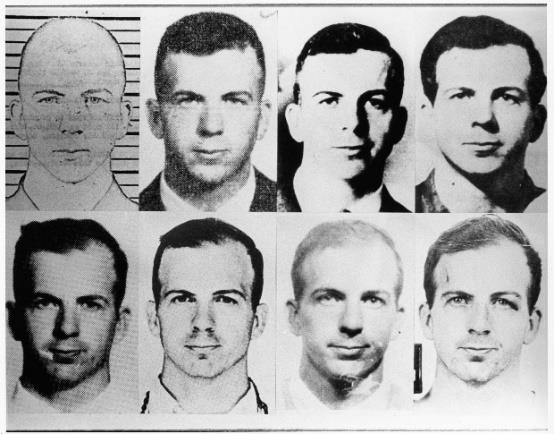
    myers20In the days, weeks, months, and perhaps even years leading up to November 22, 1963, there is no question that someone had been impersonating Lee Oswald. We have numerous instances on record of the real Oswald being in one place while many miles away a second “Oswald” was seen involved in strange and provocative behavior that would portray Oswald as being a highly dangerous and/or mentally unstable individual.

    Here is just a sampling of those inexplicable sightings of a “second” Oswald:

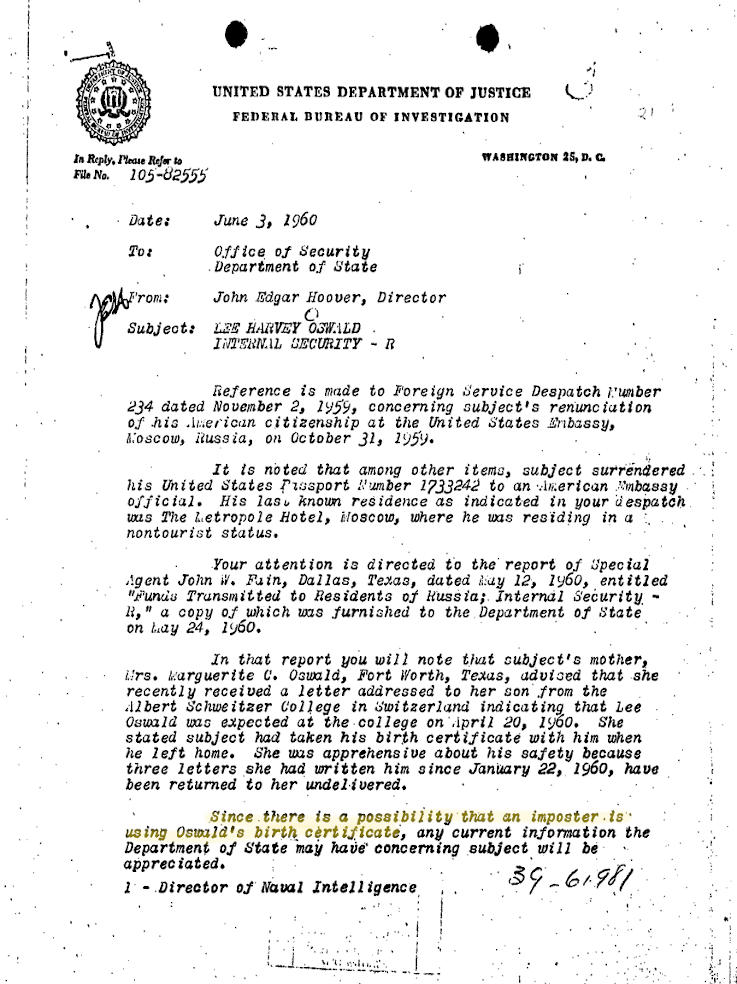
    • June 3, 1960 — F.B.I. Director J. Edgar Hoover wrote a memo stating that someone in the United States may be using defector Lee Oswald’s birth certificate and impersonating the ex-Marine while he is in the Soviet Union.
    • January 20, 1961 — Two men visited the Bolton Ford dealership in New Orleans and indicated their intent to purchase 10 Ford Econoline trucks for the Friends of Democratic Cuba. One of the men who identified himself as JOSEPH MOORE wrote out a bid form. Moore’s friend, who identified himself as LEE OSWALD, told the assistant manager that he would be responsible for payment.
    • November 1963 — “Oswald” walked into the Downtown Lincoln Mercury dealership to inquire about purchasing an automobile. A salesman accompanied Oswald for a test drive, during which Oswald drove at high speeds on the Stemmons Freeway, making the salesman very uneasy. Afterwards he told the salesman he wasn’t ready to buy, but would be coming into a considerable amount of money shortly. The salesman wrote down the man’s name, LEE OSWALD, for future reference.
    • November 16, 1963 — “Oswald” is seen at the Sportdrome Gun Range in Oak Cliff. He is boasting about his Italian-made carbine with its power scope to other patrons and firing at their targets, causing a scene.
    • November 20, 1963 — The real Lee Oswald was known to be a regular “coffee customer” at the Dobbs House Restaurant just a short walk from his rooming house. Lee would read a book while drinking his coffee. However, at 10 a.m. on the Wednesday before the assassination, and while the real Lee was working at the book depository, a man came in and ordered eggs. He soon began cursing at the waitress, and complaining loudly that his eggs were runny. Officer J.D. Tippit was said to have been in the restaurant at this time. The owner and several employees identified the unruly individual as Lee Harvey Oswald.myers21
    • November 22. 1963 —On the morning of the assassination, while Oswald had already reported for work at the book depository, a young man purchased two bottles of beer at the Jiffy Store on Industrial Boulevard. The store is located just a short walk from Dealey Plaza. When asked to present ID, the customer showed store clerk Fred Moore a Texas driver’s license for a Lee Oswald, birthdate October 1939. An hour later, the same individual returned to buy some peco brittle, which is a special peanut and coconut type brittle. Moore remembered the purchases because he thought the combination made for one very unusual breakfast.
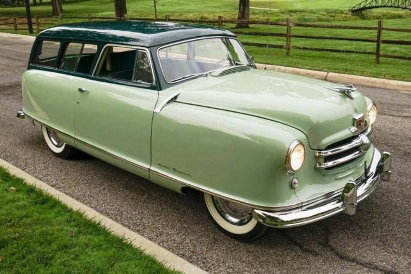
    • November 22. 1963 — Just a few minutes after the assassination, Lee Oswald departed the TSBD, walked several blocks east, and boarded a city bus. A transfer issued by the driver of that bus would later be found on Oswald’s person. However, at about the same time Oswald was boarding the bus on Elm Street, more than one witness— including a deputy sheriff — saw another “Oswald” run down the Grassy Knoll next to the TSBD and jump into a light green Nash Rambler station wagon driven by a Latino man, possibly Cuban. The vehicle then headed west under the triple underpass.myers22

    Who Purchased Oswald’s .38 Revolver?

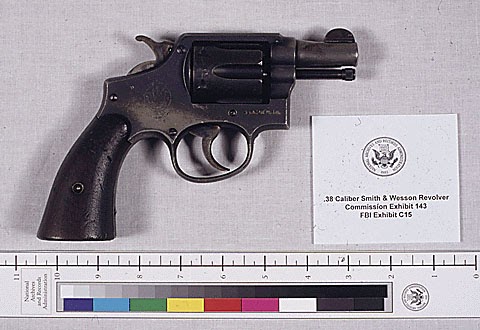
    myers23Authorities maintained that Lee Oswald had purchased the .38 Smith & Wesson pistol found in his possession when the suspect was arrested at the Texas Theater in Oak Cliff on November 22, 1963. However, there is scant proof that Oswald ever purchased that WWII-era handgun…and what measly proof offered is suspect.

    First, if Lee Oswald had wanted to purchase a weapon for nefarious purposes, he could have simply walked into any sporting goods store or hardware store in Texas, paid cash, and walked out with an untraceable gun. In 1963 guns could even be purchased at flea markets and yard sales — no license was necessary to sell guns. The only time purchasing a gun in Texas required paperwork and left a trail of evidence was in the case of the sale of weapons though the mail. Naturally, safeguards had been put into place to prevent juveniles from ordering deadly weapons through magazines and comic books.

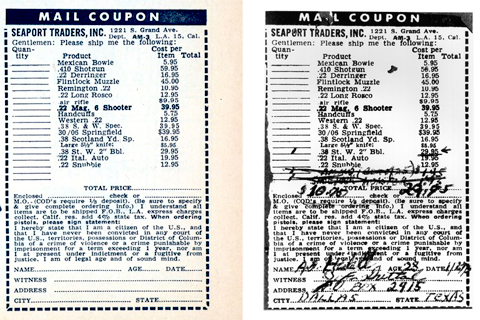
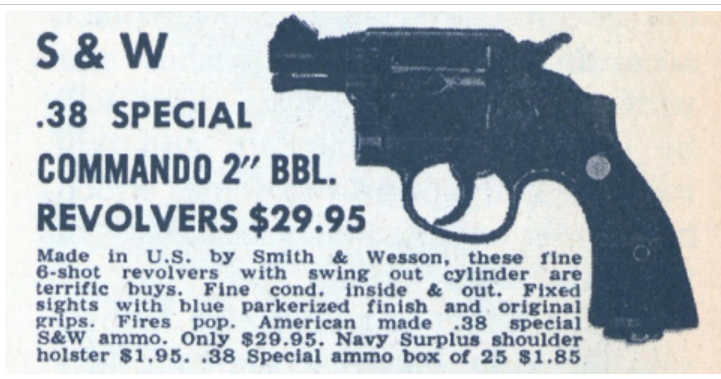
    Oswald allegedly ordered a .38 pistol through an advertisement placed in an April, 1963 men’s adventure magazine by Seaport Traders of Los Angeles. Oswald supposedly sent an order form and $10.00 in cash or money order to Seaport, requesting that a pistol be shipped via Railway Express Agency to Lee’s post office box registered to his name in Dallas, Box 2915. Inexplicably, the coupon order form was dated 1/27 even though the order form was not published in True Adventures until March.

    The U.S. Post Office would not handle private cargo for a private shipping company such as REA. The gun could not be shipped directly to a P.O. Box. Instead, the gun would be sent via Railway Express Agency–an early version of FedEx (Federal Express–to REA’s facility in downtown Dallas. The Dallas REA office would then send a notice by postcard to the buyer’s post office box that the package could be picked up at the REA facility.

    For this to happen, however, certain rules and regulations needed to be followed first:

    • The REA postcard had to be sent by REA to the buyer’s P.O. Box.
    • The buyer had to bring the postcard to REA’s office in Dallas.
    • The buyer had to present a certificate of good character to REA signed by a justice of the peace, county judge, or district judge from the buyer’s county of residence.
    • The buyer had to provide to REA proof of ID submitted on Form 5024 required for all pistols and small firearms.
    • The buyer had to pay the balance owed to REA.myers24

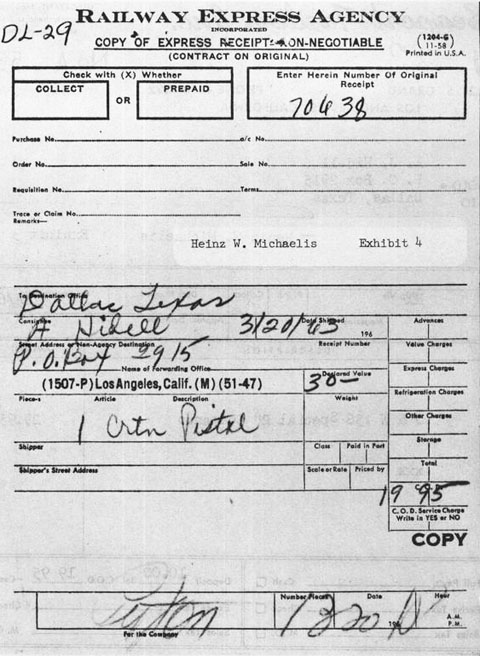
    However, is there any evidence that these rules were followed in the case of the Smith & Wesson .38 allegedly purchased by Lee Oswald? No. All that the Warren Commission provided was a copy of a receipt, not even the original. And that receipt was signed by neither Oswald nor A.J. Hidell, Oswald’s supposed alias.

    • There is no evidence REA ever sent a postcard to Oswald’s P.O. Box.
    • There is no evidence that Oswald or anyone else brought the postcard into REA.
    • There is no evidence of a certificate of good character.
    • There is no 5024 form with proof of ID.
    • There is no witness saying Oswald or anyone else picked up the pistol, or when.
    • There is no evidence of payment of the balance owed, $19.95.
    • There is no evidence of remittance of payment from REA to Seaport Traders.
    myers25Basically, there are no Department of Public Safety, police, or clerk records of Lee Oswald ever obtaining this handgun. We have no evidence of Oswald obtaining a certificate of good character from a judge or justice of the peace. Without the accused having followed any of the Texas laws on purchasing mail order firearms, how was he able to get this Smith & Wesson revolver? How is it possible nobody remembered seeing Oswald or anyone else pick up the handgun? Where’s the beef?

    We are supposed to believe that Oswald rented a P.O. box under his own name, sent in a coupon to Seaport Traders under the alias A.J. Hidell, had no ID or certificate of good character, and then signed the receipt using the name of Paxton or Patton ( see below). Then walked away with the gun with nobody witnessing this unlikeliest of transactions?

    It would seem rather that someone else ordered this weapon and created a paper chase to make it appear the “patsy” Lee Oswald ordered a mail order pistol through Seaport Traders.

    The evidence does not support that Lee Harvey Oswald ever purchased this gun from Seaport Traders, an accusation he denied before his untimely death at the hands of Jack Ruby in the basement parking garage of Dallas Police headquarters. The pistol apparently did wind up in his possession at the theater, but that is no proof he ordered the weapon. The origin of the S&W .38 Victory model pistol, serial number V510210, remains an unsolved mystery.myers26
    Who Stashed a Jacket Behind the Texaco?
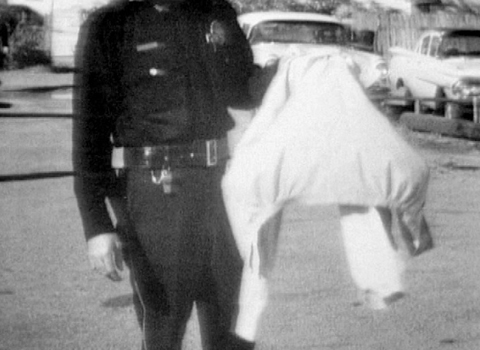
    myers27The case against Lee Oswald having been the murderer of Officer Tippit rested partially on the notion that Oswald’s Eisenhower style light-grey jacket was found along the gunman’s escape route. However, not only did investigators fail to connect the jacket conclusively to Oswald, they also failed to connect the jacket conclusively to the individual who shot and killed Patrolman Tippit. The only piece of circumstantial evidence put forward was that Marina Oswald, Lee’s wife, said she recognized the jacket as belonging to Lee. Marina said, though, that both of Lee’s jackets had come from and were purchased in the Soviet Union. The jacket found two blocks from the Tippit crime scene was a brand that had been sold in clothing stores in Los Angeles and Philadelphia — it clearly had not originated in Russia.

    In fact, the Eisenhower jacket is the weakest link in the government’s shaky chain of evidence against Oswald in the slaying of Officer Tippit.

    Warren Commission exhibit 162 was allegedly found partially hidden underneath a 1954 Oldsmobile in parking space 17 behind Ballew’s Texaco and service station at the corner of Jefferson Boulevard and Crawford Street. It was allegedly stashed there as the killer made good on his escape by foot. No one saw the killer put it there, however, and no one knows who found the jacket. Officially, DPD Captain William “Pinky” Westbrook was supposed to have found the jacket, but that’s not the story Westbrook told the Warren Commission in 1964. “Some officer, I feel sure it was an officer, I still can’t be positive, pointed this jacket out to me,” stated Captain Westbrook for the record. Dallas police radio logs indicate that an Officer 279 first mentions the jacket at about 1:25 p.m. — however Capt. Westbrook did not arrive on scene until 1:40 p.m. The identity of “Officer 279” remains a mystery, as does the origin of the jacket.

    The jacket was described as a light grey man’s jacket, size M (medium). Oswald weighed 130 pounds at the time of his death, and all his other clothes were men’s size small.

    Laundry marks and cleaning tags present in the jacket indicated the garment had been professionally cleaned on multiple occasions. Marina Oswald, however, claimed that she had always hand washed Lee’s jackets and other clothes. Despite their best efforts, investigators could not trace the laundry tags to any specific cleaning establishment. No evidence of professional cleaning was found on any of Lee Oswald’s other garments.

    Witnesses who saw the gunman fleeing from 10th & Patton generally disagreed the found jacket was the same as that worn by the killer. Some seven witnesses either failed to identify the jacket, or straight out said the found jacket did not match the jacket worn by Officer Tippit’s killer. Because the Tippit witness descriptions of the jacket worn by the killer were so wide-ranging, the Warren Commision was forced to officially state that “the eyewitnesses vary in their identification of the jacket.” This hardly supports a convincing identification of the garment allegedly discovered behind the Texaco station.myers28
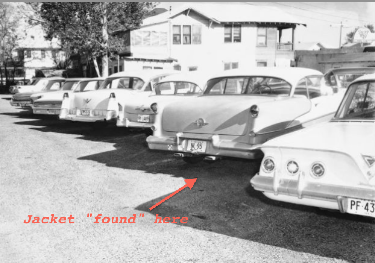
    Authorities tried to connect the jacket to Oswald by saying some fibers found on the mystery jacket were “consistent” with the brown shirt Lee Oswald had been wearing when arrested at the Texas Theater. What those same authorities fail to mention, however, is that one of the few details the Tippit witnesses agree upon is that the gunman had been wearing a white shirt, not a brown one.

    Interestingly, the Warren Commission insisted on describing the found jacket as being light-grey, although descriptions from November 22, 1963 refer to the garment as being white. However, modern color photographs of the evidence reveal the jacket to be tan or beige.

    Effectively, the Eisenhower jacket found almost two blocks from 10th & Patton was a prosecutorial dead end. It was likely not related to the homicide. If it was, in fact, the killer’s jacket, the shooter almost certainly was not Lee Oswald. And if the jacket was Oswald’s, the possibility it was a throwdown or plant would have to be seriously considered — especially in light of a piece of astounding evidence that was revealed in 1996.

    Retired FBI agent James Hosty, the man once tasked with keeping tabs on Soviet “defector” Lee Oswald while he was in Dallas, published a book titled Assignment: Oswald. In Hosty’s retelling of events, he would release a tidbit of information that would impact the Tippit case like a bombshell. Hosty described how fellow FBI agent Bob Barrett had been present at 10th & Patton for the initial investigation of J.D. Tippit’s murder. While the scene was still being processed, Captain William Westbrook of the DPD showed Special Agent Barrett a man’s billfold and asked if he’d ever heard of a character named Alek Hidell. Agent Barrett had gone to 10th & Patton at the request of Dallas County Sheriff Bill Decker.

    Barrett told Westbrook no, he never heard of this Hidell person. And Lee Oswald? No, Barrett couldn’t remember anybody by that name either.

    Mention of this incident in Hosty’s book set off a firestorm in the JFK critical community. It had been well known that Dallas Police Detective Paul Bentley had removed a billfold from Oswald’s back pocket after the suspect’s arrest at the Texas Theater. While in custody and en route to police headquarters in the back seat of Westbrook’s unmarked police car, Oswald had famously refused to give detectives his name. Bentley, noticing that Oswald had a billfold bulging from his back pants’ pocket, reached over and removed it. Discovering ID for two separate individuals inside the billfold, Bentley asked the suspect if he was Alex Hidell or Lee Oswald.

    “You’re the detective,” Oswald had reportedly replied defiantly: “You figure it out.”

    Detective Gerald Hill later testified to the Warren Commission regarding this incident. Officially, Oswald’s wallet had been taken from his person after his arrest. So how could his wallet possibly have been found at the Tippit murder scene?
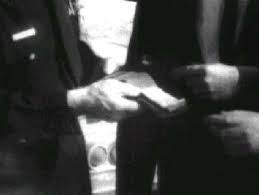
    myers29Dallas Police officials tried to explain the anomaly by saying that after the passage of so many years, Agent Barrett’s memory must have become muddled. Barrett saw the wallet at police headquarters, not at Oak Cliff. The retired FBI agent was simply mistaken. The official police report on Tippit’s murder made no mention of any billfold being discovered at 10th & Patton.

    ‘Why would they be asking me questions about Oswald and Hidell if it wasn’t in that wallet?’ an angry Bob Barrett observed. “They said they took the wallet out of his pocket in the car? That’s so much hogwash,” Barrett fumed. “That wallet was in [Captain] Westbrook’s hand.”

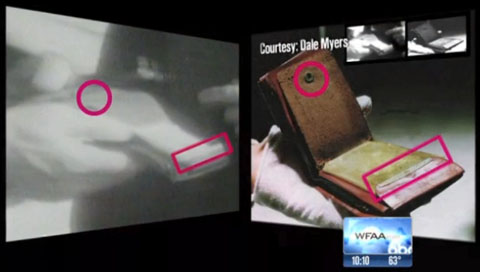
    A check of raw news footage from that day proved retired Agent Barrett’s version of events to have been accurate and truthful. There, in black & white, Westbrook could clearly be seen handling a man’s wallet and showing it to other law enforcement personnel. Could the wallet have been Officer Tippit’s wallet? Absolutely not. Tippit’s wallet was black, the wrong color, and was still on his person when the deceased’s body was transported to Methodist Hospital.

    Lieutenant Kenneth Croy, the reserve Dallas cop who had appeared so quickly on scene after Tippit’s slaying, was also still alive in 1996 when the wallet controversy first erupted. Asked about the alleged Oswald wallet, Croy explained that yes, someone in the growing crowd had handed him a wallet, which he later turned over to Captain Westbrook. Croy failed, however, to get the name of the individual who had supposedly discovered and handed him the wallet. Croy, in fact, had failed to record anything that day, for despite being the first policeman to have arrived on scene at the murder of a fellow officer, Croy neglected to even file a report.

    When testifying before the Warren Commission, Lt. Croy said he knew and recognized several of the officers who were present at the scene that afternoon — but he couldn’t remember the name of any of them, not one. The mystery wallet was never listed in Captain Westbrook’s report. After being shown to Agent Barrett and others at the Tippit scene, the billfold simply disappeared. Once Oswald’s wallet had been taken from his person upon arrest, the second Oswald wallet had to disappear. Two Oswald wallets that day were simply one too many.

    Before his death, Dallas Police Sergeant Leonard Jez was asked to comment on the presence of Oswald’s wallet at 10th & Patton. Jez had been one of several officers officially present at 10th & Patton, and whom Lt. Croy could not recall. Jez verified the existence of the wallet at the murder scene, he had seen it with his own eyes

    “Don’t let anybody bamboozle you,” stated Jez flatly. “That was Oswald’s wallet.”

    Photographic comparisons between the wallet in the news footage and Oswald’s wallet stored in the National Archives proves they are similar in style but in fact undoubtedly two separate wallets.

    So, if the second Oswald wallet that mysteriously appeared and then disappeared on E. 10th street was very likely a plant or thrown down, and if the dubious grey/white/tan Oswald jacket found by a person or persons unknown behind Ballew’s Texaco was possibly a throw down…is it possible any other evidence left at the Tippit murder scene was not what it appeared to be? To find out, dear reader, keep on reading…myers30
    Why Did the Killer Leave Four Empty Shells Behind?
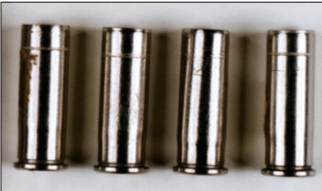
    myers31Of all the pieces of evidence the authorities claimed to have against Lee Oswald in the murder of Officer Tippit, the four hulls or shells were by far the most probative. The forensic examination of the .38 caliber cartridge cases found at the scene of the shooting determined them to have been fired from the revolver in Oswald’s possession to the exclusion of all other weapons.

    Oswald had that pistol on his person in the darkness of the Texas Theater less than a mile from the Tippit murder. Had Lee Oswald lived to stand trial, how could any defense attorney possibly have explained that fact away? TO THE EXCLUSION OF ALL OTHER WEAPONS.

    Apologists for the Warren Commission Report who continue to believe that Lee Oswald committed these murders will often bend regarding the other points of evidence against the accused:

    • Yes, eyewitness testimony is often unreliable, especially if suspect Oswald had a so-called double.
    • Undoubtedly the paperwork linking Oswald to the .38 Smith & Wesson was flimsy and incomplete at best.
    • For sure the finding, chain of custody, and identification regarding the alleged Oswald jacket was dubious.

    But the shells, found at 10th & Patton, matching the pistol in Oswald’s possession to the exclusion of all other pistols? That sounds like slam dunk, case closed, throw the book at Oswald type of evidence.

    Maybe, but not so fast…

    Now, believers in Oswald’s innocence have offered several various scenarios to explain away the ballistics match to Oswald’s Smith & Wesson .38:

    • Tippit was killed by at least one, and possibly two killers armed with automatic pistol, not revolvers. This was why initial police reports described the suspect as being armed with an automatic, not a revolver.
    • The Dallas Police Department later switched the shells before handing them over to the FBI for closer inspection.
    • Captain Westbrook, once back at his desk at police headquarters, later switched the killer’s pistol for Oswald’s pistol.

    I don’t believe any of these things happened. Oswald was already framed for the Tippit murder by the time the killer disappeared somewhere behind Ballew’s Texaco. The wallet, the shells, the jacket…they all spelled game, set, and match for the blaming of the patsy.
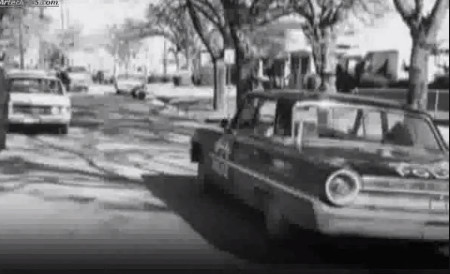
    myers32The killer of J.D. Tippit and the conspirators who plotted to assassinate JFK framed Oswald. Oh yes, the four shells recovered from along the corner house at 10th & Patton were most definitely fired from Oswald’s gun…which at the time of Tippit’s slaying was in Oswald’s possession at the movie theater. The plan was ingenious and has gone undetected until now — nearly 60 years later. We might all agree that 60 years was more than good enough for government work. As it was, the patsy Oswald didn’t even last 60 hours.

    The secret to the frameup lies in the special type of revolver given to patsy Oswald — and used by the professional assassin who ended Officer Tippit’s life, as Helen Markham so aptly described, “in the wink of your eye.” Oh, these guns were nothing outwardly special…World War II surplus models purchased for $29.95 apiece. But they featured one unusual characteristic that made the frameup work. These revolvers, actually the entire lot of some 500 of them, were modified and rechambered for sale back in the United States. It was the use of rechambered .38 revolvers that made the simple but effective Oak Cliff deception possible.

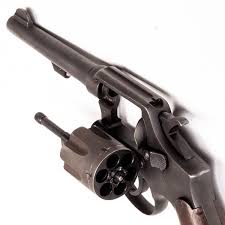
    The Smith & Wesson .38 “Victory” model was manufactured in the U.S. for homeland defense use during World War II. The handgun found on suspect Oswald was part of a shipment originally sent to Great Britain. Luckily, though the Nazis did considerable damage by dropping bombs and missiles on our island nation ally, they were never able to mount a troop invasion across the English Channel. So, the .38 Victory models remained in storage in Britain for the duration of the war. Many years later, an enterprising sporting goods company repurchased the war surplus weapons and reimported them back home to America.

    Post WWII a newer type of ammunition was becoming popular and in increasing demand for use with .38 revolvers. Known as the .38 special round, the new ammo had more proven stopping power than the traditional .38 S&W bullets. By comparison, the .38 specials were much longer than the .38 regular ammo (which became known as .38 shorts)…but the .38 special cartridges were also slightly thinner or smaller in diameter than the .38 S&W “short” ammo.

    As the .38 special ammo became more widely used by police and military units, civilian gun owners also started to favor the newer ammo that packed a bigger punch.myers33
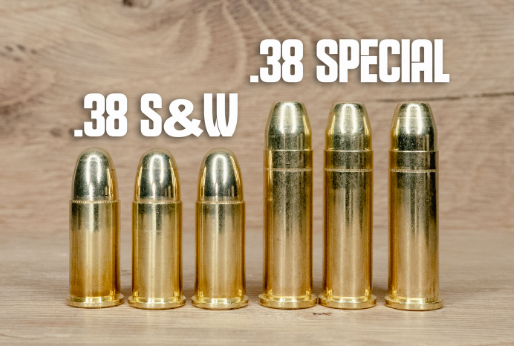
    Therefore, to make these reimported old revolvers more marketable to the public, the seller had a gunsmith (L.M. Johnson of Van Nuys, CA) make certain modifications to the weapons. First, the barrels of these handguns were cut down from 5 inches to 2¼ inches, making them “snub nose” revolvers for easier concealment. Second, the revolvers were “rechambered” by having the old cylinders swapped out for new cylinders designed to accept the more popular .38 special ammo with more stopping power — but also with slightly different dimensions.

    However, since the .38 special bullets are only slightly narrower than the standard .38 S&W cartridges, the guns were never re-barreled. This left the barrels for these handguns slightly oversized for the new ammo being used. Again, close enough for government work!

    These modified guns functioned just fine and were well suited and modestly priced for someone looking for a handy, dependable self-defense weapon. But the slightly oversized and shortened barrel left the revolvers with one highly unusual characteristic — as the slugs were fired and traveled through the barrel, they each took an “erratic” passage. Basically, the slugs would wobble slightly and would not contact the barrel the same way each time the weapon was discharged. The result? The oversized barrel would impress upon the lead bullets inconsistent individual microscopic characteristics. This made identification of a specific revolver that fired a specific bullet impossible once the weapon had been rechambered in this way.

    In the words of the HSCA firearms panel tasked with examining the Oswald revolver against the four lead slugs taken from Officer Tippit’s body, the panel found that, “Due to the inconsistent markings on the recovered bullets and on all the test-fired bullets, the panel concluded that the CE 602 through CE 605 bullets (the slugs recovered from Tippit’s body) could not be conclusively identified or eliminated as having been fired from the CE 143 revolver (the handgun allegedly in Oswald’s possession at the Texas Theater).”

    Had Lee Oswald been carrying a revolver that had not been modified and rechambered, then the four bullets taken from J.D. Tippit’s body would likely have been either positively matched or positively eliminated as having been fired from the gun allegedly in Oswald’s possession.

    But wait…didn’t the killer so conveniently leave four shells at the scene of the murder? Why yes, he did! But wait again, only automatic pistols eject the empty shells as the weapon is fired. Shells from a revolver such as the S&W .38 special must be manually unloaded — which is exactly what witnesses at the scene said the killer did.

    When Detective Gerald Hill arrived at 10th & Patton and heard that several shells had been recovered by witnesses, he logically assumed the killer had been armed with an automatic which had ejected the shells. Had Hill personally inspected the shells, he would have seen they were labeled .38 SPL and had come instead from a revolver. But who murders a cop and then stops mid-flight to dispense highly incriminating shells? It made absolutely no sense.

    “Now there’s a dumb crook,” quipped Texas JFK researcher Jim Marrs.

    Was the killer just plain crazy…or crazy like a fox?

    At approximately 1:40 p.m. Hill radioed the following message…“The shell found out the scene (of the shooting) indicates that the suspect is armed with — an automatic .38 rather than a pistol.”myers34
    This incorrect broadcast has fueled speculation for years that Tippit was slain with an automatic pistol or pistols. But the slugs recovered from his body — and the shells dropped at the scene — indicate otherwise. Something else was afoot.

    Patrolman J.M. Poe caused a bit of a stir with his testimony before the Warren Commission when he stated he could not find the ID marks he had allegedly placed on two of the shells (hulls) recovered at 10th & Patton by witness Domingo Benavides. This led some critics to surmise that the shells had been switched. But under direct examination, Poe hesitated to definitively confirm that he had marked those two shells. “I couldn’t swear to it, no sir.” Later, in an interview granted to JFK researcher Joseph McBride, Detective Jim Leavelle, who headed up the Tippit investigation, scoffed at the idea Poe had ever marked the shells. “Actually, they never marked ‘em. There wasn’t no point in it. We don’t mark’em.”

    Leavelle, who was the homicide detective wearing the Stetson and handcuffed to Oswald when he was shot by Ruby, admitted the ballistics on the Tippit case were frankly “a mess.”

    Rep. Hale Boggs from Louisiana, the youngest member of the Warren Commission, became so frustrated with the ballistics in the Tippit case that he asked directly, “What proof do you have that these are the bullets?” Apparently, Boggs never received a satisfactory answer.

    Yes, Tippit’s killer and the conspirators behind him had been clever, but perhaps a tad too clever for their own good. You see, the cartridge cases — two Western-Winchester and two Remington–Peters — did not match up with the fatal bullets— which were three Western-Winchester and only one Remington-Peters. “The last time I looked,” noted Jim Garrison wryly, “the Remington–Peters Manufacturing Company was not in the habit of slipping Winchester bullets into its cartridges, nor was the Winchester–Western Manufacturing Company putting Remington bullets into its cartridges.”

    It is important to note that the HSCA firearms panel found the components (recovered shells and slugs) of these cartridges were all consistent withfactory loaded ammunition. There should have been no discrepancy (2-2 vs. 3-1) between the shells and the fatal lead slugs. This was not home-loaded ammo. Something was clearly wrong.

    The panel tried to explain this show-stopping mismatch by offering the following two solutions:

    1. One Western-Winchester cartridge case was not recovered or is missing, and one Remington-Peters lead bullet missed Officer Tippit and also was not recovered.
    2. One Western cartridge case was not recovered or is missing, and one fired Remington-Peters cartridge case was in the revolver prior to the Tippit shooting.

    Since the escape route of the gunman was witnessed by several people, it seems hard to believe that a shell would have gone unrecovered along such a narrow pathway. And as far as a possible fifth shot was concerned, that idea was largely unsupported by the earwitness testimony.

    The witnesses within direct earshot of the murder, along E. 10th Street, all heard between two and four shots. That the shots were fired in such quick succession probably meant that some witnesses perceived multiple adjacent loud reports as a single gunshot.
    myers35Warren Reynolds, located relatively far to the south of E 10th across Jefferson Boulevard, thought he heard maybe four, five, or possibly even six shots. Ted Callaway, located closer to E. 10th just off Patton Avenue, thought he heard five shots. These “earwitnesses” however, would have been blocked from directly hearing the gunshots by the houses situated at 400, 404, and 410 E. 10th. What Messrs. Callaway and Reynolds likely confused with additional shots were echoes bouncing off surrounding structures.

    Even the HSCA firearms panel agreed these two theories were speculation, not supported by the available evidence. The available evidence indicates four shots. If only four shots were fired, and the slugs and shells do not match, then Lee Oswald’s handgun did not kill Officer Tippit. Someone else with some other gun did.

    But the shells…they were proven to have been fired from “Oswald’s” gun to the exclusion of all other weapons!

    Yes, they were. But the shells weren’t fired at 10th & Patton, or from the handgun that killed Officer Tippit. They were fired sometime before November 22 — before the revolver was in all probability given to Oswald by those involved in the plot. Recall, there is no proof Oswald ever picked up that weapon. Which happens to correspond to the DPD issue.
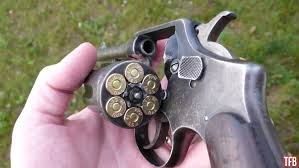
    myers36The shells that held the bullets that killed J.D. Tippit remained in the handgun that the killer carried with him as he made his escape from 10th & Patton. That’s why the shells left on the ground didn’t match the bullets in Tippit’s body. The conspirators, in their zeal to frame Oswald with slam dunk evidence, decided to mix the ammo in an exotic blend of Remington-Peters and Western cartridges. They were going for a 360° windmill slam dunk. Only problem was, while the killer counted out the correct number of shells — four — in the excitement he got the exact brand mixture wrong.

    There’s a time-tested adage concerning the successful completion of difficult tasks…KISS. Keep it simple, stupid. Had the conspirators stayed with all Western or all Remington-Peters cartridges, this colossal mistake would never have been made. Oswald had no ammo amongst his possessions, and no gun-cleaning paraphernalia. The idea of framing him with mixed ammo was really an overreach.

    The conspirators purchased at least two Smith & Wesson 38 Special Commando snub-nose revolvers from Seaport Traders and created a paper chase leading to the Oswald-Hidell P.O. Box for one of them. Same manufacturer, same lot, same modifications, same gunsmith. Wallet, shells, jacket…game, set, and match.

    Only rechambered revolvers would have filled the bill. Had it never been modified, the “Oswald” gun could have been excluded from firing the bullets that killed Tippit, based on the unique microscopic characteristics each gun barrel leaves on each bullet. But with a rechambered gun, the “Oswald” gun could neither be identified nor excluded as the murder weapon. It could only be characterized as being “consistent” with having fired the fatal shots.

    The shells, which contained unique breach face marks and firing pin marks, conclusively linked “Oswald’s” revolver to the shooting — even though the weapon was most of a mile away when Tippit was murdered, stuffed in Lee Oswald’s waistband as he ate popcorn purchased from Texas Theater manager Butch Burroughs.

    Knocking empty shells out of a Smith & Wesson revolver is not that difficult of a task. The killer basically overplayed his hand. Each cylinder comes with a hand ejector, a small rod which, when depressed, releases all the shells at once from the open cylinder. According to one write-up on the Victory model Smith & Wesson .38, you “press the cylinder release forward, swing out the cylinder and load six rounds of fun into the cylinder. When done, you again release the cylinder; tilt the gun to the rear, press the cylinder rod down and the extractor will do the rest.”

    The empty shells should all fall into your hand. Tippit’s killer made a show of “unloading and reloading” as the Tippit witnesses described. And instead of leaving a pile of empty shells, the killer tossed them one-by-one along a path like so many Reese’s Pieces candy in Steven Spielberg’s hit movie ET. The murder was scripted, and the witnesses (and later the investigators) entirely bought the killer’s deft but simple sleight-of-hand.

    • From witness Domingo Benavides: Then I seen the man turn and walk back to the sidewalk and go on the sidewalk and he walked maybe five foot and then kind of stalled. He didn’t exactly stop. And he threw one shell and must have took five or six more steps and threw the other shell up, and then he kind of stepped up to a pretty good trot going around the corner.
    • From witness Sam Guinyard: He came through there (the hedges at 400 E. 10th along Patton Ave.) running and knocking empty shells out of his pistol…he was rolling them with his hand — with his thumb…checking them, he had his pistol up like this [indicating].
    • From witness Virginia Davis:Oswald carefully left the shells for me to find.
    myers37When the Smith and Wesson .38 Special revolver allegedly in Oswald’s possession in the theater was checked, it contained four live .38 rounds — two Western-Winchester cartridges and two Remington-Peters cartridges. If Oswald had been the shooter at 10th & Patton, and had reloaded, shouldn’t the revolver have contained six cartridges, not four? And had Oswald been the shooter and hadn’t reloaded, shouldn’t the revolver have contained only two cartridges?

    The suspect was officially taken into custody at the Texas Theater at 1:51 p.m. and brought into police headquarters at about 2 p.m. Oswald was soon after ushered into Captain Will Fritz’s office for the first of several interrogations by Fritz and other law enforcement officials. Then, sometime after 4 p.m., suspect Oswald was brought down to the basement assembly room for his first lineup. It was at this time that Dallas officers supposedly searched Oswald and, surprise, surprise, found five additional Western-Winchester .38 Special live rounds in his trousers pocket.

    Not long ago I reached out to Frank Griffin, author of the book Touched by Fire. Griffin was a young man in 1963 who, from his vantage point at 10th & Denver, heard the shots nearly a block away that took Officer Tippit’s life. Griffin stepped quickly onto the sidewalk, glanced to the west, and spotted Tippit’s killer walking away from the patrol car and escaping south on Patton Avenue. Griffin maintains that he was able to identify Oswald as the shooter even though he was at least 300 feet away and Griffin never saw the killer from the front. “I had exceptional vision,” Griffin explained, and was a crack shot in the military. Well, at that same age, I was a fit, competitive runner who had completed the open mile at the Junior Olympics in just over 4 minutes and 20 seconds. Had I finished the mile in just over 2 minutes and 20 seconds, I would have not been human — I would have been a horse. And if Frank Griffin or anyone else can make a positive identification on a stranger at 300 feet or farther, they aren’t human either — they must be an eagle.

    Was Frank Griffin not telling the truth? No, not really. Not at all, in fact. That is how the human mind works. Our memory is not like some videotape that can be endlessly played back, over and over, such as the Zapruder film. Instead, our minds tend to edit and distort memories over time. Mr. Griffin’s mind, and other folks’ minds, have taken the repeated image of Lee Oswald and, over the months and years, superimposed it on the memory of the figure they saw for but a moment the day JFK and Officer Tippit were killed. It is called by some the power of suggestion, and it is a force that is wholly underestimated by most.

    I did ask Frank one more important question. While too far to have positively ID’d Tippit’s killer, Mr. Griffin was still standing in a direct line of sight (and sound) from the incident. So, I asked Griffin how many pistol shots he had heard.

    “Four,” was the witness’s reply. “I clearly heard four shots.”

    And if Franklin (Frank) Griffin is correct, and he heard four and only four pistol shots on E 10th Street that day, then Lee Oswald is very clearly innocent of the murder of Officer J.D. Tippit.
  • How Oswald Was Framed for the Murder of Tippit

    How Oswald Was Framed for the Murder of Tippit


    Introduction

    myers01On Friday November 22, 1963, a pair of mysterious murders were committed in the city of Dallas, Texas. At 12:30 p.m. President John F. Kennedy was assassinated as he rode in an open motorcade through Dealey Plaza on his way to give a speech at the Dallas Trade Mart. Some 35-45 minutes later, Dallas patrolman J.D. Tippit was fatally shot on a residential block of Oak Cliff, an inner ring suburb located just across the Trinity River from Dealey Plaza and the downtown area. Authorities would quickly charge 24-year-old Lee Harvey Oswald, an ex-Marine and employee of the Texas School Book Depository in Dealey Plaza, with both murders. After his arrest in Oak Cliff’s Texas Theater, Oswald would vociferously maintain his innocence until his own baffling homicide at the hands of nightclub owner Jack Ruby just two days later — nationally televised in the basement parking garage of the Dallas Police Headquarters.
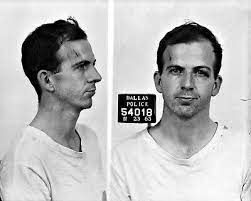
    The horrific events of that unforgettable weekend would shake our nation to its core and usher in the rest of what would arguably be the most tumultuous and pivotal decade in American history. Sixty years later, the festering, burning question remains…did Oswald do it? Dallas Police and the Dallas District Attorney’s office were fully preparing to try Lee Oswald and Oswald alone for the crimes. After the suspect’s murder while in police custody, the subsequent Warren Commission, empaneled by incoming President Lyndon Johnson, found in the following year that Lee Oswald alone had murdered both President Kennedy and Officer Tippit with no assistance from any accomplices…foreign or domestic.

    During the 1970s, as public doubts about the veracity of the so-called Warren Report grew, Congress decided to take a second look at the controversial, problem-filled case. After having been locked away in a vault for some 11+ years, a copy of the “Zapruder” home movie of the assassination was finally shown in 1975 on ABCs’ Good Night America to a shocked national audience. Rumors of shots being fired from the legendary “Grassy Knoll” to the front of the Presidential limousine had persisted since the day of the assassination. Now, as citizens watched the home movie footage on TV for the first time, they could clearly see for themselves the President’s head being thrown violently back and to the left. The Zapruder film seemed to plainly indicate that one or more of the shots had come from the front. Not solely from the rear and the Texas School Book Depository where Lee Oswald had allegedly fired a cheap, misaligned World War II surplus rifle from the sixth floor. As a result of the political pressure that ensued, the House Select Committee on Assassinations (HSCA) was convened in 1976 to study the JFK assassination…as well as the murder of Martin Luther King, Jr.

    The conclusion of the HSCA members and their investigation was that there had been a “probable conspiracy” in the JFK assassination. But they were unable to determine its nature or participants (other than that Oswald was still deemed to have fired all the successful shots). Regarding Tippit, the HSCA still believed that Lee Oswald had gunned down the officer near 10th & Patton in Oak Cliff. This was likely because of the appearance of a new Tippit witness, Jack Tatum, whose testimony helped to bolster the heavily damaged credibility of the Warren Commission’s star witness in the Tippit case, waitress Helen Markham.

    In the years immediately following the assassination, some 87% of the American public believed that Lee Oswald had acted alone. Today, over 60% believe that JFK and Officer Tippit were killed as part of a conspiracy. As more details and statements have been released in the new millennium, a growing number of citizens, though still a minority, have come to believe that Lee Oswald was being truthful when he claimed he hadn’t shot anyone that day — that the New Orleans-born young man was “just a patsy” in this unthinkable national nightmare.

    myers02So, what reasons did the government offer for naming Lee Oswald as the killer of Officer Tippit? The official case against Oswald rested on the following:
    1. Two eyewitnesses saw the Tippit shooting. Seven more witnesses heard the shots and saw the killer fleeing the Tippit murder scene with gun in hand. All nine witnesses positively identified Lee Harvey Oswald as the man they saw.
    2. A .38 Smith & Wesson revolver was purchased by Oswald and was in his possession at the time of the suspect’s arrest in the Texas Theater in Oak Cliff — less than a mile from the location where Tippit was slain.
    3. Lee Oswald’s “Eisenhower” style jacket was found along the path of the gunman’s flight.
    4. The four .38 caliber cartridge cases (shells) found at the scene of the Tippit shooting were fired from the revolver in Oswald’s possession to the exclusion of all other weapons.

    This article will deal with each accusation and show how the preponderance of evidence now points to the probable innocence of Lee Oswald in the murder of Officer Tippit.

    Part 1: The Witnesses

    The eyewitness testimony against Lee Oswald for the murder of JD Tippit was never as strong nor as solid as the authorities led the public to believe. As Tippit researcher and author Joseph McBride has so cogently stated, “the eyewitness evidence is so contradictory that it seems as though there were two sets of witnesses” at 10th & Patton in Oak Cliff on November 22. 1963. One set of witnesses, those who got to testify for the Warren Commission and later HSCA, said Lee Oswald was the man they saw at or near the Tippit murder scene with a gun. However, witnesses who were largely ignored by Dallas Police and the later subsequent federal investigations told an entirely different story. These individuals saw at least two suspicious men escaping the scene of the murder, with none of those persons being positively identified as Oswald.

    myers03To further complicate matters, there is a wealth of evidence to suggest that for weeks, perhaps even months prior to the murders of President Kennedy and Officer Tippit, an Oswald lookalike had been impersonating the ex-Marine in a concerted effort to draw attention to Oswald — to portray him as an unbalanced and highly dangerous individual. So, when witnesses claimed to have briefly seen suspect Oswald with a handgun in the vicinity of the Tippit murder, it is unclear whether they saw the real Lee Oswald, his well-documented and often-seen imposter, or someone else entirely.
    New Orleans District Attorney Jim Garrison, one of Lee Oswald’s earliest and most vociferous defenders, had long believed that the plot to kill Kennedy had been hatched in his city during the summer of 1963, and investigated accordingly. In October 1967, Mr. Garrison granted an interview to Playboy Magazine, during which he noted, “The evidence we’ve uncovered leads us to suspect that two men, neither of whom was Oswald, were the real murderers of Tippit.”

    After DA Garrison’s interview hit the newsstands, the magazine received the following anonymous letter from Dallas:

    I read Playboy’s Garrison interview with perhaps more interest than most readers. I was an eyewitness to the shooting of policeman Tippit in Dallas on the afternoon President Kennedy was murdered. I saw two men, neither of them resembling the pictures I later saw of Lee Harvey Oswald, shoot Tippit and run off in opposite directions. There were at least half a dozen other people who witnessed this. My wife convinced me that I should say nothing, since there were other eyewitnesses. Her advice and my cowardice undoubtedly have prolonged my life — or at least allowed me now to tell the true story…”

    In my July 8, 2019 article Why Officer Tippit Stopped His Killer published on this web site I went into considerable detail in explaining the difficulties presented by the witness testimony in the Tippit case. For the sake of brevity, I will only summarize my findings here. The devil, of course, is often in the details, and so interested readers should go to this article.

    First, it should be realized that many misidentifications have contributed to reversals eyewitness misidentification overwhelming majority of wrongful convictions, later overturned by post-conviction DNA testing. According to one peer-reviewed scientific study cited by the Innocence Project,the ability to correctly identify a suspect in a crime drops off dramatically once the witness’s location is 25 or more feet from the subject. After 25 feet, facial perception diminishes, and diminishes rapidly.At about 150 feet, accurate face identification for people with normal vision drops to zero.myers04

    Domingo Benavides

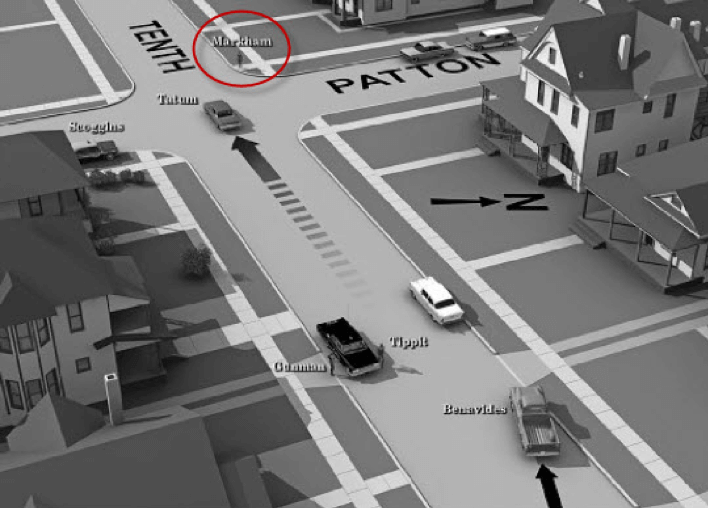
    The only witness who was possibly within 25 feet of the Tippit shooting was Domingo Benavides, a young man driving west on E. 10th Street in a pickup truck. Benavides saw Tippit talking to a young man across the hood of his patrol car. As Benavides was almost even with the stopped police car and preparing to pass, he heard three close by gunshots. Benavides ducked down behind his dashboard, turned his truck into the far curb, and hid out of sight for several seconds. He did not actually see the shooting. When Benavides finally peeked over his dashboard, he observed the killer walking west towards Patton Avenue. Benavides waited until the killer was well out of view before exiting his vehicle and checking on Officer Tippit. Tippit appeared to be deceased. Benavides would retrieve two shells discarded by the killer who had cut across the lawn on the corner property and fled south on Patton Avenue. Benavides told police he could not identify the shooter because the witness basically only saw the suspect from behind as he escaped. Benavides did not participate in any of the downtown lineups. The witness did note, however, that the suspect had a squared off haircut that ended on the back of the neck above the “Eisenhower” jacket. Photographs from that day clearly show that Oswald’s hair was tapered in the back and would have extended below the neckline on a similar jacket as seen.

    Helen Markham

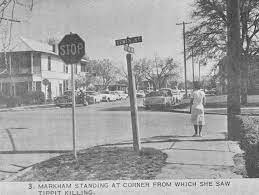
    Helen Markham was the so-called “star” witness in the Tippit case as she was the only witness on the day of the murder to claim having seen the actual shooting. Mrs. Markham is “legendary” in this case because her testimony and statements were so confused, contradictory, and downright bizarre. Markham had been walking south on Patton Avenue — on her way to catch a bus on Jefferson Boulevard that would take her to her waitressing job in downtown Dallas. The witness said she saw a man walking east on 10th Street who was soon stopped by a police officer in a patrol car. The two spoke briefly through the car window. Then the officer climbed slowly out of his car to question the man further. Just as Tippit neared the front of his car on the driver side, the killer pulled a handgun concealed under his jacket and shot the policeman several times across the car’s hood “in the wink of your eye.”

    Critics of Helen Markham, and there are many, have noted an abundance of blatant mistakes in her story. Markham was the only witness who saw the killer walking east, while the other people along 10th Street saw the killer walking west. Markham said the killer leaned into Tippit’s open passenger window, however only the vent window was cracked open. Most strangely, the witness says she was alone with the officer for a full 20 minutes before help came, and that Tippit had tried to hold a conversation with her while he lay dying. All other witness testimony and medical evidence indicates the policeman was likely dead before he hit the ground. As for the killer’s escape, only Markham saw him run down the alleyway between E. 10th and Jefferson Boulevard. All other witnesses clearly said the killer ran past the alley and fled west on Jefferson Boulevard.

    myers05Several of the Warren Commission’s lawyers told their bosses that it would be a mistake to use Markham’s confusing rendition of events.
    “Contradictory and worthless” was the description given by Assistant Warren Counsel Wesley Libeler regarding Mrs. Markham’s testimony. “The Commission wants to believe Mrs. Markham and that’s all there is to it,” added staff member Norman Redlich.

    “She’s an utter screwball,” remarked Counsel Joseph Ball.

    Markham had fainted more than once at the scene, her behavior was described as hysterical, and she later was administered smelling salts by the police before viewing a four-man downtown lineup. Although Markham was said to have identified Oswald, her later testimony put that ID much in doubt. Before the Warren Commission Mrs. Markham repeatedly said she didn’t know anybody in the lineup and didn’t recognize anyone. She didn’t pick the “Number Two Man” by his face, but rather because the man’s looks gave her chills.

    “A rather mystifying identification,” quipped Warren Commission critic Mark Lane.

    myers06While talking to the press, Mrs. Markham had described the gunman as being short, a little chunky, and with bushy black hair. Suspect Oswald was 5’9”, noticeably underweight at 130 pounds, and had receding, thinning brown hair.

    Mrs. Markham was never closer than about 90 feet to the gunman.

    My own research has shown that Mrs. Markham’s story does not square with her stated timeline nor sightlines. The trim and fit waitress was hurrying to catch a bus, not standing idly on the northwest corner of 10th & Patton watching as this drama unfolded. Markham should’ve already been past that intersection and headed for her bus by the time the killer shot Tippit.

    Bill Scoggins

    Cab driver William Scoggins was sitting in his vehicle just before the stop sign at the southeast corner of 10th & Patton when the shots rang out. While eating his lunch, Scoggins had observed Tippit’s patrol car roll slowly through the intersection headed east. Some 100 feet from the corner, Tippit stopped and tooted his horn, beckoning a young pedestrian on the sidewalk to approach the car. Once the young man went to Tippit’s car, he disappeared from Scoggins’ view because of some hedges. Scoggins was positive that the young man had never passed in front of his cab, walking east. So, the pedestrian must have been walking west, although the witness thought he might have been in the process of turning around when beckoned by the policeman.

    Suddenly, several shots rang out in quick succession. “They was fast,” the witness would later recall. A surprised Mr. Scoggins dropped his lunch and watched as a young man carrying a pistol came striding across the corner property’s lawn, directly adjacent to his cab. Scoggins scrambled from his cab but saw no avenue of easy escape. Hunkering down behind his cab’s driver side fender, the WWII veteran watched as the young man jumped through the hedges, ignoring his taxi, and proceeded south on Patton.

    Scoggins thought he heard the gunman mutter either “Poor dumb cop” or “Poor damn cop.”

    At a Saturday police lineup, Scoggins picked Oswald as the man he saw crashing through the hedges and carrying a pistol. However, cab driver William Whaley, who attended the same lineup as Scoggins to identify Oswald as the man he drove to Oak Cliff shortly after the assassination, made an interesting observation about this hastily arranged police procedure. This is what Mr. Whaley told the Warren Commission:

    Then they took me down in their room where they have their showups, and all, and me and this other taxi driver (Scoggins) who was with me, sir, we sat in the room awhile and directly they brought in six men, young teenagers, and they all were handcuffed together. Well, they wanted me to pick out my passenger. At that time he had on a pair of black pants and white T-shirt, that is all he had on. But you could have picked him out without identifying him by just listening to him because he was bawling out the policeman, telling them it wasn’t right to put him in line with these teenagers…He showed no respect for the policemen, he told them what he thought about them. They knew what they were doing and they were trying to railroad him and he wanted his lawyer.myers07

    By Saturday November 23rd just about every functioning adult in the Dallas metro area knew that shots had allegedly been fired from the Texas School Book Depository. Lee Harvey Oswald had already been announced as the suspect, and his face had been shown on television. During the lineup, while police employees standing in had been allowed to give false names and occupations, Oswald stated his correct name and identified himself as an employee of the Texas School Book Depository.

    Worse yet, Scoggins later admitted to the Warren Commission he was not able to pick out Oswald during a separate photo lineup. Scoggins said that he was shown photos of different men by either an FBI or Secret Service agent.“ I think I picked the wrong one,” the cab driver testified. “He told me the other one was Oswald.”

    Jack Tatum

    Purported witness Jack Tatum never participated in a police lineup in 1963. That is because Mr. Tatum never came forward until almost 15 years later when the House Select Committee on Assassinations (HSCA) was convened in the late 1970s to reinvestigate the JFK case. By the time the HSCA was empaneled, the credibility of Mrs. Markham’s version of events had reached near zero — and Markham had been the only witness to say she saw the gunman shoot Tippit. Tatum told an incredible new story, how he had been driving west on E. 10th Street and saw a young white man, hands in jacket pockets, leaning over to speak with a Dallas police officer through the passenger side window or vent of the patrol car. As Tatum proceeded to drive past the squad car and into the intersection of 10th & Patton, he heard three loud bangs. Tatum hit the brakes and came to a stop in the intersection. Looking through his rearview mirror, Tatum saw the officer lying in the street, and watched as the gunman walked to the back of the police car, stepped into the street, and proceeded to walk around the trunk and up the driver’s side. When the gunman reached Tippit’s prone body near the front of the vehicle, he leaned over, took aim, and fired a fourth shot point-blank, execution style (supposedly the shot that went through the victim’s temple). The gunman then retraced his steps, stepped back onto the curb and onto the sidewalk, and then strode quickly west to make his escape.

    myers08Realizing the gunman was now moving in his direction, Tatum put his red Ford Galaxie in gear and eased forward into the 300 block of E. 10th, all the while keeping an eye on the approaching gunman in the rearview mirror. The witness continued to watch as the gunman cut across the lawn at the 400 E. 10th corner property and turned south onto Patton Ave. The killer soon disappeared from Tatum’s view. Tatum said he next exited his vehicle to speak to other witnesses, and to calm the seemingly inconsolable Mrs. Markham. However, upon hearing the general description of the shooter (average white guy in his mid-20s), Tatum realized he also fit the overall characteristics of the shooter, and therefore he decided not to wait around for the police to arrive. The authorities would already have plenty of witnesses anyway. So, Jack Tatum hopped back into his Ford Galaxie and drove away from the scene.

    Strangely, Tatum said that he later decided to drive back to 10th & Patton to help poor Mrs. Markham, and that he drove Markham to the police station to give her statement. Only problem is, Dallas Police records show that Officer George Hammer drove Helen Markham to DPD headquarters, not Tatum. Dallas Police were not about to let their “star” witness, and only witness to the shooting itself, out of their sight until she could give a statement and attend a lineup.

    myers09Later, Jack Tatum would grant an on-site interview to Frontline the PBS long running prime time documentary series on American television. Two of the lead researchers on this program were Gus Russo, and Dale Myers.
    While driving his car west on E 10th Street and re-creating his alleged view of the Tippit murder, Tatum told his interviewer how he passed the stopped police car, saw the pedestrian and policeman conversing, and then heard three gunshots as he entered the intersection at 10th & Patton. As Tatum, and Myers, continue his story, this is the capper: the gunman completely circled the police car to fire a fourth shot point-blank into Tippit’s skull.

    The problem with Tatum’s story is that while the other eyewitnesses disagreed as to exactly what they saw, no one else disagreed much as to what they heard. While the number of shots is in dispute, every “earwitness” agrees that the shots were fired in rapid succession. There was no final shot separated by seconds from the initial shots.

    Witness after witness described Tippit as being killed by a fusillade of shots. They all heard basically the same thing: Pow pow pow pow.

    “They was fast,” remarked cabdriver Bill Scoggins, describing how the shots were fired extremely close together, in rapid succession.

    What Jack Tatum said he saw, in all probability, never happened. Why he said it can be left to the reader’s imagination. But the HSCA bought it. Because they now had a new “eyewitness” to the actual shooting, and that person’s name was not the thoroughly discredited Mrs. Helen Markham.

    Next, Tatum said that the killer came within 10-15 feet of his Ford Galaxie, and that man was Lee Harvey Oswald. Tatum claimed he could tell because the corners of the man’s mouth turned up into a distinctive smile. Sounds convincing, right? But a quick check of the murder scene and known escape path of the gunman shows clearly that the gunman never came closer than 100 feet to Jack Tatum. Tatum was also well over 100 feet away from Officer Tippit — and according to Tatum himself he was watching everything through his rearview mirror.

    Why did PBS Frontline let Tatum get away with making such outrageous claims? How could Tatum possibly have seen the gunman’s lips curl up from that distance? The gunman came to within 10-15 feet of Tatum’s Ford Galaxie…seriously? That was your story, Mr. Tatum, and you were sticking to it?

    Witness Domingo Benavides seemed to remember a newer red car, possibly a red Ford Galaxie, traveling west several car lengths ahead of his pickup truck. But no one remembered having seen Jack Tatum at 10th & Patton. He was like a late arriving apparition: 15 years after the fact, telling a bizarre and likely false narrative. Yet it was accepted by the HSCA because it helped tie up many inconvenient loose ends left by the Warren Report. And PBS Frontline, a program that showcases documentary facts, didn’t bat an eye and never challenged a word.

    Barbara and Virginia Davis

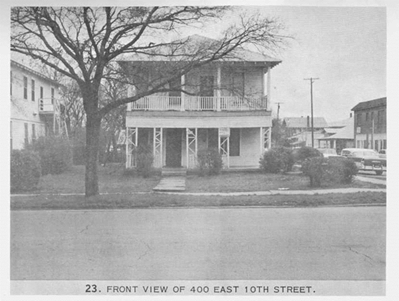
    myers10Barbara (22) and Virginia (16) Davis were sisters-in-law who lived on the bottom floor of the house at the southeast corner of 10th & Patton. It was here, at 400 E 10th, that the gunman cut across the front lawn, jumped through the hedges by Bill Scoggins’ cab, then headed off down Patton Avenue. The killer also discarded the final two of four total spent shells on this property. The first two shells had been found closer to the shooting site by witness Domingo Benavides, who had watched the shooter discard them as he quickly walked west on 10th towards the corner at Patton Avenue. Barbara and Virginia would each respectively recover the third and fourth discarded shells at 400 E. 10th later that afternoon — on the Patton Avenue side of the house.
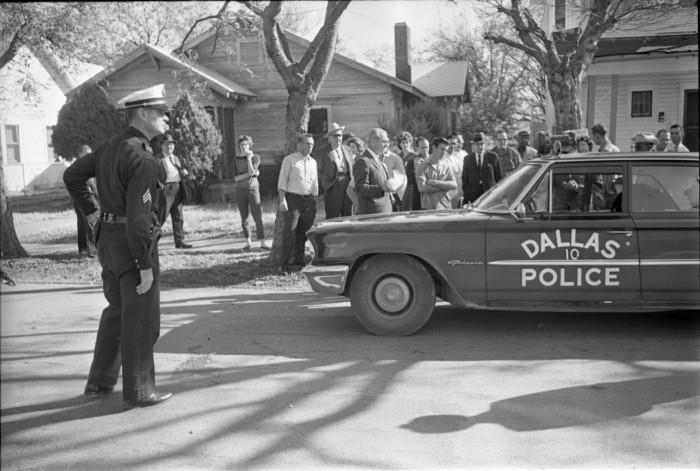
    The two testified they were awakened suddenly from a nap by what the women perceived to be at least two gunshots in quick succession. Barbara and Virginia, understandably confused, both ran to the front door that opens facing East 10th Street. Through the screen door they soon witnessed a young man cutting through their front yard, seemingly unloading a handgun held in his right hand. As the man continued walking past their door, the sisters heard a woman shouting and pointing farther east on 10th Street, “He’s dead, he’s dead, he’s shot!” They would identify the person as Helen Markham, with whom Barbara was acquainted. The woman yelled for someone to call police, and Barbara quickly made the call.

    myers11Virginia, only 16, seemed somewhat confused by the sequence of events. In her original statement to police the young woman said she had gone to the side door, the one that faces Patton Ave., and watched as the gunman walked by towards Jefferson Boulevard. But during her testimony before the Warren Commission Virginia corrected herself and said she had been at the front door, where she had stood behind her sister-in law. The 16-year-old said she could not remember the exact corner (it was the northwest corner) on which Markham had stood. “I don’t remember too good,” was Davis’s explanation. She also thought her sister-in-law had called police before the gunman had cut across their lawn, a near impossibility. Virginia admitted she only caught sight of the killer’s profile and had identified him at the lineup based upon her glimpse of the killer through the screen door and from behind where Barbara stood.

    The younger Davis woman said she could not have made a positive ID based on the images of the suspect she saw on television — only from the lineup, and only from the profile view. This, of course, had been one of the lineups where the disheveled and bruised Lee Oswald had chided the police for trying to “railroad” him and berated the cops in front of the witnesses.

    Virginia Davis testified to two very strange things. First, she said that Officer Tippit’s patrol car was, “…parked between the hedge that marks the apartment house where he lives in and the house next door.” Why did Davis think J.D. Tippit lived at the house two doors away? Why did other witnesses also mention seeing Tippit in the neighborhood regularly when that was not his usual beat? Also, when asked how quickly the police arrived at the murder scene, Mrs. Davis answered in an amazing way: “Yes, they was already there.” “By the time you got out there?” the lawyer for the commission asked. “Yes, sir. We stood out there until after the ambulance had come and picked him up.”

    myers12How could any policeman have gotten there so quickly? Sergeant Kenneth Croy, the first Dallas Police officer on the scene, had said he arrived just as Tippit’s body was being loaded into the ambulance — already suspiciously fast. Now Virginia Davis was testifying that Croy was already there before the ambulance had arrived? Which barely came from more than two blocks away at the Hughes Funeral Home. So, the Davis sisters waited until the gunman was gone and out of sight before stepping outside, yet Croy somehow was already there?
    Barbara Davis’s testimony was more succinct, as she seemed to get more of the basic details correct. However, Barbara testified that the shooter had worn a dark coat made of a rougher fabric, such as wool. This was in stark contrast to what all the other witnesses had described, including Barbara’s sister-in-law. She also remembered the killer’s shirt as being much lighter than Oswald’s shirt…which is interesting because Oswald wore his white undershirt at the lineup and not the brown, buttoned-down long-sleeve shirt he had been wearing all day since he left for work in Fort Worth with Wesley Buell Frazier. At one point Barbara says she was inside the house holding the screen door when she watched the suspect cut across her front lawn. Later she tells investigators she was standing on her front porch as the killer passed by. The older of the two Davis sisters-in-law also agreed that she had only seen the killer from the side, the profile view.

    Finally, Mrs. Davis described how she and Virginia each found one shell. It was later that afternoon on the side of their house that faces Patton Avenue. These would have been tossed after the gunman jumped through the hedges and had passed Bill Scoggins’s cab — but before he had reached the location of witnesses Ted Callaway and Sam Guinyard farther south on Patton.

    Ted Callaway and Sam Guinyard

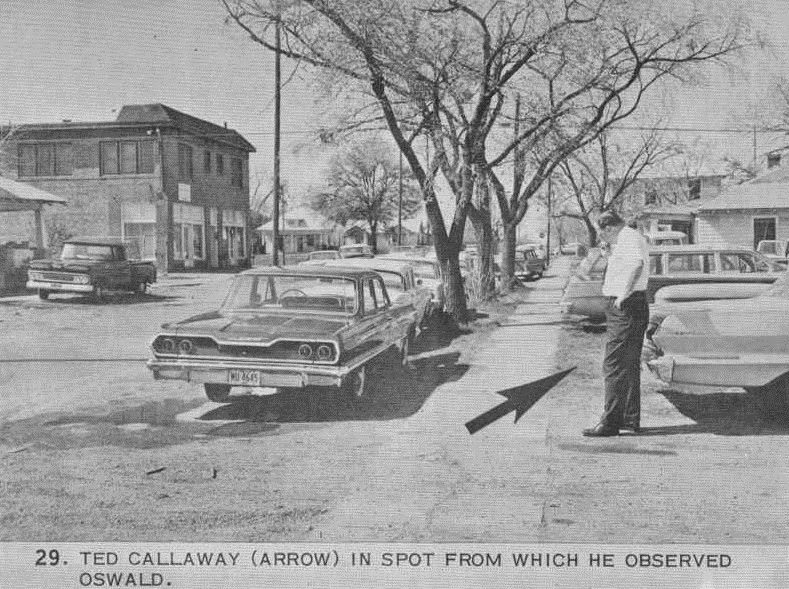
    When shots were fired on E. 10th street, two of the employees of nearby Harris Motor Company, whose used car lot faced Patton Avenue north of Jefferson Boulevard, moved quickly to the sidewalk on Patton. Their attention turned north towards E. 10th Street. Callaway was the car lot’s manager, and Guinyard was a porter who washed and detailed cars.

    As Callaway and Guinyard watched, they observed Bill Scoggins hunched over and pressed against the driver’s side fender of his cab. Suddenly, a young white man carrying a pistol came crashing through the hedges. Paying no attention to the cab, the gunman headed south on the east sidewalk of Patton towards where Callaway and Guinyard were standing, wondering what the excitement was all about. Guinyard observed the young man toss what was the fourth of the four spent shells towards the side of Virginia Davis’s apartment.

    As the gunman realized Callaway and Guinyard had stepped out and were now blocking his escape route, the young man crossed the street and proceeded south on the west side of Patton.

    “Hey, man!” Callaway shouted to the killer as he was almost even with the two Harris Motors employees. “What the hell’s goin’ on?”

    myers13The gunman slowed almost to a stop, then mumbled something back to Callaway. However, the used car manager couldn’t make out what the man was saying. By this point the gunman was now carrying his handgun in what Callaway described as a raised pistol position, a technique Callaway had been taught in the military.
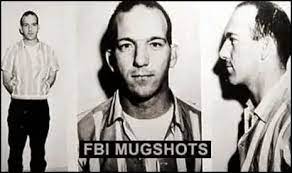
    Other people were beginning to come out. So the killer picked up his pace and trotted quickly towards the intersection of Patton and Jefferson.

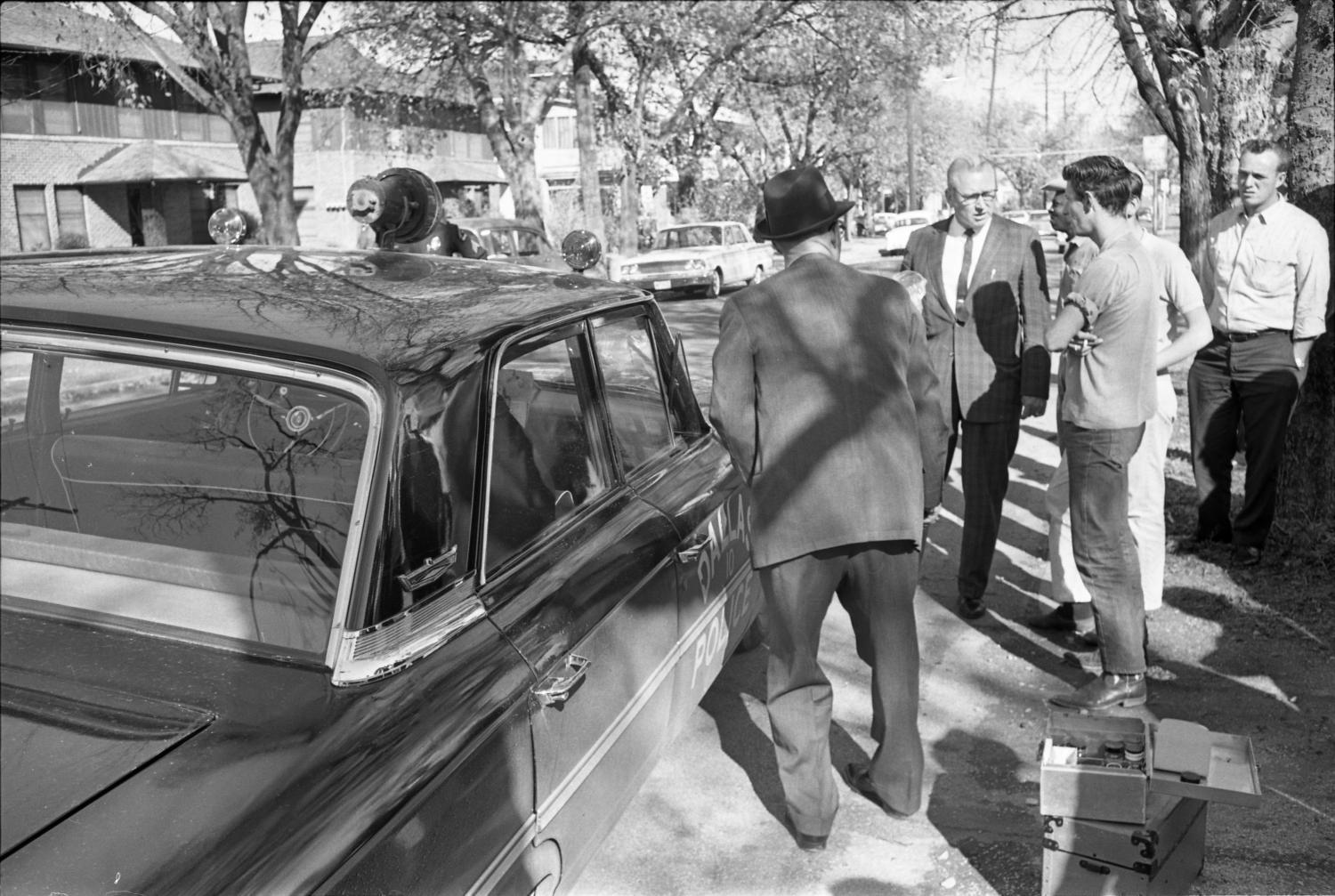
    “Hey, somebody follow that guy!” Callaway called down the street. Callaway then turned and hurried in the opposite direction towards 10th Street. Once up at the corner, the Harris Motors manager could see Tippit lying motionless on the ground and a crowd starting to form. Callaway went to the patrol car and tried to summon help on the radio, but was unsuccessful. A motorist named T.F. Bowley, who knew how to work the radio, would stop seconds later and summon help. Meanwhile, someone had already picked up Tippit’s service revolver, which had been lying on the street partially beneath his body, and placed it up on the squad car. Domingo Benavides, who worked as a mechanic at Harris Motors, was telling Callaway what he had just witnessed from his pickup truck.

    Frustrated, ex-serviceman Callaway picked up Tippit’s revolver and told Bill Scoggins to quick get his taxi — he and Scoggins would drive off from 10th & Patton in search of the officer’s killer. It is then that Callaway would ask Harris Motors employee Benavides a question that would continue to puzzle JFK researchers to this day.

    “Which way did he go?”

    If Callaway and Guinyard had just observed the gunman run past their position on Patton Avenue and turn west onto Jefferson Boulevard, why would the car lot manager need to ask Benavides which way the killer had fled?

    Callaway and Scoggins did search the neighborhood, but failed to locate the gunman. They soon returned to the murder scene at 10th & Patton to surrender Tippit’s revolver to arriving Dallas police officers. Years later, Scoggins would confess to an interviewer that he had stashed a .32 caliber handgun in his glove box for protection, but had totally forgotten about the weapon during the entire harrowing ordeal.

    “I just couldn’t believe what I was seeing,” the cab driver remarked as way of explanation.

    The FBI later took measurements on Patton Avenue and determined that the gunman had passed by some 55 feet from Callaway and Guinyard at the closest. Both men would later identify Lee Oswald as the man they had seen carrying the pistol, Had Oswald stood trial for Tippit’s murder, Mr. Callaway would perhaps have made the most convincing witness for the prosecution. In later interviews, the loquacious and confident manager expressed no doubt about his ability to positively identify Oswald as the person who had murdered J.D. Tippit.

    However, during a 1986 televised mock trial held in London, England — The Trial of Lee Harvey Oswald —star defense lawyer Gerry Spence cross-examined Ted Callaway on the witness stand. As Spence tried to introduce doubt concerning the Harris Motors manager’s ability to positively ID a running gunman glimpsed from more than 50 feet away, Callaway scoffed at Oswald’s “counsel” and reiterated that the accused assassin was the man he saw running from the Tippit murder scene with gun in hand. Spence appeared to be ready to dismiss the witness, then asked Callaway if he would kindly answer one more question.

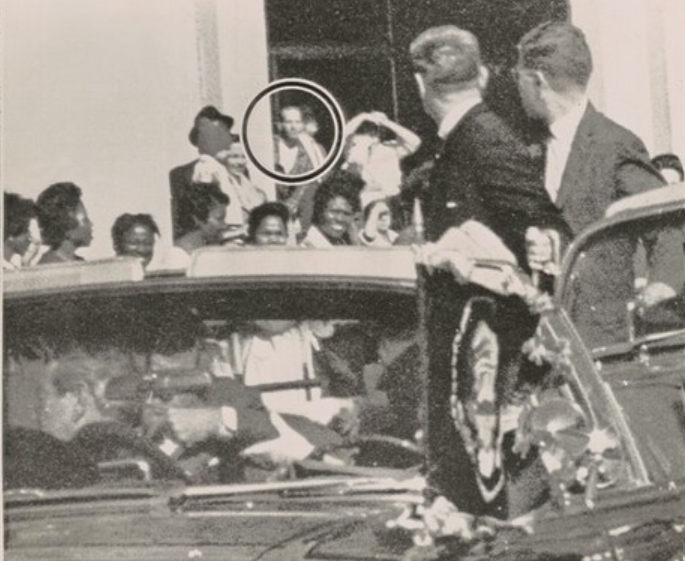
    “Can you identify the man in this picture?” Spence asked Callaway.

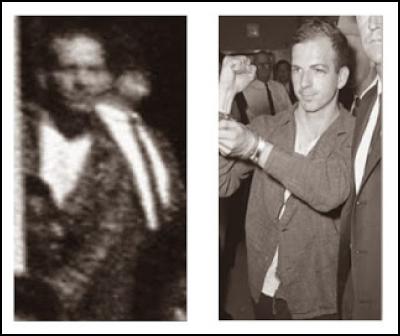
    Suddenly, a black & white photograph appeared on the courtroom screen for everyone to see. It was a blown-up copy of a photograph taken by a news photographer at the moment of the assassination of JFK in Dealey Plaza. In the background the Texas School Book Depository can be clearly seen, along with some onlookers standing in the entranceway.to the TSBD. The image of one of the onlookers is enlarged:myers14

    myers15

    myers16Clearly confused, witness Callaway hesitates for a brief moment, knowing the tricky defense lawyer is up to something…but he replies anyway.

    “Why…why that’s a resemblance of Oswald!”

    “No further questions,” smiled Gerry Spence, knowing he had just elicited the exact response from the witness he had sought. Callaway had just confused the image of Oswald’s fellow TSBD co-worker Billy Lovelady for that of the accused assassin Lee Harvey Oswald.

    The implication of Ted Callaway’s misidentification of the so-called Altgen or “Door Man” photograph was obvious…

    Warren Reynolds

    Perhaps the most fascinating experience of any Tippit witness was that of car salesman Warren Reynolds. Reynolds sold automobiles for the lot across Jefferson Boulevard from Harris Motors where Domingo Benavides, Ted Callaway, and Sam Guinyard all worked. Like Callaway and Guinyard, Reynolds also heard the gunfire from up on 10th Street. He emerged from his office onto a second-floor balcony to see what the matter was. Reynolds observed a young, average-sized white man running down Patton Avenue with a gun in hand. Acting quickly, Reynolds hustled downstairs and onto the lot owned by Johnnie Reynolds Motor Company.

    As the suspect turned west onto Jefferson Boulevard, Reynolds (the owner’s brother) and some other employees from the used car lot followed the man by running down the south side (or opposite side) of the wide thoroughfare from the gunman. The gunman stuck his pistol in the waist band of his trousers and continued west. Reynolds said he and his fellow employees lost sight of the suspect when he appeared to duck behind some buildings.myers17

    Later that day, Warren Reynolds gave statements to both the news media and Dallas Police regarding what he had witnessed. It was Reynolds’ opinion that he had seen and followed Officer Tippit’s killer, but that Reynolds was never close enough to the gunman to have possibly made a positive identification. The car salesman was interviewed by the FBI in January 1964, at which time he told the FBI that he could simply not make a positive ID on Oswald. Two nights later, someone sneaked into the dealership’s basement with a rifle and waited for Reynolds to come downstairs to shut off the lights at closing. Despite suffering a gunshot wound to the head, Reynolds miraculously survived the vicious attack. In fact, his eyesight suddenly approved, as he now informed authorities that he could identify Oswald as the man he had seen across Jefferson Boulevard fleeing with a gun.

    Dallas PD’s main suspect in Reynolds’ near fatal shooting was a local hoodlum named Darrel Wayne Garner, aka Dago. Garner was a known associate of nightclub owner Jack Ruby, and his girlfriend danced at Ruby’s club. Garner’s girlfriend would soon die under mysterious circumstances in a Dallas jail cell, allegedly committing suicide by hanging herself with her pants.

    Dallas JFK researcher Michael Brownlow caught up with Warren Reynolds decades after the assassination and Tippit’s murder. The Warren Commission witness who identified Oswald as the man he had seen carrying a pistol on Jefferson Boulevard was asked why he had changed his story by the time he testified for the committee.

    “Because I wanted to live,” Reynolds replied.myers18

    Acquilla Clemons, Frank Wright, and Doris Holan

    Three witnesses who were ignored by Dallas Police and never testified before the Warren Commission were Acquilla Clemons, Frank Wright, and Doris Holan. These people told very different stories than the official Warren Report witnesses.

    Mrs. Clemons was taking care of an elderly client in a house on E. 10th Street just west of the intersection with Patton Avenue. Clemons saw the police car stop on the next block but said there were two persons in the vicinity of Tippit’s patrol car, not just the man who spoke with the officer.

    After Clemons had stepped back into her client’s home, she heard gunshots. Hurrying back outside, Clemons saw Officer Tippit lying on the ground next to his squad car and two suspicious people running away in opposite directions. One man was tall and slender, while the other man she described as short and chunky. The shorter man was reloading his pistol and escaping south on Patton Avenue. Clemons said this man was not Lee Harvey Oswald.

    Frank Wright lived at the corner of E 10th & Denver, just east of where Tippit was slain. Wright said he was standing in his living room near the front door when he heard the gunshots. Wright opened the door and stepped onto his porch, just in time to see Tippit’s body roll over and come to rest in the street. Next Mr. Wright observed a man running west from the police car. This man jumped into the driver’s seat of an old, grey coupe and drove away going west on E. 10th. A second man in a long-sleeved coat, possibly a trench coat, then stepped into the street. The man appeared to be standing over Tippit, looking down. This second individual then returned to the sidewalk and disappeared out of sight onto one of the properties on the south side of the block.

    Doris Holan lived in a second-floor apartment directly opposite the scene of Tippit’s murder. Her front window afforded the Dallas hotel employee a commanding view of the tragedy. Just after 1 o’clock Holan, who had been sitting in a chair smoking a cigarette, heard the gunshots. Startled, Holan dropped her cigarette but picked it up and put the cigarette on an ash tray. She then hustled to her front window and pulled back one side of the curtain. Holan saw a young man who looked similar to Oswald beginning to walk west away from Tippit’s police car. The movement of Holan’s curtain caught the attention of the suspect as he began to walk away, because he paused for a moment and looked up at Holan’s window, then turned again and began hurrying toward Patton. Holan next saw a police car roll forward from the alleyway behind 10th and move towards the street using a narrow driveway between the two houses. A man in a long coat got out, stepped into the street, looked down at Tippit’s body, then walked back up the driveway to the police car. The second police car then backed up out of sight into the rear alleyway. Holan knew this was a police vehicle because she could see the “cherry” on top. (Although Dale Myers has tried to discredit Holan, as Tom Gram has shown, he has not succeeded. Click here for that discussion)myers19

    Patton Avenue witness Sam Guinyard would later confide to researcher Michael Brownlow that he too had seen police activity in that alleyway at about the time Tippit was killed. The car lot where Guinyard worked sat adjacent to E 10th Street’s rear alleyway. The problem is, according to Dallas Police records, no other Dallas police were known to be in that immediate vicinity.

    Summary

    The witness testimony in the Tippit murder case is so confusing and contradictory that it tends to exonerate Lee Oswald as much as it implicates him. Most witnesses were either too far away or had only a fleeting glimpse of the killer to make a solid identification. Oswald was wearing a long-sleeved brown shirt that day, which no one in the vicinity of 10th & Patton remembered seeing. When we factor in the tainted police lineups as well as the seemingly impossible time element in getting Oswald to the crime scene in time to be the shooter, the case against the 24-year-old tends to fall apart. The Dallas Police Report had the killer walking west, not east, as did all that day’s witnesses except for the roundly discredited Mrs. Markham. Someone other than Lee Harvey Oswald almost assuredly killed Officer Tippit.

    There can be little doubt that a person or persons unknown impersonated Lee Oswald leading up to the murders on November 22, 1963. How can anyone be positive that Lee Oswald shot Tippit at just after 1 p.m. when so many factors argue against it?

    Meanwhile, two credible witnesses at the Texas Theater put the real Lee Oswald in the movie theater at the time J.D. Tippit was being slain several blocks to the east. We know the real Lee Oswald was in the movie theater because he was soon arrested there. Patron Jack Davis said Oswald was there at about the time the 1:15 movie began, and was oddly moving from seat to seat, as if looking for someone. He even briefly sat next to Davis. Theater manager and ticket-taker “Butch Burroughs” said Oswald came in between 1:00 and 1:07 p.m., and that he sold popcorn to Lee Oswald at nearly 1:15 p.m. If true, how could Lee Oswald have murdered J.D. Tippit?

  • Allen Dulles’ Weekend at The Farm

    Allen Dulles’ Weekend at The Farm


    Robert Morrow, a dedicated JFK researcher, has just relocated an important find at the Princeton Library in the Dulles Archives. It was first written about at length in book form by David Talbot in his biography of Alen Dulles, The Devil’s Chessboard. (See pp. 546-47) Lisa Pease first located it many years ago in their online collection. But it was then lost due to a reorganization of the Dulles files. That reorganization threw off the reference pages for location purposes. But Morrow requested the archivists find it, and they did in what was, according to Robert, ‘a big, complicated digital file.’

    Since it had been lost, it weakened the claim that this invaluable day-by-day calendar datebook clearly makes. According to Talbot, Dulles was in Washington that day but he did not spend the late afternoon or evening at his home in Georgetown. He was at the top secret CIA facility known officially as Camp Peary. It was unofficially known as The Farm. And according to the date book, Dulles was there from at least late Friday afternoon, through Saturday and Sunday of that dramatic weekend. In other words during the Kennedy autopsy, while Lee Oswald was in detention and after Jack Ruby shot the alleged assassin.

    This is odd since, at the time of the assassination of President Kennedy, Allen Dulles had no formal role in the government of the United States. He was what was called a “gray eminence” a figure from a storied past collecting his civil service pension and giving speeches promoting the Cold War. But The Farm, located in southeast Virginia’s, York County, was not a club for Agency veterans to swig bourbon and talk about the overthrow of Mossadegh. It was a busy, coordinated center for testing and experimenting clandestine activities. This huge, sprawling base—over 9000 acres—is partly used to train CIA employees in the Directorate of Operations, as well as their equivalent in the, at that time, new Defense Intelligence Agency (DIA). (An example would be the opening scene in David Mamet’s spy thriller Spartan.) Interestingly, according to Wikipedia, it is also available for off-site conferences and working groups. According to a CIA officer who visited there for three weeks, one thing they did was to stage mock executions. It was heavily guarded, but with a living legend like Dulles that stricture probably did not apply.

    As Talbot writes, prior to Dulles renovating it, Camp Peary was used by the Navy Seabees and then as a prisoner of war camp for captured German sailors. According to former CIA officers Phil Agee and Victor Marchetti, “among the well-trained professionals turned out by The Farm were skilled assassins.” (Talbot, p. 546). Dulles had built for himself a sort of second home at Camp Peary, one with a well-stocked library, including current CIA reports and intel estimates. Quoting Dan Hardway, former House Select Committee on Assassinations investigator, “The Farm was basically an alternative CIA headquarters, from where Dulles could direct ops.”

    And let us not forget another important point that Talbot elucidates in his book. Not only did Dulles continually meet with high CIA officials after he was fired by President Kennedy over the Bay of Pigs. He was also meeting with a mysterious but prominent Cuban exile leader named Paulino Sierra Martinez. (Talbot, p. 458). In fact, in the spring of 1963, Sierra met with both Dulles and General Lucius D. Clay. Both men had made a name by crosssing Kennedy. Dulles over, to name just one example, Cuba and the Bay of Pigs; Clay during the Berlin Crisis. Clay later said that Kennedy has lost his nerve during the Berlin confrontation; Dulles later exclaimed about JFK that: “He thought he was a God.” Sierra was largely based out of Chicago, the location of the famous Chicago Plot to kill JFK in early November, and the place where Homer Echeverria said his group would come into a lot of money as soon as they took care of Kennedy. Secret Service sources said that Echeverria’s weapon purchases were being financed by Sierra with mob money. (Talbot, p. 461)

    Thanks much to Morrow for retrieving this very revealing piece of evidence. One more strike against the travesty that was the Warren Commission.

    * * *

    Update: Attorney Dan Alcorn sent me what he feels to be contradictory evidence to the calendar notations about Dulles at the Farm. Lisa Pease replied to this evidence on the linked podcast below.

  • The Biden/CIA Attempt to Usurp Congress’ Authority Over JFK Records

    The Biden/CIA Attempt to Usurp Congress’ Authority Over JFK Records


    The Friday Night News Dump

    In the waning hours of the evening of Friday, June 30, 2023, long after the filing deadlines of the media elite in Washington D.C. and even longer after the most dedicated talking head had left to celebrate their July 4th independence from tyranny in the Hamptons, the Biden Administration issued an Executive Memorandum that is a flagrant and illegitimate attempt to terminate an Act of Congress and usurp congressional authority over its own processes and records. A copy of President Biden’s Executive Memorandum is here.

    It is unclear what truly prompted President Biden to take a flamethrower to an Act of Congress that he himself voted for in 1992 as a member of the Senate, due to bipartisan public pressure to release records related to the 1963 assassination of President John F. Kennedy. It is further perplexing that Biden has chosen to continue to deny the American public transparency into the death of a much admired predecessor since he has chosen to surround himself in the White House with artwork memorializing the Kennedys e.g. the bust of Robert F. Kennedy in the Oval Office and the famous portrait of JFK by Jamie Wyeth that President Biden specifically requested to be borrowed from the Museum of Fine Arts in Boston to hang in his private White House study.

    biden rfk(Stefani Reynolds for The New York Times)

    jfk portrait(Museum of Fine Arts, Boston)

    JFK Records Act Backgrounder

    What exactly is in Biden’s Executive Memorandum that is so egregious? Well, it would help to briefly go back to the 1990s, when Joe Biden was a U.S. Senator from Delaware and the Chair of the Senate Judiciary Committee.

    As a result of decades of significant controversy caused by the government withholding millions of pages of records related to the 1963 assassination of President Kennedy from the American public, Congress enacted the John F. Kennedy Assassination Records Collection Act of 1992 (JFK Records Act”). Congress was put under substantial public pressure to do something about the continuing secrecy around records related to Kennedy’s assassination, because 30 years after his murder, executive agencies were holding hundreds of thousands of assassination related files secret, based on unsubstantiated claims of “national security”. Freedom of Information Act requests were ineffective at penetrating a completely unaccountable lock that the U.S. security state had on these then 30-year-old records. Public outcry after Oliver Stone’s Oscar winning film JFK tipped the balance. So Congress passed the JFK Records Act in a rare, unanimous bi-partisan vote. The act was signed into law by the then President George H.W. Bush, and after numerous delays finally went into effect in 1994.

    The full John F. Kennedy Assassination Records Collection Act of 1992 can be found here. It is worth reading.

    The law mandates, among other things, that by no later than October 26, 2017, all records related to the 1963 assassination of President John F. Kennedy had to be publicly disclosed in full, unless for each record, the President certified that extremely stringent criteria for postponement were met. If such postponement criteria were satisfied based on the legal standard of clear and convincing evidence, the President’s unclassified reasons for postponing each individual record had to be published in the Federal Register. This way the public could at least understand exactly which specific records were being postponed and what the legal basis was for the postponement of each individual assassination record.

    It needs to be noted that in accordance with the provisions of both the JFK Records Act (particularly section 9(d)(1)) and the Constitution’s separation of powers, that the President’s authority to postpone the public disclosure of assassination records only applies to Executive Branch records (which are records created by agencies and offices controlled by the President e.g. CIA, FBI, Secret Service, DEA, NSA, DOD, etc…). The President does not have legal authority over “non-executive branch records”, which include records created by Congress and other sources not controlled by the executive branch. Congress was very careful when drafting the JFK Records Act to ensure that they did not grant the President authority to control their legislative branch records.

    Congress also required that for each assassination record, that all “Government Offices” (the JFK Records Act specifically includes the Executive Office of the President in the definition of “Government Office”) had to issue what is called an “Identification Aid” when any action was taken or decision made in respect to any record. These Identification Aids were tracking forms that attached to all assassination records and recorded a brief description of the record, including the date of the document, the originating agency or entity, the disposition of the record and any action taken with respect to the record, such as the particular section 6 criteria for postponement that provided the legal justification for continuing to hold the assassination record in secret from the public. 

    Further, Congress specifically mandated the Archivist of the United States to ensure that all Identification Aids for every postponed record form part of the Assassination Records Collection. Also, that a publicly accessible Directory of Identification Aids be created and maintained, so that there was full transparency for the public to understand exactly which assassination records were continuing to be held in secret in the Protected Collection and what the legal basis for postponement was under section 6 of the JFK Records Act for each record.

    Most importantly, Congress made it clear in the JFK Records Act that there was a “presumption of disclosure” and the legal burden was on an agency to prove that a specific assassination record met the legal standard for postponement required by the Act and that clear and convincing demonstrable evidence was required in order to deprive the public access to a record.

    In order to ensure that government agencies and offices complied with the JFK Records Act, Congress created the Assassination Records Review Board (“ARRB”). This 5 person citizens’ panel was tasked with collecting, cataloging and reviewing all assassination records, with the mandate to release all assassination records, unless a record met the exacting criteria set out in section 6 of the Act.

    The ARRB’s limited tenure ran fromOctober 1, 1994 to September 30, 1998.During the ARRB’s time in operation, the Board and staff reviewed and made “final determinations” about every single assassination record that was identified and submitted by government agencies and offices. In the mid-1990s when the ARRB was doing its work, the JFK Records Act mandated that only in the most rare and exceptional circumstances were assassination records to be postponed from public disclosure.

    The law also legally mandated that, based on “final determinations” and recommendations for release made by the ARRB, all postponed records had to be periodically reviewed under the same stringent and exacting standards of section 6 of the Act. The purpose of the Periodic Review process was to “downgrade and declassify” all of the records held secret in the Protected Collection. By legally mandating this downgrading and declassification periodic review process, the JFK Records Act makes it clear that as time passes it should become more difficult, not easier for executive agencies to keep assassination records secret and to deny the American people access all the facts about the circumstances surrounding President Kennedy’s murder.

    ARRB “Final Determinations” and the Periodic Review Process

    Every assassination record currently held in the secret Protected Collection is held as a result of an ARRB “final determination”.As the ARRB went about its business between October 1994 and September 1998, it created a form called the “ARRB Final Determination Form”. These forms are not widely published and not a lot of attention has been placed on them by anyone in the research community.

    In every case where the ARRB made a Final Determination to postpone the release of an assassination record, they filled out one of these Final Determination Forms. These included the specific section 6 criteria which formed the legal basis on which a record was legally permitted to continue to be held in secret. The Final Determination Form also provided unclassified written reasons for each postponed record, along with the ARRB’s recommendation for releasing the record (i.e. a covert agent’s death, or a source or method no longer requiring protection).

    “Final Determination Forms” are critically important.

    Judge John Tunheim, the Chair of the ARRB has confirmed that all postponement decisions made by the ARRB are “Final Determinations” under the Act.

    The work with respect to all of the records currently held in the Protected Collection at NARA has been completed for over 25 years. The ARRB did its job. The result is a catalog of Final Determination Forms that state the section 6 criteria for postponement and the ARRB’s recommended release date for each assassination record, based on the section 6 criteria.

    A serious problem that occurred from September 1998 until October 26, 2017, is that virtually no Periodic Review took place in accordance with sections 5 and 9 of the JFK Records Act. The Periodic Review was supposed to happen based on the information and recommendations that the ARRB recorded on their ARRB Final Determination Forms for each postponed record.

    The mandated purposes of Periodic Review were to provide a rolling review of the postponed assassination records in accordance with the criteria and recommendations issued by the ARRB in their ARRB Final Determination Forms. If this had occurred as Congress mandated in the JFK Act, by October 26, 2017, there should have been only a very small number of records still held in the Protected Collection when the October 26, 2017 deadline came up.

    Again, according to the Law, it’s legislative history, and legal commentary, by the time the October 26, 2017 statutory deadline rolled around, based on the statute’s mandated program of Periodic Review, there should have been virtually no records left in the “Protected Collection” held at the National Archives. Because the clear purposes of the Act were to create an accountable, transparent and enforceable process to downgrade, declassify and ultimately fully disclose every single assassination record to the public, so that the public itself could decide for itself what the facts were about what happened in Dallas on November 22, 1963. 

    In reality, despite the law’s clear mandate, when October 26, 2017 did come and go, there were still an undetermined number of assassination records being either fully or partially withheld. By some estimates, the number of withheld records totalled was quite voluminous. But an accurate number was impossible to calculate because of the broken down and functionally inoperable Identification Aid Program that NARA and the agencies have failed to adequately maintain pursuant to their legal mandate.

    President Biden’s Friday Night Memorandum

    Now back to President Biden’s June 30, 2023 Executive Memorandum that postponed an undetermined number of unidentified assassination records. Let that sink in for a moment…

    “Maximum Transparency”

    Despite the clear mandates imposed by the JFK Records Act to establish an “accountable” and “enforceable” process for the full disclosure of all assassination records; and the explicit requirement that each record be accounted for with an identification aid, the President’s June 30, 2023 Memorandum does not identify or account for a single assassination record. 

    President Biden stated in the opening paragraph of his memorandum that, “As I have reiterated throughout my Presidency, I fully support the Act’s aim to maximize transparency by disclosing all information in records concerning the assassination, except when the strongest possible reasons counsel otherwise.” There is an unavoidable divergence from reality in the President’s statement, that is Orwellian in magnitude. For the simple reason that without being able to track which assassination records were postponed from disclosure through the mandated identification aid program, and without providing the legally required reasons for each postponement, on a record-by-record basis (“as required by the Act”), where is the “transparency” and “accountability”?

    When the ARRB issued final determinations on a record-by-record basis in the mid-1990s, only the President could override such final determinations pursuant to his authority under section 9(d)(1) of the Act. In respect to any Presidential determination to postpone or release a record under his 9(d)(1) authority, the President was mandated by law to:

    1. apply the standard of proof and postponement criteria required by section 6 of the Act;
    2. Provide unclassified reasons for the postponement based on the section 6 standard of proof and postponement criteria;
    3. Have the reasons for the postponement published in the Federal Register; and 
    4. Issue an identification aid for each postponed assassination record.

    The above duties, mandated to the President are what are called statutory or “ministerial duties”. The President does not have any wiggle room or discretion with respect to these mandated ministerial duties. If a President does not comply with ministerial duties, the resulting decisions may be reviewed by the courts on an application for judicial review or mandamus. While suing the President is not made easy, there are very narrow pathways that can be found to ensure that a President complies with the law. In the case of the JFK Records Act, these pathways require a refined parsing of the language of the Act to determine what specifically Congress required for a President or other specifically named officials to do.

    Neither President Trump nor President Biden complied with any of the above ministerial duties imposed on them by section 9(d)(1) of the JFK Records Act. They did not apply the standard of proof in section 6 to any postponement. They did not apply the postponement criteria; they did not provide any unclassified reasons for postponement for each record, so that the public could understand the rationale for any of the postponements. They did not issue any identification aids for each postponed record. And there is no way for the public to understand which records the postponements apply to, because there was not even a list of the postponed records published in the Federal Register as is required under the Act.

    All of these violations of the JFK Records Act, make it difficult or impossible for the public to seek any accountability or transparency in respect to the President’s decision-making. Further any attempt to seek judicial review of any specific postponed record will be extremely difficult, because no reasons were given for the postponement of any particular record. One of the requisite elements of any final decision or order under the principles of administrative law is that adequate or sufficient reasons be provided to justify a decision, so that any impacted party would understand the basis for the decision, and so that aggrieved parties would be able to fairly appeal such decisions. These basic legal principles form part of the foundations of our system of law and prevent “Star Chamber” justice and abuses of authority.

    The Clear and Convincing Standard of Proof

    Another serious legal problem arising from President Biden’s opening platitudes is his attempt to modify by edict the legal standards for postponement that are the basis of the JFK Records Act. Nowhere in the JFK Records Act do the words “except when the strongest possible reasons counsel otherwise.”

    The standards and criteria for postponement are only found in section 6 of the JFK Act.

    jfk records act1

    In legal processes there are several different standards of proof. In most criminal proceedings, the standard of proof is the well-known “beyond a reasonable doubt”. Civil standards of proof may vary depending on the seriousness of the process and the range of potential consequences of a ruling. Common civil standards of proof include “balance of probabilities”, “preponderance of evidence”, and “clear and convincing evidence”. When a statute imposes a standard of proof, that is the standard that parties must meet in order to successfully make their case. 

    Parties cannot simply ignore or change a statutory standard of proof in order to better suit their case.

    Congress decided when they enacted the JFK Records Act that the law would impose the relatively high civil standard of proof of “clear and convincing evidence”. There is no other standard of proof when it comes to assessing the grounds for postponing assassination records. All government offices, agencies and the President of the United States must follow the law and comply with the clear and convincing standard of proof mandated by sections 6 and 9(d)(1) of the JFK Records Act.

    To be certain, “Except when the strongest possible reasons counsel otherwise.” is not the standard of proof imposed by the JFK Records Act. In fact…“Except when the strongest possible reasons counsel otherwise.” is not a standard of proof anywhere in the world.

    Final Certification???

    The opening paragraph of President Biden’s Memorandum presents another perplexing statement and completely non-compliant decision by the President. “With my final certification made in this memorandum -– the last required under the Act -– and definitive plans for future disclosures, my Administration is fulfilling the promise of transparency to the American people.” [Emphasis added.] From this statement, one can be left with no other understanding: that with his June 30, 2023 Executive Memorandum, the government and the President’s legal obligations under the JFK Records Act have been fulfilled and that the June 30, 2023 Memorandum will be the final and last word on the undetermined number of unidentified assassination records being held in secret by the government.

    The problem with this statement is that it runs smack into section 12(b) of the Act. That section of the JFK Act is titled, “Termination of Effect of Act”. Part (a) of the section deals with the termination of sections of the Act pertaining to appointments to the ARRB and the operation of the Board. Pursuant to section 12(a), all of the sections of the Act that cover matters dealing with appointments to and operations of the ARRB shall terminate when the ARRB’s mandate ended on September 30, 1998.

    In respect to the sections of the Act that do not deal with appointments to or the operations of the ARRB, all those sections remain in full force and effect until every last assassination record is fully publicly disclosed to the public and the National Archivist certifies that all assassination records are publicly available. Section 12(b) is set out immediately below.

    jfk records act2

    Section 6 of the Act does not pertain to appointments to the ARRB and it does not deal with any ARRB operations. In fact, section 6 of the Act does not even mention the ARRB at all. Section 6 is a part of the Act that is mandated to form the basis of any and all decisions to postpone the disclosure of an assassination record by any and all government offices (including the Executive Office of the President of the United States). Section 12(b) legally mandates that section 6 remains in full force and effect as operational law and is applicable to the President’s authority to postpone disclosure of records, “as required by this Act” pursuant to sections 5(g)(2)(D) and 9(d)(1).

    The JFK Records Act makes no mention or suggestion that the President’s legal duties under the Act come to an end prior to the full public release of every single assassination record. To the contrary, both sections 12(b) and 9(d) make it clear that the President’s duties continue until there are no more secret assassination records held in the Protected Collection at NARA.

    Further, pursuant to sections 5 and 9 of the Act, the President has an ongoing statutory role in the periodic review process. Section 5(g)(2)(D) of the Act, is the provision that contains the purported authority pursuant to which both Presidents Trump and Biden have postponed the release of the remaining secret assassination records. It cannot be ignored that the title of section 5(g) of the Act is, “PERIODIC REVIEW OF POSTPONED ASSASSINATION RECORDS”. 

    Section 9(d)(1) of the Act also specifically weighs in on the President’s ongoing ministerial duties with respect to postponement of assassination records. That section mandates that, after the ARRB has made a “final determination”, regarding the release or postponement of an assassination record, only the President has the sole and non-delegable authority to release or postpone the release of assassination records under the standards of section 6 of the Act. There will be more about section 9(d)(1) later in this article.

    It is therefore unclear what the legal basis is for President Biden’s dismissive assertion that the June 30, 2023 Memorandum is the “final certification” required by the Act. This makes no sense given the clear duties imposed by sections 5, 6, 9 and 12, as discussed above.

    “Each Assassination Record…As Required By This Act”

    In section 2 of the June 30, 2023 Executive Memorandum, President Biden states that, “The Act permits the continued postponement of public disclosure of information in records concerning President Kennedy’s assassination only when postponement remains necessary to protect against an identifiable harm to the military defense, intelligence operations, law enforcement, or the conduct of foreign relations that is of such gravity that it outweighs the public interest in disclosure.”

    It would appear that the process suggested above in the President’s Memorandum directly conflicts with the President’s claims that he supports the transparency and accountability provisions of the Act. Does the JFK Records Act actually authorize the President to certify the postponement of thousands of unidentified assassination records en masse and without providing any reasons for each record that he certifies for postponement?

    The President’s Memorandum seems to cherry-pick words and phrases out of section 5(g)(2)(D), and omits some critically important language from the section. The omissions drastically change the meaning and purposes of this section as purported by the President in his Memorandum. Let’s look at exactly what section 5(g)(2)(D) states.

    5(g)(2)(D) Each assassination record shall be publicly disclosed in full, and available in the Collection no later than the date that is 25 years after the date of enactment of this Act, unless the President certifies, as required by this Act, that—

    1. continued postponement is made necessary by an identifiable harm to the military defense, intelligence operations, law enforcement, or conduct of foreign relations; and
    2. the identifiable harm is of such gravity that it outweighs the public interest in disclosure.

    The words “Each” and “as required by this Act”, seem to be omitted from any reference to section 5(g)(2)(D) of the JFK Records Act made by the government. Including in all of the Presidential Memoranda of both President’s Trump and Biden. It seems that the government is afraid to fully quote section 5(g)(2)(D) in its complete entirety. And the government is particularly frightened by the words “eachand “as required by this Act”, 

    The rules of statutory interpretation impress on lawyers and judges that words printed into laws must be given meaning; and that legislators do not insert meaningless or superfluous words into statutes.

    So what do the words “each” and “as required by this Act” mean in relation to the President’s authority to postpone the public disclosure of assassination records? The answer to this question could consume the better part of a chapter in a book or an entire lawsuit. I will try to provide a brief explanation of the proper interpretation of these words in the context of section 5(g)(2)(D) and in relation to the JFK Records Act as a whole.

    When the word “each” is used at the beginning of section 5(g)(2)(D), the rules of statutory interpretation would strongly imply that the word modifies the following parts of the whole section. It follows that a proper reading of this section would reasonably determine that the word “each” acts to modify both the requirement for public disclosure of each assassination record by no later than the statutory deadline of October 26, 2017; and “each” modifies the alternative requirement for the certification for postponement of each assassination record, as required by this Act. This interpretation would militate against a holus bolus en masse certification of an undetermined number of unidentified assassination records. This interpretation is further supported by the purposes of the Act, as well as all of the other sections dealing with periodic review and Presidential authority to postpone records. It would create an absurdity of law to interpret section 5(g)(2)(D) to mean that prior to October 26, 2017, there were more stringent postponement criteria and public transparency requirements under the Act than after October 26, 2017.

    The words “as required by this Act” must also be given meaning in the context of the President’s authority to certify the postponement of assassination records. If Congress intended that section 5(g)(2)(D) be an isolated, stand-alone provision and the only provision dealing with Presidential postponements, Congress would not have included the additional words, “as required by this Act” in Section 5(g)(2)(D). The inclusion of the words “as required by this Act” must therefore be read consistently and in line with the other sections of the JFK Records Act that pertain to the postponement of assassination records. Namely section 6 (which mandates the standard of proof and the exclusive postponement criteria) and with section 9(d)(1). That is the authorizing provision that grants the President his sole and non-delegable authority under the law to postpone the release of Executive Branch assassination records after the ARRB has rendered a final determination about an assassination record. 

    Instead of addressing the words “each” and “as required by this Act”, President Biden’s Memorandum summarily omits these words and ignores the statutory/ministerial duties that the words legally impose on the President in respect to decisions to continue the postponement of public disclosure of the secret assassination records held in the Protected Collection.

    “Transparency Plans”

    Let’s be blunt. The President’s “Transparency Plans”—originated by the CIA– are the opposite of transparent. They might as well be called “Opacity Plans” if the truth is being told. The JFK Records Act is one big statutory transparency plan that mandates tracking forms (identification aids) and a directory of these aids to provide transparency for each and every document in the Records Collection, including those documents that are continuing to be held in the secret Protected Collection. President Biden’s Transparency Plan seeks to do away with the Identification Aid Program and the publicly accessible Directory of Identification Aids.

    Section 6 of the Act mandates that all government offices apply the clear and convincing standard of proof and the five exclusive criteria pursuant to which postponements are permitted by law. Section 12(b) states that section 6 of the Act remains in full force and effect until the Archivist certifies that every single last assassination record is fully publicly disclosed. The President’s Memorandum seeks to do away with all of these truly transparency driven standards, and replace them by edict with new, less onerous, less stringent, less accountable, and totally unenforceable standards. 

    What happened to the mandate to downgrade and declassify all of the records? How and why did it suddenly become easier for the government to keep these assassination records secret…. not more difficult?

    President Biden’s Attempt to Seize Authority Over Congressional Records

    One aspect of both President Trump and President Biden’s multiple memoranda that ought to have received far more resistance from both the public and Congress, is the Presidents’ assertions of authority over what are termed “non-executive branch records”. These records include House and Senate records, largely originating from the House Select Committee on Assassinations and the senate’s Church Committee. As briefly discussed above, Congress was very careful in drafting the JFK Records Act not to cede any authority over non-executive branch records to the President. Section 9(d)(1) takes particular aim at this issue by explicitly limiting the President’s authority over only executive branch records.

    What impact does this have on the current state of the records held secret in the Protected Collection? It means that any Presidential postponement of a non-executive branch record is unlawful and that by law, every single record that originated from the HSCA and the Church Committee should have been fully publicly disclosed on October 26, 2017. This did not happen because both President Trump and President Biden broke the law when they authorized those records to remain held in secret. Congress should have stepped in to protect their authority over their own records and processes, but to date, Congress has failed to schedule any oversight hearing or call any official to account for the undeniable non-compliance under the Act by NARA, the agencies and the Executive Office of the President. It seems that no branch of the government is interested in complying with the JFK Records Act on any level, in any meaningful way. Senate Majority Leader Chuck Schumer did however mention the JFK Assassination Records Act last week when he suggested that Congress ought to use the that act as a model for new legislation to provide public transparency on the urgent and pressing issue of UFO sightings!! Is our government trolling us?

    As this article goes to print, Judge Seeborg has just issued a decision in the case brought by the Mary Ferrell Organization in San Francisco court. An update on this important decision will be forthcoming next week.

  • Fact-Checking the Sixth Floor Museum

    Fact-Checking the Sixth Floor Museum


    To my surprise, I don’t think this has ever been done before. But it is imperative that it must be done, for millions of people visit the museum every year. It’s at the epicenter of the crime.

    In Episode 1 of Oliver Stone’s 4-part series JFK: Destiny Betrayed, the narrator says: “The Sixth Floor Museum, to this day, insists that Oswald shot Kennedy from that sixth floor window, and virtually everything in the museum is dedicated to that proposition.”

    I decided to, without bias, see if this was in fact true. In August 2021 I photographed every single exhibit and every single museum label in the museum to fact-check. The following are the results…

    * * *

    The museum correctly says “witnesses…believed gunfire had come from the grassy knoll…Dozens of people ran up the grassy knoll…Some witnesses said they saw a puff of smoke in the trees there, and one witness [Lee Bowers] observed unfamiliar automobiles in the rail yards and two men standing behind the fence just before the shooting.” However, they did a disservice by next writing: “Officials searched the area, but found only cigarette butts and footprints behind the fence.” What they failed to mention was the fact that those cigarette butts and footprints were FRESH and were found in the exact spot where that puff of smoke was seen. A flash of light was also seen there by Bowers, and an anomalous shape appears there in the Moorman photo that’s not there in later photos. So that was a person.

    Sliding along, the museum says “at least five witnesses said they had seen a rifle protruding from an upper window”—but only four did.

    We are told that “the easternmost window on the south wall was half open”—but as anyone can plainly see from the photos, the window was only a quarter open! “In the far east corner was a paper bag, later determined to have been used to bring the rifle into the building”—but the bag is not present in any of the crime scene photos! Moreover, any lucid person who reads the Warren Report subchapter “The Long and Bulky Package” (pp. 131-134) will come away convinced that a rifle couldn’t have been in Oswald’s bag.

    Next, the museum says “Oswald’s finger prints and palm prints were found on several of the cartons and on the paper bag.” This is so easy to debunk. This is one of those things where you can just go right to the Warren Report and it debunks itself. The Commission admitted that the key box at the window used as the gun rest, as well as the box below it, “contained no prints which could be identified as being those of Lee Harvey Oswald.” (WR 140) This is significant. One box and another nearby had Oswald’s prints. (R 138) Well, Oswald DID work in the building. In their own words: “…the Commission considered the possibility that Oswald handled these cartons as part of his normal duties.” (WR 141) And only one of these prints “was less than 3 days old.” (ibid) The Commission admitted the print “could have been placed on the carton at any time within this period.” (ibid.) And they ultimately said: “The prints do not establish the exact time he [Oswald] was there.” (ibid.) As for the paper bag, when FBI expert Sebastian Latona initially examined it on 11/23, he could find no latent prints on it. (WC Vol. 4, p. 3)

    Moving along to the Tippit murder, the museum label says “Tippit died before he reached the hospital”—but as anyone knows, Officer Tippit was killed instantly with a shot through the head and others through the chest.. The museum next said something absolutely astounding under a photo of Oswald’s revolver: “The bullets that killed Tippit came from this gun.” This is ABOMINABLY INCORRECT!

    Representative BOGGS: You cannot establish the fact that the bullets were fired in that gun?
    Mr. CUNNINGHAM: That is correct. (WC Vol. 3 p. 476)
    Mr. CUNNINGHAM: I could not identify those bullets as having been fired from that gun. (Ibid p.482)

    The museum tells the common mainstream talking point that “In a roll call of employees…he [Oswald] was discovered missing.” This implies Oswald was the only employee missing, but a check of all the FBI statements reveals that 17 were never in the building after 12:30. (WC Vol. 22, pgs. 632–686)

    Museum tourists are told that “Investigators learned that Oswald was a loner with strong leftist leanings.” They might have gotten away with this statement when the museum opened way back in 1989, but not today. We have learned so much since, e. g. that Oswald was almost certainly a double-agent. His former roommate James Botelho even spoke up: “I knew Oswald was not a communist and was, in fact, anti-Soviet…I knew then what I know now: Oswald was on an assignment in Russia for American intelligence.” (JFK and the Unspeakable, by James Douglass, p. 40) For this important point, see also John Newman’s updated version of Oswald and the CIA, James DiEugenio’s Destiny Betrayed, second edition (Chapters 6 and 7, and the extremely important declassified files of HSCA investigator Betsy Wolf) (Click here)

    The museum says Oswald “was rated a sharpshooter.” But this is a common cherry-pick, for that was an early test, and Oswald was officially designated as barely a marksman (the lowest of the low). The Warren Report itself said he was a “rather poor shot.” (WR, p. 191) The museum says “Oswald’s wife later testified that he admitted to her that he had tried to kill Maj. General Walker”—however, she might have been manipulated to make this claim. Plus, she is the most unreliable witness, for her stories constantly changed (see this) What the museum conspicuously omitted was that the alleged bullet recovered from Walker’s house could not be linked with Oswald’s rifle (WC Vol. 3 p. 439); and the two main witnesses said the perpetrator was not Oswald. ( WC. Vol.5 pp.446-447; WC Vol. 26 p. 438) They brought up the claim that “Oswald left a note in Russian for his wife with instructions if he did not return that night”—but Marina said she never saw the note! (WC Vol. 23, p. 393) And of course, as everyone knows, the note is undated and makes no reference to Walker. Researchers have concluded that, most likely, Oswald wrote this note in relation to a project other than an attack on General Walker.

    We are next told Oswald’s “latent palm print [was found] beneath the wooden stock of the gun.” However, this palm print didn’t appear for a week (4 H 23), and the only person to see this alleged print said it was an OLD print. (Gary Savage, First Day Evidence, p. 108) Beyond that, when the FBI got the rifle the night of the assassination, they could find no trace prints of value on it. (James DiEugenio, The JFK Assassination: The Evidence Today, p. 214) We are correctly informed that “During Oswald’s detention no witnesses were able to identify him as the gunman seen firing from the Depository window.”

    Continuing on, the museum claims “over two dozen people recorded” the assassination. This is not correct. There were actually 7 who were filming while the shooting was taking place. The museum correctly stated witnesses heard shots “coming from various locations in Dealey Plaza.” They next did a partial good job at listing 6 of the 58 grassy knoll earwitnesses. But they then listed 10 of the only 46 Depository earwitnesses. In other words, they made it seem like there were less knoll ear witnesses! They mentioned James Tague, but omitted that he believed the shots came from the knoll.

    Only towards the end of the museum tour do we get to the forensic and ballistics evidence. They incorrectly claim the Warren Report “agreed that Connally showed a reaction by [Zapruder] frame 224.” This wasn’t put forward until the 1970s. Connally said he was hit about ten frames later than this to Josiah Thompson. (Six Seconds in Dallas, pp. 69-70) The museum oddly says the autopsy doctors’ “probe of the back wound revealed no exit point; the tracheotomy had obscured it.” This is frighteningly inaccurate. How can an incision in the front of the NECK obscure an alleged bullet path in the BODY?! The simple fact is that the back wound was probed and found to not go anywhere. (CD 7, p. 284) The bullet lodged in the back and most likely fell out. It also would’ve smashed the first rib had it traversed where the measurements place it. The museum brings up how “The House Committee…concurred that one bullet could have wounded both Kennedy and Connally.” But in order for it to work, they said, JFK would have to be leaning WAY forward (Vol. 7 HSCA p. 100)—which he WAS NOT! (WC Vol. 18, p. 26) Everything else said on the topic of forensic and ballistics evidence lacks serious context and doesn’t tell the full story. More shockingly, the museum never informs its tourists the basic fact that JFK had a massive blowout in the right rear of his head—of course, all indicative of a shot from the front.

    The museum’s section on the acoustics evidence is bland and very outdated.

    Almost at the end of the tour, we are told that “Depository employee Charles Givens had seen Oswald at about 11:55…on the sixth floor”—but in his Dallas Police statement he made no mention of Oswald. (WC Vol. 24 p. 210) We are next told that “Tests for the Warren Commission showed that Oswald could have run down this staircase to the second floor lunchroom in less than two minutes.” This too is outdated. See here for everything you need to know about this subject.

    Finally, at the very end of the tour we come across a wall of big paragraph webs listing all the different theories of who could’ve done it. If anything, this leaves tourists to walk away with the “it will remain a mystery” view rather than “this is a conspiracy”.

    My conclusion is that the Sixth Floor Museum simply gave basic official story facts while omitting tons and tons of context. They, as someone once said, “did not take into account all of the available relevant evidence in the case of the assassination, and therefore violated a fundamental requirement of scientific reasoning, which is known as the Principle of Total Evidence.”

    While doing a final comb though of all the photographs I had taken, I did manage to find one tiny little museum label that read: “Arguments that Oswald was a patsy…and that gunmen shooting from other locations…have remained popular but unproven.” But those are the two main beliefs of the critics! If the museum is saying they are “unproven”, then they are, in effect, saying the official story is true.

    They haven’t shied completely away from conspiracy, though. Notable critics Dr. Cyril Wecht and Josiah Thompson have given presentations there in recent years. Thompson, at one point, even narrated the museum’s audio tour guide. Today, it is narrated by witness Pierce Allman, who was a staunch lone nutter.

    One thing people DO get wrong about the museum is the books it has. Robert Groden wrote that: “The Sixth Floor Museum book store is barred from carrying any book that honestly deals with the subject of the Kennedy conspiracy.” (JFK: Absolute Proof, p. 329) This is a not accurate. The museum bookstore does contain some conspiracy books. And their Reading Room contains EVERY SINGLE conspiracy book on the assassination, in addition to every book on the subject. The Reading Room also has thousands of vital Oral Histories with eyewitnesses and researchers, coupled with every newspaper and magazine story on the case. My advice would be to skip the $18 tour and just go straight to the Reading Room. As someone once said, “Study the evidence yourself and make up your own mind.”

    In the end, one thing does ring true more than anything. Outside on the Sixth Floor Museum’s historical plaque, it reads:

    “ON NOVEMBER 22,1963, THE BUILDING GAINED NATIONAL NOTORIETY WHEN LEE HARVEY OSWALD ALLEGEDLY SHOT AND KILLED PRESIDENT JOHN F. KENNEDY FROM A SIXTH FLOOR WINDOW AS THE PRESIDENTIAL MOTORCADE PASSED THE SITE.”

    That is something we can all agree on.

  • ACTION ALERT: Biden and the CIA Turn the Lights Out

    ACTION ALERT: Biden and the CIA Turn the Lights Out


    On Friday night, President Joe Biden released an executive order that more or less said that the JFK Records Collection Act is no longer in effect.

    Usually the White House delays such an announcement to a Friday night in order to avoid maximum publicity such a decree would get on a Monday morning news cycle. Since there was little publicity about the order, it appears that the administration succeeded in its attempt to keep the fallout about the order minimal.

    What this announcement does is essentially stymie the original JFK Records Collection Act. That 1992 law said that after October 2017, every last document concerning the JFK case would be released without redactions. The only person who could prevent that from happening was the president. Yet after that termination date, first President Trump and then President Biden, delayed the process a total of at least four times. And now, with this June 30th order, Biden has pretty much stopped the declassification process before it is completed—and in two ways. First, there are still thousands of documents yet to be released in unredacted form. Secondly, according to our reporter on the subject, Gary Majewski, the last two releases contained no new documents.

    Apparently, Biden has succumbed to the demands of the executive intelligence agencies, particularly the CIA and its so called Transparency Plan. (Chad Nagle explains that here) Biden’s order also turns over ultimate disposition of the remaining JFK files to the National Declassification Center, by following the Transparency Plan:

    The Transparency Plans will ensure that the public will have access to the maximum amount of information while continuing to protect against identifiable harms to the military defense, intelligence operations, law enforcement, and the conduct of foreign relations under the standards of the Act.

    It is hard to comprehend how someone as experienced as Joe Biden could agree to these excuses that the CIA, and FBI always use in order to keep relevant information hidden. President Kennedy was killed almost 60 years ago under the most suspect circumstances. What secret operations from more than a half century ago could outweigh the need for total disclosure of that murder?

    We urge our readers to protest this attempt to place a muzzle on the JFK Records Collection Act. Please contact either the House Oversight Committee or The White House to make your objection known.

    House Oversight Committee
    2157 Rayburn House Office Bldg.
    Washington. DC 20515
    Phone: 202-225-5074; Fax: 202-225-3974

    Chair: James Comer; Ranking Member: Jamie Raskin
    The White House
    1600 Pennsylvania Avenue, N. W.
    Washington DC 20500
    Phone: 202-456-1111; Email : president@whitehouse.gov

    (This is a breaking story, and we will have more about it from attorney Mark Adamczyk and Andrew Iler.)

  • Chris Hedges and Aaron Mate: Please Sit Down

    Chris Hedges and Aaron Mate: Please Sit Down


    On the podcast of Useful Idiots for June 23rd, Katie Helper and Aaron Mate guested founder of Salon and bestselling author David Talbot. A second guest was Aaron Good, who hosts the podcast American Exception and is author of the book of the same name. Because of the interest of those two authors in the JFK assassination, plus the presidential candidacy of Robert Kennedy Jr. the subject of the assassination of President John F. Kennedy arose. Helper asked a general question about his assassination: as to why he thought it occurred. Talbot replied that it was likely because of Kennedy’s attempts to end the Cold War. He then named a few examples, like the Partial Nuclear Test Ban, his attempts at détente with Cuba and Russia, and his withdrawal of advisors from Vietnam.

    Aaron Mate then joined in. Mate is a journalist I would like to like. He has done some good work in battling the MSM, for example on the issue of Russia Gate. I was just about bowled over when he said that he had only read the works of Seymour Hersh and Noam Chomsky on the subject of the John F. Kennedy presidency. Which would be the equivalent of him saying that he has only read Gerald Posner and Vincent Bugliosi on his assassination. A respectable reporter could hardly choose two worse sources than those two men. (Click here for Hersh and here for Chomsky)

    Mate started in with, well yes, John Kennedy did make the famous American University Peace Speech. But he also then made his “Ich bin ein Berliner” speech later that same June month in 1963. As this linked article shows Kennedy made the Berlin speech since he wanted to fortify the Atlantic Alliance over the doubts sown about its solidarity by French leader Charles DeGaulle.

    As anyone who studies the Kennedy presidency understands, the city of Berlin, because it was located inside East Germany, was of prime importance to Kennedy, as was the Atlantic Alliance. Unlike Vietnam, he felt this was an area and an alliance that impacted America’s national security. For example, during the Cuban Missile Crisis, Kennedy thought that Nikita Khrushchev was going to use his newly installed missiles in Cuba as a way to either barter or to move on Berlin. (The Kennedy Tapes by Ernest May and Philip Zelikow, pp. 176-77). But this did not affect his continued efforts at rapprochement with Moscow and Havana. Those were ongoing up until his assassination.

    Mate then went on to say that raids against Cuba persisted after Operation Mongoose was discontinued. (He actually said after the Bay of Pigs invasion, but this was a clear chronological error on his part.) Talbot replied that this was merely boom and bang that did not result in anything of substance. Which is correct. In fact, upon Kennedy’s death Des Fitzgerald, CIA’s chief of Cuban operations at the time, suggested they be stopped. There were only five in the second half of 1963 and they were of little consequence, individually or as a whole. In two letters Fitzgerald wrote to the White House he clearly implied this effort was so meager that it was counterproductive. (James DiEugenio, Destiny Betrayed, second edition, p. 70) But the important aspect to note is that, as author Peter Kornbluh has observed, the back channel efforts with Fidel Castro ended upon JFK’s assassination. Much to the chagrin of Castro. (Click here)

    But the worst comments that Mate made were on Vietnam. In reference to National Security Action Memorandum 263, he used the old Chomsky mythology that this thousand man withdrawal was conditional on the war being favorable to Saigon. The implication being that somehow Kennedy would reverse policy if it weren’t. Anyone can read NSAM 263, for example, in John Newman’s revised version of his book JFK and Vietnam. (p. 417). There is nothing conditional about it. The first thousand advisors were being withdrawn by the end of 1963.

    But further, Kennedy told his aides Ken O’Donnell and Dave Powers that he had been convinced by Senator Mike Mansfield. Mansfield had told JFK twice that the American effort in Vietnam was not effective. That the proper policy was to send no more reinforcements and to begin a withdrawal from the area. After the second discussion of Mansfield’s plan Kennedy said that in 1965 he would become an unpopular president. He would be branded a communist appeaser and another McCarthy Red Scare would ensue. But he was satisfied with that. As long as it happened after he was reelected, and everyone was out: “So we had better make damned sure that I am reelected.” (Johnny, We Hardly Knew Ye , by O’Donnell and Powers, pp. 16-17).

    Would Kennedy say he was going to be branded a commie appeaser if he thought the withdrawal would result in victory?

    Secondly, Mate is quoting Chomsky from a book the latter published before the declassification process of the Assassination Records Review Board (ARRB) began. In December of 1997, the ARRB declassified hundreds of pages of records on Vietnam. This included the Sec/Def meeting from May of 1963, where all US representatives—Pentagon, CIA, State Department—would meet to review the situation in Indochina. At this particular meeting Secretary of Defense Robert McNamara collected the withdrawal plans from the Pentagon that he had requested earlier. Everyone in the room understood that the withdrawal would be completed by 1965. There is no mention by anyone of escalation if the war turned south. In fact, General Earle Wheeler noted that proposals for any such action would elicit “a negative Presidential decision.” (Probe Magazine, Vol. 5 No. 3, p. 19)

    Third, as Newman discussed in Oliver Stone’s film JFK: Destiny Betrayed, he was given permission by McNamara to listen to and read the transcripts of his Pentagon debriefs. In that record, McNamara said that he and Kennedy had concluded that they could give equipment, training and advisors to Saigon. But they could not fight the war for them. Once the training mission was completed America was leaving, and it did not matter what the military situation was on the ground.

    Former New York Times journalist Chris Hedges might be even worse on the subject of Kennedy history. I had the misfortune of watching his interview on the Bad Faith podcast with Briahna Joy Gray. Just what we need, another professional Chomskyite leftist who relies on Sy Hersh’s hatchet job of a book on JFK. Anyone who admits that in public—as these two men did—should be pilloried and castigated for being an unreliable sucker.

    First, unlike what Hedges conveys, according to Jules Witcover’s authoritative book 85 Days, prior to the 1968 New Hampshire primary, Bobby Kennedy had decided to enter the Democratic race for president. He stayed out of that primary in deference to Gene McCarthy’s candidacy. Bobby entered the race because he did not think that McCarthy was strong enough on domestic issues.

    Second, I just about fell out of my chair when Hedges said that RFK was somehow obsessed with the death of Fidel Castro. This is simply false. The CIA/Mafia plots to assassinate Castro went back to 1960. And anyone who reads the Inspector General report on them would know that Bobby Kennedy did not know about them until May of 1962. And he found out about them through an accident. Sam Giancana wanted a hotel room in Vegas wiretapped since he thought his girlfriend, Phyllis McGuire, was carrying on with comedian Dan Rowan. This illegal surveillance, commissioned by the CIA Castro plotter Robert Maheu, was discovered by the local authorities. It was kicked up to the FBI. When RFK learned of it he requested a briefing as to why Maheu was trying to comply with Giancana’s request. That is how he found out about the plots. When the CIA briefed him, they told him that the plots had been discontinued. This was a lie and the CIA knew it was false when they told him. (CIA IG Report, pp. 57-66)

    But further, the CIA’s internal report proved that at no time did any president give any approval or authorization to the plots to kill Castro. (IG Report, pp. 132-33). Yet the CIA authorized, through Director of Plans Richard Helms, the use of RFK’s name in a further extension of the plots through a Cuban national named Rolando Cubela. (IG Report, pp. 89-93).

    This is how wrong Hedges is about this whole sorry episode. I mean a function of a journalist—especially an alternative reporter—is to consult the primary sources on a subject like this. If not, you run the risk of misinforming the public. The CIA Inspector General report is online. There is no excuse for not reading it. (Here it is)

    Neither, as Hedges maintains, did JFK buy into the whole Cold War ethos, especially in the Third World. Did Hedges miss Kennedy’s famous speech in 1957, where he bucked the entire media/political establishment on this issue in the French colonial conflict in Algeria? All one has to do is read Richard Mahoney’s JFK: Ordeal in Africa about President Kennedy and the Congo to understand that. Kennedy was backing Congo’s Patrice Lumumba against the European power Belgium in that epic struggle. The CIA helped to get rid of Lumumba about three days before Kennedy was inaugurated.(Mahoney, pp. 69-74)

    Question to Hedges: Was that just a coincidence? Or did they not like the fact that they knew JFK was going to back Lumumba? In fact, Kennedy directly caused the UN to back Lumumba’s successor, labor leader Cyrille Adoula, against the secession of the rich European backed Katanga province. And Kennedy gave the go ahead to use the United Nation’s military force, Operation Grand Slam, to do so. (Mahoney, pp. 154-56).

    I almost threw up when Hedges said that the Kennedys were late to support civil rights. This is just utter nonsense. I proved in a 60 page documented essay that no president since Lincoln did more for civil rights than JFK. And no Attorney General did more on the issue than Bobby Kennedy. And it started within about two months after Kennedy was inaugurated. To name just one achievement: JFK signed the first executive order about affirmative action. To name another: RFK prosecuted the Secretary of Education in Louisiana for not obeying a judicial decree on school integration. (Click here)

    This almost MSM goofiness is topped when Hedges says that RFK hated Martin Luther King. On that one I went from puking to cardiac arrest. Bobby Kennedy supervised the famous March on Washington in 1963. He was determined that this event would come off like clockwork so the civil rights movement would be hailed as a non-violent triumph. It did and it was. (Irving Bernstein, Promises Kept, p. 114). As most people in the know understand—except maybe Hedges—it was Bobby Kennedy who gave King the idea for a Poor People’s March. (Arthur Schlesinger, Robert Kennedy and His Times, pp. 911-12) It was Robert Kennedy who rescued the Freedom Riders and King in Montgomery by sending in 500 federal marshals under the direction of Byron White. (Bernstein, p. 66) It was JFK who called Coretta Scott King when her husband was imprisoned during the presidential race in 1960. It was Bobby who then intervened and had King released.(Bernstein, pp. 35-36) It was Bobby Kennedy who gave the address in Indianapolis the night King was killed to a predominantly Afro-American crowd. That was the only major city that did not go up in flames over King’s murder. Anyone who can listen to this speech and say RFK hated King is not to be trusted on the subject.

    The excuse Hedges gives for cancelling all of this out and saying that Bobby hated King was the approval the Attorney General gave to a wiretap on King’s phone. What he leaves out is that Bobby was under relentless pressure by J. Edgar Hoover to do so. As FBI official William Sullivan wrote, RFK resisted, resisted and resisted any such action. But Hoover’s clearly implied threat was that the FBI would release evidence that King was secretly a communist sympathizer who had people who were pink in his employ. Finally, the AG agreed to a 30 day trial on the grounds that if nothing was found, that would be it for the accusations and the surveillance. The problem was that President Kennedy was killed around the time it lapsed and that was it for RFK’s control over Hoover. To put it mildly, Hoover’s good friend Lyndon Johnson had no such qualms about the FBI’s battles against King. And beyond that, the evidence indicates that Hoover already had King wired, and was trying to cover himself with his threats about exposure. (Harris Wofford, Of Kennedys and Kings, pp. 211-17)

    It is crucial to note that King did not endorse Eugene McCarthy in 1968. He was waiting for RFK to make up his mind. When Bobby announced he said, “We’ve got to get behind Bobby now that he’s in.”(Schlesinger, p. 912) Let me also add, back in 2015, the late Paul Schrade told me that it was Cesar Chavez’ idea to get RFK to Delano, California for the hearings on suppression against the farm workers. To put it mildly, Bobby came through for them. (Click here to see)

    If King and Chavez are not enough, we know that after JFK passed, Gamal Abdel Nasser of Egypt, Achmed Sukarno of Indonesia, and Juan Bosch of the Dominican Republic were all mired in pain, to the point of tears. They all knew the road ahead. They were correct. We know what happened after—except for maybe Chris Hedges and Aaron Mate.

    All of this is not a matter of politics. It is a matter of defiled history.

  • Ellsberg, McNamara and JFK: The Pentagon Papers

    Ellsberg, McNamara and JFK: The Pentagon Papers


    Daniel Ellsberg passed away on June 16. He had been diagnosed with inoperable pancreatic cancer in February and died at his home in Kensington, California.

    Ellsberg was a distinguished academic, but he will always be remembered first and foremost for his purloining of the Pentagon Papers from Rand Corporation, with help from his friend and colleague Anthony Russo. The Pentagon Papers are a multi-volume, in-depth and invaluable historical study of the Vietnam war: from the very beginning to late 1968. It was commissioned by Secretary of Defense Robert McNamara. The initial supervisor was his assistant John McNaughton. (McNamara, In Retrospect, p. 280) About a month into the project, McNaughton passed away. His assistant Morton Halperin and Defense Department official Leslie Gelb took the helm. (ibid)

    One must note a couple of preliminary matters about this famous project. First, McNamara sidestepped official channels to keep it secret. He did not use Defense Department historians. McNaughton and Gelb ultimately picked 36 researchers on a more or less ad hoc basis. (ibid) McNamara also instructed that the research not be confined to the Defense Department but also include the State Department, CIA and the White House. But when it all started in 1967, he took the precaution of not telling President Johnson or Secretary of Defense Dean Rusk.

    About the motive for the project, McNamara wrote:

    By now it was clear to me that our policies and programs in Indochina had evolved in ways we had neither anticipated nor intended, and that the costs—human, political, social and economic—had grown far greater than anyone had imagined. We had failed. Why this failure? Could it have been prevented? What lessons could be drawn from our experiences that would enable others to avoid similar failures. (McNamara, p. 280)

    This is a fascinating quote and we will return to examine it later. But it should be noted that McNamara took a hands off approach in this endeavor; he was not personally involved. He let the researchers and Gelb hold sway over what made it into the volumes. It all began on June 17, 1967. The research extended back in time for over 20 years and used a wide variety of materials. Whenever Gelb had trouble attaining a document, he would invoke McNamara’s name. That would solve the problem. (Sanford Ungar, The Papers and the Papers, pp. 20-21)

    Daniel Ellsberg was a summa cum laude Harvard graduate. In 1946 he endured a family tragedy when his mother and younger sister were killed when his father fell asleep at the wheel. Daniel survived and recovered. (See, The Guardian, 6/17/23, story by Michael Carlson). In his book, Secrets, Ellsberg describes himself in his youth as part of the Harry Truman Democratic Cold Warrior ethos: liberal on domestic issues but hardnosed and realistic on foreign policy. (Ellsberg, pp. 24-25)

    In 1954 he applied and was accepted for officer training school in the Marines. When he got out he went back to Harvard on a fellowship. Ellsberg was trained in economics, but he also wrote about decision theory. Or as he explained it, “The way people make choices when they are uncertain of the consequences of their actions.” (Ellsberg, p. 30) This had an obvious connection to military situations and this is one reason Ellsberg ended up at the Rand Corporation think tank in Santa Monica. Rand did a lot of work for the Defense Department. One of the things he worked on was the whole concept of nuclear deterrence. (He later wrote a book about the topic called The Doomsday Machine.)

    Because of this close professional association, Ellsberg was granted permission to do research at the Pentagon. This is how he met John McNaughton. And in 1964, realizing a huge escalation was on the horizon, McNaughton introduced Ellsberg to the subject of Vietnam—to the point that he convinced Ellsberg to work under him on the subject. (Most Dangerous, by Steve Sheinkin, pp. 10,11). On Ellsberg’s first day working for McNaughton the Tonkin Gulf incident erupted. President Lyndon Johnson used what he called this “unprovoked” attack to pass a war resolution that had been composed at least two months before. In fact, prior to the incident, the administration had set up a whole schedule of events for the USA to directly enter the war. (Edwin Moise, Tonkin Gulf and the Escalation of the Vietnam War, pp. 26-27).

    But through his position in the Pentagon, Ellsberg understood that the congressional hearings to pass the Tonkin Gulf Resolution had been rigged. Unlike what the administration maintained, the Navy missions along the coast of North Vietnam had been provocations, not routine patrols; they had sometimes violated territorial waters; and the evidence for North Vietnamese attacks on the missions had not been “unequivocal”. (Sheinkin, p. 31; Ellsberg, p. 12) But in spite of his reservations, in 1964 Ellsberg looked at himself both as a keeper of secrets, and a participant in the Cold War. What Ellsberg could not have known at the time was that the Tonkin Gulf casus belli—or dramatic event—had been mentioned as part of the plans for the war resolution against Vietnam and subsequent escalation. (Moise, p. 30).

    The Johnson plan for direct American intervention in the war was keyed around his election in November of 1964 and his inauguration in January of 1965. (Moise, p. 245). The first phase of massive Vietnam escalation was called Rolling Thunder, a colossal aerial bombardment of the country. This plan was approved in late February of 1965, within weeks of Johnson’s inauguration. But to protect the air bases for this giant air war, combat troops were necessary. The first ones arrived at DaNang in March of 1965. Rolling Thunder eventually surpassed the bombing tonnage the Allies dropped during World War II. The initial deployment of two battalions of Marines at DaNang morphed into a 540,000 man army by 1968.

    But it is important to note that, unlike what David Halberstam insinuated in his (very bad) book The Best and the Brightest, it was not really McNamara’s war. As Frederick Logevall has written, McNamara’s militaristic approach in 1964 and into 1965 owed to his “almost slavish loyalty to his president. Lyndon Johnson made clear he would not countenance defeat in Vietnam….” (Choosing War, p. 127)

    As the war escalated even further it began to polarize America to an extent not seen since the Civil War. McNamara’s own son turned against him, going as far as putting up a Hanoi flag in his bedroom. (LA Times, July 17, 2022, article by Jessica Garrison; see also Craig McNamara’s book, Because our Fathers Lied) In November of 1966 McNamara caused a near riot by visiting, of all places, Harvard. He had to be rescued from a mob and escaped through an underground tunnel system. (McNamara, pp.254-56). After dinner at Jackie Kennedy’s Manhattan apartment, she started pounding on his chest telling him he had to stop the slaughter. (McNamara, p. 258)

    There can be little doubt that this all took an emotional and psychological toll on Robert McNamara. In Richard Parker’s biography of John Kenneth Galbraith, Galbraith spoke about a meeting he and other colleagues from the Kennedy administration had with McNamara in 1966. McNamara seemed to be in deep distress because he had told Johnson that Rolling Thunder was not working, but the president insisted on continuing the bombing. McNamara’s office secretary later said that, on certain days, he would come to work and just rage against Rolling Thunder’s futility. The rage would subside and he would then stare out the window of his office, start weeping and wipe his tears with the curtains. (Tom Wells, The War Within, p. 198)

    In my view, this emotional turmoil was what caused McNamara to commission the Pentagon Papers. But there was something else at work. As we note from McNamara’s quote above, he states that “our policies and programs in Indochina had evolved in ways we had neither anticipated nor intended, and that the costs—human, political, social and economic—had grown far greater than anyone had imagined.” John Newman got to know McNamara before the former Defense Secretary decided to write his book. Newman got permission to listen to McNamara’s exit briefs from the Pentagon. As he states in the film JFK: Destiny Betrayed, in those tapes and transcripts, McNamara stated that he and President Kennedy both agreed that they could train Saigon’s army, give them equipment and send advisors. But they could not fight the war for them. When the training period was over, they would leave. And it did not matter if South Vietnam was winning or losing. (James DiEugenio, JFK Revisited, p. 187). In other words, by 1967, the war had become unimaginable compared to what he and Kennedy had decided upon.

    So how did the young Cold Warrior Ellsberg figure in all this originally? He decided to go to Vietnam under special status as more or less an observer for the State Department. (Ellsberg, pp. 109-125) Not only did he see a failing war effort, but he now saw the whole thing as a fraud i.e. what the media and the government were reporting was false. It was a terribly bloody war with tremendous civilian casualties and no effective tactics for victory.

    When he returned stateside in 1967 he was asked to work on McNamara’s secret project. And now he learned that in addition to the war being presented falsely in 1967, it had been presented falsely just about from the very start, including the Tonkin Gulf incident. As the escalation continued, the Pentagon Papers revealed that the war’s major goals were not to gain freedom and democracy for South Vietnam. The goals had become to avoid an embarrassing defeat and to keep Chinese influence out of South Vietnam. (Click here) McNamara himself said about the collection, “You know, they could hang people for what’s in there.” (Sheinkin, p. 125). Startled by the scale of the fraud within, Ellsberg decided to copy the papers. He had his friend Anthony Russo and Russo’s girlfriend aid him in that process. He then tried to expose the documents in public, first going to politicians like Senator George McGovern and Congressman Pete McCloskey, who both declined to read them on Capitol Hill.

    Finally, reporter Neil Sheehan got a copy to the New York Times. After a debate at the highest levels of the newspaper, they decided to start publishing the Pentagon Papers on June 13, 1971. They were stopped by Nixon’s Attorney General John Mitchell who went to court for a Temporary Restraining Order. Ellsberg then passed them to the Washington Post and other papers. In all, Nixon and Mitchell sued four papers, in addition to the Times and Post, there was the St. Louis Post Dispatch and Boston Globe. The attempt at prior restraint by the White House failed, as the Supreme Court backed the newspapers right to publish. The issue was rendered moot when, almost simultaneously with the court decision, Senator Mike Gravel read the classified papers on the floor of the senate and then moved to enter the whole collection into the record.

    But Nixon, Mitchell and National Security Advisor Henry Kissinger decided they would still punish Ellsberg and Russo. They first tried to stop publication of the Gravel version of the papers—which was longer and more detailed than the Times set. This was being done by a small house in Massachusetts called Beacon Press. But since Gravel had been covered by the congressional debate privilege in speaking from the floor, this did not work. They then moved against Ellsberg and Russo in California, where the copying originally took place. The two men stood trial in 1973 on counts of espionage and theft—Ellsberg was charged 11 times, Russo 3 times—and that would have placed them in prison for a combined 150 years. Ultimately, the trial was stopped and the charges thrown out due to federal interference: illegal electronic surveillance on Ellsberg, the burglary of his psychiatrist’s office, and Nixon’s attempt to influence the judge by offering him the directorship of the FBI. (Ellsberg, pp, 444-49)

    But before the trial was suspended, Kennedy’s White House assistant Arthur Schlesinger was allowed to testify that if President Kennedy had lived, the war would not have been escalated. (Washington Post, 3/14/73, story by Sanford Ungar). In the Gravel Edition of the collection, there is an over 40 page chapter entitled “Phased Withdrawal of US Forces 1962-64”. (Volume 2, Chapter 3) Curiously, that section does not exist in the New York Times version of the documents. Whether the version Sheehan took from Ellsberg did not include it or the Times chose not to publish it is not known. But that section is important since it was the first time the subject had been approached in a formal, sustained way by a government source.

    Partly because of that section, and the entire four volume series, Peter Scott formulated one of the earliest essays—it may be the earliest—positing that if Kennedy had lived, the evidence indicated he would not have escalated in Vietnam. And that this policy was reversed under President Johnson. Or as Scott wrote:

    McNamara had predicted that the…United States military task in Vietnam would be completed by the end of 1965, and that as a first step 1,000 United States troops…would be withdrawn by the end of 1963. It seems likely, furthermore, that the sudden reversal of subsequent plans to withdraw the 1,000 troops was only the outward symbol of a much more far-reaching policy change, of a new or renewed commitment ultimately leading America from an “advisory” to an unambiguously direct combat role. (Government by Gunplay, edited by Sid Blumenthal and Harvey Yazijian,p. 153)

    This essay, which was in the Gravel edition, was later adapted by Scott when it appeared in at least three other venues, including in Ramparts magazine. But according to Aaron Good, its inclusion was mightily resisted at first by the editors of the Gravel edition, namely Howard Zinn and Noam Chomsky. In an interview with this writer, Aaron said that they didn’t want to include it since it would look like a president could make a difference. But Chomsky eventually relented on freedom of speech grounds.

    “It would look like a president can make a difference” and therefore not include it? Thanks to Ellsberg we had the actual section in the Pentagon Papers, and other traces of Kennedy’s reversed policy which Scott excavated. In 1968, Ellsberg developed a friendship with Bobby Kennedy, who wanted him to be his advisor on Vietnam when and if he was elected president. (Ellsberg, pp. 193-97) Bobby told him that John Kennedy never intended to send in combat troops and would have tried for a neutralist solution.

    Among several aspects in a distinguished career, this is one of the things Ellsberg should be remembered for: Risking a long jail sentence to get out the whole truth about Vietnam. That they resisted this truth so mightily is one more albatross around the reputations of Nixon and Kissinger.

  • For Reasons of National Security – Reframing the Assassinations of the 1960s and the Case Against the CIA – Part 2

    For Reasons of National Security – Reframing the Assassinations of the 1960s and the Case Against the CIA – Part 2


    Muddied Waters and the People Who Talked

    “They muddy the water to make it seem deep,” is one of Nietzsche’s many poignant aphorisms. Often seen as a critique of scholars who obfuscate a lack of depth through intellectual gloating, I think it can apply to the CIA treatment of the Kennedy case. Theories ridiculous and worthwhile still abound regarding the Kennedy assassination, distracting from a simple truth: that the CIA has demonstrated continued mendacity regarding the murder of a president and is still withholding documents directly related to it. As Jefferson Morley put it, we don’t need a theory to point out that the CIA’s behavior is suspicious. The agency has muddied the waters for decades with false stories, but has now backed itself into a corner. They are at a loss for available cover stories, so stonewalling and kicking the can down the road is the best recourse they have.

    A couple of questions that continue to be begged regarding these examples of CIA dishonesty:

    1. Just what are they actually hiding?
    2. And why has the agency felt so inclined to fabricate so many differing, and false narratives over the years when the case against Oswald is supposedly so ironclad, even sacrosanct?

    Though I do not claim to know the answers, the following discussion may provide indications as to why. A more specific, yet related question relevant to document disclosure is this: which higher up was authorizing the operations concerning Joannides and the militant DRE? This is especially important as it relates to the activity surrounding Oswald in the summer of 1963. Disclosure of such information could potentially confirm well-founded suspicions regarding an intelligence operation involving Oswald, and as we will postulate, possible conspirators in the assassination.

    The erroneous stories promoted by various CIA affiliates over the years were often characterized by the implication of some sort of Cuban and/ or Soviet conspiracy involving Oswald. In his book Legend, this is what Edward Epstein postulated, and we know that book was cooperated on with James Angleton. David Phillips was one of the agency officers promoting what are now provably false stories of such an international plot, even while the official government position precluded any idea of conspiracy. One bogus story involved an informant named Gilbert Alvarado, who claimed to have seen Oswald at the Cuban Embassy in Mexico City receiving money from a red haired Cuban for the purposes of assassinating the President. Various aspects of the story, including the initial date Alvarado claimed the exchange took place, did not add up, and thus the story was eventually retracted, adding to the air of suspicion surrounding why the tale was treated so seriously in the first place and promoted by the like of Phillips. (Scott,Dallas ’63, pg. 26-29)

    Phillips’ behavior and contradictory statements regarding the Oswald legend bothered House Select Committee members, including Richard Sprague who stated while questioning Phillips, “to some degree you have slithered around what are quotes by people in the news media.” Again, why, if Oswald was a lone nut-job, would Phillips continue to tell such conflicting stories? (Morley, “JFK Most Wanted”) From the obfuscation regarding the supposed surveillance of Oswald at the embassies in Mexico City, to the Alvarado story, Phillips’ behavior has justifiably aroused concern from investigators and researchers over the years. House Select investigator Gaeton Fonzi’s book The Last Investigation is particularly enlightening when it comes to this particular topic, and also the matter in general of how the CIA obstructed the HSCA’s investigation.

    In another fascinating exchange, attorney and author Mark Lane met with Phillips for a recorded debate at the University of Southern California in 1977. At one point during the debate, Phillips back-pedaled even further than he had on previous occasions, stating that “I have not said that there was not a conspiracy to kill Jack Kennedy…I don’t know what happened in Dallas.” (Our Hidden History) Phillips is not the only CIA officer who attempted retreat into “limited hang out” territory over the years. Other key players have come to terms with how the government’s official story has devolved into further implausibility.

    While speaking to reporter Seymour Hersh, counter intelligence czar James Angleton cryptically stated, “A mansion has many rooms. I’m not privy to who struck John.” Former CIA station chief Rolf Mowatt-Larsenn attempted to decode the puzzling language so typical of Angleton: “The mansion refers to CIA. The rooms refer to compartments, where we hide information, control information. ‘I’m not privy’ doesn’t necessarily mean ‘I don’t know,’ or ‘I don’t suspect.’ ‘I’m not privy’ [means] ‘I wasn’t in the loop.’” To Mowatt-Larsenn this confirmed “…at a gut level, if not on an analytical basis, that he [Angleton] had a suspicion [of a plot to kill JFK], if not more than that.” Not only did Seymour Hersh feel the same way, but he also felt Angleton was attempting to avoid some guilt or blame by implicating another faction of the agency. When speaking to this analysis, Jefferson Morley contended, “This story, however, tests the limits of Mowatt-Larssen’s theory that ‘CIA rogues’ ambushed Kennedy in Dealey Plaza. Angleton was one of the most powerful men in the agency. If he condoned a plot, then complicity in the assassination reached the highest levels of government and was not confined to the Miami station, as Mowatt-Larssen contends.” (Morley, “CIA Tradecraft”) Nonetheless, it’s worth explaining what sort of “rogues” Mowatt-Larssen could have been referring to.

    The Bays of Pigs fiasco and its aftermath came to exemplify two divergent paths of American foreign policy. On one path, detente combined with reluctance to invade militarily (i.e. Kennedy), and on the other, bellicose, “anti-communist” colonialism with a proclivity towards assassination. In the latter camp was a CIA, Cuban exile contingent with real skin in the game. They had seen their compatriots captured and killed due to what they thought was all Kennedy’s doing, and later saw Kennedy moving towards detente with the man who was their mortal enemy, Fidel Castro. Career CIA officer and assassin David Morales labeled Kennedy’s Bay of Pigs conduct as “traición (betrail/treason).” (Scott, Dallas ’63, pg.51) Another career CIA officer, E. Howard Hunt stated,

    Under the [Kennedy] administrations philosophy, the real enemy became poverty and ignorance; any talk of an international communist conspiracy was loudly derided. Detente and a positive approach of easing international tensions filled the Washington air, to the wonderment of those who still remembered Budapest, the Berlin wall, and the fate of Brigade 2506 [at the Bay of Pigs]. (Howells)

    The Miami Station and Morales

    More telling than Robert Kennedy being suspicious of the CIA following his brother’s death (Morley, Scorpions’ Dance, pg.54), or the public being suspicious, or even President Johnson suspecting a CIA plot (ibid, pg. 87) there is this: the CIA was suspicious of the CIA. In a recently un-redacted memo, officer Donald R. Heath details a specific and internal investigation the Agency secretly conducted soon after Kennedy’s death. In attempting to come clean in this 1977 memorandum, Heath details that, as part of the intra-agency investigation, he requested “…all possible data on any Cuban exile” his colleagues knew of “who disappeared just before or right after the Kennedy murder and has since been missing from Miami under suspicious circumstances.” Going further, Heath asked for info on associates who may have been approached during 1963 by Cuban exiles who were seeking “assistance in getting sizeable (sic) amounts of funds, weapons or cars.” Heath’s requests also included a “list of all Cuban exiles or Cubano-Americans” who would have been “capable of orchestrating the murder of President Kennedy in order to precipitate an armed conflict between Cuba and the USA.” (Heath Jr.) We don’t know what, if any answers Heath received regarding this inquiry.

    The CIA’s Miami JM/WAVE station in Miami was the location in which many of the agency’s Cuban exile operations were based, including those directed by previously mentioned head of para-military operations, David Morales, who happened to lead the same sorts of militant Cuban and unaccountable “shadow” groups detailed as suspicious in the Heath memo. (Hancock, pg. 111-112) Beyond his being a specialist in liquidation, Morales did not hide his contempt for John or Robert Kennedy. In a story corroborated by both Morales’ lawyer Robert Walton, and lifelong friend Ruben Carbajal, Morales ended an alcohol fueled, anti-JFK tirade by muttering, “Well, we took care of that son of a bitch, didn’t we?” (ibid, pg. 115). Walton, on a separate occasion, paraphrased another of Morales’ concerning comments, one that implicated him (Morales) in both Kennedy brother murders: “I was in Dallas when we got that motherfucker [John Kennedy], and I was in Los Angeles when we got the little bastard [Robert Kennedy].” (RFK Must Die)

    In a 1994 letter to John Tunheim, Bradley Ayers, a CIA officer once stationed at JM/WAVE, claimed that there were nine individuals based at the Miami station who had “intimate operational knowledge of the circumstances surrounding the assassination” of John F. Kennedy. This list included station chief Theodore Shackley and David Morales. Interestingly, Ayers also stated that Morales would often be “off station” from JM/WAVE during 1963, frequently traveling to Mexico City, the scene of the aforementioned intrigue regarding an Oswald imposter.(Hancock, pg. 113)

    It’s one thing to hear some farfetched, alien type conspiracy theory related to Kennedy’s death. It’s another to have corroborated stories regarding people like Morales, especially as it relates to potential motive and means, and the fact that the milieu Oswald found himself in in 1963 regarding Cuban operations involved very specific individuals (e.g. Joannides) whose operations we know for a fact, constitute a part of the documents the CIA is still withholding. To someone not familiar with the particular details we’ve been covering, some unknown like David Morales bragging about killing the Kennedys is just another of many anecdotal “confessions” made by mob bosses and others over the decades. In light of what we now know about Morales, however, the statement is disturbing.

    There were also other CIA officials who, at the very least, were suspicious of their cohorts when it came to the Kennedy assassination. Richard Helms, director of CIA covert operations in 1963, was caught off guard in a 1992 CBS interview when asked about potential agency involvement. The exchange was televised as follows:

    Helms: I am simply stating this on television, because I would like the American public to understand, that the CIA was not involved in that assassination, regardless of what anybody says. I tell you, we checked up on it later, not only at the time, but when the Warren Commission was sitting and so forth, [to] be sure that nobody had been in Dallas on that particular day.
    Richard Schlesinger (interviewer): You did that in November of 1963?
    Helms: Of course.
    Schlesinger: Why did you do that? Had anybody accused the CIA at the time?
    [At this point, Helms’ body language changes. He’s visibly uncomfortable and is at a loss for words. After a few moments of silence, he responds.]
    Helms: The place was in an uproar, the country was in an uproar. There was a great concern that this might have been a foreign doing of some kind.
    Schlesinger: So who asked you to check where your own agents were?
    Helms: We did that in our own.
    Schlesinger: Why?
    Helms: Well, because I just thought it was a wise thing to do.
    Schlesinger: Why?
    [Helms once again appears to be flustered, and pauses. With a slight smirk that expressed his discomfort, he stutters into his next response.]

    Phillips and Mexico City

    So what could Helms have been privy to, or at the very least been suspicious of? Groups like the David Morales led Special Affairs Staff of JM/WAVE? David Phillips? Phillips, in his new 1963 role at CIA, not only answered to the Special Affairs Staff, but also handled the intel regarding Cuba which came out of Mexico, intel that undoubtedly included information and surveillance regarding the person who identified themself as Lee Oswald. (Scott, Dallas ’63, pg. 52-53) All of this being in addition to his previous psychological warfare operation against the FPCC. Plus the fact that Howard Hunt told the HSCA that Phillips helped create the DRE. These three situations represent massively important events in pre-assassination knowledge of Oswald, and Phillips was (at least) tangentially involved in all three. Still withheld information and documentation regarding the nexus that links JM/WAVE, affiliated Cuban exiles, and Oswald in 1963 is what is still being treated with the utmost secrecy by the CIA in 2023.

    Whatever happened in Mexico City in the fall of 1963, it bears the marks of spy craft. Someone knew how to manipulate the Oswald file to not only frame him and implicate the Cubans and/or Soviets, but also leave what author John Newman has called a “World War III virus” that would lead to a pressure to accept a more safe, “lone nut” conclusion on the Warren Commission’s part. In order to help convince Chief Justice Earl Warren to head the Commission, President Johnson brought up the potential of global nuclear annihilation that had to be avoided. The questionable information about a potential communist conspiracy apparent in Mexico City, which Johnson was privy to, most certainly played into not only influencing Warren to sign on, but also indicates how a “lone nut” conclusion was further necessitated by the dangerous intel. (DiEugenio, JFK Revisited, pg.92-93) There can be little doubt that Warren was fiercely intimidated and did not want to go anywhere near a real investigation. In fact, at first, he did not even want them to either gather evidence or call witnesses. (DiEugenio, Destiny Betrayed, p. 359).

    Whoever was manipulating the Oswald and Mexico City intelligence had to be within the CIA; or at the very least, had to have intimate working knowledge of the CIA’s files on Oswald, the complete overview of which was only available to James Angleton. The conspirators were also almost certainly aware of the fact that the intel coming out of Mexico City involved the highly secret LIENVOY intercept program, the potential disclosure of which would have leveraged other unwitting government officials into cover up of any related circumstance. (Scott, Dallas ’63, pg.48) What likely began as a separate counterintelligence operation involving Oswald ended up being co-opted by a more clandestine “dark operation” that was utilized in the plot to kill the president, and force a cover up on people privy to the sensitive knowledge of the original intelligence operation(s). (Newman, xv)

    Here we have a two for one motive: get rid of Kennedy and lay the blame at Castro’s door step. Or as the Heath memo stated, “precipitate an armed conflict between Cuba and the USA.” This is right out of the CIA playbook, specifically, officer William Harvey’s playbook. In his handwritten notes regarding ZR/Rifle, an agency assassination program which drew from underworld figures, Harvey wrote, “Cover: planning should include provision for blaming Czechs or Sovs in case of blow. Should have phony 201 in RI to backstop this, documentation therein forged and backdated. Should look like a CE [CounterEspionage] file.” (Mary Ferrell Foundation, Cryptonym ZRRifle) Considering not only the legend of Oswald’s supposed pro-Castro sympathies, the attempted framing of the Soviets in the Oswald imposter wiretaps from Mexico City, but also the strange treatment of Oswald’s 201 file, the correlations with Harvey’s notes are uncanny.

    William Harvey: From Rome to Dallas?

    Harvey, another figure of suspicion to the House Select Committee, was a notorious drunk known for his “thug” like behavior. (Talbot, pg. 502) He was essentially banished to the Rome CIA station following the Cuban Missile Crisis of 1962 for his highly dangerous, unauthorized, cowboy like predilection towards war. Robert Kennedy had made clear to then CIA director John McCone that all covert operations against Cuba were to be halted during the crisis. After Kennedy found out that Harvey had ignored this order by sending out commando teams for a potential invasion of Cuba, Harvey was demoted and sent to Italy. Harvey was aware that Bobby Kennedy was responsible for having him reprimanded, and it was no secret that he “hated Bobby Kennedy’s guts with a purple passion.” (Spartacus Educational, “William K. Harvey”) It just so happened that Harvey’s ZR/Rifle assassination program was housed within Staff D, the same arm of the CIA that controlled intercept info out of Mexico City. Harvey was also linked with Morales, both on an operational level (sometimes in unauthorized mingling with the likes of mobster Johnny Rosselli), but also in an outwardly shared, venomous hatred of the Kennedy brothers. (Scott, Dallas ’63, pp. 17, 51)

    Harvey’s deputy at the Rome CIA station, Mark Wyatt, recounted that in November of 1963, Harvey coincidentally traveled to Dallas, and tried brushing it off with some innocuous excuse to the effect of “I’m here to see what’s happening.” (Talbot. 477) House Select Committee investigator Dan Hardway detailed how his team requested from the CIA the travel vouchers of William Harvey for the fall of 1963. Details of Harvey’s simple whereabouts from the 1960s should in theory, not be damning. Yet the agency has still refused to release such documents. Hardway also stated of Harvey:

    We considered him one of our prime suspects from the very start. He had all the key connections— to organized crime, to the CIA station in Miami where the Castro plots were run, to other prime suspects like David Phillips. (Talbot, p.477)

    In a 2016 Freedom of Information Act Request, I personally asked the CIA for the November 1963 travel logs of Harvey, E. Howard Hunt, and David Atlee Phillips. The agency replied eleven months later. They wrote that they “did not locate any records responsive” to my request. Regarding the records that still exist, or that the public has access to, our means of proper historical evaluation is handicapped. And although no “smoking gun” document(s) exist, or may ever come to light necessarily, the activity of certain CIA members connected with Oswald and affiliated organizations in Mexico City and Miami is highly suggestive of a matrix where a potential conspiracy to assassinate President Kennedy could have been hatched.

    False Flags and Alien Conspiracies

    The sentiment of Kennedy enemies in the CIA represented a portion of the jingoistic, and mutinous milieu the president found himself in, the existence of which extended into the military. Operation Northwoods, a false flag operation proposed to the president by his Joint Chiefs of staff, not only typified a foreign policy approach anathema to the direction JFK was heading—rapprochement with Cuba–but provides further context to the assassination when seen as another means for preemptive war.

    The plans for Northwoods essentially called for both staged and actual acts of terrorism conducted by the United States that were to be blamed on Cuba which included, but were not limited to these ideas: “A ‘Remember the Maine’ incident” in which the US would “blow up a US ship in Guantanamo Bay and blame Cuba…” and a “terror campaign…pointed at refugees seeking haven in the United States” in which they would “sink a boatload of Cubans en route to Florida (real or simulated).” (Mary Ferrell Foundation, “Operation Northwoods”) Kennedy was having none of it. But it is worth noting the correlation with what the Kennedy assassination ended up representing in light of Oswald being painted as a Castro agent: a potential false flag means of galvanizing support for war against Cuba. This gets closer to the fuller historical context of the assassination, not just bits of anecdotal information blaming a “lone nut” with no motive.

    A further means for providing context involves a discussion of how we have come to think about assassinations. As alluded to in the work of Peter Scott, the socio-political milieus surrounding events like the Kennedy assassination, especially when discussed by government investigative bodies, are often viewed as aberrations rather than structural issues more inherent or endemic to how our political economy has operated. Scott brings up the previously mentioned HSCA chief counsel Robert Blakey as an example. Blakey, when discussing potential Mafia involvement in the assassination, framed the information from the point of view of an isolated issue, instead of recognizing how deeply involved the Mafia was with the CIA for the purposes of attempting to execute Castro, and for instance, illicit drug smuggling and weapons trafficking during the period in question. All of which were concealed by a sometimes complicit law enforcement. (Scott, Deep Politics, Pg. 72) The Iran Contra scandal is also among a long list of numerous related incidents that come to mind on the topic of “supra-constitutional,” and unaccountable activity by the CIA and affiliated underworld organizations.

    Similarly, the danger also exists of lumping real issues of historical importance in with “alien conspiracies,” either for reasons of stifling conversation, or for the sake of avoiding the discomfort surrounding this subject. We must not conflate legitimate issues with Qanon chat room fodder. Especially in the early decades of the CIA, assassinations, coups and the like were, although covered up, the norm and far from rare, especially at the behest of corporate interests. (Talbot, pg. 248) These state sponsored acts of assassination and terrorism extended well beyond the government of any one nation, and represented a warped zeitgeist in certain intelligence and military circles against “communism.” William Harvey, along with many of his compatriots, participated in an organization born of these circles called Operation Gladio. This multinational effort involved “stay behind groups” following World War II which conducted sabotage and terrorist operations for the purposes of stifling progressive government movements in Europe and to push against Soviet expansion into the continent. In a startling example of Northwoods style plans come to fruition, Gladio networks succeeded in bombing public locations in Italy, including the Bologna railway, killing hundreds of innocent civilians, and after the fact, blaming radical left wing groups. (Howells)

    As Tim Howells put it:

    Clearly these men firmly believed that the war against communism was too important to be entrusted to the democratically elected government of the United States. Extraordinary measures were justified to save the American people from themselves.” (ibid)

    The “patriots” working for the government such as Harvey, Phillips, Morales and the like would have made no distinction between eliminating foreign targets and a president who they considered a threat to the American way of life. To them, Kennedy was a communist traitor and had to be removed for reasons of national security. It may be naive to think that the covert assassination tactics utilized by the intelligence community abroad haven’t ever come to roost here at home. Are we mistakenly trying to make ourselves an exception by thinking “It could happen in banana republics, but never here”?

    It is also mistaken to ascribe to the way Warren Commission defenders continue to misinterpret theories regarding potential CIA involvement. One way is how they try to imply or present that researchers are arguing that the entire Agency was involved, which is fudging the issue. We need intelligence agencies to help defend the country, but the fact that certain people who have worked for the CIA over the years did morally reprehensible and highly illegal things is not up for debate. Institutions chartered to defend the public interest and people who operate beyond constitutional boundaries while working for said institutions are not mutually exclusive in this case. Just because we need agencies like the CIA, doesn’t mean there does not need to be reform on some level. That reform starts with regaining an already damaged public trust. Trust is earned, not coerced. Would current CIA officials care to defend the record of the likes of Morales, Dulles, and Harvey? Then by all means, defend their valor and release the apparently innocuous, yet still classified material regarding the assassination.

    Truman and Dulles: December 1963

    It’s telling that on December 22nd, 1963, a month to the day after JFK was killed, former president Harry Truman published an op-ed that expressed how he was perturbed by what the CIA had become since he signed its existence into law in 1947. Truman wrote that he was, “disturbed by the way the CIA had been diverted from its original assignment.” Further that, “It has become an operational and sometimes policy making arm of the government” of a “sinister” nature. He went even further, stating, “There is something about the way that the CIA has been functioning that is casting a shadow over our historic position and I feel we need to correct it.” (DiEugenio, Destiny Betrayed, pg. 378-380) It turned out that Truman started writing the piece on December 1st. In other words, a bit more than one week after Kennedy was killed. Admiral Sidney Souers, who offered input on the drafting, congratulated Truman on the editorial and said that Dulles “caused the CIA to wander far from the original goal established by you, and it is certainly a different animal than I tried to set up for you. (ibid)

    As much as Souers liked the piece, Allen Dulles did not. And recall, he was sitting on the Warren Commission at this time. In April of 1964, he went so far as to visit Truman at his home in an effort to have the story retracted. Truman denied the former spy man’s request, but Dulles went on to tell CIA counsel Lawrence Houston that Truman had confessed being in error, which was a complete lie. (Morley, “After JFK Was Killed”)

    Even more fascinating was Dulles’ parting words for Truman in which he rejected another recent “attack” that the CIA had incurred in the press. This was most likely referring to the October 1963 New York Times/Washington Daily News op-eds, written by Richard Starnes and Arthur Krock that took issue with the Agency’s Vietnam policy. This included the damning statement of an insider source who labeled Central Intelligence as a “malignancy” which the White House couldn’t even rein in. Vietnam was another issue Kennedy had been at loggerheads with the CIA as well as the military establishment over. Yet the full extent of this dispute was not really known during the period in question. Given the reason for Dulles’ visit, it’s interesting how he seemed to be implying that Truman’s own attacks were somehow correlated, being that no one had yet connected the dots between Vietnam policy and the bad blood between Kennedy and the CIA. It was almost as if Dulles knew what Truman was implicitly stating in his op-ed, and had revealed a guilty conscience. (DiEugenio, Destiny Betrayed pg.380-381)

    Disclosure and Deep Politics

    A blanket excuse that the intelligence community continues to use for withholding certain pertinent documents relating to the JFK case is that it’s “for reasons of national security.” To playdevil’s advocate for a minute: what is the possible double meaning of this tired phrase the CIA and National Security Council continue to stall with? It can’t be for reasons of endangering agents in the field. Everyone in question has long since passed. That the agency is protecting “sources and methods” is dubious sixty years after the fact, and a potentially never-ending excuse. I can’t help but wonder if “for reasons of national security,” is a veiled admission in that, if the full extent of documents were released, faith in the national security state would be compromised to an unparalleled degree and undermine our national security institutions. Modern distrust of the federal government has already been stoked by the CIA’s ongoing mendacity, however, and coming clean is the only healthy way forward.

    It could be the case that we find ourselves at a point of historical revisionism in the United States, one that may be painful, but necessary for a more effective politics. We have already revised the way we look at other key historic events in our country’s past, darker instances included. For decades it was suspected that the Reagan campaign’s “October Surprise” of the 1980 election involved a treasonous, multinational negotiation that resulted in the stalled release of American hostages in Tehran, Iran, thus putting the death nail in president Jimmy Carter’s re-election bid. Once a ridiculed “conspiracy theory” by congressional committees, admission over the existence of such a plot has been conceded, even in mainstream circles.

    In a recent New York Times article, former Reagan aide Ben Barnes confirmed then campaign manager and soon to be CIA director William Casey’s skullduggery. Casey had met with Iranian intelligence officials in Europe during the summer of 1980, and in exchange for the delayed release of American hostages at the embassy in Tehran, offered the shipment of arms via Israel and into Tehran. The plan succeeded. Carter’s reelection hopes were dashed, and the hostages were released within minutes of Ronald Reagan’s inauguration. As Jefferson Morley noted, not only does this demonstrate how unacknowledged “extra-constitutional” conspiracies can affect the political direction of the country, it also shows how we can actually come to terms with the reality of such events when the weight of unavoidable evidence demands and the veil of official orthodoxy is lifted. (Morley, “Once Ridiculed”)

    With the killing of both Kennedy brothers, the shift in policy President Kennedy was taking became an aberration, rather than the norm. It is an aberration that has prevailed in the executive branch ever since. This topic, possibly to the same degree that discussion surrounding potential high-level assassination plots, has largely been unacknowledged in mainstream discourse. I struggle to remember any such coverage of the implications of Kennedy’s markedly different foreign policy approach in any school textbook, for instance. This is what we might call a case of covered history versus not covered history. As an example, the Bay of Pigs is covered in high school textbooks. What is not properly covered is the full extent of the fallout from the event in terms of how it pitted Kennedy against the CIA and vice versa. And the list goes on: Covered- CubanMissileCrisis, vs Not Covered- the detenteKennedy was moving towards with Russia and Castro, and the secret back channel correspondence he had with both.

    A common thread here, despite various mistakes President Kennedy made during his short term in office, was reluctance on his own part toward committing to full-scale war. In the 6 major instances in which the president’s advisors urged him toward war, both nuclear and otherwise, he avoided it.

    1. At the Bay of Pigs, Kennedy refused to commit US forces in Cuba.
    2. In Laos, he opted to support a neutral government away from Soviet or American influence.
    3. At the Berlin Wall in 1961, he ordered the unauthorized tank brigade of US general Lucius Clay to retreat from the wall after the Soviets paralleled Clay’s dangerous tactic.
    4. In November of 1961, he turned down his Joint Chiefs, who proposed a massive introduction of American ground troops into Vietnam.
    5. As mentioned above, in March of 1962, Kennedy turned down Northwoods.
    6. During the Cuban Missile Crisis of October 1962, in what hawkish Air Force General Curtis LeMay insanely likened to the Nazi appeasement in Munich, Kennedy avoided the recommended first nuclear strike against Cuba and the Soviets, opting for a negotiated weapons removal of both parties instead.

    All of this was in addition to Kennedy’s anti-colonialist stance and support of Third World development and self-determination free of foreign influence. (Wiesak, pg. 53, 59, 143) Not to ignore his unprecedented moves toward disarmament referenced in his United Nations addresses (ibid, pg. 184) and “peace speech” of June 1963. All of these were among many issues that made the president a legitimate threat against hard liners in the security state and connected financial interests. (ibid, 62, 65; Talbot, pg. 549) This very real and highly volatile anti-Kennedy sentiment not only pervaded the CIA, but also the military establishment and related right-wing, nationalist circles. (Scott, Dallas ’63, pg.126,130-131,141). The evidence for this is how quickly and thoroughly Kennedy’s policies were altered and then reversed after his death. (See JFK Revisited, by James DiEugenio, pp. 209-221). And further, how much of the Third World went into mourning upon learning of his assassination. (ibid)

    It’s worth noticing that anti-war, particularly anti-Vietnam war sentiment, was a through line in the major political figureheads who were assassinated in the 1960s (i.e. Martin Luther King, Robert F. Kennedy). It would serve us better if, in fact, this kind of uncovered history, as it were, was more common knowledge rather than niche knowledge. This is tantamount to what Scott might call the “deep political” history of America: A history of a country that continues to have issues related to disclosure and unwarranted secrecy.

    As of this writing, the CIA is trying do away with a law set in place by congress thirty years ago pertaining to the release of all JFK assassination files i.e.. The JFK Records Collection Act of 1992. The statute set forth by congress included an October 26th, 2017 deadline for full disclosure of all relevant documents. Not only has the CIA disregarded that deadline four times in the past six years, but they are now trying to do away with a deadline altogether, essentially and undemocratically determining the law themselves. Their new, misleadingly named “transparency plan” would allow for the president to be removed from the declassification process, forever allowing the intelligence agencies (e.g. CIA, NSA, Pentagon) themselves to have the perpetual final say, and group withheld JFK material in with classified files that have nothing to do with the assassination. (Nagle)

    It’s safe to say that what is lurking in those files is not innocuous. The CIA is holding a steaming bag of trash and telling us it doesn’t stink. But they cannot have it both ways. They can’t withhold the documents saying they’re innocuous and also tell us they’re too sensitive to be released. At this point, any defense of the government’s official position requires a serious mental game of Twister. But the effectiveness of their gaslighting only goes so far as the unwarranted and assumed virtue of their “official” capacity or position allows. The wizard behind the curtain is telling us to look away, but we know too much of the context relating to the situation for this to be the case. Without this context, our knowledge amounts to “Well, the CIA is telling us that such and such thing is the case. They’re designated to defend the country, and know what they’re talking about, so that thing must be so.” This type of circular reasoning allows for their excuses to be treated as ex cathedra, as infallible. “Rome has spoken, the case is closed.”

    Part of the discomfort of this 60 year old event, and a big reason many avoid pondering a conspiracy of the nature we’ve been alluding to, involves recognizing the fact that the democratic ethos of America was lost on November 22nd, 1963. Further, that our institutions don’t always function healthily or follow the democratic, constitutional, or moral standards we have come to expect of them. For instance, how did the media miss the story that the Commission volumes were published in November of 1964 and, 3 months later, Lyndon Johnson was sending the first combat troops to Vietnam. Something that Kennedy refused to do in three years.

    The president’s death signified a pushback of private, illicit power against the public state. Which is where the true power of democracy should lie, but is not guaranteed. It’s not that the remaining documents in question are going to detail a plot to kill John Kennedy. It’s the possibility that when seen in context of what else has been disclosed, the record will get us closer to coming to terms with our country’s collective shadow, and allow us to begin to write a better, more informed, and more robust history. Context means everything.


    Go to Part 1 of 2


    References

    1. Black Op Radio “#1129 – Jefferson Morley” Accessed 21 May 2023.
    2. Central Intelligence Agency. Countering Criticism of the Warren Report
    3. Dale, Alan. “Thank You, Phil Shenon” Assassination Archives and Research Center, Accessed 2 May 2023.
    4. DiEugenio, James. Destiny Betrayed: JFK, Cuba, and the Garrison Case. 2nd ed., Skyhorse, 2013.
    5. DiEugenio, James.JFK Revisited: Through the Looking Glass. Skyhorse Publishing Company, Incorporated, 2022.
    6. DiEugenio, James. “The Devil is in the Details: By Malcolm Blunt with Alan Dale” Accessed 2 May 2023.
    7. Good, Aaron. American Exception. Simon and Schuster, 21 June 2022.
    8. Hancock, Larry. Someone Would Have Talked – Updated! JFK Lancer Productions, 1 Nov. 2010.
    9. Harding, Lee . “The CIA’s Media Assets.” Frontier Centre for Public Policy, 28 June 2021,.
    10. Harvard University. “Max Holland”, Davis Center, 6 May 2022, Accessed 21 May 2023.
    11. Heath Jr., Donald R. “1963-1964 Miami Station Action to Aid Investigation of the Murder of John Kennedy”, National Archives
    12. Howells, Tim. “Kennedy and the Cold Warriors: The Case for a ‘Big Conspiracy.’”, Kennedy Assassination Chronicles, Volume 7, Issue 3, Accessed 2 May 2023.
    13. Kreig, Andrew. “CIA Implicated in JFK Murder and Ongoing Cover-Up, Experts Allege on C-SPAN”, Accessed 21 May 2023.
    14. Mary Ferrell Foundation. “Cryptonym: ZRRIFLE”, Accessed 22 May 2023.
    15. Mary Ferrell Foundation. “Operation Northwoods”, Accessed 23 May 2023.
    16. Morley, Jefferson. “After JFK Was Killed, Harry Truman Called for Abolition of the CIA”, JFK Facts, 18 Apr. 2023, Accessed 23 May 2023.
    17. Morley, Jefferson. “CIA Tradecraft & JFK’s Assassination:“I’m Not Privy to Who Struck John””, JFK Facts, 8 Feb. 2020, Accessed 22 May 2023.
    18. Morley, Jefferson. “Jefferson Morley: Presentation at the Washington Press Club”, 26 Dec. 2022, Accessed 21 May 2023.
    19. Morley, Jefferson. “JFK Most Wanted: Dave Phillips’ CIA Operations Files”, JFK Facts, 27 June 2017, Accessed 22 May 2023.
    20. Morley, Jefferson. “Once Ridiculed, the October Surprise Deal Is Now Confirmed”, JFK Facts, 20 Mar. 2023, Accessed 23 May 2023.
    21. Morley, Jefferson. Scorpions’ Dance: The President, the Spymaster, and Watergate. St. Martin’s Press, 2022.
    22. Morley, Jefferson. “The CIA’s New Spin on Lee Harvey Oswald”, JFK Facts, 4 Jan. 2023, Accessed 21 May 2023.
    23. Nagle, Chad. “The CIA’s Sinister “Transparency Plan” for JFK Files”, JFK Facts, 5 Apr. 2023, Accessed 23 May 2023.
    24. Newman, John. Where Angels Tread Lightly. Apr. 2015.
    25. Our Hidden History. “Mark Lane vs David Atlee Phillips, USC (1977)”, 14 Dec. 2016, Accessed 22 May 2023.
    26. Phillips, David Atlee. The Night Watch. Atheneum Books, 1977.
    27. RFK Must Die, Directed by Shane O’Sullivan, 2007.
    28. Scott, Peter. Dallas ’63: The First Deep State Revolt against the White House. Open Road Integrated Media, 2018.
    29. Scott, Peter. Deep Politics and the Death of JFK. Berkeley, Calif., Univ. Of Calif. Press, 2004.
    30. Spartacus Educational. “Bradley Ayers”, Spartacus Educational, Accessed 22 May 2023.
    31. Spartacus Educational. “William K. Harvey”, Spartacus Educational, Accessed 22 May 2023.
    32. Stahl, Lesley. “The New World of AI Chatbots like ChatGPT”, 5 Mar. 2023, Accessed 21 May 2023.
    33. Talbot, David. “Inside the Plot to Kill JFK: The Secret Story of the CIA and What Really Happened in Dallas”, Salon, 22 Nov. 2015, Accessed 21 May 2023.
    34. Talbot, David. The Devil’s Chessboard: Allen Dulles, the CIA, and the Rise of America’s Secret Government. Harper Perrenial, 2016.
    35. Vaccaro The Crooner.“Richard Helms Needed to Work on His Plausible Denial Face”, 28 Nov. 2013, Accessed 22 May 2023.
    36. Vazakas, Vasilios. “Creating the Oswald Legend – Part 4”, Accessed 21 May 2023.
    37. Virtual JFK: Vietnam If Kennedy Had Lived. Directed by Masutani Koji, International Film Circuit, 2008.
    38. Wiesak, Monika.America ’s Last President: What the World Lost When It Lost John F. Kennedy. Monika Wiesak, 2022.
  • For Reasons of National Security – Reframing the Assassinations of the 1960s and the Case Against the CIA – Part 1

    For Reasons of National Security – Reframing the Assassinations of the 1960s and the Case Against the CIA – Part 1


    Nearly sixty years after the fact, documents related to the assassination of John F. Kennedy are still making headlines, and are still being withheld in part or in full by the National Archives at the direction of the CIA and other factions of the national security state. Within hours following Kennedy’s death, long before the Warren Commission was even a thought, the case against alleged killer Lee Harvey Oswald was being deemed open and shut by the likes of then FBI director J. Edgar Hoover. (See, Dale in sources at end) This fait accompli conclusion aimed to pre-empt any public discourse long before any serious investigation could really take place. In September 1964, the Warren Commission went on to fully endorse that strangely premature thesis. Case closed; iron clad; Oswald did it. And yet, despite it being presented as so cut and dry, the public is still not fully privy to all of the documents pertaining to the assassination. By all accounts, this now constitutes a violation of the law, and does not help the Central Intelligence Agency when it comes to public suspicion.

    The CIA, long the subject of many a conspiracy discussion, is at the center of these continued withholdings and will be the focal point of our discussion here. They continue to stonewall, having pressured both presidents Trump and Biden to withhold relevant documents, despite the fact that full release was mandated by congress to take place by October 2017. So why has the CIA remained such a prime entity of suspicion regarding the Kennedy assassination? Why not discuss some Soviet or Cuban conspiracy, or a pure and simple mob hit? Why not simply accept the Oswald did it conclusion as essentially correct, and the rest as craziness? There are enough theories out there to make one’s head spin, and the mere mention of the JFK assassination can even elicit an air of absurdity. And that is part of the problem. Theories so absurd have been conflated with matters of real concern in this regard, and the topic has, for those not wishing to pay attention, been relegated to a trivial level of non-importance or a sort of comic politics.

    The goal of this essay is not to delve into the minutiae of the Kennedy case (e.g. number of shots fired, medical evidence), but to offer aid to someone not familiar with the particulars of the case in reframing how they approach this world changing event particulalry as it relates to the ongoing fight for relevant document disclosure and declassification. And for those who are more ardent researchers, I suggest key tenets that we need to remind ourselves of as we move forward.

    Hidden History and the Warren Commission

    “History is not what happened, but what the surviving evidence said happened. If you can hide the evidence and keep the secrets, then you can write history.” (Morley, Scorpion’s Dance, p.45) After coming across this quote in researcher and journalist Jefferson Morley’s recent book Scorpions’ Dance, it reminded me of the power of the documentary record concerning any historical event; how first impressions related to a documentary record–no matter how complete or incomplete, dubious or not–can leave an imprint on the public psyche at large, an imprint that can be hard to maintain an objective distance from and can lead to deeply entrenched a priori assumptions. Some examples of such a priori thinking as they relate to the Kennedy assassination are as follows:

    1) Government institutions always have the public’s best interest in mind, and are able to properly investigate instances where that may not be the case

    2) There was no reason to distrust the Warren Commission, the “blue ribbon” panel of government officials tasked with investigating the assassination.

    For many, the government in particular, the Warren Commission Report, released in 1964, represented the only trustworthy review of the documentary record. That review concluded that Lee Harvey Oswald, a disaffected 24 year old with Communist sympathies who had once attempted defection to the Soviet Union, killed President Kennedy and acted alone. Oswald— a man full of contradictions–a man who they said wanted to make his mark on history, yet denied killing the president. He was a man with no clearly defined motive; a “commie nut” that wanted to kill a leader who was moving towards detente with the Soviet Union and Cuba; a man that apparently came out of the blue without warning, yet as we will expand upon, was of prime interest to the upper echelons of American intelligence for years prior to the assassination (JFK Revisited, pg. 195). So does the Warren Commission’s conclusiondeserve to be inherently trusted? Without knowing who affected the commission’s conclusions and how it operated, believing that much was unjustified at best, and some was willfully ignorant at worst.

    Less than delving into the many misgivings of the Warren Commission’s investigation, it is paramount to know who comprised the Commission, and the fact that the CIA–which are and were of prime suspicion regarding the Kennedy case–not only had key associates who were highly active in its proceedings (e.g. Allen Dulles), but that that same agency, along with the FBI, purposively hampered the Warren Commission investigation. This is not a theory. This is evident via the documentary record, as we shall see. Then chief justice of the Supreme Court Earl Warren, the namesake of the commission, was not the commission’s most active or influential member. In reality, he quickly became the ceremonial head of a severely compromised investigation. The previously mentioned Allen Dulles, former director of the CIA, was the most active commission member, and a huge reason behind why the commission’s investigation was in fact so compromised. (Talbot, pg.575-578; DiEugenio, JFK Revisited, pg.100)

    Dulles’ mere presence on the commission should have signified a huge red flag. Two years prior to John Kennedy’s death, Dulles had been fired from the CIA by Kennedy himself following the Bay of Pigs disaster. Though he took public responsibility for the debacle, Kennedy realized that he had been duped by Dulles and the CIA. who According to a highly critical Inspector General’s report, the Cuban forces were potentially outnumbered by about a 100 to 1. (DiEugenio, Destiny Betrayed, pg.45)

    A now declassified CIA document regarding preparation for the invasion acknowledged the fact that, in order for the invasion to be successful in the way that the agency intended, Department of Defense cooperation was necessary (ibid, pg.44). The evidence now available points towards the fact that the CIA sold Kennedy a bill of goods, explaining that the strength of the awaiting Cuban exile uprising would be enough to topple the Castro government. (Wiesak, pg. 25, Howells) In all likelihood, the plan was designed to fail so that the President would be forced to send in the U.S. military. But Kennedy did not succumb to the pressure of the CIA or the military, and the operation ended in complete failure and embarrassment. CIA trained Cuban exiles were captured and killed. (Wiesak, pg. 26-27) Agents were despondent and not only blamed the president, but expressed ongoing, venomous hatred toward him. There was no love lost between both parties, with Kennedy privately stating that he would “shatter the CIA into a thousand pieces and scatter it to the winds.” (DiEugenio, Destiny Betrayed, pg.52) The CIA’s budget was cut, the president intended to restructure the agency, and in the fall of 1961, he ordered the agency members in charge of the Bay of Pigs operation to step down: Director of Plans Richard Bisssell, Deputy Director Charles Cabell, and Director Allen Dulles.

    When appointed to the Warren Commission, Dulles became the epitome of the fox guarding the hen house; an investigation that because of him and CIA counter intelligence chief James Angleton, completely ignored, or was not granted access to, critical information regarding the President’s alleged killer, Lee Harvey Oswald. But what was the CIA hiding? In a nutshell, it was the intense interest they had in Oswald, and the volumes of relevant documented material relating to him dating all the way back to 1959. Angleton, who was the only person with full access and overview to Oswald’s CIA files, coordinated the CIA response to the Warren Commission. (Scott, Dallas ’63, pg. 90)

    Oswald: Defector or Pawn of Intelligence?

    In October of 1959, Lee Harvey Oswald, after leaving the Marines, moved to the Soviet Union and voiced his intention to renounce his citizenship at the U.S. Embassy in Moscow. Richard Snyder, the embassy attaché who reported back to U.S. Intelligence, was one of two who spoke with Oswald. In addition to voicing his intention to renounce his citizenship, Oswald also stated that he had something of “special interest” regarding his time in the military that he intended to divulge to the Soviets. This information was relayed to the intelligence community back home with top secret security implications, yet alarm bells strangely failed to go off within the CIA. This would not be the only time information concerning Oswald would be treated in such a way by the Agency, despite it all taking place at the height of cold war tensions. But what exactly was Oswald threatening to turn over to the Soviets? The implication, no doubt, was the information Oswald had on the highly secretive U2 spy plane program the CIA was involved with. (DiEugenio, JFK Revisited, pg.193)

    Oswald had once been a radar operator stationed in Atsugi, Japan which was a base for the U2. Then, in what looked like a bizarrely reckless performance, was announcing his intention to commit an act of espionage at the U.S. embassy in Moscow by turning the information over to the Soviets. (DiEugenio, review of The Devil Is in the Details) Figures high up in the CIA certainly recognized the implications of Oswald’s statements, yet no action was ever taken to charge Oswald with any crime. James Angleton never disclosed this sensitive information about the U2 program and Oswald to the Warren Commission, despite the fact that he oversaw the highly compartmentalized and closely guarded documentary record on Oswald, much of which made its way through no less than seven government agencies from 1959 onward.

    Just on the surface, Oswald’s brazen actions were strange and suspicious. Here’s a man who, in the post-McCarthy era, traveled to Russia with announced intention to defect, hinted at committing an act of treason and espionage, and yet, was allowed to reenter the United States and live his life as normal without facing any charges. But the actions do make sense, as author Peter Scott has explained, when seen in context of a counterintelligence operation—a mole-hunt in which the CIA was testing for traitors in its ranks. James Angleton was in charge of such operations at the CIA, specifically what are called “marked card” operations, where false and dichotomous information is inserted into files to test for leaks. Oswald’s files routed through CIA, and the State Department, among others, contained purposeful errors, omissions and other various anomalies which created bifurcation of the record, making legitimate information on Oswald closely guarded, and thus the man himself, hard or impossible to track down. (Scott, Dallas ’63, pg.57-59) There are for example, many repeated instances of Oswald’s name being mislabeled as “Lee Henry Oswald” with important information pertaining to “Lee Harvey Oswald” being attached to such files, Oswald’s physical description contradicting his actual appearance (ibid, pg.91), and disparities in the State Department and Marine files over whether Oswald actually renounced has citizenship or not. As Scott explains, if a false age for Oswald is purposely inserted into a file, and sources tell the originating agency that some outside party has heard that Oswald is that same, false age, the agency has narrowed their search for an intelligence leak and potential double agent. Information pertaining to Oswald’s actual age, on the other hand, would reveal nothing (ibid, pg.59)

    Former CIA officials have since acknowledged the existence of in house, false defector programs used for counter intelligence purposes. Long time Agency officer Pete Bagley–one of many CIA employees who saw files on Oswald–spoke to the fact that he (Oswald) had to be a “witting” player in such in an operation. (DiEugenio, JFK Revisited, Pg.194). Otto Otepka, then of the U.S. State Department, also knew such programs existed. After inquiring about a list of “defectors” that included Lee Harvey Oswald, Otepka was essentially censured and blackballed by the CIA. His office was bugged and raided, and his career took a turn for the worst. Otepka was getting too close to a highly guarded operation when he asked the CIA which defectors were legitimate and which belonged to the Agency. He was let go from his state department position the month of the Kennedy assassination (Scott, Dallas ’63, pg. 101-102).

    It’s also worth noting the specific manner in which the documents regarding Oswald were routed and treated in CIA channels. Unlike, for example, defector Robert Webster, whose files were routinely routed to the Soviet Russia (SR) division, Oswald’s were treated much more unusually. Instead, they were kept closer to the vest by initially going through the office of security (OS) and James Angleton’s counter intelligence office (CI). Additionally, the opening of what is called a 201 (personality file) which should have been another routine matter, especially in the case of a defector, was not initiated for Oswald until over a year after his defection. (Vazakas) Oswald’s files were being treated with secret scrutiny on a need to know basis.

    It was JamesAngleton’s clear intention to “wait out” the Warren Commission and not divulge any of this incriminating record regarding Oswald, especially when it came to events that transpired inMexico City in the weeks leading up to the assassination. These events, in the author’s opinion, constitute some of the strongest indications of a pre-assassination conspiracy.

    Mexico City, the CIA, and Anti-Castro Operations

    During the period of late September to early October 1963, someone using the name Lee Harvey Oswald visited both the Cuban and Soviet embassies in Mexico City in an apparent attempt to acquire an in transit visa for travel to the Soviet Union. The CIA conducted heavy surveillance of both the embassies in question as part of one of the largest and most sensitive intelligence outposts they had anywhere in the world. But it wasn’t until the 1990s, following the passage of the JFK Records Act, that some relevant and startling information about this event became known. Someone who was almost certainly an imposter was the individual actually surveilled at both embassies using Oswald’s name. Tapes and transcripts of the telephone conversations the person in question made at the embassies were recorded, only to be later acknowledged by J. Edgar Hoover after the assassination as not being a match to the Lee Harvey Oswald arrested in Dallas. (DiEugenio, JFK Revisited, pg.93)

    Beyond the fact that the recorded voice itself didn’t match, the description of the mystery person given by those working at the embassies was at odds with that of the real Oswald. Additionally, the subject was documented as having spoken very poor “broken” Russian. By almost all accounts, Oswald was fluent in Russian. Worse still was that the CIA did not have any photographs of Oswald entering or leaving either embassy, despite photography being a routine matter of the heavy surveillance being conducted there. Psychological warfare specialist and chief of the CIA’s Western Hemisphere operations at the time, David Phillips, who we will discuss later, likely perjured himself in the 1970s when asked about the surveillance in question. Phillips’ bogus explanations included the assertion that the Agency’s surveillance camera system happened to be down during the period in question, and that the missing audio of these highly sensitive phone conversations regarding the president’s alleged assassin had been destroyed as a matter of routine. (Kreig) But perhaps worst of all, was the information regarding who the Oswald imposter was in contact with during some of the documented correspondence, one Valery Kostikov.

    Kostikov was known by the CIA at the time to be in charge of “wet affairs” for the KGB in the western hemisphere: “wet affairs” being lingo for assassinations (Scott, Dallas ’63, pg. 88) The information regarding this correspondence, which should have been treated with extreme urgency, was known to a faction of CIA in early October of 1963, but was only properly disseminated after the assassination of President Kennedy. The standard security “Flash” which should have been attached to Oswald’s inter-government agencies files from that point forward was also conveniently removed. This allowed him (Oswald) to secure his job at the Texas School Book Depository building which overlooked the future Presidential parade route whilst avoiding necessary surveillance by the FBI and the like. (Talbot. Pg. 542) James Angleton said nothing to the Warren Commission about these most sensitive facts relating to Mexico City (Scott, Dallas ’63, pg. 12-13). Additionally, Angleton’s Counter Intelligence staff lied in October 1963 when asked about their latest information on Oswald, stating that their most recent receipt dated back to his 1962 return to the Unites States (ibid, pg.91) Thus if one accepts the Warren Commission’s verdict,they are not simply accepting some “blue ribbon” panel of independent, government investigators. They are by default, accepting a CIA coerced and disguised conclusion.

    The agency, for one reason or another, was pre-empting secret discourse within the halls of Washington regarding assassination culpability, and as we shall see, public discourse as well. The deeper context of this as it relates to Oswald suggests that he was likely acting as an agent provocateur for American intelligence, and that his apparent pro-Castro activities were eventually adopted to frame him for the murder of the president. The DRE (Directorio Revolucionario Estudiantil), a CIA supported anti-Castro group, came into contact with Oswald during the summer of 1963, resulting in a public fracas and subsequent arrest of Oswald himself. Oswald had drawn a fair amount of attention during this period by offering his services to the CIA sponsored DRE, members of whom ended up in the aforementioned scuffle with Oswald in the streets of New Orleans when they saw him leafleting for a pro-Castro cause, the Fair Play For Cuba Committee. (DiEugenio, Destiny Betrayed, pg. 159) The FPCC, as of the summer of 1963, was one of the foremost pro-Castro advocacy groups in the United States. Oswald was handing out flyers for the committee, oddly enough, near the heart of the intelligence community in New Orleans. In what was almost certainly a telling mistake, the address stamped on the leaflets in question was 544 Camp Street, an address connected to the very building used by virulent anti-communist and ex-FBI man Guy Bannister. Bannister was also affiliated with the Cuban Revolutionary Council, a CIA sponsored, militant organization comprised mainly of Cuban exiles that conducted clandestine raids on Cuba in effort to overthrow Fidel Castro. (ibid, pgs. 119, 179)

    Additionally, audio and video recordings of Oswald debating his supposed pro-Marxist and Castro views against certain DRE affiliates were obtained during this time, adding to the eventual media maelstrom of information brought to national attention in the days after the assassination. The DRE and their affiliates were, in large part, responsible for the dissemination of this material that aimed to shape public opinion. As Jefferson Morley has noted, within hours of the gunfire in Dallas, the AMSPELL [CIA code name for DRE] network delivered an intelligence coup: Kennedy’s killer was a Castro supporter. Ted Shackley of the CIA’s JM/WAVE station in Miami relayed the info about Oswald’s pro-Castro FPCC activities in New Orleans, activities that had also been, interestingly enough, recorded on film and photo and publicized in the summer of 1963. The DRE was remarkably well informed about the suspected assassin who had been in custody for barely two hours. Jose Lanuza of AMSPELL began contacting the press almost immediately upon receipt of the info, including Pulitzer Prize winning Hal Hendrix of the Miami Herald, later revealed to be a CIA asset. The CIA’s propaganda machine was at work from the get go, and barely anyone was aware, other than the agency itself, that the information going out to the press was being generated by the agency’s own affiliates. (Morley, Scorpion’s Dance, pg. 55-56)

    Oswald’s ostentatious activities under the FPCC name were not only strange for a supposed communist to be performing, but were actually unsanctioned by the FPCC itself. What was not known for decades was the fact that the CIA and FBI had joint anti-FPCC propaganda campaigns at this time. The CIA effort of which was coordinated at first by none other than David Phillips, the same man who happened to control the flow of intelligence out of Mexico City and also said Oswald was merely a “blip” on the CIA’s proverbial radar. (DiEugenio, Destiny Betrayed pg. 158; Phillips, pg. 139)

    Phillips, as noted, dodged important questions under oath before the HSCA when asked about the supposed surveillance of Oswald from the Soviet and Cuban and embassies in Mexico City. All of Oswald’s activities related to the FPCC and DRE have the earmarks of a counterintelligence or COINTELPRO style operation. This includes the planting of deceptive information, the leaking of information, and the use of law enforcement to harass or arrest. (Jefferson Morley: Presentation) The CIA officer who acted as liaison with the DRE was one George Joannides. Documents related to Joannides, who passed away in 1990, happen to be among the ones the CIA is still withholding.

    It’s clear by now that Oswald was not merely a “blip” on the CIA’s radar. This was an outright and now verifiable lie on Phillips’, and by association, Angleton’s part. So why the lie? To simply cover up the fact that they had pre-assassination knowledge of Oswald? That Oswald worked for them and ended up killing the president resulting in potential embarrassment for CIA? It seems to go beyond that. They knew what he was up to for years. It defies logic that in the weeks before the assassination, where Oswald should have been treated as a Code Red subject, he could have shaken free of his years’ worth of additional history with the U.S. intelligence community and was allowed to be anywhere near the president’s motorcade in Dallas.

    The Conspiracy Theory Conspiracy and Limited Hang Outs

    There is another a priori assumption that often surrounds discussion of the Kennedy assassination which deserves our attention: “If there was a conspiracy, the Warren Commission or any other investigative government body would have uncovered it.” Conspiracy, the dirty word that inevitably stands out here, is of prime importance, especially concerning the kind of associations or imprints that same word has left on public discourse.

    When covering the Kennedy assassination in the decades since, media outlets have often avoided touching serious discussion of conspiracy with a ten-foot pole. Part of this may have to do with not wanting to tarnish the relationship many major publications and networks have had over the years with sources of exclusive, intelligence inside the CIA. (Talbot, pg. 211, 585; Harding) But a large part of this phenomenon, no doubt, is a lingering product of the CIA’s ongoing tactics, originating with an operation beginning in the 1960s following Kennedy’s death to discredit “conspiracy theorists.” The term itself was not coined by the agency, but the weaponization of the term, fittingly enough, was its doing.

    Following criticism from the likes of authors such as the late Mark Lane, a propaganda campaign to counter Warren Commission detractors took shape in the latter half of the 1960s at the behest of the CIA. In early 1967, a key CIA dispatch in particular was disseminated to media assets asking for assistance in labeling such critics as “conspiracy theorists”. The idea was to label them as not of sound judgment, or as the victims of communist propaganda. This highly detailed and multi-faceted strategy can be found under CIA document number 1035-960.

    The late author Lance DeHaven-Smith has accurately noted that the term was seldom used prior to the Kennedy assassination and that its weaponization in this way constituted a “conspiracy theory conspiracy”. One in “which “state actors intervene in society to help create a prevailing common sense wherein reasonable suspicions of high criminality are reflexively dismissed and stigmatized by our sense making institutions.” (Good, pg.10)

    I have come to label terms like conspiracy theorist as “emotionally charged shielding phrases,” which aim to shut down critical thinking and simply quash an argument whether it happens to be well founded or not. Another example of such a phrase involves the questioning of a given critic’s “patriotism” (e.g. accusing the CIA of skullduggery is “unpatriotic” and “insulting to our institutions”). But hiding behind the use of these pejoratives is simply not good enough anymore, and the CIA seems to know that this is the case. Besides stonewalling and their abdication of responsibility to the law (e.g.. The JFK Records Act), another one of their tactics involves the use of what have been called “limited hang out” discussions.

    Former CIA officer Victor Marchetti described a “limited hangout” strategy as “spy jargon for releasing some of the hidden facts, in order to distract the public from bigger, more explosive information.” (Talbot, “Inside the Plot to Kill JFK”) A recent example of this CIA goal-post moving trickery can be seen in the recent way in which the agency has tacitly changed their position on Oswald’s alleged activities in Mexico City. Recognizing that their previous cover story, that of Oswald being a mere “blip” on their radar, as being untenable, the agency has changed its tune, saying instead that they “never engaged Oswald.” (Morley, “The CIA’s New Spin”)

    I myself have observed defenders of the Warren Commission resort to a kind of limited hang out reflex when presented with issues in the official narrative. During my final semester in college I was enrolled in a science course, and was allowed to author an essay on various issues dealing with the medical and ballistics evidence related to the Kennedy assassination. When I first proposed the idea and some potential sources, the professor of the class took issue with what I intended to write about, referring me instead to a Newsweek article authored by one Max Holland entitled “The Truth About the Kennedy Assassination.” During the course of a follow up discussion in which I explained several of issues of the assassination story as they related to the article, Oswald, and the CIA, it surprised me to find out that the professor was not aware, or perhaps, was not concerned with the fact that Max Holland had written the Newsweek article. Holland, after all, is a well-known Warren Commission flack, and has received awards from the Agency’s publication for his work.

    While the professor seemed to have an open mind with my concerns, and acknowledged that the CIA’s business often dealt in “lies,” he essentially explained that he would find it hard to believe any potential cover up involving the Agency as being anything more than a concealment of something relatively embarrassing. To me, this epitomized a limited hang out argument: tacitly admitting to holes in the official story, getting closer to the truth, but presenting a different, more palatable story that does not consider more sinister possibilities, even in the face of concerning information that gives credence to the latter.

    Through their stonewalling and underhanded maneuvers, the agency has turned potentially groundbreaking investigations into limited hang-outs. The House Select Committee on Assassinations (HSCA) of the 1970s pursued leads that often pointed right to the doorstep of the CIA, but were barred from entry. Case in point: while attempting to investigate the links between the DRE and Oswald, investigators from the HSCA were assigned to work with a formerly retired CIA officer who acted as liaison between the committee and the Agency. The CIA then proceeded to play dumb when the committee inquired about who their CIA case officers were back in the summer of 1963. In fact the DRE case officer was George Joannides, the same man the Agency brought out of retirement to be their liaison. By not disclosing what Joannides was actually responsible for back in 1963, the CIA had pretended to investigate itself, and once again obstructed an official government investigation into the assassination of the president. (DiEugenio, JFK Revisited, pg. 66; Black Op Radio, 40:00) It was not until years after the HSCA investigation that the critical role George Joannides had played while working for Central Intelligence were revealed. As previously mentioned, records regarding Joannides and his operations concerning the DRE happen to be among those that are still partially or fully redacted nearly sixty years after the assassination, and over thirty years after Joannides’ death.

    G. Robert Blakey, former chief counsel of the HSCA’s investigation, helped coordinate their work with the CIA believing, for years after the fact, that the proceedings had been as thorough and honest as possible. After Jefferson Morley revealed the truth to Blakey regarding Joannides, Blakey revoked his statements of belief in the Agency, and affirmed that they had not cooperated with the HSCA investigation. (ibid, 43:00). There are gaps in the historical record, and the CIA had been filling in the blanks with their own story. This, to borrow a term from cognitive scientist and artificial intelligence researcher Gary Marcus, amounts to “authoritative bullshit.” (Stahl) Marcus uses his term when describing how AI blends truth and fiction together so seamlessly that it comes off as a voice of trustworthy authority to a layperson. I think the term can also apply here, especially when considering the occasional undue reverence we automatically give to certain institutions simply because of their assumed “authority.”


    Go to Part 2 of 2