Category: John Fitzgerald Kennedy

Reviews of films treating the assassination of John F. Kennedy, its historical and political context and aftermath, and the investigations conducted.

  • Oliver Stone to «Paris Match»:  It was the CIA that shot Kennedy

    Oliver Stone to «Paris Match»: It was the CIA that shot Kennedy


    Oliver Stone: “It was the CIA that shot Kennedy”


    Paris Match | Posted on 07/31/2021 at 5:25 a.m. | Updated 07/31/2021 at 7:08 p.m. From our correspondent in New York Olivier O’Mahony


    In 1991, in “JFK”, director Oliver Stone tackled the Dallas conundrum. Today, he relies on declassified documents to revive the thesis of the CIA-led operation. For “JFK Revisited: Through the Looking Glass”, which he just presented at Cannes, he couldn’t find funding in America. He tells Paris Match about his fight to transmit this appetite for truth to young people.


    PARIS MATCH: Why go back to the assassination of John F. Kennedy, almost thirty years after the release, in January 1992, of your film “JFK”?

    OLIVER STONE: Because what happened in November 1963 was a monstrosity that changed America forever. It wasn’t until the late 1980s, reading the book by Jim Garrison, the prosecutor who inspired my film, that I got involved in this investigation. The immense success of “JFK” subsequently led to the declassification of a number of documents. With this new documentary, I do not pretend to achieve the same result, but I hope to inspire the younger generation – to which it is dedicated – to take up the torch.

    What more do we learn from this new documentary?

    I rely on documents declassified after the release of “JFK”, and on interviews with members of the latest Commission of Inquiry [Assassination Records Review Board, ARRB] charged with revisiting the tragedy. Forty people are reported to have seen JFK’s corpse at Parkland Hospital immediately after the assassination that the official photos shown do not match him, which means they have been tampered with. Forty people! All claim to have seen a gaping wound in the back of the skull, caused by a bullet coming from the front and not from the back. This calls into question the thesis of the lone killer, Lee Harvey Oswald, posted on top of a book depot behind the president’s car …

    You say Lee Harvey Oswald may not even have fired a bullet …

    Yes. According to the official thesis, he used a sniper rifle he had just bought at the Klein’s store. Except that the one found on the spot, in Schoolbook Depository, does not correspond to the model in question. Oswald’s fingerprints should have been found there as well, but there were none.

    What was Oswald’s role in this case?

    The documentary sheds light on his personality and behavior on November 22. Lee Harvey Oswald was actually a patriot and admirer of John F. Kennedy. He made contact with pro and anti-Castro circles; he was both on the side of the Communists and on the side of troubled far-right figures like Guy Banister, a CIA agent.

    A double agent?

    Rather a provocateur, whom the CIA hired in the demonstrations to distribute leaflets …

    According to the official thesis, he fled immediately after the assassination.

    Except that we found witnesses who said the opposite. Three of his female colleagues, who feature in the documentary, say they were on the stairs right after the drama. However, they did not meet him there. And Oswald always claimed he was on the second floor, not the sixth. Before being killed by Jack Ruby, two days after the assassination, Oswald denied everything. He claimed to be the patsy of the case, the one who was going to be blamed.

    Do you believe in this version?

    Yes. He was not alone. There were several “Oswalds” scattered all over the United States. We tell that, before Dallas, John F. Kennedy was targeted by at least two failed assassination attempts [one in Chicago, the other in Tampa, Florida] and quite similar from an “operative” point of view, each time with a patsy with a profile strangely resembling that of Oswald. In the case of the Chicago attempt, the person in question was Thomas Arthur Vallee. In Tampa, it was a Cuban exile, Gilberto Policarpo Lopez.

    There is also the infamous “magic bullet” which is said to have first hit JFK before hitting John Connally, the governor of Texas, who was also in the limo. Are you questioning this assumption?

    This bullet is in direct contradiction with the results of the autopsy, which show that JFK was hit in the third vertebra from the neck. In the Warren Commission report, that same bullet suddenly “shot up” at the back of the neck to match the path you want it to take, through the throat. At the autopsy, it is mentioned that Kennedy was hit at this point by a “penetrating” bullet. In reality, it was an “in” bullet, coming from the front. The Warren report holds that three bullets were fired. I think there were at least five, some coming from the front.

    You maintain that JFK’s doctors were asked to be silent after his death…

    Yes. I found the testimony of JFK’s personal physician, Dr. George Burkley, who said he was ready to testify, before retracting …

    How did you come across him?

    After investigating the autopsy. It was the members of the ARRB commission who raised the hare, in particular one of them, Douglas Horne, who testifies with exemplary precision in the documentary. He explains that the autopsy was “made up” and that John Stringer, the official photographer, supposed to have taken the photos of JFK’s brain which are in the file, did not recognize the images that were shown to him, nor even the type of film used … From there, the investigators, intrigued, sought to approach Doctor Burkley, who had seen it all and signed the death certificate. He agreed to cooperate at first, before changing his mind. After his death, his daughter did exactly the same. And this doctor is not the only one. We also bring to mind Dr Perry, who years after the tragedy told a friend of his that he was “absolutely convinced” that the wound in his throat was from a bullet coming in, and therefore coming from the front. He began by testifying in this sense before saying the opposite …

    JFK’s nephew Robert F. Kennedy Jr., whom you interview, doesn’t believe in the lone killer thesis either.

    Yes, just like his father, JFK’s Attorney General, who lost all power in the aftermath of the assassination. The first thing Lyndon Baines Johnson, the new president, does is appoint the Warren Commission to investigate the assassination. Among its members, Allen Dulles, ex-director of the CIA. Fired by JFK after the Bay of Pigs fiasco, he had every reason to hate him.  Remember that John F. Kennedy, after the Bay of Pigs disaster, decided to bring the CIA to heel.

    In your opinion, Gerald Ford, a member of the Warren Commission before becoming President of the United States, also did not believe in the Oswald trail.

    Indeed, he opened up to Valéry Giscard d´Estaing, which was revealed in 2013. “We were sure it was a set-up,” he said. But we didn’t find out who rode him. ”

    You’re clearly pointing the finger at the CIA. On what basis?

    It should be remembered that John F. Kennedy, after the disaster at the Bay of Pigs, had decided to bring the CIA in line with, in particular, frank cuts in its budget. All of his foreign policy was against the interests of the CIA.

    What do you mean?

    JFK was a man of peace. He is the last American president to have sincerely acted in this direction. In this case, we are focusing too much on one question: how could all this be possible? My documentary reveals why it happened. JFK, this veteran, decorated for his acts of bravery during the Second World War, was going to change the world. He had seen the horrors of war, the disastrous role of the CIA in action at the Bay of Pigs, and then that of the US military during the Cuban Missile Crisis. He was not impressed by the generals who advised him to attack the Soviet Union or Laos in 1961 or Cuba in October 1962. Not only did he resist their wartime spirit, but he signed, in 1963, an unprecedented agreement with the Soviets. John F. Kennedy did not want a “pax americana” imposed on the rest of the world. He wanted genuine peace. A bit like General de Gaulle who preferred to see France leave Algeria rather than endless conflict, which earned him an assassination attempt by the OAS, possibly supported by the CIA … Everyone claims that JFK started the war in Vietnam; This is not true, he wanted to repatriate the “military advisers”.

    You give the CIA a lot of influence!

    I note that Lyndon Johnson did the opposite of JFK. He bolstered the CIA and increased American engagement in Vietnam. He did nothing to fight colonialism, which Kennedy opposed. It is also this truth that I wanted to reestablish: everyone claims that JFK started the war in Vietnam; This is not true, he wanted to repatriate the “military advisers”.

    How do you explain that your documentary was refused by Netflix?

    The country has become very conservative. I had to look for funding abroad, in Great Britain. Already, my film about Edward Snowden, a hero in my opinion, could only be made with money from France and Germany. So I came to the Cannes Film Festival to promote this documentary in a Europe more open to such projects. But I am convinced that I will eventually find an independent platform that will allow me to broadcast it in the United States.

    Is this lack of interest due to weariness over an over-rehashed subject or, rather, a truth America does not want to see?

    There is no weariness. Simply put, America is a country on the decline and on the defensive. George W. Bush was probably our worst president. Obama was just a transitional president: he did nothing to turn the tide, and Joe Biden is in his wake. Censorship has imposed itself. I’m shocked by the way that social media has silenced Trump.  Kennedy was killed by forces which exceeded him and which, since, frightens all his successors.

    You have been accused of pro-Russian sympathies for asking soothing questions of Putin in one of your films. Your answer?

    I don’t need to hate anyone: I’m a director, I have my own signature. No one scares me. Neither Putin, nor Castro, nor Chavez. In my films, I transcribe what they feel and think. I had no reason to tell Putin, who confided in me his views on Syria, Bush or Iran, among others, that he was wrong. Especially since nothing was wrong …

    Do you think the truth about the JFK assassination will ever be known?

    But we already know the truth! It was a conspiracy. He was killed by forces which exceeded him and which, since, frightens all his successors. The culprit was a Communist, a typical scenario of a “black op” set up from scratch by the CIA.

    Trump had promised to declassify the archives but did not. Are you going to ask Biden to do it?

    I should, but it’s a waste of time. If Robert F. Kennedy Jr. writes the letter for me, it might have more impact. What is certain is that there is nothing more that can be done for the people who still believe in the Oswald Lone-Assassin Thesis. They live in Disneyland!

  • Truth Is the Only Client

    Truth Is the Only Client


    Mainstream media has abandoned the most important murder case in world history. A Hollywood producer has personally told me, “They just don’t want to touch it anymore.” With a plethora of famous crimes being re-discovered by avid Netflix viewers, one might think JFK would be picked up somewhere. It has not. In other words, you have to “do it yourself” now. An example of this is the 2019 self-produced documentary Truth Is the Only Client, which features the surviving Warren Commission staff members. Yes, mainstream media didn’t even pick this one up. It can be watched for free on Amazon Prime.

    The film starts off by resurrecting the late prosecutor Vincent Bugliosi, who says the assassination is “the most complex murder case by far in world history. Nothing even remotely comes close.” This is true. But he follows this by saying that “conspiracy theorists” are the reason it is complex. This is not true, not even close. As journalist Jefferson Morley has said, “Suspicions of a conspiracy originated in the circumstances of the crime…It was the facts of the crime that made people think it happened in a different way than the way the Warren Report set forth.” (Jacob Carter, Before History Dies, p. 8) Also, we are researchers, not “conspiracy theorists.”

    Warren Commission assistant counsel Samuel A. Stern then spewed the now common bit of it being “so hard to accept” that a nobody killed a somebody. Nice try, but not the case. Researchers have continually pointed out the holes in the evidence or, back in the sixties, the contextual chasms in the Warren Report. And much later, they began to fill in those chasms with new evidence supplied by the Assassination Records Review Board. For instance, if Kennedy was only hit from the rear, then why did over forty witnesses at both Parkland Hospital and Bethesda Naval Medical Center see a large avulsive hole in the rear of Kennedy’s skull? (See Dr. Gary Aguilar’s essay, “How 5 Investigations into JFK’s Medical/Autopsy evidence Got it Wrong,” Section Five) And as Aguilar discovered when the records were reviewed, the House Select Committee on Assassinations misrepresented this fact in its report. (See Volume 7, p. 37) As we shall see, the man who oversaw the writing of those volumes is later featured on this program.

    Assistant counsel Burt W. Griffin declared, “If we could find a conspiracy, we’d all be national heroes!” Well, they did have 58 eyewitnesses who reported a frontal shot—but they buried them in their tens of thousands of pages of appendices and commission documents. They had the Zapruder film showing JFK being thrown to the rear—but they somehow missed that in the Warren Report. And it’s almost certain they saw the Moorman photo that seems to depict the grassy knoll gunman behind the fence—but they never published it. Maybe because as soon as you have a frontal shot, there’s a conspiracy. The staff members buried or omitted this vital evidence and, therefore, were not national heroes. However, first generation researchers Josiah Thompson, Sylvia Meagher, Harold Weisberg, and Mark Lane brought all this evidence to light and did get some national acclaim for their toil.

    Bugliosi then outlines the Warren Commission’s supposed shooting scenario and does so rather nonchalantly, as if it’s absolute fact. What he doesn’t say is that this is not actually the Commission’s shooting scenario, but rather Gerald Posner’s shooting scenario. Assistant counsel Melvin A. Eisenberg claimed Oswald’s “prints” were found on the rifle—but there was only ONE print and the only person to see this print said it was an old print. (Gary Savage, First Day Evidence, p. 108) Assistant counsel Howard P. Willens claimed that “inside the [paper] package were found remnants of the carpet in which it was kept at the Paine garage”—but he apparently forgot that the FBI could not make a positive identification. (WC 4 H p. 81) And by the way, it was a blanket, not a carpet. Bugliosi touted the long-debunked myth that Oswald was “the only worker” missing from the Texas School Book Depository, when really 17 were never in the building after 12:30. (WC 22 H pp. 632–686) Bugliosi nonchalantly says Oswald killed Patrolman J. D. Tippit, but the late researcher Larry Ray Harris showed Oswald was most likely innocent of that crime. (“November 22, 1963: The Other Murder,” Dateline: Dallas, 11/22/93) Bugliosi says Oswald “told one provable lie after another, all of which, of course, show a consciousness of guilt”—but it only shows he was involved in some way and doesn’t mean he killed the President. Bugliosi also said that “six and a half months before,” Oswald attempted to murder Maj. Gen. Edwin Walker—but the alleged bullet could not be linked with the rifle (WC 3 H p. 439) and the two witnesses said the perpetrator was not Oswald. (WC 5 H pp. 446–447; 26 H p. 438) Also, it was actually seven months before, not six.

    The film did a segment on Oswald’s life. The exposition was very similar to the 2003 Peter Jennings program Beyond Conspiracy. Like the 2003 version, this one comes out à la the official portrayal of him as a nobody, which has long been debunked in so many ways. There’s quite a remarkable and emotional interview with Ruth Paine, which, to me at least, helped seal the deal that she was not involved in the plot to kill JFK. But what she did say was striking—“I’ll help these officers in whatever way they need.” That she did.

    The Commission’s Howard Willens (and later Bugliosi) spewed the usual “there was no way for the bullet to go after exiting from the President’s neck other than into Connally”—but of course it is highly unlikely that any bullet exited JFK’s neck. For at the autopsy the back wound was probed and found to not go anywhere. (CD 7, p. 284) The bullet lodged in the back and most likely fell out. (It also would’ve smashed the first rib had it traversed where the measurements place it.)

    Willens then said something incredible:

    Governor Connally insisted then, and until his death, that he had not been hit by the same bullet that hit the President. As I have said, he was the Governor of Texas, he wanted his own bullet.

    This is an absolutely outrageous straw-man argument. In fact, there’s no evidence whatsoever to support this claim. Willens simply made it up. The truth is that, as an experienced hunter, Connally understood from the sound pattern that the bullet that struck Kennedy could not have struck him. He deliberately hid his own conclusions about what had happened and this actually helped the Commission! In 1982, Connally was at a political function in Santa Fe. Reporter Doug Thompson asked him if he thought Lee Oswald fired the gun that killed Kennedy. Without batting an eyelash Connally replied with: “Absolutely not. I do not, for one second, believe the conclusions of the Warren Commission.” Thompson asked him why he then never spoke out against the Commission. This is how Connally responded: “Because I love this country and we needed closure at the time. I will never speak out publicly about what I believe.” (Joseph McBride, Into the Nightmare, p. 418)

    The film next turned to HSCA chief counsel G. Robert Blakey, who insisted Connally’s back wound was “oval…which is an indication that it hit something else”—but Connally’s doctor testified it was a neat entry wound and was oval only after he removed damaged skin. (WC 6 H p. 85, 88) In fact, just simply look at the holes in his suit coat and shirt and they are not oval. Blakey said that, since the left side of JFK’s brain was undamaged, there couldn’t have been a frontal shot—but this ignores the possibility of a tangential headshot. To explain the head snap to the rear, Blakey says this was a neuromuscular reaction—but that only occurs when the nerve centers (at the bottom of the brain) are inflicted and JFK’s were not. The film then flashes across the screen: “No witnesses saw a gunman shooting at the President from the Grassy Knoll.” Well, of course, everyone was looking at the President, not at some random fence in the corner! Snipers are trained to not be seen.

    The film next does something amazing. It shows the apparent forward head movement between Zapruder frames 312 and 313 and acts as if this is the first time it’s being discovered! The Travel Channel had done the same thing a year before. In reality, of course, it was discovered over half a century ago by Ray Marcus. It was first written about in print by author Josiah Thompson, who has since changed his mind and concluded it was actually an optical illusion due to camera movement. (See his new book Last Second in Dallas)

    The narrator tells us, “Clearly there is no evidence of anything striking the President from the front.” This is abominably incorrect. Kennedy was thrown to the rear, the blood went back and hit the motorcycle officers, and nearly 100 eyewitnesses felt the shot came from in front on the knoll. In a panic attack, Jackie Kennedy is seen retrieving a part of her husband’s skull off the rear of the limousine. A flash of light and smoke was seen on the knoll, fresh footprints and cigarette butts were found there—coincidently where a shape appears in the Moorman photo that’s not there in later photos. So that was a person. This is all JFK 101 and none of it is mentioned in the film.

    The film touched a bit on the acoustics evidence, but ignored all the recent work that’s been done on it. Their argument was very dated.

    The film did a segment on Jack Ruby and Blakey laid out what he saw as connections between Ruby, Oswald, and the Mob. But incredibly, the narrator dismissed it all by simply saying, “I disagree.” [!] The rest of the segment is again similar to the 2003 Peter Jennings program—à la the official portrayal of Ruby. There was also an interview with right-winger Bernard Weissman, but heavily downplayed his role all while having a cute fluffy dog in his lap!

    Bugliosi avows that Oswald would’ve been “one of the last people” the CIA or Mob would pick to kill Kennedy—but of course, critics do not believe this. Critics believe Oswald was involved in the plot as a double agent who was double-crossed. Bugliosi also tells us that Blakey and ARRB chairman John R. Tunheim assured him that there was “no smoking gun” in the remaining sealed files, as if conspirators would leave behind a trace for all the world to see! Bugliosi then makes an absolutely disgusting straw-man argument: Critics “love and revere JFK, and yet they’ve devoted a good part of their life desperately trying to exonerate Lee Harvey Oswald, the very person who brutally murdered their hero JFK.” I can’t think of anything more disgusting. Critics are simply in search of the truth, NOT solely “desperately trying to exonerate” Oswald. Warren Commission staff attorney Lloyd L. Weinreb then repeated the common talking point of it being “much more acceptable to believe that there’s a conspiracy.” Staff historian Alfred Goldberg took it even further: “Belief in conspiracies is exciting…That’s what feeds their paranoia.” Again, disgusting. I repeat, people simply point out the HOLES IN THE EVIDENCE.

    In sum, there is nothing new in Truth Is the Only Client. It just repeated the same old same old, while omitting so much more. It has essentially tried to take the modern and improved Oswald-did-it narrative from Vincent Bugliosi and Gerald Posner and then declare the Warren Commission way back in 1964 got it right after all. Sorry, but it does not work that way, folks.

    The film was also way too long and quite frankly very boring. Astonishingly, it has a 100% score on Rotten Tomatoes. Yes, you heard me correctly. 100%. To put that into perspective, here is a list of famous films that do NOT have 100% on Rotten Tomatoes:

    – Casablanca

    – The Godfather

    – Gone with the Wind

    – Lawrence of Arabia

    – The Wizard of Oz

    – The Graduate

    – On the Waterfront

    – Schindler’s List

    – It’s a Wonderful Life

    – Sunset Boulevard

    – The Bridge on the River Kwai

    – Some Like It Hot

    – Star Wars

    I think we all know what this is about.

  • Plaza Man: Robert Groden vs. the City of Dallas

    Plaza Man: Robert Groden vs. the City of Dallas


    When a scribe sets out to write a review he hopes to be inspired by the topic under discussion. Inspiration makes the effort fun, even poetic. The people who end up reading the review will pick up on the good vibes and we all have a swell day. I was inspired by the documentary film Plaza Man. But not by the topic. The topic of the film is really the power and influence of the Sixth Floor Museum; and, by extension, the pernicious influence of the Power Elite in the JFK case. Pretty difficult to be inspired about that kind of subject matter. Even more difficult to be inspired by the Sixth Floor’s official hit man, the late Gary Mack.

    But odd as it may seem, I was inspired by Plaza Man, a film released in 2014 by Dutch director/ writer Kasper Verkaik. And I was inspired by the continuing fight and struggle of Robert Groden. Groden is the lonely protagonist of the film, opposed to the titanic forces that make up the awesome power of the Sixth Floor Museum. That awesome force is, of course, the Power Elite of Dallas. They are the ones who always tried to deny that Dealey Plaza, the site of JFK’s assassination, was the number one tourist attraction in the Dallas/Fort Worth area. When they could deny it no longer, they then talked of razing the Texas School Book Depository building—where from, as the Warren Report told us—Lee Oswald fired at President Kennedy. When that provoked a loud public outcry, they then pooled county funds with private and corporate money in order to buy the building. In 1989, when something called the Dallas County Historical Foundation opened the renovated site as the Sixth Floor Museum, it became a monument to the—oxymoron here—efficacy of the Warren Commission. And there has been no let-up in that message since. In fact, it was after visiting this spurious museum that the late actor Bill Paxton, and author Stephen King decided to launch film and literary projects on the JFK case. (For a review of the latter, see “Stephen King and J. J. Abrams Lay an Egg”; Paxton’s brainstorm turned into the movie bomb Parkland.)

    It’s a funny thing, this JFK case. We’re almost sixty (!) years along since the disturbing event of the President’s removal; one which literally changed the world. For the worse.

    It’s almost like watching a movie. You witness some diabolical villains concocting a murder plot. You watch as a man gets murdered. You see the politicians and the media scurry about to ram home the cover-up. You watch as their paid lackeys twist the facts and rewrite documented history. You see official investigations being hijacked by men in dark suits. Everybody can smell a rat, yet they just stand by and let it happen. Then the movie ends. Whew, you think. Thank goodness that could never happen in real life!

    But it has happened. And in just that way. What makes the whole thing even more unsettling is that it’s not just some fictional saga you could turn off as you rush to get back to your happy-go-lucky “all is right with the world” philosophy.

    This is an old story, one we’ve been over countless times; a broken record. Regardless of all our efforts, we’ve essentially been relegated to being helpless spectators; at the mercy of a diabolical evil. All we can do now is watch, in muted disgust, as they continue to make a mockery of principles we once held dear. We still believe in those principles, but they’ve become an anomaly before our very eyes. They no longer apply to real life. As much as we do not like to admit it: We’ve lost. They’ve won. As Groden notes in this film, prior to 1963, he believed in the old Western movie paradigm: the guys in white hats vanquished the guys in black hats. But that did not happen in the JFK case.

    Why was that the result? Well, they have the money. They have the power. But most of all, they control the media. As Jim DiEugenio showed with the work of CBS employee Roger Feinman, the MSM wants to preserve the cover up. Even when some of their employees wanted to do otherwise, those employees were either intimidated into knuckling under, or bought off. And management then lied about it. In the face of that level of secrecy, lies and power, there’s very little the rest of us can do about it.

    For the last twenty odd years there’s been the equivalent of a Gunfight at the O.K. Corral in the JFK case. Very few people are aware of it outside the city of Dallas. In 1995, Bob Groden left his home, wife and family in Pennsylvania. Alone, he moved to Dallas from the small town of Boothwyn. His objective was to give the Warren Commission critics a voice against the Sixth Floor Museum’s unalterable promotion of the Warren Report. By that time, the Museum was well on its way to its current status of treating hundreds of thousands of people per year, at sixteen bucks a crack, to what Michael Morrissey once called the Biggest Lie of the second half of the twentieth century: namely, that Oswald killed Kennedy. When Groden arrived is when the battle was joined. This gunfight has taken place at the intersection of Houston and Elm Street. Gary Mack was firing a bazooka, tossing out grenades, scorching the earth, using psychological warfare, setting boobytraps and snares from his walled fortress with its drawbridge and moat at the museum.

    On the other hand, Robert Groden was sitting out across the street on the legendary Grassy Knoll. He was exposed, out in the open, armed only with his books, magazines and DVDs. Talk about bringing a pea shooter to a gunfight. Bob Groden showed up armed with nothing but a deck chair, a folding card table and his research, which showed that just about everything that Mack and The Sixth Floor stood for was wrong.

    I doubt that’s where Bob thought this would all lead: a David (Groden) vs. Goliath/(Mack) mismatch. After all, as depicted in this film, he and Gary used to be friends. In fact, at one time, he considered Gary his best friend. They went on vacations together and he stayed at Gary’s home. But something happened. That something was two offers of employment. Both by the Sixth Floor. One was to Groden. He was offered the directorship from a man named Robert Hayes. The salary was $235,000 per year to start. There was one qualification. Bob had to stop saying anything about that conspiracy that killed Kennedy. Bob said, well, I can’t do that. So he did not get the job. Gary Mack was offered the opportunity to replace Conover Hunt as curator. That job did not pay as much as the one offered to Groden. But it didn’t matter to Mack. He had no reservations about reversing field on just about everything he had previously said about the JFK case. So now, the former friends became enemies. As the film shows, this went as far as the Sixth Floor having the police arrest and ticket Groden many, many times. It was a Battle Royale.

    A Battle Royale? Why should it be a battle to want to know why President Kennedy was removed, or to find out why the truth continues to be so aggressively suppressed at all costs?

    Why should it be a battle to want official documents released?

    Why should it be a battle to want to allow free, open, and wide distribution of books, articles, and documentaries? Isn’t that what democracy is all about, the free flow of information? For as Groden tells us, this is something that the Sixth Floor will not do. You will not find any of his books for sale there, or for that matter, any pro-conspiracy book.

    And this phenomenon extends outward from Dallas to New York. With very few exceptions, major publishers won’t touch the topic with a ten-foot pole. Yet they will readily green-light books written by the likes of Vincent Bugliosi, Gerald Posner, and Bill O’Reilly. An outright ban of critical books would be far too obvious. So “they” have done the next best thing—they’ve herded us outward to the farthest margins of the desolate wilderness. Way out there—where you’re free to wail away to your heart’s content—but where nobody will ever hear you.

    Do you feel you want to get the good word out? Go ahead! With very few exceptions (e.g., Robert Kennedy Jr.), here are the choices available to you: vanity presses, self-publishing, or signing with a teeny-tiny, microscopic publisher. This means no marketing, little distribution, no strong shelf presence, no inclusion on best-seller lists, no major reviews, and no major TV appearances to plug the book. But, hey, at least you can brag that you have a book out!

    Unfortunately, few will ever read it. And it’s pretty much the equivalent in other media. Same with movies. Same with documentaries. Same with articles. All pretty much blocked from public scrutiny. And without even breaking a single law. It was not always like this. As Groden notes in this film, back in 1989—the year the Sixth Floor opened—he and Harry Livingstone wrote a book called High Treason. That volume sold quite well. It was on the New York Times bestseller list for weeks, rising officially to number two. But as time has gone on, the Power Elite has pulled out all the stops to make sure something like that does not happen again.

    “Look,” they yell from their fortified garret: “How many times do we have to tell you people before you get it through your democracy-loving, thick heads. YOU MUST NOT PUT THIS STUFF OUT! PERIOD!!!!!!”

    We’ve lost. They’ve won. Everywhere except in the court of public opinion. It’s sort of like watching a heavyweight prize-fight and having the guy who was knocked out declared the winner. The Power Elite says, “The public be damned! Who cares what they think?” Well, we do. And so does Bob Groden.

    Robert Groden surely did his part. As mentioned, he replied with an emphatic “NO!” when offered the top job at the museum (it would have required that he lie through his teeth). Instead, he wrote books. He spoke out whenever and wherever he could. He got ticketed 82 times. As he relates in this film: He got handcuffed; he got thrown in jail. His commitment to the cause resulted in irreparable damage to his marriage. He wasn’t around to see his small children grow up—little kids who were too terrified to pick up the phone because of constant, anonymous threats. He lost his wife to cancer in the process.

    But, as the film shows, the most frightening display of power and intimidation broke out in Dallas in 2013, on the occasion of the fiftieth anniversary of the murder of President Kennedy. The Sixth Floor got in contact with city hall. And through Mayor Mike Rawlings—a former Pizza Hut executive—they decided to take pre-emptive action to cordon off Dealey Plaza so people like Groden could not get in. Actually, Groden and like-minded persons could not even get close to the place. In one of the most egregious deprivations of first amendment freedoms in recent history, all of Dealey Plaza was blocked off, along with every street leading into it from at least two blocks away. Gary Mack and the Sixth Floor knew that, at the fiftieth, the media would descend upon Dealey Plaza in droves from all over the world. This would offer a prime opportunity for the actual facts about Kennedy’s life and death to be disseminated by all kinds of people, who they considered heretics, to the furthest reaches of the planet.

    Gary Mack and the Sixth Floor were not going to let that happen. No way, no how. They had too much invested, in time and money, in their consecration of Allen Dulles’ fairy tale that Oswald did it. Therefore, any person who wanted to be in attendance that day in the Plaza had to submit his application in advance. His or her identity would then be passed through the Department of Homeland Security for clearance; sort of like being suspected of being a member of Al Qaeda. Only then could one enter the plaza and, at that, only a certain number of people would be allowed in. Mayor Rawlings then set up carpenter’s horses that blocked every thoroughfare going into Dealey Plaza. At every point, those obstacles were backed up by literally dozens of armed policemen. The city paid 200 of them overtime to come in that day. The police were deployed in a variety of ways: on foot, in cruiser cars, and some on horseback to guard if anyone broke through. As the film shows, the effect of watching the speeches that day was that somehow John Kennedy was not killed in Dallas on that dark day in November. All that mattered was his presidency. As if the two were not connected. That is how deep the denial extends in that city. And this is how much the MSM wants a controlled and unified message on this case. Every major broadcast media outlet reported this fabricated façade with no explanation as to how it was created: by the denial of freedom of assembly and speech. When Rawlings was asked if Robert Kennedy Jr. could speak that day, he replied, “as long as he stays on message.”

    Throughout all this, Groden never threw in the towel. On the contrary. He would have been throwing in the towel had he accepted the lucrative job which he ultimately refused. Instead, that dubious honor went to Gary Mack, who gladly accepted.

    He’s the guy who won.

    Groden lost. He’s now on the sidelines with the rest of us who don’t buy the Warren Report. That is, about 70% of the public.

    Had this been a real war, being fought to the death on some blood-spattered battlefield, and Groden and I were on the side that was being decimated, soon to be defeated, I would have preferred to go down fighting to the end—with him alongside me. Had someone said to me, “Hey, do you want to come over to the side of the winners? After all, Gary Mack is on that side. He knows people. He is GUARANTEED to win! They’ve fixed it that way!” If that would have happened, I would have spit in his face and prepared for my imminent death—with a wounded Groden beside me in the trenches. That’s what this quiet, understated film is about. But remember, it is only a coincidence that the year Mel Gibson’s Braveheart was released, 1995, was the year Groden moved to Dallas.

    Imagine for a moment that all modern-day humans were gone. The humans of a far off, future era are now in charge. Their scientists and archaeologists are looking back at the people of our generation, the same way we look back upon prehistoric cavemen. They’re trying to figure us out, striving to make sense of how we lived, how we thought. They analyze our cities, our food, our clothes, our politics, our economies, our wars, our art. Then they stumble upon the JFK murder, complete with its endless cover-up, and why it was allowed to continue on and on the way it has. What would their best and brightest make of it all?

    “Seems pretty cut and dried to me. Those ancient primitives were cowards.”

    “They did not possess bravery.”

    “Their leaders, organizers, and intellectuals should have stepped forward and protested more vehemently.”

    “Shocking that something so contrived, so blatant, could be allowed to occur without anybody intervening.”

    And they would have been absolutely correct in their assessments.

    But they would not have been referring to the losers—us.

    They would have been describing the winners.

    Plaza Man would have been a great title for a movie about a super hero; a mighty masked avenger who swoops in and rights the wrongs of society; while everybody cheers him on.

    Sadly, what Plaza Man tells us, is that real life has no time—and no place—for heroes. And anybody who dares try and thwart the arch villains will get his wings clipped. In a hurry.

    Maybe that’s why Hollywood has gone bonkers with endless movies based on comic books? Maybe we’re at the point where we’re that desperate for a super hero of our very own; one who fights for us, right here in our precious little world.

    We’ve witnessed years’ worth of covert political shenanigans, and corporate-sponsored crap of every sort on a daily basis. And while we politely discuss the unfairness of it all amongst ourselves—because, hell, even a two-year old could figure that much out!—we’re helpless to do anything about it. That’s when the fearless Plaza Man would appear out of nowhere and start bopping the bad guys on the head, administering justice, and restoring our hope for humanity along the way. “Yay! Get him, Plaza Man!”

    I suppose seeing a fictional comic book hero on a movie screen is better than nothing. And I’m afraid it’s the best we’re ever going to get.

    Don’t take my word for it—just take a look at your nearest wall calendar. My, but those pages sure keep flying off, don’t they? Just like in a scene from an old movie. Plaza Man is a filmed tribute to a guy who tried to stop those pages in mid air. And it shows the price he paid for it. It’s a film that could not be made in America. We owe thanks to Dutchman Kasper Verkaik for it being made at all. We don’t agree with everything in the film (for example, the authenticity of the McCone/Rowley memo about Oswald). But that is not what this film is about. This picture is about the maddening hypocrisy of America, its denial of first amendment rights, its refusal to acknowledge high crimes and misdemeanours in the JFK case, and how that brought on the weakening and alteration of democracy. It’s the subject Jim Garrison talked about at the end of his famous Playboy interview way back in 1967. There, he was addressing the complete sell-out by the MSM on the JFK case. And the concomitant muffling of dissent in America. He referred to “the clever manipulation of the mass media” and how it was creating a “concentration camp of the mind” that promised to be very “effective in keeping the populace in line.” The New Orleans DA warned back then that America was developing into what he called a proto-fascist state; in 1980, author Bertram Gross coined the phrase “friendly fascism” and wrote a book on the subject.

    For Garrison, the alteration of our democracy would not result in the unfurling of swastikas or the organized spectacle of massive, frenzied rallies glorifying the central government. For him the test was smaller and quite simple: “What happens to the individual who dissents?” He is not physically destroyed, because that would be too obvious, too “unfriendly”. Instead, he is marginalized, harassed, intimidated, caricatured, smeared. Which, as the DA stated, has the same effect as liquidating him.

    Plaza Man illustrates just how prescient that 1967 warning was.


    View the full-length documentary


    Addendum:  several years ago, the Washington Post ran this obituary concerning CIA officer Charles A. Briggs, Sr., which states: “A notable contribution was serving as liaison for the creation of the Sixth Floor Museum in Dallas”.

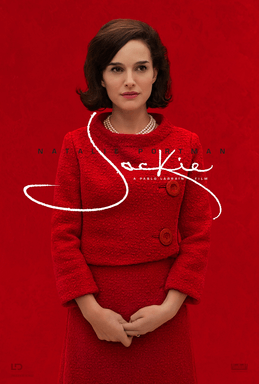
  • Jackie

    Jackie


    A few years ago a friend of mine associated with the movie business sent me a very early draft of the film Jackie. Noah Oppenheim’s script was first scheduled as an HBO miniseries, with Steve Spielberg set to produce. But Spielberg then left the project. At the time I read the screenplay, Darren Aronofsky was attached to it as director. And at that time, his girlfriend Rachel Weisz was supposed to play Jacqueline Kennedy. When I got done reading the script my friend asked me what I thought of it. I said, not very much, it seemed kind of dull to me. But I told him I thought it would get made because an A list actress would do it just to get an Academy Award nomination.

    In the six-year journey from first draft to completed film, Wiesz and Aronofksy split up and she dropped out as lead actress. Aronofsky eventually dropped out as director. But he stayed on as a producer. And it is probably through him that Natalie Portman was brought in to play the lead. They were quite familiar with each other since he directed her in her Oscar winning role in Black Swan.

    The film essentially deals with the four days from November 22-25, 1963. John Reed called his book about the Russian Revolution Ten Days that Shook the World. This film depicts four days that shook the world. But since the picture is so narrowly focused on seeing those events through President Kennedy’s widow’s eyes, the full impact of those tumultuous days is never approximated, let alone felt. For instance, we get scenes with Jackie Kennedy talking to an expert on the Lincoln assassination memorial service since she wants to model her husband’s funeral on that event.

    WHTour1962
    Jackie Kennedy during filming
    of White House tour (1962)

    To my knowledge, Jackie Kennedy did three long interviews after the assassination concerning that event and her marriage. The interviewing authors were Arthur Schlesinger, William Manchester, and Teddy White. This film’s overall structure is based upon the long interview Jackie did with Teddy White for Life magazine after the assassination. (Although, to the best of my memory, in the draft of the script I saw, the interview was with Arthur Schlesinger.) There are numerous flashbacks from this interview, which takes place in Hyannis Port. The main flashback is to Jackie’s famous tour of the White House. This was a TV special, initially broadcast on CBS, and NBC on Valentine’s Day of 1962. The program was a milestone in that no First Lady had ever done anything like this before. Also, it was the first time America ever got a long look at the interior of the White House, which JFK solicited two million dollars in private donations for restoration in 1961. The CBS correspondent for the program was Charles Collingwood. The show was viewed by a domestic audience of 80 million, and was eventually broadcast in 50 countries.

    There are other flashbacks; for instance to the actual assassination of President Kennedy, the swearing in of Lyndon Johnson, and some Kennedy cultural/musical programs in the White House. But besides the White House tour, the other main flashback frame consists of the preparations for Kennedy’s funeral.

    LBJ at JFK casket
    LBJ at JFK casket
    in Capitol Rotunda

    After Kennedy’s body was placed in the East Room of the White House, his funeral became a two part public event, taking place on November 24 and 25. On Sunday the 24th, the casket was placed in the rotunda of the Capitol building. Hundreds of thousands lined up to pay their respects. This viewing was scheduled to close at 9 PM, but because of the huge lines of people waiting outside, it was extended into, first, the wee hours of the morning, and then well past dawn of the next day. The actual state funeral was held on the 25th. Over ninety heads of state flew in for the mass at St. Matthew’s Cathedral and then the final procession to Arlington National Cemetery. The heads of state included French president Charles DeGaulle, Canadian Prime Minister Lester Pearson and Ethiopian Emperor Haile Selassie. President Lyndon Johnson also attended, even though many in government worried about a possible assassination attempt. Approximately a million spectators lined this route.

    A bit more than a week later, on December 5, 1963 the two deceased Kennedy children were reburied with their father. These were Patrick, who had predeceased JFK by 15 weeks, and an unnamed stillborn daughter. The film specifically mentions this fact. The picture ends with Jackie and her children on the beach, and her remembrances of dancing with Bobby and Jack at the White House.

    As I recall that early draft by Oppenheim, it suffered from a lack of any real gripping drama. Depicting an interview with a journalist and then recalling a funeral and a White House tour does not make for a lot of wide-screen drama or visual dynamics.  Especially when millions of us have already seen both the funeral and the White House tour. Further, both are available on YouTube. The main conflict the early draft depicted was between the widow and LBJ’s assistant Jack Valenti and Lyndon Johnson himself. These concerned her control over the funeral and also how long she was going to stay at the White House after it was over. Although Oppenheim has said he did not change the screenplay very much in the ensuing drafts, I am not sure this is accurate. It appears to me that the final director, Pablo Lorrain, wanted to jab up interest in what was intended as and was better suited for a small screen TV project.

    To use one example, in watching the film, one would think that, out of the blue, in a moment of divine inspiration, it was Jackie Kennedy who was responsible for choosing the eventual burial site for JFK at Arlington National Cemetery. It is true that she made the decision to not bury John Kennedy in his home city of Brookline, Massachusetts. But first, Sargent Shriver, Kennedy’s brother–in-law and Peace Corps Director, and then both Secretary of Defense Robert McNamara and Attorney General Bobby Kennedy had much more to do with the choice of the ultimate burial site at Arlington than the film depicts. (Click here for details.)

    And although Jackie did have a lot to do with the funeral arrangements, she was not by any means the only person involved in them. Again, RFK and McNamara, and the Pentagon were involved with these arrangements – the last since there were enormous security worries about another assassination attempt, the two most considered targets being LBJ and, as the film, depicts, Charles DeGaulle. But in watching this film, all Bobby Kennedy does is recall certain things about this brother and his legacy, and tries to keep the murder of Oswald from the grieving widow.

    JackieClintRavello
    Jackie Kennedy & Clint Hill
    Ravello, Italy (1962)
    (credit: Lisa McCubbin)

    But if that were not enough, there is also a scene where Jackie calls in Secret Service agent Clint Hill to see her, to congratulate him for his attempt to protect her during the fusillade. And she tells him she wants to talk to the accused assassin Oswald. In all the years I had researched the JFK case, I had never read anything like this scene happening. But I was not an expert on the Clint Hill/Jackie Kennedy relationship. So I consulted with Secret Service authority Vince Palamara. After exchanging emails with him, he said he did not recall this scene being related in any of the books Hill has written or co-written. And certainly not a request to talk to Oswald. Also, since Hill had been assigned to the First Lady from right after the 1961 inauguration, the formality and rigid cordiality shown in this scene would very likely not have existed. Further, the film tries to convey the impression that Hill rode on the trunk of the limousine all the way to Parkland. Again, according to Palamara, this is not accurate. He eventually snuggled into the back seat. And beyond that, there is even a scene where Jackie tries to walk into the autopsy room but she is turned away. My understanding was that the Kennedy entourage waited in a room on one of the upper floors of the Bethesda Medical Center. But again, I decided to consult with Palamara, and he said this did not happen.

    There are further jarring lapses with the record. Near the beginning of the film, when LBJ is about to be sworn in on Air Force One after the assassination, Jackie is depicted in the bathroom, wiping oodles of blood off of her face before the ceremony. Again, I can remember no photo or witness testimony to this happening. Just as I can recall no photo or film depicting her with lots of blood on her face due to the assassination. And in case that particular blood motif is not enough for you, there is a scene when she arrives back at the White House and takes a shower. Director Lorrain shoots it from behind, and we see water tinged in pink pouring down her back. Does this mean her hair was also saturated with her husband’s blood?

    Towards the end Jackie makes a comment to the interviewer that JFK was not really with her the night before the assassination in Fort Worth. Again, this puzzled me. According to William Manchester’s book, The Death of a President, the couple was in their suite by about 9 PM that evening. And that information had to have been at least partly provided by Jackie Kennedy. (Manchester, p. 87)

    So again, as I asked with Steven Spielberg’s Bridge of Spies about the Rudolf Abel/Gary Powers spy exchange: Where are the History Idolators? That is, those commentators who jump out of their chairs and onto the newspaper pages whenever Oliver Stone makes a controversial historical film. Their sole purpose is to bash him for using an excess of dramatic license. Yet again, in this particular case, I have seen next to no objections about the Oppenheim/Lorrain use of the same devices. Why? I will keep on posing this question until someone gives me a formal answer. (Click here for the Bridge of Spies review.)

    As for the film itself, the first thing we see is a tracking shot of Jackie walking back from outside to the house in Hyannis Port as the interviewer arrives. From that instant I had doubts about Lorrain’s ability to control the material. That kind of Kurosawa/Bergman camera strophe was too heavy for an opening shot of a film like this, or for the simple movement of Jackie walking back to begin an interview. Lorrain then slams close up after close up at us during the actual interview itself. Which made the scene play like an inquisition, when, in fact, the content of the interview is not like that at all.

    But even more surprising was the lack of rigor Lorrain showed with his cast. Billy Crudup plays White. It is an uphill part since it is all done in reaction. It has to be worked out in patterns of facial response, and through the eyes. It’s the kind of subtlety that the late Oskar Werner excelled at. Crudup is nothing more than adequate. Peter Sarsgaard is Bobby Kennedy. Sarsgaard has given some interesting performances in the past, for example in Shattered Glass and The Dying Gaul. Which makes it hard to comprehend how undistinguished, how pallid he is as RFK. If you can recall how memorable and precise Donald Moffat was as Lyndon Johnson in Philip Kaufman’s The Right Stuff, then you will see how much is missing from John Carrol Lynch’s rendition of LBJ here. Even good British actors like John Hurt as a priest Jackie confides in and Richard Grant as William Walton do little more than read their lines and collect their paychecks.  The one qualitative exception in the supporting cast is Casper Phillipson.  This Danish actor is spot-on as President Kennedy.  So much so that I wish he had been in the film more.  He gives his rare and brief scenes some much needed vitality.

    There has been a kind of combination media/industry networking effort to promote the idea that Natalie Portman should rank with Betty Davis and Greta Garbo for her acting in the title role. To me, it was a pretty monochromatic performance. Portman looked at a lot of film in order to capture the subject’s voice. And she noticed that there was a difference between the one that Jackie used for the White House tour and that which she used in more personal interviews. She then grieves and weeps a lot throughout. The part, as perceived by the writer, is so limited that the performance seems to be pretty much technical in nature. Portman spends so much effort in perfecting the surface, that there is not much left to actually articulate a character. There isn’t anything here that a dozen other actresses could not have done, either as well or better.

    All in all, it was a flat and disappointing film. Whoever decided that this script needed to be played out on the wide screen of a darkened theater was simply wrong. It seems that the writer and director realized that mistake on the way to production. As noted above, they then tried to justify that decision. In this reviewer’s opinion, it did not work. What is left is little more than an Oscar vehicle for Portman. And considering the subject, that should not have been the case.

  • Jackie

    Jackie


    A few years ago a friend of mine associated with the movie business sent me a very early draft of the film Jackie. Noah Oppenheim’s script was first scheduled as an HBO miniseries, with Steve Spielberg set to produce. But Spielberg then left the project. At the time I read the screenplay, Darren Aronofsky was attached to it as director. And at that time, his girlfriend Rachel Weisz was supposed to play Jacqueline Kennedy. When I got done reading the script my friend asked me what I thought of it. I said, not very much, it seemed kind of dull to me. But I told him I thought it would get made because an A list actress would do it just to get an Academy Award nomination.

    In the six-year journey from first draft to completed film, Wiesz and Aronofksy split up and she dropped out as lead actress. Aronofsky eventually dropped out as director. But he stayed on as a producer. And it is probably through him that Natalie Portman was brought in to play the lead. They were quite familiar with each other since he directed her in her Oscar winning role in Black Swan.

    The film essentially deals with the four days from November 22-25, 1963. John Reed called his book about the Russian Revolution Ten Days that Shook the World. This film depicts four days that shook the world. But since the picture is so narrowly focused on seeing those events through President Kennedy’s widow’s eyes, the full impact of those tumultuous days is never approximated, let alone felt. For instance, we get scenes with Jackie Kennedy talking to an expert on the Lincoln assassination memorial service since she wants to model her husband’s funeral on that event.

    WHTour1962
    Jackie Kennedy during filming
    of White House tour (1962)

    To my knowledge, Jackie Kennedy did three long interviews after the assassination concerning that event and her marriage. The interviewing authors were Arthur Schlesinger, William Manchester, and Teddy White. This film’s overall structure is based upon the long interview Jackie did with Teddy White for Life magazine after the assassination. (Although, to the best of my memory, in the draft of the script I saw, the interview was with Arthur Schlesinger.) There are numerous flashbacks from this interview, which takes place in Hyannis Port. The main flashback is to Jackie’s famous tour of the White House. This was a TV special, initially broadcast on CBS, and NBC on Valentine’s Day of 1962. The program was a milestone in that no First Lady had ever done anything like this before. Also, it was the first time America ever got a long look at the interior of the White House, which JFK solicited two million dollars in private donations for restoration in 1961. The CBS correspondent for the program was Charles Collingwood. The show was viewed by a domestic audience of 80 million, and was eventually broadcast in 50 countries.

    There are other flashbacks; for instance to the actual assassination of President Kennedy, the swearing in of Lyndon Johnson, and some Kennedy cultural/musical programs in the White House. But besides the White House tour, the other main flashback frame consists of the preparations for Kennedy’s funeral.

    LBJ at JFK casket
    LBJ at JFK casket
    in Capitol Rotunda

    After Kennedy’s body was placed in the East Room of the White House, his funeral became a two part public event, taking place on November 24 and 25. On Sunday the 24th, the casket was placed in the rotunda of the Capitol building. Hundreds of thousands lined up to pay their respects. This viewing was scheduled to close at 9 PM, but because of the huge lines of people waiting outside, it was extended into, first, the wee hours of the morning, and then well past dawn of the next day. The actual state funeral was held on the 25th. Over ninety heads of state flew in for the mass at St. Matthew’s Cathedral and then the final procession to Arlington National Cemetery. The heads of state included French president Charles DeGaulle, Canadian Prime Minister Lester Pearson and Ethiopian Emperor Haile Selassie. President Lyndon Johnson also attended, even though many in government worried about a possible assassination attempt. Approximately a million spectators lined this route.

    A bit more than a week later, on December 5, 1963 the two deceased Kennedy children were reburied with their father. These were Patrick, who had predeceased JFK by 15 weeks, and an unnamed stillborn daughter. The film specifically mentions this fact. The picture ends with Jackie and her children on the beach, and her remembrances of dancing with Bobby and Jack at the White House.

    As I recall that early draft by Oppenheim, it suffered from a lack of any real gripping drama. Depicting an interview with a journalist and then recalling a funeral and a White House tour does not make for a lot of wide-screen drama or visual dynamics.  Especially when millions of us have already seen both the funeral and the White House tour. Further, both are available on YouTube. The main conflict the early draft depicted was between the widow and LBJ’s assistant Jack Valenti and Lyndon Johnson himself. These concerned her control over the funeral and also how long she was going to stay at the White House after it was over. Although Oppenheim has said he did not change the screenplay very much in the ensuing drafts, I am not sure this is accurate. It appears to me that the final director, Pablo Lorrain, wanted to jab up interest in what was intended as and was better suited for a small screen TV project.

    To use one example, in watching the film, one would think that, out of the blue, in a moment of divine inspiration, it was Jackie Kennedy who was responsible for choosing the eventual burial site for JFK at Arlington National Cemetery. It is true that she made the decision to not bury John Kennedy in his home city of Brookline, Massachusetts. But first, Sargent Shriver, Kennedy’s brother–in-law and Peace Corps Director, and then both Secretary of Defense Robert McNamara and Attorney General Bobby Kennedy had much more to do with the choice of the ultimate burial site at Arlington than the film depicts. (Click here for details.)

    And although Jackie did have a lot to do with the funeral arrangements, she was not by any means the only person involved in them. Again, RFK and McNamara, and the Pentagon were involved with these arrangements – the last since there were enormous security worries about another assassination attempt, the two most considered targets being LBJ and, as the film, depicts, Charles DeGaulle. But in watching this film, all Bobby Kennedy does is recall certain things about this brother and his legacy, and tries to keep the murder of Oswald from the grieving widow.

    JackieClintRavello
    Jackie Kennedy & Clint Hill
    Ravello, Italy (1962)
    (credit: Lisa McCubbin)

    But if that were not enough, there is also a scene where Jackie calls in Secret Service agent Clint Hill to see her, to congratulate him for his attempt to protect her during the fusillade. And she tells him she wants to talk to the accused assassin Oswald. In all the years I had researched the JFK case, I had never read anything like this scene happening. But I was not an expert on the Clint Hill/Jackie Kennedy relationship. So I consulted with Secret Service authority Vince Palamara. After exchanging emails with him, he said he did not recall this scene being related in any of the books Hill has written or co-written. And certainly not a request to talk to Oswald. Also, since Hill had been assigned to the First Lady from right after the 1961 inauguration, the formality and rigid cordiality shown in this scene would very likely not have existed. Further, the film tries to convey the impression that Hill rode on the trunk of the limousine all the way to Parkland. Again, according to Palamara, this is not accurate. He eventually snuggled into the back seat. And beyond that, there is even a scene where Jackie tries to walk into the autopsy room but she is turned away. My understanding was that the Kennedy entourage waited in a room on one of the upper floors of the Bethesda Medical Center. But again, I decided to consult with Palamara, and he said this did not happen.

    There are further jarring lapses with the record. Near the beginning of the film, when LBJ is about to be sworn in on Air Force One after the assassination, Jackie is depicted in the bathroom, wiping oodles of blood off of her face before the ceremony. Again, I can remember no photo or witness testimony to this happening. Just as I can recall no photo or film depicting her with lots of blood on her face due to the assassination. And in case that particular blood motif is not enough for you, there is a scene when she arrives back at the White House and takes a shower. Director Lorrain shoots it from behind, and we see water tinged in pink pouring down her back. Does this mean her hair was also saturated with her husband’s blood?

    Towards the end Jackie makes a comment to the interviewer that JFK was not really with her the night before the assassination in Fort Worth. Again, this puzzled me. According to William Manchester’s book, The Death of a President, the couple was in their suite by about 9 PM that evening. And that information had to have been at least partly provided by Jackie Kennedy. (Manchester, p. 87)

    So again, as I asked with Steven Spielberg’s Bridge of Spies about the Rudolf Abel/Gary Powers spy exchange: Where are the History Idolators? That is, those commentators who jump out of their chairs and onto the newspaper pages whenever Oliver Stone makes a controversial historical film. Their sole purpose is to bash him for using an excess of dramatic license. Yet again, in this particular case, I have seen next to no objections about the Oppenheim/Lorrain use of the same devices. Why? I will keep on posing this question until someone gives me a formal answer. (Click here for the Bridge of Spies review.)

    As for the film itself, the first thing we see is a tracking shot of Jackie walking back from outside to the house in Hyannis Port as the interviewer arrives. From that instant I had doubts about Lorrain’s ability to control the material. That kind of Kurosawa/Bergman camera strophe was too heavy for an opening shot of a film like this, or for the simple movement of Jackie walking back to begin an interview. Lorrain then slams close up after close up at us during the actual interview itself. Which made the scene play like an inquisition, when, in fact, the content of the interview is not like that at all.

    But even more surprising was the lack of rigor Lorrain showed with his cast. Billy Crudup plays White. It is an uphill part since it is all done in reaction. It has to be worked out in patterns of facial response, and through the eyes. It’s the kind of subtlety that the late Oskar Werner excelled at. Crudup is nothing more than adequate. Peter Sarsgaard is Bobby Kennedy. Sarsgaard has given some interesting performances in the past, for example in Shattered Glass and The Dying Gaul. Which makes it hard to comprehend how undistinguished, how pallid he is as RFK. If you can recall how memorable and precise Donald Moffat was as Lyndon Johnson in Philip Kaufman’s The Right Stuff, then you will see how much is missing from John Carrol Lynch’s rendition of LBJ here. Even good British actors like John Hurt as a priest Jackie confides in and Richard Grant as William Walton do little more than read their lines and collect their paychecks.  The one qualitative exception in the supporting cast is Casper Phillipson.  This Danish actor is spot-on as President Kennedy.  So much so that I wish he had been in the film more.  He gives his rare and brief scenes some much needed vitality.

    There has been a kind of combination media/industry networking effort to promote the idea that Natalie Portman should rank with Betty Davis and Greta Garbo for her acting in the title role. To me, it was a pretty monochromatic performance. Portman looked at a lot of film in order to capture the subject’s voice. And she noticed that there was a difference between the one that Jackie used for the White House tour and that which she used in more personal interviews. She then grieves and weeps a lot throughout. The part, as perceived by the writer, is so limited that the performance seems to be pretty much technical in nature. Portman spends so much effort in perfecting the surface, that there is not much left to actually articulate a character. There isn’t anything here that a dozen other actresses could not have done, either as well or better.

    All in all, it was a flat and disappointing film. Whoever decided that this script needed to be played out on the wide screen of a darkened theater was simply wrong. It seems that the writer and director realized that mistake on the way to production. As noted above, they then tried to justify that decision. In this reviewer’s opinion, it did not work. What is left is little more than an Oscar vehicle for Portman. And considering the subject, that should not have been the case.

  • A Coup in Camelot

    A Coup in Camelot


    Considering the large number of films and TV specials about the assassination of President Kennedy that have appeared over the last ten or fifteen years, genuinely worthwhile documentaries on the subject are sadly few and far between. The likes of Mark Lane’s Rush to Judgement and Chip Selby’s Reasonable Doubt were fine for their day but given the wealth of information and technological tools that have become available in the time since those films were produced they appear more than a little outdated now. Sadly, the majority of well budgeted, slickly produced documentaries of the 21st century have been created solely to push the delusory mythology of the Warren Commission. Aside from Shane O’Sullivan’s mostly worthwhile Killing Oswald there has been very little of note that has even attempted to counter the MSM’s seemingly endless deluge of propaganda with reliable evidence and solid reasoning. A Coup in Camelot clearly aims to fill that void. Unfortunately, however, it falls considerably short of the mark because it consistently confuses theory with fact.

    The film begins strongly enough with a ten minute introduction that briefly discusses Kennedy’s intention to withdraw American troops from Vietnam then outlines the reasons for his trip to Dallas and explains how, within hours of the assassination, Lee Harvey Oswald was fingered as the lone nut assassin. From there A Coup in Camelot moves swiftly into one of its strongest segments, featuring respected author and researcher Vince Palamara as its main talking head. Over the years, through his diligent hard work in locating and interviewing members of the Secret Service, Palamara has made himself the go-to expert on the subject of President Kennedy’s protection―or lack thereof―in Dallas. I must admit that I have never been convinced the Secret Service was actively involved in the assassination. Yet Palamara’s work most certainly gives reason to at least consider the idea that JFK’s protection on November 22, 1963, was intentionally compromised.

    Secret Service authority
    Vince Palamara

    Palamara details just how many of the Secret Service’s usual practices were not followed that day. For example, it was standard procedure during an open motorcade for agents to be walking or jogging alongside the Presidential limousine. In fact there were two hand rails in place for agents to hold onto as they stood on the rear running boards of the car. As Palamara points out, “Secret Service agents are powerless to really do much of anything if they’re not close to the President.” And yet there were no agents on or near the limousine in Dallas. Defenders of the official mythology have long claimed that Kennedy himself had ordered the agents off the back of the car because he wanted the public to get a good look at him. But when Palamara spoke with Gerald Behn, the Special Agent in charge of the White House detail, Behn told him in no uncertain terms that he had never heard any such request from the President. Palamara then contacted numerous other Secret Service agents and White House aides and each one of them told him the same thing: Kennedy had not ordered the agents off of the car.

    Lone nut mythologists also tend to blame Kennedy for the fact that the limousine’s plexiglass bubble top was not used that day. Although the bubble top was not bullet proof or resistant it was, as Palamara notes, “a psychological deterrent because most people assumed it was bullet proof…The bottom line what the bubble top would have done is it would have obscured an assassin’s view via the sun’s glare.” To discover whether or not Kennedy really had ordered its removal, Palamara spoke with Special Agent Sam Kinney who was the driver of the Secret Service follow-up car. “Sam Kinney adamantly on three different occasions told me that President Kennedy had nothing to do with it; it was solely his responsibility.”

    Houston, 11/21/63

    Another procedure not followed in Dallas involved the additional protection customarily provided by local law enforcement. Whenever and wherever there was to be a motorcade, the Secret Service would usually work hand in hand with local police who would provide a motorcycle escort of six to nine officers that would ride in a wedge formation in front of and beside the Presidential limousine. This formation had been in place on all of the previous stops along Kennedy’s Texas trip. Yet in Dallas the escort was reduced to just four motorcycle officers who ended up riding behind the limo instead of beside it. As Palamara notes, “The formation was meaningless. It offered no protection at all…They left Kennedy a sitting duck.”

    II

    Having detailed these and many other irregularities in JFK’s protection, A Coup in Camelot moves on to a discussion of the “Blood, Bullets & Ballistics”, focusing largely on the conclusions of retired crime scene investigator, Sherry Fiester. It is Fiester’s contention that the massive spray of blood seen in frame 313 of the Zapruder film represents “back spatter” from a frontal shot. She further asserts that, despite numerous witnesses believing they heard shots or saw smoke coming from behind the fence on top of the “grassy knoll”, her own trajectory analysis excludes it as the source of the head shot. The actual source of the shot, she claims, was on the other side of Elm Street at the southern end of the triple overpass. But despite her impressive credentials and her 30 years experience with the Dallas police, Fiester’s conclusions fail to convince.

    Medical, scientific and ballistics experts such as Dr. Cyril Wecht, Dr. Gary Aguilar, Dr. Donald Thomas, and Larry Sturdivan agree that, by itself, the explosion of blood, bone and brain matter seen in the Zapruder film actually tells us very little about the direction in which the projectile was travelling. That is because it does not occur at the point of entrance or exit but near the mid-point of the bullet’s trajectory. Rifle wounds of the skull can be a very different matter than gunshot wounds to other parts of the body. The skull is a closed vessel containing fluid contents that cannot be compressed. The energy and momentum imparted to the skull by the passage of the bullet creates a temporary cavity. The result of cavitation in an enclosed skull containing blood and brain is a hydraulic pressure applied to the cranium causing it to burst open. As Aguilar and Wecht explain, the resultant “spew” of blood and tissue is “radial to the bullet’s path and is separate from the inshoot and outshoot splatter.” (Aguilar & Wecht, Letter to the Editor, AFTE Journal, Volume 48 Number 2, p. 76) This is what is known as the “Krönleinschuss” effect―named for the German ballistics expert who first demonstrated it using skulls filled with clay.

    This type of effect was demonstrated during filmed simulations performed in the Biophysics laboratory at Edgewood Arsenal in 1964 when rifle bullets were fired into numerous skulls filled with ballistic gelatin. Describing a typical example Sturdivan writes, “The bullet entered the back of the skull and exited in a small spray at the front in the space of one frame of the high-speed movie. Only after the bullet was far down-range did the internal pressure generated by its passage split open the skull and relieve the pressure inside by spewing the contents through the cracks. A similar type explosion would have taken place if the bullet had gone through in the opposite direction. The only way to distinguish the direction of travel of the bullet is to examine the cratering effect on the inside of the skull on entrance and on the outside of the skull at exit.” (Sturdivan, The JFK Myths, p. 171)

    The empirical evidence, therefore, demonstrates that Fiester is mistaken in believing the explosive spray of matter we see in the Zapruder film is back spatter. In fact, forward spatter and back spatter are not seen in the film; probably because of the limitations of Zapruder’s camera. The film of the Edgewood simulation shows little to no back spatter and only a very small amount of forward matter which, as Sturdivan explains, was only visible “because of the strong lighting, a close-up view, and (especially) a very high framing rate…over 200 times the framing speed of the Zapruder movie…” (ibid. p. 174)
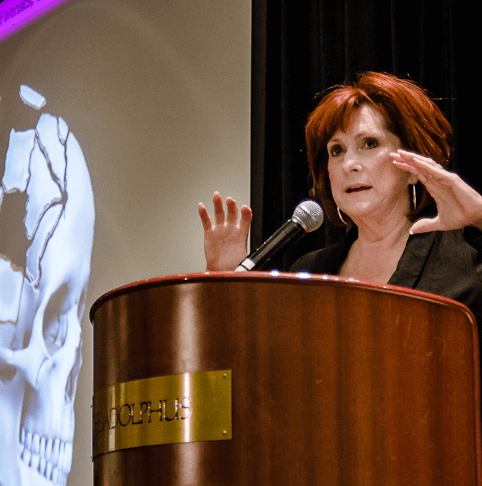
    Sherry Fiester

    Fiester’s trajectory analysis is also deeply flawed because it assumes something there is no reason to assume. Namely, that the bullet followed a straight path through the skull. In 1978, when the House Select Committee on Assassinations (HSCA) hired a NASA scientist to perform the same type of backward projection analysis, the committee’s forensic pathology panel cautioned against placing too much faith in it. The panel noted that, in their experience, “if a missile strikes an object capable of creating a shearing force, such as the skull, the bullet’s pathway in the body might be significantly different from the line of its trajectory prior to impact.” (7HSCA168) In other words, a bullet striking a dense, resistant skull bone is likely to become deformed and be deflected. Sturdivan writes that “The path of a deformed bullet through a body is never straight…Of the thousands of examples of yawed, deformed, and broken rifle bullets fired into gelatin tissue simulant at the Biophysics Division lab and other similar facilities, none had a perfectly straight trajectory. Few were even close.” (ibid. p. 208) So drawing a line between the presumed entrance and exit points in JFK’s skull will not tell us where the gunman was located no matter how far that line is extended into Dealey Plaza.

    Far from being excluded as Fiester asserts, the grassy knoll remains the most likely location for a frontal shooter. Not only because it was the location to which numerous witnesses pointed, but also because two teams of America’s top acoustical scientists agreed that the Dallas Police dictabelt recording they analyzed on behalf of the HSCA contained the acoustic fingerprint of a gunshot fired from the knoll. And the dictabelt recording synchronizes perfectly with the Zapruder film when―and only when―the knoll shot is aligned with frame 313.

    Featured alongside Fiester’s theories in this segment of A Coup in Camelot is the claim that President Kennedy was shot in the throat from the front. Yet aside from a brief reference to the way the wound was “described by doctors at Parkland Hospital”, no detail is provided to substantiate this assertion. As most readers will no doubt be aware, the Parkland physicians were indeed under the initial impression that the wound might have been an entrance; describing it as small, round, clean cut, and measuring little more than 5 mm in diameter. But those who hold these descriptions up as proof that a bullet entered the throat need to deal with the fact that studies have shown emergency room doctors to be frequently wrong in their assessment of bullet wounds. This is precisely why the premiere textbook for trauma room physicians, Rosen’s Emergency Medicine, cautions that “Clinicians should not describe wounds as ‘entrance’ or ‘exit’ but should document, using appropriate forensic terminology, a detailed description of the wound, including its appearance, characteristics, and location without attempting to interpret the wound type or bullet caliber. Exit wounds are not always larger than entrance wounds, and wound size does not consistently correspond to bullet caliber.” (Rosen’s Emergency Medicine: Concepts and Clinical Practice, p. 828)

    Those who propose that a bullet entered the throat must also deal with the fact that said bullet would have had to have disappeared entirely almost immediately after piercing the skin. Because not only was there no exit in the rear and no bullet found anywhere in the body, there was also no damage to the spine as there would almost certainly have had to have been had a missile entered Kennedy’s throat near the midline. It is for these reasons that, despite its appearance, the wound is extremely unlikely to have been one of entrance.

    III

    A Coup in Camelot moves from Dallas to Bethesda for a lengthy discussion of JFK’s autopsy, centred largely around the highly controversial theories of Douglas Horne. In a nutshell, Horne believes that Kennedy’s gunshot wounds were altered to hide evidence of a frontal shooter. This, of course, is not a new idea. It was first popularized by author David Lifton in his 36-year-old book, Best Evidence. But whereas Lifton postulated that unknown conspirators had hijacked the President’s body en route to Bethesda and altered his wounds to fool the autopsy surgeons, Horne suggests that the prosectors themselves altered the head wound during a secret “pre-autopsy” at the Navy morgue. For what purpose and to fool whom is never really made clear.
    Doug Horne

    At the very heart of Horne’s hypothesis is a comment made by Tom Robinson―an embalmer who was present for most of the autopsy―during a 1996 interview for the Assassination Records Review Board. When shown a photo displaying a large defect in the top of Kennedy’s head Robinson recalled that this was “what the doctors did”. He then explained that the autopsy surgeons had cut the scalp open and “reflected it back in order to remove bullet fragments.” (ARRB MD180) He also recalled seeing that “some sawing was done to remove some bone before the brain could be removed.” (ibid) What Robinson described is, of course, a perfectly normal part of an autopsy and he himself called what he saw a “normal craniotomy procedure.” (ibid) Yet somehow Horne construes Robinson’s remarks as evidence of some clandestine pre-autopsy activity. Why?

    The reason, according to Horne, is that “Dr. Humes always denied having to saw the skull open, he always maintained that the wound was so big that he just removed the brain with a minimum of cutting of the scalp; he never had to cut any bone.” However, as this passage from Hume’s sworn deposition for the ARRB demonstrates, Horne is entirely mistaken :

    GUNN: But just let me start out first: Where was the first incision made?

    HUMES: I believe, of course, the top of the skull to remove the skull plate of the brain. To remove what remained of the calvarium and to approach the removal of the brain.

    GUNN: And was that incision simply of the scalp, or did you need to cut –

    HUMES: No, we had to cut some bone as well. [my emphasis]

    * * *

    GUNN: Where did you cut the bone?

    HUMES: I find that–it’s hard to recall. Once we got the scalp laid back, some of those pieces could just be removed, you know, by picking them up, picking them up because they were just not held together very well, other than by the dura, I suppose. So other than that, we probably made it like we normally do, in a circumferential fashion from books, like right above the ear around. But it was a real problem because it was all falling apart, the skull. And I can’t recall the details of exactly how we managed to maneuver that, because it was a problem. (ARRB Deposition of James J. Humes, pgs. 101-102)

    As the reader can see, not only did Humes not deny having to saw the skull, he specifically testified to doing so. But Horne does not quote Humes himself and instead refers to a report written in 1965 by autopsy surgeon Dr. Pierre Finck―who did not arrive at Bethesda until after the brain had already been removed―in which Finck recalled being told that “no sawing of the skull was necessary”. What this means, therefore, is that the basis of Horne’s claim that “Humes always denied having to saw the skull open” is not any direct quotation from Humes himself, but the hearsay claim of a man who wasn’t even present when the brain was removed. This type of methodology is extremely difficult to defend. And what makes it all the more confounding is that Horne himself was actually present for the deposition during which Humes specifically swore to cutting the skull bone.

    Sadly, this is not the only instance in A Coup in Camelot in which Humes’ words are misconstrued in support of pre-autopsy surgery. The film’s co-writer, Art Van Kampen, suggests that “Something had to have happened to that body before the photos were taken”, and in the case of some photos that is indeed true. But Van Kampen claims that “Dr. Humes is very clear that no autopsy work had been done on the President’s skull before either photos or X-rays were taken.” This, again, is a clear misinterpretation of what Humes actually said. When asked during his ARRB deposition whether or not any incisions were made before the photographs were taken, Humes responded, “Well, depending on which photographs you’re talking about. We didn’t photograph the wound in the occiput until the brain was removed, you know. Sure, we had to make an incision to remove the brain and so forth, but no, generally speaking, no, we didn’t make any incisions at all [my emphasis].” (ibid. p. 95) Humes was then shown the photographs of the top of the head and asked whether or not, before the photo was taken, he had pulled the scalp back “in order to be able to have a better look at the injury” to which he responded “Yes, I probably did.” (ibid. p. 162) So, as should be perfectly clear, Humes confirmed that “generally speaking” most of the photographs were taken before any incisions took place but that some were indeed taken during the course of the autopsy. He also said essentially the same thing as Tom Robinson, which is that the photographs of the top of the head were taken after the scalp had been manipulated. There is, then, no meaningful discrepancy between what the autopsy pictures show and what Humes testified to.

    There has been confusion over Kennedy’s head wounds ever since the Warren Commission issued its findings. In large part this is due to there being two entirely different descriptions of the wounds on record. By and large the doctors at Parkland Hospital recalled seeing one fairly large hole that was located near the right rear of the head. Yet the autopsy report describes a massive defect involving almost the entire right side of the cranium. It was to explain this discrepancy that the body alteration hypothesis was first offered. However, as Dr. Aguilar has noted, “that the wound was described as larger at autopsy than noted by emergency personnel is not proof that it was surgically enlarged. Wounds picked apart during an autopsy are often found to be larger than they first appeared to emergency personnel.” (Murder in Dealey Plaza, p. 187)

    There is a simpler, far more reasonable explanation than clandestine alteration. One that, ironically enough, is touched upon in A Coup in Camelot. Shortly before discussion of the autopsy begins, the film’s narrator correctly informs viewers that “In the Zapruder film, a flap of skull can be seen opening up after the head strike. During the frantic ride to Parkland Hospital the flap had been folded back into place where the blood acted like glue and sealed the wound.” Indeed, Jackie Kennedy later testified to trying to hold her husband’s skull together on the way to the hospital. As Dr. Aguilar writes, “It is not hard to imagine the possibility that during the time it took the Presidential limousine to get to Parkland Hospital, clot had formed gluing a portion of disrupted scalp down making JFK’s skull defect appear smaller to treating surgeons than it later would to autopsy surgeons.” (ibid) In other words, because the flap had been closed up, the emergency room staff only saw the rearmost portion of the wound.

    IV

    The idea that something out of the ordinary occurred at Bethesda is buttressed by stories of multiple coffins being brought into the morgue on the night of the autopsy. At Parkland Hospital, Kennedy’s body had been placed into an ornamental bronze casket. However, in A Coup in Camelot it is alleged that the body actually arrived at Bethesda in an aluminium shipping casket at around 6:35 pm. This means that when the bronze casket was brought into the morgue at 7:17 pm it was, unbeknownst to the FBI agents who accompanied it, completely empty. Or so we are told. Horne further alleges that for some reason the Dallas casket then “made a second entry that night…at 20:00 hours military time.”

    Once again the evidence does not support the theory. As presented in the film, the idea that Kennedy’s body arrived in an aluminium shipping casket is based on the recollection of Naval petty officer, Dennis David, who recalled helping carry one into morgue. Yet, as the summary of his ARRB interview states, David “emphasized that he had no direct knowledge, by observation, that President Kennedy was in the gray shipping casket…” (ARRB MD177) The reality is that, being as Bethesda was a morgue, there is no reason to believe that Kennedy’s body was the only one to be brought there that night. In fact, FBI agent Francis O’Neill specifically recalled being told that one of the four drawers in the anteroom adjacent to the autopsy room contained the body of a child “that had died that day.” (O’Neill ARRB deposition, p. 57)

    Perhaps more importantly, the claim that the bronze casket was empty when brought into the mortuary is belied by the testimony of both O’Neill and his FBI colleague, James Sibert. These two agents who helped unload the casket from the ambulance swore that they stayed with it until it was opened and saw with their own eyes the President’s body taken out. O’Neill stated without hesitation during his ARRB deposition that there was “no time” from the time he first saw the casket “until the time it was opened and the body taken out that the casket was not in my view…” (ibid. p. 59) Similarly, when asked whether or not there had been any time between being unloaded from the ambulance and being opened that the casket had been out of his sight, Sibert responded, “I was there until it was opened.” (Sibert ARRB deposition, p. 45) There is, therefore, no basis for claiming that the casket was “certainly empty” as Horne does.

    Finally, the supposed 20:00 re-entry of the casket is based on a time notation which appears in an unsigned, undated document titled “The Joint Casket Bearer Team.” This document describes the activities of a group containing one officer and seven enlisted men “from each branch of the Armed Forces” who were “trained to carry the casket to and from the ceremony sites and to fold the flag which draped the casket following the internment service.” (ARRB MD163) This team, as A Coup in Camelot correctly informs, was also known as the “honor guard”. It appears quite apparent that, far from being proof of a second entry for the bronze casket, the 20:00 hours time notation on this document is nothing more than a mistake. Why? Because despite the film’s claim that Sibert and O’Neill had carried the casket into the morgue at 7:17 pm alongside Secret Service agents Roy Kellerman and William Greer, O’Neill explained in his ARRB deposition that, in actual fact, it was the honor guard who had physically lifted the coffin at that time. (O’Neill deposition, p. 57) So unless anyone wants to believe that the honor guard carried it in twice, they are going to have to accept that the unknown writer of the document was in error and there was only one entry for the bronze casket.

    A coup in Camelot intermingles these stories of casket-swapping and wound tampering with claims that the autopsy X-rays and photographs have also been altered. This, once again, is not a new theory. In fact it has been a commonly held belief amongst students of the assassination for decades. And yet nothing approaching proof of alteration has ever emerged. The most commonly cited reason for believing the photos have been tampered with, the one repeated in A Coup in Camelot, is that the pictures appear to show the back of the head completely intact. This is, of course, at odds with the testimony of the Parkland physicians who recalled seeing a large wound in the right rear. But as autopsy surgeon J. Thornton Boswell explained to both the HSCA and the ARRB, the reason the rear skull damage is not seen in the photographs is because the scalp is being held up and “pulled forward up over the forehead, toward the forehead.” (Boswell ARRB deposition, p. 150) This has the effect of hiding the wound underneath.

    Those who choose to ignore Boswell’s words are still stuck with the reality that the autopsy photographer, John Stringer, authenticated the photographs during his own ARRB deposition, repeatedly stating that he had no reason to believe the existing photographs were anything other than the ones that he himself took on the night of the autopsy. The same is true of the X-rays. The technician responsible for taking them, Jerrol Custer, repeatedly swore to the accuracy and authenticity of the existing X-rays for the ARRB. For example, when shown the anterior/posterior view:

    GUNN: Is there any question in your mind whether the X-ray that’s in front of you right now is the original X-ray taken at the autopsy?

    CUSTER: No question.

    GUNN: And the answer is––

    CUSTER: It is the original film. (p. 122-123)

    And when shown the right lateral skull X-ray:

    GUNN: … Mr. Custer, can you identify the film that is in front of you right now as having been taken by you on the night of the autopsy of President Kennedy?

    CUSTER: Correct. Yes, I do, sir.

    GUNN: And how are you able to identify that as being––

    CUSTER: My marker in the lower mandibular joint. (p. 124)

    With the men who took them―and all three autopsy doctors―swearing to their authenticity, there seems little doubt that the autopsy photographs and X-rays would have been admitted into evidence were there to be a trial in the Kennedy case. And with questions of validity settled, a more important question would be asked: What do the skull X-rays actually show? The answer to that, as a number of experts including neuroscientist Dr. Joseph Riley and radiologist Dr. Randy Robertson have attested, is that the official theory of a single shot from the rear simply cannot be true.

    As Dr. Humes explained in his Warren Commission testimony, the pathologists found an entrance wound that was 2.5 cm to the right, and “slightly above” the external occipital protuberance―a small bump located very low down in the rear of the skull―and “a huge defect over the right side” involving “both the scalp and the underlying skull…” After a “careful examination of the margins of the large bone defect” on the right side, the doctors were unable to find a point of exit, which Humes put down to the fact that they “did not have the bone.” However, the pathologists concluded that a single bullet was responsible for all the damage, having entered the rear and exited the right side. In support of this contention, Humes implied that the path of the bullet was laid out by a trail of metallic fragments that could be seen on the X-rays “traversing a line from the wound in the occiput to just above the right eye…” (Warren Commission Hearings, Vol. II, p. 351-353)

    Annotated X ray

    Unfortunately for Dr. Humes, the X-rays do not show what he claimed. The entrance wound in the lower rear of the skull is indeed visible. So too is the trail of bullet fragments. But the two are in no way related. In fact, the trail lies along the very top of the skull, several inches above the entrance site. Therefore, those fragments could not have been left behind by a bullet which entered near the external occipital protuberance. As Aguilar and Wecht have noted, “…the fragment trail alone almost completely eliminates the official theory JFK was struck from above and behind by a single bullet that entered his skull low…” (Aguilar & Wecht, Op. cit. p. 78) Dr. Joseph Riley, who has a Ph.D in neuroscience and specializes in neuroanatomy and experimental neuropathology, noted decades ago that the medical evidence as it stands is only compatible with two separate bullet strikes. It is for that very reason that I see little logic in suggesting that the X-rays have been altered to support the official story.

    V

    These largely specious claims about the medical evidence form the centrepiece of A Coup in Camelot and, clocking in at nearly 40 minutes, comprise well over a third of the film’s running time. For those who are familiar with the facts that are being misinterpreted and/or overlooked, this time will not pass quickly. Things do pick up, however, for the final 20 minutes of the film which deals partially with the enigmatic Lee Harvey Oswald. Whether or not Oswald was on the sixth floor of the Texas School Book Depository with a rifle in his hands at the time of the assassination has never been conclusively established. But A Coup in Camelot demonstrates, through the pioneering research of former investigative reporter Barry Ernest, that in all likelihood Oswald was where he claimed to be when the shots were fired; on the first floor of the building eating lunch.

    Barry Ernest

    Ernest centred his research on an often overlooked witness named Victoria Adams who had viewed the assassination from a fourth floor window of the depository building. As most students of the case know, Oswald was seen by his boss Roy Truly and police officer Marion Baker in the second floor lunch room approximately 90 seconds after the shots were fired. Baker was on his way to the roof where he believed the gunman might be located but, upon spotting Oswald alone in the lunch room, he halted his ascent and demanded Oswald identify himself. Truly quickly informed Baker that Oswald was an employee and the pair then continued their dash up the stairs. Oswald later told police that he had gone from the first floor to the second in order to purchase a Coke. But, of course, the Warren Commission claimed that he had actually rushed down from the sixth floor immediately after shooting the President.

    In that regard, Victoria Adams was a problematic witness for the Commission. After watching the motorcade pass by with three co-workers, she had stayed at the fourth floor window for what she said was around 15 to 30 seconds and then quickly made her way down to the first floor. What this means, as Ernest explains, is that “she would have been on the stairs at the same time Oswald was descending from the sixth floor.” The problem is “…she did not see or hear anyone on the stairs during that period.” The Commission’s handling of her story typified its approach to the investigation. It did not bother to question any of those who had stood at the window with her to watch the motorcade―not even Sandra Styles who had accompanied Adams down the stairs―and instead suggested that she was simply mistaken about the time she left the fourth floor window.

    Victoria Adams

    In support of this contention, the Commission alleged that Adams had testified to seeing two other employees of the building, William Shelley and Billy Lovelady, when she arrived on the first floor. And because Shelley and Lovelady had testified to being outside on the depository steps during the shooting and not re-entering the building until several minutes later, the Commission claimed that Adams’ “…estimate of the time when she descended from the fourth floor is incorrect, and she actually came down the stairs several minutes after Oswald and after Truly and Baker as well.” (Warren Report, p. 154) The problem with the Commission’s argument is that when Ernest tracked Adams down she “flat-out denied” ever saying she had seen Shelley and Lovelady on the first floor. In order to confirm or refute her assertions, Ernest searched the National Archives for the stenographic tape of Adams’ testimony. Not surprisingly, however, he soon discovered that there is no record of her April 7, 1964, testimony and the stenographic tape has gone mysteriously “missing.”

    But in 1999 Ernest discovered a bombshell document in the Archives in the form of a June 2, 1964, letter written by Assistant United States Attorney, Martha Joe Stroud, to Warren Commission Chief counsel, J. Lee Rankin. This letter contains the only known reference in the Commission’s files to an interview with Dorothy Garner, who was Adams’ supervisor and one of those with whom she had stood at the fourth floor window. The letter notes matter-of-factly that “Miss Garner…stated this morning that after Miss Adams went downstairs she (Miss Garner) saw Mr. Truly and the policeman come up.” Thus Garner provided complete corroboration for Adams’ testimony. Just as she swore, Adams had indeed descended those old wooden steps at the same time Oswald was supposed to have been on them. And the corroboration of this fact was completely ignored by the Commission who made no mention of Garner’s interview whatsoever.

    As Ernest details in his indispensable book, The Girl on the Stairs, he went on to locate and interview Garner for himself. He asked her about her own activities following the assassination and Garner explained to him that as Adams and Styles made their way downstairs, she herself went to a storage area by the stairway. It was from there that she was able to see Baker and Truly ascend the stairs. Garner said that she was “right behind” Adams and Styles in leaving the window and although she didn’t actually see them enter the stairway, she heard them “after they started down” because “the stairs were very noisy.” (The Girl on the Stairs, p. 268) Garner, it appears, had arrived on the fourth floor landing area only seconds after Adams and was there long enough to see Baker and Truly. Quite obviously, then, if Oswald had descended from the sixth floor during that time as he would have had to have done in order to make it to his second floor encounter with Baker, then Garner was in a position to see him. Yet, as she told Ernest, “I don’t remember seeing him at all that day…except on TV.” (ibid)

    It is impossible to overstate how damaging all of this is to the case against Oswald. It is clear that he could not have made it down to the second floor ahead of Adams because he did not have the time. This means he would have had to have descended long enough after Adams for her not to have heard his footsteps. Yet if he was 10 or 15 seconds behind her on the stairwell, it seems highly unlikely that he would not have been spotted by Garner who did not see or hear him on the noisy old stairs, even though she stayed on the fourth floor landing area long enough to see Truly and Baker. The most logical conclusion to be drawn is that when Oswald arrived at his second floor meeting with Baker, he had not come from the sixth floor but from the first, just as he said he had. And that would mean that, whatever else he did that day, Oswald did not shoot President Kennedy.

    VI

    A Coup in Camelot finishes with a brief discussion of how Kennedy’s plans to pull American military personnel out of Vietnam were reversed after his death and how private US contractors profited from the all-out war that followed. However none of this is explored in any detail and no attempt is made to show how it can be directly connected to the assassination. Had the writers and producers chosen to focus more heavily on these areas they may well have created a more valuable and compelling film than this one.

    It is clear that the filmmakers wanted to offer forensic proof of a conspiracy and, in fact, at the end of the film it is claimed they have done just that. “We have proven through modern forensics”, narrator Peter Coyote says, “that a shot or shots were fired from the front.” Yet, as I have demonstrated above, proof of such is not offered in A Coup in Camelot. What is provided instead is a bloodspatter theory that, whilst plausible on the surface, is entirely contradicted by empirical evidence. Instead of relying on the opinions of one individual, the filmmakers should have consulted with other, perhaps better qualified experts to ensure that what was being proposed had really been put to the test. How else can one claim to have proven something? There are numerous medical and scientific professionals who are well-versed in the facts of the assassination―such as Doctors Wecht, Aguilar, Robertson, and Thomas―who, I am sure, would have been more than happy to share their expertise.

    As I see it, this is the fatal flaw of A Coup in Camelot. Theory is all too readily accepted and promoted by the filmmakers without any independent verification or even basic fact-checking. How difficult would it have been to have had somebody actually read Dr. Humes’ various testimonies to see if he really had “always denied having to saw the skull open”? Or to have studied the deposition of Francis O’Neill to discover who had physically carried the casket into the morgue at 7:17 pm? A clearer understanding of these two points alone would have been enough to call into serious question the highly dubious claims of multiple casket entries and wound tampering at Bethesda.

    Theories about the Kennedy assassination―many of them nutty―have been promulgated for far too long and they are not convincing anyone outside of the so-called “research community”. When you attempt to counter the ballistics experiments and slickly-produced computer simulations featured in mainstream lone gunman documentaries with something as bizarre-sounding and ill-founded as the body alteration hypothesis you are not likely to win many converts amongst the general population. What is needed is real expert opinion and cold, hard evidence presented in a compelling manner. A Coup in Camelot is skilfully produced on what appears to have been a reasonable budget and if the filmmakers had consulted the right individuals and doubled down on their facts they could well have produced something of real value. For that reason the film strikes me as a wasted opportunity.

  • A Coup in Camelot

    A Coup in Camelot


    Considering the large number of films and TV specials about the assassination of President Kennedy that have appeared over the last ten or fifteen years, genuinely worthwhile documentaries on the subject are sadly few and far between. The likes of Mark Lane’s Rush to Judgement and Chip Selby’s Reasonable Doubt were fine for their day but given the wealth of information and technological tools that have become available in the time since those films were produced they appear more than a little outdated now. Sadly, the majority of well budgeted, slickly produced documentaries of the 21st century have been created solely to push the delusory mythology of the Warren Commission. Aside from Shane O’Sullivan’s mostly worthwhile Killing Oswald there has been very little of note that has even attempted to counter the MSM’s seemingly endless deluge of propaganda with reliable evidence and solid reasoning. A Coup in Camelot clearly aims to fill that void. Unfortunately, however, it falls considerably short of the mark because it consistently confuses theory with fact.

    The film begins strongly enough with a ten minute introduction that briefly discusses Kennedy’s intention to withdraw American troops from Vietnam then outlines the reasons for his trip to Dallas and explains how, within hours of the assassination, Lee Harvey Oswald was fingered as the lone nut assassin. From there A Coup in Camelot moves swiftly into one of its strongest segments, featuring respected author and researcher Vince Palamara as its main talking head. Over the years, through his diligent hard work in locating and interviewing members of the Secret Service, Palamara has made himself the go-to expert on the subject of President Kennedy’s protection―or lack thereof―in Dallas. I must admit that I have never been convinced the Secret Service was actively involved in the assassination. Yet Palamara’s work most certainly gives reason to at least consider the idea that JFK’s protection on November 22, 1963, was intentionally compromised.

    Secret Service authority
    Vince Palamara

    Palamara details just how many of the Secret Service’s usual practices were not followed that day. For example, it was standard procedure during an open motorcade for agents to be walking or jogging alongside the Presidential limousine. In fact there were two hand rails in place for agents to hold onto as they stood on the rear running boards of the car. As Palamara points out, “Secret Service agents are powerless to really do much of anything if they’re not close to the President.” And yet there were no agents on or near the limousine in Dallas. Defenders of the official mythology have long claimed that Kennedy himself had ordered the agents off the back of the car because he wanted the public to get a good look at him. But when Palamara spoke with Gerald Behn, the Special Agent in charge of the White House detail, Behn told him in no uncertain terms that he had never heard any such request from the President. Palamara then contacted numerous other Secret Service agents and White House aides and each one of them told him the same thing: Kennedy had not ordered the agents off of the car.

    Lone nut mythologists also tend to blame Kennedy for the fact that the limousine’s plexiglass bubble top was not used that day. Although the bubble top was not bullet proof or resistant it was, as Palamara notes, “a psychological deterrent because most people assumed it was bullet proof…The bottom line what the bubble top would have done is it would have obscured an assassin’s view via the sun’s glare.” To discover whether or not Kennedy really had ordered its removal, Palamara spoke with Special Agent Sam Kinney who was the driver of the Secret Service follow-up car. “Sam Kinney adamantly on three different occasions told me that President Kennedy had nothing to do with it; it was solely his responsibility.”

    Houston, 11/21/63

    Another procedure not followed in Dallas involved the additional protection customarily provided by local law enforcement. Whenever and wherever there was to be a motorcade, the Secret Service would usually work hand in hand with local police who would provide a motorcycle escort of six to nine officers that would ride in a wedge formation in front of and beside the Presidential limousine. This formation had been in place on all of the previous stops along Kennedy’s Texas trip. Yet in Dallas the escort was reduced to just four motorcycle officers who ended up riding behind the limo instead of beside it. As Palamara notes, “The formation was meaningless. It offered no protection at all…They left Kennedy a sitting duck.”

    II

    Having detailed these and many other irregularities in JFK’s protection, A Coup in Camelot moves on to a discussion of the “Blood, Bullets & Ballistics”, focusing largely on the conclusions of retired crime scene investigator, Sherry Fiester. It is Fiester’s contention that the massive spray of blood seen in frame 313 of the Zapruder film represents “back spatter” from a frontal shot. She further asserts that, despite numerous witnesses believing they heard shots or saw smoke coming from behind the fence on top of the “grassy knoll”, her own trajectory analysis excludes it as the source of the head shot. The actual source of the shot, she claims, was on the other side of Elm Street at the southern end of the triple overpass. But despite her impressive credentials and her 30 years experience with the Dallas police, Fiester’s conclusions fail to convince.

    Medical, scientific and ballistics experts such as Dr. Cyril Wecht, Dr. Gary Aguilar, Dr. Donald Thomas, and Larry Sturdivan agree that, by itself, the explosion of blood, bone and brain matter seen in the Zapruder film actually tells us very little about the direction in which the projectile was travelling. That is because it does not occur at the point of entrance or exit but near the mid-point of the bullet’s trajectory. Rifle wounds of the skull can be a very different matter than gunshot wounds to other parts of the body. The skull is a closed vessel containing fluid contents that cannot be compressed. The energy and momentum imparted to the skull by the passage of the bullet creates a temporary cavity. The result of cavitation in an enclosed skull containing blood and brain is a hydraulic pressure applied to the cranium causing it to burst open. As Aguilar and Wecht explain, the resultant “spew” of blood and tissue is “radial to the bullet’s path and is separate from the inshoot and outshoot splatter.” (Aguilar & Wecht, Letter to the Editor, AFTE Journal, Volume 48 Number 2, p. 76) This is what is known as the “Krönleinschuss” effect―named for the German ballistics expert who first demonstrated it using skulls filled with clay.

    This type of effect was demonstrated during filmed simulations performed in the Biophysics laboratory at Edgewood Arsenal in 1964 when rifle bullets were fired into numerous skulls filled with ballistic gelatin. Describing a typical example Sturdivan writes, “The bullet entered the back of the skull and exited in a small spray at the front in the space of one frame of the high-speed movie. Only after the bullet was far down-range did the internal pressure generated by its passage split open the skull and relieve the pressure inside by spewing the contents through the cracks. A similar type explosion would have taken place if the bullet had gone through in the opposite direction. The only way to distinguish the direction of travel of the bullet is to examine the cratering effect on the inside of the skull on entrance and on the outside of the skull at exit.” (Sturdivan, The JFK Myths, p. 171)

    The empirical evidence, therefore, demonstrates that Fiester is mistaken in believing the explosive spray of matter we see in the Zapruder film is back spatter. In fact, forward spatter and back spatter are not seen in the film; probably because of the limitations of Zapruder’s camera. The film of the Edgewood simulation shows little to no back spatter and only a very small amount of forward matter which, as Sturdivan explains, was only visible “because of the strong lighting, a close-up view, and (especially) a very high framing rate…over 200 times the framing speed of the Zapruder movie…” (ibid. p. 174)

    Sherry Fiester

    Fiester’s trajectory analysis is also deeply flawed because it assumes something there is no reason to assume. Namely, that the bullet followed a straight path through the skull. In 1978, when the House Select Committee on Assassinations (HSCA) hired a NASA scientist to perform the same type of backward projection analysis, the committee’s forensic pathology panel cautioned against placing too much faith in it. The panel noted that, in their experience, “if a missile strikes an object capable of creating a shearing force, such as the skull, the bullet’s pathway in the body might be significantly different from the line of its trajectory prior to impact.” (7HSCA168) In other words, a bullet striking a dense, resistant skull bone is likely to become deformed and be deflected. Sturdivan writes that “The path of a deformed bullet through a body is never straight…Of the thousands of examples of yawed, deformed, and broken rifle bullets fired into gelatin tissue simulant at the Biophysics Division lab and other similar facilities, none had a perfectly straight trajectory. Few were even close.” (ibid. p. 208) So drawing a line between the presumed entrance and exit points in JFK’s skull will not tell us where the gunman was located no matter how far that line is extended into Dealey Plaza.

    Far from being excluded as Fiester asserts, the grassy knoll remains the most likely location for a frontal shooter. Not only because it was the location to which numerous witnesses pointed, but also because two teams of America’s top acoustical scientists agreed that the Dallas Police dictabelt recording they analyzed on behalf of the HSCA contained the acoustic fingerprint of a gunshot fired from the knoll. And the dictabelt recording synchronizes perfectly with the Zapruder film when―and only when―the knoll shot is aligned with frame 313.

    Featured alongside Fiester’s theories in this segment of A Coup in Camelot is the claim that President Kennedy was shot in the throat from the front. Yet aside from a brief reference to the way the wound was “described by doctors at Parkland Hospital”, no detail is provided to substantiate this assertion. As most readers will no doubt be aware, the Parkland physicians were indeed under the initial impression that the wound might have been an entrance; describing it as small, round, clean cut, and measuring little more than 5 mm in diameter. But those who hold these descriptions up as proof that a bullet entered the throat need to deal with the fact that studies have shown emergency room doctors to be frequently wrong in their assessment of bullet wounds. This is precisely why the premiere textbook for trauma room physicians, Rosen’s Emergency Medicine, cautions that “Clinicians should not describe wounds as ‘entrance’ or ‘exit’ but should document, using appropriate forensic terminology, a detailed description of the wound, including its appearance, characteristics, and location without attempting to interpret the wound type or bullet caliber. Exit wounds are not always larger than entrance wounds, and wound size does not consistently correspond to bullet caliber.” (Rosen’s Emergency Medicine: Concepts and Clinical Practice, p. 828)

    Those who propose that a bullet entered the throat must also deal with the fact that said bullet would have had to have disappeared entirely almost immediately after piercing the skin. Because not only was there no exit in the rear and no bullet found anywhere in the body, there was also no damage to the spine as there would almost certainly have had to have been had a missile entered Kennedy’s throat near the midline. It is for these reasons that, despite its appearance, the wound is extremely unlikely to have been one of entrance.

    III

    A Coup in Camelot moves from Dallas to Bethesda for a lengthy discussion of JFK’s autopsy, centred largely around the highly controversial theories of Douglas Horne. In a nutshell, Horne believes that Kennedy’s gunshot wounds were altered to hide evidence of a frontal shooter. This, of course, is not a new idea. It was first popularized by author David Lifton in his 36-year-old book, Best Evidence. But whereas Lifton postulated that unknown conspirators had hijacked the President’s body en route to Bethesda and altered his wounds to fool the autopsy surgeons, Horne suggests that the prosectors themselves altered the head wound during a secret “pre-autopsy” at the Navy morgue. For what purpose and to fool whom is never really made clear.

    Doug Horne

    At the very heart of Horne’s hypothesis is a comment made by Tom Robinson―an embalmer who was present for most of the autopsy―during a 1996 interview for the Assassination Records Review Board. When shown a photo displaying a large defect in the top of Kennedy’s head Robinson recalled that this was “what the doctors did”. He then explained that the autopsy surgeons had cut the scalp open and “reflected it back in order to remove bullet fragments.” (ARRB MD180) He also recalled seeing that “some sawing was done to remove some bone before the brain could be removed.” (ibid) What Robinson described is, of course, a perfectly normal part of an autopsy and he himself called what he saw a “normal craniotomy procedure.” (ibid) Yet somehow Horne construes Robinson’s remarks as evidence of some clandestine pre-autopsy activity. Why?

    The reason, according to Horne, is that “Dr. Humes always denied having to saw the skull open, he always maintained that the wound was so big that he just removed the brain with a minimum of cutting of the scalp; he never had to cut any bone.” However, as this passage from Hume’s sworn deposition for the ARRB demonstrates, Horne is entirely mistaken :

    GUNN: But just let me start out first: Where was the first incision made?

    HUMES: I believe, of course, the top of the skull to remove the skull plate of the brain. To remove what remained of the calvarium and to approach the removal of the brain.

    GUNN: And was that incision simply of the scalp, or did you need to cut –

    HUMES: No, we had to cut some bone as well. [my emphasis]

    * * *

    GUNN: Where did you cut the bone?

    HUMES: I find that–it’s hard to recall. Once we got the scalp laid back, some of those pieces could just be removed, you know, by picking them up, picking them up because they were just not held together very well, other than by the dura, I suppose. So other than that, we probably made it like we normally do, in a circumferential fashion from books, like right above the ear around. But it was a real problem because it was all falling apart, the skull. And I can’t recall the details of exactly how we managed to maneuver that, because it was a problem. (ARRB Deposition of James J. Humes, pgs. 101-102)

    As the reader can see, not only did Humes not deny having to saw the skull, he specifically testified to doing so. But Horne does not quote Humes himself and instead refers to a report written in 1965 by autopsy surgeon Dr. Pierre Finck―who did not arrive at Bethesda until after the brain had already been removed―in which Finck recalled being told that “no sawing of the skull was necessary”. What this means, therefore, is that the basis of Horne’s claim that “Humes always denied having to saw the skull open” is not any direct quotation from Humes himself, but the hearsay claim of a man who wasn’t even present when the brain was removed. This type of methodology is extremely difficult to defend. And what makes it all the more confounding is that Horne himself was actually present for the deposition during which Humes specifically swore to cutting the skull bone.

    Sadly, this is not the only instance in A Coup in Camelot in which Humes’ words are misconstrued in support of pre-autopsy surgery. The film’s co-writer, Art Van Kampen, suggests that “Something had to have happened to that body before the photos were taken”, and in the case of some photos that is indeed true. But Van Kampen claims that “Dr. Humes is very clear that no autopsy work had been done on the President’s skull before either photos or X-rays were taken.” This, again, is a clear misinterpretation of what Humes actually said. When asked during his ARRB deposition whether or not any incisions were made before the photographs were taken, Humes responded, “Well, depending on which photographs you’re talking about. We didn’t photograph the wound in the occiput until the brain was removed, you know. Sure, we had to make an incision to remove the brain and so forth, but no, generally speaking, no, we didn’t make any incisions at all [my emphasis].” (ibid. p. 95) Humes was then shown the photographs of the top of the head and asked whether or not, before the photo was taken, he had pulled the scalp back “in order to be able to have a better look at the injury” to which he responded “Yes, I probably did.” (ibid. p. 162) So, as should be perfectly clear, Humes confirmed that “generally speaking” most of the photographs were taken before any incisions took place but that some were indeed taken during the course of the autopsy. He also said essentially the same thing as Tom Robinson, which is that the photographs of the top of the head were taken after the scalp had been manipulated. There is, then, no meaningful discrepancy between what the autopsy pictures show and what Humes testified to.

    There has been confusion over Kennedy’s head wounds ever since the Warren Commission issued its findings. In large part this is due to there being two entirely different descriptions of the wounds on record. By and large the doctors at Parkland Hospital recalled seeing one fairly large hole that was located near the right rear of the head. Yet the autopsy report describes a massive defect involving almost the entire right side of the cranium. It was to explain this discrepancy that the body alteration hypothesis was first offered. However, as Dr. Aguilar has noted, “that the wound was described as larger at autopsy than noted by emergency personnel is not proof that it was surgically enlarged. Wounds picked apart during an autopsy are often found to be larger than they first appeared to emergency personnel.” (Murder in Dealey Plaza, p. 187)

    There is a simpler, far more reasonable explanation than clandestine alteration. One that, ironically enough, is touched upon in A Coup in Camelot. Shortly before discussion of the autopsy begins, the film’s narrator correctly informs viewers that “In the Zapruder film, a flap of skull can be seen opening up after the head strike. During the frantic ride to Parkland Hospital the flap had been folded back into place where the blood acted like glue and sealed the wound.” Indeed, Jackie Kennedy later testified to trying to hold her husband’s skull together on the way to the hospital. As Dr. Aguilar writes, “It is not hard to imagine the possibility that during the time it took the Presidential limousine to get to Parkland Hospital, clot had formed gluing a portion of disrupted scalp down making JFK’s skull defect appear smaller to treating surgeons than it later would to autopsy surgeons.” (ibid) In other words, because the flap had been closed up, the emergency room staff only saw the rearmost portion of the wound.

    IV

    The idea that something out of the ordinary occurred at Bethesda is buttressed by stories of multiple coffins being brought into the morgue on the night of the autopsy. At Parkland Hospital, Kennedy’s body had been placed into an ornamental bronze casket. However, in A Coup in Camelot it is alleged that the body actually arrived at Bethesda in an aluminium shipping casket at around 6:35 pm. This means that when the bronze casket was brought into the morgue at 7:17 pm it was, unbeknownst to the FBI agents who accompanied it, completely empty. Or so we are told. Horne further alleges that for some reason the Dallas casket then “made a second entry that night…at 20:00 hours military time.”

    Once again the evidence does not support the theory. As presented in the film, the idea that Kennedy’s body arrived in an aluminium shipping casket is based on the recollection of Naval petty officer, Dennis David, who recalled helping carry one into morgue. Yet, as the summary of his ARRB interview states, David “emphasized that he had no direct knowledge, by observation, that President Kennedy was in the gray shipping casket…” (ARRB MD177) The reality is that, being as Bethesda was a morgue, there is no reason to believe that Kennedy’s body was the only one to be brought there that night. In fact, FBI agent Francis O’Neill specifically recalled being told that one of the four drawers in the anteroom adjacent to the autopsy room contained the body of a child “that had died that day.” (O’Neill ARRB deposition, p. 57)

    Perhaps more importantly, the claim that the bronze casket was empty when brought into the mortuary is belied by the testimony of both O’Neill and his FBI colleague, James Sibert. These two agents who helped unload the casket from the ambulance swore that they stayed with it until it was opened and saw with their own eyes the President’s body taken out. O’Neill stated without hesitation during his ARRB deposition that there was “no time” from the time he first saw the casket “until the time it was opened and the body taken out that the casket was not in my view…” (ibid. p. 59) Similarly, when asked whether or not there had been any time between being unloaded from the ambulance and being opened that the casket had been out of his sight, Sibert responded, “I was there until it was opened.” (Sibert ARRB deposition, p. 45) There is, therefore, no basis for claiming that the casket was “certainly empty” as Horne does.

    Finally, the supposed 20:00 re-entry of the casket is based on a time notation which appears in an unsigned, undated document titled “The Joint Casket Bearer Team.” This document describes the activities of a group containing one officer and seven enlisted men “from each branch of the Armed Forces” who were “trained to carry the casket to and from the ceremony sites and to fold the flag which draped the casket following the internment service.” (ARRB MD163) This team, as A Coup in Camelot correctly informs, was also known as the “honor guard”. It appears quite apparent that, far from being proof of a second entry for the bronze casket, the 20:00 hours time notation on this document is nothing more than a mistake. Why? Because despite the film’s claim that Sibert and O’Neill had carried the casket into the morgue at 7:17 pm alongside Secret Service agents Roy Kellerman and William Greer, O’Neill explained in his ARRB deposition that, in actual fact, it was the honor guard who had physically lifted the coffin at that time. (O’Neill deposition, p. 57) So unless anyone wants to believe that the honor guard carried it in twice, they are going to have to accept that the unknown writer of the document was in error and there was only one entry for the bronze casket.

    A coup in Camelot intermingles these stories of casket-swapping and wound tampering with claims that the autopsy X-rays and photographs have also been altered. This, once again, is not a new theory. In fact it has been a commonly held belief amongst students of the assassination for decades. And yet nothing approaching proof of alteration has ever emerged. The most commonly cited reason for believing the photos have been tampered with, the one repeated in A Coup in Camelot, is that the pictures appear to show the back of the head completely intact. This is, of course, at odds with the testimony of the Parkland physicians who recalled seeing a large wound in the right rear. But as autopsy surgeon J. Thornton Boswell explained to both the HSCA and the ARRB, the reason the rear skull damage is not seen in the photographs is because the scalp is being held up and “pulled forward up over the forehead, toward the forehead.” (Boswell ARRB deposition, p. 150) This has the effect of hiding the wound underneath.

    Those who choose to ignore Boswell’s words are still stuck with the reality that the autopsy photographer, John Stringer, authenticated the photographs during his own ARRB deposition, repeatedly stating that he had no reason to believe the existing photographs were anything other than the ones that he himself took on the night of the autopsy. The same is true of the X-rays. The technician responsible for taking them, Jerrol Custer, repeatedly swore to the accuracy and authenticity of the existing X-rays for the ARRB. For example, when shown the anterior/posterior view:

    GUNN: Is there any question in your mind whether the X-ray that’s in front of you right now is the original X-ray taken at the autopsy?

    CUSTER: No question.

    GUNN: And the answer is––

    CUSTER: It is the original film. (p. 122-123)

    And when shown the right lateral skull X-ray:

    GUNN: … Mr. Custer, can you identify the film that is in front of you right now as having been taken by you on the night of the autopsy of President Kennedy?

    CUSTER: Correct. Yes, I do, sir.

    GUNN: And how are you able to identify that as being––

    CUSTER: My marker in the lower mandibular joint. (p. 124)

    With the men who took them―and all three autopsy doctors―swearing to their authenticity, there seems little doubt that the autopsy photographs and X-rays would have been admitted into evidence were there to be a trial in the Kennedy case. And with questions of validity settled, a more important question would be asked: What do the skull X-rays actually show? The answer to that, as a number of experts including neuroscientist Dr. Joseph Riley and radiologist Dr. Randy Robertson have attested, is that the official theory of a single shot from the rear simply cannot be true.

    As Dr. Humes explained in his Warren Commission testimony, the pathologists found an entrance wound that was 2.5 cm to the right, and “slightly above” the external occipital protuberance―a small bump located very low down in the rear of the skull―and “a huge defect over the right side” involving “both the scalp and the underlying skull…” After a “careful examination of the margins of the large bone defect” on the right side, the doctors were unable to find a point of exit, which Humes put down to the fact that they “did not have the bone.” However, the pathologists concluded that a single bullet was responsible for all the damage, having entered the rear and exited the right side. In support of this contention, Humes implied that the path of the bullet was laid out by a trail of metallic fragments that could be seen on the X-rays “traversing a line from the wound in the occiput to just above the right eye…” (Warren Commission Hearings, Vol. II, p. 351-353)

    Annotated X ray

    Unfortunately for Dr. Humes, the X-rays do not show what he claimed. The entrance wound in the lower rear of the skull is indeed visible. So too is the trail of bullet fragments. But the two are in no way related. In fact, the trail lies along the very top of the skull, several inches above the entrance site. Therefore, those fragments could not have been left behind by a bullet which entered near the external occipital protuberance. As Aguilar and Wecht have noted, “…the fragment trail alone almost completely eliminates the official theory JFK was struck from above and behind by a single bullet that entered his skull low…” (Aguilar & Wecht, Op. cit. p. 78) Dr. Joseph Riley, who has a Ph.D in neuroscience and specializes in neuroanatomy and experimental neuropathology, noted decades ago that the medical evidence as it stands is only compatible with two separate bullet strikes. It is for that very reason that I see little logic in suggesting that the X-rays have been altered to support the official story.

    V

    These largely specious claims about the medical evidence form the centrepiece of A Coup in Camelot and, clocking in at nearly 40 minutes, comprise well over a third of the film’s running time. For those who are familiar with the facts that are being misinterpreted and/or overlooked, this time will not pass quickly. Things do pick up, however, for the final 20 minutes of the film which deals partially with the enigmatic Lee Harvey Oswald. Whether or not Oswald was on the sixth floor of the Texas School Book Depository with a rifle in his hands at the time of the assassination has never been conclusively established. But A Coup in Camelot demonstrates, through the pioneering research of former investigative reporter Barry Ernest, that in all likelihood Oswald was where he claimed to be when the shots were fired; on the first floor of the building eating lunch.

    Barry Ernest

    Ernest centred his research on an often overlooked witness named Victoria Adams who had viewed the assassination from a fourth floor window of the depository building. As most students of the case know, Oswald was seen by his boss Roy Truly and police officer Marion Baker in the second floor lunch room approximately 90 seconds after the shots were fired. Baker was on his way to the roof where he believed the gunman might be located but, upon spotting Oswald alone in the lunch room, he halted his ascent and demanded Oswald identify himself. Truly quickly informed Baker that Oswald was an employee and the pair then continued their dash up the stairs. Oswald later told police that he had gone from the first floor to the second in order to purchase a Coke. But, of course, the Warren Commission claimed that he had actually rushed down from the sixth floor immediately after shooting the President.

    In that regard, Victoria Adams was a problematic witness for the Commission. After watching the motorcade pass by with three co-workers, she had stayed at the fourth floor window for what she said was around 15 to 30 seconds and then quickly made her way down to the first floor. What this means, as Ernest explains, is that “she would have been on the stairs at the same time Oswald was descending from the sixth floor.” The problem is “…she did not see or hear anyone on the stairs during that period.” The Commission’s handling of her story typified its approach to the investigation. It did not bother to question any of those who had stood at the window with her to watch the motorcade―not even Sandra Styles who had accompanied Adams down the stairs―and instead suggested that she was simply mistaken about the time she left the fourth floor window.

    Victoria Adams

    In support of this contention, the Commission alleged that Adams had testified to seeing two other employees of the building, William Shelley and Billy Lovelady, when she arrived on the first floor. And because Shelley and Lovelady had testified to being outside on the depository steps during the shooting and not re-entering the building until several minutes later, the Commission claimed that Adams’ “…estimate of the time when she descended from the fourth floor is incorrect, and she actually came down the stairs several minutes after Oswald and after Truly and Baker as well.” (Warren Report, p. 154) The problem with the Commission’s argument is that when Ernest tracked Adams down she “flat-out denied” ever saying she had seen Shelley and Lovelady on the first floor. In order to confirm or refute her assertions, Ernest searched the National Archives for the stenographic tape of Adams’ testimony. Not surprisingly, however, he soon discovered that there is no record of her April 7, 1964, testimony and the stenographic tape has gone mysteriously “missing.”

    But in 1999 Ernest discovered a bombshell document in the Archives in the form of a June 2, 1964, letter written by Assistant United States Attorney, Martha Joe Stroud, to Warren Commission Chief counsel, J. Lee Rankin. This letter contains the only known reference in the Commission’s files to an interview with Dorothy Garner, who was Adams’ supervisor and one of those with whom she had stood at the fourth floor window. The letter notes matter-of-factly that “Miss Garner…stated this morning that after Miss Adams went downstairs she (Miss Garner) saw Mr. Truly and the policeman come up.” Thus Garner provided complete corroboration for Adams’ testimony. Just as she swore, Adams had indeed descended those old wooden steps at the same time Oswald was supposed to have been on them. And the corroboration of this fact was completely ignored by the Commission who made no mention of Garner’s interview whatsoever.

    As Ernest details in his indispensable book, The Girl on the Stairs, he went on to locate and interview Garner for himself. He asked her about her own activities following the assassination and Garner explained to him that as Adams and Styles made their way downstairs, she herself went to a storage area by the stairway. It was from there that she was able to see Baker and Truly ascend the stairs. Garner said that she was “right behind” Adams and Styles in leaving the window and although she didn’t actually see them enter the stairway, she heard them “after they started down” because “the stairs were very noisy.” (The Girl on the Stairs, p. 268) Garner, it appears, had arrived on the fourth floor landing area only seconds after Adams and was there long enough to see Baker and Truly. Quite obviously, then, if Oswald had descended from the sixth floor during that time as he would have had to have done in order to make it to his second floor encounter with Baker, then Garner was in a position to see him. Yet, as she told Ernest, “I don’t remember seeing him at all that day…except on TV.” (ibid)

    It is impossible to overstate how damaging all of this is to the case against Oswald. It is clear that he could not have made it down to the second floor ahead of Adams because he did not have the time. This means he would have had to have descended long enough after Adams for her not to have heard his footsteps. Yet if he was 10 or 15 seconds behind her on the stairwell, it seems highly unlikely that he would not have been spotted by Garner who did not see or hear him on the noisy old stairs, even though she stayed on the fourth floor landing area long enough to see Truly and Baker. The most logical conclusion to be drawn is that when Oswald arrived at his second floor meeting with Baker, he had not come from the sixth floor but from the first, just as he said he had. And that would mean that, whatever else he did that day, Oswald did not shoot President Kennedy.

    VI

    A Coup in Camelot finishes with a brief discussion of how Kennedy’s plans to pull American military personnel out of Vietnam were reversed after his death and how private US contractors profited from the all-out war that followed. However none of this is explored in any detail and no attempt is made to show how it can be directly connected to the assassination. Had the writers and producers chosen to focus more heavily on these areas they may well have created a more valuable and compelling film than this one.

    It is clear that the filmmakers wanted to offer forensic proof of a conspiracy and, in fact, at the end of the film it is claimed they have done just that. “We have proven through modern forensics”, narrator Peter Coyote says, “that a shot or shots were fired from the front.” Yet, as I have demonstrated above, proof of such is not offered in A Coup in Camelot. What is provided instead is a bloodspatter theory that, whilst plausible on the surface, is entirely contradicted by empirical evidence. Instead of relying on the opinions of one individual, the filmmakers should have consulted with other, perhaps better qualified experts to ensure that what was being proposed had really been put to the test. How else can one claim to have proven something? There are numerous medical and scientific professionals who are well-versed in the facts of the assassination―such as Doctors Wecht, Aguilar, Robertson, and Thomas―who, I am sure, would have been more than happy to share their expertise.

    As I see it, this is the fatal flaw of A Coup in Camelot. Theory is all too readily accepted and promoted by the filmmakers without any independent verification or even basic fact-checking. How difficult would it have been to have had somebody actually read Dr. Humes’ various testimonies to see if he really had “always denied having to saw the skull open”? Or to have studied the deposition of Francis O’Neill to discover who had physically carried the casket into the morgue at 7:17 pm? A clearer understanding of these two points alone would have been enough to call into serious question the highly dubious claims of multiple casket entries and wound tampering at Bethesda.

    Theories about the Kennedy assassination―many of them nutty―have been promulgated for far too long and they are not convincing anyone outside of the so-called “research community”. When you attempt to counter the ballistics experiments and slickly-produced computer simulations featured in mainstream lone gunman documentaries with something as bizarre-sounding and ill-founded as the body alteration hypothesis you are not likely to win many converts amongst the general population. What is needed is real expert opinion and cold, hard evidence presented in a compelling manner. A Coup in Camelot is skilfully produced on what appears to have been a reasonable budget and if the filmmakers had consulted the right individuals and doubled down on their facts they could well have produced something of real value. For that reason the film strikes me as a wasted opportunity.
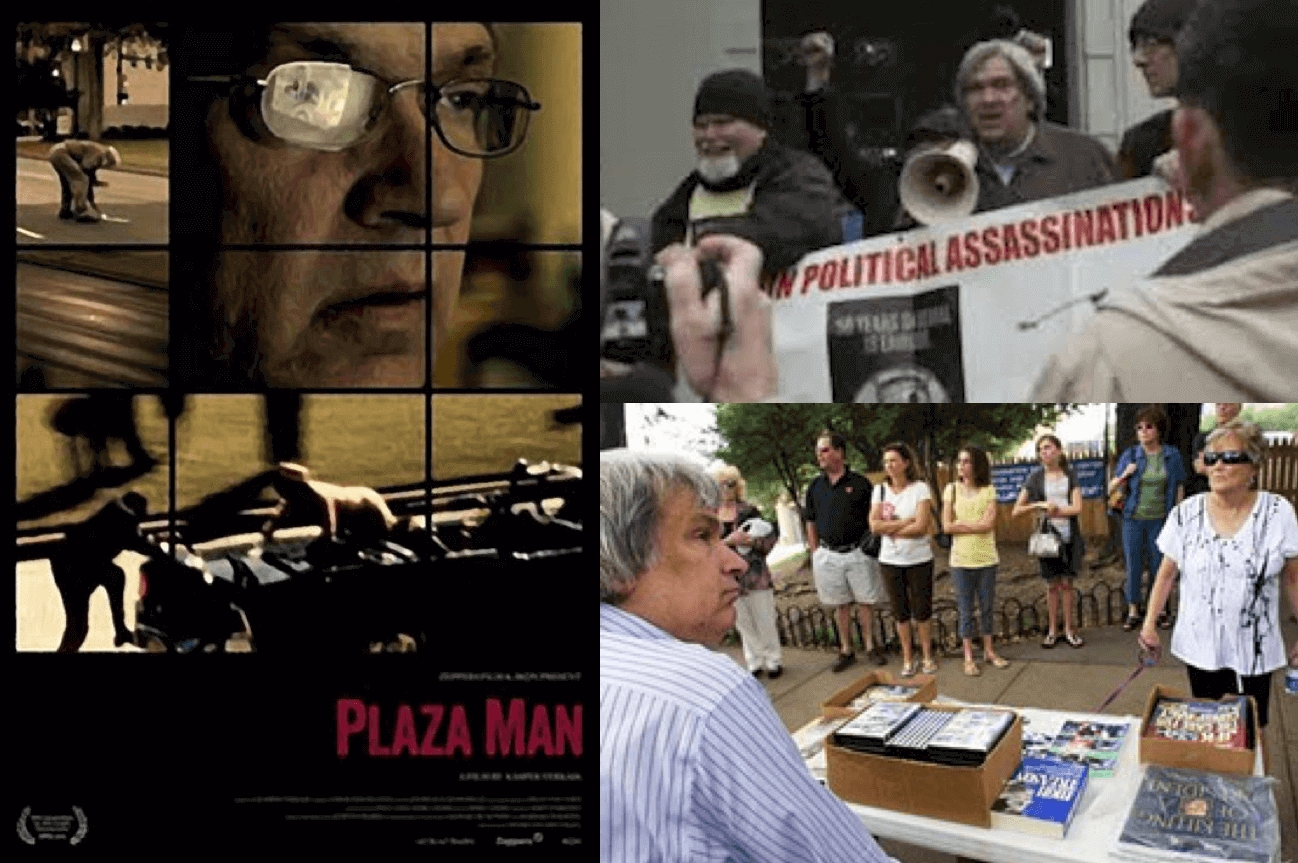
  • Randy Benson, The Searchers

    Randy Benson, The Searchers


    Through a Lens, Clearly: Randy Benson’s The Searchers

    Since President Kennedy’s assassination on November 22, 1963, many films have attempted to document that horrific event and unearth its meaning. The first one, of course, was filmed by Abraham Zapruder, held in place by his secretary on his famous perch in Dealey Plaza. The initial 12 year public disappearance of Zapruder’s original home movie also marked the beginning of the federal government’s attempts to cover up the true facts about the case. In addition to hiding evidence, and ignoring (and in some cases, perhaps eliminating) key witnesses, the CIA literally invented the term “conspiracy theorist” to attack those who disagreed with the official investigation. In spite of all this, there has been a modest stream of credible films and features over the last fifty-four years.

    One of the earliest, Rush to Judgment, featuring Mark Lane and directed by Emile de Antonio, appeared in 1967 and continues to be one of the better films ever made on the case. It contains some of the earliest interviews ever obtained. But these kinds of efforts have been opposed, and sometimes drowned out, by the less honorable efforts of the mainstream media on the JFK case. The major media has done a generally awful job of even reasonably objective reporting, much less showing commitment to the truth. CBS broadcast a special in 1964, on the day the Warren Report was released—without telling the public how they could possibly do that unless they knew the results well in advance. And they then agreed to go along with them without any independent analysis.

    Then, in 1967, NBC produced an infamously slanted ‘special report’ on Jim Garrison’s investigation. That hatchet job was produced by former NSA counter-intelligence chief Walter Sheridan. It was done with permission from corporate headquarters in New York to, literally, “shoot him down.” (Destiny Betrayed, by James DiEugenio, Second Edition, p. 239) Sheridan literally surveilled and harassed witnesses in order to get them to change their stories from what they had originally told Jim Garrison. They then put these witnesses on the air without telling the viewer what they had done.

    Like Old Reliable, CBS would then produce one special in 1967, and another one in 1975; the latter was designed to defuse interest in the Church Committee. With the help of memoranda obtained by the late CBS employee Roger Feinman, Jim DiEugenio has carved these productions up and shown how fundamentally dishonest they were. For instance, Dick Salant, president of CBS, beat back an attempt by his employees—e.g. Daniel Schorr and Les Midgley—to do a fair minded, probing program. By pulling rank, Salant turned the fair-minded proposal into a one-sided defense for the Warren Report. CBS then hired compromised “experts”, like urologist John Lattimer and Dallas Policeman Jerry Hill, as their consultants to make sure that is what the program ended up as (Click here https://kennedysandking.com/john-f-kennedy-articles/why-cbs-covered-up-the-jfk-assassination)

    In 1986 Vincent Bugliosi prevailed in a ridiculous “show trial” in London over an unprepared Gerry Spence. That program was later broadcast in America on Showtime. Later network productions have been as bad. In 2003, Peter Jennings hosted Beyond Conspiracy for ABC, another inane effort. That one featured the notorious duo of Gus Russo and Dale Myers. The latter helped bring us the hilarious spectacle of ABC proclaiming the Single Bullet Theory, as the Single Bullet Fact, all done by the alchemy of Myers’ computer graphics. (Click here for more on Myers https://kennedysandking.com/john-f-kennedy-articles/dale-myers-an-introduction)

    More recent years have brought about the (now deceased) Gary Mack-assisted Inside the Target Car; Oswald’s Ghost from PBS, directed by a man who had a spiritual awakening that told him Oswald was guilty; JFK: The Lost Bullet, in which Max Holland claimed he could see Oswald walking by on the Sixth Floor; and JFK: The Smoking Gun, in which an Australian detective tries to sell us on George Hickey having fired the fatal shot into JFK. The common thread in all these films is they either support a lone nut verdict or try to “solve the case” in such a way as to let the government off the hook.

    rbenson
    Filmmaker Randy Benson

    Randy Benson’s The Searchers is not one of those films. Instead, his film takes two essential tracks—on the one hand, providing a brief history of the state of the case over the last fifty years, and on the other, filling out portraits of the men and women who provided most of the breakthroughs—the “searchers” of the title. For the former track, he uses some milestones in the history of the JFK case. For example, the Garrison inquiry, the convening of the House Select Committee on Assassinations because of the 1975 broadcast of the Zapruder film on ABC, and the 1991 release of Oliver Stone’s film JFK.

    The other track Benson pursues is rather bracing in its simplicity. From about 1966, it became the strategy of the MSM not to let the Warren Commission critics speak without being interfered with, or caricatured. After Stone’s movie came out, provoking a year long firestorm, that was changed. Now the MSM simply would not place the critics on their programs at all.

    Benson counters that by simply letting the critics speak about the case without being interfered with. People like Gary Aguilar, Debra Conway, and Lisa Pease simply answer questions or address issues. And once the viewer sees this, he or she understands why it’s not done. Because without the interference, or the caricaturing, the critics would carry the day. Simply based on the strength of their arguments and their in-depth knowledge of the JFK case. Because of media censorship, these are aspects of the case that the public is not allowed to see today, but which Benson munificently supplies.

    In a more perfect world, it is the sort of film that would have been done long ago by PBS, with a substantial budget and a major release. But as we know from their Gus Russo/Dale Myers 1993 fiasco Who was Lee Harvey Oswald?, PBS is part of the MSM on this case. Instead, mirroring the struggle of the researchers, this film arrives after a fourteen-year odyssey largely by one man—Benson—and unfortunately after the deaths of two of the participants, John Judge and Mark Lane.

    The great achievement of the film is to humanize the researchers themselves. After years of being portrayed as kooks (or worse, as in Larry Schiller’s book The Scavengers and Critics of the Warren Report), here is a film that depicts them as they are. The earliest researchers were not themselves part of any government tribunal; instead, they were people who had to be coaxed away from their trust in the federal government. They were not born anarchists or people in search of fame, or money. They were housewives, lawyers, doctors, teachers, and professionals, who found—much to their chagrin—that the government was lying, and over the matter of a murdered president, they would not stand for it. The Warren Commission never thought anyone would read their 26 volumes of evidence. Surely, the reporters of the MSM did not. Or how could they issue their kudos about the Warren Report in September when the 26 volumes of evidence were not issued until October? But some interested parties did read the 26 volumes. And they noticed that the evidence in the volumes did not support the conclusions in the Warren Report. Once they took that stand based on the evidence, people like Shirley Martin, Vincent Salandria, Penn Jones, Sylvia Meagher, Mae Brussell, and Harold Weisberg simply couldn’t let it go. And it is to their credit that they did not.

    Unfortunately, while these folks were unavailable to interview (all but Salandria are now deceased, but John Kelin ably fills in some of the details on their backgrounds), the interviews that were obtained for the film are formidable. Crosscut throughout the documentary are insights from Mark Lane, John Judge, Robert Groden, Dr. Cyril Wecht, Dr. Gary Aguilar, Jim DiEugenio, Lisa Pease, Jim Marrs, Josiah Thompson, Rex Bradford, Walt Brown, and Debra Conway. And because Benson was able to shoot most of these interviews on-location with the researchers, we get to see them in contexts we might otherwise not see them. At home with Mark Lane, showing us his personal copy of the Warren volumes, or in the garage with Tink Thompson tinkering with his motorcycle, or watching Robert Groden age over the years as we see the famous footage from the 1975 Geraldo Rivera program with Dick Gregory—right up to the present as he greets people on the grassy knoll in Dealey Plaza.

    Another great strength of the film is that it is made for an audience that is not necessarily expert in all things JFK. The director made it, in his words, for “himself, before I got into all this.” In other words, he was a person who thought of himself as informed, college-educated, granted many benefits in this society, but unaware of the real history that lies underneath what is called history. We see that play out, in rough chronological order, but instead of hearing from established media, we see that history through the eyes of real historians like Judge and DiEugenio.

    At the same time, there is little attention paid to some of the great schisms that have occurred in the research community—for example, the question of the Zapruder film’s authenticity—instead focusing on the great areas of agreement between researchers. The great majority of us know that Oswald didn’t do it, and that the cover-up could only have been performed by those in positions of great power. We might argue about who that might be, but we all agree on most of the basics. It is to this majority to which this film speaks. And it makes heroes out of the ordinary men and women who chose to devote their lives to this mostly thankless duty. If they had been listened to instead of marginalized and caricatured, America might not be in the situation that it is in today.

    The latest election in the United States has revealed, more than ever before, the deep-set corruption in both our government, and our media. In a stunning turn of events, we have elected a person who is as far away from John Kennedy as one could imagine. It’s worth reflecting, for a moment, what we once had, and what we have now. For all intents and purposes, the assassination of President Kennedy began our long national nightmare, and Donald Trump seems to be only the latest chapter. This is a time when we need to look to each other and find spaces of agreement, rather than conflict, and it seems to me The Searchers aids that end.

    If The Searchers has a central thesis, it would seem to be that, on complex cases, the best work is often done by ordinary people with an extraordinary tenacity to get at the truth. Where the government has failed us, where official investigations have failed us, we might succeed. In this new age of friendly fascism, each other might be all we’ve got.


    The Searchers is currently available for purchase in a DVD edition for researchers that includes 37 hours of full interviews with all of the researchers in the movie.

  • Randy Benson, The Searchers

    Randy Benson, The Searchers


    Through a Lens, Clearly: Randy Benson’s The Searchers

    Since President Kennedy’s assassination on November 22, 1963, many films have attempted to document that horrific event and unearth its meaning. The first one, of course, was filmed by Abraham Zapruder, held in place by his secretary on his famous perch in Dealey Plaza. The initial 12 year public disappearance of Zapruder’s original home movie also marked the beginning of the federal government’s attempts to cover up the true facts about the case. In addition to hiding evidence, and ignoring (and in some cases, perhaps eliminating) key witnesses, the CIA literally invented the term “conspiracy theorist” to attack those who disagreed with the official investigation. In spite of all this, there has been a modest stream of credible films and features over the last fifty-four years.

    One of the earliest, Rush to Judgment, featuring Mark Lane and directed by Emile de Antonio, appeared in 1967 and continues to be one of the better films ever made on the case. It contains some of the earliest interviews ever obtained. But these kinds of efforts have been opposed, and sometimes drowned out, by the less honorable efforts of the mainstream media on the JFK case. The major media has done a generally awful job of even reasonably objective reporting, much less showing commitment to the truth. CBS broadcast a special in 1964, on the day the Warren Report was released—without telling the public how they could possibly do that unless they knew the results well in advance. And they then agreed to go along with them without any independent analysis.

    Then, in 1967, NBC produced an infamously slanted ‘special report’ on Jim Garrison’s investigation. That hatchet job was produced by former NSA counter-intelligence chief Walter Sheridan. It was done with permission from corporate headquarters in New York to, literally, “shoot him down.” (Destiny Betrayed, by James DiEugenio, Second Edition, p. 239) Sheridan literally surveilled and harassed witnesses in order to get them to change their stories from what they had originally told Jim Garrison. They then put these witnesses on the air without telling the viewer what they had done.

    Like Old Reliable, CBS would then produce one special in 1967, and another one in 1975; the latter was designed to defuse interest in the Church Committee. With the help of memoranda obtained by the late CBS employee Roger Feinman, Jim DiEugenio has carved these productions up and shown how fundamentally dishonest they were. For instance, Dick Salant, president of CBS, beat back an attempt by his employees—e.g. Daniel Schorr and Les Midgley—to do a fair minded, probing program. By pulling rank, Salant turned the fair-minded proposal into a one-sided defense for the Warren Report. CBS then hired compromised “experts”, like urologist John Lattimer and Dallas Policeman Jerry Hill, as their consultants to make sure that is what the program ended up as (Click here https://kennedysandking.com/john-f-kennedy-articles/why-cbs-covered-up-the-jfk-assassination)

    In 1986 Vincent Bugliosi prevailed in a ridiculous “show trial” in London over an unprepared Gerry Spence. That program was later broadcast in America on Showtime. Later network productions have been as bad. In 2003, Peter Jennings hosted Beyond Conspiracy for ABC, another inane effort. That one featured the notorious duo of Gus Russo and Dale Myers. The latter helped bring us the hilarious spectacle of ABC proclaiming the Single Bullet Theory, as the Single Bullet Fact, all done by the alchemy of Myers’ computer graphics. (Click here for more on Myers https://kennedysandking.com/john-f-kennedy-articles/dale-myers-an-introduction)

    More recent years have brought about the (now deceased) Gary Mack-assisted Inside the Target Car; Oswald’s Ghost from PBS, directed by a man who had a spiritual awakening that told him Oswald was guilty; JFK: The Lost Bullet, in which Max Holland claimed he could see Oswald walking by on the Sixth Floor; and JFK: The Smoking Gun, in which an Australian detective tries to sell us on George Hickey having fired the fatal shot into JFK. The common thread in all these films is they either support a lone nut verdict or try to “solve the case” in such a way as to let the government off the hook.

    rbenson
    Filmmaker Randy Benson

    Randy Benson’s The Searchers is not one of those films. Instead, his film takes two essential tracks—on the one hand, providing a brief history of the state of the case over the last fifty years, and on the other, filling out portraits of the men and women who provided most of the breakthroughs—the “searchers” of the title. For the former track, he uses some milestones in the history of the JFK case. For example, the Garrison inquiry, the convening of the House Select Committee on Assassinations because of the 1975 broadcast of the Zapruder film on ABC, and the 1991 release of Oliver Stone’s film JFK.

    The other track Benson pursues is rather bracing in its simplicity. From about 1966, it became the strategy of the MSM not to let the Warren Commission critics speak without being interfered with, or caricatured. After Stone’s movie came out, provoking a year long firestorm, that was changed. Now the MSM simply would not place the critics on their programs at all.

    Benson counters that by simply letting the critics speak about the case without being interfered with. People like Gary Aguilar, Debra Conway, and Lisa Pease simply answer questions or address issues. And once the viewer sees this, he or she understands why it’s not done. Because without the interference, or the caricaturing, the critics would carry the day. Simply based on the strength of their arguments and their in-depth knowledge of the JFK case. Because of media censorship, these are aspects of the case that the public is not allowed to see today, but which Benson munificently supplies.

    In a more perfect world, it is the sort of film that would have been done long ago by PBS, with a substantial budget and a major release. But as we know from their Gus Russo/Dale Myers 1993 fiasco Who was Lee Harvey Oswald?, PBS is part of the MSM on this case. Instead, mirroring the struggle of the researchers, this film arrives after a fourteen-year odyssey largely by one man—Benson—and unfortunately after the deaths of two of the participants, John Judge and Mark Lane.

    The great achievement of the film is to humanize the researchers themselves. After years of being portrayed as kooks (or worse, as in Larry Schiller’s book The Scavengers and Critics of the Warren Report), here is a film that depicts them as they are. The earliest researchers were not themselves part of any government tribunal; instead, they were people who had to be coaxed away from their trust in the federal government. They were not born anarchists or people in search of fame, or money. They were housewives, lawyers, doctors, teachers, and professionals, who found—much to their chagrin—that the government was lying, and over the matter of a murdered president, they would not stand for it. The Warren Commission never thought anyone would read their 26 volumes of evidence. Surely, the reporters of the MSM did not. Or how could they issue their kudos about the Warren Report in September when the 26 volumes of evidence were not issued until October? But some interested parties did read the 26 volumes. And they noticed that the evidence in the volumes did not support the conclusions in the Warren Report. Once they took that stand based on the evidence, people like Shirley Martin, Vincent Salandria, Penn Jones, Sylvia Meagher, Mae Brussell, and Harold Weisberg simply couldn’t let it go. And it is to their credit that they did not.

    Unfortunately, while these folks were unavailable to interview (all but Salandria are now deceased, but John Kelin ably fills in some of the details on their backgrounds), the interviews that were obtained for the film are formidable. Crosscut throughout the documentary are insights from Mark Lane, John Judge, Robert Groden, Dr. Cyril Wecht, Dr. Gary Aguilar, Jim DiEugenio, Lisa Pease, Jim Marrs, Josiah Thompson, Rex Bradford, Walt Brown, and Debra Conway. And because Benson was able to shoot most of these interviews on-location with the researchers, we get to see them in contexts we might otherwise not see them. At home with Mark Lane, showing us his personal copy of the Warren volumes, or in the garage with Tink Thompson tinkering with his motorcycle, or watching Robert Groden age over the years as we see the famous footage from the 1975 Geraldo Rivera program with Dick Gregory—right up to the present as he greets people on the grassy knoll in Dealey Plaza.

    Another great strength of the film is that it is made for an audience that is not necessarily expert in all things JFK. The director made it, in his words, for “himself, before I got into all this.” In other words, he was a person who thought of himself as informed, college-educated, granted many benefits in this society, but unaware of the real history that lies underneath what is called history. We see that play out, in rough chronological order, but instead of hearing from established media, we see that history through the eyes of real historians like Judge and DiEugenio.

    At the same time, there is little attention paid to some of the great schisms that have occurred in the research community—for example, the question of the Zapruder film’s authenticity—instead focusing on the great areas of agreement between researchers. The great majority of us know that Oswald didn’t do it, and that the cover-up could only have been performed by those in positions of great power. We might argue about who that might be, but we all agree on most of the basics. It is to this majority to which this film speaks. And it makes heroes out of the ordinary men and women who chose to devote their lives to this mostly thankless duty. If they had been listened to instead of marginalized and caricatured, America might not be in the situation that it is in today.

    The latest election in the United States has revealed, more than ever before, the deep-set corruption in both our government, and our media. In a stunning turn of events, we have elected a person who is as far away from John Kennedy as one could imagine. It’s worth reflecting, for a moment, what we once had, and what we have now. For all intents and purposes, the assassination of President Kennedy began our long national nightmare, and Donald Trump seems to be only the latest chapter. This is a time when we need to look to each other and find spaces of agreement, rather than conflict, and it seems to me The Searchers aids that end.

    If The Searchers has a central thesis, it would seem to be that, on complex cases, the best work is often done by ordinary people with an extraordinary tenacity to get at the truth. Where the government has failed us, where official investigations have failed us, we might succeed. In this new age of friendly fascism, each other might be all we’ve got.


    The Searchers is currently available for purchase in a DVD edition for researchers that includes 37 hours of full interviews with all of the researchers in the movie.

  • The Kennedy Films of Robert Drew and Associates

    The Kennedy Films of Robert Drew and Associates


    The Criterion Collection is quite literally an invaluable asset in the world of modern day DVD releases. Criterion pioneered both the audio commentary track and the use of supplemental features per DVD release. The last film I saw of theirs was the excellent three disc DVD of The Battle of Algiers.

    They have now released another valuable production. This one is called The Kennedy Films of Robert Drew and Associates. It consists of four documentary films: Primary, Adventures on the New Frontier, Crisis, and Faces of November. Robert Drew was a reporter and photographer for Time Inc. While on a study break at Harvard he began to explore why documentary films were so dull and uninvolving. When he returned to Time Inc. he began to attempt to break out of the confines that documentary film had slid into.

    What Drew wanted to do was to make a revolution in technique. He wished to dump the reliance on narration, on music and slick camera work that consisted largely of long takes or tracking shots. He also wanted to jettison the device of the interview. In fact he wanted the filmmaker to ask no questions of his subjects at all. And further, he did not want to even tell them where to sit while he was filming. This type of documentary film came to be known as cinema verité, or direct cinema. The revolution in documentary style that it created roughly corresponded to the revolution that French feature film directors like Francois Truffaut and Jean-Luc Godard had manufactured with the Nouvelle Vague or New Wave.

    Drew managed to create a unit at Time Inc. He then brought in other film-makers who shared his same goal: to help perfect this new aesthetic. These men included D. A. Pennebaker, Albert Maysles, and Richard Leacock. To say that they succeeded in their aim does not begin to describe their achievement. Consider some of the films these men were later responsible for: Gimme Shelter, Salesman, Grey Gardens, Don’t’ Look Back, Monterey Pop, The War Room, Startup.com, Ku Klux Klan—Invisible Empire.

    Robert Drew

    To achieve what they set out to do there were two technical barriers to surmount. First, there had to be smaller cameras so that they could do handheld shots. That is, the camera would not be attached to a tripod, or be placed on a dolly. It was portable and could follow the subject in the shot. Second, there had to be a way to record live dialogue in sync with what the camera was seeing. By early 1960, when Drew made Primary, both those problems had been solved.

    At the same time Drew was getting ready to create his revolution in film style, Senator John Kennedy was also about to create a milestone in politics. Prior to 1960 no major candidate for president had decided to lay his claim to the office by running the gamut during the primary season. Kennedy did so out of necessity. He did not have the party standing that his top three opponents—Stuart Symington, Hubert Humphrey, and Lyndon Johnson—commanded. Up until 1960, the way to win the nomination was through currying favor with the party honchos. Both on the national and state level. Kennedy decided he could not win that way. But since he was photogenic, a good speaker, and his father was willing to spend a lot of money, he could win by dominating the primary season.

    So Drew approached Kennedy one day as he emerged from his townhouse in Washington. JFK asked him what he wanted. Drew said words to the effect: I want to follow you around during the Wisconsin primary with a movie camera. Kennedy asked him: why should I agree to that? Drew played his ace card. Aware of Kennedy’s writing career and his interest in history, Drew replied because if he did Kennedy would be part of a new kind of history. The candidate thought it over and said that if he did not call Drew tomorrow, then he could do it. JFK didn’t call. Drew then got in contact with Humphrey’s camp and got a similar approval. The four men were allowed to film the last five days of the Wisconsin race.

    In fact, they did create something extraordinary. The film Primary is not just exceptional because of its stylistic originality. But in watching we are transported back to what seems like a different universe, one that used to be called retail politicking. In the first scene we see Humphrey emerging from what looks like a corner grocery story, where he could not have been talking to more than 8-9 people. He then shakes hands with someone outside and actually exchanges a few lines of dialogue with him.

    We observe both candidates driving down barren country roads and into sparsely populated rural areas—which is where Humphrey was supposed to run strong. We see JFK standing outside a factory gate in the morning with an overcoat, shaking hands with the workers, one of whom doesn’t even look at him. We even see Kennedy signing autographs for young schoolchildren who don’t vote. (When later asked why he did such a thing during a short campaign, Kennedy replied because those kids go home and talk to their parents.) One can argue that this kind of politics does still exist today in the Iowa and New Hampshire primaries. But today even those kinds of events are well planned and then orchestrated for media effect. That was not the case back then. Because both candidates were relying on the local and state representatives to prepare the events. Therefore it was very much a hit and miss process.

    The big hit for Kennedy was a large auditorium rally at a Polish Catholic Church in Milwaukee the night before the election. This scene begins with what has now become an iconic shot of JFK. The camera is behind Kennedy: a wide angle shot from behind him and above. We see him go through the crowded entrance to the stage as the crowd applauds and sings “High Hopes”. Acknowledging he was late, Kennedy quips, “You’ve been standing there quite awhile, I’ve been standing for three months.” Some have written that this was a planned shot. In one of the disc supplements, it is revealed that the wide-angle lens was a last minute suggestion, and that the cameraman decided to hold the camera over his head to avoid the crowd. In other words, it was accomplished willy-nilly.

    Hubert Humphrey during Wisconsin primary

    The film is spotted with various human-interest angles. For example, we watch as Humphrey does a radio interview. During the interview, the host tells the candidate he thinks he will win. After Humphrey leaves the station, the host says that he actually thinks Kennedy will win. During that rally in the church auditorium, Jackie Kennedy addresses the crowd in Polish. The camera focuses on her twisting hands, which reveal her nervousness.

    The film concludes with Election Day, April 5th. We first see citizens coming into voting precincts. We watch as they enter booths, and the camera stays on their feet as they vote, commemorating their privacy. We then cut to a hotel room as the Kennedy camp watches the returns on television. Kennedy is relaxed, jacketless, slowly smoking a cigar. The early returns favor Humphrey by a 2-1 margin. But as the city of Milwaukee begins to count its votes, Kennedy makes up the difference and then surpasses his opponent. JFK ended up winning by a 56-44% margin. As he says in the film, the margin of victory was disappointing. It was not the knockout blow he was hoping to deliver in Humphrey’s backyard (Hubert was from Minnesota). Which meant they would have to go through the same exercise again in Illinois and then West Virginia. Humphrey ended up sticking around for another month.

    Wisconsin primary election day

    This hotel scene achieves the purest form of cinema verité. One really does feel as if one is eavesdropping. First, there does not appear to be any kind of cinematic lighting. Second, the filmmakers placed the tape recorder behind the sofa, and the microphone in the ashtray. Therefore, their presence was eliminated.

    The very last scene begins with a close up on a Humphrey for president sticker on the rear bumper of a car as it pulls out and then proceeds down a lonely country road. It’s a nice metaphor for the battle continuing—but the odds now being against Humphrey. The final results of the primary season were that Kennedy garnered nearly 2 million votes, Humphrey about 600,000. Which gave JFK a large advantage in delegates at the Los Angeles convention. One which neither Johnson nor Symington—who both decided to go the traditional back room route—could overcome.

    It’s hard to believe, but Primary did not get a wide release in America. Time-Life owned about six TV stations, and that was the extent of its public showing in the USA. Which tells the reader a lot about the sorry domestic distribution of culturally significant films. For, as I have shown, the film constituted an aesthetic revolution depicting a political milestone. For now the primary route would be the way to the White House for both parties. It was not until the film was exhibited in France that it garnered the recognition it deserved.

    II

    But a most important person in America did like it. That was President Kennedy. So much so that he agreed to do two more films with Drew. The first one was called Adventures on the New Frontier. Shot in the same cinema verité style, this is a fascinating combination of the Wisconsin primary footage, inauguration day footage, and concludes with a day in the life of President Kennedy. Because of a technical failure, we don’t actually see Kennedy’s inauguration. But we do see conversations about that famous speech between John K. Galbraith and Gov. Mennen Williams of Michigan. This is then followed by a conversation in a car between Galbraith and author John Steinbeck. The latter is fascinating, because these two experienced authors were very much impressed by the style and technique of the actual writing of the speech. And that is what they actually talk about in specifics.

    During the filming of Adventures on the New Frontier

    Once in office for about six weeks, Kennedy let Drew and his associates film him doing his job in the Oval Office. We see him meeting with John McCloy who he has appointed to do preliminary talks with the Soviets on atomic weapons reduction. He then meets with Arthur Goldberg, his Secretary of Labor. Goldberg had been an attorney for the Congress of Industrial Organizations, and had been influential in the merger of the CIO with the American Federation of Labor. At this time, Kennedy and Goldberg discuss a solution to an airline strike of flight engineers, and also certain strategies to counter unemployment rates. They concentrate on unacceptably high unemployment in West Virginia. Kennedy wants to rush in government surplus food supplies for any family in dire straits. After this, Kennedy meets with his chief economic advisor Walter Heller. The president wants his forecast about the future trends on the unemployment horizon. Heller tells him that unless they take some kind of action, he does not see it improving on its own.

    The most fascinating part of this film now follows. First, we see Kennedy working on the creation of the Peace Corps with Williams and Richard Goodwin. Which is logical, considering the fact that the former would helm his Africa policy, and the latter would be his special advisor on Latin America. Kennedy briefly talks about how America had ignored Africa, and in the midst of the decolonization process, he wants those new countries to maintain their independence.

    We then watch Williams as he meets with some leaders in the senate, including Al Gore Sr. They advise him to proceed slowly. But Kennedy is worried that if they don’t engage quickly they will be too far behind the pace of change going on right then. (If the reader has acquainted himself with the reviewer’s two essays, “Hammarskjold and Kennedy vs. the Power Elite” and “Dodd and Dulles vs. Kennedy in Africa”, the evidence reveals that Kennedy was correct in his estimate.)

    Drew then follows Williams to a meeting in Addis Ababa to meet with various African leaders, including Haile Selassie. While there, Williams made his famous quote. In response to what he saw his function there as, he replied, “What we want for the Africans is what they want for themselves.” This was slightly altered by the press to him saying, “Africa for the Africans.” Since there were still certain white supremacist nations in Africa, countries like England and the Union of South Africa took offense. When Kennedy was asked about this now controversial comment at a Washington press conference, he did not back away from it. He said, “I don’t know who else Africa should be for.”

    This film is a good visual bookend to Helen Fuller’s volume, Year of Trial. That valuable work is unfortunately out of print today, although one can still buy it on Amazon and E bay. But Fuller’s work, like this one, was a snapshot of the New Frontier in its first year.

    III

    The other request that Drew made was for a film of Kennedy’s administration in a crisis situation. Kennedy liked the idea. He replied that such a film should have been made of Franklin Roosevelt the day after Pearl Harbor. At first, Drew asked to film the deliberations of the ExComm during the Cuban Missile Crisis. But press liaison Pierre Salinger told him that would not be possible due to national security reasons. So in 1963, Kennedy suggested that Drew film what he perceived to be an upcoming showdown with Governor George Wallace of Alabama. Wallace was resisting integrating the University of Alabama, located in Tuscaloosa. This was in spite of a court ruling, based on Brown vs. Board of Education, that had gone against him. Wallace had sworn to defy the court by standing in the “schoolhouse door” in order to block entry of the two students who had been accepted by the university: James Hood and Vivian Malone.

    And that was a key point: the university had accepted the two well qualified African-American students. Wallace was literally trying to hold up the court ordered admittance on his own, essentially unilaterally. Learning from what had happened at the University of Mississippi the year before, Wallace understood the political value of making the federal government act against a state governor. He also knew that the media would be out in force for the event. Therefore, there would be millions of people watching it unfold on live television. In its political impact, the confrontation had the potential to catapult Wallace onto the national stage. Which it did.

    The Kennedys also learned a lesson from their experience with Governor Ross Barnett at Ole Miss in 1962. They had made a mistake and trusted Barnett’s word about the campus being secure for the entry of James Meredith. Then, when the rioting began, it took too long to get federal troops onto the scene. Two people were killed, and dozens were injured. So this time, Attorney General Robert Kennedy had tried to talk to Wallace on his home turf at the state capital in Montgomery in April and May of 1963. According to the AG, the discussions did not get very far. RFK felt that Wallace was being deliberately obscure in order to hide what he was actually planning to do. (See Robert Kennedy in his own Words, p. 185, edited by Edward Guthman and Jeffrey Shulman)

    What made the potential danger more ominous was that Wallace had wired the White House the first week of June. He said that in order to keep the peace, he was bringing along 500 state guardsmen with him on the 11th. That was the date the two students were going to register for the summer session. President Kennedy wired back thanking him for the notice, but he added the only threat of violence came from the governor’s defiance of the Alabama federal court ruling. (Andrew Cohen, Two Days in June, p. 74) By the time of the confrontation, Wallace would have 825 state troopers on campus.

    RFK getting reports from Alabama

    Robert Drew’s film Crisis begins with a triangularly intercut sequence. We first view Wallace leaving the governor’s mansion in Montgomery by limousine for Tuscaloosa. This is followed by the two students being escorted onto the campus. We then watch Bobby Kennedy in his office getting phone reports as to what is happening in real time. As the scenes shift, the background music modulates from the southern standard “Dixie” to the national standard “The Battle Hymn of the Republic.” A nice thematic touch, which accents the threat of military force.

    For in light of what happened at Ole Miss, the White House had decided to mass 3,000 troops outside the campus in advance. They were under the command of General Creighton Abrams, who we see in the film on the phone with RFK, and discussing circumstances on the scene with Bobby Kennedy’s deputy Nicolas Katzenbach. For contrary to what some have written, the White House did not know what Wallace would do. And, in fact, during the film one can hear Bobby Kennedy telling his brother that they might have to just push the governor aside. And RFK had mulled over that contingency. All the way down to taking into consideration how many doors were at the entrance and breaking them down. In other words, while shoving Wallace aside, the students could enter the furthest door. But that might have provoked the spark that turned a physical altercation into a riot.

    Katzenbach confronts Governor Wallace

    As the film shows, the ultimate strategy decided upon was the White House nationalizing the state national guard. But first, Katzenbach approached Wallace without Hood and Malone, who had gone up to their dorm rooms. Katzenbach then asked Wallace to stand aside so the students could register for their classes. Not only did Wallace refuse to do so, he even interrupted Katzenbach as he was speaking. Therefore, Kennedy nationalized the guard. Brigadier General Henry V. Graham, with a motorized detachment of 100 of his 17,000 men, then drove up to the entrance. Graham asked Wallace to stand aside upon the orders of President Kennedy. Realizing he was completely outmanned now, Wallace did so. The students were registered under the guidance of Bobby Kennedy’s lead civil rights lawyer John Doar. Graham and his detachment stayed on campus, in the student’s dorms, for several weeks. On national television that evening, President Kennedy made his epochal speech on the issue of civil rights. The most important and compelling speech on the subject by an American president since Lincoln. Drew intercuts that speech with shots of Wallace, the students, and Bobby Kennedy watching it.

    The film ends with an appropriate coda. Katzenbach calls Bobby Kennedy three days later and tells him that another black student had entered the University of Alabama at Huntsville. It happened without any repercussions. Bobby Kennedy then calls JFK and tells him about it. We watch as the Attorney General now leaves his office for the day. The battle over integrated colleges and universities had been won.

    But the film depicts an interesting quote by Wallace toward the end, which informs us of the price that had been paid. Due to this piece of televised resistance, Wallace states that the south will decide the next president. This was not technically true in 1964. But Wallace’s prediction did come true in 1968—and beyond. Kennedy’s struggle for civil rights turned the south from a reliable Democratic base for presidential elections to the bastion of future Republican political power. In that way, Crisis is an historically important film.

    The fourth film on the DVD set is Faces of November. This is a brief visual reverie depicting the grief which overtook Washington after Kennedy’s assassination. Drew includes here photos of Kennedy’s tomb being visited by the public in the Capitol rotunda, shots of the funeral procession, and Kennedy’s military salute at Arlington.

    Criterion made its reputation by the addition of interesting and educational supplements to their DVD packages. They added four of them for this collection. Far and away the most valuable one is a joint interview with former Attorney General Eric Holder and his wife Sharon Malone. Sharon is the sister of the late Vivian Malone who has since passed away. This interview gives us some personal insight into why Vivian did what she did and what gave her the courage to persevere through it. There is also a panel presentation on Primary done in 1998 at the Simon Wiesenthal Center in Los Angeles. This includes Leacock, Maysles, Pennebaker and Drew. Something like this will never happen again, since all but Pennebaker have passed away. Finally, there are interviews with authors Andrew Cohen and Richard Reeves. The former offers some insights into the film Crisis, since he used outtakes from the film for his book Two Days in June. Although Reeves is not as offensive as he usually is, still Criterion could have chosen someone else, like say Harris Wofford. Wofford worked for Kennedy in his civil rights division and authored a good book about that struggle called Of Kennedys and Kings.

    Overall, this two-disc set is much worth purchasing and watching. How many DVD sets chronicle three history-making events? One dealing with our political system, one dealing with the struggle for American civil rights, and one with a stylistic revolution in film technique. This one does, which makes it unique.