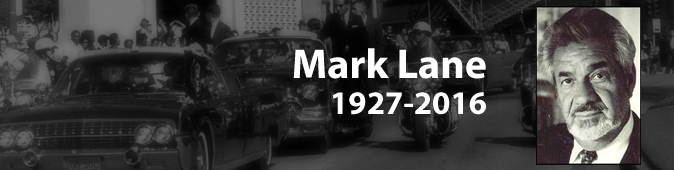
I finally understood the influence and reputation that the late Mark Lane had in America when I arrived in Pittsburgh for the Cyril Wecht Symposium at Duquesne in the fall of 2013. At the airport, I was picked up in a private car and driven to my hotel. The driver asked me what I was in town for. I replied a JFK conference on the 50th Anniversary at Duquesne. He asked me if Mark Lane was going to be there. I said yes he was. He replied that he wrote his first research paper back in college many years ago on the JFK case, and he used a lot of the work of Lane in doing it. He asked me to thank Lane for that inspiration. When I arrived at the hotel, I did see Mark and I conveyed the debt of gratitude from my driver.
After I did so I went up to my room and thought: Geez, there must be literally tens, maybe hundreds of thousands of people across America who feel that way about Lane. For the simple reason that Lane was literally the prime mover in the dissent movement against the official version of the Kennedy assassination. Within just three weeks of Kennedy’s death, Lane had issued the first legal arguments against the public stampede to condemn the memory of the accused assassin, Lee Harvey Oswald, who had been shot and killed by Jack Ruby while in the custody of the Dallas police. Lane wanted to publish his defendant’s brief in The Nation. But that liberal journal—and several other periodicals– would not accept it. So he went to the even more leftist journal The National Guardian.
At that conference in Pittsburgh, there were a few copies of that original essay on a coffee table. Lane picked one up and said to me, “They had to print several reprints of this issue. They eventually sold a hundred thousand of them.” This was in mid-December of 1963, two weeks after the first meeting of the Warren Commission, when every major media outlet in America was accommodating leaks from people like Jerry Ford, J. Edgar Hoover and Allen Dulles about how compelling the case against Oswald was. But there was Mark Lane, the one attorney standing up for a dead man who was being walked over by every public and private institution in America.
Mark Lane Through the Years
{aridoc engine=”iframe” height=”320″}images/ctka/public/2016/marklane/slide-show/deep-minified.html{/aridoc}
Marguerite Oswald, mother of the murdered suspect, heard about Lane’s polemic. She wanted him to act as her murdered son’s defense advocate. But the Warren Commission would not allow it. When Lane forwarded his request to the Commission, Chief Counsel J. Lee Rankin wired back to him the following message: “The Commission does not believe that it would be useful or desirable to permit an attorney representing Lee Harvey Oswald to have access to the investigative materials within the possession of the Commission or to participate in any hearings to be conducted by the Commission.” (See Lane’s A Citizen’s Dissent, e-book version, Part 2, “The Great Silence.”)
In fact, one of the many travesties of the Commission was that Oswald was not granted counsel throughout the ten-month legal procedure. In that respect, the proceeding was a runaway prosecution. Lane was allowed to appear before the Commission twice, once in March and once in July. These were clearly token, adversarial appearances. In fact, it is hard to find another witness who the Commission treated with such hostility. (Walt Brown, The Warren Omission, pgs. 243-45)
At around this time in 1964, Lane began to be surveilled by the FBI. Because he was doing JFK lectures abroad, he was also placed on the federal government’s “lookout list” for international air travel. Whenever Lane returned from abroad, the FBI was alerted he was back. (See Lane, op. cit) But beyond that, the FBI now began to interview certain radio hosts who had chosen to place Lane on the air. These Bureau visits resulted in Lane being banned from certain media outlets. And the buzz about those visits discouraged other outlets from having him on.
In spite of his other considerable achievements, Mark Lane will be forever linked to the JFK assassination. He was, quite literally, a pioneer, a trailblazer in the wilderness.
But Lane would not let up in his defense of Oswald. He then rented a theater in New York City and began to lecture there regularly, taking apart the evidence presented by the developing official story. With the funds attained by these talks, and his various lectures at home and abroad, Lane set up a Citizens’ Commission of Inquiry to collect evidence ignored by the FBI and the Warren Commission. Lane actually managed to appear on some rather widely distributed talk programs, like the one hosted by Merv Griffin.
He then began writing a book based upon the Warren Report and its accompanying 26 volumes of evidence. He could not find a publisher for his book in America. Therefore, Rush to Judgment was first published in England in 1966. It became so successful that it was later published in the U.S. and became a smashing bestseller. At a lecture at the 40th anniversary of Kennedy’s death, Lane said he later found out that the reason he could not find a domestic publisher was that the FBI was visiting publishing houses and discouraging them from publishing his work.
In 1967, Lane followed Rush to Judgment with a documentary film of the same title. This production was shot by famous film-maker Emile de Antonio. De Antonio made films on several controversial subjects like the demagogue Joseph McCarthy and the Vietnam War. He later said that in his entire career, he never met as many witnesses who were literally afraid for their lives to go on camera. Lane literally had to plead with and cajole people to come out of their homes. A few years after this documentary film, Lane worked on the story for a fictional film about the JFK case called “Executive Action.” That film was released in 1973. It was directed by the veteran David Miller and featured some famous leading actors like Burt Lancaster, Robert Ryan, and Will Geer.
In 1967, Lane had worked for New Orleans District Attorney Jim Garrison during his two-year inquiry into the JFK case. Around 1975, after both the revelations of the Church Committee and the ABC showing of the Zapruder film had ignited outrage favoring a new investigation, Lane did two things to further that interest. First, he released a new documentary on the JFK case called “Two Men in Dallas,” featuring local sheriff’s officer Roger Craig. Second, he restarted his grass roots Citizens’ Commission of Inquiry. He used that committee to lobby Congress to pass a resolution to reopen the Kennedy murder case. To put it mildly, Lane did not get along very well with the final Chief Counsel to the House Select Committee on Assassinations Robert Blakey.
In the 1980’s, Lane decided to take on the appeal of a libel verdict against publisher Willis Carto, the Liberty Lobby and their controversial publication Spotlight. In 1981, Liberty Lobby had lost a $650,000 case judgment when Victor Marchetti had written in Spotlight that the CIA had to devise an alibi for their agent Howard Hunt being in Dallas on November 22, 1963. (Lane, Plausible Denial, pgs. 129-32) Through the help of his volunteer network and some fine sleuthing, Lane discovered that such a memo did exist. It had been prepared by CIA counter-intelligence chief James Angleton, and had been seen by journalist Joe Trento. And Trento had actually written about it. (ibid, pgs. 152-55) By his aggressive defense, Lane not only reversed the judgment, he actually convinced some of the jurors that the CIA was involved in the Kennedy assassination. (ibid, pgs. 320-323)
Lane wrote a book on the Howard Hunt case that was published in 1991. Called Plausible Denial, that book also became a best seller. It gave us harsh insights into CIA officers Hunt, Angleton, Richard Helms and David Phillips. Concerning the last, during a debate with Lane, Phillips actually said that when the entire record was declassified, there would be no evidence that Oswald was ever at the Soviet Embassy in Mexico City. (ibid, pgs. 75-87)
But that still wasn’t enough for Lane. In the new millennium, Lane published his final book on the JFK case called, eponymously, Last Word. In this book, Lane brought out another aspect of the case: the possible complicity of the Secret Service in the assassination. That book was promoted by various video trailers, during which Lane interviewed luminaries like former HSCA Deputy Counsel Robert Tanenbaum, film director Oliver Stone, and former Secret Service agent Abraham Bolden.
But the amazing thing about Lane is that there were still other aspects of his legal career, outside of the JFK case, that I have not even mentioned. For instance, for a time in the seventies, Lane served as attorney for the accused assassin of Martin Luther King, James Earl Ray. He also co-wrote a book on the King case with Dick Gregory called Code Name Zorro. Lane also took on the case of James Richardson. Richardson was a black man in the south who was indicted and convicted of killing his seven children. Through some extraordinary detective work—and with help from Gregory and Garrison assistant Steve Jaffe—Lane had Richardson freed after 21 years of unjust incarceration. He then wrote a book on that case called Arcadia. His book about the riotous—and ruinous—Chicago Democratic convention, called Chicago Eyewitness, makes for an interesting journal. Lane’s reports on this shocking event make it the ultimate crushing of youthful dissent in America and a turning point in history—which it was. In 2012 he summed up his tumultuous career with an autobiography called Citizen Lane. (Visit Lane’s website for information on how to get Lane’s books.)
In spite of his other considerable achievements, Mark Lane will be forever linked to the JFK assassination. He was, quite literally, a pioneer, a trailblazer in the wilderness. In that dark year of 1964 when the Warren Commission was trying to keep everything quiet, while men like FBI Director J. Edgar Hoover were leaking rigged and false evidence to the papers, there was Mark Lane, speaking from his podium each night, to anyone who would listen.. He did this not just because it was his vocation, but because he had personally met President Kennedy when he was running for office in New York. Therefore, he kept up that crusade for the truth about Kennedy’s murder at a very high cost to himself.
As he wrote in his 1968 book A Citizen’s Dissent, he lost his one corporate client over the JFK case. He was then vilified by his opponents who seemed to have easy access to the press, which Lane did not come close to having. Warren Commission junior counsel Wesley Liebeler was actually going to run against him for his state legislative seat. Through it all, through his over more than five decades of dissent against the folly of the Warren Commission, Mark Lane never lost his fighting spirit or his dedication to his cause. He liked to say that the folly of the Commission had led to a national tragedy. Which it did. For both him and all of us.
Lane died at age 89 at his home in Charlottesville, Virginia, May 10. 2016. We are all a bit poorer for his passing. It signifies a milestone. Taps at Reveille.
~ Jim DiEugenio
For more remembrances of Mark Lane from Cyril Wecht, Bob Tanenbaum, Don Freed, Steve Jaffe, David Lifton, Joan Mellen, Joe McBride and John Barbour, listen to the BlackOp Radio installment below: