Category: Robert Francis Kennedy

Reviews of books treating the assassination of Robert F. Kennedy, its historical and political context and aftermath, and the investigations conducted.

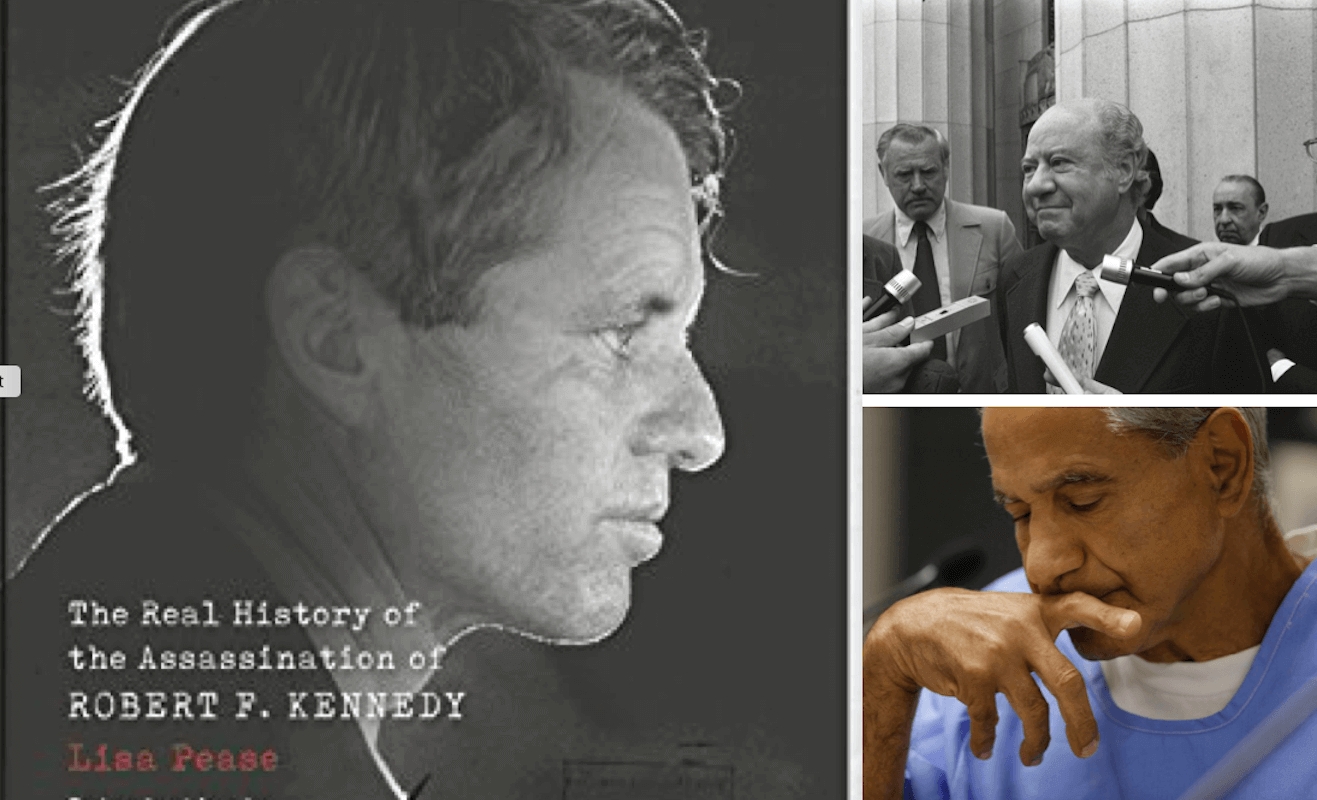
  • Lisa Pease, A Lie Too Big to Fail: The Real History of the Robert Kennedy Assassination

    Lisa Pease, A Lie Too Big to Fail: The Real History of the Robert Kennedy Assassination


    pease le flemIt’s a rare thing indeed when a book actually delivers everything you could wish for—and then some. I can count on one hand the number of books in recent memory that have achieved this. Incorporating over twenty years of research, personal interviews, deep archival digging, and a comprehensive survey of nearly all the extant literature and articles surrounding Robert Kennedy’s encounter with the unspeakable in the pantry of the Ambassador Hotel on the night of Jun 5, 1968, A Lie too Big to Fail will no doubt stand the test of time as the definitive book on the RFK murder. Pease establishes not only the most compelling case against the LAPD’s compromised (non-)investigation of the case to date, but reveals startling new discoveries, including previously unexplored forensic evidence, new witnesses to multiple shooters, and evidence of foul play at the highest levels of the United States political apparatus.

    Digging deep into the court records and transcripts of the also-compromised defense attorney who sold the 24-year old Sirhan Sirhan down the river before he ever had a chance at anything approaching a fair trial, Pease presents a firm case for why his fate—as he sits locked up in a California prison for life—cannot be justified in a democratic society. That Sirhan is still alive and paying for a crime he never committed brings a necessary urgency to her plea that the case be reopened. Because not only did Robert Kennedy’s murder signal the death knell of true progressivism in the United States political arena, but it served as perhaps the most arrogant abuse of power by a hidden hand that, for five decades, hijacked the United States’ foreign and domestic policy. Written with a gripping, driving cadence, the author’s narrative gifts are as pronounced as her investigative acumen. And with this book as her lifetime achievement on a case that still remains relatively obscure in light of the JFK assassination, she will likely establish herself as the preeminent authority on the subject for years to come.


    II

    Officially, minutes after delivering his victory speech in the Embassy Ballroom of the Ambassador Hotel in Los Angeles just after midnight, Senator Kennedy—to the cheers of his teeming supporters and staff—excused himself from the podium, proceeded backstage through a small passage leading to large double doors, entered the hotel’s kitchen pantry, shook hands with cooks and a busboy, and was shot to death. The sole perpetrator was held to be Sirhan Bishara Sirhan, a 24-year-old Palestinian immigrant who appeared in the confusion of the crowded space in front of the senator and fired a .22 caliber revolver at Kennedy, mortally wounding him and injuring five other people with his eight-shot discharge.

    Kennedy died almost a day later. He had multiple brain surgeries and finally succumbed to the massive damage of the shattered bullet fragments: his heart rate lowered to barely a pulse, then stopped. His funeral ceremony was one of the most highly attended in U.S. history. For people like Tom Hayden, original author of the Port Huron Statement, who sat crying in a church pew upon learning of the death of his hero, the senator’s untimely death was also the death of hope for a generation seeking to take their nation on a course of peace and social justice. With Richard Nixon’s victory all but assured in the confused scrambling of the Democratic Party to promote their second tier candidates, the United States was going to fundamentally change.

    That’s the official version of events we teach our kids in school and repeat ad nauseum in the mainstream media. The problem, of course is that when Thomas Noguchi, the LA County coroner who was tasked with performing Robert Kennedy’s autopsy, was finished, he discovered that the fatal shot, just behind his right ear into the victim’s brain, was fired with the gun barrel at contact range, which could not have been more than three inches. This was demonstrable, as Kennedy’s neck exhibited tell-tale signs of powder burn tattooing, or stippling, which Noguchi took great pains to demonstrate by setting up a test-firing at the LA Police Academy on mock human skulls made of latex and pig ears after the autopsy. Each officer was asked to fire at his respective target from six ranges: barrel-pressed against the target, a quarter inch, half inch, two inches, three, and finally four. Only at three inches, did the stippling dispersal pattern match that on Kennedy’s corpse. Of the nearly seventy witnesses in the pantry that night, none placed Sirhan closer than three feet, and most average a distance of approximately five to six feet. Equally troubling was the fact that the three shots which struck Kennedy were fired from behind and at equally sharp vertical angles, from low to high, which makes it physically impossible for them to have come from Sirhan’s gun, which even before he was attacked and restrained by bystanders, was by all accounts pointed directly at Kennedy in a flat, arm-outstretched fashion. We know Kennedy only perceived a threat from the front by the fact that numerous witnesses recall his hands defensively coming up to cover his face at seeing an approaching Sirhan before he fell to his knees, wounded, and then slumped to the floor where he lay dying in a pool of gathering blood from his fatal head wound.

    The immediate aftermath of the shooting is another one fraught with contradictory claims. Officially, the LAPD concluded—or as we will see, decided actively to conclude, with the urging of two former CIA interrogation experts who took over the investigation within days of the murder—there was no conspiracy. Sirhan was apprehended, everyone saw him shoot, Kennedy went down, case closed. And yet, as Lisa Pease aptly demonstrates, that is not at all what witnesses reported. Almost thirty separate people placed Sirhan in the company of a young lady in a polka dot dress, along with several male accomplices. Many of them saw her in the pantry, seemingly holding Sirhan, and having the same sickly smile on her face as they claim he did before he lurched forward with gun outstretched to make his move. Witness Sandy Serrano places her in the immediate aftermath of the shooting running down the fire escape to the back parking lot with her male companion—both of whom Serrano witnessed entering the hotel via this very fire escape with Sirhan Sirhan earlier in the evening. Serrano said she was exuberantly shouting, “We shot him!” When asked by Sandy who did she kill, the girl responded, “Kennedy! We killed him!”. They were overheard by the Bernsteins, an elderly couple in the parking lot who reported the incident to first-responder Paul Sharaga, of LAPD. When Sharaga put out an APB for these two suspects, he was told moments later by a superior at Ramparts station that, “We don’t want them to get anything started on a big conspiracy.” (Larry Hancock, “Incomplete Justice, Part One: At the Ambassador Hotel,” 5/19/2007) The APB was subsequently pulled, allowing any accomplices ample time to make their escape.

    Lisa Pease details this familiar chain of events and the controversy surrounding the clearly real accomplices, sited by dozens of witnesses throughout the ballroom and surrounding areas that night. With regard to figures like the infamous girl in the polka dot dress, she brings some fascinating new insights to the case: including the likely use of multiple teams and multiple polka dot women who were also part of the plot. Many have wondered: What would have happened had Kennedy exited via a different route? The author is quick to note that he was marked for death that night by the sheer number of likely assassins actually positioned in the Ambassador Hotel that evening. While as many as three shooters could have been in the pantry, the LAPD was immediately told to stand down in their pursuit of leads concerning anyone but Sirhan’s immediate family and friends. Therefore, we will probably never be able to say conclusively who these people were. Lisa Pease provides some excellent considerations though, and that is perhaps one of the most exciting parts of her new findings, along with some of her personal interviews which to my knowledge she is sharing here for the first time in print. That, plus the fact that SUS officers at Ramparts station also burned over 2,400 photos taken at the Ambassador ballroom in a hospital incinerator, removed and later destroyed key ceiling and door panels containing bullet holes because they “didn’t have room to store them,” and both discredited and intimidated major credible eyewitnesses: all this smacks of a systematic cover-up.


    III

    Stylistically, A Lie To Big To Fail achieves a fine balance between the immense complexity of the case—with its thousands of files, its many bizarre suspects and characters, its hypno-programming realities, and other strange but relevant source data—and the inherent drama of the event. We begin with an almost Raymond-Chandler-styled portrait of those fateful California nights spent with folks like director of The Manchurian Candidate John Frankenheimer (talk about situational irony) and other supporters, then progress to the primary victory speech at the Ambassador Hotel. The book is instantly engaging, no matter how familiar readers might be with the case. The accessibility of the book is another commendable feat Pease has pulled off; experts who have studied the case for decades will still find evidence and propositions they had never seen or considered, while a friend I loaned the book to—who had never examined the case—could just as easily engage with the text. That is no small feat. Too often a book in the assassination field presumes a level of familiarity with the subject material that is beyond the scope of most readers, while those that are more accessible often gloss over the depth and complexity of the subplots, and also motives and new information gleaned from recent declassifications. A Lie to Big to Fail does neither, and presents an eminently readable, thoroughly substantiated story that, in many respects, is stranger than fiction.

    Covering the gamut of the LAPD’s Special Unit Senator files, along with newly discovered archival footage from places like the California State Archive and local news agencies, Pease’s book is probably the most comprehensive I have ever read on this case, incorporating not only the limited but extremely useful secondary literature from the 1970s, 80s and recent times, but also combing the entire primary source record of the case as well. The author poured thousands of hours of personal research into the book. And it shows. Sources are meticulously detailed and annotated, in the classical manner with the references at the bottom of the page. This allows anyone with an internet connection to fact check most of her findings; some must be accessed in person in Sacramento and elsewhere.

    The other thing that really stands out in the book is the author’s refusal to argue she’s definitively solved the case. Don’t get me wrong: if anyone has come close to figuring out exactly what happened that night, it’s Lisa Pease. What I mean is that too often plots of this magnitude, which require not only clandestine funding, months of planning, a deeply complex cover-up often stretching decades, and the complicity of many high-level officials and planners, are traced to a single source: the mob, the CIA, the Minutemen, Nixon. What seems to be the case, and I will let readers reach their own conclusions, is that, as Lisa notes, there were aspects of both underworld crime liaisons, private military contractors, and off-the-books involvement of the Central Intelligence Agency in the persons of say Hank Hernandez and Manny Peña (USAID/CIA), and of course Robert Maheu (Howard Hughes Corporation/CIA). Thane Cesar has been and still is a prime suspect, given his anti-Kennedy, pro-segregation views and convenient placement as RFK’s escort in the pantry. That he “retired” from Ace Security, a job he’d had for only a few weeks, as he sarcastically stated during his exit interview with the LAPD, is also extremely suspicious. (RFK LAPD Microfilm, Volume 122, Reporters Daily Transcripts, Reinvestigative Files 1974—1978) p. 314). That Nixon was basically handed the presidency does not, of course, implicate him personally; though as the end of the book suggests, there is anecdotal evidence his brother Don was indeed apprised of the events surrounding the assassination and informally debriefed shortly thereafter. In a diary entry that Pease personally procured from John Meier, a Howard Hughes top aide from 1966 to 1970, Meier wrote on June 6, 1968:

    Bob Maheu called to ask about the Don Nixon meeting and suggested 8:30 breakfast at the Desert Inn Country Club (in Las Vegas). I went to the club. Maheu was all smiles, and Don Nixon walks in an all smiles. What followed next had to be seen to be believed. They embraced each other and Don Nixon said, “Well that prick is dead,” and Maheu said, “Well it looks like your brother is in now.” (Pease, p. 493)

    This book also presents perhaps the most balanced look at the controversy surrounding the potential and very likely programming Sirhan underwent before his arrival on the scene. Drawing from both familiar and quite obscure cases, where people were indeed exposed as hypno-programmed assets operating against their will with no working knowledge of how or why they performed various acts and crimes, she gives those in the research community a solid footing on which to stand in what amounts to the hardest part of the case for the MSM to digest. Given the CIA’s millions of dollars of research into its MK-ULTRA and related mind control experiments, along with the accounts provided in Pease’s later chapters, even the most skeptical critics will be hard pressed now to discredit this exotic but very real use of actionable hypnosis.


    IV

    Sirhan remains languishing in prison to this day, narrowly avoiding the gas chamber by a lucky break which saw California abolish the death penalty in 1972. Despite his good behavior, insistence that he has no memory of the events in the pantry, his numerous and sincere interviews with new therapists and hypno-suggestive experts, his fate remains sealed. William Pepper, the attorney and barrister who represented the King family during their 1999 civil trial against Lloyd Jowers, in which a Shelby County jury determined Martin Luther King had been assassinated as a result of a conspiracy, has joined attorney Laurie Dusek in a bid to free Sirhan from a crime we know he could not possibly have committed.

    Senator Kamala Harris, who served as the California Attorney General until 2017, and who was also the DA of San Francisco from 2004 to 2011, insisted since the parole hearing reached her desk in 2012 that Sirhan is still guilty. Following the release of an audio tape found in the California State Archives which captured what acoustics expert Philip Van Praag believes is thirteen distinct shots in the pantry, Harris was confronted by the very real possibility that Sirhan was not a lone gunman. Harris calls Van Praag’s analysis “pure speculation.” (Martinez and Johnson, “Prosecutors, attorneys argue: Was there a second gun in RFK assassination?” CNN, 3/12/2012)

    Similarly, despite the very real fact that hypno-programming has been successfully deployed in military, civilian, and criminal plots, and other special operations dating back to the early 20th century, Harris refuses to accept its possible use on Sirhan in the RFK saga. Upon reading the adamant testimony of Harvard professor of forensic psychiatry and hypnosis, Dr. Daniel Brown—who spent over sixty hours interviewing Sirhan—Harris claimed, “The theory that a person could be hypnotized into planning and committing a murder against his will is a controversial (if not fantastic) one and has not been adopted by most of Brown’s peers, including the American Psychological Association.” She continues, “Thus, even if Sirhan could show that some psychologists believe in mind control or hypno-programming, his showing of actual innocence is nevertheless based on a debatable theory that is not universally accepted in the psychology community.” (CNN, 3/12/2012) Brown, in a signed 2011 affidavit, stated, “I have written four textbooks on hypnosis, and I have hypnotized over 6,000 individuals over a 40-year professional career. Mr. Sirhan is one of the most hypnotizable individuals I have ever met, and the magnitude of his amnesia for actions under hypnosis is extreme.” (Tom Jackman, “The Assassination of Bobby Kennedy: Was Sirhan Sirhan hypnotized to be the fall guy?” Washington Post, 6/4/2018)

    What is actually a debatable theory, in reply to DA Harris’ conclusions, is that three bullets fired at very close range and one at contact range (the fatal head shot behind the right ear), all from behind and at a steep upward angle are supposed to have come from a weapon that was always at least three feet in front of the target. Or that at least thirteen bullets were fired from a gun which could only hold eight, and which likely fired no real bullets, just blanks. These are solidly based facts of the case, yet they are treated as conjectures. If other major legal cases were handled with this much disregard for forensic evidence, lawyers would be disbarred. And if Sirhan had been offered a fair trial—another exceptional chapter of A Lie Too Big to Fail—it is almost certain he would be a free man. But the special logic applied by those seeking to obfuscate the sinister implications of the final major assassination of the 1960s continues to hold fast, at least at the legal level.

    Things are changing though, and it would seem that the concerted efforts of those like Lisa Pease, along with the recent public denial of the official version of events by none other than Robert Kennedy Jr., may be turning the tide towards the real evidence which supports a concerted high-level conspiracy to remove a potential president. It was with a real sigh of relief that I read a recent Washington Post summary of Lisa’s new findings, one that, for a change, actually took her argument seriously and did not attempt to reduce her thesis to fringe theory. In the fifty-one years of relative silence surrounding the case, dotted here and there by books and talks by people like Allard Lowenstein, Ted Charach, Philip Melanson and others, that’s a true testament to the work of informed citizens uncovering the darker chapters of their nation’s history. As journalist Tom Jackman’s article notes, “Robert F. Kennedy Jr., the son of the slain senator, said he thought Pease was ‘a great researcher.’ Similarly, Kennedy said that his own investigation, which included meeting with Sirhan in prison in December 2017, showed that ‘Sirhan could not and did not fire the gun that shot and killed my father.’” (Jackman, “CIA may have used contractor who inspired ‘Mission Impossible,’ to kill RFK, new book alleges,” Washington Post, 2/9/2019)


    V

    A Lie Too Big To Fail is more than a window into one of the most fascinating and disturbing assassinations of the sixties. It is a work whose implications are relevant to anyone trying to understand how the United States devolved into a shell of a country whose tenets of equality, freedom and justice have gone by the boards, leaving us with a paper-thin facade of a democracy embodied by charlatans who wear red and blue uniforms but who essentially represent the same corporate and military-industrial overlords, or what Colonel Fletcher Prouty once referred to as “The Secret Team:”

    It is a sinister device of opportunity and contrivance. What does exist is the mechanism. What exists is the automatic system, much like a nervous system or an electrical system. More properly, what exists is like a giant electronic data processing machine … which has its own power to grow, to reproduce, and to become more insidiously effective and efficient as it operates. It is a great intra-governmental infrastructure that is fed by inputs from all sources. It is big business, big government, big money, big pressure, and headless—-all operating in self-centered, utterly self-serving security and secrecy. (Prouty, The Secret Team: The CIA and its Allies in Control of the United States and the World, p. xvii)

    It was Jim Garrison who eerily predicted this in an obscure and brief interview less than a month after the RFK slaying. Art Kevin, host of Los Angeles’ KHJ Radio, asked the New Orleans District Attorney,

    AK: Jim … are you prepared to say that the same elements responsible for the death of John F. Kennedy were responsible for the deaths of Senator Robert F. Kennedy and perhaps even Martin Luther King?


    JG: Well, you can remove the perhaps. The answer is “of course,” except that in the case of Senator Kennedy, they apparently interposed a cover organization.

    A bit later:

    JG: But there’s no, I don’t think there’s any question about the fact that the same forces removed everyone. Every one of these men were humanists. They were concerned about the human race. They were not racist in the slightest way, and above all, they were opposed to the evolution of America into an imperialist empire-seeking warfare state. Which it has become, I’m afraid. And now there aren’t too many, now there aren’t too many leaders left to talk out loud against the war in Vietnam. They’re eliminating them, one by one. Always a lone assassin. (“Jim Garrison says RFK was Hip to Murder Plots,” San Francisco Express-Times, 7/3/1968)

    Entrenched in an almost two-decade long foreign policy disaster in the Middle East and Afghanistan, riddled with crippling, insurmountable debt, with young people more despondent and driven to self-medication and violence, the United States of 2019 is unquestionably the dark legacy of those tiny .22 caliber slugs flying through the pantry that fateful July night. As political philosopher Sheldon Wolin described it, the United States in the past half-century has come to resemble an inverted totalitarian government. By that he means, a state run not by a traditional dictator like Stalin, Mao or Mussolini, but one even more ruthlessly efficient at quelling dissent and spreading disinformation through a diffuse and impossible-to-pin-down network of powerful and manipulative factors, from the corporate media to lobbyist groups, to the hollow candidates propped up every four years for the election circus:

    Antidemocracy, executive predominance, and elite rule are basic elements of inverted totalitarianism. Antidemocracy does not take the form of overt attacks upon the idea of government by the people. Instead, politically it means encouraging what I have earlier dubbed ‘civic demobilization,’ conditioning an electorate to being aroused for a brief spell, controlling its attention span, and then encouraging distraction or apathy. The intense pace of work and the extended working day, combined with job insecurity, is a formula for political demobilization, for privatizing the citizenry. It works indirectly. Citizens are encouraged to distrust their government and politicians; to concentrate upon their own interests; to begrudge their taxes; and to exchange active involvement for symbolic gratifications of patriotism, collective self-righteousness, and military prowess. Above all, depoliticization is promoted through society’s being enveloped in an atmosphere of collective fear and of individual powerlessness: fear of terrorists, loss of jobs, the uncertainties of pension plans, soaring health costs, and rising educational expenses. (Wolin, Democracy Incorporated, p. 239)

    Indeed, many of these issues, which could have been addressed in Dr. King’s Poor People’s March—which RFK conceived and encouraged MLK to undertake—have never been seriously resolved in the last fifty years of American history. The powerful and vigorous aspirations of those like Tom Hayden, which burned briefly and flickered out with RFK’s assassination, have not been rekindled. After Robert Kennedy’s death, there have not been any significant, ideologically divergent political candidates offering real change or practical solutions to basic entrenched issues in the United States. What we got was Richard Nixon, Gerald Ford, Jimmy Carter. It then got worse with the full-blown neoconservative movement’s apotheosis in the persons of Ronald Reagan, followed by George H. W. Bush, and W. In effect, the antithesis of everything which people like Martin Luther King, JFK, Malcolm X, and Robert Kennedy represented.

    But we must not lose hope, however bleak the future looks. And it is our responsibility not to. As Lisa Pease has so expertly done in her recent book, everything is in our power to expose the lie which still surrounds RFK’s untimely end. As the author concludes in her final passages, “He spent the last years of his life tilting at the windmills of greed and self-interest that ultimately cut him down. But his song lives on in all of us who strive, in whatever ways we can, to reach those unreachable stars.” (Pease, p. 504)

    Some related items:

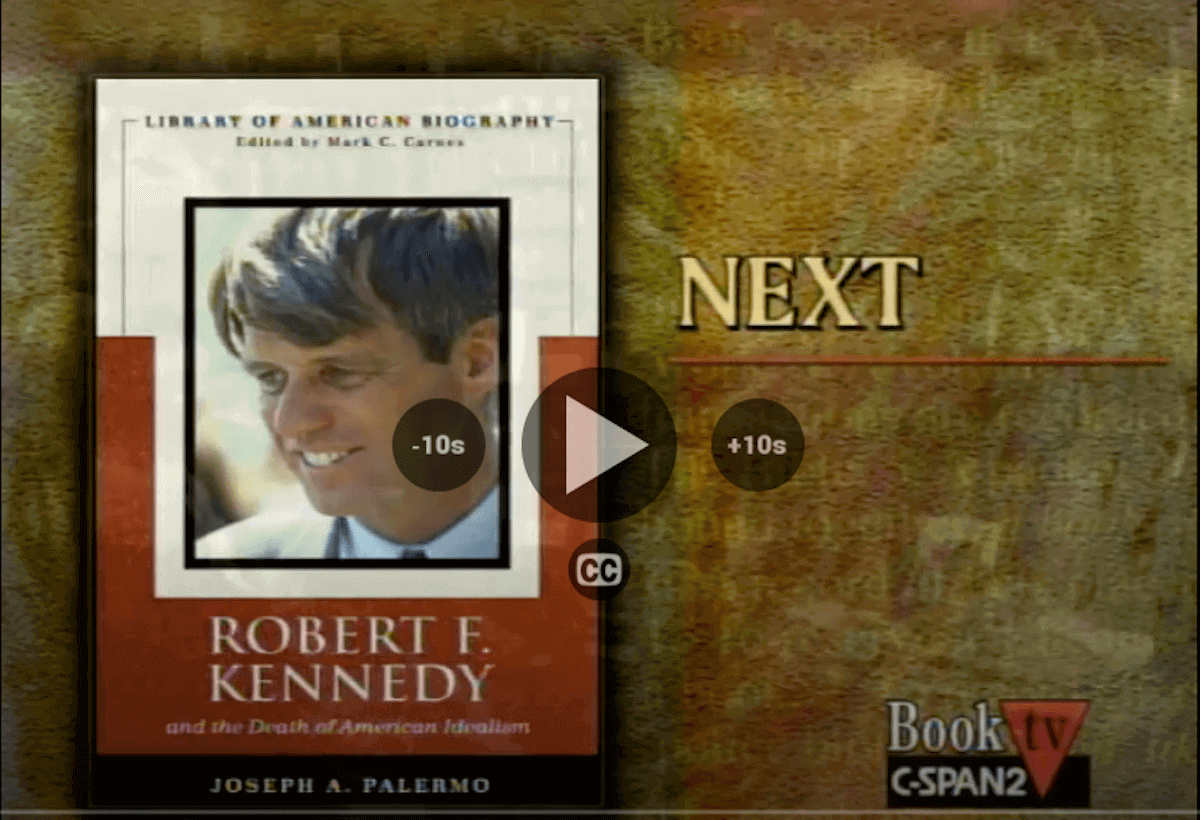
  • Joseph Palermo, Robert F. Kennedy and the Death of American Idealism

    Joseph Palermo, Robert F. Kennedy and the Death of American Idealism

    rfkpalermo

    During this, the 50th anniversary of Senator Robert Kennedy’s assassination, we wish to raise awareness of his life and death. Joseph Palermo is one of the better authors on RFK, and this interview concerning his 2007 book is one way to begin that commemoration.

    (Click image for video link)

  • John R. Bohrer, The Revolution of Robert Kennedy

    John R. Bohrer, The Revolution of Robert Kennedy


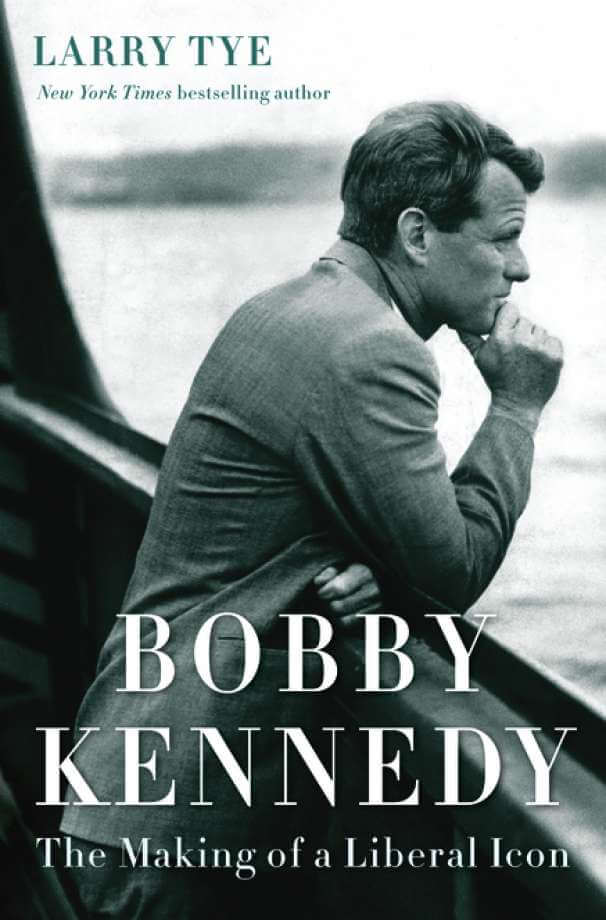
    rfkrevolutionNext year will mark the fiftieth anniversary of the assassination of Senator Robert Kennedy. Consequently there have been three biographies published about RFK in the last 16 months. Last year we had the Henry Kissinger endorsed book by Larry Tye entitled Bobby Kennedy: The Making of a Liberal Icon. That work was so agenda driven, with so little new information, that it was quite difficult to read. (Click here for my review) A couple of weeks ago we had the publication of Chris Matthews’ book on RFK. Judging from Matthews’ book on John Kennedy, the volume does not hold much promise; but we will be fair in our upcoming review.

    This past June, John R. Bohrer published an unusual book about RFK. Entitled The Revolution of Robert Kennedy, it focuses on the period of time from after President Kennedy’s assassination to the end of 1966. In other words, it covers only three years, but they were crucial years. To anyone really interested in RFK, it seems to me a volume of the greatest interest. Not only is it unique in its focus, but, unlike Tye, Bohrer has done some valuable research on his subject, and unearthed some new and important information about the senator. His book shows that you can reveal a lot about a person if you study your subject from a small window but tell more about that frame than others do.

    In his introduction, Bohrer mentions something I was not aware of. Bobby Kennedy had offered to resign his position as Attorney General in advance of his brother’s 1964 reelection campaign. It had become clear to RFK that the opposition to his actions in the civil rights arena had done much to alienate both Democratic voters and politicians in the south. He saw this as being a serous liability to President Kennedy’s 1964 reelection. JFK refused to entertain the offer, but on November 20, 1963 Bobby Kennedy was despondent about the issue and still thought it was the right thing to do. After all, as the author notes, Bobby had run JFK’s 1952 senatorial campaign. In 1956, as a kind of dress rehearsal for 1960, he joined up with Adlai Stevenson’s presidential campaign. So he knew how brutal these things could become, and the impact his name and acts could have on the calculus for 1964.

    Bohrer portrays the assassination of President Kennedy as something that seriously affected Robert Kennedy and made him rethink his ideas about politics, in the sense that ideas and ideals mattered. It should not be all about practicality and vote counting. In fact, one of the recurring words in his speeches after his brother’s death was “revolution”. In visiting Peru, he told students who had assembled to meet him that the revolution was their responsibility. They must be wise and humane so that it will be peaceful and successful: “But a revolution will come whether we will it or not. We can affect its character, we cannot alter its inevitability.” (Bohrer, p. 8) That speech was made while RFK was a senator from New York. Ask yourself the last time you heard a US senator encourage revolution anywhere in the world.


    II

    When Attorney General Robert Kennedy got the word of his brother’s death, he talked with his press secretary Ed Guthman. The latter commented that this might bring people together. RFK replied prophetically that no, this was going to make things worse. (Bohrer, p. 12) He actually pondered whether he should resign. But President Johnson sent Clark Clifford to persuade him to stay in his position. Within days, FBI Director J. Edgar Hoover had pulled RFK’s private line out of his inner office. And with that, the Attorney General realized that his power in the Justice Department had been severely curtailed. As long as his brother was president, he had some leverage over Hoover. Without the White House behind him, Hoover was free to chart his own course. (p. 15) Again, he thought of resigning. But he decided to stay on until the Civil Rights bill that he and his brother had worked so hard for was passed. A main thesis of Bohrer’s book is that although his brother was gone, and JFK had been the main fulcrum of his life, Bobby now began to search for a new rudder. And that would turn out to be keeping the legacy of President Kennedy alive. Because, as the book outlines, in addition to Hoover, RFK saw certain moves that President Johnson made as being counter to what his brother had been about.

    One of these was the ascension of Thomas Mann on the Latin American desk of the State Department. Under President Kennedy, Mann had been Ambassador to Mexico. Within three weeks of his murder, Mann was promoted by Johnson to Secretary of State for Inter-American Affairs, and also to govern the US Agency for International Development. As Arthur Schlesinger has noted, and as RFK agreed, this double appointment seemed aimed at neutralizing JFK’s rather moderate Alliance for Progress program in Latin America. (Bohrer, p. 19)

    In fact, a couple of months later, Mann held a conference for the State Department’s Latin American diplomatic corps. During his address, he did not mention the Alliance for Progress. He said the USA should not intervene against dictators if they were friendly to American business interests. But they should oppose communists whatever their policies would be. The speech was leaked to the press and characterized as advocating American commercial profits over Latin American political reform. The policy became known as the Mann Doctrine. (Walter LaFeber Inevitable Revolutions, p. 157)

    Mann’s speech was instrumental in the American backed coup that occurred several weeks later in Brazil. The following year, Mann and Johnson worked together in order to halt the movement to reinstall Juan Bosch in the Dominican Republic. President Kennedy had ordered severe economic sanctions against the military plotters who had ousted the democratically elected President Bosch in September of 1963. In their opposition to Bosch, Mann and LBJ’s actions eventually led to a large military intervention by the Marines to halt his restoration. (See LaFeber, pp. 157-58; Donald Gibson, Battling Wall Street, pp. 78-80)

    What RFK and Schlesinger understood was that Johnson’s favoring of Mann’s hardline approach was a direct challenge to what Kennedy wished to achieve with his Alliance for Progress. (For a long, detailed analysis of this program under JFK, see Schlesinger’s Robert Kennedy and His Times, pp. 494-574) One of the aims of the 1961 Alliance program was to stimulate economic growth by making loans to Latin American countries directly from the American treasury; this afforded lower interest rates and less stringent policy strictures than going through the World Bank.

    To understand who Mann was and what he did in Latin America, one only has to comprehend that in reviewing the Alliance for Progress, historians like Schlesinger and LaFeber divide it in half: the Kennedy version versus the Johnson version. As Alliance administrator William D. Rogers stated about the Mann/LBJ takeover: “… a more dramatic shift in tone and style of US Alliance Leadership would have been difficult to imagine.” (Schlesinger, p. 721) As for President Kennedy’s oratorical hopes for the Alliance causing peaceful revolution, LBJ assistant Harry McPherson termed that: “A lot of crap.” As LaFeber notes, the Mann/LBJ revision of the Alliance consisted largely of dismantling it. But also in tilting it away from economic investment and toward military build ups. (LaFeber, p. 156) As Juan Bosch later noted of JFK’s intent to use the Alliance for Progress for democratization and structural change, those aims died with Kennedy in Dallas. (Schlesinger, p. 722) Bobby Kennedy predicted what the outcome of that abandonment would be: “The people of Latin America will not accept this kind of existence for the next generation. We would not, they will not. There will be changes.” Considering the violence that swept through Central America in the eighties, and the more peaceful revolutions that occurred in the new millennium, Kennedy was correct. (For the latter, see Oliver Stone’s documentary film, South of the Border.)

    A significant achievement of the book is its detailed explication of Robert Kennedy’s opposition to what LBJ did in another theater of Third World conflict, South Vietnam. The accepted version of RFK’s thoughts and actions on this subject has been that his tacit acceptance of what Johnson did in Indochina from 1964-66 suggested that he was in agreement with it. With what Bohrer has unearthed for his book, that view is simply untenable today.

    When young Adam Walinsky first joined Senator Kennedy’s staff, Kennedy told him that Johnson was more conservative than most people thought he was. (Bohrer, p. 141) Walinsky recommended that they not confront Johnson directly, but on the edges of policy, thus not inciting an open feud. So Kennedy took his time in making his disagreement over Indochina public. But as early as 1964, he told Johnson that he did not think the war should be escalated into a full-blown military conflict. (p. 70) Kennedy felt that raising the military component to a higher level would not work. There had to be some attempt at a political settlement. But also, our side had to offer more significant aid to the people of South Vietnam. Johnson feigned at agreeing with this approach. But, as we all know, that is not the path he took. (p. 152) In June of 1964, shortly after telling Johnson about his ideas, Attorney General Kennedy confided to Schlesinger that he believed “the situation in Vietnam may get worse and become a serious political liability to the administration.” (p. 72)

    It did get worse after the Gulf of Tonkin Resolution was passed two months later, and Johnson began air attacks against the north. When the Viet Cong retaliated by detonating bombs on new American air bases, the retaliatory air attacks increased. Kennedy was also disappointed that, while escalating, Johnson seemed to rely for advice and courage on former President Eisenhower. (p. 152)

    Journalist David Halberstam—who was a full-fledged Hawk at the time—got wind of this and criticized Bobby on the grounds of arrogance: How dare he think he was smarter than the likes of LBJ and Eisenhower? Unlike them, Bobby thought he could win the war without dropping tons of bombs and using overwhelming force. Needless to say, Halberstam’s half-baked ideas would lead to an epochal disaster. And only when it peaked out in 1968, with over 500,000 combat troops in Vietnam, and the war devolved into ”dropping tons of bombs and using overwhelming force,” did Halberstam begin to see that he and his colleague Neil Sheehan were utterly and completely wrong about a path to victory. But, to my knowledge, neither author ever admitted that the Kennedys were right.


    III

    Although some members of JFK’s staff wanted to resign after his assassination, the Attorney General advised them to stay on at least until the presidential election of 1964, if only in order to push Johnson into following through on President Kennedy’s goals on civil rights, unemployment insurance, and aid to education. In January of 1964, there was a boomlet to draft Bobby Kennedy as Johnson’s vice-president. Democratic leaders like Peter Crotty of New York, and Paul Corbin, who was working a write-in vote for Bobby in New Hampshire, were a major part of this effort. (Bohrer, pp. 31-39) Without visiting the state, Kennedy got over 25,000 write-in votes in New Hampshire. (p. 47) By April, a poll showed that 47% of the public wanted the Attorney General to serve as vice-president. An aide, Fred Dutton, advised him to make more speaking engagements to boost that figure. Up until that time, Kennedy had only made two speeches after his brother’s death. The first was little more than a courtesy appearance for the UAW, the second was a speech on civil rights. Kennedy now began to negotiate personally with GOP Senator Everett Dirksen over the civil rights bill in progress through Congress. (p. 55) To show how intent he was on seeing the bill pass, he visited Prince Edward County Virginia, a school district that had closed down its school system rather then integrate. The Kennedys had been instrumental in raising private funds to keep the system open. RFK visited the area again to present a large check to the Teachers’ Union to sustain issuing paychecks. Shortly after, in a visit to West Georgia College, he was asked about George Wallace’s popularity. He replied that people who vote for Wallace “…want the Negroes to be quiet, but the Negroes are not going to be quiet.” He then managed to continue his reply with what was now becoming his favorite word: “This is a revolution going on in connection with civil rights and the Negroes.” (pp. 58-59)

    In an oral history given as he began to find his own voice, Kennedy stated the differences between him and the new president. He said LBJ had made it clear that it was not really the Democratic Party anymore. It was now an All-American party and the businessmen like it. All the people who opposed JFK now like it. He concluded with, “I don’t like it much.” (p. 60)

    Those sentiments are remarkably consistent with what Senator William Fulbright would conclude in 1966 as he began to investigate the reasons for the escalation in Vietnam. Namely, conservatives opposed to President Kennedy were now supporting LBJ, while liberals who supported President Kennedy were now opposed to the new president. In the late spring of 1964, Bobby Kennedy began to formulate a countering political strategy: running for the Senate from New York. As he said, there he would be the “head of the Kennedy wing of the Democratic Party.” (p. 60)

    Bobby Kennedy was leaving the Senate seat in Massachusetts to his brother Teddy. His brother-in-law, Steve Smith, had been at work organizing President Kennedy’s presidential campaign. New York was to be a big part of that campaign. So Smith now switched to recommending RFK run for the Senate in New York against Republican Kenneth Keating. After all, the Attorney General had lived in New York for about ten years. (pp. 62-63) Bobby now put out the word that he would resign from Johnson’s cabinet after the civil rights bill was passed and signed. As the author notes, one of the things that bothered the AG was that he believed that Johnson saw Vietnam as a military problem. Kennedy did not see it that way. He thought a purely military effort would not be successful. He also did not like Secretary of State Dean Rusk, who was also a Hawk on Vietnam. (pp. 70-71) Because of this, Kennedy was not happy when Johnson chose General Maxwell Taylor as the new ambassador to Vietnam. RFK liked Taylor because of his advocacy of low intensity warfare through Special Forces, like the Green Berets. But Kennedy thought that LBJ chose the general to give him cover for a military escalation. Which turned out to be the case. (p. 74)

    The civil rights bill passed in the latter part of June, 1964. A few days later, Ben Bradlee of Newsweek asked Kennedy what he would like to do in life now. Kennedy replied that he would like to maintain all the energy and excitement his brother had generated and harness it. (p. 88) Bradlee printed this and Johnson was quite naturally perturbed. During the signing of the bill, LBJ let Bobby know how perturbed he was. Within earshot, he handed a signing pen to J. Edgar Hoover and told the FBI Director, “You deserve several of these.” If anything told the Attorney General he was persona non grata with the new power axis, that did. (p. 90) Further, Johnson now arranged the upcoming Democratic convention so that the salute to President Kennedy came on the last night, instead of the first. Johnson was worried because Bobby Kennedy was now outpolling Hubert Humphrey for vice president by a margin of 2-1. In July, Johnson called in the Attorney General and read off a list of potential vice presidential nominees he would not consider, with Bobby being on the list. (p. 100) The next month in Atlantic City at the Democratic convention, it was obvious that Johnson had made the right decision for himself politically. When Robert Kennedy appeared at the podium an oceanic ovation took place that lasted over ten minutes. In the public eye, Robert Kennedy was the heir apparent to his brother. It was time to begin his ascension to the throne.


    IV

    Robert Kennedy declared himself a candidate for the Senate on August 25, 1964 at his home in Glen Cove, Long Island. As he began to campaign, something unusual began to happen which no one recalled seeing before. In his public appearances, a reaction set in similar to Beatlemania: people began to tear his clothes off, rip his cuff links, and shake hands with him so hard that after doing this repeatedly, it caused the candidate’s hands to bleed. (p. 117) His managers, fearing for his health, demanded he not campaign each day and take off one day per week to recover.

    His advisors also found out that Kennedy did not speak well in rehearsed commercials for the camera. But he did do well in unrehearsed Q-and-A periods after delivering a speech, especially with young people. So this is what they broadcast. (p. 124) Kennedy ended up defeating Keating by ten points.

    Once in the Senate, RFK visited his brother’s grave at night. In fact, after a friend watched this happen once, he realized that the groundskeeper had an arrangement with Bobby to let him in when no one was there. (p. 147) In the Senate, Robert Kennedy decided to do what he could to maintain what he perceived to be his brother’s legacy. He fought against closing Veterans Hospitals for budgetary reasons. He got the administration’s requested allotment cut in half. He moved for adding testing provisions to a large education bill—and he got that through. He fought Governor Nelson Rockefeller on getting grants for New York state’s impacted poverty areas. He won that battle also. (pp. 148-50) By his eleventh week in office, the new senator was getting a thousand letters per day.

    One of his pet issues was something his brother was an early advocate for: gaining home rule for Washington D. C. He said about this objective that, because the District of Columbia was predominantly African-American, home rule was being held back for the reason that “there are many people who don’t want progress made here.” (p. 161) He further added that, in his view, the problem fundamentally was not about race, but about poverty. There was a reason he accentuated this point. RFK had kept his notebook from President Kennedy’s last cabinet meeting. In his notes he had written down the word “poverty” seven times. So this was another way of continuing the policies his older brother had left behind. (p. 159) To him, if America did not attack the problems of broken homes in the ghetto, and the effect that had on education, then there would be no real improvement.

    RFK and his brother Senator Ted Kennedy were very much involved in extending the Civil Rights Act with the Voting Rights Act of 1965. They also wanted to add a clause that would eliminate the poll tax. That failed, and an amendment had to be passed to eradicate the tax. (pp. 165-66) The bill passed in large part because of the 1964 electoral landslide, which gave the Democrats 68 seats in the Senate. As Walinsky later said, it was, “A crazy time. I mean we were going to reshape American society, all of us. There was a new bill every day.” (p. 166)

    But there was a shadow hanging over it all. In early April of 1965, Johnson gave a hawkish speech about Vietnam. This was just after the first combat troops had landed at DaNang Air Base, and Rolling Thunder, Johnson’s air campaign against the north, was in its initial stages. Again, RFK advised Johnson against taking the militaristic path in Vietnam. Sounding like his fallen brother, he added that America should make it clear to the Saigon government that we will not be staying there to fight the war for them. He even asked Johnson to fire Dean Rusk and replace him with the more moderate Bill Moyers. (p. 168) But since he was a Democrat, and American troops had been committed into theater, he also felt obligated to vote for Johnson’s appropriations for escalation, even though he did not approve of the actions. He explained, “If I voted for it without saying anything, it would have appeared that I approved of it—which I didn’t.” (p. 175)

    In his public speeches he again returned to his favorite word, revolution. He praised students who marched on Washington as demonstrating the “essence of the American Revolution.” (p. 180) At a commencement address he stated, “We are the heirs of a revolution that lit the imagination of all those who seek a better life for themselves and their children.” He added that there was also a revolution aimed against America. After hundreds of years of domination by the West he said, America buys 8 million cars per year, while those in formerly colonized countries go without shoes. He told the graduates, that they “have an unparalleled opportunity—not to find a world, but to make one.” (p. 179)

    Kennedy had no qualms about taking on big lobbies or big business. He railed in public about the growing power of the NRA, a lobby which he characterized as spending huge amounts of cash distorting the facts, and which placed a minimal inconvenience above saving the lives of thousands of Americans each year. (p. 182) He called in the CEO’s of the Big Three auto companies and questioned them about how much money their companies were making while spending so little on research into safety matters. (pp. 200-01) He also moved against the tobacco companies. He was the first to propose a warning label on cigarette packages. (p. 203) Senator Kennedy even tried to get right-to-work statutes repealed. These were laws, mostly in the south, that weakened unions since they allowed employees in a shop to opt out of union membership while enjoying union benefits. (p. 203)

    Reading Bohrer’s book, it is very hard to defend the MSM meme that RFK was a reluctant warrior on civil rights and the plight of African Americans. For the simple reason that he never let go of the issue. At times he went beyond what most civil rights advocates were talking about. Frequently, his ideas echoed Martin Luther King’s. At a VISTA indoctrination in Harlem, Kennedy said, “It is one thing to assure a man the legal right to eat in a restaurant: it is another thing to assure that he can earn the money to eat there…” (p. 205) He was sometimes at pains to delineate the differences for black Americans in the south versus the north. For example, he stated, “Civil rights leaders cannot, with sit-ins, change the fact that adults are illiterate. Marches do not create jobs for their children.” (p. 205)

    In one of his most controversial statements about the issue, the former Attorney General talked about the differing ways in which the law is looked upon by middle class and wealthy Caucasians as opposed to downtrodden minorities. To the more privileged group, the law is looked upon as a friend who preserves and protects property and personal safety. But to the latter group, the law seems different: “The law does not fully protect their lives, their dignity, or encourage their hope and trust for the future.” (p. 206) Kennedy was attacked for this statement by several media outlets including the Christian Science Monitor, the New York Times and Time. They characterized his comments as a sitting senator encouraging youths to break the law. Kennedy stood by his statement. He said that the Watts riots of 1965 would be repeated “across the nation if we don’t act quickly.” (p. 206)

    As noted above, another point that Bohrer’s book effectively contravenes is the idea that Kennedy was late to oppose Johnson’s escalation of the Vietnam War. As shown, Kennedy had done this in private with LBJ in 1964. That same year, in an address at Caltech, he did so publicly in an indirect way. He stated that guerilla warfare and terrorism arose from the conditions desperate people live under, and they cannot be put down by force alone. He then said, “Over the years, an understanding of what America really stands for is going to count far more than missiles, aircraft carriers and supersonic bombers.” (p. 190)

    What surprised many commentators inside the beltway was that the first term senator’s attempt to forge his Kennedy wing of the Democratic Party was working. For example, one evening there were two competing Washington social events arranged. One was by the Kennedys; one by the wealthy Washington hostess and former ambassador to Luxembourg, Perle Mesta. Mesta had backed Johnson against JFK in 1960. The Kennedy gathering outdrew Mesta’s by a 10-1 ratio. (p. 183)

    In the midst of this entire rising furor came the invitation to speak in South Africa.


    V

    Ian Robertson was a member, and eventual president, of the longstanding National Union of South African Students (NUSAS). From its founding in 1924, this group had opposed the apartheid system in their country. In July of 1965, Robertson extended an invitation to Kennedy to speak at Cape Town University in the spring of 1966. After doing so, he challenged the authorities to deny Kennedy entry. Robertson was now placed under house arrest. Not only did Kennedy accept, he made the invitation public, thereby making it harder for the South African government to deny him entry. Reporter Murray Kempton wrote, “It is unlikely he will ever go. What is extraordinary is the fact of the invitation …. Senator Kennedy has a name at which lonely men grasp in their loneliness.” (p. 227)

    Kempton was wrong. Kennedy had every intention of speaking in South Africa. But at the time that journey was being arranged, RFK also decided to also take an expedition to Latin America. What Kennedy did south of the border, and the very fact that he was determined to go to South Africa—these factors defined who he was at this time, and also where he was in the makeup of our political system. As we shall see, he had by now clearly inherited his brother’s mantle, and in some ways, gone beyond it.

    Before going to Latin America, Kennedy was to be briefed on the political conditions in the countries he was visiting, and also what the State Department wanted him to say and not say while he was there. So he and two assistants showed up at the State Department and were briefed by Jack Vaughn. As Vaughn went through the countries Kennedy was to visit, and advised him on what to say if anyone asked him about the American invasion of the Dominican Republic, the senator began to fully understand how much Johnson had overturned President Kennedy’s Alliance for Progress program. By the time it was ending, RFK registered his disgust at what had happened:

    Well, Mr. Vaughn, as I see it, then, what the Alliance for Progress has come down to is that you can abolish political parties and close down the Congress and take away the basic freedoms of the people and deny your political opponents any rights at all and banish them from the country, and you’ll get a lot of our money. But if you mess around with an American oil company, we’ll cut you off without a penny. Is that it?

    Vaughn then replied, “That’s about the size of it.” Walking out of the meeting, Kennedy said to one of his assistants, “It sounds like we’re working for United Fruit again.” (p. 231)

    What Kennedy said and did while on this voyage south seemed designed to show that he, for one, was not working for United Fruit. In addressing crowds in Lima, Peru, he told them to emulate the men who liberated Latin America from the Spanish Empire: San Martín and O’Higgins. He urged them on by saying, “You can do as they can. You cannot do less.” He then went beyond that. He urged them to emulate the justice of their Indian ancestors, the Incas, who punished nobles more harshly than they did the peasants for breaking identical laws. (p. 233) In Lima, Santiago and Buenos Aires, he repeated what had become his motto: “The responsibility of our times is nothing less than revolution.” (p. 233)

    In speaking of the history of the United States, he told crowds that the revolution in the American political system that they should look at was Franklin Roosevelt’s New Deal. Because that example demonstrated “the power of affirmative free government.” To RFK it was a hallmark of the state combining the twin ideals of social justice and liberty. (p. 234)

    In Peru, Kennedy made part of his itinerary a visit to the high altitude city of Cuzco, the capital of the Inca civilization. There, young children followed him shouting “Viva Kennedy”, ripping his pants and tearing his cheek, drawing blood. On their way back down, he stopped to talk to some peasant farmers tilling the land. When they told him they paid high prices for powdered milk donated through the US Food for Peace program, he turned to the Peace Corps aide with them and told him to look into the matter. He then asked aloud, “What happened to all our AID money? Where is it going?” He then added that the ambassador to Peru, Wesley Jones, “might as well have been the ambassador from Standard Oil.” (p. 235)

    The high point of the Peru part of the visit was a meeting with intellectuals and artists in Lima, at a gathering that resembled a salon on the west side of Manhattan. Bobby was being assailed about all the problems that the Rockefeller owned oil companies had caused and mistakes America had made. RFK asked why they always looked to the USA first. The answer was that the USA would not let them do anything about Rockefeller’s International Petroleum Company. Kennedy replied that they could not have it both ways, cursing the USA and then blaming the State Department. The solution was simple: nationalize the oil company. Someone responded that David Rockefeller had been there and warned them if they did anything to his oil company all aid would be cut off.

    The senator’s response to this should serve as a model to any doctrinaire leftist who still thinks that the Kennedys were part of the Eastern Establishment. He tartly replied, “Oh, come on! David Rockefeller isn’t the government. We Kennedys eat Rockefellers for breakfast.” (p. 235)

    In Chile, he offered to debate with communist students on an equal time basis. But after he gave his speech and offered the time to the other side, no one took him up on it. (p. 240) Then, in the mining town of Concepcion, he went down into a coal mine. When he came back up he said, “If I worked in this mine, I’d be a communist too.”

    In Brazil, three youths were arrested on charges of plotting to kill the senator. Bobby asked that they be released. They were not, but the charges were then lessened. RFK then sent a messenger to the jail to ask them to write down any questions they had about him. (p. 244) He then visited a sugar cane field and talked to the workers. They told him that their landlord was paying them three days wages for six days work. The senator walked directly to the property owner’s house and started yelling at him for not paying his workers a decent wage. (p. 245) He then went to the presidential palace. After visiting with the newly installed government ushered in by the previous year’s CIA sponsored coup, he was being driven back to his hotel when he saw some of the crowd being struck by soldiers trying to keep them away from his car. He jumped out of the car and shouted, “Down with the government! On to the palace!”

    His visit to Latin America was so incendiary that much of it was not reported in American newspapers. (p. 245)

    VI

    At the time of his death in August of 1965, United Nations representative Adlai Stevenson was working on at least one—perhaps two—ways of negotiating out of Vietnam. One was through the UN Secretary General U Thant. A second rumored one was initiated by Ho Chi Minh, using Italy and India as go-betweens. (p. 250) Bobby Kennedy heard about these through his contacts in the White House. He was very disappointed they came to naught, and shared his chagrin with columnist Joe Kraft. Kraft then wrote a column in which he said that the senator opposed what Johnson was doing in Indochina, but could not confront the White House about it out of loyalty to the president and also to his party.

    In December of 1965, echoing Martin Luther King, Kennedy said that we should not forsake the domestic battle against poverty for a war abroad because it would divide the nation. (p. 252) Heeding Kennedy’s words to accept an offer for a bombing halt at Christmas 1965, Johnson did so, although he told Defense Secretary Robert McNamara it went against his “natural inclinations.” Both Senators Fulbright and Kennedy urged Johnson to use the interim halt as a negotiating tool for some kind of settlement. When LBJ resumed bombing at the end of January 1966, Kennedy said if bombing Indochina is our answer to the problem there, we were headed for a disaster. He added that, “The danger is that the decision to resume may become the first in a series of steps on a road from which there is no turning back—a road which leads to catastrophe for all mankind.” (p. 264)

    The next month RFK called a press conference. The reaction to this conference shows just how much Johnson and the unquestioning press—specifically David Halberstam and Neil Sheehan—had tilted the scales toward intervention. This press conference was called a few months after Halberstam had published his book, The Making of Quagmire. That book was an all out attack on American policy toward Saigon from the right. Kennedy suggested a power sharing coalition government in South Vietnam, which included the communists. (p. 269) In retrospect, this was a very sensible solution for everyone: Hanoi, Saigon, and the USA. Kennedy was viciously attacked by both the MSM and Washington politicians, even those from his own party. Vice-President Humphrey said this would be like placing an arsonist in the fire department. The Chicago Tribune called him Ho Chi Kennedy. Forgetting Vietnam was one country, The Washington Post said it would be rewarding aggression. (pp. 271-74).

    Incredibly, Kennedy visited both Ole Miss and the University of Alabama in 1966. At Ole Miss, he revealed to the crowd just how politically motivated Governor Ross Barnett was before the James Meredith riot broke out there in 1962. In negotiations with Barnett, the governor had asked Kennedy if he could have a federal marshal pull a gun on him so it would look like he was physically intimidated into going along with integrating the college. Kennedy was not responsive. So Barnett called him back and said, no, he wanted all the marshals to pull guns on him. The students roared with laughter at that one. (p. 285)

    At Christmas, 1965, Kennedy threw a series of celebrations of the holidays in the Bedford Stuyvesant area of Brooklyn. It was his way to begin to follow through on President Kennedy’s nascent attempt at a war on poverty. It was his way to generate interest in a developing program to attack the poverty cycle in the inner cities. He gave a series of three speeches on the subject. The aim was to break up the ghettoes and offer subsidies to those who wished to leave. For those who stayed, Kennedy wanted to give more aid to schools to improve education, offer tax breaks to companies to relocate there, and free legal advice for tenants to fight predatory landlords. The idea was to go beyond the New Deal. He envisioned this program to be a combination public-private community development corporation, the aim being to offer a diversified program to end inner city poverty and eradicate ghettoes. (pp. 255-61)

    There can be no better way to end this review than to describe Kennedy’s eventual journey to South Africa at the request of the courageous Ian Robertson. I should preface this by saying Kennedy really had nothing to gain from this visit. The South Africa cause was so vague and nebulous in 1966 it did not even register as a blip on the political screen. And, due to what he and his brother had done from 1961-63, there was no domestic political benefit for him because he already had the African–American vote tied up.

    The South African government denied any American reporters entry into the country. Four who tried to sneak in were rounded up and placed on a plane to Rhodesia. (p. 294) The visual record we have of this momentous event consists largely of grainy black and white home movies. No member of the government would meet with him. And the only press representatives on hand were those who supported apartheid. Unlike in the USA and Latin America, spectators did not rush to grab him, since it was considered an offense for a black man to shake hands with a white man. At his first speaking engagement Kennedy stood an empty chair next to him to signify the absence of Robertson. Robertson had been charged with the Suppression of Communism Act. Which evidently meant that, in South Africa, RFK was considered a communist.

    When he visited Robertson at his apartment, the government would allow no one else to be present, not even friendly journalists. The first thing he asked Robertson was if the place was bugged. He then told him to stomp his feet to throw the surveillance off temporarily. Kennedy then asked him questions about his country and how he felt about Vietnam. He told him how badly he felt about his house arrest. He closed the meeting by giving him a copy of President Kennedy’s book Profiles in Courage. It was signed by Jackie Kennedy. (p. 295)

    He then went to make his memorable speech at the University of Cape Town—to, of course, an all white audience. That speech has one of the most brilliant openings in the history of modern American oratory. He began by saying he was glad to be in a country settled by the Dutch, taken over by the British, and now a republic. A nation in which the natives had been subdued and with whom relations remained problematic; a land which defined itself by a hostile frontier; a land which once imported slaves and now had to solve the residue of that problem. He then stopped, smiled, and said, “I refer, of course, to the United States of America.” (p. 295)

    He then talked about the responsibilities of a republic, which South Africa had become in 1961. And how that model of government was intended to guarantee individual rights for its citizens. He added that he meant all of the citizenry. He then talked about governments that denied freedom and would label as “‘communist’ every threat to their people.” He continued with how his family had felt the sting of prejudice because they were looked down upon as being Irish in New England. He mentioned the fact that Martin Luther King had won the Nobel Prize because of his struggle in the USA. He ended his speech in South Africa with the following:

    Each time a man stands up for an ideal or acts to improve the lot of others or strikes out against injustice, he sends forth a tiny ripple of hope, and crossing each other from a million different centers of energy and daring, those ripples build a current which can sweep down the mightiest walls of oppression and resistance.

    He then closed with, “Each of us have our own work to do.”

    This is a fine book. The best volume on Robert Kennedy I have read since Arthur Schlesinger’s two volume set in 1978. If you want to know about Bobby Kennedy’s life, the Schlesinger book is your choice. But if you want to know who RFK was in his last years, this is the book to read. No politician I know of ever did or said these kinds of things at home and abroad. I strongly recommend the book as a Christmas gift for your children and younger loved ones. Through it, they will be reminded that, not that long ago, the political spectrum was not defined by the likes of Hillary Clinton and Donald Trump. And you did not have to hold your nose before entering the voting both. We all owe thanks to John Bohrer. He is to be congratulated for capturing the essence of a good man who became a great man. The vivid memory this book draws reminds all of us just what America could have been.

  • Larry Tye, Bobby Kennedy: The Making of a Liberal Icon

    Larry Tye, Bobby Kennedy: The Making of a Liberal Icon


    Before opening Larry Tye’s biography of Robert Kennedy, I had some qualms about it. Why? Because when I turned to the back cover I saw that none other than Henry Kissinger had given the book his endorsement. The man many commentators think should be tried as a war criminal, who, for instance, supervised Richard Nixon’s expansion of the Vietnam War into Cambodia and Laos, was praising a book about Robert Kennedy. I then noted another blurb by journalist Marvin Kalb. In 1974, Kalb, along with his brother Bernard, wrote one of the first biographies of Kissinger. (Historian Theodore Draper called it a hagiography.) The Kalbs compared the validity of Kissinger’s diplomacy to George Washington’s likeness on a dollar bill. A judgment which, to say the least, does not hold up today. These endorsements, quite naturally, gave me pause.

    After reading the book, that pause was justified. Approximately the last 75 pages of Tye’s work are adequate and, in one or two places, actually moving. The problem with that observation is simple arithmetic: the book contains 447 pages of text. Therefore, those last 75 pages comprise about 1/6 of the volume. The rest of the book is not just below average; in many places it is worse than that, and in more ways than one.

    Tye tips us off to his agenda quite early. In his preface, he calls Robert F. Kennedy a commie baiter who was egged on by his father and Joe McCarthy. He adds that Kennedy practiced Machiavellian tactics to win his brother the presidency. He then says that he was also part of the plots to eliminate Fidel Castro. He tops this off by writing that “an assassin halted his campaign of conciliation.” (p. xi) I wrote in my notes: “Tye is off to a bad start.” I was correct.

    I

    Tye titles his first chapter “Cold Warrior”. In order to make this stick, he employs what military experts would call a pincers movement. He wants to envelop young Robert within the grasp of his father Joseph Kennedy, and his first legislative boss, Senator Joseph McCarthy. How anyone today could compare RFK with his father is really kind of inexplicable. But this is one of Tye’s unrepentant and recurrent proclamations. (Tye, p. 5) In this reviewer’s experience and knowledge there can be no better witness to this issue than Jackie Kennedy, since she was close to Joe Kennedy, and was even more familiar with his three surviving sons. She told Arthur Schlesinger that RFK was the son who was least like his father. (See Robert Kennedy and His Times, p. 102) For instance, RFK did not have any interest in or aptitude for business. In fact, by 1957, he was a pro-labor advocate. Also, unlike his father, he was a devoted family man. Again, unlike his father, and more like President Kennedy, he was not an isolationist in his foreign policy outlook. Another point: RFK was quite aware of and sensitive to the plight of both the poor and minority groups. So where Tye gets this comparison is rather puzzling. After reading and taking notes on his book, in my view he does not come close to proving it. Jackie Kennedy appears correct on this point.

    It is interesting to note how Tye shoehorns RFK into this Cold Warrior box. One way he does so is by leaving out the name of Edmund Gullion. In 1951, in preparing for his run for the Senate a year later, congressman John Kennedy took a trip to the Far East. One of the places he visited was Saigon, South Vietnam. He was determined to find out the true status of the colonial war there between the Viet Minh and Ho Chi Minh on one side, and the colonial government of France on the other. After all, the USA was bankrolling a large part of the French war effort. One of the men that John Kennedy consulted with was a man he had formed a glancing relationship with in Washington a few years before. Gullion met with the 34-year-old John Kennedy at a rooftop restaurant. He told him that France would never win the war. Ho Chi Minh had fired up the young Viet Minh to such a degree that they would rather die than go back under French colonialism. France could not win a war of attrition. The home front would not support it.

    In 1983, when it was first reported at length in Richard Mahoney’s book JFK: Ordeal in Africa, this meeting had a jarring effect on the reader, for the simple reason that about 99% of President Kennedy biographers had left it out. But since that time, several other authors—like this reviewer—have not just mentioned it, but detailed it. So it is hard to imagine that Tye is not aware of it. The reason that it should be important to him is simple: Robert Kennedy was there. (James DiEugenio, Destiny Betrayed, Second edition, p. 21) RFK later said that Gullion’s words had had a profound impact. As Arthur Schlesinger writes, when JFK opposed American intervention at Dien Bien Phu in 1954, RFK agreed. (ibid, p. 125) And on the issue of anti-communism and its relationship with anti-colonialism, RFK pretty much mirrored his brother: You could not consider anti-communism in the Third World without considering the impact of colonialism. (ibid, p. 133) RFK wrote in the pages of New York Times Magazine “… because we think that the uppermost thought in all people’s minds is Communism …. We are still too often doing too little too late to recognize and assist the irresistible movements for independence that are sweeping one dependent territory after another.” In his visit to Russia in 1955 with Justice William O. Douglas, which Tye mentions, RFK saw a different side of Russian life and became rather sympathetic with its citizens. He even wrote down some of the good things about the USSR. (Schlesinger, p. 134)

    But the main way Tye tries to turn Robert Kennedy into a Cold Warrior is through his service as assistant counsel under McCarthy on his Senate investigative committee. He partly does this by using some rather questionable and controversial sources, like M. Stanton Evans and Ralph de Toledano. The former was present at William F. Buckley’s estate when Buckley founded the Young Americans For Freedom. Evans actually wrote the charter for that right-wing group. He then went on to work for Buckley’s National Review for 13 years. Just a few years before Evans died in 2015, he wrote an apologia for Joe McCarthy. De Toledano was so anti-communist that OSS chief Bill Donovan would not include him in covert operations in Europe during World War II. He then became a close friend of Richard Nixon during the Alger Hiss trials, and later was a co-founder of National Review. He wrote a quite negative book about Robert Kennedy in 1967, in anticipation of his run for the presidency. (In this regard it is important to note that Tye also uses two other dubious sources in this section: conservative hit-man Victor Lasky’s Robert F. Kennedy: The Myth and the Man and Burton Hersh’s absolutely atrocious Bobby and J. Edgar.)

    Robert Kennedy served as assistant counsel on McCarthy’s committee for about six months. According to most observers, he composed one of the very few reports that had any value to it. This was a documented study of how some American allies—like Greece and England—extensively traded with China during the Korean War, consequently being part of the effort against the USA in that conflict. Even McCarthy’s liberal critics described the report as being factually accurate and soberly written. (Schlesinger, p. 108) Unlike most of Chief Counsel Roy Cohn’s work, it did not accuse people of being traitors. And Robert did not take part in the hunting down of alleged subversives in the State Department. (ibid, p. 106)

    In fact, RFK and Cohn bumped heads at this time over the way the chief counsel was conducting the committee. Bobby also complained to McCarthy that although Cohn’s recklessness was attracting a lot of press, it would eventually collapse the committee. He likened what Cohn was doing to a toboggan ride down a slope ending with a crash into a tree. (ibid, p. 110) But McCarthy decided to stick with Cohn. So, in the summer of 1953, RFK resigned.

    About six months later, he returned. He wrote a letter to a friend at this time, saying, “I think I will enjoy my new job.” (ibid, p. 115) This time he was chief counsel to the Democratic minority. He spent about three times longer in this role as he did as assistant counsel to Cohn. Therefore, some dramatizations of this episode use his role as minority chief counsel and discount his prior work. (See the HBO film Citizen Cohn) He went head to head with Cohn, and more often than not, he came out in front. In fact, the two became such bitter rivals that, on one occasion, they almost came to blows. (ibid, pp. 117-18) Even a local newspaper, The Boston Post, went after RFK for his determined and public opposition to Cohn.

    As RFK predicted, McCarthy imploded. One cause was Cohn’s close friendship with David Schine, a draftee who Cohn tried to get special privileges for in the army. Bobby Kennedy wrote the questions for each Democratic senator on this issue. (ibid) The second cause was McCarthy’s fatal showdown with attorney Joseph Welch, who had been hired to specifically defend the army against the McCarthy/Cohn assault. Welch’s famous “Have you no decency sir” riposte punctured McCarthy in front of 20 million spectators.

    When the Army-McCarthy hearings ended in June of 1954, Bobby Kennedy wrote the minority report. It was highly critical of McCarthy’s leadership. Parts of it were so extreme that the committee would not sign off on the whole report. RFK wrote that there was no excuse for McCarthy’s failure to rein in Cohn. Or how irresponsible many of Cohn’s charges turned out to be. He then concluded with: “The Senate should take action to correct this situation.” (ibid, p. 118) For all intents and purposes, this was the beginning of the movement to censure McCarthy. That motion arose on the Senate floor a month later. It was passed on December 2, 1954.

    Under the new leadership of Sen. Karl Mundt, Robert Kennedy had even more power. He used it mainly to wrap up what was left of Cohn’s charges: the Irving Peress, and Annie Lee Moss cases and the accusation of communist infiltration of defense plants. No charges were ever filed.

    From the above synopsis it’s fairly easy to deduce that RFK was stuck in a bad situation and he tried to make the best of it. When he could not, he resigned. Given the opportunity to return under more propitious circumstances, he atoned for his earlier errors. Based upon that, it’s not justified to call Bobby a Cold Warrior, or to have the episode cast a shadow over his entire career.

    II

    The next major section of the book deals with RFK’s confrontation with Teamsters’ leader Jimmy Hoffa. In 1956, the Democrats took control of the Senate and with that, the leadership of the sub-committee on investigations passed to Senator John McClellan. Because he appeared to be eminently fair in wrapping up the McCarthy/Cohn fracas, a few journalists got in contact with Robert Kennedy, trying to interest him to use his chief counsel’s office to go after a real danger: organized crime influence on labor unions. Kennedy and McClellan went in that direction and this resulted in RFK’s four-year long pursuit of Hoffa. Tye seems to have no serious problems with this episode in young Kennedy’s career. The worst he can say about it is that it was used to boost Senator John Kennedy’s profile in his attempt to attain the White House.

    JFK & RFK on the McClellan committee

    Which is kind of ridiculous. The reason JFK ended up on the committee was because of complaints by Teamster leaders Dave Beck and Hoffa. They protested that McClellan’s committee was the wrong place for these hearings; they should be held before the Labor Committee. McClellan resisted this since he thought that committee was too friendly with labor and would not pursue the complaints vigorously. Because they did have a valid point, the solution was to form a special committee, half from McClellan’s committee and half from the Labor Committee. Since JFK was on the latter, that is how he got on the special committee. Is Tye saying that Beck and Hoffa brought up this objection at the request of RFK to get his brother on the committee?

    What is odd about this section is that the reviewer could find few, if any, questions or comments by Tye about some of the techniques used by RFK to finally imprison Hoffa. Some distinguished authors, e.g., Victor Navasky and especially Fred Cook, have raised some serious questions about the methods used by Kennedy’s office to enlist witnesses to testify against Hoffa. Many of these methods were employed by Kennedy’s investigator Walter Sheridan, who remains pretty much untouched by Tye. (For a look at these charges, see Cook’s multi-part series in The Nation which culminated in his article “The Hoffa Trial” on 4/27/64.)

    Another oddity about this section is that much of the political background of the issue goes unexplored. The Republicans on the special committee, for instance archconservative Barry Goldwater, wanted RFK to delve into the Teamsters so they could use that issue to tar labor unions in general. But once they saw how RFK was bringing in organized crime as an influence on Hoffa, they actually began to side with Hoffa, since this would detract from their real aim. (See review of James Neff’s Vendetta, by Alex Lichtenstein, Washington Post July 17, 2015.) When John Kennedy tried to pass legislation aimed at this particular influence in order to sanitize union elections, the Republicans hijacked his legislation and turned it into the union weakening Landrum-Griffin bill. That act was such a twisting of JFK’s original intent that he took his name off of it. (Schlesinger, pp. 188-92)

    Walter Reuther & RFK

    Another fascinating aspect of RFK’s service on this committee was the Kohler company investigation. And again, Tye pretty much discounts the episode. The Republicans on the committee, especially Goldwater, wanted RFK to inquire into this long running UAW strike against Kohler plumbing in order to investigate UAW leader Walter Reuther. Goldwater did not foresee the consequences. First, Reuther turned out to be a forceful witness for the rights of labor and abuses by corporations. Secondly, Bobby Kennedy actually visited the home of Kohler in Sheboygan, Wisconsin. He was appalled at some of the working conditions there, and at what the company called a “lunch break”, which lasted about five minutes. (ibid, pp. 183-87) This had two effects. First, it resulted in a strong personal and professional relationship between RFK and Reuther. For example, Kennedy later called on Reuther to bus in as much of his membership as possible to attend Martin Luther King’s 1963 March On Washington. Second, it ended in the largest fine ever awarded over a strike. Kohler was ordered to pay three million dollars in back wages to the strikers and to give their pension fund another 1.5 million.

    RFK’s focus on Hoffa’s ties with organized crime caused his interest to spread into a general inquiry into the workings of what had become known as the Cosa Nostra in America. As a result, in 1959, the McClellan Committee was nicknamed the Rackets Committee. For the first time the American public was exposed to organized crime figures like Anthony Provenzano and Sam Giancana. Many authors have concluded that it was this part of RFK’s congressional service, his exposure of Mob influence in labor unions and on the national scene, which really made him into a national figure.

    III

    From here, Tye segues into the 1960 presidential election and RFK’s role as his brother’s campaign manager. At the beginning of the chapter he writes that what Bobby did in this campaign would later embolden the likes of Richard Nixon and Lyndon Johnson. (Tye, p. 87) That theme is repeated later on. (see pp. 106, 121) One has to wonder: What in God’s name is Tye up to with those comparisons? Does he really think that no one remembers what Richard Nixon and his political hatchet man Murray Chotiner did to, first Jerry Voorhis in the 1946 congressional race, and then Helen Douglas in the 1950 senatorial race? These have become famous today because of the new low they hit in creating red baiting campaign tactics. Tye also seems to trust the reader not being aware of revelations about how Allen Dulles helped finance Nixon’s run against Voorhis, a man who was opposed to both big banking and big oil, which Dulles represented at his law firm Sullivan and Cromwell. (David Talbot, The Devil’s Chessboard, pp.162-63) Or how Nixon was on the take from private companies in 1946 because he would not run for office at a financial sacrifice to himself. (ibid, p. 165) Chotiner portrayed the anti-communist Voorhis as a tool and fellow traveler of the Kremlin. This included voters getting anonymous phone calls during the last week saying that they should know Voorhis was a communist before they voted for him. (ibid, p. 166)

    What made it all the worse was that Nixon knew it was all a fabrication. When a Voorhis backer later confronted him with those last minute phone calls Nixon took the opportunity to give him an education in realpolitik. He coolly replied, “Of course I knew Jerry Voorhis wasn’t a communist. I had to win. That’s the thing you don’t understand. The important thing is to win. You’re just being naïve.” (ibid) I could continue on with Nixon’s run against Douglas which was, in some ways, even worse than the Voorhis campaign. But the point is obvious: What could someone as corrupt and feckless as Nixon learn from Robert Kennedy?

    The comparison with Johnson is just as bad. Maybe worse. One just has to conjure up the lawlessness of Texas politics in the thirties and forties, which is when LBJ got his start. Through the efforts of several Johnson biographers, we know about the associations of LBJ with such unsavory characters as Herman and George Brown of Brown and Root, the giant construction firm that eventually evolved into Halliburton. In return for steering contracts their way, the brothers financed Johnson’s congressional and senatorial campaigns. (Joan Mellen, Faustian Bargains, pp. 7-9) When a government accountant tried to expose the illicit relations between LBJ and Brown and Root, he was framed for soliciting contributions from his staff. He was acquitted, but decided to leave government service. Johnson also used extortion tactics to gain newspaper endorsements. (ibid, p. 9) There is also circumstantial evidence that the Brown and Root connection helped finance Johnson’s purchase of KTBC radio in Austin, which was the beginning of Johnson’s personal fortune in media.

    But this is all prelude to Johnson’s infamous 1948 race for the senate against Coke Stevenson. The results of that race shifted back and forth for a solid week after the election was over. Johnson actually wiretapped Stevenson’s phone lines. Johnson had made a deal with south Texas political boss George Parr to rig the vote. This culminated in the notorious Box 13. This was a late arriving vote tally—five days after the polls closed—in which 203 ballots were “discovered”. Those results tilted the election to Johnson. Of the 203, a miraculous 202 were votes for Johnson. Which was even worse than the Parr controlled Duval county results, which were 94% for Johnson. Curiously, those 203 names were assembled in alphabetical order. When eleven of the 203 voters in Box 13 were interviewed, they said they had not even voted. Journalist Ronnie Dugger later found precinct official Luis Salas, who admitted he had performed the fraud for Parr and Johnson. Salas had a picture of the smiling officials who held the ballot box in their hands. The capper to all this is that when Dugger interviewed LBJ for his biography, Johnson had the very same picture. (Click here for Jason Matteson’s essay on this subject)

    Are we really to believe that Tye is not aware of this whole tawdry affair? It has been written about extensively since at least 1982, when Dugger’s book on Johnson, The Politician, was first published. Are we also to think that Tye is not aware of Johnson’s later associations with the likes of Billy Sol Estes and Bobby Baker and his bribery actions with Don Reynolds? (For the last, see Mellen, pp. 160-64)

    But in practical terms, in his book, does Tye excavate anything like the above to make his bombastic comparison stick? He mentions some dirty tricks in the primary campaign against Hubert Humphrey, but he admits he cannot trace these through to Bobby Kennedy. And his prime attempt at doing the same in the general election smacks of desperation. In 2011, over a half-century after the election, the Washington Post published an article by Mark Feldstein. (1/14/2011) This was yet another reworking of a story that was published in 1962. Since then it has been reported several times, for instance in the book Empire, a long biography of Howard Hughes by Donald Bartlett and James B. Steele. Somehow, Tye ignores all the previous reporting and accepts this one at face value (Tye, p. 123), even though in serious ways it contradicts the others.

    Back in 1956, Howard Hughes made a loan of $205,000 to Donald Nixon, Richard Nixon’s brother. Donald’s business enterprise, named Nixon burgers, was a kind of fast food place mixed in with a grocery store. It was about to go under unless it got a fast infusion of cash. Hughes was always attuned to these situations since he was all too intent on compromising politicians or their next of kin. After Nixon and Eisenhower won re-election in November, Hughes supplied the loan in December of 1956. Up until that time, the IRS was resisting granting Hughes a large tax exemption for Hughes Medical Center. They recognized it as a scam that was simply a way for Hughes to dodge taxes on profits from his other divisions. But, lo and behold, one month after Hughes notified the Vice-President that all was in place with the loan, the IRS reversed itself. Hughes got the phony exemption, which allowed him to save millions. The loan was supposed to be mortgaged by a plot of land in Whittier—except the land value was estimated at only 50,000 dollars. By most measures one would have to conclude that Hughes was buying influence, not making a business transaction. (Bartlett and Steele, p. 204)

    Through Drew Pearson, the story got out in a fragmentary way in the waning days of the 1960 election. Very few newspapers picked it up and Nixon dismissed it as a last-minute smear unworthy of comment. In 1962, Nixon lied about the loan in his book Six Crises, saying that the Whittier property more than covered the amount of the loan. That year, Nixon decided to return to politics by running for governor of California. This time, the Hughes loan would be a much larger story since now editors were ready for it. The Long Beach Press Telegram decided to run a long story on the loan since they had editorialized about it back in 1960. That story was published in that newspaper and in the magazine The Reporter in April of 1962. James Phelan, who many people in the JFK field have qualms about—including me— wrote it. But in this instance, Phelan did not seem to have a dog in the fight. And there were adequate records to back up what he wrote. And later reporting by, for example, Hughes manager Noah Dietrich, has also borne out the basic facts as he presented them.

    Hughes tried to cover up the loan by using two layers of disguise. The first was a lobbyist by the name of John Waters. But since Waters had done some work for Hughes, the trustee of the mortgage was changed to an accountant named Philip Reiner. Complicating the matter was that, after Donald Nixon eventually went bankrupt, a gas station was built over the Whittier lot. Reiner was sent the rent checks by the station, which amounted to $800 per month. When Reiner surrendered the check to Nadine Henley at Hughes headquarters in Hollywood, it was returned to him. Hughes wanted no paper trail linking him to the lot. So Reiner spent the money. But later, an accountant at Hughes Tool Company in Houston began raising a ruckus about what had happened to the loan for $205,000, well over a million dollars today. Reiner’s cut-out, a lawyer named Frank Arditto, now asked him what happened to the payments, knowing full well that he had given Reiner permission to cash the checks. Realizing he was being made the fall guy, Reiner hired an attorney. With an election coming up, the consul realized that his client would make a good asset for the Democrats, who would protect him. He got in contact with Robert Kennedy, who turned him over to an assistant named Jim McInerney. McInerney decided to subsidize Reiner for the money Arditto was demanding, sixteen thousand dollars. McInerney then put together a package of documents, affidavits, trust deeds, and receipts. He gave them to three outlets: St Louis Post Dispatch, Time magazine, and Drew Pearson. No one would run with it since it was so late in the campaign.

    But Nixon then made a mistake. Hearing about McInerney’s report, he launched a preemptive cover story to conceal the actual circumstances of the loan and the role of Hughes. These lies infuriated Pearson. He now decided to publish the story. (These details are in Phelan’s 1982 book, Scandals, Scamps and Scoundrels. Reiner later sued Hughes and won a $150,000 out of court settlement. See The Desert Sun, 2/22/72)

    When one compares this with the Post version, as adapted by Tye, it is unsettling. That version opens with Nixon complaining that the 1960 election had been stolen from him. It then says that the document package was picked up at McInerney’s office, not sent out. In a completely unprecedented twist—with no evidence advanced—it states that the Hughes cash was given to Dick Nixon to purchase a home in the Washington area. The wildest part then states that RFK acquired the story for money, and then a burglary was arranged at Reiner’s office to get the documents. In his text, Tye never mentions the earlier version of this story; therefore, he does not point out the differences between the two, which means he does not have to attempt to reconcile them. In his footnotes he does not even alert the reader to the other version. But the worst part of the improbable tale, and its innate spin, is that all culpability by Nixon is now gone. That poor Red-baiter Nixon is reduced to a helpless victim pondering what happened to him at the hands of Kennedy power. In this new version, there is not even a note of irony about how Voorhis and Douglas must have felt. Talk about (multi-leveled) historical revisionism.

    IV

    In this review, I will not divert much from the main topic in order to critique at any length or detail some of the comments that Tye makes about John F. Kennedy. If I did, the review would be about 50% longer. I will simply note that some of the things the author says about John Kennedy are rather obtuse, and not supported by the record. For instance, at the beginning of Chapter Four, dealing with JFK ‘s entry to the White House, the author writes that neither Eisenhower nor Wilson had been as brazen as Jack in running for President as an untested leader. I don’t understand what this means. The only elected political office Woodrow Wilson held prior to winning the presidency was a two-year stint as governor of New Jersey. Which is two years longer in office than Eisenhower. In comparison, John Kennedy had served in Congress and the Senate in Washington for 14 years prior to the 1960 election. About the 1960 race, Tye also writes that the politics of Nixon and Kennedy did not differ much. (p. 121) This is a Chris Mathews style blurring of the record. To use just two examples which occurred while JFK was in the Senate and Nixon was vice-president: 1) Kennedy opposed 1954’s Operation Vulture, the White House plan to use atomic weapons to aid the French at Dien Bien Phu; (op. cit Talbot, p. 361) 2) Kennedy’s monumental 1957 speech about why the USA should not support the doomed French colonial war in Algeria provoked barbed and snide remarks from Nixon in the White House. (Richard Mahoney, JFK: Ordeal in Africa, p. 29)

    Tye’s depiction of Robert Kennedy running the Justice Department is, to be kind, equally myopic. The author is adequate in describing the new Attorney General’s war against organized crime. (Tye, pp. 142-45) He describes Kennedy’s attempts at fairness in going after Democratic politicians who had broken the law. (ibid, pp. 145-47) He also briefly describes RFK’s final neutering of the Smith Act by having the sentence of CPUSA member Junius Scales commuted. (p. 157) Again, when it comes to the complexities of the Hoffa case, he seems to have little problem accepting the prosecution’s dubious witness Ed Partin. In fact, he actually adds on to Partin’s sensational charges of Hoffa’s intent to kill RFK by adding the late arriving and dubious Frank Ragano story about Hoffa trying to choke Bobby to death at the Justice Department. (Tye, p. 152) To be fair, he does say that RFK’s pursuit of Hoffa was so unrelenting, so single-minded, that it created sympathy for the Teamster leader.

    JFK responds to U.S. Steel’s defiance
    (click image for YouTube video)

    Tye deals with the 1962 steel crisis in about one page (pp. 163-64). His account is so skeletal, so skimpy, that one would think all the commotion was about whether or not FBI agents should phone business executives late at night. To get my bearings back on this momentous event, I reviewed what is perhaps the best account: Donald Gibson’s chapter-long treatment in Battling Wall Street. Gibson begins his discussion by quoting the late, illustrious economist John Blair, who called the episode, “The most dramatic confrontation in history between a President and a corporate management.” (Gibson, p. 9) The only other instance that rivals it was Harry Truman’s intervention in a steel strike ten years before, but that was during a full-blown war in Korea. President Kennedy had worked on an industry-wide labor agreement for a year, mainly through Secretary of Labor Arthur Goldberg. In late March, he thought he had one. But it was broken via a personal visit to the White House by US Steel chairman Roger Blough. He told JFK he would announce a price increase in 30 minutes, which is what the President and Goldberg had been promised would not occur. The President then uttered his famous quote, “My father always told me that all businessmen were sons-of-bitches, but I never believed it until now.” (Irving Bernstein, Promises Kept, p. 143) Within 24 hours JFK went on national television to condemn the steel companies. He said that Americans would find it hard to accept that “a tiny handful of steel executives … can show such utter contempt for the interests of 185,000,000 Americans.” (Gibson, p. 13)

    One day later, RFK announced formation of a grand jury and the delivery of subpoenas. Records, both personal and corporate, were seized. The aim was to establish if criminal conspiracy laws had been violated. The Attorney General also had the FBI march into executive offices for interviews. (Schlesinger, p. 421) Within 72 hours the crisis was over and the price increase rescinded. There can be little doubt that the Attorney General’s actions hurried the settlement. Especially in light of the fact that, in 1961, as a continuation of an investigation under the Eisenhower administration of price-fixing by electric companies, RFK had actually placed seven business executives in prison. Five were from General Electric and Westinghouse. (See The Great Price Conspiracy by John Herling.) And contrary to popular belief, and what Tye implies, based on information from the 1962 steel inquiry, RFK began new actions against US Steel in late 1963. (Gibson, p. 13)

    V

    This same pattern, shrinking a large achievement, is followed with respect to the Attorney General’s actions in the civil rights arena.  In this instance, however, Tye’s writing is even more problematic, since RFK’s achievements there are clearly epochal, no prior Attorney General coming even close to them.

    Harris Wofford & JFK

    Tye does something with the subject that I don’t recall seeing before. He begins his discussion of the Kennedy program in 1963, at a meeting RFK had with some militant black leaders like James Baldwin. Most accounts of the Kennedy civil rights program begin with a review of what had been done by the Eisenhower-Nixon administration and then segues into the memo written by Harris Wofford. After campaigning for Kennedy, Wofford was appointed JFK’s special assistant on civil rights. In late December of 1960, before the inauguration, Wofford wrote a memo that outlined a program for achieving equal rights for black Americans. He then recommended his friend and colleague, attorney Burke Marshall, to be the Justice Department lawyer in charge of the issue. (Bernstein pp. 42-43)

    Just the information above counters two observations Tye makes. First, that the Kennedy administration had no plan to attain civil rights, and second, that RFK took on issues willy-nilly. (Tye, p. 205) Wofford, a central figure by anyone’s estimation, is discounted by Tye. Surprisingly, he is only mentioned once in his chapter on the subject. Yet his memo was both acute and realistic, and it was more or less followed by the administration. He wrote that the only branch of government that had achieved anything so far was the judiciary. He then wrote that the administration would have to press the issue through executive actions in order to put pressure on Congress to pass legislation, something that, for political reasons, Congress would not be ready to do in the first year or two. Wofford also mapped out the country geographically and recommended what actions needed to be taken and where. For example, he recommended legal assaults on states that restricted voting rights, and strictures in contracting to open up corporations to black employment. (Bernstein, pp. 47-48) As historian Irving Bernstein notes in his book, once Robert Kennedy became Attorney General, he followed this program. (See Promises Kept, Chapter 2)

    When the Kennedy administration took office, it was evident that the Brown vs. Board decision, and the Civil Rights Acts of 1957 and 1960 were not having any kind of real impact. One reason for this was the Eisenhower administration’s lack of rigor in enforcing them. Senator John Kennedy, during the debate on the Civil Rights Act of 1957, said he championed Title 3 of that proposed act because it allowed the Attorney General to enter into individual states to attack cases of voting discrimination and school segregation. And this is what Robert Kennedy was doing once he became Attorney General. On May 6, 1961, at the University of Georgia’s Law Day, RFK announced that, unlike his predecessor, he would strongly enforce the Brown vs. Board decision. And RFK also began filing lawsuits in southern states based upon the low rates of voter turnout there. In his first year in office, RFK filed more than twice as many cases than Eisenhower had in his entire second administration. As writers like Harry Golden have pointed out, this plan was not just recommended by Wofford’s memo. Candidate Kennedy had approved it in no uncertain terms during the campaign in a meeting with his civil rights advisory board. (Harry Golden, Mr. Kennedy and the Negroes, pp. 105, 139)

    In the face of all this, how does the author actually begin his chronicle of the administration’s civil rights campaign? He ignores much of what I have noted above. He begins his actual chronicle with the Freedom Riders campaign, which started in May of 1961. He uses this for two reasons. He wants to show that 1) RFK was behind the curve, and 2) He uses the incident to call the AG a liar. He achieves the first in part by ignoring the comment that Senator James Eastland made to RFK after his confirmation. He told Kennedy that his predecessor had never filed a voting rights case against his home state of Mississippi. The next day President Kennedy wrote a note to his brother telling him to begin filing cases. (Golden, p. 100) This, of course, preceded the Freedom Riders campaign.

    The second objective is achieved by saying that RFK was alerted to the incident in advance. Yet the AG said he was not aware of the demonstration. To use one example, as an FBI informant later revealed, J. Edgar Hoover was well aware of the planned violence against the Freedom Riders. That information was not passed to Hoover’s boss, the Attorney General. (Schlesinger, p. 307) A letter that the demonstration organizer had sent to the Attorney General was routed to Burke Marshall instead. He either never got it or he did not inform Kennedy about it. (Bernstein, p. 63)

    But beyond that, is Tye implying what I think he is implying? That somehow, even if he had known about it, RFK would not have anticipated the violence the Freedom Riders would encounter? That is: vicious racists attacking the buses with baseball bats, lead pipes and bicycle chains. With people being pulled off the buses, thrown to the ground and then beaten and bloodied. All this while both the police and FBI did nothing. In this regard, I should note the following. At his meeting with President Kennedy about taking the job, both men understood there were going to be battles in the civil rights area right off the bat. (Ronald Goldfarb, Perfect Villains, Imperfect Heroes, p. 10) But also, I could find no mention by the author of the protest RFK made as a member of the Harvard football team when a southern opponent refused to let a black member of the team stay in the same hotel. That was in 1947. (Schlesinger, p. 71) Secondly, Tye seriously underplays the actions Kennedy took as leader of the Legal Forum at the University of Virginia in 1951. RFK invited black diplomat Ralph Bunche to speak there. He knew it would raise a ruckus, since UV was the team that did not want to play Harvard back in 1947. What made it more problematic was that Bunche wrote Kennedy a letter saying that he did not wish to appear before an audience that featured segregated seating. Yet, state law required this. More or less on his own, Kennedy took the case through four levels of campus government saying that he would not give up, since he thought disallowing Bunche would be morally indefensible. (Schlesinger, p. 90) Bunche ended up speaking to an integrated audience that was about 1/3 black. But beyond those personal experiences, the Greensboro lunch-counter sit-ins had taken place in North Carolina during the presidential campaign of 1960. And further, RFK was already supervising the New Orleans school desegregation crisis against the likes of Leander Perez in early 1961. (Robert Kennedy in His own Words, edited by Edwin Guthman and Jeffery Schulman, p.81)

    What really happened with the revolution in civil rights that took place under Bobby Kennedy is fairly simple to understand. First, the failure of the Eisenhower administration to use any of the judicial and legislative achievements attained in the fifties built up large amounts of pent up frustration. For example, from 1955 to 1960, the courts had made a series of rulings that segregation in busing was not constitutional. If those rulings had been enforced, there would have been no need for the Freedom Riders. (Bernstein, pp. 62-63) But John F. Kennedy’s candidacy represented something different to black Americans. From his speeches on European colonialism in Africa back in 1957, to his speech in Jackson, Mississippi that year, telling southerners they must abide by Brown vs. Board, to his comments in New York during the 1960 primary that he would risk losing the south since this was a moral issue to him, and his later call during the general election to Coretta King while her husband was in jail, all these and more, caused that frustration to unleash itself once Kennedy won the election. Finally, someone was in the White House who was ready to do something about civil rights. For instance, it was John Kennedy’s election that inspired James Meredith to apply to the University of Mississippi. (Bernstein, p. 76)

    And they were correct. By the summer of 1963, in less than three years, that synergy had turned the tide. With John Kennedy’s landmark speech in June of 1963 on the issue, and Robert Kennedy’s stewardship of King’s March on Washington, the battle was essentially won. Kennedy’s civil rights act was going to pass. As Wofford predicted, it could not have passed earlier. But I must note, even with this—the reversal of a century of Jim Crow and segregation in less than three years—Tye is still not satisfied. About President Kennedy’s nationally televised speech he writes that Kennedy had wanted to redefine America’s place in the world, but he had not come close before. (Tye, p. 229) To say the least, many would disagree. For example, President Kennedy reversed the Eisenhower agenda in Third World nations like Congo, Indonesia, and Laos in 1961. Tye also states that Robert Kennedy’s confrontation with Governor George Wallace at the University of Alabama was “scripted”. If one watches the classic documentary about this showdown at Tuscaloosa, Crisis, the viewer will see that all the way through, the AG did not know what Wallace was going to do. Wallace had deliberately decided not to talk to RFK to settle the matter in advance. So at the White House, the AG suggested that the students might have to be forced through one of the furthest doors Wallace was standing in front of. If the episode had been scripted, RFK would never have suggested such a dangerous alternative. After all, Wallace had 900 state troopers there, and Bobby Kennedy had brought in 3000 guardsmen.

    But in the long run Wallace and his henchman, Mississippi governor Ross Barnett, had won. By creating these dramatic confrontations at Tuscaloosa and Oxford, they had made it appear that Bobby Kennedy was invading the state. Which conjured up images of President Lincoln and General Grant marching on Richmond in 1865. So even though Wallace lost on integration, he won the larger political stake: the South was lost to the Democrats after 1964. And this followed from the fact that, unlike Hoover, Attorney General Herbert Brownell, Eisenhower and Nixon, Bobby Kennedy viewed this as something that had to be done. Indeed, at times RFK sounded like Malcolm X on the issue: “We’ll have to do whatever is necessary.” And what made it even worse is that RFK was fully aware of what was happening in the political arena. He was writing off state after state for his brother’s re-election in 1964. (Guthman and Shulman, pp. 76, 82) This whole tragic dimension—the moral plane losing out to the political factors—is lost on Tye.

    But it wasn’t lost on Martin Luther King. In 1967, it was Bobby Kennedy who suggested King lead his Poor People’s March to Washington. (Schlesinger, p. 911) And for the 1968 primary election, King made it clear to his advisors that he was backing Kennedy over Lyndon Johnson and Eugene McCarthy, and there was no real question about it. (Martin Luther King: The FBI File, p. 572)

    VI

    I began to lose a lot of faith in the author when, about halfway through the book, he began to insert the work of the late David Heymann. (pp. 191-92) And while we are at it, Tye also sources writers like Kitty Kelley, Chuck Giancana, and Ron Kessler. To be clear, towards the end, he doesn’t actually endorse Heymann; he throws his work out there for discussion. The problem is that Heymann has been discredited about as far as an author can be discredited. And since that discreditation has been well publicized, it is hard to believe that Tye doesn’t know about it. He even gives play to Heymann’s book, saying that RFK and Jackie Kennedy had an affair after JFK was killed. That book, and Heymann’s reputation, was thoroughly savaged by Lisa Pease. And today, it has been shown beyond any doubt that Heymann was a professional confabulator, one who not only made up interviews he did not do, but even created interview subjects who did not exist. Beyond that, he even manufactured a fictional police department so he could refer to their reports. (See this Newsweek story) Tye uses a story about RFK making out with Candy Bergen that was vehemently denied by a furious Bergen in 2014 in an article for Newsweek. That Newsweek story was published two years before the author’s book. Can he really have missed it? Meanwhile, Tye does not quote what the late FBI officer in charge of domestic intelligence for Hoover said about Kennedy’s party life. In his book The Bureau, William Sullivan wrote that Hoover would send agents out to follow Kennedy around at night. They could never find him in any compromising situations. He would nurse one drink all night and then leave the party.

    This is all apropos of Tye’s chapter on RFK and Cuba, and also other foreign affairs. That chapter is surely one of the worst in the book. In order to discuss it, we must briefly mention President Kennedy’s policy, since Tye does so. Near the beginning of the chapter, Tye writes, in relation to Operation Zapata, the code name for the Bay of Pigs invasion, that “The new president was determined to act.” (Tye, p. 242) This is contrary to just about everything that has been written about Zapata. Even Allen Dulles, the progenitor of the operation, has stated that the project was a kind of orphan child that Kennedy had adopted, but he had no real love or affection for. (Trumbull Higgins, The Perfect Failure, p. 103) When Arthur Schlesinger asked him what he thought about the concept, JFK replied he thought about it as little as possible. (ibid, p. 102) Contrary to what Tye states, the CIA had to entice the new president into going along with it. They did this in a variety of ways. This included presenting him with false estimates of the resistance to Castro on the island, having Dulles wildly overstate the possibilities of the project’s success, and actually predicting that once the invasion landed, much of the Cuban militia would defect. (Peter Kornbluh, Bay of Pigs Declassified, pp. 294-95) But beyond that, Tye persists in the idea that President Kennedy cancelled D-Day air strikes. (Tye, p. 242) Thanks to the declassification of Lyman Kirkpatrick’s Inspector General report, and the availability of General Maxwell Taylor’s White House report, this has been exposed as a myth propagated by the CIA.

    Now, what did Robert Kennedy have to do with Zapata? Just about nothing. He was briefed on the operation four days before the invasion force was launched from Central America. (ibid, p. 301) The importance of RFK in regards to Zapata is his role afterwards in serving as President Kennedy’s watchdog on the Taylor review board. This was a panel set up by President Kennedy to delve into the CIA’s creation and launching of the invasion. Tye seriously underplays RFK’s role on Maxwell Taylor’s board. For instance, he does not mention RFK’s cross-examination of Allen Dulles; or Joseph Kennedy’s aid in helping uncover the Bruce-Lovett report, which had previously been critical of Dulles; nor does he mention the termination of director Dulles, Deputy Director Charles Cabell, or operations supervisor Dick Bissell. (Tye, p. 245) JFK did this because he came to the conclusion he had been lied to about every aspect of the operation. Why? Because Dulles knew the plan would not succeed. The director had banked on Kennedy sending in American forces when he saw it failing. Kennedy did not. With the declassification process on Zapata, several respected authors, including Jim Douglass in JFK and the Unspeakable, have demonstrated this was the case. It is questionable whether the president could have understood all this without his brother’s role on the Taylor panel. As far as I can see, this is all left out by Tye.

    As Tye recognizes, it was largely RFK’s part on the Taylor board that convinced the president not to trust the CIA or the Pentagon. Thus Robert Kennedy assumed a larger presence in foreign policy matters. When Operation Mongoose—the secret war against Cuba—was formulated, RFK served as a kind of ombudsman over that project. As David Corn wrote in Blonde Ghost—his biography of the project’s administrator Ted Shackley—the CIA greatly resented this. For now they had to present detailed plans to RFK for every raid into Cuba.

    This gives Tye the opportunity to do what I thought he would. He tries to say that Mongoose included the elimination of Fidel Castro and since RFK knew all about the project, he had to have known about the plots to kill Fidel. (p. 253) This is wrong on two scores. First, it is clear from the declassified record on Mongoose that assassination plots were not a part of the program. The CIA had arranged plans to liquidate Castro, but these were apart from official plans. Secondly, the CIA Inspector General report on the plots specifically states that they were kept from the Kennedys. This includes the phase of the plots that CIA officer William Harvey was supervising with mobster John Roselli during Mongoose. (The Assassinations, edited by James DiEugenio and Lisa Pease, p. 327) When RFK found out about them he called in Director John McCone and Director of Operations Richard Helms and he made it clear that this kind of thing was disgraceful and had to be stopped. (Goldfarb, p. 273) But the CIA deliberately deceived RFK and continued in them. In fact, when JFK was assassinated, they had a representative meeting with a Cuban national codenamed AM/LASH, delivering him murder weapons. Again, the CIA lied about this and said it had been authorized by Robert Kennedy. It was not. (David Talbot, Brothers, pp. 229-30)

    After all this rather flawed history—about Zapata, about Mongoose, about the CIA plots to assassinate Fidel Castro—Tye concludes with a remarkable reverie. (p. 254) I actually had to read it twice. He says that the clandestine operations against Cuba were the inspiration for things like Ronald Reagan’s war against the Sandinistas in Nicaragua, and Richard Nixon’s CIA overthrow of Salvador Allende in Chile. Somehow, Tye leaves out the fact that the CIA had been doing this kind of thing long before the Kennedys came to power. Can Tye really not be aware of the CIA overthrow of Mossadegh in Iran in 1953? The Agency overthrow of Arbenz in Guatemala the year after? Or their attempt to militarily overthrow Sukarno in Indonesia in 1958? Or the backing by Eisenhower and Allen Dulles of the murder plots against Patrice Lumumba of the Congo in 1960? The idea that this kind of thing was all new in 1961 is a little ludicrous. And as more than one author—for example, Jim Douglass—has shown, the Kennedys were attempting to both halt and reverse these regressive actions in the Third World.

    But the main focus of this dubious chapter is the 1962 Missile Crisis. As is his consistent tendency, Tye’s goal seems twofold: 1) He wants to label Robert Kennedy a liar, and 2) He wants to blame RFK for the crisis in the first place. He does this by saying that the reason for the Russian placement of the atomic armada in Cuba was because of Mongoose, and the possibility of a second invasion. Therefore, he concludes that RFK was not forthcoming about the real cause of the crisis in his book on the subject, Thirteen Days. (Tye, p. 239)

    Again, to say this is flawed history is understating it. One way Tye achieves this is by not revealing the full expanse of the nuclear arsenal the USSR had secretly moved into Cuba. That arsenal included 40 missile launchers and 60 medium- and long-range nuclear tipped rockets. The former could fly 1,200 miles; the latter 2,400 miles. Consequently, the long-range missiles could reach almost any major city in the USA, excepting the Pacific Northwest. There were 140 surface to air missile defense launchers to protect the launching sites. Those batteries would be accompanied by a wing of the latest Soviet jet fighter, the MIG-21, plus a detachment of 45,000 Soviet combat troops. That troop detachment included four motorized rifle regiments and over 250 units of armor. To finish off the nuclear launch triad, the Russians had sent in 40 IL-28s, an armed nuclear bomber which had a speed of 560 MPH and a range of 4,500 miles. Finally, they had constructed a submarine pen with 11 subs, 7 of them with 1-megaton nuclear weapons. That explosive power is about 80 times the torque of the Hiroshima blast. (Probe Magazine, May-June 1998, p. 17)

    That array made it possible to hit every major city in America. One would use the bombers and subs for the southeast quadrant, targeting cities like Houston, New Orleans and Miami. The missiles could be used for targets in the northeast, Mideast, Midwest and southern California. With that revealed, here is my question: How was this designed to thwart a Cuban exile boat raid into say Varadero on the Cuban north coast? Do you incinerate 200,000 people in Atlanta in response to an eight-man raid that sabotaged an electricity plant? As many commentators have noted, it would be like killing a fly with a cannon—you would blow up your house in the process. To stop another invasion, all one would have needed to do was to give Castro tactical nuclear weapons, which the Russians did, and/or the SAM missiles and MIG jets. But such was not the case, not by a long shot.

    As scholars who have studied the crisis for decades have concluded, what Nikita Khrushchev was assembling in Cuba was a first strike capability. Something that the USSR did not have at the time, and would not attain for about four more years. In the nuclear planning policy of deterrence, this capability was considered necessary to stop your opponent from executing their first strike. In fact, in a meeting in July of 1961, Allen Dulles had asked President Kennedy to do just that: to launch a first strike against Russia. Kennedy not only refused, he walked out of the meeting. (James Douglass, JFK and the Unspeakable, p. 235)

    The most respected scholar in the field, Harvard’s Graham Allison, has concluded that with this first strike capability, Khrushchev was going to maneuver Kennedy into surrendering West Berlin. (Essence of Decision, p. 105) In their Vienna Summit in the summer of 1961, Khrushchev had made the question of Berlin a real bone of contention with Kennedy: since West Berlin was within East Germany, it should be a part of that Russian dominated country. Kennedy did not see it that way. He felt that if he surrendered Berlin, it could unravel the whole American/European alliance. Something he was not willing to do. In fact, during the meetings in the White House on this subject, Kennedy repeatedly referred to Berlin as the reason for the crisis. (op. cit. Probe, p. 18)

    Another point that Tye scores his subject on is that RFK pondered whether an air strike would be enough to get the missiles out, or if there needed to be an invasion. At this first meeting President Kennedy had just listed four options his advisors had mapped out for him. Robert Kennedy then chimes in:

    We have the fifth one really, which is the invasion [which was already raised by Maxwell Taylor]. I would say that you’re dropping bombs all over Cuba if you do the second, air and the airports, knocking out their planes, dropping it on all their missiles. You’re covering most of Cuba. You’re going to kill an awful lot of people, and we’re going to take an awful lot of heat on this. And then—you know the heat. You’re going to announce the reason that you’re doing it is because they’re sending in these kinds of missiles.

    Well, I would think it’s almost incumbent upon the Russians then, to say, Well we’re going to send them in again. And if you do it again, we’re going to do the same thing in Turkey” or “we’re going to so the same thing to Iran.” (The Kennedy Tapes, edited by Ernest May and Philip Zelikow, p. 66)

    Does this sound like RFK is pushing for an invasion? He is making an overall air strike, which is what Secretary of Defense Robert McNamara had described, sound very unappealing. As Steven Schneider writes, Bobby Kennedy was against even the air strike option, comparing it to what the Japanese did to America at Pearl Harbor. So how could he have been for an invasion? (Robert F. Kennedy, pp. 56-57) In fact, after an unsettling meeting with congressional leaders who thought the agreed upon blockade of Cuba was too weak, the brothers were shaken by the sabre rattling. They both agreed that the blockade was the least JFK could do without being impeached. (op. cit. Probe, p. 16)

    The crisis was resolved by the blockade, meetings between newsman John Scali and KGB agent Alex Feklisov, Khrushchev’s annoyance with Castro’s recklessness, and a meeting between Robert Kennedy and Russian ambassador Anatoly Dobrynin. The arrangement was that the Russians would remove the atomic arsenal from Cuba, in return for a no invasion pledge on Cuba from Kennedy, and the later removal of American missiles from Turkey. Kennedy wanted the last to be kept under wraps since he thought it would hurt American standing in Europe. But Robert Kennedy had assured Dobrynin that this would be part of the deal at his meeting with him. Needless to day, Tye scores both RFK and Ted Sorenson—who edited Thirteen Days after Kennedy’s death—for not making the deal more explicit in the final version of the book. This is really kind of penny ante even for this book. Bobby Kennedy’s diaries made the deal explicit. Sorenson edited them to make it less so, since that is the way his boss, John Kennedy—for reasons stated above—wished it to be. (See “Anatomy of a Controversy”, by Jim Hershberg at the online National Security Archive.)

    This is largely what Tye uses to call RFK a liar and accuse him of being a hawk during the Missile Crisis. But then he goes beyond that. He actually writes that the stance taken in Thirteen Days is what influenced Lyndon Johnson to do what he did in Vietnam! (p. 273) This is wild even for Tye. First, LBJ was at most of the meetings during the Missile Crisis. When you read those transcripts you will see that he was more hawkish than the Kennedys. (See especially the meeting of 10/27/62, Probe, op. cit. p. 23) Secondly, Johnson was against Kennedy’s policy of no American combat troops in Vietnam from 1961! Against Kennedy’s wishes, on his trip there in May of 1961, he suggested that Premier Diem of South Vietnam request combat troops from Washington. (John Newman, JFK and Vietnam, p. 72) Later, after John Kennedy was killed, Johnson told Defense Secretary Robert McNamara how he had been against withdrawing from Vietnam, as Kennedy was planning to do; but he kept his mouth shut since he was only Vice-President. (Virtual JFK, by James Blight, p. 310) Does it get any clearer than that? But in the end the claim is actually nonsensical, for what reasonable person could even compare the two situations? In one you had a superpower secretly moving a first strike nuclear capability 90 miles from Florida, thereby upsetting the balance of power; in the other, you had a years-long, anti-colonial, peasant rebellion 9,000 miles away—one that had no direct impact on America’s national security. Not even Johnson could possibly equate the two. If I didn’t know better, I would say that Tye is trying to blame Johnson’s epochal disaster in Indochina—which was expanded and completed by Nixon and Kissinger—on Bobby Kennedy’s book. Which, in view of the record, is absurd.

    As the reader can see, most of the book is like this. Is it worth reading? No, because of all the textual problems mentioned above. Is it worth buying? No, since I can see no real value for it as a reference work. Which leaves the final question: Why did the author write the book? Only Larry Tye can answer that question.

  • Larry Tye, Bobby Kennedy: The Making of a Liberal Icon

    Larry Tye, Bobby Kennedy: The Making of a Liberal Icon


    Before opening Larry Tye’s biography of Robert Kennedy, I had some qualms about it. Why? Because when I turned to the back cover I saw that none other than Henry Kissinger had given the book his endorsement. The man many commentators think should be tried as a war criminal, who, for instance, supervised Richard Nixon’s expansion of the Vietnam War into Cambodia and Laos, was praising a book about Robert Kennedy. I then noted another blurb by journalist Marvin Kalb. In 1974, Kalb, along with his brother Bernard, wrote one of the first biographies of Kissinger. (Historian Theodore Draper called it a hagiography.) The Kalbs compared the validity of Kissinger’s diplomacy to George Washington’s likeness on a dollar bill. A judgment which, to say the least, does not hold up today. These endorsements, quite naturally, gave me pause.

    After reading the book, that pause was justified. Approximately the last 75 pages of Tye’s work are adequate and, in one or two places, actually moving. The problem with that observation is simple arithmetic: the book contains 447 pages of text. Therefore, those last 75 pages comprise about 1/6 of the volume. The rest of the book is not just below average; in many places it is worse than that, and in more ways than one.

    Tye tips us off to his agenda quite early. In his preface, he calls Robert F. Kennedy a commie baiter who was egged on by his father and Joe McCarthy. He adds that Kennedy practiced Machiavellian tactics to win his brother the presidency. He then says that he was also part of the plots to eliminate Fidel Castro. He tops this off by writing that “an assassin halted his campaign of conciliation.” (p. xi) I wrote in my notes: “Tye is off to a bad start.” I was correct.

    I

    Tye titles his first chapter “Cold Warrior”. In order to make this stick, he employs what military experts would call a pincers movement. He wants to envelop young Robert within the grasp of his father Joseph Kennedy, and his first legislative boss, Senator Joseph McCarthy. How anyone today could compare RFK with his father is really kind of inexplicable. But this is one of Tye’s unrepentant and recurrent proclamations. (Tye, p. 5) In this reviewer’s experience and knowledge there can be no better witness to this issue than Jackie Kennedy, since she was close to Joe Kennedy, and was even more familiar with his three surviving sons. She told Arthur Schlesinger that RFK was the son who was least like his father. (See Robert Kennedy and His Times, p. 102) For instance, RFK did not have any interest in or aptitude for business. In fact, by 1957, he was a pro-labor advocate. Also, unlike his father, he was a devoted family man. Again, unlike his father, and more like President Kennedy, he was not an isolationist in his foreign policy outlook. Another point: RFK was quite aware of and sensitive to the plight of both the poor and minority groups. So where Tye gets this comparison is rather puzzling. After reading and taking notes on his book, in my view he does not come close to proving it. Jackie Kennedy appears correct on this point.

    It is interesting to note how Tye shoehorns RFK into this Cold Warrior box. One way he does so is by leaving out the name of Edmund Gullion. In 1951, in preparing for his run for the Senate a year later, congressman John Kennedy took a trip to the Far East. One of the places he visited was Saigon, South Vietnam. He was determined to find out the true status of the colonial war there between the Viet Minh and Ho Chi Minh on one side, and the colonial government of France on the other. After all, the USA was bankrolling a large part of the French war effort. One of the men that John Kennedy consulted with was a man he had formed a glancing relationship with in Washington a few years before. Gullion met with the 34-year-old John Kennedy at a rooftop restaurant. He told him that France would never win the war. Ho Chi Minh had fired up the young Viet Minh to such a degree that they would rather die than go back under French colonialism. France could not win a war of attrition. The home front would not support it.

    In 1983, when it was first reported at length in Richard Mahoney’s book JFK: Ordeal in Africa, this meeting had a jarring effect on the reader, for the simple reason that about 99% of President Kennedy biographers had left it out. But since that time, several other authors—like this reviewer—have not just mentioned it, but detailed it. So it is hard to imagine that Tye is not aware of it. The reason that it should be important to him is simple: Robert Kennedy was there. (James DiEugenio, Destiny Betrayed, Second edition, p. 21) RFK later said that Gullion’s words had had a profound impact. As Arthur Schlesinger writes, when JFK opposed American intervention at Dien Bien Phu in 1954, RFK agreed. (ibid, p. 125) And on the issue of anti-communism and its relationship with anti-colonialism, RFK pretty much mirrored his brother: You could not consider anti-communism in the Third World without considering the impact of colonialism. (ibid, p. 133) RFK wrote in the pages of New York Times Magazine “… because we think that the uppermost thought in all people’s minds is Communism …. We are still too often doing too little too late to recognize and assist the irresistible movements for independence that are sweeping one dependent territory after another.” In his visit to Russia in 1955 with Justice William O. Douglas, which Tye mentions, RFK saw a different side of Russian life and became rather sympathetic with its citizens. He even wrote down some of the good things about the USSR. (Schlesinger, p. 134)

    But the main way Tye tries to turn Robert Kennedy into a Cold Warrior is through his service as assistant counsel under McCarthy on his Senate investigative committee. He partly does this by using some rather questionable and controversial sources, like M. Stanton Evans and Ralph de Toledano. The former was present at William F. Buckley’s estate when Buckley founded the Young Americans For Freedom. Evans actually wrote the charter for that right-wing group. He then went on to work for Buckley’s National Review for 13 years. Just a few years before Evans died in 2015, he wrote an apologia for Joe McCarthy. De Toledano was so anti-communist that OSS chief Bill Donovan would not include him in covert operations in Europe during World War II. He then became a close friend of Richard Nixon during the Alger Hiss trials, and later was a co-founder of National Review. He wrote a quite negative book about Robert Kennedy in 1967, in anticipation of his run for the presidency. (In this regard it is important to note that Tye also uses two other dubious sources in this section: conservative hit-man Victor Lasky’s Robert F. Kennedy: The Myth and the Man and Burton Hersh’s absolutely atrocious Bobby and J. Edgar.)

    Robert Kennedy served as assistant counsel on McCarthy’s committee for about six months. According to most observers, he composed one of the very few reports that had any value to it. This was a documented study of how some American allies—like Greece and England—extensively traded with China during the Korean War, consequently being part of the effort against the USA in that conflict. Even McCarthy’s liberal critics described the report as being factually accurate and soberly written. (Schlesinger, p. 108) Unlike most of Chief Counsel Roy Cohn’s work, it did not accuse people of being traitors. And Robert did not take part in the hunting down of alleged subversives in the State Department. (ibid, p. 106)

    In fact, RFK and Cohn bumped heads at this time over the way the chief counsel was conducting the committee. Bobby also complained to McCarthy that although Cohn’s recklessness was attracting a lot of press, it would eventually collapse the committee. He likened what Cohn was doing to a toboggan ride down a slope ending with a crash into a tree. (ibid, p. 110) But McCarthy decided to stick with Cohn. So, in the summer of 1953, RFK resigned.

    About six months later, he returned. He wrote a letter to a friend at this time, saying, “I think I will enjoy my new job.” (ibid, p. 115) This time he was chief counsel to the Democratic minority. He spent about three times longer in this role as he did as assistant counsel to Cohn. Therefore, some dramatizations of this episode use his role as minority chief counsel and discount his prior work. (See the HBO film Citizen Cohn) He went head to head with Cohn, and more often than not, he came out in front. In fact, the two became such bitter rivals that, on one occasion, they almost came to blows. (ibid, pp. 117-18) Even a local newspaper, The Boston Post, went after RFK for his determined and public opposition to Cohn.

    As RFK predicted, McCarthy imploded. One cause was Cohn’s close friendship with David Schine, a draftee who Cohn tried to get special privileges for in the army. Bobby Kennedy wrote the questions for each Democratic senator on this issue. (ibid) The second cause was McCarthy’s fatal showdown with attorney Joseph Welch, who had been hired to specifically defend the army against the McCarthy/Cohn assault. Welch’s famous “Have you no decency sir” riposte punctured McCarthy in front of 20 million spectators.

    When the Army-McCarthy hearings ended in June of 1954, Bobby Kennedy wrote the minority report. It was highly critical of McCarthy’s leadership. Parts of it were so extreme that the committee would not sign off on the whole report. RFK wrote that there was no excuse for McCarthy’s failure to rein in Cohn. Or how irresponsible many of Cohn’s charges turned out to be. He then concluded with: “The Senate should take action to correct this situation.” (ibid, p. 118) For all intents and purposes, this was the beginning of the movement to censure McCarthy. That motion arose on the Senate floor a month later. It was passed on December 2, 1954.

    Under the new leadership of Sen. Karl Mundt, Robert Kennedy had even more power. He used it mainly to wrap up what was left of Cohn’s charges: the Irving Peress, and Annie Lee Moss cases and the accusation of communist infiltration of defense plants. No charges were ever filed.

    From the above synopsis it’s fairly easy to deduce that RFK was stuck in a bad situation and he tried to make the best of it. When he could not, he resigned. Given the opportunity to return under more propitious circumstances, he atoned for his earlier errors. Based upon that, it’s not justified to call Bobby a Cold Warrior, or to have the episode cast a shadow over his entire career.

    II

    The next major section of the book deals with RFK’s confrontation with Teamsters’ leader Jimmy Hoffa. In 1956, the Democrats took control of the Senate and with that, the leadership of the sub-committee on investigations passed to Senator John McClellan. Because he appeared to be eminently fair in wrapping up the McCarthy/Cohn fracas, a few journalists got in contact with Robert Kennedy, trying to interest him to use his chief counsel’s office to go after a real danger: organized crime influence on labor unions. Kennedy and McClellan went in that direction and this resulted in RFK’s four-year long pursuit of Hoffa. Tye seems to have no serious problems with this episode in young Kennedy’s career. The worst he can say about it is that it was used to boost Senator John Kennedy’s profile in his attempt to attain the White House.

    JFK & RFK on the McClellan committee

    Which is kind of ridiculous. The reason JFK ended up on the committee was because of complaints by Teamster leaders Dave Beck and Hoffa. They protested that McClellan’s committee was the wrong place for these hearings; they should be held before the Labor Committee. McClellan resisted this since he thought that committee was too friendly with labor and would not pursue the complaints vigorously. Because they did have a valid point, the solution was to form a special committee, half from McClellan’s committee and half from the Labor Committee. Since JFK was on the latter, that is how he got on the special committee. Is Tye saying that Beck and Hoffa brought up this objection at the request of RFK to get his brother on the committee?

    What is odd about this section is that the reviewer could find few, if any, questions or comments by Tye about some of the techniques used by RFK to finally imprison Hoffa. Some distinguished authors, e.g., Victor Navasky and especially Fred Cook, have raised some serious questions about the methods used by Kennedy’s office to enlist witnesses to testify against Hoffa. Many of these methods were employed by Kennedy’s investigator Walter Sheridan, who remains pretty much untouched by Tye. (For a look at these charges, see Cook’s multi-part series in The Nation which culminated in his article “The Hoffa Trial” on 4/27/64.)

    Another oddity about this section is that much of the political background of the issue goes unexplored. The Republicans on the special committee, for instance archconservative Barry Goldwater, wanted RFK to delve into the Teamsters so they could use that issue to tar labor unions in general. But once they saw how RFK was bringing in organized crime as an influence on Hoffa, they actually began to side with Hoffa, since this would detract from their real aim. (See review of James Neff’s Vendetta, by Alex Lichtenstein, Washington Post July 17, 2015.) When John Kennedy tried to pass legislation aimed at this particular influence in order to sanitize union elections, the Republicans hijacked his legislation and turned it into the union weakening Landrum-Griffin bill. That act was such a twisting of JFK’s original intent that he took his name off of it. (Schlesinger, pp. 188-92)

    Walter Reuther & RFK

    Another fascinating aspect of RFK’s service on this committee was the Kohler company investigation. And again, Tye pretty much discounts the episode. The Republicans on the committee, especially Goldwater, wanted RFK to inquire into this long running UAW strike against Kohler plumbing in order to investigate UAW leader Walter Reuther. Goldwater did not foresee the consequences. First, Reuther turned out to be a forceful witness for the rights of labor and abuses by corporations. Secondly, Bobby Kennedy actually visited the home of Kohler in Sheboygan, Wisconsin. He was appalled at some of the working conditions there, and at what the company called a “lunch break”, which lasted about five minutes. (ibid, pp. 183-87) This had two effects. First, it resulted in a strong personal and professional relationship between RFK and Reuther. For example, Kennedy later called on Reuther to bus in as much of his membership as possible to attend Martin Luther King’s 1963 March On Washington. Second, it ended in the largest fine ever awarded over a strike. Kohler was ordered to pay three million dollars in back wages to the strikers and to give their pension fund another 1.5 million.

    RFK’s focus on Hoffa’s ties with organized crime caused his interest to spread into a general inquiry into the workings of what had become known as the Cosa Nostra in America. As a result, in 1959, the McClellan Committee was nicknamed the Rackets Committee. For the first time the American public was exposed to organized crime figures like Anthony Provenzano and Sam Giancana. Many authors have concluded that it was this part of RFK’s congressional service, his exposure of Mob influence in labor unions and on the national scene, which really made him into a national figure.

    III

    From here, Tye segues into the 1960 presidential election and RFK’s role as his brother’s campaign manager. At the beginning of the chapter he writes that what Bobby did in this campaign would later embolden the likes of Richard Nixon and Lyndon Johnson. (Tye, p. 87) That theme is repeated later on. (see pp. 106, 121) One has to wonder: What in God’s name is Tye up to with those comparisons? Does he really think that no one remembers what Richard Nixon and his political hatchet man Murray Chotiner did to, first Jerry Voorhis in the 1946 congressional race, and then Helen Douglas in the 1950 senatorial race? These have become famous today because of the new low they hit in creating red baiting campaign tactics. Tye also seems to trust the reader not being aware of revelations about how Allen Dulles helped finance Nixon’s run against Voorhis, a man who was opposed to both big banking and big oil, which Dulles represented at his law firm Sullivan and Cromwell. (David Talbot, The Devil’s Chessboard, pp.162-63) Or how Nixon was on the take from private companies in 1946 because he would not run for office at a financial sacrifice to himself. (ibid, p. 165) Chotiner portrayed the anti-communist Voorhis as a tool and fellow traveler of the Kremlin. This included voters getting anonymous phone calls during the last week saying that they should know Voorhis was a communist before they voted for him. (ibid, p. 166)

    What made it all the worse was that Nixon knew it was all a fabrication. When a Voorhis backer later confronted him with those last minute phone calls Nixon took the opportunity to give him an education in realpolitik. He coolly replied, “Of course I knew Jerry Voorhis wasn’t a communist. I had to win. That’s the thing you don’t understand. The important thing is to win. You’re just being naïve.” (ibid) I could continue on with Nixon’s run against Douglas which was, in some ways, even worse than the Voorhis campaign. But the point is obvious: What could someone as corrupt and feckless as Nixon learn from Robert Kennedy?

    The comparison with Johnson is just as bad. Maybe worse. One just has to conjure up the lawlessness of Texas politics in the thirties and forties, which is when LBJ got his start. Through the efforts of several Johnson biographers, we know about the associations of LBJ with such unsavory characters as Herman and George Brown of Brown and Root, the giant construction firm that eventually evolved into Halliburton. In return for steering contracts their way, the brothers financed Johnson’s congressional and senatorial campaigns. (Joan Mellen, Faustian Bargains, pp. 7-9) When a government accountant tried to expose the illicit relations between LBJ and Brown and Root, he was framed for soliciting contributions from his staff. He was acquitted, but decided to leave government service. Johnson also used extortion tactics to gain newspaper endorsements. (ibid, p. 9) There is also circumstantial evidence that the Brown and Root connection helped finance Johnson’s purchase of KTBC radio in Austin, which was the beginning of Johnson’s personal fortune in media.

    But this is all prelude to Johnson’s infamous 1948 race for the senate against Coke Stevenson. The results of that race shifted back and forth for a solid week after the election was over. Johnson actually wiretapped Stevenson’s phone lines. Johnson had made a deal with south Texas political boss George Parr to rig the vote. This culminated in the notorious Box 13. This was a late arriving vote tally—five days after the polls closed—in which 203 ballots were “discovered”. Those results tilted the election to Johnson. Of the 203, a miraculous 202 were votes for Johnson. Which was even worse than the Parr controlled Duval county results, which were 94% for Johnson. Curiously, those 203 names were assembled in alphabetical order. When eleven of the 203 voters in Box 13 were interviewed, they said they had not even voted. Journalist Ronnie Dugger later found precinct official Luis Salas, who admitted he had performed the fraud for Parr and Johnson. Salas had a picture of the smiling officials who held the ballot box in their hands. The capper to all this is that when Dugger interviewed LBJ for his biography, Johnson had the very same picture. (Click here for Jason Matteson’s essay on this subject)

    Are we really to believe that Tye is not aware of this whole tawdry affair? It has been written about extensively since at least 1982, when Dugger’s book on Johnson, The Politician, was first published. Are we also to think that Tye is not aware of Johnson’s later associations with the likes of Billy Sol Estes and Bobby Baker and his bribery actions with Don Reynolds? (For the last, see Mellen, pp. 160-64)

    But in practical terms, in his book, does Tye excavate anything like the above to make his bombastic comparison stick? He mentions some dirty tricks in the primary campaign against Hubert Humphrey, but he admits he cannot trace these through to Bobby Kennedy. And his prime attempt at doing the same in the general election smacks of desperation. In 2011, over a half-century after the election, the Washington Post published an article by Mark Feldstein. (1/14/2011) This was yet another reworking of a story that was published in 1962. Since then it has been reported several times, for instance in the book Empire, a long biography of Howard Hughes by Donald Bartlett and James B. Steele. Somehow, Tye ignores all the previous reporting and accepts this one at face value (Tye, p. 123), even though in serious ways it contradicts the others.

    Back in 1956, Howard Hughes made a loan of $205,000 to Donald Nixon, Richard Nixon’s brother. Donald’s business enterprise, named Nixon burgers, was a kind of fast food place mixed in with a grocery store. It was about to go under unless it got a fast infusion of cash. Hughes was always attuned to these situations since he was all too intent on compromising politicians or their next of kin. After Nixon and Eisenhower won re-election in November, Hughes supplied the loan in December of 1956. Up until that time, the IRS was resisting granting Hughes a large tax exemption for Hughes Medical Center. They recognized it as a scam that was simply a way for Hughes to dodge taxes on profits from his other divisions. But, lo and behold, one month after Hughes notified the Vice-President that all was in place with the loan, the IRS reversed itself. Hughes got the phony exemption, which allowed him to save millions. The loan was supposed to be mortgaged by a plot of land in Whittier—except the land value was estimated at only 50,000 dollars. By most measures one would have to conclude that Hughes was buying influence, not making a business transaction. (Bartlett and Steele, p. 204)

    Through Drew Pearson, the story got out in a fragmentary way in the waning days of the 1960 election. Very few newspapers picked it up and Nixon dismissed it as a last-minute smear unworthy of comment. In 1962, Nixon lied about the loan in his book Six Crises, saying that the Whittier property more than covered the amount of the loan. That year, Nixon decided to return to politics by running for governor of California. This time, the Hughes loan would be a much larger story since now editors were ready for it. The Long Beach Press Telegram decided to run a long story on the loan since they had editorialized about it back in 1960. That story was published in that newspaper and in the magazine The Reporter in April of 1962. James Phelan, who many people in the JFK field have qualms about—including me— wrote it. But in this instance, Phelan did not seem to have a dog in the fight. And there were adequate records to back up what he wrote. And later reporting by, for example, Hughes manager Noah Dietrich, has also borne out the basic facts as he presented them.

    Hughes tried to cover up the loan by using two layers of disguise. The first was a lobbyist by the name of John Waters. But since Waters had done some work for Hughes, the trustee of the mortgage was changed to an accountant named Philip Reiner. Complicating the matter was that, after Donald Nixon eventually went bankrupt, a gas station was built over the Whittier lot. Reiner was sent the rent checks by the station, which amounted to $800 per month. When Reiner surrendered the check to Nadine Henley at Hughes headquarters in Hollywood, it was returned to him. Hughes wanted no paper trail linking him to the lot. So Reiner spent the money. But later, an accountant at Hughes Tool Company in Houston began raising a ruckus about what had happened to the loan for $205,000, well over a million dollars today. Reiner’s cut-out, a lawyer named Frank Arditto, now asked him what happened to the payments, knowing full well that he had given Reiner permission to cash the checks. Realizing he was being made the fall guy, Reiner hired an attorney. With an election coming up, the consul realized that his client would make a good asset for the Democrats, who would protect him. He got in contact with Robert Kennedy, who turned him over to an assistant named Jim McInerney. McInerney decided to subsidize Reiner for the money Arditto was demanding, sixteen thousand dollars. McInerney then put together a package of documents, affidavits, trust deeds, and receipts. He gave them to three outlets: St Louis Post Dispatch, Time magazine, and Drew Pearson. No one would run with it since it was so late in the campaign.

    But Nixon then made a mistake. Hearing about McInerney’s report, he launched a preemptive cover story to conceal the actual circumstances of the loan and the role of Hughes. These lies infuriated Pearson. He now decided to publish the story. (These details are in Phelan’s 1982 book, Scandals, Scamps and Scoundrels. Reiner later sued Hughes and won a $150,000 out of court settlement. See The Desert Sun, 2/22/72)

    When one compares this with the Post version, as adapted by Tye, it is unsettling. That version opens with Nixon complaining that the 1960 election had been stolen from him. It then says that the document package was picked up at McInerney’s office, not sent out. In a completely unprecedented twist—with no evidence advanced—it states that the Hughes cash was given to Dick Nixon to purchase a home in the Washington area. The wildest part then states that RFK acquired the story for money, and then a burglary was arranged at Reiner’s office to get the documents. In his text, Tye never mentions the earlier version of this story; therefore, he does not point out the differences between the two, which means he does not have to attempt to reconcile them. In his footnotes he does not even alert the reader to the other version. But the worst part of the improbable tale, and its innate spin, is that all culpability by Nixon is now gone. That poor Red-baiter Nixon is reduced to a helpless victim pondering what happened to him at the hands of Kennedy power. In this new version, there is not even a note of irony about how Voorhis and Douglas must have felt. Talk about (multi-leveled) historical revisionism.

    IV

    In this review, I will not divert much from the main topic in order to critique at any length or detail some of the comments that Tye makes about John F. Kennedy. If I did, the review would be about 50% longer. I will simply note that some of the things the author says about John Kennedy are rather obtuse, and not supported by the record. For instance, at the beginning of Chapter Four, dealing with JFK ‘s entry to the White House, the author writes that neither Eisenhower nor Wilson had been as brazen as Jack in running for President as an untested leader. I don’t understand what this means. The only elected political office Woodrow Wilson held prior to winning the presidency was a two-year stint as governor of New Jersey. Which is two years longer in office than Eisenhower. In comparison, John Kennedy had served in Congress and the Senate in Washington for 14 years prior to the 1960 election. About the 1960 race, Tye also writes that the politics of Nixon and Kennedy did not differ much. (p. 121) This is a Chris Mathews style blurring of the record. To use just two examples which occurred while JFK was in the Senate and Nixon was vice-president: 1) Kennedy opposed 1954’s Operation Vulture, the White House plan to use atomic weapons to aid the French at Dien Bien Phu; (op. cit Talbot, p. 361) 2) Kennedy’s monumental 1957 speech about why the USA should not support the doomed French colonial war in Algeria provoked barbed and snide remarks from Nixon in the White House. (Richard Mahoney, JFK: Ordeal in Africa, p. 29)

    Tye’s depiction of Robert Kennedy running the Justice Department is, to be kind, equally myopic. The author is adequate in describing the new Attorney General’s war against organized crime. (Tye, pp. 142-45) He describes Kennedy’s attempts at fairness in going after Democratic politicians who had broken the law. (ibid, pp. 145-47) He also briefly describes RFK’s final neutering of the Smith Act by having the sentence of CPUSA member Junius Scales commuted. (p. 157) Again, when it comes to the complexities of the Hoffa case, he seems to have little problem accepting the prosecution’s dubious witness Ed Partin. In fact, he actually adds on to Partin’s sensational charges of Hoffa’s intent to kill RFK by adding the late arriving and dubious Frank Ragano story about Hoffa trying to choke Bobby to death at the Justice Department. (Tye, p. 152) To be fair, he does say that RFK’s pursuit of Hoffa was so unrelenting, so single-minded, that it created sympathy for the Teamster leader.

    JFK responds to U.S. Steel’s defiance
    (click image for YouTube video)

    Tye deals with the 1962 steel crisis in about one page (pp. 163-64). His account is so skeletal, so skimpy, that one would think all the commotion was about whether or not FBI agents should phone business executives late at night. To get my bearings back on this momentous event, I reviewed what is perhaps the best account: Donald Gibson’s chapter-long treatment in Battling Wall Street. Gibson begins his discussion by quoting the late, illustrious economist John Blair, who called the episode, “The most dramatic confrontation in history between a President and a corporate management.” (Gibson, p. 9) The only other instance that rivals it was Harry Truman’s intervention in a steel strike ten years before, but that was during a full-blown war in Korea. President Kennedy had worked on an industry-wide labor agreement for a year, mainly through Secretary of Labor Arthur Goldberg. In late March, he thought he had one. But it was broken via a personal visit to the White House by US Steel chairman Roger Blough. He told JFK he would announce a price increase in 30 minutes, which is what the President and Goldberg had been promised would not occur. The President then uttered his famous quote, “My father always told me that all businessmen were sons-of-bitches, but I never believed it until now.” (Irving Bernstein, Promises Kept, p. 143) Within 24 hours JFK went on national television to condemn the steel companies. He said that Americans would find it hard to accept that “a tiny handful of steel executives … can show such utter contempt for the interests of 185,000,000 Americans.” (Gibson, p. 13)

    One day later, RFK announced formation of a grand jury and the delivery of subpoenas. Records, both personal and corporate, were seized. The aim was to establish if criminal conspiracy laws had been violated. The Attorney General also had the FBI march into executive offices for interviews. (Schlesinger, p. 421) Within 72 hours the crisis was over and the price increase rescinded. There can be little doubt that the Attorney General’s actions hurried the settlement. Especially in light of the fact that, in 1961, as a continuation of an investigation under the Eisenhower administration of price-fixing by electric companies, RFK had actually placed seven business executives in prison. Five were from General Electric and Westinghouse. (See The Great Price Conspiracy by John Herling.) And contrary to popular belief, and what Tye implies, based on information from the 1962 steel inquiry, RFK began new actions against US Steel in late 1963. (Gibson, p. 13)

    V

    This same pattern, shrinking a large achievement, is followed with respect to the Attorney General’s actions in the civil rights arena.  In this instance, however, Tye’s writing is even more problematic, since RFK’s achievements there are clearly epochal, no prior Attorney General coming even close to them.

    Harris Wofford & JFK

    Tye does something with the subject that I don’t recall seeing before. He begins his discussion of the Kennedy program in 1963, at a meeting RFK had with some militant black leaders like James Baldwin. Most accounts of the Kennedy civil rights program begin with a review of what had been done by the Eisenhower-Nixon administration and then segues into the memo written by Harris Wofford. After campaigning for Kennedy, Wofford was appointed JFK’s special assistant on civil rights. In late December of 1960, before the inauguration, Wofford wrote a memo that outlined a program for achieving equal rights for black Americans. He then recommended his friend and colleague, attorney Burke Marshall, to be the Justice Department lawyer in charge of the issue. (Bernstein pp. 42-43)

    Just the information above counters two observations Tye makes. First, that the Kennedy administration had no plan to attain civil rights, and second, that RFK took on issues willy-nilly. (Tye, p. 205) Wofford, a central figure by anyone’s estimation, is discounted by Tye. Surprisingly, he is only mentioned once in his chapter on the subject. Yet his memo was both acute and realistic, and it was more or less followed by the administration. He wrote that the only branch of government that had achieved anything so far was the judiciary. He then wrote that the administration would have to press the issue through executive actions in order to put pressure on Congress to pass legislation, something that, for political reasons, Congress would not be ready to do in the first year or two. Wofford also mapped out the country geographically and recommended what actions needed to be taken and where. For example, he recommended legal assaults on states that restricted voting rights, and strictures in contracting to open up corporations to black employment. (Bernstein, pp. 47-48) As historian Irving Bernstein notes in his book, once Robert Kennedy became Attorney General, he followed this program. (See Promises Kept, Chapter 2)

    When the Kennedy administration took office, it was evident that the Brown vs. Board decision, and the Civil Rights Acts of 1957 and 1960 were not having any kind of real impact. One reason for this was the Eisenhower administration’s lack of rigor in enforcing them. Senator John Kennedy, during the debate on the Civil Rights Act of 1957, said he championed Title 3 of that proposed act because it allowed the Attorney General to enter into individual states to attack cases of voting discrimination and school segregation. And this is what Robert Kennedy was doing once he became Attorney General. On May 6, 1961, at the University of Georgia’s Law Day, RFK announced that, unlike his predecessor, he would strongly enforce the Brown vs. Board decision. And RFK also began filing lawsuits in southern states based upon the low rates of voter turnout there. In his first year in office, RFK filed more than twice as many cases than Eisenhower had in his entire second administration. As writers like Harry Golden have pointed out, this plan was not just recommended by Wofford’s memo. Candidate Kennedy had approved it in no uncertain terms during the campaign in a meeting with his civil rights advisory board. (Harry Golden, Mr. Kennedy and the Negroes, pp. 105, 139)

    In the face of all this, how does the author actually begin his chronicle of the administration’s civil rights campaign? He ignores much of what I have noted above. He begins his actual chronicle with the Freedom Riders campaign, which started in May of 1961. He uses this for two reasons. He wants to show that 1) RFK was behind the curve, and 2) He uses the incident to call the AG a liar. He achieves the first in part by ignoring the comment that Senator James Eastland made to RFK after his confirmation. He told Kennedy that his predecessor had never filed a voting rights case against his home state of Mississippi. The next day President Kennedy wrote a note to his brother telling him to begin filing cases. (Golden, p. 100) This, of course, preceded the Freedom Riders campaign.

    The second objective is achieved by saying that RFK was alerted to the incident in advance. Yet the AG said he was not aware of the demonstration. To use one example, as an FBI informant later revealed, J. Edgar Hoover was well aware of the planned violence against the Freedom Riders. That information was not passed to Hoover’s boss, the Attorney General. (Schlesinger, p. 307) A letter that the demonstration organizer had sent to the Attorney General was routed to Burke Marshall instead. He either never got it or he did not inform Kennedy about it. (Bernstein, p. 63)

    But beyond that, is Tye implying what I think he is implying? That somehow, even if he had known about it, RFK would not have anticipated the violence the Freedom Riders would encounter? That is: vicious racists attacking the buses with baseball bats, lead pipes and bicycle chains. With people being pulled off the buses, thrown to the ground and then beaten and bloodied. All this while both the police and FBI did nothing. In this regard, I should note the following. At his meeting with President Kennedy about taking the job, both men understood there were going to be battles in the civil rights area right off the bat. (Ronald Goldfarb, Perfect Villains, Imperfect Heroes, p. 10) But also, I could find no mention by the author of the protest RFK made as a member of the Harvard football team when a southern opponent refused to let a black member of the team stay in the same hotel. That was in 1947. (Schlesinger, p. 71) Secondly, Tye seriously underplays the actions Kennedy took as leader of the Legal Forum at the University of Virginia in 1951. RFK invited black diplomat Ralph Bunche to speak there. He knew it would raise a ruckus, since UV was the team that did not want to play Harvard back in 1947. What made it more problematic was that Bunche wrote Kennedy a letter saying that he did not wish to appear before an audience that featured segregated seating. Yet, state law required this. More or less on his own, Kennedy took the case through four levels of campus government saying that he would not give up, since he thought disallowing Bunche would be morally indefensible. (Schlesinger, p. 90) Bunche ended up speaking to an integrated audience that was about 1/3 black. But beyond those personal experiences, the Greensboro lunch-counter sit-ins had taken place in North Carolina during the presidential campaign of 1960. And further, RFK was already supervising the New Orleans school desegregation crisis against the likes of Leander Perez in early 1961. (Robert Kennedy in His own Words, edited by Edwin Guthman and Jeffery Schulman, p.81)

    What really happened with the revolution in civil rights that took place under Bobby Kennedy is fairly simple to understand. First, the failure of the Eisenhower administration to use any of the judicial and legislative achievements attained in the fifties built up large amounts of pent up frustration. For example, from 1955 to 1960, the courts had made a series of rulings that segregation in busing was not constitutional. If those rulings had been enforced, there would have been no need for the Freedom Riders. (Bernstein, pp. 62-63) But John F. Kennedy’s candidacy represented something different to black Americans. From his speeches on European colonialism in Africa back in 1957, to his speech in Jackson, Mississippi that year, telling southerners they must abide by Brown vs. Board, to his comments in New York during the 1960 primary that he would risk losing the south since this was a moral issue to him, and his later call during the general election to Coretta King while her husband was in jail, all these and more, caused that frustration to unleash itself once Kennedy won the election. Finally, someone was in the White House who was ready to do something about civil rights. For instance, it was John Kennedy’s election that inspired James Meredith to apply to the University of Mississippi. (Bernstein, p. 76)

    And they were correct. By the summer of 1963, in less than three years, that synergy had turned the tide. With John Kennedy’s landmark speech in June of 1963 on the issue, and Robert Kennedy’s stewardship of King’s March on Washington, the battle was essentially won. Kennedy’s civil rights act was going to pass. As Wofford predicted, it could not have passed earlier. But I must note, even with this—the reversal of a century of Jim Crow and segregation in less than three years—Tye is still not satisfied. About President Kennedy’s nationally televised speech he writes that Kennedy had wanted to redefine America’s place in the world, but he had not come close before. (Tye, p. 229) To say the least, many would disagree. For example, President Kennedy reversed the Eisenhower agenda in Third World nations like Congo, Indonesia, and Laos in 1961. Tye also states that Robert Kennedy’s confrontation with Governor George Wallace at the University of Alabama was “scripted”. If one watches the classic documentary about this showdown at Tuscaloosa, Crisis, the viewer will see that all the way through, the AG did not know what Wallace was going to do. Wallace had deliberately decided not to talk to RFK to settle the matter in advance. So at the White House, the AG suggested that the students might have to be forced through one of the furthest doors Wallace was standing in front of. If the episode had been scripted, RFK would never have suggested such a dangerous alternative. After all, Wallace had 900 state troopers there, and Bobby Kennedy had brought in 3000 guardsmen.

    But in the long run Wallace and his henchman, Mississippi governor Ross Barnett, had won. By creating these dramatic confrontations at Tuscaloosa and Oxford, they had made it appear that Bobby Kennedy was invading the state. Which conjured up images of President Lincoln and General Grant marching on Richmond in 1865. So even though Wallace lost on integration, he won the larger political stake: the South was lost to the Democrats after 1964. And this followed from the fact that, unlike Hoover, Attorney General Herbert Brownell, Eisenhower and Nixon, Bobby Kennedy viewed this as something that had to be done. Indeed, at times RFK sounded like Malcolm X on the issue: “We’ll have to do whatever is necessary.” And what made it even worse is that RFK was fully aware of what was happening in the political arena. He was writing off state after state for his brother’s re-election in 1964. (Guthman and Shulman, pp. 76, 82) This whole tragic dimension—the moral plane losing out to the political factors—is lost on Tye.

    But it wasn’t lost on Martin Luther King. In 1967, it was Bobby Kennedy who suggested King lead his Poor People’s March to Washington. (Schlesinger, p. 911) And for the 1968 primary election, King made it clear to his advisors that he was backing Kennedy over Lyndon Johnson and Eugene McCarthy, and there was no real question about it. (Martin Luther King: The FBI File, p. 572)

    VI

    I began to lose a lot of faith in the author when, about halfway through the book, he began to insert the work of the late David Heymann. (pp. 191-92) And while we are at it, Tye also sources writers like Kitty Kelley, Chuck Giancana, and Ron Kessler. To be clear, towards the end, he doesn’t actually endorse Heymann; he throws his work out there for discussion. The problem is that Heymann has been discredited about as far as an author can be discredited. And since that discreditation has been well publicized, it is hard to believe that Tye doesn’t know about it. He even gives play to Heymann’s book, saying that RFK and Jackie Kennedy had an affair after JFK was killed. That book, and Heymann’s reputation, was thoroughly savaged by Lisa Pease. And today, it has been shown beyond any doubt that Heymann was a professional confabulator, one who not only made up interviews he did not do, but even created interview subjects who did not exist. Beyond that, he even manufactured a fictional police department so he could refer to their reports. (See this Newsweek story) Tye uses a story about RFK making out with Candy Bergen that was vehemently denied by a furious Bergen in 2014 in an article for Newsweek. That Newsweek story was published two years before the author’s book. Can he really have missed it? Meanwhile, Tye does not quote what the late FBI officer in charge of domestic intelligence for Hoover said about Kennedy’s party life. In his book The Bureau, William Sullivan wrote that Hoover would send agents out to follow Kennedy around at night. They could never find him in any compromising situations. He would nurse one drink all night and then leave the party.

    This is all apropos of Tye’s chapter on RFK and Cuba, and also other foreign affairs. That chapter is surely one of the worst in the book. In order to discuss it, we must briefly mention President Kennedy’s policy, since Tye does so. Near the beginning of the chapter, Tye writes, in relation to Operation Zapata, the code name for the Bay of Pigs invasion, that “The new president was determined to act.” (Tye, p. 242) This is contrary to just about everything that has been written about Zapata. Even Allen Dulles, the progenitor of the operation, has stated that the project was a kind of orphan child that Kennedy had adopted, but he had no real love or affection for. (Trumbull Higgins, The Perfect Failure, p. 103) When Arthur Schlesinger asked him what he thought about the concept, JFK replied he thought about it as little as possible. (ibid, p. 102) Contrary to what Tye states, the CIA had to entice the new president into going along with it. They did this in a variety of ways. This included presenting him with false estimates of the resistance to Castro on the island, having Dulles wildly overstate the possibilities of the project’s success, and actually predicting that once the invasion landed, much of the Cuban militia would defect. (Peter Kornbluh, Bay of Pigs Declassified, pp. 294-95) But beyond that, Tye persists in the idea that President Kennedy cancelled D-Day air strikes. (Tye, p. 242) Thanks to the declassification of Lyman Kirkpatrick’s Inspector General report, and the availability of General Maxwell Taylor’s White House report, this has been exposed as a myth propagated by the CIA.

    Now, what did Robert Kennedy have to do with Zapata? Just about nothing. He was briefed on the operation four days before the invasion force was launched from Central America. (ibid, p. 301) The importance of RFK in regards to Zapata is his role afterwards in serving as President Kennedy’s watchdog on the Taylor review board. This was a panel set up by President Kennedy to delve into the CIA’s creation and launching of the invasion. Tye seriously underplays RFK’s role on Maxwell Taylor’s board. For instance, he does not mention RFK’s cross-examination of Allen Dulles; or Joseph Kennedy’s aid in helping uncover the Bruce-Lovett report, which had previously been critical of Dulles; nor does he mention the termination of director Dulles, Deputy Director Charles Cabell, or operations supervisor Dick Bissell. (Tye, p. 245) JFK did this because he came to the conclusion he had been lied to about every aspect of the operation. Why? Because Dulles knew the plan would not succeed. The director had banked on Kennedy sending in American forces when he saw it failing. Kennedy did not. With the declassification process on Zapata, several respected authors, including Jim Douglass in JFK and the Unspeakable, have demonstrated this was the case. It is questionable whether the president could have understood all this without his brother’s role on the Taylor panel. As far as I can see, this is all left out by Tye.

    As Tye recognizes, it was largely RFK’s part on the Taylor board that convinced the president not to trust the CIA or the Pentagon. Thus Robert Kennedy assumed a larger presence in foreign policy matters. When Operation Mongoose—the secret war against Cuba—was formulated, RFK served as a kind of ombudsman over that project. As David Corn wrote in Blonde Ghost—his biography of the project’s administrator Ted Shackley—the CIA greatly resented this. For now they had to present detailed plans to RFK for every raid into Cuba.

    This gives Tye the opportunity to do what I thought he would. He tries to say that Mongoose included the elimination of Fidel Castro and since RFK knew all about the project, he had to have known about the plots to kill Fidel. (p. 253) This is wrong on two scores. First, it is clear from the declassified record on Mongoose that assassination plots were not a part of the program. The CIA had arranged plans to liquidate Castro, but these were apart from official plans. Secondly, the CIA Inspector General report on the plots specifically states that they were kept from the Kennedys. This includes the phase of the plots that CIA officer William Harvey was supervising with mobster John Roselli during Mongoose. (The Assassinations, edited by James DiEugenio and Lisa Pease, p. 327) When RFK found out about them he called in Director John McCone and Director of Operations Richard Helms and he made it clear that this kind of thing was disgraceful and had to be stopped. (Goldfarb, p. 273) But the CIA deliberately deceived RFK and continued in them. In fact, when JFK was assassinated, they had a representative meeting with a Cuban national codenamed AM/LASH, delivering him murder weapons. Again, the CIA lied about this and said it had been authorized by Robert Kennedy. It was not. (David Talbot, Brothers, pp. 229-30)

    After all this rather flawed history—about Zapata, about Mongoose, about the CIA plots to assassinate Fidel Castro—Tye concludes with a remarkable reverie. (p. 254) I actually had to read it twice. He says that the clandestine operations against Cuba were the inspiration for things like Ronald Reagan’s war against the Sandinistas in Nicaragua, and Richard Nixon’s CIA overthrow of Salvador Allende in Chile. Somehow, Tye leaves out the fact that the CIA had been doing this kind of thing long before the Kennedys came to power. Can Tye really not be aware of the CIA overthrow of Mossadegh in Iran in 1953? The Agency overthrow of Arbenz in Guatemala the year after? Or their attempt to militarily overthrow Sukarno in Indonesia in 1958? Or the backing by Eisenhower and Allen Dulles of the murder plots against Patrice Lumumba of the Congo in 1960? The idea that this kind of thing was all new in 1961 is a little ludicrous. And as more than one author—for example, Jim Douglass—has shown, the Kennedys were attempting to both halt and reverse these regressive actions in the Third World.

    But the main focus of this dubious chapter is the 1962 Missile Crisis. As is his consistent tendency, Tye’s goal seems twofold: 1) He wants to label Robert Kennedy a liar, and 2) He wants to blame RFK for the crisis in the first place. He does this by saying that the reason for the Russian placement of the atomic armada in Cuba was because of Mongoose, and the possibility of a second invasion. Therefore, he concludes that RFK was not forthcoming about the real cause of the crisis in his book on the subject, Thirteen Days. (Tye, p. 239)

    Again, to say this is flawed history is understating it. One way Tye achieves this is by not revealing the full expanse of the nuclear arsenal the USSR had secretly moved into Cuba. That arsenal included 40 missile launchers and 60 medium- and long-range nuclear tipped rockets. The former could fly 1,200 miles; the latter 2,400 miles. Consequently, the long-range missiles could reach almost any major city in the USA, excepting the Pacific Northwest. There were 140 surface to air missile defense launchers to protect the launching sites. Those batteries would be accompanied by a wing of the latest Soviet jet fighter, the MIG-21, plus a detachment of 45,000 Soviet combat troops. That troop detachment included four motorized rifle regiments and over 250 units of armor. To finish off the nuclear launch triad, the Russians had sent in 40 IL-28s, an armed nuclear bomber which had a speed of 560 MPH and a range of 4,500 miles. Finally, they had constructed a submarine pen with 11 subs, 7 of them with 1-megaton nuclear weapons. That explosive power is about 80 times the torque of the Hiroshima blast. (Probe Magazine, May-June 1998, p. 17)

    That array made it possible to hit every major city in America. One would use the bombers and subs for the southeast quadrant, targeting cities like Houston, New Orleans and Miami. The missiles could be used for targets in the northeast, Mideast, Midwest and southern California. With that revealed, here is my question: How was this designed to thwart a Cuban exile boat raid into say Varadero on the Cuban north coast? Do you incinerate 200,000 people in Atlanta in response to an eight-man raid that sabotaged an electricity plant? As many commentators have noted, it would be like killing a fly with a cannon—you would blow up your house in the process. To stop another invasion, all one would have needed to do was to give Castro tactical nuclear weapons, which the Russians did, and/or the SAM missiles and MIG jets. But such was not the case, not by a long shot.

    As scholars who have studied the crisis for decades have concluded, what Nikita Khrushchev was assembling in Cuba was a first strike capability. Something that the USSR did not have at the time, and would not attain for about four more years. In the nuclear planning policy of deterrence, this capability was considered necessary to stop your opponent from executing their first strike. In fact, in a meeting in July of 1961, Allen Dulles had asked President Kennedy to do just that: to launch a first strike against Russia. Kennedy not only refused, he walked out of the meeting. (James Douglass, JFK and the Unspeakable, p. 235)

    The most respected scholar in the field, Harvard’s Graham Allison, has concluded that with this first strike capability, Khrushchev was going to maneuver Kennedy into surrendering West Berlin. (Essence of Decision, p. 105) In their Vienna Summit in the summer of 1961, Khrushchev had made the question of Berlin a real bone of contention with Kennedy: since West Berlin was within East Germany, it should be a part of that Russian dominated country. Kennedy did not see it that way. He felt that if he surrendered Berlin, it could unravel the whole American/European alliance. Something he was not willing to do. In fact, during the meetings in the White House on this subject, Kennedy repeatedly referred to Berlin as the reason for the crisis. (op. cit. Probe, p. 18)

    Another point that Tye scores his subject on is that RFK pondered whether an air strike would be enough to get the missiles out, or if there needed to be an invasion. At this first meeting President Kennedy had just listed four options his advisors had mapped out for him. Robert Kennedy then chimes in:

    We have the fifth one really, which is the invasion [which was already raised by Maxwell Taylor]. I would say that you’re dropping bombs all over Cuba if you do the second, air and the airports, knocking out their planes, dropping it on all their missiles. You’re covering most of Cuba. You’re going to kill an awful lot of people, and we’re going to take an awful lot of heat on this. And then—you know the heat. You’re going to announce the reason that you’re doing it is because they’re sending in these kinds of missiles.

    Well, I would think it’s almost incumbent upon the Russians then, to say, Well we’re going to send them in again. And if you do it again, we’re going to do the same thing in Turkey” or “we’re going to so the same thing to Iran.” (The Kennedy Tapes, edited by Ernest May and Philip Zelikow, p. 66)

    Does this sound like RFK is pushing for an invasion? He is making an overall air strike, which is what Secretary of Defense Robert McNamara had described, sound very unappealing. As Steven Schneider writes, Bobby Kennedy was against even the air strike option, comparing it to what the Japanese did to America at Pearl Harbor. So how could he have been for an invasion? (Robert F. Kennedy, pp. 56-57) In fact, after an unsettling meeting with congressional leaders who thought the agreed upon blockade of Cuba was too weak, the brothers were shaken by the sabre rattling. They both agreed that the blockade was the least JFK could do without being impeached. (op. cit. Probe, p. 16)

    The crisis was resolved by the blockade, meetings between newsman John Scali and KGB agent Alex Feklisov, Khrushchev’s annoyance with Castro’s recklessness, and a meeting between Robert Kennedy and Russian ambassador Anatoly Dobrynin. The arrangement was that the Russians would remove the atomic arsenal from Cuba, in return for a no invasion pledge on Cuba from Kennedy, and the later removal of American missiles from Turkey. Kennedy wanted the last to be kept under wraps since he thought it would hurt American standing in Europe. But Robert Kennedy had assured Dobrynin that this would be part of the deal at his meeting with him. Needless to day, Tye scores both RFK and Ted Sorenson—who edited Thirteen Days after Kennedy’s death—for not making the deal more explicit in the final version of the book. This is really kind of penny ante even for this book. Bobby Kennedy’s diaries made the deal explicit. Sorenson edited them to make it less so, since that is the way his boss, John Kennedy—for reasons stated above—wished it to be. (See “Anatomy of a Controversy”, by Jim Hershberg at the online National Security Archive.)

    This is largely what Tye uses to call RFK a liar and accuse him of being a hawk during the Missile Crisis. But then he goes beyond that. He actually writes that the stance taken in Thirteen Days is what influenced Lyndon Johnson to do what he did in Vietnam! (p. 273) This is wild even for Tye. First, LBJ was at most of the meetings during the Missile Crisis. When you read those transcripts you will see that he was more hawkish than the Kennedys. (See especially the meeting of 10/27/62, Probe, op. cit. p. 23) Secondly, Johnson was against Kennedy’s policy of no American combat troops in Vietnam from 1961! Against Kennedy’s wishes, on his trip there in May of 1961, he suggested that Premier Diem of South Vietnam request combat troops from Washington. (John Newman, JFK and Vietnam, p. 72) Later, after John Kennedy was killed, Johnson told Defense Secretary Robert McNamara how he had been against withdrawing from Vietnam, as Kennedy was planning to do; but he kept his mouth shut since he was only Vice-President. (Virtual JFK, by James Blight, p. 310) Does it get any clearer than that? But in the end the claim is actually nonsensical, for what reasonable person could even compare the two situations? In one you had a superpower secretly moving a first strike nuclear capability 90 miles from Florida, thereby upsetting the balance of power; in the other, you had a years-long, anti-colonial, peasant rebellion 9,000 miles away—one that had no direct impact on America’s national security. Not even Johnson could possibly equate the two. If I didn’t know better, I would say that Tye is trying to blame Johnson’s epochal disaster in Indochina—which was expanded and completed by Nixon and Kissinger—on Bobby Kennedy’s book. Which, in view of the record, is absurd.

    As the reader can see, most of the book is like this. Is it worth reading? No, because of all the textual problems mentioned above. Is it worth buying? No, since I can see no real value for it as a reference work. Which leaves the final question: Why did the author write the book? Only Larry Tye can answer that question.

  • Fernando Faura, The Polka Dot File on the Robert F. Kennedy Killing

    Fernando Faura, The Polka Dot File on the Robert F. Kennedy Killing


    I think all of us who are interested in the assassinations of the sixties carry around certain archetypal, indelible images in our heads that symbolize those moments of horror and tragedy.  Some of those images actually exist and are embedded in film or photos, e.g.,  Zapruder frame 313. Some of them were not actually captured on any kind of film. But they are so well described and documented that they have become real for us.

    The image I carry around from the 1968 Los Angeles murder of Robert Kennedy is one that many readers of this site are familiar with.  But many, many more who are not readers, and who have not done even a modicum of research on that case, have never contemplated. My image is of a young, excited, attractive girl fleeing the murder scene—the pantry—to escape out the back door of the Ambassador Hotel.  She is wearing a white dress with dark polka dots. As she and a companion run down the stairs, they met an even younger RFK worker named Sandy Serrano. When Sandy asked what happened, the girl shouted, “We shot him! We shot him!” Serrano asked, “Who did you shoot?”  The girl in the polka dot dress said, “We shot Senator Kennedy”. Sandy then went up the stairs to see if this was so. It was.  (Faura, p. 99)

    That strange, almost surreal meeting is so vivid, so compelling, that once one reads about it, it becomes almost unforgettable.  It is an image that truly is, to apply that overused word, cinematic: what with its kinetic planes of motion, its vivid colors, its almost palpably dark overtones. But beyond that, and for our purposes, Serrano’s testimony is prima facie evidence of conspiracy. For the girl used the first person plural pronoun, “We.”  And as many authors have noted, what made Serrano’s experience even more incriminating is that she told NBC newsman Sander Vanocur about it on national television.  Albeit back east it was the wee hours of the morning when she was on, lo and behold, there it was, smack dab in the middle of the MSM. (Faura, pp. 10, 99)

    At the time of the RFK assassination, Fernando Faura was employed by a newspaper called the Hollywood Citizen News. It is safe to say that no other reporter did as much work in tracking down the girl in the polka dot dress than he did.  In fact, it is also safe to say that no one even came close.  His work became a standard for other authors on the RFK case when they wrote about her. For example, when I interviewed the late William Turner, he had much respect for the work that Faura did on this crucial issue.  And his files contained some of the stories that the local reporter penned about the RFK case.

    II

    Faura has now, somewhat belatedly, written a book about his experience on the RFK case.  His work elucidates just how important his pursuit of the girl was.  No other author has ever written at this length and depth about her.

    The irony about Faura latching onto the RFK case was that Bobby Kennedy was not even his beat at the time.  He was actually covering a California assembly race in June of 1968.  He heard about the RFK shooting on his car radio. By the next morning he learned two important things about the case.  First, that prior to being at the Kennedy celebration the night of the shooting, Sirhan had reportedly been at the headquarters of Senate candidate Max Rafferty, located upstairs at the Ambassador Hotel.  (p. 13) But more importantly, the first reports about the accused assailant being accompanied by a girl shouting “We shot him!” began to circulate. (ibid, p. 16)  As Faura writes, when he heard this, he immediately began to contemplate there had been a conspiracy.  Even though his contacts in the LAPD—plus Mayor Sam Yorty and Police Chief Tom Reddin— were already battening down the hatches and proclaiming Sirhan as the lone assassin.  The other evidentiary point that made him suspicious was that, through his reporting contacts, he learned that the police had a file on Sirhan before the RFK murder.  Even though, as far as he could discern, Sirhan had no criminal record before this time. (p. 20)

    Because of his interest in the case, Faura met with Sirhan’s family lawyer Dave Marcus. Marcus handled immigration problems for Sirhan’s brothers, Munir and Saidallah. Through Marcus, he also met Jordan Bonfante and Robert Kaiser from Life magazine.  Bonfante was an editor, Kaiser a contributor.  Marcus offered Faura the opportunity to write a book about Sirhan.  Faura declined.  Kaiser then accepted. (p. 28) In retrospect, one really has to wonder about the wisdom of that decision.  Kaiser’s book was the first one out of the chute after Sirhan’s trial.  For all of his musing about Sirhan perhaps being a Manchurian Candidate, it is still an official story book.  If Faura had been first, his book would have been much more in line with what, say, Harold Weisberg did on the JFK case. It would have been a book doubting the official story.  Instead we had to wait several years for the first volume questioning what LAPD had done, i.e., The Assassination of Robert F. Kennedy, by William Turner and Jonn Christian, released in 1978.

    After Faura published a story based on a witness at the Rafferty gathering who saw Sirhan there, two things happened that changed the trajectory of his inquiry.  Bonfante got in contact and offered to work with him on the case under the sponsorship of Life.  Secondly, a man named John Fahey read the story and came to visit him at work.

    Relatively little has been written about Fahey in the RFK literature.  For instance, he is not mentioned in the aforementioned Turner/Christian book. Over a decade later, Philip Melanson did not mention him in his estimable The Robert F. Kennedy Assassination.  What makes this odd is that both books do reference Faura. And both books do discuss the girl in the polka dot dress. In reading Faura’s book it is hard not to conclude that Fahey was his most important discovery, because it is equally hard not to conclude that Fahey spent a good part of  June 4, 1968 with the girl.  He then dropped her off at the Ambassador.  A few hours later, she escorted Sirhan into the pantry.  She then ran out and told Sandy Serrano what they had done.

    Before we get into a full discussion of Fahey and his dealings with the FBI, LAPD and Faura, we should set the stage a bit more fully. For many different reasons, the RFK murder does not get the exposure it should, so even readers of this site may not be fully familiar with that case, or the importance of two related points: 1.) The issue of post-hypnotic suggestion, and 2.) The interactions between Sirhan and the girl that evening.  We should concisely deal with both of these points in order to understand how important the testimony of Fahey actually is.

    III

    Author Fernando Faura

    The first psychiatrist who analyzed Sirhan Bishara Sirhan was Bernard Diamond, a professor of forensic psychiatry at UC Berkeley.   He is often quoted as saying that it became obvious to him rather early that Sirhan had been previously programmed. Further, that his reaction to hypnosis was exceptionally keen, in the sense that he could easily be put under, fulfill a command given to him while hypnotized, and afterwards deny he had done it or acted under post hypnotic suggestion.  For instance, as authors like Melanson have detailed, once he went under, Diamond would suggest that Sirhan later climb the bars of his cell like a monkey.  Diamond would then snap him out of the trance. Sirhan would then climb on cue, e.g., Diamond would say a certain word, or make a certain facial expression.  After he did it, Diamond would ask him why. Invariably, Sirhan would deny he did so.

    After reviewing this record, the late Dr. Herbert Spiegel—perhaps the nation’s leading expert on hypnosis—came to the conclusion that, on a rating scale of susceptibility, Sirhan was a 5, meaning he was in a class of persons that amounted to less than 10% of the population—those who could be hypnotized very simply and easily. He also said that Sirhan’s background as a Palestinian refugee, with a childhood plagued with political violence, could be used as a hook for the programming.  Spiegel added the following: these painful memories could be conjured up and then utilized as direction for the intended goal of the programmer.

    Perhaps the most interesting observations on this crucial subject were those stated in a legal declaration by Dr. Eduard Simson-Kallas. Simson was the chief psychologist in Sirhan’s prison testing program.  He ended up spending over 35 hours with Sirhan.  Agreeing with Spiegel, he stated that Sirhan was easily hypnotized.  Agreeing further, he said that the Arab-Israeli conflict could have been used as a motivation.
    In one aspect, Simson went even further than Diamond and Spiegel. After spending so much time with the subject, he did not think Sirhan was sufficiently devious or unbalanced to act on his own in the murder of RFK.  He stated that Sirhan had to have been prepared in advance.  As he said so simply: “He was hypnotized by someone.”  (These and further clinical observations were stated in Simson’s’ 33-point declaration this reviewer read out of Turner’s files.)

    Simson developed a degree of trust and rapport with his subject.  Sirhan seemed to want to know what happened that night at the Ambassador.  So Simson was in the process of attempting to deprogram him when his superiors told him to stop the procedure.  Simson was so disappointed in this that he resigned and went into private practice.

    Simson had harsh words for Sirhan’s defense team.  Sirhan’s lawyers tried to plead diminished capacity at his trial.  Diamond then stated that Sirhan had hypnotized himself.  Simson could not disagree more.  He wrote that it is just not possible to render oneself into such a deep state of hypnosis and then to set up blocks of amnesia so one cannot recall it.  He then stated that it was a mistake by the defense—he called it the psychiatric blunder of the century—to admit guilt and then proclaim Sirhan as temporarily deranged.  Since Sirhan resisted the derangement syndrome, he was not cooperative with the defense and they could not unlock his mind to find out who had planted the post hypnotic suggestions.

    Phil Melanson

    How does this all intersect with the girl in the polka dot dress?  When Diamond put Sirhan under, he would often ask him to perform something called automatic writing. This is a technique that, through a slow and repetitive process of writing with a pen to paper, attempts to release the subject’s deeper thoughts and feelings. Once, Diamond asked Sirhan if anyone was with him when he shot at Kennedy in the pantry of the hotel.  Sirhan began to write out very slowly: “The girl…the girl…the girl.”  Secondly, during his discussions with Simson—while in a normal state—the doctor asked him the last thing he recalled about that night.  Sirhan replied that he recalled sitting at a small table with the girl.  They were drinking coffee.  She wanted lots of cream and sugar.  They were then asked to leave that area. She then led him into the pantry. (Faura, pp. 210-211)

    At this point, Faura begins to use excerpts from Professor Dan Brown’s interviews with Sirhan.  Brown is a professor of psychology at Harvard. At the time, he was employed by attorney William Pepper, who was making an attempt to reopen the Bobby Kennedy case.  Brown ended up spending even more time with Sirhan than Simson-Kallas did.  Brown writes that, after Sirhan followed the girl into the pantry, he recalled getting something like a tap on the shoulder. He then went into his “weapons stance”, like he was at a target range, the visual cue being the polka dots. After firing once or twice, Sirhan snapped out of it and realized he was not at a range; then people started grabbing him and he asked himself “What is going on?”

    This makes four forensic psychiatrists who have all come to the conclusion that Sirhan had been programmed. Brown states that “Sirhan has a rare combination of personality characteristics that make him highly vulnerable to … mind control methods.” He further wrote that “Mr. Sirhan’s memory report is consistent with hypnotic programming hypothesis.”  

    The forensic psychiatrist concluded that Sirhan’s act of firing at Kennedy that night was not the result of his conscious behavior.  He wrote that it is “likely the product of automatic hypnotic behavior and coercive control. … further, that the system of mind control which was imposed upon him has also made it impossible for him to recall under hypnosis, or consciously, many critical details of actions and events leading to and at the time of the shooting … .” (ibid, p. 213)  In other words, agreeing with Simson-Kallas, someone planted mental blocks in Sirhan’s mind to conceal certain keys to his programming. 

    To close out this aspect of the case, with all this in the record, it is now necessary to mention two other crucial evidentiary points.  Serrano did not just witness the girl and one companion fleeing down the stairs after the assassination.  She saw the girl also enter the hotel from that same entrance prior to the shooting. (ibid, p. 101) Except at that time, there was a second male companion with the girl, a man who she later said resembled Sirhan. Secondly, in the pantry, after the shooting, almost everyone was absolutely hysterical—shouting, screaming, weeping, attacking Sirhan.  People were panic-stricken, trying to figure out what happened. People were trying to get in the room to see what had happened.

    RFK signs poster for bystander Michael Wayne minutes before he is assassinated.

    Yet, as Faura details, there were three people who were not acting like this at all.  They were not panic-stricken or overcome with grief.  They were intent on escaping from the room.  These were the girl, her original companion, and a man named Michael Wayne—who we shall discuss later.

    As the reader can see from this brief précis, ample evidence exists that Sirhan was being manipulated.  More than ample evidence exists that the girl was a key part of that manipulation.  John Fahey spent the day of the assassination with the girl. He then dropped her off at the Ambassador Hotel.

    IV

    Robert Parry

    As noted, Fahey came to see Faura after he read his first story on the RFK case, which had made the front page of the Citizen-News. Faura would find Fahey’s story so fascinating, so compelling, so potentially important to solving the case, that he recorded it on tape. He then had it transcribed. (Faura, p. 33)

    Fahey worked at a chemical company.  He arrived at the Ambassador that morning on a business matter. While waiting in the coffee shop he met up with an attractive young girl.   She would eventually give Fahey a few names, but the first one she gave him was Alice.  This is one way, Fahey felt, that she was communicating to him she was doing something secretive.  In fact, when he asked her directly what she was doing there, she put him off with words to the effect: I would not want you involved. (ibid, p. 36)  She then walked him over to the RFK headquarters part of the hotel.  She said that Kennedy would be taken care of that night, after his reception. She then said that they were being watched.  Since Fahey mentioned that he needed to travel out to Oxnard later, she asked if she could join him. Fahey accepted and they drove off.  But shortly after they hit the road, it became evident that they were being tailed.  This seemed to genuinely upset her. When Fahey asked why they were being followed, she said it had to do with what was going to happen to RFK after his reception.

    Once the pair got to Oxnard, Fahey decided to go on further to Ventura.  But he noticed that there was now a different tail behind them. (p. 41) Fahey told Faura that she said some strange things that, at the time, he did not really comprehend.  She mentioned getting a false passport to leave the country as soon as she could. She mentioned departing LA on a plane from Flying Tigers Airlines.  She also said she had come to Los Angeles from New York City, where she had met a woman named Anna Chennault.  Fahey thought she might be delusional, or inebriated.

    When they arrived back at the Ambassador it was around 7 PM.  She said she was staying at Olympic and Kenmore, which was nearby.  Fahey commented that it was pretty clear that she knew her way about every nook and cranny of the hotel. When they got back, she went to the back of the hotel.  Spooked, he did not want to be associated with her anymore. (p. 52)

    After the assassination, Fahey understood what had happened.  He went to the FBI, who interviewed him and said they would recall him. Fahey and Faura went over the route Fahey said he had driven with the girl. Fahey was very specific about where they stopped for lunch and where he got a flat tire.  Faura then took him to the police.  The reporter gave them a copy of the transcript. They also asked for the original tape to duplicate.  Which, of course, Faura did not get back until 20 years later, when it was declassified at the California Archives in Sacramento. After the LAPD interviewed Fahey they told him not to discuss his story, and for Faura not to write about it. They based the latter on a gag order placed over the upcoming Sirhan trial. Faura thought it was nonsense to apply this to the press.  But clearly LAPD was fearful that Fahey would give credibility to Serrano’s story.

    By this time, Faura was getting suspicious about what the LAPD and FBI were actually doing.  Reportedly, the Bureau had four hundred agents working the RFK case.  LAPD had set up a select unit inside the force called Special Unit Senator to investigate the case.  Yet both seemed to want to ignore the most credible leads. In fact, as Faura would later learn, LAPD wanted to discredit them—as they would attempt to do with both Serrano and Fahey.  They actually wanted to make the Girl in the Polka Dot Dress disappear, since she epitomized a sophisticated plot to kill Kennedy.

    Herbert Spiegel

    Therefore, Faura decided to go ahead and commission a drawing of the girl from Fahey’s memory.  He then got the sketch illustrated into a portrait.  This would serve as an identification instrument for other witnesses. (p. 80)

    On June 19th, Fahey called Faura and told him he was going to the Ambassador Hotel.  The FBI told him they had found the girl.  Faura found out they were actually going to pick her up and have Fahey identify her at the Kenmore Hotel, which was behind the Ambassador. Faura called Bonfante. He brought down a photographer to memorialize the moment.  The Bureau had been tipped off by Ty Hammond, manager of the Kenmore.  But it turned out that the Bureau had arrived too late and the girl was gone.  Disappointed and frustrated, Faura  decided to give Hammond the portrait of the girl.  Hammond said that yes, it looked like her. (p. 96)  He also said the girl had Arab friends and she always entered the Ambassador from his hotel.  She was not actually staying there, but lived in the nearby neighborhood.  But he was not sure she was still there.

    Just as the chase for the girl was beginning to bear some fruit, the police now called it off.   On June 21st, according to the authorities—most notably DA Evelle Younger—Serrano had taken back her story.  As the public later learned, this was not actually true, and it was done under duress. It was part of the attempt by local authorities to make the girl disappear.  By hook or by crook. (ibid, pp. 107-08)  But it actually went further than that.  Because now, his sources of information began to dry up.  When he went to see Hammond, he would not cooperate any further.  When he called Fahey, he told the reporter the FBI had seen them together and wanted him to cut off this association.

    But Faura continued to investigate.  He found two other witnesses who said they saw Sirhan with the girl.  Jose Carvajal who worked at the Ambassador saw the two talking with Sirhan on a terrace in front of the rear door of the hotel.  Vincent DiPierro saw the two seconds before the shooting.  He said that the girl smiled at Sirhan right before he began firing.  When DiPierro looked at the portrait, he had only slight modifications to the illustration.  (Pp. 117-20)

    But as the author notes, what was so odd about this was that Faura learned that the FBI was also still looking for the girl. And so was the LAPD.  But if Serrano had been discredited, and the girl did not exist, then why were they still crossing paths?  And why had Fahey been fired from his job?  (p. 136)

    An example of the continuing search for the girl was that both Faura and the FBI interviewed a woman named Pam Russo.  She said she had seen the girl with Sirhan at Rafferty’s gathering prior to the shooting.  But further, she also said that someone at Rafferty’s actually tackled a man trying to escape the pantry after Kennedy had been shot.  (p. 140)

    Which leads us to Gregory Clayton and Michael Wayne.  Clayton was the bystander who Russo was referring to who tackled a man running out of the pantry—Michael Wayne.

    V

    When Faura found out about Clayton, he tracked down his house and visited him in person. The witness told the reporter that he had seen Sirhan at Rafferty’s that night with the girl.  (p. 151)  He said that, at the Ambassador later, after he heard the first shot, he ran to the entrance of the kitchen pantry. He tackled a man running away from the murder scene.  He said there were actually two men who seemed to be fleeing together. One had an object in his hand, which appeared to “flash”.  The other man was in such haste that he was knocking a news photographer onto a table and into some chairs.  When Clayton yelled for a nearby security guard, the man with the flashing object in his hand ran the other way, into the hallway.  Clayton tripped the other man, who was then subdued by the guard.  According to the witness, the man they subdued had a “look of madness in his eyes, as if he had rabies.” (p. 153)  He then kept saying, “Let me go. Gotta get out of here. Let me go.”  As Faura later notes, these were not the words of an innocent bystander.  Clayton picked up a paper that Wayne had been carrying. It was a rather bizarre bumper sticker that read, “Kennedy Assassination a Death Hoax.”

    As anyone reading the above would understand, the Clayton story suggests there was more than one gun involved in the RFK murder.  As does the Brown/Sirhan transcript.  Because in one of these sessions Sirhan said that, during the shooting, he saw the flash of another gun firing.  (p. 212)  Finally, as almost everyone who has seen a photo of Wayne knows, the running man, who said he had to get out of here, all with a look of madness in his eyes, resembled Sirhan.

    Faura managed to temporarily make amends with Fahey.  Like a good reporter, he did two things to try and certify his story.  First, he gave him a polygraph test, which he passed.  (p. 181)  He then found the waitress who served Fahey and the girl at a restaurant in Oxnard.  Her name was Janis Page.  (p. 173) The LAPD did their best to negate both of these achievements.  They got Page to keep her mouth shut after she talked to Faura, and they gave Fahey their own version of the polygraph.  This was through their old reliable Hank Hernandez.  (p. 185) As many authors have shown, when LAPD wanted to discredit a witness, they turned him over to Hernandez.

    After this, Faura’s efforts became comparable to Albert Camus’ Myth of Sisyphus: rolling a rock up a hill, only to see it roll back down.  Fahey cut off relations with him for good.  Bonfante let him know that his supervisors at Life had told him that they would not finance any further inquiry into the RFK case.  The author tells us that this change came after a call from Washington.  (p. 191)

    Faura equates the last with the subtitle of the book, the “Paris Peace Talks Connection.”  Some background will be required for this aspect of the book.  As previously noted,  the girl told Fahey that prior to her coming to Los Angeles she had met a woman named Anna Chennault.  She also mentioned that she might be able to fly out of town on CAT or Flying Tiger Airlines. (p. 61)

    William Turner

    Anna Chennault was the Chinese wife of former military pilot Claire Chennault. Claire became famous as an aviation pilot aiding the Chinese struggle against Japan during World War II.  His initial volunteer squad was called the Flying Tigers.  This was replaced when the USAF formally entered the war and operated in the China-Burma-India air theater.

    After the war, Chennault, a big backer of the nationalist Taiwan government, created something called Civil Air Transport (CAT).  This supplied freight into Taiwan, aided the French struggle to keep their Indochina empire, and aided the Kuomintang’s occupation of Burma in the mid and late fifties.  It also helped in the early years of the American occupation of South Vietnam.

    Faura used the later dropping of these names by the girl—Fahey recalled them later, after his recorded interview—to perform two rather large functions.  He connects the girl and Chennault to the deliberate sandbagging of President Johnson’s peace talks, and he then suggests that people like candidate Richard Nixon, future Vice-President Spiro Agnew, future Attorney General John Mitchell and Senator John Tower were in on the RFK assassination.  (p. 207)

    As regards the former, Faura is referring to the rather recently discovered files by journalist par excellence Robert Parry.  Parry discovered  a file put together by National Security Advisor Walt Rostow at the Johnson Library.  That file contained information garnered by the FBI and the National Security Agency about Nixon’s efforts to subvert Johnson’s attempt to get a peace conference with the North Vietnamese prior to the fall election of 1968.  Perceiving this to be a boon for the Democrats, Nixon set out to deep-six that diplomatic effort.  Nixon did use Republican lobbyist and fundraiser Anna Chennault to communicate with the South Vietnamese government, advising them to stall Johnson, promising Nixon would give them a better deal once he was elected.

    The problem with Faura’s theory here is that, as author Ken Hughes has shown, those efforts did not begin until over a month after Robert Kennedy was killed. It was not until July 12 that Nixon alerted Chennault that she would be his go-between for these efforts to obstruct Johnson.  So if she was not aware of that function until then, how and why could she have been used prior to June 5th in the RFK plot?

    Also, although Faura mentions John Tower as a possible co-conspirator, in rereading some of the literature on Parry’s fine site, Consortium News, I could not detect his name in any of the declassified files on the illicit episode.  So, as far as I can see, the top-level players involved were Nixon, Agnew and Mitchell. Mitchell had been at the meeting in July of 1968 where Nixon appointed Chennault as his emissary. (In an interview with journalist Jules Witcover in 1994, Chennault did say that Tower did have knowledge of her mission.  See Baltimore Sun, 8/18/2014) And FBI wiretaps seem to indicate that Chennault was getting instructions from Agnew in late October of the campaign. But all of these efforts and communications are to thwart Johnson.  Just because The Girl in the Polka Dot Dress had met Chennault in New York, what is the evidence that the men mentioned above were part of the plot to kill RFK?  And if they had been, the girl would not be musing about getting a passport and flight on CAT.  She would have had her passport and been on a plane the next day.

    From what I have learned about the RFK case from writers like Turner, Melanson, and Lisa Pease, most of the evidence inherent in the crime—the MK/Ultra aspect, the associations of the leaders of SUS Hernandez and Manny Pena, the presence of former Iranian intelligence officer Khaiber Khan at RFK headquarters—seems to indicate a CIA modus operandi.

    I also have some formal criticisms of the book.  Faura was, for all intents and purposes, a participant in the RFK investigation as it unfolded. He was not an academic or a historian looking back at a past event he did not have a hand in.  Therefore, his book could have and should have been written from a first person point of view—but it is not.  At times, the author refers to himself as ‘Faura’.  Before Jim Garrison started his memoir on his inquiry into the JFK assassination, his editor Zach Sklar insisted he write it in the first person. He did this since he thought it would create personal drama and invite reader empathy, since they would be watching a real life protagonist progress through unchanneled and dangerous waters.  Sklar was correct and Garrison was grateful for that advice.  Well, someone at Trine Day publishing should have insisted on the same thing in Faura’s case.

    Also, I would have advised Faura not to use the very short chapter approach he does, some of them being literally less than two pages.  This is not the way to build and cap sustained interest.  Finally, in this vein, Faura excerpts into the book long sections of taped interrogations he did.  Again, not all that scintillating to read.  I wish he had summarized the less important parts of the interviews and only given us the key parts in the Q an A format.

    In his discussion of the Scott Enyart trial over the photos Enyart took in the pantry of the actual assassination, the (wrong) photos did not show up during the trial, but just prior to it.  (p. 219)  Finally, the author seems unkind about RFK researcher Ted Charach.  Faura does score him for some personal shortcomings.  And I agree with them. But to say that the last he heard of Charach he was still trying to sell a vinyl record—that seems really unkind and uncareful.  Charach’s 1973 film, The Second Gun, was nothing less than a breakthrough in the Bobby Kennedy case.  In fact, that film is still worth seeing today. Also, as reporter David Manning noted in an article on the Enyart trial for Probe Magazine, Charach was one of the key witnesses that turned the case in Enyart’s favor.

    All in all, we finally have a record of one of the very, very few mainstream reporters who actually delved into one of the assassinations of the sixties. Who tried to do an honest job and who actually tried to follow the evidence wherever it was headed.  He found out the hard way that the local authorities—the police, the DA’s office, Mayor Sam Yorty—did not want to do that in the least.  In fact, they were determined to not only avoid that path, but to discredit those who tried.  Including the author. This book is his testament to that process.

  • David C. Heymann, Bobby and Jackie: A Love Story


    As a researcher into a controversial subject – the assassinations of the sixties – people often ask me this question: How do you know which sources to believe and which to disbelieve?

    My answer is this: When you read an author for the first time, check every single fact you don’t already know from elsewhere. If a nonfiction book isn’t even footnoted, it’s not worth your time other than as a source of leads you’ll have to check out on your own. Leads are not data. They are only possible data.

    Hearsay, what someone said when they were not under oath, when nothing was at risk for them personally, I also treat as a lead, not data. Personally, I don’t trust interviews much because people often misremember things, or enhance or embellish the truth, sometimes without realizing it. And some will simply lie for their own reasons, and none of us is so good that we can “just tell” who is lying or not. But by interviewing people you can sometimes get a lead on data for which there is some sort of a verifiable paper trail. And that can be valuable.

    If the book is footnoted, check out the footnotes. And I mean, really check it out – don’t just see if there is a footnote. Go to the library, go to the book referenced, go to that page number, and see if the note is correct. Was the correct reference on that page? Or did the author miss it? (Sometimes book pages change from one printing to the next so check a few pages on either side of the reference in case it’s nearby.)

    Most important, check to see if what is in the footnoted text is accurately represented. I’ve gone through people’s footnotes and found sometimes, to my dismay, that the author misread the original text or is deliberately misrepresenting it.

    What about things you can’t check out, like interviews with people? Then two additional considerations come into play: the credibility of the person being interviewed, and the reliability of the interviewer. Did either person have a reason to lie? Did either person work for an intelligence service, a career which requires one to lie well? Have they lied or misquoted people in the past?

    It is with these considerations in mind that I read C. David Heymann’s latest book, Bobby and Jackie: A Love Story. If I had to describe the book in a single word it would be this: puerile. But because this book has gotten so much media attention, I will say more than one word. And because the book depends nearly entirely on hearsay, I have to examine the overall credibility of the author, as well.

    When I started reading the book, I tried to look up certain items to find Heymann’s source. There were some footnotes, to be sure, but never for the items that interested me. Instead, he sourced the book generally, chapter by chapter, to a list of interviews conducted by Heymann and his researchers. Lacking access to those, the only way for me to evaluate the credibility of Heymann’s claims of a so-called love affair between Bobby and Jackie was to evaluate the credibility of Heymann himself.

    I’ve been researching Robert Kennedy for years. Early on, I picked up Heymann’s book RFK: A Candid Biography of Robert F. Kennedy. At the time, I knew nothing about Heymann. I was writing about Robert Kennedy’s ride to the Ambassador Hotel – a moment of no particular consequence. I just wanted to get the time correct and to quote something ironic that had been said on the drive.

    Here is what Heymann wrote for this episode:

    At six-fifteen, Kennedy and Dutton were driven by John Frankenheimer from Malibu to the Ambassador Hotel. … As Frankenheimer cruised along the Santa Monica Freeway, attempting to make the thirty-minute trip in half that time, Bobby said, “Hey, John, take it slow. I want to live long enough to enjoy my impending victory.”

    The footnote for the above said this:

    “At six-fifteen”: Schlesinger, RK, p. 980.

    If you go to page 980 in Arthur Schlesinger’s book Robert Kennedy and his Times, you find nothing but a page of footnotes with no reference to those events. But a page number mistake is easy to make – and it was easy enough to find the correct page. So I wasn’t going to be too hard on Heymann for such a simple error. I looked up “Frankenheimer” in Schlesinger’s book to get the correct page (p. 913), and found this text:

    About six-thirty Frankenheimer drove him to the Hotel Ambassador. He sped furiously along the Santa Monica Freeway. “Take it easy, John,” Kennedy said. “Life is too short.”

    Schlesinger sources this quote to Robert Blair Kaiser’s book R.F.K. Must Die!, page 15. Schlesinger’s quote of what Kennedy said exactly matches the original in Kaiser’s book, whereas Heymann’s strange misquote added a touch of arrogance (“my impending victory”). Heymann evidently improvised his version, and moved the time he explicitly footnoted up fifteen minutes for no apparent reason. Add that to the wrong page number, and for this inconsequential item, Heymann managed to make three mistakes. That’s way too high an error ratio for me. If he could make three errors on something so simple, what would he do with things more controversial or complex? At that point, I put away Heymann’s book, realizing it would be worthless to my research.

    Had I read further, I would have seen Heymann fabricating events from whole cloth. For example, on page 361 in his RFK book, Heymann wrote something wildly untrue:

    [I]n May 1997, Gerald Ford publicly admitted that in 1975, while president of the United States, he had suppressed certain FBI and CIA surveillance reports that indicated that JFK had been caught in a crossfire in Dallas, and that John Roselli and Carlos Marcello had orchestrated the assassination plot.

    Gerald Ford never said any such thing. What Gerald Ford did say in 1997 was in response to a document that surfaced showing it was his edits that changed the wound from Kennedy’s “back” to the “back of the neck,” a change of verbiage that managed to move the wound up five inches to support the single bullet theory. Never mind that the shirt (which was fitted and could not have bunched up five inches, as some have suggested) showed a bullet hole well down the back and definitely not in the “back of the neck.”

    Here is the passage from the 1997 AP report regarding Ford’s public comment:

    Thirty-three years ago, Gerald R. Ford took pen in hand and changed – ever so slightly – the Warren Commission’s key sentence on the place where a bullet entered John F. Kennedy’s body when he was killed in Dallas.

    The effect of Ford’s change was to strengthen the commission’s conclusion that a single bullet passed through Kennedy and severely wounded Texas Gov. John Connally – a crucial element in its finding that Lee Harvey Oswald was the sole gunman.

    A small change, said Ford on Wednesday when it came to light, one intended to clarify meaning, not alter history.

    “My changes had nothing to do with a conspiracy theory,” he said in a telephone interview from Beaver Creek, Colo. “My changes were only an attempt to be more precise.”

    So Heymann is freely mixing a real event (Gerald Ford’s public comment) with a fictional one (admitting to participating in a cover-up and naming Roselli and Marcello as the conspirators).

    How could Heymann be so wrong? Heymann wouldn’t deliberately lie, not in a nonfiction book, right?

    Wrong. Heymann not only would, he does, and provably so, right on the book’s dust jacket. Under Heymann’s picture, Heymann is described as a three-time Pulitzer Prize nominee. Finding that impossible to believe, I decided to check it out. As I suspected, Heymann was never nominated for any award by the Pulitzer Prize committee. The Pulitzer Prize committee goes to some trouble to ensure that nominees, called “finalists,” are listed on their Web site. Heymann is not there.

    Was it possible that Heymann pulled one over on his editor? I had to find out, so I contacted his current editor, Emily Bestler, at Atria Books, a subsidiary of Simon and Schuster. It never occurred to me that an employee of a Simon & Schuster property would knowingly perpetrate a fraud regarding one of their writers. How naive I was.

    When I queried Bestler about the fact that he was not listed as a Pulitzer Prize nominee on the Pulitzer Prize committee’s site, Bestler explained that his previous publishers had submitted his books for nomination.

    Now, I don’t know about you, but no one in Hollywood would dare call themselves an Academy Award nominee just because their agent submitted their reel to the Academy. They’d be laughed out of the business. The agent and actor would both lose all credibility.

    The same should be true in the publishing world. You can’t seriously claim to be a nominee just because your book, along with thousands of others, was sent to the Pulitzer committee. That’s patently ridiculous. Any author anywhere on the planet could then send in their book and claim the same. Is this the industry’s dirty little secret? Is this a widespread practice?

    I emailed the Pulitzer Prize Web site asking what the Pulitzer Prize committee does when someone claims to be a “nominee” when they’ve only been submitted for nomination. Claudia Weissberg, the Web Site Manager for the Pulitzer Prize committee, wrote back:

    Occasionally when we see misapplication of the term “nominated”, we send a straightforward message informing an author about the misstep and usually get compliance. Also, when people contact us to confirm such a claim, we try to set them straight. Unfortunately, our staff of four is too busy with other things to regularly police the situation.

    So the next time you see someone claiming to be a “Pulitzer Prize Nominee,” don’t believe it until you first confirm it for yourself. (Search www.pulitzer.org. If the author was truly a nominee or an award winner from the year, they will show up in the search, and the date and name of their nomination or prize will be listed. Gus Russo, author of Live By the Sword: The Secret War Against Castro and the Death of JFK, has also misused that term, claiming to be a nominee when he, too, was merely an entrant.) You would think some “truth in advertising” statute should apply here to protect consumers. Whatever else it is, it’s simply dishonest, on any level, and shame on Heymann and Bestler for participating knowingly in a deliberate deception. Shame on Atria Books. Shame on Simon and Schuster for misusing the prestige of the Putlizer Prize to sell some books.

    Why do I spend so much time on this false claim? Because if one is willing to lie about themselves to enhance the sales of their book, what else might they be willing to lie about?

    That question should be foremost in mind when reading Heymann’s book Bobby and Jackie because we, the readers, are not in a position to check the factual accuracy of his most sensational claims. First of all, the most outrageous claims are not footnoted specifically, but sourced generally to people who are now dead. We can’t go question them to see if Heymann quoted them accurately. So how can we check this out?

    We have to go back to Heymann’s past work, and hear from people he has quoted in the past, to assess his accuracy with people when they were living. As it turns out, credibility has long been an issue for Heymann.

    In his book Poor Little Rich Girl: The Life and Legend of Barbara Hutton, about the famous Woolworth heiress, Heymann inaccurately accused a doctor in Beverly Hills of overprescribing drugs for Ms. Hutton. The accused doctor was provably only 14 years old at the time and incapable of prescribing drugs for anyone, and sued Random House. Random House hesitated. They were not eager to destroy a book that had all the markings of a bestseller. After all, the film rights had already been optioned for $100,000.

    Heymann blamed the mistake on one of his researchers, and was upset when Random House held him, the author who had received the $70,000 advance for the book, accountable.

    Shortly after the doctor’s suit, Ned Rorem, an author and composer, pointed out that Heymann had lifted a passage from one of Rorem’s own books and attributed it to Hutton. That was enough, for Random House. The publisher recalled the book and destroyed all copies.

    Heymann was so depressed at this episode, which threatened to destroy the only career he’d ever loved, that he attempted suicide. He then changed his mind, sought emergency medical treatment, and headed to a Manhattan psychiatrist.

    How was it that Random House didn’t review the book for accuracy? The publicity director said Random House relied on Heymann’s assurances of accuracy. (Emily Bestler, his current editor, told me the same thing, that she never questioned him about his sources, never did any independent verification. “He’s the expert,” she said in all seriousness, the irony of which you will understand by the time you finish this review.)

    Heymann’s troubles with the Hutton book were still expanding. As reporter Curt Suplee described in his Washington Post article “The Big Book That Went Bad” (Feb. 8, 1984), “Meanwhile, the unthinkable got worse. Another author cried foul; some of Hutton’s longtime chums claimed they had never seen her keep notebooks; several people quoted in the book either denied that they had been interviewed or disowned the quotations. And in Los Angeles, some old Hutton hands openly doubted that Heymann – who says he conducted six weeks of intermittent interviews with the enfeebled heiress during 1978 – ever met her at all.”

    Heymann said he made no tapes of these alleged conversations, but that he could prove his presence there in a court of law if he had to. (In a separate interview, Heymann said the only person who could verify he conducted the interviews with Hutton was his wife.) No one put that claim to the test, although Manhattan District Attorney Robert Morganthau’s office did investigate Mr. Heymann for fraud. (No indictment was ever issued from Morgenthau’s investigation.)

    A handwriting expert determined that the so-called “diary” (a collection of notebooks and scribblings on random pieces of paper) was not from Hutton. Regarding the authenticity of the handwriting, Suplee noted, Heymann displayed “photocopies of letters Hutton wrote decades ago in an idiosyncratic, loopy script; and apparently more recent sheets of embossed letterhead stationery on which incoherent, broken sentences are printed in big block letters. How could both be written by the same hand? ‘They were written many years apart,’ Heymann says. ‘I didn’t question it.’” Sadly, neither did his editors. Fortunately for history, however, some reporters did.

    David Johnston, a reporter for the Los Angeles Times, said the Times contacted several of Heymann’s alleged sources in an attempt to verify Heymann’s work. Most of the sources were long dead, but a few were still alive.

    Of the nine people contacted, all nine seriously disputed Heymann’s accuracy.

    Seven of the nine said they never spoke to Heymann or his researchers. Heymann told the Times he had taken their anecdotes from Hutton’s notes and that neither he nor his researchers had contacted those people. Heymann claimed to Suplee, however, that these people had spoken with his researchers, which contradicts his earlier statement that he had gotten the anecdotes from the disputed journal entries. The eighth person said that, while part of what was quoted was true, nearly a page-worth of quotes attributed to that person were false. The ninth said he had been contacted by an aide of Heymann’s, but refused to be interviewed. (Los Angeles Times, Dec. 24, 1983)

    Johnston also noted that one lengthy anecdote in the book involved a physician who didn’t exist. Heymann explained that he used fictitious names in the book “in five or six cases.” The book, however, contains no disclaimer indicating that any fictitious names were used. And in a later interview with the Washington Post, Heymann changed the number of fictitious names used to two. “That’s not such an unusual ploy, is it?” Heymann asked the reporter. But, of course, it is. Nonfiction is supposed to be truthful in all aspects, with no made-up names, or, if necessary, with pseudonyms clearly identified as such.

    When asked if he had alerted his editor at Random House to the fact that he had used false names, Heymann said, “Yeah – it would have been impossible otherwise.” According to Suplee in the Post, “a company spokesman denies that Heymann said anything about fictitious names or mentioned that he would be using researchers for the preponderance of the interviews.” “Clem was not forthcoming,” said Heymann’s agent Peter Matson, “about the way he was working.”

    Heymann even dared blame his editor for not insisting on the use of a pseudonym for the doctor who ended up suing. “It seems to me an experienced editor would have said, ‘why use this guy’s real name? Why not use a pseudonym?’” (Wash. Post, Feb. 8, 1984)

    Philip Van Rensselaer, a one-time escort of Hutton’s, told the Post he was thinking of suing Heymann for plagiarism, saying Heymann had copied dozens of sentences from his own biography of Hutton. Heymann had quoted a news article from Van Rensselaer’s book without verifying its accuracy. Van Rensselaer had actually embellished the news item, itself a violation of journalistic standards. Yet Heymann had quoted it verbatim as if it was an actual news item, showing how poor a researcher he is.

    It’s odd, in retrospect, that Random House was so incurious about Heymann’s accuracy, given that his two previous works by that time had already been challenged for accuracy. Had they actually bought Heymann’s claim that, after any nonfiction book is published, “eight out of ten people will deny what they said”? That may be the standard for a Heymann book (and with good reason, if they didn’t, in fact, say what was quoted), but he presents no evidence to support that claim on behalf of other nonfiction authors.

    Random House’s spokesperson told the Post that Random House had been unaware of the problems with Heymann’s earlier books. The Village Voice had given Heymann’s 1980 book American Aristocracy: The Lives and Times of James Russell, Amy and Robert Lowell a “Most Mistakes Medallion” for the huge number of inaccuracies in that volume.

    One of Heymann’s earliest books was on the poet Ezra Pound, who happened to be a close friend of none other than the CIA’s former counterintelligence chief James Angleton. Heymann claimed he had interviewed Pound just before his death, which would have been at least four years before Heymann’s book was published. Time magazine lauded Heymann’s book, calling it “The most harshly realistic portrait of the poet so far produced.” But in 1983, a noted Pound scholar, Professor Hugh Kenner of John Hopkins University, accused Heymann of claiming someone else’s interview with Pound as his own. Heymann dismissed the charge, claiming Kenner was retaliating against Heymann for a negative review Heymann had given to Kenner’s book. Both offered to take and pass a lie detector test supporting their view in this matter. (Wash. Post, Dec. 21, 1983)

    In the wake of the problems resulting from the serious examination of his Hutton book, Heymann moved to Israel where, according to Heymann, he joined the Mossad. The Hutton book was eventually republished by Lyle Stuart (after Heymann rewrote nearly a third of it) and was made into a television miniseries.

    Since Heymann was never really punished for his lax standards, if not outright dishonesty, is it any surprise the errors and misrepresentations continued in subsequent works?

    When Heymann’s book A Woman Named Jackie: An Intimate Biography of Jacqueline Bouvier Kennedy Onassis, came out, Mike Wilson of the Miami Herald did an in-depth review, similar to what the Los Angeles Times and Washington Post reporters had done with the Hutton book. Wilson opens his review with this:

    C. David Heymann has called his book “A Woman Named Jackie” “a search for the real Jackie Kennedy.”

    Sometimes, it seems, the author didn’t search farther than his own bookshelf.

    Wilson goes on to quote a passage from Kitty Kelley’s earlier biography of Jackie, and compares it to Heymann’s. It’s not a direct copy, but it’s a very similar passage. He does this again with a passage from Ralph Martin’s book and compares it to Heymann’s passage, which is even more similar than the first example.

    Wilson also noted that Heymann lifted material from one of Jack Anderson’s columns. “No question about it. It’s obvious. That’s outrageous,” Wilson quotes Anderson as saying. (Heymann’s publicist Sandra Bodner tried to explain this away by suggesting the story was perhaps told to Heymann by Anderson’s source in exactly the same words.)

    Wilson notes some of the key allegations in the book, but adds, “much in the book is not new. And much, Heymann’s sources are saying, is not true.” For example, Larry O’Brien challenged several remarks in the book, telling the Miami Herald he had never said those things. And worse, Heymann has O’Brien essentially lying, saying something O’Brien couldn’t, wouldn’t have ever said because he’d already said the opposite in his own book! (Heymann claimed O’Brien said he refused to speak to Lyndon Johnson on the plane back from Dallas after Kennedy had been assassinated. But in O’Brien’s own book he noted he spoke to Johnson twice on the plane – once on the ground in Dallas and a second time in the air.)

    The first time I cracked Heymann’s book on Jackie open, I randomly turned to a page where a name caught my eye. Heymann quotes “James T. Angleton, director of covert operations for the CIA” talking about Mary Meyer. Surely he meant James J. Angleton, director of counterintelligence for the CIA. But it’s no wonder he got the name and title wrong. When I checked the footnotes, there was no source for the Angleton quote listed, and, according to the footnotes, Heymann sourced no interview with Angleton for that chapter. So whom was he quoting? What source gave him that Angleton quote about Meyer? How could his editor, Allan Wilson, have missed the fact that there was literally no source for that quote? That wouldn’t pass muster in a History 101 course. I had expected more from publisher Lyle Stuart, Heymann’s post-Random House sponsor.

    Heymann does get Angleton’s full middle name correct in his book The Georgetown Ladies’ Social Club: Power, Passion, and Politics in the Nation’s Capital. Unfortunately, according to Washington Post reporter Roxanne Roberts, the book had little to recommend it. Roberts opens with this line:

    There are lies, damn lies, and statistics … and autobiographies, biographies and books by C. David Heymann.

    As with so many before her, Roberts describes Heymann’s work as “unfettered by live subjects,” noting,

    This makes it harder to determine what is true and what is not, assuming one cares about those things. “When you write about people who are dead, you’re libel-proof,” author Kitty Kelley says. “They can’t sue and neither can their families. It just breaks your heart sometimes.”

    When Heymann wrote Liz: An Intimate Biography of Elizabeth Taylor, he told the press that “discussions will continue” with Liz Taylor about whether she would approve the biography as official. But Taylor’s representatives responded they had never been in touch with Heymann and that she would definitely “not be participating” in his project. (Wash. Post, Aug. 15, 1989)

    You would think Heymann would have learned some serious lessons about checking facts, not relying on researchers, verifying everything, and heeding the notion that extraordinary claims deserve extraordinary evidence. You would be so wrong.

    Heymann came under the scrutiny of New York Observer reporter Andrew Goldman when, in the wake of John Kennedy Jr.’s death, Heymann put out the story that John hadn’t wanted to fly to Martha’s Vineyard, but that his wife made him do it. (See Goldman’s article detailing challenges to Heymann’s credibility with several of his books here: http://www.observer.com/node/41806.)

    In the wake of John’s death, Heymann had told Cindy Adams, a New York gossip columnist, that Heymann had just spoken to John a few weeks before his death, and that John had complained about having to drop his wife’s sister off in Martha’s Vineyard the day his plane went down.

    Curiously, this is the same Cindy Adams I wrote about years ago, who wrote a biography of the Indonesian President Sukarno during the period in which the CIA was trying to overthrow him, and the same Cindy Adams who interviewed the Shah of Iran in his last days – the man the CIA had installed as the leader in Iran after overthrowing Iran’s democratically elected leader Mossadegh in 1953. Cindy wrote that Heymann was a frequent source of hers.

    Cindy’s story put Heymann in Rupert Murdoch’s New York Post, and got him interviews on Chris Matthews’ MSNBC show Hardball, among others.

    Heymann claimed to have had a ten-year relationship with John. But, as with the Hutton stories, people close to John found that impossible to believe. No one at John’s magazine George knew of any association. John’s appointment secretary had no appointments with Heymann listed.

    The only person Goldman could find to in any way corroborate an acquaintance between Heymann and John was Heymann’s girlfriend, who claimed only to have seen a man from behind as he departed whom Heymann told her had been John.

    Even Cindy Adams came to believe Heymann had lied to her, and issued a probable mea culpa to her readers, having been assured by the Kennedy clan that Heymann had never spoken to John (New York Post, July 29, 1999). Indeed, it is hard to believe on the face of it that John would have spoken one word to the guy who had trashed his parents in print.

    So who is Heymann? What drives him? His father was a German Jewish novelist, who fled the Nazis with his wife and came to New York in 1937. There, the family entered the hotel business, and Heymann sometimes worked behind the desk. Suplee quotes Heymann as saying, “When I looked at these people coming and going, I always made up imaginative stories of how fascinating their lives were.”

    After the Hutton episode, Heymann expressed a desire to write a novel based on his experiences with the book “to examine myself as if I were a biographical subject.”

    Did he really join the Mossad? If so, why does he openly acknowledge it? Isn’t that, like the CIA, the kind of organization you cannot admit to being a member of?

    And now we come, at last, to the book I started out to review: Heymann’s Bobby and Jackie: A Love Story. I submit that even the title is false, because Heymann doesn’t even attempt to paint a love story. He paints a lust story, and a lopsided one at that. And really, the title should have been: Heymann and the Kennedys: A Hate Story. That would have been a more honest description of the book.

    Heymann goes after nearly all the Kennedys, starting with the father, who he accused of being an “ardent admirer of the Third Reich,” a gross misrepresentation of Joe Kennedy’s views. Joe was an ardent pacifist, who feared that another world war would bring socialism not just to more of Europe, but to America as well. For his reluctance to go to war, or, as historian Will Swift puts it, for his willingness to explore every avenue for peace, he was branded an appeaser. And for that, people made the leap that an opponent of war was a friend of Hitler, when in fact that is an unjustified leap. Those of us who opposed George W. Bush’s war in Iraq did not do so out of any admiration for Saddam Hussein. It’s a ridiculous meme about Joe Kennedy that has persisted for reasons beyond the scope of this book review.

    Heymann goes after John Kennedy, portraying him in such sexual terms one wonders when the guy had a chance to govern. He even claims Kennedy’s youthful glow in the debates was due to his having had sex just prior to the debate, saying “The results of the exercise were obvious to anyone who watched the debates. Kennedy looked refreshed and composed on camera, whereas Nixon seemed nervous and out of sorts.” And pre-debate sex is his only possible explanation? Whatever else Kennedy was, he was ambitious as hell and believed in preparation. It’s just not credible that he would have allowed a moment of pleasure to interfere with the most important political moment of his career.

    Heymann sources this episode to “a longtime congressional and senatorial aide to JFK,” Langdon Marvin. Author David Pietrusza, in his book 1960 – LBJ Vs. JFK Vs. Nixon: The Epic Campaign That Forged Three Presidencies, challenged Marvin’s credibility on this episode, which first appeared in Heymann’s book on Jackie.

    Pietrusza notes that in the original account, Heymann’s version in the Jackie book claims the sex happened at the Palmer House in Chicago. Pietrusza notes that the Palmer House is nowhere near the studio in which the debate was filmed. He also noted that the route there would have taken Kennedy “perilously close” to Nixon’s “Pick-Congress” headquarters. As Pietrusza puts it, “There are risks, there are John Kennedy risks, and there are risks not even a Jack Kennedy would take.”

    Pietrusza also questions Marvin’s assertion, conveyed by Heymann, that just prior to the debates, Jack Kennedy had sex with a stripper in New Orleans while her fiancé, Governor Earl Long, held a party in the next room. The problem with that is that the debate was filmed September 26, Long had left office in May, and had died September 5. So either Marvin or Heymann’s account of what Marvin said is simply not credible.

    Pietrusza notes that Marvin did have a motive to attack the Kennedys. Marvin was an aviation consultant. But for whatever reason, Bobby Kennedy wrote the following to reassure airline industry representatives who expressed concern about Marvin having a role overseeing their industry. Pietrusza quotes the following letter from Bobby Kennedy:

    I assure you that Langdon Marvin will not be a part of the administration. He will not have a job of any kind and will play no role, directly or indirectly, in the policies of the administration.

    Your sentiments regarding Mr. Marvin are exactly in accord with mine, and I assure you that, when I say that Langdon Marvin will have nothing to do with the government for the next four years, I mean what I say.

    As Pietrusza summarized, “Langdon Marvin’s story is a good story. Repeating it uncritically is not very good history.”

    Heymann paints Jackie as, forgive the words, a royal bitch. There is no nuance. There are no other colors. He has her throwing fits at publishers, threatening to sue, demanding payments from the Kennedys for her wardrobe and expenses after John’s death, and, of course in the centerpiece to the book, sleeping with Bobby. Of course, Heymann has no direct source for that. He has all kinds of innuendo, but not one credible account from anyone who can verify their quote to show that the two were in love or had any sexual contact of any kind.

    One of his racier episodes, where he claims a witness spied Bobby with his hand on Jackie’s naked breast at the Kennedy estate in Palm Beach, has already been disputed by Andrew Goldman in his review of Bobby and Jackie in the Daily Beast (July 24, 2009). The witness in question is Mary Harrington, who, according to Goldman, died a year before Heymann ever quoted her. Heymann has Harrington supposedly watching the two on the grass from Harrington’s third-floor window next door to the Kennedy estate.

    The problem with this, Goldman notes, is that, according to Ned Monell, the listing agent for the Kennedy residence when it was sold in 1995, the entire property was walled. The only place, therefore, from which Harrington could have been staying would have been a beach shack which was 10 feet lower than the Kennedy house. And given that heavy vegetation surrounded the house, she couldn’t have seen anything on the lawn at all.

    Many of Heymann’s sources for the affair between Bobby and Jackie are people saying they heard it through the grapevine, so to speak. Here’s a typical factless piece of innuendo:

    Film producer Susan Pollock had a friend who occupied a suite opposite Jackie’s at the Carlyle. On several occasions, the friend saw Bobby and Jackie return to the suite late at night, then leave together in the morning. “You can look at people and tell if they’ve been intimate,” said Pollock. “My friend could tell. In any case, their affair was an open secret. Everyone knew it.”

    What standards of proof does this meet? That is sheer speculation. And of course, there’s a very innocent explanation for overnights. Bobby had taken over the responsibilities of father for his brother’s two children. He read to them at bedtime. He took them to school in the morning. It makes sense he’d spend the night. Anything else is unproven speculation.

    Only a few claim to have any direct knowledge. And while Heymann starts off quoting someone as saying that, while Bobby wasn’t faithful to Ethel, he treated his paramours as “second or third wives,” Heymann then has Bobby and John having sex with their respective females in the same room, being open with friends about it, and coming on to people like Joan Braden, the former wife of the longtime CIA media operative Tom Braden. And this from the same Bobby Kennedy Heymann quotes, via another source, as having said “nothing you saw or heard leaves this office. Is that understood?”

    I had previously read another equally disgusting book, Nemesis, by Peter Evans. That, too, was a book designed to make Jackie look like a bed-hopping whore, selling her body to Onassis in exchange for protection for her children. Not surprisingly, in Bobby and Jackie, Heymann borrows liberally from Evans work. What did surprise me is that Evans found fault with Heymann. He implied Heymann concocted, in his Jackie book, a quote Heymann attributed to Christina Onassis. It seems even Evans has standards which Heymann cannot meet.

    One episode seems inspired more by news that surfaced while Heymann was working on his book rather than by his interviewee, who died in 1998, ten years earlier. In 2008, a story surfaced in the New York Post (April 14, 2008, not April 15, as Heymann has in his footnote) about an alleged FBI tape showing Marilyn Monroe in a “perverted” sex act with a man whose face is never seen. Evidently, Hoover tried to prove, unsuccessfully, that the man was John or Robert Kennedy.

    Heymann claims that Clark Clifford told him about this tape. Clifford ala Heymann even has Jackie asking Clifford if he’s seen a ‘certain film’ of a sex act between Bobby and Marilyn, looping her into this ridiculous scenario as if to give credibility to that having been Bobby. First, Jackie would have been too discreet to ever ask such a question if she had seen such a film. Second, Clifford died in 1998. I find it hard to believe Heymann would have sat on that salacious tidbit for ten years. He would have put it in one of his earlier books.

    Missing from the book is any hint of the loyalty the Kennedy operatives had to the family. He quotes Kenneth O’Donnell, who would have practically taken a bullet for the Kennedys, saying things that, even if true, he would never share. Heymann quotes from him liberally, which is extremely odd, since O’Donnell died in 1978, many years before Heymann wrote about any of the Kennedys. Did he interview him and then sit on that material for years and years? If O’Donnell had talked of an affair in 1978 just before he died, why did it take Heymann nearly 30 years to write that up? And how did he remember something O’Donnell said in 1978 for his 2009 book that he had presumably forgotten for his 1989 book about Jackie? In his 2009 book, Heymann quotes O’Donnell as saying he thought Bobby loved Jackie, but that he understood the “limitations of their romance.” If O’Donnell had really said that, why didn’t Heymann mention that in his book on Jackie, where he briefly quotes several people as having “suspected” there was an affair between them? If he has O’Donnell confirming it, why didn’t he surface that earlier?

    Pierre Salinger, who is dead, is liberally quoted talking openly about an affair. That makes no sense. Salinger was so trusted he was the President John Kennedy’s press secretary. Only the most closed-mouth, trusted associates are considered for such a sensitive role in any administration. John Greenya, in his review of Bobby and Jackie for The Washington Times (August 11, 2009), challenges this point too. Greenya knew Pierre Salinger very well, as they spent over a year together working on Salinger’s book P.S. A Memoir. Said Greenya:

    In the hundreds of hours we spent in conversation, over the phone and in person, he never sounded the way he sounds in this book. And for him to tell Kennedy stories out of school, which he allegedly did to Mr. Heymann, strikes me as completely out of character.

    And I simply cannot believe he would use a crude, locker room term in talking about Mr. Kennedy, the man he devotedly served as press secretary.

    And that’s another point I want to make. I’ve been studying screenwriting for some time now. Good writers know that people don’t all speak the same. Every person has a different vocabulary, with different idioms that give them away. But in Heymann’s book, everyone sounds the same. They all talk like crass older men with a chip on their shoulder. They all talk in grammatically perfect, short, clipped sentences. Most interviewees aren’t writers, and don’t talk like that. They wander. They get off topic. You have to bring them back. This would be indicated by an ellipses in the quote. But when Heymann interviews people, they seem to speak in ready-for-publication phrases.

    Also missing from the book is any sense of the historical context. Bobby was running for the Senate, and later the presidency. J. Edgar Hoover had already tried and failed to link Bobby to Marilyn Monroe. If it was an “open secret” that Bobby and Jackie were having an affair, there’s not a chance in hell that Hoover wouldn’t have found out about it and run to one of his media assets, like James Phelan, with the story of the century. He would have had files on their affair, and maybe even photos.

    Photos. That’s another funny thing. In many research books, people include not just photos of people, but of documents. Howard Hughes books contain photos of his handwriting. JFK books include photos of CIA and FBI files. But Heymann books contain photos of no documents whatsoever. Even ones he mentions in his text. For example, at one point, Heymann mentions a letter from Bobby Kennedy to Katherine Graham. The letter sounded plausible to me, like something Bobby might actually have written. How hard would it have been to put a photo of that in the book? I asked his editor, Emily Bestler, why, given the past charges against Heymann’s credibility she hadn’t asked for that item to be shown. Bestler said the author was responsible for all the content, and that she didn’t recall that particular item from the book, but that if she’d seen it, she would probably have asked for it to have been included. I then asked her: So what was her role as editor, if not to help shape the content? Was she really more of a proofreader? I could tell that offended her by her abrupt change of voice. She said she edited the book for flow. Well, it flows fine. It’s an easy read. There were no typos that I noted. Clearly, she did her job well. But to me, that’s what a copy editor does, not a book editor. A book editor should challenge one for sourcing and demand to see backup for anything not verifiable elsewhere. That’s what people expect when they see a big name publisher. They expect credibility.

    My takeaways from this experience?

    1. I would never believe anything Heymann writes unless I could confirm it elsewhere.
    2. “Pulitzer Prize nominee” is a deliberately misused term.
    3. Editors at major publishers do not fact-check nonfiction books. They simply trust the author. You should not. Believe nothing in a nonfiction book that you can’t independently verify yourself. Check all footnotes. A pattern of honesty or deception will quickly present itself. Judge all else in the book accordingly.

    I feel compelled to note that about 80% of the data in this article was compiled over a two-day period, using only the Internet (with access to past issues of newspapers via a couple of online databases) and copies of a few of Heymann’s previous books. It’s just beyond belief that someone would sign on to be this guy’s editor and not do at least that much due diligence to find out if he’s credible. Especially when he claims to be a Pulitzer Prize nominee – and is provably not.

    Believe it or not, I’m not mad at Heymann. While I dislike intensely what he’s written, I can imagine the situation from his point of view. In his mind, he’s a crafty guy who figured out a way to make a great living, while breaking, to my knowledge, no enforceable laws to do so. That he broke all laws of decency and historical faithfulness, if you put yourself in his shoes, is beside the point. In his mind, he may well be P. T. Barnum, reveling over the number of suckers born a minute. Or worse, he may actually think he did a good job with the historical record! Hey, if no editor ever holds you accountable, how do you know you are failing?

    Whatever the reality inside his mind, in the actual world, Heymann’s work should never have been published without a proper factual, not just textual, review. For that, the blame really must be shouldered by the enablers: the editors who functioned more as proofreaders than as shepherds of content; book reviewers who were too lazy to check to see whether what he wrote was true (with a few notable exceptions); and fellow authors who recycle his writing and spread it around in their own books like a virus, infecting the historical record for future generations.

    What can you do? You know I never like to leave you without a course of action. Why don’t you write to his current publisher, Atria Books, and ask them to make available his audio recordings of the interviews he claims to have made for this book? That would be a real service to the historical record, assuming the voices are authentic and unaltered, and that the tapes even exist.

    In his notes at the end of Bobby and Jackie, Heymann wrote, “Much of the interview material, including tapes and transcripts, has been placed in the author’s personal archive, located in the Department of Special Collections, State University of New York at Stony Brook, Stony Brook, New York, where it is available for viewing and/or listening.” That’s funny, because when the Miami Herald went after Heymann for his book on Jackie, Heymann’s publicist at the time, Sandra Bodner, said that, unless someone sued Heymann, he would not play his tapes for anyone. So who told the truth? Heymann, or his publicist? Can you hear the tapes, or would you have to sue for the privilege?

    Ask Atria Books and find out. You can reach his editor, Emily Bestler, c/o:

    Atria Books

    1230 Avenue of the Americas

    New York, NY 10020

    “I always wanted to write fiction,” Heymann told a Washington Post reporter in 1989. You have the power to determine if his wish came true.

  • Robert Joling, J.D. & Philip Van Praag, An Open and Shut Case


    An Open and Shut Case is an indispensable volume for those with a serious interest in the Robert Kennedy assassination. While some of the information – and especially some of its core conclusions – are based on evidence that has been called into serious question, about which I will have more to say below, there is more than enough interesting and solid work here for this book to warrant a place on your shelves.

    The book’s title comes from a quote from the Police Chief Edward Davis, who said the RFK assassination case was clearly “an open and shut case,” based on the eyewitness and physical evidence in the case. That’s true, of course, but not for the official story. As An Open and Shut Case clearly shows, the eyewitness and physical evidence are absolutely consistent with two facts: at least two guns were fired in the pantry, and Sirhan’s gun did not fire any of the shots that hit Senator Robert Kennedy.

    The book is the product of a collaboration between Robert Joling, J.D., who has studied this case for years, and Philip Van Praag (the last name rhymes with “Craig,” not “bog”), who is much newer to the case and focused primarily on a newly surfaced recording from the pantry. Joling is a past president of the American Academy of Forensic Sciences (AAFS) and was a licensed attorney for 57 years, 40 of which he devoted to criminal and civil trial work, including some homicides. Van Praag has spent 45 years working in the audio field, with 35 of those years devoted to magnetic media.

    The book’s authors met through the work of a third person, Brad Johnson, a producer at CNN International. Brad has been looking into this case for years, and has attempted to collect every possible video and audio recording of the assassination of Robert Kennedy. When he stumbled upon evidence of a recording made in the pantry at the time of the shooting, he tracked down a copy and searched for a qualified sound engineer to examine it. Johnson found Phil Van Praag, and Van Praag’s findings about this recording are detailed in the first chapter of the book.

    Just after midnight on June 5, 1968, Robert Kennedy finished his acceptance speech, having just won the California primary in the race for the Democratic Party’s nomination for the presidency. Kennedy exited the Embassy Ballroom of the Ambassador Hotel in Los Angeles and crossed east through the pantry area, an almost hall-like room, on his way to speak to the press in the Colonial room. Sirhan Bishara Sirhan (pronounced “Sear hahn”) stepped forward and fired a gun. Kennedy was taken to the hospital, where he died a day later. Five other people were also wounded by bullets, but none fatally so.

    The most famous of those wounded in the pantry, Paul Schrade, RFK’s union chair and an officer with the United Auto Workers union, contributed the Foreword to the book. Schrade opens with a quick summary of the case, and of his own initial rejection of the “conspiracy theories” about a second gun, which sprouted up within days of the assassination.

    Schrade had his eyes opened to the conspiracy aspect of the case by Congressman Allard Lowenstein (D-NY), who visited him at his home in 1974. Lowenstein took Schrade to visit Lillian Castellano and Floyd Nelson, two early and excellent researchers in the case. They showed Schrade solid evidence that more than eight bullets were fired in the pantry. Schrade joined their efforts, and, with the help of others, including the LA County Board of Supervisors and CBS, obtained an order for a court-appointed panel to re-examine the evidence. I’ll call this panel the Wenke Panel, for convenience, after the Judge who ordered it. A large part of the book focuses on the work of the Wenke Panel, and the final conclusions of the authors depend on the Wenke Panel’s findings, a problem to which we’ll return later.

    There are many anecdotes and interesting items learned firsthand by the authors which make this book truly “new,” and not just a retelling of the evidence of others. For example, Joling details how a personal acquaintance who worked for the CIA called him at one point, when Joling, as president of AAFS, had set up a special committee to review the firearms evidence in the Robert Kennedy case. His CIA associate said the Agency did not like what he was doing, and ordered him to stop. Joling became upset with his contact’s “‘hoity-toity’ attitude and demanding demeanor” and forcefully but politely told him he was not interested in the CIA’s “‘Sunday School’ games” and asked the person never to contact him again. Another time, Joling found a bug on his home office phone. Joling recounted other incidents of obvious harassment from people whose connections he could only suspect. He noted these only occurred at the height of his direct involvement with the case, and ended after the Wenke Panel concluded its work. Both Phil Melanson and Jonn Christian had accounts of being threatened, which are included here as well. The obvious question is, if there was no conspiracy, who was so intent on keeping these people from pursuing their work in the case?

    The most important new piece of evidence discussed in the book is the Pruszynski recording. While most people are familiar with the famous audio piece in which a reporter describes the aftermath of the shooting (“Get the gunä get the gunä take his thumb and break it if you have to!”), this new tape was lost to history until Brad Johnson, a producer for CNN International, rediscovered it by noticing a listing of it in the California State Archives record finding aid. And, unlike the other recordings, this one had captured the period of the shooting. Stanislaw Pruszynski, a print journalist, had inadvertently left his hand-held recorder and microphone on as Kennedy exited the stage and entered the pantry. Brad searched for a sound engineer willing to use his expertise to analyze the tape. He found Van Praag.

    The first chapter in the book deals with Van Praag’s work with this recording. The tape, according to Van Praag, shows at least thirteen distinct sounds, and possibly more, that match the sound pattern of gunshots. As the realization sets in that Kennedy has been shot, screams may have covered additional shot sounds. Since Sirhan’s gun could only hold eight bullets, this is prima facie evidence of two or more shooters.

    In addition, Van Praag noted that there were two pairs of sounds where the shots were too close together to have been fired from the same gun. Van Praag’s assertion that the two shots were fired too close together was tested on a 2007 Discovery Times cable TV special. A noted firearms expert could not pull the trigger on the Sirhan gun fast enough to make either of the double shots.

    In addition, Van Praag found that five of the shots, including one in each pair of the “double-shot” sounds, bore a distinctly different sound signature from the other shots. Van Praag sought a second gun that would leave the bullets marked in the same way as the Sirhan gun. The only gun known (to the authors) to have the same rifling characteristics as the Iver Johnson 55 Cadet in evidence for the crime was an H&R 922. Curiously, this is the exact model the guard Thane Eugene “Gene” Cesar owned. Cesar later claimed he had sold it before the assassination, when he had actually sold it after.

    Cesar is a likely candidate for being a second shooter because the medical evidence shows RFK was shot four times, all from within a distance of one to four inches. The fatal shot, a shot behind Kennedy’s right ear, was made from a distance of not more than one and a half inches. The only person near enough to have made those shots, per the testimony of Cesar and others, was Cesar. Cesar held Kennedy’s right elbow in his left hand and was pulling him gently through the pantry. Kennedy stopped and talked to a few people, and was just turning front again to continue on his path when he was hit.

    Van Praag tested the same kind of gun that Cesar was using and found some remarkable correlations to the shot sound patterns on the Pruszynski tape. Van Praag dismisses the notion that these sounds could have been balloons or firecrackers, as those have a sharp attack but die off quickly, unlike bullet shots, which register a more symmetrical signature. In addition, Van Praag recorded some test shots from the same distances that Pruszynski was at various points during the recording, a crucial point other tests have not duplicated. Pruszynski was about 40 feet away as the shooting began, and then entered the pantry in the middle of the shooting.

    Van Praag is quick to point out problems with the tape. It was “enhanced” by the FBI to improve sound clarity. The tape is also out of sequence in a couple of places, suggesting the tape was likely edited. But the tape also contains some sound segments that authenticate it as having been made at the Ambassador Hotel that night, as they can be matched up to other audio from that night, and the sequence containing the shot sounds appears to be unedited and in its original order.

    The chapter on the sound evidence may be hard to follow for those not versed in sound technology. Maybe I was just tired when I read it, but I found Van Praag’s in-person presentation at the June 2008 COPA conference in Los Angeles much clearer. Having seen the presentation, the text makes more sense to me now than it did on my first reading of it.

    One chapter seems to have no purpose other than to attempt to discredit Sgt. Paul Sharaga of the Los Angeles Police Department (LAPD). Sharaga claimed that, within a few minutes of the shooting, as he was setting up a command post at the southern end of the Ambassador Hotel, an older Jewish couple told him they had seen a girl in a polka dot dress run by with another man and that the girl was saying “We shot Kennedy.” Sharaga has often been used to buttress Sandy Serrano’s account of the same thing – a girl and a guy running down the back staircase in a state of glee, with the girl saying, “We shot him, we shot him.” When Sandy asked, “Who did you shoot?” the girl responded, “Senator Kennedy” and kept running.

    The book makes clear that the authors believe Sandy Serrano was telling the truth as she knew it, and includes in an appendix the transcript of her awful interrogation at the hands of Lt. Hank Hernandez, who had worked for Agency for International Development, a well-known CIA front in Latin America. But the authors question Sharaga’s veracity, as the tapes of the radio communication do not show any communication from Sharaga regarding a girl in a polka dot dress. Still, as the authors note, it’s possible Sharaga had a second avenue of communication available.

    The authors also fail to note that the LAPD did, in fact, put out an APB for a girl in a white dress with black polka dots, which wasn’t cancelled until days later. Since the LAPD clearly didn’t believe (or didn’t want to believe) Sandy Serrano or Vincent DiPierro, two witnesses with provocative accounts (DiPierro claimed a girl in a white dress with dark polka dots was chatting with and possibly even holding Sirhan until just before the shooting began), it seems likely that the APB went out because of other accounts, possibly Sharaga’s.

    In addition, Sharaga noted that when he said his suspect description was different from that of the suspect in custody and urged the dispatcher to continue to repeat his different description (of a tall, thin blonde man), Inspector Powers came on the radio and shut Sharaga down, saying that Rafer Johnson and Jesse Unruh had said there was only one shooter and not to “get anything started on a big conspiracy.” The authors ignore that Sharaga had that part right, and cut off the transcript before that exchange.

    The authors make a direct insinuation that Sharaga’s account is not reliable because, they say, when Powers implied that the “we shot him” statement might have been something like “he was shot,” Sharaga didn’t interject anything to correct him. Why should he? Sharaga didn’t hear the exchange, and it would be considered disrespectful for a lower level officer to argue with the Inspector over the airwaves. They suggest that Sharaga’s silence lowers his credibility. I disagree. They also point to the missing mention of a girl in a polka dot dress in the early traffic. But why did the police put out the APB for a girl in a polka dot dress? Whose account did they believe?

    I asked Van Praag if there was any possibility the police tapes had been altered. He declared that impossible, given that there were several tracks recording at the same time, and that no editing had been done.

    So perhaps Sharaga was indeed communicating through a second channel, something the authors themselves suggest, but discount, because no evidence for that has surfaced. But absence of evidence is not necessarily evidence of absence, and while Sharaga’s initial report regarding a girl in a polka dot dress never surfaced, that doesn’t mean it didn’t happen. I’ve spoken to Sharaga and found him to be an honest, unembellishing witness. Given how the LAPD burned, lost, and otherwise destroyed evidence of conspiracy in this case, I think there’s an explanation we simply haven’t found yet that will reconcile Sharaga’s account with the extant evidence.

    And since the authors never really looked into the girl in the polka dot dress (this is evident by the fact that they say she was wearing a black dress with white polka dots, when over 20 witnesses reported a suspicious girl in a white dress with dark or black polka dots), the authors missed the fact that Serrano’s account also appears to have been corroborated by at least two additional witnesses not counting Sharaga. And when I talked to Sharaga, he told me he never even heard of Sandy Serrano until years later. I continue to find his account credible, and wonder where the rest of the story will ultimately lead.

    The best and weakest part of the book is, unfortunately, the same part – the ballistics discussion. The book spends a great deal of time and gives full credibility to the findings of the Wenke Panel.

    The panel did discover a couple of layers of deception, and for that they are to be commended. They were given a photomicrograph and told that it showed a comparison of the Kennedy neck bullet to a test bullet. The panel found instead it was a comparison of the Kennedy neck bullet to that of another victim, William Weisel. In other words, one of the pieces of evidence used to convict Sirhan was thrown into serious question by this finding.

    The panel also found that Sirhan’s gun could not be matched to any of the bullets recovered in the pantry, but since two of the victim bullets at least matched each other, there was no evidence of a second gun.

    Lowell Bradford, a forensic expert chosen by CBS to be a part of this panel, also noticed something unusual. The test bullets came from an envelope marked with the wrong gun number. The Sirhan gun was number H53725. The test bullets came out of an envelope in which the gun number was listed as H18602. (The LAPD responded that was a clerical error, and that the bullets had, indeed, been fired from gun H53725.)

    So the panel concluded that the LAPD had been playing fast and loose with the evidence. But had the panel looked at the evidence as closely as Lynn Mangan, Sirhan’s former neighbor and longtime researcher, did, they would have found something much more important, which would negate all their conclusions: not one of the bullets had the original markings etched into them at the time of recovery.

    When bullets are retrieved from victims in a crime, the police scratch initials and other markings so they can later prove those bullets were the ones they claimed them to be. This ensures the bullets cannot get accidentally or deliberately switched.

    But markings are only useful if people actually check for them later. If no one checks, the wrong bullet can be introduced into evidence. And that is exactly what appears to have happened with the three bullets the panel matched to each other – the Kennedy neck bullet, the bullet from William Weisel, and the bullet retrieved from Ira Goldstein.

    The purported Kennedy bullet should have had “TN31” marked on its base, placed there by Thomas Noguchi, who confirmed his markings in court, explaining that he always used his initials and the last two digits of the autopsy case number for such markings. But the “Kennedy” bullet the Wenke Panel examined had “DWTN” on its base, calling into serious question whether any conclusions based on this bullet have any relevance, since this bullet can not be linked to any bullet recovered from the pantry victims. The markings on the Weisel and Goldstein bullet the Wenke Panel examined also do not match the markings recorded into the official record when the bullets were first recorded.

    In other words, no conclusions from the 1975 panel are relevant, because the bullets the panel examined do not appear to have been the ones fired in the pantry! I’ll even suggest the substitution was deliberate, since the bullet marked DWTN was clearly supposed to indicate it had been signed by Thomas Noguchi, but Noguchi stated under oath he always uses his initials and the autopsy case number. So someone seems to have deliberately mismarked this bullet, hoping no one would notice. And had it not been for Lynn Mangan, they might have gotten away with it.

    In addition, according to a letter Larry Teeter (Sirhan’s attorney at the time) sent the California State Archives that was provided to me by Lynn Mangan (as part of the “Robert F. Kennedy/Sirhan Evidence Report” she put together with Adel Sirhan, Sirhan Sirhan’s brother), on August 3, 1994, Mangan, Teeter, and Adel took Lowell Bradford to the California State Archives to reexamine the bullets. Bradford noted that it was impossible to read the markings on the base of the bullets, as grease had obscured the markings on the ends of the bullets. Bradford stated the grease could further damage the bullets, prompting Teeter’s letter to the Archives asking that the grease be removed. Bradford was adamant, says Teeter, that the grease was not on the bullets when he viewed them in 1975. “There goes your evidence, down the drain,” Bradford said, per Teeter.

    Unfortunately, the authors do not appear to have been aware of this problem when they wrote their book. And that’s a big problem for the authors, as their thesis re the shooting in the pantry is woven inextricably to their mistaken supposition that Cesar had to have shot not only Kennedy, but Weisel and Goldstein too, since the three bullets the panel examined matched each other. The authors suggest that Cesar was firing almost by reflex, without even realizing he was firing. While I feel that argument strains credulity on the face of it, it’s also completely unnecessary if Cesar did not, in fact, shoot Weisel or Goldstein. And there is no evidence that he did, once you discount the seemingly irrelevant conclusions of the Wenke Panel.

    Without the Wenke Panel’s limitations, you have a much more plausible scenario: Cesar fired the shots that hit Kennedy and probably at least one that entered the ceiling tiles, as all of the four shots that hit Kennedy were from a distance of one to four inches (the neck bullet having entered from a distance not greater than one and a half inches) and in a back-to-front direction. In addition, all the shots were at an upward angle, and in two cases, very steep upward angles, so whoever made those shots may well have missed and hit the ceiling instead. If that was the case, it would match Van Praag’s analysis showing five shots that didn’t match a separate eight shots.

    Another part of the ballistics discussion focuses on the cannelure issue. Cannelures are ring-like groove markings on bullets. Different bullet types from different manufacturers have different numbers of cannelures. If bullets with different cannelures were found in the pantry, that would be good evidence of a second gun, because a shooter typically fills a gun from a single box of bullets, so the bullets found in the pantry should have all had the same cannelures if they all came from the same person.

    In 1974, a panel at the American Academy of Forensic Sciences discussed Ted Charach’s film “The Second Gun” and Pasadena criminalist Bill Harper’s photographs of the bullets. Harper’s photos showed a different number of cannelures between the Kennedy bullet and the Weisel bullet, indicating two different guns were likely used.

    Lowell Bradford, the expert CBS picked to join the Wenke Panel, concluded after examining the bullets presented to the Wenke Panel that the bullets did have the same number of cannelures, and that this was detectable in color photos and by direct examination, but not detectable from the black and white photos Harper had used. But what we don’t know is, which bullets did Harper originally photograph? If Harper was given the actual bullets to photograph, and we know that Bradford was given substitutions, it’s possible both were correct, but were looking at different bullets. In other words, I think Harper’s conclusions should stand unless disproven by an examination of the actual bullets from the pantry, not the ones Bradford examined as part of the Wenke Panel.

    As I noted, the ballistics discussion is both the best and worst part of the book. The worst parts are those that rely on the Wenke Panel’s findings, which, for reasons stated above, appear irrelevant. But it’s also the best section because authors present a great deal of information showing Dwayne Wolfer’s mishandling of the evidence in careful detail.

    The authors also did a fine job on the witness section. They present a table showing the closest witnesses, and their estimates of where Sirhan’s gun was relative to Kennedy, and the LAPD’s conclusions that each of those witnesses were wrong, because if even one of them was right, that meant Sirhan didn’t kill Kennedy, and that was clearly an untenable position for the LAPD to take.

    The book is also filled with interesting personal accounts, primarily from Bob Joling, as he had followed this case with great diligence for many years, and knew many researchers. For example, Joling describes how he worked with Lowell Bradford and Dr. Mike Hecker, who had analyzed the famous “Nixon tapes” to examine three other audio tapes made in the pantry. Hecker concluded the tapes showed conclusively there were ten shots fired. Joling thought this was solid evidence, and had Hecker sign an affidavit to that effect. But then they found out that these tapes were not made simultaneously, and all of them started immediately after the shots were fired. Hecker then rescinded his identification of the sounds as gun shots.

    Ironically, Joling’s experience of having once been burned didn’t make him twice shy when it came working with Van Praag. And that’s my only fear. While Van Praag’s work seems logical, I’m no sound expert, and I do not feel I am personally in any position to judge the veracity of his analysis. It sure fits into the story as we know it so far. It would make sense if it were true.

    The book is certainly easy to read, and clearly presented. So long as you understand that some of the material is incorrect (such as the girl wearing a black dress with white polka dots) and outdated (anything gleaned from the Wenke Panel bullet comparisons), there is still much to recommend here.

    One final caveat: the book makes reference to a DVD and lists items which can be found on the DVD. But the book being sold currently does not come with a DVD, because the rights to some of the video clips they wanted to use were too expensive to make distributing the DVD feasible. So just know that if you get the book, you will not, as of this review, get the DVD with it.

  • Shane O’Sullivan, Who Killed Bobby?


    Shane O’Sullivan’s book, entitled Who Killed Bobby?, is certainly better than the documentary he made on the RFK case entitled RFK Must Die! There isn’t a lot that is new in the book, and the author spends some time interviewing people that I believe were not worth tracking down. But the book seems to me to be thorough in some fundamental aspects of the case. And that is what makes it more worthwhile than his previous work.

    I

    To get to the new revelations quickly: I believe that this is the first time in book form that an author reveals how knowledge of Special Exhibit 10 arose prior to 1976. Special Exhibit 10 is the secret Los Angeles Police Department (LAPD) photomicrograph that was designed to ultimately rebut all critics on the RFK case. It was a secret exhibit assembled to show that a bullet fired at Robert Kennedy the night of the assassination matched a test bullet fired by the notorious LAPD criminalist DeWayne Wolfer. Except, as the firearms panel appointed by Judge Robert Wenke in 1976 discovered, it did no such thing. It was actually a comparison of one RFK bullet with another victim bullet fired that night. A bullet fired at Ira Goldstein. As Sirhan Sirhan’s former investigator Lynn Mangan found out, Coroner Thomas Noguchi turned a copy of this exhibit over to Robert Joling in 1969. This is when much pressure was being applied over his autopsy findings in the RFK case. O’Sullivan reveals that fact to the public here (p. 349).

    As the author discussed in his documentary, witness Vinny DiPierro built on a story he told the late Philip Melanson. There were two well-defined holes in the sweater sleeve which DiPierro sustained the night of the murder. For O’Sullivan DiPierro added that LAPD Detective John Howard told him before the trial that they came from a bullet. He also added, “Keep it, we might need it.” But Howard never followed through on that charge. (p. 69) Of course, if this is so, then it is more evidence that there were too many bullets fired in the pantry for Sirhan to be the sole shooter. The book graphically shows this by displaying the official LAPD illustration of the bullet trajectories on the opposite page that this anecdote is revealed.

    The author spends a lot of time describing Sirhan’s life and his actions prior to the night of RFK’s murder. And some of this is new and important, I believe. For instance, O’Sullivan explains why Sirhan left the Ambassador that night to go to his car. He says that Sirhan felt he was getting too drunk from the mixed drinks he was consuming. So he felt that he should leave. But once he got to the car, he felt too drunk to drive but he did not want to leave exposed the gun he had used on the firing range that day. So he took it with him back to the hotel. (pgs. 14, 223, 243)

    Furthering the happenstance of the evening, the author explains that the way Sirhan got to the Ambassador that night seems to have arisen out of coincidence. That evening, he met a friend of his, Gaymoard Mistri, at Bob’s Big Boy for dinner. They then walked over to the Pasadena City College Student Union. Sirhan asked Mistri to play a couple of games of pool with him. Mistri declined. If he had not, it is likely Sirhan would not have ended up at the Ambassador. Further, Mistri handed him a newspaper before he left, since Sirhan wanted to check the horse races. The paper mentioned an Israeli demonstration to be held in the Wilshire area of Los Angeles. And this is how Sirhan ended up there that evening. (pgs. 218-219) In the entire discussion, neither of them mentioned RFK. This seems to me to strike at the heart of the first-degree premeditation issue bandied about by authors like Mel Ayton and Dan Moldea.

    O’Sullivan spends a lot of time going over the transcripts of the hypnosis sessions done for the defense by Dr. Bernard Diamond. He excerpts them at length. And in one instance he reveals the following colloquy:

    Diamond: Were you hypnotized when you wrote the notebook?

    Sirhan: Yes, yes, yes. (p. 254)

    He goes on to add that the notebooks were produced in that state by Sirhan hypnotizing himself in his mirror. So whoever hypnoprogrammed Sirhan—the prime suspect being William J. Bryan—had a subject who was primed and ready to go.

    O’Sullivan has found other witnesses who say they heard the famous girl in the Polka Dot Dress say, “We killed him!”, as she ran out of the pantry and down the stairs after the shooting. One was a student named Katie Keir, and Keir was backed up by reporter Mary Ann Wiegers. Wiegers appears to have described her and what she said to the FBI. (p. 132) Another witness is security guard Jack Merritt who said he heard her say “We shot him!” or “He shot him!” as she ran out of the kitchen area. (p. 183) O’Sullivan notes that Merritt also disagrees with Thane Eugene Cesar, the Ace Security Guard employee who is the chief suspect as the Second Gun, on an important point. Cesar says he and Merritt stood guard outside the southeast doors of the pantry for about 40-45 minutes after the shooting. But Merritt says he was with another guard—not Cesar—and he never mentioned Cesar. (p. 316) As commentators like Robert Joling have noted, just where Cesar was and what he was doing at this time period is mostly a puzzle to this day.

    The author also brings up interesting questions about what the hotel head of security, William Gardner, told the FBI about his whereabouts at the time of the shooting. Gardner told the Bureau he was not near scene of the crime at the time of the shooting and that he did not know what had happened there until twenty minutes later. Yet this was contradicted by two fellow employees, both with him at the time, who said Gardner was directly in the vicinity of the pantry at the time of the killing and that he definitely knew what had occurred almost at the instant it happened. (pgs. 179-180)

    The author notes some of the techniques used by LAPD to isolate a key witness like KNXT TV messenger Don Schulman. Schulman said he saw a security guard pull a gun and then heard several shots fired. Since this was incriminating of Cesar, the LAPD began to distort what he said in their reports, and actually tried to get witnesses at the TV station to say he was not in the pantry at the time. (p. 321) (I should note here, this is precisely what author Robert Blair Kaiser used to discredit Schulman in the reissue of his book, RFK Must Die. ) The author notes in this regard that, as in the JFK case, other witnesses had their testimony altered by the authorities. For example, the FBI significantly altered the statements of Nina Rhodes. She said she heard somewhere between 10-14 shots from more than one direction. The Bureau wrote that she said she heard only 8 distinct shots. (p. 343)

    Another new and interesting part of the book is the work the author has done on what one could perceive as payoffs delivered for services rendered in the cover up of the RFK case. In other words, people like Schulman and Sandy Serrano are harassed and attempts are made to intimidate them and discredit them. While, on the other hand, people like Mike McCown, Hank Hernandez, and Thomas Kranz mysteriously benefit later in life. McCown was an investigator for Sirhan’s defense team who—as people like Lisa Pease, Larry Teeter, and Phil Melanson have pointed out—did some very questionable things in his “defense”. He also had a very problematic background prior to volunteering his services. The author writes that McCown happened to be a good friend of Frank Hendrix, the owner of Ace Guard Service, the company Cesar worked for when he was on duty at the Ambassador the night of the RFK murder. By 1973, McCowan happened to be president of another guard service named American Protection Industries. And when O’Sullivan located him to interview him for this book, he was living in a large and nice home in northern California wine country. Hank Hernandez was the polygraph technician who did most of the testing for Special Unit Senator (SUS), the investigative team set up inside the LAPD to solve the RFK case. His work on people like Serrano, DiPierro, John Fahey, Jerry Owen, and Michael Wayne is quite dubious, to say the least. It turns out that, also in 1973, the late LAPD detective began to build an empire in the security guard field. The company he developed was called Inter-Com. Its first contracts were with NASA. Today it has subsidiaries in 19 countries and employs 30, 000 people. (pgs 411-412) Thomas Kranz was the lawyer who authored the Kranz Report. This was the 60-page report done for the LAPD and the DA’s office to reconcile their original investigation with the revelations of the Wenke hearings. Said hearings were rather unkind to Wolfer. Although the Kranz Report does make some criticisms of the original SUS inquiry it is essentially a revised and updated cover up. His report was belatedly issued in 1977. From there, Kranz went on to serve as a general counsel for the Army under President Ronald Reagan (who was California’s governor at the time of the RFK slaying). He then served as a special assistant to the first President Bush. Finally, in 2001, the second President Bush appointed him as a general counsel for the navy. All for writing a crappy little report.

    II

    There are areas of the book which are not new, but in which O’Sullivan does a nice job in culling the work of others, combining it with his own and therefore doing a thorough reporting job in a certain field of the case.

    For instance, in Chapter Four, he does a good job in tracing a biography of Sirhan from his childhood until just a few days before the shooting of RFK. The main sources he uses here are the relatively unused book by Godfrey Jansen, Why Robert Kennedy Was Killed, the work of Robert Blair Kaiser, the LAPD Summary Report, and statements from Sirhan’s trial. This allows him to fill in the tragic background of Sirhan’s family: his older brother was run over and killed by a British army tank in 1946, and his beloved sister Ayda died in February of 1965. He also clarifies that although technically Sirhan was a Jordanian, he referred to himself as a Palestinian Arab. Yet, he was not a Moslem. He attended a Greek Orthodox Church. (p. 86)

    His interest in horses and racing seemed to peak after his sister died. And it is at his job as an exercise boy, where he met a man named Tom Rathke. Rathke is a character who, I believe, no one has done enough work on, including O’Sullivan. The reason he is important in the saga of Sirhan is that he is the guy who interests him in what Sirhan called AMORC. This is an acronym for Ancient Mystical Order of the Rosy Cross, or simply the Rosicrucians. This is a rather odd religious cult that has a strong mystical strain to it. And this is where Sirhan first began to delve into the area of the occult and mind control exercises. (In the first, and much better, edition of RFK Must Die!, Kaiser described some interesting aspects of the relationship between Sirhan and Rathke.) After his serious accident on horseback in September of 1966, his interest in AMORC heightened and he seemed to undergo a personality change. His activities from December of 1966 to September of 1967 are rather sketchy. But it appears that at this time period, late 1966, he was hypnotized by a stage hypnotist named Richard St. Charles at a Pasadena nightclub near his house. He got on his mailing list. St. Charles wrote notes on some of his subjects. He noted that Sirhan was an excellent subject for hypnosis. But even more intriguingly, he wrote that he had definitely been hypnotized previously. (p. 382) By Rathke perhaps? This whole episode, and time period—first described by authors Bill Turner and Jonn Christian in their classic book on the case—literally cries out for more investigation. The late Larry Teeter felt that this may have been how Bryan first discovered Sirhan.

    The other interest that heightened in Sirhan at this time was the cause of Palestine. (p. 92) And the author notes that both Dr. Simson Kallas and Dr. Herbert Spiegel both believe that Bryan, or whoever hypnotized Sirhan, probably used the Arab-Israeli conflict as part of the process. (pgs 385,390) As most hypnotists or psychiatrists in the field will tell you, to get someone like Sirhan—who had no criminal or violent past—to do what he did, there had to be an intermediate (and false) step undertaken in the induction process. That is, Sirhan had to be made to believe something to motivate his uncharacteristic violent behavior. This programming technique was well revealed in the famous and well-chronicled Danish case of Palle Hardrup and Bjorn Nielson. Kaiser introduced this forensically documented incident into the literature at the end of the first edition of RFK Must Die! And Turner and Christian filled it out more in their 1978 book. Nielson hypnotized his mild mannered friend Hardrup into performing violent bank robberies by telling him that the money would be used for a higher political goal, namely uniting all of Scandinavia under one government. After Hardrup was apprehended during a robbery, the psychiatrist assigned the case looked into his past and could not reconcile his character with the violent, criminal acts: Hardrup had actually shot two people. After extensive interviews, he found out about Hardrup’s false friend Nielson and his hobby of hypnosis. He then put Hardrup under and essentially deprogrammed him. In the process he discovered how Nielson had used him against his will. At Hardrup’s trial, this evidence was entered into the record. Hardrup was exonerated. Nielson was convicted. Many people who study the RFK case believe that the visual pattern used to trigger Sirhan’ trance was the girl’s Polka Dot Dress. The visual trigger device Nielson used was the letter “x”. (See RFK Must Die!, 1970 edition, pgs 288-289. ) As I said, none of this is new, but O’Sullivan does a nice and complete job with all of the above.

    O’Sullivan does a similar job with the looming figure of Hank Hernandez and how he manipulated and intimidated the testimony of DiPierro, Serrano, and Fahey. Fahey is a particularly interesting figure since he has been somewhat ignored by most researchers. Lisa Pease revived him for her two-part article on the RFK case first published in Probe, and then excerpted in The Assassinations. (She specifically discussed Fahey on pgs. 589-91) Fahey is the traveling salesman who said he spent much of the day of June 4, 1968 with a girl who strongly resembled the Girl in the Polka Dot Dress. They took a trip to Oxnard early in the afternoon and were tailed. When the girl realized he knew they were being followed, she said the people tailing them were out to get Mr. Kennedy that night at his victory reception. (The Assassinations, p. 590) When Fahey saw the news reports about the girl running out of the hotel that night, he called the FBI. Word about Fahey got to journalist Fernando Faura. He had a sketch artist draw a portrait of the girl based on Fahey’s description. When he was done, Faura showed the portrait to DiPierro who said he saw a girl standing next to Sirhan in the pantry right before RFK was shot. When he saw the portrait, DiPierro said, “That’s her.” (Ibid) Hernandez tricked Fahey into telling a lie, told him he had flunked his polygraph (when he had previously passed one from someone else), and suggested he might tell his wife he was having an affair with the girl. That did the trick on Fahey. (p. 154) In fact, O’Sullivan devotes an entire chapter to the tactics used by Hernandez to intimidate and reverse the stories of Fahey, Serrano, and DiPierro. (Chapter 6)

    O’Sullivan also deserves credit for chronicling the rather uncoordinated campaign to try and get the case reopened which took place from about 1973-1976. This began, of course, with the release of Ted Charach’s documentary The Second Gun. This film is still worth seeing even today. And in my view, is better than O’Sullivan’s documentary on the case. When the film was originally released in 1973 it created a mini sensation, especially with the powers that be in Los Angeles. The authorities in the DA’s office and the LAPD now looked at Charach and the other critics of the RFK case as enemies to be monitored, surveilled, and subverted. (Although the author describes some of these nefarious activities, he does not go as far as he could have. Especially for a book that ended up being 500 pages long.) From the release of the Charach film, people like actors Paul LeMat and Robert Vaughn, attorneys Mel Levine and Vincent Bugliosi, forensic experts Bob Joling and William Harper, congressman and Democratic activist Allard Lowenstein, and most of all former newscaster Baxter Ward, and RFK friend and Ambassador shooting victim Paul Schrade, all of them made such a huge amount of noise in California that they actually forced new hearings on the RFK case. This culminated in Ward getting elected to the LA County Board of Supervisors and having noted criminalist Herbert MacDonnell do a powerful public presentation for them. And this gave enough ballast to the case to force Judge Robert Wenke to summon his panel of firearms experts in 1976. Which, unfortunately, included FBI specialist Cortland Cunningham. The author does a good job in chronicling the largely unconnected strands of this admirable citizens protest.

    Let me conclude this part with O’Sullivan’s discussions of what I would call some of the cretins in this case. First up is Grant Cooper. Cooper was the lead lawyer for Sirhan at his trial. He did an amazingly poor job. And O’Sullivan fills in the background of the Friar’s Club case that paralleled the Sirhan trial in an effort to explain it. In the latter case, Cooper was caught with stolen grand jury transcripts. He was under investigation for this and could have been disbarred. Yet, after the Sirhan trial, he received what was essentially a slap on the wrist: He was fined and later reprimanded. (p. 351) (Although O’Sullivan does a decent job in this, Teeter collected much more information on it and felt the figure of US Attorney Matt Byrne figured large in the background of the affair. Yet O’Sullivan barely mentions Byrne.) But the author does point out that, shockingly, Cooper later revealed that he never heard of either Schulman or Cesar the whole time he was defending Sirhan! (See p. 322)

    The author also is revelatory about the growing relationship between writer Dan Moldea and Cesar. As most people who have read my essay in The Assassinations know, Moldea wrote a book on the RFK case in 1995. It was entitled The Killing of Robert Kennedy. In it, Moldea reversed field. For years, he had maintained—at the minimum—that there were enough unanswered questions about the case, that 1.) All the files of SUS should be made public, and 2.) The case should be reheard. Moldea helped in the former, but his book tries to stifle the latter. It is quite simply the Case Closed of the RFK case. The book’s design has three main lines of argument. First, it tries to explain away all of the gross mishandling of the case by LAPD as honest errors. Second, it does unbelievable gymnastics with the evidence to pin the crime on Sirhan. Third, it pulls out all the stops in order to exonerate Cesar. Including giving him a phony polygraph test in which he clearly lied, but passed anyway (The ugly details about that book can be read in The Assassinations, pgs. 610-631) Well, the author here exposes just how close Moldea has now bonded with the suspect. Clearly, Cesar appreciated what the amateur sleuth Moldea did for him. So much so, he asked Moldea to be the godfather to his child. (p. 345) They have stayed in close contact ever since the publication of Moldea’s horrendous book. The author talked to Moldea in 2005 and Moldea knew where Cesar was living in the Philippines. (ibid) According to Moldea there was a film project in the works. In fact, he was the main point of contact for the chief suspect in the RFK case. In effect, his agent. When O’Sullivan asked if he could interview Cesar, Moldea replied that it would cost fifty thousand dollars. When O’Sullivan inquired if he would be getting anything for his money, that is, would Cesar tell him anything he had not told to Dan, Moldea replied, “Probably not.” But that was still the price. When O’Sullivan asked if Moldea would appear on a brief BBC special on the RFK case with him, Moldea said he had a price also. It was much cheaper though, only $2,500. (p. 346) Clearly, Moldea is not excited about talking about this case. (If I wrote a book as bad as his, I wouldn’t be either.) But even more so, he wants nobody near Cesar. Except him.

    I wonder why?

    III

    Having noted the above, I have several adverse comments to make.

    First, although O’Sullivan reveals some interesting facts about Moldea, overall I think he treats him rather mildly. He never really notes the many ridiculous—actually offensive— parts of Moldea’s book. And some of that book he actually seems to buy into. For example, he seems to accept the statements of officer David Butler—a friend and admirer of DeWayne Wolfer’s—as to why Sirhan’s gun barrel got fouled. Butler says that there were several shots fired for souvenirs and this leaded the barrel to the point that no bullet markings could be made for matching purposes. (p. 372) I find this hard to believe. But even if you accept it, it still leaves a huge question: If it is true, why did the LAPD have to falsify Special Exhibit 10? Why didn’t Butler go home and get one of his souvenir bullets and create a match? Moldea did not ask that question and O’Sullivan does not pose it. Further, O’Sullivan does not expose just how bad the polygraph test Moldea arranged for Cesar was. (The Assassinations, pgs. 606, 622) Or how ludicrously untenable Moldea’s ultimate solution to the crime really is. (Ibid pgs. 630-631)

    Another person who I think O’Sullivan is rather gentle with is Mike McCowan. O’Sullivan spent a lot of time interviewing this guy in his documentary. And there are many, many references to him in the index to this book. I really did not understand all the attention. There are a lot—and I mean a lot—of indications that McCowan was not just a lousy investigator. But that he was actually an infiltrator inside the defense team. For instance, it was he who was the source of that silly Sirhan “confession” that Moldea used to close his book with. Lisa Pease unearthed many pertinent facts about the man that indicate he performed this double agent function for the police previously. (ibid p. 576) Further, before he died, Teeter showed me documents that he found in the Sacramento Archives which revealed that McCowan had been meeting with Hernandez in his office while serving as Sirhan’s investigator! Were they talking about the Dodgers?

    Conversely, O’Sullivan makes light of the statements of former Howard Hughes assistant John Meier. Meier stated that after the RFK case, he met with J. Edgar Hoover and Hoover told him that he knew the assassination was a CIA effort run by Bob Maheu. O’Sullivan says he met with Meier and he has yet to see any evidence of such. (p. 423-424) Yet, incredibly, in the next paragraph he notes something that Jeff Morley first surfaced in his book on Winston Scott. Namely, that James Angleton had the RFK autopsy photos in his office when he left. As Morley noted, Hoover had them also—which made sense since the FBI aided in the investigation. But why would Angleton have them? There has never been any official indication the CIA did any RFK inquiry.

    O’Sullivan also misses a point in his brief mention of F. Lee Bailey, Bryan and the Boston Strangler case. Bailey used Bryan in that case to hypnotize Albert DeSalvo who later confessed to the murders. O’Sullivan calls DeSalvo the Boston Strangler and attributes all the killings in that case to him. (p. 399) That he can say this clearly reveals he has not kept up with that case. Because in 1995 author Susan Kelly wrote a powerful book that changed the paradigm in that field. It was aptly called, The Boston Stranglers. She raised some serious questions about the culpability of DeSalvo. And in 2002 she was proved to be correct. For in that year, both DeSalvo and one of his purported victims were exhumed. The results were rather surprising. First, DeSalvo’s rendition of what he had done to his purported victim did not match the condition of her remains. Second, there was semen on her that did not match DeSalvo. Which indicated someone else had killed her. The question then became, how and why did DeSalvo confess to a murder he most likely did not commit. Which would seem to point in the direction of Bryan in helping plant a false confession.

    Curiously, O’Sullivan spends two entire chapters proving that his 2006 BBC report was completely wrong. That is the report in which he said that there were three CIA officers at the Ambassador Hotel the night of the RFK shooting. He had taken photos of these men to several witnesses who had previously seen the men. From this, he came to the conclusion they were Dave Morales, George Johannides, and Gordon Campbell. I for one had my doubts about this from the start. For one, these men, especially the last two, were essentially office managers. Why would you place them in the field to actually do, or directly supervise, dirty work? I expressed these—and other—reservations to David Talbot when he started an investigation of the matter for The New Yorker. Talbot and his partner on the assignment, Jeff Morley, did a lot of legwork and proved that this thesis was wrong. In fact, the LAPD had previously identified the two men thought to be Campbell and Johannides as employees of Bulova Watch Company. And they were correct.

    But by detailing his inquiry into the matter, O’Sullivan proves that the identifications he had before he went on BBC were anything but conclusive. I actually counted the identification attempts the author describes in Chapter 17. From what I could see, in each case, he had at least as many witnesses who either denied the identification or were uncertain as he had those that were positive. In fact, in his best case—that of Johannides—I counted two positives, three unsure or maybes, and one negative. And one of the positives, by Dan Hardway, was only leaning that way. Further, when one sees a photo of the real Johannides, it is clear that the man at the hotel was not he. (p. 373) O’Sullivan holds this photo until his last page on the subject. One has to question his judgment on this matter and why he so implicitly trusted a character like the mysterious Dave Rabern. This is a CIA friend of Brad Ayers who I discussed in my review of O’Sullivan’s documentary.

    What makes this even more paradoxical is that O’Sullivan gives an alternative thesis, one first promulgated by Phil Melanson, the back of his hand. This is the tantalizing case of Khaiber Khan. Khan was a former Iranian intelligence operative who was seen at RFK headquarters with Sirhan more than once. He filled out over twenty volunteer cards with names of people he termed “friends” and then gave his own address as their point of contact information. On June 2nd, Khan brought four men into the office as volunteers—one of them was Sirhan. At the time a campaign worker was registering these men, her copy of Kennedy’s Election Day itinerary was stolen from her desk. (The Assassinations, p. 592) Another witness confirmed Sirhan was with Khan on that day.

    Lisa Pease built on Melanson’s original work on Khan. She filled out his intelligence background more fully and some of the controversies he had been involved in back home. She also connected him to another tantalizing character named Michael Wayne. Khan had actually been driving Wayne around the night of the murder. This is something that O’Sullivan leaves out in his brief and dismissive discussion of Wayne. And, incredibly, in the entire book there is no mention of Khan! He even has Sirhan doing some things that, reportedly, Wayne did—like talking to an electrician about where RFK would be standing that night. (p. 223) Maybe both men did this. But O’Sullivan leaves out an important point in that regard: Wayne resembled Sirhan. (The Assassinations p. 597)

    O’Sullivan also tries to dismiss the fact that Wayne wanted to get a poster signed by RFK that night as Wayne being a Kennedy memorabilia collector. (p. 11) I found this rather strained. Why? Because Wayne had the business card of Keith Gilbert on him that night. Anyone familiar with the work of Bill Turner on the Minutemen—the radical, rightwing, and militant organization—will know who Gilbert was. For a time, Jim Garrison had Turner and Jim Rose investigate that group in regards to the JFK assassination. And Gilbert was part of the inquiry. Wayne denied any connection. But when the LAPD checked on Gilbert, guess what? He had Wayne’s business card. (The Assassinations p. 599)

    O’Sullivan also tries to say that the poster Wayne had in his hand that night was too small to conceal a .22 handgun. Apparently, this is to weaken the witness statements that he had something shiny and metallic in his hand that was concealed by his poster. Yet, to be as small as he describes it, it would not be a poster, or placard. It would have to be a handbill. But this is not how the witnesses described it. They described it as a poster rolled up in his left hand. The very fact it could be rolled up mitigates it being a handbill. (Ibid, p. 598) Another witness called it a rolled up piece of cardboard which resembled a placard. (Ibid p. 597) I could go on this regard, for instance, how Hernandez manipulated his polygraph of Wayne and the transcript to make him less suspect. But suffice it to say, the author has a seeming double standard for what he thought was a plot versus what Melanson and Pease developed.

    To close out, there is next to nothing in the book about the case of Scott Enyart, the high school photographer who had his pictures in the pantry pilfered by the LAPD. Yet this could have shown the LAPD in a very revealing light. Also, once or twice O’Sullivan actually seems to proffer the idea that Sirhan could have gotten within an inch or two of RFK’s head to deliver the fatal shot. I thought Ted Charach’s film put this to rest. He superimposed Sirhan’s gun onto a picture of RFK, right in the spot the fatal bullet entered. In the wake of the shooting, no pantry witness said they saw that unforgettable image that night.

    The book closes with a summary of the Discovery Times Channel special broadcast in June of 2007, and summarized on this site. This show featured the work of audio specialist Phil Von Pragg on the audio tape made by Canadian reporter Stanislaw Pruszynski. This appears to reveal well over ten shots fired in the pantry that night. O’Sullivan believes that this evidence could be coupled with a deprogramming of Sirhan in one last attempt to find out the truth. Which, of course, is what Bill Pepper, Sirhan’s current attorney, is attempting to do.

    Although the book is a mixed bag, overall I think it is a worthwhile effort. It’s worth having in the shamefully small library of books on the RFK case.

  • Robert Blair Kaiser, RFK Must Die (reissue)


    When I contemplated doing a retrospective of the last three books under discussion — The Last Investigation, Oswald and the CIA, and RFK Must Die! — I looked forward to it since I thought they would all be more or less the same works with only minor additions to them. This is true of the first two volumes. It is not true of Robert Blair Kaiser’s RFK Must Die!

    This book has been substantially rewritten and re-edited from its original release in 1970. And that is obvious upon first sight. The 1970 issue consists of 539 pages of text, plus eight appendices. The 2008 version consists of 380 pages of text and three appendices. Some books in the field benefit from being edited down to a shorter length from the original e.g. The Man Who Knew Too Much. That is not the case here. The new version is a significantly lesser work than the original. And for that reason, as I will explain below, I cannot recommend it.

    When Kaiser’s book came out in 1970, it was immediately recognized as a well-written and intricately detailed account of the assassination of Robert Kennedy, the apprehension of the accused assassin Sirhan Sirhan, and the legal trials and tribulations that followed that murder, ending in the conviction of Sirhan. The book contained so many details of both the assassination and the legal events that followed that it became a source book on the RFK case. Writers like the late Philip Melanson used the book profusely in his three works on the RFK case. Although Kaiser agreed with the official story that Sirhan fired all the shots in the Ambassador Hotel pantry on June 5, 1968, he duly noted the attempts by Dr. Bernard Diamond to hypnotize Sirhan into recalling the actual assassination scene, which he said he could not recall. His last memory before the shooting is of pouring coffee for the famous “Girl in the Polka Dot Dress” before following her into the pantry. His next memory is being strangled and manhandled by RFK’s entourage with a gun in his hand.

    The last chapter of Kaiser’s 1970 version posits the question of motive for Sirhan. And that last chapter became a touchstone in the literature on the RFK case. It was entitled: “The case is still open. I’m not rejecting the Manchurian Candidate aspect of it.” (The quote was not Kaiser’s, but Los Angeles FBI agent Roger LaJeunnesse’s.) In this conclusion he extrapolated from Diamond’s work with Sirhan and came to the conclusion that Sirhan was in a hypnoprogrammed state in the pantry. Although he left open the possibility that someone could have programmed Sirhan, he leaned to the probability that Sirhan had somehow done it himself.

    From reading this reissue of the book, I get the feeling that Kaiser now regrets writing that last chapter. Because the Robert Blair Kaiser who wrote RFK Must Die! in 1970, is not the same writer who substantially rewrote that book today. What I believed happened is threefold.

    First, other authors took the title of his last chapter and began to research the history of the CIA’s MK/Ultra program as posited in books like John Marks’ The Search for the Manchurian Candidate. They then fit Sirhan into the program and found a prime suspect for the man who actually programmed Sirhan. Second, they investigated aspects of the case that, as an assistant for the defense team, Kaiser missed. Therefore they came to a contrary conclusion about Sirhan’s culpability in the assassination. Third, they then took pieces out of the detailed 1970 version of his book and began to connect the dots and mold them into a conspiracy scenario.

    To give some specific examples of what I mean by this: a lot of material came out after 1970 which elucidated the history of the CIA’s involvement in the use of mind controlling drugs and hypnosis. The Marks books I mentioned above is the most well-known, but there are several others in the field. Writers like Melanson actually uncovered documents which outline programs to assassinate political leaders by using a subject similar to Sirhan’s profile. In 1978, the writing team of Bill Turner and Jonn Christian published a book of the RFK case which actually proffered an excellent candidate for the role of hypnotizing Sirhan to do what he did: William J. Bryan. Second, in that book, and also in Melanson’s, the authors used the work of ballistics expert William Harper and coroner Thomas Noguchi to produce evidence that seemed to contradict the trial verdict and point to a second gun in the pantry. Third, there were traces in Kaiser’s book that, rearranged and newly examined, could be used to piece together an alternative scenario as to what actually happened at the Ambassador Hotel. Therefore the original RFK Must Die! was used by these authors, and others, to reverse the official story in the public’s eye.

    And it seems that this movement does not sit well with Kaiser. A lot of the rewriting in the new version is aimed at attacking the authors who followed him and came up with a different conclusion: Turner, Christian, Melanson, Lisa Pease, Robert Joling, Phil Van Pragg etc. (He praises the work of Dan Moldea, since Moldea changed his mind and wrote a book saying Sirhan did it.) He even goes out of his way to try and discredit certain witnesses whose testimony points to a conspiracy. For instance: Scott Enyart, the high school photographer who followed RFK into the pantry and took pictures at the murder scene. Enyart’s photos were confiscated by the LAPD and never returned to him. He sued the police force and won. Kaiser writes that Enyart a.) was not in the pantry that night, and b.) won his lawsuit against LAPD for similar reasons that OJ Simpson was acquitted: a predominantly black jury with anti-authority impulses. Apparently, Kaiser was not at the trial. Probe was (see Vol. 4 Nos. 1 and 2). Enyart’s lawyers produced a photo of Enyart in the pantry. Second, the jury was not predominantly black. It resembled a cross section of the population of LA.

    There are other significant things I could point out about the differences between the original and the new version of the book. But I won’t. Because the more I think of it the sadder I get. So I will just say that for anyone interested in the RFK case, try and get the original version of this book. That version is still a valuable work, one worth having and reading.