Was there really a businessman’s plot to overthrow Franklin Roosevelt’s government in 1934? Jonathan M. Katz in his new book Gangsters of Capitalism: Smedley Butler, the Marines, and the Making and Breaking of America’s Empire isn’t sure.
He begins his book with a meeting, allegedly between retired US Marine General Smedley Butler and a prominent Wall Street Stock power broker. It actually starts in 1933. Gerald C. MacGuire, a representative of a prominent Wall Street brokerage house, starts trying to recruit Smedley Butler. He wants Butler to speak against Franklin D. Roosevelt and his policy of taking the dollar off the gold standard at an American Legion conference in Chicago, but it broadens from there. And by 1934, MacGuire is sending Butler postcards from the French Riviera, where he’s just arrived from fascist Italy, and also Berlin. Then he comes to Butler’s hometown of Philadelphia and asks him to lead a column of half a million World War I veterans up Pennsylvania Avenue for the purpose of intimidating FDR into either resigning outright or handing off all his executive powers to an all-powerful, unelected cabinet secretary who the plotters backing MacGuire were going to name.
Butler was a celebrated US Marine general having had experience on multiple battlefields from 1898 to the 1920s. In the summer of 1932, while the depression was deepening, he led a group of thousands of World War I veterans in a march on Washington to demand they be given access to their promised World War I pensions. It is for these reasons that the plotters chose Butler to lead the revolt.
The coup plotters included the head of General Motors Alfred P. Sloan, as well as J.P. Morgan Jr. and the former president of DuPont, Irénée du Pont, and probably Gerald MacGuire’s boss, Wall Street luminary Grayson Murphy. The group asked the celebrated Marine Corps officer Smedley Butler to lead a military coup. But Butler refused and revealed what he knew to members of Congress.
This is a portion of General Smedley Butler speaking before the committee in 1934:
I appeared before the congressional committee, the highest representation of the American people, under subpoena to tell what I knew of activities which I believed might lead to an attempt to set up a fascist dictatorship.
The plan, as outlined to me, was to form an organization of veterans to use as a bluff, or as a club at least, to intimidate the government and break down democratic institutions. The upshot of the whole thing was that I was supposed to lead an organization of 500,000 men which would be able to take over the functions of government.
I talked with an investigator for this committee who came to me with a subpoena on Sunday, November 18. He told me they had unearthed evidence linking my name with several such veteran organizations. As it then seemed to me to be getting serious, I felt it was my duty to tell all I knew of such activities to this committee.
My main interest in all this is to preserve our democratic institutions. I want to retain the right to vote, the right to speak freely, and the right to write. If we maintain these basic principles, our democracy is safe. No dictatorship can exist with suffrage, freedom of speech and press.
From that point on, Katz takes us on an extended tour of all the places where Smedly Butler helped to build the American Empire. From his first action as a raw volunteer in the Spanish American War through his two tours of duty in China, to his aid in the Panamanian revolution that resulted in the establishment of an independent nation of Panama which was submissive to the US desire to build a canal, to his aid in crushing rebellions in the Philippines, Haiti, The Dominican Republic and Mexico, Katz extensively catalogues the rise and exploitation of the American Empire.
Katz actually visited many of the places Butler served. And he combines interviews with historians of the various countries along with personal papers of Butler and many prominent businessmen to paint a rather ugly picture of the conquest, establishment, and development of the American Empire.
For Kennedys and King website visitors, two groups that keep popping up during the extensive cataloguing of the events described in the book are Sullivan Cromwell and Brown Brothers Harriman. These two business entities were involved in many of the enterprises in Latin America described in the book. As Kennedys and King visitors recognize, these two entities are often linked as possible high-level orchestrators of the JFK assassination.
Sullivan and Cromwell was associated with the Dulles Brothers: John Foster, Secretary of State Under President Dwight Eisenhower, and his brother Allen, the notorious CIADirector from 1953–1962, who was fired by JFK after the abortive Bay of Pigs invasion.
Brown Brothers Harriman was associated with the Bush family—namely Prescott Bush. Prescott was heavily involved with investments in Nazi Germany prior to World War II. He was so involved with the Nazis that there was a separate investigation by the same committee that investigated the Butler accusations in the late 1930’s, which was a precursor to the House Un-American Activities Committee. Some documentaries confuse the two investigations. (Apparently the documents associated with these two separate investigations both reside in the same area of the National Archives.) But Katz insists that Butler never mentions Prescott Bush as a conspirator in the 1934 plot.
As for the specifics of the plot, MacGuire told Butler at one of their early meetings in 1934 that very soon, a group identified as ‘The Liberty League’, involving some of the people earlier mentioned (Murphy, duPont, Sloan, etc.) were going to go public with an organization that would stand openly in opposition to FDR’s New Deal programs and agenda. A few weeks later, The New York Times published a front-page article declaring the emergence of The Liberty League which not only featured some of the businessmen, but also used two anti-New Deal Democrats and former Presidential candidates, John W. Davis and Al Smith, as front-men.
The reason why we don’t know more about this plot is because the congressional committee that Butler testified in front of, which was headed by John W. McCormack—who went on to become the longtime speaker of the House—and Samuel Dickstein, who was a Democrat of New York, cut their investigation short. The only people who testified were Butler, a newspaper reporter who Butler had enlisted in sort of an independent investigation, Gerry MacGuire, and the lawyer for one of the minor players in the industrialists’ plot, the heir to the Singer sewing machine fortune. Absent that more detailed investigation, Katz isn’t willing to state definitely the extent to which the du Ponts, Sloan, Murphy, and the others were actually involved in the planning of the business plot. They may have been deeply involved and just stopped planning once Butler ratted them out. It’s possible that Grayson Murphy—MacGuire’s boss—hadn’t got them involved yet. Katz isn’t willing to say.
Interestingly enough, the media reaction was quite similar to the more recent response to the 1960s assassination conspiracy research. The business community Butler accused tried to laugh Butler off and used The New York Times, Time Magazine, Henry Ford II’s Dearborn Examiner and other prominent media outlets of the time to debunk Butler’s testimony.
Time Magazine owned by billionaire Henry Luce ran a satirical piece mocking Butler. The New York Times ran a mocking unsigned editorial strongly condemning Butler. While this limited investigation was able to verify all major statements made by Butler, and the few witnesses who testified, again, the mainstream media gave it little publicity—soft peddling it and spending little time on the summary and final analysis of the final congressional sub-committee report. (Sound familiar readers? How about that Assassination Records Review Board report? Who extensively reported on it in the 1990s?) But for all the discounting and snideness, the McCormack/Dickstein report included the following:
In the last few weeks of the committee’s official life, it received evidence showing that certain persons had made an attempt to establish a fascist organization in this country…There is no question that these attempts were discussed, were planned, and might have been placed in execution when and if the financial backers deemed it expedient.
Katz sees definite parallels to the January 6, 2021, insurrection in Washington. He points out how MacGuire—the contact person for Butler—had been influenced by a fascist insurrection in Paris a few weeks before his association with Butler. A group called ‘The Fiery Cross’ lead an insurrection to prevent a center left, social democratic party from taking power in France. Using conspiracy theories about fixed elections and the suicide of a rightist leader who they claim was murdered combined with an unhealthy dose of antisemitism, this motley coalition of far right groups stormed the parliament and were almost successful before being suppressed by the authorities. It is that kind of Putsch that MacGuire and his associates hoped could be successful in the United States.
I found this book a very interesting and enlightening read and believe it may have been an earlier precursor to the assassinations of the 1960s as well as a parallel to the January 6th insurgency of 2021.
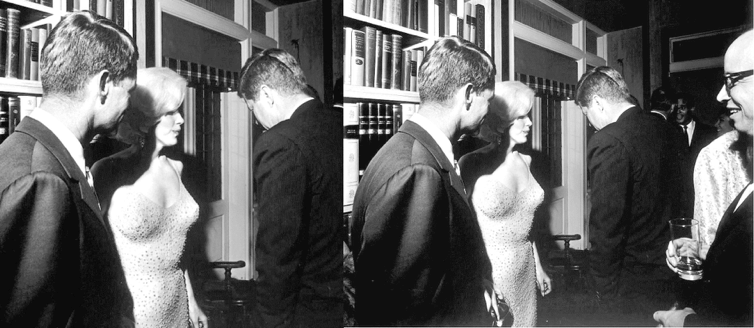
Within the pages of his book, Mark Shaw incorporates several photographs and he offers explanatory comments pertaining to each. However, his analysis is erroneous and, therefore, his comments about the photo depictions is seriously flawed. Of course, he trotted out the now famous photograph of Marilyn flanked by John and Robert Kennedy following the 1962 event at Madison Square Garden. This photo was taken during the after-party at Arthur Krim’s Manhattan penthouse. Shaw publishes the cropped version of the photograph, the usual tactic of cheapjack writers. Invariably, the photograph has also been darkened, suggesting that the famous trio engaged in a secretive and a serious discussion of such import they did not want to be overheard, but Shaw’s commentary about the photograph soars to an unprecedented level of misrepresentation and distortion. After implying that Cecil Stoughton, the White House photographer, actually timed taking the photograph so that the full faces of John and Robert would be hidden from view, Shaw declared: “Within moments, JFK, by all credible accounts, asked Marilyn to step into the shadows where RFK stood, and the three of them spoke for more than ten minutes.” (Shaw, p. 397) Shaw did not divulge exactly who delivered the alleged “credible accounts” or who conscientiously timed the conversation. At any rate, the actual photograph reveals a much less sinister looking encounter between Marilyn and the middle Kennedy brothers. The left-hand photograph in the panel displayed below is the cropped version used by Shaw, but the right-hand photograph is the actual snapshot as taken by Stoughton.
Obviously, the movie star and the politicians did not huddle alone in the shadows for ten minutes: they were, in fact, surrounded by many other guests who attended the Krims’ after-party. Another photograph taken at the after-party clearly indicated the number of people surrounding and touching Marilyn. Steven Smith, married to the Kennedy sister, Jean, and thus a Kennedy brother-in-law, wrapped his arm around Marilyn’s waist, displayed below on the left of the double panel; and many additional photographs indicated the crowded conditions as President Kennedy tried to converse with many of the Krim’s guests, including Jack Benny, displayed below on the right of the double panel. The bespectacled elder man in the background of the left-hand photograph was Marilyn’s escort for the evening, her former father-in-law, Isadore Miller.
Isadore’s presence did not prevent Shaw from reporting yet another falsity about that historic event. He asserted that the Secret Service escorted President Kennedy and Marilyn from the Krims’ penthouse “to the Carlyle Hotel, where JFK maintained a penthouse.” Then Shaw quoted gossip columnist Earl Wilson, who later alleged, following Marilyn’s death: “It was the last prolonged encounter between them.” (p. 397) Neither Wilson nor Shaw recounted what actually happened following the Krim’s after party. They simply ignored it, disregarding the testimony of the persons actually involved in the events.
During the small morning hours, both Marilyn and Isadore Miller climbed aboard Marilyn’s rented limousine and headed to Brooklyn. She dutifully delivered her former father-in-law to his front door steps. According to Gary Vitacco-Robles, Marilyn implored Isadore to return to the west coast with her, when she returned to LA the following day; but he declined and replied: “Maybe in November.” (Kindle V.2:25) After a brief conversation, Isadore exited the limousine. Marilyn blew her former father-in-law a kiss and then she returned to her 57th Street apartment, where she exited the limousine, barefooted, her shoes in hand, and engaged in a brief curbside conversation with one of her ardent fans, James Haspiel. He testified on more than one occasion that Marilyn told him she was exhausted. “I can tell you with authority,” he later wrote in a publication about his association with her, “that I was with Marilyn at her apartment ten minutes to four in the morning. Categorically, Marilyn was not asleep at the Carlyle Hotel, and I didn’t notice the President anywhere nearby us.” (Vitacco-Robles, ibid)
After leaving her fan standing on the sidewalk, she proceeded upstairs to her apartment, where Ralph Roberts met her. Ralph testified repeatedly that he massaged Marilyn during that early morning until she fell asleep. Even so, Shaw asserts that Marilyn and the president had a “brief sexual encounter” after the Madison Square Garden celebration, simply not the case. Even J. Randy Taraborrelli admitted: His years of research and investigation clearly indicated that such an encounter did not occur. But, once again, the facts do not matter in the world of Marilyn apocrypha. And Mark Shaw is just getting started.
The exact location of Robert Kennedy during the 1962 weekend of Marilyn’s death, specifically on Saturday, August 4th, has been debated for decades. Where was the evil attorney general? Was he, along with his wife Ethel and four of his then seven offspring, in Gilroy, California, southeast of San Francisco, visiting John and Nancy Bates, their family and ranch? Or, was he in Brentwood visiting and murdering his rejected and distraught lover? Just where the hell was he? The answer: Robert Kennedy and a portion of his family were in Gilroy, California and according to 1.) John Bates, Sr., 2) his wife, Nancy, 3.) their eldest son, John Bates, Jr., and 4.) the ranch foreman, Roland Snyder, Robert Kennedy did not leave the ranch during Friday or Saturday.
Regarding the Attorney General’s location that weekend in August of 1962, Shaw equivocated. He wrote:
[…] there have been suspicions that the last person to see or hear from Marilyn may have been Robert Kennedy, and whomever may have joined him at her new home. While the accounts differ as to the exact time and duration of the potential visit, if true, RFK could have had a confrontational conversation with Marilyn regarding her going to the media and telling secrets threatening him and his family (p. 477, emphasis mine)
It is apparent that Shaw could not simply out-of-hand dismiss the Bates family’s testimony regarding that weekend and, even though he appeared to accept that Robert Kennedy visited Brentwood that Saturday, despite differing accounts regarding that visit, he also equivocated and employed phrases like “may have been.” But intent on havinghis cake and eating it, Shaw devises a truly bizarre tactic. Bear with me as it unfolds.
II. Wrong Car in the Wrong place
Early on Sunday morning, August 5th, after the group attended church in Gilroy, John Bates Sr. drove his visitors back to San Francisco and delivered them to the home of Paul Fay. The Kennedy family visited the Fays until the Attorney General delivered his speech to the American Bar Association on Monday, August 6th. Shaw publishes a Bates family photograph, displayed below. It depicts the Kennedy family just as they were starting to pile into the Bates family station wagon, preparing to leave Gilroy and the Bates Ranch.
Mark Shaw holds that he obtained the Bates family photograph from Troy Vaughn, a former deputy sheriff and forensics expert from South Carolina, thus implying that the photograph had been kept hidden and was a deep and dark secret for nearly six decades until Shaw discovered it. This is a false implication. Susan Bernard, the daughter of the famous photographer Bruno Bernard of Hollywood, published not only the above photograph, but nine other photographs snapped by the Bates family during the Kennedy’s visit to their ranch that August weekend. Susan’s famous father not only photographed Marilyn on numerous occasions, he was also the movie star’s close friend. Susan included the Bates photographs in her 2011 photo journal, Marilyn: Intimate Exposures, which featured her father’s work with the movie star. Therefore, the photograph’s existence has been known for at least a decade, but, actually, much longer than that. Still, those facts did not interest Shaw. He called his reader’s attention to “the automobile with the driver’s side door open and the wood paneling beneath the window.” (p. 485) Was the paneling actually wood?’—but then, I digress.
Shaw now begins in earnest: after the photograph of the Bates’ station wagon, he publishes the photograph on the left, displayed below. Shaw failed to publish the photograph on the right, which also occurred on Sunday morning, August 5th.
Shaw’s analysis of this tragic scene is a remarkable example of a literary mischaracterization. He writes that the photo “depicts two men, perhaps from the mortuary, wheeling Marilyn’s covered body not out of, for whatever reason, but into her home on the day she died.” Shaw then calls the reader’s attention to the station wagon pictured in the distance and adds that it “appears to be a duplicate of the car RFK and his family were standing by at the Bates ranch.” Shaw conceded, however, that the presence of the automobile might simply be coincidental. O really?! But he then speculated that “somehow the car was driven from Gilroy to Los Angeles and then appeared at Marilyn’s death scene.” He bemoaned the unfortunate reality that the individual who drove the car that eventful Saturday—which required a time investment of at least ten hours round trip—”will never be known.” For more information on Mark Shaw’s treatment of John Bates, Sr., read the sidebar, Mark Shaw Transformed John Bates, Sr. into Frank Ragano.
Mark Shaw Transforms John Bates into Frank Ragano
During WWII, John Bates, Sr. served in the United States Navy. While serving, the young sailor met and befriended the future President of the United States. Both Johns, Bates and Kennedy, became members of a San Franciscan host committee to assist with the formation of the United Nations. Although the senior Bates was a Republican, his character was such that, after America elected John Kennedy its 35th president, the new Commander in Chief invited his attorney friend to serve as an assistant to the Attorney General. The senior Bates declined: he was deeply committed to the prestigious law firm of Pillsbury Madison and Sutro. Still, Bates, Sr. remained friends with John and Robert Kennedy and the entire Kennedy clan.
The preceding small amount of biography leads to this: the exact location of Robert Kennedy during the 1962 weekend of Marilyn’s death. While there has been some pseudo-debate about the issue, on Saturday, August 4th, it has been well known that Robert Kennedy and a portion of his family were in Gilroy, California, visiting the John Bates family at their ranch. The Kennedy visit began on Friday afternoon, the 3rd of August, and ended on Sunday morning, August 5th. What I just stated is an established fact, but over the passing years, many conspiracist writers have questioned the validity of Robert Kennedy’s alibi along with the validity of the first-hand, eye-witness testimony provided by John Bates, Sr. and his wife, Nancy. My research into the lives of both John and his wife confirmed that they were exemplary individuals with impeccable reputations. I asked Donna Morel, herself a licensed California attorney, if she knew anything about attorney Bates. Only, she replied, that he had an outstanding reputation. Despite that stellar reputation, following the lead of his conspiracist brethren, Mark Shaw doubted the senior Bates’ honesty. The author based his doubt on a false allegation. According to Shaw, during the 1957 McClellan hearings, John Bates, Sr. represented the mobster, Sam Giancana. Thus, Shaw proclaimed:
Muddying the waters regarding RFK’s alibi on the 4th of August is the fact that John Bates served as an attorney for mobster Sam Giancana, RFK’s mortal enemy, during the same McClellan hearings where RFK served as chief counsel. That Bates covered up the truth as to Bobby’s whereabouts on the day Marilyn died would have certainly crossed the mind of Dorothy Kilgallen. (p. 484)
The McClellan Senate hearings included both Robert and his brother, then Senator John Kennedy. Robert was lead counsel, which Shaw correctly notes, but he failed to note the following: the interaction between RFK and various mobsters who testified—including Giancana—can best be described as acutely adversarial. In fact, Robert Kennedy ridiculed Giancana, needled him, referred to the dangerous mobster as a “little girl,” which must have humiliated the Mafioso. That being the case, if John Bates, Sr. was Giancana’s attorney, had allied himself with the Mob against his Kennedy friends, and in so doing, had betrayed them, this leads to an obvious question: Why would John Kennedy then immediately invite that attorney to join and serve in a Kennedy Administration, invite an unprincipled and untrustworthy Mob lawyer to work alongside his brother, the Attorney General? What illogical nonsense to even suggest that this is what transpired.
Again, with assistance from Donna Morel, I contacted John Bates, Jr. on July 26th via email and posed this question: was your father ever associated with Sam Giancana or the Mob in any capacity? He responded as follows:
Thank you for your inquiry. My father was a civil attorney. My father never practiced criminal law. At all times, he was exclusively a civil trial lawyer. His entire career was with the prestigious San Francisco law firm of Pillsbury, Madison, & Sutro, where he ultimately rose to managing partner. Never during his legal career did he appear before any legislative committee for anyone. He never represented a member of the Mob, organized crime, or Sam Giancana. Any assertions to the contrary are incorrect.
Mark Shaw failed to provide a source for his accusation about the senior Bates’ involvement with Sam Giancana. In his source notes for the chapter in which that accusation appeared—Chapter 32—Shaw vaguely referenced a 1985 New York Times interview with John Bates, Sr. During my research into the character of the senior Bates and the issue of Robert Kennedy’s location on August 4th, I located only one New York Times article involving John Bates, Sr. That article did not contain a single word about Sam Giancana or the senior Bates’ involvement with the mobster. Moreover, Mark Shaw did not provide any additional information or evidence to support his transformation of John Bates, Sr. into Frank Ragano, none whatsoever. Very odd, but also revealing. A reasonable person could only conclude that Mark Shaw did not know anything at all about John Bates, Sr. and he did not endeavor to learn anything about the respected attorney, either.
Still, Shaw covered himself and asserted that the Attorney General’s appearance in Brentwood at Marilyn’s hacienda was not the important issue. Oh, no? The important issue, what really mattered, was Bobby’s dumping rejection of Marilyn, just like JFK’s rejection, and if the second rejection by Bobby caused a confrontation and Marilyn’s threat to reveal their affairs publicly. Shaw then noted: “If he [Robert Kennedy] was truly in the San Francisco area, arguably the second most powerful man in America could have orchestrated her death with a telephone call from afar.” (p. 485) Interesting, is it not, even if Robert Kennedy was not in Brentwood, and even if he did not visit Marilyn that Saturday’—and he obviously was not and did not’—he still killed the world’s most famous actress with a lethal telephone call.
But what is really happening in the photograph that Shaw published, the one on the left in the two photo panel above? It depicts Pierce Brothers Cemetery and Mortuary employees wheeling Marilyn into that facility after her body had been delivered by Don and Guy Hockett; not into her house at Fifth Helena Drive. How can one do something like that by accident? Also, the photograph on the right side of the panel depicts coroner employees removing Marilyn’s body from the cemetery mortuary for its transportation to downtown Los Angeles for autopsy. Often, writers have erroneously asserted that the men in the snapshot are policemen.
Please return briefly to the first photograph of the Kennedy family preparing to leave the Bates ranch. You will note that the pictured station wagon had been equipped with a roof-mounted luggage rack. The distant station wagon in the left hand photograph above does not have a luggage rack. Also, since that photograph is black and white, we have no way of comparing the automobile’s colors and, too, please note the amount of open space, open land in the receding distance beyond the duplicate station wagon and also note the slender palm trees. Below is an aerial view of Marilyn’s cramped property with its kidney-shaped swimming pool, left side, combined with a photograph of Pierce Brothers Westwood Village Cemetery, right side.
III. More Wrong Depictions
Clearly, the photograph of the two men wheeling Marilyn’s body into the mortuary was not taken at Marilyn’s hacienda on Fifth Helena. It was taken at the Pierce Brother’s Westwood Village Cemetery and Mortuary, where Joe DiMaggio had Marilyn interred on August 8th. Additionally, Marilyn’s hacienda did not have French doors, a fact confirmed by the floor plan of the hacienda as it actually existed in 1962, displayed below.
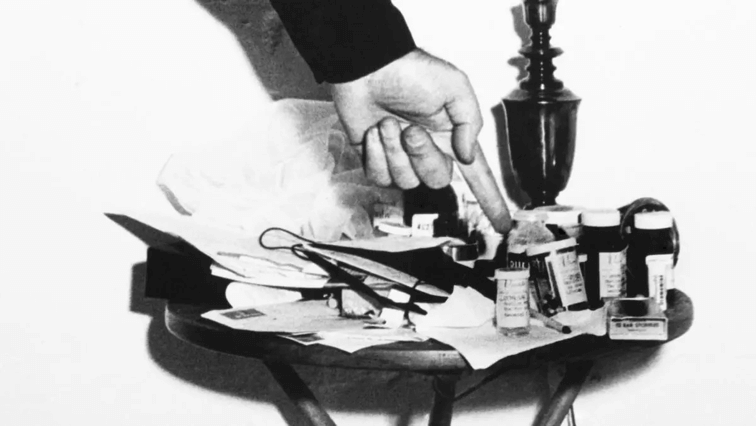
Like most dutiful conspiracists, Shaw published the police photograph of Marilyn’s bedside table and, like his conspiracist compatriots, he published a cropped version, included below. Dutifully, he also noted that a drinking glass was not on Marilyn’s bedside table and one could not be found, neither in her bedroom nor her adjoining bathroom.
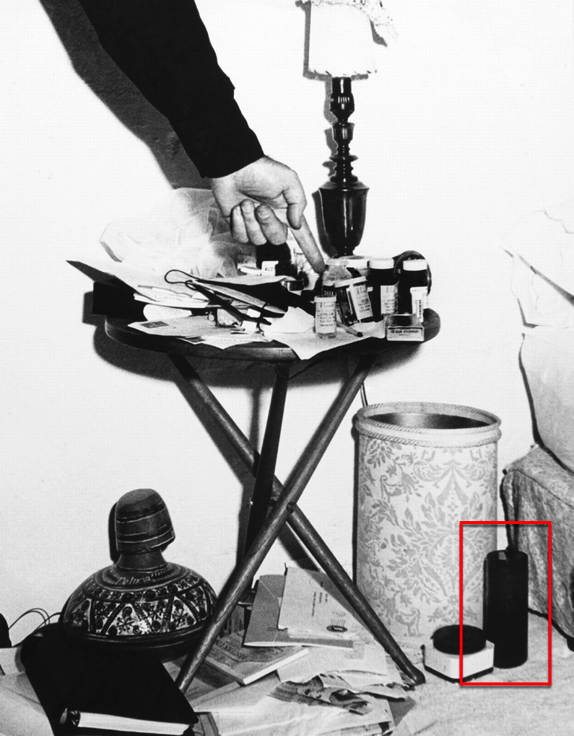
Displayed below is the actual, uncropped photograph taken that Sunday morning by police combined with an enlargement of the trash can area. Please note the drinking glass to the right of the trash can on the floor and to the left of Marilyn’s bed, a clearly visible drinking glass.
Following the photograph of the bedside table, Shaw published another police photograph of Marilyn’s bedroom, looking at her bedroom door, displayed below. While a policeman looked at the cluttered bedroom, beyond him was a woman with her back to the camera. Shaw labeled that woman as unidentified. In fact, a comparison of other photographs taken that morning would have confirmed her identity if Shaw actually did not recognize her: Eunice Murray, Marilyn’s housekeeper.
Regarding a related matter, Shaw included what he asserted was the bedroom wing layout of Marilyn’s hacienda and he paraphrased Eunice Murray’s testimony about that tragic Sunday morning: “while on the way to her bathroom,” Shaw noted, “she [Mrs. Murray] noticed light visible beneath Marilyn’s door, causing her to become suspicious that something could be wrong.” (p. 597) However, Shaw doubted that testimony, calling it inconsistent and apparently a lie. The layout of Marilyn’s home, he asserted, rendered her testimony unlikely or even impossible: Mrs. Murray had to leave her bedroom and walk into the hall in order to notice “a light under Marilyn’s bedroom door.” (p. 597) Displayed below is the drawing that Shaw used to confirm his assertion.
However, there is a major problem with that drawing: it is grossly inaccurate. Where are the clothes closets between the bedrooms, the linen closet, and where is the corner fireplace in Marilyn’s bedroom? Plus, the room denoted as “Murray Bedroom” was actually a bedroom Marilyn had reconfigured into her dressing room. Displayed below is the correct bedroom wing floor plan as it was in 1962.
On the night of August 4th, Eunice Murray slept in the smaller bedroom where Marilyn had positioned a cot, identified on the floor plan as “Guest Sleeping.” Pat Newcomb had slept in the same bedroom on the same cot when she spent Friday night with Marilyn. It is apparent that Mrs. Murray could have noticed light emanating from Marilyn’s bedroom on her way to the Jack and Jill bathroom and considering the arrangement of the bedroom’s doors, she could have stood at her bedroom door and easily observed Marilyn’s bedroom door. In the police photograph of Marilyn’s bedroom, looking across her disheveled bed at the opposing wall, clearly Mrs. Murray was preparing to enter the bedroom where she had slept, clearly visible from Marilyn’s bedroom door.
On page 515, Shaw published a photograph of Marilyn with her arm around the neck of a young fan, taken either preceding or following the premier of How to Marry a Millionaire on November 4th in 1953. Shaw identified that young man as Joe DiMaggio, Jr. Odd. Where is Joe DiMaggio, Sr.?’—an important consideration left unconsidered by Mark Shaw.
Born on October 23rd in 1941, the junior DiMaggio was twelve years old when How to Marry a Millionaire premiered in 1953 and, considering that his mother, Dorothy Arnold, took her ex-husband to court in an attempt to keep the youngster away from Marilyn’—Dorothy cited Marilyn’s unsavory vulgar character and her potential negative influence’—it is more than highly unlikely that Dorothy would have allowed her twelve-year-old son to attend a movie premiere with the disreputable movie star. Besides, the young fellow in the photograph published by Shaw appears to be at least 14 years-old and possibly even older.
The combined photographs below prove as much. To the left is the cropped version of Marilyn and her young fan as published by Shaw. To the right is a photograph of the junior Joe taken with the senior Joe at Ebbets Field on October 9th in 1953, approximately 30 days before the premiere of How to Marry a Millionaire. The lucky young man who received that hug from Marilyn was not Joe DiMaggio, Jr.
Finally, Shaw trotted out the famous thank-you note from Jean Kennedy Smith to Marilyn. During the Lawford’s 1962 February dinner party, Marilyn spoke to the ailing Kennedy clan patriarch via a telephone call instigated by Robert Kennedy. Joe Kennedy had suffered a serious stroke on December 19th in 1961, but he had yet to recover: he could barely speak. Robert must have felt that hearing Marilyn’s incredible voice would bolster the old man’s spirits. Sometime later, Marilyn sent a kind note to the senior Kennedy. In response to Marilyn’s kindness and her note, Jean Kennedy Smith wrote and sent Marilyn the aforementioned thank-you note. Both pages of the actual note follow.
An innocent note, written and sent in response to a note that Marilyn sent to Joe Kennedy, Sr. It has always been of particular interest to conspiracists, including Shaw. But in his book, he published the note’s second page only, which begins with: “understand you and Bobby are the new item!” Clearly, Shaw did not publish the first page of the note for obvious reasons. Like conspiracists before him, Shaw breathlessly pointed to the thank-you note as evidence and proof that Marilyn and Robert Kennedy were involved in an affair and the invitation extended by Jean Smith for Marilyn to join Bobby when he returned to the east has been used by the conspiracists as evidence that Robert Kennedy’s extramarital relationship with Marilyn had been accepted by the Kennedy clan, specifically the Kennedy women. Should we assume, then, that both Ethel Kennedy and Jacqueline Kennedy had also accepted Bobby’s extramarital relationship with Marilyn?
Since Shaw ignored the first page of the thank you note, he was able to write the following ridiculous assertion: “Whatever Kennedy Smith knew’—whether from the mouth of her brother or through perhaps Peter Lawford, married to Pat Kennedy’—had triggered the letter.” (p. 572) As the first sentence of the thank-you note clearly stated, Rose Kennedy asked her daughter to write and thank Marilyn. That request “triggered the letter,” not something nefarious.
During the decades since the note was sent to Marilyn by Jean Smith, its context has been completely disregarded by the conspiracists, including Mark Shaw. Obviously, the comment about Marilyn and Bobby being “the new item” was meant as a tongue-in-cheek reference to Marilyn’s twist teaching efforts during the Lawford’s February dinner party and the uproarious scene caused by Robert Kennedy attempting to dance with Marilyn Monroe. Evidently, Ethel constantly teased the Attorney General over that humorous scene, as frequently noted by John Seigenthaler, Robert Kennedy’s friend and assistant.
That Jean Smith would invite Marilyn to visit Hyannisport seems only natural: who would not want Marilyn Monroe in their home for a visit? In point of fact, the lack of an invitation for Marilyn to visit would have appeared suspicious.
The conspiracist’s efforts to use that innocent note as proof of not only a romantic affair but the affair’s acceptance by the Kennedy clan and the Kennedy women is preposterous. That attempt should be viewed as manufactured since Sgt. Jack Clemmons, Frank Capell, Robert Slatzer, and Jeane Carmen were all complicit in it. For an author—who is also an attorney—to place himself in such a dubious crowd is: well, its mystifying.
IV: A Contrived Murder Scenario
Near the end of Collateral Damage, Mark Shaw revealed his hypothetical Marilyn murder scenario. But before I launch into my analysis of his hypothesis, let me briefly discuss what the Hollywood Godfather has asserted to be factual.
According to Gianni Russo, Robert Kennedy hired a Mob assassin to eliminate his rejected lover. “A guy known as The Doctor murdered Marilyn,” Russo testified to Michael Kaplan for a 3/2/19 New York Post article. The Doctor was a killer for hire and an actual MD who performed “major hits for the mob […].” This unnamed doctor “injected air into the vein near Marilyn’s pubic region,” which rendered the injection site invisible, Russo reported to Kaplan. Although Russo did not specify which vein or which part of Marilyn’s anatomy received the injection. How near is near?
In Russo’s aberrant world, Marilyn “died of an embolism, but it looked like drugs to the coroner,” just a garden variety overdose. I am not being the least bit facetious. While possibly the most inventive of Marilyn’s Murder Orthodoxies, Russo’s embolism tarradiddle is also certainly the most ludicrous. At any rate, I give him an A for Amagination and an F for Foolishness. How could a venous gas embolism create the lethal concentrations of Chloral hydrate and pentobarbital in Marilyn’s blood and liver? How could that air bubble deceive the tests performed by the head toxicologist and, further, trick him into interpreting the tests as indicating the presence of drugs, marking a massive overdose, when, in fact, the drugs did not even exist? That is, according to Gianni Russo. I assume every death from an embolism has been misdiagnosed as a drug overdose. Despite the ludicrous nature of Russo’s fairy tale, it has been reported by many newspapers, magazines, and Internet articles as the absolute truth. Yet, the most remarkable aspect of this curiosity is that Mark Shaw actually asserts that Russo’s incredibly imbecilic fairy tale has some credence. Once again, I am not being the least bit facetious.
An insane number of theories about the death of Marilyn Monroe have been developed and presented as fact during the past fifty-nine years: at least 12. The conspiracist authors who developed and presented those theories invariably contended that theirs was factual: the Last Word regarding the who, when, how, and why of Marilyn’s perceived mysterious death, her murder. Still, all of those theories did not satisfy Mark Shaw. Therefore, he developed one of his own. Let’s call his new theory Number 13. According to Shaw, Number 13 proceeds as follows.
Sometime near midnight, unable to sleep, Marilyn “heard a noise at her front door.” Upon opening the door, two gloved men assaulted her and “stunned” her by placing “a chloroform-sealed cloth over her nose and mouth.” Once stunned, the two men either dragged or carried Marilyn into her bedroom and, during that relocation, the men hit her lower body against a sturdy piece of furniture, or the open door’s edge or the doorknob. That inadvertent whack bruised Marilyn’s left hip. Once in her bedroom, the murderers removed any outer “clothing she was wearing such as a robe or panties” and they then carefully “positioned her nude body on the floor face down.” At this point, one of the men switched on the light and then locked the door, so they would not be disturbed. Water “secured from the bedroom faucet,” mixed with a lethal dose of both the Chloral hydrate and Nembutal became the ammunition for the murder weapon.
The murderers then “dipped a bulb syringe of some sort into” the drug mixture and then “inserted the tip into Marilyn’s rectum, with some spillage possible. Quickly, the lethal dose would have infiltrated her blood system and begun the march to her death.” Her murderers then placed Marilyn’s body face down on her bed and placed the telephone receiver “in her hand for effect.” After cleaning up “as best they could,” the two murderers “quietly left the home through the bedroom door,” which they locked on the way out. (pp. 612–613)
There are numerous problems with the preceding theoretical scenario. I’ll begin with time.
The alleged time that the murderers began the gruesome process of murdering Marilyn, midnight on August 4th, creates a serious issue for Shaw. According to Don and Guy Hockett—who collected Marilyn’s body at Fifth Helena and took her to the Pierce Brothers Mortuary, where she stayed briefly—her body was so rigid, they had trouble placing her on the gurney. They asserted, based on the degree of rigor mortis and the presence of fixed lividity, that Marilyn had passed on at about 10 PM. Natalie Trundy, later said that she and her fiancé Arthur Jacobs attended a concert that night. At approximately 11:00 PM, an usher arrived and informed Jacobs, then Marilyn’s publicist, that she was either nearly dead or already dead.
The temperature of Marilyn’s liver at 10:30 AM on August 5th, the time that Dr. Noguchi began her autopsy, as noted on her autopsy report, was 89°F, 9.6°F below what is considered normal. Virtually all the conspiracist writers have ignored that fact, including Shaw. According to the Glaister Equation, a formula used to calculate a person’s possible time of death, using a temperature differential from normal of 9.6°F, Marilyn could have died between the hours of 9:30 PM on the 4th of August and 2:30 AM on the 5th of August with a mean time of 12:30 AM on the 5th. Regardless of what time Marilyn’s essential bodily functions ceased (i.e. the exact time she actually died), it is evident that she became an unresponsive, comatose body at some point prior to 12:00 midnight: an essential detail. Therefore, Shaw’s murderers would not have encountered a conscious Marilyn near midnight on August 4th.
Consider the “chloroform-sealed cloth” that the murderers pressed against Marilyn’s nose and mouth. Did Shaw mean chloroform-soaked? At any rate, the use of chloroform to render a person unconscious is a myth started and perpetuated by Hollywood moviemakers. Evidently, the time required to knock-out a person using a chloroformed rag varies between five and ten minutes and, since liquid chloroform quickly evaporates into a gas when exposed to air, fresh liquid chloroform must be constantly added to the rag. Also, for the person to remain unconscious for an extended period of time, a freshly chloroformed rag must be held continually against the person’s nose and mouth. But then, Shaw alleged, that the chloroform “stunned” Marilyn. A stunned person would be groggy or dizzy, dazed. If Marilyn was only dazed by the chloroform, according to my research into the longevity of its effects, Marilyn would have regained her senses rather quickly: the effects of chloroform, in its gaseous state, diminish and disappear rapidly.
Shaw’s assertion that the murderers left the home “through the bedroom door” is an odd statement. As indicated by the floor plan of Marilyn’s hacienda, her bedroom did not have a door allowing access to the exterior. That is why Dr. Greenson had to enter Marilyn’s bedroom through one of the casement windows. I have concluded that Shaw’s assertion about the murderers’ getaway route is just another example of his many misstatements.
V. Shaw’s Bulb Syringe Murder Weapon
A major problem with Shaw’s contrived murder scenario resides in his vague description of how the assassins actually killed the movie star. They used a “bulb syringe of some sort,” which they dipped into a drug solution and then they inserted bulb syringe’s tip “into Marilyn’s rectum.” By bulb syringe, did Shaw mean the type of syringe often used to remove ear wax, irrigate sinuses, and remove mucous from the nostrils of infants? Certainly the killers drew a quantity of the drug solution into the bulb syringe, which they then injected into Marilyn’s rectum, but Shaw did not actually say that. Still, Marilyn could not have been killed with a normal size bulb syringe, one that could have dispensed two, maybe three ounces of the drug solution.
The largest bulb syringe I located could have dispensed twenty ounces, or 2½ cups, of the drug solution. But using a bulb syringe that large would have created its own set of problems. Shaw admitted that “some spillage” would have been possible, but certainly trying to infuse Marilyn’s rectum with 2½ cups of liquid using a large bulb syringe would have resulted in more than just some spillage. In fact, I contend, if she was unconscious, the spillage would have been considerable and would have stained Marilyn’s new white wool carpet.
More importantly, there are significant scientific problems with Shaw’s contrived murder scenario.
According to my research, while killing a person with an enema is possible, doing so is not that simple or easy. It requires an infusion of the descending colon with a large quantity of a lethal solution. It would be virtually impossible to murder a person by simply injecting a lethal solution into his or her rectum.
In Murder Orthodoxies, I wrote extensively about a similar situation, using the rectum as the route to murder Marilyn using a drug infused suppository. Chuck Giancana, Sam Giancana’s stepbrother, stated in his novel, Double Cross, that his stepbrother deployed suppository wielding assassins to murder Marilyn. Since killing with a bulb syringe would be similarly problematic, allow me to touch upon the significant points here. Keep in mind Shaw’s contention that the lethal solution “quickly infiltrated” Marilyn’s “blood system,” which led to her death.
The human rectum is primarily a storage chamber, a vertical section of the large intestine approximately 4½ inches long; therefore, it provides only about 50 square inches of an absorptive surface. Since the lining of the rectum is smooth, meaning devoid of the finger-like protrusions known as villi, absorption through it is neither efficient nor speedy. The International Journal of Pharmaceutical Sciences Review and Research noted that both the degree and the speed of drug absorption from the human rectum is both lower and slower than absorption from the gastrointestinal tract. It is highly unlikely, therefore, that the lethal solution proposed by Shaw quickly infiltrated Marilyn’s blood system. Additionally, blood circulation to and from the rectum is unusual. A list of various points follow.
The inferior mesenteric and the internal iliac arteries supply the rectum with blood.
The superior rectal vein, the middle rectal vein, and the inferior rectal vein along with anastomoses or venous plexus return blood from the rectum.
The superior rectal vein connects to the portal system and directly to the liver, where it undergoes a degree of first pass metabolism.
The inferior and middle rectal veins connect directly to the systemic circulation system, which delivers blood to the heart through the inferior vena cava and then throughout the body before reaching the liver.
The anastomoses or venous plexus connect to both the portal and the systemic venous systems.
The anal canal, which measures 1±½ inches in length, is the final part of the human digestive system and the inferior rectal artery delivers blood to the anal canal.
The inferior rectal vein accepts blood from the anal canal and delivers it to the internal iliac vein and then to the systemic circulation.
Many studies have been performed to determine the bioavailability of drugs administered rectally. The percentages vary considerably with time and drug. A consensus does not exist regarding just how much of a rectally absorbed drug enters the portal venous system, gets delivered to the liver, where it is subjected to first pass metabolism, and just how much bypasses the liver on its initial trip through the body. Certainly, based on the anatomy of the rectum, which varies from person to person, as does each person’s physiology, the only reasonable position to assume, for the purpose of this discussion, is that 50% of an absorbed drug enters the portal venous system and then the liver, where a portion of it will be metabolized and 50% of an absorbed drug does not enter the liver on its initial trip through the body. Additionally, assuming that 50% of the absorbed drug passed through Marilyn’s liver initially and 50% did not, I suggest that more of the absorbed drug would have been found in Marilyn’s blood stream than is indicated. And that scientific fact leads me to this.
Shaw noted that the amount of chloral hydrate in Marilyn’s blood was 8.0 percent and the amount of pentobarbital in her liver was 13.0 percent, suggesting that the volume of blood in Marilyn’s body was 8% Chloral hydrate and 13% pentobarbital which, of course, was not the case at all. What Shaw actually meant was not a raw percentage but milligram percent or mg%, a measure of concentration; the mass of a chemical, given in milligrams, that is present in one-hundred milliliters of a solution, blood for instance. Also, Shaw failed to mention the concentration of pentobarbital in Marilyn’s blood, 4.5 mg%, quite a significant omission and a prime example of cherry picking in order to exclude relevant but unwanted evidence.
Abernathy’s tests indicated a concentration of pentobarbital in Marilyn’s liver three times as high as the concentration in her blood. Explained by a branch of pharmacology called pharmacokinetics, that relationship is consistent with ingesting a large overdose and proves beyond a reasonable doubt and to a scientific certainty that the drugs were ingested. The drugs were not injected into Marilyn’s body, she did not receive a hot shot, and she was not murdered with a bulb syringe, regardless of its size.
Finally, while Shaw’s hypothetical murderers killed the world’s most famous woman on that night, where was Eunice Murray? She does not appear in Shaw’s scenario, but we know she was in the house that night with Marilyn, asleep on a cot in the small bedroom very near Marilyn’s bedroom. Certainly, Mrs. Murray would have heard any noises caused by Marilyn’s struggle with the murderers. Once again, Shaw attempted to diminish his problem with Eunice Murray’s known presence that night. He opined:
Of course, as with any theory like this based on circumstantial evidence after so many years have passed, questions will be raised, with answers unfortunately somewhat speculative in nature. (p. 612)
Amazing. Shaw began to question his own theory, his own explanation of what happened to Marilyn and led to her death. What time did the killers arrive? he questioned. Where was Mrs. Murray when the killers arrived and enacted the gruesome scene in Marilyn’s bedroom? Shaw speculates that the murder possibly occurred between midnight and 3:00 AM, contradicting his proclamation that the murderers arrived “at some point close to midnight.” (p. 612) Then, regarding the bruise on Marilyn’s hip, Shaw admitted that “other explanations exist as to how Marilyn could have bruised her left hip.” (p. 612) However, if that bruise was caused as he speculated, then obviously foul play had been involved in Marilyn’s death. He then wondered if Mrs. Murray had “knowledge of the attempt on Marilyn’s life,” which he admits could not be known. (p. 615) He then speculates that Mrs. Murray became spooked by “hearing noise near Marilyn’s bedroom,” which caused “Murray to wonder if Marilyn was in distress” and prompted her “to call either Greenson or Engelberg.” (p. 615) Eventually, Shaw’s speculations centered on Dr. Greenson, Dr. Engelberg, and Eunice Murray and their possible complicity with Robert Kennedy who “orchestrated Marilyn’s death via operatives sent to her home.” (p. 617) Frankly, it became self-evident as I read Shaw’s speculations and strange contradictions, that he likely did not even believe Number 13, which he himself formulated. So why should I? Besides, I know Shaw’s Number 13 is a fantasy founded on sensationalism. Marilyn was dead before midnight. Evidence, not speculation, confirms that and confirms that Marilyn certainly was not alive at 3:00 AM on August 5th. Unlike Mark Shaw, rigor mortis and fixed lividity do not speculate.
VI: A Brief Summation
Before ending with a brief summary, I would be remiss if I did not note the following. During a recent interview with Heather McDonald, Mark Shaw asserted that he wrote Collateral Damage because he “never bought the idea that Marilyn committed suicide.” The author then added: “When I heard about it I didn’t believe it and I still don’t and I’ve proven in the new book that it didn’t happen.” Shaw proceeded to add: “In this particular book I did not use any sources with books or anything else from 1965 on. They [Shaw’s sources] were all before sixty-five.”
Remarkable. Shaw brazenly admitted that he began writing with an occluded mind based on a foregone conclusion. Most certainly, as he wrote, he was afflicted with an idée fixe and a form of group think, leading him to engage in cherry picking, confirmation bias, belief perseverance, illusory correlation, and fallacious reasoning.
Why would an author in search of the facts, in search of the truth, deny the validity of all the valuable research into Marilyn’s life and her relationships after 1965, not only with the middle Kennedy brothers, but her other relationships as well? Why would he deny all of the valuable research into the circumstances surrounding her death that has transpired during the past 59 years? Why would he limit his source material to only the 3 years following her tragic death? And finally, why would he evoke discredited men like Frank Capell, Sgt. Jack Clemmons, and many others, including both C. David Heymann and the incorrigible fabulist, Gianni Russo, who did not appear with his Marilyn fantasy until 2005 and his book was not published until 2019—both dates decades beyond 1965. Using Russo as a source is a contradictory reversal of Shaw’s source edict and why would Shaw present those men as reliable sources? The answer is obvious: Shaw wanted and needed sources that confirmed his foregone conclusion, not unlike every conspiracist author who has written about Marilyn Monroe’s life and her death.
Shaw calls Senator Joe McCarthy a despicable man whose heart was filled with hate. But the author himself engages in a despicable form of McCarthyism, because of the apparent hatred in his heart for Robert Kennedy. Referencing the Chappaquiddick tragedy, Shaw asserted that Teddy Kennedy’s conduct, how he handled the drowning of Mary Jo Kopechne “was symbolic of the selfish ‘me first’ mentality of the Kennedys, especially RFK.” (p. 558) Robert Kennedy was already killed at that time. Even so, guilt by familial association is Shaw’s assessment. Robert was even more selfish and uncaring than the youngest Kennedy brother.
Within the text of Collateral Damage, Mark Shaw devoted many words and pages to the exceptional investigative prowess of Dorothy Kilgallen, who constantly searched for the facts in every significant story or case, searched for the truth and justice. Based on comments within her published articles, Shaw asserted, Dorothy suspected that her “friend” did not commit suicide, suspected that her friend was romantically involved with Robert Kennedy, and suspected that her friend’s death involved the attorney general. Shaw knew without debate, all the unsolved mysteries surrounding and all the unanswered questions left in the wake of Marilyn’s mysterious death would have been solved and answered after an investigation by the incredible Dorothy Kilgallen. Since Marilyn died in early August of 1962, what prevented Dorothy from focusing her investigative spotlights and powers on her “friend’s” mysterious death? Of course, 16 months after Marilyn’s death, Dorothy became embroiled in the president’s assassination, the murder of Oswald, and then the sensational trial of Jack Ruby, but she had at least 16 months during which she could have investigated Marilyn’s suspected murder. Again, what prevented her?
Shaw must have realized that the absence of any investigation by Dorothy Kilgallen was a problem for him, so he proffered an explanation. During the October missile crisis, with humanity on the precipice of nuclear war, possibly annihilation, “in perhaps his finest hour, RFK stood tall and helped his brother quell the threat.” Dorothy Kilgallen, Shaw presumed, because of her integrity—and the fact that Robert Kennedy had helped save humanity—“could not in good conscience go forward, and this stifled any further probe involving RFK.” (p. 600) According to Shaw, Dorothy Kilgallen’s integrity actually prevented her from exposing the murderer of her “friend,” the most famous actress in the world. Truly amazing conjecture based on absolutely nothing. There was no credible evidence Robert Kennedy and Marilyn were ever romantically involved, less that he was part of her murder.
In fact, Dorothy Kilgallen’s columns following Marilyn’s death had been based on rumor and gossip, innuendo and sensationalism. All advanced by other luminaries in the gossip mongering field: Walter Winchell, Earl Wilson, Louella Parsons, and James Bacon. As of right now in America, rumor, gossip, and innuendo do not qualify as evidence.
Still, Shaw promised his readers that he would reveal new and compelling evidence regarding Marilyn’s death. He didn’t. He merely recited, right on cue, what Sarah Churchwell accurately identified as the same tales and bromides.
For example, he resurrected the CIA-UFO-Memo as evidence that Marilyn was possibly murdered, because she knew about the existence of little green men. Shaw insinuated that the memorandum was new evidence, when it was, in fact, inordinately old news.
Twenty-six years ago in 1995, Milo Speriglio introduced the memorandum to the world during a press conference and, since that time, the document has been evaluated and analyzed innumerable times. Nick Redfern just published a book that yet again evaluated that dubious memorandum. Many UFOlogists and impresarios in the odd world of flying silver discs generally agree on this: that document is a hoax, a crafty forgery.
Shaw, however, interjected a new wrinkle: he asserted that the one of the telephone conversations mentioned in the memorandum occurred between Dorothy Kilgallen and Marilyn who “told Kilgallen that JFK had told her of his visit to a secret air base where he viewed ‘things’ from outer space.” (p. 386) I have read that memorandum at least two dozen times and it does not state that Marilyn revealed to Dorothy Kilgallen anything heard from the lips of or otherwise learned from President Kennedy. Clearly, according to the memorandum, Howard Rothberg imparted hearsay evidence to Dorothy involving some secrets Marilyn allegedly knew, one of which involved the president, a secret air base, and things from outer space. Still, regardless of what the CIA-UFO-Memo alleged, I repeat, that document is now recognized to be a forgery.
In 2006, on the CBS program, 48 Hours, Peter Van Sant and Anthony Summers presented and generally discussed an FBI file that Mark Shaw also resurrected. Sent from Mexico City and dated the 13th of July in 1962, number 105-40698-3, the file referenced a
luncheon at the Peter Lawfords with President Kennedy just a few days previously. She [Marilyn] was very pleased, as she asked the President a lot of socially significant questions concerning the morality of atomic testing and the future of the youth of America.
According to my research and according to the John F. Kennedy Presidential Library and Museum along with the website, History’s Home on the Web, President Kennedy was either in the nation’s capital, Camp David, or Hyannis Port throughout the month of July in 1962, except when he delivered a 4th of July speech at Independence Hall in Philadelphia. Even though, during that CBS program, Summers presented the now 59-year-old FBI document as being factual, 21 years earlier, Summers admitted in his pathography, Goddess, that his investigation regarding that alleged meeting revealed “no day in the relevant time-frame when John Kennedy could have been in Los Angeles’—he made an official visit to Mexico at the end of June.” (Summers, p. 577) Obviously and evidently, President Kennedy did not travel to California in July of 1962, which leads to an obvious conclusion: President Kennedy did not meet Marilyn at the Lawford’s beach house for a luncheon.
But then, throughout Collateral Damage, Mark Shaw followed along the well-worn path created by the footfall of an almost endless parade of conspiracists who have preceded him. He, like they, promised his readers he would prove with new and compelling evidence that Marilyn Monroe did not commit suicide. Yet, he merely engaged in not only rumor, opinion, gossip, and innuendo; he also engaged in the worst form of gross speculation and evidence creation. While presenting testimony lacking any evidentiary value whatsoever, he also presented testimony from two sources whose verity has been questioned repeatedly and from one source whose testimony has obviously been manufactured. Additionally, he otherwise twisted the facts to fit his foregone conclusion: Marilyn Monroe was murdered, not only murdered, but murdered by Robert Kennedy.
Oddly though, Shaw asserted as his text approached its conclusion: “it appears that Marilyn Monroe had been right, as noted, when she wrote in My Story, ‘Yes, there was something special about me, and I knew what it was. I was the kind of girl they found dead in a hall bedroom with an empty bottle of sleeping pills in her hand.’” (p. 600) Did Mark Shaw fail to realize that Marilyn was referring to her death by overdose, her death by suicide?
If Mark Shaw really wanted justice for Marilyn, which, considering his use of Gianni Russo, I doubt, then Shaw would have let her rest in peace. But evidently that would be an empathetic compassion beyond a conspiracist’s comprehension.
Addendum
The other material about Dorothy Kilgallen and JFK in Shaw’s book is largely repetitive of his earlier works. Since it is such, we refer the reader to Jim DiEugenio’s reviews of The Reporter Who Knew Too Much and Denial of Justice.
It is a capital mistake to theorize before one has
data. Insensibly one begins to twist facts to suit
theories, instead of theories to suit facts.
Sherlock Holmes
The preceding admonition by Sir Conan Doyle’s famous, fictional crime investigator expresses an important maxim: theories should be crafted to incorporate acquired facts. All too often, however, conspiracist authors in the Marilyn-Was-Murdered-World have violated and continue to violate Holmes’ maxim. In some cases, they have twisted the facts; and, in some cases, too often they have created facts to fit their preconceived conclusion about Marilyn’s death. And all too often, the conspiracist authors have engaged in false logic, which has been, and still is, often expressed by this fallacious proclamation: since Marilyn Monroe would never have committed suicide, she must have been murdered. Those authors ignore the fact that Marilyn attempted suicide four known times during her life; before proceeding to craft an illogical and often convoluted path to their foregone conclusion. In Mark Shaw’s recent publication, Collateral Damage, largely about the deaths of Marilyn Monroe and Dorothy Kilgallen, the author recklessly engaged in what Sherlock Holmes calls a capital mistake. Shaw does exactly what the detective admonished investigators to avoid.
I. A Fabricated Friendship
An important foundational premise posited by Shaw in Collateral Damage is that some type of lengthy and abiding friendship existed between the film star and the gossip columnist. Kilgallen’s friends, Shaw asserts, “included stars from stage and screen like Marilyn.” (p. 51) Yet, the author does not offer any tangible evidence to conclusively establish this putative friendship.
Sixty-eight pages following the preceding assertion, Shaw introduces a woman named Brenda DeJourdan, the daughter of Kilgallen’s deceased butler, James Clement. Evidently Shaw interviewed her; but the author’s source notes did not reveal anything about the interview or his source, a glaring but typical omission.
Brenda informed Shaw that Dorothy Kilgallen often hosted fabulous parties. Presumably following one of those many parties, Brenda’s father assisted Marilyn “to her car because she was intoxicated.” (p. 120) In Shaw’s opinion, that statement “cemented” that the two famous women were friends, certainly a quantum leap considering that Brenda’s testimony was not very specific. Was the referenced car Marilyn’s personal car or a rented limousine? And if not a limousine, why would Dorothy allow her intoxicated friend to drive on the streets of Manhattan? Certainly the gossip columnist would have instructed her butler to call or hail a taxi cab for her good friend. Furthermore, Brenda does not assert that she actually witnessed her father assisting the actress. Did the butler’s daughter simply recall a story that her father had related to her? A significant difference; and since we do not know the calendar date when this party occurred, judging Brenda’s statement becomes even more difficult. Then Shaw makes an interesting comment: Dorothy “would have had to approve” Marilyn’s party invitation. (p. 120) Why? If Dorothy and Marilyn were such great pals, why didn’t Dorothy just give her actress pal a jingle and invite her? At any rate, other than Brenda DeJourdan’s anecdotal testimony, thin at best, possibly even hearsay, Shaw does not offer any additional evidence pertaining to the purported friendship between the two famous women.
Oddly enough, Shaw himself actually undermines his friendship premise. He admitted that Dorothy occasionally fired “potshots” at Marilyn, “but usually in jest.” (p. 94) Shaw also notes: Dorothy once compared Marilyn’s appearance to “an unmade bed.” (p. 95) I’m not exactly sure how Shaw knew, or could even assert, that Dorothy fired her potshots at Marilyn simply for comic effect. He certainly could not have interviewed her. Still, it must be noted that Marilyn did not take insults of any type, particularly those regarding her appearance, lightly or in stride.
Then, remarkably enough, Shaw contradicts his assertion that Dorothy took potshots at Marilyn and declares: “Kilgallen always spoke highly of Marilyn.” (p. 422) Really? Then he quotes a 1955 Playboy interview with the writer, Truman Capote, during which Capote shared an anecdote involving Marilyn, a NYC saloon, and his friend Dorothy Kilgallen. Allegedly as Capote and Marilyn neared the saloon, he suggested that they duck inside and refresh themselves. “It’s full of advertising creeps,” Marilyn responded according to Capote. Then she added: “And that bitch Dorothy Kilgallen, she’s always in there getting bombed.” Even as Capote tried to defend his journalist friend, according to him, Marilyn commented that Dorothy had “written some bitchy stuff about me.” (p. 422) Shaw soft-pedals Marilyn’s comments, called them merely “misgivings” about Dorothy; but Marilyn’s comments do not sound like mere misgivings: they sounded like well-founded hostility. Therefore, in view of the preceding, what exactly are the facts about any relationship shared by Marilyn Monroe and Dorothy Kilgallen?
Of course, since Dorothy was an important member of the press, Marilyn was obligated to associate with the gossip columnist; and she evidently did so, but only to a point. Dorothy often published unsubstantiated and false gossip about Marilyn, which the actress neither understood nor appreciated. Even Shaw notes that many press agents considered Dorothy to be “a ‘sucker’ for an unsubstantiated story about a personality and thus didn’t do her homework to confirm” a story’s validity before it appeared in her gossip column. (p. 127) That troubling fact leads me directly to Robert Slatzer.
Dorothy apparently knew Slatzer; and she mentioned him in one of her columns as a dark horse in the Marilyn Monroe romance derby. Slatzer, Dorothy asserted, was a generous soul who gave Marilyn books, her favorite gift. Unquestionably, Slatzer fed Dorothy that morsel of gossip. Additionally, during Dorothy’s vacation in 1952, Slatzer wrote her gossip column, which he proceeded to use as a forum to begin his literary fraud and construct his fantasy relationship and marriage to the famous actress.
Marilyn researcher and blogger, April VeVea, noted on her blog site, Unraveling the Slander of Marilyn Monroe, that Dorothy often displayed animosity toward Marilyn for no apparent reason. She frequently reported on Marilyn’s romances, alleging that the blonde actress was involved romantically with many men. Even so, the actress and gossip columnist evidently enjoyed a fair relationship until 1953, when Marilyn ceased giving Dorothy exclusives. It must be noted: Marilyn would immediately forsake persons who had spoken indiscreetly about her private life, persons who had criticized her, or persons who she felt had betrayed her. Such must have been the case with Miss Kilgallen and her gossip column. Certainly, then, after 1953, Marilyn considered Dorothy unworthy of her trust.
April VeVea also noted: Dorothy Kilgallen and Walter Winchell were the only two journalists who did not receive an invitation to the 1955 event during which Marilyn announced the formation of Marilyn Monroe Productions. Marilyn biographer, Donald Spoto, also noted: “Every Manhattan columnist and every reporter of any status was present except Dorothy Kilgallen and Walter Winchell, both of whom had been excluded by Milton [Greene] because of their general hostility toward Marilyn” (Kindle Edition: Ch.14); and finally, Dorothy did not receive an invitation to attend Marilyn’s funeral while Walter Winchell did: he was Joe DiMaggio’s friend.
In an email communication with me regarding the Marilyn–Dorothy friendship alleged by Shaw, Marilyn biographer, Gary Vitacco-Robles, noted that he was “only aware of DK attending the event to promote” the romantic comedy, Let’s Make Love, released in September of 1960. Extant photographs depict Marilyn, her costar, Yves Montand, and Arthur Miller with Dorothy Kilgallen. But an unbiased and forthright analysis of those photographs will lead to this conclusion: while Marilyn and Dorothy were together during that publicity event, they were not being friendly. In fact, Marilyn appeared to be completely disinterested in Dorothy’s presence, as the photographs below reveal.
Gary also commented: “I wouldn’t consider them good friends. As a member of the press, MM had no choice but to cooperate with DK. There is no known personal correspondence between them.” Gary offered to search Marilyn’s address books for Dorothy’s name. But even Shaw admitted that the journalist’s name did not appear therein, an important omission that Shaw does not explain. Being absent from Marilyn’s books of important names, addresses, and telephone numbers meant that she did not consider the missing person an important part of her life. Worse still, she did not consider the missing person a friend.
Did Marilyn know Dorothy Kilgallen? Of course. But were they good friends or even friends at all? No evidence exists that would lead a reasonable person to conclude they were even friends, much less good friends. In fact, the actual evidence suggests just the contrary: Marilyn and Dorothy were not friends.
II. Peculiar and Unreliable Sources
When considering any literary effort pertaining to Marilyn Monroe, it is important to consider the author’s sources. More often than not, it is equally as important to consider the sources of the author’s sources, in other words if it is a secondary source, where did the author get the info? This is a near impossibility regarding Collateral Damage due to the author’s paucity of information about his sources. At any rate, Mark Shaw relied on an odd group of peculiar and unreliable sources.
During his opening “Author’s Note,” Shaw declared the following purpose relative to Marilyn Monroe: “most people look at the movie star with a stereotypical perception that she was a sexpot who became a star only because of that appeal instead of her being what she really was: an accomplished actress and a very caring and intelligent human being, as will be presented here;” a laudable purpose. (p. 9) Yet, nineteen pages later, Shaw calls upon a woman named Cara Williams as a source and for insights regarding Marilyn Monroe’s persona.
Evidently Shaw interviewed Cara, then 94 years old, during May of 2020. According to Shaw according to Cara, she worked briefly with Marilyn during the 1940s while both women were employed by Fox. Therefore, Cara’s association with Marilyn must have occurred between late 1946 and late 1947, at the beginning of Marilyn’s movie career. With that fact established, consider the information Cara shared with Shaw.
Cara and Marilyn infrequently shared the mirror in what one assumes was Fox’s community make-up room. Marilyn constantly practiced making various expressions during those beautification sessions, according to Cara. She concluded that Marilyn wanted “to see what particular face would look best in the film she was working on,” certainly an odd conclusion. (p. 29) During her initial tenure with Fox, Marilyn appeared on-screen in only two films: for 4 seconds during Scudda Hoo! Scudda Hay! and for 56 seconds in Dangerous Years. Neither film required her to perform any unusual or abnormal expressions, at least not expressions for which she would need to rehearse. Also, Cara announced, Marilyn simply could not act. Why? The blonde was just too concerned with her self-image, meaning, I assume, her appearance. Should we conclude, then, that Cara was not concerned with her appearance?
Evidently, Cara was acutely aware of Marilyn’s reputation and condemned her promiscuous behavior. Cara knew that Marilyn “slept around with this executive and that,” meaning, of course, that the movie star simply fornicated her way to the top. (p. 29) Just how she actually knew about Marilyn’s bed hopping, neither Cara nor Shaw explains. Cara also informed Shaw that she, like Marilyn, had posed for the photographer Tom Kelley; but she did not pose in just her skin. She would never have done such a thing. And finally, even though Marilyn was always nice to Shaw’s source she was not interested in being Marilyn’s friend. Obviously, Cara Williams did not like Marilyn Monroe.
The opinions offered by Cara Williams clearly undermined Shaw’s expressed purpose: to present Marilyn as more than just a sexpot, but to present her as an accomplished actress who reached the top on her talent; to present her as a woman of intelligence and humanity. Cara’s opinions pertaining to Marilyn did not provide Shaw’s readers with an insight into Marilyn’s life or her death. In fact, Cara’s opinions did not provide evidence of anything.
Jane Russell, Marilyn’s Gentlemen Prefer Blondes co-star, appears as one of Shaw’s sources at approximately the midpoint of his book. Unlike Cara Williams, at least Jane had some feelings for Marilyn and often referred to the blonde movie star as her little sister. According to his source notes, Shaw did not interview Jane. Instead, he relied on quotations from a biography written by Edwin P. Hoyt, Marilyn: The Tragic Venus, published in 1965; quotations which Shaw does not properly source, a common occurrence for him. According to Shaw, Jane informed Hoyt that her co-star “was always sweet and friendly [with] the stagehands and the crew” along with also being “a thoughtful person, a searching person.” (p. 388) Shaw then referenced a 2007 Daily Mail article in which Jane expressed her opinion regarding Marilyn’s death: her friend did not commit suicide, so sayeth Jane. “Someone did it for her,” Jane opined in the article. “There were dirty tricks somewhere.” Wendy Leigh, the interviewer and the article’s author, asked Jane if she believed that the middle Kennedy brothers were involved in Marilyn’s death, meaning, of course, her murder. Jane nodded her head in agreement. Certainly Jane Russell was entitled to her opinion, but that is all it was: her opinion. Then Jane Russell the actress suddenly became Jane Russell the expert mind reader; she informed Wendy Leigh: “Soon after Marilyn died I met Bobby Kennedy, and he looked at me as if to say, ‘I am your enemy.’” Unquestionably, Jane’s assessment of Robert Kennedy’s expression, or what she assumed was a glaring threat, was likely colored by her opinion and belief that he was involved in Marilyn’s death; and since Jane’s anecdote starring Robert Kennedy cannot be confirmed, her assessment of how the attorney general looked at her was merely her biased opinion. Like Cara Williams, Jane Russell’s opinions did not provide evidence of anything, except Jane’s prejudice.
But Shaw is not finished in this suspect vein. He offers a woman named Janet Peters, the daughter of Marlowe C. Hodge, the real estate agent who allegedly sold Marilyn’s hacienda after her death. The name Marlowe Hodge does not appear anywhere in the Marilyn canon. Some quick research uncovered anobituary for Marlowe C. Hodge dated July 14, 1996, published by Desert News, Salt Lake City, Utah, a Mormon newspaper. The obituary noted that Mr. Hodge’s daughter, Janet Peters, survived him. The obit’s biographical information mentioned that Hodge was the president of Hodge Sheet Metal, “a company which was involved with many heating and air conditioning and fascia projects in the greater Los Angeles area.” Evidently, he was also the Sheet Metal and Air-Conditioning Association of America’s president; and he often delivered speeches “in his usual articulate manner in many cities at conventions.” If the late Mr. Hodge was a real-estate agent, his obituary did not so state. I suppose the referenced death notice could have been for another Marlowe Hodge with a daughter named Janet Peters, but that probability seems minuscule.
But according to Janet Peters, her father related a story to her involving Eunice Murray. “My dad came home one day and told me,” Ms. Peters informed Shaw, “I just sold Marilyn Monroe’s house.” Evidently, Mr. Hodge encountered Eunice Murray who told him “Marilyn was murdered, said it was the Kennedys, Bobby Kennedy, not a suicide at all.” (p. 481) Mr. Hodge revealed that Mrs. Murray was adamant about Marilyn’s murder, meaning what exactly? Odd how Shaw, on one page of his publication could accuse Eunice Murray of complicity in concealing the facts about Marilyn’s death, accuse her of being a liar, and then on another page offer testimony pertaining to her opinion about Marilyn’s murder at the hands of the evil Kennedys. Shaw admitted that Janet Peters’ testimony was “secondhand,” a weakness that he simply ignored, and announced that her statements and her recollections appeared to be “genuine.” Surely, as a lawyer, Shaw realized that the statement by Janet Peters was gross double hearsay, possibly even grosser triple hearsay, and despite her genuineness, offered no evidentiary value at all.
Before I leave Mr. Hodge and his daughter behind, I would be remiss if I did not note the following: the sale of Marilyn’s home became embroiled in court due to multiple offers to purchase the house. By that time, Eunice Murray was no longer involved. Designated by the probate court, Inez Melson took over the sale of Marilyn’s hacienda and the liquidation of Marilyn’s possessions. The home would not be sold until September of 1963. Also, Gary Vitacco-Robles informed me that Mrs. Murray only returned to the hacienda on one occasion: with Marilyn’s sister, Berniece, and Inez Melson to select a burial dress for Marilyn. Shaw appears not to have done his homework on this.
III. Mark Shaw Meets Mario Puzo
Gianni Russo portrayed Carlo Rizzi in the 1972 movie, The Godfather. He reprised his portrayal in the movie’s 1974 sequel. Thereafter, Russo appeared in twenty-five movies, most of which were either critical or financial failures. Still, his appearance in the two Godfather movies, considering his lack of any acting experience or formal training, afforded Russo a certain amount of fame; however, three decades plus would arrive and depart before Russo appeared on the Howard Stern Show, during which he imparted an amazing story: one that involved the former thespian, famous mobsters and the world’s most famous actress, Marilyn Monroe. In Collateral Damage, Mark Shaw presented Russo as a reliable source and a man that his readers should believe. As the reader will see, this is amazing.
Tracing the development of Russo’s yarn in the ever accommodating media has been humorous, but also informative. The edges of his MM narrative changed constantly over the years, not unlike the edges of an amoeba.
In 2006, for example, Russo announced on the Howard Stern Show that Marilyn was in her 20s when he first encountered her and their affair began. Shall we engage in some simple arithmetic? When Russo was born, Norma Jeane was 17. On June 1, 1946, Norma turned twenty. At that time, Russo was two-years-old, still in diapers no doubt and pulling on a pacifier. A decade later, Marilyn started her thirties on June 1,1956, and she attended the premiere of The Seven Year Itch in Manhattan with Joe DiMaggio. At that time, Russo was a twelve-year-old boy. So, at the age of 12, he was taking on Joe D? Would Mario Puzo even write that? There’s more. For the entertainment website FactsVerse, Russo declared that his affair with Marilyn actually began when he was 16 and she was 23. Marilyn was 23 in 1949. Russo must have become an extremely advanced six-year-old in December of that year. But this is obvious: neither Norma Jeane nor Marilyn Monroe had an affair with Gianni Russo while they navigated through their twenties and most certainly not when Russo was six years old.
The former pizza clerk and brick mason must have realized his errors or a friend advised him that he appeared and sounded foolish. So, in 2019, he began to alter his story. In March of 2019, he told The Sun that his Marilyn affair really began when he was 15 years old and she was 33. But then, in a 2020 article published by the website IrishCentral, he revised his age upward to 16. But he left Marilyn’s age at 33. At least the arithmetic worked in Russo’s favor.
During an interview, Russo reported to Mark Shaw that he first encountered Marilyn “one day in 1959” when he was working as a shampoo boy for the hairstylist Marc Sinclaire. One of his “lovely customers,” who he had yet to recognize, “began moaning as he messaged her head. She thanked him for ‘being good at this,’” before, as he said, “It hit me. I was shampooing Marilyn Monroe.” (p. 160) Shaw can believe Russo’s ridiculous anecdote; but speaking for myself, I do not believe for one minute that he was allowed to shampoo the hair of the world’s most famous actress without being told her identity beforehand; or that he did not immediately recognized her, particularly since Some Like It Hot had been released with considerable fanfare in mid-March of that year. (For more information about Gianni Russo’s incredible tale, read the sidebar: Did Mark Shaw Reveal Everything About Gianni Russo?)
Sidebar: Did Mark Shaw Reveal Everything About Gianni Russo?
In 1972, following The Godfather’s release, and its resultant acclaim, Gianni Russo began to receive some media attention. Donna Morel, a California attorney and incredible researcher, provided me with two newspaper articles about the unknown and inexperienced actor. What the articles revealed is both curious and puzzling.
According to a Thursday, March 23, 1972, Akron Beacon Journal newspaper article, written by Jerry Parker, Russo reported that he spent most of his adolescence, his teenage years, working long hours, both during the work week and on weekends, behind a Staten Island pizza counter. Parker then added: “At 18, by his own account, he was a $10-an-hour bricklayer.” Since Russo was born December 12, 1943, he must have stacking bricks in late 1961. Please note: Russo never mentioned his relationship with Marilyn Monroe to Jerry Parker. Why?
In another 1972 newspaper article written by Margo Coleman, featured in both the Oil City, PA, Derrick, on Friday, December 22nd, and the St. Cloud Daily Times on Wednesday, December 27th, Russo asserted that his air-conditioning company had won the contracts to install $9M worth of air-conditioning in the new MGM Hotel in Las Vegas. Evidently, the newspaper fact-checked Russo and learned that those contracts “had been let to a Dallas Firm called Continental Mechanical which, alas, has never heard of Russo.” Similarly, Russo mentioned his olive oil company and Russo Pasta Products, both of which, he announced, had been purchased, evidently from a man named Vincenzo La Rosa. However, Miss Coleman humorously noted: “This will no doubt come as a surprise to Mr. V. La Rosa and his sons who are unaware of having sold their pasta company to Russo—or anyone else.” Please note again: Russo never mentioned his relationship with Marilyn to Margo Coleman, either. Why?
To close the loop on Russo’s pasta company, according to my research, V. La Rosa and Sons Macaroni Company began operating in Brooklyn in 1914. Evidently, the American Italian Pasta Company (AIPC) eventually acquired La Rosa’s macaroni operation. Then, in 2010, Ralcorp Holdings acquired AIPC followed by ConAgra Food’s acquisition of Ralcorp in 2013. All of the preceding companies are now a part of the multinational corporation, Tree House Foods.
Continuing with the balderdash, Russo has asserted that his affair with Marilyn actually began while he was working in Manhattan as a shampoo boy for the hairstylist Marc Sinclaire. The year was 1959. Considering what Russo told the Akron Beacon’s Jerry Parker in 1972, the fifteen-year-old must have toiled all those long hours behind the pizzeria’s counter in Staten Island and then headed to Manhattan and his hair washing gig. Marilyn Monroe, he alleged, was a regular customer who appreciated his hair washing skills. At any rate, Russo asserted that Marilyn “summoned” him to the “Waldorf Astoria hotel” for a “private shampooing” during September of 1959, approximately three months before his 16th birthday. That slice of baloney created yet another problem for Russo: his assertion about Marilyn’s residence did not intersect with reality.
After Marilyn left the Greene’s Connecticut farmhouse in early 1955, she moved into Manhattan’s Gladstone Hotel; but she soon relocated into a more elegant one-bedroom suite in the Waldorf-Astoria Hotel. That suite proved to be too expensive for Marilyn Monroe Productions; so, in late 1955, Marilyn relocated her residence again: she moved into a five-room apartment at 2 Sutton Place South. Additionally, after she married Arthur Miller in June of 1956, the newlyweds purchased a luxury apartment located at 444 East 57th Street. She maintained that apartment even after she and Miller separated in 1959 and then divorced. Obviously, then, in 1959 Marilyn did not summon Gianni Russo unto her for a private shampoo at her Waldorf-Astoria residence: she was not living there.
Certainly Mark Shaw’s source, while being imbued with braggadocio, also has a real aversion about facts. Shaw did not tell his readers the full truth about Gianni Russo, because he never fact-checked his own source.
During his February 2005 appearance on Howard Stern’s program, and in various Internet articles, Russo asserted that his sexual cavorting with Marilyn lasted for only a weekend. But evidently, a brief cavort with her was not sensational enough. So, he began to report that the relationship lasted off and on for four years. If Marilyn was 33 years old when the affair began, she must have been 37 when the four-year affair ended. Not possible, of course: Marilyn died at the age of 36.
Additionally, Russo reported to Mark Shaw that Marilyn was “as beautiful as ever at age 33.” (p. 161) Similarly, in various articles and interviews, Russo reported that the movie star was a great lover—the best, he often asserted: she simply wanted to please her partner. But then, during a 2020 Howard Stern interview on October the 6th, Russo told the vulgar shock jock that Marilyn was not really a good lover because “she was like a baby.” He also reported to Stern that Marilyn was in her mid-20s during their affair and did not have a great body: she was slightly fat. He also told Stern during that interview: “I was with her for three days.” Wait a minute: I thought the affair with his slightly fat, rotten lover lasted four years. Like most inveterate fabulists who frequently create anecdotes from the whole cloth of their imaginations, he simply could not keep his fabrications aligned. As I have already demonstrated, Gianni Russo was still a youngster when Marilyn was in her mid-20s. Besides, any man who alleged that Marilyn in her mid-20s was unattractive is—well, pick any pejorative you like.
Like the inveterate fabulist Robert Slatzer, Russo claims a photograph proved his purported relationship with Marilyn. In the photographic panel displayed below, on the left is the aging, former actor seated beside his cropped photograph; and on the right is the actual photograph which includes another unidentified man also looking sideways at Marilyn. Russo has invariably asserted the following about that photograph:
The shirtless man facing away from the camera, looking sideways at Marilyn, is him.
Mafia don Sam Giancana snapped the photograph.
Giancana took the photograph at Cal-Neva Lodge in July of 1962 during Marilyn’s purported Weekend from Hell, the now infamous weekend of July 28th.
In July of 1962, Russo was 18 years old and he would not leave his teenage years until mid-December of 1963. By his own admission, at age 18, Russo was building masonry walls in the Greater New York Area. So, how could he also have been in California cavorting with a ganglord and the world’s most famous actress? Besides, the man in the photograph appears to be older than eighteen, possibly in his mid to late twenties, and his face cannot be seen. Plainly, then, the man in the photograph could be almost any man, and the photographer could have been anybody; but the real problem with that snapshot follows the photograph.
After the publication of Russo’s book by St. Martin’s Press in 2019, lawyer Donna Morel began to investigate Russo, specifically, his sensational revelations about Marilyn Monroe, his alleged relationship with the actress, and his assertions about her death. Donna uncovered two newspaper articles that she provided to me along with a press release pertaining to a series of photographs that had been taken at Cal-Neva Lodge that infamous July weekend; and the press release appeared to contradict several of Russo’s assertions. After diligent hunting and research, Donna located an individual who was a guest at the Cal-Neva Lodge the weekend of July the 28th in 1962 and was also married to one of the entertainers who performed briefly at the lodge that weekend. The source Donna located, now past the age of 85, requested anonymity; therefore, hereafter I will refer to that individual as the Married Guest.
Donna attempted to get in contact with this witness and, eventually, in May of 2019, Donna received a telephone call and a story about Russo’s photograph that completely contradicted the yarn spun by the Hollywood Godfather. Recently, Donna graciously provided me with the Married Guest’s telephone number. On Tuesday, August the 10th, 2021, at 10:00 AM, I engaged Donna’s source in a 90- minute conversation. The story I received confirmed what Donna had already reported to me. The individual to whom Donna and I spoke took the photograph, not Sam Giancana, who, according to the actual photographer, was not even at Cal-Neva that weekend. The Married Guest admitted to knowing the ganglord well and humorously commented: “Sam Giancana never took a photograph of anybody in his entire life!”
As you have probably already assumed, the man in the photograph was most certainly not Gianni Russo; the man was an employee, a roadie who worked for an entertainer who performed that July weekend. Unfortunately, the Married Guest could not recall the roadie’s name, but commented that he was a nice man, not boy. Furthermore, when I asked if Robert Kennedy was at Cal-Neva that weekend, I received laughter and a firm “absolutely not.” To my question about the presence of mobsters other than Sam Giancana, I received a precise answer: “There were no mobsters there.” To my question regarding the alleged yarns about all the bad things that happened to Marilyn Monroe that weekend, the Married Guest replied: “Nothing bad happened to Marilyn. It was a big party and everybody enjoyed themselves, including Marilyn.” According to the Married Guest, the blonde movie star “was a very funny gal, but she did get drunk one night.” Before we ended our dialogue, my conversational partner expressed dismay and amazement with Gianni Russo’s stories. Truly, everyone who listens to Russo talk should be dismayed and amazed, a statement that will become even clearer as we proceed. I also hasten to denote this: two reliable sources who were also guests at the Cal-Neva Lodge that weekend, Betsy Hammes and the actor Alex D’Arcy, told Donald Spoto virtually 30 years ago that Giancana and his gang were not there. Their testimony has been completely ignored, not only by Mark Shaw, but the entire risible Marilyn-Was-Murdered-World.
Oh what a tangled web we weave, when at first we practice to deceive, Sir Walter Scott admonished.
IV. Marilyn’s Weekend from Hell
That infamous July weekend has a singular significance in Russo’s wild yarn. Marilyn was there, according to Russo, because the Mob wanted to capture photographs of her in a wanton threesome with the middle Kennedy brothers. Those photographs could then be used as leverage against the Kennedy Administration, primarily the attorney general, and force the politicians to cease antagonizing organized crime and associated mobsters. The preceding scenario is nothing new. The alleged Weekend from Hell has been written about and debated for decades and the written accounts have been filled with inconsistencies and contradictions. What Russo alleged and reported to Mark Shaw simply adhered to that pattern.
Gianni Russo’s account of that weekend, as reported by Shaw, has a surrealistic flair. After Marilyn learned of plans to film her in a threesome with John and Bobby Kennedy, she became extremely angry. According to Shaw according to Russo, Marilyn “lit into Bobby right in front of me and anyone else within earshot” and Russo also claimed that he “actually heard ‘Marilyn screaming’ from her cabin,” a noteworthy first: not even one of the many conspiracist writers who alleged that Marilyn endured a horrific weekend ever alleged that Marilyn was in her cabin screaming. (p. 163) The commonly accepted scenario describes Marilyn as a woman completely gone, knocked out, so drunk and drugged that she could barely walk. Likewise, not even one of the conspiracist writers alleged that the Attorney General of the Unites States was in Tahoe that weekend or that the President of the United States was scheduled to also be there, but like a coward, failed to show. With that in mind, ponder the following facts:
President Kennedy’s itinerary for that weekend proves beyond a shadow of a doubt, and to a mathematical certainty, that he was never scheduled to make an appearance at the Cal-Neva Lodge.
Friday, July 27th, was a busy day for President Kennedy. He engaged in two policy meetings and four meetings with foreign diplomats, not including the luncheon he hosted honoring the Prime Minister of Laos.
After meeting with James Loeb, the American Ambassador to Peru, he left DC for Hyannisport and a relatively festive weekend. On Saturday the 28th, he celebrated the First Lady’s 33rd birthday while sailing near Hyannisport. Then, on Sunday the 29th, the president and the First Lady attended mass at St. Xavier Church, followed by a cruise to Egg Island accompanied by several friends. On Monday the 30th, the president returned to DC.
Keep in mind that Russo stated unequivocally: Robert Kennedy was at the Cal-Neva Lodge that July weekend. Russo insinuated that the attorney general arrived on Friday, July the 27th. With that in mind, ponder the following facts:
On the evening of July 26th in Los Angeles, the attorney general delivered a speech to the National Insurance Association, during which he spoke primarily about civil rights and equal opportunity for all Americans regardless of race. I have a Department of Justice transcript of his speech. A photographer, Charles Williams, took the photograph, displayed below. Standing to Robert Kennedy’s right, shaking his hand, was a judge named Jefferson, while the president of the NIA, Theodore A. Jones, stood to Robert Kennedy’s left.
During the day following his speech, Friday, July 27th, Robert Kennedy returned to Washington; and then on Saturday, the 28th, he joined the president and Jacqueline for her 33rd birthday celebration. The Boston Globe reported on that festive event in the newspaper’s Sunday edition: “Among those present,” wrote Frank Falacci, “were Attorney General and Mrs. Robert F. Kennedy.”
To end this recitation of Robert Kennedy’s itinerary, he was in Washington on Monday, July 30th, where he spoke to a large group of educators to open the President’s Council on Youth Fitness. “Energetic Atty. Gen. Robert F. Kennedy gave a pep talk on the importance of physical fitness yesterday,” reported a Port Chester New York newspaper, The Daily Item, in its July 31st edition.
From this established record, Robert Kennedy was not with Marilyn Monroe at Cal-Neva Lodge at any time during the weekend of July 28th, as absurdly stated by Gianni Russo. For a man of his ilk to assert as much, along with all the other rubbish he has uttered, borders on felonious behavior. But then, he maintains that is exactly what he was—a criminal, and a murdering criminal at that, along with many other illegal enterprises which Shaw ignores.
Finally, Gianni Russo has tendered an opinion regarding Marilyn’s death. He has stated that he knows how she was murdered and who murdered her; but I will discuss that piece of Russo prattle when I discuss Mark Shaw’s hypothetical scenario regarding Marilyn’s death.
V. The Discredited Cop
Sgt. Jack Clemmons was the first police officer to arrive at Fifth Helena Drive on Sunday, August 5th. Remarkably, Sgt. Clemmons was a friend of Marilyn’s first husband, Jimmie Dougherty. As an aside, it is actually a misnomer to label Dougherty Marilyn’s husband: he married Norma Jeane when she was barely sixteen years old; they divorced when she was twenty. Dougherty often testified that he never met and did not know Marilyn Monroe; but on the morning of August 5th, after Clemmons left Fifth Helena Drive, he telephoned Dougherty and broke the news of Marilyn’s death, which he called, at that time, a suicide.
Mark Shaw evokes Sgt. Clemmons as a source a few times in Collateral Damage. The sergeant initially appears on page 157 as Jimmie Dougherty’s friend. Then, many pages later, Shaw noted Sgt. Clemmons’ concern with the time that elapsed before the police were notified after the discovery of Marilyn’s body, “some four to five hours,” Shaw incorrectly asserts. Then Shaw offers a Clemmons direct quotation, evidently lifted from one of his many interviews now available on YouTube: “Someone can’t swallow that many barbiturates without throwing up,” Clemmons evidently said,“therefore she could have gotten drugs in her body by another method.” According to Shaw, Sgt. Clemmons suspected that Marilyn had, in fact, vomited, but all traces of it “may been cleaned up before he arrived;” the sergeant also concluded that the murder weapon was possibly a suppository or an enema. (p. 329) Shaw also mentions that Sgt. Clemmons observed “additional empty containers” of pills and “scattered capsules and pills of another nature,” meaning obviously that capsules and pills had been dropped either in Marilyn’s bed or on the white carpeted floor, something I had neither read nor heard before. (p. 592)
Eventually, Shaw recites Sgt. Clemmons’ story that he observed Eunice Murray operating a washing machine and clothes dryer close to dawn; obviously destroying evidence of vomit or another bodily discharge which could have proved Marilyn was murdered. In fact, Marilyn did not own a washing machine or a clothes dryer. She used a laundry service; but as with Gianni Russo, Shaw did not allow that fact to encumber him or his speculations about Marilyn’s bodily discharges, the evidence Eunice Murray hypothetically destroyed.
Within the text of Murder Orthodoxies, this author devoted many words to Sgt. Jack Clemmons and his tales to many conspiracist authors from Robert Slatzer to Anthony Summers to Donald Wolfe, who became a close friend of Clemmons. I also traced the testimony the sergeant offered during his interviews during the many television documentaries he appeared in until his death in 1998.
For 36 years, Sgt. Clemmons declared that Marilyn Monroe did not commit suicide: she was murdered by an injection administered directly into her heart by psychiatrist Dr. Ralph Greenson, which is a scientific impossibility, proven by Dr. Noguchi’s autopsy and Dr. Abernathy’s toxicological tests. But evidently—and like many in the MM trade—the once LAPD cop repeated the heart injection fantasy so often that he actually grew to believe it happened, when, in fact, it didn’t.
Clemmons’ testimony was often inconsistent and contradictory; and his recollections of August 5th, what he was told by those present and what he saw, changed over the passing years. He even began to assert that Marilyn’s house and her bedroom, even her bed and her bedside table, were exceptionally tidy, and appeared to have been cleaned with all things neatly arranged. One look at the police photographs taken that August morning clearly indicated otherwise. Remember, according to Mark Shaw, the sergeant also allegedly saw pills and capsules scattered here and there.
Sgt. Clemmons’ career as a policeman came to a dishonorable end in 1965, due to his involvement with Frank Capell and the Thomas Kuchel libel incident. Like Frank Capell, Jack Clemmons evidently did not have a problem twisting the facts. If you want to read more about Sgt. Clemmons, here is a direct link to Murder Orthodoxies, August the 5th in 1962. Follow the links at the bottom of that page to subsections featuring the first officer at the scene of Marilyn’s death.
VI. Another Shaw Witness: Capell
Frank Capell was, quite literally, a professional anti-communist. He hated anybody who promoted or even sympathized with the Communist philosophy. Capell considered the Kennedy clan to be commies. So he hated the entire clan just on general principles, but he specifically hated Robert Kennedy. Once the former attorney general announced that he would seek a New York senate seat, the anti-communist crusader knew that RFK would use that senate seat, if elected, as a catapult to the presidency. This had to be prevented. Enlisting the assistance of LAPD sergeant Jack Clemmons, and New York City media personality Walter Winchell, Capell wrote and published The Strange Death of Marilyn Monroe, a scurrilous political hit piece aimed at stopping the most dangerous American Commie of them all. After using the unbridled fabulist, Gianni Russo, as a significant source, and Clemmons as another, Mark Shaw uses Frank Capell as his most significant.
Within the text of Murder Orthodoxies, I devoted a complete subsection and many words to Frank Capell, his anti-RFK diatribe, and the false imputations therein; so, I am not going to repeat all of those words here. I hope you will follow this direct link and read Some Anti-Kennedy, Anti-Communists. I would be remiss, however, if I did not note a few important considerations.
Frank Capell and his associates, among them Maurice Reis, the originator of the MM/RFK affair yarn, were the first aggregation to link Marilyn Monroe and Robert Kennedy in an affair. They were also the first to insinuate a motive to RFK: he had recanted on a promise to leave his wife Ethel and marry the actress. That broken promise prompted Marilyn to threaten public exposure of her affair with the young Kennedy as a form of retribution. Robert Kennedy could not allow that to happen. Besides, as Capell noted, Communists simply eliminated persons who had become threats by using murders disguised as suicides, heart attacks, and accidental deaths. Is that what happened to Marilyn Monroe? “Was Marilyn about to do some talking,” he wondered rhetorically, while asserting that Communists have no aversion to murder. (Capell, p. 57) Despite his proclamations, Capell’s political diatribe did not present any tangible or verifiable evidence to support that Bobby Kennedy was even romantically involved with Marilyn, much less enmeshed in her death. He offered only opinion and cleverly worded insinuations.
Capell denounced the investigation of Marilyn’s death and her autopsy. He considered it to be hopelessly flawed, incompetent, and incomplete. Marilyn’s autopsy findings, according to Capell, did not reveal barbiturates in her organs, only the tested sample of her blood, which is a false statement. He also asserted that the toxicology reports did not mention chloral hydrate, which, according to the newspapers, had been found in Marilyn’s blood. But the Red hunter failed to mention an August 13th amendment, which indicated chloral hydrate in Marilyn’s blood and pentobarbital in her liver.
Since Marilyn’s stomach was empty at autopsy, Capell asserted that the drugs must have entered her body via an injection. Once again, he failed to note an important detail: the concentration of pentobarbital in Marilyn’s liver was three times higher than the concentration in her blood, completely consistent with a large ingested overdose. With an injection, or a hot shot, that relationship would have been precisely reversed. But then, Capell often engaged in cherry picking, as indicated by his flawed analysis of the toxicology reports.
Surprisingly—or perhaps not—Mark Shaw presents Frank Capell as a diligent investigator, one who searched for facts leading to truth, when no characterization could be further distant from who Capell really was. For instance, Capell noted that the AG often stayed at the Beverly Hills Hotel when he visited Los Angeles; “and one of his visits is an interesting one,” Capell proclaimed. This was referring to Robert Kennedy’s visit to Los Angeles on July 26th and 27th in 1962. Capell presented a copy of an itemized accounting of the hotel’s charges to Kennedy’s room. Capell accusingly revealed that the attorney general had the charges billed to the National Insurance Association, obviously a deep and dark secret, and that his “inquiry” disclosed that the “National Insurance Association […] was originally known as the National Negro Association, made up of some individuals who have connections with small negro insurance companies in the South.” (Capell, p. 57) As I have already noted herein, the attorney general delivered a speech to that business association on the night of July 26th and then returned to Washington on the 27th. Obviously Capell was not as diligent an investigator as Shaw alleged. For, he did not even investigate the purpose for Robert Kennedy’s visit to Los Angeles during those two days. If he did, he did not disclose that information. Capell’s only purpose was to toss vague imputations at the National Insurance Association and Robert Kennedy.
You might be wondering how Mark Shaw presented the accounting of hotel charges. Shaw noted that the accounting proved that Robert Kennedy was in Los Angeles on the 26th and 27th and“would have permitted him two days within which to have spent time with Marilyn,” a completely false statement. (p. 483) According to FBI file 77–51387–284, pertaining to Robert Kennedy’s arrival in Los Angeles on the 26th, his airplane arrived late. At 11:15 PM, his airplane had yet to land. The FBI file did not denote the precise moment of Robert Kennedy’s touchdown, but it is clear he did not deliver his speech until quite late Thursday or quite early on Friday. Then on Friday the 27th, he would have spent at least eight hours, five and one-half of which would have been in the air, returning to Washington, DC, assuming he had booked a non-stop, coast-to-coast flight. Obviously, Shaw’s assertion about the amount of time Robert Kennedy could have spent with Marilyn was a gross exaggeration. As an aside, you might be wondering: why was the FBI concerned about the attorney general’s flight? FBI file 77–51387–287 indicated that his life had been threatened that day via an anonymous telephone call; and earlier on July the 17th, a similar anonymous telephone threat announced that “Kennedy’s going to die.” The FBI had reason to be concerned.
VII. Shaw’s False Mystery
Capell published a copy of an invoice from Arthur P. Jacobs Company, Inc., pictured above, dated July 31, 1962, which noted the cost of three telegrams the company had sent on Marilyn’s behalf, one to Steve Allen and another to Phil Silvers, both sent on June 11th. On June 13th, the Jacobs Company dispatched a telegram to Robert Kennedy and his wife, Ethel. “Stories made the rounds,” Capell noted,“that Bobby Kennedy interceded with 20th Century Fox on Marilyn’s behalf when she was dropped, since she sent a personal telegram to him at McLean, Virginia, as soon as her contract had been canceled by 20th Century Fox.” (Capell, p. 57)
Evidently, Capell did not employ his keen investigative skills to discover why Marilyn sent a personal telegram to the attorney general; and likewise, he did not attempt to discover the text of the telegram. Mark Shaw merely lifted this receipt directly from Frank Capell’s 1964 pamphlet and included a copy of it in Collateral Damage.
Shaw then noted that Capell had secured the document from Marilyn’s accountant, Arthur P. Jacobs. By his own admission, the entire situation mystified Shaw. But more importantly he noted: “The substance of the telegram is unknown and why Marilyn would have sent it to both of them [Bobby and Ethel Kennedy] is unknown but if Ethel became aware of the telegram, it may have caused her to question Bobby about his relationship with the movie star.” (Shaw, p. 483) The innuendo in the preceding statement is exceptional: Shaw implied that Ethel did not know about the telegram even though it must have been delivered to the Kennedy’s home in McLean, Virginia. But, crucially, his assertion that the text of the telegram, and Marilyn’s motivation for sending it, remains a mystery was, and is, utterly false, which means Shaw’s analysis of the mystifying situation is acutely problematic.
Marilyn had been struggling with Fox since her odd dismissal for appearing at the president’s birthday celebration and the Democratic Party fund raiser at Madison Square Garden earlier, in May of 1962. After Darryl Zanuck re-assumed management control of Fox, he instructed those involved in Marilyn’s odd dismissal to solve their problems with her immediately. As a result of Zanuck’s directive, Marilyn became heavily involved with the negotiations, in order to obtain concessions from the studio. Ultimately, she won those concessions and Fox reinstated her, but at the time of her death, the revised contracts remained unsigned.
Shaw incorrectly identified Arthur P. Jacobs as Marilyn’s accountant. He and his company were Marilyn’s press agency. Patricia Newcomb worked for Jacobs. Jacobs eventually became a movie producer. His production company, APJAC Productions, produced Planet of the Apes and all franchise sequels.
The content of the telegram that Marilyn sent to both Robert and Ethel Kennedy has been known for many years. Even Anthony Summers, back in 1985, published the text of that message and included an actual copy of the telegram. What follows is Marilyn’s witty and humorous expression of regret.
Dear Attorney General and Mrs. Kennedy:
I would have been delighted to have accepted your invitation honoring Pat and Peter Lawford. Unfortunately, I am involved in a freedom ride protesting the loss of minority rights belonging to the few remaining earthbound stars. After all, all we demanded was our right to twinkle.
Marilyn Monroe
While Donald Spoto reported that Peter and Pat Lawford tendered the invitation to attend the party honoring them, Gary Vitacco-Robles reported that the invitation actually originated with Ethel Kennedy. “Ethel Kennedy’s invitation,” Gary asserted, “disputes the allegations of an affair between her husband and Marilyn.” John Seigenthaler reported that Ethel constantly teased her husband, because he had danced the twist with Marilyn during a Lawford dinner party, an event that will resurface later. But regarding the party that Marilyn could not attend, over 300 attendees joined the Kennedys to honor the Lawfords. According to Gary, the celebration ended in a fun-filled pool party, during which many guests either jumped or were pushed into the pool fully clothed, including Ethel Kennedy. Gary noted: “Time magazine described it as a ‘Big Splash in Hickory Hill,’ and U.S. News and World Report announced, ‘Fun in the New Frontier: Who Fell, Who Was Pushed.’” (Kindle V2 Ch. 27)
If Marilyn and Robert Kennedy had been involved in an affair, Marilyn would not have received that invitation, not from anyone. That should have been apparent to Shaw. Certainly, the AG would not have wanted his wife and mistress in the same location at any time; and most certainly, if Ethel knew of or even just suspected an affair, as insinuated by Shaw, she would not have wanted Marilyn anywhere near her or her husband. Also, I must comment: I am sure Robert Kennedy got a chuckle from Marilyn Monroe’s comparison of her struggles with 20th Century Fox to a minority protesting and fighting for his or her rights.
Capell secured a copy of an Affidavit of Creditor from Agnes Flanagan, one of Marilyn’s many hairstylists, and Shaw references that affidavit. Curiously, Shaw reproduced a portion of Ms. Flanagan’s affidavit in his book on page 482. Although Shaw failed to mention Whitey Snyder, Marilyn’s personal makeup artist, he also submitted an Affidavit of Creditor. With an enlargement of the June 26th hairstyling charges form Agnes Flanagan appended at the bottom, those affidavits are pictured below.
Shaw noted: “of special importance is that the charges for Marilyn’s ‘Hairstyling’ for ‘Dinner Party Peter Lawfords Home’ is for Ms. Flanagan’s assistance on July 26 […].” That date, Shaw asserted, coincided with the date of Robert Kennedy’s arrival in Los Angeles and his stay at the Beverly Hills Hotel. As I noted earlier, while Robert Kennedy delivered a speech in Los Angeles on July 26th, his airplane arrived late, sometime after 11:15 PM. Also, as I noted earlier, Shaw published only a portion of the Flanagan affidavit, but Shaw obviously was not being attentive or maybe his heated ardor to convict Robert Kennedy of Marilyn’s murder adversely affected his eyesight. The affidavit from Ms. Flanagan did not reference any hair styling charges for July 26th. Her affidavit included charges for a June 26th Lawford dinner party. An affidavit provided by Whitey Snyder, Marilyn’s personal makeup artist, also included charges for that date and dinner party. Clearly noted at the bottom of each affidavit are the words: BILL FOR HAIRSTYLING FOR JUNE 26 DINNER. That Lawford dinner party in late June was the last time Marilyn and Robert Kennedy actually met. I suppose it is possible that Mark Shaw simply made an honest error and misread the affidavit. But considering the many other errors and misstatements in Shaw’s publication, I have doubts that are more than reasonable.
According to Shaw, Capell was an investigator who constantly searched for the facts and the truth. But Frank Capell and his minions did not have any qualms at all about twisting and creating facts to suit their personal agendas, regardless of who they slandered. And any author who presents Capell as a reliable, primary source about any topic, but particularly Marilyn Monroe and Robert Kennedy, exposes himself to serious doubts and serious questions. (For more information about Capell’s dishonesty, read the Sidebar: Frank Capell’s Dishonesty Mark Shaw Ignored.)
Sidebar: Frank Capell’s Dishonesty Mark Shaw Ignored
Like Sgt Jack Clemmons, Frank Capell’s career came to an ignominious end in 1965. Capell, along with the LAPD sergeant, a former LAPD motorcycle COP, Norman Krause, and an industrialist, John Fergus, engaged in a criminal conspiracy to libel Republican Senator Thomas Kuchel. Briefly, Senator Kuchel supported the Civil Rights Act of 1964 and allied himself with Robert Kennedy to ensure that the legislation, instigated by President John Kennedy, became law. But in Frank Capell’s world, that civil rights act represented Communism on the march, a march that had to be stopped. Capell, Sgt. Clemmons and Fergus convinced former policeman Krause to sign a false affidavit which declared that an intoxicated Senator Kuchel and another man, also intoxicated, had been arrested by Krause in 1949 for driving under the influence of alcohol—and also for committing a homosexual act in said automobile. They hoped the resultant controversy and public’s outrage over Senator Kuchel’s behavior would end in his removal from public office.
As noted in the FBI files regarding the smear campaign against Thomas Kuchel, an unnamed but currently employed officer of the LAPD—more than likely Sgt. Jack Clemmons, then still an LAPD sergeant—provided to several interested parties, a group which undoubtedly included Fergus and Capell, some damning information about Senator Kuchel. The information was obtained from unidentified sources within the Los Angeles Police Department. This damning information prompted those interested parties to investigate the senator’s reported arrest which led to the discovery of former police officer Norman Krause, who had retired from the LAPD in 1950 and joined the construction industry. It is clear from additional information in the FBI files, along with contemporaneous newspaper articles, that Fergus, Clemmons, and Capell, who the conspirators represented to Norman Krause as a congressional investigator and implied that he was a federal agent, a violation of federal statutes, essentially enticed Krause to sign the affidavit, which said that Senator Thomas Kuchel was the man Krause had arrested in 1949, fifteen years hence. After obtaining the signed affidavit from Krause, Fergus distributed at least one-hundred copies of it to government officials on the East Coast and also delivered a copy to Senator Kuchel’s office. On October 21st in 1964, Senator Kuchel contacted the FBI and requested a thorough investigation by that bureau and the Los Angeles Police Department. Those investigations followed soon thereafter.
The conspiracy ended unceremoniously for the conspirators. After three weeks of testimony from 43 witnesses, on February 17, 1965, a Grand Jury indicted the four men involved and charged them with a felonious “conspiracy to commit criminal libel” and a felonious attempt to smear Senator Kuchel in order to “affect his moral reputation.” However, the four men agreed to plead either guilty or no contest to reduced misdemeanor charges and also agreed to publicly apologize to the senator. As part of that plea deal, the Los Angeles District Attorney dropped the charges against Sgt. Clemmons, who had been encouraged to resign from the Los Angeles Police Department prior to the grand jury’s indictment. A Superior Court Judge fined Capell $500 and placed him on probation for three years. Although the Thomas Kuchel incident ended Capell’s unethical and dishonorable career, he managed to publish his anti-RFK diatribe as the summer of 1964 neared its end.
In Collateral Damage, Mark Shaw praised Frank Capell and the latter’s “acumen for pursuing the truth” while also noting that Capell’s “reputation” had been “batted about by those associated with the Kennedy family.” (p. 484) Actually, Capell’s reputation had been batted about for years prior to 1964 and those persons included Thomas Kuchel and the LA Times.
It is remarkable indeed that Shaw could proclaim Capell’s truthfulness when the latter’s history of lies and distortions, his actual reputation and his involvement in the Thomas Kuchel incident, indicated otherwise. Capell and his reputation deserved to be batted about, to be questioned. Even Anthony Summers admitted that Capell, along with his pamphlet, were rendered suspect and worthless by poisoned politics, poison and politics that Mark Shaw simply ignored; and we are left to shake our heads incredulously.
Capell offered a surrealistic confirmation of Shaw’s foregone and erroneous conclusion: that Robert Kennedy caused the murder of Marilyn Monroe in order to silence her. That was Shaw’s only interest in Capell. Shaw followed in Capell’s footsteps. And even though the actual facts were readily available to Shaw, and Capell, neither man was interested in finding or revealing them or revealing the truth. So Shaw engaged in the same type of character assassination and calumny by innuendo as Frank Capell. Sad, in a way, that Mark Shaw would, for all intents and purposes, assume the mantle of a man as dishonest as Frank Capell simply to smear a decent man who was assassinated 53 years ago. Under very suspicious circumstances.
Sources like Brenda DeJourdan, Cara Williams, Jane Russell and Janet Peters only offered opinions and beliefs and speculations. None of those sources offered any evidence whatsoever. Gianni Russo’s stories have been so inconsistent, contradictory, and obviously false, that he cannot be taken seriously as a reliable witness to anything involving Marilyn Monroe and Robert Kennedy. It is clear that Russo’s only purpose has been to garner for himself an additional fifteen minutes of fame, which Shaw obliges the fabulist and braggart. Sgt. Jack Clemmons and Frank Capell were poisoned many decades ago by hatred and malignant politics. Each man has been proven to be untrustworthy. Citing them as sources in the 21st year of the 21st Century has not altered their lack of character, has not rehabilitated those prevaricators and libelists, and, even though Shaw’s use of those sources is difficult to understand, he revealed his remarkable reason for doing so, which will appear later.
In 2013, Michael Swanson wrote an interesting and unique book called The War State. That volume focused on the formation of the military industrial complex (MIC) right after World War II. One of the most important parts of the book was its description of Paul Nitze as a chief architect of that complex. Swanson detailed his role in the writing of NSC–68 and, later, the Gaither Report. Those two documents played key parts in constructing a massive atomic arsenal by wildly exaggerating the threat the USSR posed to America. They were also influential in the maintenance of a large standing army in peacetime, something America had not done after previous wars. The author also showed how crucial FDR’s death was to the rise of this deliberately alarmist illusion and how GOP Senator Bob Taft tried to resist it. He closed that work with Dwight Eisenhower’s memorable speech warning about the dangers of the MIC and President Kennedy’s dodging its attempts to persuade him to use American forces to attack Cuba during the Bay of Pigs episode and the Missile Crisis. (For my review, click here)
Swanson has now written what is clearly a companion volume. Why the Vietnam War? focuses on what the French termed Indochina and how America entered that colonial conflict after France was defeated. Quite rightly, in the opening section of the book, he scores the 2017 Ken Burns/Lynn Novick documentary mini-series on the subject. He says that it devoted only one episode to the key period he will devote himself to, 1945–1960. He terms the series itself more about:
the culture wars that began during those years of peak American involvement in the war and less about the causes of the war—much less any real lessons that can be drawn from it… (Swanson, pp. 17–18)
Swanson is accurate as far as he goes. But I would go further. The Burns/Novick series was actually a kiss on the cheek to the forces that have tried so hard to place lipstick and mascara on the epochal disaster that took place in Indochina. That disaster was a result of, first, American support for France and, then, direct American involvement in the second part of the war. Any series that can deal with the formative years of American involvement without mentioning the name of Ed Lansdale or Operation Vulture, and then deals with the actual fighting of the war by discounting the Mylai Massacre, that production is serving as an appendage for the forces who wish to whitewash what happened there. (Click here for details) In fact, those forces do not want anyone to learn anything from the epic tragedy that was enacted as a result of direct American involvement. (Click here for my review)
This refusal by the media and our political leaders allowed George W. Bush to pretty much repeat what Lyndon Johnson did. In 1965, Johnson used a deliberate deception to commit direct American intervention—including combat troops—into Vietnam. In 2003, Bush used a deliberate deception to commit direct American intervention—including combat troops—into Iraq. In the first instance, the deception was an alleged unjustified attack in open seas by North Vietnam on an innocent American patrol ship (i.e. the Tonkin Gulf Incident). In 2003, the deception was that Saddam Hussein possessed, and could use, Weapons of Mass Destruction. In both instances, neither the media, nor our elected representatives, supplied any kind of countervailing inquiry, in order to prevent two disastrous wars. In this author’s opinion—and likely Swanson’s—the Burns/Novick pastiche helps enable the possibility it will happen a third time.
II
The French first took control of Vietnam in the 1850’s; they then annexed Cambodia and Laos before the end of the century. (Swanson, p. 20) France treated Indochina as an economic colony creating monopolies on opium, salt, and alcohol. They constructed rubber plantations and mined zinc, copper, and coal. The work lasted from 6 am to 6 pm and the overseers used batons to beat anyone they thought was lazy. The colonizers also recruited informers to squeal on those who wished to rebel or organize resistance. They also taxed the colonists and sent the funds back to France. (Swanson, p. 22)
There had been periodic resistance by the Vietnamese against both China and France. But the epochal event in the anti-colonial struggle was the French defat by the Third Reich in 1940. That shockingly quick loss allowed Japan, Germany’s Axis ally, to take over Indochina. But, in large part, Japan allowed the French to stay on as managers.
In 1944, Japan took direct control. The OSS sent a man named Archimedes Patti (true name) to work against Japan and set up an intelligence unit in the area. Patti was aware that Franklin Roosevelt did not want to continue colonialism after the war. In fact, FDR told the Russians that one reason he wanted to disband colonialism was to avoid future wars for national liberation. (Swanson, pp. 25, 26)
Since this was the aim, the OSS contacted Ho Chi Minh to know what he needed for his resistance movement and Ho met with Gen. Claire Chennault of Flying Tigers fame. (Ibid, pp. 31,32) For a brief time, Ho actually worked with the OSS and they supplied him with small arms. Patti was very impressed by the resistance leader and wanted the USA to support him against Japan. Patti also met with Vo Nguyen Giap, the future military commander of the Viet Minh. How close was the OSS to Ho Chi Minh? They actually saved his life when he was sick with malaria. (Swanson, p. 41)
Once Japan was defeated, the plan was to have the Nationalist Chinese occupy the north, while the British occupied the south. (Swanson, p. 48) Everyone realized this was only a prelude to escorting the Japanese out and unifying the country. In fact, Ho and his followers had already designed a flag for Vietnam. He also went to work on a Declaration of Independence.
It was not to be. The British, the largest colonizers on the globe, betrayed their trusteeship for their wartime ally, France. (Swanson, pp. 56–58) This caused a rebellion among Ho’s followers, the Viet Minh. England then asked the Japanese to aid their fight to put down the Viet Minh. Douglas MacArthur said about this reversal:
If there is anything that makes my blood boil, it is to see our allies in Indochina and Java deploying Japanese troops to reconquer these little people we promised to liberate. It is the most ignoble kind of betrayal. (Swanson, p. 61)
Hundreds of Viet Minh were killed in this struggle. The British commander, Douglas Gracey, left in late January of 1946. The French now returned. Ho tried to negotiate independence with the French. Those negotiations failed, as did a cease-fire attempt. (Swanson, p. 74) France now began to shell Haiphong and occupy Hanoi in the north. In December of 1946, Giap began a terrific assault on the latter city. That siege is usually designated as the beginning of the French Indochina War.
III
In 1947, the French talked their stand-in, Bao Dai, into returning as governor. (Swanson, p. 74) At around this time, Ho Chi Minh had approximately 60,000 troops and a million local reservists at his disposal. After his failure to take Hanoi, Giap decided to fight a passive/aggressive war, while building his forces to equal those of the French. (Swanson, p. 75) What is extraordinary about Giap’s early effort was that there was really little aid given to Giap by China, and less by Russia, in the early years.
In fact, Stalin did not recognize Ho’s government at first. This changed in 1950. Swanson describes a visit to Moscow by Ho at this time. (Swanson, pp. 76–77) He then states that it was in 1950 that both the USSR and China officially recognized Ho’s government. But I think there was something else that could have been elucidated about this important time frame.
As the Pentagon Papers state, in early 1950, France “took the first concrete steps toward transferring public administration to Bao Dai’s State of Vietnam.” (Pentagon Papers, complete collection, Vol. 1, p. A–7) This infuriated Ho, since he considered Bao Dai nothing but a puppet. Now Stalin and Mao Zedong recognized Ho, and Stalin instructed him that China would be aiding him most at the start. (Swanson, p. 77)
This triggered a reaction by Washington. As Swanson notes, the 1947 announcement by the new president of the eponymous Truman Doctrine—which was based on George Kennan’s Long Telegram—signaled an end to Roosevelt’s neutralism toward nations emerging from colonialism. The team of Harry Truman and Secretary of State Dean Acheson strongly differed with Franklin Roosevelt and Cordell Hull on both Russia and the Third World. Therefore, when China and Russia extended recognition to Ho, Acheson now officially reversed the prior American policy of neutralism in Indochina. (Op. Cit. Pentagon Papers) Acheson now made a public statement in this regard:
The recognition by the Kremlin of Ho Chi Minh’s communist government in Indochina comes as a surprise. The Soviet acknowledgement of this movement should remove any illusion as to the “nationalist” nature of Ho Chi Minh’s aims and reveal Ho in his true colors as the mortal enemy of native independence in Indochina.
Acheson then went further. He said that Paris bestowing administrative powers on Bao Dai would lead “toward stable governments representing the true nationalist sentiments of more than 20 million peoples of Indochina.” (Ibid) This was an absurd statement. But it constituted a milestone. Not only would Truman and Acheson be abandoning FDR and Hull, they would be reversing that policy. Anyone cognizant of the history of the area would realize that Bao Dai was simply a figurehead for Paris. It was an insult to say he represented “native independence.” But Truman followed Acheson’s lead and said America also recognized the French mandarin as leader of Vietnam. Consequently, France requested funds for this colonial regime. On May 8, 1950, Acheson complied by saying the area was under threat from Soviet imperialism, which was more full-blown Cold War malarkey. (Op. Cit., Pentagon Papers, p. A–8) This groundbreaking reversal was one more example of what Anthony Eden called the incalculable foreign policy calamity that took place upon Roosevelt’s death. (Frank Costigliola, Roosevelt’s Lost Alliances, p. 2) Swanson gets the general outline, but I wish he had been a little more precise about it.
Giap’s overall strategy proved successful. Even with Truman giving tens of millions to the French effort to reinstall colonialism, by 1951, Giap was in control of the countryside. When John Kennedy visited Saigon in that year, Giap had bases 25 miles outside the city. (Swanson, p. 67) In fact, the French had to install anti-grenade nests over restaurants and terraces. Swanson notes young Kennedy’s talks with reporter Seymour Topping and American diplomat Edmund Gullion. Both men revealed they had deep misgivings about the French effort. They did not think it would succeed and the war had now turned the Vietnamese against America. During his talk with the French commander there, Kennedy expressed so many reservations about their cause that the Frenchman filed a complaint with the American embassy about the impetuous congressman. (Swanson, p. 68) When the congressman returned to Boston, he made a speech warning about America tying itself to the desperate effort of France to hold on to its overseas empire.
IV
To disguise the betrayal of FDR’s neutralism and counter the beginning of Kennedy’s crusade—which will culminate in 1957 with his Algeria speech contra another doomed French colonial effort—the ploy used was the Domino Theory. (Swanson, pp. 86—87) This was the idea that, somehow, if America allowed one country in southeast Asia to go communist, it would cause a chain reaction that could extend out as far as the Philippines. It was propounded forcefully by President Dwight Eisenhower.
What Swanson notes here is that, in spite of this posture, many prominent people simply did not believe the Domino Theory. And he lists high ranking Republicans like senators Barry Goldwater, Everett Dirksen, and Richard Russell. The amount of money America contributed to the French effort rose significantly when Eisenhower became president. And these three men objected to it. As Russell said of the expenditures:
You are pouring it down a rathole; the worst mess we ever got into, this Vietnam. The President has decided it. I’m not going to say a word of criticism. I’ll keep my mouth shut, but I’ll tell you right now we are in for something that is going to be one of the worst things this country ever got into. (Swanson, p. 97)
To put it mildly, these were prophetic words. Under Truman, America was giving tens of millions to the French war effort. Under Eisenhower, that figure soared into the hundreds of millions. It all culminated in the siege of Dien Bien Phu. Realizing their strategy there had been effectively countered by Giap, the French now pleaded for even more help to stave off a disastrous defeat. Secretary of State John Foster Dulles, Vice President Richard Nixon, and Admiral Arthur Radford all agreed the USA should offer the help, whether it be the insertion of American ground troops or Operation Vulture. The latter was the deployment of a huge air armada including atomic weapons. (Swanson, pp. 102–04)
Eisenhower would only go along with Vulture if we could get England to endorse it. Foreign Secretary Anthony Eden would not approve the scheme. One reason he would not is he did not see Vietnam as being that important; another being he did not buy the Domino Theory. (Swanson, p. 108) Swanson does a good enough job on all this international intrigue, but I wish he would have included the part where, after Eden and Ike turned down the plan, Foster Dulles offered the atomic bombs to the French—and it appears he did so without the president’s authorization. (David Talbot, The Devil’s Chessboard, p. 245) They turned him down on the grounds the bombs would kill as many of their troops as the Viet Minh.
Dien Bien Phu fell in May of 1954. There was no domino reaction.
But Foster Dulles did react. Two days later, Dulles had a meeting with several military chiefs, one of them being Radford. The discussion centered on this question: Now that the French were gone, who would be the major power in Asia? Would it be China or the USA? (Swanson, p. 109) At this meeting, Radford was very clear that America’s enemy in Asia was now China. Unless America went after China, they would be free to spread communism throughout the continent, including Indonesia. Swanson interprets Radford’s belligerence retroactively. He now sees Radford’s Vulture plan as a way of checking China.
At this meeting, Foster Dulles admitted that the Domino Theory was not valid in Vietnam. But he saw his new duty as enlisting allies in an alliance against China. Nixon felt a soft policy against China would not work; it would allow China to dominate Asia. Foster Dulles decided that at the upcoming peace conference ending the French Indochina War, the USA would only pay lip service to the ostensible agreement. They were not going to let the Geneva Accords allow for a vote that would unify the country, since they knew Ho Chi Minh would win that election. (Swanson, p. 114)
At Geneva, the Chinese advised Ho Chi Minh to accept the partition of Vietnam. The reason being that Zhou EnLai did not want to fight another Korean War against the USA. (Swanson, pp. 124–25) Foster Dulles and his brother Allen, Director of the CIA, took control of decision making in Saigon. They employed legendary black operator Colonel Ed Lansdale to create this new country of South Vietnam, one that had not existed before. CIA official Bob Amory picked up the name of Ngo Dinh Diem from William O. Douglas. Amory then passed it on to Frank Wisner and Allen Dulles. And that is how Lansdale then chose the leader for this newly created country. (Swanson, pp. 128–29) Bao Dai agreed to appoint Diem as prime minister. Diem now denounced the Geneva Accords as non-binding. Lansdale quickly shuffled Bao Dai offstage by rigging elections for Diem. Diem would poll over 98% of the vote, garnering more votes than people who had registered in a district, which, of course, made a mockery of the whole electoral process. (Ibid, p. 128) This new country of South Vietnam was a creation of the United States and it was not at all a democracy. All this was done to deny an election that Eisenhower and Foster Dulles knew Ho Chi Minh would win.
The real story, not reported in the papers or on television, is that America had created a dictatorship.
V
The best book I have read about Diem is Seth Jacobs’ Cold War Mandarin. Both Jacobs and Swanson note the importance of Wesley FIshel to the rise of Diem’s career in the United States. FIshel was an academic who participated in US involvement in Asian affairs. (Jacobs, pp. 25–26) What made Diem attractive to Fishel was the fact that he was against both the French and the Viet Minh. Because of this opposition, Diem left Vietnam and began to ingratiate himself with as many luminaries as he could: Fishel, Douglas MacArthur, Cardinal Francis Spellman, and Pope Pius XII. The last two owed to the fact he was a Catholic. By early 1951, Diem was being interviewed by no less than Dean Acheson to get his input as to what was really going on In Vietnam—where the USA was now tied to a French colonial war. (Jacobs, p. 28) Acheson was impressed and Diem settled in for a long American stay.
Because of his Catholic background, Spellman offered him free lodging at Maryknoll Seminary in Lakewood, New Jersey. From this base, he went out on a speaking tour to colleges and universities in the East and Midwest, extolling his anti-French and anti-Viet Minh stance. FIshel got Diem a consultancy at Michigan State. As Jacobs notes, there was no university in the nation that was as dedicated as MSU to joining forces with the CIA and Pentagon in fighting the Cold War. Once the program was installed there, Diem and Fishel began the most ambitious of all the university’s programs in regards to nation building. (Jacobs, p. 30)
It was at New York’s Yale Club in late 1951 where Diem met Justice Douglas. Douglas advised not just Robert Amory about the viability of Diem as a leader in Vietnam, but also Senator Mike Mansfield. Mansfield had been a professor of Asian history prior to becoming a senator, therefore his views on the subject carried some weight. In 1953, Douglas invited Spellman, Mansfield, and Senator John Kennedy to a luncheon for Diem at the Supreme Court building. (Jacobs, p. 31) During his speech, Diem complained that there had to be an alternative to the French and the Viet Minh, and if there was, it would be the driving force behind an independent Vietnam. Such a cause would give the people of that country something to fight for. Whereas the French found Diem unappealing, obsolete, and even stupid, somehow, with Spellman’s backing, he became popular in America.
The timing, of course, was quite advantageous for Spellman. France was about to lose their colonial struggle at Dien Bien Phu. The Dulles brothers, Nixon, and Eisenhower had sunk 300 million into their winning this battle under General Henri Navarre. After making such an investment, that brain trust was not going to let Ho Chi Minh take command. And since Diem had been campaigning for three years, he was the natural choice to install as America’s mandarin. As Jacobs notes, what is surprising in reviewing the record is that there was really never any debate about this. (Jacobs, p. 33) Diem was popular in the proper echelons in America. There never seemed to be any question about whether or not his popularity would transfer to VIetnam, which was well over 60% Buddhist.
Diem arrived in Saigon in June of 1954. He made no speech at the airport and the windows of his car were closed as he departed. (Swanson, p. 136) He now occupied the presidential palace with his brother Nhu and Nhu’s wife, Madame Nhu. The latter’s father became ambassador to Washington and her uncle became minister of foreign affairs. Eisenhower and Foster Dulles appropriated tens of millions to construct an army for him. Yet, almost at the outset, Ambassador Don Heath cabled Washington that Diem was the wrong man for the job. At this point, the Pentagon more or less agreed with Heath. They doubted if Diem could rally the populace around him and if he could not, “no amount of external pressure and assistance can long delay compete communist victory in South Vietnam.” (Swanson, p. 147) These ominous and well-founded warnings were ignored.
Unlike Ho, Diem did not seem interested in making the lives of the peasantry easier. What he seemed to be interested in was consolidating his power. As noted above, Bao Dai was dispensed with first. Diem and Nhu then plotted to do away with the underworld drug organization, the Binh Xuyen. With the help of the army, they did. (Swanson, p. 159)
Lansdale was Diem’s chief patron. In addition to rigging elections, he devised a propaganda operation to transfer one million Catholics south, in order to bolster Diem. (Jacobs, pp. 52–53) National Assembly candidates had to be first approved by Diem before they ran. The major party, the Can Lao, was run by Nhu. Diem and Nhu, now that they were secured by Lansdale, began to imprison and torture tens of thousands they thought could pose a threat to their regime. This included beheadings and disembowelings. (Jacobs, p.90) South Vietnam was, for all intents and purposes, a one-party state and that one party was founded by and supervised by Nhu and it also controlled the press. The constitution gave Diem the ability to rule by decree and change existing laws.
As partly noted above, Diem took nepotism to new standards. Madame Nhu, the first lady, also served as a member of the assembly and headed the Women’s Solidarity Movement, a female militia. Another brother, Ngo Din Tuc, was the most powerful religious leader in the country. Diem’s youngest brother was ambassador to the United Kingdom. (Jacobs, pp. 86, 89)
The puzzling thing about the above is that, in these formative years, Diem received the nearly unalloyed backing of both the American press and the Establishment. His regime worked with Fishel at MSU, but also with the Brookings Institute and the Ford Foundation. (Swanson, p. 172) From 1955–61, the USA sent his government two billion dollars. With all this power behind him, Diem appointed province and district chiefs. (Jacobs, p. 90) Yet Diem did not redistribute land. He simply moved peasants to unpopulated areas—and they were not given title. He was attempting to build a human wall along border areas. And like the French, he posted taxes on the property. Diem also used land transfers to enrich himself. (Swanson, pp. 172–75) The net result of all this, as both Swanson and Jacobs note, is that he was not able to establish any kind of loyal following among the peasant class, which made them easy targets for, first, the Viet Minh and, later, the Viet Cong. By 1960, the political arm of the Viet Cong was formed, called the NLF or National Liberation Front. This failure contributed to the creeping Americanization of the war.
VI
Swanson now begins to focus on a character who was central in insisting that America become directly involved in Vietnam: Walt Rostow. From his earliest days in academia—Harvard and MIT—Rostow was a rabid critic of Karl Marx and despised the doctrine of communism. At MIT, Walt became involved with the Center for International Studies (CENIS), a think tank devised as a method of getting MIT involved with the Cold War. (Swanson, pp. 194–195) In fact, even though he was a Democrat, he was discouraged by Eisenhower’s refusal to commit American ground troops to save the siege of Dien Bien Phu. He wrote several books and articles for CENIS. His most famous book was The Stages of Economic Growth. As Rostow told his friend C. D. Jackson, that volume was designed to counter Marx and show that economic progress in the Third World would lead not “to a communist end game utopia, but to a corporate capitalist end point.” (Swanson, p. 196) John Kennedy liked the aspect of Rostow’s philosophy that promoted the importance of utilizing foreign aid for democratic ends in the Third World.
John Kennedy’s ideas about Vietnam overall, and South Vietnam in particular, differed from the Dulles brothers and also with what they had let Diem construct in South Vietnam. Senator Kennedy talked about offering the people in the area a revolution, one that was peaceful, democratic, and locally controlled. (Swanson, p. 215) As Swanson has demonstrated, that is not what Lansdale, Diem, and the Dulles brothers had created. When he became president, Kennedy resisted overtures by people like Lansdale and Rostow to utilize direct American involvement in theater. After the Bay of Pigs debacle, he tended to discount the input from the Joint Chiefs of Staff and retired CIA Director Allen Dulles. The president now turned to people like speech writer Ted Sorenson, Attorney General Robert Kennedy, Secretary of Defense Robert McNamara, and military aide General Maxwell Taylor for advice.
Swanson spends many pages on describing the situation in Laos, next door to Vietnam. I found this part of the book quite helpful in understanding both Indochina, the ideas of the Joint Chiefs, and why Kennedy resisted them.
Kennedy appointed a task force to study Laos and make recommendations about the country. Laos was newly formed in 1954, when it was carved out of French Indochina as a result of the Geneva Accords. It was a landlocked country of two million people. In 1954, the main vectors of power were the Royal Laotian government, the Pathet Lao, and the remnants of the French regime there. Charles Yost was the American ambassador and the embassy consisted of two rooms. (Swanson, p. 239) Prince Souvanna Phouma wanted no part of the Cold War. Prince Souphanouvong was his half-brother and he was the leader of the leftist Pathet Lao, located mostly in the northern part of the country. Because of this relationship, the prince thought he could form a working relationship with the Pathet Lao.
Washington did not care for the idea, but what made the resistance to the idea puzzling was there so little to fight over in Laos. Ninety percent of the populace lived off self-sufficient farming. But yet, Foster Dulles decided to send them five times the country’s GNP in foreign aid. (ibid, p. 240) Before leaving the country, Yost suggested a partition, but no military aid. That was ignored and he left due to illness.
Allen Dulles decided to set up a CIA station there. The Pentagon now set up a 22-man military outpost. This in a country where most of the people did not use the national currency and all but 10 per cent were illiterate. They did not even know what the Cold War was. In fact, Souvanna Phouma told the new ambassador, Graham Parsons, that the Pathet Lao were not communists. (Swanson, p. 249) In the face of this native advice, the CIA created a Cold War in Laos. Souvanna was blackballed and the CIA head of station, Henry Hecksher, invented something called the Committee for the Defense of National Interests (CDNI). Hecksher’s creation forced the prince to resign as Prime Minister. (Swanson, p. 253) The CDNI backed Colonel Phoumi Nosovan, who took power in late December of 1959. America now expanded its military mission there to 515 men. Allen Dulles assigned Phoumi a case officer, Jack Hasey. (John Newman, JFK and Vietnam, Second Edition, p. 13)
Colonel Kong Le did not like the rapid polarization and disintegration of Laos. He supplanted Phoumi in August of 1960, declared Laos neutral, and invited Souvanna to return, which he did. (Swanson, p. 256) Allen Dulles now told Eisenhower that Kong Le was a Castro type communist, which he was not. Ambassador Winthrop Brown agreed with Kong Le that Laos should be neutral. It did not matter. In December of 1960, Kong Le was displaced and the CIA and Pentagon returned Phoumi to power. This drove Kong Le and his neutralists into the arms of the Pathet Lao, who were now getting aid from Hanoi. (Newman, p. 13)
This is the messy situation that Eisenhower had left for Kennedy in Laos. What makes it even more startling is this: on January 19, 1960, the day before JFK’s inauguration, Eisenhower told Kennedy something that, in retrospect, is rather astonishing. Ike told him that Laos was the key to all Southeast Asia. If Laos fell, America would have to write off the entire area. (Newman, p. 9) If anything defines C. Wright Mills’ description of American leaders of the era as a bunch of “crackpot realists,” that judgment does.
When Kennedy took over, he called in Winthrop Brown and asked him for his opinion. Brown started with, “Well sir, the policy is…” Kennedy cut him off and said, he knew what the policy was, he wanted to know what Brown thought. Brown replied that he favored a neutralist solution with Souvanna and Kong Le. He felt the alliance with Phoumi was a disaster. (Swanson, pp. 263–64)
In what would be a repeated strophe, on April 5, 1961, Phoumi launched a (failed) assault against Kong Le and the Pathet Lao across the Plain of Jars. Brown was convinced this collapse could open up all the major cities to the Pathet Lao. (Swanson, p. 268) Kennedy decided to ignore the Joint Chiefs’ recommendation for direct intervention, made by Arleigh Burke and backed by Lyndon Johnson, which included using atomic weapons against China if they intervened. (Newman, p. 27) Instead, he made a show of force by moving a naval armada into the area. The Pathet Lao now called for a cease-fire. A neutralist conference was now at hand. After all the sabre rattling—referring to the Bay of Pigs debacle—Kennedy said to Schlesinger: “If it weren’t for Cuba, I might have taken this advice seriously” (Swanson, p. 284)
VII
The Pentagon now switched arenas. They planned for a showdown with China in either Thailand or Vietnam. (Swanson, p. 287; Newman, pp. 28–29) This not so hidden effort should be combined with the failure of Diem to attain even the semblance of functional democracy.
Jacobs deals with what I believe is a key event indicating just how bad the Diem regime was on the eve of Kennedy’s presidency. Contrary to what the American media was depicting, there were intelligent alternatives to Diem even in the late fifties. But Diem’s Public Meeting Law stopped them from attaining recognition. That law limited candidates from speaking to a crowd of over five persons. Some candidates were threatened with arrest or trial on charges of conspiracy with the Viet Cong. (Jacobs, p. 113) In many instances, the ARVN just stuffed ballot boxes.
Diem’s best-known critic was Dr. Phan Quang Dan. In the August 1959 national assembly elections, Diem sent 8000 soldiers to vote against Dan. Not only did the Saigon physician win anyway, he won by a margin of 6–1. (Jacobs, p. 114) When Dan was about to take his seat, he was arrested on charges of fraud. This was so outrageous that a group of prominent men met at the Caravelle Hotel to sign a letter of protest. The signers included Phan Huy Quat, a man who had previously been recommended to Eisenhower and Foster Dulles as a better alternative than Diem. Although this protest garnered some media attention in the USA, on orders of Diem, it was deliberately ignored in South Vietnam. The Caravelle Group was probably the last viable opportunity to install a government that could inspire popular loyalty in Saigon. (Jacobs, p. 116)
In the summer of 1961, President Kennedy asked Vice President Johnson to go to South Vietnam on a goodwill tour. LBJ mightily resisted. Kennedy ended up ordering him to go. (Swanson, p. 303) On the advice of the Pentagon, LBJ asked Diem if he wanted American combat troops in theater. Diem declined, but said he needed more funds to build up the ARVN; apparently in order to protect his argovilles—groups of farming communities. (Swanson, p. 311) As the author notes, Diem changed his mind a few months later. In September of 1961, he was willing to accept combat troops. (Swanson, p. 326) This would later evolve into the Strategic Hamlet program.
In late 1961—around when Kennedy sent Walt Rostow and General Max Taylor to Vietnam—the president met with Arthur Krock, a friend of his father’s. He told the journalist he had serious doubts about the Domino Theory and did not think the USA should get into a land war in Asia. (Swanson, p. 335) When Taylor and Rostow returned with a recommendation for inserting combat troops, Kennedy struck this from their report. He also circulated a press story saying no such recommendation was in the report. (Swanson, p. 339) Perhaps because of the Taylor/Rostow mission, Diem now told Ambassador Nolting he would like to place American troops across the demilitarized zone. Lyndon Johnson’s initial suggestion was now bearing fruit.
Swanson names four men who had similar views to the president’s about Indochina. They were Senator Mike Mansfield, Ambassador to India John K. Galbraith, Attorney General Bobby Kennedy, and, later, Defense Secretary Robert McNamara. In two meetings in November, Kennedy made the decision that there would be no American combat troops sent to Vietnam. He would send more advisors and equipment, but no ground troops. Virtually everyone except the men mentioned above wanted the contrary and members of the Joint Chiefs wanted to go to war. (Swanson, p. 400) In fact, the Chiefs sent Kennedy a memo saying that a failure to enter Vietnam would lead to the collapse of Southeast Asia. But when McNamara forwarded the memo, he advised Kennedy that it required no action from the president at the time.
In his coda, Swanson writes that the headlong push to go to war in Vietnam stemmed from four issues:
The atomic advantage of the USA over Russia and China
The failure to use that advantage at DIen Ben Phu and in Laos
The Pentagon push that a showdown with China was inevitable in the battle for Asia
The monolithic view that Hanoi was a satellite of China
Swanson has written a cogent—and in some ways unique—overview of the struggle for imperial hegemony in Indochina, specifically, the rise and fall of the French effort and the seeds of the later American imposition in Laos and South Vietnam. Along the way, he foreshadows the fact that Kennedy was trapped by his own advisors and how his removal would lead to an epic tragedy.
Although this has been a long review, I am not exaggerating when I write it could easily have been much longer. I have left out many things for reasons of expediency. For example, Litwin does not mention the infamous CIA agent Bernardo DeTorres as an early infiltrator into Garrison’s office. DeTorres was later called as a witness before the HSCA. One reason being that he reportedly had pictures of Dealey Plaza in a safe deposit box. A second being he was in communication with people who talked about the assassination before it occurred. (DiEugenio, Destiny Betrayed, Second Edition, pp. 227–28) Further, David Ferrie’s colleague for raids into Cuba—and a suspect in the JFK case—Eladio Del Valle, was found killed, within 24 hours of Ferrie’s death. The report written up for Garrison read, “He was shot in the chest and it appears ‘gangland style’ and his body was left in the vicinity of BERNARDO TORRES’ apartment.” (ibid) If those two deaths, along with DeTorres’ infiltration, do not at least suggest attempts to cripple Garrison’s inquiry, then what does?
Further, as already mentioned, Ferrie had a map of Dealey Plaza in his desk drawer at work; Sergio Arcacha Smith reportedly had diagrams of the sewer system in Dealey Plaza at his apartment in Dallas; and now DeTorres had pictures of Dealey Plaza in his safe deposit box. In the face of all this, who is deluded? Most objective people would say its Litwin. He doesn’t have to deal with the question since he leaves it all out.
The portrait of Oswald in On the Trail of Delusion is pretty much the Warren Commission’s view of the sociopathic leftist. (pp. 25–26). Litwin achieves this, as he usually does, by leaving out important information. In Oswald’s teen years, Litwin does not mention David Ferrie and the Civil Air Patrol. Even though there are numerous witnesses on the record today testifying to Oswald’s attendance at CAP meetings. (John Armstrong, Harvey and Lee, pp. 123–25) We also have a picture of Ferrie with Oswald in the CAP which was produced by PBS Frontline back in 1993. When Oswald leaves for the USSR in the fall of 1959, Litwin does not mention the CIA/ONI fake defector program; or Otto Otepka and his request to the CIA about that program. He wanted to know which defectors—including Oswald—were genuine and which were not. (Armstrong, pp. 306–08; see also Lisa Pease, Probe Magazine, Vol. 4 No. 3)
Since Litwin never mentions Otepka’s request, he does not have to address the fact that it was only at this time—December of 1960—that the CIA opened a 201 file on Oswald. This was thirteen months after he arrived in the USSR and announced he wished to renounce his American citizenship. Even Richard Helms was amazed that it took so long to open up this quite common file on a known Marine who defected to the USSR at the height of the Cold War. (John Newman, Oswald and the CIA, p. 51) But today we know that not only was the 201 file delayed, but the routing of incoming documents on Oswald was diverted in order not to create a 201 file. The HSCA and their analyst Betsy Wolf were onto this very odd arrangement. But Wolf’s milestone discoveries do not exist in the HSCA report or volumes. (Click here for details) Therefore, with what we know today, by 1960 there existed grounds for reasonable suspicion that Oswald was, at the very least, an asset of the CIA.
With all the above noted about Oswald, need I add the last? Litwin does not review the present pile of evidence that Oswald worked out of Guy Banister’s office in the summer of 1963. (DiEugenio, Destiny Betrayed, second edition, pp.109–14) Or that the FBI covered this up. (Newman, p. 310) Litwin’s profile of Oswald is utterly worthless.
What kind of a researcher is Litwin? In his Introduction, he writes that Oliver Stone teamed up with this reviewer to produce a documentary. That film will use the book Destiny Betrayed “to once again foist Jim Garrison on the American people.”He then explains that this is why he wrote his book on Garrison. (p. xix) Can the man be real? All Litwin had to do was email me, Oliver Stone, Stone’s secretary, or producer Rob Wilson and he would have discovered that what he just wrote was, once again, wrong. Oliver Stone liked the title, but the film is not based on Destiny Betrayed, not even close. The film is really built around the declassifications of the Assassination Records Review Board. It deals in large part with the ballistics and medical evidence that was finally set free as a result of that act. The material that Litwin tries to deny even existed. The production filmed 29 interviews. We only did one in the New Orleans area. The plurality of interview subjects were people like Dr. Gary Aguilar, Dr. David Mantik, forensic pathologist Cyril Wecht, former professor and surgeon Dr. Donald Miller, world famous criminalist Henry Lee, and ARRB analyst Doug Horne. In other words, this material is much more aligned with Litwin’s first book, which Dave Mantik wrecked, and which with I made the debris bounce a bit.
From the beginning, I had serious problems with the work of Fred Litwin. As I noted in Part One, anyone who can write that there is no true indication in the JFK case of evidentiary fraud and misrepresentation, that person is simply not being candid with the reader. The radical alterations in the original autopsy evidence by the Ramsey Clark Panel is a prima facie case of alterations of the record. The now revealed trail of CE 399 is another. (Click here for details) I presented both of these aspects in my book, The JFK Assassination: The Evidence Today. As I have shown, Litwin denied that I had any witnesses or paperwork to demonstrate these facts. As I replied in Part One, that was a false statement. I had a surfeit of evidence with which to do so. And since he had my book in front of him, he had to know this.
All of the above was puzzling to this reviewer. But when I later read that Litwin was also denying there was any disruption of policy between John Kennedy and Lyndon Johnson over Vietnam, that was even more startling. Now Litwin was denying evidence that was historical in nature, not forensic. (Litwin, On the Trail of Delusion, p. 270) When he called Kennedy a Cold Warrior, that was the clincher. (Ibid, p. 271) No one today can make such a statement in the face of the current scholarship on this issue. (Click here for details)
I now figured there had to be something lurking behind all of this. Something in Litwin’s past that would motivate it. So I decided to dig deeper. I actually read Litwin’s first book, Conservative Confidential. I think I struck the Mother Lode as far as Litwin’s modus vivendi.
II
In the United States, many of us are familiar with the unattractive personage of David Horowitz. Well, in Conservative Confidential, Litwin says that he was both inspired and entranced by a book Horowitz wrote called The Politics of Bad Faith. (Litwin, p. 19, references are to the e book version, so they may differ slightly) I was familiar with Horowitz from reading about him for my two part essay, The Posthumous Assassination of John F. Kennedy. Horowitz was a part of the illustrious Ramparts magazine back in the sixties and early seventies. From 1964-69, under the editorship of Warren Hinckle, that magazine soared to an apogee of journalistic excellence that has been unmatched in any venue since. Let me quote my eulogy for Hinckle about this matter:
But to detail the contents of what the magazine exposed about America, who Hinckle decided to take on, the methods he employed and the price he was willing to pay, all these-and more-were, to my knowledge, unprecedented before him, and unmatched afterwards. Ramparts was so effective and influential that it became a regular target of the MSM, especially Time magazine and the New York Times, which obviously did not like being exposed as the poseurs they were. Beyond that, the CIA launched operations against Ramparts. These were commissioned by Desmond Fitzgerald, supervised by Richard Ober, and executed by Edgar Applewhite. As detailed in his book Secrets, the late Angus McKenzie showed how this program grew into MHCHAOS, the massive CIA spying on and infiltration of leftist protest groups in that decade.
I won’t go into all the bombshell stories Hinckle printed that got the CIA angry with him. You can read this article for that information. (Click here for details) Suffice it to say, no other magazine I know of did more to expose the lies about the Vietnam War than did Ramparts under Hinckle. Hinckle also covered the JFK assassination, as he understood from his reading of the Commission volumes that something was rotten in Denmark. But further, Ramparts was one of the very few journals that covered Jim Garrison fairly.
This unprecedented, brilliant, inspiring run all came crashing down due to internal dissension over Hinckle’s management style; mainly his perceived profligacy. After an in-house rebellion, Hinckle was out and the two new leaders were Robert Scheer and Horowitz. Horowitz then moved Scheer out and replaced him with the late Peter Collier. The approach of the magazine now changed. It became much more doctrinaire leftist, featuring writers like Alexander Cockburn, Noam Chomsky and Jonathan Kozol. It began to lose circulation. Perhaps seeing the writing on the wall, Horowitz and Collier transitioned out. They met with two members of the Rockefeller family who had backed the magazine. They now arranged temporary management for Ramparts, while they worked on their book, The Rockefellers: An American Dynasty.
Ramparts fell in 1975. The next year, the Rockefeller book became a bestseller. The duo now wrote successful books about famous American families like the Fords, the Roosevelts and the Kennedys. Although Litwin says that Horowitz was involved in a rethinking of left-wing politics in the nineties, this is not really accurate. (Conservative Confidential, p. 20) Horowitz voted for Ronald Reagan in 1984 and he and Collier wrote an infamous article about their transformation in 1985. (See Washington Post, 3/17/85) In that article, the duo pretty thoroughly denounced everything that Ramparts ever stood for.
David Horowitz has become a media provocateur against the Democratic Party and what he calls “the Left”—without differentiating between the two. For instance he once wrote that pipe bombs sent to Democratic politicians and CNN were false-flag operations, he supported the Alabama senatorial candidate Roy Moore, an accused pedophile, he called for the jailing of Hillary Clinton, and he was all in for Donald Trump. Through his David Horowitz Freedom Center, he has become a millionaire. (Chris Smith, California Magazine, Spring 2019)
In Conservative Confidential Litwin describes various parallels with Horowitz. For example, in his book Litwin describes himself growing up as a Jewish socialist. He adds that he received a liberal education at Dawson College in Montreal. (p. 19) He then says he participated in left-wing activities, like anti-nuclear demonstrations, at Concordia University. Litwin seems to imply that he took his Horowitz/like right turn as a result of the 9/11 attacks. (ibid)
There was something odd about this passage. First of all, Litwin writes near the beginning of the book that he worked on Wall Street for six years from 1985–91. (p. 14) Prior to that, he started his career on Bay Street in Toronto. (p. 18) Bay Street is the rough equivalent of Wall Street in Canada. He also spent about six years in the Far East—Singapore and Hong Kong—working for the huge computer company Intel. Today, Intel has annual revenues of about 70 billion per year and net income of about 20 billion. Was he still partaking in anti-nuke demonstrations in Hong Kong, and on Wall Street and Bay Street? While relying on his paycheck from Intel in the Far East? This is how he addresses the entire issue of his leftist activism in his nearly 20 years in the world of high finance and Intel processor sales: “This wasn’t always easy, working for The Man. But I managed.” (p.18) Since he does not describe very much at all about those years—he was in England for three years which he describes even less—it is a fair question to ask.
III
Litwin returned to Canada in 2000. He made his home in Ottawa and got into the music business. At this point he now describes his growing empathy for Horowitz and his writings, and then his reaction to 9/11. The explosions that took place that day inspired him to declare that Canada must stand with the USA. (p. 15) He writes that Mayor Rudy Giuliani’s actions were inspiring to him. He also adds that George W. Bush’s speech was “strong and quite moving.” (p. 17) He then says that the left’s reaction was bewildering to him. He names people like journalist Robert Fisk, author Naomi Klein and professor Michael Chossudovsky, He then of course adds Noam Chomsky. (pp. 24–34)
If one looks carefully, there are two shell games going on in the above paragraph. From the likes of Collier and Horowitz, I am quite familiar with the technique. But one must be informed of a few facts to understand it. First, President Clinton had tried to kill Osama Bin Laden before 9/11. (Click here for details) Clinton had placed a strong emphasis on combating terrorism, and his top man on the issue, Richard Clarke, had put together a plan to do so. This was sidelined once George W. Bush got into office. Clarke was demoted. The Bush administration more or less ignored the problem, even when Clarke tried to push it on them. (Click here for details)
After 9/11, the Bush administration fumbled an opportunity to kill Bin Laden in December of 2001 at the Battle of Tora Bora. They failed to tactically cut off his escape routes. He therefore retreated into Pakistan. It was left to Barack Obama to finally terminate him. (Click here for details)
There is a similar underlying pattern with Litwin’s admiration for Giuliani. Once he became mayor in 1994, Rudy Giuliani was all but oblivious to the 1993 World Trade Center bombing. (Village Voice, 6/31/2007, article by Wayne Barrett) He did have one sarin gas drill in 1995, but it turned into such a disaster that he cancelled the follow up exercise. It was not until 27 months after he became mayor that Giuliani devised an Office of Emergency Management (OEM). He then placed it in Building 7 of the World Trade Center. His excuse was that he wanted to be able to walk there quickly. (ibid) He never did conduct what is called a high-rise drill; and partly because of inferior communications equipment, 121 firefighters never got out of the North Tower. Finally, as Barrett describes, no one in Giuliani’s administration had a top secret clearance on 9/11. Which is shocking in and of itself.
After Bin Laden escaped from Tora Bora, the Bush Administration—for reasons no one understands even today—decided to invade Iraq. There is no other way to say this, even though Litwin denies it. (See Conservative Confidential, p. 54). There is little doubt that W was involved due to the Downing Street Memo. (Click here for details) But there is really no doubt Bush was directly involved with provoking the war due to the Manning Memorandum. In that one he actually talks about making up excuses to provoke a war with Iraq. (Click here for details) The Bush administration deceived the American public about the reasons for this invasion. In my opinion, and in the view of a man that Litwin liked, Vince Bugliosi, Bush should have been removed from office for this. (See Bugliosi’s book, The Prosecution of George W. Bush for Murder)
There is no way to sugarcoat it: the assault on Iraq was the worst American foreign policy disaster since Lyndon Johnson invaded Vietnam in 1965. Even Donald Trump said so. And he used this to knock Jeb Bush out of the race in 2016. (Click here for details) The war cost about 2 trillion, and according to one credible study, took the lives of 650,00 Iraqis. (Business Insider, 2/6/2020; The Lancet, June of 2006) And it was all based on a pack of lies (i.e. the mythological WMD). But that does not even consider the blowback factor: the growing strength of al-Qaeda and the rise of ISIS.
Try and find any of this information in Litwin’s book. I took extensive notes and I could not. Yet it is crucial in understanding the utter failure on 9/11 and afterwards. The other shell game is, of course, using people like Robert Fisk to represent “the left”and the Democratic Party. When one removes that Horowitz type chimera, its logical to conclude that the Democrats did a better job fighting terrorism than the Republicans did. But this does not fit Litwin’s new found philosophy or agenda.
IV
Like Horowitz, before 9/11, Litwin deplored the concept of “identity politics.” As he describes it, upon his return to Canada the nation had become “obsessed”with that subject. And the idea of “visible minorities”had become to him “a kind of mantra.” Like Collier and Horowitz, Litwin’s punchline in all this is that this concept was now a substitute for “the principle that merit should be the foremost consideration in employment….” (Litwin, Conservative Confidential, p. 20)
As Collier and Horowitz used it, the argument about ignoring the idea of merit is what political consultants call a “wedge issue.” It appeals to the so-called “angry white man/Archie Bunker”vote. In political terms it is used to split the classic FDR coalition of working class Americans joining with minorities.
As Litwin then writes, the nominal phrase for the formal program is affirmative action. What Litwin does not say is that John F. Kennedy was the first American president to sign an executive order in that regard. The order meant that his administration would seek out qualified minority members for hiring.
On the day he was inaugurated, Kennedy was puzzled by the fact that, almost a hundred years after the Civil War, there were no black Americans in the Coast Guard parade. He called his Secretary of the Treasury, Douglas Dillon, and asked him to find out why. At his first Cabinet meeting, Kennedy told everyone to bring statistics about how many minority members were in each department. When he read the results he was stunned. Not only because of the extremely low numbers, but also because the numbers were mostly at the lower rungs of the employment scale. He signed his affirmative action order on March 6, 1961. He then extended it to include not just hiring, but government contracting. In other words, if you were involved with the defense industry in the south, you had to seek out minority workers, or risk closing your doors. This was the beginning of Kennedy tearing down Jim Crow Laws in the south. (Click here for details) No president had ever done anything approaching what Kennedy did on the issue before him.
This was one of the real problems I had with the shabby Collier/Horowitz book on the Kennedy family, The Kennedys: An American Drama. With those two, whenever they talked about Bobby Kennedy trying to preserve his brother’s legacy, they would often phrase the term as “the Legacy.” (Collier and Horowitz, E book. p. 283) To make that work, they suppressed President Kennedy’s achievement in civil rights, and also his reforms from Eisenhower in foreign policy. With their monomaniacal approach, they could do that. As with his mentor, Litwin does the same with the words “progressive”and “anti-war,” except he places them in quotes. (See page 20 for an example)
As with Collier and Horowitz, I was puzzled by what Litwin’s quotes signified. I mean, don’t some people call themselves progressive? Don’t others call themselves anti-war? What would one term Representative Ayanna Pressley? Wasn’t Eugene Debs anti-war? To the point he went to prison for that stance? One has to read what Litwin writes about Horowitz to comprehend this trope. In my view, reading Horowitz helps—at least partly—to understand the approach to all three of Litwin’s books.
Litwin praises another book by Horowitz, this one was called Destructive Generation. That volume had the same theme as the Collier/Horowitz 1986 “Second Thoughts”conference in Washington. It was a way for them to vociferously attack everything that came out of the decade of the sixties. (James DiEugenio and Lisa Pease, The Assassinations, p. 357). With more foundation money, they then sponsored a follow up conference called “Second Thoughts on Race in America.” Like their coming out article in 1985, this was done with the cooperation of reporters and writers from The Washington Post, which, at that time was helmed by JFK’s false friend Ben Bradlee. Therefore, this conjunction made perfect sense. (Click here for details)
In Destructive Generation, Collier and Horowitz wrote a revealing passage that pretty much laid bare their agenda:
Just as Eisenhower’s holding pattern in the fifties led to JFK’s New Frontier liberalism in the sixties…so the clamped down Reaganism of the eighties has precipitated the current radical resurgence. (DiEugenio and Pease, p. 357)
For me, the above distilled who these men were. How could anyone call what Eisenhower and John Foster Dulles did in the fifties a holding pattern? The overthrows of Arbenz in Guatemala, and Mossadegh in Iran, the attempted overthrow of Sukarno in Indonesia, and the eventual successful murder of Patrice Lumumba in Congo-those were holding patterns? That is pure bunk. Those were all attempts to use the CIA to stifle and destroy legitimate republics in the Third World. Was this what Litwin and Horowitz meant about standing up for freedom and liberty? It seemed to me kind of similar to the deaths of those 650,000 Iraqis.
As per Eisenhower’s domestic policy, in my opinion its most prominent feature was its utter failure in civil rights. Eisenhower had many opportunities to finally fulfill the promise of the so-called party of Lincoln. He failed each time. He advised Earl Warren to vote negatively in the epochal Brown vs. Board Case. Which means he wanted to keep Jim Crow alive. At the crisis at Central High in Little Rock Arkansas, for three weeks he allowed the Jim Crow governor of the state, Orval Faubus, to terrorize students who were attending the school under the Brown vs Board decision. It was only after he had been humiliated by a Faubus double cross that he sent in troops to finally protect the students. In another case, Eisenhower allowed an admitted African American student, Autherine Lucy, to be literally run off the campus at the University of Alabama. (Click here for details)
How was any of this standing up for freedom and liberty? (Litwin, p.20)
V
Here is the rub: It was John Kennedy who turned both of these Eisenhower stances around. It was Kennedy who was trying to stand up for liberty and freedom at home and abroad. The 13th, 14th, and 15th amendments should have granted African Americans citizenship and voting rights. Because of later Supreme Court decisions, referenced in the article above, and because of state laws, this was not the case. As noted above, President Eisenhower and Vice President Nixon had perfect opportunities to do something about Jim Crow and discrimination. They did next to nothing. In many ways what they did made the problem fester and magnify. In other words, it created a mess for President Kennedy and Attorney General Robert Kennedy. JFK ended up doing more for the cause of civil rights in less than three years, than Eisenhower, Truman and FDR did in three decades. And it wasn’t even close. (See the chart at the end of that linked article.) This was part of the legacy that Horowitz and Collier were trying to belittle.
His very first week in office, Kennedy was attempting to reverse the Eisenhower/Nixon doctrine of undermining legitimate republics in the Third World. Not knowing that the Eisenhower/Allen Dulles attempt to kill Patrice Lumumba had ultimately succeeded, Kennedy was busy overturning that policy in order to bolster the constitutional and democratically elected Lumumba government. This included replacing the ambassador. (Richard Mahoney, JFK: Ordeal in Africa, pp. 63–65, 80) With the creation of the Alliance for Progress, he also tried to do something about the numerous CIA interventions in Latin America. (Click here for details) The Kennedy administration seriously thought of replacing the Shah of Iran in order to foster a more republican form of government there. (Robert Dreyfuss, Devil’s Game, pp. 224—25) Instead of undermining Sukarno in the Far East, Kennedy built a relationship with Indonesia which included sending economic advisors to suggest reforms in the economy. He even promised to visit Sukarno in 1964. (Greg Poulgrain, JFK vs. Allen Dulles: Battleground Indonesia, p. 257)
Eisenhower allowing Jim Crow to persist, and undermining legitimate republics in the Third World was not standing up for liberty and freedom. To me, it was Kennedy who was standing up for liberty and freedom, both at home and abroad. But try and find any of this in the Collier/Horowitz book. When you do, please let me know. That book actually states that Kennedy was not withdrawing from Vietnam at the time of his death. (pp. 275, 279)
The Collier/Horowitz book contains one of the oddest, most singular treatments of John Kennedy’s assassination in the literature. What makes it odd is this: They don’t describe it at all. No arrival at Love Field, no motorcade route, no shots ringing out, no race to Parkland, no announcement of Kennedy’s death by Malcolm Kilduff. In fact, they stop the story even before the trip to Texas. They close that long section of the book on President Kennedy with the impression that Kennedy was staying in Vietnam, and giving Bobby Baker—of all people—the last word on President Kennedy. (Collier and Horowitz, p. 279)
Make no mistake, this was a cool and deliberate decision on their part. By treating it that way, and ignoring everything I have noted above, the impression left for the reader is this: Nothing happened in Dallas on November 22, 1963. Yet, to name just two instances, in about 8 months, LBJ is going to declare war on North Vietnam. And in about the same time frame, America’s policy toward Sukarno will be reversed from one of support, to one of taking covert action to remove him from office. These reversals would provoke cataclysmic results: a long and bloody war in Vietnam featuring American combat troops, something JFK would not even contemplate; and the overthrow of Sukarno, which would lead to the death of over 500,000 innocent civilians.
To any informed person, as far as history goes, the book is a piece of junk. And it’s no coincidence that it was published the year before the duo got their feature story “Lefties for Reagan”in The Washington Post. As I have shown, the Katherine Graham/Ben Bradlee regime greatly appreciated this kind of denigration. But as far as the book’s utility went, I once pointed out what seemed to me the purpose of the volume. And also the future preoccupation of the authors: “If your function is to discredit a decade, what better way to do it than to smear the man most responsible for ushering it in.” (DiEugenio and Pease, p. 357)
To someone like this reviewer Horowitz is now—and has been for a long time—a carnival barker, a rightwing clown. He once said:
Obama is an anti-American radical and I’m actually sure he’s a Muslim, he certainly isn’t a Christian. He’s a pretend Christian in the same way he’s a pretend American. (8/21/14 interview on “Today’s Issues”)
In 2001, at about the time Litwin discovered him, he said that black America should still be grateful for Lincoln winning the Civil War. This was 136 years after the war’s end. (Frontpage Magazine, 1/3/2001) But even before that he said, “If blacks are oppressed in America, why isn’t there a black exodus?” (Salon, 8/16/99)
This was Litwin’s political savior? At least for awhile. To be fair, toward the end of Conservative Confidential, he notes that he had become disenchanted with the American rightwing because of their shortcomings on homosexuality and their extreme Islamophobia.
VI
The name Horowitz gave to his first foundation was the Center for the Study of Popular Culture. Based in Los Angeles, he wanted it to create a conservative presence in Movieland. The aim was to show that America’s popular culture had actually become something of a political battleground.
This was another pattern that Litwin followed in Canada. He first tried to create a conservative book club. (Conservative Confidential, p. 54) When that did not go over very well he established both a blog and a film festival series. The first film he booked was Obsession: Islam’s War Against the West. That picture was highly praised by Glenn Beck and Sean Hannity. With just that description, and those accolades, one would wonder why Litwin calls his film group the Free Thinking Film Society. But it shows that, like Horowitz, his agenda is to influence the media by somehow portraying conservatives as being victims of a liberal media culture.
This characteristic is particularly acute in his attacks on the Canadian Broadcast Corporation. (Conservative Confidential, Chapter 7) The ferocity of his attack on the CBC had me thinking that it had some kind of monopoly on broadcasting in Canada. And Canadians were having it forced down their throats against their will. So I called up Len Osanic to ask him if such was the case. It wasn’t. Len informed me that the vast majority of Canada has cable TV. And the outlying frontier areas have satellite. I also learned that streaming is becoming a market e.g. Hulu. What this means is simple: Canadians pick their package of channels they wish to view. Len told me that in Vancouver, his system allows you to choose fifty channels on the first tier. You can chose more, for a premium, on the second tier. In other words, one does not even have to choose the CBC. Len also told me that Fox is available, along with Discovery and the History Channel. (Osanic interview 2/10/21)
When I was informed of this, I now discovered another pattern with Litwin. Like American right wingers, he wants the public to have a limited choice of what they can see. The reason he has it out for the CBC is simple, he does not think they are fair to Israel, and he really does not like the fact that they present the view that the JFK case was likely a conspiracy. (I Was a Teenage JFK Conspiracy Freak, p. 188)
The Fifth Estate is the CBC’s equivalent of Sixty Minutes. Litwin blistered the show for having Jeff Morley on for an interview. (Click here for details) In fact, in addition to not wanting anyone to think LBJ made serious changes in Kennedy’s foreign policy, he also wants the reader to think that there has been no important information declassified by the Review Board. (Ibid, p. 193) In other words, there was nothing to see in the two million pages of documents declassified by the ARRB. And there was evidently nothing to see in the many interviews for the ARRB medical investigation. As I showed in the first part of this review, critiquing Litwin’s first book on the JFK case, this is simply not accurate, not by a long shot. Litwin can deny it from here until eternity but the ARRB inquiry helped redefine the core evidence in the JFK case.
In the USA, this rightwing pressure eventually worked. The last two JFK specials that PBS produced, “Who was Lee Harvey Oswald?”in 1993 on Frontline, and “Cold Case JFK”on Nova in 2013, were attempts to revive the bloody corpse of the Warren Report. The problem was that they were both false at their foundations. (Click here for a review of the 2013 show) As Pat Speer has demonstrated, what they did in 1993 with the fingerprint evidence was simply a disgrace. (Click here and scroll down) I would hope that the Powers that Be in Ottawa are not influenced by the likes of Litwin.
To understand Fred Litwin one must understand his entire political calculus. It’s not easy to do. Conservative Confidential is one of the most boring books ever composed. For the same reason that Horowitz’s books are so dull. Like most propaganda, they are repetitive and predictable. Once one understands the game being played, one sees how limited and constricted the data and analysis is. And one can also understand that there will be no intellectual elucidation from the exercise. For anyone who knows the JFK case, Litwin’s two books are not just boring, they are rather insulting. Since they assume the reader is ignorant or stupid. Thus is usually the case with Culture Warriors like Bill O’Reilly. On those grounds Litwin’s work is completely disposable, not even worth purchasing.
But I want to close this series with a message not just about Fred Litwin, but about Paul Hoch. He, like Walt Brown, has always had the hatchet out for Garrison. Brown likes to call Garrison “a loser.” My question to Walt would be, who has ever “won”anything on the JFK case. Certainly not the Warren Commission; neither did the final phase of the HSCA; we now know the ARRB was also played. Inversely, I would also refer the reader to Brown’s bandying about the alleged Mac Wallace fingerprint evidence at the 40th anniversary of JFK’s death. He walked into the Dallas Police station, telling anyone who would listen that somehow the case could be reopened. He then went on Nigel Turner’s The Men Who Killed Kennedy series and said he could go into court with that evidence. As we all know today, under stringent forensic testing, that piece of evidence turned out to be ersatz. (Click here for details) This is the guy who called Garrison a “loser.”
Hoch’s excuse for his vitriol was that there was a movement to create a congressional committee to investigate the JFK case in 1966. Garrison’s inquiry sidelined it. This disregards the fact that there was a congressional committee appointed about ten years later. As I have noted in this review, we know what happened to it. We also know that Hoch’s comments to Litwin on the work of Vincent Guinn and Tom Canning are provable malarkey. But beyond that, the HSCA was set up without J. Edgar Hoover, Dick Helms and James Angleton in power. Does any objective person think the results would have been different with those three men in power? I would like to hear the argument for that.
As I have noted elsewhere, if anyone can show me anything of value that Hoch has produced on this case in the last 30 years, I would like to see it. His comments on the critics in the rough cut of Max Good’s film on Ruth Paine are, to me, a bit repulsive. In addition to that, his associations with people opposing the critics are notable. He would usually explain this by saying that he offers “help”to anyone.
According to Litwin, that is not what happened with his book on Jim Garrison. On the (unnumbered) page 335, Litwin writes that Hoch “has patiently reviewed my book and notes and his suggestions have improved the book considerably.” In other words, Hoch served as an editor for On the Trail of Delusion. Not only did the alleged critic have no problem with the text, he approved the references to archives like those of Dick Billings and Irvin Dymond. He apparently felt no necessity to qualify the result. Which I have spent over 50 pages exposing as literary rubbish. To any objective person, if one needed any more proof, this should finish Hoch as being any kind of a critic.
I will never be in the same room with Paul Hoch again.
Click here for Fred Litwin, On the Trail of Delusion – Part Three.
Vincent Bevins’ book, The Jakarta Method is an ambitious volume. It essentially tries to tell the story of the Cold War, largely from its impact in what we today call the “Third World.” In his introduction, Bevins writes that he has avoided speculation entirely. (p. 7) He then adds that there is much we do not know. As we shall see, he fails to deal with some things we do know and he does not avoid speculation.
I note upfront, Bevins is not an academic, let alone an historian. He is a journalist who has been employed by the LA Times, Washington Post, and the Financial Times of London. He gives acknowledgements to several academics, including Bradley Simpson of the University of Connecticut. As we shall see—and as I will explain—that is a rather revealing statement by the author.
I
The book has no index. But I took extensive notes. Oddly—considering his subject—Bevins gives rather short shrift to the origins of the Cold War. One of the strangest things about the book is this: I could find no mention of George Kennan. Any writer dealing with the subject would have to at least make mention of the crucial importance of Kennan in how it all began. Bevins does not.
George Kennan enlisted in the American diplomatic corps out of college in 1925. He was stationed in Prague during the Anschluss and in Berlin until the American declaration of war against Germany in December of 1941. Kennan had studied the USSR and sided with the likes of former ambassador William Bullitt and State Department experts like Loy Henderson and Chip Bohlen on the subject, thereby disagreeing with Franklin Roosevelt’s former Russian ambassador Joseph Davies about the possibility of any kind of reliable alliance with Joseph Stalin against the Third Reich. Yet, as anyone who has studied the era understands, this was what Roosevelt was relying on in his pre-war strategy and his actual tactics during the conflict.
At the end of the war, Kennan was appointed deputy chief of mission in Moscow. What makes what he did there so important is that FDR had passed on in April of 1945. Davies’ influence was now weakened. In February of 1946, Kennan cabled his famous/infamous Long Telegram to Washington. It’s called that since it was well over 5,000 words in length. (Click here for more information)
Many observers consider the Long Telegram crucial in understanding what came afterwards. It provided an intellectual underpinning for the hardliners in the White House and State Department to sanction the Cold War and depict it as a life and death struggle over the fate of mankind. Whatever one thought of Kennan, he was an intelligent, well-read man who could write. So even if one disagreed with him, one had to admit he knew how to construct an argument. It was the Long Telegram and Kennan’s article in Foreign Affairs magazine the following year that set the stage for the American policy of containment against the—according to Kennan—naturally expansive Soviet Union. President Harry Truman adapted it and it governed American policy towards the USSR for the next forty years. And some would say longer.
Now, one of his implicit arguments—never formally stated, but clearly implied—is that the Cold War, and all its accompanying savagery, was somehow inevitable. That pall hangs over The Jakarta Method as thickly as it does David Halberstam’s similarly flawed—and today obsolete— book on Vietnam, The Best and the Brightest. But, if FDR and his Secretary of State Cordell Hull had stayed in power, it is highly suspect that Kennan’s Long Telegram would have carried the day. In fact, Kennan spent a large part of his later career denying that he ever meant his cable to be carried to the extremes it was taken to. (Oliver Stone and Peter Kuznick, The Untold History of the United States, pgs. 211, 229–30) The Kennan-induced hysteria led to Paul Nitze’s complete militarization of the Cold War with his 66-page document labeled NSC 68, presented to Truman in 1950. Nitze was not satisfied with containment. He advocated rollback. (Click here to read NSC 68)
It’s not just important to mention FDR’s cooperation with the USSR before and during the war. We should also note his plans for after the war. In a secret interview with Robert Sherwood in 1946, Anthony Eden, Churchill’s foreign minister, said that he blamed the present state of affairs on the death of Roosevelt. He spoke of Roosevelt’s subtlety and contrasted that with Truman and Winston Churchill. Eden told Sherwood that, had Roosevelt lived and maintained his health, he would have never let the Soviet/American situation deteriorate as it had. He concluded that FDR’s “death therefore was a calamity of immeasurable proportions.” (Roosevelt’s Lost Alliances, by Frank Costigliola, p. 2)
This relates directly to Bevins’ subject. For instance, FDR did not want Indochina to be returned to France after the war. He said, “The people of Indochina are entitled to something better than that.” Stalin supported Roosevelt on the decolonization issue. FDR also said, one week before his death, that once the Japanese had been cleared from the Philippines, that archipelago would be granted its independence. (Stone and Kuznick, pp. 112–13). Neither of these occurred. Winston Churchill resisted this decolonization movement. It was Truman who befriended Churchill even after he was defeated for reelection for prime minister. He then allowed Churchill to make his wildly Manichaean Iron Curtain speech in the USA in March of 1946. It came less than a year after FDR’s death. Five months later, Eden made his comments to Sherwood about the calamitous loss of Roosevelt.
When looked at in this manner, the so-called inevitability—or the ineluctable tragedy of the Cold War—is not so inevitable and not so ineluctable. With Roosevelt and Hull in power, it might not have happened. Or at least it would not have been so epochal. I could not detect that alternative in the Bevins book. In my view, any real historian would have noted it.
II
When I got to Chapters 2 and 3, I detected another historical lacuna in The Jakarta Method. This is where Bevins begins to focus on Indonesia and also the rise of the CIA as an overseas arm of American foreign policy. I got the impression that somehow Bevins thought that CIA clandestine operations officer Frank Wisner and American ambassador to Indonesia Howard Jones were more important in those two areas than the Dulles brothers and Dwight Eisenhower. This is the impression a novice would get in reading those two chapters (pp. 31–75).
Blanche Weisen Cook noted in her book, The Declassified Eisenhower, that while he was serving as president of Columbia University in New York, Dwight Eisenhower was attending a tutoring course at the Council on Foreign Relations. He concentrated on economics and how America was influencing the world through the Marshall Plan. In all likelihood it was through this process, plus his disagreement with the dropping of the atomic bombs on Hiroshima and Nagasaki, that Eisenhower became enamored with both covert action and the use of economic forces in order to confront communism and control nationalistic revolution in the Third World. This was much more attractive to him than risking a final and devastating war with Russia. As she wrote, “For Eisenhower, missiles represented deterrence. Yet covert operations, misinformation, nonattributable intervention were part of his active arsenal.” (Letter to the New York Times of August 2, 1981) I should also add that, in her book, the key role of C. D. Jackson as a propaganda expert was first fully revealed. It was through people like Jackson that Eisenhower made propaganda and psychological warfare a constant in countries like Poland, Hungary and Italy. (ibid)
Eisenhower actually asked at an NSC meeting in 1953 why it was not possible “to get some of the people in these downtrodden countries to like us instead of hating us.” (Stone and Kuznick, p. 258) Eisenhower never really learned how to answer that question in any practical way. As historian Philip Muehlenbeck notes in his study of African colonial liberation, from 1953 to 1960 nineteen independent states emerged on that continent. Not once did the USA ever vote against a European power over a colonial dispute at the UN. (Betting on the Africans, p. 3) Eisenhower rarely, if ever, criticized colonial rule by an ally. He would often find a reason to go golfing when a new African head of state arrived in Washington. (ibid)
His vice-president had the same lack of empathy and understanding of the Third World. Richard Nixon made his reputation in the Alger Hiss case. That case helped launch the Red Scare of the 1950’s. Therefore, a virulent strain of anti-communism now existed domestically as well as in American foreign policy. Nixon was part of both. In 1954, Nixon was the first high official to advocate for inserting American troops into Vietnam. (John Prados, Operation Vulture, E book version, Chapter 9) To say Nixon was rather condescending to the peoples of the Third World is an understatement. At an NSC meeting the vice-president claimed that “some of the peoples of Africa have been out of the trees for only about fifty years.” (Muelhenbeck, p. 6) These personal traits carried over into action. While Nixon was president, the military wanted to cut back on Operation Phoenix in Vietnam, Nixon had it renewed. (Anthony Summers, The Arrogance of Power, p. 334) Bevins covers Phoenix as part of his theme of brutalization of third world populations. (p. 267) Yet, I barely recall Nixon being mentioned in the book in relation to Indochina.
For this reviewer, there was another lacuna in the book which I also found strange. In large portion, Bevins draws the Cold War in terms of ideology. Certainly that is the way that operatives like Frank Wisner and Tracy Barnes saw it. But as one goes up the ladder the motivational funnel broadens. Secretary of State John Foster Dulles and his brother, CIA Director Allen Dulles, both worked for decades at the giant international law firm Sullivan and Cromwell. That firm represented sprawling corporate interests in varying fields e.g. banking, petroleum and mining. Many of these were part of either the Rockefeller or Morgan empires. Those business interests had large holdings in the Third World. As international corporate lawyers, the Dulles brothers were beholden to these interests and therefore sensitive to them. This is why Michael Parenti has said that the acronym CIA could also stand for Corporate Interests of America. The book doesn’t have a bibliography, but from scanning his notes, Bevins would have benefited in reading A Law unto Itself, a history of Sullivan and Cromwell. Concerning the CIA’s 1954 overthrow of the democratically elected Arbenz government in Guatemala, he just says the Dulles brothers worked on Wall Street and they did some things for United Fruit. (p. 46) Later, he does supply a bit more information, but this is in his footnotes. (p. 279)
Bevins follows this pattern with Operation Ajax in 1953 in Iran, the overthrow of Mossadegh. Bevins spends all of six paragraphs on the overthrow. Considering the subject of the book, this was so skimpy as to be jarring. Bevins did not have to devote a full chapter to Iran, but to deal with this very important subject in just six paragraphs was, for me, a non-starter, because it does not do justice to the event, the people involved in it, its importance in history and therefore to the story he is telling. And that story relates to Iran, the Third World, and the United States.
III
In 1933, the Anglo-Iranian Oil company—later to become British Petroleum—was formed. It was a combination in ownership of the British government and private business, i.e. British Shell. That entity purchased a 100,000 square mile claim of land in Iran. The company then sold off 20% of it to Exxon and Mobil. The terms were a 20 year sublease expiring in 1953. (John Blair, The Control of Oil, pp. 43–44) The interests of the American ownership in the company were represented by Allen Dulles at Sullivan and Cromwell. And the Shah of Iran was a longtime acquaintance of Mr. Dulles. (Nancy Lisagor and Frank Lipsis, A Law unto Itself, p. 210)
The Anglo-Iranian Oil Company was the pride and joy of Winston Churchill. He looked at it as a way of supplying the great British navy with an endless supply of cheap fuel. (Robert Dreyfuss, Devil’s Game, p. 109). The company was rather stingy in its arrangement with the Iranian government. The split between the two was 84–16% in favor of the company. There was a lot of money involved since the company was the third largest producer of crude in the world. (Stone and Kuznick, p. 258). From the time he was in the Iranian parliament, Mohammad Mosaddegh detested dealing with the British. Like another secular Arab leader, Gamal Abdel Nasser, he considered them the worst colonizers on the globe. As early as 1944 he advocated nationalizing their holdings. (Dreyfuss, p. 109) This was made worse when Mosaddegh learned that the American owned Arabian American Oil Company had a 50/50 profit sharing deal with Saudi Arabia.
Shah Reza Pahlavi did not really want to be a monarch. He admired what Kemal Ataturk had done in Turkey. So he also wished to turn Iran into a republic. But the powerful set of mullahs, named the Ulema, resisted this. (Dreyfuss p. 110) They were backed by the radical fundamentalist terrorist group the Muslim Brotherhood. The Brotherhood resorted to assassination of members of the Shah’s government between 1949–51. In a very important point, completely missed by Bevins, this extremist group was backed by the British who supplied them with suitcases full of money to bribe the mullahs and to purchase followers in the Grand Bazaar of Tehran. (Dreyfuss, pp. 111–13) As Robert Dreyfuss points out in his fine book Devil’s Game, the British did not want the Middle East turned into a Pan Arab union of republics, for this would mean that they would not get the favored oil arrangements they had from the royal monarchies.
Mossadegh led the political group called the National Front. The Shah appointed him prime minister in 1951. He announced a series of progressive and democratic reforms; peasantry was banished, unemployment insurance was begun, land reform was instituted. On May 1, 1951 Mossadegh nationalized Anglo-Iranian. He wished to use the profits for the betterment of Iranians. In another key point slighted by Bevins, when Mossadegh visited Washington in 1951, Truman warned London not to attack Iran. A policy which his Secretary of State Dean Acheson was in agreement with. (Dreyfuss, p. 113; Stone and Kuznick, p. 259) Therefore, Churchill decided to wage economic war on Tehran. Mossadegh cut off diplomatic relations with London.
The British knew they needed an ally in their goal of overthrowing Mossadegh. He was being granted emergency powers because of the economic warfare. Under Truman and Acheson, the USA would not volunteer. Under the new administration, America did so. In fact, people in the CIA understood something had now changed with Iran policy. Previously, they liked Mossadegh and he was seen as a bulwark against the Tudeh, Iran’s small communist party. (William Blum, The CIA: A Forgotten History, p. 69) They were now going to work with the British MI-6 to displace him, and the issue was oil. (Dreyfuss, p. 115) When the CIA station chief in Tehran resisted, Allen Dulles removed him. (Stone and Kuznick, p. 260)
With his brother Allen as CIA Director, the blueprint to overthrow Mossadegh was designed in John Foster Dulles’ office in the State Department in June of 1953. (John Ranelagh, The Agency, p. 261) The idea was to get the Shah to dismiss Mossadegh, which he was reluctant to do. In August of 1953, he finally did. Then the Shah fled to Rome. Once Mossadegh was formally dismissed, the idea was to portray him as a tool of Tudeh, which Foster Dulles knew he was not. But both the New York Times and Allen Dulles said he was. (Blum, pp. 70, 75). In fact, during the entire crisis, the Russians did not try and extend aid to ease the economic embargo, even in the face of the actual overthrow. And Mossadegh did not ask for Russian aid. (Blum, p. 75) Step three was the CIA, under their ground supervisor, Kermit Roosevelt, would now enlist the British allied Muslim Brotherhood and the Ulema to raise violent demonstrations against Mossadegh. They even got some of the Brotherhood to masquerade as members of the Tudeh. Under disguise, they threw rocks at mosques and mullahs and wore placards saying they would hang the mullahs from lampposts in all major cities in Iran. (Dreyfuss, p. 117; Stone and Kuznick, p. 260) Step five was, in the face of this CIA created chaos— which weakened Mossadegh—to secretly supply the army and enlist them on their side. (Blum, p. 73) In the midst of this violent and deadly maelstrom, step 6 was now taken: the Shah was to appoint a new leader, handpicked by the CIA and Kermit Roosevelt. After a final tank battle was waged in front of his home, Mossadegh stepped down. He was first imprisoned and then placed under house arrest. His followers were jailed, many were executed. Allen Dulles, who had temporarily stationed himself in Rome, now ordered a plane to transport the Shah from Italy back to Tehran. (David Talbot, The Devil’s Chessboard, pp. 235–38)
I have outlined what happened in Tehran from 1951–53. I invite anyone to compare the above six paragraphs with what Bevins has written on the subject. (See pgs. 38–40). I guarantee the reader will learn more, in every way, from the above. Recall, this was the first successful overthrow of an elected government through covert action by the CIA.
The results, for the American oil companies allied with the Anglo-Iranian company, were tangible. They got an increased share of the company. (Blair, p. 46) The Shah was now the recipient of well over 100 million dollars in aid in the first year he was restored. (Stone and Kuznick, p. 260). He gratefully joined the Baghdad Pact. The Dulles brothers were quite pleased with what had occurred in Tehran, as was Eisenhower. Kermit Roosevelt was not. When Foster Dulles asked him to repeat the performance later, he declined. In 1958, he quit the CIA and went to work for Gulf oil. (Ranelagh, p. 264). As anyone can understand, except perhaps Vincent Bevins, the forces that the Dulles brothers helped unleash to bring down Mossadegh in 1953 were, in large part, the same forces that overthrew the Shah in 1979. This included the Ayatalloh Khomeini, who, in 1979—with the help of the BBC and ABC—turned the USA into the Great Satan of the Middle East. (Stone and Kuznick, p. 260) Khomeini also ushered in the explosion of Islamic fundamentalism that—as we shall see, but Bevins does not—Senator John Kennedy warned about in 1957.
IV
I have tried to show above how there was a discernible darker gradation from Franklin Roosevelt, to Harry Truman, to Dwight Eisenhower in regards to the Cold War. I did not really detect this in Bevins’ book. It was under Ike that Allen ran the CIA and Foster was Secretary of State. It was then that the CIA tried to perfect the art of the overthrow. Prior to this, the Agency was run by two military men. On and off, Allen Dulles had served in both the State Department and the Office of Strategic Services, as well as at Sullivan and Cromwell, for virtually his entire life.
With that in mind, and in this reviewer’s opinion, to leave out Truman’s regret at what Allen Dulles had done to the CIA is not being candid with the reader. Those regrets were real and he shared them with others like Admiral Sidney Souers. Appointed by Truman, Souers briefly ran the Central Intelligence Group, the immediate forerunner to the CIA. Years later, Truman had communicated with Souers about what Allen Dulles had done to the CIA. Both men were gravely disappointed in the result. Souers wrote to Truman that Dulles “caused the CIA to wander far from the original goal established by you, and it is certainly a different animal than I tried to set up for you.” (James DiEugenio, Destiny Betrayed, Second Edition, p. 379)
This was not an isolated opinion. Both Robert Lovett and David Bruce also lamented what the Dulles brothers had done. Both were scions of the Power Elite e.g. Bruce was a longtime ambassador who married into the wildly wealthy Mellon family. Lovett worked for Brown Brothers Harriman as well as serving under Truman as Secretary of Defense. As well established in the upper circles as these men were, they were highly critical of what the Dulles brothers had done with the CIA. They filed a report while serving on the civilian control board for the Agency. Bruce referred to what Allen Dulles was doing as “king-making”. Agreeing with Truman, both men wrote that intelligence collection had been superseded by covert action under Dulles. And this was not what Truman had in mind at the outset. (DiEugenio, p. 49) Their complaints fell on deaf ears since Eisenhower was president at the time.
This is important because it touches on what is supposed to be the main focus of Bevins’ book: Indonesia. In the Bruce-Lovett report, it specifically points out that Foster Dulles had removed ambassador John Allison in advance of the attempted coup against Sukarno in 1958, for the reason that Allison opposed it. (DiEugenio, p. 49). He was replaced by Howard Jones, who was kept in the dark about what was upcoming.
Before addressing the attempted 1958 coup against Sukarno, I think it’s important to mention the Bandung conference of 1955, Bevins does deal with this event, but I think its notable to point out a chronology. Many commentators believe that Sukarno of Indonesia and Nehru of India called the Non-Aligned Conference at this time because the CIA had overthrown elected governments in Iran and Guatemala in the two consecutive years prior. These leaders specifically singled out their lack of trust and belief in John Foster Dulles. (Robert Rakove, Kennedy, Johnson and the Nonaligned World, p. 3) But it was not just Dulles’ interest in Third World overthrows that made him suspect. It was also his penchant for ringing the world with anti-communist treaties. Nehru specifically called this out as “a wrong approach, a dangerous approach, and a harmful approach.” (Rakove, p. 5) For instance, Dulles created the Baghdad Pact just two months before Bandung. As noted, the Shah joined. Gamel Abdel Nasser of Egypt did not. (ibid, p. 6) Foster Dulles counted this against Nasser. It was one of the reasons why the USA pulled out of the Aswan Dam deal, which led to the Suez Crisis of 1956, which led to Nasser going to the Russians for co-financing of Aswan. (See this essay for an in depth treatment of this event) This is what Nehru meant when he said Foster Dulles’ penchant to divide up the world was a harmful approach. The Baghdad Pact was especially offensive to the non-aligned leaders since the United Kingdom—the greatest colonizer in the modern world—was part of it.
Bevins deals with Washington’s reaction to Bandung in five sentences. (p. 59) Yet, Dulles’ State Department called the expansion of the non-aligned movement “one of the most dangerous political trends of the fifties.” Foster Dulles was so predisposed against the movement that he thought of staging a shadow conference featuring conservative, American allied nations. At a speech in Iowa in 1956, the Secretary of State said that the idea of neutrality was simply a false pretense. He added that his alliance system had eliminated that alternative. After his death, Dulles was reviled in the non-aligned world as the man who made their foreign policy immoral. (Rakove, pp. 6–10) There is even evidence that the CIA plotted to blow up Zhou En Lai’s plane as he was traveling to the conference. (NY Times, November 22, 1967, p. 23)
In 1957, the CIA decided to enlist a group of officers in the outer islands of the Indonesia archipelago to rebel against Sukarno. This ended up being the largest covert action project the Agency had attempted prior to the Bay of Pigs invasion. But to fully understand what Eisenhower and Foster Dulles were doing, one must keep this in mind: Sukarno was not a communist. There were no communists in the high echelons of the military or in his government. That included D. N. Aidit, the leader of the PKI. In fact, the military was opposed to the PKI.
Then what was this really about? One way to reply is that it was part of the CIA’s war on neutralism. If we recall, there were no real indications that Mossadegh was a communist either. Therefore, one way to interpret the almost mad reaction to both men is simply that Foster Dulles meant what he said about there being no room for neutrality in the Cold War. As a result, and due to a wide examination of the record, Audrey and George McT. Kahin ended up agreeing with Blanche Weisen Cook. In 1995, in. a book length study of the attempted overthrow, they wrote that “Probably at no time since World War II has violence—especially on a militarized level—in the execution of American foreign policy been so widespread as during the Eisenhower administration.” (Subversion as Foreign Policy, p. 8)
The 1958 overthrow attempt against Sukarno failed. It was climaxed by the shooting down of a CIA pilot, Alan Pope. This exposed the denials of U.S. involvement by the American government and the New York Times. (Bevins, pp. 68–69) Australian Indonesia scholar Greg Poulgrain postulates that Allen Dulles saw the fail coming. He, therefore, shifted allegiance in the conflict for the purposes of giving the army Strategic Reserve Command, Kostrad, more power and stature in the government. (The Incubus of Intervention, pp. 8–10) As we shall see, Allen Dulles knew something about Indonesia that neither Eisenhower nor Sukarno did.
V
Up until this point, I was ready to call Bevins’ book fair to middling. If I was a professor, I would have given him a passing grade. When I got to his writing about John Kennedy, I altered that grade downward. It is important to note just what he does.
Kennedy’s first appearance in The Jakarta Method is as a senator. (Bevins, p. 59) The author spends two paragraphs on JFK and what he labels as a speech he gave in the senate opposing Eisenhower’s backing of France in Algeria. He does make a vague reference to other speeches Kennedy made after Bandung, which occurred in 1955. But Bevins references this as a speech by Kennedy on European colonialism from 1952, before Bandung. (Bevins, p. 281) In that reference, he says this speech took place in the senate. But Kennedy was not in the senate in 1952. He was still in the lower House. It gets worse. Because the rebellion in Algeria did not begin until 1954, two years after the date Bevins puts on this speech. Kennedy’s milestone speech against Eisenhower and Foster Dulles on Algeria did not occur until 1957. And, as I have noted, in that speech Kennedy warned about the possible explosion of Islamic fundamentalism in north Africa.
Whatever the reason for this sloppiness, it indicates something faulty in Bevins’ depiction of Kennedy. For Kennedy did not begin his crusade against the State Department’s approach in the Third World in 1955 or in 1957. It began in 1951, owing to his meeting with diplomat Edmund Gullion in Saigon amid France’s attempt to retake Indochina after the war. (Richard Mahoney, JFK: Ordeal in Africa, p. 108) There, at a rooftop restaurant, Gullion told the young Kennedy that France would not win their colonial war in Vietnam. (Click here for a full discussion)
As several authors have described, this meeting had an impact on Kennedy. He immediately began to communicate his doubts about supporting the French effort—and the State Department’s overall performance in the Third World—to his constituents. (Mahoney, pp. 14–15). In other words, from 1951 to the end of his senate term, Kennedy was in opposition to both Truman/Acheson and Eisenhower/Dulles. At times, he specifically said both political parties were wrong in their approach to the problem of nationalism in emerging nations. (Mahoney, p. 18) He was upset that Eisenhower had greatly increased aid to France for its colonial war in Indochina—going way beyond what Truman had been willing to give in that lost cause. (Mahoney, p. 16) Therefore, at the start, Bevins’ portrayal of Kennedy in relation to his main theme is both foreshortened and inaccurate.
This continues with president elect Kennedy and the Congo. What Bevins does with this episode is startling. He leaves out the fact that Kennedy was the chair of a senate subcommittee on Africa in 1959–60. During the 1960 campaign, the senator mentioned Africa close to 500 times. (Muehlenbeck, p. 37) The problem was, unbeknownst to Kennedy, Eisenhower and the CIA had marked out Patrice Lumumba, the elected leader of Congo, for assassination. Allen Dulles was backing the Belgian plan to split off the mineral rich Katanga province from Congo, thereby depriving Lumumba of Congo’s main source of wealth. When the USA would not help the democratically elected Congo leader expel the uninvited Belgian paratroopers, Lumumba turned to the USSR. That sealed his fate in the eyes of Eisenhower and Allen Dulles. The CIA now put together a series of murder plots to assassinate Lumumba. (John Newman, Countdown to Darkness, pp. 236–68)
They did not work. But the CIA cooperated with the Belgians to capture Lumumba and have him shipped to Katanga. There, he was executed by firing squad, his corpse soaked in sulphuric acid and then set aflame. (Newman, pp. 295–96). Bevins writes that Lumumba was killed three days before Kennedy was inaugurated. He does not note that the CIA never told Kennedy about his murder. He found out about it through Adlai Stevenson at the UN almost a month later. Bevins also fails to note that some authors think the CIA hurried the plots in order to kill Lumumba before Kennedy took office. (John Morton Blum, Years ofDiscord, p. 23) And he does not show the reader this picture.
Kennedy gets the news of Lumumba’s death on 2/13/61 from Adlai Stevenson. This picture was taken by Jacques Lowe who said Kennedy groaned and said “Oh no.”
But perhaps most importantly, Bevins does not tell the reader that—not knowing he was dead—Kennedy immediately began to alter American policy in Congo. He even removed the ambassador and replaced him with Gullion. (Mahoney, pp. 77–78) He did these things because, unlike Eisenhower who wanted him killed, he favored Lumumba. And unlike Allen Dulles, he did not back the Katanga secession. He admired UN Secretary General Dag Hammarskjold, who moved to stop the secession. (Susan Williams, Who Killed Hammarskjold?, p. 239)
And, this only tells the reader half the story, for Bevins then makes a Bob Beamon historical leap to Josef Mobutu taking control of Congo. (Bevins, p. 84) Again, this is startling, since it did not formally happen until 1965. But by making that elision, he cuts out the whole two year struggle Kennedy went through with Hammarskjold—and then after Dag’s murder—to keep Congo independent and stop it from reverting back to European imperialism. Kennedy did this mostly on his own. Because after the assassination of Hammarskjold in September of 1961, the UN was not that eager to spend more money on this conflict. Kennedy went to the UN twice to convince them to see the mission through. Partly perhaps because Gullion had cabled Washington that he suspected the Hammarskjold plane crash was not an accident, it was done by sabotage. (Interview by Oliver Stone with Richard Mahoney for the upcoming documentary JFK: Destiny Betrayed. For a concise treatment of this whole tragic episode, click here)
And here is the capper. By avoiding all of this, Bevins can dodge the fact that President Lyndon Johnson reversed Kennedy’s Congo policy and essentially reverted back to what Eisenhower and Allen Dulles were advocating. (Mahoney, pp. 230–31; Jonathan Kwitny, Endless Enemies, pp.79–85). This is how Mobutu took over and became a 30-year dictator, imperial stooge and, perhaps, the wealthiest man in Africa.
VI
Following the lead of the late Alexander Cockburn and author Roger Morris, Bevins tries to implicate Kennedy in the Ramadan Revolution of February, 1963. This was the overthrow of the leader of Iraq, Karim Qasim, by the Baath Party. (Bevins, p. 89) Morris made this implication in an article he did for the New York Times in March of 2003. This was at the height of the MSM’s wild propaganda war against Saddam Hussein and Iraq. We know, through the disgraced work of Times reporter Judith Miller, that the Times was an armature for Dick Cheney to build a huge broadcast and print communications wave. That wave was created to prepare America for President George W. Bush’s (ultimately) disastrous invasion of Iraq. That pointless attack ended up being the worst American foreign policy disaster since Lyndon Johnson landed ground troops in Vietnam. In the face of all this, Bevins uses a Times newspaper column as his source for the Qasim overthrow. Even though there have been much more scholarly sources—books and dissertations—written on the subject since that time. Let us use those to indicate the quality of his scholarship.
In 1958, Qasim led a violent coup against the Hashemite monarchy, one which killed both the king and the crown prince. Qasim then tried to navigate amid four sources of power in the country: the communist party (CPI), the Baath party, which admired Gamal Abdel Nasser of Egypt, the army, and the Kurds of Northern Iraq. The main outside influence was the Iraq Petroleum Company, owners of the large oil concession which was of major value to both Iraq, and the world’s, supply. To put it mildly, Qasim was not up to this juggling task. In 1959, in a plot which Hussein was a part of, the Baaths tried to assassinate him. (Bryan Gibson, US Foreign Policy : Iraq and the Cold War 1958–75, London School of Economics dissertation, 2013)
In the beginning, the problem for Qasim was posed by the Pan Arabists and a demonstration they held in Mosul. This caused him to withdraw from the Baghdad Pact, which angered Allen Dulles. (Gibson, p. 47) But according to both Gibson and another dissertation by Brandon Wolfe-Hunnicutt, done at Stanford in 2005, nothing Dulles had planned for was ever approved or put in action. There is no evidence, according to Wolfe-Hunnicutt, that the Baath had any connections to the CIA prior to the 1959 plot. (p. 42, The End of the Concessionary Regime.) Gibson agrees with this, saying the CIA did not even know about it. (pp. 57–58)
What is striking about the Kennedy administration is that it does not appear that President Kennedy was very interested in Qasim, especially in comparison with Eisenhower, who had set up a special committee on Iraq. (Gibson, p. 49) That committee was, for all practical purposes, rendered null during the Kennedy administration. (Gibson, p. 68) By this time, 1961, Qasim had abandoned the CPI. In fact, he had actually turned on the communists. (Wolfe-Hunnicutt, pp. 52–56). As time went on, he had serious problems with the British, because he had revised the concessionary agreement with the oil consortium, the IPC. This was a largely British owned company centered in London. Qasim now claimed all the land IPC had not used for oil development as Iraq’s. (Wolfe-Hunnicutt, pp. 68–71)
An even more serious problem was the Kurdish rebellion in the north, which evolved into a civil war. This went on for months on end. The Kurds were good guerilla fighters who inflicted a series of defeats on the Iraqi army at the end of 1962. This caused a drop in morale in the military ranks. (Gibson, p. 92) And that set the stage for the February 8, 1963, coup against Qasim. Because the Baaths, after the Kurdish victories, now infiltrated the army. But in addition, representatives of that party now negotiated with the Kurds. (Ibid) There is no credible evidence that the CIA or State Department commandeered this plot either. (Peter Hahn, Missions Accomplished?, p. 48) Consequently, the underlying tenets of what the author presents in this passage are dubious.
That includes the idea that the CIA supplied names of hundreds of communists for the Baath Party to eliminate. Bevins says the number ended up being 5000. (p. 267) Neither the CIA station nor the State Department had even 1/20 of that many names in their files. (Wolfe-Hunnicutt, p. 85) Finally, although Bevins says Hussein was part of this overthrow, most biographies of Saddam place him in Egypt studying law at the time. For that reason, the idea that this led to his rise to party leader is both questionable and illogical. But beyond that, the Baaths were removed just eight months later. When Saddam returned to Iraq, he was placed in prison.
VII
The author gives the Alliance for Progress the back of his hand. (Bevins p. 88. For an objective view of that socio-economic effort, click here) In my view, he makes a mess of the Bay of Pigs invasion, and Operation Mongoose. (pp. 85–88) Predictably, he leaves out President Kennedy’s attempt at détente with Castro after the Missile Crisis. He also makes the spurious statement that Bobby Kennedy suspected Castro may have been involved in his brother’s assassination. (Bevins, p. 106)
Next to Indonesia, his second area of concentration is Brazil. He writes that Janio Qadros, who was president from January to August of 1961, angered the Kennedy administration because he admired neutralists like Nehru and Nasser. This is nonsense. Anyone who has read anything about Kennedy—going as far back as 1983 and Richard Mahoney’s book—would know that Kennedy liked and worked with both men.
Kennedy made a mistake in approving Lincoln Gordon as ambassador to Brazil. In that position, Gordon proved to be a Henry Jackson type Democratic cold warrior. Today, his cables are almost legendary in their rhetoric against Qadros’ successor, Joao Goulart. In one Gordon compared the turn of Brazil to the left as equivalent to the fall of China to Mao Zedong. Unfortunately, Kennedy and his Secretary of State Dean Rusk took these seriously. This began a program to weaken Goulart in 1963. (Anthony Pereira, June 20, 2016, Bulletin ofLatin American Research).
But Kennedy did not approve his overthrow. In fact, he refused to take a meeting with David Rockefeller for that reason. (A. J. Langguth, Hidden Terrors, p. 104). In January of 1964, President Johnson—who was quite friendly with the Rockefellers—did take the meeting. Quickly, the coup planning was on. There is a debate today over whether or not the American arm of the overthrow was necessary. Some, like the late scholar Thomas Skidmore—a Brazil specialist—believed that Goulart had alienated the military to the point that they would have gotten rid of him themselves. But there is no doubt that the USA was involved. Bevins tries to say that few people knew about that at the time. (pp. 110–11) Yet there were demonstrations in Rio de Janeiro against Hanna mining, a Rockefeller company. And pro-Goulart newspapers wrote that John McCloy, the point man for David Rockefeller, was in Rio in late February of 1964 negotiating with Goulart. (Kai Bird, The Chairman, p. 551) In his biography of McCloy, Bird tends to agree with Skidmore: the Brazilian military did not need the outside help. (ibid, p. 553)
Robert Kennedy was quite upset with what Johnson had done with the Alliance for Progress. He was also outraged that Johnson had sent troops to the Dominican Republic to stop Juan Bosch, who JFK had favored, from returning to power. Bosch said at the time that the aims of the Alliance stopped when JFK was killed in Dallas. (Arthur Schlesinger, Robert Kennedy and his Times, p. 722) When Bobby became senator from New York, he arranged a tour of Latin America. When he got to Brazil he met with the new leader, Castelo Branco. After that meeting, he was being driven back to his hotel when he saw some of the crowd being struck by soldiers trying to keep them away from his car. He jumped out of the car and shouted, “Down with the government! On to the palace!” (John R., Bohrer, The Revolution ofRobert Kennedy, p. 245)
McCloy was doing his mission for Rockefeller while he was serving on the Warren Commission, the official inquiry—some would call it the official cover up—of President Kennedy’s assassination. That subject greatly interested Goulart when McCloy visited him. (Bird, p. 552) In 1968, Lincoln Gordon was on the nominating committee for the Ramsey Clark panel. He helped pick the doctors who reevaluated the medical evidence in the JFK case. By reviewing the autopsy photos and x-rays, the panel radically altered the original autopsy findings. But, even at that, it still decided that Lee Harvey Oswald was the lone assassin. (Lisa Pease, “The Formation of the Clark Panel”, Probe Magazine, Vol. 3 No. 1) Bevins is oblivious to these two rather disturbing ironies.
VIII
We conclude with what is supposed to be the heart of The JakartaMethod. That is the author’s discussion of the 1965 coup that resulted in the house arrest of President Sukarno and the rise to power of General Suharto. At the start, Bevins makes the following statement: “Indonesia was one place where Lyndon Johnson took a different approach from his successor [sic].” The idea that Indonesia was the one place where Kennedy and Johnson differed is ludicrous. Several scholars have proven that, as Johnson was freezing out Sukarno in 1964–65, he was also getting ready to reverse Kennedy’s policy in Vietnam. He was going to do what President Kennedy would likely never have done: insert thousands upon thousands of American combat troops to fight the war for Saigon. Johnson also appointed Thomas Mann as his czar over Latin America, and Mann would begin to cut back on the Alliance for Progress. (Walter LaFeber, Inevitable Revolutions, pp. 156–60) LBJ also swung strongly against Nasser and toward Israel in the Middle East. (Robert Rakove, Kennedy, Johnson and the Nonaligned World, pp. 245–47) Further, Kennedy was thinking about returning Mossadegh to power in Iran. (Robert Dreyfuss, Devil’s Game, pp. 224–25)
Bevins also underplays both the speed and completeness of this alteration. Roger Hilsman, an Asian specialist under Kennedy, noted that everyone was taken aback when Johnson refused to sign continuing aid to Indonesia, since they knew it would have been a matter of routine with Kennedy. Beyond that, Johnson made sure that whatever aid America was sending went to the military. (Hilsman, To Move a Nation, p. 407)
A problem with Sukarno in 1964 was the confrontation with the British over the creation of Malaysia. Bobby Kennedy was sent by Johnson to try and get a cease fire there, which he did. But RFK was surprised that he only had one meeting with Johnson over this issue. Bobby later felt “he had been used as a decoration to paste the Kennedy name over the politics of another man.” (Hilsman, p. 409)
When Johnson called off the visit to Jakarta that Kennedy had scheduled for 1964, everyone realized the obvious. As Hilsman wrote:
The United States, in fact, had made a major shift in its policy. It had abandoned its effort to steer the new nationalism of Indonesia into constructive channels, and moved to a hard line in support of the British effort to isolate Indonesia politically and contain it militarily. (ibid)
Bevins’ underplaying of the shift toward Indonesia is strange since he greatly appreciates what Bradley Simpson has done in this field. Simpson clearly states in his book, Economists with Guns, that there is no question that Johnson immediately reversed Kennedy’s policy. He repeated this on camera in an interview with Oliver Stone for the director’s upcoming documentary, JFK: Destiny Betrayed.
Once LBJ signaled the change, the dam broke. Howard Jones, a moderate, was replaced as ambassador by Marshall Green, a hardliner. (Bevins, p. 126) As Simpson is at pains to elucidate in his book, the CIA and the State Department now began to do what they could to undermine Sukarno and search for an alternative. This traffic was especially marked in the late summer and fall of 1964. Then, in December of 1964, there were reports in intelligence circles that Indonesia would fall amid a premature leftist coup. That would provide the opportunity for the army to crush the PKI and make Sukarno a prisoner of their goodwill. (Lisa Pease, “JFK, Indonesia, CIA and Freeport Sulphur”, Probe Magazine, June/July 1996)
But someone else also seemed to know what was coming. That was the board members and owners of a company called Freeport Sulphur, later Freeport McMoran. As Lisa Pease noted in her milestone article, there were reports that Freeport had made large mining plans as early as April 1965, when Sukarno was threatening to nationalize American industries. Then, just one month after the first outbreaks of the September 30th Movement, Langbourne Williams of Freeport called Forbes Wilson. a chief engineer for the company. He asked him if he had the time to work on Freeport’s project in West Irian. (Click here for more information) As Pease points out, this is quite notable. Since, at that time, no one could possibly determine what the outcome of the huge upheaval taking place was going to be. But as both Pease and author Greg Poulgrain have shown, Freeport had tens of billions of dollars riding on the outcome. And Gus Long, another director of Freeport, was sitting on the Foreign Intelligence Advisory Board under Johnson. It was his reward for supporting LBJ in 1964. That board advised, reviewed and recommended intelligence operations.
As far as I could detect, Bevins spends all of two sentences on Freeport. (pp. 152–3) By doing so, he underplays the role of the Power Elite in this the Indonesian atrocity. To be specific, and as Pease points out, Freeport was a Rockefeller controlled company. Therefore, this reveals Johnson’s closeness to that clan, but also his overall friendliness with big business, which is what Bobby Kennedy warned the USSR about in his and Jackie Kennedy’s secret letter to the Kremlin in late November of 1963. They said that the détente President Kennedy was working on would be put on hold for this precise reason. (David Talbot, Brothers, pp. 29–34). This pattern is also notable in Vietnam and in Johnson’s weakening of the Alliance for Progress.
Bevins does not make any clear statement as to what really happened with the abduction and killing of the generals by the September 30th Movement, which triggered the horrible reaction by the army against the PKI. Bevins outlines three theories as to what the plan may have been. (pp. 130–31) In this reviewer’s opinion, Greg Poulgrain’s solution, outlined in his new book, is the best explication we have yet.
Finally, I must say that the book’s title indulges in a bit of poetic license. The concept of the American government assembling names of people in the Third World for elimination purposes actually began in Guatemala in 1954. (Larry Hancock, Nexus, p. 19) And Bevins is not the first to show that the threat of this kind of extermination was used later in Chile. Don Freed and Fred Landis pointed it out way back in 1980. (Death in Washington, p. 93)
As I said at the outset, this book had a quite ambitious aim. For the reasons stated throughout, it does not achieve it. America’s Cold War reaction was not a monolithic type movement. It was impacted by the death of Roosevelt, which gave an opening to the messianic fear mongering of Kennan and Nitze. That, in turn, impacted Truman in a way it would not have Roosevelt. Eisenhower and the Dulles brothers made this all the worse since they combined the ideological imbalance with an allegiance to the Eastern Establishment and its monetary agenda. If we view Kennedy objectively—which he does not—he was trying to move back to Roosevelt. Kennedy was not in the grasp of the Power Elite as the previous administration was, e.g. Kennedy never joined the Council on Foreign Relations; the Dulles brothers almost ran that group.
Bevins was too beholden to his journalistic roots and his MSM background. Like journalist David Halberstam and his useless relic about Vietnam, The Best and the Brightest, he built a narrative first. He then fitted his ordained facts into that narrative. Historians, at least good ones, don’t settle for that.
As I am writing this review of Oliver Stone’s fascinating new memoir, Chasing the Light, news agencies around the world report that director Alan Parker is dead. A terrific visual stylist, Parker made some fine films, Angel Heart being a particular favorite. And some films which took substantial liberties with true events e.g. Mississippi Burning, Evita, and were less artistically successful. He plays a role in Stone’s book because Parker directed Midnight Express, which is the script that broke Stone into the business as a young man and garnered him his Academy Award. And although they did not know it at the time, that script—based on the experiences of Billy Hayes—turned out to have been based on a fabrication. Hayes, as Stone explains in the book, was not forthcoming about certain details that change the nature of his experience. For instance, the protagonist Billy Hayes—played by the late Brad Davis—had made several trips to Turkey for purposes of smuggling hashish. His lawyer advised him not to reveal this to the authorities. (See the documentary Midnight Return for more of the details.)
It is an ironic note for two reasons. The first is that no writer/director of Oliver Stone’s caliber has ever been attacked so widely and with such ferocity by the major media due to the controversial theses of his films. And for another, because Stone entered the project of adapting the story for screen with the same dedication to truth that he has revealed in all his work. Is that truth subjective to some extent? Of course. Such is the nature of experience.
But before getting to the films—and this volume ends with the triumph of Platoon, leaving the rocky waters of JFK and Nixon hopefully for a future installment—Chasing the Light begins with Oliver Stone’s formative experiences. It begins with Stone being born in 1946, a little more than a year after V-J Day, in New York to his non-practicing Jewish father, Louis Stone, and his French mother, Jacqueline Pauline Cezarine Goddet. They were not well-matched, alas, but Stone writes eloquently about his relationship to both. Regarding his “sexy” mother, he meets Freud head on, musing that if he grew too attached to his mother, it at least did not give him a “distrustful” impression of women. (Stone, p.24)
The first hundred pages or so of the book revolve around his impressions of his family life, his schooling, his attendance at Yale flunking out of Yale, and then his enlistment and experiences in Vietnam. The prose is lively, with bursts of observation and humor throughout, like a heady mix of Scott Fitzgerald and Bernard Fall. For example, Stone captures his feelings about his mother as he grew into a young man:
She wasn’t really interested in history, art, literature, the things I was wrestling with; she was into people, friendship, the guts of real life. The interaction was what excited her to no end, and because of that she was a firecracker and lit many a spark in other people’s lives. As well as mine. But to be the son of such a person is not simple, and I could never satisfy her as a son or as the engine in her life. (52)
And his father:
My father had wanted to write plays when he got out of college, like Arthur Miller. They were now stacked in a drawer in his desk—never produced. His heart, part of it, resided in that drawer. (p. 53)
What Stone struggles within this first section of the book is finding the through-line, in effect, of his life. He grew up with substantial advantages as a result of his birth and his parents, and it is quite possible to imagine another Oliver Stone in some other universe who does not become a film director and instead becomes a Wall Street broker or, worse, a lawyer. He threw away a Yale education, instead enrolling as a private in Vietnam. He was attuned to the times, failing to fit in, and mentions wanting to go into “the muck” as it had been described in the John Dos Passos novels. (p. 36) I find that reasoning entirely plausible and relatable; at the age of twenty, were I ever to join a war, it would not be for patriotic reasons but for experiential reasons. And although Stone does not cite him directly, the kind of crisis he describes is perfectly paralleled in John Barth’s classic 1967 short story “Lost in the Funhouse,” in which a young author first realizes that in some sense being an artist means looking at your own life from a certain distance, so that each decision has an overarching intent beyond the immediate. Barth describes it like this:
He wishes he had never entered the funhouse. But he has. Then he wishes he were dead. But he’s not. Therefore, he will construct funhouses for others and be their secret operator—though he would rather be among the lovers for whom funhouses are designed.[1]
Stone eventually gets over his malaise, growing to have contempt for the New York society people whose experience of Vietnam is at a vast remove from his own. Stone describes, with some detail, the astonishing bloodshed involved in his experiences, and contrasts it with his mother’s friends who ask him inane questions and then move on to more palatable topics.
THE WORLD IS YOURS
Following his success with the script for Midnight Express and his ensuing Oscar, Stone learns a brutal lesson that almost all Hollywood writers learn. Hollywood doesn’t give a shit about writers. Even Oscar-winning ones get hot for five minutes and then it’s on to the next one down. People always seem surprised when I tell them this; as one would naturally think the person who had to write everything down and come up with the story in the first place would be admired. Nope. Part of this comes with the ascension of the auteur theory in the sixties: the director as the creative kingpin, at least for the critics. But the truth is it was always more or less this way. And while it’s true that some great directors had a knack for inventing scenes on the spot, even experts like Howard Hawks would much rather put the work in first, as he did with Ben Hecht and Charles MacArthur for Twentieth Century, for example.[2]
In any case, Stone decided he had to become a director. So after winning the Oscar for Midnight Express, he directed the psychological horror film The Hand, with Michael Caine. It didn’t go well (although it scared the pants off me when I was a kid). After that lack of success, he nevertheless co-wrote the scripts for Conan the Barbarian, directed by the nutty but talented John Milius, and Year of the Dragon, directed by Michael Cimino, and starring Mickey Rourke during his golden period. Both films have fascinating aspects to them and the stories are equally so, especially if you are interested in the Hollywood process. Ultimately, however, after a complicated sequence of events, detailed in the book, he ended up writing the screenplay for the film Scarface.
In a recent interview with GQ (for video), Pacino discussed his reasons for wanting the role as simply being inspired by seeing the Howard Hawks original with Paul Muni. Pacino, devoted to theater, also recalled that Muni and gangster pictures in general were a favorite of Bertolt Brecht. Scarface was written by the screenwriter Ben Hecht and made before the moral self-censorship of the Hays code had been fully installed. The film was so potent that it nonetheless underwent some censorship to change the ending. Stone does not describe his experience with director Brain De Palma on their remake of the Muni film as a happy one, and for understandable reasons. Stone notes that the director was focused on “the big picture,” that is, large set pieces of action, rather than the intimate details. Indeed, Stone’s experience with Parker, a similarly distant director focused on artistic composition more than the nuances of performance or script detail, was duplicated on Scarface. (pp. 176-177) Stone was eventually thrown off the set.
For his part, the director Brian De Palma gave a similar account in the recent film De Palma. He remembers that Stone was in the ears of the actors and he could not brook such negativity on his set. And indeed, it’s easy to see the obvious difficulties the two men would have coexisting on a film set. De Palma acknowledges that he is the main (and perhaps only) director to pursue the cinematic grammar established by Alfred Hitchcock. Stone’s grammar is derived from other sources, particularly the rapid cutting style of the Russian director Sergei Eisenstein. In any case, for Scarface the marriage—however difficult—worked, albeit in terms of pop iconography. The more serious elements of the script, including the amazing scene in which Alejandro Sosa (played by the late Paul Shenar) introduces Tony Montana (Pacino) to public officials as they watch a reporter discuss some of the truths of drug industry—tend to be lost.
And at this point, Stone decides he is going to make his independent films happen, and direct them, and get them distributed. And, considering the projects he wanted to undertake and the Reagan era politics of the time, it is astonishing he ever got those projects made.
SALVADOR and PLATOON
The final section of the book presents an amazing chronicle of trying to carve a life inside the Hollywood system while retaining an independent determination to put reality on film. As a result, Stone winds up allied with some colorful and bizarre characters. The most decadent of these figures is probably Richard Boyle, a journalist in the Hunter S. Thompson mode, whose story became the inspiration for Stone’s film Salvador. Boyle ends up living with Stone for a while and contributing to the dissolution of his marriage. Stone’s wife did not enjoy waking up to Boyle asleep on the kitchen table having drunk all the booze and baby formula from the fridge. It is easy to imagine the husband/wife conversations that followed: Why are you making a film about this lunatic? And indeed, it’s a fair question.
At first, the plan was to let Boyle play himself, but this idea went by the wayside. James Woods and Jim Belushi were brought in to star, with Belushi as Dr. Rock. Upon meeting Dr. Rock, Belushi remarked to Stone, “You don’t really want me to play that thoroughly fucked-up asshole, do you?” (p. 236) Note: Jim Belushi said this. In his generally positive review of the film, Leonard Maltin remarked that it was hard to get into Salvador at first because “the characters played by Woods and Belushi” are “such incredible sleazeballs.” Also not an unreasonable assessment.
Having said that, my impression as an adolescent seeing the film is that it feels very real and visceral and suitably hopeless in its treatment of that period. As a young man I traveled extensively into southern Mexico, primarily in the Michoacan region, while a peasant revolt was taking place. Our eventual destination—Lazaro Cardenas—was roughly a 25-hour drive from our starting point, Laredo, in the back of a pickup truck. At the gas stations where we filled up, it was not uncommon to see men with machine guns guarding the fuel and asking questions. We had many encounters with various officials, and that feeling of imminent danger—the question of whether we were in real trouble or not at any given moment—is replicated better in Salvador than any other film I have seen. It has a documentary feel to it that more conventional Hollywood dramas lacked, e.g. Roger Spottiswoode’s Under Fire, mentioned by Stone as a film made with a similar theme. However, Under Fire, while being a solid picture with fine performances, plays more like a 1980s remake of Casablanca.Salvador owes more to films like Costa Gavras’s Z and documentaries like The Battle of Algiers.
Salvador performed decently at the box office. This was good because it turned out that doors were opening for its director/writer to take a long-neglected script which had been shelved for a decade and get it made: (The) Platoon.
It is in the creation and eventual success of Platoon, that Stone builds his book’s climax; a validation that the Yale dropout made good. Even here, however, the author does not hold back a critical eye from himself. In addition to the varying drug use, Stone describes how his zeal in the making of Platoon caused him to make nearly disastrous decisions. Besides literally kicking people around during the shooting, he also pushed them beyond their limits, which nearly caused a horrendous helicopter accident that would have killed himself and several people aboard. This causes him some reflection, although he admits that he “would have done the exact same thing over again, and gone up into those canyon walls.” (p. 284) He would have done this because he needed the shot—chasing the light—and contrasts his risk taking with the risk taking that went on in the Chuck Norris actioner Missing in Action 3. Does the aesthetic result justify the risk? Perhaps for oneself. But for others?
It is easy to recall and contrast another helicopter accident, one that claimed actor Vic Morrow’s life along with two children. The director was John Landis, and the film was Twilight Zone: the Movie, and in that case Landis could be heard shouting “Get lower!” to the helicopter pilot before the incident occurred. Was that worth it? When I was at the Dallas International Film Festival in 2015, John Landis was in town doing Q&A for a celebration of The Blues Brothers in conjunction with a firing up of a new 35mm striking of that film which was shown at The Texas Theater. (At the same time, a film I co-wrote and co-produced which featured Oliver Stone among others, was closing the festival.) I went to Landis’s Q&A, which was in a small room with perhaps fifty people present, and it was hard not to think about Vic Morrow and those two child actors whose lives were ended. (For a good book on that horrible incident, read Outrageous Conduct by Marc Green and Stephen Farber.)
Based on Stone’s reportage, something like this could have happened on his set. Stone admits he was reckless in his hellbent pursuit of the picture. Almost as though his filmmaking career has been an extension of that youthful decision to go Vietnam rather than go to Yale. Was it all macho posturing? Stone notes that Pauline Kael thought so, dismissing Platoon in her typically reactionary way. Others have thought so, and indeed this memoir will provide some fuel for that particular fire. On the other hand, it was precisely that warrior mentality and specificity of purpose that makes Oliver Stone’s films as vital as they are.
Chasing the Light provides an insight into the creative process of one of the brilliant, if polarizing, minds at work in cinema. It is a hard book to categorize in some ways. Many showbiz memoirs tend to be a succession of, as Frank Langella titled his own such book, Dropped Names. Others are built on a formula built from The Man Who Shot Liberty Valance; that is, they print the legend. Instead, this memoir reflects his films: intelligent, uncomfortable at times, substantive, rough around the edges and straining for truth. And it is, in a very classical sense, a literary memoir. In that it contains references to Celine and scores of other authors which have clearly made an impression on Stone. Most of all, it reveals a man who is passionately engaged with the world; while one could argue about one decision or another, it is rare that an artist of this caliber allows such a detailed look into his process.
And this is just part one. We haven’t even gotten to JFK and Nixon yet.
[1] Barth, John, Lost in the Funhouse (Anchor Books: New York, New York 1968), 97.
[2] McBride, Joseph, Hawks on Hawks (University of Kentucky Press 2013), 77.
Robert Slatzer first brought up the idea of Marilyn’s Red Diary of Secrets and that Bobby Kennedy was involved with Murder Incorporated. (DiEugenio and Pease, p. 362) This was ludicrous on its face. Murder Incorporated—Mob contracted killings—began in New York and first operated in the thirties and forties under Bugsy Siegel and Meyer Lansky. It was passed on to Louis Lepke and Albert Anastasia. It was exposed by prosecutor Thomas Dewey and was effectively finished by the mid-forties. In 1940, Bobby Kennedy was 15 years old, he enlisted in the Navy in 1943, he attended Harvard and then the University of Virginia for his law degree. This is more Slatzerian junk. Especially in light of what we know about RFK’s feelings about the Mob.
But what of the diary? As McGovern notes, no one ever heard of this red diary until years after Marilyn was dead. Neither Mailer nor Capell used it. But Robert Slatzer says that Marilyn allowed him to read parts of it. It was from that diary that Slatzer heard things like references to Murder Incorporated; that Bobby had promised to marry Marilyn; and even references to the Bay of Pigs. Slatzer has Marilyn saying that, since the president’s back was bothering him that day, Bobby was handling the Cuban invasion. (DiEugenio and Pease, p. 362)
Again, I wish that was a joke. But it’s not. Even back in 1974, one could easily discover that Bobby Kennedy had little at all to do with the Bay of Pigs. That operation was run by the CIA, much to President Kennedy’s chagrin. It was not until after that debacle that Bobby Kennedy became involved with President Kennedy’s foreign policy management and also in supervising the CIA.
But then what of another diary Marilyn allegedly kept? The one that Ted Jordan saw. Jordan was mostly a TV actor who, like Slatzer, claimed he knew Monroe over a number of years. But like many in the field, he did not write about the relationship until much later, twenty-seven years after her death. There are as many problems with Jordan’s story as there are with Slatzer’s.
As McGovern notes, Jordan could not have met Marilyn as he says he did, through the Blue Book Modeling Agency in 1943. She did not work there until 1945. (McGovern, pp. 105-110) In 1943, Monroe was a housewife in Van Nuys married to Jimmy Dougherty. And Jordan could not have picked her up at her Aunt Gracie’s home, since her aunt was living in West Virginia at that time. (McGovern, p. 109) I could go on in this vein for pages, since McGovern slices and dices Jordan’s work like a Veg-o-matic.
Jordan’s book is also heavy on character assault. Grandison turns Marilyn into Mata Hari. Jordan turns Marilyn into a low life barroom prostitute, who is also addicted to drugs and alcohol. (McGovern, p. 113) Jordan married the stripper Lili St. Cyr in 1955. Jordan writes that Marilyn joined the couple in a three way bed romp. (ibid)
After Jordan was divorced, he was living off of Doheny Drive. One night, in the summer of 1962, Marilyn showed up at his apartment. Jordan characterizes her as looking awful and living in a fantasy world. She walked to his place from Brentwood—a distance of several miles—in a kimono with a bottle of champagne in her hand. And she dropped off her diary. (McGovern, pp. 117-19) The question then becomes, if her diary was with Jordan—as he says it was, since he did not give it to the authorities—then what was Grandison reading? Because, according to Jordan, the contents of the diary he read were much more prosaic than what Grandison said it was.
As noted, Robert Slatzer began this whole diary farrago. But as was often the case, he changed his story about it. In his first book, published in 1974, he said that Marilyn told him he was the only one she allowed to look at her diary. But then, in 1992, in The Marilyn Files, he accommodated a newcomer to the follies, a woman named Jeanne Carmen. (McGovern, p. 254) What is weird about this is that Carmen is not mentioned in Slatzer’s first book. One may also wonder: if Slatzer was her male best friend and Carmen her best female friend, should they not have run into each other? Yet she is not in Slatzer’s 1974 book and he is not in her 2006 book. (McGovern, p. 131)
In her first descriptions of the diary, it was not the little Red Book of Secrets as described by Slatzer. It was more like a notebook. But then, in 2006, in her memoir, she reverted to the Slatzer version of what it looked like. And now she said she had seen it laying around Marilyn’s place many times. Her version of what was in the diary went beyond Slatzer’s and approached Grandison in sheer bombast. Carmen noticed references to the Mob, Sam Giancana, John Roselli, J. Edgar Hoover, and Jimmy Hoffa. For the same reasons I faulted Grandison, I consider Carmen’s version a fabrication also. Needless to add, Summers used Carmen’s name over 60 times in Goddess. Incredibly, with all the holes we have exposed in Slatzer’s pile of bird droppings, Summers was also vouching for Slatzer as late as 2006. (McGovern, p. 348)
But the diary tale is actually worse than all the above. Because it turned out that Marilyn did have a diary. It was recovered in one of her storage boxes years after a dispute was resolved over her estate. It was nothing like Grandison, Slatzer, or Carmen said it was. The bulk of her estate was given over to the Strasberg family, since Monroe greatly appreciated what her acting coach, Lee Strasberg, had done for her. Those notebooks were compiled in a book called Fragments in 2010. There is no mention of Giancana, Roselli, Hoover, or Tony Accardo. Frank Sinatra is not in there and neither is Castro. Nothing about any romance with the Kennedy brothers or her desire to be First Lady. The only mention of the Kennedys was in notes she made for an interview, in which she said she admired them, as she did Eleanor Roosevelt, because they represented hope for young people. (McGovern, pp. 264-71)
But to show the reader just how off the cliff our culture is on this matter, Grandison’s book was published in 2012. Two years after Fragments. We have now entered the world of high camp.
VII
As the reader can see, the whole charade about the diary was really about a necessary stage prop, one that fit in with the original 1964 scenario concerning Capell’s baseless story about Robert Kennedy being exposed by Monroe. The two playwrights, Capell and Slatzer, refined it as a fictional device in 1974 for the latter’s book.
Grandison then surpassed himself. Not only did he find the diary, but there was also a publicity release in her purse. The release said that there would be a press conference at the LA Press Club. Marilyn would answer questions based upon her Diary of Secrets. I am not kidding. That is what it said and McGovern reproduces it in his book. (p. 557) Of course, no one ever saw it except Grandison. One wonders, since there was no such Diary of Secrets, what was the conference going to be about? Her failed marriages? Her thoughts on her acting career? Because, as one can see, that is what she wrote about in her diary, her real one, not the Slatzerian creation.
The diary was a dramatic necessity, because it would provide ammo for the press conference. But in addition to there being no such diary, according to Mike Selsman, there was no such press conference scheduled for Monday August 6th. Selsman worked for Arthur Jacobs and his firm ran Marilyn’s public relations. Selsman said that if any such press conference would have been called, he or Jacobs, who were handling her account, would have heard about it. Either through a typed up press release or through one of the big name Hollywood reporters, like Vernon Scott of UPI or Jim Bacon of the AP. (McGovern, p. 564) Selsman knew Pat Newcomb, who was Monroe’s press contact, so if there was a press release, she would have given it to him.
And what about Newcomb? When one of Marilyn’s photographers, Bruno Bernard, phoned her years later for an article he was writing, he asked her if she knew anything about Robert Slatzer, supposedly her ex-husband. Newcomb said she never heard of him. Bruno went on to detail Slatzer’s ideas about a murder plot involving a cover up by the LAPD, Robert Kennedy and the FBI. A stony silence now ensued for about 2 minutes. Bernard asked if she was still there. Newcomb replied: “Bruno, if I hadn’t known you for such a long time, I would have hung up long ago listening to that trash.” Bernard then described what happened next: “She banged down her receiver with a discernible thud.” (Susan Bernard, Marilyn: Intimate Exposures, pp. 180-81)
But then what about assistant DA John Miner and his “tapes”? Miner had a veneer of respectability to him and his story was heavily promoted by the LA Times. In 1962, Miner was part of the Los Angeles District Attorney’s office medico-legal division. He observed Monroe’s autopsy and allegedly interviewed Dr. Greenson. Greenson revealed to Miner that Marilyn had made two streams of consciousness type tapes for him in the weeks before her death. Miner asked the doctor to play them for him. Before he did, Greenson made Miner promise never to reveal their contents. Miner so complied and the lawyer said he made extensive notes on them. (McGovern, pp. 458-59)
There were two things that were odd about his story. First, in the summer of 1962, Greenson was talking to Monroe every day, sometimes twice a day. So why would she need to make stream of consciousness tapes for him?
In 2005, Miner released the notes to the LA Times. They treated it as a major feature story—posing no serious questions to the attorney. It was done so credulously that even someone as smart and experienced as Debra Conway of JFK Lancer bought it.
If one reads that story, one would believe that Miner presented tapes or documents; the latter would be a transcript of the tapes that could be checked. This was not the case. All Miner had were notes. And the point here is that Miner told three stories about when he composed them. And here is the second problem inherent with Greenson: if the doctor made Miner promise not to reveal their contents, why would he let him take contemporaneous notes? That would indicate Miner intended to make them public, which would be a violation of doctor/patient privilege. So Miner switched to, well, he did not make them in Greenson’s presence, but later that day. He then changed it to he made them many years after. But then, how could one recall them that closely? (McGovern, p. 461)
It turned out—as it almost always does—there was a cash motive behind Miner’s late arrival on the Monroe scene. In 1995, Miner had attempted to sell his notes to Vanity Fair. But in that version, he had only a few pages on a legal pad, which implies he made no contemporaneous notes and it is unlikely that he did them the same day. (Lois Banner, Marilyn, eBook edition, p. 419; McGovern, pp. 463-64) Even at that, Miner tried to incite a bidding war by saying he had been offered six figures by a competitor. This was obviously not true. But it’s even worse than that. Miner had fallen on hard times. He had been terminated from the DA’s office, had his license suspended—for more than one reason—and declared bankruptcy (McGovern, p. 465; Banner, p. 419) This is why he needed payment for the notes. Further, although he told others he had interviewed Greenson, he likely had not. (Banner, p. 419) After further discussion, and further revelations about his history of sexual harassment and obsession with enemas, Lois Banner concluded Miner had created the notes. (ibid, p. 422) Are we to believe that the LA Times did not know any of this in 2005? When even on their face, there were real problems with the Miner notes? (Click here for details)
But let me add one other point about Miner. He was also involved in the inquiry—rather the cover up—of the Robert Kennedy assassination. As anyone who reads Lisa Pease’s book on that case, A Lie Too Big toFail, the alleged assassin of Robert Kennedy, Sirhan Sirhan, could not have killed the senator. Further, Sirhan showed signs of being hypno-programmed that night. The man who all but admitted to hypnotizing Sirhan was William Joseph Bryan. It turned out that when Bryan died, the attorney for his estate turned out to be none other than John Miner. The night of Bryan’s death, Miner sealed Bryan’s home. (Pease, pp. 67-69, 446)
VIII
One of the most telling parts of Murder Orthodoxies is when McGovern uses the calendars of President Kennedy and Attorney General Kennedy and matches them with the two Monroe day-by-day books previously mentioned. (pp. 176-86) Monroe met Robert Kennedy four times, each time was in public with other people around. President Kennedy met with Monroe on three occasions. At one of those, in March of 1962 at Bing Crosby’s desert estate, there is evidence they had some kind of dalliance. And that is it. Biographers Randy Taraborrelli and Gary Vitacco-Robles agree with this record.
What this means is that for any other encounter—in which the time and geographic calendars don’t match—the evidence must originate with anecdotal sources. To accept anecdotal evidence as superseding the black and white record is usually not an acceptable practice. But further, to accept the most problematic testimony, by “witnesses” who 1.) Clearly have an agenda, and 2.) Pose very serious evidentiary problems, and to expect that to surmount the above record, to me that is a practice that should be looked upon with strong skepticism.
Jeanne Carmen first appeared in the Monroe literature due to Summers’ 1985 book, Goddess. (McGovern, p. 120) She then made even more prominent appearances in books by Donald Wolfe and David Heymann. As McGovern notes, right off the bat, she poses problems for the discerning reader, since she posited two different places where she met Marilyn. In one version, she met her in Los Angeles; in another, she met her on the opposite coast in New York. What makes it worse is that there is no supporting evidence for either meeting. (Ibid, pp. 124-26) Since the latter meeting was at the The Actor’s Studio, where many people were friends with Marilyn, that makes it even more puzzling.
Carmen says she knew Monroe for a decade and they became the best of friends, yet she was never able to produce a photo of them together. (McGovern, p. 128) If Monroe had just been an ordinary person, this could be excused. But Monroe was a major movie star during the last ten years of her life. People take pictures on celebrity occasions. I have framed photos of myself with Oliver Stone in my apartment. I have taken photos of people who wanted a picture with Stone. The above factors all raise suspicions about Carmen’s story—and we have not even gotten to that story yet.
In her memoir, Carmen said that Marilyn had a sexual encounter with John Kennedy at the Democratic convention in Los Angeles in 1960. As the author demonstrates through the method reviewed above, Monroe was not in LA at that time. (McGovern, pp. 146-47) Carmen also had her version of what happened between the president and Monroe after the famous 1962 rally in Madison Square Garden, where Monroe sang Happy Birthday to the president. As McGovern shows, this is also wrong since Monroe’s time before, during, and afterwards is all accounted for by neutral witnesses. She was escorted to the event by her former father-in-law and she kindly met with her New York fan club after the fund raiser. Randy Taraborrelli agrees that no such encounter happened. (McGovern, pp. 217-18)
Carmen claimed that she once observed Marilyn partaking in sexual activity with Joe DiMaggio and she added that Marilyn liked having witnesses to these types of affairs. This goes against everything we know about how demure Monroe was about her personal life. Carmen also said she used Valium to subdue DiMaggio on one occasion. This was a decade before the FDA approved the drug and it became commercially available. (McGovern, p. 131) I could go on, but the credibility of Carmen is, to say the least, quite questionable.
Another witness who Summers used was Senator George Smathers. Smathers had been a friend of JFK during his days in the senate. Again, his first appearance in a Monroe biography is in Summers’ Goddess. Smathers told Summers a lot and he was then used by Donald Wolfe, Randy Taraborrelli, David Heymann, and others. According to Summers, he used the Florida senator, because no one else in Kennedy’s circle would talk to him about Monroe. Smathers ended up being the kind of witness no one should use.
On pages 204-05, McGovern makes out a list of almost 20 Smathers generated quotes, which are risible in their contradictions and/or falsity. For instance, Smathers said that it was really RFK who had an affair with Marilyn first and then JFK. But he later said that RFK and Monroe did not engage in an affair. Like Carmen, he said that Monroe had an illicit assignation with JFK at the Democratic Convention in LA in 1960., something which, as we have seen, could not have happened. Smathers also once said that JFK ended his affair with Monroe after the encounter at Bing Crosby’s estate. But he then said that Kennedy spent the night with Monroe after the Madison Square Garden fundraiser! As noted above, no such thing happened. One could deduce that Smathers told so many whoppers he couldn’t keep track of them.
But perhaps the biggest howler Smathers ever uttered was that Monroe would often visit the White House and sometimes she would show up unannounced. (McGovern, p. 204) He even said that Monroe visited Washington and took a ride on a presidential yacht with Kennedy and Senator Hubert Humphrey. In rebuttal, I can do no better than quote the author on this point:
In fact, Marilyn never visited the White House and, in fact, she never appeared there unexpectedly and unannounced, like a waif with her suitcases, night gowns, and tooth brushing gear; and to assert that she did so is, and was, absolutely ridiculous on its face. (p. 217)
McGovern writes several pages on why Smathers may have told so many BS stories about his alleged former friend. Although Smathers was a Democrat, he was much more conservative than John Kennedy. While Kennedy was endorsing the Brown vs. Board decision in public in 1956 and 1957, Smathers was signing the segregationist Southern Manifesto. Smathers then resisted the civil rights program that JFK started through congress. In 1960, Smathers entered the Florida presidential primary as a favorite son candidate. And he stayed in even after Kennedy requested he withdraw. (McGovern, p. 194) Like Ben Bradlee, Smathers turned out to be Kennedy’s false friend.
Just how far out into the world of the X-Files do these fantasies go? Well, according to Dr. Donald Burleson, they ascend into outer space. In his 2003 book UFO’s and the Murder of Marilyn Monroe, he offers the theory that President Kennedy had revealed to Marilyn the secrets of space aliens and UFO’s and, like everything else she never knew, Monroe was going to go public with the knowledge. (McGovern, pp. 18-19) How did the plotters know of her plan? Her house was bugged. As McGovern notes, Monroe’s home must have had more wiretaps and surveillance microphones than an NSA listening base, since everyone was bugging her house. Yet, consistent with the diaphanous nature of this case, there are no tapes to be heard. And the two men most often mentioned as doing the bugging—Bernard Spindel and Fred Otash—failed to mention any such thing in their books about their careers. (McGovern, p. 439, 443) Further, intelligence analyst John Newman has shown that certain documents that allege to reveal such ET knowledge by Monroe are forgeries. (DiEugenio and Pease, pp. 360-61)
IX
Let us close with the last week of Monroe’s life. As anyone familiar with the tall tale understands, this involves Monroe going through a hellish weekend at the Cal-Neva Lodge in Lake Tahoe. This wild, unbelievable weekend has evolved over time into a veritable phantasmagoria. In the ultimate Heymann/Chuck Giancana form, we have Peter Lawford, Frank Sinatra (who owned the club at the time), and Sam Giancana doing everything they could to stop Monroe from holding the press conference she was not going to hold with the Secret Diary that did not exist. This weekend featured drugs, alcohol, and all kinds of sexual abuse—in some versions, lesbianism. (McGovern pp. 414-19) How and why was Giancana there? Well, he was a major sponsor of Monroe’s career, which is another myth that McGovern exposes as utterly false. (McGovern, pp. 397-408) Why Sam would want to stop Monroe from hurting the Kennedys is part of the illogic that prevails in these fantasies. By 1963, Bobby Kennedy was making Giancana’s life a painful endeavor. The AG had surveillance on the Chicago mobster, both electronic and human, everywhere he went—including the golf course. The idea that Giancana would want to help the Kennedys could only live in the pages of the trashy book Double Cross.
Marilyn went to Cal-Neva with Joe DiMaggio at the invitation of Dean Martin. She wanted to thank Martin for his support during her struggle with the studio over her last film, Something’s Got to Give. They also discussed a future project. Martin also wanted Monroe to marry DiMaggio again, which reportedly she agreed to do. (ibid, p. 417) But, of course, that won’t sell a lot of books or get you a spot on tabloid TV, which brings us full circle to the day of Monroe’s death again. Summers, Wolfe, Heymann, Matt Smith, and an array of other writers, like Milo Speriglio, have worked triple overtime trying to get Robert Kennedy into Brentwood on August 4th. The problem is that there was compelling evidence that Bobby was in Gilroy, near San Jose at a ranch owned by John Bates, a prominent attorney in San Francisco. But not only did these authors persist in the belief that RFK was at Monroe’s, some writers said he was there twice that day. The solution, as first proposed by Norman Mailer, was that somehow Bobby Kennedy got there by helicopter and landed near Lawford’s home. (McGovern, p. 273) As this book shows, there was no helipad near Lawford’s home.
What McGovern does with this helicopter tale, as refined by later authors, is worth the price of the book. He gives us a short history of the development of the chopper and summarizes the available models at that time. The average cruising speed of possible 1962 helicopters would be about 105 MPH. Therefore, it would take over three hours to make the journey one way. And you might have to stop for gas outside of Los Angeles. No helicopter could have landed near the Bates ranch, due to the topography and high-tension wires. (McGovern, pp. 288-89) Therefore, a car must have taken Bobby to the San Jose airport. And since there was no helipad at Lawford’s, nor one in Brentwood at that time, Kennedy must have landed perhaps at Fox studio. And someone drove him to Brentwood. As we will see, this could have only happened at night, for the idea that RFK was there in the afternoon is impossible. Yet to fly over the Santa Cruz mountains in darkness in 1962, would be foolhardy. For one thing, the Venturi Effect could cause an altimeter malfunction and a crash. But authors like Heymann need a great dramatic scene in Brentwood with Monroe coming at RFK with a knife, so they insist—against all the evidence and logic—that Kennedy was there. (McGovern, p. 151)
Bobby Kennedy was going to make a speech in San Francisco on Monday for the ABA. Bates invited him to spend the weekend at his ranch, while he was in the area. (Bernard, p. 185) The FBI liaison to the AG made out two reports covering his itinerary for that weekend. (McGovern, pp. 281-82) Bobby was picked up at the San Francisco airport by Bates and driven to Gilroy late on August 3rd.
McGovern’s book referenced Susan Bernard’s 2011 volume of photographs, Marilyn: Intimate Exposures. When I turned to pages 186-87, a wave of shock went through me, which quickly changed to disgust. On those two pages, Bernard features ten pictures of Bobby Kennedy at the Bates Ranch on August 4th. He was taking his kids horseback riding, swimming in the pool, a hike up a hill, and partaking in a touch football game. These pictures had existed since 1962. And no one in nearly fifty years ever saw them, or chose to print them? I don’t believe that. It is more likely that they have been suppressed. With these pictures, the nearly dozen witnesses at the ranch, the FBI reports, the article in the local paper on the following Monday about Bobby Kennedy being in church the day before, with that kind of evidence, all the reports about RFK being in Los Angeles that day are tossed into the trash bin. (McGovern, p. 273)
But, again, let us be fair. After both families arranged dinner for the kids, and then for themselves, Bobby worked on his speech and then retired: could the helicopter scenario be enacted then? There were two gates to the ranch. Bobby Kennedy would have had to wait for his wife to fall asleep first, therefore it would be about 10:45. One of the men in the arriving car would have had to somehow crash both gates. If we then allow for the drive to the airport, the flight to some kind of landing field in LA, and then the drive to Brentwood, there is a problem, and it’s a big one: Monroe is already dead. Or at least beyond saving.
Perhaps the only part of the book better than McGovern’s review of Robert Kennedy in Gilroy is his examination of the Monroe autopsy. After a 21-page analysis, he concludes that the latest time she could have died would have been at 2:30 AM on August 5th. Dr. Cyril Wecht places that time earlier, at 2:00 AM. And she would have been in a comatose state at least an hour earlier. (McGovern, pp. 488-89) Bobby Kennedy would have arrived at about 2:45, and that is making good time.
In that chapter, the author addresses the questions that people like Slatzer and Wolfe have posed about the autopsy. It was not uncommon to have ingested the pills Monroe did and not have them show up as residue in the stomach. Simply because Monroe’s stomach was empty and the organ keeps on working until the subject has passed on. (McGovern, p. 483). Also, the manufacturer of Nembutal used a color dye that did not bleed from the gelatin capsules once swallowed, which explains why no dyes were found in her stomach. (ibid, p. 482) Not only did Wecht agree with Thomas Noguchi’s autopsy, so did Dr. Boyd Stevens for the DA’s office review of the case in 1982. McGovern also proves through the barbiturate levels in Monroe’s liver and blood that she was not injected or given a “hot shot”. Later on in the book, he also shows that it is highly unlikely that Marilyn was killed through a rectal suppository, as was proposed in Chuck Giancana’s clownish book Double Cross. (McGovern, pp. 514-15)
Today, after the Elvis Presley and Michael Jackson cases, Monroe’s doctors would have been placed on trial for their irresponsible overprescribing of pills and also for the dangerous combination the prescriptions created: Nembutal, Chloral Hydrate, Librium, Phenergan, and (most likely) Triavil. The two drugs that killed her are the first two.
Don McGovern has written a quite commendable book. One that swims against some sick cultural tides. As he shows, no one was “protecting the Kennedys.” Those who used that rubric were engaging in the most outrageous practices of evidence manipulation and character assassination; not just of the Kennedys, but of Marilyn Monroe. Monroe was not a Mafia moll, nor was she a high level intelligence agent. McGovern has shown these to be part of a ludicrous and unfounded sideshow. There is a standard in writing nonfiction: sensational charges necessitate sensational evidence. That rule was completely discarded in this field a long time ago, specifically by Norman Mailer. This opened the door to the likes of Slatzer, Grandison, Carmen, and Smathers. Supporting and aggrandizing each other, they created a three ring Ringling Brothers circus.
Don McGovern’s book applies the torch to their circus tent.
Back in 1997, I wrote an essay for Probe Magazine concerning the Sy Hersh/Lex Cusack affair. This involved an alleged extortion racket, run by Marilyn Monroe to force the Kennedy family to arrange a trust for Monroe’s mother. Lex Cusack’s father had been involved with part of Monroe’s estate and Lex said he found the documents in his father’s papers. Hersh fell for them hook, line, and sinker. The documents were later exposed as forgeries. I found the attendant controversy fascinating and decided to write about it. (Click here for details)
One of the reasons I did so was that many people within the JFK critical community had taken this MSM meme seriously, e.g. Larry Hancock, Peter Scott, and Paul Hoch. In its totality, that meme went: Monroe had affairs with John Kennedy and Bobby Kennedy; she was more or less a Sam Giancana/John Roselli moll; and to top it off, J. Edgar Hoover actually helped cover up the Kennedy/Mafia role in Monroe’s death! (I’m not kidding.) I found all this to be rather wild. My essay made the argument that is was based on quite dubious grounds. Yet, Medusa-like, this idea persisted in the critical community, even after I wrote my essay—which was one of the most popular articles Probe ever published.
I am moved to write about the topic again, because of the appearance of a new book on the subject: Murder Orthodoxies: A Non-Conspiracist’s View of Marilyn Monroe’s Death. The book was written by Donald R. McGovern with a foreword by Gary Vitacco-Robles—the latter is one of the better biographers of Monroe. McGovern’s book is salutary in its intent. I say that because, having been exposed to what passes for literature on the subject, I understand just how toxic the waters in the field are. I once compared it to swimming in a sewer and having to be fumigated afterwards.
That was back in 1997. Since then, with the likes of Donald Burleson, Christopher Anderson, David Heymann, John William Tuohy, and Donald Wolfe, it actually got worse. We are now in the realm of Marilyn and space aliens and Marilyn and the KGB. I wish I was kidding. But, as Don McGovern proves, it’s no joke. Egged on by the expansion of cable television, talk radio, and the rise of self-publishing, the field has now literally reached the Outer Limits.
McGovern begins his book in a simple, but pointed, way. He describes Marilyn Monroe’s last day, August 4, 1962, at her home in Brentwood. He follows what she did and who was there. This included, Pat Newcomb her assistant and publicist; Larry Schiller a photographer; Eunice Murray, her housekeeper; Norman Jefferies, Murray’s son-in-law who was a handy man; and her psychiatrist Dr. Ralph Greenson, who arrived in the early afternoon. There was a disagreement between Schiller and Newcomb over whether Monroe should pose for pictures for Playboy Magazine and Newcomb left. (McGovern, pp. 3-4) Monroe was also involved in a dispute with 20th Century Fox over her behavior during the production of the film Something’s Got to Give. But this had been resolved on terms favorable to her.
McGovern describes certain other events of that day: attempted calls by her former stepson Joe DiMaggio Jr, a walk on Santa Monica beach, Murray taking Marilyn shopping, a second visit by Greenson, a phone invitation to Monroe for a dinner gathering by Peter Lawford at his Santa Monica home. Her stepson finally did talk to her, Greenson left at about 7:15, Monroe turned down two Lawford invitations, and Greenson had asked Murray to stay the night with Marilyn due to his concerns about her mental state. (McGovern, pp. 7-8)
Murray later suspected something was wrong with Marilyn when she woke up past midnight and saw a light on in Marilyn’s bedroom beneath the door. (McGovern, p. 545) She called her name, but there was no reply. This worried her, since it was unlikely she was asleep with the light on. She then knocked on the door, but there was no answer.
She called Greenson who advised her to look into the bedroom from outside. She did so and then called him back to tell him Marilyn was nude on her stomach, but her body looked strange and unnatural. Greenson dressed and drove over. He pounded on her bedroom door with no answer. He took a fireplace poker outside and broke a pane in the window and then rolled open the sash. He slid through, approached the body and when he saw the hue, he knew she was dead. (ibid)
As the author notes, this is really all we know that happened that day and night. We cannot, of course, know what happened behind Marilyn’s closed bedroom door. The problem, as the author notes, is simple: some people—like Schiller and Murray—have altered their stories. (McGovern, pp. 7-8, pp. 538-39) The other problem is that many people would not accept the official verdict in the case, which was one of “probable suicide”. But more important to the development of the cottage industry of books on Monroe was the constant expansion of a growing legerdemain about the facts of her life and death. This aggrandizement was performed by people who either greatly exaggerated, or completely invented, their roles in both.
We can begin by noting two examples dealing directly with the crime scene. Sgt. Jack Clemmons was the first police officer to arrive at Marilyn’s home. When Robert Slatzer talked to him for his book on Monroe in the early seventies, Clemmons was no longer a policeman. He had been forced to resign due to his role in a libel conspiracy case. The target of that plot was California Senator Thomas Kuchel. The idea was to smear Kuchel in a homosexual tryst. Why would Clemmons take part in such an enterprise? Because, as Clay Risen reveals in his book The Bill of the Century, Kuchel had been the strongest Republican ally to Attorney General Robert Kennedy and Senator Hubert Humphrey in their struggle to get John Kennedy’s civil rights bill through the senate in 1964. Obviously, Clemmons was no friend of Kennedy liberalism. And, as the author writes, “Jack Clemmons did not have a problem corrupting the truth.” (McGovern, p. 546)
Glass is usually cropped in books and on TV shows
Clemmons was accommodating to Slatzer. The policeman told him that the bedroom scene at Marilyn’s looked staged to him. For example, he said a “drinking vessel was not on Marilyn’s night stand or near her bed.” Further, he could not find a glass in the nearby bathroom either. (ibid, p. 547)
Clemmons was up to his old tricks, because:
Police photographs snapped that morning revealed that Marilyn…had a glass at her bedside. One of these photographs depicted a policeman’s hand pointing at Marilyn’s cluttered bedside table, indicating the many prescription bottles resting thereon, and that photograph clearly revealed a glass… (p. 547)
I do not like policemen who manufacture evidence or deceive the public about key facts in a high-profile case. Being familiar with the RFK assassination, I am fully aware of this type of behavior by the LAPD in 1968. And the Slatzer/Clemmons interview took place after that event.
But this was not the only alteration that Robert Slatzer elicited about the crime scene at Marilyn’s home. As mentioned previously, Eunice Murray said that what had her worried about Marilyn was being able to see a sliver of light underneath her door after midnight. This indicated to her that the actress—who suffered from insomnia—was not able to sleep. Years later, Murray changed her story. It was not a sliver of light she saw. That was changed into a phone cord. Who helped her change her story? Robert Slatzer again. Twelve years after the tragedy in Brentwood, Slatzer convinced Murray that she could not see anything under the door, because of new carpeting being installed. As the author notes, the idea of having carpeting so thick that it blocked any door clearance is rather dubious. To prevent any light passage usually requires specially designed seals. (McGovern, p. 552)
Don McGovern will reveal much more about just how pernicious Robert Slatzer was in the Monroe case. In so doing, he achieves something I would not have thought possible. He proves Slatzer was even worse than I thought he was.
II
How did the Marilyn mythology begin? And why? As hinted at above with the Clemmons/Kuchel plot, it was politically motivated. No president did more to tear down the walls of segregation in the South than John Kennedy. No one was more instrumental in that destruction than Attorney General Robert Kennedy. (Click here for details). In fact, as Clay Risen notes in his book, The Bill of the Century, the main reason RFK stayed on as Attorney General into 1964 was to make sure his brother’s bill passed through congress. After that happened, the Attorney General resigned and ran for the senate in New York. As he said, his goal was to represent the Kennedy wing of the Democratic Party in the senate.
There were some conservatives who did not wish RFK to succeed in that race. For the senate seat was perceived as a springboard to the White House. They did not want one Kennedy replaced by another Kennedy, who—because of his epochal stewardship of civil rights—was even more liberal than his brother. They were aided in their cause by journalist Dorothy Kilgallen who, in a column written the day before Monroe died, hinted at some kind of affair between Bobby Kennedy and the movie star. As the author notes, there was no basis for this insinuation. (McGovern, p. 21) Her alleged source was a person, Howard Rothberg, who had no connection to Monroe’s circle. But with the help of this tinder, three arsonists set a fire.
Maurice Reis ran the Motion Picture Alliance for the Preservation of American Ideals. This group was a leftover from the McCarthy era and it terrorized the movie business in the fifties. (See the film Trumbo.). Reis kept files on anyone in Hollywood suspected of being a communist or a sympathizer. Because Monroe had been married to playwright Arthur Miller—pegged as a sympathizer—Reis had files on her. Sgt. Jack Clemmons, who we have already met, was part of the Fire and Police Research Organization, a similar anti-Communist group. Frank Capell started his Red hunting career in Westchester New York as an officer in the Subversive Activities Department. The three men knew each other and, in the autumn of 1962, Reis informed the other two about his files on Monroe. He then spun a tale: Marilyn thought Bobby Kennedy was going to marry her, but the Attorney General backed out of the proposal. Monroe was angered and threatened to reveal the affair; thus, the Kennedys had her eliminated. As McGovern notes, there was no evidence to back this up. But Clemmons and Capell wrote summaries of this wild theory and forwarded them to J. Edgar Hoover’s pal, columnist Walter Winchell, who printed much of it. (McGovern, pp. 24-25)
In August of 1964, Capell wrote a pamphlet titled The Strange Death of Marilyn Monroe, the publication of which coincided with RFK’s entry into the New York senate race. It was essentially the Reis concept, padded out with filler: Bobby Kennedy had Monroe killed by communist agents, because he romantically betrayed her and she was going to expose that betrayal. (James DiEugenio and Lisa Pease editors, The Assassinations, p. 360) As more than one biographer has noted, the anti-Kennedy forces circulated this fruity screed in New York to hurt his candidacy. In order to make his spurious thesis credible, Capell criticized both the investigation into Monroe’s death and the autopsy, in order to suggest her death was a murder disguised as a suicide. Capell’s pamphlet did not gain any real traction, but it was the intellectual basis for a similar effort that did gain wide currency. And, as we shall see, Capell also cooperated on a similar effort beyond that.
Like many American males, Norman Mailer had a liking for Marilyn Monroe. He tried to meet her once but, for whatever reason, she did not want to meet him. (McGovern, p. 31). In 1973, nine years after Capell’s political hit job was issued, Mailer published his own piece of hackery, Marilyn: A Biography. It was a coffee table book, featuring photos by several photographers, including Larry Schiller. Mailer’s accompanying essay suggested that somehow Marilyn’s death was actually a murder. He at least partly formulated this idea through Capell—even though Capell had surrendered on charges in the same libel action against Kuchel that Clemmons had resigned over.
But Mailer had a different reason for continuing the baseless smear. He admitted to Mike Wallace on Sixty Minutes that he needed the money. Unsaid were his alimony and child support payments. (McGovern, p. 33). What Mailer did was, as McGovern describes it, a use of paralipsis. That is, implying something could be true while knowing you have no basis for postulating it. Mailer even tried out the idea that maybe, if Bobby did not kill her, agents of the FBI or CIA did, in order to make it look like she had killed herself over unrequited love. Mailer could get away with this nutty speculation since JFK, RFK, and Monroe were all dead, so there were no legal consequences involved. The book made the cover of four magazines and became a huge bestseller. (See Norman Mailer: A Double Life, by J. Michael Lennon, pp. 467-68) But as author John Gilmore notes, it might be the worst of the lot. Because Mailer “originated the let’s trash Marilyn for a fast buck profit scenario.” Gilmore continued in his description of the genre: “There are many others in the line; in fact, most every biography on Marilyn is part baloney sandwich peppered gingerly with so-called invention.” (McGovern, p. 36)
That description is probably too kind to apply to the next writer to follow in the Mailer/Capell fiction as non-fiction line. He is the previously mentioned Robert Slatzer. Slatzer’s The Life and Curious Death of Marilyn Monroe was published just a year after Mailer’s yarn, so it is hard not to conclude that the publishing company at least partly shaped and modeled their product on the success of Marilyn: A Biography. Especially since, as Michael Lennon points out, Mailer’s book had a combined hard cover and paperback sale of one million copies.
It turns out that Slatzer knew Kilgallen and, in fact, he wrote her column at times when she was on vacation. (McGovern, p. 38). In that column, he once wrote that he met Monroe in 1947 at Fox. In his book, he changed this to the summer of 1946. But this would only be a minor contradiction in a Slatzerian sea of them.
Slatzer was born in Ohio in 1927. He worked in the D movie business as a writer and director e.g. Bigfoot. In the seventies, he turned more to writing celebrity biographies: two on Monroe and one each on Bing Crosby and John Wayne. In his books on Marilyn, he depicts himself as her closest confidante. In fact, he maintained that he married her. It was a brief marriage. It lasted about 48 hours on the first weekend in October, 1952, the ceremony being performed in Mexico. (McGovern, p. 42) As the author notes, this poses an obvious question: Why would Slatzer wait until 12 years after Monroe’s death, and 22 years after their wedding, to reveal he had been married to her? This is where McGovern hits a double off the wall in left field. Nobody who reads this book will ever believe Slatzer again. (Perhaps excepting, as we shall see, Tony Summers)
III
According to Slatzer, after spending much of the previous day together, he and Marilyn left for Mexico on the morning of October 4, 1952. The couple booked a room at the Rosarita Beach Hotel. They then went to the Foreign Club for dinner and ran into the world-famous matador Carlos Arruza. Arruza happened to be an acquaintance of Slatzer and they shared a drink. At 8:30 that night, they took a cab and went to see a barrister in Tijuana. He informed them he could do the ceremony, but they needed two witnesses. The barrister could supply one, but he would only furnish another for a fee. Slatzer and Monroe happened to stumble upon still another friend of the writer: boxer and actor Noble “Kid” Chissell. The ceremony was performed and the couple then returned to the Foreign Club. They encountered Arruza again, with whom they shared a wedding night dinner. (McGovern, p. 46)
On the drive back, Marilyn seemed distracted by Joe DiMaggio’s voice announcing the World Series. When they arrived in LA, DiMaggio called Marilyn. Slatzer understood that, even though he was her husband, Marilyn was in love with the Yankee Clipper. Like Sir Galahad, he decided to be noble. On Monday night they returned to Mexico to have their marriage annulled. The same barrister said he could not do so that quickly, since it hadn’t been processed. But for a price he pulled the certification from a pile and burned it in front of the couple. When they returned to Los Angeles, Monroe promised never to say anything about their wedding. (p. 47)
McGovern slices this story open with a precision and mastery of fact that is riveting. There are two recent calendar type books on Monroe’s day-to-day life in Hollywood; one by Carl Rollyson and one by April VeVea. According to those two books, it is highly unlikely that Monroe was with Slatzer beginning on Friday night as he says he was. (McGovern, p. 49). Further, with the kind of money Marilyn was making at the time, would one not think the couple would buy wedding bands in LA and hire a photographer to shoot pictures of the ceremony? If you were going to marry one of the most famous film stars in Hollywood, would you not wish to have a picture of the ceremony? Slatzer never mentions a photographer and, according to him, they had to buy wedding bands in Tijuana. Need I add that no one ever saw those bands again.
The retired Carlos Arruza wrote an autobiography in 1955, which was translated into English in 1956. Since Arruza was in some films in his career, one would think that he would have mentioned having dinner with Marilyn Monroe on her wedding night. If only because, by 1955, Monroe was one of the biggest names in Hollywood. Apparently, Arruza did not think that dinner was notable. And somehow, Marilyn forgot all about meeting the great matador twice in one weekend. (McGovern, pp. 63-64)
Two of the most amazing things about this fairy tale concern Joe DiMaggio. McGovern tried his best to locate the broadcasts of the 1952 World Series. He found out that DiMaggio was not part of the broadcast team. Either on radio or television. (ibid, p. 54) The other utterly baffling part of this DiMaggio story is this: Marilyn was living with DiMaggio at the time. The house was located on Castilian Drive in Hollywood Hills. (Click here for a look) Does anyone believe that the powerful, six foot DiMaggio would let the short, portly Slatzer come over to his house and depart with his live-in girlfriend for a Tijuana weekend?
But what of Kid Chissell? He was a witness, right? No he wasn’t. The boxer was questioned by Marilyn photographer Joseph Jasgur about the subject. He admitted that, “No, there wasn’t a wedding between Bob Slatzer and Marilyn…I don’t think Bob ever knew Marilyn.” (McGovern, p. 99). Then why did he go along with the charade? Because, like a true con man, Slatzer offered him money for the backup baloney. And like any amoral hustler, Slatzer did not come across with the funds.
But further, Marilyn could not have been in Mexico on October 4, 1952, because she was on a shopping spree in Beverly Hills that day. She wrote a check for $313, about three grand in today’s currency. (Ibid, p. 100) And the address on the check is the house she rented with DiMaggio. How does it get worse than all this?
I usually try to give people the benefit of the doubt. But in this instance, there is no doubt. Robert Slatzer was a damned liar. His book took Mailer’s paralipsis and Capell’s suggestions further than either had. It was from Slatzer’s phony book that all the elements of a pseudo conspiracy to kill Monroe emanated: the Red Diary of Secrets; a Monroe milieu of not just Kennedys, but mobsters; Monroe’s inside knowledge of what was going on at the White House etc. But Don McGovern has unearthed information that goes beyond the above.
IV
For decades, Will Fowler was a fairly celebrated journalist, news director, and publicist in Los Angeles. His career extended back to the Black Dahlia case. Fowler said that Slatzer approached him in 1972 with an article proposal about the death of Marilyn Monroe. Fowler declined saying that if he had been married to her, now that would make an interesting proposal. Shortly after, Slatzer returned and told Fowler that, he forgot to tell him, but he had been married to her. (Click here for details)
This much had been known through a 1991 memoir that Fowler wrote about his reporting career. It turns out that it was not the whole story. Apparently, upon his death, Fowler donated his papers to California State University Northridge. In those papers, it was discovered that Fowler did not just walk away from Slatzer after their second meeting. On the promise that Slatzer would provide notes and tapes proving his relationship with Monroe, Fowler agreed to be part of a writing enterprise to produce a book on the Monroe case. (Click here for some of the documents)
As one can see from the linked documents, the third party to this literary enterprise was none other than Frank Capell. Capell was to produce evidence to ostensibly demonstrate the true character of Bobby Kennedy. This included supplying a pamphlet he had written about the deceased senator originally titled Robert F. Kennedy: Emerging American Dictator. (McGovern, p. 74) The reason I adduce for Fowler’s initial cooperation was his own innate conservativism—he worked on the Goldwater campaign of 1964—combined with the promise that Slatzer would produce tangible evidence of his relationship with Monroe. When such evidence was not forthcoming, Fowler began to have his doubts about Slatzer’s honesty. For if Slatzer did not have any real relationship with Monroe, then what was the point of the book?
One of the reasons that Fowler left the project is the fact that he was promised by Slatzer full notebooks proving his relationship with Monroe. These were to include letters exchanged between the two. Slatzer also said he had tapes of interviews he did with her. He never came up with either; thus Fowler departed. After he left, the end result was a cooperative writing venture by Pinnacle Books, with some of the writers being paid on a work for hire basis.
As McGovern points out, it is hard to exaggerate the impact of Slatzer’s business enterprise on the Monroe field. For example, Tony Summers invoked Slatzer’s name 179 times in his 1985 book Goddess. Donald Wolfe went beyond that. In his 1998 book, The Last Days of Marilyn Monroe, he found cause to mention Slatzer 266 times. (McGovern, p. 76). Wolfe did not mention Fowler but Summers did, and in an odd way. In his footnotes, he suggests he did a joint interview with the two and, in his text, he indicates that Fowler was backing up Slatzer as to a long relationship with Monroe extending as far back as 1947. He even has Fowler looking at Slatzer’s marriage certificate in 1952, which no one else has ever seen. Yet in Fowler’s 1991 memoir, he stated flatly that Slatzer was never married to Monroe. (Reporters: Memoirs of a Young Newspaperman, pp. 287-88)
One way to explain this apparent dichotomy is that Pinnacle and Slatzer threatened litigation against Fowler for voicing his disagreements with the enterprise after he left the project. (McGovern, p. 78). It turns out that the evidence in the Fowler archives strongly suggests that Slatzer forged a letter to Summers which he tried to pass off as Fowler’s. In a letter to TV critic Howard Rosenberg, Fowler said he only recalled one phone interview with Summers. In that call, he clarified that episodes like a description of a marriage certificate and Marilyn dancing nude, these were only anecdotes that were related to him by Slatzer. (Letter of August 7, 1991). In a memo to his file, Fowler recalled this experience further. He wrote that he told Summers that:
Slatzer informed me about the marriage license and that I had not seen it. And also, that in 1946 or 1947, Slatzer had seen Marilyn walk around at a party in the nude. This became the last interview I would have about Marilyn Monroe, because Mr. Summers, in his book, quoted me as having seen the marriage license and been at the party in the 40’s with Robert Slatzer. Not true. I never even met Marilyn Monroe. (McGovern, p. 81)
When contacted about this discrepancy, Summers said that he stood by what he wrote in his book. As McGovern notes, that might be fine for him, but it does not explain the material differences. (ibid, p. 85)
The letter to Rosenberg concerned a TV movie that was made largely out of Slatzer’s first book about the actress, The Life and Curious Death of Marilyn Monroe. The movie was 1991’s Marilyn and Me. If the reader can believe it, and you probably can by now, that production went even further than the book. For instance, there is a scene in Mexico with Marilyn having an abortion of Slatzer’s child on a kitchen table in Tijuana. Which would mean that while she was living with DiMaggio, she was carrying Slatzer’s baby. There were other additions to the film that are also not in the book. McGovern makes a strong case that these were all further deceptions. (McGovern, pp. 87-88)
V
The fact that Slatzer made a career—and considerable cash—out of his exercise in literary fraud was a signal to others that there were no boundaries anymore in the field. The fact that ABC made a film of his trashy fabrication and that talk show hosts and documentary film makers featured him on television, this clearly designated that the MSM would not perform due diligence on the subject. Therefore, it now became standard practice to posthumously libel Marilyn Monroe, President Kennedy, and Senator Kennedy. This meant one could construct a meme by utilizing one of the most unreliable—almost ludicrous—stable of witnesses ever gathered in one case. By using this methodology, the MSM allowed tall tales to sprout unchecked and then rise to heights (or sink to depths) of dreadfulness, to the point that they approach a kind of collective cultural dementia. If the reader thinks I exaggerate, let me demonstrate with three examples from McGovern’s book.
Most readers of this site will recall the whole Lex Cusack/Sy Hersh debacle. In 1997, ABC had purchased the TV rights for Hersh’s book The Dark Side of Camelot. Reportedly, Hersh had spurred interest in his hatchet job by claiming he had documents that proved a legal settlement between Monroe and the Kennedy family. In return for payments well into the six figures to her mother, Monroe would stay silent about an affair she had with John Kennedy and her seeing him associating with known gangsters, i.e. Sam Giancana. This agreement was made in 1960 and was signed by John Kennedy, Robert Kennedy, Marilyn Monroe, Janet DeRosiers (Joe Kennedy’s assistant), and Monroe’s lawyer, Aaron Frosch (DiEugenio and Pease, pp. 365-66). After noticing some problems with the documents, like using zip codes before they existed, ABC had them tested. They were forensically proven to be forgeries. That part of the story was written about at length. For example, by David Samuels in The New Yorker (November 3, 1997)
In the Samuels article, there was a passage that almost everyone overlooked. But it is important, because Samuels thought it may have given Cusack the idea to create the forgeries. In 1986, Cusack met a woman named Nancy Greene. She conveyed to him a bizarre claim to the Monroe estate, which his attorney father had partly represented. Lex concluded she was not in a well state of mind so he dismissed her.
The Samuels article upset Nancy to the point that she filed a legal action for defamation. The court found no merit in her claim and dismissed the lawsuit. Nancy later published a book in 2013. In that book, she claimed to be the illegitimate daughter of Monroe and JFK. Her last name was Greene by marriage. She later legally changed her last name to Miracle. But she was born with the last name Maniscalco. How do we know that? Because in the Cusack files there was a note from Jennie Maniscalco. The note said Marilyn Monroe could not be Nancy’s mother, “Because I’m her mother.” (McGovern, p. 230)
To go through Maniscalco’s story is to be amazed that anyone could listen to it with a straight face. To use just one example: she says Monroe was not born in California, but in Illinois. And the movie star’s name was not Norma Jeane Mortenson, but Nancy Cusamano. I cannot possibly explain how one became the other, but I will just say that mobster Vito Genovese was involved. (McGovern, p. 221). I don’t even think Nigel Turner would have touched that one.
But Donald Wolfe did. (McGovern, p. 227) He actually tried to prove the story was true. And that Monroe was really Nancy’s mother. This is what passes for investigatory literature in that field. Wolfe is a writer who believes both Robert Slatzer and Nancy Maniscalco. As Sarah Churchwell wrote about Wolfe, “There isn’t a conspiracy theory that Wolfe doesn’t endorse…If someone said it, that seems to be proof enough.” (The Many Lives of Marilyn Monroe, eBook edition, p. 96)
By now, the reader should understand that the money angle is a recurring theme in the Marilyn industry. We are about to encounter it again.
In 1982, as the Los Angeles District Attorney’s office was conducting a threshold investigation on the Monroe case, the man supervising that inquiry, Ronald Carroll, received an odd phone call. The caller said his name was Rick Stone and he told Carroll he had a story to tell about the Monroe case. (As we shall see, it was a story he intended to sell also.) He said he had been dispatched, along with his partner, to the Monroe home between the hours of 4-6 AM. When he got there, the body was in the guest house. Further, Monroe was not quite dead yet. He and his partner tried to revive her. But then a doctor arrived with a black bag. He pulled out a hypodermic and plunged it into her heart and that is what killed her. (McGovern, p. 515)
Stone’s real name was James Hall. He ended up selling his story to The Globe. Which is significantly below the National Enquirer as far as credibility goes. (ibid, p. 516) This story has been used, in one form or another, by various authors, including Slatzer in his 1992 book and Donald Wolfe. Why it would be used is the real question.
Monroe’s guest house was even more sparsely furnished than her home. As McGovern notes, it contained only a card table and chairs. (McGovern, p. 518) The concept seems to be to build on Sgt. Clemmons’ attempt to make the crime scene into something suspicious. But this story makes Clemmons look conservative in that regard, since not even he said the body was in the guest house. In fact, the first four witnesses at the scene—Murray, Greenson, her internist Dr. Engleberg and Clemmons—said Monroe’s body was in her bedroom. In fact, that Monroe was still alive at the 4-6 AM time frame also clashes with Greenson, Engelberg, and Clemmons. Her body showed signs of fixed lividity and advanced rigor mortis by the time Clemmons got there at 4:35 AM. (McGovern, p. 521) Finally, the idea that the medical examination—done just a few hours later—would not reveal the trail of a hypodermic into the heart, that seems beyond comprehension.
If one thinks the above two stories are bizarre, the one by Lionel Grandison might take the trophy. By 2012, Grandison had changed his religious affiliation, so his book about the Monroe case was issued under the name Samir Muqaddin. But since we are talking about the 1962 time frame, I will use the surname Grandison. Grandison wrote that, as a member of the coroner’s office, he came across Monroe’s diary in a purse that was retrieved from her home. He read it over two nights, took some notes, and tried to commit it all to memory. But after the second night, it disappeared from a safe he placed it in.
According to Grandison, we all had the wrong idea about Marilyn Monroe. Like Chuck Barris, she was actually a secret agent. She was originally recruited by the FBI to spy on her husband Arthur Miller. She then became closely associated with John and Robert Kennedy—although the dates he says she met them do not coincide with the actual calendar dates writers have adduced. (McGovern, p. 252) She had to divorce Miller, because her espionage work now advanced to a higher level in the Kennedy White House. She now began to attend high level intelligence briefings with FBI and CIA officers. She also met up with mobsters like John Roselli and Sam Giancana due to her knowledge about the CIA/Mafia plots to kill Castro—and the president was at those meetings. According to Grandison’s notes, one Mafiosi plan proposed shoving a poison pill into Castro’s rectum.
I really cannot go any further with this—although McGovern does. I have a hard time thinking anyone could dream up, let alone write down this malarkey. One of the biggest film stars in the world at a high-level briefing and no one mentions it—ever? J. Edgar Hoover would have had it in the papers within a half hour. John Kennedy was never at a meeting where the CIA/Mafia plots were discussed, since the CIA deliberately kept them secret from him. (1967 CIA Inspector General Report, pp. 62, 64, 118, 130-32) But beyond that, the CIA emissaries to the Mafia for those plots donned false identities as businessmen and met the mobsters on their home turf: those meetings did not take place in Washington, but in Miami and New York City at private establishments. And finally, Kennedy was not even president when they occurred. (Inspector General report, pp. 16, 18)
There is no excuse for this kind of publishing irresponsibility. The CIA Inspector General Report on the plots was declassified by the Assassination Records Review Board about 15 years prior to the publication of Grandison’s book. Therefore, this smacks of cheap sensationalism.
A Review of Chaos: Charles Manson, the CIA, and the Secret History of the Sixties
In August of 1969, one of the most sensational murder cases in recent history exploded onto TV screens and the front pages of newspapers. On two successive evenings in Los Angeles, seven people were brutally attacked and killed with both guns and knives. What made the homicides even more gripping was that, on the first night, one of the victims was Sharon Tate. Tate was a popular actress who was ascending in the star ranks at the time. She had done several film and TV roles, including the 1967 movie adaptation of the novel Valley of the Dolls. She was married to film director Roman Polanski. Among his films, Polanski had directed two hits that dealt with macabre subjects: Repulsion and Rosemary’s Baby. This gave the murders an even higher profile, with a darker undertone. Those undertones were broadened by the fact that the killers had left certain words behind etched in blood: “rise”, “pig” and “helter skelter”.
For weeks on end, the police and District Attorney’s office could find no productive leads. But in November, they got a call from an inmate at Sybil Brand Institute, a detention center for women. The caller said that one of the fellow prisoners had told her about her participation in the murders. It was that tip which broke open the Tate/LaBianca case.
His successful prosecution of Tate/LaBianca vaulted assistant DA Vincent Bugliosi into the stratosphere of celebrity attorneys. He now joined the likes of F. Lee Bailey, Melvin Belli and Percy Foreman. It also made him a wealthy man and gave him an almost automatic TV/radio platform nearly until the end of his days: one from which he could pontificate on a variety of legal issues. That wealth and position was largely due to the book he co-wrote on Tate/ LaBianca with established author Curt Gentry. Published in 1974, it was titled Helter Skelter and it eventually became the number one best-selling true crime book. (James DiEugenio, The JFK Assassination: The Evidence Today, p. 70). Those sales were greatly augmented by a two-part TV film that aired in April of 1976. That dual airing set records as far as ratings for a TV film at the time.
I did not read the Bugliosi/Gentry book until many years after publication. There was something about the sensationalism and assumed collective psychosis that made me leery about the way the story was presented. But, in 2007, Bugliosi published Reclaiming History on the assassination of President Kennedy. That giant tome was so poor that I took Mark Lane’s advice. He said that after what Bugliosi had done with JFK, we should go back and examine Tate/LaBianca. Between my examination of Helter Skelter, and my critique of Reclaiming History, my opinion of Bugliosi as an author and attorney diminished.
My critique of both the Bugliosi books is contained in my current volume entitled The JFK Assassination: The Evidence Today. The first chapter of that book contains a biography of Bugliosi along with my analysis of the problems with Helter Skelter. At about the time I began to express my doubts about the earlier book, a writer named Tom O’Neill got in contact with me. We later met and then talked on the phone a few times. Those discussions confirmed for me the serious underlying problems with the Bugliosi/Gentry scaffolding of their bestselling book.
At the time I met Tom, he was struggling to finish a book he had been contracted out to write on the Tate/LaBianca case. He had been caught up in a dizzying labyrinth for a number of years and was having problems finding his way out. He had piled up a veritable mountain of research on both Bugliosi and the Tate/LaBianca murders and, like myself, he had found the Helter Skelter scenario unconvincing. To remind the reader, what this entails is Charles Manson ordering the Tate/LaBianca murders to begin some kind of race war. After the war, only the Black Muslims would be left standing. Manson and his followers would now emerge from a deep black pit underground. And after having multiplied, they would retire the Muslims and now rule the world. (see DiEugenio, pp. 12-14 for the long version) I hope the reader can understand how, even in this abridged form, some people could find this concept wanting.
Tom found a co-writer—Dan Piepenbring—to help him sort out his research and interviews. The book has now been published under the title Chaos: Charles Manson, the CIA, and the Secret History of the Sixties. It is really two books. One is a powerful critique of Bugliosi’s methodology in convicting Manson and the cohorts involved in the murders at the Tate/Polanski home and then the house of Leno and Rosemary LaBianca. There were a total of seven people killed over the nights of August 8 and 9, 1969. At the Benedict Canyon address, in addition to Sharon Tate, there was men’s hair stylist Jay Sebring, coffee heiress Abigail Folger, her boyfriend Victor Frykowski, and recent high school graduate, Steve Parent. The next night, in the Los Feliz area, the LaBianca couple were killed. Bugliosi ended up being the lead prosecutor in the case after Aaron Stovitz was removed for violating a gag order. (O’Neill, p. 5) With Bugliosi now in the driver’s seat, he was the one who garnered the media attention for the many months of the trial.
II
O’Neill had been a celebrity/movie writer for magazines like Us and Premiere. At the 30th anniversary of Tate/LaBianca he was asked by the latter publicationto do an update article on the principals involved who were still alive. It was in doing his preliminary research for that article that he began to understand that not all was as it seemed in what had become the received wisdom on the case. He also found out that Bugliosi was very protective about Tate/LaBianca and his role in it. (O’Neill, p. 7) In one of the most memorable exchanges in the book, the author reveals a conversation he had with newspaper reporter Mary Neiswander. She was one of the very few writers on Tate/LaBianca who actually talked to alleged mastermind Charles Manson and developed a rapport with him. She did her own set of interviews and discovered evidence that contradicted what Bugliosi was eliciting from witnesses on the stand. She also did not buy Bugliosi’s Helter Skelter theory of the crime.
Neiswander was one of the first local journalists to note that the work of the two investigators on the prior Gary Hinman murder case was crucial to understanding what happened on August 8 and 9. But the LAPD ignored the work of Charles Guenther and Paul Whiteley and they allowed the population of Los Angeles to descend into a state of, as she wrote, “terror stricken, gun toting, guard dog buying crazies.” (Assassins … Serial Killer … Corrupt Cops, e-book version, p. 147) She also noted that, if Manson had not consented to be tried with his cohorts, it would have been very difficult to prove his guilt in a stand-alone case. (Neiswander, p. 161; for this point also see George Stimson’s Goodbye Helter Skelter, p. 405) She then wrote that since the judge would not let him defend himself, Manson insisted on having the worst lawyer in the city defend him. According to Bugliosi, he got him in the person of Irving Kanarek. (Neiswander, p. 175).
Because of her unusual, outside-the-envelope reporting, Bugliosi decided to attack the woman in public. He said about her that she was “pro-defense, anti-prosecution and she hates police.” (Neiswander, p. 183) She also noted that Bugliosi had actually taken a swing at Susan Atkins in court after she messed up the notes for his summation. She also knew from a secret source that Bugliosi’s prime witness, Linda Kasabian, had been less than truthful on the stand. And this deception tended to undermine his Helter Skelter thesis. (Neiswander, p. 188)
But there was something between Bugliosi and Neiswander that the reporter did not relate in her book. She told it, however, to O’Neill. As she was prepping a long exposé of the Manson prosecutor back in the eighties, he made her understand that he knew where her children attended school, “and it would be very easy to plant narcotics in their lockers.” (O’Neill, p. 80) This anecdote is quite telling in two respects. First, it shows a dark side to the prosecutor, one which I talked about in my book and which O’Neill also writes about here. But further, it reveals that Bugliosi was hyper-defensive about anyone questioning his tactics in the Tate/LaBianca case. What was the famous prosecutor so worried about? What secrets was he so desperately trying to protect?
The author begins his book with a review of the killings at the Tate and then the LaBianca homes. Tate and Polanksi lived at 10050 Cielo Drive, north of Beverly Hills. That home was rented out by talent manager Rudy Altobelli, who was not in the country at the time. He had hired a groundskeeper named William Garretson to take care of the place in his absence. Garretson lived in a cottage behind the main house and Parent was visiting him that night. The LaBianca home was at 3301 Waverly Drive, which was right next door to a home where Manson had actually stayed more than once. The author notes that the LaBiancas were worried since people had been breaking in and moving their furniture around. (O’Neill, p. 23)
Before getting into the actual centerpieces of the book, I would like to pose some questions about the two murder scenes and the victims. When I met with the author, he told me that there was more to the killing of Steve Parent than met the eye. If there was, O’Neill does not address it in his book. He also said that the ideas about the extravagant wealth of Rosemary LaBianca was a point that Bugliosi had gotten wrong in his book. (DiEugenio, p. 19) Again, if that was an error by Bugliosi, it is not addressed by the author. He said that Altobelli had lost his money and was living in a small apartment paid for by Jack Nicholson. Again, this decline is not addressed, let alone explained by the author. Finally, the daughter of the LaBiancas actually discovered her parents’ bodies that night. She was accompanied by a man named Joe Dorgan. Dorgan was a member of the Straight Satans. This was a cycle gang modeled on Hell’s Angels that was close to the Manson Clan up at Spahn Ranch in Chatsworth. Danny DeCarlo, an important witness for Bugliosi, was a member of that gang. But further, that daughter, Suzan Rae, began to write letters to the main killer, Tex Watson, in 1986. She then argued for his parole at a hearing: the man who had the major role in killing her parents! It was later discovered that Rae lived in an apartment about 200 feet from Watson before the murders. (DiEugenio, p. 20) The author told me that all this was coincidental. I wish he had shown why he was so sure in his text.
But the main fulcrum of the book is O’Neill’s exposure of what Bugliosi and the DA’s office—led by Evelle Younger—did in its conduct of the Tate/LaBianca case. There were five perpetrators who were on trial for the crimes: Leslie Van Houten, Patricia Krenwinkel, Susan Atkins, Manson and Tex Watson. (Watson resisted extradition and was later tried separately.) In what is probably the most significant achievement of the book, the author proves what some have long suspected about the unethical methodology the DA ‘s office used to get a death verdict at the trial, and ensure that Bugliosi’s grandiloquent concept would gain currency.
III
The first method involved Susan Atkins. Atkins was talking to almost anyone in earshot at Sybil Brand about the Gary Hinman case. Therefore she thought she could trade her knowledge of Tate/LaBianca for a deal. As Nikolas Schreck notes in his book, The Manson File, Atkins talked about what happened at the Polanski home to at least four people in detention, double the two the DA’s office admitted: Virginia Graham and Roni Howard. And she said things that made the crime scene out to be devilishly psychic in its nature: for instance, that she drank Sharon Tate’s blood and liked the way it tasted. It is interesting to note that she took back almost all of these sensationalist claims in her later book, The Myth of Helter Skelter. (See especially p. 222 of the e-book version.) She also noted that at the Hinman scene, the term “political piggy” was left on the wall in blood, and Bobby Beausoleil (also imprisoned since he was found driving the deceased’s car) made a bloody palm print on the wall to suggest a panther paw. This was a half-baked attempt to blame the murder on the Black Panthers. (Atkins, p. 80, e-book version) Although Manson had cut Hinman’s ear, it was Beausoleil who had actually killed Hinman. There are two motives given for the killing. Bugliosi says it was over an inheritance Hinman had come into. Ed Sanders, in his book The Family, writes that it was over a bad batch of mescaline Hinman had sold Beausoleil. (Sanders, p. 180-184) Either way, since Atkins was there, she was implicated as an accessory to the crime.
When the word got back that Atkins was talking, she was interviewed by the DA’s office. And this is where one of the most important revelations in Chaos occurs. It powerfully illustrates the links between a corrupt prosecution and a corrupt MSM. Bugliosi did not want to use Atkins as a trial witness since she was implicated in the crimes, including the Hinman case. (O’Neill, p. 244) So a two-stage secret operation was enacted. Atkins’ original court-appointed attorney was replaced—without either her or the lawyer’s consent. Why was this done? Because the DA needed “strong client control”. (O’Neill, p. 246) Yet Atkins was not the DA’s client. She was their defendant. But her original counsel was being removed because they wanted someone who would cooperate with them by controlling Atkins. They went to the judge, and inexplicably, he approved the switch to a man named Richard Caballero who, according to Sanders, later became very friendly with Bugliosi.
On November 26, 1969, Caballero became the attorney of record for Atkins at her first hearing. The record of that hearing is now gone. (O’Neill, p. 247) Caballero had previously worked in the DA’s office for 8 years. Caballero did something rather odd. He got Atkins to agree to a deal with the DA that was neither signed nor written. Although police chief Ed Davis was sparse with the details of the announcement of Atkins’ cooperation and what she had revealed to the authorities, Caballero became a veritable fountain of information. For the first time, Charles Manson’s name now entered the case as Caballero talked it up for four straight days, saturating the local media. (O’Neill, pp. 248-49) On December 5th, Atkins testified to the grand jury and on that basis Manson, Atkins, Linda Kasabian, Patricia Krenwinkel, Leslie Van Houten and Tex Watson were indicted on seven counts of murder.
Bugliosi allowed Atkins to record her story at Caballero’s office. After listening to the tape, he noted that what she said there apparently differed from what she told Graham and Howard. Now she said she did not actually kill Tate; she held her as Watson killed her. The DA’s office allowed her to be visited by former members of her Clan, knowing full well that this would probably give her second thoughts about testifying against them. It did. But as O’Neill notes, although he did not admit it in his book, Bugliosi was already in negotiations with Linda Kasabian, a more sympathetic witness, since she did not kill anyone and did not enter either home. Her lawyer insisted on a written grant of immunity—which he got. (Bugliosi and Gentry, Helter Skelter, p. 252). Since Caballero was really representing the DA’s office and not his client, there was no problem in switching witnesses and leaving Atkins with nothing. Kasabian’s attorney, Gary Fleischman told the author that the DA used Atkins for a grand jury indictment and then dumped her; Caballero got away with this crime as he sold his client down the river. (O’Neill, p. 253)
IV
But that wasn’t the worst part of the Atkins operation. It was not enough for her lawyer to pollute the jury pool in Los Angeles. Caballero would now blast out his client’s words around the world. He made a deal with “journalist” Larry Schiller. Schiller should be familiar to readers of this site. He was an informant for the FBI on the JFK case. (The Assassinations, edited by James DiEugenio and Lisa Pease, p. 361) In 1967, he co-wrote a book attacking the critics of the Warren Commission: The Scavengers and Critics of the WarrenReport. As the author notes, Schiller also arranged to have a deathbed confession from Jack Ruby saying he acted alone in killing Oswald.
Caballero allowed Schiller to listen to and transcribe the tape he had made of his witness. That manuscript was then sold to the LA Times. At 6,500 words it ran to nearly three pages. (O’Neill, p. 254) It essentially cooked Manson’s goose. As the Schiller/Atkins story depicted, he was “a criminal mastermind, a cult leader, a conspiring lunatic.” (O’Neill, p. 254) The ACLU declared it was now impossible for Manson to get a fair trial anywhere in Los Angeles. But Schiller went further and published a quickie paperback book. This was titled The Killing of Sharon Tate and in its various versions featured either Manson or the actress on the cover. He then sold overseas rights in Germany and England.
As the author points out, the idea that Bugliosi conveys in Helter Skelter—that he was somehow blindsided by the Times story and the book—is quite dubious, because Caballero and his partner Paul Caruso were not only allowed to interview Atkins at his Beverly Hills office, but Caballero went to her cell at Sybil Brand. The sign-in sheet said that the visit by Caballero and a second party was for “future psychiatric evaluation”. Since the second party was LA Times reporter Jerry Cohen, that pretext was bogus. It turns out that Schiller needed more material for the book and Cohen was his ghost writer. Cohen was also a less than heroic figure on the JFK case. He worked with Schiller to talk Loran Hall out of going to New Orleans to be interviewed by DA Jim Garrison. He was essentially the LA Times man on the Clay Shaw trial and was reportedly in the room when Attorney General Ed Meese refused to formally extradite Hall to New Orleans at the request of Garrison. As the author notes, Cohen tried to talk reporter Peter Noyes out of writing a book on the JFK case. (O’Neill, p. 262) In fact, he offered him a job at the LA Times if he did so. Noyes declined. He was soon terminated from his position at CBS News. (See this YouTube video for a summary of Schiller.)
When the jailhouse interview was over, Caballero asked for the hour-long tape. He then obliterated part of it. On the stand, Caballero admitted that he did so because what Atkins said there contradicted her grand jury testimony. The destroyed tape “contained comments from Atkins suggesting that she’d lied to the grand jury at his direction.” According to the author, the witness said words to the effect, “Okay, I played your game. I testified. I said what you wanted me to say. I don’t want to do it anymore.” (O’Neill, p. 256) Although Schiller took credit for the interview, he was never inside Sybil Brand with Atkins. He later lied about this fact. (O’Neill, p. 258) He waited in the car outside and then Cohen wrote the story at Schiller’s home. In his book, Bugliosi maintains he only found out about this arrangement near the tail end of the nearly ten-month trial. As O’Neill reveals, this is hard to buy, because Bugliosi knew Cohen from before the Tate/LaBianca murders. He was actually working with Cohen on a book about another murder case he had tried. The court could not prove that Bugliosi put Cohen up to the scheme because Cohen dodged subpoena servers and failed to testify about the issue. (O’Neill, p. 258) Some of these legal abuses with Atkins had been exposed by a local TV reporter named Pete Miller. But his reports stopped when Bugliosi visited the station and had a meeting with station management. The prosecutor clearly did not like Miller’s exposure of his designs to pollute the jury pool. Caballero was well compensated for selling out his client to Schiller and Cohen. For example, just the UK rights sold for $40,000, about 200 grand today. According to author Ed Sanders, even though Caballero was being compensated by the public defender’s office, he got the highest percentage of the incoming fees from the escrow account he set up. (see this forum entry from 08/24/2014)
Because of all this chicanery—which the LA Bar later termed improper and unethical—the author poses a question: What did Atkins actually say before she came under the control of the DA’s office through their proxy Caballero? O’Neill found an official memorandum dated November 18th in the LAPD files. This was the day that Roni Howard first called the police to inform them of what Atkins was saying at Sybil Brand. The author notes some key differences between the memo and what would later become the Atkins official story. He also notes that Howard’s story changed within a week of the original interview. (O’Neill, p. 263)
First, Atkins originally said the killers were on LSD the night of the murders. When Kasabian testified, she said they were not on drugs. This subtraction took away the defense of diminished capacity. But as the author notes, in a 2009 documentary interview, Kasabian now said everyone had taken speed that night. (O’Neill, p. 263) As I noted in my book, Bugliosi was intent on eliminating the drug angle to the crime in any way. In this early version, Atkins was inside the LaBianca house and participated in the attacks. In the Bugliosi version she stayed outside in the car. And as the author notes, in the first Howard interview there was no mention of any of the Helter Skelter elements of Manson’s race war, except that those words were left in blood on the refrigerator. Atkins did not even mention Manson ordering them to go anywhere or kill anyone. Also, Atkins did not admit to stabbing Tate according to Howard. After Caballero’s arrival, Howard said such was the case and Atkins had talked about the Tate stabbing in detail. (O’Neill, p. 264)
O’Neill caps this section with a telling point. He writes, “eventually all the killers settled on a story similar to the one that Atkins told after her attorney swap.” Their parole release bids have been based on that concept: namely that they were all under Manson’s control. In one of his last interviews, Bugliosi—who passed on in 2015—said he did not think Manson believed the Helter Skelter concept. The interviewing reporter did not follow up with: Well what was the motive for Mr. Manson then?
V
What the DA’s office did with Atkins was unethical and improper. What Bugliosi did to wipe the record clean of any drug influence was deceptive and deprived the accused of a defense. In my opinion, what Bugliosi did with Terry Melcher was probably even worse.
The son of actress Doris Day, Melcher was a prominent music producer at the time. Through his talent scout Gregg Jakobson, and Beach Boys drummer Dennis Wilson, he had heard of Manson and was seriously thinking of producing him and/or making a documentary film about their commune life style.
One of the most estimable achievements of this book is that it makes clear what others, including myself, had suspected. Bugliosi did a deal with Melcher to conceal the extent of his relationship with Manson. When Rudy Altobelli began to talk to O’Neill, the author pressed him on this issue: Was Manson or anyone from his Clan at the Cielo Drive house prior to the murders? Altobelli got back to Melcher about this line of questioning. Melcher responded with: “Vince was supposed to take care of all that. And now it’s all resurfacing.” (O’Neill, p. 119) The author pursued this angle steadily. He eventually met up with Sandi Gibbons, a reporter turned lawyer. She said that since Bugliosi stole official files for his book, she would copy files for O’Neill. One of the files contained information from a key Bugliosi witness, Danny DeCarlo, which exposed this hidden agreement with Melcher. DeCarlo said that he saw Melcher at Spahn Ranch twice, and once at Barker Ranch, in Inyo County—where Manson later moved his Clan—after the murders. On one visit, DeCarlo said that Melcher drove up alone in a Metro truck and stayed for 3-4 hours. (O’Neill, pp. 121-22) DeCarlo placed these visits in August and September. Yet, on the witness stand, Melcher said he did not see Manson after mid-May of 1969. DeCarlo, a witness who Bugliosi relied upon to a great extent for his case, was never asked about this matter at trial. In fact, in his notes, Bugliosi actually drew lines through this information.
According to the 1963 Supreme Court case, Brady v. Maryland, the defense should have received a copy of this interview. When the author showed these notes to Patricia Krenwinkel’s attorney, the late Paul Fitzgerald, he was startled. He had never seen them before, and he recognized Bugliosi’s handwriting. He then added that Bugliosi was quite deceitful during the trial, writing a script that he got his witnesses to follow. (O’Neill, p. 124)
Melcher also denied ever recording Manson, and Bugliosi repeated this in his summation to the jury. This was also false. The author found the technician who did the recording for Melcher. (O’Neill, p. 125) Melcher also lied on the stand about Manson and Tex Watson not being at his Cielo Drive home, the scene of the first night murders. Steve Kay, who assisted Bugliosi at the trial, told the author such was the case. And actress Candice Bergen was also there at this time. But Kay told O’Neill Bergen would not talk about it. (O’Neill, p. 108) I hinted at this in The JFK Assassination: The Evidence Today. I based that declaration on Deana Martin’s book. She was another friend of Melcher’s who was at his home many times. O’Neill tried to say she was not a good source. But at her trial testimony, Martin was not directly asked whether or not she ever saw Manson at Melcher’s. But she did ID Watson, albeit tentatively, since his appearance had changed so much in the interim.
The point of all this is that when one adds it all up, Manson was probably at Melcher’s as many as three times. Watson was probably there twice. (James DiEugenio, The JFK Assassination: TheEvidence Today, pp. 18-19) This is likely how Watson knew where to cut the phone lines the night of the murders. And also how to enter the grounds bypassing the front gate. But there is one last point made by O’Neill on this issue. Bugliosi realized he needed at least one connection between Manson and the Cielo Drive location. That came mainly through a man named Shakrokh Hatami. (O’Neill, p. 185) He was Sharon Tate’s photographer. He said that Manson had been at the Cielo Drive house, looking for Melcher. Bugliosi plays this scene up for great effect in his book. Manson does not know Melcher had since moved out to Malibu, and he is chagrined about Melcher not signing him to a music deal or following through on the documentary film. (Bugliosi and Gentry, pp. 229-30) Hatami sends him to the rear house where Altobelli was residing, and Rudy tells him Melcher does not live there anymore. Bugliosi admits to a problem. Hatami says this visit occurred in the afternoon, Altobelli says it happened at night. Bugliosi papers this over and then states that he had now connected Cielo Drive to Manson.
As presented above, this scenario is specious. In my book, I explained how it was designed to keep Manson away from both Melcher and the Hollywood music and drugs scene. But O’Neill adds something that makes it even worse. In interviewing Hatami, he said he was never sure the man was Manson. He told the author his testimony had been coerced. He added that he really did not like what Bugliosi put him through. In fact, like Marina Oswald in the JFK case, Hatami—who was an Iranian citizen—was threatened with deportation unless he told the story that the prosecution wanted him to tell. Afterwards, it turns out that Bugliosi guaranteed the witness coercion would not be discovered. When he interviewed Hatami—as Captain Will Fritz did with Lee Harvey Oswald—there was no stenographer present, and the session was not recorded on tape. This indicates the perpetrator was covering his tracks. (O’Neill, pp. 186-187)
This brings up two related issues both of which the author acknowledges. First, Melcher’s perjury was not just condoned by Bugliosi; it appears to be a cooperated-upon enterprise. (O’Neill, p. 88) This is an important point to keep in mind, since, as we shall see, it impacts on the whole Helter Skelter motive issue. Second, in his book, Bugliosi says the reason Manson was there was to find Melcher. (Bugliosi and Gentry, pp. 228-231) But as O’Neill and other writers point out, Manson knew Melcher was not living there at the time. (O’Neill, p. 87) This makes one wonder if Altobelli was lying also. According to Bugliosi, Altobelli said he only met Manson once prior to this incident and it was at Beach Boy Dennis Wilson’s house. (O’Neill, p. 87) But this does not ring true, since author Ed Sanders wrote that Manson knew Altobelli was gay. With Bugliosi, Manson knew that from meeting him just once? And consider: this was back in 1969, when most homosexuals were closeted. This makes Manson’s knowledge even more curious.
There is one other matter that should be noted about Bugliosi’s unethical conduct of this case. O’Neill discusses an interview he did with Irving Kanarek, Manson’s lawyer. During this interview, Kanarek called Bugliosi an indicted perjurer. This was in regard to the so-called “celebrity hit list”. (O’Neill, p. 111) One of the lawyers in the case had slipped information about a “hit list” that the Manson Clan allegedly had. It included major stars like Tom Jones, Frank Sinatra, Liz Taylor and Richard Burton, who they were allegedly going to polish off. This information originated with either Virginia Graham or Atkins. According to Graham, it came from Atkins. It was not credible on its face. For instance, Graham later revealed that Atkins told her they were going to kill Sinatra, skin him, and sell purses made of his skin on Hollywood Boulevard. They were also going to pluck Taylor’s eyes out. (USA Today, May 29, 2015) Bugliosi knew he would never be able to admit this material at trial. As many writers, such as Nicolas Schreck, have noted, if Atkins said it, it was part of her attempt to get someone to call the authorities to arrange a deal for her. I know of no evidence adduced in the later record that such a “hit list” really existed. In fact, the attackers did not even know celebrity actress Sharon Tate would be at the Cielo Drive home that night. (DiEugenio, p. 25)
But Bugliosi was desperate to publicize the information. He knew it would make the case even more sensational and attract more publicity to both the case and himself. He sent his assistant Steve Kay to interview Graham about it. That tape was then transcribed and, under the law of discovery, Bugliosi gave a copy to each opposing attorney. But that was not enough. Bugliosi was later indicted for sending the transcript to local reporter Bill Farr, who got it in the newspapers. At a preliminary hearing, Kay’s testimony made it fairly obvious it was Bugliosi who sent the transcript to Farr. (DiEugenio, p. 26) That testimony warranted a trial for Bugliosi. But according to Kanarek, the DA’s office realized that if Bugliosi was convicted, it would endanger the prior verdicts in Tate/LaBianca. So they got the judge to grant a motion to dismiss the case due to an arcane technicality. The last thing they wanted to do was discredit Bugliosi and retry a ridiculously expensive and exceedingly long case. In his book, Bugliosi said he did not give the transcript to Farr. This is cow dung. (Bugliosi and Gentry, p. 632)
As Steve Kay told the author, Bugliosi saw Tate/LaBianca as his meal ticket. (O’Neill, p. 109) It was his way to escape the drudgery and anonymity of being one of 450 assistant DA’s in the Los Angeles office. As noted above, he was already at work with Cohen writing a book on a previous case he had won. That book was later completed and made into a 1992 TV film entitled Till Death Us Do Part. But Tate/LaBianca was a much bigger and more sensational case. So the previous writing attempt was put off. Although he once said he co-wrote the book because no one else would, he had his writing partner, Curt Gentry, supplied with a seat in the court room each day. In other words, they were working on the book before anyone was convicted. (O’Neill, p. 109).
Not only did Bugliosi see this case as a way to garner fame and riches; he also thought he could gain political position. For instance, at about the time his book was published, he ran for state Attorney General. He also ran twice for Los Angeles District Attorney. He lost all three races. Influential in those losses were two scandals. Both cases made it into the papers during his races for public office and were influential in his losses. (O’Neill, pp. 396-99) As I noted in my book, this is why Bugliosi did not like talking about his failed political career.
VI
As outlined above, Bugliosi did not like being questioned on his actions in regard to Tate/LaBianca. According to O’Neill, the prosecutor kept tabs on what the author was digging up. (O’Neill, p. 129) Melcher was also unhappy with his efforts and threatened him with a lawsuit. (p. 135) Bugliosi then sent a 34-page threatening letter to O’Neill’s publisher. (p. 406) This all indicates there was something to hide. O’Neill does an excellent job in exposing the unethical tactics that Bugliosi and the DA’s office indulged itself in to make sure they would ram the perpetrators into the gas chamber. Bugliosi took away the diminished capacity defense by getting Kasabian to conceal the use of drugs that night. The prosecutors completely used and wasted Susan Atkins by taking away her attorney and replacing him with a ringer. They used her without a written agreement to get a grand jury indictment. They then assigned two compromised journalists to sensationalize and market what she had said in order to contaminate the jury pool, not just in Los Angeles, but nationally and internationally. Bugliosi then covered up the real relationship between Manson and his Clan with the recording (Melcher) and film (Bergen) scene in LA. He resorted to the threat of deportation in order to suborn perjury from Hatami. In violation of the Brady rule, Bugliosi hid the important DeCarlo evidence from the defense. It is not an exaggeration to state that, taken in aggregate, Bugliosi should have faced a disbarment hearing for his conduct of this trial. The ends do not justify the means.
As I said, all of the above work in Chaos seems to me to be quite good. Where I think O’Neill and Piepenbring falter is in the explication of what the actual motive was. When I briefly talked to O’Neill before the book was published, he told me words to the effect that he could not find any drug connection to the crime. After reading the book, this is a puzzling statement. Because he does note some of the drug aspects surrounding the case. For instance, he names the three Canadian drug dealers who Tate and Polanski knew and whom Bugliosi refused to name in Helter Skelter. He notes the dealing association between one of the victims, Voytek Frykowski, and this threesome. He also states that one of the Canadians—Pic Dawson—gained entry to the Polanski circle through a friendship with singer Cass Elliot. He writes that Sharon Tate was beginning to tire of Frykowski and his girlfriend Abigail Folger because of that drug angle. (O’Neill, pp. 59-67) And he brings in a new angle to this. He says that Charles Tacot, an infamous drug dealer with ties to military intelligence, was seen bringing Manson and two girls to a party in Santa Monica at Corinne Calvet’s home. The actress Calvet herself told the author this. If true, it is important since Tacot was close to the three Canadian drug suppliers. (O’Neill, p. 73. Tacot’s name is not in the index to Helter Skelter.)
But there are some things that O’Neill and Piepenbring leave out. For instance, I could not find any enumeration of the drugs found at the scene of the Tate murders. Even Bugliosi listed that information. (DiEugenio, p. 15) He also does not describe the angle some have used to explain the death of Gary Hinman, which was the bad batch of mescaline capsules that he was supposed to have sold to Bobby Beausoleil. (O’Neill, p. 22; Stimson, pp. 136-7) Bugliosi and O’Neill say the motive was to rob Hinman of a $20,000 inheritance he came into; and that Manson ordered both the heist and the killing. (O’Neill, p. 143) Beausoleil has denied Manson did so many times. What gives his denial weight is that it is a denial against interest, since it would help him with the parole board if he did blame Manson for it. (Stimson, pp. 139-42)
Another drug issue that O’Neill leaves out is the Joel Rostau angle, which both Schreck and Sanders have written about at length. Rostau was a mob connected Los Angeles drug supplier who had allegedly dropped off some product at the Polanski home that day and was supposed to return that evening. (DiEugenio, p. 16) Some have questioned this information since it comes from Rostau’s girlfriend, and Rostau later denied it. Why Rostau would admit such a thing to the authorities—potentially involving himself deeply in the case— escapes me. They also say well, see, Rostau passed a polygraph test given by the LAPD. This, as we shall see, is ludicrous. Another reason I tend to believe this information is that Rostau was found dead, his body stuffed in the trunk of his car at JFK, on the eve of the trial. Jay Sebring, one of the victims at Cielo Drive, was a client of Rostau’s and one of his clients—both for hair styling and drugs—was Steve McQueen. (DiEugenio, p. 16) Rostau’s girlfriend, the source of the info, worked for Sebring. Why does this have some import? Because after Melcher moved out, Nancy Sinatra complained about the hippie types and open dope smoking at the Polanski housewarming in March of 1969. At another party at Cass Elliot’s, Michael Caine said he was introduced to Manson. (DiEugenio, pp. 17-19) Finally, Ed Sanders wrote that there was evidence entered into the record that one of Manson’s followers had been burned on the purchase of a thousand dollars’ worth of the drug MDA from people at the Polanski home. MDA is the drug Frykowski was importing through the Canadians. Today a thousand dollars is valued at close to seven grand.
As I noted in my prior discussion of this whole issue, Bugliosi clearly tried to divorce Manson and his Clan from the music/Hollywood/drug scene—to the point that, as O’Neill writes, the prosecutor never subpoenaed Beach Boys drummer Dennis Wilson. (O’Neill, p. 114) Yet it was Wilson who convinced the Beach Boys to record Manson’s songs. It was Wilson who introduced Neil Young to Manson. It was Wilson who was the connecting point between Manson and Melcher. (O’Neill, p. 90) In fact, this Wilson link was so important that the FBI was monitoring Wilson and the Beach Boys after the murders. (O’Neill, p. 126)
O’Neill and Piepenbring write that, as with Hinman, Manson ordered his Clan to kill those at the Cielo Drive and Waverly residences, i.e., Tate/LaBianca. (pp. 17-23) In his book, Goodbye Helter Skelter, George Stimson vigorously disputes this issue. (Stimson, pp. 210-25) Since, at the trial, there was no defense offered, there was no way to contest Bugliosi’s concept of Helter Skelter, and this is how Manson was convicted. Manson did not actually kill anyone in the Tate/LaBianca case. He was not even there when the murders took place. But in order to make his theory work, Bugliosi had to reel in Manson as the evil ringleader, and Helter Skelter is how he did it. But Stimson shows that, for example, Patricia Krenwinkel was not aware of what they were doing until they scaled the fence at Cielo, and then she thought it was a robbery. The idea was to secure funds to move out of LA and to Inyo County. Linda Kasabian also thought it was a robbery. Bobby Beausoleil never heard of Helter Skelter until the media started parroting it after the killings. In 1993, at a parole hearing for Clan member Bruce Davis, one of the assistant DA’s said that Bugliosi did a fine job selling a theory that almost no one else in the DA’s office bought into. O’Neill writes that Bugliosi consciously forged this bizarre idea by having Clan members testify to this thesis in exchange for lighter sentences and dropped charges. (O’Neill, p. 327)
Stimson postulates the other major alternative to the crimes, namely that they were copycat killings. The idea was to weaken the case against Bobby Beausoleil, and perhaps get him out of jail. Because Beausoleil had tried to blame the killing of Hinman on the Black Panthers by imprinting a paw on the wall, if the others did the same at Cielo Drive and Waverly, the police would think they had the wrong man and the killers were still at large. This is why similar bloody imprints were left at both the Tate and LaBianca residences. After Atkins was used up and wasted by the prosecution, she stated that this was the real reason for the killings. Krenwinkel realized this was the motive also. Cathy Gilles and Sandra Good, both members of the Clan, also thought this was the reason. Oddly, Stimson concludes it was Kasabian who originally floated the idea. (Stimson, pp. 233-43)
O’Neill and Piepenbring do not really declare a reason for the murders. But the book strongly suggests that Manson was a cut-out for a combination of the CIA and military intelligence, the idea being he was to incite terror and discredit the left. (See Chapter 14) The book bases this on two concepts. First, the authorities who were supposed to be monitoring Manson after he got out of Terminal Island never busted him for this parole violation; therefore, this must have been cleared from above with some special dispensation. But as Stimson notes in his book, before Manson was released from Terminal Island, he made it clear he did not want to be on a strict parole release. He would rather stay in prison. He did not want to be on a rigid reporting routine. (Stimson, p. 74)
The book also makes a stab that somehow the infamous CIA mind control agent Jolly West was involved with Manson. But there is no direct connection ever made, and O’Neill admits this. (O’Neill, p. 368) Further, the argument that somehow Manson had absolute control over those at Spahn Ranch is undermined by the many comings and goings of the membership. How could that have happened if Manson had control of them? The book then steers into the JFK assassination, which West was associated with through Jack Ruby’s last prison days. The authors make some pretty amateurish mistakes in this part of the book. For example, Hale Boggs could not have testified before the House Select Committee on Assassinations, since he was dead before that committee was formed. (O’Neill, p. 384) If the writers were going to go down this path, the assassination they should have studied was not John Kennedy’s, but the Bobby Kennedy case. That was also very poorly investigated and prosecuted by the LAPD and the LA District Attorney’s office, and by some of the very men involved in the Tate/La Bianca case, like David Fitts. The police famously falsified polygraph exams in order to intimidate witnesses through CIA cut-outs like Hank Hernandez. People who they needed to make their lone gunman case, they passed. Those they needed to discredit, they flunked. And there most definitely was an element of mind control to that case. (see A Lie too Big to Fail, by Lisa Pease.) It really surprised me that O’Neill went down this path. It is even more surprising that he never asked me about it since I could have advised him to use the Bobby Kennedy case.
In sum, this is two books. One is quite good: the part exposing a now discredited Vincent Bugliosi. The second part is not so good: where the authors try to salvage a new case from the rubble of Helter Skelter. But I would still say the book is worth reading. In fact, if one reads it in tandem with Stimson’s book, Goodbye Helter Skelter, those two readings would serve as a healthy antidote to the hoary and pernicious deceptions of Bugliosi and Curt Gentry.