Author: William Davy

  • Mort Sahl: An Appreciation

    Mort Sahl: An Appreciation


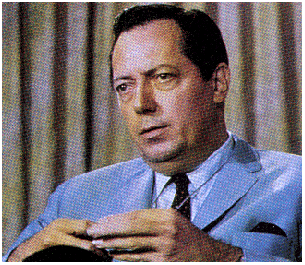
    America has just lost the best friend it ever had. On October 26th, Mort Sahl—actor, writer, director, teacher, political satirist and Jim Garrison investigator—passed away in Mill Valley at age 94.

    Mort invented the modern form of political satire—hell, he transcended it. In the early 1950’s in clubs along San Francisco’s North Beach with names like the hungry i and the Purple Onion, this new young talent was riffing on the political headlines of the day in an almost jazz-like, improvisatory way. Eschewing the square looking business suit look of most comedians, Mort sported a V-neck sweater, toted the day’s newspaper, and delivered his lines in a rapid-fire staccato rhythm—like a Paul Desmond or Stan Kenton on bennies (Kenton especially was an early hero and even mentor of Mort’s). Mort’s routine would equally take the piss out of a Republican or a Democrat, it didn’t matter. Mort always took up the mantle of the loyal opposition, sometimes bringing on controversy and trouble. One night in the basement club, the hungry i, after a rather tame joke targeting Ike (“They’ve just brought out the Eisenhower jacket. It has a lapel that buttons over the mouth.”) some patrons took offense and rolled the garbage cans from outside down the club stairs which opened up onto the stage.

    Word of Mort’s brand of comedy spread rapidly, especially after influential newspaper columnist Herb Caen took up Mort’s cause (“I don’t know where Mr. Sahl came from, but I’m glad he’s here”). Established comedians and other show business people were soon coming up to see the hot new comic, with Eddie Cantor providing some early mentorship. By the end of his first year playing to packed houses at the hungry i, Mort was earning $3,000 a week—in 1954 money.

    With this success came bigger venues, college campuses, and, of course, TV. Along with that came a newer circle of friends: Sinatra and Martin, Marilyn Monroe and Arthur Miller, Hefner, Belafonte, Brando, and Julie London (“Now there was a woman,” Mort once told me, not in any way lascivious). Mort and Paul Newman had once been roommates. Mort was married early on to actress Sue Babior, but after 27 months they were divorced. Mort was soon smitten with an actress names Phyllis Kirk, best remembered at that time as Nora Charles opposite Peter Lawford’s Nick on The Thin Man TV series.

    NBC hired Mort to cover the 1956 Democratic convention. Mort was a firm supporter of the Democratic candidate Adlai Stevenson. The intellectual and eloquent former Governor of Illinois (and perennial democratic candidate) appealed greatly to Mort and the two would become lifelong friends.

    Mort also led the way in the recording of comedy albums. There were a couple of studio-recorded albums out there, but when Mort took the stage on January 26, 1958, the first modern live comedy LP, The Future Lies Ahead was born.

    Naturally, Hollywood came calling and Mort was soon co-starring with Alan Ladd (All the Young Men), Sammy Davis, Jr. (Johnny Cool), and Tony Curtis and Sharon Tate (Don’t Make Waves). Bookings at the premier venue of the time, the Copacabana, soon followed. In 1960, Mort made the cover of Time magazine.

    Mutual friends brought Mort into the Kennedys’ orbit. Mort was soon writing jokes gratis for Senator John Kennedy’s presidential campaign. After the election, Mort went back to being the loyal opposition. Jack loved it, but word got back to the old man who now considered Mort persona non grata. (“Doesn’t Sahl know the meaning of loyalty?”)

    Mort split with Phyllis Kirk and was soon linked with Dyan Cannon and later Yvonne Craig. While his career thrived, his “rebellious nature did rub some people the wrong way.” Nevertheless, he was looking forward to the 10-year anniversary of his first performance at the hungry i. The date was November 22, 1963.

    II

    To many, the assassination of President Kennedy was a life altering event, few can quantify it the way Mort later could. As Walter Cronkite led the nation in “communal crying,” the country served witness to 3 murders that weekend (JFK, Officer Tippit and accused assassin Lee Harvey Oswald at the hands of “patriotic night club owner” Jack Ruby). As Mort reported shortly after, “Oswald was killed in the basement of the Dallas Police while surrounded by 40 cops—41 if you count Ruby.”

    Within days, LBJ appointed a “blue ribbon” commission, an idea actually foisted on him by National Security State veterans Eugene Rostow and Joe Alsop. Named the Warren Commission after its reluctant and browbeaten leader, Chief Justice Earl Warren, the commission was quickly hijacked by its 2 civilian members, former CIA Director Allen Dulles (who Kennedy had fired) and Cold War stalwart John McCloy, along with various ambitious junior counsel (Arlen Specter for example) who were out to enhance their resumes. The result was preordained (lone nut Oswald killed JFK on his own) and the media reaction predictable.

    Mort smelled a rat, but began working the assassination slowly into his act. The catalyst was the credible critical work that began to emerge: Mark Lane’s Rush to Judgement, Harold Weisberg’s, Whitewash and many others. Later, he would wheel out the entire Warren Report and its 26 volumes on stage. Mort would read some of the more ridiculous and irrelevant sections from the Warren volumes (Jack Ruby’s mother’s dental chart for example). Around this time, Mort also met and married amateur athlete and the first Asian-American Playboy centerfold China Lee.

    Shortly thereafter, Mort was presented with the Nielsen ratings for his LA TV show. Ostensibly, they showed that his ratings had dropped from a 3.0 to a 1.0 share overnight. Station management told him outright that “he talked too much about the Kennedy death.” (Mark Lane had been a guest four times) Mort was fired on the spot. After a 39 week successful run, Mort was convinced “outside forces” were at work. He took to the microphone to relay his suspicions. His listeners agreed. Signs began appearing along Sunset Boulevard calling for demonstrations at KTTV. The station’s switchboard lit up and over 35,000 letters came into the mail room. Mort gave a press conference where he revealed he had received a memo from management ordering him to “lay off” the Kennedy assassination. Finally, it was admitted that KTTV had “misread” the Nielsen ratings. Although there was a drop in the first hour of the show, during the second hour the show added some 30,000 viewers. In fact, Mort had as many as 250,000 viewers per quarter hour. Instead of being fired in disgrace, Mort was given a 13-week renewal and a salary increase. His first guest after his renewal was Mark Lane.

    III

    On February 17, 1967, the New Orleans States Item ran a page one story with an above the fold banner headline that read: “DA HERE LAUNCHES FULL JFK DEATH PLOT PROBE.” The article revealed that the Orleans Parish District Attorney, Jim Garrison, was investigating a New Orleans based plot to assassinate JFK and that the office had already spent some $8,000 on travel expenses so far. On the 18th, Garrison held a press conference and announced he had a suspect—David Ferrie. A CIA contract pilot, virulent anti-communist, and mentor to young Oswald when he was in Ferrie’s Civil Air Patrol unit, Ferrie denounced the whole thing as a joke. But he was hardly doing much laughing. As he had done just after the assassination, Ferrie spent his final days engaging in activities which clearly displayed a consciousness of guilt. He eventually broke down and admitted much incriminating information to the DA’s Chief Investigator Lou Ivon. Three days later, Ferrie was found dead of “natural causes”—age 48. Garrison’s number one suspect was dead, but Garrison’s case wasn’t. He turned his attention to the man he had hoped Ferrie would implicate. On March 1, 1967, Garrison announced he had arrested the manager of the New Orleans International Trade Mart, Clay Shaw. The international media descended upon New Orleans—the whole world was watching. So was Mort Sahl.

    Mort turned to China and asked, “Is he corrupt?” (China’s brother would soon be the sheriff of neighboring Jefferson Parish). “No,” she said. “I’ve known him ten years. He’s incorruptible.” Channel 11 sent Mort down to New Orleans to get an interview. Getting in the cab in New Orleans, Mort said, “4600 Owens Boulevard.” The driver replied: “That’s Jim Garrison’s house! I’ll let you off on the corner. I don’t want to get shot.” Mort walked to the door and rang the bell. A 6’6” giant of a man wearing a bathrobe answered the door. “I’m Mort Sahl and I came down here to shake your hand.” Garrison said, “I hope you’re available to do a lot more than that.”

    Later, Garrison would take Mort down to the wine cellar at the Royal Orleans Hotel and open up his case file. Mort cleared his calendar and signed on as $1 a year investigator for the DA’s office. Sahl took an apartment in New Orleans and began punching the clock at the office like any other investigator or Assistant DA. Mort went from making millions a year to approximately $13,000. To pay the bills, Mort would play college campuses and make the occasional TV appearance. On one appearance on The Tonight Show, Mort challenged Johnny Carson to have Garrison on the show. Carson took up the challenge and Garrison was booked. Mort prepped Garrison. One can only guess who prepped Carson. Since Carson’s network NBC just ran a hit piece on Garrison, it’s not hard imagining the ringleader of that farce, Walter Sheridan, having some sort of input to Carson’s belligerence. What is known is that Carson lied about who did brief him. When Mort asked Carson who would question Garrison, Carson replied, “I will. I holed up one Saturday afternoon and read the Warren Report.” As Mort noted, it took him 27 months to read the report and its 26 volumes.

    Carson’s antagonism and constant interruptions forced NBC to issue thousands of form letters apologizing for Carson and explaining that Johnny had to play devil’s advocate. Mort replied: “The devil doesn’t need an advocate.” This only further infuriated Carson, who would never again have Mort or Garrison on his show.

    Mort had better success with Hefner and set up a lengthy interview for Garrison in the October 1967 Playboy. The interviewer, Eric Norden, gave Garrison a reasonably fair hearing. The American public had never heard this level of detail before on the subject.

    The more Mort advocated for Garrison in Hollywood, the more his “free thinking” friends started abandoning him (“Let it go, Mort”). One notable exception was the brave Art Kunkin, publisher of the L.A. Free Press, who routinely covered and interviewed Garrison.

    With the acquittal of Clay Shaw in 1969, Mort still played some clubs and talk shows, but the opportunities were drying up. With the Garrison probe winding down, the staff presented Mort with a plaque:

    To

    MORT SAHL

    The Best Friend

    John Kennedy

    Ever Had

    From

                                        Jim Garrison              Jim Alcock

                                        Andrew Sciambra     Louis Ivon

    New Orleans

    May 29, 1969

    It was time to ride on from New Orleans, but Mort found that to be a hard prospect. As he wrote in 1976:

    I’ve been trying to ride out of New Orleans for ten years. New Orleans is the most important city in America in the last hundred years. It’s where Oswald was bred, where he worked for Guy Banister and Naval Intelligence, where David Ferrie was, where Clay Shaw was, where Gordon Novel was, where the command post was. It was where Victor Marchetti first reported that he heard Richard Helms express concern over Garrison’s upcoming prosecution of Clay Shaw. It was where William Colby, addressing a convention, said that he could not deny that Shaw was a CIA agent. It was where Senator Schweiker promised to focus future investigations directly on the New Orleans area and where the lawmaker pointed out that Lee Harvey Oswald had contact with anti-Castro Cuban groups. And it was there that the District Attorney made the initial, and what was to be the only, thrust to seek justice for the fallen President. Even the Senate Intelligence Committee agrees on the significance of New Orleans in the plans to murder President Kennedy.

    IV

    With the 1970’s, Mort had a seemingly bottomless resource pool from which to draw material from. With the nation embroiled in Watergate, Mort enjoyed a brief renaissance. He released an album (Sing a Song of Watergate) bringing his unique perspective to the Watergate scandal (“With Nixon’s departure, we witnessed the second assassination of a President by the CIA in ten years”).

    During this season of inquiry (Watergate, the Pike Committee, the Church Committee, Zapruder film on TV, the House Select Committee on Assassinations, etc.), the timing was right to bring a unique voice to the airwaves of DC.

    In 1978, a commercial aired on a local DC TV station. A man was shown sitting on a park bench in front of the White House reading a newspaper. A voice intoned, “Mort Sahl is coming to WRC radio. Weekdays at 4:00.” Among others, a 22-year old kid fresh out of college and sitting at home was watching.

    I had heard of Mort Sahl, but knew very little of him or his work. I knew even less about the Kennedy assassination. At 4:00 on October 16, 1978, I tuned in. To say I was gob-smacked would be an understatement. I had never heard this kind of unique perspective on current events or dissertations on history told through a covert Cold War lens. All articulated with unbelievable wit and humor. And then there was the Kennedy assassination. Mort was not only a scholar on the event, but had much first-hand knowledge through the Kennedys, etc. A dizzying array of names I had never heard of were tossed out: Prouty, Garrison, Lane, Marcus, Flammonde, Weisberg, and literally dozens of others. Somehow I needed to gain this forbidden knowledge. I began haunting the local libraries (slim pickings), which soon turned into trips to the Library of Congress where I took notes and Xerox’d pages of rare (suppressed?) volumes. One name kept coming up more than others in Mort’s monologues: Jim Garrison. I couldn’t find his book, so I had to Xerox pages at the Library of Congress. I had more luck tracking down the 1967 Playboy interview. After reading it multiple times, the Garrison thesis made the most sense to me of all of the critical literature I had read.

    I finally worked up enough nerve to call into Mort’s show—the first and only time I would ever call into a radio show. Greeting Mort with a line that cracked him up put me at ease (“Mort, you’re like a breath of fresh carbon monoxide”). Most of Mort’s call-ins lasted about 3 minutes—we talked for 10: Garrison, Clay Shaw, New Orleans, MIGS in Cuba, movies. We covered a lot in those ten minutes. Fortunately, I had my tape deck running and taped this show and many others. I had hundreds of hours of tapes which, unfortunately, over time has been whittled down to about ten. But these ten hours are some of my most cherished possessions. The quotes are priceless and timeless. Mort’s true loves, America, women, films, and justice always shined through. It’s also amazing how prescient the man was and how little the human condition has changed over the decades:

    Mort: This is the only time in history where people join groups to become individuals.

    Mort: In a world without romance, it is better to be dead.

    Mort: Garrison had, what Freud described as, “relentless integrity.”

    Mort: (After a caller had expressed concern that Ted Kennedy would be killed if he ran for President and went after his brothers’ killers.) Imagine. You’re conceding that murders are now part of the body politic.

    Caller: If David Ferrie hadn’t died, how would it have affected the [Shaw] trial?

    Mort: It would have changed American history. I can give you my solemn word on that. It would have changed American history. The names that bear on the history of this country are names that most Americans don’t know. Names like Guy Banister and David Ferrie.

    Mort: I don’t believe Ferrie was in Dallas that day. That’s not where his post was. You know, there were several posts. New Orleans was part of it. Galveston. Several cities. It was a major operation. The assassination was the crystallization of all the people that resented Kennedy making their move, because the President had promised (many people who are in the government now can verify this) that he would remove everybody from Viet Nam and that he would split the CIA into a thousand pieces. He never lived to do it.

    Later a caller identifying himself as a 20-year CIA veteran called and berated Mort for trying to obtain information from the CIA via FOIA:

    Caller: The CIA is a damn good organization. Them and the FBI both. Thank God we’ve got these boys…with every bum coming up the street having a right to read it (FOIA releases)…You don’t have the information and you’re trying to get it and you’re not going to get it! I think your naive! How do you like that? [click]

    Mort: And I think you’re a party to murder, how do you like that?

    Mort was in the right place at the right time and evoked some of the more classic Mort lines. The Jonestown Guyana mass suicide was fresh in the headlines (“You all jump on the bandwagon very easily saying Jones is a madman. Jones is crazy. The point is you don’t ask enough questions – of yourself I might add”). The House Select Committee on Assassinations was preparing their final report (“I urge everyone listening to write to Ted Kennedy to continue the investigation. Jim Garrison was vindicated. The truth hurts, but the lies will kill you”).

    Despite having a great show that performed well in the ratings, after just five months Mort was homesick and had had enough. Mort asked for and obtained permission from NBC to quit the show. The final show aired on March 9, 1979.

    V

    Mort wanted more time to focus on his film career. He had written a comedy called How the West Was Shrunk. Mort’s friend Bob Kaufman wrote the screenplay and comic actor David Steinberg was attached to the project playing the Freudian psychiatrist who travels to the Old West to introduce the cowboys to Freudian analysis. The project never got off the ground. However, Mort would spend most of the 1980’s punching up scripts (Ordinary People, Tootsie, Sabrina, and a dozen others).

    On October 11, 1987, Mort Sahl on Broadway opened at the Neil Simon Theatre. Essentially a 90 minute stand-up performance, it nevertheless garnered good reviews. It did fair business as well, but they didn’t push it very hard. The show closed shortly after the first of the year.

    In 1988, Jim Garrison penned a second volume on his investigation: On The Trail of the Assassins. As with his first book, A Heritage of Stone, Mort is once again acknowledged. Around this time, a young filmmaker named Bob Weide began filming Mort and interviewing some of his close associates from not only Hollywood and San Francisco but New Orleans as well (Garrison made an appearance, as did his Assistant DA, now magistrate, Andrew Sciambra, who rarely gave interviews). Weide eventually sold his film to PBS, who aired it as part of the American Masters series on September 18, 1989.

    During this time Garrison’s new book had been optioned by Oliver Stone and in 1991 became the blockbuster film JFK. Mort was not a technical adviser. However, Mort had landed a weekly talk/commentary series for the fledgling Monitor Channel. Mort Sahl Live! aired on November 16, 1991. It would be the highest rated show in the short history of the Christian Science Monitor network. On April 15, 1992, the Monitor Channel was shut down.

    In 1997, as I was working on my own book Let Justice Be Done, I was invited to LA by a mutual friend of mine and Mort’s. Dinner was arranged at Ruth’s Chris in Beverly Hills. As my friend and I were finishing our martinis (in honor of Jim Garrison), Mort walked in looking a little stoop shouldered and drawn. Mort had told us he had just come from a meeting with LA District Attorney Gil Garcetti. A few months earlier Mort’s 19-year old son Mort Jr. had died of a heroin overdose. Ever skeptical, Mort wanted to ask the DA his own questions. As the dinner progressed, the mood did lighten. Mort and I agreed we would hook up again. As he left the table, Mort waved a small American flag on a stick—upside down, of course.

    In 1999, at the same time my book was published, my first daughter was born. Amid this whirlwind of events, and to my everlasting embarrassment, I had neglected to send Mort a copy of my book. Word got back to me though: Could I send Mort a copy of my book and would I inscribe it? I had to pull myself up off the floor. Here was one of the most important influences in my life essentially asking me for an autograph. Who was I for christsake? I sent Mort an inscribed book straight away, along with a copy of his book, Heartland (1976) asking for his inscription. A couple of weeks later I received the book back in the mail with this inscription: “For Bill Davy—who courageously pursued the truth—and caught it! Mort Sahl” It is probably my most valued possession.

    VI

    In the fall of 2008, Mort began teaching at Claremont McKenna College. He taught one course in screenwriting and another he called The Revolutionary’s Handbook. On the required reading list, sandwiched in between Prouty and Garrison, was my own book. I must admit feeling a little humbled to be included on a college reading list along with the likes of Prouty, Garrison, Che Guevara, Shakespeare, Aristophanes, and Henry Miller. Mort invited me out to sit in on a class as a guest speaker. I flew out planning to stay a day. I stayed four. From the airport, I drove straight away to Mort’s bungalow on campus, a perk Claremont had hooked him up with. It had been a decade since I had seen Mort and was a little taken aback. He had been fighting cancer and was legally blind in one eye. Nevertheless, his spirits were high and so was his energy (I could barely keep up). After that first day, a group of us went to dinner, Mort, myself, a mutual friend, Director of the Gould Center for Humanistic Studies at Claremont Robert Faggen, and the most promising student from Mort’s class, a young man of about 19 or 20 whose name I no longer remember. A lot of good wine and good conversation flowed that evening and I remember thinking how lucky that student was to experience something like this. This is what college should be about.

    The next three days I spent almost exclusively with Mort and it was like sitting with Socrates or something (except with a sense of humor).

    A year or two later Mort reached out again. He was doing some gigs down in Palm Beach, Florida. Did I want to come down for a few days? I was on the next flight out. Mort was playing a gig at a former theatre that was now hosting stand ups and bands on nostalgia tours (KC and the Sunshine Band had played the week before). Mort had no one in his party, so I was sort of an entourage of one. I helped him get ready for the gig, assisted with the sound check, and got him a newspaper to use as his prop. Before the gig, we went back to where Mort was staying—the Palm Beach home of General Alexander Haig. Yes, that Al Haig. The Supreme Allied Commander of the NATO forces. The Secretary of State. The Presidential Chief of Staff. The “I’m in charge” Al Haig. Mort met Haig back in 1988, when Haig was running for President because, as he told Mort, he felt George H.W. Bush was a dangerous man. Mort and he found some common ground and Mort wrote a few jokes for the short-lived Haig campaign. And while the campaign may have been short lived, Mort and Haig became fast friends. I was introduced to Haig (“call me Al”) and his lovely wife. As I remember, his adult daughter was there as well. The guys retired to the living room with snacks and iced tea. I had to pinch myself and blink a couple of times to make sure this surreal scene was real. But the general was a fine host and a conspiracy theorist too! (He tried to push the Castro did it theory, evoking a laugh from Mort). As we left, Mrs. Haig took photos of all of us. It occupies a prominent place in my office.

    The gig went off without a hitch. Mort was on top of his game and the audience agreed. After the show, we went next door to a restaurant and dined with the Haigs. Mort was feeling good and held forth at dinner, while we agreed to do this again for future gigs.

    However, I had a strange premonition that this probably going to be it as I flew back the next day. I was initially proven wrong though. Sometime later, I received another call: Mort and Dick Gregory were going to do a series of shows together at the world-famous Mister Kelly’s in Chicago. Did I want to come up and assist? Same deal like Florida. My answer: “When do you need me to leave?” Soon. I just needed to stay in a holding pattern until the deal got finalized. I also knew Dick a little, as we had met in Dallas in 1998 when we both spoke at the same conference. And, of course, I was well aware of his work. Unfortunately, the gigs fell through. Doubly unfortunate was that Florida would be the last I would see of Mort. My premonition had proved true.

    I kept track of Mort over the last few years. I was delighted to see him on Facebook and even working, doing stand-up (more sit-down at this point) every Thursday night at the Throckmorton Theatre in Mill Valley, even taking Q&A over Periscope/Twitter.

    Mort’s influence is incalculable. It certainly is for me. There are currently three books in print, all published in this century either partially or in their entirety about Mort: Last Man Standing: Mort Sahl and the Birth of Modern Comedy by James Curtis, Revel With a Cause: Liberal Satire in Postwar America by Stephen E. Kercher, and Seriously Funny: The Rebel Comedians of the 1950’s and 1960’s by Gerald Nachman. Indeed, in 2017 when I spoke at a conference at VMI’s Center for Leadership and Ethics, the moderator dedicated the program to Mort Sahl.

    Mort’s closing words from his own book Heartland resonate more clearly now than ever:

    Don’t be diverted by prefab threats. The populist suspicion of the federal government is maybe what stands between you and an unstated fascism now. My story isn’t special, but it’s strenuous. I took America at its word. We were right and we were wrong. We were right to pursue the murderers among us. We were in error in pleading our case for America in Beverly Hills and New York. Don’t appeal to the intellectuals. The hope of America is the heartland.

    Vaya con dios, pal.

  • Bill Davy at the VMI Seminar

    Bill Davy at the VMI Seminar

    Alan Dale:

    I have the honor of being your host, your emcee. I’d like to begin by introducing our first speaker. William Davy is a longtime researcher and writer, a respected contributor to Probe Magazine. He’s been published as an essayist and reviewer. He’s the author of a monograph on Clay Shaw, which he further developed into his illuminating and much admired work, Let Justice Be Done: New Light on the Jim Garrison Investigation. Please welcome Bill Davy.

    Bill Davy:

    Thank you. Thank you, thank you, Lee, and good evening everybody. Just give me a second to get settled here and get my eyes on. Okay. All right.

    The topic of my presentation tonight are the new documents and the Season of Inquiry. By the Season of Inquiry, I’m talking about essentially the 1970s. It really was a season of inquiry. We have Watergate, of course, the Pike Committee, the Rockefeller Commission, the Church Committee, and House Select Committee on Assassinations. It seemed like at the time the politicians in the country in general were more interested in uncovering the political state. Pardon the term. Present company excluded, of course.

    We’re going to go into some of the documentary evidence, but oftentimes when I’ve given talks to, say, a less sophisticated audience, just to start off, I’ve asked the question, “What do you feel is the government’s official position on the JFK assassination?” and people will say something like, “Well, Oswald did it,” or, “That Warren Commission thing.” I say, “No, that’s not the official position at all. The official position of the federal government is that JFK was killed by a conspiracy.”

    It’s right there. That is the copy … Or it’s right here. It’s the final report of the House Select Committee on Assassinations. God knows there’s all kinds of problems with the HSCA. You can do a whole symposium on some of the in-fighting and backstabbing and so forth.

    But that aside, they did some good work, and a lot of that good work found its way into the report itself. I just want to take a quick look at some of the findings of the report. I hate talking at people because everybody can read, but a few of these are worth noting.

    First, “The committee believes on the basis of the evidence available to it that President John F. Kennedy was probably assassinated as result of a conspiracy.” Further, “The committee found that, to be precise and loyal to the facts it established, it was compelled to find that President Kennedy was probably killed as a result of a conspiracy.” Compelled to find, pretty strong language, even though they keep slipping the ‘probably’ in there.

    We’re talking about the scientific evidence here. The evidence available to the committee indicated that it was “probable that more than one person was involved in the president’s murder. That fact compels acceptance.” Again, with the compelling. “And it demands a reexamination of all that was thought to be true in the past.”

    Further, they conclude, “Neither Oswald nor Ruby turned out to be loners, as they’d been painted in the 1964 investigation,” and indeed in the media, ongoing as a matter of fact.

    “The committee found that the CIA-Mafia-Cuban plots had all the elements necessary for a successful assassination conspiracy: people, motive, and means; and the evidence indicated that the participants might well have considered using the resources at their disposal to increase their power and alleviate their problems by assassinating the president.”

    Again, talking about the scientific evidence. “Scientific acoustical evidence establishes a high probability that two gunmen fired at President John F. Kennedy. Other scientific evidence does not preclude the possibility of two gunmen firing at the president.” They’re talking about the stuck open mic of the motorcycle policeman who essentially recorded the assassination as it happened.

    Further, in talking about the photographic evidence, “A fleshtone comparison performed by analyzing measurements of color values,” and this is on Willis photograph number five. “A fleshtone comparison performed by analyzing measurements of color values on an object located behind the west end of the retaining wall,” this is on the grassy knoll, “confirmed that the image perceived was actually a human being.” They found photographic evidence of a human being behind the retaining wall on the grassy knoll.

    “The panel did perceive ‘a very distinct straight-line feature’ near the region of this person’s hands, but it was unable to deblur the image sufficiently to reach any conclusion as to whether the feature was in fact a weapon,” but they found a person and they found what appeared to be a weapon behind the grassy knoll.

    “During the course of its investigation, the committee developed several areas of credible evidence and testimony indicating a possible association in New Orleans and elsewhere between Lee Harvey Oswald and David W. Ferrie.” I’ll assume most people know who David Ferrie is, so we don’t have to go down that road.

    “The committee found that the Clinton witnesses … ” This may require a little explanation. What they’re talking about here is the town of Clinton, Louisiana, which is just outside of Baton Rouge. It was uncovered during the Garrison Investigation and the subsequent Shaw trial that Lee Harvey Oswald was seen in Clinton, Louisiana at a voter registration incident with not only David Ferrie but Clay Shaw as well.

    “The committee found that the Clinton witnesses … ,” and there was a whole cross-section of people up there testifying to this. “The committee found that the Clinton witnesses were credible and significant. It was the judgment of the committee that they were telling the truth as they knew it.”

    “If the witnesses were not only truthful but accurate as well in their accounts,” they’re talking about the Clinton witnesses, “they established an association of an undetermined nature between Ferrie, Shaw, and Oswald less than three months before the assassination.” “The committee was, therefore, inclined to believe that Oswald was in Clinton, Louisiana in late August, early September ’63 and that he was in the company of David Ferrie, if not Clay Shaw.”

    “The committee also found that there was at least the possibility that Oswald and Guy Banister were acquainted.” Banister, Ferrie, and Shaw were a triumvirate of suspects and intelligence operatives that had come into the orbit of the Garrison investigation. Anybody who’s seen Oliver Stone’s film, JFK, certainly knows who these players are. The committee found that there was at least a possibility that Oswald and Banister were acquainted. We’ll show later that that was more than a possibility.

    “The committee obtained independent evidence that someone might have posed as Oswald in Mexico in late September and early 1963.” This was the imposter down in Mexico City. Dr. Newman will probably be covering some of that later.

    On the Warren Commission, the committee found that it “failed to investigate adequately the possibility of a conspiracy to assassinate the president”, that it “presented as conclusions in its report in a fashion that was too definitive”. It “overstated the thoroughness of its investigation”, and that “It is a reality to be regretted that the commission failed to live up to its promise.”

    A summary of the House Select Committee’s conclusions. President Kennedy’s assassination was the result of CIA-Mafia-anti-Castro conspiracy. A gunman fired from the grassy knoll. Oswald was associated with Ferrie, Shaw, and Banister. Oswald was impersonated in Mexico City. The Warren Commission was a failure. Does that remind you of anybody? The House Select Committee’s conclusions vindicated Jim Garrison.

    Further vindication of Garrison comes in the form of the Church Committee. This is a rather misleading title document of Oswald in New Orleans. It’s 155 pages and there’s very little in it on Oswald in New Orleans. Again, this comes from the files of the Church Committee. This is the cover sheet: Oswald in New Orleans. One that’s of importance for us here is this interview with Wendell Roach.

    Now Mr. Roach at that time was in charge of the INS in New Orleans. That was the Immigration and Naturalization Service. It’s since become part of DHS, known as ICE and Customs and Border Patrol. But back before 9/11, it was known as INS. Wendell Roache was in charge of the New Orleans office. They interviewed Roach and … According to Roache, the INS’ role was to determine who was an alien and prevent unauthorized border crossings, et cetera. As part of their duties, they had the responsibility of surveilling these various Cuban groups in New Orleans, and there were a ton of them at the time, mainly these anti-Castro groups.

    The INS had them under surveillance. Included in the surveillance was the group of nuts, as he calls them, headed by David Ferrie. Roache knew the details of Ferrie’s dismissal from Eastern Airlines, various sordid details of his private life, et cetera. As part of surveilling these Cuban groups, they picked up surveillance on David Ferrie because he was closely aligned with these anti-Castro groups.

    As they were surveilling Ferrie and the anti-Castro groups, they picked up surveillance of Lee Harvey Oswald. As we can see here, Roache revealed that during the course of their surveillance, they picked up Lee Harvey Oswald going into the offices of Ferrie’s group. The offices of Ferrie’s group was at 544 Camp Street, which was Guy Banister’s office. Oswald had used that address and stamped that address on the literature that he was handing out in New Orleans. He was seen going into the offices of Ferrie’s group, Banister’s office, and Oswald was known to be one of the men in the group.

    Here you have an investigative body of the United States government in the person of Wendell Roache admitting that in the course of their surveillance, routine surveillance, they picked up David Ferrie associating with Lee Harvey Oswald, and the two of them going into Guy Banister’s office. Let’s see if we can blow this up a little bit.

    He also said that the anti-Castro Cubans have been trained by a six-foot ex-marine out of Lake Pontchartrain. He could be referring to Gerry Patrick Hemming here. Just throw that out there because he mentions … He goes out of his way mentioning a six-foot ex-marine.

    His take on Garrison was that Garrison had something: I read his reports in the newspaper, and they were correct. He received good intelligence, whether he was using it for politics or not. Roache noted that Garrison was all eyes and ears in the French Quarter.

    Further, he adds a little something extra to the Oswald story. When Oswald was arrested for the street scuffle with Carlos Bringuier in the summer of 1963, he was taken into custody. As the official record shows, the first thing he did he asked for an FBI agent, which was suspicious in and of itself.

    But there was an extra part of this story that hadn’t been revealed, at least I’d never heard of it until I found this document, and that is when they took him into custody, Oswald would only speak in Russian. When the NOPD had him, they assumed he was a Russian. They called INS. Of course, they would have responsibility for foreign aliens and so forth.

    One of Roache’s associates, this guy, David Smith, went to the police station, and he recognized Oswald as being part of the Banister-Ferrie group and said, “Look, this guy’s an American.” Once Oswald had been outed, he stopped with the Russian. It was then at that point he asked to see an FBI agent, but it was not until the INS guy had come in and said, “We recognize him from our surveillance of David Ferrie and Guy Banister.”

    When the Church Committee investigators finally tracked down Roache and they finally got a hold of him, this is what he said: “I’ve been waiting 12 years for you guys. I’ve been waiting for 12 years to talk someone about this.” No one ever bothered to run him down, talk to him. Maybe he didn’t volunteer the information either, but it’s rather shameful that the FBI and the Warren Commission, who were assigned to investigate the New Orleans angle, didn’t even come across this, and this is a representative of the federal government.

    As they were interviewing him over the phone, the Church Committee investigator was letting him go on and Roache began talking about Oswald. He said, “I saw him around frequently. I recall that he had an office in … ” As you can see, the interviewer cut him off. I was thinking to myself, “What are you doing?” Oswald was just obviously getting ready to say … I’m sorry. Roache was getting ready to say that they had seen Oswald had an office in Guy Banister’s building. It was obviously where he was going with that, but the investigator cut him off.

    Unfortunately that is about it in the files for Roache. I could not find any more follow up from the Church Committee. There was no transition of this evidence over to the House Select Committee. It’s just a shameful lack of follow up on this committees and that we’ve got a body of the federal government, the INS, who had seen Oswald in the company of David Ferrie and Guy Banister. Again, vindicating what Jim Garrison had been saying all along.

    Now what I want to do here is shift gears a little bit in that I’ll talk about … Again, this is out of the files of the Church Committee, because I think that’s been an unmined area for a lot of the researchers.

    This is the testimony of Scott Breckenridge. Scott Breckenridge was a counsel for the CIA. He had written the inspector general’s report on the CIA assassination plots. It was written by Breckenridge and Greer and signed off by the IG Ehrman .

    It came out of a Drew Pearson column that had appeared in The Post at the time. It was in response to a newspaper column by Drew Pearson, which had talked about Castro plots and how they may have backfired on the president, and Bobby Kennedy may be haunted by this. At any rate, the IG began their investigation of the assassination plot against Castro. This is some of what they came up with in the testimony of Breckenridge.

    First of all, he states that the only person to have seen that report was Richard Helms. It was written for Helms. Ehrman was the inspector general who signed off on it and Greer was the other author of it. Helms returned the report to the inspector general.

    What actually happened was they had one original and one copy. Helms ordered the copy destroyed and the one original got put in Helm’s safe at CIA headquarters. It left one copy of the IG report. For obvious reasons, Helms did not want that getting out.

    First of all, Helms didn’t like the report. One of the IG’s conclusions was that they concluded that the elimination of a dominant figure in government will not necessarily cause the downfall of the government. In other words, they’re saying assassination will not necessarily cause the downfall of a government. Helms didn’t like that. He liked assassinations. He thought it could lead to the downfall of a government.

    Further on, they’re talking about Phase I and Phase II plots against Castro. Phase I were the CIA-Mafia plots pre-JFK and ended under Eisenhower. Phase II were also CIA-Mafia plots. They began around November ’61, some time between November ’61 and April ’62. This is the William Harvey ZR/RIFLE-type plots.

    Some of the earlier plots to assassinate Castro were concurrent with the Bay of Pigs invasion. In other words, at the Bay of Pigs operation, a major component of that was the assassination of Castro. This information was never shared with the president, as it goes on here. Was that ever authorized by the White House, the president, and the Department of Defense? Answer: We have no record for it. Castro assassination plots, with the Bay of Pigs: not authorized. This goes on. This speaks, again, about the Bay of Pigs and the assassination plots.

    Breckenridge says, “I don’t think we ever found a clear record of the original authorization.” Senator Baker then asks, “Is it fair to say that Phase I of this operation included a plan for assassination of the leader of a foreign state without any authority from any agency or branch of government outside of the CIA?” Answer: “It is fair to say that our records did not disclose such authority.”

    On the question of presidential authority for these plots, as I note in my marginalia here, the answer is unequivocal. There was none. The president did not authorize any of this activity, and this is coming right from the CIA’s own inspector general report. That’s why this is key, I believe.

    Further, they’re talking about Sheffield Edwards. This is the briefing of Phase II by Helms and Sheffield Edwards to Robert Kennedy. They told him at the time that phase I was obviously pre-JFK and had stopped and that phase II, they did not notify him about, even though it was an ongoing operation. They told him that there were no current assassination plots.

    Then they’re asking who within the CIA approved the making of these false statements to Attorney General Kennedy, making of the false statements to RFK? Sheffield Edwards and Helms knew and approved making false statements to RFK. This would indicate that Colonel Edwards knew and that Mr. Helms knew, and knew that they were making false statements to RFK when they told him that phase I had been switched off and there was no phase II going on. Let’s see who we have here.

    This is CIA Director McCone. He had not been advised of any of the CIA assassination plots. In other words, they were worried that he would have stopped the assassination plots had he known, McCone. .. .so they didn’t tell him. It was just the director of the CIA. Helms and Sheffield Edwards and Harvey withheld all this information from the CIA director.

    Outside of phase I and phase II, there were other Castro assassination plots. As you can see, Breckenridge says yes in response to that. There was one plot about blowing up an electric plant in Havana while trying to get into position to assassinate Castro. That was an adjunct to these Phase I and Phase II plots, a sort of off the books, off the shelf kind of thing.

    There was another CIA plot where there was an assassin who tried three times and didn’t get into Cuba. After the Bay of Pigs occurred, he went on to some other activity. That was all that Breckenridge had, but there were other CIA plots to kill Castro prior to the Bay of Pigs with this one assassin trying three times.

    Again, they’re talking about other plots here, dropping in Cuban rifles with silencers to be used to kill Castro, correct. Also talking about the syringe with poison. This was actually a poison pen that was given to a CIA assassin. He was told that he had the approval, the tacit approval, of RFK to proceed with the assassination of Castro. That was Desmond Fitzgerald who was telling this to AMLASH, Rolando Cubela, code name AMLASH.

    Here they’re talking about other miscellaneous schemes prior to August 1960. It was when Kennedy wasn’t even in office yet. Again, Castro assassination plots ongoing prior to JFK even taking office.

    “We find no evidence of any of these schemesap proved at any level higher than division, if that.” Breckenridge: “That is correct.” There was no approvals as we see. There was no approval by the executive for any of these operations.

    This was something I didn’t know about. “Our record is not too conclusive, but when Mr. Colby,” they’re talking about William Colby taking over as CIA director in August of ’63, “instructed that if it had not already been terminated, it should be terminated.” They’re talking about the ZR/RIFLE assassination plots within the CIA.

    Apparently, as late as 1973, this was still an ongoing operation. It was still on the books. They didn’t know if it had been switched off or not. We’ll touch a little bit more on ZR/RIFLE in just a second.

    One thing I want to mention here, this gets brought up a lot in the context of Garrison and Garrison being mobbed up under the thumb of various mafiosos. They like to cite thi:s that the CIA knew about Garrison talking with Johnny Roselli in Las Vegas, and it was disturbing to them.

    First of all, Garrison was investigating the assassination of the president. He should be talking to Johnny Roselli. Certainly, the House Select Committee wanted to talk to him, and they did. After that, his remains ended up in an oil barrel floating outside of Miami. At any rate, what they were disturbed about was not that Garrison was mobbed up, they were concerned that Roselli was probably spilling the beans on the Castro plots to Garrison.

    It says here, they’re quoting from another CIA document, “Unhappily, it now appears that Garrison may also know this.” They’re talking about the Castro plots. Garrison may also know it because Roselli was spilling the beans to him. That’s what they were worried about, not that he was mobbed up, which he was not. That’s what they were disturbed about.

    They’re talking about Desmond Fitzgerald and the AMLASH plot and the poison pen that was given to AMLASH, and told that he had the assurances of Robert Kennedy, this was approved by RFK. F.A.O. Schwarz Jr., who was a counsel, asks, “There was no approval sought from Robert Kennedy?” Breckenridge: “That is correct.” They didn’t even ask for approval from RFK. They just went ahead and did it.

    This goes on to mention that there was a contingency fund of about $100,000 that could be used for these type of operations, off the book-type operations, unvouchered funds that could be used for assassination plots, foreign or domestic, and no one would be the wiser.

    This is actually one of the pages from the IG report itself. In the report, they ask, “Can the CIA state or imply that it was merely an instrument of policy?” CIA: “Not in this case. While it was true that phase II was carried out in an atmosphere of intense Kennedy pressure, such is not true of the earlier phase. Phase I was initiated in ’60 under the Eisenhower administration.” Again, phase II was never revealed to RFK or JFK. That’s just the second page of that. I just want to move on quickly.

    I mentioned the ZR/RIFLE program. That was the assassination program run by William Harvey. This is a document from the CIA. In 1976, probably as the HSCA was ramping up, they did a review of the ZR/RIFLE file. In so doing, they found these various ZR/RIFLE files, and note the early date pre-JFK. There’s a ZR/RIFLE administrative financial folder dated October 13th, 1960, and they’re talking about using one of their assets QJ/WIN back in 1959. As you can see, the ZR/RIFLE program predates JFK by quite a significant period. That’s just a continuation of that.

    Hale Boggs was a member of the Warren Commission. He was a congressman from New Orleans. A lot of people like to cite him as one of the Warren Commissioners who didn’t believe the conclusions, didn’t believe the magic bullet theory.

    Well, the FBI released these documents. In 1967, Boggs asked for a meeting with Deke DeLoach, who was J. Edgar Hoover’s right hand, if you will. He met with the Boggs in Boggs’ office. Boggs stated Garrison was making New Orleans and Louisiana the laughing stock of the world. He, Boggs, next praised the FBI and indicated that he had always been completely satisfied regarding the FBI’s thoroughness. He said that he wouldn’t be certain that Garrison had nothing which might bring disgrace upon him, Boggs, and his home state, et cetera.

    Here Boggs has reread much of the Warren Commission report just to make absolutely certain there were no loopholes. He stated he had found none. Boggs was no advocate of the Warren Commission and he was certainly no advocate of Garrison as he was informing on him to the FBI.

    Further discreditation of Garrison in the critical community came in a 1967-1968 broadcast by CBS. It was hosted by Dan Rather, Walter Cronkite, and their Dallas CBS reporter, Eddie Barker. It turns out that Eddie Barker was an FBI informant. “On this date, Eddie Barker, special agent in charge of contact, and news director of KBLD Radio and TV Dallas, advised me confidentially that CBS was planning a five-hour documentary. He stated the primary purpose of this was to take the books which are critical of the Warren report, particularly Rush to Judgment, and tear them apart.”

    He indicated in this document that he was not going to be critical of the FBI and, in fact, would support the Warren Report. He requested that this information be kept confidential and that he would give more details at a later date. Very accommodating of CBS.

    Finally, I’ll just conclude here something that’s not out of the files, but was actually in Vanity Fair magazine a few years ago. Yeah, 2009 actually. In it, they’re talking about William Manchester who wrote the book The Death of a President. Earl Warren went to Manchester and gave him the first draft of the commission’s report, of the Warren Report, and said, “Here. We’d like you to read it and approve its findings on behalf of the Kennedys.” Now is that any way to run an investigation? You’re having the Warren Report, the report with your name on it, vetted by the family of the murdered president? That’s a disgrace, frankly.

    This I apologize for the illegibility of, but this was an article from a magazine called Marin Life in 1977. It was written by a reporter named Richard Raznikov. Jim DiEugenio, who’ll be on later, can vouch, as I can, that if Raznikov dug this up, it’s as good as gold.

    What he revealed … It’s a little hard to read; it’s a little hard to read here … Earl Warren had attended a judicial conference in the State of Florida. At that conference, he confided to Raznikov’s source, who was a federal judge and a friend of Warren’s, that he, Warren, was ashamed of himself and of what the Commission had done and that the whole thing had been a whitewash, and he had been coerced into it by President Lyndon Johnson, which we knew.

    Again, this is from an unnamed source, but I have every confidence in this report of Richard Raznikov. If he’s got a source that said it, you can be pretty damn sure that he said it. You even have Earl Warren, the man whose name is on the cover of the Warren report, revealing that the whole thing was a cover up, a whitewash, and that he was actually ashamed.

    I was reading the inscription on the way in today out there, and it says, “Your services as informed citizens will be necessary to the peace and prosperity of the world.” That really touched me, and I hope that my little presentation tonight has helped you be a more informed citizenry. Thank you for your time. Thank you.


    This transcript has been edited for grammar and flow.


  • “Shoot Him Down”:  NBC, the CIA and Jim Garrison

    “Shoot Him Down”: NBC, the CIA and Jim Garrison


    garrison
    Jim Garrison

    With the arrival of the 40th anniversary of President Kennedy’s assassination, it was hardly surprising that one of the major television networks attempted to make the case for Lee Oswald’s sole guilt. Despite four decades of solid research indicating a conspiracy, the American viewing public was once again treated to a one-sided, unfair and unbalanced presentation. In light of this, it might be instructive to look at how one of the other networks tackled the case for conspiracy some 37 years ago. The mystery of the assassination is still a popular subject among people of all ages. A college student might not know how to ask a girl out, but you can bet they have strong opinions on the JFK assassination based solely on the network specials that run every so often.

    On June 19th, 1967 NBC aired an hour long “analysis” of New Orleans District Attorney Jim Garrison’s investigation titled, The JFK Conspiracy: The Case of Jim Garrison. While unnecessary to rehash Garrison’s case here, in summary Garrison’s investigation focused on three individuals: A former Eastern Airlines pilot and probable CIA asset, David Ferrie; ex-FBI man and private detective Guy Banister; and Managing Director of the International Trade Mart, Clay Shaw. Garrison believed all three were connected to American intelligence and had, at a minimum, conspired to set up Oswald as a potential patsy in the JFK assassination. Barely three months into his investigation, Garrison’s main suspect, the forty-nine year old David Ferrie, died apparently of natural causes. Banister had also passed away in 1964 as a result of a heart attack. On March 1st, 1967 Garrison arrested the surviving member of this trio, the CIA connected Clay Shaw. By mid-March both the Grand Jury and a three-judge panel had ordered Shaw to trial.

    Garrison’s case was big news and predictably the news media swung into attack mode. None was more vicious or had more resources at their disposal than NBC. For the job as lead investigative reporter, NBC assigned Walter Sheridan. Shortly after Shaw’s arrest Sheridan arrived in New Orleans and began questioning witnesses — perhaps bribing and intimidating would be a better choice of words. Sheridan questioned a former electronics expert and CIA asset Gordon Novel and immediately put him on a $500 a day retainer. (Novel had briefly consulted with Garrison’s team). Sheridan then urged Novel to skip town to avoid being indicted and paid him an additional $750 while Novel was in Columbus Ohio. Attorney Dean Andrews, who received the call from a “Clay Bertrand” to represent Oswald, was promised a recording studio if he cooperated with Sheridan. Andrews was overheard bragging, “I can get the equipment here. All I have to do is make a phone call, I’ll have open credit, I can pay off on any terms. Look, Bobby Sarnoff promised me those facilities. He’d better pay off, baby.” Bobby Sarnoff was, of course, Robert Sarnoff, NBC president and later chairman of the board of its parent company RCA.

    Garrison’s main witness at the time was Perry Russo, a young insurance agent who had claimed he overheard a conspiratorial conversation between Shaw, Ferrie and Oswald at Ferrie’s home. Sheridan “interviewed” Russo and seriously distorted his statements during the broadcast. As the New Orleans States-Item reported, “Russo said Sheridan, WDSU-TV reporter Richard Townley and Saturday Evening Post writer James Phelan repeatedly visited his home in attempts to persuade him to cooperate with NBC and the defense.” Russo said he met with the trio with the full knowledge of the district attorney’s office and reported everything that happened to Asst. DA Andrew Sciambra. Russo said, “Sheridan offered to set me up in California, protect my job and guarantee that Garrison would never get me extradited back to Louisiana” if he cooperated. He accused Townley of threatening him with public humiliation unless he changed his story and cooperated with the NBC program. The 25-year-old witness said members of the trio told him both, “NBC and the Central Intelligence Agency are out to wreck Garrison’s investigation.” Of course, Russo’s accusations were met with denials, but as we shall see Russo’s claims seem to have been accurate.

    Another of Garrison’s witnesses was Vernon Bundy, a heroin addict and prisoner who had testified at the preliminary hearing that he had seen Shaw and Oswald together at the Lake Pontchartrain seawall. Once Bundy had been exposed in the preliminary hearing, he was now fair game for Walter Sheridan and NBC. In their attempt to discredit Bundy, NBC aired interviews with two fellow convicts, Miguel Torres and John Cancler. Cancler, a convicted burglar and pimp, appeared first and said Bundy had told him he was going to lie to the DA’s office to get out of prison. Torres, whose own record of heroin abuse, burglary, pimping, assault, and suspected murder out rivaled Cancler’s, was currently serving a nine-year sentence for robbery. He said that Bundy told him he was going to make up a story about Shaw to get the DA to “cut him loose” from prison. After the airing of the NBC special, Garrison invited Messrs. Torres and Cancler to repeat their stories in front of the Grand Jury. Both pleaded the Fifth Amendment and were subsequently convicted of contempt. Another problem with Torres’ story is his accusation that Bundy needed the DA to “cut him loose” from prison. In a recently released memorandum from the New Orleans DA’s files, former aide William Gurvich wrote of his investigation of Bundy. Gurvich states, “Shortly after my interview with Bundy, I contacted local narcotics officers for background information on him. I also made an extensive inquiry into his criminal history.” Of his heroin use Gurvich writes, “[Bundy] uses four or five capsules of heroin daily… This amount is considered sufficient for addiction, but is not an excessive amount as the more heavily addicted use as much as 20-30 capsules daily.” Gurvich goes on to write “Bundy claimed he was in Parish Prison at the time because he went there voluntarily when he felt himself reverting back to the use of narcotics and feared the consequences of his addiction. Official records corroborate this.” Bundy was on probation for breaking into a cigarette machine, but was not serving time. So much for Bundy needing to be “cut loose.” Since NBC offered to relocate Perry Russo to California and provide him with a job if he changed his original testimony one can only imagine what incentives Sheridan offered Cancler and Torres.

    Garrison’s one time “aide”, the aforementioned William Gurvich also assisted Sheridan having left the DA’s office several weeks earlier. As Garrison noted shortly after the broadcast Gurvich didn’t so much resign as “drift away about six weeks ago” and that since that time he had been in contact with Walter Sheridan. Gurvich also admittedly made off with the DA’s master file. The CIA was so smitten with Gurvich that they wanted to make sure he was in touch with Shaw’s lawyers. In their enthusiasm to give Shaw’s lawyers all the help they could the CIA recommended:

    Shaw’s attorneys ought to talk to William H. GURVICH. This is an excellent suggestion. It is assumed they have done so, or plan to, but we should try to assure that they do.

    One other witness Sheridan used makes for an interesting case study of Sheridan’s abuse of power. Fred Leemans, the owner of a Turkish bath house in New Orleans, originally stated that Shaw had frequented his establishment using the name of Clay Bertrand. By the time Sheridan and company got to him, he went on the NBC special claiming he had been offered a $2500 bribe by one of Garrison’s men in exchange for his incriminating testimony. After the NBC special had aired, Leemans came forward with the truth. In a sworn statement Leemans admitted that part of the reason he participated in the show was threatening phone calls “relative to the information that I had given Mr. Garrison.” Leemans also recalled a visit from a man with a badge who stated that he was a government agent. The man supposedly told Leemans that the government was checking bar owners in the Slidell area for possible income tax violations. The man also warned him “it was not smart” to be involved in the Clay Shaw case “because a lot of people that had been involved got hurt.” An anonymous caller told Leemans to change his statement and claim he had been bribed. The caller also suggested that Leemans contact Irvin Dymond, one of Shaw’s attorneys. After contacting Dymond, Leemans was introduced to Walter Sheridan. Leemans claimed Dymond offered an attorney and bond in the event he was charged with giving false information to the DA’s office. Leemans said his appearance on the show was taped in the office of Aaron Kohn, managing director of the Metropolitan Crime Commission, in the presence of Sheridan and Dymond.

    The newly released CIA files present an interesting biography of “reporter” Sheridan. In 1955 Sheridan was security approved as an investigator for the CIA. A month later this was cancelled because Sheridan accepted a position at the ultra-secret National Security Agency. In 1956 he was security approved once again by the CIA so that he could attend their “Basic Orientation Course”. After leaving the NSA, Sheridan went to work for Bobby Kennedy’s Justice Department in the “Get Hoffa” squad, where his tactics in nailing Hoffa earned him a rebuke from none other than Chief Justice Earl Warren and paved the way for Hoffa’s eventual release. With this background in the intelligence communities Sheridan was now apparently qualified to work for NBC as a reporter, despite having no previous journalism experience. However, documents reveal that Sheridan did not sever contact with the CIA. In early May of 1967 the Counter Intelligence office of the CIA issued a memorandum for the Deputy Director of Plans which stated:

    Richard Lansdale, Associate General Counsel, has advised us that NBC plans to do a derogatory TV special on Garrison and his probe of the Kennedy assassination; that NBC regards Garrison as a menace to the country and means to destroy him. The program is to be presented within the next few weeks. Mr. Lansdale learned this information from Mr. Walter Sheridan of NBC.]

    As noted previously, during Sheridan’s tenure in New Orleans he enlisted the aid of Richard Townley from NBC’s affiliate, WDSU-TV. Townley’s loose tongue offered further proof that the NBC White Paper was no more than a deliberate attempt to sabotage the investigation and to ruin Jim Garrison. A recently released FBI memo reads:

    A local FBI agent reported that Richard Townley, WDSU-TV, New Orleans, remarked to a special agent of the New Orleans office last evening that he had received instructions from NBC, New York, to prepare a one hour TV special on Jim Garrison with the instruction “shoot him down.”

    After the program aired, Garrison petitioned the FCC who agreed that the program was biased and granted Garrison a 30-minute rebuttal to air on July 15 at 7:30 P.M. — hardly equal time. Nevertheless, the NBC program aided greatly in the discreditation of the DA’s office and potentially contaminated the Shaw jury pool.

    In addition to the aforementioned Richard Townley, the local New Orleans news media seemed to have more than its fair share of newscasters willing to flack for the intelligence agencies. Ed Planer, also of WDSU, offered to share information he had relative to the Garrison probe with the FBI. Also reporting to the FBI was Assistant U.S. Attorney Gene Palmisano. In a May 12th memo from the New Orleans office to Director Hoover, Palmisano stated that he had received information that NBC was planning a White Paper concerning Garrison and that this news special would destroy the credibility of Garrison’s investigation.

    As these repeated and obviously orchestrated attacks on the DA’s office continued, Garrison decided to fight back. On July 7 Walter Sheridan was charged with four counts of public bribery and Richard Townley was charged with attempted bribery and intimidation of witnesses. Sheridan’s New Orleans attorneys of record were Milton Brener, a former Assistant D.A. under Garrison, now vociferously anti-Garrison, and Edward Baldwin of Baldwin and Quaid. In May of 1967, Baldwin’s partner James Quaid wrote a letter to Richard Helms, then Director of the CIA, requesting that the Agency place his name “on their referral list of qualified attorneys in this area.” However, Sheridan’s Washington representation is much more illuminating.

    Herbert Miller was a former head of the Criminal Division of the Department of Justice who had worked closely with Walter Sheridan. In the aftermath of the assassination Miller was the Department of Justice’s point man in Dallas coordinating the Justice, FBI and Texas investigations. After leaving the DOJ, Miller entered private practice in the Washington firm of Miller, McCarthy, Evans, and Cassidy — the Evans in this case being former FBI Assistant Director Courtney Evans. In 1967 Miller went to work for the CIA representing the Agency’s interests in the Hans Tofte case. (Tofte was a long-time CIA covert operative who worked in the Domestic Operations Division with his protégé, Tracy Barnes. In 1966 he was fired by the Agency for apparently hoarding classified material in his apartment.) While he was representing the CIA in the Tofte flap, Miller found time to interject himself into the Garrison investigation. On May 1, 1967, Miller began offering intelligence on the Garrison investigation to the CIA.

    Later that week Miller called CIA Associate General Counsel Richard Lansdale to inform him of the expected arrival in Washington of Alvin Beauboeuf. Beauboeuf was one of assassination suspect David Ferrie’s close friends, having accompanied him on his mad dash to Texas on the day of the assassination. Miller’s source on Beauboeuf was Walter Sheridan. As Lansdale notes in his memo, “[the NBC special] is expected to ‘bury’ Garrison because everyone is convinced that Garrison is a wild and dangerous man.” Miller went on to assure the CIA that “Beauboeuf would be glad to talk with us or help in any way we want.” Garrison would note that after Beauboeuf’s Washington trip “a change came over Beauboeuf; he refused to cooperate with us further and he made charges against my investigators.”

    To recap, we have evidence that NBC reporter Sheridan was providing intelligence on the Garrison investigation to a CIA lawyer, a situation that indicates certain sinister possibilities. In fact, recently declassified records show that Sheridan wasn’t satisfied with solely presenting his own warped view of Garrison. A May 11th CIA memo reveals that Sheridan wanted to meet with the CIA “under any terms we propose” and that Sheridan desired to make the CIA’s view of Garrison “a part of the background in the following NBC show.”

    While Sheridan’s litigation was pending, Miller began doing double duty as a conduit between Shaw’s lawyers and the CIA. In May of 1968 Miller wrote to the CIA’s Lansdale:


    Dear Dick:

    Enclosed are the documents I received from Clay Shaw’s attorney, Ed Wegmann.

    Best Regards,

    Herbert J. Miller, Jr.


    The following month Miller provided the Agency with at least two more such packages.

    Miller was certainly a very busy man during this time frame. While Miller was acting as a CIA courier for Shaw’s lawyers and representing Walter Sheridan, he was also performing similar duties for Gordon Novel. While Novel was fighting extradition from Ohio, Miller came to his aid and was successful in getting an Ohio court to quash Garrison’s subpoena. Miller also provided the CIA with the transcripts from Novel’s civil suit against Garrison and Playboy. After Novel successfully avoided Garrison’s extradition he sent a clipping to former CIA Director Allen Dulles. In his own handwritten marginalia to Dulles, Novel took great pride in Miller’s victory, noting what a great job “Miller the Killer” did for him. It is interesting to note that the supposedly itinerant Novel now had four lawyers representing him: Miller, Stephen Plotkin, Jerry Weiner, and Elmer Gertz. Gertz, who had also represented Jack Ruby, was one of Novel’s lawyers in his civil suit. When answering a list of interrogatories posed to him by Playboy’s lawyers Novel stated that payment of legal fees to Weiner and Plotkin were “clandestinely remunerated by a party or parties unknown to me.” It was later revealed to a Garrison investigator by a former member of the CIA that Plotkin was receiving his fees from the CIA via a cutout, Stephen Lemman. As for Miller, just a few short years after the Shaw trial ended, he represented President Richard Nixon as his post-resignation attorney.

    What brings the Sheridan affair full circle is a friend of Sheridan’s, one Carmine S. Bellino. Bellino was a former FBI agent and Kennedy insider who worked with Robert Kennedy on the McClellan Committee in the fifties and was brought on to Sheridan’s “Get Hoffa” squad in the sixties. In 1954 Bellino actually shared his office with CIA/Mafia go-between, Robert Maheu. But what is troubling about the Bellino/Sheridan relationship is that Bellino once worked with none other than Guy Banister, performing background checks for the Remington Rand Corporation. In the seventies Bellino became an investigator on the Watergate Committee and did his best to steer the committee away from investigating any CIA involvement in the crime.

    In a 1967 memo the CIA outlined several mass media approaches to counter Garrison’s charges. One of their recommendations was to make sure that CIA Director Helms assure that various media outlets “receive a coherent picture of Garrison’s ‘facts’ and motives. In anticipation of a trial, it would be prudent to have carefully selected channels of communication lined up in advance.” Certainly the evidence above indicates that NBC was one such “channel.”

  • Mark North, Betrayal in Dallas: LBJ, the Pearl Street Mafia, and the Murder of President Kennedy

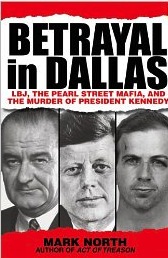
    Mark North, Betrayal in Dallas: LBJ, the Pearl Street Mafia, and the Murder of President Kennedy


    Having recently experienced an earthquake and a hurricane here in DC in less than a week, I thought I had seen my quota of disasters for a while. That is until this book showed up. In the pantheon of JFK literature we usually get one goofball theory per book. But in Betrayal in Dallas: LBJ, the Pearl Street Mafia, and the Murder of President Kennedy, author Mark North doubles-down and we get two discredited theories for the price of one.

    In this alternative universe LBJ, in cahoots with something called the “Pearl Street Mafia” (an invented title as the author admits), had JFK bumped off. For good measure, LBJ’s old crony and FBI head, J. Edgar Hoover is thrown into this mix as well. Hoover seems to be a favorite boogey man of North’s as he strongly implied JEH involvement in the President’s assassination in his previous offering, Act of Treason. In Betrayal in Dallas, according to North, Hoover’s complicity is unequivocal.

    It’s a common maxim that extraordinary claims demand extraordinary evidence. Yet the only extraordinary thing here is the marketing hype plus the author’s own undocumented claims. For instance, on page xi the author makes the bold assertion that “the new evidence revealed in this book proves to a legal certainty everything you have just read” [my emphasis].Talk about empty bombast. In the 159 skimpy pages that make up the body of the book, the case is not even close to being made. In a hyperbolic statement on the publisher’s website we are breathlessly told, “North’s conclusions are based on classified federal documents unknown to the public and research community.” And finally the author makes this bold declaration: “The evidence contained in this volume will force the hand of that [Justice] department by making public what they will not.” I may have missed it, but I don’t recall Eric Holder’s press conference confirming North’s assertions.

    Since we are told that the book is based on “documents unknown to the public and research community” certainly a check of the endnote section is a priority. By the way, I love how JFK researchers are slammed as being too thick to have discovered North’s “evidence”. Well, if that evidence consists of back issues of newspapers then, yes, I guess we have all missed the boat. You see, while some have us have wasted our time combing through the millions of pages of JFK related documents released by the Assassination Records and Review Board, North has trumped us all by simply reading loads of old newspapers. When one turns to the endnote section, one is immediately struck by a bizarre sourcing technique in which multiple instances of newspaper articles are presented in one endnote. For instance, endnote 10 of chapter 3 has close to 200 Dallas Morning News articles cited in that one endnote alone, and it runs on for 2 pages! One might get a pass on this if this was just an anomaly, but every chapter gets this kind of treatment with multiple source notes citing multiple instances of newspaper clippings. Has anyone ever seen such a format used before? On estimate it looks like 90 % of his endnotes are newspaper clippings. This goofiness makes up about 30 pages of the book while meaningless “exhibits” (mostly mundane letters) and other back matter account for another 80 plus pages. Oh, and don’t go looking for an index either. If you can believe it, there isn’t one. I’m on record as stating that the amount of pages shouldn’t be a consideration as long as you have something to report. But what North has done here gives the word ‘extraneous’ a whole new meaning. The United States government took four years to declassify millions of pages of formerly declassified or severely redacted documents on the murder of President Kennedy. Some of these papers were exceedingly interesting. Some of them were more than that. Some of them were absolute gems. To forsake that vital resource for old newspapers, to not utilize the documents at one’s disposal in the wake of the ARRB’s work, this is just shoddy. It kind of says: There wasn’t anything in those documents of value to my thesis. So let’s forget about them and read some reams of old newspapers instead.

    And speaking of shoddy, I think this is the first instance that I can recall where the publisher couldn’t get their own author’s name right. On the back cover blurb of Betrayal, they print “praise for the bestseller Act of Treason by Mark Lane.” That’s right. Mark LANE. The reader will recall that the author is in fact Mark North. The slapdash approach continues on the inside where, along with the examples previously mentioned, the author writes that RFK was a Senator on the McClellan Committee in the 1950’s. Of course, Robert Kennedy was not elected Senator until 1964.

    I’ve not mentioned North’s take on the hybrid conspiracy to kill the President as it hardly merits mentioning. But basically it’s the usual suspects: the Civello/Marcello arm of the Mafia killed JFK, this time with LBJ’s complicity. Johnson was also “mobbed up” along with other notable politicians, lawyers and judges (i.e. J. Edgar Hoover, Federal Judge Sarah T. Hughes, Assistant Attorney General Barefoot Sanders, and even Lady Bird!). While there is undoubtedly evidence of corruption among some of the politicos North implicates, it takes a giant leap of logic to put them in a criminal nexus intent on murdering the President. Despite the 30 pages of source (newspaper) notes, when it comes time for North to make his bold accusations, there are no citations. For example, on page 39 North writes, “With Civello providing the kill zone, it fell to Carlos Marcello in New Orleans to obtain the assassins.” Similarly on page 42 we are told, “By midsummer 1962, Marcello and Civello had set in motion the plan to murder the President.” Neither of these critical passages have any citations. Not even North’s beloved newspapers.

    On an affirmative note, North does not fall into the old trap that other “mob did it” enthusiasts do. That is he does not try to smear Jim Garrison as a Mafia goon. On the contrary, on page 33 North correctly notes that “In August [1961], New Orleans district attorney Jim Garrison’s office launched a drive on the Marcello-controlled French Quarter.” North goes on to note that “narcotics trafficking was to be Garrison’s office’s prime target.” Unfortunately, for the entire book, that’s about all you can put on the positive side of the ledger.

    After reading this volume, the only apparent betrayal will be to the consumer who plunks down $25.00 for this mess.


    Author’s Addendum:

    As I mentioned in the above review, for researchers to not utilize the documentation released over the years through the actions of the Assassination Records Review Board (ARRB) is inexcusable. This is a sentiment that I know is shared by this website’s owner, James DiEugenio, as he has mentioned it as well on several occasions, both on this site and on Black Op Radio.

    Consider the wealth of material the ARRB was able to extricate: the so-called “Lopez Report” on Mexico City, not to mention the supporting documentation, the CIA segregated collection of the House Select Committee on Assassinations (HSCA), the working (and personal) papers of Jim Garrison, Clay Shaw’s papers as well as the Shaw trial transcript, new interviews of all 3 of JFK’s pathologists as well as much new previously withheld medical evidence, CIA Inspector General reports on the Castro assassination plots and the Bay of Pigs, military and CIA documents on Vietnam, not to mention the working papers of the ARRB themselves. And this is just the tip of the iceberg!

    It is personally galling to this author to see books published anytime after 1993 not using this material. And most do not! (Notable exceptions are John Newman’s work, Jim DiEugenio’s and Lisa Pease’s work in Probe and its direct descendant The Assassinations, and my own humble effort, Let Justice Be Done). Indeed, a recent work that got very good reviews and was well received among the critical community utilized almost exclusively secondary sources in its research. Unless you are Nero Wolfe, who can solve mysteries without getting off of his fat duff, this approach is slovenly and sloth-like in my opinion. Whatever happened to good old-fashioned “shoe leather?” There is simply no excuse for not using a 3-pronged approach in JFK research:

    1. Interviews (Admittedly getting harder with the passage of time and key people dying off).
    2. The Paper Chase. (Extremely important in light of the ARRB’s work and what I’ve listed above). And yes
    3. Secondary sources: books, magazines, newspapers, etc. (But they better be damned good ones by credible authors and used sparingly).

    But regarding number 2 above, the National Archives (NARA) couldn’t make it any easier for researchers: just email them what you want and they’ll copy it and mail it to you (for a fee of course). There is plenty out there that hasn’t seen the light of day because nobody is doing the leg work. Let me give a recent and brief example. One weekday I went to NARA, arriving at 10:00 AM. I had them pull the working papers of several ARRB staffers. I reviewed several boxes of materials and copied over 100 pages. I was out of there by 1:00 and came away with a wealth of new information, including a heretofore unknown relationship between New Orleans FBI SAC, Warren deBrueys, and CIA spook David Atlee Phillips. The rest of the information will be included in my new book tentatively scheduled for publication in 2013. As with my earlier effort, this was all done on my own dime. For authors getting book contracts and advances, there is simply no excuse for bypassing this resource.

    Personally I always thought the old evidence was always pretty good. But at this point it makes little sense to regurgitate the efforts of Harold Weisberg, Vince Salandria, Sylvia Meagher and so many others, Especially when there is an avalanche of material waiting to complement their work.

  • Lamar Waldron, with Thom Hartmann, Legacy of Secrecy


    Ultimate Legacy: A Book Review by William Davy


    Legacy of Secrecy (Updated Edition)
    The Long Shadow of the JFK Assassination
    By Lamar Waldron with Thom Hartmann
    Counterpoint. 922 pp. $24.95


    Attention JFK researchers: You can fold up the tents and go home. The case has been solved! Yep, Lamar Waldron (and presumably co-author Thom Hartmann) have closed the case for us. According to the revised edition of Legacy of Secrecy (the sequel to the equally absurd Ultimate Sacrifice), the grassy knoll shooter has been identified. And he is none other than (drum roll please) … Watergate burglar Bernard Barker. That’s right; one of Howard Hunt’s handpicked Cuban operatives was the perpetrator of the dirty deed. You see, he was hired by Mafia boss Santos Trafficante who was working with fellow Mobsters Roselli and Marcello, the Teamsters, Cubans, assorted racists and some rogue CIA officers who all coalesced to ,,, ah, forget it. I’m confused too.

    As we head into 2010, the “Mafia did it” theory grows exponentially in asininity. (In light of Jim Douglass’ JFK and the Unspeakable, “extinct” would be the better word). Yet these forays into the bizarre ether of Waldron’s fantasies should now be familiar to readers of his logically challenged volumes. For those who aren’t already painfully aware of Ultimate Sacrifice‘s central thesis, it is thus: JFK and RFK had planned an invasion of Cuba led by Cuban exiles (which would also require a massive full-scale military invasion of the island) for December 1 of 1963 to coincide with an American planned and supported coup d’Ètat led by one of Fidel Castro’s closest associates. This bloody coup was to also include the assassination of Castro. Of course, these invasion plans were postponed by JFK’s death at the hands of the Mafia in Dallas on November 22nd.

    That these central premises fail to pass even the basic of smell tests is an understatement. Let’s review: The supposed Kennedy invasion plan would have required a military commitment (according to Joint Chiefs’ estimates) of roughly 100,000 troops – approximately our military footprint in Iraq today. Waldron would have us believe that the Kennedys withheld this critical bit of information from Secretary of Defense McNamara, Secretary of State Rusk, Vice President Johnson, the Joint Chiefs, NSC head McGeorge Bundy and a host of others for fear that it would “leak out.” Yet Waldron would have his credulity-strained audience also believe that bottom feeders like David Ferrie, Jack Ruby, the Mob and the most notorious blabbermouths of all, the anti-Castro Cubans, all had advance knowledge of the plan! The Mafia, apparently as confused as Waldron, decided to bump off JFK instead of waiting a couple of weeks for the coup plan to commence, which would have secured their former toehold on gambling and vice on the island. However, not even his brother’s assassination was going to stop RFK from proceeding with the deadly plan. Waldron claims further that the gung ho Bobby was prepared to reactivate the coup plan within weeks of his brother’s murder. That RFK was in no condition or position to do so is blatantly obvious to anyone who has read (and processed) David Talbot’s book Brothers. On top of all of this, Castro’s guy, Juan Almeida, who was to lead the treasonous coup against Fidel, is still a high ranking official in the Castro government today. (Of course, the actual reasons for the subsequent cover-up are rendered senseless by Waldron’s thesis).

    Ultimate Sacrifice, first published in 2005, took 904 pages to lay out its half-baked theory. In 2009 Waldron and Hartmann followed up their magnum opus with the sequel Legacy of Secrecy where their inane theorizing was applied to the MLK and RFK assassinations. And yes, the Mafia was responsible there too. You see, New Orleans Mob boss Marcello was a racist and wanted King bumped off because MLK supposedly declared war on the Mafia (I’m not making this up folks). A purported third volume will pin the assassination of Trotsky on the Mafia as well (just kidding). With Legacy weighing in at 922 pages, the combined goofiness reaches a whopping 1,826 pages, rivaling Vincent Bugliosi’s overblown mess, Reclaiming History.

    Now we have the obligatory “revised edition” of Legacy of Secrecy. Released in soft cover, the revision includes an addendum where Waldron lays out his shocking new Barker “revelation.” Of course, as in the earlier volumes, the nonsense is presented with a patina of scholarship – copious footnotes referencing newly released documents that supposedly support Waldron’s contentions. I say supposedly because in most cases they don’t. For instance, in Ultimate Sacrifice Waldron refers to a key document purportedly titled “Plan for a Coup in Cuba”. In fact the document is titled “State-Defense Contingency Plan for a Coup in Cuba” which takes on a totally different relevancy given its full title. Other documents apparently ignored by Waldron include a Defense Department document that refers to the invasion plan as a “sexy” contingency and not a concrete plan. Another document from the JMWAVE CIA station in Miami dated February 9th, 1964 claims the coup plot “may be nothing more than pure rumor or wishful thinking.”

    During his short tenure in office, Kennedy and his advisors crafted numerous contingency plans. SIOP-62, the plan to launch the entire American nuclear arsenal in one massive pre-emptive strike, was one such contingency. But by Waldron’s logic, JFK was on the threshold of initiating Armageddon. This trend continues in the revised Legacy of Secrecy. Waldron states that New Orleans private detective Guy Banister was originally considered as the CIA cutout for the CIA/Mafia Castro assassination plots (a role that ultimately did fall to former FBI man, Robert Maheu). This is supported by a footnote that references two CIA documents. So far, so good. Fortunately for the reader (and unfortunately for Waldron) both documents are available on-line at the Mary Ferrell website. Waldron could actually have been on to something here, but the documents he cites are too equivocal to make that leap. The closest they come is that Banister’s detective agency was being considered as a business cover (under Project QKENCHANT) and that he was subsequently not utilized. But as we’ve seen, this peculiar interpretation of the written record is standard operating procedure in Waldron’s oeuvre. Other questionable conclusions are Barker’s affiliation with David Ferrie due to their mutual pedophilia(!), and the aforementioned “Barker on the grassy knoll revelation.”

    Barker’s presence in Dealey Plaza adds to an already bloated cast of characters. Apparently in an effort to cover all of his bases, Waldron also has on hand in Dealey Plaza: Eladio del Valle, Herminio Diaz, Michel Victor Mertz, Charles Nicoletti, Gilberto Policarpo Lopez, and an unnamed Roselli assassin. Whew! Waldron’s grassy knoll has become more crowded than a Wal-Mart on Black Friday.

    Just as ludicrous is Waldron’s contention that two attempts on the President’s life occurred earlier in November in Chicago and Tampa (both Mob sponsored of course). While there is convincing evidence of a Chicago plot (presented decades ago by Edwin Black and not the one proposed by Waldron), the Trafficante backed Tampa plot has its problems as well. The St. Petersburg Times reported in its November 23rd, 2005 edition that a Florida Department of Law Enforcement special agent, Ken Sanz was working as a consultant on a book about Trafficante. Asked about the Tampa/Trafficante plot, Sanz replies, “In all the research I’ve done on the matter, I’ve never heard of such things. Never. And quite frankly, it’s fresh on my brain.” But straining the bounds of credibility even further, Waldron would have us believe that JFK and RFK were fully cognizant of the two attempts, yet proceeded with the fateful Dallas motorcade on November 22nd!

    Further, there is an almost pathological use of conditionals; may have, perhaps, could have, if, etc. Conversely, there is an overabundance of hackneyed declaratives where conditionals should have been used, as well as an over-reliance on unnamed sources. And yet this dogged pursuit and elucidation of the documentary record is supposed to be the sine qua non of these two books. (Along with the dubious information they gleaned from interviewing Cuban exile Harry Ruiz Williams).

    Unlike my previous, lengthier review of Bugliosi’s swollen tome which inspired me to invoke Shakespeare at its conclusion, I’ve purposely kept this review mercifully short as James DiEugenio has already done yeoman’s work in revealing the fallaciousness of Waldron and Hartmann’s two main volumes. Besides, it’s difficult to make much ado about nothing. (Oops, there I go again).

  • Vincent Bugliosi, Reclaiming History: The Assassination of President John F. Kennedy


    I

    “Vincent Bugliosi is working on a book, in which he plans to evaluate the most important issues in the JFK case.”

    No, this was not a publisher’s coming attraction blurb posted last book season on Amazon.com. Rather, it was the lead item in Paul Hoch’s newsletter, Echoes of Conspiracy, from October 16, 1987! Twenty years later, famed Manson gang prosecutor Bugliosi and publisher W.W. Norton have delivered a massive, oversized tome. And what it lacks in new (or old) persuasive material it makes up for in sarcasm, invective, and ad hominem attacks directed at critics of the Warren Commission’s findings.

    It may seem unusual to employ Bugliosi’s name in the same vein as Shakespeare’s, but amidst all of his bluster and bombast this reviewer was ultimately reminded of the line from Act 5 of Macbeth. To paraphrase: Reclaiming History is “full of sound and fury, signifying nothing.”

    To trace the genesis of this work one has to go back to a mock trial of Lee Harvey Oswald sponsored by London Weekend Television over the course of three days in late July of 1986. Copious hours of footage were edited down to four hours and broadcast in 2-hour installments over two consecutive nights on November 21 and 22, 1986 on the Showtime cable channel. (It was broadcast in England and other European countries as well). Bugliosi was selected as the “prosecutor” and Oswald was represented posthumously by noted attorney Gerry Spence. Actual witnesses were called to the stand and the overall production was fairly noteworthy. As one who videotaped the program and watched it several times later, I came away from it feeling Gerry Spence was ill-prepared. (Bugliosi goes to great lengths in his book to dispel this, noting all of the time and resources Spence spent on the case). After deliberating for a day, the mock jury returned a verdict of guilty. As much as Bugliosi likes to remind his audience of this fact in both the book and interviews, he obviously views this as quite the feather in his cap. And he should. For just after the trial, Bugliosi signed a contract with Norton and received a generous advance (rumor has put it as high a $1,000,000) to write about the trial and the case in general. Indeed Bugliosi writes in his introduction that he commenced work on the book following the trial in 1986, bringing the tally on his time card for the project up to 21 years.

    II

    Flash forward several years from the trial and Bugliosi still hasn’t delivered a book. In the intervening years however numerous events have transpired, not the least of which was Oliver Stone’s 1991 film, JFK. Stone’s film electrified audiences with its pro-conspiracy slant and led to the formation of the temporary government body, the Assassination Records and Review Board. After the ARRB closed its doors in 1998, some six million pages of documents had been disgorged from various government agencies and private citizens and placed in the National Archives. Bugliosi, whose mandate was to cover all aspects of the JFK case, now had a daunting task on his hand. Indeed, in the August 18, 1998 edition of the New York Post they announced that “Bugliosi’s Final Verdict Delayed.” (The book’s original title was Final Verdict: The Simple Truth on the Killing of John F. Kennedy). Quoting a spokeswoman for Norton, the article acknowledged that, “Vincent asked for more time with the manuscript and people felt that this was not a book that they wanted to rush into print … It was in the fall (’98) catalog – so we must have thought in April that it was realistic for publication this year.” According to the Post “the book will now be bumped to the spring of 1999.” (Bugliosi was only eight years late). Now, at the 11th hour the tireless senior citizen doggedly combed through the archives, interviewed numerous witnesses, kept up on all of the assassination literature and began writing his magnum opus. (Actually the low-tech Bugliosi dictated his manuscript into a Dictaphone and had a dictation secretary type up his work. Bugliosi would then handwrite edits and inserts on yellow legal paper for further typing). All of this while churning out 3 other books!

    III

    What was ultimately delivered was a bloated, padded defense of the indefensible: the single bullet theory and the other conclusions of the Warren Commission. The book totals 1,612 oversized pages and weighs in at a whopping 5+ pounds. On top of that, it includes a CD-ROM which contains an additional 1,128 pages of source notes and endnotes, requiring the reader to have a computer by his side. (something that apparently Bugliosi doesn’t even have). Indeed, Bugliosi admits that if he had followed standard publishing conventions his work would have totaled 13 volumes!

    What strikes one most upon reading Bugliosi’s work is the amount of ad hominem attacks he launches at the JFK research community. Few are spared Bugliosi’s vitriol. Most are referred to as “zanies” (Bugliosi’s favorite. It’s even used in a chapter title).The Chief Military Analyst for the ARRB is called “insane,” “obscenely irresponsible”, “harebrained” and his theories “mad.” Joachim Joesten, an early critic, is a “communist”. Colonel Fletcher Prouty is a “wacky, right-winger.” Mark Lane – a “left-winger.”

    “Conspiracy theorist” is Bugliosi’s term of choice for JFK researchers and in Bugliosi’s hands it is a pejorative. It is tossed about in the same manner that “commie” and “pinko” were some fifty and sixty years ago.

    Indeed, the most troubling aspect of Bugliosi’s name-calling campaign is the amount of red-baiting in the book. As if stuck in a time warp, Bugliosi trots out such fractured tidbits as “Mark Lane was the slickest and most voluble of the early left-wing group of writers, and the KGB (per copies of documents from KGB files spirited out of Russia by a KGB defector in 1992) even contributed two thousand dollars, through an intermediary whose association with the KGB Lane was probably unaware of, to Lane’s efforts.” Bugliosi devotes a whole chapter to his Lane bashing.

    Bugliosi further smears Lane (as well as Harold Weisberg) by quoting Johann Rush who accuses Lane and Weisberg as being “leftists sympathetic to Marxist ideology.” Bugliosi quotes Rush throughout his book and Rush’s anti-communist screeds make INCA’s Ed Butler sound like FDR. Bugliosi even uses Rush as an “expert” commentator on the acoustic evidence. Right about now the reader may be asking: “Who is Johann Rush?” Well, Bugliosi’s political and scientific expert is the WDSU cameraman who filmed Oswald’s 1963 pamphleteering mission in front of the New Orleans International Trade Mart! As for Joachim Joesten, without a bit of shame Bugliosi presents Joesten’s Gestapo file, intelligence prepared by the Nazi’s, as proof of his communist leanings. (The file was originally requested of the CIA by the Warren Commission as a means of countering Joesten’s early criticism of the lone assassin theory. The CIA was only too happy to oblige in the smear job as evidenced by the comments written by a CIA official on the routing slip; “Let’s really stick it to him!”

    Even this author’s modest effort in the field (Let Justice Be Done) gets a trip to Bugliosi’s wood shed and a look at how he treats my work may give some insight on how he deals with others in the field as well.

    On page 980 of the main text he writes; “Conspiracy author William Davy, who believes Clay Shaw was involved in Kennedy’s assassination, writes, “Curiously, both Somoza and Juan Peron were patients and friends of Shaw’s close associate, Dr. Alton Ochsner … Ochsner is best known for his association with Ed Butler and the Information Council of the Americas, or INCA … INCA was composed of several members of the New Orleans elite. These included … Eustis and William B. Reily. The Reily family owned William B. Reily & Co., makes of Luzianne coffee. It was at Reily’s where Oswald found work as a machine greaser in the summer of 1963″”

    It’s important to note the dots between the sentences in Bugliosi’s presentation above, because what he has done is quote my work from 3 different pages and 2 distinct chapters, separated by 117 pages and then presents it as a seamless narrative. Of course, you would have to check his endnote, inconveniently located on the CD-ROM, as well as my book, to verify this. At numerous points in his book, Bugliosi takes the critics to task for just this kind of conduct.

    Further distortion of the record is on page 824 of the notes section, where Bugliosi writes that, “Conspiracy author William Davy suspects [Leslie Norman] Bradley of possibly being involved in the assassination because on August 21, 1966, a Houston man named S. M. Kauffroth wrote the FBI office in Houston and said that Bradley had told him on November 24, 1963,that after being released from the Cuban prison in May of 1963 it was tough to survive financially but that Clay Shaw was “helping us.””

    I defy any reader of my book to find a passage where I insinuate, imply or anywhere state that Bradley was involved in the assassination. I quote only what is in the FBI document that Bugliosi notes above.

    Bugliosi keeps his dismal track record intact when he states that I wrote that Permindex is a “CIA front.” He then cites pages 95 and 98 of my book. However, on page 95, the CIA isn’t even mentioned and on page 98 it is mentioned only in the context of a quote in the Italian newspapers as to that possibility.

    I could go on, but I’m sure the reader gets the point. One last thing though is his attempted smear of me with guilt by association. On page 543 he writes that Judyth Baker’s allegations of her affair with Oswald and other New Orleans intrigues “looks like any other conspiracy book that could have been written by, well, Harrison Livingstone, or Robert Groden, or Jim Garrison, or William Davy, with all the allegations of conspiracy one would expect to find in these books.” At no point have I ever endorsed (publicly or privately) or even written about Ms. Baker’s Harlequin Romance version of events in New Orleans.

    At this point one has to wonder if Bugliosi even fully read my book.

    IV

    Of course the mainstream media response to all of this can be summarized in one word: predictable. Ever since their rush to judgment in endorsing the Warren Report in 1964, they have been looking for a redeemer to pull their bacon out of the credibility fire. The New York Times, The L.A. Times, The Washington Post and many of the cable news outlets have practically tripped over themselves in their ardent endorsements. The Washington Post teased its readers with a blurb on the cover to their Book World magazine that read: JFK’s Murder Solved. Inside, the review was headlined, “Goodbye, Grassy Knoll”. The adoration was heaped on by reviewer Alan Wolfe who, like Bugliosi, couldn’t resist the name calling: Mark Lane is overweening and paranoid, Oliver Stone is irresponsible.

    However, The Post’s review was bush league compared to The New York Times reviewer who urged that anyone who believes in conspiracies should be marginalized, ridiculed and shunned, “the way we do smokers.” The remarks were so strident that it provoked a response in the form of a letter to the editor signed by author Norman Mailer, and journalists David Talbot, Jefferson Morley and Anthony Summers.

    The media love fest seemed to have played itself out early and the book would probably have died the ignominious death it so richly deserves except Forest Gump came to the rescue. Shortly after the book was released Variety announced:

    “HBO is near a deal with Playtone that will turn Vincent Bugliosi’s 1,632-page book “Reclaiming History: The Assassination of President John F. Kennedy” into a miniseries.

    Ten-parter will debunk long-held conspiracy theories and establish that assassin Lee Harvey Oswald acted alone.

    HBO is wrapping up a deal to finance and air the mini, which will depict Oswald’s journey to becoming an assassin and his subsequent murder on live TV by Jack Ruby.

    Playtone’s Tom Hanks and Gary Goetzman will exec produce along with their “Big Love” star Bill Paxton.

    The network will make a companion documentary special, with Bugliosi addressing myriad conspiracy theories, including those involving the Mafia, the KGB or Fidel Castro in JFK’s assassination.

    Project was hatched after Hanks, Paxton and Goetzman had a conversation about the shooting. They decided to look at Bugliosi’s book, published last month by W.W. Norton, as the basis for a possible project.

    “I totally believed there was a conspiracy, but after you read the book, you are almost embarrassed that you ever believed it,” Goetzman said. “To think that guys who grew up in the ’60s would make a miniseries supporting the idea that Oswald acted alone is something I certainly wouldn’t have predicted. But time and evidence can change the way we view things.”

    “Many more people will see the miniseries than will read the book,” Bugliosi told Daily Variety. “With the integrity that Tom, Gary and Bill bring, I think that we will finally be able to make a substantial dent in the 75% of people in this country who still believe the conspiracy theorists.”

    With statements like Mr. Goetzman’s, one doubts if Goetzman, Hanks and Paxton really read Bugliosi’s 2,740 pages or any of the critical literature released prior, or subsequent, to Reclaimimg History – especially within a month’s time. (For an example of a book that would make for a much more compelling dramatic narrative, the aforementioned should check out David Talbot’s Brothers.)

    If the readers find HBO’s position as offensive as I do, try cancelling your subscription to their service and let the VPs of the network and Mr. Hanks’ representatives know of your displeasure. It’s your history. Reclaim it.

  • Paris Flammonde, Assassination of America: The Kennedy Coups d’Etat


    The used book scalpers must be a little distraught with the release of Paris Flammonde’s The Kennedy Coups d’ Etat, a mammoth revision of Flammonde’s earlier classic, The Kennedy Conspiracy (Meredith Press: New York, 1969). For years, used copies of that long out-of-print volume were being hawked by book resellers for hundreds of dollars. Now with the release of a revised and massively expanded Kennedy Conspiracy the prices for the earlier work could begin to descend from those stratospheric heights.

    That earlier tome was subtitled “An Uncommissioned Report on the Jim Garrison Investigation,” and indeed was the only contemporary study to portray New Orleans District Attorney Jim Garrison and his assassination inquiry in any kind of positive, objective light. However, calling Flammonde’s newest work a revision of that previous report is hardly doing it justice. Rather, it is an epic three-volume expansion (a fourth volume consisting entirely of an index is on the horizon) modifying his earlier book while collecting new material on the JFK and RFK assassinations to add context. Indeed, in what has to be the longest subtitle in this field, Flammonde’s full title reads: Assassination of America. The Kennedy’s Coup d’Etat. The End of an Era, and Examination of the Jim Garrison Investigations, and the Effects on the Growing Totalitarianism in the Expanding Hegemonic American Empire. Adding further to its already hefty girth, Flammonde has included 30 appendices, covering everything from biographies of the numerous Warren Commission critics to a virtual encyclopedia of major (and some minor) figures in the case. Add in the hundreds of illustrations, documents and photographs and the three books total over 1,400 pages.

    Volume 1 is titled “The Deaths in Dallas” and includes introductions by Cyril Wecht, William Turner and Jim Marrs, numerous chapters on Oswald, Ruby, Tippit and other familiar personae, as well as chapters devoted to the ballistic, medical and graphical evidence. Although there appears to be little in the way of new, primary research directly attributable to Flammonde, he nonetheless makes good use of much of the latest developments and evidence in the case.

    The second volume “The Masques of New Orleans,” is essentially the revision and expansion of The Kennedy Conspiracy, focusing on the Garrison investigation and the subsequent trial of Clay Shaw. As with Volume 1, Flammonde uses much of the latest research in the field (including this author’s) to enhance his previous groundbreaking investigation. Flammonde spent months (years?) in New Orleans interviewing numerous witnesses and principals associated with the Shaw case and doing much “on the ground” (and groundbreaking) research. Indeed, that “older” information still stands on its own and seems remarkably fresh despite the passage of 40 years. For example, Flammonde’s treatment of the shady Swiss/Italian “trade organization”, PERMINDEX/Centro Mondiale Commerciale, was state of the art in 1967. It still stands the test of time today and begs for further research into that firm’s connections to numerous political murders.

    Marshalling all of this new (and old) information, Book 3, “Barren Harvest,” has Flammonde theorizing as to who had the means, motive and opportunity to commit this regicide. As previously noted, this volume closes out with the numerous appendices that cover 30 different subjects — some of the best being a history of the Old Catholic Church (which Ferrie and others had connections to), as well as numerous invaluable reference tools.

    Paris Flammonde, who spent years in radio and television production (he was the longtime producer of the popular, long-running Long John Nebel Show), is part of a vanishing breed — a cultured intellectual whose wit and intellect is reflected in his prose.

    The work is not without its fair share of errors, omissions and typos and could have used a good proofreader. (For instance, researcher and author Jim Marrs is frequently referred to as “Bill Marrs,” and the cover calls the work a “Projected Encyclopedic Narrative.” Since the work is now published, it doesn’t make much sense to call it “projected.”) Also, the aforementioned writing style may put off some of the more academically inclined readers, but these are nitpicks that in no way detract from the overall significance of this fine work.

    All of this notable discourse comes at a cost, though. The hefty price tag of $125 could put off the more budget-minded, but in terms of value received for your money, it’s a bargain.

  • “Davy Disappoints”: A Rebuttal


    From the November-December 1999 issue (Vol. 7 No. 1) of Probe


    I have to admit I was initially reluctant to respond to this “review” of my book for several reasons. First and foremost, I am averse to feeding into the divide-and-conquer strategy so prominently played out among the critics for too long – a tactic that is ultimately counter-productive. Second, I had never heard of the author of this “critique,” Dave Reitzes, and information subsequently provided to me by colleagues who regularly check the Internet has done little to assign Reitzes even a modicum of credibility. And finally, Reitzes habitually haunts something called the alt.conspiracy.jfk newsgroup on the Internet and his “review” appeared on a Web site run by someone called John McAdams. Given that the combined readership of these two electronic fora probably rivals that of the Eskimo population of Miami Beach, I was even more disinclined to respond. But having waded through Reitzes’ abundant medley of errors and distortions, I felt some response was warranted.

    Reitzes titles his “review”, Davy Disappoints. One thing I can say for Mr. Reitzes is that he does not. In fact he is quite predictable. He begins by complaining that, less the front and back matter, my book is “a skimpy 204 pages.” (He chose not to include the Endnotes section in his count which runs for another 36 pages, but that’s OK). Of these 204 pages, Reitzes writes, “approximately 27 are blank.” It is a standard publishing convention to leave the verso page blank if the chapter ends on the recto page. But the mind boggles at Reitzes’ command of the intricacies of mathematics. Of the 204 pages Reitzes mentions, only 8 chapters end on the recto page for a grand total of (Can you grasp this Mr. Reitzes?) 8 blank pages. Not 27. But it’s a ludicrous argument anyway. Look at some of the literature that has been published on the assassination and related events. Phil Melanson’s Spy Saga is 149 pages (I won’t count footnotes or front and back matter since Reitzes seems to be averse to this). Trumbull Higgins’ volume on the Bay of Pigs, The Perfect Failure is 176 pages. James and Wardlaw’s Plot or Politics? is 167 pages. And Peter Dale Scott’s Crime and Cover-Up weighs in at a mere 49 pages. Yet would anyone deny the contributions made by these slim volumes? On the other hand, one gets weighed down by the gross tonnage of Harrison Livingstone’s, often incomprehensible, output. Apparently, Mr. Reitzes hasn’t grasped the concept of quality over quantity.

    Reitzes dazzles us further with his mastery of math by writing this bizarre calculation, “Davy provides us with an estimated 5 1/2 chapters of new information, or and estimated 67.1 pages (177 divided by 14 chapters total times 5 1/2 chapters). By my estimation, then, only about a fifth of Davy’s book produces the promised new information, while about four-fifths provide what Davy calls context.” Allow me to correct this bit of misinformation. Of the over 700 citations in the Endnotes section, approximately 425 of them have (to the best of my knowledge) never been published in print before. This includes many documents from the intelligence agencies, the HSCA, Garrison’s files (culled from numerous sources), interviews, and miscellaneous other collections. This doesn’t take into account the hard-to-find books and manuscripts I cite including William Turner’s unpublished manuscript, The Garrison Investigation, Arthur Carpenter’s Ph.D. dissertation, Gateway to the Americas, and rare books such as Menshikov’s Millionaires and Managers and Scheflin and Opton’s, The Mind Manipulators. Not even counting those volumes the amount of new material is roughly 64%. Back when I went to school 1/5 did not equal 64%, Mr. Reitzes. His convoluted formulas cause Reitzes to ponder; “One wonders what [Lisa] Pease makes of Bill Davy’s math.” Better yet, one wonders what the reader will now make of your math, Mr. Reitzes.

    Reitzes continues his “review” by acknowledging that the longest chapter in my book is the chapter dealing with the concerted efforts of the media and the intelligence agencies to spread disinformation about Garrison and subvert due process. This chapter is indeed the longest because of the massive amount of supporting documentation affirming the attacks. Reitzes finds this all irrelevant contending that the reason Garrison lost his case “would hardly seem to be related to any alleged resistance from the CIA and/or the media.” His conclusion doesn’t surprise me since I doubt that he has studied any of the documents I cite.

    Later Reitzes asks incredulously why haven’t I read his Internet masterpiece, Who Speaks For Clay Shaw? I know this might be a little difficult for someone like Reitzes to understand, but not everybody spends their life on the Internet. This concept is obviously foreign to someone who apparently spends all of his waking hours on-line. Consider the following usenet post from Jim Hargrove, dated January 10, 1999:

    According to the results a DejaNews “power Search,” posts made to alt.conspiracy.jfk by Dave Reitzes as dreitzes@aol.com totalled [sic] “about 15,000.” Posts made by Dave Reitzes as ERXF03A@prodigy.com SINCE JUST BEFORE LAST CHRISTMAS totalled [sic] “about 14,000” posts. Since DejaNews breaks up long posts and counts then as multiple instances, these numbers are too high. Nevertheless, they are astronomical, and represent abuse of Usenet. [Emphasis in original]

    Hargrove continues:

    But don’t take my word for it. There is a long-established newsgroup devoted to the very topic of spamming and net abuse, and Dave Reitzes is a real fixture there. In just the last two months of 1998, his name appears on 19 different news.admin.net-abuse hit lists.

    Again from Hargrove:

    Switching over to Prodigy on the account of “Marc Reitzes,” Dave Reitzes has also been fingered by news.admin.net-abuse three times since last Christmas.

    Two months later, Reitzes was still at it, causing David Lifton to comment in a March 10, 1999 post that Reitzes is:

    Completely divorced from reality, and, according to DejaNews, posting over 5,000 posts this year (that’s right, 5,000 posts)

    Reitzes certainly gives new meaning to the expression “get a life.”

    Reitzes later complains that I didn’t report that an HSCA document that concludes that Clay Shaw may have been involved in the planning of the assassination, “did not reflect the opinions of its author, but rather the statements of its interview subject: Judge Jim Garrison.” It is true that the title of the document reads “Interview with Jim Garrison in New Orleans” but even a casual reading of the memo shows that it contains more information than what was gleaned from an interview. In fact, the “interview” was actually a series of conferences that ran from July 29th through August 6th, 1977 between Garrison and several members of Team 3 of the HSCA, including Gaeton Fonzi, Jonathan Blackmer, Cliff Fenton, and L.J. Delsa. The subsequent memo contains not just the highlights of the Garrison interviews, but information gained from Garrison’s files and separate research already conducted by Team 3, independent from Garrison. This content was confirmed to me by two of the HSCA staffers involved. Tell us Mr. Reitzes, how many HSCA people have you interviewed? Since the document concludes “We have reason to believe that Shaw was heavily involved in the anti-Castro efforts in New Orleans in the 1960’s and [was] possibly one of the high level planners or “cut out” to the planners of the assassination,” it is quite apparent that Blackmer is stating his team’s conclusions, not Garrison’s. (Since when does Garrison refer to himself in the plural form?)

    Reitzes also incorrectly claims that I “take on faith” that other Vieux Carre denizens identified Shaw as “Bertrand” and that “these alleged witnesses would not speak for the record.” Wrong. I name two of the witnesses in my book, William Morris and David Logan, both of whom were interviewed by the DA’s office for the record. William Morris is a name Reitzes should be more than familiar with. For months, Reitzes hammered away on the Internet claiming that William Morris never existed and that Garrison invented him out of whole cloth. When confronted by Jim Hargrove’s posting of the July 12, 1967 NODA interview of Morris (an interview that has been available at the AARC or its precursor for almost 30 years, by the way), Reitzes beat a hasty retreat, posting this mea culpa on January 9th; “I did, of course, assert on this NG that Morris never existed, a reckless statement I have fully retracted and for which I apologize.” Apologizing for his inaccuracies is something Reitzes must be quite used to by now. After falsely alleging that David Lifton cribbed Best Evidence from an unpublished manuscript by Newcomb and Adams, Reitzes had to post this retraction on March 11, 1999: “I retract the charge and I apologize for alleging it. It was a cheap shot.” He made another false claim about Harrison Livingstone’s presence during the ARRB deposition of Dr. Humes and once again Reitzes had to atone, writing, “I humbly retract the statement.”

    I won’t rehash Reitzes’ attempted defense of Dean Andrews, since it is simply a regurgitation of Patricia Lambert’s nonsense. However, I would refer the interested reader to my and Jim DiEugenio’s review of Lambert’s book in PROBE Vol. 6, No. 4, as well as the Dean Andrews section of my book. I will comment on one claim made by Reitzes though. He says that my revelation that Andrews was not under sedation at the time of the Clay Bertrand call is not borne out in the December 1963 FBI reports. On the contrary, as anyone who has read my book would know, the December 1963 FBI reports are the source for this revelation.

    Reitzes is right about one point. An FBI report does mention that Metropolitan Crime Commission Director Aaron Kohn was one of the FBI’s sources who had information about Clay Bertrand. But Reitzes finds it suspicious that I didn’t explain why Kohn “would pass along this potentially helpful information – at a time it was common knowledge in the French Quarter that Garrison was seeking “Bertrand” – instead of sitting on the allegedly dangerous stuff.” What Reitzes leaves out is that Kohn countered this revelation with another in which he said he received information that Clay Bertrand is actually a real-estate broker living in Lafayette, Louisiana – clearly disinformation. Maybe I should have included this in my chapter on the disinformation campaign.

    Reitzes’ prosaic attempt at critiquing the final chapter in my book is equally ridiculous. He apparently doesn’t like my choice of titles as he feels it necessary to add his air of incredulity by referring to it as “The Hidden(!) Record.” His emphasis on the word “hidden” is certainly appropriate since approximately 85% of the material in that chapter was suppressed until at least 1993. Regarding a March 2, 1967 FBI memo which Cartha DeLoach wrote to Clyde Tolson stating that “Shaw’s name had come up in our investigation in December, 1963, as a result of several parties furnishing information concerning Shaw,” Reitzes takes on the role of apologist for the FBI asking, “DeLoach couldn’t be mistakenly referring to that FBI report of February 24, 1967 (the Aaron Kohn document noted above), could he?” Let’s see, the number 3 man at the FBI is writing a memo to the number 2 man, knowing full well it will also be read by Hoover, and he gets something like that wrong? I don’t think so. Reitzes thinks he’s really on to something as he writes, “Unfortunately, Davy disdains hunting for primary sources to support his theory when he can simply misquote the anonymous Justice Department informant who told the New York Times that “Bertrand” and Shaw were “the same guy” (Davy, 191).” It’s interesting that Reitzes cites page 191 of my book for the Justice Department “it’s the same guy” quote, because nowhere on page 191 or anywhere else in the book do I mention the “it’s the same guy” quote! Even though that quote is nowhere to be found in my book, that doesn’t stop Reitzes from his pathetic attempt at discrediting. He writes, “What the Justice Department source actually said was, “We think it’s the same guy.”” Reitzes cites the New York Times of March 3, 1967 as his primary source and Lambert as his backup. A quick look at Lambert’s book shows she doesn’t cite the New York Times at all, but rather the New Orleans Time-Picayune of March 3, 1967 and a Washington Post article some three months later. So, does Reitzes’ main source, the New York Times of March 3, 1967 mention the “We think it’s the same guy” quote? Well, I don’t know what edition Mr. Reitzes has, but I have the New York Times, March 3, 1967 article in front of me right now and the Justice Department is quite unequivocal on the matter. I quote verbatim:

    “A Justice Department official said tonight that his agency was convinced that Mr. Bertrand and Mr. Shaw were the same man, and that this was the basis for Mr. Clark’s assertions this morning.”

    And this is precisely what I cite in my book, not the, “it’s the same guy” or “we think it’s the same guy” quotes that Reitzes erroneously attributes to the New York Times and me. Just who is misquoting the Justice Department here, Mr. Reitzes? It is also interesting to note that in his “review” Reitzes tries to downplay the Justice Department conclusion by saying I misquote an anonymous Justice Department informant. As the reader can see, the Times article (and my book) clearly states that it is a Justice Department official making the statement.

    Later, Reitzes incredulously asks “How come none [witnesses linking Shaw to the Bertrand alias] came forward even after the success of Oliver Stone’s 1991 movie JFK, which made much of the alleged “Bertrand” alias?” I would expect this from someone who probably hasn’t interviewed a witness in his life. Within two days of my arriving in New Orleans, I located several people in the French Quarter and beyond, who claimed Shaw used the Bertrand alias. But since they wished to remain anonymous I chose not to use them in my book. One of these witnesses was a very credible 30-year veteran of one of New Orleans’ major newspapers, whose name would be recognizable to anyone familiar with the New Orleans aspects of the case. (It was not Jack Dempsey).

    Reitzes continues lowering his batting average when he writes, “Davy devotes a great deal of space trying to prove that Clay Shaw perjured himself when he denied knowing David Ferrie. Again Davy must resort to witnesses that Jim Garrison had, but were clearly not credible to use.” Wrong again. One of the several witnesses I use linking Ferrie to Shaw, is Banister operative, Joe Newbrough – a very credible source. I also quote an FBI report in which they interview Carroll Thomas, a self-described friend of Shaw’s whose funeral home handled the arrangements for the death of Shaw’s father. While being interviewed by the FBI on an unrelated matter, Thomas volunteered that Shaw had introduced him to Ferrie. Neither of these witnesses shared this information with Garrison.

    Reitzes attempts to score me for citing Jules Ricco Kimble as a source for a flight he made to Montreal with Clay Shaw and David Ferrie. Reitzes’ main points for his argument are:

    1. According to Reitzes, “early accounts of Kimble’s story mentioned flying to Montreal with David Ferrie, but did not mention Clay Shaw.” Reitzes cites Flammonde’s The Kennedy Conspiracy, pp. 206-7. A check of Flammonde’s book shows that Flammonde devotes all of one sentence to the Montreal trip that reads, “Kimble also claimed that he had flown to Montreal on what he said was a Minuteman errand.” True, Flammonde doesn’t mention Shaw in his one-sentence summary, but neither is Ferrie mentioned as Reitzes claims.
    2. Reitzes also writes that “Kimble originally claimed the flight to have taken place a year before the assassination, then later moved the date to the summer of 1963, apparently in order to imply a more credible link to the JFK assassination.” And what is Reitzes’ source for this revelation? Some newly released document, perhaps? Or maybe an interview he conducted? No. He provides a web link to a book blurb for a book that hasn’t even been released in this country and is only available in the French language. Assuming Reitzes does not have the book and is not bi-lingual, is this an example of his primary sources? A book blurb?!

    He also wrote in a follow-up post on the Kimble episode that an undated NODA memo about the Montreal trip states “Despite the fact that the original source of this information was JULES RICCO KIMBLE, a man with a record, this lead keeps growing stronger.” He cites a PROBE article by Lisa Pease as the source for this and that’s about the only thing he gets right. He later writes that my book “briefly discusses the Freeport [Sulpher] story, but doesn’t mention that the tale originated with Kimble, even though a discussion of Kimble’s NODA statement directly follows the Freeport material. Davy, in fact, implies that Kimble’s story “corroborates” the Freeport tale.” Allow me to correct you once again (this is getting arduous). Kimble’s statement is dated October 10, 1967. Almost four months prior to Kimble’s statement, the NODA’s office had information from Ken Elliot, a former newscaster, that Shaw and Ferrie had made the flight to Canada on Freeport Sulpher business. This was later corroborated by James J. Plaine, who had been contacted by a high official in Freeport Sulpher and also told Garrison’s office about the Shaw/Ferrie flight and Freeport Sulpher angle. Apparently this was such common knowledge in New Orleans, that both Dean Andrews and WDSU reporter, Richard Townley revealed this information to Shaw’s lawyers. Kimble’s statement was just icing on the cake. And all of this information is laid out quite clearly in my book. As for the undated memo in Ms. Pease’s article, I have a copy of the memo with the date on it. It is one of several memos from the spring of 1969, after the Shaw trial, as Garrison and Assistant DA, Andrew Sciambra were continuing the investigation on a very limited basis. At that point Garrison may very well have believed Kimble was the original source of the Canada trip, but as I’ve shown, the chronicled record indicates otherwise.

    In my book I quote a CIA document that indicates Shaw was cleared for a project called QK/ENCHANT, which Reitzes accuses me of “mangling.” However, the relevant paragraph is quoted in its entirety in my book. Yet Reitzes claims the document says Shaw was an unwitting source. I can assure the reader that nowhere in the QK/ENCHANT document I quote is there any mention of Shaw being an unwitting source. Earlier Reitzes had claimed that another CIA document exists (apparently a different one) that says Shaw was an unwitting source for QK/ENCHANT. In fact, the document in question says no such thing. Both Reitzes and McAdams have been claiming this CIA document exists which clearly states Shaw was used on an unwitting basis. I have obtained a copy of the CIA document and this is what it says: “Subject was granted a Covert Security Approval for use under Project QKENCHANT on an unwitting basis on 10 December 1962.” Lo and behold, the document does say he was used on an unwitting basis. Unfortunately for Reitzes the subject in question is J. Monroe Sullivan, the San Francisco Trade Mart Director, not Clay Shaw. Just who is mangling documents here, Mr. Reitzes?

    Reitzes’ swipe at the Clinton witnesses is old news, but interviewing them could clear up any questions he has about their statements, testimony and veracity. Tell us Mr. Reitzes, how many of the Clinton witnesses have you interviewed? One witness he obviously didn’t interview is Henry Burnell Clark. Instead he trots out Posner’s attempt at discrediting this prospective “Clinton” witness. Reitzes repeats Posner’s claim that Clark did not place Ferrie and Shaw in town on the same day. Reitzes even provides a web link to Clark’s statement on-line. I’ve heard this allegation before and thought perhaps there was another statement out there I hadn’t read. A click on Reitzes’ link confirmed this was not the case. Just a casual reading of the document verifies that Clark is talking about the same time frame. Consider what Clark says about his Clay Shaw sighting:

    In the summer of 1963, after a period of civil rights demonstration and picketing had ending [sic], and during the attempted registration of Negro voters….” Clark then goes on to describe his sighting of Clay Shaw. Now, here is how Clark describes the time frame in which he saw Ferrie:

    During this same period of time in the summer of 1963, after the conclusion of the picketting [sic] demonstrations and during the attempted voting registration of the Negroes…” [My emphasis] Note that the context is exactly the same as his Shaw sighting. Further, there is no mention anywhere in Clark’s statement about these sightings being on different days. At this point I’m beginning to wonder if Reitzes, McAdams, and Posner even read the documents they cite.

    Reitzes also accuses me of an “uncritical acceptance of such discredited Garrison “evidence” as David Ferrie’s allegedly unnatural death (Davy, 66-7).” Here is exactly what I say about Ferrie’s death: “The coroner ruled Ferrie died from a brain aneurysm, despite the presence of two typed “suicide” notes. (Whether they were suicide notes or not is a matter of interpretation. Ferrie, who knew he was quite ill, probably saw the end coming and decided to compose his own epitaph). Garrison would postulate that Ferrie could have been force-fed a fatal dosage of Proloid, a thyroid medication Ferrie had been prescribed. It is doubtful that Ferrie could have been fed enough Proloid to be fatal…” And from my preface I write, “…Ferrie was found dead in his apartment, apparently of natural causes.” Does this sound like an uncritical acceptance of the “mysterious death” theory? The only thing mysterious about it, which I note in my book, is what Deputy Coroner Frank Minyard concluded about something being traumatically inserted into Ferrie’s mouth.

    Reitzes cites Lambert as a source for Perry Russo’s supposed 1971 recantation of his original statement. His “recantation” was anything but, as he revealed in two lengthy interviews with me. Tell us Mr. Reitzes, how many times did you interview Russo?

    Reitzes even tries to dispute Oswald’s ties to Guy Banister and 544 Camp Street. He is apparently so confused at this point that he doesn’t realize he’s refuting his own lengthy treatise supporting Oswald and 544 Camp (See Reitzes, Oswald and 544 Camp, Parts 1 and 2, alt.conspiracy.jfk newsgroup posting of November 3, 1998). Reitzes’ main source for his dissertation is Michael Kurtz. The reader may recall that Kurtz authored a book called Crime of the Century in which he cites numerous unnamed witnesses who placed Oswald with Ferrie and/or Banister in 1963. He even promotes his own “Castro did it” theory – a hypothesis long since discredited. Kurtz even claims he saw Oswald with Banister. Yet Reitzes accepts Kurtz’ views uncritically (Apparently, aligning himself with discredited critics is Reitzes modus operandi. He’s also fond of quoting A.J. Weberman, the former “journalist” who used to scour peoples’ garbage cans for material. In the 1970’s, he co-wrote a book called Coup d’etat In America in which he claims Frank Sturgis and E. Howard Hunt were two of the three “tramps” arrested in Dealey Plaza. Dallas Police records have since disproved that bizarre theory. In addition to “Castro did it” Kurtz and the garbage-sniffing Weberman, Reitzes has now found an advocate in Walt Brown, who recently published a Reitzes piece in his journal. Can anyone say, “Mac Wallace?”)

    Lou Ivon’s recollection of Ferrie’s breakdown gets pooh-poohed by Reitzes, despite the fact that Ivon confirmed this personally in my interview with him. Tell us Mr. Reitzes, how many times have you interviewed Ivon?

    He also claims I say Vernon Bundy was a credible witness. I didn’t say it. William Gurvich and John Volz did! Neither of whom were fans of Garrison’s. Volz confirmed his take on Bundy in an interview with me. Tell us Mr. Reitzes, how many times have you interviewed John Volz?

    At least Reitzes does provide some comic relief. He rebukes me for claiming “that the major media engaged in a conspiracy to discredit Garrison and interfere with his investigation despite the abundance of evidence to the contrary.” And what is the sum total of Reitzes’ “abundance of evidence?” It is as follows: “Lambert’s discussions of James Phelan and Richard Billings.” Whew! I’m overwhelmed with that “abundance of evidence.”

    Reitzes’ credibility goes even further over the edge when he claims I “attempt to rehabilitate nutball witness Charles Spiesel (Davy 173-4).” In fact, I do no such thing. On the very pages Reitzes cites I list all of Spiesel’s wild, paranoid claims. I criticize his story as being too pat and describe his testimony as “lunatic.” Is this Reitzes’ idea of rehabilitation? It was Judge Haggerty himself who thought Spiesel may have been dismissed too easily and I note that in the book.

    Reitzes then writes “Davy also presents a dubious new theory of his own when he attempts to link the mental hospital in Jackson, where Oswald allegedly was seeking a job, to the CIA’s infamous MK/ULTRA mind control experiments.” No, this was recalled to us by Dr. Alfred Butterworth, one of the East Louisiana State Hospital’s physicians and corroborated by other hospital employees. Tell us Mr. Reitzes, how many of the Jackson hospital employees did you interview?

    But less commendable, according to Reitzes, is my “acceptance of Daniel Campbell’s assertions that Banister was a “bagman for the CIA” and “was running guns to Alpha 66 in Miami (There is no evidence to support either claim).” I guess Reitzes naively expects a CIA document to appear affirming something like that. While he’s waiting, he may be interested to know that this was confirmed by Dan Campbell’s brother, Allen as well as close Banister associate, Joe Newbrough. Tell us Mr. Reitzes, how many of Banister’s operatives did you interview?

    Reitzes accuses me of being an advocate first, and an investigator second. But who’s the real advocate here? Just look at the title of Reitzes’ magnum opus, Who Speaks For Clay Shaw? and I think the answer is obvious. He also claims that I take all of Garrison’s assertions at face value. Yet in the over 700 citations in my book, only about 20 are from Garrison’s published works.

    So, where has all of Reitzes’ stellar research led him? – He thinks LBJ killed Kennedy.

    And what does the reader get once he/she clicks on the link? An odd treatise called Yellow Roses by Dave Reitzes in which the author claims Johnson was responsible for, or covered-up, a series of murders, including LBJ’s own sister(!) Assisting LBJ in the Kennedy assassination, according to Reitzes, were Texas millionaire, H.L. Hunt, Mac Wallace (of course), and everyone’s favorite boogie-man, J. Edgar Hoover. Reitzes can spin this fantastic yarn because he cites no primary sources. He uses a couple of books (Haley’s and Caro’s books on LBJ and Harrison Livingstone’s Killing The Truth) and an article by Walt Brown and that’s about it.

    Based on the astronomical number of Internet postings provided to me, Reitzes has taken on the anti-Garrison cause with all the fervor of a religious zealot. So, what would motivate someone to take up the fight so vigorously? – He was insulted. That’s right, but don’t take my word for it. Here’s Reitzes’ own words: “…without the nasty personal attacks from Mr. Hargrove and from one Bill Cleere, I never would posted a word on Garrison or Shaw. My interest, after all, is in the Kennedy assassination, not the so-called Garrison probe.” (Reitzes, alt.conspiracy.jfk newsgroup post of January 8, 1999).

    Finally, in the practice-what-you-preach department, Reitzes wrote in March of this year, “I hope that in the future other researchers and I may embrace the things we have in common rather than seize upon our differences.” Instead of heeding his own words, Reitzes seized upon our differences in a manner so inaccurate it can only be described as vicious. How else can one account for the over 16 errors in his 8-page “review?” Using Reitzes’ penchant for math, that’s over 2 errors per page – a dismal record. How does one account for all of these blunders? Are we really to believe Reitzes’ reading comprehension is as bad as his math? Or is he trying to hurt the commercial possibilities of a book he happens to disagree with? There seems to be some support for the latter, as Mr. Reitzes has seen fit to post an abbreviated version of his error-laden “review” on the Amazon.com site selling my book. I guess I shouldn’t complain too much. Controversy sells books and sadly for Mr. Reitzes in just over 11 weeks since the book has been published it is already heading into its second printing. I take particular solace in the fact that the largest volume of orders has come from Amazon.com. Thank you, Mr. Reitzes.

  • Case Distorted: Posner, Connick, and the New York Times


    From the March-April, 1996 issue (Vol. 3 No. 3) of Probe


    When the New York Times published Gerald Posner’s article entitled, “GARRISON GUILTY: Another Case Closed” (New York Times Magazine, August 6, 1995), they managed to convict a second person without benefit of a trial-the first being Lee Harvey Oswald, whose guilt the Times has trumpeted over the years by virtue of its unwavering support of the Warren Report. The Times certainly picked the right person for the job of ferreting out contradictions in the late Jim Garrison’s files. Posner’s book, Case Closed, is rife with contradictions, sloppy research, and distortions. What is surprising is that the Times found all of this newsworthy. The contradictions found in the files of the Warren Commission and the House Select Committee on Assassinations (HSCA) would fill volumes. Where were the Times and Posner when the HSCA released their files in 1993? Had they been at the National Archives they would have found suppressed evidence supporting the Garrison case. Was Posner too busy at the time to examine these files? Apparently he now has more time on his hands to allow him to first attend the Assassination Records and Review Board hearings in New Orleans and then to examine Garrison’s files.

    The $64,000 Question

    Why was Posner allowed access to these files? New Orleans District Attorney, Harry Connick, is on record as stating only representatives of the government would be allowed to review these records. Does Posner qualify under this criteria? According to his article, Posner was personally invited by Connick to review the files. [For more on Connick’s role in this affair, see Probe Vol. 2, No. 5].

    It is difficult to comment on the specific allegations that Posner raises without benefit of actually seeing the files. However, it is possible to rebut some of the most egregious distortions. First it might be instructive to look at what Posner claims he examined.

    Tracking the Garrison Files

    In 1978 two investigators from the HSCA were dispatched to Connick’s office to inventory the Garrison files. It took the HSCA staffers four days to inventory the five-drawer file cabinet. The inventory list itself is 23 pages long. Assuming Posner did not graduate Summa Cum Laude from Evelyn Wood, did he have enough time to adequately review all of the files? Even if he did, the Connick files represent only a small portion of the entire Garrison probe output. The Garrison family had approximately a dozen boxes of the late DA’s files. (These were turned over to the ARRB). Garrison himself submitted hundreds of pages of documents to the HSCA in the late 1970’s (available at the National Archives since 1993). Additional Garrison materials fill several file cabinets at the Assassination Archives and Research Center in Washington, D.C. The Georgetown University Library is home to the Richard Billings Papers, yet another vast collection of Garrison work product. This, combined with the 3,000+ page transcript of the Clay Shaw trial and the newly found Grand Jury testimony, amounts to an avalanche of investigative materials. Did Posner examine all of the above mentioned materials in order to put the Connick files in the proper context? Doubtful.

    The Posner Spin

    Posner begins his article by confidently informing the reader that “on the eve of the public release of some of Garrison’s files, it is finally possible to settle whether the case against Shaw was a fraud.” Consider what Posner is saying here. He can finally settle the case by looking at some of the files. One wonders if he employed this same methodology while writing Case Closed.

    Continuing with the article, we are told:

    Garrison persisted in following leads even when they were quickly discredited: that an eccentric homosexual, David Ferrie, taught Oswald how to shoot and had visited Texas on the evening of the assassination; and that Oswald, together with some flamboyant homosexuals, had visited a local attorney, Dean Andrews, who claimed his legal bill was paid by a man known only as “Clay Bertrand.” Using these assertions, Garrison soon said the plot to kill the President was “a homosexual thrill-killing.” (He claimed that Oswald was a “switch-hitter” and that Jack Ruby was gay.

    Assertions? It is now a documented fact that Oswald was in Ferrie’s Civil Air Patrol unit. A photograph showing the two at a CAP barbecue was presented during a PBS documentary [Frontline 11/16/93, “Who Was Lee Harvey Oswald?”] Furthermore, Ferrie would occasionally drill his cadets in the use of firearms. It is a matter of public record that Ferrie visited Texas on the evening of the assassination. Ferrie, himself, admitted this. Oswald’s visits to attorney Dean Andrews’ office are not taken from Garrison, but rather from Andrews’ sworn testimony before the Warren Commission. The bit of business about the plot being a “homosexual thrill-killing” is from an article by James Phelan supposedly quoting Garrison. Readers of Probe will recall that Phelan has some credibility problems. I don’t doubt that Garrison suspected Oswald was a “switch-hitter.” Given his association with aggressive homosexuals like Clay Shaw and David Ferrie, one would have to at least consider the hypothesis. Norman Mailer certainly gave it serious consideration in Oswald’s Tale. There also appears to be indications that Ruby was indeed gay, but so what.


    The full article from Probe

    (Click here if your browser is having trouble loading the above.)