Author: Vasilios Vazakas

  • Creating the Oswald Legend: Appendix

    Creating the Oswald Legend: Appendix


    Appendix

    The Grand Chess Board: actors and players


    CIA Officers

    Allen Dulles

    Director of the CIA

    Dulles was held responsible by JFK for the bungled Bay of Pigs invasion and was fired afterwards. Dulles never forgot or forgave JFK for the humiliation suffered. Kennedy decided to return West Irian to Indonesia from Dutch colonial rule. What Kennedy did not know, but Allen Dulles did, was that West Irian was a region extremely rich in minerals, even richer than Katanga. In the 1920s and 1930s, Allen Dulles was a lawyer at the giant corporate law firm Sullivan and Cromwell. He represented the Rockefellers there and he knew that Indonesia had huge mineral and oil potential. One of the oilfields in Sumatra exploited by Caltex was the size of similar oilfields in Saudi Arabia. In 1936, a joint Dutch and American expedition—including explorer/geologist Jean Jacques Dozy—was organized by Allen Dulles through Sullivan and Cromwell. That expedition discovered two enormous mineral deposits in West Irian. The American firms that financed the expedition were two divisions of Standard Oil. One of the two colossal deposits was called the Ertsberg and the other the Grasberg. Both were extravagantly rich in gold, silver, and copper. Just the gold content was much larger than the wealthiest gold mine in the world, then located in South Africa. Allen Dulles was close to the DeMohrenschildt family and transferred George DeMohrenschildt to West Irian to work on Standard Oil’s drilling, since the region had one of the largest oil deposits in Indonesia. Dulles lied to Kennedy on several occasions regarding the Sino-Soviet split. He told him it was not real, but a Cold war ploy to fool America. It was real and Dulles was using Indonesia as a wedge to further the split between China and the Soviet Union. From 1958, his first attempt to overthrow Sukarno, Dulles was planning on regime change. That would have allowed his clients to control the oil, gold, copper, and silver reserves of Indonesia rather than go to the citizenry of Indonesia, as Kennedy and Sukarno had planned. The policy of wedge against China and the Soviet Union would have been disrupted. Dulles had used religious organizations like the Unitarians to create humanitarian front organizations in order to conceal OSS and later CIA covert operations to destabilize Eastern Europe, South America, and Southeast Asia.

    James Jesus Angleton

    (Chief of CIA Counterintelligence)

    Angleton’s obsession and mission was to catch a Soviet mole that allegedly had infiltrated the Agency. His secretive mole hunt unit, the Special Investigations Group (SIG), held a 201 file on Oswald prior to the assassination. John Newman thought that Oswald was an off-the-books agent for Angleton. In 1960, he used Oswald in a mole hunt to find out who had betrayed the U-2 secrets that led to its shoot down. Angleton did not find any mole, but he used the mole hunt as an alibi to cover his role in the U-2 incident, which resulted in the Paris Peace Summit cancellation. Similarly, he used the Oswald legend and an imposter to catch a mole had betrayed the CIA operations against Cuba in Mexico, even contacting the head of KGB assassinations before he himself tried to get to Cuba. Angleton had the excuse to manipulate information and to lower Oswald’s profile in a way that it would not raise suspicion until after November 22. Angleton, who John Neman believes was privy to the conspiracy to assassinate the President, had to design a fool-proof plot. The idea was to make it appear that the Cubans and Soviets manipulated Oswald in Mexico City in such a way to use him in the assassination of Kennedy. Angleton knew that the exposure of this plot would plant a WWIII virus in Oswald’s files that would halt any real investigation, in order to prevent a possible nuclear war. To achieve that, Oswald’s profile had to be lowered for the six weeks before the assassination. Angleton had to come up with a cover story, so no one would ever question his role in the plot. Again, Angleton would fail to catch a mole, but he had used the mole hunt to cover his true role that resulted in the murder of a U.S. President.

    David Atlee Phillips

    (CIA Covert Action/SAS Counterintelligence)

    David Phillips was the Chief of Cuban Operations and Covert Actions in Mexico CIA station and also worked for the SAS/CI. He and James McCord first targeted the FPCC back in 1961. He dangled an American student, Court Wood, into the FPCC by pretending to be pro-Castro interesting in starting a new FPCC chapter, something that Oswald tried to emulate two years later both in New Orleans and Mexico. Prime suspect for handling Oswald and the Mexico City incident involving Oswald’s visits to the Cuban and Soviet Consulates. Lied far too many times about the events that took place to the HSCA investigators. On October 1, 1963, a diplomatic pouch was sent to CIA HQ addressed to a Michael Choaden. This was an alias for Phillips, that way he controlled all the materials in both Mexico and Washington. His assets like Alvarado tried to implicate Oswald in the assassination as a Cuban agent. In New Orleans he met with Banister, Ed Butler, and Sergio Arcacha Smith.

    E. Howard Hunt

    (Propaganda expert and an Officer of CIA’s Domestic Operations Division in 1962 under Tracey Barnes)

    Bagley revealed to Malcolm Blunt that E. Howard Hunt was in the Soviet Division in 1962. There was no sign he ever worked in Soviet Russia Division. Blunt discovered that as part of a mole hunt, Bruce Solie of the Office of Security/Security Research Staff handed over Security and Personnel files to the FBI on various suspected moles. One of these was CIA staffer Peter Karlow. Those files contained information that Hunt was attending parties with the Karlows. Blunt is of the opinion that Hunt was spying on his own colleagues and that this would explain his sudden appearance in the Soviet Division. He also suspects that Hunt could only have been there under the instructions of Angleton, although Angleton always denied any relationship with Hunt. Later, Angleton revealed to author J. Trento that Hunt was in Dallas on the day of the assassination and that Hunt “had possibly been sent there by a high-level mole inside the CIA.” Trento believed that Angleton was trying to hide his own connections to Hunt and that it was him that had sent Hunt to Dallas. Hunt was the founder of the Cuban Revolutionary Council (CRC) that was so prominent in Oswald’s contacts in New Orleans. In 1968, Hunt employed Cubans from the Trafficante drug trafficking network to eliminate French smugglers and the old French Connection by redirecting the heroin trade from Marseille to Southeast Asia and Mexico to supply the US.

    William K. Harvey

    (CIA Chief of Foreign Intelligence Division D)

    Head of the CIA’s executive action ZR/RIFLE assassination program. On his notes wrote that “Corsicans recommended Sicilians lead to Mafia.”

    He also had security clearance for “Project Rock” a codename for the U-2 plane. According to a CIA document, they re-evaluated Harvey’s file in respect for approval to get security clearance to “Project Rock.” Mark Wyatt, Harvey’s Deputy in Rome, revealed that Harvey was in Dallas in November 1963. According to Wyatt, he had bumped into Harvey on a plane to Dallas sometime before the assassination. When he asked Harvey what was doing in Dallas, he replied vaguely, “I am here to see what’s happening. To be fair to Harvey, he was not in Dallas on November 22, 1963. Wyatt said that they were both attending a Gladio meeting in Sardinia, Italy, when they heard about the assassination. Later that afternoon, Wyatt found Harvey collapsed in his bed after drinking martinis. Malcolm Blunt revealed that in August 1963, Harvey wanted to meet with Clare Boothe Luce, some months prior to the assassination.

    Tennet H. Bagley

    (CIA Chief of Soviet Russia/Counter Intelligence)

    Told researcher Malcolm Blunt that Oswald was a witting false defector. Bagley had nothing to say about Kostikov’s role as KGB assassination officer. Yet on November 23, 1963, submitted a memo describing Kostikov as “an identified KGB officer…in an operation which is evidently sponsored by the KGB’s 13th department responsible of assassinations.” It is worth mentioning that Bagley was transferred in 1963 from the Bern station in Switzerland to Langley and promoted as Chief of SR/CI, just in time for the suppression of Kostikov’s KGB role.

    William Larson

    (CIA Chief of the Information Management Staff)

    Revealed to HSCA researcher Betsy Wolf that the Office of Security did not open 201 files and that a 201 file should be opened whenever a subject accumulates at least five documents. Oswald’s file had 12 items and yet a 201 file was not open. Larson also revealed that the Office of Security worked closely with Angleton’s Counter Intelligence staff.

    Richard M. Bissel

    (CIA Deputy Director of Plans)

    Involved in the development of U-2 & A-12 spy planes, CORONA satellites, CIA Liaison with Air Force and Defence industry. Brought Helliwell back from the Far East to organize a similar network of drug trafficking and bank laundering to finance the war against Castro. One of the architects of the Bay of Pigs invasion

    Robert Gambino

    (CIA Office of Security Chief)

    Revealed to HSCA researcher Betsy Wolf that the CIA Mail Logistics responsible for incoming documents bypassed the General Filing System and sent all the Oswald information to the CIA Office of Security instead of the Soviet Russia division

    Raymond Rocca

    (Angleton’s Deputy in CIA Counter Intelligence)

    Cabled Luis Echeverria on November 23rd concerning the relationship between Oswald and Sylvia Duran who took over the Mexico investigation from the FBI and the WC, before Helms had assigned Angleton his liaison duties with the Commission. the day after the assassination, a CIA agent escorted Elena Garro de Paz to the Vermont Hotel. In other words, within 24 hours, Angleton and Rocca are controlling Duran, a prime witness to Oswald not being in Mexico City, and Elena Garro, a witness who would eventually say that Oswald was having an affair with Duran.

    Ann Egerter

    (Counter Intelligence/Special Investigations Group Officer)

    Worked under Birch O’Neil and his Deputy Scotty Miller. She opened a 201 file on Oswald in 1960 after a State Department request about US defectors to the USSR. She wrote Oswald’s middle name Henry, not Harvey, and the slot that is labeled Source Document is filled in with the acronym CI/SIG, which is not a document. Finally, in the notes below Dottie Lynch is still waiting for the file. She works in the SR division where the file should have been placed originally.

    Edward G. Lansdale

    (Air Force Major General and CIA affiliated, member of the American Security Council)

    Malcolm Blunt believes that although Lansdale was a military man, he was working mainly for the CIA.  Blunt mentioned that Lansdale resigned or retired temporarily from the army in October 1963. A short time later he returned to the army and he was promoted. The man who was pushing for his promotion was none other than Allen Dulles himself. Not only that but Lansdale headed the first mission in Saigon in 1954 and this mission was a CIA creation. John Newman found out that after his retirement, Lansdale visited his friend Sam Williams in Denton, Texas, which was near Dallas around the time of the assassination. He was Nelson Rockefeller’s clandestine associate in Southeast Asian propaganda activities. Lansdale was an adviser to the Rockefeller Brothers Fund/Special Studies Project and was appointed head of new counterinsurgency office at the Pentagon after the Bay of Pigs. William K. Harvey disliked Lansdale, thought of him as a security risk and could not work with him. If any of the two was part of the assassination planning certainly did not involve the other.

    Paul Helliwell

    Helliwell was a member of the OSS and later of the CIA in the Far East; he was one of the most prominent members of the China Lobby. He was the originator of the CIA’s off-the-books accounting system and nicknamed Mister Black Bag. His mission was to assist Chang Kai-Shek and his Kuomintang (KMT) army in Burma to invade China. This army managed and controlled the opium traffic in the region. Helliwell created two front companies to help KMT to carry out its war and the drug trade. One was Sea Supply in Bangkok and the other was CAT Inc., later Air America in Taiwan. Helliwell had organized a drug trafficking network supported by banks to launder CIA’s drug profits in the Far East. Helliwell’s main objective was to cement the CIA’s relationship with organized crime. Meyer Lansky and Santo Trafficante were both planning to invest in the Far East by bringing heroin back to the States. Helliwell established banks in Florida and became the owner of the Bank of Perrine in Key West, “a two-time laundromat for the Lansky mob and the CIA”, and its sister Bank of Cutler Ridge. Lansky would deposit money into the Bank of Perrine, reaching the US from the Bank of World Commerce in the Bahamas. Lansky also used the small Miami National Bank, where Helliwell was a legal counsel, to launder money from abroad and from his Las Vegas casinos. Peter Scott claimed that Helliwell worked with E. Howard Hunt, Mitch WerBell and Lucien Conein on developing relationships with drug dealing Cuban veterans of the Bay of Pigs invasion, and became CIA paymaster for JM/WAVE to finance Chief of Station Ted Shackley’s operations against Cuba.

    Anne Goodpasture

    Anne Goodpasture was a CIA officer from Staff D posted to the Mexico CIA station. She tried to disguise her role in retrieving photos each day. But Lopez and Hardway found out the man she named in this function only did the legwork for Goodpasture. They finally discovered that Goodpasture was responsible for photographic and electronic surveillance. The translating team said that they did not review all photographs from the Soviet Embassy, only what Goodpasture would allow them to see, and all such photographs were under her control. They also revealed that, although Goodpasture was an assistant to station chief Win Scott, she was a closer assistant to David Phillips. She provided the photographs of the mystery man in Mexico. When Goodpasture was questioned about it, she replied that it was the only photograph of a non-Latin person taken on October 1, 1963. But Lopez and Hardway discovered that the photo was taken on October 2, 1963. Dan Hardway described her as ‘’a lying, conniving bitch. And if there was any justice in this world, she would be in jail.’’

    David Sanchez Morales

    Morales was also known as ‘’El Indio’’ was the chief of operations at the CIA’s JM/WAVE station in Miami, operations involving training paramilitary teams to infiltrate and invade Cuba. His haunting words to his friend ‘’we took care of that S.O.B.’’ have convinced may researchers that Morales was involved in the assassination. Bill Simpich believes that had used his Cuban intelligence forces, called AMOTs, to impersonate Oswald and Duran. It is unlikely that Morales would have been able to manipulate the Oswald files and foresee all the subsequent events that led to the assassination. . It is more likely that Morales would have also taken orders from Angleton and not the other way around.

    Dorothe Matlack

    Assistant Chief of Staff of Intelligence (ACSI)

    The CIA and Army Intelligence worked together to form the Caribbean Action Center (CAC) for collecting intelligence from Cuban refugees. One of the major participants in this group was Dorothe Matlack, Assistant Chief of Staff of Intelligence (ACSI) for Army Intelligence and Liaison to the CIA. Matlack had joined the Interagency Defector Committee (IDC) in 1953. This involved State, DIA, Army, Navy, Air Force, FBI, and CIA. She also cooperated with Tony Czajkowski of the CIA’s Domestic Contacts Division and CIA Defector Coordinator George Aurell and worked with the CIA in analyzing reports made by notorious defectors such as Anatoly Golitsyn. On May 7, 1963, Matlack and Czajkowski met with George de Mohrenschildt and his wife Jeanne.

    CIA Operations (may include Cuban Exiles and the Mafia)

    CIA DOD and Air Proprietaries

    The DOD would recruit anti-Castro Cuban exiles with the purpose of breaking into foreign embassies and United Nations missions that were suspected of being friendly and sympathetic to Castro’s regime. Another important aspect of the DOD was his affiliation with the CIA proprietary organizations. The most infamous and most important CIA proprietary company was the Pacific Corporation Holdings, located in Washington D.C., that was incorporated in Dover, Delaware, a State with a friendly tax law that allowed companies formed in Delaware but not operating there to not pay state corporate tax.

    Pacific Corporation was the parent company of the CIA air proprietaries, Civil Air Transport Co., Ltd., CAT Inc., later renamed Air America Inc.; Air Asia Co., Ltd.; the Pacific Engineering Company; and the Thai Pacific Services Co., Ltd. Air America took over all the operations in South East Asia, while Air Asia operated from Taiwan.

    Another air proprietary linked to Pacific Corporation was Southern Air Transport (SAT), incorporated in Miami and operated in both the Far East and Latin America. Most importantly, the air proprietaries like CAT/Air America not only provided their services to facilitate the opium trade in the Golden Triangle, which included Laos, Vietnam, and Thailand, but also were involved in the replacement of elected governments in Laos, Cambodia, and Indonesia. Air America did not only operate for the CIA, but they were doing contract work for large oil companies in the Southeast Asia

    Trafficante, Lansky, Anti-Castro Cubans and drug trafficking

    Santo Trafficante’s main areas of influence were Florida and the Caribbean, operating casinos in Cuba. After 1959, large numbers of anti-Castro Cubans moved to Florida and Trafficante used them to take control over Florida’s bolita lottery, a Cuban numbers game. This worked as a cover, since these Cubans became Trafficante’s new group of heroin couriers and distributors, who were unknown to American law enforcement agencies. They used drug smuggling to finance their operations—trafficking cocaine from Latin America and later heroin from Marseille. Manuel Artime, E. Howard Hunt’s protégé and head of the Cuban Revolutionary Council (CRC) in Miami, was involved in drug trafficking to finance his war. The DOD under Barnes and Hunt would protect the Cuban drug network and Angleton was aware of it. Another CRC member of New Orleans, Sergio Arcacha Smith, who was associated with Hunt, Phillips, and Banister, was involved in contraband operations from Florida to Texas, specializing in drugs, guns, and prostitution.

    In 1968, Trafficante visited Hong Kong and Southeast Asia to examine the possibilities of importing heroin from those regions to the US via Mexico and Latin America

    DOD & Angleton’s CI operations

    Orchestrated the Mexico charade and a mole hunt when Oswald defected in the USSR.

    Angleton’s Counter Intelligence was obliged to ask the FBI to assist tracking Soviet illegals, moles, and spies entering the US. But with the creation of the new division, he could conduct his operations with the DOD without having to inform Hoover about it. Malcom Blunt believes that “DOD would have been ripe for exploitation purposes. And of keen interest to Angleton for positive counterintelligence usage. DOD was somewhere other agency elements could drop personnel into and thus be a vehicle for disguised operations: such as Howard Hunt’s PCS/DOD in 1962 when he turned up in the Soviet Russia Division.

    CIA Counter Intelligence & Police Training

    The CIA’s Counter Intelligence Staff was responsible for the Police Group (CI/PG). This CI/PG would be in constant liaison with the OPS of USAID and its training facility, the International Police Academy (IPA) in Washington. The CI/PG would exchange daily information with USAID on training programs with IPA and tours for foreign police/security representatives sponsored by the CIA’s Area Divisions. James Angleton wrote a memo explaining how USAID cooperated with CIA in law enforcement training and operations. CIA’s 1947 chapter forbade any “Police or Subpoena power” and only the FBI had the right to legitimately train the domestic Police forces. Phillip Melanson acquired documents showing that the CIA provided training to Metropolitan Police. This ranged from seminars, briefings, workshops in bugging, clandestine action, disguise techniques, lock picking, equipment loaning, and explosives detection.  One of the documents revealed that CIA agents posed as cops and had received police badges and ID cards as early as 1960 to pursue “foreign intelligence targets”, as the CIA claimed. The CIA would also contact “friendly” police departments to ask for discreet handling of CIA personnel when in trouble and also to check on CIA employees and other people. Some of the police departments having received training and equipment were New York, San Francisco, Chicago, Washington D.C., Los Angeles, Philadelphia, Boston, Baltimore, Miami, San Diego, and Minnesota. Dallas was not in those documents, but the name of some police departments was blanked out and Melanson believed that one of them was Dallas. He reasoned that Dallas would have not refused the CIA’s generous offer of training., especially when Mayor Earle Cabell was a CIA asset and his brother was a CIA Deputy Director and the force was full of right wingers and anti-Communists, who were always eager to unmask subversives and spies.

    New Orleans

    Guy Bannister

    Banister’s office was located in the Balter building in New Orleans. In the same building were located the offices of a Cuban exile organization, the Cuban Revolutionary Council (CRC), and Sergio Arcacha Smith was the New Orleans representative. When Banister moved to 544 Camp Street, Arcacha Smith rented an office for CRC in the same building. It was CIA officer E. Howard Hunt who had helped create this organization. Gordon Novel has said that he met Arcacha Smith in 1961 at Banister’s office upon Ed Butler’s recommendation and, at that meeting, was a person who fit the description of David Phillips. When Oswald moved to New Orleans, it is possible that his job there was related to industrial security in search for subversives. He was employed by the Reily Coffee Company, but he also worked covertly for Guy Banister. William Monaghan, an ex-FBI agent, was the company’s Vice President and specialized in industrial security. Alfred Claude, the man who hired Oswald, left Reily and went to work in Chrysler’s aerospace division, which was based in NASA’s New Orleans facilities. Emmett Barbee, Oswald’s supervisor, and two other Reily employees, Dante Marachini and John Branyon, went on also to work for NASA, more likely in the industrial security division. Oswald was frequenting a New Orleans’s garage and had revealed to its owner, Adrian Alba, that he was going to work for NASA. Bill Nitschke, a Banister associate, confessed that Banister had given an offer to NASA to get a contract for industrial security in NASA’s New Orleans facilities.

    That Banister’s investigating agency was doing industrial security work can be indicated by the testimony of former Banister associate, Joseph Oster. He told L.J. Delsa, an HSCA investigator, that Banister was using two sources to seek out subversives and Communists, FIDELAFAX and the American Security Council.

    David Ferrie

    When Oswald was in New Orleans, he was in contact with Guy Banister, David Ferrie, and Clay Shaw.  When Oswald was fifteen, he met David Ferrie in the Civil Air Patrol (CAP), where Ferrie was a Captain. In 1961, Ferrie and an exiled Cuban, Sergio Arcacha Smith, were part of the CIA’s training and preparation for the Bay of Pigs invasion.  Jim Garrison was the first official to present witnesses that had seen Oswald in the company of David Ferrie and Clay Shaw in the areas of Clinton and Jackson, ninety miles north of New Orleans, Oswald and his two companions went to the neighboring village of Clinton to register. It happened to be the day when a drive to register black voters—organized by the Congress of Racial Equality (CORE)—was on. When the Cadillac appeared, most voters thought it might be the FBI, so they noticed the car and its occupants. Several witnesses, from simple voters, to the Registrar, and the local Sheriff, testified that they identified the three people as Lee Harvey Oswald, David Ferrie, and Clay Shaw. The Sheriff even approached the car and asked the tall grey haired driver for his license. It turned out to be Clay Shaw of the International Trade Mart of New Orleans. Why did Shaw and Ferrie take Oswald to Jackson to seek a job at the hospital and register as a voter?

    Clay Shaw

    Garrison was contacted by a witness who revealed to him that a Mr. “White” of Freeport Sulphur company had contacted him to discuss a possible Castro assassination plan. The same witness had heard Clay Shaw or David Ferrie talking about some nickel mines in Cuba. Another witness, Jules Ricco Kimble, told Garrison’s office that a Mr. “White” along with Shaw and David Ferrie had flown in a plane to Cuba to make a deal regarding some nickel mines. It could be a coincidence, but Johnny Roselli testified that he “represented himself to the Cuban contacts as an agent of some business interests of Wall Street that had nickel interests and properties around in Cuba and I was getting financial assistance from them.” This, of course, was when Roselli was associated with the CIA and trying to arrange the murder of Fidel Castro. It would have been interesting if Roselli had named those nickel interests in Cuba, but it may be more than an assumption that he was talking about the same nickel mines involving Freeport Sulphur. regarding Clay Shaw’s contacts with the Domestic Contact Service (DCS). One of these documents stated Clay Shaw had been granted covert security approval for project QK/ENCHANT. Newly discovered documents revealed that the CIA was examining the prospect of using Banister’s agency as a cover company for project QK/ENCHANT. Based on ARRB investigation, QK/ENCHANT was a cryptonym for “permission to approach” and utilization for cleared contact purposes. These probably indicated the use of individuals and companies as contact cover for CIA proprietary organizations. Author Bill Davy showed the above document to former CIA officer Victor Marchetti and, after examining it, he said to Davy, “That’s interesting…he was doing something there.” He added that Shaw would not need a covert security clearance for DCS.

    Ed Butler

    Ed Butler, the founder of INCA, the Information Council of the Americas. Oswald’s appearance on Bill Stuckey’s New Orleans radio show “Carte Blanche”. There, he talked about his political views and debated with Ed Butler and Carlos Bringuier. The result of this interview was a record production by Dr. Alton Ochsner’s INCA, an album with the title, “Oswald: Self-Portrait in Red.” On the front cover was a drawing of Oswald’s face and on the back of the album was the headline “I am a Marxist” with the date of August 21, 1963, at the bottom were photographs of Congressman Hale Boggs, psy war specialist and Ochsner employee Ed Butler, and Dr. Alton Ochsner himself. Ed Butler did not only have connections to the previously discussed American Security Council, but he was also in contact with General Edward Lansdale and CIA Deputy Director Charles Cabell. After Kennedy’s assassination, Jim Garrison learned about Oswald’s activities in New Orleans and his contacts with Butler and INCA. Butler got so scared that he packed all the INCA files and parts of Banister’s files and moved to Los Angeles, where he found employment with Patrick J. Frawley, a prominent member of the American Security Council

    Alton Ochsner

    (Esteemed Surgeon Doctor in New Orleans)

    Malcolm Blunt revealed that Ochsner was a cleared CIA source since May of 1955 and the CIA had sources inside Ochsner’s large New Orleans clinic. He had the reputation of an extreme right-winger: anti-welfare, anti-Medicare, and racist. He was the President of the International House (IH) and he was also a member of the International Trade Mart (ITM), where he worked with Clay Shaw, who was once a Managing Director of the International House. He was a member of the exclusive New Orleans Boston Club and he had been invited to the secretive west coast Bohemian Club. During his time at Tulane University, he managed to attract financial support from the Rockefeller and Carnegie Foundations. Ochsner’s INCA organization was getting financial support from Standard Oil, the Reily Foundation, Mississippi Shipping Company, the Hibernia bank, and ITM.

    Various Persons of Interest

    Priscilla Johnson

    She interviewed Oswald in his hotel in Moscow while he was waiting to be relocated. Next day she had a dinner with McVickar. He wrote a memo where he stated that Priscilla had told him that Oswald would be trained in electronics but Priscilla later denied that she did. When Josef Stalin died, his daughter Svetlana defected to the States and stayed with Priscilla’s father, Stewart Johnson. Priscilla helped Svetlana write her memoirs. Following JFK’s assassination, Priscilla was privileged enough to spend time with Marina Oswald in the summer and fall of 1964. As an important witness to testify for the Warren Commission, Marina was not allowed to come in contact with anyone, living under Secret Service protection. How Priscilla managed to stay with her when nobody else could approach her is a question that has not been answered. Priscilla had one more privilege: to write Marina’s biography. Senator Richard Russell, a member of the Warren Commission, was not convinced that Oswald was guilty or that he had travelled to Mexico, but an unexpected incident helped change his mind. Marina testified that she found a ticket to Mexico inside a magazine while writing her biography with Priscilla. In other words, after numerous searches, the FBI and the Dallas Police could not find it, but Priscilla and Marina did. In 1977 Priscilla published her book titled Marina and Lee. Marina revealed that she did not contribute much to the book; it was Priscilla who had to discover most of the facts and put them in order. Priscilla never stopped trying to convince the public that Oswald was guilty. She appeared before the HSCA, along with her attorney and a written affidavit. The Committee found this odd, since she was not being accused of anything so the affidavit and the lawyer were not necessary.

    Yekaterina Furtseva

    Yekaterina Furtseva was an interesting character that some believe was the most powerful woman in the Soviet Union and Khrushchev’s lover. She even had authority over KGB’s head, Vladimir Y. Semichastny, threatening to replace him with his deputy whenever he displeased her. She loved everything American and she was primarily concerned about her family’s well being. In 1993, it was revealed that Oswald had a champion in the Politburo, and it was none other than Furtseva. In The Man who Knew too Much Russell reported that “Furtseva urged that the young ex-Marine be allowed to stay on … and sought to keep KGB chief Semichastny from recruiting Oswald.” Later Semichastny concluded that Furtseva was running her own shop.

    Johnny Roselli

    John Martino’s claimed that the “Anti-Castro Cubans put Oswald together.” Larry Hancock in his recent e-book “Tipping Point” presents a case where CIA Cuban exile teams in JM/WAVE were trained to kill Castro, but later shifted their focus to Kennedy after they learned that JFK was secretly negotiating to restore relations with Castro. To them, this constituted the ultimate betrayal. It is likely that such information would have been passed down from William Harvey to Johnny Roselli. Therefore, in this scenario, those most likely involved in the conspiracy to kill Kennedy were Roselli, Harvey, David Morales, Rip Robertson, Felipe Vidal Santiago, Roy Hargraves, John Martino, CIA paramilitary officer Carl Jenkins, and Cubans like Chi Chi Quintero, Felix Rodriquez, Carlos Hernandez, Nestor Izquierdo, and Segundo Borgas.

    Pawley-Bayo mission (CIA crypt Operation TILT). This was a sea voyage into Cuba. It was allegedly designed to exfiltrate Soviet scientists who wanted to defect and testify before Senator James Eastland’s Senate Internal Security Subcommittee. That testimony was to state that the Russians still had missiles present in Cuba.

    Apart from millionaire William Pawley and Cuban exile Eddie Bayo, others that took part in the operation were John Martino, Eugenio Martinez, and CIA agent Rip Robertson. Pawley had asked CIA Deputy Director Pat Carter and Ted Shackley of JM/WAVE to help him with the mission. Pawley would have used his private yacht, while David Morales supervised the mission. Operation TILT failed, since the exile Cubans disappeared on their way to Cuba and were never heard from again.

    Peter Dale Scott has written that the real purpose of the mission was to assassinate Castro. Jack Anderson reported the Johnny Roselli story that the assassination team was captured in Cuba and Castro “turned them” and sent them to Dallas to assassinate Kennedy instead. At one point, Bayo had asked for help from a wealthy Kennedy supporter, Theodore Racoosin, who later reported that someone from within the White House—possibly Robert Kennedy—had authorized him to organize meetings with Cuban exiles and learn details of CIA Cuban operations. Scott believes that this operation was used to blackmail the Attorney General, so he would not investigate his brother’s assassination.

    John Martino

    John Martino was an exiled Cuban who worked in a Havana Casino owned by Santo Trafficante Jr. back in 1956. He was imprisoned in Cuba between 1959 and 1962. When he returned to the States, he became involved in the anti-Castro cause. He took part in the notorious Operation Tilt, he had both Mob and CIA connections. Later in life, he admitted to his business partner Fred Claasen that the anti-Castro Cubans put Oswald together and tried to frame him as a Castro assassin in a plot to murder President Kennedy. Those Cubans posed as Castro agents and it is more likely that Oswald played along to reveal their agenda as part of his mission to smoke out subversives and pro-Cubans. The plan was to fly him out of the country and kill him en route, possibly on his way to Cuba, in such a way that would prove Castro and Cuba were pulling Oswald’s strings. John Martino’s claimed that the “Anti-Castro Cubans put Oswald together.” On November 26, the CIA and Mafia-affiliated Frank Sturgis said to the Sun-Sentinel newspaper that Oswald had connections to the Cuban Government and that he had made a call to the Cuban Intelligence. The same day John Martino, another CIA and Santo Trafficante Jr. ally, stated in an interview that he had contacted Cuban G-2 in Mexico City and had distributed FPCC leaflets in Miami. Martino also revealed that Castro killed Kennedy to retaliate for a plot devised by Kennedy and Nikita Khrushchev to replace Castro with Huber Matos, who was in a Cuban jail.

    Dallas

    Max Clark

    Max Clark was a retired Air Force Colonel and he used to work at General Dynamics as industrial security officer. Clark had also received covert security clearance from the CIA for “Project Rock” while working for General Dynamics. A CIA document had linked “Project Rock” to Project Oarfish, a code for the manufacturing of the U-2 airplane. Max Clark was working closely with I.B. Hale, a former FBI agent and later head of General Dynamics industrial security. It was Virginia, wife of I.B. Hale, that had helped Oswald to get a job at Leslie Whiting on July 1962. George DeMohrenschildt was encouraged by Max Clark and J. Walton Moore of the CIA to befriend Oswald and become his mentor. It was George DeMohrenschildt who helped Oswald get a new job at Jaggars-Chiles-Stovall (JCS) after he quit his job at Leslie Welding. JCS was doing contract work for the U.S. Army Map Service and that work was related to U-2 flights over Cuba. Oswald got the job four days before President Kennedy was shown pictures of missiles in Cuban taken by the U-2.

    Dallas Police officers

    Reserve officer Kenneth Croy was near Main Street and asked a policeman outside the Courthouse if he was needed assistance with the investigation of the President’s murder. Croy claimed that the policeman replied that he was not needed; so he decided to go home. He heard on the radio that an unidentified officer was shot at 10th and Patton. He went there and  ”discovered” a wallet allegedly given to him by a civilian. Strangely enough, he never filed a report and never asked the name of the witness he talked to or the name of the person that gave him the wallet.

    Captain Westbrook, the Chief of the Police Personnel Department, was at the TSBD when he heard on the radio that a police officer had been shot in the Oak Cliff area. He decided to go there to investigate a murder; which was odd since he was a personnel officer and not a homicide detective. FBI agent Hosty said that his colleague, FBI Agent Bob Barrett, who was present at Tippit’s murder scene, told him that Captain Westbrook asked him: “Have you ever heard of a guy named Lee Harvey Oswald?” Barrett said no. Westbrook then asked him, “How about Alek Hidell?” Then Barrett said that he saw Westbrook holding and searching a wallet, which was supposed to be Oswald’s wallet. This wallet would link Oswald to Hidell and to the weapons that killed both Tippit and Kennedy. However, the Warren Commission gave a different version concerning the wallet: that it was found on Oswald after he was arrested at the Texas Theater. Westbrook’s “personnel” work was not over, since he heard on the radio that a suspect was seen entering the Texas Theater looking suspicious, without paying a ticket. So the personnel officer went there and witnessed the arrest of Oswald. He then gave the order to drive the suspect to the police station. So, the Chief of Personnel had managed to be present at the three major crime scenes: Dealey Plaza, 10th and Patton, and the Texas Theater. It was a remarkable work of sleuthing for a Personnel Officer.

    Sergeant Gerald Hill was the man who first reported on a radio call at 13:40 that the shells found at the Tippit crime scene were fired from a 38 automatic, not a 38 special. Later when testifying for the Warren Commission, he denied under oath that he made such a call; but twenty years later he admitted to Dale Myers that he made the call after all. When Hill returned from the Texas Theater, he sat down to write a report regarding Oswald’s arrest. Captain Westbrook informed him that Oswald was not just the suspect in Tippit’s murder, but also for President Kennedy’s assassination.

    Senator Thomas Dodd

    Senator Thomas Dodd was one of the major forces who opposed Kennedy’s Congo policy. He initiated hearings in the senate on the “loss” of Congo to Communism. Senator Thomas Dodd, another member of the powerful American Security Council. Dodd was the Chairman of the Senate Juvenile Delinquency Subcommittee trying to legislate the use of interstate mail orders for weapons. Dodd’s subcommittee started its hearings two days after Hidell ordered the Smith & Wesson gun and the Manlicher–Carcano was also one of the weapons investigated. Senator Dodd was also member of the Senate Internal Security Subcommittee—headed by the racist, right-wing Senator James Eastland of Mississippi—which was investigating the FPCC. Dodd called the FPCC “the chief public relations instrument of the Castro network in the United States” and believed that both the Socialist party and the Communist Party had infiltrated the committee. It might have been possible that Oswald, as a member of a private investigating firm, was contacted by Dodd’s committee to infiltrate these three organizations. The son of one of Senator Dodd’s friends, who had been hired as an investigator to do work for the subcommittee, was involved in a strange incident in Mexico, causing a disturbance in a strip club. He was arrested by Mexican police for having a gun and posing as a police officer. The same man was arrested for carrying three weapons and ammunition in Hyannis Port, Massachusetts, on a weekend that President Kennedy was there. After the assassination Dodd promoted the false information that Oswald had been trained at a KGB assassination school in Minsk.

    Michael and Ruth Paine

    Michael Paine was related to the Forbes and Cabot families. Michael’s mother, Ruth Forbes, was a very good friend of Mary Bancroft, Allen Dulles former lover Michael’s stepfather was Arthur Young, a famous inventor and one of the creators of Bell Helicopter. That connection helped his step-son Michael Paine get a high tech/high security clearance to work at Bell Helicopter in Fort Worth. Ruth Paine’s father, William Avery Hyde, and his wife Carol were prominent members of the Ohio Unitarians. An employee of theTexas Employment Commission wanted to inform Oswald that they had found him a job at Trans Texas Airport. Ruth Paine answered that he was not home and so they called back the next day to hear that Oswald had taken a job elsewhere. Ruth never informed Oswald about this job, even though it paid about $100 more per month than the TSBD one. The backyard photographs of Oswald posing with a rifle were found by the police at the Paines’ home. But a week later, another piece of evidence turned up out of the blue— on November 30. It was a note found inside a book incriminating Oswald in the attempted murder of General Walker, which is bizarre since Oswald, for seven months, had never been considered a suspect in that case. Ruth Paine also provided other evidence: a betting guide and a English-Spanish dictionary that allegedly proved that Oswald had visited Mexico. Ruth was also responsible for discovering the well-known “Kostin letter“ allegedly written by Oswald saying that he met Comrade Kostin (meaning Kostikov) in Mexico City. some of these items were discovered after the Dallas Police searched the Paine home and garage—twice! A good example would be the Imperial Reflex camera which was allegedly used to take the backyard photographs. That camera was not on the original Dallas Police inventory list. It was found by Ruth two weeks after the assassination. 

    Criminal Intelligence Section (CIS)

    This unit was also involved in Presidential protection by helping to identify and neutralize potential dangerous local threats. The CIS had compiled a list of twelve TSBD employees who were unaccounted for but the CIS list had put on top the name of Harvey Lee Oswald. Melanson believed that a common CIA practice was to keep two files on certain individuals, an overt file and a covert file that usually had the first two names transposed. It was L. D. Stringfellow, a CIS officer who provided the 112th MIG the incriminating information that Oswald had defected to Cuba in 1959 and was a card-carrying member of Communist Party. CIS was not only aware of Jack Ruby’s gun running activities, but withheld this information. They also investigated Ruby’s shooting of Oswald and found nothing sinister. In 1963, it was one of the three sections of Police’s Special Services Bureau, along with Vice and narcotics, and their offices were not located at the City Hall, but at the Dallas Fair Grounds, where Jack Crichton’s underground Emergency Command and Communications bunker was located. In the force were officers George Lumpkin, Jack Revill, Stringfellow, and W. P. Gunnaway. Colonel Jack Crichton, was the head of the 488th Army Reserve Intelligence unit in Dallas. According to Russ Baker, Crichton revealed “in a little-noticed oral history in 2001, there were about hundred men in that unit and about forty or fifty of them were from the Dallas Police Department.”  Crichton was the man who, through Lumpkin, arranged for his friend Ilya Mamantov to translate Marina’s testimony and, as we have shown earlier, to falsely connect Oswald to a dark and scopeless rifle. Researcher Bill Kelly believes that Crichton’s 488th Army Reserve Intelligence unit was connected to ACSI-Assistant Chief of Staff for Intelligence, U.S. Army Reserves and that Captain Lumpkin and Army Reserve Colonel Whitmeyer were ACSI officers.

    Eastern Establishment

    Percival Brundage

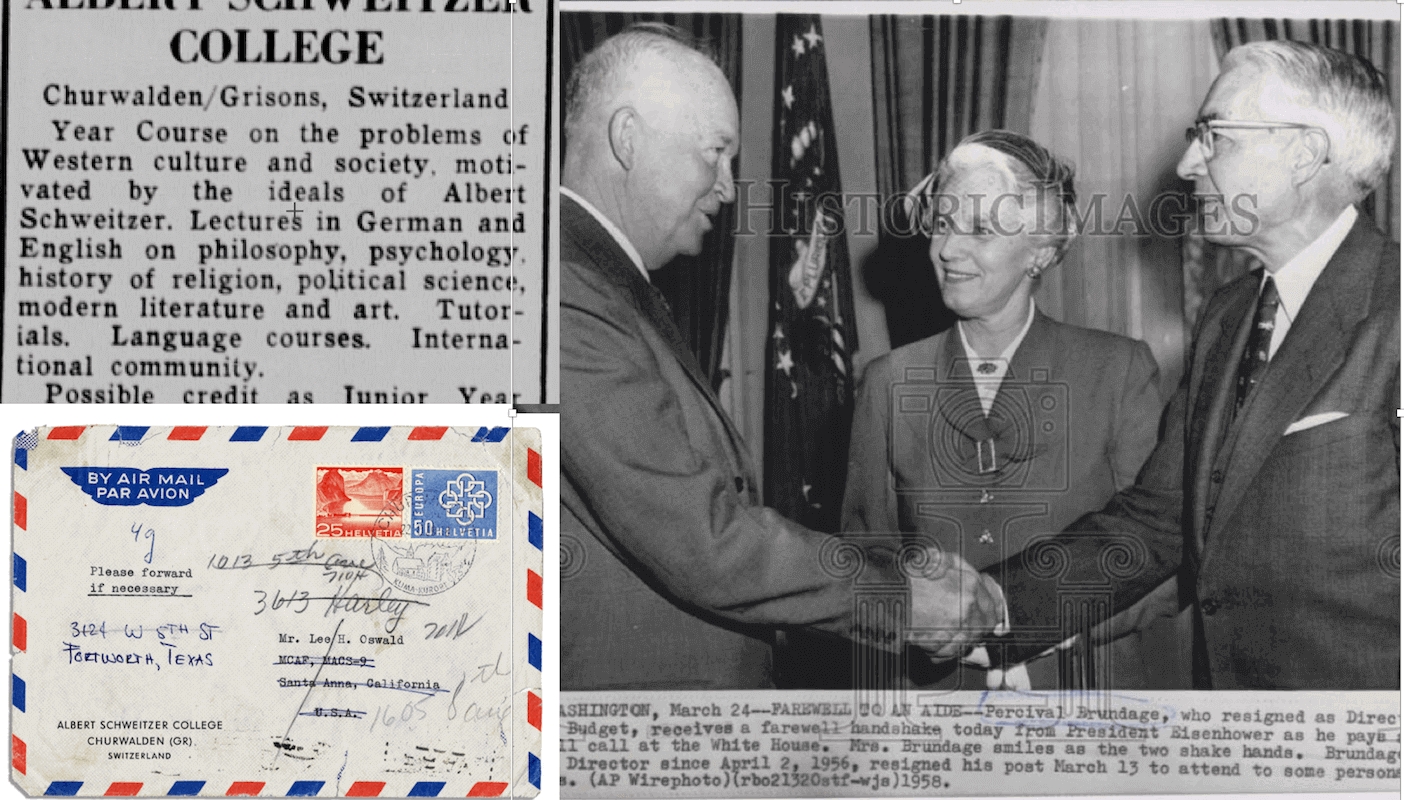
    Brundage was a major Unitarian Church officer from 1942-1954 when the Unitarian Church was cooperating with, first, the OSS, and later the CIA. He was also president of the International Association for Religious Freedom (IARF) from 1952-1955 and president of the American Friends of Albert Schweitzer College from 1953-1958, the College in Switzerland were Oswald was supposed to visit and study. Most importantly, Brundage became the most prominent member of the Bureau of Budget (BOB) during the Eisenhower presidency. Brundage was responsible as the head of BOB for drafting the congressional legislation for the creation of NASA. Through his BOB activities he was involved with the U-2, the satellite programs, the Pentagon and the CIA. Brundage and one of his associates, E. Perkins McGuire, were asked to hold the majority of a new airline stock “in name only.” They both agreed to act on behalf of the CIA. The airline was none other than Southern Air Transport, which was used in paramilitary missions in the Congo, the Caribbean and Indochina.

    Frederick Osborn Jr.

    Frederick Henry Osborn Sr. was a trustee of Princeton University and a member of the Rockefeller Institute and the Carnegie Corporation. Osborn was a Director of the Population Association of America, the American Eugenics Society, and of the Association for Research in Human Heredity. He was also an associate of Dean Acheson. John D. Rockefeller III appointed Osborn the Population Council’s first Director Osborn, along with Wickliffe Preston Draper, founded the Pioneer Fund; the purpose was to advance pro-eugenic research and propaganda. In 1937, Osborn stated that the Nazi’s racial sterilization program was “the most important social program which has ever been tried.” His son Frederick Osborn Jr. and his wife Nancy who provided character references for Ruth and Michael Paine, when the FBI was investigating them for their close relationship to Marina and Lee Oswald.

    Henry Luce

    Owner of the Time, Life, Fortune empire. Henry Luce was the man who invented the term “American Century,” which involved global American dominance projected by American businesses leading a worldwide economy. Anti-Communist and member of the American Security Council.

    C. D. Jackson

    He was an expert in wartime propaganda, public relations, advertising, publishing, psychological warfare, black ops, and he was an opinion maker. During the Eisenhower Presidency, he was the Special Assistant to the President for International Affairs and he had been an editor-in-Chief of Henry Luce’s TimeLife, and Fortune magazines. He bought the Zapruder film for Time Inc. When Jackson viewed the film he withhold it from public viewing. On 29 November 1963, Life published a special issue on the assassination that included only thirty-one selected frames, which did not allow the readers to understand the sequence and direction of the shots, especially the fatal head shot. Marina Oswald was isolated at the Inn of the Six Flags by the Secret Service. James Herbert Martin was the manager and later became Marina’s agent, also arranged for Marina to pen a book. That was arranged from C. D. Jackson and Life’s Edward K. Thompson, through their Dallas representative Isaac Don Levine. It was Allen Dulles who had urged C. D. Jackson to have Marina’s story written by Levine, but that book never materialized. C. D. Jackson was indirectly connected to the Pawley-Bayo mission (CIA crypt Operation TILT).

    Joe Alsop

    Joseph Alsop of the New York Herald Tribune called LBJ and suggested to him the need for a presidential commission, but the President argued that it would ruin the Texas and FBI investigations. Alsop tried to convince Johnson otherwise and offered the information that Dean Acheson, the former Secretary of State, was also in favor. Alsop was indirectly admitting that he was acting in collusion with Acheson. Alsop inflated a minor incident in Laos involving north Vietnamese invaders. Alsop arrived in Laos in time to report about a “massive new attack in Laos” by “at least three and perhaps five new battalions of enemy troops from North Vietnam.” Later he wrote of “aggression, as naked, as flagrant as a Soviet-East German attack on West Germany.”

    Dean Acheson

    He was an American Statesman and lawyer. On December 4, 1963, Dean Acheson praised LBJ for appointing the Warren Commission and LBJ replied that “we did the best we could and I think we’ve got Hoover pretty well in line.” It was McCloy, Lovett, and Acheson that later advised LBJ on Vietnam and recommended escalation of the war.

    Eugene Rostow

    Dean of the Yale Law School, called Bill Moyers at the White House on November 24, 1963, to suggest the possibility of a Presidential Commission which would include distinguished citizens. It should be noted that Rostow told Moyers there was someone else in the room when he called, but he did not say who it was. Rostow told Moyers that he had already spoken to Katzenbach about three times, but he was speaking directly to Moyers because Katzenbach “sounded too groggy so I thought I’d pass this thought along to you.” Katzenbach wrote his memo as a result of his conversations with Rostow.

    Rockefeller Business Interests World Wide

    The Rockefeller brothers made huge profits from the Vietnam war since they had ownership and shares in big defense contractors like Standard Oil of California, Standard Oil of New Jersey, Boeing, and General Motors. That last company gained more than $1.3 billion in military contracts in 1968. But these were short-term profits for the Rockefellers. The real deal was in reconstructing the infrastructure after the war had ended and financing would be needed to achieve that. Under this mistaken assumption, in 1965, Rockefeller’s Chase Manhattan Bank opened a branch in Saigon—a huge fortress with no windows but thick glass blocks and stone walls that could withstand mortar attacks. A major force behind the Vietnam War was the Rockefeller’s Southeast Asia Development Advisory Group (SEADAG). That membership included Rockefeller Brothers Inc., Chase Manhattan Bank, the Rockefeller Foundation, Standard Oil of California, Standard Oil of New Jersey, and Standard Oil of Indiana. SEADAG’s Samuel P. Huntington believed that cheap labor created by forced relocation would help Saigon win the conflict. Anthropologist Jules Henry explained that the war would create cheap labor that would be able to compete with the lower productive costs of Chinese and Japanese industry and that “the destruction of the Vietnamese countryside is the first, and necessary, step to the industrialization of Vietnam and nationalization of its agriculture. US corporations had a big stake in Belgium’s monopoly of copper and uranium in Katanga province of Kongo through Tanganyika Concessions Limited: a company in which the Rockefellers were shareholders. The Rockefellers and the Guggenheims held stocks in the Belgian diamond mining operation in Kasai province, Northwest of Katanga. Their investment was $20 million, while their Belgians partners had invested only $2 millions. Kennedy’s Treasury Secretary Douglas C. Dillon also had a stake in Congo. He was an investor in Laurence Rockefeller’s textile mill and also in Laurence’s automobile import company in Congo. Two Rockefeller companies were also doing oil business in Indonesia: Stanvac (jointly held by Standard Oil of New Jersey and Socony-Mobil, Socony being Standard Oil of New York); and Caltex, (jointly held by Standard Oil of California and Texaco.) Freeport Sulphur, a Rockefeller controlled company, would be hugely rewarded by the West Irian mineral mines. Freeport Sulphur subcontracted Bechtel to handle the engineering aspects of the mining. Freeport was later renamed Freeport McMoran. It became one of the two largest mining corporations in the world. The eventual wealth mined from the two deposits topped 100 billion dollars. David Rockefeller opposed JFK’s economic and Foreign policies.

    LBJ and friends

    LBJ reversed JFK’s foreign policy in Vietnam/Southeast Asia and around the Globe. LBJ’s friends from Texas were to be hugely compensated from the war that the new president was promoting. The Texas located company manufacturing Bell helicopters—where Michael Paine worked—would profit immensely from their use in Vietnam. General Dynamics plane production—located in Fort Worth—would gain huge contracts during that war. Another of LBJ’s friends who profited from the Vietnam War was David Harold Byrd, owner of the Texas School Book Depository. In early November, 1963, Byrd and his investment partner James Ling bought $2 million worth of stock in Ling-Temco-Vought (LTV), a defense company they owned. It may have been a coincidence, but the fact is that the navy awarded LTV the first major contract in February 1964 to construct the A7 Corsair fighter plane for operations in Vietnam. Peter Dale Scott calculated that this sum of money was worth $26 Million by 1967. LBJ was a close friend to the Brown Brothers, who owned a construction company named Brown and Root. In 1962, a consortium of private American construction corporations made up of Raymond International and Morrison-Knudsen (RMK) were building Vietnam’s infrastructure. But the construction was limited. The original contract was for $15 million. But in the beginning of 1965, the sum had reached $150 million. RMK could not keep up with the demands of construction. They added to their team two large American companies, Brown and Root and J.A. Jones, to form the largest ever consortium, RMK-BRJ. This consortium took the largest share of all Vietnam construction work, around 90 percent of the total. The US Navy granted RMK-BRJ a cost-plus-fixed-fee to quickly prepare Vietnam for a major U.S. military presence.

    Go to Part 1

    Go to Part 2

    Go to Part 3

    Go to Part 4

    Go to Part 5

    Go to Part 6

    Go to Conclusion

  • Creating the Oswald Legend: Conclusion

    Creating the Oswald Legend: Conclusion


    In 1959, the US intelligence services, and notably the CIA, were trying to infiltrate revolutionary movements like Castro’s government and sympathetic organizations for purposes of infiltration and discreditation. Lee Harvey Oswald had all the earmarks of being prepared with that purpose in mind. In all likelihood, Oswald was a creature of American intelligence who was sent to the USSR to help him build what is called in espionage parlance, a ‘Legend’. He was a defector with Marxist ideology who may or may not have betrayed technical information about the U2 spy plane to the Russians.

    The plan was to return to the United States and use this Legend to infiltrate and smoke out subversives: Communists and Castro supporters, not only in public and private life, but also in defense contractor industrial plants. His primary target would have been the newly organized Fair Play for Cuba Committee, which was active in both New York and the Los Angeles area. In the LA area, the first people who established the organization attended Robert Fritchman’s First Unitarian Church. Coincidentally or not, one of his Marine buddies, Kerry Thornley, was also attending that Church. It is most likely then that Thornley, Fritchman, or both provided Oswald with information about the Albert Schweitzer College (ASC), a quite obscure higher learning institute in Switzerland and encouraged him to enroll and study there. For when Oswald made out his passport application to Europe, this was one of the destinations he listed. After being contacted by the Director of the college, his mother thought he might be attending classes there when he left the United States after being discharged from the Marines.

    The ASC was created by the International Association for Religious Freedom (IARF) and was supported by the Unitarian American Friends of Albert Schweitzer College. Percival Brundage, an important figure of the Eastern establishment, was one of the Directors of the Unitarian American Friends of Albert Schweitzer College. Brundage was also the Director of the Bureau of Budget (BOB) during the Eisenhower presidency and along with another Unitarian, James Killian, they were involved in the U-2 and CORONA satellite projects, the latter which was intended to replace the U-2 plane.

    Brundage held major stocks in Southern Air Transport, which Paul Helliwell, a CIA man in the Far East, had established. Helliwell was responsible for arranging and managing the drug trafficking in the Golden Triangle to finance CIA operations.

    As Senator Richard Schweiker stated, Oswald had the fingerprints of intelligence all over him. If there was one person whose fingertips were more dominant than anyone else, that person was James Jesus Angleton. He and his ultra-secretive CI/SIG unit were keeping tabs on the young Marine since his defection to the Soviet Union and maybe earlier. Thanks to Malcolm Blunt, we learned for the first time of the magnificent work of HSCA researcher Betsy Wolf. Her work was nowhere to be found in the HSCA report or in any typed memorandum. Malcolm could only manage to get her handwritten notes when they were declassified in 1998. Her notes helped solve a riddle that had plagued the critical community since 1995 and the release of John Newman’s Oswald and the CIA.

    When Oswald defected to the Soviet Union, he made plain his intent to dangle the U-2 spy plane secrets to the Soviets. Yet his defection and this dangerous offer did not cause the opening of a CIA 201 file. That did not occur until 13 months after. Years later, when Richard Helms was asked about this delay, he found it inexplicable. He replied, ‘’I am amazed.’’

    Betsy Wolf was most probably doubly amazed when she discovered this odd discrepancy. She set out to find a solution to his mystery. In an HSCA interview of a CIA officer named William Larson, he revealed that if there were more than five documents on someone at the CIA, a 201 file should be opened. Betsy was intrigued by this, because after Oswald’s defection, there were more than five documents concerning him. And yet a 201 file was not opened.

    But there was another paradox about Oswald’s files at CIA. Larson revealed that the documents about Oswald should have gone to the Soviet Russia Division (SR), but instead they went to the Office of Security (OS). Malcolm Blunt found out that the OS was cooperating with Angleton’s CI/SIG, or mole hunters unit. Betsy Wolf found out that there a dissemination of files form upon request from CIA offices. In Oswald’s case, someone from OS deliberately directed his files to the Office of Security instead of the General Filing System.

    Betsy Wolf’s notes included a new information about a never-before-seen interview of Robert Gambino, then Chief of the CIA’s Office of Security. Wolf interviewed her in the latter half of 1978, as the HSCA was closing down. Gambino told her that it was CIA Mail Logistics, a component of the Office of Central Reference (OCR), that was responsible for disseminating all incoming documents. Mail Logistics should have sent all Oswald documents to the SR division through the General Filing System. That was bypassed. Instead, they were sent to the OS. This was important information, because it revealed that someone had rigged the system at the time of, or even before, Oswald’s defection.

    It is possible that this was done for the purpose of a mole hunt, after former KGB officer Pyotr Popov was placed under surveillance. Popov was a double agent who had informed the CIA that information about the U-2 project had been compromised. It is possible that Angleton, who monitored Oswald more closely than anyone else, decided to use him in an to start a mole hunt to find out the alleged Soviet spy who had possibly betrayed the U-2 secrets that led to the alleged 1960 shootdown of the Gary Powers flown U-2 over the USSR., although some observers, like the late Fletcher Prouty, did not think this was how Powers was downed.

    Angleton would initiate this mole hunt as a cover to conceal the true purpose of the U-2 incident, which was probably the cancellation of the Paris Peace Summit between Dwight Eisenhower and Nikita Khrushchev. The CIA and the Military Industrial Complex were willing to sacrifice the U-2, since its utility was coming to an end, ready to be replaced by a newer airplane and satellites. A scapegoat was needed, and the Soviet mole—who was never found—was just that. The CIA had the excuse to officially search for him, without success.

    Three years later, Angleton would initiate a similar mole hunt in Mexico City after Oswald’s, or an impersonator’s, visit to the Cuban and Soviet Embassies, in order to reveal a Soviet mole who had helped the Cubans impersonate Oswald and expose an official CIA operation to embarrass the FPCC in countries where it had support. The victim this time was the receptionist at the Cuban embassy, Sylvia Duran.

    The Mexico City operation was used to conceal Kennedy’s assassination by forcing a major cover up that would ensure that the identity of the perpetrators would never be known. John Newman named Angleton as the CIA officer who was most likely the architect of the Mexico City plot and orchestrated the drama that evolved down there.

    What Betsy Wolf revealed was that Ray Rocca, Angleton’s most trusted associate, had cabled Luis Echeverria on November 23, 1963, to inform him about Oswald’s and Sylvia Duran’s relationship. What is striking about this is that it occurred long before Helms assigned Angleton to take over the Mexico City investigation from John Whitten, thus before Angleton became liaison to the Warren Commission. The day after the assassination, the CIA took Elena Garro de Paz under their protection. In other words, the CIA had both the accuser, Elena, and the accused collaborator Duran, under their control within 24 hours of Kennedy’s assassination. It is important to note that Philip Shenon used Elena’s story about Duran being a communist aide to Oswald quite liberally in his Commission supporting book A Cruel and Shocking Act.

    Besides Betsy Wolf’s revelations, the Angleton fingertips could have been laid upon Dallas, if one considers the strange behavior of certain Policemen like Gerald Hill and Captain Westbrook. A declassified CIA file revealed that the CIA Police Group had been transferred from the NE Division to Angleton’s CI staff. It was the Counter Intelligence Police Group (CI/GP) that was running the CIA’s police programs.

    After Angleton was fired by William Colby, he made the following bizarre remark to reporter Seymour Hersh: “A mansion has many rooms and there were many things going on…I am not privy to who struck John.” This comment was cryptic and it is difficult to interpret it with precision. Did Angleton mean that he was out of the loop and someone else within the CIA was responsible for the assassination, someone even higher up than him? Or, in a similar fashion to the mole hunt, was he trying to deflect all responsibility from himself and blame it on the ever-elusive mole? Do we have any indications that Angleton has ever admitted that his famous mole hunt was just an excuse and a cover?

    In part 5, we documented that Angleton revealed to Joseph Trento that E. Howard Hunt was in Dallas on the day of the assassination and possibly sent there by a high-level mole inside the CIA. Trento believed that Angleton was trying to hide his own connections to Hunt and that it was him that had sent Hunt to Dallas. If we consider Trento’s explanation, then we have an indication that Angleton was using the mole hunt as a cover whenever it was suitable to cover his sinister operations.

    Hunt himself vehemently denied that he ever was in Dallas that day, but Mark Lane proved in the Liberty Lobby trial that Hunt was contradicting himself. Hunt had testified to the Rockefeller Commission back in 1974 that on 11/22/1963 he was with his wife and children in Washington D.C. Lane asked him if he recalled his testimony at the first Liberty Lobby trial, where he had admitted that his children were upset when allegations came out that he was in Dallas that day and he had to reassure his children that he was not in Dallas that day and had nothing to do with the assassination.[1] Then Lane asked him a question that Hunt could not adequately answer:

    Mr. Hunt, why did you have to convince your children that you were not in Dallas, Texas, on November 22, 1963, if in fact, as you say, a fourteen-year-old daughter, a thirteen-year-old daughter, and a ten-year-old son were with you in the Washington D.C. area on November 22, 1963 and were with you at least for the next forty eight hours, as you all stayed glued to the TV set?’[2]

    Did Oswald visit Mexico City in the fall of 1963? Angleton may have designed the Mexico City plot, but it was David Phillips and Anne Goodpasture in Mexico who were controlling the information that made it possible to succeed. Years later, Phillips admitted that Oswald likely never visited Mexico City:

    I am not in a position today to talk to you about the inner workings of the CIA station in Mexico City…but I will tell you this, that when the record comes out, we will find that there was never a photograph taken of Lee Harvey Oswald in Mexico City. We will find out that Lee Harvey Oswald never visited, let me put it, that is a categorical statement…there is no evidence to show that Lee Harvey Oswald visited the Soviet Embassy.[3]

    Continuing with Mark Lane’s encounter with Phillips: he said that if the CIA gave deliberately false information about the incident, Mexico City would ask for the abolishment of the Agency and made a very enigmatic statement that “if some CIA guy that I never saw did something that I never heard of, I don’t want to have to come back here.”[4] Was Phillips trying to say that he was innocent and that someone else within the CIA was to blame for the crime? Or as a former actor, was he was trying to confuse his audience and appear innocent?

    Part of Oswald’s mission was to join the Fair Play for Cuba Committee, of which he was the only member in New Orleans. Through people like Guy Banister, Clay Shaw, and David Ferrie, he got into contact with Cuban exiles. In Dallas, the allegedly Marxist Oswald was in contact with peculiar characters like the the White Russians, most prominently George DeMohrenschildt and George Bouhe, and also with Michael and Ruth Paine.

    Oswald was probably employed indirectly by the CIA’s Domestic Operations Division, through some proprietary firm, most likely involved in industrial security. As Paul Bleau has shown, William Stuckey was in contact with the FBI in 1962 trying to find out if there was any member of the FPCC in New Orleans. It was Stuckey who arranged the New Orleans radio interview during which Oswald had a slip of the tongue that almost gave away his secret that in Russia he was under the protection of the US Government.

    When he was captured in Dallas, he again dropped a hint as to what he was. Roger Craig told Captain Fritz that he saw Oswald entering a station wagon after the assassination. Oswald replied “That station wagon belongs to Mrs. Paine. Don’t try to drag her into this.” Then in a very disgusted and disappointed tone, he added “Everybody will know who I am now.” The Warren Commission transposed the ‘now’ and wrote in its report “NOW everybody will know who I am.”[5]

    Oswald was likely not an official CIA agent, but he was made to believe so and he was probably the creation of a joint project by primarily the CIA, along with the FBI and the military, exemplified by a mentality mostly marked by the American Security Council. However, this author does not want to give the wrong impression that the American Security Council killed President Kennedy. Oswald just happened to be a protagonist in a drama, a theatrical play where some actors were known to him, but most of them—along with the director, the script writers, and the producers—were operating in the shadows. Oswald had no knowledge of how the story would end. He would soon realize that this theater was larger than he could imagine, that the stage was the Globe, like Zbigniew Brzezinski’s Grand Chessboard (see Appendix).

    After Oswald’s funeral, his mother Marguerite, stated to a television camera:

    Lee Harvey Oswald, my son, even after his death, has done more for his country than any other living human being.

    To sum up Oswald’s tragic life and fate, one has to remember Jim Garrison’s words during an on camera interview for the TV mini-series “The Men Who Killed Kennedy” (Part 4; “The Patsy”):

    Lee Oswald was totally, unequivocally, completely innocent of the assassination of President Kennedy and the fact that history, or in the re-writing of history, disinformation has made a villain out of this young man who wanted nothing more than to be a fine Marine, is in some ways the greatest injustice of all.

    By all accounts, Oswald was innocent, never fired a shot, and he was not on the sixth floor of the TSBD at the crucial time. The latest research reveals that Oswald might have been outside on the steps watching the Presidential Parade.[6]

    If Oswald was innocent, then who committed this heinous crime? Ideally, when trying to solve a murder case, the first step would be to examine the crime scene, evidence and question the witnesses. Sadly, for the JFK assassination it would be an exercise in futility to even try to contemplate such a feat. It would be a Herculean task, since the crime scene has been tampered with, evidence has been destroyed, witnesses’ testimonies were withheld or altered and a massive cover up of Gargantuan proportions ensured that it would be impossible for future investigators to piece it together. It was not only the Dallas Police that did not do its job properly, but also the FBI, the medical doctors at Bethesda, and all the investigative bodies, from the Warren Commission to the HSCA, never really tried hard to uncover the truth.

    Faced with this improbable mountain to climb, what is left for today’s researchers is to focus on Fletcher Prouty’s phrase “Cui Bono?’’ and the classic triptych of the Means, Motive and Opportunity. In part 6, we examined Oswald’s elite connections and how JFK’s foreign policy was drastically reversed by LBJ when he ascended into power. We also discussed how enormous profits were made from the Vietnam War and this foreign policy reversal in general. However, this author would like to stress that this is circumstantial evidence and one cannot conclude beyond reasonable doubt who were those that instigated the assassination. Their identities will likely forever remain obscured from the eye of history.

    The same could be said for the actual assassins. We’ll probably never find out their names. Lucky for us, a wealth of official documents and tireless research by those who investigated the assassination left us some clues as to who were the facilitators who carried out the instigators wishes.

    Some researchers would blame the Mafia, the Cubans, the CIA, or the Military. This author believes that this is a false argument, that neither the CIA per se or the Military per se murdered the President. Most likely members of both participated outside their agencies, carrying out the wishes of a powerful elite, who believed in the American Century and its Manifest Destiny of financial conquest and economic possession, a refined neo-colonialism. This American Century was built on the solid foundations of the US dollar and the American war machine in order to expand around the Globe. As Henry Luce commented about the American Century in 1941, ‘’Tyrannies may require a large amount of living space, but Freedom requires and will require far greater living space than Tyranny.’’ Allen Dulles, the CIA’s Director, had always been in the service of the Power Elite and championed their interests whenever it was needed.

    John Kennedy was a part of that elite, but after a while he was perceived as a virus, an internal fault that had to be eliminated and his murder was seen as an erasure of a fault line in the system. This could not be exemplified better than by the chilling and arrogant words that Allen Dulles uttered to Willie Morris, young editor of Harper’s magazine, ‘’That little Kennedy…he thought he was a god.’’[7] Those opposing his policies were a ruthless elite partly composed of Malthusian ideology championing Eugenics, the survival of the fittest, and social engineering.

    Regarding Kennedy’s assassination and the critical community, a great deal of time has been spent on finding who the marksmen were: their location, the shot trajectories, etc. This has led to some weird, silly theories: e.g. James Files, John Roselli, Charles Nicoletti.

    The late great astronomer, Carl Sagan warned us about the dangers of not using our critical mind:

    Finding the occasional straw of truth awash in a great ocean of confusion and bamboozle requires vigilance, dedication, and courage. But if we don’t practice these tough habits of thought, we cannot hope to solve the truly serious problems that face us and we risk becoming a nation of suckers, a world of suckers, up for grabs by the next charlatan who saunters along.[8]

    In the case of the JFK assassination, we have been up for grabs for the last 58 years, but it is time to practice these tough habits of thought to stop all those charlatans who have been throwing ashes so shamelessly into our eyes to obscure the truth.

    The weight of history will be against us in our effort to reveal the true circumstances of President Kennedy’s assassination, since there was so much obstruction of justice, destroyed evidence, disinformation, and an ongoing cover up, but we must persist in our quest for the truth.

    In an X-Files episode, a retired Navy Commander tells Agent Scully:

    We bury our dead alive, don’t we?…We hear them every day, they talk to us, they haunt us, they beg us for meaning. Conscience is just the voices of the dead trying to save us from our own damnation.

    Later, Scully tells Mulder about what a man said to her “that the dead speak to us from beyond the grave, that that’s what conscience is…I think the dead are speaking to us Mulder, demanding justice. Maybe that man was right. Maybe we bury the dead alive.”[9]

    Similarly, we have buried not only John Kennedy alive, but also his brother Robert and Martin Luther King. They have become our conscience, demanding justice and trying to save us from our damnation before it is too late. We only have to listen to our conscience.

    Go to Part 1

    Go to Part 2

    Go to Part 3

    Go to Part 4

    Go to Part 5

    Go to Part 6

    Go to Appendix

    References


    [1] Lane Mark, Plausible Denial, Plexus Publishing Ltd, 1992, p. 274.

    [2] Ibid, pp. 282–283.

    [3] Ibid, p. 82.

    [4] Ibid, p. 83.

    [5] “Roger Dean Craig,” Spartacus Educational

    [6] Prayer Man

    [7] Talbot David, The Devil’s Chessboard, HarperCollins 2015, p. 1.

    [8] Sagan Carl, The Demon Haunted World, Headline Book Publishing, 1997, p. 42.

    [9] X-Files, episode 3×15, Apocrypha.

  • Creating the Oswald Legend – Part 6

    Creating the Oswald Legend – Part 6


    1. A WILDERNESS OF MIRRORS

    The Man Who Knew too Much

    Jim Garrison called Richard Case Nagell the “most important witness there is.” A detailed examination of Nagell’s actions is not within the scope of this essay, since he has been the subject of extensive research, beginning with Dick Russell’s books The Man Who Knew Too Much and On The Trail of the JFK Assassins. Other books that document his life and actions are Larry Hancock’s Someone Would Have Talked and Jim DiEugenio’s second edition of Destiny Betrayed.

    What is important to take away from the Nagell story is that both he and Oswald appeared to have some similarities and that Nagell had come very close to unraveling a plot concerning the assassination of John Kennedy. Not only had Nagell met Oswald in Japan while both were stationed there, he had also visited the American Embassy in Mexico City on September 28, 1962, where he stated that he was “bitter, disgusted, disillusioned and disaffected” and that he might go to another country. He returned to the Embassy, on October 1, 1962, to ask what would happen if he renounced his United States citizenship and what the penalty would be if he would go to a country behind the Iron Curtain.[1]

    His behavior was very similar to Oswald’s, when the latter tried to renounce his citizenship and defect to the Soviet Union during his visit to the American Embassy in Moscow.

    Nagell claimed that it was in Mexico where he was recruited by a CIA official who he had met previously in Japan and was given the mission to work as a double agent. Larry Hancock believes this was Henry Hecksher and his job was to establish contact with the Soviets and KGB officers in Mexico. His real task was to feed disinformation to the Soviets during the Cuban missile crisis.[2] The Soviets, on their turn, gave him another mission, to find out about a violent anti-Castro group, Alpha 66, that was plotting to assassinate the American president; and to keep tabs on a certain Lee Harvey Oswald who was not a stranger to the Russians, since he had defected and lived in the Soviet Union.

    Nagell discovered that the Cuban exiles were plotting to assassinate Kennedy in Miami and later in Los Angeles. In California, the scapegoat was Vaughn Marlowe who, like Oswald, was involved with the FPCC: he was an executive officer of the Los Angeles branch[3]. However, these alleged plots did not come to fruition.

    Before Oswald moved to New Orleans, Nagell visited the city and began investigating people who later came up in the Jim Garrison investigation, specifically Eladio Del Valle, Sergio Arcacha Smith, and David Ferrie.[4] He then discovered that the Cuban exiles had learned of the secret back channels of communication between Kennedy and Castro and felt betrayed. They now wanted to avenge Kennedy and were planning to assassinate him. Oswald was being set up by the Cubans and the CIA. Among those setting him up were David Ferrie and the two strange Cubans who visited Sylvia Odio, Leopoldo and Angel. Nagell claimed to be in possession of a tape recording of four men plotting to kill President Kennedy. One was Arcacha Smith and another was identified as “Q,” probably Carlos Quiroga, who was Arcacha’s right hand man and had very likely supplied Oswald with pro-Castro literature.[5]

    What makes that interesting is that when Garrison polygraphed Quiroga, he asked him if Arcacha Smith knew Oswald and if he had seen any of the guns used in the assassination. Quiroga’s answers to both questions were negative; but the polygraph test indicated that he was trying to be deceptive.[6] Garrison had asked Nagell to testify at Clay Shaw’s trial, but Nagell decided that it was not a good idea when a grenade was thrown at him from a speeding car in New York.[7] Garrison tried to extradite Arcacha back to New Orleans, but he was denied his request. Any real investigation would have revealed that Arcacha was Howard Hunt’s man while trying to set up the CRC in New Orleans, was identified by Rose Cheramie and Mac Manual, and also was one of the men who accompanied Rose and had knowledge of the upcoming hit in Dallas. Additionally, as we saw in Part 5, Arcacha was involved in gun running and the drug trade.

    In this regard, it is appropriate to link to Nagell’s first interview with Jim Garrison’s office, where he specifically mentioned Sergio Arcacha Smith. To show how important the Agency thought both Garrison and Nagell were, the reader should keep this in mind: William Martin, the interviewer for Garrison in who Nagell confided, was CIA.

    Nagell then found out that Angel and Leopoldo were trying to recruit Oswald to help them assassinate Kennedy in Washington D.C. This was to be done sometime in late September. They passed themselves on to Oswald as Castro G-2 intelligence agents and reasoned that they wanted to retaliate for Kennedy’s efforts to assassinate the Cuban leader. So Nagell met with Oswald in New Orleans and tried to convince him that Angel and Leopoldo were not Cuban agents, but were anti-Castro Cuban exiles working in accordance with CIA and wanted to kill Kennedy to provoke an invasion of Cuba to avenge his death by Castro. (Click here for more details)

    Oswald denied there were discussions to kill Kennedy and that he was a friend of the Cuban revolution.[8] It is possible that Oswald, whose role was to infiltrate subversives and Castro sympathizers, had found out about the plot and was trying to spy and monitor the Castro agents in a desperate effort to stop the attempt. As to how important Nagell was in the JFK case and how much corroboration his testimony had, I refer the reader to Jim DiEugenio’s discussion of the second edition of Dick Russell’s book about the man.

    Nagell believed that Oswald did pull a trigger in Dealey Plaza, but he could be excused on this point. Nagell was not aware of the information that researchers have in their possession today. For example, the near certainty that Oswald was not on the sixth floor makes it impossible for him to have fired those shots. The latest research indicates that Oswald was probably on the first floor during the shooting and possibly outside the building watching the parade.[9]

    So, if Oswald was not the culprit, who were the shooters in Dealey Plaza and who organized the ambush in such a way to ensure its success and the safe escape of those involved without being caught?

    Nagell’s allegations about Angel’s and Leopoldo’s attempt to set Oswald up as a patsy corroborate John Martino’s claims that the “Anti-Castro Cubans put Oswald together.” Larry Hancock in his recent e-book “Tipping Point”[10] presents such a case where CIA Cuban exile teams in JM/WAVE were trained to kill Castro, but later shifted their focus to Kennedy after they learned that JFK was secretly negotiating to restore relations with Castro. To them, this constituted the ultimate betrayal. It is likely that such information would have been passed down from William Harvey to Johnny Roselli. Therefore, in this scenario, those most likely involved in the conspiracy to kill Kennedy were Roselli, Harvey, David Morales, Rip Robertson, Felipe Vidal Santiago, Roy Hargraves, John Martino, CIA paramilitary officer Carl Jenkins, and Cubans like Chi Chi Quintero, Felix Rodriquez, Carlos Hernandez, Nestor Izquierdo, and Segundo Borgas.

    Researcher William Kelly holds a similar view and believes that the operation in Dallas was based on the “Pathfinder” plan, which was a covert contingency plan to assassinate Castro with a high-powered rifle from a high building as he drove in an open jeep. When the Kennedy brothers rejected “Pathfinder,” it was re-directed from Castro to assassinate John Kennedy instead.[11]

    The above theories are prevalent today and many researchers believe that they come close to the truth. However, there are other suspects and theories regarding the shooters. One of them implicates the French paramilitary group OAS and/or the French intelligence service SDECE in the assassination.

    Dinkin’s Prognostication

    The story of Private First-Class Eugene Dinkin has been told by Noel Twyman in his book Bloody Treason and Dick Russell in his book The Man Who Knew Too Much. Dinkin was a cryptographic code operator stationed in Metz, France and he had concluded that there was a plot being prepared to assassinate Kennedy involving “some high-ranking members of the military, some right-wing economic groups, with the support of some national media outlets.”[12] Dinkin tried to warn many different people about the conspiracy, but no one really believed him. He claimed to have written a letter to Robert Kennedy before the assassination to warn him:

    …that an attempt on President Kennedy would occur on November 28th, 1963; that if it were to succeed, blame would then be placed upon a Communist or Negro, who would be designated the assassin…[13]

    Dinkin was arrested on November 13, 1963, placed in a psychiatric hospital, and later was transferred to Walter Reed hospital. Many researchers believe that Dinkin had learned about the assassination plot by intercepting and decrypting sensitive military communications. According to an FBI report based on interviews with Dinkin, he found out about the plot after studying the military publication Star and Stripes, where he could detect subliminal information regarding the assassination. This is a hard thing to accept and seems to be an unlikely fit. It is more likely that he decoded messages that revealed the plot, but it was his psychiatric confidant that “forced him” to come up with the military publication explanation.

    DA Jim Garrison discovered that one of Dinkin’s duties as a code breaker was to decipher military messages, especially those originating from the French paramilitary organization OAS.[14] Garrison discovered that Clay Shaw was associated with the mysterious company named Permindex, which reportedly had been involved in assassination attempts against French president Charles De Gaulle. Jack Soustelle, a leader of the OAS, was a personal friend to Ferenc Nagy, a founding member of Permindex.

    The OAS vs JFK

    In 1977, a CIA document dated April 1, 1964, revealed that the French authorities wanted to know why a French national—Jean Souetre aka Michel Roux, aka Michael Mertz—had been expelled from the US at Fort Worth or Dallas 48 hours after the assassination, to either Mexico or Canada.[15] Jean Souetre was a member of the OAS (Secret Army Organization), which was violently opposed to France granting Algeria its independence. This poses the question as to whether or not the OAS provided the shooters in Dallas. The OAS had a motive to kill Kennedy, since he had strongly and openly supported the cause of Algerian independence since 1957.

    To mystify things even more, Souetre might have been impersonated by Michael Mertz, a SDECE agent who, in the past had infiltrated the OAS and eventually saved De Gaulle’s life. Mertz was involved in drug trafficking from France to the US, so he was another suspect as being one of the shooters in Dallas. It is possible that neither of these men were involved in the JFK assassination, which would mean someone implicated them in such a way to make it look as if they were in Dallas. The effect would be to draw attention from the real culprits and obscure the truth even further.

    In 1988, Stephen Rivele alleged that the Corsican mafia had assassinated Kennedy and an individual named Lucien Sarti was one of the shooters in Dealey Plaza. Later Howard Hunt, in his deathbed confession, implicated Lucien Sarti as being the gunman behind the fence on the Grassy Knoll. Sarti was killed by the Mexican Federal Police in Mexico City in 1972. It was Hunt and Lucien Conein who were the driving forces behind Richard Nixon’s great heroin coup, designed to replace the French heroin network, and ordered the kidnapping and killing of the Corsican mafia members. How convenient it was that Rivele’s allegations and Hunt’s confession implicated their arch enemies, the Corsicans and the old French connection to the assassination of a US President. Before that, it was Edward Lansdale and Lucien Conein who had defeated the Corsicans in Southeast Asia thus clearing the path for Santo Trafficante to control the opium smuggling from the Golden Triangle.

    Harvey and ZR/Rifle

    It was Bill Harvey who had written in his notes on the ZR/RIFLE program that “Corsicans recommended Sicilians lead to Mafia.” [16] Oddly, Hunt wrote that he was a bench warmer in the plot, in that he did not want to be part of a conspiracy that had anything to do with William Harvey, who was an alcoholic psycho. Hunt was likely deflecting attention from himself by implicating Harvey and his Corsicans in the assassination of Kennedy.

    Many theories name William Harvey as the man who selected the assassins from his ZR/RIFLE program and may have designed the Dallas hit. Mark Wyatt, Harvey’s Deputy in Rome, revealed that Harvey was in Dallas in November 1963. According to Wyatt, he had bumped into Harvey on a plane to Dallas sometime before the assassination. When he asked Harvey what was doing in Dallas, he replied vaguely, “I am here to see what’s happening.”[17]

    However, to be fair to Harvey, he was not in Dallas on November 22, 1963. Wyatt said that they were both attending a Gladio meeting in Sardinia, Italy, when they heard about the assassination. Later that afternoon, Wyatt found Harvey collapsed in his bed after drinking martinis.[18]

    If Harvey was part of the plot, you would have expected him to be in Dallas instead of lying unconscious in bed after heavy drinking. Could it be possible that Harvey’s trips to Miami and his involvement with ZR/RIFLE were unrelated to the assassination and had to do with operations against Castro?

    There is something interesting that Malcolm Blunt discussed about Harvey with Alan Dale. The information that in August 1963, Harvey wanted to meet with Clare Boothe Luce, some months prior to the assassination. Again, could it be possible that he did not want to meet her about the assassination, but to discuss her anti-Castro operations? We cannot really be certain if Harvey was involved in the assassination, that he only had prior knowledge, or knowledge at all.

    Edward Lansdale in Texas

    Some researchers believe that Edward Lansdale was the man who masterminded the Dealey Plaza operation. This is based on Fletcher Prouty’s assertion that Lansdale was in Dallas that day and is seen in a photograph walking by the three tramps.

    If that’s the case, there is no way in the world that Lansdale would have accepted to cooperate with Harvey, and vice versa, in such a crucial event. Lansdale remarked about Harvey, “People who ‘d been up against the Soviet types were always very strange to me…I am sure they thought I was strange.”[19] Harvey not only found Lansdale wacky, but he thought he was a security risk. It was impossible for them to communicate about how to bring down Castro during Operation Mongoose. The final break between the pair came on August 13, 1962. Lansdale wrote a memo: “Mr. Harvey: Intelligence, political (including liquidation of leaders), Economic (sabotage, limited deception) and Paramilitary.” Harvey was furious with Lansdale after that and called him to let him know how stupid he was to put such comments in a document.[20]

    Then there is the question of where Lansdale’s loyalty was located? To the Pentagon, since he was an Air Force General, or to the CIA? In Malcolm Blunt’s book The Devil is in the Details, Alan Dale, Blunt and John Newman were pondering this question. Blunt brought up Robert Gambino from the Office of Mail Logistics who had written a memo on Lansdale. There he offers the information that although Lansdale was a military man, he was working mainly for the CIA.[21] Then Blunt and Dale mention that Lansdale resigned or retired temporarily from the army in October 1963. A short time later he returned to the army and he was promoted. The man who was pushing for his promotion was none other than Allen Dulles himself.[22] Not only that but Lansdale headed the first mission in Saigon in 1954 and this mission was a CIA creation.[23]

    We have established that Lansdale was mainly a CIA guy with an Air Force uniform. But was he in Dealey Plaza as Prouty claims? John Newman found out that after his retirement, Lansdale visited his friend Sam Williams in Denton, Texas, which was near Dallas around the time of the assassination. He discovered a letter from Lansdale to Williams saying, “Hey, I am coming down to see you Sam.”[24] As Newman said, this proves that he was in the Dallas area, but it does not prove he was in Dealey Plaza. A little discussed factor about Lansdale is that he had connections to the Power Elite, specifically to the Kennedy family’s nemesis clan: the Rockefellers. He was Nelson Rockefeller’s clandestine associate in Southeast Asian propaganda activities. Lansdale was an adviser to the Rockefeller Brothers Fund/Special Studies Project and was appointed head of new counterinsurgency office at the Pentagon after the Bay of Pigs.[25]

    Deliberate Obfuscation?

    Whoever designed the Dealey Plaza scenario seems to have designed a confluence in Dallas that day. Everyone who had a motive to want Kennedy killed was somehow in the area: anti-Castro Cubans, the Mob, right wingers, Minutemen, Pentagon members (James Powell, army photographer), and the Texas oilmen who would distribute hostile flyers containing accusations against the President. It seems the anti-Kennedy universe was in Dallas for the purpose of killing Kennedy.

    If that was so, the script writer could ensure that if anyone ever tried to search for the truth, he would encounter such a tangled web of both contradictions and dead ends, that it would be impossible to separate facts from fiction. Then again, the best, most successful disinformation mixes facts with fiction and the truth, which is best hidden between lies. Unfortunately, we do not know the identity of the person who designed this diabolical scenario. It could have been Lansdale, Harvey, David Phillips, Hunt or any other covert action officer. But it’s likely we will never know who orchestrated the Dealey Plaza operation and who the shooters were.

    James Jesus Angleton’s favourite phrase to describe the world of espionage was “a wilderness of mirrors.” In the case of the Dealey Plaza assassination, the wilderness of mirrors was reflecting a confusing, distorted picture where everything was possible, but nothing was certain.

    Is it possible that Larry Hancock’s theory about the shooters and those involved in Dealey Plaza is the one closer to the truth? The main problem would be that the Cubans talked too much and gossiped around; even the CIA officers would find it hard to trust them with sensitive information. If you add to this the fact that the Cuban exiles were infiltrated by Castro agents, it would have been difficult to keep the assassination plot secret. The same probably happened in the plots against Castro, but that was not a problem if the plots to kill him all failed. After all, to those who wanted Kennedy dead, it would have been in their best interests for the assassination attempts against Castro to fail. As John Newman postulates in his new series of books: “for the plot that was used in the JFK assassination to work, Castro had to be alive after the president’s death.”[26] In the case of the JFK assassination, it was imperative for the plot to succeed, because the stakes were so high. If it was to fail, or if Oswald talked, those involved would face charges of treason.

    A better, safer solution that would guarantee absolute secrecy and confidentiality would be to bring in a military or paramilitary team from Laos. That unit could be flown to Mexico or the USA with Air America via the drug trade routes. They would finish the job and return to Laos where they would possibly end up being killed in a risky mission against the Viet Cong. Admittedly, this is speculation and nothing more. But it does indicate a more surefire way of concealment.

    1. ELITE CONNECTIONS

    In part 3, we reviewed Oswald’s appearance on Bill Stuckey’s New Orleans radio show “Carte Blanche”. There, he talked about his political views and debated with Ed Butler and Carlos Bringuier. The result of this interview was a record production by Dr. Alton Ochsner’s INCA, an album with the title, “Oswald: Self-Portrait in Red.” On the front cover was a drawing of Oswald’s face and on the back of the album was the headline “I am a Marxist” with the date of August 21, 1963, at the bottom were photographs of Congressman Hale Boggs, psy war specialist and Ochsner employee Ed Butler, and Dr. Alton Ochsner himself. Ed Butler did not only have connections to the previously discussed American Security Council, but he was also in contact with General Edward Lansdale and CIA Deputy Director Charles Cabell.[27]

    Dr. Ochsner and the CIA

    This is all fitting, because a CIA document of May 23, 1968, has finally been released completely unredacted. It was secured by Malcom Blunt. It reveals that Ochsner was a cleared source of theirs since May of 1955. But also, the CIA had sources inside Ochsner’s large New Orleans clinic. The memo continues by saying that Crescent City CIA officers, Hunter Leake and Lloyd Ray, were both socially familiar with Ochsner. In the document, the CIA admits they are in contact with INCA. The memo concludes with this: “Mr. Edward Butler, Staff Director of INCA, is a contact of our New Orleans Office and the source of numerous reports.” In light of this, we should also note that in about 24 hours, the CIA sponsored DRE put out a broadsheet saying Oswald killed Kennedy for Castro. (Click here for details) As noted, Carlos Bringuier of the CIA sponsored DRE was the other participant in Stuckey’s debate.

    Dr. Ochsner was working closely with Butler to fight Communism in Latin America and promote free trade. He had also been President of the American Cancer Society, President of the American College of Surgeons, President of the International Society of Surgeons, and President of the Alton Ochsner Medical Foundation.[28] Ochsner had the reputation of an extreme right-winger: anti-welfare, anti-Medicare, and racist. The truth of the matter is that he was all that and more and he was part of the local aristocracy and the elite establishment. He was the President of the International House (IH) and he was also a member of the International Trade Mart (ITM), where he worked with Clay Shaw, who was once a Managing Director of the IH. There is a photograph of Ochsner with Shaw at the New Orleans Public Library.[29] Ochsner sat on the Board of Directors of the Foreign Policy Association of New Orleans with Shaw. This organization invited CIA Deputy Director Charles Cabell to New Orleans to discuss the Communist threat.[30]

    Ochsner was also a member of the exclusive New Orleans Boston Club and he had been invited to the secretive west coast Bohemian Club. During his time at Tulane University, he managed to attract financial support from the Rockefeller and Carnegie Foundations.[31]

    Ochsner would count among his friends, Turner Catledge, managing editor of the New York Times, Samuel Zemurray of United Fruit, and Edgar and Edith Stern of the Sears Roebuck fortune. John J. McCloy served as an honorary chairman of the IH, while David Rockefeller was a trustee and Chairman of the IH’s executive committee.[32] Ochsner’s INCA organization was getting financial support from Standard Oil, the Reily Foundation, Mississippi Shipping Company, the Hibernia bank, and ITM.[33]

    In the late 1930’s, the New York IH Chairman was Henry L. Stimson, former Secretary of War and former Secretary of State, among his trustees were John D. Rockefeller III and Frederick Henry Osborn Sr.

    Osborn, Allen Dulles and the Paines

    The last was an interesting individual, well rooted in the upper classes of the Eastern Establishment. He was a trustee of Princeton University and a member of the Rockefeller Institute and the Carnegie Corporation. Osborn was a Director of the Population Association of America, the American Eugenics Society, and of the Association for Research in Human Heredity. He was also an associate of Dean Acheson. Acheson appointed Osborn in 1947 to be one of the US representatives to the United Nations Atomic Energy Commission.[34] In 1947, John D. Rockefeller III established the Population Council and appointed Osborn the Council’s first Director.[35]

    Osborn, along with Wickliffe Preston Draper, founded the Pioneer Fund; the purpose was to advance pro-eugenic research and propaganda. In 1937, Osborn stated that the Nazi’s racial sterilization program was “the most important social program which has ever been tried.”[36]

    Like his friend Allen Dulles, Osborn had graduated from Princeton and both worked together to establish an organization called Crusade for Freedom that merged with Radio Free Europe in 1962. There are letters exchanged between him and the Dulles brothers at Princeton University.[37]

    It was his son Frederick Osborn Jr. and his wife Nancy who provided character references for Ruth and Michael Paine, when the FBI was investigating them for their close relationship to Marina and Lee Oswald. Why a prominent member of the Eastern Establishment like Osborn would bother to explain to the FBI that the Paines had nothing to do with the assassination is a question that has never been answered.[38] Maybe the answer was that both Ruth and Michael Paine’s families were considered to be upper class, with links to the Eastern Establishment.

    Ruth and Michael, the Good Samaritans

    Michael Paine’s ancestry goes back to the Boston Brahmins: the Forbes and the Cabot families. His grand uncle Cameron Forbes was the Governor and Ambassador to the Philippines and later joined the board of United Fruit. Michael’s cousin, Thomas Dudley Cabot, was a former President of United Fruit and his brother John M. Cabot was in the State Department discussing with Maurice Gatlin the CIA plan to overthrow the Guatemalan government on behalf of United Fruit. Gatlin was a close associate of Guy Banister. Cabot was also President of the Gibraltar Steamship Corporation, a CIA front through which David Phillips established Radio Swan.[39]

    Michael’s mother, Ruth Forbes, was a very good friend of Mary Bancroft. Bancroft was an ex OSS agent who worked under Allen Dulles in Switzerland. Dulles and Bancroft were romantically involved for a short period, but later remained friends. Bancroft was also a friend of Henry Luce of the Time-Life Empire.[40]

    Ruth Forbes divorced Michael’s father and she married Arthur Young. Young was a famous inventor and one of the creators of Bell Helicopter. That connection helped his step-son Michael Paine get a high tech/high security clearance to work at Bell Helicopter in Fort Worth. Before that, Michael was employed by the Franklin Institute, a CIA conduit.[41]

    Ruth Paine had a great fondness for Arthur and Ruth Forbes Young and would regularly ask their opinion on undisclosed topics. She visited them in the summer of 1963 in their home in Philadelphia.[42]

    Ruth Paine’s father, William Avery Hyde, and his wife Carol were prominent members of the Ohio Unitarians. Her father had worked for the OSS during WWII and he later became the USAID’s regional director for Latin America.[43]

    CIA Agent Joseph Dryer, a friend of George DeMohrenschildt, was asked by the HSCA to identify from a list certain people who might have connections to DeMohrenschildt. Dryer identified two of them. One was Army Intelligence officer Dorothe Matlack and the other was William Avery Hyde.[44] A 1993 CIA declassified file revealed that Ruth’s sister, Sylvia Hyde Hoke, had worked for the Agency as a psychologist. It is worth noting that Sylvia’s husband John Hoke was employed by the USAID.[45] It is also worth noting the following in this aspect: Ruth did some traveling in the summer of 1963. She visited with her sister at her home. Yet, during her grand jury appearance with Jim Garrison, not only did Ruth deny knowing what agency of government Sylvia worked for in 1963, she also pleaded ignorance about where her sister lived at that time. (Click here for details, see pp. 55–62) Obviously, with Ruth drawing a blank, it made it more difficult for Garrison to attain this information, since the CIA was hiding it from him.

    On his return from New Orleans, Oswald had applied for employment through the Texas Employment Commission. Ruth Paine had arranged for Oswald to get a job at the Texas School Book Depository and told him about it on October 14th. Oswald was interviewed on October 15th and started work the following day. However, on the 15th, an employee of the Texas Employment Commission phoned the Paine residency and asked for Oswald. He wanted to inform him that they had found him a job at Trans Texas Airport. Ruth Paine answered that he was not home and so they called back the next day to hear that Oswald had taken a job elsewhere. Ruth never informed Oswald about this job, even though it paid about $100 more per month than the TSBD one.[46]

    The backyard photographs of Oswald posing with a rifle were found by the police at the Paines’ home. But a week later, another piece of evidence turned up out of the blue— on November 30. It was a note found inside a book incriminating Oswald in the attempted murder of General Walker, which is bizarre since Oswald, for seven months, had never been considered a suspect in that case .[47]

    Ruth Paine also provided other evidence: a betting guide and a English-Spanish dictionary that allegedly proved that Oswald had visited Mexico.[48] Ruth was also responsible for discovering the well-known “Kostin letter“ allegedly written by Oswald saying that he met Comrade Kostin (meaning Kostikov) in Mexico City.[49] What makes this odd is that in an FBI phone interview of November 28, 1963, Ruth told agent Don Moore that she had no idea Oswald had been in Mexico. And when Oswald showed up in Dallas, “neither he nor his wife furnished any info to Mrs. Paine to the effect that Oswald had been in Mexico.” That report then concludes with: “In fact, Oswald claimed that he had been in Houston and then had been in Dallas a few days before he called his wife at Mrs. Paine’s.” This is one more disturbing discovery made by David Josephs, who has all but proven that Oswald was not in Mexico City as the CIA says he was. If this is so, then one has to ask: why was it so necessary for Ruth Paine—and then Priscilla Johnson—to turn up evidence that imputed he was?

    What makes this doubly odd is that some of these items were discovered after the Dallas Police searched the Paine home and garage—twice! A good example would be the Imperial Reflex camera which was allegedly used to take the backyard photographs. That camera was not on the original Dallas Police inventory list. It was found by Ruth two weeks after the assassination. It would appear from the above information that Ruth Paine was instrumental in maneuvering Oswald and somehow finding certain pieces of a puzzle for a murder he did not commit.

    C. D. Jackson and Life magazine

    Another person from the Upper Class that left his traces in Dallas post assassination was C. D. Jackson. He was an expert in wartime propaganda, public relations, advertising, publishing, psychological warfare, black ops, and he was an opinion maker. During the Eisenhower Presidency, he was the Special Assistant to the President for International Affairs and he had been an editor-in-Chief of Henry Luce’s Time, Life, and Fortune magazines. Henry Luce was the man who invented the term “American Century,” which involved global American dominance projected by American businesses leading a worldwide economy. Jackson shared Luce’s vision and he had been called Henry Luce’s “designated choreographer” for the “American Century.”[50]

    The evening of the assassination Luce’s reporter Patsy Swank called Richard Stolley of Life magazine and informed him that a local clothing maker, Abraham Zapruder, had filmed the assassination. So Stolley contacted Zapruder and arranged to meet him the next morning. He viewed the film and then reported his findings to Jackson who, in turn, ordered him to buy the film. Stolley purchased the original copy as Zapruder claimed to him for $50,000.[51]

    When Jackson viewed the film, he “proposed the (Time Inc.) company obtain all rights to the film and withhold it from public viewing at least until emotions had calmed.”[52] On 29 November 1963, Life published a special issue on the assassination that included only thirty-one selected frames, which did not allow the readers to understand the sequence and direction of the shots, especially the fatal head shot.[53]

    Marina Oswald was isolated at the Inn of the Six Flags by the Secret Service. James Herbert Martin was the manager and later became Marina’s agent and she even stayed at his home for a while.[54] Martin, who sold the infamous “back yard photos” to Life magazine, also arranged for Marina to pen a book. That was arranged from C. D. Jackson and Life’s Edward K. Thompson, through their Dallas representative Isaac Don Levine.[55] It was Allen Dulles who had urged C. D. Jackson to have Marina’s story written by Levine, but that book never materialized.[56]

    C. D. Jackson was indirectly connected to the Pawley-Bayo mission (CIA crypt Operation TILT). This was a sea voyage into Cuba. It was allegedly designed to exfiltrate Soviet scientists who wanted to defect and testify before Senator James Eastland’s Senate Internal Security Subcommittee. That testimony was to state that the Russians still had missiles present in Cuba. Journalist Carl Bernstein believed that in the 1950s Jackson was so intertwined with the Agency that he went so far as to arrange for CIA employees to travel with Time-Life credentials as cover.[57]

    Apart from millionaire William Pawley and Cuban exile Eddie Bayo, others that took part in the operation were John Martino, Eugenio Martinez, and CIA agent Rip Robertson. Pawley had asked CIA Deputy Director Pat Carter and Ted Shackley of JM/WAVE to help him with the mission. Pawley would have used his private yacht, while David Morales supervised the mission. Operation TILT failed, since the exile Cubans disappeared on their way to Cuba and were never heard from again.

    Peter Dale Scott has written that the real purpose of the mission was to assassinate Castro. Jack Anderson reported the Johnny Roselli story that the assassination team was captured in Cuba and Castro “turned them” and sent them to Dallas to assassinate Kennedy instead.[58] At one point, Bayo had asked for help from a wealthy Kennedy supporter, Theodore Racoosin, who later reported that someone from within the White House—possibly Robert Kennedy—had authorized him to organize meetings with Cuban exiles and learn details of CIA Cuban operations. Scott believes that this operation was used to blackmail the Attorney General, so he would not investigate his brother’s assassination.[59]

    Henry Luce had funded the raid and Life magazine was allowed to send a journalist to report and photograph the mission. That journalist was Richard Billings, an in-law of C. D. Jackson. After the assassination, Billings was sent to Dallas to investigate the murder and later pretended to help Jim Garrison in his investigation. But he later turned on Garrison and began a Life campaign to smear and deter Garrison’s efforts.[60]

    We can surmise that C. D. Jackson was handling the damage control after the assassination for Life. He could control the Zapruder film and probably influence Marina Oswald’s testimony, to assure that the public would not find out all the facts, thus altering their perception of what happened in Dallas. This would fit a psychological warfare and propaganda expert connected to the CIA.

    Shaw, Ferrie and Freeport Sulphur

    The connections to the Eastern Establishment would not end with C. D. Jackson. There were more links in New Orleans to be explored. During his investigation, Garrison was contacted by a witness who revealed to him that a Mr. “White” of Freeport Sulphur company had contacted him to discuss a possible Castro assassination plan. The same witness had heard Clay Shaw or David Ferrie talking about some nickel mines in Cuba.[61]

    Another witness, Jules Ricco Kimble, told Garrison’s office that a Mr. “White” along with Shaw and David Ferrie had flown in a plane to Cuba to make a deal regarding some nickel mines.[62] Garrison discovered who Mr. “White” was:

    “One man whose name we first thought to be WHITE apparently is WIGHT, Vice President of Freeport Sulphur who reputedly made the flight.”[63] It could be a coincidence, but Johnny Roselli testified that he “represented himself to the Cuban contacts as an agent of some business interests of Wall Street that had nickel interests and properties around in Cuba and I was getting financial assistance from them.”[64] This, of course, was when Roselli was associated with the CIA and trying to arrange the murder of Fidel Castro. It would have been interesting if Roselli had named those nickel interests in Cuba, but it may be more than an assumption that he was talking about the same nickel mines involving Freeport Sulphur. What may be more important though was Freeport Sulphur itself.

    Freeport Sulphur was established in Texas in 1912 and later moved to New York. The company’s activities were mining sulphur that was essential in the production process of chemicals, papermaking, pigment, pharmaceutical, mining, oil-refining, and fiber manufacturing industries. New York City multi-millionaire John Hay Whitney supported the corporation financially and, for a while, he was the head of the company.[65]

    Freeport Sulphur’s Board of Directors included Admiral Arleigh Burke and Augustus Long, Chairman of Texaco Oil Company and Director of the Chemical Bank. It also included Jean Mauze, husband of Abby Rockefeller, who was granddaughter of John D. Rockefeller and a sister to David and Nelson Rockefeller; Godfey Rockefeller, the brother of James Stillman Rockefeller, and Benno C. Schmidt one of the original partners of J. H. Whitney.[66]

    As Donald Gibson pointed out, Jock Whitney’s New York Herald Tribune was promoting the Lone Nut theory within 24 hours of Kennedy’s assassination. Finally, the last member of Freeport Sulphur’s Board of Directors was Robert Abercrombie Lovett, a former partner of Brown Brothers Harriman and a trustee of the Rockefeller Foundation and of the Carnegie Corporation.[67] Among his closest friends were Henry Luce, John McCloy, and Dean Acheson. It was McCloy, Lovett, and Acheson that later advised LBJ on Vietnam and recommended escalation of the war.[68]

    1. A PAWN ON THE GRAND CHESS BOARD

    In light of what we know today, Oswald was an expendable pawn in the grand scheme of things. It seems that the Cuban exiles and their Mafia co-conspirators—especially those from the Santo Trafficante and the Nevada Casino group—were manipulated to implicate Oswald in the Kennedy Assassination. They falsely believed that by framing Oswald to make it look like the Cubans and Castro were the driving forces behind him, this would have led to an American invasion of Cuba to avenge the President’s murder.

    However, they were betrayed by the real instigators who never had Cuba as their real target. And simultaneously set up both the anti-Castro Cubans and the Mafia as false sponsors of the crime. It was J. D. Tippit’s murder that led to Oswald’s arrest and the consequent swearing in by LBJ in Dallas that put a halt to their plans. Certain elements of the CIA and the Eastern Establishment turned around the Bringuier/Butler “Cuba did it” theories and designated Oswald as a lone nut who had acted alone, driven by personal sociopathy. LBJ was not the mastermind of the assassination and it may be that he was not privy to the plot. He might have been informed, but without knowing the details. It is also possible that he was manipulated in such a way to make sure that he would stop the Pentagon from invading Cuba and then force a cover up so the responsible parties would have never been brought to justice. (Click here for details) What is certain beyond reasonable doubt is that LBJ reversed JFK’s foreign policy in Vietnam and in Southeast Asia in general.

    Johnson and Vietnam

    Kennedy had been preparing to withdraw from Vietnam for months, but a few days after his death LBJ altered NSAM 273 to allow American navy ships to patrol near North Vietnamese waters. In August of 1964, this resulted in the Gulf of Tonkin incident. That provided the excuse for committing both US air attacks and then combat troops into Vietnam. That incident had been preceded in March, 1964, by Johnson’s approval of NSAM 288. This allowed the US Air Force to directly bomb scores of targets in Vietnam.[69] So when Tonkin happened, LBJ just pulled out the target list. In three years, Kennedy would not approve such an agenda. In three months, Johnson had.

    Newly released tapes reveal that LBJ told McNamara on February 20, 1964 that “I always thought it was foolish for you to make any statements about withdrawing. I thought it was bad psychologically. But you and the president thought otherwise and I just sat silent.”[70] In another tape, LBJ asked McNamara on March 2, 1964, to write a memo explaining that he never meant that he and Kennedy wanted to withdraw a thousand men from Vietnam; it was only a test.[71]

    One has to wonder: why the freeze to invade Cuba? After all, there had been efforts through Operation Mongoose to harass Castro and these efforts led some to think it was designed to recover all the lost American business interests that had been damaged by Castro’s policies in Cuba. It is possible that the perpetrators knew they could not invade Cuba without risking a confrontation with Russia. Therefore, the idea was to avoid a nuclear holocaust.

    For Moscow, Cuba had become the equivalent of East Berlin. This emotional attachment would have created extreme tension and heightened paranoia in the Cold War arena. Most importantly there was a new territory to advance their business interests, immensely vaster and more profitable than Cuba. That was Southeast Asia. The Cuban exiles and the Mafia were not to be left in the cold and outside of the merry dance. As journalist Henrik Kruger outlined in his book The Great Heroin Coup, they were compensated for their efforts by access to the Golden Triangle and world drug trafficking by replacing the Corsicans and the French network. The drugs would now enter from Mexico to the US instead of Marseilles. Lansky’s Miami and Caribbean banks were given the privilege to launder the profits from the illicit drug trade.

    Laos had been a target of American interests. The concept was to take control of its opium fields and after the American intervention it worked splendidly. That area became the third largest producer of opium in the world.[72] Opium, of course, can be refined into heroin.

    On August 30, 1959 there was a crisis unfolding in northern Laos near the Vietnamese borders. The Washington Post reported that “3,500 Communist rebels, including regular Viet-Minh troops have captured eighty villages in a new attack in northern Laos.” Later, a UN investigation found out that it was a minor incident and that no North Vietnamese invaders were discovered and that most Vietnamese soldiers had crossed over to Laos to surrender.[73]

    The truth, however, was distorted by none other than Joe Alsop, the man who, five years later, tried to convince LBJ to create a presidential commission to investigate JFK’s murder. He arrived in Laos in time to report about a “massive new attack in Laos” by “at least three and perhaps five new battalions of enemy troops from North Vietnam.”[74] Later he wrote of “aggression, as naked, as flagrant as a Soviet-East German attack on West Germany.”[75]

    There was more than opium at stake. There were big interests represented by the munitions and oil industries. LBJ’s friends from Texas were to be hugely compensated from the war that the new president was promoting. The Texas located company manufacturing Bell helicopters—where Michael Paine worked—would profit immensely from their use in Vietnam. General Dynamics plane production—located in Fort Worth—would gain huge contracts during that war.

    Another of LBJ’s friends who profited from the Vietnam War was David Harold Byrd, owner of the Texas School Book Depository. In early November, 1963, Byrd and his investment partner James Ling bought $2 million worth of stock in Ling-Temco-Vought (LTV), a defense company they owned. It may have been a coincidence, but the fact is that the navy awarded LTV the first major contract in February 1964 to construct the A7 Corsair fighter plane for operations in Vietnam. Peter Dale Scott calculated that this sum of money was worth $26 Million by 1967.[76]

    LBJ was a close friend to the Brown Brothers, who owned a construction company named Brown and Root. In 1962, a consortium of private American construction corporations made up of Raymond International and Morrison-Knudsen (RMK) were building Vietnam’s infrastructure. But the construction was limited. The original contract was for $15 million. But in the beginning of 1965, the sum had reached $150 million. RMK could not keep up with the demands of construction. They added to their team two large American companies, Brown and Root and J.A. Jones, to form the largest ever consortium, RMK-BRJ.[77] This consortium took the largest share of all Vietnam construction work, around 90 percent of the total. The US Navy granted RMK-BRJ a cost-plus-fixed-fee to quickly prepare Vietnam for a major U.S. military presence.[78]

    The Rockefeller brothers also made huge profits, since they had ownership and shares in big defense contractors like Standard Oil of California, Standard Oil of New Jersey, Boeing, and General Motors. That last company gained more than $1.3 billion in military contracts in 1968.[79] But these were short-term profits for the Rockefellers. The real deal was in reconstructing the infrastructure after the war had ended and financing would be needed to achieve that. Under this mistaken assumption, in 1965, Rockefeller’s Chase Manhattan Bank opened a branch in Saigon—a huge fortress with no windows but thick glass blocks and stone walls that could withstand mortar attacks.[80]

    A major force behind the Vietnam War was the Rockefeller’s Southeast Asia Development Advisory Group (SEADAG). That membership included Rockefeller Brothers Inc., Chase Manhattan Bank, the Rockefeller Foundation, Standard Oil of California, Standard Oil of New Jersey, and Standard Oil of Indiana.[81] SEADAG’s Samuel P. Huntington believed that cheap labor created by forced relocation would help Saigon win the conflict.[82] Anthropologist Jules Henry explained that the war would create cheap labor that would be able to compete with the lower productive costs of Chinese and Japanese industry and that “the destruction of the Vietnamese countryside is the first, and necessary, step to the industrialization of Vietnam and nationalization of its agriculture.”[83]

    LBJ and Congo

    Vietnam was not the only issue among JFK’s policies that the elites were opposing. Kennedy was determined to change Eisenhower’s policy in Belgian Congo and had decided to let the UN bring all opposing armies under control. On his own, and behind the scenes, JFK called the Russians and informed them that he was ready to negotiate a truce in Congo. Clare Timberlake, the US Ambassador to Congo, learned of this and alerted CIA Director Allen Dulles and Joint Chiefs Chairman Lyman Lemnitzer that Kennedy was selling out to the Russians and breaking away from Eisenhower’s policy.[84] Senator Thomas Dodd was one of the major forces who opposed Kennedy’s Congo policy. He initiated hearings in the senate on the “loss” of Congo to Communism.[85]

    Congo, especially its Katanga region, was full of minerals. JFK had agreed with Prime Minister Patrice Lumumba that the riches of Congo should be shared among its people. Also, that more of the profits from the foreign investments should be used to counter unemployment and improve Congo’s standard of living. Lumumba made a critical mistake when he informed US businessmen that he wanted to break away from the Belgians and negotiate directly with the Americans about Congo’s uranium while bypassing the Belgians. Lumumba thought that this would please the Americans. But he did not know that US corporations had a big stake in Belgium’s monopoly of copper and uranium in Katanga province through Tanganyika Concessions Limited: a company in which the Rockefellers were shareholders.[86]

    The Rockefellers and the Guggenheims held stocks in the Belgian diamond mining operation in Kasai province, Northwest of Katanga. Their investment was $20 million, while their Belgians partners had invested only $2 millions.[87]

    Kennedy’s Treasury Secretary Douglas C. Dillon also had a stake in Congo. He was an investor in Laurence Rockefeller’s textile mill and also in Laurence’s automobile import company in Congo.[88]

    Unfortunately, the Belgians and the CIA murdered Lumumba and eventually replaced him with dictator Joseph Mobutu. At around this time, early in 1964, LBJ reversed Kennedy’s policy in Congo. The CIA recruited Cuban exile pilots to fly operations against the Congo rebels involved in the Simba Rebellion. Once the UN withdrew, LBJ sent airplanes, advisors, and arms to the Belgians for support.[89]

    Sukarno and Indonesia

    An all too familiar situation occurred in Indonesia, where Kennedy was determined to cooperate with the neutralist and left leaning President Sukarno. Kennedy decided to help Sukarno acquire control of the Dutch New Guinea area the Indonesians called West Irian. He assigned his brother Robert to negotiate the return of West Irian to Indonesia from Dutch colonial rule.[90] What Kennedy did not know, but Allen Dulles did, was that West Irian was a region extremely rich in minerals, even richer than Katanga.

    In the 1920s and 1930s, Allen Dulles was a lawyer at the giant corporate law firm Sullivan and Cromwell. He represented the Rockefellers there and he knew that Indonesia had huge mineral and oil potential. One of the oilfields in Sumatra exploited by Caltex was the size of similar oilfields in Saudi Arabia.[91]

    In 1936, a joint Dutch and American expedition—including explorer/geologist Jean Jacques Dozy—was organized by Allen Dulles through Sullivan and Cromwell. That expedition discovered two enormous mineral deposits in West Irian. The American firms that financed the expedition were two divisions of Standard Oil. One of the two colossal deposits was called the Ertsberg and the other the Grasberg. Both were extravagantly rich in gold, silver, and copper. Just the gold content was much larger than the wealthiest gold mine in the world, then located in South Africa.[92]

    In 1962, a second expedition involving Freeport Sulphur’s geologist Forbes Wilson, took place. But neither man revealed the enormous gold content. According to Australian scholar Greg Poulgrain, they both gave the impression that the main mineral was copper with smaller amounts of silver and gold.[93]

    Two Rockefeller companies were also doing oil business in Indonesia: Stanvac (jointly held by Standard Oil of New Jersey and Socony-Mobil, Socony being Standard Oil of New York); and Caltex, (jointly held by Standard Oil of California and Texaco.)[94]

    Freeport Sulphur, a Rockefeller controlled company, would be hugely rewarded by the West Irian mineral mines. As Lisa Pease explained, 1962 was a very difficult year for Freeport. They lost their Cuban nickel mines. And they were planning with Clay Shaw to arrange a scheme to bring in nickel from Canada. They were under investigation about stockpiling surpluses that President Kennedy was determined to make an issue in his 1964 presidential campaign.[95]

    When LBJ became president, he quickly reversed Kennedy’s Indonesia policy. As Poulgrain notes in his new book, JFK vs Allen Dulles: Battleground Indonesia, the State Department and the CIA began planning to replace Sukarno in late 1964. In the summer of 1965, when Marshall Green became the new ambassador, these plans went into operation. Sukarno was overthrown and a huge massacre of the PKI took place. More than a half million were killed. The minerals of West Irian did not go to the Indonesians, but to the new President Suharto and foreign business interests. Later Freeport Sulphur subcontracted Bechtel to handle the engineering aspects of the mining.[96] Freeport was later renamed Freeport McMoran. It became one of the two largest mining corporations in the world. The eventual wealth mined from the two deposits topped 100 billion dollars. (Click here for details)

    As Carol Hewett discovered, Allen Dulles was close to the DeMohrenschildt family. According to Poulgrain, Dulles managed to transfer George DeMohrenschildt to West Irian to work on Standard Oil’s drilling since the region had one of the largest oil deposits in Indonesia.[97]

    Dulles lied to Kennedy on several occasions regarding the Sino-Soviet split. He told him it was not real, but a Cold war ploy to fool America. It was real and Dulles was using Indonesia as a wedge to further the split between China and the Soviet Union. Both were trying to influence and gain the support of the PKI, Indonesia’s large communist party, which backed Sukarno. Dulles wanted to depose Sukarno and eliminate the PKI. The result would make the Chinese and the Soviets accuse each other of being at fault. Dulles and Henry Kissinger participated in the Rockefeller Brothers Panel Report in 1958–1959, where the Sino-Soviet split was first mentioned.[98] It is worthwhile to note that Anatoliy Golitsyn, the Russian defector who was influencing James Angleton, had convinced him that the Sino-Soviet split was fake. With that nonsense, one has to wonder how genuine a defector Golitsyn was.

    Kennedy was planning to visit Jakarta in early 1964. If he had not been killed, he would have met with Sukarno and that would have helped Sukarno consolidate his regime in three areas: social, political, and economic. And Dulles would have seen years of covert work thrown into the trash can. From 1958, his first attempt to overthrow Sukarno, Dulles was planning on regime change. That would have allowed his clients to control the oil, gold, copper, and silver reserves of Indonesia rather than go to the citizenry of Indonesia, as Kennedy and Sukarno had planned. The policy of wedge against China and the Soviet Union would have been disrupted.

    Foreign policy was not the only arena in which the Rockefellers would clash with Kennedy. There was a White House state dinner taking place for France’s Cultural Minister Andre Malraux in May of 1962. David Rockefeller was invited. Kennedy asked Rockefeller to write a letter presenting his views on the economy. David responded with a long letter, where he advised Kennedy:

    Because of the vital need for increased investment, the requirement of lower taxes and the importance of fiscal responsibility, I would urge upon you a more effective control of expenditures and a determined and vigorous effort to balance the budget.[99]

    David also tried to focus on the nation’s tax system and the urgent need to take it apart and re-examine it:

    Today the tax burden falls much too heavy on investment—more heavily in fact than any other industrialized country in the world. In my opinion, this tax burden must be lightened, and soon—preferably through a material reduction in the corporate income tax rate.[100]

    Kennedy replied that his administration had tried to cut business taxes, reduce tariffs, increase trade, reduce labor cost, and keep the dollar strong.[101] Most importantly he insisted that, “our tax laws should surely not encourage the export of dollars by permitting ‘tax havens’ and other undue preferences.”[102] This point must have angered David, since the Rockefellers had many such tax havens in small Caribbean banks, Swiss Commercial banks, private investment firms in Luxemburg, and stock holdings in foreign companies. American corporations overseas had ‘parked’ profits in foreign commercial banks and in foreign subsidiaries. Kennedy’s 1962 tax bill targeted these tax havens by subsidiary companies. Kennedy published his correspondence with Rockefeller in Life magazine to show that he was on agreement with David on most economic issues. But David Rockefeller was not very impressed with Kennedy’s public relations move.[103]

    In November 1963, David’s brother announced himself a candidate for the Republican Party to oppose Kennedy in the 1964 general elections. Nelson accused Kennedy of “jeopardizing the peace and demoralizing America’s allies with a weak foreign policy.”[104] After Kennedy’s assassination Nelson called his loss a “terrible tragedy.” But to his friend Alberto Camargo, he showed his true colors when he said to him: “For Latin America, Kennedy’s passing is a blackening, a tunnel, a gust of cloud and smoke.”[105]

    To exemplify what he meant, David Rockefeller met with LBJ in January of 1964. As A. J. Langguth wrote in his book Hidden Terrors, this is something Kennedy would not welcome. Soon after, the coup in Brazil was enacted. Johnson also began to eat away at Kennedy’s Alliance for Progress, particularly through his friend diplomat Thomas Mann. As Walter LaFeber notes in Inevitable Revolutions, Richard Nixon then had Nelson Rockefeller write a report on the Alliance. At Nelson’s recommendation, Nixon eliminated the program. That was some blackening tunnel filled with smoke Nelson foresaw.

    Unfortunately, we will never know the true identity of those that ultimately decided that President Kennedy had to be erased, thus instigating the assassination. But it probably was not the CIA or the Pentagon per se; they were likely the executive arm of powerful people, among the elites of the United States. The CIA has overthrown foreign governments in Iran, Guatemala, and Chile. But they were urged in those actions by big corporations whose interests had been comprised by new leftist governments. Another way to pose the question is not just by asking, Cui bono? But also, in how many ways did they benefit? Can all these changes going in one direction, can all this and more, be just a coincidence?

    It would have been very dangerous for the CIA and/or the Pentagon to have dared to assassinate a US President on their own—not some president from a banana republic. This would have been murder and treason. They were likely first given reassurances from the Powers Elite that a cover up would take place, one that would guarantee their impunity.

    It is more likely that those involved in the crime were a mixture of CIA and military elements serving big business interests in a fashion similar to the mentality and ideology of individuals that converged in the American Security Council. However, this should not give the mistaken notion that the American Security Council instigated and executed the assassination. It came from much higher up.

    Go to Part 1

    Go to Part 2

    Go to Part 3

    Go to Part 4

    Go to Part 5

    Go to Conclusion

    Go to Appendix

    References


    [1] Russell Dick, The Man Who Knew Too Much, Carroll & Graf, 1992, pp. 39–140.

    [2] Russell Dick, On The Trail of the JFK Assassins, Skyhorse Publishing 2008. p. 160.

    [3] Russell Dick, The Man Who Knew Too Much, Carroll & Graf, 1992, chapter fourteen.

    [4] DiEugenio James, Destiny Betrayed, Skyhorse Publishing, 2012, p. 96.

    [5] DiEugenio James, Destiny Betrayed, Skyhorse Publishing, 2012, p. 97.

    [6] DiEugenio James, Destiny Betrayed, Skyhorse Publishing, 2012, p. 184.

    [7] DiEugenio James, Destiny Betrayed, Skyhorse Publishing, 2012, p. 294.

    [8] Russell Dick, On The Trail of the JFK Assassins, Skyhorse Publishing 2008. p. 161.

    [9] www.prayer-man.com

    [10] https://www.maryferrell.org/pages/Tipping_Point

    [11] JFKcountercoup: PATHFINDER – Parts 1 – 5 The Plan to Kill Castro Redirected to JFK at Dallas

    [12] https://kennedysandking.com – The Death of Eugene B. Dinkin

    [13] Russell Dick, The Man Who Knew Too Much, Carroll & Graf, 1992, p. 349.

    [14] Russell Dick, The Man Who Knew Too Much, Carroll & Graf, 1992, p. 352.

    [15] Russell Dick, The Man Who Knew Too Much, Carroll & Graf, 1992, p. 353.

    [16] Malcolm Blunt archives, William King Harvey – Google Drive

    [17] Talbot David, The Devil’s Chess Board, Harper Collins Publishers, 2015, p. 477.

    [18] Talbot David, The Devil’s Chess Board, Harper Collins Publishers, 2015, p. 476.

    [19] Martin David, Wilderness of Mirrors, Harper Collins Publishers, 1980, p. 136.

    [20] Martin David, Wilderness of Mirrors, Harper Collins Publishers, 1980, pp. 137–138.

    [21] Blunt Malcolm, The Devil is in the Details, 2020, p. 102.

    [22] Blunt Malcolm, The Devil is in the Details, 2020, p. 102–103.

    [23] Blunt Malcolm, The Devil is in the Details, 2020, p. 103.

    [24] Blunt Malcolm, The Devil is in the Details, 2020, p. 318.

    [25] Colby & Dennett, Thy Will Be Done, Harper Perennial, 1995, p. 358.

    [26] Newman John, The assassination of President Kenendy, vol I, p. xxi.

    [27] https://kennedysandking.com/john-f-kennedy-articles/ed-butler-expert-in-propaganda-and-psychological-warfare

    [28] Haslam Edward, Dr. Mary’s Monkey, Trine Day, 2007, p. 169.

    [29] DiEugenio James, Destiny Betrayed, Skyhorse Publishing, 2012, p. 157

    [30] Haslam Edward, Dr. Mary’s Monkey, Trine Day, 2007, p. 183.

    [31] Gibson Donald, The Kennedy Assassination Cover-Up, Krosha Books, NY, 2000, p. 163.

    [32] Gibson Donald, The Kennedy Assassination Cover-Up, Krosha Books, NY, 2000, p. 165.

    [33] Gibson Donald, The Kennedy Assassination Cover-Up, Krosha Books, NY, 2000, p. 167.

    [34] Gibson Donald, The Kennedy Assassination Cover-Up, Krosha Books, NY, 2000, p. 184.

    [35] Evica, George Michael, A Certain Arrogance, Trine Day 2011 p. 306.

    [36] Evica, George Michael, A Certain Arrogance, p. 307.

    [37] DiEugenio James, Destiny Betrayed, Skyhorse Publishing, 2012, p. 195.

    [38] Evica, George Michael, A Certain Arrogance, Trine Day 2011, pp. 304–305.

    [39] DiEugenio James, Destiny Betrayed, Skyhorse Publishing, 2012, p. 196.

    [40] DiEugenio James, Destiny Betrayed, Skyhorse Publishing, 2012, p. 195.

    [41] DiEugenio James, Destiny Betrayed, Skyhorse Publishing, 2012, pp. 195–196.

    [42] Evica, George Michael, A Certain Arrogance, Trine Day 2011, p. 287.

    [43] DiEugenio James, Destiny Betrayed, Skyhorse Publishing, 2012, pp. 195–196.

    [44] Evica, George Michael, A Certain Arrogance, Trine Day 2011, p. 284.

    [45] DiEugenio James, Destiny Betrayed, Skyhorse Publishing, 2012, p. 197.

    [46] DiEugenio James, Destiny Betrayed, Skyhorse Publishing, 2012, p. 163.

    [47] DiEugenio James, Destiny Betrayed, Skyhorse Publishing, 2012, p. 200.

    [48] DiEugenio James, Destiny Betrayed, Skyhorse Publishing, 2012, p. 203.

    [49] Scott, Peter Dale, Dallas ‘63, Open Road Media, 2015, chapter. 2, kindle version.

    [50] Robert E. Herzstein, Henry R. Luce—A Political Portrait Of The Man Who Created The American Century (New York, Scribners, 1994), p. 217.

    [51] Stern John Allen, C.D. Jackson, Cold War Propagandist for Democracy and Globalism, University press of America, 2012, p. 146.

    [52] Evica, George Michael, A Certain Arrogance, Trine Day 2011, p. 232.

    [53] Evica, George Michael, A Certain Arrogance, Trine Day 2011, p. 234.

    [54] Scott, Peter Dale, Deep Politics, University of California Press 1993, p. 288.

    [55] Hinckle & Turner, Deadly Secrets, Thunder’s Mouth Press, 1992, p. 185.

    [56] Scott, Peter Dale, Deep Politics, University of California Press 1993, p. 55.

    [57] https://spartacus-educational.com/USAluce.htm

    [58] Scott, Peter Dale, Dallas ‘63, Open Road Media, 2015, kindle version.

    [59] Scott, Peter Dale, Dallas ‘63, Open Road Media, 2015, kindle version.

    [60] Hancock Larry, Someone Would Have Talked, JFK Lancer Productions and Publications Inc. 2006, p. 11.

    [61] Pease Lisa, https://kennedysandking.com/john-f-kennedy-articles/david-atlee-phillips-clay-shaw-and-freeport-sulphur

    [62] Pease Lisa, https://kennedysandking.com/john-f-kennedy-articles/david-atlee-phillips-clay-shaw-and-freeport-sulphur

    [63] Pease Lisa, https://kennedysandking.com/john-f-kennedy-articles/david-atlee-phillips-clay-shaw-and-freeport-sulphur

    [64] HSCA Report, Alleged Assassination Plots Involving Foreign Leaders, p. 76.

    [65] Pease Lisa, https://kennedysandking.com/john-f-kennedy-articles/david-atlee-phillips-clay-shaw-and-freeport-sulphur

    [66] Pease Lisa, https://kennedysandking.com/john-f-kennedy-articles/freeport-sulphur-s-powerful-board-of-directors

    [67] Gibson Donald, The Kennedy Assassination Cover-Up, Krosha Books, NY, 2000, p. 169.

    [68] Gibson Donald, The Kennedy Assassination Cover-Up, Krosha Books, NY, 2000, p. 170.

    [69] DiEugenio James, Vietnam Declassified, 2017 Lancer presentation.

    [70] DiEugenio James, Vietnam Declassified, 2017 Lancer presentation.

    [71] DiEugenio James, Vietnam Declassified, 2017 Lancer presentation.

    [72] Scott, Peter Dale, The War Conspiracy, Marry Ferrell Foundation Press, 2008, p. 240.

    [73] Scott, Peter Dale, The War Conspiracy, Marry Ferrell Foundation Press, 2008, p. 72.

    [74] Scott, Peter Dale, The War Conspiracy, Marry Ferrell Foundation Press, 2008, p. 73.

    [75] Scott, Peter Dale, The War Conspiracy, Marry Ferrell Foundation Press, 2008, p. 73.

    [76] Scott, Peter Dale, The War Conspiracy, Marry Ferrell Foundation Press, 2008, p. 342–343.

    [77] Carter James, Inventing Vietnam, Cambridge University Press, 2008, p. 158.

    [78] Carter James, Inventing Vietnam, Cambridge University Press, 2008, p. 159.

    [79] Colby & Dennett, Thy Will Be Done, Harper Perennial, 1995, p. 562.

    [80] Colby & Dennett, Thy Will Be Done, Harper Perennial, 1995, p. 562.

    [81] Colby & Dennett, Thy Will Be Done, Harper Perennial, 1995, p. 559.

    [82] Colby & Dennett, Thy Will Be Done, Harper Perennial, 1995, p. 564.

    [83] Colby & Dennett, Thy Will Be Done, Harper Perennial, 1995, p. 564.

    [84] DiEugenio James, https://kennedysandking.com/john-f-kennedy-articles/dodd-and-dulles-vs-kennedy-in-africa

    [85] DiEugenio James, https://kennedysandking.com/john-f-kennedy-articles/dodd-and-dulles-vs-kennedy-in-africa

    [86] Colby & Dennett, Thy Will Be Done, Harper Perennial, 1995, pp. 325–326.

    [87] Colby & Dennett, Thy Will Be Done, Harper Perennial, 1995, p. 326.

    [88] Colby & Dennett, Thy Will Be Done, Harper Perennial, 1995, p. 326.

    [89] DiEugenio James, https://kennedysandking.com/john-f-kennedy-articles/dodd-and-dulles-vs-kennedy-in-africa

    [90] DiEugenio James, JFK’s Foreign Policy: A Motive for Murder, 2014 Lancer presentation.

    [91] Poulgrain Greg, JFK vs Allen Dulles: Battleground Indonesia, Skyhorse, 2020, p.44.

    [92] DiEugenio James, https://kennedysandking.com/john-f-kennedy-reviews/poulgrain-greg-the-incubus-of-intervention

    [93] DiEugenio James, https://kennedysandking.com/john-f-kennedy-reviews/poulgrain-greg-the-incubus-of-intervention

    [94] Pease Lisa, https://kennedysandking.com/john-f-kennedy-articles/jfk-indonesia-cia-freeport-sulphur

    [95] Pease Lisa, https://kennedysandking.com/john-f-kennedy-articles/jfk-indonesia-cia-freeport-sulphur

    [96] Pease Lisa, https://kennedysandking.com/john-f-kennedy-articles/jfk-indonesia-cia-freeport-sulphur

    [97] DiEugenio James, https://kennedysandking.com/john-f-kennedy-reviews/poulgrain-greg-the-incubus-of-intervention

    [98] Poulgrain Greg, JFK vs Allen Dulles: Battleground Indonesia, Skyhorse, 2020, p.45.

    [99] Life, July 6, 1962, p. 33.

    [100] Life, July 6, 1962, p. 32.

    [101] Colby & Dennett, Thy Will Be Done, Harper Perennial, 1995, p. 402.

    [102] Life, July 6, 1962, p. 33.

    [103] Colby & Dennett, Thy Will Be Done, Harper Perennial, 1995, p. 403.

    [104] Colby & Dennett, Thy Will Be Done, Harper Perennial, 1995, p. 411.

    [105] Colby & Dennett, Thy Will Be Done, Harper Perennial, 1995, p. 416.

  • Creating the Oswald Legend – Part 5

    Creating the Oswald Legend – Part 5


    1. TIPPIT AND LBJ PREVENTED A WAR

    In the fall of 1963, President Kennedy had established back channel communications with Castro through journalist Lisa Howard and William Attwood, in order to open a secret dialogue with the Cuban leader. Kennedy used a second back channel, the French journalist Jean Daniel introduced to Kennedy by Attwood. When the CIA learned of these back channels, some officers felt Kennedy had excluded them from his decisions and that he was betraying their efforts and work. The word was passed down in Miami that Kennedy was preparing to begin talks with Castro. One of the first CIA officers who would have learned about it was James Angleton, who would have been alarmed. Angleton likely would have alerted CIA officers like Dave Morales and David Phillips, who would have spread the rumor in the exile community.

    Gaeton Fonzi interviewed Cuban exile Rolando Otero, who told him that there was a rumor circulating in certain areas of the exile community that “Kennedy was a Communist, he’s against us; he’s messing up the whole cause.”[1] Another exile, Felipe Vidal Santiago, had made similar remarks when interrogated by Cuban Intelligence, according to Fabian Escalante, Chief of Cuba’s G-2.[2] Escalante had also revealed that Cuban Intelligence had infiltrated a CIA connected exile group and a CIA officer had said to them in a secret meeting that took place in a safe house that “You must eliminate Kennedy.”[3]

    There is no way that foot soldiers like Santiago and Otero would have known about this sensitive information, originally known only to Kennedy, Castro, their confidants, and, perhaps, Dick Helms. Larry Hancock believes that they learned it from exiles like John Martino and Bernardo De Torres who had links to the CIA officers and their operations.

    John Martino was an exiled Cuban who worked in a Havana Casino owned by Santo Trafficante Jr. back in 1956. He was imprisoned in Cuba between 1959 and 1962. When he returned to the States, he became involved in the anti-Castro cause. He took part in the notorious Operation Tilt, he had both Mob and CIA connections. Later in life, he admitted to his business partner Fred Claasen that the anti-Castro Cubans put Oswald together and tried to frame him as a Castro assassin in a plot to murder President Kennedy. Those Cubans posed as Castro agents and it is more likely that Oswald played along to reveal their agenda as part of his mission to smoke out subversives and pro-Cubans. The plan was to fly him out of the country and kill him en route, possibly on his way to Cuba, in such a way that would prove Castro and Cuba were pulling Oswald’s strings.[4] Are there any evidence or indications that the anti-Castro Cubans were really planning to fly Oswald out of the States?

    Wayne January was a charter air service operator at Red Bird airport. On November 20, 1963, he was visited by a young couple looking to hire a small aircraft to fly to Mexico. January thought that the pair was asking peculiar questions and acting suspiciously, so he decided not to charter the plane to them. He also observed that there was a young man that stayed in the car the whole time. Later, he identified him as Lee Harvey Oswald.[5]

    The late Antonio Veciana described a plot to assassinate Castro in Chile that he thought was very similar to the Kennedy assassination. Veciana revealed that the plan involved planting fake documents and manipulated photographs on the assassin, to make him appear to be a Moscow Castro agent turned traitor. He would then be killed after Castro’s assassination.[6]

    If the plan to incriminate Oswald and Castro was so well planned, then what bungled the effort and prevented a military invasion of Cuba to avenge Kennedy’s death?

    There were two wild factors that the planners had not anticipated that neutralized their scheme. The first wild factor was officer J. D. Tippit’s murder, which made sure that Oswald would not be leaving the country as planned.

    The assassination of officer Tippit will not be explained in detail, since this is not the purpose of this essay. Joseph McBride’s book Into the Nightmare and James DiEugenio’s essay “The Tippit Case in the New Millenium” are two good sources to get a deeper understanding of the complexities surrounding that murder case. However, this essay would concentrate on three police officers who were involved in the Tippit case and had probable CIA connections. These officers were Captain W. R. Westbrook, Sergeant Gerald Hill, and reserve officer Kenneth Croy.

    Croy’s actions that afternoon were bizarre. He was near Main Street and asked a policeman outside the Courthouse if he was needed to assist them with the investigation of the President’s murder. Croy claimed that the policeman replied that he was not needed; so he decided to go home. He heard on the radio that an unidentified officer was shot at 10th and Patton. Croy was likely the first policeman to get to the crime scene, the first to talk to a witness, and he also ”discovered” a wallet allegedly given to him by a civilian. Strangely enough, he never filed a report and never asked the name of the witness he talked to or the name of the person that gave him the wallet.[7]

    Captain Westbrook, the Chief of the Police Personnel Department, was at the TSBD when he heard on the radio that a police officer had been shot in the Oak Cliff area. He decided to go there to investigate a murder; which was odd since he was a personnel officer and not a homicide detective. In 1995, James Hosty revealed in his Assignment: Oswald a piece of very important information that was withheld from the Warren Commission and kept under wraps prior to Hosty revealing it. Hosty said that his colleague, FBI Agent Bob Barrett, who was present at Tippit’s murder scene, told him that Captain Westbrook asked him: “Have you ever heard of a guy named Lee Harvey Oswald?” Barrett said no. Westbrook then asked him, “How about Alek Hidell?”[8] Then Barrett said that he saw Westbrook holding and searching a wallet, which was supposed to be Oswald’s wallet. This wallet would link Oswald to Hidell and to the weapons that killed both Tippit and Kennedy. However, the Warren Commission gave a different version concerning the wallet: that it was found on Oswald after he was arrested at the Texas Theater. Westbrook’s “personnel” work was not over, since he heard on the radio that a suspect was seen entering the Texas Theater looking suspicious, without paying a ticket. So the personnel officer went there and witnessed the arrest of Oswald. He then gave the order to drive the suspect to the police station. So, the Chief of Personnel had managed to be present at the three major crime scenes: Dealey Plaza, 10th and Patton, and the Texas Theater. It was a remarkable work of sleuthing for a Personnel Officer.

    The third Officer who had the privilege to also be present at the three major crime scenes was Sergeant Gerald Hill, a member of the Patrol Division that was temporarily assigned to the Personnel Office, which meant that Hill was working under Captain Westbrook on November 22, 1963.

    Hill was the man who first reported on a radio call at 13:40 that the shells found at the Tippit crime scene were fired from a 38 automatic, not a 38 special. Later when testifying for the Warren Commission, he denied under oath that he made such a call; but twenty years later he admitted to Dale Myers that he made the call after all.[9] Hill had instructed Policeman J. M. Poe to mark the shells at the scene of the Tippit murder. But when the shells that Poe had marked, allegedly corresponding to Oswald’s 38 special, had no markings, Hill was nonplussed. He said the DPD was so clean that he could not imagine who could do something so dishonest.[10]

    When Hill returned from the Texas Theater, he sat down to write a report regarding Oswald’s arrest. Captain Westbrook informed him that Oswald was not just the suspect in Tippit’s murder, but also for President Kennedy’s assassination.[11]

    For a more detailed analysis about Gerald Hill’s actions during November 22, 1963, one should read Hasan Yusuf’s excellent essay “Gerald Hill and the Framing of Lee Harvey Oswald.”

    If patrolman Tippit had not been murdered, the police would probably not have gotten to Oswald so soon and if he had managed to escape in the manner John Martino described on his way to Cuba, then the plot to blame Cuba could have succeeded.

    As Officer Jim Leavelle told Joseph McBride, the murder of Kennedy was, to the police, something that happens every day; but the killing of a cop was very personal and a matter of honor to the Police, so they had to catch the culprit.[12] It was then up to people like Captain Westbrook to connect a cop killer to the President’s killer.

    The second factor was the swift swearing in of LBJ as President inside Air Force One in Dallas before returning back to Washington. As Jim Bishop described in his book “The Day the President Was Shot,” a strange phone call was received by the White House Communications Agency (WHCA)—located in the Dallas Sheraton hotel—after the assassination that:

    Officials at the Pentagon were calling the White House switchboard at the Dallas-Sheraton Hotel asking who was now in command. An Officer grabbed the phone and assured the Pentagon that Secretary of Defense Robert MacNamara and the Joint Chief of Staff were now the President.[13]

    This was not something abnormal but, in case of the President being incapacitated or missing the authority for nuclear strike, the responsibility would have passed first to the Secretary of Defense and then to the Deputy Secretary of Defense. In such a scenario, the Pentagon would have been able to authorize an attack on Cuba, if the evidence after the assassination had pointed that Castro or the Soviets were the driving forces behind Oswald.[14]

    As researcher Bill Kelly explained in his essay “The Swearing in on AF1 Re-evaluated,” the two most important things that LBJ did after the assassination were, first to go to Air Force One because it had a superior communications system, and second to take the oath aboard the plane before leaving Dallas. This gave him the power to stop a military invasion of Cuba. President Kennedy’s decision to give LBJ a special role in the event of nuclear war was crucial. So, LBJ knew exactly how to act to secure the continuity of Government, as LBJ was privy to the secret planning and protocols to be used under a nuclear attack.[15]

    1. CIA POLICE TRAINING and THE CIS

    Coming back to Captain Westbrook, a most astonishing revelation was that after he retired from the Dallas Police Department in 1966, Westbrook became a Police advisor in South Vietnam. As researcher Greg Parker found out, Westbrook was employed as a security advisor in Saigon by the U.S.A.I.D. (United States Agency for International Development).[16]

    The CIA was running a police program. Its purpose was to train friendly overseas police and to allow CIA to “plant men with local police in sensitive places around the world.” Also, to bring to the United States “prime candidates for enrollment as CIA employees.”[17]

    In 1962, Kennedy wanted to separate USAID’s economic programs from the CIA’s police training programs, but staff members of the National Security Council (NSC) had managed to convince him otherwise. Kennedy decided to set up a task force to evaluate CIA’s police program and a result was the creation of the Office of Public Safety (OPS) under USAID’s authority but actually run by the CIA.[18]

    John Gilligan, director of USAID under Jimmy Carter, said that “At one time, many USAID field offices were infiltrated from top to bottom with CIA people. The idea was to plant operatives in every kind of activity we had overseas, government, volunteer, religious, every kind.”[19] John Hannah, Nixon’s director of USAID admitted publicly that the USAID had funded CIA operations in Laos and that both organizations had co-operated in Ecuador, Uruguay, Thailand, and the Philippines.[20]

    In 1974, the CIA released the “Family Jewels” report. There was a folder included on pages 594–609 that had to do with the CIA’s Counter Intelligence Staff, Police Group (CI/PG). This CI/PG would be in constant liaison with the OPS of USAID and its training facility, the International Police Academy (IPA) in Washington. The CI/PG would exchange daily information with USAID on training programs with IPA and tours for foreign police/security representatives sponsored by the CIA’s Area Divisions.[21]

    James Angleton wrote a memo explaining how USAID cooperated with CIA in law enforcement training and operations:

    ■■■■■ [redacted, but likely “The CIA”] does not maintain direct contact or liaison with any law enforcement organization, local or federal at home or abroad. When the need arises, such contact is sometimes made on our behalf by ■■■■■■■■■■■■■■■■■■■■■■■ [likely “USAID”] has such contacts at home and abroad because of the nature of its activities (training of foreign police/security personnel at home and abroad), and its Public Safety programs around the world.

    ■■■■■■■ has such contacts at home —local and federal level —because its personnel are personally acquainted with law enforcement officers throughout the United States. Members of the ■■■■■■■■■■■■■■■■■■ have appeared as guest lecturers at such federal institutions as the U.S. Park Police, IPA, the U.S. Secret Service, and the U.S. Treasury Enforcement Division.[22]

    Recommendations about Police Training were given by the CIA Inspector General in his final Report to a working group on organization and activities, drafted in April 1962:

    We are convinced the United States Government support to the Police in friendly nations can provide great benefits…will assist CIA in its work…We recommend the Police Group in the CIA staff receive such augmentation as is necessary, and that project [24] be transferred from NE Division to CI Staff.[23]

    CI means counterintelligence, Angleton’s domain.

    It is plausible that Captain Westbrook had secured his new job with help of the CIA and we can at least suggest that he had been recruited by the CIA during 1963 or even before that. Westbrook would have been useful to them, since he was the Chief of Personnel and that would place him in a unique position not only to influence police staff but also to hire policemen on CIA’s directions. It is also plausible that Westbrook was in liaison with CI/PG that would have bring him indirectly in contact with Angleton or even the Domestic Operations Division (DOD) which, as we shall see, was also involved in Police training.

    We have shown that CIA had been training police forces around the World. But do we have any evidence or indications that they were training policemen domestically?

    CIA’s 1947 chapter forbade any “Police or Subpoena power” and only the FBI had the right to legitimately train the domestic Police forces. Through the Freedom of Information Act, the late Phillip Melanson acquired documents showing that the CIA provided training to Metropolitan Police. This ranged from seminars, briefings, workshops in bugging, clandestine action, disguise techniques, lock picking, equipment loaning, and explosives detection.[24] One of the documents revealed that CIA agents posed as cops and had received police badges and ID cards as early as 1960 to pursue “foreign intelligence targets”, as the CIA claimed.[25] The CIA would also contact “friendly” police departments to ask for discreet handling of CIA personnel when in trouble and also to check on CIA employees and other people.[26]

    Some of the police departments having received training and equipment were New York, San Francisco, Chicago, Washington D.C., Los Angeles, Philadelphia, Boston, Baltimore, Miami, San Diego, and Minnesota. Dallas was not in those documents, but the name of some police departments was blanked out and Melanson believed that one of them was Dallas. He reasoned that Dallas would have not refused the CIA’s generous offer of training., especially when Mayor Earle Cabell was a CIA asset and his brother was a CIA Deputy Director and the force was full of right wingers and anti-Communists, who were always eager to unmask subversives and spies.[27]

    Another document revealed that there was a CIA-Dallas Police project in 1967 to infiltrate peace groups and Black power organizations and plant false evidence linking their leaders to drug involvement. But Melanson believed that this relationship existed prior to that, probably since 1963.[28]

    The CIA would usually establish contact with the intelligence units of a police department. And there was such a unit in Dallas at the time JFK was assassinated. It was the Criminal Intelligence Section (CIS). This unit was also involved in Presidential protection by helping to identify and neutralize potential dangerous local threats. But the Warren Commission did not report this. The excuse was to protect Secret Service methods. A Dallas Police memo stated, “This section had previously (before beginning work on protection for the President’s visit) been successful in infiltrating a number of these organizations; therefore the activities, personalities, and future plans of these groups were known.”[29] Considering all these, it would have been very unlikely that the CIS would have not been aware of an ex-Marine Russian defector living in Dallas, or the animosity and threats of right wingers and anti-Castro Cubans towards the President.

    The official story holds that Oswald became a suspect when it was reported that Oswald had left the building. The CIS had compiled a list of twelve TSBD employees who were unaccounted for. There was a black employee named Charles Givens who had a criminal record and was also missing. A Dallas Police APB went out for Givens: “he has a police record and he left (the depository).” However, the CIS list had put on top the name of Harvey Lee Oswald.[30] Melanson believed that a common CIA practice was to keep two files on certain individuals, an overt file and a covert file that usually had the first two names transposed.[31] Givens was the same person who changed his testimony and placed Oswald on the sixth floor of the TSBD.

    As we described earlier on, it was L. D. Stringfellow, a CIS officer who provided the 112th MIG the incriminating information that Oswald had defected to Cuba in 1959 and was a card-carrying member of Communist Party. CIS was not only aware of Jack Ruby’s gun running activities, but withheld this information. They also investigated Ruby’s shooting of Oswald and found nothing sinister.

    In 1963, it was one of the three sections of Police’s Special Services Bureau, along with Vice and narcotics, and their offices were not located at the City Hall, but at the Dallas Fair Grounds, where Jack Crichton’s underground Emergency Command and Communications bunker was located.[32] In the force were officers George Lumpkin, Jack Revill, Stringfellow, and W. P. Gunnaway.

    Colonel Jack Crichton, was the head of the 488th Army Reserve Intelligence unit in Dallas. According to Russ Baker, Crichton revealed “in a little-noticed oral history in 2001, there were about hundred men in that unit and about forty or fifty of them were from the Dallas Police Department.”[33]

    Crichton was the man who, through Lumpkin, arranged for his friend Ilya Mamantov to translate Marina’s testimony and, as we have shown earlier, to falsely connect Oswald to a dark and scopeless rifle. Researcher Bill Kelly believes that Crichton’s 488th Army Reserve Intelligence unit was connected to ACSI-Assistant Chief of Staff for Intelligence, U.S. Army Reserves and that Captain Lumpkin and Army Reserve Colonel Whitmeyer were ACSI officers.[34]

    This seems to be a bit contradictory and it might raise the question as to whether the Dallas Police officers were linked to the CIA or to Army Intelligence, but being one does not exclude the other. As Bill Simpich found out, the CIA and Army Intelligence worked together to form the Caribbean Action Center (CAC) for collecting intelligence from Cuban refugees. One of the major participants in this group was Dorothe Matlack, Assistant Chief of Staff of Intelligence (ACSI) for Army Intelligence and Liaison to the CIA.[35] Matlack had joined the Interagency Defector Committee (IDC) in 1953. This involved State, DIA, Army, Navy, Air Force, FBI, and CIA. She also cooperated with Tony Czajkowski of the CIA’s Domestic Contacts Division and CIA Defector Coordinator George Aurell and worked with the CIA in analyzing reports made by notorious defectors such as Anatoly Golitsyn.[36] On May 7, 1963, Matlack and Czajkowski met with George de Mohrenschildt and his wife Jeanne.[37]

    In 1973, CIA’s John Maury said to a congressman that “less than fifty police officers all told, from a total of about a dozen city and country police forces, have received some sort of Agency briefing within the past two years.”[38] The truth is that the CIA did more than a simple briefing. Richard Helms testified in a secret session of the Senate Foreign Relations Committee that the Chicago Police had received training from the Agency. The Chicago Police had taken part in CIA training both at Langley and the “Farm” in Virginia at least since 1967.[39]

    As we shall see, the CIA continued training police forces during the Nixon years. The main force in charge of this task was the Domestic Operations Division.

    1. DOMESTIC OPERATIONS, AIR PROPRIETARIES AND THE DRUG TRADE

    During the Nixon Presidency, the CIA had been involved in a spying scandal against anti-war movements. Angleton and his Counter Intelligence Staff were the main suspects for conducting these illegal domestic operations. Angleton played a major role in the CIA training of foreign law enforcement personnel and, as we saw earlier, his Counter Intelligence Police Group (CI/PG) was cooperating with USAID for that purpose. It was only natural to be singled out as the culprit. Tad Szulc revealed that the main force behind these illegal domestic activities was another component of the CIA, the Domestic Operations Division (DOD). Which was assisted by the Technical Services Division, the Foreign Intelligence Division D, home to Staff D, William Harvey’s ZR/RIFLE; and the Records Integration Division (RID).[40]

    Between 1969 and 1972, Nixon ordered the CIA to train and assist police departments, especially the Washington one, in the methods of intelligence and communications. Division D was responsible for intelligence gathered by communications for the local police forces, the RID helped with computer read outs from files kept by CIA’s Counter Intelligence, the FBI, and Military Intelligence, while the Technical Services Division provided highly sophisticated devices that were unknown to the Police personnel.[41]

    It is worth noting that Division D had shown an interest in Oswald. Chief Counsel Robert Blakey of the HSCA had wondered why Division D had opened a file on Lee Harvey Oswald.[42]

    The CIA did not deny their involvement in training domestic police forces. It claimed it acted in accordance with the 1968 Omnibus Crime Control and Safe Streets Act, whose purpose was to reduce urban riots and lower the crime rate. The act allowed the use of wiretapping and electronic eavesdropping, so the CIA thought that spying on US citizens was within the limits of this act. Although the above revelations of CIA Police training had to do with Nixon years, as we have seen, the CIA were training policemen before 1968.

    The DOD was very similar to an Area Division, but operated inside the US and not in foreign countries. The HQ was not at Langley, but in a Washington office near the White House and had stations or a network of offices in at least fifteen US cities.[43] One of the DOD’s largest offices was the one in Las Vegas, which is strange since that particular city was not a known center of espionage.[44] However, Las Vegas was the home of the Nevada Casino crowd connected to Meyer Lansky and his money laundering network from illicit drug trade.

    The DOD was created in 1962 and Tracy Barnes was in charge of the newly created division. According to Malcolm Blunt, “it was set up by Wally Lampshire and Tracy Barnes and evolved from the Domestic Operations Branch which focused its attention on ‘refugee problems’ pertaining to those individuals arriving from Eastern Europe, in the early 1950’s.”[45]

    In 1962, CIA’s Inspector General proposed its creation and strongly urged that “the new Domestic Division utilize the Contact Division of OO, which is to be transferred from DD/I to the DD/P, as the nucleus of field work inside the United States.”[46] The Division’s “OO” offices had the task to debrief American travelers (business men and ordinary people alike) returning home from overseas, especially from countries like Latin America or the Soviet Union.

    The CIA’s Deputy Director for Plans (DDP) during 1963

    The DOD was a functional division of the DD/P, like Division D, Special Operations, Operational Services, Records Integration, and Technical Services, that would assist the area divisions and Staffs in various aspects and covert operations. (see CIA DD/P chart above)

    Angleton’s Counter Intelligence was obliged to ask the FBI to assist tracking Soviet illegals, moles, and spies entering the US. But with the creation of the new division, he could conduct his operations with the DOD without having to inform Hoover about it. Malcom Blunt believes that “DOD would have been ripe for exploitation purposes. And of keen interest to Angleton for positive counterintelligence usage. In other words DOD was somewhere other agency elements could drop personnel into and thus be a vehicle for disguised operations: such as Howard Hunt’s PCS/DOD in 1962 when he turned up in the Soviet Russia Division.”[47]

    1. ANGLETON AND HOWARD HUNT

    Malcolm Blunt met with Pete Bagley in a little restaurant in Brussels. They had a conversation about his CIA years and were discussing E. Howard Hunt. Bagley dropped a bomb about Hunt being in the Soviet Division in 1962. Blunt asked “Oh, you mean James Hunt who worked for James Angleton?” Bagley replied matter of factly, “No, Howard Hunt, the Watergate guy. Nobody could figure out what he was doing there.”

    Understandably, Blunt almost fell off his chair. If one reads Hunt’s files, there is no sign he ever worked in Soviet Russia Division. So Blunt obtained the HSCA Subject file on Howard Hunt and discovered that as part of the mole hunt, Bruce Solie of the Office of Security/Security Research Staff (OS/SRS) handed over Security and Personnel files to the FBI on various suspected moles. One of these was CIA staffer Peter Karlow. Those files contained the explosive information that Hunt was attending parties with, amongst others, the Karlows.

    Blunt is of the opinion that Hunt was spying on his own colleagues and that this would explain his sudden appearance in the Soviet Division. He also suspects that Hunt could only have been there under the instructions of Angleton, although Angleton always denied any relationship with Hunt.[48] We do know that it was Angleton’s personal favorite, Soviet defector Golitsyn, who had pointed out that a supposed KGB agent inside the CIA had changed his Polish name. Anatoliy Golitsyn finally revealed that the mole’s Polish name was Klibanski. The CIA found out that Klibanski was CIA agent Peter Karlow, the son of German immigrants and a veteran of the Berlin Base. In 1962, CIA’s Office of Security following Golitsyn’s accusations, destroyed Karlow’s professional life and forced him to resign.[49]

    But Angleton’s connections to Hunt did not end there. Years later, Victor Marchetti wrote an article in The Spotlight. He claimed there was a 1966 memo from Angleton to Helms saying there was no cover story to hide Hunt’s presence in Dallas the day of the assassination. Therefore, Hunt did not have an alibi. Marchetti also stated that the CIA was planning a limited hangout to expose Hunt’s involvement. However, this did not happen and Marchetti had not actually seen the memo.[50]

    In 1978, Joseph Trento said that he had seen the memo and the person who gave him the memo was Angleton himself. Trento told Dick Russell that Angleton had revealed to him: “Did you know Howard Hunt was in Dallas on the day of the assassination?” Angleton added that Hunt “had possibly been sent there by a high-level mole inside the CIA.” Trento believed that Angleton was trying to hide his own connections to Hunt and that it was him that had sent Hunt to Dallas.[51]

    Angleton was likely using the DOD and its staff to do his devious work inside the States. Angleton had claimed a Soviet mole had betrayed the U-2 secrets back in 1959. He was certain that the same mole had betrayed a CIA operation in Mexico involving Oswald and post-assassination he was accusing a mole of having sent Hunt to Dallas the day of assassination. It seems that it had become a habit for Angleton to blame all these on a Soviet mole inside the CIA. One that nobody ever found.

    One must understand that, at this time, 1975–79, both the Church Committee and the House Select Committee on Assassinations had deposed Angleton for their JFK investigations. In fact, Senator Richard Schweiker himself had questioned Angleton for the Church Committee. And it was not just Angleton. They were deposing people who worked very close to Angleton, like Ann Egerter who handled the Oswald file at CIA.

    As we saw in the last installment, the HSCA’s Betsy Wolf was figuring out the riddles of Oswald’s 201 file and how it had been diverted around the existing system so no one would have access to it. Far from having little interest in Oswald, she was finding out that there was extraordinary interest in Oswald, even before he had defected, to the point that someone had interfered with the normal file dissemination system.

    Testifying in public, with reporters and cameras on hand, this was something new to Angleton. He had worked in secret for decades. Under this exposure, he blurted out a most unforgettable utterance: “A mansion has many rooms, I’m not privy to who shot John.” That memorable phrase indicated to Lisa Pease that Angleton was concerned that perhaps the investigations were closing in on him. He was trying to show that he had not acted alone, but with the approval of Richard Helms.[52] The late Gordon Novel wrote a letter to this effect to Mary Ferrell in the seventies, one which Jim DiEugenio has seen. The significance of Novel’s knowledge was that Angleton was not going to take the fall alone. Interestingly, the correspondence by Gordon occurred before the controversy over Marchetti broke out.

    1. THE DOD, HUNT AND THE DRUG TRADE

    The DOD would recruit anti-Castro Cuban exiles with the purpose of breaking into foreign embassies and United Nations missions that were suspected of being friendly and sympathetic to Castro’s regime. In one instance, the DOD agents raided the house of a Latin American diplomat in New York in search of finding diplomatic codes, but instead found $300.000 in stock certificates in his safe.[53]

    Another important aspect of the DOD was his affiliation with the CIA proprietary organizations. The CIA’s Inspector General proposed that the DOD take over the functions of the Cover and Commercial Staff that included the commercial managerial aspects of proprietary organizations and contacts with businesses and foundations inside the States.[54] The Air Proprietaries Branch of the Development Projects Division (DPD) was transferred to the DOD and this branch had the responsibility of “managing commercial organizations which have acquired to serve as cover for air crews and aircraft used in clandestine activities; to recruit and supervise the training of these crews; to keep these crews and equipment in a state of readiness to enable quick response to operational needs; and to provide guidance to overall agency air requirements on a world-wide and long range basis.”[55] The Air Proprietary Branch as part of the DOD took over the management of the Civil Air Transport (CAT) from the DD/S.[56]

    One such proprietary was the PR firm of Robert Mullen Company in Washington. This company employed E. Howard Hunt after he retired from the CIA. It was Richard Helms who recommended Hunt get a job in that company.[57]

    It was later discovered that the company was a CIA front organization from its first organization in 1959. When E. Howard Hunt retired from the CIA in 1970, Richard Helms suggested he should go and work for Robert R. Mullen.

    The most infamous and most important CIA proprietary company was the Pacific Corporation Holdings, located in Washington D.C., that was incorporated in Dover, Delaware, a State with a friendly tax law that allowed companies formed in Delaware but not operating there to not pay state corporate tax.

    Pacific Corporation was the parent company of the CIA air proprietaries, Civil Air Transport Co., Ltd., CAT Inc., later renamed Air America Inc.; Air Asia Co., Ltd.; the Pacific Engineering Company; and the Thai Pacific Services Co., Ltd.[58] Air America took over all the operations in South East Asia, while Air Asia operated from Taiwan.[59]

    Another air proprietary linked to Pacific Corporation was Southern Air Transport (SAT), incorporated in Miami and operated in both the Far East and Latin America. SAT had received a loan of $6.7 Million from Actus Technology, another CIA proprietary that was acting as conduit between Air America and SAT. One third of its fleet was leased from Air America and it also depended on Air America for maintenance and ground handling services. SAT had obtained a loan of $6.6 Million from two banks and the loans were guaranteed by the Pacific Corporation.[60] As we showed in part 2, Percival Brundage, the Unitarian who had links to the Schweitzer College that Oswald had applied to attend, was holding SAT stock as nominee for the real owners, the CIA.

    Most importantly, the air proprietaries like CAT/Air America not only provided their services to facilitate the opium trade in the Golden Triangle, which included Laos, Vietnam, and Thailand, but also were involved in the replacement of elected governments in Laos, Cambodia, and Indonesia.[61] Air America did not only operate for the CIA, but they were doing contract work for large oil companies in the Southeast Asia.[62]

    The CIA drug trafficking in Southeast Asia is not within the scope of this essay. Anyone interested in that topic should read Alfred McCoy’s book The Politics of Heroin and Peter Dale Scott’s book The War Conspiracy. What is interesting though, is the involvement of Cuban exiles from Miami, Dallas, and New Orleans in drug trafficking; some of whom were probably in contact with Lee Harvey Oswald. Santo Trafficante’s main areas of influence were Florida and the Caribbean, operating casinos in Cuba. After 1959, large numbers of anti-Castro Cubans moved to Florida and Trafficante used them to take control over Florida’s bolita lottery, a Cuban numbers game. This worked as a cover, since these Cubans became Trafficante’s new group of heroin couriers and distributors, who were unknown to American law enforcement agencies.[63] They used drug smuggling to finance their operations—trafficking cocaine from Latin America and later heroin from Marseille. Manuel Artime, E. Howard Hunt’s protégé and head of the Cuban Revolutionary Council (CRC) in Miami, was involved in drug trafficking to finance his war. The DOD under Barnes and Hunt would protect the Cuban drug network and Angleton was aware of it. Another CRC member of New Orleans, Sergio Arcacha Smith, who was associated with Hunt, Phillips, and Banister, was involved in contraband operations from Florida to Texas, specializing in drugs, guns, and prostitution.[64]

    In 1968, Trafficante visited Hong Kong and Southeast Asia to examine the possibilities of importing heroin from those regions to the US via Mexico and Latin America.[65] Later, according to Henrik Kruger in The Great Heroin Coup, Hunt employed Cubans from the Trafficante drug trafficking network to eliminate French smugglers and the old French Connection by redirecting the heroin trade from Marseille to South East Asia and Mexico to supply the US.

    In part 3, we entertained the possibility of Oswald being handled by the DOD. This would bring Oswald in contact with a nexus of Cuban exiles involved in the drug trade and the DOD operations involving CIA air proprietaries.

    Go to Part 1

    Go to Part 2

    Go to Part 3

    Go to Part 4

    Go to Part 6

    Go to Conclusion

    Go to Appendix

    References


    [1] Hancock Larry, Nexus, JFK Lancer Productions and Publications Inc. 20011, p. 114.

    [2] Hancock Larry, Nexus, JFK Lancer Productions and Publications Inc. 20011, p. 115.

    [3] Hancock Larry, Someone Would Have Talked, JFK Lancer Productions and Publications Inc. 2006, p. 233.

    [4] Hancock Larry, Someone Would Have Talked, JFK Lancer Productions and Publications Inc. 2006, pp. 16–17.

    [5] Hancock Larry, Someone Would Have Talked, JFK Lancer Productions and Publications Inc. 2006, p. 383.

    [6] Hancock Larry, Someone Would Have Talked, JFK Lancer Productions and Publications Inc. 2006, pp. 384–385.

    [7] DiEugenio James, https://kennedysandking.com/john-f-kennedy-articles/the-tippit-case-in-the-new-millennium

    [8] DiEugenio James, https://kennedysandking.com/john-f-kennedy-articles/the-tippit-case-in-the-new-millennium

    [9] Simpich Bill, https://jfkfacts.org/jerry-hills-lies-heart-tippit-shooting/

    [10] DiEugenio James, https://kennedysandking.com/john-f-kennedy-articles/the-tippit-case-in-the-new-millennium

    [11] DiEugenio James, https://kennedysandking.com/john-f-kennedy-articles/the-tippit-case-in-the-new-millennium

    [12] https://ourhiddenhistory.org/entry/james-dieugenio-the-j-d-tippit-murder-case-in-the-new-millennium-an-our-hidden-history-interview

    [13] Kelly bill, http://jfkcountercoup2.blogspot.com/2013/08/the-swearing-in-on-af1-re-evaluated.html

    [14] Kelly bill, http://jfkcountercoup2.blogspot.com/2013/08/the-swearing-in-on-af1-re-evaluated.html

    [15] Kelly bill, http://jfkcountercoup2.blogspot.com/2013/08/the-swearing-in-on-af1-re-evaluated.html

    [16] Yusuf hasan, http://jfkthelonegunmanmyth.blogspot.com/2014/09/a-few-words-on-former-dpd-captain.html

    [17] https://pando.com/2014/04/08/the-murderous-history-of-usaid-the-us-government-agency-behind-cubas-fake-twitter-clone/

    [18] Colby & Dennett, Thy Will Be Done, Harper Perennial, 1995, p. 398.

    [19] Blum William, Killing Hope U.S. Military and CIA Interventions Since World War II, Zed Books, 2004, p. 235.

    [20] Colby & Dennett, Thy Will Be Done, Harper Perennial, 1995, p. 743.

    [21] Price David, Cold War Anthrpology, Duke University Press, 2016, pp. 130–131.

    [22] Price David, Cold War Anthrpology, Duke University Press, 2016, p. 131.

    [23] https://www.archives.gov/files/research/jfk/releases/2018/104-10118-10427.pdf pp.12–13.

    [24] Melanson Philip, Dallas Mosaic: The Cops, The Cubans and the Company, The Third Decade, Vol 1, No 3, March 1985, p. 10.

    [25] Melanson Philip, Dallas Mosaic: The Cops, The Cubans and the Company, The Third Decade, Vol 1, No 3, March 1985, p. 11.

    [26] Melanson Philip, Dallas Mosaic: The Cops, The Cubans and the Company, The Third Decade, Vol 1, No 3, March 1985, p. 11.

    [27] Melanson Philip, Dallas Mosaic: The Cops, The Cubans and the Company, The Third Decade, Vol 1, No 3, March 1985, p. 11.

    [28] Melanson Philip, Dallas Mosaic: The Cops, The Cubans and the Company, The Third Decade, Vol 1, No 3, March 1985, p. 11.

    [29] Melanson Philip, Dallas Mosaic: The Cops, The Cubans and the Company, The Third Decade, Vol 1, No 3, March 1985, p. 12.

    [30] Melanson Philip, Dallas Mosaic: The Cops, The Cubans and the Company, The Third Decade, Vol 1, No 3, March 1985, p. 13.

    [31] Melanson Philip, Dallas Mosaic: The Cops, The Cubans and the Company, The Third Decade, Vol 1, No 3, March 1985, p. 13.

    [32] Kelly Bill, http://jfkcountercoup.blogspot.com/2019/01/following-acsi-colonels-around-board-dp.html

    [33] Baker Russ, Family of Secrets, Bloomsbury Press NY, 2009, p. 122.

    [34] Kelly Bill, https://www.lobster-magazine.co.uk/free/lobster76/lob76-powers.pdf

    [35] Simpich Bill, https://aarclibrary.org/the-jfk-case-the-twelve-who-built-the-oswald-legend-part-8-the-cia-army-intelligence-mambo/

    [36] Simpich Bill, https://aarclibrary.org/the-jfk-case-the-twelve-who-built-the-oswald-legend-part-8-the-cia-army-intelligence-mambo/

    [37] Simpich Bill, https://aarclibrary.org/the-jfk-case-the-twelve-who-built-the-oswald-legend-part-8-the-cia-army-intelligence-mambo/

    [38] Marchetti V. and Marks John, The CIA and the Cult of Intelligence, Coronet edition, 1976, p. 253.

    [39] Marchetti V. and Marks John, The CIA and the Cult of Intelligence, Coronet edition, 1976, p. 253.

    [40] Szulc Tad, How Nixon Used the CIA, New York Magazine, January 20, 1975 p. 32.

    [41] Szulc Tad, How Nixon Used the CIA, New York Magazine, January 20, 1975 p. 32.

    [42] CIA files, 104-10147-10432, from from Dealey Plaza UK/Malcolm Blunt/CIA Documents

    [43] Szulc Tad, How Nixon Used the CIA, New York Magazine, January 20, 1975 p. 31.

    [44] Szulc Tad, How Nixon Used the CIA, New York Magazine, January 20, 1975 p. 32.

    [45] Blunt Malcolm in private correspondence to James DiEugenio.

    [46] https://www.archives.gov/files/research/jfk/releases/2018/104-10118-10427.pdf, p. 9.

    [47] Blunt Malcolm in private correspondence to James DiEugenio.

    [48] Blunt Malcolm in private correspondence to James DiEugenio.

    [49] Trento Joseph, The Secret History of the CIA, Basic Books, 2001, pp. 288–289.

    [50] Di Eugenio James & Pease Lisa, Assassinations, Feral House, LA, 2003, p.195.

    [51] Di Eugenio James & Pease Lisa, Assassinations, Feral House, LA, 2003, pp.195–196.

    [52] Di Eugenio James & Pease Lisa, Assassinations, Feral House, LA, 2003, p. 197.

    [53] Szulc Tad, How Nixon Used the CIA, New York Magazine, January 20, 1975 p. 33.

    [54] https://www.archives.gov/files/research/jfk/releases/2018/104-10118-10427.pdf, p. 9.

    [55] https://www.cia.gov/library/readingroom/docs/CIA-RDP33-02415A000800320002-5.pdf

    [56] https://www.archives.gov/files/research/jfk/releases/2018/104-10118-10427.pdf, p. 10.

    [57] https://spartacus-educational.com/JFKbennettRF.htm

    [58] Szulc Tad, How Nixon Used the CIA, New York Magazine, January 20, 1975 p. 32.

    [59] Marchetti V. and Marks John, The CIA and the Cult of Intelligence, Coronet edition, 1976, p. 167.

    [60] https://www.cia.gov/library/readingroom/document/cia-rdp75b00380r000400050057-5

    [61] Scott, Peter Dale, The war Conspiracy Marry Ferrell Foundation Press, 2008, p. 57.

    [62] Scott, Peter Dale, The war Conspiracy Marry Ferrell Foundation Press, 2008, p. 229.

    [63] McCoy Alfred, The Politics of Heroin, Lawrence Hill Bokks, 2003, p. 75.

    [64] DiEugenio James, Destiny Betrayed, 2nd edition, Skyhorse Publishing, 1992, p. 329.

    [65] McCoy Alfred, The Politics of Heroin, Lawrence Hill Bokks, 2003, pp. 250–253.

  • Creating the Oswald Legend – Part 4

    Creating the Oswald Legend – Part 4


    I. ANGLETON & ROUTING OSWALD’S FILE

    In part 3, we discussed how Angleton controlled and manipulated Oswald’s incoming cables from Mexico in such a way to ensure that no one would understand their meaning until after the President’s assassination. We also presented the possibility that Angleton was using the mole hunt as a cover to hide his involvement in the assassination. In this section, we will show how Angleton was holding, close to his vest, the Oswald files from the very beginning. He did it via a very unusual mail routing system to ensure absolute control.

    We must first return to four years earlier, when Oswald defected to the Soviet Union and tried to renounce his citizenship. On October 31, 1959, Richard Snyder sent a Confidential cable from the U.S. Embassy in Moscow to the State Department. Cable 1304 described Oswald’s willingness to defect to the Soviet Union and his intention to give up military secrets to the Russians. The cable reads:

    Lee Harvey Oswald, unmarried age 20 PP 1733242 issued Sept 10, 1959 appeared at Emb. today to renounce American citizenship, stated applied in Moscow for Soviet citizenship following entry USSR from Helsinki Oct. 15. Mother’s address and his last address US 4936 Collinwood St., Fort worth, Texas. Says action contemplated last two years. Main reason “I am a Marxist”. Attitude arrogant aggressive. Recently discharged Marine Corps. [That was encircled] Says has offered Soviets any information he has acquired as enlisted radar operator.[1]

    On November 3, 1959, the State Department received a cable from the US naval attaché in Moscow, Captain John Jarret Munsen containing the following information: “OSWALD STATED HE WAS [A] RADAR OPERATOR IN MARCORPS AND HAS OFFERED TO FURNISH SOVIETS INFO HE POSSESSES ON US RADAR.”[2]

    The CIA received both the Snyder and Munsen cables, but claimed that they had no idea about the exact date of receipt.[3]

    On November 4, 1959, the Chief of Naval Operations (CNO) sent a cable to the Embassy in Moscow requesting to learn more about Oswald. This cable was also sent to army and air force intelligence, the FBI, and the CIA. It is known that Angleton’s CI/SIG received this CNO cable on December 6, 1959, but nobody could explain who possessed this cable from November 4 to December 6, a period of thirty-one days. It had simply disappeared somewhere inside the Agency and it turned out they had been withheld in the Office of Security (OS), which was part of the Directorate of Support. Along with these cables, there were newspaper clippings about Oswald and a cable from Tokyo regarding Oswald’s brother, John Pic.[4]

    The exact date that these cables and clippings were received by the OS is not known and author John Newman believes that they were first located in Angleton’s CI/SIG and then were sent to the OS.

    A November 9, 1959 document says Oswald was placed by the CIA on the Watch List, a select group of 300 people whose mail would be illegally opened by the highly secretive and illegal program HT/LINGUAL. [5] This program was used to detect Soviet Illegals, as was shown in part 2, and also for Angleton’s infamous Mole Hunt.

    The HT/LINGUAL project was responsible for opening incoming and outcoming mail from the Soviet Union, China, Pakistan, and South America. The OS played an important role in this HT/LINGUAL program, since it was responsible for monitoring and opening the mail in coordination with the Post Office, while Counter Intelligence would translate and analyze the material.[6]

    A CIA file, 104-10335-10014, released by NARA on April 26, 2018 contains the following information describing the Oswald files that the OS had prior to the assassination:

    At the time of the assassination, the Office of Security (OS) held two files which contained information on Lee Harvey Oswald. One file, entitled “Defectors File” (#0341008), contained a reference to Lee Harvey Oswald and the second file was Office of Security subject file on Lee Harvey Oswald (#0351164). This information was reflected in the automated security database known as the Management Data Program/Personnel Security (MDP/PS)…Both the Defectors File (#0341008) and the file of Lee Harvey Oswald (#0351164) were handled by Marguerite D. Stevens of the OS/Security Research Staff during the pre-assassination time frame. Of the documents listed above, a majority of them contain a notation or the initials of Marguerite D. Stevens, leading one to believe she was the officer responsible for the collection, analysis, and filing of this information…The Security Research Staff (SRS) was the component responsible for collecting, developing, and evaluating information of a counterintelligence nature to detect and/or prevent penetration of the Agency’s organization, employees, and activities by foreign or domestic organizations or individuals. SRS conducted research in connection with employee loyalty cases and maintained records identifying personalities, environments, and personal traits of individuals who had been of counterintelligence interest over the years. SRS maintained liaison with various government agencies in connection with counterintelligence activities and coordinated the counterintelligence effort throughout OS. Using organizational charts of this time period, SRS reported directly to the office of the Director of Security.

    It was extremely bizarre that the cables about Oswald went to the OS and not to the Soviet Russia Division (SR), as one would have expected, particularly because it would seem that Oswald’s defection to Russia would have been a matter of interest to the latter and not to the former. But it seems that this oddity was the main reason Oswald’s 201 file was not opened in late 1959, which is when it should have happened. Instead, it was opened over a year later on December 8, 1960.[7]

    It is interesting to compare the Oswald files destination with files of another defector, Robert Webster. His files went to the Soviet Russia Division (SR), as was supposed to happen, and they were copied to the Counter Intelligence (CI) and the Office of Security/Security Research Staff (OS/SRS). The men in charge of the OS/SRS were General Paul Gaynor and Bruce Solie. They cooperated very closely with Jim Angleton and his CI/SIG group, since the OS/SRS’s main function was counterintelligence. The truth is that “the SRS was a component started up in 1954 when Angleton wanted, in his words, to build a bridge to the Security Office; and it was almost co-joined with Angleton’s CI/SIG.”[8]

    II. MALCOLM BLUNT UNVEILS A HEROINE

    There are a few people who have gained national notoriety for their involvement in the JFK case. Some examples would be Mark Lane, Jim Garrison, Oliver Stone, and Josiah Thompson. To a lesser extent, there are people like Sylvia Meagher, Harold Weisberg, Gaeton Fonzi, and John Newman. There are also those who did estimable work, but due to classification restrictions were only belatedly recognized (e.g. Bob Tanenbaum, Dan Hardway, L. J. Delsa, and Eddie Lopez). Due to the film JFK and the releases of the Assassination Records Review Board (ARRB), their contributions have now been recognized in books and within the critical community.

    But there are researchers who toil mostly alone and work in the archives. They give their work to only a few trusted people. One man who fit that description early on was Peter Vea. It was his work which greatly helped authors like Bill Davy, Joan Mellen, and Jim DiEugenio write their books on New Orleans and the Garrison inquiry. This caused a new evaluation of that aspect of the Kennedy assassination history.

    Another person who fits the Peter Vea profile is Malcolm Blunt. What makes his case even more unusual is the fact that he lives in the United Kingdom. But he travels to Washington and does valuable work sorting through the Kennedy archives at NARA. It is through his work, and his work only, that we discovered a key figure who would have otherwise remained anonymous. Her name is Betsy Wolf.

    Betsy Wolf was one of the researchers for the House Select Committee on Assassinations. She interacted with attorneys Michael Goldsmith and Dan Hardway on matters related to the CIA. On page 514 of the HSCA report, she is listed as a researcher under the name Elizabeth Wolf, but she signed all of her work with the first name of Betsy.

    To say that Wolf was a dedicated, deliberate, and detailed researcher/investigator does not begin to describe the kind of analyst she was. That virtually no one knows anything about her work is due to the fact that, while the ARRB was in session, from 1994-98, only some of her work product was declassified. Much of her material was placed on a time-delayed release pattern when the ARRB formally disbanded. What this meant was that many of her materials were deemed so sensitive that they were given a release date after 1998. In fact, some of her notes were not declassified until 2010. And even then, a few of them have redactions. Even more maddening, the vast majority of Wolf’s output is in the form of handwritten notes. For whatever reason, the HSCA chose not to transcribe much of her output into formal memoranda. So, at times, her notes are difficult to read, and also to date.

    Why was her work not transcribed? Why did it take so long to get it declassified? It appears to be because one of her major areas of inquiry was exploring the mystery surrounding the Oswald file at CIA. One of the key points she addressed was this: Why was there no opening of a 201 file on Oswald once it was known he had defected to the USSR in late October of 1959? When Oswald arrived in Moscow, he talked to former CIA employee Richard Snyder at the American Embassy. (Snyder’s formal Agency employ was discovered by Wolf and is in her notes.) What made the late opening even more perplexing was the fact that the State Department knew that Oswald had threatened to give away top secrets to the Soviets. That threat was magnified because the former Marine Oswald had been a radar operator and his military service associated him with the U-2 spy plane. (See John Newman, Oswald and the CIA, pp. 29-46) The fact that the Agency did not open a 201 file—one of its most common files—upon learning this information greatly puzzled Wolf. Oswald’s 201 file was not opened until thirteen months after his defection, in spite of the fact that the U-2 was a CIA project.

    Wolf approached her assignment as if no one had ever done any research on the subject before. Considering how little the Warren Commission delved into the area, this was largely true. She investigated and asked for the charters of different directorates and divisions within the CIA (e.g. Soviet Russia, Office of Security, CI/SIG). A paradox that stymied her was the following: a rule that had been followed informally was that a 201 file should be opened whenever a subject accumulates at least five documents. (Michael Goldsmith interview with CIA officer William Larson, 6/27/78). This made an impression on Wolf because Larson was the Chief of the Information Management Staff. Larson also said that the Office of Security did not open 201 files. (ibid) Yet, this is where the early documents on Oswald went.

    Why was this important information? Because prior to the 201 file on Oswald being opened, there were twelve items in the Oswald file. (Blind Memo of HSCA Team Five) Wolf found this so odd that she wrote it down three times in her notes and also listed the items. Four of the documents—from the Navy and State Department— had been sent to CIA within a week or so of the defection. Both Navy and State knew about Oswald’s threat to give secrets to the Soviets. And this information was in the cables. (ibid) According to three witnesses that Wolf interviewed, Larson, CI/SIG chief Birch O’Neil (sometimes spelled O’Neal), and CIA Director Dick Helms, that information should have caused the opening of a 201 file. (Wolf notes of 7/20/78 and 9/9/78) In other words, there were two reasons to open the 201 file on Oswald over a year prior to when it happened. Neither one triggered the opening. Further, when Wolf looked at the 201 file, it only contained copies and the two Naval dispatches were gone. (Op. cit, Blind Memo) She later discovered that the Office of Security (OS) had the originals and these were not dated as to when they arrived or who handled them. (ibid)

    In addition to Larson saying that OS did not open 201 files, he said something else that was rather mystifying, that OS worked closely with the Counter-Intelligence division (CI). And CI could cause the opening of a 201 file. (Op. Cit. Larson interview) What could be a more compelling reason for the counter-intelligence office opening a file on Oswald than his threatening to give secrets of the U-2 to the Soviets? (ibid, pp. 45, 48) But again, it did not occur. Larson also said that if he had been in his position in 1959, he would have sent Oswald’s files to the Soviet Russia (SR) division. (ibid, p. 56) Larson said that for such a lacuna to happen, SR must not have been aware of the State Department memo. (ibid, p. 74) Larson also stated that project files are held separately from the 201 file. But if the subject is part of an operation, that operation number should be on the 201 file. As we shall see, there was no such number on the first document once the Oswald file was opened.

    Larson’s interview was apparently too revealing. Malcolm Blunt first discovered it in 2006. But in his visits to NARA in 2010 and 2017, he couldn’t find it.

    Why was Oswald’s 201 file opened when it was? Ann Egerter, worked at Counter Intelligence Special Investigations Group (CI/SIG). According to the information Wolf dug up, CI/SIG was formed in order to locate and stop security leaks, either in the field or at HQ. It was close to OS, but it was more concerned with operational security than Agency security. (Wolf notes of 12/8/78) Egerter said she opened the 201, because of a request from the State Department saying they needed information about a list of defectors who recently went over to the USSR. (Op. Cit. Blind Memo, p. 16) She continued by saying that they got the request on 10/25/60, and she and O’Neil cooperated in replying to it. In an interview she did with Wolf, Egerter stated that she worked closely with O’Neil, who headed CI/SIG, and his deputy was Scotty Miler. (March 31, 1978 interview) She then added that both were very close to James Angleton, chief of counter-intelligence. Egerter now went about setting up a 201 file on Oswald, except the cover sheet was rather odd.

    The opening document of Oswald’s 201 file

    Note the middle name of Henry, not Harvey, and the slot that is labeled Source Document is filled in with the acronym CI/SIG, which is not a document. Finally, in the notes below Dottie Lynch is still waiting for the file. She works in the SR division where the file should have been placed originally.

    Wolf had not yet figured out why Oswald’s files went to OS in the first place. There were two key inquiries she did in order to understand this aspect, which in CIA parlance is called dissemination of files. One was with H. C. Eisenbeiss, Director of Central Reference. He said that dissemination had been founded on written dissemination requirements from customer offices.  (Wolf notes of September 18, 1978) This would seem to indicate that someone in OS requested Oswald’s files be directed to that office.  Wolf’s interview with Robert Gambino went further.

    As Malcolm Blunt explained to the author, OS Chief Robert Gambino described incoming mail dissemination. This was in an HSCA interview that cannot be found anywhere except in Betsy Wolf’s surviving notes. (Wolf interviewed Gambino on 7/26/78) Gambino revealed to her that it was CIA Mail Logistics, a component of the Office of Central Reference (OCR)—part of the Deputy Director of Intelligence (DDI)—that was responsible for disseminating all incoming documents. In the case of Oswald, his files bypassed the General Filing System and went straight into the Office of Security and its SRS component. (This is illustrated in the file routing graph below; note the detour at the second step from the top.)

    If someone wanted to get a file from Mail Logistics, they would have to request it ahead of time.  So, the SR Division would have to ask Mail Logistics for Oswald’s incoming documents. But, in this case, Mail Logistics closed off the SR Division. A possible explanation for doing that was in order to surface a mole who Angleton believed was in the SR Division after the arrest of CIA spy Pyotr Popov by the KGB. Since the file was restricted, the mole would have had to sign for it, thereby exposing himself. However, this author still maintains that the search for Popov’s mole was only an excuse for Angleton to cover the shooting of the U-2 and the Paris peace talk cancellation. A third possibility would be that Oswald was a special project for Angleton, one he wanted no one else to know about. A fourth alternative would be that there was a dual filing system on Oswald. An idea that Wolf seriously entertained.

    One copy of Oswald’s file would have gone to RID (Records Integrating Division). But this is a passive location, where CIA staff would trace a name of a person of interest that could come up.[9]

    Let us close out this section with other compelling discoveries made by Wolf. She discovered that, in preparation for the Warren Commission looking at CIA documents on Oswald, there were 37 of them missing. A key attachment to this document was gone and there was no index as to which documents were missing. Neither was there any indication as to where they were or when they would be replaced. (Wolf notes of 4/5/78) From November of 1959 to February of 1964, Oswald’s file contained a grand total of 771 documents, 167 originated with CIA. (ibid) By 1978, the Oswald file contained 150 folders and envelopes.

    The first fact exposes the lie David Belin of the Warren Commission once said on Nightline, namely that he had seen every CIA file on Oswald. The second one belies the claim that CIA Director Robert Gates once said, namely that there was little interest in Oswald by the CIA.

    Somehow, some way, Wolf had access to a chronology set up by Ray Rocca. Rocca was Angleton’s right hand man at CI. In that chronology are two fascinating insights into Angleton and Mexico City. The first is that Rocca had cabled Luis Echeverria on November 23rd concerning the relationship between Oswald and Sylvia Duran, the receptionist at the Cuban consulate. This is important because, as David Josephs has revealed, Secretary of Interior Echeverria would eventually take over the investigation of Oswald in Mexico City; leaving the FBI and Warren Commission out in the cold. What makes this important is that this was before Helms had assigned Angleton his liaison duties with the Commission. Secondly, the day after the assassination, a CIA agent escorted Elena Garro de Paz to the Vermont Hotel. In other words, within 24 hours, Angleton and Rocca are controlling Duran, a prime witness to Oswald not being in Mexico City, and Elena Garro, a witness who would eventually say that Oswald was having an affair with Duran.

    This neatly leads us to our next topic.

    III. BLAME IT ON CUBA & RUSSIA

    Rita Hayworth had sung “put the blame on Mame,” but there were some elements worldwide that started singing after the assassination a different version of the song, “put the blame on Cuba and Russia”.

    In part 3, it was shown that on November 22, 1963, after Oswald’s arrest, Colonel Robert E. Jones of the 112th MIG provided information to the FBI that linked Oswald to Hidell and FPCC and by extension to the rifle that was used to assassinate the President. The 112th MIG also transmitted crucial information to the U.S. Strike Command (USSTRICOM) at McDill Air Force Base in Florida. This was given to them by Assistant Chief Don Stringfellow, Intelligence Section, Dallas Police Department: Oswald had defected to Cuba in 1959 and was a was a card-carrying member of Communist Party.[10]

    USSTRICOM had been given the mission to swiftly and surprisingly attack Cuba, if necessary. FBI agent Jim Hosty later wrote that he had learned from independent sources that fully armed fighter airplanes were sent to attack Cuba, but their mission was aborted just before entering Cuban air space.[11]

    On November 22, 1963, Dallas Police Lieutenant Jack Revill sent a memo to Captain W.P Gannaway of the DPD Special Service Bureau that agent Hosty had informed him that Oswald was a member of the Communist Party.[12] It seems that early on there were some forces within the U.S. trying to spread the notion that Oswald was a Communist and to blame Cuba for the crime.

    The new agencies repeated the same theme and UPI dispatched cables about the assassination, as Fabian Escalante presented them in his book “JFK, The Cuba Files.”[13]

    —–“Dallas, November 22. The Police today detained Lee Harvey Oswald, identified as a member of the Fair Play for Cuba Committee and the main suspect in the Kennedy assassination.”

    —–“Dallas, November 22. The assassin of President Kennedy is a confessed Marxist who spent three years in Russia trying to renounce his U.S. citizenship…an ex-marine and president of the Fair Play for Cuba Committee.”

    Similar UPI cables referred to Oswald as a pro-Castro American and a Marxist partisan of Prime Minister Fidel Castro. Another dispatch the following day November 23, reported that Oswald had admitted to the Dallas Police that he was a Communist and member of the Communist Party.

    US News & World Report joined the bandwagon and, on December 2, 1963, published an article titled “Lee Harvey Oswald, Castro defender and Marxist, who was charged with the assassination of Kennedy.” Some days later, it was reported that the assassination was carefully planned, Oswald was an active Communist, and Castro was terrorizing the Americas and creating problems.

    As discussed in Part 3, Oswald had come into contact with Carlos Bringuier and the DRE in New Orleans. On November 23, 1963, the DRE published a special report of its monthly magazine, Trinchera, and linked Oswald to Fidel Castro. Under the title “The Presumed Assassins,” there was a photo of Oswald next to a photo of Fidel Castro.[14]

    On November 26, the CIA and Mafia-affiliated Frank Sturgis said to the Sun-Sentinel newspaper that Oswald had connections to the Cuban Government and that he had made a call to the Cuban Intelligence. The same day John Martino, another CIA and Santo Trafficante Jr. ally, stated in an interview that he had contacted Cuban G-2 in Mexico City and had distributed FPCC leaflets in Miami.[15] Martino also revealed that Castro killed Kennedy to retaliate for a plot devised by Kennedy and Nikita Khrushchev to replace Castro with Huber Matos, who was in a Cuban jail.

    Robert Slusser, an expert in Soviet affairs, maintained that Kennedy was killed by the Soviet secret police.[16] There were more rightwing pressures on CIA when Senator Dodd of the American Security Council, the same Senator that we discussed in part 3, disseminated Julien Sourwine’s Senate Internal Security Subcommittee report, the false information that Oswald had been trained at a KGB assassination school in Minsk.[17]

    Before Oswald was charged with murder, CBS aired Oswald’s interview from last August in New Orleans against Stuckey and Butler. Then Senator Dodd called Ed Butler to testify before his Senate Sub-Committee. According to Butler, Oswald was a Communist with a hatred of his country and not just a crackpot.[18]

    Oswald’s friend Peter Gregory helped the Secret Service with translating Marina Oswald’s testimony. Earlier, another White Russian, Ilya Mamantov, who was one of Gregory’s friends, had told the false story that the alleged murder weapon was a dark and scopeless rifle that Oswald had owned since his days in the Soviet Union. Gregory had intentionally distorted Marina’s testimony to support the above claim.[19]

    Back in Mexico, a young man from Nicaragua, Gilberto Alvarado Ugarte, visited the American Ambassador Thomas Mann on November 25, 1963, and claimed that he had visited the Cuban Embassy, where he had seen Oswald talking to a tall thin red- haired Negro. Alvarado said that Oswald had offered to kill Kennedy and he saw the red-haired Negro giving Oswald $6,500 to carry out his threat.[20] Alvarado also claimed that Oswald met a girl there—meaning receptionist Sylvia Duran. She gave him an embrace and invited him to her house, implying that Oswald and Duran had an affair. Elena Garro De Paz, a Mexican writer, collaborated Alvarado’s story a few years later. She also claimed that Duran was Oswald’s mistress and that both were at a dance party that Duran’s husband had organized. She also claimed that the red-haired Negro was also in the company of Oswald.[21]

    Alvarado claimed that he was a leftist trying to go to Cuba. Win Scott, the CIA Station Chief in Mexico, cabled Langley to find out about him. The response was that Alvarado was a known informant for the Nicaraguan Intelligence Service. Scott asked David Phillips to interrogate him and Alvarado told him that the incident happened on September 18. Phillips said that Alvarado had knowledge of the Cuban Embassy personnel and that he was “completely cooperative” showing some signs of fearing for his safety. The FBI interviewed Oswald’s landlady in New Orleans and testified that Oswald was in New Orleans on September 18.[22] The problem was solved when Alvarado changed the date to September 28, the day that Oswald was supposed to be in the Cuban Embassy. It was Phillips who had sent the initial cable under the alias Michael C. Choaden that Alvarado “claims he [is] awaiting false Mexican documentation prior [to] receiving sabotage training in Cuba.” In a second cable, L. F. Barker, an alias for Phillip’s colleague Robert Shaw, reported that Alvarado had admitted he was a member of Nicaraguan Intelligence, but that was no reason to doubt his story. Barker described him as “a young, quiet, very serious person, who speaks with conviction.”[23]

    Eventually, Alvarado was handed over to the Mexican government for interrogation. They reported back to Win Scott that Alvarado had recanted and signed a statement admitting that his story was “completely false.” A few days later Alvarado repeated his original story. He now said he changed when he was threatened by his questioners and told they would hang him by his testicles.[24] A technician from Washington performed a polygraph test on him. He failed.[25]

    Phillips later wrote that he had the theory that Somoza, the Nicaraguan leader, had dispatched Alvarado to plant the false story in order to force the U.S. Government to move against Cuba. As Phillips said, “it was a nice try, but a transparent operation.”[26]

    Nicaraguan intel had a close cooperation with the CIA and Phillips knew all along that Alvarado was a CIA informant, and the FBI believed that he was under CIA control. Three CIA reports admitted that Alvarado was a CIA informant.[27]

    Hoover, according to document CD 1359, said to Earl Warren that Castro had told an FBI informant with the codename “Solo” that Oswald had threatened to kill Kennedy inside the Cuban Embassy. This was never published.[28] In 1995, the identity of “Solo” became known. He was Jack Childs, an FBI informant inside the Communist Party USA. Childs said that he had told the FBI in 1964 that Castro confided to him that Oswald was so upset when the Cubans did not issue him a visa that he yelled “I am going to kill Kennedy for this.”[29]

    Years later, Castro denied that he ever uttered that statement. Clarence Kelly, who replaced Hoover as FBI Director, wrote in his autobiography that Oswald had offered to kill Kennedy inside the Cuban Consulate.[30] Kelley claimed that Oswald offered to reveal information to the Cubans and Soviets on a CIA plot to kill Castro in exchange for Cuban and Soviet visas. Kelly was certain that Oswald offered to kill Kennedy inside the Soviet Embassy and this was revealed by informants inside the Soviet Embassy.[31]

    To this day, there is no tangible evidence to support the idea that Oswald made such a threat, which leaves two possibilities. Either this was manufactured after the fact to support the Alvarado story; or Oswald did say this inside the Cuban Consulate as part of his role in the SAS operation to discredit the FPCC in foreign countries.  But yet, as Arnaldo Fernandez points out, no eyewitness in either location heard Oswald say this. And there is no tape of it either. (Click here for a review)

    There were more dubious efforts to incriminate Cuba as the driving force behind Oswald’s decision to kill President Kennedy. Fabian Escalante, head of Cuban Counterintelligence at that time, presented five letters whose purpose was to incriminate Cuba in the assassination. Two of them were dated before November 22, 1963, while the other three after the assassination.[32]

    The first letter was signed by a Pedro Charles. Dated Havana, November 10, 1963, it read:

    My friend Lee…I recommend great prudence and that you don’t do anything crazy with the money I gave you…After the business I will highly recommend you to the Chief, who will be very interested and pleased to meet you because they need men like you. I told him that you could blow out a candle at 50 meters and he does not believe me, but I made him believe me because I saw it with my own eyes. The chief was amazed. Well Lee, practice your Spanish well for when you come to Havana…after the business I will send you your money…[33]

    That letter was postmarked Havana, November 23, 1963. It reached the U.S. and Marina Oswald 12 days later, which was impossible according the mail system in those days.

    Another letter addressed to Oswald was signed by a “Jorge”, dated Havana, November 14, 1963. It was accidentally found in the Cuban postal system when a fire broke out on November 23, 1963. Jorge was writing about the time they had met in Mexico and Oswald had talked to him about a “perfect plan” that would weaken the politics of that braggart Kennedy.[34] Braggart would be a word used by the Cuban exiles about JFK, not a G2 agent.

    Upon examining these two letters, the Cubans concluded that they were both written first in English and then translated into Spanish. But without great success. They also concluded they were written by the same person and this person was privy to the assassination plot.[35]

    Another letter was dated November 27, 1963. It was received by the New York Daily on December 8, 1963, and signed by Miguel Galvan Lopez, an ex-Captain of the Rebel Army and Cuban Exile. It confirmed that:

    Oswald was paid for by Mr. Pedro, an agent of Fidel Castro in Mexico. This man befriended the ex-marine and sharpshooter Lee Harvey Oswald…Mr. Pedro Charles had given Oswald $7,000 as an advance…Later he handed over $10,000 to complete the job…the crime was agreed at $17,000. Mr. Pedro Charles who uses other fictitious names…is currently at the residence of the Cuban Ambassador to Mexico…I would like you to know before anyone the truth concerning the assassination of President Kennedy in Dallas.[36]

    A similar letter was sent to Robert Kennedy claiming that Pedro Charles had paid Oswald $7,000 to assassinate his brother.[37]

    The Cubans concluded that all five letters were written by the same person. The sole purpose being to incriminate Castro and Cuba for the assassination of President Kennedy. They were scheduled to arrive in the U.S. after the assassination, to provoke an American invasion of Cuba as revenge for the crime. The FBI examined the letters and concluded that they were faked: postmarked at the same place and two were typed on the same typewriter, yet they were supposed to be written by different people. The FBI concluded that Cuba had not sponsored the assassination and these letters were provocations. Things were about to drastically change and take a spectacular U-turn.

    IV. THE LONE NUT

    Dallas District Attorney, Henry Wade, stated on November 23, 1963, that “Preliminary reports indicated more than one person was involved in the shooting…the electric chair is too good for the killers.” Little did he know that a day earlier, November 22, 1963, someone from the White House situation room had announced to everyone aboard Air Force One on their way back to Washington that Oswald was the lone assassin and there was no conspiracy.[38]

    Something would later be apparent to those who wanted to blame the crime on Cuba. It was simply that there were opposing forces within the country that promoted the story that Oswald was the lone assassin acting alone. There was no foreign or domestic conspiracy.

    On November 23, 1963, James Reston of the NY Times, wrote an article entitled “Why America Weeps” followed by the sub-heading “Kennedy Victim of Violent Streak He Sought to Curb in the Nation.” Reston concluded that “an assassin” had shot the President due to “some strain of madness and violence.”[39] Associated Press reporter Jack Bell, who was in Dallas, wrote a story in The Times that “the assassin took his stand” and that “His three well aimed shots plunged America and the world into grief.”[40] Not only had Bell come to similar conclusions as Reston, but he had asserted a day after the assassination that only three shots were fired, when the investigation was still in progress.

    On November 25, 1963, The Times published a story by reporter Foster Hailey, entitled “Lone Assassin the Rule in the U.S.; Plotting more Prevalent Abroad.” Hailey stated that in other countries like Russia and Japan assassinations were politically or nationalistically motivated and the result of organized plan by Government figures. But in the U.S. the assassinations were done by a single person without advance planning. Hailey then concluded that “seems to have been the case of Lee H. Oswald, the killer of President Kennedy who was himself slain yesterday.”[41]

    There were rumors in Dallas about a conspiracy. The investigation was still ongoing. The alleged assassin was killed while literally in the arms of the Dallas Police. But instead of raising questions, Hailey had decided to close the book on Kennedy’s assassination, at a time when much of the public was wondering if Jack Ruby had been on a mission to silence Oswald. And on a historical note, the assassination of Abraham Lincoln was clearly a broad-based conspiracy, which had three targets: Lincoln, Vice-President Andrew Johnson and Secretary of State William Seward. Eight people were put on trial and one of them, Lewis Powell who had almost stabbed Seward to death, famously said that they only apprehended half of the plotters.

    In spite of that fact, the NY Times was not alone. Similar conclusions were presented by the New York Herald Tribune in an article entitled, “Shame of a Nation—History of Assassinations.” The article stated that assassination was used around the world for power struggle, but not in the U.S.  It also included an excerpt from a book The Assassins by Robert J. Donovan, which was about American presidential assassinations:

    They involved neither organized attempts to shift political power from one group to another, nor to perpetuate a particular man or party in office, nor to alter the policy of the Government, nor to resolve ideological conflicts. With one exception (Truman), no terroristic or secret society planned these assaults on our Presidents or was in any way involved.”[42]

    Coincidentally, it was the Donovan book that Allen Dulles passed around at the first executive session meeting of the Warren Commission. Mayor Earle Cabell, the brother of former CIA Deputy Director Charles Cabell, stated on November 23, 1963, in the Dallas Morning News that Oswald was a maniac and the assassination was “the irrational act of a single man” and that it “could only be the act of a deranged mind.” It was only recently revealed that Mayor Earle Cabell had been a CIA asset since 1956. (Click here for details)

    Newsweek, Time, and The Wall Street Journal, all followed with similar articles blaming the assassination on one single assassin, Lee H. Oswald. U.S. News and World Report was a vocal proponent of the “Cuba did it” story, but on December 16, 1963, took a U-turn and argued that:

    President Kennedy was assassinated by a lone gunman, Lee Harvey Oswald; Oswald had no accomplices at any level. He alone planned the attack and fired the fatal bullets; No conspiracy, on the part of groups in the United States or abroad, aided the death of the President or his assassin.[43]

    In other words, these reports paved the way for the Warren Commission to come to its lone nut conclusion. That theory was actively promoted by Alan Belmont, the number three man in the FBI chain of command. Hoover would later fall in line to participate in the official cover-up. But it was Belmont who was certainly a prime force behind the cover-up, since he was running the day-to-day operations of the FBI inquiry. Hoover had discussed with the Chief of Secret Service, James J. Rowley, on November 22, 1963, possible conspirators like Cubans or the Ku Klux Klan. Later that day, Hoover informed Robert Kennedy about Oswald’s FPCC membership, his defection to the Soviet Union, and that he had visited Cuba several times “but would not tell us what he went to Cuba for.”[44]

    Hoover called LBJ on November 23, 1963, at 10.01 a.m. and told him that the evidence against Oswald “at the present time is not very, very strong” and that “the case as it stands now isn’t strong enough to be able to get a conviction.”[45]

    Belmont had a different agenda. On November 24, 1963, a few hours after Oswald’s death, he sent a memo to Clyde Tolson promoting Oswald as the lone assassin. Although he informed Tolson about Oswald being a Marxist, the FPCC, and his Soviet Union defection, he concluded that “we will set forth the items which make it clear that Oswald is the man who killed the President.”[46] As Donald Gibson noted, Oswald’s leftist connection and the fact that the FBI had been warned that Oswald would be murdered were of no interest to Belmont.

    On November 25, 1963, Belmont sent a memo to William Sullivan stating that: “In other words, this report is to settle the dust in so far as Oswald and his activities are concerned, both from the standpoint that he is the man who assassinated the President, and relative to Oswald himself and his activities and background et cetera.”[47] Later, John J. McCloy used the same expression when there were concerns regarding conflicting evidence about the assassination: “This Commission is set up to lay the dust, dust not only in the United States but all over the World.”[48]

    Belmont had done everything he could in directing the FBI investigation to the desired conclusion that Oswald was the lone assassin. At the same time, more powerful individuals were trying to convince LBJ that he should create a Presidential Commission to investigate the assassination. This commission would later become the Warren Commission and would cement the conclusion that Oswald was a lone nut who, alone and without assistance, killed JFK.

    Most people are under the impression that it was LBJ or Assistant Attorney General Nicholas Katzenbach who came up with the idea of a Presidential Commission. However, as Donald Gibson revealed in his book The Kennedy Assassination Cover-Up, Katzenbach was not the originator of the Warren Commission.

    The source of this misunderstanding was Katzenbach’s memo to Bill Moyers, Assistant to LBJ on November 24, 1963 that warned:

    The public must be satisfied that Oswald was the assassin; that he did not have confederates who are still at large; and that the evidence was such that he would have been convicted at trial.

    Speculation about Oswald’s motivation ought to be cut off and we should have some basis for rebutting thought that this was a Communist conspiracy or (as the Iron Curtain press is saying) a right-wing conspiracy to blame it on the Communists. Unfortunately, the facts on Oswald seem about too pat—too obvious (Marxist, Cuba, Russian wife, etc.). The Dallas police have put out statements on the Communist conspiracy theory and it was they who were in charge when he was shot and thus silenced.[49]

    There were two investigations going on, so there was a question as to why a Presidential Commission was necessary. One was being conducted by the FBI and the results would have been presented to President Johnson. The second was being done by the Attorney General Waggoner Carr of Texas.

    Eugene Rostow, Dean of the Yale Law School, called Bill Moyers at the White House on November 24, 1963, to suggest the possibility of a Presidential Commission which would include distinguished citizens. It should be noted that Rostow told Moyers there was someone else in the room when he called, but he did not say who it was. Rostow told Moyers that he had already spoken to Katzenbach about three times, but he was speaking directly to Moyers because Katzenbach “sounded too groggy so I thought I’d pass this thought along to you.”[50] According to Gibson, Katzenbach wrote his memo as a result of his conversations with Rostow.

    On November 25, 1963, LBJ received a call from esteemed and influential journalist Joseph Alsop of the New York Herald Tribune. Alsop was considered a VIP member of the Ivy League and Eastern Establishment with connections to intelligence services. Interestingly, during this call, Alsop said he too had talked to Moyers. Alsop suggested to LBJ the need for a presidential commission, but the President argued that it would ruin the Texas and FBI investigations. Alsop tried to convince Johnson otherwise and offered the information that Dean Acheson, the former Secretary of State, was also in favor. Alsop was indirectly admitting that he was acting in collusion with Acheson.

    The other early supporters of a Presidential Commission were Secretary of State Dean Rusk and, from the Washington Post, Katherine Graham, Alfred Friendly, and Russell Wiggins.[51]

    Even though LBJ was the legal creator of the Warren Commission, the real instigators behind its creation were elite and important members of the Eastern Establishment. On December 4, 1963, Dean Acheson praised LBJ for appointing the Warren Commission and LBJ replied that “we did the best we could and I think we’ve got Hoover pretty well in line.”[52]

    By creating the Warren Commission and having it appear to be of Johnson’s origination, the most important and crucial aspect of the cover up had succeeded. However, there were still loose ends to tighten up and tuck in. The first was Ambassador Thomas C. Mann in Mexico. He was aggressively promoting the Cuba did it story based on Alvarado’s testimony. Hoover was not very impressed with Mann and mocked him for “trying to play Sherlock Holmes.”[53] So Hoover sent Agent Larry Keenan down to Mexico, where he met with Win Scott, Ambassador Mann, David Phillips, and the FBI Legat Clark Anderson. Mann predicted that “the missiles are going to fly,” but Anderson and Scott disagreed, believing that the Soviets were too professional to be involved in this charade. Keenan intervened and informed Mann that Hoover had concluded that Oswald was a Communist who had acted alone. To back up his claim, he told Mann that LBJ and Robert Kennedy shared the same opinion. Later, Mann said that this “was the strangest experience of his life” and added “I don’t think the U.S. was very forthcoming about Oswald.”[54]

    A second loose end were the recorded tapes of Oswald’s talks with the receptionist Duran and Russian diplomat Valery Kostikov in Mexico. On November 23, 1963, at 10.01 a.m. Hoover called LBJ and informed him: “That picture and the tape do not correspond to this man’s voice, nor to his appearance. In other words, it appears that there is a second person who was at the Soviet embassy down there.”[55]

    The same day a memo from Belmont to Hoover and a memo from Hoover to Secret Service Chief Rowley confirmed that FBI agents from Dallas who knew Oswald had seen the photos and listened to his voice and they were of the opinion that the individual in question was not Lee Harvey Oswald.[56] In order for LBJ to play his WWIII trump card and intimidate Senator Richard Russell and Chief Justice Earl Warren into accepting their Warren Commission appointments, the tapes had to disappear. The tapes had left Mexico on a plane and arrived in Dallas on November 23, 1963, where the FBI agents listened to the tapes. Later the CIA advised that all tapes had been routinely erased.

    Back at CIAHQ, John Whitten, responsible for the investigation, had learned about the FBI agents listening to the tapes and that even some tapes were erased. There was one tape discovered after the assassination. The lone gunman theory had no place for Whitten’s involvement, therefore Richard Helms—who was running the CIA’s interactions with the Commission—replaced him with Angleton. A cable from Win Scott to CIAHQ linking Kostikov to Rolando Cubela was the pretext that Angleton needed to hijack the investigation. Cubela was AM/LASH, a CIA agent, and Cuban national designated to assassinate Castro. This cable would create a triangulation between Kostikov, Oswald, and Cubela and the implication would have been severe for the CIA, even if there was no proof that this ever happened.

    Everything was now constructed: the media was indoctrinating the public, a blue-ribbon panel was established, the threat of atomic annihilation was in the air, Belmont was helming the inquiry, and Angleton was running the cover up about Oswald. With all these in place, the path had now been cleared and was about to be paved, or as Belmont said, the dust would now be settled. The lone nut and lone gunman would become the official version, the one that would perpetuate the cover up to this day.


    NOTE: Section II written largely by James DiEugenio using documents supplied by Malcolm Blunt.

    Go to Part 1

    Go to Part 2

    Go to Part 3

    Go to Part 5

    Go to Part 6

    Go to Conclusion

    Go to Appendix


    [1] Joe Backes, ARRB Summaries: Page 16.

    [2] Newman John, Oswald and the CIA, Skyhorse Publishing Inc. 1995, pp. 22-23.

    [3] Newman John, Oswald and the CIA, Skyhorse Publishing Inc. 1995, p. 23.

    [4] Newman John, Oswald and the CIA, Skyhorse Publishing Inc. 1995, p. 27.

    [5] Newman John, Oswald and the CIA, Skyhorse Publishing Inc. 1995, p. 54.

    [6] Newman John, Oswald and the CIA, Skyhorse Publishing Inc. 1995, p. 56.

    [7] Newman John, Oswald and the CIA, Skyhorse Publishing Inc. 1995, p. 48.

    [8] Blunt Malcolm in private correspondence with this author.

    [9] Blunt Malcolm in private correspondence with this author.

    [10] Scott, Peter Dale, Deep Politics, University of California Press 1993, p. 275.

    [11] Hosty James, Assignment Oswald, New York, Arcade publishing, 1996, p. 219.

    [12] Scott, Peter Dale, Deep Politics II, Mary Ferrell Foundation Press 2003, p. 78.

    [13] Escalante, Fabian, JFK: The Cuba Files, Ocean Press, 2006, pp. 152–153.

    [14] https://jfkfacts.org/nov-23-1963-the-first-jfk-conspiracy-theory-paid-for-by-the-cia/#more-9594

    [15] Escalante, Fabian, JFK: The Cuba Files, Ocean Press, 2006, p. 154.

    [16] Scott, Peter Dale, Deep Politics II, Mary Ferrell Foundation Press 2003, p. 33.

    [17] Scott, Peter Dale, Deep Politics, University of California Press 1993, p. 215.

    [18] Ed Butler: Expert in propaganda and psychological warfare.

    [19] Scott, Peter Dale, Deep Politics, University of California Press 1993, pp. 267-269.

    [20] Fonzi Gaeton, The Last Investigation, Marry Ferrell Press, 1993, 2008, p. 279.

    [21] Scott, Peter Dale, Dallas ‘63, Open Road Media, 2015, kindle version.

    [22] Morley Jefferson, Our Man in Mexico, University Press of Kansas, 2008, pp. 222–223.

    [23] Scott, Peter Dale, Dallas ‘63, Open Road Media, 2015, kindle version

    [24] Morley Jefferson, Our Man in Mexico, University Press of Kansas, 2008, pp. 229–230.

    [25] Scott, Peter Dale, Dallas ‘63, Open Road Media, 2015, kindle version.

    [26] Morley Jefferson, Our Man in Mexico, University Press of Kansas, 2008, p. 230.

    [27] Morley Jefferson, Our Man in Mexico, University Press of Kansas, 2008, p. 230.

    [28] Newman John, Oswald and the CIA, Skyhorse Publishing Inc. 1995, p. 428.

    [29] Scott, Peter Dale, Deep Politics II, Mary Ferrell Foundation Press 2003, p. 90.

    [30] Newman John, Oswald and the CIA, Skyhorse Publishing Inc. 1995, p. 429.

    [31] Scott, Peter Dale, Deep Politics II, Mary Ferrell Foundation Press 2003, p. 101.

    [32] Russell Dick, The Man Who Knew too Much, Carroll & Graf 1992, p. 461.

    [33] Escalante, Fabian, JFK: The Cuba Files, Ocean Press, 2006, p. 135.

    [34] Escalante, Fabian, JFK: The Cuba Files, Ocean Press, 2006, p. 138.

    [35] Escalante, Fabian, JFK: The Cuba Files, Ocean Press, 2006, p. 143.

    [36] Escalante, Fabian, JFK: The Cuba Files, Ocean Press, 2006, p. 136.

    [37] Escalante, Fabian, JFK: The Cuba Files, Ocean Press, 2006, p. 137.

    [38] Tale of the Tapes – By Vincent Salandria.

    [39] Gibson Donald, The Kennedy Assassination Cover-Up, Krosha Books, NY, 2000, pp. 27–28.

    [40] Gibson Donald, The Kennedy Assassination Cover-Up, Krosha Books, NY, 2000, p. 28.

    [41] Gibson Donald, The Kennedy Assassination Cover-Up, Krosha Books, NY, 2000, pp. 29–30.

    [42] Gibson Donald, The Kennedy Assassination Cover-Up, Krosha Books, NY, 2000, p. 30.

    [43] Escalante, Fabian, JFK: The Cuba Files, Ocean Press, 2006, p. 157.

    [44] FBI Memo from Hoover to his staff, November 22, 1963, 4.01 pm.

    [45] Gibson Donald, The Kennedy Assassination Cover-Up, Krosha Books, NY, 2000, p. 40.

    [46] Gibson Donald, The Kennedy Assassination Cover-Up, Krosha Books, NY, 2000, p. 42.

    [47] HSCA Report, Vol. III, p. 668.

    [48] Gibson Donald, The Kennedy Assassination Cover-Up, Krosha Books, NY, 2000, p. 98.

    [49] Katzenbach: Memo to Moyers.

    [50] Gibson Donald, The Kennedy Assassination Cover-Up, Krosha Books, NY, 2000, pp. 54–55.

    [51] Gibson Donald, The Kennedy Assassination Cover-Up, Krosha Books, NY, 2000, p. 85.

    [52] Gibson Donald, The Kennedy Assassination Cover-Up, Krosha Books, NY, 2000, p. 85.

    [53] Morley Jefferson, Our Man in Mexico, University Press of Kansas, 2008, p. 224.

    [54] Morley Jefferson, Our Man in Mexico, University Press of Kansas, 2008, pp. 225–226.

    [55] The Fourteen Minute Gap.

    [56] The Fourteen Minute Gap.

  • Creating the Oswald Legend – Part 3

    Creating the Oswald Legend – Part 3


    I. Was Oswald a Government Agent?

    In part 3, we will try to answer the most important question regarding Oswald. Was he a secret agent of some U.S. intelligence service and, if so, who was controlling him? We will examine his actions in Dallas and New Orleans and, finally, his alleged trip to Mexico before the tragic events of 11/22/1963. We will show that what happened in Mexico has many similarities with his USSR defection and the U2 incident.

    The Warren Commission had examined the possibility that Oswald was some kind of a “government agent”. J. Lee Rankin, the Commission’s general counsel, during the January 27th, 1964 meeting, was trying to convince the other members that they should counter the “dirty rumor” that Oswald was a “government agent”. Three days earlier, the chair of the Commission, Chief Justice Earl Warren, and Rankin had met secretly with members of the Texas Court of Inquiry to discuss whether or not Oswald was a CIA informant. Henry Wade, the Dallas District Attorney, informed them that somehow he learned that Oswald’s CIA identity number was 110669 and that it was consistent with the CIA’s filing system. Rankin later found out from Oswald’s CIA 201 personality file that Oswald’s CIA number on the file was 289248. Rankin never shared the above information with other members of the Commission and instead told them that there was a rumor out there, saying that Oswald was an FBI informant with identity number S-172 and S-179, which were bogus.[1]

    It was Waggoner Carr, the Texas Attorney General, who had provided the information to Rankin that Oswald had an FBI badge with number 179 and he was being paid $200 a month.[2] If that was true, then there should have been records at FBI HQ and probably in Dallas and in New Orleans. He would not have a badge, but a number that would be consistent with the Dallas field office abbreviation (DL), a four-digit number and the letter S at the end to denote security (e.g. DL1268S).[3]

    As it was concluded in part 2 of this series, Oswald’s Pro-Soviet, Pro-Communist bona fides would have allowed him to infiltrate communist subversive and pro-Castro organizations targeted by both the CIA and FBI. It is doubtful that Oswald would have been directly employed by the CIA or the FBI, but he was most likely employed by a private investigating agency that had connections to both or one of these two agencies, most likely the CIA.

    Peter Scott believed that this particular investigating agency’s field was that of industrial security.[4] To answer if that was the case, we should examine the life of another Marine who, like Oswald, showed sympathy towards revolutionaries, communists, and subversives. His name was Robert C. Ronstadt and in 1946 he started selling subscriptions to the Communist Daily People’s World and in 1947 joined the Communist party. However, he later testified to the House Un-American Activities Committee that he was only pretending to be a Communist. In reality, he was working in the Los Angeles firm Allied Records and he was tasked to smoke out employees with Communist sympathies and affiliations. It was also revealed that his true employer was not Allied Records but the private investigative firm owned  by P. McCarthy and Joseph Dunn that was responsible for providing industrial security to Allied Records. Ronstadt was not an FBI agent, but his employers, McCarthy and Dunn, were reporting their work to the FBI. Later, Ronstadt left the security company and became a paid informant to the FBI.[5]

    During the Cold War, all defense contractors and oil companies were obliged by law to conduct industrial security investigation to make sure that no leftists and subversives were hired by them. It was Lee Pennington Jr., an FBI agent, who joined the private organization the American Legion and started collecting and storing information on subversives in a massive library. The infamous James McCord of the CIA contacted Pennington, when he was looking to expose subversives.[6] Later, Pennington became a CIA consultant and transferred his library files from the American Legion to the newly created American Security Council (ASC ), which was a joint FBI-CIA-military industrial complex organization. Among its benefactors were both right wing anti-communists and Wall Street Eastern Establishment members. Some of them were Bernard Baruch, Nelson Rockefeller, Eugene W. Rostow, Henry and Clare Luce, Senator Thomas Dodd, Averell Harriman, General Lyman Lemnitzer, General Edward Lansdale, General John Singlaub, Patrick Frawley, Ray Cline, and James Jesus Angleton.

    Angleton created the Security and Intelligence Fund (SIF) after his forced retirement. John M. Fischer, one of the ASC’s presidents, was a founding director of SIF. Two other members of the Council, Elbridge Durbrow and General Robert Richardson III, were also SIF’s President and secretary/treasurer respectively. Large defense contractors like U.S. Steel, General Dynamics, Lockheed, Motorola, and McDonnell-Douglas were consulting its industrial security database to check potential personnel who could pose threats to their security.[7] Other notable members of the ASC were Admiral Felix B. Stump, Air America’s board Chairman, Henry O’Melveny Duque, Nixon’s former law partner, and vice presidents from Atlantic-Richfield, Standard Oil of California, General Dynamics, and the National Security of Industrial Association.[8]

    Do we have any evidence that Oswald was doing industrial security to expose subversives?

    When Oswald returned to Dallas from the USSR, he contacted Peter Gregory who was a petroleum engineer in Fort Worth. In August 1962, Gregory invited Oswald to dinner, where he met George Bouhe, leader of the White Russian community. We can recall from part 2 that Oswald was probably receiving leaflet materials from a White Russian organization and not the Cuban Consulate, as it was first believed. Bouhe introduced Oswald to other members of the White Russian community, among them Max Clark and his wife Katya, born as Princess Sherbatov of the Russian Royal family.[9] Max Clark was a retired Air Force Colonel and he used to work at General Dynamics as industrial security officer. Clark had also received covert security clearance from the CIA for “Project Rock” while working for General Dynamics. A CIA document had linked “Project Rock” to Project Oarfish, a code for the manufacturing of the U-2 airplane.[10] Clark later denied that he was working for the CIA, but he probably had some connection to them through that project. Surprisingly, another infamous character, William Harvey of CIA’s staff D, also had security clearance for “Project Rock”. According to a CIA document, they re-evaluated Harvey’s file in respect for approval to get security clearance to the above mentioned project.[11]

    Max Clark was working closely with I.B. Hale, a former FBI agent and later head of General Dynamics industrial security. It was Virginia, wife of I.B. Hale, that had helped Oswald to get a job at Leslie Whiting on July 1962.[12]

    George DeMohrenschildt was encouraged by Max Clark and J. Walton Moore of the CIA to befriend Oswald and become his mentor.[13] It was George DeMohrenschildt who helped Oswald get a new job at Jaggars-Chiles-Stovall (JCS) after he quit his job at Leslie Welding. JCS was doing contract work for the U.S. Army Map Service and that work was related to U-2 flights over Cuba. Oswald got the job four days before President Kennedy was shown pictures of missiles in Cuban taken by the U-2.[14]

    When Oswald moved to New Orleans, it is possible that his job there was related to industrial security in search for subversives. He was employed by the Reily Coffee Company, but he also worked covertly for Guy Banister. William Monaghan, an ex-FBI agent, was the company’s Vice President and specialized in industrial security. Alfred Claude, the man who hired Oswald, left Reily and went to work in Chrysler’s aerospace division, which was based in NASA’s New Orleans facilities. Emmett Barbee, Oswald’s supervisor, and two other Reily employees, Dante Marachini and John Branyon, went on also to work for NASA[15], more likely in the industrial security division. Oswald was frequenting a New Orleans’s garage and had revealed to its owner, Adrian Alba, that he was going to work for NASA. Bill Nitschke, a Banister associate, confessed that Banister had given an offer to NASA to get a contract for industrial security in NASA’s New Orleans facilities.

    That Banister’s investigating agency was doing industrial security work can be indicated by the testimony of former Banister associate, Joseph Oster. He told L.J. Delsa, an HSCA investigator, that Banister was using two sources to seek out subversives and Communists, FIDELAFAX and the American Security Council.

    One of the people who Oswald met in New Orleans was Ed Butler, the founder of INCA, the Information Council of the Americas. After Kennedy’s assassination, Jim Garrison learned about Oswald’s activities in New Orleans and his contacts with Butler and INCA. Butler got so scared that he packed all the INCA files and parts of Banister’s files and moved to Los Angeles, where he found employment with Patrick J. Frawley, a prominent member of the American Security Council.[16]

    It will not then be a surprise to learn that, in the fall of 1962, Oswald subscribed to the Daily Worker newspaper of the American Communist Party USA, applied for membership in the Socialists Workers Party, and subscribed to that party’s newspaper The Militant.[17] Both parties were a hive of leftists, subversives, and Communists.

    One could conclude that Oswald was not on the direct payroll of the CIA or the FBI, but possibly through Max Clark he was employed by an unknown industrial security private agency with the purpose of reporting on subversives that were of interest to CIA, the FBI, and defence contractors.

    Had this agency been created and controlled by the CIA or the FBI? For Ed Butler was in contact with people like Charles Cabell, Deputy Director of the CIA, and CIA officer Ed Lansdale, a member of the ASC.[18]

    When Oswald was in New Orleans, he was in contact with Guy Banister, David Ferrie, and Clay Shaw.  When Oswald was fifteen, he met David Ferrie in the Civil Air Patrol (CAP), where Ferrie was a Captain. In 1961, Ferrie and an exiled Cuban, Sergio Arcacha Smith, were part of the CIA’s training and preparation for the Bay of Pigs invasion.[19] During the same period, Banister’s office was located in the Balter building in New Orleans. In the same building were located the offices of a Cuban exile organization, the Cuban Revolutionary Council (CRC), and Sergio Arcacha Smith was the New Orleans representative.[20] When Banister moved to 544 Camp Street, Arcacha Smith rented an office for CRC in the same building. It was CIA officer E. Howard Hunt who had helped create this organization.[21] Gordon Novel has said that he met Arcacha Smith in 1961 at Banister’s office upon Ed Butler’s recommendation and, at that meeting, was a person who fit the description of David Phillips.[22]

    In Part 2, we concluded that high-level CIA officer James Angleton had utilized Oswald for a Counter Intelligence operation. John Newman thought that Oswald was an off-the-books agent for Angleton. When Oswald returned from Russia, Angleton probably would not have used him as an official CIA agent, but he may have used his connection with the American Security Council and “hired” Oswald from the back door through an industrial security private firm. Angleton was very close to William Sullivan, the head of FBI’s Counterintelligence Division 5, and they had cooperated in the past against the KGB in search of a mole. Most of Sullivan’s men were in continuous cooperation with Angleton’s Counter Intelligence and his secret CI/SIG mole hunting unit. Don Moore of the FBI’s Soviet Counterintelligence interviewed Soviet defector Anatliy Golitsyn and he was the FBI’s representative to the joint CIA/FBI mole hunt task force that included Sullivan and Sam Papich. Papich was the FBI’s liaison to Angleton’s Counterintelligence staff and, as we shall see later on, he was part of a joint CIA/FBI effort to discredit the Fair Play for Cuba Committee in foreign countries where it had support.[23]

    Angleton and Sullivan also conspired to rehearse questions and answers for the Warren Commission. It can be logically concluded that Oswald’s mission against subversives was a joint CIA/FBI project orchestrated by Angleton.


    II. Oswald as Agent Provocateur

    Lee Harvey Oswald moved to New Orleans in April 1963 and visited his Uncle and Aunt, Dutz and Lillian Murret, where he stayed for a while until he could a find a job and settle down on his own. As it was shown earlier, Oswald got a job at Reily Coffee Company and then secured his own apartment.

    In part 2, we reported that Oswald was a frequent visitor to the First Unitarian Church of Los Angeles where the people that later founded the Fair Play for Cuba Committee (FPCC) were members. We have also concluded that Oswald’s Soviet bona fides were a part of his preparation to later infiltrate this particular organization. In New Orleans, he did so. On May 26, 1963, Oswald wrote to the central offices of the FPCC asking them to accept him as a formal member and informed them that he would open a small office to use as branch of the organization. He asked if the organization could provide him with a charter, leaflets, paperwork, and a photograph of Fidel Castro.[24]

    On May 29, 1963, the director of FPCC, Vincent Lee, informed Oswald that he was accepted as an official member of the organization. But he tried to discourage him from opening a chapter in an area which he knew would attract few members, since they would have to work hard just to put together a rudimentary apparatus. He also warned about a branch office provoking violent reaction of the city’s well known right-wing extremists, so he advised renting a postal box. [25]

    Oswald did rent a P.O. Box in his own name with number 30061, New Orleans, Louisiana. He added his wife’s name, Marina Oswald, and someone by the name of A. J. Hidell to also be able to receive mail. He then made an order to print 1000 leaflets and 500 applications using the name Lee Osborne. [26] On the leaflets, he had his name printed with A. J. Hidell as the chapter President.  He then informed the Worker and Militant of his new P.O. Box.[27]

    In May and June of 1963, Oswald was distributing FPCC leaflets in at least three New Orleans locations: Tulane University, Canal Street, and the port. Two university students had in their possession FPCC leaflets with “Hands off Cuba” and the name A. J. Hidell instead of Lee Harvey Oswald. A military intelligence officer reported to the FBI that he had found one such a leaflet at Tulane with the name A. J. Hidell, P.O. Box 30016. Oswald also distributed leaflets outside the aircraft carrier Wasp.[28] Although the correct P.O. Box address was 30061, for some peculiar reason on the above occasion, it was written 30016.

    On June 24, 1963, Oswald applied for a passport to travel to England, France, Germany, Holland, the Soviet Union, and Poland. He received it the next day with the warning that he was not allowed to travel to Cuba. On July 19, 1963, the Reily Company fired Oswald on the grounds that he was not working efficiently and he was absent from his post quite often. On July 27, 1963, his cousin Eugene Murret asked him to talk about his life in the Soviet Union at the Jesuit College in Mobile, Alabama, where he was a student.[29]

    During his speech, he said the Communist Party USA had betrayed itself. It had become a sidekick of the USSR against the American government, so the Soviet Union could become the absolute ruler of the American continent. This is strange since Oswald first joined the Communist party USA and now was accusing it of betrayal. It is also odd that he accused the Soviet Union while some days ago, he had applied to travel there. On August 1, 1963, Oswald wrote a letter to Vincent Lee informing him that he had opened the P.O. Box and distributed leaflets on the streets. Then he wrote something bizarre, but prophetic, saying to Vincent that some exiled Cubans attacked one of his demonstrations, the police intervened, and because of that he lost any support and was left alone.[30] We don’t know if Oswald possessed clairvoyant powers, but something similar happened four days later. On August 5, 1963, he visited the clothes shop of Carlos Bringuier, an Anti-Castro exiled Cuban and member of the Revolutionary Student Directorate (DRE), to offer him his skills that he had acquired as U.S. Marine. He appeared to be anti-Castro, but on the 9th of August his true face was revealed when Bringuier and two of his associates witnessed Oswald distributing FPCC “Hands off Cuba” leaflets while seeking support for Castro. This double-faced behavior of Oswald made Bringuier extremely angry and he accused Oswald of  being “a traitor and Communist”. Oswald didn’t seem to be very shaken and replied “OK Carlos, if you want to hit me, hit me”. The police intervened, like Oswald had foreseen, and arrested them all.[31]

    Oswald was locked in jail and he could have been immediately released if he had paid the $25 bail, but he chose not to and stayed in for the weekend. During that time, he was visited and questioned by Police officer Francis Martello and FBI agent John Quigley. What he said to both of them and how this impacted him on 11/22/1963 will be explained later on.

    The focus for the time being will be on the aftermath of his arrest and his subsequent radio interview about the Canal Street event. On the 12th, Oswald testified before the court that he was guilty of disturbing the peace and was sentenced to ten days. However, he paid the bail of $10 and was set free. The Cubans were not sentenced and were released.[32] Oswald continued his leafleting and Bringuier asked the help of Ed Butler of INCA to expose Oswald’s true colors.

    First, Oswald gave an interview to William K. Stuckey’s WDSU-radio program “Latin Listening Post” and talked about his FPCC organization, but he refused to reveal the names of its members. Oswald was questioned if he was a Communist and if Castro’s regime was a Soviet front in the western hemisphere. Oswald did not deny being a Communist, but he said that he was not member of the Communist Party. Stuckey asked Oswald if the FPCC activities promote Communism, which he denied saying that the organization is only concerned with Cuban matters. When asked if he had visited Latin America, he answered that he had been only to Mexico. It should be noted that Oswald never offered the information that he had lived in the Soviet Union. He said the American government and their anti-Cuba policies had forced Castro to seek help from the Soviet Union. Finally, he accused the CIA of mishandling Cuba and called the CIA defunct and Allen Dulles defunct, which might be something an anti-Castro exile would say who thought the Agency did not do a proper job in Cuba during the Bay of Pigs.[33]

    At the end of the interview, Stuckey asked Oswald if he could come again for a more detailed interview and he agreed. On August 21, 1963, Oswald appeared on Stuckey’s show “Conversation Carte Blanche” to debate Carlos Bringuier and Ed Butler of INCA.[34] Stuckey began the interview by asking Oswald if he had lived in the Soviet Union, a tip provided to him by Bringuier. Oswald was surprised by the question and replied that he had. Bringuier intervened and asked him if he represented the Fair Play for Cuba Committee or Fair Play for Russia Committee. Oswald replied that this was a provocative question that didn’t need answering.

    Stuckey then dropped the bomb and asked Oswald if he’d renounced his American citizenship and had become a Soviet citizen. Oswald replied that this had nothing to do with the topic of Cuban-American relations. But Stuckey insisted that it did, since Oswald had been proclaiming that Cuba is not a Russian puppet and now it was revealed that he had past relationship to Russia and maybe he was a Communist. Oswald did not answer if he was a Communist, but admitted that he was a Marxist.

    Stuckey wondered how he supported himself his three years in Russia and asked if he was given any government subsidy there. Stressed, Oswald almost revealed his true purposes when he said that:

    …I worked in Russia. I was under the protection, I was not under the protection of the American government, but I was at all times considered an American citizen. I did not lose my American citizenship…I am back in the United States. A person who renounces his citizenship becomes legally disqualified for returning to the United States.

    In the first interview, he denied that Cuba was under Russia’s control and insisted the FPCC’s concern was only Cuban independence and opposing intervention in Cuban affairs. In his second interview, he was exposed as a Marxist and possible Communist working for the Soviets and taking his orders from them, perhaps as a Soviet spy himself. Oswald, wittingly or unwittingly, had connected the FPCC to the Soviet Union and had hurt the organization’s reputation and credibility. After this debate, Oswald’s career as member of FPCC and Castro’s supporter had lost its purpose, value, and meaning.

    With his help, his interlocutors made the FPCC look like a Russian Trojan horse in America and a dangerous Communist spying niche. It is more likely that Oswald was acting as such as part of CIA’s anti-FPCC campaign which, as John Newman found out, had been orchestrated by James McCord and David Atlee Philips since 1961.[35] The CIA and FBI suspected that the FPCC back then was trying to infiltrate students that were travelling to Cuba. So Phillips decided to dangle an American student, Court Wood, into the FPCC by pretending to be pro-Castro interesting in starting a new FPCC chapter, something that Oswald tried to emulate two years later.[36]  Although the CIA was not allowed to run domestic operations, the FBI knew they did and turned a blind eye to them as FBI agent in New Orleans Warren DeBrueys told author Jim DiEugenio.[37] It would be very plausible that this CIA anti-FPCC campaign had been passed to CIA’s Domestic Operations Division (DOD), formed in 1962. 

    Researcher Peter Vea discovered a list of documents in the National Archives regarding Clay Shaw’s contacts with the Domestic Contact Service (DCS). One of these documents stated Clay Shaw had been granted covert security approval for project QK/ENCHANT.[38] Newly discovered documents revealed that the CIA was examining the prospect of using Banister’s agency as a cover company for project QK/ENCHANT. Based on ARRB investigation, QK/ENCHANT was a cryptonym for “permission to approach” and utilization for cleared contact purposes. These probably indicated the use of individuals and companies as contact cover for CIA proprietary organizations.[39]

    Author Bill Davy showed the above document to former CIA officer Victor Marchetti and, after examining it, he said to Davy, “That’s interesting…he was doing something there.” He added that Shaw would not need a covert security clearance for DCS. Marchetti then said he was likely doing something for Clandestine Services.  When Dave asked which one, Marchetti replied:

    The DOD (Domestic Operations Division). It was one of the most secret divisions within Clandestine Services. This was Tracey Barnes’s old outfit. They were getting into things…uh exactly what I don’t know. But they were getting into risky areas. And this is where E. Howard Hunt was working for at the time.”[40]

    The DOD offices were not located at Langley, but on Pennsylvania Avenue, in Washington. When Richard Helms was asked about the DOD behind closed doors in 1968, he described the DCS which was not a part of the Directorate of Plans.[41] Donald Freed wrote in his book Death in Washington that the DOD was involved in illegal domestic cover companies and operations against the FPCC.[42]


    III. Setting Up the Patsy

    In this section, we shall look into the events and incidents showing that Oswald was set up to take the fall for Kennedy’s murder. There were many such efforts, but we will concentrate on the most important, since it will be impossible to report in every detail the life of Oswald in this article.

    A. Senator Dodd, Hidell and the Mannlicher – Carcano

    The Warren Commission had a hard time proving that Oswald owned a Mannlicher-Carcano rifle, the weapon that allegedly was used to kill Kennedy. What is certain, though, is that Oswald was interested in how to purchase weapons by mail. When he was working at the Reily Company, Oswald was spending his time visiting Adrian Alba’s garage and engaging him in conversations about mail order weapons. Oswald would also study some magazines about guns in Alba’s office. He had asked Alba, “How many weapons had I ever ordered, and how long did it take to get them, and where had I ordered the guns from.”[43]

    The Dallas Police said they found an order page from the June 1963 American Rifleman magazine about a Manlicher–Carcano.[44] Oswald, however, had already ordered a Manlicher–Carcano from Klein Sporting Goods on March 12th, 1963, using a coupon from the February issue of the same magazine under the name A. Hidell. He also ordered a Smith & Wesson .38 gun from Seaport Traders of Los Angeles on January 27th, 1963, under the name A. J. Hidell. This was the same gun that Oswald allegedly used to kill Officer Tippit.[45] Was it a coincidence that these two weapons companies were under investigation by the Alcohol, Tobacco, and Firearms agency (ATF)?

    Besides ATF, there was another ongoing investigation about these two companies, conducted by Senator Thomas Dodd, another member of the powerful American Security Council. Dodd was the Chairman of the Senate Juvenile Delinquency Subcommittee trying to legislate the use of interstate mail orders for weapons.[46] Dodd’s subcommittee started its hearings two days after Hidell ordered the Smith & Wesson gun and the Manlicher–Carcano was also one of the weapons investigated.[47]

    Senator Dodd was also member of the Senate Internal Security Subcommittee—headed by the racist, right-wing Senator James Eastland of Mississippi—which was investigating the FPCC. Dodd called the FPCC “the chief public relations instrument of the Castro network in the United States” and believed that both the Socialist party and the Communist Party had infiltrated the committee. It might have been possible that Oswald, as a member of a private investigating firm, was contacted by Dodd’s committee to infiltrate these three organizations.[48]

    The son of one of Senator Dodd’s friends, who had been hired as an investigator to do work for the subcommittee, was involved in a strange incident in Mexico, causing a disturbance in a strip club. He was arrested by Mexican police for having a gun and posing as a police officer. The same man was arrested for carrying three weapons and ammunition in Hyannis Port, Massachusetts, on a weekend that President Kennedy was there.[49]

    As others have pointed out, it would have been stupid for Oswald to order a rifle via interstate mail intending to kill JFK, since it would leave a trail that would ensnare him. It would have been easier to buy a rifle from a gun shop in Dallas anonymously. When Oswald was arrested in New Orleans, he was interviewed by Lieutenant Francis Martello of the New Orleans Police Intelligence Division and New Orleans FBI Agent John Lester Quigley. He showed two FPCC cards, one signed by Vincent T. Lee and the other by A. J. Hidell, his alleged New Orleans FPCC officer. As a result, this information was related by Martello to the 112th Army Military Intelligence Group (MIG) at Fort Sam Houston and by Quigley to the Office of Naval Intelligence in Algiers, Louisiana.[50]

    After the assassination, Colonel Robert E. Jones of the 112th MIG informed the FBI that Oswald was carrying a fraudulent Hidell selective service card; therefore this information linked Oswald to Hidell and the weapon used to shoot the President.[51] This would trace back to the FPCC and, perhaps, Castro as a leading force behind the assassination.  One has to wonder why Oswald would order a weapon using an alias and then carry with him an identity card that would link him to the weapon on the day of the assassination.

    B. The Clinton-Jackson Incident

    Jim Garrison was the first official to present witnesses that had seen Oswald in the company of David Ferrie and Clay Shaw in the areas of Clinton and Jackson, ninety miles north of New Orleans.

    One day, during the late summer of 1963, Ed McGehee the owner of a barbershop in Jackson was visited by a stranger who he later identified as Lee Harvey Oswald. Oswald asked if he could find a job as an electrician in the area. McGehee told him to ask in the East Louisiana State hospital and informed him that it was a mental hospital, something that Oswald did not know and surprised him. He advised him to contact state representative Reeves Morgan.[52]

    Oswald visited Morgan, but he told him that he could not help him since he could not put him ahead of his own constituents. He advised him to register to vote and that might net him extra points in his search of work. Van Morgan, playing in the front yard, noted the black Cadillac parked outside the house; with a man with a shock of white hair in the driver’s seat.[53]

    The next day, Oswald and his two companions went to the neighboring village of Clinton to register. It happened to be the day when a drive to register black voters—organized by the Congress of Racial Equality (CORE)—was on. When the Cadillac appeared, most voters thought it might be the FBI, so they noticed the car and its occupants. Several witnesses, from simple voters, to the Registrar, and the local Sheriff, testified that they identified the three people as Lee Harvey Oswald, David Ferrie, and Clay Shaw. The Sheriff even approached the car and asked the tall grey haired driver for his license. It turned out to be Clay Shaw of the International Trade Mart of New Orleans. Oswald and another man were the only two white voters trying to register that day.[54] When Registrar Henry Palmer asked him for ID, Oswald showed him some Marine separation papers and offered two references, both doctors, Malcom Pierson and Frank Silva. Oswald said that he was living in the state hospital together with the above mentioned doctors. Then Palmer asked him why he wanted to register and Oswald replied that he was advised this would help him secure a job at the hospital. Palmer replied that this was not so, since he knew many people out of Mississippi that were working in Jackson. Hearing that, Oswald left the office, returned to the car and the trio departed.[55]

    Oswald then resurfaced at the East hospital trying to get a job, but he was making a spectacle of himself. Talking loudly and being obnoxious, he asked the hospital employees what it would take to take Castro down, since he was a Marine and he was involved in getting rid of Castro. Frank Silva, a Cuban doctor that Oswald had used as a reference, heard the conversation and took an immediate dislike to Oswald.[56]

    Maxine Kemp, the hospital secretary, remembered Oswald filling an application and a year later, after the assassination, looked for the file and found it. When Garrison investigators went there looking to find it, the file had disappeared.[57]

    Why did Shaw and Ferrie take Oswald to Jackson to seek a job at the hospital and register as a voter? If we could consider Oswald’s actions against leftists and subversives, it would make sense to try to register with the black voters so to link CORE through himself to FPCC, Castro, and the Soviet Union, something that would comprise the CORE movement for racial equality.  However, the most important aspect of this trip was his visit to a mental hospital acting as a troubled young man talking nonsense and behaving erratically. Garrison believed that if Oswald had secured a job at the hospital it would have been easy for someone to alter his file from employee to a mental patient, something that would fit with his later portrayal as the lone nut assassin.

    C. The Odio Incident

    Sylvia Odio was the daughter of the Cuban truck magnate Amador Odio, who was imprisoned back in Cuba along with his wife for actions against the Castro regime. She was living in a Dallas apartment with her two children and her sister Annie, who was helping Sylvia move to another apartment. In late September, Sylvia was visited by two men who presented themselves as Cuban exiles and an American. The exiles were introduced to Sylvia by their war names: Leopoldo and Angelo. They said they were members of JURE, Manolo Ray’s liberal exile organization of which Amador Odio was a founding member.[58] They had come from New Orleans and asked Sylvia to write them letters in proper English to be used to attract financial support for JURE. Sylvia declined since she did not know or trust these strangers and they then left. But the next day one of the Cubans, Leopoldo, called her and told her that the American accompanying them was named:

    Leon…he was an ex-Marine, an expert marksman…he could do anything, like getting underground in Cuba, like killing Castro. He says we Cubans don’t have any guts; we should have shot President Kennedy after the Bay of Pigs. He says we should a thing like that.[59]

    Sylvia never heard from them again and wrote her father about these strange visitors. After the assassination of President Kennedy, Sylvia and her sister Annie recognized Lee Harvey Oswald as “Leon,” the American that came to her house. Sylvia was certain that they visited her apartment on Thursday, the 26th of September or the next day. This created a huge problem for the Commission: Oswald was supposed to be on a bus to Mexico on the 26th of September. This incident is very similar to Oswald’s bragging to Doctor Silva about getting rid of Kennedy and showing radical, unpredictable, and bizarre behavior.

    JURE was considered by the CIA as a leftist organization that had infiltrated the JMWAVE station. At one point, CIA Officer Henry Hecksher had ordered Manuel Artime, E. Howard Hunt’s protégé, to fire on JURE vessels.[60] Hunt despised Ray and referred to his philosophy as Castroism without Castro.   It is plausible that this incident could have been an effort to connect JURE to Oswald and, subsequently, to Castro and the assassination of Kennedy.

    D. Castro’s Gun Dealer

    Either just before or right after visiting Sylvia Odio, two men visited Robert McKeown, a former gun dealer at his house in Bay Cliff near Houston. One of them introduced himself as Lee Oswald and his companion, a Cuban, as Hernandez. They explained that they wanted to buy a large number of guns to start a revolution in El Salvador. McKeown was skeptical and refused to sell them anything, since he was on probation for smuggling guns to Castro in Cuba on behalf of Prio Socarres. When he refused, Oswald tried to convince him to at least sell them four Savage automatic rifles with telescopic sights for $10,000. McKeown again refused and said to Oswald that he could buy these for a few hundred dollars from any Sears Roebuck store in Texas.[61] He thought that the whole deal was fishy and maybe someone wanted to get him in trouble if the guns were really for Castro; especially when he recognized Hernandez as a man he knew in Cuba years ago as a Castro supporter.[62]

    If McKeown had fallen for the trap and one of the rifles was proven to be used in the JFK assassination, then the gun could have been traced back to him and eventually to Castro and Cuba as the instigators of the crime.

    The most important event that took place to incriminate Oswald was the infamous Mexico City incident. Due to its complexity, it will be examined separately, in more detail than the above four.


    IV. Mexico Histrionics

    Oswald’s trip through Mexico and what occurred there is the most convoluted and enigmatic event regarding the assassination, one that could lead to the core of a momentous plot. Analysing it in all its aspects is not within the scope of this essay. One should read John Newman’s book Oswald and the CIA or the Lopez Report, to name just two sources, for a detailed and deep analysis. A summary of the incident will be presented here to note if any parallels can be drawn between the episode and the U-2 shoot down in the Soviet Union.

    Oswald visited the Cuban Consulate in Mexico City on a Friday, September 27, 1963, around 11 a.m. and asked Sylvia Duran—the consulate’s secretary—to grant him an in-transit visa to Cuba on his way to the Soviet Union. To make his case, he showed her his work papers from Russia, his marriage certificate, and his membership cards in the Communist Party USA (CPUSA) and in the FPCC. Duran found his behaviour odd, since he was a member of CPUSA, which was illegal in Mexico; and he had not gotten a visa from CPUSA which had a special agreement with Cuba’s Communist Party to get instant visas for its members. Duran asked him to get some passport photographs, Oswald left, and then returned with photographs, but Duran advised him that she could not issue him an in-transit visa to Cuba unless he first had obtained a visa to the Soviet Union.[63] So Oswald went to the Soviet Embassy. The Soviets refused him a visa, telling him that that he had to fill in an application form that would be sent to Washington and it could take months for a reply. Oswald returned to the Cuban Consulate and told Duran a bold lie, that the Soviets had issued him a visa. Duran, incredulous, called the Soviet Embassy to find out if they had. KGB operative under diplomatic cover Valery Kasimov told her that the reply from Washington could take months. As John Newman concluded, those who handled Oswald had advised him to lie because they wanted to force Duran to call Kostikov and the conversation would be recorded by CIA’s LI/ENVOY telephone tap secret operation in Mexico City. But neither of the two mentioned Oswald by name and instead referred to him as the American.[64]

    Duran would not issue Oswald a transit visa and told him to leave. Oswald got angry and displayed erratic and aggressive behaviour, making a bad impression on the Cubans. He had to be escorted out of the Consulate.

    The next day, Saturday 28, 1963, he returned to the Soviet Embassy, which was closed on weekends. But he managed to meet with Kostikov for a final desperate attempt to get a visa. According to the Russians, he had a revolver, which he said he needed to protect himself from the FBI. They denied his request and asked him to fill in an application for Washington’s Soviet Consulate. Oswald never filled in the form and gave up, leaving the premises.[65] He never again visited either the Cuban Consulate or the Soviet Embassy.

    What happened next is the beginning of the most enigmatic tangled web that surrounded Oswald: a man and a woman impersonating Duran and Oswald, called the Soviet Embassy asking for the visa application that Oswald had not filled in. The name of Oswald is not mentioned. Also, the man spoke poor Russian but good Spanish which was the opposite of Oswald’s case. The imposter told the Russian that he went back to the Cuban consulate to ask for his address in Mexico since they had it.[66] Newman believes that the impersonators wanted it recorded that Oswald had some special relationship with the Cubans. Duran later denied that she made the call as did the Soviets, so it is likely that the Russian recorded answering was also an impersonator.

    Because Oswald’s name was not mentioned, another call occurred on Tuesday, October 1, 1963. The imposter called the Soviet embassy and asked if there were any news on a cable to Washington. Those impersonating Oswald did not know the details of his visits to the Cuban Consulate and Soviet Embassy nor that he had declined to fill in the visa application. If they had known, they would have never asked such a pointless question. Again, the caller spoke poor Russian, which would later pose a problem to them. The imposter asked what was the name of the Soviet official he spoke to and the Russian replied “Kostikov.” Why was it so important to link Oswald to Kostikov? Because Kostikov, according to CIA was, part of KGB’s department 13, responsible for assassinations.

    Newman concluded that the impersonators wanted the names of both Oswald and Kostikov to be mentioned so it would be recorded by LI/ENVOY, planting a virus into the CIA’s records that would be activated on November 22, 1963. That virus would link KGB assassinations and the Soviet Union to the murder of President Kennedy. President Johnson would use the impersonation charade to convince Senator Russell and Chief Justice Warren into preventing a conflict “kicking us into a war that can kill forty million Americans in an hour.”[67] The WWIII virus made sure that the Warren Commission would never investigate what really happened in Mexico.

    It is undeniable that someone impersonated Oswald on these phone calls. But did they impersonate the historical Lee Harvey Oswald or another imposter? There are indications that the real Oswald never travelled to Mexico and there are testimonies by Duran, Cuban Consul Azcue, and a Cuban student that confirm he was not the real Oswald they saw in Mexico.

    Duran testified under interrogation that Oswald was blonde, short, dressed inelegantly, and his face turned red when angry.[68] When the CIA gave Duran’s testimony to the Warren Commission, they eliminated the above description. When Duran testified to the HSCA, she offered the following description: “as approximately five feet six, with sparse blonde hair, weighing about 125 pounds.”[69] Consul Azcue gave a similar description “a white male, between 5’6″ and 5’7″, over 30 years of age, very thin long face, with straight eye brows and a cold look in his eyes.”[70] A Cuban student, Oscar Contreras said that he met an American named Lee Harvey Oswald and he was blonde and short.[71] If these testimonies are true, the impersonator who made the calls had impersonated an already impersonated Oswald: which perplexes things even further.

    Two CIA assets working undercover inside the Cuban consulate told Lopez that the man they saw was not the man accused of assassinating the President.[72] This issue could have been resolved if photographs of Oswald going in and coming out of the embassies existed. The CIA has never been able to present any such photographs and thanks to the Lopez report we know why. Anne Goodpasture was a CIA officer from Staff D posted to the Mexico CIA station. She tried to disguise her role in retrieving photos each day. But Lopez and Hardway found out the man she named in this function only did the legwork for Goodpasture. They finally discovered that Goodpasture was responsible for photographic and electronic surveillance. The translating team said that they did not review all photographs from the Soviet Embassy, only what Goodpasture would allow them to see, and all such photographs were under her control. They also revealed that, although Goodpasture was an assistant to station chief Win Scott, she was a closer assistant to David Phillips, the Chief of Cuban Operations and Covert Action. During that same period, Phillips was also working for the SAS/CI.[73] Phillips was questioned by HSCA Chief Counsel Dick Sprague if he had any photographs of Oswald in Mexico. He replied that the camera was not working those days.[74] Hardway wrote a memo to HSCA Chairman Louis Stokes saying that about ten feet of film was taken from the camera that covered the Cuban Consulate on the 27th and 28th of September. These were developed and sent to CIA HQ, then lost and never seen again.[75]

    The CIA always maintained that the tapes had been erased and there were not any originals for Lopez and Hardway to compare with the existing transcripts. There was a missing conversation of September 30, 1963, that the translator, Mrs. Tarasoff, had transcribed. She remembered that it was a very lengthy call and Oswald had spoken in English and had requested financial aid from the Soviets. She had marked it as urgent and according to her recollection Phillips had also heard it.[76]

    On October 1, 1963, a diplomatic pouch was sent to CIA HQ addressed to a Michael Choaden. This was an alias for Phillips. Phillips had access to all information from Mexico to Washington and vice versa. He had the original tapes that Goodpasture had given him, plus the copies and transcripts at CIA HQ. Simply put: Phillips would have been able to alter the tapes or phony up the transcripts.[77]

    On October 8, 1963, the Mexico station sent a cable to CIA HQ to report an American citizen’s contact with Kostikov. This contact had been known for a week. Phillips tried to explain the delay to Lopez by saying the translators were too slow. But Lopez found out they had finished the translation after 24 hours. Phillips insisted that he was certain about this, since he signed the cable because it concerned Cuban matters. That was another lie, because he had left Mexico the 1st of October and the cable did not say anything about Cuban matters.[78]

    The cable had two separate sections. The first reported that an American male, Lee Oswald, who spoke broken Russian, talked with Soviet consul Kostikov. The second section informed that they had photos of someone entering and leaving the Soviet Embassy that was age 35, athletic build, 6 feet, receding hairline and balding top. The cable did not state that this “mystery man” photographed was the same as Lee Oswald, who was only recorded on the phone.[79]

    It should have been obvious that the mystery man was not Oswald. When Goodpasture was questioned about it, she replied that it was the only photograph of a non-Latin person taken on October 1, 1963. But Lopez and Hardway discovered that the photo was taken on October 2, 1963.[80] All of these falsehoods made Hardway and Lopez suspicious of Goodpasture and Phillips.


    V. A Sinister Mole Hunt Deja Vu

    The Mexico desk at CIA HQ received the Kostikov cable and John Whitten—alias John Scelso—then retrieved Oswald’s 201 file. He found out that it had been dormant for the previous eighteen months. This file had been kept by its custodian Ann Egerter of Angleton’s super secretive CI/SIG. What Whitten could not possibly have known was that the FBI report of Oswald’s debriefing in 1962 was missing. He also could not have known that the FBI reports concerning Oswald’s activities with Cubans and the FPCC in Dallas and New Orleans were not included in his 201 file. Around September 23, 1963, just before Oswald went to Mexico, all this crucial information had been bifurcated to file 100-300-011, entitled “Fair Play for Cuba Committee.”[81] There were no indications that the Cuban affairs office (SAS) read that file, but its Counterintelligence staff SAS/CI did.[82] More importantly, Whitten had no information about Kostikov and did not know that he was suspected of being a KGB officer responsible for assassinations.

    On October 10, 1963, CIA HQ sent a cable to State, FBI, and Navy connecting the mystery man to Oswald and informed them that Lee Oswald contacted the Soviet Embassy and spoke to consul Kostikov. It described Oswald as 35 years old, athletic build, six feet tall with receding hairline. It also reported that this Oswald might be identical to a Lee Henry Oswald that had defected to the Soviet Union and implied that he was still there with his family.[83]

    The same day, they sent another cable to the Mexico City station that included a different description of Oswald as five 5’ 10”, 165 pounds, light brown wavy hair and blue eyes.[84] This cable also identified Oswald with a Lee Henry Oswald that had defected to the Soviet Union and still living there according to latest HQ info dated may 1962; no word about his return to the States and his escapades in Dallas and New Orleans.[85] Most of the Counterintelligence officers in CI/SIG knew that the information included on these cables was not true, but rather deceptive.

    Jane Roman, one the counterintelligence officers who signed both of the cables was interviewed by John Newman and Jefferson Morley in 1994. Roman admitted to them that:

    I am signing off on something I know isn’t true…The only interpretation I could put on this would be that this SAS group would have held all the information on Oswald under their tight control…

    She added “Well, to me, its indicative of a keen interest in Oswald, held very closely on a need-to-know basis.”[86]

    On September 16, 1963, a day before Oswald obtained his tourist visa to Mexico, the CIA sent a memo to FBI for a joint operation to embarrass the FPCC in countries where it had support by planting deceptive information. It would have been a counterintelligence operation inspired by CI/OPS and carried out by SAS/CI.[87] As we have seen in the previous section, Oswald was probably under the control of the CIA’s Domestic Operations Division (DOD), but now that he was to be moved outside of U.S. soil, the SAS and David Phillips would have taken the reigns. Could this have been his mission in Mexico to discredit the FPCC, as he had in New Orleans?

    The CIA, and most likely Phillips, had already run an impersonation operation against an American named Eldon Hensen in Mexico. Hensen wanted to help provide useful information to the Cubans and requested a meeting. The CIA station in Mexico City had an agent pretend to be Cuban and meet Hensen. As a result, Hensen walked into a trap.[88]

    However, most clandestine operations have at least two purposes and an operation might be hidden inside another. It is possible that the SAS could have used Oswald or his legend in an operation designed to kill Castro, although no such evidence exists.  Bill Simpich, in his book State Secret, made the case that the disinformation and false data presented in the two cables were designed as a mole hunt to find out who had betrayed a CIA operation in Mexico by impersonating Oswald. I would agree with him up to a point, that there was a mole hunt but it was not benign, as he seems to think, but a sinister one. The name Lee Henry Oswald, the wrong descriptions of Oswald, Marina’s surname pronounced Pusakova instead of Prusakova were marked cards used in a mole hunt.

    This mole hunt had eerie similarities to the one we described in Part 2, which Angleton used as a cover for the U-2 shoot down. Simpich also believes that it was CIA officer from JM/WAVE, David Sanchez Morales, that had used his Cuban intelligence forces, called AMOTs, to impersonate Oswald and Duran. Morales was clever and knowledgeable of counterintelligence operations, but he was not in any way a CIA general. Would Morales be able to bifurcate information into two separate Oswald files? It was this bifurcation that kept his Cuban activities secret and lowered his profile so he would not be included on the Secret Service security index. These two files emerged after November 22, 1963, to complete Oswald’s profile and reveal that an ex defector to the USSR had been involved upon his return to the States in pro-Castro activities and had been in contact with a Soviet KGB assassinations officer in Mexico City. Further, could Morales have foreseen that the FBI would remove the flash warning from Oswald’s file on October 9th, the day before the CIA issued the two faulty memos? That warning had been intact since 1959. This also allowed Oswald’s threat profile to be lowered.  One last point, as we shall see, the probability remains that Oswald was not in Mexico City. Could Morales have known that the double operation was planned with a man who was not going to be there?  Who was a legend?  And would Morales know what specific legend it was? Was Morales really that far up the food chain?

    By excluding Oswald’s Cuban escapades from the two cables, only the Soviet Counterintelligence staff would be responsible for drafting and signing them, while the SAS was kept in the dark. Tennent Bagley, the Chief of Soviet Russia/CI, had nothing to say about Kostikov’s role as KGB assassination officer. Yet on November 23, 1963, submitted a memo describing Kostikov as “an identified KGB officer…in an operation which is evidently sponsored by the KGB’s 13th department responsible of assassinations.”[89] It is worth mentioning that Bagley was transferred in 1963 from the Bern station in Switzerland to Langley and promoted as Chief of SR/CI, just in time for the suppression of Kostikov’s KGB role. Could Morales have been able to transfer Bagley, an Angleton ally, back to CIA HQ and place him in the right place to ensure that everything would go as he planned and loose ends would be unexposed? Could Morales have anticipated with precision each of Angleton’s moves, all the way to the point that the FBI would remove Oswald from the security index, ensuring he would not  be picked up and removed from the motorcade route in advance?

    Putting it all together, we can try to synthesize the puzzle of what happened in Mexico City. Angleton, who John Neman believes was privy to the conspiracy to assassinate the President, had to design a foolproof plot. The idea was to make it appear that the Cubans and Soviets manipulated Oswald in Mexico City in such a way to use him in the assassination of Kennedy. Angleton knew that the exposure of this plot would plant a WWIII virus in Oswald’s files that would halt any real investigation in order to prevent a possible nuclear war. To achieve that, Oswald’s profile had to be lowered for the six weeks before the assassination. Angleton had to come up with a cover story so no one would ever question his role in the plot. As Newman revealed, he was the only person with access to all the Oswald files and information and he managed to manipulate and restrict his FPCC activities in Dallas and New Orleans. He knew the allegedly explosive information about Kostikov’s involvement in wet affairs and he was in a position to instigate a SAS counterintelligence operation against the FPCC in Mexico.

    Would Oswald have been asked to go to Mexico if only his legend was to be used? Or was he too important for the assassination plot’s success to place him in suspicious and dangerous situations in the Cuban and Soviet embassies, especially with someone as lethal as Kostikov in direct proximity? More importantly, if anyone had taken a photo of him and somehow his legend was exposed, it would have been extremely difficult to lower his profile. He would have been marked a potential threat and would have not have been allowed on the motorcade route. Therefore, it is logical to conclude that a short, blonde man was sent to Mexico to impersonate the real Oswald as part of an SAS counterintelligence operation.

    But we don’t really know how the impersonation was justified for this legitimate CIA operation. The plan was for Oswald to fail to get a transit visa to Cuba, thereby provoking Duran to call Kostikov and plant the WWIII virus. Even if Duran had mentioned Oswald by name to Kostikov, I believe that the telephone call impersonations on 9/28 and 10/1 would have still occurred. This necessitated the bifurcation and also the removal of the flash warning.

    Angleton used the impersonations as an excuse to start a mole hunt in a similar way he did back in 1960 when a mole had betrayed the U-2 secrets that led to its shoot down. Angleton did not find any mole. But he used the mole hunt as an alibi to cover his role in the U-2 incident, which resulted in the Paris Peace Summit cancellation.

    The mole had returned to action and now he had betrayed the CIA operations against Cuba in Mexico, even contacting the head of KGB assassinations before he himself tried to get to Cuba. Angleton had the excuse to manipulate information and to lower Oswald’s profile in a way that it would not raise suspicion until after November 22. Again Angleton would fail to catch a mole, but he had used the mole hunt to cover his true role that resulted in the murder of a U.S. President.

    Below a table would present the parallels between the two mole hunts, in the Soviet Union and in Mexico.

    Oswald in Soviet Union

    Oswald in Mexico

    Oswald defected to USSR

    Oswald claimed to return to USSR via Cuba

    Visited Embassy on a Saturday so he could not defect

    Visited Soviet Embassy in person and phone calls to the embassy on Saturday when closed

    Never returned to sign defection papers

    Never returned to complete visa application

    Impersonated to look like he was replaced by a Soviet Illegal

    Impersonated to look like a Cuban or Latin person had replaced him

    Angleton believed that the U2 was compromised possibly by a Soviet mole inside CIA

    SAS operation to embarrass FPCC
    A possible SAS operation to assassinate Castro and the CIA surveillance operations were all compromised possibly by a Soviet mole inside CIA

    Purpose to cancel Paris peace summit

    Purpose to show that the Cubans and the Soviets controlled Oswald in a plot to kill Kennedy to revenge CIA’s plan to kill Castro

    Oswald legend was used as part of staged mole hunt to find out the Soviet mole that betrayed the U2 secrets

    Oswald legend was used as part of staged mole hunt to find the Soviet mole that betrayed the SAS operation

    Mole hunt was used as a cover to hide Angleton’s true purpose

    Mole hunt was used as a cover to hide Angleton’s true purpose

    FACT: A mole was never uncovered but the Peace Summit was cancelled

    FACT: A mole was never uncovered and JFK was killed instead

    Angleton was the man pulling the strings from the CIA HQ and David Phillips and Anne Goodpasture were his foot soldiers covertly pulling strings down in Mexico City. It is more likely that Morales would have also taken orders from Angleton and not the other way around. This author remains incredulous to the theory that Morales was such a diabolical puppet master that he could organize such an evil plot from Miami, forcing CIA’s Counterintelligence and Angleton’s CI/SIG to unwittingly dance to his music resulting in the President’s assassination. And then get away with it.

    Go to Part 1

    Go to Part 2

    Go to Part 4

    Go to Part 5

    Go to Part 6

    Go to Conclusion

    Go to Appendix


    NOTES

    [1] Gerald McKnight, Breach of Trust, University Press of Kansas, 2005, p. 332.

    [2] Gerald McKnight, Breach of Trust, University Press of Kansas, 2005, p. 129.

    [3] Gerald McKnight, Breach of Trust, University Press of Kansas, 2005, p. 131.

    [4] Scott, Peter Dale, Deep Politics, University of California Press 1993, pp. 243-244.

    [5] Scott, Peter Dale, Deep Politics, University of California Press 1993, p. 244.

    [6] Scott, Peter Dale, Deep Politics, University of California Press 1993, pp. 244-245.

    [7] The American Security Council.

    [8] Scott, Peter Dale, The War Conspiracy, Mary Ferrell Foundation Press 2008, p. 235.

    [9] DiEugenio James, Destiny Betrayed, Skyhorse Publishing, 2012, p.152.

    [10] Weberman J.A., Coup d’etat in America, Nodule 15, p. 39.

    [11] CIA RIF#104-10106-10582, 17/9/1959.

    [12] Simpich Bill, The Twelve who built the Oswald legend, part 6.

    [13] DiEugenio James, Destiny Betrayed, Skyhorse Publishing, 2012, p.153.

    [14] DiEugenio James, Destiny Betrayed, Skyhorse Publishing, 2012, p.154.

    [15] DiEugenio James, Destiny Betrayed, Skyhorse Publishing, 2012, p.157.

    [16] Ed Butler: Expert in Propaganda and Psychological Warfare

    [17] Summers Antony, Not in your Lifetime, Open Road Integrated Media, 2013, p. 187.

    [18] Ed Butler: Expert in Propaganda and Psychological Warfare

    [19] DiEugenio James, Destiny Betrayed, Skyhorse Publishing, 2012, p.86.

    [20] DiEugenio James, Destiny Betrayed, Skyhorse Publishing, 2012, p.105.

    [21] DiEugenio James, Destiny Betrayed, Skyhorse Publishing, 2012, p.395.

    [22] DiEugenio James, Destiny Betrayed, Skyhorse Publishing, 2012, p.105.

    [23] Scott, Peter Dale, Dallas ‘63, Open Road Media, 2015, kindle version.

    [24] Weberman J.A., Coup d’etat in America, Nodule 18, p. 3.

    [25] Weberman J.A., Coup d’etat in America, Nodule 18, p. 4.

    [26] Newman John, Oswald and the CIA, Skyhorse Publishing Inc. 1995, p. 30.

    [27] NARA, JFK Files, RIF 124-10011-10133.

    [28] Newman John, Oswald and the CIA, Skyhorse Publishing Inc. 1995, pp. 310-311.

    [29] SAC Mobile, November 30, 1963, FBI 105-82555-383 1st NR.

    [30] Warren Commission Report, Vol. XX, pp. 524-525.

    [31] Gerald McKnight, Breach of Trust, University Press of Kansas, 2005, p. 315.

    [32] Kaiser David, The Road to Dallas, Belknap Press 2008, p. 219.

    [33] Weberman J.A., Coup d’etat in America, Nodule 19, pp. 60-74.

    [34] Gerald McKnight, Breach of Trust, University Press of Kansas, 2005, p. 321.

    [35] Newman John, Oswald and the CIA, Skyhorse Publishing Inc. 1995, p. 236.

    [36] Hancock Larry, Someone Would Have Talked, JFK Lancer Productions and Publications Inc. 2006, p. 165.

    [37] DiEugenio James, Destiny Betrayed, Skyhorse Publishing, 2012, p.158.

    [38] DiEugenio James, Destiny Betrayed, Skyhorse Publishing, 2012, p.385.

    [39] Hancock Larry, Someone Would Have Talked, JFK Lancer Productions and Publications Inc. 2006, p. 427.

    [40] DiEugenio James, Destiny Betrayed, Skyhorse Publishing, 2012, p.385.

    [41] Marchetti-Marks, The CIA and the Cult of Intelligence, Coronet Books, 1974, p. 257.

    [42] Hancock Larry, Someone Would Have Talked, JFK Lancer Productions and Publications Inc. 2006, p. 427.

    [43] Scott, Peter Dale, Deep Politics, University of California Press 1993, p. 248.

    [44] Scott, Peter Dale, Deep Politics, University of California Press 1993, p. 248.

    [45] Scott, Peter Dale, Deep Politics, University of California Press 1993, p. 249.

    [46] Scott, Peter Dale, Deep Politics, University of California Press 1993, p. 249.

    [47] Evica, George Michael, And We Are All Mortal, Hartford University, 1978, p. 253.

    [48] Evica, George Michael, And We Are All Mortal, Hartford University, 1978, p. 253.

    [49] Evica, George Michael, A Rifle Symposium, The Assassination Chronicles 1976.

    [50] Scott, Peter Dale, Deep Politics, University of California Press 1993, p. 258.

    [51] Scott, Peter Dale, Deep Politics, University of California Press 1993, pp. 259-260.

    [52] DiEugenio James, Reclaiming Parkland, Skyhorse Publishing, 2013, p.157.

    [53] DiEugenio James, Destiny Betrayed, Skyhorse Publishing, 2012, p.89.

    [54] DiEugenio James, Reclaiming Parkland, Skyhorse Publishing, 2013, p.158.

    [55] DiEugenio James, Destiny Betrayed, Skyhorse Publishing, 2012, p.92.

    [56] Mellen Joan, Farewell to Justice, Potomac Books, 2005, pp. 220-221.

    [57] DiEugenio James, The Assassinations, Feral House, 2003, p. 208.

    [58] Hancock Larry, Someone Would Have Talked, JFK Lancer Productions and Publications Inc. 2006, p. 20.

    [59] Hancock Larry, Someone Would Have Talked, JFK Lancer Productions and Publications Inc. 2006, p. 21.

    [60] Hancock Larry, Nexus, JFK Lancer Productions and Publications Inc. 20011, p. 156.

    [61] Hancock Larry, Someone Would Have Talked, JFK Lancer Productions and Publications Inc. 2006, pp. 26-27.

    [62] Russell Dick, The Man Who Knew too Much, Carroll & Graf, p. 280.

    [63] Lopez Report, p. 192.

    [64] Newman John, Oswald and the CIA, Skyhorse Publishing Inc. 1995, p. 616.

    [65] Newman John, Oswald and the CIA, Skyhorse Publishing Inc. 1995, pp. 616-617.

    [66] Hancock Larry, Nexus, JFK Lancer Productions and Publications Inc. 20011, p. 145.

    [67] Newman John, Oswald and the CIA, Skyhorse Publishing Inc. 1995, pp. 616-617.

    [68] Lopez Report, p. 186.

    [69] Lopez Report, p. 194.

    [70] Lopez Report, p. 205.

    [71] Fonzi Gaeton, The Last Investigation, Marry Ferrell Press, 1993, 2008, pp. 289-290.

    [72] Fonzi Gaeton, The Last Investigation, Marry Ferrell Press, 1993, 2008, pp. 293-294.

    [73] DiEugenio James, ch. 6, Chicago and Mexico, excised from Reclaiming Parkland pdf.

    [74] DiEugenio James, ch. 6, Chicago and Mexico, excised from Reclaiming Parkland pdf.

    [75] DiEugenio James, ch. 6, Chicago and Mexico, excised from Reclaiming Parkland pdf.

    [76] DiEugenio James, ch. 6, Chicago and Mexico, excised from Reclaiming Parkland pdf.

    [77] DiEugenio James, ch. 6, Chicago and Mexico, excised from Reclaiming Parkland pdf.

    [78] DiEugenio James, ch. 6, Chicago and Mexico, excised from Reclaiming Parkland pdf.

    [79] Newman John, Oswald and the CIA, Skyhorse Publishing Inc. 1995, p. 398.

    [80] DiEugenio James, ch. 6, Chicago and Mexico, excised from Reclaiming Parkland pdf.

    [81] Newman John, Oswald and the CIA, Skyhorse Publishing Inc. 1995, p. 619.

    [82] Newman John, Oswald and the CIA, Skyhorse Publishing Inc. 1995, p. 394.

    [83] Newman John, Oswald and the CIA, Skyhorse Publishing Inc. 1995, pp. 398-399.

    [84] Newman John, Oswald and the CIA, Skyhorse Publishing Inc. 1995, p. 399.

    [85] Newman John, Oswald and the CIA, Skyhorse Publishing Inc. 1995, pp. 400-401.

    [86] Newman John, Oswald and the CIA, Skyhorse Publishing Inc. 1995, p. 623.

    [87] Newman John, Oswald and the CIA, Skyhorse Publishing Inc. 1995, p. 623.

    [88] Newman John, Oswald and the CIA, Skyhorse Publishing Inc. 1995, p. 362.

    [89] Scott, Peter Dale, Deep Politics II, Mary Ferrell Foundation Press 2003, pp. 31-32.

  • Creating the Oswald Legend – Part 2

    Creating the Oswald Legend – Part 2


    I. Oswald’s Passport and Illegals

    In part 2 we will continue our journey into Oswald’s wondrous world and discover that his USSR defection was only a part of the larger picture. Moscow and Minsk were only stops, but not the destination of his journey. These stops were to become part of his resume, to create a “Legend” who will return home pretending to be a Soviet spy in order to infiltrate suspected communists, subversives, and supporters of Castro. From the beginning that destination was Cuba; it has always been about Cuba.

    Marguerite Oswald was in disbelief when she was informed that her son had defected to the Soviet Union. In September, her son visited his mother in Fort Worth after his discharge from the Marines and told her that he wanted to travel to Cuba. In February, an FBI agent, John Fain, interviewed Marguerite regarding the whereabouts of her missing son. He later stated in his report that “Mrs. Oswald stated he would not have been surprised to learn that Lee had gone to, say, South America or Cuba, but it never crossed her mind that he might go to Russia or that he might try to become a citizen there.”1

    When Oswald tried to defect to the USSR, a wire service noted that his sister-in-law said “that he wanted to travel a lot and talked about going to Cuba.”2 Similarly, when he returned back to the States, a 1962 Fort Worth newspaper recalled what Oswald said to his family: “He talked optimistically about the future. Some of his plans had included going to college, writing a book, or joining Castro’s Cuban army.”3

    Oswald’s travel destinations included Cuba, the Dominican Republic, England, Turku Finland, France, Germany, Russia and Switzerland. One has to wonder how the recently discharged Marine would have been able to fund a trip that involved so many countries that were far apart from each other, like Cuba and Russia. Before leaving the Marines, he applied for a passport on September 4, 1959 and received it on September 10, 1959. To apply for the passport he used for identification a Department of Defense (DOD) I.D. card, although he could have provided his birth certificate. As George Michael Evica noted, “Lee Harvey Oswald should never have had a DOD I.D. card on September 4, 1959, possibly on September 11th, but not on September 4th.”4 September 11 was the date that he was to be transferred to the Marine Corps Reserve, once his active duty was over.

    The Marine Corps confirmed that it had issued the card before he was discharged, but this kind of practice ended as of July 1959, so he was probably issued the DOD I.D. card because he was going to fill a civilian position overseas that required it.5

    Too many peculiarities surround the young ex-Marine, his DOD I.D. card, his passport application, the countries he was planning to visit and the expenses needed to support such a trip. All these were enough to sound the alarm bells in the intelligence community, but somehow this did not happen.

    Oswald had also stated in his passport application that he intended to study in Europe, and he named two institutions. One was the Albert Schweitzer College (ASC) in Churwalden, Switzerland, and the second was the University of Turku in Finland.

    Oswald sent his application to the ASC on March 19, 1959, informing them that he was going to attend the third (spring) term of the trimester schedule, from April 12, to June 27, 1960, followed by a registration fee payment of $25 on June 19. However, this time length posed a problem by itself. Oswald’s passport was valid for four months overseas, so if he wanted to attend its third trimester, then his passport should have been valid for nine months, an extra five months. According to his passport, he could have only made it to study the fall trimester of 1959, and then only if he was given an early discharge, which actually happened.6 Oswald was released from the Marines with a dependency discharge on September 11, 1959 to go to Fort Worth to take care of his injured mother. However, his mother had only a minor injury and Oswald left for New Orleans on September 17, 1959, to begin his trip to Europe. A year later, after his defection to the Soviet Union, he was given an undesirable discharge from the Marine Corps, something that was to haunt him to his final days.

    In 1995 the Assassinations Records Review Board (ARRB) revealed the communication between the FBI Legat at the Paris Embassy and FBI Director Hoover. The FBI Legat had sent Hoover five memoranda regarding Oswald’s intentions to study the ASC.

    The first memorandum was dated October 12, 1960. It was based on information from the Swiss Federal Police and stated that Oswald was planning to attend the fall trimester of 1959. The second memorandum was a strange one, since it stated that Oswald “had originally written a letter from Moscow indicating his intention to attend there (at Churwalden).”7

    This was an extraordinary turn of events, as the second memorandum implied that Oswald was planning to attend the third trimester, similar to his college application and the Warren Commission’s conclusion.

    The fourth and fifth memoranda were even more peculiar. They revealed that Oswald had not attended the course under a different name and that there is no record of a person possibly identical to Oswald attending the fall trimester.

    The above information should have sounded the alarms in FBI HQ because they suspected that since he did not attend the college he had brought with him his passport and his birth certificate to the Soviet Union. Even Marguerite Oswald, when asked by FBI agent Fain about her son’s whereabouts in Europe, replied that Lee has taken his birth certificate with him.

    The above information forced Hoover to send an enquiry to the Office of Security in the Department of State regarding the “missing” Lee: “Since there is a possibility that an impostor is using Oswald’s birth certificate, any current information … concerning subject (Oswald) … ”8

    Hoover, like his agent before him, suspected that Oswald had fallen victim to a Soviet spy ring that would have used his birth certificate to create a false identity which an “illegal” spy would adopt to enter the United States as a sleeper agent.

    The illegals were not under diplomatic protection like their legal counterparts that were usually connected to a Soviet embassy. They would resume the life of an American, probably one that has died, live a normal capitalistic life and would be activated when the need arose.

    Switzerland had been a center of espionage since WWII. Soviet illegals would never send or receive mail directly to/from the Soviet Union but would use neutral countries like Switzerland as a cover address to avoid detection. It is a surprise that the CIA counter-intelligence mole hunters did not open a 201 file on Oswald as soon as he defected. In fact, they did not do that for over a year. Instead, they put him on the HT/LINGUAL list of about three hundred Americans whose mail was secretly being opened.9 This would be an indication that Oswald was used to detect illegal networks in Switzerland by detecting their mails.

    The ASC was reputed to be a place where liberals, communists and Marxists would go to study, perhaps being a possible illegal passing point. By applying to this college, even if he never went there, it could appear that his birth certificate was used to create an illegal in Switzerland that would later use his identity and papers to travel to the States. Another scenario would have been that someone looking very similar to him, someone almost identical in appearance, could have taken his place, like a Soviet illegal. Alternatively, the US intelligence services would have looked suspiciously on Oswald upon his return to the States, wondering if he had been turned into a Soviet spy coming home on behalf of his new Soviet handlers.

    Regardless of the truth, Oswald—wittingly or unwittingly—had created a “Legend” for himself that could be used any time against various targets. Most importantly though, the US intelligence services would suspect that Oswald was probably impersonated by someone else for sinister purposes. This was to be the first time but it would not be the last.


    II. Albert Schweitzer College

    How did Oswald find out about this obscure college somewhere in Switzerland? It has been suggested by various authors that Kerry Thornley, one of Oswald’s Marine friends at Santa Ana, brought it to his attention and helped him with the application.

    Thornley was a New Age writer, satirist, mystic and crypto-fascist, and a native Californian who had studied at USC. He had been six months in active duty, following time in the reserves when he met Oswald at El Toro base near Santa Ana. Oswald even gave Thornley his copy of George Orwell’s 1984 to read.10 Thornley claimed that he met Oswald a week after Oswald applied to the ASC. As Greg Parker notes, it is possible that Thornley met and knew Oswald before his application to the college.11

    Thornley testified to the Warren Commission:

    I believe it was the First Unitarian Church in Los Angeles. I had mentioned earlier at the time I was talking to Oswald, and knew Oswald, I had been going to the First Unitarian Church in Los Angeles. This is a group of quite far to the left people politically for the most part, and mentioned in order to explain my political relationship with Oswald, at that moment, and he began to ask me questions about the First Unitarian Church and I answered, and then he realized or understood or asked what Oswald’s connection with the First Unitarian Church was and I explained to him that there was none.

    We do know that Oswald had visited Los Angeles, at least to get his passport, although he may have visited the Cuban Consulate as we shall see later on.

    The leader of this church was Minister Stephen Fritchman. He was a peace activist who had supported the Nuclear Test Ban Treaty, had been called by the Un-American Activities Committee and had attended the World Congress for Peace in Stockholm in May 1959.12

    Was there a connection between Oswald, Thornley, Fritchman and the ASC? The National Archives and Records Administration (NARA) included in its assassination files about Oswald a sixty-page report on Fritchman. Additionally, the Warren Commission and the FBI were interested and curious about Oswald and Thornley’s Unitarian Church link while trying to explain how Oswald obtained information about the ASC.13

    Evica believed that “Oswald’s mysterious source of information about Albert Schweitzer College could be explained by Thornley’s attendance at Fritchman’s First Unitarian Church in Los Angeles … the pastor may have possessed detailed information about the college and copies of the college’s registration forms. When Oswald visited LA, he could have picked up the materials at the church … Alternatively, Thornley … could have picked them up and passed them on to Oswald.”14

    The Liberal Religious Youth (LRY) was a group that cooperated with the ASC. Reverend Leon Hopper, one of its members, said to Evica in March 2003 that “student recruitment was almost always through personal contacts … also confirmed that Stephen Fritchman could have been an information source … Finally Hopper confirmed that the LRY concentrated on the summer sessions of ASC, reaching prospective students through personal contacts.”15

    The ASC was located in the small village of Churwalden, Switzerland, and there was something peculiar about it since it did not offer degrees. Even the Swiss authorities did not know it existed until the early 60s when there were accusations of a narcotics and fraud scandal involving the college. Soon the college was in debt, and closed only after an unknown entity from Liechtenstein paid off all of its debts.16 The peculiarities did not end there. Since the village was very small, it did not have a hospital, a library, a fire department or a police station. The village was many miles away from the nearest town of Chur, and one had to drive through poor roads and across mountains to reach the village.

    The college was housed in the village’s larger building, the hotel Krone with thirty rooms capacity.17 It opened in 1954, and the first list of students available revealed there were no Swiss students at all, which served to keep it unknown to the Swiss Government.18

    The ASC was created by the International Association for Religious Freedom (IARF). According to Richard Boeke, first President of the American chapter of IARF, it was the crown jewel of all the IARF’s associate religious centers and had initially been “good for Liberal Swiss Protestants.”19 The IARF originated in 1900 as the International Council of Unitarian and Other Liberal Religious Thinkers and workers on May 25, in Boston. The stated aim was “opening communications with those in all lands who are striving to unite Pure Religion and Perfect Liberty, and to increase fellowship and cooperation among them.”20 It would include religions like the Unitarian, Buddhist, Humanist, Muslim, Scientology and Theosophy.21

    The ASC was operated by the Albert Schweitzer College Association—a non- profit organization with its legal HQs in the village of Churwalden—and the Unitarian “American Friends of Albert Schweitzer College” which was also a non-profit organization. The “American Friends of Albert Schweitzer College” had its offices in Boston. It was incorporated in New York in 1953 with the purpose of receiving tax-deductible contributions from United States citizens and corporations.22 Its directors were John H. Lathrop (Brooklyn, NY), John Ritzenthaler (Montclair, NJ), and Percival F. Brundage (Montclair, NJ).23 Brundage was the most interesting individual out of the three directors, a true member of the “Power Elite”, with government and intelligence connections.


    III. Percival F. Brundage

    Who was Percival F. Brundage? Brundage was the son of a Unitarian Minister who graduated cum laude from Harvard University in 1914 and afterwards became a successful accountant, probably one of the best of his era. In 1916 he worked as a civilian in the Material Accounting Section of the War Department’s Quartermaster Depot Office in New York which involved record keeping of sensitive military procurement operations.24

    He became a senior partner in the accounting firm, Price-Waterhouse. He was director, and then president of the Federal Union that argued for the federation of the Atlantic democracies.25

    Brundage had a significant connection to the Unitarian Church and the ASC. He was a major Unitarian Church officer from 1942-1954 when the Unitarian Church was cooperating with, first, the OSS, and later the CIA.26 He was also president of the International Association for Religious Freedom (IARF) from 1952-1955 and president of the American Friends of Albert Schweitzer College from 1953-1958. Most importantly, Brundage became the most prominent member of the Bureau of Budget (BOB) during the Eisenhower presidency. He was its deputy director from 1954-1956, its president from 1956-1958 and he served it as consultant until 1960.27

    As the head of the BOB, Brundage was controlling the United States budget, and from that privileged position he would be familiar with the Pentagon’s and CIA’s secret black budgets but without ever exposing or surveying them. It seemed that Brundage would turn a blind eye and let them do their secret work without the government ever bothering them.

    One of Brundage’s closest friends was a fellow Unitarian, James R. Killian Jr., president of the Massachusetts Institute of Technology (MIT).28 Killian was appointed the chairmanship of president Eisenhower’s Technological Capabilities Panel in 1953 to measure the nation’s security and intelligence capabilities and also to study both military and intelligence applications of high-flight reconnaissance.29 Killian appointed Edward H. Land, inventor of the Polaroid land camera, as chief of the top-secret intelligence section of the Air Force Technological Capabilities Panel that helped create high-flight reconnaissance, like the U-2 and satellites. Land was also responsible for the CIA receiving the responsibility for the U-2 program.30 In 1957 he was appointed by Eisenhower as Special Assistant for Science and Technology, and in 1956 became Eisenhower’s chairman of the US Board of Consultants on Foreign Intelligence Activities, reporting to the president the activities of the intelligence community, especially the CIA.31 This board was supported by Brundage’s BOB. Later, Killian advised Eisenhower that the Air Force was incapable of developing photographic reconnaissance satellites. This allowed him to turn over that assignment to the CIA, which led to the CORONA satellite program32 that was discussed in part 1.

    Killian, Brundage and Nelson Rockefeller were the three men who transformed the national Committee of Aeronautics (NACA) into the civilian agency responsible for the US space program. It was renamed NASA. Brundage was responsible as the head of BOB for drafting the congressional legislation for the creation of NASA.33 Brundage was also involved in Operation Vanguard, which was “intended to establish freedom of space, and the right to overfly foreign territory for future intelligence satellites.”34

    In 1960, Brundage and one of his associates, E. Perkins McGuire, were asked to hold the majority of a new airline stock “in name only.”35 They both agreed to act on behalf of the CIA. The airline was none other than Southern Air Transport, which was used in paramilitary missions in the Congo, the Caribbean and Indochina. The Newsweek issue of May 19, 1975 linked Percival Brundage to Southern Air Transport, Double-Check Corp, the Robert Mullen Company and Zenith Technical Enterprises. The Double-Check Corp was a CIA front that was used to recruit pilots for covert missions against Cuba; Robert Mullen’s advertising company provided cover for CIA personnel abroad; and Zenith Technical Enterprises was the front that provided cover for CIA’s JM/WAVE station in Miami.36

    Southern Air Transport was created by Paul Helliwell, an originator of the CIA’s off-the-books accounting system and nicknamed Mister Black Bag. Helliwell was a member of the OSS and later of the CIA in the Far East; he was one of the most prominent members of the China Lobby. His mission was to assist Chang Kai-Shek and his Kuomintang (KMT) army in Burma to invade China. This army managed and controlled the opium traffic in the region. Helliwell created two front companies to help KMT to carry out its war and the drug trade. One was Sea Supply in Bangkok and the other was CAT Inc., later Air America in Taiwan.37 Helliwell had organized a drug trafficking network supported by banks to launder CIA’s drug profits in the Far East.

    Richard Bissell brought Helliwell back to the States to plan a similar network of front companies and banks to finance the Agency’s war against Castro. Similar to Sea Supply and Air America, he created Southern Air Transport in Miami to fly over drugs and guns to support not only the war on Cuba but also in Laos, Vietnam and Cambodia.

    In his book Prelude to Terror, Joseph Trento claimed that Helliwell’s main objective was to cement the CIA’s relationship with organized crime.38 Meyer Lansky and Santo Trafficante were both planning to invest in the Far East by bringing heroin back to the States. Helliwell established banks in Florida and became the owner of the Bank of Perrine in Key West, “a two-time laundromat for the Lansky mob and the CIA”, and its sister Bank of Cutler Ridge.39 Lansky would deposit money into the Bank of Perrine, reaching the US from the Bank of World Commerce in the Bahamas. Lansky also used the small Miami National Bank, where Helliwell was a legal counsel, to launder money from abroad and from his Las Vegas casinos.40 Peter Scott claimed that Helliwell worked with E. Howard Hunt, Mitch WerBell and Lucien Conein on developing relationships with drug dealing Cuban veterans of the Bay of Pigs invasion, and became CIA paymaster for JM/WAVE to finance Chief of Station Ted Shackley’s operations against Cuba.41 Sergio Arcacha-Smith, one of the New Orleans Cubans who knew Oswald and E. Howard Hunt, was involved in the lucrative business of contraband transportation from Florida to Texas, specializing in drugs, guns, and even prostitution.42

    In other words, Percival Brundage was no ordinary citizen. His BOB activities with the U-2, the satellite programs, the Pentagon, the CIA, and especially his involvement with the ASC, linked him indirectly to Lee Harvey Oswald. The young Marine had applied to the ASC to study in Switzerland and his defection to the Soviet Union was unwittingly connected to the U-2 and CORONA projects that brought an end to the Paris Peace talks and prolonged the Cold War. When Percival Brundage became a part of Southern Air Transport, he entered a nexus of CIA, Mafia, drug trafficking, money laundering and anti-Castro Cubans, one which later met and manipulated Oswald, and some of whose members were very likely involved in the assassination of John F. Kennedy. It is also very plausible that the assassination was financed by this drug trafficking and banking network instead of oil-men money as many believe.


    IV. Cuban Sympathizer or Agent Provocateur?

    Was Oswald a communist sympathizer from his early days, like the Warren Commission concluded? Had he been in contact with the Cuban Consulate in Los Angeles?

    Corporal Nelson Delgado was a Puerto Rican stationed at El Toro Marine Corps base who became close friends with Oswald. They were both loners but they had a common interest, and that was Cuba. Both admired Castro because he seemed to be a freedom fighter against Batista’s tyranny who could bring democracy to Cuba. They were dreaming that they could go there and become officers and free other islands like the Dominican Republic. Delgado could speak Spanish and Oswald would configure his ideas about how to run a government—so they kept dreaming.

    Things got a little strange when Oswald became serious about it and was trying to find ways to actually go to Cuba.43

    When interviewed by the Warren Commission, Delgado said he advised Oswald to go and see the Cubans at the Cuban Consulate in Los Angeles. Wesley Liebeler, a Warren Commission lawyer, took Delgado’s testimony and stretched it by the ears to make it look like Oswald was in contact with the Cubans all along. According to Australian researcher Greg Parker, “Liebeler, adroitly took a bunch of assumptions and leaps of logic by Delgado and magically recast them as proven fact leading to an inevitable conclusion.”44

    According to Delgado:45

    • Oswald told Delgado there was a Cuban consulate in Los Angeles;
    • Oswald started receiving letters with a seal on them that Delgado thought might be from Los Angeles because Oswald had said he was getting such mail from the Cuban Consulate;
    • Oswald took a trip by train to Los Angeles to “see some people”.

    Based on the above, Liebeler instructed Delgado to “tell me all that you can remember about Oswald’s contact with the Cuban Consulate.”46

    Delgado also noted that after Oswald allegedly visited the Cuban Consulate, he started receiving mail, pamphlets and a newspaper. Naturally, he assumed that they must have come from the Cuban Consulate and concluded the newspaper was communist, since it was written in Russian. He asked Oswald if it was a communist newspaper and he replied that it was White Russian and not communist. Still, Delgado, who did not know what White Russian meant, concluded it was a Soviet newspaper.47

    One of the pamphlets had a big impressive seal that looked like a Mexican eagle with different colors, red and white and a Latin script with the word “United” included. Parker believes that Delgado probably was describing the logo of a Russian Solidarist movement known as NTS (HTC in Russian), standing for Narodnyi Trudovoy Soyuz (National Labor Union) in English.48 Below we can see the NTS logo with something that looks like an eagle, and the colors white, blue and red in the background.

    nts logo
    NTS logo

    More information about NTS can be found in Stephen Dorill’s book MI6: Inside the Covert World of Her Majesty’s Secret Intelligence Service. According to Dorill, NTS was founded in Belgrade in July 1930 by Prince Anton Turkul and Claudius Voss, and it stood for National Labor Council. Prince Turkul was a member of the White Russian Armed Services Union (ROVS) and its purpose was to restore Tsarist Russia. Voss was the head of ROVS in the Balkans and “a British intelligence agent and ran ROVS’ MI6-friendly counter-intelligence service, the Inner Line, that sponsored NTS.”49

    Dorill also revealed that “the Russian émigré organizations were working overtime through bodies such as the NTS … to undermine the Soviet regime and to form a provisional government when the Soviets collapsed.”50 Dorill described NTS’ origins: “Initially a left-of-centre grouping, NTS soon moved to the right, promoting an anti-Marxist philosophy of national labor solidarity, based on three components: idealism, nationalism, and activism. It enjoyed the support of several European intelligence services, in particular MI6, and also attracted substantial funds from businessmen with interests in pre-revolutionary Russia, including Sir Henry Deterding, chair of Royal Dutch Shell, and the armaments manufacturer, Sir Basil Zaharooff.”51

    If Parker is right, and the pamphlets that Oswald was receiving were not communist but on the contrary from the NTS, then we can conclude that Oswald was in contact with fervent anti-communist White Russians. In that context, then, his trip to the Soviet Union could be viewed from a different perspective.

    Oswald received help to apply to the ASC and travel to the Soviet Union, most likely from a nexus that involved the CIA and anti-communist organizations with relations to the military-industrial complex. When Oswald applied to the ASC, he listed his favorite authors as Jack London, Charles Darwin and Norman V. Peale.52 Jack London was one of the founders of The League for Industrial Democracy (LID), whose purpose was to extend democracy in all aspects of American life. During the Cold War, it was renamed the Student League for Industrial Democracy (SLID), had close ties to the CIA and had become anti-communist.53 Jack London was a supporter of social Darwinism, eugenics, Nietzschean philosophy and Jungian psychology.54

    Darwin was a Unitarian and author of “Origins of the Species.” His cousin Francis Galton studied heredity based on Darwin’s work and as a result he coined the word “eugenics”, the theory that selective breeding will improve the human race.55

    Norman Vincent Peale was a minister of the Lutheran church, politically conservative, and opposed the liberal and Catholic Jack Kennedy. He believed that as a Roman Catholic President Kennedy would align with the Vatican with respect to US foreign policy.56 He headed a group, which included Billy Graham, that held a secret meeting to discuss how to derail Kennedy’s election bid.57 Some of Peale’s associates were supporters of lynching, while others were against the Eisenhower-Khrushchev Paris peace summit.58 He was also friends with the conservatives Nixon and Hoover.59

    If Oswald was, as he is alleged to be, a communist sympathizer, these interests and connections to the reactionary and elitist Right come as a surprise. Indeed, they would seem to indicate, on the contrary, that Oswald was actually instructed and guided by people who were anti-communist and probably tied to the CIA.

    Even Hans Casparis, the founder of the ASC, had probable CIA connections. Casparis claimed that he had graduated from three universities, studied at a fourth and was a full-time lecturer in German and philosophy at the ASC. There were no specific degrees listed on the ASC brochure presenting Casparis, while five other lecturers held doctorates, and another one, along with Casparis’ wife, Therese, held a BA.60 Casparis claimed that he was a lecturer in education at the School of European Studies at the University of Zürich, but when Professor Evica asked the university to confirm it, they replied that Casparis had never lectured there.61 Records indicated that Casparis had studied at the University of Chicago (1946-1947), and the University of Tübingen (1922-1923), but never received degrees from either of the two.62

    The same ASC brochure said that Therese Casparis, his wife, had a BA degree in education from the University of London. However, the university’s assistant archivist revealed that Therese had received a second-class honors degree in German and then enrolled to take a teacher’s diploma, but she left without taking an exam, so she never received a BA in education from that university. Therese gave birth to five children from 1934 to 1948, but Evica could not find any college in Europe or England which awarded a degree to Hans or Therese. 63 It was a mystery how they were able to raise five children without any higher degrees, yet were able to attract support from important Unitarians to establish a college in an unknown village somewhere in Switzerland. It is likely that Hans and Therese were employed by the CIA to infiltrate this liberal college. If we consider Evica’s findings that Allen Dulles had used religious organizations like the Unitarians to create humanitarian front organizations in order to conceal OSS and later CIA covert operations to destabilize Eastern Europe, South America and South East Asia, we can conclude, or strongly suspect, that ASC was such a front cover.

    When Oswald was arrested in New Orleans during the summer of 1963, he was asked by police officer Frank Martello how he came to be a member of the Fair Play for Cuba Committee (FPCC). To that he replied that “he became interested in that committee in Los Angeles … in 1958 while in the US Marine Corps.”64 Although he gave the wrong information, since the FPCC was established in April of 1960, he simultaneously revealed that when he was visiting Los Angeles he most likely met the pro-Castro people that had organized the FPCC’s Los Angeles branch at the first Unitarian Church of Robert Fritchman.65

    In 1963, Richard Case Nagell was investigating the FPCC branch in Los Angeles, leftists and Unitarians. In his notebook were written the names of: Helen Travis of the FPCC, Dorothy Healy of the Communist Party, USA, Reverend Robert Fritchman of the First Unitarian Church, and the officials of the Medical Aid for Cuba Committee.66

    Is it possible that all along Oswald was being groomed to penetrate the FPCC?

    A 1976 CIA internal memo stated, “In the late 1950’s, Hemming and Sturgis, both former US Marines, joined Fidel Castro in Cuba but returned shortly thereafter, claiming disillusionment with the Castro cause.”67 Delgado testified that a mysterious man visited Oswald at the gate of El Toro base. He had assumed that he was someone from the Los Angeles Cuban Consulate. However, Gerry Patrick Hemming revealed later on that he had met Oswald in the Cuban Consulate in Los Angeles and went to confront Oswald at the gate of El Toro base.

    There are indications that this actually happened. A CIA memo stated that “Henning (Hemming) returned to California in October 1958 … he left for Cuba by air via Miami on or about 18 February 1959, arriving in Havana on 19 February 1959. He claimed to have contacted the officials in the Cuban consul’s office in Los Angeles prior to his departure.”68 Another CIA Security Office memo from 1977 linked Oswald to Hemming: “The Office of Security file concerning Hemming which is replete with information possibly linking Hemming and his cohorts to Oswald … ”69

    Could it be possible that Oswald was being “put together” to penetrate pro-Castro organizations like the FPCC as Hemming had been associated with Castro and his allies before him?

    In a 1976 article in Argosy, it was stated that, “Hemming maintains that the US should utilize a number of Special Forces types … who could penetrate revolutionary movements at an early stage, gain influential positions, and then channel them into more favorable areas.70 It was during that period late 1959, early 1960, when Oswald defected to the Soviet Union that the US Government—and Hemming—had realized that Castro was pro-Soviet. He was a Communist who could pose a threat to the US interests and an option would have been to have him “eliminated.”71

    It is likely that Oswald was sent to the Soviet Union to build up a “Legend” as a pro-communist, pro-Soviet sympathizer. One who appeared to have provided secret information to help the Soviets shoot down the U-2—even if he did not—and then return home as a Soviet spy, or as someone who had helped create a Soviet illegal. His mission would have been to infiltrate leftist, subversive and pro-Castro organizations while pretending to be on their side.


    Summary of Parts 1 and 2:

    • The way Oswald received his passport was very peculiar.
    • In 1959 Oswald likely visited the Los Angeles Cuban Consulate, allegedly because he was a Red sympathizer.
    • His Marine mate Delgado thought he was receiving mail and leaflets from the Cuban Consulate, while the material was more likely White Russian, from an anti-communist solidarity organization called Narodnyi Trudovoy Soyuz
    • Oswald had applied to study at the Albert Schweitzer College (ASC), an obscure college in Switzerland.
    • There was confusion as to which trimester he was planning to attend ASC.
    • It is a mystery as to how Oswald found out about this college.
    • Kerry Thornley, another of Oswald’s Marine mates, was attending the First Unitarian Church in Los Angeles where Robert Fritchman was its Minister.
    • Either Thornley or Fritchman probably supplied Oswald with all the necessary information.
    • Oswald listed on his college application authors Jack London, Charles Darwin and Norman B. Peale, which indicated that Oswald had elitist, conservative and far right political views.
    • Hans Casparis the founder of the ASC falsely claimed that he had academic credentials he did not have.
    • Similarly with his wife Therese, also a lecturer at the ASC.
    • The ASC was created by the International Association for Religious Freedom (IARF) and was supported by the Unitarian American Friends of Albert Schweitzer College.
    • Percival Brundage was one of the Directors of the Unitarian American Friends of Albert Schweitzer College.
    • Brundage was Director of the Bureau of Budget (BOB) during the Eisenhower presidency.
    • Along with another Unitarian, James Killian, he was involved in the U-2 and CORONA satellite projects.
    • Brundage held major stocks of Southern Air Transport that Paul Helliwell had established.
    • Helliwell was a CIA man in the Far East who helped arrange drug trafficking to finance CIA operations.
    • This brought Brundage in contact with a network of drug-trafficking, money-laundering banks, anti-Castro Cubans and the CIA operations against Castro.
    • The ASC was to become a link between Oswald and Brundage.
    • Oswald’s mother thought it was strange that her son would go to the Soviet Union; she thought he was more likely to go to Cuba.
    • Oswald stated in 1963 that he first learned about the FPCC while visiting Los Angeles.
    • The people who established the Los Angeles FPCC branch were attending Fritchman’s First Unitarian Church.
    • It is probable that Oswald was prepared by some US intelligence service, probably the CIA, to penetrate pro-Castro organizations like the FPCC at a time that the US government began plans to eliminate Castro.
    • For that reason it had to appear that he defected to the Soviet Union.
    • His actions there created his bona fides that he had been turned into a communist spy.
    • CIA counter-intelligence chief James Angleton ran a second operation involving Oswald or his file to sabotage the peace summit.
    • Oswald was a fake defector and a US intelligence dangle.
    • He never intended to renounce his citizenship.
    • The FBI learned from his mother that he had his birth certificate with him.
    • Hoover feared that some impostor might be using his birth certificate and that a Soviet illegal might take his place if he returned to the States.
    • Oswald was put on the CIA’s illegal HT/LINGUAL mail-opening program designed to detect Soviet illegals.
    • This would have also strengthened his Soviet spy profile.
    • The U-2 had a finite operational life time.
    • It was scheduled to be replaced by the A-12 aircraft and the Corona satellites, so there were alternatives if something went wrong.
    • Oswald did not give information to the Soviets to help them shoot down the U-2, but it appeared that he did. This boosted his “Soviet Spy” legend.
    • Dulles admitted that it happened due to a malfunction.
    • Prouty believed that it was sabotaged from the inside.
    • The U-2 was sacrificed, since there were other alternatives to replace it, to disrupt the Paris peace summit and prolong the Cold War.
    • It was planned by a treasonous collaboration of American and Soviet hardliners who had invested in the Cold War.
    • Oswald was part of Angleton’s mole hunt to discover who betrayed Popov and the U-2 project.
    • However, Popov was not betrayed by a mole, so a mole hunt was not necessary.
    • Angleton used the mole hunt as a cover to accommodate the U-2 shoot down. Although it failed to discover the mole’s identity, that exercise gave him a usable alibi by which he could claim, in the case suspicions were raised that it was an inside job, that the U-2 incident was the work of a mole.


    In Part 3, we examine the Oswald legend in Dallas, New Orleans and Mexico City.

    Go to Part 1

    Go to Part 3

    Go to Part 4

    Go to Part 5

    Go to Part 6

    Go to Conclusion

    Go to Appendix


    Notes

    1 John Newman, Oswald and the CIA, Skyhorse Publishing Inc. 1995, p. 92.

    2 Newman, p. 92.

    3 Newman, p. 92.

    4 George Michael Evica, A Certain Arrogance, Trine Day 2011, p. 21.

    5 Evica, p. 22.

    6 Evica, pp. 25-26.

    7 Evica, pp. 68-69.

    8 Evica, p. 59.

    9 Newman, p. 423.

    10 Greg Parker, Lee Harvey’s Oswald Cold War, vols. 1 & 2, New Disease Press, 2015, p. 283.

    11 Parker, p. 285.

    12 Parker, p. 287.

    13 Evica, p. 35.

    14 Evica, pp. 35-36.

    15 Evica, p. 87.

    16 John Armstrong, Harvey and Lee, Quasar Press, 2003, p. 227.

    17 Armstrong, pp. 227-228.

    18 Armstrong, p. 228.

    19 Evica, p. 83

    20 Parker, pp. 287-288.

    21 Parker, p. 288.

    22 Evica, p. 86.

    23 Armstrong, p .228.

    24 Evica, p. 237.

    25 Evica, p. 238.

    26 Evica, p. 276.

    27 Evica, p. 238.

    28 Evica, p. 245.

    29 Evica, p. 247.

    30 Evica, p. 248.

    31 Evica, p. 248.

    32 Evica, p. 250.

    33 Evica, pp. 255-256.

    34 Parker, p. 290.

    35 Evica, p. 272.

    36 Armstrong, p. 229.

    37 Peter Dale Scott, The American Deep State, Rowman & Littlefield, 2015, p. 126.

    38 http://spartacus-educational.com/JFKhelliwell.htm.

    39 http://www.globalresearch.ca/deep-events-and-the-cia-s-global-drug-connection/10095.

    40 http://www.globalresearch.ca/deep-events-and-the-cia-s-global-drug-connection/10095.

    41 http://spartacus-educational.com/JFKhelliwell.htm.

    42 James DiEugenio, Destiny Betrayed, Skyhorse Publishing, 2012, p. 329.

    43 Newman, pp. 96-97.

    44 Parker, pp. 280-281.

    45 Parker, p. 281

    46 Parker, p. 281.

    47 Parker, p. 282.

    48 Parker, p. 282.

    49 Stephen Dorril, MI6: Inside the Covert World of Her Majesty’s Secret Intelligence Service, Harper Collins, 2002, p. 405.

    50 Dorril, p. 405.

    51 Dorril, p. 406.

    52 Parker, p. 296.

    53 Parker, p. 297.

    54 Parker, p. 297.

    55 Parker, p. 297.

    56 Parker, pp. 297-298.

    57 Parker, p. 300.

    58 Parker, p. 301.

    59 Parker, p. 302.

    60 Evica, pp. 95-96.

    61 Evica, p. 96.

    62 Evica, p. 96.

    63 Evica, pp. 100-101.

    64 Evica, p. 36.

    65 Evica, p. 36.

    66 Dick Russell, The Man Who Knew too Much, Carroll & Graf, p. 226.

    67 Newman, p. 101.

    68 Newman, p. 102.

    69 Newman, p. 103.

    70 Newman, p. 104.

    71 Newman, pp. 115-121.

  • Creating the Oswald Legend – Part 1

    Creating the Oswald Legend – Part 1


    vasilios leader

    I. An Unusual Defector

    Lee Harvey Oswald defected to the Soviet Union in the fall of 1959, on October 16. On the Saturday morning of 31 October 1959 he visited the U.S. Embassy in Moscow and threw his passport to the receptionist while announcing that he was willing to renounce his American citizenship. The surprised receptionist advised Oswald to discuss his matter with the American Consul, Richard Snyder. Oswald handed over to the consul a hand-written letter declaring his allegiance to the “Union of the Soviet Republics”. The second Consul, John McVickar, later testified to the Warren Commission that Oswald followed a pattern of behavior indicating that someone or some unknown parties had coached him.1

    The receptionist, Joan Hallet, later recalled that a security officer took Oswald to the secure area upstairs and that “a visitor would never ever get up there unless he was on official business. 2

    Oswald revealed to Snyder that on the 16th of October he had applied for Soviet citizenship. Snyder gave him a form and asked him to fill in his U.S. address plus the address of his closest relative. Oswald became upset because he did not want to involve his mother in this, but eventually he had to report her address in Fort Worth, Texas.

    When asked: Why did he wish to defect to the Soviet Union? he replied that he was a Marxist. Snyder then asked him if he was willing to serve the Soviet state, to which he replied that he was a radar operator in the Marines and he had willingly declared to the Soviets that if he was to become a Soviet citizen he would then reveal information regarding his time in the Marines, and his duties. He insinuated to them that he knew something of special interest.3

    Snyder assumed that his words “of special interest” were a reference to the ultra secretive project involving the spy plane known as U-2, which flew missions from U.S. military bases around the world. Oswald was familiar with the U-2 since the plane was also flying out of Atsugi Japan where he had been stationed as a Marine during 1957-1958. This revelation to Snyder was quite odd, because it could have led to his arrest. Snyder believed that Oswald did it on purpose since Oswald had probably assumed that the Soviets had bugged the U.S. Embassy, and he was speaking for Russian ears in his office. This is also another odd and peculiar thing to do in order to get the Soviets’ attention. If he really wanted to give up military secrets he could have gone straight to the Soviet authorities in secret so the American Intelligence services would have never learned of his treason. Bill Simpich4 believes that if Snyder’s assumption was right, Oswald may have been wittingly or unwittingly prepped by someone from CIA officer William Harvey’s Staff D, since they were responsible for signal intelligence. Bill Harvey was stationed in Berlin during Oswald’s visit to the U.S. Embassy in Moscow, so we cannot conclude with certainty that he had anything to do with Oswald and Staff D at that time.

    Snyder informed Oswald that there was no time left to fill in the necessary documents because it was Saturday noon and they had to close the consulate. He advised him to come back on Monday morning to complete the process of renouncing his citizenship. He also asked Oswald to hand him his passport. Oswald got very irritated and upset and he stormed out of the Embassy and never returned to pick up the documents he so desperately needed. However, he did oblige Snyder’s request and gave him his passport. By doing so he wittingly or unwittingly made sure that his passport would not be detained by the Soviets. He had therefore kept the door open for his return to the States.5

    Before Oswald, two American citizens had tried to renounce their citizenship during the same September month. They were Nicholas Petrulli, on the first week of September, and Robert Webster on Saturday, September 17. Strangely enough, both of these defectors, like Oswald, had visited the Embassy on a Saturday, which made it difficult to finalize the process for renouncing their citizenship. Petrulli did manage to achieve it, but he then changed his mind and asked to return to the U.S. Webster is a person of interest who we will examine further at a later stage. It was Petrulli’s change of heart that prompted Snyder to give Oswald a chance to think it over in case he also changed his mind during the weekend.6

    After Oswald’s departure, Snyder prepared his report regarding Oswald’s visit and he sent a cable to the State Department. Cable 1304 warned that Oswald offered information to the Soviets that he had acquired as a military radar operator. For whatever reason there was not any mention of the possibility that he might have revealed the U2 spying activities.

    On Tuesday morning, November 3, the FBI and CIA had begun to look for information about Oswald after hearing the news about Oswald from the press in Moscow. Snyder had not sent his cable yet to State, so nobody knew of its existence back in the America. Around noon, the Navy received a cable from the Navy attaché in the Moscow embassy that the following diplomatic pouches –– 224/26 October and 234/2 November –– were on their way from Moscow. The content of the two cables included information about two ex Navy persons, Lee Harvey Oswald and Robert Webster.7

    Pouch 234 with the Oswald information arrived at the State Department on Thursday, November 5, and the Navy attaché alerted the Navy to ask for it after its arrival. On the same afternoon the FBI and CIA received pouch 234, and also Snyder’s cable but, to this day, the CIA has not been able to confirm which officer was the recipient.8

    As former intelligence officer John Newman has noted, from the beginning, Oswald’s file had fallen into a black hole. The Navy sent its attaché cable to the CIA, which described how Oswald threatened to reveal top secrets about radar to the Soviets. This cable had also fallen inside a black hole, because no one ever saw it until after JFK’s murder. So when Sam Papich, FBI’s liaison to the CIA’s Counterintelligence division (CI), asked for information relating to Oswald’s defection, the CIA responded that they had none.9 The FBI still put Oswald’s name on their watch list to stop his entering the country under any name.

    At CIA, the Navy cable eventually landed in James Angleton’s Counterintelligence Special Investigation Group (CI/SIG) on December 6 –– but we have no knowledge of its whereabouts the previous 31 days. In addition it was not sent to the right department, which was the Soviet Russia Division (SR).10

    Meanwhile, while waiting on the Soviet decision to allow him to stay in the USSR, Oswald stayed in his hotel room in Moscow writing letters to his family explaining why he wanted to defect. He also gave interviews to two American journalists, one of them was Priscilla Johnson.8 Priscilla testified to the HSCA in 1978 that it was McVickar who pressed her to take an interview from Oswald with the excuse that, because she was a woman, it would have been easier for Oswald to talk to her. Snyder had asked McVickar to talk to Oswald and try to change his mind about defecting, but he had not told him to ask Priscilla to do it. As a result Snyder was very upset with McVickar.11

    McVickar said to Priscilla that there was a fine line between her duty as a journalist and as an American. She later testified that McVickar told her before leaving to remember that she was an American.12 On November 16, Priscilla interviewed Oswald for 5 hours. Oswald revealed to her that the Soviets would allow him to stay in the USSR and would examine the possibility for him to study at a Soviet institution.13 According to Priscilla, Oswald hoped to be useful to the Soviets since he was a radar operator and he could offer them something to harm his country. Oswald was staying in room 233 of the Metropole Hotel, where the KGB had secretly installed infrared cameras to spy on tourists, and the CIA knew that.14

    The next day, November 17, John McVickar invited Priscilla to dinner to discuss her interview with Oswald. After dinner McVickar wrote a memo where he stated that Priscilla had told him that Oswald would be trained in electronics but Priscilla later denied that she did.15

    Oswald was later sent by the Soviets to Minsk to work in an electronics factory, information that Snyder did not know, so one has to question how McVickar was privy to it at that time. McVickar also falsely wrote that it was Priscilla that asked him to meet with Oswald.16 It seems that McVickar had taken a personal interest in Oswald, and one has to wonder if he was privy to information about Oswald that Snyder never had a chance to get.

    Priscilla wrote an article based on her Oswald interview that was published in the Washington Evening Star, 26 November 1959, describing Oswald as a handsome and serious young man, six feet tall, from the South, with a slight accent and different ideas, but did not report any of his intentions to reveal military secrets to the Soviets.17 So who was Priscilla Johnson?

    Priscilla Johnson, as a college student majoring in the Russian language, was a member of “United World Federalists”, an organization that tried to spread the idea that a World Government was necessary and that the U.N. should be given more powers. One of the founders of this organization was Cord Meyer of the CIA’s International Organizations Division.18 After her graduation in 1952 she tried to enlist in the CIA but she was rejected. In 1953 she briefly worked for the office of Senator John F. Kennedy.

    In 1955 she moved to Moscow, where she worked in the U.S. Embassy as a translator. In 1958 the CIA’s office of Counterintelligence/OperationalApproval (CI/OA) asked for permission to utilize Priscilla in its operations. To this day, this operation that involved Priscilla is still classified.

    She returned to the States where she was hired as a reporter for the North American Newspaper Alliance (NANA). On November 13, 1959, she went back to Moscow and happened to interview Lee Harvey Oswald, the ex-Marine who wanted to defect to the USSR.19

    What kind of news organization was NANA? NANA was a news agency competing with the likes of Associated Press and United Press International. Sometime in the 50’s it was bought by Ivory Bryce, a former officer of British Intelligence, and his American partner Ernest Cuneo. Both men were good friends with Ian Fleming, the James Bond author and ex-intelligence officer of the British Navy.20

    Some of NANA’s members were novelist Ernest Hemingway, Inga Arvad, suspected of being a Nazi spy, and Virginia Prewet who worked for David Phillips. It would seem that NANA was an intelligence network closely connected to Operation Mockingbird.21 According to Deborah Davis, the author of Katharine the Great: Katharine Graham and her Washington Post Empire, Meyer was Mockingbird’s “principal operative”.

    When Josef Stalin died, his daughter Svetlana defected to the States and stayed with Priscilla’s father, Stewart Johnson. Priscilla helped Svetlana write her memoirs.21

    Following JFK’s assassination, Priscilla was privileged enough to spend time with Marina Oswald in the summer and fall of 1964. As an important witness to testify for the Warren Commission, Marina was not allowed to come in contact with anyone, living under Secret Service protection. How Priscilla managed to stay with her when nobody else could approach her is a question that has not been answered. Priscilla had one more privilege: to write Marina’s biography.

    Senator Richard Russell, a member of the Warren Commission, was not convinced that Oswald was guilty or that he had travelled to Mexico, but an unexpected incident helped change his mind. Marina testified that she found a ticket to Mexico inside a magazine while writing her biography with Priscilla. In other words, after numerous searches, the FBI and the Dallas Police could not find it, but Priscilla and Marina did.22

    In 1977 Priscilla published her book titled Marina and Lee. Marina revealed that she did not contribute much to the book; it was Priscilla who had to discover most of the facts and put them in order. Priscilla never stopped trying to convince the public that Oswald was guilty. On April 20, 1978 she appeared before the HSCA, along with her attorney and a written affidavit. The Committee found this odd, since she was not being accused of anything so the affidavit and the lawyer were not necessary.23

    Researcher Peter Whitmey revealed Priscilla Johnson’s relations with the CIA after a large number of CIA documents were made available to the National Archives. A document dated 11 December 1962, written by Donald Jameson of CIA, revealed that the CIA believed Miss Johnson could be encouraged to write articles that they wished.24 Other documents reveal that she met with CIA officers for seven hours in 1964, while in 1965 there was another meeting at her request. The CIA’s office of Security granted her clearance to secret information in 1956. It is difficult to give credence to Priscilla’s words when we now know that she was trying for years to conceal her relationship to the CIA, at the same time she was perpetuating a false mythology about Oswald as Kennedy’s killer. 25


    II. Minsk and the U-2 Incident

    The Soviets did not grant Oswald the Soviet passport and citizenship that he wanted. Eventually he was given a residence document, without citizenship, which allowed him to stay in the Soviet Union. In January 1960, he was sent to Minsk, the capital of Belorussia, a city that was a center of science and technology. Oswald was given a position in the experimental division of a radio factory of 5000 employees that had been producing electronic systems. The job proved to be a disappointment because he ended up manufacturing metal parts with a lathe machine. The Soviet state provided for him an apartment with a view of the river at a very cheap rent of only 60 rubles. His monthly salary was 700 rubles, and together with the economic aid given to him by the Russian Red Cross, he ended up earning 1400 rubles, which equaled the salary that the factory’s director was receiving.26

    According to KGB files, Oswald was under constant surveillance. His apartment was bugged, his mail was opened and some of his neighbors and coworkers were informing the authorities about his activities.

    His employment in an electronics factory fulfilled McVickar’s uncanny prediction that Oswald would be trained in electronics, but is also in line with a discovery announced in a 1991 Nightline broadcast that examined recently released KGB files. It was discovered that the KGB had issued this order: “Find employment using his electrical skills”.27 We know the Soviets were suspicious that Oswald might have been a U.S. intelligence dangle, since they knew that the Americans were trying hard to get any information about the Soviet electronics industry. So why would the Soviets send a possible fake defector and dangle, who could have been a CIA spy, to work in an electronics factory? It would have made more sense to send him to work in a milk plant or a vodka distillery that had no connection to defense or the military. This would make sense, however, if the Soviets wanted to pretend playing along and thereby feed back to U.S. intelligence false information about their electronics industry.

    Oswald’s “Historic Diary” offered a detailed description of the Minsk factory size and number of employees, manufacturing 87,000 large powerful radios and 60,000 television sets.28 Oswald’s supervisor and the chief engineer was Alexander Romanovich Ziger, a Polish Jew who had immigrated to Argentina in 1938 and then returned to Belorussia in 1956. He could speak English with an American accent and had worked with an American company in Argentina. Oswald and Ziger became friends: Oswald would spend recreational time at Ziger’s home socializing with Ziger’s daughters.29

    On May 1, 1960, the very day that the Soviets shot down the U-2 spy plane, Oswald was at Ziger’s house attending a party. That night Ziger advised Oswald to return to America and Oswald wrote in his diary: “Ziger advises me to go back to U.S.A., it’s the first voice of dissention [sic] I have heard. I respect Ziger, he has seen the world. He says many things and relates many things I do not know about the U.S.S.R. I begin to feel uneasy inside, it’s true!!”30

    That same day the Soviets were parading their military personnel and armor in front of the Kremlin. Gary Powers, the U-2’s pilot, survived the wreckage and was arrested by the Soviets. The U-2 was the pride of American intelligence and was a testament to America’s technological superiority.31 The New York Times labeled the U-2 flights as the most successful project in the history of intelligence. Allen Dulles, the CIA’s Director, stated that the U-2 could collect information with more speed and accuracy than any spy on the ground.32 For the first time they would have a view of all Soviet military bases, factories, train rails, radars, missiles, even submarines. Considering all the above, the downing of the U-2 would be disastrous for U.S. intelligence. Was it really such a disaster, or, in a disguised way, a surprising success?

    One thing we can say about it is this: it was disastrous for the peace summit in Paris that was soon to take place. Eisenhower and Khrushchev were scheduled to meet, along with other leaders from Western Europe. If successful, the two Presidents were supposed to talk further in Moscow. The U-2 shootdown made sure that the peace talks would be shot down just as the spy plane was. The Peace Summit was disbanded quite quickly, and it was replaced by a show trial that convicted Powers. He was sent to prison, and this humiliated Eisenhower and weakened his foreign policy. The U-2 incident proved to be a disaster for U.S. diplomacy.33 In fact, there are some who even believe that it was the cause of Eisenhower’s famous Farewell Address, in which he warned Americans to beware the rise of the Military-Industrial Complex.

    What exactly happened to the U-2 plane that fateful May day remains a mystery. President Eisenhower had forbidden the flights over the Soviet Union because he did not wish to provoke the Soviets just before the summit. The CIA had used the “missile gap” as leverage to continue the U-2 flights, since they believed the Soviets were far ahead in the matter of Intercontinental Ballistic Missiles (ICBMs) that could attack the U.S. at any time soon.34

    Eisenhower was willing to reconsider as long as the U-2 did not fly inside Soviet air space. So he authorized operation HOT SHOP on the 9th and 18th of June 1959 above the Iran-USSR border that managed to record for the first time an ICBM eighty seconds after launch.35 Eisenhower did not want to authorize any more flights, but the CIA and the Secretary of State convinced him to continue. They felt the information they could get about the Soviet ICBMs was more important than the danger of being caught.

    On July 9, 1959, a U-2 flew above the Ural mountains and photographed a whole range of ICBMs. Despite the mission’s success, Eisenhower did not authorize another flight because he was expecting Khrushchev to visit Washington on 15-27 September, 1959. On September 12, 1959, the Soviets sent Luna 2 orbiting the moon, and Khrushchev was bragging about their success when they met. He also bragged about the powerful range of their ICBMs, which he thought could wipe out whoever dared to threaten his country. The American Government listened carefully and took36 with great seriousness his allegations. Eisenhower was then persuaded to allow another flight on April 9, 1960. The flight was successful and the Soviets did not complain about it, so there was a chance that they did not detect that U-2 flight. Eisenhower was asked to allow one more flight and he reluctantly agreed only if the flight would not occur after May 1, 1960, since the summit talks were about to begin37. The CIA assured the President that, even in the unlikely event of the Soviets shooting down the U-2, the plane was equipped with self-destruction mechanisms and that the pilots had been ordered to commit suicide rather than be captured alive. After the shootdown, and believing the abovementioned claims, a confident U.S. government tried to cover it all up by saying that it was a meteorology airplane that had accidentally entered Soviet airspace.

    Moscow had waited 48 hours to announce to the world that their missiles had shot down the U-2 from its flight height of 70,000 feet; an altitude that the Americans believed made it impossible for the Soviets to track it and shoot it down. Data collected from the NSA showed that the automatic pilot malfunctioned and forced the plane to tumble to 30,000 feet. Allen Dulles was the official who announced the NSA information, but inexplicably the U.S. Government changed its story and went along with the Soviet claim that they had shot it down.38 Before, Khrushchev had called Eisenhower an honest person that he could sit down and talk with. He changed his rhetoric at the summit in order to humiliate and embarrass the U.S. President.

    On May 16, 1960, Khrushchev demanded to be the first to speak at the summit. He strongly complained about the U-2 spying over his country and asked Eisenhower to publicly apologize. Eisenhower replied that the flights had been cancelled but refused to apologize in public. Khrushchev became irritated and left the summit and simultaneously cancelled Eisenhower’s visit to Moscow.39

    The big question is: How did the Soviets manage to shoot down the U-2? The official version is that the aircraft was hit when it entered the engagement zone of a SAM battalion above the town of Sverdlovsk. The U-2 was flying at 70,500 feet when a SAM-2 surface-to-air missile detonated close behind the aircraft. A retired Soviet Colonel, Alexander Orlov, revealed in 1998 that a SAM 2 missile had missed but exploded behind the U-2 and its fragments pierced the tail and wings without touching the cockpit.40

    At first, no one on the ground in Sverdlovsk and Moscow realized that the intruding U-2 had been downed. A target blip reappeared on radar and was immediately hit by a missile from another SAM battalion. But this target turned out to be a Soviet fighter jet that had been scrambled to intercept the U-2. The monitor screens then cleared up, and it became clear that the U-2 had been shot down.41

    Others, like the late USAF Colonel and liaison with the CIA, Fletcher Prouty, disagreed and did not believe the official version. The aircraft was flying at a very high altitude where the air was thinner, so it needed the addition of pure oxygen, sprayed in small doses into the fuel to boost ignition. If the oxygen ran out or stopped spraying, then the engine could stop working and the plane would have to descend to a lower altitude to get the engine running again. Prouty claimed that an unknown inside party sabotaged the oxygen bottle –– which looked like a fire extinguisher –– and as a result the U-2 lost height and dropped to a lower altitude. At this height, the MIG fighters escorted the aircraft and forced Powers to land on its belly. To support his claim, he revealed that some time before, a U-2 had landed on its belly at Atsugi base in Japan where Oswald was based. That particular aircraft was sent to Lockheed for repair and then to the Peshawar airbase in Pakistan, the same base from which Gary Powers took off on May 1, 1960.42 Prouty believed that the above incident was a trial, to test-land a U-2 on its belly in the Soviet Union without completely destroying it.

    Gary Powers was certain that the Soviets knew about his mission long before he learned of it. The order was transmitted from Germany to Turkey and from there to Pakistan. The previous night the man responsible for communications at the airbase in Germany had left his post for a few hours to rest. During that time a black out in communications occurred. As a result, his assistant who was filling the post decided to call the airbase in Turkey by phone, which was forbidden because the line was not secure. Why had the black-out occurred? Was it just an innocent mistake or was it deliberate? 43

    Allowing either of these two explanations about the U-2 incident, we have to wonder as to who was responsible for its demise. If the official version is true, the Soviets were able track it down and hit it. This poses a problem, because the aircraft would have blown to pieces. If Prouty’s version is true, then we would have to look elsewhere to identify those that were responsible. In the former case we have to consider the following two possibilities. Either Oswald had offered the necessary information to the Soviets, or a mole inside the U.S. intelligence had compromised it. In the latter case, we have to consider it an inside job, as Prouty implies. We then need to ask why U.S. officials would have committed such an act. And further, one has to wonder what could have been Oswald’s role in this sinister scenario, if any.

    When Oswald showed up at the U.S. Embassy in Moscow, he threatened to offer information to the Soviets, “something of special interest”. Could this “special interest” refer to the U-2 program? Oswald’s Captain at El Toro base in California said after the JFK assassination that “he did not know whether Oswald actually turned over secrets to the Russians. But for security sake it had to be assumed that he did.”44

    Lt. John Donovan also testified to the Warren Commission that Oswald had access to the location of all bases on the West Coast, to all radio frequencies, squadron strength, number and type of aircrafts in a squadron, and the authentication code for entering and exiting the Air Force Defense Identification Zone (ADIZ). Oswald also knew the range of all U.S. radar and radios and was schooled in the MPS 16 height finder radar and TPX-1, a piece of machinery that would deflect the radio and radar signals several miles away from their actual source so the Soviet missiles would aim at a false target. To mislead the Soviet radar, the U-2 was equipped with TPX-1 that would cause the SAM-2 missiles to deviate from their target.45

    Gary Powers believed that Oswald betrayed to the Soviets the height at which the U-2 flew, a knowledge that he had acquired while working with the new MPS 16 height-finding radar.46 Kelly Johnson, Lockheed’s chief engineer, the man responsible for designing the U-2, believed that the Soviets were able to shoot down the aircraft because they had managed to isolate its scramble signals or to measure exactly its radar signals.47 Donovan told the Warren Commission that they wasted a lot of working hours changing all the tactical frequencies and destroying the old codes after Oswald defected to the USSR. Donovan could not believe that the Warren Commission never bothered to ask him about the U-2.48

    Oswald’s unit, MACS-1 in Japan, seemed to follow the movements of a U-2 operation called “Detachment C”, a CIA operation producing vital information of U.S. strategic importance. Operation “Detachment C” began on April 8, 1957, and it was moving all around the Far East.49 Oswald was at Atsugi Japan from September until November 1957, a period of time that coincided with the launch of the Sputnik satellite and the beginning of the Soviet ICBM program. From November 1957 until March 1958, Oswald’s unit MACS-1 was moving over to the Philippines as part of operation STRONGBACK; its purpose was an invasion of Indochina, which was aborted. While in Cubi Point, Philippines, Oswald was tracking the U-2 flights over China that would have collected useful information about China’s military strength and the alleged crisis between China and the Soviet Union. Oswald was in Taiwan at the same time that a crisis had emerged there. The knowledge of all the above mentioned information that Oswald possessed would have been very valuable to the Russian intelligence agencies, the KGB and GRU.50

    It is bizarre that the Warren Commission did not examine the possibility that Oswald had given information to the Soviets that helped them to shoot down the U-2. It is even more bizarre that the CIA did not arrest and charge Oswald with treason after he returned to the U.S. If Oswald had nothing to do with the U-2 shoot down then one should wonder why the CIA closed down all U-2 missions from Atsugi. Powers did not fly from Atsugi, but from Pakistan. The only connection between Atsugi and the U-2 incident was Oswald.51

    It is illuminating to hear Allen Dulles’ own thoughts regarding the U-2 shoot down as recorded by a statement he made to the “Senate Foreign Relations Committee” on 31 May 196052:

    “They [the Soviets] have gone through four years of frustrations in having the knowledge that since 1956 they could be over flown with impunity, that their vaunted fighters were useless against such flights, and that their ground-to-air capability was inadequate. It was only after he [Khrushchev] boasted, and we believed falsely, that he had been able to bring down the U-2 on May first by a ground-to-air missile, while the plane was flying at altitude, that he has allowed his people to have even an inkling of the capability which we have possessed.”

    Dulles went even further to state that “Our best judgment is that it did not happen as claimed by the Soviets; that is, we believe that it was not shot down at its operating altitude of around 70,000 feet by the Russians. We believe that it was initially forced down to a much lower altitude by some as yet undetermined mechanical malfunction.”

    If we were to believe Allen Dulles, the possibility that the U-2 was hit by Russian missiles becomes distant. Gary Powers maintained all his life that the U-2 had not drifted down to a lower altitude due to malfunction. However, shortly before the helicopter crash that cost his life, he said during a radio interview that his plane had been sabotaged on the ground before takeoff and since the security was extremely tight, it had to be an inside job, probably CIA’s Office of Security.53

    So if Oswald or a mole was not responsible for the U-2 shoot down, who was responsible and why?


    III. OXCART and CORONA

    When the U-2 began operating in the summer of 1956, it was expected to have a relatively short operational life in overflying the Soviet Union –– perhaps no more than a year or two. The estimates did not predict that the Soviets would be able to develop missiles capable of shooting down the U-2; rather that they could develop radar capable of tracking the U-2 aircraft.54 If they could achieve that then they would have undeniable proof to support diplomatic protests that would gain the world’s sympathy and support.

    The Soviets were able to track down the U-2 during its first over flight above the USSR. The need for a new, better and invincible aircraft had arisen, and this give birth to operation OXCART.

    In 1956, the CIA decided to build a more advanced aircraft that could fly at much higher speed and altitudes than the U-2, and with more powerful cameras, radar and deflection systems. Thus, in the fall of 1957, operation GUSTO was born and Richard Bissell established a committee to oversee the selection procedures. The committee’s chairman was Polaroid’s chief executive Edwin Land, along with officials from the Air Force, the Navy and defense manufacturers. Two companies were the most prominent: Lockheed, which had built the U-2, and Convair, which had built the B-58 Hustler supersonic bomber for the Air Force.55

    Lockheed’s Clarence “Kelly” Johnson, said that “It makes no sense to just take this one or two steps ahead, because we’d be buying only a couple of years before the Russians would be able to nail us again …. I want us to come up with an airplane that can rule the skies for a decade or more.”56

    Convair’s proposal was known as KINGFISH while Lockheed’s proposal was the A-12 that could reach MACH 3.2 and fly up to 97,000 feet, at a range of 4,600 miles.57

    The two competing firms presented their final designs to the selection committee on 20 August 1959. On 29 August the committee selected Lockheed’s A-12 to replace the U-2. On 3 September, Project GUSTO was concluded and Project OXCART, designed to build the A-12, was begun. However, the committee asked Lockheed to reduce the radar cross-section (which eventually resulted in a weight reduction of 1,000 pounds), to increase its fuel load by 2,000 pounds, and to lower maximum altitude to 91,000 feet instead of the original 97,000 feet.58

    On 11 February 1960, the CIA signed a contract to order 12 A-12s, three months before the fateful flight of the U-2.59 The A-12 was, however, never used for its intended purpose of overflying the USSR. Instead, it was used in conventional warfare. Even then, it was decided that the A-12 would be replaced by the Air Force’s variant, the SR-71. The most advanced plane was decommissioned a year after it began operating because of fiscal pressures and competition between the CIA and the Air Force. After Kennedy took over from Eisenhower, he stated publicly that he would not allow any overflights of the Soviet Union.60 The most decisive factor in this decision was the technological advancements in satellite technology that made it feasible to safely collect information about the Soviet military.61 The CIA, however, did not lose out on this situation since the Agency was part of the CORONA satellite project which was destined to rule the skies.

    The idea for this project was first conceptualized in late 1957 with the purpose of providing high quality images of missile launch sites and production facilities. President Eisenhower gave the go-ahead in February 1958. The project was a joint effort of the CIA, the private defense industry and the Air Force. The CIA once again had nominated Richard Bissell to be its representative. The most prominent defense companies involved were Lockheed, Itek Corporation and General Electric. The reconnaissance satellites were produced and operated by the CIA’s Directorate of Science and Technology. During its time, it collected valuable information about Soviet and Chinese military sites. On their first mission, the CORONA satellites were able to collect more information than all the U-2 flights over the USSR.62

    Maybe the A-12 did not fulfill the purpose that CIA had envisioned, but even then they knew that it would last for a brief period of time. In his project log in 1967, Johnson wrote63:

    “I think back to 1959, before we started this airplane, to discussions with Dick Bissell where we seriously considered the problem of whether there would be one more round of aircraft before the satellites took over. We jointly agreed there would be just one round, and not two. That seems to have been a very accurate evaluation.”


    IV. Cold War Business

    Therefore, in practical terms, one could conclude that the downing of the U-2 was not such a disaster after all, since better and more advanced alternatives were already on the sidelines waiting to usurp the skies instead. We cannot claim that the A-12 and the CORONA satellites were produced as a result of the U-2 incident, but surely it helped in accelerating the urgency of replacing the U-2 in intelligence reconnaissance. In other word, these two projects would have materialized regardless of the U-2 shoot down. As we saw earlier on, the U-2 incident achieved one major Cold War gambit, and that was to sabotage the Peace Summit in Paris, thus eliminating any hope for an Eisenhower attempt at detente. For the CIA, the Air Force and the defense industry contractors, this would be justification to vigorously pursue the development of more projects like A-12 and CORONA, which ensured more business with millions of dollars to be earned. As Dick Russell wrote in his The Man whoKnew too Much, “Interestingly, after the U-2 went down, the price of shares of arms manufacturing companies rose sharply on the New York Stock Exchange, and government military-contract awards increased substantially.”64 Cleverly enough, they hit two birds with a stone: successfully prolonging the Cold War and increasing their profits –– business as usual. The sacrifice of the U-2 was a small price to pay since they knew from its inception that operationally it would only last for a few years.

    We cannot only blame the U.S. side for unilaterally achieving this result. There were in the Soviet Union powerful people who were to benefit as much from the continuation of the Cold War. Khrushchev had concluded that the Cold War could bankrupt the Soviet Union, and he was looking forward to easing the economic burden by agreeing with Eisenhower to some sort of slowing of the relentless pursuit of the arms race.65 Some of the KGB members and some powerful politicians did not see it that way, as they believed that something like that would threaten their power and their benefits. So the sabotaging of the Paris Summit could have been a collaboration of American and Soviet hard liners, what George M. Evica described as “a treasonous cabal of hard line U.S. and Soviet Intelligence agents, who saw their mutual meal tickets in jeopardy.”66

    yfurtseva
    USSR Minister of Culture
    Yekaterina Furtseva

    The Soviet members of this cabal may have been Yekaterina Furtseva, Leonid Brezhnev, and Yuri Andropov, who wanted to wrestle power away from Nikita Khrushchev.67 Yekaterina Furtseva was an interesting character that some believe was the most powerful woman in the Soviet Union and Khrushchev’s lover. She even had authority over KGB’s head, Vladimir Y. Semichastny, threatening to replace him with his deputy whenever he displeased her. She loved everything American and she was primarily concerned about her family’s well being.68

    In 1993, it was revealed that Oswald had a champion in the Politburo, and it was none other than Furtseva. In The Man who Knew too Much Russell reported that “Furtseva urged that the young ex-Marine be allowed to stay on … and sought to keep KGB chief Semichastny from recruiting Oswald.” Later Semichastny concluded that Furtseva was running her own shop.69

    The big question that we considered earlier was if Oswald had any role in the U-2 incident and if the information that he might have provided helped the Soviets to bring down the aircraft. We have argued here that the Soviets may not have shot down the U-2, that it was probably an inside job and that Oswald had nothing to do with it. So why was he sent to the Soviet Union? Research by Peter Dale Scott70, Bill Simpich71 and John Newman72 tend to support the theory that Oswald was sent to the Soviet Union by Angleton’s counterintelligence division on a mole hunt. It all started in 1953, when the CIA succeeded in recruiting Pyotor Popov, a Soviet Military officer who in turn passed secrets to the CIA. In 1958, Popov informed his CIA handler, that a Soviet mole was planted in the CIA and had betrayed technical details about the U-2. All three researchers argue that Oswald was a dangle, designed by Angleton to surface this mole. Some researchers would argue that Popov himself was eventually betrayed by this mole. The latter assertion is erroneous, however, since Popov was not betrayed by any mole. As Angleton biographer Tom Mangold revealed, Popov was found out when an American Embassy officer left a letter for Popov in a mail box, unaware that he was followed by the Soviets, who then found the letter.

    If there was a mole inside the CIA, he might have betrayed information about the U-2, but not Popov’s double role. To analyze in detail this mole hunt is not the purpose of this essay. It is also alleged that Angleton used Oswald to catch a mole, this time in Mexico, in the fall of 1963. However, in both cases a mole was not found. But in the first case, the Paris Summit was sabotaged, and in the second case the mole hunt helped to accommodate the assassination of President Kennedy. If we apply Occam’s razor, then the simpler explanation is the right one. I tend to conclude that the mole hunt in both instances was not a benign one, but was used by Angleton as a cover, to conduct his own dark operations which provided him with a potential alibi in the subsequent investigations. If anyone would question how the U-2 was shot down, for instance, they could claim that a mole betrayed it and the CIA had tried to find out who he was (by using the Oswald dangle), but that unfortunately the mission had failed to reveal him.

    We have discussed the U-2 incident, operations OXCART and CORONA, and the sabotage of the Peace Summit. We noted that the final proposals for the aircraft that would have replaced the U-2 were presented to the evaluation committee on August 20, 1959, and the final choice was made on August 29. Is it a coincidence, as Mark Prior pointed out73, that three days earlier, on August 17, Oswald had filed for his discharge from the Marines? It is possible that the CIA, along with the Air Force and parts of the defense industry, had decided to throw Oswald into their Cold war games. Before travelling to the Soviet Union, Oswald had applied to attend the fall semester of an obscure European institution, the Albert Schweitzer College. Little did he know that by doing so, he would unwittingly cross paths with an influential Unitarian74 who was President of the American Friends of Albert Schweitzer College, had been a Director of the Bureau of Budget, and was involved in the U-2 and the CORONA project, through the Pentagon and the CIA.

    Go to Part 2

    Go to Part 3

    Go to Part 4

    Go to Part 5

    Go to Part 6

    Go to Conclusion

    Go to Appendix


    NOTES

    1 Dick Russell, The Man Who Knew too Much, Carroll & Graf 2003, p. 116.

    2 ibid, p. 116.

    3 John Newman, Oswald and the CIA, Skyhorse Publishing Inc. 2008 [1995], pp. 2-5.

    4 Bill Simpich, State Secret, ch. 1, “The Double Dangle.”

    5 Newman, op. cit., p. 6.

    6 Bill Simpich, The Twelve who built the Oswald legend, part 2.

    7 Newman, op. cit., p. 22.

    8 ibid, pp. 23-24.

    9 ibid, p. 25.

    10 ibid, p. 27.

    11 ibid, p. 77.

    12 ibid, p. 72.

    13 ibid, p. 73.

    14 CIA memo, document 861-374, 4 June, 1964.

    15 Newman, op. cit., p. 84.

    16 Newman, op. cit., p. 81.

    17 Simpich, The Twelve who built the Oswald legend, part 2.

    18 The Twelve who built the Oswald legend, part 1.

    19 http://spartacus-educational.com/JFKjohnsonPR.htm

    20 Bill Kelly & John Judge, “Was Oswald Bottle-fed by NANA?”

    21 ibid.

    22 James DiEugenio, “Priscilla Johnson McMillan: She can be encouraged to write what the CIA wants”.

    23 ibid.

    24 Peter Whitmey, “Priscilla Johnson McMillan and the CIA”.

    25 DiEugenio, “Priscilla Johnson McMillan”.

    26 J.A. Weberman, Coup d’etat in America, Nodule 7, p. 7.

    27 Russell, op. cit., p. 117.

    28 ibid, p. 124.

    29 Newman, op. cit., p. 147.

    30 Weberman, op. cit., p. 10.

    31 Gary Francis Powers, Operation Overflight, Holt, Reinhart & Winston 1970, p. 58.

    32 Allen W. Dulles, The Craft of Intelligence, The Lyon Press 2006, p. 61.

    33 Russell, op. cit., p. 119.

    34 Gregory W. Pedlow & Donald E. Welzenbach, The CIA and the U-2 program, 1992, https://www.cia.gov/library/center-for-the-study-of-intelligence/csi-publications/books-and-monographs/the-cia-and-the-u-2-program-1954-1974/u2.pdf, pp. 159-160.

    35 ibid, p. 162.

    36 ibid, pp. 163-164.

    37 ibid, p. 170-172.

    38 Russell, op. cit., pp. 119-120.

    39 Pedlow & Welzenbach, op. cit., pp. 180-181.

    40 https://www.cia.gov/library/center-for-the-study-of-intelligence/csi-publications/csi-studies/studies/winter98_99/art02.html

    41 Alexander Orlov, The U-2 program: A Russian Officer Remembers, https://www.cia.gov/library/center-for-the-study-of-intelligence/csi-publications/csi-studies/studies/winter98_99/art02.html, p. 11.

    42 http://www.prouty.org/sabotage.html

    43 Powers, op. cit., p. 356.

    44 Newman, op. cit., p. 39.

    45 ibid, p. 44.

    46 Russell, op. cit., p. 120.

    47 Powers, op. cit., p. 338.

    48 Newman, op. cit., p. 46.

    49 ibid, p. 30.

    50 ibid, pp. 42-43.

    51 ibid, p. 46.

    52 https://www.cia.gov/library/readingroom/collection/francis-gary-powers-u-2-spy-pilot-shot-down-soviets

    53 Russell, op. cit., p. 120.

    54 https://www.cia.gov/library/center-for-the-study-of-intelligence/csi-publications/books-and-monographs/a-12/from-the-drawing-board-to-factory-floor.html

    55 ibid.

    56 ibid.

    57 https://en.wikipedia.org/wiki/Lockheed_A-12

    58 https://www.cia.gov/library/center-for-the-study-of-intelligence/csi-publications/books-and-monographs/a-12/from-the-drawing-board-to-factory-floor.html

    59 ibid.

    60 https://www.cia.gov/library/center-for-the-study-of-intelligence/csi-publications/books-and-monographs/a-12/a-futile-fight-for-survival.html

    61 ibid.

    62 https://www.cia.gov/news-information/featured-story-archive/2010-featured-story-archive/corona-the-nation2019s-first-photoreconnaissance-satellite.html

    63 https://www.cia.gov/library/center-for-the-study-of-intelligence/csi-publications/books-and-monographs/a-12/a-futile-fight-for-survival.html

    64 Russell, op. cit., p. 119.

    65 Joseph Trento, The Secret History of the CIA, Basic Books 2001, p. 255.

    66 George Michael Evica, A Certain Arrogance, Trine Day 2011, pp. 193-194.

    67 Trento, op. cit., p. 256.

    68 ibid, p. 256.

    69 Russell, op. cit., p. 118.

    70 Peter Dale Scott, Dallas ‘63, The First Deep State Revolt against the White House, kindle version, ch. 3, “Hunt for Popov’s Mole.”

    71 Simpich, State Secret, ch. 1, “The Double Dangle.”

    72 John Newman, Countdown to Darkness, kindle version, ch. 1, “Oswald and the Angleton Mole Hunt.”

    73 Mark Prior, “Oswald and the U-2 program”, www.KennedysandKing.com

    74 Evica, op. cit.

  • Charles E. Hurlburt, It’s Time For The Truth! The JFK Cover-up: The Real Crime of the Century


    I. Introduction

    I have to admit that when I was asked to review the book in question, I did not recognize its author. The name Charles E. Hurlburt did not ring a bell, as it was a name that I have never encountered in the JFK assassination research community. I do not consider it to be a bad thing (I am not one either) since all citizens should study and try to join the quest for the truth. So I was curious to find out what he had to say.

    Charles E. Hurlburt is a senior citizen who, at the time of the assassination, was employed by ITEK Corporation as a software programmer (Yes the same ITEK that analyzed the Zapruder film for the House Select Committee on Assassinations). He first became interested in the case after reading Mark Lane’s book Rush to Judgment back in 1966. By that time he had left ITEK and he was working for MIT University, where he discovered in the library, Ed Epstein’s book Inquest and later the Warren Commission (WC) Report. After reading the two books and the Warren Report itself, he became convinced that the Commission’s work was inadequate. Further, that it contained serious omissions, misrepresentations and fallacies. Later it was Oliver Stone’s movie JFK that re-awakened his interest in the case, and he became a serious student of the assassination ever since.

    The book consists of twelve chapters that examine both the micro and the macro aspects of the assassination, but not in a detailed manner. In my view, he tried to juggle too many different aspects of the assassination in a small book. Therefore, it was not possible to examine each one detail. So it is very difficult to write a critique based on brief and basic explanations of very complex matters. So, this reviewer decided to concentrate on some aspects since it will be very difficult to examine every single aspect.

    II. Autopsy and Investigations

    Chapter Two examines the autopsy of the dead president. Hurlburt summarizes the evidence which proves that the doctors tried to cover up the truth and comply with the official version: namely that only two shots hit JFK. He correctly points out that the bullet that caused the back wound entered below the shoulder at an angle of 45 to 60 degrees, did not exit and that it was never located inside the body. It would have been impossible to have penetrated the neck to exit the throat, an invention that Arlen Specter created well after the autopsy with his now infamous “Magic Bullet Theory.” However this is where Hurlburt makes a serious mistake when he states that the Bethesda doctors did not know anything about the wound in the front of the throat during the autopsy procedure. He further states that “it was not until the following morning after the body was no longer available for examination that Dr. Humes spoke on the phone with Dr. Perry, and learned of this small ‘puncture’ wound in the throat.”

    Hurlburt may not be aware of the late Dr. Robert. B. Livingston’s testimony in a 1993 lawsuit against the Journal of the American Medical Association (Breach of Trust, Gerald McKnight, p. 411). Livingston, who had lectured at Harvard and Yale Universities and had experienced all kinds of wounds during WW II while treating Japanese prisoners of war. Following the first media reports, he recognized the wound in the throat was one of entry that had originated from the front. So Livingston called Humes to advice him about the nature of the wound but Humes left the phone and when he returned told Livingston, “I can’t continue this conversation, and in fact, the FBI won’t let me.”

    He then touches on the controversial subject that JFK’s body was surgically doctored according to David Lifton’s theory as described in his book Best Evidence. Another noted author who has expressed a similar view is Douglas Horne, a former staff member of the ARRB who had examined the medical evidence in detail. Horne presented his conclusions in his five volume book, Inside the Assassination Review Board.

    This subject is quite controversial so I would suggest that anyone can read the above mentioned books and make up his (or her) own mind regarding the subject of a pre-autopsy doctoring of the body. Hurlburt concludes that the autopsy was surrounded by controversy over a number of contradictory statements, for example “the body was enclosed in sheets/a body bag,” or “the brain was/was not severed from the brain stem…” etc. This author believes that contradictory statements followed the doppelganger pattern that so often pops up in the JFK assassination and their purpose is to create cognitive dissonance to confuse and frustrate researchers, to inveigle the truth and preserve doubt.

    In chapter three he does a fair job to show that all the investigating bodies, the police, the FBI, the Warren Commission and the HSCA did not perform as they should, and they all contributed to the cover up and to the mess that the JFK investigation is today. Again this is done very briefly and does not analyze any of it them in depth. In doing so he makes a few mistakes; like his assurance that convicted felon Charles Harrelson was a “dead ringer” for one of the three tramps photographed after the assassination (p. 53). It is an assumption based on the controversial work of Lois Gibson, a forensic artist who’s work and findings many dispute, and there are not many researchers who agree with her on the identification of the tramps. In 1979, Harrelson was arrested and charged for the murder of Judge John H. Wood. He was eventually found guilty and convicted of the murder of Wood and sentenced to two life sentences. When he was arrested he confessed that he was one of the shooters that killed Kennedy. But he later withdrew his confession. He was accused of being the tall tramp photographed in Dealey Plaza, but after examining the photos he stated that the there is no resemblance between him and the tall tramp. He stated to Nigel Turner that at the time of the assassination he was in Houston with a friend and that even if he was offered the job he would have never accepted because he knew that he would end up dead as well. In 1992 the Dallas Police revealed the identities of the tramps and claimed that they were Gus Abrams, John F. Gedney and Harold Doyle. Ray and Mary LaFontaine did their own research and agreed with the police’s view regarding the tramps. This author is not convinced that the above mentioned individuals were the three tamps and believes that their identities will remain forever obscure. The late Fletcher Prouty believed that their identity was not important since they were “actors” whose job was to help with the cover up.

    In the section describing the last official investigation by the House Select Committee of Assassinations (HSCA), there are a few inaccuracies regarding Chief Counsels Richard Sprague and Robert Blakey. Regarding Sprague, the author asserts that it was his disagreements with Congressman Gonzalez that eventually led to his downfall. He writes that “A clash of egos erupted between Gonzalez and Sprague.” This clash along with media attacks led Gonzalez to try to fire Sprague. He did not succeed, and as a result Gonzalez resigned. Sprague tried to keep his position but he was fired. Yes, partially. But it was also his unwillingness to play the Washington political game and his call for an unrestricted investigation that that led to the above confrontation. Hurlburt somehow, in his above narration of the events, forgot to mention the real cause that forced Sprague to resign (p. 68). Sprague later said “But when I looked back at what happened, it suddenly became clear that the problems began after I ran up against the CIA.” It all started when Sprague asked for complete information about the CIA’s operation in Mexico City regarding Oswald’s visit there and total access to its employees who may have had anything to do with the photographs, tape recordings and transcripts. The CIA finally agreed only if he would sign a CIA Secrecy Agreement. Sprague refused and said “How can I possibly sign an agreement with an agency I am supposed to be investigating?” (Gaeton Fonzi, The Last Investigation, p. 197).

    Hurlburt then discusses Sprague’s replacement as Chief Counsel, Robert Blakey, and he correctly states that he held the firm opinion that the Warren Commission had been right all along. He writes that Blakey, “as an experienced Washington insider, he was much more concerned with producing an acceptable report within the allotted time than with uncovering new leads” (p. 68). Blakey believed that Oswald had fired the shots and that the Mafia had planned the assassination. He continues that “In fairness, it must [be] pointed out that Blakey’s Committee was severely restricted…by the continued ‘stone walling’ of the CIA, who refused to release many of the relevant files on the grounds of National Security” (p. 69).

    This is again only partially true. The real problem with Blakey was that he was unwilling to confront the CIA, and instead he did exactly what they were asking him to do. If one wants to find out more about Blakey’s days in the HSCA, should read Gaeton Fonzi’s The Last Investigation and The Assassinations by James DiEugenio and Lisa Pease. In the latter book there is a whole chapter devoted to the chief counsel, titled “The Sins of Robert Blakey” (pp. 51-89). At the end of the chapter one can read an incident that perfectly summarizes Sprague’s obsequious attitude towards the CIA. There were some objections to the interrogation of Richard Helms, the CIA officer that Sprague wanted to “go at”. Blakey assured the CIA that they will be given in essence, the opportunity to review and rearrange the evidence on the eve of the trial. Similarly in Fonzi’s book there is a similar incident, where Tanenbaum and Fonzi wanted Sprague to prosecute David Phillips for perjury. Fonzi tried to convince Blakey and said to him “Do you realize that David Phillips lied in his testimony?” Blakey raised his eye brows. “oh really,” he said. “What about?” “I gave him the details. He listened carefully, thought silently for a moment, shrugged his shoulders and walked away” (The Last Investigation, p. 277). However, if you read Hurlburt’s book, none of the above is mentioned and you don’t have a clear picture of the HSCA investigation and Robert Blakey’s actions.

    Hurlburt, while discussing the Warren Commission, reports the incident where Senator Russell asked for a footnote to be added to the report stating that he disagreed with the single bullet theory. But Warren insisted on unanimity and his footnote was never included. This is not really accurate since it was Lee Rankin; not Warren; who orchestrated the deception and led Russell to believe that it would be included on the Warren report (Gerald McNight, Breach of Trust, pp. 282-297, and DiEugenio, Reclaiming Parkland, pp. 257-260).

    III. Shots in Dealey Plaza

    In chapter 9, titled “The Enigma of Dealey Plaza” he examines the micro-aspects of the assassination regarding bullets and trajectories. He does a good job explaining the absurdity of the single bullet theory. But the then took on the improbable task of constructing the shooting sequence. There are many theories trying to recreate what exactly happened in Dealey Plaza but due to the lack of evidence and the subsequent cover up, it is virtually impossible to find out the truth. Any theory is as good as the next and in this author’s opinion; unless there is a major breakthrough; we will never find out the exact location of the shooters and the exact firing sequence. To come to his conclusions Hurlburt has taken three factors into consideration: Eye witness testimony, the Zapruder film and the Dallas Police audiotape.

    The eye witnesses are not very reliable when it comes to identifying shots because sound suppressors were very likely used and the landscape of the Plaza combined with reverberation might have played tricks on the ears pointing to false locations. Our eyes, and subsequently the Zapruder film, are the most reliable indicators, although there are researchers who believe that the film is altered. This author is an agnostic when it comes to that issue but I cannot exclude the alteration theory, especially if we consider that the film was in the hands of C.D. Jackson of Life Magazine, a cold warrior and psy-ops expert. It would make sense that such a person would have used the film as a weapon to obfuscate the truth and confuse researchers, creating cognitive dissonance and making certain that the researchers will be fighting among themselves, arguing the film’s authenticity, in the years to come.

    The Dallas Police tape was taken into account by the HSCA to reach its conclusions that there was probably a conspiracy and that a shot was fired from behind the grassy knoll that missed. Many believe that it is authentic and have the backing of scientific experts, while others dispute the acoustic evidence and claim that these are not shots and that sounds were recorded further down and not in Dealey Plaza.

    Before the HSCA investigation there were two theories regarding the origin of the shots, the official theory that supported the three shots from the sniper’s nest and the researchers’ theory that the headshot came from the grassy knoll. Upon reflection one cannot fail to notice that the HSCA’s acoustics evidence marries the two conflicting theories to satisfy everyone, but with a Catch 22. The grassy knoll shooter missed which meant that researchers were half right and in essence the WC was correct; a limited hangout. If we then consider that the acoustics evidence was disputed then it would make sense for the perpetrators to have it designed similarly to the WC report, to fail. Thus, they could not only create more endless arguments and cognitive dissonance, but also cast a cloud above the HSCA’s cornerstone that it was “probably a conspiracy” based on the acoustics evidence. Because if the Dallas Police tape was not recorded in Dealey Plaza, then by definition we are no longer certain that there was a conspiracy and the HSCA conclusion is in doubt.

    Closing the parenthesis, we go back to Hurlburt’s shooting scenario where he proposes seven shots. Shot 1, at Z 168, probably from the County Records Building that struck JFK in the upper back and only penetrated a couple of inches; Shot 2, at Z 177, from the Dal-Tex Building that missed; Shot 3, at Z 207 from the sniper’s nest that also missed; Shot 4, at Z 229, from the western end of the TSBD that wounded Connally; Shot 5, at Z 313, from the grassy knoll that struck JFK in the right temple and blew out a large hole in the upper rear of the head; Shot 6, at Z 324 that struck JFK’s head just above the large exit wound, and Shot 7, at Z335, from the western end of the TSBD that missed.

    First, his scenario is based on the acoustics evidence that many dispute, and second, I disagree with his two headshots theory and the absence of a throat wound. Most researchers agree that a shot from the grassy knoll would have exited the left side of his head, which did not happen and the second headshot near the external occipital protuberance (EOP) is based on the autopsy doctors’ report, and the erroneous belief that there was a shot from the rear at Z 312 just before the Z 313 frontal shot. Sherry Fiester, in her book Enemy of the Truth makes a good case that this did not happen. This forced researchers who supported a shot in the EOP to change the timing and claim that it occurred around Z327-Z329 after the frontal shot in the temple.

    Hurlburt also believes that the throat wound was not a wound of entrance and it was caused by a bone fragment from the head shot that struck from the rear. Jerol Custer, the X-ray technician testified to the ARRB that he took a C3/C4 X-ray showing bullet fragments in and around the circular throat wound that has gone missing. If we add to that the testimonies of the Parkland doctors and the fact that the throat trajectory was 0 degrees, i.e. horizontal then it is most likely that a shot from the front caused that wound.

    In this author’s view, and taking into account the ARRB testimonies this is what most likely happened during the autopsy. The doctors were aware that there were only three bullets found in the sniper’s nest, and that one had struck Connally, and two bullets had struck Kennedy, all from behind. Upon examining JFK’s body, they discovered three entrance wounds, one in the lower back that did not penetrate all the way, an entry wound in the throat and an entry wound in the right temple that exited in the rear causing the big gaping wound at the occipital. So they were faced with serious problems. Not only was JFK hit by three instead of two bullets, but only one had come from behind (the back wound). To conform to the FBI theory they decided to reduce the three shots to two by eliminating the throat shot and reversed the direction of the head shot to the rear instead of the front. Now they had two shots that hit JFK, both from the rear. This is what I believe started the EOP entrance wound (one low in the skull) and the second headshot. Thanks to the ARRB revelations we learn that the EOP entry identification was based on assumptions rather than evidence. The entry wound was only partial wound that was later completed to a circular defect by a fragment that arrived later. The Doctors have positioned the fragment without an anatomical landmark so we are not even sure if the fragment was from that part of the skull. Dr. Pierre Finck said that bevelling in the wound indicated wound of entrance but according to new research bevelling is not considered as reliable as it used to be (Fiester, Enemy of the Truth, chapter 6).

    For what it is worth, in this author’s opinion, this is the most likely scenario, a headshot to the right temple that originated from the South Knoll, a shot in the throat from somewhere in the front and a shot that struck the back, probably from the Dal-Tex building, not counting the shots that hit Connally or the missed shots.

    IV. Who done it?

    Hurlburt informs us that the real motive of the plotters was not so much Vietnam but Cuba, which he names as the Rosetta Stone to the assassination. He states that the evidence to support the Vietnam motivation is “rather sketchy compared to the weight of the evidence for the other motive: his policies towards Cuba, combined with his brother Robert’s crusade against the kingpins of organized crime” (p. 97).

    Many would not agree with him. On the contrary, JFK’s Vietnam policy was reversed and the country was later invaded; while Castro is still alive and Cuba was never attacked by the U.S. Likely however, Vietnam was not the only motive but Kennedy’s entire foreign policy, as researcher and historian James DiEugenio has argued in his latest presentations both in the Wecht and JFK Lancer conferences.

    Hurlburt begins the identification of the conspirators at level 1, the shooters, who among them are Charles Harrelson, Charles Rogers, the Frenchmen Lucien Sarti, Jean Souetre, Sauver Pironti and Bocognoni, Roscoe White, Jack Lawrence, Eugene Brading, even John Thomas Masen the well-known Oswald look alike. It is a cosmopolitan blend of villains, more likely the world and his wife were shooting at Kennedy that day.

    At level 2 is the support team that includes among others E.H. Hunt, Frank Sturgis, Pedro Diaz Lanz and Antonio Venciana. At level 3 the team framed Oswald as a patsy. Among them were Guy Banister, David Ferrie, Sergio Arcacha Smith, David Phillips and Clay Shaw. At level 4 is Jack Ruby who was responsible for eliminating the patsy, and also a few policemen who helped him. At level 5 the most likely Mob organizers, Johnny Roselli, Robert Maheu, Santos Trafficante, Carlos Marcello and Sam Giancana. At level 6 the probable CIA planners, William Harvey, Edward Lansdale, Sheffield Edwards, the Cabell brothers, Richard Bissell and David Morales. Finally at level 7, are the accessories before and/or after the fact, like Allen Dulles, LBJ, J. Edgar Hoover, H.L. Hunt, Clint Murchison, James Angleton, Richard Helms, Gerald Ford and Richard Nixon. In Hurlburt’s words “level 7, in my opinion, played no part in the plot either, but each person mentioned had strong reasons to cover up the truth” (p. 234).

    You could argue that some members from level 2 to 6 were somehow involved in the plot, although there no real evidence to prove that the Mafia dons planned the assassination. However, when it comes to his above mentioned assessment about level 7, in all probability, he could not be more wrong, especially about Allen Dulles and James Angleton. It is widely believed that Allen Dulles was one of the highest conspirators and you only need to peruse Jim DiEugenio’s second edition of Destiny Betrayed, George M. Evica’s A Certain Arrogance and or David Talbot’s talk at last year’s “Passing the Torch” conference in Pittsburgh to learn more about Dulles. Historian and former intelligence analyst John Newman believes that Angleton orchestrated the Mexico incident to frame Oswald and similarly John Armstrong believes that it was Angleton back in Washington and David Phillips doing the field work in Mexico.

    Hurlburt concludes that “A group of extreme right-wing cold warriors killed JFK. High ranking elements of the U.S. military and intelligence community planned, organized and approved the assassination. It was then carried out by a team of CIA operatives, Mafia hit-men and anti-Castro Cuban exiles” (p. 226).

    I don’t entirely agree with his conclusions because it is not put in the right context. Right wing military and intelligence officers were certainly part of the plot but they did not approve and instigate the assassination. In this author’s opinion, to properly identify the culprits and to assign them their role in the assassination, one has to use what is known as the Evica-Drago model, although some would disagree with me and they are entitled to do so. This particular model separates the participants into various categories, beginning at the top with the Sponsors, i.e. those who instigated the assassination, the Facilitators who carried out their will by organizing and planning the assassination, the Mechanics who were the actual shooters and finally the False Sponsors who were set up to take the blame.

    The Mechanics will remain forever obscure, but we have some very good suspects for the facilitators, among them Dulles, LBJ, Curtis LeMay, Phillips, Angleton, C.D. Jackson, to name just a few. The difficult task is to identify the sponsors of the crime but they are so powerful and untouchable that it is unlikely that we will ever know their names. They are more likely to be found among Winston Churchill’s Cabal, George Michael Evica’s Supranational Elite above Cold War differences, James Douglass’ Unspeakable and Donald Gibson’s Eastern Establishment. The military as a whole, the CIA as an organization, the Mafia, the Cuban exiles, Castro, USSR, George Bush, Hoover, LBJ and the right wing extremists were the false sponsors designated that way to protect the true identity of the Sponsors.

    In Chapter 11, he identifies first the villains who through choice, ignorance and patriotism played a role in the plot and/or the cover up, and then the heroes who have been battling on for decades. Surprisingly enough, there is one person, who he does not think deserves a place among the heroes, and that is Jim Garrison. Yes you have heard well, of all people, Jim Garrison. In his own words he states “this is because there are reasons for including him on both lists, and it is debatable which label he deserves the most. In one sense, Garrison was a ‘hero’ for using the Shaw trial as a vehicle for bringing many things about the case to the light of day…On the other hand his repeated, self-serving boasts, during the trial…that he would solve the assassination for the American people, followed by his pitifully weak case against the man he was prosecuting, made him a laughing stock…talk of conspiracy in Kennedy’s murder, for years, became the stuff of tabloids, held in the same esteem as stories of UFO abductions” (p. 270). He even blames Garrison’s failure to convict Shaw that was “one of the principal reasons for the continued reluctance of the news media to admit that there might be some truth to the critics’ allegations of a plot behind the death of JFK.” (p. 64). He continues by saying that “Those few pillars of the news media that might have been starting to exhibit some doubt about the official verdict felt that Garrison had duped them and they became even more determined not to be led astray again. This determination remains intact for most of the media today” (p. 67).

    There you have it, we finally learned the truth that eluded the researchers all these years; the true reason as to why the mainstream media continue to avoid the JFK case like a leper and insist on the ongoing cover up. It’s all Jim Garrison’s fault. Which ignores the fact that the cover up about Kennedy’s murder held steadfast in the MSM from late 1963 through 1967, when Garrison’s inquiry was first proposed. So how could Garrison be responsible for that? In fact, one could cogently argue that it was that willful ignorance which predisposed the MSM against Garrison. And it was the willingness of the MSM to ally itself with the intelligence community that then allowed media assets like Hugh Aynesworth, James Phelan, and Walter Sheridan to do their hatchet jobs on Garrison.

    Hurlburt would do well to read The Assassinations and especially the second edition of Destiny Betrayed by DiEugenio to understand who Garrison was and what made his a Quixotic struggle against the CIA and the tragic failings of the media. Hurlburt concludes his remarks about Garrison by saying that he is not one of those who thinks that “he was a government plant…for the express purpose of discrediting all conspiracy buffs. He was steadfast over the years in his support of the critics…and continued until he died to promote the theory that JFK was killed by a plot…To this author (Hurburt) anyone who was that close to the truth can’t be all that bad” (pp. 270-271). To which one can reply: who exactly did think Garrison was a government plant?

    One last point to discuss is the role of Jack Ruby in the assassination. Hurlburt correctly identifies Ruby’s connections to the world of organized crime, but if he had read the latest research he would have also added that Ruby was involved with CIA operatives and CIA gun running activities.

    John Armstrong’s article “A New Look at Jack Ruby” at CTKA, shows that Ruby had connections to former Cuban President Carlos Prios Soccaras, and to gun runners like Robert McKeown and Thomas Eli Davis. It is clear now that Ruby did not only have connections to the Mob, but also to CIA operatives that establishes his involvement with the US intelligence community. After his arrest, Ruby warned, “They’re going to find out about Cuba. They’re going to find out about the guns, find out about New Orleans, find out about everything.” And he believed that he was blackmailed into killing Oswald by people who threatened to reveal his gun running activities to Cuba. To quote Armstrong “Ruby warned Howard (his Lawyer) about this CIA connection and feared that, if this information were revealed by an investigative reporter or a witness, it would blow open the CIA’s role in JFK’s assassination.”

    V. Conclusions

    This book is really an entry level book for the novice, an overview of the assassination that tries to touch all of its aspects. In doing so, each subject is only examined superficially and not presented in detail. Its major themes, like the shooting sequence and the identification of the conspirators are not well constructed and some of his conclusions are not supported by the latest findings. And his criticism of Jim Garrison was unfortunate and unjustifiable. After finishing the book you are left with the impression that it was probably written in the 90s and not in 2013.

  • Shane O’Sullivan, Killing Oswald


    I. Introduction

    Shane O’Sullivan is an Irish writer and filmmaker best known for his book and documentary RFK Must Die where he examined the assassination of Robert Kennedy. O’Sullivan created a sensation and made headlines when he identified three mysterious looking persons at the Ambassador Hotel at the time of the Bobby Kennedy assassination, as CIA agents. He named them as David Morales, George Johannides and Gordon Campbell. Most researchers have disputed his claim and believe that O’Sullivan was mistaken. And to his credit, he himself has admitted his error.

    In his new film, he decided to take on the JFK assassination. He made a film to document the life of the alleged assassin, Lee Harvey Oswald. The title he chose was Killing Oswald and it gave me the impression that the theme of the film would have been an examination of Oswald’s murder by Jack Ruby. After watching it I realized that the title was not the best of choices. The film does not deal with his murder per se, but with his life and actions before the assassination. A more appropriate title would have been something like “Oswald the Patsy” or “The Life and Death of Oswald” or even “Was Oswald an Intelligence Agent?”

    The documentary consists of fourteen chapters beginning with Oswald’s days in Japan, his defection to Russia, his relationship to the CIA, his Cuban escapades in New Orleans, his bizarre trip to Mexico and finally the day of the assassination. Other chapters examine double agent Richard Case Nagell, the Odio incident and the attempt to kill General Walker. One the best features of the film is the rare historical footage, including that of Castro entering Havana with Che Guevara, interviews with George De Mohrenschildt and Antonio Venciana, the Bay of Pigs invasion, David Atlee Phillips in Mexico and Oswald in custody.

    Now let’s examine if the O’Sullivan produced film is what some claimed it is: the best documentary ever about the JFK assassination.

    II. Kaiser and the Theology of Conspiracy

    In the opening of the documentary we watch Oswald talking to the reporters and declaring himself a “Patsy” followed by Chief of Police Curry’s assurances that Oswald will not be in danger since the police have taken all the necessary precautions. Unfortunately for Curry history proved him wrong. As America watched Ruby assassinate Oswald while inside the Police station in front of Police officers. Marguerite, Oswald’s mother predicts what we now know with a degree of certainty: that Oswald was a patsy and that “history will absolve him of any involvement in the deaths attributed to him.” Then O’Sullivan proceeds with a clip from a Woody Allen movie where Woody is obsessed with the assassination and his girlfriend mocks him for using the conspiracies theories to avoid sex with her. Although the scene is humorous, I did not quite understand what purpose it was supposed to serve, other than ridicule JFK researchers as conspiracy theorists who will believe any whacky theory. I would expect this from someone like John McAdams, but not from someone who does a movie to help explain this complex case and this complicated figure.

    However this was nothing compared to the second blow, which hit me directly in the face. The first person to be interviewed, of all people, is David Kaiser, a man who firmly believes that the Mafia instigated the assassination. And he elaborated on this theorem in his book The Road to Dallas. One only needs to read Jim DiEugenio’s review of that book to understand Kaiser and his beliefs. An historian by trade has now decided to talk in theological terms to explain the various beliefs regarding the assassination. He informs us that there are three churches:

    1. The Lone Nut Church, whose high priests are Gerald Posner and Vincent Bugliosi and believe that Oswald and Ruby were lone nuts that acted of their own.
    2. The Grand Conspiracy Church whose founder was Mark Lane and has Oliver Stone as its high priest and who believe in a large conspiracy and a cover up.
    3. The Middle Church, which includes a few people like Robert Blakey and David Kaiser. They believe that Oswald was guilty but as a part of a conspiracy put together by Organized Crime.

    So there you have it. This is the “Divine Conspiracy” according to Kaiser, to paraphrase Dante’s “Divine Comedy.” In my view Kaiser’s beliefs constitute a “Conspiracy Comedy.”

    Now, if a church includes as its members Lane and Stone, I will proudly join that church. I am very wary of those middle ground researchers who are not sure of what really happened, who think that Oswald maybe did what the WC says or maybe he did not; that maybe, just maybe, there was a conspiracy. Kaiser puts himself in the same league with Robert Blakey, the Chairman of the House Select Committee on Assassinations who chose to not investigate the case in depth and surrendered to the CIA’s wishes. If one wants to learn more about the deeds of Blakey he can read Jim DiEugenio’s excellent piece called “The Sins of Robert Blakey” from the book The Assassinations, which he co-edited with Lisa Pease. Unfortunately for him, Kaiser’s theory is outdated and today, with the possible exception of Tony Summers, all serious researchers disagree with the idea that the Mafia was behind the assassination.

    If one reads DiEugenio’s books, like Reclaiming Parkland and Destiny Betrayed, one will find out that Oswald was never in the sniper’s nest during the assassination. Therefore, he did not fire the alleged weapon.

    I cannot comprehend why O’Sullivan invited Kaiser to be a part of his documentary. Even worse he was a, perhaps “the” central figure in the documentary, speaking more than the other three guests. I would agree that John Newman, Dick Russell and Joan Mellen were excellent choices but I cannot imagine what prompted him to pick Kaiser. If he wanted a historian or a researcher with a good grasp and knowledge of the case, there were plenty to choose from. Some that come to my mind are Gerald McKnight, Peter Dale Scott, Jim DiEugenio, Lisa Pease, James Douglass, Larry Hancock and Greg Burnham. These researchers have proved time and again that they have a superior knowledge of the case than Kaiser will ever have. However, this is something that only O’Sullivan can explain. In my opinion, it was a serious blunder that cast a shadow over his entire effort.

    III. Oswald’s Defection to the Soviet Union

    Luckily things get better when John Newman and Dick Russell talk about Oswald’s years in Japan, and his subsequent defection to the USSR. Newman tells us that there was a mole in the KGB who informed the CIA that there was a mole in the U-2 program. He obviously meant Colonel Pyotor Popov who revealed to the CIA the above information after overhearing a drunken Colonel bragging that the KGB had obtained technical information about the U-2 spy plane (see Peter Dale Scott’s article “In Search of Popov’s Mole”). Popov was arrested by the Russians for treason on October 16, 1959, the day Oswald arrived in Moscow. Dick Russell explains to us that Richard Case Nagell, who met Oswald in Japan “had a casual but purposeful acquaintanceship with Oswald”, related to Oswald’s feature defection to USSR with radar secrets. Newman continues that Oswald, while announcing to American Consul Richard Snyder that he wanted to renounce his citizenship, also threatened to reveal classified information of special interest to the Soviets. Newman says that it was not necessary to do that in order to renounce his citizenship, which could have resulted in his arrest. Because it was Saturday Oswald could not fill out the necessary paperwork so he did not renounce his citizenship officially. We also see an actor, Raymond Burns, as Oswald. He recites monologues from the historic diary regarding his defection.

    I believe that O’Sullivan wasted valuable time on the historic diary, which only helps to reveal Oswald’s bone fides as a false defector. Instead, he should have examined the defection in more depth to fully understand what happened.

    Snyder assumed Oswald was referring to the U-2. Snyder concluded that Oswald was assuming that the KGB had bugged the American Embassy, and “was speaking for Russian ears in my office. If he really wanted to give secret information to the Soviets he could have gone straight to them without the Americans ever knowing. Bill Simpich (State Secret, Ch.1, www.maryferrell.org) believes that if Snyder’s assumption was right, Oswald may have been wittingly or unwittingly prepped by someone from Bil Harvey’s Staff D, since they were responsible for signal intelligence.

    It is worth it to mention that Bill Harvey of Staff D worked on the U-2 related Project Rock. This documentary should have also examined the theory that Oswald somehow had something to do with the shootdown of the U-2 plane by the Soviets on May 1, 1960 which led to the abortion of the Soviet-American peace conference in Paris. The failure of that process ensured the continuation of the Cold War, which satisfied a treasonous cabal of hard-line US and Soviet Intelligence officers, whose masters were above Cold War differences as George Micahel Evica and Charles Drago believe. Among the Soviet hardliners were Leonid Brezhnev, Yuri Andropov and Yekaterina Furtseva who wanted to wrest power from Khrushchev (see Joe Trento, The Secret History of the CIA). Dick Russell wrote in his book (The Man Who Knew Too Much, p. 118) that Furtseva-who was the most powerful woman in Russia-urged that Oswald be allowed to stay in Russia, and then prevented KGB from recruiting him.

    I don’t think that Oswald gave the Soviets any important information with which to aid them in the shootdown the U-2. His role was a distraction to take the blame for this treasonous act, instead of those who were responsible. Bob Tanembaum wrote in his book Corruption of Blood that “every intelligence agency is plagued by volunteers and individuals who wish to become spies. Virtually all of them are useless for real intelligence work…but some of them can be used as pigeons, that is, as false members of a spy network who can distract attention of counterintelligence operatives…” I believe that Oswald played that pigeon role in USSR and later in New Orleans and Mexico City. Many believe that Oswald was some kind of CIA operative, but not directly. John Newman noted that since Oswald had defected to the USSR, it should have been the Soviet Russia Division that should have opened a file on him. Strangely enough, it was Jim Angleton’s CI/SIG that opened the file, a year after his defection. And simultaneously he was put in the mail intercept HT/LINGUAL program, which made Oswald quite unique. Newman told Jim Dieugenio that he suspected that Oswald was an off-the-books agent for Jim Angleton because Oswald’s first file was opened by CI/SIG, and he was on the super secret and exclusive mail intercept list. (Destiny Betrayed, p. 144).

    IV. New Orleans and Cuban Escapades

    Two of the great mysteries that surround Oswald’s life are his activities and associations in New Orleans and Mexico City. When in New Orleans Oswald contacted the Communist Party (CPUSA), The Socialist Workers Party (SWP) and he tried to open a local charter of the pro-Castro organization, Fair Play for Cuba Committee (FPPC). While there he was in the company of strange fellows, which on the surface, did not make sense. Private Detective Guy Banister a fanatical rightwinger, anti-Communist, anti-Castro and segregationist. Jim Garrison proved Oswald was also in contact with a weird character named David Ferrie, and also Clay Shaw, a local businessman employed by the International Trade Mart. Somehow, O’Sullivan does not mention Ferrie and Shaw while examining Oswald’s activities in New Orleans. I feel that he should have done so. He correctly shows Oswald’s contact with the anti-Castro organization DRE, his phony fight with Bringuier, and his TV and radio interviews that brought him in contact with Ed Butler of an anti-Communist and anti-Castro organization, named Information Council of the Americas (INCA).

    Kaiser came to the conclusion that Oswald was part of FBI’s COINTELPRO program, which had as its goal to disrupt subversives, and it targeted organizations like the FPCC, the CPUSA and the WSP. He also concluded that Oswald was not working directly for the FBI, but he was working for anti-Communist organizations like INCA that were given the assignment by Hoover. Peter Dale Scott had first suggested in his book Deep Politics that Oswald didn’t work directly for the FBI but for a private investigative firm that probably had contracts to many different intelligence agencies. Kaiser may be right about this conclusion, but not entirely. We have evidence that both Banister and Butler were in contact with the CIA and not just the FBI. As DiEugenio showed, Butler was in communication with people like Charles Cabell, Deputy Director of the CIA, and Ed Lansdale, the legendary psy-ops master within the Agency who was shifting his focus from Vietnam to Cuba. Gordon Novel, the CIA agent who spied against Garrison said that he had seen David Atlee Phillips, and Sergio Arcacha Smith in Banister’s office (DiEugenio, p. 105, Destiny Betrayed). It is also documented that the CIA, back in 1961 was planning to discredit the FPCC, and the officers involved in the operation were James McCord and David Atlee Phillips. Thankfully, John Newman and Joan Mellen remind us that Oswald’s actions in New Orleans were choreographed by the CIA and David Atlee Phillips. Antonio Venciana, a Cuban exile, said in his interview that he had seen in Dallas his case officer Maurice Bishop talking to Oswald in Dallas. Gaeton Fonzi believed that Phillips was Bishop but Veciana never confirmed it. Luckily, in November, during the 50th anniversary, Venciana sent a letter to Fonzi’s widow confirming that Phillips was indeed the officer he knew as Maurice Bishop.

    A key facet of information missing from the documentary is that George Johannides, a CIA officer, was the man handling Carlos Bringuier’s New Orleans DRE organization from Miami, something that was hidden from the HSCA when he was the CIA liaison with the Committee. Other key incidents missing are the Cliton-Jackson incident and the story of Rose Cheramie.

    O’Sullivan then takes on the famous Sylvia Odio incident, giving us three different versions as to what happened then, and who the Cubans were, known by their war names as Leopoldo and Angel. Dick Russell, correctly in this author’s opinion, said that we still don’t know their true identity. Mellen tell us her belief that Leopoldo was Bernardo DeTorres and Angel was Angel Murgado, a Cuban associated with Robert Kennedy. But many researchers have disputed her claim. Kaiser states that it was Loran Hall, Laurence Howard and William Seymour, the three visitors to Odio. This theory was promoted by Hoover but long discredited, and without merit (DiEugenio, Reclaiming Parkland, pp.239-242).

    I believe that, instead of trying to identify these persons, he should have concentrated on the fact that Odio was a member of JURE, a Cuban exile organization used by the CIA against Castro. Some CIA officers like E.H. Hunt and David Morales hated its leader Manolo Ray and considered him to be a communist, not much better than Castro. Leopoldo presented Oswald as a nut and expert marksman, which is exactly what the Warren Commission supported. So it was an effort to associate Oswald the nut, and the subsequent assassination of the President, with Manolo Ray and JURE, the group the CIA hated. None of this is included in the documentary.

    Oswald in Mexico

    Despite the time limitations of the documentary, O’Sullivan does a fairly decent job in describing Oswald’s alleged visits to the Cuban and Soviet embassies in Mexico City, what occurred there, and the impersonation of Oswald that linked him to Valeri Kostikov, a KGB officer who allegedly was a member of KGB’s Department 13, responsible for assassinations.

    John Newman, in trying to explain what occurred in Mexico, stated “My explanation is that the story reflects a failure in the primary mission which was that Oswald, or the Oswald character, was supposed to be able to get to Cuba, ostensibly on his way to the Soviet Union…to cement the story that Oswald was connected to Castro…When that failed, to get the visa from the Cubans and Soviets…they had to come up with a plan B, … the phone conversations, mentioning his name and Kostikov’s name…”

    I am a great admirer of John Newman and his work, and we owe him a great deal of gratitude for deciphering the Mexico City mystery. However I will have to respectfully disagree with him that the primary mission was to get Oswald to Cuba. I cannot believe that his handler-who Newman thinks was probably David Phillips-did not know that to get a Cuba visit, one had to arrange it via the CPUSA, or that the Cubans would have required a Soviet visa first. I think the whole operation was a ruse to make it appear that Oswald wanted to travel to Cuba and force the Cubans to call the Soviets to have on record that they were cooperating together in controlling Oswald. Kaiser is certain that Oswald did travel to Cuba, but I disagree with him. If Oswald was in Dallas visiting Odio he would not have been able to make it in time to Mexico. If one reads the Lopez report it is almost clear that someone had impersonated him all along and that Oswald never traveled to Mexico.

    Although Newman names Phillips as the man handling Oswald in Mexico, O’Sullivan for whatever reason, chose not to include Newman’s view regarding James Jesus Angleton, the Chief of CIA’s Counterintelligence. In the 2008 epilogue of his superb book Oswald and the CIA Newman names Angleton as the man who designed the Mexico City plot. In fact, the name of Angleton is not mentioned even once during the two hour duration of the documentary. The same goes with Anne Goodpasture, Win Scott’s assistant in the US Embassy in Mexico. The very person that produced the “Mystery Man” photograph, that was supposed to be Oswald entering the Cuban and Soviet Embassies. He is not a mystery man though, because the Lopez Report has settled the issue many years ago. “Since the time of the assassination, this man has been identified as Yuriy Ivanovich Moskalev, a Soviet KGB officer” Lopez Report (p.179). These should have been included, since it is by now fairly obvious that it was Angleton in Langley and Phillips with Goodpasture in the field who choreographed Oswald’s moves and set up the Mexico City charade.

    Two others facts that are very crucial in the case are not covered by this documentary. The first was a memo that the CIA sent to FBI the day before Oswald got his tourist visa to visit Mexico. There, the CIA proposed a counter-operation against the FPPC. According to the memo, the CIA was considering “planting deceptive information to embarrass the organization in areas where it had support” (Newman, Oswald and the CIA, pp. 622-623).

    The second fact had to do with CIA’s reply to Mexico Station that included the statement that they had no information on Oswald after May 1962, which was a lie. Jane Roman, Angleton’s subordinate who signed off on the bottom of the cable, admitted to John Newman in 1994 after seeing the cable that “I am signing off on something I know isn’t true.” She also told him that “the SAS group would have held all the information on Oswald under their tight control”, and that “it’s indicative of a keen interest in Oswald, held very closely on a need-to-know basis” (Newman, ibid).

    VI. DeMohrenschildt and Ruth Paine

    After Oswald returned from Russia, he settled with his family back in Dallas. O’Sullivan documents the fact that Oswald was befriended by a White Russian Baron, George DeMohrenschildt, with CIA connections. It was Dallas CIA station chief J. Walton Moore who asked DeMonhreschildt to get into contact with the ex-Marine. O’Sullivan includes some rare footage of the Baron being interviewed and one of its best moments is a very clever and witty remark by DeMohrenschildt: “As it stands now, Oswald was a lunatic who killed President Kennedy. Ruby was another lunatic who killed the lunatic who killed the President – and now we have the third lunatic, supposedly Garrison, who tries to investigate this whole case. I think it is extremely insulting to the United States, the assumption, that there are so many lunatics here.”

    When Oswald went to New Orleans, his wife Marina and his child moved to her friend’s Ruth Paine. After hearing some of the interviews that Ruth Paine gave and presented on this documentary, one would get the impression that she was a very compassionate and altruistic person, who helped her friend Marina out of kindness. You would certainly not assume that this woman had CIA connections, and had played an important role in the framing of Oswald. She seems joyful and smiling, a housewife clueless, about the assassination. However if O’Sullivan have done his homework, he would have known that she was more than a housewife.

    Most of the incriminating evidence against Oswald was found at Ruth Paine’s garage. Among them,

    1. The pictures of the outside of General Walker’s house, along with the backyards photographs, showing Oswald holding in his hands, communist literature, a rifle and a handgun (DiEugenio, Destiny Betrayed, p.202).
    2. The documents produced after JFK’s assassination that proved that Oswald had travelled to Mexico City, evidence that the Police couldn’t find after searching her house (DiEugenio, Reclaiming Parkland, p.284).
    3. Testimony that she had seen Oswald typing a letter referring to Kostin (another name for Kostikov), about their meeting in Mexico that was sent to the Soviet Embassy in Washington. This letter is considered to be a forgery.
    4. Ruth Paine was the one who found Oswald the job at the Texas School Book Depository. However he received a phone call on October 15, 1963 from the unemployment office which asked her to inform Oswald that they had found for him a job with Trans-Texans Airlines, as a baggage carrier. They were paying him $100 more than the Texas Book School Depository, yet Oswald chose the job at the library. The truth is that Ruth never told Oswald about the phone call. (John Armstrong, Harvey and Lee, p.725).

    I could have written a lot more about her, but this not in the scope of this review. But if you wish to learn more about her you can read DiEugenio’s Destiny Betrayed and Evica’s A Certain Arrogance.

    VI. Conclusions

    This is a good enough documentary for the novice, but it does not contain enough information that is vital to understanding this complex case. I also believe that there were plenty of good researchers to recruit instead of David Kaiser, who, with all due respect, is just a better version of Robert Blakey. I noted earlier on that the choice of the documentary’s title was not the most appropriate. But I bypass this issue since the film was one of the few antidotes to the 50th anniversary Lone Nut blitz of propaganda, e.g. the movie Parkland and the numerous books that supported the Warren Commission fraud. It was a brave act by O’Sullivan to produce a documentary that tried to present and unravel the mysteries surrounding Oswald’s life, almost all of which were ignored at the 50th. And I hope that more JFK researchers will take this as an example and produce similar work. It is a duty we all have that is long overdue.