Author: Vince Palamara

  • JFK Secret Service Agent Paul Landis Makes a Big Splash In 2023 Ahead of the 60th Anniversary of the Kennedy Assassination, But How Credible Is He?

    JFK Secret Service Agent Paul Landis Makes a Big Splash In 2023 Ahead of the 60th Anniversary of the Kennedy Assassination, But How Credible Is He?


    Author of Survivor’s Guilt: The Secret Service & The Failure to Protect President Kennedy, JFK: From Parkland to Bethesda, The Not-So-Secret Service, Whos’ Who in the Secret Service and Honest Answers About the Murder of President Kennedy: A New Look at the JFK Assassination

    PART ONE: THE ADVANCE HYPE FOR THE BOOK

    I personally find 88-year-old former JFK[1] Secret Service Agent Paul Landis a bit of an enigma: very credible in some respects, not so credible in others. Landis, who’s upcoming October 2023 book The Final Witness[2] made big headlines in early September 2023 on CNN[3], NBC[4], The BBC[5], TMZ[6], Vanity Fair[7], The New York Times[8], People Magazine[9], and other media outlets, was largely an unknown commodity to the public at large other than to JFK assassination researchers, as he is one of the eight Secret Service follow-up car agents who rode mere feet away from President Kennedy’s limousine when the assassination occurred on 11/22/63 (Sadly, Landis was also one of the 9 agents who drank the morning of the assassination[10]). The specific book excerpt that has caused such an uproar is the claim that Landis found a whole intact bullet on the top of the back seat of the presidential limousine-specifically, above the president’s seat where the bubble top would normally attach.

    This was an explosive claim. If true, the whole Warren Commission single bullet theory would fall down like a house of cards and, thus, a conspiracy of (at least) two shooters would be readily apparent to all, as the so-called “magic bullet” (also known as Commission Exhibit CE399) could not have been the one to go on to allegedly strike Texas Governor John Connally in the back and cause all of his wounds. The bullet Landis claims to have found apparently did not even travel through JFK’s back but came back out of the wound as some sort of “short charge.” As everyone knows, accused assassin Lee Harvey Oswald only had enough time to fire three bullets during the assassination with the ill-equipped bolt action Mannlicher Carcano rifle: one shot missed, one shot was the “magic bullet” that allegedly went thru Kennedy and on to Connally, and then there was the fatal head shot. Any more bullets and the Warren Commission was wrong- simple as that. Even President Kennedy’s nephew, the son of Robert Kennedy, commented as much:Picture1

    So why is Landis an enigma? Because he appears to straddle the fence on the key issues of the case:

    On the one hand, he says he now “has his doubts,” yet, on the other hand, he also states that he believes Oswald was the lone shooter. In addition, Landis wrote not one but two Secret Service reports shortly after the assassination that both indicate that a shot came from the front[11]:Picture2

    Picture3If that wasn’t enough, Landis even verified their contents almost 16 years later when the House Select Committee on Assassinations (or HSCA) did an outside contact report involving Landis[12]:Picture4

    That said, when Paul Landis was interviewed for Secret Service Agent Gerald Blaine’s 2010 book The Kennedy Detail, he changed his tune[13]:Picture5

    The initial Landis book hype via Amazon.Com gives one the impression that the former agent will debunk conspiracy claims. From the Amazon.Com book page:Picture6

    Picture6 1And yet, the September 2023 media blitz left the opposite impression: this was a book that would scream that there was something rotten in Denmark and there indeed was a conspiracy (the aforementioned bullet business).

    Landis book states that he is “the final witness,” yet this is not true: fellow author[14] and Secret Service agent Clint Hill (on the opposite running board of the follow-up car), as well as Mary Moorman, the Newman Family, Tina Towner (also an author[15]), Milton Wright, Rosemary and Linda Willis, and others who witnessed the assassination are still with us. In addition, Landis book claims he is finally “breaking his silence,” yet nothing could be further from the truth: in addition to his two Secret Service reports in the Warren Commission volumes (the second a lengthy seven pages of details), Landis had the aforementioned 1979 HSCA contact, an interview for a 1983 newspaper article[16], an interview for a 1988 newspaper article[17], a 2003 interview for the A&E program All The President’s Kids (also a DVD), interviews for both the 2010 book The Kennedy Detail and the television documentary of the same name (also a DVD), a 2014 Vanity Fair article[18], a 2016 Sixth Floor Museum videotaped oral history, a 2016 Cleveland.Com interview, as well as several You Tube videos depicting local Ohio programs that Landis participated in.

    In the 2016 Cleveland.Com interview, Landis came out against the Warren Commission’s single bullet theory that is absolutely essential in having Oswald as the lone assassin:Picture7

    In fact, 2016 was something of a banner year for Secret Service revelations, as Clint Hill came out in his book Five Presidents also denouncing the single bullet theory[19]:Picture8

    As with the Connallys before them, it is as if former agents Landis and Hill cannot comprehend the ramifications of not believing the single bullet theory.

    Staying on Clint Hill for a moment, the former agent has been on the record for decades stating that the fatal wound to JFK involved the right rear of his head, indicating (although he would never admit on the record) a shot from the front, as entrance wounds make small wounds and exit wounds make larger wounds:

    Excerpts from Hill’s 11/30/63 report[20]:Picture9

    Picture10

    Picture11An excerpt from Hill’s 3/9/64 Warren Commission testimony[21]:Picture12

    One of several examples from The Kennedy Detail[22]:Picture13

    An excerpt from Hill’s first book Mrs. Kennedy & Me[23]:Picture14

    An excerpt from Hill’s second book Five Days in November[24]:Picture15

    An excerpt from Hill’s third book Five Presidents[25]:Picture16

    And, perhaps most dramatically, Hill actually demonstrating the JFK head wound on the television documentary JFK: The Final Hours in 2013 (also a DVD):Picture17

    In a September 2023 discovery by this author, it turns out that Paul Landis mirrored Hill’s location for the JFK head wound during his 2016 Sixth Floor Museum oral history[26]:Picture18

    Hill and Landis were colleagues and friends for many years. Here is a 2010 photo of them (with Hill’s future wife and four-time co-author Lisa McCubbin) during the filming of The Kennedy Detail documentary in Dealey Plaza:Picture19

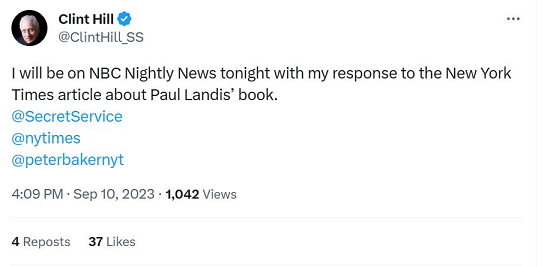
    However, Hill came out against Landis book after he made the following announcement on his Twitter account:Picture20

    Sure enough, Hill denounced Landis book on NBC Nightly News on 9/10/23. His thoughts were outlined in the Vanity Fair article referenced above:Picture21

    The crux of the matter seems to be, for both Clint Hill and certain members of the JFK assassination research community (this current author included), the fact that Landis is previously on record a whopping three different times[27] in stating that what he now in 2023 calls a whole bullet, which he placed on JFK’s stretcher in the emergency room, was then merely a bullet “fragment” which he “gave to somebody.” Here is what he said in 1983[28]:Picture22

    Here is what Landis said in 1988[29]:Picture23

    And here is what Landis conveyed in The Kennedy Detail from 2010[30]:Picture24

    Landis claimed in the Blaine book that he put the fragment on the seat, rather than giving it to somebody as he previously stated in both 1983 and 1988. If all this weren’t enough, Landis makes no mention of finding a bullet or bullet fragments in his 2016 Sixth Floor Museum oral history[31].

    In Landis own 9/12/23 NBC interview, separate from the one Hill did,he reports three gunshots (which in 2016 he said were fired in “5 to 6 seconds,” with the second and third fired rapidly one after the other[32]) and didn’t address the discrepancy with his initial 2-shot reports from decades ago. He also never mentioned stating (again in two different reports) that one of the shots came from the front. Incongruously, he still seemed to favor an Oswald-did-it scenario and that there was no grassy knoll shot, despite his initial two reports stating that a shot came from the front.

    My questions for Paul Landis today[33]:

    • Please distinguish the bullet you are now referring to compared to the bullet fragment that since 1983 you’ve claimed that you found in the limo. Are these “bullets” the same? Is the new bullet in addition to the bullet fragments? Does the whole bullet you now recall finding in the limo physically resemble CE399?
    • Please explain your thinking in November 1963 for not reporting this found bullet in your written reports. Was there explicit or implicit pressure to express or not express certain viewpoints? What form did that pressure come in? Are there additional unspoken revelations that you’re aware of from your Secret Service peers?
    • When did you first tell another person about the whole bullet you now report having found in the limo? What is the oldest written document or letter (or documented conversation) that references this 2023 found bullet?
    • Please share your thoughts on the propriety of a Secret Service agent not including a found bullet in your post-assassination report. Was evidence chain of custody part of your Secret Service training? Do you have a sense of the historic importance of what you are now revealing?
    • “I did not want this piece of evidence to disappear.” So, what does Landis do? He drops this crucial piece of evidence on a gurney without telling anyone. I guess he must have missed all those Preservation of Evidence classes at the Secret Service academy.
    • If Secret Service agents weren’t trained in the fundamentals of crime scene preservation, evidence gathering and reporting, weren’t they at least vetted for common sense?
    • Why then would Landis remove evidence from a crime scene (the presidential limousine) and relocate it to a stretcher instead of handing it off to his superior or at the very least local authorities?
    • Why didn’t he mark the bullet?
    • Why didn’t he record his findings in a report?
    • Did PTSD impede him from fulfilling his oath to support and defend democracy for decades?
    • How could he avoid the Warren Commission Report and Arlen Specter’s “magic bullet” theory for decades?
    • Did he state as late as 2010-2013 that he believed a lone gunman was responsible for Kennedy’s assassination?
    • Did the trauma overwhelm him for six decades?
    • The reason for why his total silence is not believable (or “understandable”) is because at the time Landis did what he said he did with that bullet, he had absolutely no knowledge or information about any of the details concerning the assassination. He had no idea who Oswald was at that time, and he had no idea if a conspiracy might be involved. He knew nothing at that point. And yet he tells NOBODY about finding and moving an important piece of evidence like a bullet?! Such dead silence by a member of the U.S. Secret Service (or anyone in law enforcement) in such a situation is completely beyond belief, not to mention totally irresponsible on Landis’ part. And, in my opinion, even if it had been days or weeks or months later that he had somehow come across a piece of new evidence connected with JFK’s death, it still would not be at all “perfectly understandable” that he would just keep completely silent about encountering such a piece of potentially vital evidence in the case of a murdered President.

    What’s more, according to fellow follow-up car Secret Service agent Sam Kinney’s neighbor Gary Loucks[34] (reported publicly for the first time in 2013), Kinney admitted to Loucks in 1986 to finding an extra bullet and putting it on a stretcher, a story eerily like Landis claims a decade later. One wonders if Landis read the articles about Loucks and Kinney or saw the video[35]? Likewise, Parkland Hospital Nurse Phyllis Hall[36] came out in the same year, 2013, to state that she saw a mystery bullet at Parkland[37]. One also wonders if Landis saw the articles or the videos about her story. Interestingly, Hall’s 2013 story surfaced yet again in September 2023 to corroborate Landis tale[38].

    Possible corroboration for Landis 2023 story (or something he may have viewed previously[39]) comes fromHSCA attorney Belford V. Lawson, in charge of the Secret Service area of the “investigation,” the author of a memo regarding an interview with Nathan Pool conducted on 1/10/77 and headlined “POOL’s CO-DISCOVERY OF THE ‘TOMLINSON’ BULLET.” In the memo, Pool mentions the fact that two Secret Service agents were by the elevator, one of which ” remained there throughout most or all of Pool’s stay”. Before we can catch our breath, a third Secret Service agent enters the picture; although all these men were in the immediate vicinity of the discovery of the bullet, one agent “was within 10 feet when Pool recognized the bullet”. According to Pool, the bullet was pointed, and he added that it “didn’t look like it had hit anything and didn’t look like it had been in anything”.

    Lawson felt that further development of Pool’s testimony may reveal the following:

    QUOTE: “A SECRET SERVICE AGENT WAS FOR A SIGNIFICANT PERIOD OF TIME CLOSE ENOUGH TO THE ELEVATOR TO PLANT A BULLET; MAY LEAD TO AN IDENTIFICATION OF THAT AGENT…”[40]

    In addition, author Jim DiEugenio wrote the author:”During the last days of the public hearings of the House Select Committee, Congressman, now Senator Dodd, gave the most important revelation. He stood up or sat up and asked Professor Blakey to answer one question. And he said, Mr. Blakey, will you please explain to me about the bullet that was found in the President’s limousine that cannot be ballistically matched to the Oswald weapon? Congressman Dodd never received an answer to this day.”

    Finally, in yet another story prevalent online that predates Landis 2023 bullet story, Captain James Young[41][42]story of a bullet — a spent, misshapen, but otherwise intact, bullet — that Young, a Navy doctor, said was found late at night, on the floor, in the back of Kennedy’s limousine. He inspected it himself. The bullet was found by two chief petty officers who, during the autopsy, were sent to retrieve any skull fragments they could find in the limousine. They came back with three pieces of bone, and the bullet. The skull fragments were reported — but not the bullet.

    Writer Ed Curtin thoughtfully wonders if Paul Landis book is merely a “limited hangout.”[43] The man seen with Landis during several televised interviews and the author of the new Vanity Fair article, Cleveland-based attorney James Robenalt, helped Landis to “process his memories,” a strange choice of words, indeed.[44]

    The more I investigate this whole thing, the more skeptical I become of Landis 2023 statements. Just as Jean Hill embellished her account in her book The Lady in Red, perhaps to sell books and make her account more dramatic, I believe such is the case here. And, just like Jean Hill, the “good news” is that the core of their story is true- Jean Hill was there and indicated a shot came from the knoll. Landis wrote in two reports that a shot came from the front, he verified their contents when the HSCA contacted him in early 1979 as they were writing the final report, and I want to believe his denouncement of the single bullet theory in 2016 (echoing Clint Hills own denouncement in the same year in his book Five Presidents) and his stating/demonstrating that the back of JFK’s head was missing (also in 2016, again echoing Clint Hill) are both true.

    As for these 2023-vintage statements about the bullet- I don’t believe it. I wanted to at first, but it falls apart upon deeper scrutiny.

    This whole thing almost reminds me of the Roscoe White story that broke out in August 1990: everyone was so excited as Ricky White made the media rounds. Oh, my Lord- there is a photo of his wife with Ruby! Wow- he was a Dallas police officer trainee. What?! He had the third backyard photo…

    But then, upon further scrutiny, the main part of his story fell to pieces- his father was the grassy knoll shooter as “proven” by a diary that no longer existed. Beverly Oliver said she saw Roscoe White on the knoll (yeah, right); Gerry Patrick Hemming said he knew Roscoe (suuuure he did)…

    Then Ricky disappeared and that was that.

    Will Paul Landis likewise disappear and avoid the tough questions? We shall see.

    PART TWO: THE BOOK ITSELF

    Well, the book was due out October 10, 2023, yet my pre-ordered hardcover was delayed until the end of the month. Being impatient, I decided to get the readily available Kindle edition.[45] Having devoured the entire book in one day, I must say that I was disappointed, both for what Landis says and for what he does not say. Quite frankly, if it wasn’t for the massive advance hype, I think his book would have sunk without a trace with meager sales, to boot (when I originally posted about his upcoming book, very few people seemed to care until the huge media hype came along). In fact, judging by the early mixed reviews on Amazon, Landis should be lucky that he has garnered a lot of advance sales because word of mouth from this point on will not be favorable.

    Comically, right from the start, the Acknowledgments section of the book mentions Clint Hill: “I appreciate your support for my book.” Yet, as we know, Hill came out against his book on NBC and, if that wasn’t enough, Landis was not invited to a get-together of all surviving Kennedy Detail Secret Service agents at the residence of Hill and his wife (and co-author) Lisa McCubbin Hill.[46]Ron Pontius, Jerry Blaine, Ken Giannoules, Tom Wells, and Rad Jones came to the Hill’s residence, as well as another mutual friend, former Secret Service Director Joseph Clancy, yet Landis (who was Hill’s friend for decades and participated in both The Kennedy Detail book and documentary) was not invited and not present.

    From the Introduction, we learn that Landis was given the Josiah Thompson book Six Seconds in Dallas in 2014 and that he “actively avoided reading any books about the events of November 22, 1963,” although he does acknowledge reading the The Kennedy Detail to which, as already noted, he participated in both the book and documentary.

    The bulk of the book will have little interest to all but the most ardent Kennedy fanatics and Secret Service buffs, but I will note some items along the way of getting to the more “meat and potato” points about the bullet and so forth.

    From Chapter One we learn that fellow Kennedy agents Richard Johnsen (the future keeper of CE399) and David Grant (future co-advance agent with Win Lawson in Dallas and Clint Hill’s brother-in-law) were roommates of Landis during his Secret Service career.

    From Chapter Two Landis notes the influence that fellow Ohio native Robert Foster had on his Secret Service career-Landis began his time in the agency in 1959, ending in 1964[47] (Foster would go on to be a member of the Kiddie Detail during the JFK years: the agents who looked after Caroline and John Jr.).

    Chapter 3 mentions Landis’ study of the 700-page Secret Service manual (this is only of interest for those who like to criticize Colonel Fletcher Prouty’s claim that there was indeed a Secret Service manual. Landis mentions having to study it during his training).

    Chapter 4 duly notes Landis time on the President Eisenhower grandchildren detail at Gettysburg, PA in 1960. Future JFK agents (and then-Ike White House Detail agents) Gerald Behn, Floyd Boring, Tom Wells, Stu Stout, Harry Gibbs, Sam Kinney, Bill Greer, Ernie Olsson, Ken Wiesman and John Campion are mentioned. Interestingly, Landis states that he is “proud” to have “planted the seed” for the Secret Service going on to use the AR-15 rifle, which became an official weapon of the agency. For his part, Landis became an official member of President Kennedy’s White House Detail within days of the inauguration: 1/23/61, to be exact.

    In Chapter 5, after mentioning the Secret Service manual once again, Landis fondly notes his positive interaction with JFK and how the President knew his name and the names of the other agents on the detail.

    Chapter 6 chronicles Landis’ time at Hyannis port as part of his 14-month time on the Kennedy Kiddie Detail along with fellow agents Tom Wells and Lynn Meredith. Landis, code name Debut, was the second youngest agent on the Kennedy Detail at 26, with fellow agent Ken Giannoules, also 26, beating him by a mere few months as the youngest one. The 12/19/61 Joseph P. Kennedy Sr. stroke is noted, as is a cute story about how Landis brought Caroline and her pony Macaroni into the actual Oval Office itself, much to JFK’s bemusement.

    Chapters 7-9 reminds one heavily of Clint Hill’s first book Mrs. Kennedy & Me, as Landis chronicles his time as a member of the First Lady Detail assisting Clint Hill in Ravello, Italy (along with fellow agents Toby Chandler and Paul Rundle), during the Cuban Missile Crisis of October 1962 (Landis formally joined the First Lady Detail during this time), the loss of Patrick Kennedy in August 1963, and Jackie Kennedy’s trip to Greece and Morocco in October 1963. Upon their return to Washington, D.C., Landis playfully wore a fez- while still sitting on the plane, President Kennedy (after greeting Jackie) shook his head from side to side and told Landis “Off with the fez, Mr. Landis.”

    Chapter Ten, titled “Texas,” mentions the October weekend trip Jackie made to Camp David, along with Clint Hill, the Kiddie Detail, Caroline, John Junior and the children’s nanny Maude Shaw. Interestingly, as with Hill’s four books and Blaine’s book The Kennedy Detail, Landis makes no mention whatsoever of the death of Secret Service agent Tom Shipman at Camp David on 10/14/63.[48] Landis mentions that the agents received a briefing about the upcoming Texas trip on 11/20/63 and that Dallas was known as the “City of Hate,” as Dallas was known for the attack on UN Ambassador Adlai Stevenson, the foul JFK as traitor notion, and the idiotic idea that the UN was a communist front. As Landis notes, there was “reason to be on alert.”

    After mentioning the trips to San Antonio and Houston (mentioning fellow agents Emory Roberts, Jack Ready, Don Lawton, William McIntire, Glen Bennett, Jim Goodenough, Andy Berger and “Muggsy” O’Leary), the Fort Worth trip of 11/21-11/22/63 is briefly chronicled. The infamous drinking incident involving nine agents, four of which rode on the follow-up car (Hill, Ready, Bennett and Landis himself), which occurred at both the Fort Worth Press Club and The Cellar is conveniently glossed over, as Landis denies that anyone was either drunk or misbehaving, although he does concede that he stayed until the early morning hours and got no sleep whatsoever. The bubble top decision is mentioned, yet no one is specifically mentioned as being the culprit for leaving the top off in Dallas (as I have noted in my books, Secret Service agent Sam Kinney was adamant to me on three occasions that he-Sam-was solely responsible for the top’s removal and that JFK had nothing to do with it).[49]

    Secret Service agent Bill Duncan is noted as the advance agent for Fort Worth, while Winston Lawson is noted as being the lead advance agent for Dallas. Fellow agent Larry Newman told me that he was concerned that Kennedy aides Dave Powers and Ken O’Donnell rode in the follow-up car, as he did not think they belonged there[50], and Paul Landis voices the same concern, even noting that they were unexpected and uninvited guests.

    Interestingly, Landis remembered agent Don Lawton throwing up his arms “as if in frustration” at Love Field as the motorcade started to move out (something this reviewer noted over thirty years ago and popularized in his books, online blogs, conference presentations and television appearances[51]). Landis thought it was because of uninvited guests Powers and O’Donnell, yet he notes that “I have since read that he was left behind to help secure the area for our departure later that afternoon.” However, Landis states that “I personally find this difficult to believe, because Love Field was already secured for our arrival. We were already short of agents and needed all of the on-site coverage we could get.” As with the omission of any word about agent Thomas Shipman’s death, Landis makes no mention of agent Henry Rybka, the other agent (along with Don Lawton) recalled and left behind and Love Field.[52]

    Landis, after duly noting fellow follow-up car agents Sam Kinney (the driver), Emory Roberts, George Hickey (manning the AR-15), Clint Hill, Tim McIntire, Jack Ready, Glen Bennett and himself, also mentions that agent Glen Bennett was “our protective research agent,” yet, officially, he was merely an extra agent added to the somewhat depleted detail of agents. That said, Landis’ comment corroborates both Clint Hill’s statement in his book and my own research that agent Bennett was there as an unofficial covert monitor of threats to Kennedy’s life and the true nature of his reason for riding in the follow-up car was hidden for decades after the assassination.[53]

    Landis notes that the Dallas motorcade was ten miles long (in contrast, the Tampa, Florida motorcade of 11/18/63, which entailed agents on the rear of the limo and infinitely better overall security, was a whopping 28 miles long[54]). Landis rightly notes that Clint Hill got on the rear of the presidential limousine several times and that the motorcade, travelling at “30-35 mph” before they got to Main Street, had driver Sam Kinney hugging the rear bumper of JFK’s limo, maintaining a 3-5 foot distance between the cars the whole time (although there would be a markedly wider distance between the two cars on Elm Street when the assassination began). Landis notes that they were barely moving at a snail’s pace around the sharp, almost hairpin turn from Houston Street onto Elm Street.

    When the assassination started, Landis states that “everything happened so fast” and that the shooting occurred within “5-6 seconds.” Landis does state that the second shot “sounded louder than the first one” and that it “had a different feeling, a different reverberation.” From Landis’ description of the 3 shots, he says he heard, it sounds like there were actually more than three shots, for he states that the second one occurred as “Hill was starting to pull himself up onto the limo” and that the third shot was the head shot! Landis states that the head wound was “massive”, yet does not state exactly where it was, unlike his 2016 Sixth Floor Museum oral history, in which he demonstrates that it was located at the “right rear” of the head.[55]

    Disappointingly, perhaps influenced by his participation in The Kennedy Detail, Landis, with no first-hand knowledge (he admits that this was his first motorcade), states that the agents were not on the rear of the limo because JFK did not want them there, a notion the author has adamantly debunked.[56] Landis does admit that Shift Leader Emory Roberts instructed the agents to cover Vice President LBJ as soon as the follow-up car stopped at Parkland Hospital, quite a switch in allegiance from Kennedy to Johnson.

    Chapter 11, titled “Parkland”, begins with Landis noticing “a crack in the windshield” of the presidential limousine and further adding that Texas Governor John Connally was “probably (hit) by the second bullet”; that he “saw two brass bullet fragments sitting in a pool of bright red blood” on the rear limousine seat; and that he also “saw a bullet on top of the tufted black leather cushioning” and that it was “a completely intact bullet,” yet he does not state the obvious contradictions these observations would have to the official government Warren Commission single bullet theory, an absolutely essential component to having Lee Harvey Oswald acting as the sole shooter. In fact, the official photo of CE399, the magic bullet, is shown with the caption that this was “the bullet that Special Agent Paul Landis found in the limousine”!

    Landis wonders where the agents were when he discovered the intact bullet, yet Sam Kinney (one of the ones he mentions as missing) was indeed still there, as many photos and films prove.[57] Landis claims he actually held the bullet in his hand, placed it in his suit pocket, and (not long afterward) placed it on the examination table next to JFK’s left shoe, none of which he ever stated before when (as noted in part one) he was interviewed in 1983, 1988 or 2010.

    Landis goes on to mention that Texas law forbids the president’s body from leaving Texas, yet, as we know, the agents forcibly removed JFK’s body at gunpoint on their way to Love Field and Air Force One. Landis also notes fellow agent Glen Bennett taking notes aboard Air Force One. Interestingly, Landis also states that agent Roy Kellerman, nominally in charge of the Texas trip, persisted and insisted that Landis watch the swearing in ceremony, fodder for those who believe something happened to Kennedy’s body while the ceremony was taking place.

    Chapter 12 has a few items of interest. After noting that roommate and fellow agent David Grant (Hill’s brother-in-law and advance agent for the Trade Mart) stayed in Dallas to assist the police in their investigation, he notes that some of the agents thought that LBJ had something to do with the assassination! Also of interest: Landis states that, not only were all the agents in Dallas told to write reports, but they were all told to watch the Zapruder film: “all agents were required to view the film and sign off that they had seen it. It was mandatory.” Landis refused to do so and heard nothing more about it.

    Remarkably, Landis claims to have purchased a Mannlicher-Carcano like Oswald’s from American Rifleman magazine back in March 1958 and that he brought his rifle to the White House to show his fellow agents on the morning of 11/25/63, Kennedy’s funeral. Of note, Landis does not mention Gerald Blaine’s alleged “meeting” from this same morning wherein the agents supposedly talked of suppressing the “fact” that Kennedy told them to stay off the limo so as not to blame the president.[58]

    Chapter 13 takes note of Landis’ PTSD and how he would play the assassination over and over in his mind which led to his eventually leaving the Secret Service on 8/15/64, three days after his 29th birthday.

    The Epilogue has Landis finally admitting that he read the Warren Report, albeit in 2018. Surprisingly, Landis admits that he was indeed contacted by the HSCA in 1979, yet he omits what he conveyed: that he stands behind his two reports! In fact, perhaps the most glaring omission of all: Landis does not mention that he stated in BOTH of his reports that a shot came from the front! I find these omissions very troubling, to put it mildly. Landis ‘forgets’ to mention the fact that he wrote something in TWO reports that goes against official history AND he doesn’t bother to mention the bullet he allegedly found: bizarre and suspicious.

    Quite frankly, I find the entire book a real “bait and switch” scenario: hype the book about the bullet Landis found while it racks up best-selling sales in pre-order, only to deliver a pamphlet’s worth of interesting and new information. And, as noted above, there are glaring omissions and the whole bullet business leaves one wondering if this was added to sell books (as he wrote nothing about it in 1963 or said nothing about it in 1983, 1988 or 2010 when given the chance) and, perplexingly, Landis does not go into any detail about the significance of this alleged find and how it debunks official history (if true). Seasoned researchers know about the significance of a whole bullet found where it was in Landis’ scenario, but I can imagine the public being quite confused (and totally in the dark about Landis’ two reports that stated a shot came from the front, as well as his demonstration of a right rear head wound in 2016).

    But, hey- Landis has a runaway best-seller (in advance sales) for his children and grandchildren to enjoy…


    Journalist Jeff Morley and attorney Larry Schnapf interview Landis about this new controversy and his book. Watch/download the interview here.


    [1] Perhaps JFK era agent is more appropriate, as Landis, like fellow Secret Service Agent Clint Hill, was actually a First Lady Agent, protecting the life of Jacqueline Kennedy.

    [2] The Final Witness: A Kennedy Secret Service Agent Breaks His Silence After Sixty Years: Landis, Paul: 9781641609449: Amazon.com: Books

    [3] Jackie Kennedy’s ex-Secret Service agent makes new claim about the JFK assassination – YouTube

    [4] Former Secret Service agent describes JFK assassination in new detail – YouTube

    [5] Ex-Secret Service agent reveals new JFK assassination detail – BBC News

    [6] JFK Secret Service Agent Refutes Magic Bullet Assassination Theory (tmz.com)

    [7] A New JFK Assassination Revelation Could Upend the Long-Held “Lone Gunman” Theory | Vanity Fair

    [8] J.F.K. Assassination Witness Breaks His Silence and Raises New Questions – The New York Times (nytimes.com)

    [9] Agent Paul Landis Makes Startling Claim About JFK Assassination in New Book (people.com)

    [10] 18 H 687. See also Could the Secret Service Have Saved J.F.K.? | Vanity Fair

    [11] 18 H 758-759; 18 H 751-757

    [12] HSCA REPORT, pages 89 and 606

    [13] The Kennedy Detail by Gerald Blaine (2010), page 353

    [14] Author of the books Mrs. Kennedy & Me (2012), Five Days in November (2013), Five Presidents (2016), and My Travels with Mrs. Kennedy (2022). In addition, Hill wrote the Foreword and contributed significantly to the Gerald Blaine book The Kennedy Detail (2010)

    [15] Tina Towner: My Story as the Youngest Photographer at the Kennedy Assassination (2012)

    [16] The Coshocton (Ohio) Tribune, 11/20/83; Greenfield (Ohio) Daily Times, 11/22/83

    [17] The Columbus (Ohio) Dispatch, 11/20/88

    [18] Could the Secret Service Have Saved J.F.K.? | Vanity Fair

    [19] Five Presidents by Clint Hill (2016), page 178

    [20] 18 H 740-745

    [21] 2 H 141

    [22] The Kennedy Detail, page 217

    [23] Mrs. Kennedy & Me, page 291

    [24] Five Days in November, page 139

    [25] Five Presidents, page 155

    [26] Paul Landis on location of JFK head wound: blockbuster – YouTube

    [27] Although, importantly, not in either of his 1963 reports

    [28] The Coshocton (Ohio) Tribune, 11/20/83; Greenfield (Ohio) Daily Times, 11/22/83

    [29] The Columbus (Ohio) Dispatch, 11/20/88

    [30] The Kennedy Detail, page 225

    [31] Paul Landis – no mention of bullets or fragments in 2016 interview plus bad memory – YouTube

    [32] Paul Landis – fast shots that sounded different but fails to mention frontal shots from HIS reports – YouTube

    [33] Special thanks to researcher K.K. Lane for his help with this specific list of questions.

    [34] Loucks died on 2/23/23: Gary Lee Loucks (1946-2023) – Find a Grave Memorial

    [35] JFK Secret Service Agent Sam Kinney’s neighbor’s (Gary Loucks) revelations – YouTube

    [36] Hall died on 4/18/23: Obituary | Phyllis J. Hall of Irving, Texas | Donnelly’s Colonial Funeral Home (donnellyscolonial.com)

    [37] Nurse claims JFK had another bullet lodged in body after assassination – New York Daily News (nydailynews.com)

    [38] JFK assassination nurse says she SAW the ‘pristine bullet’ Secret Service agent Paul Landis now claims he retrieved from limo and placed on stretcher – upending the ‘magic bullet’ theory | Daily Mail Online

    [39] As referenced in my books and fairly prevalent online.

    [40] Pool Nathan 01.pdf (archive.org)

    [41] White House Physician, Autopsy Eyewitness, questions President Ford about Missing Bullet – ASSASSINATION ARCHIVES (aarclibrary.org)

    [42] Navy Doctor: Bullet Found in JFK’s Limousine, and Never Reported – WhoWhatWhy

    [43] Another Magical JFK Assassination Pseudo-Debate and Limited Hangout | Dissident Voice

    [44] James Robenalt – Wikipedia

    [45] With this in mind, all references are to the Kindle edition.

    [46] Clint Hill Facebook 9/24/23. Hill noted: “There were messages from former USSS director Lew Merletti and Secretary of State Tony Blinken and his wife Evan Ryan, the granddaughter of James J. Rowley, my first boss at the White House.”

    [47] The same time span as agent Gerald Blaine.

    [48] See the reviewer’s books Survivor’s Guilt: The Secret Service & The Failure to Protect President Kennedy, The Not-So-Secret Service, Who’s Who in the Secret Service and Honest Answers About the Murder of President John F. Kennedy. See also: THE REAL DEATH OF A SECRET SERVICE AGENT THE MONTH BEFORE THE KENNEDY ASSASSINATION 10/14/1963 – YouTube

    [49] The JFK bubble top: Sam Kinney’s decision + all the times it was used (1/3 of all motorcades) – YouTube

    [50] Interview with Larry Newman.

    [51] JFK assassination Secret Service documentary: the Kennedy agents 2016 – YouTube

    [52] The Secret Service stand down on the day of the JFK assassination EXPLAINED: one hour version – YouTube

    [53] Gerald Blaine, The Kennedy Detail (kennedysandking.com)

    [54] Excellent security for President Kennedy 11/18/63 Tampa and Miami, Florida – YouTube See also EXCELLENT security for JFK in Tampa, FL on 11/18/63 | Vince Palamara

    [55] Paul Landis on location of JFK head wound: blockbuster – YouTube

    [56] JFK’s agents deny that President Kennedy ordered them off the limo – YouTube

    [57] For example, see the 16-minute mark of: The Last Two Days – Highest Quality Version (JFK Assassination) – YouTube

    [58] Gerald Blaine, The Kennedy Detail (kennedysandking.com)

  • Zero Fail: Déjà vu All Over Again

    Zero Fail: Déjà vu All Over Again


    As someone who has written extensively about the Secret Service, especially the Kennedy years, I was looking forward to 3-time Pulitzer Prize winning author Carol Leonnig’s hyped book Zero Fail. While this is not a review of her book, per se, it is a tale of disappointment and how I was once again the victim of some sophisticated and sinister hacking, which directly affected my books and my work. This is something I went through back in 2010, when former Secret Service agent Gerald Blaine’s book The Kennedy Detail was in the news and again when my own book Survivor’s Guilt: The Secret Service & The Failure to Protect President Kennedy was coming out.

    In the short days before Leonnig’s book was due to be released (5/18/21), I was admittedly quite excited about reading the book, even having it on pre-order from Amazon in anticipation. The author is a very respected journalist who had previously co-authored the number one best-selling anti-Trump book A Very Stable Genius. I had high hopes that, when Leonnig tackled the Kennedy era, in particular, she would put on her investigative reporter hat and do some digging to find the real truth on the matter of Kennedy’s Secret Service protection, or lack thereof, in Dallas.

    Then, the flood of articles and media appearances began and my heart sank. Leonnig merely bought into the old canard that JFK ordered the agents off his limo and was reckless with his own security—the old blame-the-victim mantra—no doubt enhanced by personal interviews with former agent/authors Clint Hill and Gerald Blaine. I kept thinking to myself “surely this acclaimed author has to know of my work; she has to know there is a huge dissenting view on this matter.”[1] But, alas, Leonnig chose the lazy way out and didn’t do her own thinking on the subject.

    That was the first part of my disappointment…then came the real shocker.

    On the eve of her book being released, I went to my Amazon author page and, to my horror, I discovered that ALL FIVE OF MY BOOKS WERE GONE…gone! I immediately went to my bookmarks and found that the individual URLs were still there, but the books were gone from my author page. It gets worse.  When I did a search in Amazon using the terms “Vince Palamara”, “Vincent Palamara”, “Palamara”, “JFK assassination”, “Kennedy assassination” or “Secret Service”, none of my books—which were normally at or near the very top of these search terms, especially my latest Honest Answers About the Murder of President John F. Kennedy—were missing. Nothing was there!

    By removing my books from my author page, they were essentially invisible to the potential buyer. Then I checked Josiah Thompson’s popular new book Last Second in Dallas.  Same thing, his was gone too! I also checked a few other very recent pro-conspiracy books…same fate. I let author Larry Hancock know of this alarming situation and he became an instant student of this hack and the ramifications of the disappearance of his books from Amazon. I also alerted Josiah to this drastic situation via a mutual friend, writer Matt Douthit. First and foremost, I fired off some edgy messages to Amazon’s support staff. It took about 6 hours or so, but the books slowly came back. But, and it’s a big but: There was no explanation from Amazon regarding how or why this happened! As someone told me: they wouldn’t hack their own products and “kill their own”, so to speak; they want the money and sales. This had to have been a nefarious hack with a purpose (for the record, no lone-nut books were harmed in the making of this hack. Also, older titles were not touched, either).

    I cannot help but think that someone—knowing Leonnig’s red hot volume was due for release, and seeing all the hype articles and television appearances and the positive effect this would have on curious minds wishing to check out books related to the Secret Service and the Kennedy assassination like mine, Josiah’s, Larry’s and a couple others—somehow did a malicious hack to erase them from searches. With Amazon offering no explanation and realizing how highly unusual this was, what else was one to think? Since 2013, when my first book came out, and ever since, this has never happened before[2] and I make this statement as someone who admittedly checks out my books a few times daily to monitor for positive comments, negative comments, sales, and any potential mischief, so any other past hack would have been known to me.

    This feeling is further enhanced due to this fact: I am the victim of previous harassment due to my work.

    As readers of my detailed review of The Kennedy Detail well know[3], I am firmly convinced that Gerald Blaine’s book was written to counter my work on the Secret Service. In fact, both Gerald Blaine and Clint Hill took to C-SPAN to address some of my criticisms, even showing a You Tube video of myself speaking about their book[4] (Hill wrote the Foreword to Blaine’s book, contributed to its contents, did the book and media tours, and ended up in a romantic relationship with co-author Lisa McCubbin which led to three books: Mrs. Kennedy & Me[5], Five Days In November[6], and Five Presidents[7]). Keep in mind-this was all before my first book was published, although it was a self-published affair at the time with a link on my blog as part of my heavy online presence (I will return to this later).

    I went on to write a critical review of Blaine’s book on Amazon which was deleted with no explanation, despite many “likes” and positive comments. Then it began: my blog was hacked and I temporarily could not add to it or see it online. The same thing happened to my You Tube channel. It took several days to get them back. But this was only the beginning. In the middle of 2013, I suddenly saw a drastic reduction in my online presence. All my many blogs and sites were still up, nothing had changed on my end, yet Google acted like most of my work didn’t exist, despite a heavy search-term presence from 1998 to mid-2013. Someone told me I was most likely the victim of algorithms and hidden HTML coding which made a lot of my work disappear despite still technically being online. When one did searches for “Clint Hill”, “Gerald Blaine”, “The Kennedy Detail” or (especially) “JFK Secret Service”, my work came up for years in commanding fashion with little or no competition. But 2013 was the 50th anniversary of the assassination, when the media was truly working overtime to close down dissent on the case and wrap it all up as “Oswald did it-get a life.”

    But this was only the start of my troubles.

    My first book Survivor’s Guilt was due out in October of 2013. Gerald Blaine marked my book as “to read” on Good Reads; Lisa McCubbin gave it a one-star rating on Good Reads before it even came out; and former JFK Secret Service agent Chuck Zboril gave my book a one-star review on Amazon when it did come out, which prompted a specific friend of Blaine’s (whom I will not name for legal reasons and to give him any notoriety), a person formerly in military intelligence who had also worked for the United States Post Office, to begin bothering me online with many nasty comments on both Amazon and my blogs. What was truly bizarre about this individual was that he seemed to be able to track my every moment online and know when I was at work!

    Which relates to this, not once but twice I was called to a private conference room at work, as a woman from Human Resources (HR) alerted me to the fact that the same above noted individual wrote to the CEO of my company attempting to get me fired for:

    a) my unpatriotic attacks on Blaine and

    b) doing these things on company time.

    Neither of these had any merit.  My reviews of Blaine’s book never crossed the line into libel and I only wrote my criticisms at home, not on the clock at work. In any event, the lady from HR informed me that (luckily) the CEO never sees his mail first, as they always screen it and, more importantly, they sided with me: nothing I did went against company policy, it was under the First Amendment protection. In fact, they added that they would seek legal remedies against him if he ever wrote again!

    I also had the kindle version of my first book disappear for a couple days from Amazon.  I had to fight to get it back: no explanation was forthcoming. In addition, all my hundreds of reviews on Amazon were wiped out—the excuse being that someone—I wonder who—reported my reviews as “biased” (!).  So they all went away. I am no longer able to write reviews for books; I can only edit my book page, because I am an author of five books.

    In the interest of transparency, there may have been a specific reason why I became the target of this harassment. I wrote an e-mail to Stephen Gyllenhaal, the director of Gerald Blaine and Clint Hill’s then upcoming Hollywood movie The Kennedy Detail (based on Blaine’s book).  I alerted the director of my criticisms of Blaine’s book in no uncertain terms. The letter, while G-rated and professional, seems to have had an impact. Not long after, Blaine’s proposed movie sank without a trace and the once impressive website they had for the movie-in-progress (with several Academy Award winning production people included) likewise disappeared.

    Which leads us to the present day. Zero Fail may be an epic professional fail when it comes to its Kennedy-era chapter. But it achieved its goal: the whole blame-the-victim mantra is once again alive and well (Leonnig’s book is another massive number-one best-seller). I must say that I am heartened by a few Amazon reviews of her book which duly note the truth about my work:

    The media hype for this book is all wrong! With all due respect, the Kennedy Detail agents are on record many years ago debunking the notion that President Kennedy had asked them to get away from the limo or order the bubble top off or reduce the number of motorcycles. What’s more, the Secret Service was the only boss the president of the United States truly has, to quote from Presidents Truman, Johnson, and Clinton. Author Vincent Palamara has proven this in multiple books he has written.

    How can you take this book seriously when she gets the part about JFK so wrong. The notion that JFK told the SSA not to ride the limo in Dallas has long been disproved. He never interfered with the SSAs and what they wanted to do. There are numerous SSA agents who have stated this on the record. You can see them on YouTube – or read their written statements. The notion that JFK interfered was promoted by a select few SSA’s to deflect blame from the agency for their MASSIVE failure that day in Dallas. The salacious press of the day ate it up and fiction became fact—for a while—until it was debunked. The fact that this author is oblivious to this and still repeats those old canards causes me to question the rest of her “investigatory” prowess.

    Renowned author Vince Palamara, via his many interviews with the vast majority of the Secret Service agents who guarded JFK, as well as sundry White House aides, has demonstrated overwhelmingly that President Kennedy did not order the agents off his limousine or even interfere with the agent’s actions at all. Special Agent in Charge of the White House Detail Gerald Behn (who outranks anyone Leonnig interviewed in extreme old age if at all) told Palamara that President Kennedy never ordered the agents off his car. Agents Floyd Boring, Sam Sulliman, Robert Lilley, and many others said the same thing. What’s more, presidential aide Dave Powers and Florida Congressman Sam Gibbons (who rode with Kennedy during the entire 28-mile Tampa motorcade) said the same thing.

    The moral to this story—my story—is this: if one thinks that the Kennedy assassination is not a current event in some respects, you are wrong. There are still those who will do anything they can to tamp down on dissent.


    [1] She does indeed: she references my fourth book Who’s Who in the Secret Service on page 504 of her book, as well as citing a video on my You Tube page.

    [2] Technically, a much smaller hack had happened on Amazon just to myself on one form of my first book before. I will get to this shortly.

    [3] Please see Kennedys And King – Gerald Blaine, The Kennedy Detail.

    [4] Please see JFK Secret Service Agent Clint Hill vs Vince Palamara Part 1 – YouTube and JFK Secret Service Agent Clint Hill vs Vince Palamara Part 2 – YouTube.

    [5] Please see Kennedys And King – Clint Hill, Mrs. Kennedy and Me.

    [6] Not reviewed by myself because it was basically a rehash of his first book with many photos related to those five days in November 1963.

    [7] Please see Kennedys And King – Clint Hill, with Lisa McCubbin, Five Presidents.

  • Clint Hill, with Lisa McCubbin, Five Presidents

    Clint Hill, with Lisa McCubbin, Five Presidents


    Oh, what I hath wrought to the world. As readers of my critical review of Lisa McCubbin’s first of four “co-authored” books The Kennedy Detail well know [1], I am thoroughly convinced that it was my 22-page letter to Clint Hill in 2005 that awoke a sleeping giant. Hill, then 73 and with zero want or desire to write a book (a sort of badge of honor that he carried for decades), was angered by my letter, a “cliff notes” version of the basics from my then self- published first book critical of the JFK-era Secret Service entitled Survivor’s Guilt.[2]It is important to emphasize the fact that Hill had an unlisted address and phone number at the time; it was only through the good fortune of an unsolicited bit of help via a colleague of Hill’s, former agent Lynn Meredith, that I was able to obtain this then highly-sought bit of information. As I discovered during my June 2005 conversation with Gerald Blaine, Clint shared the contents of my private letter to his fellow former agent, a man who, I soon found out, was his best friend for many years and who was, by any measurable standard, an obscure agent of the Secret Service who was on the Texas trip (but not in Dallas), having served a meager five years with the agency.

    Perhaps you can figure out where this is headed to.

    As fate would have it, it was during this same summer of 2005 that two things happened: Gerald Blaine began writing his book[3] and Clint Hill, writer of the Foreword to the book (and participant in the book tour and numerous television programs), destroyed his personal notes he had in his possession for decades.[4] It was also during this very same time that Lisa McCubbin, an obscure former television reporter who lived in Qatar in the Middle East for six years as a freelance journalist[5], began helping Blaine with the writing of his book. McCubbin was born after the assassination and was friends with the Blaine family; in fact, she had dated Blaine’s son.[6] In an unexpected turn of events, McCubbin (born in 1964) would start a romantic relationship with Hill (born in 1932), although Hill is still married. [7] This partnership, professional and otherwise, would reap many benefits: The Kennedy Detail in 2010 and the accompanying Emmy-nominated Discovery documentary of the same name[8], Mrs. Kennedy and Me in 2012[9]; Five Days In November in 2013[10]; and, now, Five Presidents in 2016, all of which would go on to become New York Times best-sellers, having the distinct advantage of being published by the biggest publishing house in the world, Simon and Schuster, who can guarantee instant articles on Yahoo, People magazine exposes, and coverage on Fox, CNN, and NBC. McCubbin even brags on her website that “she is widely respected within the U.S. Secret Service for her responsible and accurate writing about this highly secretive agency.”

    And, yet, as I have written at length about in both my book Survivor’s Guilt, my forthcoming book The Not So Secret Service, and in several CTKA reviews (not to mention countless blogs and posts online), her work cannot be trusted with anything controversial. Sure, you can take it to the bank when she writes about harmless historical items such as Hill’s many interactions with Jackie Kennedy and other Redbook/Reader’s Digest type moments, but her work should be viewed with a jaundiced eye when the Kennedy assassination is mentioned.

    Hill, Blaine and McCubbin are much aware of my work; no delusions of grandeur here. Apart from my aforementioned 22-page letter that opened Pandora’s box, Hill and Blaine have discussed my work on C-SPAN with CEO Brian Lamb (in Hill’s case, twice);[11] Blaine sarcastically names me as a Secret Service “expert” on pages 359-360 of his book (and quite a few other pages are a direct response to my work); I am credited at the end of a 2013 television program in which Hill briefly addresses my “allegations” (McCubbin also participated as well)[12]; Blaine had his attorney send me a threatening letter[13]; McCubbin, who contacted me about my blog, gave my first book a one star on “Good Reads” and has even admitted on C-SPAN of finding information that contradicted Blaine (almost certainly my work)[14]; Blaine added my book as an item “to read” on “Good Reads”; Blaine and Hill friend (and former agent) Chuck Zboril, much aware of my blog, gave my first book a one-star review on Amazon; former agent Ron Pontius mentions one of my articles without naming me on the television documentary; and I have been treated to petty harassment by several other personal friends of Blaine, both at home and at my former place of employment.

    With all of this in proper focus, it is time to examine the latest offering from the Hill/McCubbin partnership, Five Presidents.

    Clint Hill with Jackie Kennedy

    While serving five different presidents is somewhat noteworthy, Hill is hardly the first or only one to have served five or more presidents or to have written books about their service. SAIC Edmund Starling (author of the 1946 book Starling of the White House), SAIC/ Assistant Director Rufus Youngblood (author of the 1973 book Twenty Years in the Secret Service: My Life With Five Presidents), Chief/Director (and former SAIC) James Rowley, SAIC Gerald Behn, ASAIC Floyd Boring (who contributed to David McCullough’s 1993 book Truman and the 2005 Stephen Hunter book American Gunfight), ASAIC Roy Kellerman, Art Godfrey, Chuck Zboril (misspelled “Zobril” on page 451), Winston Lawson, Emory Roberts, Vince Mroz, Howard Anderson, Morgan Gies, SAIC of PRS Bob Bouck, John Campion, Ron Pontius, Stu Stout, Hill’s brother-in-law David Grant, Director Stu Knight, and others served five or more presidents (the number is quite large if one were to include agents from field offices and/or on temporary assignments, as it was not unusual for an agent from the FDR-Ike era to serve for many years on the White House detail, later known as the Presidential Protective Division, or in the Washington field office, among many other field offices around the country and, indeed, the world. The number is even larger if one was also to include those agents who also protected former presidents or vice presidents who later became president such as Truman, Nixon, LBJ, Ford, and Bush 41).

    Part 1 of the book, encompassing the first seven chapters, details Hill’s time protecting President Eisenhower. After learning that Hill served in Army Counter Intelligence from 1954-1956 (pages 8-10), serving duty at Fort Holabird (where Richard Case Nagell and fellow agent Win Lawson also served), Hill makes a troubling error, claiming that James Rowley was the Special Agent in Charge of the White House detail since the FDR days (page 14) when, in actual fact, he became SAIC on 5/3/46 during the Truman era, replacing George Drescher.[15] In yet another contradiction to the writing of Gerald Blaine and Lisa McCubbin found on page 398 of The Kennedy Detail, wherein they state that Ike usually rode in a closed car, there are seven photos of Eisenhower in a motorcade and every photo depicts him in an open vehicle. This is in addition to various times in the actual text where Hill mentions Ike riding in an open car (this reviewer has found dozens and dozens more photos online of President Eisenhower in an open-topped vehicle. In fact, one is hard pressed to find any photos of Ike in a closed car).

    In the coup de grace, Hill (and, presumably, McCubbin) writes on page 44, not realizing the stark contradiction, “[the canvas roof] really bothered Ike, who liked seeing the crowds, but more important, wanted them to have the opportunity to see him…President Eisenhower preferred to use the car as an open convertible whenever possible so he could stand up and be even more visible to people viewing the motorcade.”

    On pages 40 and 46, in particular, the heavy use of well-armed military guards on Ike’s foreign trips paints a picture in sharp contrast to Dallas circa 11/22/63. On page 48, there is a minor contradiction: Hill states that Ike’s eleven-nation tour was his first time out of the United States, yet, on page 24, he writes of an earlier one-day trip to Canada with Ike.

    On pages 53-55, Hill describes working with Harvey Henderson, a controversial and racist agent from Mississippi who harassed fellow agent Abraham Bolden to no end.[16] While Hill describes Henderson as “a good ol’ Southern boy,” he was more forthcoming to author Maurice Butler: “Now there were certain individuals in the service, I won’t deny that, who were very, very bigoted. Most of them came from Mississippi or Alabama or somewhere in the South. Sometimes we had problems with them. They didn’t want to work with a black agent.”[17] Fellow agent Walt Coughlin told me, “Harvey Henderson he [Bolden] is probably rite (sic) about.”[18] Yet The Kennedy Detail’s Gerald Blaine, in typical fashion, wrote this reviewer on 6/12/05: “I don’t remember anybody on the detail that was racist. Merit was perceived by a person’s actions, their demeanor, reliability, dependability and professional credibility – not race! Harvey was not even on the shift that Bolden was during his thirty day stay. Even though Harvey Henderson was from Mississippi, I never heard of him discriminating nor demeaning anyone because of race.” Can the reader see why I have major problems with history as seen through the Blaine and McCubbin prism? There’s a real tendency to whitewash and omit crucial information. They know better…and they know I know better, but they are hoping you do not, if that makes any sense. But I digress a tad.

    Also on page 55, Hill notes that local police helped secure buildings and routes of travel, as well as checking out the local medical facilities (which he further notes on page 81). Yet, again, when President Kennedy goes to Dallas, officially speaking, no buildings were secured, the motorcade route was woefully short staffed, and they allegedly did not know that Parkland Hospital was the closest hospital in case of emergency.

    Overall, I would assess Part 1 of the book-the Ike era- as a fairly decent perspective of an agent’s time protecting the former World War II hero. Although glimpses of Eisenhower come through, I was left more with Hill’s outlook on trying to do his job than any deep analysis of Ike.

    Part 2 covers the Kennedy era and encompasses chapters 8-19 and much of it will be familiar to anyone who has read the three previous Lisa McCubbin co-authored books; lots of repetition here. That said, there are some items of interest. On page 112, it is noted that the 27-mile motorcade route in Caracas, Venezuela was massively guarded by the host country’s heavily-armed military, involving more than 30,000 soldiers and 5,000 police officers. The bubbletop was used, despite the nice weather, and agents rode on the rear of the limousine.[19]

    On page 133, while discussing President Kennedy’s European tour (in an obvious allusion to the upcoming Dallas trip several months later), Hill writes: “There was no way to check every building or every rooftop,” yet that is precisely what they were able to do on past trips, at least those involving multi-story buildings.[20] Chapters 16 and 17 (pages 141-160) cover the Texas trip and the assassination. On page 142 McCubbin, as she did with Blaine in The Kennedy Detail and in the prior two books with Hill, mentions once again the alleged “order” from President Kennedy, via Floyd Boring, to not have the agents on the back of the car. I have written at length on this specific topic, as I am extremely skeptical of the veracity and timing of this situation.[21] My first reaction when reading this section was “McCubbin HAD to put that one in there again.” On page 152, not realizing the huge contradiction, Hill/ McCubbin write: “I knew the president didn’t want us on the back of the car, but I had a job to do.” Hill jumped off and on the back of the limousine four different times on Main Street. So much for the president’s “order.” No other agent attempted to get on the back of the car.

    Hill deals with the infamous drinking incident at Kirkwood’s the night before JFK’s death in a very dismissive fashion on page 147. Hill was one of nine agents who drank the early morning of the assassination. Hill was also one of the four agents who drank alcohol who would go on to work the follow-up car in Dallas (the others were Paul Landis, Jack Ready and Glen Bennett).

    On pages 153-154, Hill writes of the shooting sequence and, as he has done in the past (echoing the same thoughts as Dave Powers and Governor Connally on the matter), Hill states that all three shots made their mark and there was no missed shot: the first shot hit JFK, the second hit Connally, and the third was the fatal head shot. Again, he does not realize the grave contradiction to official history. In this regard, he once again repeats what he has written (and said) many times before: JFK had “a gaping hole in the back of his skull” (page 155).

    Once again, as was noted in their prior works (and as I was the first to note in my own work): ”Normally [SAIC Gerald] Behn would be on the [Texas] trip, but as fate would have it, he had decided to take a few days off-his first vacation in years…” (page 156). “As fate would have it.” huh?

    On page 178, Hill states his disagreement with the “magic bullet theory,” stating that Governor Connally and his wife Nellie agreed with him. Hill cannot seem to understand you cannot have your cake and eat it, too: either there was a “magic bullet” or there were two assassins. Still, it is nice to have him on the record about this vital issue. And he seems unaware that as authors like Joe McBride have shown, Connally actually disagreed with the entire thesis of the Warren Report. (McBride, Into the Nightmare, p. 418)

    Overall, I would assess Part 2 of the book-the Kennedy years- as largely repetitive from his and McCubbin’s past books, which all seem to tout the same recurring agenda in two parts: his adamant stand that there was only one assassin (despite his contradictory views as expressed by his statements about the wounds and the shooting sequence), and that the agents did the best they could, despite their feelings of failure (and making sure to put that false blame-the-victim nugget in there again for good measure). That said, there were some new tidbits of information about prior trips and, to be fair, the Kennedys shine through in a positive way in this section.

    Part 3, the LBJ section, encompasses chapters 20-29 and is arguably the best part of the book- Hill really captures Johnson and the so-called “Johnson treatment” quite well. Even before the formal Johnson section of the book begins, the JFK section ends with Hill’s auspicious first greeting to LBJ in October 1964 when the President visited Jackie Kennedy in New York. Hill extended his hand to Johnson and said “Hello, Mr. President, I am Agent Clint Hill.” LBJ simply ignored him, reached into his back pocket, pulled out a handkerchief, and blew his nose. Hill said the experience, witnessed by the agents of the White House detail who were guarding LBJ, was “humiliating.”

    Another minor error occurs on page 227 when Hill states that the Kennedys visited Mexico in 1961-it was actually 1962, as is correctly noted on page 114.

    Hill succeeds the best here when he vividly describes Johnson’s interactions with himself and others, as well as the impromptu nature of the brusque Texan. Like the travels of Ike and JFK, the many travels, domestic and foreign, of Johnson are duly noted and Hill (and McCubbin) do an admirable job describing the interaction the president had with the hosts and with the spectators, as well as with the agents themselves. When the McCubbin “team” (either with Blaine or Hill) aren’t treading into controversial waters, they actually succeed with some well-written stories and presidential anecdotes. Perhaps this is why I liked Mrs. Kennedy and Me the most- other than a couple pages, it was harmless fun about the elegant First Lady and a touch of Camelot, albeit a tad maudlin and trite in places. In this regard, I believe Five Presidents is a very close second to that work, with Five Days In November being disposable and forgettable and The Kennedy Detail as the worst by a country mile for its deceit and deception. In fact, one could argue that Five Presidents, despite the Kennedy-era repetition and one page (page 142, to be exact) of controversy, is the best of the lot, but I digress.

    What I think makes the LBJ section such a winner is not just that it is the longest section of the book, but that the “safe” button was switched to off and Hill is telling the true stories with the bark off, so to speak. It is actually a shame, for history’s sake, that an agenda pervaded two of the three earlier books (and a very small part of the other two, this one included) because, again, when McCubbin and Hill just tell the tales, I find myself begrudgingly admiring the vivid pictures of the presidents they draw. In hindsight, perhaps it was Blaine as the true culprit in all of this and Hill merely thought it was good to have in-house symmetry when a touch of the blame-the-victim (JFK) mantra was repeated in his books–less readers would be left to wonder why he appeared to disagree with his adamant colleague. Paradoxically, when it comes to Ike, Hill is diametrically opposed to Blaine (the above-mentioned open car versus Blaine’s claim of an Eisenhower preference for a closed car).

    Funny enough, there is also fodder for the LBJ-did-it crowd on page 235: Hill, describing Johnson’s 1966 trip to Australia, wrote that the president “crouched down in the backseat…it was the only time I ever saw a president duck down in the rear seat of a car to avoid being seen.” Roger Stone and Phil Nelson, take note.

    On pages 236-237, Hill describes the Melbourne, Australia trip, wherein angry Vietnam War protestors threw balloons filled with paint at the presidential limousine and, by extension, several of the agents surrounding the car. Hill again makes a minor error, stating that agents Rufus Youngblood and Lem Johns rode on the rear of the car when, in actual fact, it was Youngblood and Jerry Kivett, as several clear films and photos of the motorcade incident demonstrate, although Johns was indeed there and was also splattered with paint, albeit in his position walking by the automobile.

    The travels and tribulations for LBJ continue through 1967 and 1968, as Hill does a good job of documenting the activities of President Johnson in relation to the monumental events of this two-year period. In particular, the assassinations of MLK (pages 278-286) and RFK (287-295), as well as the turbulent 1968 Democratic convention (pages 303-306), are remarkably described in the context of Hill’s and LBJ’s reaction to them. Interestingly, although Hill’s brother-in-law, fellow agent David Grant, is mentioned on one page (page 303), once again, as he did in his previous two books, Hill does not mention their family connection (although Blaine did so in The Kennedy Detail and in a conversation with myself in 2005, although nothing was mentioned when Grant and Hill appeared, separately, on the television documentary of the same name). As I describe in my forthcoming book The Not So Secret Service, I believe there was bad blood between the two near the end of Grant’s life, having something to do with his writing partner, among other things (Grant passed away 12/28/2013). Hill’s wife Gwen is mentioned in his obituary but Clint is not. As mentioned above, Hill is still legally married to Gwen[22]).

    Part 4 covers Hill’s involvement in the protection of Presidents Nixon and Ford and encompasses chapters 30-38. Although quite interesting in its own right. Hill was off the front lines of presidential protection and relegated to, first, the SAIC of the vice president’s detail for Spiro Agnew and, shortly thereafter, to Secret Service headquarters. He was first Deputy Assistant Director of Protective Forces, then later Assistant Director of the Presidential Protective Division (PPD). So the intimacy and interaction with both President Nixon and Ford pales in comparison to the prior three presidents, especially LBJ. That said, it is what it is; Hill was where he was in those moments in history. Still, there are several items of special interest. On page 367, after describing how fellow agent (since the Kennedy days) Hamilton Brown was angered by President Nixon’s disregard for security protocol by visiting anti-war demonstrators at the Lincoln Memorial on 5/9/70, Hill writes: “all of us were disgusted with the attitude of the president for placing himself in such a vulnerable position.” [23]

    On page 376, Hill reveals that he was “one of very few people who knew about the [Nixon] taping system, and, as with all types of similar privileged information, it was kept very private, limited to people on a need-to-know basis.” After learning on page 381 that then-Secretary of the Treasury John Connally was instrumental in promoting Hill to his highest position in the Secret Service (the aforementioned Assistant Director of PPD), Hill describes the inner turmoil he felt in having to witness multiple viewings of the Zapruder film of the JFK assassination during Secret Service training classes.

    On pages 388-391, Hill totally whitewashes the Bob Newbrand-as-informant matter. Agent Newbrand was used as a plant by Nixon and his henchmen to try to obtain information of a derogatory nature against Ted Kennedy.[24] Interestingly, Hill was in contact with Alexander Butterfield and James McCord (and agent Al Wong), principal people in the Watergate mess.

    While the dismissal of agents Bob Taylor, the SAIC of PPD, and his assistant, Bill Duncan, by the Nixon/ Haldeman gang is relatively old news for those like myself who study these things (page 403), Hill adds that agent Art Godfrey was also a victim of the purge. To my knowledge, there is no evidence that Godfrey, whom I spoke to and corresponded with, was removed by Nixon’s hand (Director Rowley retired in October 1973). While Deputy Directors Rufus Youngblood and Lem Johns were ousted by the Haldeman gang a few years earlier. In fact, Godfrey was a favorite of Nixon, belonged to the February Group (die-hard Nixon loyalists), watched the Grand Prix with Nixon after the president’s fall from grace, and was even asked by Nixon’s best friend Bebe Rebozo to work for him.[25] Further, it is a matter of record that Godfrey retired in 1974, a year after this all took place, as ASAIC of PPD, not from some field office.[26] Godfrey served on PPD protecting Presidents Truman, Ike, JFK, LBJ and Nixon. Needless to say, I am skeptical of Hill’s assertion. Perhaps Hill is simply mistaken.

    Chapters 37, 38 and the Epilogue contains some fascinating personal details of Hill’s final days as an agent and the troubled aftermath, as Hill has had trouble coping with his failure on 11/22/63. He goes into detail about his appearance on 60 Minutes in November 1975 (which aired the next month). Hill states that Mike Wallace’s interview was the first time, other than his Warren Commission testimony, that he had ever spoken to anyone about the assassination (pages 429 and 430). This is wrong; Hill was interviewed by William Manchester for his massive best-seller The Death of a President (on 11/18/64 and 5/20/65, to be exact). Manchester also talked to The Kennedy Detail’s Gerald Blaine, Gerald Behn, Bill Greer, Roy Kellerman, Lem Johns, and a host of other agents. However, to be fair to Hill, Blaine also denies ever talking to any author (including Manchester) before he wrote his book. [27] In addition, Hill also spoke about the assassination for 60 Minutes once again (November 1993), The History Channel’s The Secret Service (1995; also a home video), The Discovery Channel’s Inside the Secret Service (1995; also a home video), and National Geographic’s Inside The U.S. Secret Service (2004; also a DVD still available).

    On the second to last page, Hill/McCubbin write: “As with our previous two books [28], our overriding concern was to present a factual account to preserve history, while also abiding by the Secret Service pledge to be worthy of trust and confidence.” I would say it is the latter part of that statement that has guided McCubbin, Hill and Blaine through all four books. Sometimes to extremes – don’t embarrass the agency (what J. Edgar Hoover would call “the bureau”) and protect reputations as they would protectees.

    Nevertheless, with all the aforementioned points and previous disclaimers in mind, Five Presidents must be considered a worthy addition to anyone’s library. The first was the worst…they saved the best for last.


    Footnotes:

    [1] review of The Kennedy Detail

    [2] review of Survivor’s Guilt

    [3] review of The Kennedy Detail

    [4] https://www.youtube.com/watch?v=3gRhG3ya7JE

    [5] http://lisamccubbin.com/

    [6] https://www.youtube.com/watch?v=lYpY8zI_wwA and https://www.youtube.com/watch?v=EmCEx-f0dfI

    [7] http://www.irishexaminer.com/lifestyle/features/why-i-blame-myself-for-jfks-death-248893.html

    [8] “Slick propaganda” and https://www.youtube.com/watch?v=oALbLw4U7U0

    [9] review of Mrs. Kennedy and Me

    [10] A mostly repetitive photo book that appears to have been a cash grab for the 50th anniversary. Since this book is basically a shortened version of Mrs. Kennedy and Me with glossy photos, I chose not to formally review it.

    [11] https://www.youtube.com/watch?v=IbD1shPmla8 and https://www.youtube.com/watch?v=_bqE0rPJyGI

    [12] JFK: The Final Hours 2013, National Geographic (also a DVD); see: https://www.youtube.com/watch?v=zNXJKs9xAMI

    [13] review of The Kennedy Detail

    [14] https://www.youtube.com/watch?v=lgB2mnmiU-s

    [15] George Drescher oral history, Herbert Hoover Library.

    [16] Survivor’s Guilt (2013), pages 174-175, 403, 407-408.

    [17] Out From The Shadow: The Story of Charles L Gittens Who Broke The Color Barrier In The United States Secret Service by Maurice Butler, KY: Xlibris, 2012, pp. 125-126.

    [18] Survivor’s Guilt (2013), page 408.

    [19] See photo in Survivor’s Guilt.

    [20] See Survivor’s Guilt and my forthcoming book The Not So Secret Service.

    [21] See my CTKA reviews of The Kennedy Detail, the accompanying documentary, and Mrs. Kennedy and Me, as well as my own book Survivor’s Guilt (especially chapter 1) and my upcoming book The Not So Secret Service.

    [22] http://www.legacy.com/obituaries/washingtonpost/obituary.aspx?pid=168833469

    [23] See my book Survivor’s Guilt, especially chapters 1 and 10.

    [24] See my forthcoming book The Not So Secret Service.

    [25] The Arrogance of Power: The Secret World of Richard Nixon (2000) by Anthony Summers, pages 247 and 262.

    [26] Survivor’s Guilt, chapter 13.

    [27] https://www.youtube.com/watch?v=LxZVgPIt05o and https://www.youtube.com/watch?v=23K1J_cMt2c

    [28] By definition and book order release, this statement omits The Kennedy Detail.

  • Slick Propaganda: A Review of The Discovery Channel documentary, The Kennedy Detail (based on the 2010 Gerald Blaine book of the same title)


    Before I even begin to discuss this two-hour program, it is necessary for one to have read my lengthy review of the book of the same name, The Kennedy Detail.1 This Discovery Channel documentary originally aired—twice—on 12/2/10 and, again, on 12/4/10 (It was originally supposed to debut on the 47th anniversary of the assassination on 11/22/10 but, for some reason or reasons unknown, the show aired a week and a half later. Like the release of the book on 11/2/10, Election Day, the marketing strategy of Blaine’s work was a tad suspect, in my opinion, but I digress). As one who has interviewed and corresponded with most of the Secret Service agents who served under JFK2, I was most looking forward to this documentary, as there can be an appeal to an audio/visual format of one’s point-of-view that can get lost in translation in strict black and white writings. That said, as with the book of the same name, there are some things to commend in The Kennedy Detail television special, while there are also several noteworthy items to condemn or, at the very least, tread cautiously on.

    I must give credit where credit is due: I was most impressed with many of the visuals—the many sundry films and photographs used—in this documentary. In addition, I was also heartened to see then-and–now photographs of the agents and some of their wives, as well. For the record, the JFK Secret Service agents involved in the production were (naturally) Gerald Blaine (in Austin on 11/22/63), Clint Hill (in Dallas on 11/22/63), Paul Landis (same), Winston Lawson (same), David Grant (same, albeit at the Trade Mart), Ron Pontius (the 11/21/63 Houston lead advance agent), and, oddly enough, Toby Chandler (attending Secret Service school in Washington, D.C. on 11/22/63), “as well as Tom Wells (with Caroline Kennedy at the White House on 11/22/63).”. The non-assassination aspects of this program were, by and large, entertaining and somewhat riveting at times; in this regard, I don’t have much of a problem with these areas of the production, per se, except with the almost too saccharine “Camelot” portrayal of the Kennedys and the “choir-boy,” near angelic image that was portrayed of the agents themselves, traits also to be found in the book, as well. Then again, regarding the latter image portrayal, one would think it would be in Blaine’s best interest to put the best foot forward, so to speak, and present the agents in the finest light possible, especially in light of their miserable failings on 11/22/63, the day President Kennedy was assassinated under their watch.

    There is an old saying: “The devil is in the details.” It is with this in mind that a look at some of those details, mentioned in the program or avoided, as they pertain to the Secret Service and the assassination of JFK, is in order now.

    • In a curious and ironic program note, the 2009 Discovery Channel documentary Secrets of the Secret Service aired right before both initial airings of The Kennedy Detail program and, in this show, an official Secret Service documentary, the narrator, as well as a couple former agents, Joseph Funk and Joe Petro, briefly mention the mistakes the agents made with regard to the assassination that go directly against what is being espoused in the Blaine production; quite a noticeable contrast, to say the least, and one that many people, myself included, noticed immediately.3 In general, the “blame-the-victim” (i.e., JFK) notion that is such part and parcel of both the Blaine book and documentary is largely replaced by rightfully noting the mistakes made by the agency: taking the president through Dealey Plaza, in particular, as well as the equally false “blame-the-staff” idea, a notion Blaine does not even mention in his book and is, for the record—like blaming JFK for the security deficiencies—false. Specifically, the most alarming contrast with The Kennedy Detail program is what The Secrets of the Secret Service decided to deal with that the Blaine show strangely avoided.
    • Although it is mentioned in his book4: the infamous WFAA/ABC black and white video of an agent being recalled at Love Field during the start of the motorcade in Dallas was not included in The Kennedy Detail program. The Secrets program did show the clip of an agent complaining for being left behind at Love Field, which is quite an endorsement considering that, once again, this is an official Secret Service documentary made with agency input. (As mentioned in my review of the book, many other people agreed with my opinion of what is being shown in this footage, including, notably, former JFK agent Larry Newman, the Henry Rybka family, and countless authors and researchers who have viewed the video, not to mention the 3 million plus people who have viewed this controversial video, popularized by myself, on YouTube.5) It is strange that Blaine’s program chose not to show this footage even to debunk it. Equally disturbing is the aforementioned contrast between his views, as espoused only in his book, and my views, as displayed on the very same network on the very same night of Blaine’s documentary! To his “credit”, Blaine and Hill both endorse their book point-of-view regarding the Love Field agent recall video during their joint appearance on C-SPAN on 11/28/10.6
    • Ironically, my view that my letter to Mr. Hill was the catalyst for the Blaine book was discussed by the agents and host Brian Lamb on the show (I was also noted in a major review of the book in the Vancouver Sun7 ). For her part, co-author Lisa McCubbin posted the following on 11/24/10 on the official Facebook edition of The Kennedy Detail:

    Contrary to Vince Palamara’s claims, the book was absolutely NOT written to counteract his letter to Clint Hill. Mr. Hill never read Palamara’s letter—it went straight into the trash. Gerald Blaine wrote this book on his volition, and Mr. Hill contributed after much deliberation.8 (emphasis added)

    For his part, Hill told Brian Lamb on the aforementioned C-SPAN program four days later:

    I recall receiving a letter which I sent back to him. I didn’t bother with it…he called me and I said ”Hello” but that was about it. But he alleges that because he sent me a letter 22 pages in length apparently, and that I discussed [it] with Jerry. I forgot that I ever got a 22-page letter from this particular individual until I heard him say it on TV and I never discussed it with Jerry or anybody else because it wasn’t important to me.9 (emphasis added)

    Yet, in the biggest contradiction of all, Blaine quoted from my letter to Hill when I spoke to him on 6/10/05 and mentioned his deep friendship with Hill, as well, extending back to the late 1950’s. For the record, I received Hill’s signed receipt for the letter and it was never returned to me.10 For his part, Blaine stated on the very same C-SPAN program: “I have never talked to any author of a book”. Another blatant falsehood that went unchallenged: Blaine was interviewed on 5/12/65 for Manchester’s massive best-selling The Death of a President (Blaine is thanked in Manchester’s One Brief Shining Moment, as well) and he was interviewed 2/7/04 and 6/10/05, not to mention e-mail correspondence, by myself for my book Survivor’s Guilt: The Secret Service & The Failure To Protect The President.11

    Bear with this seeming digression just a tad more, for it does indeed bear directly on both Blaine’s book and on the documentary under specific discussion herein. On the C-SPAN appearance with Hill, regarding myself, Blaine stated: “I am familiar with him, I don’t know him… My assessment of Mr. Palamara is that he called probably all of the agents [true], and what agent who answers a phone is going to answer a question ”Was President Kennedy easy to protect?” [many of them did, and, like Blaine, told me that JFK was a very nice man, never interfered with the actions of the Secret Service at all, nor did President Kennedy ever order the agents off his limousine] Well, probably he was too easy to protect because he was assassinated [what?]. But the fact that the agents aren’t going to tell him anything [many told me information of much value, Blaine included] and he alludes to the fact that when I wrote the book, most of these people were dead. Well, I worked with these people, I knew them like brothers and I knew exactly what was going on and always respected Jim Rowley because he stood up to the issue and said ”Look, we can’t say the President invited himself to be killed so let’s squash this.” So that was the word throughout the Secret Service and he—Mr. Palamara is—there are a number of things that had happened [sic] that he has no credibility [your opinion, Mr. Blaine], he is a self-described expert in his area which I don’t know what it is, he was born after the assassination [as was your co-author, Lisa McCubbin!] and he keeps creating solutions to the assassination until they are proven wrong [again, your opinion, Mr. Blaine].”

    • But Blaine wasn’t finished with me just yet: “The Zapruder film, when the Zapruder film was run at normal speed, another theme that Palamara throws out is that Bill Greer stopped the car, when it’s run at its normal speed, you will notice the car absolutely does not stop at all. This happened in less than six seconds after the President was hit in the throat and moving along.” (emphasis added) Oh, so you agree with my “theory” that JFK was shot in the neck from the FRONT, do you, Mr. Blaine? And there were close to sixty witnesses to the limousine slowing or stopping, including seven Secret Service agents and Jacqueline Kennedy—not my theory, just the facts.12
    • Returning directly to The Kennedy Detail documentary, Ron Pontius specifically refers to one of my articles13 (also a part of a chapter in my book14) without naming me.15 As the narrator, Martin Sheen, notes: “The most painful theories point fingers at the agents themselves.” To his credit, Pontius mentioned earlier in the program how the threats to Kennedy’s life increased dramatically over those directed toward Eisenhower when JFK took office.16 That said, the same narrator later mentioned that “Dallas worried the men on the detail,”17 a notion seemingly not made manifest in the security preparations for the fateful Dallas trip.
    • Keeping all of these points into focus, as with the book itself, it is the fraudulent allegations that JFK ordered the agents off the limousine in Tampa, Florida on 11/18/63, which allegedly were made into standing orders for Kennedy’s trip to Texas four days later, that is given a spotlight herein. Blaine’s words are simply incredible (literally, not credible) and deserve to be quoted, verbatim, here: “President Kennedy made a decision, and he politely told everybody, ‘You know, we’re starting the campaign now, and the people are my asset,’” said agent Jerry Blaine. “And so, we all of a sudden understood. It left a firm command to stay off the back of the car.”18

    Huh? “Everybody”? THAT alleged statement “left a firm command”? As I stated in the review for Blaine’s book, not only do many films and photos depict the agents (still) riding on (or walking/ jogging very near) the rear of the limousine in Tampa19, including a few shown in this documentary, Congressman Sam Gibbons, who actually rode a mere foot away in the presidential limo with JFK, wrote to me in a letter dated 1/15/04: “I rode with Kennedy every time he rode. I heard no such order. As I remember it the agents rode on the rear bumper all the way. Kennedy was very happy during his visit to Tampa. Sam Gibbons.” Also, photographer Tony Zappone, then a 16-year-old witness to the motorcade in Tampa (one of whose photos for this motorcade was ironically used in The Kennedy Detail!), told me that the agents were “definitely on the back of the car for most of the day until they started back for MacDill AFB at the end of the day.”20 Agent Hill fibs and blames the entering of the freeway via Dealey Plaza as the reason agents weren’t on the back of the car during the shooting21, neglecting to mention the fact that, during prior trips, the agents rode on the rear of the car at fast highway speeds, including in Tampa four days before, as well as in Berlin and Bogota, Columbia, to name just a couple others.22 Again, please see my detailed review of The Kennedy Detail book for much more on this.23

    While it is nice to see Toby Chandler and David Grant talk about JFK, they add little or nothing to the assassination debate itself (and neither Grant nor Hill mention the fact that Grant is Clint Hill’s brother in-law, a fact revealed to myself when I spoke to Gerald Blaine on 6/10/05). For his part, Paul Landis lambastes researchers for “having a field day” with conspiracy theories, yet doesn’t mention that he, himself, tremendously helped these “theorists” via his reports (plural) describing a shot to JFK from the front.24 Hill further confirms that the back of JFK’s head was gone.25 Finally, Agent Lawson says that there were only three shots, yet fails to mention that, around the very same time as the filming of this documentary, he also stated that he “saw a huge hole in the back of the president’s head.”26

    Is it any wonder, then, why I refer to The Kennedy Detail Discovery Channel documentary as being slick propaganda, designed to blame President Kennedy for his own assassination by falsely stating that he ordered the agents off his limousine, as well as propagating the whole Oswald-acted-alone mantra?

    Viewer beware.


    End Notes


    1. http://kennedysandking.com/john-f-kennedy-reviews/blaine-gerald-the-kennedy-detail

    2. http://vincepalamara.blogspot.com/ see also: http://www.assassinationresearch.com/v4n1.html

    3. http://www.youtube.com/watch?v=GIds-nFn-0M

    4. See especially pages 359-360. See also my video rebuttals to Blaine’s take on what is being depicted: http://www.youtube.com/watch?v=5gB8WmbvmTw and http://www.youtube.com/watch?v=tDhvGHrM_dQ&feature=related

    5. http://http://www.youtube.com/watch?v=XY02Qkuc_f8; see also: http://www.youtube.com/watch?v=WsQOwdd8pAE&feature=related

    6. http://www.youtube.com/watch?v=6xZwHAy60WE

    7. http://www.vancouversun.com/Kennedy+keepers+reveal/3858819/story.html; see also: http://www.bloggernews.net/125523 and http://justiceforkennedy.blogspot.com/2010/11/rapid-dogs-of-internet-alert-how-many.html

    8. http://www.facebook.com/home.php?#!/pages/The-Kennedy-Detail/150789108290554

    9. Hill, referring to myself, added: “And so far as him being an expert, I don’t know where the expert part came from. I spent a long time in the Secret Service in protection and I’m not an expert, but apparently he became an expert somewhere up in Pennsylvania, I don’t know where.” See also 1:08 of: http://news.discovery.com/videos/history-kennedy-detail-confronting-conspiracies.html

    10. http://vincepalamara.blogspot.com/2009/12/my-letter-to-clint-hill.html

    11. http://www.assassinationresearch.com/v4n1/v4n1chapter13.pdf

    12. http://www.jfk-info.com/palam1.htm; see also: 12. http://www.assassinationresearch.com/v4n1/v4n1chapter08.pdf

    13. http://www.kenrahn.com/Marsh/Jfk-conspiracy/vincedual.html

    14. http://www.assassinationresearch.com/v4n1/v4n1chapter09.pdf

    15. http://www.youtube.com/watch?v=lmUxHLo_dcM

    16. http://www.youtube.com/watch?v=8fUOBCBJLs8

    17. http://www.youtube.com/watch?v=IClo3DbmyuQ

    18. http://www.youtube.com/watch?v=9oOWGMQvbUs

    19. http://www.youtube.com/watch?v=CMAq5kgU6YI; http://thekennedydetailsecretservicejfk.blogspot.com/

    20. E-mail to Vince Palamara from Tony Zappone dated 10/20/10

    21. http://www.youtube.com/watch?v=lmUxHLo_dcM

    22. http://www.assassinationresearch.com/v4n1/v4n1chapter01.pdf

    23. http://kennedysandking.com/john-f-kennedy-reviews/blaine-gerald-the-kennedy-detail

    24. Landis’s report dated November 27, 1963: 18 H 758–9; Landis’s detailed report dated November 30, 1963: 18 H 751–7; HSCA Report, pp. 89, 606 (referencing Landis’s interview, February 17, 1979 outside contact report, JFK Document 014571)

    25. Hill’s November 30, 1963 report: 18 H 740–5. (See also the 2004 National Geographic documentary, Inside the U.S. Secret Service.)

    26. See article in The Virginian-Pilot ,June 17, 2010, by Bill Bartel: http://hamptonroads.com/2010/06/do-you-remember-where-you-were-he-does-jfk#rfq

  • Clint Hill, Mrs. Kennedy and Me

    Clint Hill, Mrs. Kennedy and Me


    MRS. KENNEDY & ME: A Very Good Book with a Few pages of Trouble


    I. Introduction: Bad precedent

    I so wanted to dislike this book. As the leading civilian literary expert on the Secret Service, I had previously—-and rightfully—lambasted Lisa McCubbin’s prior effort entitled The Kennedy Detail for its rewriting of history, blaming JFK for his own death and putting words in the late president’s mouth that he never once uttered, as verified by the prior accounts of numerous top agents and White House aides, many of whom WERE there in Dallas (unlike former agent Gerald Blaine). As previously stated, it was my 22-page letter to former agent Clint Hill that angered him and his best friend to whom I had also spoken to, the aforementioned Blaine, that directly led to the writing of The Kennedy Detail and, by extension, the need to write a follow-up tome, Mrs. Kennedy & Me (whenever a book is even a mild best-seller, which their first effort was, it is almost a guarantee that, if there is any gas left in the tank, so to speak, a further literary work will be forthcoming). In fact, both agents Blaine and Hill debated the merits of my research on television and, if that weren’t enough, I was mentioned on pages 359-360 of The Kennedy Detail (without naming me, of course). One could argue several other pages refer to my work, directly or indirectly, but I digress from the matter at hand.

    II. My initial review: honesty prevails

    Simply put, Mrs. Kennedy & Me is excellent: a literary home run, second only to another brand new work, the outstanding 2012 book Within Arm’s Length by former agent Dan Emmett, as attaining the mantle of being the best book on the Secret Service by a former agent ever to date (1865-2012 and counting). I have to say in all honesty: Mr. Hill and Ms. McCubbin have a lot to be proud of in this book. it is consistently everything The Kennedy Detail is not: truthful, honest, no axe to grind, not dry or boring, well written, and coming from the perspective of a brave and dedicated public servant who WAS truly there. (To be fair, even The Kennedy Detail,and certainly the documentary it was based on, had its moments, although my judgment is rightfully clouded by what I and others feel are the purposeful untruths and propaganda contained throughout, as well as the exasperating third-person narrative interwoven throughout the book, making it hard to pin down exactly WHO was responsible for specific passages. President Kennedy did NOT order the agents off his limousine in Tampa, in Dallas, or anywhere else, for that matter- SAIC Behn, ASAIC Boring, ATSAIC Godfrey, many of their colleagues, and several prominent White House aides said so).

    Do I still have misgivings about some of the agents on the Kennedy detail? Sure; that will never change. Am I also an ardent admirer of the Secret Service? You bet: the agency has a whole lot to be proud of. Clint Hill at least TRIED to do something that fateful day in Dallas and carried much guilt and depression over the sad events of that time and place. That is a whole lot more than several of his colleagues can lay claim to.

    That aside, Mrs. Kennedy & Me is highly recommended to everyone for its honesty and rich body of true, first-hand accounts of guarding First Lady Jacqueline Kennedy. Too bad this book wasn’t even longer and The Kennedy Detail did not exist, but one cannot ask for everything.

    III. On second thought

    The assassination-related part of this book aside, I obviously quite liked this book- there are no if’s, and’s, or but’s about it. However, upon reflection, there are several items in the assassination-related section (and elsewhere) that should be duly noted. (Indeed, I later added a disclaimer to my online review noting this dissent). On pages 55-56, Hill talks about the benefits of Jackie Kennedy keeping a low profile during her trip to New York as beneficial to security: “The fewer people who know your intended destination or route, the better. A police escort would have just drawn attention to us, so we kept the motorcade to as few vehicles as possible.” Indeed, on yet another trip to New York in early 1963, this one involving both Jackie and JFK, Hill records Jackie as stating: “We want to keep it private…No police escorts, no motorcades, no official functions. We just want to enjoy the city like we used to.” However, this very same situation for President Kennedy in New York, the very same city, in mid-November 1963 was viewed not as a virtue but as a detriment to his safety and welfare by several writers after his assassination.[1] Today, these kinds of trips are known by the Secret Service as “OTR”s, or “off the records”, and they are quite effective, now as then, in their element of surprise from potential assassins. Indeed, Hill writes: “It was a real challenge for the Secret Service agents to keep these presidential movements private yet still maintain an adequate amount of protection, without police escorts or blocking the streets, but we managed.” That was their job and they did it well…until November 22, 1963.

    In addition, this book vividly demonstrates that Jackie DID indeed travel with JFK on many trips other than the fateful Texas venture in November 1963: New York, Florida, Boston, Mexico, Costa Rica, Canada, Germany, etc.

    Page 136 has an item of much interest to those contrasting the measures used in Dallas: “The lead vehicle in the motorcade was a press truck—an open flatbed truck with rails around the outside—filled with about a dozen photographers. This was typical when you expected large crowds along a motorcade route for a president, but I’d never seen it, prior to this trip [Pakistan], for a first lady (Hill’s emphasis).” Dallas Morning News reporter Tom Dillard testified to the Warren Commission:

    “We lost our position at the airport. I understood we were to have been quite a bit closer. We were assigned as the prime photographic car which, as you probably know, normally a truck precedes the President on these things [motorcades] and certain representatives of the photographic press ride with the truck. In this case, as you know, we didn’t have any and this car that I was in was to take photographs which was of spot-news nature.”[2] (Emphasis added)

    On page 202, there is a photo of the agents surrounding the presidential limousine at the Orange Bowl in Miami in December 1962: agents Gerald Blaine (of Kennedy Detail infamy), Ken Giannoules, Clint Hill, Paul Landis, Frank Yeager (uncredited), Ron Pontius (uncredited), and Bob Lilley (also uncredited). Hill writes: “I and the other agents jogged alongside the car, constantly scanning the crowd for any sign of disturbance or disruption, as we headed toward the waiting helicopter outside the arena.” On page 212, Hill says: “There would always be at least five or six Secret Service agents around the president, and trailing close behind the president’s limousine was the not so unobtrusive follow-up car.”

    IV. Déjà vu All Over Again

    Still, all things considered, pretty smooth sailing so far- a good book about Jackie Kennedy and Clint Hill; great human interest anecdotes and dialogue. However, the party ends briefly on pages 270-271, wherein Hill does his best Gerald Blaine “imitation” and seeks to rewrite a little history to suit his own ends. Hill states that it was November 20, 1963, when he saw ASAIC Floyd Boring (the planner of the Texas trip[3]) and, conveniently[4], fellow ASAIC Roy Kellerman (the agent nominally in charge of the Dallas trip) by the Secret Service office in the White House, as he correctly notes that SAIC Gerald Behn was on vacation at the time. It was here that Boring—with Kellerman strangely silent by his side—conveyed to Hill that JFK allegedly ordered the agents off the limousine in Tampa on 11/18/63, something this author is adamant, based on years of research and interviews with Boring, Behn, and many of their colleagues, never happened.

    When asked if Hill was aware of what allegedly went down in Tampa, Hill states: “I didn’t recall anything out of the ordinary [on the radio].” Hill, “quoting” Boring (who passed away 2/1/08), writes: “(as Boring) We had a long motorcade in Tampa, and it was decided that we should keep two guys on the back of the car for the entire route—just for added precaution.” Hill further writes (as himself): “I nodded. That wasn’t all that unusual.” Then, in a little jumbled thought/ sentence, Hill (once again as Boring), adds: “So, we had Chuck Zboril and Don Lawton on the back of the car the ENTIRE way,” Floyd said. “But PARTWAY through the motorcade, in an area where the crowds had thinned, the president requested we remove the agents from the back of the car (emphasis added).” On page 271, Hill writes: “Really? I asked. I had NEVER heard the president ever question procedural recommendations by his Secret Service detail (emphasis added).”

    Hill writes: “What was the reason?” Writing “as” Floyd Boring again (with, again, a strangely silent Roy Kellerman, assuming he was really there and this really took place as written): “He said now that we’re heading into the campaign, he doesn’t want it to look like we’re crowding him. And the word is [FROM WHOM?], from now on, you don’t get on the back of the car unless the situation absolutely warrants it.” “Okay,” I said. “Understood.” Nothing is in writing, Kellerman is silent, Behn is on vacation, and we are to just take Hill at his word that this 2012 reconstruction is the gospel.

    Congressman Sam Gibbons, who actually rode a mere foot away in the car with JFK, wrote to me in a letter dated 1/15/04: ““I rode with Kennedy every time he rode. I heard no such order. As I remember it the agents rode on the rear bumper all the way. Kennedy was very happy during his visit to Tampa. Sam Gibbons.” Also, photographer Tony Zappone, then a 16-year-old witness to the motorcade in Tampa (one of whose photos for this motorcade was ironically used in The Kennedy Detail!), told me that the agents were “definitely on the back of the car for most of the day until they started back for MacDill AFB at the end of the day.” (Emphasis added) Win Lawson wrote to this reviewer on 1/12/04, before this book was even a thought, and said: “I do not know of any standing orders for the agents to stay off the back of the car. After all, foot holds and handholds were built into that particular vehicle… it never came to my attention as such.” (emphasis added). FLOYD BORING himself told me “[JFK] was a very easy-going guy … he didn’t interfere with our actions at all.” In a later interview, Boring expounded further: “Well that’s not true. That’s not true. He was a very nice man; he never interfered with us at all.” If that weren’t enough, Boring also wrote the author: “He [JFK] was very cooperative with the Secret Service.”

    As for ASAIC Floyd Boring, this reviewer has no doubt that Boring DID INDEED CONVEY the fraudulent notion that JFK had asked that the agents remove themselves from the limo between 11/18-11/19/63, but that the former agent was telling the TRUTH of the matter when he spoke to me years later. You see, Clint Hill wrote in his report:

    I … never personally was requested by President John F. Kennedy not to ride on the rear of the Presidential automobile. I did receive information passed verbally from the administrative offices of the White House Detail of the Secret Service to Agents assigned to that Detail that President Kennedy had made such requests. I do not know from whom I received this information … No written instructions regarding this were ever distributed … [I] received this information after the President’s return to Washington, D.C. This would have been between November 19, 1963 and November 21, 1963 [note the time frame!]. I do not know specifically who advised me of this request by the President. (emphasis added)

    Mr. Hill’s undated report was presumably written in April 1964, as the other four reports submitted to the Warren Commission were written at that time.[5] Why Mr. Hill could not “remember” the specific name of the agent who gave him JFK’s alleged desires is very troubling. He revealed it on March 9, 1964, presumably before his report was written, in his (obviously pre-rehearsed) testimony under oath to the future Senator Arlen Specter, then a lawyer with the Warren Commission[6]:

    Specter: Did you have any other occasion en route from Love Field to downtown Dallas to leave the follow-up car and mount that portion of the President’s car [rear portion of limousine]?

    Hill: I did the same thing approximately four times.

    Specter: What are the standard regulations and practices, if any, governing such an action on your part?

    Hill: It is left to the agent’s discretion more or less to move to that particular position when he feels that there is a danger to the President: to place himself as close to the President or the First Lady as my case was, as possible, which I did.

    Specter: Are those practices specified in any written documents of the Secret Service?

    Hill: No, they are not.

    Specter: Now, had there been any instruction or comment about your performance of that type of a duty with respect to anything President Kennedy himself had said in the period immediately preceding the trip to Texas?

    Hill: Yes, sir; there was. The preceding Monday, the President was on a trip to Tampa, Florida, and he requested that the agents not ride on either of those two steps.

    Specter: And to whom did the President make that request?

    Hill: Assistant Special Agent in Charge Boring.

    Specter: Was Assistant Special Agent in Charge Boring the individual in charge of that trip to Florida?

    Hill: He was riding in the Presidential automobile on that trip in Florida, and I presume that he was. I was not along.

    Specter: Well, on that occasion would he have been in a position comparable to that occupied by Special Agent Kellerman on this trip to Texas?

    Hill: Yes sir; the same position.

    Specter: And Special Agent Boring informed you of that instruction by President Kennedy?

    Hill: Yes sir, he did.

    Specter: Did he make it a point to inform other special agents of that same instruction?

    Hill: I believe that he did, sir.

    Specter: And, as a result of what President Kennedy said to him, did he instruct you to observe that Presidential admonition?

    Hill: Yes, sir.

    Specter: How, if at all, did that instruction of President Kennedy affect your action and—your action in safeguarding him on this trip to Dallas?

    Hill: We did not ride on the rear portions of the automobile. I did on those four occasions because the motorcycles had to drop back and there was no protection on the left-hand side of the car. (Emphasis added throughout)

    However, keeping in mind what Boring told this reviewer, the ARRB’s Doug Horne—by request of this author—interviewed Mr. Boring regarding this matter on 9/18/96. Horne wrote: “Mr. Boring was asked to read pages 136–137 of Clint Hill’s Warren Commission testimony, in which Clint Hill recounted that Floyd Boring had told him just days prior to the assassination that during the President’s Tampa trip on Monday, November 18, 1963, JFK had requested that agents not ride on the rear steps of the limousine, and that Boring had also so informed other agents of the White House detail, and that as a result, agents in Dallas (except Clint Hill, on brief occasions) did not ride on the rear steps of the limousine. Mr. Boring affirmed that he did make these statements to Clint Hill, but stated that he was not relaying a policy change, but rather simply telling an anecdote about the President’s kindness and consideration in Tampa in not wanting agents to have to ride on the rear of the Lincoln limousine when it was not necessary to do so because of a lack of crowds along the street.” (emphasis added)


    Hill on limo
    SS Agent Clint Hill rides on the rear of the Presidential
    limousine during the Dallas motorcade, 11/22/1963.


    This reviewer finds this admission startling, especially because the one agent who decided to ride on the rear of the limousine in Dallas anyway—and on at least four different occasions—was none other than Clint Hill himself.

    Returning to Hill’s book, Hill writes on pages 276-277: “What was most useful, from the Secret Service standpoint, were the special handles on the trunk and the steps on the rear bumper area where two additional agents could ride, and have immediate access to the occupants, should the need arise.” Then, in an awkward sentence, Hill continues: “But, as I’d been told the day before, the president did not want us there, on the back of the car.” Lisa McCubbin was also the co-author of Gerald Blaine’s The Kennedy Detail : boy, does this stuff sound familiar—the mantra of JFK-is-to-blame.

    V. Other items of interest

    After noting that President Kennedy trusted Kellerman “completely” (page 274) and wrongly noting that the SS-100-X was in service since March 1961 (page 276; it was actually in service since June 1961, 3 months later), Hill totally gleans over the infamous drinking incident of 11/21-11/22/63 involving NINE agents of the Secret Service, including Clint Hill himself, Paul Landis, Glen Bennett, and Jack Ready! Interestingly, they were all from Shift Leader Emory Roberts’ particular shift. Significantly, none of the agents from the V.P. LBJ detail were involved in the drinking incident.[7]

    Regarding the issue of the bubbletop, although Hill states (on page 284) that agent Lawson conveyed to Sam Kinney, the driver of the follow-up car, that the bubbletop was to be removed in Dallas, Sam told this reviewer on 10/19/92 and, again, on 3/4/94 and 4/15/94: “It was my fault the top was off [the limousine in Dallas]—I am the sole responsibility of that.”[8] In addition, Kinney’s oft-ignored report dated November 30, 1963 confirms this fact[9], as does the former agent’s recently-released February 26, 1978 HSCA interview:

    “… SA Kinney indicated that he felt that his was the responsibility for making the final decision about whether to use the bubble-top.”[10]

    Hill, in his zeal to show how “normal” it was for JFK not to use the bubbletop, makes an error, as well as many omissions- he writes:

    “It was the same whether he was in Berlin, Dublin [wrong-JFK used the top on part of this trip, in bad AND good weather!], Honolulu, Tampa, San Antonio, or San Jose, Costa Rica.”

    What Hill omits are the many times JFK used a PARTIAL top (just the front and back with the middle open) OR the FULL top (New York Spring 1963, several motorcades in D.C., Venezuela, and many other trips). [11]

    On page 286, Hill states that Bill Greer, the driver of JFK’s car, was “a Catholic”, yet his own son Richard told me on two occasions that his father was a Methodist. (When asked, “What did your father think of JFK?”, Richard did not respond the first time. When this author asked him a second time, Greer responded: “Well, we’re Methodists … and JFK was Catholic.”)![12] In addition, Hill states that Greer “spoke with a bit of a brogue”, something not in evidence on his lengthy 1970 interview available on my You Tube Channel.[13]

    VI. VERY interesting

    On page 287, Hill describes the makeup of the follow-up car and writes: “Glen Bennett from the Protective Research Section, handling intelligence (emphasis added).” Oh, really? Thanks for the confirmation, Clint. Officially-speaking, he was NOT acting as an active PRS agent that day…well, at least according to your own colleagues who spoke to me.[14] For his part, former WHD agent J. Walter Coughlin, who assisted fellow agent Dennis R. Halterman on the advance for the San Antonio part of the Texas trip (November 21, 1963), wrote the author: “I can only add the following—I was not in Dallas so my knowledge is hearsay from good friends who were there.” Glen Bennett was on all these trips [second New York, Florida, and Texas] not as a member of PRS but as a temporary shift agent in that so many of us (shift agents) were out on advance. “This I do know to be a fact and read nothing more into it.”

    Furthermore, the author must have touched a nerve in Coughlin. Winston Lawson wrote the author:

    I understand from my friend Walt Coughlin that you wondered why Glen Bennett from PRS was on the trip [note: the author did not tell Coughlin, who lives in Texas, about the author’s contact with Lawson, who lives in Virginia, regarding this or any other question]. Nothing sinister about it and had nothing to do with threats or intelligence. There were so many trips, MD and FL, just prior to TX and so many stops in TX that the small WH Detail was decimated supplying advance people. A number of temporarily assigned agents were on all 3 shifts in TX … I believe Walt had been on an advance before he went to his stop in TX.”

    Clearly, we have a conflict: the written record, my research, and Clint Hill’s account versus Walt Coughlin’s and Win Lawson’s statements to myself.

    Was PRS Agent Glen Bennett monitoring mortal threats to JFK’s life, made in the month of November, and was this covered up afterwards? Is this the reason for the conflicting accounts—and the timing—of Bennett’s participation in the second New York trip, the Florida trip, and the Texas trip?

    Did Bennett ride in the follow-up car and participate on these trips for this purpose? I strongly believe this to be the case. Thanks again, Clint, for the confirmation.

    VII. And another thing (or two)

    On pages 288-289, Hill mentions that JFK looked back at him on two different occasions during the fateful Dallas motorcade–when Hill briefly rode on the rear of the car on Main St, as depicted in the photo on page 289– yet did not say anything. JFK not saying anything speaks volumes, in and of itself. Mainly, that he did not care, one way or the other, if the agents were there doing their duty or not. But what is most troubling is the fact that no films or photos this author has ever seen reveal JFK allegedly turning to look at Hill in the first place! Hmmm…

    Just to reiterate the point of SAIC Behn’s absence from the Texas trip and its importance further, Hill writes (on page 297): “Jerry Behn…was with the president all the time, just like I was with Mrs. Kennedy. They had a great relationship. The president loved him, trusted him…Jerry decided to take a week off…His first annual leave in three years.” Kind of convenient.

    VIII. Another mantra: the back of the head

    On pages 290, 291, 305, and 306, Clint Hill states firmly, as he has many times in the past[15], that the BACK of JFK’s head was gone, thus indicating that President Kennedy was shot from the front, as entrance wounds leave small holes, while exit wounds leave large holes. Page 290: “…blood, brain matter, and bone fragments exploded from the back of the president’s head. The president’s blood, parts of his skull, bits of his brain were splattered all over me—on my face, my clothes, in my hair.” Page 291: “His eyes were fixed, and I could see inside the back of his head. I could see inside the back of the president’s head.” Page 305: (at the autopsy) “the wound in the upper-right rear of the head.” Page 306: “It looked like somebody had flipped open the back of his head, stuck in an ice-cream scoop and removed a portion of the brain…”

    IX. In the final analysis

    Unlike The Kennedy Detail, Clint Hill has written (again, with Lisa McCubbin) a fine book. That said, it is best to take some of his pre-assassination “reenactments” of statements made by others (“faction”?) with a huge grain of salt, while also noting—with interest—those assassination and post-assassination revelations and statements that do ring true and are of interest to all.

    POST SCRIPT

    It was recently announced that the first book Clint Hill was involved with, Lisa McCubbin’s and Gerald Blaine’s The Kennedy Detail, will be made into a movie, set for release in 2013, the 50th anniversary of the assassination.[16] The movie should be about Abe Bolden.  That is a great story and a truthful one. That said, Mark Lane’s movie, that will include former Secret Service agent Abraham Bolden, is set to be released soon.[17] That should even out the playing field a little more. Lane’s movie with Bolden will hopefully fill in the blanks left by the Secret Service destruction of records.

    According to Ch. 8 of the ARRB’s Final Report (1998):

    Congress passed the JFK Act of 1992. One month later, the Secret Service began its compliance efforts. However, in January 1995, the Secret Service destroyed presidential protection survey reports for some of President Kennedy’s trips in the fall of 1963. The Review Board learned of the destruction approximately one week after the Secret Service destroyed them, when the Board was drafting its request for additional information. The Board believed that the Secret Service files on the President’s travel in the weeks preceding his murder would be relevant.

    As the ARRB’s Doug Horne wrote in a memo dated April 16, 1996: “The ‘final decision’ to approve the Texas trip made ‘late Tuesday night’ indicates that decision came on September 24, 1963 … the Secret Service Protective Survey Reports … which were destroyed in 1995 commence with trip files starting on this same date: September 24, 1963.”

    In addition, the ARRB’s Joan Zimmerman noted in a May 1, 1997 Memorandum To File:

    “Thus far, the US Secret Service collection is in 6 gray archive boxes for documents, 7 large, flat gray boxes with newspapers and clippings, and 1 small box with a tape cassette … In Box 5 there are three folders marked “trip file”. All are empty.” The chairman of the ARRB, Judge Jack Tunheim, stated: “The Secret Service destroyed records after we were on the job and working. They claimed it was a mistake that it was just by the normal progression of records destruction.”[18]

    More important are the Florida/Chicago Secret Service Advance reports that the Secret Service intentionally destroyed after being asked for them by the ARRB, and that, according to The Kennedy Detail, Gerald Blaine has copies of and preserved.[19] The largest number of known destroyed JFK documents for the U.S. Secret Service was implemented by James Mastrovito, publicly recorded in the ARRB Collection, Joan Zimmerman Correspondence File, Created 04/01/97 CALL REPORT/PUBLIC. USSS Records.

    Mastrovito destroyed a vial containing a portion of JFK’s brain, along with 5 or 6 file cabinets of material, according to the two page document.[20]

    JAMES MASTROVITO WENT ON TO A CAREER IN THE CIA AND HE WAS A FORMER MEMBER OF JFK’S WHITE HOUSE DETAIL![21] (emphasis added)


    NOTES

    [2] 6 H 163. As the author presented at the COPA ’96 and JFK Lancer ’97 conferences, the press photographers frequently rode in a flatbed truck in front of the motorcade pro-cession [films courtesy JFK Library; see also John F. Kennedy: A Life in Pictures, pp. 178–180, 183, 231]. Photographer Tony Zappone confirmed to the author on December 18, 2003 that a flatbed truck was used for the photographers in Tampa, Florida, on November 18, 1963.

    [3] See my review of “The Kennedy Detail”

    [4] Ibid; Kellerman was conveniently absent from Blaine’s alleged 11/25/63 meeting

    [6] 2 H 136-137

    [9] 18 H 730

    [10] RIF#180–10078–10493

    [11] See the images on my blog and on my You Tube channel videos. See also http://www.assassinationresearch.com/v4n1/v4n1chapter03.pdf

    [15] Hill’s November 30, 1963 report: 18 H 740–5. WC testimony: 2 H 141, 143 (See also the 2004 National Geographic documentary, Inside the U.S. Secret Service). See also “The Kennedy Detail”, pages 216-217, 266+ media appearances

    [18] CBS News, December 13, 1999.

    [19] E-mail from researcher Bill Kelly 4/18/12

  • Gerald Blaine, The Kennedy Detail


    The Good, the Bad, and the Ugly:

    A Review of The Kennedy Detail, a Compelling but Dangerous Mix of Fact, Faction, and Fiction


    EDITOR’S NOTE: In advance of the Discovery Channel’s latest annual attempt to bolster the flagging Lone Gunman Myth – via their production of The Kennedy Detail – CTKA welcomes Vincent Palamara’s review of former Secret Service Agent Gerald Blaine’s recently published book of the same title, on which the Discovery Channel production has been based. Without question, the JFK research community is heavily indebted to Vince for his decades-long diligence in his pursuit and collection of first-hand accounts from Secret Service Agents in regard to procedures, directives, and actual eye-witness testimony surrounding the fateful events of November 22, 1963.

    While reading through Palamara’s own account of the testimonies that he has collected over the years in refutation of Gerald Blaine’s own personal remembrances, CKTA readers should keep in mind the controversial nature of sources such as Sy Hersh (The Dark Side of Camelot) and Peter Jennings (Dangerous World: The Kennedy Years) which Palamara references in this review. For the purpose of a balanced perspective, readers would do well to read an excerpt of an article by Jim DiEugenio: The Posthumous Assassination of JFK, Part II Sy Hersh and the Monroe/JFK Papers: The History of a Thirty-Year Hoax. (The complete essay may be found in The Assassinations: Probe Magazine on JFK, MLK, RFK, and Malcolm X, edited by Jim DiEugenio and Lisa Pease.)

    Finally, and most importantly, CTKA readers should bear in mind that both Blaine’s book The Kennedy Detail and the Discovery Channel production on which it is based find “big picture” questions “radioactive.” In other words, Blaine and the Discovery Channel keep a very safe distance from the most important questions involving the Secret Service’s performance surrounding the events of November 22, 1963:

    1. Who in the Secret Service approved the motorcade route that resulted in the dogleg 120-degree turn, which slowed the limousine considerably beside a seven-story high-rise building and in front of an inclined and protected knoll, which together provided the cover for a virtual ambushed assault on the president they were sworn to protect?
    2. What of the “Chicago plot” of early November ’63? To what extent did the Secret Service’s involvement with the events in Chicago foreshadow those of a few weeks later in Dallas? And how much of its Chicago investigation has the Secret Service either altered or purged from the record for the purpose of – as former Secret Service agent Abraham Bolden alleges (page down for Agent Bolden’s amazon.com review) – “cya”?
    3. Who in the Secret Service is to be held responsible for authorizing the initial bucket-sponging of the “crime scene on wheels” – i.e., the presidential limousine, followed by its all-too-quick restoration? – a blatant destruction of evidence.
    4. What about the Secret Service’s “stealing of the body” from Parkland Hospital, arguably the cornerstone for the resulting vagaries and obfuscations of the Bethesda “autopsy?”

    It’s “big picture” questions such as these that hold the key to either the exoneration or culpability of the Secret Service in regard to JFK’s assassination. To that extent, as Blaine and the Discovery Channel skate around these issues, it seems Palamara does indeed have his finger on the pulse: Ultimately, as regards the Secret Service, it all does appear to become a question of “Survivor’s Guilt.”

    As for any survivor’s guilt on his part, Agent Abraham Bolden tells us: “I sleep well at night knowing that I did everything that I could do to save the life of President Kennedy. Can the agents standing on the running board of the follow-up car in Dallas, Texas and watching the president’s head blown to pieces, say the same thing?”


    I: Ruffled Feathers

    On June 1, 2005, I sent a 22-page registered letter, signed receipt required, to former Secret Service agent Clint Hill1 (infamous for his leap onto the back of the limousine during the assassination of President Kennedy on November 22, 1963). My letter was, in essence, a “Cliff Notes” version of my own book “Survivor’s Guilt: The Secret Service & The Failure To Protect The President”2, focusing mainly on the issue of the agents’ presence – or lack thereof – on the rear of the presidential limousine on 11/22/63, as well as the actions and inactions of three specific agents I have many misgivings about: Floyd Boring (the number two agent on the Kennedy Detail and the Secret Service planner of the Texas trip), Shift Leader Emory Roberts (the commander of the agents in the follow-up car in Dallas), and William Greer (the driver of JFK’s limousine). When I phoned the gentleman on June 13, 2005, I received a very cantankerous “non-reply”, so to speak: “[Referring to my letter:] About what? Yeah, I’m here. I’m just not interested in talking to you.” I did not really expect much, but it was worth a try (having received an unexpected recommendation to talk to Mr. Hill from former agent Lynn Meredith, who was gracious enough to provide Mr. Hill’s unlisted address and phone number).

    On June 10, 2005, I phoned fellow former agent Gerald Blaine (having previously spoken to the gentleman on 2/7/04). Blaine confirmed his deep friendship with Hill and, much to my surprise, seemingly out of nowhere, said: “Don’t be too hard on Emory Roberts. He was a double, even a triple-checker. He probably took Jack Ready’s life into consideration.” It was at that moment that I realized that Clint Hill shared the contents of my letter to Blaine; probably with a good dose of anger and indignation, as well. When I received word that Blaine was coming out with a book called The Kennedy Detail AND that Clint Hill was writing the Foreword, I KNEW that I was responsible, as a catalyst, for their endeavors! Blaine and Hill are now on a book tour together, as well as appearing jointly on several news and media outlets, including an upcoming Discovery Channel documentary, based on the book.

    In fact, Blaine even admitted to Grand Junction Sentinel reporter Bob Silbernagel that it was during this exact time that he “began contacting all he could of the 38 agents who were in the Kennedy Detail on Nov. 22, 1963,” adding further that once “he began seeing all the misinformation and outright deceit about the assassination on the Internet, as well as in books and films, he decided, “Essentially, it was a book that had to be written.”3

    There was no question in my mind that I ruffled feathers with Blaine and Hill. If all this weren’t enough, Blaine’s attorney even sent me a certified letter in November 2009, a year before his book was to appear, asking me to take down a blog that Blaine noticed on my main Secret Service blog4 that merely announced their forthcoming book. Blaine thought I was trying to say that I was the co-author, which was the furthest thing from the truth – I was innocently telling my readers of a book they might find of interest. In any event, after writing back to Blaine and his lawyer, I decided to take that specific blog down… but this incident let me know, in no uncertain terms: Blaine and Hill were men on a mission.

    This is further evidenced by what Blaine himself wrote on his blog5: “At the annual conference of the 2,500 member former Secret Service Agents Association [AFAUSSS] last week (8/26-8/28/10) in New York City, Lisa McCubbin and I [Gerald Blaine] presented an overview of the book at the business meeting to ensure the agents that the publication was “Worthy of Trust and Confidence.”; “At the conference opening reception Clint Hill, Lisa McCubbin and I [Gerald Blaine] met with Secret Service Director Sullivan and discussed the book from the perspective of today’s operations. Clint Hill, who lives in the Washington DC area, had previously briefed the Director on the accuracy and purpose of writing the book.”; “I [Gerald Blaine] am the sole surviving charter member and a past president of the organization. The association was conceived by Floyd Boring and Jerry Behn with the assistance of fifteen charter members. Jerry Behn was the Special Agent in Charge of the Kennedy Detail and Floyd Boring was an Assistant Agent in Charge. The organization’s mission is to maintain social and professional relationships, to liaison with the Secret Service and other law enforcement agencies” (emphasis added)

    To quote from a popular commercial, “Can you hear me now?”

    I knew their “mission” was to circle the wagons, so to speak, and attempt to counter my prolific research on the failings of the Secret Service on November 22, 1963, specifically, the statements by many of their colleagues – including BLAINE himself – that President Kennedy was a very nice man, never interfered with the actions of the Secret Service and, to the point, did NOT order the agents off his limousine… ever! These men, as well as several important non-agency personnel (such as Dave Powers, Congressman Sam Gibbons, and Cecil Stoughton, among others), provided information, on the phone and/ or in writing, to a total stranger – myself – with no trepidation whatsoever. “Official” history – the Warren Report, the HSCA Report, William Manchester’s “The Death of a President”, and Jim Bishop’s “The Day Kennedy Was Shot” – espouses a decidedly different verdict: President Kennedy was reckless with his security and did order the agents off his limousine-not in Dallas, but during the major trip before, in Tampa, FL, on 11/18/63, which allegedly had grave consequences for JFK’s protection on the day he was assassinated.

    First, a detailed look at the contents of The Kennedy Detail is in order.

    II: A Major Myth Demolished

    The book gets off on the wrong foot with myself and others right away with the bold pronouncement: “JFK’s Secret Service Agents Break Their Silence” (which is also the subtitle of the book). This is hogwash: not only did several agents, including Clint Hill, testify to the Warren Commission, many of the agents spoke to the aforementioned William Manchester (including Blaine and Hill6), Jim Bishop, and the HSCA, as well as to, among others, Prof. Philip Melanson (for his book The Secret Service: The Hidden History of an Enigmatic Agency), several prominent Secret Service television documentaries between 1995 and 2004 (Hill was involved in all of these productions that made their way to VHS and/ or DVD, as well), and, last but certainly not least, to myself, Vince Palamara, between 1992 and 2006 (again, including Blaine and Hill)! Things only get worse once one gets to the inside flap jacket: Blaine writes that JFK “banned agents from his car”, which is patently false – as Winston Lawson, the lead advance agent for the fateful Dallas trip, wrote to me in a letter dated 1/12/04: “I do not know of any standing orders for the agents to stay off the back of the car. After all, foot holds and handholds were built into that particular vehicle… it never came to my attention as such. I am certain agents were on the back on certain occasions.” For his part, ATSAIC (Shift Leader) Art Godfrey told this reviewer on May 30, 1996, regarding the notion that JFK ordered the agents not to do certain things which included removing themselves from the rear of the limousine: “That’s a bunch of baloney; that’s not true. He never ordered us to do anything. He was a very nice man … cooperative.” Godfrey reiterated this on June 7, 1996. In a letter dated November 24, 1997, Godfrey stated the following: “All I can speak for is myself. When I was working [with] President Kennedy he never ask[ed] me to have my shift leave the limo when we [were] working it,” thus confirming what he had also told the author telephonically on two prior occasions. As we shall see, Blaine makes much ado about this issue… for obvious reasons (Thou Protest Too Much).

    Although very well written and containing some nice photographs, The Kennedy Detail provides the reader a generous dose of fact, “faction” (playing hard and loose with alleged ‘facts’ and encompassing reconstructed dialogue and supposed meetings that allegedly occurred without documentation) and fiction. In fact, there are no footnotes, endnotes, sources, or a bibliography to be found (although, to his credit, Blaine did include an impressive index). It is important to note that many important former agents and officials, such as “the brass” – Treasury Secretary Douglas Dillon, Asst Sec. G. d’Andelot Belin, Chief James Rowley, Aide to the Chief Walter Blaschak, Deputy Chief Paul Paterni, Assistant Chief Russell Daniels, Assistant Chief Ed Wildy, Chief U.E. Baughman, Special Agent In Charge (SAIC) Gerald Behn, ASAIC Floyd Boring (the planner of the Texas trip), ASAIC Roy Kellerman (rode in JFK’s limo), ASAIC John Campion, ATSAIC (Shift Leader) Emory Roberts (rode in follow up car), ATSAIC Stu Stout (on Texas trip), ATSAIC Art Godfrey (on Texas trip), SAIC of Personnel Howard Anderson, SAIC of PRS Robert Bouck, ASAIC of LBJ Detail (and former JFK agent) Rufus Youngblood, Head Inspector of PRS Elliot Thacker, Chief Inspector Jackson Krill, Inspector Thomas Kelley, Inspector Gerard McCann, & Inspector Burrill Peterson – and many “privates”, such as Bill Bacherman, Glen Bennett (of PRS; rode in motorcade), Andy Berger (on the Texas trip), Bert deFreese (on the Texas trip), Jerry Dolan, Paul Doster, PRS Dick Flohr, Morgan Gies, William Greer (the driver of JFK’s limo), Dennis Halterman (on the Texas trip), Ned Hall II (on the Texas trip), Harvey Henderson, George Hickey (rode in the follow-up car), Andy Hutch, Jim Jeffries, Sam Kinney (drove the follow-up car), PRS Elmer Lawrence, James Mastrovito, John “Muggsy” O’Leary (on the Texas trip), Bill Payne (on the Texas trip), PRS Walter Pine, Wade Rodham7, Henry Rybka (on the Texas trip), Thomas Shipman (deceased 10/14/63!), PRS Frank Stoner, & PRS Walter Young – not to mention countless agents from field offices (such as the SAIC of the Dallas Office Forrest Sorrels and his assistant Robert Steuart AND Charlie Kunkel), DIED YEARS BEFORE THIS BOOK WAS EVEN A THOUGHT. In addition, since there are no specific references, it is hard to know exactly WHO among the living WAS interviewed, as Blaine recently admitted that “three agents still cannot discuss the emotional aspects of that day in Dallas” and he was unable “to contact three other agents who served.”8 In addition, several OTHER agents (such as Lynn Meredith, Bob Foster, Paul Burns, Jerry Kivett and Stu Knight) passed away during the time Blaine was writing his book, so we are unable to know if they were contacted, as well.

    That said, it is most telling that Blaine admitted that three agents – Larry Newman, Tony Sherman, and Tim McIntyre (rode in the follow-up car) – were not contacted because they had “responded to Seymour Hirsch’s [sic] book, The Dark Side of Camelot, which violated the code of silence.”9 Yet, the fourth agent, Joe Paolella, apparently WAS interviewed for Blaine’s volume. Why wasn’t he banished from his work, as well? Using this “code of silence” criteria, several (perhaps many) of the agents who spoke to myself and others should have been ignored, as well (example: former agent Walt Coughlin told me that LBJ was “a first-class prick”10). It was obvious why Blaine ignored former agent Abraham Bolden: the controversial nature of Bolden’s beliefs and so forth.11 So, it appears a little selectivity, necessary and otherwise, was used regarding former agent interviews for The Kennedy Detail.12

    As for the aforementioned Newman, Sherman, McIntyre, and Paolella, they waxed on to Seymour Hersh (and others, including the December 1997 ABC/ Peter Jennings special Dangerous World: The Kennedy Years) about their anger and disgust over JFK’s private lives. Incredibly, even Emory Roberts’ concerns over these issues was voiced by McIntyre. This is very disturbing because it shows a MOTIVE FOR INACTION on 11/22/63. For his part, McIntyre told ABC News, regarding JFK’s private life: “Prostitution – that’s illegal. A procurement is illegal. And if you have a procurer with prostitutes paraded in front of you, then, as a sworn law enforcement officer, you’re asking yourself, ‘Well, what do they think of us?’ ” McIntyre felt this way after having only spent a very brief time with JFK before the assassination: he joined the White House Detail in the fall of 1963.13 McIntyre also told Hersh: “His shift supervisor, the highly respected Emory Roberts, took him aside and warned … that ‘you’re going to see a lot of shit around here. Stuff with the President. Just forget about it. Keep it to yourself. Don’t even talk to your wife.’ … Roberts was nervous about it. Emory would say, McIntyre recalled with a laugh, ‘How in the hell do you know what’s going on? He could be hurt in there. What if one bites him’ in a sensitive area? Roberts ‘talked about it a lot’, McIntyre said. ‘Bites’ … In McIntyre’s view, a public scandal about Kennedy’s incessant womanizing was inevitable. ‘It would have had to come out in the next year or so. In the campaign, maybe.’ McIntyre said he and some of his colleagues … felt abused by their service on behalf of President Kennedy … McIntyre said he eventually realized that he had compromised his law enforcement beliefs to the point where he wondered whether it was ‘time to get out of there. I was disappointed by what I saw.’ ” (emphasis added)14 Blaine chose to ignore these men and this issue entirely in his book: is this good history? I think not. It might not be pleasant, but these men said what they said – to ignore this matter speaks of a cover up of guilty knowledge. I did not ignore it.

    From the first photo section and page 19 of his book (and, later, on pages 240 and 288), we learn something I had already reported years before: that SAIC Gerald Behn “always traveled with the president. In the three years since Kennedy had been elected, Jerry Behn had not taken one day of vacation…He took his first vacation in four years the week JFK was assassinated.” Quirk of fate or convenient absence? You decide. I have.

    Also on page 19, Blaine begins to (using a lawyer’s term) “lay the foundation,” as it were, for blaming the victim (JFK) and, in the process, makes a real whopper: Blaine writes, “the Secret Service was not authorized to override a presidential decision.” Wrong! Ample proof to the contrary abounds. Chief James J. Rowley testified under oath to the Warren Commission: “No President will tell the Secret Service what they can or cannot do.”15 In fact, Rowley’s predecessor, former Chief U. E. Baughman, who had served under JFK from Election Night 1960 until September 1961, had written in his 1962 book Secret Service Chief : “Now the Chief of the Secret Service is legally empowered to countermand a decision made by anybody in this country if it might endanger the life or limb of the Chief Executive. This means I could veto a decision of the President himself if I decided it would be dangerous not to. The President of course knew this fact.”16 Indeed, an Associated Press story from November 15, 1963 stated: “The (Secret) Service can overrule even the President where his personal security is involved.” Even President Truman agreed, stating, “The Secret Service was the only boss that the President of the United States really had.”17 Finally, In an 11/23/63 UPI story written by Robert J. Serling from Washington entitled “Secret Service Men Wary of Motorcade,” based in part on “private conversations” with unnamed agents: “An agent is the only man in the world who can order a President of the United States around if the latter’s safety is believed at stake … in certain situations an agent outranks even a President.” (emphasis added)

    One major myth down, one major one left to demolish.

    III: Standing Orders & “Ivy League Charlatans”

    Peppered throughout the book, but starting on page 74, Blaine begins to bring up the issue of the agents’ presence (or lack thereof) on the back of JFK’s limousine (in Tampa on 11/18/63, in Dallas on 11/22/63, and elsewhere – further “laying the foundation” for his false premise of blaming the victim), accurately stating for the record, AFTER revealing his knowledge of the Joseph Milteer threat received via the Miami Police Department before JFK’s trip to Florida: “… the only way to have a chance at protecting the president against a shooter from a tall building would be to have agents posted on the back of the car.” Indeed, on pages 81-84, as various films and photos confirm, Blaine tells of his having ridden on the rear of President Kennedy’s limousine in Rome and Naples, Italy (7/2/63). In addition, his first photo section depicts Blaine and his colleagues on or near the rear of JFK’s car in Costa Rica (March 1963), Berlin, Germany (June, 1963) and Ireland (also in June 1963), while his second photo section depicts yet another photo of the agents on the car in Ireland, as well as in Tampa, Florida (11/18/63) and even agent Clint Hill on the rear of the car in Dallas, Texas on 11/22/63, albeit before the motorcade reached Dealey Plaza.

    It is on pages 100-101, in his zeal to set up his premise, that Blaine makes a costly error. Blaine writes: “Fortunately, they’d have SS100X [JFK’s special 1961 Lincoln Continental] in Dallas, which had the rear steps and handholds so two agents could be perched directly behind the president and could react quickly. He’d [Win Lawson would] be sure to tell Roy Kellerman, the Special Agent in Charge for the Texas trip, that when the motorcade was driving through downtown, agents would need to be on the back of the car.” However, as we have seen, and it bears repeating, Win Lawson wrote to this reviewer on 1/12/04, before this book was even a thought, and said: “I do not know of any standing orders for the agents to stay off the back of the car. After all, foot holds and handholds were built into that particular vehicle… it never came to my attention as such.” (emphasis added) Needless to say, this is in direct contradiction to these statements, attributed to Lawson by Blaine, in The Kennedy Detail.

    Blaine makes much of the 11/18/63 trip JFK took to Tampa as ‘evidence’ that President Kennedy ordered the agents off the car (as did the Secret Service, exactly five months after the assassination, via five reports submitted to the Warren Commission by Chief Rowley18). As with SAIC Behn’s first-time absence, we now supposedly have another instance of a brand new notion, as Blaine writes on page 148: “In the three years he’d been with JFK, he’d never heard the president call the agents off the back of the car in the middle of a motorcade.” Indeed, on page 162, Blaine reports that agent Ron Pontius stated: “I’ve never heard the president say anything about agents on the back of the car,” registering his astonishment based on allegedly hearing this, for the first time, on 11/21/63 from long-deceased agent Bert deFreese (in a 47-year-old reconstructed conversation – faction? fiction? – that Blaine makes in the book). Blaine is alleging that JFK ordered the agents (specifically, agents Don Lawton and Chuck Zboril) off the back of the car in Tampa, allegedly using the phrase made infamous by William Manchester19: “Floyd [Boring], have the Ivy League charlatans drop back to the follow-up car.” Blaine later adds, on page 184: “None of the agents understood why he [JFK] was willing to be so reckless.” If that weren’t enough, Blaine also stated (on the upcoming Discovery Channel documentary airing on 11/22/10): “President Kennedy made a decision, and he politely told everybody, ‘You know, we’re starting the campaign now, and the people are my asset,’” said agent Jerry Blaine. “And so, we all of a sudden understood. It left a firm command to stay off the back of the car.”20 Huh? “Everybody”? THAT alleged statement “left a firm command”? In any event, once again, we have a major conflict with reality – not only do many films and photos depict the agents (still) riding on (or walking/ jogging very near) the rear of the limousine in Tampa21 22, Congressman Sam Gibbons, who actually rode a mere foot away IN the car with JFK, wrote to me in a letter dated 1/15/04: “”I rode with Kennedy every time he rode. I heard no such order. As I remember it the agents rode on the rear bumper all the way. Kennedy was very happy during his visit to Tampa. Sam Gibbons.” Also, photographer Tony Zappone, then a 16-year-old witness to the motorcade in Tampa (one of whose photos for this motorcade was ironically used in The Kennedy Detail!), told me that the agents were “definitely on the back of the car for most of the day until they started back for MacDill AFB at the end of the day.”23 (emphasis added)

    As for the “Ivy League Charlatans” remark JFK allegedly uttered to ASAIC Floyd Boring and, again, first made famous by Manchester, Boring told this author, “I never told him [Manchester] that.” As for the merit of the quote itself, as previously mentioned, Boring said, “No, no, no – that’s not true,” thus contradicting his own report in the process, stating further: “He actually – No, I told them … He didn’t tell them anything … He just – I looked at the back and I seen these fellahs were hanging on the limousine – I told them to return to the car … [JFK] was a very easy-going guy … he didn’t interfere with our actions at all.”24 In a later interview, Boring expounded further: “Well that’s not true. That’s not true. He was a very nice man; he never interfered with us at all.”25 If that weren’t enough, Boring also wrote the author: “He [JFK] was very cooperative with the Secret Service.”26 Incredibly, Boring was not even interviewed for Manchester’s book! We may never know Mr. Manchester’s source for this curious statement: he told the author on August 23, 1993 that “… all that material is under seal and won’t be released in my lifetime” and denied the author access to his notes (Manchester has since passed away). Interestingly, Manchester did interview the late Emory Roberts – an agent this reviewer is most suspicious of27 – and GERALD BLAINE, Manchester’s probable “source(s)”.28 29

    As for Blaine, this is what he told this reviewer: On February 7, 2004 Blaine said that President Kennedy was “very cooperative. He didn’t interfere with our actions. President Kennedy was very likeable – he never had a harsh word for anyone. He never interfered with our actions.” (emphasis added) When I asked Blaine how often the agents rode on the back of JFK’s limousine, the former agent said it was a “fairly common” occurrence that depended on the crowd and the speed of the cars. In fact, just as one example, Blaine rode on the rear of JFK’s limousine in Germany in June 1963, along with fellow Texas trip veterans Paul A. Burns and Samuel E. Sulliman. Blaine added, in specific reference to the agents on the follow-up car in Dallas: “You have to remember, they were fairly young agents,” seeming to imply that their youth was a disadvantage, or perhaps this was seen as an excuse for their poor performance on November 22, 1963. Surprisingly, Blaine, the WHD advance agent for the Tampa trip of November 18, 1963, said that JFK did make the comment “I don’t need Ivy League charlatans back there,” but emphasized this was a “low-key remark” said “kiddingly” and demonstrating Kennedy’s “Irish sense of humor.” However, according to the “official” story, President Kennedy allegedly made these remarks only to Boring while traveling in the presidential limousine in Tampa: Blaine was nowhere near the vehicle at the time, so Boring, despite what he conveyed to this reviewer, had to be his source for this story!30 In addition to Emory Roberts, one now wonders, as mentioned previously, if Blaine was a source (or perhaps the source) for Manchester’s exaggerated “quote” attributed to Boring, as Agent Blaine was also interviewed by Manchester. Blaine would not respond to a follow-up letter on this subject. However, when the author phoned Blaine on June 10, 2005, the former agent said the remark “Ivy League charlatans” came “from the guys … I can’t remember who [said it] … I can’t remember.” (emphasis added) Thus, Blaine confirms that he did not hear the remark from JFK. That said, Blaine’s memory got a whole lot “better” 5 years later: he writes on page 148: “The message came though loud and clear on Blaine’s walkie-talkie.” Incredible.

    IV: Startling Admissions

    As for ASAIC Floyd Boring, this reviewer has no doubt that Boring DID INDEED CONVEY the fraudulent notion that JFK had asked that the agents remove themselves from the limo between 11/18-11/19/63, but that the former agent was telling the TRUTH of the matter when he spoke to me years later. You see, Clint Hill wrote in his report:

    I … never personally was requested by President John F. Kennedy not to ride on the rear of the Presidential automobile. I did receive information passed verbally from the administrative offices of the White House Detail of the Secret Service to Agents assigned to that Detail that President Kennedy had made such requests. I do not know from whom I received this information … No written instructions regarding this were ever distributed … [I] received this information after the President’s return to Washington, D.C. This would have been between November 19, 1963 and November 21, 1963 [note the time frame!]. I do not know specifically who advised me of this request by the President. (emphasis added)

    Mr. Hill’s undated report was presumably written in April 1964, as the other four reports were written at that time. Why Mr. Hill could not “remember” the specific name of the agent who gave him JFK’s alleged desires is very troubling – he revealed it on March 9, 1964, presumably before his report was written, in his (obviously pre-rehearsed) testimony under oath to the future Senator Arlen Specter, then a lawyer with the Warren Commission31:

    Specter: “Did you have any other occasion en route from Love Field to downtown Dallas to leave the follow-up car and mount that portion of the President’s car [rear portion of limousine]?” Hill:I did the same thing approximately four times.” Specter: “What are the standard regulations and practices, if any, governing such an action on your part?” Hill: “It is left to the agent’s discretion more or less to move to that particular position when he feels that there is a danger to the President: to place himself as close to the President or the First Lady as my case was, as possible, which I did.” Specter: “Are those practices specified in any written documents of the Secret Service?” Hill:No, they are not.” Specter: “Now, had there been any instruction or comment about your performance of that type of a duty with respect to anything President Kennedy himself had said in the period immediately preceding the trip to Texas?” Hill: “Yes, sir; there was. The preceding Monday, the President was on a trip to Tampa, Florida, and he requested that the agents not ride on either of those two steps.” Specter: “And to whom did the President make that request?” Hill:Assistant Special Agent in Charge Boring.” Specter: “Was Assistant Special Agent in Charge Boring the individual in charge of that trip to Florida?” Hill: “He was riding in the Presidential automobile on that trip in Florida, and I presume that he was. I was not along.” Specter: “Well, on that occasion would he have been in a position comparable to that occupied by Special Agent Kellerman on this trip to Texas?” Hill: “Yes sir; the same position.” Specter:And Special Agent Boring informed you of that instruction by President Kennedy?Hill:Yes sir, he did.” Specter:Did he make it a point to inform other special agents of that same instruction?Hill:I believe that he did, sir.Specter: “And, as a result of what President Kennedy said to him, did he instruct you to observe that Presidential admonition?Hill:Yes, sir.” Specter: “How, if at all, did that instruction of President Kennedy affect your action and – your action in safeguarding him on this trip to Dallas?” Hill:We did not ride on the rear portions of the automobile. I did on those four occasions because the motorcycles had to drop back and there was no protection on the left-hand side of the car.” (emphasis added)

    However, keeping in mind what Boring told this reviewer, the ARRB’s Doug Horne – by request of this reviewer – interviewed Mr. Boring regarding this matter on 9/18/96. Horne wrote: “Mr. Boring was asked to read pages 136–137 of Clint Hill’s Warren Commission testimony, in which Clint Hill recounted that Floyd Boring had told him just days prior to the assassination that during the President’s Tampa trip on Monday, November 18, 1963, JFK had requested that agents not ride on the rear steps of the limousine, and that Boring had also so informed other agents of the White House detail, and that as a result, agents in Dallas (except Clint Hill, on brief occasions) did not ride on the rear steps of the limousine. Mr. Boring affirmed that he did make these statements to Clint Hill, but stated that he was not relaying a policy change, but rather simply telling an anecdote about the President’s kindness and consideration in Tampa in not wanting agents to have to ride on the rear of the Lincoln limousine when it was not necessary to do so because of a lack of crowds along the street.” (emphasis added)

    This reviewer finds this admission startling, especially because the one agent who decided to ride on the rear of the limousine in Dallas anyway – and on at least four different occasions – was none other than Clint Hill himself.

    This also does not address what the agents were to do when the crowds were heavier, or even what exactly constituted a “crowd”, as agents did ride on the rear steps of the limousine in Tampa on November 18, 1963 anyway! (agents Donald J. Lawton, Andrew E. Berger, and Charles T. Zboril, to be exact. Perhaps this is why Blaine felt the need to caption a photo of Boring with the following: “[Boring] was highly respected by all the agents, as well as by JFK.”)

    “Presidential admonition” (as Specter said to Hill)? Simply an “anecdote” of “the President’s kindness” (what Boring said to Horne)? “Not true” (what Boring said to this reviewer)? You decide. I have… and so has Blaine: twice, in fact – what he told this reviewer and what he now claims in The Kennedy Detail (see the flapjacket, pages 148-150, 162, 183-184, 206, 208, 209, 232).”

    On page 162, Blaine alleges that SAIC Gerald Behn, from his office in the White House, told agent Ron Pontius on 11/21/63: “[JFK] wanted the agents off the back of the car [in Tampa and Dallas] in order for the people to get an unobstructed view.” However, in a contradiction Blaine doesn’t even notice (although he previously mentioned it on page 19 and in the first photo section), BEHN WAS ON VACATION DURING THIS TIME! Perhaps most importantly, Behn told this reviewer on 9/27/92: “I don’t remember Kennedy ever saying that he didn’t want anybody on the back of his car. I think if you watch the newsreel pictures you’ll find agents on there from time to time.”32 In fact, MANY former agents and White House aides told this reviewer the same thing Lawson, Boring, and Behn all said!33

    And yet, despite all of this defensive posturing, faction, and fabricating, Blaine states, with regard to the agents’ not being on the rear of the car in Dealey Plaza (on page 209): “It was standard procedure – regardless of the president’s request – for all agents to fall back to the follow-up car in this situation.” (see also page 289) But Blaine wasn’t done just yet.

    V: Reconstructing History

    In what this reviewer regards as a clever fabrication with “faction” (reconstructing alleged dialogue, 47 years later, from long-dead colleagues), Blaine claims (on pages 285-289 & 360) that there was a meeting at 8 a.m. on 11/25/63, the morning of JFK’s funeral, in which the issue of JFK’s alleged orders to remove the agents from the car in Tampa (and Dallas) was allegedly covered up so the public would not blame the president for his own death… SOMETHING THIS BOOK, AND ESPECIALLY THIS “TALE”, DOES WITH VIGOR! Blaine claims that this meeting was attended by himself, Chief James Rowley (deceased 11/1/92), Rowley’s secretary Walter Blaschak (long deceased) , ASAIC Floyd Boring (deceased 2/1/08 and in ill heath long beforehand), SAIC Jerry Behn (as noted previously, deceased 4/21/93), ATSAIC Stu Stout (deceased December 1974), and ATSAIC Emory Roberts (deceased 10/8/73). ASAIC Roy Kellerman (deceased 3/22/84) allegedly did NOT attend and, while Blaine mentions that “every supervising agent” was in attendance, he does not mention ATSAIC Art Godfrey (deceased 5/12/2002) by name, although it is ‘inferred’ that he was there, as well.

    It must be said forcefully: There is NO documentation whatsoever that this alleged meeting occurred and all the participants, save Blaine (imagine that), are long dead AND many of them said and wrote things to this reviewer contradictory to the substance of this alleged meeting. On page 288, Blaine writes, speaking for SAIC Behn: “Jim, after Floyd told me about the incident [the alleged JFK orders to remove the agents 11/18/63 in Tampa], I told him to relay the information to the shift leaders – Emory Roberts, Art Godfrey, and Stu Stout – and I know that he did that. They in turn told the men on their shift, which included the agents out on advances.” Incredible.

    We already know what Behn, Boring, Blaine, Godfrey, and Lawson said to this reviewer; Stout34 and Kellerman never said anything officially, one way or the other on the matter. Roberts’ report confirms nothing except that ASAIC Boring told him to remove the agents from the car on 11/18/63; nothing about JFK or anything else. What about the other “agents out on advances?” Frank Yeager, Blaine’s advance partner in Tampa, in a letter to this reviewer dated December 29, 2003, Yeager wrote: “I did not think that President Kennedy was particularly ‘difficult’ to protect. In fact, I thought that his personality made it easier than some because he was easy to get along with … .” (emphasis added) With regard to the author’s question “Did President Kennedy ever order the agents off the rear of his limousine?” Yeager responded: “I know of no ‘order’ directly from President Kennedy. I think that after we got back from Tampa, Florida where I did the advance for the President, a few days before Dallas, Kenny O’Donnell, Chief of Staff, requested that the Secret Service agents not ride the rear running board of the Presidential car during parades involving political events so that the president would not be screened by an agent. I don’t know what form or detail that this request was made to the Secret Service who worked closely with O’Donnell. I also do not know who actually made the final decision, but we did not have agents on the rear of the President’s car in Dallas.” (emphasis added)

    Like Hill’s report mentioned above, please note the timing. Further, regarding the notion of JFK’s staff having a hand in this matter, in a letter to the author dated January 15, 2004, former agent Gerald O’Rourke, who was on Blaine’s shift on the Texas trip, wrote: “Did President Kennedy order us (agents) off the steps of the limo? To my knowledge President Kennedy never ordered us to leave the limo. You must remember at times we had to deal with the Chief of Staff.” (emphasis added) The agent added: “President Kennedy was easy to protect as he completely trusted the agents of the Secret Service. We always had to be entirely honest with him and up front so we did not lose his trust.” So, while both agents say JFK was easy to protect and that no order came from JFK, they imply, or seem to imply, that the Chief of Staff – O’Donnell – had something to do with this. More on this crucially important matter in a moment, as we shall look at the other advance agents and what they conveyed to this reviewer.

    J. Walter Coughlin, who helped do the San Antonio advance with the late Dennis Halterman (deceased 1988), wrote this reviewer: “In almost all parade situations that I was involved w[ith] we rode or walked the limo.” (emphasis added) Coughlin later wrote: “We often rode on the back of the car.” (For the record, Ned Hall II, who helped with the advance in Fort Worth, passed away in 1998; his son, Ned Hall III, had no comment to make on the matter. The other agent on the Fort Worth advance, Bill Duncan, never has said a thing regarding this issue, officially or otherwise, and it is not apparent if he was even contacted for Blaine’s book or not). Ronald Pontius, who helped advance the Houston stop with the late Bert deFreese (died sometime in the 1980’s), wrote this reviewer that JFK DID convey these alleged orders “through his staff,” (emphasis added) and here is why this “staff” notion is so important: This is a notion that Blaine doesn’t even touch in the book! For the record, Presidential Aide (Chief of Staff / Appointments Secretary) Kenneth P. O’Donnell does not mention anything with regard to telling the agents to remove themselves from the limousine (based on JFK’s alleged “desires”) during his lengthy Warren Commission testimony (nor to author William Manchester, nor even in his or his daughter’s books, for that matter); the same is true for the other two Presidential aides: Larry O’Brien and Dave Powers. In fact, Powers refutes this whole idea – he wrote this reviewer in a letter dated 9/10/93 that “they never had to be told to ‘get off’ the limousine.”

    JFK’s staff is not mentioned as a factor during any of the agents’ Warren Commission testimony, nor in the aforementioned five reports submitted in April 1964. Furthermore, Helen O’Donnell wrote this reviewer on 10/11/10: “Suffice to say that you are correct; JFK did not order anybody off the car, he never interfered with my dad’s direction on the Secret Service, and this is much backed up by my Dad’s tapes. I think and know from the tapes Dallas always haunted him because of the might-have-beens – but they involved the motorcade route [only].” In addition, former agents Art Godfrey and Kinney denounced the “staff/O’Donnell” notion to this reviewer, despite what a small minority of the agents I contacted – Yeager, O’Rourke, and Pontius – suggested (although, again, Yeager and O’Rourke agreed that JFK was easy to protect and that no order came from him).

    Just WHY are these seemingly contradictory accounts of this minority of agents’ Yeager, O’Rourke, and Pontius (seemingly contradictory, that is, to this reviewer AND definitely contradictory to Blaine) so very important? Because Blaine’s alleged 11/25/63 “meeting” mentions not a thing about staff interference or input, his BOOK mentions not a thing about staff interference or input, and, in fact, on page 352, Blaine even writes: “If ever asked about whether JFK had ordered them [the former agents] off the back of his car, the answer was always, “Oh, no. President Kennedy was wonderful. He was very easy to protect. No, I don’t remember him ever ordering agents off the back of his car.” (emphasis added) This is simply false. In addition to the aforementioned three agents (Yeager, O’Rourke, and Pontius), several agents contacted by the author would not comment, several would claim not to remember, and three (one, contacted by myself, the other two, via the HSCA) gave hazy second-hand information (of dubious quality) seeming to blame JFK after all!35 If that weren’t enough, Rufus Youngblood in his book36 and Emory Roberts in his report37, claimed it was THE MOTORCYCLES that got in the way of the agents (Ready especially) getting onto the rear of the car… geez.

    Finally, in addition to Blaine, former agents Lynn Meredith, Larry Newman, and Don Lawton mentioned the “Ivy League Charlatan” remark to myself, although none claimed to have heard it from JFK (Meredith told me: “I must admit that I was not along on the trip and was back at the White House with Caroline and John, Jr. .. I do not know first-hand if President Kennedy ordered agents off the back end of his limousine.” The former agent said that “No Secret Service agents riding on the rear of the limousine” was the number one reason JFK was killed! Newman, not interviewed for Blaine’s book, said “supposedly, I didn’t hear this directly” and that Manchester’s book was “part of myth, part of truth”. Newman added: “There was not a directive, per se” from President Kennedy to remove the agents from their positions on the back of his limousine. For his part, Lawton told me: “I didn’t hear the President say it, no. The word was relayed to us – I forget who told us now – you know, ‘come back to the follow-up car.’ ” Lawton also added: “Everyone felt bad. It was our job to protect the President. You still have regrets, remorse. Who knows, if they had left guys on the back of the car … you can hindsight yourself to death.”38)

    You see, almost none of these former agents were contacted by anyone other than this reviewer, as the agents had unlisted addresses and phone numbers; only the hospitality of a couple former agents led me to these men. Blaine’s comment on page 352 (and, indeed, his whole book) were aimed squarely at myself and my 22-page letter mentioned at the beginning of this review. After calling me a “self-described “Secret Service expert” – without actually naming me – on page 359 (guilty as charged; that said, The History Channel, Vince Bugliosi, the Assassination Records Review Board, and many authors and researchers have given me this tag), Blaine saves his special ire for me on page 360: “This same “expert” who had been interviewed for many conspiracy theory books relentlessly blamed the Secret Service for JFK’s death by using their own statements against them [no theories, just facts – it is what it is: they said what they said, they wrote what they wrote, and to a total stranger, to boot]. In many cases he called agents and recorded their conversations without their knowledge [not “in many cases”: only in a very few instances many years ago and these agents are now deceased. That said, thank God I did: WHO would choose to believe my word NOW, especially with Blaine’s book out now for public consumption?]” And HERE is the kicker, in the context of the aforementioned alleged “meeting” Blaine detailed on pages 285-289 (and on page 352), Blaine continues (still on page 360): “When asked whether President Kennedy had ever ordered the agents off the back of his car, the agents gave him the standard line that Chief Rowley requested they give. And as the agents upheld their code, Rowley’s words from the day of President Kennedy’s funeral resonating in their minds, the Secret Service “expert” turned around and used their words to stab them – and their brothers – in the back with baseless accusations.” Incredible.

    There was NO morning-of-JFK’s-funeral-meeting to cover for the dead president so he wouldn’t be blamed for ordering the agents off his car – this was used as a clever device to diffuse and cast aside the damning evidence of just what all these men (including BLAINE himself!) said and wrote to me, many of whom died years before this book – and this alleged meeting – was even a figment of Blaine’s imagination. Again, there is no documentation for this 47-year-old meeting – we have to take Blaine, the “sole survivor” of this alleged meeting, at his word. And, what – all these men are LIARS now for what they said and wrote to myself? In the context of my 22-page letter, I believe this “meeting” to be a total fabrication. But it IS clever for another reason: I am sure there WAS most likely a meeting regarding the security detail’s coverage of all the dignitaries and their walk with Jackie to St. Matthew’s Cathedral and so forth; a clever cover story, indeed.

    VI: Agent Boring Is Not

    That said, there are two major reasons why Blaine’s 47-year-old cover story is patently false: first, several important non-Secret Service agents (Dave Powers, Congressman Sam Gibbons, Marty Underwood, Helen O’Donnell, and Pierre Salinger, among others, such as various newsmen on 11/22/63, etc.39) ALSO told this reviewer that JFK did NOT interfere with the Secret Service or order the agents off his car – what “code” would THEY have been following, Mr. Blaine? Why would they be “lying” to me? (Yes, I am being facetious.) Perhaps this is why Blaine chose to ignore the other cover story of blaming the staff: He had no control over THEIR refutations.

    The second reason also reveals an embarrassing error on Blaine’s part – he writes on page 360: “If these “experts” [me!] and “researchers” had only read some of the documents that were released in 1992 and available online, they would have found a letter from Chief James J. Rowley written in response to J. Lee Rankin, general counsel on the Warren Commission, in which Rowley admitted what he so desperately did not want to become public. He did not want it to look as if the Secret Service was in any way blaming President Kennedy for his own death. ” (emphasis added; see also page 289 of Blaine’s book) Epic Fail – not only does this book achieve Rowley’s “non-goal” of blaming JFK for the security inefficiencies in Dallas, but these “documents” were released in 1964 in the Warren Commission Volumes: 18 H 803–9, to be exact! In addition, Rowley’s alleged “desperation” to ‘hide’ JFK’s own alleged culpability in his own death was a monster failure of epic proportions: as we know, Clint Hill testified to the Warren Commission40 and this testimony was mentioned in the Warren Report, a massive best-seller which was also quoted by many major newspapers and magazines the world over and, if that weren’t enough, the five reports were mentioned by Jim Bishop in his own massive best-seller The Day Kennedy Was Shot. Many other books mention these reports (and/or Hill’s testimony). And just WHY would Rowley even NEED these five after-the-fact reports? Why didn’t he just tell Rankin, in “confidence,” about the meeting they all supposedly had on the matter on 11/25/63?

    Why, indeed. For what it’s worth, Blaine (on pages 360-363) proceeds to quote from the five reports but does NOT state what they each say in verbatim fashion. Interestingly, nothing is mentioned specifically about JFK’s alleged desires regarding THE motorcade of November 22, 1963, as was requested by the Commission. And, of the five Secret Service reports, four have as their primary source for JFK’s alleged request Agent Boring, including one by Boring himself, while the remaining report, written by SAIC Behn, mentions the same November 18, 1963 trip with Mr. Boring as the others do (Boring’s report was the first one written, then came one each from Roberts, Ready, Behn, and Hill, respectively). Again, both Behn and Boring totally contradicted the contents of their reports at different times, independent of each other, to the author, while Roberts report is nothing more than his having heard BORING telling him to have the agents removed from the car on 11/18/63; Ready and Hill freely admit they weren’t even ON the Tampa trip in the first place in these reports (and, as Blaine omits), Hill wrote “I do not know from whom I received this information … I do not know specifically who advised me of this request by the President.” (emphasis added) In addition, agents did ride on the rear of the limousine on July 2, 1963 and November 18, 1963 anyway, despite these alleged Presidential requests, as the film and photo record proves.41 Needless to say, with Boring joining Behn in refuting the substance of their reports, the official Secret Service ‘explanation’ falls like a house of cards.

    All these reports are supposedly evidence of JFK expressing his desire to keep Secret Service agents off the limousine, particularly in Tampa, Florida on November 18, 1963.

    Importantly, no mention is made of any alleged orders via President Kennedy’s staff.

    And, again, there is nothing about what JFK said or “requested” on November 22, 1963, the critical day in question!

    As a “postscript” to Blaine’s cover stories about the agents removal from the car, on page 343 of his book, Blaine makes yet another embarrassing error: “When it came to the agents and whether they should or should not have been on the back of the car, the [Warren ] report stated that “the configuration of the presidential car and the seating arrangements of the Secret Service agents in the car did not afford the Secret Service agents the opportunity they should have had to be of immediate assistance to the president at the first sign of danger,” but this was in reference to AGENT ROY KELLERMAN’S position in the front seat and the obstacles he may have faced, NOT the agents who should have been on or near the REAR of the car using the UNOBSTRUCTED grab-handles!

    VII: Uniquely Insecure

    Regarding the issue of the bubbletop, although Blaine (on page 188) states that agent Lawson conveyed to Sam Kinney, the driver of the follow-up car, that the bubbletop was to be removed in Dallas, Sam told this reviewer on 10/19/92 and, again, on 3/4/94 and 4/15/94: “It was my fault the top was off [the limousine in Dallas] – I am the sole responsibility of that.”42 In addition, Kinney’s oft-ignored report dated November 30, 1963 confirms this fact43, as does the former agent’s recently-released February 26, 1978 HSCA interview: “… SA Kinney indicated that he felt that his was the responsibility for making the final decision about whether to use the bubble-top.”44 Blaine later states, on page 244, that the bubbletop “was meant to shield the passengers from the weather – he [agent Sam Kinney] could count on one hand how many times it had been used,” but this is simply untrue on two counts: the bubbletop was often used in nice weather conditions and was used more frequently that Blaine, speaking for the long-deceased Kinney (died 7/21/97), admits.45 On page 193, Blaine states that agent Henry J. Rybka “never worked [the] follow-up [car], other than driving,” yet the record indicates otherwise.46

    Predictably, on pages 306-307 & 312-313, Blaine covers up the infamous drinking incident involving NINE agents of the Secret Service, including Clint Hill, Paul Landis, Glen Bennett, and Jack Ready! Interestingly, they were all from Shift Leader Emory Roberts’ particular shift. Significantly, none of the agents from the V.P. LBJ detail were involved in the drinking incident.47

    Blaine doesn’t even touch the issue of the Secret Service and their involvement of removing motorcycle coverage for JFK on 11/22/63. During a November 19, 1963 security meeting in Dallas, with no Secret Service men present, it was agreed that eighteen motorcycles would be used, some positioned along side the limousine, similar to the plan used in the prior Texas cities of San Antonio, Houston, and Fort Worth.48 However, there was another meeting on November 21, 1963 in which those plans were changed.49 Captain Perdue Lawrence of the Dallas Police testified to the Warren Commission: “I heard one of the Secret Service men say that President Kennedy did not desire any motorcycle officer directly on each side of him, between him and the crowd, but he would want the officers to the rear.”

    And yet:

    Mr. Dulles: “… do you recall that any orders were given by or on behalf of the President with regard to the location of those motorcycles that were particularly attached to his car?”

    Mr. Lawson: Not specifically at this instance orders from him.” (emphasis added)50

    The House Select Committee on Assassinations (HSCA) summed up the situation best:

    The Secret Service’s alteration of the original Dallas Police Department motorcycle deployment plan prevented the use of maximum possible security precautions … Surprisingly, the security measure used in the prior motorcades during the same Texas visit shows that the deployment of motorcycles in Dallas by the Secret Service may have been uniquely insecure.51

    Blaine ALSO does not deal with the issue of the press and photographer’s displacement from the motorcade. Dallas Morning News reporter Tom Dillard testified to the Warren Commission:

    We lost our position at the airport. I understood we were to have been quite a bit closer. We were assigned as the prime photographic car which, as you probably know, normally a truck precedes the President on these things [motorcades] and certain representatives of the photographic press ride with the truck. In this case, as you know, we didn’t have any and this car that I was in was to take photographs which was of spot-news nature.52

    On pages 221-222, Blaine, referring to the president’s physician, Admiral George Burkley, writes:

    Normally the admiral rode in a staff car in the motorcade, or in the rear seat of the follow-up car, but he and the president’s secretary, Evelyn Lincoln, had misjudged the timing of the motorcade’s departure from Love Field and wound up scurrying to the VIP bus. He was furious for not having been in his normal seat but had nobody to blame but himself. His sole purpose for being in the motorcade was to be close to the president in case anything happened, but who could have predicted this?” (emphasis added)

    Again, the record indicates otherwise: “Dr. George Burkley … felt that he should be close to the President at all times … Dr. Burkley was unhappy … this time the admiral protested. He could be of no assistance to the President if a doctor was needed quickly.”53 Burkley also said: “It’s not right … the President’s personal physician should be much closer to him,” even to the extent of “… sitting on an agent’s lap”.54 Burkley stated a few years after the assassination:

    I accompanied President Kennedy on every trip that he took during his time as President … I went on all trips … we had a regular setup … all the possible angles were covered by cooperation with the Secret Service, in that we knew the areas of most likely danger. We knew where additional medical aid would be available, and things of that nature … When we were in Fort Worth, Mrs. [Evelyn] Lincoln and I were in the second car in the motorcade … [in Dallas] I complained to the Secret Service that I should be either in the follow up car or the lead car … this was brought to their [the Secret Service’s] attention very strongly at the foot of the stairway from the airplane [Air Force One] … Most of the time, however, I was within one or two cars of the President. This was one of the few times that this did not occur. (emphasis added)55

    In fact, Burkley rode in the lead car in Miami on November 18, 1963.56 “The only other time that it did not occur, to my direct recollection, is when we were in Rome [July 2, 1963]”57 (emphasis added), which was a model of very good security in every other respect.

    Evelyn Lincoln, JFK’s secretary, confirmed Burkley’s feelings on the matter to the HSCA:

    Mrs. Lincoln also mentioned what she thought was a curious incident in Dallas prior to the assassination. She said she was with Dr. Burkley … when they left Love Field for the beginning of the motorcade. She said they were somewhat surprised at being ‘shoved’ back in the motorcade into a bus. She said they usually rode in an automobile a few cars behind the car carrying the President.58

    It appears even Jackie Kennedy and, by extension, Dave Powers, were wondering about this situation regarding Burkley: On the weekend after President Kennedy’s funeral, Powers showed Mrs. Kennedy the color still frames from the Zapruder film as displayed in that week’s Life magazine. The pictures, of course, depict Jackie leaving the rear seat to crawl onto the back of the car. “Dave, what do you think I was trying to do?” she asked. Dave could only suggest that maybe she was searching for the President’s doctor, Rear Admiral George G. Burkley, who was in a bus at the rear of the motorcade.”59

    Incredibly, as documented in agent Andy Berger’s report60, Blaine writes on page 233, with regard to Parkland Hospital: “A representative of the CIA appeared a while later.” Also, as Blaine never even mentions, JFK’s Military Aide, General Godfrey McHugh, a devout Kennedy loyalist was relegated to the distant VIP car in the Dallas motorcade61, stated that he was asked by the Secret Service “for the first time” to “ride in a car in the back [of the motorcade], instead, as normally I would do, between the driver and the Secret Service agent in charge of the trip.”62

    Indeed, McHugh had just occupied this very spot on JFK’s previous trip to Florida, not to mention countless other times beforehand when either he or fellow military aide, General Ted Clifton, rode in this position. (Greer admitted that many times an aide rode in the front seat of the limo with the driver and the supervisor63, as the film and photo record bears out.) McHugh admitted that this was “unusual”: “That’s exactly what I thought.” The reason? “To give the President full exposure … they told me it would be helpful politically to the President.”64 (emphasis added)

    There’s that qualifier again: “politically.” The HSCA’s Mark Flanagan, who interviewed McHugh, reported: “Ordinarily McHugh rode in the Presidential limousine in the front seat. This was the first time he was instructed not to ride in the car so that all attention would be focused on the President to accentuate full exposure.”65

    In yet another matter Blaine chose to ignore, Dallas Sheriff Bill Decker, who rode in the lead car with Lawson and Sorrels, told his men to in no way participate in the security of the motorcade.66 As verified in several films and photos, Decker’s men were standing idle at the corner of Main and Houston as mere spectators, nothing more. Indeed, Deputy Sheriff Luke Mooney told author Larry Sneed: “I was merely a spectator with a number of other plain clothes officers on Main Street just north of the Old Red Court House. We in the sheriff’s department had nothing to do with security.”67

    Decker had given this unusual order to his men after telling Forrest Sorrels the previous day that he had agreed to incorporate additional personnel for security purposes, and even offered his full support to the agent: Decker had agreed to furnishing fifteen of his men for duty!68 Incredibly, the Dallas Morning News on October 26, 1963 reported the following, based on an interview with DPD Chief Jesse Curry: “LARGE POLICE GUARD PLANNED FOR KENNEDY – Signs Friday pointed to the greatest concentration of Dallas police ever for the protection of a high-ranking dignitary when President Kennedy visits Dallas next month … The deployment of the special force, he [Curry] said, is yet to be worked out with the U.S. Secret Service.”69 Yet Homicide Detective Gus Rose said: “I didn’t hear of any extraordinary security measures being set up thus we continued our normal rotation.”70

    Blaine also is seemingly unaware of the following, as noted by reporter Seth Kantor: “Will Fritz’s men called off nite before by SS. Had planned to ride closed car w/ machine guns in car behind Pres.” (Which could mean someplace behind JFK’s car, as was the case in Chicago, IL, on 3/23/6371 & New York on 11/15/63.)72

    Furthermore, Milton Wright, a Texas Highway Patrolman who was the driver of Mayor Cabell’s car, wrote this reviewer: “As I recall, prior to the President arriving at the airport we were already staged on the tarmac. I do not recall what position I was in at that time but it was not #1[the number taped to his car’s windshield]. At the last minute there was a lot of shuffling and I ended up in the 5th vehicle. My vehicle was the last to leave downtown after the shooting because the police set up a road block behind my car.”73

    On page 224, Blaine writes: “It was very rare for both the president and vice president to be together at the same time in the same place.” This is an understatement – being in the same MOTORCADE was unique!74 Agent Youngblood later wrote: “It is strictly taboo, from the security standpoint, for the President and the Vice President to ride together in the same car, boat, plane, wagon, or anything else.”75 As J. F. terHorst (from the White House Press Corps), a man who covered every major presidential trip – including November 22, 1963 – both at home and abroad, and Colonel Ralph Albertazzie (Nixon’s Air Force One pilot) observed in their book: Beyond the Environs of Washington, the Vice President rarely accompanies the President. The reason is not only a matter of physical security but one of politics … But Texas was a special case, the exception that proved the rule.”76 As HSCA attorney Belford Lawson succinctly put it: “Why for the first time in American history were the President and Vice-President together in the same motorcade?”77

    Blaine ALSO ignores the fact that the roofs along the route were not manned or checked. SAIC of the Nashville office Paul Doster told the Nashville Banner back on May 18, 1963 that “a complete check of the entire motorcade route” was done for JFK’s trip to Nashville. In addition, Doster stated: “Other [police] officers were assigned atop the municipal terminal and other buildings along the route. These men took their posts at 8 a.m. and remained at their rooftop stations until the president and his party passed.” The roofs of buildings were also guarded on November 18, 196378, four short days before Dallas, in addition to San Antonio on November 21, 196379, just the day before, as well as in Fort Worth on the morning of the assassination.80

    VIII: Driving Questions

    On page 201, regarding agent Bill Greer, the driver of JFK’s car in Dallas, Blaine writes: “And, God forbid, if he [Greer] ever did have to make a sudden getaway, he knew the 7,500-pound car with its 300-horsepower engine just didn’t gather speed as quickly as he would like.” If that wasn’t enough, Blaine adds, on page 212: “[Greer, after the shooting commenced] quickly tapped on the brake to see how the car would respond.” Finally, on page 356, Blaine delivers the coup de grace: “Yes, Bill Greer put his foot on the brake after the first shot. But for God’s sake, it had nothing to do with a conspiracy, or negligence – he was merely responding as any professionally trained driver would respond.”

    Oh, really? Sixty witnesses (ten police officers, seven Secret Service agents, thirty-eight spectators, two Presidential aides, one Senator, Governor Connally, and Jackie Kennedy) and the Zapruder film document Secret Service agent William R. Greer’s deceleration of the presidential limousine, as well as his two separate looks back at JFK during the assassination81 (Greer denied all of this to the Warren Commission82). By decelerating from an already slow 11.2 mph, Greer greatly endangered the President’s life, and, as even Gerald Posner admitted, Greer contributed greatly to the success of the assassination. When we consider that Greer disobeyed a direct order from his superior, Roy Kellerman, to get out of line before the fatal shot struck the President’s head, it is hard to give Agent Greer the benefit of the doubt. As ASAIC Roy H. Kellerman said: “Greer then looked in the back of the car. Maybe he didn’t believe me.”83 Ken O’Donnell stated: “Greer had been remorseful all day, feeling that he could have saved President Kennedy’s life by swerving the car or speeding suddenly after the first shots.”84 In addition, Greer told Jackie the following on November 22, 1963 at Parkland Hospital, shortly after the murder: “Oh, Mrs. Kennedy, oh my God, oh my God. I didn’t mean to do it, I didn’t hear, I should have swerved the car, I couldn’t help it. Oh, Mrs. Kennedy, as soon as I saw it I swerved. If only I’d seen it in time! Oh!”85 Finally, Dave Powers confirmed Greer’s guilt to CBS newsman Charles Kuralt on November 22, 1988, also adding that if Greer would have sped up before the fatal headshot, JFK might still be alive today.86

    When this reviewer asked Richard Greer, the surviving son of Bill Greer, on 9/17/91: “What did your father think of JFK?” Richard did not respond the first time. When this author asked him a second time, Greer responded: “Well, we’re Methodists … and JFK was Catholic.” Bill Greer was born and raised in County Tyrone, Ireland, coming to America in February 1930 and, if that weren’t enough, “worked one summer on the estate of Henry Cabot Lodge,”87 JFK’s two-time political opponent (a staunch Republican defeated twice by Kennedy) and Ambassador to Saigon during the CIA and U.S. government–sponsored assassination of President Diem of Vietnam on November 2, 1963 (Lodge was principally involved88). Obviously, Greer, just from his association with Lodge, as well as his work in and around Boston, had to have known about Kennedy, as well as his rich family, Ambassador father Joe, and their controversial heritage of alleged bootlegging, Nazi sympathizing, and political history in Boston.89

    The sequence is crucial:

    1. First shot (or shots) rings out: the car slows.
    2. Greer turns around once.
    3. Kellerman orders Greer to “get out of line; we’ve been hit!”
    4. Greer disobeys his superior’s order and turns around to stare at JFK for the second time, until after the fatal headshot finds its mark!

    As stated before, Greer was responsible, at fault, and felt remorse. In short, Greer had survivor’s guilt.

    But, then, stories and feelings changed.

    Agent Greer to the FBI, November 22, 1963: “Greer stated that he first heard what he thought was possibly a motorcycle backfire and glanced around and noticed that the President had evidently been hit [notice that, early on, Greer admits seeing JFK, which the Zapruder proves he did two times before the fatal head shot occurred]. He thereafter got on the radio and communicated with the other vehicles, stating that they desired to get the President to the hospital immediately [in reality, Greer did not talk on the radio, and Greer went on to deny ever saying this during his Warren Commission testimony] … Greer stated that they (the Secret Service) have always been instructed to keep the motorcade moving at a considerable speed inasmuch as a moving car offers a much more difficult target than a vehicle traveling at a very slow speed. He pointed out that on numerous occasions he has attempted to keep the car moving at a rather fast rate, but in view of the President’s popularity and desire to maintain close liaison with the people, he has, on occasion, been instructed by the President to ‘slow down’.90 Greer stated that he has been asking himself if there was anything he could have done to avoid this incident, but stated that things happened so fast that he could not account for full developments in this matter … .”91 [The “JFK-as-scapegoat” theme – and so much for Greer’s remorse from earlier the same day.]

    Finally, what did Jacqueline Kennedy think of Greer’s performance on 11/22/63? Mary Gallagher reported in her book: “She mentioned one Secret Service man who had not acted during the crucial moment, and said bitterly to me, ‘He might just as well have been Miss Shaw!’ “92 Jackie also told Gallagher: “You should get yourself a good driver so that nothing ever happens to you.”93 Secret Service agent Marty Venker confirmed that the agent Jackie was referring to was Agent Greer: “If the agent had hit the gas before the third shot, she griped, Jack might still be alive.”94 Later, authors C. David Heymann and Edward Klein further corroborated that the agent Mrs. Kennedy was referring to was indeed Greer.95 Manchester wrote: “[Mrs. Kennedy] had heard Kellerman on the radio and had wondered why it had taken the car so long to leave.”96 In addition, Jackie “played the events over and over in her mind … . She did not want to accept Jack’s death as a freak accident, for that meant his life could have been spared – if only the driver in the front seat of the presidential limousine [Agent William R. Greer] had reacted more quickly and stepped on the gas … if only the Secret Service had stationed agents on the rear bumper … .”97 (emphasis added)

    Incredibly, ASAIC Roy Kellerman told the following to FBI agents’ Sibert & O’Neil on the night of the murder: “The advanced security arrangements made for this specific trip were the most stringent and thorough ever employed by the Secret Service for the visit of a President to an American city.”98 Perhaps THIS is why JFK reassured a worried San Antonio Congressman Henry Gonzalez on 11/21/63 by saying: “The Secret Service told me that they had taken care of everything – there’s nothing to worry about.”99 If that weren’t enough, President Kennedy told an equally concerned advance man, Marty Underwood, on 11/21/63: in Houston, “Marty, you worry about me too much.”100

    On pages 230-231, Blaine seeks to pass the blame on to others once again, this time in the form of JFK’s Chief of Staff, Ken O’Donnell: “Ken O’Donnell agreed… that Johnson should return to Washington as soon as possible and that yes, he should leave Dallas on Air Force One.” However, O’Donnell denied this, telling author William Manchester: “The President and I had no conversation regarding Air Force One. If we had known he was going on Air Force One, we would have taken Air Force Two. One plane was like the other.”101 In fact, when Arlen Specter of the Warren Commission asked O’Donnell, “Was there any discussion about his [LBJ] taking the presidential plane, AF–1, as opposed to AF–2?” O’Donnell responded: “There was not.”102 In this regard, O’Donnell later wrote in his book Johnny, We Hardly Knew Ye that a Warren Commission attorney – the aforementioned Arlen Specter – asked him to “change his testimony so that it would agree with the President’s”: an offer O’Donnell refused.103 With this in mind, author Jim Bishop reported: “Emory Roberts suggested that Johnson leave at once for Air Force One … Roberts asked Kenny O’Donnell and he said: ‘Yes.’ Johnson refused to move. Roberts returned to O’Donnell and asked again: ‘Is it all right for Mr. Johnson to board Air Force One now?’ ‘Yes,’ O’Donnell said, ‘Yes.’ ” (emphasis added)104

    This author believes O’Donnell when he says he had no part in LBJ going to Air Force One over Air Force Two. This was a Secret Service (Emory Roberts) decision. Presidential aides Ken O’Donnell and Dave Powers best summed up the situation when they wrote: “Roberts, one of President Kennedy’s agents … had decided to switch to Johnson as soon as Kennedy was shot.”105 In addition, four other authors have noted Agent Roberts’ “switch of allegiance”, including Chief Curry.106 Incredibly, Roberts was the President’s receptionist during the Johnson administration while still a member of the Secret Service, receiving a Special Service Award from the Treasury Department for improving communications and services to the public in 1968!107 LBJ thought highly of Roberts, and the feeling was mutual – President Johnson told a gathering that “Emory Roberts, who I am sorry can’t be here today – he greets me every morning and tells me good-bye every night.”108 (For the record, LBJ didn’t think much of Roy Kellerman: “This fellow Kellerman … he was about as loyal a man as you could find. But he was about as dumb as an ox.”109)

    Also predictably, on pages 334-335 & 356-357, Blaine seeks to minimize former agent Abraham Bolden’s claims of Secret Service negligence and conspiracy.110

    Blaine (on pages 350 and 352) seeks to cast away ANY notion that the Secret Service agents believed there was a conspiracy, yet there is the record that says differently:

    From the February 22, 1978 House Select Committee on Assassinations (HSCA) interview of Miami SAIC John Marshall, former White House Detail agent who conducted all the advance work on President Kennedy’s frequent trips to Palm Beach: TWICE DURING THE INTERVIEW, MR. MARSHALL MENTIONED THAT, FOR ALL HE KNEW, SOMEONE IN THE SECRET SERVICE COULD POSSIBLY HAVE BEEN INVOLVED IN THE ASSASSINATION. THIS IS NOT THE FIRST TIME AN AGENT HAS MENTIONED THE POSSIBILITY THAT A CONSPIRACY EXISTED, BUT IT IS THE FIRST TIME THAT AN AGENT HAS ACKNOWLEDGED THE POSSIBILITY THAT THE SECRET SERVICE COULD HAVE BEEN INVOLVED.

    In addition, former agents Jerry O’Rourke, Sam Kinney, Abraham Bolden, and Maurice Martineau believed there was a conspiracy, as well!111

    IX: Perfect Sense

    The Kennedy Detail, a book firmly rooted in the “Oswald-did-it-alone” camp, also contains contradictory evidence of conspiracy in its pages. On page 216, Blaine describes the shooting sequence in this manner: “… the first shot strikes the president, the second shot strikes Governor Connally, and the third shot strikes JFK in the head … ” There is no acknowledgement of the Warren Commission’s fictional single bullet theory or the known missed shot that struck bystander James Tague! This is a pattern Hill and Blaine repeat on national television.112 On page 217, Blaine writes that agent Clint Hill saw “a bloody, gaping, fist-sized hole clearly visible in the back of his head,” clear evidence that JFK was struck by a shot from the FRONT, as also confirmed by Hill’s report113 and Warren Commission testimony114, not to mention the reports (plural) from fellow agent Paul Landis (whose contents were confirmed by Landis to the HSCA)115, no matter what Landis or Blaine say now (see pages 225 & 352-353), as well as the statements made by agent Sam Kinney to Vince Palamara116 (and, ironically, in Blaine’s own book, pages 216 & 218, regarding blood hitting his windshield!) and agent Win Lawson, who also “saw a huge hole in the back of the president’s head.”117 Blaine also uses this same language later in the book (page 258):

    Now the men who just four and a half hours earlier had seen the back of President Kennedy’s head blown off hauled the casket holding his dead body…” Finally, regarding Hill, Blaine describes his friends’ recollections of the autopsy (page 266): “Six inches down from the neckline, just to the right of the spinal column, there was a small wound, a hole in the skin… All Clint could see was that the right rear portion of President Kennedy’s head was completely gone.

    On page 261, Blaine writes: “[7:55 p.m., 11/22/63] For about twenty minutes [Chief James J] Rowley gave [the agents] what could only be called a pep talk… There was no feeling that he blamed anyone or that the assassination could somehow have been prevented.” On page 275, Blaine says of SAIC Behn (deceased 4/21/93): “From everything Jerry Behn had heard about the tragedy in Dallas, nobody was to blame.” Blaine carries this incredibly dumb statement even further during television interviews for the book – he told MSNBC’s Chris Matthews on 11/12/10: “No, there was nothing that could have been done to stop it.”

    On pages 264-265, Blaine related how he almost shot President Johnson on 11/23/63 with his Thompson submachine gun, a tale of dubious merit that garnered much press before the release of the book.

    Blaine seems to be unaware of the following, as reported by the Assassination Records Review Board in 1998: “Congress passed the JFK Act of 1992. One month later, the Secret Service began its compliance efforts. However, in January 1995, the Secret Service destroyed presidential protection survey reports for some of President Kennedy’s trips in the fall of 1963. The Review Board learned of the destruction approximately one week after the Secret Service destroyed them, when the Board was drafting its request for additional information. The Board believed that the Secret Service files on the President’s travel in the weeks preceding his murder would be relevant.”118

    On page 359, Blaine identifies the agent recalled at Love Field as SA Don Lawton, the OTHER agent (along with SA Henry Rybka) “ostensibly” left to secure Love Field for the President’s departure, and takes this reviewer to task for his misidentification. In the interest of time, please see this reviewer’s online videos wherein he fully explains himself, his rationale, and his belief that, regardless of WHO the agent is (and he is willing to concede that it was probably Lawton after all), the SUBSTANCE of what is being depicted in the video – the essence – remains the same.119 Suffice to say that many people were “fooled” by this footage – former JFK agent Larry Newman, the ARRB, The History Channel, Rybka’s family, millions of YouTube viewers, countless authors and researchers, and even a December 2009 Discovery Channel Secret Service documentary “Secrets of the Secret Service”!

    Although very well written, along with some nice photographs, as well, The Kennedy Detail is really a thinly veiled attempt to rewrite history (a la Gerald Posner and Vince Bugliosi, who believe 11/22/63 was the act of a single lone man) and absolve the agents of their collective survivor’s guilt (and to counter the prolific writings of a certain reviewer). In the eyes of those from The Kennedy Detail, the assassination was the act of TWO “lone men”: Oswald, who pulled the trigger, and JFK, who set himself up as the target. Simply put: President Kennedy WAS indeed a very nice man, did not interfere with the actions of the Secret Service, did not order the agents off his limousine (in Tampa, in Dallas, or elsewhere), and did not have his staff convey any anti-security sentiments, either. The sheer force and power of what these men all told me, a complete stranger, in correspondence and on the phone, is all the more strong because, not only did they have a vested interest to protect themselves, the vast majority believe that Oswald acted alone and that all official “stories” are correct.

    In light of the work of this reviewer, future pensions, professional and personal reputations, and so forth, The Kennedy Detail makes perfect sense. After the reviewer’s letter to Clint Hill, it truly WAS “a book that HAD to be written.” A postscript: Gerald Blaine stated on 11/11/10 on MSNBC’s “Morning Joe”: “We felt we were 100% failure.”120

    Finally, you said something we can ALL agree on, Mr. Blaine.


    End Notes

    1. http://vincepalamara.blogspot.com/2009/12/my-letter-to-clint-hill.html

    2. Available in soft cover from 1993-1997 & 1999-2005 (self-published); available 1997-1998 via JFK Lancer Publications; available since 2006 as a free online book here: http://www.assassinationresearch.com/v4n1.html

    3. http://www.gjsentinel.com/opinion/articles/the_kennedy_detail_is_a_story; see also page 364 of Blaine’s book

    4. http://vincepalamara.blogspot.com/

    5. http://kennedydetail.blogspot.com/2010/09/association-of-former-agents-of-united.html

    6. For the record, Clint Hill was interviewed by: Warren Commission (March 9, 1964), for Manchester, The Death of a President (November 18, 1964; May 20, 1965), and 60 Minutes (December 7, 1975; November 1993); December 1963 newsreel regarding Treasury award (with C. Douglas Dillon as presenter); Who Killed JFK: The Final Chapter? (CBS, November 19, 1993); The Secret Service and Inside the Secret Service videos (1995); Inside the U.S. Secret Service documentary (2004); Larry King Live (March 22, 2006); and, now, numerous TV shows 2010

    7. Rodham was Hillary Rodham Clinton’s uncle! I received confirmation of this via former agent Don Cox.

    8. http://www.libraryjournal.com/lj/newslettersnewsletterbucketbooksmack/887623-439/qa_former_kennedy_secret_service.html.csp

    9. Ibid

    10. “Survivor’s Guilt”, Palamara, Chapter 13, page 9

    11. Bolden is also the author of The Echo From Dealey Plaza (2008)

    12. The agents we DO know were involved in “The Kennedy Detail”, based on the text of the book and Blaine’s online blogs and so forth (and the upcoming Discovery tv documentary), are the following: Gerald Blaine, Clint Hill, Joe Paolella, Chuck Zboril, Robert Faison, Hamilton Brown, Walt Coughlin, Richard Johnsen, Ken Wiesman, Radford Jones, Winston Lawson, Toby Chandler, Ron Pontius, David Grant (Clint Hill’s brother-in-law!), Paul Rundle, Eve Dempsher, Tom Wells and Paul Landis. That leaves, from the Texas trip, Sam Sulliman, John Ready, Warren “Woody” Taylor, Lem Johns, Jerry Bechtle, Donald Bendickson, Jim Goodenough, Bill Duncan, PRS Dale Wunderlich, Mike Howard (Dallas office), John Joe Howlett (Dallas office), Roger Warner, Bob Burke, Frank Yeager, Don Lawton, Ken Giannoules, and Ernest Olsson as still living and eligible to have been interviewed… maybe.

    13. Author’s interview with Gerald Blaine 6/10/05

    14. “The Dark Side Of Camelot” by Seymour Hersh, pages 40-241

    15. 5H 570

    16. U. E. Baughman, Secret Service Chief (New York: Harper & Row, Popular Library edition, January 1963), p. 70.

    17. Rowley oral history, LBJ Library, January 22, 1969, p. 2. See also David Seidman, Extreme Careers – Secret Service Agents: Life Protecting the President (New York: The Rosen Publishing Group, Inc., 2003), p. 11. Rowley himself said: “Most Presidents have responded to our requests … .”

    18. CE1025: 18 H 803-809. I have dealt with these reports exhaustively in my own book (Survivor’s Guilt: see Chapter one in entirety) and on my online blog – please see http://vincepalamara.blogspot.com/2010/10/kennedy-detail.html

    19. The Death of a President by William Manchester, pp. 37-38 (all references to Manchester’s book are from the 1988 Perennial Library edition.)

    20. http://news.discovery.com/history/jfk-assassination-secret-service.html

    21. http://www.youtube.com/watch?v=CMAq5kgU6YI

    22. http://thekennedydetailsecretservicejfk.blogspot.com/

    23. E-mail to Vince Palamara from Tony Zappone dated 10/20/10

    24. Author’s interview with Floyd Boring 9/22/93

    25. Author’s interview with Floyd Boring dated 3/4/94. For the relevant AUDIO portions of this interview, please see:
    http://www.youtube.com/watch?v=JC9l1AdGJj0
    http://www.youtube.com/watch?v=vZZ4dnWyu_Q
    http://www.youtube.com/watch?v=PMr9-Eg5NvE
    http://www.youtube.com/watch?v=AaRX37HVx5E

    26. Floyd Boring letter to Vince Palamara dated 11/22/97

    27. See http://www.assassinationresearch.com/v4n1.html

    28. Manchester, p. 667. Of the 21 agents/officials interviewed by Manchester, only Roberts, Greer, Kinney, and Blaine were on the Florida trip. Blaine was the advance agent for Tampa (riding in the lead car), Greer drove JFK’s car, Kinney drove the follow-up car, and Roberts was the commander of the follow-up car. That said, in the author’s opinion, Roberts is still the main suspect of the four as being Manchester’s dubious source for this quote: after all, he was asked to write a report about JFK’s so-called desires, citing Boring as the source for the order via radio transmission. The others – Greer, Kinney, and Blaine – were not asked to write a similar report. In addition, Manchester had access to this report while writing his book (see next footnote). Also, unlike the other three, Roberts was interviewed twice and, while Greer never went on record with his feelings about the matter, one way or the other, Kinney adamantly denied the veracity of Manchester’s information, while Blaine denied the substance of the information, although he did mention the “Ivy league charlatan” remark coming from a secondary source. Finally, of the 21 agents interviewed by Manchester, Blaine is the only agent – save two headquarters Inspectors (see next footnote) – whose interview comments are not to be found in the text or index. Since, in addition to Blaine, three other agents – Lawton, Meredith and Newman – also mentioned the remark to this reviewer strictly as hearsay, in some fashion or another, it is more than likely that Manchester seized upon the remark and greatly exaggerated its significance … and attributed it to Boring, while his actual source was likely Roberts and/or Blaine. Again, since Boring wasn’t interviewed, the comment had to come second-hand from another agent, who, in turn, received the remark second-hand from Boring. Ultimately, the question is: did Boring really give out this order on instructions from JFK?

    29. Interestingly, Manchester, having interviewed 21 different agents/officials for his book (pp. 660–9), chose to include interviews with Secret Service Inspectors Burrill Peterson and Jack Warner. What’s the problem? Well, these men, not even associated with the Texas trip in any way, were interviewed more than any of the other agents: four times each (Peterson: October 9, 1964, November 17, 1964, November 18, 1964, February 5, 1965; Warner: June 2, 1964, November 18, 1964, February 5, 1965, May 12, 1965)! Only Emory Roberts, Clint Hill, Roy Kellerman, and Forrest Sorrels had two interviews apiece, while all the other agents/officials garnered just one inter-view each. And, more importantly, unlike all the other 19 agents, save one, Gerald Blaine (a Texas trip WHD agent), these two Inspectors are not even mentioned in the actual text or the index; their comments are “invisible” to the reader. It appears, then, that Manchester’s book was truly a sanitized, “official” book, more so than we thought before (as most everyone knows, the book was written with Jackie Kennedy’s approval – it was her idea, in fact [p.ix]. Manchester even had early, exclusive access to the Warren Commission itself: “At the outset of my inquiry the late Chief Justice Earl Warren appointed me an ex officio member of his commission … and provided me with an office in Washington’s VFW building, where the commission met and where copies of reports and depositions were made available to me.” [p. xix]) Inspector Peterson figured prominently in the post-assassination press dealings (or lack thereof) – as Agent Sorrels testified: “… I don’t think at any time you will see that there is any statement made by the newspapers or television that we said anything because Mr. Kelley, the Inspector, told me, ‘Any information that is given out will have to come from Inspector Peterson in Washington.’ ” [7 H 359] Peterson became an Assistant Director for Investigations in 1968 [20 Years in the Secret Service by Rufus Youngblood (New York: Simon & Schuster, 1973), p. 220], while Inspector Warner would go on to become Director of Public Affairs (a position he held until the 1990s), acting as a buffer to critical press questions during the assassination attempts on President Ford and other related matters [The Secret Service: The Hidden History of an Enigmatic Agency (New York: Carroll & Graf, 2003) by Philip Melanson with Peter Stevens, pp. 101, 201, 224, 237]. Warner would also later become a consultant to the 1993 Clint Eastwood movie In The Line of Fire.

    30. Please see: http://www.youtube.com/watch?v=z4C4mfCp1DY and
    http://www.youtube.com/watch?v=pGq9rpuBM1A

    31. 2 H 136–7

    32. See also http://www.youtube.com/watch?v=L17N6OxrBps and
    http://www.youtube.com/watch?v=qdM6WXqXjIo

    33. See http://www.assassinationresearch.com/v4n1/v4n1chapter01.pdf and
    http://www.youtube.com/watch?v=pGq9rpuBM1A and
    http://www.youtube.com/watch?v=jxaEim-7Zqs

    34. Stout’s son, Stu Stout III, wrote this reviewer on 11/1/10: “Vince. Thought I would mention that one of the influential people that attended the advance planning meetings for the Dallas trip was the Mayor of Dallas in 63 and I think it was Earle Cabell or Eric? Doesn’t really matter. I distinctly …remember during a conversation at the dinner table weeks following (that surreal day), my father telling my mother that “the Mayor thought agents riding on the back of the car (which was common protocol) would send a message and did not want his city to appear dangerous to the world though the media. He asked for subtle security exposure if and where possible.”On that day only two individuals would have been able to direct such an order and that would have been the President himself or Floyd Boring SAIC. In my opinion, and you know about opinions, if you find out who else was in that chain of command “during that moment” you will be able to rationally determine why the agents jumped down for a portion of that politically motivated route through the city. Take care Vince and please don’t give up.”

    35. See pages 30-32 of http://www.assassinationresearch.com/v4n1/v4n1chapter01.pdf

    36. 20 Years in the Secret Service (New York: Simon & Schuster, 1973), p. 111

    37. 18 H 783

    38. http://www.assassinationresearch.com/v4n1/v4n1chapter01.pdf

    39. See http://www.assassinationresearch.com/v4n1/v4n1chapter01.pdf

    40. 2 H 136–7

    41. Italy film clip, courtesy Jim Cedrone of the JFK Library; newly discovered still photos from Naples: John Fitzgerald Kennedy: A Life In Pictures by Yann-Brice Dherbier and Pierre-Henri Verlhac (New York: Phaidon Press, 2003), p. 183, 231; Corbis stock pho-tos discovered by the author in 2005 (and also forwarded to former agents Blaine, Coughlin, ad O’Rourke). Regarding Italy: See also Johnny, We Hardly Knew Ye by Kenneth P. O’Donnell, David F. Powers, and Joseph McCarthy (Boston: Little, Brown & Co., 1972), p. 433 [note: all references to this book are from the Pocket Book paperback edition published in 1973]; Tampa Tribune, November 19, 1963 (downtown area picture with agents Lawton and Zboril holding onto the rear handrails); Cecil Stoughton photo, taken from the follow-up car, November 18, 1963 (suburban area picture depicting same); short clip in David Wolper’s 1964 film Four Days In November, depicting the start of the Tampa trip: agent Zboril is running on the left-rear end of the limo, holding onto the handrail, while agent Berger is riding on the opposite side; agent Lawton is seen running along Berger’s side; black and white photos discovered by Ian Griggs and Frank Debenedictis; black and white photos from photographers Tony Zappone and Tommy Eure.

    42. See also http://www.assassinationresearch.com/v4n1/v4n1chapter03.pdf

    43. 18 H 730

    44. RIF#180–10078–10493

    45. See http://www.youtube.com/watch?v=7fJrnxzowSE; http://www.assassinationresearch.com/v4n1/v4n1chapter03.pdf; see also the many pics at http://vincepalamara.blogspot.com/

    46. Advance man Jerry Bruno’s notes from the JFK Library in Boston. Agent Henry Rybka was also on the follow-up car team in San Antonio on November 21, 1963( as had driver agent George Hickey in Tampa and in Dallas). Rybka was not the driver

    47. http://www.assassinationresearch.com/v4n1/v4n1chapter06.pdf

    48. 11 HSCA 527; 7 H 577–580; 21 H 567; RIF#180–10093–10320: May 31, 1977 Memorandum from HSCA’s Belford Lawson to fellow HSCA members Gary Cornwell and Ken Klein (revised August 15, 1977). Please see: http://www.assassinationresearch.com/v4n1/v4n1chapter06.pdf

    49. 7 H 580–1; 11 HSCA 527, 529; RIF#180–10093–10320: May 31, 1977 Memorandum from HSCA’s Belford Lawson to fellow HSCA members Gary Cornwell and Ken Klein (revised August 15, 1977).

    50. 4 H 338

    51. See also RIF#180–10093–10320: May 31, 1977 Memorandum from HSCA’s Belford Lawson to fellow HSCA members Gary Cornwell and Ken Klein (revised August 15, 1977) – the original language used for this passage: “But in comparison with what the SS’s own documents suggest were the security precautions used in prior motorcades during the same Texas visit, the motorcade alteration in Dallas by the SS may have been a unique occurrence.”

    52. 6 H 163. As the author presented at the COPA ’96 and Lancer ’97 conferences, the press photographers frequently rode in a flatbed truck in front of the motorcade pro-cession [films courtesy JFK Library; see also John F. Kennedy: A Life in Pictures, pp. 178–180, 183, 231]. Photographer Tony Zappone confirmed to the author on December 18, 2003 that a flat bed truck was used for the photographers in Tampa, Florida, on November 18, 1963.

    53. Bishop, pp. 109–110, 134

    54. Manchester, pp. 131–2. See also The Flying White House, p. 209 (O’Donnell seems to get the blame for Burkley’s lack of proximity).

    55. Burkley’s October 17, 1967 JFK Library oral history

    56. RIF#154–10002–10422

    57. Burkley’s October 17, 1967 JFK Library oral history

    58. July 5, 1978 HSCA interview of Evelyn Lincoln

    59. Johnny, We Hardly Knew Ye, p. 31.

    60. 18 H 795 ; See also see Bill Sloan, Breaking the Silence, pp. 181–5; The Man Who Knew Too Much, pp. 570–1; Michael Benson, Who’s Who in the JFK Assassination (1993), pp. 40–41

    61. Along with General Ted Clifton, the other military aide who often rode in the front seat of the limousine between the driver and the agent in charge

    62. CFTR radio (Canada) interview 1976 Interview with McHugh conducted late 1975 via phone.

    63. 2 H 129

    64. CFTR radio (Canada) interview 1976 Interview with McHugh conducted late 1975 via phone

    65. May 11, 1978 interview with the HSCA’s Mark Flanagan (RIF#180–10078–10465 [see also 7 HSCA 14])

    66. Roger Craig, Two Men in Dallas video

    67. No More Silence by Larry Sneed (1998), p. 224

    68. 21 H 547, 572: DPD Stevenson Exhibit

    69. 22 H 626

    70. No More Silence, p. 337

    71. 3/23/63 Secret Service Survey Report: RIF#154-10003-10012

    72. 20 H 391; see also 4 H 171-172 (Curry); 11 HSCA 530

    73. 9/3/98 e-mail to the author

    74. Author’s interview with Bolden, September 16, 1993; Lawson: 4 H 336. SA Kinney told the HSCA on February 26, 1978 that it was “unusual for LBJ to be along”

    75. My Life Protecting Five Presidents by Rufus Youngblood, p. 199

    76. The Flying White House, pp. 214–5

    77. RIF#180–10093–10320: May 31, 1977 Memorandum from HSCA’s Belford Lawson to fellow HSCA members Gary Cornwell and Ken Klein (revised August 15, 1977).

    78. RIF#154–10002–10423: Secret Service Final Survey Report, Tampa, FL – underpasses controlled by police and military units; Sheriff’s office secured the roofs of major buildings in the downtown and suburban areas; agents on limo; Salinger with Kilduff; close press and photographers (including Stoughton in follow-up car); McHugh in between Secret Service agents in front seat of limo

    79. RIF#154–10002–10424: Final Survey report, San Antonio – Forty members of the military police from Fort Sam Houston, Texas: traffic control, motorcade route security, and intersection control; police helicopter utilized along route; many flanking motorcycles

    80. See also Constance Kritzberg and Larry Hancock, November Patriots (Colorado, Undercover Press, 1998), p. 423

    81. See http://www.assassinationresearch.com/v4n1/v4n1chapter08.pdf

    82. 2 H 112–132 (Greer): see his entire testimony.

    83. Manchester, p. 160.

    84. Johnny, We Hardly Knew Ye by Dave Powers & Ken O’Donnell w/ Joe McCarthy, p. 44.

    85. Manchester, p. 290 (and 386). See also The Day Kennedy Was Shot (1992 edition) by Jim Bishop, p. 196.

    86. See also Mikita Brottman, Car Crash Culture (New York: Palgrave, 2001), p. 173 (chapter authored by Pamela McElwain-Brown): USPP Motorcycle Officer Nick Prencipe spoke to Greer on the night of the murder and said that the agent was quite distressed that evening.

    87. 2 H 113

    88. See the book by O’Leary and Seymour, Triangle of Death (Nashville, TN: WND Books, 2003)

    89. Crossfire by Jim Marrs (1988), p. 2

    90. Ironically, in former Chief U. E. Baughman’s book, Secret Service Chief, it is written (p. 69): “It is a cardinal principle of Presidential protection never to allow the president to stop his car in a crowd if it can possibly be avoided.”

    91. Sibert and O’Neil Report, November 22, 1963

    92. Mary Barelli Gallagher, My Life With Jacqueline Kennedy (New York: David McKay, 1969), p. 342: Secret Service Agent Marty Venker (Rush, p. 25) and Jackie biographer C. David Heymann [A Woman Called Jackie (New York: Lyle Stuart, 1989), p. 401] confirm that this unnamed agent was indeed Greer. See also Edward Klein, Just Jackie: Her Private Years (Ballantine Books, 1999), pp. 58, 374.

    93. Gallagher, p. 351.

    94. Rush, p. 25.

    95. A Woman Called Jackie (New York: Lyle Stuart, 1989), p. 401; Edward Klein, Just Jackie: Her Private Years (Ballantine Books, 1999), pp. 58, 374

    96. Manchester, p. 163

    97. Edward Klein, Just Jackie: Her Private Years (Ballantine Books, 1999), pp. 58–59, 374, based on an interview Klein had with Kitty Carlisle Hart regarding Hart’s conversation with Jackie.

    98. FBI RIF#124-10012-10239; Kellerman would go on to deny ever saying such a thing: 18 H 707-708

    99. High Treason, page 127; Two Men In Dallas video by Mark Lane, 1976

    100. Evening Magazine video 11/22/88; interview with Marty Underwood 10/9/92

    101. Jim Marrs, Crossfire, pp. 296–7. See also Bishop, p. 259, and Manchester, pp. 234–5.

    102. 7 H 451. See also Johnny, We Hardly Knew Ye, pp. 35, 38.

    103. Marrs, p. 297. In fact, as noted by researcher David Starks in his 1994 video The Investigations, while Specter’s name appears in the hardcover version of O’Donnell’s book, it was deleted from the mass-market paperback (p. 41)!

    104. Bishop, p. 244

    105. Johnny, We Hardly Knew Ye, p. 34

    106. Manchester, pp. 165, 175; Curry, pp. 36–37; Hepburn, Farewell America, p. 229; The Flying White House, p. 215

    107. The Washington Post, October 11, 1973.

    108. Remarks of LBJ 11/23/68 – see http://www.presidency.ucsb.edu/ws/index.php?pid=29254

    109. Michael R. Beschloss, Reaching for Glory: Lyndon Johnson’s Secret White House Tapes, 1964–1965 (New York: Simon & Schuster, 2002), p. 703.

    110. See Bolden’s excellent 2008 book The Echo From Dealey Plaza. See also http://www.assassinationresearch.com/v4n1/v4n1chapter17.pdf

    111. See http://www.assassinationresearch.com/v4n1.html

    112. Fox News 11/12/10: see http://www.youtube.com/watch?v=frWYGPZe9YQ

    113. Hill’s November 30, 1963 report: 18 H 740–5. (See also the 2004 National Geographic documentary, Inside the U.S. Secret Service.)

    114. 2 H 141, 143

    115. Landis’s report dated November 27, 1963: 18 H 758–9; Landis’s detailed report dated November 30, 1963: 18 H 751–7; HSCA Report, pp. 89, 606 (referencing Landis’s interview, February 17, 1979 outside contact report, JFK Document 014571)

    116. See http://www.youtube.com/watch?v=mfH35258dRA (see all 5 parts)

    117. See article in The Virginian-Pilot ,June 17, 2010, by Bill Bartel: http://hamptonroads.com/2010/06/do-you-remember-where-you-were-he-does-jfk#rfq

    118. ARRB Final Report (1998), p. 149

    119. See also http://palamaravince.blogspot.com/2010/11/more-preliminary-thoughts-on-blaines.html; http://www.youtube.com/watch?v=5gB8WmbvmTw; http://www.youtube.com/watch?v=tDhvGHrM_dQ&feature=related

    120. http://www.youtube.com/watch?v=bqj9D38M_Ko