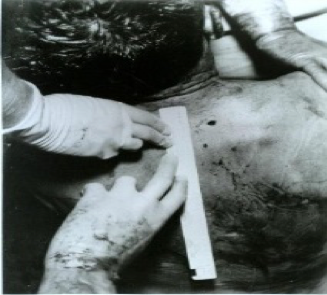
Author: Tim Smith

  • The Mysteries Around Ida Dox

    The Mysteries Around Ida Dox


    This is chapter four of a book I’ve written concerning the 52 witnesses that appeared and gave public testimony before the House Select Committee on Assassinations. Ida Dox gave her very brief testimony, only 11 questions, on September 7, 1978, in the Rayburn House Office Building, though the majority of testimony was given in the Cannon House Office Building.

    I tried to do with Ms. Dox, as I did with all of the witnesses, and that was lift out the salient points and update the evidence when necessary.

    The name of my book is Hidden In Plain Sight. It is an attempt to demonstrate that a large amount of evidence was obvious early in the investigation of the case. In other words, it was there all the time, but we didn’t see it, sometimes because we weren’t looking for it.

    Ultimately, it is a guide that will tour you through the labyrinth of testimony and evidence of the case in 1978 and then updated as the years have gone by.

    Chief Counsel Robert Blakey told me in an interview in the late 90’s that these witnesses were a way for the HSCA to present their evidence to the American public.
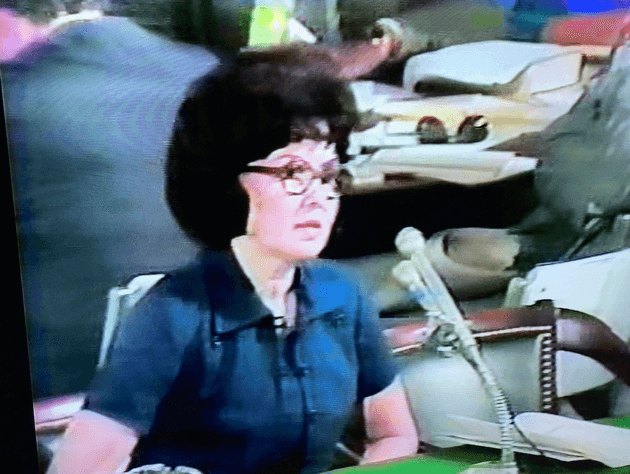
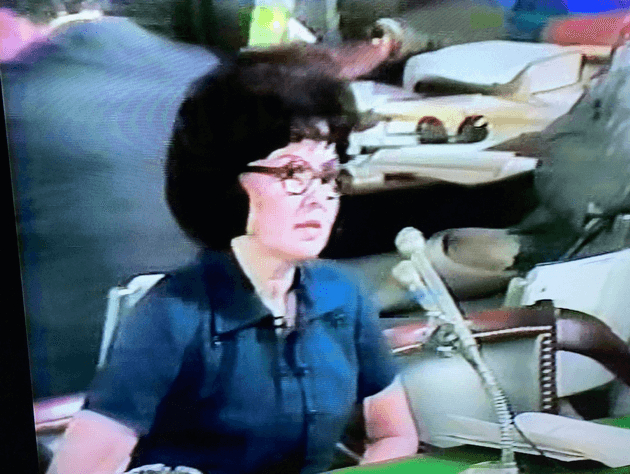
    Ida Dox, September 7, 1978

    On September 7, 1978, 9:09 a.m. session, EDT—Room 2172, Rayburn House Office Building, Washington, D.C., the House Select Committee on Assassinations took testimony from Ms. Ida Dox.

    Ida Dox was born on July 8, 1927 in Honduras, Central America and came to the United States in 1947. She received her Bachelor of Fine Arts from Newcomb College of Tulane University in New Orleans in 1950. She obtained her Master of Science degree from Johns Hopkins University in 1954 and her Doctorate of Philosophy from the University Maryland in 1990.

    She was a medical illustrator at Georgetown University Medical Center in Washington D.C. from1954–1969. She was chosen to be the medical illustrator for the Select Commission on Assassinations of John F. Kennedy and Martin Luther King, Junior of the United States House of Representatives in Washington D.C. from 1978–1979. She has been a medical illustrator and author, in Bethesda, Maryland, since 1969.

    At the time of the public hearings, she was a medical illustrator for the Department of Medical-Dental Communication at the Georgetown University Schools of Medicine and Dentistry. She was also an author of many textbooks on illustrated medical dictionaries, one of which I purchased off of Amazon.

    She died on October 18, 2013, at the age of 86. Dox was her maiden name, but her married name was Ida Melloni, as she married John Melloni in 1954.

    The HarperCollin’s Illustrated Medical Dictionary

    The House Committee on Assassinations contacted the Georgetown Medical School, which in turn recommended Ida Dox as a medical illustrator. She appeared before the Committee to testify in public session. She had been working with the medical panel for some time and was asked to explain her role, working with the autopsy photographs and x-rays, which would demonstrate the location and severity of the bullet wounds.

    Before her appearance, Robert Blakey read a list of rumors that had circulated regarding the location and nature of those wounds, specifically to JFK. Amazingly, what he stated was a lot closer to reality than the Humes, Boswell, and Finck autopsy findings.

    Blakey then commented on past presidential assassinations, as they related to the specific autopsies. He marginalized the credibility of the Parkland doctors by comparing the comments of Dr. McClelland, “a massive head and brain injury from a gunshot wound of the left temple,” (an obvious misspeak and red herring by Blakey, when he understandably meant right temple) to the wholly different description of neuro-surgeon Kemp Clark, who “observed a large gaping hole in the rear of the President’s head.” Blakey further weakened the import of their testimony by stating that they only worked on the President for a short time and they were trying to save him, which was not a possibility either way.” (I HSCA 142)

    If Ida Dox was to malign the rumor department, it would have been binding upon her to testify that she enhanced the wounds in the drawings that she made, especially Fox-3. More about that in due course.

    Andrew Purdy, who handled much of the medical aspect of the questioning, was called upon to question Ms. Dox. He began by asking her to expand on how it was determined what to illustrate for the Select Committee. A seemingly fair question. She said, “the committee, the medical panel, and myself…decided that the photographs taken at autopsy should be copied to illustrate the position of the wounds. The photographs that were selected were the ones that best showed the injuries.” (I HSCA 146) Why would a medical illustrator be involved in that decision-making process? She’s an artist, not a doctor. She sketches and traces; she does not slice and cut.

    “The photographs taken at autopsy should be copied to illustrate the position of the wounds.” (I HSCA 146) Wouldn’t the photographs illustrate that? This seems to be a wasted step. This has the appearance of an imitation of the Warren Commission, where Commander Humes told medical illustrator Harold Rydberg lies, but Rydberg followed orders, which he argued both strenuously and vociferously against years later. Dox would never argue in that same vein, unfortunately.

    The Warren Commission’s excuse was that to introduce the photos into evidence would mean publishing them; did the House Select Committee on Assassinations believe that by using drawings that they could keep the nature of the injuries from becoming public? The Dox drawings are some of the least graphic of the autopsy photos that we know about, but even still, they don’t hide what little graphic nature there is in those prints. The Warren Commission could get away with it, because nobody was going to see the photographs and that was a censuring that remained in place years later, when the HSCA chose drawings, identical to a couple of the autopsy photos, instead of the photos, for their study. Nothing had changed fourteen years after the Warren Commission, as neither the Commission nor the House Committee on Assassinations, and much to their shame, put the autopsy photographs into evidence.

    In her testimony of how she made the illustrations, at no time did she give any indication that the results used by the committee were in any way different from the actual photographs themselves. I am sure at some point, someone told Ida Dox exactly what to do with the red spot on Fox-3, the back of the head autopsy photograph. In fact, some of the records obtained from the National Archives do everything, except come right out and say just that. Does this make Ida culpable? Probably. I am sure she was just doing what she was told and may have been told it would illustrate what the medical panel was trying to explain. She is less culpable than Baden, to be sure.

    They would never publish the photos and the drawings by Ms. Dox in the same volumes, as it would easily demonstrate the differences between the two. The differences would have been recognized immediately, particularly with reference to the wound in the cowlick, not discernable in the photograph, but manifestly obvious in the drawing.

    Mr. Purdy: Ms. Dox, prior to today, did you have the opportunity to review the enlargements of your drawings to ensure that they are accurate?

    Ms. Dox: Yes, I did. I looked at them very, very carefully and they are my drawings except that they are photographically enhanced. [my emphasis] (I HSCA 148)

    The witness was asked if the drawings are accurate? Her answer was that she compared them to make sure that they were, in fact, her drawings and they had not been rehabilitated in any way. She had to know this wasn’t true, as the documents I received from the National Archives indicate in this chapter.

    In two investigations into the murder of the President of the United States, when it comes to medical evidence, the most crucial evidence of all, the deception seems to explode all over the place.

    This is a sleight of hand worthy of the Warren Commission, suggesting that the House Select Committee at least had a tutorial in coverups; they agreed for the sake of the Kennedy family’s privacy not to use the actual photos, but to use identical sketches made by a medical illustrator.

    I am not sure how that would have put anyone at ease in the Kennedy family. The President’s image was displayed, in death, and on television. Whether it was a photograph or a true rendering by a medical illustrator, it is truly much ado about nothing. The American public had already seen the graphicness of the Zapruder film on national television in March of 1975.

    But make no mistake, the autopsy photo that Dox copied of the back of the head and the resulting sketch she made are ages apart. Ida Dox deceptively depicted the rear head entrance wound, exposed as such when the inquiring public was finally allowed to see the actual wounds fifteen years after the event. Who knows what she was thinking, as she did what Dr. Baden told her.

    The decision not to use the original photographs was probably made by the Committee members. An arrangement was reached that they would publish the drawings, but only those deemed essential. The Dox drawing of the head wound was withheld from publication and it was not in the hundreds of pages of her file I received from the National Archives.

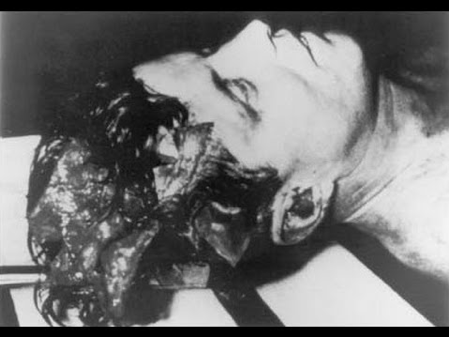
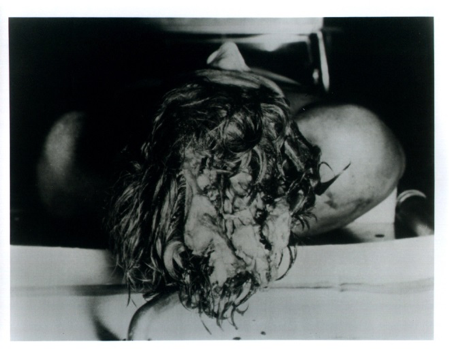
    She also responded to Purdy’s question by stating that “the photographs that were selected were the ones that best showed the injuries.” (I HSCA 146) Ms. Dox said she copied four photographs: the back of the head (Fox-3), the upper back (Fox-5), the side of the head (Fox-4) [not shown during public testimony], and the front of the neck (Fox-1 & 2). Key photos were clearly withheld, some say on grounds of taste. They were examined by the forensics panel and other experts, but not displayed or published. The top of the head photo (Fox-6 & 7) was not chosen. As stated, the side of the head photo drawn by Ms. Dox was not shown during public testimony either. She was asked to draw the head wound photo, but when they saw it, they decided not to publish it. I am not sure what they thought they would see before they looked at it, as they had seen the autopsy photograph on which it was based.

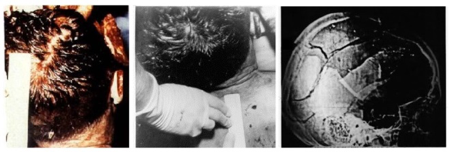
    The back of the head photo (Fox-3) was shown during the public testimony of Ms. Dox. The only problem is that the alleged entrance wound in the cowlick area is much more visible in her drawing, than on the original Fox-3 photograph. Conversely, her drawing of the back wound (Fox-5) omits the possibility of an entrance wound that has been alleged by some critics and his back was cleaned up quite a bit. Whether there are other possibilities concerning Fox-5, it should have at least been drawn. It also places the back wound much too high. The autopsy face sheet, as did his suit coat and shirt, as did Dr. Humes, places the back wound in the upper right posterior thorax at about the level of the third thoracic vertebra, which would be approximately five and three-eighths inches below the top of the collar. The Dox wound appears much too high.

    When Mr. Purdy asks how she copied the photographs, Ms. Dox stated that she did it by “placing a piece of tracing paper directly on the photograph, then all the details were very carefully traced…so that no detail could be overlooked or omitted or altered in any way.” (I HSCA 147) As noted, the upper entry head wound was altered. Period. Perjury, most likely, but I really believe it is more of being afraid to disagree with Dr. Baden, when he had told her what he wanted. Hard to tell. Things were omitted, especially on the back wound (Fox-5), where obvious detail is missing, and also on the back of the head wound (Fox-3), where the alleged cowlick area wound is much clearer and pronounced in her drawings than in the autopsy photographs themselves, as I stated earlier. Isn’t this really much ado about nothing? Couldn’t all of this have been avoided knowing that the drawings are no substitute for the photos? The original photos should have been available to researchers at least as soon as the Warren Commission closed up shop, but legally they haven’t been released to this day.

    Purdy goes on to say that Ms. Dox made other drawings to illustrate the conclusions of the forensic pathology panel. We are not exactly sure what these other drawings are, only to assume they are in the Committee’s files. The release of the Assassination Records Review Board medical materials did not tell us any more on this subject. I don’t recall this issue even being addressed. The truth is, in relationship to Ms. Dox, the ARRB made no difference at all. I’m frankly amazed that nobody at the ARRB asked the obvious question: Why are the Dox drawings and the photographs from which they are exactly made, so different? Sadly, Ms. Dox was not questioned by the ARRB and she could have been, since she didn’t pass away until 2013, but this was never addressed.

    In her next to the last question, Ms. Dox says that a frame of “film taken during the motorcade was photographed and the outline of the President’s head was used, so that the…head of the President…in the position that the medical panel decided was necessary.” (I HSCA 147-148) They were probably doing what they thought was adequate, but left themselves open to immense criticism, just as the Warren Commission did.

    Ms. Dox worked for the Committee, under the direction of Professor Blakey. In that capacity, she was assigned to assist the Committee by preparing drawings from the autopsy photos for possible publication. She was working under Blakey’s direction and Dr. Baden, or perhaps Andrew Purdy’s, since he guided most of the medical aspects of the case. Ultimately, Dr. Baden made the call on what Ms. Dox drew and, in some cases, how to draw it. As you listen and read the testimony of Ida Dox, you can only reflect about what should have been asked.

    I contacted Ms. Dox in October of 1999. I had two conversations with her on the telephone. It all started with a question I had regarding HSCA Exhibit F-302, which was a drawing of President Kennedy’s brain, that was put into evidence during the testimony of Dr. Humes. What followed was both puzzling and frustrating. I will go into detail about what Ms. Dox said about that sketching of JFK’s brain, parts of her testimony that she now denies ever saying, enhancement of the wounds that she drew for the Committee (which has to do with some correspondence between her and Dr. Baden that I requested and received from The National Archives and publish in this chapter), and other sundry matters.

    I prepared for my conversations with Ms. Dox by reading documents I received from the National Archives concerning her. There was a sense of discovery, but more so of clarification. I’m not one who looks for a demon under every shingle, nor is it my purpose to attempt to discredit someone who appears on the surface to be a nice lady who was just following orders and instructions. There were some things that did seem a bit odd and other things that I still don’t understand as I write this. The following information is based on those two telephone conversations I had with Ms. Dox.

    In the first conversation I had with here on October 14, 1999, I asked her the following questions:

    Question #1: How many photographs were you shown?

    When I asked Mrs. Dox this question on the phone, she quickly replied, “I can’t remember.” This is intriguing. If she had been shown 75 photos, okay, she can’t recall, but she testified before the HSCA that it was four, at least that is how many she drew. She doesn’t seem to be guessing before the HSCA during her public testimony. I don’t care how many zillion wounds she has illustrated, as one of the first humans on the planet to see those autopsy photos of JFK, you would think she could remember the number. Maybe not perfectly, but certainly not, “I don’t remember.” Even an estimate would have been nice.

    Question #2: Were you ever shown a photograph of the brain?

    She emphatically stated, “No!” This first surfaced for me when I noticed HSCA exhibit F-302 in David Lifton’s book, Best Evidence. During Dr. Humes’ testimony, exhibit F-302 is introduced, with no data whatsoever. It is said, then, to be a drawing of the brain. There are two kinds of representations in Lifton’s book. In the cases of the actual line drawings, they are represented in full, the throat wound, cropped so as not to show the face. The brain drawing, however, is in mid-text, so that may be why it is different from the others. It also has no signature on it. The other Dox drawings are reproduced in full and have a signature in the lower corner. It may have been a simple matter of a tracing of a tracing, or some sort, so it could be reproduced in text, without going to the photo section, which is different paper.

    The only available rendering of the brain, however, absent the photographs, is the drawing/tracing created by Ida Dox and I have already noted my criticisms of her efforts. In her brain illustration, the left cerebral hemisphere is intact, while the right cerebral hemisphere resembles a swirling pattern.

    The two lobes of the cerebellum are intact and unremarkable. That flies in the face of the doctors from Parkland, who testified to seeing cerebellum extruding from the large wound in the back of the head and here we are presented with no cerebellum damage and no large wound in the back of the head.

    Question #3: Were the wounds enhanced for the sake of clarity?

    Her response, “No, of course not.” This is interesting. At Wecht 2003, I asked Dr. Baden about this and was told that Dox was given other gunshot wounds to draw in order to enhance the visibility. You have to look for something even resembling a wound in the Fox-3 photograph. It looks more like a blood droplet, but not a bullet wound.

    He told me that Dox had been given other photos (see later in the text for the documents), of other individuals with wounds, in order that she would be able to highlight JFK’s wound, so people wouldn’t miss where the actual head wound was. Other researchers have talked with Dr. Baden about this and received similar responses.

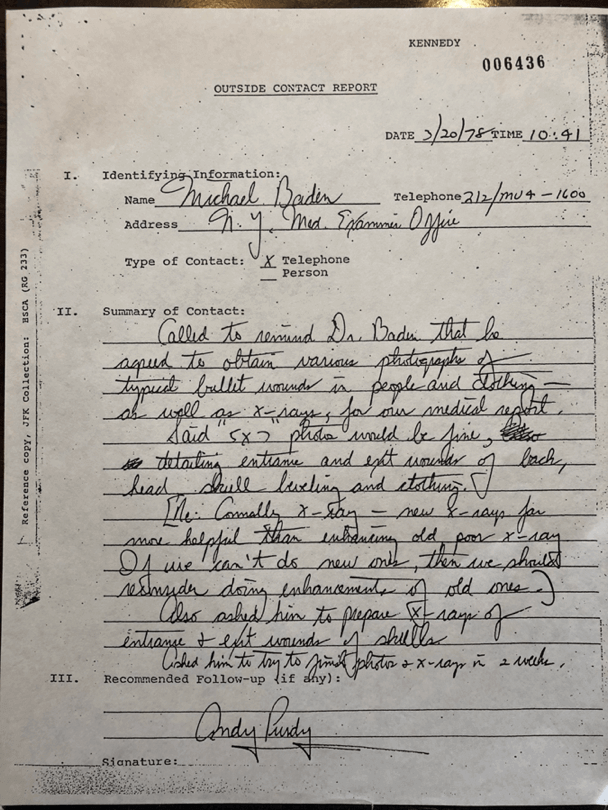
    What follows after this paragraph is a copy of the Dox drawing of Fox-3 and the actual Fox-3 autopsy photo and then a few pages of documents I received from the National Archives, both of which were sent to Ida Dox by the HSCA, including “you can do much better, Ida,” from Michael Baden. How can you do “much better” than the autopsy photos you are directly looking at and tracing. Or, is “much better” referring to placing a bullet wound where there isn’t one in the cowlick area? Ida Dox lied to me on the phone, when she said she wasn’t given any pictures to use to enhance what wasn’t there. Here are some of the documents I got from the Archives, after I requested every document they had concerning Ida Dox. Unlike the Ida Dox drawing, the actual wound is not visible in Fox-3 and no other photographs show it either.
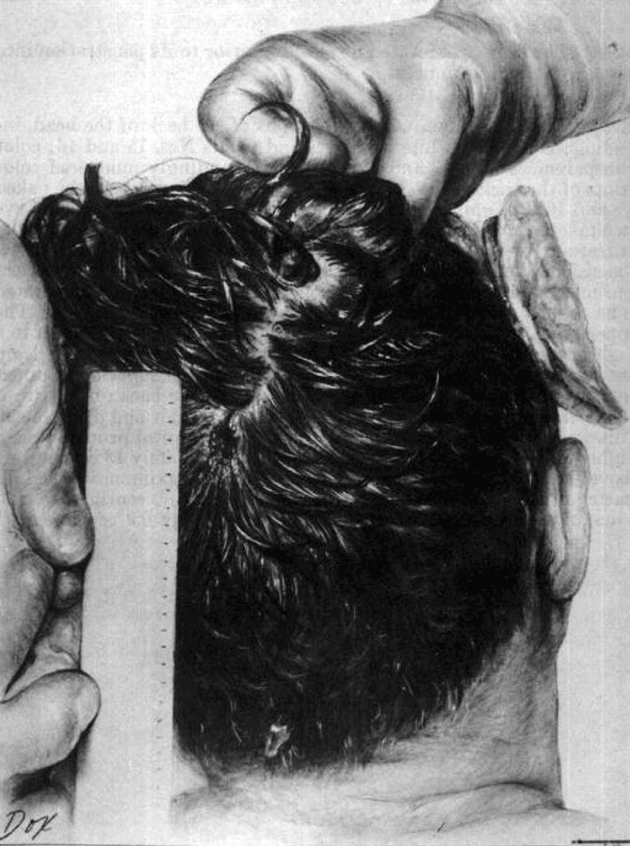
    Dox drawing of Fox-3
    Fox-3
    Ida—“You can do much better”—Michael Baden
    Bullet wound to the head from the pathology book written by Baden, et. al.

    The Forensic Pathology Panel of the House Select Committee was so thoroughly caught up in their findings, that the upper artifact, the red spot, and what they said was the actual entry wound, that they failed to realize how badly they had been duped.

    This is critical to the ongoing investigation and needs to be considered again. Originally, the HSCA worked from medical illustrations, done by medical illustrator Ida Dox. Unfortunately, Ms. Dox, who was allowed to commit perjury before the House Select Committee, altered the wound that some have identified as simply a red spot or droplet.

    Fox-3 (Color)
    Fox-3 Comparison with Dox Drawing
    Purdy Asking for Photos of Typical Bullet Wounds
    (Keep in mind, this is in the Dox materials sent to me from the National Archives)
    Flanagan to Baden, Asking for Photos of Typical In-Shoot Wounds

    Any assessment of the photographs show nothing even slightly comparable to what Dox drew. I often show the autopsy photos to friends or at talks I give at local libraries and they always produce the same shocked reaction. I show them the Fox photo of the back of the head and ask, “Do you see the entrance wound?”

    Nobody can ever see the entry. Then I show them the Dox drawing of the back of the head and ask if the wound is visible and unanimously and they say it is. Then I put them side-by-side and there is usually some kind of verbal gasp, as if they were watching the Zapruder film for the first time.

    Now they can see up close and personal that something sinister was going on with the medical evidence. The alteration becomes obvious.

    Ida Dox was given the autopsy photographs and requested to make sketches for the HSCA, a procedure that, in itself, calls into question the sanity of the people doing it, as a drawing of gore is almost as unpleasant as a photo of gore.

    The reader is invited, even strongly urged, to view the photographs in question and then view the same cowlick area in the Dox (Fox-3) drawings. You will be surprised, if you have never done this before.

    What is cited as an artifact and is not by any means proof of an entry wound in the photograph, becomes a glaring bullet hole thanks to Ida Dox, who was given additional photos as stated, showing bullet wounds of other people and not of John Kennedy, so that she could highlight and forge the JFK sketches. There is no doubt in my mind that the reason for moving the back of the head wound four inches higher is to explain the massive wound in JFK’s right temporal area of his skull. If you move the wound, then you have a perfect inshoot-outshoot scenario. If not, you have to explain how a bullet traveling downward from sixty feet in the air and behind can emerge on the upper right side of Kennedy’s temporal bone.

    The explanation I can assert is what I have already said in chapter one concerning Governor Connally, that a second head shot at c. Z-327, 7/10ths of a second after Z-313, explains this precisely and, if so, then there was no need to invent a head wound in the cowlick area, as Z-327 explains it perfectly. What is disheartening is that chapter one on Governor Connelly documents that the HSCA was suggesting a shot c. Z-327, but then the Committee wasn’t (as it was a Select, not a Standing committee) renewed and the data became inactive.

    That alone brings into question the honesty of the entire HSCA investigation and the charge against Dox is not a pointless one. The question then becomes two-fold:

    1. Why, (excepting the necessity to maintain the lone-assassin fiction) was the wound altered in order to make it obvious to any John Q citizen viewing the Dox drawing, when trained pathologists could not and did not identify it from the photograph which Dox claimed she copied exactly?
    2. Whose decision was it to alter the wound and whose decision was it not to make the obvious comparison between the actual photo and the altered drawing during the HSCA hearings? Baden seems to be candidate number 1.

    A little background on Baden and the Clark Panel is probably appropriate at this point. In the late 1960’s, the public was screaming for a reinvestigation. David Slawson at the Department of Justice wrote a memo to Ramsey Clark explaining that if they don’t do something the conspiracy fringe will get Congress to reopen the whole thing. It also is happening at the same time as the Garrison investigation, which scared the intelligence community, so they needed to calm the storms in Louisiana. Slawson suggests an investigation limited to the medical evidence and so the Clark panel is born. The Clark Panel relocates all the wounds, four inches higher on the head and four inches lower on the back. Why? If left where they were in the autopsy report, then Oswald didn’t do it. The plan succeeds and the public is quieted. Meanwhile, the prominent pathologists, having been thrown together to make up the Clark Panel, decide together to write a book on pathology. Ramsey Clark writes its forward. A young, inexperienced pathologist named Michael Baden is asked to contribute to the book. It’s not much, but associating his name with theirs launches his career.

    Ten years later, Baden is asked to head the HSCA’s medical panel. He insists he not serve on it alone, so that there is no question of impropriety, so he fills it up with friends, save a lone critic named Dr. Cyril Wecht. Before they would ever meet, Baden went in to examine the autopsy materials. He then sat down and wrote a memo which echoes every point made in the Clark Panel report. He moved the wounds and to the exact same points they had chosen.

    At the first meeting of the medical panel (Baden is the only panelist to have seen the materials at this point, though Wecht had gotten permission to see them in the early seventies), he presents them with his findings and calls for a vote to see if another meeting of the panel is necessary. Wecht says yes. The record does not reflect how the others voted, but plans for the other panelists to see the materials were not initiated for several weeks.

    This brings us back to Dox and Baden. Dox is permitted to see the photos and to make a set of drawings, which she denied to me on the telephone (though this is exactly what she stated in her public testimony in September of 1978). She then leaves them for Baden to approve. Baden sees the drawings and calls Purdy, who writes a memo to himself that says, “get a photo of a typical wound of entry.” (In another memo dated 4/24/78, Purdy states that he needs to remind Baden to get wound comparison photos and X-rays.) The next document in the record is a photocopy of a page out of the pathology book Baden and the Clark Panelists wrote. At the top of the photo of a tiny bullet wound to the head, Baden wrote, “Ida you can do much better.” Again, and as I stated earlier, I am not sure how you outdo the original autopsy photos. So better, in what sense? Location? The wound itself? Quite baffling, if not disturbing.

    On October 28, 1999, I called Ida Dox for the second time. She hung up on me at the end our first conversation. This time the conversation lasted a bit longer and was much more detailed. The following questions were asked Ida Dox at this time:

    Question #1: Did you see color or black and white photographs?

    She quickly said, “Color.” The color photos certainly show the wounds better, but still not as good as the Dox tracing. You would also think that black and white would be better to trace from. The fact that a lay observer can tell in a second that the tracings are accurate, except for the wounds, should raise questions immediately. The aforementioned data, along with the Baden and Purdy memos speak volumes to this point.

    Question #2: I asked her again about how many photographs she saw?

    This time she got defensive. I simply reminded her that my previous notes stated that she could not recall, but that she had stated in her testimony that she had drawn four. I was seeking clarification and thought, perhaps, there was a possibility she had been shown others. I was very polite and was genuinely not trying to trick her or confront her in any way. She was silent and so I proceeded.

    Question #3: I asked her if security was tight while viewing the autopsy photographs in the National Archives?

    She indicated that security was very tight. I was reminded that RFK was in a panic that such stuff would go public. It was difficult enough that the Dox drawings went public, but something had to. Her public testimony suggests she had worked from some kind of originals while being watched at the Archives. This led me to the next obvious question.

    Question #4: Did she have a set of autopsy photographs made, so as not to take up the Archives’ employees’ time?

    At this point she got very defensive, especially when I read her public testimony where she says this is exactly what had transpired. I was lucky the conversation went any further at all, as she was not happy. I was not accusing her of anything, still only seeking clarification. Her testimony, again, indicates she was given knock off copies to use outside the Archives, as she added detail like Humes’ gloves, so as not to keep the Archives busy.

    Question #5: I then asked her again if she had drawn F-302, which is JFK’s brain?

    She simply said, “I can’t remember.” I don’t care if it has been twenty years plus, you can’t tell me that you wouldn’t remember drawing a picture of the brain, which just happens to be of the President of the United States! The absurdity of this is beyond belief. Exhibit F-302 does come up during Dr. Baden’s testimony. He uses the drawing of the brain, which he says that Ida Dox drew, to show the intact nature of the cerebellum, thus attempting to prove that Dr. Humes et. al. could not possibly be correct in locating the entrance wound to the rear of JFK’s head in the area of the external occipital protuberance. It wasn’t until Dr. Humes’ testimony that F-302 was formally entered into evidence.

    During the session at the end of each testimony, when everyone is given five minutes to ask questions if they want to, Mr. Fithian asks about the possibility of metal fragments being in the brain. In Baden’s testimony, he displayed F-302 and says that in the right, front area side of the brain there was an oblong, blue discoloration, but that it was not a metal object. He stated that the Forensic Pathology Panel determined that it was blood vessels that had been sheered away. Baden went on to explain that there were many pictures taken of the brain and that some had toothpicks in the damaged part for identification purposes by the doctors at the autopsy.

    It still, however, doesn’t explain why Ms. Dox told me that she never saw any photographs of JFK’s brain, let alone drew them for the committee. Dr. Baden said there were several pictures of the brain and that Ms. Dox drew from them for the committee to illustrate for the Forensic Pathology Panel, that the cerebellum was not injured because of the rear entrance head shot to President Kennedy (I HSCA 304).

    Question #6: Did the photographs of JFK’s neck wound show the face as well?

    She told me that the pictures did show his face and that there had been some talk of blurring the face. The tracings, however, do not show the face of the President. That was all she addressed with this question.

    Question #7: I again asked her if she was shown other photographs of wounds in order to enhance the ones on her tracings/drawings?

    She got very defensive and refused to talk any further. In fact, she said, “I don’t think I want to talk about this any further.” I again tried to assure her that I was not attempting to confront her, only clarify what I had discovered from other researchers and documents from the National Archives. This didn’t seem to quell her anger, but she suggested I contact Professor Blakey, which I did. The data from the first conversation has already dealt with this question in full, but nonetheless, I thought I would give her another chance to verify what I had documentation for from the National Archives. I still refuse to believe you would forget doing something like this, especially in reference to the President of the United States. I don’t care how much time has passed, certain events in our lives are indelibly engrained in our psyche. This event would have to at least be up for a possible nomination.

    Question #8: I asked if there were any other medical illustrators besides her?

    She told me that she was the only one. In fact, she also worked for the Committee on the tracings/drawings concerning Dr. Martin Luther King, Jr. She received $16,000, not counting $125 per day, plus expenses for services rendered. This also included appearing as an expert during the public hearings. She was not required to write any reports, only that her medical illustrations would appear in the Committee’s final report. She spent 125 and one-half days consulting and providing services. The final tally, financially speaking, would be: $31,625, plus expenses. That’s not bad money for 125 days’ worth of work, especially in 1978.

    Question #9: I asked her how long it took to make the illustrations?

    She was kind enough to explain that it took a long time, months as far as the entire process, and that it is very tedious work.

    There were some things that were missed in her public testimony, that was gone over with her in her practice questions beforehand, which I still have copies from the National Archives. She was supposed to mention that she was to duplicate the autopsy photographs which show the key wound areas, reconstructions of wound areas with internal structures, and illustrate what happens to soft tissue and bones when they are struck by bullets. Most of these can be seen in Volume I of the HSCA Hearings when Dr. Baden is testifying.

    She also stated in her practice questions that blood on the skin and blood on the gloved hands were removed, as well as background details. She stated in her public testimony that she worked very closely with the medical panel, especially Dr. Michael Baden. Based on the previously mentioned discoveries from the Archives, her statement was only the tip of the iceberg.

    All in all, I found Ida Dox to be somewhat reticent to talk about the issues that I brought up to her. She was kind and cordial, but obviously on edge during the two conversations. I was never aggressive or combative, only attempting to clarify what I had discovered. I was told by one researcher, in reference to my questioning her about whether she drew the brain, that it is hard to believe that something called the Dox drawing and entered into evidence (or at least referred to constantly) during the hearings, that were nationally televised, could now be credibly disclaimed as not being her work. He told me to think about what I was suggesting here. I never suggested she didn’t draw F-302 (the brain), only wondered why she didn’t sign off on it, when she did on every other illustration. I also was puzzled as to why she would deny something like this; I wasn’t implying something sinister.

    I was also told that I was probably running into a simple failure of memory, after two decades. I was cautioned not to go down this path and get involved in a hypothesis alleging major forgery of evidence, when all I had was a simple error of memory.

    I really did appreciate the words of caution and took them seriously. I generally respect my colleagues in this field and take their words thoughtfully. I wasn’t implying forgery of evidence or even questioning whether she had drawn the illustration of F-302, again, only seeking clarification of the data I had before me. It made me question the integrity of Dr. Baden more than that of Ida Dox. She was merely following orders and protocol; the others, well, I’ll leave that up to each individual researcher to decide.

    A Final Comment: The fourteen questions they asked Ms. Dox is nothing but procedural, chain of evidence testimony and makes no statement about that which was under scrutiny, except that it is frightfully dishonest, and certainly Ida Dox had to know it when she was testifying.

    The first question that needed to be asked was, Why were so-called exact drawings or tracings necessary to be used in place of the actual photographs?

    There is absolutely no rational answer to this question. It does not seem like it was done out of respect for the President or the President’s family, because the drawings are just as graphic as the original photographs in some areas.

    Certain background material had been removed from the tracings. In the drawing which shows the circular bone extending from the right-front scalp, the inference from the drawing would be that the photo would have been taken with the President’s body posed, sitting up.

    In actuality, the body was laying on its left side. In the photo, one of the pathologists looms up from Kennedy’s side as the pathologist is standing and Kennedy is on his side on the examining table.

    If there can be one reason attributed to the use of drawings, it was to certify that which the House Select Medical Panel wanted. I have written elsewhere that a number of researchers have noted the difference between the photographs, particularly the back of the head photo, with its absence of any visible wound, and the Dox drawing, which clearly showed an obvious entry wound in the cowlick.

    The difference has to be placed in time perspective. As Dox noted in her testimony, she was under observation all the time while she was working at the National Archives with the originals of the photos. Yet she could have access to copies of those photos, to complete the tracings of the doctors’ hands, or rulers, in HSCA rooms.

    In 1978, those photographs had never been seen by the general public and an individual could only get into the National Archives to view them if they were a medical doctor.

    Thus, the first time the wounds were truly seen in some manner other than the Zapruder film or the absurd Rydberg drawings, contrived for the Warren Commission, were the Dox drawings.

    And therein lies the reason for the drawings. With the Fox photographs in my possession, and other researches too for some time and prints available in quantity, it was clear that the back of the head photo and the back of the head drawing were very different.

    From here, it was now a matter of forcing Commander Humes to change his testimony to reflect that the cowlick entry was the correct site and not the original autopsy finding, located four inches lower. Humes refused to change his findings when testifying before the Medical Panel, but he sold out altogether when he was on television in front of the HSCA itself.

    He moved both wounds—the head and the back—approximately four inches. Disgraceful.

  • Did EVEN the Warren Commission Believe Howard Brennan?

    Did EVEN the Warren Commission Believe Howard Brennan?


    Howard Leslie Brennan was born on March 20, 1919, in Oklahoma. One does not have to travel very far through the assassination literature to discover him. He appeared in front of the Warren Commission 3 times, all on the same day. There are also 2 affidavits connected to him as well. It is our job to sort through all of this and see if we can make any sense of his testimony. He was the poster boy, who supposedly identified Oswald in the sixth-floor window. So, in that sense, he is vitally important. His testimony, like so many others, is a metaphor on how the Warren Commission treated their witnesses: steered them a particular direction when they didn’t say what the Commission wanted to hear, ignored and moved on when they were obviously lying, ignored them when they said things that were at variance with what the Commission wanted to hear, or created hypotheticals that had nothing to do with the case and end up being red hearings diverting away from the real evidence at hand. Read through the testimonies of the medical personnel and see how many times Arlen Specter guides the witnesses down a path that leads nowhere, or better yet, creates hypotheticals in an attempt to get them to say something they really didn’t. Brennan will be no different. Again, keep in mind, he is their Golden Ticket, because his description eventually leads to the identification and arrest of Lee Harvey Oswald. Let’s see how this worked itself out that weekend and beyond.

    Brennan testified, on March 24, 1964, at around 9:00 a.m. in Washington, D.C. His testimony resumed twice that day in the presence of other witnesses who gave testimony on that day. This was common, as all three autopsy doctors were in the same room during each of their testimonies. It was common for the Commission, but ridiculous and should not happen in a murder investigation. Warren Commission members present for Brennan were Earl Warren, Representative Gerald Ford, John McCloy, and Allen Dulles; also present were chief counsel J. Lee Rankin, senior counsel Norman Redlich, and junior counsels David Belin and Joseph A. Ball, and finally Charles Murray, “observer.” It is interesting to note who was not there, namely Richard Russell, Hale Boggs and John Sherman Cooper. As some critics have pointed out, these three had their differences with the majority. And, in fact, Russell filed a dissenting report at the final Commission executive session meeting. Were these differences manifest in their lack of attendance?

    As noted above, also present in the hearing room were Bonnie Ray Williams, Harold Norman, James Jarman, Jr., and Roy Truly. Notice has been taken of the absurdity of such a process, as Williams, Norman, and Jarman, who were friends, were not about to criticize each other. It just was not going to happen.

    Brennan remarked that upon his arrival into Dealey Plaza, “there was a man having an epileptic fit, a possibility of 20 yards east—south of this corner. And they were being attended by some civilians and officers and I believe an ambulance picked him up.” (3H 141-142) We know that the person in question is Jerry Belknap, who did have an “apparent” seizure, but upon arriving at Parkland hospital decided to not stay but instead left. He did pay the medical expenses for his short trip to the hospital, but it remains somewhat of a mystery as to what was happening. So much so, that someone should have interviewed him and attempted to find out what was really going on with Belknap that day, if anything. It just seems odd.

    Brennan then told David Belin, who was the main interlocutor for questioning him, that he “jumped up on the top ledge.” (3H 142) The witness was referring to the retaining wall around the reflecting pool opposite the Book Depository. But it an odd statement, because his inarticulateness makes it sound like he literally jumped on the top ledge and was standing, which he wasn’t and that there is more than one ledge, which there isn’t. He simply sat down, which I will assume is what he meant in all of his unletterdness.

    The interview takes a turn and with a quick sleight of hand a moment of monumental proportion is lost. Belin shows Brennan CE-479 and notices that Brennan’s legs are not dangling on the front side, which they would be if he was sitting and facing north toward the Texas School Book Depository. Listen to the exchange:

    Mr. BELIN: All right. I hand you now what the reporter has marked as Commission Exhibit 478. (The document referred to was marked Commission Exhibit No. 478 for identification.)

    Mr. BELIN: I ask you to state, if you know, what this is.

    Mr. BRENNAN: Yes. That is the retaining wall and myself sitting on it at Houston and Elm.

    Mr. BELIN: You remember that the photographer was standing on the front steps of the Texas School Book Depository when that picture was taken on the 20th of March?

    Mr. BRENNAN: Yes; I do.

    Mr. BELIN: And the camera is pointed in what direction?

    Mr. BRENNAN: South.

    Representative Ford: Are those the positions where you were sitting on November 22?

    Mr. BRENNAN: Yes, sir.

    Warren Commission Hearings Volume XVII p. 197 (CE-477 and CE-478)

    Warren Commission Hearings Volume XVII p. 198 (CE-479)

    Howard Brennan facing east looking over his left shoulder (color slide of Z-188)

    As we shall see, this is not true, but Belin clearly let it slide, because Brennan was one of their stars. This preempted them from questioning Brennan about the real facts underlying his testimony. That function was left to researchers and they revealed the shenanigans of the witnesses and far worse, the Warren Commission itself. His testimony was not only believed that day, but was blessed with the imprimatur of the Warren Commission. Belin, had to know this was not accurate, because he noted that Brennan’s legs were “not dangling on the front side there, is that correct?” Brennan replied they were not. But Belin did not press the matter. He quickly moved on to ask Brennan what he was wearing on that fateful day. This is your next question after wondering why Brennan’s legs aren’t seen, as they should have been, had he been where he said he was sitting.

    Belin had showed him one negative, (couldn’t the FBI provide photos or at least a decent diagram for Brennan to respond to regarding his location?) or one frame from the Zapruder film—seems to be Z-188—which absolutely shows him looking east toward the jail and not north, where he is positioned during the reenactment photo shoot. Belin handed him a magnifying glass. The negative had been enlarged. (Not by much if a magnifying glass is needed, although Brennan by this time had suffered diminished eyesight due to an accident.) Listen to how Warren Commission Counsel David Belin broaches the topic:

    “This appears to be a negative from a moving picture film [Z-188, approximately—and keep in mind, the negative of which he was handed had already been published in Life magazine as a color photo]. And I will hand you a magnifying glass—the negative has been enlarged. This negative appears to be a picture of the Presidential motorcade on the afternoon of November 22nd. I ask you to state if you can find yourself in the crowd in the background in that picture.”

    From his previously noted reply, Brennan also knew that exhibits CE-477 and CE-478—which were recreations shot in March—were inconsistent with what he was swearing to. The actual photo, CE-479, shows Brennan sitting on the ledge of the reflecting pool, facing east towards Houston Street, not north toward the Texas Schoolbook Depository. Yet, note what author Richard Trask writes: “Brennan had been sitting on the concrete retaining wall by the north reflecting pool and was facing the Book Depository.” (Richard Trask, Pictures of the Pain: Photography and the Assassination of President Kennedy, p. 493) That is rubbish and Trask must know it. He has a keen eye for detail and often brings out matters that the casual reader would not necessarily notice. It is clear from a collection of Zapruder frames that Brennan was, in fact, facing east and had to lean his left arm well back to look over his shoulder to see Kennedy’s car when it was in front of the Depository. Brennan would pose, on March 20 (his birthday), sitting right in the middle of the concrete wall looking into the Depository, and again, David Belin caught him lying. Yet when the Warren Commission staffers placed Brennan for purposes of understanding his visual abilities on November 22nd, they went along with this deception. They moved him a full 90 degrees and approximately 25 feet, around the concrete wall at the north end of the reflecting pond, so that Brennan, for “witness credibility” was sitting directly in front of the door of the Texas School Book Depository, facing north.

    II

    At least one early critic seems to have noted this departure from the record. Josiah Thompson included a photo to verify that fact on page 185 of Six Seconds in Dallas. The photos on that page show the Presidential limousine passing between the center of the concrete wall and the front door of the Book Depository—and nobody is sitting there.

    Researcher Dale Myers once told me that if I only understood the geography of Dealey Plaza, then and only then, would I truly understand the testimony of Howard Brennan. In his book, With Malice, he says concerning Brennan’s placement in the Plaza as “perched atop a cement wall directly across from the Book Depository.” It gives the impression—and I know this because Myers clarified this for me in an email—that Brennan was directly across from the Depository as in CE-478. Dale Meyers is wedded as much as Belin to Brennan, let us call them the B&B’s.

    Reading Belin and Brennan is what leaves informed people aghast when they comprehend Commission assertions, and someone who did as much research as Myers should be cautious not to repeat things which have caused a large segment of the public to lose confidence in the Warren Report. Brennan’s “directly across” from the Depository statement before the Warren Commission is undermined, because the Zapruder frames in 18H always show Brennan facing east. (see 3H 142 and 18H 1-20) And he is looking toward Houston Street, with his back to the camera, and not, as he posed for the Commission, facing north, into the front door of the Texas School Book Depository. Brennan diving behind the wall as the report rang out, would be senseless if he was where the Commission said he was. He wasn’t.

    Brennan marked the inaccurate photo that he posed for to show where he “dived” “as the gunfire rang out.” It is not “behind the wall,” where Brennan portrayed himself. It’s behind the wall from where he actually was, and by diving, he could not have seen anything in the sixth-floor window, hence, another problem. If he had dived like he said he did, the distance would have been somewhere around 30 to 35 feet! When the dust settles, and it does quickly for Howard Brennan, and you make him your star witness like the Warren Commission did, all bets are off.

    His falsehoods began on the afternoon of the assassination to Sheriff Decker’s office, stating the same nonsense he blathered on about before the Commission. In Decker Exhibit 5323 (19H 454-543, passim), Brennan stated the following:

    I proceeded to watch the President’s car as it turned left at the corner where I was and about 50 yards from the intersection of Elm and Houston and to a point I would say the President’s back was in line with the last window I have previously described [when] I heard what I thought was a back fire.

    To allude that he was tracing the path of the motorcade and saw how the President could be Oswald’s target is absurd based on CE-479, where we can see exactly which direction he is facing and he is not, I repeat, he is not following the movement of the limousine as it turned from Houston onto Elm and proceeded in a westward direction.

    Howard Brennan is positioned by William Manchester “directly across from Roy Truly’s group at the warehouse entrance.” There may be some Euclidean truth to that, in that a straight line could be drawn between Truly, et al, and Brennan, but their lines of vision would most assuredly not intersect. As Brennan perjured himself in front of the Warren Commission repeatedly and was caught by Warren counsel David Belin, so Manchester accepts this falsity at face value. One rule of research: check the sources, especially original sources. A lot of embarrassment can be averted if this was done on a more regular basis. Truly, et al, were looking south. Brennan was facing east, as shown in the approximate range of Z-200—the sequence where Phil Willis is shown stepping briefly off the curb. Brennan is facing the jail and has his left arm well behind him, in order to look over his left shoulder—had he desired to see Truly and company. There is no evidence he ever did see him during the 26.55 second run of the Zapruder film.

    Belin asks him what happened after he first sat down. He goes on to explain he was people and window watching, which is okay, but when the President approached and passes by him, you would expect him, or anyone for that matter to focus on the President and the rest of the motorcade. He is asked to identify the window where he claims to have seen someone and then after some odd remarks by Brennan, he finally circles the window and places the letter A next to it. He says he saw a man in the 6th floor window and then is asked to describe what he saw. Grab your socks and hold on, you can’t make this stuff up. He says, referring to the shooter in the 6th floor window:

    He was standing up and resting against the left window sill, with gun shouldered to his right shoulder, holding the gun with his left hand and taking positive aim and fired his last shot. As I calculate a couple of seconds. He drew the gun back from the window as though he was drawing it back to his side and maybe paused for another second as though to assure himself that he hit his mark, and then he disappeared. (3H 144)

    At this point, I can assure you there is something Brennan did not know. The window is thirteen inches from the floor at its bottom and twenty-six inches from the floor at the top of its opening. Our possibilities are somewhat finite, either the shooter was kneeling down and then stood up or he shot through the glass, which is beyond ridiculous. He saw the man in the window from the waist up, even though the window opening was below the knees of a man between 5’9” and 5’11”, Oswald’s changing heights.

    Yet, according to Brennan, he was able to describe the shooter with precise accuracy and what he was thinking as well. Not sure how Brennan could possibly know the what and the why of the shooter he described. He also did not observe a scope. I’m not sure why; he described everything else with almost divine-like accuracy. But then again, he said the colored men he saw on the 5th floor “were standing with their elbows on the window sill leaning out.” (3H 144) One other thing before we leave the B&B show is that he claimed to be able to see the shooter from the hips up. This is now getting beyond ridiculous. Howard Brennan did not identify Lee Oswald and he could only have seen the window in peripheral vision from how he was positioned. By the time of his Warren Commission testimony, his vision was quite poor, mainly because of an accident involving steam after the assassination. On January 31, 1964, he was sandblasted, causing extreme damage to his vision. He was treated for something like 6 hours by a Dr. Black, who said Brennan’s eyesight was not good. He would have had trouble seeing the Book Depository, but I’m not sure his eyes were so badly damaged that he would have forgotten, by a distance of twenty to twenty-five feet where he had been sitting. (3H 147) As a side note, speaking of the Depository, there were several questions asked of Brennan regarding “the Texas School Book Depository,” but Brennan continued to testify regarding the “Texas Book Store.” His grammar and syntax are among the worst of any witness in terms of command of the English language. Similar disregard for linguistic niceties would be present in the testimony of the limo driver, William Greer, and Mary Bledsoe. With 488 witnesses who appeared before the Warren Commission, this was probably to be expected.

    III

    Brennan, at times, seems to be carefully placed that day and when he isn’t, just change the direction and he will be placed where you want him. One photo is taken from the door, straight on, to Brennan. The other is taken from behind, and he hasn’t moved. In a subsequent exhibit, he will mark the spot—behind the entirety of the cinderblock wall at the corner of Houston and Elm—where he “dove” for cover while he was admittedly watching the assassin take aim for his last shot and then depart the window. Once the assassin left, according to Brennan, he dove for cover—a dive that amounted to approximately 25 feet. The reality of where Brennan was, when coupled with the other fairy tales he told about meeting and greeting all seven commissioners present (there were four), knowing “Governor Warren” well, and the invite to meet Mrs. Kennedy, disqualify him from any pretense to credibility. It is almost as if a “mystery weekend” was going to be staged, so that it could not be overlooked in the scenario that day, to make him fit into the Commission’s preconceived evidence trail. Again, taken with all his qualifications, Brennan is a metaphor, like so many others.

    Let’s briefly mention some of the medical witnesses that fit into the metaphor scenario I have been mentioning, so you can see what I mean. When Specter is questioning Dr. Humes, the lead autopsy doctor, he was talking about the fragments in JFK’s skull and asks a question with a predetermined end. Specter asks, “Were these all fragments that were injected into the skull by the bullet?” (2H 353) It was Specter’s very slick and skillful way of limiting the inquiry to one bullet, hence we see the magic bullet in gestation. Even Humes, didn’t say this, but Specter sure did. Specter engaged in his “let’s assume for a moment,” just so there is something in the record that at least makes it look like the witness said something they really didn’t. At times, Humes seemed befuddled.

    When questioning Dr. Charles Carrico, the good doctor is telling of a 5mm by 8mm wound in the front of the neck. Commissioner Dulles asked, “Where did it enter?” Carrico: It entered—at that time we didn’t know—…” Dulles (interrupting): “I see.” (3H 361-362)

    There are times when questioning the medical witnesses Arlen Specter will engage in his ‘Let’s assume for a moment,” in which he asked Carrico, and not just him but successive medical witnesses, to make a variety of postulations. They were all the same: if the President had been shot from behind, in the rear neck, would the wound in the front be an entrance or an exit. Of course, only one answer applies in that case and it matched with what the Commission wanted to hear. (3H 362)

    When Specter was interrogating Dr. Kemp Clark, the resident neurosurgeon at Parkland Hospital, he testified to “a large, gaping wound in the right posterior part, with cerebral and cerebellar tissue being damaged and exposed. (6H 20) Clark would later comment that he thought this was an exit wound. (6H 21) A few pages later, Specter asked, “Now, you described the massive wound at the top of the President’s head, with brain protruding…” (6H 25) This all has to be seen for exactly what it is. It isn’t just Howard Brennan committing perjury and it being ignored, because it happened all through the Warren volumes. Just see how Specter directs the choir to get just the right note from each individual, so as to get the same refrain every time: all shots came from behind and the magic bullet is the only reality that explains what happened with those seven wounds to those two men.

    Before Dr. Clark is finished, Arlen Specter asks, what has to be, one of the most asinine questions out of the 109,930 that were asked to the 488 witnesses. Specter asks, “Dr. Clark, in the line of your specialty, could you comment as to the status of the President with respect to competency, had he been able to survive the head injuries which you have described and the total wound which he had?” (6H 26) Clark says the wound was massive and in the back of the head. Specter never buckles and his pressure causes Dr. Clark to realize what is happening and he actually answers this silly question, when everyone and his mother know there was no way JFK could have survived those wounds.

    The testimony of another witness, Dr. Charles R. Baxter was engaging and tended to slap back at Specter. His observations were quite telling. At one point he said, “…literally the right side of his head had been blown off. With this and the observation that the cerebellum was present—a large quantity of brain was present on the cart (6H 41). Baxter continued to describe the right side of the head and what he saw. Specter then asks, “Did you notice any bullet hole below the large opening at the top of the head?” (6H 42) There it is again, Specter was constantly referring to the top of the head when talking with the doctors, yet I don’t recall Baxter ever mentioning the top of the head. A massive wound or hole in the back of the head will not work for the Commission and Specter was not about to let that happen.

    I will mention one more example of Specter’s shenanigans. When he was questioning Dr. Ronald Jones, he continued with his back of the head reference by the doctor and then his mentioning the top of the head. Jones simply testified to the destruction to the back of JFK’s head, with brain matter hanging out. (6H 63-4, 56)

    The point of these examples is that it doesn’t matter if it was a Parkland doctor or Howard Brennan. Brennan is simply one example—but a good example, because he was their poster boy as to what was seen in the sixth-floor window and the eventual arrest of Lee Harvey Oswald—of how the Warren Commission and their disciples guided witness after witness. It was virtually always down the same path of substituting top for back, not believing the testimony or description of a witness, not recognizing perjury or doing anything about it when they did. They attempted to drive witnesses down a particular narrative road and all in the name of sustaining their lone-nut scenario and single bullet silliness. It’s easy to locate when it is happening, whether it be led by Belin or Specter or Dulles. But its retroactively reprehensible that it was fostered on the American public to conceal the fact that the perpetrators that constructed a coup in 1963.

    Lest you think it can’t get any more bizarre, let’s hearken back to Brennan and watch the metaphor continue to blossom. Brennan claimed, after Belin asked him what direction the gun was pointing, that it was 30 degrees downward and west by south. Are you serious? He doesn’t seem to be able to distinguish east from north or standing from sitting, but then we are asked to believe this man, with obvious limited intelligence, can say what direction and the degree of angularity the gun was pointed? Maybe later he would express it in terms of algebraic geometry. Yet recall, he did not observe a scope! Even though he said he saw up to 85% of the rifle. (Vol. III, p. 144)

    When Belin asked him how many shots he heard, he remarked that, “positively two. I do not recall a second shot.” (3H 144) I don’t mean to nitpick, but really, I heard positively two, but then says he doesn’t recall a second shot! Apparently, the word positively needs to be redefined. Belin tried to bail out his friend, he replies to this contradiction by saying, “You mean a middle shot between when you heard the first noise and the last noise?” How can there be a middle shot between two shots? He then adds he thought the first shot was a backfire. And he then says “…subconsciously I must have heard a second shot, but I do not recall it.” (ibid) Wisely, Belin dropped the subject and asks him for a description of the shooter.

    He describes the man he saw in the window as 5 foot 10 inches, 160-170 pounds and white. After the shots were fired, Belin asked him what he did next. Brennan said he asked a police officer, within just a few minutes of the assassination, to get him someone in charge, “a Secret Service man or an FBI.” (3H 145) The policeman took him to a Mr. Sorrels, who was sitting in an automobile in front of the TSBD. This is likely another Brennan shenanigan. Secret Service agent Forrest Sorrels went to Parkland hospital with the motorcade and didn’t return to the corner of Houston and Elm for about 25 minutes. Sorrels would subsequently testify that he did not return to Dealey Plaza until 12:55. This means that Brennan’s quite brief interval could have been no less than twenty-five minutes. Brennan would tell Sorrels, “I could see the man taking deliberate aim and saw him fire the third shot,” and said “then he just pulled the rifle back in and moved back from the window, just as unconcerned as you could be.” (Deposition of Forrest V. Sorrels, 7H 348-349)

    This raises a couple of issues. First, on the 12/3/63 Dallas police log of radio transmission, at 12:44 PM, there is a description of the suspect as being 5’ 10”, white, male about 30, weighing 165, carrying what looked like a 30-30 or some type of Winchester. As we have seen from the time factor involved, it is highly unlikely that Brennan was the source of the “description of the alleged assassin.” But then who was? The sinister quality of this is what is really unsettling. The Dallas police were also horrifying in the area of records keeping that afternoon.

    Yet Inspector Harold Sawyer got a description broadcast at 12:44, and it is usually credited to Howard Brennan’s keen observations, although we know he couldn’t have been the origin of such a description, because he was looking in a different direction and diving at the same time. And Sawyer said he did not recall who his witness was. (Michael Benson, Who’s Who in the JFK Assassination, p. 408)

    By Brennan’s account, he stated clearly that he had seen an individual with a rifle aim for a shot. Yet Sawyer’s broadcast, as it appears on the Dallas police radio logs, stated to the dispatcher, “It’s unknown whether he is still in the building or not known if he was there in the first place.” (CE-1974) How could this be Brennan?

    So, it can be stated that Brennan spoke to Sorrels, but clearly not at the time implied by the Warren Commission. And not before 12:55—after the “description of the suspect” was broadcast—if, in fact, there had been a suspect in the Texas School Book Depository Building.

    Brennan was not the source. And, in fact, after a thorough inquiry, J. Edgar Hoover declined Brennan as the source for Sawyer. (FBI memo from Rogge to Rankin 11/12/64)

    Somebody had to be given credit, so the Warren Report placed Brennan “on Elm Street directly opposite and facing the building.” (p. 5) And now the Warren Report stated that the broadcast description was “based primarily on Brennan’s observations” and that Brennan’s visual accuracy most probably led to the radio alert at 12:45 p.m. (Warren Report, pp. 5, 144, 649)

    Primarily? But if it wasn’t Brennan, then who was it? And why don’t we know “who was it”? As I have argued, Howard Brennan’s credibility has to be questioned. He would state that he only saw the assassin from the chest and upward, but that is clearly an invention by Brennan, predicated on the fact that he assumed the windows in the Texas School Book Depository were at the normal height where windows would be installed. However, to repeat, the sixth floor Depository windows were thirteen inches above the ground, which means that when “Brennan’s assassin” fired and then stood up, Brennan would have had to strain to identify the man’s knees. considering that the window he allegedly fired from began at a height of only thirteen inches above the floor, how could anyone reasonably approximate his height at slightly below six feet? You simply couldn’t.

    There is simply too much falsity in his subsequent testimony to the Warren Commission—and they caught him at it, but since his “seeing the assassin” was critical, this was overlooked. Again, Brennan, like so many others is a metaphor on how to invent, ignore and guide all of us through the labyrinth of deceit that is the Warren Report.

    Please keep in mind that Brennan later wrote a book that was posthumously published. The title of the book was Eyewitness to History, which, as seen above, is almost risible. As I mentioned earlier, he stated that he was good friends with “Governor Warren,” personally gave testimony to all seven members of the Warren Commission, which he did not. Only four were present during his testimony. And he claimed he was guarded by an FBI agent who was a JFK look-alike and doubled for JFK often. And he was asked by Chief Justice Warren if he would like to meet Mrs. Kennedy. This is a widow who was so full of grief that she wouldn’t give her only testimony to the Commission for another four months, but, of course, she would just love to have tea and crumpets with Howard.

    Nothing should surprise us about Brennan’s book or testimony. But just keep in mind: this was the Commission’s star witness. When I interviewed Professor Robert Blakey in 1998, who was the Chief Counsel for the HSCA, I asked him why they never called Brennan. He commented that he would have done more harm than good. Yet in Volume 2 of the HSCA volumes on page 3, even they, however, cannot get away from Brennan, when the same Blakey says that Howard Brennan saw a man fire one shot from the depository.

    IV

    The police lineups rear their head eventually. Oswald, as everyone should recall, protested these assemblies vociferously, because—due to his dress and age—he stuck out like a sore thumb. Brennan admitted to seeing Oswald on TV multiple times when he got home, at somewhere between 2:45 – 3:00 p.m., CST. Yet then told the police at the lineup (Brennan was escorted to the Dallas Police Station c. 6:00 p.m.) that he couldn’t positively identify anyone. (3H 148) He then revised his story and said he didn’t identify Oswald, because he thought the assassination might have been part of a Communist plot and so he feared for the safety of his family. Brennan would later state that he feared he would be a target of an international conspiracy if he identified Oswald (Deposition of Forrest V. Sorrels, 7H 354-355). Yet, if he was the courageous patriot the Warren Commission made him out to be, then we would expect him to stand his ground and take his chances. He didn’t. Accordingly, the FBI had to supply him with the “communist plot” excuse, which he then adapted. (Mark Lane, Rush to Judgment, p. 91). Yet, there is further evidence of just how suspect these line ups were. Consider the following:

    BELIN: “Do you remember how many people were in the lineup?”

    BRENNAN: “No; I don’t. A possibility seven more or less one.”

    BELIN: “All right.”

    No, it’s not even close to being all right. Brennan has just indicated the lineup was somewhere between six and eight individuals. There never was any such thing. We know there were four people in the lineup. It was only four people for each of the lineups in which Lee Harvey Oswald was a participant.

    BELIN: “Did you see anyone in the lineup you recognized?”

    BRENNAN: “Yes.”

    BELIN: “And what did you say?”

    BRENNAN: “I told Mr. Sorrels and Captain Fritz at that time that Oswald—or the man in the lineup that I identified looking more like a closest resemblance to the man in the window than anyone else in the lineup…”

    BELIN: “Were the other people in the lineup, do you remember—were they all white, or were there some Negroes in there, or what?”

    BRENNAN: “I do not remember.”

    This is Texas in 1963, three months after the March on Washington. Brennan gave a description of a man as 5’10”, 160-170 pounds, fair complexion, and slender build. Nobody reminded him that the identification was based on an individual kneeling down, allegedly firing out of a window that was thirteen inches above the level of the floor. Brennan then viewed a skewed lineup, with three better-dressed individuals and did not provide a positive identification of Oswald.

    Belin, and this is only my suspicion, actually was fed up with Brennan, with his comments about and his inaccuracy as to his own placement, which Belin challenged without calling him out on it. Belin had to be disappointed, in addition, to Brennan’s “7 person,” plus or minus, lineup, which is an illusion. So, he asked, if by chance it had been a bi-racial lineup, which is about as unlikely of an occurrence as Howard Brennan telling the truth.

    This needs a context. As Mark Lane noted in Rush to Judgment, although the Warren Report states that Brennan picked Oswald out of a line up, and as noted above, Brennan told Belin the same, this is not backed up in the actual record, that is in the exhibits in the 26 volumes. (Lane, pgs. 11, 91) It would seem to me that if someone thought he had seen the assassin of the President of the United States—before seeing him on TV and in the newspapers prior to the lineup—wouldn’t he be so charged up that he would recall every imaginable detail. Maybe not of everything, but certainly of the lineup. Well, Brennan got the number of stand ins in the lineup wrong and he could not recall if there were people of color in it. (Ian Griggs, No Case to Answer, p. 91) There is no mention in the official police record of the line ups that Brennan was present at any of them. (Commission Exhibit 2003, p. 293) Captain Will Fritz, who said he supervised all the line ups, could not recall Brennan being at one. (Volume 4, p. 237) One has to wonder, how long would Brennan have lasted under a real cross examination before the prosecution decided to withdraw him?

    In fact, prominent California attorney and junior counsel for the Warren Commission, Joseph Ball, did not believe Brennan. According to Edward Epstein, Ball based his doubt on the failure of Brennan to identify Oswald at a lineup and his similar failure to do so during an FBI interview. He then reversed himself before the Commission. (Epstein, The Assassination Chronicles, p. 143) Ball also was dubious about Brennan’s failure to describe the alleged assassin’s clothing and the fact that Brennan seemed to say the shooter was standing, when the Commission concluded he was kneeling at the window.

    V

    Notwithstanding, Joseph Ball, Howard Brennan got his “fifteen minutes.” Norman Redlich, a very important fixture on the Commission, overrode Ball’s reservations at the insistence of the Commission. (ibid, p. 144)

    Brennan said that, after Oswald had been killed, he felt at peace to come forward and identify him as the killer he saw in the 6th floor window. We have already dealt with the ridiculousness of him being able to identify the person he claimed to see, based on the height of the window, how the person would have had to position himself to fire a rifle and being able to see anything clearly on that day. I’ve sat where Brennan actually was on November 22, 1983, and I couldn’t see a damn thing in that window. Sure, it was open to a height of 13 inches, but as we have demonstrated, that would not have helped him see what he claims he saw. Apparently, Brennan was told by a Mr. Lish that film footage of him talking with the Secret Service were cut, seemingly at Brennan’s request, so the Commies wouldn’t track him down and rub out he and his family. Again, I’m speechless.

    Belin asked Brennan a series of directional and geography questions and trust me, Brennan is no Rand McNally. Near the end, McCloy asked him if he were a Bible reader and Brennan humbly says that he didn’t read it as much as he should, but that he had to wear glasses when he did. I would certainly agree that Brennan does not suffer from an overdose of Holy Writ.

    The curious case of Brennan is a little like Benjamin Button: he gets more childish and infantile as time goes by. It is often like reading the words of a child. He simply makes things up including where he was sitting, to jumping off the ledge about 30 feet, to what he actually saw in the window, to his circus antics when he went to DC to meet with the Commission. If this is their star witness bolstering their case, then they didn’t have a case my friend.

    At the end of the day, he had to be a disappointment, even to the Commission. Brennan has now become a symbol, like so many others that were interviewed by the Commission, a symbol for everything that was wrong with the Warren Report. A report based on knowing liars, suborned perjury, bizarre flights of fantasy, all incorporated into a shabby and shoddy investigation. Both Brennan and the Commission are tarred by the same brush. They simply are not kosher. Howard Brennan passed away on December 22, 1983. Like Joseph Ball, I don’t take Brennan seriously. Unlike Ball, I don’t take the Warren Report seriously either.

  • The 3 Faces of Dr. Humes

    The 3 Faces of Dr. Humes


    Warren Commission

    The autopsy on President John F. Kennedy is certainly one of the most controversial aspects—if not THE most controversial aspect—of the assassination. It has spawned the most bizarre theories, some of which are beyond ridiculous, others are outright obscene, yet some researchers’ conclusions are probably closer to reality than the actual autopsy protocol. What I propose to do is to take a look at the record of Commander Dr. James Joseph Humes, the lead autopsy doctor on the evening of November 22, 1963. We will cover his testimony before the Warren Commission, House Select Committee on Assassinations, and the Assassination Records and Review Board.

    Dr. Humes testified before the Warren Commission in 1964, the House Select Committee on Assassinations in 1978, and the Assassination Records Review Board in 1996. These three different interrogations deserve examination. Many questions have loomed—and still remain—as to what really happened during the evening of November 22, 1963. Humes was the head autopsy doctor that night. To quote Al Smith, “Let’s take a look at the record.” Our decisions about believing him will rest largely on his testimony, correlated with other data we have assimilated over the years.

    On March 16, 1964, Dr. Humes appeared before the Warren Commission with Arlen Specter, the Commission’s designated medical attorney, handling most of the inquiry. Commander Humes stated that “the body [of President Kennedy] was received at 25 minutes before 8 and the autopsy began at approximately 8:00 p.m. on that evening” (2H 349). Early in the questioning, Dr. Humes mentions that all of the autopsy photos were not taken at the same time, but “were made as the need became apparent to make such” (2H 349).[1] This point will come up again during his ARRB deposition. The photos made before the proceedings began were, as Humes stated, “the face of the President, the massive head wound and the large defect associated with it. He mentions 15-20 being made before these proceedings finished. This number seems low, especially when there was litigation in 1993 to have 257 photos and x-rays released.[2] The point is that Humes indicated the autopsy photos were not all taken at once, but throughout the procedure as the need arose. Specter asked Dr. Humes to dilate on the neck wound, which really means the back wound, which was five and three-eighths inches down from the top of the shirt and coat collars.[3] There never was or will be a neck wound in the back. This needs to be settled once and for all. Whether you agree with Admiral Burkley’s assertion on the death certificate, or just look at the autopsy pictures, President Kennedy was shot in the back, not the neck. This is important for the sake of accuracy: the Gerald Ford revelation about changing the language in the Warren Report from “back” to “back of neck,” which he confessed to doing “for the sake of clarity,” was, in fact, a key element in salvaging the Single Bullet Theory, which is the foundational point for the government’s case against Oswald, and also for there being only one shooter firing that fateful day. Specter then asked if it would have helped to have the photos and x-rays, to which Humes responded that it might be helpful. Specter follows this up with a rather memorable observation: “Is taking photos and x-rays routine or something out of the ordinary?” (2H 350). Having Harold Rydberg execute medical illustrations for the Commission volumes because the autopsy photographs weren’t available, this was both unnecessary and absurd. Humes both relied on deceitful drawings in testifying before the Commission and he and fellow pathologist Thornton Boswell described those drawings for Rydberg, instead of using the actual photographs, which he did not see until November 1, 1966. That is two and a half years after the fact. Recall: the third pathologist, Pierre Finck, did not appear until the brain had been removed, late in the game.

    Simply compare the Rydberg drawings with the actual stills of the Zapruder film and you might conclude they are from two different crimes. JFK’s head is not in the slightest bit in the same position as Zapruder frame 312, when compared to the Rydberg drawings. Keep in mind, early in the history of this case, the only way you could compare frame 312 with the Rydberg drawings was to actually own a set of the 26 volumes of hearings and exhibits (and the frames only went up to 334 in the volumes).

    This is the death of the President of the United States![4] Humes went on to describe the posterior wounds. The back wound was 7 x 4 mm; it had a long axis roughly parallel to the long axis of the vertical column. The back-of-the-head wound was 2.5 cm to the right of midline and slightly above the external occipital protuberance. There was also a wound of exit, which created a huge defect over the right side of the skull, leaving fractures and fragments. Its greatest diameter was 13 cm. Humes stated that, after they reflected the scalp, they found a corresponding defect on both tables of the skull. After Humes described the head wound, Specter asked him if he was referring to the wound on the lower part of the neck! Specter, throughout his interrogation of the doctors, is always trying to divert, deflect, or ask them hypotheticals that are irrelevant to the evidence at hand. Does he have an agenda? Yes. If you doubt that assertion, then I ask you to please go back and read his questioning of any of the medical personnel.

    Humes went on to say that portions of JFK’s skull came apart when they reflected the scalp. This has led some to believe that the President’s head cracked like an eggshell, when it exploded due to the force of the missile entry. Humes said they received three portions of skull late in the evening or early morning hours of the 23rd.[5] They were roughly put together to account for the portion of the defect that Humes thought was the exit wound. It still left one-fourth of the defect unaccounted for. Again, fragments of scalp fell to the table as it was reflected.

    Humes then mentioned their attempt to locate non-movable points of reference. He mentions the mastoid process and the acromion process. Basically, the measurements are movable if the torso can swivel. When Humes measured the “back” wound at 14 cm below the mastoid process, he is measuring the back in terms of the ear. Was the body straight? Arched back? Arched forward? These factors would make a significant difference in determining the actual distance. The head wound, however, is 2.5 cm to the right of midline and slightly above the external occipital protuberance, which is fixed and not movable. An attempt to “take probes and have them satisfactorily fall through and definite path” proved unsuccessful. (2H 361) Robert Knudsen, White House photographer (HSCA Agency File Number 014028), when interviewed by Andrew Purdy, stated he saw at least two probes going through the body of President Kennedy; there may have been as many as three. This will come up again during Humes’ ARRB encounter. Another possibility, if they didn’t use probes, is that the back wound was not penetrable, because the doctors never bothered to rotate the musculature of JFK which could have loosened things up enough for them to correctly probe the wound.[6]

    Dr. Humes said he didn’t talk with Dr. Perry at Parkland until the next day, November 23rd. I find it hard to believe that anyone, including Dr. George Burkley—who was the only medical person to have been at both Parkland and Bethesda—wouldn’t have said something to the pathologists, especially if he saw the throat wound before the tracheotomy was performed, an assumption many have claimed, but have not proven. There has been a lot of controversy whether Dr. Humes made the customary Y-incision or some alternative, perhaps a U-incision. Humes stated to the Warren Commission, as well as putting it in the autopsy report, that he made the customary Y-incision, perhaps because someone did not want JFK’s adrenal glands examined. This will also come up during his ARRB discussion, where he repeats his claim that he made the Y-incision. Humes said he saw JFK’s clothing for the first time the day before his WC testimony. This implies many things; the most obvious being negligence on Humes’ part, assisted by the Secret Service. He addressed this issue again during his ARRB questioning.

    Humes stated that the missile traversed JFK’s neck from interior to exterior, due to an analysis of the fibers on the front side of the shirt. This also correlates with the left anterior tie defect. This depends on what is the cause of the cut shirt and tie nick. Some argue this is due to a scalpel cut when his clothing was removed. (Harold Weisberg argued this in a letter to the Washington Post of January 11, 1992) Humes went on to say that the wound in the anterior portion of the neck was physically lower than the posterior wound in the back. This has to be the party line for the Single Bullet Theory to survive. A mere look at the autopsy photo showing the back wound (Fox-3) warrants this as dubious. At the COPA conference of 1995, investigator Andy Purdy and both Dr. Cyril Wecht and Dr. Michael Baden agreed to this, the back wound entered at a slightly upward angle, 11 degrees, based on the abrasion collar around the entry wound. What the Forensic Pathology Panel did—in conjunction with the work of astrophysicist Thomas Canning—was have JFK leaning sufficiently forward so that a level of upward track through the body itself became a downward path. (HSCA Vol. VII, pp. 87, 100) Therefore JFK was leaning sharply forward, while behind the Stemmons Freeway sign. And he does this for precisely .9 seconds. But since JFK was sitting nearly upright while in the car, the photographic panel for the HSCA concluded that the back wound was even with or lower than the throat wound. But in a very odd reference the photographic panel said it would leave the final figures up to Tom Canning. (See footnote in Vol. VI, p. 33)

    Humes stated that he didn’t feel the X-rays would assist the Commission materially in specifying the nature of the wounds. This may make more sense when we get to his testimony before the ARRB. It seems an odd sort of reasoning for a medical doctor to say the x-rays wouldn’t help or assist the Commission in determining the nature of JFK’s wounds. A point of controversy in recent years was in respect to what Dr. Humes actually burned in his fireplace the weekend of the assassination. He stated before the Warren Commission that the draft of the autopsy report was “burned in the fireplace of my recreation room” (2H 373). There was a question as to whether he burned an autopsy draft or his autopsy notes—a significant difference. This will get cleared up when we get to his ARRB testimony. Dr. Humes concluded his testimony by declaring that CE-399 could not have inflicted the wound to Governor Connally’s wrist or left thigh, due to the fragments that were discarded while the jacket of the bullet remained intact. He implied that one bullet could have caused both wrist and thigh wounds, but not CE-399. He also suggested that one bullet could have penetrated President Kennedy and also Governor Connally, but not have caused any further damage. This is a key point that is very much underplayed.

    House Select Committee on Assassinations

    On September 7, 1978, Commander Humes, appearing before the HSCA, was asked a scant 44 questions by Gary Cornwell. This should not pose much of a surprise, since the Warren Commission asked all three autopsy doctors a total of only 304 questions (Humes was asked 215; Boswell and Finck essentially nodded their heads to what Humes had already replied to Specter). With little exaggeration, it could be stated that the testimony of Commander Humes could be the entire autopsy statement. To say, “Humes, Boswell, and Finck,” only means they were all in the same room together at the same time, which Specter allowed them to be while testifying, though you would think the opposite should have been done to avoid collusion. Specter asked Boswell if he agreed with Humes, which turned him into a bobblehead of agreement. Specter questioned Finck more than he did Boswell. This was odd, because a lot of cutting had been done before Finck entered the morgue. What is disturbing is that at least 92 other witnesses were asked more questions than the three pathologists combined. Thoroughness was not the aim of the Commission. But for the HSCA, the third question that Mr. Cornwell asked already makes you think Dr. Humes is being excused for his incompetence. Cornwell asked, “You had received special education and training in the field of pathology; is that correct?” Humes: “That is correct, yes, sir” (HSCA, Vol. I, p. 324).

    Humes then states the autopsy began “about 7:30 pm in the evening and after some preliminary examinations, about 8 or 8:15” (HSCA, Vol. I, p. 324). He said they noticed almost immediately the two wounds, one in the head and one in the back of the neck. Humes is rather liberal, as was Specter before him, with the use of “back of the neck,” since the photos, drawings, and clothing all show the wound in the upper back. Humes, responding to a question by Mr. Cornwell, said the autopsy ended around midnight, even though he said 11 pm to the Warren Commission.

    The questioning then turned to the subject of Dr. Humes being interviewed by the Forensic Pathology Panel in the Archives. When Mr. Cornwell said the panel disagreed with Dr. Humes about the location of the head wound, Humes—on the PBS videotaping of the proceedings—was visibly shaken. He attempted to jot down some notes, while at the same time steadying his hand to do so. He told the panel that the small droplet—which looks like a piece of tissue paper one applies to a cut after shaving—in the lower portion of Fox-3 (F-48 according to the HSCA exhibits) was a “wound of entry and that that was the only wound of entry” (HSCA, Vol. I, p. 325). Cornwell then proceeded to an observation by Dr. Petty about the supposed defect in the cowlick area (in looking closely at this, the supposed wound appears to be somewhat below JFK’s cowlick area, which was higher on his head). Yet, the alleged defect is much more apparent in the Ida Dox drawings than in the Fox-3 autopsy photograph. This is because Dox was given pictures of gunshot wounds, which she then superimposed in that area of the skull, highly exaggerating what was really there. Documents revealing this kind of alteration by Dox, urged on by Baden, were declassified years later, making it even more offensive. In fact, with Baden in his presence, Dr. Randy Robertson presented these at Cyril Wecht’s Duquesne Conference in 2003.

    Both the back of the head photograph and the Dox drawing are easily obtainable on the internet. Compare and prepare to be bedazzled! Humes replied to Petty:

    I don’t know what that is. No. 1, I can assure you that as we reflected the scalp to get to this point, there was no defect corresponding to this in the skull at any point. I don’t know what that is. It could be to me clotted blood. I don’t, I just don’t know what it is, but it certainly (my emphasis) was not any wound of entrance. (HSCA, Vol. I, p. 326)

    Humes then stated to Cornwell that he only had short notice to prepare and hoped they could straighten things out. Humes saw the wound on the night of the autopsy. He knew the HSCA location of the wound was too high. There are certainly valid reservations that the image in the cowlick area is even a wound at all. Maybe if we had both the back of the head photos, as inventoried in HSCA, Vol. VII (medical and firearms evidence), in stereo viewing it would help with the orientation. Cornwell continued verbal probing about the head wound: “If…you have a more well-considered or a different opinion or whether your opinion is still the same, as to where the point of entry is?” Humes then made a rather weird characterization as to his appearance before the pathology panel: “Yes, I think I do have a different opinion. No. 1, it was a casual kind of discussion that we were having with the panel members, as I recall it” (HSCA, Vol. I, p. 327). Humes then digressed about the photographs, saying that he first saw them on November 1, 1966, and again on January 27, 1967, when the three (he indicated Finck wasn’t there when talking to the ARRB) autopsy doctors went to the Archives to categorize and summarize their findings.[7]

    Humes then stunned everyone when he said that the alleged cowlick area wound would fit as being above and to the right of the external occipital protuberance, and:

    …is clearly in the location of where we said approximately where it was…therefore, I believe that is the wound of entry…By the same token, the object in the lower portion, which I apparently and I believe now erroneously previously identified…is far below the external occipital protuberance and would not fit with the original autopsy findings” (HSCA, Vol. I, p. 327).

    Dr. Humes seemed unaware of Baden’s hidden agenda. Michael Baden was determined to have the HSCA panel agree with the Ramsey Clark Panel of 1968. In that brief 48-hour medical affair, Dr. Russell Fisher and his three cohorts made five alterations to the original autopsy. (see more here)

    What is amazing about that feat of medical alchemy is that Fisher did it all without exhuming the body or consulting with the original pathologists, which is probably why Humes appeared surprised before the HSCA. One of the things Fisher did was to raise the rear skull wound 4 inches upward. Yet Cornwell probed no further! Is there any wonder that some critics have suggested the photos may have been tampered with, if the doctor who performed the autopsy can’t remember where the wound of entrance is located on the head of the President of the United States while looking directly at them? This will be even more evident during his ARRB testimony in regard to the X-rays. Mr. Cornwell then asked Humes to step to the easel to locate the wound of entrance on the lateral x-ray of the skull. It is obvious when you watch his testimony on video that Dr. Humes was very reluctant to address the easel. Humes agreed with Dr. Baden on the location of the wound to the skull at the point of a fracture line that juts out a bit. He concludes this tête-à-tête by saying they were presently engaged in semantics about the location of the wound of entrance to the head. After all that has preceded, with Humes admitting he was wrong about the head wound entrance, changing from slightly above the external occipital protuberance to the area of the cowlick, he then revealed something that is equally shocking. Cornwell: “The testimony today indicated that the panel places that (head wound entrance) at approximately 10 centimeters [c. 4 inches] above the external occipital protuberance. Would that discrepancy be explainable?” Humes: “Well, I have a little trouble with that; 10 centimeters is a significant—4 inches” (HSCA, Vol. I, p. 329). Cornwell again did not ask Humes to expand on the dilemma. The question is: What does Dr. James J. Humes believe about the wound of entrance to the head? He seemed to agree with the forensic panel and then turns right around and states that 4 inches is significant and that he has a little trouble with that. So, do a lot of other people. This issue was revisited during his ARRB testimony.

    When Humes and Boswell were behind closed doors talking with the medical panel, they were both quite vociferous that the entrance wound in the back of the head was below the external occipital protuberance. When the cowlick wound was then pointed out to him he says, “No, no. That is no wound.”

    Humes stated that he stayed with the morticians to help prepare the President’s body until about 5:00 a.m. He began to write the autopsy report about 11:00 pm the next evening. He finished about 3 or 4 o’clock the following morning, Sunday the 24th. Cornwell asked Humes: “was the distance between the wound and the external occipital protuberance noted on those notes?” Humes replied: “…not…in any greater detail than appears in the final report” (HSCA, Vol. I, p. 330). He thought the photographs and x-rays would suffice to accurately locate this wound. He will share that same notion with the ARRB. Is it Humes’ contention that this would be better than the body itself, which he had? How does this explain the ruler in the Fox-3 autopsy photograph? Was someone not measuring? This seems to have been the most opportune time to measure the exact location of the wound. He then continued about the autopsy notes, saying the original notes had the President’s blood on them and he didn’t want them to fall into potentially untrustworthy hands after the fact. He will give a more detailed account before the ARRB. Didn’t military procedure bind him to turn the notes over to his commanding officer, after he adapted the information from them into his report? He wouldn’t have been allowed to take them out of the building. What he took out and what his affidavit specifies are “draft notes.” In other words, a rough outline of notes for an autopsy report. He then wrote a more coherent draft the next day and burned the “draft notes” in his home fireplace. Given the circumstances under which they were written, they may have gotten blood on them, perhaps from the original notes, or from Humes’ gloves or clothing, that is if he wrote draft notes before changing out of his autopsy garb. Or it was the original notes that he burned and he did not want to admit that.

    Humes closed his testimony by restating he had no reason to change his opinion that only one bullet struck President Kennedy in the back of the head, without ever being asked. He doesn’t seem as sure, however, as to where that bullet struck. Cornwell closed the questioning and no one else raised one question to Dr. Humes. Odd, that the one man who may have the most vital information about the condition of the late President’s body isn’t probed more aggressively? You get the feeling the Committee is somewhat embarrassed for Dr. Humes, given his somewhat waffling testimony. They shouldn’t have been.

    Assassination Records Review Board

    On February 13, 1996, the Assassination Records Review Board questioned Dr. Humes for almost 7 hours. The examination was conducted by Jeremy Gunn, General Counsel of the ARRB. Early in the questioning, Gunn asked Humes about JFK’s adrenal glands. Humes seems irritated—as he does throughout the deposition—and said about his conversation with Dr. Burkley, “…the nature of that conversation I don’t think I should discuss with you people” (ARRB p. 29). I have never understood why Humes was so annoyed about JFK’s adrenal glands being discussed. The Parkland doctors spoke without hesitation of what they often called his “adrenal insufficiency.” Why he would feel so bound to what was by then a non-secret befuddles me. The Kennedys no doubt didn’t want JFK’s Addison’s Disease exposed, but today, as in 1996, it’s foolish to try and avoid it as some kind of taboo subject.

    Humes repeated that he called Dr. Perry the next morning about 8 or 9 o’clock—which gives us a time frame—and only then learned about the wound in JFK’s throat. Before the Warren Commission, he claimed that he “had to take one of my children to a religious function that morning, but then I returned and made some phone calls and got hold of the people in Dallas, which was unavailable to us during the course of the examination.” Is he serious? He tried, but couldn’t get in touch with any of the Parkland doctors, specifically Dr. Perry. So, let’s see if I get this right: the FBI could compile a complete dossier on Lee Harvey Oswald within hours of the assassination, but no one could seem to find the most important doctor in the world on that night, the one who had obliterated that anterior neck wound with his tracheotomy. Humes admitted to not knowing about standard autopsy protocol for gunshot wounds and autopsy of the neck. He stated early in this testimony that he had experience with gunshot wounds at Tripler Hospital in Hawaii and possibly in San Diego. In this part of his testimony, Dr. Humes still refers to the back wound as the back of the neck, which is amazing after the Clark Panel and the HSCA. He repeats there were some superficial attempts at probing, but the effort was aborted. He doesn’t deny probing—perhaps because of what Robert Knudsen told the HSCA—but only says it wasn’t effective. He also mentions he should have requested JFK’s clothing. He also remembers giving Dr. Burkley JFK’s brain in a pail after his interment. He said that Robert Kennedy, being the spokesperson for the family, wanted to inter it with the body. He stated he gave it to Dr. Burkley about ten days after the autopsy, after JFK had been interred. So, what was the point?

    Another oddity is that Dr. Humes claimed to have never even seen the autopsy manual produced by the Departments of the Army, Navy, and Air Force, dated July 1960. If this seems like topic hopping, it is because the ARRB did this periodically. Humes admitted the possibility of phone calls during the autopsy, but that he was not directly involved. There are witnesses who report calls between Parkland and Bethesda the evening of the autopsy. Humes said one of the biggest problems that night was the people in the autopsy room. He says he should have thrown them all out. He approximates 15-20 people were in the room that night.[8] He appeared frustrated, however, as to who was actually in the autopsy room.

    One of the reasons Humes had no idea who assistants like Jerrol Custer, John Stringer, and Paul O’Connor were is that he didn’t do autopsies. At this stage of his career, he was really an administrator. He initially said that Admiral Calvin Galloway wasn’t there, but then says he may have been, but played no role whatsoever. Yet Galloway was the commander at Bethesda Medical Center. He can’t recall Admiral Edward Kenney being there either, though he may have stuck his head in the door at some point. Kenney was the Surgeon General of the United States Navy, the highest medical officer in the corps. He says if General Philip Wehle was in there, he was unaware of it. This certainly doesn’t seem to line up with the Sibert-O’Neill report, which stated the presence of both Galloway and Wehle. When asked why he didn’t weigh the brain, thymus, or thyroid, Humes repeated, “I don’t know.” He went on to say that he didn’t understand why Dr. Burkley verified and signed the autopsy report. He didn’t recall him doing this.

    Dr. Humes stated that all of the photos, excluding Fox-8, were all taken before the head was cleaned. Fox-8 was taken, obviously, after the brain was removed, near the end of the autopsy. As a sidebar, he thought most of the x-rays were taken before the photographs. He also remarked they had all of the x-rays developed during the autopsy. As he stated to the Warren Commission, the skull fell apart when he reflected the scalp. When discussing the removal of the brain, he never mentions Paul O’Connor, though he is listed in the Sibert-O’Neill report. Humes stated that Dr. Boswell may have helped him remove the brain; he wasn’t sure. He felt the brain was disrupted by the “force of the blow rather than by the particular passage of any missile…” (ARRB, p. 103). He said the lacerations were in the mid-brain posteriorly. Keep in mind, when Humes testified before the Warren Commission, he said, “at the time of the post-mortem examination, we noted that clearly visible in the large skull defect and exuding from it was lacerated brain tissue which, on close inspection, proved to represent the major portion of the right cerebral hemisphere.” In other words, one of the two hemispheres was almost completely missing. Oddly, that same brain, when weighed at the supplementary examination, was assessed to weigh more than a normal human brain.

    On page 111 of his ARRB deposition, Dr. Humes said he spent 30-45 minutes examining the cranium after the brain was removed. How could you not remember exactly where the point of entry was in the rear of the head?

    He said they didn’t actually record the autopsy, because that procedure was relatively new and they had just begun doing that. But it had started recently and you would think that especially with the autopsy of the President of the United States you would want to record the proceedings for posterity—unless there were external forces that felt otherwise. Humes said: “I don’t think any real thought was given to it, to tell the truth” (ARRB p. 118). Apparently a lot of things weren’t given much thought that night.

    When the burning of his notes came up for discussion, he gave rationale as to why he did it. He remembered going to Greenfield Village, home of the Henry Ford museum, and seeing the chair Lincoln was sitting in when he was shot. He said the tour guide pointed out a drop of Lincoln’s blood on the back of the chair. He thought that was macabre and didn’t want anyone to ever get these documents, hence the burning of the notes. What follows is some quibbling as to whether he burned his autopsy notes or a draft of the report, Humes replied, “It was handwritten notes and the first draft that was burned” (ARRB, p. 134). Later, Humes goes further: “Everything that I personally prepared until I got to the status of the handwritten document that later was transcribed was destroyed” (ARRB, p. 134). He only wanted to hand Dr. Burkley a completed version…everything else was burned. He added that he may have burned a draft of the report due to spelling errors. “I don’t know. I can’t recall. I absolutely can’t recall” (ARRB, p. 138). So much for a good memory—an absolute pre-requisite for an individual whose work might well include courtroom testimony. When questioned about non-movable points for measurement, Humes got annoyed, he asked if he did anything wrong, and said that he didn’t want to get into a debate. When asked about Burkley placing the back wound at about the level of the third thoracic vertebra, Humes said he didn’t know if that was correct, since he didn’t measure from which vertebra it was. He went on to say, “I think that’s much lower than it actually was” (ARRB, pp. 141-142).

    Mr. Gunn then proceeded to have Dr. Humes comment on the Fox autopsy photographs. He begins with Fox-4, which is the left profile. The only comments by Humes are in regard to any incisions being made before the photo was taken. Humes denied this, with the exception of having to make a coronal incision to remove the brain.

    [Note: James Jenkins’ book, At the Cold Shoulder of History, has suggestions that this was NOT the Bethesda morgue, because of the phone placement, the tiles, and the metal head rest used, as Bethesda simply used a wood block.]

    The second photo was the right superior profile, sometimes referred to as G-1 (Groden-1). When asked about the triangular shaped object above the right ear—what the late Harry Livingstone referred to as the “devil ear”—Humes replied, “That’s a flap of skin turned back” (ARRB, p. 158). What Livingstone referred to as “bat wing configuration sutures,” Humes dismissed as a “piece of skull” (ARRB p. 159). The other sharp line that creates another V, Humes again said it’s another piece of skull. On the top of JFK’s head, there is matter that is extruding; Humes notes “that’s scalp reflected that way” (ARRB p. 160).

    The next photos were Fox-6 and Fox-7. The matter on the top of the head Humes says is simply scalp folded back. In reference to the object over where the right ear would be, Humes says it is a piece of bone.

    The fourth photos Humes looked at was Fox-5, which is the back-wound photo. Humes stated there may have been some slight cleaning in this photograph. When asked about the ruler, he said they may have been trying to record visually the size of the wound. Gunn then asked about the two marks, one at approximately the second-centimeter line and the other at the six-centimeter line. Humes said the one lower in the back may represent a drop of blood, when questioned directly about it, Humes then said, “I have no idea” (ARRB, p. 167). He did not think there were two wounds of entry in the picture. Gunn then digressed about the head wound and missing bone and Humes responded, “It was just a hole. Not a significant missing bone” (ibid, p. 171). During this same exchange, Humes says something that is significant. When Gunn asked him if there was any missing bone in the rear of the skull, Humes said, “There basically wasn’t any…not a significant missing bone.”

    The reader should understand a key issue at this point. According to the record, the Harper fragment was discovered the day after the assassination. It was given over to some medical experts in Dallas, photos were made, and then it transferred to the FBI. The Bureau flew it to Washington where it was given to Admiral Burkley. After that, it disappeared. Which means that Humes never saw it. It is certainly an important piece of evidence that represents a rather significant area of space—according to David Mantik—on the rear of Kennedy’s skull. (See the photos presented by Mantik in Murder In Dealey Plaza, pp. 226-27) Could Humes really not have been aware of any of this? And if so, why did Jeremy Gunn not bring it up in the questioning at this point?

    The discussion then went to Fox-1 and Fox-2, usually referred to as the “stare of death picture” in the photographic record. This showed Kennedy from the front, thus including the tracheotomy. Humes suggested there might be an exit wound in the inferior portion of the wound that was obliterated by that tracheotomy. (ibid, p. 175)

    Humes then proceeded on to Fox-3, the back-of-the-head photograph. When Dr. Humes was in closed session with the HSCA forensic panel, he picked the lower point, the little white droplet, as the entrance wound. And this is what the three autopsy doctors said was the entry point of the rear skull wound. Then before the HSCA in public session, he chose the higher point, near the cowlick area, as the point of entrance. Now, before the ARRB, he can’t pick either, while looking at the photograph. (See pp. 180-83) He was simply unable to identify the entrance wound in the back of the head. He then went on to say he isn’t aware of where the HSCA forensic panel placed the wound. He commented that it is possible the scalp is being pulled forward in Fox-3. He added that he cannot place the entry wound in the high mark, close to the cowlick area. He also doesn’t have the “foggiest idea” of what the marking is toward the bottom (white droplet), near the hairline (ARRB, p. 180). He says he has problems identifying the entry wound in the photos, but didn’t on the night of the autopsy. He also says he can’t see ANY wound in the upper area in the black and white copy of Fox-3. The flap above the ear was possibly dura, according to Humes. Despite what any of us might think, and for whatever it is worth, no matter what anyone thinks of the photos, the doctors at Parkland Hospital, the morticians, Mrs. Kennedy, and Clint Hill and almost all of the medical personnel place a wound in the back of the head. And although Humes was befuddled by the photos as presented to him by Gunn, the lead pathologist did revert back to his original work for the lower location of the skull wound in his 1992 interviews in the for the Journal of the American Medical Association. And with Gunn, as we shall see, Humes seemed to defer to that earlier opinion.

    Humes waffled once again, when asked about a reflected scalp photo of the posterior portion of the head. He now said he cannot recall it specifically. He can’t seem to identify Fox-8—the mystery autopsy photo—as either posterior, frontal, or parietal. He says the scalp is reflected downward in Fox-8. Humes seemed to imply that the large gaping hole is an exit wound, though you get the impression he thought he was looking at the temporal-parietal area of the head, not the occipital region. Humes also seemed troubled about not seeing a photo of the interior of the thorax. He regretted not having a photo of the posterior cranial fossa, where the defect was. On page 203 of the deposition, Humes stated that the right side of the brain, the cerebrum, appears to be intact. He says, “That’s not right, because it was not” (ARRB p. 203). He then realizes he was looking at the photo of the brain backwards! In his confusion, he suggested the left cerebrum was disrupted due to the explosion of the bullet striking the skull and the brain bouncing off the interior of the head. The discussion turned to the X-rays, with the anterior-posterior X-ray discussed initially. He said the large gap in the top right quadrant was the result of being removed by the path of the missile. The second x-ray, lateral, was then probed for any details Dr. Humes might be able to add to the record. He noticed fracture lines in the top of the parietal bone as well as into the occipital bone. He thought there were fragments towards the vertex in this picture. He also said he had previously seen fragments corresponding to a small occipital wound in the x-ray, but now doesn’t see it (ARRB p. 222).

    Again, this is a key evidentiary point that Gunn seemed to understand and was prepared for. In the autopsy report in the Warren Report, Humes described a line of particles in Kennedy’s skull that went from the low wound in the posterior up to a line of particles up higher. Gunn expressed it like this:

    Gunn: Do you recall having seen an X ray previously that had fragments corresponding to a small occipital wound?

    Humes: Well I reported that I did, so I must have. But I don’t see them now. (ibid)

    In other words, the way this lower wound connected to the particle lines in the upper skull was now gone. Did someone make them disappear? In other words was the X ray altered? Or as some people think: Did that lower to upper trail simply never exist? If it did not, then did the trail of fragments in the upper skull forensically reveal a shot from the front? At any trial of Oswald—like the Harper fragment—this would have been a significant issue for the defense. And it would pose a serious problem for the prosecution.

    Humes also said he didn’t understand the big, non-opaque area that takes up half the skull. He didn’t remember seeing this the night of the autopsy. He was then asked, rather awkwardly, about the existence of a photo or X-ray of a probe inserted into the posterior thorax. Humes responded, “No, absolutely not” (ARRB, p. 224). Yet, in his Warren Commission testimony, he talked about superficially attempting to insert a probe. He also mentioned taking X-rays of extremities in case a missile might have lodged there, but no serious pieces of metal were ever found.

    The interview concluded with Humes stating how confused he has been and how even more confused he was before the HSCA. The final page of the deposition, in a letter from Dr. Humes to Mr. Jeremy Gunn said:

    I experienced great difficulty in interpreting the location of the wound of entrance in the posterior scalp from the photograph. This may be because of the angle from which it was taken, or the position of the head, etc. It is obvious that the location of the external occipital protuberance cannot be ascertained from the photograph. I most firmly believe that the location of the wound was exactly where I measured it to be in relation to the external occipital protuberance and so recorded it in the autopsy report. After all that was my direct observation in the morgue and I believe it to be far more reliable than attempting to interpret what I believe to be a photograph which is subject to various interpretations. (ARRB, p. 248).

    Did Humes suffer from intellectual agnosia? He didn’t seem to remember the location of the alleged entrance wound into the back of the head of the President of the United States. From his different testimonies over the years, he couldn’t seem to recall a number of things. Dr. Humes seemed to want all of this to just go away, but as long as doubts, inconsistencies and subterfuge exist, hopefully there will be enough interest around to keep pouring over the record, trying to figure out what really happened. Dr. Humes passed away in May of 1999. I think we can agree that at a trial of Lee Harvey Oswald, the defense would have looked forward to cross examining Humes. That questioning would not have resembled the examination given to Humes by Arlen Specter for the Warren Commission.

    Addendum, from James Jenkins’ book: Earlier, it was noted that Humes was uncertain about Galloway and others; more to the point, he had no idea who James Jenkins or Paul O’Connor were. Jenkins stated for the record that he had never assisted in an autopsy performed by Humes, whom he characterized as “…more of an administrator.” So the autopsy of the murdered president was conducted by a man who knew none of the corpsmen involved. The second pathologist, Boswell, was a moonlighting lab pathologist, and the final addition to the lineup was supposed to be the guy to keep them informed by reviewing their work, an Army Lt. Colonel. The radiologist was not a pathology radiologist but a radiation oncologist. When Humes asked for an outside forensic pathologist to join them, the request was denied. Dr. Milton Halpern, the medical examiner in New York City, expected to be called in to oversee the autopsy. He was surprised when he was not called.


    [1] It goes without saying that it would be challenging if not impossible to take pictures of the body at the same time you take photos of the interior of the skull cavity, even though the latter group of exposures have vanished without a trace.

    [2] Part of that bizarre numerical inconsistency is due in part to the fact that some of the so-called “Fox” poses involved four exposures, multiplying Humes’ 15-20 estimate to 60-80, but still coming up short. Add to that the bizarre fact that three full sets of X-rays were taken, as they were going to X-ray until they found something, and the number grows again.

    [3] It has been argued that JFK’s coat was “bunched,” but although that could explain some discrepancy in the coat, it would not explain the shirt.

    [4] It should surprise no one that Rydberg, upon seeing the photos after he made the drawings, immediately impugned the accuracy of his own drawings. Dox, at best, admitted to having help with her tracings.

    [5] There is no tangible evidence as to the provenance of the skull pieces, or who delivered them.

    [6] James Jenkins, in his recent publication, insists that the lungs were not penetrated.

    [7] Finck was not present for the November, 1966 look-see; he was brought back to DC from Viet Nam for the 1967 event.

    [8] In the recent work by Jim Jenkins, At the Cold Shoulder of History, the number is suggested as 30 or 31.