Author: Scott Reid

  • Oswald’s Flight to Finland: The Steenbarger Interview

    Oswald’s Flight to Finland: The Steenbarger Interview

    Oswald’s Flight to Finland: The Steenbarger Interview

    by Scott Reid

    ScottReidFinland 1

    Prestwick Airport is located on the West Coast of Scotland and is most famously known for being the only place where Elvis Presley stepped onto British soil during his life. This was in March 1960 when he was returning from American Army National Service in Germany. It was a brief visit of only a few hours. Prestwick Airport was used as a short refuelling stop in those days for military aircraft making their way back to the USA from Europe.

    Did Lee Harvey Oswald also make a stop at Prestwick Airport, but earlier, in October 1959? Documents released a few years ago provide details of an interesting story that has largely flown under the radar. Is it possible that the future alleged assassin of President Kennedy made such a stop along the way as he was defecting to the Soviet Union?

    The conventional account is that Oswald made his way to Europe, travelling for two weeks on a freighter that departed from New Orleans on 20th September 1959 and arrived in France on 5th October 1959. He then appeared in Helsinki, Finland, five days later before entering the Soviet Union on 15th October 1959.

    If not the real Oswald, could the alleged Prestwick Airport sighting just be a case of honest mistaken identity, a member of the public seeking fame and notoriety, or another Oswald imposter? This article will try to answer these questions. To this end, I’ll firstly outline the story and note my research findings – and then assess whether this is compatible with what we know about Lee Harvey Oswald and furthermore, how he entered the Soviet Union in October 1959.

    The Flight to Europe

    Maurice Steenbarger worked for the US Air Force, and in October 1959 was stationed in Phalsbourg, France as a civilian auditor with the Auditor General. Phalsbourg is in the north-east of France and close to the border of what would have been West Germany at the time. Major US military bases in RheinMain and Frankfurt were only a few hundred miles or so away from the French/West German border.

    Louise “Lola” Steenbarger decided to visit her husband in France in October 1959 and took their eight-year-old son, David, along with her. She told her story to the House Select Committee on Assassinations (HSCA) in September 1978.

    Travel from the US to Europe was arranged via the military. Lola and her son left from their home in Marion, Indiana and travelled to Bunker Hill Air Force Base (now called Grissom) in the same state. From there, they were flown to McGuire Air Force Base in New Jersey. This was the point of departure from the US for Military Air Transport Service (MATS) flights destined for Europe. MATS was an air transport service that would deploy troops and equipment to US military bases in Europe, Africa and other places across the world. Families and other military personnel could catch a “hop” on one of these flights.

    The following is taken directly from the HSCA report dated 26th September 1978 (HSCA: 180-10102-10267) of an interview conducted with Lola Steenbarger. She recalled that the flight to Prestwick Airport took place in mid-October 1959.

    On the airplane her son sat in the window seat and she sat in the middle. The man sitting in the aisle seat said his name was Lee Oswald; she doesn’t remember him using a middle name. He seemed tense and didn’t say much; he gripped the arms of the seat so tightly that his knuckles were white. She thought he was merely afraid of flying. He was quite taciturn and actually seemed hostile when she tried to talk to him.

    The young man relaxed after they had a meal. He seemed to her like he had a lot of pent-up emotion. He said he had served in Japan and the Philippines. He was wearing a Marine Corps uniform. He said he had fallen in love with a Japanese girl and had been imprisoned in either Japan or the Philippines because he wanted to marry her. He said he was being shipped to Germany by the military; the departure had been so hastily arranged that he had not even been able to see his mother.

    Mrs Steenbarger described the man as having light to sand hair, light eyes, with sharpshooter medals on his uniform, a name plate saying “Lee Oswald” and a slight Southern accent.

    He said his father was named Robert E. Lee Oswald. He talked about putting down the American system. He said he was being shipped to Germany because they needed him right away and that he had a skill he could use there, but she doesn’t recall if he specified what skill.

    The plane landed to Prestwick in Scotland. Mrs Steenbarger and her son deplaned to use the restroom. Oswald said he was ill. He stood at a distance and seemed to be watching her coldly and suspiciously. After that, he didn’t speak to her any more.

    When they got back on the plane the man named Oswald sat across the aisle from her and her son and a couple rows up. Another man in nice civilian clothes sat next to her. He let a cigarette dangle on the armrest but appeared distracted and did not smoke it. There may have been other civilians on the plane, but she is not sure.

    The man named Oswald told her that he was still under surveillance from his trouble with the military police. The man sitting next to her after Oswald moved behaved so oddly that she wondered if he was in fact the person who was watching Oswald.

    Their plane landed at either Rhine/Maine or Frankfurt. That was the last she saw of the man named Oswald. She did not notice how he left the airfield.

    Mrs Steenbarger offered that her travel arrangements and possibly a manifest of that flight could be gotten from the Air Force.

    The full HSCA statement can be found here (courtesy of John Armstrong’s digital archive at Baylor University).

    As someone who was born and has lived in Scotland all his life and been fascinated by the JFK assassination for many years, this story interested me very much. Prestwick Airport is around 50 miles from my home. Could it be true that the alleged assassin of President Kennedy stepped foot on Scottish soil on his way to the Soviet Union? I decided that I had to investigate further.

    However, I’m not the first to do so. Veteran JFK assassination researcher, Bill Kelly, had gotten wind of the story before me. He had written about it twice back in 2014 for his JFKcountercoup blog. My initial thinking was to check for flight manifests to find out if there was a record of a Louise Steenbarger and Lee Oswald being on a MATS flight from the US to Prestwick Airport and then on to Germany, but Bill had already checked this out. He had previously contacted McGuire Air Force Base and been informed that they did not keep passenger manifest records.

    No surprise there, I hear you say!

    Could such a flight be authentic?

    My next step was to visit The Mitchell Library in Glasgow. I went there because they held flight logs relating to Prestwick Airport for the period in question. I was particularly interested in finding out if records still existed of flights from McGuire Air Force Base to RheinMain or Frankfurt that stopped at Prestwick Airport.

    The library kindly provided me with the Aircraft Movement Logbooks from October 1959 in advance of my visit. The flight logs from that period were dusty old books with the pages completed in pencil – with inbound flights to Prestwick Airport on one side of the book and outbound flights on the other side.

    I discovered that there were plenty of inbound flights from the US during October 1959 that stopped off at Prestwick Airport and then departed for RheinMain (and also Frankfurt). They arrived almost daily and typically stayed at Prestwick for only around an hour or so. This information was encouraging as it substantiated that part of Lola Steenbarger’s claim. The problem was that the logs did not record these flights as originating from McGuire Air Force Base. They were arriving instead from a place called Harmon or Stephenville. This confused me. Where and what were Harmon and Stephenville?

    It didn’t take me too long to discover that Harmon was actually a reference to the Ernest Harmon Air Force Base in Stephenville, Newfoundland. This was a former base built by the US Air Force in 1941 until its closure in 1966. Whilst located in Canada, it essentially existed as an enclave of US territory during that period. A little bit more digging online revealed the existence of a map that detailed MATS flight routes from the US to Europe and Africa. This clearly showed that there were no direct flights from McGuire Air Force Base to Prestwick Airport. Instead, the flights left McGuire and stopped off at the Ernest Harmon Base first (presumably to refuel) before proceeding over the Atlantic Ocean to Prestwick Airport and then on to RheinMain.
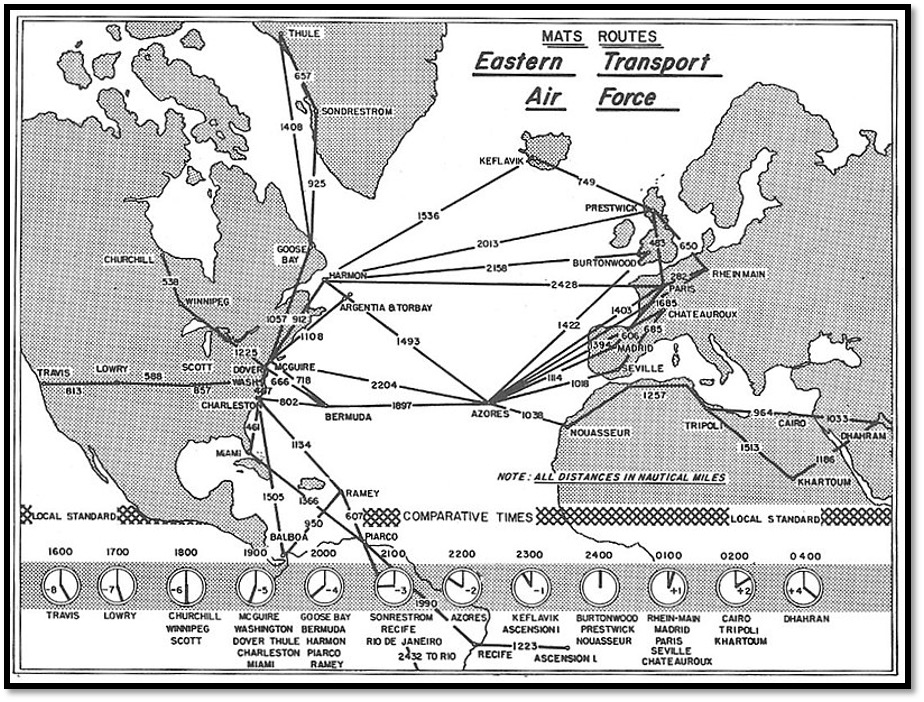
    ScottReidFinland 2

    (Photo Credit: https://en.wikipedia.org/wiki/Military_Air_Transport_Service)

    This all meant that Lola’s story was at least plausible insofar as the credibility of the flights she took was concerned. But what can we make of the conversation and information she obtained from the man with the name plate, saying he was Lee Oswald? There are several obvious similarities between what she said she was told by this man and what we know of Lee Harvey Oswald.

    Coincidence, Consistency and Contradictions

    In addition to the name plate, Lola confirmed the following details in her HSCA interview that we can confidently state are consistent with information that has previously been reported about Lee Harvey Oswald:

    1. His father was indeed named Robert E. Lee Oswald – who died on 19th August 1939, two months before Lee was born.
    2. Lee did serve in the Marine Corps – from around October 1956 until September 1959.
    3. He did spend time in Japan whilst in the Marine Corps – from around September 1957, and was based at the Atsugi Naval Air Facility just outside Tokyo.
    4. There were several reports that he was involved with a Japanese lady – who worked at a bar called the Queen Bee near the Atsugi base or even in Tokyo (whether this relationship was genuine or part of some kind of intelligence gathering operation is open to question).
    5. Lee was imprisoned whilst in Japan – for picking a fight with a senior officer in a bar and pouring a drink over him.
    6. He also spent a few months in the Philippines – from around January 1958 to March 1958.
    7. Lola said the man had “sharpshooter medals on his uniform” – Lee did score just above the requirements for a sharpshooter, not long after he joined the Marine Corps (it is worth adding that he fell to the level of marksman in a further test in 1959).
    8. Lola said the man had “light to sand hair” – Lee had brown hair.
    9. She said the man had a “slight Southern accent” – Lee was born in New Orleans.
    10. The man had “light eyes” – Lee’s eyes were blue.
    11. Oswald was indeed generally known to be a quiet and taciturn individual.
    12. He had spoken previously about his discontent with the American political system – although was this genuine bitterness or part of his cover as an intelligence agent and future defector.

    These details would all seem to be extraordinary coincidences if Lola Steenbarger were not speaking to the real Lee Oswald. Is it realistic that a completely different person, but also called Lee Oswald, could share so many similarities?

    Of course, it is important to add that her interview also included details that would not be consistent with what we know about Oswald. For example, he had been discharged from the Marine Corps a month before this encounter took place. He also said that his departure from the USA had been “so hastily arranged that he had not even been able to see his mother.” But when Oswald was discharged from the Marine Corps in September 1959, he did in fact go to Fort Worth and saw his mother for around three days. He wasn’t imprisoned in Japan because he had fallen for a Japanese girl, and it is not known exactly what skill he had that necessitated such an immediate transfer to Germany.

    Freighters, Ferries and Finland

    It is worth reviewing at this moment the official narrative of how Lee Harvey Oswald is supposed to have travelled from the USA to Europe, before his eventual defection to the Soviet Union on 15th October 1959. And this journey does not involve a Military Air Transit Service flight to Prestwick Airport in Scotland.

    In early September 1959, Oswald applied for a passport in Los Angeles. His passport application indicated that the reason for applying was that he wanted to attend the Albert Schweitzer College in Switzerland and the University of Turku in Finland. He also planned to travel to Germany and France, among other countries mentioned. Oswald was issued with a passport on 10th September 1959. The next day, he was released from active duty with the Marine Corps. He then visited his mother and other family in Fort Worth. He only stayed for a few days. He told his mother that his plan was to find work on a ship in the export-import business, and there was money to be made in such employment.

    Oswald left his mother around $100 and then headed to New Orleans. On 17th September 1959, he paid $220.75 for passage to Europe on a freighter called the SS Marion Lykes. In addition to the ship’s crew, there were three other paid passengers on board. They were 18-year-old student Billy Joe Lord (who Oswald roomed with during the voyage), retired US Army Lieutenant Colonel George Church Jr, and his wife Beauford.

    ScottReidFinland 3

    (Photo Credit: www.shipsnostalgia.com)

    The SS Marion Lykes left New Orleans on the morning of 20th September 1959. The freighter spent just over two weeks at sea crossing the Atlantic Ocean – arriving in La Rochelle Pallice on the west coast of France on 5th October 1959. It was here that Billy Joe Lord disembarked to begin his studies in France. Lord and Oswald had just spent two weeks together.

    In an affidavit given on 26th June 1964, Lord provided some details of his interactions with Oswald. He said that Oswald told him that he had recently been discharged from the Marines and was bitter because his mother had to work in a drugstore in Fort Worth. Oswald gave Lord no indication that he was planning to defect to the Soviet Union, but mentioned about attending a school in Switzerland. This would likely be a reference to the Albert Schweitzer College that Oswald mentioned on his recent passport application form. They also discussed religion. Oswald did not show him his passport or any military identification.

    According to Lord, he never saw Oswald again after leaving the ship in La Rochelle. Billy Joe Lord is also an interesting individual. On 2nd February 1977, he wrote a letter to President Carter stating his belief that the CIA and FBI were suspect in the assassination of JFK and that it was a coup d’etat. He was a man with his own story to tell.

    ScottReidFinland 4

    (Photo Credit: courtesy of Linda Zambanini)

    On the evening of 6th October 1959, the SS Marion Lykes left La Rochelle and travelled around the north-west coast of France, arriving in Le Havre early on 8th October 1959. It is here that Oswald is said to have disembarked the ship, and his passport is stamped as entering and leaving Le Havre on this same day. It is thought that Oswald then boarded another ship and journeyed across the English Channel, arriving in Southampton, England, on 9th October 1959. His passport is stamped to indicate arrival in Southampton on that date. He then seems to have made the approximate 80-mile trip to London. Another stamp on his passport indicates that he left London Airport on 10th October 1959.

    ScottReidFinland 5

    (Photo Credit: Dallas (Tex.). Police Department. [Lee Harvey Oswald’s Passport], text, 1959~/1963~; (https://texashistory.unt.edu/ark:/67531/metapth338438/: accessed February 15, 2025), University of North Texas Libraries, The Portal to Texas History, https://texashistory.unt.edu; crediting Dallas Municipal Archives)

    It is widely believed that Oswald then flew directly from London to Helsinki, Finland, that evening. However, records indicate that the only flight from London to Helsinki on 10th October 1959 landed in the Finnish capital at around 11:33 pm. Oswald then checked into the city’s Hotel Torni. The reservation book of the hotel, though, said that Oswald checked in on 10th October 1959. How is it possible that he could have exited the plane, cleared officialdom and gotten from the airport to the hotel all in less than 27 minutes? Seems a rather unlikely scenario, unless the hotel check-in receptionist was rather careless in completing the necessary paperwork. This leg of Oswald’s journey in his defection to the Soviet Union has had many scratching their heads over the years, including the CIA.

    In 2023, the Finnish Secret Service (known as Supo) declassified and revealed its files on Lee Harvey Oswald. They were very skeptical that Oswald arrived in Helsinki via a late-night flight directly from London. According to Supo, Oswald’s name did not appear on any arrival lists. They felt it was more likely that he arrived in Helsinki via Stockholm, Sweden, either by plane or ferry. Flights from Stockholm to Helsinki on 10th October 1959 landed at 12:25 pm, 3 pm and 4:55 pm. A ferry from Stockholm to Turku arrived at 8:35 am. Turku is a city located on the southwest coast of Finland, approximately 100 miles west of Helsinki. Passengers would have made the rest of the journey by bus to the capital, arriving around noon. The reader will recall that Oswald also mentioned Turku in his passport application form. This all sounds like a more realistic travel itinerary than the mad dash from the airport at 11:33 pm. A Swedish newspaper reported shortly after the JFK assassination that they also felt Oswald had gone to Helsinki via Sweden. On 15th October 1959, and having successfully and very quickly obtained a visa, Oswald left Helsinki heading for the Soviet Union.

    Will we ever know for sure how Lee Harvey Oswald found his way into Finland? Are Supo and the Swedish newspaper correct when they speculate that he likely arrived there via Sweden? Or was the Hotel Torni receptionist just not too fussed about the check-in times he or she entered in the arrivals book? Or could Oswald’s journey perhaps have included another MATS flight or “hop” that was secret and remains undiscovered to this day?

    We know Oswald was in the Marine Corps, but how much would he have known about MATS flights? On 8th August 1961, he wrote to the American Embassy from his apartment in Minsk, Belarus, seeking to return to the USA. His letter stated that he could not “afford to fly direct from Moscow to New York” but that he believed he “could catch a military hop back to the States, from Berlin.” He went on to write that “Perhaps a letter from the Embassy explaining my position, which I could then show the military in Berlin, would assist me to get a hop.”

    Oswald was indeed aware of the existence of MATS flights and their purpose.

    The ubiquitous Lee Oswald

    Was the man that Lola Steenbarger spoke to perhaps another of the numerous Oswald imposters? If it was known that the “real” Lee Oswald was defecting to the Soviet Union via France/UK/Finland, was the purpose of the man on the MATS flight to Prestwick Airport to deflect, distract, confuse and muddy the waters – throwing potential investigators or adversaries off the scent from the get-go?

    On 3rd June 1960, FBI Director, J Edgar Hoover, wrote to the US State Department, as he was concerned that Oswald was being impersonated. He wrote that “Since there is a possibility that an imposter is using Oswald’s birth certificate, any current information the Department of State may have concerning subject will be appreciated.”

    There are several recorded incidents of Oswald being impersonated at the same time when he was supposed to be in the Soviet Union.

    The alleged encounters of Oswald took place in New Orleans. In January 1961, two men visited the Bolton Ford Dealership on Canal Street. They were interested in buying ten Ford Ecoline Trucks and spoke with the Assistant Manager, Oscar Deslatte. One of the buyers identified himself as Joseph Moore. The other man was unidentified at this time. They said they were representing the Free Democrats of Cuba. Oscar Deslatte went to speak to his boss, Fred Sewall, who told him to give the two men a bid that would make the business a profit of $75 over the purchase of each truck. When documentation was being completed for the sale of the trucks in the name of Joseph Moore, the other man began talking to Deslatte and Sewall. He said that the name of the group they represented should be corrected on the official paperwork to “Friends of Democratic Cuba,” as he was “the man handling the money.” Deslatte asked him his name, and the man replied, “Lee Oswald.” Deslatte retained a copy of the bid form for his own records, and the name “Oswald” can be seen on the top right-hand section of the form.

    ScottReidFinland 6

    (Photo credit: https://harveyandlee.net/Misc/Bolton.html)

    A similar incident was recalled by another car salesman, James Spencer. During the period from February to August 1961, James Spencer was employed by the Dumas and Milnes Chevrolet Company in New Orleans. Shortly after the assassination of President Kennedy, he saw a photograph of Lee Harvey Oswald on TV and felt sure that he had seen this man before, but could not place exactly when and where. He looked through his wallet and found a business card that he used when working for Dumas and Milnes. On the back of the business card in Spencer’s own handwriting were the words “LEE OSWALD, Magazine Street.” He recalled a man who had come into the car lot and was interested in a particular vehicle, maybe a 1958 Chevrolet. The man returned a second time, and Spencer dealt with him on both occasions. They went for a coffee to discuss a possible sale, and he obtained the name and address of the individual and wrote it down on the back of the business card. The man also spoke in favourable terms about Fidel Castro. Spencer also recalled that the man insisted on buying his own coffee and had made such an impression on him that he mentioned him to his wife, something he hardly ever did. Whilst Spencer did not personally see this man handing out pro-Castro leaflets on the streets of New Orleans, he did remember that others were involved in such activities at that time. We should note that when Oswald went to New Orleans in the summer of 1963, he both worked and lived on Magazine Street.

    All the above instances are interesting and important because at the time the New Orleans car salesmen said they saw their Oswald, the man we know as Lee Harvey Oswald was living in Minsk, over 5,000 miles away. There are so many examples of Oswald lookalikes and imposters that a whole Chapter is dedicated to the topic in the excellent book The JFK Assassination Chokeholds (Camp Street Press, 2023) by James DiEugenio, Paul Bleau, Matt Crumpton, Andrew Iler and Mark Adamczyk. However, the story of Lola Steenbarger did not feature in the chapter.

    Stepping into the light

    The thing that really makes Lola’s story unique in comparison to other similar Oswald incidents is the level of detail she was able to include that was consistent with facts generally known about Lee Harvey Oswald.

    One of the criticisms that is often levelled at witnesses who come forward and tell their story is that they are seeking the spotlight or some kind of notoriety in the public eye. I have often felt that kind of criticism to be unkind and a cliché. It is more reasonable to acknowledge that people’s recollections can perhaps become a bit hazy, especially if many years have intervened, rather than being eager to be on the front pages of the newspapers or to become overnight celebrities. We should take a moment to consider the context and time of when Lola Steenbarger gave her interview to the HSCA.

    Their report of her statement was dated 26th September 1978, following a call made by investigator Surrell Brady to Mrs Steenbarger. Lola had just recently contacted the HSCA to advise that she had something of interest to tell them. The HSCA was established in 1976 to look again at the assassinations of President Kennedy and Martin Luther King Jr. It was big news at the time. Over the next few years, they interviewed many high-profile witnesses, including Marina Oswald. What would motivate Lola to come forward and tell her story after all these years? It was well known that many witnesses to the murder of JFK had disappeared and died in mysterious circumstances in the years following the assassination. This continued into the period up to and around the HSCA investigation.

    Chicago mobster Sam Giancana was murdered in June 1975 during the time when the Church Committee was holding hearings and investigating the CIA, and their assassination attempts on Fidel Castro. The Agency had recruited the mob to assist in this endeavour. Another member of the Chicago Outfit was Johnny Roselli. He gave testimony to the Church Committee in 1975. The following year, they wanted to hear from him again, but Roselli had since disappeared. In August 1976, his decomposed body was found chopped up in an oil drum floating in a Florida bay. An acquaintance of Lee Oswald was George de Mohrenschildt. He had known Oswald in Dallas during 1962 and 1963. The HSCA was keen to hear from de Mohrenschildt as well. But before they could obtain information from him, he died from a shotgun wound to the head. This happened in March 1977 and was officially deemed a suicide. Some have suspected foul play was at work instead.

    It is not known if Lola Steenbarger personally knew about these violent deaths, but it would be surprising if she didn’t, given their high-profile nature and possible links to the Kennedy assassination. Despite this, she still came forward to tell her story. It would perhaps be fairer and more appropriate to thank people like Lola Steenbarger for having the bravery and integrity to come forward when it surely would have been easier to stay silent and not reveal what she knew. We owe her, and many others like her, a debt of gratitude for deciding not to stay in the shadows but instead courageously putting their experience on the record.

    ScottReidFinland 7

    (Photo Credit: www.findagrave.com)

    Louise “Lola” Steenbarger died on 29th August 2008. She was 85 years old. Her son David, who was on the MATS flight with her in October 1959, died eleven days after his mother. He was only 56 years old. Their deaths so close together are very sad, tragic and poignant.

    The author JRR Tolkien once wrote that, “courage is found in unlikely places.” Lola Steenbarger epitomises Tolkien’s words.

    I hope that this telling of her story helps to keep her memory alive.

    It also adds to the intrigue and mystery of the enigma that continues to be Lee Harvey Oswald.
  • Oswald and the Shot at Walker: Redressing the Balance

    Oswald and the Shot at Walker: Redressing the Balance


    Many of those who believe that Lee Harvey Oswald assassinated President John F Kennedy, and then killed Dallas Police Officer JD Tippit on 22nd November 1963, also advocate the view that Oswald attempted to shoot and kill General Edwin Walker on 10th April 1963. In fact, it is often presented as a historical fact, and that Oswald used the same Mannlicher Carcano rifle seven months later to murder JFK.

    Oswald’s guilt in the Walker case was largely predicated on the testimony of his wife, photos of Walker’s house found amongst his belongings, an incriminating note attributed to Oswald that predicted an imminent event and, possibly, his own arrest or death arising from it.

    As we approach the 60th anniversary of the Walker shooting incident, this article seeks to summarize some of the key evidence and arguments that cast doubt on Oswald being the mystery shooter who tried to take the General’s life. As we shall find out, it was not a fait accompli by any stretch of the imagination. First though, let’s go back to the night in question and briefly recap the generally known facts.

    It was around 9pm on 10th April 1963. It had been a warm, sweltering Texas day and General Walker was sitting at his desk in the northwest ground floor room of his mansion in the Turtle Creek neighbourhood of Dallas completing his tax returns. This large house on Turtle Creek Boulevard also acted as an HQ for Walker’s political operations. He had, in fact, only just returned a few days earlier from a six-week speaking tour of the US with political sympathizer and evangelical preacher, Billy James Hargis. They controversially called their tour Operation Midnight Ride.

    Suddenly, Walker heard what he initially thought was perhaps a firecracker. He then saw a hole in the wall next to where he had been sitting and realized that someone had just taken a shot at him. The bullet had deflected off the wooden window frame. This changed its trajectory and probably saved Walker’s life. When he knew it had been a shot, Walker told police that he ran upstairs to get his pistol. He heard a car leave but saw no shooter. Walker was lucky. The only injuries he sustained were minor cuts to his lower right arm, possibly caused by fragments of the bullet. Walker reported the incident to the police around 9:10pm. When they arrived at the scene, a mangled bullet was soon found in the next room on stacks of paper.

    During the weeks and months that followed, the police were never able to positively identify who had taken the shot. A Scotsman by the name of William Duff, who was a former volunteer worker of Walker’s but left the house a month earlier, was arrested on 18th April 1963 and considered to be a suspect but this came to nothing (for more on William Duff, click here to see my presentation on him at the Dealey Plaza UK 2022 conference).

    The attempted murder was unsolved until shortly after the assassination of JFK when the finger of suspicion was pointed directly at Lee Harvey Oswald. This started in late November/early December 1963. Of course, by then Oswald was conveniently dead and could not defend himself.

    How did Oswald first become a suspect in the Walker shooting incident?

    It was a right-wing German newspaper called the Deutsche National-Zeitung und Soldaten-Zeitung that first highlighted Oswald’s possible involvement in the Walker shooting incident when they published an article on 29th November 1963. This was based on interviews General Walker had given to the newspaper in the days following JFK’s assassination. It was likely Walker who planted the seed with them about Oswald being the person who took the shot at him.

    We then have Ruth Paine visiting the Irving Police Department on 2nd December 1963 to hand over some of Marina Oswald’s belongings. Included was a Russian book called “Book of Useful Advice.” When the book was inspected by the Secret Service later that day, they found a two-page note inside written in Russian. This note was allegedly written by Oswald with instructions for his wife on what to do if he was killed or taken prisoner. Marina told law enforcement officials the day after the note was found that it was written by her husband, and she had first seen it on the night of the Walker shooting. She said that Lee had arrived home late that night and admitted to taking the shot and burying the rifle, which he would retrieve later.

    From then on, it was a slam dunk! Oswald had shot at Walker, displaying a propensity for political assassination that ultimately led to JFK’s death. That has been the popular narrative ever since.

    Did the note found in the book have another meaning?

    The conventional wisdom has been that Oswald did indeed write the note in advance of the Walker incident, as he was aware that he could have been arrested or killed at the scene, or shortly afterwards. This is the Warren Commission exhibit and English translation of the note originally written in Russian (see original note here).

    scott01

    It is clear that whoever wrote the note was planning a dangerous activity. But the note did not mention the specific event. There is no mention of General Walker, and the note is not signed or dated. If Walker had been killed, and Oswald arrested (or worse), it is fanciful to suggest that there would not have been anything about the shooter or the incident in the newspapers. Walker was a high-profile political figure at the time, and this would have been a major national news story.

    The reference to the Embassy probably means the Soviet Embassy. But would they have been quick to come to Marina’s assistance as the note suggests if Oswald had killed General Walker? Isn’t it more likely that they would not have wanted to associate themselves with such a violent and political act on American soil? However, maybe the note referred to a different event.

    It is also interesting that the FBI examined the note in early December 1963 and “seven latent fingerprints were developed thereon. Latent prints are not identical with fingerprints of Lee Harvey Oswald or Marina Nikolaevna Oswald.” This is an odd finding given that Oswald was the alleged author of the note and Marina had also probably handled it (click here to see the latent print memorandum dated 5th December 1963).

    Sylvia Meagher in her influential 1967 book, Accessories After The Fact suggests though on page 287 that “Oswald wrote the undated letter in relation to a project other than an attack on General Walker – one that also involved risk of arrest or death – and that Marina Oswald was informed about her husband’s plans in advance.”

    Could Oswald have been planning a different dangerous mission or project around the time of the Walker shooting that was completely unrelated, but also involved risk of arrest or death?

    The answer is that he was.

    Oswald, Dallas and the Fair Play for Cuba Committee

    Most people with an interest in the JFK assassination are aware of Lee Oswald’s activities in New Orleans on 9th August 1963 and 16th August 1963 when he handed out leaflets for the Fair Play for Cuba Committee (FPCC) on Canal Street and Camp Street. However, many do not know that it is likely that he had done something similar four months previously while still residing in Dallas.

    On or around 19th April 1963, Oswald wrote a letter to V.T. Lee in New York, who was essentially the head of the FPCC in America. Oswald wrote:

    I do not like to ask for something for nothing but I am unemployed. Since I am unemployed, I stood yesterday for the first time in my life with a placard around my neck, passing out Fair Play for Cuba pamphlets, etc. I only had 15 or so. In 40 minutes they were all gone. I was cursed as well as praised by some. My homemade placard said, “Hands OFF CUBA! VIVA Fidel.” I now ask for 40 or (50) more of the fine, basic pamphlets.

    The letter was signed Lee H. Oswald (click here to see the letter).

    This would indeed have been an extremely dangerous activity to be involved in. Since Dallas at that time was a political hotbed of right-wing extremism with the John Birch Society very active. The Dallas Morning News made no secret of its contempt for Castro’s Cuba and President Kennedy and, of course, General Walker made Dallas his home after he resigned from the Army and became active in politics. Lyndon and Lady Bird Johnson were accosted by a mob in the city in November 1960. Could the note found in the Russian book on 2nd December 1963 have been written with the FPCC leafleting in mind and the potential for harm to come to Oswald? It is not unreasonable to say so, especially as his letter to V.T. Lee was sent just around a week after the Walker assassination attempt, an event that would have greatly agitated his supporters. This is also a scenario where the Soviet Embassy would have been more likely to assist Marina if harm had come to Oswald.

    Corroboration of the leafleting in Dallas comes from two police officers. Dallas Chief of Police, Jesse Curry, wrote to J. Lee Rankin (General Counsel, Warren Commission) in May 1964 with two reports from Sergeant Harkness and Patrolman Finigan regarding a man passing out pro-Castro literature on the streets of Dallas in early 1963. Finigan wrote the following on 15th May 1964:

    On a day in late spring or early summer of 1963, which was approximately one year ago, I was on the northeast corner of Main and Ervay Streets and observed an unidentified white male on the northwest corner of Main and Ervay Streets. This white male was passing out some sort of literature, and had a sign on his back which read Viva Castro.

    I went to the phone in Dreyfuss & Son and called for Sgt. Harkness to meet me on the corner. While I was waiting for Sgt. Harkness, US Commissioner W. Madden Hill came across the street and said “Something should be done about that guy passing out literature.” Mr Hill seemed to be very angry.

    About this time, Sgt. Harkness drove up on his three-wheel motor-cycle and stopped on the northeast corner where I was standing. As we started to discuss the situation, the white male removed the “Viva Castro” sign and ran into H. L. Green Company. I started after him but was told by Sgt. Harkness to let him go. Another unknown white male told us that when Sgt. Harkness came up, this unidentified white male said “Oh, hell, here come the cops.”

    This unidentified white male was of medium weight and height and had on a white shirt and was bare headed. I can not identify this white male because he was across the street and I was waiting for Sgt. Harkness to make the initial contact with him.”

    (Click here to see Finigan’s statement)

    Sergeant Harkness tells the same story and that he “could not get a good description of the man because he ducked behind a post in the entrance to the store” but that he “appeared to be medium build and he had on a white shirt.”

    (Click here to see full statement from Harkness)

    I think it is fair to speculate that the man Finigan and Harkness saw was Lee Harvey Oswald.

    It’s also interesting to note that the H. L. Green store where the leafleting took place was the first store in downtown Dallas to desegregate their lunch counter. Civil rights protests took place outside the store during the 1960’s so it was probably felt to be a good place to hold the demonstration (see picture below).

    It is wrong to suggest therefore that the note found in the Russian book could only have referred to the Walker incident.

    scott05

    Marina’s Testimony

    It has been well documented over the years that much of Marina Oswald’s testimony against her husband was contradictory, controversial, and selective. It should be acknowledged that shortly after her husband was arrested on 22nd November 1963, and in the months that followed, she would have been under intense pressure and was threatened with deportation if she did not comply with investigating authorities. She was a mother of two young children in a strange land and who hardly spoke the language. She would likely have said anything to protect her children.

    The reader should be aware that the House Select Committee on Assassinations (HSCA) in the 1970’s produced a thirty page report called Marina Oswald Porter’s Statements Of A Contradictory Nature. This report included conflicting statements given by her about the Walker shooting, such as when she first found out Oswald had lost his job at Jaggars-Chiles-Stovall (just prior to 10th April 1963) and when she first saw photographs allegedly taken by her husband of Walker’s house.

    Even Warren Commission lawyers such as Norman Redlich had serious concerns about relying on Marina’s testimony. In February 1964, he wrote “Marina Oswald has repeatedly lied to the Service, the FBI, and this Commission on matters which are of vital concern to the people of this country and the world.” When being questioned by the House Select Committee on Assassinations, Redlich added that “she may not have told the truth in connection with the attempted killing of General Walker.”

    When Marina was first questioned about the note by Secret Service officials on the evening of 2nd December 1963, she denied any knowledge of it (Commission Exhibit 1785). However, the next day her story had completely changed, and she admitted to being aware of its existence and meaning.

    Marina had volunteered nothing to authorities about the note or the Walker shooting from the day of the JFK assassination (when she was first questioned) until the 3rd December 1963. She may have been protecting her husband, but it is surely reasonable to at least be skeptical about how and when she began to speak about the note, which was both convenient and suspicious.

    How the incriminating note found its way into the hands of the police, the FBI and Secret Service is also troubling. In her Warren Commission testimony, Ruth Paine advised that officers had come to her house with a search warrant. This was 23rd November 1963. She was about to go grocery shopping but allowed the search to go ahead in her absence. The last thing she saw before she left to go shopping was officers “leafing through books to see if anything fell out but that is all I saw.” Why didn’t the officers find the note during that search? Some have said that they were simply not as thorough as they should have been, but this explanation is hardly credible given the nature of the charges against Oswald at that time and they were specifically “leafing through books.”

    The note was eventually found nine days later on 2nd December 1963 when Ruth Paine took some of Marina’s personal belongings round to the police, including the book where the note was found. This was also only a few days after the German newspaper ran the article alleging a connection between Lee Oswald and the Walker shooting incident. Coincidence or something more sinister?

    Were there any eyewitnesses who saw Oswald shoot at General Walker?

    The answer is no. There were no eyewitnesses who came forward and said they saw Oswald shoot at General Walker. In fact, nobody even said they saw Oswald at the scene of the crime or in the vicinity.

    The best witness to the Walker shooting incident was fourteen-year-old, Walter Kirk Coleman. He lived on Newton, which was just north of Walker’s house and overlooked the Mormon Church and parking lot.

    On the evening of 10th April 1963, he was at home standing in the doorway which led from his bedroom to the outside of the house. He heard a loud noise which he first thought was a car backfire. He immediately ran outside and stepped on top of a bicycle propped up against the fence. This allowed him to look into the church parking lot. The journey from the doorway to the fence would only have taken him a few seconds.

    Coleman was first interviewed by the Dallas Police on 11th April 1963 (click here for Police report). He said he saw a man getting into a 1949 or 1950 Ford who “took off in a hurry.” He saw a second man further down the parking lot at another car, bending over the front seat as if he was putting something in the back.

    When Coleman was interviewed again in June 1964 (click here), he provided additional details. He added that the first man was hurrying towards the driver’s side of the Ford car. The motor was running, and the headlights were on. He saw nobody else in the car. The man glanced back towards him. This time Coleman said the car drove off at a normal speed. The second man was seen walking away from the alley entrance and towards a 1958 two door Chevrolet sedan. Coleman confirmed his initial report that this man was leaning through the open car door and into the back seat area. Was he placing something there? Coleman did not notice if this second man was carrying anything as his attention was mainly drawn to the first man, but it was possible.

    Coleman provided a detailed description of both men. By this time, he must have seen many pictures of Lee Harvey Oswald and stated that neither man he saw on the night of the Walker shooting incident resembled Oswald. It is possible that these two mystery men were leaving the scene because they also heard the shot and were naturally alarmed and concerned by it. The shooter could have gone down the alley in the opposite direction from them and the church parking lot towards Avondale Avenue.

    Sixty years later, the identities of the two men have yet to be uncovered. The attempted assassination of General Walker was big news so it should have been important for the police to follow up on Coleman’s firsthand testimony and try to find them. The men could even have come forward to eliminate themselves as suspects and help the police with their inquiries. They were there on the night and if not personally involved surely saw what was going on.

    Two unidentified men were also seen acting suspiciously around Walker’s house on 8th April 1963. Robert Surrey was a close associate of General Walker and had set up a publishing company with him. It was actually Surrey who was responsible for the Wanted for Treason leaflets distributed around Dallas at the time of JFK’s visit.

    Surrey told police and the FBI that around 9pm to 9:30pm on 8th April 1963, he had just arrived at Walker’s house and was planning to drive up the alley (where the shot was fired two nights later). He observed two men sitting in a 1963 Ford just off the alley. Surrey parked elsewhere and went back to see what these men were up to. He saw them get out of the car and walk up the alley. They went into the area at the rear of the property and looked in windows. Surrey took the opportunity to check their car. There was no license plate. He opened the glove compartment but saw nothing that would help identify the men. About 30 minutes later, the men returned to their car and Surrey followed them in his. He did not follow them long.

    Surrey confirmed that he had never seen the men before or after that night. Like Coleman, he also provided a description to police and confirmed to them in June 1964 that he was of the opinion that neither man was Lee Harvey Oswald (click here for FBI report on Surrey statement).

    Were these the two men that returned to the Walker house two days later and were they the same ones seen by Walter Kirk Coleman? Their identities will probably never be known now, which is just another mystery in this case that has so many.

    Further intrigue, as if we needed any, about the night of the Walker shooting is provided in Chapter Five of Gayle Nix Jackson’s interesting 2016 book, Pieces of the Puzzle: An Anthology. She tells the story of seeing a 2012 video interview with Robert Surrey’s eldest son, David. In the interview, David recalls being at Walker’s house with his father when the shot was fired. Father and son then went out in their car, looking for the shooter. After circling the area for a while, Surrey pulled up behind a car and got out to speak to a guy who got out of his car. Surrey asked the guy, “Did you get him?” The man replied that he missed.

    Coleman and Robert Surrey’s statements are important when assessing if Oswald was involved in the Walker incident or if more than one person was involved. Their statements are rarely told.

    The Bullet and the Photographs

    The bullet that narrowly missed General Walker’s head was retrieved by police on the night of the shooting. It was described in their contemporaneous report as appearing to come from a high-powered rifle and “was a steel jacket bullet.” Presumably, police officers are familiar with identifying different types of bullets. Early newspaper reports, including from the day after the shooting by the Dallas Morning News, also reported the bullet as of 30:06 caliber. They may have been passed this information from sources in the Dallas Police Department.

    Police officers also thoroughly searched the alley at the rear of the house from where the shot was fired with “negative results.” They found no spent cartridges or other evidence of value.

    If Oswald did take the shot at General Walker, he was obviously more careful about cleaning up the scene of the crime than he was when he allegedly shot President Kennedy and Officer Tippit. On those occasions, he left the rifle, cartridges, bullet casings and a wallet behind, even emptying his revolver of the rest of its contents at the Tippit scene. He may as well have left a calling card!

    The police did identify the spot from where they felt the shot at Walker was fired, a lattice fence at the rear of the house and in the alley. This was a distance of roughly 100 feet to the spot where Walker was sitting. Walker’s house was illuminated that night, so there is the obvious question of how the shooter could have missed, especially a so-called sharpshooter like Lee Harvey Oswald. According to the Warren Commission, Oswald successfully pulled off a far more difficult shot, and at a moving target, seven months later from the sixth floor of the Texas School Book Depository.

    And, in a way similar to how a German Mauser rifle morphed into an Italian Mannlicher Carcano in the hours following the JFK assassination, investigating authorities seemed to want to modify a 30:06 steel jacketed bullet into a 6.5mm copper jacketed bullet and then link it to Oswald. Remember that the bullet retrieved from the Walker house was very badly damaged and in a mangled state (see Commission exhibit CE 573 below).

    scott02

    In fact, during the HSCA investigation in the 1970’s, General Walker himself said that the bullet in evidence was not the same bullet that was found in his house on 10th April 1963. He wrote to the Attorney General in February 1979 and said that it was “a ridiculous substitute.” He went on to state that “I saw the hunk of lead, picked up by a policeman in my house, and I took it from him and I inspected it carefully. There is no mistake. There has been a substitution for the bullet fired by Oswald and taken out of my house.”

    We should exercise caution when reviewing statements made by Walker and not necessarily take them at face value. But it cannot be denied that he was there the night the bullet was found and had decades of experience in the military and in handling firearms.

    What we can say with confidence is that it has never been established beyond doubt that the bullet found at the Walker house on 10th April 1963 was fired from the same rifle allegedly used to assassinate President Kennedy. Even the Warren Commission, hardly the biggest defenders of Oswald, recognized that their experts were never “able to state that the bullet which missed General Walker was fired from Oswald’s rifle to the exclusion of all others.”

    The photographs of Walker’s house found among Oswald’s belonging are also presented as evidence of his involvement in the assassination attempt. We are told that he took these photos weeks before the shot was fired and as he was planning the event. At face value, it looks incriminating. Why would Oswald have pictures of the back of Walker’s house and the alley from where the shot was fired? I would respond initially by saying that just having such photographs in your possession does not prove you fired a shot.

    There has been very credible research carried out over the years that Oswald had assignments as a government agent and was an FBI informant. If Oswald did take these pictures, and it has not been established beyond all doubt that he did or even owned the camera that took them, maybe they were taken in such a capacity. Could Oswald have been keeping tabs on right-wing individuals and groups visiting the Walker house and reporting back to his superiors on all the comings and goings? Is it possible that he was trying to infiltrate such groups? In October 1963, Oswald is said to have attended the Walker inspired “US Day” at the Dallas Memorial Auditorium at which the General was a keynote speaker. He then attended a meeting of the John Birch Society shortly afterwards. Was he involved in such surveillance activities right up until the time of his own death?

    Another piece of vital information that cannot be ignored, is the photograph of the back of Walker’s house with the parked car, identified as a 1957 Chevrolet (see Commission Exhibit 5). The license number of the car has clearly been punched out. When police officers found this picture at Ruth Paine’s house in the days following the JFK assassination, they said that this was how the picture looked and that it had already been mutilated.

    scott03

    However, in 1969 when Dallas Police Chief Jesse Curry published his JFK Assassination File it showed on page 113 an exhibit of Oswald’s possessions that included this controversial photograph (see section of photograph below – red arrow added by me). The license number in this picture appeared to be intact. Certainly, the area punched out looks very different in the picture published in Curry’s book. Was evidence tampered with?

    scott04

    If Oswald was a lone gunman, what motivation would he have to punch out the license plate or even hold on to the photographs? Marina stated that he burned pages of a notebook that had plans included for the shooting of General Walker. It doesn’t make sense to retain evidence that would incriminate him, such as the photographs, when he was also burning other evidence that could possibly link him to the crime.

    In Conclusion

    What I have attempted to do in this article is briefly lay out some of the counter arguments to the popular belief that Lee Harvey Oswald definitely took the shot at General Edwin Walker. Anyone who can say this with absolute certainty is either being disingenuous or has information and knowledge about the night of 10th April 1963 that has not been shared yet.

    Even after researching and writing this article, I would not be so bold as to say that Oswald was definitely not involved, either as a lone gunman or as part of some conspiratorial plot. The truth is that nobody really knows who took the shot. It should not though be put exclusively at the door of Lee Oswald when there is so much information to doubt that conclusion. It is unlikely that he would have been convicted in a court of law.

    It has been speculated that the Walker shooting was even a staged event to highlight Walker’s political causes and portray him as a victim. Did the framing of Lee Oswald for the assassination of President Kennedy begin with the events of 10th April 1963?

    Much more reading, writing and research has been done, and can be done on the events referred to in this article. I have only scratched the surface. As always with the JFK assassination, there are more questions than answers, but we must keep asking and trying to answer them. Had Oswald not been murdered in police custody, perhaps many of these questions would already have been answered or would never have needed to be asked in the first place.

    Going back to the basketball analogy, rather than Oswald’s guilt in the Walker shooting incident being a “slam dunk,” perhaps we need a “time out” instead for further reflection on the evidence.

    It is time to redress the balance.

  • The Kirknewton Incident

    The Kirknewton Incident


    Did a US Air Force Security Service Member Intercept a Communication

    Predicting the JFK Assassination?


    The time is October 1963. The place is an Air Force Base in Kirknewton (Scotland), located approximately 11 miles west of the capital city, Edinburgh. A US Air Force (USAF) Security Service member is carrying out his regular duties at the base. Although it is in the United Kingdom, the base is currently under the control of the USAF Security Service. His duties include monitoring and reporting intelligence communication traffic to his supervisors. They then relay this information on to the National Security Agency (NSA) Headquarters in Fort Meade, Maryland. The individual’s name is David Christensen.

    Christensen is listening to communications coming out of Lisbon, the capital of Portugal. Suddenly, he eavesdrops on a link between Lisbon and Tangier (Morocco) that mentions a high-ranking figure in organized crime and the assassination of President John F. Kennedy. Recognizing the importance and gravitas of such an intercept, he immediately informs his supervisors, confident in the knowledge that they will pass the information up the chain of command.

    Christensen had done his duty. He was relieved. He may even have felt that because of the important content of the intercept, it would have been given Critical Intelligence Communications status, otherwise known as CRITIC. Such messages should be alerted to the President and other senior government officials within minutes, if possible.

    A few weeks later, when Christensen heard the news of President Kennedy’s assassination in Dallas on 22 November 1963, his heart sank. His life then followed a similarly low trajectory. As he said himself, in a letter he wrote in May 1978, to a fellow officer who served with him at the RAF Kirknewton base, “it really broke me up after Nov. 22, 63 especially when I had it all beforehand.” We will return to this letter shortly.

    Was David Christensen destined to become another accidental witness to history, having had prior knowledge of the JFK assassination, alerting the appropriate authorities who then did nothing and failed to protect the President?

    This is his story and how it was eventually brought to the attention of the House Select Committee on Assassinations (HSCA) in 1978.


    David Christensen and RAF Kirknewton

    David Frederick Christensen was born on 26 January 1942 in the midwestern town of Dickinson, North Dakota. He grew up on a ranch near the town of Halliday, which was about 40 miles north east from the town of his birth. Christensen graduated from High School in Halliday in 1960 and married that same year. The young Christensen quickly joined the USAF and in 1961 was sent overseas to the RAF Kirknewton base in Scotland.

    The small town of Kirknewton has a population of just over 2,000. During World War II, a military airfield was built about a mile south of the town by the British Royal Air Force (RAF). Unsurprisingly, it was named RAF Kirknewton.

    The base began life as a grass airfield in late 1940. Its initial purpose was to provide a home for the 289 Squadron in November 1941. The 289 Squadron was an anti-aircraft operation unit who eventually relocated to another base around six months later. RAF Kirknewton was then used for a variety of purposes, including a short stint as a Refresher Flying Training School, which helped to prepare inactive pilots for postings to operational training units.

    In 1943, there was some hope that the RAF Kirknewton base would replace the RAF Findo Gask station, when that base became unserviceable. Findo Gask was situated 50 miles north of Kirknewton. That hope quickly evaporated however when RAF Kirknewton did not obtain the necessary clearance to build runway extensions, probably because of dangerous crosswinds in the area.

    From the 1950s onwards, RAF Kirknewton was no longer used for aviation and in early 1952, the base was handed over to the USAF Security Service––the intelligence branch of the USAF. RAF Kirknewton then began a new life as a strategic US intelligence listening station that was used by the Central Intelligence Agency (CIA) and NSA to eavesdrop on military and commercial naval traffic, with priority given to Soviet radar. The Cold War was really heating up at this point. Personnel at the base included radio operators, linguists, and analysts––many with Top Secret and higher security clearance.

    The planning for this phase in the life of RAF Kirknewton actually began in August 1951 at the Brooks Air Force Base in San Antonio, Texas when the 37th Radio Squadron Mobile (RSM) was activated. This unit was then selected to move to the UK and into the RAF Kirknewton base.

    Ironically, President Kennedy’s last official act as President was at the Brooks Air Force Base on 21 November 1963, when he opened and dedicated the new Aerospace Health Medical Centre there.

    Around May/June 1952, the first personnel arrived in Scotland (via a three month stay in Bremerhaven, Germany for background investigations and security clearances). These first arrivals referred to Scotland as the “land of the heather, the moors, Scotch whiskey and the kilt.”

    The 37th RSM began formal operations at Kirknewton in August 1952 and by the following month the base had grown in size, with around 17 officers and 155 airmen in post. During its first year, RAF Kirknewton was used to evaluate antenna configurations, with the aim of determining the most effective configuration for intercepting Soviet communications and radar signals.

    The formal transfer of RAF Kirknewton from the British air ministry to the USAF had already taken place by 27 March 1953. Two years later, the 37th RSM was re-designated as the 6952nd RSM, but there was no change to the original mission.

    At the peak of its activity, RAF Kirknewton housed 17 officers and 463 airmen. Over 2,000 personnel served during the lifespan of the base. Towards the end of its life as a listening station, the base was even responsible for maintaining security over part of the hotline established in 1963 between Washington and Moscow, as the cable route passed through the area. The base was handed back to Britain in 1967.

    In James Bamford’s book, The Puzzle Palace (Penguin Books, 1983, page 270), we get an insight into the type of work Christensen would have been performing at Kirknewton. An unnamed former employee explained his routine at the base:

    Intercepted telegrams came through on telex machines. I was provided with a list of about 100 words to look out for. All diplomatic traffic from European embassies was in code and was passed at once to a senior officer. A lot of telegrams––birthday congratulations for instance––were put into the burn bag. I had to keep a special watch for commercial traffic, details of commodities, what big companies were selling, like iron and steel and gas. Changes were frequent. One week I was asked to scan all traffic between Berlin and London and another week between Rome and Belgrade. Some weeks the list of words to watch for contained dozens of names of big companies. Some weeks I just had to look for commodities. All traffic was sent back to Fort Meade in Washington.

    As “all traffic was sent back to Fort Meade in Washington” you would have thought that an intercept referring to the assassination of the President would have been given priority treatment and not “put into the burn bag” with birthday messages!


    Christensen’s Letter and Subsequent Investigation

    Earlier, I referred to a letter David Christensen wrote to an ex-colleague in May 1978. The recipient of his letter was Sergeant Nicholas Stevenson, who served two tours of duty at RAF Kirknewton. The second tour was between June 1962 and June 1965, so he was based there at the same time Christensen said he picked up the Lisbon/Tangier intercept. We can see here a typed copy of the letter provided to the HSCA by the NSA in 1978 (click here to see the original handwritten version of Christensen’s letter).

    Unlike his alert to senior officers in October 1963, Christensen’s letter to Stevenson did not fly under the radar. It was quickly brought to the attention of US government agencies and eventually the HSCA, led by Chief Counsel G. Robert Blakey.

    When Christensen wrote the letter, he was in a Veterans Hospital in Sheridan, Wyoming. Stevenson was based at Corry Field, Florida.

    An earlier public release of the letter contained many redactions. This is what two of the pages looked like––clearly there were concerns about the content:

    Once Stevenson had read the letter, he alerted the USAF Security Service, who in turn notified the Office of Special Investigations (OSI). An OSI agent, based at the Lowry Air Force Base in Colorado, was assigned to contact Christensen, and interview him about the letter. This interview took place on or around 1 June 1978.

    A letter dated 2 June 1978 from Paul Fisher (Chief, USAF Security Service) provides an insight into what was discussed between the OSI agent and Christensen. Fisher’s letter was addressed to James Lear, Director of the NSA (click here to see Fisher’s letter). He wrote that the purpose of the interview with Christensen was to determine the names of any other individuals he may have contacted. He went on to state that “Mr. Christensen has a long history of alcoholism, family problems and now wants to see a cleared psychiatrist as he attributes all of his problems from Oct 1963, per the OSI agent. In addition, he has indicated to the OSI that he now fears for his life.”  

    The government agencies at this point clearly seemed to be more concerned about who else Christensen may have talked to about the letter, rather than the actual claim made about the JFK assassination and organized crime. Christensen’s health and personal problems were also highlighted, a common tactic when trying to undermine someone’s credibility.

    This illustrates that if Christensen did intercept a message in October 1963 predicting the JFK assassination, and tried to raise the alarm or alert authorities, then it had a very profound and damaging effect on his life. Something similar happened to Eugene Dinkin, Ralph Leon Yates, and Abraham Bolden to name just a few (click here for more on Eugene Dinkin).

    On 7 September 1978, Daniel Silver (General Counsel, NSA) wrote to the FBI about the letter and provided them with a typed copy. Silver indicated that the FBI may wish to bring the matter to the attention of any Committee of the Congress. The HSCA had already been investigating the JFK assassination for two years by then (click here to see Silver’s letter).

    Interestingly, Silver also corroborated a central claim made in Christensen’s letter about what was going on at the RAF Kirknewton base in October 1963.

    Silver wrote that “the information contained in Mr. Christensen’s letter that the Air Force Security Service was intercepting international commercial communications at Kirknewton, Scotland in 1963 is correct, as is the assertion that the station monitored communications links between Lisbon and other parts of the world.” As we will discuss later, other facts raised by Christensen in his letter can also be corroborated.

    The HSCA were indeed made aware of Christensen’s claim and on 8 November 1978, Chief Counsel Blakey met with a representative of the NSA to discuss further. The memorandum written up from this meeting confirmed that Christensen had been committed to “a mental institution” because of the October 1963 intercept. Blakey posed several questions to the NSA including what their capability was to retrieve communications from Kirknewton from the time period in question, and whether Christensen really was working for the USAF at the time and doing the kind of work consistent with “intercepting commercial communications.”

    Blakey followed this up on 15 November 1978 by writing to Harold Brown who was then Secretary of Defense under President Jimmy Carter. Brown had also worked in the Defense Department under Robert McNamara during JFK’s time in the White House.

    On the same date, a memorandum of understanding was also drawn up and signed by both Blakey and John Kester, who was the Special Assistant to the Secretary and Deputy Secretary of Defense. The purpose of the memorandum was in relation to the Defense Department’s agreement to release Sergeant Stevenson to be interviewed by the HSCA. It included the restrictions placed on them in this regard, such as that it be limited in scope to the allegations made by Christensen, no classified information would be disclosed by the HSCA without the written consent of the Defense Department, and that Stevenson would be accompanied at the interview.

    What is also interesting about the memorandum of understanding was an error in the original typed copy. As we can see, it referred to “the allegations of David F Christensen of involvement by the Government of Cuba in the assassination of President John F. Kennedy.” This was then scored out, initialed and corrected to readof certain individuals.”

    Click here to see the full memorandum of understanding.>

    There is no record that Christensen made any allegation that the Government of Cuba was involved in the JFK assassination. I’m sure this mistake was just an honest clerical error!


    The Interview with Sergeant Stevenson

    The interview with Sergeant Nicholas Stevenson took place on 17 November 1978 in the Senate Intelligence Committee room. Two HSCA staff members conducted the session. They were Gary Cornwell and Kenneth Klein. Stevenson was accompanied by a legislative liaison officer from the USAF. Others in attendance included Eugene Yeates, Chief of Legislative Affairs at the NSA.

    I have been unable to find a verbatim account of what was discussed but a summary of the interview was subsequently written up by Klein that day (click here to see Klein’s report) and by Yeates in a memorandum dated 21 November 1978 (click here to see Yeates’ memorandum).

    At the meeting, Stevenson confirmed that he had known Christensen for a number of years and recognized other names in the letter. He added that he could not rule out that such a message was picked up at RAF Kirknewton but felt it would have been more widely known at the base and be the probable subject of a CRITIC. We have seen previously that this relates to a piece of Critical Intelligence Communications which should be treated with the utmost urgency and importance. Stevenson denied any specific knowledge of the allegation made concerning organized crime and the assassination of the President.

    HSCA investigator Cornwell suggested to Stevenson that he call Christensen to find out the name of the figure in organized crime. Stevenson replied that he was unwilling to do so. In Klein’s report, it is stated that the lawyer representing Stevenson, stated that “such a phone call could only be arranged through the Department of Defense.”

    It has always puzzled me why the HSCA did not pursue more vigorously the name of the organized crime figure mentioned in Christensen’s letter. The memorandum by Eugene Yeates stated that “the staffers remain particularly interested in determining the name of the individual who Mr. Christensen believes relates to the assassination” and ended with the words “If the Committee is able to determine a specific name, the staffers indicated that they would probably initiate a specific inquiry to NSA to again search our materials.”

    There is no available information that I have yet been able to find that the HSCA made any serious further efforts to determine the identity of the individual. Despite what Stevenson’s lawyer said, I would have thought the HSCA would have moved heaven and earth to find out the name of the organized crime figure, particularly as Chief Counsel Blakey was pointing the figure of suspicion for the assassination at organized crime. I also realize at the time (November 1978) that the HSCA and their Congressional investigatory mandate was due to run out at the end of the year. I accept that they may have had higher priorities to pursue at the time, such as the acoustical evidence from the Police Officer’s dicta-belt, that recorded the shots in Dealey Plaza.

    Author, Larry Hancock, did speak to Sergeant Nicholas Stevenson for his excellent book Someone Would Have Talked (JFK Lancer Productions & Publications, 2010 edition, page 367). Stevenson told Hancock that “he was unable to discuss the subject because of two brain operations which had totally eliminated all of his past memories.”

    On 21 November 1978, Eugene Yeates wrote a further letter to confirm that the NSA had “made a thorough search of all records” pertinent to the allegation made by Christensen and that “no communications or information relating to the Committee’s request” had been located. This letter was only released in full in November 2017 under the JFK Records Collections Act 1992 (click here to see the letter).

    Another document only released in full at this time was from Harold Parish of the NSA. His memorandum was dated 2 January 1979. In it, Parish outlines the scope of the search conducted by the NSA to find materials relevant to the Kirknewton incident. He concluded that the NSA had “done all reasonable things to locate the reported intercept with negative results.” Just before concluding this, he also admitted that the search only really consisted of a look through three boxes from 1963 containing unidentified materials. There were nearly 10,000 products on file from January through November 1963 that would take a minimum of four weeks to go through (click here to see the memorandum).

    The reality of the search is underlined by another memorandum dated 13 December 1978, this time by C. Baldwin of the NSA (click here to see the memorandum). Baldwin’s memo confirmed “that a review of the documents in these three unidentified boxes would constitute a reasonable effort to find the alleged record” and that the “latest date in the box was 1962.” We know Christensen’s intercept was made in October 1963.

    Baldwin’s memo goes on to state that Mr. Sapp of the NSA “requested that an additional search be made of materials dated later than 1963” but that after reviewing the listing of such boxes, “nothing on the list merits such a search.”  

    It is clear to me that the NSA’s response, that they had made a “thorough search” to locate information relating to Christensen’s allegation, was disingenuous at best and a complete fabrication at worst. It also makes me wonder why these documents were hidden from public view for nearly 40 years if there was nothing to see. I appreciate that time is precious for government agencies but maybe in the near future, I’ll get the opportunity to make a more “thorough search” of these materials. I look forward to that day.


    The Lisbon and Tangier Link

    The intelligence agencies and HSCA seemed to have closed the book insofar as David Christensen’s allegation was concerned.

    You will recall that he mentioned that the link picked up was between Lisbon and Tangier. We have seen that the NSA confirmed that they were indeed listening to communications between Lisbon and other parts of the world at the time Christensen was based at RAF Kirknewton.

    Lisbon and Tangier are only about 275 miles apart. They are both interesting places to research. Both are port cities with easy access to North Africa, Southern Europe and a gateway to the Atlantic.

    Lisbon was known as the Capital of Espionage during World War II, largely because Portugal was officially neutral during that bloody conflict. Like its neighbour Spain, Portugal was ruled by a fascist dictator for decades. Antonio de Oliveira Salazar held power from 1932 until 1968. But because of the country’s neutrality during the war, Lisbon became a haven for spies. Intelligence agents from the allies and axis countries all converged on Lisbon.

    After the war, many organizations continued to take advantage of Salazar’s anti-communist dictatorship. These included CIA-NATO sponsored “Gladio” stay behind units, set up allegedly to defend Western Europe from a possible Soviet invasion, but who ended up inflicting murder and terrorist attacks on their own populations to instill fear, and frame political opponents. James Earl Ray also spent around ten days in Lisbon just before his arrest in London in June 1968 for the alleged murder of Martin Luther King Jr.

    Tangier was an important trade centre and international zone from 1924 until it was integrated into Morocco in 1956. It was also a place where spies met and even the setting for part of a James Bond film in the 1980’s! Bond author, Ian Fleming, was a friend of JFK’s. Smuggling was a popular pastime, if we can describe it as that. There were also several alleged sightings of Lee Harvey Oswald in Tangier, but I am sceptical of their authenticity. I could write a separate article about this subject alone! 

    An interesting character who we do know was in Tangier was Thomas Eli Davis III. He was an associate of Jack Ruby and in the gun running business, which included Cuba. In fact, it is reported that Ruby’s first lawyer, Tom Howard, asked his client whilst he was awaiting trial for Oswald’s murder if there was anybody who could harm his defence if it came out at the trial. Ruby mentioned Thomas Eli Davis.

    Davis was arrested in Tangier on 8 December 1963 for trying to sell two pistols to raise money. What concerned the Moroccan police more though was that Davis also had in his possession a cryptic, unsigned letter in his handwriting that mentioned Oswald and the Kennedy assassination. It is likely though that the reference to Oswald was a Victor Oswald, an arms dealer that Davis met in Madrid around November 1963.

    Another, and possibly more interesting bit of information about Davis, is that he was in custody in Algiers, Algeria on the day of the JFK assassination for running guns to the violent Organisation Armée Secrète, commonly known as the OAS. The OAS were opposed to Algerian independence from France (which was won in March 1962) and had tried to assassinate President De Gaulle on numerous occasions because of his stance on Algeria. They also had a station in Madrid.

    According to author Seth Kantor, Davis’s release from custody in Algiers was facilitated by a CIA asset with the cryptonym QJ/WIN (The Ruby Cover-Up, Zebra Books, 1978, page 45). This mysterious individual was part of the ZR/RIFLE Executive Action assassination programme led by William Harvey, who hated Kennedy and Castro. Could Harvey’s programme have diverted its attention towards JFK?

    Anti-Castro Cuban refugees were also known to have left their country of birth and made their way to Tangier because of the Castro revolution.

    The connection between Lisbon and Tangier may not therefore have been as benign as one may originally think. It does not seem unreasonable that communications and intelligence chatter could have been picked up around October 1963 that included talk of the imminent assassination of JFK.


    The Figure in Organized Crime           

    Earlier in the article, we saw the letter that Christensen wrote in 1978. He wrote that “the man’s name most mentioned was number 4 in a certain branch of organized crime at the time. Was number 2 last year.”

    You don’t need to have the detective powers of Sherlock Holmes or Jessica Fletcher to work out that the person mentioned in the intercept therefore had to still be alive in 1977, the year before the letter was written––and was the number 2 man in that branch of organized crime.

    When we talk about organized crime and the JFK assassination, there are three names that generally come top of most people’s lists. They are Carlos Marcello from Louisiana, Sam Giancana from Chicago and Florida kingpin, Santo Trafficante Jr. All are on record as wishing harm on President Kennedy, and his brother Bobby, and all had the means, motive and opportunity to do so.

    Giancana though was brutally murdered himself in June 1975, so this would appear to rule him out as the person in the letter. Other high-profile Mafia figures who have been linked with the JFK assassination over the years include Joseph Civello (Dallas), Jimmy Hoffa (Teamsters Union), Johnny Roselli (CIA/Mafia Castro hits) and Antoine Guerini (Marseille Mafia).

    They were also all dead by 1977 (or in Hoffa’s case had disappeared). Antoine Guerini’s equally notorious brother, Barthélemy, was sentenced to twenty years in prison in 1969 and died in 1982. Suspected grassy knoll shooter, Lucien Sarti, was also dead, killed in a Mexico City shoot out in 1972. So, it is most unlikely that the man’s name mentioned in the letter, and who was number 2 in a certain branch of organized crime in 1977, could have been any of these men.

    It seems credible that the branch of organized crime mentioned in the letter could have been the lucrative heroin drug smuggling trade––going through Marseille and into North America. The so-called French Connection. It was thriving in the early 1960s and therefore under intense scrutiny by some government agencies. Montreal was a key city in this drugs corridor, as they made their way from Europe to the USA. This makes Paul Mondolini a potential suspect. He was alive in 1977.

    This is, of course, all speculation and it is easy to throw names around without any specific corroboration. As well as drug trafficking, there are many other “branches” of organized crime including murder and assassination. The list of potential candidates could therefore be very long. But I do not think it takes us much further forward to throw other names into the mix without evidence.

    What we do know for sure is that there was an opportunity for the HSCA to find out the name of the person in Christensen’s letter, but they either didn’t have time or did not believe it worthy of further investigation. The NSA didn’t help with their poor excuse of a search for relevant records and information. Could they have been worried about where it might lead them?


    An Officer and a Gentleman

    It’s easy to forget that within all this talk of the JFK assassination, organized crime figures, and Cold War paranoia, that the whole Kirknewton incident really revolves around one man––David Frederick Christensen.

    Only he really knows the whole story and may have taken his secrets to the grave. Christensen died on 22 December 2008. He was 66 years old and rests forever at the Halliday Cemetery in North Dakota.

    Some may say that he made the whole story up, perhaps to engineer some medical and financial assistance he may have been looking for from government. What happened between October 1963 and May 1978 (when he wrote the letter to Stevenson) is also a mystery. Who else did he tell about it? Was pressure brought to bear on him to keep quiet? These questions remain unanswered for now and require further investigation.

    What we do know is that it rarely ended well for people who bravely put their heads above the parapet and tried to sound a warning about the possible assassination of JFK.

    For those who doubt Christensen’s story, it’s worth reflecting on some of the other points mentioned in his 1978 letter.

    He included the names of other officers who served at RAF Kirknewton, such as Prater, Harley, and Hendrickson. A review of the alumni at the USAF RAF Kirknewton website confirms the existence of such named individuals who served there. The Berkely Bar in Edinburgh was an established drinking establishment for serving military personnel at the time. He had indeed married a girl call Marlene Burr in 1960 and they were later divorced. He refers to some people as 202s and 203s. A 202 was a Radio Traffic Analyst and a 203 a Language Specialist––work consistent with the RAF Kirknewton base at the time. Could the outfit in Texas have been a reference to the Brooks Air Force Base in San Antonio?

    Amongst all these facts, I find it extremely unlikely that Christensen would then have thrown in a wild accusation about an intercept that mentioned the assassination of President Kennedy, unless it really did happen.

    As we all continue to research different aspects of the JFK assassination, maybe more about the Christensen story will be revealed. It’s a pity more of the documents and details about the HSCA investigation were not released until after his death. We may have been able to find found out a lot more if they were released earlier.

    What we should never lose sight of though is that David Christensen was a human being who served his country with distinction and received an honorable discharge. He was trusted with high security clearance and is not just a name to be read in documents.

    He had two sons and six grandchildren––a family man. He enjoyed playing card games and worked in the oil business when he left the Air Force. And his life was profoundly affected following Kirknewton. As he said himself––“it really broke me up after November 22, 1963” and “it cost him a divorce and everything from his wife.”

    Until evidence is presented to the contrary, perhaps we should also start referring to David F Christensen as another forgotten hero as far as the JFK assassination is concerned.

    We must keep searching for the truth.

    As JFK said himself once, “Things do not happen. Things are made to happen.