Author: Rob Couteau

  • The Ripple Effect: An Introduction to Stanley J. Marks’ Three-act Play about the JFK Assassination

    The Ripple Effect: An Introduction to Stanley J. Marks’ Three-act Play about the JFK Assassination


    Barbara Garson’s MacBird!, a satire based on Macbeth that borrows lines from Shakespeare, was the first widely publicized play about the JFK assassination. Privately printed in 1966, the playscript was reissued by both Penguin and Grove the following year, eventually selling over 200,000 copies. After opening at Manhattan’s Village Gate in February 1967, it was produced in Los Angeles — the adopted home of Stanley Marks — and at the Committee Theater in San Francisco.

    As a devoted assassination researcher and connoisseur of theater, it’s likely that Stan Marks witnessed at least one performance of MacBird! during its long run. We can also assume that he was outraged by its cynical, insipid treatment of the Kennedy legacy, which portrayed the most empathy-driven president as being “heartless.” Garson even has Robert Kennedy (as “Robert Ken O’Dunc”) declaim that this “heartless” state was deliberately arranged by his own father:

    To free his sons from paralyzing scruples
    And temper us for roles of world authority
    Our pulpy human hearts were cut away. […]
    And so, MacBird, that very man you fear,
    Your heartless, bloodless foe now lifts his spear.[1]

    Thus, in a bizarre inversion of actual events, the scene portrays Robert as the murderer of President Johnson (“MacBird”) in a cold-blooded act that he tries to cover up. Garson also had the temerity to remark that if President Johnson had helped to assassinate JFK (a point of view that she didn’t necessarily advocate) it would have been “the least of his crimes.”[2]

    Perhaps as a response to all this Marks decided to write his own play: one informed by far greater insight into the actual case. He never lost sight of the fact that the forces that reaped untold financial profits with Johnson at the helm were the same ones that had removed JFK and plunged the nation into a turmoil from which it has never recovered. But none of this is even hinted at in Garson’s drama, which soon received blessings from major media outlets, including approving reviews in the New York Times, the Washington Post, the New York Review of Books, and the Chicago Daily News.

    While Garson and her reviewers were focused on the animosity flaring between Robert Kennedy and Lyndon Johnson (an example of what Joan Didion derisively refers to as the “sentimental narrative” that passes as American “journalism”), Marks was asking questions about the true nature of mass media and about its infiltration by embedded CIA agents. Such inquiries were rarely posed in 1967, the year that he published his first assassination inquiry, also titled Murder Most Foul! and subtitled The Conspiracy That Murdered President Kennedy: 975 Questions & Answers.

    That text appeared in September 1967, five months before he copyrighted his play on February 19, 1968. The questions raised, the evidence gathered, and the jigsaw puzzle assembled in his first JFK book (MMF-1) were still fresh in his mind when he tackled his playscript, “A Murder Most Foul! Or, A Time to Cry; A Time to Die” (MMF-2). And so, it remains of interest to compare these two works and to see how, in the play, he focuses on several of the more salient points raised in his nonfiction, now lending them an alternate form of expression via the dialogue of various characters.

    For example, in MMF-1, Stanley writes: “That the CIA controls many of the news columns in both the press and magazines is now known. What is not known, and what will never be known, is how many agents of the CIA now work for various organs in the mass communication media.”

    In MMF-2 we witness the following dialogue that occurs between King (a leading backer of the plot) and his henchmen, Noslen and Prince, as they discuss Oswald in relationship to the assassination of Patrolman Tippit and the attempted murder of Major General Edwin Walker:

    NOSLEN: From the television and other newspaper reports published last year, there seems to be no doubt that Patsy was the only one involved in those affairs.
    KING: Let me say that those reports were made by organizations who know on what side their bread is buttered.

    And later in the play:

    KING: And the owners of the press didn’t give a damn and they still don’t give a damn. In fact, I would venture a guess that ninety percent of them applauded his [JFK’s] murder.

    Stanley continually reminds us that one of the greatest weapons at the disposal of the American Empire is a brainwashed populace. For how else can the Establishment continue to finance, without serious objection, its illegal wars of conquest, both economic and political?

    Like the first MMF, the play also pokes fun at the absurdities put forth by the Warren Commission. For example, MMF-1 hosts a chapter titled “Rifles, Rifles, Everywhere,” referring to the fact that, shortly after the assassination, police discovered more than one firearm in the Texas School Book Depository, and the press published photos of more than one type ofMannlicher-Carcano rifle in the hands of police.(Besides that infamously dilapidated, rusty oldMannlicher-Carcano that FBI investigators initially refused to test, for fear it would explode in their faces, there was also a more sophisticated weapon: a7.65 German Mauser.) Marks explores this same set of facts inMMF-2 with a scene that’s also titled“Rifles, Rifles, Everywhere.” But this entire episode now occurs in silence, minus any dialogue, with only one character, who conducts a “dry run” of the murder using two rifles, each with telescopic sights. Fittingly enough, the weapons are hidden in golf bags.

    Pause for a moment to linger over this potent symbol. For me, it calls to mind how President Eisenhower, who mollycoddled the CIA and allowed it to mushroom to gigantic proportions as it assumed autonomous powers in the 1950s (one of Kennedy’s aides even called it a “state within a state”),[3] was known as the president who “brought golf to the White House lawn.” During his tenure there, Eisenhower carded over eight-hundred rounds of this leisurely activity while the CIA was busy overthrowing democratically elected governments around the world. Thus, how fitting that King stuffs a box of bullets into a pouch on the bag that’s normally reserved for golf balls!

    Marks may or may not have consciously drawn this connection to Eisenhower, but in his stage direction for this scene he includes an even more overt symbol: “On the mantelpiece, centered, is a large derrick, painted or glazed in gold. At the top of the derrick is a small Confederate flag.” This clearly alludes the Texas oil cabal that would have rejoiced over the president’s death, especially because JFK wanted to end the oil depletion allowance: the largest tax loophole in American history. But the derrick also points to that “bigger picture” perspective that Marks has always assumed: that, beyond the theatrical stage of Dealey Plaza, one must also investigate the money trail leading to corporate interests and their role in changing the course of history.

    Later in the play, in a wonderful cross-pollination with nonfiction, King uses a slide projector to display Deputy Sheriff Weitzman’s affidavit, which testifies to the fact that Weitzman discovered a German Mauser inside the Texas School Book Depository. But of course, Weitzman was later compelled to alter his testimony to match a new “script,” now claiming that the rifle in question must have been an Italian Mannlicher-Carcano all along. This despite the fact that he was a firearms expert who would never have made such a foolish error. But just as a playwright wouldn’t hesitate to alter a first draft, the Warren Commission report was always a fictional “work in progress.” One of the classic lines in Stanley’s drama sums this up rather nicely:

    Prince: At least the Commission was consistent; it started and finished with lies.

    This is not the sort of thing that one would encounter in a mainstream media-endorsed drama about the assassination — especially back in 1968. And what other playwright from that era would include the following “Notes to producer and director”:

    In Act II, Scene I, two false Oswalds are seen but not heard. There is more than sufficient evidence in the report and the hearings to prove that, in the conspiracy, a minimum of three Oswalds were used.

    The scene that follows depicts “Executor,” the leader of a hit team, interacting with his ruthless subordinates Lion, Hawk, and Bulldog:

    (LION walks to rear right door, opens it, and motions with hand. In walk two men, dressed in the identical clothes worn by Marine, hair combed the same way, and the same height and build. They walk only about ten feet into room, stop and face the others.)
    CUBANS: It can’t be! Three of them! What’s up?
    EXECUTOR: Yes, these two men look like Marine. They are decoys chosen to protect us and him. At no time will anyone of you speak to any one of them unless they speak to you first. That’s an order!
    (EXECUTOR waves his hand to the two new actors who turn and walk out of door, closing it behind them.)

    Speaking of Oswald look-alikes,[4] this might be the place to examine Marks’ ideas about Oswald as seen through the evolution of his oeuvre. Marks has always maintained a fluid position regarding the two classic schools of thought about this former marine who, in the words of Senator Schweiker, “had the fingerprints of Intelligence all over him.”

    On the one hand, we have the notion that Oswald was manipulated into assuming an active role in the assassination.

    On the other hand, we have the possibility that he was simply chosen to be an unwitting patsy who could be tricked into shouldering the blame for the president’s murder.

    Throughout his nonfiction Marks has always leaned more toward the patsy position, though he adds that, as an attorney, he cannot definitively discount the other possibility simply because we don’t have all the evidence at our disposal. Thus, I was surprised to learn that, in the drama, Marks inserts Marine directly into a group that plans and executes the assassination.

    Marine / Oswald is told that he’s to serve as a “decoy,” and he plays no role in the shooting. But he’s referred to as “Patsy” behind his back, as the plotter’s have earmarked him to take the fall.

    But a careful reading of the play opens up another possibility regarding Marine’s true role:

    When Prince asks King if “Patsy” was either an FBI informant or a CIA agent, after carefully defining the term “agent” King confirms that Patsy served in both these roles:

    Look at Patsy’s record. He was ordered to learn the Russian language while he was a Marine. He was trained at a Japanese airfield as an agent. He was ordered to Russia as an agent while he was still in the Inactive Reserve and retained his Class A Marine security clearance. He returned and again acted his part as a Red and Bearded One [Castro] sympathizer. He operated a one-man pro-Bearded One committee out of a room next door to an EIA-controlled agency [the CIA]. He was subject to arrest when he returned from Russia, yet no federal agency made the arrest. Why?

    This represents a view that the author consistently held throughout his nonfiction work. As early as 1967, in MMF-1 Marks asks:“Who was Lee Harvey Oswald?” Answer: “Evidence is now accumulating that he was a minor cog in the CIA.” He continues: “Was Oswald any type of Agent for the CIA?” “The evidence is accumulating that the answer is ‘yes.’” “Was Oswald either an FBI agent or informer?” “Yes, as to being an informant, as distinguished from being an agent.” In his next nonfiction book, Two Days of Infamy: November 22, 1963; September 28, 1964 (1969), headds that even if Oswald was “part and parcel of the conspiracy” he represents no more than a “piece of string [tied] around the conspiracy package.” And in Coup d’État! Three Murders That Changed the Course of History. President Kennedy, Reverend King, Senator R. F. Kennedy(1970), he further refines this view:

    … a conspiracy murdered President Kennedy; but whether Oswald was a part of the conspiracy cannot be ascertained. Under the “basic principles of American justice,” if a person enters into a conspiracy to commit murder, and the murder is committed, then the degree of the participation is of no consequence — that person is guilty of the full penalty. If, however, a person takes some action of which he has no knowledge that his action is part of a conspiracy, he cannot be guilty of any crime. There is evidence that Oswald was used as a “patsy”; that he executed a part of the conspiracy but he had no knowledge of what was to occur.

    In the playscript we have a patsy who is fully cognizant of the upcoming assassination and who also serves as an FBI informant and CIA asset. This leads to the question: Is Marine reporting back to either bureau about the plan to murder the chief of state, perhaps trying to prevent it? And what sort of follow-up orders is he receiving from his handlers in these respective agencies? The author doesn’t tell us; and so, the mystery of Marine remains intact, lending the drama a more resonant, intentional ambiguity.

    But we are offered a clue about Marine’s own execution. Executorhas decided that Marine must be eliminated, because he can’t be trusted to remain silent:

    Do you think the Department has forgotten that he tried to commit suicide, and failed, while in Russia? He will crack wide open. You don’t think for a minute that we would let him go on trial? How asinine do you think we are? Oh, he will play his part to perfection, but to us he is nothing more than our great, big, beautiful patsy. And in this game, as you know, Lion, the only good patsy is a dead one.

    The Oswald episode also features a droll exhibition of Marksian wit. In early radio broadcasts of Marine’s arrest, Stanley has police officials refer to Marine as “P. Patsy.” The solemn tone of these announcements, which otherwise read like actual transcripts from November twenty-second, make the reference to a “Mr. Patsy” seem all the more surreal. One can also imagine the playwright giving us a sly wink when we learn that a radio host even bears the same name as the author: “Stan.”

    By comparingMarks’ nonfiction to his dramatic work we witness the power of dialogue, of the spoken word, to enunciate complex ideas in a highly condensed, direct fashion. Whether MMF-2 works as a successful play that will rivet an audience’s attention is another question entirely. Such a didactic scenario is faced with numerous challenges, as the presentation of ideas (rather than the dramatization of a character’s shifting emotions) serves as its primary spine. Stanley even alludes to this in his stage direction when he writes: “The play can thus deal only in fact and the characters are subordinate to the main theme of the play, which reveals the methods used to murder President John F. Kennedy; why he was murdered; and how his murder changed the course of history.” But as a text that presents the keynotes of the assassination, it remains fascinating.

    The various characters also personify broader social tendencies. For instance, Noslen is appropriately named because he fails to see things that are right under his nose. In contrast, King possesses a sort of royal sagacity as well as an ability to wed logic to common sense. He’s even able to adduce evidence for a conspiracy merely by examining the daily press. And King is a “kingmaker” thanks to his leading role in the plot.

    The characters also give voice to some of the principal notions of the author, who often speaks directly to us via King and Prince. (At one point, Prince even says that he’s an attorney, just like Stanley.)

    PRINCE: My God, this is worse than Alice in Wonderland.
    KING: No, more like Orwell’s 1984. The worst is yet to come.

    King is speaking about the revelations he’s about to unveil regarding the assassination and its cover-up, but he could just as easily be referring to what will happen after Kennedy’s demise: the resumption of a Cold War sensibility once this radical change of government arrives via coup d’état. And Marks would not have been surprised to learn that the cover-up continues to this day, with thousands of assassination-related documents still being illegally held under lock and key — not to mention files that are “missing,” illegible, or destroyed. But he holds out a sliver of hope that, eventually, at least part of the truth will emerge. This involves not only an understanding of Dealey Plaza events but also a macro view regarding the financial interests of transnational corporations:

    KING: […] We may be able to keep the reasons why the chief was murdered from our generation. However, sometime in the future, students of the event will finally discover the fact that he was done away with because our group believed that the chief’s conduct of our national and international affairs was inimical to both us and the nation. Another man said it in another manner: What was good for GM was good for the nation. Just as he placed his interests first, so do we.

    Executor voices similar concerns:

    We have discovered that the chief has sent a secret agent to open negotiations with the Bearded One [Fidel Castro]. He is attempting a détente with the Reds. His feelers with the various Red nations to obtain some sort of peace, a “live and let live” attitude, does not appeal to us and to various sectors of our economy. Internally, there’s too damn much socialism. So, we believe he must go, and go he will.

    As with Marks’ nonfiction, such statements transcend a microanalysis of the assassination (e.g., how many bullets were fired; where was Oswald when JFK was shot) and expand into a broader perspective of what was really behind it. Sometimes, this is rendered in a single sentence:

    KING: […] Mr. Noslen, do you think we will ever get out of Vietnam?

    We also have this startling remark made by King, shortly after Patsy’s assassination:

    You know, when I organized this event, I never thought the ramifications would be so great … I found that a conspiracy is like throwing a stone in the water. From the center, the ripples keep getting larger and larger until it seems that the whole body of water is agitated. Everything those ripples touch reacts in a different manner. We murdered one man today, but a thousand, no, hundreds of thousands are going to die. No one on this earth will ever be the same.

    This climactic statement captures the central concept of the play and transforms it into a highly condensed, potent simile. When we place this illuminating dialogue into the context of what will occur in places such as the Congo, Indonesia, and Vietnam as a result of a radical shift away from JFK’s anticolonialist policies, we realize that it can be read as an understatement. For, millions upon millions of were indeed killed in paramilitary operations that were essentially vast programs of extermination.[5] Thus, by fashioning such pithily rendered phrases, Marks is utilizing the full power of dialogue to condense and yet amplify such ideas, some of which are prescient.

    Marks also extends the scope of the play by examining things not normally associated with a JFK assassination chronicle. For example, Ronald Reagan appears here, thinly disguised as “Hameger,”the“governor of Khalif” (California). King reminds us that

    The governor of Khalif’s approach to Vietnam was to make a parking lot out of North Vietnam. In other words, his Christian approach was the complete extermination of approximately eight million men, women, and children. […]

    The North Vietnam are all dead, and you have used their blood, bones, and muscles to mix with the cement that made the parking lot. Now, what do you use it for?

    Indeed, Governor Reagan once infamously remarked: “It’s silly talking about how many years we will have to spend in the jungles of Vietnam when we could pave the whole country and put parking stripes on it and still be home for Christmas.” Marks rightfully equates this with a policy of extermination. Even after Reagan became president (an event that Marks predicts in this play, a dozen years before it occurred), Reagan never renounced such disturbing views.

    The grim imagery of this scene in which “blood, bones, and muscles” are amalgamated with “the cement that made the parking lot” resonates with another set of dark images that appear later, in Act III. Although Marks doesn’t draw a direct line between these two points in the drama, the language employed connects them. In this latter scene, he portrays a chaplain addressing American troops in Vietnam from a pulpit on the battlefield:

    Oh, Lord, our God, I summon your help for the mighty task you have imposed upon your soldiers. That task of crushing those who believe not in your words. […] May we have the strength to use our weapons of flame to burn, to ground into dust the bodies of all those who refuse our command that they give unto thee their loyalty and devotion. May our weapons make the soil unfertile; the women to cease childbearing; the blood, bones, and sinews of the men ground into the dust as your punishment for their defiance of your holy command.

    The hypocrisy of praying to God for one’s success in committing barbaric atrocities has rarely been captured with such bitter, acerbic irony. And all this belongs in a play about the assassination, because what’s also being portrayed here is what will occur after Kennedy’s policies are reversed by President Johnson.[6]

    * * *

    Perhaps the most unusual tack that Marks takes in this dramatic journey is to introduce a buyer’s remorse into the mind of the main protagonist. By allowing King to question whether the assassins did more harm than good, Marks is able to shift the focus of the play to a new point: the snowballing of cynicism in the American psyche, the increasing distrust in government, and the incremental annulment of the American Dream, all of which are rooted in the events of November twenty-second. A debate over this topic that plays out between King, Prince, and Noslen reaches its culmination in Act III, and it foreshadows the final action in the drama.

    But is King’s “character shift” artfully accomplished? It appears to arrive out of “left” field, and one might argue that the author has failed to convincingly foreshadow such a result. But setting this reservation aside for a moment, it’s certainly not unheard of for a person with radical beliefs to undergo a sea change that results in the assumption of a diametrically opposed viewpoint. The ancient Greeks even had a word for it, first coined by Joannes Stobaeus in the fifth century: enantiodromia. This concept is also foreshadowed in the philosophy of Heraclitus, a Greek from the late sixth century BCE, who writes: “It is the opposite that is good for you.”

    In 1921 the psychologist Carl Jung theorized that enantiodromia is triggered by a mechanism in the unconscious that engenders a new equilibrium in consciousness. According to Jung, “when an extreme, one-sided tendency dominates conscious life, in time an equally powerful counterposition is built up,” resulting in the “emergence of the unconscious opposite.”[7] Jung was also drawing onPlato’s aphorism in the Phaedo: “Everything arises in this way, opposites from their opposites.”

    But apart from the psychological dynamics that might be at work in such phenomena, this sort of vociferous political debate among “patriotic” right-wingers was not all that uncommon in the late 1960s. King is clearly an “old school” zealot: in his view, JFK veered too far to the left and needed to be removed to preserve the status quo business interests. But as a former soldier who fought against Hitler and Tojo on the battlefields of World War II, he has a problem with some of the neo-Fascist notions that are now being espoused by his murderous colleagues. King is also no fool, and he realizes that economic disparity sends some men off to war to die in the rice paddies of Vietnam while others escape a military draft by lingering in expensive Ivy League colleges. In other words, King gets his hands dirty in supporting Establishment interests, but he does so without deluding himself: he knows how things really work. In addition, he’s one of those right-wingers who don’t necessarily buy into the Vietnam War jingoism or the need to emulate Hitlerian solutions of racial extermination (in this case, the liquidation of
    the Southeast Asian masses). He wonders: Isn’t that the sort of thing that he and his generation fought against — and a cause that so many died for?

    But Prince and Noslen are incapable of comprehending all this. To these neo-Fascists, the ends justify the means, no matter how vicious or inhuman. When this is revealed via a witty but bleak dialogue in the play’s concluding scenes, the author sets the stage for a final twist of fate; and the thickheaded Prince feels he has no other choice but to usurp the assassins’ throne.[8]

    Besidescreating a drama that pivots upon King’s enantiodromian reaction, Marks is also implying that the forces that killed Kennedy (at first, symbolized by King) eventually metastasized into even more demonic elements (personified by Prince and Noslen), leading to the imperialist policies of Nixon to Reagan to George W. Bush — a presidential rogue’s gallery. And one that Marks not only witnessed firsthand, in real time, but that he continued to chronicle and critique until shortly before his death in 1999. He was one of the few who saw where all this was leading, and he tried to warn us through the vehicle of his self-published screeds — like a voice ringing out in the wilderness.

    For example, one of the most percipient points raised in MMF-1 concerns what will happen in the aftermath of the Warren Commission. Marks boldly asserts that its lies will only serve to poison our collective national psyche:

    It can now be said that the American people do not believe anything stated in the “Report.” Due to this lack of belief, a cynicism has now gathered among the Citizenry that bodes ill for the Nation. A Nation whose moral fiber has been torn and shattered cannot long live; for when the Nation’s spirit is destroyed, no Nation will live […]

    As a result of this toxic brew of cynicism and despair, the nation’s youth will grow disaffected, the American Dream will invert into nightmare, and a sense of hopelessness and a loss of vision will escalate throughout the decades and well into the future.

    This is precisely what we, as a nation, have inherited today.

    The same theme is exploredin a final scenein the play,fittingly titled“Decay in the American Dream,” when King tells Prince: “A nation without vision can never progress toward the future.”In Marks’ next assassination text, Two Days of Infamy (March 1969), he writes:

    Perhaps it was the cynicism, inherent in citizens of all nations, that convinced the American citizenry that the “Report” issued by the Warren Commission was supported by rotten timbers incapable of supporting the truth. The suspicion increased in the same ratio and in the same speed as smog increased with the density of automobiles on a Los Angeles freeway. The American people were becoming deeply convinced that the Commission had perpetrated a gigantic, gruesome hoax the like of which concealed a conspiracy that reached into the very gut of American government and society.

    And in Coup d’État! (February 1970) he adds that the Commission’s misdeeds led to the public’s “erosion of faith” in governmental institutions.

    In his play about the Sixties assassinations, A Time to Die, A Time to Cry, or, Murders Most Foul! (1979), Marks introduces a new character: Noslen’s brother Ramal. In one scene Ramal remarks: “The country is out of kilter. Nobody trusts anyone. Something’s cooking. I can’t see what’s in the pot.” Reflecting on the JFK assassination, he inquires: “But was it worth it? Look at our country today. Faith has been destroyed in the governing process.” To which Noslen concludes: “I guess this lack of trust started when the Warren Commission whitewashed the whole thing.”

    In that version of the play, Marks is unequivocal about who was the mastermind behind the assassination, when he has Ramal add: “[CIA Director] Dulles marked him for death when he resigned.”

    * * *

    I have yet to come across a public notice or advertisement for Marks’ first play in any of the media archives covering this period. Other than the fact that it was copyrighted on February 19, 1968 almost nothing is known about its genesis or history. It was only due to a search of his work in the Copyright Office that I was made aware of its existence. With the help of Marks’ daughter, Roberta Marks, after filling out numerous forms and affidavits and responding to seemingly endless emails, on April 30, 2021 we finally managed to pry a copy of this eighty-one page manuscript from the labyrinthine Library of Congress.

    Unlike Marks’ subsequent plays, this particular version is never listed as a published work on any of his book jackets. But later versions of the drama were issued under his “Bureau of International Affairs” imprint, and they appear to have been substantially altered and expanded. For example, in 1970 he published a playscript with the title A Time to Die, A Time to Cry and described it as “A three-act play concerning the three murders that changed the course of history: President Kennedy, Martin Luther King, and Senator Robert F. Kennedy.” And the 1979 version of A Time to Die, A Time to Cry is subtitled Murders Most Foul! (note the plural phrase: Murders).

    Although we don’t know if this first playscript was ever given a public reading, one may infer that it was rehearsed or performed at least once. For, in his “Note to Producers and Directors,” Marks writes: “Originally the actors had played the scene ‘Who Speaks for God?’ as Scene I of Act III. Some people liked it in that place; others were outspoken in saying that it belonged in the […] final scene of Act III.”

    I suspect that he refrained from publishing the manuscript because, less than two months after he registered it, Martin Luther King was assassinated, on April 4, 1968;and about two months later, on June 6, 1968 Robert Kennedy was also felled by assassins’ bullets. With such historic events rapidly unfolding, Marks probably felt obliged to catch up with them. However, he may have been overwhelmed; for the first version is far more successful than the 1979 playscript, which I also obtained from the Copyright Office. The latter treatment attempts to go in so many different directions that it becomes bloated and is difficult to follow with any degree of enthusiasm.

    Marks continued to rework his play all the way through 1988, when a final version was deposited in the Copyright Office: one that’s since been reported as “lost.” All the more reason to be thankful that this first version managed to survive, tucked away in one of the dusty cardboard boxes of our nation’s disordered archives for fifty-three years.

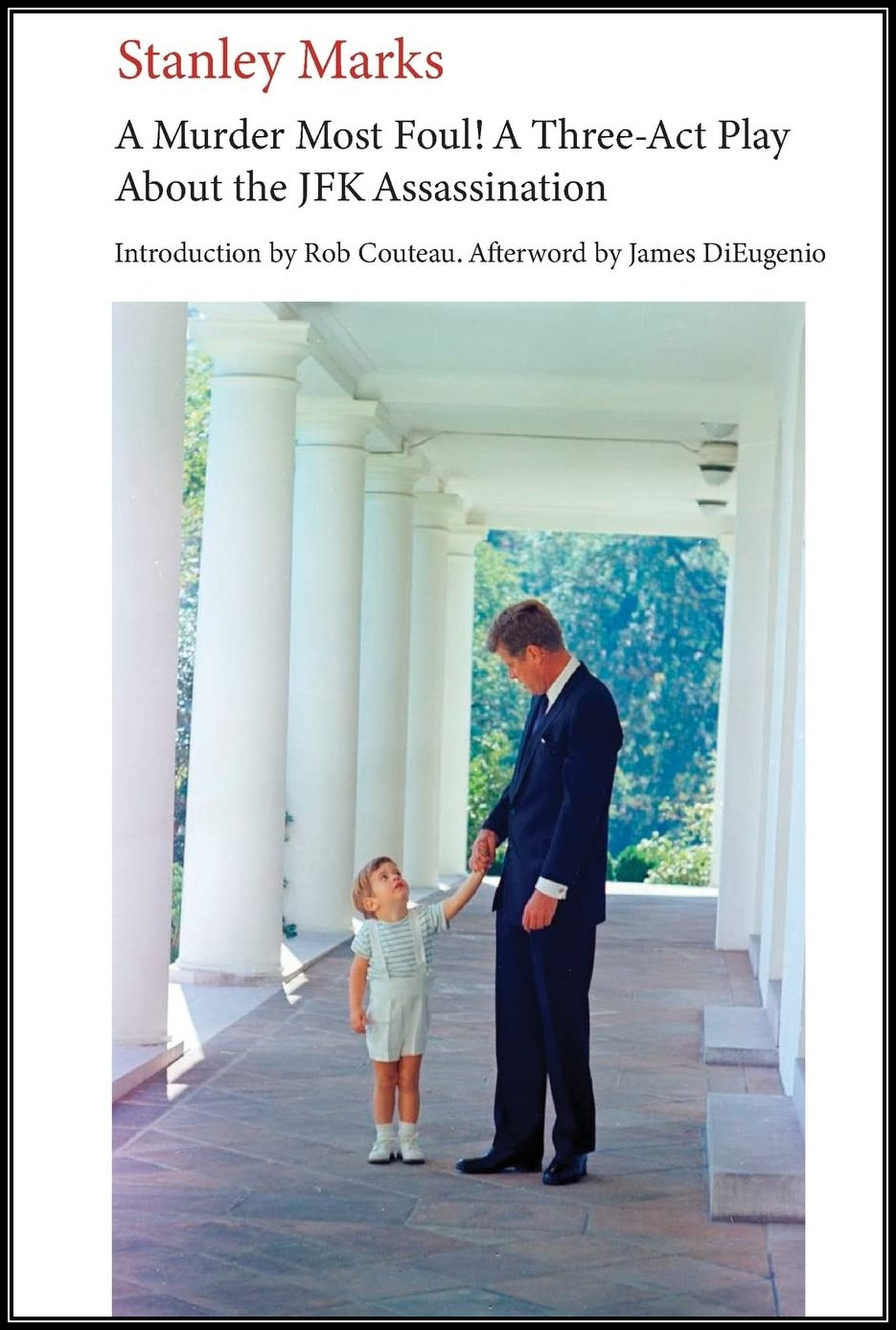
    Order your copy of Stanley Marks’ book A Murder Most Foul! A Three-Act Play About the JFK Assassination here.

    NOTES:

    [1] Barbara Garson, The Complete Text of MacBird!, New York: Grove Press, 1967, p. 107.

    [2] And if anyone has any doubts about JFK’s remarkable empathy, this eloquent statement made by his wife four months after the assassination should put them to rest: “Just as an example of him having a heart — I can remember him being so disgusted, because once we had dinner with my mother and my stepfather, and there sat my stepfather putting a great slab of paté de foie gras on his toast and saying it was simply appalling to think that the minimum wage should be a dollar twenty-five. And Jack saying to me when we went home, ‘Do you realize that those laundrywomen in the South get sixty cents an hour?’ Or sixty cents a day, or whatever it was. And how horrified he was when he saw General Eisenhower — President Eisenhower, I guess — in their Camp David meeting before inauguration — and Eisenhower had said to him — they were talking about the Cuban refugees — and Eisenhower said, ‘Of course, they’d be so great if you could just ship a lot of them up in trucks from Miami and use ‘em as servants for twenty dollars a month, but I suppose somebody’d raise a fuss if you tried to do that.’ You know, again, so appalled at all these rich people just thinking of how you can live on — not thinking how you can live on just twenty dollars a month, but just to use these people like slaves. He was just so hurt for them, though he’d say it in a sentence [.…] And then, another time, when you were trying to raise money for the cultural center, and a Republican friend of my stepfather said, ‘Why don’t you get labor to do it? If you took a dollar a week out of all of labor’s wages, you could have the money raised in no time at all.’ And he was just really sickened by that and said, ‘Can you think what a dollar a week out of their wages would mean to all those people?’ So all those things show that he did have a heart, because he was really shocked by those things.” Interviewer Arthur M. Schlesinger, Jr. adds: “Of course, he had a heart, [but] it wasn’t on his sleeve … But he was deeply affected.” See Jacqueline Kennedy, Historic Conversations on Life with John F. Kennedy, New York: Hyperion, 2011, p. 66-67. Jacqueline also recalled a telling incident involving Robert Kennedy. When the CIA failed to protect Oleg Penkovsky, a secret agent in Moscow who was arrested and executed, RFK approached Jacqueline, “just looking so sad … and he said, ‘It’s just awful, they don’t have any heart at CIA. They just think of everyone there as a number. He’s Spy X-15.’ And he said that he’d said to them, you know, ‘Why? This man was just feeding you too many hot things. He was just bound to get caught. And they’d keep asking him for more. Why didn’t someone warn him? Why didn’t someone tell him to get out? He has a family. A wife or children or something.’ Bobby was just so wounded by them — just treating that man like a cipher.’” Ibid., pp. 192-93.

    [3] After noting “the autonomy with which the agency has been permitted to operate,”Arthur Schlesinger, Jr. warned President Kennedy: “The contemporary CIA possesses many of the characteristics of a state within a state.”Arthur Schlesinger, Jr., “CIA Reorganization” memo to President Kennedy, June 30, 1961, p. 3. (For more on this memo, see my essay “On the Life and Times of Stanley J. Marks,” below.)

    [4] Tenacious researchers have continued to plumb the depths of this mystery ever since the appearance of Richard Popkin’s The Second Oswald (New York: Avon Books, 1966), a text cited by Stanley in MMF-1.

    [5] When I asked JFK historian James DiEugenio for a rough estimate of how many were killed as a result of Kennedy’s policies being reversed, he replied: Vietnam: 5.8 million, and this includes the Cambodian Holocaust. Indonesia: a low estimate is 500K; a high estimate would be 850K. Congo: usually given as 100K, but, after the overthrow of Mobutu, the number exploded to well over five million.” Private communication with DiEugenio, December 24, 2023. See also Greg Poulgrain, JFK vs Allen Dulles: Battleground Indonesia (2020) and Richard D. Mahoney, JFK: Ordeal in Africa (1983). There were also dire consequences in Latin America: “I believe that if President Kennedy had remained in office for eight years, he would have left a tradition of political unity between the two Americas, of working together. It did not happen that way. The fatal bullet did much harm to you, but greater harm to us.” Juan Bosch, former president of the Dominican Republic,interviewed by Lloyd Cutler, June 9, 1964, p. 15; John F. Kennedy Library Oral History Program. Cf. Robert F. Kennedy’s famous “Ripple of Hope” address at the University of Capetown, South Africa, on June 6, 1966: “Each time a man stands up for an ideal, or acts to improve the lot of others, or strikes out against injustice, he sends forth a tiny ripple of hope, and crossing each other from a million different centers of energy and daring those ripples build a current which can sweep down the mightiest walls of oppression and resistance.” The first half of the quote is engraved on RFK’s memorial at Arlington National Cemetery.

    [6] In this regard, certain remarks made by Jacqueline Kennedy proved to be rather farsighted. As early as June 2, 1964, speaking about Laos and Vietnam, she said: “Jack always said the political thing there was more important than the military, and nobody’s thinking of that. And they don’t call the people who were in it before [back] in. And so that’s the way chaos starts. If you read the story of the Bay of Pigs in the papers now, I mean, the CIA just operating so in the dark, saying, ‘Even if you get an order from the president, go ahead with it.’ Well, that’s the kind of thing that’s going to happen again.” Jacqueline Kennedy, Historic Conversations on Life with John F. Kennedy, pp. 272-73.

    [7] See Carl Jung, Psychological Types, first published in German in 1921.

    [8] Regarding this passage in the play, my colleague Al Rossi adds this insightful remark: “I am impressed particularly by the sophistication of Marks’ characterization of the plotters as having different agendas. We should probably not forget the Brutus vs. Cassius paradigm here from Julius Caesar in this regard. Moreover, though not quite the same, it’s also reminiscent of the uneasy alliance between neoliberals (the financier / corporatist / rentier class) and neoconservatives (the crazy military brinkmanship imperialists) that has had its ups and downs over the years but continues to function. To see this dynamic as having emerged from the alignment of interests that resulted in the assassination of JFK is definitely vatic, whether realized by Marks in an accord with dramatic or psychological principles of verisimilitude or not. There’s also something of this in the screenplay of Executive Action, with differing viewpoints emerging from the characters played by Burt Lancaster, Robert Ryan, and Will Geer, but it certainly is not problematized in the same way in which Marks makes this a kind of linchpin for his denouement.” Al Rossi, private communication, December 26, 2022.

  • The Stanley Marks Revival: The Prophecies of Murder Most Foul! and Two Days of Infamy

    The Stanley Marks Revival: The Prophecies of Murder Most Foul! and Two Days of Infamy


    Thanks to the help and encouragement of Stanley Marks’ daughter, Roberta, Murder Most Foul! and Two Days of Infamy are now coming back into print for the first time since the late 1960s. That is right: Fifty year later. The timing seems apt. Throughout his oeuvre, Marks warned time and again of the growing threat of fascism in America, pointing repeatedly to figures like Allen Dulles, J. Edgar Hoover, and Ronald Reagan: all handmaidens in the march toward the right wing that continued in the decades after the assassination.[1] And now, in the incarnation of the forty-fifth president of the United States, we have a figure who doesn’t even bother to disguise his naked grab for power, and the phrase “coup d’état” is being spoken openly, even in the mainstream media.

    Stanley Marks circa 1934, Chicago. When he was only four years old, Stanley lost both his parents to the influenza pandemic of 1918, which infected a third of the world’s population. Stanley’s daughter, Roberta, recalls her father saying that “he never had enough food. When you see pictures of him as a youth, he was bone-thin and skinny. That is, until he married my mother, whose cooking he adored.” Stanley’s privations and experience with hunger on Chicago’s hardscrabble streets may have helped to open his eyes to a certain political awareness and helped to mold him into a lifelong FDR New Dealer.

    So much of where we are today is foreshadowed in the writing of Mr. Marks: in particular, the fueling of racism and xenophobia, the attempted erosion of civil rights, and the empowerment of the oligarchy and its principal tool of control, the police state. Speaking directly to the readers of a future generation, in 1969 Marks wrote:

    The balance of this small volume now attempts to enter the “dark world” that is slowly, oh, so slowly, being lit, although full light may take until the year 2038—if the “basic principles of American justice” have the strength to remain as principles guiding this long-suffering nation.

    This still remains a big “if”—as the nation continues to suffer while awaiting a firmer grounding in those “basic principles.”

    II

    Shortly after reading Murder Most Foul!, in his essay “The Kennedy / Dylan Sensation,” Jim DiEugenio wrote that Marks’ early “condemnation” of the Warren Report in 1967 “is a far cry from, say, Josiah Thompson, who at the end of his book [Six Seconds in Dallas; also published in 1967] said he was not really sure that the evidence he adduced justified a conspiracy.”

    It wasn’t until many months later that either of us realized just how astute a remark that really was. For, in Stanley’s second JFK-assassination book, Two Days of Infamy: November 22, 1963; September 28, 1964 (which neither of us had read yet, due to its rarity), Stanley writes:

    As will be shown, the Warren Commission proved the innocence of Lee Harvey Oswald, but his innocence can only be found if the person reading the “Report” will read the testimony in the “Hearings” or the evidence in the National Archives.

    Thus, a defense lawyer on Oswald’s behalf, because of the prestige associated with the seven commissioners, would be reduced to assume the burden that his client, Oswald, was innocent “beyond a reasonable doubt.” The author of Six Seconds In Dallas fell into this trap, for he wrote that although he believed there was more than one assassin, Oswald had to be guilty because he could not prove he was innocent! Hence, the burden of proof, as they say in law, shifted from the prosecution––the Commission––to the shoulders of Oswald. This, of course, is contrary to every principle of Anglo-American jurisprudence upon which this nation is founded.

    Now, more than fifty years after the publication of both Murder Most Foul! (September 1967) and Two Days of Infamy (March 1969), one is left to wonder to what extent Marks was aware of his own gift of prescience. And we should add that, in this March 1969 text, he was already using the term “conspirators” when referring to the assassins of the Kennedys and King. He states unequivocally: “All three were murdered as the end result of three interrelated conspiracies,” adding: “History has shown that an invisible coup d’état occurred when President Kennedy was murdered.” In 1972, after the author Joachim Joesten learned of Stanley’s work, he credited him with being one of the first Americans who dared to use the word “coup” in this context: “To my knowledge, nobody but Jim Garrison and an obscure West Coast writer named Stanley J. Marks has ever endorsed before my unswerving contention that the murder of John F. Kennedy was nothing short of a camouflaged coup d’état.

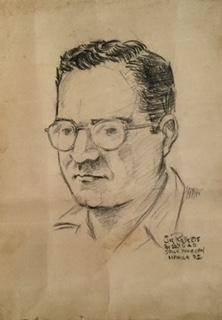
    Private Stan Marks at the army base library, circa 1945. By his late twenties Marks had accumulated a private collection of over 5,000 books.

    Stanley’s work was accomplished in the early days, well before the release of millions of pages of documents that were pried from government archives as a result of the President John F. Kennedy Assassination Records Collection Act (effective October 26, 1992). That legislative act led to the creation of the Assassination Records Review Board (ARRB). The ARRB made it possible for an author such as Gerald McKnight to create a classic tome on the Warren Commission deception, Breach of Trust (2005), with its in-depth look behind the scenes of the WC drama. But in reading through Stanley’s work, published decades earlier—although it lacks many of the details that would emerge only later—one is struck by how much in parallel his conclusions are with those of contemporary scholars such as McKnight, James Douglass (JFK and the Unspeakable; 2008), Jim DiEugenio (Destiny Betrayed, Second Edition; 2012), and Lisa Pease, whose book A Lie Too Big to Fail (2018) deals with the RFK case.

    Marks followed Two Days of Infamy with Coup d’État! Three Murders That Changed the Course of History. President Kennedy, Reverend King, Senator R. F. Kennedy (February 1970). And then, perhaps inspired by the release of Oliver Stone’s film on JFK, in his seventieth-eight year, Marks released his last assassination-related title, Yes, Americans, A Conspiracy Murdered JFK! This appeared in June 1992: just a few months before the Assassination Records Collection Act became effective. Thus, the year 1992 marks a milestone not only in JFK research, thanks to the ARRB, but in the passing of an intellectual torch from the old guard to the new.[2] One also cannot help but wonder what conclusions Stanley may have drawn if he had access to such voluminous records earlier in his life. He died seven years later, in 1999.

    Dust jacket of the first edition of Two Days of Infamy (March 1969). Marks inscribed the copy: “To my daughter Bobbie, the apple in my orchard and the filament in the bulb of her parent’s life. With Love, Daddy.” An ad for the book appeared in the July 11, 1969 edition of the Los Angeles Free Press (a popular Sixties counterculture newspaper) and included the caption: “Now available at bookstores with courage.”

    While Murder Most Foul! remains his most seminal work, as well as the most avant-garde in terms of stylistic approach, his subsequent texts continue to expand upon many of the points first raised in that book, as well as introducing fresh ideas and perspectives to the case. Therefore, it’s important to view Murder Most Foul! in the context of Marks’ complete oeuvre. For example, picking up on a theme first introduced in MMF—that is, the collective cynicism born as a result of the lies published in the Warren Commission Report, which would eventually accumulate like a growing poison in the national psyche—in Two Days of Infamy he writes:

    Perhaps it was the cynicism, inherent in citizens of all nations, that convinced the American citizenry that the “Report” issued by the Warren Commission was supported by rotten timbers incapable of supporting the truth. The suspicion increased in the same ratio and in the same speed as smog increased with the density of automobiles on a Los Angeles freeway. The American people were becoming deeply convinced that the Commission had perpetrated a gigantic, gruesome hoax the like of which concealed a conspiracy that reached into the very gut of American government and society. Today, that hoax, that whitewash feared by the people has been exposed to the light of day, for the citizenry were, and are, absolutely right in their assessment of the Warren Commission. There now exists overwhelming evidence, provable in a court of law, that the Warren Commission, either willfully or negligently, concealed the conspiracy that murdered President John F. Kennedy. This deed was committed by the Commission in “the interests of national security.”

    Later on, Marks returns to the subject of perfidy committed in the name of “national security.” And he adds that, even if Oswald was “part and parcel of the conspiracy,” he represents no more than a “piece of string [tied] around the conspiracy package.” He concludes:

    The dilemma faced by the Commission resulted in a solution based not on fact or on law, but on a phrase: “in the interests of national security.” The Commission published a series of deliberate lies, not to protect the “national interests” of the American people, but to protect those interests that had interests contrary to the interests of the president of the United States, who had the interests of all the American people whom he represented.

    That being the dilemma, it would have been far better for the Commission to have proclaimed the conspiracy even though it be directly connected to the right-wing fascist elements in the United States than have this nation live a lie.

    Thus, it was “‘in the interests of national security’ that the Commission was under an obligation to destroy any testimony regarding the possibility of shots not coming from the Book Depository.”

    This is just one example of a far-reaching, “bigger picture” perspective that Marks should be remembered for. And now, decades after these remarks first appeared, we have the latest personification of an attempt to overthrow an election in America in the figure of President Trump, whose circus-like legal actions are merely the endpoint of a line first drawn on November 22, 1963.

    It’s also tempting to reinterpret Marks’ phrase “not to protect the ‘national interests’ of the American people, but to protect those interests that had interests contrary to the interests of the president of the United States”. Did Stanley mean that JFK’s interests included the fates of those nations that were struggling to reject the yoke of neocolonialist domination, much to the chagrin of multinational corporate, oligarchic interests that had billions of dollars to lose if Kennedy was allowed to live? As far as this reactionary group was concerned, it would be out of character to make an exception for John Kennedy, when far less threatening figures were being gunned down during the global war on the left that transpired, often in a clandestine manner from 1945 to 1990 and still continues—with far less fanfare—to this day.

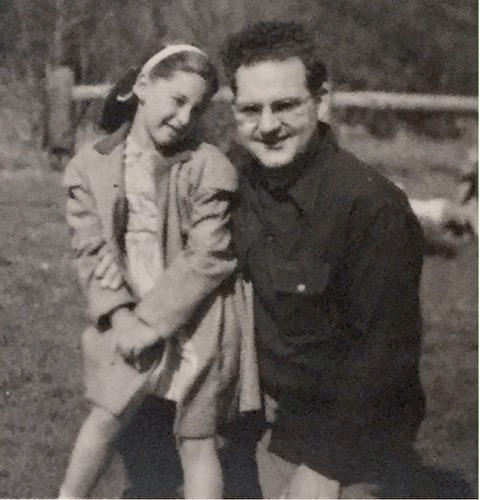
    Stanley with his daughter Roberta at Union Pier, Michigan, circa 1950.

    Marks adds to cynicism another deadly poison: loss of faith in the media, because of its betrayal. Back in 1967, Marks was already noting that there was no way of knowing “how many agents of the CIA now work for various organizations in the mass communication media” (MMF). In Two Days of Infamy, he again picks up this theme, adding: “The investigators of the ‘Report’ have presented the result of their investigations to the public; but the silence of the press lords to further an investigation of the Commission’s allegations has led to a further decline of the general public’s faith in all forms of mass communication.”

    Again, keep in mind that this statement was published in March of 1969. Since then, we have seen a snowballing––and then an avalanche––of mistrust in what we now refer to as the MSN; and this has occurred on both sides of the aisle, left and right. But Marks goes on to blame not only the MSN and the Warren Commission, but the critics themselves for what followed. He refers to the first generation of researchers when he says:

    The critics’ primary failure was their repeated implication that the murder of President Kennedy could not be solved unless, at the same time, they proved a conspiracy. The critics have constantly proclaimed that unless the Zapruder film, the X-Rays, and other photographic evidence was released from the National Archives, no solution could be obtained. Their demands obscure the main issue: “Was Lee Harvey Oswald the ‘sole and exclusive assassin of President Kennedy’ as charged by the Warren Commission?”

    The film, X-rays, and other photographic evidence is not the prime evidence in securing an affirmative or negative answer. That evidence is secondary.

    The prosecution, in this case the Warren Commission, must affirmatively prove three elements: (1) Lee Harvey Oswald was at the 6th floor S.E. corner window at the time the shots were fired; (2) those bullets which caused the death of President Kennedy came from a weapon he used at that time and (3) the rifle allegedly used was a functional operating lethal weapon from which those bullets were discharged.

    As we witness time and again in his assassination-related publications, no matter how far afield Marks goes to explore “bigger picture” implications, as a trained attorney, he always circles round and returns to the case at hand. Thus, two of his principal concerns are to show why Oswald could not have been convicted of being a “sole assassin” in any law court that followed the basic principles of American justice; and to prove this with specific facts, on a nuts-and-bolts legal level:

    In a court of law those three elements must be proved beyond a reasonable doubt by the evidence in the possession of the Warren Commission. Each of the three must be proved; not just one, or two, but all three.

    Thus, if Oswald was not at the S.E. corner window at the exact time those three bullets were fired, he could not be found “guilty” even though the remaining two elements be proved in the affirmative.

    If element (2) be proved in the affirmative but element (1) in the negative, then a trial judge would rule Oswald “not guilty.” If element (3) was proved affirmatively, the trial judge would still rule Oswald “not guilty” if (1) or (2) not be proven by the evidence given in court. Further, if (2) be proven but (3) proves that the rifle could not discharge those bullets because it was defective and incapable of firing bullets through its barrel, then Oswald would be found “not guilty.” A consensus does not operate in a criminal courtroom.

    Peppered throughout the text are examples of straightforward forensic evidence that any lawyer worth his salt would present to demonstrate his case against the WC conclusions. “Any attorney defending Oswald on the charge of being the ‘sole and exclusive assassin’ of President Kennedy would have an easy task to obtain a ‘not guilty’ verdict with the testimony of the physicians and federal agents that proved beyond a reasonable doubt that President Kennedy was struck in the back by a bullet striking him from an angle of fire between 45 and 60 degrees. This proved that such an angle of fire could only come from a window of the Dal-Tex Building or the County Building but not from the 6th floor of the Book Depository. Oswald was innocent.” And it is the presentation of such clear evidence that allows Marks to then expound on the risible nature of the Commission’s groundless theories:

    In spite of the testimony of the physicians and the federal agencies, the Commission decided to confuse the people by outdoing Baron Munchhausen—a paragon among liars. The Commission therefore proceeded to “produce” a “Tale of Bullet No. 399.” This “bullet,” sayeth the Commission Barons, first entered the president’s back, hesitated a moment, reversed itself, flew up his back, made a 90 degree turn, turned downward into the back of his neck, went through his neck, made another angle turn, entered the governor’s body, “tumbled” through the wrist, entered his rib cage, and came to rest when the “tumbling” lacked inertia, in his thigh! The leading Baron aide was a man by the name of Specter.

    Even after decades of rehashing the magic bullet fiasco in the voluminous assassination literature, Marks’s version leaves one with the impression of a fresh and lively spin.

    III

    Just as he does in Murder Most Foul!, by the end of Two Days of Infamy, Marks turns much of his ire on commissioner and former CIA Director Allen Dulles and for good reason. Like a prosecuting attorney delivering a summation through the use of rhetorical device, Marks’ refrain, echoed repeatedly in an imaginary courtroom, is the incredulous: “No conspiracy, Mr. Dulles?” And at one point, with a slight change in modulation, he adds: “The same Dallas police also testified that although Tippit’s clipboard was attached to his dashboard they never looked at it or read it! Do you believe that, Mr. Dulles?” (My italics.) Such passages also exemplify Marks’ lively, provocative, arch yet charming humor: a hallmark of the author’s writing that serves as a counterpoint to the sometimes strident, rage-fueled cadences that mark his discourse with an undertone of righteous indignation.

    Marks’ disdain for Dulles may be traced back to an article that appeared in Look magazine in July 1966, in which Dulles remarks: “If they found another assassin, let them name names and produce their evidence.” Stanley first quotes this in MMF, where he follows it with the remark: “This contemptuous statement directed at the American citizenry revealed the attitude of the Commission.” In Two Days of Infamy, he further qualifies it as “The most contemptuous statement ever issued by a member of any governmental commission investigating the murder of the head of his government.” But Marks cites this quote not merely to inform us of its existence, but to take up Dulles’ challenge. Indeed, the deeper one reads into Marks’ work, the more easily one can imagine that the impetus to produce such tomes grew directly from the outrage spawned by this outrageous declaration. After citing one example after another in which the Commission is caught with its pants down––or, perhaps more fittingly, called out for being an Emperor without any clothing––Marks rests his case by stating:

    The author has produced the evidence; it was the duty of Mr. Dulles and his commissioners to name the names of the assassins and the conspirators.

    That failure is theirs, not the responsibility of the American citizen.

    But Marks finds no solace in reaching this conclusion. Rather, he reminds us of a terrible truth:

    History has proven that once assassination has become the weapon to change the government, that style and form of government preceding the assassination falls beneath the hard-nailed boots of the assassins. Both right and left favor no democratic spirit in the people. The cold of Siberia and the gas ovens of the concentration camps have proved it.

    The tragedy of the Warren Commission is that they helped set those boots on the road to the destruction of American democracy.

    And how could so many have fallen prey to such a deceit? In part, this turning of a blind eye to the possibility of a conspiracy occurred because the citizens of the United States are “living in a dream world concocted by the mass communication systems.”

    One should also note that not all the ire falls upon Dulles. That other intractable head of so-called intelligence, J. Edgar Hoover, is the subject of so much justifiable vitriol that Marks was certain to have had a file opened on him by the FBI as a result. He lambasts Hoover for declaring just five months after the assassination of Bobby Kennedy that “Justice is incidental to law and order,” and adds:

    Mr. Hoover’s belief in “law and order” is on the exact same level as Hitler’s “law and order”; Stalin’s “law and order”; Mussolini’s “law and order”; Tojo’s “law and order”; Batista’s “law and order”; the Greek Colonel’s “law and order, 1968 version”; and so forth. Mr. Hoover’s basic philosophy is identical with the philosophy of any other “police state” objective.

    In 1943 Marks published a dozen essays in the Chicago Defender, one of the most celebrated African American newspapers in America. The illustration above features Marks’ weekly column, “War and Warfare.” The Defender played a key role in encouraging Blacks to leave the South and join “The Great Migration” North, to work in Chicago’s factories. During WWII it promoted the “Double V Campaign”: a proposed “Dual Victory” over both foreign and domestic “enemies” who remained opposed to racial equality and justice for all, thus incurring the wrath of J. Edgar Hoover, who tried to convince President Roosevelt to prosecute its editors for treason. Although Hoover was forced to back down, he opened files on the Defender and kept it under surveillance. Stanley’s publications eventually led to his blacklisting by the House Un-American Activities Committee.

    But Marks also views Hoover as something of a foxy figure. Since the Bureau’s memoranda and reports on the assassination were often as truthful as they were deceitful, and since the official FBI assassination report often contradicts the Warren Commission Report, Marks speculates that Hoover was attempting to have it both ways: protecting himself and the Bureau no matter what the final outcome. Indeed, Hoover’s performance was rather sly and of the type that only an attorney could truly appreciate. For example, speaking of the Mannlicher-Carcano rifle supposedly owned and used by Oswald for the assassination, Marks highlights Hoover’s brilliant use of legalese:

    In the official FBI Reports, Vol. 1 to 5, there is no statement by the Bureau that that rifle given to them was ever “used” by any rifleman. The FBI constantly referred to this rifle as being “owned” by Lee Oswald; never did they state that he “used” it for any purpose. How can a rifle discharge three bullets when the rifle has never been used?

    Note that fine line between truth and deceit: whether or not this rifle was really “owned” by Oswald, the Bureau nonetheless betrays the Commission by refusing to take that extra step of stating that it was “used” by him.

    Marks attempts to summarize this paradox of the Bureau’s seemingly shifting, alternating allegiances in the following manner:

    The federal agency that is the paradox, the Chinese puzzle, in the entire investigation is the Federal Bureau of Investigation. As has been stated in previous chapters, that Bureau overwhelmed the Commission with evidence that proved Oswald innocent in both murders. What is the puzzle is the fact although the Bureau time and time again warned the Commission that its “conclusions” would not stand the scrutiny of the light of day, that agency then turned right around and conducted itself in a manner implying they had something to hide––to conceal their possible involvement in the assassination. The Bureau was involved in suppressing the same evidence they had originally uncovered and exposed to the world! […]

    The Bureau’s conduct can only lead to a conclusion that the Bureau was operating on both sides of the fence, in the slim hope that any investigation of the “Report” would not be undertaken by a serious investigator of that “Report.” “Heads or tails,” the FBI could prove that they had given evidence, or uncovered evidence, disproving the Commission’s accusation that Oswald was the “sole and exclusive killer of President Kennedy.” What is perplexing is Mr. Hoover’s defense of the Commission in the face of that evidence and his various statements, which were obtuse or contradictory, that did nothing to add to the honor of the FBI.

    Appearing beside William Styron’s Confessions of Nat Turner, the #1 bestseller, and Rosemary’s Baby listed at #6, Murder Most Foul! somehow managed to get a brief mention in the mainstream press despite being a self-published text. The reviewer, Donald Stanley, ran a feature column with the San Francisco Examiner, and the review appeared in the December 24, 1967, edition, about three months after the publication of Murder Most Foul! This may have been the last time Marks was mentioned in any major media until recently.

    IV

    Marks’ phrase “two days of infamy” refers to the date of JFK’s murder and, ten months later, to the release of the Warren Commission Report. By grafting FDR’s “infamy” term onto these more recent dates of iniquity, the author is reminding us of the rage and indignation that rise up within many who lived through both the attack on Pearl Harbor and the coup d’état of November 22, 1963. This outrage extends beyond the personal figure of JFK and the experience of his loss. For, as Marks warns in the first chapter of Two Days: “A nation can be destroyed if its leaders can be murdered with impunity.” As a result of the Warren Commission hoax perpetrated by those ignoble seven commissioners, “The truth was never ascertained; the evidence never evaluated; and the truth uncovered was covered. Never was so much done by so many that produced so little.” Later on, with typical Marksian aplomb and incisiveness, he adds:

    The historical verdict of the Warren Commission is that the Commission proclaimed a precedent whereby it is now permissible for the president of the United States to be murdered by men who believe that the vice president, who becomes the president upon the death of the president, would be more amenable to the philosophies of the murderers.

    *   *   *

    As we were putting the final touches onto the new edition of Murder Most Foul!, Roberta Marks went through an old box in her garage that contained some of her father’s papers. Lo and behold, she unearthed a precious––and curious––document. Just a few years after Robert Kennedy’s death, Stanley Marks had received an unexpected request. On March 12, 1973, the JFK Library wrote Marks a letter requesting information on how to purchase a copy of Murder Most Foul! for their collection. And from this we may surmise that RFK’s trusted colleague, Dave Powers, who served as JFK’s personal assistant and whom RFK later placed in charge of assembling materials for the official JFK Library, would probably have been familiar with at least the title of Marks’ book.

    How to explain such an interest in this little-known work?

    The John F. Kennedy Library contacted Marks with a request to purchase a copy of Murder Most Foul! for their collection.

    Thanks to Vincent Palamara’s Survivor’s Guilt: The Secret Service and the Failure to Protect President Kennedy, I recently learned that Powers had long maintained a skeptic’s view of the Warren Commission Report. In discussing the possibility of Secret Service involvement in the conspiracy, in Survivor’s Guilt Vince writes that, in 1996, ARRB Director Tom Samoluk informed him that Dave Powers “agreed with your take on the Secret Service.” If Powers held this belief, it might explain why this unusual purchase of Murder Most Foul! was authorized for the JFK Library.

    A photo of this letter addressed to Marks, composed on U.S. General Services Administration stationery, is reproduced here and in the new edition of MMF.

    Purchase info for Two Days of Infamy here.

    Purchase info for Murder Most Foul! here.


    [1] In Two Days of Infamy, Stanley writes of Governor Ronald Reagan: “If it be morally correct for the Czech students to defy Stalinism, should not it be morally correct to defy Reaganism?”

    [2] One could also argue that since Destiny Betrayed was first published in 1992 and then completely rewritten a decade later, it serves as a symbolic bridge between the Old World of JFK research and the New.

    (Special thanks to Al Rossi.)

  • Stanley Marks and Murder Most Foul! — A Sequel to “The Kennedy / Dylan Sensation”

    Stanley Marks and Murder Most Foul! — A Sequel to “The Kennedy / Dylan Sensation”


    Part I: A Murder Most Foul

    In September 1967, Stanley Marks attempted to position himself at the forefront of a soon-to-be cresting wave of JFK assassination research when he released Murder Most Foul! This self-published paperback represents a full-frontal attack against the official story promulgated by the Warren Commission (WC) and its lackeys in the media, but it’s also much more than that.

    Giving it a quick first glance, a contemporary reader might easily pass over the book. After more than sixty years of study and the release of millions of pages of government documents related to the assassination, a reexamination of the WC hardly seems necessary. Yet a more careful examination reveals that, in many ways, Marks was ahead of his time. While most of the Q&A’s comprising the first 136 pages of Murder Most Foul! serve to puncture holes in the Warren Commission Report and thus illustrate why it was a sham, there are also passages that go well beyond the usual framework of early WC critiques. Consider, for example, Q&A #46: “What is meant by ‘against the national interest’? The Warren Commission has never defined this undefinable phrase. However, after the publication of the Warren ‘Report,’ many commentators and historians interpret that phrase to mean that whenever a future president is murdered, his killers can escape capture and punishment if a future investigating committee decides their capture would be ‘against the national interest.’” Marks’ wry irony flourishes throughout, and this excerpt represents just one of many instances of the author’s trademark style of humor mixed with outrage, born from insight. And his reference to the “national interest” has been largely replaced by a term that we’ve seen with ever-increasing frequency over the last few decades: “National Security” with its concomitant erosion of civil rights; violation of human rights; and censoring of information that belongs in the hands of citizens.

    Like other reputable texts on the assassination, MMF! did not arise sui generis. It’s likely that Marks was inspired to borrow his “juridical” approach from Mark Lane, whose first essay on the assassination took the form of an imaginary “legal brief” in defense of Lee Harvey Oswald. But Marks was also a stylistic innovator. Instead of a straight narrative that dissects events in the manner of a typical researcher, he shaped his investigation into a “question-and-answer book” composed of 975 queries and replies, most of them taking the form of quick, rapid fire, staccato bursts of ammunition, which hit their target with a no-nonsense precision. In a blunt statement of intention, in the Preface he says: “The contents of this book have been arranged in the manner of an attorney representing a client in a criminal court and in the manner that a district attorney would present his case against the alleged criminal” (the latter being the Warren Commission). This was a fitting role, since Marks was trained as an attorney. He boldly concludes: “It is the proposal of this book to reveal the attempts of the Warren Commission to befuddle, delude, and deceive the American people who sincerely desire the answer to the question, ‘Who murdered President John F. Kennedy?’”

    Although the work of early researchers has been absorbed and superseded by that of subsequent authors, Marks still remains ahead of the curve when it comes to the larger picture that he paints at the conclusion of his book, which enters into a broader philosophical speculation regarding what will happen to the collective psyche of America as a result of the magic trick performed in Dealey Plaza in 1963. But first, Marks picks his way through the evidence and attempts to shock the reader into a new awareness—prosecutorial question by question—relieved only by a series of black comedic asides that remind one of the rants of a Mort Sahl or a Lenny Bruce; or that mimic the goofy stage whispers of a Groucho Marx. Perhaps he felt this was the only thing appropriate enough to level against an equally goofy “logic” exhibited by those seven wise men who formed the Commission. Therefore, he breathes fresh life into the manner in which we reassess the case. This is also reflected in the wry humor of his chapter headings. For example, chapter three: “Rifles, Rifles, Everywhere,” which refers to the different firearms that were first located in the Texas School Book Depository (TSBD), one of which would have served as a far more reliable weapon than the rusty Mannlicher-Carcano rifle supposedly owned by Oswald, which had undoubtedly been planted there. In Coup d’État! Three Murders that Changed the Course of History. President Kennedy, Reverend King, Senator R. F. Kennedy, a book Marks published in February 1970, he titles his second chapter: “The Fraudulent Autopsy, Or How to Lie in a Military Manner.” His humor is also displayed in chapter four of Coup d’État!, which bears the heading: “The Non-existing Paper Bag, Or How to Manufacture Evidence” (referring to a false claim that Oswald had slipped a rifle into a paper bag, then snuck it into work on the day of the assassination).

    One of the most ironic statements to appear in the Warren Commission Report is: “In fairness to the alleged assassin and his family, the Commission … requested Walter E. Craig, president of the American Bar Association, to participate in the investigation and to advise the Commission whether in his opinion the proceedings conformed to the basic principles of American justice.” (My italics) This was reported in Esquire magazine in 1965 and is reproduced in other early assassination texts. In turn, Marks seizes upon the absurdity of the phrase and runs with it. In fact, an entire chapter of MMF is devoted to this topic: “The Commission & Basic Principles of American Justice!” There, Marks asks: “Did the Commission adhere to those principles?” Answer: “No. The Commission permitted outright hearsay; it permitted perjury.” He concludes: “How can the interpretation of the phrase: “Basic Principles of American Justice” be made in reference to the Commission? On both Moral and Legal plateaus, the Commission was a disgrace to ‘Basic Principles of American Justice.’”

    In a recent post on the Education Forum, Jim DiEugenio remarks: “It’s one thing to attack the Warren Commission … but it’s another thing to try to explain what really happened.” This leads us to ask: did Marks go beyond a mere WC critique and enter into that more challenging arena of attempting to explain what actually happened (and why) on November 22? Bearing this in mind, I will highlight a few of the ways in which Marks does so in his unique manner, as well as place his work in the context of other books from the time. And unlike authors such as Sylvia Meagher or Harold Weisberg—who were unjustifiably critical of what District Attorney Garrison actually accomplished—Stanley not only appreciated Garrison’s efforts; he was also prescient in his analysis of how the Power Elite would attempt to foil the D.A.

    In chapter seven, Marks issues a warning that even researchers today would be wise to heed: “How many ‘Hearings,’ ‘Witnesses,’ and Affidavits were produced? The FBI inundated the Commission with 25,000 reports; in fact, the FBI gave the Commission so many reports of its ‘investigations’ that the FBI created a ‘fog’ over the work of the Commission. It now seems to have been deliberate for, in a period of 9 months, no group of 14 lawyers could have read, digested, and analyzed each report to see what each report would have on an overall picture of the conspiracy.” Let’s put this “fog” into context by examining an interview published seven months after MMF first appeared, in the April 1968 NOLA Express.. Citing a source associated with the CIA, Mark Lane says that a number of false leads or “clues” were purposely left “scattered around Dealey Plaza like leaves on an autumn day.” The leaves led to “false sponsors” of the assassination. About a year later, in a May 1969 interview with a European publication, Jim Garrison spoke about the “distribution of an endless amount of irrelevant information to cause confusion in the minds of those who might attempt a serious inquiry.” In his first book about the assassination, A Heritage of Stone (1974), Garrison seems to be referencing Lane directly: “False sponsors are created by prior planning and by the planting of leads trailing away from the intelligence organization … At a more superficial level, an abundance of leads is planted by prior planning to provide a frame-up of the pre-selected scapegoat.”[1] And in the mid-Seventies, shortly before Gaeton Fonzi began his work as a researcher for the House of Representatives Select Committee on Assassinations, Fonzi was warned by Vince Salandria (a lawyer and an early WC critic) that they would attempt to bury him with such pointless minutia.

    In chapter fourteen, Stanley takes CIA Director Dulles to task. He begins by quoting Dulles from an article that appeared in Look magazine in 1966: “If they found another assassin,” says Dulles, “let them name names and produce their evidence.” Marks replies: “This contemptuous statement directed at the American citizenry revealed the attitude of the Commission. The Commission did not praise the president; they gave him a funeral and used his shroud to conceal his murderers.” Taking a further dig at Dulles, Marks rhetorically asks: “Mr. Dulles, how can other assassins be named if material is NOT in the National Archives? Was there a conspiracy, Mr. Dulles? Of course there was!” At this point, the author offers a blunt appraisal of not only how the plot was covered up, but of why and how it happened: “The inception of the Conspiracy that murdered President Kennedy can be, and will be eventually, traced back to the disastrous ‘Bay of Pigs.’ The president relied upon the CIA, headed by Allen Dulles, whose information was one hundred percent wrong in the CIA’s assessment of Castro’s Cuba. Heads rolled but the CIA had many heads and the heads that remained never forgave President Kennedy […] Thus, in the wreckage of the ‘Bay of Pigs’ were parts and persons of the CIA apparatus who had directed that operation. The hatred of this apparatus for President Kennedy was to cease only when these forces fired four bullets into his body.”

    That’s a pretty direct a view of what the author thinks really happened and one that goes beyond a superficial WC critique. Next, he introduces the subject of Kennedy’s foreign policy—according to Marks, the most probable reason he was killed: “With the relaxation of tensions between the U.S. and the USSR after President Kennedy’s confrontation with the Soviets in the Cuban Missile Crisis, the Batista—Cuban exile organization, with many members on the CIA payroll, decided that Kennedy must go.” Three years later, in A Heritage of Stone, Jim Garrison would extrapolate on this theme of JFK’s attempt to end the Cold War and how it may have led to his undoing. But Garrison was already drawing this connection a few years earlier, as can be seen by certain interviews he conducted, which we shall explore in a moment.

    Although Marks couldn’t have known the full extent of the connection between various assassination attempts on De Gaulle and the Kennedy assassination, his instinct—coupled with his in-depth knowledge of European history—was already leading him in this direction: “As History has shown a conspiracy spreads rumors. The various assassination attempts upon President De Gaulle were always preceded by rumors and the French Agencies took care to track them down. Yet, in spite of this, De Gaulle narrowly escaped death when the attempted killers received word one hour before the attempt.” In fact, a figure linked to the numerous attempts on De Gaulle’s life was lurking in Fort Worth and Dallas at the same time that JFK visited those two cities during his final day on earth. As Henry Hurt explains in Reasonable Doubt (1987), a man claiming to be Jean Souètre, a French army deserter and member of the Organisation Armée Secrète (a right-wing French paramilitary group linked to attempts against De Gaulle) was apprehended by American officials in Dallas shortly after Kennedy’s murder and immediately expelled from the country.[2]

    After ascending a scaffolding replete with such incongruous official “facts,” we then encounter a broader perspective. Chapter thirteen begins with four final Q&A’s. The first two sum up the principal thrust of the book: “What did the Warren Commission prove? That a Conspiracy murdered John F. Kennedy. What did the Commission believe? They believed that those who could read would not read; that those who could see would not see; that those who could talk would not talk; and those who would investigate would not investigate.” Marks then dispenses with his numbered Q&As and, for the next seventeen pages, shifts into straight narrative. The titles of these final chapters give the reader a no-hold-barred window into the author’s apoplectic indignation. For example, this one is fittingly dubbed: “The Rape of the American Conscience.” And he places the blame directly up on the Commissioners: “The members of the Commission did not achieve their status in the American social, economic, and political scale by being stupid; therefore one can only conclude that these seven had some understanding, whether spoken or implied, that this Nation of 195,000,000 souls would be torn asunder if the Commission reported to them that a Conspiracy had murdered President John F. Kennedy. Yet, these seven men place their honor upon a Report that would wilt in the noonday sun.” Thus, the Commissioners—who certainly weren’t “stupid” —must have assumed that the American people were. After quoting Harry S. Truman’s dictum, “The buck stops here,” Marks concludes: “That the Commission was negligent and slothful in its responsibility has been proven beyond a reasonable doubt.”

    Murder Most Foul! title page

    Marks raises a point that should be carefully considered, especially in light of what would follow over the next half century: “When … the critics are attacked on the basis of personality instead of the measure of their facts, then it is a sign that the criticism has been correctly established.” As we would later learn from a declassified CIA memo, it was the CIA itself that first floated the strategy of attacking WC critics as mere “conspiracy theorists.” The author then poses a chilling question: “To whom does the American public go to seek the truth?” The answer is even more horrifying: “It can now be said that the American people do not believe anything stated in the ‘Report.’ Due to this lack of belief, a cynicism has now gathered among the Citizenry that bodes ill for the Nation. A nation whose moral fiber has been torn and shattered cannot long live; for when the Nation’s spirit is destroyed, no Nation will live.” Stanley repeatedly emphasizes the fact that four principles enumerated in the Preamble to the Constitution—justice, domestic tranquility, promoting the general welfare, and securing liberty were blasphemously violated by the conspirators as well as the Commissioners (at least one of which—Allen Dulles—was one and the same). Therefore, the Commission’s message to the American people is that justice, domestic tranquility, promoting the general welfare, and securing liberty will now no longer be taken for granted. The author concludes: “People, in all nations, must stand for an ideal. The United States of America was not born on the idea that its President could be shot like a dog in the street and his murderers be ‘shielded from this day on’ because it would be ‘against the National Interests.’” This line clearly resembles one from Dylan’s own “Murder Most Foul” when he sings: “shot down like a dog in broad daylight.”

    With the murder of an idealistic president comes the death of our own youthful idealism: “The Spirit has in this year of 1967 been replaced by cynicism of everything ‘American’ … The Youth … which a Nation must have to exist, had a feeling within them that the nation did not care for the future. There is no Spirit today. How can there be? A Congress that laughs at black children, brown children, white children being bitten by the rats of the slums? This is the Spirit of America? A Congress that passes a law which drafts only the poor, white or black?” Note how Stanley capitalizes both Nation and Youth, as if to highlight their equivalence and remind us that these are potentially sacred forces, crucial to society’s future well-being. Later on, he will also capitalize another term normally rendered in lower-case: Citizen.

    The author includes several remarks that appear to be aimed directly at Ronald Reagan, a future president of the United States who was then governor of California (where Marks currently resided): “A Governor that destroys an educational system? A Governor who believes that only the youth who has parents with money should enter the Universities and Colleges of his state? A Governor that believes mental health can be cured with pills?” Such challenges remain with us now, not just in one state but across the entire nation: racial injustice; poverty; unequal educational opportunity; and mental illness problems that are addressed with government approved pill popping, which in various other publications Marks links directly to the stress caused by lack of economic opportunities and the widespread cynicism that engulfed America. At the same time, Agency-asset Timothy Leary encouraged young people to use streets drugs to “tune in, turn on, and drop out.” And he specifically instructed his acolytes to avoid politics: “The choice is between being rebellious and being religious. Don’t vote. Don’t politic. Don’t petition.”[3] For the Establishment, Woodstock was preferable to a half million protestors showing up at the National Mall. The result of all this was that by the late Sixties and early Seventies “sex, drugs, and rock’n’roll” became a new opiate of the masses. While South American youth were tortured and killed because of their political beliefs, North Americans were often “disappeared” on a purely psychological level, via drug abuse.

    Marks would later make a direct reference to such matters in his study on monotheism, Jews, Judaism and the United States, where he warns: “Both the U.S. and the USSR have been using ‘mind-controlling’ drugs since 1970! However, various states have also been using such drugs to control “unruly” children (see S. J. Marks’ Through Distorted Mirrors, 1976).”[4] Thus, as early as the mid-1970s—decades before the widespread public indignation over the use of Ritalin to control schoolchildren—Marks was broaching the issue of the pharmaceutical industry’s abuse. (We’ll never know to what extent the market for psychotropic medication came as a result of a youth culture that had been encouraged to destroy their own psychic equilibrium with street drugs … as a true “Lost” Generation.) In the last book that Marks published, just three years before his death, he again took up this theme. If This be Treason (1996) is, in part, an exposé of the “Reagan-Bush administration’s involvement, through the CIA-Contra movement, in the distribution and sale of hard drugs to Afro and Latin American youths.” And although Marks doesn’t enter into the subject of LSD abuse in his early work, in Coup d’État! he employs the term as a metaphor to signify the illusions spun by the Warren Commission. Hence, Coup’s chapter five is titled: “LSD–Hallucinations and Charades.”

    Very much in the spirit of Publilius Syrus (“The judge is condemned when the guilty is acquitted”), Marks concludes the penultimate chapter of MMF by addressing Allen Dulles; and, with a lovely touch, issues his own verdict against both Dulles and the Commission: “No, Mr. Dulles, it was not the responsibility of the American Citizen to find and name the assassins; that was your task. Your lack of responsibility to the task is the cause for your failure. You issued the “Report” under your name; you had at your disposal the entire operating machinery of the Government of the United States. We citizens have only what you and your fellow commissioners wrote. We read, we looked, we analyzed, we thought; and we, nearly 70% of us, now deliver a verdict on your work: The Warren Commission was a failure.”

    The Postscript of MMF is graced by the title: “Jim Garrison, ‘St. George’ Versus the ‘Dragon’!” Unlike other researchers who were snookered by the mainstream media’s drumbeat assault upon Garrison (one that we now know was orchestrated by the CIA), Marks realized that Garrison, as St. George, was up against a State-sponsored dragon. The author begins with this statement: “By the time this book appears in print, the Kennedy Conspiracy may claim another victim; none other than Jim Garrison, the District Attorney of New Orleans, whose ‘lance of truth’ has pierced vital organs of the Conspiracy That Murdered President Kennedy.” Was Marks correct? Yes, if we consider “character assassination.” On the final page of MMF, Marks makes a prediction that, sadly, comes to pass: “As the day for the [Clay Shaw] trial approaches, the greater the use of the media for the perpetration of the lie increases. If the forces behind the Conspiracy cannot destroy Mr. Garrison’s case, they may decide to destroy the man, either physically or by reputation.” Indeed, this proved to be the case: the powers-that-be went after Garrison’s reputation and attempted to sully it. As Gaeton Fonzi discusses in The Last Investigation, the Agency had long since perfected its craft of sullying and destroying the reputation of world leaders who refused to tow the line; and such black arts were applied even in the early 1950s. Character assassination would also prove to be a second, posthumous conspiracy launched against JFK. Regarding the media’s obsequious role in all this, Marks adds: “Various members of the mass communication media bribed witnesses, hid witnesses, issued fraudulent interviews … [and] produced nation-wide television programs which upheld the findings of the Warren Commission. How incredible! Why? The answer to ‘why’ can be found in the fact that many of the inactive and active participants of the Conspiracy will be found in the ranks of the government and the economic strata of our Nation.” Marks now introduces the crucial subject of the ruling economic elite, which exists one level above the CIA. This concept was rarely broached by assassination researchers until Fletcher Prouty published The Secret Team (1972). In a Preface to the second edition, Prouty says the Agency’s real task is to serve as a “willing tool of a higher level Secret Team … that usually includes … certain cells of the business and professional world.” This line of thought was further probed by Donald Gibson, who notes that the finger-pointing cannot stop at the level represented by the CIA or military intelligence, because above and beyond this there lurks an economic Power Elite (as it was dubbed by C. Wright Mills in a book by that same title, published in 1956).

    Such concepts would certainly not have been alien to Marks. In his 1971 attack on the Nixon administration, Watch What We Do, Not What We Say! he includes a chapter titled “The Establishment” in which he sums it up nicely: “It can be said that not more than 8,000 persons … comprise the Establishment. They control every major decision, foreign and domestic, made in the nation. It is not a ‘conspiracy’ but a ‘meeting of the minds.’ They sincerely believe that ‘what is good for them is good for the country.’” “At the foreign policy level, the ‘Establishment’ works through the following four agencies: (1) the Council of Foreign Affairs; (2) the Committee for Economic Development; (3) The National Security Council; and (4) the CIA.” Much of the rest of this chapter is comprised of lists of other organizations, foundations, and corporations funded by Establishment forces and tasked with “the movement of policy directed by the Establishment.”[5] All this has a direct bearing on Dulles, who worked as a partner on the law firm of Sullivan and Cromwell (along with his brother, John Foster Dulles), a firm that represented leading multinational corporations and interests such as those of the oligarchic Rockefellers. As a principal law partner there, Dulles was positioned at the apex of a visible pyramid of power. But above this first structure one can also imagine a second, inverted pyramid: one far less visible and inhabited by those éminence grises discussed here.[6] The Dulles brothers served as interlocutors between these two structures, via institutions such as Sullivan and Cromwell.

    To jump ahead for a moment: although Marks was not familiar with the name “Operation Gladio” (which remained secret until 1990), he was aware of Clay Shaw’s involvement with the Centro Mondiale Commerciale (CMC) and with Permindex, organizations that both appear to have served as funding mechanisms in a global war on the left. In Coup d’État!, Marks discusses the connection between CMC and Permindex and the assassination attempts on De Gaulle. Therefore, by raising the issue of De Gaulle, Marks places Kennedy’s death into a broader perspective: the worldwide war on the left, sanctioned and manipulated by an economic elite. Marks was also aware of the CIA’s chicanery south of the border. Shortly after Chile’s Salvador Allende became the first Marxist president in Latin America (assuming office on November 30, 1970), Stanley published his critical attack on the Nixon presidency, Watch What We Do, Not What We Say! During a discussion on the dangers of the Agency, almost as an aside, he accurately predicts what will happen next in Chile; and he does so by tying the fate of that nation to Vietnam: “After the extermination of the Indo-Chinese nations as nations, the CIA will then proceed to ‘exterminate’ another nation–Chile. The Establishment’s propaganda is already being published with the same old trite and dreary slogans: ‘The Chileans pose a threat to our security.’ A nation that is more than 5,000 miles away from the territorial mainland of the United States, with no navy, army, or air force that cannot even drop leaflets on our mainland! Thus, with the CIA ‘protecting’ the people from ‘invasions’ and the FBI maintaining its ever-vigilant status over the ‘dissenters,’ the people calmly lockstep their way into a prison of their own making.”[7] Two years after this was published, on September 11, 1973 the Agency organized and staged the coup that would overthrow the democratically elected government of Allende and usher in a murderous right-wing dictator, General Pinochet, who dissolved all remnants of democracy and replaced them with a junta that ruled by fear, torture, and the “disappearance” of those who had the courage to resist. Stanley saw it coming, because his in-depth historical research had trained him to recognize broader historical patterns. On the penultimate page of MMF, Marks condenses everything discussed here regarding the economic forces behind the media’s manipulation into a remark: “To whom does the mass communication system owe its loyalty? To the people who have fought, are fighting, and will continue to fight for the ideas of the ‘freedom of the press’; or to its advertisers?”

    In conclusion, Marks invokes a fellow lawyer and philosopher who served as the third American president and whose words Marks uses to plead his case. “Thomas Jefferson once said that the most important factor in a democracy is a free press; he did not say a ‘privileged’ press. The hideous activity of NBC, CBS, ABC, and other organs of the mass communication media can lead to a conclusion that certain members of that media know that President Kennedy was murdered by Conspirators and the Conspiracy must never be allowed to face the light of day.” Stanley ends on a note that continues to resonate, because what he calls the “light of day” has yet to emerge—for reasons we know all too well. We are still facing the same challenge.

    In his second book about the assassination, Two Days of Infamy: November 22, 1963; September 28, 1964 (published in March 1969), Marks would briefly expand on these themes. “The citizens,” he says, are “living in a dream world concocted by the mass communications systems” which has convinced them that such a “secret could not be kept” despite the fact that the public usually remains in the dark unless the actual conspirators are apprehended. Although we may not be able to “name the assassins, “A Conspiracy has been proven beyond a reasonable doubt. But what was the purpose of the Conspiracy?”[8] Twenty-five years after he published MMF, Stanley would tie the strands of economics and media together in a single statement in his final book about the assassination, Yes, Americans, A Conspiracy Murdered JFK! (1992): “Many persons cannot understand the reason why the powerful newspapers and … television and radio chains have kept a constant drumbeat against the critics of the Warren Commission. The reason is quite simple–when the president was murdered the Power Structure shifted both economically and politically.”[9]

    Part II: Footprints of the Bear: A Brief Biographical Sketch

    One of the only clues I possessed about the identity of Stanley Marks was printed on the back cover of MMF: a note saying that he’d previously authored a book called The Bear that Walks Like a Man. A Diplomatic and Military Analysis of Soviet Russia. Once I ordered a copy, I discovered another clue on the acknowledgments page: a note to “my wife, Ethel, and my daughter, Roberta, for their encouragement and inspiration.” With this information, I was able to locate a record of Stanley in a 1940 Federal Census, where our biographical tale begins. Not long afterward, I successfully tracked down Stanley’s daughter, Roberta, who kindly provided enough information to fill in the gaps that, until then, had remained a mystery.

    According to the census, Marks was born in Waukegan, Illinois in 1914, just three years before the birth of JFK. When he was four years old, his parents died from the 1918 influenza pandemic that infected a third of the world’s population. The names of his biological parents are not known. According to Roberta, after their death, Stanley was placed in the care his foster parents, Sarah and Samuel Markowitz, from whom he took his surname, later changing it to “Marks.” One of the few things Roberta knows about her father’s upbringing is that Stanley often said “he never had enough food. When you see pictures of him as a youth, he was bone-thin.” One is tempted to surmise that his privations and experience with hunger on Chicago’s hardscrabble streets may have helped to open his eyes to a certain political awareness—or at least, helped to mold him into a lifelong FDR New Dealer.

    Shortly after his twenty-second birthday, Stanley married Ethel Milgrom, a nineteen-year-old Chicago native. Ethel would later “co-author” several of his books, although primarily she served as his editor, helping to polish Stanley’s sometimes awkward, strident prose.[10] After attending the University of Illinois in 1937, he graduated from the affiliated John Marshall Law School, which is still Chicago’s only public law school. Thanks to a yearbook posted on Ancestry, we have two professionally composed photos of Stanley. One is a traditional portrait, which captures a bespectacled young man bearing a bright-eyed, notably intellectual look. The other features full-length figures of eight young men and two young women in the midst of a debate, broadcast by a Chicago radio station. Stanley is positioned before an old-fashioned stand-up mic, dressed in a smartly tailored suit.

    Marks graduated during a precarious moment in history; and perhaps this explains why a law school graduate was working as a salesman. The Great Depression was still in progress and would continue its devastation for another couple of years, until America’s entry into WWII, when the defense industry kicked into place. In March 1933, at the peak of the Depression, fifteen and a half million were unemployed–over a quarter of the work force. It was a time of raging debate about capitalism versus alternate political systems. As John Kenneth Galbraith later remarked in a paper on U.S.–Soviet relations, “The Great Depression, when it came, suggested an intractable weakness in capitalism.”[11] Galbraith adds that a fear of its collapse may have served to energize those more dictatorial, right-wing elements that believed the only way to prop it up was to curtail civil rights. But in order to preserve the system, FDR made accommodations to the left rather than take a dictatorial turn to the right. In the midst of this whirligig of change, Stanley’s political allegiances were cast.  

    Yearbook photo, 1937. SJM third from left.

    Stanley and his wife were sharing a household with Ethel’s father, Joe Milgrom, who had immigrated to the U.S. from Poland in 1913; and Ethel’s mother, Eva Wolovoy, who arrived from Russia that same year. What the census doesn’t mention is that, by 1939, Stanley had begun research on what would eventually become a 340-page book about Soviet Russia; so one cannot help but wonder how his views may have been enriched by conversations with Ethel’s mother, a native of Kiev. One of the remarkable things about this accomplishment is that he put the finishing touches on this tome while employed at a wholesale company that manufactured billboards. This fact is noted in The Billboard, the well-known music industry magazine. Its March 13, 1943 edition features a piece that contains some crucial biographical data:

    Salesman Author Making Plans for Second Book Soon

    Stanley J. Marks, sales representative of Gardner & Company here, is the author of a book that has received creditable mention by reviewers. The Gardner firm manufactures sales boards.

    The title of the book is The Bear That Walks Like a Man and is published by Dorrance & Company, Philadelphia. Marks says he spent four years in research and study of the foreign policy of Soviet Russia as a preparation for writing the book, which deals with the strength of the Red Army, its organization, tactics, and strategy. Marks is also known as an aviator and commentator on foreign and national affairs.

    Among those who have recently reviewed the book are Sterling North, of the Chicago Daily News, A. C. Spectorsky, of the Chicago Sun, and the book reviewers of the New York Herald Tribune and the New York Times.

    The publishers report that present sales are encouraging.

    Marks is working on a second book which deals with military science as practiced by the United States Army.

    According to the Bear’s inside dust jacket, “the author discusses the tragedies that have resulted from the policy of isolating Russia from normal intercourse with the rest of the world.” Bringing a Russian “Bear” into a normalized channel of communication—and no longer insisting upon its isolation—would prove to be one of the most important efforts made by President Kennedy. Soviet Premier Khrushchev even spelled it out for JFK in a telegram delivered October 26, 1962 in the midst of the Cuban Missile Crisis, when Khrushchev bluntly stated: “Let us normalize relations.” In his book, Marks issues a clear warning against isolationism: “There has been a growing tendency among the Anglo-Saxon nations to treat the Soviet and Chinese people as poor relations.”[12]

    What led this intelligent, well-adapted member of society—a lawyer, to boot—to fall prey to the allure of JFK assassination research? Was it the same unwavering belief in justice that compelled so many others to step into a void that should have been filled by some earnest, government sponsored mission? If we can judge anything from the idealism that drives the narrative of the Bear, a good guess might be an unmitigated passion for truth, and a steadfast belief in the value of its importance. However, there may have been additional factors at play; for, as we shall see, Stanley was himself victimized by the government’s encroachment on the civil rights of its citizens. And the event that triggered this was the publication of his first book.

    The Bear was copyrighted in 1943, a couple of months before the author’s twenty-ninth birthday. Shortly afterward, copies were circulated among journalists in the mainstream press. One of the first reviews it received appeared in the February 28, 1943 edition of the Democrat and Chronicle Sunday Magazine (Rochester, NY). It’s a glowing and lengthy treatment, featured prominently between a review of an H. L. Menken’s memoir and a review of William Saroyan’s latest novel. But Stanley receives more column space than either of these celebrated authors. Titled “A Forceful Espousal of Russia’s Cause,” it opens: “With a partisan enthusiasm which first affronts and then convinces his reader, Stanley J. Marks uses his diplomatic and military analysis of Soviet Russia … to show that had the Western democracies not isolated the USSR there needn’t have been a world alliance of heavily armed forces to chase Hitler and Tojo back to their lairs.” In a telling summation that foreshadows why Stanley would soon get into trouble, the reviewer adds: “In no less fulsome manner does Marks praise everything Russian, its strategy, its fighting qualities, its armed forces, its economic power, and above all its diplomacy, which at all times protected Russia against the ‘inevitable’ day when Hitler threw the might of his triumphing army against the Soviet’s strength.”

    One month later, on March 28, the Chicago Tribune featured a major review by the highly accomplished Harvard graduate John Cudahy, a World War I veteran who served in the American Infantry against the Bolsheviks in Russian’s Civil War. He later authored a book critical of U.S. involvement in Russia: Archangel–the American war with Russia. Cudahy’s credentials were impressive; he served under FDR as ambassador to Poland, Ireland, and Belgium; and as minister to Luxembourg. By 1941, Cudahy had published five other books. That same year, Life magazine commissioned him to interview Hitler. Although Cudahy’s review is mainly a summary of the book, he adds: “It is a detailed recitation of Soviet past grievances against the Democratic Powers–all the more painful for being irrefutably true.” Gaining the attention of a reviewer of Cudahy’s status in a major newspaper was no small accomplishment.

    The following week, the Hartford Courant published an essay titled “New Facts about Russia.” The reviewer opens by stating: “Stanley J. Marks’ leaning toward communistic philosophy is apparent” (a remark that, in itself, would have been enough to bring Stanley to the attention of the FBI), but then adds, “but this in no way detracts from the value of the book. His diplomatic and military analysis of Soviet Russia may not tell the whole truth, but then the whole truth is impossible at this stage of the game, and he does acquaint the reader with a great deal of fact with which the American public is unacquainted.” Thus, despite certain caveats, the author continued to be received favorably. I was able to trace notices, reviews, or full-scale essays in over twenty mainstream papers and one journal. The only negative piece appeared in the form of a one-line dismissal in the predictably conservative Foreign Affairs journal, which merely states: “An only moderately successful summary of recent diplomatic history and an analysis of the Soviet’s military strength.” Yet, even here, the reviewer felt compelled to include the adjective “successful.” A first-time author could not have asked for a better reception for his thankless labor. Even the professional journal of the U.S. Army, The Command and General Staff School Military Review (April 1943), notes that Stanley’s book had been added to their library. What made Stanley’s accomplishment all the more noteworthy is that his publisher, Dorrance, was a vanity press. And, even more exceptional, his contract with Dorrance indicates that it was the publisher, and not the author, who footed the printing bill. When I recently contacted an executive at Dorrance and explained the terms of the contract, his reaction of surprise confirmed for me that this arrangement was highly unusual.

    Perhaps as a result of such success, Stanley decided to leave his job as a sales rep and instead pursue a teaching career at the Abraham Lincoln School, which opened in Chicago in the spring of 1943. The venue was a perfect fit for a man of his beliefs. It was founded by William Patterson, an African American civil rights activist, who sought to establish a “nonpartisan school for workers, writers, and their sympathizers” that would assist African Americans who were migrating from the South, to work in Chicago’s factories.[13] Artists and writers such as Rockwell Kent, Howard Fast, and Paul Robeson lent their support; and Chicago-based authors such as Nelson Algren and Richard Wright were invited to lecture there. As we shall see, all this would lead to the kind of attention that was guaranteed to drive another nail into the author’s vocational coffin.

    Marks also became engaged in a brief career as a reviewer and essayist for the Chicago Defender, a widely celebrated African American newspaper. Politically speaking, the Defender was another perfect fit. Founded in 1905 by a young African American named Robert Abbott, the Defender gradually rose in prominence to become one of the most important periodicals for African Americans in America, and it would play a vital role in the Civil Rights Movement. During the Second World War, the editors of the Defender and other Black press leaders promoted the “Double V Campaign”: a proposed “Dual Victory” over both foreign and domestic “enemies” who remained opposed to racial equality and justice for all. Double V baseball games, “victory gardens,” and dances were organized by African American communities; and Double V clubs staged protests, met with Congressmen, and pressured businesses to halt discriminatory hiring practices. As a result, J. Edgar Hoover—who considered such acts to be “treasonous”—almost convinced Roosevelt to allow him to prosecute Black press leaders under the Sedition Act.

    The Defender articles give us a direct glimpse into both the author’s philosophy as well as the larger issues that engulfed the nation in the early Forties. For example, in a review published on May 8, 1943, Stanley begins with a fiery summation of two titles, Germany’s Master Plan by Borkin and Welsh; and The Coming Showdown by C. Dreher: “A detailed picture of the methods by which various business and industrial interests in this country either sold out for were ‘duped’ by the Axis cartel system into slowing down U.S. war production is given in these two volumes.” He also discusses topics such as “how American business was tied hand and foot to I. G. Farben” With his banking ties to Nazi and Fascist business interests, Allen Dulles would not have been thrilled to read about this. As David Talbot discusses in his Dulles biography, The Devil’s Chessboard, “the Dulles brothers had helped launder Nazi funds during the war,” and Allen’s wartime position as Swiss Director of the OSS helped him to do so.[14] Nor would Senator Prescott Bush care to be reminded of such embarrassing contretemps. As the Guardian newspaper reported decades later, the father of President H. W. Bush was a “director and shareholder of companies that profited from their involvement with the financial backers of Nazi Germany”; and “his company’s assets were seized in 1942 under the Trading with the Enemy Act.”   

    Two years later, on April 15, 1945, a notice appeared in the Fort Worth Star-Telegram, sourced from an AP dispatch. Under the heading “Army Writer at Camp Hood,” we read: “Pvt. Stanley J. Marks, author of ‘The Bear That Walks Like a Man’ and a 750-page ‘History of the U.S. Army and Military Science,’ is in training at the Tank Destroyer Replacement Training Center, Camp Hood.” By now, it’s clear that Stanley’s research on this history text was being commissioned by the Army, since another article states that the War Department has given its permission for the book to be published after the war. Similar articles appeared on this same day in several other Texan papers, such as the Kilgore News Herald (“Colonels Don’t Tell This Private Much,” the implication being that Stanley knows more about military-science history than his superiors); Victoria Advocate (“Army Private is Army Authority”); and the Taylor Daily Press (“This Rookie ‘Knows it All’”). Four days later, the Llano News in Llano, Texas, featured an in-depth piece on Marks: “Camp Hood Man Authority on Military Tactics.” Besides mentioning his new 750-page tome, it adds that while Stanley was researching his book on Russia he received assistance from none other than Secretary of State Cordell Hull, who gave Stanley direct access to State Department files. Hull was the longest-serving Secretary of State in U.S. history, under FDR. Seven months after this article appeared, Hull received a Nobel for his central role in establishing the UN. Roosevelt even called Hull “The Father of the United Nations.” The Llano article also provides one of the best extant sources of data on Marks’ professional life:

    The Tank Destroyer Replacement Training Center is now training one new soldier who has a distinct advantage over fellow-trainees during classes in Army history, tactics, and administration.

    He is Pvt. Stanley J. Marks, 31-year-old-Chicagoan and also author of the best-selling “The Bear That Walks Like a Man” and a 750-page “History of the U.S. Army and Military Science.”

    Marks spent three years putting together his “Bear,” a book about the diplomatic and military career of Soviet Russia, gathering much of his material from the files of the State Department, opened to him by Secretary Hull, and the vast military library of the Command and General Staff School at Fort Leavenworth, Kansas. Reprints of the book are still selling three years after publication and a chapter on the Red Army was reprinted by a national digest.

    His history of the Army has been published in part and the War Department has given permission to print it as a whole after the war. The book includes chapters on the military arms and tactics of other nations as well as the United States, and sections on sea power, logistics, and military administration. It took two years to write.

    Marks attended the University of Chicago, was graduated from the University of Illinois, and also John Marshall Law School in Chicago.

    His varied career has included service as personnel manager for a Chicago company employing 800 persons, teaching military science at the Abraham Lincoln School in Chicago, writing for the Chicago Sun and Daily News, and serving occasionally as a commentator for the Columbia Broadcasting System. His hobbies include piloting his own plane and reading from a library of 5,000 volumes, on mainly military and political subjects, that he has accumulated.

    For a time he worked for an aircraft company, writing technical manuals illustrated with “explosion” drawings of famous warplanes and cargo aircraft. The manuals are used by the Army and Navy in the field. He thinks there will be great opportunity for writers in this field after the war. During the last three national political campaigns, Marks was on the Democratic National Committee, engaged in writing publicity.[15]

    After all this glowing media attention, the author seems to vanish from public view from 1945 to 1966. I began to wonder if he’d been blacklisted; for this period overlaps with the witch hunts of the House Un-American Activities Committee (HUAC) in the Forties, as well as the subsequent plague known as McCarthyism in the Fifties (1950-54). When I shared my suspicion with my colleague Jim Lampos, a local historian who’s conducted extensive research on post-WWII politics, he found the answer in less than a minute: “Stanley’s name turns up in a House Un-American Activities Committee hearing in 1944, and it cites his book on Russia.”[16] A search at Internet Archive unearthed a document titled Investigation of Un-American Propaganda Activities in the United States (U.S. Government Printing Office, 1944) in which Marks’ name appears on three separate pages.[17] His “crimes” include working as an instructor at the progressive Abraham Lincoln School; composing “articles for labor papers”; and “having written favorably about the Soviet Union.” The HUAC report even includes an entire chapter on the Abraham Lincoln School (pp. 292-309), and it notes that the school “makes a special effort to cater to members of trade unions.”

    HUAC’s investigation was neatly prepared by an obliging exposé published on October 12, 1943 in the Chicago Tribune. Under a glaring banner, “Red Teachers on Faculty of Lincoln School,” a reporter breathlessly intones that the school “represents one of the most ambitious attempts yet made by the internationalists allied with advocates of communism to train a large corps of expert propagandists to further their attacks against the American republic.” A subsequent search for material on the Lincoln Brigades yielded a 1948 publication prepared by the California State Legislature: the Fourth Report of the Senate Fact-Finding Committee On Un-American Activities, in which Stanley’s name again appears, in a section titled “Communist Front Organizations.” Under the subsection “Abraham Lincoln School,” we read: “This Communist institution was established in the early part of 1943.”[18] (The same 1948 report that blacklisted Stanley includes nine pages on author Dalton Trumbo’s “Communist” record. (Author of Johnny Got His Gun, Trumbo was one of the “Hollywood Ten” who refused to testify before HUAC.) During this period, Ronald Reagan, then president of the Screen Actors Guild, was secretly cooperating with the FBI as an informant, handing over names of fellow actors whom he deemed to be “Communist sympathizers.” By then, HUAC’s Hollywood hearings were in full swing and getting plenty of press coverage. As Marilyn Monroe’s husband, the playwright Arthur Miller, remarked, what better way to get news coverage than to talk about “Commie” movie-star celebrities? Two years later, on September 2, 1950, an article linking Stanley’s school to the Red Scare appeared in Billboard, the very magazine that had once given his Bear such a boost. In an article titled, “Subversive Groups–Duck ‘Em,” it features a list of “Communist” organizations. At the very top of the list, we read: “Abraham Lincoln School, Chicago.” By this time, the Bureau had opened files on the school and its members. The National Security Agency (NSA) also had an eye on the school. In a June 3, 1953 memorandum, “Affiliation or Association with Organizations Having Interests in Conflict with Those of the United States,” the Abraham Lincoln School is sandwiched between a listing of the Abraham Lincoln Brigade and the Action Committee to Free Spain Now.

    This same Billboard features an article about how Brigadier General David Sarnoff positioned had himself at the head of a frontline attack against those dirty, filthy Commies (“U.S. Media Can Lick Red Lie”). How nimbly–and predictably–the actors assume their proper role on stage! In 1929, Sarnoff became president of RCA, which later became the “technological base of the National Security Agency (NSA).”[19] He also organized NBC, in 1926. A good friend of Allen Dulles (as this cozy Cold Warrior correspondence demonstrates so well),[20] he frequently served as a CIA tool. David and his brother Robert (the latter was NBC’s longest serving president) stood at the forefront of media attacks against Jim Garrison.

    In any case, by the mid-Forties Marks’ final footprints appear all the more ominous because, suddenly, he disappears from view. The political tide was changing, and the blacklistings of HUAC would eventually morph into McCarthyism. Thus, Stanley’s life mirrors in microcosm what was happening all across a broader political spectrum. He was caught in a vise between an old liberal FDR guard and an increasingly powerful right-wing, the latter embodied by the likes of the Dulles brothers; Hoover; the whole Eisenhower / Nixon clique; and the burgeoning force of a clandestine intelligence community. Although he was blacklisted by such overly zealous forces in 1944, he may have simultaneously been benefitting from his contacts within the Democratic Party throughout 1945, when his status in the military may have seemed secure. After all, how many Army privates have any contact with figures such as Secretary Hull? And how many receive the sort of media attention that Stanley garnered—despite being slandered by HUAC?

    The House Un-American Activities Committee was originally founded in 1938 and continued its uniquely un-American existence until 1969, at which point it became known as the House Committee on Internal Security. By the early Sixties, however, the effects of the blacklist were beginning to wane. One incident that played a significant part in this sea change occurred in December 1960, when a newly elected President Kennedy crossed an American Legion picket line to view the film Spartacus. The movie featured a screenplay by Trumbo and is based on an eponymously titled novel by Howard Fast, another blacklisted author. (As a result of being blacklisted, Fast was forced to self-publish Spartacus, which underwent seven printings and sold 48,000 copies before being reissued by a major publisher.) According to social activist Danny Goldberg, author of In Search of the Lost Chord, “The new president effectively ended the blacklist that had excluded hundreds of left-wing writers, actors, and directors from working in Hollywood films and network television, thereby creating the space for a more rebellious and diverse mass audience.”[21]

    After Marks was given the honor of being labeled “un-American,” the trail grows thin and peters out. We know that he served under General MacArthur only because he makes note of it on several of his later book covers. One says he was stationed in the Armed Forces, “SoWesPac T.O. under General MacArthur.” SoWesPac refers to the South West Pacific theatre, a principal battleground after the bombing of Pearl Harbor. “T.O.” stands for the Territories of Papua and New Guinea. MacArthur was appointed Supreme Commander, South West Pacific Area, in 1942 (the Territories comprised one of the seven principal regions of SoWesPac). Since the Fort-Worth article from April 1945 is very detailed and includes all sorts of biographical data but says nothing about the author serving under MacArthur, it’s probable that he arrived in the Pacific after April. And according to the back cover his If This be Treason, he was “honorably discharged in 1946.” Some of these questions were answered when I finally received my first call from Roberta. She did recall Stanley speaking on several occasions about MacArthur and she verified that, while he was in the service, he’d been stationed in the Philippines. “He used to joke … because I don’t think he saw any actual warfare there. Instead, they put him in the publicity office. He wrote and edited a staff newspaper.” The day after we spoke, Roberta forwarded an artist’s sketch of Stanley that was originally composed in the Philippines, dated 1945.

    Shortly before her twenty-first birthday, in 1963 Roberta moved to LA. Her father visited during a business trip just a couple of weeks after the president’s assassination. Roberta recalls his reaction: “He was very depressed. We were all depressed. It was such a traumatic time. There was an overall heaviness and gloom. Everyone was heartbroken; it was devastating. And anyone who was a normal person would be depressed. Like most people, my father felt the election of Kennedy was like a breath of fresh air. Someone younger, to move the country forward. My impression is that he was totally enchanted by JFK.”

    Artist’s sketch of Stanley J. Marks, Philippines, 1945.

    Once Roberta’s parent’s realized that their only child wasn’t returning home, they decided to join her. In December 1964, Ethel briefly remained in Chicago to tie up loose ends while Stanley flew to LA. He resurfaced in the public arena when his first ad for Murder Most Foul! appeared in a December 1, 1967 edition of the Los Angeles Free Press: an underground paper that was affectionately referred to as the “Freep.” Although he would never again receive the kind of high-profile accolades sparked by his first book, the publication of MMF did not go unnoticed. Ever aware of the need for publicity, the inside cover features reviewers’ blurbs from ten different periodicals. The following year, on January 12, 1968, The Berkeley Barb (another widely read “hippie” paper, known for its combination of psychedelia and radical politics), featured a half-page review. In the spirit of the times, the reviewer uses the term “mind-blowing”; compares MMF to William Manchester’s Death of a President (referring to the latter text as an “epic rationalization that Oswald killed Kennedy”); and ends with a suggestion: “read Marks’ book and toss and turn the rest of the night.” Hoping to kick-start MMF, Stanley placed ads in three subsequent editions of the Freep, all the way into February 1968. One is tempted to speculate that Dylan or one of his associates may have become aware of MMF as a result of scanning through such popular countercultural papers.

    In March 1969 (about a year after the assassination of Dr. King, and fifteen months after the murder of Bobby Kennedy), Stanley published Two Days of Infamy: November 22, 1963; September 28, 1964, the latter “date of infamy” being the day the WC released its report. In this text, he was already using the term “conspirators” when referring to the assassins of these leaders. And he adds: “History has proven that once assassination has become the weapon to change the government, that style and form of government preceding the assassination falls beneath the hard-nailed boots of the assassins […] The tragedy of the Warren Commission is that they helped set those boots on the Road to the Destruction of American Democracy.[22] This represents relatively early point in time reach such a conclusion. One of the ways he arrived at this was to do precisely what Jim Garrison always recommended: study the reoccurring patterns. In February 1970, he published Coup d’État!, his third assassination-related title. That same month, the Freep hosted an article titled: “Assassination Story Slowly Disintegrates,” which is based largely on Stanley’s latest book. The story focuses on how Dallas Police Chief Curry, who had publically supported the WC, was now admitting that he’d given a press conference shortly after the assassination during which he’d stated that no fingerprints or palm prints of Oswald had ever been found, and that there weren’t any witnesses who could place Oswald “at the same sixth-floor window prior, during, or after the president’s murder.” The article claims that Curry was now admitting all this because “Curry had obtained information that his testimony given under oath before the Warren Commission in 1964 was to be published in a forthcoming book, Coup d’État! written by Stanley J. Marks.” As if providing a hermetic foreshadowing of the Dylan / Marks connection that will emerge decades later, an ad for D.A. Pennebaker’s Bob Dylan: Don’t Look Back is displayed right below the article’s closing paragraph.

    And as early as 1970, Marks was already discussing Kennedy’s foreign policy in places other than Vietnam, Cuba, or the USSR. In the second paragraph of Coup d’État!, he writes: “The reasons for his murder can be traced to his conduct of his internal and external program. His ideas for a Test Ban on the use of Atomic Weapons, his groping and initial steps toward Red China, his attempt to secure a détente with the Soviet Union, and even his slight seemingly step to bring some small normalization between Cuba and the United States met with tremendous opposition. Opposition came not from the great majority of the people but from the military, economic, and fascist groups.” How many researchers in 1970 even thought about Kennedy’s China policy? A bright light was later shone on this topic by an adviser to President Kennedy, Roger Hilsman, who had served in the OSS as a guerrilla leader in the Pacific theatre. In a 1983 interview, Hilsman said that, as far back as 1961, JFK had informed him that he wanted to move toward a diplomatic recognition of Red China.

    Part III: The Usurpation of Humanism by Terrorism

    In June 1968, during the closing moments of the California Democratic Primary and shortly before Robert Kennedy was slain in the Ambassador Hotel, Mark Lane was being interviewed by a TV station in Washington. When asked why RFK had not spoken out against the findings of the Warren Commission, Lane claimed that Senator Kennedy had sent several of his “emissaries” to discreetly meet with Jim Garrison. He added that when Garrison asked them why Kennedy wasn’t publically speaking out against the Warren Commission Report, “Each emissary answered with the same phrase: He [Robert Kennedy] knows that there are guns between him and the White House.”

    I recently discovered an even more startling interview conducted with Jim Garrison by Art Kevin of WHJ radio, in Los Angeles. It appears to be preserved in only two places: the first document I chanced upon was a July 3, 1968 edition of the Great Speckled Bird, an underground paper from Atlanta, which features an abridged version of Garrison’s remarks. A subsequent search unearthed what appears to an unabridged transcript published in a Liberation News Service dispatch on June 25, 1968, under the heading: “Garrison says any leader who speaks out effectively against the war will be assassinated.” And Garrison affirms the statement attributed to him a few days before by Mark Lane:

    Kevin begins by asking, “Is that a true statement by Mark Lane?” Garrison replies: “Yes. That’s essentially true; the only thing is, I would use different words in a few senses. For example, ‘emissaries.’ We had mutual friends that came down to visit from time to time, and, as a result, I finally came to understand Senator Kennedy’s silence. He was silent, it became apparent, because he realized the power that lay behind the forces that killed his brother.” Garrison adds that these mutual friends had visited separately, not together. “One of them did … when I brought up the question of [Kennedy’s] continued silence, point it out that [there] were these forces still active in America, the same forces that killed his brother—that Bobby Kennedy, as he put it—was very much aware that there were many guns between him and the White House. And the way he put it, I think it was Bobby Kennedy’s quotation—from him.” Then Garrison goes a big step further. What follows may represent the first time that the district attorney publically proposed a link between the murders of JFK, MLK, and RFK, when he says that Senator Kennedy “knew of this force in America which is disposing of any individuals who are opposed to the Vietnam war, our involvement with the Vietnam war, or any sort of involvement in the Cold War.” Garrison draws a clear, unambiguous connection between the assassinations and the opposition to the Vietnam War and the Cold War mentality. This would be further expanded upon in A Heritage of Stone. And what he means by the word disposing will be made clear in a moment.

    Kevin then asks what he fittingly calls a $64 question: “Are you prepared to say that the same elements responsible for the death of John F. Kennedy were responsible for the deaths of Senator Robert F. Kennedy and perhaps even Martin Luther King?” Garrison answers with six unambiguous words: “Well, you can remove the perhaps.” What follows is an affirmation of this dire reality as well as an insightful remark regarding the principal motivation behind President Kennedy’s desire to lead our nation: “I don’t think there’s any question about the fact that the same forces removed everyone. Every one of these men were humanists. They were concerned about the human race. They were not racist in the slightest way; and above all, they were opposed to the evolution of America into an imperialist empire-seeking warfare state. Which it has become, I’m afraid. And now there aren’t too many, now there aren’t too many leaders left to talk out loud against the war in Vietnam. They’re eliminating them, one by one. Always a ‘lone’ assassin.”

    Garrison puts a final touch on this “bigger picture” perspective when he’s asked if the truth is ever going to emerge–either in regard to the Shaw case or the assassinations as a whole. In response, he widens his lens to include a panoramic view: “The truth was not as difficult to come across, [or] for us to find, as it is to communicate.” Garrison was already aware that the American media was functioning simply to censor, suppress, and malign him. He continues: “We know the truth, I think quite precisely, but to communicate it is almost impossible because of the steady brainwashing now from the administration, [and] from some organs of the press … The truth is, to put it simply … it begins with the time … that Jack Kennedy was stopping the Cold War and getting ready to dismantle the CIA. By then, the CIA was too powerful to dismantle, and it dismantled him, instead.” He concludes by condemning the Agency’s role in the assassination of Dr. King: “Any leader in this country who speaks out effectively against the war in Asia or against the continuation of the Cold War machine or against the continued development of power by the military war complex, will be assassinated. And it will be announced that it was by a lone assassin […] And if you became a successful political leader and you spoke out effectively against the war in Vietnam, they’d kill you, too. But it would be announced that it was a lone assassin and evidence would be produced and most of the people in the country would never be allowed to see any of the details.” Garrison therefore makes a clear connection between the recurring pattern and the question of “why,” which can be answered only by obtaining this broader view garnered by a more holistic vantage point. (For the complete interview: see pp. 13 / 14 / 15 / 16.)

    * * *

    As can be gleaned from his titles on religion, history, and politics, Marks was a highly cultured autodidact. He was certainly aware of the Shakespearian reference to the term “murder most foul.” It’s also likely that he’d seen Walter Lippmann’s article, “Murder Most Foul,” published on November 26, 1963 (in MMF, Marks quotes from a 1938 Lippmann piece). Lippmann was one of the most famous journalists in America. He was also closely associated with Operation Mockingbird, the CIA’s propaganda machine. While Lippmann publically supported the findings of the WC, privately, he told a friend that JFK had probably been killed as the result of a conspiracy. In this same “Murder Most Foul” article (in which Lippmann places all the blame on Oswald), he states: “But I do have much hope in the healing arts of Lyndon Johnson.”[23] Johnson, the very man who nearly tore the country in two over a bloodbath he imposed on a small country 8,568 away, named Vietnam. And as usual, the media played its part in this deviant act.

    On December 4, 1963, after a congressman read the text of Lippmann’s “Murder Most Foul” deception into the Congressional Record, this was followed by another article that was also made part of the official record: a piece by Joseph Alsop, a man whom many consider to be a Master of Ceremonies for the Economic Elite. Donald Gibson calls Alsop “one of the country’s best-known columnists and one of the most important promoters of Establishment policies.” (Alsop was also “owned” by Operation Mockingbird.) For decades, Alsop possessed an unerring manner of appearing on the chessboard at just the right time. And this includes his conversation with LBJ on November 25, when he convinced Johnson to form not an “investigative body” but one that would produce “a public report on the death of the president.”[24] This was the seed for what later became the Warren Commission. In any case, on November 27, Alsop penned a fabrication printed by the New York Herald Tribune in which he had the gall to claim that “false friends” of President Kennedy as well as “false friends” of Vice President Johnson “did everything in their power to poison the Kennedy–Johnson relationship,” adding: “It is a tribute to the character of both men that the attempt always failed.”[25] Fiction, indeed; for there was never any love lost between these two adversaries. (Were Jacqueline Kennedy and RFK to be considered “false friends” of the president? Each reserved some of their finest venom for LBJ.) Clearly, the purpose of this piece read into the record was to endorse once again President Johnson and the decisions he would make that would soon rend the nation asunder.

    * * *

    One of the principal contributions that Bob Dylan has made by releasing his song, “Murder Most Foul,” is to remind his listeners that what occurred in Dealey Plaza is akin to a magic trick. But lest we forget, Part One of Jim Garrison’s first book about the assassination, A Heritage of Stone, was titled “Illusion.” (“Our invisible government begins and ends with deception.”)[26] The district attorney was already referring to this illusion when, in his 1969 European interview, he said: “The problem is essentially one of perceiving reality, and the American people thus far have been unable to obtain a clear view of reality with regard to the assassination of President Kennedy and with regard to American foreign policy.” He also reminds us that we must ask: What is the purpose of this magic? At the moment he was being interviewed in 1969, the war machine was grossing “eighty-billion dollars a year in America.” The “resource wars” conducted in subsequent decades in places such as Afghanistan and Iraq continued in the same vein (adding to the till the profits of stolen oil and precious mineral rights); and the reasons for Kennedy’s removal can be seen just as clearly when we analyze the foreign policy agenda of most of the presidents who have followed in his wake. And instead of benefitting from rapacious profit, Kennedy’s foreign policy views were driven not only by idealism but by humanism. Recall what Garrison said earlier about the leading figures who were felled by the Sixties assassinations: “Every one of these men were humanists.” In opposition to this humanist sensibility, Garrison would posit a thinly veiled inhumanity that came to characterize the American government and the jingoistic war hawks who were in charge of its operation. He arrives at this simply by following the money trail.

    In conclusion, I would like to tie these remarks about humanism into the literary fabric woven by Marks. Beginning in 1972, the Markses collaborated on several texts about the intersecting topics of secular and religious history. To view this in proper context, one should bear in mind that the Seventies had hosted the publication of many woolly-eyed books about New Age spirituality, many of which conveniently provided divertissement from more pressing political problems. As if to effect a counterpoint, Marks began to publish works on the history of religion that never neglected to present his subject in a political dimension. To cite a few examples, Three Days of Judgment (1981), a play, “takes the reader from the desert of Sinai to the present where the CIA … became involved in the Vatican politics of selecting the last three Popes.” The final page of this text even reproduces a declassified CIA memo. And in Judaism Looks at Christianity, his opening gambit reads: “Pauline Christianity and Soviet Communism are two scorpions locked in a nuclear a bottle of their own making! Each knowing that both die regardless of which one uses its stinger first, for the convulsions of the dying will destroy the one who struck first.”[27] Marks also reserves some of his sharpest invective for the “Christian” Fundamentalist poseurs and their rhetoric, which was being channeled from the Reagan White House. But just as his writings about religion were political, his political books feature exposés on the abuse of spirituality. On the opening page of A Year in the Lives of the Damned! Reagan, Reaganism, 1986, he nails it in a single sentence when he bemoans a president who “fully accepts the Fundamentalist Scripture which states that since no human being will live after ‘Armageddon,’ the present generation has no need for education, employment, medicine, clothing, food, and shelter.” In this text from 1988, he offers us a direct glimpse into his political philosophy and allegiance. First he quotes from FDR’s 1937 Inaugural Address: “I see one-third of a nation ill-housed, ill-clad, ill-nourished … The test of our progress is not whether we add more to the abundance of those who have much; it is whether we provide enough for those who have too little.” Marks concludes: “The goal set forth by President Roosevelt was converted under Reaganism to ‘Suffer, little children, suffer!’” thus “convert[ing] the American Dream into the American Nightmare.”  

    One of the Markses’ volumes on religion, Through Distorted Mirrors, received high praise from both Arnold Toynbee and Herbert Marcuse. In Toynbee’s blurb, which is printed on the back cover, he calls the work a “remarkable tour de force.” This is followed by that of Marcuse: “This book is not a history book, nor a religious book […] Rather, it is one that deals with Man’s Humanity toward Man and, at the same time, dealing with Man’s inhumanity toward Man. A book that will stimulate and aggravate the reader.”[28] A belief in what man is capable of; of what narrow-mindedness he might fall victim to; and of how change must come through visions that inspire as well as through rhetoric that provokes are all things that were also shared by the Kennedy brothers and Sixties leaders such as Dr. King. And so, it’s perhaps no coincidence that Garrison chose that word when he attempted to explain what was driving John Kennedy and why this humanist approach posed a threat to the dark forces that finally swarmed round and closed in.

    Just as Murder Most Foul! is more than just a dry, factual chronicle of Warren Commission misdeeds, the biography of Stanley Marks transcends the author’s personal idiosyncrasies and, instead, reflects larger, macro political currents that comprise our twentieth-century zeitgeist. For one can easily see that, in many ways, Stanley’s story is a story of our times. An orphaned first-generation American who graduated from law school during the Great Depression, he furthered his education by accumulating a 5,000 book library, conducted research with the approval of a Secretary of State, published a widely reviewed bestseller, taught at a remarkably avant-garde school, composed essays for an African American newspaper that played a key role in the Civil Rights Movement, served under General MacArthur, and was rewarded for such efforts by being blacklisted by HUAC. He later settled in LA and, undaunted, proceeded to publish at least twenty-two other books. On March 28, 1979, Murder Most Foul! was included in the Library of Congress’s The Assassination of President John F. Kennedy: A Chronological Bibliography. On the same day, the House of Representatives’ Select Subcommittee on Assassinations issued a report that cites five assassination-related titles authored by Marks.[29]

    The books Murder Most Foul! and Coup d’État! also came to the attention of two other prominent researchers. In the May 1, 1972 edition of his mimeographed “Truth Letter,” former Newsweek correspondent Joachim Joesten (who authored one of the best early books about the assassination) paid Stanley a compliment of sorts. After chancing upon an essay written by a right-wing John Birch Society member who concludes that JFK was killed by a government-sponsored assassination, Joesten remarks: “To my knowledge, nobody but Jim Garrison (and an obscure West Coast writer named Stanley J. Marks) has ever endorsed before my unswerving contention that the murder of John F. Kennedy was nothing short of a camouflaged coup d’état.” But as we saw earlier, with the March 1969 appearance of Two Days of Infamy and the February 1970 publication of Coup d’État!, Marks had gone a step further, because he was one of the first to conclude that there was a connection between all three assassinations. And by the end of 1970, Marks authored A Time to Die, A Time to Cry: “A three-act play concerning the three murders that changed the course of history.” The play is indexed in Tom Miller’s bibliographical guide, The Assassination Please Almanac (1977). And, in a later edition of his Forgive My Grief series, Penn Jones enthusiastically cites both Two Days of Infamy and Watch What We Do … Not What We Say!

    Stanley Marks and Ethel Milgrom, circa 1936.

    Six months after his eighty-fifth birthday, Marks passed away in Los Angeles in 1999. Ethel died three years later. Over the last twenty years, their work has fallen into obscurity. With the release of Dylan’s “Murder Most Foul,” interest in the Markses may soon be reawakened. After just one week, Dylan’s song rose in popularity to become the number one download in the Rock Digital Song Sales chart (with 10,000 purchases). And in less than a month, there were an additional 220,000 hits on the official Youtube “Murder Most Foul” channel. This has resulted in renewed interest about the assassination as well as reviving curiosity about the 1967 publication of Murder Most Foul! On April 2, the Forward newspaper featured an article about the song “MMF,” which briefly mentions the possibility of a connection to Stanley’s book. This represents the first time in seventy-five years that Marks’ name has again been featured in the mainstream press. The author, Seth Rogovoy, concludes: “It is likely that Dylan read the book; he has a long history of writing songs inspired by his reading.” Although I don’t believe it’s possible to prove conclusively that Dylan was aware of Marks’ book, we can at least make an educated guess; and the place to look is indeed his past history of songwriting techniques and processes. Dylan is known to be a voracious reader and researcher. As one example, he haunts library archives and reads firsthand accounts and newspaper stories from the Civil War era. Not only does he research deeply; it does it by himself. Therefore, it’s likely that he absorbed as much as he possibly could in preparation for this song (and the results illustrate this). He’s also known to have a particular love of memorabilia from the 1940s – l960s, including paperbacks, magazines, and newspapers, which he collects. This makes it likely that he may have seen one of the many ads for MMF in the underground press, or one of the articles that covered Stanley’s assassination titles. It’s also an established fact that Dylan not only knows his Shakespeare; the marginalia of his early manuscripts contain numerous notes about the Bard. Therefore, it’s possible that just seeing the title of Marks’ book may have set off a creative spark that triggered the song itself. And while Marks is more of a polemicist than Dylan ever was (since the singer instead relies on poetic expression), with this particular song Dylan certainly shares Marks’ visceral rage. “MMF” is by far the most polemical of his songs, with “Masters of War” coming in a close second. Although his lyrics are usually clear in terms of narrative, they do possess an artful manner of defying a singular, set interpretation. Yet, atypically, the polemical “MMF” features some rather direct statements. Lastly, the Q&A format of Marks’ MMF may have appealed to Dylan for a number of reasons. Often, his song lyrics are composed like a collage, with scraps of information coming from here and there, then juxtaposed in a manner that results in a surreal contrast of elements. The Q&A format of MMF provides a list of information that could easy be skimmed, allowing an artist to select various tidbits and then reassemble them into a new vision. 

    Epilogue
    A letter from Roberta Marks to Rob Couteau, May 27, 2020:

    “Finished reading the first draft of your essay late yesterday. Damn fine piece.

    Unlike a lot of my dad’s writing, I could understand what you were saying. Strangely, what has interested me the most is Garrison. I need to get hold of the Kennedy film. I actually cannot believe I am saying this. I have to admit seeing my dad through your eyes has made me want to pick up MMF and take a look at it more carefully. And it is very apparent to me now, how forward thinking my dad was. But much of what my dad said about the future was so depressing I tuned him out. Who wants to hear this when you are in your 20’s with your whole life in front of you? Now in my 70’s, seeing what the world, and especially America has become, it saddens me to say he was right. In a way, I am glad that he and my mother are no longer alive during these horrifying times with our totally corrupt government.”

    Part One: The Dylan/Kennedy Sensation, by James DiEugenio


    Special thanks to Roberta Marks for kindly providing many valuable tips as I attempted to unravel the sometimes-confusing threads of her father’s intriguing life. Roberta also shared many wonderful stories, photos, and documents.

    [1] Jim Garrison, A Heritage of Stone (New York: G. P. Putnam’s Sons, 1970), p. 90.

    [2] See Henry Hurt, Reasonable Doubt (New York: Henry Holt and Company, 1987), “The French Connection,” pp. 414-419. According to Hurt, it’s unclear whether this was actually Souètre or one of his OAS colleagues: an equally dangerous deserter named Michel Roux, who was known to be present in Fort Worth on November 22. (Souètre often used Roux’s name as an alias).

    [3] “Leary’s rap was such an affront to the radical community that at one point … the editors of the Berkeley Barb urged antiwar activists to demonstrate against the acid guru.” Martin A. Lee; Bruce Shlain, Acid Dreams: The Complete Social History of LSD: The CIA, the Sixties, and Beyond (New York: Grove Weidenfeld, 1992), pp. 159, 166-167.

    [4] Jews, Judaism, and the United States or the Impact of Judaism upon the American People, by Stanley J. and Ethel M. Marks (San Marino, CA: Bureau of International Affairs, 1990), f. 2, p. 199.

    [5] Stanley and Ethel Marks, Watch What We Do, Not What We Say! (Los Angeles: Bureau of International Affairs, 1971), pp. 164, 172-173.

    [6] The “pyramid model” discussed here came to light during an Italian Senate investigation into Propaganda Due (P2), a Masonic lodge whose members were linked to Gladio’s terrorist operations in Europe. Philip Willan, Puppetmasters: The Political Use of Terrorism in Italy (Lincoln, NE: Author’s Choice Books, 1991), pp. 49, 55. (See my interview with Willan on K&K here)

    [7] Stanley and Ethel Marks, Watch What We Do, Not What We Say!, p. 157.

    [8] Two Days of Infamy: November 22, 1963; September 28, 1964 (Los Angeles: Bureau of International Affairs, March 1969), p. 159, 161.

    [9] Stanley and Ethel Marks, Yes, Americans, A Conspiracy Murdered JFK! (San Marino, CA: Bureau of International Affairs, June 1992), p. 15.

    [10] Roberta Marks believes that Stanley’s work would have been better received if he’d sought outside editorial assistance, since her mother was by no means a professional editor. But when she suggested this to her father, he simply brushed the idea aside. She agreed that his need to maintain complete control over his final product was probably the main motivating factor behind establishing his own imprint.

    [11] John Kenneth Galbraith, “The United States and the Soviet Union: Change and the Vested Interest in Tension.” (Unpublished typescript, circa 1987-89, deposited at jfklibrary.org), p. 6.

    [12] The Bear That Walks Like a Man: A Diplomatic and Military Analysis of Soviet Russia (Dorrance and Company, 1943), p. 338.

    [13] Ian Rocksborough-Smith, Black Public History in Chicago: Civil Rights Activism from World War II into the Cold War (Champaign, IL: University of Illinois Press, 2018) pp. 31-40.

    [14] David Talbot, The Devil’s Chessboard: Allen Dulles, the CIA, and the Rise of America’s Secret Government (New York: HarperCollins, 2015), p. 162.

    [15] Stanley’s contacts within the Democratic National Committee may have helped to bring the Bear to the attention of the media.

    [16] A local historian whose books normally focus on the Revolutionary War period, Lampos is also author of a study on the 1973 Chilean coup, Chile’s Legal Revolution (1984), originally a thesis sponsored by the noted British sociologist Ralph Miliband. I’m also heavily indebted to Lampos for his insights concerning Dylan’s creative process, explored at the conclusion of this essay.

    [17] Investigation of Un-American Propaganda Activities in the United States, App. Part IX pages 261-1048 (U.S. Government Printing Office, 1944). Marks is cited on pp. 296, 297, and 303.

    [18] Fourth Report of the Senate Fact-Finding Committee On Un-American Activities: Communist Front Organizations. (The California Senate, Sacramento, CA, 1948), p. 95.

    [19] Mal Jay Hyman, Burying the Lead (Walterville, OR: Trine Day, 2008), p. 68.

    [20] The Sarnoff–Dulles correspondence from 1957 remains partially redacted after sixty-three years. See “Letter To (Sanitized) From Allen W. Dulles,” cia.gov/library/readingroom/document/cia-rdp80r01731r000700010018-9.

    [21] Danny Goldberg, In Search of the Lost Chord: 1967 and the Hippie Idea, (Brooklyn, NY: Akashic Books, 2017), p. 66.

    [22] Two Days of Infamy, p. 158.

    [23] Walter Lippmann, “Murder Most Foul,” New York Herald Tribune, November 26, 1963. The term “cold war” gained wider traction with the publication of Lippmann’s book, The Cold War (New York: Harper & Row, 1947).

    [24] Donald Gibson, The Kennedy Assassination Cover-Up (Huntington, NY: 2000), pp. 58, 62.

    [25] Congressional Record: Proceedings and Debates of the United States Congress (U.S. Government Printing Office, 1963), p. A7396.

    [26] Jim Garrison, A Heritage of Stone, p. 90.

    [27] Stanley J. and Ethel Marks, Judaism Looks at Christianity, 7 B.C.E.–1986, (San Marino, CA: Bureau of International Affairs, 1986), p. iv.

    [28] One of the reasons Toynbee may have felt compelled to offer Marks such a powerful endorsement is that, right after Marks discusses Toynbee’s 1939 anti-Semitic remark–that the Jew is but a “fossil” of history–he then encourages the reader to accept Toynbee’s 1959 apology for making such a short-sighted statement, adding: “One need only read Toynbee’s ten volumes of history to understand how dramatically he had shifted his position 180 degrees between 1939 and 1959. He should be honored for having the courage to do so.” See Stanley and Ethel Marks, Through Distorted Mirrors! The Impact of Monotheism–One God–Upon Modern World Civilization, by Stanley (Los Angeles: Bureau of International Affairs, 1972), p. 18-19.

    [29] The Assassination of President John F. Kennedy: A Chronological Bibliography, Library Congress, March 28, 1979, p. 770. Appendix to Hearings, Select Subcommittee on Assassinations, March 28, 1979, volume 12, p. 695.

  • The Tragic ‘Years of Lead’: Puppetmasters Author Philip Willan Talks about the Manipulation of Terrorism, the Global War on the Left, and the Links between the JFK and Aldo Moro Assassinations

    The Tragic ‘Years of Lead’: Puppetmasters Author Philip Willan Talks about the Manipulation of Terrorism, the Global War on the Left, and the Links between the JFK and Aldo Moro Assassinations


    A prolific journalist and regular contributor to the UK’s Guardian newspaper, Philip Willan is author of The Last Supper: The Mafia, the Masons, and the Killing of Roberto Calvi (2007), recently revised and updated under the title The Vatican at War: From Blackfriars Bridge to Buenos Aires (2013). In 1991, he published what would eventually become a classic history on the crimes of politically-motivated violence that occurred during Italy’s horrendous Years of Lead. Puppetmasters: The Political Use of Terrorism in Italy is both an in-depth analysis and a chronicle of such events. Its publication date is also significant. Just a year before, Italian Prime Minister Giulio Andreotti acknowledged the existence of a top-secret NATO operation, code-named Gladio. This clandestine network featured paramilitary groups that, in certain cases, employed rabidly right-wing operators whose sympathies lay closer to fascism and “black” terror than to democratic institutions. Questions concerning the interweaving threads between Gladio and right-wing terror constitute a principal theme running throughout Puppetmasters. The author also explores how left-wing or “red” terror was manipulated and possibly controlled by Western security forces in order to cripple Italy’s Communist Party and enfeeble the Socialist Party.

    Willan’s approach is that of a scholar: balanced, even-handed, and firmly rooted to the facts. At the same time, this highly informative tome, which is packed with fascinating material on every page, remains eminently readable and engaging. It unfolds like a detective story; but, unlike most pulp fiction, there are pieces to this puzzle that will forever remain missing and strands that will be left dangling in a suggestive variety of patterns and shapes. (This includes the question of covert CIA involvement in Italy and how certain figures involved in this drama may also have played a role in the deaths of Aldo Moro and JFK.) In his own words: “The story of secret service manipulation of left-wing terrorism is highly controversial and will certainly never be told in full.”

    The overarching theme of the tale is reflected in a quote from a book about marionettes that appears halfway through the account:

    Finally, the profound difference that exists––even at a psychological level––between the two methods of moving the ‘wooden actor’ should be emphasized: the puppet constitutes a prolongation of the puppetmaster’s hand, a direct amplification of his movements; it is given life by the arm and fingers of the person maneuvering it. The marionette, in contrast, is moved in an indirect manner, which I have heard compared by some marionettists to the act of playing a stringed musical instrument: and it therefore requires attention of a rational type.

    –– Italo Sordi, Introduction to Pëtr Bogatyrëv’s Il Teatro delle Marionette (The Marionette Theatre), Brescia, 1980.

    Willan deftly fleshes out this idea in the context of his overall story: “If many right-wing terrorists were glove puppets,” he says, “with their manipulator’s hand inserted up their backs and controlling their every move,”

    left-wing terrorists were more like marionettes, dancing on the end of invisible strings; their manipulation was an altogether subtler art. The ideal for the secret service marionette-masters was, after all, to use left-wing extremists to serve their conservative cause without any direct contact or collusion. This was their greatest theatrical exploit, to have their genuine adversaries unwittingly follow the secret service script. Nevertheless, a number of people involved in left-wing terrorism appear to have been in direct contact with Western secret services, marionettes controlled by real, if barely discernible, strings.

    One figure that was in a position to know about such things was General Gianadelio Maletti, director of counter-espionage for Italy’s SID, or Defense Information Service. In a series of notes that were later confiscated by police in 1980 (and included in the P2 Commission report), Maletti contemplates how such manipulation may have been enacted. In an entry titled “Guard Dogs,” he rhetorically asks: “Is Italy the master of its own destiny?” After contemplating the role of foreign intel services in his native land (including the CIA, DIA, and FBI), Maletti wonders: “To what extent do our allies have an interest in maintaining an inefficient, corrupt, and therefore weak ruling class in power” in Italy, “an ‘awkward’ industrial rival of its Western partners in the 1960s.”

    In a series of telegraphically rendered reflections, the final entry in the general’s document includes, among other things, a reference to Gladio. “The coup plots originate a long way off (1947-48 …) and they go far. The hypotheses of urban guerrilla warfare … of the intervention of groups secretly trained by the ‘Parallel SID’ [Gladio]: who are the puppetmasters operating in Italy to keep the country tied to ‘choices’ made 30 years ago?” Note how the term choices is presented between quotation marks. With witting irony, Maletti is reminding us that these “choices” were not in fact “chosen” by Italy but, instead, were imposed upon her by an external power. Just to be perfectly clear, he adds: “The ‘hypothesis’” is “in fact no such thing” (i.e., it is a certainty). Maletti might have known a thing or two: both he and his boss, a bitter rival named General Vito Miceli, head of military intelligence, were imprisoned ”for protecting right-wing extremists.”

    Like a main chord sung to lead an orchestral improvisation hovering beneath, the term puppetmasters appears at several notable points in the narrative. In this deftly staged opera played out between puppets and puppeteers, marionettes and marionettists, an obvious candidate for such a role appears in the figure of one Licio Gelli, Venerable Master of Propaganda Due: a masonic lodge that served as a secret “parallel government.”

    In the interview that follows, Willan refers to Gelli as “the representative of American intelligence interests in Italy” who “might have been in a position to give instructions to the leaders of the Italian secret services.” He also remembers Gelli as an attention-seeking performer who loved to tantalize journalists by dangling cryptic, subtly worded, “sibylline” phrases. No wonder that, when Gelli was once asked in a carefully contrived, staged interview, “How do you reply to the question: ‘What do you want to be when you grow up?’” he unhesitatingly replied: “A puppetmaster.” Indeed, as we shall see in a moment, the Venerable Master of Propaganda Due (P2) played a principal role in many of these pivotal and horrific events. Willan also raises the question of whether Prime Minister Andreotti’s decision to reveal the official Gladio network may have served as a smokescreen to divert attention away from some of the more diabolical forces at work behind the scenes during the Years of Lead, a period that even members of La Cosa Nostra refer to as the “tragedies.”

    Rob Couteau: What led to your interest in Gladio? Were you living in Italy during the Years of Lead?

    Philip Willan: I’ve had a base in Italy for more than fifty years. I came here with my parents when I was nine years old. My father worked at the Food and Agriculture Organization here at the United Nations. I went to boarding school and university in England, and I came over here for holidays while a lot of things were going on that I wasn’t really aware of.

    My family lived in a modern suburb of Rome called EUR. A lot of the time that I was staying with them I wouldn’t even go into the center of Rome. I was very young and not particularly interested in the topics that would interest me later. Also, I was living in another environment when the left-wing protests were at their height. At a particular period in the 1970s, more or less every Saturday, large crowds would congregate in the center of Rome. There’d be violence, and the place would be full of tear gas, and there’d be fighting with the police. But I wouldn’t be aware of that, because I’d be in school in the UK, or in the EUR, blithely unaware.

    RC: I thought I might begin by asking about the strategy of tension. What are its origins, and who first coined the term?

    PW: I think it was in an article by Leslie Finer for the Observer, coining the term to describe the particularly right-wing terrorism, coup plots, and terrorist bombings that had the effect of shoring up the Christian Democrat-dominated governments and ensuring there was no slippage into a left-wing or communist government.

    RC: You refer to it as “an action of destabilizing in order to stabilize.”

    PW: Yes. I think that sums it up, rather clearly and accurately, that this was going on.

    RC: In 1965, the Alberto Pollio Institute held a three-day conference in Rome, “branded as the ‘momento zero’ of the strategy of tension.” It “endorsed the view that ‘the Third World War is already under way.’” What’s the historical significance of this meeting? And what came out of it over the years; what influence did it have?

    PW: It laid the theoretical groundwork for what came afterward, and the variety of people attending was very significant as well. You had representatives of the military and the secret services. But also, young right-wing militants, and a very strong representation of extreme right-wing opinion among the participants and the speakers. So, it was an important moment in the sort of worlds that probably came together subsequently, to do what they felt was needed: to take stock and decide that they needed to do something. In their eyes, the Western system was under a permanent assault from communism in all sorts of forms and guises; therefore, they needed to “up their game” and respond in kind to the type of assault that they felt they were being subjected to.

    RC: What was so special about postwar Italy that it attracted so much covert action and monkey business such as this?

    PW: Italy’s position made it a sort of fault line for conflict in multiple ways. For one thing, clearly, they’d been on the losing side in the war. They were governed immediately afterward by the Allied government Commission, dominated by the United States, and also with the British playing an important role, after the end of the war.

    Italy itself had been divided. Mussolini, when he was firmly in control, had enormous support from the people; the resistance was a very minority activity to be involved in. In the latter stages, when there was the Armistice and the Italian government effectively changed sides, and Mussolini had his last-stand Republic of Salò all under complete control of the Germans, then many more Italians became involved in the resistance, and joined the partisans, and fought in the latter stages against Fascism. So, again: that fault line within Italy. More or less everybody had gone along with him for a long time, with a very small minority resisting from the very beginning. And then, larger numbers, particularly members of the Communist Party, being a strong component of the anti-Fascist resistance.

    With a change of tide in the war, more and more people join in the winning side at the end. So you had a very bitter civil war in the last stages, and atrocities committed by Fascists against anti-Fascist Italians and Italian civilians. There were also reprisals against Fascists after the war. So there was a very bitter atmosphere in Italy as the conflict came to an end. And then, very quickly, maybe even before the “hot war” finished in the Second World War, there was this realignment for what was going to become the Cold War.

    And then there was Italy’s strategic position in the Mediterranean. Because of the fact that, in the latter stages of the war, the communists had been leading players in the resistance, and the fact that, in the postwar years––particularly in the 1970s––the Italian Communist Party became the largest communist party in Western Europe, this was a major source of worry for the Western system.

    And there were other fault lines. For example, the presence of the Vatican as a major anticommunist force: a global presence with global interests, and with its representatives suffering persecution behind the Iron Curtain. And itself divided to some extent: the Catholic Church divided by liberation theology and worker priests, and a component of the church sympathetic to left-wing causes; but probably, at the highest levels in the Vatican, there were some very conservative people, for whom it would be natural to be allied with United States. And working with the CIA, for example, to combat communism.

    The other area of conflict and division for Italy revolved around the question of how to align itself in relation to the Middle East. It was a country that didn’t have a great oil supply of its own, so it was dependent on oil imported from Arab-state oil-producing countries. There was also concern that Italy, and the Vatican, needed for Italy to have good relations with those countries, because there was a lot of concern for Christian minorities living in Islamic-dominated countries. And then, the other side was: sympathy with Israel, and close intelligence ties, and arms trading with Israel. So, there was this unresolved conflict. You know, “We want to be friends with everybody, so maybe we could be selling arms under the table to the PLO; but, at the same time, we’ll be helping Israel and collaborating with Mossad. A tricky balancing act. I think the Italian military intelligence service was very divided on this issue, as well. There was a faction that was in favor of Israel, and there was a faction that supported the Palestinian cause and wanted good relations with the Arab world.

    RC: A very complex situation.

    PW: Indeed, yes.

    RC: You brought up the Vatican, so I’m going to jump ahead to a question I’d planned to ask at the very end. It seems very clear now that from 1945 to 1990, the Cold War period, there was a worldwide covert war against the left: something we don’t hear about at school. In The Last Supper, you refer to an “undeclared global war” and discuss the banking mechanisms at work behind it. These include the Vatican bank, called the IOR or Institute for Religious Works, run by Archbishop Marcinkus, which supported murderous right-wing regimes in Latin America. And then, banks run by Michele Sindona and Roberto Calvi, such as Banco Ambrosiano, which had direct ties to the Vatican. You also include this incredible quote: you say that Carlo Bordoni, a money trader, testified that Propaganda Due (P2) member Michele Sindona was “involved in politico-financial operations” in “Uruguay, Chile, Argentina, Taiwan, and Greece. In Greece … Sindona had been active in financing the Regime of the Colonels.” What role did these financial institutions, linked very strongly to the Vatican, play in this global war on the left?

    PW: I think it provided a very useful conduit for funds they needed to support the right-wing causes and that were in conflict with communism. The IOR itself, by its very nature, had a global reach and was intended to support Catholic institutions, religious orders, monasteries and convents, and Catholic activities around the globe. But they also needed to be able to do that discreetly, because there would be parts of the world where Catholic activities might be sensitive or subject to prosecution. For example, in Islamic States. Or at that time, in countries behind the Iron Curtain. So, the mechanism was there to transfer money discreetly around the globe. And if there was a feeling that the right thing to do was to support Catholic activities that the CIA was involved in, combating communism around the globe, it was also a natural alliance between these institutions. Particularly with a man of Lithuanian descent such as Marcinkus, in charge of the Vatican Bank. He would have a natural affinity with his fellow countryman in the United States. But even more, there was sensitivity to the plight of Catholics who were left behind in Eastern Europe and in his own country of Lithuania. So, he was a natural for the role of CIA ally and assistant in this global battle.

    In the case of Roberto Calvi and the Banco Ambrosiano, one of the theories as to why the bank went bankrupt was that they had given too much money to the Solidarity Trade Union, in Poland. And therefore, there was this big hole in the bank’s finances. One of the theories behind Calvi’s murder, which left him hanging from scaffolding on the Blackfriar’s Bridge in London, was that some of this money was being laundered on behalf of the Mafia and possibly the Magliana crime gang in Rome. And when Calvi was unable to repay it, because it ended up supporting anti-Communist workers in Poland, these people didn’t take kindly to being bilked by somebody and were consequently directly involved in his murder, in London.

    RC: The Mafia does get a little touchy when it comes to money being paid back, doesn’t it?

    PW: [Laughs] Yes, it is an important issue for them. 

    RC: You say that evidence submitted at Roberto Calvi’s murder trial shows that Calvi and Archbishop Marcinkus were both “involved in laundering drug money for Cosa Nostra, taking over a role that had previously belonged to Sindona,” whom you call a “Mafia-linked murderer.” Strange bedfellows with the Vatican! And you include some of the testimony of Richard Brenneke, who says that the CIA sold illegal drugs to the Mafia. You conclude that some of this subsequent money laundering may have intersected with the Vatican bank, and with banks controlled by P2 members Calvi and Sindona.

    So, am I correct in understanding all this? Some of these laundered funds, which went through Vatican banks, were then channeled to Licio Gelli’s secret masonic lodge, Propaganda Due, to then pay for terrorism that killed ordinary citizens?

    PW: I think it’s a fair assumption that this happened. I don’t think we can actually trace concrete examples of it, and give instances of particular sums ending up in particular hands, and then being used to kill ordinary citizens on the street, or on trains, or railway stations in the country.

    One of the areas where there’s a particularly strong suspicion that this happened is with the Bologna railway station bombing. There’s a strong suspicion that it happened, and there are particular money flows that, it has been suggested, could have been connected to this atrocity.

    When I spoke to Roberto Calvi’s son, Carlo Calvi, in Canada, it was a hypothesis that obviously was very upsetting for him: to think that his father could have been involved in something like that. But it was, I think, something he was prepared to contemplate if it helped to draw the truth: the true picture of what had happened. And if it also helped to identify the people who were responsible for his murder. It was a traumatic idea, but it was something he was prepared to contemplate, and discuss. And certainly, that he didn’t rule out as being unthinkable.

    RC: But the evidence submitted at the murder trial is pretty solid in terms of showing that the Vatican bank laundered Mafia money, correct?

    PW: Yes, that is correct. The evidence was presented at the trial, and the judges of the various stages consented that it was factually correct. Yes, it is one of the findings of the trials.

    RC: It’s an amazing story. This I also found fascinating: You say that, from 1969 to 1976, in elections for the Chamber of Deputies, support for the Italian Communist Party or PCI steadily increased. During this same period, the “parabola of electoral support for the PCI was … paralleled by the amount of terrorist activity” in Italy. There were 398 attacks in 1969 and 2,513 during 1979. This is just mind-blowing. It seems clear now that only the right-wing could gain from this terror, and that the violence was coordinated by Western security forces, i.e., Operation Gladio. Are we correct to assume that some of this was paid for by these Vatican-linked banks?

    PW: I think it’s a fair assumption that they were actively involved in this global campaign. And that Propaganda Due was a strongly anticommunist organization, and it had key people in control of these institutions. So, it’s logical to assume that their resources were available to P2 when they were needed and that they would have been used. So, yes, I think it’s a fair assumption.

    I think on the question of Gladio’s involvement in all this, at least in the case of Italy, I know there are number of colleagues who believe that the official Gladio organization, which was revealed by Andreotti in 1990, may have been something of a smokescreen for other right-wing organizations that really did the dirty work. And that, instead, the official Gladio may have become a scapegoat for other people. It’s a complicated question and still open for debate. But there is this suggestion that it’s perhaps not correct to blame everything on the officially recognized Gladio that was set up in the immediate post-war years, and that had very few known members, according to the official accounts, but that it may have been used as a smokescreen for other organizations.

    RC: But even given if that’s true, the official Gladio did not bend over backward to try to stop the unofficial right-wing terrorists. And the CIA did not bend over backward to stop them either. I mean, they must have known about them, right?

    PW: Yes, I think that is correct: that there almost certainly was a level of contact and complicity. I think one of the big questions that are still open about the role of the CIA is to what extent the CIA knew about things that were going to happen and did nothing to prevent them from happening. And to what extent it actually controlled the people who were doing these things and then and encouraged them and backed their activities. That, I think, is still is open for debate. And there may have been things that may have gone down in different ways in the different episodes. But there’s a constant element, which tended to be that right-wing atrocities were supposed to set the stage for a right-wing coup. And, for one reason or another, the coup never actually went through, was never fully accomplished. But the people who were doing these things, what they were aiming for was a reaction of horror; revulsion on the part of the public; atrocities that were nearly always initially blamed on the left or on anarchists. And creating a climate where the people would have been happy to go along with a military government and were willing to support them.

    RC: Regarding what you just said about the official and unofficial Gladio: you write that when General Serravalle first took command of the Italian Gladio in 1971, he was “shocked by the extremist views” expressed by many of the gladiators. Serravalle also “speculated that Gladio may have been made public ‘because it was the presentable part of the whole thing.’” He added: “By fixing the searchlights on Gladio, the shadows behind it will grow and will serve to conceal ‘the usual suspects.”’ What did he mean by this remark? Was referring to what you were just talking about?

    PW: I think he was. He was probably a basically decent man who was uncomfortable with what was happening, and he was instrumental in trying to withdraw some of these weapons that had been hidden in underground caches around the country. And when he realized or suspected what was going on, he took action to try and prevent his organization from being complicit in those extreme activities. So, even within Gladio, it wasn’t this monolith where they were all fanatics colluding. There were some people who had deep misgivings about it. And General Serravalle was one of them.

    RC: And he was rewarded for all this, first by a probable assassination attempt: the plane he was supposed to be flying on blew up. And then he was fired after just a few years.

    PW: Yes. I think, in many cases, people who registered their objection to what was happening, or became whistleblowers, did, in many cases, meet with mysterious, suspicious deaths. Not Serravalle himself. I suspect his career was probably cut short. But a number of other people who had sensitive information on the coup plots and links to the terrorist activities died in mysterious car accidents, or apparent suicides. A pretty large number came to a sticky end.

    RC: In his book, Of Terrorism and the State, Gianfranco Sanguinetti writes that once a terrorist group has been infiltrated and taken over by the secret services, it “becomes nothing more than a defensive appendage of the State.” You add that, by 1974, most of the original leadership of the Red Brigades was imprisoned and subsequent leaders were “suspected of collusion with the secret services.” How would you characterize the differences between the old, original Red Brigades and the post-1974 group?

    PW: The question of the manipulation and infiltration of left-wing terrorism in Italy is very complex and has not, by any means, been clarified so far. But I do think it’s true that the first generation of Red Brigades were nearly all, unquestionably, idealists who dedicated their lives to the armed struggle. And who, in the early years, carried out acts of violence that were mainly demonstrative. There was an escalation over time, particularly with the new leaders after 1974. There was an escalation with the first generation, too, but I think they were less bloodthirsty and less ready to take human lives than their successors.

    Clearly, in a conflict like that, there’s an almost inevitable escalation in any case: that lives are lost on both sides. Both sides commit atrocities, and the hatred grows as the conflict moves forward. But the question, really, is whether key figures in the leadership of the Red Brigades after 1974 might have been working for Italian secret services, or the CIA, or the CIA via Italian secret services. And that, obviously, has huge implications.

    All of that comes to a head with the kidnapping of Aldo Moro, who was the mastermind behind the agreement for some form of power sharing with the Communist Party, known as the “Historic Compromise.” And who probably wanted Italy to move toward a situation where there could be a genuine democratic alternation, eventually, between the Christian Democrats and the Communist Party, as the two major political forces in the country, and who probably wasn’t on the point of selling out to the extent that he was perceived abroad.

    The country was moving to a situation where the Communist Party would give parliamentary support to a Christian Democrat-dominated government: that the Communist Party would actually support the government in parliament, which they had never agreed to do before. It’s said that he felt he needed to explain this to Allied countries: that he was still in control; he wasn’t opening the door to the communist enemy. And that it was a sort of recognition of force majeure: that the situation was such that they couldn’t avoid this. But he needed to explain it to Allied leaders, and, effectively, he didn’t have the time to do that.

    And there, the question is whether the Red Brigades would want to kidnap and eliminate a political leader like Aldo Moro for their own genuine reasons; or whether, ultimately, Western- and United States anxiety about what Moro was doing was the real reason why they kidnapped him and held him for fifty-five days, and then executed him in cold blood at the end of that time.

    RC: The short version of what I’m going to ask you is: Do you have any doubt that Red Brigades leader Mario Moretti was an agent of the state? The longer version involves things such as the Hyperion language school in Paris, where he made solo trips, about which an Italian police report states: “The Hyperion … is suspected of being the most important CIA office in Europe.” Also, there’s an interesting quote in this regard that you included by Gianfranco Sanguinetti: “All secret terrorist groups are organized and run by a hierarchy which is kept secret even from their own members.” What do you think about Moretti?

    PW: There are very good reasons to be suspicious of him. At the same time, there’s the fact that he has spent many years in prison. There are suggestions that maybe his treatment in prison was somewhat privileged. I’m not sure if whether, now, he still returns to prison to sleep at night and is allowed out in the day, to work. But one of the big questions about these figures who are suspected of having worked for the CIA, or Italian intelligence, is how they accept to pay for what they did with long prison sentences. And, if they were working for the secret services, how, after all these years, it still hasn’t emerged with clarity if that was this case: that they haven’t been convincingly denounced by their fellow Red Brigades members and with plausible, convincing evidence to make it clear that, at the end of the day, they were working for the other side.

    So, it remains an open question. But, clearly, it is very important and significant, because it completely changes the whole complexion of what happened. You know, they may have been useful idiots who served the interest of the opposite side; because they were naïve, and because they were sort of pushed in one direction or another. And obviously, it’s a completely different story if they were controlled and given their orders by the secret services. And particularly if those orders were to kidnap Aldo Moro and then to kill him. That would be a tremendous, extraordinary reality, if they had done that: secretly working for a Western intelligence organization.

    RC: In that regard, you talk about how, in the May 2, 1978 edition of Mino Pecorelli’s rather hermetic magazine, Osservatore Politico [Political Observer], Mino predicts that the first generation of the Red Brigades, who were in prison, would barter their silence in exchange for a general amnesty. He concludes: “The Red Brigades acted on behalf of others, Italians or foreigners, Italians and foreigners.” Was he correct regarding the reason for their silence? And how prescient was he in this prediction?

    PW: I think he was pretty prescient, actually. Because although many of them did spend many years in prison, eventually there was a kind of political settlement, and most of them were let out. In fact, one of the aspects where Italy, on the surface at least, comes out with considerable credit is how these people ultimately renounced the armed struggle, and paid a certain penalty of years in prison, and then were released and reintegrated into society.

    There has been a sort of reconciliation effort, which is ongoing even now, with meetings between relatives of the victims and certain members of the Red Brigades who were the perpetrators. In many cases, representatives of the Catholic Church actually played an important role in this reconciliation. Which has been very significant in some ways in that, despite the fact that there have been very strong social tensions in Italy because of the economic crisis, and the fact that the Italian economy has not been growing for years, and that there have been violent demonstrations and social conflict, there’s never been, so far, a return to the extreme conflict of terrorism. It’s as though the country’s been inoculated against that by the terrible experiences they had during the last century. But it’s one of these great puzzles as to what really did happen.

    On the other hand, of course, one could equally see that if these people had been working for the secret services, it’s the kind of thing they could never, ever publicly acknowledge. And the fact this secrecy has effectively held for all these years could be underpinned by the fact that lives would be at stake, one way or the other, if there was a public admission of what really happened. And assuming it’s true that some of these people were used by the intelligence organizations, in theory the lives of the people who had betrayed their comrades could be directly at risk. And equally, with the people who perhaps know that they were betrayed: that would be a very dangerous allegation to make, and they might have to pay for it with their lives.

    Mino Pecorelli, who was often very prescient and very well informed, paid for his excess of information and excessive candor with his life. He was shot dead in the street in Rome. And his death has remained substantially mysterious, and with this aura of mystery and sort of threat hanging around it. So, that also is an element of what perhaps we don’t know: large chunks of the story. Those were dangerous times, and the danger hasn’t entirely gone away perhaps.

    RC: Aldo Moro visited the United State in the role of foreign minister in September 1974. His meeting with Henry Kissinger was described as “traumatic.” Moro’s widow confirms that he was threatened while he was there. Mino published several slightly veiled death threats against Moro. And then, on September 13, 1975, Mino Pecorelli’s magazine reported: “An official visiting Rome with [President Ford] told us: ‘I see darkness. There’s a Jacqueline in the future of your peninsula,’” referring to JFK’s widow, Jacqueline Kennedy. What do you feel are the parallels between John Kennedy’s and Aldo Moro’s assassinations, specifically in terms of their mutual political outlook and the forces at work behind their murder?

    PW: I think there is a strong parallel between the two cases: that they were two leaders who wanted to open dialogue with the left and change the way things had been done in the past. And Moro, throughout his political career, had been involved with that kind of dialogue with the left. First, with the Socialist Party, in opening up to an alliance with them, which, in the 1960s, was seen as a very sinister development by members of the military establishment, and the intelligence services, and the far right. And so, he was the object of hostility, and threats, and even kidnap plots of the far-right from way back, because of his opening to the Socialists. And then he went a step further in the 1970s, when he was going so far as to open up a dialogue, and some measure of power sharing, with the Communist Party; and maybe conservative political forces saw that as going a step too far.

    That is obviously paralleled by Kennedy’s approach to global politics, and neocolonialism, and a desire for a new and more progressive future. And I think it’s interesting that the sort of conspiratorial forces that were arrayed against them contained shared elements. In the book by Michele Metta, which I noticed you mention in your article, he describes the forces arrayed around organizations such as the Centro Mondiale Commerciale (CMC) and Permindex, which involved all sorts of interests and forces that we know were involved in anticommunist activities and sometimes in violent and illegal activities, such as with P2.

    Figures who had been important in the Fascist regime, people with all sorts of conspiratorial threads, run through these organizations and are brought together. And I think it’s very interesting that Michele Metta’s documents show that board meetings of the CMC took place near the Spanish Steps in Rome in the offices of a lawyer who was a member of P2. And, already, that created a sort of symbiosis between those organizations. And Metta’s documents also seem to indicate a presence of Israeli intelligence interests and possible connections to Mossad.

    It’s very interesting that, in the highly conspiratorial period after the Second World War in Italy, you had someone like James Jesus Angleton playing a very significant role. He was somebody who, in his career, dealt with Italy and, clearly, with Cold War requirements in postwar Italy. He also dealt with the Vatican. And he also dealt with Israel. He had very close personal links to Mossad. And so he, in himself, tied together these various interests and forces and geographical areas. And he was also a hard-line anticommunist, who possibly eventually succumbed to a certain degree of paranoia.

    So, figures like him, and the organizations that they came into contact with, were the kind of instruments that, if you needed to do what happened, they were ideally suited. And the question is: Can we prove the connections and prove that “Subject A” really did these things and he discussed what needed to be done in these particular fora, where we know these people had an opportunity to meet.

    There’s quite a lot of information available now about the sort of conspiratorial fora where the decisions very likely were made, and where they could have been made, and where the kinds of interests that were represented would want those kinds of actions and outcomes. As far as I’m aware, we don’t have the things that make the connection that prove the crime and the order for it. But I do think that people such as Angleton represented exactly the interests and forces that were at work at that time. And it’s very interesting that he brought together, through his own personal contacts and friendships, the people who could do the necessary and were in the necessary positions of power.

    The other thing that I’ve thought for a long time is that the terrible things that occurred in Italy in the postwar era may have been the result of the people responsible for running the show having cut their teeth on the real war, where it was clear that “anything went” in order to win. You know: “No holds barred.” And it was an absolute struggle for survival, and you couldn’t be too prissy to get about what you did and how you did it. And that people with that experience and that mindset then ran the Cold War operations afterward. And they probably felt that the conflict that they were engaged upon was similarly vital. And again, the struggle for survival, and that you couldn’t be too particular about what you did and getting your hands dirty. And that mental conditioning of the warriors of the Second World War, who became the warriors of the Cold War, possibly explains certain things that most people in a democratic society would never have countenanced. But with these people, their history made them what they were and dictated that they were prepared to do these things for what they thought was a supremely important cause.

    RC: The euphemism that they love to employ is “unorthodox.”

    PW: Yes! [Laughs]

    RC: I’m sure this is purely coincidental. But it’s strange that we have Licio Gelli’s mattress company, called Permaflex; and then we have this very shadowy institution that Metta talks about in his book, Permindex. Just wondering if that ever struck you as being odd.

    PW: I never noticed that; it’s never occurred to me. Yes, it’s an interesting coincidence.

    RC: Moro’s former secretary, Sereno Freato, allegedly told the Moro Commission: “Find the people behind the Pecorelli murder and you will find those behind that of Aldo Moro.” This is an interesting statement, especially since Andreotti was initially convicted for the murder of Pecorelli in 2002, later overturned. What role do you believe Andreotti played in Moro’s death and in Operation Gladio? I know that’s a hard question, because he’s such a foxy figure, and he covered his trail so well. And it seems that there’s not enough that we know about this incredibly important person.

    PW: Yes, he is a really crucial figure in all of this. I think that he really was America’s man in Italy and also the Vatican’s man in Italy. He had a long career, and he was defense minister on numerous occasions and prime minister as well. He was prime minister when Moro was kidnapped. And we don’t really know of anything that he personally did to try and save him, to save his party colleague.

    As you mentioned, he was prosecuted for Pecorelli’s murder. First acquitted, then actually convicted on appeal, and then finally re-acquitted in the third stage of the justice system. So there was certainly strong reason to be suspicious of his role in relation to Pecorelli. And Pecorelli’s death is often linked to what he may have known about the Moro kidnapping and, particularly, if he had access to the full document that Moro wrote while he was prisoner, which we now have an incomplete version of, and where Moro launched a very bitter attack on Andreotti. And conceivably, there was more that was even more damaging to Andreotti; and that was the part that has been subtracted, and that has never emerged.

    RC: As you say, Andreotti refused to do anything to help Aldo Moro when he was kidnapped, parallel to how the CIA refused to help in the search, which is just absolutely incredible!

    What do you think Mino’s real motivation was, particularly in the later years of his life? Earlier on, it seems as if he’s often working for blackmail purposes. You know, “I won’t publish it if you buy this painting.” That sort of thing. But near the end, this former P2 member appears like a muckraking, investigative journalist, who’s publishing things that clearly put his life in danger. What do you think was going on in his mind toward the end? Was there any self-righteous indignation, or am I being a completely naive American in thinking this?

    PW: No, I think that’s probably right: that he really had the sort of journalistic bug, and that was why he published these things that he shouldn’t have published. And he was looking for scoops, and he preferred to publish them if he could.

    In fact, his reputation has been somewhat rehabilitated in more recent times. His sister is still alive and has devoted her life to campaigning for his rehabilitation. In one of the court cases concerning him, the judges actually say very respectful things about him: that he did have this enthusiasm for investigative journalism and was a very good investigator. And obviously, he had extraordinary sources. And that he had this natural desire to publish and be damned, and that he deserves credit for that.

    RC: You refer to his “hermetic, elusive style.” You know, when I read these quotes by him, in part they almost strike me as a kind of cultivated, high avant-garde literature. They’re incredibly witty, and the wordplay that he uses! For example, in 1975, he referred to Aldo Moro as “Moro … bondo,” as in the Italian word for moribund: “moribondo.” He loved wordplay, and he was a talented writer in many ways.

    PW: Yes, I think that’s right. He was a very brilliant individual. And he was, it seems, a very one-man show. There were other people who worked with him on the magazine. But they don’t seem to have known what he was really up to, or what his sources were.

    RC: You say he had a lot of sources with the secret services, too.

    PW: That’s right, yes. I think there was even a period when a secret service officer named Nicola Falde was directly in charge in the office.

    RC: What did you mean when you said it’s possible that he was threatened if he published certain things, but also threatened if he didn’t publish certain things? Who was threatening him?

    PW: I think that’s something that he himself confided to his colleagues. It’s quite likely that he found himself in the middle of one of these battles between secret service factions. There was a faction that was loyal to Moro, and there was a faction that was loyal to Andreotti. There were all sorts of issues over which the secret services could be divided: Israel, or the Arab states, or the PLO. He had access to very delicate information. And so, this idea that: if one faction wants something to come out, they entrust it to him; but it could be with the understanding that if it doesn’t come out you will be in very serious trouble. Whereas, obviously, the idea that the people who don’t want something to come out are going to do something nasty to you: that is more or less normal.

    RC: I’m fascinated by your relationship with Licio Gelli. How many times did you meet with him in person?

    PW: I must have met him about three or four times.

    RC: How did you get him to warm up to you, and confide in you, to level that he did?

    PW: It was interesting that, over time, you could see he was becoming increasingly relaxed in talking about these topics that, closer to the time, would have been very sensitive. He’d been very tight-lipped about a lot of these stories. And then it became such an ancient history, and the direct protagonist might be gone from the scene. You could see that he gradually became more and more relaxed. But I also think that, when he was older and living in his villa outside Arezzo, he enjoyed the attention of journalists coming to talk to him, maybe getting bored or lonely at a point. I certainly noticed that if you went to interview him with a television camera he loved that, and he would keep talking and be very much available. If it was just you and the tape recorder, it was less gratifying to him. But definitely, there was a period of thawing on his part, and eventually he could be more indiscreet.

    RC: One P2 member claimed that Gelli reacted to the Moro murder by saying: “We have finally resolved the Moro problem.” What do you suspect Licio Gelli’s role was in Aldo Moro’s kidnap and death?

    PW: If it’s true that the intelligence services had a high-level person infiltrated into the Red Brigades leadership, then Gelli might well have known that and might have been running the show to some extent. Because it seems that, as the representative of American intelligence interests in Italy, he might have been in a position to give instructions to the leaders of the Italian secret services, so his organization would have been very much focused on what had happened. And that particular quote where he sort of assumes responsibility for what had happened––“The main part’s been done. Now let’s see how it pans out”––is very significant and raises the question as to whether that operation was conducted on the orders of people like Gelli. [On the day that Moro was abducted, Gelli’s secretary Nara Lazzerini overheard him make this remark to two of his colleagues.]

    RC: You say the Carabinieri raided his house early one morning. How long before this did Gelli leave the country? And was he tipped off?

    PW: I think he’d left maybe a matter of weeks before. Possibly tipped off, or possibly a lucky coincidence for him.

    RC: Do we know where he ended up in Latin America?

    PW: He had a strong presence in Uruguay. He may also have had some sort of a presence, and possibly properties, in Brazil, as well. But definitely, Uruguay was a base for him, where he was protected and was well “in” with the regime. And of course, he had historically very strong links to Argentina, and to Peron, and to the anti-Communists …

    RC: I believe he had dual citizenship with Argentina.

    PW: Yes. He was the economic attaché at their embassy in Rome, and he had very strong links to freemasonry in Argentina. And particularly, he had a personal friendship with Emilio Massera, who was a member of P2 and was the head of the Navy there, which was the armed force that was one of the most heavily involved in torturing and killing dissidents in the “Dirty War” in Argentina.

    RC: Well, Philip, that’s quite a story. Just a couple of final questions: What do you think Ronald Stark’s main task was when––how convenient!––he was imprisoned in the same place as the Red Brigades? Was his main task to teach them a Morse code that Gladio was already familiar with, so they could listen in?

    PW: I’m not sure. I mean, that’s another very mysterious part of the story. Stark himself is a fascinating character. Again, it’s difficult to say whether he’s a criminal interested in making money from drugs, who now has to cut a deal with State organizations and do things for them as well. Or whether he was an intelligence operative who’s very convincing, whose deep cover was as this drug manufacturer and dealer. And, as well, what his connections might have been to Israel for the Mossad, on top of everything else. And whether his activities really made a difference in Italy. Or whether the intelligence that he gathered from talking to the Red Brigades leaders in prison, whether those were significant contacts, and he then passed the information back to the United States and also to Italian intelligence officers. And whether that influenced the outcome of what was happening. Or, as you say, if he could get them to adopt a code that could then be comfortably broken by Gladio or by the CIA. Clearly, that would be an important breakthrough.  

    RC: Is there anything you could share with us that you’ve learned since beginning your new research on Aldo Moro’s death?

    PW: I think one of the things to come out of the Parliamentary Commission of Inquiry is the possible involvement in the case of a building on a street called Via Massimi in Rome, which was actually owned, curiously enough, by the IOR. There was an extraordinary collection of people with a connection to the building or actually living there. It was on a hill and, at one stage, was the highest building overlooking Rome and not overlooked by any other building. Archbishop Marcinkus reportedly had an apartment there. And Cardinal Egidio Vagnozzi: an interesting character who had been the Vatican’s diplomatic representative in the United States going back sometime, and involved in some sensitive diplomatic activities in relation to the United States. And also, somebody named Omar Yahia, who had Libyan intelligence contacts. And in particular, there was an office of a company called TumCo and the man behind it, John Tumpane. They were involved in American military logistics, particularly in servicing American airbases in Turkey, for example.

    So there’s a sort of concentration of extraordinary characters in this building. It was almost too good to be true from the point of view of a novel writer. And the suggestion is that Moro may have been held there, in the early days of the kidnap. This seems to have been endorsed by the president of the Commission, who wrote a book with an Italian journalist, after the Commission completed its work. And that, at the very least, the cars used by the Red Brigades in the kidnap may have been concealed in the garage of this building. Interestingly enough, Mino Pecorelli has a cryptic reference to a “complicit garage.” He was promising further revelations about “the complicit garage” that was involved in the story. And if this does turn out to be true, it’s an extraordinary development. Some people are still a bit skeptical about it, and there’s still no real clarity on it.

    To top everything else, the Commission had its own investigators work on this particular topic. And then, when they were concluding their work, they passed the information to the prosecutors in Rome, to continue. Which had the result that everything that they found out so far is covered by judicial secrecy. And may remain in that condition for a number of years.

    RC: In perpetuity, no doubt!

    PW: Yes! And the feeling is that the Rome magistrates know that their duty is to bury the sensitive aspects of the story. And they work very efficiently to achieve that.

    RC: Well, we can end with the words of the unrepentant terrorist, Vincenzo Vinciguerra, who said: “the State cannot convict itself.”

    PW: [Laughs] Indeed, a very sensible view. Well, it’s been a great pleasure talking to you.

    RC: This has been such a great talk. Thanks so much for your time, Philip.

  • NATO’s Secret Armies, Operation Gladio, and JFK

    NATO’s Secret Armies, Operation Gladio, and JFK

    The very word “secrecy” is repugnant in a free and open society; and we are as a people inherently and historically opposed to secret societies, to secret oaths, and to secret proceedings. We decided long ago that the dangers of excessive and unwarranted concealment of pertinent facts far outweighed the dangers which are cited to justify it. Even today, there is little value in opposing the threat of a closed society by imitating its arbitrary restrictions. Even today, there is little value in insuring the survival of our nation if our traditions do not survive with it. And there is very grave danger that an announced need for increased security will be seized upon by those anxious to expand its meaning to the very limits of official censorship and concealment. That I do not intend to permit to the extent that it is in my control.

    – John F. Kennedy, addressing the American Newspapers Publishers Association, April 27, 1961

    I. JFK in Italy

    On 1 July 1963, less than five months before his assassination, John F. Kennedy was escorted by motorcade through Rome, passing a large crowd gathered beside the Roman Coliseum, where gladiatorial contests were once held. The Latin-based gladiator is rooted to the Celtic term gladius, or sword. In Italy, the gladio of the ancient warriors was characterized by a short double-edged blade.
    JFK motorcade passing the Colosseum

    That evening, Kennedy was the special guest at a banquet held in the Quirinale Palace and arranged by the Italian president, Antonio Segni. One of the dignitaries Kennedy was due to confer with was Pietro Nenni, head of Italy’s Socialist Party (PSI). Nenni’s greatest hope was that JFK would lend his support to the “opening to the left” (l’apertura a sinistra): a plan frowned upon by the Eisenhower administration, which would create a left-of-center coalition between the Socialists and Italy’s ruling party, the Christian Democrats. Nenni was not disappointed. Deeply moved by their intense conversation, he left the meeting with tears of joy in his eyes. Shortly afterward, Kennedy would give his official approval to l’apertura and ask labor leader Victor Reuther and his brother Walter, president of the United Auto Workers, to help generate financial aid to the Socialists.

    President Kennedy at the Quirinale Palace

    Upon his return from Europe, the president remarked to his special assistant Arthur Schlesinger (the man who had initially convinced Kennedy to support l’apertura): “So far as I could see, everyone in Italy is for an opening to the left.” For any scholar familiar with the history of Operation Gladio, such a remark could mean only one of two things. Either Kennedy was playing his cards very close to his vest with a man who had already earned his trust and confidence, or he was completely uninformed on the subject of Italy’s postwar clandestine “stay-behind” guerrilla army: a virulently anticommunist, antisocialist, and one might even say antidemocratic organization, code-named Gladio.

    As the Swiss historian Dr. Daniele Ganser explains in his book about NATO’s secret armies,

    When John F Kennedy became president in January 1961 the policy of the United States toward Italy changed because Kennedy, unlike his predecessors Truman and Eisenhower, sympathized with the PSI [Italian Socialist Party]. He agreed with a CIA analysis that in Italy “the strength of the socialists, even without aid from outside, means that left-wing sentiment looked forward to a democratic form of socialism.” Yet Kennedy’s plans for reform met with stiff resistance from both the U.S. State Department and the CIA.1

    JFK at City Hall in Rome

    Indeed, there were shadowy forces back in Washington that remained hell-bent on thwarting the president’s goals and whose actual alliance was to a power elite that transcended the agenda of any mere president. At this historical moment, the covert “powers that be” were, in part, represented by some rather sinister overt figures who also liked to linger in those shadows, as “spooks” are wont to do.

    One was James Angleton, the CIA’s chief of Counterintelligence, who played a singular role in rescuing and recruiting some of the more bestial Fascists who were later to serve in Operation Gladio, such as Prince Junio Valerio Borghese (aka “The Black Prince”), commander of an anti-partisan campaign that murdered hundreds of Italian communists who had fought against Mussolini. Prince Borghese, “in close collaboration with the CIA in Rome on the night of December 7, 1970 started the second right-wing Gladio coup d’état in Italy, code-named Tora Tora”2 (now known as the Borghese coup). As historian Stuart Christie notes, “Angleton became the key American figure controlling all right wing and neofascist political and paramilitary groups in Italy in the postwar period.”3

    Another notable spook was Richard Helms, the CIA’s Deputy Director for Plans, who, along with Allen Dulles, helped to establish MKULTRA, a barbaric mind-control program that even the CIA’s current website admits broke the Nuremberg Code that “prohibits experimentation with humans without their consent.”

    And then there was Bill Harvey. Although Harvey wasn’t part of the upper echelon, he was a hard-boiled operator who was placed in charge of running some important missions. One was Task Force W, part of Operation Mongoose, the CIA’s covert war against Cuba. Another was ZR/RIFLE, the Agency’s assassination program designed to eliminate foreign leaders. Harvey had particularly incurred the wrath of the president’s brother, Attorney General Robert Kennedy, because of his insubordination during the Cuban Missile Crisis. In the midst of delicate negotiations between JFK and Soviet Premier Khrushchev that narrowly avoided World War III, Harvey had the temerity to secretly launch three boat missions against Cuba. As a result, an utterly furious RFK demanded he be sacked. Instead, Richard Helms quietly shipped Harvey off to Europe as a means of protecting him. Harvey was appointed as the CIA’s Rome station chief, where he would work closely with certain right-wing members of the Italian secret service.

    We should also highlight the figure of Allen Dulles, who, although officially “retired” in 1961 at JFK’s insistence, continued to exert significant influence behind the scenes.4 Dulles’s Operation Paperclip and Gehlen Operation had rescued Nazis from prosecution at the Nuremberg trials (either by changing their names or altering their résumés) so they could later be used as scientists and engineers in American research projects and also as intelligence officers against the USSR for West Germany. Paperclip paved the way for similar compromises with unrepentant Fascists, Nazis, and right-wing terrorists who were recruited to serve in the secret Gladio network throughout Europe, all with NATO’s consent.

    Dulles directed the creation of Gladio from its inception. In the words of Dr. Ganser: “Dulles during his time as Director of CIA had been the brain behind the secret anti-Communist armies. When the Gladio secret armies were discovered across Western Europe in 1990, an unnamed former NATO intelligence official explained that ‘though the Stay Behind operation was officially started only in 1952, the whole exercise had been in existence for a long time, in fact ever since it was born in the head of Allen Dulles.’”5

    Approaching NATO headquarters in Naples

    In a story that was first reported by David Talbot in The Devil’s Chessboard, as soon as Kennedy returned to Washington, Dino Pionzio,6 the “CIA’s leading operator in Italy,” approached Aldo Moro’s administrative secretary (and future prime minister) Sereno Freato. Dino wanted to pick his brain about Moro’s recent conversation with Kennedy during the Rome visit. (Moro, a prominent member of the Christian Democrats, would serve his first term as prime minister beginning on December 4th of that year.) This was when Pionzio—and the powers that be—learned that JFK and Moro had agreed to advance the goals of l’apertura or the “opening to the left.” Talbot adds: “Dulles and the CIA felt they had a proprietary relationship with the Christian Democrats, ever since those early Cold War days when the agency began funneling money to the Italian party.”

    As Daniele Ganser likes to point out, rigging the 1948 Italian election was the first operation ever conducted by the recently formed CIA. Some of it was done out of the office of the Dulles brothers law firm, Sullivan and Cromwell. (James Angleton would also play an important role in helping to steal that ’48 election.) An electoral success by the Christian Democrats would allow for a non-Communist Italy to join NATO the following year. Once that was accomplished, the direction of the Italian government would fall under the secret control of NATO’s clandestine operational arm, Gladio. During the Cold War, Britain and the United States were both deeply alarmed over the prospect of a coalition government in Italy that included the Socialists and the Communists. According to Italian magistrate Felice Casson, to undermine such collaboration a “strategy of tension”—the disruption of ordinary civilian life by prefabricated social violence and chaos—would be put into place by forces within the State.

    Pionzio’s meeting with Freato put the Christian Democrats on notice: their budding alliance with the Socialists did not enjoy full support in Washington, particularly in national security circles […] The CIA’s attempt to subvert the aperture was one more flagrant example of how the agency sought to undermine the Kennedy presidency, as well as Italian democracy.7

    JFK attending ceremony at NATO headquaters, Naples

    Nonetheless, that November—in a move that would later help to seal his fate—Aldo Moro went ahead and created a coalition government that included the Socialists. The following summer, when JFK-hater Bill Harvey arrived in Rome to assume his position as CIA station chief, he didn’t waste any time. In a page taken right out of the Gladio script, Harvey tried to convince Renzo Rocca, an espionage chief working with Italian intelligence (or SIFAR) “to use his ‘action squads’ to carry out bombings of Christian Democratic Party offices and newspapers—terrorist acts that were to be blamed on the left.”8 This was a foreshadowing of what would occur in the years ahead, during Italy’s infamous Anni di piombo, or “Years of Lead”: a period extending from the late Sixties to the late Eighties. Even Harvey’s deputy in Rome, Felton Wyatt, who served as a principal CIA liaison with Operation Gladio, later professed to be shocked by Harvey’s extremism.

    Perhaps it’s no coincidence that the escalating violence of the “Years of Lead” coincided with the appointment of General Lyman Lemnitzer as Supreme Allied Commander Europe of NATO (SACEUR). In his position as SACEUR from 1963 to 1969, Lemnitzer would have the final word over the activities of Gladio.

    Lemnitzer served as Chairman of the Joint Chiefs of Staff from 1960 to 1962, but was relieved of his position by JFK shortly after Lemnitzer approved of Operation Northwoods. This plan proposed the staging of false-flag operations, including terrorist bombings in Florida and in the nation’s capital, that would have wounded Cuban refugees (and, one assumes, other innocent bystanders). Northwoods also proposed the blowing up of an American ship harbored in Guantanamo Bay—and then blaming all the terror on pro-Castro Miami Cubans. As if to illustrate that such false-flag mayhem was nothing new, the Northwoods memo even makes reference to the sinking of the USS Maine in Cuba, another probable act of state-directed violence that conveniently served as a trigger for the Spanish-American war.

    On March 13, 1962, Lemnitzer submitted his Northwoods plan to Secretary of Defense Robert McNamara. Fortunately, Northwoods was never carried out, and it remains uncertain whether JFK ever saw the original memo. However, three days later, at a Cuba strategy meeting held in the Oval Office, Lemnitzer “informed Kennedy that the Joint Chiefs ‘had plans for creating plausible pretexts to use force [against Cuba], with the pretexts either attacks on U.S. aircraft or a Cuban action in Latin America for which we would retaliate.’” According to Air Force officer Edward Lansdale, the president replied “bluntly that we were not discussing the use of U.S. military force.”9 Lemnitzer’s relationship with Kennedy was antagonistic and his persistence in trying to convince JFK to take military action against Cuba finally forced the president’s hand. A few months later, Kennedy denied Lemnitzer a second term and informed the general that he would instead be serving at the helm of NATO.

    Kennedy’s motorcade, featuring a fully enclosed security phalanx, driving through Naples

    In his 2018 memoir, American Values, Robert Kennedy Jr. calls Lemnitzer a “warmongering general” and “a Cold War fanatic,” adding:

    That Operation Northwoods memo should serve as a warning to the American people about the dangers of allowing the military to set goals or standards for our country.10

    The Northwoods memo is unique only insofar as it remains the single official document released by the government that spells out a plan for terror directed against American citizens on domestic soil. No doubt, there were other equally insane military contingency plans floating around which have either remained classified or been destroyed.11 But Northwoods clearly illustrates how this sort of amoral “strategic” thinking was typical of the power elite. In the years ahead, the same strategy of false-flag pandemonium was actually carried out in Europe, especially in places such as Italy, France, Germany, Belgium, Turkey, and Greece, all of which suffered some of the worst State-sponsored terror that was unleashed by NATO’s secret army.

    Gladio was coordinated by NATO and run by various European secret services under the supervision of the CIA and Britain’s MI6. All this is the subject of Daniele Ganser’s groundbreaking and encyclopedic tome, NATO’s Secret Armies: Operation GLADIO and Terrorism in Western Europe (which I have relied upon for most of the Gladio-related information in this essay). Building on earlier works such as Philip Willan’s seminal Puppetmasters (an examination of Gladio in Italy) and British reporter Peter Murtagh’s The Rape of Greece, Ganser has constructed the first in-depth examination of the Gladio network as it unfolded throughout all of Western Europe.

    In various interviews with Dr. Ganser, the listener may notice a frequent use of the term “data” and the question of whether certain statements are adequately supported by such objective facts. A quick look at his background is illuminating in this regard: Ganser was Senior Researcher at the Center for Security Studies at the prestigious Federal Institute of Technology (ETH), in Zurich. He studied at Basel University in Switzerland, at Amsterdam University in the Netherlands, and at the London School of Economics and Political Science. (Perhaps not surprisingly, Ganser’s history professors at this most prestigious British institution had never heard of Gladio: an omission that Ganser compares to a specialist on late-twentieth-century history having never been schooled about the Vietnam War!) Thus, as a serious historian who gradually grew fascinated with the subject of secret warfare and the eventual exposure of the Gladio network, Ganser’s first question concerned the nature of the extant factual data and how it might support this seemingly outlandish tale. As a result, his narrative proceeds from one fact to the next, with a minimum of speculation or theoretical detour. For those familiar with some of the more ungrounded and meandering sallies into this territory, such an approach is surely welcomed.

    Dr. Daniele Ganser

    II. The Secret Armies

    Perhaps there exists no better summary of Operation Gladio than the opening paragraph of Ganser’s meticulously researched, scholarly account:

    As the Cold War ended, following judicial investigations into mysterious acts of terrorism in Italy, Italian Prime Minister Giulio Andreotti was forced to confirm in August 1990 that a secret army existed in Italy and other countries across Western Europe that were part of the North Atlantic Treaty Organization (NATO). Coordinated by the unorthodox Warfare section of NATO, the secret army had been set up by the U.S. secret service, Central Intelligence Agency (CIA), and the British secret intelligence service (MI6) or (SIS) after the end of the Second World War to fight communism in Western Europe. The clandestine network which, after the revelations of the Italian Prime Minister, was researched by judges, parliamentarians, academics, and investigative journalists across Europe, is now understood to have been code-named “Gladio” (the sword) in Italy, while in other countries that Network operated under different names […] In each country the military secret service operated the anti-Communist party within the state in close collaboration with the CIA or the MI6, unknown to parliaments and populations. In each country, leading members of the executive, including prime ministers, presidents, interior ministers, and defense ministers were involved in the conspiracy, while the “Allied Clandestine Committee” (ACC), sometimes also euphemistically called the “Allied Co-ordination Committee” and the “Clandestine Planning Committee” (CPC), less conspicuously at times also called “Coordination and Planning Committee” of NATO’s Supreme Headquarters Allied Powers Europe (SHAPE), coordinated the networks on the international level. The last confirmed meeting of ACC with representatives of European secret services took place on October 24, 1990 in Brussels.12

    As mentioned earlier, the Italian gladio weapon was made with a double-edged blade. Likewise, from the inception of this covert operation, the secret armies served a dual purpose. One was to remain behind enemy lines in the event of a Soviet invasion and to operate as a guerilla resistance network. Gladio soldiers were supplied with arms caches composed of explosives, sophisticated radio communication equipment, and light weapons that were secretly stockpiled, hidden in caves, or buried at various sites across Europe.

    But the other function of the “stay-behind” was to sabotage political parties, elected representatives, or left-wing supporters that NATO and its CIA bedfellows deemed inappropriate. And the methods used were utterly Machiavellian. As briefly discussed above, various acts of State-fabricated terror were set into motion that led to the deaths of hundreds of civilians, and these crimes were subsequently blamed on the left. Sometimes, this involved the creation of fictional “left-wing” groups that were, in fact, nonexistent and the planting of falsified evidence that included anonymous phone calls or letters (often penned in the stereotypical style of B-movies).

    As we find throughout history, legitimate leftists who had nothing to do with violence were seized by the police and forced into the role of the patsy. For example, in the 1969 Piazza Fontana bombing, Giuseppe Pinelli, a mild-mannered pacifist, anarchist, and autodidact—Pinelli had been too poor to pursue studies in school—was escorted to police headquarters in Milan. He was on friendly terms with the local authorities and was allowed to drive his scooter to the police station. Detained and subjected to a prolonged examination, Pinelli never survived his interrogation. Shortly before midnight on December 12th , he went flying through a fourth-floor window, plummeting to his death. At first, police claimed that Pinelli had committed suicide. Then, a 1975 inquiry ludicrously concluded that he’d “fainted” out the window. Pinelli was eventually cleared of any involvement in the Piazza Fontana bombing. His murder inspired Nobel Prize laureate Dario Fo to write a play, Accidental Death of an Anarchist, that immortalized this man of such humble origins who had been employed as a railroad worker.

    Giuseppe Pinelli

    At other times—as in the case of Italy’s Red Brigades—extant left-wing groups were steered to violence once the leadership of these groups was usurped. After the former leaders were pushed aside—either disgraced, imprisoned, or killed—the new leaders (in reality, agents provocateurs) directed State-sponsored murder disguised as a “radical left” action. In this context, one might speak of turning an entire organization into a patsy. In other cases, when government intel agencies were tipped off to impending terrorist actions fomented by either the right or left, a passive “stand back and do nothing” approach was taken—if such acts simultaneously served a “higher” goal of the Deep State (the “state within the state,” from the Turkish derin devlet), such as incriminating the left and strengthening the call for increased security measures at the sacrifice of civil liberties and freedom.

    Thus, the “double-edged sword” shifts from a literal to a figurative meaning: “Something that can have both favorable and unfavorable consequences; something that has both good and bad parts or results.”

    It’s also important to note that secret armies were established in certain European countries even before the existence of NATO (1949) and its Gladio network. In 1944, Winston Churchill ordered the establishment of one such covert army in Greece, known by the acronym LOK. In France, a secret army was created immediately after the end of the war. Once again, fear of the electoral strength of the Communist Party and the left was the issue; as always, the “solution” was the installation of a right-wing dictatorship.

    On July 30, 1947, the existence of the French secret army was suddenly revealed to a startled populace: “French Socialist Minister of the Interior Edouard Depreux lifted the veil and declared to a baffled population that a secret right-wing army had been erected in France behind the back of the politicians, with the task to destabilize the French government. ‘Toward the end of 1946 we got to know of the existence of a black resistance network, made up of resistance fighters of the extreme right, Vichy collaborators, and monarchists,’ Depreux explained. ‘They had a secret attack plan called Plan Bleu, which should have come into action toward the end of July, or on August 6, [1947].’”13 Although the army was shuttered following public outcry, another was created shortly afterward to replace it.

    Although Ganser doesn’t venture into the subject of the FBI’s Counterintelligence Program (COINTELPRO, which heavily infiltrated the American Communist Party) or the CIA’s domestically-based Operation CHAOS,14 similar acts of infiltration and incitement to violence were also occurring on U.S. soil during this same period. To cite just two examples, members of the Weather Underground in Cincinnati were taught the art of bomb making by an ex-Green Beret and Vietnam veteran named Larry Grathwohl: an agent provocateur and FBI informant who also supplied them with guns.15 And the Fair Play for Cuba Committee (FPCC) was infiltrated by an intel asset named Lee Harvey Oswald, whose sudden thrust into the limelight on November 22, 1963 served the dual purpose of providing a patsy for the JFK assassination and destroying the FPCC. As Republican Senator Richard Schweiker, a member of the U.S. Senate Select Committee on Intelligence, remarked in 1975: “We do know Oswald had intelligence connections. Everywhere you look with him, there are fingerprints of intelligence.” (No better one-line description of what Oswald was up to has ever emerged.) It was only recently revealed that Richard Gibson, co-founder of the FPCC, offered his assistance to the CIA in July 1962 and officially worked for the Agency as a spy (code name: QRPHONE-1) from 1965 to 1977.16 Perhaps an even better example of CIA/FBI domestic infiltration and destruction can be found in the history of the Black Panther movement, which featured the CIA’s drug-induced manipulation of Huey Newton,17 and the Bureau’s role in manipulating police to assassinate Panther leaders Mark Clark and Fred Hampton.18 Informants who assisted in these Black Panther murders were effectively paid a “bounty” in the form of bonuses personally approved by FBI Director J. Edgar Hoover.19 And, as antiwar activist Noah Chomsky recalls: “Government agencies financed, helped organize, and supplied arms to right-wing terrorist groups that carried out fire bombings, burglaries, and shootings … In most cases [it was] the FBI, although one right-wing terrorist in Chicago claims that his group was financed and directed in part by the CIA.”20 Thus, the link between such actions in the U.S. and Europe is revealed not only in the modus operandi, but in the presence of high-ranking personnel who supervised such operations, both here and abroad.

    J. Edgar Hoover, director of the FBI from to 1935-72

    So, who were these modern-day “gladiators”? As Ganser is quick to note, not every European nation fell subject to such abyssmal acts; and many soldiers who served in the Gladio network considered themselves to be patriots whose sole job was to defend their country against the Soviet Union. For example, in the Cold War period that Ganser covers in his book (1945–1990), Norway, Switzerland, and Austria were never victimized by false-flag attacks. And many Scandinavians who enlisted in the stay-behinds later objected to even being called a “Gladio” soldier. But when we study the events that occurred during this same period in Italy, France, Germany, Belgium, Turkey, and Greece, a wholly different picture emerges. That is, many Gladio operatives were hardened right-wing fanatics who thought nothing of participating in terror, torture, and the taking of innocent lives in the service of a “higher” cause—one they often spoke of with a religious fervor. Not surprisingly, the ranks of the Gladio armies were brimming with recalcitrant Nazis and Fascists. As one neofascist confessed after his arrest: “The personnel was recruited in circles where anti-communism was at its strongest; that is to say on the far right.”21 To make matters worse, some of the directors and leading figures of national intelligence agencies were also recycled from these same Nazi and Fascist networks.

    One of the most infamous was General Reinhard Gehlen, whom Hitler appointed as chief of Foreign Armies East in 1942, and whose secret service career with the Nazis was focused on fighting the Soviet Union. According to author Christopher Simpson, “Gehlen derived much of his information from his role in one of the most terrible atrocities of the war: the torture, interrogation, and murder by starvation of some four million Soviet prisoners of war.”22 Gehlen was rewarded for such niceties by being scooped out of Germany by the Americans and shipped with his top staff to Fort Hunt, Virginia. After a cordial meeting with Allen Dulles, it was decided that Gehlen would be given a new assignment. Once the general and his crew were shipped safely back to Germany, he became the director of the “Gehlen Organization”: West Germany’s top intelligence agency, which also integrated other brutal, incorrigible Nazis into its structure. According to Ganser:

    When the Gladio scandal erupted in 1990, an unnamed former NATO intelligence officer explained that the covert action branch of the CIA under Frank Wisner, in order to set up the German secret army, had “incorporated lock, stock, and barrel the espionage outfit run by Hitler’s spy chief Reinhard Gehlen. This is well known, because Gehlen was the spiritual father of Stay Behind in Germany and his role was known to the West German leader, Konrad Adenauer, from the outset.” According to the unnamed NATO officer, U.S. President Truman and German Chancellor Adenauer had “signed a secret protocol with the U.S. on West Germany’s entry into NATO in May 1955, in which it was agreed that the West German authorities would refrain from active legal pursuit of known right-wing extremists. What is not so well known is that other top German politicians were privy to the existence of secret resistance plans.”23

    Thus, the State-controlled terrorists were given carte blanche to operate without fear of reprisal.

    Reinhard Gehlen

    Ganser devotes the first three chapters of his chronicle to establishing the basic facts behind the Gladio network; its eventual exposure; and the subsequent refusal of NATO, CIA, and MI6 to even acknowledge its existence. The next dozen chapters go into greater detail about all twelve European nations that hosted the Gladio networks, with a chapter on each national history. Condensing this complex, baroque narrative must have been a daunting task, but the author pulls it off brilliantly. In the course of this essay, we will touch upon just a few highlights, but this barely does justice to the rich contents of NATO’s Secret Armies.

    As Ganser explains, the invitation to join NATO was itself a double-edged sword. Western European nations were pressured to participate in the alliance and reap its benefits. Yet, to do so, they were forced to sign secret protocols that essentially stripped them of their sovereignty. NATO would have the final word regarding whether an elected official or his party could continue to serve or whether, instead, he should be besmirched, overthrown, or killed. The protocols remained a secret to many of the leaders of these countries. Communist, socialist, or left-leaning parliamentarians could not be trusted—so went the logic—to keep this arrangement secret. Neither could many of the prime ministers or presidents. Besides fearing a backlash from the public, NATO feared the Soviets might be informed. Thus, only “trustworthy” leaders were privy to such information. And, in certain cases, the signatories of these agreements were right-wing directors of intel agencies rather than the democratically elected leaders of said countries.

    President Kennedy may have also fallen into this category of so-called untrustworthy men who would remain uniformed about the details of Operation Gladio.24 After all, the president was viewed by many on the extreme right as a “communist appeaser.” Kennedy would establish backchannels of communication with Soviet Premier Nikita Khrushchev during and after the Cuban Missile Crisis, and he was also on the verge of attempting a rapprochement with Cuba’s leader, Fidel Castro.25 We should also note that, as early as 1967, New Orleans District Attorney Jim Garrison was well aware of the foreign policy connection to the JFK assassination. In his On the Trail of the Assassins, Garrison states his belief that Clay Shaw’s motivation to participate in the conspiracy “stemmed from Shaw’s history as a CIA operative and his desire, shared by the hard-core cold warriors in the intelligence community, to stop Kennedy’s attempt to turn around U.S. foreign policy.”26

    As it turns out, it was not just Kennedy’s foreign policy in Vietnam and Cuba they wanted to reverse, but his policy in key strategic areas around the globe, including Indonesia and the Congo. Congo possessed copper, gold, diamonds, cobalt, and the world’s largest and most densely concentrated deposit of uranium oxide. (The high-grade uranium used in the atom bomb dropped on Hiroshima was derived from a Congolese mine in Katanga.) Indonesia was one of the very few nations that surpassed Congo in resource wealth. It was brimming with silver, copper, gold, and vast reserves of oil. It still hosts one of the world’s largest—if not the largest—copper and gold mine. This immense wealth at least partly explain why the CIA supervised several assassination plots of the Congo’s nationalist leader, Patrice Lumumba. They succeeded just three days before Kennedy’s inauguration—and the Agency managed to keep it a secret from JFK for the next twenty-four days. It also explains why, after failing to overthrow Sukarno in Indonesia in 1958, the Agency directed a successful coup in 1965 that cost at least a half million innocent lives. And which Allen Dulles may have been secretly involved with, even though JFK had retired him in late 1961. (See the upcoming book by Greg Poulgrain, JFK vs Allen Dulles: Battleground Indonesia)

    As early as 1959, while Chairman of the African Subcommittee of the Senate Foreign Relations Committee, Kennedy clearly carved out his position: “Call it nationalism, call it anti-colonialism, call it what you will, Africa is going through a revolution … The word is out—and spreading like wildfire in a thousand languages and dialects—that it is no longer necessary to remain forever poor or forever in bondage.” Years after Kennedy was killed, Fidel Castro told Robert F. Kennedy, Jr: “If your uncle had lived, the relationship between our countries would have been very different. He was a great president, an unusual man with love for children and a powerful understanding of the military and large corporations that run your country. We were on a road to peace.”27 This is exactly what the military-industrial complex did not want.

    Kennedy’s willingness to negotiate with nationalist leaders of nonaligned Third World nations and his increasingly anti-colonialist foreign policy which would have cost powerful multinational corporations billions of dollars—especially in places such as Africa and Indonesia—28 would have placed him in a far more dangerous position than, say, Charles de Gaulle or Aldo Moro, both of whom were also victims of assassination attempts. Moro was kidnapped and killed; Charles de Gaulle survived numerous close-calls with death; both leaders were targeted in these attacks by members of the Gladio network. In the latter case, this was admitted by the French chief of the secret services (DGSE), Admiral Pierre Lacoste, in 1990. But, unlike Kennedy, de Gaulle had a countermeasure in place that wasn’t available to JFK. That is, he possessed his own extensive network of loyal military and secret service personnel that were willing to engage in “unorthodox” operations to avenge their president and war hero. This included former members of the Service d’Action Civique, a veritable Gaullist praetorian guard, and loyalists in the Service de Documentation Extérieure et de Contre-Espionnage (SDECE). After the failed Generals’ Putsch of April 21–26, 1961, de Gaulle’s SDECE operatives were said to have placed bombs in Algerian cafes frequented by the same Gladio/OAS (Organisation Armée Secrète) members who had tried to eliminate de Gaulle—and blew them to smithereens. “The old general was willing to fight with equal ferocity.”29 Indeed, “like few others, Charles de Gaulle had been at the center of secret warfare in France for most of his lifetime.” And during the attempted coup, President de Gaulle called directly upon les français—the ordinary French citizens—to help rally against such seditious threats:

    And all over France, millions of people did rush to the aid of their nation. The following day, a general strike was organized to protest the putsch…. Over ten million people joined the nationwide demonstrations, with hundreds of thousands marching in the streets of Paris, carrying banners proclaiming “Peace in Algeria’ and shouting, “Fascism will not pass!” Even police officer associations expressed “complete solidarity” with the protests.30

    Although President Kennedy lent his full support to de Gaulle, Allen Dulles and the CIA—who had a hand in the coup attempt—were not pleased. Besides sending his press secretary, Pierre Salinger, to the Élysée Palace, Kennedy phoned the French ambassador, Hervé Alphand, to convey his assurances that he was opposed. But also to warn him about what they were both up against: “The CIA is such a vast and poorly controlled machine that the most unlikely maneuvers might be true.” The president had learned his lessons about CIA duplicity during the Bay of Pigs Invasion, which had occurred just days before, on April 17, 1961. Someone was clearly trying to overload the president’s work schedule.

    President De Gaulle greeted by a grateful populace in 1961, after the failed Generals’ Putsch

    Once de Gaulle was informed about the secret Gladio network, in 1966 he decided to remove France from the military portion of NATO and kick NATO headquarters out of France. (Until then, it was located in Paris.) His memo signaling this withdrawal takes on a deeper dimension in light of what we now know about the secret NATO protocols that, in essence, nullified a nation’s freedom: “France is determined to regain on her whole territory the full exercise of her sovereignty.”

    De Gaulle denounced the protocols as an infringement of national sovereignty. Similar secret clauses were also revealed in other NATO states [… historian] Giuseppe de Lutiss revealed that when becoming a NATO member, Italy in 1949 had signed not only the Atlantic Pact but also secret protocols that provided for the creation of an unofficial organization “charged with guaranteeing Italy’s internal alignment with the Western Bloc by any means, even if the electorate was to show a different inclination.”31

    After its expulsion by de Gaulle, NATO set up shop in Brussels. In the years ahead, Belgium became the sorry host of horrific domestic terrorism, thanks to this same Gladio network.

    III. Gladio Exposed

    The unraveling public exposure of Gladio traces back to a terrorist attack in the small village of Peteano, in 1972. The Carabinieri (Italy’s national gendarmerie) received an anonymous tip about an abandoned car. When they arrived on the scene and opened the trunk, three policemen were killed by an explosion. Shortly afterward, the Red Brigades were said to have claimed responsibility for the terror. In addition, an official investigator reported that the explosive material used in the attack could definitively be attributed to the Red Brigades network.

    Peteano car bomb, 1972

    Eighteen years later, in the summer of 1990, a courageous, resolute Italian magistrate named Felice Casson was busy at work, combing through data on right-wing terrorism that was stored in the archives of the military secret service. Casson’s research led him to conclude that there were unquestionable links between terrorist operations and the State. He said that a “strategy of tension” had been intentionally developed in order to eviscerate left-leaning political parties, both in Italy and elsewhere. The purpose of this strategy, he continued, was to:

    Create tension within the country to promote conservative, reactionary social and political tendencies. While this strategy was being implemented, it was necessary to protect those behind it, because evidence implicating them was being discovered. Witnesses withheld information to cover right-wing extremists.

    Judge Casson (who now serves on the Italian Senate) discovered that an operator named Vincenzo Vinciguerra, a member of a paramilitary terrorist organization called Ordine Nuovo, was behind the crime. (Gladio researcher Philip Willan characterizes Vinciguerra as a “virulent fascist of psychopathic ruthlessness.”)32 Arrested and placed on trial in 1984, Vinciguerra bluntly stated that he was protected and enabled by the government’s own intelligence and security organizations, which shared his extremist anti-Communist views:

    With the massacre of Peteano and with all those that have followed, the knowledge should by now be clear that there existed a real live structure, occult and hidden, with a capacity of giving a strategic direction to the outrages. [This structure] lies within the state itself. There exists in Italy a secret force parallel to the armed forces, composed of civilians and military men, in an anti-Soviet capacity, that is, to organize a resistance on Italian soil against a Russian army.

    [This] super-organization, lacking a Soviet military invasion which might not happen, took up the task, on NATO’s behalf, of preventing a slip to the left in the political balance of the country. This they did, with the assistance of the official secret services and the political and military forces.

    According to Vinciguerra, all the bombings that followed the Peteano massacre stemmed from the same “single, organized matrix.”33 Most chilling of all, Vinciguerra fleshed out the strategy of tension in a manner that only a hardened killer could who had participated in its every step:

    You had to attack civilians, the people, women, children, innocent people, unknown people far removed from any political game. The reason was quite simple. They were supposed to force these people, the Italian public, to turn to the State to ask for greater security. This is the political logic that lies behind all the massacres and the bombings which remain unpunished, because the State cannot convict itself or declare itself responsible for what happened.34

    For students of the theater, this pithy statement could be viewed as the climactic dialogue of a key protagonist that serves to encapsulate the principal theme of the drama and, more importantly, suddenly illuminates what lies at its core. As we shall see, Vincenzo Vinciguerra’s revelations did not exist in a vacuum.

    On December 7, 1970, Gladio’s right-wing extremists launched a coup that was code-named Tora Tora. According to Philip Willan’s Puppetmasters, the coup was named after the Japanese attack on Pearl Harbor that had also occurred on 7 December, in 1941. Although it was called off at the last moment, one paramilitary group had already entered the Interior Ministry and distributed 180 machine guns to their Gladio comrades. As a result of all this, Italian politicians and parliamentarians on the left were sent a clear message regarding how easily they could be humbled, pushed aside, or done away with. Part of the coup plan “called for the arrest of left-wing political and trade union leaders as well as leading journalists and political activists who were to be shipped away and locked up in the Gladio prison in Sardinia.”35

    Puppetmasters, by Philip Willan

    Giovanni Tamburino, an investigative magistrate of the Italian city Padua, critically investigated the Tora Tora operation and, to his massive surprise … discovered the involvement of a mysterious secret army, later discovered to be Gladio. Thereafter, he arrested Vito Miceli, the acting director of the SID [Servizio Informazioni Difesa, Italy’s foreign intelligence service] who before had directed NATO’s Security Office in Brussels. Tamburino charged Miceli with “promoting, setting up, and organizing, together with others, a secret association of military and civilians aimed at provoking an armed insurrection to bring about an illegal change in the constitution of the state and the form of government.” His data suggested that a mysterious armed organization existed within the state, and as its real code-name Gladio had not yet been discovered, the structure during questioning was referred to as “Super-SID.”

    Placed on trial on November 17, 1974, “an angry Miceli shouted: ‘A super SID on my orders? Of course not! But I have not organized it myself to make a coup d’état. This was the United States and NATO who asked me to do it!’” In 1977, Miceli confessed: “There has always been a certain top secret organization, known to the top authorities of the state and operating in the domain of the secret services, involved in activities that have nothing to do with intelligence gathering.”36

    In 1990, after Prime Minister Giulio Andreotti was forced to admit the reality of Gladio, parliamentarians launched an investigation. In 1995, they produced a 370-page report, which tepidly stated that the “CIA [had] enjoyed maximum discretion” in Italy during this period. Five years later, a second parliamentary investigation concluded that the U.S had supported the “strategy of tension” (i.e., terror) in order to “stop the PCI [Italian Communist Party] and to a certain degree also the PSI [Italian Socialist Party] from reaching executive power in the country.” The Senate report also concluded:

    Those massacres, those bombs, those military actions had been organized or promoted or supported by men inside Italian state institutions and, as has been discovered more recently, by men linked to the structures of United States intelligence.37

    Note the term: “structures” of U.S. intelligence. This leaves the door open to include not only the CIA but other intel agencies such as the Pentagon’s Defense Intelligence Agency (DIA).

    Further highlighting the significance of Vinciguerra’s admission, Ganser adds: “In marked contrast to other right-wing terrorists that had collaborated with the Italian military secret service and walked free, Vinciguerra after his revelations was sentenced for life and imprisoned.”38

    Additional confirmation surfaced in the testimony of General Giandelio Maletti, former head of Italian counterintelligence. During a March 2001 trial of right-wing terrorists accused of the Piazza Fontana massacre (a bombing that killed sixteen and wounded eighty), the general made a telling remark: “The impression was that the Americans would do anything to stop Italy from sliding to the left.” And he added: “The CIA, following the directives of its government, wanted to create an Italian nationalism capable of halting what it saw as a slide to the left; and, for this purpose, it may have made use of right-wing terrorism … Don’t forget that Nixon was in charge and Nixon was a strange man … a man of rather unorthodox initiatives.” Later on, at the ripe age of seventy-nine, Maletti revealed another quintessential element in the Gladio equation: “‘Italy has been dealt with as a sort of protectorate’ of the United States. ‘I am ashamed to think that we are still subject to special supervision.’”39

    Piazza Fontana bombing

    Maletti’s reference to Nixon is significant. When we examine the strange death of Aldo Moro, the shadow of Nixon’s henchman, Secretary of State Henry Kissinger, will be seen flickering across the final act of the Moro tragedy. Also of significance is the general’s use of the term “unorthodox”: that adjectival euphemism most often employed in intel circles to describe inhumane or terrorist methods generated from within their own agencies.

    Unfortunately, besides Italy, the only countries to initiate parliamentary investigations were Belgium and Switzerland. In this sense, Vinciguerra had the final word when he proclaimed: “The State cannot condemn itself.”

    Following Judge Casson’s exposure of the Italian Gladio, journalists approached French President François Mitterrand to ask about a possible French connection. But Mitterrand, who was often referred to as “l’Dieu” (God), quickly attempted to sidestep the matter and sweep it under a rug. “When I arrived [Mitterrand was first elected in 1981], I didn’t have much left to dissolve. There only remained a few remnants, of which I learned the existence with some surprise, because everyone had forgotten about them.” Although the French president was also known as the “Old Fox,” Prime Minister Andreotti’s own foxiness was clearly on par with that of his French counterpart. Refusing to allow Mitterrand to assume a smug, paternalistic high road, Andreotti slyly pointed out that the French Gladio representatives were also seated at the last Allied Clandestine Committee meeting held in Brussels, which had occurred as recently as October 24, 1990. At this point, Mitterrand assumed his most well-known persona: that of an old French fox with sealed lips.

    In Belgium, the falling dominoes of Gladio revelations made a spectacular, clattering crash on November 7, 1990 when Socialist Defense Minister Guy Coeme announced, during a special televised broadcast, that NATO’s secret army had been active in Belgium since the Cold War. Coeme’s climactic statement was: “I want to know whether there exists a link between the activities of this secret network and the wave of crime and terror which our country suffered from during the past years.”40 One of the more notable terrorist acts that the defense minister was referring to was the dreadful Brabant Massacres, a grisly series of attacks in which innocent men, women, and children were gunned down in places such as shopping markets by masked, hooded men with shotguns. The Brabant Massacres resulted in twenty-eight deaths, with another twenty-two injured. Journalist Phil Davison remarked: “If the object was to sow terror, the killers chose the perfect targets: women, children, and the elderly, cut down by rapid gunfire while wheeling their trolleys through a local supermarket.”41

    A 2017 memorial ceremony in Aalst, Belgium, for victims killed and injured by the Brabant assassins. The mayor of Aalst, criticizing the Justice Department, said: “You have failed for years in correctly dealing with the victims, and the investigation has been extremely unprofessional. There are so many questions that remain. Who is lying? Who is telling the truth?”

    A parliamentary investigation subsequently discovered that the secret army had been structured into two separate branches of the Belgian secret services. One (SDRA8) was located within the military secret service; the other (STC/Mob) was contained within the civil secret service. (Many of the Gladio stay-behinds were disguised in this way: like a graduated series of Chinese boxes.)

    To properly investigate possible connections to terrorism, parliamentarians demanded to see a list of the Gladio soldiers, or even a list with their names excised and replaced by birth dates, in order to compare them to known terrorist suspects. To maintain confidentiality, the Senate commission agreed that the list would be shown only to three judges, who were investigating the case.

    But their efforts to arrive at the truth were blocked, and the investigation went nowhere. Despite pressure and protest from the Senate, M. Raes, director of the state security service, and Lieutenant Colonel La Grande, chief of the military secret service, effectively prevented any deeper, more meaningful probe. They also refused to hand over the lists. Thus, Defense Minister Coeme’s crucial question about terrorist links to Gladio was left hanging in midair.

    The parliamentarians were equally outraged with the CIA and MI6 over their refusal to hand over their own identical list of Belgium’s “gladiators.” (Washington and London possessed a master copy of every single Gladio soldier operating in Europe, along with a complete set of fingerprints.) Apparently, avenging the deaths of innocent civilians and meting out justice to their murderers was not high on the American Empire’s to-do list. Furthermore, the parliamentarians would even be ridiculed by their own security chief, who had the audacity to post a victory message in the Belgian newspaper Le Soir: “‘Give us the names!’ ‘Never!’ reply the ‘Gladiators.’ The hour of truth has come. This is Brussels calling. Dear friends in Operation Stay Behind. Section SDRA8 [the military secret service] assures you of its very high esteem and thanks you for your devotion to your country. They guarantee that the pressures and threats will be empty and that undertakings will be honored. Adolphe is looking well!”

    Once the Senate concluded that the encoded message originated from Lieutenant Colonel La Grande, both La Grande and Raes were forced to resign.
    Brabant Massacre memorial incribed with phrase: “Why, Gladio?”

    It was later confirmed that a neo-Nazi group called Westland New Post (WNP) was connected with the stay-behind Gladio army. A WNP member named Michele Libert confessed that the head of WNP regularly met with U.S. Embassy officials. WNP chief Paul Latinus eventually informed journalist Rene Haquin that American military secret services had instructed him to construct WNP.

    When the Gladio scandal spread to Germany, a socialist parliamentarian named Hermann Scherer called for an investigation of what he termed a reprehensible Ku Klux Klan-like group. But Scherer withdrew his request upon learning that members of his own Socialist Party had participated in hushing up Gladio’s existence. All this occurred amidst growing outcries in the press over the shameful history of Reinhard Gehlen and his Nazi-staffed “Gehlen Organization.”

    But the exposure of Gladio in Germany could actually be traced back to September 9, 1952, when a gentleman named Hans Otto strolled into police headquarters in Frankfurt. According to government records, Otto, a former SS officer, claimed “to belong to a political resistance group, the task of which was to carry out sabotage activities and blow up bridges in case of a Soviet invasion.” Otto’s dramatically climactic line was: “Although, officially, neofascist tendencies were not required, most members of the organization featured them.” Otto added: “The financial means to run the organization had been provided by an American citizen with the name Sterling Garwood.” In addition, he claimed that his group had assembled blacklists of communists and socialists who were to be gathered up and executed in case of a national emergency.

    Otto revealed that the name of this secret army was Technischer Dienst des Bundes Deutscher Jugend (TD BDJ). August Zinn, Prime Minister of the Hessen region, called for a judicial investigation. TD BDJ members were arrested … and then, as early as 30 September, allowed to walk free when a higher court in Karlsruhe stepped in and, behind Zinn’s back, mysteriously ordered the release of these Nazi secret soldiers. A baffled and exasperated Zinn concluded: “The only legal explanation for these releases is that the people in Karlsruhe declared that they had acted upon American direction.”
    Greece 1967 coup

    Another problem with parliamentary investigations was that in some of the countries that hosted Gladio all forms of democracy had already been eclipsed. Spain and Portugal were in the throes of long-term dictatorships. Turkey underwent three coup d’états; and its Gladio network was so deeply integrated into the traditional structures of government that the State was, in effect, synonymous with Gladio itself. Neighboring Greece underwent a Gladio-controlled coup in 1967 that ushered in the infamous Regime of the Colonels, a dictatorship that lasted until 1974.

    The Hellenic cradle of democracy had also hosted an early military use of napalm, when the United States sprayed the countryside with this incendiary liquid in order to decimate the same communist partisans who had fought in unison with the Allies in attempting to defeat the Nazis. Via “Operation Torch,” the U.S.,

    used chemical warfare to defeat the Greek partisans by dropping thousands of gallons of napalm on Greece. In late 1948, the Greek resistance, which on their native soil had defeated both the German Nazis and the British troops, collapsed. The end of the Civil War meant total victory for the Greek Right and its patron, the United States.43

    Thus, all across postwar Europe, the United States was not only obsessed with avoiding a “slip to the left”; it was actively promulgating a push to the right, even if this resulted in dictatorship.

    General Talat Turhan, torture victim

    In Turkey, the 1990 revelations lent a new voice to former Turkish General Talat Turhan, who had been brutally tortured by the Turkish Gladio (code-named Counter-Guerrilla). “When it was discovered in 1990 that Italy had an underground organization called Gladio, organized by NATO and controlled and financed by the CIA, which was linked to acts of terrorism within the country, Turkish and foreign journalists approached me and published my explanation as they knew that I have been researching the field for years.”44 General Turhan called for an independent European Union investigation into Gladio in order to bypass the immovable roadblocks that would inevitably be raised by the Turkish military should the government even attempt to initiate its own probe. However, a subsequent Counter-Guerilla scandal that occurred in 1996 led to a seven-month investigation after thousands took to the streets in protests. It concluded with the Turkish prime minister admitting, in a television broadcast watched by millions, that an “execution squad was formed within the state,” and that “all parts of the state were aware of what was going on.” Derin devlet, indeed.45

    *   *   *

    Ganser titles the third chapter of his book “The Silence of NATO, CIA, and MI6.” Like the backpedaling of President Mitterrand, NATO’s response suggests that its leadership was also caught off guard:

    After almost a month of silence, on Monday November 5, 1990, NATO categorically denied Andreotti’s allegation concerning NATO’s involvement in Operation Gladio and the secret armies. Senior NATO spokesman Jean Marcotta said at SHAPE headquarters in Mons, Belgium that “NATO has never contemplated guerilla war or clandestine operations; it has always concerned itself with military affairs and the defense of Allied frontiers.” Then, on Tuesday November 6, a NATO spokesman explained that NATO’s denial of the previous day had been false. The spokesman left journalists only with a short communiqué which said that NATO never commented on matters of military secrecy and that Marcotta should not have said anything at all. The international press protested against the ill-advised public relations policy of the military alliance when it related with bitterness: “As shock followed shock across the Continent, a NATO spokesman issued a denial: nothing was known of Gladio or stay-behind. Then a seven-word communiqué announced that the denial was “incorrect” and nothing more.”46

    Alas, doublespeak had reached new heights.

    MI6 also refused comment, but a Conservative Party member named Rupert Allison told the Associated Press: “‘We were heavily involved and still are … in these networks.’ The British ‘certainly helped finance and run, with the Americans,’ several networks and, through the MI6 together with the CIA, were directly involved.”47

    Gladio’s exposure in 1990 occurred during America’s Gulf War. Although the secret army was widely reported by the European press, it was given scant attention by the U.S. media. Both President Bush and the CIA refused to comment. But several middle-ranking retired CIA officers were more forthcoming. One was Thomas Polgar, a thirty-year Agency veteran who “explained with an implicit reference to CPC [NATO’s Clandestine Planning Committee] and ACC [NATO’s Allied Clandestine Committee] that the stay-behind programs were coordinated by ‘a sort of unconventional warfare-planning group linked to NATO.’ In their secret headquarters the chiefs of the national security armies ‘would meet every couple of months in different capitals.’”48

    And twelve years earlier, one “Company Man” made the following statements in his memoir:

    He said that a covert branch of the CIA, the Office of Policy Coordination (OPC), “had undertaken a major program of building, throughout those Western European countries that seemed likely targets for Soviet attack, what in the parlance of the intelligence trade were known as ‘stay-behind nets,’ clandestine infrastructures of leaders and equipment trained and ready to be called into action as sabotage and espionage forces when the time came.” His assignment was to “plan and build such stay-behind nets in Scandinavia.” The author also referred to the hidden arm caches: “These nets had to be coordinated with NATO’s plans, the radios had to be hooked to a future exile location, and the specialized equipment had to be secured from CIA and secretly cached in snowy hideouts for later use.”49 Although he never mentions the word “Gladio,” he clearly describes some of its key elements.

    The book’s publication aroused ire in Scandinavian circles, but somehow these shocking revelations seemingly passed unnoticed by the other European nations aligned with NATO. William Colby’s memoir (with its unwittingly amusing title) Honorable Men: My Life in the CIA, was penned in an attempt to enhance the battered image of the CIA during the late Seventies. Thus, the former Director of Central Intelligence was careful to never admit that, besides preventing a Soviet advance, the armies had also served a more diabolical function.

    As a case in point: terrorism experts employed by the Pentagon’s Defense Intelligence Agency (DIA) had produced a classified training manual known as Field Manual 30–31 (along with two equally barbaric appendices, 31A and 31B). The 140-page booklet, which was translated into several languages, offers “advice for activities in the fields of sabotage, bombing, killing, torture, terror, and fake elections.” It also instructs the secret soldiers to “carry out acts of violence in times of peace and then blame them on the Communist enemy in order to create a situation of fear and alertness.” (The strategy of tension.) “Alternatively, the secret soldiers are instructed to infiltrate the left-wing movements and urge them to use violence.” All this reads like a virtual Bible and explicit blueprint for what occurred during the Years of Lead. And it makes the Northwoods document pale in comparison, or even read like a “limited hangout” admission, since Northwoods was never enacted whereas the Field Manual was actively used in training offered by the American government to Gladio operators. As Ganser notes, FM 30–31 “stressed explicitly as its main point that the involvement of the Pentagon had to remain secret under all circumstances.” According to the manual, “Only those persons who are acting against the revolutionary uprising shall know of the involvement of the U.S. Army in the internal affairs of an allied country.”

    Military officers running the Turkish Gladio net received their training at the U.S. government’s notorious School of the Americas. And one of the principal manuals used for their instruction was FM 30–31. In 1973, in the midst of a rash of inexplicable terrorist attacks that rocked Turkey, a Turkish newspaper announced the publication of the manual. Shortly thereafter, the journalist who had obtained it was “disappeared.” After FM 30–31 was translated and published in Turkey, it soon surfaced in Spain and Italy. With the 1990 exposure of NATO’s secret armies, interest in the manual was reawakened, and researchers explored its connection to Gladio.50

    Since the Gladio scandal involved all twelve member states that then composed the European Union, it was perhaps inevitable that Gladio was finally discussed by the European Parliament. A debate was held on November 22, 1990 (oddly enough, on the anniversary of the JFK assassination).

    The Greek parliamentarian Vassillis Ephremidis was particularly outspoken during his E.U. address: “It was set up by the CIA and NATO, which while purporting to defend democracy were actually undermining it and using it for their own nefarious purposes.” Calling for further investigation and referring to the Gladio-imposed Greek dictatorship (the bloody Reign of the Colonels), he added: “The Democracy we are supposed to have been enjoying has been, and still is, nothing but a front.” The truth at last. Next, one of the French parliamentarians, Monsieur De Donnea, took a diametrical viewpoint, preferring to address the need to maintain the secrecy of those employed in the clandestine groups. “We must therefore pay tribute to all those who, while the Cold War lasted, worked in these networks.” But De Donnea also paid lip service to the need to investigate possible connections to terrorism. Dutch parliamentarian Vandemeulebroucke next took an opposing view: “We are entitled to attribute to it all the destabilization, all the provocation, and the terrorism that have occurred in our countries over these four decades.” After stating, “This affair leaves a bad taste in the mouth,” he made it clear that it was the very secrecy of the networks that most troubled him. He added: “I should like to protest most strongly against the fact that the American military, whether through SHAPE, NATO, or the CIA, think they can interfere in what is our democratic right.”

    Following this debate, the E.U Parliament passed a resolution that included a seven-point introduction featuring some very frank, unambiguous language.

    Whereas for over forty years this organization [Gladio] has escaped our Democratic controls and has been run by the secret services of the states concerned in collaboration with NATO … whereas such clandestine networks may have interfered illegally in the internal political affairs of Member States or may still do so … whereas in certain Member States military secret services (or uncontrolled branches thereof) were involved in serious cases of terrorism and crime … whereas these organizations operated and continue to operate completely outside the law … whereas the various “Gladio” organizations have at their disposal independent arsenals … thereby jeopardizing the democratic structures of the countries … and greatly concerned at the existence of decision-making and operational bodies which are not subject to any form of democratic control … the resolution of the E.U. parliament condemns the clandestine creation of manipulative and operational networks and calls for full investigation.

    The resolution that followed this preamble attempted to address each of the points raised in the introduction, including dismantling the networks and instituting judicial parliamentary investigations. But sadly enough, as Dr. Ganser concludes: “The dog barked loudly, but it did not bite. Of the eight actions requested by the EU parliament not one was carried out satisfactorily. Only Belgium, Italy, and Switzerland investigated their secret armies with a parliamentary commission, producing a lengthy and detailed public report.” Although the resolution was also sent to NATO and the U.S., neither President Bush or NATO Secretary General Manfred Wörner publically replied or supported an investigation.51

    *   *   *

    In 1992, filmmaker Allan Francovich produced an important BBC documentary about Gladio. In the film, he presents a copy of Field Manual 30–31 to Ray Cline, former head of the Directorate of Intelligence for the CIA. (Cline held this position from 1962 until 1966.) In his filmed response, Cline replies unequivocally: “This is an authentic document.” But when Francovich filmed a similar interaction with William Colby, who had served as CIA director from 1973 to 1976, the former director evasively claimed: “I have never heard of it.” (But then, why would he state otherwise? Colby was, after all, an “honorable man.”) Gladio kingpin Licio Gelli—a character we shall soon explore—was far more forthcoming: “The CIA gave it to me.”52

    One result of the Gladio exposé was to resurrect interest in one of its prime players. Daniele Ganser views Licio Gelli as a parallel figure to Reinhard Gehlen. Like Gehlen, despite his dishonorable past, Gelli was accorded royal treatment by the United States. No stranger to fascists, Gelli fought for Franco in the Spanish Civil War. He served alongside the SS in World War II. One of Gelli’s more marketable skills involved the liberal use of torture. A political chameleon, near the end of the war Gelli played both sides and nimbly switched allegiances when the time seemed right.

    For such an undereducated man, his rise to power seems incredible. (Philip Willan says that Gelli “was only semi-educated, having been expelled from school at the age of thirteen for striking the headmaster.”53) In 1969, Henry Kissinger and U.S. General Haig (who ran NATO as SACEUR from 1974–1979) authorized Gelli to “recruit four-hundred high ranking Italian and NATO officers into his lodge.”54 This was a secret Masonic group called Propaganda Due (P2), of which Gelli would eventually become—at the very least—titular head. (The widow of prominent bank chairman Roberto Calvi claimed that P2’s real director was Giulio Andreotti.55 This might explain why Licio liked to confess that his childhood dream had been to become a puppet master.) Gelli was invited to the inaugurations of American presidents Ford and Carter; during Reagan’s administration the former SS associate even scored a front-row seat.

    Near the end of his life, Licio Gelli proclaimed: “I am a fascist and will die a fascist.”

    The significance of Gelli’s Propaganda Due Lodge (P2) is paramount to an understanding of the Gladio operation in Italy—and beyond. Gladio and P2 were U.S. funded; both were, in Ganser’s words, “parallel governments.” The membership list of Propaganda Due consisted of a virtual “Who’s Who” of powerbrokers and leading military and government officials. In no uncertain terms, P2 was the Italian power elite. The Lodge was also linked to leading right-wing figures in Latin America. (P2 was active in Uruguay, Brazil and Argentina.)

    In 1981, during an investigation of Mob-connected Michele Sindona and the collapse of his bank, police broke into Gelli’s house shortly after Gelli had fled the scene and discovered a list of 962 Propaganda Due members. Although probably not complete, the list included figures such as the future prime minister Silvio Berlusconi and the heads of all three Italian intelligence services. Another prominent member was Stefano delle Chiaie, an Italian neofascist connected to Operation Condor, a U.S.-backed program of State terror and assassination in Latin America. Gladio’s tentacles were, in fact, transatlantic, and they exercised a firm grip on events in various Latin American countries. (Delle Chiaie would also play an important role in the kidnap and murder of Aldo Moro.) As Philip Willan explains:

    The membership list discovered in 1981 showed that 195 high-ranking officers from all branches of the military belonged to the lodge. There were officers from the Carabinieri paramilitary police, six from the police, and thirty-seven from the finance police; nine belonged to the Air Force, twenty-nine to the Navy, and fifty to the Army […] “As can be seen at a glance, the membership lists reveal a map of the highest levels of military power, with individuals who have often played a central role in particularly significant moments of the recent history of our country, as well as in events of a subversive nature,” the P2 Commission commented.56

    No wonder that Gelli—tipped off by someone within the State apparatus about the imminent visit of the Carabinieri at dawn—had decided to join his neofascist pals in Latin America. (He was rumored to have found safe harbor in General Augusto Pinochet’s Chile.) Narrowly missing arrest, he lacked even the time to scoop up his secret papers. Gelli would later be charged with obstructing justice in the investigations of the Piazza Fontana bombing: one of several bombs that exploded in various locations in Rome in a single day, December 12, 1969. (Piazza Fontana was also the first of a series of dreadful acts that ushered in Italy’s Years of Lead. In 1969, there were 398 terrorist attacks in Italy, a figure that steadily increased each year, culminating at 2,513 attacks in 1979.)

    At an airport in Rome in 1982, additional documents were found in a suitcase in the possession of Gelli’s daughter. Titled “Memorandum on the Italian Situation” and “Plan of Democratic Rebirth,” they characterized the trade unions and the Italian Communist Party as enemies of the State. (Italy’s largest union had lent its support to the Socialist and Communist Parties.) Equally troubling, they called for a disruption of the planned “Historic Compromise” that Aldo Moro was then working on: the integration of Italy’s Communist Party (PCI) into a coalition with the Christian Democrats (DCI), thus sharing the executive branch of government. As former Culture Minister Dario Franceschini explained: “He convinced the two winners of an election, neither of which had a majority, to support a government,” (Note that the PCI had distanced itself from Moscow and was functioning more along the lines of Eurocommunism or what we would today regard as a socialist democratic party.) Moro’s Historic Compromise was taking things a step further than merely inviting the Socialist Party in out of the cold, as Pietro Nenni and Moro had been planning during JFK’s visit in the summer of 1963. Instead, it was promoting something that was at the heart of NATO’s greatest fear.

    Striking workers at FIAT, 1969

    Gelli’s documents called for the installation of a right-wing authoritarian (but so-called democratic) government. There remains little doubt that the P2 roster represented the hand-picked leadership of this new regime. In 1981, the P2 Commission run by Tina Anselmi concluded that Propaganda Due was a criminal organization: “It tried to influence and condition political life in our country, above all by acting through the secret services, which it controlled for many years.” Anselmi added: “These people did not intend to talk about Masonic brotherhood or business. Besides, businessmen were underrepresented in the lodge.”57 Not surprisingly, Gelli and his Propaganda Due Lodge had been expelled by the Masonic Grand Orient of Italy, in 1976.

    *   *   *

    Almost eleven years after President Kennedy’s death, this time it was Aldo Moro who would board a plane and fly cross the Atlantic. Like Kennedy, he would not live long upon his return to the homeland. Accompanied by Italian President Giovanni Leone, Moro was traveling to Washington:

    to discuss the inclusion of the Italian left in the government. But their hopes were shattered. … In a heavy confrontation with Henry Kissinger … the Italian representatives were told that under no circumstances must the Italian left be included in the Italian government. Italy had to remain firmly and strongly within NATO. The visit weighed heavily on Aldo Moro, who had already lived through both the Piano Solo Gladio coup and the Tora Tora Gladio coup and hence had no illusions concerning the influence of the United States on Italy’s First Republic.

    Upon his return to Italy, Moro was sick for days and contemplated his complete withdrawal from politics. “It’s one of the few occasions when my husband told me exactly what had been said to him without telling me the name of the person concerned,” Moro’s wife Eleonora later testified. “I will try and repeat it now: “You must abandon your policy of bringing all the political forces in your country into direct collaboration. Either you give this up or you will pay dearly for it.”
    Aldo Moro

    Nonetheless, on March 16, 1978, the courageous politician gathered together the documents related to the Historic Compromise between the Christian Democrats (DCI) and the Communist Party (PCI). He then traveled, with his bodyguards, to the Italian parliament in Rome, “where he was determined to present the plan to include the Italian Communists in the executive.” After Moro’s ominous meeting with Kissinger in Washington, he had requested a bulletproof car, but his request was denied. As Moro and his five bodyguards cruised through a residential suburb of Rome, the car was ambushed.

    Six assailants opened fire, killing all five of Moro’s bodyguards in what appeared to be a highly professional operation. Only one of Moro’s guards managed to return a couple of rounds.

    Moro was captured unharmed and held hostage for fifty-five days in a drama that took the strategy of tension to new heights. His body was later found riddled with bullets and stuffed into the trunk of a car abandoned in central Rome, on Via Caetani. This despite the fact that the streets were swarming with secret service. The precise location was a symbolic one: “parked halfway between the headquarters of the DCI [Christian Democrat Party] and the headquarters of the PCI [Italian Communist Party].”58 Although the kidnapping and execution were blamed on the Red Brigades, “the professional skill of the principal gunman did not correspond to that of any known Red Brigades member.”59

    Renato Curcio and Alberto Franceschini, the original leaders of the Red Brigades, were already in jail; and the titular, ersatz leader, Mario Moretti, was secretly linked to the Italian State. In addition, the building where Moro was supposedly held captive was located on the Via Gradoli, a neighborhood under the complete control of the Mafia (those cozy bedfellows of Gladio and the Italian State). And the Via Gradoli had already been under police surveillance before the kidnapping on March 16th.

    Scene of the Moro kidnapping

    Two days after Moro’s abduction, the police finally paid a visit to 96 Via Gradoli, knocking on the door of apartment 11, a Red Brigades base controlled by Mario Moretti. When there was no response, the neighbors assured them that the gentleman in residence was “respectable,” so they left and never returned. At least, this was the official story. In fact, one neighbor in the building had informed the police that she heard Morse code transmissions at night. The police later claimed to have never received this information even though the woman had requested that her written statement be delivered to “a senior officer of her acquaintance.”

    In early April, the police also received a tip that included the word Gradoli. Instead of searching Via Gradoli, they took a trip to an Italian town of that same name. Even Moro’s wife “suggested that the tip could refer to the name of a Rome street but was told by Interior Minister Cossiga that no such street was listed in the Yellow Pages map of the city. The street exists and was listed.”60

    There may also have been a symbolic aspect (witting or unwitting) to the location of Aldo Moro’s corpse on the Via Caetani. Mino Pecorelli, an Italian journalist with numerous high-level sources and connections, published a magazine that specialized in producing encoded messages that would have tried the patience of a Sherlock Holmes. On May 23, 1978, it featured a particularly puzzling tale.

    Mino published what appears to be an eyewitness account of the scene in Via Caetani, where the body of Aldo Moro was dumped in the boot of a car, parked next to the high wall which runs down one side of the street. A “blond woman” is present among the bystanders at the scene and comments that behind the wall lie “the remains of the Theater of Balbus, Rome’s third amphitheatre.” She continues: “I read in a book that in those days runaway slaves and prisoners were taken there so that they could fight one another to the death. Who knows what there was in the destiny of Moro that his death should be discovered next to that wall? The blood of yesterday and the blood of today.” Pecorelli is talking about “gladiators” in the context of Moro’s death, but until mid-1990 very few people could have understood what he meant.

    Among other things, Philip Willan concludes that Pecorelli, who was renowned for his vast net of secret service contacts, “appears to be hinting that the gladiators were in some way implicated in Moro’s murder.”61

    Corpse of Aldo Moro discovered on Via Caetani

    Pecorelli was assassinated one year after Aldo Moro. In an article featured in the May 9, 2003 Guardian newspaper, Willan reports: “A Perugia appeals court convicted Giulio Andreotti of ordering his murder. The court ruled that the killing was carried out at the behest of the seven-time prime minister to prevent Mr. Pecorelli from making damaging revelations about the Moro case in his magazine, Osservatore Politico. Mr. Pecorelli’s writings attained an added significance last November, when a Perugia appeals court convicted Giulio Andreotti of ordering his murder.”

    Giulio Andreotti—that perennial éminence grise who served as prime minister on and off from 1972 to 1992—was no stranger to the most privileged and elite corridors of byzantine Italian politics, and for the most part he sailed unfettered through such convoluted and dangerous labyrinths. Serving his second term (1976–1979) during the time of the Moro kidnapping, he didn’t hesitate. Andreotti immediately blamed the Red Brigades and “cracked down on the left: 72,000 roadblocks were erected, and 37,000 houses were searched. More than six million people were questioned in less than two months.”62

    But convincing evidence suggests that Moro’s kidnapping was carried out by a Deep State apparatus with ties to Lucio Gelli and Propaganda Due. And that furthermore, leading conservative forces in the Christian Democrats Party stood back and did nothing even though Moro could easily have been rescued. And clearly, the assassination had served its purpose, in that Moro’s Historic Compromise died with its author.

    The Moro assassination has been subject to nearly the same level of microanalysis as the JFK coup (in Europe, it’s referred to as the “JFK assassination of Italy”). And the results of this analysis point to the same sort of inexplicable, contradictory facts. Including the complex involvement of figures known to continually weave their way in and out of intelligence services, positions of political power, mafia circles, and the military: the handmaidens of what is traditionally referred to as the power elite. But one danger of microanalysis is that it may miss or forget the bigger picture. The macrocosm focus of each of these murders rests upon the issue of foreign policy.

    IV: JFK, Gladio, and Permindex

    James DiEugenio describes Clay Shaw as a “well-dressed, dignified, upstanding representative of upper-crust New Orleans”63 who, among other things, was the director of the International Trade Mart. One of the reasons District Attorney Jim Garrison remained so intrigued by the elusive figure of Shaw is that, while he prosecuted Shaw for participating in a conspiracy to kill President Kennedy, he came across information in the Italian press that tied Shaw not only to the CIA—a connection Garrison had already suspected—but to two highly suspicious organizations that he categorized as the “twin international intelligence combines, the Centro Mondiale Commerciale (World Trade Center) and Permindex.”64 Before elaborating on what has been learned about these entities since Garrison’s time, it might be helpful to summarize his own words as they appear in his 1988 account, On the Trail of the Assassins.

    Clay Shaw

    Garrison says that the news articles exposed “Shaw’s secret life as an Agency man in Rome trying to bring Fascism back to Italy.” This remark resonates with added implications given what we now know about Gladio on the one hand (whose fascist operators were specially trained in the use of patsies) and, on the other, Shaw’s numerous associations not only with members of the global economic elite but with a lowly “nobody” and future patsy named Lee Harvey Oswald. Recall that Garrison’s investigation discovered that Shaw had driven Oswald to Clinton, Louisiana in a black Cadillac during the summer of 1963, where they were seen by numerous members of this small town, who later positively identified them. Other credible witnesses to this hours-long visit identified a third man accompanying Shaw and Oswald: right-wing extremist David Ferrie, an intriguing presence in the events of November 22nd. (Ferrie also appears in a 1950s photograph with Oswald, who joined Ferrie’s Civil Air Patrol when Lee was only fifteen years old.)

    The Italian dailies Paese Sera and Corriere della Sera reported on the Permindex scandal in 1967, with Paese Sera publishing a six-part series in March. In the years ahead, both Permindex and Centro Mondiale Commerciale (CMC) would exhibit visible strands directly connecting them to Gladio operators.

    “Centro Mondiale Commerciale,” continues Garrison, “had initially been formed in Montreal but then moved to Rome in 1961. Among the members of its board of directors … was one Clay Shaw from New Orleans.” Another director was Ferenc Nagy, the “exiled former premier of Hungary and the former head of its leading anti-Communist political party. Nagy also was described by the Italian newspapers as the president of Permindex (ostensibly a foundation for a permanent exposition and an offshoot of the Centro Mondiale Commerciale). Nagy, the Italian newspaper said, had been a heavy contributor to fascist movements in Europe.” Another Permindex director was Giuseppe Zigiotti, president of the Fascist National Association for Militia Arms.

    Garrison also paraphrases from Paris Flammonde’s The Kennedy Conspiracy (1969): “The Centro was apparently representative of the paramilitary right in Europe, including Italian Fascists, the American CIA, and similar interests. [Flammonde] described it as ‘a shell of superficiality … composed of channels through which money flowed back and forth, with no one knowing the sources or the destination of these liquid assets.’” In 1962, both Permindex and CMC were expelled from Italy for “subversive intelligence activity.”

    Paese Sera reported that Centro Mondiale Commerciale (CMC) “was a creature of the CIA … set up as a cover for the transfer of CIA … funds in Italy for illegal political-espionage activities.” And here’s the punch line: Centro Mondiale Commerciale represented “the point of contact for a number of persons who, in certain aspects, have somewhat equivocal ties whose common denominator is anti-communism so strong that it would swallow up all those in the world who have fought for decent relations between East and West, including Kennedy.” In his inimitably laconic manner, Garrison drolly concludes:

    That just happened, as well, to be a trenchant one-line description of the parent organization, the Central Intelligence Agency. As for Permindex, which Clay Shaw also served as a director, the Italian press revealed that it had, among other things, secretly financed the opposition of the French Secret Army Organization (OAS) to President de Gaulle’s support for Independence for Algeria, including its reputed assassination attempts on de Gaulle.65

    These were prescient, far-reaching statements, especially for the time. I would posit that this last fact—the funding of OAS assassination attempts by an organization (Permindex) with a CIA man on its board (Shaw) who also served as a director—is the clearest indication that Permindex may have been working hand-in-hand with Gladio. The key question is whether Permindex was also funding various other Gladio operations, either in Italy or abroad.

    Jim Marrs, an indefatigable researcher and author of Crossfire: The Plot That Killed Kennedy (1989, 2013), notes that the 1962 edition of Who’s Who in the South and Southwest lists Shaw as a member of the Permindex Board of Directors. In the 1963–64 edition, however, the reference to Permindex is deleted. Marrs goes on to discuss how Permindex’s major stockholder Louis Bloomfield reportedly “established Permindex in 1958 as part of the creation of worldwide trade centers connected with CMC.” There is also evidence that Bloomfield may have worked with the British/Canadian Special Operations Executive William Stephenson.

    Permindex “began to draw attention in 1962, when French President Charles de Gaulle publically accused the company of channeling funds to the outlawed Secret Army Organization (OAS). De Gaulle identified several major and well-known international companies as investors in Permindex, which had made several attempts on de Gaulle’s life.”

    Another intriguing fact that brings us to the penumbra of Gladio: both CMC and Permindex were expelled from Italy in 1962 “for subversive activities connected to those in the much-publicized Propaganda-2 masonic lodge scandal … in which the lodge was accused of attempting to overthrow the Italian government and set up a fascist regime.” Marrs also cites the work of whistleblower Victor Marchetti, author of The CIA and the Cult of Intelligence (1974) and former assistant to the CIA’s deputy director. Marchetti revealed that Clay Shaw and David Ferrie were each employed by the Agency and that CIA Director Richard Helms “repeatedly voiced concern over the prosecution of Shaw and even instructed top aides to ‘do all we can to help Shaw.’”66

    Perhaps no other researcher knows more about how, why, and to what great extent the Agency stepped in to secretly defend Shaw—and to keep an eye on the bothersome Garrison—than James DiEugenio. As DiEugenio writes in the second edition of Destiny Betrayed (1992, 2012), a researcher named Peter Vea “discovered a very important document while at the National Archives in 1994,” a CIA memo that stated “Shaw had a covert security approval in the Project QKENCHANT” in 1967, “meaning that Shaw was an active covert operator for the CIA while Garrison was investigating him.”

    The author goes on to explain that financial backing for Permindex came from J. Henry Schroder Banking Corporation, a firm “that had been closely associated with Allen Dulles” via the latter’s law firm, Sullivan and Cromwell. Dulles eventually became the bank’s General Counsel. Its “founder, Baron Kurt von Schroeder, was associated with the Third Reich, especially Heinrich Himmler.” Apparently, the Swiss were none too happy to learn of all this; as a result, Permindex was forced to leave Switzerland and relocate to Rome.

    The board of directors of Permindex was packed with the crème de la crème of fascist scoundrels: “Bankers who had been tied up with fascist governments, people who worked the Jewish refugee racket during World War II, a former member of Mussolini’s cabinet, and the son-in-law of Hjalmar Schact, the economic wizard behind the Third Reich, who was a friend of Shaw’s. These people would all appeal to the conservative Shaw.” Nagy, one of Permindex’s founding members, was a friend of OAS leader and former governor general of Algeria, Jacques Soustelle. As we have seen, the OAS “later made several attempts on de Gaulle’s life, which the CIA was privy to.” According to French news reports, a few months before the Generals’ Putsch against de Gaulle in April 1961, Soustelle had met with the CIA’s Deputy Director for Plans, in Washington.

    DiEugenio also describes how, the day after Kennedy was shot, Shaw, under his alias Clay Bertrand, “called his lawyer friend Dean Andrews” and asked Andrews to defend Oswald.67 This is not at all surprising since a CIA agent named David Phillips “was managing the CIA’s anti-FPCC program [anti-Fair Play for Cuba Committee], of which Oswald was a part of.”68

    The subject of Permindex and the Centro Mondiale Commerciale (CMC) doesn’t make an appearance in either Puppetmasters or NATO’s Secret Armies. But it has been explored at length by Michele Metta, author of a recently published book, CMC: The Italian Undercover CIA and Mossad Station and the Assassination of JFK. Thanks to Metta’s work, we now have conclusive proof that Shaw served on the CMC board of directors; that fascist-supporter Ferenc Nagy (director of CMC and president of Permindex) was a CIA asset; and that numerous connections exist between CMC and Licio Gelli’s P2 Masonic Lodge.

    Michele Metta’s recently published book on CMC and Permindex

    Metta has also documented an attempt to defeat JFK’s presidential election. That is, a pact between U.S. and Italian Freemasons to “influence Italian immigrants in the USA to vote against Kennedy” (this in the words of Enzo Milone, Grand Master of the Freemasons). The plot was hatched by CIA agent Frank Gigliotti and organized by Giuseppe Pièche. The latter figure served on CMC’s board and was a former general under Mussolini.

    Apparently, Dr. Gigliotti was no middling, low-level functionary. Instead, “he was a CIA agent with great power.” Metta cites a September 30, 1952, letter written by Gigliotti to President Truman, in which “Gigliotti showed a decisive tone of command by asking Truman to fire [Walter] Bedell Smith, who was then director of the CIA … As a matter of fact, Bedell Smith was actually fired; and it was exactly thanks to this firing that, from February 1953, Allen Dulles reached the top of the CIA. The latter was a Freemason himself.”69

    In Puppetmasters, Philip Willan reveals that Gigliotti played an important role in the Masonic world of Lucio Gelli. Gelli’s Propaganda Due Lodge (P2) was part of the Grand Orient of Italy. After the Second World War, the “revival of freemasonry in Italy … was encouraged by both the British and the Americans” as a means of steering Italian masons toward appropriate political interests and objectives, i.e., anti-Communism. Indeed, there were American lodges established for each NATO base in Italy.

    Gelli was given the task of working for the unification of the various Italian masonic groupings and to improve relations with the Catholic Church … In 1971, he was made secretary of P2. This accelerated Masonic promotion was personally instigated by Grand Master Giordano Gamberini, who has been dubbed “the traveling-salesman of anti-communism.” On his retirement in 1970, Gamberini was given responsibility for contacts with foreign masonic lodges and with the CIA.

    Willan concludes that Gelli’s close association with this figure probably explains Gelli’s rapid ascent in the masonic world. Again, fear of the “Communist Peril” was at the heart of all these NATO/CIA/freemasonry relationships.

    Until its confiscation by Mussolini’s forces, the seat of the masonic order of the Grand Orient of Italy was the Palazzo Guistiniani, a palace in Sant’ Eustachio, Rome. After the war, pressure from American freemasonry led to its return to the Grand Orient. “A key role in the negotiations was played by one Frank Gigliotti, a former OSS and then CIA agent,” who attended the official signing-over ceremony with the American ambassador and the Italian Finance Minister, in 1960.70 The palace is now the official residence of the President of the Italian Senate.

    Palazzo Guistiniani

    From Metta we learn that the aforementioned Italian intel asset, Giuseppe Pièche, “with the complicity of the … Italian Interior Minister Mario Scelba, created and directed a Servizio Antincendi” (an agency for fire prevention). According to Metta, this seemingly innocuous institution served a hidden purpose: “In reality [it] obscured a Stay-Behind structure. He was helped in this venture by a soon-to-be member of P2, [Count] Edgardo Sogno.” “In the 1990s [Sogno] made several public declarations clearly qualifying this Antincendi as a NATO project linked to the Gladio network.”71

    The implications of all this are enormous, because here we find a clear, visible link between a CMC board member (Pièche) and the Gladio stay-behind. Pièche’s colleague Count Sogno was associated with supporters of the 1970 Borghese coup and was a conspirator in the planned seizure of the Quirinale Palace in 1974. Philip Willan informs us that the Count, like Licio Gelli, possessed “high-level U.S. and NATO contacts.”72

    Metta notes that Giuseppe Pièche protected neofascist groups and filed secret reports on Italian progressives through this “fire prevention” mechanism. (This is confirmed in declassified CIA documents cited by the author.) He adds that Italian intel documents “reveal a strong symbiosis between the Antincendi and the so-called Gehlen organization,”73 which, as we have seen, was another Gladio-related group.

    The other significant finding to emerge from Metta’s research is the evidence he provides linking Centro Mondiale Commerciale (CMC) to the CIA. A recently declassified memo from the CIA’s International Organizations Division (“the CIA branch occupied in psychological warfare both at home and abroad”) documents that Ferenc Nagy had asked the CIA to place an American businessman on Permindex’s board and a CIA agent on its staff. Nagy also asked the Agency to invest in Permindex so that it could subsequently participate in the firm’s management. Metta’s data also conclusively proves that Clay Shaw was serving on CMC’s board.74

    Metta reproduces a CIA memo on Jean-René Souètre, a member of the dissident OAS that tried to kill de Gaulle. Souètre was “in Fort Worth on the morning of November 22nd” (so was JFK) “and in Dallas in the afternoon.” (Ditto.) “The French believe that he was expelled to either Mexico or Canada.” (In fact, Souètre was apprehended within forty-eight hours of the JFK assassination.) The memo continues: “Subject is believed to be identical with a Captain who is a deserter from the French army and an activist in the OAS. The French are concerned because of de Gaulle’s planned visit to Mexico.”75 (One wonders: if the French were so worried about de Gaulle, why weren’t the Americans equally concerned about the fate of President Kennedy?) As James DiEugenio points out, Souètre had developed contacts with radical rightwing elements in Dallas and New Orleans, and also with anti-Castro Cubans.

    Jean-René Souètre

    CIA documents on Souètre were declassified in 1976 and have long held the interest of JFK researchers. To fully comprehend their significance, one must recall that, as a young senator, on July 2, 1957, JFK delivered a speech to the Senate chamber that had a radical impact on the entire situation in Algeria. As James DiEugenio points out, “It was Kennedy’s powerful Algeria speech that helped collapse the Fourth Republic and brought de Gaulle to power.” DiEugenio concludes:

    But the speech had even more impact than that. As Alistair Cooke noted, the way the speech was perceived by the [Eisenhower] White House, and the derogatory comments made by its occupants, had now vaulted Kennedy’s profile into high relief in Europe. He was the man pointing out their dogged and doomed attempts to hang onto fading empires. In America he had made himself the Democrat that Eisenhower had to “do something about.” … five months after making the watershed Algeria speech, on December 12, 1957, Time published its first cover story on Kennedy. It was titled, “Man Out Front.”

    And in the speech, Kennedy called for the French withdrawal from their Algerian colony, something that the OAS would have been livid about. Kennedy said that France’s “overseas territories are sooner or later, one by one, inevitably going to break free and look with suspicion on the Western nations who impeded their steps to independence.” Kennedy later added: “The time has come for the United States to face the harsh realities of the situation and to fulfill its responsibilities as leader of the free world … in shaping a course toward political independence for Algeria.”76

    As mentioned earlier, the renegade OAS officers were tied to Gladio, especially in its international functioning. And this “worldwide” aspect brings us to our final point:

    Metta discusses various characters who weave their way in and out of Aginter Press: a right-wing terrorist organization, located in Lisbon, with strong ties to the OAS. This would make sense since, as revealed by Philip Muehlenbeck in his book, Betting on the Africans, Kennedy had tried to talk the Portugese dictator Salazar into freeing the African colonies of Mozambique and Angola. When this did not work, Kennedy sent aid to the rebels there. (Muehlenbeck pp. 107–11) Aginter also received support from the CIA. Metta reproduces memoranda generated from a “special branch of the Italian Carabinieri” that reviews how the aforementioned Guido Giannettini (the right-wing journalist and intel agent who helped to develop the strategy of tension) “‘met [OAS officer Yves] Guerin-Serac in 1964 in Lisbon, and presented him to Captain Jean Souètre of the OAS.’” The documents add that “Souetre was given by [Guerin-]Serac the command of mercenaries recruited by Aginter.”77

    Metta believes that “Aginter Press was born of a marriage between the OAS and the so-called Gehlen Organization.”78 According to Daniele Ganser, although posing as a press agency, Aginter was actually a branch of Gladio. What’s special about Aginter is that it featured a virtual import-export group of assassins. Bear in mind the word international. Ganser devotes most of his ninth chapter, “The Secret War in Portugal,” to this Gladio/Aginter Press operation.

    When Gladio was exposed in 1990, the Portuguese newspaper O Jornal “informed a stunned audience in the country that ‘The secret network, erected at the bosom of NATO and financed by the CIA … had a branch in Portugal in the 1960s and the 1970s. It was called “Aginter Press” and was allegedly involved in assassination operations in Portugal as well as in the Portuguese colonies in Africa.’” (My emphasis.) And note the widening global thread in what follows. Ganser continues:

    Aginter Press was no press at all. The organization did not print books or anti-Communist propaganda leaflets but trained right-wing terrorists and specialized in dirty tricks and secret warfare in Portugal and beyond. The mysterious and brutal organization was supported by the CIA and run by European right-wing officers who, with the help of the PIDE [International and State Defense Police], recruited fascist militants. The investigation of the Italian Senate into Gladio and the secret war and massacres in Italy discovered that Italian right-wing extremists had also been trained by Aginter Press, while in Portugal it was revealed that a sub-branch of Aginter Press called “Organisation Armée contre Communisme Internationale” (OACI) had also operated in Italy. The Italian senators found that the CIA supported Aginter Press in Portugal and that the secret organization was led by Captain Yves Guerin, better known by his adopted name of Yves Guérin-Sérac.79

    Judge Salvini, who worked with the Italian Senate investigation, explored the ominous link between Yves Guérin-Sérac and Guido Giannettini:

    Giannettini was an Italian active in the OAS support network during the Algerian War. He was also a paid agent of the Italian intelligence agency SIFAR, and a linchpin between right-wing extremists and the Italian intel services. A principal figure in the State’s manipulation of terror and the intellectual development of the strategy of tension, in November 1961 Giannettini held a three-day seminar at the United States Central Naval Academy at Annapolis on “The Techniques and Prospects of a Coup d’Etat in Europe.” Philip Willan tells us that Giannettini’s manual, Techniques of Revolutionary War (1965), was also on the recommended reading list (along with Hitler’s Mein Kampf) at the Ordine Nuovo’s summer camp for aspiring fascists. (“Selective terrorism,” Giannettini writes, “is carried out by eliminating particular men carefully chosen for a series of motives,” one of which is “because their removal will provoke harsh reprisals which increase the tension, creating an irreversible process leading to civil war.”)80

    Yves Guérin-Sérac

    Former OAS Captain Yves Guillou, aka Yves Guérin-Sérac, ran Aginter Press. Guérin-Sérac was also implicated, along with Giannettini, in the Italian “State massacre” known as the Piazza Fontana bombing. Moreover, Guérin-Sérac was considered to be its mastermind. Ganser rightly characterizes him as “an unmatched strategist of terror.” He had skillful mentors. During the French Indochina War (1946–1954), Guérin-Sérac served as French liaison officer with the CIA. During the Korean War he was awarded a Bronze Star Medal from the United States. He was also a chief protagonist in the attempted OAS coup against de Gaulle.

    After the failed OAS rebellion, he boasted: “The others have laid down their weapons, but not I. After the OAS, I fled to Portugal to carry on the fight and expand it to its proper dimensions—which is to say, a planetary dimension.” (In other words: worldwide.) Next, Guérin-Sérac rounded up his fugitive OAS pals who, along with other extremists, set up shop at Aginter Press headquarters in Lisbon. Ganser adds: “The OAS diaspora strengthened militant right-wing networks internationally.”81 We should bear this in mind since Aginter had what might be called global subsidiaries.

    After the fall of Portugal’s dictatorship, Guérin-Sérac fled to Franco’s Spain. Meanwhile, the new Portuguese secret service [SDCI] launched an investigation. It concluded that Aginter had four principal functions:

    First, it had been an internationally well-connected “espionage bureau run by the Portuguese police and, through them, the CIA, the West German BND or ‘Gehlen Organisation,’ the Spanish Dirección General De Seguridad, South Africa’s BOSS, and, later, the Greek KYP.” Next to this intelligence gathering task Aginter Press had secondly functioned as a “center for the recruitment and training of mercenaries and terrorists specializing in sabotage and assassination.” According to the SDCI document, Aginter Press had thirdly been a “strategic center for neofascist and right-wing political indoctrination operations in sub-Saharan Africa, South America, and Europe in conjunction with a number of sub-fascist regimes, well-known right-wing figures, and internationally active neofascist groups.” Fourth, Aginter Press had been a secret anti-Communist army, an “international fascist organization called “Order and Tradition” with a clandestine paramilitary wing called OACI, “Organisation Armée contre le Communisme International.”

    From Guérin-Sérac’s newly established digs in Madrid, among other acts of terror, he organized attacks abroad that were blamed on the Algerian liberation movement. His bombs were deposited at the Algerian Embassies in France, Germany, Italy, and Great Britain. One unexploded mechanism that failed to detonate in Frankfort was found to contain C–4. In Judge Salvini’s words, C–4 is “an explosive exclusively used by the U.S. forces, which has never been used in any of the anarchist bombings.”

    In these investigations data has emerged which confirms the links between Aginter Press, Ordine Nuovo, and Avanguardia Nazionale” Judge Salvini explained to the Italian senators investigating the secret war in Italy and beyond. “It has emerged that Guido Giannettini had contacts with Guerin-Serac in Portugal ever since 1964. It has emerged that instructors of Aginter Press … came to Rome between 1967 and 1968 and instructed the militant members of Avanguardia Nazionale in the use of explosives.” Judge Salvini concluded that, based on the available documents and testimonies, it emerges that the CIA front Aginter Press had played a decisive role in secret warfare operations in Western Europe and had started the great massacres to discredit the Communists in Italy.82

    From all this, we may conclude that Gladio, far from being a local phenomenon strictly anchored within its respective host nations was, in reality, a fluid network with complex international appendages. (As mentioned earlier, this nexus extended even to Latin America.) Whether such poisonous strands reached into Dallas in 1963 through figures like Yves Guérin-Sérac—with his sick dream of a “planetary dimension” of State-sponsored terror—remains a question. And the implications of his OAS colleague, Jean Souètre, shadowing the movements of JFK on that fateful day are intriguing.

    *   *   *

    On November 22, 1963, after his scheduled departure from Dealey Plaza, the next stop on the president’s agenda was supposed to be a luncheon at the Dallas Trade Mart. A year after Kennedy’s death, this business center became host to a bronze sculpture of an eagle with its wings spread, created by artist Elisabeth Frink. Engraved upon its platform is a line from William Blake’s “Marriage of Heaven and Hell: “When thou seest an eaglethou seest a portion of genius lift up thy head!” A second engraving reads: “Placed in memorial by the friends of President John Fitzgerald Kennedy who awaited his arrival at the Dallas Trade Mart Nov. 22, 1963.”83

    Elisabeth Frink’s “Eagle” sculpture at the Dallas Trade Mart, in memory of President John F. Kennedy

    For Blake, this majestic creature was a symbol of the soaring, unfettered creative imagination—and even the genius of special talent.84 Diametrically opposed to this we find the symbol of the crow, subject of another of Blake’s “Proverbs of hell”: “The eagle never lost so much time as when he submitted to learn of the crow.”

    In another proverb, Blake writes: “The crow wish’d every thing was black, the owl, that every thing was white.” Unfortunately, John F. Kennedy was all too often forced to suffer the presence of crows, as was Aldo Moro. The kind of “thinking outside the box” exemplified by Moro and JFK—who both dared to steer a foreign policy course against the powerful tide of the powers that be—was a direct threat to the crows, who could imagine no other way of dealing with it.

    Interview with Dr. Daniele Ganser

    Bibliography:


    David Black, ACID: A New Secret History of LSD (London: Vision Paperbacks, 2001).

    [The title of Black’s book is perhaps misleading since so much of it concerns the “extraordinary career” of Ronald H. Stark, an MKULTRA asset who played an important role in right-wing terrorism in Italy and, in particular, in the secret undermining of the Red Brigades. The last three chapters chronicle Stark’s life in Italy during the Years of Lead: his connections to the Mafia, Propaganda Due, the Italian secret service, the Palestine Liberation Organization, and certain American Embassy officials. Besides all this (no doubt, as part of his MKULTRA assignment), Stark was one of the world’s largest independent producers of LSD, a substance that did a marvelous job of distracting the youth movement and destroying the disciplined work and clear thinking of political groups the world over. No wonder that Dick Helms once called it “dynamite.” Stark is also featured in Philip Willan’s Puppetmasters and in Acid Dreams, by Martin A. Lee and Bruce Shlain.]

    James DiEugenio, Destiny Betrayed: JFK, Cuba, and the Garrison Case, Second Edition (New York: Skyhorse Publishing, 2012).

    Daniele Ganser, NATO’s Secret Armies: Operation GLADIO and Terrorism in Western Europe (London and New York: Routledge, 2005).

    Daniele Ganser, “Terrorism in Western Europe: An Approach to NATO’s Secret Stay-Behind Armies,” Orbis: A Journal of World Affairs, p. 74.

    Michele Metta, CMC: The Italian Undercover CIA and Mossad Station and the Assassination of JFK (independently published, 2018).

    Jefferson Morley, The Ghost: The Secret Life of CIA Spymaster James Jesus Angleton (New York: St. Martin’s Press, 2017).

    David Talbot, The Devil’s Chessboard: Allen Dulles, the CIA, and the Rise of America’s Secret Government (New York: HarperCollins, 2015).

    Philip Willan, Puppetmasters: The Political Use of Terrorism in Italy (Lincoln, NE: Author’s Choice Books, 1991).

    Notes:


    1 Daniele Ganser, NATO’s Secret Armies: Operation GLADIO and Terrorism in Western Europe (London and New York: Routledge, 2005), p. 70.

    2 Ganser, NATO’s Secret Armies, p. 76.

    3 Stuart Christie, Stefano delle Chiaie, (London: Anarchy Publications, 1984), p. 4, as quoted in Daniele Ganser, NATO’s Secret Armies, p. 65.

    4 After the failed Bay of Pigs invasion, JFK forced the resignation of Allen Dulles. His official letter of resignation was released by the White House on November 29, 1961. Exactly two years later, on November 29, 1963, President Johnson appointed Dulles to the Warren Commission, in which capacity Dulles served as its “single most active member” (as noted by James DiEugenio in Destiny Betrayed: JFK, Cuba, and the Garrison Case, Second Edition (New York: Skyhorse Publishing, 2012), p. 394). According to author David Talbot, even after his resignation Dulles continued to meet with CIA officials and to direct secret operations. See David Talbot, The Devil’s Chessboard: Allen Dulles, the CIA, and the Rise of America’s Secret Government (New York: HarperCollins, 2015), pp. 545–48.

    5 Daniele Ganser, NATO’s Secret Armies, p. 59.

    6 Dino’s “claim to fame was the time he spent as CIA deputy chief of station in Santiago, Chile, in 1970, during the massive CIA destabilization of the Allende government.” Covert Action Information Bulletin, number 33, winter 1990, archive.org.

    7 David Talbot, The Devil’s Chessboard: Allen Dulles, the CIA, and the Rise of America’s Secret Government (New York: HarperCollins, 2015), p. 468. For a detailed account of these events, see pp. 463–78.

    8 Talbot, The Devil’s Chessboard, p. 475.

    9 Talbot, Brothers. The Hidden History of the Kennedy Years (New York: Free Press, 2008), pp. 107-08.

    10 Robert F. Kennedy Jr, American Values: Lessons I Learned from My Family (New York: HarperCollins Publisher, 2018), pp. 135, 215, 368.

    11 Although Danielle Ganser doesn’t explore the subject of Northwoods (or Lemnitzer) in his book, in various interviews he discusses its significance as a “military-industrial-complex” document. The first person to serve in the position as SACEUR was General Dwight D. Eisenhower (1951–1952). Eisenhower was followed by General Alfred M. Gruenther (1953–1956) and General Lauris Norstad (1956–1962). Kennedy replaced Norstad with Lemnitzer in 1963. After Lemnitzer’s departure in 1969, the other generals appointed to SACEUR during the Cold War (all Americans) were Andrew J. Goodpaster (1969–1974), Alexander M. Haig (1974–1979), and Bernard W. Rogers (1979–1987). These men stood at the helm of NATO during a period of the bloodiest terrorist violence in Western Europe. (In Italy alone there were 398 terrorist attacks in 1969, a figure that continued to rise, reaching its peak at 2,513 in 1979.) Rogers was followed by General John R. Galvin, who served from 1987–1992.

    12 Ganser, NATO’s Secret Armies, p. 1.

    13 Ganser, NATO’s Secret Armies, p. 88.

    14 Amidst growing opposition to the Vietnam War, in 1965 President Johnson asked the CIA to launch a program to surveil and counter domestic dissent. Authorized by Johnson in 1967, the program, later known as Operation CHAOS, was greatly expanded by President Nixon. All this occurred despite the fact that the Agency is legally forbidden to engage in domestic spying. The program was developed by James Angleton under Richard Helms. It maintained at least 10,000 files on American citizens.

    15 Martin A. Lee; Bruce Shlain, Acid Dreams: The Complete Social History of LSD: The CIA, the Sixties, and Beyond (New York: Grove Weidenfeld, 1992), p. 232.

    16 Jefferson Morley, “CIA Reveals Name of Former Spy—and He’s Still Alive.” Newsweek, May 15, 2018, newsweek.com.

    17 “CIA agent John Stockwell said the CIA waged psychological warfare on Huey Newton from the time he left prison until his death.” John L. Potash, Drugs as Weapons Against Us (Walterville, OR: Trine Day, 2015), p. 241.

    18 “FBI dirty tricks, the Senate intelligence committee later discovered, provoked ‘shootings, beatings, and a high degree of unrest’ in the Black Panther movement. For two Panthers in Chicago, the FBI tactics brought sudden death. Fred Hampton and Mark Clark died in a hail of gunfire, and three others were wounded, when police burst into their apartment at 4:00 a.m. on December 3, 1969. It later emerged that the police had fired ninety-eight rounds, the Panthers—maybe—one. “In 1982, after persistent litigation, the survivors were awarded $1.85 million in damages against the police, in a case that revealed the killings had been the direct result of action by the FBI. The Bureau had provided the police with detailed information on Hampton’s movements, along with a floor plan of the apartment. Veteran agent Wesley Swearingen quoted a Chicago colleague as telling him: ‘We told the cops how bad these guys were, that the cops had better look out or their wives were going to be widows … We set up the police to go in there and kill the whole lot.’” Anthony Summers, Official and Confidential. The Secret Life of J. Edgar Hoover (New York: Putnam, 1993), pp. 458–59.

    19 One informant was paid $300 “for uniquely valuable services”: information that helped the FBI to locate Fred Hampton and arrange for him to be killed while he was asleep in bed. The snitch was Fred Hampton’s bodyguard, William O’Neal. Curt Gentry, J. Edgar Hoover: The Man and the Secrets (New York: W. W. Norton & Company, 1991), pp. 620–21.

    20 Noam Chomsky, Introduction to Nelson Blackstock, Cointelpro: The FBI’s Secret War on Political Freedom (New York: Pathfinder Press, 1988), as quoted by David Black, ACID: A New Secret History of LSD (London: Vision Paperbacks, 2001), p. 107.

    21 Philip Willan, Puppetmasters: The Political Use of Terrorism in Italy (Lincoln, NE: iUniverse, 2002), p. 141.

    22 Christopher Simpson, Blowback: America’s Recruitment of Nazis and Its Effects on the Cold War (London: Weidenfeld & Nicolson, 1988), p. 44, as quoted by Ganser in NATO’S Secret Armies, p. 191.

    23 Ganser, NATO’s Secret Armies, p. 193, quoting from the British periodical, Searchlight, January 1991.

    24 This is my speculation, not necessarily Ganser’s.

    25 In his autobiography, Fidel Castro says: “It’s my opinion—I’ve said this before—that if Kennedy had survived, it’s possible that relations between Cuba and the United States would have improved.” In a footnote to this remark, Ignacio Ramonet adds: “In 2003 a conversation between President Kennedy and his national security advisor, McGeorge Bundy, was made public; it showed that the president wanted to explore a rapprochement with Cuba, and had agreed to the possibility of a secret meeting with an emissary from Havana, on the suggestion of Fidel Castro.” Fidel Castro and Ignacio Ramonet, My Life. A Spoken Autobiography. Trans. Andrew Hurley (New York: Scribner, 2009), pp. 592, 709.

    26 Jim Garrison, On the Trail of the Assassins (New York: Warner Books, 1988), pp. 293–294.

    27 Robert F. Kennedy Jr, p. 262.

    28 See Richard Mahoney, JFK: Ordeal in Africa; Philip Muehlenbeck, Betting on the Africans: John F. Kennedy’s Courting of African Nationalist Leaders; Greg Poulgrain, The Incubus of Intervention: Conflicting Indonesia Strategies of John F. Kennedy and Allen Dulles; Robert Rakove, Kennedy, Johnson and the Nonaligned World.  These represent some of the most significant developments in JFK research and focus on Kennedy’s brilliant yet rarely discussed foreign policy innovations, many of which could not help but incur the wrath of the power elite, both in the U.S. and abroad.

    29 Talbot, The Devil’s Chessboard, p. 423.

    30 Talbot, The Devil’s Chessboard, p. 420.

    31 Ganser, NATO’s Secret Armies, pp. 98–99. In 1961, Richard Helms spread disinformation against Paese Sera, claiming the CIA had nothing to do with supporting the OAS generals and their attempt to assassinate de Gaulle. This was an outright lie.

    32 Willan, Puppetmasters, p. 138.

    33 In a 5 December 1990 interview with the Guardian, Vinciguerra further elaborated: “The terrorist line was followed by camouflaged people, people belonging to the security apparatus or those linked to the state apparatus through rapport or collaboration. I say that every single outrage that followed from 1969 fitted into a single, organized matrix.”

    34 Ganser, NATO’s Secret Armies, p. 7.

    35 Ganser, NATO’s Secret Armies, p. 76.

    36 Ganser, NATO’s Secret Armies, p. 78.

    37 Ganser, NATO’s Secret Armies, p. 82.

    38 Ganser, NATO’s Secret Armies, p. 8.

    39 Willan, “Terrorists ‘Helped by CIA’ to Stop Rise of Left in Italy,” Guardian, March26, 2001, as cited by Ganser, NATO’s Secret Armies, p. 6.

    40 Ganser, NATO’s Secret Armies, p. 17.

    41 Ganser, NATO’s Secret Armies, p. 144.

    42 Ganser, NATO’s Secret Armies, p. 147.

    43 Ganser, NATO’s Secret Armies, p. 215.

    44 Ganser, Terrorism in Western Europe: An Approach to NATO’s Secret Stay-Behind Armies,” Orbis: A Journal of World Affairs, p. 74, fpri.org/orbis.

    45 Ganser, NATO’s Secret Armies, p. 20.

    46 Ganser, NATO’s Secret Armies, p. 25.

    47 Ganser, NATO’s Secret Armies, p. 36.

    48 Ganser, NATO’s Secret Armies, p. 33.

    49 Ganser, NATO’s Secret Armies, pp. 56–57.

    50 Ganser, NATO’s Secret Armies, pp. 230–35.

    51 Ganser, NATO’s Secret Armies, pp. 20–24.

    52 Ganser, NATO’s Secret Armies, p. 235.

    53 Willan, Puppetmasters, p. 55.

    54 Ganser, NATO’s Secret Armies, p. 74.

    55 Willan, Puppetmasters, p. 57.

    56 Willan, Puppetmasters, p. 59.

    57 Willan, Puppetmasters, p. 75.

    58 Ganser, NATO’s Secret Armies, pp. 79–80.

    59 Willan, Puppetmasters, p. 215.

    60 Willan, Puppetmasters, p. 241.

    61 Willan, Puppetmasters, p. 158. One wonders why the tale’s narrator is described as a “blond.” Was this supposed to be the portrait of an American and, thus, a reference to U.S. government influence?

    62 Ganser, NATO’s Secret Armies, p. 80.

    63 DiEugenio, p. 93.

    64 Garrison, p. 137.

    65 Garrison, pp. 101–03.

    66 Jim Marrs, Crossfire: The Plot That Killed Kennedy (New York: Basic Books, 2013), pp. 470–71.

    67 DiEugenio, pp. 385–87. Regarding Shaw’s connections to the economic elite: “The first speaker for the International Trade Mart opening in 1948 was brought down from New York, William McChesney Martin, who later became Federal Reserve Chairman. The companies that promoted the creation of these kinds of bodies were called The World Trade Corporation, headed by Winthrop Aldrich, chair of the Chase National Bank. Herbert Brownell was on the board. The year before it was created, Aldrich and Allen Dulles made speeches promoting the idea of world trade at a luncheon in New York. The other body that promoted these marts was the World Commerce Corporation (WCC), started in 1945 as the British American Canadian Corporation. The WCC board included former Secretary of State Edward Stettinius, and former OSS Director William Donovan, and William Stephenson who ran British intelligence in the USA during World War II.” DiEugenio, June 25, 2019, private communication, citing Donald Gibson, The Kennedy Assassination Cover-Up (Huntington, NY: Nova Science Publishers, 2000) for most of this information.

    68 DiEugenio, p. 395.

    69 Michele Metta, CMC: The Italian Undercover CIA and Mossad Station and the Assassination of JFK (independently published, 2018), pp. 14–15.

    70 Willan, Puppetmasters, pp. 57–59.

    71 Metta, p. 16.

    72 Willan, Puppetmasters, p. 110.

    73 Metta, p. 130.

    74 Metta, pp. 91–92. “This evidence is very important because it confirms that this company’s purpose was not just to provide an exhibition hall for companies wanting to sell their products, but that there was also an intelligence aspect to it.” John Kowalski, “The Canadian Archives, Michele Metta, and the Latest on Permindex.” February 8, 2019, kennedysandking.com.

    75 Metta, p.134.

    76 DiEugenio, pp. 27–28.

    77 Metta, pp. 132–34.

    78 Metta, p.130.

    79 Ganser, NATO’s Secret Armies, p. 115.

    80 Willan, Puppetmasters, p. 204.

    81 Ganser, NATO’s Secret Armies, p. 116.

    82 Ganser, NATO’s Secret Armies, pp. 120–22.

    83 The “divine in man” was one of three main themes in Frink’s work.

    84 “The eagle, which was reputed to be able to gaze unblinded on the sun, is the symbol of genius.” S. Foster Damon and Morris Eaves, A Blake Dictionary: The Ideas and Symbols of William Blake (Hanover, NH: Dartmouth College Press, 2013), p. 112.