Author: Paul Bleau

  • The Garrison Files and Exposing the FPCC, Part 3

    The Garrison Files and Exposing the FPCC, Part 3


    see Part 2

    Jim Garrison was not able to prove to a jury that Clay Shaw was part of a plot in the assassination of JFK. But according to Mark Lane, who polled the jury after the trial, he did convince that jury that there was a conspiracy to kill Kennedy.

    Garrison was up against too many forces from the government, intelligence community and the media. He was overmatched. Two of his top targets died within a day as he was closing in on some of the key perpetrators. David Ferrie, who was thick as thieves with both Oswald and Shaw, mysteriously died, leaving behind two unsigned suicide notes. His Cuban exile, mafia-linked colleague, Eladio Del Valle, was both shot and macheted to death. Garrison saw his offices bugged, his witnesses harassed and intimidated, his subpoenas turned down, and some of his inner circle turned on him. The press and the U.S. justice system gave him a difficult time; he was labelled as crooked, homophobic, ambitious and was harassed to no end before, during and after the trial.

    Garrison was so maliciously slandered by the press, no one would even take the time to look at what was in his files. This included two generations of the critical community. Thanks to Len Osanic, we now have those files in zip drive format. Today there can be little question that Garrison did have something. In fact, he had a lot of things

    The goal of this article is not to rehash this whole line of argumentation. Diligent researchers like Bill Davy, Joan Mellen and Jim DiEugenio have sealed the deal on this aspect through excellent work and eloquent writing. The goal is to show that there is still more to excavate in these files.

    I began reading these files 5 months ago. I am currently creating a lead file for myself. It has over 300 pages in it. I am quite certain that I have missed important clues that would double the size of this file so I hope others will comb through them.

    Sort of as a trial balloon, I have sent some interesting pieces to some of the best in the business. The reactions have been very positive from a savvy group.

    While I am not yet prepared to put a degree of certainty on the following affirmations, let me suggest the following:

    1. Oswald was assigned at least one Cuban escort

    2. David Ferrie admitted his part in the plot to a room-mate

    3. Clay Shaw was not only a well-paid CIA asset, he was likely known by, if not connected to, Allen Dulles

    4. There is an interesting continuum of Oswald babysitters who link Dallas to New Orleans

    5. The 1963 ITM is an organization of interest

    6. David Ferrie may have been a provider of young males for Shaw

    7. We can add another potential patsy to a fairly large list of candidates I discuss in my Prior Plots articles.

    8. The list of people who frequented 544 Camp Street is much better documented and incriminating

    9. We know more about INCA than ever before

    10. There is stronger evidence of Ruby`s links to New Orleans

    In this first article we will discuss Clay Shaw, the 544 Camp Street Network, and the FPCC front for Oswald.

    Case 1) Further evidence that Clem Bertrand is Clay Shaw

    Many witnesses have confirmed that Clem and Clay Bertrand were Clay Shaw aliases. He used this name in an airport lounge (Materials Clay Shaw 2 Page 20) and in a moment of absent-mindedness gave it away to policeman Aloysius A. Habighorst after he was arrested. (See line ten to the left in Alias box)
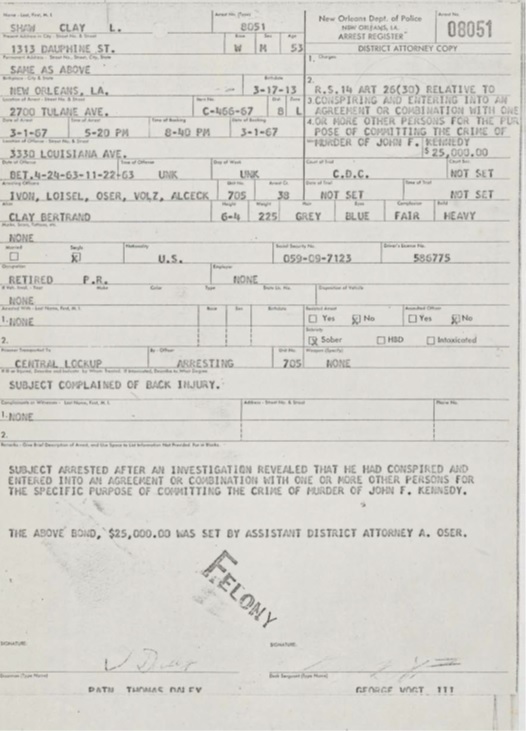
    Just for good measure, let us add the following signed statement, which speaks for itself:

    And how about this signed statement by a witness (key passages):

    Add to this Oswald’s lawyer Dean Andrews being backed by Clay Shaw under the alias Clay Bertrand, plus compelling declassified FBI witness testimony. But let’s have fun anyway. Hardly a slam-dunk on its own, the comparison of the Clay Shaw and Clem Bertrand signatures provides more primary data.

    Clay Shaw was involved in real estate and was the director of the International Trade Mart. His signatures can be found in the Garrison files. Here are a few taken from copies of documents he signed:
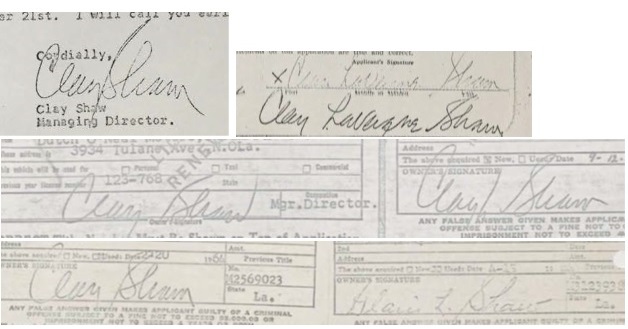
    We can also find this Library card made out to, and signed twice by, Clem Bertrand of the ITM:
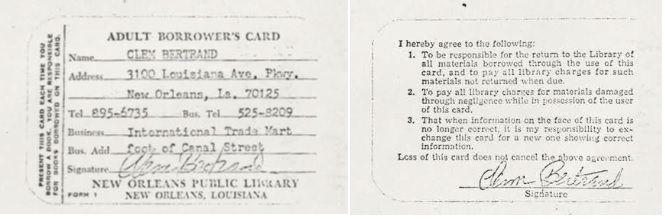
    At first this card was dismissed by the Garrison team because the phone numbers did not match the destinations. However, they decided to reconsider this piece of evidence:

    I wondered what a hand-writing expert might say about these signatures, one who had solid credentials, with no dog in the race, one who might like to weigh in simply to help out with no agenda, nor any fees. Luckily, I was able to find such a person. The following is just a small part of her pedigree:

    Here are the signatures I asked her to compare:

    Here is what she responded:

    “Hello Mr. Bleau, 

    I have reviewed the signatures you sent me. I must first tell you that these signatures are not of good quality. They are copies of copies of copies…. Ideally, I should examine originals or first-generation copies, i.e. made from the original. 

    Despite everything, I can tell you that there are several similarities between these signatures on several levels: 

    • Movement 

    • Tilt 

    • Proportions 

    • Spacing 

    • Continuity 

    • Graphic level 

    This makes it possible to retain the hypothesis (subject to) that they were executed by the same hand. 

    I am surprised to see the use of French names (Lavergne and Bertrand) in the signatures. 

    Sincerely,”                                                                                                

    This opinion concurs with that of the illustrious handwriting expert Elizabeth McCarthy who testified at the Clay Shaw trial: and she did have originals and first generation copies to work from. McCarthy stated that, in over three decades, she had been certified to testify in 28 states and three foreign countries. She worked on as many as two cases per day with about a quarter of them going to court. So the dissenting opinion about this subject is by a dyed in the wool FBI man and J. Edgar Hoover loyalist: Charles Appel. This article is not meant for those who would support the FBI in the Kennedy case.

    Today, it is well-nigh indisputable that Clay Shaw and Clay or Clem Bertrand are the same person and that this high-level intelligence asset was trying to get Dean Andrews to represent Oswald, someone he clearly knew. Why do I say this about Shaw’s intel status? Because Malcolm Blunt has just discovered that in CIA documents, contrary to what many had tried to say about Shaw, his expenses were being paid by the Agency while doing those many overseas reports. This is even more evidence that Shaw lied to the public and under oath at his trial about his association with the CIA.

    In a future article, this author will argue that Shaw, because of his links to the ITM and Permindex, must have been known to Allen Dulles. Thus adding a third Oswald babysitter to Ruth Paine and George DeMorenschildt as Dulles-linked persons of interest. The Old Man had his fingers in many pies.

    The 544 Camp Street network

    After writing a seventy-page, two-part article on Exposing the FPCC, I did not think that I could add very much to expose a charade of Oswald provocateur activity in New Orleans. I was wrong. The Garrison file sources, provided me with even more heavy artillery to fully dismantle this cover, and to shine light on Oswald’s network partners.

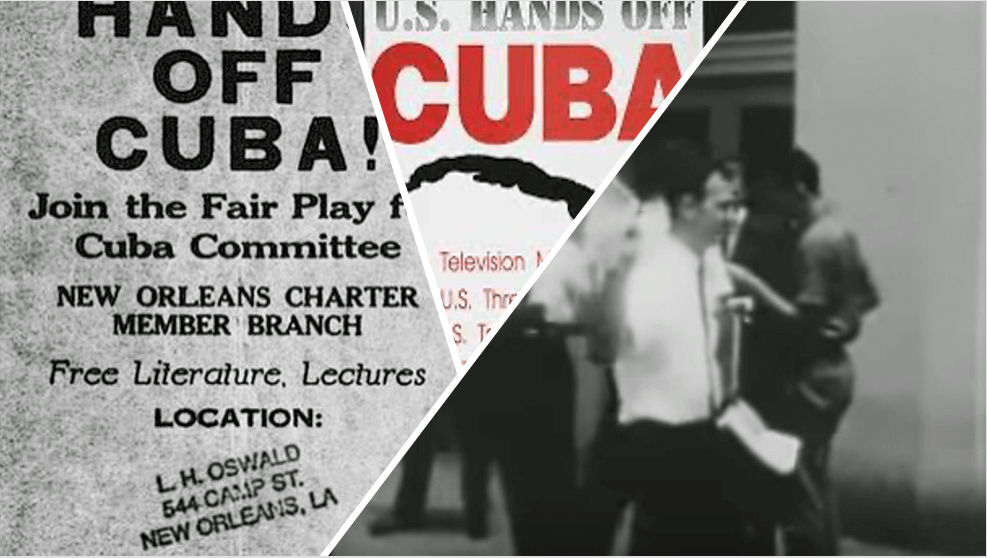
    The revelation of the 544 Camp Street address stamped on Oswald’s FPCC flyers caused lone-nutters fits. Because anti-Castro Cuban exiles, rabid right wingers, Guy Banister, David Ferrie and other people who revolved around Oswald during the Summer of 1963 were frequently seen in the same building. These flyers were a major problem which was admitted to by the HSCA. We also know that this address had housed another one of Banister’s anti-Castro partners in the name of the Cuban Revolutionary Council led by Sergio Arcacha Smith; who in late 1961 was part of a quasi-anti-FPCC riot in Tampa which came to be known as the Marti-Park incident.

    From Jim DiEugenio’s article there is not much more that we need to add to show that Oswald was a member of a network playing the role of a provocateur. As Jim DiEugenio points out in this reply to Alecia Long, at least seven witnesses either saw Oswald at 544 Camp Street, or with Guy Banister on the streets in New Orleans. This included three people who worked for Banister, and two INS agents. When one adds in the layer of intrigue placed over this by the ARRB, the logic becomes pretty ineluctable. For the declassified record has shown that the Board proved both the CIA and FBI had ongoing counter-intelligence campaigns against the Fair Play for Cuba Committee (FPCC). Oswald was the only member of the New Orleans contingent. And he stamped Banister’s address on one, or more, of his leaflets that summer. A fact which Banister was quite upset about. (HSCA interview with Delphine Roberts of 7/6/78). And then there was the ITM connection to Oswald’s leafleting activities. Let us quote from Jim DiEugenio’s reply to Alecia Long’s column in the Washington Post.

    Another important aspect of Oswald in New Orleans that Long discounts is Oswald’s leafleting in front of Shaw’s International Trade Mart in mid-August. This also had some interesting telltale points to it. First, [Carlos] Bringuier and his right-hand man Carlos Quiroga said that they went to see Oswald in an attempt to infiltrate his FPCC “group” after the ITM incident. The visit occurred before it happened. And Quiroga arrived with a stack of flyers about a half foot thick. In other words, the DRE appears to have been supplying Oswald with his leaflets in preparation for the incident. Secondly, the reason we have films of the event is that Shaw’s first assistant at the ITM, Jesse Core, had summoned the cameras. (Davy, Let Justice be Done, p. 38) Beyond that, it was this leafleting episode that caused George Higginbotham to alert Banister, and his reply was “One of them is one of mine.” (Oswald had hired two helpers from the unemployment office to aid him.) But there was something else to note. In addition to calling the cameras for the ITM incident, Jesse Core picked up a pamphlet from the prior Canal Street episode, the one which got Oswald arrested. He noted that it had Banister’s address on it. He mailed it from the Trade Mart to the FBI with a message attached: “note the inside back cover.” (John Armstrong, Harvey and Lee, p. 568) This would suggest that both Shaw and Core knew about Oswald’s mistake. How would they know unless they were aware of Banister’s operation? Which recalls the work done for Banister by Bill Wegmann and Guy Johnson. But further, the FBI then knew about Oswald at 544 Camp Street before the assassination.

    Wegmann and Johnson were part of Clay Shaw’s defense team.

    On August 27, 1978, Banister’s secretary Roberts was re-interviewed by HSCA Investigator Robert Buras. She said she

    believes that LEE OSWALD came into the office to be interviewed for a job, but doesn’t remember anything specific, because so many people came in for interviews. At a later date Banister introduced Marina and OSWALD to her in his office, but they walked right out and she did not talk to them. She could not recall hearing Marina speak, or how they were dressed. On several occasions LEE OSWALD would come in and go into Banister’s office and she could not hear any conversation from that room. She believed that OSWALD was either working, or attempting to work, for Banister. She does remember hearing Guy Banister holler at Jim Arthus and Sam Newman about letting OSWALD the second-floor room and about keeping the Fair Play for Cuba Committee literature from his office. Arthus used to come into the office and put leaflets on Banister’s leaflet table as a joke because all the other literature was anti-communist.

    Scott Malone reported: “Delphine is definitely a kook, but I found someone else to corroborate her story. She told Mary Brengel about having seen OSWALD in Banister’s office two weeks after the assassination. She did not mention Marina’s presence.”

    Even more telling, if we are to believe a 1979 Dallas Morning News article from the Garrison files, it is Banister who, according to his secretary and girlfriend Delphine Roberts, helped Oswald settle into his Camp Street locale:

    The list

    Lone-nut backers have used the tired tactic of trying to distance 544 Camp Street from Guy Banister and David Ferrie offices by shielding it with a wall and a floor or two. The other deflection is to insist on the separation in time between Oswald and the previous occupiers: The Cuban Revolutionary Council. As the above section demonstrated, there can be no doubt about Oswald’s links to Banister and Ferrie, and no architectural imagining can elide it. When analyzing the following lists made available in the Garrison files, we will see that the time argument to try and create separation between Oswald and the nest of anti-Castro militants holds no water… Something that both the HSCA and Richard Schweiker of the Church Committee fully understood.

    Their mission touched a hot button in New Orleans:

    This author is still analyzing the list of names that we can closely connect to this address. What he has found so far is quite incriminating.

    Consider the following profiles of some of the crusaders:

    William T. Walshe:

    One of Mr. Walshe’s important credentials was that he was secretary of the New Orleans based Mississippi Valley World Trade Center (MPWTC) which links him closely to its Secretary: None other than Clay Shaw according to the following listing.

    Mississippi Valley World Trade Conference Annual Award 1955

    Name: MISSISSIPPI VALLEY WORLD TRADE COUNCIL

    Type Entity: Non-Profit Corporation

    Status: Not Active (Action by Secretary of State)

    2006 Annual Report/Reinstatement form is required in order to reinstate Print Annual Report/Reinstatement Form for Filing

    Mailing Address: 124 CAMP ST., NEW ORLEANS, LA 70130

    Domicile Address: 124 CAMP ST., NEW ORLEANS, LA 70130

    File Date: 09/05/1956

    Registered Agent (Appointed 9/05/1956): C. C. WALTHER, 3524 GENTILLY BLVD., NEW ORLEANS, LA 70119

    Registered Agent (Appointed 9/05/1956): CLAY SHAW, 505 DAUPHINE ST., NEW ORLEANS, LA 70116

    President: C. C. WALTHER, 3524 GENTILLY BLVD., NEW ORLEANS, LA

    Vice President: WILLIAM T. WALSHE, 1208 WEBSTER ST., NEW ORLEANS, LA

    Secretary: CLAY SHAW, 505 DAUPHINE ST., NEW ORLEANS, LA

    To understand the status of this organization, one simply needs to note the following:

    From January 4th to January 20th, First Deputy Premier Anastas Mikoyan of the Soviet Union visited the U.S. During his stay, Mikoyan met Under Secretary of State Douglas Dillon, Secretary of State John Foster Dulles, and President Eisenhower and was profiled by Allen Dulles head of the CIA. One of the organizations that was debriefed by Dillon was this MPWTCA highlighting further the proximity between Dulles and Shaw. In 1961, President Kennedy, appointed Republican Dillon Treasury Secretary which put him in charge of the Secret Service.

    Walther himself was rather connected, with links to General Cabell: (New Orleans Times-Picayune May 10, 1961 S1-P3)

    CIA Must Keep Quiet — Cabell
    General Cites Strides of Reds in Science

    The Central Intelligence Agency, because of the sensitive nature of its activities, must maintain a policy of silence at all times in regard to its knowledge of the participation in United States affairs, the deputy director of the CIA said in New Orleans Tuesday [9th] night.

    Air Force Gen. C. P. Cabell said that he therefore could not “rise to the defense of the CIA” in regard to its reported connection with the recent Cuban invasion, a connection which has come under repeated fire from many quarters.

    Gen. Cabell arrived in New Orleans late Tuesday to address the International Relations Association of New Orleans, previously called the Foreign Policy Association of New Orleans. At a meeting held at the Sheraton-Charles Hotel, he discussed “Communism and Science.” He left shortly after the meeting to return to Washington.

    Interviewed at International House shortly before his talk, Gen. Cabell refused to comment on the Cuban invasion and the CIA’s role in the affair.

    “This is a sensitive subject, certainly, and one which should be discussed only by President Kennedy and Secretary of State Rusk,” he said. “The Central Intelligence Agency is not a policy making agency; we merely serve the policy makers.”

    Therefore, it would make matters only worse, he continued, if officials of the CIA and other like agencies continued to make comments concerning the Cuban situation.

    “It could very possibly occur that these comments would differ in meaning and suggestion from those made by the only two people who should be commenting on it – the President and the Secretary of State,” he said.

    Discussing the scientific accomplishments of the Communists in his talk before the International Relations Association, Gen. Cabell said that “there is no reason at all to belittle or magnify the accomplishments of scientists living under Communistic regimes, and there is no reason to draw invidious comparisons between our efforts and their efforts.

    “What we must realize is that the accomplishments are real,” he continued, “and that their successes so far have led them to place even more emphasis on scientific research and development in what Khruschev calls ‘the splendid years under Communism.”

    Cabell said that science is the servant of Communism and that, stripped of all its usual verbiage, “Communism is a future social order being constructed out of present-day socialism through the application of science.

    “We must recognize the vast scientific resources of the Soviet Union and the growing strength of China are being integrated with their political ambitions to reconstruct society in the Communist countries and eventually in the entire world.”

    He concluded that “we should stand forewarned that every resource available to being used by the Communists to advance their political ends.”

    The International Relations Association changed its name from the Foreign Policy Association Tuesday night because, according to its president, C. C. Walther, the group is no longer affiliated with its originator, the Foreign Policy Association of New York.

    It has been reported by eminent author Donald Gibson that Clay Shaw was present during Cabell’s speech. (Davy, p. 293)

    Harold K. Marshal and wife Mrs. Naomi Marshal has her own links to Clay Shaw according to excerpts from this 2013 notice written by her son. article in NoLaVie

    My mother, known to our neighbors to the south as “La Mujer del Norte” (the woman from the north), traveled extensively in Latin America on business during those heady days in the 1940s and ’50s, when New Orleans was dubbed “Gateway to the Americas” — long before Miami, Atlanta and Houston opened economic sluices to the south, effectively shutting New Orleans’ wrought-iron-laced gates for years to come.

    On her way to prominence in foreign trade, Mother shattered several glass ceilings, becoming the first woman officer of the New Orleans Board of Trade and a member of the city’s Export Managers Club. She was an avid supporter of the original International Trade Mart, a five-story modernist block of offices and displays of foreign government trade offices, spearheaded by Clay Shaw, its first director, which was demolished to make way for the New Orleans Sheraton hotel.

    Her life was full, including her idea to locate the ITM tower at the foot of Canal Street, rather than in the new Duncan Plaza (City Hall) complex.

    Clay Shaw moderated a panel that featured Gilbert Mellin

    On October 23, 1959 Clay Shaw moderated a panel discussion that included local business leader and CRC backer Gilbert Mellin; a gathering where anti-communist attitudes were in full view.

    Manuel Gil

    Was employed as Production Manager by INCA. Authorized to sign checks for “Cuban Revolutionary Council”, and a charter member of INCA.
    (WC Vol 26, p. 769; CE 3119; CD 87 SS 517 p. 3 DTR 00-381; CD 407, p. 15; Oswald in New Orleans, Weisberg, pp. 343, 345, 356, 362-363)

    INCA was run by Ed Butler who was friendly with Lloyd Cobb and Clay Shaw of the ITM, who in turn cooperated with him in his anti-communist endeavors. Ed Butler also contributed in the sheep-dipping of Oswald into his Warren Commission, pro-Castro persona. Of course, Gil was in close contact with Sergio Arcacha Smith.

    William Monteleone

    Monteleone’s hotel is where Shaw was the moderator for Anti-Communist panel discussion featuring Mellin.

    According to this CIA file, an informant of unknown reliability claimed that Shaw was linked to one of the Monteleone girls in situations of gross immorality with overtones of sexual deviancy. While this admittedly is of little worth in terms of evidence, it is interesting that this even exists in a CIA file. Is this CIA profiling of U.S. citizens even legal? Unless perhaps they were keeping an eye on one of their own.

    According to the manager of the Newman building, a “young Monteleone” ran the CRC (Garrison Files):

    Provosty Dayries

    The second name on the list should cast no doubt about Banister’s strong ties to the CRC (https://www.lib.lsu.edu/sites/default/files/sc/findaid/3320.pdf)

    In 1951 Provosty Arthur Dayries, who was working for the VA at the time, became assistant superintendent of police—a political appointment by New Orleans Mayor deLesseps “Chep” Morrison. This was after the retirement of Milton Durel, and aimed to bring internal crime within the police department to a stop. At the time, many police captains were part of an underground lottery, gambling, prostitution, and drinking network within the city, which was designated as a “vice” or “graft” investigation (the terms are used interchangeably throughout the materials). He was promoted to superintendent in 1954, following an investigation into the former superintendent of police, Joseph Scheuring, and his lack of leadership in working to end the police network.

    Prior to the hiring of Dayries as assistant superintendent, Mayor Morrison hired a former FBI agent from Chicago–though originally from Louisiana–named Guy Banister to handle the internal affairs investigation from within the mayor’s office. When Dayries was promoted to superintendent, he hired Banister to serve as his assistant. The two repeatedly came into conflict. Banister would often speak to the media before statements had been cleared by Dayries or Mayor Morrison. Additionally, Banister would routinely overstep his bounds within the police department regarding his leadership. At one point he attempted to take over Dayries’s job while he was in Florida speaking at a conference, before being reprimanded by the mayor.

    While Banister at one time did claim Dayries was corrupt, they certainly frequented the same personages.

    The Rodriguez clan

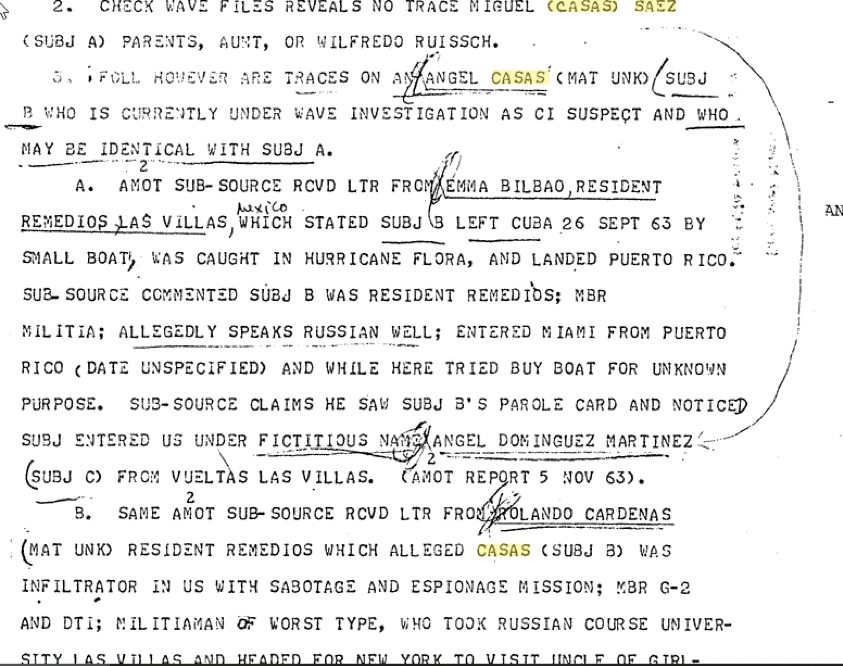
    According to this information in the Mary Ferrell files Arnesto Napoleon Rodriguez y Gonzalez worked with ONI in the 1930s. Father of Arnesto, Jr., an FBI informant who was in communication with Lee Oswald in New Orleans during the summer of 1963. AMJUTE-1 is named as Arnesto Napoleon Rodriguez y Gonzalez on a list of cryptonyms. Arnesto’s other son, Emilio Rodriguez was also a CIA asset based in Mexico City, after being a stay behind agent in Cuba.

    Arnesto Napoleon Rodriguez told an investigator for New Orleans District Attorney Jim Garrison that Oswald “came to the Berlitz School of Languages on one occasion and attempted to talk to him about the possibility of taking a language course, and about Cuba in general. He said he told OSWALD he was busy at the time; if he would return at a later date, they could discuss the situation. OSWALD, however, never returned.” He denied having any tapes of Oswald. [CIA 79, 166-78, 113-48, 72; Sciambra to Garrison 2.14.67 interview with ER Sr.] According to Larry Hancock Arnesto, father and son, were both in the court-room when Oswald got arrested for his fight during his leafletting activities, and Emilio was well connected to the JM. Wave crowd.

    Carlos Crimadier (or Grimader on the list)

    He was the auditor for the Crusade. Here is how the HSCA describes him:

    Richard D. Reily

    If the name Richard D. Reily rings a bell, it is because he is a family member of the same family who owned the Reily Coffee Company where Oswald worked for a few weeks during the summer of 1963 in the Crescent City.

    Ronnie Caire

    According to Ronnie Caire’s testimony to the HSCA, the Ronnie Caire advertising agency provided marketing services for the CRC. Caire also interviewed Oswald during the summer of 63 when he applied for work. (https://www.jfk-assassination.net/weberman/nodule11.htm) Caire says he had been approached by Sergio Arcacha Smith and that he knew both Banister and E. Howard Hunt. He stated that the CIA approached him through the CRC because he was politically connected. (https://www.jfk-online.com/jpsasfrd.html) (For more information, click here.) According to Arnesto Rodriguez Senior, Caire was the principal organizer of the Crusade and was very close to Smith. In fact, he said that Caire’s offices served as the HQs for the Crusade. If this is the case, then this places Oswald in offices occupied by the CRC and the Crusade. Hmmm.

    It is interesting to note that Oswald also applied for work at United Fruit (Garrison: Oswald Miscel. Files, Bercham Exhibit 1), and Michoud Assembly Facility (NASA) where Shaw tenant William Kloepfer worked. He also applied in photography for Jules Weiss who was close to Shaw and also Warren Bernados who also knew him. The funny thing is that Bernados and Weiss had been partners but split, yet Oswald put the partnership company on his unemployment job search report, and both claimed he had passed by to apply for work after they split up. (Garrison Files Shaw Leads 2) Was Oswald really looking for work? … or was he simply being fed names he could use for his unemployment insurance claims? He told Dean Andrews that he was being paid $20 a day to hand out FPCC leaflets. In the Garrison files, we can see all the names of the employers where Oswald supposedly applied. It would be interesting to see how many of these tie into the network we are describing.

    Arcacha Smith

    Smith was head of the CRC at this time and figures on this list in a major way. Sergio Arcacha Smith His links to David Ferrie, Guy Banister, Layton Martens, Carlos Quiroga, Carlos Marcello, Carlos Bringuier, Arnesto Rodriguez, Ronnie Caire, Warren DeBrueys of the FBI who monitored the FPCC in New Orleans, and a host of well-connected anti-Castro operatives (many of whom relate directly to Oswald and Clay Shaw) is well documented… So is his theft of fund-raising revenue, and his determination not to cooperate with Jim Garrison.

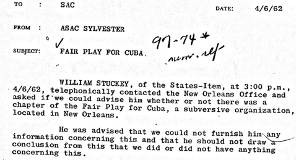
    Others known to have come into contact with Oswald and Newman Building occupants, include Cuban exiles of interest like Carlos Bringuier of the DRE who, according to his book, had met Bill Stuckey for the first time in August 1962 (Crime Without Punishment, page 101); and Celso Hernandez and Frank Bartes (who replaced Sergio Arcacha Smith in the CRC). These Cuban exiles all had touch points with Oswald. The FPCC and DRE were monitored by David Phillips (CIA) as well as Warren DeBrueys (FBI) and George Joannides (CIA). The CRC was under Howard Hunt’s watchful eye. Bringuier associate Miguel Cruz also came into contact with Oswald and is identified as informant T-2 as mentioned in DeBrueys’ FPCC file. (Blakey letter to Attorney General of U.S., October 16 1978)

    Joan Mellen’s research indicates that after his brawl on Canal Street with Bringuier, Hernandez and Cruz, Oswald, while under arrest, asked to meet DeBrueys. Warren was out of the office and his associate met Oswald for hours. Which sounds like overkill for a small disturbance. The following file (see bottom right) shows that a Ramon Hernandez complaint about Oswald hand-outs also reached the FBI’s top FPCC dog in New Orleans:

    If the picture one gets from this is that Shaw, Ferrie, Banister and Oswald’s multiple connections to this network of anti-Castro Cuban exiles, right-wing extremists and intelligence actors was not coincidental, then you are beginning to see quite clearly. If you are not quite there yet perhaps the story of one of the last well-connected Cubans to appear on this list will seal the deal. His name is Carlos Quiroga, co-chair of the youth wing of the Crusade to Free Cuba, second in command at the CRC, well-connected to Smith, Bringuier, Bartes, Ferrie, Banister… and Oswald.

    His testimony to Garrison was polygraphed… His lies were plentiful, blistering and confirmed by another polygraphed witness. Quiroga deserves a section of his own.

    Carlos Quiroga

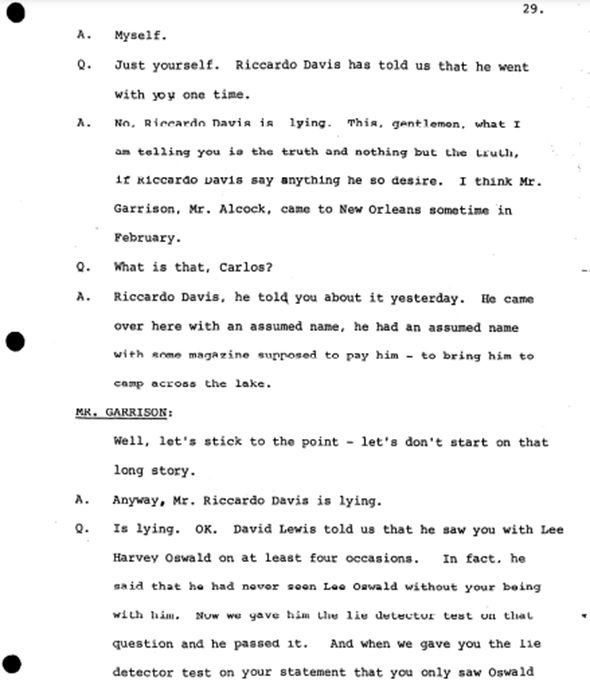
    Oswald`s landlady Jesse Garner saw Quiroga meet Oswald at his apartment. Quiroga claimed that he was trying to infiltrate the FPCC. This could have been done by filling out one of the flyers that Oswald was distributing. According to Jesse Garner in her Warren Commission testimony, Quiroga seems to have brought way more than one application: Note how both lawyer Wesley Liebeler and Jim Garrison underscore the quantity of flyers Quiroga brought with him:

    Another false claim made by Quiroga was that this had been the only time that he had met Oswald.

    The following lie detector test results reveal that: Quiroga met Oswald a number of times. He also knew that Oswald`s association with the FPCC was but a front and that Oswald was part of an anti-Castro operation. That he knew that David Ferrie knew Guy Banister and he had seen Oswald with at least one other Latino subject.
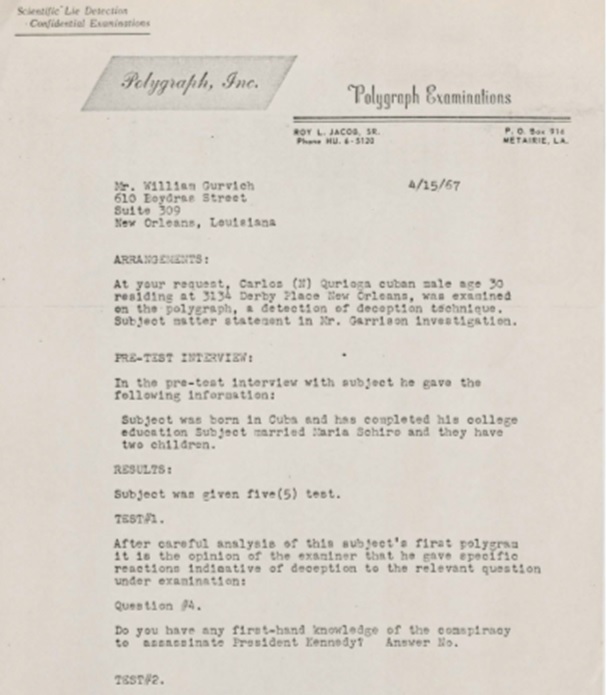
    The exchange below between Quiroga and Jim Garrison, provides corroboration to the damning test results, in that two witnesses–one who had also been polygraphed–contradicted Quiroga`s statements.

    David Lewis, a roommate of Banister employee Jack Martin, witnessed Quiroga with Oswald a number of times. While his testimony and character have been the subject of numerous attacks, there was no denying that his own polygraph results bolster the proof of deception brought forward by Quiroga’s polygraph. We can also add Ricardo Davis as one other witness who accompanied Quiroga when he was with Oswald on an occasion.

    (http://www.aarclibrary.org/publib/jfk/garr/grandjury/pdf/Quiroga.pdf page 29)
    More list member analysis

    The motive of Latinos to be involved in the Crusade is self-explanatory. The Anglo-Saxon members most likely had business motivations. New Orleans was the gateway for North South trade. The last thing they wanted was a Castro stimulated revolution of Central and South American states that would disrupt markets and supply chains. After discussing with a member of the research community from New Orleans, who briefly perused the list, he concluded that a number of multi-millionaires were represented and wanted Castro out.

    One example is Mrs. R. G. Robinson, who was likely the wife of Robert Gibson Robinson, son of the founder of Robinson Lumber Company (1893). Robert Gibson, was instrumental in the internationalization of this stellar family-run company. (See this link its website,

    Robert Gibson Robinson, his son, upon recognizing the declining supply of export quality Heart Pine, began the company’s first foreign manufacturing facility in Nicaragua in 1942 to supply Pitch Pine to Robinson’s customers around the world.

    After World War II, Jack, Charlie, and Sam, the third generation of Robinsons entered the business, expanded into hardwoods and began operations in Honduras and Brazil.

    Mexico was also an important supplier of product. Just like with United Fruit, a communist take-over in these areas would have been disastrous.

    Consider this about a Stockton B. Jefferson:

    If this is the CPA husband of Mrs. Stockton B. Jefferson from the list, we can link another member of the Crusade who saw Castro as an existential risk. Note the association with Avondale Shipyards. One of the founders of Avondale Shipyards was a newspaper owner and father of Fred Koch, founder of Koch Industries. Harry Koch

    Oswald letter to FPCC

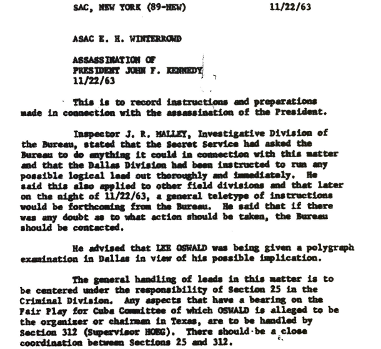
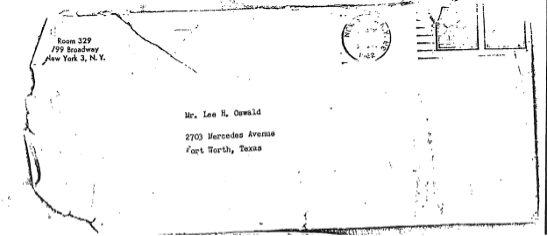
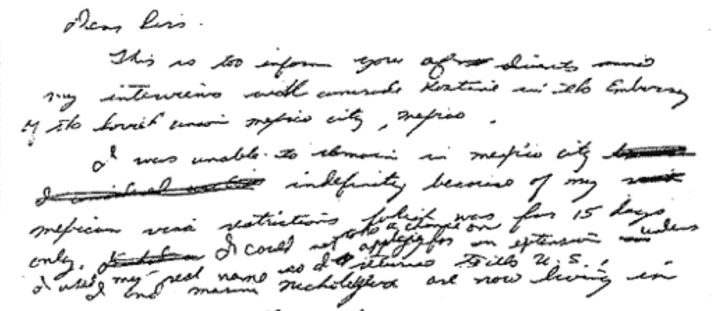
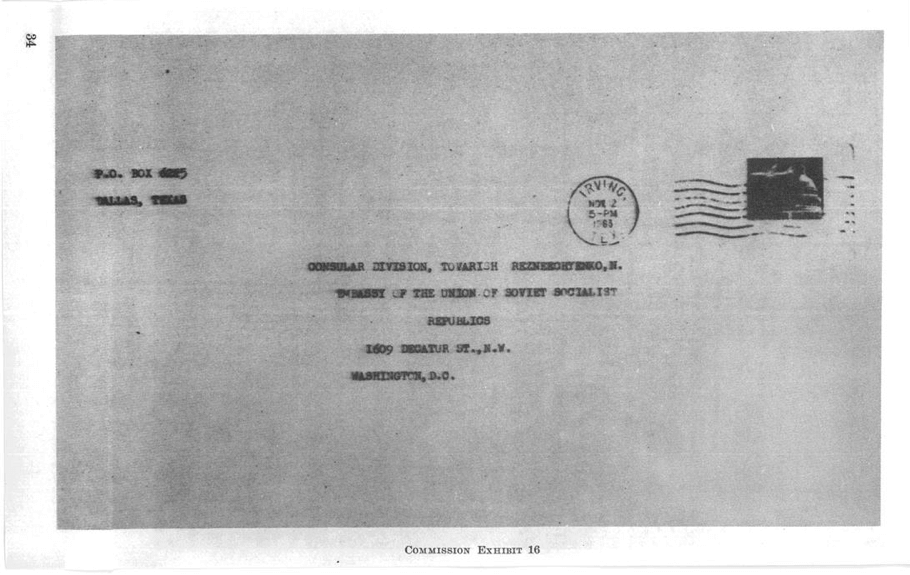
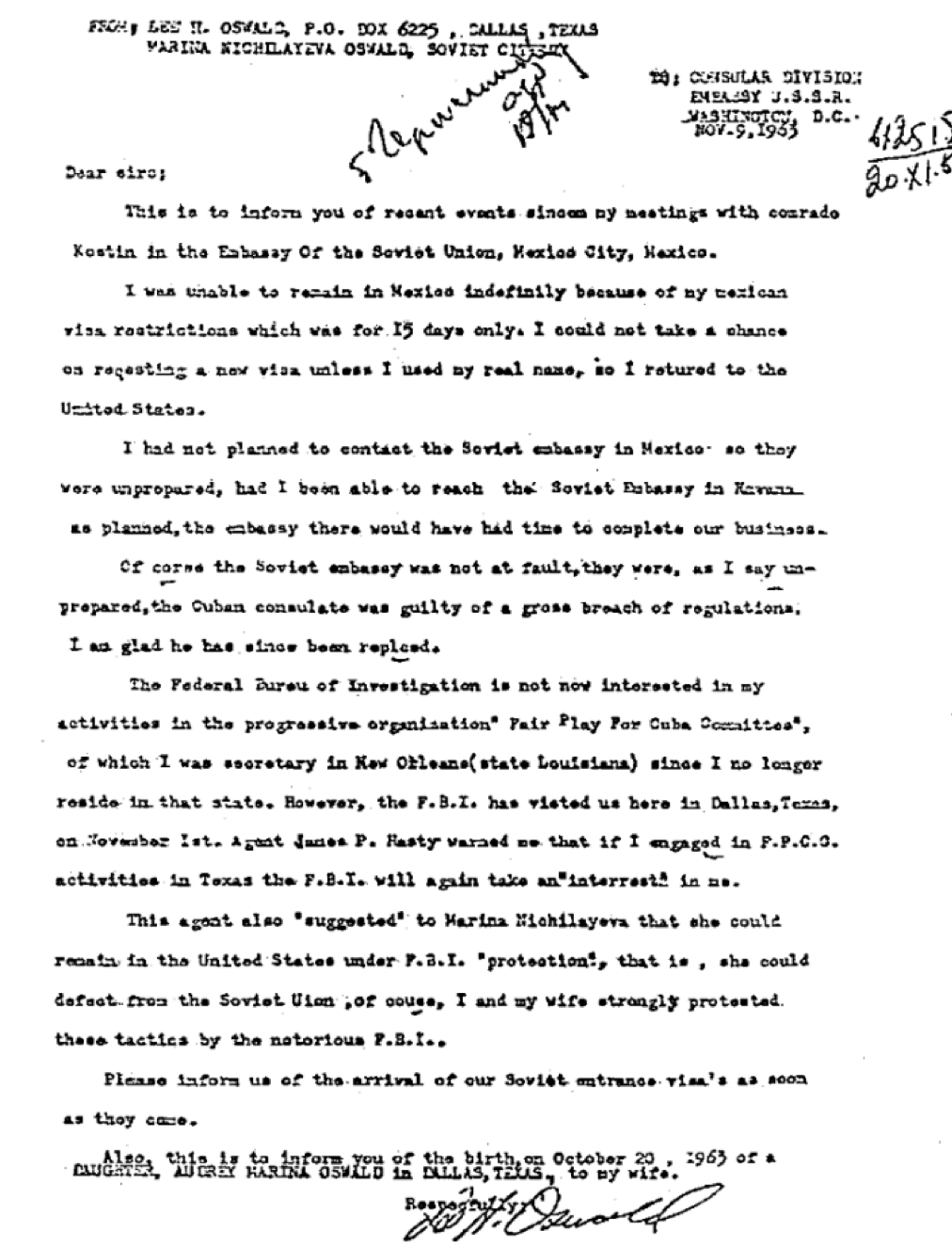
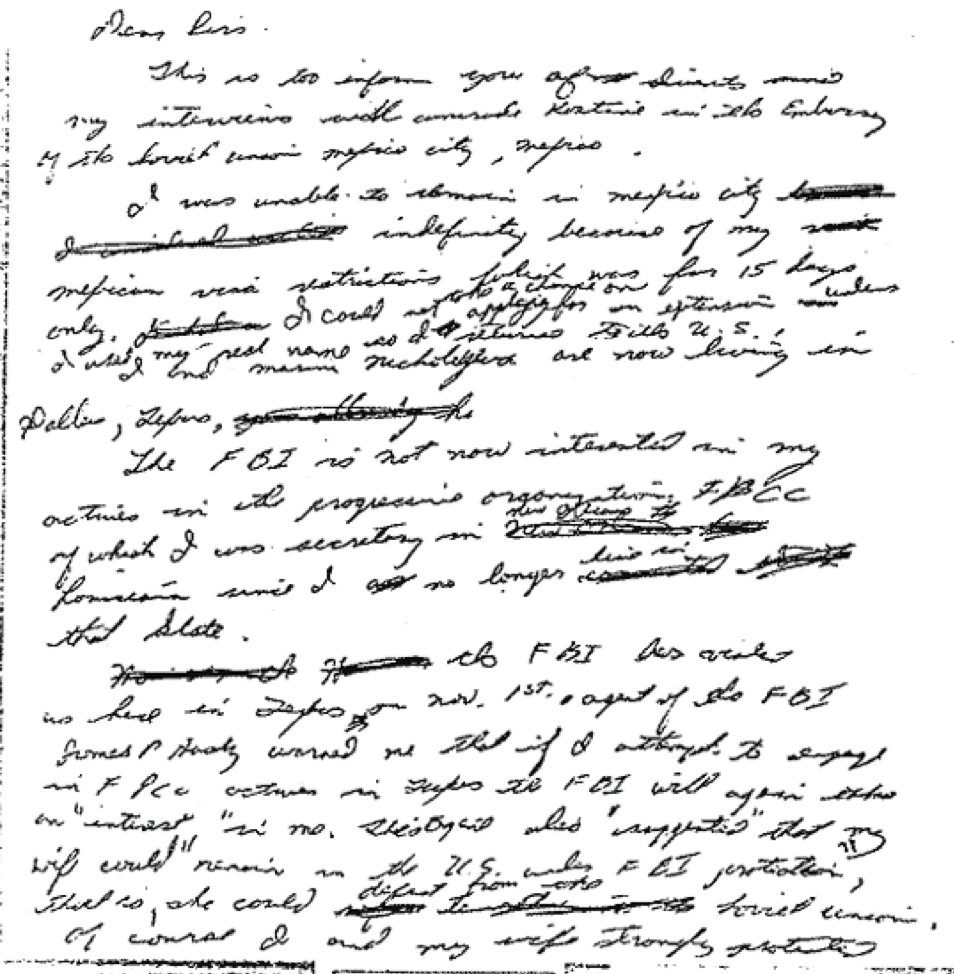
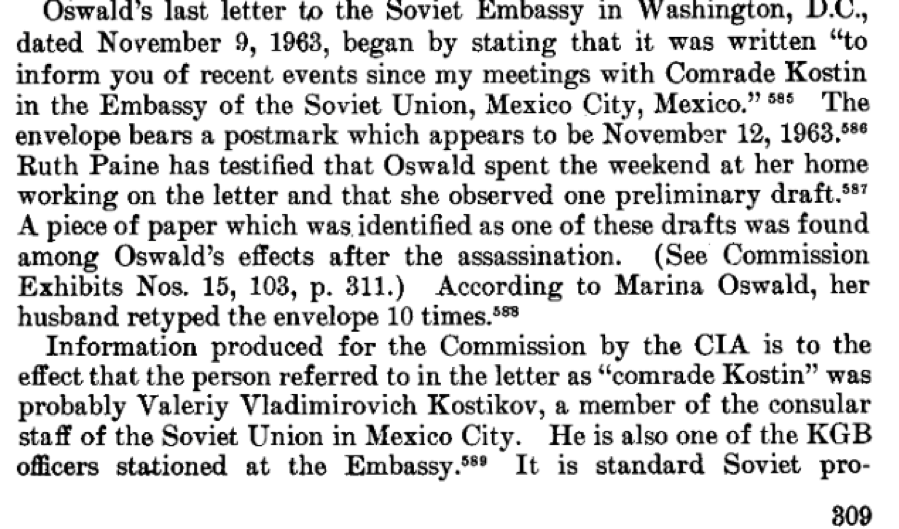
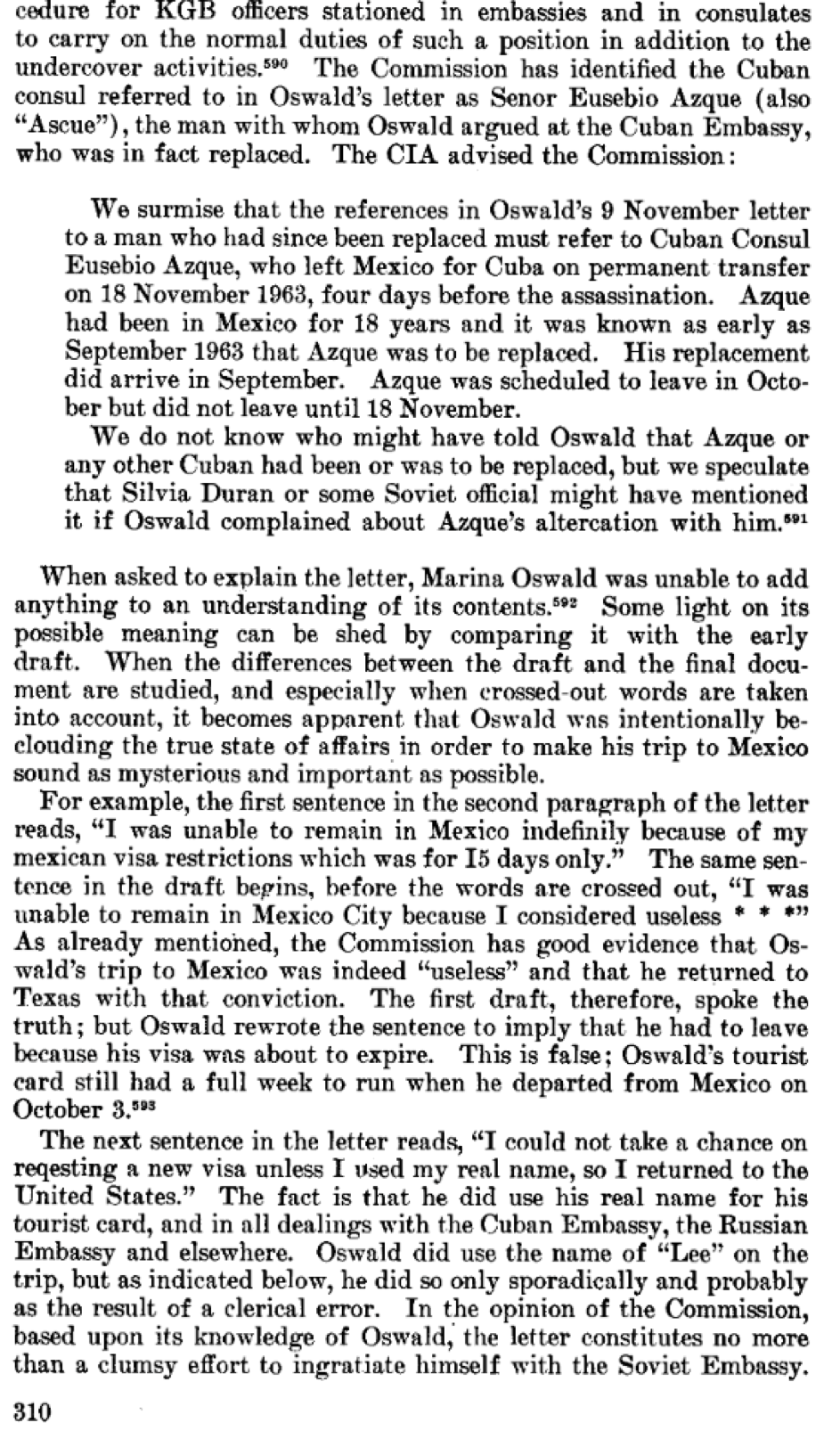
    In one of my articles for Kennedysandking, Oswald’s Last Letter, I presented strong evidence that a letter to the Russian Embassy was a fake designed to paint Oswald in cahoots with Russia for the assassination. A very early researcher has convinced me that at least one of Oswald’s letters to the FPCC was done with close assistance. For this important clue, we need to go back to 1964 and quote directly from Harold Feldman, OSWALD and the FBI.

    After presenting arguments that Oswald was an FBI informant, Harold astutely makes the following points: “If the FBI did not employ Oswald or work with him, then who wrote the letters he addressed to the Fair Play for Cuba Committee in New York? Oswald alone certainly didn’t. Whoever wrote the letters to New York was coherent, commanded a good vocabulary, rarely misspelled a word, and punctuated decently. Oswald himself wrote English that a sixth-grader would blush to acknowledge. Here is a letter he wrote to his mother from Russia on June 28, 1963. I preserve the original spelling and punctuation:

    Dear Mother.

    Received your letter today in which you say you wish to pay me back the money you used last year, that, of course, is not nessicary however you can send me somethings from there every now and than.

    If you decide to send a package please send the following:

    One can Rise shaving cream (one razor (Gillet)

    Pocket novels westerns and scienace fiction — Time or Newsweek magazine

    Chewing Gum and chocolate bars.

    That’s about all. Ha-ha

    I very much miss sometime to read you should try and get me the pocket novel “1984” by Wells.

    I am working at the local Radio plant as a mettal worker. We live only five minutes from there so it is very conveinant.

    Well thats about all for now. I repeat you do not have to send me checks or money!

    Love XX

    Lee
    P.S. Marina sends a big Hello to you also

    Now compare this semi-literate effusion with the following addressed to the Fair Play for Cuba Committee about two years later. (A New York Times report on the letters to FPCC indicates that they were handwritten, so presumably no public stenographer improved their style.)

    Dear Mr. Lee:

    I was glad to receive your advice concerning my try at starting a New Orleans F.P.C.C. chapter.

    I hope you won’t be too disapproving at my innovations but I do think they are necessary for this area.

    As per your advice I have taken a P.O. Box (N.O. 30061).

    Against your advice I have decided to take an office from the very beginning.

    I u c [apparently meaning, as you see] from the circular I had jumped the gun on the charter business but I don’t think it’s too important. You may think the circular is too provocative, but I want it to attract attention even if it’s the attention of the lunatic fringe. I had 2,000 of them run off.

    The major change in tactics you can see from the small membership blanks, in that I will charge $1 a month dues for the new Orleans chapter only and I intend to issue N.O. F.P.C.C. membership cards also.

    This is without recourse to the $5 annual F.P.C.C. membership fee.

    However, you will lose nothing in the long run because I will forward $5 to the national F.P.C.C. for every New Orleans chapter member who remains a dues paying member for 5 months in any year. . . .

    And so on for several more well-integrated paragraphs. He now spells “receive” and “necessary” correctly. He has mastered the apostrophe. His ideas cohere. He tackles words like “innovations,” “provocative,” “recourse,” “disapproving,” “approaching,” and “application” with success, something that would have been clearly beyond the powers of the voluntary exile in Minsk.

    Until the authorship of the letters to the FPCC is settled, I think it reasonable to suppose that Oswald did not compose them, at least not without help. Who, and where, is the invisible scribe? No associate of his New Orleans period has been found, or even hinted at. If Oswald was employed by the FBI to operate in “Castro groups,” as the news report suggests, it is also reasonable to suppose that in the letters to FPCC his pen was guided by the FBI.”

    In the following you will see that the actual hand-written version indicates a few differences with the above typed version (example its vs it`s). In my view the analysis by Mr. Feldman remains valid and astute given what he had to work with. He is correct in saying that this letter is so much better in grammar, word selection and style than other Oswald correspondence.

    The FPCC in 1963

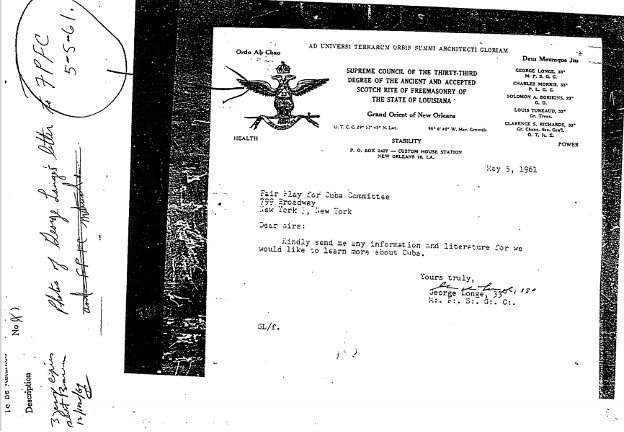
    In my first prior plots article, I based my research on author Van Gosse’s work to estimate maximum FPCC membership to be between 5 and 7 thousand in 1961 and argued that such a low number made it impossible for persons of interest like Richard Case Nagell, Oswald, Policarpo Lopez, Vaughn Marlowe, Harry Dean, John Glenn, Santiago Garriga–who were potential patsies to varying degrees–to all be coincidently linked to the FPCC; especially for those in the Deep South where the FPCC had much less activity. Based on recent data that I have obtained, the odds are astronomically worse than what I first thought.

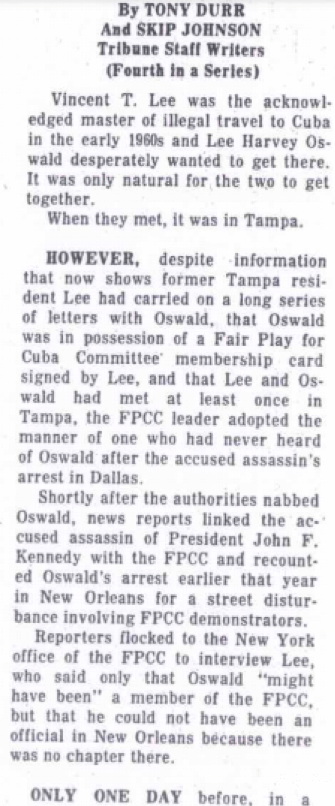
    According to Malcolm Blunt, Vincent T. Lee, who was the last head of the organization, stated that the number of members had plummeted to about 1500 by mid-1963, finances were very poor and that the other FPCC officers were no longer even answering to him. Even the Treasury Department noted that the FPCC was almost inactive. Furthermore, members in the Deep South tended to be disproportionately African American, and the FPCC was riddled with informants.

    In other words, the statistical probability of seeing a white person in the Deep South genuinely involved with such a vegetative outfit was rather small… seeing seven of the subjects profiled… well, no comment.

    Framing Oswald

    Two persons both Garrison and Blunt included in their files are the Buchanan brothers, Jerry and Jim Buchanan. They appear to be part of the large number of frame-up artists (FBI Report of Joseph Boston). Jerry claimed he had a fight with Oswald in early 1963 while he was distributing FPCC flyers in Miami.

    Here is the capper: Both Jerry and Jim were officers of the International Anti Communist Brigade, where one of the Blame it on Castro Kings, Frank Sturgis, left his alpha male scent.

    Birds of a feather

    In article 2 of its formation documents, the International Trade Mart specifies one of its roles as “the development, promotion and maintenance of trade and commerce between the people of the United States of America and the people of the world, particularly the other American republics.”

    It goes without saying that a communist country like Cuba, that was nationalizing many of its industries, was not in tune with the ITM mission.

    In 1968, its president, the CIA connected Lloyd Cobb, went even further by stating: “the aims of the new International Trade Mart would be: to act as a catalyst to develop trade and not be just a display area for foreign goods; to encourage and stimulate U.S. investors into joint enterprises with Latin Americans; to counter Communist propaganda…” (The Story of the International Trade Mart, page 15).

    Since the assassination, the ITM has gone through a merger and a multitude of changes, moves and expansion– making it an entirely different post-Cold War entity today. It is safe to say that during the Red Scare and Missile Crisis, New Orleans and its captains of industry where a tight-knit bunch who worked in synch with one another to target communist threats. The omni-present intelligence network was a partner in this economic and national security danger. This is why Oswald set up an office in the heart of one of the major anti-communist blocs in North America at the time and played a provocateur role using the brain-dead FPCC as a front: to work with a network in rooting out communists. A network which included Guy Banister, Cuban exiles, David Ferrie, INCA, WSDU, the CRC, The Friends of Democratic Cuba, The DRE, the Anti-Communist League of the Caribbean, intelligence actors and Clay Shaw who was a well-paid CIA contract agent. This is why we have seen so much interaction between persons on the list with Oswald and Shaw. Given the role of the ITM, how could Shaw not be well connected and work in symbiosis with the apparatus countering communism as well as with the New Orleans power elite.

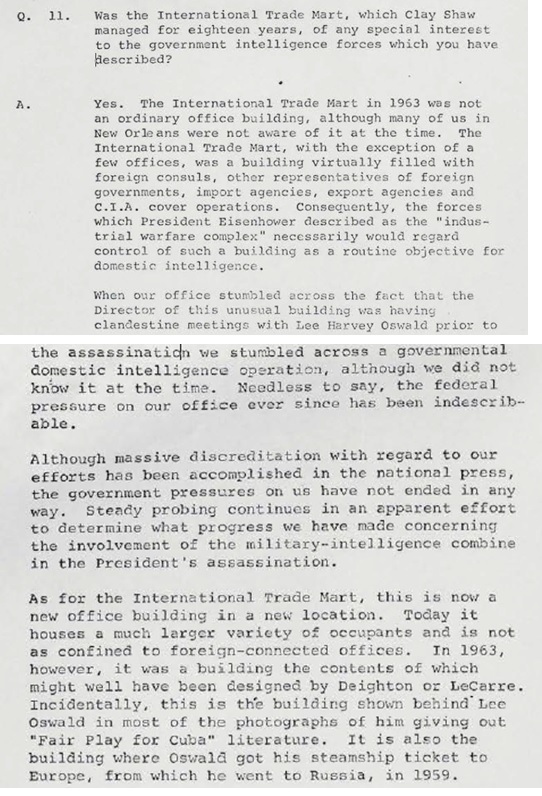
    Just how invested the ITM, or at least some of its governance members were, in controlling the environments capitalists dealt in is not known. The Garrison files do offer some clues which the research community should pour into. Let us look at some of the people who were involved in with the ITM some sixty years ago.

    We can begin with what Garrison himself observed when questioned on May 27, 1969 (Garrison Files: Crusade to Free Cuba, file 2, page 38)
    Article 4 of the ITM foundation papers lists the original board directors in 1945. While a 1963 list would be worth analyzing, this one is already very revealing, especially when comparing with INCA members and operatives:

    And this list of INCA operatives from an INCA pamphlet:
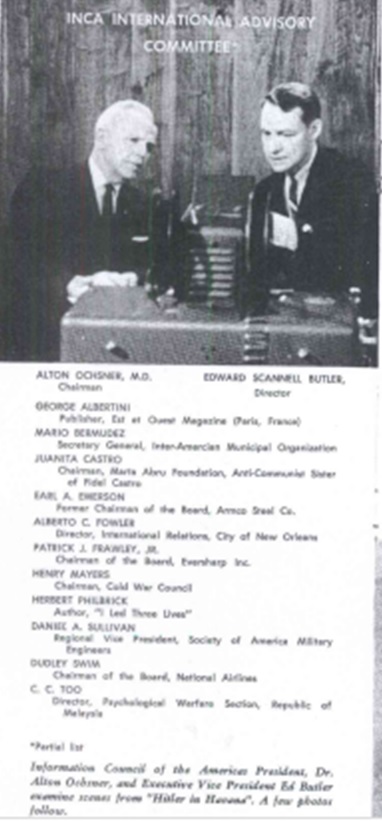
    We know Shaw was close to Butler and Ocshner of INCA and that Philbrick was Oswald’s idol. Garrison was obviously intrigued by certain names such as Eustis Reily on the INCA list. This author finds the Stern names (WDSU) interesting. Since William Stuckey had a weekly radio program at the station and they allowed Walter Sheridan to work out of their offices while doing his NBC hatchet job on Garrison in 1967.

    Declassified files prove that Lloyd Cobb, Theodore Brent (top dogs at the ITM) and Clay Shaw, who joined later, were intel connected . For instance, Cobb was on a panel of CIA cleared lawyers in New Orleans. (William Davy, Let Justice be Done, p. 182) According to Joan Mellen, Brent’s Mississippi Shipping Company ended up being a CIA proprietary. (Mellen, A Farewell to Justice, p. 131) Oliver Stone’s film, JFK: Destiny Betrayed, proves that Shaw was a highly valued contract agent and had a covert security clearance for the Agency. The last name on the ITM list William G. Zetzmann also figures on a partial list of INCA members almost 20 years later.

    A New Orleans based researcher sent me the following information: “I spoke with Paul Fabry, head of Radio Free Europe and other CIA organizations and later with his secretary, who told me that it was always their understanding that the ITM  was “an agency operation”. The bronze plaque in the lobby of the ITM listed Alton Ochsner, James Coleman and a guy named Wm. Norman (atty and spook).” 

    Now let us see what we can peace together in terms of ITM occupants, employees and visitors.

    According to the Story of the ITM: A list of first tenants included David Kattan, Otis McAllister Co., Hemisphere Trading Co. (of which Alonzo G. Ensenat was Manager), United China & Glass Co., W. R. Grace & Co , S. Jackson & Son, Inc., Dictaphone Corp., Lily-Tulip Co., and Lucky Tiger Co.

    It would be helpful if researchers could profile these occupants of the ITM and others who were there in and around the time of the assassination. For instance, J. Peter Grace presided over W.R. Grace & Company as of 1945 for many decades. He is profiled this way by Source-watch: The name J. Peter Grace (1913-1995) “is found in the Council for National Policy (CNP) Membership Directory for 1984-85 and 1988. Grace holds a Bachelor of Arts degree from Yale University (1936). Grace “started in 1936 as Assistant Secretary at W. R. Grace, in 1945 became President and CEO. Grace is a member of the Newcomen Society, Council on Foreign Relations (CFR), Knights of Malta: American Chapter of the Board of Founders, Knights of Malta President, 114 Avenue of the Americas [Who’s Who in America (1976-77, 1992-93)]. Grace was involved in Project Paperclip — a post-World War II CIA arrangement to remove classified information from dossiers so that former SS members and 900+ Nazi scientists could emigrate to the U. S. Hundreds of war criminals would find employment within government agencies and companies such as W.R. Grace chemical company whose president was J. Peter Grace.”

    Alonzo Ensenat certainly has strong ties to Clay Shaw. He was president of Hemisphere Trading Co. in New Orleans until founding Ensenat & Co., an import-export firm, in 1947. He was president of the company until retiring in 1980.

    Mr. Ensenat was a member of the committee that organized International House in New Orleans in 1943 and was on its first board of directors. This is where Shaw went to work on his return from World War II. The chain of International Houses was started by the Rockefellers and spread worldwide as part of their globalist, one world vision. The chairman of the Board of Trustees was John McCloy, a frequent Rockefeller lawyer. (James DiEugenio, Destiny Betrayed, second edition, p. 383) In 1945, Ensenat was an organizer of the International Trade Mart and was one of its first tenants when the building opened at 2 Canal St. in 1963. International House and the International Trade Mart later merged to form the World Trade Center of New Orleans. In 1946, Mr. Ensenat was an organizer of the Foreign Trade Zone, a duty-free zone that helped increase traffic through the Port of New Orleans after World War II.

    Ensenat was on the executive committee of the Mississippi Valley World Trade Council (Secretary, Clay Shaw), which sponsored annual conferences in New Orleans to promote American exports in the 1950s and ’60s. He was president and general chairman of the conference in 1960 when it received the U.S. Department of Commerce’s “E” Award for excellence in promoting exports. He also was a charter member and past president of the World Trade Club of New Orleans. As opposed to this globalist goal, as Professor Donald Gibson has shown, Kennedy was a nationalist, both for the United States and largely in the Third World. This was a distinct break in policy between him and Dwight Eisenhower. (See DiEugenio, Chapter 2)

    But beyond the uplinks to the Eastern Establishment, the ITM and Shaw had downlinks into the Crescent City. Aura Lee was a former secretary to Shaw at the ITM. After watching a press conference by Shaw where he denied knowing David Ferrie, she stated to Dr. Charles Moore, that she had seen Ferrie enter Shaw’s office at the Trade Mart several times. It happened so often the she thought Ferrie had privileged entry into his office. (DiEugenio, p. 209)

    Bill Gaudet had an office in the ITM. According to Harold Weisberg, it was adjacent to two vacant offices. He published the Latin American Reports. Weisberg described him as C.I.A affiliated. (Andrew Sciambra Assistant D.A., interview with Weisberg on 4/14/1969). According to Sciambra, Cuban exiles often reported that Gaudet was CIA or FBI. Gaudet witnessed Oswald talking to Banister. (DiEugenio, p. 112)

    On March 31, 1967, Betty Parrot told Garrison’s assistant DA Andy Sciambra, that Bill Dalzell lived in her home and that he was involved in a group called the Friends of Cuba with Sergio Arcacha Smith, BILL CRAIG, GRADY DURHAM, an individual named LOGAN who was also a member of the C.I.A., BILL KLINE, an attorney, REGIS KENNEDY, a member of the FBI, an individual named HOFFMAN and an individual named EASTERLING.

    She also stated that “this group later moved from their office in the Balter Building and moved into an office in the International Trade Mart and then operated under the name of The Voice of Cuba or The Friends of Democratic Cuba.”

    Layton Martens, listed as second in charge of the CFC after Arcacha Smith, knew David Ferrie through the Civil Air Patrol very well and also knew Clay Shaw but claimed Ferrie did not know Shaw. Here is what he told Garrison’s Assistant D.A. Alvin Oser when questioned on March 12, 1967, when asked: Have you ever been at the International Trade Mart?

    LM: Yes.

    AO: When was that?

    LM: Well, a couple of vacations, a girlfriend’s mother worked there and I used to stop in and see her. I used to tell her hello. I did some soliciting there for funds for the F.R.D. and I went once with CLAY to see the plans for the new building.

    Another ex-Civil Air Patrol cadet under Ferrie, Lawrence Fox, told assistant DA Jim Alcock (April 14, 1967) that he also solicited funds for the Crusade to Free Cuba at the ITM with David Ferrie. He said he was involved with Layton Martens and Arcacha Smith. (Garrison Files Miscellaneous reports 2 page 20)

    In a report (described as relatively accurate but unconfirmed) about CIA leads in New Orleans dated May 24, 1967 to Jim Garrison by Assistant D.A. William Martin, he describes a Dave Baldwin who was hired by Shaw:

    “(DAVE) BALDWIN) formerly of this City and a former newspaper reporter for the New Orleans States Item, was a covert member of the Central

    Intelligence Agency and operated in India during the years of 1950, 1951 and_l952. Subsequent to his service in India Mr. BALDWIN returned to this city and was employed by CLAY SHAW as Public Relations Director for the International Trade Mart from 1952 through 1955…

    …It was told to me that, during his employment at) the Trade Mart, DAVID BALDWIN succeeded in recruiting CLAY SHAW for C.I.A. operations, or, conversely, that CLAY SHAW had already been recruited by the C.I.A. by the time of BALDWIN’s employment, and that his employment of BALDWIN was suggested or sponsored by the C.I.A. During his operations in India. Mr. BALDWIN used as a cover his employment as a correspondent for North American Newspaper Alliance, the Louisville courier Journal, and the New Orleans Item.”

    And there was Jesse Core, who replaced Baldwin. Core became Clay Shaw’s aide-de-camp at ITM. Core happened to pick up a flyer while Oswald was leafleting on Canal Street. He brought it back to the ITM. From there, he mailed it to the FBI office. He noted the part of the flyer which had Guy Banister’s office listed on it. This would suggest that he and Shaw knew this was a problem for Oswald, Banister and the FBI. Further, it was Core who notified WDSU TV about Oswald’s leafleting event outside the ITM. (DiEugenio, p. 161)

    And we have this report that is so information-packed that I will share it intact:
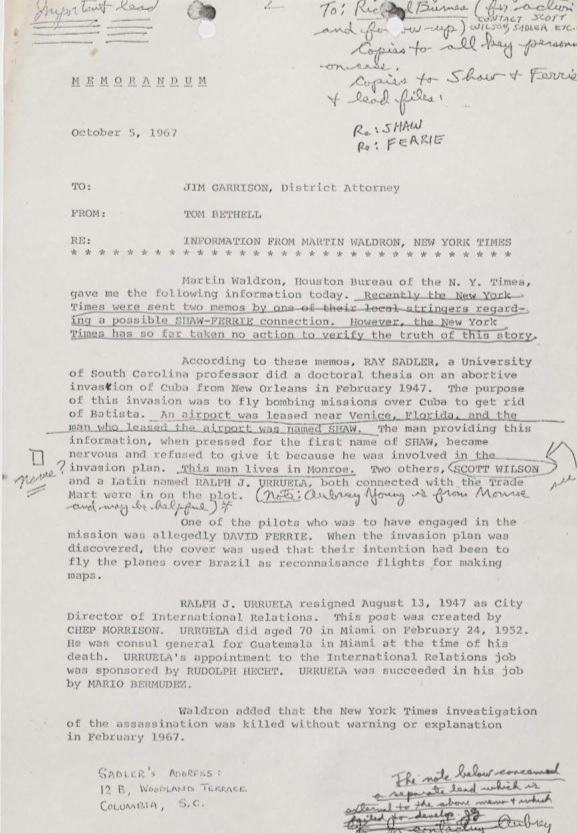
    In other words, at about the time Garrison’s inquiry was being exposed against his will by local reporter Rosemary James, The Times pulled the plug on their own inquiry.. When, in fact, they had leads in their files that backed up the DA. This parallels what Time-Life did through editor Holland McCombs, due to his friendship with Clay Shaw. (Click here for details https://www.kennedysandking.com/john-f-kennedy-reviews/last-second-in-dallas-part-1)

    Respected researcher David Boylan sent me this provocative piece of information about another interesting occupant: “I’m not sure if you guys have seen this. EAR’s (Emilo A. Rodriguez) statement just before he became a full-time employee. Page 6 is pretty interesting. He worked for the Berlitz School located at the ITM. His brother Arnesto would later run the Berlitz school and attempt to teach Oswald Spanish.”

    https://www.maryferrell.org/showDoc.html?docId=181877#relPageId=1.

    “The signature is still redacted but I’m sure it was signed by David Morales. Morales had been working with EAR and Sforza in Cuba and exfiltrated them both in June 1961.Szorza would get an office but Morales wanted to keep EAR away so that EAR could continue his deep cover work.”

    Summary

    In parts 1 and 2 of this series, it was demonstrated that when Oswald started an FPCC chapter in New Orleans, he did so to infiltrate it as an informant.  

    In part 3 of this series of articles we have not only sealed the deal on proving that Oswald’s FPCC activities were simply a role he was playing as part of city-wide anti-Castro offensive that had national backing. We also show how Oswald and Clay Shaw’s work environments overlap in terms of contacts, mission and activities.

    It was in the ITM’s DNA of that day to support anti-Castro efforts through propaganda, funding, organizing and networking as covertly as possible. Clay Shaw and Oswald’s intelligence fingerprints go back years before their appearances in New Orleans. Richard Schweiker of the Church Committee famously stated that everywhere you look with Oswald you find the fingerprints of intelligence. Shaw let his spook-slip show a number of times through his reckless socializing and hobnobbing with David Ferrie as well as through his anti-Communist support activities, network links and association with Permindex. Which in those day were not just a patriotic duty: in the New Orleans business community, it was part of people like Clay Shaw’s understood job description.

    There has been a lot of discussion about the close physical proximity of 544 Camp Street to Banister and right-wing activists. Thanks to the Garrison files, we can work on proximities within the networks Oswald and Shaw shared. It is within these associations–which in the mind of their members were noble and deemed essential–that a few key people on a need to know basis exchanged money, orders and words that contributed to the murder of a President who was not in tune with a national mission, and thus considered a national threat. There was also a need to cover up and create distance between network members and Oswald.

    One member of this network that has not been discussed yet was a muscular Latino who was often seen accompanying Oswald, or perhaps an Oswald double. He was considered so suspicious that the whole Garrison team was on the look-out for him. He was never identified. He was seen so often and described in corroborative terms that can leave no doubt that Oswald, the supposed lone-nut drifter, had at least one escort.

    Stay tuned!

  • Oliver Stone in Quebec City (Part 2)

    Oliver Stone in Quebec City (Part 2)


    see Part 1

    The Panel Discussion

    That afternoon Oliver, Jim, and I would be part of a panel animated by rising TV star Rafael Jacob in a small, packed venue of some 73 members of academia, assassination buffs, journalists who were there by invitation only.


    The atmosphere was electric, friendly, and focused. Many in the audience had been enthralled by Stone’s movies. I believe that one question I asked the audience that helped us gauge their level of knowledge was how many of them had seen the Zapruder Film. Just over 50% raised their hands. This really helped us adjust our explanations in accordance to who was there.

    The audience heard compelling evidence that there was a front shot, that Oswald was intel-linked, and that what history books were relating to students (mostly the Lone Nut scenario) was unconscionable. Rafael at first wanted to have all three of us on for fifty minutes and then only Oliver for the second half. He revised himself, the audience was so entertained by what they had heard that he announced that all three of us would be there all the way through.

    During the break I had time to chat with Oliver.

    Paul: How are you doing Oliver?

    Oliver: There is not enough oxygen in the room.

    Paul: Jim and I have your back. Have fun, they love you.

    Oliver: Thanks.

    The main highlight in the second half was the projection of a grainy, three-minute testimonial by Abraham Bolden, the first black secret service agent, who had been hand-picked by Kennedy and had been railroaded into jail for trying to tell the Warren Commission what he had witnessed in terms of suspicious behavior by some members of the Secret Service in and around a planned presidential trip to Chicago—something I had discussed in the documentary.

    It took a while for Oliver to understand that this was Mr. Bolden until he thanked Mr. Stone for helping him get a presidential pardon one month earlier. There was an eruption of applause in front of Oliver, whom I was told was misty eyed.

    The panel ended with warm applause, handshakes, and photo requests. Rafael told Jim that we should do a road show. I received a number of heartfelt congratulations. Over seventy people who would now have serious doubts when someone would call Oswald the lone assassin of JFK. The onlookers were clearly impressed, including Mr. Jean François Lépine among them.

    Back in our lounges:

    Oliver: Tell me Paul, who made the Bolden video.

    Paul: Len did.

    Oliver: Thank you so much, can you send me a copy?

    Paul: You bet.

    That evening Ken Hall would host us for a special supper at the Château Frontenac. Our goal to celebrate three years of making and promoting the documentary that would help cement the position of conspiracy advocates as measured, logical, and based on a solid foundation of evidence would be met. Everything was first class. We were all content but tired. We needed rest. The next day was our last one, but would be far from the easiest.


    June 15

    This was the day that would make or break the event. By their count, Oliver and Jim went through some eight interviews that day alone, which seem to have gone rather well according to Jim. However, the organizers were being seriously challenged by some in the media. “In hindsight, given what is raging in Ukraine do you regret hosting a Putin apologist?” was a typical question. Ouch! This was not part of the plan.

    In the final analysis, as a friend of mine accurately put it, for many, the event had morphed into a political story instead of being the cultural event it was intended to be. This is what stood out in the final third of a conversation between Mr. Lépine and Mr. Stone: The 600 plus in the audience who had come to learn from one of the greatest contemporary filmmakers instead witnessed a debate about how and why Mr. Stone interviewed dictators, most notably Vladimir Putin.

    Before the final event got started, many of us met on the spectacular Le Diamant terrace, where we got to chat, exchange handshakes, take pictures, and enjoy hors-d’oeuvres and refreshments. I got to shake hands with Mr. Bernatchez and wish him good luck in his upcoming career moves and he thanked me for my email message. I also chatted with a dear friend, Lynda Beaulieu, who manages both Le Diamant as well as her famous artist brother Robert Lepage. Of course, our guests would be there, as well as Mr. Lépine, whom I got to meet for the first time.


    Jean-François Lépine

    I cannot do justice to the distinguished, illustrious career of Lépine. (Click here for details)

    Just before the interview, he talked to me about how he faced some pressures from colleagues and fought off some dis-information attempts in so many words. He asked me if I heard his Lagacé interview, where he felt compelled to correct a fellow journalist on air and whether I knew so and so who had dug up dirt on the interviewee. Very nice, well-spoken veteran. He had done his research on Oliver and looked forward to the event.

    The Interview

    At least in part, it was an interview. The intro was dramatic: Two empty golden colored sofa chairs awaiting the stars with music from a Stone movie in the background: beautiful lighting, 600 audience members feeling suspense. Mr. Lépine first entered the stage under a warm applause. He began by defending the event, the audience, and our guest from the criticism by some in the media. He described a legendary filmmaker in glowing terms. He was supported by a four-minute, vibrating video of Oliver`s career. Oliver arrived on stage to a standing ovation. The chemistry between the two seemed good…at first.

    While I applaud the interviewer for having done his homework, I was disappointed in the format.

    Let me explain: Two years earlier at our college I had the pleasure of receiving Canada’s all-time greatest adman: Frank Palmer. We organized a panel and used the screening of memorable ads: going through the decades our guest toiled away in and would have Frank analyze the commercials that marked each period, many of them his, while he would give anecdotes and provide students with life lessons. It was a beautiful evening for our college in terms of honoring, entertaining, teaching, and involving the audience.

    The film lovers would have loved to hear Oliver comment on scenes from his movies that could have been projected for all to see, discuss challenges he faced, actors he directed, awards he won.

    The last one third of the evening turned into a testy debate. Mr. Lépine disagreed with Oliver’s “pandering” to dictators when interviewing them. Mr. Stone answered that there would be no interview if he had used Lépine`s approach. Lépine said, “You know that you could never have made a movie like Platoon in countries run by these dictators.” Stone said that, while it is important to show empathy when producing movies or documentaries, it does not mean we agree with the subject. Lépine asked why he did not make a film about Mandela, to which Stone retorted, “because there are already fifty of those out there.” Quebec City meets Oliver Stone had been politicized.

    This was not going as I had hoped: A journalist companion of mine found that the guest was always being cut off, Oliver’s wife left for a while in dismay, and an audience member walked down to admonish Mr. Lépine: “I paid to hear Mr. Stone talk, not you!”

    The one thing that resonated most with the audience was when Oliver said, “that the problem right now is that the world does not need more escalation, we need diplomacy and peace initiatives which are sadly sidelined.”

    The show ended with strong applause from the audience. Mr. Lépine graciously invited Mr. Stone to have a late dinner at the terrace next door. The organizing team followed. Despite the raucous debate that occurred a few moments earlier, the two septuagenarians had a cordial discussion and left one another on good terms.

    I had an opportunity to ask Mr. Lépine at this time what he thought of the JFK assassination. He said that he and his colleagues in journalism school thought the Warren Commission was a joke. Another journalist colleague of his sitting beside us nodded in agreement. Mr. Lépine also asserted that the big problem with journalists today was not partisanship, but laziness!

    Rafael then talked to me: “Paul you know that none of this would have happened without you!” Pretty heady stuff…a feeling of triumph and mental fatigue overcame me.

    After tooting my own horn and those of the contributors during a Black-Op Radio interview with Len Osanic and Jim DiEugenio just a few days after the departures, my initial appraisal of complete success, was tempered somewhat by other reactions that were coming in and that were not so laudatory, counterbalanced by some staggering viewership metrics. The bag was a mixed one, but mostly favorable.

    The Aftermath

    The documentary ended its promotional tour on a high note with packed venues, enthusiastic applauses, and a visibility unheard of, emanating from a City of less than 1 Million Francophones. The clipping reports from the PR firm confirm that between the dates of June 13 and 21, excluding social media, 27 million impressions about the event were generated. I repeat: 27 million! From my estimates, if we had included social media, media exposure generated from Quebec City since December (keeping in mind that the press release was sent out in around April and that I was heavily interviewed for months), and still more media coming in. The total impressions may indicate nearly twice that number—the 27 million—as a potential audience. If we consider that articles have between 2.5 and 5 times more impact than paid ads, this number is breathtaking. Indeed, I have received congratulatory emails from all over the province.

    The other element that is notable were the number of mainstream media journalists, including Mr. Lépine, who were on the record stating things like: Jim Garrison was vindicated, that there were other inquiries after the Warren Commission that indicated that there was a conspiracy, that the Warren Commission was not believable, that there had been a plot.

    On Friday June 16th, Mr. Lépine was interviewed on FM 98.5 in Montreal by Alain Crête about the event, where he stated that “the movie JFK caused the declassification of hundreds of thousands of pages of documents and there were government inquiries subsequent to the Warren Commission that exposed a conspiracy, that there was more than one shooter. (Click here for audio) This, my friends, is historical!

    Many other journalists who were not specialized or knowledgeable about the assassination were very open to the possibility of a conspiracy. Those who saw the documentary found it very compelling. The only negative press about the documentary that I was aware of came from journalists who had not seen it and used the same tired labels to try and paint conspiracy theorists as quacks.

    In Québec, we can now say that U.S. government inquirers and many in our media agree, at least to some degree, with the probability that some sort of conspiracy occurred in the assassination of JFK. At a minimum they have doubts about the lone nut version. This is a huge victory. Kudos to Oliver Stone, Jim DiEugenio, and Rob Wilson.

    Where things did take a negative turn, however, was when a fast-emerging side-story became controversial, sparked by Putin’s ill-thought decision to invade Ukraine. This caused Oliver Stone’s interviews with Putin, which ended some five-years ago, to take a lot of space in the press mid-way through the event and during the last interview. Here I have to temper my opinions by the fact that I have not yet seen the interviews. I will do so soon, in order to form a better opinion.

    I have however tried to piece together some of the press coverage that has taken place over time and one can note very different reactions: Press coverage varies tremendously when the interviews were first aired some 5 years ago. U.S. press tends be mixed or negative and foreign press is more positive as far as I can see. Here are two examples of coverage:

    Forbes Magazine:

    Stone’s interviews simply give voice to the man behind a country where media objectivity is mediocre at best. If we can count on Russia Today to hem and haw about Washington and the perils of fracking, then so can we count on our political media to do the same about Russia.

    Stone takes Putin to task at times, saying he looks like a “fox in a hen house,” when he imagines out loud that there might already be a secret battle between the U.S. and Russia in cyberspace. “I believe cyber warfare can lead to a hot war,” says Stone. “Is Russia doing something about it? Come on, Mr. President, lay it on me…”

    Putin tells him, “Maybe. For every action…there is a counteraction.”

    From the Figaro:

    Vladimir Putin exposed in the last episodes

    If the first two episodes seem to boil down to long interviews between the two men where the geopolitics of the last seventy years between the United States and Russia is evoked with “a simple observer’s gaze” deplores the New York Times.

    Oliver Stone hardens his tone towards the end of the documentary and obtains from the Russian president his position on the thorny issues of the moment: Syria, Crimea…He even reserved for the end of the documentary, a sequence where he asks him about his involvement in the 2016 US election. A feat praised by the press.

    Invited this evening from France 3, Oliver Stone will be able to defend himself from all these criticisms. On the other hand, it is not certain that the “mental power” exercised by the head of the Kremlin and the “hysteria” observed in the United States by the director on the American people are strong enough in France to guarantee France 3 a large audience.

    Locally, and abroad, I have not seen any negative comments about Oliver Stone coming to Quebec City before the invasion. Furthermore, the Putin interviews were shown on Showtime and advertised for broadcast on March 19, 2022 by TVQC. (Click here for details) Should these stations be vilified?

    Here are some other questions we should ponder:

    If you were a journalist, would you have refused the opportunity to question Putin? Even if you knew that there would be rules, constraints and a certain decorum affecting your liberties? Oliver Stone once said, “If Vladimir Putin is America’s greatest enemy, then we must at least try to understand him.”

    What other current filmmaker would even say something like that? Oliver can do so based on JFK’s Peace Speech, which no president since has ever come close to.

    A message from me and Oliver

    Hi all,

    Just wanted to thank the students, teachers, and other Sarah Lawrence College (SLC) colleagues who participated in this wonderful moment for our City.

    Having spoken to the organizers, audience members, the managers of the three packed venues and the Château Frontenac (SLC partner Ken Hall), and guests, I think this was a real shot in the arm for our city and the Film industry.

    While our Oscar winning VIP guest has taken positions that not all of us necessarily agree with (unanimity on issues he discusses is impossible), everyone I spoke to, including many members of academia, came away with wonderful memories of moments they will cherish forever and were especially united around Mr. Stone`s cry for diplomacy and peace.

    I wanted to especially thank our own Nancie Moreau for her incredible efforts in hosting, guiding, and comforting our beautiful guests. She gained incredible friends and I believe genuine interest in her wonderful book about Tesla. Two of our SLC students/Bloom members, Amélie Caron and Océanne Côté Garand worked impeccably with the organizers in receiving audience members for a panel discussion and deserve our thanks. They really enjoyed the experience, grew their network, and added another feather in their cap.

     Thank you, Ken Hall, Robert Mercure of Destination Québec, Valérie Bissonnette of Vélocité, Martin Genois of the Festival du Cinéma, SLC alumni Geneviève Doré, Rafael Jacob (super animator/interviewer), my daughter Vanessa who was with me every second, my unbelievable financial wizard and SLC friend Martin Brassard who bought 130 tickets and our guests from out west and all their team members.

    Looking forward to sharing stories, some public and others behind the scenes.

    On that note I wish you all a great summer.

    Paul Bleau


    Paul, 

    Appreciate your note. I did have a good time and a warm welcome from your friends. Too bad about Len, but the people I met there stood out. Thanks to Ken Hall, Valérie and Geneviève, and Martin, who was terrific with me. I don’t think I met the other Martin, but thank him, please. It was a memorable trip.

    Oliver

  • Oliver Stone in Quebec City (Part 1)

    Oliver Stone in Quebec City (Part 1)


    June 2019

    This is when I was in receipt of a letter from Oliver Stone saying that he was putting together a documentary, as he termed it, a follow-up story, to his 1991 feature film JFK. One part read as follows:

    Rob Wilson, Jim DiEugenio, and I are seeking to put this information together under one roof in a documentary that will be clear to John Doe. We’re focused on examining the evidentiary findings of the ARRB and would like to interview you for the film to discuss the Tampa and Chicago assassination plots.

    Lastly, as this project has not yet been announced, please keep all of this confidential.

    We hope you’ll be able to be part of this film and we look forward to hearing from you.

    Best regards,

    When I got this message I knew it was genuine because the person I write articles for, Jim DiEugenio—the world`s leading JFK assassination expert—knows Mr. Stone and had talked about making such a project.

    September 2019, Georgetown: First Meeting

    I had been interviewed by Oliver Stone for about one hour about the prior plots to assassinate JFK for his upcoming documentary. I got to meet Jim DiEugenio in person for the first time, as well as producer Rob Wilson and even chatted with Doug Horne—one of the top guns from the ARRB. Heck they even had a make-up person for me.

    Then between two sips, almost out of nowhere, Oliver Stone enters and heads to the counter to grab a bite. Opportunity knocks! I approach him.

    Paul Bleau: Mr. Stone, I would like to thank you for this opportunity. It has been a great honor for me.

    Oliver Stone: Thank you for coming.

    PB: When it comes time to promote the documentary, you may want to come to Quebec City. I am certain you will receive a warm welcome from open-minded people.

    OS: Hmmm, why not Montreal?

    PB: Montreal is beautiful, but wait until you see Quebec City.

    OS: It must be beautiful up there during the Autumn.

    PB: Gorgeous and it is during the time of the Quebec City Film Festival.

    OS: Hmmm.

    2019 to 2021: Putting Together a Package

    Receiving a Hollywood mogul was really not an expertise of mine. I called Louis Côté who was our recently retired mayor’s right-hand man. Oliver Stone coming to Quebec! Let me set you up with Robert Mercure, who heads our tourism association: Destination Québec. Robert and I spoke and, in very little time, he said: Let’s make it happen.

    We were offered some funding and Robert himself recruited the Château Frontenac and its brilliant manager Ken Hall to host our guests. By now, it was Fall 2021.

    None of us knew much about handling a cinema-related event, so I called Valerie Bissonnette. She and I go back about 25 years. Valérie founded her own production company in 1998, known today as Groupe Vélocité. She has done much to make Quebec City an international hub for film production. Having seen her incredible efficiency in documentary launches, I knew she had to be part of our team. Now, with some backing, I sent a message to Mr. Stone and his entourage in September 2020, inviting him and Jim to Quebec City.

    It was followed by this answer:

    Paul,

    I’m not going to be able to do this for you. I’ve been doing far too much interviewing for my book and still have a ways to go with different countries.

    It would be almost a year later before I would try again. This time the answer would be positive. Mr. Stone would come here in person on December 16, 2021, shortly after the North American debut of the documentary on Showtime, scheduled for November. What changed? The film had been launched and was very well received at the Cannes Film Festival in August. It was time to sell it in North America, where anything about the assassination has been greeted with crossed arms compared to markets abroad.

    Mr. Stone and Jim DiEugenio were to spend three days with us. Then disaster struck: COVID reared its ugly head again and travel costs skyrocketed. We did not have enough funds and could not face the pandemic risks.

    Winter 2022: The calm before the storm

    The documentary aired on Showtime on November 22, 2021. Everyone I know who saw it became convinced there was a conspiracy. I received kudos for how I explained that there was a template that could be observed in prior attempts to assassinate JFK. This led to a call from Peter Black of the Chronicle Telegraph and this created an appetizer story that took flight locally: how did a Quebecker ever make his way into an Oliver Stone documentary?

    I also teased that we were trying to get Oliver Stone to come and visit us in the Spring. Really! That would be incredible for our city.

    By February, thanks to Valérie, the Quebec City Film Festival joined the fray as well as private sponsors. After two years of COVID forced hibernation, the Festival was planning a new format: Instead of living solely on a ten-day Festival in the Fall, it would remain visible year-round by inviting industry legends to our City. What better way to kick it off than with Oliver Stone?

    By late February, Oliver and Jim agreed to come. Everyone was hard at work getting organized: a galvanizing shot in the arm for our tourism industry that would kick off our summer season with a blast. The coverage was massive and widespread and even included the foreign press. Quebec City’s film industry would be on the map. The venues were filling up quickly. Things were looking up. And then Russia invaded Ukraine.

    The Build Up

    Oliver Stone is easily one of the top five filmmakers of his era. He and his movies have been winners of numerous Oscars, Golden Globes, and other prestigious awards. He is also a multi-medaled Vietnam War veteran. Among his movies that most influenced me were Platoon, Wall Street, and JFK.

    His book Chasing the Light is a must-read for anyone interested in movies or examples of courage and determination. Mr. Stone also is candid about his mistakes. When he interviewed me, I was struck by his genuine interest in what I had to say, his jovial nature, and his professional approach.

    Accompanying him would be Jim DiEugenio, my editor, and mentor. He, of course, was the writer of the documentary.

    They would be joined by the famous leading JFK assassination interviewer, Len Osanic. Len is the producer of the long running Black Op Radio series, the best JFK radio show there is. It was through Len and Jim that I was in a position to start this adventure. Without them, I would not have been interviewed by Mr. Stone.

    On the hosting side of things, Martin Genois put together a dream team of drivers, guides, photographers, aides, PR specialists, pundits, animators, etc. He worked up a perfect itinerary and lined-up mesmerizing venues. I was able to contribute interns, sponsor contacts, and I recruited my daughter and my colleague Nancie Moreau from our college, who wrote a fine book about Nikola Tesla and had the perfect personality to cement new friendships.

    The problem we were facing was that because of the Ukraine invasion, and the fact that our VIP guest had interviewed Putin some five years earlier, media interest in Mr. Stone`s visit began shifting from his JFK documentary and his legendary moviemaking to his relationship with Putin. This put the organizers in a tricky situation: How could we roll out the red-carpet for someone who was now being labeled a Putin apologist?

    Having spoken to Mr. Stone, he is probably the last man on Earth who would agree with Putin`s tragic, ill-thought decision. He has even said so. None of us were for this. The practice firm I supervise at the college had even developed a Vodka for Peace campaign for a local distiller.


    The PR team came up with an effective strategy: Mr. Stone and DiEugenio, after the showing of the documentary, would only field questions about the film. The second event would be a panel discussion focusing on the assassination in general and during the marquis event, a seasoned journalist would talk about Stone’s career, including his controversial interview/ exchanges, as could the press during interviews that were lined up. This way no one could be accused of mindless stargazing.

    Behind the scenes, pressure was mounting on one of Quebec’s larger than life journalists, Jean-François Lépine, to take on Mr. Stone aggressively during his interview at Le Diamant. The stage was set for two septuagenarians to lock horns during Mr. Stone’s final evening with us in front of a packed house of 600 people.

    Pre-arrivals

    Things got off to a rocky start. A few days before our guests arrived, I received an email from Oliver. He wanted to talk. “Please let this not be a last-minute cancellation,” I thought!

    The phone rings:

    OS: Tell me what will happen when I arrive. Can we get a lift?

    Oliver’s secretary was on the line also: Oliver, do not worry, Maxime will pick you up, he’s the guy who drove Paul McCartney around.

    OS: Paul McCartney, oh OK. Paul, what kind of clothes should I bring up?

    PB: Be certain you have a windbreaker.

    OS: What will we do during our first day?

    PB: It’s an open day for you to just relax…talk to Maxime and Geneviève (the lead hostess), they can feed you full of ideas…or I can have Nancie meet up with you. In the evening, you can come to my cottage, 40 minutes away in the wilderness, for a BBQ.

    OS: That sounds good.

    PB: I must tell you, there are bugs this time of year.

    OS: Bugs, I must say I hate bugs.

    PB: Oliver, I read your book, if you can handle Vietnam, I think you can handle a mosquito.

    And so on…

    Thinking back…what a lousy quip. Vietnam, to a veteran of that mindless war was nothing to slight. When Oliver Stone comes to our city, show some respect.

    On the positive side: Two Montreal dailies interviewed Jim and Oliver before their departures.

    June 10-11

    Because of COVID related staff shortages at our airports, it took Oliver 12 hours to get here from L.A. instead of 7 or 8. Jim, for reasons out of our control, arrived a day later.

    June 11th was when Len and his wife arrived at the airport and I enjoyed a coffee and croissant with them in the old town along the riverside, before dropping them off at the Château.

    The six out of towners headed to the cinema after a late supper to see the Top Gun sequel.

    June 12

    Our guests used this day for touring and discovered the hidden gem that is our Provincial Capital: beauty, history, culture, nature, the Château, the Riverside…all done by a very pleasant and erudite tour guide.

    In the meantime, I was interviewed by a curious and knowledgeable radio host. It went very well and I invited him to the panel discussion.

    June 13


    JFK: Through the Looking Glass

    The CLAP Cinema reserved its largest room for the showing of the documentary. Its 260 seats sold out in a matter of days, without even promoting the event. We were not able to secure any added rooms, because of the blockbusters opening that week, otherwise we could have tripled the attendance rather easily.

    There was a buzz that evening rarely seen for a movie in our city. The combination of COVID-free leisure and the presence of Oliver Stone was magically palpable. The cameras were rolling and some people were in disbelief that the famous director would address the crowd.

    I was accompanied by a lawyer friend of mine, plus family and work companions. Their reactions to the JFK case, as written for the screen by Jim DiEugenio and presented by countless experts, charts, and archive footage left them bewildered and shocked. The documentary’s closing was followed by a standing ovation.

    The crowd assimilated devastating facts about broken chains of custody, a Keystone Cops quality autopsy performed by three manipulated pathologists with almost no experience in gunshot wounds, powerful evidence of a front shot, strong witness evidence that cast doubt on Oswald even having been in the sixth-floor sniper’s nest, destruction and manipulation of evidence, Oswald’s intelligence file manipulation, bullying and intimidation of witnesses, proof of altering of photo and autopsy evidence, countless examples of how and why Kennedy had powerful enemies. This was the two-hour version. Imagine what the reactions would be had they seen the four-hour, even more detailed version called JFK: Destiny Betrayed.

    One thing that was perhaps difficult for the audience to comprehend was the formidable status of some who we hear talking in the film, both as experts and in archive footage: Warren Commissioner Senator John Cooper; Sen. Richard Schweiker of the Schweiker-Hart subcommittee to the famous Church Committee hearings; the House Select Committee on Assassination’s (HSCA) lead initial counsels Richard Sprague and Robert Tanenbaum; Doug Horne, one of the chief investigators on the Assassination Records Review Board (ARRB): all attacking the Warren Commission fairy tale. And these represent a small fraction of most inquiry insiders who sound a lot more like the conspiracy advocates than the Warren Commission acolytes.

    At the end of the documentary, audience members were given the chance to ask questions answered by the tandem of Oliver Stone and Jim DiEugenio. Oliver giving the big picture, Jim following up with fine details, sources, and added insights.

    At one-point Mr. Stone underscored my participation, which led to applause for a local contributor and my taking a bow. Based on reactions of the crowd, friends of mine, my lawyer companion, it is doubtful that even one person left that evening believing that the assassination of JFK was committed by a lone nut. Two young history students thanked me and looked enthralled by what they had just seen. Even one of my brothers, who has an immediate reflex of dismissing conspiracy theories—which by the way tends to be my own attitude towards the conveyor belt of endless anti-establishment yarns—stated: “There is no way that bullet (the magic bullet) caused all that damage.” Marquis event number one was an unqualified success. In the background however, resistance to Oliver’s presence and an attack on his credibility were building.

    June 14

    Before this date, I had been interviewed over a dozen times about the event and the assassination. All positive, focused on the good news for our city, tourism, our film industry, and genuine interest about the assassination and the documentary. My interview on this morning at French CBC Radio with a well-respected morning man would be different.

    Mr. Bernatchez, a gentleman with a distinguished career, came to shake my hand before I was on air. He had an all-business air about him that foreshadowed what would be his skeptical tone during our 12-minute talk. This was further confirmed when a poker-faced assistant of his asked me if I believed all this stuff involving intelligence in the conspiracy. I responded yes, when I really should have pointed out the complexity of the case.

    For example, when he asked what I based my affirmation about there being prior plots on, I answered that the plots I discuss in the documentary were about Chicago and Tampa during the month that preceded Dallas. I explained that there were FBI files (I should have added HSCA) about Tampa and that the Chicago plot was based on Edwin Black’s research as well as Secret Service agent Abraham Bolden’s witnessing of the goings-on. He seemed surprised. When he said that the conspiracy was not acknowledged by the media, I talked about how five government investigations that succeeded the Warren Commission and revelations from these as well as from the investigators/insiders themselves presented a very different account from what is concluded by the obsolete Warren Commission—which is what seems to be the basis on which Lone Nut scenario believers continually turn to.

    At one point I answered a question about press complacency on this issue by stating, “You would have to ask the press why they are not pouring through the declassified files.” He said, “Now you are accusing us of cooperating in the conspiracy,” and I replied, “Perhaps it is just a lack of interest.” That is how it ended.

    I came out worried that I sounded hesitant, confused, and lacking in credibility. When I listened to myself later, I was OK with how I answered: calmly and factually. If I had to redo it, I certainly would have been better documented, ready with French wording, and I would have tried to understand the nature of the skepticism. Nonetheless, I sent Mr. Bernatchez a friendly email thanking him for his time, congratulating him on his excellent career, and offering to have coffee some time to further discuss this.

    Other things were happening that day at a frantic pace: some good, some not so good. In the not so good category, Montreal’s La Presse published an article blasting Stone, calling him an apologist for Putin and a conspiracy theorist with a plea to not go to the Le Diamant finale event. (Too late, it was almost sold out). According to this journalist, Stone was Putin’s friend and vocal chord as well a teller of wild tales. The organizers were pandering to a controversial loose cannon and so on and so forth. The writer had not seen the documentary: a common denominator of many of the critics.

    On Montreal’s CBC morning show Jean François Lépine was interviewed by the CBC’s Patrick Lagacé and Catherine Beauchamp (click here for audio). Mr. Lagacé, referred to the blistering La Presse article about Stone calling him an apologist and a conspiracy theorist whose movie JFK was revisionist, full of a mish mash of baseless claims. What happened after the intro left me positively dumfounded: Mr. Lépine retorted that Oliver Stone was a great film-maker whose story about Kennedy was so misunderstood. It constituted the chronicling of D.A. Jim Garrison, who despite his defeat was later vindicated when it was confirmed that Clay Shaw, the defendant, was in fact CIA attached. He added that other government inquiries proved that Garrison was spied upon and that there was a plot (more than one shooter). The film JFK was responsible for the creation of the ARRB and the declassification of hundreds of thousands of document, many vindicated Garrison and proved there was a conspiracy. He said that the Warren Commission was discredited and defended researchers like myself and Jim DiEugenio.

    As a prelude, he did express strong disagreement with Mr. Stone’s “pandering” to dictators.

    Mr. Lagacé seemed somewhat taken aback. He too had not seen JFK Revisited: Through the Looking Glass. He asked Mrs. Beauchamp, who had seen the film, what she thought. Among other positive comments, she said how she enjoyed the way they linked Oswald to intelligence, how the CIA had files on him despite claiming to the Warren Commission that he was not on the radar and that he was removed from a watch list just a few weeks before the assassination. She also described how the documentary discredited the single bullet theory and revealed destruction of documents. This to me was historical! A Quebec media Golden Boy saying that there was a conspiracy re-enforced by a CBC journalist on mainstream media. I wish I had been aware of this before my interview with Mr. Bernatchez.

    In the meantime, some media began challenging the organizers on why they had invited Oliver Stone given his relationship with Putin.

    see Part 2

  • Exposing the FPCC, Part 2

    Exposing the FPCC, Part 2


    see Part 1

    “Follow the money” is one of the things that the FBI and Warren Commission did not do in trying to understand how such a destitute person like Oswald could run an FPCC chapter, raise a family, and save money for Marina (at least $1600 in today’s money).[1] He was so poor that the White Russians paid for his YMCA fees.

    The FPCC added the following to this drifter’s cost of living: FPCC membership fees, renting of a space, hiring leafleteers, paying a fine for disturbing the peace, the purchase of rubber-stamping equipment, personal displacements, printing of up to five different pieces of literature, correspondence with the FPCC, and use of a Post Office Box…with not one single member to help absorb the costs.

    The following exchange between Oswald’s lawyer and Wesley Liebeler of the Warren Commission suggests something more plausible than Oswald giving away time and money for a passé organization rather than focusing on his growing family—he was paid $25 a day (Note that Oswald’s job at the Texas Schoolbook Depository paid $1.50 per hour):


    Oswald’s slip was showing

    Admitting his remuneration to Dean Andrews and stamping 544 Camp Street on his handouts were not Oswald’s only mistakes that would ultimately blow his cover.

    Shortly after launching the FPCC Chapter in New Orleans, Lee sent out two honorary membership cards to Gus Hall and Benjamin Davis, two senior members of the American Communist Party, even though after his return from Russia he wrote the following in his diary:

    The Communist Party of the United States has betrayed itself! It has turned itself into the traditional lever of a foreign power to overthrow the government of the United States; not in the name of freedom or high ideals, but in servile conformity to the wishes of the Soviet Union and in anticipation of Soviet Russia’s complete domination of the American continent.

    In a letter dated August 1, 1963, postmarked August 4, Oswald wrote to Vincent T. Lee, head of the Fair Play for Cuba Committee in New York,

    In regards to my efforts to start a branch of the Fair Play for Cuba Committee in New Orleans…I rented an office as planned and was promptly closed 3 days later for some obsure [sic] reasons by the renters, they said something about remodeling, ect. [sic] I’m sure you understand after that I worked out of a post office box and by useing [sic] street demonstrations and some circular work have substained [sic] a great deal of interest but no new members. Through the efforts of some cuban-exial [sic] ‘gusanos’ a street demonstration was attacked and we were oficialy [sic] cautioned by the police.

    The problem with this letter was that the incident Oswald seems to be referring to occurred on August 9th, more than a week after he first wrote about it. Was Oswald describing a scenario for the upcoming theatrics on Canal Street over which he would be arrested and arraigned in court?

    When Oswald debated anti-Castro Cuban exile Carlos Bringuer, he was asked how he lived in Russia: “Did you have a government subsidy?” Oswald answered; “Well, I worked in Russia and, I was under the protection of the United States, Uh I was under the Uh that is to say, I was not under the protection of the United States Government. But, I was always considered a United States citizen.”

    It was not just Oswald who blew his own cover. Antonio Veciana, who was David Phillips’s go-to guy in the Cuban exile community for some thirteen years, told Gaeton Fonzi—and later the whole JFK research community—that he had seen Phillips talk to Oswald in Dallas in September 1963.

    Oswald’s participation in the training of anti-Cubans was caught on film according to Robert Tanenbaum, Chief Counsel of the HSCA, during his interview with Jim DiEugenio:

    JD: Was it really as you described in the book, with all the people in that film? Bishop was in the film?

    BT: Oh, yeah. Absolutely! They’re all in the film. They’re all there. But, the fact of the matter is the Committee began to balk at a series of events. The most significant one was when [David Atlee] Phillips came up before the Committee and then had to be recalled because it was clear that he hadn’t told the truth. That had to do with the phony commentary he made about Oswald going to Mexico City on or about October 1st, 1963. (Probe Magazine, Vol. 3 No. 5)

    John Newman shows how Dallas FBI claims that they lost track of Oswald, while he was setting up the FPCC in New Orleans all the way up to August 5, lack credibility, especially given his multiple FBI scrutinized correspondences—all occurring before June 6—with the Post Office, the Communist Party, the Soviet Embassy in Washington, and the FPCC, where his New Orleans address was easy to find.[2]

    Another astute observation by Newman is that before August 5th, Oswald’s FPCC recruitment activities were done quietly, almost undercover. They were likely done that way in order to help Banister and the CRC with their background investigations. As of August 5, when he meets Bringuier up until September 25 when he meets Silvia Odio, Oswald repeatedly acts overtly with anti-Castro Cubans while, at the same time, seeking media attention for his FPCC activities.[3]

    On September 16, 1963, the CIA informed the FBI that it was considering action to counter the activities of the Fair Play for Cuba Committee in foreign countries. In New Orleans, on September 17, 1963, Oswald applied for, and received, a Mexican travel visa.[4]

    Another indicator of Oswald’s informant role is what the FBI did not do: Infiltrate the New Orleans FPCC. The FBI did this with FPCC chapters throughout the country, often with multiple informants. And as we saw with Bill Stuckey, New Orleans was well prepared for an FPCC presence in their city. It would have been very easy to have informants answer Oswald’s leafleting by signing up to spy on him—as they did in Tampa, NY, Detroit, Chicago, L.A., Indiana, and elsewhere. But, for whatever reason, they chose not to.

    There seems to be a logical deduction from all this. Oswald was informing on both pro- and anti-Castro operations in New Orleans. But he was also creating a portfolio similar to other FPCC participants in the past to be able to eventually travel to Cuba by way of the Mexico City-Cubana Airlines route.

    Are we to believe that Oswald just stumbled into these right-wing fanatics, Cuban exiles, and old acquaintances who shared a hatred for Castro?

    The FPCC template of informants and/or potential patsies

    In this author’s article, The Three Failed Plots to Kill JFK eight subjects were profiled who shared similar traits to Oswald as represented in the ensuing chart:


    As we can see:

    • Eight of the nine subjects profiled are connected to cities visited by Kennedy during the six months that preceded his assassination.
    • Each of these cities was a territory exploited criminally by Mafiosi of interest in the assassination.
    • At least three moved to the cities and got employment in strategically located buildings along the motorcade route shortly before the planned presidential visit.
    • Seven were ex-military.
    • Eight of them exhibited behavior that can very plausibly be linked to intelligence gathering or Cuban exile interaction.
    • Seven were directly linked to the FPCC. Seven of them had visited Mexico City
    • Six attempted to visit Cuba, three of them successfully.
    • Seven had links to Cuban/Latino exiles.
    • Six were described as having psychological problems.
    • Seven exhibited anti-Kennedy behavior.
    • None were probed seriously by the Warren Commission.

    Intelligence services, notably the Secret Service, kept crucial information about these subjects, as well as the prior plots, totally secret from the Warren Commission.

    By reading the Failed Plots article, the reader will discover how many of the above characters were being potentially framed through linkage to prior plots attempts and their links to the FPCC and how some used their FPCC allegiance to spy on the organization or as a ruse to enter Cuba.

    Another ruse that became clearer with time was that the associations of many of the potential patsies/informants would have had the impact of tearing down the FPCC once and for all, while placing the blame on Castro and providing Psy-Ops propagandists with a storyline tainting the FPCC operations outside the U.S. borders, as well as organizations like the SWP, the U.S. Communist Party, CORE, and others seen as threats to U.S. security.

    Framing the FPCC – a coordinated effort by the usual suspects[5]

    In the Failed Plots article, we show how the FPCC-tainted Oswald, not only put the final nail in the Fair Play for Cuba Committee, he was used to frame Castro as well. A tactic straight out of the CIA’s ZR/Rifle executive action playbook written up by assassination guru William Harvey. Here were some of the P.R. tactics that were described:

    • Cuban exiles: Immediately after the assassination, Carlos Bringuier and John Martino, as well as Frank Sturgis—also a Watergate burglar—pushed the Castro was behind it story.
    • Castro frame-up stories were very quickly leaked to Hal Hendrix, a JM/WAVE friend, and other CIA media assets.
    • Antonio Veciana, leader of the Cuban exile group Alpha 66, confirmed that David Phillips—whom he had seen talking to Oswald shortly before the assassination—had asked him to bribe a cousin of his in Mexico City to say that Oswald was being paid by Castro agents to assassinate JFK.
    • HSCA investigator Dan Hardway confirmed that almost all of the Mexico City stories that incriminated Oswald and framed Castro were created by assets of Phillips.

    On the night of JFK’s assassination and Oswald’s arrest, Dallas District Attorney Henry Wade erroneously stated during a press conference that Oswald was a member of the Free Cuba Committee. Out of all the many onlookers present, it was nightclub owner and future patsy killer Jack Ruby who corrected the D.A.

    Let us now add a few more frame-up artists and their propaganda contributions:

    Ed Butler (INCA) and Bill Stuckey

    Butler’s role in the post-assassination tale got quite interesting. For as Time magazine noted in its 11/29/63 issue, “Even before Lee Oswald was formally charged with the murder, CBS put on the air an Oswald interview taped by a New Orleans station last August.” That night, according to New Orleans Magazine, Butler and the INCA staff churned out news releases about Oswald in order to offset the “rightist” and “John Bircher” charges flying about. Then, Senator Thomas Dodd, who ran the Senate Internal Security Subcommittee, was called up by Butler.

    The Kennedy-hating Dodd invited his acquaintance Ed Butler to testify before his Senate Subcommittee. Apparently completing Butler’s public relations tour, the tape of the WDSU interview was forwarded by the CIA to Ted Shackley at the Miami station and used in the CIA’s broadcasts into Latin America, furthering the legend about Oswald the communist killing President Kennedy. Declassified files reveal that the label on the box with the tape says, “From DRE to Howard.” Howard signifies either Howard Hunt or George Joannides, whose codename was “Howard.” This means that Bringuier’s group (DRE) probably gave a copy to Howard Hunt who forwarded it to the CIA’s Shackley. The Agency in spite of later denials was still funding the DRE at the time of the assassination.[6]

    Ruth Paine (2 deliveries)

    Ruth was not only the Warren Commission’s busiest witness in making the case for the lone nut scenario, she was a prolific provider of timely evidence against Oswald coming straight out of her garage. One of her go-to guys was Irving Police Captain Frank Barger (FBI informant T-4). Barger also had informants who revealed to him a phone conversation between Michael and Ruth Paine on November 23, 1963, confirming their perceptions of a conspiracy when one said[7]:


    From Ruth Paine’s home came important evidence linking Oswald to the Fair Play for Cuba Committee:


    And then you have these strange FBI notes that are at NARA:

    Page 1
    Page 2

    These have, to my knowledge, never been fully analyzed, so I can only give a personal impression: Ruth seems to have asked Barger to send a Russian cookbook and toys to Marina. In the same breath, there are notes identifying two, if not three, FPCC members in Dallas including two Dalmans who, on Harlandale Street, are a stone’s throw away from an anti-Castro Cuban exile meeting place on that street where Oswald was said to have entered.

    We have long suspected that the Paines kept files on Communist sympathizers. Was this some of the fruit of their labor? Did Oswald help supply the names through his short-term Dallas activities?

    Al Lewis Los Angeles FPCC

    Oswald was not the only FPCC member who was slandered. According to Dick Russell,

    Al Lewis, executive director of the Los Angeles FPCC in 1963 and now a retired psychiatrist, remembered: ‘The FBI called me after Kennedy was assassinated, and apparently wanted to involve me in it some way. They tried to pin a relationship with Oswald on me, because apparently, I’d been in Mexico at the same time he was, on my way to Cuba. Well, that was the first I heard about it. And I never heard of Oswald and the New Orleans Fair Play for Cuba Committee in the movement. That whole thing to me was a setup of some kind by the intelligence services.[8]

    Johnny Rossen Chicago and National FPCC

    Johnny Rossen, who had been the head of the Chicago chapter and later became a National Chairman, was also the victim of wild rumors. An FBI report dated November 28, 1963, summarizes a slander campaign by an informant stating that he was a sex degenerate who slept with a Puerto Rican mistress named Carmen Osiokowski, who knew Oswald, who had sent money to him periodically and who hated Kennedy. His source was the mistress. When she was questioned, she denied everything. Upon re-questioning this informant’s story completely fell apart.

    Tony Perez, an informant in Chicago, qualified as a reliable source by the Chicago FBI. He was an anti-Castro Cuban and had provided dirt on Rossen.[9] In a November 30, 1963, TELETYPE from SAC Chicago to Director and SAC Dallas, the FBI is given the following information: That Johnny Rossen had held a number of late-night meetings in his Chicago Theater with FPCC subjects during the days leading up to the assassination. Some two years earlier, Perez a representative of the Chicago Council for a Democratic Cuba, had debated Rossen at Northwestern University in opposition of his FPCC activities.

    Like Oswald, Rossen was able to taint major organizations as he had always been an active pro-communist agitator having been the secretary of the U.S. Communist Party in St. Louis, where he ran for mayor for the party. Later, he would show Russian films in his Chicago Theater. He was active in the American Peace Crusade and Civil Rights Congress. He also used a number of aliases.

    Robert Beaty Fennell San Francisco FPCC

    On December 21, 1963, another Oswald-like character was arrested by the Secret Service in San Francisco for having on him notes containing threats to assassinate LBJ. Not much is known about Robert Beaty Fennell, but this article[10] reveals that he was said to be a member of the San Francisco FPCC, that he had mental problems, was involved in agitations and that he had received an honorable discharge from the Air Force five years earlier.

    Richard Taber National FPCC

    The framing of Oswald and even the FPCC as a group, were not the only lofty objectives of the anti-Castro forces. They planted the ridiculous story[11] that the inaugural head of the FPCC, while in refuge in Cuba, had actually met a Lieutenant Lee Harvey Oswald in 1961 when he himself had “accompanied Castro during the Bay of Pigs Invasion.”


    Given that Oswald was in Minsk at this time, along with Taber’s vehement denials,[12] we can chalk this one up as another red herring designed to stimulate the invasion of Cuba.

    Bringuier’s last gasp

    Even when it became clear that the U.S. was steering clear of any scenario implying a conspiracy and stratagems to attack Cuba, there was an ultimate Hail Mary thrown by a Cuban Freedom Fighter (most likely Carlos Bringuier) in the form of an open letter to the President in October 1964 which stated:


    Vincent T. Lee and Harrold Wilson National and Tampa FPCC

    Vincent Theodore Lee, actually Army veteran Vincent Tappin, was elected Head of the Tampa Chapter in June 1961. On the Board was treasurer Harrold Wilson, who eventually replaced Lee when Lee took over from Richard Gibson as the national Chapter Chairman in 1962.

    Oswald’s actions in New Orleans parroted Lee’s. Lee was heavily involved in leafleting, media coverage, and direct confrontations with anti-Castro Cubans featuring a near riot in November of 1961 in Marti Park, where Sergio Arcacha Smith led CRC forces against the FPCC. Lee appeared on WBAI radio.

    On December 26, 1962, Vincent T. Lee flew from New York City to Mexico City. From there, on December 28, he flew to Havana via Cubana Airlines where he stayed for nearly one month. Oswald corresponded multiple times with Lee, reporting his FPCC agent provocateur coups. V. T. Lee, while providing him with advice, is the one who connected Oswald with Wilson so as to be better coached for his N.O. mission.

    Other than this, not that much is known about Lee, because as a witness during the Eastland Senate hearings, other than defending the FPCC and confirming his military record, he mostly took the Fifth Amendment. The Warren Commission did very little to go into his background during their typical probe light questioning.[13] Lee also lied his head off by claiming he did not know Oswald. The HSCA never got him in as a witness despite obvious interest.

    The following articles are fascinating because they also associate the FPCC with high-profile murderous activity in the U.S., taint Black Liberation Front activists and suggest that Lee and Wilson are informants.


    Here is the lead-in to the article on the Statue of Liberty bombing plot:

    On 16 February 1965 three Americans and one Canadian were arrested in connection with a plot to destroy three of the United States’ most treasured monuments: the statue of Liberty, Liberty Bell, and Washington Monument. The Americans—Robert Steele Collier, Walter Augustus Bowe, and Khaleel Sultran Sayyed—were part of a small extremist organization known as the Black Liberation Front (BLF). The Canadian, a white woman named Michelle Duclos, was a member of a Quebec separatist party.

    In the article, the reader will discover how some of the perpetrators visited Cuba, met Che Guevara who provided “technical information,” and became involved in yet another major incident that would have favored the blaming of Cuba while tarnishing a “subversive” group.[14] (Click here to read)

    Gilberto Policarpo Lopez

    Another extremely important detail in the first article is that the Tribune claims to have a source that places V. T. Lee in Tampa on November 17, 1963, with Gilberto Policarpo Lopez. The FBI would easily know this based on the important number of informants at every FPCC meeting.

    The HSCA described parts of what it called the Lopez allegation:[15]

    Lopez would have obtained a tourist card in Tampa on November 20, 1963, entered Mexico at Nuevo Laredo on November 23 and flew from Mexico City to Havana on November 27. Further, Lopez was alleged to have attended a meeting of the Tampa Chapter of the FPCC on November 17…CIA files on Lopez reflect that in early December 1963 they received a classified message requesting urgent traces on Lopez…Later the CIA headquarters received another classified message stating that a source stated that “Lopes” had been involved in the Kennedy assassination…had entered Mexico by foot from Laredo on November 13…proceeded by bus to Mexico City where he entered the Cuban embassy…and left for Cuba as the only passenger on flight 465 for Cuba. A CIA file on Lopez was classified as a counterintelligence case…

    An FBI investigation on Lopez through an interview with his cousin and wife as well as document research revealed that…He was pro-Castro and he had once gotten involved in a fistfight over his Castro sympathies.

    The FBI had previously documented that Lopez has actually been in contact with the FPCC and had attended a meeting in Tampa on November 20, 1963. In a March 1964 report, it recounted that at a November 17 meeting…Lopez said he had not been granted permission to return to Cuba, but was awaiting a phone call about his return to his homeland…A Tampa FPCC member was quoted as saying she called a friend in Cuba on December 8, 1963, and was told that he arrived safely. She also said that they (the FPCC) had given Lopez $190 for his return. The FBI confirmed the Mexico trip (Lopez’ wife confirmed that in a letter he sent her from Cuba in November 1963, he had received financial assistance for his trip to Cuba from an organization in Tampa) …information sent to the Warren Commission by the FBI on the Tampa chapter of the FPCC did not contain information on Lopez’ activities…nor apparently on Lopez himself. The Committee concurred with the Senate Select Committee that this omission was egregious, since the circumstances surrounding Lopez’ travel seemed “suspicious.” Moreover, in March 1964 when the WC’s investigation was in its most active stage, there were reports circulating that Lopez had been involved in the assassination…Lopez’ association with the FPCC, however, coupled with the fact that the dates of his travel to Mexico via Texas coincide with the assassination, plus the reports that Lopez’ activities were “suspicious” all amount to troublesome circumstances that the committee was unable to resolve with confidence.

    One can add this from DeBenedictis’ well-sourced thesis:[16]

    A Cuban national by the name of Gilberto Policarpo Lopez, attended the viewing of “Ted Lee in Cuba,” at Mary Quist’s home on November 17. Lopez was staying at the Quist residence, while waiting for a phone call with the “go ahead order” for him to leave the United States and go to Cuba. The day after the film showing, President Kennedy visited Tampa.

    One file showed that there were several teletypes and airtels regarding Lopez and Oswald and the possibility that they may have had contact. The airtel message told of Lopez’s travel to Mexico and later to Cuba. The airtel also told of post-assassination correspondence between FBI offices in Dallas, San Antonio, and Tampa. All intended to identify Lopez. Another part of this file, which was released later than other Tampa FPCC FBI files, told that the San Antonio FBI office was the source of the information in the post-assassination period regarding Lopez crossing the border at Laredo. From the 1964 Warren Commission to the 1976 House Select Committee on Assassinations, the change in time was more of a change in broadening of information rather than in a lessening of secrecy. Neither investigation showed a desire for opening assassination files until well into the Twenty-First Century. Since the FPCC was the subject of dossier compilation since its inception, there was much in the way of information. But in its post-assassination classification period, the secrecy surrounding the FPCC had more to do with the Kennedy assassination, and lack of cooperation from intelligence agencies, than from consideration of sensitive material due to the ongoing Cold War.

    Combining the article information and FBI intelligence, what we have is the FPCC National Chapter’s V.T. Lee possibly meeting, at Tampa FPCC’s Mary Quist’s home on November 17, with FPCC tainted assassination suspect Lopez, who, considering his Texas and Mexico travels, likely would also have been linked to Oswald had the pro-Castro conspiracy scenario not been deep-sixed. This also would have torn down the FPCC worldwide, if not the U.S. Communist Party, and could easily have stimulated the invasion of Cuba, given the direct link between Lee and Castro.

    There is a difference between a series of ads and an ad campaign. Ad campaigns have a coordinated rhythm, where there is a huge bang at the launch, followed by reminder advertising in a timely manner. They also have a central theme (called a USP) such as Castro was behind all of this. This P.R. push certainly has all the earmarks of being coordinated by propaganda specialists. Which brings us to the next two sections.

    George Joannides

    Towards the beginning of the HSCA investigation, much headway was being made in investigating CIA files. Things took a turn for the worse when George Bush senior, CIA Director since 1976, decided to clamp down on the scrutiny. A year later, George Joannides was brought in as a liaison between the CIA and HSCA investigators. The HSCA was lied to when they were told that Joannides was not involved in the areas of interest the HSCA was exploring. Quite the contrary.

    George had been the person in charge of overseeing anti-Castro operations in New Orleans. He was now obstructing the HSCA. Joannides had joined the Central Intelligence Agency in 1951 and later became chief of the Psychological Warfare branch of the CIA’s JM/WAVE station in Miami. In this role he worked closely with the Directorio Revolucionario Estudiantil (DRE), a militant right-wing, anti-Communist, anti-Castro, anti-Kennedy group. This was the group that Oswald was in direct contact and conflict with in New Orleans in August 1963.[17]

    Jefferson Morley is credited for much of what we know about Joannides and the fight for the release of files about him. He adroitly underscored the following about him: “Among his primary responsibilities were guiding, monitoring and financing the Revolutionary Cuban Student Directorate or DRE, one of the largest and most effective anti-Castro groups in the United States. CIA records show, and the group’s former leaders confirm, that Joannides provided them with up $18-25,000 per month, while insisting they submit to CIA discipline. Joannides, in his job evaluation of July 31, 1963, was credited with having established control over the group.” Morley also revealed Joannides travels from JM/WAVE to New Orleans in 1963.

    David Phillips

    In a previous article,[18] I have penned for Kennedys And King, I wrote a section on how this legendary disinformation artist for the CIA was a person of interest in the scenario plans around Lee Harvey Oswald in 1963. By reading it, you will discover how his background, role with Amsanta, motives, track record, omnipresence around Oswald, lies to the HSCA, his being outed by colleague E. Howard Hunt and asset Antonio Veciana all point to something sinister. Readers are encouraged to follow the above hyperlink to review the case against Phillips.

    The remarkable thing about Phillips and this story is that he was associated with both of these groups we have examined. In other words, he was at least partly involved with both sides of this pseudo-conflict and street theater. As we have seen, in Oswald and the CIA, John Newman showed that Phillips had a role in the CIA’s campaign to infiltrate and destabilize the Fair Play for Cuba Committee.[19]

    During his questioning by the HSCA, Howard Hunt was asked about his knowledge of the DRE. He replied that, “Dave Phillips ran that for us.” (Deposition of 11/3/78, p. 77) Phillips was in on the beginnings of the DRE. William Kent, a psy war officer out of JM/WAVE, signed-off on Joannides’ reports in 1963. Kent was very familiar with what the DRE was doing at this time. Later on, to private family members, he was asked about Oswald. He said that Lee Oswald was a useful idiot. When asked about the Kennedy assassination itself, he said, “Its better you don’t know.”[20] Any objective person would have to say that, based on this information, New Orleans was quite important to the Kennedy assassination. HSCA investigator Hardway also revealed in 2013 at Cyril Wecht’s Duquesne Conference that he and Ed Lopez had prepared a bill of indictment for perjury against Phillips specifically keyed around what he had said about Oswald’s alleged activities in Mexico City.

    James Phillips was the brother of David. He was a writer, a CIA pilot, and a member of the Flying Tigers. A former Marine, he later wrote for Leatherneck magazine. He was the father of Shawn Phillips.

    Shawn Phillips

    His recounting (email to Gary Buell) of his uncle David’s last conversation with his father represents one of a number of quasi confessions made by the high-level intelligence officer:

    The “Confession,” you refer to was not in so many words as such. I cannot remember the time frames involved, but this was what was told to me by my father, James Atlee Phillips, who is deceased. He said that David had called him with reference to his (David’s), invitation to a dinner, by a man who was purportedly writing a book on the CIA. At this dinner, was also present a man who was identified only as the “Driver.” David told Jim that he knew the man was there to identify him as Raul Salcedo, whose name you should be familiar with, if your research is accurate in this matter. David then told Jim that he had written a letter to the various media, as a “Preemptive Strike,” against any and all allegations about his involvement in the JFK assassination. Jim knew that David was the head of the “Retired Intelligence Officers of the CIA,” or some such organization, and that he was extremely critical of JFK, and his policies. Jim knew at that point that David was in some way, seriously involved in this matter and he and David argued rather vehemently, resulting in a silent hiatus between them that lasted almost six years according to Jim. Finally, as David was dying of irreversible lung cancer, he called Jim and there was apparently no reconciliation between them, as Jim asked David pointedly, “Were you in Dallas on that day?” David said, “Yes,” and Jim hung the phone up.

    If you add just how intertwined Phillips was with Oswald during the months in and around the assassination, there is simply too much to dismiss all of this as mere happenstance. Where there is still some debate is to what level, if any, Phillips was involved in the planning of the assassination. Where there is very little debate is in his involvement in the messaging and frame-up efforts.

    Summary

    Given Oswald’s adventure in Russia and the state the FPCC was in when Oswald opened a chapter in New Orleans—perhaps the most hostile city for such an endeavor—and at a time when the FPCC was in a downward spiral, the most plausible premise would be that it was also an intelligence operation. When he joined, the FPCC was infested with informants, the FBI and CIA were countering it through their respective COINTELPRO and Amsanta programs, and New Orleans intelligence was fully prepared for the arrival of the FPCC. In fact, Stuckey was on the prowl for the FPCC two years in advance.

    Oswald’s choices in terms of timing, location, networking, recruitment activities, as well as the budget constraints he overcame, along with the lack of infiltration of his chapter, these all point to his being an informant on pro-Castro and anti-Castro goings-on in New Orleans.

    The campaign to position Oswald as Castro-linked was clearly coordinated and performed by intelligence assets. Two persons of extreme interest linked to the operatives and the strategies used were Joannides and Phillips. By 1963, the FPCC appears to have been no more than a tool for intelligence gathering, creating a portfolio to enter Cuba and lying in wait to be a perfect platform on which to hoist a patsy, and through him, implicate Castro.

    If it is confirmed that both V.T. Lee and Harrold Wilson were Intel related, we have yet two more cut-out operatives who add themselves to the above cast of characters (e.g. Dave Ferrie, Ruth Paine, Frank Bartes, and Clay Shaw) who helped build the Oswald myth.

    The plot succeeded in removing JFK, but failed to stimulate an invasion of Cuba. It helped launch a new era of suspicion of government and media that has been exacerbated by other political murders, Vietnam, Watergate, Iran Contra, Weapons of Mass Destruction, and the list goes on! No wonder the U.S. cannot get its people vaccinated! No one can put their trust in faith, it has deserted the country.
    Conclusion

    Oswald’s adventure in Russia has been analyzed by many. Most serious researchers concur that it was an Intel mission and was part of a false defector program. Oswald’s dance with the FPCC is lesser understood, but perhaps even more important, as it brought him right into the realm of the plot.

    There has never been an all-defining write-up of the FPCC within the context of the assassination. This is somewhat normal, because as DeBenedictis noted, FPCC files have been kept under wraps. There should be hidden files on most of the potential patsies, informants, chapter leaders and a lot more… detailed ones. I have tried to make a start with this essay.

    If we understand who gave Oswald his orders, as well as those for the other ex-marine informants and potential patsies, we will understand the propaganda side of the assassination.

    Gaeton Fonzi opened incredible windows into the world of JM/WAVE, which led to an area of research taken up by authorities in this field including Larry Hancock, Bill Simpich, John Newman, and others who have figured out hierarchies, operational activities, and timelines through which these specialists focused on a number of assassination professionals who are leading suspects in the November 22nd ambush. Having recently read Tipping Point by Larry Hancock, we can see that much progress has been made in nailing down the players, the ambush preparations, and logistics around the hit.

    Jim Garrison paved the way for understanding the very important roles those who gravitated around Oswald in 1963 played in setting up the whole Castro did it scenario. The work done by contemporary researchers Joan Mellen, Jim DiEugenio, William Davy, and conclusions by the HSCA have all vindicated the New Orleans DA and shed light on many of the operatives working outside of Miami.

    Understanding organizations like the FPCC, the DRE, ALPHA-66, Operation 40, and persons like Joannides, Phillips, the Rodriguez family, and Sergio Arcacha Smith will help us merge the bodies of research Fonzi and Garrison began and gain a better comprehension of organizational structure and interrelations between the murder and propaganda divisions.

    While conducting the research for this document, I have seen some compelling arguments that many subversive organizations, including the FPCC, were intelligence vehicles from the outset. While I have not yet reached that conclusion, I am all ears.

    Acknowledgements

    I would like to thank Malcolm Blunt, Alan Dale, Bart Kamp, and Jim DiEugenio for their support in providing me with many of the files they have uncovered and archived. I also want to underscore the incredible efforts of the researchers, investigators and authors mentioned in this article plus other sources, who have paved the way to where we are now at…A case that, if I may say so, has been largely solved.

    see Part 3


    [1] Paul Bleau, “Marina’s Sponsor and Oswald’s Fifth Wallet,” Kennedys And King.

    [2] John Newman, Oswald and the CIA, Chapter 16.

    [3] John Newman, Oswald and the CIA, Chapter 17.

    [4] Dan Hardway, “Declaration,” Case 1:03-cv-02545-RJL Document 156-1, Civil Action No. 03-02545 (RJL).

    [5] Paul Bleau, “The Three Failed Plots to Kill JFK,” Kennedys And King.

    [6] James DiEugenio, “Ed Butler: Expert in Propaganda and Psychological Warfare,” Kennedys And King.

    [7] William A. Branigan, “Memorandum for Mr. Sullivan Re: Lee Harvey Oswald,” 105-82555, January 17, 1964.

    [8] Dick Russell, The Man who Knew Too Much, pp. 685–686.

    [9] Herbert Stallings, FBI report, 29/11/1963, File 62-6115.

    [10] Associated Press, “Threat to Kill LBJ is Charged,” December 21, 1963.

    [11] INFORMATION FBI HQ RECORD NUMBER 124-10008-10043 FILE NUMBER AGENCY 105-82555-194.

    [12] FBI report 2/12/64, File NY 105 38431.

    [13] Warren Commission, testimony of Vincent T. Lee.

    [14] The Journal of Counterterrorism, “The Monumental Plot,” Volume 16 -No. 04 2010.

    [15] House Select Committee on Assassinations Final Report.

    [16] Frank S. DeBenedictis, “Cold War comes to Ybor City: Tampa Bay’s chapter of the Fair Play for Cuba Committee,” Florida Atlantic University, December 2002.

    [17] James DiEugenio, Destiny Betrayed, 2nd edition, pp. 159–61.

    [18] Paul Bleau, “Oswald’s Intelligence Connections: How Richard Schweiker clashes with Fake History,” Kennedys And King.

    [19] John Newman, Oswald and the CIA, pp. 240–242.

    [20] Dan Hardway, “An Operation Sketch,” 2014.

  • Exposing the FPCC, Part 1

    Exposing the FPCC, Part 1


    Introduction

    In January 2019, a petition began circulating where, among other startling affirmations, the 2500 signatories, including prominent JFK assassination experts, agreed that, “As the House Select Committee on Assassinations concluded in 1979, President John F. Kennedy was probably killed as the result of a conspiracy. In the four decades since this congressional finding, a massive amount of evidence compiled by journalists, historians and independent researchers confirms this conclusion. This growing body of evidence strongly indicates that the conspiracy to assassinate President Kennedy was organized at high levels of the U.S. power structure, and was implemented by top elements of the U.S. national security apparatus using, among others, figures in the criminal underworld to help carry out the crime and cover-up.”

    The destruction of classified documents pertaining to the JFK assassination and the refusal to release others 58 years after the assassination only strengthens the perceptions of the conspiracy researchers.

    One of the premises that is key to this scenario is that when ex-marine Oswald entered the Soviet Union in 1959 and spent two and a half years there, he did so as a false defector within a program called REDSKIN.1

    Given the above, shouldn’t the most plausible premise for Oswald launching the Fair Play for Cuba Committee chapter in New Orleans, perhaps the most hostile city for such an endeavor at a time when the FPCC was in a downward spiral, be that it was also an intelligence operation?

    Oswald’s strange dance with the FPCC in the months leading up to the assassination is not scrutinized enough––as this quest put Oswald right in the realm of those who would later accuse him of being Kennedy’s killer.

    What do we really know about the Fair Play for Cuba Committee? It lacks scrutiny even though, like his adventure in Russia, the evidence of intelligence is everywhere. However, context and insight about the FPCC is lacking, even though it should have been turned inside out by the WC and the HSCA. But it was not, thanks largely to Allen Dulles, George Joannides and other spies who knew what to hide and were perfectly placed to obstruct real investigations.

    Research into the FPCC will help lay the groundwork for what should have been a leading hypothesis that should have guided the investigations:  that is, that Lee Harvey Oswald was again following orders when he penetrated the FPCC, thereby turning him into an ideal patsy for the assassination of the President.

    The FPCC: A Brief History

    In 1993, author Van Gosse wrote Where the Boys Are: Cuba, Cold War America and the Making of the New Left. It gives one of the more complete accounts of this odd association.

    The FPCC was founded in the spring of 1960 by Robert Taber and Richard Gibson––CBS newsmen who covered Castro’s ascent to power––as well as Alan Sagner, a New Jersey contractor. Its original mission was to correct distortions about the Cuba revolution. It was first supported by writers, philosophers, artists and intellectuals such as Norman Mailer, Truman Capote and Jean-Paul Sartre. It also touched a chord with university students. Some estimates place its African American membership at one third of its roster. In April 1960, Taber and Gibson ran a full-page ad in the New York Times.

    Around Christmas time 1960, it organized a huge tour to Cuba, which led to a travel ban to the country by early 1961. According to Gosse, its high point was after the failed Bay of Pigs invasion. There was no official membership headcount, but organizers claimed the FPCC had between 5 and 7 thousand members and 27 adult chapters, almost all in the Northeast, a few on the West Coast and only one in the Southeast in Tampa.

    When it became clear that the U.S. would not tolerate the revolution, it began dissipating. After a short-lived peace demonstration binge during the missile crisis in 1962, its spiral downwards was accelerated and the FPCC died not long after one of its members allegedly killed JFK.

    The FPCC was characterized as “Castro’s Network in the U.S.A.” by the HUAC. Membership within this anti-U.S. organization was described during hearings as an effective door opener to enter Cuba via the Cuban Embassy in Mexico City and Cubana Airlines. Though the HUAC had been seriously rattled by the McCarthy-era witch hunts, Castro was breathing some new life into this outfit for political showcasing of American patriotism. The FBI may even have bribed an FPCC insider to testify that a launch ad placed by the FPCC was financed by Cuba.

    The Senate Internal Security Subcommittee (also known as the Eastland Committee) questioned Dr. Charles Santos-Buch, a young Cuban physician, who was a self-described FPCC organizer. On January 6, 1961, Santos-Buch told chief prosecutor Julian Sourwine that he and Taber had received the needed money from “eight different people.” The documents reveal that Santos-Buch changed his story on January 9 at a subsequent executive session, and that he was also given a promise that the CIA would help get a number of family members out of Cuba. He changed his story, at least in part because of his desire to extricate his family from Cuba. On January 10, Santos-Buch publicly testified that he and Robert Taber obtained $3,500 from the Cuban government through the son of Cuba’s Foreign Minister Raul Roa. This money, along with $1,100 in funds from FPCC supporters, paid for the full-page FPCC ad in the April 6, 1960, edition of the New York Times. A week later, Jane Roman from James Angleton’s counterintelligence office in the CIA reported that security concerns made it too dangerous for the CIA to keep its promise to Santos-Buch.

    According to one of its national leaders, Barry Sheppard, the Socialist Workers Party (SWP) was very involved with the FPCC: “We came to be part of the leadership of the FPCC partly as the result of a crisis in the organization. The original FPCC leadership was somewhat timid, and shied away from forthright defense of the revolution as it radicalized. In response, Cuban members of the 26th of July Movement living in the U.S. aligned with the SWP and some other militants, and took over the leadership of the Committee.”

    Sheppard’s memoir shows that the SWP was much larger than the FPCC. He describes protest mobilization during the Missile Crisis in 19622 this way:

    We stood up to it. The PC discussed and approved the thrust of a statement to appear in the next issue of The Militant. It ran under the headline, “Stop the Crime Against Cuba!” We alerted SWP branches and YSA (Young Socialists of America) chapters that night to mobilize to support the broadest possible actions against the threat. In New York, there were two major demonstrations. One was called by Women Strike for Peace and other peace groups. We joined some 20,000 protesters at the United Nations on this demonstration. Then the Fair Play for Cuba Committee held its own action, more specifically pro-Cuba in tone, of over 1,000 people, also near the UN.

    The following points concerning the July 1963 SWP convention cast even more suspicion around the timing and motives of the already suspiciously late openings of FPCC chapters in the deep south by Santiago Garriga in Miami and Oswald in New Orleans and the continued involvement with the FPCC by other odd subjects:

    At the convention, a meeting of pro-Cuba activists discussed the situation in the Fair Play for Cuba Committee. Cubans living in the United States who supported the 26th of July Movement had helped us build the FPCC. Now most of them had returned to Cuba. In most areas, the FPCC had dwindled down to supporters of the SWP and YSA. Since we did not want the FPCC to become a sectarian front group, the meeting decided to stop trying to build it. The FPCC then existed for a while as a paper organization, until the assassination of President John Kennedy dealt it a mortal blow.3

    FBI reports confirm that FPCC National Chapter meetings plummeted from 25 meetings a year to 3 in its last year of existence.

    Red Scares, the HUAC and McCarthyism

    The first Red Scare in the U.S. took place in 1919-20 because of the Russian Revolution in 1917 and the fear of this movement spreading to the United States as well as the influx of immigrants that did include a small number of anarchists. In one case, a bomber blew himself up by accident in an attempt to assassinate John Rockefeller and J.P. Morgan. Because of this, the General Intelligence Division (the forerunner of the FBI) was formed and J. Edgar Hoover was chosen to lead it.

    In 1938, The House Committee on Un-American Activities (HCUA) was formed to investigate individuals, groups and organizations considered subversive or disloyal with a special focus on communist-leaning credos.

    The second Red Scare is considered to have begun shortly after World War II in 1947, when President Truman signed an order to screen government employees, and lasted 10 years. Through the propaganda and grandstanding of politicians, working in symbiosis with the press and the FBI, panic and hysteria was omnipresent. The HUAC went into overdrive, with Senator Joe McCarthy as its poster boy and with the Communist-hating Hoover eager to oblige.

    By 1956, after overstepping and ruining hundreds of lives, McCarthy was taken down by lawyer Joseph Nye Welchin his heroic “Have you no decency” retort during the Army-McCarthy hearings.

    This, however, did not stop the anti-communist fervor of the FBI and CIA. They just became even sneakier with no regard for the rule of law.

    COINTELPRO and AMSANTA

    The Church report,4 in its section “USING COVERT ACTION TO DISRUPT AND DISCREDIT DOMESTIC GROUPS,” describes the illegal activities of the FBI that were put in motion between 1956 and 1971 under the acronym COINTELPRO [Counter Intelligence Program], which claimed to have as a motive the protection of National Security.

    The FBI acted as a vigilante by not just breaking the laws but by taking the law into its own hands against both violent and nonviolent targets. Some of the targets were law-abiding citizens who were advocating change, but were labelled as domestic threats unilaterally by the FBI, e.g., Martin Luther King. Others were violent groups such as the Black Panthers and the Klan, where due process was ignored. Once the FBI started down this dangerous path, they not only targeted the kid with the bomb but also the kid with the bumper sticker!

    Organizational targets fell under five umbrella groups: The Communist Party; The SWP; White Hate groups; Black Hate groups; and the New Left. This opened the floodgates to investigate any group that had a potential for violence, including nonviolent groups such as The Southern Christian Leadership Conference, which was labelled as a Black Hate Group, as well as sponsors, civil-right leaders, students, protesters; and the list goes on …

    The FBI used five main methods during COINTELPRO: infiltration; psychological warfare; harassment via the legal system; illegal force; undermining of public opinion.5 

    These actions stepped up in the wake of the Communist takeover in Cuba. Church Committee members exposed the dimensions of the mail opening program, and discovered that the CIA and FBI had placed the names of 1.5 million Americans in the category of “potentially subversive.” Together, both agencies opened about 380,000 letters.6

    Larry Hancock, in Someone Would Have Talked, describes the FBI program called AMSANTA:

    The program was initiated by the FBI as part of its effort targeting the FPCC as a subversive group and involved the CIA in briefing, debriefing and possibly monitoring travel of assets through Mexico City to and from Cuba. The program began in late 1962, had one major success in 1963 and appears to have been abruptly terminated in fall 63.

    According to John Newman (Oswald and the CIA)7, the CIA, led by David Phillips and James McCord (of Watergate fame), began monitoring the FPCC in 1961. In December 1962, the CIA joined with the FBI in the AMSANTA project.  A September 1963 memo divulged an FBI/CIA plan to use FPCC fake materials to embarrass Cuba.

    There are strong indicators that the CIA efforts to penetrate and use the FPCC were local and illegal––such as spying on U.S. citizen/members of the FPCC. As a David Phillips asset stated, it was “At the request of Mr. David Phillips” that, “I spent the evening of January 6 with Court Wood, a student who has recently returned from a three-week stay in Cuba under the sponsorship of the Fair Play for Cuba Committee.”8

    The opening of a Miami FPCC chapter in 1963 by Santiago Garriga is more evidence of illegal domestic espionage on or through the FPCC by the CIA. According to Bill Simpich, author of State Secret, Garriga’s resumé was perfect for patsy recruiter/runners––interaction with Cuban associates in Mexico City; seemingly pro-Castro behavior; and his crowning achievement: like Oswald in 1963, he opened an FPCC chapter in a market deemed very hostile for such an enterprise.

    Garriga is the potential fall guy who is the most clearly linked with intelligence. Like Oswald, he could be portrayed as a double agent by those who packaged him. What makes Garriga so unique are, as Simpich writes, his pseudonym and close links with William Harvey’s (CIA Cuban Affairs) team. To cover this intriguing lead, it is best to cite a few excerpts from State Secret:

    During October 1963 Garriga worked with other pro-Castro Cubans to set up a new chapter of the Fair Play for Cuba Committee in Miami  … Although it appears that Garriga’s ultimate loyalty was with the Castro government, it’s likely that Garriga’s FPCC activity was designed by Anita Potocki (Harvey’s chief aide at the wiretap division known as Staff D) to set up a flytrap for people like Oswald.  Maybe even Garriga himself was considered as a possible fall guy.

    However, in the days before 11/22/63, the FBI ran an operation that investigated the Cuban espionage net that included Garriga and shared the take with the CIA. The CIA referred to this investigation as ZRKNICK. Bill Harvey had worked with ZRKNICK in the past … The memos that identify Garriga were written by Anita Potocki.

    Was there something sinister in this effort to set up FPCC Miami? It certainly looks ominous, given that AMKNOB-1 is the main organizer and that Anita Potocki is one of his handlers. The FPCC leadership recognized that it was dangerous to set up such a chapter in Miami due to the possibility of reprisals by Cuban exiles. For just these reasons, the FPCC leadership had discouraged Oswald from publicly opening an FPCC chapter in the Southern port town of New Orleans.

    The fingerprints of AMSANTA and COINTELPRO were also all over Oswald.

    Targeting the FPCC 

    By the time Oswald opened his Crescent City chapter of the FPCC, it was under the intense scrutiny which had started in 1960, the year of the national launch. An FBI report9 in response to NSAM 43 and 45 to the attorney general, dated April 24, 1961, outlines steps taken by then to counter pro-Castro organizations. It was already a full-court blitz.

    In this document, the FBI makes it clear that the Castro movement is a serious threat to the U.S. The FPCC is underlined as a key target pursuant to Executive Order 10450. The overall coverage of pro-Castro activities in the U.S. is described as having begun in November 1955 when Castro came to the U.S. looking for financial support for the rebel cause, and the 26th of July Movement started up in the U.S. When Castro took power in January 1959, the FBI had files on this organization as well as lists of members it shared with other intelligence agencies and sharply expanded its surveillance operations. Spying on Cuban diplomatic institutions, questioning defectors and the infiltration of pro- and anti-Castro groups with informants, are listed as key Intel tactics.

    By the time the report was written10, the FBI numbers the pending matters at 1000 and information sources at over 300. The FBI had by then identified 140 Castro supporters in the U.S. who constituted a threat to security. “We are maintaining close coverage of the various Cuban establishments as well as pro-Castro groups and their leaders,” which was shared generously with other intelligence groups. The FPCC is described as the most important such group, and received support from Cuba as well as the SWP and CP, according to the report.

    The FBI claimed that Cuban agents were receiving assistance from their surveillance targets and that Cubana Airlines was an important tool for their activities. The FBI was keeping close tabs on pro-Cuba propaganda. Covert informants were given a T symbol,11 preceded by a location identifier such as NY for New York, followed by a number. Also identified were the locations they could report on and the subject matter. Some informants were government employees, post-office workers, intelligence assets on assignment (June Cobb was assigned to spy on Richard Gibson and slander Oswald in Mexico City)12 and freelancers (as we will see later Ruth Paine quite possibly was a provider of FPCC intelligence), etc., who could oversee documentary movement around targets. Others infiltrated FPCC chapters and were present during meetings. These would report on who was present, who said what, and the materials shown and exchanged. License plates of parked cars of meeting attendees were recorded. In some cases, chapter officers were key sources: Thomas Vicente (National), Harry Dean (Detroit), Harrold Wilson (Tampa), John Glenn (Indiana) were all definite or likely snitches for the FBI.

    In April 1963, aided by Thomas Vicente, the FBI broke into FPCC NY offices for a black bag operation.  FBI files indicate that NY alone had over 25 covert informers who were being used along with other sources. Tampa had at least 11 informants carrying the TP-T code.

    The CIA also was all over the FPCC.  Two days after the FPCC ad in the NY Times, William K. Harvey, head of the CIA’s Cuban affairs, told FBI counterintelligence chief Sam Papich: “For your information, this Agency has derogatory information on all individuals listed in the attached advertisement.” Other files confirm that Jane Roman and James Angleton were also monitoring the FPCC.

    Recipients of intel included the Secret Service, the CIA, Customs Bureau, the Immigration and Naturalization Service, the Post Office Department, the Aviation Agency, the Federal Communications Commission, the Department of Health, Education and Welfare, the U.S. Information Agency, the Treasury Department, the U.S. Information Agency, the Bureau of Foreign Commerce. The report also stresses the importance of coordinated efforts with other intel agencies as well as local FBI offices.

    After the failed Bay of Pigs and the Missile Crisis, we can assume that when Oswald, already notorious for his Russian adventure, opened an FPCC chapter in, of all places, New Orleans by the middle of 1963, he was a known quantity.

    Frank S. DeBenedictis on the Tampa FPCC

    In 2002, Frank S. DeBenedictis submitted a thesis13 about the Cold War coming to Ybor City, and the Tampa FPCC, for his Master of Arts at Florida Atlantic University.  DeBenedictis adroitly points out that the reason FPCC files have been very difficult to access is that after the assassination of JFK, these files were categorized as classified JFK assassination files instead of Cold War files.

    The following represents some of the key information/passages from his thesis.  It is based largely on government and intelligence investigations of the FPCC, declassified JFK assassination documents, Van Gosse’s research, newspaper articles as well as FPCC propaganda and correspondence. Almost all of the FPCC chapters were situated in the North of the U.S. or along the West Coast. The reason Tampa was unique in hosting an important FPCC chapter was because it had a large Cuban exile population who were anti-fascist and had fled the brutal Marchado and Batista regimes. In 1955, Castro raised money there for his rebellion and had satellite followers to his 26th of July Movement. Ybor City (part of Tampa) was known for its Latino culture and its cigar industry.

    By 1961, Eisenhower cut all ties with Castro, and the 26th of July Movement ceased activity in the U.S. It was being replaced by the FPCC. As Frank writes, “It was somewhat different from the older pro-Castro groups, since it came about after Castro was already in power. When Cuba formed ties with the Soviet bloc, the FPCC and its defense of Castro increasingly became part of the Cold War. By late 1961 the very active Tampa chapter had established its own newsletter, and drew attention from both Castro supporters outside Florida, and anti-Castro Cuban exiles and a variety of government operatives.”

    The influx of anti-Castro Cuban exiles (including Batista followers as well as other Cubans who were disappointed by Castro’s political and economic systems as well as his strong-arm tactics) took refuge in large numbers in Florida and were ready to counter the FPCC on all fronts––with the support of intelligence forces. Violence among Cubans ensued: riots, intimidation, vandalism directed at FPCC sympathizers were the order of the day. Hosting chapters in the deep south became perilous, with strong anti-Castro sentiment coming from Latinos, business, government, intelligence and Americans from all walks of life.

    “An organization formed in rebellion at this time, against the Castro regime. It called itself the Cuban Front. The group was made up of Cuban exiles and residents, which at this early date of disaffection with Castro, was composed primarily of Batista supporters. Since Cuba and the United States had by early 1961 experienced two years of deteriorating diplomatic relations, the Cuban Front’s strategy was to raise the specter of communism coming to Cuba.” One violent confrontation called the Marti Park Incident featured CRC leader Sergio Arcacha Smith, who entered Oswald’s universe in 1963.

    The Bay of Pigs invasion commenced on April 17, 1961, and FPCC chapters organized protests against the U.S. action. Five days before the invasion, Tampa chapter leader V.T. Lee wrote a letter to the Tampa Tribune deriding both the Tampa daily and the Senate Internal Security Subcommittee, which was investigating the organization. His letter lambasted Senators Thomas Dodd and James 0. Eastland, whose strident anti-communism began accusations that the FPCC was run by a foreign government.

    On April 22, 1961, when FPCC-led public protests against the Bay of Pigs operation became prevalent on a daily basis, the Kennedy administration’s National Security Council passed National Security Action Memo [NSAM] 45. This memo ordered the Attorney General and the Director of Central Intelligence to “examine the possibility of stepping up coverage of Castro activities in the United States.” On April 27, 1961, J. Edgar Hoover issued a general order for FBI agents to report on pro-Castro agitation. Hoover noted that the Fair Play for Cuba Committee’s actions showed the capacity of a national group organization to mobilize its efforts.

    Florida Congressman William C. Cramer testified on April 3, 1963. A primary subject was, in the words of the Senate Committee, “the flow of subversives through the open door of subversion, the Cuban Embassy in Mexico City, by way of Cubana Airlines.’’

    For the Tampa FPCC, in large part this meant that the Florida Legislative Investigative Committee [aka––Florida Johns Committee] became involved in investigating the activities of the pro-Castro group. Its investigation of the pro-Castro 26th of July Movement and Fair Play for Cuba Committee began in 1959 and continued into 1964.

    Local police intelligence unit “red squads” and state investigative committees filled the anti-Communist void in the post-McCarthy era. Florida’s Johns Committee had a counterpart in Louisiana, which was the Louisiana Un-American Activities Committee [LUAC].

    The following passage by DeBenedictis explains the degree of FBI infiltration of an FPCC chapter, and the stunningly high number of informants per FPCC meeting attendee ratio.

    A January 30, 1964, FBI report told of meetings the pro-Castro group had at the Tampa residence of Christine and Manuel Amor. Information about this meeting came from October 13, 1963, reports by FBI Special Agents Charles C. Capehart and Fredrick A. Slight. This data was gathered by taking down automobile license plate numbers registered to individuals in attendance. Eight cars were at the Amor residence. An FBI informant inside reported that a meeting cancellation notice had been sent to members, but several still showed up. Slide presentations and a tape recording of V.T. Lee’s Cuba trip were planned on this October date. Background reports provided data on FPCC members past affiliations with the Communist and Proletarian Parties. Jose Alvarez, who in June 1962 was elected the organization’s financial secretary, was identified by TP T-7 as a Communist Party member in Tampa in 1943. Other members, at late 1963 FPCC meetings, were listed as protestors and supporters of radical causes. Among these causes were opposition to the McCarran Act, and support of Cuba’s right to have Soviet missile stations. In addition, these members had links to the Communist Party in northern cities. FPCC informants were given the cryptonyms TP T-1 through TP T-11. Among them was TP T-2, who was identified as M. Miller, Superintendent of Mails at Ybor City’s post office. The FBI’s mail surveillance program complemented the CIA’s HT/LINGUAL mail opening program. FBI agents relied extensively on informants in the Tampa FPCC.

    The key with Tampa is that it served as a model for Oswald’s agitation activities as well as FPCC countering strategies for many of the people Oswald would network with in New Orleans.

    The FPCC in New Orleans

    At least three city police intelligence units kept files and conducted surveillance on the Tampa FPCC. These included Miami, Tampa, and New Orleans. In addition, the police units also cooperated with each other and with the U.S. Senate Committee investigating the organization.14

    Perhaps the most interesting of the police intelligence correspondence is the one between the Tampa Police Intelligence Unit and its New Orleans counterpart. The NOPD Intelligence Unit collected data about the FPCC from March to September 1961 from newspaper articles. In 1962 this changed when the NOPIU initiated a chain of correspondence with the TPIU. Sgt. J.S. de Ia Llana, supervisor of the TPIU, replying to a December 1962 information request on the Tampa Fair Play for Cuba Committee chapter, informed P. J. Trosclair (NOPIU): “The Tampa Chapter (of the FPCC) is very active in Tampa, these members hold secret meetings and distribute various types of literature. Also, movies are shown. Enclosed are some of the circulars which are distributed. This unit maintains a current file on the local chapter and its members.” The Tampa PD Intelligence Unit enclosed several circulars for its NOPD counterpart, and promised them its full cooperation.15

    Early in 1963, the Tampa PD would write to New Orleans, giving them information about a Dr. James Dombrowski, a left-wing activist in New Orleans, claiming that he was an active FPCC member. The NOPD investigation of the FPCC collected a copy of Tampa Fair Play; a list of 202 travelers to Cuba, which can also be found in FBI files, and Florida Johns Committee files.  Also included are the pre-Kennedy assassination arrest records and post-assassination warnings on Lee Harvey Oswald.  For the NOPD, their late-1962-initiated correspondence to Tampa was odd since New Orleans had no known FPCC chapter in late 1962 and early 1963. Also unusual was the NOPD inquiry to Tampa about FPCC activity in New Orleans!

    Oswald and the FPCC in Dallas

    According to an FBI report, there is evidence that Oswald agitated for the FPCC in Dallas before moving to New Orleans. Dallas confidential informant T-2 advised that Lee H. Oswald of Dallas, Texas, was in contact with the Fair Play for Cuba Committee. According to T-2, Oswald had a placard around his neck reading, “Hands off Cuba Viva Fidel.”

    The following day (April 19), Oswald wrote to the FPCC in New York and said:

    I do not like to ask for something for nothing but I am unemployed. Since I am unemployed, I stood yesterday for the first time in my life. with a placard around my neck. passing out Fair Play for Cuba pamphlets, etc. I only had 15 or so. In 40 minutes they were all gone. I was cursed as well as praised by some. My homemake [sic] placard said: ‘Hands OFF CUBA! V IVA Fidel’ I now ask for 40 or (50) more of the fine, basic pamplets-14. Sincerely, Lee H. Oswald16

    The following lead merits investigation. One of the Cuban exiles who was cursing during the so-called skirmish involving Oswald and Carlos Bringuier was Celso Hernandez, who may have met Oswald before. According to Bill Simpich’s research, the CIA examined Celso Hernandez as a Castro penetration agent.  There is an intriguing report of FPCC member Oswald being arrested with Celso Hernandez in New Orleans in late 1962. The ID of Hernandez was made years later and is admittedly shaky. The ID of Oswald is more substantive, as he identified himself to the police as an FPCC member––but he was living in the Dallas area. The story is that the two men were picked up at the lakefront in Celso’s work truck, owned by an electronics firm that was Celso’s employer.17

    FBI agency file number 97-2229-7 even states that Oswald was the FPCC organizer and chairman in TEXAS!

    FBI agency file number 97-2229-7

    (Note: also explosive in this document is the statement that Oswald was being polygraphed on November 22––sounds like another offshoot, sigh!)

    Oswald’s first attempt at interacting with the FPCC may have been as early as late summer 1962, when the head of the FPCC at the time, Richard Gibson, responded to a request for information from a Lee Bowmont from Fort Worth, Texas. Gibson felt he may have been in a group of three Trotskyites he had met shortly after.18

    And then we have the following mind-boggling correspondence(s)  courtesy of Malcolm Blunt:

    Oswald FPCC envelope return address

    This envelope, with the FPCC return address, as it stands is difficult to analyze because of the unclear postmark and its content has not been revealed as far as I know (which would once again represent obstruction of justice if this were the case).  However, we do know Oswald lived at the above address from about July to October of 1962. This confirms that Oswald/FPCC relations began clearly before 1963. The following May 5, 1961 letter is food for thought:

    May 5, 1961 letter

    It was not only Oswald who was interested in the FPCC before he went to New Orleans; others from the Big Easy were gathering information. Guy Banister was also a member of the Scotch Rite19 which figures on the letterhead. What on earth is this organization doing corresponding with the FPCC in 1961?

    May 5, 1961 letter, letterhead close-up

    Oswald and FPCC Worst Practices

    Location, Location, Location!

    As we have seen by chronicling the demise of the FPCC, Oswald’s sense of timing was horrendous when he launched the New Orleans chapter in the summer of 1963. His choice for a location was even worse.

    The two most dangerous places to open chapters in the U.S. at the time were probably Miami and New Orleans. Dallas would not have been far behind. New Orleans perhaps stood out as the worst because of its dependence on North-South trade. Its proximity to Cuba caused many sleepless nights during the October 1962 missile crisis. V.T. Lee had urged Oswald to avoid New Orleans.

    When the HSCA published its completed Final Report in 1979, it showed two areas related to the FPCC that the Warren Commission failed to investigate adequately. One overlooked area was the identity of occupants at the address Oswald used for his FPCC literature distribution. The address 544 Camp Street appeared on materials that Oswald was handing out. This address was the New Orleans Newman Building. The Warren Report stated that, at an earlier date, the building was occupied by an anti-Castro group, but the name was not revealed in the final report. Later it was found to be the Cuban Revolutionary Council. Another resident of the Newman Building was the private detective agency of Guy Banister. He also was not mentioned in the Warren Report. Banister was the retired FBI Special Agent in Charge of the Chicago FBI field office. After his FBI retirement in the mid-1950s, he moved to New Orleans and helped set up that city’s police intelligence unit. Guy Banister, a staunch anti-communist, continued his anti-subversion work well after his official ties with the FBI were severed. The HSCA determined in their investigation that in 1961 Banister and Sergio Arcacha Smith of the CRC were working together in the anti-Castro cause.20

    The 544 Camp Street address, which Oswald foolishly stamped on some of his handouts, was also surrounded by intelligence organizations, including the ONI, CIA, Secret Service and the FBI.

    The HSCA did take a closer look at the Camp Street enigma. Here were some of the findings:

    (467) During the course of that investigation, however, the Secret Service received information that an office in the Newman Building had been rented to the Cuban Revolutionary Council from October 1961 through February 1962.

    (466) The investigation of a possible connection between Oswald and the 544 Camp Street address was closed. The Warren Commission findings concurred with the Secret Service report that no additional evidence had been found to indicate Oswald ever maintained an office at the 544 Camp Street address.

    (469) The committee investigated the possibility of a connection between Oswald and 544 Camp Street and developed evidence pointing to a different result.

    (482) The overall investigation of the 544 Camp Street issue at the time of the assassination was not thorough. It is not surprising, then, that significant links were never discovered during the original investigation. Banister was involved in anti-Communist activities after his separation from the FBI and testified before various investigating bodies about the dangers of communism. Early in 1961, Banister helped draw up a charter for the Friends of Democratic Cuba, an organization set up as the fundraising arm of Sergio Arcacha Smith’s branch of the Cuban Revolutionary Council.

    (489) The long-standing relationship of Ferrie and Banister is significant since Ferrie became a suspect soon after it occurred.

    (491) Witnesses interviewed by the committee indicate Banister was aware of Oswald and his Fair Play for Cuba Committee before the assassination. Banister’s brother, Ross Banister, who is employed by the Louisiana State Police, told the committee that his brother had mentioned seeing Oswald hand out Fair Play for Cuba literature on one occasion.

    (492) Ivan F. “Bill” Nitschke, a friend and business associate and former FBI agent, corroborates that Banister was cognizant of Oswald’s leaflet distributing.

    (494) Delphine Roberts, Banister’s long-time friend and secretary, stated to the committee that Banister had become extremely angry with James Arthus and Sam Newman over Oswald’s use of the 544 Camp Street address on his handbills.

    (495) The committee questioned Sam Newman regarding Roberts’ allegation. Newman could not recall ever seeing Oswald or renting space, to him … Newman theorized that if Oswald was using the 544 Camp Street address and had any link to the building, it would have been through a connection to the Cubans.

    Roberts claimed Banister had an extensive file on Communists and fellow travelers, including one on Lee Harvey Oswald, which was kept out of the original files because Banister “never got around to assigning a number to it.”

    (514) Significant to the argument that Oswald and Ferrie were associated in 1963 is evidence of prior association in 1955 when Ferrie was captain of a Civil Air Patrol squadron and Oswald a young cadet. This pupil-teacher relationship could have greatly facilitated their reacquaintance and Ferrie’s noted ability to influence others could have been used with Oswald.

    (515) D. Ferrie’s experience with the underground activities of the Cuban exile movement and as a private investigator for Carlos Marcello and Guy Banister might have made him a good candidate to participate in a conspiracy plot. He may not have known what was to be the outcome of his actions, but once the assassination had been successfully completed and his own name cleared, Ferrie would have had no reason to reveal his knowledge of the plot.

    On page 145 of its final report, the HSCA states that “it was inclined to believe that Oswald was in Clinton, August – early September 1963, and that he was in the company of David Ferrie, if not Clay Shaw. The Committee was puzzled by Oswald’s apparent association with David Ferrie, a person whose anti-Castro sentiments were so distant from those of Oswald, the Fair Play for Cuba Committee campaigner.”

    Research since this very accusatory report has only re-enforced this conclusion.  We now know for certain that Clay Shaw was a well-paid CIA asset, something that he vehemently denied during the Garrison inquiry. He was also using the alias Clay Bertrand and that he was seen in the company of Oswald in Clinton.

    Birds of a Feather

    If Oswald’s sense of timing and choice of location for opening an FPCC chapter were awful, his networking strategies were catastrophic … if you believe he was serious about promoting Fair Play for Cuba.

    Jim Garrison had already pointed out how Oswald’s hobnobbing with White Russians in Dallas was diametrically opposed to his supposed pro-Marxist credo. His universe of contacts in New Orleans was even worse––unless he was involved in something else, like infiltrating pro- and anti-Castro groups to help the FBI in their oversight objectives. Let us highlight a few (for a more in-depth coverage of Oswald’s contacts read this author’s article Oswald’s Intelligence Connections: How Richard Schweiker clashes with Fake History):

    David Ferrie

    David Ferrie
    David Ferrie

    Oswald’s first intel connection is one of the most important for confirming Schweiker’s assertion. David Ferrie plays an important role in Oswald’s fate during two phases of Oswald’s short life. In 1955, both Ferrie and Oswald were members of the Louisiana Civil Air Patrol where Ferrie taught, among other things, aviation. Ferrie later became a contract CIA agent flying bombing missions over Cuba. During the summer of 1963, Ferrie and Oswald linked up once again at 544 Camp Street. During this period, Ferrie was frequently seen in the building and elsewhere, in the company of Banister, CIA agent Clay Shaw, the CIA-connected Sergio Arcacha Smith, Oswald and others of this ilk who became key suspects in the Garrison investigation.


    Kerry Thornley

    Kerry Thornley
    Kerry Thornley

    When Oswald was stationed back to California in 1959, Thornley wrote a book about him before the assassination called The Idle Warriors, and then another in 1965. In the summer of 1963, Thornley popped backed into the picture in New Orleans where several witnesses saw him with Oswald either in public or at Oswald’s apartment. There is evidence that Thornley picked up Fair Play for Cuba flyers for Oswald. An FBI memo states that Thornley and Oswald went to Mexico together. And despite preliminary denials, he eventually admitted links to David Ferrie, Guy Banister, Carlos Bringuier and Ed Butler.


    Victor Thomas Vicente

    When Lee Oswald wrote his first letter to the Fair Play for Cuba Committee HQ in New York in April 1963, he asked for “forty to fifty” free copies of a 40-page pamphlet. The author of the pamphlets, Corliss Lamont, turned out to be holding a receipt for 45 of these pamphlets from the CIA Acquisitions Division. These pamphlets were mailed to Oswald by FPCC National Chapter worker Victor Thomas Vicente. Vicente was a key informant for both the CIA and the FBI’s New York office.

     John Martino

    John Martino
    John Martino

    Martino showed pre-knowledge of the assassination and also admitted observing Oswald during the summer of 1963. Martino certainly did have CIA connections in 1963, primarily to David Morales and Rip Robertson.

    William Monaghan and Dante Marichini

    During the summer of 1963 in New Orleans, Oswald gained employment at the Reilly Coffee Company, an organization of interest because of its links to Caribbean anti-communist politics. The Reilly brothers backed Ed Butler’s INCA (the CIA-linked Information Council of the Americas, which factors heavily in Oswald’s later Marxist PR activities) and the CRC (Cuban Revolutionary Council).

    Reilly Coffee Co
    Reilly Coffee Co

    William Monaghan was the V.P. of Finance there who ended up firing Oswald. He was also an ex-FBI agent. He was listed as a charter member of INCA in a 1962 bulletin. Other employees there of interest to researchers included four of Oswald’s co-workers who joined NASA during the summer of 1963. Dante Marichini, who was a friend of David Ferrie’s and the neighbor of Clay Shaw, was one of these.

    Guy Banister

    Guy Banister
    Guy Banister

    What emerges from all we know about 544 Camp Street is that Oswald was assisting Banister, a known communist hunter, in identifying Castro-sympathizers and that Banister was deeply involved in activities supplying weapons to anti-Castro groups like Alpha 66––a key organization of interest in the assassination.

    Clay Shaw

    Clay Shaw
    Clay Shaw

    Thanks to Jim Garrison, we were introduced to a key person of interest in Clay Shaw. The HSCA investigation concluded that New Orleans district attorney Jim Garrison and his office ”had established an association of an undetermined nature between Ferrie, a suspect in the assassination of President Kennedy, and Clay Shaw and Lee Harvey Oswald.”

    In Destiny Betrayed, Jim DiEugenio underscores other Shaw links with the CRC and with Banister, CIA-cleared doctor Alton Ochsner, and Ed Butler, who are all connected to the Information Council of the Americas, which appears to have played a role in the sheep-dipping of Oswald (see Ed Butler). He also shows that Shaw was cleared for a project called QK/ENCHANT during the Garrison investigation. Howard Hunt also belonged to this project, which was part of the CIA’s Domestic Operations Division, according to CIA insider Victor Marchetti.

    William Gaudet

    William Gaudet
    William Gaudet

    Gaudet had worked for the CIA before he crossed paths with Oswald. He most likely continued freelancing for it. He worked virtually rent-free out of Clay Shaw’s International Trade Mart. It seems plausible that Gaudet played a part in monitoring Oswald, perhaps for the benefit of Shaw.

    Dean Andrews

    Dean Andrews
    Dean Andrews

    Lawyer Dean Andrews was called by Shaw, under the pseudonym Clay Bertrand, and given instructions to represent Oswald, as told by Garrison in his famous interview with Playboy.


    Sergio Arcacha Smith

    Sergio Arcacha Smith
    Sergio Arcacha Smith

    The CIA selected him to be a key leader of Cuban exiles as a representative of the Cuban Revolutionary Council. That group was created by Howard Hunt as an umbrella organization of many Cuban exile groups such as Alpha 66 and the DRE. The FDC was allegedly organized for his benefit, and it  borrowed Oswald’s name when he was in Russia. It is in this role that he associated closely with Clay Shaw, Guy Banister, David Ferrie and Doctor Alton Ochsner. Gordon Novel claims that David Phillips participated in at least one meeting where Smith and Banister were in attendance.

    At the time of the working relationship between Banister and CRC leader Sergio Arcacha Smith, the CRC became involved in Tampa’s Marti Park demonstrations against the FPCC. (Frank S. DeBenedictis thesis).

    Carlos Bringuier, Carlos Quiroga, Celso Hernandez and Frank Bartes

    Carlos Bringuier
    Carlos Bringuier

    Bringuier was part of the DRE, a militant right-wing, anti-Communist, anti-Castro, anti-Kennedy group. Bringuier, based in New Orleans, was placed in charge of DRE publicity and propaganda. According to Bringuier, the following summarizes his strange encounters with Oswald:

    On August 9, 1963, Oswald, while leafleting FPCC flyers on Canal Street, drew the ire of Bringuier and his Cuban associates Celso Hernandez and Miguel Cruz. Bringuier did the swinging while Oswald tried to block his blows. Oswald was then interviewed on a Bill Stuckey show along with Bringuier where his Marxist and FPCC credentials were discussed for all to hear.

    According to E. Howard Hunt, the DRE was started by David Phillips, who is the CIA career employee with the most links with Oswald. The DRE was eventually overseen in 1963 by George Joannides, who helped sabotage the HSCA investigation.

    Smith, Gil and Quiroga
    Arcacha Smith, Manuel Gil,
    & Carlos Quiroga

    A Jim Garrison polygraphed interrogation of Quiroga, plus other research, proved that Quiroga knew Banister and Sergio Arcacha Smith, had met Oswald more than once, and had supplied Oswald with Fair Play for Cuba literature on the orders of Carlos Bringuier. One of the Cuban exiles arrested during the so-called skirmish was Celso Hernandez, who may have met Oswald before. According to Bill Simpich’s research, the CIA examined Celso Hernandez as a Castro penetration agent.

    While Oswald and Bringuier were in court after their altercation, a sympathizer and friend of Bringuier’s, Frank Bartes, showed up to offer moral support. This Cuban exile went on to conduct anti-Castro press relations. Bartes followed Smith as the CRC leader in New Orleans based in the Newman building with Banister. In 1993, the ARRB released files confirming that Bartes was an informant for the FBI agent who just happened to be monitoring Oswald: Warren DeBrueys.

    Jesse Core

    Core was Clay Shaw’s right-hand man who was present during the incident on Canal Street and Oswald’s leafleting in front of the Trade Mart. He contacted Shaw’s friends at WDSU TV. He also is the one who warned his team about Oswald’s blunder of placing Banister’s address on some of the literature he was handing out.  Jesse Core’s reports about Oswald made their way to intelligence outfits.

    John Quigley and Warren DeBrueys

    Warren DeBrueys
    Warren DeBrueys

    After the altercation with Bringuier, while under arrest, Oswald made a bizarre request. He asked to see an FBI agent. The FBI sent agent John Quigley, who spent somewhere between 90 minutes and three hours with Oswald. It’s safe to say that they were not discussing Bringuier simply being mean to the alleged communist. Quigley stated that Martello told him that Oswald wanted to pass on information about the FPCC to him. Joan Mellen’s research finds that Oswald actually asked specifically for Warren DeBrueys. DeBrueys, who ran Bartes as an informant, would further nail down the real reason Oswald started an FPCC chapter in a hostile place like New Orleans. William Walter, an employee at the New Orleans FBI office, claimed to have seen an FBI informant file on Oswald with DeBrueys’ name on it.

    Arnesto Rodriguez and family

    Before his approach to Bringuier, Oswald had contacted the head of a local language school, Arnesto Rodriguez Jr., expressing an interest in learning Spanish. One of Arnesto’s closest associates in New Orleans was Carlos Bringuier, and both men acted as sources for the FBI (Arnesto aka Ernesto was assigned FBI source number 1213 S).

    The father of the Rodriguez family, Arnesto Napoleon Rodriguez Gonzales, had his own intelligence connections, having worked for the Office of Naval Intelligence during World War II; he had also served as an on-island source for the CIA before leaving Cuba. In terms of Lee Oswald’s being known to JFK conspirators, the most important point is that Arnesto’s father and Arnesto Jr. were both in routine touch with a relative in Miami, a CIA officer deep within JM/WAVE intelligence operations. That individual (son to Arnesto Sr; brother to Arnesto Jr.) was Emilio Americo Rodriguez Casanova (crypt AMIRE-1). Emilio was a close friend to both David Morales and Tony Sforza as well as a number of other SAS and JM/WAVE officers. He had also worked with, and appears to have been in contact with, David Phillips in 1963.21

    Orestes Peña, Joseph Oster, David Smith, and Wendell Roache

    Orestes Peña
    Orestes Peña

    Curiously, the evidence that Oswald collaborated with Customs is stronger than with almost any other agency. Cuban exile Orestes Peña testified that he saw Oswald chatting on a regular basis with FBI Cuban specialist Warren DeBrueys, David Smith at Customs, and Wendell Roache at INS. Peña told the Church Committee that Oswald was employed by Customs. Informant Joseph Oster went farther, saying that Oswald’s handler was David Smith at Customs. Church Committee staff members knew that David Smith “was involved in CIA operations.” Orestes Peña’s handler Warren DeBrueys admitted he knew David Smith.

    Ed Butler and Bill Stuckey

    Butler & Bringuier
    Butler & Bringuier

    The Canal Street incident led to Oswald being part of a debate on WDSU reporter Bill Stuckey’s weekly radio program called Latin Listening Post. Later, Butler and Carlos Bringuier were also invited to debate Oswald about his Marxist views on a show called Conversation Carte Blanche.

    To fully comprehend the significance of Oswald’s media exposure during his debate with Carlos Bringuier on WSDU, it is critical to have some insights on Ed Butler and INCA as well as Bill Stuckey and WSDU. These were dissected by Jim DiEugenio22:

    INCA was, in essence, a propaganda mill that had as its targets Central and South America, and the Caribbean. It would create broadcasts, called Truth Tapes, which would be recycled through those areas and, domestically, stage rallies and fund raisers to both energize its base and collect funds to redouble its efforts. By this time, as Carpenter and others point out, Butler was now in communication with people like Charles Cabell, Deputy Director of the CIA, and Ed Lansdale, the legendary psy-ops master within the Agency who was shifting his focus from Vietnam to Cuba. These contacts helped him get access to Cuban refugees whom he featured on these tapes. Declassified documents reveal the Agency helped distribute the tapes to about 50 stations in South America by 1963. There is some evidence that the CIA furnished Butler with films of Cuban exile training camps and that he was in contact with E. Howard Hunt––under one of his aliases––who supervised these exiles in New Orleans. Some of the local elite who joined or helped INCA would later figure in the Oswald story e.g. Eustis Reilly of Reilly Coffee Company, where Oswald worked; Edgar Stern who owned the local NBC station WDSU where Oswald was to appear; and Alberto Fowler, a friend of Shaw’s; plus future Warren Commissioner Hale Boggs who helped INCA get tax-exempt status. Butler also began to befriend ground-level operators in the CIA’s anti-Castro effort like David Ferrie, Oswald’s friend in New Orleans; Sergio Arcacha Smith, one of Hunt’s prime agents in New Orleans; and Gordon Novel, who worked with Banister, Smith and apparently, David Phillips, on an aborted telethon for the exiles.

    Two other acquaintances of Butler were Bill Stuckey, a broadcast and print reporter, and Carlos Bringuier, a CIA operative in the Cuban exile community and leader of the DRE, one of its most important groups in New Orleans. 

    Stuckey claimed that his show helped destroy the FPCC in New Orleans. It is during this show that Oswald let slip that he was under the protection of the government while in Russia.

    So, as we can see, the arrival of Oswald in New Orleans, his behavior and his network were very closely linked to the demise of the FPCC and his own tragic fall, as well as a ploy to blame Castro.

    His short stint in the Big Easy was not only a godsend for right-wing fanatics; it was planned and welcomed. FBI files discovered by Malcolm Blunt, as well as Stuckey’s testimony to the Warren Commission, confirm that the radio host was making inquiries about whether or not the FPCC was present in New Orleans as early as 1961. In other words, Stuckey was not just a free-lance journalist.

    FBI-Stuckey

    INCA WDSU
    INCA WDSU
    “Conversation Carte Blanche”

    Both Butler and Stuckey were briefed in advance about Oswald’s defection to Russia: Stuckey by the FBI, Butler by the House Un-American Activities Committee (HUAC). Therefore, they were able to ambush Oswald and expose him as a Soviet defector, which compromised his debate position as one who desired “fair play” for Cuba. The records of this show were used immediately after the assassination (through Butler and Bringuier) to paint Oswald as the lone-nut Marxist. In fact, Butler was flown up to Washington within 24 hours to talk to the leaders of the HUAC.

    According to author Ed Haslam, Butler also became the secret custodian of Banister’s files years after his death.23

    see Part 2


    Notes

    1 AEBALCONY_0005.pdf (cia.gov).

    2 Barry Sheppard, The Party, p. 83.

    3 Sheppard, The Party, p. 103.

    4 Church Report, p. 211, Section: “Using Covert Action to Disrupt and Discredit Domestic Groups.”

    5 Brian Glick, War at Home.

    6 See n. 13 below.

    7 Newman, Oswald and the CIA, location 1329, Kindle.

    8 Newman, location 3122.

    9 FBI report (CR-109-12 210-2990).

    10 FBI report (CR-109-12 210-2990).

    11 FBI document James Kennedy Report 11/29/1963.

    12 FBI file 124-10324-10098.

    13 Frank S. DeBenedictis, Cold War comes to Ybor City: Tampa Bay’s chapter of the Fair Play for Cuba Committee (Ph.D. diss., Florida Atlantic University, 2002).

    14 DeBenedictis, Cold War comes to Ybor City.

    15 DeBenedictis, Cold War comes to Ybor City.

    16 John Armstrong, Harvey & Lee,  p. 542.

    17 https://www.opednews.com/populum/page.php?f=THE-JFK-CASE–THE-TWELVE-by-Bill-Simpich-120825-173.html.

    18 CIA file, NBR 89970 Dec 18, 1963.

    19 William Guy Banister (1901-1964) – Find A Grave Memorial.

    20 DeBenedictis, Cold War comes to Ybor City.

    21 Hancock, Tipping Point, part 4, “Oswald in Play.”

    22 James DiEugenio, “Ed Butler: Expert in Propaganda and Psychological Warfare“ (2004).

    23 Haslam, Dr. Mary’s Monkey, pp. 161-165.

  • Marina’s Sponsor and Oswald’s Fifth Wallet

    Marina’s Sponsor and Oswald’s Fifth Wallet


    I am trying to imagine the scene. A divorced housekeeper who cannot hold a job, and whose son is in Russia having made the news for attempting to defect and who married a Russian. The mother asks an ex-boss, who had recently dismissed her, if he can sponsor her son’s Russian bride in order to help them get into to the U.S. The year is 1962, at the height of the Cold War.

    On March 15 of that year, this is precisely what Byron Phillips agreed to do, thereby “guaranteeing and assuring anyone concerned that he will personally see that in the event Marina Nikolilava Oswald is permitted to come to the United States that she will not become a ward of any political subdivision of this country, and that he has ample property holdings and assets to provide for her in the event that it should become necessary.”

    While I cannot confirm what the obligations were in 1962 for an immigration sponsor, we can assume they were no less strict than they are today: The Form I–864 Affidavit of Support is a legally enforceable contract, meaning that either the government or the sponsored immigrant can take the sponsor to court if the sponsor fails to provide adequate support to the immigrant. In fact, the law places more obligations on the sponsor than on the immigrant—the immigrant could decide to quit a job and sue the sponsor for support.

    When the government sues the sponsor, it can collect enough money to reimburse any public agencies that have given public benefits to the immigrant. When the immigrant sues, he or she can collect enough money to bring his or her income up to 125% of the amount listed in the U.S. government’s Poverty Guidelines.

    The sponsor’s responsibility lasts until the immigrant becomes a U.S. citizen, has earned 40 work quarters credited toward Social Security (a work quarter is about three months, so this means about ten years of work), dies, or permanently leaves the United States.” (Legal Encyclopedia, Chapter 3)

    Who on earth would take such a risk? Would he not try to first get some information from the State Department? For all he knew, Oswald was a traitor and Marina was another “godless commie!” Is there a link between Byron Phillips and the CIA’s David Phillips from Fort Worth, Texas? Was Byron Phillips ever questioned?

    While making some interesting headway researching The Fair Play for Cuba Committee, which will be the subject of an upcoming article, I got sidetracked by another bizarre event. I decided to put the FPCC research on hold and dig away at this perplexing offshoot.

    Marguerite in Vernon

    From June 1961 to Aug 1961, Marguerite Oswald was in Crowell, Texas at Macadams Ranch working for Otis Grafford as housekeeper/cook. (Oswald 201 File, Vol 3, CD75, Part 2) Mrs. Grafford affirmed

    that she liked Marguerite, but she fought with her mother Mrs. Macadams. She then went to Vernon in August 1961. Vernon is 30 miles east of Crowell, 170 miles outside of Fort Worth. Boyd is a Fort Worth suburb.

    A short one-page FBI report dated 12/1/63, states that Byron Phillips was questioned by special agent Jarrell H. Davis on the previous November 25. (Click here and scroll to page 17) Marguerite worked for Byron from August or September 1961 (August 1 according to John Armstrong) to January or February 1962 as a housekeeper and practical nurse for his mother and father who lived close by. She never said anything anti-U.S.; she had told Mr. Phillips about her son going to Russia, marrying a Russian girl, fathering a child; that her employment was terminated because she talked all the time which made his father nervous. He stated that just previous to or shortly after she left his employment, she mentioned that she was having trouble getting someone to sign the sponsoring affidavit to be submitted to Immigration and Naturalization vouching adequate support for the wife and child.

    On November 20, 1961, the FBI Dallas office sent one of 5 copies of a memorandum to the FBI director, reporting that Marguerite Oswald had received news from her son Lee Harvey Oswald in Russia. He was confident he would be able to return to the U.S., but expressed doubt about the prospects of such a move for his new Russian bride Marina. Marguerite’s address is listed as 1808 Eagle Street, Apartment 3, Vernon, Texas.

    She reached out to the Vernon Red Cross in Jan 1962; they wouldn’t float a $450 loan to him, but they agreed to copy a letter that Marguerite was sending and declare it a true copy (the pre-photocopy era). (CE 2731, WC Hearings, Vol. XXVI, p. 110)

    According to Agent Davis’ further inquiries, after ending her employment with Byron Phillips, Marguerite soon found work at the Vernon Convalescent Home and moved in with Mrs. John Bishop to share expenses for three or four weeks in Vernon sometime in February or March. She then found work as a practical nurse and housekeeper for Robert S. Leonard, who also resided in Vernon, before working for Mrs. B. F. Hutchins. at 1810 Eagle Street in Vernon. Mr. Leonard recalled Marguerite saying that her son went to Russia as some sort of government agent.

    In a letter to Marguerite dated March 21, 1962, Lee states that he will probably head directly to Vernon upon arrival to the United States. (Commission Document 818) The letter refers to Byron Phillips as a “business friend” of Marguerite and talks about numerous press clippings about Oswald sent to him by Marguerite which increased the odds that Oswald’s turncoat persona was knowable if not known.

    Apparently, she went to Crowell, Texas and stayed six weeks with Joe Long in May-June 1962 before leaving to go back to Fort Worth at the end of June 1962 to be near Lee and his family. (Oswald 201 File, Vol 3, CD75, Part 2)

    In these and other interviews with people she worked for from mid-1961 to mid-1962, Marguerite Oswald comes across as overly talkative, fussy, bossy, upset by her son being in Russia, penniless, and professionally unstable: A real Mrs. Catastrophe.

    Byron Phillips

    Byron Phillips signed this very important affidavit on March 15, 1962 (Warren Commission Exhibit 2653) (824) and (197) nearly two months after terminating Marguerite’s employment for being tiresome with his dad and plunging him into a world of uncertainty with a cast of misfit characters intertwined with a Cold War nemesis that he became partially responsible for. Did he ever meet, correspond, keep tabs on these brave souls he so wanted to help…? No! Did he take precautions to alert intelligence during the Missile Crisis in late 1962? It does not seem so. Was he investigated beyond this very cursory inquiry by agent Davis or by the Warren Commission? Not at all. Perhaps there was no need to.

    A September 10, 1963 Memo to FBI agent James Hosty directs him to interview Byron Phillips in an effort to locate Oswald.

    On November 30, 1963, at the Six Flags Inn of Dallas, with Robert Oswald present, agent Blake of the Secret Service and another unknown agent questioned Marina and asked about a black wallet containing 180 bucks and the identity of Byron Phillips, who had signed the affidavit. She said that neither she nor Lee knew him and that Marguerite was the one who had contacted him when she was living in Vernon. She also stated that the wallet was given to Lee by Marguerite when she came back to Fort Worth and that they always kept that wallet at home.

    The following article gives a pretty good profile of Phillips and family:


    This rancher was a distinguished gentleman who owned 660 acres of farmland, was a father, and the Deacon at the Fargo Baptist Church. He sat on the local School Board for some ten years, attended business college, was chosen “outstanding Rural Citizen” in 1962, was elected president of the Palomino Club in 1964, and the list goes on. Despite quite the pedigree, this seemingly professional, savvy businessman seems to have been quite imprudent when he put his reputation, and potentially quite a bit of money, on the line when he put his signature on a compromising legal document sponsoring an unknown Soviet bride of a “quasi defector” in order to help a housekeeper he had fired a few weeks earlier. Note that sometime around June 1961, Mrs. Otis Grafford who had hired Marguerite for a couple of months recalled Marguerite telling her of reading about her son’s “defection” to Russia in a Fort Worth newspaper. Where on earth was the due diligence? Unless, of course, Byron had been reassured, or asked for a favor by someone who had an interest in sending Oswald over to Russia and now wanted him back. How could the FBI interview be so weak when it came to understanding motive and Modus Operandi of this mystery sponsor? Not even Byron’s daughter and grandson were made aware of his decision. (This, I believe is to his credit.)

    Let me quote about Phillips from a Peter Newbury blog. Here is what he posted in 2012:

    The American Embassy suggested he (L.H. Oswald) secure an Affidavit of Support for Marina Oswald.

    Again, OSWALD asked his mother for assistance by mail; Marguerite Oswald obtained an Affidavit of Support from her former employer Byron Philips. A CIA Office of Security Memorandum generated by Ethel Mendoza noted that OSWALD’s address book contained the listing “Mr. Phillipes LI 2-22080” then showed deleted traces. [NARA 1993.07.24.10:48:22:340550] This was Byron Phillips, resident of Wilbarger County, Texas. Marguerite Oswald had mailed Byron Phillips’s Affidavit of Support to her son.

    Byron Philips commented about these traces in May 1977:

    Well, I didn’t know that boy. His mother worked for my mother and daddy for two or three months and that is the only connection I had with him. I never did see him. As far as CIA contact, well, it had to be local over here, I didn’t have any contact with anybody that I didn’t know. There’s a lawyer over here, I’m not sure if he’s FBI-connected or not, he called me and talked to me about him one time. That’s the only one that ever talked to me about him…that’s before it ever happened. A lawyer over here named Curtis Renfro (born April 5, 1905; died September 1984) called me. He just asked me if I knew him…

    Curtis Renfro said he knew Byron Philips. As to whether he called Byron Philips in regard to OSWALD before the assassination, he remarked, “I don’t recall a single word about it, I don’t know the fellow, there’s so much going through my office since 1961 and 1962 that I can’t remember it all. I’m 75 years old. I don’t have any records on it.” Curtis Renfro was asked if he had ever had any intelligence community contact: “Not that I know anything about, if I had a call in my life from them I didn’t know it.” In 1963, Curtis Renfro gave the FBI the names of people for whom Marguerite Oswald had worked, in Vernon, Texas. Then he stated that he did not know or remember Marguerite Oswald. [FBI DL-100-10461, DL 89-43 11.29.63 p. 178]

    Note how Byron shortens Marguerite’s work stint with him by three months, positions her employer as his parents, and insists on how he did not know Lee Harvey Oswald; which in a way makes his willingness to support Marina seemingly more bizarre—not less. If Curtis Renfro was, in fact, hired by the FBI to find out for whom Marguerite had worked, there is a timing problem according to FBI records, as the FBI had interviewed all of Marguerite’s Vernon/Wilbarger contacts/employers by November 26, 1963, less than 4 days after the assassination. In terms of investigating a lone drifter’s mother, the speed at which the FBI was ready to pounce was stunning, to say the least…unless, of course, they already had files on mom and son. Is it credible that a lawyer would not remember anything about the mother of the most notorious “alleged” assassin of the last century? Another key point is that Renfro inquired about Oswald before the assassination according to Byron.


    A Wild Hunch

    David Atlee Phillips is the Intel name that has popped up most often in the research I have conducted over the years, sharing some 20 touch points with Lee Harvey Oswald in and around the last 8 months or so of Oswald’s life. He was raised in Fort Worth, Texas, a mere 100 miles from Byron’s place of birth, Gorman Texas. Wilbarger County is 160 miles away. Marguerite had her home in Fort Worth while she worked in Wilbarger County. Why did carless Marguerite work for some 8 months more than 2 hours away from her apartment? Imagine if Byron and David were somehow related. It was this nagging thought that distracted me from the research on the FPCC I was so focused on. A long shot I admit, but still the type worth following up on.

    From Gary Hill, Jim DiEugenio, John Armstrong, Larry Hancock, David Josephs, Bill Kelly, Bill Simpich, Jim Hargrove, and Len Osanic, I received interesting insights, links, and documents that helped me build Byron’s profile, but not much that could link him to intelligence. On the one hand, some of these researchers did find Byron’s vouching for Marina suspicious; one researcher, however, noted how poor tradecraft it would be for David to use a relative for such an endeavor.

    Through websites such as Ancestry.com, find-a-grave, find a person, etc., I was able to build a fairly complete family tree for both David and Byron and found no common bloodlines going back 4 generations.

    Articles from Wilbarger County about community events did not reveal any social ties. Still, the decision by Byron to sponsor Marina, without performing due diligence, to help a dismissed housekeeper without follow-up interest in the midst of the Cold War deserves more scrutiny. The next area of research was to talk to living witnesses, and close ones, if possible.

    Jeffrey Cantrell

    According to the above newspaper article, Byron’s daughter, Jane Phillips Cantrell, was a teacher in Sherman, Texas. Based on web research, Jane is currently 83, living in Sherman, Texas. Jane has two sons: Jeffrey Don and Jerel Lynn.

    With time, I was able to contact Byron’s grandson Jeffrey, who was gracious enough to answer questions for me and to relay some to his mother who also answered. During a phone conversation on June 20, Jeffrey, now in his early fifties, was able to confirm that Byron in fact lived in Fargo, a small town of 100 people, 12 miles north of Vernon where his wife’s family was based and that he was, in fact, an important rancher in Texas. He owned and operated Fargo Gin. Byron and his wife would spend late springs to mid-summers in Colorado. We were able to confirm that there were no links between Byron and David.

    Jeffrey candidly admitted the following: He had tried to research the Marguerite Oswald history with the family and his mother simply confirmed the employment and never commented beyond this. Jeffrey’s main source of information on the Kennedy assassination to this point is Killing Kennedy by Bill O’Reilly and he conceded that he did not really know that much about the case. In fact, he was under the impression that Byron had refused to sponsor L.H. Oswald, because he would not want to involve himself with someone he did not know. Only when I spoke with him did he find out that Oswald, while in Russia, married Marina and that it was she and their daughter that Byron sponsored.

    Jeffrey also pointed out that he, while working for Freeman’s Exhibits, was given a mandate for the TSBD. He said that he could not see how two of three shots could hit two people.

    On the key question, i.e. how could a businessman like Byron agree to sponsor the Russian bride of Oswald for the benefit of a dismissed caretaker at the height of the Cold War, Jeffrey did not have a definitive answer. But he did offer that his grandparents were very trusting people. At the end of this open and cordial call, we agreed that I would send him a series of questions for his mother:

    Here are the questions sent to Jeff and answers from his mother:

    Jeff Cantrell <jdcantrell>

    Thu 6/24/2021 7:20 PM

    To: Paul Bleau <pbleau@crcmail.net>;

    1) Did she personally meet Marguerite? Yes

    What are her recollections about her? She was nice. Got where she was a little domineering. Maybe that is why Byron let her go.

    2) Did she know Byron sponsored Marina (Oswald’s Russian bride)? No

    3) What were the reactions in her family and the larger community about Marguerite after 1) The 1962 Missile crisis 2) the assassination. It was terrible and weird that they had been associated with someone who had assassinated JFK.

    4) Does she have an opinion as to why Byron sponsored Marina, some two months after dismissing Marguerite, during the height of the missile crisis? Doesn’t know about this.

    5) Does she know if Byron later regretted his act (if he somehow followed up)? No -really didn’t talk about it anymore.

    6) Is it possible that Byron was reassured, or asked to do a favor by someone connected to gvt…in sponsoring Marina? No

    7) Whatever else she can share (documents, insights)…would be helpful.

    8) Does an LI-2-2080 mean anything to you (this was found in Lee Harvey Oswald’s notebook beside the name Mr. Phillipes). Nothing

    Did you hear about Oswald taking Byron’s wallet and having it on him when he got arrested? (Note: this last question is from Jeff to me.)

    Jeff Cantrell

    (Followed by texting:)


    Oswald’s Fifth Wallet

    You kind of sense from Jeffrey’s email that Marguerite’s stint in Vernon and area is a bit of a hot potato…short answers, painful memories. The very last line in our email exchange, however, has me totally flummoxed.

    There has been so much controversy about Oswald wallets that it is difficult to keep track of all the problems including the likely planting of an Oswald wallet at the Tippit murder scene, another in Oswald’s possession after being arrested at the Texas Theater, two other wallets and/or billfolds linked to Oswald, the “loss” of a wallet by investigators according to John Armstrong, etc.

    Well, apologies to researchers. But it is about to get worse:

    On November 30, 1963, Marina Oswald was questioned about a black wallet containing 180 dollars (worth $1,584 in today’s dollars) and the identity of Byron Phillips. She answered that Marguerite gave Lee the wallet and that Lee was frugal, thus explaining the quantity kept in the wallet. We shall shortly see that this is Oswald’s fifth wallet!

    On December 1, 1963, Marguerite stated that she obtained the wallet from the Waggoner National Bank in Vernon, Texas. (Commission Exhibit 1787)

    On June 24 and June 26, 2021, Byron’s grandson (and daughter) stated that the wallet “Oswald took” belonged to Byron.


    National archives Photo of Oswald’s brown wallet during arrest and contents: Wallet from Tippit murder scene

    According to John Armstrong research before this article was written, there were a total of four wallets belonging to Oswald—not one of them was black—there was attempted obfuscation around three of them! Here is what respected researcher Jim Hargrove sent me from a John Armstrong speech about the wallets:

    The last example of evidence alteration I will discuss is the most difficult to follow. It involves the two Oswald wallets found in Oak Cliff and is detailed in Dale Myers’s new book With Malice. A wallet was found at the scene of the Tippit murder by Dallas Police, which contained identification for Lee Harvey Oswald and Alik Hidell. Twenty minutes later, a different wallet was taken from Oswald’s left rear pocket by Detective Paul Bentley. This wallet, the “arrest wallet” also contained identification for Lee Harvey Oswald and Alik Hidell. Both wallets remained in custody of the Dallas Police from November 22nd until November 26th. Bentley turned over Oswald’s “arrest wallet” to Lt. Baker. The wallet and contents were kept in this well-worn envelope in the property room until turned over to the FBI. Photographs of the “arrest wallet” and contents were taken by the Dallas Police on November 23rd and given to the FBI and Secret Service.

    The wallet found at the Tippit murder scene turned up in Captain Fritz’s desk drawer, where it remained until November 27th. On November 25th, Oswald’s possessions were returned from Washington to be inventoried and photographed. Here we begin to see how the FBI tampered with the wallets.

    The FBI inventory listed two wallets—items #114 and #382—yet neither of these inventory sheets showed the wallets coming from the Ruth Paine house, but neither wallet was initialed by Dallas Police. Neither wallet was listed on the Dallas Police handwritten inventory completed at Ruth Paine’s house. Neither wallet was listed on the Dallas Police typed inventory which became Warren Commission exhibits. Neither wallet was photographed among Oswald’s possessions on the floor of the Dallas Police station. Yet two wallets were listed on the FBI inventory—where did they come from? Were they on the Dallas Police evidence film?

    To answer that question, I looked at the two rolls of film returned to the Dallas Police by the FBI. (Hold up Dallas Police film) Item #114 was listed as “brown billfold with Marine group photograph.” But negative #114 showed only the Marine group photo. When a photograph is made from this negative, the “brown billfold”—allegedly from Ruth Paine’s house—disappeared (SLIDE 24).

    Item #382 (SLIDE 25) was listed on the FBI inventory as “red billfold and one scrap of white paper with Russian script.” But negative #382 (RIGHT 10) showed only the paper with the Russian script. When a photograph is made from this negative, the “red billfold”—allegedly from Ruth Paine’s house—disappeared.

    Both negatives were altered between the time the Dallas police turned over their original undeveloped film to the FBI and the FBI returned copies of that film to the police. Why cause the wallets in the original film to disappear? Because the original photos taken by the Dallas Police were probably photographs of the “arrest wallet” and the “Tippit murder scene wallet”—two wallets which contained identification for Oswald and Hidell which would have been unexplainable.

    To find out what happened to “Oswald’s arrest wallet” and the “Tippit murder scene wallet,” we must again look at the Dallas Police film. The 2nd roll of film begins in the middle of negative #361 and ends in the middle of negative #451. All of the negative images after #451, with one exception, were ruined. The one exception is the negative image of a wallet. When the negative image is developed into a photograph, you can see that it is “Oswald’s arrest wallet.” This wallet, along with all other items in this film, were sent to Washington on November 26th. Remember when I told you the Dallas Police were blamed for the 255 missing negatives because of “faulty technique?” Does this look like faulty technique? Or does this look like another example of the FBI splicing together and tampering with the original Dallas Police film?

    With the “Oswald arrest wallet” in Washington, the “Tippit murder scene wallet” remained in Captain Fritz’s desk drawer. On November 27th, James Hosty picked up the “Tippit murder scene wallet” from Fritz and gave Fritz a signed receipt. Hosty then took that wallet and other items obtained from Fritz to the Dallas FBI office. According to Hosty, these items were neither photographed nor inventoried. They were placed in a box and flown to Washington by Warren DeBrueys. Two days later, the Dallas Police notified the FBI they had failed to photograph the wallet and contents and wanted photos. The FBI ignored this request and never photographed the “Tippit murder scene wallet.” The only known photos of this wallet are from WFAA newsreel film.

    When the FBI finished altering Oswald’s possessions, Hoover sent this March 1964 memo: “The Bureau has re-photographed all of the material in possession of the Bureau and will send a complete set of these photographs to you by separate mail.” Included among the hundreds of new FBI photographs were items #114 and #382. These two wallets were substituted for “Oswald’s arrest wallet” and the “Tippit murder scene wallet.”

    As crazy as this already was, now we can add a black wallet with Byron Phillips’s identity and 180 dollars in it to the mix of problematic hidden evidence!

    Unanswered Questions

    The research into Byron Phillips, someone who, seemingly out of the blue, recklessly sponsored Marina Oswald during the pinnacle of the Cold War, proved frustrating in that it opened the door to more questions than it answered. There does not seem to be any identifiable link between Byron and David. When he vouched, the assassination of JFK was probably not even being discussed by the lead conspirators. He seems to have been a good family man and solid community citizen. This story does stand out as another glaring example of just how underwhelming the FBI/WC investigation was or, perhaps, they already had the information they needed.

    What were the real origins of the wallet? Promotional gear from the Vernon bank given to Marguerite? …or one that made its way from Byron to Lee via Marguerite? If the latter… How?

    On what basis is Byron’s daughter certain that it belonged to Byron?

    Does the Oswald in “Oswald took” refer to Marguerite?

    What constituted the “identity of Byron Phillips” inside the black wallet?

    Was the identity of Byron Phillips in the wallet placed by Lee to remind Marina of her sponsor she may need? …soon?

    Was the cash left on Marina’s dresser by Oswald really the 180 dollars the FBI reported being in the wallet?

    Did this 180 bucks belong to Byron?

    How on earth does a lone drifter, father of two, minimum wage earner, or often unemployed person for some 18 months since his penniless return from Russia, how does that person save the equivalent of 1600 dollars today? When he squanders some of his own money for his mindless FPCC adventure, travels to Mexico City, buys gifts for Marina, acquires expensive photographic equipment, moves several times, hires lawyers, buys guns and ammunition, pays for communist literature, etc.? White Russians even paid Oswald’s YMCA fees because he was so destitute.

    What happened to the black wallet?

    Did the FBI deep-six Byron’s wallet? How? When? And why?

    Would Marina, not have required the sponsoring support guaranteed by Byron after Oswald’s assassination?

    How was D.A. Curtis Renfro involved in all of this and what is his background?

    Why was he asking questions about Oswald before the assassination?

    Add to these all the mystery around Byron’s secretive sponsoring of Marina with seemingly little oversight for a dismissed housekeeper during the height of the Cold War and we have ourselves another enigma, courtesy of the Warren Commission and friends.

    What is not enigmatic for this author is any question of ill intent by Byron. There was none. He sponsored too early in the game for any idea of plot participation to be considered. Based on his very laudable profile, and input from Jeffrey and Jane, he was either acting as a charitable person who was helping the needy, looking for no recognition for himself; or, unbeknownst to his close ones, he was asked to help bring an American patriot home. This part of the mystery has probably reached a dead end for now, one that underscores the complete sham of an investigation that took place back then. When independent researchers and Byron’s grandson do more research about the wallets and Marina’s sponsor than the FBI, the DPD, the CIA, and the Warren Commission combined…in two weeks, you know something is rotten in Denmark.

    I do not think Jeffrey can answer many more questions than he already has. Marina, Ruth Paine, the DPD, and the FBI certainly have a lot they can offer about the wallet. And Curtis Renfro was an important figure in his town who should be easy enough to profile. But that will be for another time, perhaps looked into by other researchers.

    The area I had been researching before being sidetracked by this new rabbit hole was about perhaps the most incriminating link between David Phillips and Lee Harvey Oswald. One that had them most likely playing on the same side: The FPCC!

    Stay tuned.

    Addendum: I would like to thank Gary Hill, Bill Simpich, Len Osanic, Jim DiEugenio, David Josephs, John Armstrong, Bill Kelly, and Jim Hargrove for their comments and research support. A special thank you to Jeffrey and Jane Cantrell (two great Texans!) for the help they provided.

  • Gary Hill’s The Other Oswald:  A Wilderness of Mirrors

    Gary Hill’s The Other Oswald: A Wilderness of Mirrors


    Summary

    This book is a worthwhile read for a mature JFK assassination research audience.

    The author is quite knowledgeable and has shown himself to be proficient at information gathering from mostly a smart selection of credible work performed by serious JFK assassination researchers, documentary proof, collaborations with other solid researchers, and adding his own personal sleuth efforts in the form of interviews of people of interest.

    Gary Hill’s instincts and logical construction are mostly solid, but at times flawed.

    The book is important, because of its focus on “defector” Robert Webster and his comparative analysis value to Oswald, as well as the author’s attempts to explain the murder in an all-encompassing manner based on some of the most recent information available.

    The author offers many footnotes and presents a large number of photos as well as documents that support his writings. A number of the footnotes, however, do not really help researchers access key sources and some important points that are made are written in a vague manner. The basis on which the author forms his conclusions are at times tenuous and hard to follow.

    There are a large number of chapters that barely mention Webster.

    Because the book is so full of information, which is sometimes put out without proper context, seasoned researchers may learn a lot, beginners, however, may be confused.

    Gary Hill exposes himself to criticism by at times referencing controversial writers and anecdotes that have been mostly discredited—which could be used to undermine his mostly solid rationale.

    Like most of us who have written about the case, the author could have used additional layers of editing to weed out errors of grammar, minimize risky affirmations, and add clarity to certain explanations.

    In terms of understanding the big picture of what really happened on November 22, 1963, Warren Commission apologists including most journalists and history book writers deserve a score of 0 on ten, Gary Hill deserves at least an 8.

    Introduction

    When I was asked to review this book, I was intrigued by the subject matter. My knowledge of Robert Webster was sketchy at best, yet I always felt that his story could be important. There were only a handful of Americans who set foot on Soviet soil before the early sixties and there was a false defector program going on that most likely included Oswald:  the fact that Webster entered and departed Russia at around the same time as Oswald is significant. This book could perhaps reveal similarities or differences between the two that could bolster the case that Oswald was an intelligence asset.

    While writing one of my articles for Kennedysandking.com, I came upon an interesting piece about how U.S. intelligence reacted when two genuine defectors, National Security Agency (NSA) officials Bernon Mitchell and William Martin, committed treason against their country and defected to Russia. They left no stone unturned in their investigation that required thousands of man-hours in detective work and damage control. Even though Oswald worked at the Atsugi intelligence base in Japan as a radar operator for the prized U2 spy planes, the post defection investigation of him was cursory at best—a sure sign that something fishy was going on.

    Was Webster an intelligence asset? Had he really met and associated with Marina Prusakova? What were his background and M.O.? What became of him upon his return? Who, if anyone, was running him?

    Otto Otepka was kicking a hornet’s nest when, in 1960 as head of the State Department’s Office of Security, he began querying the false defector program. The Oswald file was a hot potato. Otepka’s career spiraled downwards shortly after his insistent efforts. What could we find out about the other false defectors? According to Mary Ferrell: “The CIA did admit privately to HSCA staff that at least one officer named Thomas Casasin had ‘run an agent into the USSR’ and, like Oswald, this agent had come back with a Russian wife.”

    Like the author, I strongly believe in the common threads approach to solving who was behind the Kennedy assassination. This is why the analysis of prior plots and alternative patsies has occupied a large part of my analysis and writing. I am of the opinion that there is a template that points to the same puppeteers who were stringing Oswald along.

    This rationale applies elsewhere:

    If Oswald was an informant and infiltrated the FPCC like many others…find out who was behind the FPCC infiltration program;

    If Oswald was being overseen by Clay Shaw, Guy Banister, George de Mohrenschildt, Ruth Paine, and others, find who they were connected to;

    If there were other similar political assassinations, internal or abroad, find out where they lead;

    If witnesses were being eliminated or threatened to keep silent, solve these crimes and you may discover axes that intersect;

    Find out how the media and investigative cover-up is orchestrated and you may zero in on the usual suspects;

    Gary Hill uses similar case analysis and entity linkage around the false defector program, that Oswald was most likely part of, in his contribution to fully solving the case. For advancing this area of research forward, the research community can thank him and should build on this promising area by shining the spotlights on every other defector, false or genuine, of this era so as to find out exactly how Oswald fit into a template here also and who designed and oversaw it.

    Gary Hill… The researcher

    I hadn’t heard much about Gary Hill, so I tried to find out a bit more about his background and came upon an article about him and his book which was quite impressive and showcased solid credentials:

    Hill has spent 50 years of his life researching the Cold War in general and the assassination of JFK specifically. He has appeared on talk shows, published articles, and given lectures on the topic.

    His substantial JFK library consists of hundreds of books, articles, and photos and thousands of documents obtained from the CIA, FBI, Military, and NARA via the Freedom of Information Act. He has interviewed witnesses and published articles in local newspapers and journals such as The Fourth Decade and JFK/Deep Politics Quarterly and local newspapers such as the Cranberry Journal and New Castle News.

    He was a charter member of the Citizens for Truth about the Kennedy Assassination (CTKA), Cyril Wecht’s Coalition on Political Assassinations (COPA), and JFK Lancer. He is listed in the Master Researcher Directory.

    The preface of his book is by Bill Simpich and the foreword by Walt Brown, two JFK assassination researchers of repute who put the book on a solid foundation before even reaching the first chapter. I was further reassured when I read the bibliography:  Many of my favorite authors and books were listed, I was even surprised to see one of my articles referenced. Four books that I noticed that were not in his impressive list are Destiny Betrayed and JFK; The Evidence Today (though Probe articles and Lisa Pease are referenced); Nexus; and On the Trail of the Assassins, which are must-reads in my view.

    Over and above being very well-read, the author received support from super investigators Carol Hewitt and Dick Russell, who were able to visit a mostly unresponsive Robert Webster. Hill himself interviewed some of Webster’s family members, friends, and ex-work colleagues. He was able to obtain photos, writings, and Webster’s detailed life and professional chronology based on solid primary source documents.

    The book is filled with anecdotes, claims, and facts and is quite well documented and footnoted, but with some inconsistencies. I found that some of the points that were very interesting were either not referenced or at times based on shaky evidence (I will give examples later). However, the overall construction is quite tight.

    There is no doubt that the author is experienced, connected, dedicated, and driven. The challenge authors who cover this subject always face is how to make such a complicated case easy to digest and interesting while avoiding pitfalls.

    Robert Webster

    This book has been recently released, so it is not my intention to reveal everything about the lead protagonist. That would lower the need to read it. I have read some 40 books about the assassination, as well as over 100 articles, and I can attest that this reading enriched my knowledge about the case and will add to some of the areas I have been researching. Let me suggest the leading reasons to add this book to your collection based solely on the subject of the lead character.

    The author presents a strong case that Webster and Marina likely knew one another, which, of course, leads us to speculate that Marina may have been a Russian intelligence asset. The author does a good job of describing Russian brides becoming sleeper agents through their marriage to foreigners.

    We also find out that police forces in the U.S. took a special interest in Webster on the very day JFK was assassinated and that he may have been using Oswald’s name.

    Readers get to see striking similarities in Webster’s work history and Oswald’s. Both simply cannot be tied down. Oswald and Webster both joined the Navy where the ONI played a leading role in the false defector program.

    The parallels don’t stop there:  Webster worked for intel-connected The Rand Development Company; he possessed important plastics technology experience he could tease the Russians with; he married a Russian with whom he fathered a child; his sojourn in Russia had a number of similarities with LHO’s.

    I found Hill’s research around the reactions to the defection in Webster’s ultraconservative community and how it was closely held by his friends to be very interesting.

    Hill reveals to us how Webster left his American wife and kids under financial stress, met a Russian girl, who could very well have been an intelligence asset, ended up marrying her and fathering a child, both of whom he eventually left behind when he returned to the U.S.

    Hill argues soundly that Webster, contrary to Oswald, was a genuine defector who moved to Russia not for ideological reasons, but to escape his family problems, marry his Russian sweetheart, and exploit a business opportunity around bringing Russia up to speed in plastics technology. These affirmations are backed by witness descriptions of him, as well as CIA profile reports.

    He makes the point that, before 1959, there had only been two U.S. defectors to the Soviet Union and then, in an eighteen-month period between 1959 and 1960, there were nine who all had military backgrounds and were privy to sensitive information.

    Like a number of other “defectors”, Webster followed Richard Snyder’s advice to renounce citizenship on a Saturday, when it was technically not possible to do so. (Snyder was a CIA asset under diplomatic cover in the Moscow embassy). This made it easier to return to the U.S. Curiously, Webster was accompanied by his intel-connected bosses from Rand during his defection visit.

    Hill underscores that Webster was codenamed Guide 223 and was linked to a project related to the mechanization of documents called Longstride. Very interestingly, Hill points out a link here to Ruth Paine’s sister of all people, a psychologist with strong intel relations, employed by the Air Force.

    Rand has a number of similarities to some of Oswald’s employers in that it is clearly a CIA-friendly company. It would be interesting to see if there is a 301 file on it. There was a 201 file on its president H. G. Rand. Rand’s Washington representative was ex-CIA agent and psy-war specialist Christopher Bird.

    One of the key points Hill makes is that Webster upon his return to the U.S. testified intensely for two weeks before the Senate Internal Security Subcommittee… a fate Oswald avoided. This, on its own, is worth the price of admission. Does anyone really believe that Oswald was not debriefed? Can anyone explain why Webster’s debriefing was done openly and Oswald was given special treatment? But there is more… Webster could no longer work at Rand, because of the classified projects it was involved in, whereas Oswald was parked at Jaggars-Chiles-Stovall where he was involved in sensitive work.

    From all of this, Gary Hill presents a strong case for who oversaw both Oswald and Webster’s files. To find out who: Read the book! I can confirm that the case makes sense.

    The above wealth of information is presented to the reader by the fourth chapter… Need I say more?

    The fourth chapter focuses on the false defector program and Oswald’s defection. While the author does a good job here of comparing the two defections, he is less convincing when he tries to argue that Oswald was suddenly rushed into the Soviet Union because of Webster’s defection so that he could be part of a double dangle by the CIA, that they were both being “manipulated” by U.S. Intelligence while in Russia, and that they could confuse the KBG because they were lookalikes. I had to read this chapter more than once and still had trouble following the line of reasoning. It is also in this chapter that he discusses links between MKULTRA mind control and Oswald, which he will later include Webster as a probable victim. The author claims that there are many indications that Oswald was under psychic driving conditioning (e.g. at his stay in Atsugi well before his defection). He also indicates that there could be a smoking gun document that proves Webster was an MKUTRA subject. We will get to this later.

    A 50 year research veteran’s view of the case

    By chapter 5, the author shifts sharply to another theme, where information around Webster and false defector programs is minimal.

    I have to say, I would have liked to see more around the original subject matter. He does mention that at one point in the early sixties, six out of seven ex-marine defectors returned to the U.S. like Oswald and Webster. What were their stories? How do they compare? What conclusions can be drawn? Unfortunately, this area was not developed.

    The cases of Bernon and Martin, two real defectors, are also quite well documented. This would also have bolstered his analysis.

    Instead, for some ten chapters, we get to hear Hill’s take on the whole JFK assassination, and I mean everything: Mockingbird, MKULTRA, Mexico City, Garrison, Tippit, Rose Cheramie, LBJ, RFK, prior plots, Oswald doubles, the cover-up, who is behind the assassination and a lot more. His focus on Webster only comes back in the very last chapter.

    If you go on the basis that even one new piece of information was gained by reading a book and that you are better off for that experience, then almost anyone who reads these ten chapters will be winners, because there is bound to be new knowledge to be gained from a well-read old-timer who is passionate about the subject. Gary Hill, now seventy-two, passes on his conclusions from fifty years of research to the next generation of researchers. This project is ambitious and not without risk, however. While I feel much of the author’s research and conclusions are solid, I also feel there is, at times, overkill, overreach, questionable sources, faulty reasoning, and potential for confusion.  If ever Mr. Hill would like to write a second edition, let me provide some constructive criticism. But first let’s cover some of the interesting points he makes.

    The overall case chapters 5 to 13:  The Good

    Hill emphasizes how the HSCA contradicted the Warren Commission by underscoring Charles Murret’s, Oswald’s uncle, links to organized crime including Marcello and Jack Ruby.

    He shines a light on LHO’s cousin Dorothy Murret who, like LHO, travelled around the world on a dime. He presents evidence that she may have been connected to intelligence.

    One of the areas where the author is at his best is when he describes how intelligence departments of police forces are intertwined with the CIA. This goes a long way in explaining the suspicious behaviors of key players in the police forces in Dallas pertaining to the JFK assassination, Chicago related to the failed plot in early November 1963, L.A. with respect to the RFK assassination botched investigation, and even Mexico City where key witness Sylvia Duran was tortured.

    You will also find in this book a nice summary of the MKULTRA program and its roots.

    Because I have written pretty extensively about failed plots to assassinate JFK and potential patsies, I was especially interested in his prior plots chapter. He covers the subjects of Vallee (Chicago), Lopez (Tampa) and Powers (San Antonio) pretty well the way I had, which is normal as we have similar sources. When I wrote about FPCC infiltrator John Glenn of Indiana, I saw nothing to convince me that he was implicated in a failed plot, nor any evidence of plans to frame him. What I did observe is a clone of Oswald the informant, in this sense his inclusion in this chapter could create confusion. I was happily surprised to find out about the name of yet a new suspicious character named Miguel Casas Saez, whom the author describes as a Cuban agent with FPCC links and who may have tracked JFK in Chicago and Tampa, before being in Dallas the day of his assassination. He then ran into money, made his way to Mexico through Laredo, and was flown to Cuba with special seating arrangements in the cockpit of a Cuban plane that had been held up for hours awaiting him.

    Wow! This to me sounded very much like a report on another potential FPCC-marked patsy, Policarpo Lopez, who would have made a similar escape and was allegedly flown to Cuba as the lone passenger on a Cuban passenger plane: a sure sign of a template!

    It smacks of yet more Castro was behind it malarkey… Coming out of JMWAVE’s David Morales’ network.

    I was frustrated here, however, by his footnote to the intel document which is limited to 104-10021-1004.

    So, on my own, I eventually found the document at Mary Ferrell and upon closer perusal, this anecdote ended up being somewhat of a wet firecracker.

    1. He claims that Saez was reported to be at an FPCC meeting in Tampa on November 17—yet after scouring files, talking to Larry Hancock (who is referenced in this section), and reading the writings of John Newman and others about Saez, I could find nothing to back this up. If the author can show evidence of this, I strongly urge him to reveal his sources as it would be, in my opinion, quite important.
    2. The author relies on Lamar Waldron to state that Saez (similar to Policarpo Lopez) received the red-carpet treatment by being seated in the cockpit on a Cuban plane for his escape out of Mexico. The intel. document reveals no such thing. Is there another solid source? Larry Hancock and I discussed this point and he believes that with time some authors mixed up the alleged Saez escape M.O. with Policarpo Lopez’.
    3. Larry also pointed out the weakness of the source (and sub-sources), in that it comes from a likely biased Cuban exile, who got this from a Cuban source in Cuba, who got his info from a dentist, who got it from Saez’s aunt, who got it from lord knows where.
    4. Larry, having seen many wild Cuban stories to try and frame Castro, stated that this one was too amateurish to be even a CIA planted story. “Think about Cuban agents coming into the U.S. after battling a hurricane, one then heads up to New York to visit an ex-girlfriend’s uncle, and then after involvement in killing JFK, Saez ends up back in his village showing off American made T-shirts and shoes.”

    The following is the intel document, which is hardly a smoking gun but is not entirely insignificant:


    Intel document: 104-10021-1004

    No mention of the FPCC, sitting in a cockpit, and very weak sources and sub sources! It does not even come close to the CIA documents on Policarpo Lopez in terms of explosiveness. The two elements that I feel are suspicious, however, are the mention of an agent being present in Chicago on November 1 during the Vallee incident and the entering of Mexico through Laredo as had Lopez and Oswald, which would have been known by very few at the time the report was written, and could suggest that the supposed sources were being given inside information. One could also ask why this document just floated around all these years without closure. Was it kept in the plotters’ back pockets for future consideration and then kept hidden because it became more embarrassing than anything else? So, mark this section of his book down as a mixed bag.

    Let’s get back to some of its strengths.

    The whole picture of Oswald being part of a network of informants is becoming crystal clear, when you consider his FPCC behavior and the company he kept with the Paines, Guy Banister, Clay Shaw, David Ferrie, the FBI, White Russians, and Cuban exiles. Hill nails this point down and adds a few delicious observations I had not been aware of. Consider this beautiful quote: “Dan Hardaway (sic) may have discovered a slip-up [David] Phillips inadvertently made in a footnote of a self-published book entitled Secret War Diary. Phillips wrote, ‘I was an observer of Cuban and Soviet reaction when Lee Harvey Oswald contacted their embassies.’ According to Hardaway (sic), ‘One of the purposes of an intelligence dangle is to observe the reaction, and from the observation, identify roles, procedures, and processes of the enemy.’”

    The author goes on to describe interesting links between the De Gaulle assassination plots and persons of interest in the Kennedy assassination. However, some of his writings in this section are based on the research of Steve Rivele, whose work is far from being unanimously accepted.

    From Spartacus:

    “Rivele’s material was used in the 1988 television documentary, The Men Who Killed Kennedy. As well as Lucien Sarti, he also named Sauveur, Pironti, and Roger Bocognani as being involved in the killing. However, Pironti and Bocognani both had alibis and Rivele was forced to withdraw the allegation.”

    In his babysitters section, Hill goes over many of the connections that have come out through the years between the people who were close to Oswald (the Paines, de Mohrenschildt, etc.) that completely destroy the Warren Commission’s description of Oswald as a lone nut.

    We also get a pretty good snapshot of the Tippit murder and the controversies that surround that investigation.

    The author’s exposé culminates with what seems to be a growing consensus among the most serious researchers:  that there was, what Hill calls, a three-headed monster made up of the Cuban exiles, the Mafia overseen by Intelligence that was behind the assassination with a cover-up led by LBJ, enabled by the media, the Warren Commission, and Hoover.

    Many of the villains he points the finger at are becoming usual suspects. The author, however, ventures even further in an area that does not get enough attention:  The role of the 488th Military Detachment. His focus on Pappy Bush buddy, Jack Crichton, is potentially important. His role in the motorcade logistics, security lapses, and the cornering of Marina with his own hand-selected translator should be of interest.

    So overall, I would say that this is a solid read with lots of substance and interesting information about Webster and the case overall.

    But it is not without pitfalls.

    The overall case: The Bad

    One of the theories the author puts forth is that both Webster and Oswald were subjects of MKULTRA mind control programs. In the case of Oswald, he points to his ability to face interrogations after capture, his aversion to doctors and dentists, that he was secretive towards Marina, that he had been in Atsugi (one of two CIA bases involved in MKULTRA), that his loner, rebel personality with a dark side made him a great candidate for mind control (sounds a bit Warren Commission apologetic), he was at the right place, at the right time, and had all the qualifications! One witness noticed a change in personalities in Oswald after his stay in Atsugi. Marina stated that he had two personalities. Oswald once made an inquiry about LSD.

    This is all interesting but highly speculative… Where is the beef?

    This already highly tenuous path opens the door to the author’s next even more tenuous deduction: “If Oswald was part of a behavioral-changing project aimed at creating false defectors, who, in fact, believed themselves to be genuine, and Oswald and Webster’s stories are nearly identical in every other facet including like personalities which fit the desired mold perfectly, was Webster also part of MKULTRA?”

    I have many problems with this line of logic:

    1. It is far from demonstrated that Oswald was part of MKULTRA.
    2. There is at least one major difference between Oswald and Webster that the author himself pointed out earlier: Webster was a genuine defector and Oswald was not! So why even talk about creating a false defector with Webster? But this particular part of his book gets worse!

    While the links the author makes between Webster’s employer and Rand’s Christopher Bird with mind control experimentation and a reference to Webster’s psychiatric help are interesting, he posits that perhaps Oswald and Webster were being programmed during their hospital stays… in Moscow. For me this is where this whole theory is guilty of overreach. It was so difficult to get a spy into Russia in the first place, how in the heck are you going to pull off an LSD/hypnosis treatment of your subjects there, one of whom is a genuine defector… over a two-year period!
    Let me play the devil’s advocate on another opinion that is dear to Gary Hill:  That Webster would have been the patsy had there been a motorcade in Cleveland. While I agree that Webster’s eccentric personality and odyssey could put him on a long list of candidates, he may have had some disqualifying characteristics:

    1. Many, if not all, of the other potential patsies including Oswald were either willing informants, intel pawns, or mafia-linked, who were therefore easy to give marching orders to. This is not the case for Webster.
    2. We do not know that his personal or professional relations could have synergistically nudged him in the right direction the way Oswald’s babysitters and others did.
    3. The two weeks of senate hearings he attended may have shone too much light on him thus staining him for any strategic manipulation. So, while plausible, Webster’s potential for being an ideal patsy is far from a slam dunk.

    Like other authors, Hill expresses the opinion that the assassination strategy was so brilliant that it even placed the CIA in a bind and that it was made purposefully confusing with an overabundance of evidence, so as to have investigators running in circles:  A wilderness of mirrors. I had a nice discussion with Larry Hancock about this. My take is that there is so much evidence because of two quasi-catastrophic glitches that occurred:

    1. The plotters fully expected that the assassination would be blamed on Castro and lead to an invasion of Cuba. They were completely blindsided when they suddenly had to go the lone nut route:  Had Plan A gone ahead, there would have been no problem with front shots, Oswald associates, the Zapruder film, witnesses, etc. Instead, they had to bring in Mockingbird, intimidate and remove witnesses, hide the Mexico City charade, put the Warren Commission in place, concoct a slap-happy autopsy, push the single-bullet theory, contain the Cuban and Mafia partners, destroy subsequent investigations, hide files, and everything else that goes with putting the genie back in the bottle!
    2. The second problem was that Oswald survived 48 hours! He began talking and had to be silenced by a Mafioso. This, of course, opened up a whole other flank… and forced an equally ridiculous cover story. This is why there is so much evidence. This is why the case has been largely solved. This is why there is so much mistrust of the media, politicians, and other cornerstones of the U.S. There was nothing brilliant about it!

    Another problem that should be underscored is that a volume this ambitious is also very risky and should get many layers of vetting and editing. While I am convinced that Gary Hill is quite knowledgeable and performed a lot of research, I believe that he could have added a few extra waves of fact checking and quality control. Some of the things he has written will undoubtably present openings for critics to pounce on, while unfairly omitting to point out the quality of much of the book’s contents.

    According to the index, there are approximately 750 names of places, people, projects, organizations, etc. in the book. This is certain to cause confusion among readers and create a monster for even the writer when it comes to fact checking.

    I cannot tell you how many times people like Jim DiEugenio, Albert Rossi, Chris Lamay (who sadly departed us last year), Larry Hancock, Steve Jaffe, Vince Palamara, Dick Russell, and others pointed me in the right direction, had me remove unsound evidence and corrected my grammar. Despite all this, I find myself cringing sometimes when I read some of my earlier writings whenever I see a spelling error or a false fact.

    In this book, there are a number of grammar errors:  Poor Dan Hardway sees his name spelled Hardaway no fewer than seven times (this is the second book review I write where this has happened). Dealey Plaza is spelled correctly some twelve times and Dealy three times; Bathesda should be spelled Bethesda, Marsaille should be spelled Marseille… add a number of typos to these errors and good work like this will take a credibility hit. My suggestion is to proofread the document yourself only when alert, use Antidote software, and get two wordsmiths known for their pickiness to go over your work.

    My editor would have recommended against bringing up Tosh Plumlee, Steve Rivele, Barr McClellan, Judith Vary Baker, and referring to the whole Joseph Kennedy Mafia-double-cross saga, because of the doubts they evoke in the minds of many. I am certain that his friends Walt Brown and Carol Hewitt would have urged caution.

    Though I found most of the sources the author refers to reassuring and clear, at times I felt that he too often went with other authors’ writings rather than examining the original source documents, the Saez files being a good example. At times the author refers to documents with no way for the reader to find them: “Documents unearthed in the 1970s show the FBI had suspected Osborne as a major suspect in its massive JFK assassination investigation”; “According to testimony given by a witness in an assassination attempt on a district judge to assistant attorney Bill Alcorn, on November 22, 1963, Osborne and ten riflemen were living at 3126 Harlandale Street”; “New forensic evidence suggests that two individuals known as Lee Harvey Oswald enlisted in the Marines in 1956.”

    Generally speaking, I think Gary Hill would have been better served by focusing more on Webster and false defectors and by staying clear of some of the more debatable stories that have popped up over the years. This, however, is a personal opinion and I do understand the temptation to broaden the scope, as many authors end up doing.

    Final thoughts

    The JFK assassination was arguably the most important one in the last century. We are still feeling the aftershocks, quite intensely actually. The pillars of U.S. democracy cracked at the seams in 1963. An elected and popular president was taken out, for the benefit of so few. A masquerade of law and order was put in place by the benefactors. The fourth estate shamed itself by choosing the side of the winners. Historians brainwashed decades of young students by parroting the Warren Commission fairytale. In power behind the scenes and emboldened, the perpetrators were pulling the strings on a number of political assassinations that followed, unholy drug and arms deals, political dirty tricks, coups and wars, Wall Street money games, and other major scandals that came in waves and went unpunished. You know something is wrong when the people responsible for millions of deaths in Vietnam alone, trillions of dollars in damages and inequalities in the world’s most powerful country are living the life of Riley, while at the same time four white cops took George Floyd’s life because of a fake 20 dollar bill.

    While most people believe there was a conspiracy in the murder of JFK, those who have a pretty good idea of what actually happened probably number under 1000 worldwide. Gary Hill is one of them. While some of the details in his book are debatable, he understands the large picture.

    The U.S. and much of the world is disease-ridden right now with punch-drunk leadership that seems clueless. The pandemic is not just one of COVID-19. It is one of intolerance, inequality, distrust, brutality, weaponized citizens, climate threats, stress, and division.

    There is mobilization going on right now, all around the world that is seeing people of all ages and all races demanding change from their leaders. It is reminiscent of how Vietnam was finally forced to an abrupt end by young, concerned citizens on a mission. Ordinary people are demanding much more than the end of chokeholds by police. They are asking for meaningful and just progress. If change is to be long-lasting, they need to get at the root of what has caused these problems in the first place, which begins with understanding the real political systems we live under. Why does everyone want sensible gun laws, climate policies, and health care, but cannot get it? Find out who the real power brokers are and you will understand how your country really does govern itself.

    Which brings us back to understanding 1963. Within a few months, two major pieces of work will be released that will shed even more light on the JFK assassination, which will bring us very close to a complete picture of what really took place and its impact on the world we live in. One is Oliver Stone’s new documentary JFK: Destiny Betrayed, the other, based on a preview I have received, is a paper written by Larry Hancock which will appear on the Mary Ferrell site.

    Gary Hill solved the case to his content after fifty years of reading, researching, and networking. He did not sit on this. He decided to pass on his knowledge and opinions about the overall case to the rest of us and to document what he found about Robert Webster and he shares these findings. He did not do this for money or glory. His book is not perfect, but it is good and he deserves our gratitude for doing his share in fitting in small pieces of the puzzle.

  • Oswald’s Last Letter:  The Scorching Hot Potato

    Oswald’s Last Letter: The Scorching Hot Potato


    So much time is spent in the JFK assassination debate arguing about shaky evidence that we have seen serious researchers sometimes turn on one another and lone-nut apologists then pounce and deliver their salvos portraying the research community as made up of quacks. This is even though the official HSCA conclusions, as well as the opinions of an overwhelming number of government inquiry insiders, clearly discredit the Warren Commission conclusion that Oswald and Jack Ruby both acted alone. Therefore, this author has steered clear of discussions around subjects such as Judyth Vary Baker, Madeleine Brown, James Files, the Badge Man photo, the Prayer Man photo, etc.

    My focus has always been on smoking gun evidence. There are three levels of smoking guns:

    1. Those that prove that the Warren Commission inquiry is impeached.
    2. Those that demonstrate conclusively that there was a conspiracy.
    3. Those that prove who some of the conspirators were.

    There are a number that prove the first two points:

    1. Conclusions from post-Warren Commission inquiries and statements made by the investigation insiders.
    2. Oswald during his short life had touch points with over seventy-five people with plausible intelligence links including over thirty with definite ones.
    3. Ruby had ties with the mob including some who are suspects in the assassination such as Santo Trafficante.
    4. Oswald was impersonated in Mexico City.
    5. Too many witnesses in Dealey Plaza, as well as those who inspected the president’s wounds, confirmed a front shot.
    6. The demolishing of the Single Bullet theory.
    7. The similarities in the prior plots to kill JFK.
    8. The weak security on November 22, 1963, and the behavior of some Secret Service operatives.
    9. The obvious cover-up.

    There are none at this point that prove beyond a shadow of a doubt who the conspirators were. Some do expose persons of extreme interest, these include:

    1. Oswald’s summer in New Orleans in 1963.
    2. Oswald’s and Ruby’s links to Trafficante and intelligence.
    3. The case against David Atlee Phillips.

    In this article, we will look at another important piece of evidence and let the reader decide whether it rises to the level of a smoking gun: Oswald’s last letter!

    Dueling Spins

    On the very day that Kennedy was assassinated, forces that desperately wanted the overthrow of the Castro regime went into a press relations frenzy, most likely led by CIA propaganda whizz David Atlee Phillips. The tale they were peddling was that Cuba and Russia were Oswald’s backers.

    Much has been written about the steps taken to sheep-dip Oswald in 1963, so that he could come out looking like an unbalanced Castro sympathizer: the famous backyard photos of him holding alleged murder weapons, as well as communist literature, his recruitment efforts for the Fair Play for Cuba Committee, his scapegoating in the General Walker murder attempt, and his interviews in New Orleans where he openly paints himself as a Castroite.

    Some steps, however, went further. They were designed to make Oswald seem to be in league with Cuban and Russian agents, plotters, and assassins. They came out of the assassination play-book code-named ZR Rifle, authored by exiled, CIA super-agent William Harvey. It would have given the U.S. the excuse they needed to invade Cuba. But the new President Lyndon Johnson eventually nixed this stratagem.

    Persons of interest like John Martino, Frank Sturgis, and Phillips-linked contacts (Carlos Bringuier, Ed Butler, and journalist Hal Hendrix) began a “Castro was behind it” spin to the assassination.

    Carlos Bringuier of the DRE, who had gotten into what was likely a staged fight with Oswald on Canal Street in New Orleans in August of 1963, also wrote a press release that was published the day after the assassination to position Castro as being in cahoots with Oswald.

    The DRE was actually set up under William Kent in 1960, working for David Phillips. David Morales was the group’s military case officer. Later, with Phillips in Mexico City, Kent was George Joannides supervisor. Kent’s daughter told Gaeton Fonzi that her father never mentioned Oswald except one time over dinner. He stated that Oswald was a “useful idiot”.

    Through Ed Butler and the CIA-associated INCA, Oswald’s apparent charade and his televised interview went a long way in painting his leftist persona to the public at large. INCA had been used by Phillips for propaganda purposes during the period leading up to the Bay of Pigs. Butler was quick to send recordings to key people on the day of the assassination.

    These frame-up tactics were the ones the cover-up artists wished had never occurred and worked hard to make disappear. The perpetrators of the framing of Castro offensive soon ran into stiff competition after Oswald was conveniently rubbed out. The White House and the FBI concluded, without even investigating, that both Oswald and Ruby were lone nuts. The pro-Cuba invasion forces were overmatched and their intel leaders had no choice but to fall in line.

    But it was too late, there was too much spilled milk around plan A. In time, government inquiry investigators like Gaeton Fonzi, Dan Hardway, and Eddie Lopez, along with some very determined independent researchers, would uncover leads that all pointed in the same direction: Oswald was framed to appear to be in league with Cuban and Russian agents.

    This can only lead to two possibilities. If Oswald was in cahoots with foreign agents, there was a foreign conspiracy to remove the president. In the more likely scenario that Oswald was being framed to look like he was cahoots with foreign agents, there was a domestic conspiracy to remove the president. In both cases, the lone-nut fairy-tale is obliterated.

    Spilled Milk

    Oswald and Kostikov

    On September 27, 1963, Oswald allegedly travelled to Mexico City and visited both the Cuban consulate and the Russian embassy, in a failed attempt to obtain a visa to enter Cuba. FBI agents, who had listened to tapes of Oswald phone calls made while in the Cuban consulate, and Cuban consul Eusibio Azque, confirmed that there was an Oswald imposter.

    In October 1963, the CIA produced five documents on Oswald that linked him to Valery Kostikov. One of the claims was that they had met in the Russian Embassy in Mexico City. Kostikov was later described as “an identified KGB officer … in an operation which is evidently sponsored by the KGB’s 13th Department (responsible for sabotage and assassination).” They also confirmed that they felt that there were either fake phone calls made by an Oswald impostor to Kostikov while he was allegedly in Mexico or at least faked transcripts.

    In September 1964, the case against Kostikov took a bizarre turn, when a September 1, 1964, Hoover memo (105-124016) to the CIA seemed to indicate that the CIA (James Angleton’s department) in fact had no evidence to prove Kostikov was part of the infamous Department 13.

    This means either one of two things:

    1. Angleton knew Kostikov’s connection to Department 13 was unfounded, but tried to recycle that info in November.
    2. Angleton lied to Hoover on June 25, 1963, perhaps for the same reason (to keep the lid on it until November 22).

    David Atlee Phillips’ dirty tricks

    HSCA investigator Dan Hardway hypothesizes that, because of compartmentalization, Phillips and Oswald may have found out on November 22, 1963, that Oswald was a patsy and Phillips received orders to tie the murder to Castro.

    In a critique of Phil Shenon’s work written for the AARC in 2015, Hardway expresses the opinion that the CIA is heading to what he calls a limited hang-out by admitting that Oswald may have received guidance from Cuba and that the CIA director at the time, John McCone, was involved in a benign cover-up.

    Following the assassination, it became obvious that Phillips was connected to several disinformation stories trying to link Oswald to Castro agents. HSCA investigator Hardway called him out on it:

    Before our unexpurgated access was cut off by Joannides, I had been able to document links between David Phillips and most of the sources of the disinformation that came out immediately after the assassination about Oswald and his pro-Castro proclivities. I confronted Phillips with those in an interview at our offices on August 24, 1978. Phillips was extremely agitated by that line of questioning, but was forced to admit that many of the sources were not only former assets that he had managed, in the late 50’s and early 1960’s, but were also assets whom he was personally managing in the fall of 1963. Mr. Phillips was asked, but could not explain, why the information that came from anti-Castro Cuban groups and individuals pointing to Cuban connections, all seemed to come from assets that he handled personally, but acknowledged that that was the case.

    One of these assets was Nicaraguan double agent Gilberto Alvarado who, on November 25, claimed to have witnessed Oswald being paid off to assassinate Kennedy when Oswald was in Mexico City. A tale that was quickly debunked.

    While the HSCA hearings were going on, Phillips himself made the claim to a Washington Post reporter that he had heard a taped intercept of Oswald when he was in Mexico City talking to a Russian Embassy official offering to exchange money for information (Washington Post, November 26, 1976). Something he never repeated. Phillips also tried to get Alpha 66 operative Antonio Veciana to get one of his relatives in Mexico City to attest that Oswald accepted bribes from a Cuban agent.

    Letters from Cuba to Oswald—proof of pre-knowledge of the assassination

    For this obvious frame-up tactic, it is worth revisiting what was written in this author’s article The CIA and Mafia’s “Cuban American Mechanism”.

    In JFK: the Cuba Files, a thorough analysis of five bizarre letters, that were written before the assassination in order to position Oswald as a Castro asset, is presented. It is difficult to sidestep them the way the FBI did. The FBI argued that they were all typed from the same typewriter, yet supposedly sent by different people. Which indicated to them that it was a hoax, perhaps perpetrated by Cubans wanting to encourage a U.S. invasion. However, the content of the letters and timeline prove something far more sinister according to Cuban intelligence. The following is how John Simkin summarizes the evidence:

    The G-2 had a letter, signed by Jorge, that had been sent from Havana to Lee Harvey Oswald on November 14th, 1963. It had been found when a fire broke out on November 23rd in a sorting office. “After the fire, an employee who was checking the mail in order to offer, where possible, apologies to the addressees of destroyed mail, and to forward the rest, found an envelope addressed to Lee Harvey Oswald.” It is franked on the day Oswald was arrested and the writer refers to Oswald’s travels to Mexico, Houston and Florida …, which would have been impossible to know about at that time!

    It incriminates Oswald in the following passage: “I am informing you that the matter you talked to me about the last time that I was in Mexico would be a perfect plan and would weaken the politics of that braggart Kennedy, although much discretion is needed because you know that there are counter-revolutionaries over there who are working for the CIA.”

    Escalante informed the HSCA about this letter. When he did this, he discovered that they had four similar letters that had been sent to Oswald. Four of the letters were post-marked “Havana”. It could not be determined where the fifth letter was posted. Four of the letters were signed: Jorge, Pedro Charles, Miguel Galvan Lopez, and Mario del Rosario Molina. Two of the letters (Charles & Jorge) are dated before the assassination (10th and 14th November). A third, by Lopez, is dated November 27th, 1963. The other two are undated.

    Cuba is linked to the assassination in all of the letters. In two of them, an alleged Cuban agent is clearly implicated in having planned the crime. However, the content of the letters, written before the assassination, suggested that the authors were either “a person linked to Oswald or involved in the conspiracy to execute the crime.”

    This included knowledge about Oswald’s links to Dallas, Houston, Miami, and Mexico City. The text of the Jorge letter “shows a weak grasp of the Spanish language on the part of its author.” It would thus seem to have been written in English and then translated.

    Escalante adds: “It is proven that Oswald was not maintaining correspondence, or any other kind of relations, with anyone in Cuba. Furthermore, those letters arrived at their destination at a precise moment and with a conveniently incriminating message, including that sent to his postal address in Dallas, Texas … The existence of the letters in 1963 was not publicized or duly investigated and the FBI argued before the Warren Commission to reject them.”

    Escalante argues: “The letters were fabricated before the assassination occurred and by somebody who was aware of the development of the plot, who could ensure that they arrived at the opportune moment and who had a clandestine base in Cuba from which to undertake the action. Considering the history of the last 40 years, we suppose that only the CIA had such capabilities in Cuba.”

    We will see that these letters are suspiciously similar to Oswald’s “last letter.”

    Policarpo Lopez

    Attempts to link foreign governments to the assassination were not just limited to the framing of Oswald. As reported in the article The Three Failed Plots to Kill JFK, eight alternate patsies were profiled and no fewer than five of these made strange trips to Mexico City and at least four had visited Cuba.

    One who did escape authorities to Mexico and was reportedly the lone passenger on a plane to Cuba shortly after the assassination was Policarpo Lopez. Even the HSCA found this case egregious.

    The HSCA described parts of what it called the “Lopez allegation”:

    Lopez would have obtained a tourist card in Tampa on November 20, 1963, entered Mexico at Nuevo Laredo on November 23, and flew from Mexico City to Havana on November 27. Further, Lopez was alleged to have attended a meeting of the Tampa Chapter of the FPCC on November 17 … CIA files on Lopez reflect that in early December, 1963, they received a classified message requesting urgent traces on Lopez … Later the CIA headquarters received another classified message stating that a source stated that “Lopes” had been involved in the Kennedy assassination … had entered Mexico by foot from Laredo on November 13 … proceeded by bus to Mexico City where he entered the Cuban Embassy … and left for Cuba as the only passenger on flight 465 for Cuba. A CIA file on Lopez was classified as a counterintelligence case.

    An FBI investigation on Lopez through an interview with his cousin and wife, as well as document research, revealed that … He was pro-Castro and he had once gotten involved in a fistfight over his Castro sympathies.

    The FBI had previously documented that Lopez had actually been in contact with the FPCC and had attended a meeting in Tampa on November 20, 1963. In a March 1964 report, it recounted that at a November 17 meeting … Lopez said he had not been granted permission to return to Cuba, but was awaiting a phone call about his return to his homeland … A Tampa FPCC member was quoted as saying she called a friend in Cuba on December 8, 1963, and was told that he arrived safely. She also said that they (the FPCC) had given Lopez $190 for his return. The FBI confirmed the Mexico trip (Lopez’ wife confirmed that in a letter he sent her from Cuba in November 1963, he had received financial assistance for his trip to Cuba from an organization in Tampa) … information sent to the Warren Commission by the FBI on the Tampa chapter of the FPCC did not contain information on Lopez’ activities … nor apparently on Lopez himself. The Committee concurred with the Senate Select Committee that this omission was egregious, since the circumstances surrounding Lopez’ travel seemed “suspicious”. Moreover, in March 1964, when the WC’s investigation was in its most active stage, there were reports circulating that Lopez had been involved in the assassination … Lopez’ association with the FPCC, however, coupled with the fact that the dates of his travel to Mexico via Texas coincide with the assassination, plus the reports that Lopez’ activities were “suspicious” all amount to troublesome circumstances that the committee was unable to resolve with confidence.

    Oswald’s Last Letter

    On November 18, 4 days before JFK’s assassination, the Russian Embassy received a letter dated November 9 from “Oswald”, which was uncharacteristically typed and was in an envelope post-marked November 12. The letter, as was the case for all mail sent to the Russian embassy, had been intercepted by the FBI (Hoover phone call to Johnson November 23 10:01). The envelope is addressed to Tovarish Reznekohyenko, N. (note that Tovarish means Comrade).

    Before this incriminating letter, there were at least 6 exchanges in writing between the Oswalds and the Russian Embassy between February and November 1963, where the Russian contact was Nikolai Reznichenko according a number of Warren Commission exhibits. We can assume he is also the recipient of the last letter, despite different spellings.

    The FBI sent a briefing about the letter to the FBI Dallas office who received it on the day of the assassination. The Russians, sensing they could be blamed, handed over a copy of the letter to the Americans after noting correctly that it was the only one of all the letters from Oswald that was typed and that its tone differed from all previous correspondence. As the Soviet Ambassador pointed out at the time, the tone was also quite dissimilar to anything Oswald had communicated before; it gave “the impression we had close ties with Oswald and were using him for some purposes of our own.” Their opinion was that it was either a fake or dictated to him. Previous letters were more straight to the point dealing with visa applications.

    This letter became a hot potato. One that posed problems for the Warren Commission and the HSCA, which were amplified by the different takes Ruth and Michael Paine, Marina Oswald, the CIA, and the Russians had on it and the incredible lack of depth in the Warren Commission probe.

    With time, researchers like Peter Dale Scott, James Douglass, and Jerry D. Rose pointed out several troubling points, not only in the letter itself, but also with a Ruth Paine generated handwritten draft of the letter, as well as a Russian analysis of it.

    Warren Commission Volume 16 Exhibit 16

    Letter from Lee Harvey Oswald to the Russian Embassy, dated November 9, 1963:

    Warren Commission Volume 16 Exhibit 15

    The mistake-riddled letter was linked to Ruth Paine’s typewriter. Ruth Paine and Marina Oswald testified that they had seen Oswald working on the letter shortly before it was sent and Ruth and Michael Paine both testified that they had seen a handwritten draft of the letter, which Ruth Paine handed over to an FBI official on November 23. Somehow, investigators who had combed through the Paine house had missed it. Handwriting analysis apparently confirmed it had been written by Oswald.

    For some incredible reason, by April 1964, the Warren Commission had accepted a Ruth Paine request to have Oswald’s draft returned. However, when the Dallas FBI did return it to her, she decided to send it back to the Commission, because, finally, she felt it would be more proper for it to be kept in the public archives, but would take it in the event it would not be archived. Hoover said with finality that the Commission would not hold onto it and, by May 1964, had the original sent back to Ruth Paine, which escaped further examination as to its authenticity. (JFK and the Unspeakable, p.443)

    Oswald’s draft of the letter found by Ruth Paine:

    HSCA exhibit F 500/Warren Commission exhibit 103

    The Warren Report’s descriptions of Oswald’s trip to Mexico City and his last letter are among the best examples of just how weak their investigation was and how misleading they were in their disclosures.

    It seems the only thing that they found perplexing from the letter was how a “drifter” like Oswald could have known that a consul from the Cuban consulate in Mexico City could have been replaced. So, they asked the CIA to weigh in. The CIA surmised that the consul in question was Eusebio Azque and speculated that Silvia Duran or some Soviet official might have mentioned it if Oswald had complained about an altercation with Azque.

    The Commission recognized that Kostin, who Oswald talks about, was KGB officer Valery Kostikov, but dilutes the meaning of this by stating “that it was common procedure for such KGB officers stationed in embassies to carry on normal duties along with undercover activities”.

    Buried in the appendices of the Report, we can find a memo (Warren Commission Document 347 of January 31, 1964, p. 10) by the FBI’s Ray Rocca, sent to the Commission in January 1964:

    Kostikov is believed to work for Department Thirteen of the First Chief Directorate of the KGB. It is the department responsible for executive action, including sabotage and assassination. These functions of the KGB are known within the Service itself as “Wet Affairs” (mokryye dela). The Thirteenth Department headquarters, according to very reliable information, conducts interviews or, as appropriate, file reviews on every foreign military defector to the USSR to study and to determine the possibility of using the defector in his country of origin.

    Richard Helms, while heading the CIA, went on to confirm this very important detail. Kept hidden from the public was an allegation that Oswald had met Kostikov just a few weeks earlier in Mexico City and that a likely Oswald impostor had placed a call to Kostikov that was intercepted by the CIA! This makes the reference to “unfinished business” that we can read in the letter quite suggestive.

    It is interesting to note that the letters from Cuba designed to incriminate Oswald and link him to Cuban agents use some of the same suggestive language. “Close the business”, “after the business, I will recommend you”, and “after the business I will send you your money” are some of the phrases that can be found in just one of the letters. Others talk about “the matter” or “the plan”.

    A real investigation and transparent report would have revealed a lot more about Kostikov’s explosive background and would have blown the lid off what really happened in Mexico City. It would have also delved into who the recipient of the Washington letter was and its important significance, if Plan A (blaming foreign foes for the assassination) had been pursued. Something we will discuss later.

    Instead, the report concludes its extremely hollow analysis on a whimper: “In the opinion of the Commission, based upon its knowledge of Oswald, the letter constitutes no more than a clumsy effort to ingratiate himself with the Soviet Embassy.” The truth was that, had plan A gone ahead, the letter would have been peddled as further proof of complicity between the president’s “murderer” and foreign adversaries.

    The Warren Report on the letter

    While Jim Garrison clearly suspected something unholy occurred in Mexico City, as well as with the letter, the public had to wait until 1970 to see some of the first clues about what the FBI really thought about this correspondence, when newsman Paul Scott revealed the following:

    The F.B.I. discounts the C.I.A. suggestion to the Warren Commission that Silvia Duran, a pro-Castro Mexican employee of the Cuban Embassy, might have told Oswald about Azque being removed. In her statement to Mexican officials concerning her discussion with Oswald, Mrs. Duran made no mention of Azque. And, although she was questioned at the request of C.I.A., no attempt was made to quiz her about whether she knew of Azque’s recall. This makes the C.I.A. conclusion highly dubious, to say the least.

    Although the F.B.I. still has not been able to resolve the key mystery of the Oswald letter, it has narrowed the sources of where he might have obtained information about Azque. These sources are: (1) An informant in the Cuban Embassy in Mexico City who contacted Oswald after he returned to the U.S. (2) The Central Intelligence Agency. Or (3), the Soviet Secret Police (K.G.B.) in Mexico City. Significantly, the F.B.I. probe discovered that the K.G.B. and the C.I.A. learned of Azque’s replacement at approximately the same time and not until after Oswald visited Mexico City. This finding has raised the possibility that whoever informed Oswald contacted him after he returned to Dallas from Mexico City.

    According to Paul Scott’s son Jim, his father was wiretapped for over 50 years, because of his dogged investigations into the assassination.

    The HSCA

    Perhaps the biggest blow to the Lone Nut fabrication came when the Church Committee and the HSCA investigations deciphered one of the most important ruses, which would turn the tables on the frame-up artists who concocted the aborted Plan A stratagem. This had to be kept secret.

    One thing the Lopez Report makes very clear is that an Oswald impostor made a phone call designed to lay down a trace that would be used as proof of Russian complicity in the assassination and would provide the types of motives and stratagems that were part of the ZR/RIFLE and the Joint Chiefs of Staffs Operation Northwoods play books, both which involved having adversaries blamed for their own covert acts of aggression. The letter served to authenticate the Oswald-Kostikov relationship and add a third player to the mix. The potato became scorching hot.

    This analysis needed to be buried as much and as long as possible. The HSCA did not want to be the ones exposing this in the 1970s. The world had to wait nearly 25 years for the declassification of the explosive reports concerning Oswald’s trip to Mexico City and the mysterious letter and sometimes much later for their eventual release.

    The HSCA’s conclusions about the letter were even more hypocritical than the Warren Commission’s. While they recognize that it is “disturbing”, they seem to ignore the fact that the letter had been intercepted by the FBI and do not factor in the explosive findings of their very own Lopez Report, nor the confirmations about Kostikov’s role as Russia’s head of assassinations for the Western Hemisphere. When we consider the proof that they were sitting on, that an Oswald impersonator was recorded talking to Kostikov, and that Oswald (or an impostor) was said to have actually met him, we can easily see that the context of the letter and its explosive meaning were completely sidestepped in the Report:

    While the second paragraph represents a fake opinion designed to deviate from the real implication of the letter, the first one represents a blatant deception that can be proven outright by the transcript of Hoover’s call to President Johnson the day after the assassination:

    In short, the FBI did in fact examine all mail sent to the Soviet Embassy and had a copy of the letter all along.

    The ARRB and Russians Weigh In

    Thanks in large part to Oliver Stone and his landmark JFK movie classic, the ARRB was founded in 1992 and began declassifying files shortly after on the JFK assassination. In 1996, the Lopez Report was available. By 2003, a less redacted version was released. The explosive document shed light on Oswald impersonators, missing tapes, photos, and bold-faced lying by top CIA officials. The lone drifter was not alone!

    As reported by Jerry Rose in the Fourth Decade, in 1999, Boris Yeltsin handed Bill Clinton some 80 files pertaining to Oswald and the JFK assassination. One of the memos reveals that, at the time of the assassination, Russian ambassador Anatoly Dobrynin had right away seen the letter as a “provocation” to frame Russia by the fabrication of complicity between Russia and Oswald, when none existed. “One gets the definite impression that the letter was concocted by those who, judging from everything, are involved in the president’s assassination,” Dobrynin wrote. “It is possible that Oswald himself wrote the letter as it was dictated to him, in return for some promises, and then, as we know, he was simply bumped off after his usefulness had ended.” In late November, the Russians sent the letter to U.S. Secretary of State Dean Rusk explaining why the letter was a fraud. By then, the White House was peddling the lone nut fable. Kept hidden was the fact that the FBI already had a copy of the letter.

    In his article, Rose points out that the typed letter had many more spelling errors in it than the rough draft. Very odd indeed.

    If you go back to how the Warren Commission fluffs off the alleged Kostikov/Oswald (and/or impostor) exchanges and compare it with what is written by Bagley in the CIA’s November 23rd 1963 memo (declassified in 1998), you will see a startling difference in Kostikov’s status:

    Memo of 23 November 1963 from Acting Chief, SR Division, signed by Tennant Bagley, “Chief, SR/Cl.” CIA Document #34-538

    Just one of the reasons the Warren Report was impeached! But wait, it gets worse.

    The FBI’s Reaction to the Letter and the Mysterious Tovarish Reznkecnyen

    Since the mid-1990s, there have been a few revealing writings about the letter, but very little about the FBI’s take on it.

    Now, thanks to document declassification, we can see it through a wider scope that includes troubling dovetailing facts, such as the impersonation of Oswald in Mexico City and multiple hoaxes to tie him in unequivocally with sinister foreign agents and the chief assassination officer in Mexico—Kostikov. The analysis of tape recordings and transcripts, the mysteriously disappearing evidence, the fake letters from Cuba, and the full-fledged perjury of CIA officer David Atlee Phillips during the HSCA hearings prove there was subterfuge beyond a shadow of a doubt.

    Hoover’s phone call to Johnson is already very revealing. The following FBI report (HSCA Record 180-10110-10104), released only in 2017, is nothing short of stunning. It was the one Scott wrote about in 1970. It is strongly urged that you follow the above link to understand the full implication of the report, which sheds light on the investigation mindset which preceded the whitewash. However, for this article, our attention will be on the following paragraph of the report which focuses on the letter Oswald sent to the Soviet Embassy in Washington.

    Oswald’s letter deeply troubled the FBI for a number of reasons. Its tone was one of ongoing complicity referring to “unfinished business” and convenient reminders of the alarming exchange between Oswald and Kostikov. But the letter stretches the elastic to add yet another element that has so far gone under the radar.

    The fact that the letter was sent to Tovarich Nikolai Reznichenko all of a sudden became alarming, even though the Oswalds corresponded with him several times in 1963. The FBI report clearly refers to him as “the man in the Soviet Embassy (Washington’s) in charge of assassinations.” In 1970, Scott had described him as “one of the top members of the Soviet Secret Police (K.G.B.) in the United States.”

    The significance of this report leads to many conclusions and as many unanswered questions. Hoover had already decided that Oswald acted alone and they would not “muddy the waters internationally”. The HSCA, who possessed this document, in reports debates the authenticity of the same letter that was given to Dean Rusk by the Soviet ambassador, when they knew full well of its existence and FBI worries about its explosive implications. While this author has found little corroboration about Nikolai Reznichenko’s status, or perceived status, he believes it should not be dismissed as a mistake or confusion with Kostikov. This is an official FBI report that was written in 1963. There have not been any clarifications made about this very significant statement, despite the fact that Paul Scott exposed this in 1970 and its access to HSCA investigators.

    The mere fact that he worked in the Russian embassy and that he often corresponded with a “defector” on a watch list and his Russian wife and that the last letter by Oswald addressed to him has a complicit tone while name dropping the Mexico-based KBG chief of assassinations and talking about unfinished business suggests that both the FBI and the CIA had files on him. Where are they? For him to be described by Hoover as the head of assassinations in Washington on the part of the Soviet government in an official FBI document is of utmost significance and requires an explanation.

    This is one issue that deserves more debate in the research community.

    Conclusion

    The last letter on its own, perhaps, does not rise to the level of a smoking gun that proves there was conspiracy. It is another compelling piece of evidence that does prove that the Warren Commission and the HSCA shelved important evidence and information from the public that they found bothersome.

    If one adds this letter to the other attempts to pin the blame on foreign agents, including the charade in Mexico City, false testimonies by CIA contacts, the perjury of CIA officials of interest in the case, the Policarpo Lopez incident, and the incriminating letters from Cuba, we have proof beyond a shadow of a doubt that there was conspiracy. The naysayers cannot have it both ways. Either these events were genuine, which proves an international conspiracy, or they were not, which proves a domestic conspiracy. There has been enough evidence to demonstrate that they were not genuine.

    The letter has one attribute that can play an important role, actually proving who some of the conspirators were. It pre-dates the assassination. As it refers to happenings and ruses that took place in Mexico City two months earlier that few knew about, we can narrow the scope on who was involved. When we inspect the propaganda aspect of the operation, the case against David Atlee Phillips as a person of extreme interest is almost airtight. He had many touch points with Oswald and is easy to link to all of the ruses behind the sheep dipping activities, including the incriminating last letter.


    See also Carol Hewett’s Ruth Paine “Finds” Evidence: Oswald’s Letter to the Soviet Embassy

  • Paul Blake Smith, JFK and the Willard Hotel Plot

    Paul Blake Smith, JFK and the Willard Hotel Plot


    When I was asked to do a review of this book, I was quite hesitant. I do not like to comment on other people’s work, especially when a lot of effort has been put into it. The reason I accepted this time is that it was related to research I have been doing over the last two years on prior plots to assassinate JFK and the framing of other potential patsies.

    Some who have read my articles wondered why I had not included an attempt in Washington in my analysis. Paul Blake Smith’s book subtitles itself as The Explosive Theory of Oswald in D.C. I felt this could perhaps add yet another plot to the long list of those already exposed. However, Blake Smith’s pitch that he would present compelling evidence that Oswald was in Washington as part of a squad of shooters taking aim at Kennedy from the Willard Hotel is just one of the things he promises to deliver. He states that his book is unique in that it “utilizes the revealing treasury report on Oswald-at-the-Willard”, and many other small clues: “The document is the lynchpin that holds together a solid conspiracy theory and is nearly a Rosetta Stone for deciphering the overall scope of the historic mystery.” The book would also reveal how Mafia chieftain Carlos Marcello was behind this plot and the eventual, successful Dallas assault plan. Extravagant promises, tempered by his admission that we need more facts and that a lot of his evidence is circumstantial.

    I had been expecting to read a tightly knit exposé of a Washington cabal. Instead, when the book arrived, I was faced with 433 pages that covered so much ground about not only the alleged plot, but a whole parallel look into the Lincoln assassination, the similarities between the two, and the author’s analysis of who was behind JFK’s assassination—from the orchestrators to the shooters.

    In the introduction (p. 5), the author takes precautions not to be labeled a conspiracy theorist: “In other historic dramas, like the RFK or MLK murders in mid-1968, there doesn’t seem to have been any conspiracy at all, just a true lone gunman responsible. I certainly do not see conspiracies behind every bush …”

    This is really too bad because the author has blocked himself off from potential comparative case analysis where the conspiracies behind them are perhaps as easy to demonstrate as with the JFK assassination. The MLK assassination was also judged a conspiracy by the HSCA and the RFK assassination was proven one by the autopsy alone. Even the late Vincent Bugliosi was greatly troubled by the RFK investigation. By negating these plausible conspiracies, the author has blocked off a source of information that relates to the JFK assassination—certainly when it comes to analyzing motive, media cover-up and shoddy investigations. Many of the authors Blake Smith lists in his bibliography have just signed a petition to have these cases, along with Malcolm X’s murder, re-opened. Lisa Pease just launched her book about RFK’s assassination, A Lie Too Big to Fail, which has received excellent reviews from no less than the Washington Post. In it, she presents Robert Maheu’s and John Roselli’s links to that case. Sound familiar?

    Also on the back cover, the author promotes another of his books, MO-41: The Bombshell Before Roswell. I took the time to do a little web research and found Amazon comments on it: some good and some less so. This comment got my attention:

    The narrative flows along, but there are no footnotes; and there is too much hearsay reported, especially from online chat rooms and email, which is not substantiated. More needs to be done, before I’ll buy this book’s premise/theory. The Roosevelt information is another matter altogether. The author asserts that F.D.R. shot himself due to his knowledge of the aliens, etc. of the UFO events previously described in the previous chapters.

    I had to put the book down many times and fight off my instincts to pre-judge it because I could see that it quickly staked out positions that were diametrically opposed to where I stand on the case. By the time I was through the first chapter I was dejected and regretted my decision to accept this mandate. However, a promise is a promise, so I read on. The more I read, the less I regretted taking on this endeavor, not because this was by any means a masterpiece. It is not. However, there is useful information which the author deserves credit for underscoring.

    After thinking somewhat about how to evaluate his work, I decided to focus on three basic theories that he advances: 1) That there was a plot in the works to terminate JFK in Washington in early October 1963; 2) That Oswald was in Washington leading this mission at around this time; and 3) That Carlos Marcello was the leading figure behind this plot and the eventual assassination in Dallas, “with some insider help”.

    So before analyzing the author’s evidence, let’s first get an idea of what some of his key positions are, which I must admit is not easy, as many seem to evolve from chapter to chapter and sometimes from page to page. We will first look at his views on the nature of the conspiracy.


    A Mob-led conspiracy

    At the beginning of chapter 1, Carlos Marcello’s famous rant is quoted: “Yeah I had that Sonuvabitch killed”, and then the author states shortly after: “This book aims to tell more precisely how Carlos got just what he wanted”.

    As for motive, we are given the usual litany of mob frustrations with the Kennedys. They helped get JFK elected and instead of having their guy in the White House, they were double-crossed when Bobby aggressively went after them; Marcello had been exiled to Guatemala by Bobby in 1961, etc.

    Therefore, “Carlos was determined to pay back the young president (and his cocky brother) in the most violent and extreme way he could think of: By having John F. Kennedy gunned down right at his precious White House, maybe even from the very same attractive Willard Hotel of 61”. He explains the importance of choosing cold-blooded, scummy killers that were not traceable to the Mafia: “It was just a matter of finding the most greedy, unprincipled persons” (p. 22) Remember this last line when we explain why Blake Smith believes the assassins had Kennedy in their sights from the Willard Hotel but decided not to shoot.

    He goes on to state that Carlos got buy-in from a few of the top hoodlums and came to realize he needed to hire a guilty-looking oddball who could not be tied directly to the Marcello “outfit”. By page 31, Blake Smith begins presenting a Mafia/KKK partnership since they also shared a hatred of Kennedy.

    On page 33, he makes the following statement: “Thus it seems pretty accepted today that Marcello recruited his oldest Mafia contacts, Giancana and Trafficante, to help him rub out the president.”

    The author has taken it upon himself to identify Marcello, Giancana and Trafficante as “the Big Three” of the Mafia in the early sixties. This seems both arbitrary and questionable, as it eliminates men like Meyer Lansky, and all the heavy hitters from the East Coast. In fact, none of these men were members of the governing commission of the Mafia at this time. (HSCA, Volume 9, p. 18) Marcello was not particularly tight with Giancana. He was actually in competition with Trafficante for the drug traffic in the Gulf area. Why propose a hit to someone who will have leverage over you?

    The CIA in all this? In 1960, the Big Three:

    … accepted CIA cash in exchange for assassinating Castro, but instead they took the money, gave lip service in return but no real effort and then chocked up [sic] another marker to call in for future schemes. A kind of blackmail to expose unless the CIA cooperated on certain future Mafia proposals: Like murdering their own commander in Chief. (p. 37)

    Actually, they did not give lip service. As the CIA Inspector General Report shows, there were three different attempts to poison Castro and the last one may have worked had the CIA not screwed it up by putting Tony Varona on ice during the Bay of Pigs landings. (These are described in the CIA Inspector General Report, pp. 31ff, and are termed the Phase 1 plots.) In addition, the mobsters refused to take any payment for their efforts. (p. 16)

    Blake Smith then broadens out to say a rotten apple was recruited from within the Secret Service to help in the plot. However, the number grows significantly in a couple of later chapters.

    When it comes to describing Lee Harvey Oswald, the author is consistent, direct and does not pull any punches.

    Blake Smith takes everything negative ever said about the alleged assassin and kicks it up a notch: “rat-faced fellow from Marcello’s New Orleans”; “Perpetually unemployed Marxist-spouting, ex-Marine defector”; “Had problems getting along with others, the high-strung abusive oddball, was obsessed with the anti-American hero … pro Fidel Castro”; “Lonely Lee”; “Lazy Lee”; “Handed out pro-Marxist sheets making a fool of himself”; “Arrogant L.H. Oswald was of course the same southern-fried, rifle-clutching, wife-beating school drop-out”; “Miscreant Lee in the summer of 63 was so obsessed with Soviet-linked Castro he spoke only Russian at home”; “LHO often padded around “The Big Easy” with his old military training manual … and around house with his .38 caliber pistol … plus his Mannlicher Carcano …”; “a lazy little mouse who wanted to roar”; “Lee really didn’t have the size, education, the guts and strength to accomplish anything positive”; “Puny Lee craved money, recognition, respect”… “Chronic Creep Lee had to get out of Dallas that mid-April to escape the heat from his brazen attempted assassination of retired General Edwin Anderson Walker”; “Lee had himself photographed by his wife posing with a pistol and a rifle and communist literature”; “Anyone who criticized and threaten his beloved Castro was an imperial fascist who deserved to be shot …” The author also shows us some of his prowess in psychiatry by diagnosing Oswald as semi-psychotic: a qualifier he uses throughout the book. This comes in handy, because now he can explain almost anything Oswald does henceforth in his exposé, no matter how illogical.

    According to the author, Oswald was brainwashed into killing Kennedy by figures connected to Marcello, by telling him the president wanted Castro dead and the American Mafia out of power for good.

    The Warren Commission could not find any motive for Oswald. Blake Smith spells out what it missed: Oswald would “help kill Kennedy to save Castro and expect rewards including legal passage to Cuba as an accepted resident there outside of extradition.”

    Blake Smith opines that Oswald did fire twice at Kennedy and then once at Connally, nailing both men in the back (page 324). His third shot hit the curb. He then killed Officer Tippit before Marcello had Ruby rub him out. And there is this peculiar statement: “Lee’s shots were in reality only to get people—especially JFK’s Secret Service Agents—to look the wrong way, a distraction for the knoll gunman’s crucial kill shot.” Never mind that it appears the throat shot from the front preceded the back wound shot.

    Lee Harvey Oswald in Washington

    Concerning this aspect of the Willard Hotel plot, the author does not waste any time summarizing ten clues in Chapter 1 that “reveal the reality of Lee Oswald in Washington and some aspects of the two planned “Willard Hotel Plots” in Washington.

    These include:

    1. What he calls a formerly buried Willard Hotel Secret Service report.
    2. The Joseph Milteer tape where the white supremacist can be heard predicting the assassination.
    3. Richard Case Nagell’s letters warning the FBI of a Washington plot towards the end of September.
    4. Lee Harvey Oswald’s letters talking about moving to Washington at this time.
    5. J. Edgar Hoover’s memos stating that Oswald had been in Washington.
    6. David Ferrie’s rants about killing Kennedy in Washington.
    7. Statements made by a Cuban exile made in Miami before the assassination.
    8. Documents retrieved from a pile of burned leaves in Pennsylvania.
    9. A scorched memo sent to a researcher that “supposedly” was retrieved from James Angleton’s fireplace.
    10. A Secret Service report on Marina Oswald.

    After reading the whole book, my opinion is that there is a good argument to be made that there were many contingency plans in place to kill JFK at locations he visited throughout the last three quarters of 1963 and perhaps even earlier. That Washington was on the list is probable and can be based not only on the author’s (and others) writings, but by the numerous other plots that have been documented. The idea that Oswald was being maneuvered to be a patsy there is plausible. However, Oswald’s pro-Marxist behavior was a matter of sheep-dipping by intelligence and not, as the author writes, an expression of his ideology. Washington was not the original plot to bump off JFK as claimed by the author, as cabals in L.A. and Nashville preceded it. Finally, the proof that Oswald was in fact in Washington in late September and early October 1963, as laid out in this book, is a lot weaker than what the author argues. We will discuss this later, as well as the case made about the Willard Hotel being a place that the shooters actually occupied when they had Kennedy in their sights.

    Summary

    I don’t think kennedysandking readers need me to find arguments against much of the author’s often debunked and rehashed mob-led conspiracy theory. Many of the arguments the author presents in his “Marcello mastermind” scenario only demonstrate mob involvement as a very junior partner in the conspiracy. As a matter of fact, he could have put more emphasis on Ruby’s probable visit to Trafficante in Cuba, the analysis of his phone calls during the days leading up to the assassination, as well as the fact that one of Ruby’s first visitors while in jail was alleged Dallas mobster Joe Campisi. Other arguments the author presents are on shaky ground. When it comes to the hierarchal structure of the coup, his pecking order needs revising. If he is looking for arguments to do so, I will refer him later to his own sources.

    In this day and age, the fact that the author does not even want to entertain the notion that Oswald may not have been a commie nut is faintly ludicrous, and has been ever since the following famous statement was published:

    We do know Oswald had intelligence connections. Everywhere you look with him, there are fingerprints of intelligence.

    ~ Senator Richard Schweiker, The Village Voice, 1975

    From 1975 to 1976, Schweiker was a member of the United States Senate Select Committee to Study Governmental Operations with Respect to Intelligence Activities. According to Blake Smith, Oswald would kill any who would dare threaten Fidel Castro. Yet Oswald spent the latter years of his life in the Marines, with White Russians, and right wing extremists like David Ferrie and Guy Banister, Cuban exiles hostile to Castro, perhaps with Mafiosi who wanted the island back, CIA contacts … the crème de la crème of Castro hostiles. When he was arrested on Canal Street, Oswald asked to meet with FBI agent Warren de Brueys, who was responsible for monitoring the Fair Play for Cuba Committee and Cuban exiles. This may be why Gerald Ford wrote about a Warren Commission meeting presenting information that Oswald was a government informant.

    One would also wonder whom from the Mafia, or the Secret Service, would even risk exposing themselves and their roles in a plot by conferring so much responsibility to such a loose cannon. Blake Smith also speculates Oswald is capable of quite the accomplishments for such a loser: sending one or two of his doubles down to Mexico City to set up an alibi, receiving inside information from Secret Service agents in Washington, placing two shots in the back of both JFK and Governor Connally with a terrible weapon …

    Schweiker was not alone in having his doubts about Oswald’s Warren Commission persona, and who was really behind the assassination. HSCA Chief Counsel Richard Sprague, attorney Mark Lane, investigator Gaeton Fonzi and New Orleans DA Jim Garrison all expressed similar opinions. These later snowballed into a consensus that we can now read in the recently written Truth and Reconciliation joint statement, signed by many of the researchers Blake Smith refers to. In it, you will not see a whiff of consent around a mob-led conspiracy scenario. You will see that these writers think the mob figures were themselves being led! The first paragraph speaks for itself:

    In the four decades since this Congressional finding, a massive amount of evidence compiled by journalists, historians and independent researchers confirms this conclusion. This growing body of evidence strongly indicates that the conspiracy to assassinate President Kennedy was organized at high levels of the U.S. power structure, and was implemented by top elements of the U.S. national security apparatus using, among others, figures in the criminal underworld to help carry out the crime and cover-up.

    We will return to flaws in the author’s logical construction later. I did find some positive contributions in this work, at least points useful in my own investigative objectives. Here is what I feel are some of the stronger points of the book:

    1. The author does cover either numerous areas that reminded me of interesting anecdotes or issues I had read a while back but I had forgotten about, and some I had not heard of.
    2. He presented arguments around the work of some reliable researchers that have convinced me that there could well have been a plot to assassinate Kennedy in Washington that would have framed Oswald. This is of strong interest to me because of my research in the prior plots to assassinate Kennedy.
    3. Related to this point, the author presents some context on the goings on in D.C. during the period Oswald was scheduled to be there.
    4. While his attempts to link the KKK to a Mafia-led plot are weak, his writings allowed me to better understand some of the history and structure of American hate groups and the arguments others have put forth about their alleged contribution to the coup.
    5. Some of the writings around the mob, and I say some, could be interesting to novice readers.
    6. I, along with a growing number of researchers, concur with his conclusions that Oswald never visited Mexico City. I also applaud his attempt to answer the obvious question that arises because of this: Where was Oswald during these crucial dates? This is an important debate that researchers must have.
    7. While his writings about Secret Service participation are at times contradictory, he did a smart thing in relying heavily on Vince Palamara in his research, which resulted in two of his best chapters.

    Unfortunately, these also included two major negatives. He contaminated them somewhat with some of the worst of the Dark Side of Camelot and other TMZ-style gossip about Kennedy’s private life. And then, for some very weird, unexplained reason, he decided to use the pseudonym Trip-Planner Perry to identify (or hide) one of his leading suspects from the Secret Service. I will speculate later on why I think he chose this very unfortunate writing strategy. Whatever the reason, as a reader I felt very manipulated and frustrated.

    I also have written about how the CIA, Mafia and Cuban exile network involved in the assassination had roots going back many decades. I am now interested in how the Secret Service could have logistically worked with this network. Blake Smith does present some good leads to follow up on.

    My philosophy about reading in general is that if, at the end of a book, I have learned something new and important, or my view about an issue has evolved, there has been progress. However, the struggle to get there can be often very demoralizing—talk about mixed emotions!

    Research and analysis

    One of my frustrations with Blake Smith’s book was trying to make sense of the author’s sources. His footnote management is very inconsistent; his exhibits, especially the documents, are poorly identified and made almost impossible to read because of poor reproduction; his sources are difficult to consult and he is often guilty of citation malpractice. Trying to figure out the soundness of his research was quite time-consuming and represented a heavy burden for readers like me who like to evaluate the solidity of the argument or dig to find out more. Throughout the book, I felt the author was playing a game of hide-and-seek with his primary data. I will give a few examples later. If you are going to make a case on circumstantial evidence, you really need to back up your observations with solid, easy to consult references.

    Blake Smith’s sources and evidence are often so scrambled, mysterious and sketchy that the real sleuthing related to this work is trying to figure out what they are. All too often, you cannot try to expand your knowledge or verify the authenticity of the evidence. We are left to trust his evaluation of evidence that we cannot explore. On many occasions, he uses the National Enquirer technique of presenting an unidentified source as his basis for making a claim. We are left guessing who-the-heck said what and how credible this informer is.

    Here are some examples of the vagueness and lack of sourcing that goes on throughout the book: “On May 15th, 2006, five knowledgeable JFK assassination experts were invited to a special conference …” (we never find out who); exhibit on page 17—FBI report about Marcello that is illegible; page 17, incriminating quotes made by Marcello with no footnotes. Then there is this citation: “He wanted that particular American leader dead in 1963 and hired others to do the job. (source: an FBI report dated the following 3/7/85); “Some legal and media investigations have shown that Marcello had upset the Kennedys; At one point in 1963, researchers have now learned, the devious Mafia plan was becoming so increasingly whispered; According to biographers, for a few weeks spiteful, unstable Oswald ran wages and numbers to gamblers for Murrett; Undoubtedly some Cuban refugees and two key private investigators also worked on Lee Oswald that summer, hammering away at his psyche”—with not one footnote to the entire passage. This is just chapter one. Sometimes, when we are lucky, a whole book is mentioned as the source.

    The author could have profited from a reliable editor, one who would have helped with grammar, fact checking and general guidance. I cannot say how many times this has helped me for articles I have written that are less than one tenth the length of his book. Even though the author has an energetic, whimsical style that can be entertaining, the number of punctuation errors, faulty page breaks, misspelled words (assasin, guiilt, coup d’eta to name but a few) and especially name identification errors (Dan Hardway becomes Don Hardaway, Douglas Dillon is at times Douglass, Douglas Horne is also spelled Douglass, Hersh is Hirsh, Harold Weisberg is Weisburg, ZR Rifle is at times just Rifle, and Robert Maheu is misspelled Mahue throughout). This laxness permeates the entire book.

    A good editor would have also helped with fact checking and helped avoid blunders, or strongly urged the author to provide the evidence for some of the questionable claims that are often made. The next two sections furnish examples.

    The Sylvia Odio incident (page 90):

    Blake Smith: (at Odio’s residence on September 25) “Leopoldo and Angelo spoke in Spanish on his (Oswald’s) behalf around sundown, talking about how loco he was in his pro-Castro, anti-Kennedy views.”

    Now compare this to what Sylvia Odio said in her testimony to Wesley Liebeler in 1964:

    He (Leopoldo) did most of the talking. The other one kept quiet, and the American, we will call him Leon, said just a few little words in Spanish, trying to be cute, but very few, like “Hola,” like that in Spanish.

    … I unfastened it after a little while when they told me they were members of JURE, and were trying to let me have them come into the house. When I said no, one of them said, “We are very good friends of your father.” This struck me, because I didn’t think my father could have such kind of friends, unless he knew them from anti-Castro activities. He gave me so many details about where they saw my father and what activities he was in. I mean, they gave me almost incredible details about things that somebody who knows him really would or that somebody informed well knows. And after a little while, after they mentioned my father, they started talking about the American.

    He said, “You are working in the underground.” And I said, “No, I am sorry to say I am not working in the underground.” And he said, “We wanted you to meet this American. His name is Leon Oswald.” He repeated it twice. Then my sister Annie by that time was standing near the door. She had come to see what was going on. And they introduced him as an American who was very much interested in the Cuban cause. And let me see, if I recall exactly what they said about him. I don’t recall at the time I was at the door things about him.

    I recall a telephone call that I had the next day from the so-called Leopoldo, so I cannot remember the conversation at the door about this American.

    I asked these men when they came to the door—I asked if they had been sent by Alentado, became I explained to them that he had already asked me to do the letters and he said no. And I said, “Were you sent by Eugenio,” and he said no. And I said, “Were you sent by Ray,” and he said no. And I said, “Well, is this on your own?”

    And he said, “We have just come from New Orleans and we have been trying to get this organized, this movement organized down there, and this is on our own, but we think we could do some kind of work.” This was all talked very fast, not as slow as I am saying it now. You know how fast Cubans talk. And he put the letter back in his pocket when I said no. And then I think I asked something to the American, trying to be nice, “Have you ever been to Cuba?” And he said, “No, I have never been to Cuba.”

    And I said, “Are you interested in our movement?” And he said, “Yes.”

    This I had not remembered until lately. I had not spoken much to him and I said, “If you will excuse me, I have to leave,” and I repeated, “I am going to write to my father and tell him you have come to visit me.”

    And he said, “Is he still in the Isle of Pines?” And I think that was the extent of the conversation. They left, and I saw them through the window leaving in a car. I can’t recall the car. I have been trying to. …

    So Blake Smith has the residence meeting all wrong. Let us see how he does with the follow-up call (which he speculates was made from the Willard Hotel) where he states: “That on the evening of the 27th (48 hours later), one of the two Cubans with Oswald called Sylvia Odio and said Oswald wanted to shoot the president.”

    Here is Odio’s testimony:

    The next day Leopoldo called me. I had gotten home from work, so I imagine it must have been Friday. And they had come on Thursday. I have been trying to establish that. He was trying to get fresh with me that night. He was trying to be too nice, telling me that I was pretty, and he started like that. That is the way he started the conversation. Then he said, “What do you think of the American?” And I said, “I didn’t think anything.”

    And he said, “You know our idea is to introduce him to the underground in Cuba, because he is great, he is kind of nuts.” This was more or less—I can’t repeat the exact words, because he was kind of nuts. He told us we don’t have any guts, you Cubans, because President Kennedy should have been assassinated after the Bay of Pigs, and some Cubans should have done that, because he was the one that was holding the freedom of Cuba actually. And I started getting a little upset with the conversation.

    And he said, “It is so easy to do it.” He has told us. And he (Leopoldo) used two or three bad words, and I wouldn’t repeat it in Spanish. And he repeated again they were leaving for a trip and they would like very much to see me on their return to Dallas. Then he mentioned something more about Oswald. They called him Leon. He never mentioned the name Oswald.

    Mr. LIEBELER. He never mentioned the name of Oswald on the telephone?

    Mrs. ODIO. He never mentioned his last name. He always referred to the American or Leon.

    Mr. LIEBELER. Did he mention his last name the night before?

    Mrs. ODIO. Before they left I asked their names again, and he mentioned their names again.

    Mr. LIEBELER. But he did not mention Oswald’s name except as Leon?

    Mrs. ODIO. On the telephone conversation, he referred to him as Leon or American. He said he had been a Marine and he was so interested in helping the Cubans, and he was terrific. That is the words he more or less used, in Spanish, that he was terrific. And I don’t remember what else he said, or something that he was coming back or something, and he would see me. It’s been a long time and I don’t remember too well, that is more or less what he said.

    And then there is this:

    Mr. LIEBELER. Now, a report that we have from Agent Hosty indicates that when you told him about Leopoldo’s telephone call to you the following day, that you told Agent Hosty that Leopoldo told you he was not going to have anything more to do with Leon Oswald since Leon was considered to be loco?

    Mrs. ODIO. That’s right. He used two tactics with me, and this I have analyzed. He wanted me to introduce this man. He thought that I had something to do with the underground, with the big operation, and I could get men into Cuba. That is what he thought, which is not true.

    When I had no reaction to the American, he thought that he would mention that the man was loco and out of his mind and would be the kind of man that could do anything like getting underground in Cuba, like killing Castro. He repeated several times he was an expert shotman. And he said, “We probably won’t have anything to do with him. He is kind of loco.”

    When he mentioned the fact that we should have killed President Kennedy—and this I recall in my conversation he was trying to play it safe. If I liked him, then he would go along with me, but if I didn’t like him, he was kind of retreating to see what my reaction was. It was cleverly done.

    In a nutshell, the author in just a few lines of copy, confuses who spoke, what was said during the meeting at the residence, when the follow-up call took place, the claim that Oswald was described as pro-Castro, and while Leopoldo claimed that Oswald said that the Cubans should have killed Kennedy because of the failed Bay of Pigs, he did not say Oswald wanted to shoot the president.

    In fact, he is depicted as one who could kill Castro. (WC Vol. 11, p. 377) On the surface, why would three persons seeking (or pretending to seek) to collaborate with an organization that has as its objective the overthrow of Castro, and talk to a person whose father is languishing in a Cuban prison, present Leon as pro-Castro? It is more likely that they were hoping to link the future patsy with JURE an organization favored by the Kennedys for when a potential overthrow took place, but clearly despised by the intelligence apparatus and the other stakeholders.

    Throughout the book, the author often distorts evidence, to the point that it appears he has not examined the primary data closely and wants it to point to Oswald being pro-Castro at the Willard Hotel in late September. This tendency is recurrent to the point that the presentation becomes biased and exaggerated.

    Jack Ruby and the Mob

    On page 376, he makes the claim that Ruby’s motivation to kill Oswald (in part) was his own impending death: “Oswald’s stalker—murderer had been diagnosed with cancer before Kennedy came to Dallas”. His source: talk show host Morton Downey Jr. (1932-2001), who claimed to have interviewed Dr. Alton Ochsner, who would have diagnosed Ruby with cancer in August 1963. Consequently, he knew his time on earth was limited. Never mind that Ruby was based in Dallas and Ochsner in New Orleans, or that there is no corroboration in the literature for this information. Need I also point out that Downey is known for having pioneered Tabloid TV?

    In addition, a solid editor would have suggested that he leave out many of his stories that were based on hearsay, outdated evidence and are often irrelevant. I believe that his focus should have been a 200-page analysis of the Washington plot instead of 420 pages on every anecdote there is about the assassination, no matter how wild.

    In reading his bibliography, I began to understand why his writings are skewed towards the discredited Mafia-did-it theory. It contains a long list of some 60 books. Among the authors referred to, you will find Waldron, Stone, Chuck Giancana, Shenon, Davis, Hersh, Janney, Aynesworth and Bugliosi. Having read some of the work he includes such, as JFK and the Unspeakable, The Devil’s Chessboard and Survivor’s Guilt, I could not understand his conclusions about the assassination motive or logistics. If he did read them, he seems to have very little regard for the evidence they put forth, since it is at odds with his theories of the crime. Books that seemed to have made a strong impression on him include Double Cross, some of Robert Morrow’s work and Ultimate Sacrifice, since these are among the most referenced. The Robert Blakey (HSCA) quotations he uses are the ones that most support his theory, certainly not the ones Blakey made after coming to terms with the fact that the CIA had duped him by placing obfuscator George Joannides as CIA liaison during the HSCA investigation. This probably goes a long way in explaining his “the Mafia killed Kennedy” view of things.

    That bibliography is also notable for what it does not include: None of the work by Newman, Prouty, Simpich, Hancock, DiEugenio, Mellen, Davy, Armstrong, Fonzi, McBride, Ratcliffe, or Lane is listed! How most of these highly respected researchers are not in one’s top sources is difficult to fathom. It explains, in my opinion, why this author’s analysis is mired in the past.

    The author’s key theories under the microscope: A Marcello-led Plot

    On page 23, the author relates this old tale to us: “You must get a nut to do it.” Marcello allegedly told an FBI informant, who reported those words back to the Bureau and eventually to the press. On page 25, he quotes Marcello as saying he wanted it done so that it could not easily be traced back to him. “If you cut off the tail of a dog, he lives. But if you cut off his head he dies,” Marcello famously explained to his trusted visitor.

    For some reason, as he often does, the author presents no footnotes, does not tell us who the informant was and accepts this story at face value. I wondered why a Mafioso would incriminate himself so pointlessly.

    According to a 1993 Washington Post article, the informant alluded to here was Las Vegas “entrepreneur” Ed Becker. The following lines prove this: Ed Becker was told by Marcello in September 1962 that he would take care of Robert Kennedy, and that he would recruit some “nut” to kill JFK so it couldn’t be traced to him, according to several accounts. Marcello told Becker that “the dog (President Kennedy) will keep biting you if you only cut off its tail (the attorney general)” but the biting would end if the dog’s head was cut off. Becker’s information that Marcello was going to arrange the murder of JFK was reported to the FBI, though the FBI says it has no records of the Marcello or the Trafficante threats, nor of wiretapped remarks of Trafficante and Marcello in 1975 that only they knew who killed Kennedy.

    Becker, who became a key source in Ed Reid’s 1969 book, The Grim Reapers, was shown to be problematic by the HSCA. Here are a few key lines that seriously undermine Becker (follow the link for the whole report on the debunked Marcello threats):

    ALLEGED ASSASSINATION THREAT BY MARCELLO

    • As part of its investigation, the committee examined a published account of what was alleged to have been a threat made by Carlos Marcello in late 1962 against the life of President Kennedy and his brother, Robert, the Attorney General. The information was first set forth publicly in a book on organized crime published in 1969, “The Grim Reapers,” by Ed Reid. (160) Reid, a former editor of the Las Vegas Sun, was a writer on organized crime and the coauthor, with Ovid Demaris, of “The Green Felt Jungle,” published in 1963.
    • In a lengthy chapter on the New Orleans Mafia and Carlos Marcello, Reid wrote of an alleged private meeting between Marcello and two or more men sometime in September 1962. (161) His account was based on interviews he had conducted with a man who alleged he had attended the meeting. (162)
    • According to Reid’s informant, the Marcello meeting was held in a farmhouse at Churchill Farms, the 3,000-acre swampland plantation owned by Marcello outside of New Orleans.(163) Reid wrote that Marcello and three other men had gone to the farmhouse in a car driven by Marcello himself. (164) Marcello and the other men gathered inside the farmhouse, had drinks and engaged in casual conversation that included the general subjects of business and sex. (165) After further drinks “brought more familiarity and relaxation, the dialog turned to serious matters, including the pressure law enforcement agencies were bringing to bear on the Mafia brotherhood” as a result of the Kennedy administration. (166)

    Reid’s book contained the following account of the discussion:

    It was then that Carlos’ voice lost its softness, and his words were bitten off and spit out when mention was made of U.S. Attorney General Robert Kennedy, who was still on the trail of Marcello. “Livarsi na petra di la scarpa!” Carlos shrilled the cry of revenge: “Take the stone out of my shoe!” “Don’t worry about that little Bobby, son of a bitch,” he shouted. “He’s going to be taken care of!” Ever since Robert Kennedy had arranged for his deportation to Guatemala, Carlos had wanted revenge. But as the subsequent conversation, which was reported to two top Government investigators by one of the participants and later to this author, showed, he knew that to rid himself of Robert Kennedy he would first have to remove the president. Any killer of the Attorney General would be hunted down by his brother; the death of the president would seed the fate of his Attorney General. (167)

    No one at the meeting had any doubt about Marcello’s intentions when he abruptly arose from the table. Marcello did not joke about such things. In any case, the matter had gone beyond mere “business”; it had become an affair of honor, a Sicilian vendetta. Moreover, the conversation at Churchill Farms also made clear that Marcello had begun to move. He had, for example, already thought of using a “nut” to do the job. Roughly 1 year later President Kennedy was shot in Dallas—2 months after Attorney General Robert Kennedy had announced to the McClellan committee that he was going to expand his war on organized crime. And it is perhaps significant that privately Robert Kennedy had singled out James Hoffa, Sam Giancana, and Carlos Marcello as being among his chief targets.

    FBI investigation of the allegations:

    • The memorandum goes on to note that a review of FBI files on Reid’s informant, whose name was Edward Becker, showed he had in fact been interviewed by Bureau agents on November 26, 1969, in connection with the Billie Sol Estes investigation. (185) While “[i]n this interview, Marcello was mentioned * * * in connection with a business proposition * * * no mention was made of Attorney General Kennedy or President Kennedy, or any threat against them.” (186)
    • The memorandum said that the agents who read the part of Reid’s manuscript on the meeting told the author that Becker had not informed the Bureau of the alleged Marcello discussion of assassination. (187) In fact, “It is noted Edward Nicholas Becker is a private investigator in Los Angeles who in the past has had a reputation of being unreliable and known to misrepresent facts.” (188)
    • Two days later, in an FBI memorandum of May 17, 1967, the Special Agent in Charge (SAC) of the Los Angeles office reported some additional information to Hoover. (194) In the memorandum, the Los Angeles office set forth some alleged information it had learned regarding Becker, who, the memo noted, claimed to have heard “statements supposedly made by Carlos Marcello on September 11, 1963, concerning the pending assassination of President Kennedy.”(195) The FBI memo stated that 1 day after the Bureau first learned of the Reid information, its Los Angeles office received information regarding Edward Becker which was allegedly damaging to his reputation. (196) According to the information, Sidney Korshak had been discussing Becker and:

      Korshak inquired as to who Ed Becker was and advised that Becker was trying to shake down some of Korshak’s friends for money by claiming he is the collaborator with Reid and that for money he could keep the names of these people out of the book. (197)

    • The memorandum also stated that Sidney Korshak had further stated that “Becker was a no-good shakedown artist,” (198) information which in turn became known to the Bureau. (199)
    • Where Becker is referred to as an “informant,” it should be noted that this applies to his relationship to Reid and not to a Federal law enforcement agency.
    • On May 31, 1967, according to the same memorandum, a special agent of the Los Angeles office was involved in a visit to Reid’s (208) in a further effort to persuade him of Becker’s alleged untrustworthiness. (209) During this visit, the Bureau’s possible confusion over the time periods involved in the matter was further evidenced in the memorandum, which said that “in November 1969” Becker had “not mentioned the reputed * * * statements allegedly made by Marcello on September 11, 1963.” (211) Again, both Reid and Becker have maintained consistently that they made clear that the meeting was in September 1962, rather than September 1963 (212), and that the specific reference in the Reid book stated “September 1962.” (213) Additionally, the Bureau’s own files on Becker (while not containing any references to assassination) clearly indicated that Becker had been interviewed by agents in November 1962, following a trip through Louisiana that September. (214) Committee investigation of the allegation.
    • Becker was referred to in a second FBI report of November 21, 1962, which dealt with an alleged counterfeiting ring and a Dallas lawyer who reportedly had knowledge of it. (222) This report noted that Becker was being used as an “informant” by a private investigator in the investigation (223) and was assisting to the extent that he began receiving expense money. (234) The Los Angeles FBI office noted that the investigator working with Becker had “admitted that he could be supporting a con game for living expenses on the part of Becker * * * but that he doubted it,” as he had only provided Becker with limited expenses. (225)
    • The November 21, 1962, Bureau report noted further that Becker had once been associated with Max Field, a criminal associate of Mafia leader Joseph Sica of Los Angeles. (226) According to the report, “It appears that Becker * * * has been feeding all rumors he has heard plus whatever stories he can fit into the picture.” (227)
    • On November 26, 1962, Becker was interviewed by the FBI in connection with its investigation of the Billie Sol Estes case on which Becker was then also working as a private investigator. (228) Becker told the Bureau of his recent trips to Dallas, Tex., and Louisiana, and informed them of the information he had heard about counterfeiting in Dallas. (229) At that point Becker also briefly discussed Carlos Marcello:

      He [Becker] advised that on two occasions he has accompanied Roppolo to New Orleans, where they met with one Carlos Martello, who is a long-time friend of Roppolo. He advised that Roppolo was to obtain the financing for their promotional business from Marcello. He advised that he knew nothing further about Marcello. (230)

    • Becker was briefly mentioned in another Bureau report, of November 27, 1962, which again stated that he allegedly made up “stories” and invented rumors to derive “possible gain” from such false information. (231)
    • Three days later, on November 30, 1962, another Bureau report on the Billie Sol Estes case made reference to Becker’s trip to Dallas in September and his work on the case (232). The report noted that Becker was apparently associated with various show business personalities in Las Vegas (233). Further, a man who had been acquainted with Becker had referred to him as a “small-time con man.” (234)

    And the report goes on and on in undermining this entertaining but dubious saga.

    Becker’s reliability took another sharp turn for the worse just recently when in December 2018, on BlackOp Radio, a show Blake Smith should listen to in order to evaluate his sources, Len Osanic interviewed Geno Munari. Geno knew someone who met Carlos Marcello with a very nervous Edward Becker. In that interview, Geno explains how his acquaintance met Marcello and got to interview him years after the assassination, how he was accompanied by Becker and how it was quite obvious that Becker and Marcello had never met before.

    In itself, this casts much doubt on the Marcello accusations which have circulated for decades and that Blake Smith has rehashed as one of his foundational arguments. This analysis, along with the Sylvia Odio section, point to another problem I have with the author’s research efforts: He does not seem to seek corroboration from primary sources when this is easily available. Furthermore, neither Reid nor Becker (who later co-wrote a book on John Roselli) are in his bibliography. So one must ask, with this many layers between the author and the primary data, where does he get his information?

    It is very difficult to recount what the author’s position on a subject can be, because he speculates in so many directions that it can leave your head spinning. Here are some examples:

    • If Marcello wanted to create distance between the assassination and the Mafia, you would think this would be reflected in the hit-team that was put together. In his top ten suspects in Dallas, the author names in fourth place Johnny Roselli, in fifth place Sam Giancana’s top enforcer Charles Nicoletti and Trafficante’s personal bodyguard Herminio Garcia Diaz is in third.
    • Blake Smith expresses doubt that Alpha 66 leader Antonio Veciana ever met David Phillips because he only confirmed this after Phillips passed away. He does not believe the Veciana claim of having seen Oswald with Phillips in Dallas (p. 105). However, to prove that Oswald was never in Mexico City, he relates how Veciana said that Phillips offered him a large sum of money to lie about Oswald visiting a relative in Mexico City, and concludes that if Oswald were in Mexico City, why would one need to bribe someone to lie about it?
    • And remember Marcello’s short list of cold-blooded, scummy killers that would be recruited to do the job? Here is one of the author’s reasons the hit team decided not to fire when they had Kennedy in their sights with his family close by: “one would think that women and children would be off limits to any shooter with an ounce of self-respect, when pondering firing a kill shot at the president, from afar or just from the sidewalk, behind the fencing. A sniper with a clear shot could not very well plant a bullet into the skull of a president in front of his loving spouse and offspring and expect safe quarter from any citizen or sympathetic anti-Kennedy supporter in the aftermath, when trying to escape capture. The whole country would have turned on such a heartless, coldblooded villain. Thus the “South Lawn Plot” was a total flop.” (p. 398)
    • On page 164, he further confuses matters by writing: “But it had to be the president who had to be lured into place too, into the open somehow, in this scenario. Perhaps at an outdoor welcoming ceremony, or concert, or playtime with the children.”
    • The author also states that a reason for the failure was that Oswald chickened out (page 321). Question: Did all the shooters chicken out simultaneously? Other question: What made Marcello think that he would not chicken out again firing from his place of work in Dallas?
    • Then we have the October Surprise: “anyone who longed to gun down the president, at the White House or in his Washington parade. And it was all due to the power of chlorophyll: a healthy bright green. Nature’s green leaves and thick shrubbery saved the day” … ”Very large, full trees lined the South Lawn in particular, blocking the view from the sturdy Willard Hotel, and even in some locations the ground-level views from the sidewalk.” … “foiled by foliage.”

      I do not even know where to begin with this one. How long did it take for these Keystone-Cops plotters casing the joint since September 26 to figure this out? Would the leaves having begun to turn orange improved the view that much? Not where I come from! Finally, living significantly farther north than Washington D.C., I highly doubted that the leaves begin changing colors a full two weeks before those in Quebec City. This is what is confirmed on any website for autumn tourists: “Fall is especially beautiful in the District of Columbia, Maryland, and Virginia. Leaves begin to turn red and yellow in the middle of October. The timing and intensity of colour depend on temperature and rainfall. The peak of fall colors can be seen till the end of October, and then the trees start losing leaves.”

    • As for his one bad apple in the Secret Service: this is a point he makes in his relatively good work in his Secret Service chapters and elsewhere. But the list kept growing to include Trip-Planner Perry, Kellerman, Greer and possibly others. And even here, the author tends to fall into the trap of using debunked sources, something that happened to me in some of my early writings.

      Way back, I too fell for the Mafia-connected Judith Campbell hoax. Campbell claimed to be Kennedy’s mistress who acted as courier between Sam Giancana and Kennedy. One of the persons who edited my work convinced me to put a stop to this because she simply could not be trusted. In a list of ten outrages, the author explains why some in the Secret Service turned on JFK, including his alleged affairs with Mary Meyer and Judith Campbell, involvement in group sex and homemade porn, hotel hookers, the president’s gay lover, and drug abuse. While he does use the word “alleged” at times and also the qualifier “according to”, he rarely shows an inclination to explore the debunking of these sensationalistic claims. Not to say that JFK was a choirboy, but after reading “The Posthumous Assassination of John F. Kennedy—Judith Exner, Mary Meyer and Other Daggers” by Jim DiEugenio, I realized how much I had fallen for some of the worst exaggerations out there. Blake Smith continues to do so.

    • In his chapter 4, on hate groups, he underscores links between them and the Mafia-linked persons of interest, such as the alleged ones between Joseph Milteer and Guy Banister that we will talk about below. Since I had not looked into this area very closely in the past, I found myself interested in the anecdotes presented. But here again the author provides little primary data when it comes time to proving meaningful links between them and the Marcello gang. It all becomes tenuous and fragile.
    • Sometimes the author uses a source and then candidly puts on the brakes to point out serious credibility problems with the source. But he then keeps coming back to it. On page 196, he tells us about how Terri Williams, in a small town in Mississippi, remembered her classmates and teachers whooping it up after learning of the JFK assassination. The excited principal went from class to class proudly announcing his death. The principal even singled out a ten year-old boy’s father’s expert marksmanship in Dallas. And the Williams family was also congratulated for their Uncle Albert Guy Hollingsworth being part of the team. Terri’s story goes on to implicate the unstable, ex-marine uncle. She claims he became the Zodiac Killer. Since the Zodiac Killer was never caught, the author opines, “Who knows? Miss Williams might be right”. Terri did, however, “concede that her uncle was in reality a lousy shot, having once blown off one of his own toes.”

      This goes on for seven pages, then eventually the author transparently states: “Her tale is compelling but she has not produced a shred of evidence to back it up … Some other online allegements [sic] by Terri Williams seem to become more suspect and farfetched-sounding [sic].”

      Seven pages on an online source like that … Really! What’s worse is that after completely undermining her credibility, he still goes back to her at least twice in later sections to emphasize points. Now guess who makes it on to his list of top ten suspects in Dallas? In eighth place: Al Hollingsworth!

    • His attitude towards the CIA’s involvement with this whole cabal is difficult to pin down. Sometimes we get the feeling that they are just a little bit pregnant, but then he will anecdote-drop key points that he leaves undeveloped and fluffs over their significance. On page 296, he dabbles a little bit in William Harvey, who helmed the ZR Rifle assassination program and who was close to John Roselli and hated the Kennedys. However, he then comes to a sudden stop around this intelligence subject. On page 248, he uses The Devil’s Chessboard to allude to Dulles perhaps conniving with Treasury Department head Douglas Dillon, but does not develop it much further. He alludes to some suspicious behavior by the CIA’s David Phillips around the Mexico City charade (p.81).

    It now appears that Jim Garrison has been vindicated with respect to Clay Shaw, whose role as a well-paid CIA asset has been confirmed; moreover, many witnesses, judged credible by the HSCA, saw him in the company of Oswald and David Ferrie. Yet Clay Shaw is barely mentioned. He does describe the Bethesda military autopsy room on the night of the assassination as being filled with military men, but without understanding the implications.

    Had he taken a little trouble to reflect on these important observations and added to them a consideration of both the timely propaganda efforts conducted in the blink of an eye by key CIA assets such as Hal Hendrix, Ed Butler and DRE members, all in synch with one another, as well as the ensuing cover-up, he would have seen that there is little probability this conspiracy was Marcello-led.

    The Willard Hotel Plot

    It goes without saying that I have issues with the author’s overall scenario. However, my interest in his book had more to do with his theory that there was a planned Washington plot in the works and that Oswald was there with a team of shooters who were in position at and around the Willard Hotel to fire away at the president. Let us see how he does in these areas.

    We do not have to wait very long for the author to make his case. The author deserves credit for describing the goings-on in the Capital during the time that Oswald was scheduled to move there. The fact that there was a motorcade on October 1 with Ethiopia’s Haile Selassie is important. The discussion around the Kennedy use of the South Lawn for ceremonies, playtime with the children and other activities is also useful. The descriptions of what the two possible Willard Hotel plots —one involving triangulated firing at the motorcade, the other involving sniping at JFK on the South Lawn from the Willard Hotel and locations close to it—these deserve our attention and are a first step for us to debate a potential Washington plot.

    One area that I found interesting was the actual description of the Willard Hotel and its potential for such plots. The author sometimes uses vague expressions like “potentially” or “in theory” in ways that made me believe he had not done much groundwork in sizing up the feasibility of actually carrying out an assault from a place in proximity to the White House. I was skeptical about the mere notion that a president could be picked off like a sitting duck from a hotel window near his home. I would have liked to see more pictures of the hotel and the views it offered as well as diagrams and distance measurements. I would have welcomed more information about the standard security arrangements to counter such an obvious, omni-present threat. I would have appreciated knowing more about the getaway challenge. It would have been good if the author had conducted his own interviews of hotel workers and even current Secret Service representatives. Steps like these are what made James Douglass’ description of the Chicago plot persuasive. The author visited potential patsy Thomas Arthur Vallee’s place of work and covered Secret Service agent Abraham Bolden’s account of security sabotage in detail. When you consider that the Willard Hotel figures prominently in the title and throughout the book, you would think that the geography and spatial relationships of the edifice deserved more scrutiny.

    In chapter one he provides his list of ten clues. Let us look at some of the main ones:

    (1) The Joseph Milteer tape (Page 47)

    Here the author quotes the following passages from this right wing extremist when he talked to an informant (William Somersett) about the assassination he predicted: “It’s in the works” “with a high powered rifle” “in Washington” from “a hotel across from the White House” … “when he steps out on the veranda”.

    Then he follows up on this by alluding to possible links with Guy Banister through their common links to brutal extremist groups. The problem is that no one has ever been able to produce any direct link between the two men. Jeffrey Caufield wrote a 700 page book on his inquiry into a Radical Right plot to kill Kennedy. He never even touched the subject of a direct link between the two.

    Instead of talking about Terri Williams for seven pages or providing a bonus chapter, the author really should have reproduced the complete exchange:

    Somersett: … I think Kennedy is coming here on the 18th … to make some kind of speech … I imagine it will be on TV.

    Milteer: You can bet your bottom dollar he is going to have a lot to say about the Cubans. There are so many of them here.

    Somersett: Yeah, well, he will have a thousand bodyguards. Don’t worry about that.

    Milteer: The more bodyguards he has the easier it is to get him.

    Somersett: Well, how in the hell do you figure would be the best way to get him?

    Milteer: From an office building with a high-powered rifle. How many people does he have going around who look just like him? Do you now about that?

    Somersett: No, I never heard he had anybody.

    Milteer: He has about fifteen. Whenever he goes anyplace, he knows he is a marked man.

    Somersett: You think he knows he is a marked man?

    Milteer: Sure he does.

    Somersett: They are really going to try to kill him?

    Milteer: Oh yeah, it is in the working. Brown himself, [Jack] Brown is just as likely to get him as anybody in the world. He hasn’t said so, but he tried to get Martin Luther King.

    Milteer: Well, if they have any suspicion they do that, of course. But without suspicion, chances are that they wouldn’t. You take there in Washington. This is the wrong time of the year, but in pleasant weather, he comes out of the veranda and somebody could be in a hotel room across the way and pick him off just like that.

    Somersett: Is that right?

    Milteer: Sure, disassemble a gun. You don’t have to take a gun up there, you can take it up in pieces. All those guns come knock down. You can take them apart.

    Milteer: Well, we are going to have to get nasty …

    Somersett: Yeah, get nasty.

    Milteer: We have got to be ready, we have got to be sitting on go, too.

    Somersett: Yeah, that is right.

    Milteer: There ain’t any count-down to it, we have just go to be sitting on go. Countdown, they can move in on you, and on go they can’t. Countdown is all right for a slow prepared operation. But in an emergency operation, you have got to be sitting on go.

    Somersett: Boy if that Kennedy gets shot, we have got to know where we are at. Because you know that will be a real shake …

    Milteer: They wouldn’t leave any stone unturned there. No way. They will pick somebody within hours afterwards, if anything like that would happen, just to throw the public off.

    Somersett: Oh, somebody is going to have to go to jail, if he gets killed.

    Milteer: Just like Bruno Hauptmann in the Lindbergh case, you know.

    Not only does this admittedly eerie conversation take place on November 9th after the purported Washington plot; you can see that Milteer knows nothing about Oswald, Dallas, Marcello, or any definite plans about Washington. Washington is simply name-dropped as a hypothetical example of where it could potentially be done.

    (2) The FBI memos

    Most researchers by now are aware of Hoover’s communications to Lyndon Johnson and other information that has emanated from the Lopez Report, which has convinced most of us that Oswald was impersonated in Mexico City and that he quite possibly never even went there. But with this clue, the author makes an incredible claim: In another memo from hours after the assassination, Hoover dropped an even bigger bombshell: “Oswald has visited the Soviet Embassy in Washington D.C.” He repeats this claim on page 98. “And finally the coup de grace: It was learned in that an unsigned FBI memo was sent to new President Lyndon Johnson in the hours after the murder … One of those stunning facts was that Lee H. Oswald had visited the embassy in Washington D.C.”

    No timing, context or peripheral info about the purported meeting, nor anything around the document itself. Question: As was the claim in Mexico City, were the cameras pointed on the Washington embassy also malfunctioning?

    If ever a detailed footnote, or a full memo exhibit, or a link to a bombshell piece evidence was needed, this was it. But the author decided to leave out a cornerstone of his argument. He does not even print a full transcript. Out of the hundreds of points he tries to make in his book, this would have been the most important to cover in a serious, detailed fashion.

    Why had I not ever heard of this memo? I went into a mad scramble trying to find it—without success. I did find reports that spoke of Oswald making contact with the embassy by mail in 1962 to take care of issues pertaining to Marina; another report about a likely fake letter implicating Oswald and the Russians sent to the Russian embassy just a few days before the assassination. This letter was shown to be suspect by Russian representatives who correctly argued that it was the only typed letter Oswald ever sent them (Douglass, JFK and the Unspeakable, page 231). I had no luck confirming, or coming close to confirming, that Hoover had made such an explosive claim.

    So I tried networking. I got in contact with Larry Hancock, one of the top experts in documentary analysis in connection with this case and a writer of noted books on the assassination, communicated the following to me:

    Hi Paul, I’m afraid I can’t help you on the Soviet embassy visit; personally I would be very suspicious of such a document for a variety of reasons, including the fact that Hoover would have loved to tie Oswald to the Commies and actually asked LBJ to let him put something of that nature in the FBI report on the assassination. Johnson just ignored him. I think if he had a document as described we would have seen it … and there is nothing terribly suspicious about it given that Oswald had written them and was clearly trying to get Marina back into Russia (or at least give that impression, not sure how much she knew about his efforts).

    Forgive me for not taking this documentary clue for granted. If the author, or someone out there, can produce this document, I am certain it will be much appreciated by the research community.

    (3) The Nagell letters

    Before analyzing this clue, let me begin by quoting a passage from Dick Russell’s The Man Who Knew Too Much:

    Who was Richard Case Nagell? A decorated Korean War veteran, Nagell was in a plane crash in 1954 which left him in a coma for weeks. Despite this, he was subsequently granted a Top Secret clearance and served for several years in Counter-Intelligence in the Army. Was Nagell’s later strange behavior a sign of brain damage or psychological difficulties, or was he sheep dipped for a role in undercover work?

    The Nagell story is truly one of the strangest in the JFK assassination literature. Critics of it point to Nagell’s inconsistencies, his failure to ever come up with the hidden-away evidence he claimed he had, and his tendency to “let out” information just at a time where he might have acquired it through public channels. But some of his knowledge remains unexplained. The FBI inquired of the CIA about seven names found in a notebook in Nagell’s possession at the time of his arrest. A review determined that all of them were involved in intelligence, and the CIA wrote back to the FBI asking “How the above names came into the possession of Nagell.” The question was never answered.

    Dick Russell is certainly the author who knows the most about Nagell, having interviewed him a number of times. There is compelling evidence that links Nagell to Oswald. Nagell even fired shots in a bank to have himself arrested and protected from being implicated in the JFK assassination. He then waited around to make sure he was arrested.

    Blake Smith recounts how Nagell claimed to have tried to talk Oswald out of the Washington plot and how he typed up warning letters sent by registered mail in mid-September stating that “Lee Harvey Oswald of New Orleans” was currently taking part in a scheme “to shoot the president”, probably “in Washington” “in late September”.

    This is important information to argue that there was a plan in the works, but this should be tempered by what Dick Russell confirmed to me just recently: These letters were never seen by researchers.

    (4) Oswald’s letters

    Here the author refers to LHO letters stating his intention to move to Washington. He refers to a September 1 letter to the American Communist Party inquiring about how to contact “the Party in the Baltimore/Washington area, to which I will locate in October” (page 92). Another letter was sent to the SWP saying he wanted to get in touch with “their representatives in the Baltimore/Washington area,” where “I and my family are moving in October.”

    These letters dovetail with the Nagell claims and are significant in arguing that a plot for Washington was being planned. To many it smacks of Oswald being set up to leave traces of his fake Marxist persona that could tie the SWP, ACP and FPCC to him if something went down.

    Therefore, while these last two clues are evidence of a possible plot brewing for Washington, they in no way prove that Oswald ended up there.

    (5) Marina’s Secret Service report

    This clue is interesting in that the documents do exist and the Secret Service asked Marina about Oswald’s trips to Washington and Mexico City. Her response, according to the author, showed no knowledge of his journey to the capital.

    Here are some judicious comments from Larry Hancock on this issue:

    What we do know is that Oswald wrote a series of letters at the end of August to CPUSA and SWP, maintaining he was moving to the DC area and offering his services, even volunteering to do photographic and layout work for publications, brochures etc. Beyond that, he actually asked CPUSA for advice on going underground. Based on those letters we certainly know he was at least thinking about Washington. Another item of documentation is that in the very first FBI interview with Marina after the assassination, specific questions were asked about Oswald’s travel to both Washington D.C. and Mexico City. We have no concrete idea of what prompted the questions but it may have been that they came from the FBI’s having obtained one or more of the letters.

    More than one author, including James Douglass, who Blake Smith admires, agree with the following denouement of the planned Washington plot as described on page 154 of JFK and the Unspeakable:

    Nagell’s shots in the El Paso bank gave his FBI letter a public exclamation point … Up to that point Oswald had apparently been scheduled to be moved into position in the Washington D.C.—Baltimore area … After Nagell was arrested in El Paso, Oswald was redirected to Dallas.

    Another problem around the Oswald in Washington theory between September 26 and October 2 comes from the recollections of Sylvia Odio’s friend and confidant, Father Walter Machann, who was interviewed by Gayle Nix Jackson and who places the date of the Leon visit with his Cuban colleagues to Odio on September 27. Machann said:

    The one thing I did tell them was that I remember that date because Sylvia and Lucille were going to a celebrity party with that actress (Janet Leigh) … and I felt slighted. I wondered why they didn’t ask me to go. I would have liked to have gone. I just remembered when she called and told me … I connected it to that party I didn’t go to … I do know she told me the day she said they came was the day they were going to the party.

    Gayle found a Tuesday, September 24, 1963, newspaper report on the Galaxy Gala Ball that was scheduled for the following Friday, September 27, setting the date of the visitors with some precision.

    Even this account requires inspection, as the Odio encounter was supposed to have happened at around 9 in the evening and Odio believed that Leopoldo’s call was the next day after she had come back from work. More would have to be known about the gala hours and if Odio worked on Saturdays.

    (6) David Ferrie’s rant

    Here the author refers to what he saw in the movie JFK by Oliver Stone where, after a night of drinking, David Ferrie rants at a party, with Oswald, Clay Shaw, and some Cuban exiles. Ferrie says, “I’ll kill him! Right in the (expletive) White House.” This is based on the recollections of Garrison witness Perry Russo. I don’t think we can base too much on a drunken rant about where he would kill Kennedy from this account. The more important point was the intention of murder being discussed with a person of interest like Clay Shaw present. This hardly constitutes a plan, and does not even come close to placing Oswald in Washington D.C.

    Now let us look at the clue that gets top billing, used on the back cover of his book to promote it:

    The Treasury Department report

    (7) The Willard Hotel Secret Service report

    This particular document is reproduced in the book in its entirety (page 44). It is quite difficult to read because of small font size, blurriness and poor contrast. I wonder how many readers would take the time to go through it. After buying a magnifying glass, I did. I later found it on a website. It seems to have been originally posted by Vince Palamara on his website on September 14, 2017. In an Education forum exchange he says it is courtesy of Bill Simpich.

    This document is important in my view, but for very debatable reasons. Reasons that many readers cannot figure out because of a very confusing writing strategy the author uses which we will discuss later. This almost caused me to overlook a critical element of information that the author could have pounced on. However, by doing so he would undermine the argument that Oswald was in fact in Washington D.C. in late September 1963.

    I strongly suggest that the reader take the time to read and interpret the article in the following link, before going on. We will see what is said by the author about the document, compare it to what is written and I will propose what I think it really means.

    1. The author identifies it as the Willard Hotel Secret Service report on page 43. Much later he says the file is named Harvey Lee Oswald (page 141), whereas the actual name is:

      Comment: Note the word alleged.

    2. He describes the witness as a trusted chauffeur (Bernard Thompson) for a Kennedy Cabinet Secretary.

      Comment: Kennedy’s chauffeur Greer, and other Secret Service people of interest, were also “trusted.”

    3. The witness describes an encounter where an agitator stuck out as very high-strung:
    4. Blake Smith then states that the chauffeur even selected Lee Harvey Oswald’s photo from a stack of suspect pictures, convinced he was the stranger in question, nearly in the shadow of the U.S. Treasury Building. He then speculates that this strongly indicates that Oswald or one of his handlers was being tipped off with insider information.

      Comment: The last point is very speculative and presumes that this is in fact Oswald. There is nothing surprising that he picked out Oswald because when he saw Oswald’s picture after the assassination he thought he recognized him.

      On page 141 Blake Smith states that “President Kennedy’s accused and slain assassin was once seen by three different government employees on a street in Washington D.C. on Friday afternoon, September 27” of 63. A government chauffeur. A policeman. And a Secret Service agent—(not certain how he knows the occupation). This really gives the impression that three people identified Oswald in front of the Willard Hotel. Now read the report:

      Comment: The description of the incident should state that the chauffeur thought he recognized Oswald and thought that a picture of Oswald shown to him closely resembled the agitator. This claim would also be more accurate: though Thompson knew of two people he felt closely saw the agitator (a Policeman and a possible Secret Service agent)—no one is known to have corroborated that the agitator was in fact Oswald in Washington D.C. on November 27, 1963.

    So while this document is important, the author gives it his usual bend by cherry-picking and distorting what it relates instead of just letting the facts speak for themselves. On why the author is certain this agitator could not have been an impostor: “A fake Lee Oswald, a double, would likely have fit the pattern of overt bragging about money he was going to come into soon, or how much he loved Russia and or Cuba over America and how much he wanted to kill the president … This was the real Lee Harvey Oswald alright.”

    Question: Why would the real Oswald, a person who, according to the author, may have been getting inside information in this area from Secret Service traitors, make himself so visible in front of the very place he planned to shoot the president from?

    Blake Smith makes a point “that agent Floyd Murray Boring took this information on LHO in D.C. very seriously in early December of 63, interviewing the main eyewitness. (Agent Boring has been described as an extremely serious, experienced lawman, wanting to be like his two older brothers, who patriotically served their country in the military)”…“The witness was a U.S. government chauffeur and also a trusted friend to agent Boring.” We can see that it was important for the author to establish the credibility of the interviewer and the interviewee. Like the author, I am a fan of Vincent Palamara; his studies on the Secret Service are unmatched. I remembered vaguely an article he wrote about Boring: not a very positive one, but it was vague. I decided I would explore this later.

    The author did not have much else to say about him … or did he?

    Let us flash forward to the two best chapters of the book. Those that focus on the Secret Service. In these chapters I felt he was on more solid ground referring often, and rightly so, to Palamara’s excellent work. Here, he talks about how Kennedy came to suspect people close to him were plotting against him. He takes us through ten steps that were taken to weaken security. He chronicles how the Russians suspected there was a conspiracy involving weakened security. He references previous plots, how the FBI cancelled special security surveillance of Oswald, how Oswald was seen getting packages from possible agents in New Orleans, how the Secretary of the Treasury, Douglas Dillon, was in communication with Allen Dulles. He summarizes how Secret Service agents manipulated evidence.

    He also points out the roles of persons of extreme interest. Greer, Kellerman and, tum ta ta tum, Our Number One Suspect, “in collaborating with the Mafia-based public assassination plan”. Here is where something really weird happens: the author decides to exclusively use the pseudonym Trip-Planner Perry to identify him! The only time he does something like this in the entire book.

    He clearly does not trust Trip-Planner Perry:

    • He was very much involved in setting up the president like a bowling pin;
    • His motivation was likely patriotism, to remove the “National Security threat”;
    • This was a very real Treasury Department employee;
    • A high-ranking 48-year-old Secret Service man who had close access to the president and agency files in planning JFK motorcades;
    • … had served Roosevelt, Truman and Eisenhower;
    • … had been aghast at the adulterous president;
    • Had used his .38 to shoot and kill a man in defense of a past president;
    • He sure seems to be the main federal agent who arranged John F. Kennedy’s complete lack of safety in Dallas;
    • He even makes it on the top ten list as possible shooters in Dallas;
    • The author suggests Perry is misleading in saying that he found “nothing unusual” to protect Kennedy in his Texas visit;
    • He also volunteered to protect Kennedy in Washington D.C.;
    • He also handled security in Chicago;
    • Perry denied totally he had anything to do with security in Dallas—a blatant lie;
    • The author suspects Perry of getting the FBI to scale back security;
    • He believes that he may have been contacted by someone like Banister;
    • He led the cover-up efforts;

    and so on and so forth.

    So who was this lying, murderer, key plotter, traitor? I think that if you rely on Vince Palamara’s research or read the Wikipedia profile, you can only conclude that Trip-Planner Perry and Floyd Boring are one and the same: One of the people whose credibility is crucial in the whole Secret Service report about Oswald in D.C.!

    By hiding the real identity of Trip-Planner Perry, most readers are left with the impression that the agent who interviewed the chauffeur was reliable, as he is portrayed when identified as Floyd Boring. This artificially augments the perceived value of Boring’s acquaintance’s testimony. It blocks all critical thinking one can have around this whole scenario which perhaps was another of many ruses to frame the supposed Marxist Oswald.

    The significance of this masked information seems to have been on the mind of none other than Vince Palamara during his online exchange:

    Posted September 20, 2017

    As I detail in my first and third books, there were credible threats to JFK’s life on 3/23/63 (Chicago), 11/2/63 (Chicago again), and Florida on 11/18/63 (technically, 11/9/63 onward—the Joseph Milteer prediction/threat, etc.). This statement—ORIGINATED BY AGENT FLOYD BORING, of all people—just adds more grist for the mill, so to speak.

    Was this the real Oswald?

    Was it an impostor setting an Oswald trace, in a plan that had been aborted?

    Was it a miss-identification?

    Was it a fabricated story made by an acquaintance under the direction of Boring?

    Was Boring trying to close up loose ends when the W.C. was fully in lone-nut mode? For now, this is open to interpretation.

    Was Oswald in Washington on September 27, 1963? Perhaps—since he was most likely not in Mexico City, we do not know where he was. As the author points out (p. 407): LHO “told no one about his Washington D.C. trip.” There are no photos, film footage, documents or witnesses that can corroborate what an acquaintance of a suspicious Floyd Boring recollected. To go from the clues the author puts forth and opine that there was a plot in the works for Washington is logical, to actually place Oswald there is a long stretch but possible, to go on and describe a full-fledged aborted attempt on October 1, 1963 from the Willard Hotel is pure speculation at its wildest.

    A new lead?

    When I tried to find the FBI memo the author referred to, I came upon a report that underscored a startling piece of information I had not seen before. Jim Douglass did write about how a singularly-typed letter (supposedly by Oswald) had been sent to the Washington Soviet embassy that contained incriminating writings that could serve as evidence to show that Oswald was guilty, had met the head of assassinations (Kostikov) in the Soviet consulate in Mexico City, and how the Russians were complicit.

    This recently released report adds even more meat to the frame-up strategies and for a second time connects Oswald to a Soviet assassination operative. According to this FBI memo—the letter was addressed to the “man in the Soviet Embassy in charge of assassinations”:

    This, over and above the Mexico City hoax, seems like a brazen attempt to connect Russia to the assassination as per the ZR Rifle assassinations template.

    For now, I am just throwing this out there. At the time of this writing, I have not been able to confirm its authenticity or whether it has been analyzed in the past. I am currently awaiting comments from some esteemed researchers. Perhaps the readers can weigh in.