Comparative Case Analysis (‘CCA’), also known as ‘Similar Fact Analysis’, is a technique used in criminal intelligence analysis to identify similarities and support decision making (Dominik Sacha et al, 2017, originally published at The Eurographics Association).
Cases can be linked in CCA through any of the following:
a) Modus Operandi (or tactics, techniques, procedures) b) Signatures and patterns c) Forensic evidence d) Intelligence
CCA is also a perpetrator profiling technique. By comparing seemingly similar cases, crime scenes, tactics, language, weapons, injuries, people of interest, and backdrops, templates can be defined and suspects identified.
CCA was never performed for the JFK assassination.
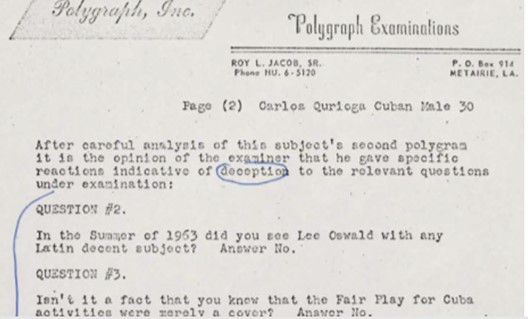
By comparing elements of what occurred in and around the murder of JFK and a November 1962 plot involving the use of incriminating letters purportedly sent from Havana by a Jose PepeMenendez almost one year before the successful attempt, we will present compelling evidence of not only a conspiracy, but key parts of an m.o. and the identification of persons of interest.
Ask yourself the question: If it can be established that there is a clear connection between two plots to kill JFK, the successful one and another that occurred a year earlier, can one solve the murder by solving the preliminary plot?
Readers will be able to find all letters referred to by clicking here.
Summary
Near the end of November 1962, when the tensions around JFK’s handling of the Missile Crisis were at their highest and military hawks were opposed to their Commander in Chief, three letters from Cuba were intercepted. These letters, all bearing the signature Pepe, were fabrications designed to provide a paper trail that would frame potential patsies in the murder of JFK as leftists who were in league with Cuban agents.
As we will see later, their interception was made easy by design: The intended recipients could easily be portrayed as pro-Castro and were not even connected to the addresses on the letters. Those who picked up the letters in their place were CIA-friendly and certain to pass the information on to their intelligence contacts who were part of the JMWAVE network, controlled by CIA officer William Harvey. The FBI and the Secret Service considered these letters to be serious. They suspected that their interception was intended, and called the alleged sender of the letter, Pxepe Menendez, a suspect. This case was never solved and was closed on November 21, 1963, one day before the assassination.
In October 1963, Oswald and/or an imposter contacted Valeriy Kostikov, a KGB officer in the Russian Embassy in Mexico City, whom the CIA believed was in charge of executive action in the Western Hemisphere. After Kennedy was killed, at least three assets answering to CIA officer David Phillips offered false testimonies to link Oswald to Cuban agents.
Between the Mexico City incident and the assassination six weeks later, Oswald was linked to Kostikov and the Cubans in six incriminatory letters that were strikingly similar to the Pepe Letters in terms of style, content, phrasing, and propaganda strategy.
It is the similarity between the 1962 and 1963 false flag operation templates that renders the Pepe Letters affair so significant.
The Pepe Letters
In the process of reviewing the recent Latin American intel files at the Mary Ferrell Foundation, a series of them pertained to a prior plot that involved the use of incriminating letters to set up a patsy who would be blamed for the assassination of JFK and made to look as if he were a Cuban asset.
The first letter I analyzed was very telling.
It was sent from Cuba to “Bernardo Morales” at a post office box in Miami owned by an anti-Castro propaganda unit called Radio Libertad, La Voz Anti-Communista de America. The alleged sender was Jose Menendez, and the letter was signed Pepe. Morales was unknown to those who handled the letter and who eventually forwarded it to a CIA contact linked to the JMWAVE station in Miami.
The sender’s full name is Jose Menendez Ramos. He was nicknamed Pepe. Menendez and his wife Carrie Hernandez had been described by an informant as members of the Tampa FPCC. Menendez got a “top Job” in the Cuban Government after his return. He and his wife were said to be extremely pro-Castro.
Olga Duque de Heredia de Lopez and Aida Mayo Coetara, Miami Representatives for Radio Libertad (linked to anti-Castro DRE operatives), handled the mail. Lopez handed the letter to Cesar Gajate, whom she described as an anti-Communist fighter. Mayo is the wife of Humberto Lopez Perez, the director of Radio Libertad in Venezuela.
Gajate was an AMOT contact. AMOT is a cryptonym for a network of Cubans trained by David Morales at JMWAVE during 1960-61. He passed on the information to his contact (likely CIA officer Tony Sforza or David Morales, who answered to William Harvey).
This was an elaborate hoax to push the “Cubans plan to kill JFK” narrative. One of the people pushing it – CIA’s Bill Finch, worked with Bill Harvey.
The information was sent to the Secret Service, the FBI, and the Department of State on Dec. 8, and later to the INS by Rufus Horn of Task Force W and is signed by him as Liaison and in lieu of William Harvey.
The INS identified a Morales who entered the U.S. using a fake visa.
Radio Libertad was CIA-sponsored (which was also the case for Voice of America) and operated out of Venezuela. It had an antenna office in Miami.
The letter is postmarked November 29, 1962, a month after JFK’speaceful resolution of the Missile Crisis.
It reveals a network of conspirators based in Miami, Washington, and Cuba.
It lamely suggests that by sending the letter to the right-wing Radio Libertad, it would not be intercepted.
It crudely links “Fidel” to a plot to kill JFK.
It does not mince words and is self-incriminating: “if we are able to kill President Kennedy,” “It would be a great success, super extraordinary, for Fidel,” “Marxist-Leninists 90 miles from the U.S.,” “paralyze imperialism completely,” “terrorize capitalism”, “get in contact with your Friends”, “You are an artist”: all very similar to the 1963 letters we will discuss later.
The second letter, which was postmarked November 14, was sent to Antonio Rodriguez–a student at Georgetown’s foreign service school and the son of a Venezuelan diplomat–who was a chauffeur for Colonel Hugo Trejo. Trejo was a suspected intelligence contact from Venezuela and a Venezuelan military officer and politician who led the first attempt at a military rebellion against the president of Venezuela, Marcos Pérez Jiménez. Improperly addressed, Trejo advised the FBI about the letter.
Trejo said that the letter arrived at a Venezuelan Delegation office in Washington. The Secret Service, tipped off by an informant suspecting an assassination plot involving Trejo, questioned members of the delegation, including Trejo, Rodriguez, and others, about the letter.
“Antonio Rodriguez Jones’ address was crossed out in red ink and emerged from the Dead Letter Section with the address Antonio Rodriguez Gil, “2335 Ashmead Place NW, Washington, DC. The Secret Service eventually found “this was in error”.
The ostensible reason for the operation against foreign service student Antonio Rodriguez Jones was because his father was Antonio Rodriguez Echazabal, also a diplomat by trade. He was Cuba’s ambassador to Haiti as recently as 1959 before he defected in place in Haiti. He identified as anti-Communist but was not involved with any anti-Castro opposition group. In November 1962, Echazabal was living in Washington, DC and planning to defect to the United States. Echazabal was believed to secretly be a communist. When Echazabal was arrested and deported in August 1963, the “Cuban plot against the President” file was ostensibly closed, but new files kept going inside it.” (Bill Simpich email to Paul Bleau, Sept 6, 2025)
The letter refers to the assassination Cuba-linked plot in a similar fashion to the first Pepe letter discussed above, and was deemed to have been written by the same sender (Menendez) following FBI handwriting analysis.
Intelligence forces attempted to link Rodriguez to an alleged Cuban Terrorist named Pino Machado:
The FBI’s Chief of National Intelligence, Ray Wannall, noted here that a “Secret Service informant” (#3-11-48) claimed on 11/27/63 that Pino Machado was involved in “terrorism” in Washington, DC, back in April 1961. And that if there was an “international plot”, then Pino Machado was the “intellectual director” of Oswald’s activities in Mexico City. His subordinate Lambert Anderson had been monitoring both Oswald and the FPCC for months before 11/22/63.
The third Pepe letter was sent to: SEÑOR MINISTRO DE REPÚBLICA DE GUATEMALA in Guatemala. It does not refer to the assassination plot. It does attempt to link Cuba to clandestine revolutionary activities in the country. It made its way to the CIA.
The FBI suspected subterfuge around the flagrant errors in addressing all three letters.
(HSCA Report Volume 3 page 431)
Even Secret Service inspector Thomas Kelley admitted the letters were apparently “meant to be intercepted“.
The links with the 1963 letters and William Harvey (a person of extreme interest in the assassination) are most notable.
The 1963 forged letters
“Oswald’s” letter to the Russian Embassy on November 9, 1963
This uncharacteristically typed letter, purportedly written by Oswald, was intercepted by the FBI (as they did with all mail going to the embassy). This letter incriminated Oswald and foreign confederates and was corroborative of the Mexico City charade. It denigrates the “notorious FBI” and refers to Kostikov as “comrade Kostin.”
The Warren Commission accepted this letter as authentic and explained it as an awkward appeal by Oswald for help from the Soviet Embassy. In fact, the content and the timing of the letter suggest that it was part of the same stratagem designed by those behind the Mexico City set-up.
The fact that this letter was sent to Tovarich Nikolai Reznichenko at the embassy was a source of concern, even if the Oswalds corresponded with him several times in 1963. An FBI report (HSCA Record 180-10110-10104) clearly refers to him as “the man in the Soviet Embassy (Washington’s) in charge of assassinations.” In 1970, researcher Paul Scott had described him as “one of the top members of the Soviet Secret Police (KGB) in the United States.” (Paul Scott article)
Incriminatory letters from Cuba- 1963
Five letters from Cuba, all postmarked shortly after the assassination, one of which was destined for Oswald, were part of the Castro false flag operation and were also used to incriminate Oswald with unidentified Cuban agents, and Fidel Castro himself. These letters were addressed to recipients (Oswald, RFK, The Voice of America–a CIA propaganda asset), which guaranteed their interception or their being simply handed over to intelligence agencies.
They also corroborate the Mexico City fabrication, which very few people would have known about at this time. The FBI dismissed these letters as a hoax, which they were. But they were a hoax with a purpose: to blame JFK’s murder on the Russians and the Cubans. Their content and timing revealed the same tactics being used by the planners.
Letters from Cuba to Oswald—proof of pre-knowledge of the assassination
In JFK: The Cuba Files, Cuban G2 officer Fabian Escalante presents a thorough analysis of five bizarre letters that were written before the assassination in order to position Oswald as a Castro asset. It is difficult to sidestep them the way the FBI did. The FBI argued that they were all typed from the same typewriter, yet supposedly sent by different people. This indicated to them that it was a hoax, perhaps perpetrated by Cubans wanting to encourage a U.S. invasion.
However, the content of the letters and timeline proves something far more sinister, according to Cuban intelligence. The following is how John Simkin summarizes the evidence:
The G-2 had a letter, signed by Jorge that had been sent from Havana to Lee Harvey Oswald on 14th November, 1963. It had been found when a fire broke out on 23rd November in a sorting office. After the fire, an employee who was checking the mail in order to offer, where possible, apologies to the addressees of destroyed mail, and to forward the rest, found an envelope addressed to Lee Harvey Oswald. It is franked on the day Oswald was arrested and the writer refers to Oswald’s travels to Mexico, Houston and Florida …, which would have been impossible to know about at that time!
It incriminates Oswald in the following passage: “I am informing you that the matter you talked to me about the last time that I was in Mexico would be a perfect plan and would weaken the politics of that braggart Kennedy, although much discretion is needed because you know that there are counter-revolutionaries over there who are working for the CIA.”
Escalante informed the House Select Committee on Assassinations about this letter. When he did this, he discovered that they had four similar letters that had been sent to Oswald. Four of the letters were postmarked “Havana”. It could not be determined where the fifth letter was posted. Four of the letters were signed: Jorge, Pedro Charles, Miguel Galvan Lopez and Mario del Rosario Molina. Two of the letters (Charles & Jorge) are dated before the assassination (10th and 14th November). A third, by Lopez, is dated 27th November, 1963. The other two are undated.
Cuba is linked to the assassination in all the letters. In two of them, an alleged Cuban agent is clearly implicated in having planned the crime. However, the content of the letters, written before the assassination, suggested that the authors were either “a person linked to Oswald or involved in the conspiracy to execute the crime.”
This included knowledge about Oswald’s links to Dallas, Houston, Miami and Mexico City. The text of the Jorge letter “shows a weak grasp of the Spanish language on the part of its author. It would thus seem to have been written in English and then translated.”
Escalante adds: “It is proven that Oswald was not maintaining correspondence, or any other kind of relations, with anyone in Cuba. Furthermore, those letters arrived at their destination at a precise moment and with a conveniently incriminating message, including that sent to his postal address in Dallas, Texas …. The existence of the letters in 1963 was not publicized or duly investigated, and the FBI argued before the Warren Commission to reject them.”
Escalante argues: “The letters were fabricated before the assassination occurred and by somebody who was aware of the development of the plot, who could ensure that they arrived at the opportune moment and who had a clandestine base in Cuba from which to undertake the action. Considering the history of the last 40 years, we suppose that only the CIA had such capabilities in Cuba.”
The first letter addressed to Oswald includes: “close the business,” “money I gave you,” “recommend much to the chief,” “I told him (Castro) you could put out a candle at fifty meters,” “when you come to Habana.” Letter four specifies $7000 given to Oswald, which is close to what a Phillips-connected false witness claimed he saw being given to Oswald in Mexico City in the Cuban embassy. It also states that a Cuban agent named Pedro Charles “became a close friend of former Marine and expert shooter Lee H. Oswald in Mexico.”
Black Ops: ZRRIFLE and Black Letters
File 178-10004-10148 (released in 2025), from the Rockefeller Commission, discusses the use of this type of psy-war propaganda. This strongly indicates what all the letters discussed in this article are: Black Letters, i.e., forged incriminatory letters designed to create a phony paper trail to set up a foe:
Partial file content:
The Pepe Letters are too similar to the six 1963 incriminatory letters for this to all be happenstance. The tone, wording, and content, as well as the designed-to-be-intercepted expedition of all nine letters, incrimination targets, nature of the recipients, and the timing, can only be interpreted one way. These were Black Letters. They are the workings of specialized strategists who began plotting by November 1962 or earlier against JFK. They used psych-ops techniques, such as black letters. The letters supplemented other tactics that were in tune with the following part of Harvey’s ZRRIFLE: It also contemplates the need for false documentation within CIA files to protect the operation from exposure: “Cover: planning should include provision for blaming Czechs or Sovs in case of blow” and “Should have phony 201 in RI to backstop this, documentation therein forged and backdated. Should look like a CE [Counterespionage] file.”
Case Linkage
The assassination and the “Pepe” plot are not the only cases that should have been compared for clues that would help profile the plotters. On their own, they already provide compelling evidence of central coordination. Oswald’s opening of a Fair Play for Cuba Committee branch in New Orleans is already considered very suspicious by many in the research community. The Menendez links to the FPCC should set off alarm bells for all. This author’s chronicle of other potential patsies that were linked to this dying outfit–deemed to be Castro’s network in the U.S. by the House Committee on Un-American Activities–exceeded several in number. The newly found Menendez link is the topping on the cake.
Conclusion
At this point, the reader is encouraged to read the letters discussed in this article and peruse the other sources that can be found in the bibliography. If one concludes that the 1962 and 63 incidents are linked, then there is most likely a conspiracy involving central planning by those capable of implementing such tactics. Just as importantly, these events should be added to the growing body of evidence around CIA officers William Harvey and David Phillips, making them persons of even greater interest. Already suspected by some government investigation insiders, the proximity of Harvey to the Pepe Letters and Phillips’ links to Mexico City and the FPCC should not go unexplored. These letters have been for too long unexplored, but they are powerful evidence of a pre-existing plot against JFK.
Acknowledgements
I would like to thank Bill Simpich and Doug Campbell, who were the first to see the significance of the Pepe Letters. They, along with Dave Boylan, have provided valuable input to me regarding this still-developing story.
References
The PEPE Lettersat Kennedysandking (all nine black letters are in the appendices) 25 January 2025
Jefferson Morley spoke with me two days before the story broke. He gave me a scoop. The Washington Post was about to publish an article about a subject he had been working on for years, namely, a story about a mysterious CIA officer named George Joannides. The Post was about to unmask him as an officer who oversaw a Cuban exile group that had direct contact with the alleged lone-nut assassin of JFK, Lee Harvey Oswald. This group, the DRE, had multiple interactions with Lee Harvey Oswald during the all-important summer that preceded the murder in 1963. Joannides would have had to have been informed about these suspicious incidents. This propaganda expert instructed DRE operatives to communicate Oswald’s pro-Castro bona fides to the FBI and media after the assassination. He would later be inserted by the CIA as their liaison for part of the HSCA 1976 investigation. He and the CIA had lied about his profile, and Joannides used his role to obstruct the efforts of HSCA investigators.
Jeff asked for advice and my help in creating a buzz around this. So, I gladly did, not because Jeff and I are close collaborators, nor because I do not have concerns about the Washington Post and mainstream media as a whole when it comes to talking about their bête noire, nor that I do not have some misgivings about the current focus of the Luna task force on declassification. I helped because the Joannides story is newsworthy and helps tilt the playing field even more in favor of those fighting for the truth. I was convinced that the upcoming article would be a milestone because of the position that a world-leading mainstream media outlet would stake.
Very simply, we gave a heads-up to key contacts about a scoop on what was about to break. The reactions were immediate: Jeff received many calls, and I was invited by local media for two interviews about the story. Feedback from researcher contacts varied between expressions of mistrust, interest, and offers to spread the news.
Now that I have seen the article, gone through my interviews, and had a number of exchanges about the pros and cons of the coverage, it seems an opportune moment to discuss the article and the Luna task force’s work.
The importance of the article
This article is quite important, despite what anybody may say to attack it. No matter how much one feels disdain towards mainstream media complacency over sixty years, the fact that one of the U.S.’s most important media outlets on political affairs wrote what they did is nothing short of monumental. It is the suspicious mutism of sixty years on this tragedy by the fourth estate that renders what was written by the Washington Post so very compelling.
Let’s be honest. Mainstream media should have denormalized the Warren Commission narrative of a lone nut assassin scenario still peddled by disinformation artists, history books, and many in the media decades ago. Some instance, in 1975 when the Zapruder film was shown to the world on Good Night America; or a few years later when the House Select Committee on Assassinations concluded there was a probable conspiracy; or when declassified documents released by the Assassination Records Review Board the mid-nineties showed that there were a combined total of over 40 witnesses to wounds proving a frontal shot, at both Parkland Hospital in Dallas, where JFK was first treated after being hit, and at Bethesda Medical Center, where the autopsy was conducted; or later when the declassified Lopez Report confirmed that Oswald was impersonated in Mexico City shortly before the assassination and that CIA officials lied and obfuscated about this; and even just recently during the Luna task force congressional hearings where we heard important witnesses and Anna Luna herself decimate the Warren Commission findings with blistering statements…. Mainstream media has largely steered clear of these inconvenient truths.
Researchers know all about Operation Mockingbird, the CIA’s program for manipulating the press and gaslighting the public, which likely lost some of its clout with the entry of the new Trump team. Currently, the media must be conflicted by the prospect of exposing their own weak performance on this issue over six decades. With the levy breaking and the traditional malarkey about JFK becoming a growing source of ridicule, the recently declassified Joannides document may have provided an opening to jump ship… Ha! This was not known until now, and it proves the (now defanged) CIA lied and hid stuff… Ergo, it is not our fault, and Luna and Tulsi will not turn on us for saying what is quickly becoming an official government narrative through Miss Luna herself! May as well be the first to spill the beans!
Is this what is happening? Is the Washington Post showing courage or simply reading the writing on the wall? I don’t know! And I don’t care. A Rubicon of truth has been crossed and will be archived forever. The tables have turned. Now, the real whack jobs are the late Vince Bugliosi and his Keystone Cop disciples who are trying to spin this. They are flailing away. Front page news on the U.S.’s third-largest print media, with 130,000 subscribers to their paper edition and 2.5 million digital subscribers, is nothing to scoff at. Jeff Morley and Congresswoman Luna deserve kudos for bringing us to where we now are. The lone-nut apologists are marginalized, if not a laughingstock, and serious researchers who were a target of derision are vindicated.
Unprecedented information quality from a news giant
While the importance of the bearer of news cannot be understated, it is the impact of what was written that will echo far and wide, and hopefully for a long time.
Some are telling me that while WaPo may have been the ones to break the Watergate story, they are also the ones who shielded the CIA from negative fallout by underplaying the significance of just who the burglars were and their ties to intelligence. My answer to them is that no matter what they may have done or omitted to do in the past, this clearly cannot be interpreted as a redux with what we have seen so far. We will ascertain whether this story has legs and where it may or may not go later. But I see no problem with the all-important first impressions.
Consider: The title, subtitle and first paragraph are explosive!
“The CIA reveals more of its connections to Lee Harvey Oswald
New documents show an officer known only as Howard managed a Cuban group that interacted with Oswald in the months before the JFK assassination.
For more than 60 years, the CIA claimed it had little or no knowledge of Lee Harvey Oswald’s activities before the assassination of President John F. Kennedy in November 1963. That wasn’t true, new documents unearthed by a House task force prove.”
The reader now knows for certain that Oswald was no lone nut and that he was on the CIA radar, and the CIA lied about this. The article goes on to explain the Joannides, aka Howard, affair described above. The quotes come from a variety of important sources, and they are damaging.
Jefferson Morley, a longtime JFK researcher and former Washington Post reporter, who first sued the CIA for their assassination files in 2003: “The burden of proof has shifted. There’s a story here that’s been hidden and avoided, and now it needs to be explored. It’s up to the government to explain.” And, “At least 35 CIA employees handled reports on Oswald between 1959 and 1963, including a half dozen officers who reported personally to [counterintelligence chief James] Angleton or deputy director Richard Helms.”
“Joannides began to change the way file access was handled,” committee staff member Dan Hardway testified before Luna’s task force in May. “The obstruction of our efforts by Joannides escalated over the summer [of 1978]. … It was clear that CIA had begun to carefully review files before delivering them to us for review.”
Rolf Mowatt-Larssen, a former CIA counterintelligence officer who has delved deeply into the case, said, “This looks a hell of a lot like a CIA operation.” He said a plausible theory was rogue CIA officers created the conspiracy to assassinate Kennedy, unknown to the agency, and that “the CIA covered it up not because they were involved, but because they were trying to hide the secrets of that period.”
“We are getting closer to the truth about Oswald and the CIA, but I do think there is more to come,” said Senior U.S. District Judge John R. Tunheim of Minneapolis, who chaired the assassinations review board in the 1990s. “The Joannides disclosures are most important, I think.”
And how about Congresswoman Luna for a grand finale: “There was a rogue element that operated within the CIA, outside the purview of Congress and the federal government, that knowingly engaged in a cover-up of the JFK assassination. I believe this rogue element intentionally turned a blind eye to the individuals that orchestrated it, to which they had direct connections. I think this rogue element within the CIA looked at JFK as a radical. They did not like his foreign policy, and that’s why they justified turning a blind eye to his assassination and those involved.”
Of note: not one single voice still peddling the lone nut fairy tale is heard from in this article. Perhaps the Post did question some and found them to be lacking in credibility, or could not find a credible dissenting voice to come forward, or simply has come to the conclusion that there is no added value for their readers to hear from empty cans that make a lot of noise.
If one has worked many years arguing that there was a conspiracy with slow progress being made, what more can one ask for? I ask the skeptics among us: Do you think punches were pulled so far on this particular story to spare the CIA? Has there ever been an article from mainstream media that has gone this far in discrediting the official narrative and their snake oil sales reps? Do you not prefer this coverage over the lopsided coverage lone scenario peddlers used to get? Who looks like foolish tale spinners now? Chalk this up as a win.
Concluding remarks
For all the reasons mentioned above and my personal experience with media questioning me about the significance of the Post article, I am convinced that this represents a real victory for our side. It reverses the tables on the disorganized opponents of the truth, and it puts pressure on the whole media industry to state their positions and dig deeper.
I do have some concerns about where all this goes.
The article says there is more to come and highlights what Joannides’ field reports on Oswald, the DRE, and the Fair Play for Cuba may reveal. When will we get these?
Congresswoman Anna Luna is being attacked by the very same forces that many researchers believe are being backed by the CIA. We know the CIA devised a game plan to counter Warren Commission critics, and there are many signs that they still rear their ugly heads. Luna and those advising her need to take advantage of this singular moment in time to unravel these dirty tricks and hopefully reveal and critique the disinformation network. This will defend Luna’s reputation and agenda and pre-empt the sneaky character assassination attempts before they take hold.
The current information release effort is impressive. Other voices need to be heard, including specialists respected for their knowledge and professionalism, and excluding loose-cannon know-it-alls as well as lone-nut water carriers. There is a legitimate fear, I believe, by some that the Luna task force endeavors are too centric on CIA misdirection and a couple of individuals rather than focused on the mechanics of the conspiracy. My analysis of files, including many recent ones, points in directions worthy of more exploration. They say a lot about the who, what, when and why of it all. Anna Luna needs guidance, and the gatekeepers, yes, this includes you Jeff, need to know what lanes to occupy and who should be brought in. It seems to me that people like Jim DiEugenio and Malcolm Blunt could be credible advisors who could enrich Luna’s sources of information.
It would be an error to try to find a limited hangout to protect the image of the CIA. This will only prolong the pain. On the other hand, the marketer in me understands that perception is reality and reputational risk is high. However, there are more than enough examples of rebranding and new imaging efforts that have successfully saved products and organizations that were in a tailspin. Many have gone onto see these thrive. Old Spice did it, George Bush Junior was born again, and CIA 1963 no longer exists, just like those who created the Gulf of Tonkin incident. In this volatile world, CIA 2025 is needed more than ever.
Finally, this murder is not solved. Investigations have been continuously sabotaged. Obstruction of justice in this case has been around for more than sixty years. There are still many stones that have been left unturned. A new investigation is in order, a genuine one. The Department of Justice right now has serious credibility issues due to the Epstein debacle. To lead one, I nominate Congresswoman Luna. Jefferson Morley needs to be complemented by a synergetic mind who excels in areas where Jeff is less at ease. Here, I would suggest Jim DiEugenio, who, through his research network, knows who the specialists are on the Secret Service, the Tippit assassination, Jack Ruby, the JFK Act, etc. What a formidable team this would be!
(Tom Jackman’s Washington Post article may be viewed here, but you may have to create a free account to view)
The CIA executive action program, code-named ZR RIFLE ZRRIFLE, was in full display by mid-1960 in plans to remove Castro. This was one year before William Harvey perfected it.
The CIA tapped into regime change expertise from its Far East resources, who developed a strategy to devise an assassination attempt on Castro that would be blamed on Chinese Communists. This approach had been used successfully in the Far East and would be enacted for the eventual assassination of the Cuban leader JFK, according to most researchers.
The 1960 plan involved CIA officers Desmond Fitzgerald, JC King, James Noel, and likely Ed Lansdale and David Phillips, who operated out of Cuba in 1959-60. The stratagem of blaming Chinese Communists may have been linked to American interests in the Far East. Most observers believe that by 1963, there was a shift to putting the blame squarely on the Soviets and Cubans for the assassination of JFK. While this focus was intensive, we may ask ourselves if the 1960 plot may have resurfaced as a contingency plan.
In 1964, when Lyndon Johnson and the U.S. war machine were itching for its full-fledged military entry into the Vietnam arena, the U.S. fabricated the Gulf of Tonkin incident false reports of Vietnamese attacks on U.S. destroyers. Was there also a belated attempt to try and factor the Chinese into a conspiracy that eliminated JFK?
While the following December 1963 CIA file did not gather much interest, it is one of a number that began circulating right after the assassination 104-10308-10320 ATTRIBUTION OF PRESIDENT KENNEDY’S ASSASSINATION TO AN ALLEGED CHICOM/CASTRO PLOT. In it, details are planted around Chinese and Castro sympathizers backing a plot, with funding received at an unidentified Wall Street Bank. Two individuals (Ramon Cortes and Inu Fernandez) are fingered as intermediaries present in Dallas and possibly being involved. (For more on Cortes, see State Secret -Chapter 6, Bill Simpich).
Were there to be links between these two and Oswald? Was there some sort of tactic being contemplated here to help bolster motivation for a conflict on the other side of the world? We may never know the answers to these questions- it was sometime in early December 1963 that the CIA and Ambassador Thomas Mann in Mexico received their marching orders from Hoover and LBJ to stop arguing in favor of a Castro connection to a murder plot. In 1966, Mafioso Johnny Rosselli, who was the link between the mafia and the CIA in a partnership to eliminate Castro, said the following:
The last of the sniper teams dispatched by Robert Kennedy in 1963 to assassinate Fidel Castro was captured in Havana. Under torture, they broke and confessed to being sponsored by the CIA and the US government. At that point, Castro remarked that, ‘If that was the way President Kennedy wanted it, Cuba could engage in the same tactics’. The result was that Castro infiltrated teams of snipers into the US to kill Kennedy.
Roselli’s propensity to talk too much is what likely got him killed, chopped up, and put in a drum that was found floating in Dumfoundling Bay. Roselli was certainly wrong about Castro leading the operation; in fact, the super secret CIA Inspector General report on the plots was written to correct errors in his story. Rosselli may have been right about who some of JFK’s shooters were. He certainly was spot on about the tactics that were used if one considers the following CIA execution plan:
This document is as explicit as it can get when it comes to directly evoking the use of the ZRRIFLE executive action program for the removal of Fidel Castro. Thrown right in the reader’s face is the subject of the Dispatch: “Proposed operation to have the Chinese Communists suspected of an assassination attempt.”
There is a lot to unpack in this planned false flag:
The record can be found at the Mary Ferrell Foundation: Title: DISPATCH: PROPOSED OPERATION TO HAVE CHINESE COMMUNISTS SUSPECTED OF ASSASSINATION ATTEMPT Pages: 2 Agency: CIA RIF#: 104-10315-10011 Subjects: ANTICASTRO PLOT
It is dated July 8, 1960, and is about a topic brought up on June 25, 1960
It comes from the Chief of the Far East Division (Desmond Fitzgerald), sent to the chief of the Western Hemisphere Division (J.C. King), who relays it to the Chief of Station in Havana (James Noel)
The subject is very straightforward: LCHARVEST PSYCH: Proposed Operation to have Chinese Communists blamed for Assassination Attempt
LCHARVEST (TPFAST, TPTERRY, VLVIGOR) involved operations against Peoples Republic of China (PRC) scientists and efforts to monitor PRC state technology
Chester Dainold is a pseudonym for Desmond Fitzgerald and Oliver G. Galbond, a pseudonym used by Colonel J.C. King, Chief of the Western Hemisphere Division, Directorate of Operations, CIA (MFF).
Fitzgerald headed the Far East Division between 1957 and 1962, when he worked closely with Ed Lansdale, a legendary PSYCHOLOGICAL OPS expert. In 1953, Lansdale was sent to Vietnam to act as a consultant for the French in their efforts to repel the uprising in their colony. The plan was to mount a propaganda campaign to persuade the Vietnamese people in the south not to vote for the communists in the forthcoming elections.
“In the months that followed they distributed targeted documents that claimed the Vietminh and Chinese communists had entered South Vietnam and were killing innocent civilians. The Ho Chi Minh government was also accused of slaying thousands of political opponents in North Vietnam.” https://spartacus-educational.com/COLDlansdale.htm
In late 1961, Robert Kennedy and the all-powerful SAG team tasked Lansdale to lead Operation Mongoose, a covert action program for sabotage and subversion against Cuba. Lansdale appointed William Harvey as his CIA point person, who maintained a CIA relationship with Roselli all the way to 1963, even though RFK had demoted him after the Missile Crisis. It was Desmond Fitzgerald who replaced Harvey.
ZRRIFLE Plus
The Executive Action program perfected by William Harvey in 1961 was really a spinoff of assassination programs used throughout the ages. Harvey learned about these in meetings with British and French intelligence who were well acquainted with the finer points of this science. e.g., British MI 5 officer Peter Wright. Mafia collaboration synergized these techniques.
What is fascinating with the current file is the level of detail shared and that it predates Harvey’s work and is suggestive of what many have come to think about what took place on November 22, 1963.
Let us break down the plan and then translate it to the JFK assassination conspiracy:
PROPOSED OPERATION TO HAVE CHINESE COMMUNISTS SUSPECTED OF ASSASSINATION ATTEMPT = PROPOSED OPERATION TO HAVE CASTRO BLAMED FOR JFK ASSASSINATION
Replace this with JFK’s exposure in upcoming motorcades and appearances in crowded places.
Better yet, let’s plan the route ourselves with help from our CIA asset, Dallas Mayor Earle Cabell… sketches and maps: As in Sergio Arcacha Smith’s possession of the sewage systems maps and David Ferrie’s sketch of Dealey Plaza… Places of vantage; like Dealey Plaza where there can be triangulation of fire… Routes of escape/ Exfiltrating… Through the railyards, in the Nash Rambler with a Latino getaway driver, through the panicked crowds, Red Bird Airport, the Flight from Dallas in a CIA plane… Locations of sites for caching the weapons… as in Julia Ann Mercer’s sighting of Ruby the morning of the assassination involved in delivering a package near the knoll, or Lee Bowers (railroad tower operator) seeing suspicious movements in the railyards and the TSBD being open to renovation teams during the days preceding the motorcade.
In other words, let us add touches such as an FPCC-linked, Castro-backed commie-assassin to the mix through impersonations, incriminating forged correspondence, false testimonies of assets alleging interaction between the patsy and the enemy as well as financial backing (recall the false testimony of Oswald receiving payouts in the Cuban embassy in Mexico City), back-yard photos portraying Oswald as an unhinged, well-armed Marxist fanatic, etc.
Simply put, we need more than just a good story… we need to set the stage with rumors and fabricate trails of “evidence” for the red herring to be believed: Planting wallets, leaking propaganda through media assets, tampering with evidence, framing patsies and opponents, etc.
Conclusion
While some lone-nut theorists have often brought up the complexity of carrying out what many researchers have come to believe about the assassination, file 104-10315-10011 tells a compelling story: Regime change specialists like Lansdale, Harvey, Fitzgerald, and Phillips all had plenty of experience in the use of ZRRIFLE-like tactics during the decade that preceded Castro’s rise to power; they all likely became involved in applying these tactics for the elimination of Castro beginning in 1960; they were all omnipresent in regime change special ops aimed at Cuba in 1963 and these are the tactics that have been revealed with time, according to many researchers, to be the ones that were used to remove Kennedy.
So yes, orchestrating a regime change is complex… Only real specialists can deliver something this grandiose.
“… we will analyze similar situations that demonstrate stratagems around other subjects and incidents that occurred during the months preceding and succeeding the assassination of JFK that are revealing of a pattern that is indicative of central coordination.”
From The JFK Assassination Chokeholds
Executive Summary
There is a strongly supported theory in the JFK research community that the assassination bears the fingerprints of a CIA assassination program code-named ZRRIFLE, and that it was led by rogue, high-level agents linked with the failed Bay of Pigs operation. Many facts support this theory, including the association of regime change specialists with many elements of the plot, the impersonation of Oswald in Mexico City in the fall of 1963 to make him look unhinged and Castro-connected, and, most interestingly for this article, the use of incriminating correspondence.
Shortly after the Mexico City incident, a letter with a forged signature incriminating Oswald and foreign confederates, and corroborative of the Mexico City charade was sent to the Russian embassy in Washington. The FBI eventually dismissed it as a clumsy attempt by Oswald to ingratiate himself with the Soviets. The content and the timing of the letter suggest rather that it was part of the same stratagem designed by those behind the Mexico City set-up.
Five other letters sent from Cuba, all postmarked shortly after the assassination, incriminated Oswald, unidentified Cuban agents, and Fidel Castro himself. They contained details of the Mexico City fabrication known only to a very few. Despite this, the FBI dismissed these letters as a hoax. (See the book ZR Rifle by Claudia Furiati)
Recently this author discovered three more incriminatory letters in released CIA files that received little attention from the research community. These very similar letters are postmarked in the late fall of 1962, the year before the assassination. This article analyzes these letters and concludes that:
They reveal that plans to assassinate JFK were likely triggered by the Cuban Missile Crisis.
They are consistent with and add detail to the theory that the assassination followed the ZRRIFLE playbook.
The fact that the sender of these letters was directly linked to the Fair Play for Cuba Committee, just like Oswald and other subjects of interest involved in suspicious events throughout 1963, provides compelling added evidence that plans to kill JFK during the last year of his life were centrally coordinated.
They add credence to the theories that point to the involvement of specialists in regime change operations. They add to the suspicions that high-level officers David Phillips and William Harvey were involved.
They do not incriminate the CIA as an organization, nor the FBI and Secret Service.
Introduction
Case linkage is a standard offender profiling technique that was never performed for the JFK assassination by the leading intelligence organizations of the country. By the time the ARRB was running, the Secret Service ensured that this could not be done by illegally destroying JFK files just before they would have been made available through declassification beginning in the mid-nineties.
In Chokeholds, by comparing some 20 incidents and/or subjects that were worthy of exploration, we were able to present a picture that revealed: “…that the peculiarities that one can find in many of the subjects’ personas, associations and actions are hardly a haphazard collection of traits and behaviors.” One of the traits that was underscored was links with the Fair Play for Cuba Committee that existed in a vast majority of the cases explored.
In late December 2024, while reading some of the latest declassified files available at Mary Ferrell, I found a series pertaining to letters sent from Havana, written in a way to incriminate Cuba in a plot to kill JFK right after the peak of the Missile Crisis. I had a déjà vu moment.
The 1962 Pepe letters are not only corroborative of what many researchers have come to think, but they add a clearer picture to the offender profile that is getting more precise from added pieces to the puzzle– like these. In 1962, just following the height of the Missile Crisis where JFK was strongly opposed by his war hawks, three letters signed by a “Pepe,” were sent from Havana in a way that ensured that they would be discovered by U.S. intelligence. These letters created deep concern that there was a plot to kill JFK in the works, one that involved enemy agents in both Cuba and the U.S. They are remarkably similar to the 1963 letters and link potential patsies and perpetrators to Fidel Castro in what can only be seen as another false flag operation.
The FBI eventually dismissed these letters as a Cuban harassment tactic despite referring to the sender as a suspect.
Was this a prequel to what would happen in the fall of 1963?
Are the perpetrators of this similar case the same as those who are behind the conspiracy?
This author believes that the answer is yes to both questions, which can only lead to more crystallization of the opinions that most researchers have, according to recent surveys on the matter, about the who, when, how, and why of the conspiracy.
After the assassination, investigators did nothing to see how these letters linked up with the eerily similar subsequent events described earlier in this section.
Background
“According to a historical study of the Arbenz removal project: discussing themes and tactics that would become constants during the following decades… deniable assassination squads… while placing the blame on designated parties (patsies).
In 1953, sabotage and propaganda efforts were discussed but beyond that a CIA officer proposed a plan for first, spreading rumors that the communists were dissatisfied with Arbenz, then killing him in a fashion that would be laid on the communists.” (Nexus, by Larry Hancock)
According to a recent study, most researchers are of the opinion that the maneuvers described above are part of the assassination program code-named ZRRIFLE, and that CIA regime change specialists David Phillips and William Harvey should be considered people of interest and that the Missile Crisis was a determining factor in the decision to remove JFK.
1) ZRRIFLE
“ZRRIFLE” was a program to recruit foreign criminal assets for various illegal activities including burglary, wiretaps, strong-arm work, and thefts in support of ZR code-breaking work. Later it was used by William Harvey as a project for an Executive Action assassination program.
It provided a cover for recruiting individuals who could be used to provide the CIA with a highly targeted ‘executive action’ capability. Along with other CIA assassination activities, it was investigated by the Church Committee in the 1970s. That investigation was the first to document and publicize American efforts to eliminate Fidel Castro, Patrice Lumumba, and other foreign leaders.
In 1961, William Harvey was tasked by Richard Helms with perfecting an executive action program. Key aspects of ZRRIFLE included setting up phony paper trails, the use of surrogates and patsies, as well as provisions to blame a foe. He left behind hand-written notes. The following are excerpts fromWilliam Harvey’s notes:
“Should have phony 201 in RI [Records Integration] to backstop this, all documents therein forged & backdated. Should look like a CE file …. Cover: planning should include provision for blaming Sovs or Czechs in case of blow.”
2) The Mexico City Charade
Between September 27 and October 3, 1963, conspirators in the JFK assassination, developed a false flag incident in Mexico City designed to make future patsy, Lee Harvey Oswald, look like he was in league with Cuban and Soviet agents. Oswald was alleged to have received bribes from Cuban agents and met KGB agent Valery Kostikov, who was their head of assassinations in the Western Hemisphere. J. Edgar Hoover affirmed that Oswald had been impersonated in Cuba. (Also see the Lopez Report.)
3) A forged letter sent to the Russian Embassy in Washington incriminates Cubans, Soviets, and Oswald.
Shortly after the Mexico City fabrication, a forged letter (see Appendix 1) incriminating Oswald and foreign confederates and corroborative of the Mexico City charade was sent to the Russian embassy in Washington. It denigrates the “notorious FBI” and refers to Kostikov as comrade Kostin. The Warren Commission eventually dismissed it as an awkward appeal by Oswald to the Soviets. In fact, the content and the timing of the letter suggest that it was part of the same stratagem designed by those behind the Mexico City set-up. The Russians, upon receiving the letter, saw it for what it was: As reported by Jerry Rose in the Fourth Decade, “in 1999, Boris Yeltsin handed Bill Clinton some 80 files pertaining to Oswald and the JFK assassination. One of the memos reveals that, at the time of the assassination, Russian ambassador Anatoly Dobrynin had right away seen the letter as a ‘provocation’ to frame Russia by the fabrication of complicity between Russia and Oswald, when none existed. ‘One gets the definite impression that the letter was concocted by those who, judging from everything, are involved in the president’s assassination,’ Dobrynin wrote. ‘It is possible that Oswald himself wrote the letter as it was dictated to him, in return for some promises, and then, as we know, he was simply bumped off after his usefulness had ended.’ In late November, the Russians sent the letter to U.S. Secretary of State Dean Rusk explaining why the letter was a fraud. By then, the White House was peddling the lone nut fable. Kept hidden was the fact that the FBI already had a copy of the letter.”
In his article, Jerry Rose points out that the typed letter had many more spelling errors in it than the rough draft found at Ruth Paine’s home. (Oswald’s Last Letter: The Scorching Hot Potato)
4) The Phony Letters from Cuba
Five letters from Cuba (See Appendix 2), all postmarked shortly after the assassination, one of which was destined for Oswald, were part of the false flag operation and were used to incriminate Oswald, unidentified Cuban agents, and Fidel Castro himself. They also corroborate the Mexico City fabrication that very few people would have known about. The FBI dismissed these letters as a hoax, but their content and timing revealed the same tactics being used by the assassination planners. (Read the letter from Cuba section in Kennedysandking article The CIA and Mafia’s “Cuban American Mechanism” and the JFK Assassination.)
The first letter addressed to Oswald includes: “close the business,” “money I gave you,” “recommend much to the chief,” “I told him (Castro) you could put out a candle at fifty meters,” “when you come to Habana.” Letter four specifies $7000 in bribes given to Oswald which is close to what a Phillips-connected false witness claimed he saw being given to Oswald in Mexico City in the Cuban embassy. It also states that a Cuban agent named Pedro Charles “became a close friend of former Marine and expert shooter Lee H. Oswald in Mexico.”
The following is how researcher John Simkin (Spartacus) summarizes the evidence:
The G-2 had a letter, signed by Jorge that had been sent from Havana to Lee Harvey Oswald on 14 November 1963. It had been found when a fire broke out on 23rd November in a sorting office. “After the fire, an employee who was checking the mail in order to offer, where possible, apologies to the addressees of destroyed mail, and to forward the rest, found an envelope addressed to Lee Harvey Oswald.” It is franked on the day Oswald was arrested, and the writer refers to Oswald’s travels to Mexico, Houston, and Florida…, which would have been impossible to know about at that time!
It incriminates Oswald in the following passage: “I am informing you that the matter you talked to me about the last time that I was in Mexico would be a perfect plan and would weaken the politics of that braggart Kennedy, although much discretion is needed because you know that there are counterrevolutionaries over there who are working for the CIA.”
Fabian Escalante, chief of Castro’s G-2, informed the HSCA about this letter. When he did this, he discovered that they had four similar letters that had been sent to Oswald, RFK, The Voice of America, and The Director of the Diario de New York. Four of the letters were postmarked “Havana.” It could not be determined where the fifth letter was posted. Four of the letters were signed: Jorge, Pedro Charles, Miguel Galvan Lopez, and Mario del Rosario Molina. Two of the letters (Charles & Jorge) are dated before the assassination (10th and 14th November). A third, by Lopez, is dated 27 November 1963. The other two are undated.
Cuba is linked to the assassination in all the letters. In two of them, an alleged Cuban agent is clearly implicated in having planned the crime. However, the content of the letters, written before the assassination, suggested that the authors were either “a person linked to Oswald or involved in the conspiracy to execute the crime.”
This included knowledge about Oswald’s links to Dallas, Houston, Miami, and Mexico City. The text of the Jorge letter “shows a weak grasp of the Spanish language on the part of its author. It would thus seem to have
Escalante adds: “It is proven that Oswald was not maintaining correspondence, or any other kind of relations, with anyone in Cuba. Furthermore, those letters arrived at their destination at a precise moment and with a conveniently incriminating message….The existence of the letters in 1963 was not publicized or duly investigated, and the FBI argued before the Warren Commission to reject them.”
Escalante continues: “The letters were fabricated before the assassination occurred and by somebody who was aware of the development of the plot, who could ensure that they arrived at the opportune moment, and who had a clandestine base in Cuba from which to undertake the action. Considering the history of the last 40 years, we suppose that only the CIA had such capabilities in Cuba.” (JFK: TheCuba Files)
The linkage with Mexico City is interesting in that very few people were even aware of Oswald’s alleged behavior there shortly before the assassination. David Phillips worked undercover in Cuba in 1959-60 and under Win Scott in Mexico City when the assassination took place. He was a lead propagandist for regime change operations for the CIA. He collaborated closely with other clandestine specialists such as Harvey over the years. Some of the letters suggest a $7000 payoff to Oswald given by Pedro Charles, “a Mexico City-based Castro agent.” Interestingly, Phillips was queried by the HSCA about misinformation from his agents painting a picture of a Cuba-backed conspiracy in league with Oswald. One of his underlings, Gilberto Alvarado, was found to be lying when he claimed that he saw Latinos giving Oswald $6500 in the Cuban embassy.
The Pepe Letters
a) Overview
In the process of reviewing the recent Latin American intel files at the Mary Ferrell Foundation, a series of them that culminated with CIA file 104-10506-10007 (See appendix 3), set off alarm bells. In it, we find the first Pepe letter translated from Spanish and other observations.
This file, on its own, is very revealing:
The letter suggests several troubling points if authentic (which it is not):
It was sent from Cuba to “Bernardo Morales” at a post office box in Miami owned by an anti-Castro propaganda unit called Radio Libertad, La Vos Anti-Communista de America. It was sent by Jose Menendez and signed by Pepe. Morales was unknown to those who handled the letter and was eventually forwarded to a CIA contact linked to the JMWAVE station in Miami.
It reveals a network of conspirators based in Miami, Washington, and Cuba.
The letter is postmarked November 29, 1962, just after the height of the Missile Crisis.
It lamely suggests that by sending the letter to the right-wing Radio Libertad, it would not be intercepted.
It crudely links “Fidel” to a plot to kill JFK.
It does not mince words and is self-incriminating: “if we are able to kill President Kennedy,” “It would be a great success, super extraordinary, for Fidel,” “Marxist-Leninists 90 miles from the U.S.,” “paralyze imperialism completely,” “terrorize capitalism”, “get in contact with your Friends”, “You are an artist”: all very similar to the 1963 letters.
Letter three of 1963 letters from Havana (appendix 2) was sent to the Directors of the Voice of America, which, like Radio Libertad, was a Cold War vehicle for anti-communist propaganda.
The information was sent to the Secret Service, the FBI, and the Department of State on Dec. 8, and later to the INS by Rufus Horn of Task Force W and is signed by him as Liaison and in lieu of William Harvey.
The links with the 1963 letters and William Harvey (a person of extreme interest in the assassination) caught my attention.
As I went through other related files, the parallels would get even more evident: In short order, I was able to find out that the 1962 letter was one of three Castro incriminating letters, originally written in Spanish, sent within days of one another, all signed by Pepe. (See Appendix 4)
The second letter was postmarked November 14 and was sent to Antonio Rodriguez who was a chauffeur for Colonel Hugo Trejo (a suspected intelligence contact from Venezuela). Improperly addressed, Trejo said that the letter arrived at a Venezuelan Delegation office. The Secret Service, tipped off by an informant suspecting an assassination plot involving Trejo, questioned members of the delegation including Trejo, Rodriguez, and others.
The letter refers to the assassination plot in a similar fashion as the first Pepe letter discussed above and was deemed to have been written by the same sender following FBI analysis. The letter opens with Comrad Rodriguez (was Comrad commonly used by Cubans in 1962?) In Oswald’s last letter to the Russian embassy (Appendix 1), he refers to comrade Kostin. Like the letter intended for Morales, this one finds a clumsy way of clearing the Soviets in this plot.
The third Pepe letter (appendix 4) was sent to Guatemala. It does not refer to the assassination plot. It does link Cuba to clandestine revolutionary activities in the country.
b) The FBI and HSCA Investigations of the Pepe letters (See Mary Ferrell file 124-10279-10068 for 21-page FBI document) and click to see the HSCA report
FBI summary of findings:
The sender’s full name is Jose Menendez Ramos. The Ramos part of the name may bear significance.
Radio Libertad was CIA-sponsored (which was also the case for Voice of America) and operated out of Venezuela. It had an antenna office in Miami. CIA representative William Finch said he was unable to confirm this link. The report affirms that the Pepe letter was acquired through a contact coded MM-T1.
Special agent John A. Marshall of the Secret Service and the FBI took this threat very seriously. He advised the FBI about the second letter (Rodriguez).
Olga Duque de Heredia de Lopez and Aida Mayo Coetara, Miami Representatives for Radio Libertad, handled the mail. Lopez handed the letter to Cesar Gajate whom she described as an anti-Communist fighter. Mayo is the wife of Humberto Lopez Perez, the director of Radio Libertad in Venezuela.
The INS identified a Morales who entered the U.S. using a fake visa. Some witness evidence indicated that he was anti-communist.
Hand-writing analysis confirmed that the two letters were written by the same person. The FBI compared these letters to a letter signed by Jose Menendez sent to V. T. Lee but could not determine definitely whether it was from the sender because of insufficient comparable handwriting. The report concludes that Menendez moved from Tampa, Florida, to Cuba in 1961 and that he was being investigated as a suspect.
What the report does not state is that V. T. Lee was head of the Fair Play for Cuba Committee. He would later correspond frequently with Lee Harvey Oswald.
The FBI suspected subterfuge around the flagrant errors in addressing all three letters:
The HSCA 1978 report sheds more light on the cast of characters and the Pepe affair:
Concerning the third letter sent to Guatemala, it states that the intended recipient Carlos Meneses was not associated with a P.O. Box 347 in Guatemala City and consequently the letter was intercepted. It describes how Radio Libertad operatives in Caracas contacted the U.S. embassy to let them know about their broadcasting initiatives in Latin American countries, including Cuba.
The sender Jose Menendez and his wife Carrie Hernandez had been described by the informant as members of the Tampa FPCC. Menendez got a “top Job” in the Cuban Government after his return. He and his wife are said to be extremely pro-Castro. Concerning Olga Duque, the HSCA repeats how the Morales letter went from her to Gajate, to eventually make its way to the Secret Service, without divulging the CIA Miami station role in the logistics. Aida Mayo is described as a founder of an anti-Castro organization. Olga and Aida shared an apartment.
Concerning the intended recipient of letter 2, Antonio Rodriguez, the reports are a mixed bag. One lead with thin traces connected his father with the assassination of an anti-Castroite in Haiti. Another points to links with a Castro henchman named Pino Machado. (Note: a base story for a pro-Castro conspiracy could have emerged had a plot developed further.)
The HSCA Weighs in
The Warren Commission paid no attention to the Pepe incident and only made fleeting mention of the Pedro Charles letters, lazily fluffed off as a hoax by the FBI.
The HSCA published a 165-page report (180-10108-10017 titled ANTONIO GUILLERMO ROGRIGUEZ JONES.) Towards the beginning of the report exchanges among intelligence agents all the way up to Chief Rowley, head of the Secret Service, and FBI director Hoover emphasize the seriousness of these letters. S.A. Marshall is extremely insistent about the importance of looking into Menendez.
The HSCA Final Report
While the above is a summary of the raw data concerning the Havanna 1962 letters, the HSCA presented in a report, Volume 3 of its final report in which there is precious little value when it comes to interpretation. As we have seen, the FBI fluffs all of this off as simply Cubans muddying the wells. The HSCA toed the line, which seems contradictory to its criticism around the absence of case linkage regarding potential patsy Policarpo Lopez, whom they linked to suspicious behavior in and around the assassination in 1963 (compare the double standard):
Lopez would have obtained a tourist card in Tampa on November 20, 1963, entered Mexico at Nuevo Laredo on November 23, and flew from Mexico City to Havana on November 27. Further, Lopez was alleged to have attended a meeting of the Tampa Chapter of the FPCC on November 17… CIA files on Lopez reflect that in early December 1963, they received a classified message requesting urgent traces on Lopez… Later the CIA headquarters received another classified message stating that a source stated that “Lopes” had been involved in the Kennedy assassination… had entered Mexico by foot from Laredo on November 13…proceeded by bus to Mexico City where he entered the Cuban embassy…and left for Cuba as the only passenger on flight 465 for Cuba. A CIA file on Lopez was classified as a counterintelligence case…
An FBI investigation on Lopez through an interview with his cousin and wife as well as document research revealed that… He was pro-Castro and he had once gotten involved in a fistfight over his Castro sympathies.
The FBI had previously documented that Lopez had actually been in contact with the FPCC and had attended a meeting in Tampa on November 20, 1963. In a March 1964 report, it recounted that at a November 17 meeting… Lopez said he had not been granted permission to return to Cuba but was awaiting a phone call about his return to his homeland… A Tampa FPCC member was quoted as saying she called a friend in Cuba on December 8, 1963, and was told that he arrived safely. She also said that they (the FPCC) had given Lopez 190$ for his return. The FBI confirmed the Mexico trip (Lopez’ wife confirmed that in a letter he sent her from Cuba in November 1963, he had received financial assistance for his trip to Cuba from an organization in Tampa)… information sent to the Warren Commission by the FBI on the Tampa chapter of the FPCC did not contain information on Lopez’ activities… nor apparently on Lopez himself. The Committee concurred with the Senate Select Committee that this omission was egregious since the circumstances surrounding Lopez’ travel seemed “suspicious.” Moreover, in March 1964 when the WC’s investigation was in its most active stage, there were reports circulating that Lopez had been involved in the assassination… Lopez’ association with the FPCC, however, coupled with the fact that the dates of his travel to Mexico via Texas coincide with the assassination, plus the reports that Lopez’ activities were “suspicious” all amount to troublesome circumstances that the committee was unable to resolve with confidence.
So, what fingerprints did they pick up on the Menendez links to the FPCC, the similarities with the Pedro Charles letters and Oswald’s last letter, and the fact that Menendez was deemed an FBI suspect in an assassination plot…? None! None they wished to discuss that is. The HSCA also deflected somewhat by speculating that Menendez may have been someone else (Juan Jose Mulkay Gutierrez- 1977 File 104-10506-10036). The HSCA ended by concluding that there was a probable conspiracy but leaned towards a Mafia-centric one. The Pepe letters did not support this concept.
SGA, JMWAVE, Task Force W, and SAS
Dave Boylan is a co-author of the book The Oswald Puzzle and the essays The Wheaton Lead and The Red Bird Airport Leads. He is regarded as one of the leading researchers of JFK assassination-related files and he is currently working with this author on a far-reaching JFK research project. In it, we have produced the beginnings of the CIA org chart for 1963 as well as one specifically for the CIA station in JMWAVE and another for the SAS CIA cell. No one understands this structure more than Dave. Interested in the Pepe letters, he helped me decode some of the files and added a few to the mix. Thanks to this we can better understand the extended team that was involved with this covert operation, whether wittingly or not.
From Spartacus: “After the Bay of Pigs disaster, President John F. Kennedy created a committee (SGA) charged with overthrowing Castro’s government. The SGA, chaired by Robert F. Kennedy (Attorney General), included John McCone (CIA Director), McGeorge Bundy (National Security Adviser), Alexis Johnson (State Department), Roswell Gilpatric (Defence Department), General Lyman Lemnitzer (Joint Chiefs of Staff) and General Maxwell Taylor. Although not officially members, Dean Rusk (Secretary of State) and Robert S. McNamara (Secretary of Defense) also attended meetings.
At a meeting of this committee at the White House on 4 November 1961, it was decided to call this covert action program for sabotage and subversion against Cuba, Operation Mongoose. Attorney General Robert F. Kennedy also decided that General Edward Lansdale (Staff Member of the President’s Committee on Military Assistance) should be placed in charge of the operation.
The CIA JMWAVE station in Miami served as operational headquarters for Operation Mongoose. The head of the station was Ted Shackley and over the next few months, he became involved in the attempt to overthrow Fidel Castro. One of Lansdale’s first decisions was to appoint William Harvey as head of Task Force W. Harvey’s brief was to organize a broad range of activities that would help to bring down Castro’s government.”
After Harvey left America for Rome, Desmond FitzGerald stepped in to provide new leadership to the Cuban division at Headquarters, renamed as the Special Affairs Staff (SAS). Harvey stepped down as chief of Staff D.”
By painstakingly assembling names from files, searching through directories, and working with colleagues, David and I have been putting together org charts representative of the CIA in 1963. It is a colossal work in progress that does sometimes involve guesswork and evolving conclusions. Of interest for this article is the 63-64, org chart of SAS developed by David. (Note: William Harvey does not figure in this because he had by then been demoted and exiled. In 1962, he would have had a prominent position near the top of a structure SAS replaced called Task Force W). By visiting Appendix 5, the reader will better appreciate how many of the persons profiled below worked within the Counterintelligence section of SAS under Fitzgerald in 63 and Harvey in 62.
David’s first take on the files we looked over proved very insightful:
“These are very close to the Pedro Charles letters! I suspect that the person that sent these was a cutout/asset for the Psychological Warfare, Propaganda guys. Notice that the memo went to Paul Maggio and Rufus ‘Austin’ Horn. Horn was SAS/Counterintelligence who met with FBI liaison Sam Papich every day. Horn worked for Hal Swenson, who worked for Harvey and later, Dez Fitzgerald. The initial source was a PW/Prop anti-communist radio station (Olga Duque). From there to an AMOT (Gajate). The AMOT sent it to JMWAVE, most likely the head of the AMOTs, Tony Sforza. Then JMWAVE sent it along to SAS (Maggio and Horn) who brought in the FBI (Papich). Of course, Harvey would have seen this.”
Dave later added the following:
Another possible source of the letters was members of the DRE—the Student Revolutionary Directorate. The DRE was a “specialized” student group of the larger Revolutionary Directorate. The student group was founded in the summer of 1960 by Ross Crozier (Harold Noemayr) and William Kent (Oliver Corbus/Doug Gupton) under the direction of Philip Toomey (Robert Trouchard) and David Phillips (Michael Choden) and designated AMSPELL. Kent was first introduced to Juan Salvat (AMHINT-2) by Alberto Muller (AMHINT-1). Salvat knew Kent as Gupton. Other early members of AMSPELL were Isidro Borja (AMHINT-5), and Luis Fernandez Rocha (AMHINT-53). AMSPELL was split into three sections: AMSPELL itself, AMHINT and AMBARB. AMSPELL proper was managed by Ross Crozier, AMHINT, the paramilitary section, was managed by David Morales, and the AMBARB (propaganda) section was managed by Calvin Thomas. (Note: Oswald’s interaction with the New Orleans chapter of the DRE in the summer of 1963 was key in creating his pro-Castro credentials and adding to his Mexico links to Phillips.)
David Morales, who was part of the 1954 Guatemala coup (operation PBSUCCESS) with Phillips, was also chief of operations for the Bay of Pigs invasion under Ted Shackley at JMWAVE and was reportedly involved in various assassination projects including the capture and killing of Che Guevara and later aided repressive governments in South America.
1) Lt. Ramos
This link File 104-10308-10271 and File 104-10308-10272 establish that Castro’s close friend Lt. Ramos could be Menendez, the alleged FPCC-linked sender of Pepe’s letters. The latter file identifies William Harvey as its author. These files pertain to a project to assassinate Castro in 1962 called AMRANGE, likely led by Harvey.
2) Augusto Cesar Gajate Puig
The Morales letter was received at JMWAVE on December 7, via Augusto Cesar Gajate Puig, a Cuban exile involved in the fight for a free Cuba, who had received it from Olga Duque who worked for the CIA-sponsored Radio Libertad. The reason she got to handle it was because the letter was suspiciously mistakenly addressed to this right-wing conduit by supposedly communist assassins working for Castro. File 104-10308-10249 refers to Gajate as a CIA contact and expresses a need to protect his identity. 104-10506-10015: ROUTING SHEET AND GREEN LIST NAME CHECK REQUESTS/RESULTS describes him more specifically as an AMOT contact. AMOT is a cryptonym for a network of Cubans trained by David Morales during 1960-61 to be a new Cuban intelligence service once Castro had been ousted. It became a proprietary which produced economic and sociological reports in support of Cuban operations.
3) Rufus Horn
A report about the letter (appendix 3) was then written up by Rufus Horn who signed it (by direction of Victor Wallen) as the liaison as well as in lieu of William Harvey above his name at the bottom of the report. The report is sent on December 8 to the FBI, Secret Service, and Department of State.
Rufus Horn, also known as Austin Horn, was a key liaison within the SAS group and TFW as well as with the FBI (File 104-10269-10134) where he interacted with Sam Papich. He was also well connected with Desmond Fitzgerald of the CIA who led the all-powerful SAS group that enacted major covert activity policies.
Horn was put in the loop when Oswald was arrested for a street fight with a DRE operative (Carlos Bringuier) around his provocative FPCC leafleting activities in New Orleans in 1963: (from State Secret, Simpich, Chapter 5) “Anderson received a Sept. 24 report of Oswald’s arrest, which revealed Oswald’s request to speak with an FBI agent and share quite a bit of information while in jail: Austin Horn, the Special Affairs Staff (SAS) liaison with the FBI, also got his copy of the September 24 report on October 8. The routing sheet indicates that Horn’s copy was signed for by ‘LD,’ SAS/CI L. Demos. This document was passed on to SAS/CI/CONTROL, then Egerter, and then CI/IC Cal Tenney. Horn was active on the Cubela case at its end in 1965.” (Note: The Cubela case was another plot to assassinate Castro involving Harvey.)
4) Richard Tansing
Another person whose name appears in many of the Pepe letter files is Richard Tansing. Tansing describes himself as C/TFW/CI. His boss, Harold Swenson, used the pseudonym of Joseph Langosch while serving as C/SAS/CI and C/WH/SA/CI between 1963 and 1965. In a cable on October 17, 1963, that was originated by Anita Potocki (Harvey Assistant), SAS/CI, and Tansing C/SAS/CI, was a Coordinating Officer.
Tansing was involved in an effort to recruit the Cuban Head of the Mexico City embassy, Eusebio Azcue (who had contact with Oswald) shortly before the Mexico City charade, the Cubela assassination of Castro plot, and direct involvement with CIA FPCC assets and covert activities.
5) Anita Potocki
Anita Potocki was Bill Harvey’s long-time loyal aide. She helped potential patsy Santiago Garriga set up an FPCC chapter in Miami. She aided CIA FPCC informant Thomas Vicente (who helped Oswald with his New Orleans Chapter) travel to Cuba as an asset for the CIA. She is also closely linked to David Phillips. Her relations with Tansing are noted above.
6) Desmond Fitzgerald
Fitzgerald was the head of a secret unit within the CIA called the Special Affairs Staff. His top priority, as directed by SAG, was to eliminate Castro.
Note: In a nutshell, we can conclude that those involved in handling the Pepe letters within the CIA coalesced under Harvey and then Fitzgerald mostly in the CI section of SAS. SAS had its tentacles in JMWAVE where covert activities involving AMOTs (like Gajate) were run as well as Mexico City activities (where David Atlee Phillips was based).
7) David Phillips
“I’m firmly convinced now that he [Phillips] ran the red herring, disinformation aspects of the plot. The thing that got him so nervous was when I started mentioning all the anti-Castro Cubans who were in reports filed with the FBI for the Warren Commission and every one of them had a tie I could trace back to him. That’s what got him very upset. He knew the whole thing could unravel.” Dan Hardway (HSCA investigator), from Gaeton Fonzi’s The Last Investigation
From Spartacus: “David Phillips also worked undercover in Cuba (1959-60). He returned to the United States in 1960 and was involved in the organization of the Bay of Pigs operation. During this period he worked with E.Howard Hunt in the attempts to have Fidel Castro murdered. Phillips later worked under Winston Scott, the head of the CIA station in Mexico.
Desmond FitzGerald arrived in Mexico City to tell Phillips that he had the freedom to roam the entire Western Hemisphere mounting secret operations to get rid of Fidel Castro. Phillips now worked closely with David Morales at JMWAVE in Miami. Phillips also provided support to Alpha 66. It was later claimed that Phillips told Antonio Veciana his goal was to provoke U.S. intervention in Cuba by ‘putting Kennedy’s back to the wall…’
David Atlee Phillips served as Station Chief in the Dominican Republic and in Rio de Janeiro. In 1970, he was called to Washington and asked to lead a special task force assigned to prevent the election of Salvador Allende as President of Chile. Allende was killed in a military takeover in 1973.”
From Someone Would Have Talked, Larry Hancock: “However, there are two further indications that he was either aware of the conspiracy or actively supported it.
One of these is from conversations David Phillips had with Kevin Walsh, a former HSCA staffer who went on to work as a private detective in Washington, DC. In a conversation not long before his death, Phillips remarked: ‘My private opinion is that JFK was done in by a conspiracy, likely including American intelligence officers.’ — David Atlee Phillips, July 1986.
The second conversation was related in an email exchange between researcher Gary Buell and David Phillips’ nephew, Shawn Phillips. As Shawn described in the email, Shawn’s father, James Phillips, became aware that his brother, David, had in some way been ‘seriously involved’ in the JFK assassination. James and David argued about this vigorously and it resulted in a silent hiatus between them that lasted for almost six years.
As David was dying of lung cancer, he called his brother. Even at this point, there was apparently no reconciliation between the two men. James asked David pointedly, ‘Were you in Dallas that day?’ David answered, ‘Yes,’ and James hung up the phone on him.
8) William Harvey
Harvey hated the Kennedys, wrote up the executive action program called ZRRIFLE, and led Task Force W, which headed Operation Mongoose (an anti-Castro sabotage program). At the height of the Missile Crisis, he foolishly defied the Kennedys by sending three commando units to Cuba. This got him exiled to Rome. ZRRIFLE describes the importance of ensuring corroborative paper trails when planning elimination programs. Harvey was singled out by HSCA investigator Dan Hardway as a person of extreme interest in the assassination… something our studies confirm as a point of agreement among most researchers.
From Spartacus on William Harvey: “At a meeting of this committee at the White House on 4 November 1961, it was decided to call this covert action program for sabotage and subversion against Cuba, Operation Mongoose. Attorney General Robert F. Kennedy also decided that General Edward Lansdale (Staff Member of the President’s Committee on Military Assistance) should be placed in charge of the operation.
The CIA JMWAVE station in Miami served as operational headquarters for Operation Mongoose. The head of the station was Ted Shackley and over the next few months became very involved in the attempt to overthrow Fidel Castro. One of Lansdale’s first decisions was to appoint Harvey as head of Task Force W. Harvey’s brief was to organize a broad range of activities that would help to bring down Castro’s government…
During the Cuban Missile Crisis, Robert Kennedy instructed CIA director John McCone, to halt all covert operations aimed at Cuba. A few days later he discovered that Harvey had ignored this order and had dispatched three commando teams into Cuba to prepare for what he believed would be an inevitable invasion. Kennedy was furious and as soon as the Cuban Missile Crisis was over, Harvey was removed as commander of ZRRIFLE. On 30 October 1962, RFK terminated ‘all sabotage operations’ against Cuba. As a result of President Kennedy’s promise to Nikita Khrushchev that he would not invade Cuba, Operation Mongoose was disbanded.
Harvey was now sent to Italy where he became Chief of Station in Rome. Harvey knew that Robert Kennedy had been responsible for his demotion. A friend of Harvey’s said that he ‘hated Bobby Kennedy’s guts with a purple passion.’”
The Usual Suspects
There are numerous reasons that many researchers have suspected David Phillips and William Harvey as being part of the conspiracy. It is Harvey’s links with Johnny Rosselli and the mob, his suspicious behavior during the months leading up to the assassination–including a possible visit to Dallas–his hatred of the Kennedys, and his experience in executive action; all these that make Harvey of extreme interest.
In the case of Phillips, his universe is so intertwined with Oswald’s through his ties to Mexico City, the FPCC, the DRE, Alpha 66, New Orleans right-wing networks, George Joannides, etc. that renders him suspicious. He also made quasi-confessions—including being in Dallas on the day of the assassination– revelations that have led most researchers to suspect him.
What do the Pepe letters add to the mix?
If one agrees that—their similarities with the 1963 letters, the FPCC links of the sender, and the total post-assassination complacency displayed by investigators of this despite the obvious fingerprints and the labeling of Menendez as a suspect are not a matter of happenstance–then we can conclude that this incident, like so many others, was deep-sixed, because it went against the lone nut scenario.
This author believes it went further than just this:
– The fabrication of a false paper trail is alluded to in William Harvey’s executive action plan called ZRRIFLE. So are the tactics of shifting the blame on a foe and the use of proxies. All this is in full display with the Pepe letters.
– The 1963 letters have content that only a few people could have known about, including alleged bribes and Oswald’s fall 1963 displacements. One of these people is clearly suggestive of Phillips and another could well be William Harvey, who worked closely with Phillips in the past on covert activities and whose assistant, Anita Potocki, worked closely with the Mexico City station.
– The 1962 letters occurred one year earlier and share a similar template with the 1963 letters. These were certainly two false flag operations organized by the same perpetrators.
– William Harvey had already turned on the Kennedys by the time he tried to sabotage the Kennedy/Khrushchev diplomacy attempts at the height of the Missile Crisis. Phillips expressed his disgust with the failed Bay of Pigs mission which he blamed on JFK.
– Over and above his privileged knowledge, Phillips had the contacts in Havana, in Mexico City, and at JMWAVE in Miami as well as the false flag expertise to pull off these tactics.
– It is interesting to note that one of the recipients of the Pepe letter was a CIA conduit called Radio Libertad out of Miami. And one of the 1963 recipients was the Voice of the United States of America, another Cold War propaganda organization. Phillips would have been well acquainted with these organizations as he himself used such tools in his regime change propaganda efforts.
Conclusion
This author had opinions, based on intelligent speculation, about who was involved in the assassination. The prior plots to remove JFK confirmed a template. Ergo, solving a prior plot meant solving the JFK assassination. Because of negligence and obfuscation on the part of investigators, this proved difficult.
Two things changed all this in the past four months: one—a better understanding of the intelligence universe of 1963 that culminated in organizational charts and two—the Pepe letters.
With declassification, the current downfall of Warren Commission apologists was predictable. The files not only torpedoed the lone-nut scenario and disgraced the Warren Commission, but they revealed the biggest challenge facing conspiracy deniers caused by the shift to pushing a lone-nut scenario which had to be improvised because the blame Castro scenario was overruled after the assassination. The fairy tale spinners could not put all the toothpaste back in the tube. Fabrication, witness intimidation, coercing media, and file classification became the order of the day. Until 1991, when the movie JFK, gave us the declassification of thousands of files, and changed the assassination universe.
The Pepe letters operation proved more difficult to sweep under the rug because it occurred in 1962 and had been analyzed by the FBI and the Secret Service, both genuinely concerned by the threat. A suspect for a plan to remove Kennedy linked to the FPCC had been identified. The knee-jerk dismissal of the Pepe letters does not hold water. The HSCA simply tabled them, until against all odds, they were found decades later, and are only now being analyzed in detail.
What we can take away from the Pepe Letters is monumental and could be even more incriminating with more research.
The Pepe letters bear too much of a resemblance to the 1963 incriminating correspondence for them not to be linked.
Both correspondence initiatives were designed to incriminate Fidel Castro in plots to kill JFK.
Both initiatives use FPCC links to taint the offenders.
Both initiatives correspond closely with the ZRRIFLE executive action template mastered by both William Harvey and David Phillips who are regime change specialists.
Phillips’s network is omnipresent in the false flag operations around Oswald in 1963.
Harvey’s network is very closely connected to the characters involved in the post-reception phase of the Pepe letters.
Harvey and Phillips connect closely through their regime change operations history, members of their networks, and relations between TFW/SAS and Mexico City.
Both shared a hatred of the Kennedys.
SAS was a critical conduit between regime change operators and those who set policy.
The post-assassination analysis was cursory and evasive.
It remains difficult to determine who, within the networks, acted wittingly vs. unwittingly and who figured out after the fact the minutiae around the operations. However, if we conclude that what happened in the 1962 and 1963 false flag operations discussed in this article are not the result of mere happenstance, and that neither the Cubans, Mafia nor lone wolves could have pulled these plots off, we can conclude that they were coordinated by the same perpetrators who are regime change specialists.
Find out who designed tactics for either the false flag plots, their roll-out, the propaganda themes, and who got the instructions through to contacts in Havana to send the letters, who set up the FPCC tainting strategy… You have a strong case of who was behind the JFK assassination at the operations management level.
Appendices
A 9-page PDF with all appendices may be found here.
Paul Abbott and I live at opposite ends of the world – he in Australia and I in Canada. We got to know one another because of the Garrison Files. After reading some ten thousand pages of these, I knew that hidden away in this collection, there were gems that were not on the radar when it came to analyzing the JFK assassination. Just one example is how Garrison was on the trail of Latinos, with likely links to Guy Banister, who frequently escorted Oswald.
I knew that if others went through these, they could pick up on clues I may have missed. Paul reached out and provided the community with a research booster that is an archive asset of great value: the Garrison Files Master Index. Garrison’s unfairly dismissed primary research can now be referenced with ease digitally by info ferrets. It took Paul over a year to build the index, and he deserves our thanks.
So, when Paul asked me to write a foreword for his book, I felt an obligation to do so. This was risky, in a way, as I refuse to plug material of mediocre quality. What if I did not like it?
You have guessed by now that I like this book… a lot. Thousands of books have been written about the Kennedy assassination. A few classics have been written about the Tippit murder, which is often covered in more JFK-focused writings. Question to the reader: What do you know about the other murder of that weekend? In my case, it was not much. Yet it, as much as the JFK murder, has all the fingerprints of a conspiracy. It matches the JFK assassination when it comes to poor security. The elimination of Oswald sealed the lips of the most important witness. The shooter likely had assistance to get to the victim and was clearly mob-linked.
There are many ways one can zero in on the leaders of the JFK assassination conspiracy; Work your way up the ladder around the equally suspicious prior plots to kill JFK; Find out who pulled strings with the media ineptness and the botched autopsy or the Warren Commission charade; Solve the Rosselli, Giancana murders; Figure out who Cubanized Oswald and organized his impersonations… There is a good chance that we will draw vectors pointing in the same direction to the string pullers.
Ask yourself who organized the removal of the witness who, with his life on the line, could have revealed everything we have painstakingly come to know, suspect about him and his associations and obviously those who conspired to kill Kennedy would be the prime suspects. Yet what do we really know about this crime. Certainly, the Warren Commission’s lame explanation around a series of unfortunate mishaps that led to his unfortunate death should carry even less weight than their impeached whitewash of the JFK assassination. I mean really, two misguided lone nuts… Give me a break!
Who were the witnesses? What did they say? What was the series of events that led this obvious ruse to obstruct justice? How could this murder have been carried out? Who are the persons of interest? This book delves into all of this and a lot more. Factually, brilliantly and clearly!
It is amazing how one Australian on the opposite end of the planet from Dallas can say ten times more about this murder than the FBI, CIA, Warren Commission and Dallas Police Department combined.
The man who gave us the master index to the Garrison files has now provided us with the all-defining book around the unsolved murder of the most important witness of the twentieth century, which will stand as the go-to reference on the most ignored murder of that infamous weekend in November 1963 in Dallas and shed light coming from an ignored source on the mother of all conspiracies.
Some time in 2022, I gave an online talk for UK Dealey Plaza about the Garrison Files, which I had just completed reading…all nine thousand pages. During the question period, one audience member asked me…Paul, do you have any idea why someone like Dean Andrews would represent someone like Clay Shaw? like Dean Andrews was chosen to represent Clay Shaw (1:08:33)? I have to admit my answer was quite vague. As the moderator of this talk, Neale Safaty, pointed out: Dean Andrews is very enigmatic.
In their book, the authors ask, for anyone has a minimum of critical thinking abilities: Why would Andrews get a call from Clay Shaw, AKA Clem or Clay Bertrand on the day of JFK’s assassination to represent an already doomed Oswald?
At 44:32 of this same video, the questions of sexual orientation of Oswald and Ruby come up, where you can witness my own confusion about sightings of a scruffy-looking Oswald vs. the neat, clean Oswald.
When Donald Jeffries asked me if I would do a book review of this book, I was at first hesitant—as I had just gone through a year of writing and promoting The JFK Assassination Chokeholds with four colleagues and frankly, I needed a break from JFK. But a book about Dean Andrews, played so enticingly by fellow-Canadian John Candy in JFK, I decided to give it a go. I am happy I did. I now have a better grasp of whom Andrews was, the mystery of the unkempt Oswald, and the scene in New Orleans during the summer of 1963.
Their interview with Andrews’ son represents an important find. Not that we can take what Dean junior says as gold. Like the children of many of the cast of characters associated with the JFK saga, Dean Andrews III and other members of the Andrews family paid a heavy burden that reminds one of the Saint John Hunt story. Dean will be seriously challenged for what he reveals because of whom he became, and not necessarily what he says. You will see that I have reservations with some of his statements. His dad clearly had his safety in mind when he answered Dean’s questions when he was a youngster by being evasive, cryptic, and mysterious. His father’s non-denials in certain instances speak volumes. So, on the weight alone of the Dean Andrews III interviews, well conducted by Law, assassination researchers will have plenty to consider, debate and research further and is reason enough to read this book. Other than the ad-hominems Dean is certain to face, there will be some who may want to unfairly shoot the messengers: Don Jeffries and William Law.
While I do recommend Pipe the Bimbo in Red, I would urge the authors to consider writing a revised version, or maybe even a second edition to clear up loose ends, and synthesize by adding information and plucking out irritants. Some of the weaknesses in this book are self-inflicted through overreach and sloppiness which will distract from the key themes before they are even presented and provide a juicy target for lone nut theorists.
First Impressions
I have to say that I do not know Donald Jeffries, so I felt his request came a little out of the blue. I had a negative impression of the title but must admit that it unmistakably projects the image we all have come to associate with Dean Andrews.
Next, I found out that it was co-authored by William Matson Law, whom I had the pleasure of listening to at last November’s Lancer Conference. Law’s interviews of FBI agents Jim Sibert and Frank O’Neill are landmarks and help obliterate the Warren Commission by underscoring what they witnessed during JFK’s autopsy and reveal bias of the Warren Commission. The authors’ work received an endorsement by Garrison authority William Davy, who wrote a foreword that also goes a long way in proving that Clem Bertrand and Clay Shaw were one and the same.
The preface by Edward Haslam does a fine job in presenting how important the setting of NOLA was for the goings-on in 1963, and just how tightly knit the characters were in this small, big city.
Their bibliography includes the following:
William Davy, Let Justice be Done: New Light on the Jim Garrison Investigation
James DiEugenio, Destiny Betrayed: JFK, Cuba, and the Garrison Case
Paris Flammonde, The Kennedy Conspiracy: An Uncommisioned Report on the Jim Garrison Investigation
Jim Garrison, A Heritage of Stone
Jim Garrison, On the Trail of the Assassins: My Investigation and Prosecution of the Murder of President Kennedy
Edward T. Haslam, Dr. Mary’s Monkey
Marrs, Jim, Crossfire: The Plot That Killed Kennedy
Joan Mellen, A Farewell to Justice: Jim Garrison, JFK’s Assassination, and the Case That Should Have Changed History
Jack Roth, Killing Kennedy: Exposing the Plot, the Cover-Up, and the Consequences
Richard E. Sprague, The Taking of America 1-2-3
One element not included is the raw data available from the 9000 pages of the Garrison files. This, in my view, reduced their sources of information, though the best of these may have surfaced in the many books they referenced…but certainly not all. Thanks to Paul Abbott from Australia, there is now a master index to help navigate dozens of files. Dean Andrews name is associated numerous times in over twenty different files. I would argue that this is a much richer source than what we can find in any other government investigation.
Overall, the book was certain to rest on a solid foundation if the information was well absorbed.
The Preface, Foreword and Introduction
The preface by Haslam is really useful for describing the NOLA setting and the network that Dean Andrews, Oswald, Clay Shaw and Garrison roamed around in. It is a network that hated the Castro threat because of their business ties to Latin America, that saw Kennedy as Castro’s enabler, one that was well connected to intelligence, the mob and Cuban exiles all working in sync to reclaim their kingdom. New Orleans was the last place for a Fair Play for Cuba Committee chapter to set up shop, unless it was a front. Haslam remembered that on the day of the assassination, very threatening skies were forming west of the city…skies no normal person would drive into for an ice-skating outing, as David Ferrie said he was doing that day.
Davy continues the strong start with more than just a normal plug of what I was about to read. For this author, Shaw and Bertrand being the same person is a fact. Shaw told Officer Aloysius Habighorst that Bertrand was an alias he used, which was transcribed on an arrest form that is now part of the official record. Attempts to explain this away border on the loony, as in another person in the crowded, noisy room when Shaw revealed his secret identity did not hear him say this (in other words he simply did not hear). Davy reinforces this with another salvo:
By the time of my interview with Weisberg (ca. 1997) he had long since turned bitter towards Garrison and his investigation—which made one of his comments to me inexplicable. When I asked him about the shadowy figure of “Clay Bertrand” he confidently stated that “Bertrand was Clay Shaw. No doubt. Monk Zelden confirmed it to me.”
Of course, Shaw was the defendant in Garrison’s case and Zelden was a New Orleans attorney who worked with one of the more colorful characters in Lee Harvey Oswald’s orbit, Dean Andrews. Davy then, in a few surgical paragraphs, sets the stage for the book by explaining how Andrews’ links with both Shaw and Oswald were a catalyst for the Garrison investigation—which led to the municipal court attorney’s demise.
He also adroitly points out the extremely revealing INS information about Oswald that Law and Jeffries rely on and that so few in the research community have utilized. Somewhere around 2017 when this information was pointed out, I remember Davy telling Len Osanic on Black Op Radio words to the effect: The fact that we have a governmental agency affirmation that Oswald could be seen entering the building where Banister had his offices with Ferrie and his gang of nuts represents an official intelligence confirmation about Oswald’s connections and exclaimed that this is game, set and match!
That introduction does a good job setting up the highlight of the book, that is the Dean Andrews III interviews. In the view of the authors, the considerable time spent with Dean was enough to convince them that his unique vista of the case and the access he had to his father’s perspective (which was not without limitations) were grounds for relating his story and shedding light around the enigma that is his dad.
Through their relationship with Dean Junior, the authors even heard briefly from Dean Andrews’ wife, who described her deceased husband as a very unstable individual which caused so much hardship.
Beyond bringing fresh, untapped information, the authors argue that Garrison uncovered the ground-level conspirators alluded to in the movie JFK. While this statement may please some of the Garrison disciples, it is clearly too all-encompassing. The plot was too complex for Garrison to grasp the whole ground-level operation. Gaeton Fonzi and some of his followers would argue that there was plenty of intrigue related to Miami that also qualifies as ground level. Who the ground players were for what happened in Dealey Plaza depends on roles that likely did not emanate entirely from Ferrie and friends…at least this book does not prove this. This does not diminish in any way the importance of what took place in New Orleans in 1963.
CHAPTER ONE: Harold Weisberg in New Orleans
Readers in this chapter will understand just how much of a threat Garrison became to the conspirators and they will see an early example of how pro-conspiracy forces can turn bitterly against one another through the Weisberg/Garrison break-up…Something we have witnessed time and time again over the years up to today where the infighting around the legal procedures concerning the breaches of the JFK Act is in full swing, to the delectation of lone nut propagandists.
The authors do not pull any punches when it comes to covering Weisberg whether it is describing his research or his underhanded jabs at Garrison and the movie JFK. They also in this chapter meander into a number of subjects including the organized smear campaign against Garrison by media assets and the infiltration of his office.
There are a lot of nice nuggets here. But one problem began to emerge that permeated throughout the first three chapters: while we are getting a summary of a lot of what has been written about Garrison and New Orleans and even more, the authors are inconsistent with their sources. For example, on page 18 they write: A rough draft of Aynesworth’s May 15, 1967, Newsweek article, “The JFK Conspiracy,” is in the Lyndon B. Johnson Library. There is also a cover letter addressed to LBJ’s press secretary George Christian. Aynesworth wrote, “I am not offering this for comment of any kind, nor a check of the validity of any part…My interest in informing government officials of each step along the way is because of my intimate knowledge of what Jim Garrison is planning…I intend to make a complete report of my knowledge available to the FBI, as I have done in the past.” Interesting weaseling about for certain, but no direct source to prove the existence of this highly incriminating behavior, either by a link or a book source.
Consider this reference: Regis Kennedy (no relation to the president) is among several witnesses connected to the events in Dallas in 1963 who died “before they could be fully questioned,” according to online sources. No careful researcher will take such a statement seriously. There is also this one on page 79: In an interview aired two years after his death in 1990, (Judge) Haggerty would say, “I believe he [Shaw] was lying to the jury. Of course, the jury probably believed him. But I think Shaw put a good con job on the jury.” I found this so important that I had to ask Jim DiEugenio if it really happened, and he confirmed that it did, but an author needs to be more precise than this. In one case the source is the controversial Torbitt document, and the authors seem unaware of the true name of its author: (Lawyer David Copeland). Sometimes the source is Quoting from the Spartacus Educational Forum. There is also a preference by the authors to refer to a book as a source rather than the primary data the book info is based on. I paid a price for this when I used Ultimate Sacrifice as a source about potential patsy Policarpo Lopez. I got panned by some whereas I could have avoided all the flack by quoting directly from the HSCA files on Lopez.
This to me is an irritant because I often cannot refer directly to a source to learn more, and I cannot repeat it as fact until I know that the source is solid. Where this sloppiness came to bite the authors hard can be seen on page 58 where they hover around a Carlos who was seen in the company of Oswald and Sergio Arcacha Smith, a little later they say Garrison attorney Lou Ivon asked witness Dave Lewis if he recognized the name Carlos Corega…In so doing they completely messed up the Carlos Quiroga incident which is well covered in two sources they had referred to elsewhere: Destiny Betrayed and this author’s KennedysandKing articles about the FPCC. Quiroga is known to have met Oswald at his place, bringing a stack of FPCC flyers, being with Oswald at Mancuso’s restaurant in the presence of Arcacha Smith and other usual suspects and revealing that Oswald used the FPCC as a front through a failed polygraph test. Lewis strengthened some of these revelations in his own polygraph test.
Do not get me wrong, dismissing the authors and this book because of improper sourcing would be in my view an error. There is too much good information and new insights to throw away the baby with the bath water. The work put into talking to Dean Andrews III and his mother as well as Ed Voebel’s sisters, niece and son, John Barbour, Garrison investigator Stephen Jaffe, etc. represent important developments.
Chapter 1 showcased another problem with Bimbo that can also be seen in chapters 2 and 3: it lacks structure. The first chapter is supposed to be about Weisberg, but many tangents are taken that bring the reader into whole other subject matters that are interesting yes, but certain to create confusion with information overload. I also think that they should have broken down the chapters into subsections. They have only one subsection in the whole book as far as I can remember which sticks out like a lonely outlier: Kennedy. In a second edition, and I really hope they write one, they will need to break down the information into more chapters with multiple subsections.
CHAPTER TWO: A Ground Level Plot
If one wants to get a snapshot of what has been said and written about the central characters operating out of New Orleans, this part of the book throws everything at the reader, plus the kitchen sink. Since my book readings about Garrison go back for a while, it was good to be reminded of the many anomalies that took place in the Crescent City. There is plenty here that I did not know or recall.
This chapter is also inconsistent with sources and tends to wander. I believe it should be retitled. While many interesting links are made around shady people, I would have trouble describing this the ground-level plot based on the information we are given. Objectives, strategies, timelines, roles…there is a lack of clarity around the “said” plot. The chapter is really more about hanky-panky in New Orleans.
CHAPTER THREE: Dean Andrews and His Fluid Recollections
After the strong start to the book, I found the first two chapters to be interesting, but a mixed bag in terms of reliability. The authors make it difficult for the readers to digest the sheer quantity of information thrown at them and to come away with a high level of confidence in what is written. You sometimes feel as if you are on a carousel ride in a figure eight trajectory while in gallop mode.
While some of the sloppiness and meandering continues, Chapter 3, for this reader, was a turning point and was appropriately titled. Dean Andrews is one of the keys to understanding the New Orleans network of shady characters that link Oswald to Clay Shaw. New Orleans was so toxic to the Warren Commission that Andrews was coerced into confabulating (because he was supposedly under sedation) that a call from Shaw AKA Bertrand that he got asking him to represent Oswald while he was sick in the hospital was a figment of his imagination. The FBI also decided not to delve into Oswald’s 544 Camp Street office and the cast of right-wingers and intelligence actors that the office was a fulcrum for…a mistake according to the HSCA.
From Andrews’ own mouth, an open-minded reader should be left with a clear impression that:
Andrews represented Oswald a number of times.
Clay Shaw backed this relationship as well as Andrews’ representation of members of the gay community.
Andrews was a small-time fixer. Better Call Saul comes to mind.
The call did occur and was corroborated.
Andrews was intimidated and scared out of his wits.
He professed Oswald’s innocence.
He admitted that the FBI turned the heat on him.
Oswald’s representation of the Fair Play for Cuba Committee was a front, and he was paid.
He was part of a network that includes Shaw, Oswald, Wray Gill, Ferrie, Marcello and the anti-Castro movement.
The contradictory comments he made were for self-preservation.
The authors deserve credit for making this clear to the world.
CHAPTER FOUR: The Dean Andrews III Interviews
This chapter represents the apex of the book. Dean Andrews was 12 when JFK was assassinated. During the Garrison Investigation, he witnessed and lived through a downturn of his father’s fortunes and career and the quasi break-up of his family. The impact on Dean Junior’s health and ambitions were immense. It is a tragic story that seems to be a recurring theme for so many of the family members of those connected the assassination. Perhaps the real perpetrators of JFK’s assassination never went to jail for the crimes, but many paid a personal price with a lot of collateral damage to their close ones.
Those who did seek the truth also risked a lot. The traces they left likely caused trauma for the ones they cared for, but hopefully left them with a sense of pride for fighting the good fight. The cover-up artists live in denial. The more that comes out throughout the years, the less their positions are tenable. Yet they plod on even though they are at the opposite end of the official records. With a great majority of the population and more and more traditional and new media open to the conspiracy scenarios, lone nut advocates are swimming in a much smaller pond and are the ones who come across as Q-ananonish.
What Jeffries and Law do in these interviews is shed light on what a son, who is knowledgeable about the case and who decoded his father the way only a family member can, said, thought, knew, guessed, heard about his father and the case. Dean’s father was very abstract when talking about the saga but revealed so much anyway. Sometimes through non-denials you can figure things out. A son picks up patterns, signals from non-verbal communications and knows when his father is hiding something.
The authors deserve kudos for recognizing Dean’s importance, gaining his trust and making a record of what he can relate no matter how troubled he became.
I will not tell you what he has to say because you need to read it for yourself and ponder:
Dean talks about his dad’s sexuality;
What he thinks about Jim Garrison;
The Bertrand-Shaw identities;
Attempts to harm, intimidate and even kill his dad;
The divide in his family;
His dad’s links to Shaw, Marcello, Garrison, Oswald, Mork Zelden, David Ferrie;
Oliver Stone and the film JFK;
Oswald and the FPCC;
His dad’s links to intelligence;
His father’s personality and biography.
You will ponder, debate and hopefully research on your own to build around this new low-hanging fruit in figuring out the enigma of Dean Andrews. These revelations will likely be polarizing due to the fact that they focus on Jim Garrison and New Orleans. But they are very much worth reading.
I would encourage the authors to try and get corroboration. Dean claims the Figaro ran an article about Garrison being arrested for sexual misconduct…where is it? The only sources that I have seen around such allegations come from discredited smear tacticians. Challenge Dean on whom he confided to, who he thinks could corroborate what he has to say. Not much was said about David Ferrie in the interview…Query William Davy and others about what other questions should be asked. We are actually reaching a point where even the offspring will not be available for much longer.
CHAPTER FIVE William Law 1993 Interview with Perry Raymond Russo
I am not certain why this part gets to be labeled a chapter, while the two that follow the aftermath are labeled appendices. They are essentially decades old interviews that they decided to highlight as blasts from the past. I am happy they did, as I believe that what is in them is pertinent and not necessarily well known.
This section underscores many themes we can find elsewhere in the book but recounts them as seen and felt through the important witness—Perry Russo.
One detail that came screaming out at me that would help explain the differences in appearance in Oswald: The unkempt, messy, unshaven Oswald vs. the neat, clean Oswald. Despite the use of impostors, there had to be something more to these seemingly conflicting sightings. Here is what Russo says: “I’m saying that the guy stayed over at this other guy’s house. Well, the wife should know. How the fuck would this dude, Perry Russo, how would he know? Well, he didn’t. And then she admitted that he used to beat the fuck out of her, and then run out on her. And he’d be gone for three or four days. And she’s glad to see him go. And she said in 1969, telling her when we were in court, she said that he always was immaculately clean. Well, he wasn’t when he was away from her. He was dirty and unshaven. Well and understandable, because he didn’t bring his shaving stuff. He didn’t bring his deodorant. He didn’t give a fuck. He was mad at the world. I didn’t get along with him. But I maintain that. I look like the Lone Ranger. No one could believe me. His wife said he slept every night with her. He took care of the kids. He was never dirty. He was always clean and meticulous about his appearance. I’m saying he’s unshaven three days in. Now, that comes out in 1979. He used to beat the fuck out of her, leave for a week. And all of a sudden, it becomes reasonable that Lee Oswald went over to his friend’s house, Dave Ferrie. Not that far from 4905 Magazine Street, where he lived, with her…in Louisiana.”
When you connect the dots between what Russo, Andrews Sr. and Andrews Jr. have to say, we get a better idea of how the whole Andrews, Ferrie, Oswald, Shaw, Marcello, Cuban Exile network is linked as well as the many double lives led by so many of these characters.
CHAPTER SIX Conclusion: The Conspiracy Is Clear
In chapter 6 the authors pick the brain of author and former TV personality John Barbour. Here I discovered what Garrison confided to his good friend off the record. We get to know what Garrison speculated as to the nature of the conspiracy…From what happened in Dealey Plaza to the catalyst behind the decision to remove JFK to how the murder was sanctioned. Garrison also had a contact who described the very weird goings-on during the Oswald interrogation after the murder. The source was there and wished to remain anonymous. This is also very interesting.
Then they come back and touch on a Dean Andrews’ claim that his father’s hospitalization just before the assassination was due to an attempted murder because of what he knew. What is not asked here, is that if this were the case, did this attempt likely involve the very person who called him to represent Oswald? How Clay Shaw even knew where to reach Andrews is a point that is raised.
Here again the title is misleading. While it is clear that there was a conspiracy, and this book adds food for thought around some of the characters, it does not come close to clarifying what the conspiracy was…not even what they call the ground-level conspiracy. New Orleans on its own, if completely decoded, cannot explain even one quarter of the ground-level conspiracy. As Hancock and Boylan show in Tipping Point, so much else was revolving around players in Miami who were the real architects of regime change operations and were way more determining of what happened in Dealey Plaza than Ferrie et al. There is a big difference between getting Oswald to goosestep in a charade vs. participating in an ambush of a president.
The Afterword by Jack Roth, and the Three Appendices
I have visited Dealey Plaza and Oswald’s “said” flight trajectory, guided by Dallas resident and researcher Matt Douthit and found it to be fascinating. Jack Roth has convinced me to tour New Orleans. His brilliant description in just a few pages culminates with the following statement from a tour guide he met: “…there’s no way anybody could’ve walked these streets, been engaged in this kind of activity, and been involved with people of this caliber in this city and have it not been something more than what it seemed.”
When he goes into the Judy Baker stuff however, I cringe and worry for the authors. I don’t know how many serious writers contaminate their work and tarnish their own reputations on frivolous yarns. Some stories require qualifiers like the not yet substantiated story by…(the Paul Landis revelation comes to mind). Others are sure to polarize those who believe there was a conspiracy and provide a big juicy target for lone-nut advocates: Madeleine Brown, Judith Exner Campbell and Baker clearly fall in this category.
The three appendices are excellently chosen: Dean Andrews’ fascinating Warren Commission testimony; a letter from Fletcher Prouty to Oliver Stone (September 2, 1990) which sheds light on how a coup emanates from the highest levels of power in the U.S. and excerpts from a little exposed speech before a November 18, 2006, JFK Lancer Conference by Anne Dischler who worked with State Trooper Francis Fruge for Jim Garrison.
Conclusion
Just last fall, we had completed our book, The JFK Assassination Chokeholds, after going through through a very strict regime of trying to only include fact-based, primary evidence and carefully backing up each statement we made. All in all, there are close to 800 footnotes, exhibits and direct quotes with sources within the text. Among my other co-authors, there are three attorneys grounded in how to write on a legal basis and one of the world’s premier researchers. Reading Bimbo, I needed to completely change my base of references on how to write a book: questionable sources, lack of focus and fallacious thinking pop up too often to avoid the poison pen of critics. It would have been easy to pan it. But in a sense the authors are really telling a story.
Bimbo offers too much to be ignored and opens the doors to further exploration around the subject of New Orleans which was clearly toxic and threatening to the early, biased investigators with an agenda. They talked to Andrews III, Davy, Barbour, Jaffe and Voebel’s close ones. They revealed important, little-known records that are decades old yet still so very important. Not reading Bimbo is tantamount to not accessing fresh, controversial information from none other than the son of one of the most enigmatic personages in this whole affair. Even if we discount everything else in Bimbo (which one should not do) and even if we do not believe everything Dean Andrews III says, a serious researcher should hear and consider it closely, just like we listened to William Kent’s daughter, E. H. Hunt’s son and David Atlee Phillips’ relatives.
Interviewing Dean junior was a coup!
As for the rest of the book here are my suggestions for a second edition.
Get yourselves an editor, someone like William Davy, who acts as a real devil’s advocate to rethink the chapters, improve the focus, break down the information better, get rid of the frivolous, add crucial data, correct grammar, etc.
Really improve choice of sources and how these are disclosed for every affirmation made.
Add a master chronology of events in New Orleans, a full Dean Andrews bio, a glossary of names and a map with key locations.
Consider showing exhibits from the Dean III scrapbook.
Re-interview Andrews with questions, people like Davy, DiEugenio, Mellen would like to ask and try and get some corroboration from people Dean himself may be able to identify.
Order the Garrison Files from Len Osanic as well as Paul Abbott’s master index and see what you can find there. There are many files on Andrews.
Try and increase the Dean Andrews research and write more about him and cool it on the ground-level plot.
Dean Andrews is to this book what the Big Mac is to McDonald’s…Your cash cow! Milk it!!!
For anyone who has analyzed the JFK assassination, it does not take much analysis to see through the Warren Commission depiction of Oswald being a demented sociopathic killer. It is also clear that Oswald’s sojourn in Russia from 1959 to 1962, and his provocative behavior on behalf of the Fair Play for Cuba Committee during the summer of 1963 in New Orleans were intelligence linked missions.
This author’s articles at KennedysAndKing (Oswald’s Intelligence Connections and Exposing the FPCC) exhaustively demonstrate much of this. No-one said it better than Senator Richard Schweiker of the Church Committee when he famously stated: “We do know Oswald had intelligence connections. Everywhere you look with him, there are fingerprints of intelligence.” (Dick Russell, On the Trail of the JFK Assassins, p. 44)
What kind of asset Oswald was, is one question that deserves our attention. Oswald was a fan of the spy series, I Led three Lives, he did work as a radar operator on a U-2 spy plane base in Atsugi Japan and learned Russian. A number of researchers believe that it was his Civil Air Patrol mentor, David Ferrie, who helped map out a game-plan for Oswald to become involved with intelligence. On the flip side, he was a high-school drop-out with the writing skills of a dim-witted 12 year old, horrid with a gun and not professionally stable. This was no James Bond or George Smiley. Perhaps only Oswald may have thought of himself as a bonafide spy. So, what was he really to the CIA: an organization that takes pride in its image and resources?
Carlos Bringuier of the Directorio Revolucionario Estudiantil (DRE), had gotten into what was likely a staged fight with Oswald on Canal Street in New Orleans in August of 1963. He later wrote a press release that was published the day after the assassination to position Castro as being in cahoots with Oswald.
The DRE was actually set up under CIA operative William Kent in 1960, working for David Phillips, Chief of Cuban Operations. Later, with Phillips in Mexico City, Kent was George Joannides’ supervisor. George is now infamous for his role in sabotaging the HSCA. Kent’s daughter told HSCA investigator Gaeton Fonzi that her father never mentioned Oswald except one time over dinner. He stated that Oswald was a “useful idiot”.
Handing out FPCC flyers in New Orleans in 1963 to help flush out communists stands out as a perfect task for such a pawn. In this author’s Prior Plots article, other useful idiots like Oswald are profiled who performed similar functions. One of the confirmed informants is even described as a fruitcake by one of his intel contacts.
Who would take on such a degrading task one may ponder? Someone who may think of himself as a big man, someone who could use quick cash (Oswald told his lawyer Dean Andrews that he was being paid 20 dollars a day to hand out flyers), someone who may have been promised a good job, (Oswald thought he was going to join NASA), someone who had trouble doing regular work… Perfect for becoming a patsy.
There are a few aspects of Oswald’s mission in Russia that always puzzled me. Just what was it? Entering Russia with no idea where one may end up? Ultimately at a Minsk radio factory? Some have suggested that, using his relationship with the US spy plane in Atsugi, Japan, that Oswald may have been told to observe how Russians interrogate and handle defectors. It is likely that Oswald was debriefed in Europe before his return to American, but that this was kept hidden.
Uncovering Popov’s Mole by John Newman delineates these queries with much more precision. The provocative and well-documented thesis of the book is that the CIA was using Oswald as bait to flush out a mole in the CIA… But there was another higher-level strategy going on that Newman also exposes: one that would make sure that this endeavor failed.
How would that be possible? Newman makes the case that the molehunter was most likely the actual mole.
The Author’s Propitious Background
What makes the author such a positive asset for the JFK research community is his unique combination of professional experience, work ethic and his network. Having spent twenty years in Army Intelligence, he comprehends the inner workings of espionage and he is a meticulous researcher. Having recently spoken to him, one can see how his data mining through intelligence files is so careful that he keeps finding new pieces of the puzzle. He even let me in on some tantalizing discoveries he is making about a likely traitor with FPCC links… This is fascinating to me because of my interest in David Atlee Phillips and the FPCC. (Click here)
John is also a trusted network member and benefits from his relationships with other eminent researchers such as Malcolm Blunt, James DiEugenio, and others of this stripe. It is through the efforts of Newman and his colleagues that some key CIA cryptonyms have been deciphered. Without people like him, we would not likely know about how a realm of Cuban intelligence-linked family members, the Rodriguez clan, entered Oswald’s world and created a direct link between Oswald’s summer in New Orleans and the CIA’s Miami station JM/Wave.
His book JFK and Vietnam (1992) is credited for proving that JFK had no intentions of starting a war in Vietnam, which is directly contrary to what is written in history books. Newman also penned Oswald and the CIA which is credited for countering intelligence claims that there was no intelligence interest in Oswald after his return from Russia. The author adroitly demonstrates that the removal of Oswald from watch lists by the CIA and the FBI shortly before the assassination, and his presence in the Texas School Book Depository adjacent to JFK’s motorcade route should be viewed with the highest degree of suspicion.
Newman is not married to his original writings. His thoughts evolve with new information. For instance, he, like many, once argued that Oswald’s handler was James Angleton who was the architect of the maneuvering of Oswald. (Click here) His most recent book represents a reversal on this, at least with respect to Oswald`s sojourn in Russia. The author confirmed to me that his recent findings will have a major impact on his planned writings.
John is not infallible, and some of his sources outside of his data mining are questionable: Double Cross and Judy Exner come to mind.
This book critic has read three out of four books in a series of writings (with more to come), where Newman is gradually zeroing in on a likely scenario around JFK’s assassination. The first three books are titled: Where Angels Tread Lightly: The Assassination of President Kennedy: Volume 1 (2015), Countdown to Darkness: The Assassination of President Kennedy Volume II (2017) and Into the Storm: The Assassination of President Kennedy Volume III (2019).
The accomplishments in his first two are many: Through his research, Newman sets the table by identifying characters and developments during the pre-Bay of Pigs era that would later come into play during the assassination: Frank Sturgis, David Phillips, Santo Trafficante, Bernard Barker, June Cobb, Manuel Artime are but some of the players who readers get to know.
One of the key points this reviewer tried to demonstrate in his article The CIA and Mafia’s Cuban-American Mechanism was that the Cuban Exiles, Intelligence operators and Mafiosi who became persons of interest in the assassination were part of a network that had its roots in Cuba during the Batista dictatorship and later coalesced in Miami under the scrutiny of JM Wave. Newman nails this down even further. His description of Cuban economic policy and its disastrous effects on American business (example Freeport Sulphur) and mafia interests are also well chronicled and explains the repercussions to the USA and Cuba that was certain to follow.
In Countdown to Darkness, the author shows that Oswald’s CIA file management is unique and is clearly different from what was done with other “defectors”, proving that his mission in Russia was in fact an intelligence stratagem. The other highly significant revelation was to show that the USA’s removal of Lumumba in the Congo was part of an agreement to gain European support for the eventual overthrow of Castro.
Having read the first two books, it was my intention to go on to the third one soon, but I was sidetracked by Uncovering Popov’s Mole when it was exposed to CAPA members in November 2022. Though it is referred to as Volume 4 of the series, it can be read independently from the other books without loss of continuity.
While performing research for his series, Newman kept uncovering major pieces around the unsolved mystery of a high-level mole who caused untold damage to US spy operations and was the reason Oswald wittingly went to Russia most likely not knowing that he was being used as bait to flush out a mole and even less cognizant that the molehunter himself was the mole and that the hunt was designed to fail. This was so important to the author, that UPM became a priority to write about and insert itself into the all-important series Newman continues to work on.
Anyone who has taken a deep dive into the Kennedy Assassination will tell you that it is quite a daunting endeavor. With all the sloppy work from some conspiracy mongers and the counterattacks by defenders of the Warren Commission, simply finding reliable authors is a stiff challenge. Some of the most informative books tend to be long, dry and complex. The number of names and titles that come up are often in the hundreds, mixed with dates, cryptonyms and aliases. I find that simply getting used to the multiethnic cast of characters to be at times overwhelming. John Newman’s books require extreme focus as the reader must absorb a steady flow of complex facts from the secret world of spooks.
UPM has the added element of including many characters with Russian names. If you are looking for a LeCarré style thriller, it is not written in that way. Yet, in its own way it is riveting and dramatic.
The significance of what is presented is as monumental in scope as the classic Tinker, Taylor, Soldier, Spy.
Except that this story is not fictional.
Newman’s Thesis
It is important to add that the author is proposing a thesis. This one is almost Biblical in terms of implications.
The Thesis: “A high level mole in US intelligence, revealed to the Russians that the US was running one of their agents, Pyotr Popov, causing him to be apprehended and put to death by Moscow but not before telling his US handlers that there was a mole in US intelligence who betrayed him. This was certain to initiate a US based mole hunt that had to be independent of James Angleton’s CI/SIG Division where the mole was thought to have burrowed into. The hunt involved sending Oswald to Russia as a marked card dangling U2 spy plane secrets. The kicker is that the CIA molehunter, Bruce Solie, was in fact the mole who was in the perfect position to thwart the hunt and present false conclusions.”
If this theory is proven… The ramifications are monumental:
It would mean that James Angleton, chief of counterintelligence for the Central Intelligence Agency (CIA) from 1954 to 1975, would have been fooled a second time by a traitor. In 1963, high level British intelligence officer Kim Philby, was a double agent for the Soviets right under Angleton’s nose.
American intelligence would have been highly compromised for decades. Angleton himself revealed sensitive secrets to the molehunter for years… A crushing blow to the Allen Dulles tenure.
Oswald’s mission in the Soviet Union can be seen through a completely different prism. One that may take a decade to fully understand.
The CIA’s inability to uncover the mole in the middle of the Cold War should put into question the security of the nation as a whole.
All we thought we knew about Angleton and his possible role in the assassination has to be put into question.
In this review, a lot of focus will be placed on the forewords, the introduction and section 1. These are where the thesis, its foundation and key facts are laid out in front of us without any punches being pulled. The reader will be drawn in and begging for more. After the opening fireworks, the author bolsters and defends his thesis by putting the cornerstones under a microscope… full of wonderful nuggets but with much of the bombshell in the rear mirror. The effect is a reverse crescendo for entertainment seekers, for JFK assassination scholars the overall effect should be mind-blowing… Even for those who are not sold on some of the major conclusions, the events described and the personalities we are introduced to are fascinating and demand our attention.
Uncovering Popov’s Mole Third Party Endorsements and a Strong Start:
When presenting a case, a theory or launching anything really that shakes the grounds of current perceptions or values, it is a time-tested practice to refer to opinion leaders and recognized experts for a stamp of approval to escape the missionary, lone wolf status often labeled on trend-setters.
John Newman sets the tone quickly in his book by positioning his writings as a thesis. He then gets favorable reviews from Peter Dale Scott, Malcolm Blunt (two researcher/writers- who are known for their efforts in this specific subject area) as well as none-other than the late high-level CIA officer Tennent Pete Bagley who is quoted as saying: “That Solie provided rock-like protection to Nosenko, there is no doubt. Why, is the question. The bond was sealed by Nosenko’s marrying Solie’s wife’s sister. Let’s add Solie to the short list.”
Bang: With that one snippet out of the starting blocks of the book, one should conclude that this will not be some off-the-wall fabulation… if one knows who Bagley, Solie and Nosenko are, which is far from a given.
Figuring out who is who and the inner workings espionage operations of this Cold War superpower maneuvering is not for the James Bond audience, at least 80% of it, but everything is there for a Shakespearian drama spinoff based on a real case that is still mesmerizing to say the least. At first, I did not think that in the myriad of mysteries in the JFK Cold Case that my already heavily occupied headspace would have more room for another mystery. Breaking news for my fellow JFK researchers: Newman’s research opens a pandora’s box around the relations between the CIA – perhaps the world’s most important organization during the Cold War, Oswald—the useful idiot, and the murder of JFK.
UPM Introduction
Some critics of Newman’s earlier work underline his hesitance to point to the CIA institutionally as a suspect in the assassination. I cannot really comment as I have only read three books out of the four, he has penned in his current series of writings. In his introduction of UPM, whatever he has written in the past, I see no inhibitions in pointing to strong intel links to the hit. Within his five hypotheses to what was involved in a conspiracy, he points to an Oswald agent handler tasking him to look pro-Castro and CIA manipulation of his files.
This reviewer does not interpret this as a CIA institutional coup. It is far from conclusive that the head of the CIA, John McCone was involved. CIA-ousted Allen Dulles, sanctioned by the rich and powerful, may have designed an operation that could have been carried out by coup specialists in the Dulles network which included regime change operatives from within and outside the outfit… How wide the involvement was is still a matter of debate. The need to compartmentalize must have been a priority.
While working on Into the Storm and Armageddon, Newman combined post 2018 document releases with previous ones and amassed a multitude of clues for him to add a sixth hypothesis: “The not yet uncovered mole, CIA double agent Piotr Popov warned about before being executed by the Russians, had knowledge of the ultra-sensitive U2 program. His understanding of it became the peg upon which the flypaper of Oswald, a U2 radar operative with security clearance, was dangled in 1959.”
Newman argues that what everyone to this date wrongly believed was an ensuing Angleton mole hunt, was in fact a misdirection by the genuine molehunter, Bruce Solie, who was the chief of the research branch in the security research staff of the Office of Security. UPM presents evidence and a rationale that Solie was also the real mole.
In the introduction, Newman passes on his valuable knowledge on the importance of human intelligence penetration in espionage and the potential damage caused by even a staff level leaker if he has access to strategic information. The reader is also introduced to Pete Bagley, a veteran in the analysis of double-agents and a key source for Newman who he met through Malcolm Blunt. Bagley revealed how a mole hunt in 1956 helped uncover Edward Ellis Smith who became a deep cover KGB operative after being compromised in a sex trap. The key to uncovering Ellis: travel records. If one can believe it, Solie travel records obtained in 2010 trough Ancestry.com became a key piece of evidence for Newman.
Newman predicts that the reader will find the book to be repetitious, it is intentionally so. The teacher in Newman believed that firming up premises on a continual basis was key to solidifying his thesis. He calls his technique a military methodology of stacked transparencies spanning over a significant time period.
In Newman we have an interesting mix of academia and intelligence expertise so needed in the community of researchers. There are not many intelligence insiders like Victor Marchetti, William Sullivan and Fletcher Prouty who were willing to reveal secrets from a scandalous past. Through Newman, bolstered by Bagley, UPM delivers gold for researchers that can only increase their knowledge, sharpen their wits and open new roads that can lead us farther away from the Warren Commission Fairy Tale and closer to the whole truth.
Section 1
In his first three chapters, the author explains who Popov was and introduces Oswald’s role in a false mole hunt orchestrated by Solie, which is the reason Oswald defected to the enemy.
In 1952 Popov defects, in 1957 he was uncovered. Throughout 1958 the KGB created a scenario by which they could arrest him without revealing their source in the CIA. Before his arrest, he warned his US handler about a KGB mole who could betray technical details of the US’s U2 spy planes. During his six years of work, it is estimated that he had passed on the equivalent of half a billion dollars in research value. One thing that Bagley revealed was that it was clear that the strain on Popov built up to a point that he was drinking too much, taking on a mistress and acting recklessly.
Perhaps this is one of the reasons that Newman’s work is at a thesis level. It became easy to argue that Popov compromised himself by becoming a loose cannon.
Another potential source for the KGB may have been their mole inside British Intelligence, George Blake, who happened to be in proximity of a translator who was working on a Popov letter.
After Popov’s execution and intensified efforts to penetrate foreign spy networks under Khrushchev, Lee Harvey Oswald was dispatched to Russia as a false defector wrapped in U2 flypaper as a lure to help identify Popov’s mole, incorrectly said to be in the CIA Soviet Russia Division.
The KGB devised a plan using their mole to get Angleton to look in the wrong places. It worked and culminated in turning him into becoming a paranoid mole hunter driven almost mad by the end of his career.
Bagley who helped handle Popov later plays a key role when stationed in Bern, Switzerland where he accepts Yuri Nosenko’s defection in 1962. Nosenko became very controversial: likely a false defector who deflected attention away from the KGB mole and who, by 1964, made false claims about Oswald being of no interest to the KGB.
By the end of chapter 1, readers are exposed to Solie’s KGB handler Vladislav Kovschuk, Oleg Gribanov who planned the false mole hunt, Popov’s boss Alexi Kriatov, Dmitry Polyakov a GRU Colonel, defector Anatoly Golitsyn who used his own sources to warn Angleton of the mole, and a host of other Russian and American names plus a number of pseudonyms… I had to read the book twice and create a special file just to keep track… This why UPM is a challenging read. But espionage books as well as the JFK assassination are bound to be complex and is why researchers like Newman are so important.
He goes on to show how both Russia and Washington, after JFK’s assassination, needed to distance themselves from Oswald who became the uninteresting lone nut. The reality was that tabs were kept on Oswald everywhere he went, including by the KGB while he was in Minsk. During his retirement, Pete Bagley when shown incoming documents from other agencies and their subversion right after Oswald defected, realized that Oswald had to be a witting fake defector. It was only late in his writing the current series of books, that Newman realized a mistake he and other researchers were making: The mole hunt was designed to fail.
One extremely important nuance is introduced in chapter 2… This was an OS mole hunt and not an Angleton (CI/SIG) mole hunt. Angleton was limited to supporting the operation and not leading it, because his own unit was potentially where the mole was hidden. This meant that all incoming information would be diverted to the OS from all other agencies as instructed (normally the Soviet Russia Division (SRD) would have been the key recipient). The director of the OS was Sheffield Edwards who oversaw six staff-level components including the Security Research Staff headed by Paul Gaynor who tasked Bruce Solie, who was Chief of his Research Branch, to run the mole hunt.
It is Solie who duped a trusting Angleton into thinking that the mole worked out of the SRD of the Directorate of Plans. Worse, Solie gained access to a lot of what Angleton knew. Solie also lied to both CIA-FBI liaison Jane Roman and the FBI’s Sam Papich by claiming that OS had no records on Oswald after he defected.
Oswald’s file was again given special treatment upon his return to the US in May 1962 up until the assassination and became accessible in a sensitive Cuban Affairs Staff (SAS) file “held very closely on a need-to-know basis” according to Roman.
In late 1963, this file as well as Oswald’s behavior culminating in the Mexico City affair where “Oswald” was being connected with Castro, Khrushchev and their agents in order to frame all of them for the assassination. This was at a time that American hawks were pushing for the nuclear elimination of Russia and planning all sorts of false flag operations. The only way to avoid such a catastrophe was to turn Oswald into a lone nut… A route favored by LBJ, Cuba and Russia.
With the right screenplay and a committed producer, Newman already has the material needed, after only two chapters, for a blockbuster movie… There are 16 chapters.
In chapter three, the conveyor belt of information keeps flowing: Newman points out that the American Consulate had advance knowledge that Oswald would get electronics training while in Russia once again suggesting the presence of a mole; Despite a questionable performance by likely false defector Nosenko, Solie was able to shore up his bona fides and create doubt around a likely real defector by the name of Golitsyn and destroy operations against Soviet Intelligence; Only in 1998 when the ARRB was nearing the end of its mandate did a new piece of the puzzle come to light… A 1981 genuine defector, Sergei Papushin, revealed some of the hidden history in Minsk that destroyed the Nosenko persona Solie helped peddle and any notion that Oswald was of no interest to the Russians.
This information, because of intelligence sensitivity, would only be released to the public in 2017. How Papushin defected and later revealed what he knew about Oswald and Marina is fascinating. What he had to say, if true, sheds light in the very murky Russia part of the Oswald chronology.
According to this defector:
Oswald, who was considered an agent, was being handled by two teacher agents named Sluzer and Yurshack, who were colleagues of Papushin at the Minsk KBG Higher School of Counterintelligence.
The KGB considered using Oswald as a source after his return to the US but ended up rejecting the idea. Papushin also stated the following:
Oswald was considered unstable and a bit crazy by one of the handlers.
Oswald fell into a deep depression before returning to the US.
Marina, also considered an agent, was a swallow (plant) used to recruit men by getting them in bed.
Marina was interested in Oswald, but more interested in escaping Russian poverty.
As we can see Newman in Section one sets the foundation for an explosive thesis… What goes on from here? The author diligently develops the founding blocs by weaving back and forth through time, dissecting the evidence piece by piece. Painstakingly, we are exposed to evidence such as reports, travel documents, chronologies and observations from one of the premier insiders in this era of counterespionage: Pete Bagley.
Section 2
This section is devoted to the background information during the Truman, Eisenhower and Kennedy presidencies around the escalation of the Cold War. Here the author does a masterful job in explaining the growing rift between Kennedy and the Pentagon and how Kennedy’s attempts to defuse Armageddon policies by introducing measured response concepts to being attacked and a no cities-first strike policy probably added to the motives to remove him. He also exposes quite neatly, how Maxwell Taylor, his go-to person to set arguments against military involvement in Vietnam, was offered the CIA director position to succeed Dulles. In an Et-Tu Brute moment, Newman also points out that Taylor made a side-deal with Admiral Lemnitzer- who was not a JFK fan to say the least. Newman concludes that Taylor became Lemnitzer’s spy inside the Oval Office.
The Russians are not spared by the author in their role in the escalation by pointing out how they refused offers by the US of a controlled arms race.
Section 3
In this section Newman does a great job of presenting Yuri Nosenko’s false flag defections in 1962 and 1964. Bagley was one who doubted his bona fides all along. In 1962, during his CIA provocation, Nosenko tried to direct Bagley away from Golitsyn’s leads on Popov`s mole. In 1964 when he defected for good, suddenly, he was bringing knowledge about Oswald… Programmed by SCD Chief Gribanov, he claimed that Oswald was seen in Russia as a nuisance. The goal here was to definitively distance themselves from Oswald after the assassination. This also suited the lone nut narrative going on the US. Nosenko’s lies were only released after 1991 and the fall of the Berlin Wall. In fact, Nosenko did not know that experienced KGB operatives interviewed Oswald from the get-go when he was in Russia. By his own contradictory statements and real defector Golitsyn’s revelations it became easy to deduce that Nosenko was muddying wells.
Sergei Papushin’s 1981 description of Oswald’s handling in Minsk further obliterates Nosenko’s yarns.
Newman deduces that it was highly likely that through their mole, they knew Oswald was a flytrap during his Russian sojourn.
One thing that is perplexing in this section is that the mole could have convinced the CIA that the buffoon, Nosenko, was a genuine defector. Bagley certainly smelled a rat. Nosenko was even polygraphed. The thesis is not clear on the results of the polygraph- but there was definite deception on certain questions. Angleton who was duped by Philby and other moles in MI-6, got taken for a ride again. This for me is difficult to fathom. Could it be that the pressure around propping up the lone nut b.s. be the reason everyone played ball. Newman suggests this was certainly a motive in 1966 for the FBI who were only too happy to swallow a new defector’s endorsement of Nosenko and the lone nut scenario and not risk damage to their image.
Whatever the explanation, a genuine defector, Golitsyn, was eventually thrown under the bus according to Newman who analyzed his interview in 1964 by Angleton with a fine-tooth comb. It was made clear that Golitsyn was suspicious of Solie and begged to see CIA files that he could have decoded and perhaps zero in on or clear Solie.
Nosenko was so bad that the KGB sent in a second fake defector in 1966, Igor Kochnov, who helped prop him up, weaken Golitsyn and helped dispose of another bona fide defector: Nikolay Artomonov. Solie actually was appointed by Helms to run Kochnov for a time. Newman points out that Angleton fed Solie secrets that were hence made accessible to Kochnov… The Soviet Bloc Division was rendered operationally useless, thus turning the CIA inside out… Poor, poor Angleton. The FBI and the CIA’s Leonard McCoy and Bruce Solie were only too eager to endorse Kochnov and deem Nosenko bona fide.
Section 4
In this section Newman focuses on how the KGB countered the Golitsyn defection in 1961 with Nosenko’s first provocation against the CIA in 1962 in Geneva. Golitsyn confirmed Popov’s warnings about a mole and clearly did not trust Solie despite attempts by Angleton to reassure him.
The author uses the successful penetration of French intelligence by the KGB to buttress his description of M.O.s used against the CIA.
The readers are introduced to Sergey Kondrashev, a legendary Russian high-ranking intelligence officer who developed a cordial relationship with Pete Bagley during their retirements and who divulged important clues about Russian penetration.
In 1957 Kondrashev recruited embassy clerk, Edward Smith, in the US Moscow embassy which led to the eventual placement of the KGB mole in the CIA. Newman shows how Solie’s 1962 trip to Geneva dovetails with the provocations and his support of Nosenko.
The Golistyn story is tragic. His analysis in 1964 of the Nosenko false flag operation, his exchanges with Angleton and his eventual demise leave this reviewer with the sickening feeling that the CIA would have uncovered the mole had they supported him. Golitsyn even establishes a link between messages coming in from the U.S. to Nosenko’s commander Gribanov… a channel later confirmed by Pete Bagley! Newman shows how Gribanov led other successful penetrations in a number of countries` intelligence organizations and common threads involving other double agents and Nosenko. Golitsyn even convinced French debriefers of the treason taking place in their headquarters with extremely detailed information. Unfortunately for Golitsyn who avoided Solie like the plague, Angleton spilled the beans on him to Solie thus facilitating his later discrediting.
Another, more difficult to prove, part of the thesis is Newman’s demonstration of CIA leaks of secret intelligence to Moscow. This, according to Newman, proves that there was indeed a high-level mole in the CIA. Newman zeroes in on the mole by ruling out all those who could not have access to what was being leaked based on compartmentalization protocols… ergo a short list that includes Solie (and perhaps others in the CI staff) … the molehunters!
Then there is this… In 1962, Angleton likely tells Solie about Golitsyn`s threatening revelations, Solie heads to Paris two weeks later at the same time as does a senior KGB officer (Mikhail Tsymbal) from Moscow, who was known to run French moles and is linked to Nosenko… which is followed a short time later by Nosenko’s first clumsy provocation.
Other than through Golitsyn, Newman proves that Nosenko was a provocateur using other sources, along with demonstrable lies flowing out of Nosenko’s mouth.
Key to accepting all this malarkey coming in months before the Warren Report was issued: Russia was off the hooks with regard to any connections it could have been accused of having with Oswald, the FBI was spared some of the embarrassment of letting a Russian connected defector be on the motorcade route, and the Warren Commission could peddle the lone-nut scenario and stifle all talk of confederates including foreign ones… Thrown under the bus with all of this: Golitsyn and any possible progress of uncovering the mole.
This brings us to Solie, was he building up Nosenko to help deflect from the Golitsyn leads, or was he told to play ball also? Afterall, the Dulles- Angleton complicity in the Warren Commission manipulation was in full swing.
In this section, Newman also does and excellent job of describing the backdrop of US atomic war mongering led by hawks who wanted the obliteration of China and Russia during a window where the US had an overwhelming nuclear advantage. He advances that JFK’s approval of Operation Mongoose was the worst decision of his presidency (I believe that keeping Dulles and Hoover in place was even worse). The author says that the JCS knew in advance of Khruschev’s plans to equip Cuba with Nukes but kept it hidden to force JFK’s hand to strike the communist world ruthlessly and decisively.
Section 5
In the last section of UPM, Newman presents a summation to prove that Solie is a reasonable candidate in the search of Popov’s mole.
His description of the year 1956 and its importance with respect to the Cold War as well as Eisenhower’s fear of Nuclear Armageddon paves the way in explaining the mole’s strategic importance for the Soviets and sets the stage for JFK’s entry into a madhouse of ruthless hawks who were itching for an all-out war. LeMay pushed for more: the dropping of 133 A-Bombs over Russian cities. Eisenhower had the crustiness, standing and wisdom to handle reckless mad bombers like Lemay and Lemnitzer. JFK fell victim to some of their manipulation at first and when he ended up countering them, he paid the ultimate price.
It was during this time, that the US forged ahead in filling the vacuum left by weakened European allies in the sphere of influence being eyed by the Soviets. It was also at this time that the US began their very provocative U2 spy plane flights over Russia. The Russians intensified penetrations of Western intelligence with the U2 technology in their sights. Angleton was the conduit through which the KGB compromised both MI-6 via Kim Philby and the CIA via another mole… quite possibly Bruce Solie.
Newman uses Philby’s candid memoirs to reveal how he made mincemeat out of Angleton. Then in 1957, Solie takes over duping the Ghost. Incredibly, almost, Newman uses an Ancestor.com record to show that Solie traveled to Beirut while Philby was there and suggests this could be part of the passing of an Angleton-sting baton.
After reading this part of the book, no-one can accuse Newman’s account of lacking in detail… The full summary of Solie’s recruitment, travels, fingerprints of deceit are put together in a compelling narrative.
One of the highlights of section 5 is Newman’s description of a battle between Angleton and Golitsyn where he tries hard but fails to convince him to trust Solie who was pitching Nosenko’s genuineness to David Slawson of the Warren Commission.
The reason John does not qualify Solie as being more than “a candidate” and asks the reader to come up with his own opinions is explained thoroughly in his final chapter: Cold War research of espionage is fraught with compartmentalization.
Nevertheless, he uses “an evidentiary hierarchy based on an abundance of independent sources” to nail down his case. He summarizes the arguments presented throughout under five levels: 1) Evidence that there was in fact a mole. 2) Evidence that Golitsyn’s defection in 1961 led to the dispatch of the provocateur: Nosenko. 3) Nosenko’s 1964 mission of covering up KGB interest in Oswald when he was in Minsk. 4) Proof of communications between the mole and the KGB and 5) The case for Bruce Solie being the mole.
The most difficult to prove is the last one. Newman focuses on who could have had access to the secrets being leaked, Solie’s timely travels, his design of a false mole hunt, the Philby-Solie continuum in the duping of Angleton, Solie’s behavior in 1964 to discredit Golitsyn and prop up Nosenko.
Not to be ignored is the eerie five-page epilogue that Newman bases on Shadrin by Hurt. In 1975, a seemingly sociopathic Solie dooms another defector who is guaranteed certain death. The book ends with Solie staring blankly forward while accompanying the grieving defector’s bride.
Conclusion
This is really a fascinating book. I can easily imagine a movie deal in the works. On the surface, the thesis seems to rest on solid foundations. What makes this reviewer hesitant to fully endorse it, is that it needs to be peer-reviewed by other hard to come by free-speaking intelligence experts.
After reading this book a second time, pursuing parallel sources of information and taking time to breathe it all in, my feeling is that if Solie is innocent, how can one explain the very suspicious chain of events put forth by the author.
But even if one remains un-convinced that Solie was the elusive mole, there is so much more to this book that is worth its weight in gold:
Oswald was likely a useful idiot being used as a marked card during his Russia sojourn. This goes a long way in explaining the very incriminating administration of his CIA files as uncovered by Betsy Wolf of the HSCA.
Nosenko was clearly a plant, that the FBI, CIA and others were keen to accept as genuine to protect their own image and to support the lone nut scenario that excluded foreign influence in the assassination.
Newman identifies for the first time, how the Russians handled Oswald in Minsk and who his handlers were.
Marina is described as an unwilling “Swallow” or plant used in honey traps, who wanted out from this role and to escape Eastern Bloc poverty.
The CIA was clearly stung by Russian penetration as were European allies and NATO.
Angleton comes across as a twice jilted narcissistic, sucker.
Oswald was seen as unreliable and weird by the Russians and of no use as a double agent.
What other, recent JFK body of work has revealed this much?
These are but a few of the seismic revelations from this unique book. It is important to note that Newman is still ferreting away in the files and finding nuggets that are bewildering and that are trailblazing in the very dark corners of the plotters’ universe. There are a number of paths to find the guiding hands, Newman has sunk his teeth into one.
UPM is complex and could have been made easier for the reader to follow. Clearly a picture section for the main characters with short bios as well as a summary timeline carrying us through Popov’s defection to the downfall of Angleton would have helped us keep better track of events and characters.
Also, the aftermath of Solie’s ultimate victory in 1966, other than in the epilogue, is thin. Afterall, he retired in 1981. This leaves this reader pondering what other damage was unleashed by the mole and if other traces could be found around similar treasonous behavior that should have followed. For instance, this reviewer found some links between Solie and Richard Case Nagell that may be worth digging into. (I have sent these to the author).
Also, the Dulles attitude and behavior in all of this is a big unknown. This reviewer thinks that perhaps what was true for Hoover and his fear of embarrassment must have been doubly-so for a megalomaniac like Dulles. How did this influence Angleton?
When it comes to linking intelligence involvement with the assassination, the author seems to have gone from dismissive in some of his early bodies of work to prudent and methodical in his current writings. His premises clearly point to handling of Oswald by intelligence-linked persons of interests. Because of compartmentalization, and the rogue tint to some of the characters whose names come up in other research, the author still remains non-committal on the nuts and bolts of the coup. But he should not be labeled as someone who is pulling punches on his employers of the past, he is still circling the wagons and has much more to reveal… especially in areas where most of us have less expertise.
Was Solie the high-level mole who turned the CIA inside out? The thesis makes sense on the surface.
Should Solie be on a short list of candidates? Yes
Is Uncovering Popov’s Mole worth our attention? Most definitively!
There should be more to come from John… Stay tuned!
Since the start of the year I have read more books about the JFK assassination, including Uncovering Popov’s Mole by John Newman, which should be a subject of a future book review (for now let me say simply that it is a must read). But belatedly I read JFK Revisited: Through the Looking Glass by James DiEugenio, the subject of this review.
I purchased this book half a year ago as part of a package that included three versions of the documentary, mostly because I participated in the film, which I have viewed a number of times. I was never in a rush to actually read it, because I assumed that it could not add much to what was revealed in the film.
Boy was I wrong!!!
From pages 15 to 220, we have transcripts of the actual documentaries (annotated 2-hour version and annotated 4-hour version). I did not read these. What I had underestimated, was the monumental importance of the last 200 pages which are excerpts from the interviews of some of the world’s top experts conducted over months of production by a legendary director Oliver Stone, guided by the leading authority of our times on the subject, Jim DiEugenio.
Oliver Stone’s record of prize-winning movie and documentary production is unparalleled when it comes to historical, political and societal significance. Thanks to his movie JFK, Congress passed the President John F. Kennedy Assassination Record Collections Act of 1992. This led to the formation of the Assassination Records Review Board (ARRB). This in turn led to the declassification of millions of pages of documents that have helped researchers put together the pieces that paint a much better picture of what really took place in and around JFK’s assassination. What other movies have initiated so much change?
Jim DiEugenio is arguably the most important expert on the assassination in our community. The landmark book and film JFK Revisited is a culmination of a lifetime of research, analysis, writing and networking he has performed during the last decades that has raised his stature to encyclopedic. Through his website Kennedysandking, as well as his groundbreaking books The Assassinations, Destiny Betrayed, The JFK Assassination: The Evidence Today, he has archived perhaps the most important collection of writings on the political assassinations of the sixties ever assembled.
The documentary JFK Revisited: Through the Looking Glass, when all is said and done, will be regarded as a milestone by independent-minded historians, and will materialize memories of Jim, Oliver , producer Rob Wilson and the participants in this film– despite poison tipped arrows being shot at it by career-obfuscators. Through the Looking Glass is a documentary form bookend to 30 some years of revelations that took place since JFK was viewed by millions, and lays out what we have learned through declassification, rendering the tired old platitude of criticism: “There is nothing new here folks” the summum of ridiculousness. In fact, viewers, got to hear from some 30-world leading specialists dismantling the lone-nut Warren Commission fairy tale, point by point by point. It also buries forever the war-mongering/Vietnam instigator persona that ignorant historians have attempted to lamely paint JFK with.
Among the contributors–through recent interviews or archive footage and references through articles–audiences got to hear from irreproachable investigation insiders who played leading roles in the various investigations including the Warren Commission (Commissioners Senators Cooper, Russell, and Congressmen Boggs and even Ford), the Church Committee (Senator Schweiker), the HSCA (Richard Sprague and Robert Tannenbaum) and the ARRB (Doug Horne, Judge John Tunheim, Thomas Samoluk) . These are the people who had subpoena power, questioned witnesses who were under oath, had access to classified documents, examined evidence and were hired to do exhaustive, independent work. Well they certainly did not help proponents of the impeached Warren Commission version of events.
Added to these solid sources, we can add physicians, lawyers, historians, criminalists and others who provided solid arguments that proved beyond a shadow of a doubt for the audiences that there was in fact a conspiracy in the assassination, that JFK was going to desist from Vietnam and that there was a major cover-up. I can state this with confidence because I witnessed first hand reactions of nearly 1000 audience members who attended events during Oliver and Jim’s promotional tour in Quebec City last June.
Now I ask, who comes across as more QAnonish? Those who prefer putting their confidence in some of the more vociferous nay-sayers like the late John McAdams and who deny the record put forth by people of the likes of Senator Schweiker? Or those who believe the documented affirmations of the leading investigators hired by the US Government. In other words, this documentary has turned the tables on those who are the real theorists and obfuscators by placing them squarely at the opposite end of official records!
As I was reading the second half of the book, it began to dawn on me: I could not recall getting so much insight from a book at such a trailblazing speed. By the end I concluded that JFK Revisited: Through the Looking Glass is perhaps the most underrated book about the assassination I have ever read. In hindsight I should have known that what was in there is pure gold. Sort of a rare glimpse of the very best insights from some of the very best experts in the field within two hundred pages.
Another way to look at this is that if about 30 researchers had been, like myself, interviewed for between 1 and 2 hours on average, in order to end up with 4 to 5 minutes on average of actual screen time, we can conclude that over 90% of the interview content had been left out so as to be able to produce 4 hours of content which also includes an introduction, narration, stock footage that are not interview-based. While reading my part and the others in the excerpt section, I estimate that the author added some 15% of the total interview content of that 90 %.. While I guess that many of the points in these interviews might be found in previous speeches or writings of the experts, the fact that one can find so much power-packed content coming from almost 30 different sources, all within 200 pages, is simply unheard of and certainly worth the ride.
After pointing out some recommendations on how I would improve this tour de force, I will give readers samples of some of the statements that really should mark people who were unaware of these, including those who saw the documentary.
JFK Revisited the Book: Its Weaknesses
As a preface to this section, it is important to note what a monumental task it must have been to produce, with limited means, two versions of the documentary for broadcast, a third one with commentary by Oliver and Jim, create a kit with DVDs, a poster, and the book, all to be launched through a minefield of resistance orchestrated by the usual suspects of disinformation artists and saboteurs.
I personally witnessed attempts to torpedo the Quebec City events first-hand. And most of us know the price Oliver Stone paid for his movie JFK. Anyone willing to invest three years of their lives into this project deserves two thumbs up for a job well done. Kudos to Jim, Oliver and producer Rob Wilson.
That there are so few weaknesses is surprising in this critic’s view, but there are some over and above a small number of typos that made their way in the writings.
One of the extremely persuasive demonstrations made in the documentary was of how the chain of custody around the magic bullet, the conflicting documentary timelines, how this missile simply could not have created the damage it is given credit for and how key witnesses deny the validating statements it was claimed they had made. This convinced audiences overwhelmingly that the CE399 flight trajectory was one the biggest shams by the Warren Commission. One of the claims made in the documentary, that Elmer Lee Todd of the Secret Service had not initialed the projectile when he handled it, seems to be false. This error is repeated in the book. This was graciously admitted to by the authors during the CAPA 2022 conference in Dallas. The significance of this is minimal in the overall picture painted in the documentary: There can be no doubt that CE399 would have been thrown out in a court proceeding, or even turned into an object of ridicule for the benefit of the defendant.
Jim and Oliver were both asked why they chose to keep the Lopez report and Oswald in Mexico City out of the documentary. To most of us, the revelations around this highly suspicious episode represents one of the highlights of declassification. The answers were that tough choices had to be made in order to respect constraints and that Mexico City would have been simply too complex for less knowledgeable audiences. Still, what happened there is so explosive and informative, I feel an opportunity was missed to lob a Molotov cocktail into the discourse that no historian, journalist or lone-nut officiado can counter. The audience could have heard HSCA investigators Dan Hardway and Ed Lopez reveal how: Oswald was likely impersonated in order to make him look unhinged and under Castro’s control and in talks with Russia’s western hemisphere assassination tsar; investigators were forced to downplay and reverse this scheme; Intelligence agents Anne Goodpasture and David Atlee Phillips lied their heads off; how Hoover and others proved that the claim that recordings of an Oswald impersonator in Mexico City were routinely destroyed by the CIA was a boldfaced lie; how in fact Hoover confirmed that agents who questioned Oswald after his arrest stated that they had heard at least one recording and that the voice on the tape was not Oswald’s… and this is just the tip of the iceberg. Honestly, if I had to choose between this event, and the one I covered around prior plots, I would have tried to find a way to get this one in, at least in the four-hour version and in the book.
The reason this book has not reached the star status level it deserves is perhaps due to what I would humbly describe as a tactical error. Almost half of the book is dedicated to providing the transcripts of the documentary. This may have created a perception, that it was a derived product: some sort of merchandising throw-in. In this writer’s view the full first half of the book is a buzz-killing rehash of the documentary without the star power, imagery, music or any added value. Contrary to serving the reader by providing entertainment, it detracts from both the film version and the second half of the book. Why read this if we can view the superior documentary? One of the effects of this is that it gave secondary status to the all the explosive information buried somewhat in the second half. The other is that it turned this book into a 450-page behemoth. Clearly this collector’s item, would have benefited marketing and content-wise by exposing even more the high-level information that did not make its way in the documentary: Including 10% more from each expert, the Mexico City episode, author and producer commentary and complementary add-ons. Why not have a chapter or two on the making of accompanied with wonderful anecdotes and pictures accumulated over the years of production and promoting: Jim in Washington, Oliver in Quebec City, participants in interviews.
Finally, one of the great features of the film version, was the use of compelling visuals that supported the presentations every step of the way. The book Absolute Proof by Robert Groden gives us a clinic on how this can be effective. For instance, in the excerpts section, Doug Horne describes a sketch made by autopsist Dr. Boswell of JFK’s head wound that is so incriminating that it compelled me two look for it on the web:
Combined with Doug Horne’s description of the three-dimensional version Boswell drew, you will see later, that we are talking about smoking gun evidence that could have used the same level of graphics support the film production-team put together in the documentary.
JFK Revisited: Through the Looking Glass – The New Reference for Assassination Expertise
Decades from now, Jim DiEugenio’s scholarly accomplishment will serve as a time capsule benchmark for the evolution of the research in what is still a cold case. Today, it provides those of us who are clearly on the right side of history with the most up to date rebuttals to those who have fossilized their jargon in the 1963 cover story peddled by the Warren Commission. I would love to see a keen student of history challenge his or her brain-washed teacher with some of the material I will present in this section. The answers, if honestly replied, would be “I am sorry I was not aware of that”. I know this because I have researched history books and exchanged with the writers. Out of over twenty respondents to my questions, ninety percent were not aware of the HSCA investigation into the assassination. So, try and imagine how they would explain the following excerpt samples from the second half of Jim’s book.
The following is just a miniscule part of what you may not be aware of if you have not read this book:
Jefferson Morley (Veteran Journalist) on Oswald’s seemingly manufactured fight with DRE local leader Carlos Bringuier:
Oswald goes public and the two organizations in New Orleans that give him his publicity are instruments of the CIA: The Cuban Student Directorate was paid $50,000 a month… and INCA which also publicized Oswald’s group, was also in league with the CIA.
Aaron Good (PhD, Author, Editor) on Henry Luce:
… It was implicit when he writes things like there’s a lot of money that’s going to be made in Asia… This was his big disagreement with Kennedy… What form should decolonization take?
Barry Ernest (Journalist, author) on Victoria Adams (The Girl on the Stairs):
When they interviewed her in February 1964, the Dallas Police were no longer involved in the investigation… And in that Dallas Police interview, that was the first time she mentioned seeing Billy Lovelady and William Shelley on the first floor, a comment that was repeated two months later in her Warren Commission testimony… she continually told me that she never made that statement… And that she actually felt those words were inserted in her testimony to specifically make her appear wrong.
Professor Bradley Simpson (University of Connecticut professor of history, author) on US support to Indonesia regime changes under Eisenhower:
Alan Pope was captured… It was later revealed that Alan Pope worked for the CIA. The revelation of the US support for these regional rebellions really helped to radicalize Sukarno and to convince many Indonesians that the United States was working to overthrow Sukarno.
Brian Edwards (Instructor in Criminal Justice at Washburn University) on investigation anomalies:
I confronted Jim Leavelle… I asked him point-blank, why didn’t you take notes of what this guy (Oswald) is saying? And you know what he told me? It wouldn’t have changed the outcome of the case. This is the day before Oswald got shot.
And…
There was a Dallas postmaster Harry Holmes who was an FBI informant… He was invited into the Dallas Police headquarters interrogation room to interview Oswald. Oswald is charged with murder. Why would a postal director have any business being in there? He doesn’t.
Dr. Cyril Wecht (Forensic pathologist) on missing evidence and pathologist Jim Humes destroying his autopsy notes and his first draft:
In addition to some photos and some X-Rays that are missing (at the National Archives), there’s a large metal box that obviously contained the brain listed in ‘65, no longer listed in ‘66… There were some microscopic tissue slides missing too. And by the way, tissue slides are important when you’re looking at gunshot wounds to try to differentiate entrance from exit…
Humes did something that would undoubtedly lead to a murder case being thrown out.
Dr. Wecht on JFK possible neuromuscular reaction:
But the decerebrate and decorticate do not fit. You don’t see the features- an arched back? A protruding chest? And with decerebrate, the arms then out and flexed in, and decorticate, the arms extended outward. Neither of those are shown with Kennedy’s position in the car.
Dr. David Mantik (Radiation oncologist, Ph.D. in physics) on the CE399 trajectory and the Harper fragment:
But I personally spoke to John Ebersole, the radiologist (at Bethesda autopsy) … and he said it was probably T4 (entrance wound). So if that’s true, then the magic bullet is a total loss. It’s impossible…
Either you run into the lung and the lung would be punctured, but we know that did not happen. Or the bullet runs into the cervical vertebrae… But we know from the X-Rays that did not happen either.
Altogether three pathologists saw this Harper Fragment and they all agree that it was from the occipital area.
David Talbot (Author of Brothers and the Devil’s Chessboard and founder of Salon) on Allen Dulles:
In reality, Allen Dulles recovers very quickly (after being dismissed by Kennedy). He retreats to his home in Georgetown and he begins basically to set up a government in exile there…. So, people like Richard Helms, James Angleton still feel they are part of the Allen Dulles circle. Dulles is not only seeing his old CIA lieutenants, but generals, admirals, the national security network.
Dr. Gary Aguilar (Ophthalmologist and college instructor at UC San Francisco) on the HSCA treatment of the back of the head wound, mainstream media bias and the CE399 stretcher:
They said that all the witnesses at the autopsy, they all agreed to those autopsy photographs (showing no damage to the back of JFK’s head). But they suppressed the witness statements themselves. When the ARRB came along, and out come those witness statements, out comes the diagrams. And lo and behold, it turns out that the witnesses at the autopsy all agreed with the doctors at Dallas: That the defect involved the rear of the head. They basically lied about what was there…
So here you have the New York Times assuring the public that all the documents have been released and no question remains unresolved. In the absence of having seen any of the 26 volumes of supplementary evidence… They admit they are working with the Warren Commission…
To the great shame of my organization, the American Medical Association by the Journal of the American Medical Association. They published some articles that were laughably absurd and were ultimately repudiated even by members of the mainstream media.
The stretcher that it (CE399) was supposed to be found on was almost certainly not John Connally’s stretcher.
Dr. Michael Chesser (Neurologist) on the skull X-Rays:
The fragment trail does not fit the conclusions of the Clark Panel or the HSCA… So, it’s impossible for a shot here, in the back of the skull, to result in all the tiniest bullet fragments in the frontal region…
The bright object (supposed bullet part) suddenly shows up between the Bethesda autopsy and the Clark Panel. I think it was most likely… placed there shortly after the autopsy…
Chesser explains later that it is not credible that this had been missed, and also that Ebersole (the radiologist) refused to talk about this.
Doug Horne (Military Records Analyst for the ARRB, author of Inside the ARRB) on Bethesda autopsists Drs. Boswell and Humes, and on Oswald’s earnings:
Horne also explained that, contrary to other depositions done of the autopsists during other investigations, the ARRB questioned Dr. Humes and Dr. Boswell separately. This yielded a stunning result: “While Humes contended under oath that there was no bone missing in the back of JFK’s skull, Boswell said there was bone missing in the rear skull and actually made a sketch on a three-dimensional skull model (now at the archives) showing missing bone skull from the top of the head, part of the right side, and the entire right rear of the cranium.”
Boswell admitted that there was an “incised wound” in the forehead of JFK that Horne interpreted the following way: “Tells me there was an entrance wound right there, which other people saw in photographs. The photographs that did make it into the official record. There was a small entrance wound… removed with a scalpel before the autopsy started”… And also that he did not see the entrance wound (in the back of the skull) that they described so carefully in the autopsy report…. “So, the autopsy of John F. Kennedy is probably the evidentiary mess of the twentieth century….”
But the FBI report says that the entrance wound has a steep downward trajectory of forty-five to sixty degrees. That is not in the autopsy report… This three-hit scenario [instead of two] is undoubtably the content of the first draft [destroyed by Humes] of the autopsy report…
Oswald’s last quarter of earnings in the United States before he defected to the Soviet Union should have been paid by the Marine Corps. And they weren’t… That has serious implications to me because of the speculation that he was a fake defector.
James Galbraith (University professor, author, essayist on Kennedy’s Vietnam withdrawal plan) on his father and JFK:
He (his father) admitted many times… Kennedy knew what he wanted and he knew that my father would deliver what he did. Which was a detailed skeptical report about the deficiency of the South Vietnamese government. If … an army of a quarter of a million people could not prevail against less than 20,000 insurgents at that time, it was not a situation in which an outside force stood much chance of changing the outcome…
Jim Gochenaur (Church Committee witness) on Elmer Moore’s feelings about JFK and Jack Ruby:
He was giving away everything he could to the Russians… His father was an appeaser. Just like he was…
Gochenaur also said that Moore showed him an autopsy photo of JFK. Moore also confirmed that he had to shut down Ruby when he began opening up about shooting Oswald, fearing it would imply premeditation.
John Newman (University professor of history and respected author) on executive action, Northwoods:
Eisenhower got very impatient with Allen Dulles. He had told him to get rid of Lumumba. And it wasn’t happening. So, he got very frustrated in the middle of an NSC meeting and just blurted out an order to kill.
He (Lansdale) inserts the false flag operations to kill our own people: sink our ships, attack Miami, all that stuff was later Northwoods. Way back in January, Lansdale inserts it as a Mongoose thing because he is actually acting as a stalking horse for Lemnitzer, chairman of the Joint Chiefs. He is siding with them… and going against the orders of President Kennedy.
Judge John Tunheim (Chief Judge of the US District of Minnesota, Chairman of the ARRB) on assassination records:
I think it is pretty clear Angleton destroyed records before he was summarily dismissed from the CIA.
He (Connick) was embarrassed because he said all the files (Garrison) had been preserved, and turned everything over to us. When in fact he had ordered the records to be destroyed. And they weren’t destroyed.
We were misled by the CIA about Joannides as was the HSCA.
Tuenheim also noted the destruction of autopsy records and Secret Service files, how the CIA and President Bush opposed the release of classified documents and how Trump did not respect the law by stalling declassification and finally how the CIA is resisting the release of the Joannides files.
Lisa Pease (Co-editor of Probe magazine, author of A Lie Too Big to Fail) on the Church and Pike committees:
The Church Committee and the Pike Committee, it’s really the only investigations the CIA had really ever had. The only in-depth ones where their operations were analyzed and really looked at. Both Pike and Church came to the conclusion that the CIA was a rogue elephant operating independently of the president. (She points out that these committees were kind of the end of Pike’s and Church’s respective careers).
Under the JFK Act… they (the Church Committee) realize at no point did they (the CIA) ever have presidential authority. (To murder Castro) (This is according to the CIA’s own reports.)
Henry Lee (Commissioner of Public Safety for the State of Connecticut-1998-2000, chair professor in Forensic Science University of New Haven) on the second Magic Bullet, the head shot, and the forensic research into the JFK assassination:
Somehow the trajectory (head-shot) turned in a ninety-degree angle… The Third Shot, the most important shot, entered the back-right side of the head (according to the WC), and came out the front right. So, the bullet actually turned that angle…
He also deplored that the brain was not sectioned to analyze trajectory, and that one could have no idea what happened based on the messy work.
Paul Bleau (MBA, college professor, essayist KennedysandKing) on case linkage:
For the excerpts selected from my interview with Oliver Stone, let me simply state that one should conclude that no case linkage analysis was performed by investigators and there was destruction of files around prior plots. But what we can piece together surely indicates that there was a template, contingencies, and a mission to remove JFK before the end of 1963. They also suggest an angle that should be used to build an offender profile in the assassination.
Dr. Philip Muehlenbeck (George Washington University instructor, author). On JFK anti-colonization credo:
He (diplomat Edmund Gullion) had told Kennedy that the French were actually losing the war. That the war was unwinnable and that, if the U.S. were to replace the French in the war, the US would also lose the war.
After he (JFK) made his Algeria speech, the French were very upset with Kennedy…
He took a full-page advertisement (promoting the book The UglyAmerican) in the New York Times. He bought a copy of the book to give to every member of the senate.
Thomas Samoluk (Deputy Director and Press Officer of the ARRB) on intel resistance and Northwoods:
… the intelligence agencies kind of adopt that approach, that they (the ARRB) will eventually go away. The Review Board will not last forever. We’ll still be here.
The Northwoods records are really, I have to say, bizarre… the military creating situations that would make it look like Cuba had committed terrorist acts, had downed a US jet-liner as a pretense to invade Cuba.
The records have not been released in total, and I don’t think any good reasons have been given.
Dr. Robert Rakove (Professor of history at Stanford, author) On Nasser:
Eisenhower and Dulles had edged onto a course of confrontation with Nasser… after he opened relations with China, they canceled a loan that Nasser depended on to build the Aswan Dam. This set the Suez crisis in motion as Nasser nationalized the Suez Canal.
Kennedy discerned he was actually quite modern, quite rational, quite forward looking…. Open to Western investment in commerce. He saw religious fundamentalism as a step backward… They could kind of achieve mutual harmony together.
Richard Mahoney (Professor at the School of Public and International Affairs at North Carolina State University, author) on UN Secretary Dag Hammarskjöld and on Kennedy being left in the dark:
Hammarskjöld was appealing to Kennedy to basically get Lumumba out of a military base and into UN hands so he wouldn’t be killed. So, Kennedy agreed… What he did not know was that the Eisenhower administration had already decided that he should be assassinated.
Mahoney shows how Kennedy was not even told about the murder by Dulles as he found out about 4 weeks after it occurred:
They moved quickly to execute this man… they didn’t tell President Kennedy at all.… As soon as Mobutu takes power, the Belgian commercial and clandestine interests and the CIA are back in business big time. And for three decades, he brutalizes his country, murders wantonly, profits at an incredible rate and becomes one of the worst dictators in the world.
Robert F. Kennedy, Jr. (author, chairman of the Children’s Health Defense group) on his father and uncle:
My uncle and father knew that US policies towards Latin America were anti-democratic and US policy was especially driven by the economic interests of American corporations…
My grandfather opposed World War I because he thought it would only benefit the bankers.
My father was horrified at the US intervention in the Dominican Republic… Jack had an interest in Cuban history… Jack was very aware of the corruption of the Batista regime.
It’s very clear from the autopsy reports and the police reports that Sirhan could not have killed my father.
Edwin Lee McGehee (Possible last surviving witness of the Clinton Jackson incident) on Officer Frances Fruge, Oswald:
Edwin McGehee did not appear in the documentary. By going over the excerpts in the book of Jim’s interview with him, the reader will understand why the HSCA found the connections between Oswald, Ferrie and Clay Shaw to be credible. He will also see why evidence was made to disappear… How DA Harry Connick became visibly upset when he met McGehee… and that it became common street knowledge that Oswald had been in Clinton-Jackson.
Debra Conway (Owner of Lancer Productions and Publications) on the shells in the TSBD and Tom Alyea: the first reporter on the sixth floor:
The shells looked like they were placed in some sort of pattern on the floor. They did not look like they were ejected from the rifle. They were very close together… Much later people started questioning, you know, I’ve shot a rifle and I couldn’t even find my shells… It became important because it looked like the scene was staged… I would say that he (Alyea) was a friend of the Dallas Police, he worked as a photographer on many crime scenes and he probably knew most of the officers that were there.
Dr. Donald Miller (Professor emeritus University of Washington, Division of Cardiothoracic Surgery) on Malcolm Perry and George Burkley:
He (Perry) said it (Kennedy’s throat wound) was an entrance wound, unquestionably an entrance wound… and then in front of the HSCA a year later, he once again said it was consistent with an exit wound… the main reason he changed his testimony (WC) and publicly agreed it was an exit wound is a Secret Service agent put the pressure on him, and that person was Elmer Moore.
He (Burkley’s son and Miller’s friend) said his dad was a close hold on his professional life and he wouldn’t talk about the assassination. That the only thing he would say was that he couldn’t understand why the Warren Commission never asked him to testify…
Burkley’s signature (on the face sheet) and his writing “verified” has been erased…
Dr. Randy Robertson (Radiologist who testified before congress on the JFK case. Member of the Board of Directors of the Assassination Archives and Research Center in Washington) On the limousine bullet and James Young:
He (Young) was a physician (White House) who ordered Chiefs Mills and Martinell, their assistants, to go to the White House and retrieve what they knew were skull fragments at that time… He was the first one at the autopsy to see these materials recovered from the limousine… He described a bullet (among the materials) brass-colored with a bent tip, he described as five millimeters in diameter… They said it was in the back seat…
He thought he would go to Bethesda to relieve Dr. Burkley who was sixty-something at the time.
He further reveals how Young was ignored by Gerald Ford, Arlen Specter and some at the ARRB, and how he was shunned because he mistakenly referred to the Limousine as the Queen Mary instead of the SX 100X presidential limousine.
Conclusion
In this review I have revealed only seven pages out of a total of over two hundred, less than five percent of the content. I can assure you that what was not included is just as revealing. In a way, researchers will find out a lot more in these pages than what documentary viewers did.
I challenge anyone to suggest another book that included the quantity and quality of experts who spoke freely in this book. You cannot find better interviewers than Oliver and Jim. Compare the credentials of these highly educated lawyers, judges, criminalists, journalists, professors, doctors, investigation insiders with the Warren Commission apologists and tell me who you would most associate the word nutcase with… an insult spat up in the air by so many of the lone nutters who are now seeing it fall back on their faces. Not one of the participants got involved for the money… none was offered. No, they all share at least one trait… their pursuit of the truth.
The other element that is clear is that there is a high-level of corroboration throughout the second half of the writings, and that the author did a lot of fact-checking before publishing. The experts clearly do something that most nay-sayers avoid. They get down and dirty in their research and analysis and base their affirmations on solid foundations. How many WC apologists actually questioned Young, McGehee, Moore, Sandy Spencer, John Stringer, Galbraith, Burkley’s son… Not one. Never has the contrast between the current crop of lone scenario defenders and the network of real researchers been so evident. The current cast of nay-sayers sound somewhat like Joe McCarthy when he was left babbling drunkenly after having been torn down decisively by attorney Joseph Welch… empty cans that make a lot of noise.
The tables are now turned: To say that Lee, Tunheim, Samoluk, Horne, Morley, Sprague, Schweiker, Tanenbaum, Blakey, Russell, Cooper, Boggs, Robertson, Edwards etc… somehow are involved in a false flag operation, and are quacks, says more about those dishing out these mindless insults and turns the lights on who the real QAnonish conspiracy theorists are.
JFK Revisited: Through the Looking Glass has already convinced the hundreds of thousands who have seen it that the JFK assassination was the result of a conspiracy. Abraham Bolden thanked Oliver Stone and Jim for the effect the documentary had on getting him a pardon. The jury is out: Jim, Oliver and Rob have prevailed already.
And now mainstream media in the US, after yet more illegal delays in declassifying records, has even begun spreading doubt about the “official version”… Tucker Carlson comes to mind.
This book on its own destroys both the lone-nut and JFK Cold Warrior myths that history books peddle to high school students. They now have both the sources and arguments to counter these mouthpieces… who have begun to come crashing down like a house of cards. What’s next… perhaps the release of the interviews in their entirety! Hopefully!
Jim DiEugenio is known as one of the most knowledgeable researchers of the assassinations of the sixties. His real secret to success however is his ability to network with researchers, producers, podcasters… and now international media who have come to respect him, listen to him and recognize his accomplishments, which will echo down the halls for a very long time.
Publisher’s Note: This review was not in any way initiated by the editor of the book, James DiEugenio. It was, as is stated, completely initiated by Paul Bleau. He was truly shocked by the sheer amount of information contained in the interviews that were left out of Stone’s two films. That is the reason he wrote it and asked to have it posted.
“After a nearly yearlong investigation, the commission, led by Chief Justice Earl Warren (1891-1974), concluded that alleged gunman Lee Harvey Oswald (1939-1963) had acted alone in assassinating America’s 35th president, and that there was no conspiracy, either domestic or international, involved.” As we all know, this was the Warren Commission’s conclusion about the accused assassin of President John F. Kennedy. One of the premises that this conclusion is based upon was that Oswald was a lone, unstable drifter. “He does not appear to have been able to establish meaningful relationships with other people.”
Senator Richard Schweiker of the Church Committee, however, underscored the striking dichotomy of Oswald’s interactions with rabid right-wingers as well as pro-Castro subjects, speculating that he was a double agent. The HSCA completed its investigation in 1978 and issued its final report the following year, which concluded that Kennedy was probably assassinated as a result of a conspiracy.
In this author’s three-part series on Exposing the FPCC, it is made clear that lone-nut theorists present Oswald’s seemingly bizarre behavior in New Orleans during the Summer of 1963 at face value rather, than accepting the obvious: That Oswald was simply following orders in stratagems to counter communism. That is, he was playing the role of a provocateur.
The number of touch-points he has that put this twenty-three-year-old in proximity with intelligence, anti-communists and rabid right-wingers are so numerous that his drifter tag is simply not credible.
When one reads the Jim Garrison files, there is one of his sidekicks who stands out. Simply because of his unique appearance, by the important number of witnesses who saw Oswald with him, and by the fact that he has never been publicly identified.
Jim Garrison tried but was unable. The Warren Commission and FBI knew about him but did not want to probe very thoroughly. Identifying him and other probably Cuban exiles seemingly connected to Oswald, that would have opened up a whole can of worms. This would have proven that Oswald was not a loner and did not drift anywhere. On the contrary, it would have opened the doors to Lee Oswald`s network, his provocation duties, and it would have validated so many testimonies of troubling witnesses who were unified in aspects of these sightings – which stood out like sore thumbs.
The implications of what you are about to read are many:
Oswald was assigned at least one escort
This escort was most likely known by Guy Banister, David Ferrie, Clay Shaw, Sergio Arcacha Smith and others, and quite possibly handed his assignments by Banister
He may even have been identified by the FBI, which was kept hidden
Some very dramatic and important testimony by witnesses such as Roger Craig, Richard Case Nagell, Perry Russo, Sylvia Odio and many others become even more credible because of the corroborative value of the escorts they described
Garrison’s work and astuteness are once again bolstered after his forced demise
There are signs that the Warren Commission stepped on the brakes and turned a blind eye to these important leads
Jim Garrison’s files need to be gone through with a fine-tooth comb by researchers and cross-analyzed with the ARRB releases, and other sources. And that will help refute, complete, and corroborate evidence and opinions he put forth on a whole host of issues
This Essay
The main goal of this article is to lay out over 30 testimonies/reports that provide evidence of Oswald having escorts. These sightings begin in 1957 when Oswald was 16 or 17 and go on to November 22nd 1963. They include incidents that occurred when Oswald was in Russia and his identity in the U.S. was borrowed. Almost all of the escort observations include Oswald (or a double). However, a few are described where they are seen with persons of interest while Oswald was elsewhere. There are sightings in both New Orleans and Dallas, including a few in the Carousel Club. The primary sources for each of these come not only from Garrison’s work, but also the Warren Commission, HSCA, FBI and other intelligence documents. The witnesses vary in age, gender, nationality, profession, city of residence etc. On a number of occasions, there is more than one witness to the same event. Some, such as law enforcement officials, are trained observers. There is one polygraph-based testimony and another one took place while the witness was under hypnosis. Many of the testimonials were given shortly after the assassination, eliminating any form of convoluted plot of coaching witnesses. Some of the leads are perhaps a bit tenuous and refutable or explainable, but in this author’s opinion, an overwhelming number are not. Each should be taken seriously as the tables are now turned: It is clear that Oswald was not a lone nut nor a drifter and that there was according to the U.S. government a probable conspiracy.
A second goal is to provoke thought and analysis on the increased value of unfairly discredited testimonies and take seriously contentions that go way beyond Oswald being escorted. For example, if Roger Craig’s description of an Oswald being driven away after the assassination by a very muscular, dark complexed Latino cannot be dismissed- consider the implications of this. Do not ask me today to draw definite conclusions. I am unable to.
To be able to read each record in their entirety, you are encouraged to acquire the Jim Garrison files (available through Len Osanic at BlackOp Radio). Then read the longer primary document through hyperlinking or by using the references to navigate through the files. This will provide the setting, and sometimes, very important collateral affirmations that become more credible if one accepts the escort traces that cannot be explained away by some sort of imagining of so many different individuals. In quoting from the documents, I have underlined what Garrison did and higlighted what he emphasized further.
On the Trail of the Escort
The Garrison Files include thousands of pages of information… a lot of it is pretty raw. When I began reading them, some of the content was stunning from the get-go, other parts only began taking form after reading hundreds of pages. The more I read, the more I noticed testimonies, that were separated by days and sometimes weeks of reading, that referred to physical traits of a Latino that almost seemed freakish in nature. At least this seemed to be the case in the eyes of many of the witnesses. Numerous accounts described looks, nationality and oral skills that were unique enough that they could only belong to one person.
Out of some 35 witnesses, each one said the escorts, (there were often two or more), looked Latin. For many, it was one of the escorts who stood out: This one was often described as short, stocky, in his early to mid-twenties, dark complected and he spoke little English or English with an accent. One person who did take note was Garrison, who would often make special annotations in his documents when this description came up. It is obvious that Latinos following Oswald around this flew in the face of the lone nut-drifter persona the Warren Commission peddled in its report. Garrison wanted to find him
Because Garrison became toxic due to a smear campaign, there seems to have been reluctance to follow-up on any of his leads, including two in the above article: First, that the escort had been photographed in the vicinity of Oswald while he was handing out Fair Play for Cuba flyers; and that he and a group of Cubans were possibly hidden behind a billboard during the murderous motorcade. This last might jibe with the reported presence of the notorious Bernardo DeTorres in Dealey Plaza, as reported by Gaeton Fonzi in his book The Last Investigation.
Garrison may not have been the first to realize the importance of this lead. During his Warren Commission exchange with Wesley Liebeler, New Orleans DRE leader Carlos Bringuier confirms the following: That Oswald was in full provocateur mode in the Habana Bar in New Orleans while accompanied by a short stocky Latino seen by two witnesses. (Reasonable Doubt, by Henry Hurt, p. 360) That the FBI, the Secret Service and the Warren Commission were aware of two Latino escorts and seemed to have identified at least one and even had his picture and were trying to locate them. This was corroborated by Evaristo Rodriguez who met both Oswald and David Ferrie.
Also note how when discussions turn to the photos, Wesley Liebeler goes off the record. This author noticed that Liebeler did not seem to want to dig into this further when questioning other witnesses.
Mr. BRINGUIER. You see, that is a hard question, because here in the city you have a lot of persons. There are some who are pro-Castro, there are many who are anti-Castro. Even among the Cubans you could have some Castro agents here in the city and you could not have control of everybody.
But there is something else: The owner of the Habana Bar – the Habana Bar is located in 117 Decatur Street, just two doors or three doors from my store – the owner of the Habana Bar is a Cuban, and he and one of the employees over there, gave the information to me after Kennedy’s assassination – not before, that Oswald went to the Habana Bar one time. He asked for some lemonade. He was with one Mexican at that moment, and when Oswald was drinking the lemonade, he starts to say that, sure, the owner of that place had to be a Cuban capitalistic, and that he arguse about the price of the lemonade. He was telling that that was too much for a lemonade, and he feel bad at that moment, Oswald feel bad at that moment – he had some vomits and he went out to the sidewalk to vomit outside on the sidewalk. These persons here from the Habana Bar told me that the guy, the Mexican, who was with Oswald, was the same one that one time the FBI told them that if they will see him, call them immediately because that was a pro-Communist. I remember that was between August 15 and August 30, was that period of time. I could not locate that because I start to find out all these things after the Kennedy assassination, not before, because before I did not found any connection. They did not told nothing of this before to me. Between the 15th and the 30th the brother of the owner of the Habana Bar came to my store asking me to call the FBI, because he already saw one automobile passing by the street with two Mexicans, one of them the one who had been with Oswald in the bar, and he told me that the FBI, one agent from the FBI, had been in the bar and told them that if they will see those two guys to call them. This person, the brother of the owner of the bar, he gave to me at that moment the number of the plate of the automobile, but he didn’t get from what state. I called the FBI, because this person don’t know to speak English. That was the reason why he came to me. I talked to the person in the FBI. I explained what was going on, but looked like this person on the telephone didn’t know nothing about that matter and he took the – I believe that he took the notes of what I was telling to him, and that was all.
Mr. LIEBELER. When did this happen, before the assassination or after?
Mr. BRINGUIER. I called before the assassination, but I didn’t know that that was any connection with Oswald, because they didn’t told me at the Havana Bar that one of them was the one that was with Oswald in the Habana Bar, and learn that Oswald was one day over there with one Mexican, the brother of the owner told me, “Yes. You remember those two Mexicans? One of them was the one who was with Oswald in the bar.”
Mr. LIEBELER. Now, tell me approximately when you called the FBI about this.
Mr. BRINGUIER. Well, that was between the 15th of August and the 30th of August, because that was when the owner of the Habana Bar was on vacation. The brother was the one who was at the front of the business at that moment, and we figure that the owner of the Habana Bar went on vacation from August 15 to August 30 and that had to happen in that period of time.
Mr. LIEBELER. As I understand it, sometime between August 15 and August 30 the brother of the owner of the Habana Bar told you that he had seen a man that had been formerly identified to him by the FBI, and the FBI had asked this man, the brother of the owner of the bar, to notify them if he saw this man?
Mr. BRINGUIER. Yes.
Mr. LIEBELER. And he had seen this man together with another man driving in an automobile somewhere here in New Orleans? Is that correct?
Mr. BRINGUIER. But the question is this: The FBI was, according to the information that the brother of the owner of the Habana Bar told me, the FBI was looking for both men, not for one.
Mr. LIEBELER. For both of them?
Mr. BRINGUIER. For both of them, but just one of them was in the Habana Bar with Oswald, not both.
Mr. LIEBELER. What is the name of the brother of the owner of the Havana Bar?
Mr. BRINGUIER. Ruperto Pena, and the one who saw Oswald in the bar – that was the one who served the lemonade to him – Evaristo Rodriguez.
Mr. LIEBELER. Did you report this to the FBI when you talked to them after the assassination?
Mr. BRINGUIER. After the assassination?
Mr. LIEBELER. Yes.
Mr. BRINGUIER. I report this to the Secret Service. I believe so. [Producing document.] I have here a copy of the letter that I send to the headquarters on November 27, 1963, informing here to the headquarters the information that I gave to the Secret Service about the man who was working in the Pap’s Supermarket, that he was going to Delgado Trades School, I believe with the name of Charles, and I have here that I gave to the Secret Service this information during that day.
Mr. LIEBELER. May I see that? [Document exhibited to counsel.]
Mr. LIEBELER. It is in Spanish?
Mr. BRINGUIER. Yes.
Mr. LIEBELER. Off the record.
(Discussion off the record.)
Mr. LIEBELER. You have given me a draft of a document entitled “Open Letter to People of New Orleans,” which I have marked “Exhibit No. 4” to your deposition taken here in New Orleans on April 7, 1964, and I have initialed it in the lower right-hand corner. Would you initial it, please? Mr. BRINGUIER. [Complying.] And you agree to send me back the original?
Mr. LIEBELER. Going back briefly to this story of Mr. Pena telling you that he had seen Oswald in the Habana Bar with this other Mexican, did the FBI ever talk to Mr. Pena about this? Do you know?
Mr. BRINGUIER. I don’t know. I know that the owner of the Habana Bar, in my opinion, is a good person; but he says that always, when he talks to the FBI in the bar or something like that, that he loses customers. Because, you see, to those bars sometime there are people, customers, who don’t like to see FBI around there, and he says that always he losses customers when the FBI starts to go over there, and sometimes he becomes angry and sometimes he don’t want to talk about. I am sure that the brother, Ruperto – I am sure that he will tell everything that he knows.
Mr. LIEBELER. Did you form any opinion as to whether the report that Ruperto made about Oswald being in the bar was an accurate report?
Mr. BRINGUIER. Well, the question is this: Was not only Ruperto told me that Oswald went to Habana Bar. The one who told me that was Evaristo Rodriguez, and I never saw Evaristo Rodriguez telling lies or never—Evaristo is quiet person, he is young, married, but he is quiet. He is not an extrovert, that is, n— a –
Mr. LIEBELER. He wouldn’t be likely to make this story up?
Mr. BRINGUIER. No; I don’t believe so.
(At this point, Mr. Jenner entered the room to obtain photographs, and there ensued an off the record discussion about the photographs.)
Mr. BRINGUIER. I remember that when somebody—I believe that was the Secret Service showed to me the other picture that I tell you, that they were—they had already identified one and they were trying to identify the other one. I am sure that there were two, and no doubt about that.
Mr. LIEBELER. In any event, you didn’t recognize any of the –
Mr. BRINGUIER. No.
Mr. LIEBELER. Individuals in the pictures that we showed you previously, Pizzo Exhibits 453-A and 453-B, and Exhibit No. 1 to your own deposition?
Who was the Latino who was identified? For Garrison, finding this Cuban would have helped him resolve the whole Fair Play for Cuba Committee leafletting charade and expose damning links between these escorts and their handlers. For the Warren Commission, it would have opened up a Pandora’s box full of intrigue, informants and a special ops stratagem that would have been diametrically opposed to the WC fairy tale, still referred to today in many history books. This story needed to be buried.
Oswald’s Escorts
1.
George Clark – (Garrison Files, confidential memorandum, Sciambra to Garrison April -23 1969, Shaw leads 2)
This first event is the only one that does not relate to a Latin escort. But, if true, would perhaps shed light on the strange relationship between down and outers like David Ferrie and Oswald with the upper crust Clay Shaw. George Clark, a plumber, was doing some work in Clay Shaw’s apartment in the Winter of 1959 when he saw a 16-year-old Lee Harvey Oswald in his CAP uniform – David Ferrie had trained Oswald in the Civil Air Patrol – along with another young fellow who looked to be about 17 years old. During his second day of work he saw Clay Shaw arrive after a day’s work at the ITM.
Does this explain the travel bookings that were made out of the ITM by Oswald when he went to Russia? In the Garrison files there are a number of episodes described where former CAP students seem to be dragged into irresponsible situations by Ferrie and a number of sightings of him with Clay Shaw and young companions. It crossed my mind that Ferrie may have helped set up Shaw with young male dates. I discussed this with Jim DiEugenio and he sent me this jolting information in December 2021:
“I interviewed Larry Delsa in New Orleans. We had lunch and talked for about 4 hours. He was the HSCA investigator, along with Bob Buras, for New Orleans. He told me that Ferrie would take his cadets on bivouacking excursions to Keesler air base in Mississippi. Somehow Ferrie was allowed to do this which told him that Ferrie was really in tight with the military.
He said that from the interviews he did, he got the impression that while working with the CAP that he was securing young men for Shaw. I don’t recall how he attained this information. If it was through interviews he did or files he secured. But that was the definite impression he conveyed to me. Unfortunately, he just passed away so I cannot call him. But he was really reliable.”
2.
Fred Hendrick Leemans – (Garrison Files, Statement of Fred Hendrick Leemans Jr. in the Office of the District Attorney, Parish of Orleans May, 5, 1967)
Around Late 1959 or early 1960, Leemans, became an owner of a gym with a steam bath. On occasion, he saw a man using the name Clay Bertrand accompanied by a friend he would call Lee (later described as Oswald). Sometimes, infrequently, there were two Latinos with them who he described as dark and who spoke Spanish with English.
While we do know that Oswald was in Russia at this time, this would not have been the only occasion that someone allegedly used his identity or that an Oswald double was thought to be identified.
3.
I. E. Nitschke – (Garrison Files, under Banister, pages 3-4)
What I. E. Nitschke saw in December 1961 was so bewildering that the reader should read this document in full. He describes Banister offices as a real beehive of Cuban exile meetings for gun smuggling. He recalls seeing four or five Latinos, three of whom he goes on to describe, and seems to connect them to photographs that are shown to him. Among them, we have a first sighting of the short muscular one who may have been an Oswald and/or an Oswald double escort. The early sightings of the escort provide powerful arguments that he was taking his orders from Banister and, as we will see, Ferrie. He helps reveal an Oswald- Banister- Ferrie- Shaw foursome. Take good note as this description will echo its way through many of the witness accounts. Also, of interest in his revelations is the reference of Klein’s in Chicago for weapon supplies for Banister activities (where Oswald is said to have ordered his Mannlicher-Carcano.)
“The taller of the men that were in Banister’s office had a full head of black hair. He appeared to be between 6’ and possibly 6’2” tall. His lips were full or thick. He appeared to be the leader of the conversation.There was a short, stocky man that I estimated to weigh from 210 to possible 230 pounds with obviously large arms and neck. The others were lighter in complexion and all definitely appeared to be Latins.”
4.
For many researchers, the Bolton Ford incident is so very incriminating, because a fake Oswald, accompanied by a Latino, supposedly named Joseph Moore, attempted to buy a truck for the Friends of Democratic Cuba in 1961, which featured no other than Guy Banister and ex-Oswald employer Gerald Tujague as two of its officers. Observe closely Fred Sewell’s description, whose account is bolstered by two colleagues and documentary evidence: (Garrison Files: Kent Simms memorandum Feb. 14 1968, to Louis Ivon, interview with Fred Sewel Fleet and Truck Manager)
“MR. SEWELL, went on to relate that the man who came in with OSWALD had a scar over his left eye, that he didn’t have a Spanish name but that he was a Cuban type. Further, that his man was either an engineer or a mechanic as he was familiar with the working parts of a truck. Also, that he was between 5’6” and 5’8” and well over 200 pounds. He was the athletic type and in his mid-twenties.”
5.
Eric Michael Crouchet – (Garrison File, Smith Case L, page 26)
In this testimony, storekeeper Crouchet relates a damning sighting of Ferrie and the stocky Cuban in 1961 who is used for intimidation purposes after Crouchet had made a complaint against Ferrie in 1961. If this is the same Cuban as the Oswald escort, we have a definite Oswald link to the Ferrie-New Orleans network of anti-Castro right-wingers who were handling Oswald and the bodyguard.
“According to Crouchet, Ferrie was with another person whom he introduced as a Cuban who had jumped in the recent invasion of Cuba. Ferrie urged him to sign some sort of statement about dropping the charges against him. Crouchet stated that it has been quite a long time ago, and he couldn’t exactly remember what this Cuban looked like. As far as he could remember, he was between 5’8” and 5’10” and weighed between 175 and 180 pounds. He had black wavy, yet sort of “flat” hair stocky build, olive complexion and spoke with an accent. Krouchet stated that this subject appeared to be a weight lifter judging from the way he was built – strong shoulders and a real thick neck.”
6.
Charles Noto and other officers at the Levee Board Police Headquarters – (Garrison Files, Memorandum, March 1, 1967, to: Jim Garrison, From John Volz)
While there is some disagreement on the year that this event took place, the fact that some 7 colleagues of Noto’s were present at the station or during the arrest when Noto brought in “Oswald” who was accompanied by a Latino identified as Celso Hernandez. Hernandez strongly denied this during the Garrison investigation. So far, this author has found two corroborating testimonies you can find in the files.
“…He made the arrest after noticing OSWALD and another white male whom he identified as CELSO HERNANDEZ from our photographs, together in a white panel truck at a late hour. He recalls the truck belonged to an electronics firmbut cannot recall the name. At the time of the arrest OSWALD became very belligerent and went into a spiel about GESTAPO tactics and identified himself as being with Fair Play for Cuba. He demanded to see the officer in charge. Both OSWALD and HERNANDEZ were brought to Levee Board Police Headquarters on the Lakefront, where after a “closed door” session with MARCEL CHAMPON, the officer in charge, he, CHAMPON, told NOTO to release both men.”
Based on Lousteau’s observation, there is an implication that there is an Oswald impostor who has already begun FPCC manifestations while the real Oswald is in Russia.
“Mr. LOUSTEAU also said that he can recall the particular incident that NOTO was talking about, but he cannot place any faces or any names. He did take a look at the photograph and said that man is always around the Lakefront area fishing; that he has talked to him on several occasions; that he has seen him around a panel truck with a television repair sign on it which apparently was done by an individual and not by a professional sign painter. However, LOUSTEAU said that this could not have happened in 1962 because, as he remembers it, it was in 1961. He said that he can remember CHAMPON staying there late that night in 1961,but that he knows this incident could not have happened in October or November of 1962 because JOE CRONIN was not working for the Levee Board at that time.”
7.
Captain Wilfred Grusich and Sergeant De Dual – (FBI Doc (89-69), 11/30/63, FD 302, (Rev. 1-23-80), by John Quigley)
New Orleans officer Grusich reported to the FBI that someone fitting the facial characteristics of Oswald and two Cubans came to see him in March 1962 (while Oswald is still in Russia) in order to obtain a permit for an anti-Castro, fundraising parade (probably for the Crusade to Free Cuba).
“Two of these persons were, as he can remember, Cubans who spoke very little English; the third individual was an American who acted as the spokesman. As best as he can remember, these people represented the Cubans in exile in the United States, and it was their desire to stage a parade for the purpose of raising funds to aid Cubans in Cuba to resist FIDEL CASTRO and his regime.”
This sighting was partially corroborated by Sergeant George De Dual:
“Captain GRUSICH said that he discussed this incident with Sergeant GEORGE DE DUAL who is assigned to the Traffic Division, and DE DUAL felt that he had also seen either OSWALD or someone who closely resembled him in the Traffic Division, attempting to secure a parade permit.”
8.
James R. Lewallen – (The Garrison Files, J.G. Pages 29-30)
Lewallen had met David Ferrie in 1948 in Cleveland. He moved to New Orleans in 1953 where he lived with Ferrie for a short while. He met Clay Shaw in 1958. Ferrie introduced him to Guy Banister and Layton Martens. He also met Dante Marichini whom he introduced to Ferrie. Marichini worked with Oswald at the Reilly Coffee Company. Lewallen stated that Ferrie had him over to his apartment a few days after the assassination to try and help find photos and other items that could link him to Oswald. While all of this is suspicious in itself, we can throw in his description of a Latino who was with Ferrie at an airport during the spring of 1962 as an added oddity:
“As he recalls it, DF and the Latin had just landed. He was introduced to the Latin but did not engage in any conversation with him. He recalls the Latin spoke a few words of English but not having engaged in a lengthy conversation with him unable to say how well he spoke English. The Latin was of olive complexion about 5 feet 7 inches tall with a stocky build appearing to be about 25 years of age. He had black hair… and was wearing casual attire.”
9.
Edward Joseph Girnus – (Garrison Files: Dean Andrews Page 10)
Sometime around May or June 1963, Girnus described this scene with Shaw, Oswald and another unidentified party. While not short per say, he is definitely stocky:
“SHAW was in the office and they started talking about guns. SHAW allegedly knew people who wanted to buy some guns. SHAW made a telephone call, and sometime thereafter two men came to the office. One of the men was LEE HARVEY OSWALD. OSWALD was introduced by SHAW to GIRNUS as LEE. GIRNUS cannot remember the name of the man who came in with OSWALD. He was well dressed in a business suit, 5’11” tall, 210 pounds, and he had dark black hair. OSWALD was wearing khaki pants and a white shirt.”
One young employee in a restaurant who saw Oswald hobnobbing with Latinos on multiple occasions was Garland Babin. Guess which one stood out most?
“GARLAND BABIN, a busboy at Arnaud’s Restaurant, said that during the summer of 1963 on no less then 5 occasions he saw LEE HARVEY OSWALD playing pool at the pool hall on Exchange Place. He said OSWALD never talked much and was accompanied by several people who always referred to him as “LEE”. BABIN described one of the persons as being a short, stocky, heavy set, and either black or very dark. (Possibly the escort.) BABIN also remembers (Kerry) THORNLEY coming into Arnaud’s to see some of his friends. BABIN suggests that we talk to some of the regulars around the pool hall for information about OSWALD.”
11.
Dean Andrews – (Garrison Files: Dean Andrews page 27, page 43 and Miscel. reports 2 and Shaw Cuba, page 67 and Smith Case L pages 41, 42)
Oswald’s lawyer, Andrews, has provided researchers with one of a multitude of clear links between Oswald and one of his handlers, Clay Shaw, as well as powerful arguments that Clay Bertrand was a Shaw alias. (See Exposing the FPCC, Pt. 3.) Probably fear, more than anything, made him perjure himself during the Garrison investigation.
While his descriptions of Oswald’s companions vary, the one of Oswald’s powerful escort are simply too similar to everything else the reader is currently absorbing for it to be dismissed… an escort he saw between three and six times depending on which nervously-evasive testimonial we focus on.
“ANDREWS said OSWALD came to his office in May or June 1963 for legal assistance. From memory, ANDREWS said he probably saw OSWALD three or four times. ANDREWS’ office was in 627 Maison Blanche Building, New Orleans, when OSWALD came with three young men who were obvious homosexuals.
The last time ANDREWS saw OSWALD was in front of the Maison Blanche Building when OSWALD was distributing pro-Castro leaflets. ANDREWS approached OSWALD to attempt to collect a delinquent fee but OSWALD had no money to pay him. ANDREWS recalls a Mexican being with OSWALD at this time. This Mexican was about 5’10”, had a short, flattop haircut that tapered in back, and had an athletic-type build. ANDREWS said a Mexican was always with OSWALD. Although the Mexican was not identified or introduced and never spoke, ANDREWS said he could recognize him.”
Other descriptions by Andrews of the escort:
“During the summer of 1963, OSWALD came into the office of attorney Dean Andrews from three to five times (XI, 325 et seq). On each occasion he was accompanied by a Latin who was stocky, fairly short and who had an “athletic build” and a “thick neck”.Andrews describes him as having “flat” hair. In Andrews’ parlance, this man “could go to ‘Fist City’ pretty good if he had to”. This man spoke little and then only in Spanish.”
“But anyway, to give you more of the picture, the description given by Dean Andrews of the Cuban who was always with Oswald. He was about 5 feet 4 inches which is very short, very muscular and strong and unusually dark like an Indian.”
12.
R. M. Davis – (Garrison Files, Russo Pages 28, 29)
Andrews’ on-call investigator, Davis was a very fearful man whenquestioned by team Garrison. The takeaway from his evasive answers, should be that Oswald was accompanied the way Andrews described and that the Andrews/Bertrand link was real:
“DAVIS stated the he saw LEE HARVEY OSWALD in DEAN ANDREWS’ office in the Maison Blanche Building. He stated that OSWALD was in company with four or five other individuals and that two of three of these individuals were of Cuban or Mexican extraction. He stated the OSWALD was merely one of the group of characters that came in together.” …
“When questioned if he knew CLAY BERTRAND, DAVIS stated no. He stated that he had heard the name CLAY BERTRAND. When asked specifically if he knew CLAY BERTRAND as CLAY SHAW, he became nervous and stated that he did not. When asked if he had seen CLAY BERTRAND, he stated that he did not remember if he did or did not see him.”
13.
Leander D’Avy and Eugene Davis – (Garrison Files, Memo Sciambra to Garrison, August 14 1967, Interview with Leander D’Avy and Eugene C. Davis (Gene Davis), Grand Jury testimony June 28, 1967)
Leander D’Avy was a doorman at the Court of the Two Sisters, a well-known gay establishment at the time. In May or June 1963, he was approached by someone looking for a Clay Bertrand, whom he did not know. He saw the manager Eugene Davis talk to this person. Interestingly, even though he estimated the weight of this person to be 185 lbs, he believed he looked like Oswald. D’Avy goes on to say that he saw Eugene Davis talk to Clay Shaw, who began frequenting his place of work at about this time. D’Avy also makes this connection which caught Garrison’s attention:
Mr. D’AVY also said that GENE DAVIS was very close friends with a Cuban waiter who worked there and whose name was PEPE or JOSE. He said PEPE or JOSE was around 29 to 30 years old with black hair and palled around with a fellow named HAROLD SANDOZ, who was stocky, muscular and had some previous military training and appeared to be rugged.
Lisa Pease and Jim DiEugenio investigated this further and added the following:
“Davis spoke to Oswald at the bar and later told D’Avy that the man had been behind the Iron Curtain… In early November 1963… He found Davis in an upstairs storeroom that was being used as a makeshift apartment. With Davis were Oswald, Ferrie, a Cuban, and three unidentified men… Davis was an active informant for the FBI, designated symbol informant 1189-C, as of October, 1961.”
Davis did admit to Garrison that he knew Clay Shaw very well.
14.
Clifford Joseph Wormser – (Garrison Files, New KT File page 19)
Owner of a junkyard, Wormser, during the summer of 1963, saw Oswald accompanied by likely Marina and their young daughter, as well as two other persons (Latinos). They were there to supposedly sell “Oswald’s” car, which was dealt for 15 bucks, minus 2 tires. Here is how he describes our short hulk:
About 5’6” tall –Dark Complexion (Latin type) -Black curly hair -Approximately 165 pounds –Stocky frame -Approximately 23 to 25 years of age -Wearing dirty clothes, somewhat similar in appearance to a mechanic who had been working on automobiles -This man spoke English without an accent -No noticeable scars
This is a second reference to the appearance of a mechanic. Since Oswald did not have a car, this might be a double.
15.
Perry Russo -Revelations under Hypnosis (Garrison Files, Russo, page 10)
Perry Russo was an important witness for Garrison because he was able to place Oswald, Shaw and Ferrie together with Cuban exiles in Ferrie’s apartment when he overheard Ferrie rant about assassinating JFK. Under hypnosis, here is how he made vivid one of the Cubans who attended the gathering at Ferrie’s.
“Dr. F. Could you count the Cubans that are in the room for me, Perry?
PR. Four
Dr. F. I wonder—are they pro-Castro?
PR. I don’t know, I didn’t talk to them
Dr. F. Anti-Castro?
PR. I didn’t talk to them. – They are in green fatigues, one in khaki pants and he is short and strong and hefty and has on a T-shirt—one maybe 22 or 25 and he is dressed in dungarees and checked yellow and red and blue, lots of colors in his shirt…”
16.
Roland Brouillette – (Garrison Files: Miscel. Materials 2, page 87)
IRS employee Brouillette claimed to have seen Oswald with two foreigners entering a drug store (“it could have been Cubans”), during the Summer of 63. Here is part of what he had to say:
“Three men came up to me and the middle one I later identified as Oswald, the other two looked like foreigners. They were taller than Oswald, they looked like they were fresh from Cuba. They were tall and dark. They were between slight and heavy build… I was looking toward Canal Street and immediately then a heavy-set fellow backed out of the side entrance of Waterbury ‘s and asked the fellow coming out with him in a matter of fact tone, he said “How are you going to kill the President?”
17.
Carlos Quiroga – (Garrison Files, Quiroga, Polygraph, pages 43)
Polygraph results show that Carlos Quiroga knew that Oswald’s role with the FPCC in New Orleans was all a front (also see Exposing the FPCC part 3 for more information about this key subject.)
He also lied, according to this same test, when he said that he had never seen Oswald with any Latin decent subject:
18.
Joseph Oster – (Garrison Files, Misc. Material 1, page 189)
In 1956 Oster and Banister became business partners until he left to start his own firm in 1958. They remained friendly, and between the middle of 62 and the end of 63 he was introduced to David Ferrie and two Cuban exiles who he portrays this way:
“…I was also introduced to David Ferrie and two Cuban exiles… (one) was tall, thin, dark hair (Jorge Ramirez – engineer for Warren Moses – 524 – 1277), and I vaguely remember he was a draftsman or some kind of engineer. He was approximately 30 to 32 years-old. At the time I met them, they were definitely driving an old Ford. The other Cuban was short, stocky, moustache and appeared to be highly educated. He was about 45-years old. When Banister introduced me to them, he told me they were Cuban exiles.”
While the age estimate here seems much older than most of the estimates for the squat tank, he goes on to relate the following that many others claim to have seen:
“This particular unknown Cuban was watching Oswald pass out pamphlets in front of Maison Blanche, Kress, Aubudon Building.”
He clearly places a likely Oswald escort in Banister’s office. The other interesting revelation is about the running of weapons and equipment to Cuba revolving around Banister.
This Cuban exile participated in the skirmish along with Carlos Bringuier and Celso Hernandez. He told Andrew Sciambra that he had worked for Alpha 66 (which was set up by a CIA officer of extreme interest named David Phillips).
He also described a Latino escort actually taking pictures of the scene:
“Cruz said that he had never seen Oswald with any strong-looking Latin-American type individuals, but he could remember a strong looking Latin type person around 25 or 30 years-old who was a little taller than OSWALD and who weighed close to 200 pounds, standing in front of the Maison Blanche Building with a camera and taking pictures of OSWALD and other people when OSWALD was distributing leaflets there… He was dressed in a suit and tie and wore dark glasses.”
20.
Ricardo Davis (Garrison Files, Miscel. Materials, Page 170)
Davis, an encyclopedia salesman, in front of his lawyer had a lot say to William Gurvich. He knew Ferrie, Arcacha Smith, Banister, Manual Gil, Sylvia Odio, Wray Gill, Ronnie Caire; knew about the training camps; he had been introduced to Oswald by Carlos Quiroga; he knew all about Alpha 66. He also corroborates this escort sighting during the Canal Street scuffle:
“DAVIS stated he was standing on a corner near where OSWALD was distributing pamphlets and witnessed the scuffle between OSWALD and CARLOS BRINGUIER. Another man, a Latin-American with olive complexion, disappeared from the scene. DAVIS was of the opinion this man was with OSWALD and found his name as TORRES or GOMEZ CORTEZ.”
21.
Evaristo Rodriguez – (Garrison Files, Shaw Cuba, Page 67, and Rodriguez Testimony to Warren Commission)
Orest Pena owned the Habana Bar that Carlos Bringuier describes earlier in this essay, which was just a few doors down from his store. Pena was very involved with the CRC and was an informant for many intelligence actors in New Orleans, including Warren DeBrueys of the FBI and Dave Smith of INS.
His bartender, Rodriguez, witnessed Oswald, wearing a bowtie, in his full “look atme, shit disturbermode” during the early hours of the morning when he made a stink about a lemonade he had ordered and acted sick while accompanied by mini-herc, whom the bartender described to Wesley Liebeler of the Warren Commission after stating that he spoke Spanish:
Mr. RODRIGUEZ. I am not able to state what his exact nationality was, but he appeared to be a Latin, and that’s about as far as I can go. He could have been a Mexican; he could have been a Cuban, but at this point, I don’t recall.
Mr. LIEBELER. What did this man look like?
Mr. LOGAN. You want a description of him?
Mr. LIEBELER. Yes; how old?
Mr. RODRIQUEZ. He was a man about 28 years old, very hairy arms, dark hair on his arms.
Mr. LIEBELER. About how tall was he?
Mr. LOGAN. He says he was about my height. That’s about 5 feet 8. He is about the same build of man as I am, short and rather stocky, wide. He was a stocky man with broad shoulders, about 5 feet 8 inches.
Mr. LIEBELER. Do you know how much he weighed approximately?
Mr. LOGAN. He probably hit around 155. He doesn’t remember the exact weight, but he would guess around the same weight as I appear to be.
Mr. LIERELER. So he weighed about 155 pounds or so?
Mr. RODRIQUEZ. Yes.
Mr. LIEBELER. Was he taller or shorter than Oswald?
Mr. RODRIGUEZ. Just a little taller than Oswald.
Mr. LIEBELER. Was he heavier than Oswald or lighter?
Mr. RODRIGUEZ. He was huskier and appeared to weigh more than Oswald.
Also, in during his testimony Liebeler alludes to the FBI search of the escort.
22.
Patrolman Manual Ortiz – (Memorandum, February 2, 1967, To: Jim Garrison, From: Andrew Sciambra, Re: Conversation with Manual Ortiz)
In 1967, Andrew Sciambra questioned a cop who seemed to know the Latino beat and reported the following:
“…he had heard that we were investigating Cubans who could be possibly involved in this matter, and he said that he had heard that a Spanish or Cuban lady had overheard two Cubans and Lee Harvey Oswald planning the assassination of President Kennedy.”
23.
Wendall Roache, Ron Smith and David Smith -Stooling for the INS and Customs
The following two testimonials/documents archived by the Church Committee are really worth reading in full. As in their combined form, we can conclude that Orest Pena was clearly an informant for multiple intelligence players which adds strong corroborative value to Bringuier’s story and clearly places Oswald within the group of “nuts” headed by David Ferrie according to Roache.
Pena testified that he saw Oswald in conversation with David Smith (Customs), FBI investigator of FPCC/Cuban exile affairs Warren DeBrueys, and Wendell Roache (INS). Pena told the Church Committee that Oswald was employed by Customs. Informant Joseph Oster went further, saying that Oswald’s handler was David Smith at Customs. Church Committee staff members knew that David Smith “was involved in CIA operations”. Orest Pena’s handler DeBrueys admitted he knew Smith. Oswald was also often seen with Juan Valdes, who described himself as a “customs house broker”. (Bill Simpich… The Twelve Who Built the Oswald Legend part 9)
From Ron Smith (fluent in Spanish) who interviewed Oswald after his scuffle arrest, because he pretended to only speak Spanish after being called in by the NOPD:
“Ron admitted frequent contact with Orest Pena. Pena’s brother told him that Orest was working for (or was going to work for) the FBI. He also recalls Custom’s David Smith.”
Roache, when called, by Church Committee investigators, replied that he had been expecting a call for twelve years. What he said about Oswald is so damning that it likely contributed to Richard Schweiker’s suspicions that Oswald was a double-agent spying on both anti and pro-Castro groups:
“Included in this surveillance was the group of “nuts” headed by David Ferrie. Roache knew the details on Ferrie i.e., dismissal from Eastern Airlines, homosexual with perverse tendencies (“nuttier than a fruitcake”), etc. He stated that Ferries’ office – on a side street between St. Charles and Camp – (we’ll have a street map for him) was under surveillance (although he never surveilled it, another inspector drove him past it and identified it); that Lee Harvey Oswald – who was identified by IN&S as an American when he first appeared on the New Orleans street scene (he does not recall the circumstances surrounding the identification) – was seen going into the offices of Ferrie’s group, and “Oswald was known to be one of the men in the group.”
24.
(FBI Document, SA Milton Kaack, Nov. 25, 1963 and CE 1154 WC)
Some of the sightings came from ordinary citizens such as Oswald’s neighbors, the Rogers. The husband, Eric, claimed the following during his Warren Commission testimony:
“Mr. Rogers stated that Oswald had several visitors at various intervals, one of whom appeared to be an American; that the others appeared to be foreigners and were the Latin type.”
“Mr. Rogers stated that he was at home on the occasion when Mrs. Oswald and her child left in a light brown Ford or Chevrolet station wagon with a man and woman. He said the man was about in his 40’s and was short and stocky.”
Mrs. Gladys Rogers placed the following Oswald companion near his place at around mid-September 1963:
“…a white male, approximately 5’7”, 175 pounds, dark complexion, and had a foreign appearance, possibly Spanish.”
A Mrs. Rico corroborates this sighting (Garrison files, Shaw leads 2)
“Mrs. RICO told the FBI that she was familiar with the couple (OSWALDS) but never knew their names. She describes two of OSWALD’s visitors, one of which was a short, stocky, dark complexed individual who was wearing a dark business suit and looked to be either Mexican or Cuban. (possibly the escort) This visit was approximately 3 weeks before OSWALDS vacated the apartment.”
25.
Sylvia and Annie Laurie Odio – (Warren Commission Testimony and HSCA report…)
From Spartacus: “On 25th September, 1963, Odio had a visit from three men who claimed they were from New Orleans. Two of the men, Leopoldo and Angelo, said they were members of the Junta Revolucionaria. The third man, Leon, was introduced as an American sympathizer who was willing to take part in the assassination of Fidel Castro. After she told them that she was unwilling to get involved in any criminal activity, the three men left.
The following day Leopoldo phoned Odio and told her that Leon was a former Marine and that he was an expert marksman. He added that Leon had said “we Cubans, we did not have the guts because we should have assassinated Kennedy after the Bay of Pigs”.
The HSCA found Odio’s account to be very credible, knowing that she spoke about it to others before the assassination. Her description of Oswald’s companions (concurred with by her sister) make it irrefutable, given the corroboration she has from sightings that occurred before and after hers. The implications are seismic.
“Mr. LIEBELER. Which one of the Cubans?
Mrs. ODIO. The American was in the middle. They were leaning against the staircase. There was a tall one. Let me tell you, they both looked very greasy like the kind of low Cubans, not educated at all. And one was on the heavier side and had black hair. I recall one of them had glasses, if I remember. We have been trying to establish, my sister and I, the identity of this man. And one of them, the tall one, was the one called Leopoldo.”
“Mrs. ODIO. One was very tall and slim kind of. He has glasses, because he took them off and put them back on before he left, and they were not sunglasses. And the other one was short very Mexican looking. Have you ever seen a short Mexican with lots of thick hair and lots of hair on his chest?”
“Mrs. ODIO. It was different. In the middle of his head it was thick, and it looked like he didn’t have any hair, and the other side, I didn’t notice that.
Mr. LIEBELER. This was the taller man; is that right? The one known as Leopoldo?
Mrs. ODIO. Yes.
Mr. LIERELER. About how much did the taller man weigh, could you guess?
Mrs. ODIO. He was thin-about 165 pounds.
Mr. LIEBELER. How tall was he, about?
Mrs. ODIO. He was about 3.5 inches, almost 4 inches taller than I was. Excuse me, he couldn’t have. Maybe it was just in the position he was standing. I know that made him look taller, and I had no heels on at the time, so he must have been 6 feet; yes.
Mr. LIEBELER. And the shorter man was about how tall, would you say? Was he taller or shorter than Oswald?
Mrs. ODIO. Shorter than Oswald.
Mr. LIEBELER. About how much, could you guess?
Mrs. ODIO. Five feet seven, something like that.
Mr. LIEBELER. So he could have been 2 or 3 inches shorter than Oswald?
Mrs. 0DIO. That’s right.
Mr. LIEBELER. He weighed about how much, would you say?
Mrs. ODIO. 170 pounds, something like that, because he was short, but he was stocky, and he was the one that had the strange complexion.
Mr. LIEBELER. Was it pock marked, would you say?
Mrs. ODIO. So; it was like-it wasn’t, because he was, oh, it was like he had been in the sun for a long time.”
Her sister agreed according to the HSCA report:
“… but believed it might have been “Angelo” or “Angel.” She described him, as her sister did, with black hair and looking “more Mexican than anything else”.
26.
Robert McKeown and Sam Neal.
McKeown had done some gun smuggling for Fidel Castro. According to him, sometime in 1959, Jack Ruby asked him for help in gaining contacts for his dealings with Cuba. He also told the HSCA that late in September or early October 1963, Oswald and a Cuban named Victor Hernandez showed up at his place to try and buy four Savage rifles for $10,000. He was suspicious and refused. His wife and a friend, Sam Neil, were present during this visit. His testimony at the time, wasn’t deemed credible by the HSCA.
If true, the coincidence of his contacts with both Ruby and Oswald is troubling. Some researchers have pointed out that, had he supplied weapons to Oswald and the lone-nut route had not been put into effect, a Castro-linked weapons supplier would have been an effective blame-it-on-Cuba ploy.
According to Larry Hancock, here is how the Cuban was described: “while the other was Latin, dark skin but not black, just less than six feet, older, late 30’s and dressed in a suit and tie. The younger man opened the conversation, “I’m Lee Oswald; I finally found you. You are McKeown are you not?” He introduced the man with him as “Hernandez.” Hernandez had been driving the car.
In his HSCA testimony, he said he was well-dressed, in his forties and spoke very little. He also claimed the following: “…about two weeks ago, maybe between 8:00, 9:00 o’clock at night, the phone rang and I answered the phone and somebody on the phone said this is McKeown? I said yes. He says when you go to testify at that committee, just remember there was no Latin involved, period, and hung up.”
27.
Harvey Lawill Wade -Carousel Club Clients (Garrison Files, Misc. 2, WC CE 2370)
On November 10, Wade attended the Carousel Club and saw Oswald in the company of two male companions, one of whom he describes as follows: “The number two man is described as a white male, 30-32 years old, 200 lbs, 5 feet 10 inches, a stocky build, long black hair, dark complexion, oval face, and Mexican or Spanish in appearance. He had numerous bumps on his face and was believed to have a one-inch scar in the eyebrow of his left eye.”
28.
Floyd and Virginia Davis, Malcolm Howard Price, Mr. and Mrs. Garland Glenwill Slack, Dr. Homer Wood, Sterling Wood -The Sports “Drome” Rifle Range, and the Castro Bearded, Huge-Footed Oswald Target Practice Escort
The testimonies of these seven, seem to have been bothersome to Wesley Liebeler of the Warren Commission, because it suggests a model. A model designed to support a story of an anti-Kennedy Oswald, sometime in November 1963, practicing and being pre-confirmed as a great shot using a Mannlichher Carcano at a shooting range with a high precision scope, while accompanied by a Latino sporting a Castro-like beard.
Both Oswald, or the ersatz Oswald and his escort, do everything to make their appearance noticeable and memorable. Oswald shooting on another client`s target, the Latino pounding his neighbors` shooting booths with his large feet. If true, this would have been effective for countering an objection that Oswald was an out-of-practice poor shot and that he teamed up with Castro-backed plotters. Note that this particular escort is different physically, more like a Castro figure.
Of course when you want to push a lone-nut scenario, such a sighting is very counter-narrative.
Here are some of their WC testimonies:
Mr. Floyd Davis Floyd Davis intervened after a complaint from a client about Oswald shooting at his target:
“Mr. DAVIS. There was a fellow with a black beard in that booth No. 7, at the same time. I remember him because he was outstanding, you know, and I went to these fellows in booth No. 8. and was giving them heck about shooting at the wrong target. And this other fellow, I remember him because he wouldn’t say anything to me. I tried to speak to him two or three different occasions, because he had a lot of guns, and I thought he would be a good customer.
Mr. LIEBELER. The fellow with the beard?
Mr. DAVIS. Yes.
Mr. LIEBELER. He was how tall, approximately?
Mr. DAVIS. He was over 6 feet and he weighed a good 250 pounds. A big bruiser.
Mr. LIEBELER. I think we can assume that was not Lee Harvey Oswald.
Mr. DAVIS. They were trying to find him. Charlie Brown was trying to find this person, and 2 weeks ago on a Sunday morning I saw him in an automobile out on Davis, I believe it was.
Mr. LIEBELER. The big fellow with the beard?
Mr. DAVIS. The big fellow there with the beard. And I got the license number on the car and the type of car it was and called it into the office. I haven’t heard anything from Mr. Brown since then, whether he got the information, but I am sure he did when I turned it into the office…”
Davis even gave the plate-number of the car they drove off in to law enforcement!
Virginia Davis who helped manage the shooting range describes the following peculiar character causing a ruckus:
“Mr. LIEBELER. Was this man with the beard there at that time, do you know?
Mrs. DAVIS. No; that was on a Sunday afternoon or a Saturday. It was a Saturday or a Sunday, and the reason I remember him, it was the same day they said Oswald was out there, and I tried to talk to him, which I talked to everyone that comes in, and he was noticeable because he looked like the Castro type. He had this big beard and he was heavy set and big broad shoulders, and well, he was just outstanding in his appearance. He had big red earmuffs on and I couldn’t help but notice him.”
Garland Slack, Mr. Slack, who made the complaint, and his wife corroborate:
“Mr. Slack furnished information to the effect that he had seen a man believed to be identical with Oswald at the Sports Drome Rifle Range on November 10, 1963, and believed that he was accompanied by another man described as tall, having a lot of dark hair, dark complexion, and a full beard.”
“Mrs. SLACK advised she recalled seeing a great big man with a beard, who was wearing ear muffs, a red plaid shirt, and green pants. She stated he was shooting “big guns” and was shooting from stall No. 4 or 5. She stated she did not see anyone with this person and believed that he was alone at the rifle range .”
Malcolm Howard Price Mr. Price saw this particular duo twice at the range at the same time and was present when “Oswald” got himself noticed by firing on Slack’s target:
“Mr. LIEBELER: So, what about the fellow that was in the booth on the other side of Mr. Slack, do you remember anything about him?
Mr. PRICE: All I remember about him was that he was a big fellow with a long black- it was either black or dark red beard.”
Mr. LIEBELER: Did you talk to him at all?
Mr. PRICE: Other than just to comment on his scope-I didn’t have any conversation at all with him.
Mr. LIEBELER: You are talking about Oswald now?
Mr. PRICE: No; I’m talking about the fellow with the beard.
Mr. LIEBELER: Did you look through his scope too?
Mr. PRICE: Yes; I did.
Mr. LIEBELER: Did Oswald talk to the fellow with the beard?
Mr. PRICE: Well, I suppose-he spoke to all of them-to Oswald and Slack both, about the clarity of the telescope.
Mr. LIEBELER: Were you there when they were talking about the clarity of Oswald’s telescope?
Mr. PRICE: Yes.”
Doctor Wood Dr. Wood and his son Sterling both say they saw Oswald at the shooting range:
“Dr. WOOD. I saw him flashed on the television screen at home several times. They would interrogate him and bring him down the hall and bring him back to his cell. This particular time I mentioned to my wife, I said to her, “Honey, that looks exactly like the fellow that was sitting next to Sterling at the rifle range. But I am not going to say anything to Sterling because I want to see if he recognizes him and if he thinks it was.” Well, I would say within 30 minutes or an hour he was flashed back on the screen and he said to me, “Daddy, that is the fellow that was sitting next to me out on the rifle range.”
His son Sterling saw Oswald leave with a companion:
“Mr. LIEBELER. Did you see him go?
Mr. WOOD. Yes.
Mr. LIEBELER. How did he go?
Mr. WOOD. He left with a man in a newer model car.
Mr. LIEBELER. Did you see the model?
Mr. WOOD. No, I didn’t. They went into the parking lot. They went around and I heard the car door slam and they took off, but it was a newer model…”
“Mr. LIEBELER. About this other fellow that this guy was with, was he a big man or just-
Mr. WOOD. About the same size this man was.
Mr. LIEBELER. How tall would you say this man was?
Mr. WOOD. Oh, about 5’9”.
Mr. LIERELER. About 5’9”?
Mr. WOOD. Yes.”
I would suggest two other key points in the testimony of this very observant young fellow: He confirms differences between the scope on the rifle used by “Oswald” at the range and the one shown in photos of the “murder weapon”, and Liebeler skates away from getting a description of Oswald’s companion as he does a number of times with other hindering witnesses.
According to Arnesto Rodriguez who met Oswald and knew David Ferrie, the FBI affirmed that Oswald`s escort at the firing range fit the description of a person taking pictures of Oswald during his FPCC leafletting activities in New Orleans:
(Feb 14, 1967 Memorandum, Assistant D.A, Sciambra to Garrison)
29.
Roger Craig – (Garrison Files, Lead Files 5, November 3, 1967, Garrison, Craig interview report)
From Spartacus: “In 1951 Craig joined the United States Army and served in Japan before moving to Texas in 1955. According to his daughter, Deanna Rae Craig: “was released from duty because he kept injuring himself.”
Craig worked for the Purex Corporation before joining the Dallas Police Department in 1959. He was named Man of the Year by the sheriff’s office in 1960 for his work in aid in helping to capture an international jewel thief. He had a successful career in the DPD and was promoted four times.
Roger Craig was on duty in Dallas on 22nd November, 1963. After hearing the firing at President John F. Kennedy, he ran towards the Grassy Knoll where he interviewed witnesses. About 15 minutes later he saw a man running from the back door of the Texas School Book Depository down the slope to Elm Street. He then got into a Nash station wagon.
Craig said he saw the man again in the office of Captain Will Fritz. It was the recently arrested Lee Harvey Oswald. When Craig told his story about the man being picked up by the station wagon, Oswald replied: “That station wagon belongs to Mrs. Paine… Don’t try to tie her into this. She had nothing to do with it.”
Craig was also with Seymour Weitzman, Will Fritz, Eugene Boone and Luke Mooney when the rifle was found on the sixth floor of the Texas School Book Depository. Craig insisted that the rifle found was a 7.65 Mauser and not a Mannlicher-Carcano.
Craig became unpopular with senior police officers in Dallas when he testified before the Warren Commission. He insisted he had seen Lee Harvey Oswald get into the station wagon 15 minutes after the shooting. This was ignored by Earl Warren and his team because it showed that at least two people were involved in the assassination. Craig, unlike Seymour Weitzman, refused to change his mind about finding a 7.65 Mauser rather than a Mannlicher-Carcano in the Texas School Book Depository. Craig was fired from the police department in 1967 after he was found to have discussed his evidence with a journalist.
In 1967 Craig went to New Orleans and was later a prosecution witness at the trial of Clay Shaw. Later that year he was shot at while walking to a car park. The bullet only grazed his head. In 1971 Craig wrote “When They Kill A President”. In 1973 a car forced Craig’s car off a mountain road. He was badly injured but he survived the accident. In 1974 he survived another shooting in Waxahachie, Texas. The following year he was seriously wounded when his car engine exploded. Craig told friends that the Mafia had decided to kill him. Roger Craig was found dead on 15th May, 1975. It was later decided he had died as a result of self-inflicted gunshot wounds.”
Craig, like Abraham Bolden, was another tragic character who paid a heavy price for telling the truth. Perhaps his description of the driver of an Oswald (or more likely an Oswald double) escort in a getaway car, can help bolster his credibility:
“Craig’s attention was initially engaged by a whistle, evidently a signal between the operator of the vehicle and OSWALD and then he noticed that OSWALD was leaving the scene while others were arriving. Craig placed the time at about 12:45. He said that the man driving the vehicle was a Negro but that he was dark-skinned—possibly Latin. His skin he said appeared to be very smooth. The driver had a powerful face, neck and shoulders. Craig repeatedly used the words “powerful” and “muscular” to describe his neck and shoulders. The driver wore a light tan zipper jacket found near the scene of the TIPPIT murder, Commission Exhibit 162. Craig said it was identical with the jacket worn by the driver.”
30.
Richard Carr’s Birds Eye View
Witness of the assassination Richard Carr Carr was a World War 2 vet, who had a vista from the Dallas County Courthouse on the seventh floor, and he corroborates Craig: “He reported to me that he saw 2 white men run from behind the wooden fence, that location being the one which we claim some of the shots came from which killed President Kennedy. Carr stated that the two men ran in a northeasterly direction behind the School Book Depository Building, and while they were out of sight they were joined by a colored man (he called him a negro). The colored man got in the driver’s seat of a gray Rambler station wagon. One white man got in the rear seat on the left-hand side and the car drove North on Houston, turning to the right on Pacific. The other man, a dark-complexioned white mail, about 5’8”, heavyset, wearing dark rimmed glasses, brown hat and brown coat, walked South on Houston Street…”
“After the shooting Carr saw the man emerge from the building. Carr followed the man and later told the FBI: “This man, walking very fast, proceeded on Houston Street south to Commerce Street to Record Street. The man got into a 1961 or 1962 gray Rambler station wagon which was parked just north of Commerce Street on Record Street.” This evidence corroborated those claims made by Roger Craig. Both Carr and Craig described the driver of the car as being dark-skinned.” (Spartacus)
“A: North is the top, and it was headed in this direction towards the railroad tracks, and immediately after the shooting there was three men that emerged from behind the School Book Depository, there was a Latin, I can’t say whether he was Spanish, Cuban, but he was real dark-complected, stepped out and opened the door, there was two men entered that station wagon, and the Latin drove it north on Houston. The car was in motion before the rear door was closed, and this one man got in the front, and then he slid in from the – from the driver’s side over, and the Latin got back and they proceeded north…” Q: Now, Mr. Carr, did you have occasion to give this information to any law enforcement agencies? A: Yes, I did.” (EXCERPT OF THE TESTIMONY TAKEN IN OPEN COURT February 19, 1969 Before: THE HONORABLE EDWARD A. HAGGERTY, JR., JUDGE, SECTION “C”)
Highlights:
The witnesses: There are at least 35 witnesses who saw Oswald (or a double), accompanied with at least one Latino escort. Another six corroborate the occurrence of an event described by another witness without giving a physical description of the escort. Nine were connected to intelligence or law enforcement; one was a lawyer and another, his assistant. Eight were Cuban exiles; four owned businesses; six worked in clubs/restaurants/bars; three were Oswald neighbors; Seven saw Oswald at a shooting range. Almost all were in close proximity with Oswald and friends; Many exchanged words with Oswald and/or his escort(s).
The sightings: Out of all the sightings of the Latinos, sixteen were of two or more; in the case where physical descriptions were given of at least one Latino, twenty-five describe a stocky one (the words, hefty, athletic, muscular, powerful, strong looking come back); four point out his powerful neck or arms; three mention how hairy he was; Most describe a short person; Seventeen point out how dark/olive complexed he was; In general, age estimates range between 20 and 25; about ten did not offer a physical description beyond Latin looking; some eleven events had multiple witnesses. There are five people who claim to have seen Oswald with the escorts while Oswald was in Russia (Reminding us of Jim Garrison’s discovery about the Friends of Democratic Cuba phenomenon). Seventeen of the sightings were in the Dallas area, one in Mexico City, the rest were in New Orleans.
Wesley Liebeler often uses Pizzo exhibits for identification purposes where a number of witnesses express strong opinions confirming Oswald as one of the persons they had observed:
Summary
Warren Commission apologists have often painted witnesses like Richard Case Nagell, Sylvia Odio, Roger Craig, Perry Russo and others as unreliable, possibly demented, mixed-up or brainwashed, all in a desperate attempt to dismiss their stories. Yet a number were given shortly after the assassination. How could all the corroborating testimonies align that much? The sources are too varied to accuse the DA of a form of bias or manipulation.
And many were up close and had no reason to make anything up. At least three were informants. When one reads WC questioning of witnesses, one gets a feeling that they, at least Liebeler, understood the significance of this blatant, pit-bull lead and avoided shedding light on this potentially explosive piece of evidence by rarely asking for precise descriptions. This character deserved the production of a composite drawing and a full-fledged man-hunt with investigating starting with Dean Andrews’ clients and the goings-on in the Ferrie and Banister network. There are vague references to photos, cars used by the Latin suspects, police investigations that may help confirm identities of Oswald’s escorts. Carlos Bringuier, Orest Pena and Arnesto Rodriguez all stated that the FBI was on the lookout for Oswald Latin companions. There is testimony that he was in fact identified, but never talked about.
Given the corroborative value of these testimonies, should we not be taking each and every one of these sightings very seriously? The implications are monumental. The myth of Oswald the lone nut should be torn down once and for all. Some of these accounts, including Craig’s, and a few while Oswald was in Russia, would imply that there was in fact an Oswald double. The sightings of Oswald in the Carousel Club need to be reevaluated. As with the Friends of Democratic Cuba, this strongly implies that the escorts were given their assignments by Banister and or Ferrie.
All this dovetails with a stunning revelation concerning training footage of Cuban exiles (as told to Jim DiEugenio) by Robert Tanenbaum, Chief Council of the HSCA, who was there when it got started:
JD: Was it really as you described in the book, with all the people in that film? Bishop was in the film?
BT: Oh, yeah. Absolutely! They’re all in the film. They’re all there. But, the fact of the matter is the Committee began to balk at a series of events. The most significant one was when [David Atlee] Phillips came up before the Committee and then had to be recalled because it was clear that he hadn’t told the truth. That had to do with the phony commentary he made about Oswald going to Mexico City on or about October 1st, 1963. (Probe Magazine, Vol. 3 No. 5)
The people in the film they are discussing include Banister, Oswald and David Phillips.
There are a number of witnesses that I did not include in this analysis. And they would bring the sum total to over forty. Some of these were part of decades worth of research by John Armstrong, who developed a highly detailed chronology around two separate paths of two Oswalds, one he calls Harvey and the other Lee. There is a malaise among researchers when it comes to concurring fully with John’s conclusions. This author does not consider himself to be in a position to pronounce himself on all of Armstrong’s work. However, his raw information, just like Jim Garrison’s, cannot be ignored. And it includes many sightings that are revealing if we accept that there may have been an imposter as we know there was in in Mexico City, and while Oswald was in Russia and even on November 22nd. Sightings that included Latin escorts, often the stocky individual.
Oswald’s escorts give a whole new meaning to Senator Schweiker’s observation that Oswald was mixing with both anti and pro-Castro elements and proves that Garrison was on the right track. This simply cannot be dismissed by anyone who has even a minute sense of logic. The reader is encouraged to read the sources in full. Do not take my word for it, consider this small part of INS officer Wendell Roache’s landmark statement:
“Roache stressed that the NOPD (specifically the intelligence division) and the East Metairie’s Sheriff’s Office had reports on Ferries’ group. He added that “Garrison had something; I read his reports in the newspaper and they were correct, he received good intelligence information, whether he was using it for politics or not.” Roache also noted that (1) Garrison was all eyes and ears in the French Quarter and (2) that he had heard Ferrie was running when he was killed.”
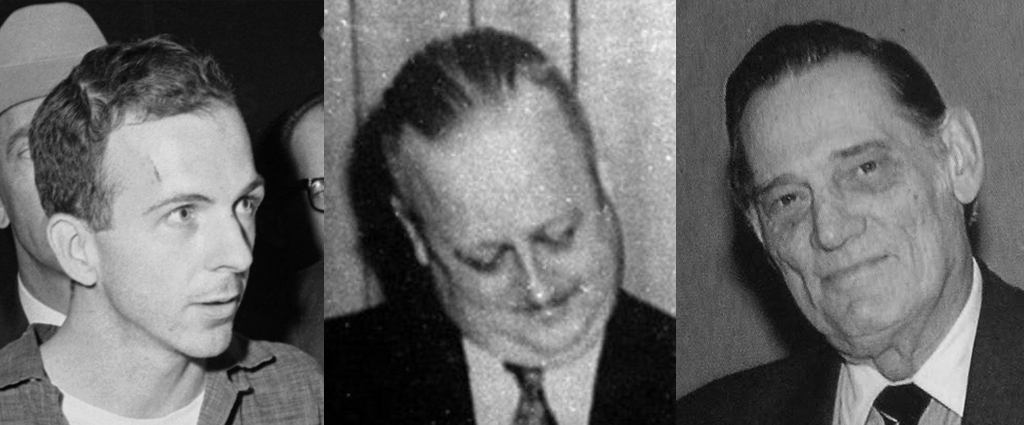
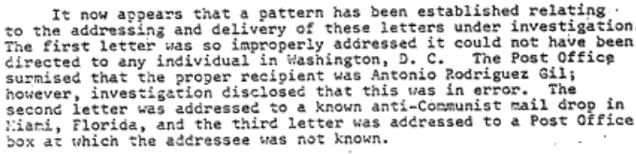
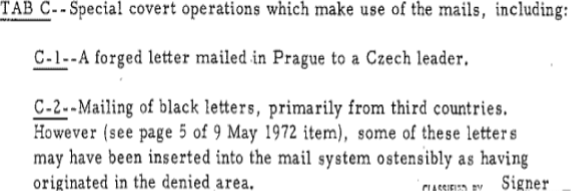
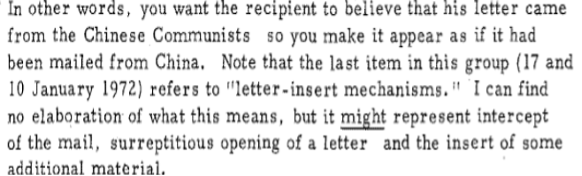
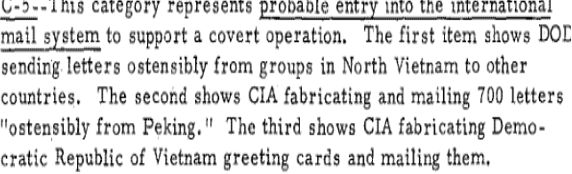


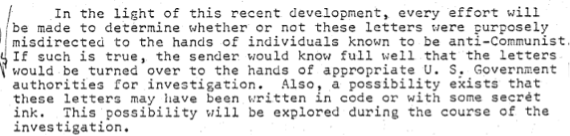


 Combined with Doug Horne’s description of the three-dimensional version Boswell drew, you will see later, that we are talking about smoking gun evidence that could have used the same level of graphics support the film production-team put together in the documentary.