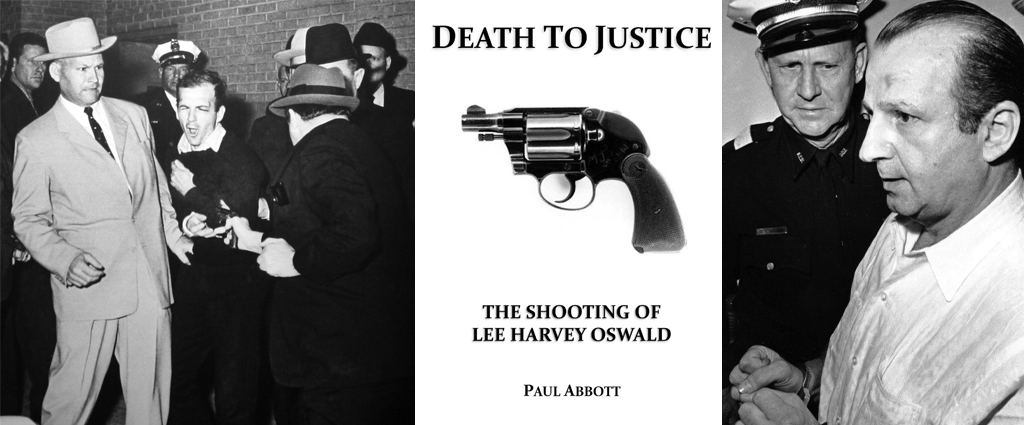
Author: Paul Abbott

  • The Threats to Kill Oswald – Part 2

    The Threats to Kill Oswald – Part 2

    The Threats to Kill Oswald – Part 2

    By Paul Abbott

    With Dallas Police Chief Jesse Curry’s gross incompetence; his lack of regard for due diligence and caution when it came to the handling of Lee Oswald’s security, we must still ask – how legitimate were the ‘committee’ threats against Oswald? The ‘committee’, on whose behalf they were being made, has never been identified. To speculate: which organization would feel so strongly about avenging President Kennedy’s murder? Presumably, they would either have had the membership or resources and motivation in Dallas at the time to mobilize there come Saturday night / Sunday morning.

    Of course, we must bear in mind that Dallas at the time, on account of its heavy, often extreme right-wing climate, was perceived as being the most worrisome of cities that President Kennedy’s tour included that weekend. And with the Democrat Kennedy’s reputation there for being bad for business and soft on communism considered, to the point of being accused of ‘Treason’, are we to suppose that there was an equally extreme organization, to quote Vernon Glossup, that was neither left or right leaning, who felt so strongly about Kennedy’s murder to the point of threatening the life of his accused assassin? It is doubtful.

    One final, but simple point on the ‘committee’ front is that, from the moment of Oswald’s arrest to the morning of his transfer, there was never any record or reports of a large, angry group gathered along the streets of Dallas. No trace of an angry-mob type ‘committee’ anywhere in Dallas that weekend, let alone on November 24, which seems to indicate we can pretty much call the ‘threats’ from a ‘committee’ dubious.

    With the ‘committee’ aspect discounted, what about the caller at least? There is sufficient evidence to substantiate that at least two calls were made that morning. However, the caller/s did not identify themselves nor the organization they were representing, so it literally could have been anyone. The wording attributed to the threat makers by Glossup and Newsom at the FBI, and McCoy at the Sheriff’s Department is interesting and almost verbatim in some parts to each other, particularly with reference to the reason the caller said he was warning of the threat…to ensure no one in the Sheriff or Police departments got injured. Of course, this could be attributed to Glossup’s notes made during the call and the resulting memo passed on to Newsom when calling the Sheriff’s Department and alerting the DPD about it. But neither item ever surfaced, so we can only take Glossup and Newsom’s word for it. Nonetheless, the DPD was not contacted by the threat makers directly, so just how sincere was the caller/s regard for their safety as well?

    Let’s not forget another interesting detail present in both Glossup and the second of McCoy’s calls from the threat makers… that when both first took the call, the caller sounded like they handed the receiver to another man who then warned of harm to Oswald. It’s an odd detail that lends an almost absurdly stage-managed/manufactured slant on it all.

    Could one or both of the callers have been Jack Ruby? If so, was he making such a call to sabotage an order or assignment that he did not want, or was he getting cold feet? It’s an interesting and viable theory that many researchers subscribe to.

    One person largely overlooked, but was central to the whole threat episode, of course, was FBI Special Agent Milton Newsom. He was not present when the clerk, Vernon Glossup, received the first call from the threat makers. This seems odd: for the ranking agent on duty not to be present at that particular moment. Where was Newsom at 2 am? It’s not like it was during the daytime, and therefore there was a greater likelihood of his being in a meeting or out in the field. Wherever he was, he wasn’t far as he seemed to get word of the threat from Glossup and act on it quickly by contacting both the Sheriff and Police departments.

    Perhaps most curious about Newsom was the fact that it was he, and only he, who took the only statement of Deputy McCoy, and the first of Captains Frazier and Talbert for the FBI regarding the whole threat episode. Talk about tying a neat bow on the recording of an event that he was involved in from the start!

    We also have reason to question Newsom on this front because William Frazier, during his testimony to the Warren Commission, disputed literally most of his statement attributed to him by Newsom. For example:

    • Newsom’s statement had Frazier saying that it was Vernon Glossup who rang him to advise of the threat received by him on Oswald’s life.
      • Yet Frazier said it was Newsom who called the DPD and spoke to him.
    • Newsom’s statement also quoted Frazier as saying that plans to transfer Oswald to the County Jail may be changed in view of the threat.
      • Frazier told the Warren Commission that he would not have said this because he did not know what the plans were to transfer Oswald, therefore, he did not know how they might be changed.
    • Newsom’s statement also quoted Frazier as saying Oswald’s planned transfer had been publicized primarily as a form of cooperation with the press and news agencies.
      • Frazier also denied making this statement to Newsom.

    Bear in mind, Frazier’s statement, like McCoy’s and Talbert’s, was barely one page long and consisted of a few paragraphs each. With the above considered, the only portion of his statement that Frazier could confirm as correct was how he (Frazier) mentioned that the DPD had not received any threats and that he was advised that the Sheriff’s office had received a similar threat call.

    Compared to the three-page statement he submitted to Sheriff Bill Decker, C.C. McCoy’s statement attributed to him by Newsom barely lines up. It too attributed McCoy as saying that plans to transfer Oswald to the County Jail at 10:00 am had been made public through news releases. Unfortunately, McCoy did not testify on the matter, so we do not have any record of him denying or confirming Newsom’s accuracy in his statement.

    What we do know is that both Glossup and Milton Newsom continued to work for the FBI in Dallas until at least the late 1970s. The only other part that Newsom played in the assassination investigation was the handling of the Bronson film of President Kennedy’s shooting. In fact, the death notice of Newsom in 2012 stated that he was a 30-year veteran of the Bureau. Vernon Glossup had even worked his way up to Special Agent status and by all reports is still alive. It is a loss to history that both were not subjected to more scrutiny about the threat matter. Unless Mr. Glossop would be willing and able to provide any further details after all these years, we are only left to speculate on him, Newsom and their conduct, in light of Oswald’s fate.

    Threading the Threat Needle

    If the phone call threats on Lee Oswald’s life were not legitimate from either a committee or an (unidentified) individual vengeful against him but merciful for the FBI, Sheriff and Police departments, all we are left with are pieces to speculate on their origin and purpose.

    Let me propose something that might seem outlandish at first glance: the threat phone calls were staged by either Milton Newsom or someone doing so on his orders. Why? He did so to apply pressure on the DPD and, after the fact, manipulate witness statements to further discredit the police.

    Context:

    In his Saturday morning statement, Curry inadvertently accused the FBI of either not knowing of someone like Lee Harvey Oswald and therefore not warning them of his presence in Dallas ahead of President Kennedy’s visit, or knowing of him but not warning them. With its association with Oswald confirmed, to what length did the FBI know of or use Oswald? And how concerned were they that weekend of being implicated by association for the president’s assassination? While Oswald was still alive, they were rendered officially helpless as killing the president was not a federal crime at that time. They would have had more of a stake investigating Oswald if he had shot a postman.

    What we must also consider is that the longer the weekend went with Oswald in police custody at City Hall, the more outrage and controversy were being stirred. For the most part, the scenes filmed and reported on by the media were chaos. Oswald, despite looking unkempt, calmly pronouncing his innocence, asking for legal assistance, and protesting the lineups he was in, provided a clear perception that the Dallas authorities barely had a handle on the situation. And an assortment of officials, including District Attorney Henry Wade, Chief Curry and Captain Fritz, providing updates on the investigation into Oswald did not help either. Doing so attracted the ire of people like J. Edgar Hoover and President Johnson, who were, fairly, worried that Oswald’s defense could argue for a mistrial on the grounds that he could never have received a fair trial thanks to the early opining of police and legal officials.

    Motivation:

    If the Dallas Police Department was out of its depth, with little help and steady guidance from Chief Curry, perhaps the FBI saw an opportunity to exploit this by creating a situation that would really highlight the point – something that would only add to the pressure already heaped on the DPD: a serious threat to Lee Oswald’s life. Such a scheme could be hatched locally with literally nothing to lose and everything to gain for the FBI. It would be the ultimate acid test to see what Chief Curry and his DPD would do. Perhaps the intent was to scare the DPD into actually getting with the program and ensuring Oswald’s security by transferring him sooner rather than later. That’s the best-case scenario because, given his Saturday afternoon statement to the press of when Oswald’s transfer would take place and his reputation for maintaining a closeknit relationship with them, it was more than a safe bet that Curry would remain to his word … even in response to a ‘credible’ threat and not budge on moving Oswald. Recall that Curry is on record as telling his beloved press mid-morning on Sunday that Oswald could have been transferred overnight in light of threats received on his life. But it did not happen because, Curry said, he didn’t want ‘to cross you people.’

    What was the desired outcome? Aside from assuring Oswald’s safety by being transferred early, regardless of how the DPD responded, I think the underlying intent was to completely undermine Curry and the DPD so as to both minimize any more backlash on the FBI from his comments on Saturday morning and to position itself as the ideal body to step in at the right time to competently investigate President Kennedy’s assassination. With control and oversight of the overall investigation, the FBI would be in a position to cover its own tracks in terms of their association with Lee Oswald and protect itself against the likely catastrophic fallout it would attract. Like the fact that Oswald was an informant for the FBI. Which would have been a disaster for J. Edgar Hoover.

    How:

    I think it was as simple as at least two threatening phone calls being made on behalf of a conveniently nameless, purposeless organization that was neither right nor left leaning by a person who also remained nameless. And despite saying they were warning of the threat out of concern for the welfare of FBI, Sheriff and DPD personnel, the threat makers did not bother calling the police to warn them. It was all too easy to make up and do so in such a way that could not be traced back to the FBI. Perhaps the DPD were not called for fear of the call somehow being traced or the voice being recognised. If Newsom was behind it, why risk it when all he had to do was either make or have a call phoned into the FBI (if one was made at all)? From there, Vernon Glossup would have wittingly or unwittingly cooperated in the charade by providing a memorandum to Newsom to make the whole episode official. At that point, Newsom could have made or had someone make two ‘threat warning’ calls to the Sheriff’s Department whilst he, in an official capacity, would call the Sheriff and DPD. That is all it could have taken to whip up the storm that followed that morning.

    Wrapping everything up neatly, as it were, Newsom could have easily positioned himself on behalf of the FBI to take the statements of the two other people pivotal to the threat response – McCoy and Frazier – to cement the narrative. And in doing so, sink a final boot into the Dallas Police Department by misquoting both men to implant a damning reference of Oswald’s transfer being publicized.

    Evidently, the FBI’s stake increased once Oswald was killed because his murder effectively ended the Dallas Police investigation into him. What soon followed was the infamous Belmont memo on November 24th, which mandated that the country be convinced of Oswald’s guilt in killing President Kennedy alone through a report submitted by the FBI. Essentially, with Oswald dead and the DPD out of the picture, with no other suspect to investigate any further, the ball was handed firmly to the FBI to control the narrative. Because the FBI very quickly, yet momentarily, came to sit at the center of the investigation on the back of Oswald’s murder.

    Johnson and Warren Wrap it all Up.

    President Lyndon B. Johnson would establish the Warren Commission on November 29th, which was essentially a high-level PR piece that would ‘review and evaluate’ the findings of the FBI’s investigation into President Kennedy’s assassination and Lee Oswald’s sole guilt. This was because Johnson was concerned that a single report from the FBI would not be enough to prevent a ‘rash of investigations’ that would amount to a ‘three-ring circus’ that would steer away the public from the desired Oswald-lone nut narrative.

    Chief Justice Earl Warren was approached directly by Johnson to head up the commission. Warren originally said no, but when Johnson countered him by putting forth information he had received from Director Hoover about a ‘little incident in Mexico City’, Warren tearfully agreed.

    Just what exactly Johnson used to pressure Warren with has been speculated about ever since. Some have interpreted this reference to be some kind of sordid or salacious piece of blackmail that Hoover had procured on Warren and paid it forward to Johnson. I disagree – I think it was more like the information that FBI-contact/asset Washington Star reporter, Jerry O’Leary, happened upon when in Dallas covering the aftermath of the assassination. I have laid this episode out in another article, but essentially, Jerry O’Leary (who was later named as an asset within the CIA’s Operation Mockingbird) met with a CIA contact of his in Dallas who was an ‘unimpeachable’ source who told him that Oswald returned from Mexico with five thousand dollars in cash. Instead of publishing a story on this stunning revelation, O’Leary promptly reported it to the FBI, who took it straight up to the State Department and the White House. The implication was that either the Soviets or Cubans were behind the president’s murder and that such information could be the catalyst for all-out war with the Soviets. The Warren Commission was formed with sitting senators and representatives such as Hale Boggs, Gerald Ford and Richard Russell, as well as Washington powerhouses in John McCloy and Allen Dulles. Surely enough the Commission would submit its findings that Lee Harvey Oswald was solely guilty of killing President Kennedy and police officer J.D. Tippit on November 22nd and anything contrary to these conclusions was either ignored or manipulated. War against the Soviet Union and Cuba was averted, but the truth behind President Kennedy’s murder, his accused assassin’s intelligence links and Oswald’s own suspicious murder have remained enduring mysteries. We can now add to this mosaic the momentary influence the FBI had when it came to ‘investigating’ the Kennedy assassination and ponder what it did to cover its own tracks when it came to its proven association with Lee Oswald.

    Click here to read part 1.

  • The Threats to Kill Oswald – Part 1

    The Threats to Kill Oswald – Part 1

    The Threats to Kill Oswald – Part 1

    By Paul Abbott

    The incarceration of Lee Harvey Oswald, the alleged killer of President John F. Kennedy and Police Officer J.D. Tippit, and his mistreatment at the hands of the Dallas Police across the weekend of November 22nd has been well established. But the matter of the alleged threats made against his life over the course of the night before his murder at the hands of Jack Ruby has largely been glossed over in the broader scheme of things. But just how they unfolded and were responded to has largely withstood any in-depth scrutiny ever since.

    The Curry Storm

    At approximately 11.30 am on Saturday, November 23rd, Jesse Curry, the Dallas Police Chief, was in his office on the southwest corner of the Third Floor of Dallas City Hall. Seated opposite him were a group of reporters, including the Associated Press’ Peggy Simpson and NBC’s Tom Pettit. It was one of the many occasions that weekend where he would hold court with the members of the press – to the point where he would be directed to stop doing so by FBI Director J. Edgar Hoover and President Lyndon Johnson across that weekend. Curry’s regard and synergy with the press were legendary and certainly a theme throughout his tenure as chief. In fact, in early 1958, he issued a memorandum to all Dallas police personnel essentially instructing them to provide the media with as much access and assistance as possible. Basically, he regarded them as a PR arm for the department and at that time, with the reputation that Dallas had for crime and corruption, it was clearly a mitigation strategy on his part.

    During Curry’s mini press conference with Simpson, Pettit and others, an interesting exchange took place:

    Curry: (to persons unknown) … They say he.. he said he was a communist…

    Pettit: Hey Chief, did the FBI or your department have him (Oswald) under surveillance prior to yesterday?

    Curry: No, sir, we didn’t have knowledge that he was in the city.

    Pettit: Did the FBI?

    Curry: I understand that they did know he was here and that they interviewed him … oh … a week or two ago.

    Pettit: Did they warn you of his presence in the city?

    Curry: No, they had not.. at the time .. until yesterday.

    Pettit: Do you think they should have?

    Curry: Well, they usually do. They keep us informed. If we don’t have knowledge of it, they usually liaise with us… usually let us know when these communist sympathizers or subversives come into the city. And why they hadn’t got round to informing us of this man, I don’t know.

    This frank exchange would be widely reported and circulated, sparking the wrath of the FBI hierarchy up to and including Director Hoover. The implication of course being that Chief Curry was deflecting all blame on the FBI for failing to detect and stop the communist Oswald and prevent the November 22nd killings. In fact, what Curry was saying to Pettit was completely reasonable. And evidently correct, as the FBI was monitoring Oswald at the time, and they did not alert the DPD to him prior to President Kennedy’s arrival. What followed was an effort by the FBI to mitigate any fallout from Curry’s statement by having Special Agent in Charge in Dallas, Gordon Shanklin, contact Curry and have him retract what he said to Tom Pettit. A summary memo from the FBI’s Cartha De Loach shows that Shanklin was successful in doing this and that Curry even apologized and said that he did not ‘mean to place any blame on the FBI’. The damage control continued with the FBI using their proven media contact on the ground, the Washington Star’s Jerry O’Leary, who was in Dallas to cover events that weekend, to also get in touch with Chief Curry and ‘make him go on record regarding the falsity of his allegations’.

    All of this resulted in Curry speaking to another group of reporters (including Tom Pettit) out in the hall on the Third Floor of City Hall just after 1 pm that same day. He led with the following statement:

    There has been some information that has gone out. I want to correct anything that might have been misinterpreted or misunderstood. And that is regarding information that the FBI might have had about this man (Oswald). I do not know… if and when the FBI has interviewed this man. The FBI is under no obligation to come to us with any information concerning anyone. They have cooperated with us in the past one hundred percent. Any time there’s any information that they feel that might be helpful to us, they have always come to us. Uh.. last night someone told me.. I don’t even know who it was, that the FBI did know this man was in the city and had interviewed him. I wish to say this. Of my knowledge, I do not know this to be a fact and I don’t want anybody to get the wrong impression that I am accusing the FBI of not cooperating or withholding information because they are under no obligation to us but have always cooperated with us one hundred percent. And I do not know if and when they have ever interviewed this man.

    While this episode started and ended within a couple of hours, I think it has been totally overlooked and underestimated in the scheme of things. Think about it…with all of the world focusing on him, his police department and their handling of the man suspected of killing President Kennedy, the Dallas Chief of Police publicly acknowledged that his department was usually alerted by the FBI about people like Lee Oswald (‘communist sympathizer / subversive’) but they were not in Oswald’s instance. It remains a shocking admission.

    No wonder the FBI was quick to act in response to Curry’s initial statement. The implications were doubly negative for them. If they did not know about a ‘communist sympathizer or subversive’ in Oswald, it was a massive oversight on their part that would rightly bring their competence into question. On the other hand, if they did know about Oswald, why did they not alert the DPD to his presence in Dallas? The implication would transcend just incompetence. Thankfully for us, the subsequent years have proven that the FBI was well and truly aware of Oswald, and was monitoring him, so this question, I think, lies at the center of a lot of the intrigue around Lee Oswald, his framing for the November 22nd killings and his own murder.

    What is clear in the Curry matter is that the FBI instantly threw all of its efforts into mitigating any blame it would receive for Oswald and the events of November 22nd, as well as asserting itself as being in control. This is a crucial point to keep in mind for the rest of this article.

    Come the latter hours of that Saturday, the media that had engulfed Dallas City Hall to cover Oswald’s incarceration were starting to dissipate. This was because it had been purported that Oswald had been charged with Kennedy’s murder, so their assumption was that there would be fewer and fewer opportunities to see and ask him any questions. The broader implication being that he would soon be moved to maximum security at the County Jail.

    The matter of transferring Lee Oswald from the City Hall to the County Jail was something that was still only notionally being discussed across the DPD hierarchy that afternoon. In ordinary circumstances, the transfer of a prisoner from City Hall, or any police station, to the County Jail, where they would await sentencing, was the responsibility of the local sheriff. The principle being that the sheriff would present at the police premises the necessary paperwork to take custody of the prisoner from that moment on. Only in extraordinary circumstances, which the weekend of November 22nd clearly presented, would this protocol ever be deviated from. However, in a subsequent statement that he gave, Dallas Sheriff Bill Decker testified to not being notified by the DPD of any plans or intent they had for them (the DPD) or the Sheriff’s Department to facilitate Oswald’s transfer to the County Jail. In fact, he only found out his information on this front through members of the media.

    And examining the statements of Chief Curry and his captain for the Homicide and Robbery Bureau, J.W. Fritz, who had Oswald in custody, shows that the transfer had not been discussed between them at any great length.

    From Curry’s perspective, he was being asked the question by the media about the transfer, so he in turn asked Fritz if he thought he’d be done with his questioning of Oswald that (Saturday) afternoon, so he could be transferred. Fritz said that he still needed more time, which was his right, as it was much easier to interrogate a suspect at City Hall than at the County Jail. Between the two, it was generally agreed that Oswald would stay another night at City Hall for further questioning and be transferred the next morning. On this, Curry duly told the press that Oswald would be transferred the next day at 10 am:

    Over the years, this point has been muddled as Curry telling reporters that if they were at City Hall by 10 am on the Sunday, they won’t have missed the transfer. But using articles) published that weekend, it was clearly reported that Curry stated the transfer would begin at 10 am. (Abbott, Death to Justice, p.363

    As Saturday evening turned into night, Dallas City Hall quietened down to a near state of normalcy, with there only being a handful of reporters staying around in case Oswald was instead transferred that night. We are now able to examine the alleged threats to Lee Oswald’s life in the early hours of Sunday, November 24th, on behalf of a ‘committee’.

    Below is a list of the people who had firsthand, evidential dealings with receiving and acting upon the threats:

    • Police Chief Jesse Curry – DPD
    • Sheriff Bill Decker – Sheriff’s Dept.
    • Captain William B. Frazier – DPD
    • Captain J.W. Fritz – DPD
    • Vernon R. Glossup (civilian clerk) – FBI
    • Deputy C.C. McCoy – Sheriff’s Dept.
    • Special Agent Milton L. Newsom – FBI
    • Captain Cecil E. Talbert – DPD

    Using statements and quoting specific points that each of these people provided to either the FBI or the Warren Commission, we can piece together a chronology when it comes to the receiving and handling of these threats.

    Threat Timeline:

    • At the County Jail, Deputy Sheriff C.C. McCoy was working the night shift which consisted of taking phone calls from all manner of citizens, near and far, who were calling to do anything from express their condolences to warning of a group of ‘fourteen thousand negroes’ who were coming to town to get ‘this bunch’ straightened out. Also on duty were fellow personnel by the names Kennedy, Watkins and ‘Virgil’.
    • At approximately 2:00 am, McCoy even received a call from Sheriff Bill Decker. During this call, he and Decker discussed when Oswald’s transfer would take place and that it should be while it was still dark. They even speculated when it became light (6:30 am or 6:45 am) and agreed that McCoy would call Decker back at 6 am to see about getting Oswald transferred before first light.
    • At 2:15 am, McCoy received another call. This time it was from a man who, according to a statement he later provided, ‘talked like a w/m (white male) and he stated that he was a member of a group of one hundred and that he wanted the Sheriff’s office to know that they had voted one hundred per cent to kill Oswald while he was in the process of being transferred to the County Jail. And that he wanted this department to have the information so that none of the deputies would get hurt.’ McCoy said ‘The voice was deep and coarse and sounded very sincere and talked with ease. The person did not seem excited like some of the calls that had received running down this department, the police department and the State of Texas.’ McCoy said that he had his colleague, ‘Virgil’, listen to part of the call.
    • At 2:30 am, civilian clerk for the Dallas FBI office, Vernon R. Glossup, received a call from an unknown male who also spoke in a calm voice and asked to talk to the man in charge. According to his own statement, Glossup said he ‘told the caller that the SAC (Special Agent in Charge) was not present at that time and asked if someone else could help him. The caller then said, “Wait a minute,” and apparently turned the phone over to another man. I am not certain there were two different voices; however, the tone of the unknown caller’s voice changed somewhat at this point. The voice at this point was calm and mature in sound, and this person stated as follows: “I represent a committee that is neither right nor left wing, and tonight, tomorrow morning, or tomorrow night, we are going to kill the man that killed the president. There will be no excitement, and we will kill him. We wanted to be sure and tell the FBI, Police Department, and Sheriff’s Office, and we will be there and will kill him.” With that, the caller hung up. Glossup transcribed the call in a memorandum for Special Agent Milton L. Newsom, who contacted the Sheriff’s Department at 3:00 am to see if they too had received any such calls. Newsom then called the Police Department at 3:30 am to ask the same and advise of the threat that Glossup had received.
    • Sheriff Deputy McCoy concurred that he received a call from Newsom and that he merely asked if ‘we’ (the Sheriff’s Department) had received any calls threatening Oswald’s life. McCoy said that he had, so Newsom instructed him to contact Dallas Police ‘and give the same information to them.’ According to his statement, McCoy did call the Dallas Police Department but could only recall that he ‘talked to someone in Captain Fritz’s office.’ McCoy stated that he was told by a member of the DPD that they (Dallas Police) hadn’t received any threatening phone calls.
    • Still with McCoy and his statement, he ‘received one other call regarding the transfer of Oswald, and when I answered the telephone, a male voice asked if this is the Sheriff’s office, and I said that it was. He said, “Just a minute,” and then another male voice stated that Oswald would never make the trip to the County Jail. McCoy said he could not determine whether or not this was the same voice that called earlier on behalf of a ‘committee’.
    • At City Hall, Captain William B. Frazier was the ranking officer on duty there that night. He testified to the Warren Commission of being contacted by FBI Agent Milton Newsom between 3:00 am and 3:45 am. He quoted Newsom as telling him that he (Newsom) ‘received a threat from some man to the effect that a group of men of 100 or 200’, Frazier said he couldn’t recall exactly, ‘were going to attempt to kill Oswald that day sometime. That he (the caller) didn’t want the FBI, Dallas Police Department or the sheriff’s office injured in any way. That was the reason for the call.’
    • To somewhat corroborate McCoy’s account, in the same testimony for the Warren Commission, Frazier said he spoke to someone with the surname of, or similar to, ‘Cox’ or Coy’ from the Sheriff’s Department. Frazier testified that he wasn’t clear on the time of the call, but he and McCoy discussed Oswald’s transfer and that McCoy told him that Sheriff Decker recommended that it be brought forward. And if so, there could be two supervisors from the Sheriff Department on hand at the County Jail to receive Oswald.
    • Frazier said that he next called Captain Fritz at his home to tell him of the threats against Oswald and that he would need to be transferred. Fritz told him it was Chief Curry’s decision to make, as he wanted Oswald transferred in the morning. However, when Frazier tried to also reach Curry by phone at home, the line was out of order.
    • At around 6:00 am, McCoy called Bill Decker as agreed and told him who was on duty and how they could carry out Oswald’s transfer if required – including hiding Oswald down in the footwell of the car. He was told by Decker to hold off on any plans until he spoke with Captain Fritz.
    • At 6:15 am, Frazier was at the end of his shift and about to be relieved by Captain Cecil E. Talbert. In the handover, Frazier said that he advised Talbert of the threat situation with Oswald and that both Sheriff Decker and Agent Newsom were anxious to transfer him.
    • According to Talbert’s statement for the Warren Commission, he must have been advised of the issue to reach Curry, as he said that he got the telephone company to put a buzzer on his phone line to determine if the line was faulty. It was, so he sent a squad car to Curry’s house to brief him on the situation and have him call City Hall… if he could.
    • Despite the issues with his phone, Curry soon called Talbert back at City Hall and was briefed on the threats. All Curry did was instruct Talbert to tell Newsom and Decker that he would contact them when he was in his office between 8:00 am and 9:00 am later that morning.

    With all of the above told, no more was done to address the threats to Lee Oswald.

    As the morning rolled on, the transfer at least had some planning put toward it. Once Curry and Decker decided between them that the DPD would facilitate the transfer, it was decided that Oswald would be taken in an armored truck for the twelve-block journey to the County Jail. Acting on orders from Curry, Deputy Chief Batchelor contacted a local armored car company, and they sent two people carrying armored trucks to City Hall’s Commerce Street ramp exit.

    At the last minute, at approximately 11:15 am, Fritz recommended that Oswald instead be placed in the back of an unmarked squad car and that it follow behind the armored car, which in turn would be empty and a decoy. His justification for this was that if there was an attack launched on Oswald during the transfer, a vehicle such as an armored car would be too awkward to maneuver and evade. With that, the transfer finally got underway with a group of detectives and Fritz leaving the Third Floor with Oswald – and the rest is tragic history. Jack Ruby was able to access the basement and be in a position to shoot, and ultimately kill, Oswald when he and his escort emerged into the basement and were walking to the car.

    While there are clear gaps in some of the timings and accounts around the threats response (for example, McCoy’s statement does not include any mention of speaking to Decker after he had both received and received word of the threat calls), it is clear that there was some effort by he and the DPD’s Frazier to bring about Oswald’s transfer early to pre-empt any threat against his life. The roadblocks were Captain Fritz and Chief Curry.

    When first told of the threats by Frazier, Fritz basically put his hands up and said, ‘Not me, not my call.’ What any competent leader within a hierarchy ought to have done, in this instance, was say, ‘It is the Chief’s call… so try and reach him to find out. If you can’t reach him, call me back because we’d best still get the transfer underway.’

    However, if Jesse Curry’s phone line was not a factor and he was reached by Frazier, it would not have made a difference. We can be sure of this because he scuttled any chance to respond accordingly when he instructed that Newsom and Decker be told that he would arrive at City Hall in a couple of hours’ time. That was it. That was how he responded to the word of the threats. There was no action to effect an earlier transfer there and then. If he did decide to do something about it, Curry wouldn’t have had to do much other than give the approval. Between his personnel, and perhaps a quick phone call by him to Sheriff Decker, Oswald’s early and safe transfer would have been incredibly easy to carry out.

    The burning question is why Curry didn’t want to have Oswald transferred at that point in time? At 10:20 am later that morning, when speaking to reporters, Curry not only mentioned the threat made to Oswald overnight, he also said that he could’ve been transferred early as a result but he (Curry) chose not to because he didn’t want to go back on the original time he told the press (Abbott, Death to Justice, p.112). Apparently, it was as simple as that. On top of it all, Curry actually laid out to the reporters that Oswald would be transported to the County Jail in an armored car. Talk about infuriating!

    Having uncovered just how the verifiable threat episode involving the FBI, Sheriff and DPD took place, in Part Two, we will analyze this episode in the context of the furor that Chief Curry started with his candidness on the morning of Saturday when speaking with the press and how the FBI ultimately took the early lead in investigating President Kennedy’s assassination.

    Click here to read part 2.

  • Fair Play for Burt Griffin and Leon Hubert of the Warren Commission?

    Fair Play for Burt Griffin and Leon Hubert of the Warren Commission?


    Fair Play for Burt Griffin and Leon Hubert of the Warren Commission?

    By Paul Abbott

    The Warren Commission has been undeniably and rightly vilified since its 1964 release up to and including the ultimate counterargument – 2023’s The JFK Assassination Chokeholds. Its Oswald-did-it-and-did-it-alone conclusion seemed to be arrived at first, and then the evidence seemed cherry-picked in order to make that verdict stick. But aside from Commission dissenters like Hale Boggs and Richard Russell, there were others within its ranks who tried to pursue at least a halfway decent investigation into the peripheries of the Lee Oswald orbit. 

    Leon Hubert and Burt Griffin were the two attorneys tasked with leading the Commission’s inquiry into Jack Ruby, which included how he came to kill Oswald. This involved their mobilization to Dallas – between late March to early May of 1964 – to question dozens of witnesses related to Ruby and the Oswald murder. This included employees of Ruby’s and members of the Dallas Police Department who witnessed the Oswald slaying. 

    Reading through witness statements, it was clear that both Hubert and Griffin only pushed so far when it came to scrutinizing the conditions at Dallas City Hall on the morning of 11/24/63. But Griffin did sense a weakness in Sgt. Patrick Dean and his inability to adequately address the question of whether the stairwell door from the Annex Building into the basement car park was locked. Reading that exchange it is clear that Griffin sensed that this was an alternative method of entry for Jack Ruby that morning, and he was calling out Dean for his attempts to deflect away from it. Aside from this episode, Griffin took exception to Dean’s account of how Ruby told him he entered the basement, down the Main Street ramp, just minutes after shooting Oswald. This was done, despite the lack of initial corroboration from fellow DPD personnel or from the Secret Service’s Forrest Sorrels. It all led to Griffin talking to Dean off the record during a break and imploring him to tell the truth – in a blink two times if you’re in trouble kind of way. As Griffin outlined in a subsequent memo to his WC superior, J. Lee Rankin:

    ‘ I told him (Dean) that in the two or three hours that he and I had been talking, I found him to be a likable and personable individual, and that I believed he was a capable and honest police officer… I then stressed that this investigation was of extreme importance to the National Security and that .. if there was some way that he could be induced to come forward with a forthright statement without injuring himself, the Commission would probably be willing to explore a means to afford him the protection that was necessary…’ 

    In response to the way he felt he was treated by Griffin, Dean lodged a complaint with Dallas DA Henry Wade, who conveyed this to the Warren Commission. 

    Griffin and Hubert returned to Washington from Dallas and put forth a case for either a chapter or sub-chapter to be included in the final report by the Warren Commission titled ‘The Killing of Lee Harvey Oswald’. To justify this and the numerous threads they had picked up on Jack Ruby, Griffin, and Hubert tended a report to Rankin for his consideration. It is included as verbatim below:


    May 14, 1964

    To:    J. Lee Rankin

    From:   Leon D. Hubert Jr. 
                  Burt W. Griffin

    Subject: Adequacy of Ruby Investigation

    1. Past Recommendations. In memoranda dated February 19, February 23, February 27, and March 11, we make various suggestions for extending the investigation initiated … in connection with the Oswald homicide. Shortly after March 11, 1964, we began preparation for the nearly 60 depositions taken in Dallas during the period March 21 – April 3; after we returned from Dallas we took the deposition of C.L. Crafard (two days) and George Senator (two days), worked on editing the depositions taken in Dallas, and prepared for another series of 30 other depositions taken in Dallas during the period April 13-17. On our return from Dallas, we continued the editing of the Dallas depositions, prepared the Dallas depositions exhibits for publication, and began working on a draft of the report in Area V. As a consequence of all this activity during the period March 11-May 13, we did not press for the conferences and discussions referred to in the attached memoranda. The following represents our view at the time with respect to appropriate further investigation.

    2. General Statement of Areas Not Adequately Investigated. In reporting on the murder of Lee Oswald by Jack Ruby, we must answer or at least advert to these questions:
      1. Why did Ruby kill Oswald;
      2. Was Ruby associated with the assassin of President Kennedy;
      3. Did Ruby have any confederates in the murder of Oswald?

      It is our belief that, although the evidence gathered so far does not show a conspiratorial link between Ruby and Oswald, or between Ruby and others, nevertheless evidence should be secured, if possible, to affirmatively exclude that:

      1. Ruby was indirectly linked through others to Oswald;
      2. Ruby killed Oswald, because of fear; or
      3. Ruby killed Oswald at the suggestion of others.

    3. Summary of Evidence Suggesting Further Investigation. The following facts suggest the necessity of further investigation:
      1. Ruby had time to engage in substantial activities in addition to the management of his Clubs. Ruby’s nightclub business usually occupied no more than five hours of a normal working day…. It was his practice to spend an average of only one hour a day at his Clubs between 10:00 am and 9:00 pm. Our depositions were confined primarily to persons familiar with Ruby’s Club activities. The FBI has thoroughly investigated Ruby’s nightclub operations but does not seem to have pinned down his other business or social activities. The basic materials do make reference to such other activities (see p. 27 of our report of February 18), but these are casual and collateral and were not explored to determine whether they involved any underlying sinister purpose. Nor were they probed in such a manner as to permit a determination as to how much of Ruby’s time they occupied. 
      2. Ruby has always been a person who looked for money-making ‘sidelines.’ In the two months prior to November 22, Ruby supposedly spent considerable time promoting an exercise device known as a ‘twist board.’ The ‘twist board’ was purportedly manufactured by Plastellite Engineering, a Fort Worth manufacturer of oil field equipment which has poor credit references and was the subject of an FBI investigation in 1952. We know of no sales of this item by Ruby; nor do we know if any ‘twist boards’ were manufactured for sale. The possibility remains that the ‘twist board’ was a front for some other illegal enterprise. 
      3. Ruby has long been close to persons pursuing illegal activities. Although Ruby had no known ideological political interests (see p. 35 of our report of February 18), there is much evidence that he was interested in Cuban matters. In early 1959, Ruby inquired concerning the smuggling of persons out of Cuba. He has admitted that, at that time, he negotiated for the sale of jeeps to Castro. In September 1959, Ruby visited Havana at the invitation of Las Vegas racketeer, Louis J. McWillie, who paid Ruby’s expenses for the trip and who was later expelled from Cuba by Castro. McWillie is described by Ralph Paul, Ruby’s business partner, as one of Ruby’s closest friends. Ruby mailed a gun to McWillie in early 1963. In 1961, it was reported that Ruby attended three meetings in Dallas in connection with the sale of arms to Cubans and the smuggling out of refugees. The informant identifies an Ed Brunner as Ruby’s associate in the endeavor. Shortly after his arrest on November 24, Ruby named Fred Brunner as one of his expected attorneys. Brunner did not represent Ruby, however. Insufficient investigation has been conducted to confirm or deny the report about meetings in 1962. When Henry Wade announced to the Press on November 2, 1063, that Oswald was a member of the Free Cuba Committee. Ruby corrected Wade by stating “not the Free Cuba Committee; The Fair Play for Cuba Committee. There is a difference.” The Free Cuba Committee is an existing anti-Castro organization. Earl Ruby, brother of Jack Ruby, sent an unexplained telegram to Havana in April 1962. We believe that a reasonable possibility exists that Ruby maintained a close interest in Cuban affairs to the extent necessary to participate in gun sales or smuggling. 
      4. Bits of evidence link Ruby to others who may have been interested in Cuban affairs. When Ruby’s car was seized on November 24, it contained various right-wing radio scripts issued by H.L. Hunt and a copy of the Wall Street Journal bearing the mailing address of a man who has not yet been identified. In May 1963, Early Ruby, operator of a dry cleaning business, is known to have telephoned the Welch Candy Company (owned by the founder of John Birch Society). The purpose of the call is unknown. Jack Ruby’s personal notebook contained the Massachusetts telephone number and address of Thomas Hill, a former Dallas resident, working at the Boston headquarters of the John Birch Society. Although it is most likely that all of those bits of circumstantial evidence have innocent explanations, more have yet to be explained. 
      5. Although Ruby did not witness the motorcade through Dallas, he may have had a prior interest in the President’s visit. A November 20 edition of the Fort Worth Telegram showing the President’s proposed route through Fort Worth, and the November 20 edition of the Dallas Morning News showing the President’s route through Dallas, were found in Ruby’s car on November 24. 
      6. On November 16 Jack Ruby met at the Carousel Club with Bertha Cheek, sister of Mrs. Earlene Roberts, manager of Lee Oswald’s rooming house. Mrs. Cheek said that she and Ruby discussed her lending Ruby money to open a new nightclub. Ruby was not questioned about this matter. On November 20, 1963, a woman, who may be identical to Earlene Roberts, was reported to be in San Antonio at the time of President Kennedy’s visit. The possible identification of Mrs. Roberts in San Antonio has not been checked out. In addition, the link formed by Mrs. Roberts between Oswald and Ruby is buttressed in some measure by the fact that one of Ruby’s strippers dated a tenant of the Beckley Street rooming house during the tenancy of Lee Oswald. We have previously suggested the theory that Ruby and Mrs. Cheek could have been involved in Cuban arms sales of which Oswald gained knowledge through his efforts to infiltrate the anti-Castro Cubans. Our doubts concerning the real interest of Mrs. Cheek in Jack Ruby stem from the fact that one of her four husbands was a convicted felon and one of her friends was a police officer who married one of Ruby’s strip-tease dancers. We have suggested that Ruby might have killed Oswald out of fear that Oswald might implicate Ruby and his friends, falsely or not in an effort to save his own life. We think that neither Oswald’s Cuban interest in Dallas nor Ruby’s Cuban activities have been adequately explained. 
      7. Ruby made or attempted to make contacts on November 22 and 23 with persons, known and unknown, who could have been co-conspirators. Ruby was visited in Dallas from November 21 to November 24, 1963, by Lawrence Meyers of Chicago. Meyers had visited Ruby two weeks previously. Ruby also made a long-distance call shortly after the President’s death to Alex Gruber in Los Angeles. Gruber had visited Ruby about the same time as Meyers in early November. Both Gruber and Meyers give innocent explanations. Meyers claims he was in Dallas enjoying life with a ‘dumb but accommodating broad.’ Gruber claims Ruby called to say he would not mail a dog that day, as he had promised to do. Finally between 11:35 pm and 12 midnight, Saturday, November 23, Ruby made a series of brief long-distance calls culminating with a call to entertainer Breck Wall at a friend’s house in Galveston. Wall claims Ruby called to compliment him for calling off his (Wall’s)  set at the Adolphus Hotel in Dallas. Background checks have not been made on these persons.
      8. In fact, we believe that the possibility exists based on evidence already available that Ruby engaged in illegal dealings with Cuban clients who might have had contact with Oswald. The existence of such dealings can only be surmised since the present investigation has not focused on that area. 
      9. We suggest that these matters cannot be left ‘hanging in the air.’ They must either be explored further or a firm decision must be made not to do so, supported by stated reasons for the decision. As a general matter, we think the investigation is deficient in these respects:
        1. Substantial time segments in Ruby’s daily routine from September 26 to November 22 have not been accounted for. 
        2. About 46 persons who saw Ruby from November 22 to November 24 have not been questioned by staff members, although there are FBI reports of interviews with all of these people.
        3. Persons who have been interviewed because of known associations with Ruby generally have not been investigated themselves so that their truthfulness can be evaluated. The FBI reports specifically do not attempt evaluation. The exception has been that where the FBI has been given incriminating evidence against Ruby, it has made further investigation to determine whether others might also be implicated with Ruby. In every case where there was some evidence implicating others, these other persons were interviewed and denied the incriminating allegations. Further investigation has not been undertaken to resolve the conflicts. 
        4. Much of our knowledge of Ruby comes from his friends Andrew Armstrong, Ralph Paul, George Senator, and Larry Crafard. Investigations have not been undertaken to corroborate their claims. 
    4. Specific Investigative Recommendations 
      1. We should obtain photos of all property found on Ruby’s person, in his car, or at his home or clubs, now in possession of the Dallas District Attorney. We already have photos of Ruby’s address books, but no other items have been photographed or delivered to the Commission. These items included H.L. Hunt literature and newspapers mentioned in paragraphs 3d and 3e.
      2. We should conduct staff interviews or take depositions with respect to Ruby’s Cuban activities of the following persons:
        1. Robert Ray McKeown. Ruby contacted McKeown in 1959 in connection with the sale of jeeps to Cuba. The objective of an interview or deposition of McKeown would be to obtain information on possible contacts Ruby would have made after 1959 if his interest in armament sales continued. 
        2. Nancy Perrin. Perrin claims she met with Ruby three times in 1961 concerning refugee smuggling and arms sales. She says she can identify the house in Dallas where meetings took place. Perrin now lives in Boston. Ruby admits he was once interested in the sale of jeeps at least, to Cuba. 
      3. We should obtain reports from the CIA concerning Ruby’s associations. The CIA has been requested to provide reports based on a memorandum delivered to them on March 13, 1964, concerning Ruby’s background including his past Cuban activities, but a reply has not been received as yet. 
      4. We should obtain reports from the FBI based on the requested investigation of allegations suggesting that Earlene Roberts was in San Antonio on November 21.
      5. The Commission should take the testimony of the following persons for the reasons stated:
        1. Hyman Rubenstein, Eva Grant, Earl Ruby. All are siblings of Jack Ruby. Hyman is the oldest child and presumably will be the best witness as to family history. He talked to Jack on November 22, reportedly visited Jack the weekend before the assassination, and participated in Ruby’s twist board venture. Eva lived with Jack for 3 years in California prior to World War II, induced Jack to come to Dallas in 1947, and managed the Vegas Club for Jack in Dallas from 1959 to 1963. Earl was a traveling salesman with Jack from 1942-1943; a business partner from 1946-1947, and made phone calls before November 22, 1963 and afterwards which require explanations.
        2. Henry Wade. This person can testify to the development of the testimony by Sgt. Dean and Det. Archer against Ruby and of seeing Ruby on November 22 in the Police Department building
        3. Jack Ruby
      6. We should take the deposition of the following persons for the reasons stated:
        1. Tom Howard. This person is one of Ruby’s original attorneys and is reported to have been in the police basement a few minutes before Oswald was shot and to have inquired if Oswald had been moved. He filed a writ of habeas corpus for Ruby about one hour after the shooting of Oswald. He could explain these activities and possibly tell us about the Ruby trial. We should have these explanations. 
        2. FBI Agent Hall. This person interviewed Ruby for 2.5 hours on November 24 beginning at approximately 12 noon. His report is contradictory to Sgt. Dean’s trial testimony. He also interviewed Ruby on December 21, 1963.
        3. Seth Kantor. This person was interviewed twice by the FBI and persists in his claim that he saw Ruby at Parkland Hospital shortly before or after the President’s death was announced. Ruby denies that he was ever at Parkland Hospital. We must decide who is telling the truth, for there would be considerable significance if it were concluded that Ruby is lying. Should we make an evaluation without seeing Kantor ourselves?
        4. Bill Dellar. This person claims to have seen Oswald at the Carousel Club prior to November 22, and this rumor perhaps more than any other has been given wide circulation. Should we evaluate Dellar’s credibility solely on the basis of FBI reports?
      7. The FBI should re-interview the following persons for the purposes stated:
        1. Alex Gruber. To obtain personal history to establish original meeting and subsequent contacts with Ruby; to obtain details of the visit to Dallas in November 1963, including where he stayed, how long, who saw him, etc. The FBI should also check its own files on Gruber.
        2. Lawrence Meyers (same as Gruber)
        3. Ken Dowe. (KLIF reporter) To ascertain how he happened to first contact Ruby on November 22 or 23; (Ruby provided information to KLIF concerning the location of Chief Curry), and whether KLIF gave any inducements to Ruby to work for it on the weekend of November 22-24. 
        4. Rabbi Silverman. To establish when Silverman saw Ruby at the Synagogue and obtain names of other persons who may have seen Ruby at the Synagogue on November 22 and 23. Silverman states that he saw Ruby at the 8 pm service on November 22 and the 9 am service on November 23; but both of these services lasted at least two hours and we do not know whether Ruby was present for the entire service. Silverman (and others) could ‘place’ Ruby, or fail to do so, during critical hours. 
        5. Mickey Ryan (same as Gruber plus employment in Dallas.)
        6. Breck Wall. This person was an entertainer at the Adolphus Hotel, Dallas, at the time of President Kennedy’s assassination. Ruby called him in Galveston at 11:47 pm on Saturday, November 23, 1963. He also visited Ruby at the County Jail. A background check should be conducted as to this person. 
        7. Andrew Armstrong, Bruce Carlin, Karen Bennett Carlin, Curtis Laverne Crafard, Ralph Paul, George Senator. These persons were deposed at length because of their friendship with Ruby, familiarity with Ruby’s personal and business life, and contacts with Ruby on November 22, 23, and 24. In general, each has professed to have had no knowledge of Ruby’s activities during those three days.

          Andrew Armstrong was very active in the operation of the Carousel and worked closely with Ruby for 18 months. His deposition covers Ruby’s activities and emotional state generally and particularly several hours on November 22 and 23. A background check should be conducted as to this person and selected parts of his testimony should be checked out to test his veracity.

          Karen and Bruce Carlin were the recipients of a $25 money order bought by Ruby approximately 9 minutes before Ruby shot Oswald. Marguerite Oswald testified that she believed she knew Karen Carlin. Background checks should be conducted on the Carlins.

          Crafard fled Dallas unexpectedly on Saturday morning November 23. Although we tend to believe his explanation, we believe a background check on him plus verification of some of his activities on November 23 are warranted.

          Paul is Ruby’s business partner. A background check should be conducted as to him, and his telephone calls during November should be checked out.

          George Senator, Ruby’s roommate, alleged by Crafard to be a homosexual, claims not to have seen Ruby except at their apartment Sunday morning and for a few hours early Saturday morning. The senator’s background and own admitted activities on November 22, 23, and 24 should be verified. 

    5. Other areas of Ruby Investigation which are not complete.
      1. Various rumors link Ruby which do not appear to be true; however, the materials we have are not sufficient to discredit them satisfactorily. Such rumors include: 
        1. Communist associations of Ruby
        2. Oswald’s use of a Cadillac believed to belong to Ruby;
        3. After the depositions of Nancy Perrin, Robert McKeown, and Syliva Odio have been taken, further investigation may be necessary with respect to Ruby’s Cuban associations. 
      2. Ruby’s notebooks contain numerous names, addresses, and telephone numbers. Many of these persons have either not been located or deny knowing Ruby. We believe further investigation is appropriate in some instances; however, we have not yet evaluated the reports now on hand. 
      3. We have no expert evidence as to Ruby’s mental condition; however, we will obtain transcripts of the psychiatric testimony at the Ruby trial. 
    6. Other Investigative Suggestions. We have suggested in earlier memoranda that two sources of evidentiary material have been virtually ignored:  
      1. Radio, TV, and movie recordings. Two Dallas radio stations tape-recorded every minute of air time on November 22, 23, and 24. We have obtained these radio tapes for all except a portion of November 24, and the tapes included a number of interviews with key witnesses in the Oswald area. In addition, the tapes shed considerable light on the manner in which Dallas public officials and federal agents conducted the investigation and performed in public view. We believe that similar video tapes and movie films should be obtained from NBC, CBS, ABC, UPI, and Movietone News, and relevant portions should be reviewed by staff members. Wherever witnesses appear on these films who have been considered by the Commission in preparing its report, a copy of such witnesses’ appearance should be made a part of the Commission records by introducing them in evidence. If one person were directed to superintend and organize this effort, we believe it could be done without unreasonable expenditures of Commission time and money. 
      2. Hotel and motel registrations, airline passenger manifests, and Emigration and Immigration records. Copies of Dallas hotel and motel registrations and airline manifests to and from Dallas should be obtained for the period October 1, 1963, to January 1, 1964. We believe that these records may provide a useful tool as new evidence develops after the Commission submits its report. We do not suggest these records necessarily be examined by the Commission staff at the present time. But, for example, it is likely that in the future, persons will come forward who will claim to have been in Dallas during the critical period and will claim to have important information. These records may serve to confirm or refute their claims. 


      LHHubert/smh

      Cc: Mr. Hubert

    So what of the people that Griffin and Hubert referred to in their memo? Below are those that had already testified to them in Dallas in April 1964:

    • Earlene Roberts – Oswald’s landlady in Oct & Nov ’63: was not asked about linkage to Jack Ruby through her sister, Bertha Cheek.
    • Bertha Cheek – friend of Jack Ruby and sister of Earlene Roberts: testified about investment dealings with Jack Ruby. Brief acknowledgment only that her sister was Oswald’s landlady on 11/22.
    • George Senator – Jack Ruby’s friend and roommate: testified to his friendship with Ruby, business dealings of Ruby’s and his (Ruby’s movements) across the weekend of 11/22.
    • Andrew Armstrong – employee of Jack Ruby’s: testified to Ruby’s personality, running of Carousel Club, and Ruby’s movements across weekend of 11/22.
    • Larry Crafard – employee of Jack Ruby’s who left Dallas suddenly on 11/23: testified to being employed by Ruby and his volatility.
    • Ralph Paul – business associate of Jack Ruby: testified about Ruby’s historic and current business dealings. 
    • Karen Carlin – employee of Jack Ruby: testified about Ruby’s management of the Carousel Club and Ruby’s movements across the weekend of 11/22.
    • Bruce Carlin – husband of Karen Carlin: testified about Ruby’ and Ruby’s movement across the weekend of 11/22.

    Of the people highlighted as being of further interest to Griffin and Hubert in their memo, only the people below were subsequently interviewed by the Warren Commission:

    • Henry Wade – District Attorney for Dallas: he doggedly defended Sgt. Pat Dean
    • Lawrence Meyers – friend of Jack Ruby: gave insight into Ruby’s business dealings in Dallas and his (Ruby’s) adoration for JFK
    • Nancy Perrin Rich – former employee of Jack Ruby: focused on Ruby’s volatility and links to DPD 
    • Hyman Rubenstein – Jack Ruby’s older brother: testified about Ruby’s family upbringing, Jack Ruby’s volatility, and business dealings leading up to and in Dallas
    • Earl Ruby – Jack Ruby’s younger brother: also testified about Ruby family upbringing, Jack Ruby’s volatility, business dealings leading up to and in Dallas plus handling of Ruby’s defense for shooting Oswald
    • Eva Grant – Jack Ruby’s older sister: testified on Ruby’s upbringing, Dallas business, and contact with him on weekend of 11/22.
    • FBI agent who first interrogated Ruby after the Oswald shooting: testified to the conversation that he had with Ruby at Dallas City Hall on 11/24 that didn’t include any reference by Ruby as to how he entered the basement.

    It is interesting to note in particular that Ruby’s first attorney after the Oswald slaying, Tom Howard, was also referred to as a figure of interest for Griffin and Hubert but did not testify before the Warren Commission. Howard would die suddenly in 1965, therefore he remains a mysterious figure in the grand scheme of things because:

    –  he was present in the City Hall basement when Oswald was shot

    –  it was only after Howard first spoke with Ruby a few hours later, that Ruby was first actually documented–by Forrest Sorrels– as disclosing how he entered the basement down the Main Street ramp. 

    –  and he was one of three people out of five who met at Ruby’s apartment on the night of 11/24 and would later die under sudden and mysterious circumstances.

    We have the benefit of 60 years to reflect on Griffin and Hubert’s position in May of 1964, some 4 months prior to the release of the Warren Report. As such, we know that:

    –  Burt Griffin and Leon Hubert were not allowed to return to Dallas to conduct the next round of witness depositions there. That said, they did still carry out depositions on witnesses before the Warren Commission, only they took place in Washington D.C., clearly under the close watch of the Warren Commission hierarchy.

    –  In response to his treatment by Griffin and some suspicion in some sectors of the media, Patrick Dean lodged a request to Police Chief Jesse Curry to carry out a lie detector test. This was granted but despite being allowed to write his own questions to answer, Dean failed the test. 

    • Subsequently, the Warren Commission was never told that the test took place, and therefore its results. When the House Select Committee on Assassinations found out about Dean’s failed test during its investigation 14 years later there was no trace of it to be found. 

    –  Dean was flown to Washington D.C. and received a personal assurance by Earl Warren, in the presence of Allen Dulles and J. Lee Rankin, that no member of the Commission has the right to accuse any witness of lying or falsely testifying. In short, Dean got a pass from the highest level of the Warren Commission.

    –  There was no dedicated chapter to the killing of Lee Harvey Oswald – just a section within an existing chapter. 

    –  There was no acknowledgment or further pursuit of the leads Griffin and Hubert had inferred regarding Ruby’s links to:

    • Cuban gunrunning in the late 50’s, 
    • subsequent anti-Castro Cuban associations 
    • dealings in narcotics

    –  Ruby pled for the Warren Commission to take him to Washington so he could safely reveal all he knew. 

    What this all reinforces is that the fix really was in when it came to how deep the Warren Commission investigators would be allowed to dig and how far-raising leads could be pursued. So, in effect, it not only did its best to cement Lee Harvey Oswald as the sole assassin of President Kennedy, but it also basically plied the same on Jack Ruby – only he was cast as the police-loving, shady nightclub owner who killed Oswald on his own impulsive volition. 

    Was there anything more to Ruby’s own sudden demise in early 1967 after he had been granted a retrial outside of Texas? 

    Who knows? There may be some answers to the Oswald / Ruby aspect in the remaining JFK Files.

    (Paul Abbott is the author of the book Death to Justice: The Shooting of Lee Harvey Oswald.)

  • Death to Justice: The Shooting of Lee Harvey Oswald – Part 2

    Death to Justice: The Shooting of Lee Harvey Oswald – Part 2


    CIVILIANS OVERLOOKED

    Having laid out the geography of City Hall and the Annex Building basement levels and examining the many points not guarded, therefore could be accessed through, it is now important to focus on the accounts of those present in and around the basement prior to and during Lee Oswald’s shooting.  Given there were just under three hundred statements made regarding the Oswald shooting, it will be useful to group as many present as possible into categories: citizens, law enforcement, and media. And beyond those, specific instances and locations of events. With this approach, we can focus in depth on the many narratives that took place across City Hall during the hours leading up to Oswald’s shooting. 

    The most under-represented cohort of witnesses that day were the civilian employees of both City Hall and the Dallas Police Department. While it is true that none were present to directly witness Jack Ruby shooting Oswald, their testimonies regarding the preparations for the transfer and the aftermath provide important pieces to the overall picture of the puzzle, as it were. However, other than in records of the DPD investigation and the Warren Commission, there is little to no reference to be found regarding these people and their stories – until now. 

    Below is the list of non-Police and media personnel that were at or outside City Hall that morning and who provided at least one statement to the subsequent investigations:


    Fred Bieberdorf – First Aid Attendant

    Wilford Ray Jones – Bystander

    Frances Cason – Dispatcher

    Edward Kelly – Maintenance

    Napoleon Daniels – Former police officer

    Louis McKinzie – Porter

    Nolan Dement – Bystander 

    Johnny F. Newton – Jail Clerk

    Doyle Lane – Western Union Supervisor

    Edward Pierce – Engineer

    Harold Fuqua – Parking Attendant

    Alfreadia Riggs – Porter

    Michael Hardin – Ambulance Driver

       John Servance – Head Porter


       Jerry D. Slocum – Jail Clerk


    Any reasons behind the seemingly random nature of who was and was not interviewed by which investigation remains anybody’s guess particularly when it came to who the DPD did not interview. Consider, for instance, how crucial the testimonies of Dallas locals Fred Bieberdorf, who provided Oswald with first aid after he had been shot, and Michael Hardin, who drove the ambulance that rushed Oswald to Parkland Hospital, ought to have been considered but were not taken. 

    That aside, we will first focus on a group of workers who were employed to ensure the smooth running of all infrastructure across both buildings of the City Hall complex including the basement car park. They were:

    Harold ‘Hal’ Fuqua

    Alfreadia Riggs

    Edward Kelly

    John Servance

    Louis McKinzie

    Edward Pierce

    For the porter and parking workers, their base of work was clearly the car park in the City Hall basement. Their jobs were focused on keeping the area in order, getting police personnel cars parked or ready for use and keeping the general public from parking down there – which was most prevalent when it came to jail inmate arrivals and departures. For the maintenance and engineer workers, their work would take them to all parts of both buildings including the utilities spaces across the sub-basement level. There was also a female standing with the workers who was identified as a telephone operator by the name of Ruth – surname unknown – and it is not evident what her movements were after that point. 

    Once the search of the basement began, all media personnel were apparently cleared out but the City Hall workers remained in the far eastern end of the basement where the stairs and elevators went up to the Annex Building, having already stopped work to watch the comings and goings in preparation for the transfer. To this point, Harold Fuqua even testified to the FBI of observing car trunks being opened and searched.(1)

    Edward Pierce also thought they could stay and watch the proceedings that morning up to and including Oswald’s transfer if they kept out of the way. On the face of it, this was a fair assumption given where they were all positioned: nowhere near the transfer route and out of sight of the television cameras. But they were ordered to clear out of the basement and not just for the time it took police personnel to search it. In his own testimony to the DPD, it was Reserve Officer Brock who gave these orders.(2) And presumably this was done a few minutes after he arrived in the basement for assignment at around 9:30am.

    Collectively, it is clear that the workers followed this directive by taking the service elevator up to the First Floor of the Annex Building. This was because the two public elevators had their power cut and were not functioning. Porter, Louis McKinzie, who was responsible that day for running the service elevator took the group up that way to the First Floor. From there the group would walk across to the City Hall Building to find a place to watch the transfer. Soon, Brock called for McKinzie to bring the service elevator back down so he (McKinzie) could escort, according to Brock’s own testimony to the Warren Commission, ‘one of the TV men over there, (who) wanted to go up the fourth – fifth floor to do some kind of work with the equipment there.’ Both Brock and McKinzie would corroborate that the repair man only spent a few minutes doing whatever it was he was doing up in the upper floors of the Annex Building before being brought back down by McKinzie. There is no testimony from any of the media personnel present that day to explain who this person was and what it was they were doing. After that, Brock told McKinzie to leave the service elevator locked on the First Floor and not bring it back down to the basement. McKinzie did so by locking it in place with a key, then hung it on a hook within as was common practice. In his testimony to the Warren Commission, the time was 10:00am.(3) He then walked along the hallway on the First Floor of the Annex Building to the City Hall Building. McKinzie confirmed in his testimony to the Warren Commission that there were three ‘passageways’ that connected the two buildings. They were on the First (Ground), Second and Third Floor and each could be locked with a metal, accordion-style expanding gate. Over nights and on the weekends, these gates were routinely locked so it is easy to imagine that they were in all probability locked on that day too and that is when Edward Pierce noticed as much and at least unlocked it so he and the others could get through.

    Once in the City Hall Building, the workers, not wanting to miss any of the happenings surrounding Oswald’s transfer, had stayed on the First Floor, and walked to the Commerce Street entrance. From there, behind the locked glass doors they stood and watched the activity outside on Commerce Street and waited to watch Lee Oswald be driven away. This is where Louis McKinzie would rejoin them. 

    It appears that the group stayed together in this location for up to one hour. At which point, Harold Fuqua(4) and Alfreadia Riggs(5) decided to leave to find a television to watch the coverage of the transfer instead. 

    A Circuitous Journey

    Having decided to leave the other workers at the Commerce Street entrance, Harold Fuqua and Alfreadia Riggs set off to find a television. Having both been long-serving employees of City Hall (Fuqua – 6 years, Riggs – 7 years) they would have known that the nearest television was down in the Locker Room in the sub-basement level – two floors directly below. However, given they had been ordered out of the basement as a security measure, and Oswald had still not been transferred, it is understandable that they chose to avoid taking a direct route to the Locker Room as it would have likely resulted in them being turned away or worse, in trouble.

    Instead, they retraced the way they had come with the other workers from the Annex Building. From there, they continued along the First Floor of the Annex Building to the far eastern end where the elevators and stairwell were. As McKinzie had left the service elevator locked on the First Floor, it was in position for them to walk through it and exit through the rear door and out to the fire escape and passage that led directly to the outer door. According to both Riggs and Fuqua in their testimonies to the Warren Commission, it was Riggs who used the keys that McKinzie had left hung up in the elevator to unlock the outer door. He kept them with him but said that he made sure the alleyway door was locked by shaking on the door handle. This is an important point that we will revisit later. 

    Riggs and Fuqua walked through an alleyway to Main Street and began to walk west – along the front of the Annex Building. They then came to the top of the ramp that led from the street down to the basement. This is where Officer Roy Vaughn had been standing guard for at least the last hour. And it was this point where Jack Ruby was most commonly purported as entering the basement in time to shoot Oswald. We will also revisit this location and the comings and goings of people there in more detail. However, Vaughn did confirm in his testimony that ‘some city hall janitorial’ staff approached on foot from the east (6) – which is the direction Riggs and Fuqua would have come from. And they said they stopped at the top of the ramp for only a few moments to look down into the basement before walking on. Vaughn also corroborated this. 

    Riggs and Fuqua rounded the corner of Main and Harwood Streets and stopped below the steps up to City Hall. According to Riggs, Fuqua asked him to go down the steps and check to see if ‘it would be all right for us to go down because we (they) were under the impression they had the police – had a police officer on the door.’ Riggs did so and discovered that there weren’t any officers guarding the basement entrance from there into City Hall so he turned around and told Fuqua to come down. This further reiterates the fact that all public entrances into City Hall that morning were not guarded and therefore secure. Riggs and Fuqua walked down the hallway and got as far as the door before the jail office. There they got close enough to see all of the media assembled. They turned right and headed down the corridor that led to the Records Room, Assembly Room, and the stairs down to the Locker Room. Once down there they encountered someone who was all alone. Let’s pick it up with Riggs’ recollection to the Warren Commission’s counsel, Leon Hubert with what happened next:

    Hubert:  You mean you went down into the locker room? That is where all the policemen have their lockers and there’s a recreation room and television and —

    Riggs:     Yes, sir, and television and – and there was a jail attendant down there, actually he didn’t work in the jail office, he’s not a policeman, but he works in the jail office. 

    Hubert:  What is his name? Do you know?

    Riggs:     No, sir. I really don’t. He told us that he didn’t think they were going to show it on television. He imagined they were going to run a tape and show it later on. Said, “Well, we should have stayed up there. Maybe we could have seen him when they brought him out—”

    Riggs and Fuqua testified to the Warren Commission on the same day – April 1st 1964. This was no coincidence as witnesses were organised into categories, particularly when the WC lawyers travelled to take testimonies. Riggs gave his testimony at 10:30am that day and Fuqua, at 3:55pm. Yet Counsel Hubert, who interviewed both men, did not pursue the question of the unidentified man in the Locker Room with Fuqua. But thankfully, Fuqua corroborated the encounter with the man and that he said he thought the transfer would be shown as reruns only. Yet, Hubert did not ask Fuqua if he could identify him. It can only be chalked up as another thread of questioning that was cut frustratingly early at the quick. So, we are left with some clear questions to consider: 

           Who was the man Riggs and Fuqua encountered in the Locker Room? Per Riggs’ speculation it well could have been any kind of a police officer that he saw or associated with the jail office. And this could feasibly have been any officer from reserve to patrol officer to detective – as all had reason to be there during normal times of operation. But, as we will uncover in later chapters, there is a clear candidate for who the man was that Riggs and Fuqua encountered.

           Why would the man urge Riggs and Fuqua to go somewhere else to observe Oswald’s transfer? The locker room was large enough for them all to sit and watch whatever coverage was broadcast so what was the big deal with redirecting Riggs and Fuqua away?

    Riggs bought a can of chilli from a vending machine, and he ate from it as he and Fuqua left there to go back upstairs. According to both men, they stood in the Harwood Street hallway and were there when Oswald was shot. They both would testify to not seeing it take place, just to hearing and seeing the chaos that broke out. In terms of other people mentioned so far in this book, their position was approximately a couple of metres behind cameraman, James Davidson. 

    After the shooting, Riggs and Fuqua kept out of the way but were able to note that all entrances had been sealed. When things had calmed down, Fuqua testified to the WC that he asked Captain George Lumpkin to escort he and Riggs across the basement car park to the service elevator and stairwell. None of the seven City Hall workers listed earlier in this chapter were interviewed for the Dallas Police investigation, despite being among the most accessible of people to do so. Perhaps, it was because they were all presumed to have not been in the immediate vicinity of the shooting. But Riggs and Fuqua were mentioned in others’ testimony to the DPD such as Roy Vaughn. And others in the basement hallway would have seen them to identify them if only for the uniforms Riggs and Fuqua were wearing. Yet they were still not noted and considered for interviewing. But this does not diminish the fact that their movements reinforce the point of how lax security was across multiple points of the City Hall complex. 

    The Attorney

    Dallas Attorney, Tom Howard’s law firm was situated in one of the buildings across Harwood Street from City Hall. On the morning of Oswald’s transfer, as he would have done, no doubt, many times before, he walked over to the City Jail. On this occasion, he would tell the FBI, he did so because he had received a call from someone in the jail office on behalf of someone else, presumably an inmate.(7) He was able to enter down into the basement level of City Hall from Harwood Street – down the same steps that Harold Fuqua and Alfreadia Riggs had. He did so with the intention of taking the elevator up to the Fifth Floor from the jail office. The obvious inference being that the main entrance from Harwood Street would have been locked – like the ones on Commerce and Main Streets. 

    Having walked down to the jail office, Howard testified that he did get to the elevator there and punch the button to go to the Fifth Floor. He said that he then turned to someone he presumed was a detective and asked if they were ‘fixing to take him (Oswald) out of here?’ Oddly, Howard couldn’t recall if the detective said anything in response. 

    In any event, Howard did not go up in the elevator. Instead, he found his way back out into the hallway. Soon he would notice a ‘sudden jostling and shoving among the newsmen’ and then he heard a shot. He did not see Lee Oswald or Jack Ruby or any of the shooting. Instead, according to his own words, he turned around and simply walked back along the corridor he had entered from, then out onto Harwood Street and stood on the sidewalk. There he would confer with his legal partner, Coley Sullivan, before returning over the road to their offices. 

     Using the testimony of others, we can apply some firm question marks to Howard’s one and only account of his movements in the City Hall basement in the moments prior to Oswald emerging and being shot. 

    Detective Homer McGee told both the DPD(8) and FBI investigations(9) that he was standing inside the jail office. There was an information desk and window which was opposite the elevator that faced out into the hallway. He noticed Tom Howard walk up to the window out in the hallway from either the Commerce or Harwood Street doors. Recall the layout of the basement because, even at that junction, it really was possible to access the basement level from the steps that ran down under both the Commerce and Harwood Street steps. According to McGee, Oswald then emerged from the elevator to be led out for the transfer. As that was happening, McGee said that Howard waved through the window, said that he’d seen all he’d needed to see and walked back up the hallway. Moments later, Oswald was shot. 

    Detective H. Baron Reynolds was the only other person to positively identify Tom Howard in the ‘lobby’ outside of the jail office in the moments just prior to the shooting.(10) And all Reynolds could add was that Howard was standing behind two uniformed officers. Tom Howard is just another case that exemplifies how easy the basement in City Hall was to access, right up to when Oswald was shot. However, what is even more strange about the case of Howard is the fact that, in barely a matter of hours, he would be acting as Jack Ruby’s lawyer. 

    If  Detectives McGee, and to a lesser degree, Reynolds, are to be believed, they put massive holes in Howard’s account of him being in the jail office, getting as far as the elevator, saying something to a ‘detective’ but not recalling what was said to him. So, if Howard was lying about his movements in the crucial moments prior to the shooting, the question must be asked, why? His stake in the events of the day would apparently only come into play after Ruby had shot Oswald. He and his movements were allegedly of no consequence before that point of time. He could have had genuine reason, as a defence attorney, for being at City Hall Jail. His offices were across the road and clients of his were in the jail. But the coincidence of him being there at that point in time and his saying that he had ‘seen everything he had needed to see’ before exiting certainly is curious. 

    We will revisit the matter of Tom Howard in a later chapter but while we are focusing on the vicinity of the jail office, let’s account for the two civilian clerks that were working in there on the morning of Oswald’s shooting.

    The Rest

    Johnny F. Newton(11) and Jerry D. Slocum(12) were not police officers – both were civilian clerks for the jail office. According to their testimonies, that morning was business as usual in terms of the processing of incoming and outgoing jail inmates. Neither testified to venturing away from their workstations, down to the Locker Room for instance, or that they had received any special instructions nor experienced any changes to their workplace. Only Newton would comment about the build-up of police officers and media and his impressions of the shooting aftermath. However, one of his and Slocum’s colleagues, Information Desk clerk, Melba Espinosa, according to Detective Buford Beaty, was not allowed to enter the jail office, where she worked.(13) Frustratingly and confusingly, she would be turned away near the basement car park giving her claim as one of the few people on the receiving end of any kind of strict police guard work that morning. 

    Nolan Dement was one of many civilians who had stopped on Commerce Street across from the ramp opening. It appears that the DPD chose to interview him because he had a camera, and they wanted to ascertain if he had been in the basement and taken any pictures there. He testified that he had not entered the basement and that he did not take any pictures ‘or have anything of worth for the investigation’.(14) He was one of only two bystanders who were interviewed. One can only wonder again why, if Dement was deemed important enough to interview, then why were a multitude of others who witnessed the before, during and aftermath of the shooting overlooked? The other bystander interviewed, Wilford Jones, wandered between the Main Street and Commerce Street ramp openings before and after the Oswald shooting. He was interviewed by the DPD and stated that he was near the Main Street ramp entrance before walking around City Hall to the Commerce Street entrance.(15) When the shooting took place, he walked to a nearby parking lot for no apparent reason before going back to the Main Street entrance where he saw former police officer, Napoleon Daniels, who we will focus on in a later chapter. Interestingly, he recalled then seeing Attorney Tom Howard telling reporters that he heard of the Oswald shooting while on his way home.

    The remaining civilians listed in the table earlier in this chapter will be discussed in the context of what they were interviewed for by at least one of the subsequent investigations. However, as we have already touched on, there are numerous people that witnessed the events that enveloped the shooting of Lee Oswald but were not called on for any of the investigations. So, as we continue to peel back the layer of the onion by scrutinising the many narratives that took place across Dallas City Hall on the morning of November 24, those that have lain obscured will finally be focused on to help piece together more of the overall puzzle. 

  • Indexing the Garrison Folders

    Indexing the Garrison Folders


    I’ll be the first to admit that I only had a passing knowledge of the scope of New Orleans District Attorney Jim Garrison’s investigation into the JFK assassination through its New Orleans aspect. His book On the Trail of the Assassins was the very first book I owned on the subject. The story of that book is also told in Oliver Stone’s 1991 feature film JFK. The book and film depict the only case of a prosecutor placing on trial a suspect for conspiracy to assassinate President Kennedy.

    As my interest grew in the topic, so did my awareness of the controversy that continued to orbit the legacy of Garrison’s investigation. Some of these included the lack of avenues of inquiry into Carlos Marcello / New Orleans mob, perceived targeting of homosexuals in New Orleans, using sodium pentothal in interrogations, infiltrations to sabotage the investigation to name a few. It was thanks to the works of Joan Mellen (A Farewell to Justice) Jim DiEugenio (Destiny Betrayed, second edition), Bill Davy (Let Justice be Done) and Dick Russell (The Man Who Knew Too Much) that I began to scratch the surface of the intrigue in New Orleans – before and after the JFK assassination. These books served as ways to excavate value and separate the wheat from the chaff. Something that had not been done prior in the critical community.

    In February 2022, I emailed Len Osanic in a reply to a conversation he had on his podcast, Black Op Radio with researcher Paul Bleau. Up until that point I was already aware of the fine work Paul had been putting out around the Fair Play for Cuba Committee. Hearing him refer to how much of his source information came from the folders of Jim Garrison, I reached out to Len to ask for access to them as well.

    Receiving the folders, I was taken aback by the diversity of topics that were contained within them. Multiple folders with titles containing ‘Clay Shaw’, ‘David Ferrie’, ‘Guy Banister’, ‘Lee Oswald’. However, the more I delved into the folders, the more duplications and cross-categorising of documents I found within them. A good example is how records on Clay Shaw’s finances are filed within the ‘Miguel Torres’ folder. This is not a criticism of the original curator of the Garrison folders. In fact, the story goes that these folders (the last remaining of his office’s collection) were only just saved from being destroyed by Garrison DA predecessor and detractor, Harry Connick before being anonymously donated to Len Osanic.

    What will surprise people that acquire the Garrison folders is not only their diversity of topics but how much time they span; from 1947 to 1991. The point being that Garrison amassed a massive catalogue during and after his investigation in the 60’s proving that his interest in the JFK assassination never waned right up until his death in 1992. It was out of honor and respect for Garrison’s admirable devotion to seeking the truth behind the JFK assassination, and the sacrifices he made in doing so, that I remained motivated to complete the gargantuan task of creating a simple name index for them.

    Having acquired the Garrison folders, in April 2022, I opened up a spreadsheet in Microsoft Excel and started recording names within the first folder ‘Additional Thornley Material’. And like Forrest Gump, I just kept on going by recording names. I soon reached out to Paul Bleau to let him know I was embarking on this and that I would let him know of anything of interest that I found. I asked him to reach back out to me for any facets of the JFK assassination that I might keep an eye out for as I went through the folders as well. At around the same time, about 1,000 lines deep into the index, I emailed Jim Di Eugenio to ensure that I wasn’t reinventing the wheel with anyone else’s work either.

    He advised that Peter Vea had compiled a rough and very general index only. Onward I stepped in my epic task.

    The Garrison Folders consists of 171 folders that include 12,818 scanned PDF pages taking up 2GB of space. This material contains newspaper clippings, Garrison office memos, affidavits, notes and records of interrogations, letters to and from, FBI, DPD, Secret Service, and Warren Commission testimony transcripts. I must stress that I did not read every page word for word – I simply scanned over them to look for names and context. I deliberately did this to stick to my overarching purpose of the exercise. To collect names and list them.

    And it soon occurred to me that I could potentially farm out some folders to others to help with building the index. But considering the numerous instances of duplicate documents that I had already picked up in the folders, I knew that it was really only something I could complete, as I was already able to recall if I’d indexed a document or not. I am sure that this will be one of the positive outcomes for indexing Garrison’s folders – to organize all duplicates out of them to make the information as clear and easy to access as possible.

    To ensure the quality of the index, I set myself some very clear guidelines to complete it.

    • Its primary purpose should be an index of names and their location within the files. Any additional context that I could glean was bonus and should also be listed.
    • Scanning not reading would enable me to build the index over a realistic period of time to ensure that my memory would be fresh for weeding out duplicate documents.
    • Consistency would be key. Naming convention, capturing broad context and time all needed consistency in formatting and categorizing.
    • The exercise of indexing the Garrison Folders was not about trying to find ‘silver bullets’ or ‘skeletons in the closet’ that would solve the JFK assassination once and for all. It would just be a resource to help those much more knowledgeable on the case help to do just that.

    The last point is perhaps the most important for both completing the index, but for also how I intended it to be used. Most reasonable scholars of the JFK assassination will surely appreciate that there was never likely anything confined to paper that points directly to who set up Lee Oswald, killed President Kennedy, why it all happened as well as how it was covered up. If anything like that existed, the passage of time and an overarching apparatus to control the narrative of the case, for the sake of national security etc …would have seen it destroyed long ago.

    But what is true is that most breakthroughs in the case ever since have come from researchers piecing together and corroborating documents and evidence. Depending on how well versed one is in the case, the materials might seem new, or it might not. That is according to one’s own experience and knowledge, everybody’s level of knowledge on the JFK Assassination is their own. This is why I sought to keep the index simple and easy to use. So anyone from new arrivals to the JFK assassination to its most seasoned and expert of scholars could use it and find and corroborate information.

    So, how do those with the Garrison Folders best use the index? There’s a few ways, as intended, to ensure its ease of use for people of all knowledge and interest levels. It is a simple spreadsheet that can have filters easily applied to each of its columns:

    1. Who
    2. Folder Name
    3. Page Number
    4. Where
    5. Organisation/Title/Alias
    6. When
    7. General Context (What)
    8. Context Additional
    9. Context Additional

    abbott1

    If a user is particularly interested in researching a person, filtering out their name in column A will bring their name up along with reference to every other file and context that they appear in within the files. The same applies for all other columns right through until general context where a user may wish to gather all references across the files in relation to a particular facet from say Oswald’s vaccination records, Ferrie’s Library card, the Bilderberg Group to the RFK and MLK assassinations.

    Users general interest in history will be also sated by the Garrison Folders and this corresponding Index as there are many news article clippings that provide a glimpses into the perspective of both mainstream and alternate media sources and publications during the time. And with the passage of time, it is interesting to note how astute some reporting was but also how prescient it would turn out to be when subsequent world history and current affairs is considered.

    Before I embarked on building the index, I had been the beneficiary of the hard work of many scholars and truth seekers. And with thanks to the recent examples of perseverance by Paul Bleau and his invaluable work on the FPCC and Garrison aspects, Bart Kamp for his digitizing of Malcolm Blunt’s extensive records collection as well as the openness of Len Osanic / Black Op Radio and Jim DiEugenio, I felt compelled to do my bit too.

    My hope for the index is two-fold—that scholars of all levels will use it to either validate their research or, better still, uncover missing pieces that prompts new lines of inquiry. I would also like it to be a source of inspiration for others wishing to contribute to the research community. History should never be immune from distillation. It should be examined without preconceived outcomes or agendas. Let how this index was compiled by one person wishing to their part also be an example of this.

    You can download the index file here. (.xlsx file)