Author: Matt Douthit

  • Unheard: The Silence of the MSM on the Luna Hearings

    Unheard: The Silence of the MSM on the Luna Hearings

    Unheard: The Silence of the MSM on the Luna Hearings

    By Matt Douthit


    We’ve come to the point where 62 years after the crime of the century—finally, its most important testimony has been given to the highest inquest chamber in the land—only for two news outlets to pick it up. Ultimately, the New York Post and NewsNation are just reporting the news and have turned the page. But this JFK assassination hearing before the House Oversight Committee could be colossal in getting us to the final turn in the maze…a new honest investigation.

    Testifying via ZOOM, 90-year-old Abraham Bolden—the first black Secret Service agent, handpicked by JFK himself—gave his knowledge of a prior Chicago assassination attempt. Skeptics might say Bolden is “the only source” for this—but it’s supported by six other plots that failed. Skeptics have also gone ad hoc: “Now, of course, memories fade over time…Might Bolden have been conflating the Vallee story with [a 1963] rumor?” When basically all you have left is the old shibboleth, “memories are unreliable” excuse—then you have no case. Bolden was railroaded for trying to tell the truth, was imprisoned, the key witness against him later admitted they lied to get the conviction, and Bolden was subsequently pardoned by President Biden. And Jim Douglass corroborated the Chicago Plot story in his fine book, JFK and the Unspeakable.

    Also testifying was 88-year-old Dr. Don Curtis, one of the physicians who tried to save JFK’s life. He had the courage—to stand up—and say in public—under oath—in front of the world—what all the other Parkland doctors did not do: “The wounds I saw were not consistent with the government’s conclusion Lee Harvey Oswald acted alone.” Dr. Charles Crenshaw came close with his 1992 book, Conspiracy of Silence, but Dr. Curtis finally did it. Curtis also revealed that neurosurgeon Dr. Kemp Clark told him he saw an entry wound in the temple. Skeptics might point out this detail is absent from the autopsy report—but it’s supported by 17 other eyewitnesses who saw it. In fact, as the late Don Thomas graphically pointed out via magnified photos one of the autopsy photos—the infamous “Stare of Death”–does indeed indicate this. A frontal shot, of course, disproves the official story.

    Another witness was Doug Horne, former Assassination Records Review Board staff member, who rang the bell on missing autopsy materials, from bullet fragments to photos and X-rays. Skeptics, of course, will be skeptical—but it’s supported by sworn witnesses, the authorized book The Day Kennedy Was Shot and the official inventory itself. The inventory tells us the National Archives once held 29 X-rays, 73 B&W photos, 55 color photos, blocks of tissue sections, 119 slides, and the brain. All that’s there now are 52 photos and 14 X-rays!

    Horne left us with these powerful, thought-provoking words: “You don’t change the autopsy conclusions four different times within 2 weeks after the President’s death if a lone nut killed the President.”

    Next to Horne sat Judge John Tunheim, former head of the Assassination Records Review Board (ARRB). He, along with Dan Hardway, former staff member on the House Select Committee on Assassinations(HSCA), laid out what they described as actions by the CIA to obstruct their investigations. In regards to the now infamous George Joannides file, skeptics have avowed: “But the ARRB looked at it and found nothing of relevance to the JFK assassination.” However, Judge Tunheim addressed this very point: “The CIA misled us…What we got was something very small…The staff was told that was all they had on Joannides, which is clearly incorrect.”

    Perhaps the biggest question garnered from the hearing is this: If the Joannides file “does not contain any material relevant to the JFK assassination,” as skeptics claim, then why is it suddenly missing and can’t be found?

    Another voice heard that day was presidential historian Alexis Coe, who made a dissenting declaration: “As far as the files—no hidden truths, no real disclosures, no shocking revelations.” This is a vastly different conclusion from what JFK historian Jefferson Morley had announced 2 months before: “There’s a bombshell in here. The National Archives released the declassified testimony of James Angleton—the counterintelligence chief—from 1975. And this document indicates that Angleton recruited Oswald as a CIA source or contact, that he monitored Oswald’s movements, political contacts and personal life for 4 years, that he had a 180-page file on Oswald on his desk when the President left for Dallas. So, this is a big breakthrough, there’s definitely a bombshell.” (Piers Morgan Uncensored, YouTube, 3/20/25)

    Ms. Coe did raise an important point: “There is so much concern about coverups with the CIA when it comes to Kennedy, and I don’t see that same concern being translated to Martin Luther King and to his records. It feels like Hoover 2.0.” But it was at this important moment that she was cut off. Will the King case be explored by the Luna Committee? Two good witnesses would be Judge Joe Brown and author John Avery Emison.

    Judge Tunheim left us with these words: “I’d like to see a time when everything has been released, unredacted. It’s 60-something years since the assassination. The assassination was closer to World War I than we are to the assassination. Let’s release the materials, and that’s my plea here, is just get everything out, let people decide what they want.”

    The truth hasn’t spoken its final word—another hearing is not optional; it’s essential.

    (The second hearing may be viewed here)

  • The Second Luna Hearing

    The Second Luna Hearing

    Unheard: The Silence of the MSM on the Luna Hearings

    By Matt Douthit


    We’ve come to the point where 62 years after the crime of the century—finally, its most important testimony has been given to the highest inquest chamber in the land—only for two news outlets to pick it up. Ultimately, the New York Post and NewsNation are just reporting the news and have turned the page. But this JFK assassination hearing before the House Oversight Committee could be colossal in getting us to the final turn in the maze…a new honest investigation.

    Testifying via ZOOM, 90-year-old Abraham Bolden—the first black Secret Service agent, handpicked by JFK himself—gave his knowledge of a prior Chicago assassination attempt. Skeptics might say Bolden is “the only source” for this—but it’s supported by six other plots that failed. Skeptics have also gone ad hoc: “Now, of course, memories fade over time…Might Bolden have been conflating the Vallee story with [a 1963] rumor?” When basically all you have left is the old shibboleth, “memories are unreliable” excuse—then you have no case. Bolden was railroaded for trying to tell the truth, was imprisoned, the key witness against him later admitted they lied to get the conviction, and Bolden was subsequently pardoned by President Biden. And Jim Douglass corroborated the Chicago Plot story in his fine book, JFK and the Unspeakable.

    Also testifying was 88-year-old Dr. Don Curtis, one of the physicians who tried to save JFK’s life. He had the courage—to stand up—and say in public—under oath—in front of the world—what all the other Parkland doctors did not do: “The wounds I saw were not consistent with the government’s conclusion Lee Harvey Oswald acted alone.” Dr. Charles Crenshaw came close with his 1992 book, Conspiracy of Silence, but Dr. Curtis finally did it. Curtis also revealed that neurosurgeon Dr. Kemp Clark told him he saw an entry wound in the temple. Skeptics might point out this detail is absent from the autopsy report—but it’s supported by 17 other eyewitnesses who saw it. In fact, as the late Don Thomas graphically pointed out via magnified photos one of the autopsy photos—the infamous “Stare of Death”–does indeed indicate this. A frontal shot, of course, disproves the official story.

    Another witness was Doug Horne, former Assassination Records Review Board staff member, who rang the bell on missing autopsy materials, from bullet fragments to photos and X-rays. Skeptics, of course, will be skeptical—but it’s supported by sworn witnesses, the authorized book The Day Kennedy Was Shot and the official inventory itself. The inventory tells us the National Archives once held 29 X-rays, 73 B&W photos, 55 color photos, blocks of tissue sections, 119 slides, and the brain. All that’s there now are 52 photos and 14 X-rays!

    Horne left us with these powerful, thought-provoking words: “You don’t change the autopsy conclusions four different times within 2 weeks after the President’s death if a lone nut killed the President.”

    Next to Horne sat Judge John Tunheim, former head of the Assassination Records Review Board (ARRB). He, along with Dan Hardway, former staff member on the House Select Committee on Assassinations(HSCA), laid out what they described as actions by the CIA to obstruct their investigations. In regards to the now infamous George Joannides file, skeptics have avowed: “But the ARRB looked at it and found nothing of relevance to the JFK assassination.” However, Judge Tunheim addressed this very point: “The CIA misled us…What we got was something very small…The staff was told that was all they had on Joannides, which is clearly incorrect.”

    Perhaps the biggest question garnered from the hearing is this: If the Joannides file “does not contain any material relevant to the JFK assassination,” as skeptics claim, then why is it suddenly missing and can’t be found?

    Another voice heard that day was presidential historian Alexis Coe, who made a dissenting declaration: “As far as the files—no hidden truths, no real disclosures, no shocking revelations.” This is a vastly different conclusion from what JFK historian Jefferson Morley had announced 2 months before: “There’s a bombshell in here. The National Archives released the declassified testimony of James Angleton—the counterintelligence chief—from 1975. And this document indicates that Angleton recruited Oswald as a CIA source or contact, that he monitored Oswald’s movements, political contacts and personal life for 4 years, that he had a 180-page file on Oswald on his desk when the President left for Dallas. So, this is a big breakthrough, there’s definitely a bombshell.” (Piers Morgan Uncensored, YouTube, 3/20/25)

    Ms. Coe did raise an important point: “There is so much concern about coverups with the CIA when it comes to Kennedy, and I don’t see that same concern being translated to Martin Luther King and to his records. It feels like Hoover 2.0.” But it was at this important moment that she was cut off. Will the King case be explored by the Luna Committee? Two good witnesses would be Judge Joe Brown and author John Avery Emison.

    Judge Tunheim left us with these words: “I’d like to see a time when everything has been released, unredacted. It’s 60-something years since the assassination. The assassination was closer to World War I than we are to the assassination. Let’s release the materials, and that’s my plea here, is just get everything out, let people decide what they want.”

    The truth hasn’t spoken its final word—another hearing is not optional; it’s essential.

    (The second hearing may be viewed here)

  • House of Omission

    House of Omission


    For every milestone anniversary of the Kennedy assassination comes a major documentary from mainstream media. In 1993 we saw the FRONTLINE special “Who Was Lee Harvey Oswald?”. In 2003 it was the ABC special “Beyond Conspiracy”. In 2013 came NOVA’s “Cold Case: JFK”. This time around it was National Geographic’s 3-part series “JFK: One Day In America”. However, unlike the ones that came before, rather than discussing actual evidence, the new kid on the block took a vastly different approach to the case—the simple art of omission.

    Secret Service agent Clint Hill started the program off by saying “There are a few of us left. But very few.” This is hardly the case, as there are dozens of witnesses still alive from that day.

    Right off the bat, the tone of the series was clear—they were going for emotion and tugging at heart strings, sad music and all. All throughout the series this tone was nonstop. Also right away, something felt off. This is because they colorized nearly every single black-and-white film from that day. This makes it offbeat to anyone familiar with the films. They did, however, sometimes use a variety of hardly seen films throughout.

    EPISODE 1

    The first witness we are introduced to is Buell Frazier, who drove Lee Harvey Oswald to work. Here come the omissions. They have Frazier tell the basic fact that Oswald carried a package into work that day—but omitted that Frazier has always insisted it was entirely too small to contain a rifle (2 H 240), and also his strong conviction that his friend didn’t kill Kennedy.

    Up next are assassination eyewitnesses Bill and Gayle Newman. The program has them essentially tell their basic story—but omitted the basic fact that they’ve always said shots came from behind them up on the grassy knoll. (WC 19 H 490)

    Agent Clint Hill tells his story—but they omitted him describing the massive blowout in the right rear of Kennedy’s head. (WC 2 H 141) Of course, all indicative of a shot from the front. He details this in every interview he does. Why did they omit it here?

    Fellow agent Paul Landis was also interviewed—but left out was his recent revelation that he had found a bullet in the backseat of the limousine. And he too described the wound in the back of JFK’s head, and reported “that the shot came from somewhere towards the front.” (WC 18 H 759) Omitted too were these.

    The famous Zapruder film is shown—but the headshot sequence is skipped over. One has to wonder: did they omit it simply because it’s graphic, or did they omit it because it shows JFK’s head going back-and-to-the-left (implying a shot from the front)? The first seems implausible, for it has been shown in dozens and dozens of mainstream documentaries for decades.

    Strangely, when we get to Parkland Hospital, zero of the treating staff are interviewed for the program. Did they not interview these people because they have been insistent since day one that the President was shot from the front? They could’ve interviewed Dr. Ronald Jones, who’s still very much alive. Dr. Jones said in 1983: “If you brought him in here today, I’d still say he was shot from the front.” (Best Evidence, p. 705) They also could’ve interviewed Dr. Don Curtis, Dr. Joe Goldstrich, Dr. Philip Williams, Dr. Richard Dulany, Nurse Pat Hutton, etc.

    EPISODE 2

    Continuing at Parkland, we are given the impression JFK’s body was simply placed in the coffin and taken to the airport. Anyone with even a cursory knowledge about this case would know this is abominably incorrect. Completely omitted was the most basic fact that JFK’s body was illegally stolen from the coroner before an autopsy could be done. It wasn’t just stolen, there was a literal battle over the body. One of the doctors gave this shocking account: “[Agent] Kellerman took an erect stance and brought his firearm into a ready position. The other men in suits followed course…Had Dr. Rose not stepped aside, I’m sure that those thugs would have shot him.” (JFK: Conspiracy of Silence, p. 119)

    We are taken back to Dealey Plaza, and Dallas police officer Rusty Robbins tells the audience “We were in the middle of the biggest manhunt the country had ever seen.” Well, I’m no professional historian, but wasn’t John Wilkes Booth the biggest manhunt ever? That lasted 12 days. This lasted just over an hour. Mentioning briefly the Tippit murder, Robbins tells us the reason Officer Tippit pulled over the man who killed him was because he “matched the description of the guy they thought killed the President.” Only the Warren Report believed this. If that were the case, Tippit would be pulling over every white guy in town that matched the very general description. The truth is, we have no idea why the man was stopped. Completely omitted from the program were any details or evidence about Tippit’s murder.

    News anchor Bill Mercer tells the audience that “Oswald was unaccounted for” in a “roll call” at the Texas School Book Depository after the shooting. This is a common mainstream talking point. The truth of the matter is that 17 employees were never in the building after 12:30! (WC 22 H 632–686) There also wasn’t a roll call. (James DiEugenio, The JFK Assassination: The Evidence Today, pp. 123-24)

    Ruth Paine then tells her story, which is nothing new.

    EPISODE 3

    What was completely skipped over and not even mentioned was the President’s autopsy! They could have interviewed James Curtis Jenkins, who assisted the pathologists that night. He was just 19 years old and it greatly affected him. You’d think the producers would’ve jumped for an interview with him. They could’ve interviewed pathologist Dr. Robert Karnei. They could have interviewed Ed Reed, who X-rayed the President’s body. What about Richard Lipsey, Nick Rudnicki, Dr. Gregory Cross? Etc. I’ve interviewed all these men. Why didn’t National Geographic?

    Also conveniently omitted from the series is the clip shown in every documentary of Oswald shouting to reporters “I’m just a patsy!”

    The “One Day in America” program then jumped to 2 days later on 11/24 to cover Jack Ruby’s shooting of Oswald. This is told from the perspective of reporter Peggy Simpson and not the usual Hugh Aynesworth or Bob Jackson. It was very striking though seeing the film of Oswald being shot colorized.

    The program of course covered President Kennedy’s funeral. But for an attempted sentimental and human interest documentary, why on earth did they not interview any of the surviving honor guards who buried JFK? 5 of the 6 are still living! I interviewed 3 of them.

    After a lot of more sad imagery and music, the series ended with the quick caption: “On 24th September 1964, the Warren Commission concluded that President Kennedy was assassinated by Lee Harvey Oswald alone and Jack Ruby also acted alone.” And roll credits and that’s all.

    All this series did was tell the basic story of what happened that day without any details whatsoever. All it told was: JFK went to Texas, was killed in Dallas, a suspect was arrested, was killed 2 days later, and JFK was buried. That’s literally it. Nothing at all about evidence, what happened, why he died, and why it matters. It makes it seem like there’s no question at all about anything. They also made it sound like these handful of witnesses are the only ones left. Nothing could be further from the truth. This series is the biggest dud I’ve seen. As one reviewer on Rotten Tomatoes rightfully said:

    “It’s just a painfully slow version of how the news was broadcast, nothing more. Asks zero questions about the greatest cold case of all time. Avoid if you are looking for answers.”

    Another reviewer said: “Snooze fest I got 5 mins into episode 2 and turned it off.”

    One has to wonder what we will see in the next ten years.

  • Fred’s Flim-Flam

    Fred’s Flim-Flam


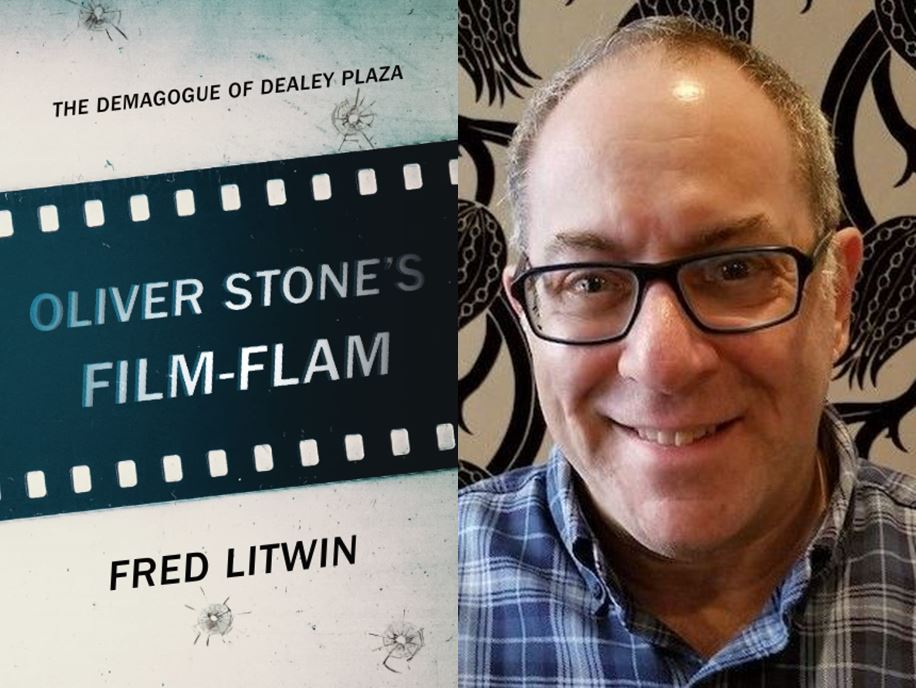
    Fred Litwin’s latest book is not really a book. This “book” is mainly just a copy and paste of his blog posts. So he actually didn’t write a book. But nonetheless, fundamentally, Fred Litwin still can’t debunk JFK Revisited and JFK: Destiny Betrayed. So he made up lone nut excuses…he transferred them from his blog to the pages of what he calls a book.

    JOHN STRINGER—“Which is more likely? A different brain, or a lack of memory for minor details after 32 years?” (11/24/21 blog; Chapter 17)

    BRAIN WEIGHT—“Here is an excerpt from Vincent Bugliosi’s book, Reclaiming History…” (11/30/21 blog; Chapter 15)

    BRAIN PHOTOS—“Which is more likely? That the powers that be switched out another brain to fool the pathologists, or that they just used a higher concentration of formaldehyde?” (12/1/21 blog; Chapter 16)

    JAMES GOCHENAUR—“How much he [Elmer Moore] pressured Perry is not exactly known.” (12/5/21 blog; Chapter 8)

    THROAT WOUND—“Dr. Perry…wasn’t performing an autopsy, he was frantically trying to save the life of President Kennedy…No forensic pathologist who has examined the autopsy X-rays and photographs believes the throat wound to be one of entrance.” (12/10/21 blog; Chapter 7)

    BACK WOUND—“Gerald Ford made a reasonable and purely editorial change.” (12/12/21 blog; Chapter 21)

    VALERY GISCARD D’ESTAING—“This all could have [just] been misinterpreted.” (12/15/21 blog; Chapter 34)

    AUTOPSY PHOTOGRAPHS—“JFK Revisited ignores the issue of memory.” (1/14/22 blog; Chapter 18) “One possibility, raised by Vincent Bugliosi…” (1/18/22 blog; Chapter 19)

    HEAD WOUND—“The doctors at Parkland Hospital were frantically trying to save the life of President Kennedy. They were extremely busy and no one had the time to examine his wounds in detail. Dr. Michael Baden explained this to Gerald Posner…” (3/22/22 blog; Chapter 14) “We are dealing with human beings and their imperfect memories.” (3/27/22 blog; Chapter 10)

    MISSING AUTOPSY PHOTOGRAPHS—“Memory is a tricky thing…Here is what Vincent Bugliosi wrote about this issue…” (4/8/22 blog; Chapter 20)

    JFK’S AUTOPSY—“Every single forensic pathologist who has examined JFK’s autopsy x-rays and photographs has come to the same conclusion: that JFK was hit from behind.” (5/12/22 blog; Chapter 22)

    The problem with doing such a thing is simple: a blog is not a book. And the above are just a series of excuses for the powerful evidence presented in Oliver Stone’s films, JFK Revisited and JFK: Destiny Betrayed.

    To show just how weak they are—and also how fundamentally flawed this cut and paste job is as a book—consider the first three. These all concern the forensic case of President Kennedy’s brain. Since the fatal shot was through JFK’s skull, this is quite important forensically. One of the strongest parts of Stone’s film is the case made for the pictures and illustrations of Kennedy’s brain not being genuine. In fact, the evidence dictates that they simply cannot represent Kennedy’s brain. In the film, this case is made on three different planes of evidence.

    1. The sworn testimony of the official autopsy photographer John Stringer made before the Assassination Records Review Board (ARRB).
    2. The Dutch medical study testing average weights for the human brain.
    3. The pictures and films of Kennedy’s skull exploding and the tissue, brain matter and blood deposited all over the car, into the air, and even on the cyclists riding behind and to his left.

    A fourth plane would be the eyewitness testimony of those who saw Kennedy’s brain after he was pronounced dead. Stringer denied the pictures at the Archives were his due to—among others—two major issues. He did not use the type of film these pictures were taken with, and the technical process that produced the film, a press pack, was not used by him.

    Now look back at what Litwin says about Stringer. Is he really saying what I think he is? That Stringer would have forgotten how he worked as a photographer over a period of decades, and on this the most important case of his life? One of the most compelling interviews the Assassination Records Review Board (ARRB) did was with Stringer, and it is described in Doug Horne’s book, Inside the ARRB. According to Horne, Stringer was both surprised and excited when he saw the pictures. So much so that he walked over to the holders to examine them closely, he actually held them in his hands. (Horne, p. 807). He then said this was not Ektachrome film and it was from a press pack, neither of which he used in this case. So as far as he knew he did not take the pictures. (ibid, p. 809)

    The second plane of evidence is the famous Dutch study that measured average brain weight—which came out to be about 1350 grams (The Assassinations, edited by James DiEugenio and Lisa Pease, p.253) Oddly, Kennedy’s brain was not weighed the night of the autopsy. About a week later, when it was weighed, it came in at 1500 grams. How could that be considering the massive head explosion depicted in the Zapruder film with a jet stream of blood and tissue exiting the top of the skull, with all the blood and tissue all over the back of the car, on Jackie Kennedy’s clothes, brain matter hurled with such force backwards that the cyclists thought they had been hit by a projectile. It was not a projectile; it turned out to be Kennedy’s brain and skull bone. (Josiah Thompson, Last Second in Dallas, pp. 56,57) We will never know how much of Kennedy’s brain was in the back seat of the car because it appears the Secret Service was sponging out the car while Kennedy was in the emergency room; there is a photo to denote this.

    The above matches up with the plentiful witness testimony, all attesting to see a brain that was severely damaged to the point that a large part of it was missing. After all, witness Marilyn Sitzman said, “I saw his head open up and brains coming out.” (David Mantik, JFK Assassination Paradoxes p. 265) In his book, The JFK Assassination: The Evidence Today, Jim DiEugenio collects 12 witnesses from both Parkland and Bethesda who recalled a large part of the brain being lacerated and missing. (p. 161) Which is not at all what one sees in the pictures, or the HSCA illustration drawn by artist Ida Dox.

    Litwin’s argument about using too much formaldehyde shows a shocking ignorance of what happened that night during the autopsy at Bethesda Medical Center. He might ask himself why Kennedy’s brain was not weighed that night at Bethesda. James Curtis Jenkins, a morgue assistant, said the brain was so vitiated it was difficult to induce needles into the blood vessels in order to perfuse the specimen with formalin solution. (DiEugenio and Pease, p. 251) Pathologist Thornton Boswell said the brain was so torn up it might not have even shown a bullet track. (ARRB Deposition, p. 193).

    Which leads to the final question: Why was the brain not dissected? As neurologist Mike Chesser said on camera during the filming of Oliver Stone’s documentary, this is necessary in order to determine the bullet path (paths) through the skull. (James DiEugenio, JFK Revisited, p. 298) As Cyril Wecht says in the film, the excuse given in the supplementary autopsy report for not doing it was “in the interest of preserving the specimen”. (Warren Report, p. 544) As Wecht declared: preserving the specimen for who and for what? Of course, Boswell’s description might explain why there was no dissection. It also explains why the photos and illustrations cannot be Kennedy’s.

    Taking all of this evidence into consideration, as Doug Horne says in the film, these pictures would not be admitted into court. But further, if a defense lawyer can prove fraud or bad faith—which one could—the attorney can move for a mistrial and also to have the charges dismissed. That is undoubtedly what would have happened here.

    This is Fred Litwin at work. Having demonstrated the (non-existent) quality of his labors in depth and at length, one can guess the value of the rest of those blog posts. And one would be correct; they are something less than zero.

    II

    Slip sliding along, Litwin actually claims that John Connally’s account of the shooting “is all consistent with the single bullet theory.” (11/21/21 blog) Oh really Fred? Connally stated, in the clearest terms, that the first bullet which hit Kennedy did not strike him. (Warren Commission Hearings, Vol. 4, pp. 135-36) His wife, sitting right next to him in front of JFK, completely agreed. She said that she turned at the sound of that shot and Kennedy “had both hands at his neck….very soon there was the second shot that hit John.” (ibid, p. 147) If one only allows for three shots, as Litwin has to do, then Connally does not agree with the centerpiece of the Commission, the single bullet theory. Because the other two shots consisted of one that missed the car completely, and the bullet that struck Kennedy in the skull. So if Connally is saying that he and JFK were hit by separate shots he contradicts the whole Magic Bullet concept: its four bullets. Moreover, he testified: “There were either two or three people involved or more in this or someone was shooting with an automatic rifle.” (Ibid, p. 133) He later went beyond that in private and said he never believed the findings of the Warren Commission for one second. (Joseph McBride, Into the Nightmare, p. 418). This is being consistent with the single bullet theory?

    Litwin got offended and hurt about the straight-talk in the film—“I must question whether there was any need for Dr. Cyril Wecht to add that comment in about Gerald Ford. It’s nasty.” (12/12/21 blog; Chapter 21) Wecht says in the film, “As I recall, they said about Gerald Ford that he could not chew gum and walk at the same time.”

    Why does Wecht say this? Because in the next sentence he decries the fact that it was Ford who moved the bullet wound in Kennedy’s back (its true location) up into his neck for the final draft of the Warren Report. So the forensic pathologist asked: on what professional grounds did Ford have the standing to do this? Was he a forensic pathologist? Was he an expert photographer? Was he a criminalist? If he had none of those skills then how did he know how and why to do such a thing?

    What makes Fred look all the worse is this. The man who originally made the unflattering remark about Ford was Lyndon Johnson. He actually said Ford could not fart and chew gum at the same time. And you can find the remark at Brainy Quote. So the real question Litwin will not ask is this: If LBJ thought so little about Ford’s mental acuity, why did he ask him to serve on the Warren Commission?

    Litwin exhibited the same faux outrage when the film “dissed” the Sixth Floor Museum. (3/13/22 blog). No objective person can deny that this institution is dedicated to preserving the myths in the Warren Report. In fact, while offering a prominent position there to a researcher, the management told him he would have to support the Warren Report in public. (See JFK: Inside the Target Car Pt. 3 by James DiEugenio)

    Litwin claimed Nurse Audrey Bell “did not see the wound in Kennedy’s throat despite being there for the tracheotomy.” (3/21/22 blog) This is incorrect! She made clear on NOVA in 1988 that she DID see it: “It looked small and round like an entry wound.”

    I don’t get angry easily, but I did when Litwin actually said Clint Hill “was rather busy trying to help Jackie Kennedy back to her seat, it seems clear that Hill didn’t have time to do a forensic examination.” (3/27/22 blog; Chapter 10) Which is another nonsensical argument. JFK was face down in the car and Hill could see the hole in the back of the head for several minutes until they reached the hospital. It has nothing to do with a “forensic examination”, it’s what the man saw. (See David Mantik, JFK Assassination Paradoxes, p. 281; Warren Commission Hearings, Vol. 2 p. 138)

    Litwin cherry-picked certain witness statements to try to put the skull defect solely on the right side of the head. (3/27/22 blog; Chapter 10) He uses John Stringer’s later 1996 words to the ARRB saying the wound was “in the right side of his head above his ear”—but ignored Stringer’s original 1972 account: “In the occipital part, in the back there, up above the neck.” (ARRB MD 84, p. 5) He uses Ed Reed’s later 1997 ARRB testimony saying he saw no wound on the back of the head—but ignored Reed’s original 1978 account: “Very large and located in the right hemisphere in the occipital region.” (ARRB MD 194, p. 2)

    Litwin uses an FBI report to say that Darrel Tomlinson and O. P. Wright seemed to identify the bullet, CE 399, to agent Bardwell Odum. (4/9/22 blog; Chapter 29) But as the film series plainly addressed—and which Litwin ignored—Odum was shown this report by Gary Aguilar, and he adamantly said that he never had or showed any bullet to anyone. In fact, he told Gary Aguilar that, “I didn’t show it to anybody at Parkland. I didn’t have any bullet. I don’t think I ever saw it, ever.” (Mantik, p. 192)

    Litwin next, and rather incredibly, states that Wright “never said or implied that CE 399 was not the bullet [he] found.” Yet again, the film series addressed that very point. Wright adamantly told Josiah Thompson way back in 1966 that the bullet he handled had a pointed tip. And Thompson has a dramatic photo comparison of the two bullets in his Six Seconds in Dallas on page 175. In fact, if one talks to Thompson, or reads Last Second in Dallas, Wright actually followed him out of his office and incredulously asked him this direct question: Was that exhibit the bullet they said I turned over? How could Litwin have missed all this?

    III

    Clearly, Litwin was unnerved by the two speeches that Dr. Henry Lee and Brian Edwards gave in Stone’s documentary about inadmissibility of evidence in court. This is why he brings up these above points about CE 399. No documentary had ever made this issue as strongly as those two men did, with as much backing as this documentary did. So, striking out with Odum and Wright, Litwin tries to extend this issue by saying that the so-called mystery of the 7:30 bullet in Robert Frazier’s notes is actually not that mysterious.

    Let us be clear, Litwin is obfuscatory.. Writer researcher John Hunt notes that there seems to be documents missing from ballistics technician Robert Frazier’s files from that day.

    But still, in two places in his work product, Frazier noted that he was in receipt of the stretcher bullet at 7:30 PM on the day of the assassination. (“The Mystery of the 7:30 Bullet” by John Hunt, at JFK Lancer.com) Which makes for a serious problem in chain of possession. Why? Because the stretcher bullet had not arrived at FBI HQ at 7:30 PM. In fact, the best estimate would be that it would not arrive until probably after 9:20 PM. And the FBI was waiting for this bullet from the Secret Service. (See Figures 6 and 7 in Hunt’s essay.) The FBI memo from Alan Belmont clearly denotes two bullets will be arriving, as he writes “and we are arranging to get both of these.” That memo was signed off on by seven men in the FBI hierarchy, including the number two man, Clyde Tolson.

    What does Litwin now manufacture to get around this information indicating two bullets? He actually writes that Frazier wrote down 7:30 because that was the time that O. P. Wright at Parkland Hospital gave the bullet to Secret Service agent Richard Johnsen! I am not kidding. Can you imagine the spectacle in court on this one? An FBI agent is making chain of possession notes for a private security officer (Wright) and a Secret Service agent (Johnsen)—while they were in Dallas! Which is over 1,300 miles away from where he is. Two men he had no direct contact with and likely did not even know!

    All of this nonsense to disguise the question: How could Frazier be getting the stretcher bullet from Todd when he already had the stretcher bullet?

    IV

    Litwin nonchalantly said the autopsy doctors “identified the entry and the exit wounds in JFK’s head and they saw the beveling that told them which wound was entry and which wound was exit. The evidence was pretty clear.” (5/12/22 blog; Chapter 22) No. As Dr. Boswell explained, a semicircle of one of the late arriving bone fragments kind of looked like an entry wound. And a notch in one of the other bone fragments might have been an exit. Nothing was for sure.

    Litiwn incredibly states about the back wound: “…the autopsy photographs that shows its exact location, which is totally consistent with the single-bullet theory.” (Chapter 21) Simply not true! The HSCA said that in order for it to work, JFK would have to be leaning WAY forward (HSCA Vol. 7, p.100)—which he was not. (Warren Commission Hearings Vol.18, p.26) The bullet also would’ve smashed the first rib had it traversed where the measurements place it.

    In relation to the testimony of the secretaries on the fourth floor i.e. Sandra Styles and Victoria Adams, the author says “Oswald just simply beat Adams and Styles down the stairs.” (Chapter 23) I simply respond to this presupposing statement with, “How do you know there was anyone running down the stairs from the 6th floor in that time frame?” Litwin might say, “The rifle seen in the window and the rifle being found!” To which I will say, “That just means there was a shooter up there. But again, how do you know there was anyone running down the stairs from the 6th floor in that time frame?” Crickets.

    Litwin parrots the lone nut talking point that “of course there was no evidence of the [palm] print being lifted, because the dusting powder on the print is totally lifted off.” (Chapter 27) But that’s impossible, because there was powder found “all over the gun.” (Warren Commission Hearings, Vol. 4 , p.81) Litwin says “Oliver Stone would have you believe that there is no evidence the print was even lifted.” (Chapter 27) Hmm…has Litwin not read this sentence from the Warren Report itself? “Nor was there any indication that the lift had been performed.” (WR, p. 123) Litwin also never gets to the real crux of the issue. That is this: the palm print didn’t appear for a week. (Warren Commission Hearings Vol. 4, pp. 24-25). And also, that the only person to see this alleged print said it was an old print. (Gary Savage, First Day Evidence, p. 108)

    Let us mention the Chicago Plot. Litwin says: “Now, of course memories fade over time…Might Bolden have been conflating the Vallee story with [a 1963] rumor?” (7/20/22 blog; Chapter 39) As Edwin Black (Chicago Independent, 11/75) and Jim Douglass (JFK and the Unspeakable, Chapter 5) have proven, at length and in depth, the Chicago plot was no rumor. But I will say this…when basically all you have left is the old shibboleth, “memories are unreliable” excuse—which is Litwin’s and many lone nutters’ constant M.O.—then you have no case.

    V

    As bad as Litwin is on the forensic side, he is just as bad on the historical angle. Which is a major part of JFK: Destiny Betrayed. He refuses to confront the fact that Kennedy was looking for a way to get out of Vietnam in 1961. In the 14 pages he devotes to the Indochina episode the reader will not detect the name of John Kenneth Galbraith. Which, for today, is astonishing. Because right after the White House debates over Vietnam in the fall of 1961, Kennedy sent Galbraith to Saigon.

    Why did he do so? Because, as his son told Oliver Stone, Kennedy did not like the advice he was getting from his rather hawkish advisors in Washington. In fact, as Jamie Galbraith told Stone about his father:

    He admitted many times in the years following, he said Kennedy sent me to Vietnam, because he knew I did not have an open mind. Kennedy knew what he wanted and he knew my father would deliver what he did. (James DiEugenio, JFK Revisited, p. 316)

    The second reason this is an inexcusable lacunae is this: Galbraith’s report was the beginning of Kennedy’s withdrawal program. This is another aspect which Litwin actually turns upside down and backwards. If one can comprehend it: Litwin tries to say the withdrawal plan was Secretary of Defense Robert McNamara’s idea! (p. 365) Which is pretty much impossible. For the simple reason that McNamara was a steady and strong proponent of inserting combat troops throughout 1961. He actually wanted to send anywhere from 6-8 divisions in late 1961. If you do the arithmetic that is about 120,000 men. (Gordon Goldstein, Lessons in Disaster, pp. 56-59)

    So how did McNamara get turned around on the issue? Through Kennedy and Galbraith, and in two steps. At the end of the debates of November 1961, Kennedy was extremely frustrated that he had to fight so hard to get his ‘no combat troops’ decree through his advisors. He called a meeting for November 27, 1961. He said words to the effect: Look, when policy is decided, those on the spot carry it out or they get out. He then asked: Now who is going to implement my Vietnam policy? McNamara said he would. (John Newman, JFK and Vietnam, Second edition, p. 146) That was step one.

    With that established, in April, Galbraith was in town. He and Kennedy discussed a neutralist solution—something Litwin says Kennedy would not do— through the India ambassador’s relations with Nehru. (Newman, pp. 234-36; Litwin p. 367) At this meeting, Kennedy said “he wished us to be prepared to seize upon any favorable moment to reduce our commitment.” Kennedy then sent the ambassador to see McNamara, and according to Galbraith, the defense secretary got the message. This point is double sourced since McNamara’s deputy, Roswell Gilpatric, said that his boss told him ”the withdrawal plan was part of a plan the president asked him to develop in order to unwind this whole thing.” (Virtual JFK, by James Blight, p. 129: p. 371).

    There is a third source for McNamara getting Kennedy’s drift. At the May, 1962 SecDef meeting in Saigon, McNamara asked the overall commander, General Harkins, to stay after. McNamara then asked him when he thought the army of South Vietnam would be able to take over the war effort completely. As someone who was there noted, “Harkin’s chin nearly hit the table.” (JFK and the Unspeakable, by James Douglass, p. 120) McNamara said the American effort would be dismantled and Harkins had responsibility to prepare a plan to do so.

    In the light of the above facts, for Litwin to say that the withdrawal plan was McNamara’s idea is utter malarkey.

    Stone’s film then supplies the two major pieces of evidence which show that Kennedy was getting out, without any questions about it. First, the declassified minutes of the May 1963 SecDef meeting in Hawaii where Harkins handed in all the withdrawal schedules for each department. McNamara leafed through them and said the overall plan was too slow, we were getting out faster.(Newman, p. 324-25) The second piece of clinching evidence was McNamara’s exit briefing which John Newman listened to. There, the Secretary said he and Kennedy had decided that America was getting out once the training mission was over. And this was unequivocal; it did not matter if they were winning or losing. (Vietnam: The Early Decisions, edited by Lloyd C. Gardner and Ted Gittinger,p. 166). It does not get any more clear than that. Which is probably why Litwin ignores not just those two instances, but everything else in the above.

    Fred Litwin is not an author. He is an agitprop artist.

    Afterword

    by James DiEugenio

    This will be the last article Kennedysandking will ever publish on Fred Litwin. As the reader can see from the above, Litwin has nothing to contribute to the subject that has any value or insight. On top of that, he has a penchant for the smear. For instance, he heads his chapter on Vietnam by labeling it as “politics”.

    JFK: Destiny Betrayed had the finest array of historians ever assembled in a documentary on the subject: Robert Rakove of Stanford, Philip Muehlenbeck of George Washington, Richard Mahoney of North Carolina State, John Newman of James Madison, Bradley Simpson of Connecticut. There was no better roster to review Kennedy’s policies in the Middle East, Africa, Indonesia, and Indochina. This rivaled the luminaries the film had on the forensic side. (For a demonstration of just how unique Kennedy’s foreign policy was, click here)

    Broadly speaking, history is the collection of the best sources with the most relevant information from the most reliable scholars. Politics should have nothing to do with it. And the viewer can read the works of these authors and they will see that they are not at all political in nature; they are factually based.

    Litwin quotes David Talbot from the film saying that there is a thread between 1963 and the horror show of American politics today. (Litwin, p. 363) That is not Talbot saying that about himself. This is what the American public feels. And one can check author Larry Sabato’s book, The Kennedy Half-Century to certify it. In the focus groups he conducted, adults of all ages agreed that the assassination “changed America.” An astonishing 61% said Kennedy’s murder “changed the nation “a great deal’. Sabato observed that those alive at the time, testified to the “deep depression that set in across the country. Because the optimism that prevailed since WW2 seemed to evaporate”. (Sabato, p. 416) Kevin Phillips revealed the same in his book Arrogant Capital. In his introductory chapter he depicted a chart which showed the collapse of the public’s belief in the government. The percentage went from over 70% in 1960 to the teens by the nineties. And the collapse began in 1964, the issuance of the Warren Report.

    So this is not, in any way, politics. This is simply social science. If Litwin wishes to deny it then he should speak to Sabato or Phillips. If he does not, then that proves it is Litwin who is being political. It seems to indicate that either psychologically or politically he cannot accept these facts. To be kind, maybe it is because he is Canadian and does not live here?

    The second reason we will now ignore Litwin is the fact that there is a real question of who is the Confidence Man here. Oliver Stone’s life has been laid out by biographers, and by himself in the first volume of an autobiography called Chasing the Light. He makes no bones about who he is.

    But this is not the case with Litwin or his soul brother Steve Roe. In his first book, I Was a Teenage JFK Conspiracy Freak, Litwin states that 1.) He used to be a strong believer in a conspiracy in the JFK case, and 2.) He had been a left winger who turned into a conservative. He has never been able to convincingly prove either one of these claims. Therefore it seems he may have adopted them to mimic his role model David Horowitz. As per Roe, no one has been able to certify a business entity known as “roeconsulting”, which is the rubric he used to post his criticisms of Stone’s film.

    If a writer cannot remove these kinds of fundamental doubts about who they are, why should anyone pay any attention to his work product?

  • Fred Litwin on the Facts of the JFK Case

    Fred Litwin on the Facts of the JFK Case


    This is a relatively concise review of Fred Litwin’s first book on the John Kennedy assassination, I Was a Teenage JFK Conspiracy Freak. It will be by chapters—excepting Litwin’s discussion of the Jim Garrison inquiry. Jim DiEugenio has reviewed Litwin’s work on that issue at length and in depth. (Click here and here)

    Chapter 1

    Litwin says first generation critics “started finding small inconsistencies” in the case. But they were actually big inconsistencies (e.g. the dubious provenance of CE 399). (Click here for details) He also avows: “The motorcade had to turn onto Elm Street so it could take an exit to the Stemmons Freeway which would have taken them to the Dallas Trade Mart for Kennedy’s speech.”

    Like his previous statement, this one is also false. The motorcade could have taken Main St. to Industrial Blvd. What is so odd about this error is that the correct information is in the House Select Committee volumes, which, on other occasions, Litwin values highly. (HSCA Vol. 11, p. 522) He incorrectly says there are “20,000 pages” in the Warren Commission’s 26 volumes of testimony and evidence. There are really 17,816 pages. Shockingly, before even going into the actual evidence at all, Litwin casually says: “The authors of the Warren Report were honorable men who conducted an honest investigation and reached the right answer.” As many have pointed out, in this day and age, for anyone to call people like Allen Dulles, John McCloy, and Jerry Ford honorable men is wildly archaic. He incorrectly says John Connally’s “lapel” flipped as an indication of a bullet transit—yet his chest wound was not near the lapel! (Click here for details)

    The Canadian author then goes through the “overwhelming evidence” against Oswald. He claims Oswald had “a long…package”—but the two witnesses to it said it was not long. (WC Vol. 2, pp. 239–240, 249) Litwin claims that “after the assassination, Oswald was the only warehouseman missing”—but Charles Givens was also missing. (WC Vol. 3, pp.183, 208) Litwin nonchalantly says Oswald “killed police officer J.D. Tippit,” which, with the accumulation of evidence we have on that case today, is a quite dubious statement. (Click here for details)

    But Litwin marches on. He also claims that “many witnesses identified Oswald“—but those “identifications” were based on rigged lineups and some were made months after he was dead and nationally known. One of the best examinations of the line ups was made by the late British police inspector Ian Griggs. To name just two problems: Griggs noted that in the British model, there should be 7 other people in a line up and they should be of similar age, height and appearance. (Ian Griggs, No Case to Answer, p. 81) After a seventeen-page analysis, Griggs concluded that, to put it mildly, these guidelines were not adhered to with Oswald. For example, there were only three other people in the Oswald line ups. As per similar physical appearances, Homicide Detective Elmer Boyd said, well “Sometimes they do and sometimes they don’t.” (Griggs, p. 83) As per age, Oswald was 24. Two of the stand-ins were 18 years old. Further, Oswald was the only one with bruises on his face. And although the others made up their names and occupations, Oswald did not. Even though, by the time of most of the line ups, his name and place of work had been broadcast on radio and TV. (Ibid, pp. 85–86)

    But further, one of the witnesses, Helen Markham, was so weak and faint that the police had to administer her ammonia. Or as Captain Fritz testified to the Commission:

    We were trying to get that show up as soon as we could, because she was beginning to faint and getting sick. In fact, I had to leave the office and carry some ammonia across the hall, they were about to send her to the hospital or something and we needed that identification real quickly, and she got to feeling all right after using this ammonia. (WC Vol 4, p. 212)

    Line-up witness Cecil McWatters, a bus driver, later admitted that Oswald was not even the man he recalled from his bus ride. He was trying to identify Roy Milton Jones. (Griggs, p. 87) Then, of course, there was the testimony of cab driver Bill Whaley. Whaley said that anyone could have identified Oswald, because he was carrying on and yelling at the policemen. He said it was not right for him to be placed in a line-up with teenagers. If Litwin had been in Oswald’s place, would he not have done the same? (Griggs, p. 90)

    Litwin then says that “one expert concluded that one of the four bullets recovered from Tippit’s body matched the revolver found in Oswald’s possession”—but 8 other experts disagreed with him, and moreover that bullet did not appear for a quarter of a year! (WC Vol. 3, p.474) Litwin says “the expended [Tippit] cartridge cases matched Oswald’s gun to the exclusion of all other weapons”—but those cases did not appear for a week (WC Vol. 24, pp. 253, 332) and four officers’ initials disappeared from them. (WC Vol. 7, pp. 251, 275–276; Vol. 24, p. 415) They could not be identified by the three witnesses as the ones they found that day. (WC Vol. 24, pp. 414–415) And as most of us know, two of the cases were from Winchester Western and two were from Remington-Peters. While three bullets were from Winchester and one was from Remington. (Henry Hurt, Reasonable Doubt, p. 152)

    Litwin says “Oswald’s right palm print was found on the rifle barrel”—but the only person to see this print said it was an old print. (Gary Savage, First Day Evidence, p. 108) Litwin then says “his fingerprints were found on the bag used to carry the rifle to work.” Yet, when FBI expert Sebastian LaTona initially examined the bag on 11/23, he could find no latent prints on it. (WC Vol 4, p. 3) Litwin then declares: “Faced with this massive amount of incriminating evidence, the critics could only chip away at the margins.” But as the reader can clearly see above, this author did not “chip away at the margins.” I simply debunked Litwin’s claims with original evidence.

    Litwin then proceeds to speak in paragraphs to derail witness Lee Bowers’ account, but he never gets to the meat and potatoes. So I will spell it out here…Bowers told Mark Lane on camera on March 31, 1966:

    There were, at the time of the shooting, 2 men standing at the top of the incline. And one of them, from time-to-time as he walked back-and-forth, uh—disappeared behind a wooden fence, which also is—uh—slightly to the west of that. At the time of the shooting, in the vicinity of where the 2 men were, there was a flash of light. The area was sealed off by at least 50 police within 3 to 5 minutes. I was there only to tell ’em what they asked, and—uh—so that when they seemed to want to cut off the conversation. (Click here to watch the video)

    Litwin also apparently doesn’t know that subsequently two of Bowers’ friends independently came forward and confirmed that, yes, he did see more than he told the Warren Commission, but he was afraid. He didn’t want his life threatened or ruined, being one of the key witnesses against Lee Oswald as the lone shooter. (Josiah Thompson, Last Second in Dallas, pp. 66—67)

    Litwin avows that “Dealey Plaza was an echo chamber which made it hard for witnesses to determine the direction of the shots.” This is not accurate. As Josiah Thompson points out in Last Second in Dallas, “The knoll is covered with trees and grass and a wooden fence, all sound-absorbing materials.” (Thompson, p. 38) And further, the flash of light, smoke, fresh footprints, cigarette butts, and an anomalous shape in the Moorman photo all confirm the 58 grassy knoll ear witnesses! (See Thompson, Chapter 5) All of which are JFK 101 and never mentioned in Litwin’s book. Litwin declares “there were absolutely no witnesses to gunmen on the grassy knoll or behind the picket fence.” Well, of course, everyone was looking at the President, not at some random fence in the corner! Snipers are trained to not be seen. But, as we shall see, we do have physical and photographic evidence left behind which indicates such.

    Litwin claims “the Dallas doctors did not see the [rear skull] entrance wound because they didn’t turn Kennedy’s body over”—but they did lift the head up and this wound was seen by Drs. Jenkins and Grossman. Litwin says “Virginia and Barbara Davis saw Oswald run across their lawn after the [Tippit] murder.” But remember, they pointed him out of a rigged lineup. Also, the Davis sisters were really confused witnesses. For instance, Barbara claimed she saw the killer again “a few minutes later” after the shooting! (CD 630e, p. 1) And Virginia claimed she heard the second gunshot “a few minutes later” after the first one! (CD 630f, p. 1) So they were confused witnesses.

    Chapter 3

    Litwin incorrectly says the Zapruder film is “27 seconds” when, of course, it is 26 seconds. He says the parade route “never changed”—but Secret Service agent Gerald Behn confirmed to Vince Palamara the route was changed for the Dallas trip! (Survivor’s Guilt, p. 104) Palamara’s book is the best there is on this issue. He brings in not just Behn, but three other DPD witnesses to back him up.

    Litwin likes to make a big deal that in 1972 Drs. John Lattimer and Cyril Wecht, after viewing the autopsy materials, concluded JFK was only hit from the rear. But the fact is that we have come very far since 1972 and, because of this, Wecht has since changed his mind. But Litwin doesn’t explain this context. He cites Lattimer’s old myth of Connally having an “elongated wound in the back”—but Connally’s doctor testified it was elongated only after he removed damaged skin. (WC Vol. 6, p. 88) He says “Kennedy’s head moved forward before it moved back and to the left”—but this has since been shown to likely be an optional illusion due to camera movement. (Thompson, Last Second in Dallas, pp. 197–205) Litwin says the back and to the left “was probably caused by a neuromuscular spasm”—but as another reviewer has pointed out, “no expert in neuroscience has ever supported this hypothesis.” Moreover, neuromuscular spasms only occur when the nerve centers—at the bottom of the brain—are inflicted and JFK’s were not. Litwin also says “there might also have been some minor movement due to something called the ‘jet effect’”—but the fact of the matter is that this theory met a timely end in 2014 (Click here for details)

    Litwin: “The autopsy materials…totally refuted a shot from the front.” This is false. The lateral X-ray (assuming it’s authentic) clearly shows a trail of bullet fragments going from front to back. Due to the new work by Dr. Michael Chesser, we know it goes from front to back, because the largest fragments are in the back. That means a shot from the front. (Click here for a long version of Chesser’s work)

    Chapter 5

    Litwin touches a bit on the acoustics evidence, but ignored the recent work that has been done on it. His argument seems very dated. He avows that “the autopsy X-rays and photographs…showed a small wound in the back of Kennedy’s head”—this would be news to the autopsy doctor James Humes, who couldn’t find one when shown the materials during his ARRB deposition. Litwin says “the Zapruder film shows the back of Kennedy’s head to be intact after the fatal shot”—but (assuming the film is authentic) the back of the head is unfortunately in shadow in the Zapruder film. What Litwin also doesn’t say is that actually a few frames are not in shadow and they do in fact show the rear of the head blown out! (Frames 335, 337, 374)

    He says “you can see a visible exit wound in the right front”—but that is actually a flap of scalp hanging down. Litwin ignores the following facts: Press secretary Malcolm Kilduff indicated in public that a shot hit Kennedy in the right temple. Or that Chet Huntley of NBC News announced this same description on TV that day and gave as the source Dr. George Burkley, Kennedy’s physician. Finally, Bill and Gayle Newman, two of the closest witnesses to the shooting, both said the bullet came from behind them—i.e. the stockade fence—and hit Kennedy in the right temple. (Thompson, Last Second in Dallas, p. 32) Is it only a coincidence that the Newmans did not testify before the Commission and neither did Burkley?

    He says “his [Harrison Livingstone’s] witnesses all disagreed with each other.” I’m not sure what Litwin means here. All the witnesses Livingstone interviewed were unanimous that the back of the head was gone. Litwin (like Gerald Posner) misconstrues a 1990 quote by autopsy technician Paul O’Connor—“It has been so many years and so much has happened, I kind of doubt my own ability to remember fine details.”—Posner attributes this to O’Connor’s overall memory, but actually it was attributed to the specific question as to whether JFK was wrapped in a mattress cover! (High Treason 2, p. 272) This is simply literary hackery and Litwin just copied it from Posner’s book. (See Posner, Case Closed, p. 300)

    Litwin always makes a big deal that “every forensic pathologist who had viewed the autopsy evidence had concluded that Kennedy was shot from behind.” What Litwin leaves out is that these forensic pathologists—Ramsey Clark Panel, the HSCA—never had the body in front of them. And none of them ever saw Kennedy’s brain, since it disappeared from the National Archives. But here’s the thing, none of their reports ever mention the words “grassy knoll,” “knoll,” or “fence”. They didn’t even take that into consideration. So that talking point is simply not valid. But further, Litwin also ignores this: Dr. Michael Baden conservatively acknowledged a grassy knoll headshot was possible. (HSCA Final Report, pp. 80–81)

    Litwin incorrectly accuses critics of “ignoring the HSCA test results.” But these two tests—the NAA and Tom Canning’s trajectory analysis—have been through discredited by, for one, Don Thomas. (Hear No Evil, Chapters 12, 13 respectively.) He jumps on critics for using “faulty diagrams” of the single-bullet theory. He then shows a still from Dale Myers’ animation and declares: “They were in perfect alignment for a shot to hit both men.” But of course, Myers’ dishonest animation only works if you move JFK’s back wound up, stretch his neck, lean his neck way forward, shrink Connally, and slide his seat in 6 inches when it was actually 2.5 inches. (patspeer.com, Chapter 12c; click here for details) Litwin discusses the unreliable “Badgeman” image in the Moorman photo, but completely ignores the more reliable anomalous shape that Josiah Thompson points out in Six Seconds in Dallas. What is notable about this aspect of the Mary Moorman photo is that it contains two figures behind the stockade fence atop the grassy knoll. One is a fixed point, a signal tower. But the other figure disappears—it is not there in later photos, so that, very likely, was a person. (Six Seconds in Dallas, p. 127) Coincidently, the flash of light and smoke was seen there, and the fresh footprints and cigarette butts were found there. Again, none of this is mentioned in Litwin’s book. He incorrectly calls Robert Groden’s 1993 book The Death of a President—it’s actually The Killing of a President.

    Chapter 6

    Litwin nonchalantly mentioned Thomas Canning’s HSCA trajectory analysis—but none of the wound locations in Canning’s analysis are the same as the locations that were reported in the HSCA’s Forensic Pathology Report. Canning chose them. Yes, he chose his own wound locations! (HSCA Vol. 6, p. 33, see especially the footnote at bottom) All trying to confirm a bias—aka a lone assassin. Moreover, Canning’s trajectory analysis for the single-bullet theory is at Zapruder frame 190, and Litwin believes it happened at frame 224. (ibid, p. 34)

    Litwin says “Oswald qualified as a sharpshooter in the U.S. Marines,” but ignores Commission lawyer Wesley Liebeler’s own memorandum which states that the FBI could not duplicate the shooting feat that the Commission attributed to Oswald. But in addition, all of the FBI shots were high and to the right of the target “due to an uncorrectable mechanical deficiency in the telescopic sight.” (Edward Epstein, The Assassination Chronicles, p. 148) In his famous internal memorandum—famous to anyone but Litwin—Liebeler complained that it was “simply dishonest” for the Commission not to mention this serious problem with the rifle in their chapter on the subject. But further, the military test Litwin refers to was the first shooting test Oswald took. In his second test, later on in his service, he scored considerably lower and that score was considered a “rather poor shot.” (WR, p. 191) So by the time he left the Marine Corps, that was his status. As Liebeler went on to explain, there is no evidence that he improved while in the USSR. In 1962 and 1963, the only evidence of any “practice” was that he went hunting with his brother once.

    Liebeler said that the chapter glossed over the evidence that Oswald was a poor shot and had accomplished a difficult feat; and created a ‘fairy tale’ that Oswald was a good shot and had accomplished an ‘easy shot.’ (Epstein, p. 152)

    Litwin incorrectly claims “there were numerous witnesses who heard a shot before Kennedy was hit in the neck”—there were only three. (patspeer.com, Chapter 9) Litwin claims “four of the Dallas doctors involved in treating Kennedy went to the National Archives in Washington, D.C., in 1988 to view the autopsy X-Rays and photographs. They all went on the record to confirm the authenticity of the autopsy materials.” This is nonsense and sleight of hand. First of all, this goes directly against what these four doctors said in the past when originally shown the back of the head photo (showing it intact).

    Dr. Peters—“I don’t think it’s consistent with what I saw. There was a large hole in the back of the head through which one could see the brain. But that hole does not appear in the photograph.” (The Continuing Inquiry newsletter, 11/22/81)

    Dr. Dulany—”There’s a definite conflict. That’s not the way I remember it.” (“Dispute on JFK Assassination Evidence Persists”, The Boston Globe, 6/21/81)

    Dr. Jenkins—“No, not like that. Not like that…No…That picture doesn’t look like it from the back.” (The Continuing Inquiry newsletter, 10/22/80)

    Dr. McClelland—“He firmly rejected the autopsy photos.” (The Continuing Inquiry newsletter, 11/22/81)

    And likewise all the other Dallas treating staff have denounced the photo. Now, concerning what those four doctors said in 1988 to NOVA, they said that if the pathologist’s hand in the photo is holding up a flap of loose skin to cover the defect in the back of the head, then the photo would be accurate. But as Dr. Michael Baden has said: “There is no flap of skin there.” (Case Closed, p. 310) So therefore, the photo is in all probability inaccurate.

    Litwin mentions ARRB chairman John R. Tunheim telling Vincent Bugliosi that “there’s no smoking gun” in the remaining sealed files—as if conspirators would leave behind a trace for all the world to see! He incorrectly says Doug Horne “wrote a series of books”—it was actually one book with five volumes.

    Chapter 7

    Litwin avows: “Over the years, more and more documents and records have been released but no major revelation on the assassination has emerged.” This is simply not true. For instance, in 1993 the sealed HSCA testimony of JFK’s mortician Tom Robinson was declassified and it was a bombshell. For years, Warren Commission defenders have demanded to know, “Where’s the grassy knoll bullet?!” The answer came when Robinson’s testimony was released. He said:

    They were literally picked out, little pieces of this bullet from all over his head…They had the little pieces. They picked them out…I watched them pick the little pieces out. They had something like a test tube or a little vial or something that they put the pieces in…Fairly many pieces…They were all small that could be picked up with forceps…The largest piece that I saw [was] maybe a quarter of an inch. (RIF#180-10089-10178)

    Robinson said “that the total number would be close to 10 fragments.” (ARRB MD 180)

    These numerous fragments have to be from the knoll headshot (Z–313). Why? Because they disappeared. They were removed and disappeared. The FBI never examined them. (They would’ve had to have been removed from the head early in the autopsy, for the six autopsy technicians don’t remember them.) In the end, the only fragments from the autopsy turned over to the Warren Commission were two from the Depository headshot (Z–328) that matched Oswald’s rifle. (Thompson, pp. 222–28)

    When I asked Litwin if he knows who Tom Robinson is, his response to me was: “The terrific British rocker…I have several of his CDs.” (4/6/21 Facebook message)

    Litwin’s Postscript

    Litwin writes: “Oliver Stone is locked in for life his with conspiracy theories—there’s nothing that could ever change his mind.” I simply turn the question around on Litwin: is there anything that could ever change YOUR mind? He simply replied: “Evidence.” (ibid)

    Well, I’ve spent countless hours both in person and online TRYING to patiently tell Fred Litwin the evidence, but it’s always the same—excuses, arguments from authority, and stubbornness. I was (and am still) truly shocked by his blatant denial and ignorance. It’s actually mind-torturing. At this point, I can only shake my head. As someone once said, “You can pile up all the evidence in the world and they don’t wanna listen.”

    My Postscript

    Litwin relayed a story to me:

    It’s a story that should be in my Teenage Conspiracy Freak book, but isn’t. It goes like this. As I was slowly changing my opinion, I decided it was time to read Posner’s book. I bought it…but I couldn’t open it. It sat there for days…until I decided to read the medical evidence chapter. I thought it was a great chapter—in fact, I wish I had written it…and I knew then that there was no conspiracy…and I put the book down…a changed man. (1/15/21 Facebook message)

    I was taken aback by this. First of all, in his book, he says what turned him around on the JFK case was the House Select Committee on Assassinations in 1979. Now that is moved forward to 1993? And he still cannot provide any evidence of anything he wrote while he was in the critical community camp? Second, Gary Aguilar interviewed two Kennedy autopsy doctors, Dr. Boswell and Dr. Humes, who both denied the words Posner put in their mouths. Boswell went even further: he said he never talked to Posner. (Click here for details) The truth of the matter is that Gerald Posner’s book Case Closed has been debunked 7 ways to Sunday ever since it was first published in 1993. (Click here for details)

    I reminded Litwin of this and he just said: “It has not been debunked.” I then proposed, “If I could prove it has been debunked, what would you say?” Litwin retorted: “If you could prove the earth is flat, what would I say?” (ibid.) When I told him “Baden says it’s possible a shot from the knoll”, Litwin retorted: “It’s possible we are being visited by flying saucers; and it is possible that Bigfoot exists.” (4/5/21 Facebook message)

    Folks, that’s Fred Litwin for you.

  • Truth Is the Only Client

    Truth Is the Only Client


    Mainstream media has abandoned the most important murder case in world history. A Hollywood producer has personally told me, “They just don’t want to touch it anymore.” With a plethora of famous crimes being re-discovered by avid Netflix viewers, one might think JFK would be picked up somewhere. It has not. In other words, you have to “do it yourself” now. An example of this is the 2019 self-produced documentary Truth Is the Only Client, which features the surviving Warren Commission staff members. Yes, mainstream media didn’t even pick this one up. It can be watched for free on Amazon Prime.

    The film starts off by resurrecting the late prosecutor Vincent Bugliosi, who says the assassination is “the most complex murder case by far in world history. Nothing even remotely comes close.” This is true. But he follows this by saying that “conspiracy theorists” are the reason it is complex. This is not true, not even close. As journalist Jefferson Morley has said, “Suspicions of a conspiracy originated in the circumstances of the crime…It was the facts of the crime that made people think it happened in a different way than the way the Warren Report set forth.” (Jacob Carter, Before History Dies, p. 8) Also, we are researchers, not “conspiracy theorists.”

    Warren Commission assistant counsel Samuel A. Stern then spewed the now common bit of it being “so hard to accept” that a nobody killed a somebody. Nice try, but not the case. Researchers have continually pointed out the holes in the evidence or, back in the sixties, the contextual chasms in the Warren Report. And much later, they began to fill in those chasms with new evidence supplied by the Assassination Records Review Board. For instance, if Kennedy was only hit from the rear, then why did over forty witnesses at both Parkland Hospital and Bethesda Naval Medical Center see a large avulsive hole in the rear of Kennedy’s skull? (See Dr. Gary Aguilar’s essay, “How 5 Investigations into JFK’s Medical/Autopsy evidence Got it Wrong,” Section Five) And as Aguilar discovered when the records were reviewed, the House Select Committee on Assassinations misrepresented this fact in its report. (See Volume 7, p. 37) As we shall see, the man who oversaw the writing of those volumes is later featured on this program.

    Assistant counsel Burt W. Griffin declared, “If we could find a conspiracy, we’d all be national heroes!” Well, they did have 58 eyewitnesses who reported a frontal shot—but they buried them in their tens of thousands of pages of appendices and commission documents. They had the Zapruder film showing JFK being thrown to the rear—but they somehow missed that in the Warren Report. And it’s almost certain they saw the Moorman photo that seems to depict the grassy knoll gunman behind the fence—but they never published it. Maybe because as soon as you have a frontal shot, there’s a conspiracy. The staff members buried or omitted this vital evidence and, therefore, were not national heroes. However, first generation researchers Josiah Thompson, Sylvia Meagher, Harold Weisberg, and Mark Lane brought all this evidence to light and did get some national acclaim for their toil.

    Bugliosi then outlines the Warren Commission’s supposed shooting scenario and does so rather nonchalantly, as if it’s absolute fact. What he doesn’t say is that this is not actually the Commission’s shooting scenario, but rather Gerald Posner’s shooting scenario. Assistant counsel Melvin A. Eisenberg claimed Oswald’s “prints” were found on the rifle—but there was only ONE print and the only person to see this print said it was an old print. (Gary Savage, First Day Evidence, p. 108) Assistant counsel Howard P. Willens claimed that “inside the [paper] package were found remnants of the carpet in which it was kept at the Paine garage”—but he apparently forgot that the FBI could not make a positive identification. (WC 4 H p. 81) And by the way, it was a blanket, not a carpet. Bugliosi touted the long-debunked myth that Oswald was “the only worker” missing from the Texas School Book Depository, when really 17 were never in the building after 12:30. (WC 22 H pp. 632–686) Bugliosi nonchalantly says Oswald killed Patrolman J. D. Tippit, but the late researcher Larry Ray Harris showed Oswald was most likely innocent of that crime. (“November 22, 1963: The Other Murder,” Dateline: Dallas, 11/22/93) Bugliosi says Oswald “told one provable lie after another, all of which, of course, show a consciousness of guilt”—but it only shows he was involved in some way and doesn’t mean he killed the President. Bugliosi also said that “six and a half months before,” Oswald attempted to murder Maj. Gen. Edwin Walker—but the alleged bullet could not be linked with the rifle (WC 3 H p. 439) and the two witnesses said the perpetrator was not Oswald. (WC 5 H pp. 446–447; 26 H p. 438) Also, it was actually seven months before, not six.

    The film did a segment on Oswald’s life. The exposition was very similar to the 2003 Peter Jennings program Beyond Conspiracy. Like the 2003 version, this one comes out à la the official portrayal of him as a nobody, which has long been debunked in so many ways. There’s quite a remarkable and emotional interview with Ruth Paine, which, to me at least, helped seal the deal that she was not involved in the plot to kill JFK. But what she did say was striking—“I’ll help these officers in whatever way they need.” That she did.

    The Commission’s Howard Willens (and later Bugliosi) spewed the usual “there was no way for the bullet to go after exiting from the President’s neck other than into Connally”—but of course it is highly unlikely that any bullet exited JFK’s neck. For at the autopsy the back wound was probed and found to not go anywhere. (CD 7, p. 284) The bullet lodged in the back and most likely fell out. (It also would’ve smashed the first rib had it traversed where the measurements place it.)

    Willens then said something incredible:

    Governor Connally insisted then, and until his death, that he had not been hit by the same bullet that hit the President. As I have said, he was the Governor of Texas, he wanted his own bullet.

    This is an absolutely outrageous straw-man argument. In fact, there’s no evidence whatsoever to support this claim. Willens simply made it up. The truth is that, as an experienced hunter, Connally understood from the sound pattern that the bullet that struck Kennedy could not have struck him. He deliberately hid his own conclusions about what had happened and this actually helped the Commission! In 1982, Connally was at a political function in Santa Fe. Reporter Doug Thompson asked him if he thought Lee Oswald fired the gun that killed Kennedy. Without batting an eyelash Connally replied with: “Absolutely not. I do not, for one second, believe the conclusions of the Warren Commission.” Thompson asked him why he then never spoke out against the Commission. This is how Connally responded: “Because I love this country and we needed closure at the time. I will never speak out publicly about what I believe.” (Joseph McBride, Into the Nightmare, p. 418)

    The film next turned to HSCA chief counsel G. Robert Blakey, who insisted Connally’s back wound was “oval…which is an indication that it hit something else”—but Connally’s doctor testified it was a neat entry wound and was oval only after he removed damaged skin. (WC 6 H p. 85, 88) In fact, just simply look at the holes in his suit coat and shirt and they are not oval. Blakey said that, since the left side of JFK’s brain was undamaged, there couldn’t have been a frontal shot—but this ignores the possibility of a tangential headshot. To explain the head snap to the rear, Blakey says this was a neuromuscular reaction—but that only occurs when the nerve centers (at the bottom of the brain) are inflicted and JFK’s were not. The film then flashes across the screen: “No witnesses saw a gunman shooting at the President from the Grassy Knoll.” Well, of course, everyone was looking at the President, not at some random fence in the corner! Snipers are trained to not be seen.

    The film next does something amazing. It shows the apparent forward head movement between Zapruder frames 312 and 313 and acts as if this is the first time it’s being discovered! The Travel Channel had done the same thing a year before. In reality, of course, it was discovered over half a century ago by Ray Marcus. It was first written about in print by author Josiah Thompson, who has since changed his mind and concluded it was actually an optical illusion due to camera movement. (See his new book Last Second in Dallas)

    The narrator tells us, “Clearly there is no evidence of anything striking the President from the front.” This is abominably incorrect. Kennedy was thrown to the rear, the blood went back and hit the motorcycle officers, and nearly 100 eyewitnesses felt the shot came from in front on the knoll. In a panic attack, Jackie Kennedy is seen retrieving a part of her husband’s skull off the rear of the limousine. A flash of light and smoke was seen on the knoll, fresh footprints and cigarette butts were found there—coincidently where a shape appears in the Moorman photo that’s not there in later photos. So that was a person. This is all JFK 101 and none of it is mentioned in the film.

    The film touched a bit on the acoustics evidence, but ignored all the recent work that’s been done on it. Their argument was very dated.

    The film did a segment on Jack Ruby and Blakey laid out what he saw as connections between Ruby, Oswald, and the Mob. But incredibly, the narrator dismissed it all by simply saying, “I disagree.” [!] The rest of the segment is again similar to the 2003 Peter Jennings program—à la the official portrayal of Ruby. There was also an interview with right-winger Bernard Weissman, but heavily downplayed his role all while having a cute fluffy dog in his lap!

    Bugliosi avows that Oswald would’ve been “one of the last people” the CIA or Mob would pick to kill Kennedy—but of course, critics do not believe this. Critics believe Oswald was involved in the plot as a double agent who was double-crossed. Bugliosi also tells us that Blakey and ARRB chairman John R. Tunheim assured him that there was “no smoking gun” in the remaining sealed files, as if conspirators would leave behind a trace for all the world to see! Bugliosi then makes an absolutely disgusting straw-man argument: Critics “love and revere JFK, and yet they’ve devoted a good part of their life desperately trying to exonerate Lee Harvey Oswald, the very person who brutally murdered their hero JFK.” I can’t think of anything more disgusting. Critics are simply in search of the truth, NOT solely “desperately trying to exonerate” Oswald. Warren Commission staff attorney Lloyd L. Weinreb then repeated the common talking point of it being “much more acceptable to believe that there’s a conspiracy.” Staff historian Alfred Goldberg took it even further: “Belief in conspiracies is exciting…That’s what feeds their paranoia.” Again, disgusting. I repeat, people simply point out the HOLES IN THE EVIDENCE.

    In sum, there is nothing new in Truth Is the Only Client. It just repeated the same old same old, while omitting so much more. It has essentially tried to take the modern and improved Oswald-did-it narrative from Vincent Bugliosi and Gerald Posner and then declare the Warren Commission way back in 1964 got it right after all. Sorry, but it does not work that way, folks.

    The film was also way too long and quite frankly very boring. Astonishingly, it has a 100% score on Rotten Tomatoes. Yes, you heard me correctly. 100%. To put that into perspective, here is a list of famous films that do NOT have 100% on Rotten Tomatoes:

    – Casablanca

    – The Godfather

    – Gone with the Wind

    – Lawrence of Arabia

    – The Wizard of Oz

    – The Graduate

    – On the Waterfront

    – Schindler’s List

    – It’s a Wonderful Life

    – Sunset Boulevard

    – The Bridge on the River Kwai

    – Some Like It Hot

    – Star Wars

    I think we all know what this is about.