Author: Milicent Cranor

  • Neurology and Jiggle Analysis

    Neurology and Jiggle Analysis


    How long does it take the muscles of the average person to contract in reflexive response to an unexpected loud noise?

    Reasonably precise information on this reaction, known as the “auditory startle reflex,” is presented below. It is vital to “jiggle analyses,” studies of blurred images on the Zapruder film of the Kennedy assassination, based on the assumption that the blurs are caused by the sounds of shots making the photographer jerk.

    Under ideal conditions, jiggle analysis could suggest answers to some questions: When were audible shots fired? Did Zapruder react to all of them equally? If not, which shot elicited the greatest reaction and why? Is the time interval between the apparent impact on the victim and the blur on the film too long—or too short—to work with the official story?

    There are no answers in this report, but I present it in response to the number of researchers who have asked me to find at least some serviceable neurological information.

    I also present the findings of a very original researcher—Gene Case—whose inspired work led to an insight into the nervous system of the camera that is at least as interesting as the nervous system of Zapruder. These findings, published years ago in The Fourth Decade, deserve more attention.[1]

    But first, a few basics. The speed of Zapruder’s camera was 18.3 frames per second—or 54.6 milliseconds from one frame to another. The speed of sound is 1100 feet per second (fps). The muzzle velocity of a Mannlicher-Carcano is close to 2200 fps.  A Carcano bullet from the alleged sniper’s nest would strike Kennedy before the sound of the muzzle blast reached Zapruder. What happens next?

    Auditory Stimulus Response Times in Milliseconds (m/s)

    The following figures come from a study by Brown et al, published in the British journal, Brain.[2] The authors tested the latency period (time it takes to respond) of the auditory startle reflex in 12 healthy volunteers ranging in age from 18 to 80 years. While relaxing in a chair, the subjects were randomly treated about every 20 minutes to a tone burst of 124 decibels, the equivalent BANG! of a car backfire 20 feet away. The average latency period of the relevant muscle groups in milliseconds:

    Neck: 58 m/s (range 40–136 m/s)

    Paraspinal muscles: 60 m/s (range: 48–120 m/s)

    Forearm Flexors: 82 m/s (range: 60–200 m/s)

    Forearm Extensors: 73 m/s (range 62–173 m/s)

    Thumb: 99 m/s (range 75–179 m/s)

    Back of Hand: 99 m/s (range 72–176 m/s)

    The authors concluded:

    The most generalized startle response to the standard sound stimulus employed consisted of eye closure, grimacing, neck flexion, trunk flexion, slight abduction of the arms, flexion of the elbows, and pronation of the forearms.

    There was considerable variation in the degree to which this response was expressed, and in some subjects only eye closure and flexion of the neck were apparent.

    Accelerated Reaction Time

    Aniss et al found that the startle response “is more easily elicited in a state of muscular contraction.”[3] (In rare instances, the opposite occurs, i.e., muscle contraction can inhibit the startle response.) The muscles of Zapruder’s neck, trunk, arms, and hands would all have been in a state of contraction, so one might suppose he was well-primed to jump at the sound of shots—if they were loud enough compared with the ambient noise in Dealey Plaza.

    Jacqueline Kennedy’s Important Observation

    Habituation—the process of becoming so accustomed to a stimulus that it loses its effect—can take place rapidly.[4] The reflex in neck muscle is the last to habituate, according to a 1951 study still being cited.[5] The subjects of the Brown study were hit with tone bursts while relaxing in an otherwise quiet environment—and even they habituated to some extent, within two to six trials.

    Dealey Plaza was already filled with the noise of motorcycles before the shooting began, which could lead to habituation on the part of some witnesses at least. Jacqueline Kennedy makes this clear:

    You know, there is always noise in a motorcade and there are always motorcycles besides us, a lot of them backfiring. I guess there was a noise, but it didn’t seem like any different noise really because there is so much noise, motorcycles and things. But then suddenly Governor Connally was yelling…[6]

    She GUESSED there was a noise? At the time of this shot, the first, she was closer to the alleged source of the noise than Zapruder had been. On the other hand, she was also closer to the motorcycles.

    Two for the Price of One

    While ambient noise can habituate a witness to the sound of shots that are not much louder, there is something that could even prevent one from hearing a shot altogether: the sound of a shot fired immediately before. Muscles supporting the eardrum contract defensively, making one temporarily deaf.

    Thus, two shots can sound like one, creating only one startle reflex, if any, depending on the location of the sniper in relation to the photographer.  

    (Elsewhere, see description of how one shot can sound like two.)

    Impact of Bullet, Impact of Sound

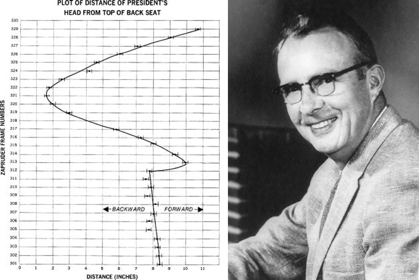
    Luis Alvarez, the Nobel Laureate known mostly for “jet effect” also performed a jiggle analysis.[7] One big concern of his involved the amount of time between the impact of the bullet, and the impact of the sound.

    The expected neuromuscular reaction occurs about one-quarter to one-third of a second later, as shown by the large accelerations near 318. (I’ll adopt five frames as Mr. Zapruder’s experimentally determined reaction time.)[8]

    Alvarez did not quote any authoritative source for this claim about the latency of the “expected” neuromuscular reaction, and his explanation for its length is inappropriate:

    For those readers who are surprised that the neuromuscular response time is so long, let me recall a common ‘parlor trick’: A bets B that if A drops a vertically held dollar bill without any warning, B cannot stop its fall by pinching his fingers together, if his fingers are poised, ready to clamp together, at the bottom edge of the bill. The fact that the bill can almost never be stopped (unless A gives a precursor signal with his fingers) indicates that a nervous system ‘or hair trigger’ takes more than one-sixth of a second (3.1 frames) to respond to an optical stimulus.[9]

    Alvarez was apparently correct about the speed of this particular kind of reaction. Tests performed on baseball hero Babe Ruth showed he took 140 milliseconds to twitch at the sight of a ball on its way—as opposed to the average person’s best, 150 milliseconds.[10]

    But why compare (a) an involuntary response to an auditory stimulus with (b) a voluntary response to an optical stimulus?

    Zapruder’s “reaction time”—assuming he was normal and assuming the sound was loud enough compared with the ambient noise—would be much quicker than Alvarez has claimed, according to neurologists. There is another problem with Alvarez’ analysis, as shown by this statement:

    The human nervous system cannot transmit signals fast enough for the angular acceleration between frames 312 and 313 to have been caused by Mr. Zapruder’s muscles reacting to impulses from a brain that had been startled by the shot that killed the President.[11]

    Gene Case, mentioned earlier, noted that Zapruder’s nervous system, no matter how fast, could hardly be expected to react to a sound that had not yet arrived!

    But why the blur at Z–313? Since it was too soon to have been due to a startle reflex (unless frames are missing between 312 and 313), Alvarez found another explanation, inspired by the observation of another physicist, Enrico Fermi, in a very different context:

    Fermi has almost instantly measured the explosive yield of the first atomic bomb by observing how small pieces of paper which he ‘dribbled’ from his hand were suddenly moved away from ‘ground zero’ by the shock wave.[12]

    Alvarez concluded the blur was “caused directly by shock wave pressure on the camera body.” But, as Case noted, the speed of sound is again relevant since it takes time (1.1 Zapruder frames) for the shock wave to reach Zapruder.

    Case also doubted a shock wave from a bullet could move a three-pound camera at any distance. He bought a Carcano, drove to a quarry with a friend and fired bullets past materials of different weights hanging freely on a stick. His results were conclusive:

    The cardboard, the tinfoil and the strings were unimpressed. The shock wave from a Mannlicher Carcano bullet passing three feet away does not flutter cardboard, tinfoil or string, much less the body of a movie camera (three pounds) 75 feet away.

    “Dr. Luis Alvarez, Nobel laureate, winner of the National Medal of Science, the Medal of Merit and the Einstein Medal, was blowing it out his ass.”[13]

    Bullets Fired Behind Zapruder?

    Case then tried something that lead to a rather exciting discovery. When he fired bullets past a CAMERA—and from NEARBY—he created a blur:

    Alvarez could have been right about the cause—a shock wave—but wrong about the nature of the ‘interaction.’ The ‘interaction’ could be a vibration in the shutter mechanism or elsewhere in the workings of the camera. Firing a rifle past a VHS camcorder, I was able to record the image of the shock wave of a passing bullet. It is an extreme undulation of the picture which lasts three video frames—3/30ths of a second. Of course, an 8mm film movie camera is a very different mechanism. But vibration of the shutter in Zapruder’s camera, or of the film itself, is a plausible explanation for this triple imaging.[14]

    A shock wave [manifest on film] at 313 could only have come from behind Zapruder.[15]

    Another Startle or Shock Wave at Z–318?

    Complicating jiggle analysis is the fact that Zapruder said he heard only two shots: the head shot, and one immediately before it which appeared to cause Kennedy to “lean over.” Zapruder either did not hear, or consciously register, the first shot. As I have previously documented in the newsletter Probe,[16] several witnesses heard only one—or even no shot—before the fatal one, then they heard a flurry.

    Edited excerpt from my Probe article:

    Charles Brehm. Saw head wounded on the “second” shot, heard a third. (22H837)

    Mr. and Mrs. John Connally. Both heard last shot only after lying down in the   seat, with Mrs. Connally’s head next to his. (4H133,147)

    Chief Curry. Heard a shot after Motorcycle Officer Chaney rode up to tell him   what was happening. (4H161) The Nix film shows that Chaney was still behind   the limousine several frames after the headshot.

    Sheriff Decker. Heard first shot when a “spray of water” come Kennedy; heard one more. (9H458)

    James Foster. Saw head wounded on “second” shot; heard a third. (CD897)

    Clint Hill. Heard shot, saw head wounded, while briefly “mounted” on the limousine the first time. Apparently unknown to Hill, the head was already  wounded about 1.5 seconds earlier. (2H144)

    Jean Hill. Said she wrapped up Moorman’s first Polaroid photo and put it in her pocket before she heard any shots. (6H206) At the time, she is still in view, about four seconds after the second shot, the photo is still in her hand.

    Emmett Hudson. Saw head wounded on “second” shot; heard a third while on the ground. (7H560)  (Nix film shows him on the ground after head wounded.)

    Mary Moorman. Heard a shot for the first time as she took a Polaroid photo of Kennedy being hit in the head. She heard two or three more. (19H487)

    Royce Skelton. Heard a shot after seeing Kennedy react to headshot. (19H496)

    Mrs. Philip Willis. She said the head was wounded on the “second” shot; then heard a third. (CD 1245)

    Conclusion

    As Mrs. Kennedy put it, “I guess there was a noise.”


    [1] Case G. Scientific Slumming with Luis Alvarez. The Fourth Decade, 1996; 3(2):32–42.

    [2] Brown P, Rothwell JC, Thompson PD, Britton TC, Day BL, and Marsden CD. New observations on the normal auditory startle reflex in man. Brain 1991; 114:1891–1902.

    [3] Aniss AM, Sachdev PS, and Chee K. Effect of voluntary muscle contraction on the startle response to auditory response. Electromyography and Clinical Neurophysiology, 1998; 38:285–293.

    [4] Valls-Sole J, Valldeoriola, Tolosa E, Nobbe F. Habituation of the auditory startle reaction is reduced during preparation for execution of a motor task in normal human subjects. Brain Research 1997; 751:155–159.

    [5] Jones FP, Kennedy JL. An electromyographic technique for recording the startle pattern. Journal of Psychology, 1951; 32:63–68.

    [6] Kennedy, J. 5 WCH 180.

    [7] Alvarez L. A physicist examines the Kennedy assassination film. American Journal of Physics, 1976; 44(9):813–827.

    [8] Ibid.

    [9] Ibid.

    [10] Fuchs AH. Psychology and the Babe. Journal of the History of the Behavioral Sciences, 1998; 34(2):153–165.

    [11] Alvarez.

    [12] Ibid.

    [13] Case.

    [14] Ibid.

    [15] Ibid.

    [16] Cranor M.  Probe 1999 6(6):6–13.
  • The Joker in the Jet Effect

    The Joker in the Jet Effect


    Nobel prize-winning physicist Luis Alvarez, with the sponsorship of the Department of Energy, designed experiments to “prove” Kennedy’s brain spatter sent his head backward, and published the results of these experiments in a low level publication, the American Journal of Physics in 1976.

    Alvarez assassinated ripe melons wrapped in tape (to simulate a human head), blowing out large exit holes, causing the melons to whizz impressively away from the direction of the exiting spatter in front—and toward the shooter in back. The jet effect. It is supposed to nullify the idea that JFK’s head moved backward because of a shooter in the front.

    The story—an infomercial rather than a scientific report—is written in the same manipulative, ingratiating style that lubricates so much of the pseudoscientific writings of John K. Lattimer MD and it vibrates with buzz words designed to earn your trust: Life Magazine…Thanksgiving…Christmas…football…the American flag…Lattimer’s service in World War II…his own service in World War II. (Somehow, he omitted references to mother, apple pie, church, and the family dog.)

    The following statement on page 819 contains the key to the jet effect as an explanation for the behavior of Kennedy’s head during the shooting:

    The simplest way to see where I differ from most of the critics is to note that they treat the problem as though it involved only two interacting masses: the bullet and the head. My analysis involves three interacting masses, the bullet, the jet of brain matter…and the remaining part of the head…

    Translated: Mass #1, the bullet, causes Mass #2, the brain, to explode, which, in turn, causes Mass #3, the “remaining part of the head” to move backward, away from the direction of the spatter.

    What’s wrong with this picture? Something critical is missing—the most important “interacting mass” in this entire event: The hard bone in the back of the head, the first thing the bullet is alleged to have hit, and with the full force of its energy!

    In this way, he eliminated the competition—the idea that JFK’s head moved backward because it was hit from the front, through transfer of momentum.

    The interaction between bullet and back of head was so violent, says the government, that it broke the bullet into two jacketed fragments and imbedded a disc of metal in the area of the cowlick. (Another interaction between bullet and bone takes place when the bullet exits, but I could find no data on it effects.)

    Note: Perforating metal-jacketed bullets don’t always move heads very much, especially if the bullet is perpendicular to the surface, and if the head is attached to a neck. Once the bullet enters, knocking a plug of bone aside, and is no longer in contact with bone, it no longer propels it (unless it moves it as it exits). But in a tangential hit, bullet and bone are in direct contact over a larger area for a longer period of time, often causing impressive movement. [The Parkland Hospital doctors did not look under the scalp to examine the top or front of the head, but did report a large area of missing scalp and skull in the right rear (in occipital-parietal bone). William Kemp Clark, former chief of neurosurgery, thought the wound was caused by a tangential hit. This would mean that at least one head shot came from the right, or north side of Elm Street. It could even have come from the right front: JFK’s head was rotated to his left, presenting a small part of the back of his head to a shooter on the grassy knoll.]

    Math: The Barbed Wire Protecting the Damaged Fruit

    Mathematical formulas tend to scare people away, discouraging close examination. They also provide the prickly appearance of intellectual rigor. But if you take a good look at his squirming calculations, you will see that, once again, he has left out the first interaction: Among the symbols, you will find none representing the back of the head.

    Thus, he not only eliminated the competition verbally, as mentioned above, but did it mathematically. In his equations, he has but one symbol for the melons that he shot, “M.” Alvarez’s theory contains the inherent assumption that the human head is as homogeneous as the melon.

    Well, the most relevant symbol that belongs in this formula is “BS” and you know what that stands for.

    Assassinating Melons

    How did Alvarez eliminate this high impact (in real life) collision between s pristine bullet and pristine (still intact) bone, in his experiments?

    He used melons wrapped in Scotch glass filament tape. Melon rinds are not much denser than the pulp inside. You can push a hole in one with your finger.

    How much resistance would a melon present to any bullet? And what about the bullets Alvarez used? He fired, at close range, 150 grain soft-nosed bullets with an impact velocity of 3000 ft/sec. What is the difference between the impact velocities of these two very different bullets? Ballistics expert W.E. DeMuth, Jr., M.D.:

    The kinetic energy theory…[that] energy = M x V2/2g, indicates that energy is directly proportional to mass and to the square of the velocity…doubling velocity quadruples it. (DeMuth, 1966)

    How much energy did Alvarez’s bullet lose on impact with the melon? How much energy would a Carcano bullet lose on impact with a skull, especially if breakage of the bullet results? How much momentum would be imparted to the skull? Alvarez answered none of these questions.

    Did Alvarez’s bullets break on the occipital-parietal region of the melon? He never even brought up the subject. Despite the omission of this most significant interacting mass (bone), Alvarez’s said his thesis includes “all the material in the problem:”

    I concluded that the retrograde motion of the President’s head, in response to the rifle bullet shot, is consistent with the law of conservation of momentum, if one pays attention to the law of conservation of energy as well, and includes the momentum of all the material in the problem. (Alvarez, 1976, p. 819)

    Luis Alvarez is like a third-rate magician, the kind that pulls a rabbit out of a hat, without first showing you the “empty” hat—and the rabbit turns out to be stuffed.

    A Professor Spreads Bullshit on a Slide

    How do these con artists manage to fool so many people? Harry Frankfurt, a former Professor of Philosophy at Princeton University, has made an in-depth study of the sort of thing produced by Alvarez, as well as the reasons it is accepted:

    The contemporary proliferation of bullshit…has deeper sources, in various forms of skepticism which deny that we can have any reliable access to an objective reality and which therefore reject the possibility of knowing how things truly are. (Frankfurt, 1988, p. 133)

    We may never know “how things truly are,” but thanks to various disinformation engineers, we actually do have “reliable access to an objective reality”—but it’s the reality that all kinds of people are trying to cover up the facts in this case. And they’re still doing it. Right before your eyes. (Go here to see a more recent example I’ve analyzed.)

  • Bending the Story on a Bent Bullet

    Bending the Story on a Bent Bullet


    In October of 2017, I posted this story on WhoWhatWhy, “Navy Doctor: Bullet Found in JFK’s Limousine, and Never Reported.”

    If you’re familiar with the medical evidence in the matter of John F. Kennedy’s assassination, you may know that, during the president’s autopsy, skull fragments found in the limousine and street were brought to the autopsy table. What you may not know is that something else was allegedly found in the limousine and brought up with the skull fragments—but not reported.

    Decades later, Dr. Randy Robertson, a board member of the Assassination Archives and Research Center, came upon obscure documents concerning this important piece of evidence.

    According to Navy doctor James Young, a bullet was included in an envelope with the bone fragments and he had a chance to inspect it before passing it on to the pathologists. He wasn’t sure if it was made of copper or brass, but here’s what he said about its shape:

    “…it was slightly bent on the end. It was not a straight bullet. In other words, it had hit something and it bent…”

    For more details on Young’s account, please scroll down to Appendix A.

    Recently, the very existence of that bullet has been challenged. This report is strictly in response to that specific challenge.

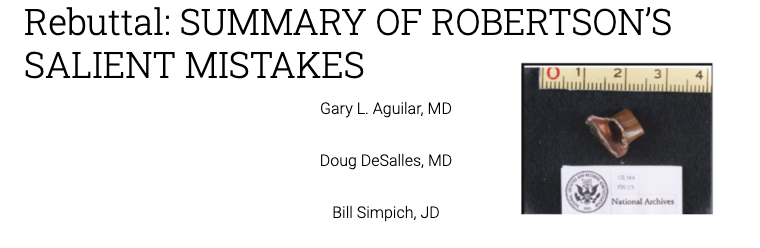
    It appears in one segment—point 4—of a much longer article, “Summary of Robertson’s Salient Mistakes” by Gary Aguilar, MD, Douglas DeSalles, MD, and Bill Simpich, JD.

    In Point 4, the authors focus on discrediting two people: James Young, the Navy doctor who said he saw the bullet, and Randy Robertson, who believed him.

    Issue 1

    The authors say, “Dr. Young used the term ‘slug’ to describe it and it is on this term that Robertson builds his case that a ‘whole bullet’ was found in the limousine.”

    It seems far more likely that Robertson saw the “slug” as a whole bullet simply because of Young’s description of it—which the authors do not include in their paper.  

    Young used the term “Bullet” with greater frequency than the word “slug.” He said “bullet,” about six times in the Oral History interview and three times in his letter to Gerald Ford.

    They reinforce this false premise: “After doing the Oral History interview, Young wrote to President Gerald Ford asking Ford if he knew anything about the ‘brass slug’ Chiefs Mills and Martinelli [sic] had found in the limo. Ford replied, ‘No, he didn’t know anything about it, had not heard anything about it ever.’”

    It appears that Aguilar et al. did not read much of the material, not even the short bits. “Bullet” is hard to miss in this correspondence. From Young to Ford:

    Two of the corpsmen left and returned sometime later with three varying sized pieces of President Kennedy’s skill bones. In addition, they brought back in an envelope a spent misshapen bullet which they had found on the back floor of the “Queen Mary” where they had found the pieces of skull bones. The bullet and pieces of skull were given to Dr. Jim Humes.

    I have never seen anything written about that spent bullet in the Warren Report or elsewhere. Do you recall any testimony or comments which would clarify my concerns?

    From Ford to Young:

    As a member of the Warren Commission I was very conscientious about my participation in the hearings. However, I have no recollection of “the spent bullet” you refer to.

    Young also said that he would ask Arlen Specter to “look into what happened to that bullet.” 

    The above makes it clear that Young frequently referred to a “bullet,” and much less frequently, called it a “slug.” So, why fault Randy Robertson for assuming Young was talking about a bullet when that is exactly what he called it?

    More important, whatever shape the bullet was in, it was an important piece of evidence that went unreported.

    Issue 2

    The authors assert that Young confused the little fragment (CE 569) shown below with a whole bullet:

    No ‘non-fragmented bullet with a bent tip’ ever existed. Robertson made up its existence out of an ambiguity in Young’s use of the term ‘slug.’ No ‘complete bullet’ was ever found in the limousine. Dr. Young was referring to Q3, later designated C3, and even later designated CE 569.


    How could Young have been referring to that little fragment—the base of a bullet, not the tip—when he never even saw it? He did not go down to the garage with the petty officers. Nor did those officers bring it back to the autopsy. Those fragments were turned over immediately to the FBI. And that fragment (CE 569) does not remotely resemble what Young described.

    Dr. Aguilar’s argument has all the credibility of what a man told the judge when he was being tried for shooting his mink-encased mother-in-law in the family garage. He said, “Your honor, I thought it was a raccoon!”

    Issue 3

    Aguilar et al. present a “foundational document” on the fragments discovered in the car, a document that does not mention a whole bullet—so we are to believe the bullet never existed:

    This is all Robertson says about Dr. Young and the ‘bent brass slug’ that Chief Mills or Marinelli [sic] found on the floor of the Presidential limousine. This is odd since one of the most foundational documents in the case—Commission Document 80, a 15-page document including photos and another SS Report—tells in granular detail how the various fragments were discovered on the evening of November 22nd.

    We in the research community have seen many documents that are false, misleading, incomplete, or otherwise not reliable.

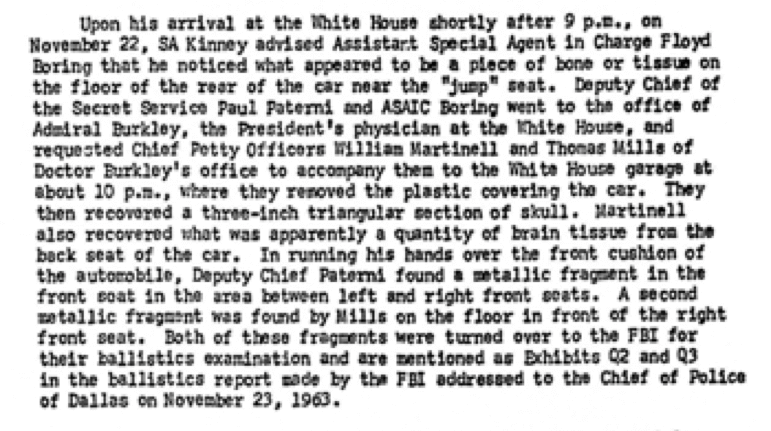
    A passage in this “foundational” document contains intriguing information that may explain how the bullet, or whatever Young was talking about, could have been picked up by Martinell and carried—but unseen—because it was submerged in brain. (And this might explain why FBI firearms expert Robert A. Frazier never saw it.) (See Appendix B for a longer quote from the “foundational” document, CD 80.)

    They then recovered a three-inch triangular section of skull. Martinell also recovered what was apparently a quantity of brain tissue from the back seat of the car.

    Question 1: Could that “quantity of brain tissue” have embedded the bullet, or whatever Young called a bullet, so that it was—at the time—out of sight?

    Question 2: Whether it contained any metal or not, why didn’t Humes report that “quantity of brain tissue” when he reported the bone fragments? After all, it’s evidence. There should be a description of it, and whether it was searched for bullet fragments. (Humes reported plenty of trivia, so why not this?) Could that brain tissue have been cerebellum?

    But then Humes was quite deceitful when it came to reporting things directly related to the wounds. For instance, incredibly, he never even mentioned the gross condition of the cerebellum in the autopsy report or his testimony. Not one word on how much of it was left. We only have Parkland Hospital’s descriptions of the organ (very damaged, half of it missing…) This was one of the most talked about pieces of gore in all the literature on the head wound. I seem to be the only one concerned with this omission. (Click here for details)

    A related mystery: Clint Hill and others have said that hair was attached to the large bone fragment. That hair should have been documented, combed for bullet fragments—and used to help identify where the bone fragment came from. His hair was longish on top, but considerably shorter in back. What happened to it? 

    Question 3: Why didn’t Aguilar et al. mention this “quantity of brain” picked up by the petty officer along with the skull fragments—and not reported? It is clearly relevant.

    And here’s a discrepancy that may have a mundane explanation, but should be noted:

    Aguilar et al. said, “This ‘whole bullet’ is never mentioned in the notes FBI Agent Robert Frazier kept during his forensic examination of the limousine at the Secret Service garage between 2:00 AM and 4:30 AM on the morning of November 23rd.”

    But, according to the “foundational document,” the petty officers who picked up the bone fragments and Secret Service agents arrived much earlier—at 10:00 PM. 

    [Re the question about why the bullet was not mentioned by Frazier, the above may explain it. Or not.]

    Issue 4

    The authors try to close the case and snuff out Dr. Young’s contribution:

    Now with the whole story of what happened in the White House garage fully described in various reports, whatever Dr. Young thought he was seeing is rendered irrelevant. We know what happened. It was not just Martinelli [sic] and Mills who searched the limousine…

    “Rendered irrelevant?” Not so fast.

    “We know what happened.” Aguilar doesn’t seem aware of the simplest, most basic, most relevant facts upon which to base his theory—that Young confused the little fragment found in the front of the car with the less damaged bullet Young says was found in the back of the car and brought to the autopsy table along with the skull fragments.

    The Basic facts need repeating:

    • Young never even saw that little fragment. He stayed in the autopsy room and never went down to the garage where the limousine was, and where the front seat fragments were found. Petty officers were sent.
    • The front seat fragments were turned over to the FBI and whisked away. (Commission Exhibits 567 and 569)
    • The front seat fragments were NOT brought back to the autopsy table.
    • So how could James Young have confused a spent bullet (or any form of a bullet) with CE 569 which is the hollow base of a bullet—with no tip, bent or otherwise?

    When it comes to this case, it’s hard to know what to believe. But sometimes we know what not to believe. Considering all the deception we have seen, all the lies by major players about major issues, the planting of evidence, the destruction of evidence—why is it so hard to believe James Young?

    Aguilar et al. seem to believe official stories:

    The other bullet fragment found in the front seat area is shown in figure 31. The simplest explanation is clearly that CE 567 dropped down into the front seat area after striking the windshield at 328/329. CE 569 likewise dropped into the front seat area at 328/329 after striking the rear-facing chrome strip shown in Figure 30.

    As the authors know very well, the “stretcher bullet” was planted. Yet they trust the government version on the front seat fragments. While I have no reason to doubt that claim—I have no reason to believe it either.

    And I keep remembering something Roy Kellerman said. He’s the Secret Service agent who sat in the front passenger seat of JFK’s limousine, the place where the fragments were found. From his interview with the HSCA:

    Kellerman recalled that when he was in the car just moments after the shots he observed “a splattering of metal around me.” And he said there had to be “four or five metal fragments in the car.”

    Four or five? Had to be? But only two were reported. (I’m assuming he was not referring to tiny lead particles. Those were probably too numerous to count.) This could have an innocent explanation, but not necessarily.

    And then there’s the odd story of the undertaker who said a federal agent had shown him a glass vial filled with fragments taken from Kennedy’s head – 10 fragments. Yet, the lead pathologist said he only removed two fragments. (ARRB MD 180, p.3) (Someone else made a similar claim, but I can’t remember who.)

    In most of these cases of gross discrepancies, it’s impossible to find hard proof of who is right. But there is one thing you can prove: when a person makes a false claim about what is, or is not, in a particular document. Whether the false claim is a lie, or a mistake, is a matter of judgment.

    Personal Note

    I know all three of the authors (Aguilar, DeSalles, and Simpich) quoted above and suspect the ideas expressed in Point (4) of the larger paper are mostly those of Dr. Aguilar, whose work was trusted by the other two, but that’s just my theory. And I believe they dashed out that article too quickly, in defense of a comrade, Josiah Thompson, whose book Randy Robertson has harshly criticized. I can sympathize with this impulse. The problem is—they did it at the expense of James Young, who seems to have done nothing to deserve such disrespect. And if they succeed in snuffing out all references to this unprovable, but still interesting bit of evidence, then they also did it at the expense of future research.

    Addendum

    One theory about what happened to the bullet James Young said he saw:
    A family member of the late George Burkley, Kennedy’s personal physician, reportedly told researcher John Titus that “something relating to the assassination—something very important—was stolen from Dr. Burkley as he traveled between airports on his way to Denver.”

    Click here to read Titus’s story about what happened when he reported this to former Warren Commissioner David Slawson. And click here for more.

    Appendix A

    James Young, MD, one of Kennedy’s personal physicians who attended the autopsy, believes he witnessed something strange that was never reported anywhere, apparently.

    Soon after the autopsy, he wrote a memoir about what he saw for his children. He revisited that memoir in 2001 during an interview with the US Navy Medical Department Oral History Program.

    The lead pathologist, James Humes, MD, said bones were missing from JFK’s head, and asked two petty officers (Chiefs Thomas Mills and William Martinell) to retrieve any bone fragments left in the president’s car. (p. 53)

    They came back with an envelope that contained three pieces of skull as well as a “brass slug about half a centimeter in diameter and distorted.” Later in the interview he said:

    I came across this issue of the bullet [while looking at the memoir]…

    They picked up the bullet off of the floor in the back of the car. Well, I decided that this is something, you know, the third bullet has never been decided about ever, apparently…I went through the entire Warren Commission book…I went through the whole thing and there was nothing in it.

    Now, at that particular time nobody said anything about this. And I know what we did. We brought that in, I mean Chief Martinell and Chief Mills went…got the stuff off of the floor in the back seat, brought it back out to us and we gave that to Commander Humes at the time…

    […]

    So, the bullet, again, was a copper jacketed bullet like a military bullet?

    No, it was a brass jacket…I don’t know, maybe it was copper, I couldn’t tell. But it was that color or brass and it was slightly bent on the end. It was not a straight bullet. In other words, it had hit something and it bent…and so I called Tom Mills and I said, “Tom do you recall this situation?’ He said, ‘Yes I do’ and he said, ‘You’re exactly right.’ He said, ‘We did bring that slug out from the back…’

    The last time Young tried to talk to Mills, Mills said he didn’t want to talk about it. He’s not the only one.

    Appendix B

    From Aguilar et al.’s paper: On the Mary Ferrell site it is described as “Commission Document 80 – Secret Service Report of 06 Jan. 1964 re: Presidential car.” Below is a photocopy of a paragraph from page 2 of the Report:


  • A Slice of Time: Review of Josiah Thompson’s Last Second in Dallas

    A Slice of Time: Review of Josiah Thompson’s Last Second in Dallas


    If you take a moment in time and slice it down the middle, all kinds of things may come tumbling out—even state secrets.

    Moments on films of the Kennedy assassination are sliced into about 18 frames per second.

    In his latest book, Last Second in Dallas, Josiah Thompson focuses on one of those seconds, during which time, he says, and I agree, the president’s head exploded as it was hit by multiple bullets.

    To the mainstream media, Thompson has always been a credible source, so it’s a wonderful thing that, in his latest book, this credible source promotes—without reservation—the concept of conspiracy in the assassination.

    The strongest proof described in the book is the famous Dictabelt tape, a recording of what a motorcycle policeman’s stuck-open microphone picked up—the sounds of five separate shots. Some were fired in such rapid succession that more than one shooter had to have been involved. And not all came from the same direction.

    To me, it’s inconceivable that gunfire would not have been recorded under the circumstances described. So, it seems significant that apparently no recording exists of only three shots—the government-approved number.

    Thompson attempts to correlate these sounds with specific frames of the Abraham Zapruder film of the event. In gruesome color stills, he points out what he believes is evidence of an additional shot.

    You may or may not agree with his conclusions, but it doesn’t matter. You should have no trouble correlating—however loosely—these additional shots with what bystanders said they heard, what they saw, and when. Below is a small collection of their observations, selected for their relevance to the tape. I find them fascinating.

    The Witnesses

    Note: When a witness refers to a “first” or “second” shot, they’re just talking about the first or second shot they heard. Many did not hear (or heard but didn’t register) the earlier shots, because of the ambient noise from the crowd, and especially the motorcycles.

    Brehm, Charles (Bystander)

    Saw JFK hit in the head with the second shot, heard a third.

    The President was leaning forward when he stiffened perceptibly at the same instant what appeared to be a rifle shot sounded…the President seemed to stiffen and come to a pause when another shot sounded and the President appeared to be badly hit in the head. BREHM said when the President was hit by the second shot he could notice the President’s hair fly up…and then [he] roll[ed] over to his side…Brehm said that a third shot followed…between the first and third shots, the President’s car only seemed to move some 10 or 12 feet…almost came to a halt after the first shot. [FBI statement] (22WCH837)

    Foster, James (Patrolman)

    The following summary is confusing, but it sounds like this officer saw JFK hit in the head by shots fired almost simultaneously.

    Another report was heard by Patrolman Foster and, at about the same time the report was heard, he observed the President’s head appear to explode and immediately thereafter, he heard a third report…Patrolman Foster stated that because of the distance from the place where the shot appeared to come from [Depository Building], he felt the third shot struck President Kennedy as he heard the sound of the second shot that was fired. Immediately after President Kennedy was struck with a second bullet, the car in which he was riding pulled to the curb, the motorcycle escorts started maneuvering and scattering, a man which he recognized to be a Secret Service agent jumped on to the rear of the President’s car. (CD 897, DL 100–1046)

    Hickey, George (Secret Service)

    Hickey seems to be describing the effects of two bullets fired nearly simultaneously at Kennedy’s head, one of which he thought was a near miss, disturbing only his hair.

    I heard a loud report which sounded like a firecracker…A disturbance in 679X caused me to look forward toward the President’s car…At the moment he was almost sitting erect I heard two [more] reports which I thought were shots and that appeared to me completely different in sound than the first report and were in such rapid succession that there seemed to be practically no time element between them.

    It looked to me as if the President was struck in the right upper rear of his head. The first shot of the second two seemed as if it missed because the hair on the right side of his head flew forward and there didn’t seem to be any impact against his head. The last shot seemed to hit his head and cause a noise at the point of impact which made him fall forward and to his left again. (18WCH762)

    Hill, Clint (Secret Service Agent)

    Photographic evidence of when Clint Hill reacted suggests he never heard the actual first shot. Stranger still, he thought “the” head shot occurred while he was holding onto the limousine. But the film taken by Marie Muchmore shows that, even before he reached the limousine, the top of JFK’s head rose up about an inch, emitted translucent white fluid, then closed, a lid slammed shut. Unknown to him, what Hill witnessed appears to be yet another shot to JFK’s head. JFK was then shot again.

    And I heard a noise from my right rear…and I saw President Kennedy grab at himself and lurch forward and to the left. This is the first sound that I heard…I jumped from the car…ran to the Presidential limousine…Between the time I originally grabbed the handhold and until I was up on the car…the second noise that I heard had removed a portion of the President’s head, and he had slumped noticeably to his left. (2WCH138)

    When I mounted the car…it had a different sound…than the first sound that I heard. The second one had almost a double sound—as though you were standing against something metal and firing into it, and you hear both the sound of a gun going off and the sound of the cartridge hitting the metal place…” (2WCH144)

    As I lay on the back seat…I saw a part of his skull with hair on it lying in his seat. (18WCH742) [No hair was reported, which is too bad because its length might have helped show what part of the skull it was.]

    Holland, S.M. (Bystander)

    Holland heard an additional shot after he saw Kennedy hit in the head. For me, Thompson’s riveting interview of this man—what he heard, and especially what he saw—is just amazing. It correlates with what another critical witness saw, and it is one of the highlights of the book. He appears to have found a sniper’s nest behind the fence on the grassy knoll. You will have to buy the book to see what he said.

    Hudson, Emmett (Bystander)

    Films show Hudson still standing over a second after Kennedy’s head exploded, which happened when the limousine was in front of Zapruder. Other witnesses corroborate Hudson’s claim that a shot was fired over a second after Kennedy was hit in the head.

    I happened to be looking right at him when that bullet hit him—the second shot…it looked like it hit him somewhere along about a little bit behind the ear and a little bit above the ear.

    I just laid down…resting my arm on the ground and when that third shot rung out and when I was close to the ground—you could tell the shot was coming from above and kind of behind.

    I don’t know if you have ever laid down close to the ground, you know, when you heard the reports coming, but it’s a whole lot plainer than it is when you are standing up in the air…right along about even with these steps, pretty close to even with this here, the last shot was fired… (7WCH560-561)

    Kinney, Samuel A. (Secret Service)

    The first shot was fired…he slumped to the left. Immediately he sat up again. At this time, the second shot was fired and I observed hair flying from the right side of his head…I did hear three shots, but do not recall which shots were those that hit the president. (18WCH732)

    Landis, Paul (Secret Service)

    It was at this moment that I heard a second report and saw the President’s head split open… I also remember Special Agent Clinton Hill attempting to climb onto the back of the car at the time the second shot was fired…

    I heard what sounded like the report of a high-powered rifle from behind me…My first glance was at the President…I saw him moving in a manner which I thought was to look in the direction of the sound. I did not realize that the President had been shot at this point.

    I glanced towards the President and he still appeared to be fairly upright in his seat…I also remember Special Agent Clinton Hill attempting to climb onto the back of the President’s car.

    It was at this moment that I heard a second report and it appeared that the President’s head split open with a muffled exploding sound…the sound you get by shooting a high-powered bullet into a five gallon can of water or shooting into a melon. I saw pieces of flesh and blood flying through the air and the President slumped out of sight toward Mrs. Kennedy…

    I still was not certain from which direction the second shot came, but my reaction at this time was that the shot came from somewhere towards the front, right-hand side of the road. (18WCH754-5)

    McClain, H.B. (Motorcycle Officer)

    McClain appears to be describing a man caught in a crossfire.

    The force of this bullet threw him this way, and then back this way, so I think the man was shot twice. He was falling away and then all of a sudden, he just went back the other way. (CSpan)

    Moorman, Mary (Bystander)

    It appears that Moorman did not hear a shot until she took her Polaroid picture of Kennedy getting hit in the head. She said she fell to the ground when she heard the shots. Films show her still standing with her camera aimed at Kennedy after the first headshot.

    As the motorcade started toward me I took two pictures. As President Kennedy was opposite me, I took a picture of him. As I snapped the picture…I heard a shot ring out. President Kennedy kind of slumped over. Then I heard another shot ring out and Mrs. Kennedy jumped up in the car and said, “My God, he has been shot.” When I heard these shots ring out, I fell to the ground to keep from being hit myself. I heard three or four shots in all… (19WCH487)

    Skelton, Royce (Bystander)

    This witness’s remarks fit the pattern in that he heard more than three shots, but maybe not all struck anyone in the limousine. He said he saw a bullet hit the pavement at the left rear of the car, and the concrete was knocked to the south away from the car. If true, that would seem to put the shooter in front and on the right, the north side of the street—in other words, the grassy knoll.

    I was standing on top of the train trestle where it crosses Elm Street with Austin Miller…I heard something which I thought was fireworks. I saw something hit the pavement at the left rear of the car, then the car got in the right-hand lane and I heard two more shots. I heard a woman say “Oh no” or something and grab a man inside the car. I then heard another shot and saw the bullet hit the pavement. The concrete was knocked to the south away from the car. It hit the pavement in the left or middle lane… (19WCH496) [Later, he told the Warren Commission he saw smoke coming off the cement where the bullet hit.]

    Willis, Mrs. Philip (Bystander)

    Said the head was wounded on the “second” shot; then heard a third. (CD 1245)

    The Dictabelt

    The timing of shot sounds on the Dictabelt tape is critical to their interpretation as gunfire. Doubt was cast on that interpretation, at first, because those sounds seemed to have come too late.

    I cannot understand this part of the book and will not attempt to explain it except to say that it has to do with when, in relation to the shot sounds, Sheriff Bill Decker was heard (but barely, on a fuzzy tape) to say “Hold everything secure.” The assumption is, he uttered those words a minute after the last actual shot.

    So, if those words can be heard too close to the time of the shot sounds on the tape—then those sounds can’t be shots. (Thompson offers a technical explanation for how Decker’s comment only appeared to have been made at the time of the shot sounds—a matter of cross talk, from a different channel. I am not qualified to do the subject justice, and won’t try.)

    If you want to study this issue further, you should of course read all the technical material in Thompson’s book, as well as the analyses of others, but also study the relevant testimony provided below.

    Who Heard What in the Lead Car, and When? Who Said What, and When?

    Decker was in the lead car, right behind Jesse Curry, the chief of police. To his right, was Special Agent Winston Lawson. In the back, to the right of Decker, sat Forrest Sorrels, Special Agent in Charge, Dallas office.

    A motorcycle officer, James Chaney, rode up to the lead car to tell the sheriff what was happening. He didn’t begin this journey until after seeing JFK shot in the head. Yet at least one occupant of the car specifically said he heard two more shots after Chaney reached the car.

    James Chaney was not interviewed by the Warren Commission, but here is what Officer Marrion Baker said about Chaney:

    I talked to Jim Chaney and he made the statement that the two shots hit Kennedy first and the other one hit the Governor. He was on the right rear of the car or to the side, and then at that time the chief of police, he didn‘t know anything about this, and he [Chaney] moved up and told him, and then that was during the time that the Secret Service men were trying to get in the car, and at the time, after the shooting, from the time the first shot rang out, the car stopped completely, pulled to the left and stopped…Now I have heard several of them say that. Mr. Truly was standing out there, he said it stopped. Several officers said it stopped completely. (3WCH266)

    Curry, Jesse (Chief, Dallas Police Department)

    Curry said he heard two more shots after Officer Chaney rode up beside himthat is, two more shots after the head shot.

    I said, “What was that, was that a firecracker?”…I couldn’t tell whether it was coming from the railroad yard or whether it was coming from behind but I said over the radio, I said, “Get someone up in the railroad yard and check.”

    And then about this time, I believe it was Officer Chaney rode up beside of me and looking back in the rearview mirror I could see some commotion in the President’s car and after this there had been two more reports, but these other two reports I could tell were coming [from] behind instead of from the railroad yards. (4WCH161) [Emphasis mine]

    Decker, J.E. “Bill” (Dallas County Sheriff)

    Sheriff Decker apparently associates seeing brain spatter with the first shot he heard.

    As the motorcade was proceeding down Elm Street, I distinctly remember hearing two shots. As I heard the first retort [sic], I looked back over my shoulder and saw what appeared to me to be a spray of water come out of the rear seat of the president’s car. At this same moment, Mr. Lawson said “Let’s get out of here and get to the nearest hospital”…At the same time, Mr. Curry was on his intercom radio giving instructions to the motorcycle escort to move out…

    We moved out immediately at which time I took the microphone and requested the DPD dispatcher 521 to advise my Station 5-Radioroom to notify all officers in my department to immediately get over to the area where shooting occurred and saturate the area of the park, railroad and all buildings… (19WCH458)

    Lawson, Winston (Secret Service)

    This Secret Service agent who didn’t hear a shot until he was “quite close” to the underpass heard two shots after witnesses were either running around or hitting the ground. But those reactions did not happen until after the first headshot.

    I heard this very loud report…I can recall spinning around and looking back, and seeing people over on the grassy median area kind of running around and dropping down, which would be in this area in here [described elsewhere as the area between Elm and Main]…Then I heard two more sharp reports. (4WCH352

    Sorrels, Forrest (Special Agent)

    The first shot was heard…I just said “What’s that?” And turned around to look up on this terrace part there, because the sound sounded like it came from the back and up in that direction…Within about three seconds there were two more similar reports and I said “Let’s get out of here” and looked back, all the way back, then, to where the President’s car was, and I saw some confusion, movement there, and the car just seemed to lurch forward.  And, in the meantime, a motorcycle officer had run up on the right-hand side and the chief yelled to him, “Anybody hurt?”…And the chief took his microphone and told them to get to the hospital, and said, “Surround the building.” He didn’t say what building…And by that time we had gotten almost in under the underpass… (7WCH345)

    Thompson and the Medical Evidence

    The gold standard for any report is simple: Tell readers what they need to know to make up their own minds. Do not put your finger on the scale. Never omit significant information which conflicts with your own conclusions.

    Thompson doesn’t always follow this rule. To illustrate this, I have selected the throat wound, an easier specimen to deal with than the messy, messy head wound. (That subject deserves its own messy article.)

    ISSUE #1: When the Pathologists Knew of a Bullet Wound in the Throat

    Why it’s important: had they acknowledged the bullet wound in the throat—as opposed to just a wound created by a tracheotomy—they would have been obliged to document it, by photographing it under magnification, measuring it and, most important, taking tissue samples for microscopic examination—which would have revealed whether the wound had been an exit or an entrance.

    Thompson accepts this story: “The first time any of them knew a bullet wound underlay the tracheotomy incision was when they opened their copies of the Washington Post the next morning and learned what Dr. Perry had done.”

    The next morning, when the body was gone, and it was too late to document evidence of that wound. 

    It’s understandable why doctors under pressure to prove a foregone conclusion would want to avoid proving anything that contradicted that conclusion. But why does Thompson repeat this false claim? And why does he leave out facts that contradict it?

    Facts omitted by Thompson:

    Both pathologists and the autopsy photographer (and others) indicated they knew of the throat wound that night, while it was still possible to document it.

    Commander James Humes, MD: Testimony to the Warren Commission

    In 1964, Humes testified that they knew, on the night of the autopsy, that only a missile could have caused the bleeding and bruising in JFK’s throat—and not Perry’s surgery (which involved severing strap muscles in the neck)—because at the time of Perry’s work, JFK’s heart had stopped circulating blood. He bases this on the fact that no bleeding or bruising was caused by cutting on other places on JFK’s body. (2WCH367-8) [In my opinion, Humes volunteered this information out of vanity. He didn’t want to look like a fool who didn’t see what was in front of him. And he was talking behind closed doors…]

    J.Thornton Boswell: Testimony to the HSCA

    Dr. Boswell said he remembered seeing “part of the perimeter of a bullet wound in the anterior neck.” 

    J.Thornton Boswell: Testimony to the ARRB

    Did you reach the conclusion that there had been a transit wound through the neck during the course of the autopsy itself? Response: Oh, yes.

    Our conclusions had been that night and then reinforced the next day that it was a tracheostomy through a bullet wound.

    John Stringer, Autopsy Photographer, to the ARRB

    Said the doctors felt around in the throat trying to find bullet fragments or anything sharp.

    Thompson also accepts the idea that the pathologists didn’t have time to do a proper job because the family and the president’s physician were rushing them. But if they were in such a hurry, why did they spend time carefully weighing each organ and measuring every heart valve, instead of focusing on the bullet wounds?

    ISSUE #2: Throat WoundEntrance or Exit? Thompson’s Theory

    In his new book, Thompson describes his theory of the throat wound, the same one he presented in Six Seconds in Dallas – that it was created when a little bone or bullet fragment was driven downward “by the explosion of the president’s head.” And he said Newsweek and the Journal of the AMA (JAMA) claimed that is what happened. But JAMA is notorious for publishing pseudoscientific pro Warren Commission propaganda. And Newsweek isn’t exactly a peer-reviewed medical journal.

    Thompson believes the laceration in the brain described in the autopsy report is possible evidence of the fragment’s journey downward. Apparently, he does not know of another, perhaps more likely explanation for such lacerations. They are usually formed by cavitation—when the bullet violently displaces tissue in its path, it creates a large temporary cavity. And perpendicular to the bullet’s path, cracks are formed where the tissue was stretched until it tore. You can see these perpendicular cracks in soap or gelatin after a bullet passes through.

    In any case, there’s nothing wrong with expressing theories, but, as mentioned above, you should always include the other side of the story, if it is valid.

    Facts omitted by Thompson:

    Malcolm O. Perry, MD who performed the tracheotomy had good reason to believe the wound was an entry, and not just because it was small. There was a far more definitive reason: Perry said “the edges were bruised.” And Charles Baxter, MD referred to the skin damage around the hole. That bruising takes place when the skin is crushed by the bullet against harder internal structures. In this case, the skin between bullet and trachea. (All entry wounds are “shored” or buttressed by tissue on the other side.)

    What Perry said about the internal damage in the neck suggests that if a bullet entered the throat, it was probably traveling at medium velocity (as defined circa 1963).

    There’s some concussive damage to surrounding organs—these are the kind of things one sees with gunshot wounds, in a blast injury…And with high velocity, we do see a lot. Now the low velocity stuff, it’s often just a track, a wound track, with very little concussive or blast injury. This one was in between. There was evidence of some blast injury, but not like, say, what one sees with a high velocity rifle.

    Whether it was coming or going, Perry was talking about damage done by a bullet. And it is reasonable to assume that he would recognize whether a small hole in the skin was created by something exiting. In 1963, Perry was already an assistant professor of surgery, specializing in vascular surgery. In his obituary, the New York Times reported “In his long career, Dr. Perry was chief of vascular surgery or professor of surgery, or both, at the University of Washington in Seattle; Cornell Medical College in New York City; Vanderbilt University School of Medicine in Nashville, and the Texas Tech Health Sciences Center in Lubbock, as well as the University of Texas Southwestern Medical School in Dallas.”

    Thompson believes that if the bullet entered the throat, it would necessarily strike the spine. But consider the bullet’s path if it came from the front. The path is defined by three documented, apparently connected points, demonstrating that path was at an angle:

    1. Middle of the throat, skin
    2. Right side of trachea
    3. Right lung, top

    Please click here for more details on this. If the wound is an entrance, the bullet went only so far before stopping. Some believe the pathologists—or someone else—removed the remains of whatever missile entered, if one entered.

    If you believe the front is an exit, this is the government-approved path:

    1. Right side, upper back—but very close to the spine
    2. Right lung, top
    3. Right side of trachea
    4. Middle of throat

    The problem with the above scenario is the extreme closeness of the back wound to the spine. It really would have gone into the spine had it continued on its journey.

    No one reported finding the small bone or bullet fragment that Thompson believes created the throat wound, but that doesn’t mean anything. No one reported finding the bullet many believe entered from the front either. And again, this doesn’t mean anything. Look what else the pathologists didn’t document:

    1. As reported above, the doctors pretended they didn’t even know about the bullet wound in the throat.
    2. Not one word on the size and condition of the cerebellum. This omission is stunning, considering the victim was shot in the head, and the bad condition of the cerebellum as described by the Parkland doctors, evidence that challenges the official trajectory through the head.
    3. The exact vertical location of the back wound, as related to a vertebra.

    Click here to see little known evidence that could show the two wounds are not connected, that the throat wound came first, then the back wound.

    Thompson’s Book: Gourmet Food for Thought

    Despite its flaws, Last Second in Dallas is a stimulating book about an eternal puzzle concerning the confounding details of this monumental murder. The book is rich in detail and a lot of it is factual and not well-known. But, if you have learned anything from the above, you need to always keep in mind the question, “What relevant facts were left out, and why?” My theory on why: certain facts could lead back to Who Done It. And, here’s another puzzle for you: What entity—in this day and age—is still suppressing inconvenient facts?

  • Forensics Journal Unintentionally Proves Conspiracy in Cover-Up of JFK Assassination

    Forensics Journal Unintentionally Proves Conspiracy in Cover-Up of JFK Assassination


    Lucien C. Haag, BS, describes himself as a “former criminalist and technical director of the Phoenix Crime Laboratory, with nearly 50 years of experience in the field of criminalistics and forensic firearm examinations; president, Forensic Science Services Inc.” And he was an “expert witness” in the November 2017 mock trial of Lee Harvey Oswald, hosted by South Texas College of Law.

    In the December 2019 issue of the American Journal of Forensic Medicine and Pathology, Haag demonstrates this “expertise” with his article, The Unique and Misunderstood Wound Ballistics in the John F. Kennedy Assassination.

    When it comes to this case, his expertise seems to be in the specialty of propaganda.

    His article demonstrates scholarship below the level of a junior high school term paper. The title, like the rest of his story, is misleading. The wounds were not unique, and would have been understood had they been properly explored, and truthfully explained in previous investigations. But Haag is correct when he says the evidence is misrepresented — and he himself grossly misrepresents the evidence in crude attempts to perpetuate the government-approved narrative. His techniques include the following:

    • Presents highly misleading and sometimes outright false information to support the Warren Commission.
    • Omits documented key facts that contradict it.
    • Provides almost no references to primary sources. Instead, he uses mostly his own articles as references. In other words, his “proof” of a particular statement is … that he said it before.
    • Litters the discussion with an obstacle course of “alternate facts” and distracting irrelevancies.

    Haag focusses on promoting a slightly tarted-up version of the single bullet theory: a bullet entered high in the base of JFK’s neck, exited his throat — traveling around 1800 fps (feet per second) — struck Governor John Connally while “yawing” (tumbling), perforated his torso, then wrist, and finally created a puncture wound in his thigh.


    Bullet Probably Not Yawing

    Haag’s main “proof” the bullet first went through Kennedy is the 15 mm elliptical wound in Connally’s back.

    Haag claims its size and shape prove the bullet struck Connally while turned somewhat sideways, that is, yawing (tumbling) — presumably a result of having first gone through JFK.

    Haag does not tell you that the wound in the back of Kennedy’s skull was also 15 mm long. No one claims that bullet had been yawing.

    Obviously there are two possible explanations for an ovoid or elliptical wound:

    The bullet strikes while turned sideways.

    The bullet strikes nose-on — but at a slant, and the nose travels a bit on the surface before entering the body. This is a tangential hit.

    Had the Connally hit been a tangential one, would the bullet have made a fairly straight path through his torso? Is this why Haag created this picture of a confused bullet tumbling around inside the governor?

    There is an additional, critically important fact to understand, which is either not understood or deliberately dismissed by conspiracy advocates who draw straight wound paths through Governor Connally’s torso … A yawing, tumbling, destabilized bullet entering the Governor’s body is not at all likely to follow a straight path through his body. Because Governor Connally lived, we do not have the benefit of an autopsy report and autopsy photographs through which the actual wound path might be ascertained

    Then why not report what Connally’s thoracic surgeon said about it?

    Robert Shaw, MD testified to seeing indications of a straight path though the torso. Among his observations: the bullet created a small “tunneling wound … The bullet struck the fifth rib in a tangential way.” And it “followed the line of declination of the fifth rib.” Even more revealing was “the neat way in which it stripped the rib out without doing much damage to the muscles that lay on either side of it.” Apparently not the behavior of a tumbling bullet.

    And watch how Haag tries to trick you into thinking the FBI said the bullet was tumbling:

    The yawed entry of a de stabilized bullet was confirmed by FBI firearms expert Robert Frazier upon an examination of the governor’s suit coat, which also showed an elliptical entry hole approximately 5/8 of an inch in length.

    In fact, the FBI couldn’t even swear the hole was caused by a bullet, let alone whether it was destabilized. Here’s what Frazier actually said:

    On the hole on the back of the coat although it had the general appearance and could have been a bullet hole, possibly because of the cleaning and pressing of the garment, I cannot state that it actually is a bullet hole nor the direction of the path of the bullet, if it were a bullet hole.

    No wonder Haag gives no references to primary source materials.

    (Nor does he mention that Frederick W Light, Jr, MD, Former Chief Wound Assessment Branch, Edgewood Arsenal, testified to the Warren Commission that he was not convinced Connally was struck by a yawing bullet.)


    JFK’s Throat Wound

    Haag mentions the well-publicized smallness and roundness of JFK’s throat wound, but says nothing about its lesser known but more compelling features. Malcolm Perry, MD who performed the tracheotomy said it was approximately 5 mm (originally he said 3-5mm, later he seemed to have been persuaded to say it was a bit larger), punctate, had clean edges, not punched out (i.e. not everted) and, more important, something considered by many to be definitive of an entrance — it had a contusion ring. And figures for its small size included this bruising. (Charles Baxter, MD who assisted Perry, supported this observation.) To see more on contusion rings, please go here; and to see my own work on the throat wound, go here.

    No one can say for sure whether the wound was an exit, but I cannot find any record of an exit wound associated with such bruising. And the back wound was never proven to connect with the throat wound. It was never dissected, and could not be probed with a finger. And, while viewing the open chest from the front, an autopsy technician said there was no entrance into the chest cavity from behind, and the bullet seemed to have stopped at the apex of the right lung.

    Haag tries to sell the wound as an exit:

    There is a common expectation that exit wounds from high-velocity rifle bullets will be larger than the entrance wound … The 6.5-mm Carcano bullet is not at all likely to behave this way. As will be shown, it is extremely stable as it penetrates soft tissue, resulting in exit wounds that are little different, to no different in dimensions, from entry wounds. This was, in fact, the case insofar as President Kennedy’s first gunshot wound.

    Further below, I present reasons for why Haag’s research proves no such thing. But first you should take a look at this next specimen. But don’t step in it. Step around it:

    The Carcano bullet, and others like it, are essentially a cylinder with a blunt, hemispherical nose. In such bullets, the CG [center of gravity] and CP [center of pressure] nearly coincide so the distance between them is very small. Any destabilizing force applied to the blunt, rounded nose when such a bullet deviates slightly from its nose-forward penetration into soft tissue is quickly counteracted by a much greater correcting force aft of this bullet’s CG … many, many shots have been fired by this writer into blocks of ballistic soap, 10% ordnance gelatin, 20% ordnance …These bullets consistently remain nose-forward throughout their journey …

    The above may be true, but is a distraction from more relevant realities.


    Relation of Wound Size to Exiting Velocity

    The very small size of Kennedy’s throat wound suggested it was an entrance — but that’s not the biggest problem for the single bullet theory.

    Here’s the biggest problem: a bullet, especially a 6.5mm FMJ bullet, exiting at 1800 fps, or even 1600 fps, does not create a 5mm wound — even if it exits straight out, that is, nose-on, and not sideways.

    This was proven with experiments using steel spheres performed by Frederick W Light, Jr, MD, (mentioned above). Their shape eliminates such variables as bullet orientation (sideways vs nose-on) since the presented area of a sphere is always the same. Light said “the size of the wound at a given point in a given type of tissue depends basically on only two things: (1) the presented area of the missile at the point, and (2) velocity of the missile at the point.”

    But what sort of wound would be created by an undeformed FMJ from a centerfire rifle, exiting straight out, without tumbling, at a velocity of ~1800 fps?

    Larry Sturdivan, an Army wound expert consulted by the HSCA — and one of Haag’s sources — told me in an email that such a wound would be large with obvious lacerations radiating from the center (“stellate”). He described how these lacerations are formed:

    Poke a finger through something flexible, such as cloth or saran wrap, and you will first see a “tenting effect,” a cone, with the tip of your finger at the small end. Push forward and you tear a hole in the material, and the tear grows into a laceration as you perforate the material.

    Sturdivan said that Kennedy’s throat wound would have looked like a typical exit — i.e., much larger than 5mm, had it not been a “shored” wound.

    Haag does not mention this argument about a shored wound, but you should be aware of it, lest he try to use it in the future: Sturdivan and the late John Lattimer, another favorite source of Haag, have spread the false claim that JFK’s throat wound was kept small and prevented from being stretched outward, because it was buttressed, or “shored,” by the collar and necktie. To understand why this could not have happened in this case, please take a look at what happens when shoring occurs:

    Skin between the outgoing bullet and the buttressing material is crushed, and it becomes stuck to the material. When that material is pulled away, it creates a wide abrasion collar consisting of skin tags that resemble a peeling sunburn.

    More important — grossly visible skin is left behind on the material. (Am J Foren Med Path 1983; 4(3):199-204) The FBI closely inspected Kennedy’s shirt, inside and out, and did not report seeing any skin on it.

    Another thing. The wound was reported to have been “right above” any material that might have shored it.


    Haag’s Scam: Don’t Use Skin! Don’t Even Mention it!

    Haag assassinated many blocks of gelatin in his quest to prove that a Carcano bullet does not tumble when burrowing its way through 7 inches of the stuff. That is the assumed distance between the alleged high entrance in back to the throat. But it tumbles after it exits.

    Therefore, says he, the bullet would (1) create a small exit, and (2) then tumble its way to fulfilling its job as a magic bullet. And never mind the effect of velocity alone on the size of the wound. He won’t tell you about that, even if he knows.

    But here is yet another reason to doubt Haag’s conclusions: The behavior of skin. Entrance and exit wounds are in skin. And, according to one study, gelatin “does not replicate the significant resistance that human skin provides in preventing penetration into sub-dermal tissue.” [And presumably out of such tissue.] According to another study,

    Hydrogels prepared from water solutions containing 10-20 mass% gelatin are generally accepted muscle tissue simulants in terminal ballistic research. They, however, do not have a surface layer which simulates the effect of human skin.

    Haag said the stable Carcano bullets went through gelatin without yawing. So of course their exit holes — in that simulant — were not much larger than the bullet’s diameter.

    Haag makes much ado about this. Look, he says, no yawing during its course through the simulant, and that “proves” why Kennedy’s throat wound was an exit, though small. And look, he says, the bullet does tumble right after it exits through those 7 inches. This “proves” why Connally’s wound was the size of a tumbling bullet.

    But in none of his experiments did Haag give the bullet the job of exiting skin.

    And he does not mention the fact that when the Warren Commission had the US Army perform experiments to reproduce the assassination — they did use skin, animal skin — but they did not reproduce small exits. Most of the bullets began to yaw during their exit, after going through only 5.3 to 5.7 inches of gelatin.

    But back to Haag’s penetration of 7 inches before the bullet yawed, how many more inches were between Kennedy’s throat — and the true location of his entrance in the back? Might that longer journey, plus an exit through skin, have resulted in more yawing? (See next section.)

    In any case, if Kennedy’s throat wound had been an exit, its small size suggests the bullet that created it was nearly out of energy — and could not have gone on to perforate Connally’s torso and smash his wrist.

    (And those who say a bullet exited Kennedy’s throat wound, but did not go on to strike Connally in the back should explain where it did go.)


    Haagwash Regarding JFK’s Back Wound

    A big problem for the government-approved narrative was, and still is, the location of the back wound. It was lower than the throat wound. How could a bullet from the sniper’s nest above come down, enter the back — then go back up again?

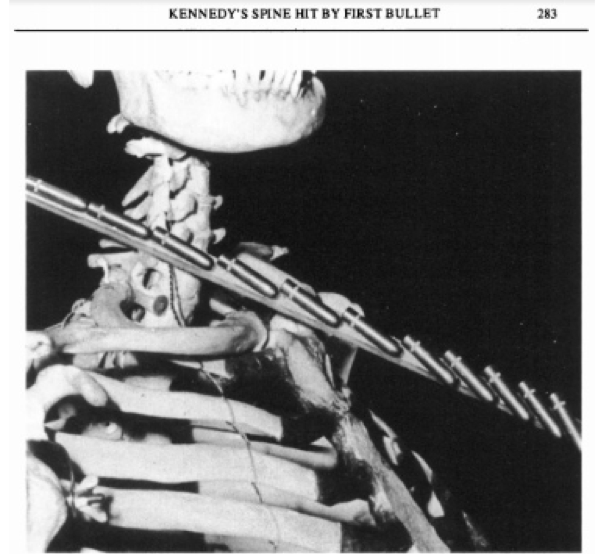
    To solve the problem, the late John Lattimer — one of Haag’s main sources of “information” — raised the back wound to the sixth cervical vertebra (C-6), using deceitful props, false reporting on X-ray findings, and fraudulent representation of neurological implications.

    If you want to see instant proof of how much of a fraud Lattimer was, just look at the picture below. It says it all.

    lattimer skeleton

    lattimer skeleton caption

    And the caption that went with the picture demonstrates one of Lattimer’s techniques in conning people. Lattimer created this prop himself, then said — as if he were an independent observer — “It appears that the first bullet … grazed the tip of the transverse process of his sixth cervical vertebra.” Of course it did: he put it there. (Note: the fragments of bone he mentions were dismissed as artefact.)

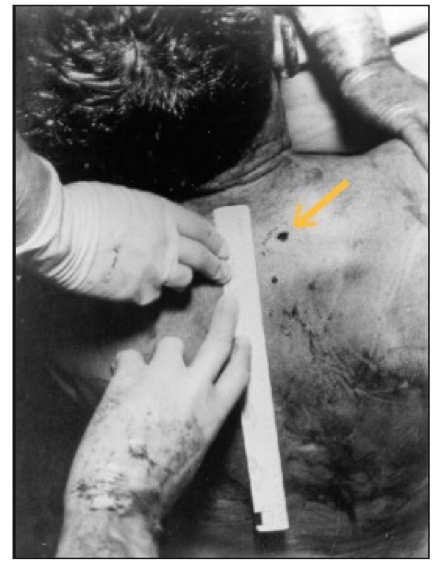
    Haag appears to have learned from past experience that some of Lattimer’s “research” is too blatantly fraudulent, so he would not likely want you to see Lattimer’s contrivance shown above. It is conspicuously at odds with the autopsy photo below:

    backwound

    Photo credit: JFK Lancer


    Like Lattimer, Haag tried to use X-ray reports to sell the higher entrance wound: He said:

    [There was a] possible graze to the right traverse [sic] process of one of the cervical vertebrae at, or adjacent, to C6.

    As usual, he provides no reference to support this assertion. In fact, the graze, if it happened, was assumed to have occurred lower, at the first thoracic vertebra — T-1, not the higher C-6:

    “There is an undisplaced fracture of the proximal portion of the right transverse process of T-1 … There is no evidence of fracture of the cervical spine or its associated appendages.”

    And why doesn’t Haag mention what is in the autopsy report? It said the wound was “just above the upper border of the scapula.” (But numerous witnesses thought it was even lower. Kennedy’s own physician said it was at the T-3 level.)

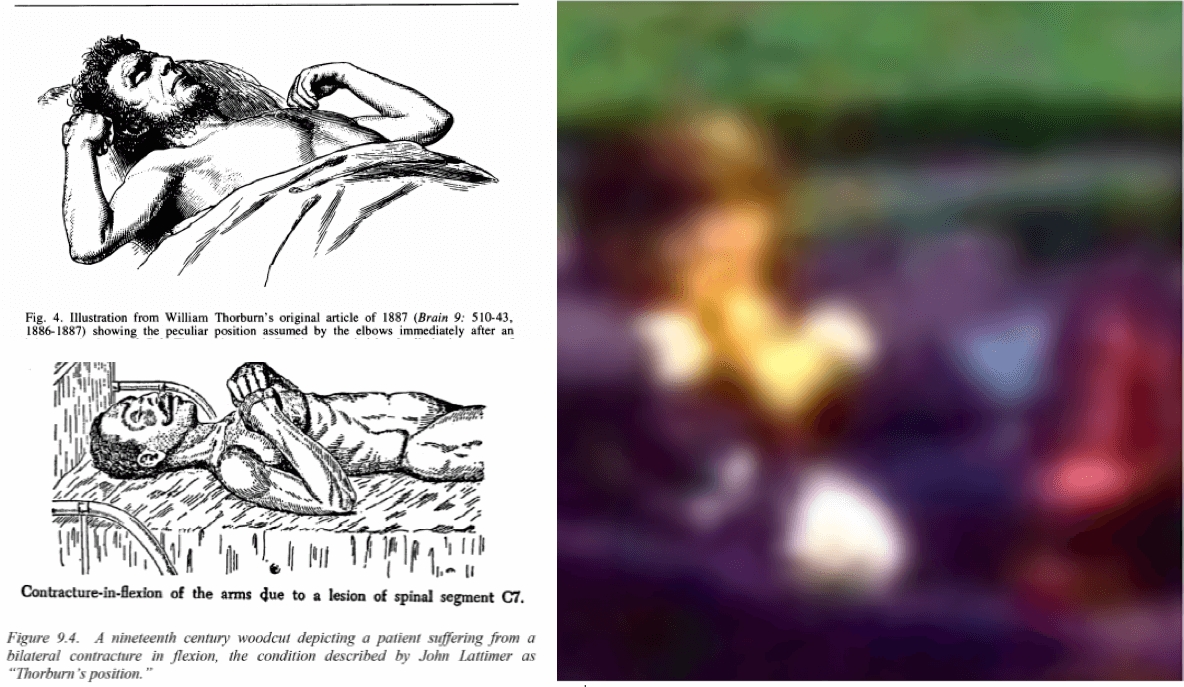
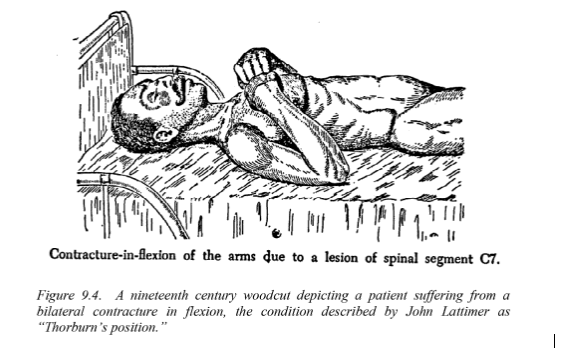
    Haag also recycles another Lattimer hoax — the “Thorburn position.” He repeats the false claim that JFK was struck at the C-6 level, based on the way he moved his arms after being shot for the first time. He said it was a reflex, tied exclusively to C-6, as described by the surgeon, Sir William Thorburn. As Haag put it:

    When the President first reappears from behind this sign [on the Zapruder film], his arms are in a very odd position, and it looks as though he is reaching for his throat. This is not the case; rather, it has been attributed to a little-known, involuntary response first described by the English spinal surgeon and military doctor, Sir William Thorburn,1 in 1887 …

    In fact, Thorburn described an entirely different position of the arms in response to damage at C-6. At no time did Kennedy ever move his arms in a way that resembled the position of Thorburn’s C-6 patient. That patient’s arms were abducted; Kennedy’s adducted.

    (Many readers of KennedyandKings.com are already familiar with this scam. Those who are not can go here for my detailed report. And see also Donald B. Thomas’s fraudulent revision of Lattimer’s scam.)

    Aside from using deceitful means for establishing a back wound at C-6 while omitting documented information that contradicts it, Haag pretends Kennedy’s back wound controversy concerns whether it is was an entrance or exit:

    Regarding this matter of entry or exit for this singular perforating gunshot wound, it is definitively solved by Federal Bureau of Investigation (FBI) firearms examiner Robert Frazier when he notes and documents the presence of bullet wipe around the margin of the small, circular hole in the upper back of the President’s suit coat.


    Kennedy’s Head Wound

    Haag repeats the old government-approved line:

    A massive exit site with expulsion of bone, tissue, and brain matter was produced in the upper right-front of the President’s head.

    Yes, the wound was in right front and right side — but also the right rear, which he omits. Even the autopsy report says so: the wound extended into occipital bone. According to Parkland Hospital’s former chief of neurosurgery, enough occipital bone was missing to reveal a great deal of missing cerebellum.

    Haag also made this strange claim:

    The WCC Carcano bullet’s ability to totally change character into that of an expanding bullet once its nose area is breached by striking thick bone. In this situation, testing by this author and others (Lattimer2 and Sturdivan7) has shown that the nose of the full metal jacket Carcano bullet can be breeched [sic] upon striking skull bone, after which the bullet behaves much like a soft-point hunting bullet.

    But Lattimer said that, in all experiments — his and those performed by the Army — there was a “complete separation” of the copper shell and the lead core. After that, much of the bullet’s energy has been spent. So how could the jacket alone go on to do the damage of a soft-point hunting bullet? That sort of bullet does its damage immediately on contact.

    (Lattimer also claimed a complete separation of shell and lead core in the case of JFK’s head wound. But what was found in the front seat, and presumed to have been “the” head bullet, were two jacketed fragments, but that is another story.)

    Regarding JFK’s backward head movement, Haag chose not to get into this issue. Instead, he referred readers to past articles on the jet effect.

    Please go here to see my gallery of amazing scams related to this case, including my exposure of fraud — based on the omission of one fundamental fact — in all presentations of the so-called jet effect.


    Conclusion

    Haag published his article in a journal that makes the following claims about itself:

    Drawing on the expertise of leading forensic pathologists, lawyers, and criminologists, The American Journal of Forensic Medicine and Pathology presents up-to-date coverage of forensic medical practices worldwide. Each issue of the journal features original articles on new examination and documentation procedures. (Emphasis added.)

    Original? Haag is just a recycler. And what he recycles is crude pseudoscience.

    New examination? He repeated experiments performed long ago by others, and they don’t back up his conclusions with respect to Kennedy’s wounds..

    Documentation procedures? Haag violates the most basic principles of documentation. He provides no references to the primary sources that he pretends back up his misleading assertions. And he leaves out critical facts that challenge them.

    How does such an unscholarly piece get into a peer reviewed journal? Obviously its vetting process has been corrupted by the deep, insidious contamination of politics.

  • Thomas, Lattimer, and Reality: A Study in Contrasts

    Thomas, Lattimer, and Reality: A Study in Contrasts


    Whenever I open a book on the Kennedy assassination, I never know what rabbit hole I’ll fall in to. And I wonder if I’ll ever be able to crawl out—especially when I start checking an author’s references.

    Lately, I’ve been browsing through Hear No Evil. Politics, Science & the Forensic Evidence in the Kennedy Association by Donald Byron Thomas—and it is full of surprises. (Please go here to see my earlier story on Thomas’s presentation of Kennedy’s throat wound.)

    Thomas, a scientist with the US federal government, has a PhD in entomology. He specializes in beetles, and is former president of the Coleopterists Society.

    This report concerns the puzzling way in which Thomas represented the work of the late John Lattimer, MD with respect to what has become known as the “Thorburn reflex position.”

    Lattimer—former head of the Department of Urology at Columbia Presbyterian Hospital, private physician to many prominent men, including J. Edgar Hoover—is the author of many articles (infomercials really) promoting the lone assassin theory,

    William Thorburn was a 19th-century neurologist who documented specific neurological consequences associated with traumas to different levels of the cervical spine. One of his articles featured a picture of a man whose arms became locked into position after damage to his spinal cord at the sixth cervical (C-6) level.

    Because the position of the man’s upper arms superficially resembled that of Kennedy’s, Lattimer seized upon the picture as “proof” Kennedy was struck at the C-6 level—that is, higher than the throat wound, establishing a downward path from the alleged sniper’s nest. (Bull NY Acad Med 53, 1977) (The back wound was actually much lower.)

    Lattimer’s co-author, distinguished neurosurgeon Edward Schlesinger, admitted to me that neither he, nor a third coauthor, neurologist H. Houston Merritt, ever saw the Zapruder film, knew very little about JFK’s reactions, and never read the manuscript that carried their names.

    They did not take its publication seriously. They knew Lattimer’s JFK stories appeared in the “Biography” or “Historical Medicine” sections in journals with lenient standards.

    So, what was the point of publishing in such journals? The answer is, doctors were not the intended audience—you were.

    Every time Lattimer published a seemingly peer-reviewed story, the mainstream press was tipped off, and quotes supporting the official view were selected and widely disseminated.

    Thomas did not accept Lattimer’s use of neurology to establish a high wound in the back of Kennedy’s neck. Yet, he gave space to it in his book—only he put together a revised version.

    You may find this report confusing. It’s about one man’s revised version of another man’s revision of history. Well, let the confusion begin!

    Lattimer’s Version of Kennedy’s Position

    Let’s start with Lattimer’s “proof” the bullet struck near the sixth cervical vertebra, a woodcut of a patient treated by William Thorburn, MD, which Lattimer claims resembled Kennedy’s, soon after he was hit for the first time:

    In his book, Kennedy and Lincoln (1980), Lattimer began his chapter on this subject with the question “Why Did the President’s Elbows Fly Up When He Was Hit?” And in all of his writings on this issue, he has used this picture to illustrate JFK’s reaction. In 1993, he said the same thing, “Finally, by frame 236, President Kennedy has assumed the reflex position illustrated by Thorburn almost 100 years ago…” (JAMA, March 24,1993, p. 1545)

    Thomas’s Version of Lattimer’s Version of Kennedy’s Position

    Here is what Don Thomas presented as Lattimer’s choice of an illustration from Thorburn’s long article on multiple cases. This is not the same Thorburn patient Lattimer used as a model. His arms are obviously not in the same position as that of the man shown above (or Kennedy’s!). Furthermore, the position below is related to damage to the seventh cervical vertebra, not the sixth.

    In the above picture, the man’s elbows are most certainly not “flying up!” Clearly, his upper arms are down by his side. But Thomas said “Lattimer proposed that Kennedy’s reaction, bringing his arms into a folded position with the elbows outward…”

    But Lattimer always said the elbows were raised. He never said JFK’s arms were in a “folded position.” And he never used the picture above.

    Kennedy’s Actual Position

    As you can see from the Zapruder frame below, Kennedy’s actual position looks like neither Lattimer’s nor Thomas’s false representation of Lattimer’s depiction of his position.

    Here is what Kennedy actually did as shown in Zapruder frame 236.

    Kennedy’s elbows are definitely up and out—much further up than in the picture Lattimer featured. But Kennedy’s elbows are bent, bringing his forearms high across his chest, while the Thorburn patient’s forearms and hands are twisted outward. In the picture Thomas falsely presented (below, middle) as Lattimer’s choice, the patient’s elbows and forearms are not up at all. Here you can compare all three:

    How Thomas Gave Appearance of Backing Up His Version of Lattimer’s Claims

    On page 318 of his book, Thomas wrote,

    Lattimer invented the ‘Thorburn position’.78 Lattimer proposed that Kennedy’s reaction, bringing his arms into a folded position with the elbows outward, was a reflex resulting from stimulation of the nerve cord at the level of the seventh cervical vertebra.79 Lattimer noted that the innervation of the upper arms, the brachial plexus, occurs at this level, and also credited a nineteenth century physician, William Thorburn, for first associating this particular anatomical posture with a lesion to the cervical spinal cord.80

    In the above passage, it is reference #79 that is the most misleading. Thomas’s words: “Updated Thorburn reaction in Lattimer (1993) JAMA March 24, 1993.”

    As mentioned earlier, Lattimer never described Kennedy’s position that way, not even in his 1993 article which Thomas says is “updated.” The only change Lattimer made was to associate the trauma to “C6-7” instead of “C-7.” And he used the same illustration that he always used. Not much of an “update.”

    For decades, Lattimer’s disinformation has been a major contaminant in the corporate media’s representation of the Kennedy assassination. (Most recently, atmospheric scientist Nicholas Nalli used some of Lattimer’s “research” to support his own pseudoscience promoting the lone nutter view on the head wound. Please go here to see these darkly amusing grotesqueries, and their illustrations.)

    Why give Lattimer’s false Thorburn story a makeover? Was he trying to restore Lattimer’s reputation with what he thought was a better Thorburn story?

    After all, Thomas does depend in part on Lattimer’s presentation of Governor John Connally’s back wound in his own efforts to promote the single bullet theory. In his book, Thomas repeats—without any revision—all the demonstrably false information Lattimer published, which I exposed long ago, in my article, “Big Lie About a Small Wound.” (I was told that Vincent Bugliosi was about to use the same false information in his book—Reclaiming History: The Assassination of President John F. Kennedy—but did not after being shown my findings.)

    In the beginning of this article, I commented on the rabbit hole nature of references. Had Thomas dropped down even one of these holes in the Connally back wound tale, he might not have repeated it. Unless he could think of a way to give it a makeover.

  • Clue to When JFK Was Shot in Back


    Previously I posted an article here on the significance of S.S.A. Glen Bennett’s statement:  He saw Kennedy shot in the back—and, as you will see from the story, this had to have happened at least two seconds after he was hit in the throat (see the link above).

    This could explain the puzzling nature of JFK’s back wound—the way its abrasion collar suggests a shot coming from below.  Some have explained it by insisting JFK was hit while he was leaning over.

    As anyone can see from films, JFK was not leaning over at the time he first began to react.

    But if Glen Bennett was telling the truth when he said he was looking at JFK’s back the instant he was struck in the back, photographic evidence shows this had to have happened after Kennedy was already hit.

    The interesting thing is, seconds after that first hit, Kennedy actually did begin to lean forward. And so no wonder the abrasion collar was on the bottom edge of the back wound.

    This is further proof that Kennedy was first hit in the throat, then in the back, but only after he began to sag in his seat.


  • Suppressed Evidence of JFK Throat Entry

    Suppressed Evidence of JFK Throat Entry


    For years, distinguished pathologist Cyril Wecht, MD, JD has expressed doubts that Kennedy’s throat wound was an entry because no one could tell him where the bullet went. “The throat is all soft tissue, where did it exit?”

    Good question, but it’s based on the premise that if the bullet had been found … we would know about it.

    Well, we don’t know where that bullet went, but we do know about another bullet that was found—but never mentioned in the official record.

    A Navy doctor published an obscure memoir in which he reports that petty officers sent to retrieve bone fragments from JFK’s car also found a misshapen, but whole bullet in the back of the car. (Official reports only mention bullet fragments, and they were found in the front of the car.)

    That doctor, James Young, briefly inspected it, then gave it back to the petty officer who gave it to James Humes, the lead pathologist. Then where did it go? Humes made a big show of looking for bullets that night.

    Young was puzzled when, years later, he could find no report on that bullet. He wrote to President Gerald Ford asking about it, and got a useless response. We have researcher Randy Robertson to thank for this discovery. (To see more on this, please go here.)

    Maybe you can’t quite believe the above story, but you should be even more skeptical of anything you are told by the government. And you should wonder about what you are not told.


    Humes et al Suppressed Fundamental Evidence:

    (1) Kennedy’s cerebellum. You will not find one word about it in the main autopsy report, which only describes the upper brain, as well as organs not even relevant to the murder. Nor will you find mention of it any of Humes’s testimony. (The supplementary report mentions a microscopic analysis of a small piece of it.) The Parkland Hospital doctors described massive damage of this organ, damage inconsistent with the official narrative. (For more on this, go here and here.)

    (2) Kennedy’s throat wound. Humes et al pretended they were completely unaware of it on the night of the autopsy, when the body was still available. And so they did not document it or explore it further. Years later, a pathologist who assisted Humes, said they saw the remains of the bullet hole itself, part of the perimeter of a bullet wound in the anterior neck.” (For the complete story on this, go here.)

    And so again I ask, why assume no bullet entered JFK’s throat because you don’t know where it went?


    Throat Wound: Abrasion/Contusion Collar

    Not long ago, I saw an email in which a researcher said Kennedy’s throat wound had no abrasion collar. He didn’t say that he saw no report of one, or that blood obscured the wound so that none was seen (a lone nutter claim). He just omnisciently asserted that none had existed. People are entitled to their opinions, but they should be given along with all the facts readers need for making up their own minds.

    Here is probably the most relevant fact of all: When Malcolm Perry—the Parkland Hospital doctor who worked on the throat wound—was specifically asked by the HSCA to describe the wound’s edges, he included these words: “The edges were bruised.” A bruise is a contusion. Perry seems to have been referring to a contusion collar—which, like an abrasion collar, is definitive of an entrance wound.

    Some authors use the expressions “abrasion” and “contusion” rings or collars interchangeably. But though related, they are not the same. Both are said to be caused by temporary over-stretching of the skin. And the skin on the perimeter of the bullet hole is abraded. A few millimeters away, damaged blood vessels in the dermis bleed beneath the skin, resulting in a visible bruise. Here’s an illustration from an article on the characteristics of entrance wounds by jacketed bullets, fired at a distance.entrance wound

    Note: Jacketed bullets from centre fire rifles do not always cause abrasion collars. Also, entrances can have slightly ragged edges. (Gunshot Wounds Aspects of Firearms, Ballistics, and Forensic Techniques, Second Edition, by Vincent J.M. Di Maio, MD, CRC Press, 1999.)

    To the Warren Commission, Perry had described a typical entrance wound: “approximately 5 mm in diameter…exuding blood slowly which partially obscured it. Its edges were neither ragged nor punched out, but rather clean.”

    Later he was again asked about the wound, and this time Commissioner Arlen Specter clarified something significant. Perry seems to have said the wound was “not punched out,” but he also said it was “not pushed out.” Specter specifically asked if the wound was “pushed out”—“everted” in the language of forensics—and characteristic of an exit. Perry said it was not. (Nor did he say it was pushed in.)


    Don Thomas: Throat Wound Was an Exit

    In his book Hear No Evil. Politics, Science & the Forensic Evidence in the Kennedy Association (Mary Ferrell Foundation Press, 2010), Donald Byron Thomas promotes the idea that the wound was an exit.

    The author seems to believe the back and throat wounds were proven to be connected when in fact there was no proof. This was an inference based on incomplete information. Very few researchers claim the back wound was anything but an entrance, but we cannot explain where that bullet went. Since it created such an apparently shallow wound, it may have fallen out. It may have been the slightly bent bullet found in the limousine.

    As for explaining what happened to the bullet that we say entered the throat, we cannot. But, based on all the other key evidence that went unreported, it’s not unreasonable to assume that if it had been found during the autopsy, it would not have been reported. (Thomas does not mention any of the known suppressed key evidence described above.)

    Thomas also seems to believe the pathologists who performed the autopsy saw no evidence of the bullet wound in the throat. On page 238 of his book, he said “The precise nature of the wound cannot be determined because the wound was obliterated.” In fact, it was only bisected, not obliterated and, as mentioned above, one of the pathologists reported seeing part of it.

    The author does not report any of the telling details Perry described, aside from the wound’s smallness. And instead of providing recent information on wounds, Thomas quoted from a not very informative book written in the early 1920s:

    Provided no bone lesion is present, the exit aperture is often difficult to discriminate from the entrance wound. The two wounds maybe [sic] equal in size, the entrance wound may show inverted edges, while in the exit wound the edges are generally everted [pushed out]. When the bullet has passed through soft parts alone, the exit wound is apt to be circular in shape. (Thomas, p. 238) [Emphasis added.]

    But Perry had specifically said the edges were not everted, that is, not pushed out. More important, Thomas said nothing about the bruised edges.


    An Invalid Explanation for Wound’s Smallness

    Thomas said that, though the wound was small, it was still an exit, and its size could be explained by the phenomenon of “shoring” or “buttressing.” Meaning the skin was held in place by Kennedy’s collar and necktie. And he quoted experts who say that when the skin is held in place by something, like a wall, floor, chair back, or supportive clothing, the bullet can’t stretch the skin outward until it tears (one reason why exits are small and star-shaped)—and a small “shored” wound is created.

    But for this to be possible, the wound has to be right behind the shoring material.

    Parkland Hospital’s Charles Carrico, MD—who saw the wound while Kennedy was still fully dressed—said the wound was “right above” the neck tie. And Malcolm Perry, the doctor who cut across the wound, said the bullet struck at the level of the second or third tracheal ring, just below the Adam’s apple.

    Instead of deferring to these doctors who provided facts, Thomas gave his opinion, based on a photo showing JFK in an unnatural position with his neck hyperextended: “… it would seem more likely that the bullet passed below the necktie.” (p. 236)

    Below the necktie? As you can see from this photo, his Adam’s apple is well above his collar and necktie.jfk

    Though Thomas disagreed with what Carrico said about the wound’s location, he argued the idea of shoring even if Carrico was right: The amount of buttressing would still be appreciable whether just above or just below the exiting bullet’s path.” (p. 236) He did not buttress this assertion with any references.

    Here’s another good reason to doubt the wound was buttressed. Take a close look at what actually happens: Skin between the outgoing bullet and the buttressing material is crushed, and it becomes stuck to the material. When that material is pulled away, it creates a wide abrasion collar consisting of skin tags that resemble a peeling sunburn. More important—grossly visible skin is left behind on the material. (Am J Foren Med Path 1983; 4(3): 199-204)

    The FBI closely inspected Kennedy’s shirt and tie, and did not report seeing skin on either garment.


    Relevance of Bullet Velocity

    What Malcolm Perry said about the internal damage in the neck reveals that if a bullet entered the throat, it was probably traveling at medium velocity (as defined circa 1963.).

    There’s some concussive damage to surrounding organs—these are the kind of things one sees with gunshot wounds, in a blast injury … And with high velocity, we do see a lot. Now the low velocity stuff, it’s often just a track, a wound track, with very little concussive or blast injury. This one was in between. There was evidence of some blast injury, but not like, say, what one sees with a high velocity rifle, like a 3006 or 223 …

    A bullet traveling that fast would have left a much larger exit wound. And this was proven by Army experiments involving the assassination of goats.

    Yet other experiments proved that when non-deformed jacketed bullets exit straight out—as opposed to sideways—the size of the wound created is directly proportional to their exiting velocity. (J Trauma 1963; (March) 3(2): 120-128, p. 122) (Gunshot Wounds: Aspects of Firearms, Ballistics, and Forensic Techniques, Second Edition, by Vincent J.M. Di Maio, CRC Press, 1999.) (Thomas did not report this, but possibly he was unaware of these experiments.)

    Translated: When all other things are equal, the slower the bullet, the smaller the exit wound. Put another way, the smaller the exit, the slower the bullet.

    Translated further: If a bullet really did exit the president’s throat, it would not likely have had the energy to make it through Connally’s mohair jacket, let alone his chest and wrist.

    And there goes the Single Bullet Theory.

  • Bullet Trails on the Zapruder Film?

    Bullet Trails on the Zapruder Film?


    Years ago, on a shadowy website for snipers, I saw an interesting complaint. It had to do with the problem of killing people in very humid weather. The sniper was concerned about bullet trails leading back to his hidden position. These tell-tale bullet trails are condensation, not muzzle flashes, and certainly not tracers.

    The trails he was worried about are water vapor. A bullet creates a partial vacuum in its path, and a vacuum is very cold. Moisture in the air condenses around things cold. If you quickly pump an aerosol can until it’s nearly empty, it will become cold inside, and the can will “sweat,” that is, moisture in the air will condense on it.

    In dry air, any vapor trails created are quickly absorbed. But in humid weather, vapor dissipates more slowly. That’s why you can see your breath in the winter only when it’s cold enough and humid enough.

    Here is what a trail caused by a 6.5mm, 122 grain bullet traveling very fast (over 3000 feet per second) through “very humid” air looks like, as recorded by a high speed camera:


    https://www.youtube.com/watch?v=LZ2a80vxvrY

    We do not know what kind of bullets were fired at Kennedy, or their muzzle velocity, but it is doubtful they were as fast as the one above. (Weatherman Dan Satterfield told me in a private email that at 12:30 in Dallas on that day it was 66 degrees, with a west wind of 15-20 MPH. He did not know the humidity, but it had rained earlier.)


    Trails on the Zapruder Film?

    I suspected that such trails show on the Zapruder film of the Kennedy assassination, especially in frame 313. But what I claim to be bullet trails leading to the head are assumed to be matter leaving from the head—the two long, fairly straight, white lines.

    On some of the earlier copies of the film, the lines are longer. On other copies, the lines are not only shortened, they are smeared together. I have been unable to find a copy of the film as clear as the one I saw years ago, but here is a copy of frame Z-313 that isn’t bad:

    Over 20 years ago, I showed those Zapruder frames to two scientists—one from the Jet Propulsion Lab in Pasadena, California, and one from the Weizmann Institute of Science in Israel—both of whom wish to remain anonymous. Both agreed: the lines are most likely bullet trails.

    In any case, they said condensation trails from bullets had to have occurred, whether seen or not.

    Since they would not allow me to quote them by name, I asked for a textbook reference on the phenomenon. One suggested a book I could not get my hands on. The other told me to look into the work of Daniel Bernoulli—and the phenomenon of an aircraft’s “wingtip vortices”, which are easy to see:

    Go here for a fuller explanation. (Note: these are not the “contrails” that come from a jet engine’s exhaust. The wingtips are not excreting vapor, they are causing it to form.)

    (I am not the only researcher to suggest the white lines are bullet trails. In the early 90s, when I went to Jim Lesar of the Assassination Archives Research Center to tell him of my findings, he had no comment, but showed me a letter from Robert Morningstar, another researcher interested in the white lines. Morningstar’s interpretation was nothing like that of the scientists. He called them “heat tracks.”)


    Exploding Brain

    Bullet-related exploding brain looks nothing like those lines.

    Consider what happens when a bullet fired by a high powered rifle perforates the skull: the bullet goes in and out, leaving holes in the skull that are almost the same size. Milliseconds later, a process known as “cavitation” takes place. Exploding brain thrusts open the skull, creating adherent as well as loose bone fragments, and a massive wound—usually on top, regardless of where the bullet enters. This process is known as “cavitation.” How it happens:

    “With high-velocity wounds, there is … a sudden sharp increase in intracranial pressure … (and a) temporary cavity … formed by the radial motion imparted by the missile, through creation of oscillating positive and negative pressure along the path of the missile …” (Youmans, J.R. (ed.), Neurological Surgery, Vol.4, p. 2056, W.B. Saunders Company) 

    Scientists discovered the difference between holes created by cavitation, and those created by exiting bullets when they shot empty skulls. Without brain or brain simulant, there is no cavitation. And both entrance and exit wounds were almost the same size. The exit wound is usually only slightly larger because the bullet deforms or tumbles. Sometimes the bullet takes a small amount of adjacent skull with it, and then the hole is bigger.

    If exploding brain creates massive holes—and we know JFK had a massive hole at the top of his head extending into the right rear—then how could exploding brain appear as two long, rather straight, slender lines? Or, as some say, exiting bone fragments leaving the head, one behind the other?

    Fluid forced through small holes under high pressure will come out as long streams—but would such streams have the strength to blow off so much bone?

    And why would they remain in the air—afterward?

    The more visible line seen on the Zapruder film is broken into small, fairly evenly spaced, individual bits. Magnified, the bits seem to be little spirals. The most prominent one lies across Kennedy’s head in frame 313, leaning to the right at about a 50 degree angle.

    This bullet trail—if that indeed is what it is—suggests the bullet skated across Kennedy’s right temple, creating a shallow tangential wound that flipped out a flap of bone—and kept on going.


    Did Rockefeller Commissioner See Those Lines?

    An exchange between Robert Olsen of the Rockefeller Commission and John Lattimer, MD, who examined the autopsy materials (President’s Commission on CIA Activities, 1975, pages 28-30):

    Doctor, did you find any evidence whatever that would support postulating a tangential shot from the front or right front which would not have penetrated the President’s head, but merely would have glanced off the right side of his skull?.

    Lattimer said he saw no such evidence.

    What about the possibility of the President having been struck from the rear … and then that being followed, within a fraction of a second, by a tangential blow by a bullet from the front, or the right front, glancing off the right side of the head? Is there any possibility?

    Again Lattimer said he saw nothing to indicate that. But why did Olsen ask such questions?


    Following the Trail

    In the early 90s, I went on a fool’s errand to Dealey Plaza to see if I could find where that bullet trail might have led back to. The most likely spot, in my non-expert opinion: The sniper was to the left of Zapruder, firing from behind the pergola through one of the lattice holes, about midway between the left and right side of the crescent-shaped structure, concealed from behind by the parked cars. The shot would have been nearly horizontal.

    All just conjecture, of course.

  • More Proof JFK Was Hit From the Front

    More Proof JFK Was Hit From the Front


    Many people are now analyzing the newly-released documents concerning the assassination of John F. Kennedy, and most are hoping to find scraps of information that will help reveal Who Done It? But some of us are still intrigued by a different puzzle: What exactly They Done.

    We continue to ponder this issue because so much of what we have been told by the government has been contradicted by key witnesses, those who were closest to the action, and whose testimony was the most detailed and specific.

    One such person is Glen Bennett, a Secret Service agent who rode in the back seat of the follow-up car just behind Kennedy on the day of the assassination. If what he said is true, then he saw something small but extraordinary—something that would mean that at least one bullet came from the front.

    SS Agent Glen Bennett at Love Field
    (Image courtesy of Vince Palamara)

    Bennett said he was looking right at Kennedy’s back at the very moment he heard a shot, a second shot, and he saw it hit.

    It’s not what Bennett saw, but when he saw it, that is key: Photographic evidence shows that if he indeed saw this strike, it had to have happened after JFK was already reacting to an earlier strike. That earlier strike—by a separate bullet—led to an obvious reaction: Kennedy seemed to be grabbing at his throat.

    And, if the throat wound is not related to the back wound—then it has to have been an entrance.


    What Bennett Said He Saw

    Bennett said he saw Kennedy hit in the back “about four inches down from the right shoulder.”

    He said it in a formal typed statement, as well as in his notes written by hand while he was on the plane returning to Washington—that is, before the autopsy, presumably before anyone else had known about that wound. The emergency room doctors in Dallas’s Parkland Memorial Hospital said they never turned the body over and were unaware of the wound. So it does seem that Bennett actually saw this strike. The relevant part of his statement:

    About thirty minutes after leaving Love Field, about 12:25 P.M., the motorcade entered an intersection and then proceeded down a grade. At this point, the well-wishers numbered but a few; the motorcade continued down this grade en route to the Trade Mart. At this point, I heard what sounded like a firecracker. I immediately looked from the right/crowd/physical area/ and looked towards the President who was seated in the right rear seat of his limousine open convertible. At the moment I looked at the back of the President I heard another firecracker noise and saw the shot hit the President about four inches down from the right shoulder. A second [sic] shot followed immediately and hit the right rear high of the President’s head. [If he heard two “firecracker” sounds earlier, the headshot has to be the third shot he heard, not the “second.” ~M.C.]  I immediately hollered “he’s hit” and …

    Promoters of the official story say Bennett could not have seen that shot because he was too far away. But you can see from the pictures that he was not so far.

    They also say such a wounding would be too small to see. Wrong again. You can perform your own experiments to see what is visible, and at what distances.

    Bennett did not describe in detail what he saw, but such a shot would look like a sudden, inward tenting in the jacket.


    When He Saw It

    I see no visible clue on films that suggests JFK is being hit in the back. It could have happened soon after the throat shot – or several seconds later, during what many described as a “flurry” when JFK was shot in the head.

    On the other hand, reactions to the first and last shots are easy to see. Evidence of the first is unambiguous at Zapruder frame 224.

    But he had to have been hit before that.The sound of the shot would have come after the bullet hit, but before JFK showed any reaction.

    A photo taken by Major Phillip L. Willis, a bystander, captures this moment. As he put it,

    “The shot caused me to squeeze the camera shutter, and I got a picture of the President as he was hit with the first shot. So instantaneous … the crowd hadn’t had time to react.”

    Willis Photo No. 5

    Nor did Glen Bennett have time to react. He is in this photo and, as you can see, his upper body is turned to the right as he watches the crowd on the north side of Elm Street. According to his statement (see above), he would not yet be looking at Kennedy.

    If he heard the same shot Willis reacted to, he still would not yet be reacting as of this moment. But, like many other witnesses, it’s possible Bennett didn’t even hear this shot. (Some didn’t even hear the second one, yet they heard more than one later, during the head wounding. But that’s another story.)

    About three seconds later, James W. Altgens, an Associated Press photographer, also took a photo of the motorcade. The strange thing is, Altgens said he took that picture almost simultaneously with what he called “the first shot.”  When questioned closely about the timing, Altgens swore that he heard no other shots or noises that could have been shots before this “first” one.

    Altgens Photo No. 6

    Glen Bennett is also in this photo. People say he is still turned to his right here, but I have trouble seeing him at all. In any case, if Bennett, like Altgens, had not heard a shot before this moment, then I would not expect him to have reacted yet.

    Jackie Kennedy apparently did not hear all the shots, and she had an explanation: the noise of the motorcycles put-put-putting. And Bennett was very close to them. (Please go here for more on the acoustical evidence, and other bewildering mysteries of this case, including the fact that Mary Moorman heard a shot for the first time when JFK’s head exploded, which she captured on her famous Polaroid photo.)


    An Attempt to Discredit Glen Bennett

    Glen Bennett was never asked to testify before any of the official investigating bodies, like the Warren Commission or the House Select Committee on Assassinations. This is no surprise. Kennedy’s own physician, George Burkley—a man who was with him in the Dallas emergency room, and at his autopsy in Washington—was also never asked to testify. Whatever Burkley witnessed gave him the impression that more than one shooter was involved in the assassination. (Please go here to see more on that.)

    Thanks to David Lifton, author of the best-selling book, Best Evidence, many assassination researchers ignore Bennett’s comments.

    Lifton—who believes that all shots came from the front, despite Connally’s back wound and other evidence—claims Bennett was lying. (See pages 77, 284-7, and 510-511 in the 1988 edition of his book). Lifton’s proof? The Willis and Altgens photographs. They both show Bennett looking off to his right.

    But Willis said he snapped his photo when the first shot was fired. How could Bennett be already facing the front at that moment? The same applies to the Altgens photo. Even if Bennett had heard the same “first” shot Altgens heard, how could he be reacting already? He would have been facing the front at the time of the second shot (the second shot he heard)—not the first.

    If I had to guess, I’d say JFK was hit in the back during the “flurry” at the end. Too bad we can’t question Bennett about it.

    Ironically, what Lifton considers proof that Bennett lied, is actually proof, though indirect, of a shot that came from the front.