From the March-April, 1997 issue (Vol. 4 No. 3) of Probe
(Click here if your browser is having trouble loading the above.)

(Click here if your browser is having trouble loading the above.)
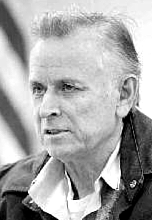
The weekend before Christmas, James Earl Ray, the convicted, yet disputed, assassin of Martin Luther King, was transferred from the Riverbend State Prison in Nashville, Tenn. to the Columbia Nashville Memorial Hospital. By Christmas Eve, Ray had slipped into a coma.
Ray, 68, has been suffering from cirrhosis of the liver and kidney failure, which led to internal bleeding. Cirrhosis is most commonly associated with an abuse of alcohol (Click on this link for an explanation).
Ray wasn’t a drinker or a smoker.
“I think he’ll be gone in 24 hours. I really do,” said his brother Jerry. Ray’s brother, on Christmas Eve, signed a request that Ray not be given life-support if his condition should become critical. But on Christmas Day, Jerry changed his mind, attributing the change to calls from both Reverend James Lawson and William Pepper, Esq.
Reverend Lawson, now a Los Angeles pastor, was a supporter of Martin Luther King’s who was in Memphis during 1968. Lawson has been vocal in his defense of Ray over the years, claiming Ray could not have been a lone assassin, if an assassin at all.
William Pepper has become Ray’s lawyer. Pepper recently wrote a book detailing his own long study of the King assassination case, called Orders To Kill. The book details Pepper’s own search for the truth about King’s death, and concludes that Ray could not have been the one responsible. The finger of guilt is pointed instead toward an alliance between forces in the government and elements of organized crime. Both Lawson and Pepper convinced Jerry that he should make every effort to keep his brother alive, especially in light of an upcoming hearing.
For years, since the time of his confession, which he retracted a few days later, Ray has professed his innocence and filed barrages of appeals to get a new trial. Finally, in 1994, it seemed he might have a chance.
During the course of preparing a mock trial for an HBO telecast, much new evidence surfaced in the MLK case. The evidence was enough to frighten one person into coming forward to confess what he claimed was a small role he had played. Lloyd Jowers, who worked in the grill below the rooming house from which King was allegedly shot, confessed on TV in December of 1993 that he had been hired to find an assassin for King, and that he had not hired James Earl Ray. Jowers wanted immunity before telling more of what he knew. But Shelby County District Attorney General John Pierotti called Jowers’ story a hoax. According to Pepper, “Pierotti has had five witnesses under his nose…and he’s never even tried to talk to them to get their story.” Both Lawson and Pepper complained publicly that Pierotti had done little to investigate the case.
In January of 1994, New York City attorney Jack E. Robinson, having done his own five-year investigation into the Martin Luther King assassination, went public with his findings. He had reviewed the House Select Committee records and found their investigation “very disturbing. The House investigation was sloppy and incomplete, and its findings misleading. James Earl Ray, in my view, is innocent.”
Former HSCA Chairman Walter E. Fauntroy agreed. Referring to the HSCA’s conclusions that although there was likely a conspiracy in the MLK case, Ray was still a shooter, Fauntroy said, “both research by very competent people on the one hand and my review of my own basic data for that investigation have convinced me that we were in error on the second matter, namely that James Earl Ray, in fact, shot Dr. Martin Luther King. That, in my view, is not true.”
Although denied parole in May of 1994 at his first hearing in 25 years, by June Ray had cause to hope. Pepper had managed to convince Shelby County Criminal Court Judge Joseph Brown, Jr. to allow a test firing of the alleged assassination rifle to see if the rifle could have fired the bullet that struck MLK. Brown had ruled in April that under state law, there was no way that a defendant could benefit from new evidence long after having been convicted of a crime. Nonetheless, the Judge recognized the historical importance and unanswered questions surrounding the case, and said he would allow Ray’s attorneys to “get it all out on the record” so that an appeals court might be able to later consider the new evidence.
However, Pierotti got the Judge to delay the tests, saying he wanted experts of his own choosing present at the test-firing, which had been set for June 16, 1994. Pepper also wanted to conduct neutron activation tests on the rifle, but Pierotti claimed that FBI experts had said such tests were only useful with recently fired bullets. The day before the test firing was to take place, a state appeals court halted the proceedings, granting Pierotti’s request for a delay of the firing. It seemed the last chance to get at the truth was slipping away.
In 1995, Ray filed a FOIA for classified papers that he claimed would clear him of participation in the assassination. Officials denied his request priority treatment, claiming his case had not generated “widespread and exceptional” media interest. “The politicians have a vested interest in keeping me in prison,” Ray said at the time. “For instance, if I were out, I could personally appear in Federal Court petitioning for the release of the classified Martin Luther King records.” In response to questions of his own involvement in the shooting, Ray responded,
What I say is not worth two cents…What I’m trying to do is get these classified records released and let them make a judgment based on the records. I’ve testified to everything I know about the case. The prosecution presented certain versions of the case but they’ve kept the rest under seal.
Undaunted, Pepper and the rest of Ray’s defense team have stuck by him. In fact, there is a hearing scheduled for February 20th of this year, in which Judge Brown will again be petitioned for permission to test the murder weapon. This time, according to Jerry, “they’re going to have Court TV down there. There is going to be too much pressure on [Pierotti] not to give him a trial, because when it comes out, that the gun wasn’t the one that was used to kill King, then they’ll know James was a setup as the fall guy.”
Ray has come near death, just two months before this was to take place. Andrew Hall, one of Ray’s lawyers, told the press he had sued the state claiming prison officials refused to treat Ray for stomach troubles last summer. “He’s been asking for treatment for a year,” Hall lamented. “They’ve been refusing to give treatment or a diagnosis to see what is wrong.”
Ray did come out of the coma the day after Christmas, but his health is still tenuous. For those looking for a deathbed confession, Jerry offered this:
Let me tell you, anybody out there believes James did do it and going to give a death-bed confession, I hope they don’t hold their breath because if he wanted to confess to something he didn’t do, they offered to turn him loose in 1968 [presumably 1978]. House Assassinations Committee, Congress, and I was present when…Representative Sawyer and Stokes made the offer right in front of me and Mark Lane that they would turn him loose if he would confess to murder. He said he wouldn’t confess to anything he didn’t do….Same thing at the parole board….He told them he didn’t even want to go in front of the parole board. Because, he said, I’m not guilty. He said a parole would mean I am guilty. He don’t want no pardon, no parole, the only thing he wants is a trial to prove he didn’t kill King.”
As we start this New Year, we hope that Ray lives long enough for this hearing to happen. “If he dies before February 20th, then the hearing is off,” Jerry told the press. We all deserve to learn the truth about this case—and no one more than Ray himself.
(Click here if your browser is having trouble loading the above.)
(Click here if your browser is having trouble loading the above.)
Whitney, the Ambassador, and Batista’s Tax Break for Freeport Sulphur
David Atlee Phillips, Clay Shaw and Freeport Sulphur
Freeport Sulphur’s Powerful Board of Directors
Maurice Bishop and “The Spook” Hal Hendrix
What is Past is Prologue.
Inscribed on the National Archives, Washington, D.C.
In Part One of this article (Probe, March-April, 1996) we talked about the early years of Freeport up through the Cuban takeover of their potentially lucrative mine at Moa Bay, as well as their run-in with President Kennedy over the issue of stockpiling. But the biggest conflict that Freeport Sulphur would face was over the country housing the world’s single largest gold reserve and third largest copper reserve: Indonesia. To understand the recent (March, 1996) riots at the Freeport plant, we need to go to the roots of this venture to show how things might have been very different had Kennedy lived to implement his plans for Indonesia.
Indonesia had been discovered by the Dutch at the end of the 1500s. During the early 1600s they were dominated by the Dutch East Indies Company, a private concern, for nearly 200 years. In 1798, authority over Indonesia was transferred to the Netherlands, which retained dominion over this fifth largest country in the world until 1941, at which time the Japanese moved in during the course of World War II. By 1945 Japan was defeated in Indonesia and Achmed Sukarno and Mohammad Hatta rose to become President and Vice President of the newly independent Indonesia. But within a month of the Sukarno/Hatta proclamation of independence, British army units began landing in Jakarta to help the Dutch restore colonial rule. Four years of fighting ensued. In 1949, the Dutch officially ceded sovereignty back to Indonesia, with the exception of one key area – that of a hotspot which is now known as Irian Jaya or, depending on who you talk to, West Papua.
Authors Gerard Colby and Charlotte Dennett, in their book Thy Will Be Done, explain the situation in what was then called Dutch New Guinea:
To Westerners, New Guinea was like a gifted child pulled in opposite directions by covetous guardians. The Dutch clung to the western half as the sole remnant of their once-vast East Indies empire. Their longtime British allies, acting through Australia, controlled the eastern half. Neighboring Indonesians, on the other hand, thought that all New Guinea was part of their national territory, even if it was still colonized by Europeans.
Dutch New Guinea, or West Irian as the Indonesians called it, was populated by native tribes not far removed from a stone age culture, such as the Danis and the Amungme. When Indonesia fought to claim independence from the Dutch, West Irian became a symbol for both sides that neither wanted to relinquish. It would take the efforts of President Kennedy to eventually pass control of this area to the newly independent Indonesians, removing the last vestiges of Dutch colonialism.
Indonesia experienced various types of government. When Sukarno first rose to power in 1945, foreigners pointed out that Sukarno’s rule appeared “fascistic,” since he held sole control over so much of the government. Bowing to foreign pressure to appear more democratic, Indonesia instituted a parliamentary system of rule and opened the government to a multiparty system. Sukarno related what followed to his biographer (now cable gossip show host) Cindy Adams:
In a nation previously denied political activities, the results were immediate. Over 40 dissimilar parties sprang up. So terrified were we of being labeled “a Japanese-sponsored Fascistic dictatorship” that single individuals forming splinter organizations were tolerated as “mouthpieces of democracy.” Political parties grew like weeds with shallow roots and interests top-heavy with petty selfishness and vote-catching. Internal strife grew. We faced disaster, endless conflicts, hair-raising confusion. Indonesians previously pulling together now pulled apart. They were sectioned into religious and geographical boxes, just what I’d sweated all my life to get them out of.
Sukarno related that nearly every six months, a cabinet fell, and a new government would start up, only to repeat the cycle. On October 17, 1952 things came to a head. Thousands of soldiers from the Indonesian army stormed the gates with signs saying “Dissolve Parliament.” Sukarno faced the troops directly, firmly refusing to dissolve parliament due to military pressure, and the soldiers backed down. The result of this was a factionalized army. There were the “pro-17 October 1952 military” and the “anti-17 October 1952 military.” In 1955, elections were held and parliamentary rule was ended by vote. The Communists, who had done the most for the people suffering the aftereffects of converting from colonial rule to independence, won many victories in 1955 and 1956. In 1955, Sukarno organized the Bandung Conference at which the famous Chinese Communist Chou En Lai was a featured guest. During the 1955 elections, the CIA had given a million dollars to the Masjumi party-an opposition party to both Sukarno’s Nationalist party and the Communist party in Indonesia (called the PKI)-in an attempt to gain political control of the country. But the Masjumi party failed to win the hearts and minds of the people.
In 1957, an assassination attempt was made against Sukarno. Although the actual perpetrators were unknown at the time, both Sukarno and the CIA jumped to use this for propaganda purposes. The CIA was quick to blame the PKI. Sukarno, however, blamed the Dutch, and used this as the excuse to seize all former Dutch holdings, including shipping and flying lines. Sukarno vowed to drive the Dutch out of West Irian. He had already tried settling the long-standing dispute over that territory through the United Nations, but the vote fell shy of the needed two-thirds majority to set up a commission to force the Dutch to sit down with the Indonesians. The assassination attempt provided a much needed excuse for action.
The victories of the Communists, infighting in the army, and the 1957 nationalization of former Dutch holdings, led to a situation of grave concern to American business interests, notably the oil and rubber industries. The CIA eagerly pitched in, helping to foment rebellion between the outer, resource rich, islands, and the central government based in Jakarta, Java.
Two prominent American-based oil companies doing business in Indonesia at this time were of the Rockefeller-controlled Standard Oil family: Stanvac (jointly held by Standard Oil of New Jersey and Socony Mobil-Socony being Standard Oil of New York), and Caltex, (jointly held by Standard Oil of California and Texaco.) In Part I of this article we showed how heavily loaded the Freeport Sulphur board was with Rockefeller family and allies. Recall that Augustus C. Long was a board member of Freeport while serving as Chairman of Texaco for many years. Long becomes more and more interesting as the story develops.
“I think its time we held Sukarno’s feet to the fire,” said Frank Wisner, then Deputy Director of Plans for the CIA, in 1956. By 1958, having failed to buy the government through the election process, the CIA was fomenting a full-fledged operation in Indonesia. Operation Hike, as it was called, involved the arming and training of tens of thousands of Indonesians as well as “mercenaries” to launch attacks in the hope of bringing down Sukarno.
Joseph Burkholder Smith was a former CIA officer involved with the Indonesian operations during this period. In his book, Portrait of a Cold Warrior, he described how the CIA took it upon themselves to make, not just to enact, policy in this area:
before any direct action against Sukarno’s position could be taken, we would have to have the approval of the Special Group-the small group of top National Security Council officials who approved covert action plans. Premature mention of such an idea might get it shot down …
So we began to feed the State Department and Defense departments intelligence … When they had read enough alarming reports, we planned to spring the suggestion we should support the colonels’ plan to reduce Sukarno’s power. This was a method of operation which became the basis of many of the political action adventures of the 1960s and 1970s. In other words, the statement is false that CIA undertook to intervene in the affairs of countries like Chile only after being ordered to do so … In many instances, we made the action programs up ourselves after we had collected enough intelligence to make them appear required by the circumstance. Our activity in Indonesia in 1957-1958 was one such instance.
When the Ambassador to Indonesia wrote Washington of his explicit disagreements with the CIA’s handling of the situation, Allen Dulles had his brother John Foster appoint a different Ambassador to Indonesia, one more accepting of the CIA’s activities.
In addition to the paramilitary activities, the CIA tried psychological warfare tricks to discredit Sukarno, such as passing rumors that he had been seduced by a Soviet stewardess. To that end, Sheffield Edwards, head of the CIA’s Office of Security, enlisted the Chief of the Los Angeles Police Department to help with a porno movie project the CIA was making to use against Sukarno, ostensibly showing Sukarno in the act. Others involved in these efforts were Robert Maheu, and Bing Crosby and his brother.
The Agency tried to keep its coup participation covert, but one “mercenary” met misfortune early. Shot down and captured during a bombing run, Allen Lawrence Pope was carrying all kinds of ID on his person to indicate that he was an employee of the CIA. The U.S. Government, right up to President Eisenhower, tried to deny that the CIA was involved at all, but the Pope revelations made a mockery of this. Not cowed by the foment, as Arbenz had been in Guatemala, Sukarno marshalled those forces loyal to him and crushed the CIA-aided rebellion. Prior to the Bay of Pigs, this was the Agency’s single largest failed operation.
At this point, Freeport Sulphur entered the Indonesian picture. In July, 1959, Charles Wight, then President of Freeport-and reported to be fomenting anti-Castro plots and flying to Canada and/or Cuba with Clay Shaw (see Part I of this article)-was busy defending his company against House Committee accusations of overcharging the Government for the nickel ore processed at the Government-owned plant in Nicaro, Cuba. The Committee recommended that the Justice Department pursue an investigation. Freeport’s Moa Bay Mining Company had only just opened, and already the future in Cuba looked bleak. In August, 1959, Freeport Director and top engineer Forbes Wilson met with Jan van Gruisen, managing director of the East Borneo Company, a mining concern. Gruisen had just stumbled upon a dusty report first made in 1936 regarding a mountain called the “Ertsberg” (“Copper Mountain”) in Dutch New Guinea, by Jean Jacques Dozy. Hidden away for years in a Netherlands library during Nazi attacks, the report had only recently resurfaced. Dozy reported a mountain heavy with copper ore. If true, this could justify a new Freeport diversification effort into copper. Wilson cabled Freeport’s New York headquarters asking for permission and money to make a joint exploration effort with the East Borneo Company. The contract was signed February 1, 1960.
With the aid of a native guide, Wilson spent the next several months amidst the near-stone age natives as he forged through near impassable places on his way to the Ertsberg. Wilson wrote a book about this journey, called The Conquest of Copper Mountain. When he finally arrived, he was excited at what he found:
an unusually high degree of mineralization … The Ertsberg turned out to be 40% to 50% iron … and 3% copper … Three percent is quite rich for a deposit of copper … The Ertsberg also contains certain amounts of even more rare silver and gold.
He cabled back a message in prearranged code to the soon-to-be President of Freeport, Bob Hills in New York:
… thirteen acres rock above ground additional 14 acres each 100 meter depth sampling progressive color appears dark access egress formidable all hands well advise Sextant regards. </P><P>
“Thirteen acres” meant 13 million tons of ore above ground. “Color appears dark” meant that the grade of ore was good. “Sextant” was code for the East Borneo Company. The expedition was over in July of 1960. Freeport’s board was not eager to go ahead with a new and predictably costly venture on the heels of the expropriation of their mining facilities in Cuba. But the board decided to at least press ahead with the next phase of exploration: a more detailed investigation of the ore samples and commercial potential. Wilson described the results of this effort:
[M]ining consultants confirmed our estimates of 13 million tons of ore above ground and another 14 million below ground for each 100 meters of depth. Other consultants estimated that the cost of a plant to process 5,000 tons of ore a day would be around $60 million and that the cost of producing copper would be 16¢ a pound after credit for small amounts of gold and silver associated with the copper. At the time, copper was selling in world markets for around 35¢ a pound. From these data, Freeport’s financial department calculated that the company could recover its investment in three years and then begin earning an attractive profit.
The operation proved technically difficult, involving newly invented helicopters and diamond drills. Complicating the situation was the outbreak of a near-war between the Dutch-who were still occupying West Irian-and Sukarno’s forces which landed there to reclaim the land as their own. Fighting even broke out near the access road to Freeport’s venture. By mid-1961, Freeport’s engineers strongly felt that the project should be pursued. But by that time, John F. Kennedy had taken over the office of President. And he was pursuing a far different course than the previous administration.
“No wonder Sukarno doesn’t like us very much. He has to sit down with people who tried to overthrow him.” – President Kennedy, 1961
Up until Kennedy’s time, the aid predominantly offered to Indonesia from this country came mostly in the form of military support. Kennedy had other ideas. After a positive 1961 meeting with Sukarno in the United States, Kennedy appointed a team of economists to study ways that economic aid could help Indonesia develop in constructive ways. Kennedy understood that Sukarno took aid and arms from the Soviets and the Chinese because he needed the help, not because he was eager to fall under communist rule. American aid would prevent Sukarno from becoming dependent on Communist supplies. And Sukarno had already put down a communist rebellion in 1948. Even the State Department in the United States conceded that Sukarno was more nationalist than Communist.
But the pressing problem during Kennedy’s short term was the issue of West Irian. The Dutch had taken an ever more aggressive stance, and Sukarno was assuming a military posture. America, as allies to both, was caught in the middle. Kennedy asked Ellsworth Bunker to attempt to mediate an agreement between the Dutch and Indonesian governments. “The role of the mediator,” said Kennedy, “is not a happy one; we are prepared to have everybody mad if it makes some progress.”
It did make everybody mad. But it did make progress. Ultimately, the U.S. pressured the Dutch behind the scenes to yield to Indonesia. Bobby Kennedy was enlisted in this effort, visiting both Sukarno in Indonesia and the Dutch at the Hague. Said Roger Hilsman in To Move a Nation:
Sukarno came to recognize in Robert Kennedy the same tough integrity and loyalty that he had seen in his brother, the President, combined with a true understanding of what the new nationalisms were really all about.
So with preliminary overtures having been made to Sukarno and the Hague, Bunker took over the nitty gritty of getting each side to talk to each other. The Dutch, unwilling to concede the last vestige of their once-great empire to their foe, pressed instead for West Irian to become an independent country. But Sukarno knew it was a symbol to his people of final independence from the Dutch. And all knew that the Papuan natives there had no hope of forming any kind of functioning government, having only just recently been pushed from a primitive existence into the modern world. The United Nations voted to cede West Irian fully to Indonesia, with the provision that, by 1969, the people of West Irian would be granted an opportunity to vote whether to remain with or secede from Indonesia. Kennedy seized the moment, issuing National Security Action Memorandum (NSAM) 179, dated August 16, 1962:
With the peaceful settlement of the West Irian dispute now in prospect, I would like to see us capitalize on the U.S. role in promoting this settlement to move toward a new and better relationship with Indonesia. I gather that with this issue resolved the Indonesians too would like to move in this direction and will be presenting us with numerous requests.
To seize this opportunity, will all agencies concerned please review their programs for Indonesia and assess what further measures might be useful. I have in mind the possibility of expanded civic action, military aid, and economic stabilization and development programs as well as diplomatic initiatives.
Roger Hilsman elaborated on what Kennedy meant by civic action: “rehabilitating canals, draining swampland to create new rice paddies, building bridges and roads, and so on.”
Kennedy’s aid in brokering Indonesian sovereignty over West Irian could only have come as a blow to Freeport Sulphur’s board. Freeport already had a positive relationship with the Dutch, who had authorized the initial exploratory missions there. During the negotiation period, Freeport approached the U.N., but the U.N. said Freeport would have to discuss their plans with the Indonesian officials. When Freeport went to the Indonesian embassy in Washington, they received no response.
Lamented Forbes Wilson:
Not long after Indonesia obtained control over Western New Guinea in 1963, then-President Sukarno, who had consolidated his executive power, made a series of moves which would have discouraged even the most eager prospective Western investor. He expropriated nearly all foreign investments in Indonesia. He ordered American agencies, including the Agency for International Development, to leave the country. He cultivated close ties with Communist China and with Indonesia’s Communist Party, known as the PKI.
1962 had been a difficult year for Freeport. They were under attack on the stockpiling issue. Freeport was still reeling from having their lucrative facilities expropriated in Cuba. And now they sat, staring at a potential fortune in Indonesia. But with Kennedy giving tacit support to Sukarno, their hopes looked bleak indeed.
Kennedy stepped up the aid package to Indonesia, offering $11 million. In addition, he planned a personal visit there in early 1964. While Kennedy was trying to support Sukarno, other forces were countering their efforts. Public dissent in the Senate brewed over continuing to aid Indonesia while the Communist party there remained strong. Kennedy persisted. He approved this particular aid package on November 19, 1963. Three days later, Sukarno lost his best ally in the west. Shortly, he would lose the aid package too.
Sukarno was much shaken by the news of Kennedy’s death. Bobby made the trip the President had originally planned to take, in January, 1964. Cindy Adams asked Sukarno what he thought of Bobby, and got more than she asked for:
Sukarno’s face lit up. “Bob is very warm. He is like his brother. I loved his brother. He understood me. I designed and built a special guest house on the palace grounds for John F. Kennedy, who promised me he’d come here and be the first American President ever to pay a state visit to this country.” He fell silent. “Now he’ll never come.”
Sukarno was perspiring freely. He repeatedly mopped his brow and chest. “Tell me, why did they kill Kennedy?”
Sukarno noted with irony that the very day Kennedy was assassinated, his Chief of Bodyguards was in Washington to study how to protect a president. Looking to the future, he was not optimistic:
I know Johnson … I met him when I was with President Kennedy in Washington. But I wonder if he is as warm as John. I wonder if he will like Sukarno as John Kennedy, my friend, did.
As others have noted, foreign policy changed rapidly after Kennedy’s death. Donald Gibson says in his book Battling Wall Street, “In foreign policy the changes came quickly, and they were dramatic.” Gibson outlines five short term changes and several long term changes that went into effect after Kennedy’s death. One of the short term changes was the instant reversal of the Indonesian aid package Kennedy had already approved. Hilsman makes this point as well:
One of the first pieces of paper to come across President Johnson’s desk was the presidential determination … by which the President had to certify that continuing even economic aid [to Indonesia] was essential to the national interest. Since everyone down the line had known that President Kennedy would have signed the determination routinely, we were all surprised when President Johnson refused.
Someone at Freeport was so pleased with Johnson’s behavior that he supported his presidential run in 1964: Augustus C. “Gus” Long.
Long had been Chairman at Texas Company (Texaco) for many years. In 1964, he and a bunch of other conservative, largely Republican business moguls, joined together to support Johnson over Goldwater. The group, calling themselves the National Independent Committee for Johnson, included such people as Thomas Lamont, Edgar Kaiser of Kaiser Aluminum, Robert Lehman of Lehman Brothers, Thomas Cabot of Cabot Corporation of Boston, and many other luminaries of the business world.
Long had two toes in the Indonesian fray-one for Freeport, one for Texaco. In 1961, Caltex-jointly owned by Standard Oil of California (Socal) and Texas Company (Texaco)-was one of the three major oil companies in Indonesia forced to operate under a new contract with Sukarno’s government. Under the new terms, 60% of all profits had to be given to the Indonesian government. So he had two reasons to be concerned by Kennedy’s support of Sukarno’s brand of nationalism, which threatened the interests of both companies in which he had a substantial stake.
In Part I, we mentioned that Long had done “prodigious volunteer work” for Presbyterian Hospital in New York, said by a former employee of their PR firm, the Mullen Company, to be a “hotbed of CIA activity.” Now we add that Long was elected President of Presbyterian Hospital two years running-1961 and 1962. In 1964, Long retired his role as Chairman of Texaco. He would be reinstated as Chairman in 1970. What did he do in the interim?
In March of 1965, Long was elected a director of Chemical Bank-another Rockefeller-controlled company.
In August of 1965, Long was appointed to the President’s Foreign Intelligence Advisory Board, where he would approve and suggest covert activities.
In October of 1965, covert activities sealed Sukarno’s fate.
After Kennedy’s death, Sukarno had grown ever more belligerent towards the West. The British were busy forming a new country out of Indonesia’s former trading partners Malaya and Singapore, called “Malaysia.” Since the area included territory from which the CIA had launched some of its 1958 activities, Sukarno was justifiably concerned by what he felt was an ever tightening noose. On January 1, 1965, Sukarno threatened to pull Indonesia out of the United Nations if Malaysia was admitted. It was and he did, making Indonesia the first nation ever to pull out of the U.N. In response to U.S. pressure on Sukarno to support Malaysia, he cried, “to hell with your aid.” He built up his troops along the borders of Malaysia. Malaysia, fearing invasion, appealed to the U.N. for support.
By February, Sukarno could see the writing on the wall:
JAKARTA, Indonesia, Feb. 23 (UPI)-President Sukarno declared today that Indonesia could no longer afford freedom of the press. He ordered the banning of anti-Communist newspapers. …
“I have secret information that reveals that the C.I.A. was using the Body for the Promotion of Sukarnoism to kill Sukarnoism and Sukarno,” he said. “That’s why I banned it.” (New York Times, 2/24/65)
The country was in disarray. Anti-American demonstrations were frequent. Indonesia quit the International Monetary Fund and the World Bank. The press reported that Sukarno was moving closer to the Chinese and Soviets. Sukarno threatened to nationalize remaining U.S. properties, having already taken over, for example, one of the biggest American operations in Indonesia, the Goodyear Tire and Rubber Company. And then, in an unexpected move, Singapore seceded from Malaysia, weakening the newly formed state bordering Indonesia.
With American money interests threatened, all the usual carrots of foreign aid shunted, no leverage via the IMF or World Bank, and Freeport’s Gus Long on the President’s Foreign Intelligence Advisory Board, it was only a matter of time, and not much, at that.
INDONESIA SAYS PLOT TO DEPOSE SUKARNO IS FOILED BY ARMY CHIEF; POWER FIGHT BELIEVED CONTINUING
KUALA LUMPUR, Malaysia. Oct. 1-An attempt to overthrow President Sukarno was foiled tonight by army units loyal to Gen. Abdul Haris Nasution, the Indonesian radio announced. …
In Washington, a State Department spokesman said Friday the situation in Indonesia was “extremely confused.” Robert J. McCloskey told a news conference the State Department was getting reports from the American Embassy at Jakarta, but “it is not presently possible to attempt any evaluation, explanation, or comment.”
Late yesterday, a mysterious group calling itself the 30th of September Movement seized control of Jakarta.
Colonel Untung, who had announced over the Indonesian radio that he was the leader of the movement, said the group had seized control of the Government to prevent a “counterrevolutionary” coup by the Generals’ Council. (New York Times, 10/2-3/65, International Edition)
In a strange, convoluted move, a group of young military leaders killed a bunch of older, centrist leaders who, they claimed, were going to-with the help of the CIA-stage a coup against Sukarno. But what happened in the aftermath of this turned Indonesia into one of the bloodiest nightmares the world has ever seen. This original counter-coup was branded a coup attempt instead, and painted as brightly Red as possible. Then, in the disguise of outrage that Sukarno’s authority had been imperiled, Nasution joined with General Suharto to overthrow the “rebels.” What started ostensibly to protect Sukarno’s authority ended up stripping him of it wholly. The aftermath is too horrible to describe in a few words. The numbers vary, but the consensus lies in the range of 200,000 to over 500,000 people killed in the wake of this “counter-coup.” Anyone who had ever had an association with the Communist PKI was targeted for elimination. Even Time magazine gave one token accurate description of what was happening:
According to accounts brought out of Indonesia by Western diplomats and independent travelers, Communists, Red sympathizers and their families are being massacred by the thousands. Backlands army units are reported to have executed thousands of Communists after interrogation in remote rural jails. … Armed with wide-bladed knives called parangs, Moslem bands crept at night into the homes of Communists, killing entire families and burying the bodies in shallow graves. … The murder campaign became so brazen in parts of rural East Java that Moslem bands placed the heads of victims on poles and paraded them through villages.
The killings have been on such a scale that the disposal of the corpses has created a serious sanitation problem in East Java and northern Sumatra, where the humid air bears the reek of decaying flesh. Travelers from those areas tell of small rivers and streams that have been literally clogged with bodies; river transportation has at places been impeded.
Latter day thumbnail histories frequently depict the actions like this: “An abortive Communist coup in 1965 led to an anti-Communist takeover by the military, under Gen. Suharto.” (Source: The Concise Columbia Encyclopedia.) But the truth is far more complex. A persuasive indicator for this lies in the following item, cited in a remarkable article by Peter Dale Scott published in the British journal Lobster (Fall, 1990). Scott quotes an author citing a researcher who, having been given access to files of the foreign ministry in Pakistan, ran across a letter from a former ambassador who reported a conversation with a Dutch intelligence officer with NATO, which said, according to the researcher’s notes,
“Indonesia was going to fall into the Western lap like a rotten apple.” Western intelligence agencies, he said, would organize a “premature communist coup … [which would be] foredoomed to fail, providing a legitimate and welcome opportunity to the army to crush the communists and make Soekarno a prisoner of the army’s goodwill.” The ambassador’s report was dated December 1964.
Later in this article, Scott quotes from the book The CIA File:
“All I know,” said one former intelligence officer of the Indonesia events, “is that the Agency rolled in some of its top people and that things broke big and very favorable, as far as we were concerned.”
Ralph McGehee, a 25-year veteran of the CIA, also implicated the agency in an article, still partially censored by the CIA, published in The Nation (April 11, 1981):
To conceal its role in the massacre of those innocent people the C.I.A., in 1968, concocted a false account of what happened (later published by the Agency as a book, Indonesia-1965: The Coup That Backfired). That book is the only study of Indonesia politics ever released to the public on the Agency’s own initiative. At the same time that the Agency wrote the book, it also composed a secret study of what really happened. [one sentence deleted.] The Agency was extremely proud of its successful [one word deleted] and recommended it as a model for future operations [one-half sentence deleted].
According to Forbes Wilson, Freeport had all but given up hope of developing its fabulous find in West Irian. But while the rest of the world’s press was still trying to unravel the convoluted information as to who was really in power, Freeport apparently had an inside track. In the essay mentioned earlier, Scott cites a cable (U.S. delegation to the U.N.) which stated that Freeport Sulphur had reached a preliminary “arrangement” with Indonesian officials over the Ertsberg in April of 1965, before there could legitimately have been any hope in sight.
Officially, Freeport had no such plans until after the October 1965 events. But even the official story seemed odd to Wilson. As early as November, a mere month after the October events, longtime Chairman of Freeport, Langbourne Williams, called Director Wilson at home, asking if the time had now come to pursue their project in West Irian. Wilson’s reaction to this call is interesting:
I was so startled I didn’t know what to say.
How did Williams know, so soon, that a new regime was coming to power? Sukarno was still President, and would remain so formally until 1967. Only deep insiders knew from the beginning that Sukarno’s days were numbered, and his power feeble. Wilson explains that Williams got some “encouraging private information” from “two executives of Texaco.” Long’s company had managed to maintain close ties to a high official of the Sukarno regime, Julius Tahija. It was Tahija who brokered a meeting between Freeport and Ibnu Sutowo, Minister of Mines and Petroleum. Fortune magazine had this to say about Sutowo (July 1973):
As president-director of Pertamina [the Government’s state-owned oil company], Lieutenant General Ibnu Sutowo receives a salary of just $250 a month, but lives on a princely scale. He moves around Jakarta in his personal Rolls-Royce Silver Cloud. He has built a family compound of several mansions, which are so large that guests at his daughter’s wedding party could follow the whole show only on closed-circuit television.
… The line between Sutowo’s public and private activities will seem hazy to Western eyes. The Ramayan Restaurant in New York [in Rockefeller Center-author’s note], for example, was bankrolled by various U.S. oil-company executives, who put up $500,000 to get into a notoriously risky sort of business. Presumably its backers were motivated at least in part by a desire to be on amiable terms with the general.
But beyond these dubious accolades, a hint of something else, as well was revealed:
Sutowo’s still small oil company played a key part in bankrolling those crucial operations [during the October 1965 events.]
Given the wealth of evidence that the CIA was deeply involved in this operation, it seems equally likely that Sutowo was acting as a conduit for their funds.
After Sukarno’s fall from power, Sutowo constructed a new agreement that allowed oil companies to keep a substantially larger percent of their profits. In an article entitled “Oil and Nationalism Mix Beautifully in Indonesia” (July, 1973), Fortune labeled the post-Sukarno deal “exceptionally favorable to the oil companies.”
In 1967, when Indonesia’s Foreign Investment Law was passed, Freeport’s contract was the first to be signed. With Kennedy, Sukarno, and any viable support for Indonesian nationalism out of the way, Freeport began operations.
In 1969, the vote mandated by the Kennedy brokered U.N. agreement on the question of West Irian independence was due. Under heavy intimidation and the visceral presence of the military, Irian “voted” to remain part of Indonesia. Freeport was in the clear.
Gus Long was a frequent dinner partner of Steve Bechtel, Sr., owner with CIA Director John McCone, of Bechtel-McCone in Los Angeles in the thirties. McCone and Bechtel, Sr. made a bundle off of World War II, split, and went their not so separate ways. Writes author Laton McCartney in Friends in High Places: The Bechtel Story,
[I]n 1964 and 1965, CIA director John McCone and U.S. ambassador to Indonesia Howard Jones briefed Steve Bechtel Sr. on the rapidly deteriorating situation in Indonesia. Bechtel, Socal, Texaco … had extensive dealings in that part of the world and were concerned because Indonesia’s President Sukarno was nationalizing U.S. business interests there. … In October 1965, in what a number of CIA alumni have since charged was an Agency-backed coup, Sukarno was ousted and replaced by President Suharto, who proved far more receptive to U.S. business interests than his predecessor.
Bechtel was no stranger to the CIA. Bechtel Sr. had been a charter member of the CIA conduit Asia Foundation from its inception as Allen Dulles’ brainchild. Former CIA Director Richard Helms himself joined Bechtel, as an “international consultant” in 1978. Said a former executive, Bechtel was:
loaded with the CIA … The agency didn’t have to ask them to place its agents … Bechtel was delighted to take them on and give them whatever assistance they needed.
Bechtel Sr.’s “oldest and closest friend in the oil industry,” Gus Long, had a problem. Freeport’s project was far more difficult than they had foreseen, and they needed outside help. The mountainous path to the “copper mountain” made extraction nearly impossible. Freeport hired Bechtel to help them construct the appropriate infrastructure to turn their dreams into reality.
Bechtel came with extras. Freeport needed additional financing for their costly Indonesian project. Bechtel Sr. had gotten himself appointed to the advisory committee of the Export-Import (Exim) bank after a long period of cozying up to Exim bank president Henry Kearns. Freeport was not happy with the lack of progress and costs of Bechtel’s operation. Forbes Wilson threatened to drop them from the project. Bechtel Sr. jumped in, saying he would make the project Bechtel’s top priority. He also guaranteed them $20 million in loans from the Exim bank. When the Exim bank’s engineer didn’t think that Freeport’s project seemed commercially viable and wouldn’t approve their loan, Bechtel Sr. called Kearns, and the loan went through over the objections of the bank’s engineer. Three years later, Kearns would resign from the bank when it revealed the bank had made generous loans to several projects in which Kearns was personally invested. Although Senator Proxmire called it “the worst conflict of interest” he had ever seen in seventeen years in the Senate, the Justice Department declined to prosecute. Said Proxmire:
It will appear to millions of American citizens that there is a double standard in the law, one for the ordinary citizen and quite another for those who hold high positions in government and make thousands of dollars in personal profit as a result of official actions.
Bechtel denies allegations from former employees that it spread over $3 million in cash around Indonesia in the early ’70s.
The tragedy of the Kennedy assassination lies in the legacy left in the wake of his absence. Without his support, Indonesia’s baby steps toward a real, economic independence were shattered. Sukarno, hardly a saint and with plenty of problems, nonetheless was trying to assure that business deals with foreigners left some benefit for the Indonesians. Suharto, in dire contrast, allowed foreigners to rape and pillage Indonesia for private gain, at the price of lives and the precious, irreplaceable resources of the Indonesians. Cindy Adams wrote a book about her experiences with Sukarno, called My Friend the Dictator. If Sukarno was a dictator, what term exists for Suharto?
Freeport’s Grasberg mine in Indonesia is one of the largest copper and gold reserves in the world. But the American based company owns 82% of the venture, while the Indonesian government and a privately held concern in Indonesia split the remaining percent.
How much influence does Freeport carry in Indonesia? Can they really say they have Indonesia’s best interests at heart?
In 1975, Freeport’s mine was well into production and highly profitable. Future Freeport Director and lobbyist Henry Kissinger and President and ex-Warren Commission member Gerald Ford flew out of Jakarta having given the Indonesian Government under Suharto what State Department officials later described as “the big wink.” Suharto used the Indonesian military to take over the Portuguese territory of East Timor, followed by a mass slaughter that rivaled the 1965 bloodbath.
Says a former CIA operations officer who was stationed there at the time, C. Philip Liechty:
Suharto was given the green light [by the U.S.] to do what he did. There was discussion in the embassy and in traffic with the State Department about the problems that would be created for us if the public and Congress became aware of the level and type of military assistance that was going to Indonesia at that time. … Without continued heavy U.S. logistical military support the Indonesians might not have been able to pull if off.
In 1980, Freeport merged with McMoRan-an oil exploration and development company headed by James “Jim Bob” Moffett. The two become one, and Moffett (the “Mo” in McMoRan) eventually became President of Freeport McMoRan.
In 1995, Freeport McMoRan managed to spin off it’s Freeport McMoRan Copper & Gold Inc. subsidiary into a separate entity. The Overseas Private Investment Corporation (OPIC) wrote Freeport McMoRan Copper and Gold that they planned to cancel their investment insurance based on their poor environmental record at their Irian project, stating Freeport has “posed an unreasonable or major environmental, health, or safety hazard in Irian Jaya.”
Freeport didn’t sit still over this cancellation. Kissinger executed a major lobbying effort (for which he is paid $400,000 a year), meeting with officials at the State Department and working the halls of Capitol Hill. Sources close to the matter, according to Robert Bryce in a recent issue of the Texas Observer, say Freeport hired former CIA director James Woolsey in the fight against OPIC.
Freeport, now headquartered in New Orleans, manages to keep friends in high places. In 1993, the head of the pro-Suharto congressional lobby was the Senator from Louisiana, Bennett Johnson. Representative Robert Livingston, of Louisiana, invested in Freeport Copper and Gold while the House debated and voted on H.R. 322-the Mineral Exploration and Development Act. And when Jeffery Shafer, one of the directors of OPIC, recently was nominated for an appointment to Undersecretary of National Affairs, it was another Louisiana pol, this time Senator John Breaux, who voted to block the appointment until Shafer provided an explanation of OPIC’s cancellation of Freeport’s insurance. Jim Bob Moffett, head of Freeport McMoRan, is listed in Mother Jones‘ online “MoJo Wire Coin-Op Congress” survey of the top 400 people who gave the most money in campaign contributions.
Freeport’s actions abroad are not the only one’s worth tracking. In Louisiana itself, Freeport and three other companies (two of which Freeport later acquired) petitioned for a special exemption to the Clean Water Act in order to legally dump 25 billion pounds of toxic waste into the Mississippi river. Citizens protested, and Freeport’s petition was denied. Freeport then lobbied for the weakening of Clean Water Act restrictions.
The citizens of Austin, Texas, have fought to block a Freeport plan for a real estate development that will foul Barton Springs, a popular outdoor water park there.
According to a recent article in The Nation (July 31/August 7, 1995), Freeport is part of the National Wetlands Coalition, a group which wrote much of the language of a bill designed to eliminate E.P.A. oversight of wetlands areas, freeing them for exploitation. The same coalition has also lobbied to weaken the Endangered Species Act. The Nation revealed that Freeport’s political action committee since 1983 has paid members of congress over $730,000.
Freeport’s record caused an uproar at the University of Texas at Austin recently. The university’s geology department, which has done research under contract for Freeport, was recently given $2 million dollars by Jim Bob Moffett for a new building. The school’s Chancellor, William Cunningham, wanted to name the building after his friend and co-worker (Cunningham is also a Freeport Director) Moffett. Many on campus protested this development. Anthropology professor Stephen Feld resigned his position with the university over this issue, saying UT was “no longer a morally acceptable place of employment.” The protests about Cunningham’s conflict of interest-serving UT and Freeport-led to Cunningham’s resignation last December. He resigned a day after Freeport threatened to sue three professors at the University who had been loudest in protest.
While moral victories are lauded in Texas, the real terror continues at Freeport’s plant in Indonesia.
In March of 1996, just as our last issue went to press, riots broke out at the Freeport plant in Irian Jaya (the current name for West Irian). Thousands were marching in the streets around the Freeport plant, where the military had as recently as December held and tortured in Freeport mining containers the people who lived and protested in that region. The protests are deeply rooted in the desire for the independence of the Papuans, the Amungme, and the many native inhabitants of Irian Jaya who were never Dutch, and never really Indonesian.
As we go to print, Indonesian sources report that the military has taken over the numerous Freeport Security stations around the mine. “Military Exercises” are intimidating the people who in March rioted at Freeport, causing the plant to lose two days of work and millions of dollars. Although no curfew has been called, people report a fear of being out at night.
The native Amungme tribes, the Papuans, and others are still hoping to retain independence from what they see as only a new form of colonialism: subservience to Freeport’s interests. According to a New York Times article (4/4/96), Freeport is the largest single investor in Indonesia.
With Kennedy’s support, Indonesia had a chance for real economic independence. The peoples of Irian were promised a real vote for self-government. But when Kennedy was killed, a military dictatorship was installed and paid off so that the interests of businesses like Freeport have been given higher priority than any demands of the natives whose resources are still being pillaged.
Sometimes, what we don’t understand about today’s news is what we don’t know about the Kennedy assassination.
Original Probe article
(Click here if your browser is having trouble loading the above.)
Whitney, the Ambassador, and Batista’s Tax Break for Freeport Sulphur
David Atlee Phillips, Clay Shaw and Freeport Sulphur
Freeport Sulphur’s Powerful Board of Directors
JFK, Indonesia, CIA & Freeport Sulphur
Gaeton Fonzi has written a book that details his search for Maurice Bishop called The Last Investigation. To Fonzi’s detailed summary of reasons that David Atlee Phillips was indeed the Maurice Bishop that Veciana saw with Oswald, there is a more recent addition. In the back of his updated paperback version of Conspiracy, Anthony Summers tells of Jim Hougan’s talk with CIA agent Frank Terpil. Jim Hougan will be familiar to Probe readers from our last issue. He’s the author of the best book on Watergate, Secret Agenda.
Hougan got to know Terpil rather well while making a PBS documentary about him. In a tape-recorded interview, Hougan asked why Terpil was going on and on about David Phillips and the AFIO. Among other things, Terpil alleged (as have others) that Phillips’ “retirement” from the CIA was phony, and that he continued to work for the CIA through the AFIO. Hougan asked Terpil why he kept talking about Phillips-was it personal, or political? Political, Terpil replied. Hougan asked where Terpil and Phillips had met. Terpil’s answer is astonishing, and terribly important. Terpil had met him in Florida while living there with Hal Hendrix’s daughter. Really? Asked Hougan. Yeah, said Terpil, Phillips used to come around with Hal Hendrix, but he wasn’t using his real name. He was using an alias. What alias? Bishop, Terpil said, Something Bishop. Maurice Bishop? Hougan asked. Yeah, Terpil replied, Maurice Bishop. Hougan wanted to be sure Terpil wasn’t putting him on, but came away convinced that Terpil did not understand the significance of what he was saying and that Terpil was answering honestly. Hougan asked how Terpil knew Bishop was Phillips. Terpil said he had run Bishop through the agency’s file system in the CIA’s Miami headquarters to find out who this Bishop character was. The name that came out: David Atlee Phillips.
When Probe asked Hougan about this incident, he responded, “Now, in my opinion, Terpil was telling the truth about this-because, frankly, the subject of David Phillips’ background and alias would never have come up if I hadn’t grown irritated with Terpil’s constant kvetching about the AFIO.” As a follow-up, Hougan contacted both Seth Kantor, who confirmed his call to Hendrix, and Hendrix’s daughter, who Hougan says “seems to be as big a spook as her father was.” She issued an “I’m afraid I don’t remember” when queried about having lived with Terpil, which, as Hougan noted, “is not a denial.”
In 1975, Seth Kantor, a Scripps-Howard reporter and one of the first journalists to report on Oswald’s background immediately following the assassination, noticed that one of the Warren Commission documents still being suppressed from the public was a record of his own calls the afternoon of the assassination. Kantor was curious what could have been so sensitive among those calls to require such suppression, and starting actively seeking the document. Listed in the FBI report he finally got released-but not listed in the report of his calls published in the Warren Commission volumes-was a call Kantor made, at the request of his managing editor in Washington, to another reporter named Hal Hendrix, then working out of the Miami office. Hendrix was about to leave for an assignment in Latin America but had told the Washington office he had important background information on Oswald to relay. Kantor received from Hendrix a detailed briefing of Oswald’s defection to the Soviet Union, his pro-Castro leafleting activities and other such details. Kantor didn’t think, at the time, to ask Hendrix where he got his information. Years, later, he wished he had, as Hendrix was quite an interesting character.
Hal Hendrix had a claim to fame for his insightful reporting on the Cuban Missile Crisis in 1962. His efforts garnered him a Pulitzer Prize. It was perhaps because of his deep sources that Hendrix was nicknamed “The Spook.” Or perhaps it was for his near clairvoyance. In a Scripps-Howard piece dated September 23, 1963, Hendrix wrote a colorful article about the toppling of the Dominican Republic’s president Juan Bosch. The only problem was, the coup didn’t happen until a day later.
In 1976, Hendrix pleaded guilty to charges of withholding information when a Senate Committee was looking into the corporate ties of ITT to the Chilean coup. Hendrix had worked for ITT in Chile at the time ITT was working with the CIA to bring about the fall of Chilean president Salvador Allende. David Phillips was in charge of the CIA’s end of that operation. It is therefore of the greatest significance that Terpil puts Bishop/Phillips in the presence of Hendrix, and that Veciana puts Bishop in the presence of Lee Harvey Oswald. Add the new revelation that a “Mr. Phillips” was “running the show” in conjunction with Sergio Arcacha Smith and Guy Banister in New Orleans, and we know where the Assassination Records Review Board should be devoting the utmost attention.
Whitney, the Ambassador, and Batista’s Tax Break for Freeport Sulphur
David Atlee Phillips, Clay Shaw and Freeport Sulphur
JFK, Indonesia, CIA & Freeport Sulphur
Maurice Bishop and “The Spook” Hal Hendrix
Freeport Sulphur’s Board of Directors has always held an astounding number of heavy hitters. Look at some of the Directors from the ’60s and ’70s.
An early participant in the Bay of Pigs planning, he also was one of the ones strongly pushing for the assassination of Fidel Castro. Burke served on the Committee for a Free Cuba, along with Time/Life mogul Clare Booth Luce and Virginia Prewett-a journalist David Phillips said he knew quite well. The former Chief of Naval Operations also gave an endorsement to an organization well know to readers of Probe, INCA-Information Council of the Americas, a CIA-allied Latin American propaganda organization.
Augustus “Gus” Long was Chairman of Texaco for years. Texaco, like Freeport, had investments in Cuba. Unlike Freeport, Texaco’s operation was designed to run at a loss, as a tax write-off. Long had also done “prodigious volunteer work for Columbia Presbyterian Hospital.” Those of you who read our last issue of Probe will recall the that Columbia Presbyterian was a client of the Mullen Company, and that a former employee of the Mullen Company had described Columbia Presbyterian as a hotbed of CIA activity. Gus Long once had to step aside so a building at Columbia University could be named after Armand Hammer instead. Long then got a library named after himself. The Rockefellers are generous donors to Columbia University.
Lovett had been General Partner at Brown Brothers, Harriman (he married a Brown.) He had served as Undersecretary of State, Assistant Secretary of War, and Secretary of Defense. He sat on the National Security Council. Ruling class researcher and author G. William Domhoff called Lovett a “Cold War architect.” Lovett once accused Army Intelligence (G-2) of ineptitude when he learned that German scientists hadn’t been brought out of Nazi Germany yet. Lovett was also best friends with Chase Manhattan Bank Chairman and Warren Commission member John J. McCloy. These two, along with Harvey H. Bundy, formed a close working relationship. Harvey H. Bundy was the father of McGeorge and Bill Bundy.
President Kennedy tried to sign up Lovett for a role in his administration. Although Lovett declined, his suggestions must have carried a lot of weight with Kennedy. For the State Department, Lovett proposed Dean Rusk. For Defense Secretary, either his friend John J. McCloy or Robert McNamara, his protege. And for the Treasury, McCloy or C. Douglas Dillon. Kennedy took Rusk, McNamara, and Dillon.
As the third husband of Abby Rockefeller-sister of David, Laurance, John III, and Nelson-Mauze was the Rockefellers’ brother-in-law.
Second cousin to Nelson, David, Laurance and Abby, Godfrey was the brother of James Stillman Rockefeller. Godfrey was a trustee of the Fairfield Foundation, which provided funds to Encounter, a British publication later revealed to be financed by the CIA. Fairfield also financed the Congress for Cultural Freedom, also exposed as a CIA front.
Benno C. Schmidt was an original partner in J. H. Whitney & Company, where he knew former deputy director of the CIA William Jackson. Schmidt taught law at Harvard, and had worked for the War Production board. Schmidt eventually ran Yale University, the CIA’s favorite academic recruiting ground. He was Chairman of the Board of Trustees of the Memorial Hospital for Cancer and Allied Diseases, a center that had become a pet project of the most secretive of the Rockefeller brothers, Laurance Rockefeller. Schmidt was also heavily involved with David Rockefeller, as the two of them jointly owned “Orleans Farm” in Australia-a showcase ranch.
Whitney, the Ambassador, and Batista’s Tax Break for Freeport Sulphur
Freeport Sulphur’s Powerful Board of Directors
JFK, Indonesia, CIA & Freeport Sulphur
Maurice Bishop and “The Spook” Hal Hendrix
“If the CIA has taken over one large corporation, then how many others, perhaps smaller and less likely to be noticed, might it already have taken over? At this moment just how many American corporations are being used at home and abroad to carry out the CIA’s nefarious schemes?”
– Writer and editor Kirkpatrick Sale, referring to the Hughes Corporation, in a presentation for the Conference on the CIA and World Peace held at Yale University on April 5, 1975, published in Uncloaking the CIA, Howard Frazier, ed. (NY: The Free Press, 1978)
| During my recent interview of MR. JAMES J. PLAINE of Houston, Texas, MR. PLAINE informed me that he had been contacted by a MR. WHITE of Freeport Sulphur in regards to a possible assassination plan for Fidel Castro.
– New Orleans District Attorney (NODA) Memo from Andrew Sciambra to Jim Garrison, dated 10/9/68 |
|
| A memo in the GUY BANISTER file indicates that there is information which reports that DICK WHITE, a high official of Freeport Sulphur, and CLAY SHAW were flown to Cuba probably taking off from the Harvey Canal area in a Freeport Sulphur plane piloted by DAVE FERRIE. The purpose of this trip was to set up import of Cuba’s nickel ore to a Canadian front corporation which would in turn ship to the Braithwaite nickel plant. The plant was built by the U.S. Government at a cost of about one million dollars. – New Orleans District Attorney (NODA) Memo from Sciambra to Garrison, dated 10/9/68 | |
| One man whose name we first thought to be WHITE apparently is WIGHT, Vice President of Freeport Sulphur who reputedly made the flight. Currently an effort is being made to locate WIGHT, who lives in New York. Despite the fact that the original source of this information was JULES RICCO KIMBLE, a man with a record, this lead keeps growing stronger. From the very outset it had been reported that the flight had something to do with the import of nickle following the loss of the original import supply from Cuba. Recent information developed on WIGHT in a separate memo indicated that he is now on the Board of Directors of the Freeport Nickel Company, a subsidiary of Freeport Sulphur. – NODA Clay Shaw Lead File note, no date | |
| [Ken] Elliot then changed the subject and stated that he has a lot of information that he could give to the D.A. but that unless he was assured that he would not be publicly brought into the investigation or be served, he would not come forward. He stated as an example that SHAW and two other persons either purchased or attempted to purchase a nickel ore plant in Braithwaite, Louisiana, after the company was closed because of broken trade relations with Cuba. At this time DAVID FERRIE flew SHAW and his two partners to Canada in an attempt to receive the ore from Cuba but through Canada. – NODA Memo from Sal Scalia to Garrison, 6/27/67 | |
| Cogswell says the Bishop sketch resembles the former president of a Moa Bay subsidiary, Freeport Sulphur of New Orleans. Cogswell doesn’t remember the name of that officer, but says he knew he had very powerful connections and came from Texas. – HSCA Outside Contact Report dated 7/6/78, Gaeton Fonzi’s interview of James J. Cogswell III. | |
| Mr. Phillips stated that he “probably” did have some contacts with someone or some persons associated with the Moa Bay Mining Company, but he did not recall any specific names. He also “must have” had some contact with Freeport Sulphur people. “I was fairly socially active at the time and the name of the company is familiar to me.” – HSCA notes from an HSCA interview with David Atlee Phillips, dated 8/24/78. |
The quotes at left [above] should raise some serious eyebrows. Could an American-based multinational corporation such as Freeport Sulphur, now Freeport McMoRan, have been involved, however peripherally, in anti-Castro activities in the sixties? Could Freeport have provided cover to employees of the Central Intelligence Agency, employees such as David Atlee Phillips? Could we have imagined there would be a company connecting both Phillips and Clay Shaw, the man Jim Garrison charged with being part of the conspiracy to assassinate President Kennedy?
The House Select Committee on Assassinations (HSCA) in the late ’70s pursued this strange lead. It seemed more than mere coincidence that both Clay Shaw’s name and that of Phillips’ purported alias, Maurice Bishop, would show up in conjunction with a little publicized company known then as Freeport Sulphur. Interestingly, in the last few months, Freeport has been making headlines in the Los Angeles Times, Texas Observer, The Progressive and the Austin Chronicle due to allegations of human rights abuses and environmental degradation.
The HSCA suppressed the files surrounding the investigation of David Phillips’s alleged connection to Freeport Sulphur’s Cuban subsidiary, the Moa Bay Mining Company. The document quoted at left, referencing David Phillips and Freeport Sulphur, has been quietly circulating through the research community, although it had been technically unreleased. The secrecy surrounding David Atlee Phillips and every document, interview, tape and reference to him must end. He is a key suspect, having been fingered by several as the Maurice Bishop that Antonio Veciana saw talking to Oswald in Texas. As the reader will see, the connections here are too compelling to go unexplored. The Assassination Records Review Board (ARRB) must make every effort to secure the remaining pieces of the investigation of the Freeport Sulphur-David Phillips connection, as well as all documents and testimony relating to the identity and role of Maurice Bishop/David Atlee Phillips in the events surrounding the Kennedy assassination.
Bill Davy, in his well-documented monograph Through the Looking Glass: The Mysterious World of Clay Shaw, put forth the first public information on Freeport Sulphur’s peripheral relation to a key figure in the investigation of the assassination of President Kennedy. Here, we flesh out the information surrounding this company, as it hosts a startling set of heavy hitters whose policies crossed swords with those of President John F. Kennedy in significant ways.
Probe is not going to state that Freeport Sulphur was in any way involved in the planning or execution of the Kennedy assassination. But this is a company that connects the CIA, the Rockefellers, Clay Shaw and David Phillips. The company had serious clashes with Castro over an expensive project, and with the Kennedy administration over matters of great monetary significance to Freeport. Allegations of a Canadian connection with New Orleans, and Cuban nickel mining and processing operations fit neatly into Shaw’s reported activities. And this is a company which had at least one director reportedly talking about killing Castro.
Because this is such an important story, and there is so much to it, this article has been broken into two parts, the second of which will be in the next issue of Probe. There is no quick way to tell this story, as the history and players all need backgrounds to put the nature of the implications in the fullest possible context. So we go back to the beginning.
Freeport Sulphur was born in Texas in 1912. The company later moved the headquarters office to New York. Originally, the principal business was mining sulphur. By 1962, Freeport Sulphur was the nation’s oldest and largest producer of sulphur. In 1962, the fertilizer industry used 40% of the sulphur produced in the world. Other business segments that use sulphur in the production process are chemical, papermaking, pigment, pharmaceutical, mining, oil-refining and fiber manufacturing industries. For most of this period, Freeport was headed by John Hay Whitney.
In 1927, Payne Whitney, one of America’s richest multimillionaires, died, leaving his only son and future Freeport president an estate valued at over $179 million. At the young age of 22, John Hay Whitney became one of the country’s richest men. Nonetheless, “Jock,” as the press later called him, took a job at Lee Higginson and Co. on a salary of $65 a month. There, he made a fateful friendship with another onetime Lee Higginson employee named Langbourne Williams. Langbourne’s father had originally founded Freeport Texas, then lost control of the business. Langbourne enlisted Jock’s boss at Lee Higginson-J. T. Claiborne-to help in a proxy fight for control of Freeport. Claiborne urged the young Jock to join their efforts. Jock did-to the tune of a half a million dollars. By 1930, the Claiborne-Williams-Whitney team had won control of Freeport.
Without Jock Whitney’s influence-and of course, money-the future of Freeport may have been gravely different. The Whitney family fortune was legendary not just for its size, but for the power that the Whitneys wielded with it. Republican Whitney money, for example, founded The New Republic. Carroll Quigley, in Tragedy and Hope, has written:
The best example of this alliance of Wall Street and Left-wing publication was The New Republic, a magazine founded by Willard Straight, using Payne Whitney money. . . . The original purpose for establishing the paper was to provide an outlet for the progressive Left and to guide it quietly in an Anglophile direction. . . . The first editor of The New Republic, the well-known “liberal” Herbert Croly, was aware of the situation. . . Croly’s biography of Straight, published in 1914, makes perfectly clear that Straight was in no sense a liberal or a progressive, but was, indeed, a typical international banker and that The New Republic was simply a medium for advancing certain designs of such international bankers, notably to blunt the isolationism and anti-British sentiments so prevalent among many American progressives, while providing them with a vehicle for expression of their progressive view in literature, art, music, social reform, and even domestic politics. . . . The chief achievement of The New Republic, however, in 1914-1918 and again in 1938-1948, was for interventionism in Europe and support of Great Britain.
Put another way, the Whitney family was accustomed to covert uses of corporate institutions, and especially the media.
The Whitneys had also been powerful within the government. Whitney’s grandfather, for example, had served under President Grover Cleveland as Secretary of the Navy. Jock Whitney himself followed the path of his predecessors, joining with Nelson Rockefeller in 1942 to take charge of American WWII propaganda in Latin America through the Rockefeller-controlled Office of the Coordinator of Inter-American Affairs (CIAA). Due to the confluence of interests and the similarity in substance, at one time, there was talk of merging the Rockefeller-Whitney CIAA operation with the OSS (Office of Strategic Services). Nelson Rockefeller, however, did not wish to relinquish his fiefdom, and the merger never happened. (The history of Nelson Rockefeller’s Latin American operations are well detailed in the book Thy Will Be Done, by Gerard Colby and Charlotte Dennett.)
Whitney himself had significant ties to the OSS and the CIA. During World War II, Whitney had been temporarily detailed to “Wild Bill” Donovan of the OSS. During this time, he was captured by the Nazis, but escaped in a daring jump from a moving train.
Whitney was second cousin to the famous CIA officer Tracy Barnes, known in the agency as Allen Dulles’s “Golden Boy.” Barnes eventually headed the CIA’s Domestic Operations Division long before it was legal for the CIA to operate domestically. Whitney and Barnes became friends while both were attending the Army Air Corps’ intelligence school in Harrisburg, Pennsylvania.
Another lifelong Whitney friend and business associate was William H. Jackson, who briefly served as second in command at the newly formed CIA as Deputy Director under Walter Bedell Smith.
Perhaps it was these associations, or perhaps it was his relationship with the CIA-involved Nelson Rockefeller which persuaded Whitney to collaborate with the Agency on several occasions. For example, the Whitney Trust was financed in part with money from the Granary Fund. The Granary Fund was a CIA conduit.
Another of Whitney’s many companies, the Delaware corporation Kern House Enterprises, housed the CIA front company Forum World Features, a foreign news service used to disperse CIA propaganda around the world. Forum writer Russell Warner stated that Forum World Features was “the principal CIA media effort in the world.” As for Kern Enterprises, in The Cult of Intelligence, by John Marks and Victor Marchetti, chapter five begins with a comment about Delaware corporations.
“Oh, you mean the Delaware corporations,” said Robert Amory, Jr., a former Deputy Director of the CIA. “Well, if the agency wants to do something in Angola, it needs the Delaware corporations.”
By “Delaware corporations” Amory was referring to what are more commonly known in the agency as “proprietary corporations” or, simply, “proprietaries.” These are ostensibly private institutions and businesses which are in fact financed and controlled by the CIA. From behind their commercial and sometimes non-profit covers, the agency is able to carry out a multitude of clandestine activities-usually covert-action operations. Many of the firms are legally incorporated in Delaware because of that state’s lenient regulation of corporations, but the CIA has not hesitated to use other states when it found them convenient.
The present incarnation of Freeport Sulphur, Freeport McMoRan, is incorporated in Delaware.
In keeping with the Whitneys’ long-standing British proclivities, Forum World Features was run with the “knowledge and full cooperation of British Intelligence.” Whitney’s friendliness with the British ultimately led to his appointment as Ambassador to Great Britain in 1957. At that time Whitney also controlled, as publisher and later as Editor-in-Chief, the New York Herald Tribune. Whitney worked media deals with Katherine Graham of the Washington Post, and Graham held a 45% share of the New York Herald Tribune’s stock, with an option for 5% more upon Whitney’s death.
Whitney’s solid Eastern Establishment credentials, as well as his cooperation with the CIA, make his long tenure at Freeport Sulphur-both as Director and eventually Chairman of the company-rather interesting. It was Whitney who pushed for diversification of Freeport Sulphur into other concerns. The first diversification move Whitney put through was the purchase of the Cuban-American Manganese Corporation and its manganese reserves in Cuba. Manganese oxide production there ran from 1932-1946, at which point the reserves had been exhausted by the war effort. In late 1943, Freeport opened its Nicaro Nickel Company subsidiary in Nicaro, Cuba. Through its Cuban-American Nickel Company subsidiary, Freeport also developed another subsidiary: Moa Bay Mining Company.
By the early ’60s, Freeport had divisions and subsidiaries that were diverse and profitable. Freeport Oil Company, a division of Freeport Sulphur, racked up $1,122,000 in 1961, over and above its $772,000 earnings the year before. Freeport International, Inc., a wholly-owned subsidiary of Freeport Sulphur, set out to explore and develop new industrial ventures overseas in Europe, Australia, India and elsewhere. With one other company, Freeport Sulphur shared equally in a 95 per cent share in the National Potash Company, whose earnings in 1961 were triple that of the previous year.
A company with the diverse assets of Freeport Sulphur, with the ability to provide cover to agents worldwide, would naturally be of intense interest to the CIA. Not surprisingly, there have been allegations of CIA involvement with the Moa Bay Mining Company, Freeport’s Cuban nickel mining subsidiary.
According to Cuban lawyer Mario Lazo, whose firm represented Freeport Sulphur in Cuba, the Nicaro project was conceived just two months after Pearl Harbor. The strange Cuban nickel-cobalt ore required a special extraction process. Freeport had developed a new chemical process-and Washington approved the financing-to aid the development of nickel (used in the manufacturing of steel) for the war effort. The Nicaro nickel plant cost American taxpayers $100,000,000. At one point, the plant produced nearly 10% of all the nickel in the free world.
New Orleans became home to a special plant Freeport set up just outside the city to process the nickel-cobalt ore. When the Moa Bay Mining project was conceived, Freeport Nickel, a wholly owned Freeport Sulphur subsidiary, put up $19,000,000 of $119,000,000 to develop the Cuban nickel ore. The rest of the money came from a group of American steel companies and major automobile makers. (Freeport’s pattern of putting in a small portion of total cost is a recurrent one.) $44,000,000 of the original funds went into Louisiana for the development of the New Orleans nickel processing facility at Port Nickel.
In 1957, two things happened that allowed Freeport to develop nickel not just through the government-owned Nicaro nickel plant, but for itself. The first was a break on taxes, won through negotiations with Batista, for the proposed Moa Bay Mining Company. The second was a government contract in 1957 in which the U.S. Government committed itself to buying up to $248,000,000 worth of nickel. Both of these would lead to public criticism of Freeport in the years to come. The tax break led to charges that the U.S. Ambassador to Cuba and Langbourne Williams of Freeport Sulphur made a special deal with Batista. (See the box on page 19.) The contract would eventually lead Freeport into a Senate investigation and a confrontation with President Kennedy over the issue of stockpiling.
During the Church committee hearings, Senator Richard Schweiker’s independent investigator Gaeton Fonzi stumbled onto a vital lead in the Kennedy assassination. An anti-Castro Cuban exile leader named Antonio Veciana was bitter about what he felt had been a government setup leading to his recent imprisonment, and he wanted to talk. Fonzi asked him about his activities, and without any prompting from Fonzi, Veciana volunteered the fact that his CIA handler, known to him only as “Maurice Bishop,” had been with Lee Harvey Oswald in Dallas not long before the assassination of Kennedy. Veciana gave a description of Bishop to a police artist, who drew a sketch. One notable characteristic Veciana mentioned were the dark patches on the skin under the eyes. When Senator Schweiker first saw the picture, he thought it strongly resembled the CIA’s former Chief of the Western Hemisphere Division-one of the highest positions in the Agency-and the head of the Association of Former Intelligence Officers (AFIO): David Atlee Phillips.
In an HSCA interview of David Phillips, an unnoted committee member wrote-in a document circulated throughout the research community-the following:
When asked about his relationsip [sic] with Julio Lobo, he became a bit upset and said he thought he had covered that adequately in his deposition. He says as far as he can recall he met Lobo only one time, perhaps it was even in Madrid and not Havana, he doesn’t recall, and he had no substantial dealings with him.
Julio Lobo was a Cuban banker and sugar king who later lived in Spain. He was also Veciana’s employer at the time Veciana first met Bishop. He gave funding to the DRE, set up by a man named Ross Crozier for the CIA as part of the operations against Cuba. Crozier says he did not, however, set up the New Orleans branch and that that was run by Carlos Bringuier. Crozier, referred to as “Cross” by the HSCA, was one of the people who identified David Atlee Phillips as Maurice Bishop. With this established, Phillip’s next recorded comment immediately after being asked about Lobo is significant:
He [Phillips] wanted to know if Veciana’s story about Bishop is still being considered and if any decision about his being Bishop had be [sic] conclusively arrived at. He said he doesn’t like living under the fear and tension of possibly being called before the television cameras and having Veciana suddenly stand up and point his finger at him and say that he is Bishop and that he saw him with Oswald.
Why would Phillips be so worried if there was no chance he was Bishop?
Veciana, in his earliest interviews, spoke of receiving his intelligence training in an office building in which a mining company’s name was displayed and which also housed a branch of the Berlitz School of Languages. Could that mining company have been Nicaro Nickel, or Moa Bay Mining Company? And in one of those curious coincidences that infest the Kennedy assassination, Steve Dorrill, a writer for the British magazine Lobster, noted that in Madrid, a recent director of the Berlitz School of Languages was CIA officer Alberto Cesar Augusto Rodriguez, who was also the man responsible for the photographic surveillance of the Cuban Embassy at the time of the “Oswald” visit there. Recall that the CIA sent the Warren Commission pictures of a man who could never be mistaken for Oswald as evidence that Oswald had been to the Cuban embassy.
Probe recently interviewed a former CIA pilot who knew Veciana from the Miami area and reported that Veciana was a guy whose word among the exile community was “as good as gold.” Fonzi felt that Veciana-by that time well out of prison and eager to get back into anti-Castro action-might lie out of loyalty to his greatest benefactor, “Maurice Bishop.” Veciana gave indications that Phillips was Bishop, but refused to identify him as such. (For yet another identification of David Atlee Phillips as Maurice Bishop, see Maurice Bishop and “The Spook” Hal Hendrix.)
Perhaps because of the following account, David Atlee Phillips was questioned by the HSCA about his possible relationship with both Freeport Sulphur and Moa Bay Mining Company. While working for the HSCA, Fonzi interviewed James Cogswell III, in his home in Palm Beach, Florida. Cogswell presented Fonzi with various leads he felt were important to the case, one of which was the following:
Cogswell says the Bishop sketch resembles the former president of a Moa Bay subsidiary, Freeport Sulphur of New Orleans. Cogswell doesn’t remember name of that officer, but says he knew he had very powerful connections and came from Texas.
When Phillips, who came from Texas, was asked about Freeport, the HSCA staffer noted this response:
Mr. Phillips stated that he “probably” did have some contacts with someone or some persons associated with the Moa Bay Mining Company, but he did not recall any specific names. He also “must have” had some contact with Freeport Sulphur people. “I was fairly socially active at the time and the name of the company is familiar to me.”
Note that Phillips did not deny an association, but left it to the investigators to find more. Steve Dorrill reported in the Lobster article mentioned previously that one of the pilots of the Moa Bay Mining Company was Pedro Diaz Lanz, a hotshot pilot who defected from the head of Castro’s air force and subsequently befriended both Frank Sturgis and E. Howard Hunt, both of whom have also been closely associated with David Phillips. Another employee of the Moa Bay Mining Company, Jorge Alfredo Tarafa, listed Freeport Nickel Company, Moa Bay Cuba as his place of employment from 9/21/59 to 4/8/60 on his job resume. Tarafa was identified as a delegate of the Cuban Revolutionary Front (FRD) in New Orleans, headed by Sergio Arcacha Smith. The FRD was the group that E. Howard Hunt set up with exiled Cuban leader Tony Varona to sponsor anti-Castro activities.
Probe has turned up a long lost transcript of a deposition of a person whose name would be instantly recognized by anyone who has studied the Kennedy assassination. It is our hope to reveal the source of this deposition to the ARRB if and when they come to the West Coast.
In this deposition, we find the following startling information. Picking up where the witness was telling how Sergio Arcacha Smith, one of Garrison’s original suspects in the Kennedy assassination planning, had invited the witness to a meeting in Guy Banister’s office:
Q: Did you go alone to that meeting?
A: As I recall, I did, yes.
Q: Who was there?
A: Mr. Banister, Mr. Arcacha Smith, and Mr. Phillips.
Q: Do you know his first name [meaning Phillips]?
A: No.
Q: Had you seen him before?
A: No.
Q: Was he a Latin?
A: No.
Q: What was his interest in the meeting?
A: He seemed to be running the show.
Q: Telling Banister and Arcacha Smith what to do?
A: His presence was commanding. It wasn’t in an orderly military situation, you know. It was just they seemed to introduce Mr. Phillips.
Q: How old a man was he?
A: I would say he was around 51, 52 [Note: the speaker is young.]
Q: American?
A: American.
Q: Was he identified as to his background?
A: No.
Q: Were hints dropped as to his background?
A: Just that he was from Washington, that’s all.
Q: Did you assume from that he was with the CIA?
A: I didn’t assume anything, I never assume anything. . . .I think someone mentioned something about this conversation isn’t taking place.
The project that Banister and Arcacha and Mr. Phillips were working on, according to the witness, was to be a televised anti-Castro propaganda program, something that would have been in the direct purview of David Phillips as chief of propaganda for Cuban operations at that time.
Unfortunately for Freeport’s board (see Board members on page 24), the Moa Bay Mining company was short-lived in Cuba. With $75,000,000 invested in that operation, one can see how vital the special tax exemption leftover from Batista’s reign was to Freeport’s Moa Bay operation. And since the deal was negotiated under Batista’s regime, one can also see how this must have stuck like a craw in the throat of Castro’s revolutionaries as they took control of Cuba in 1959. The Castro government wanted to end the special tax exemption. Freeport wanted to keep it. By March of 1960, Freeport Nickel (parent of Moa Bay Mining, subsidiary of Freeport Sulphur) threatened the Cuban government with an ultimatum: If their special tax status was revoked, the Moa Bay and Nicaro nickel facilities would be shut down.
Freeport knew that Cuba needed the jobs and even partial income that Freeport’s nickel operations provided. Freeport must have thought it could bluff this one through, largely due to the particular quality of the Moa Bay ore. The ore was an unusual combination of cobalt and nickel, elements which needed to be separated through a highly complex chemical process, handled at that time by Freeport’s New Orleans processing plant. Industry observers were quoted as saying the best thing Cuba could do was to negotiate a compromise, because Cuba could not afford to build the kind of plant Freeport owned. Even the instructions for the process were not kept in Cuba.
Deliberations with the new Cuban government fell apart in August of 1960. According to an “unimpeachable source” in the New York Times, the Cuban government felt negotiations should be suspended because of the tense situation between Cuba and the United States. Cuba performed what they characterized as an “intervention,” a temporary measure of stepping in and taking control of the mining facility, rather than outright nationalization. This was reported as Cuba trying to leave the door slightly open for some sort of negotiated settlement. But Freeport considered the takeover a battle cry and wanted to invoke international law to protect its rights to the plant.
Cuba ended up retaining the plant, and the United States ending up attempting to invade Cuba under the ill-fated Bay of Pigs operation. One of the planners of the Bay of Pigs, as well as an advocate for assassinating Castro, was Admiral Arleigh Burke. Burke later become a director of Freeport Sulphur.
During New Orleans District Attorney Jim Garrison’s investigation of Clay Shaw, evidence developed that connected Shaw to Freeport Sulphur. James Plaine of Houston, Texas, told Andrew Sciambra, one of Garrison’s assistants, that a Mr. “White” of Freeport Sulphur had contacted him regarding a possible assassination plan for Fidel Castro. Plaine also said that he distinctly remembered either Shaw or David Ferrie talking about some nickel mines which were located at the tip of Cuba. Corroboration for an association between Shaw, Ferrie and “White” came from a witness whose CIA file has only been seen by the CIA and HSCA: Jules Ricco Kimble. Kimble told Garrison’s office that “White” had flown with Shaw in a plane believed to be piloted by David Ferrie to Cuba regarding a nickel deal. Another source, a former New Orleans newscaster, told Garrison’s team that Shaw and two other persons were attempting to purchase, or had already purchased, an ore processing plant in Braithwaite, Louisiana in the aftermath of the U.S. Government’s decision to break off trade relations with Cuba. He said that Ferrie had flown Shaw and two partners to Canada to attempt to arrange for the import of Cuban ore through Canada, as Canada was continuing its trade with Cuba.
The New York Times of March 8, 1960, confirms that the Freeport Louisiana special ore processing plant was to be shut down:
Freeport Nickel Company, known in Cuba as the Moa Bay Mining Company, confirmed yesterday that it was closing down operations at its $75,000,000 nickel-cobalt mining and concentrating facilities at Moa Bay in Cuba’s Oriente province.The company, a wholly owned subsidiary of Freeport Sulphur Company, said a recently passed Cuban mining law together with “other Cuban developments” had made it impossible to obtain the funds necessary to continue operations.Robert C. Hills, president of Freeport Nickel, said the company had invested $44,000,000 in related refining facilities in Louisiana. These facilities also will be made idle, as a result of the Cuban situation, he indicated.
In this light, the most significant Garrison memo is one which says that Freeport Sulphur, Shaw and “White” were together going to buy the Braithwaite plant (built with U.S. government money) to process ore that would be purchased through a Canadian front company, and then shipped back to the Louisiana plant for processing.
Garrison finally found the key to “Mr. White,” and wrote it up for the Clay Shaw lead file under the heading “Shaw’s Flight to Canada (or Cuba) with Ferrie:
One man whose name we first thought to be WHITE apparently is WIGHT, Vice President of Freeport Sulphur who reputedly made the flight. An effort is being made to locate WIGHT, who now lives in New York, by a contact of Mark Lane’s. Despite the fact that the original source of this information was JULES RICCO KIMBLE, a man with a record, this lead keeps growing stronger. From the very outset it had been reported that the flight had something to do with the import of nickel following the loss of the original import supply from Cuba. Recent information developed on WIGHT in a separate memo, indicates that he is now on the Board of Directors of Freeport Nickel Company, a subsidiary of Freeport Sulphur.
Charles A. Wight was Chairman of the Executive Committee and a Director of Freeport Sulphur, according to his Who’s Who in America entry from 1954-1955. Yale educated, he had previously been a Vice President for Bankers Trust Company, first in the London office from 1931-1935, then in the New York headquarters office 1936-1948 (see the Whitney, the Ambassador, and Batista’s Tax Break for Freeport Sulphur for a curious Bankers Trust link to the Bay of Pigs operation.) The 1963 Moody’s guide lists Wight as Vice Chairman under Langbourne Williams. Wight was a key person at Freeport Sulphur. He was still with the company when the HSCA looked into it, in 1977.
It would be hard to imagine that Freeport, under the circumstances, did not work any deals with members of the CIA in an attempt to find a way around its-in the words of its president-“Cuban situation.” One should recall here that John McCone, former CIA director and at the time a board member of ITT, told a Senate committee quite frankly that yes, he had discussed getting rid of Allende in Chile, when ITT’s properties were at risk due to nationalization efforts. Corporate leaders voicing concerns and urging “executive action” against leaders in other countries is neither new nor, unfortunately, particular shocking. Witness the recent report (Washington Post 1/30/96) where members of the CFR were complaining openly about provisions prohibiting actions supportive of coup attempts against foreign leaders and calling for the lifting of existing restrictions on the CIA.
Given the evidence that Freeport’s Wight may have been pursuing a Castro assassination plot, we cannot overlook this item from Peter Wyden’s book Bay of Pigs: The Untold Story. According to the CIA’s own Inspector General report, Johnny Rosselli was one of the CIA’s mobsters involved in Castro assassination plots. According to Wyden, at one of his earliest meetings after having taken on the task of getting rid of Castro, Rosselli told his Cuban contacts that he represented Wall Street financiers who had “nickel interests and properties around in Cuba.” Was Rosselli ever paid by or through Freeport Sulphur or any of its subsidiaries? Or had he just been given the reference as a cover? Had he pulled nickel interests out of a hat? Only more file releases on Rosselli can hope to answer those questions.
In Thy Will Be Done, there is another startling implication of a Freeport/anti-Castro/CIA collaboration: Castro was targeted for assassination as early as December 11, 1959, by Nelson’s old friend from the CIA days, J. C. King, now the CIA’s Chief of Clandestine Services in the Western Hemisphere. Even before Castro had forced Fulgencio Batista to flee Havana, King and Adolf Berle had met to ponder the fate of Freeport Sulphur Company’s mining project at Nicaro, in Oriente province. Now the Nicaro deposits and sugar plantations were facing nationalization. It was clear to King that a “far left” government existed in Cuba. “If permitted to stand,” he wrote CIA Director Allen Dulles, it would encourage similar actions against American companies elsewhere in Latin America. One of King’s “recommended actions” was explicit:
“Thorough consideration [should] be given to the elimination of Fidel Castro. None of those close to Fidel, such as his brother Raul or his companion Che Guevara, have the same mesmeric appeal to the masses. Many informed people believe that the disappearance of Fidel would greatly accelerate the fall of the present Government.”
Which brings us to a crucial point. Freeport Sulphur is a company Wall Street considers a “Rockefeller” company. There are numerous Rockefeller ties to the board of directors (see Freeport Sulphur’s Powerful Board of Directors). There is a significant tie that led to the stockpiling investigation. And Adolph Berle and J. C. King, as well as John Hay Whitney, were all very closely tied to Nelson Rockefeller himself. So the revelation that J. C. King and Adolph Berle were conversing about the fate of a Rockefeller-controlled company is significant, credible, and highlights the ties between these players and the CIA, where J. C. King-and in later years David Atlee Phillips-presided as Chiefs of the Western Hemisphere Division. In a strange twist of fate, Rockefeller’s good friend King was the authenticating officer on a cable giving authority to kill Castro’s brother Raul. Interestingly, Whitney’s cousin and friend Tracy Barnes sent the cable rescinding the original order a couple of hours later.
Already reeling from its losses over Castro’s appropriation of the Moa Bay plant, Freeport found itself under attack from a new quarter: a Senate investigation into stockpiling surpluses, requested by President Kennedy himself.
In 1962, President Kennedy asked Congress to look into the war-emergency stockpiling program, stating it was “a potential source of excessive and unconscionable profits.” He said he was “astonished” to discover that the program had accumulated $7.7 billion worth of stockpiled material, exceeding projected needs by $3.4 billion. Kennedy also pledged full executive cooperation with the investigation, mentioning specifically $103 million in surplus nickel.
The Senate pursued an investigation into stockpiling surpluses. Special attention was paid to three companies in which the Rockefeller brothers had substantial holdings: Hannah Mining, International Nickel, and Freeport Sulphur. A December 18, 1962 headline in the New York Times read “U.S. Was Pushed into Buying Nickel, Senators Are Told.” The article opened with this:
A federal official told Senate stockpile investigators today that the U.S. Government got a bad deal in a 1957 nickel purchase contract with a potential $248,000,000 obligation.
John Croston, a division director in the General Services Administration, testified that he had strongly opposed the contract with the Freeport Sulphur Company.
But, he said, officials in the agency “knew that the contract was in the bag from the beginning.” Pressure for it, he said, came from the Office of Defense Mobilization, then headed by Arthur S. Flemming.
Dr. Arthur S. Flemming was regularly a part of the National Security Council under Eisenhower. Right after Ike’s election, in November of 1952, Dr. Flemming served with Ike’s brother Milton on the three-member President’s Advisory Committee on Government Organization, headed by Nelson Rockefeller. Perhaps it was his friendship with Nelson that caused some to accuse Dr. Flemming of some arm-twisting on Freeport’s behalf. The New York Times (12/19/62), reported:
The subcommittee was told yesterday by officials of several Government agencies that they opposed the contract because they felt the need for nickel was exaggerated.
These officials said, however, that Dr. Arthur S. Flemming, then head of the Office of Defense Mobilization, was determined that the contract be signed.
One witness said Mr. Flemming had indicated that competition against the International Nickel Company, the giant in the field, should be encouraged.
But what Flemming apparently didn’t know, or hadn’t shared if he did, was that both Freeport and International Nickel Company (INCO) shared some of the very same investors: the Rockefellers.
Croston said he had opposed the contract with Freeport from the beginning, stating “there was no real shortage of nickel at any time” and that cobalt “was running out of our ears.” Freeport’s earlier 1954 contract with the government caused the U.S. to spend $6,250,000 to help build that special Louisiana nickel-cobalt ore processing plant so necessary to the Cuban mining operations. Another contract obligated the government to buy up to 15,000,000 pounds of nickel at a premium price, as well as 15,000,000 pounds of cobalt.
The committee’s head, Senator Stuart Symington, reported that it was John Whitney who exerted his influence from Freeport’s end to get the government contract for the nickel.
Freeport’s Chairman, Langbourne Williams, defended the contract, claiming the contract had saved the Treasury money, and had not been entered into for the purposes of stockpiling, but rather to increase nickel production capacity. He contended that the government ended up not having to purchase any nickel under the contract because Freeport had been able to sell to other buyers the nickel and cobalt produced at Moa Bay before Castro took it over.
But the controversy flowed over into 1963, and Press Secretary Pierre Salinger stated that the Kennedy administration planned to make stockpiling an issue in the 1964 campaign. As we know, JFK didn’t live long enough to fulfill that promise.
Original Probe article
(Click here if your browser is having trouble loading the above.)
David Atlee Phillips, Clay Shaw and Freeport Sulphur
Freeport Sulphur’s Powerful Board of Directors
JFK, Indonesia, CIA & Freeport Sulphur
Maurice Bishop and “The Spook” Hal Hendrix
In the September 12, 1960 issue of The New Republic, Professor Samuel Shapiro wrote an article about Cuba, Castro, and American business involvement. Shapiro wrote that the former U.S. Ambassador to Cuba, Earl E. T. Smith, owing his apppointment largely to the support of John Hay Whitney (by that time former Chairman of Freeport but still a large stockholder), negotiated a substantial tax reduction for the Moa Bay Mining Company with Cuban President Fulgencio Batista. Smith wrote a belligerent letter back, published in the October 3, 1960 issue, stating:
This is a clear and grave charge that I employed my official position and influence as US Ambassador to Cuba for the private profit of the Moa Bay Mining Company. This is utterly untrue.
Smith then went on to cite a State Department release from 1959 that had stated that:
neither the State Department nor the American Embassy ever intervened during the negotiations of the new industry concessions granted by the Cuban Government to Moa Bay Mining Company in August 1957. Negotiations were completed in July 1957, before Ambassador Smith’s arrival in Cuba, and the subsequent decree granting the concessions was published in August, 1957.
One of Freeport’s vice presidents, John C. Carrington, added:
This tax treatment . . . came under a principle of law predating Batista and honored by Castro. . . . Ambassador Smith had nothing whatever to do with the matter and in fact did not even come to Cuba until July 1957.
In his rebuttal also published in the October 3, 1960 issue, Shapiro responded:
Sirs:
Neither the Batista Government nor Moa Bay officials ever made public the details of the special tax treatment granted the company. In view of the extremely cordial relations that existed between Ambassadors Gardner and Smith and the dictatorship, documented at great length in such books as Jules Dubois’ Fidel Castro, it is most difficult to believe that the subject was never brought up. As Mr. Carrington himself indicates, the tax reduction was held up for over a year, and though approved “in substance” in July, 1957, the month of Ambassador Smith’s arrival in Havana, did not actually go into effect until some time later; furthermore, the tax cut could have been withdrawn at any time. The specific charge that Ambassador Smith used his influence on behalf of Moa Bay was made in a special number of Bohemia, something of a Cuban equivalent of Life, in January, 1959. Ambassador Smith resigned on January 10 after seeing an advance copy but before the issue went on sale. The statement Ambassador Smith and Mr. Carrington quote was thus made after Ambassador Smith’s departure from Cuba.
In my article I did not intend to single out the Freeport Sulphur Company as particularly reprehensible in its dealings with the dictatorship. Every businessman in Cuba had to get along by the use of influence and bribes. If Moa Bay really got its tax reduction without political or diplomatic pressure, and without the distribution of money in the right places (and Carrington does not say that it did), this was an example of generosity almost without parallel in the history of Cuba.
In his response to Shapiro’s parenthetical comment, published a month later, Carrington wrote:
I now state, for Mr. Shapiro’s future reference, that Moa Bay obtained its new industry tax exemption without the distribution of money, and I repeat that it did so without political or diplomatic pressure. . . In sum, there is no ground for Mr. Shapiro’s accusation-by-innuendo against our company. . . and I request that a proper retraction be made.
Shapiro had the last word in his final response to Carrinton:
I am happy to accept Mr. Carrington’s assurance, but as both he and Ambassador Smith have denied that the Ambassador used political or diplomatic pressure to secure the grant of new-industry tax status to the Moa Bay operation, it may be pertinent to quote the notice that appeared in The New York Times on August 17, 1957:
“Work on a project for mining and refining nickel and cobalt at Moa Bay in Oriente Province will start immediately, the Presidential Palace said today. The announcement was made following talks by Earl E. T. Smith, United States Ambassador, L.M. Williams, President of Freeport Sulphur Company and other officials of the enterprise with President Fulgencio Batista.
“About $75,000,000 will be invested in the Moa Bay project, officials said. The way was cleared for the start of construction when President Batista granted the project a classification as a new industry with tax exemption. Production is scheduled to begin within two years.” [. . . ]
I believe it should be said that Mr. Smith showed poor judgement in interceding with the dictator on behalf of an American company seeking a tax concession. But then, Mr. Smith was a political appointee with no previous diplomatic experience. He had contributed $3,800 to the Republican campaign chest in 1956. . . .
In 1956, John Hay Whitney, Freeport’s then Chairman and significant investor as well as Ambassador Smith’s promoter, was Chairman of the United Republican Finance Committee.
Robert Upshur Woodward rose from obscure reporter working for the Washington Post to become one of the most famous journalists of recent times for his role, with that of Carl Bernstein, in “breaking” the Watergate story. Together, “Woodstein” broke one of the biggest news stories of all time: a chain of abuse by the Executive office of the Presidency that led to calls for impeachment, and the eventual resignation, of President Richard Nixon.
Immortalized by Robert Redford in the movie based on the book All the President’s Men, the real Woodward is quite an enigma. Adrian Havill, in his recent book Deep Truth, presents the most comprehensive biography to date of both Woodward and Bernstein. He also details some of the fabrications that passed for nonfiction in the book from which the film was based. Most importantly, he gives us a great wealth of background on who Woodward really is, where he comes from, and what his connections are.
The staunchly conservative Bob Woodward grew up in Wheaton, Illinois. A good student at Yale, he was ultimately one of fifteen seniors “tapped” for one of that university’s secret societies, Book and Snake, a cut below the more infamous Skull and Bones, but the top of the second-tier fraternities. Woodward had his first journalistic experience working for the Banner, a Yale publication. In his 1965 yearbook he was referred to as a “Banner mogul.” Havill writes,
Certainly, with the CIA encouraged to recruit on the Yale campus, particularly among history majors and secret societies, it is more than reasonable to assume Bob may have been one of those approached by the agency, or by a military intelligence unit, especially after four years of naval ROTC training. Although it would answer a lot of questions that have been raised about Bob Woodward, at this point one can only speculate as to whether he was offered the chance to become a “double-wallet guy,” as CIA agents who have two identities are dubbed. It would certainly be understandable if he decided not to adhere to the straight and accepted the submerged patriotic glamour and extra funds that such a relationship would provide. It would also explain the comments of Pulitzer Prize-winning author J. Anthony Lukas, when he wrote in 1989 that Bob Woodward was “temperamentally secretive, loathe to volunteer information about himself,” or the Washingtonian‘s remarks in 1987: “He is secretive about everything.” As Esquire magazine put it, summing up in its 1992 article on Bob, “What is he hiding?”
Three days after graduating from Yale, Woodward was sent by the U.S. Navy to Norfolk, Virginia, where he was commissioned as an ensign by none other than U.S. Senator George Smathers from Florida. Bob’s assignment was to a very special ship, called a “floating Pentagon,” the U.S.S. Wright. The ship was a National Emergency Command Ship-a place where a President and cabinet could preside from in the event of a nuclear war. It had elaborate and sophisticated communications and data processing capabilities. It had a smaller replica of the war room at the Pentagon. It ran under what was called SIOP-Single Integrated Operation Plan. For example, in the event of nuclear war, the Wright was third in line to take full command if the two ahead of it, the Strategic Air Command in Omaha (SAC) and NORAD, were rendered incommunicado. Woodward-straightfacedly-told authors Colodny and Gettlin (Silent Coup) that he guessed he was picked for the ship because he had been a radio ham as a kid.
Aboard the Wright, Woodward had top secret “crypto” clearance-the same clearance researcher Harold Weisberg found had been assigned to Lee Harvey Oswald when he was himself in the Marines. Such clearance in Woodward’s case gave him full access to nearly all classified materials and codes on the ship. Woodward also ran the ship’s newspaper. Woodward has insisted that possessing a high security clearance is not necessarily indicative of intelligence work.
The Wright carried men from each of the military services, as well as CIA personnel. One of Havill’s government sources reported that the CIA would likely have had additional informants on a ship of such sensitivity, adding that “the rivalry between the services was intense.”
After a two and a half year stint on the Wright, Woodward was assigned to go to Vietnam. Woodward wrote the Pentagon asking to serve on a destroyer. The wish was granted. One naval captain told Havill that it seemed reasonable Woodward would have a little pull from his previous duty to avoid getting assigned to Vietnam. Another former naval officer disputed that, saying “Nobody got out of going to Vietnam in 1968.”
But Woodward did. He was stationed aboard the U.S.S. Fox, based in Southern California. The personnel on board the Fox included an intelligence team, many of whom had studied Russian and Asian languages at the famous armed services language school in Monterey, California.
By 1968, Woodward ran the ship’s radio team. In 1969, Woodward was awarded the Navy Commendation Medal for his communications work. From there, Woodward moved on to a Pentagon assignment, a job that included briefing top officers in the government. Admiral Thomas Moorer and former secretary of defense Melvin Laird are both on record noting that Woodward briefed Al Haig at the White House during this period. What is suspicious is Woodward’s semi-admittance to Hougan that he had done some briefing, and his complete denial to Colodny and Gettlin that he had ever briefed anyone at the White House. Havill notes:
Considering the evidence, Bob Woodward’s denial more strongly suggests intelligence than it does his uninvolvement in White House briefings.
Woodward’s secrecy about his past, his choice of associates, and what is known of his activities caused Havill to write:
The question, then, begs itself once more. Was Bob Woodward ever a free-lance or retained Central Intelligence Agency liaison officer, informant or operative . . . ? This author got various forms of affirmative opinions from intelligence experts. It would explain his assignment to the Wright and his misleading statements to interviewers. It would make understandable his being able to get out of going to Vietnam in 1968, his extension for an additional year at the Pentagon, his being chosen to brief at the White House and his denials as well. It would also help explain his subsequent high-level friendships with leaders of the U.S. military and the CIA.
It would also explain the role Woodward and Bernstein wittingly or unwittingly played in keeping the CIA’s nose clean while making sure the world saw the President’s nose was dirty.
Whatever his background, whatever his connections, one cannot trust what Woodward says as fact. Take, for instance, his account in Veil of his last interview with dying CIA Director William Casey. Havill tracked down Casey’s family, friends, hospital security staff and CIA guardians and found that the visit Woodward described was impossible. First of all, Casey was under 24 hour guard by several layers of security: CIA members, hospital security, and Casey’s family. And Woodward had already been stopped once while trying to see Casey. According to one of Havill’s sources, Woodward was not merely asked to leave, as Woodward reported in his book, but was forcibly shoved into the elevator. And Woodward’s story kept shifting. Woodward told a Knight-Ridder reporter that he had gotten in by flashing his press pass. To Larry King, Woodward claimed he just “walked in.” But even assuming he somehow managed to get by all of that security, Woodward would still have been the only person to claim that Casey had uttered intelligible words in those last hours. The only other person to make such a claim was Robert Gates, who himself became CIA Director. The family, doctor and medical staff said Casey could not make words at this point, only noises. At least Gates questioned whether he might have been imagining he heard words. Woodward has never retracted his “conversation.” In addition, Woodward once said that Casey sat bolt upright, which would seem highly implausible given his rapidly deteriorating state. Onetime CIA Director Stansfield Turner, a friend of Woodward’s since 1966, said Woodward told him he’d walked by Casey’s room and Casey had waved to him. Casey’s bed was positioned in such a way in the room as to make that impossible too.
Likewise, Woodward does not seem to demand authenticity from subordinates. Under his watch as Assistant Managing Editor of the Metro desk, the Post suffered a humiliation of the highest proportions at the hands of one of his hires, Janet Cooke. It was this incident that knocked the Post from its perch as “America’s leading newspaper,” as it had been called in the wake of its Watergate reporting.
Janet Cooke was a gifted writer with a knack for capturing the essence of the streets of D.C. She went to the Post for a job, and Woodward hired her. More illustrator than reporter, she painted vivid images, if not entirely accurate ones. The latter trait soon brought her trouble.
Cooke’s crowning glory-and worst disaster-was a story called “Jimmy’s World,” about an eight year old heroin addict. The story brought both praise and outrage: praise for the vivid writing, outrage that a reporter could just stand by and watch a kid taking drugs. The controversial story managed to earn a Pulitzer, but only after some arm twisting by the committee head, who overruled the committee’s first choice for the prizewinner to pick “Jimmy’s World.” Some of the committee members hadn’t even read the story, but not wanting to appear divisive, they stood together, for better or for worse. Made bold by the award, Janet Cooke’s fabrications grew even larger and more personal. She started making up a history for herself that she didn’t possess, including training in languages she couldn’t speak. Several at the Post, including Woodward, were worried that her story of Jimmy may not be true. They pressured Cooke to produce “Jimmy.” Losing the battle to protect her source, it rapidly became clear that she had no source. There was no Jimmy. And for the first time ever, a Pulitzer was returned. The Post was thoroughly embarrassed by a woman under Woodward’s direct supervision at the paper.
But Woodward’s most stunning deceptions come from the work that launched his career, his tracking of the Watergate story as retold in the supposedly nonfiction work All the President’s Men. Adrian Havill found curious discrepancies between accountings of incidents as reported in the book, and the rest of the available facts (see Deep Throat).
Given his role in the Watergate cover-up, and the misrepresentations in his own work, it remains to us a huge mystery why this man is treated with the reverence he is. Considering his behavior, his background, his credibility, and his connections, we now feel compelled to join Adrian Havill in asking who is Bob Woodward? Whom does he serve? Is his career sustained for the purposes of those with a “secret agenda”?