Author: John Kelin

  • A Death from the First Generation

    A Death from the First Generation

    A Death from the First Generation

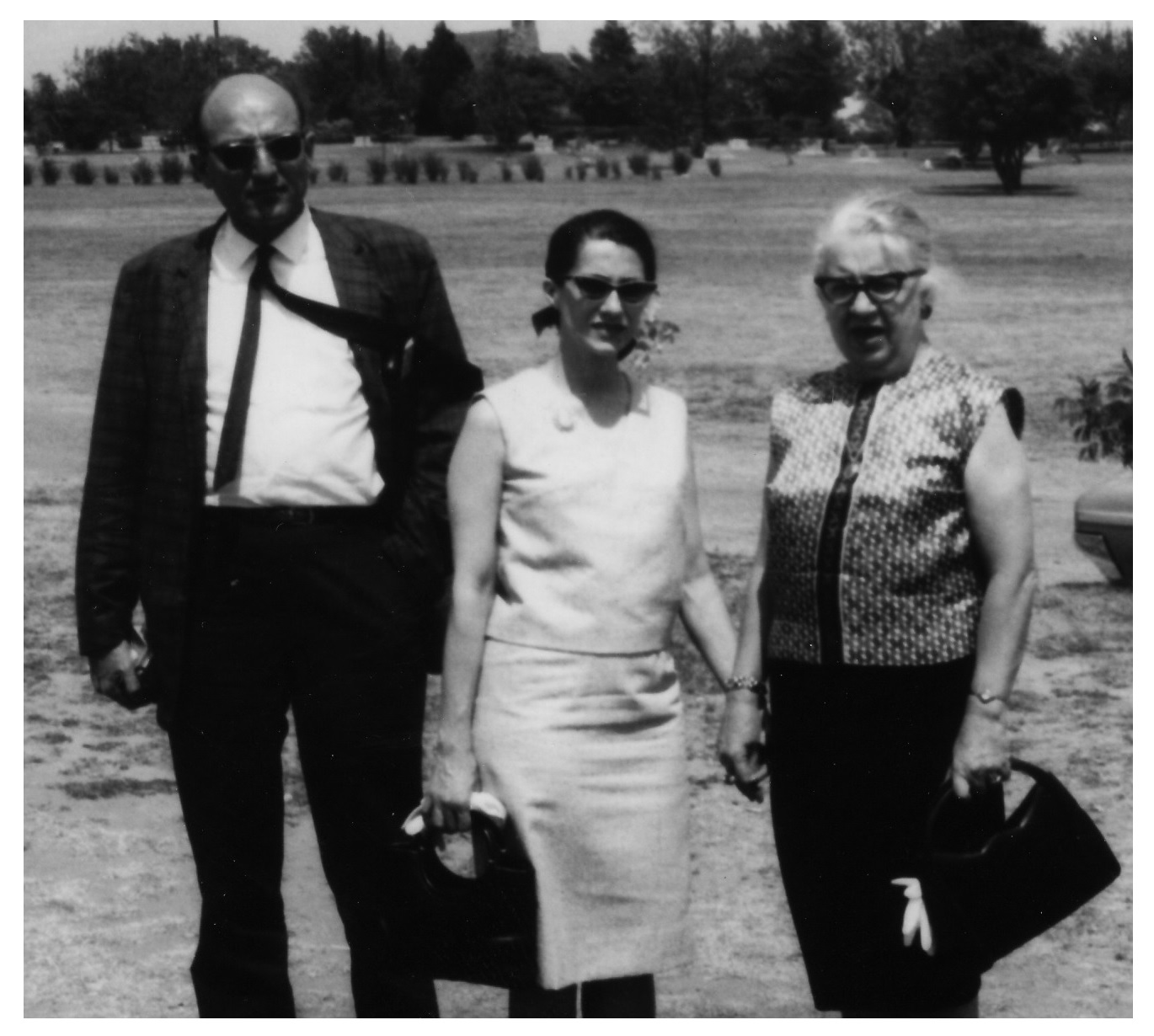
    Immie Feldman died on December 11th, 2024, at the age of 97. She was the widow of Harold Feldman, one of the first generation Warren Report critics.

    Immie, whose given name was Irma, had a key, if peripheral, role in one of the earliest independent investigations into the assassination of John F. Kennedy. These investigations began due to plainly spurious official pronouncements.

    In the summer of 1964, several months before publication of the Warren Report, Immie Feldman accompanied her husband Harold and then-brother-in-law Vincent Salandria to Dallas. They went there on behalf of pioneering critic Mark Lane, whose Citizens Committee of Inquiry had recruited a handful of amateur but highly capable investigators.

    Just before they left, Lane’s assistant mailed Salandria a packet with suggested witness questions. “We didn’t frame any questions for the cops because of the accessibility problem,” she said in her cover letter. “If you do find one drunk in a bar somewhere or hanging over the edge of a precipice by his big toe, I’m sure you’ll know what to ask him…

    “We’ll be eagerly and anxiously awaiting the results of your incursion behind enemy lines!”

    One of the results was a remarkable article written by Harold Feldman. “The Unsinkable Marguerite Oswald,” published in The Realist in September, is an insightful and sympathetic profile of the alleged assassin’s mother. It revealed then-shocking details about the experiences of certain witnesses.

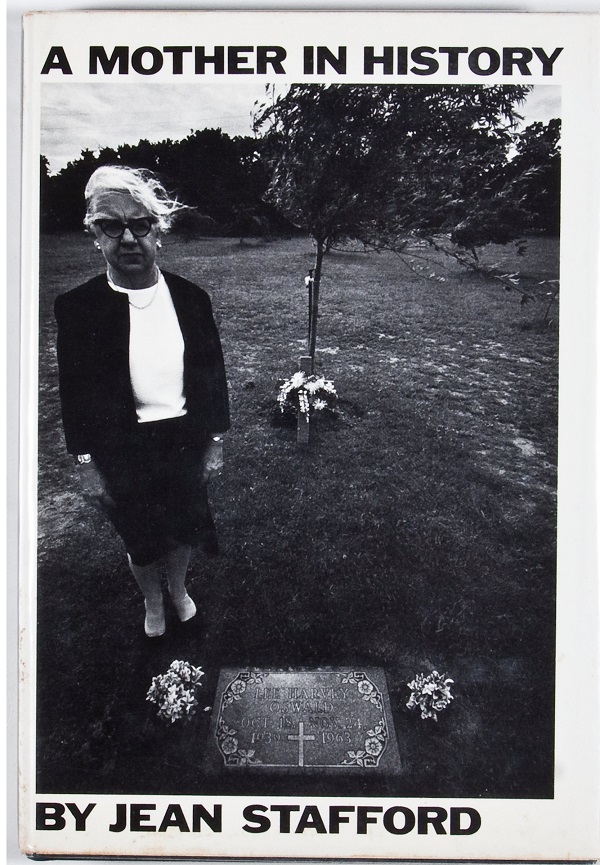
    Feldman’s article contrasted sharply with a book that appeared a year or so later. Jean Stafford’s A Mother in History fully supported the lone-nut scenario, and thus met with favorable response from the mainstream media. Newsweek magazine’s coverage of the book so incensed Immie Feldman that she wrote a letter to the editor, which the magazine published on March 28, 1966.

    Many years later I conducted a telephone interview with Immie Feldman. At the time, I was talking to as many of the earliest Warren Commission critics as I could. What follows is an edited transcript.


    Immie Feldman Interview, Feb 16, 2001

    JK.     If you’re ready, we can just plunge right into it.

    IF.     Okay.

    JK.     You accompanied Vince and Harold to Dallas that summer…

    IF.     That’s correct.

    JK.     I wonder if you had any concerns about that. Or if you – were you looking forward to it, or just along for the ride…?

    IF      Well I was looking forward to it as an adventure. I was interested in the whole thing about it not being Oswald acting alone. And I, you know, I wanted to find out what they could find out…we were anxious to get to Dallas. And we had driven straight through, without stopping to – you know, except for gasoline, and bathroom stops. And eating, yeah. But we, Harold and Vince, and I think you say that in your [questions] – yes, you do – they took turns driving. And we just went right through.

    JK.     Okay. Let’s see, what next do we have? Your initial impressions of Marguerite Oswald. Do you remember that? First meeting her?

    IF.     Yeah, I don’t know what I expected. And so I’m not recalling…but she seemed like a very nice woman. She was very pleasant to us. She seemed, in a way, proud of her son. And she was…I don’t know, it seems like she was, may have been kind of like a distant mother. Do you know what I mean?

    JK.     Not a really warm person?

    IF.     Right, right. What else do I remember about her? She was hospitable to us. And I said we spent the night there, and Vince spent the other nights there also. And she was worried about – that people seemed to be circling her place that she lived, with an automobile that she kept recognizing. And I think that at one time there may have been a van parked in front of her place, that she thought maybe had listening devices or something. And she was constantly on the phone calling the Warren Commission to give them things that she thought were leads or clues. And mostly I think they just thought of her as being a nuisance.

    JK.     Mm-hmm.

    IF.     I think she was rather shabbily treated by people, especially the Council of Churches [in Dallas] that were collecting money [for Tippit’s widow]. And I think I wrote to you about that in my letter, that they received some money that was earmarked for her, and they returned it because they weren’t collecting money for the mother of a murderer.

    JK.     Mm-hmm.

    IF.     Of course, that was very hurtful to her. As naturally, it would be.

    JK.     Harold wrote about, in his article on Marguerite, about going to Helen Markham’s house. Or apartment, I guess it was.

    IF.     Apartment, yes.

    JK.     And Marguerite went with you, correct? It was all four of you?

    IF.     Yes, yes.

    JK.     And, do you recall, do you have recollections of that? I guess you went there a couple of times.

    IF.     Yes, we did go there a couple of times. And I don’t know why I don’t have, you know, any strong recollections there. Because I was kind of, you know, like in the background, and Vince and Harold were the ones that were proceeding with asking questions and trying to get information.

    JK.     Do you remember how you, or they, were received by – did Mrs. Markham seem at all suspicious or unwilling to talk?

    IF.     That, I’m sorry, I don’t recall.

    JK.     Okay. Now, were you with them when, I guess you went initially and she talked for a few minutes, and she was babysitting, I guess it was her granddaughter, and she said, ‘Come back later,’ and you went back a few hours later? And at that time, her husband had come home, and I – that’s when, according to Harold’s article, as you pulled up the second time, you saw, he saw, a few police cars pull away. And they apparently had been threatened by the Dallas police.

    IF.     By the police, mm-hmm.

    JK.     Do you remember that? Vince said something, I think I quoted him, he said to the effect, of having never seen anyone so scared before, and that their teeth were actually chattering. And I think the teeth chattering, I think that Harold mentioned that in his article, too.

    IF.     Yes, I do recall that the Markhams were thoroughly frightened. And apparently, you know, they were threatened.

    JK.     Do you recall noticing that the second time? When you came back a few hours later? As opposed to the first visit earlier in the day?

    IF.     Yes, it was definitely a different atmosphere the second time.

    JK.     Yeah. Okay. That pretty much is what Harold wrote.

    IF.     Yes, and of course, his recollection would have been much closer to the time that it happened.

    JK.     Yeah. Was he keeping notes?

    IF.     Both Harold and Vince did of course take notes, and Vince had brought down an IBM typewriter, and a small copier, so that they were, you know, every night…

    JK.     Busy?

    IF.     Yeah…

    JK.     Taking notes, transcribing…?

    IF.     Making notes, and getting things together. Because, I think, if I remember correctly, the original plan was that we go down and get information for Mark Lane. And then that was not, I don’t think he used that information, and Vince and Harold just used it for their own things that they wrote.

    JK.     Uh, let’s see. Going back earlier, to that first article that was in The Nation, ‘Oswald and the FBI.’ Do you have any memory of Harold becoming aware that the article had prompted, as it did, as I’m sure you’re aware, that secret meeting of the Warren Commission?

    IF.     Yes.

    JK.     And what did he think of that?

    IF.     I was, myself, very apprehensive, because I was wondering you know, what is this going to mean? What kind of difficulties would it make for us?

    JK.     You mean at the time it was first published?

    IF.     Yeah. And…I mean, I don’t know what else to elaborate on that. I was concerned if it would prove to be, make some difficulties in our lives.

    JK.     Yeah, I understand exactly what you mean. It, if you ever had the feeling you were messing with something that would get you in over your head, so to speak?

    IF.     Yes, but still I felt that we had to, Harold and Vince had to sort of, you know, work at what they thought was the truth. But it was, it was, you know. It was scary.

    JK.     Did – you may know – and I’m sure Harold must have seen the – that Gerald Ford wrote about that, mentioned him specifically, in his book. Do you have any memory of Harold thinking one way or another about that? Did he feel like he’d accomplished what he – he got the attention of some…

    IF.     Yeah, he got the attention, and he was in that book that was out there for – we have a copy of the book, or my son Vincent has a copy of the book. And it was, you know, it made an impact. Something that was a little thorn in their sides, apparently.

    JK.     After – I’m not sure exactly how many articles he wrote that were directly related to that case. But there were I think just four or five, is that about right?

    IF.     I think so.

    JK.     The last one that I think, chronologically, was the one about 51 Witnesses on the grassy knoll…?

    IF.     Witnesses on the grassy knoll, right.

    JK.     Which I think was about 1965. And he seems to have dropped out after that. But I’m sure he must have maintained an interest over the years.

    IF.     He maintained an interest over the years. He was, at that time, taking some post-graduate courses, and then in 1966 our son was born… [but] he always maintained an interest, but not actively. And he had a psychoanalytic practice, and he kept very busy. And so he didn’t have the time. He had, other things came into his life, so it wasn’t something that was all-engrossing.

    JK.     Okay. I have one more question, and feel free to not answer it, because I don’t know if I’m getting too personal here. But I was wondering whether Harold’s death was sudden and unexpected? Or was he ill for a time?

    IF.     It was rather sudden. He had had, ten years before he passed away, he had a heart attack and a stroke. And he had fully recovered from it and was able to continue his practice, and teach in this school of psychoanalytic studies here in Philadelphia, and led a very active and normal life. And then in August of ’86, he became ill, and they thought it was a stomach inflammation from medications he was taking. And it turned out to be, it was diagnosed as liver cancer, but then it proved to have come from the pancreas. And he was in the hospital on Wednesday, they made the – he went in the hospital on the weekend, and on Wednesday they made the diagnosis. And the doctor told me that he probably had six months to live. And he died that Friday.

    JK.     Wow.

    IF.     So that was quite a shock. Because he thought that he would be able to tie up some loose ends with the people he had in treatment. And as you can imagine, the shock for all of us, and for his patients, to have this happen this suddenly. 

    JK.     I don’t mean to pry.

    IF.     Sure. No, that’s okay.

    JK.     Okay. Well that’s about all I have this morning. I do appreciate your taking the time to talk to me.

    IF.     If there’s anything I can, you know, add, I’m happy to do it.

    JK.     Okay. Well thank you very much!

    IF.     Okay, you’re quite welcome.

    JK.     I’ll talk to you later.

    IF.     Okay. Bye-bye.

    With Harold Feldman, Vince Salandria and Mark Lane all passed on, she was the last survivor of that trail blazing drive into Dallas. This helps commemorate that important journey.  

    _____

    Read The Unsinkable Marguerite Oswaldby Harold Feldman.

    Read this analysis of Jean Stafford’s interviews with Marguerite Oswald, published in Kennedys and King in November 2022, and based on hearing the original interview recordings.


  • Worse Than I Thought: A Mother In History

    Worse Than I Thought: A Mother In History

    The literature on the JFK assassination is rife with dishonest books that endorse, defend, and/or excuse the findings of the Warren Commission. Nothing new about that: this has been true since publication of the Warren Report in 1964, and has carried on through a long line of apologist nonsense.

    One Commissioner and several WC attorneys cashed in on their experiences. A host of lesser, pseudo-serious WC advocates have contributed to this worthless tripe, and profitably. At the time of the assassination’s fiftieth anniversary, Vince Salandria called it a mountain of trash. All of this propaganda is meant to bury the obvious.

    Jean Stafford’s A Mother in History (Farrar, Strauss and Giroux, 1966) was an early entry into this disgraceful body of work. I have written about it before, most recently on this Kennedys and King site. What more could I possibly have to say? Do I have an unhealthy preoccupation with this slender book, ostensibly an unbiased profile of the mother of the alleged presidential assassin?

    If you Google “Jean Stafford A Mother In History” you are likely to find available copies on used book sites, along with reviews and reader opinions. Most of the opinions I found are favorable. All of them, it is safe to assume, are based solely on reading Jean Stafford’s published text. Almost certainly, none of the writers of these favorable judgments had access to some of the book’s raw material, in particular the tape-recorded Stafford-Oswald interviews. I did. Once it has been appraised, and contrasted with the published work, it is difficult to see A Mother in History as anything but a hatchet job intended to destroy Marguerite Oswald.

    The raw material to which I refer is in the Jean Stafford collection at the University of Colorado (CU) in Boulder, part of the Norlin Library’s Rare and Distinctive Collections.

    Stafford, who was from Boulder, left her papers to CU. Since she primarily wrote fiction, the source material for A Mother in History is only a small portion of that archive. This small portion includes typescripts, notes, and an interview transcript, all of which reside in one small box. Not included in the box are the interview tape recordings, which have long since been digitized.

    A Mother In History was published in three sections, simply titled I, II, and III (plus an Epilogue and appendices). A breathless jacket blurb touts Stafford’s “three incredible days” with Marguerite Oswald. That, and other indicators, clearly imply each of those three book sections correspond to one day of conversation between the author and her subject.

    There may have been three days of interviews, incredible or otherwise, but I am highly suspicious of the published chronology. An exchange on the book’s p. 36, as that purported first-day section nears its end, first got my attention. Here Stafford writes that she asked Mrs. Oswald if it would be okay to bring a tape recorder the next day. Marguerite agreed. Stafford does not say so explicitly, but the clear message is that the first day was not tape recorded.

    The audio at CU consists of six undated .mp3 files. A CU archivist told me last summer that the original reel-to-reel tapes were transferred to audio cassette in the 1970s. They were digitized sometime in the 1980s, or perhaps a little later.

    Nowhere, in the .mp3 audio, does Stafford say the day, date, or subject of her interviews. Interviewers often do; it could even be considered a best practice. It creates a record, and helps keep things in order.

    The .mp3 files at CU may be undated, but they do have sequential filenames. The first is stafford-interview-with-mrs.-oswald_-part-1-a.mp3. This particular audio begins with Stafford asking, “Tell me about your early life, Mrs. Oswald. You were born in New Orleans, weren’t you?” The transcript begins the same way. It’s an amiable first question, a likely starting point, and I’m going to go out on a limb and suggest this was, in fact, the very first of the interviews: that is, the first day, which Stafford implied was not recorded.

    As I described in my previous article, I had grown curious about a quote in the first section of the book – an unrecorded first day, readers are led to believe. Lee Harvey Oswald, Marguerite said, “spoke Russian, he wrote Russian, and he read Russian. Why? Because my boy was being trained as an agent, that’s why.”

    In Stafford’s book there was no follow-up question. This baffled me. Even an amateur journalist, like Stafford, should have enough sense to explore such an explosive statement. Surely the audio would clarify things. Instead, it revealed that Marguerite Oswald didn’t say what Stafford quoted her as saying. It is a manufactured quote.

    It’s a little complicated, so bear with me. Most of the words in that quote were, in fact, spoken by Marguerite Oswald. They were also tape recorded; I have heard the audio. But it’s a false quote, because Stafford pieced together several phrases – some of them separated by as much as three minutes. Placing it all within quotation marks implies it is verbatim – but it is not, and is thus a deception.

    I can only speculate on Stafford’s motives. That false quote does not support the lone gunman thesis. Given the magnitude of surrounding events, I cannot believe creating it was innocent. I think Stafford floated the idea of Oswald-as-agent – not a common view at the time – to characterize Marguerite Oswald as paranoid, and out of her mind.

    There are other false and manufactured quotes in A Mother In History. I have not itemized them all and don’t intend to; it would be a huge undertaking. The more I studied the source material, the more dishonesty I found.

    On page 23 of A Mother In History is the following statement, attributed to Marguerite:

    Lee purely loved animals! With his very first pay he bought a bird and a cage, and I have a picture of it. He bought this bird with a cage that had a planter for ivy, and he took care of that bird and he made the ivy grow. Now, you see, there could be many nice things written about this boy. But, oh, no, no, this boy is supposed to be the assassin of the President of the United States, so he has to be a louse. Sometimes I am very sad.

    This is a rather inconsequential matter, but it is still false. Marguerite Oswald didn’t really say it. Here is what she did say, in answer to Stafford’s question, “Did he ever have any pets?”

    Oh yes, Lee had a dog, and with his first pay he bought a bird and a cage – I have pictures of it, with ivy in it and all the food for the bird. Yes, sir. With his first pay. He had a collie shepherd dog that I had gotten for him when it was a little [bitty] puppy. And he had it all those years until we went to New York. And that dog had puppies. He gave one to his school teacher. She wrote a nice article for the newspaper saying Lee loving animals and giving her a pet.

    True, the published quote roughly parallels what she really said. But it is still false. “Lee purely loved animals” does not appear in any of the audio. There is no mention of dogs in the published quote, let alone puppies, or giving one to a school teacher.

    Nor does Marguerite say, “Sometimes I am very sad.” In fact, elsewhere in the recorded interviews, she said quite the opposite: “I’m not unhappy, Jean. You can see I’m not.”

    As I write these words, I feel like I’m in attack mode. I have listened to all the audio that is available. Can I be certain that every last recorded word from the Stafford-Oswald interviews wound up in the CU archive? Of course not. All that CU has is what Stafford gave them. She also wrote, in her book, that when Mrs. Oswald agreed to be tape recorded, she stipulated that there be two recorders so she could have a copy.

    The example about animals and pets is minor, compared to a false quote on pages 12-13 of A Mother In History. This one is presented as dialogue between interviewer and interviewee, and Jean Stafford goes in for the kill. It is intended, I am convinced, to make Marguerite Oswald appear nuts – to use a non-clinical term.

    Marguerite spoke first:

    “And as we all know, President Kennedy was a dying man. So I say it is possible that my son was chosen to shoot him in a mercy killing for the security of the country. And if this is true, it was a fine thing to do and my son is a hero.”

    “I had not heard that President Kennedy was dying,” I said, staggered by this cluster of fictions stated as irrefutable fact. Some mercy killing! The methods used in this instance must surely be unique in the annals of euthanasia.

    This exchange is not found anywhere in the interview audio or the transcript. Marguerite does not make the statement, and Jean Stafford does not make that stunned reply.

    There is something similar to this in the interviews. Unfortunately, the digitized version of the tape recording at CU ends partway through the quote. Did the original tape end there, too? No, because the corresponding transcript, which I have found to be consistently accurate, continues for several more pages. It is convoluted, but this is what Marguerite Oswald really said.

    That President Kennedy was killed by – a mercy killing – by some of his own men that thought it was the thing to do and this is not impossible and since I blame the secret service from what I saw and what I thought it could have been that my son and the secret service were all involved in a mercy killing.

    A minute or so before her “mercy killing” remark, Marguerite did say “a dying President,” but “As we all know” is an invention. She says JFK was dying because he had Addison’s disease, which he did. She also called it a kidney disorder, which it is not. Addison’s can be life-threatening, but Stafford correctly points out that it is a manageable adrenal condition. And Kennedy managed his.

    But Stafford can’t let this go without having some fun, falsely quoting Marguerite calling it Atkinson’s disease. In the audio, there is no doubt: Marguerite says Addison’s. It is rendered as Atkinson’s in the transcript. Maybe Stafford didn’t remember what Mrs. Oswald actually said, and later on trusted the error of the unknown transcriber. While accurate overall, the transcript does, in fact, garble certain words here and there; in places it reminds me of the sometimes-strange voicemail transcripts my Smartphone makes. The ethical thing would have been double-checking Marguerite’s presumed mistake, before putting it to print.

    But the point is that Marguerite Oswald did not say her son was chosen to shoot a terminally ill JFK in a mercy killing. Jean Stafford created that illusion.

    According to biographer David Roberts (Jean Stafford: A Biography, 1988) Jean Stafford later “held parties at which she played the Oswald tapes for her friends.” Roberts cites Stafford’s “fascination” with Marguerite Oswald’s voice.

    It sounds more like arrogance to me. One imagines a bunch of cocktail-quaffing intelligentsia howling with laughter over Marguerite’s unschooled chatter. But maybe not. Maybe Stafford just wanted to give some of her pals a front-row seat to history. Whatever: the image this conjures is, to me, thoroughly repulsive.

    The Stafford-Oswald interviews took place in May 1965. This is approximately ten months after Marguerite met with Harold Feldman and Vince Salandria, after which Feldman wrote “The Unsinkable Marguerite Oswald,” published in September 1964 (available online).

    If Jean Stafford had done her homework, she might have answered a question she puzzled over in her book’s Appendix III. How, she wondered, was an undereducated Marguerite Oswald able to paraphrase an obscure quote from Sigmund Freud? “Without persecution,” she told Stafford, “there would not be a persecution complex.”

    In his article Harold Feldman, a lay psychologist, said that the media consistently portrayed Marguerite Oswald “as a self-centered, domineering, paranoiac showoff with frequent delusions of persecution. It reminds me of Freud’s remark that there would be no such thing as a persecution complex if there were not real persecution.”

    Feldman, whose writing often appeared in psychoanalytic journals, wrote about Marguerite with the deference and sympathy Jean Stafford failed to summon. He observed:

    She has devoted every day since November 22, 1963, to uncovering what she believes and millions believe is a real conspiracy in which her youngest son was the fall guy. As a result, she is held up to scorn as a bitter old woman who sees snares and plots everywhere.

    And he added: “… if Ibsen is right and the strongest is the one who stands alone for integrity and honor, then Marguerite Oswald is the strongest woman in America.”

    Marguerite Oswald was an ordinary woman thrust, quite against her will, into extraordinary circumstances. In spite of tremendous obstacles, she defended her son against the Warren Commission and the mainstream media. She had few allies. Even family members, she told Jean Stafford, distanced themselves from her. “I’m alone in my fight, with no help.”

    Marguerite Oswald may have struck Stafford as eccentric, but who doesn’t have personality quirks? Jean Stafford exploited Marguerite’s to the hilt, and did so ruthlessly, in exchange for money. I could cite many more examples of the dishonesty in A Mother In History, but life is too short.

    Stafford shuffled the truth like a deck of cards, manufacturing quotes and manipulating chronology, all to create the false impression – the lie – that her subject was divorced from reality. Suffice it to say A Mother In History is even worse than I imagined when I visited the Jean Stafford archive at CU.

    But it’s been more than fifty years since publication, so the damage is done.


  • A Mother In History: The Stafford Archive

    A Mother In History: The Stafford Archive


    Jean Stafford (1915-1979) is best remembered for writing novels and short stories; she won a Pulitzer Prize for fiction in 1970. But in 1966 she ventured into nonfiction with a profile of Lee Harvey Oswald’s mother, Marguerite. This made her a person of interest to me as I researched my book, Praise from a Future Generation (Wings Press, 2007).

    Stafford grew up in Boulder, CO, not too far from where I live, and where she later attended the University of Colorado. Today her papers are housed in CU’s Norlin Library. She was only peripheral to my project, and there was already plenty of available data about her. So even though it’s in my back yard, and even though I made regular use of Norlin resources, I never went to the Stafford archive during my own book’s research phase.

    Her profile of Marguerite Oswald appeared first as an article in McCall’s magazine, and later as a book, both called A Mother In History. I devoted a few pages to it in Praise From, but a vexing question remained. “[Lee] never did tell me why he went to Russia,” Stafford quoted Marguerite as saying. “I have my own opinion. He spoke Russian, he wrote Russian, and he read Russian. Why? Because my boy was being trained as an agent, that’s why.”

    This is a compelling statement. Does it not demand a follow-up question? It seems inconceivable that Stafford would not ask something: if nothing else, “Oh? Tell me more.” Yet her next question, in the published text, is about what Lee might have done with his life had he lived.

    A friend recently told me that CU’s archive includes audio recordings of Stafford’s interviews with Mrs. Oswald. They might clarify the matter; they might reveal a follow-up question that, for some reason, had been deleted. So I contacted the archive and scheduled a visit.

    Before going to the archive I set myself the onerous task of re-reading A Mother In History. The book is short, and mercifully so: short, unpleasant, and mean-spirited. Even one of Stafford’s biographers (there are several) faulted its tone, calling it “profoundly unsympathetic” and “a cruel portrait, executed pitilessly.”

    The book is divided into three sections: one for each of the days Stafford spent talking to Marguerite. The opening thirty-odd pages describe the first day, and it is here that Marguerite made the comment about her son being trained as an agent. Also in these early pages, Stafford indicates that the first day was not tape recorded. She wrote that as she got up to leave, “I asked [Marguerite] if she would object to my bringing a tape recorder the following day; she said that on the contrary, she would be glad if I did…”

    Throughout A Mother In History, Stafford’s support for the lone nut scenario is never in doubt. Later she characterized her role as a “stenographer” – by implication, an impartial participant. But her point of view is clear, as is her lack of sympathy for Marguerite. Mrs. Oswald spent most of her time “researching the case,” she reported on page five, “studying theories of conspiracy (right-wing, left-wing, wingless, Catholic, Baptist, Jewish, Black Muslim, anarchist, fascist, federalist, masterminded by the cops, masterminded by the robbers.)”

    This is, of course, an absurd exaggeration. Stafford never seemed to consider that, in the aftermath of the assassination and Lee Harvey’s sensational murder, Marguerite Oswald must have been under enormous emotional strain, especially since the evidence against her son was so flimsy.

    At the Stafford archive, materials relating to A Mother In History are stored in a single modest container. In it are several typed manuscript drafts, galleys, some of Stafford’s handwritten notes, and the article version from McCall’s. Not included are the audio recordings I’d been told about, though they’re listed on the Finding Aid I consulted. The original tapes have been digitized, the archivist informed me. To hear the audio I must fill out a form, then wait for CU’s Digital Reproductions people to contact me.

    Yet I got lucky. I came across a fifty-seven-page interview transcript not listed on the Finding Aid. It appeared to be the original, with the look and feel of a 1960s-era typescript: faded onionskin paper, double spaced with wide margins, and page numbers typed in each upper left corner. The numeral 2 was handwritten at the top right of each page, possibly indicating it’s a second copy. The whole thing was fastened with a plastic-coated, archivally correct paperclip.

    What I could not determine was its origin. There was no indication who made the transcript. It was undated; and though the words “A Mother in History” were handwritten in pencil at the top, it was otherwise untitled.

    As I waited impatiently to hear the audio, I obtained a PDF of the transcript and relied on it as I drafted this article. After I got it I noticed a missing page. The archivist told me it was missing from the original, too. I did not hear the audio until September, two months after I went to the archive. I compared the two; the transcript is a faithful rendering. (For convenience I’m using the word “transcript” more often than “audio,” but the two align perfectly.)

    It has all proven to be quite illuminating. The bottom line? Marguerite Oswald never made the provocative statement Stafford attributed to her: “He never did tell me why he went to Russia. I have my own opinion. He spoke Russian, he wrote Russian, and he read Russian. Why? Because my boy was being trained as an agent, that’s why.”

    She didn’t say it! But I must clarify: Marguerite sort of said it. Although the troublesome quote is in A Mother In History’s first section, the day Jean Stafford indicated she did not record, most of the words are, in fact, in the transcript and audio. But they are scattered over four transcript pages, and nearly four minutes in the recording. So Stafford recorded this after all – but seems to have cherry-picked choice selections and stitched them together, without alerting the reader.

    Still with me? In the middle of transcript page 25 is this phrase: “He ever did tell me why he went to Russia. I have my own opinion.” (This is not a typo: the transcript says ever, not never.)

    Three pages later (and after several more questions from Stafford), at the top of transcript page 28, is another portion of the published quote: “He spoke Russian, he wrote Russian and he read Russian.”

    At the top of page 29: “…because my boy was being trained as a agent that’s why.”

    These are the elements, with a few missing words, that constitute the quote on page 32 of A Mother In History. In the book it is presented without ellipses or any other editorial device to indicate omitted content. Such editorial devices are, of course, accepted conventions; they imply that what you are reading is edited but trustworthy. Not using them, especially on a subject like this, is unethical and misleading.

    How do we interpret this? The quote is compelling by any measure, but Marguerite Oswald didn’t quite say it. Yet it runs contrary to the lone nut myth, which Jean Stafford supports. Why would she cobble it together?

    In an early draft of this article I offered up a possible explanation, one that let Stafford off the hook. It was a misguided effort, so I deleted it. I can’t explain the inexplicable. Certainly, the idea of a connection between Lee Harvey Oswald and the U.S. government was not new. Marguerite even told a dismissive Warren Commission her son was an agent when she testified in February 1964. But in 1966, when Staffords book was published, it had none of the credibility it has now. I think she introduced it, but failed to explore it, in order to make Marguerite look mentally unstable.

    In contrast to Jean Stafford’s covert hostility, Marguerite was gracious and friendly. A greeting card in the archive illustrates this. “Please make a schedule to suit your needs,” she wrote Stafford, shortly before their three days together. “I am happy to oblige.”

    In addition to the quote that first drew my attention, other sections of A Mother In History are, when compared to the source transcript and audio, demonstrably false. While Jean Stafford’s motives are unknown, it had to have been deliberate. Even allowing for the occasional honest error, the book contains manufactured quotes, and the false implication that the first day of interviews, where a manufactured quote appears, was not recorded. As we have seen, it was recorded. By implying there was no documentation for this part of her interviews, did Stafford mean to deter anyone from checking that quotes accuracy?

    You know how it is with liars: once you know they’ve lied to you, everything else they say is suspect.

    The pitiless tone of A Mother In History might best be understood (if not excused) when viewed in the context of the times: reassuring anxious readers that there was not a conspiracy, and that the alleged assassin’s mother is a kook you can safely ignore. Still, why did Stafford even bother? A big paycheck might be enough to explain it. But interviewing and writing about Marguerite Oswald should have excited her. The assassination was the biggest story of the era.

    Jean Stafford was a bestselling author, widely acclaimed during her lifetime. As far as the Kennedy assassination goes, she is a fringe dweller. A Mother In History is an unimportant book that is best forgotten. It felt dishonest when I first read it years ago, and my recent visit to the CU archive reinforces that view. The book may represent Stafford’s professional nadir, but to be fair it is only a tiny portion of her overall output – as indeed, materials relating to it are but a fraction of the University of Colorado’s Jean Stafford archive.

    I regret that, in Praise From a Future Generation, I took so much of A Mother In History at face value. I assumed Jean Stafford’s dishonesty was a matter of spin control. How very naïve of me to not even consider the possibility of calculated distortion.

    A far more balanced and sympathetic portrait of Marguerite Oswald may be found in “The Unsinkable Marguerite Oswald,” by Harold Feldman. It appeared in Paul Krassner’s The Realist in September 1964. Circulation of The Realist, of course, was vastly eclipsed by McCall’s, to say nothing of Stafford’s book publisher Farrar, Strauss, and Giroux. But “The Unsinkable Marguerite Oswald” is highly recommended. A Mother In History is not.

  • “Maurice Bishop … was David Atlee Phillips”

    “Maurice Bishop … was David Atlee Phillips”


    When he first confirmed that David Atlee Phillips was the CIA contact known as “Maurice Bishop,” Cuban exile leader Antonio Veciana did so tacitly. But Veciana’s meaning was so clear, and his guile so transparent, there was no doubt; both he and House Select Committee investigator Gaeton Fonzi began laughing.

    Now, decades later, Veciana has explicitly stated that Phillips (right) was indeed Bishop, and that he did indeed see Phillips with Lee Harvey Oswald in September 1963 – thus formally linking a high ranking CIA officer with the JFK assassination.

    Veciana’s admission came in a written statement issued November 22, 2013, the fiftieth anniversary of the assassination. In a letter to Fonzi’s widow Marie, Veciana, the elderly, former leader of Alpha 66, said, “Maurice Bishop, my CIA contact agent was David Atlee Phillips. Phillips or Bishop was the man I saw with Lee Harvey Oswald in Dallas on September 1963.”

    phillips

    Fonzi wrote of his encounters with Veciana in his 1993 book The Last Investigation, which describes his experience with the House Select Committee on Assassinations in the 1970s.

    At the time of his first meetings with Veciana, Fonzi was a staff investigator for Sen. Richard Schweiker (R-Pa.), a member of the Senate Select Committee on Intelligence and co-chair of the Sub-committee on the John F. Kennedy Assassination. Fonzi told Veciana he was exploring links between government agencies and Cuban exile groups.

    On March 2, 1976, Veciana told Fonzi that two months before the assassination he rendezvoused with his CIA contact “Maurice Bishop” in the lobby of a downtown Dallas office building. Bishop was already there when he arrived, Veciana said, and in the company of a young man he later recognized as Lee Harvey Oswald, the alleged JFK assassin.

    In subsequent HSCA testimony, however, Veciana did not identify Phillips as Bishop. But Fonzi independently determined that “Bishop” and Phillips were one and the same.

    Phillips was also called before the HSCA, and under oath, denied both using the name Maurice Bishop and knowing Veciana. That ended the matter. Although Fonzi believed they could make a case for perjury, HSCA Chief Counsel G. Robert Blakey declined to bring charges against Phillips.

    In the early 1960s Alpha 66 was a leading anti-Castro organization, funded by the CIA. During the course of their meetings Veciana never explicitly told Fonzi that Bishop was really Phillips. Fonzi believed that Veciana would not make the identification because he thought Bishop/Phillips could further aid him in his goal of toppling Cuban leader Fidel Castro.

    David Atlee Phillips was a CIA officer for 25 years. At the time of the assassination he was Chief of Cuban Operations, based in Mexico City. He died in 1988.

    Initial reports of Veciana’s 2013 statement erroneously said Veciana had died.

    CTKA obtained a copy of the statement from former HSCA staff member Dan Hardway, who got it from Marie Fonzi.

    The bulk of this account is derived from the Appendix to Hearings Before the Select Committee on Assassination of the U.S. House of Representatives, Vol. X, pp. 37-56, and from The Last Investigation, by Gaeton Fonzi, Chapters 16 and 44.

  • The Pigs Grunt

    The Pigs Grunt


    “What do you expect from a pig but a grunt?”

    – Kevin Costner as Jim Garrison, JFK


    In early February 1967, Warren Commission critic Ray Marcus received a letter from Robert Richter of CBS News. The news organization was thinking of producing a new program on the Warren Report, Richter said, and was contacting some of its critics. One of them, Vincent Salandria, had given Richter a copy of The Bastard Bullet and described some of Marcus’s other work. Perhaps Marcus would be willing to give CBS a hand.

    Marcus wrote back on February 14: “I shall be happy to assist as best I can.” He described his Zapruder film analysis and his conclusions on the assassination shot sequence, and some of his photographic work, including the #5 man detail of the Moorman photograph, which he believed revealed a gunman on the grassy knoll.

    no 5

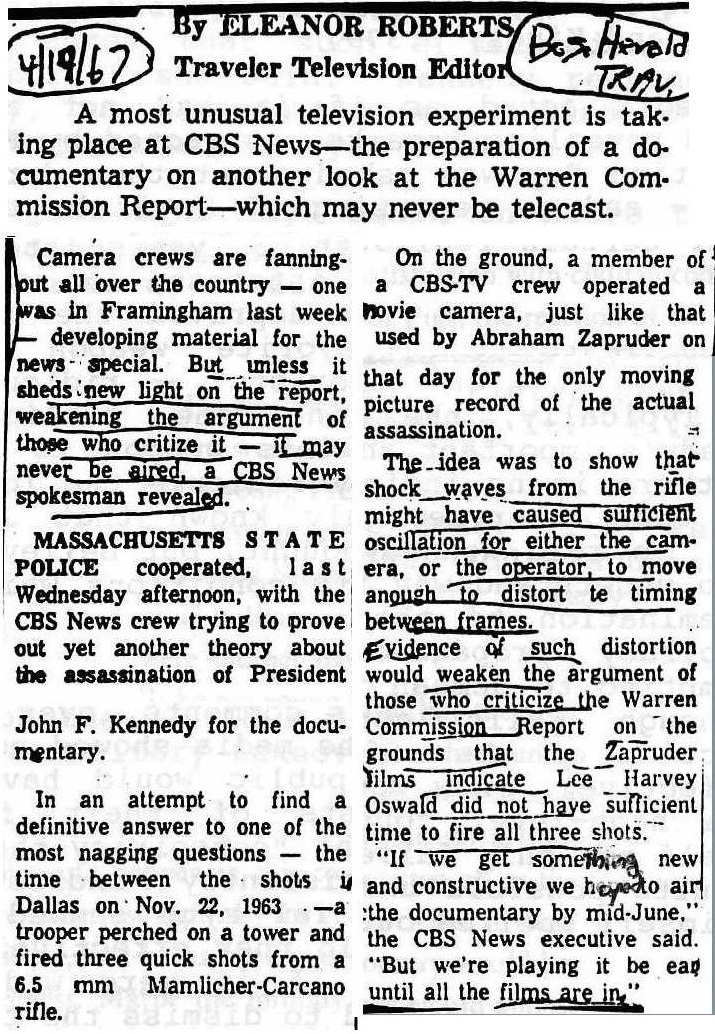
    A few months later Marcus nearly changed his mind. He was in Boston attending to some business interests when he happened to see an article in The Boston Herald-Traveler by the paper’s television editor, Eleanor Roberts. The article’s first sentence told most of the story. “A most unusual television experiment is taking place at CBS News—the preparation of a documentary on another look at the Warren Commission Report—which may never be telecast.” Unless CBS could develop new information that weakened the arguments of the Commission’s critics, Roberts wrote, the project might be shelved.

    Immediately, Marcus telephoned Roberts. She would not tell him the source of her story, but did say it was a CBS executive who had been a reliable contact in the past.

    A few weeks later Marcus heard again from Bob Richter. The CBS program was in development and he wanted to discuss Marcus’s work with him. But Marcus said no, he had changed his mind; he had seen the Roberts article, and it was plain that CBS was not approaching the subject impartially.

    But Richter had a good comeback. “Some of us here are trying to do an honest job,” he said, “and if those of you who have important information don’t cooperate with us, you’re just guaranteeing that the other side wins.” Richter seemed sincere and his reasoning sound. Marcus agreed to meet with him.

    The two men met several times and Marcus outlined the work that he had done. Richter was impressed with the Moorman #5 man detail (below right), discovered by David Lifton in 1965, which Marcus and Lifton both believed revealed a Dealey Plaza gunman. Richter agreed that the murky image was almost certainly a man. He saw a series of ever-larger blow-ups of the picture, which Marcus had placed in a special portfolio. Richter arranged to have duplicates made of the entire set, and said he would show them to his superior at CBS, Leslie Midgley, the producer of the program.

    article 3

    Midgley, it turned out, said he could not see anything resembling a man in any of the pictures when Richter showed them to him. But he agreed to meet with Marcus to go over the portfolio one more time. They met, along with Richter, in Midgley’s office. Included in the portfolio was a detail from a photograph of civil rights activist James Meredith moments after he was shot—a photo which revealed, unambiguously, his assailant in the shrubbery along the side of the road. Marcus had included an enlargement of the gunman for purposes of comparison to the #5 man detail, since the lighting and the figure obscured among leaves—this one known to be a man—were similar in appearance. Flipping through the series of #5 man enlargements, Midgley kept repeating that he couldn’t see anything that looked human. Then he came to an especially clear photo, and he said, “Yes, that’s the man who shot Meredith.”

    Marcus and Richter immediately glanced at one another, in what Marcus took to be obvious and mutual understanding of what had just happened. Midgley was looking not at the photo of the Meredith gunman, but of the clearest enlargement of the Moorman #5 man detail, which he had previously looked at but dismissed.

    Midgley understood what happened, too. He visibly reddened but did not acknowledge the error. Marcus must have felt completely vindicated, for this was an absolute, if tacit, admission: in order for Midgley to wrongly identify the #5 man detail as “the man who shot Meredith,” he first had to be able to see #5 man in the picture.

    Marcus politely reminded Midgley he was looking at #5 man. The meeting ended shortly after this, without further discussion of what had just happened.

    After the incident in Les Midgley’s office, Marcus had met again with Richter and stayed in touch with him by telephone. By June, the broadcast date was drawing near, and the CBS project had developed into a four-part special. On June 19 Marcus wrote Midgley an eleven page letter describing, in great detail, the incident in Midgley’s office, and calling the mis-identification “a very understandable error. But one which would have been impossible for you to make had you not promptly recognized the #5 image as a human figure, despite your earlier denials that you saw anything in the pictures that looked like a man.” With its vast resources, both technical and financial, CBS was obviously capable of presenting the #5 man image clearly and objectively. “Need it be stated,” Marcus told Midgley, “that if CBS fails to do so—especially considering your positive reaction to #5 man—that fact in and of itself will constitute powerful evidence that the entire CBS effort was designed to be what I fear it to be: a high-level whitewash of the Warren Commission findings?”

    The next morning Marcus mailed the letter to Midgley and enclosed additional copies of #2 and #5 man and other photographs. That same day he telephoned Bob Richter in New York. He wanted Richter to confirm, in writing, the mis-identification of the #5 image that had taken place in Midgley’s office, which Richter agreed to do. Then Richter, while cautioning that Marcus would probably be unhappy with the overall content of the four programs, added that some of the Moorman details might make it into the final edit of the show. Richter described one of images but Marcus said it wasn’t the best one to use. Which one was? Richter asked. The most advantageous one to show, Marcus replied, would be the clearest one of the bunch—the one Richter’s boss, Les Midgley, had mistaken for the man who shot Meredith.

    cbs ad

    That same evening, the CBS television network broadcast the first of its four-part CBS News Inquiry: The Warren Report. CBS was touting the documentary as “the most valuable four hours” its viewers might ever spend in front of their TV sets. It was anchored by Walter Cronkite, a broadcasting legend already considered the Dean of American television newsmen. Cronkite said later it would have been “the crowning moment of an entire career—of an entire lifetime—to find that Oswald had not acted alone, to uncover a conspiracy that took the life of John F. Kennedy.” But, he continued, “We could not.”

    Each segment of the CBS News Inquiry posed a series of questions and answered them with an unbiased evaluation of the evidence. That, at any rate, was the appearance. The actual content of the four programs left many wondering whether CBS had really taken a disinterested approach to the subject. The Boston Herald Traveler article Ray Marcus had seen, stating that the CBS documentary might really be aimed at “weakening the arguments of those who criticize” the Warren Report, may have been accurate, after all.

    Mark Lane also had a stake in the program. “I decided to watch the CBS effort very closely,” he said later. Like Ray Marcus, Lane had met with Bob Richter in the months preceding the broadcast, and had also been interviewed for the documentary. After watching the series he concluded that the programs were highly deceptive. “What had evidently been the original approach—to present the evidence and permit the viewer to draw his own conclusions—bore no resemblance to the final concept.”


    In 1964, Thomas G. Buchanan observed that the facts of the assassination as they were initially reported in the media changed several times, but the conclusion of Oswald’s lone guilt never did. “If, as a statistician, I were solving problems with the aid of a machine and I discovered that, however the components of my problem were altered, the machine would always give me the same answer, I should be inclined to think that the machine was broken.”

    CBS was such a machine. It altered its components with firearms and ballistics tests that improved on the original FBI tests; with new analyses of the Zapruder film; and with new interviews with witnesses to the events of November 1963. But its answer was the same one it had always reported, the same one delivered by the Warren Commission: Lee Oswald, for reasons not entirely fathomable, had murdered President Kennedy without direction or help from anyone.

    To answer the questions it posed, CBS used a number of experts. One of them was Lawrence Schiller. Schiller was the photographer and journalist who had once acted as Jack Ruby’s business agent, and had played a role in developing research that became an anti-critic triple threat: an article in a World Tribune Journal supplemental magazine, a record album called The Controversy, and a book called The Scavengers and Critics of the Warren Report. CBS used Schiller to refute allegations that a photograph of Lee Harvey Oswald brandishing the alleged assassination rifle was a forgery.

    Schiller, Walter Cronkite said, had studied both the original photograph and its negative. Appearing on-camera, Schiller said that the critics “say that the disparity of shadows, a straight nose shadow from the nose, and an angle body shadow proves without a doubt that [Oswald’s] head was superimposed on this body.” But Schiller said he had gone to the precise location in Dallas where the original was taken, and on the same date, at the same hour, had taken a photograph of his own. This picture, he said, perfectly reproduced the controversial shadows, indicating the Oswald picture was genuine.

    Mark Lane was not able to respond to Lawrence Schiller on the CBS program. But he later said that the negative for the photograph was never recovered by the authorities, suggesting the photograph was not genuine. Lane wrote: “It is interesting to fathom the CBS concept of the life of the average American if it imagined that watching Jack Ruby’s business agent after he studied a nonexistent negative might constitute ‘the most valuable’ time spent watching television.”

    On the second installment of the CBS documentary, Dr. James J. Humes, the Navy doctor who had been in charge of the President’s autopsy and had burned his autopsy notes, was interviewed. Asked about the discrepancy between the schematic drawings that placed an entry wound at the base of the neck, and the autopsy “face sheet” that indicated this wound was really lower down on the back, Humes said that the face sheet was “never meant to be accurate or precisely to scale.” The exact measurements were in fact written in the face sheet margins, and conformed to the schematic drawings.

    Sylvia Meagher was so incensed by this that she wrote to CBS News President Richard Salant. The CBS documentary was “marred by serious error and fallacious reasoning which inevitably will have misled and confused a general audience.” In the case of Dr. Humes, while he insisted the measurements written in the face sheet margin were correct, “CBS failed to pursue or challenge this explanation, as in conscience it should have done, by pointing out no marginal notations giving precise measurements for any other wound, cut-down, or physical characteristic appear on the diagram; that every other entry in the diagram appears to be accurate, as opposed to the crucial bullet wound in the back; that the clothing bullet holes match the diagram, not the schematic drawings; that a Secret Service agent saw a bullet hit the President four inches below the neck; and that another Secret Service agent, summoned to the autopsy chamber expressly to witness the wound, testified that this wound was six inches below the neck.”

    The third part of the CBS special proved to be especially newsworthy. A portion of this segment was devoted to the JIm Garrison investigation in New Orleans, although for much of it Garrison was put on the defensive. CBS included a sound bite with Clay Shaw, who said: “I am completely innocent … I have not conspired with anyone, at any time, or any place, to murder our late and esteemed President John F. Kennedy, or any other individual … the charges filed against me have no foundation in fact or in law.”

    Most damaging to Garrison was the appearance of William Gurvich, a former Garrison investigator introduced as his “chief aide” who, Cronkite told his viewers, had just resigned from the DA’s staff. Asked why he quit, Gurvich said that he was dissatisfied with the way the investigation was being conducted. “The truth, as I see it, is that Mr. Shaw should never have been arrested.” Gurvich said he had met with Senator Robert F. Kennedy “to tell him we could shed no light on the death of his brother, and not to be hoping for such. After I told him that, he appeared to be rather disgusted to think that someone was exploiting his brother’s death.” The allegations of bribery by Garrison investigators, Gurvich said, were true. Asked whether Garrison had knowledge of it, Gurvich answered: “Of course he did. He ordered it.”

    Garrison himself was interviewed by Mike Wallace. Reflecting on all the bad publicity he was getting, which included allegations of witness intimidation and bribery, the DA said, “This attitude of skepticism on the part of the press is an astonishing thing to me, and a new thing to me. They have a problem with my office. And one of the problems is that we have no political appointments. Most of our men are selected by recommendations of deans of law schools. They work nine to five, and we have a highly professional office—I think one of the best in the country. So they’re reduced to making up these fictions. We have not intimidated a witness since the day I came in office.”

    Not missing a beat, Wallace pressed on: “One question is asked again and again. Why doesn’t Jim Garrison give his information, if it is valid information, why doesn’t he give it to the federal government? Now that everything is out in the open, the CIA could hardly stand in your way again, could they? Why don’t you take this information that you have and cooperate with the federal government?”

    “Well, that would be one approach, Mike,” Garrison countered. “Or I could take my files and take them up on the Mississippi River Bridge and throw them in the river. It’d be about the same result.”

    “You mean, they just don’t want any other solution from that in the Warren Report?”

    “Well,” the DA replied, “isn’t that kind of obvious?”

    Garrison told Wallace there was a photograph in which assassins on the grassy knoll were visible. He was referring, of course, to the #5 man detail of the Moorman photograph. As he had for CBS, Ray Marcus had supplied Garrison with a portfolio of images from the picture, including the clearest copies of the #5 man enlargement.

    “This is one of the photographs Garrison is talking about,” Wallace told his viewers, holding up one of the Moorman pictures Marcus had given to Bob Richter. It was not the one that Marcus had recommended to Richter. Instead Wallace held up a smaller version—the smallest one, Marcus recalled, that he had given CBS. “If there are men up there behind the wall,” Wallace said, “they definitely cannot be seen with the naked eye.”

    Marcus had urged Bob Richter to use the enlargement that the producer of the CBS New Inquiry, Les Midgley, had mis-identified as “the man who shot Meredith.” Some months after the airing of the CBS documentary, Midgley was asked to reflect on the broadcasts. Echoing Walter Cronkite, Midgley said, “Nothing would have pleased me more than to have found a second assassin. We looked for one and it isn’t our fault that we didn’t find one. But the evidence just isn’t there.”


    The final segment of the CBS Inquiry on the Warren Report was broadcast on the evening of June 28. It posed viewers with the question, Why doesn’t America believe the Warren Report?

    “As we take up whether or not America should believe the Warren Report,” said correspondent Dan Rather, “we’ll hear first from the man who perhaps more than any other is responsible for the question being asked.” That man was Mark Lane.

    Lane said that the only Warren Commission conclusion that was beyond dispute was that Jack Ruby had killed Lee Harvey Oswald. “But, of course, that took place on television,” Lane said. “It would have been very difficult to deny that.” Beyond that, Lane continued, there was not a single important conclusion that was supported by the facts. The problem was compounded by so much of the Commission’s evidence being locked up in the National Archives where no one was allowed to see it.

    The photographs and X-rays of the President’s body, which represented some of the most important evidence in the entire case, were not seen by any of the Commission members, Lane said. This was a very serious shortcoming, since these films could show decisively how many wounds the President had suffered and precisely where they were located.

    Rather than immediately address this, however, CBS chose to question Lane’s credibility, presenting a Dealey Plaza eyewitness named Charles Brehm, who accused Lane of misrepresenting his statements in his book Rush to Judgment.

    But the most notable feature in the final installment of the CBS documentary was the appearance of former Warren Commission member John McCloy. Aside from his comments to the Associated Press the previous February when the Garrison case first broke, these were his first public statements about the Warren Commission investigation. “I had some question as to the propriety of my appearing here as a former member of the Commission, to comment on the evidence of the Commission,” McCloy told Walter Cronkite as their in-studio interview began. “I think there is some question about the advisability of doing that. But I’m quite prepared to talk about the procedures and the attitudes of the Commission.”

    The Warren Commission, McCloy said, was not beholden to any administration. And each Commission member had his integrity on the line. “And you know that seven men aren’t going to get together, of that character, and concoct a conspiracy, with all of the members of the staff we had, with all of the investigation agencies. It would have been a conspiracy of a character so mammoth and so vast that it transcends any—even some of the distorted charges of conspiracy on the part of Oswald.”

    McCloy insisted that the Warren Commission had done an honest job. Its Report may have been rushed into print a little too soon, he said, but the conclusions in it were not rushed. McCloy did, however, indulge in a little second-guessing. “I think that if there’s one thing I would do over again, I would insist on those photographs and the X-rays having been produced before us. In the one respect, and only one respect there, I think we were perhaps a little oversensitive to what we understood was the sensitivities of the Kennedy family against the production of colored photographs of the body, and so forth. But … we had the best evidence in regard to that—the pathology in respect to the President’s wounds.”

    At the outset of this last installment of the CBS News Inquiry, Walter Cronkite had informed his audience: “The questions we will ask tonight we can only ask. Tonight’s answers will be not ours, but yours.” In wondering why America didn’t believe the Warren Report, CBS asked two underlying questions: Could and should America believe the Warren Report? “We have found,” Cronkite said at the program’s conclusion, “that wherever you look at the Report closely and without preconceptions, you come away convinced that the story it tells is the best account we are ever likely to have of what happened that day in Dallas.” He criticized the Commission for accepting, without scrutiny, the FBI and CIA denials that there was any link between Lee Oswald and their respective agencies. And he criticized Life magazine for its suppression of the Zapruder film, and called on Time-Life to make the film public. Nevertheless, Cronkite said that most objections to the Warren Report vanished when exposed to the light of honest inquiry. Compared to the alternatives, the Warren Report was the easiest explanation to believe.

    “The damage that Lee Harvey Oswald did the United States of America, the country he first denounced and then appeared to re-embrace, did not end when the shots were fired from the Texas School Book Depository. The most grevious wounds persist, and there is little reason to believe that they will soon be healed.”

  • Conspiracy Theory? Why No One Believes the Warren Report

    Conspiracy Theory? Why No One Believes the Warren Report


    For most Americans, the assassination of John F. Kennedy is just a history lesson: a national calamity, to be sure, yet something that happened a long time ago. But for an ever-dwindling number it is much more than that. What happened fifty years ago on November 22 is a remembered event, as vivid as September 11, 2001: a day the world turned upside down.

    lho

    Whether or not you can remember that awful day, chances are good you don’t believe that Lee Harvey Oswald, acting alone, shot President Kennedy. Few people do. That may have something to do with Oliver Stone, whose incendiary film JFK pointed the finger of blame squarely at government insiders. But it probably has more to do with some people most have never even heard of: ordinary Americans who, back in the 1960s, were the first to demonstrate that the assassination could not have happened the way the government said it did. Their work may one day become an American legend, as familiar as the ride of Paul Revere.

    These early critics were mostly private citizens, but they shared an intense interest in an extraordinary event and a determination to do something about it. There were barely a dozen of them, at first, and they were scattered about the United States. Most did not know each other in 1963. Independently, they launched amateur investigations into one of the major events of the twentieth century. Amateur, but effective: over the years, their work has had an enormous impact on public opinion.

    Today, on the eve of its fiftieth anniversary, research into the Kennedy assassination is very much alive. Yet the issue has a serious public relations problem; when modern-day critics are acknowledged it is usually derisive. “These people should be ridiculed, even shunned,” The New York Times Book Review sneered in 2007. “It’s time we marginalized Kennedy conspiracy theorists the way we’ve marginalized smokers.”

    But the earliest critics were not conspiracy theorists, and this is an important point. They analyzed the government’s case on its merit, testing the official evidence to see whether it could stand on its own. And their analyses led to an inescapable conclusion: there had indeed been a conspiracy to assassinate President Kennedy. Who conceived and carried out that conspiracy was an entirely different question.

    lifetime
    The New York Times, Feb. 5, 1964

    A special commission concluded in 1964 that Lee Oswald, alone and unaided, killed JFK and wounded Texas Governor John Connally. They implied it was an open-and-shut case, yet its chairman, Chief Justice Earl Warren, said that for national security reasons not all of the evidence would be made public right away. “There will come a time,” he told a reporter. “But it might not be in your lifetime.”

    It didn’t seem to follow. If Oswald was indeed the lone assassin, where was the issue of national security?

    President Kennedy had come to Texas to mend political fences, with an eye toward re-election in 1964. Arriving in Dallas late on the morning of November 22, 1963, he rode in a motorcade through the city headed for the Dallas Trade Mart, where he was scheduled to speak to a business luncheon. The streets were crowded with cheering spectators. As the motorcade passed the Texas School Book Depository building in Dealey Plaza, shots rang out – ending the life of the thirty-fifth president of the United States, and touching off an enduring mystery.

    Before the day was done, the Dallas police not only arrested Lee Harvey Oswald in connection with the assassination, but also charged him with killing a police officer who had tried to arrest him soon afterward. Oswald vigorously maintained his innocence, yet authorities declared that same day the case was all but closed. “It was obvious,” one critic later said, “that even if this subsequently turned out to be true, it could not have been known to be true at that time.”

    A week later, the accused shot dead, new president Lyndon Johnson appointed a commission “to study and report upon all facts and circumstances” relating to these shocking crimes. Known popularly as the Warren Commission after its chairman, it would produce two significant works: a single-volume report and a 26-volume set of hearings and exhibits, the latter being the raw data from which the report was ostensibly derived.

    Once those materials were issued, the Warren Commission’s work was finished. But for the first generation of critics, it was just getting underway.


    Perhaps the best known of the early critics was an attorney and former member of the New York State Assembly named Mark Lane. Lane briefly represented the mother of accused assassin Lee Harvey Oswald and even appeared before the Warren Commission, which had grown curious about his investigative activity.

    lane NYT

    Disturbed that Oswald had been denied fundamental constitutional rights, Lane wrote a long defense brief on his behalf and sent it to the newly formed Warren Commission. Lane said that even though he was by then dead, Oswald, “from whom every legal right was stripped,” deserved representation before the Commission.

    The National Guardian published the brief on December 18, 1963, and The New York Times summarized it in an article that same day. A Times reporter asked if Lane planned to represent Oswald. “He would be willing to take on such a role,” the reporter wrote, “but was ‘not offering’ to do so.”

    In Texas, Lee Oswald’s mother welcomed Lane’s appearance on the scene. Marguerite Oswald saw the Times article after an Oklahoma woman named Shirley Martin sent it to her. The two women did not know each other, but Mrs. Martin, concerned that something wasn’t right, instinctively reached out. “My suspicions did not take long surfacing thanks to the Keystone Kops in Dallas,” she recalled years later. After sending the article, Mrs. Martin telephoned Mrs. Oswald about Lane. “We were both excited. Here was Richard Coeur de Lion riding to the rescue in the form of a stouthearted New York lawyer. Marguerite took it from there.”

    Mrs. Oswald contacted Lane and asked him to represent her dead son before the commission. But Lane hesitated: the obstacles before him, principally a lack of money, seemed too great. If he took the case he would almost certainly lose his sole corporate client, his bread and butter.

    “He’s being tried by the Warren Commission,” Marguerite Oswald countered. “He has no lawyer. Will you represent his interests or didn’t you mean what you wrote?”

    Lane agreed to do what he could.

    In Los Angeles, businessman Ray Marcus wrote a letter to Earl Warren shortly after the chief justice agreed to head the commission that would soon bear his name. “I join the overwhelming majority of other Americans in extending to you and to your committee my heartfelt support in the arduous and trying task that history has laid before you.”

    Raymond Marcus
    Raymond Marcus

    Marcus had already begun tracking media coverage of the assassination, and conflicting accounts of what happened fueled his skepticism. He still hoped for an honest investigation. “But with each day,” he recalled, “it was clear that that wasn’t going to be the case.”

    Within a few days of the assassination Marcus made a key observation, after Life magazine published an extraordinary series of photographs documenting the entire shooting sequence. These were frames from an eight-millimeter home movie taken by an assassination eyewitness named Abraham Zapruder. “In one of those pictures, a picture of Connally immediately after he was hit, I saw something which led me to believe that at least that shot could not have come from the Book Depository Building,” Marcus said. He couldn’t be sure from Life’s fuzzy reproductions. “But the direction in which the shoulders slumped presented a picture of the man just as he was hit, and it indicated to me that the shot could have come from the front.”

    The authorities had already said Oswald, acting alone, shot from behind the motorcade. But the Zapruder film seemed to tell a different story. For the next several years, Marcus would study its frames closely; he would emerge as an authority on the film documenting what have been called the most intensely studied six seconds in United States history.
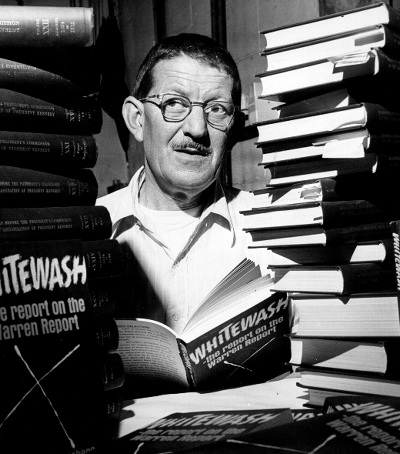
    Harold Weisberg
    Harold Weisberg

    At the time of the assassination, Harold Weisberg was trying to jump-start a writing career he had abandoned some years before. The son of Ukrainian émigrés and the first member of his family born in the United States, Weisberg was a former Senate investigator and journalist living in Maryland. He was immediately skeptical of the lone gunman story out of Dallas, so he drafted an outline for an article and sent it to his literary agent.

    The agent, Weisberg always recalled with astonishment, told him that nobody would consider publishing anything other than what the government said. “Can you understand how shocking that was to me?” he later asked. “With my background? And my beliefs about the functions of information in a country like ours?” Weisberg went on to write Whitewash and other books, all of them detailed analyses of the official case, and highly critical of the government’s handling of it.

    Other early critics included Mary Ferrell, a Dallas legal secretary; Vincent J. Salandria, an attorney in Philadelphia; Maggie Field, a housewife in Beverly Hills, California; and Sylvia Meagher, a researcher at the World Health Organization in New York, who later wrote a penetrating analysis of the case called Accessories After the Fact. Each was a product of that era some call America’s greatest generation.

    For most of these critics the assassination was nothing less than all consuming. “‘Oswald’ is the most spoken word in our house,” Salandria’s wife remarked in 1965. The objective: force a re-opening of the investigation. Although they began following and writing about the case immediately, it wasn’t until 1966 these critics began to get much media attention. Most labored in relative obscurity, and only gradually became aware of each other and their common goal. As they did, they began exchanging ideas and information by telephone, and by what today we refer to as snail mail. There was much the early critics didn’t know. But what they did know was that something was terribly wrong.

    For nearly all of the first generation critics, their initial research was simply tracking the assassination story as it was reported in the press, and noticing, in the first days and weeks, its inconsistencies.

    Like the rest, Mary Ferrell’s suspicions stirred almost immediately. At the time of the assassination she had just emerged from a Dallas restaurant not far from the scene of the crime. A passerby alerted her to what had happened. At almost the same moment police squad cars sped by, sirens blaring. “I ran into a bookstore and called my husband,” she recalled. He heard Kennedy had been shot in the head, Buck Ferrell told his wife, and no one could survive that kind of wound.

    Someone had a radio, and Mrs. Ferrell listened to the first sketchy descriptions of the wanted man. “I stood on Elm and thought that they would never find him with no more than that to go on, in an area containing over a million people.” She was thus astonished when the police arrested Lee Harvey Oswald about an hour later – and even more astonished that he did not match the broadcast description she had heard. “The Dallas Police were not gifted with ESP,” she wryly recalled. “And it just – it didn’t fit. And I said, Something is wrong. And I just, I thought, I’m going to find out what everybody said.”

    And so she sent Buck and their three sons to the loading docks of The Dallas Morning News and The Dallas Times-Herald where, in shifts, they awaited each updated edition of the daily papers. “Kind of a round robin, for four days,” Mary Ferrell remembered. “And we got every issue of every paper.”

    Mrs. Ferrell came across an article in the November 25th issue of the Times Herald hinting at something ominous. The article, “Anonymous Call Forecast Slaying During Transfer,” stated: “An anonymous telephone call to Federal Bureau of Investigation headquarters at 2:15 a.m. warned that Leo [sic] Harvey Oswald would be killed during his transfer from the city lockup to county jail.” The FBI alerted Dallas authorities – yet still Oswald was gunned down. Both papers were putting out multiple editions of each issue, but that article appeared in just one edition and there was no follow-up. “They junked that,” Mrs. Ferrell said. “There were very few copies of that that got loose.”

    Mary and Buck Ferrell
    Mary and Buck Ferrell

    Her interest further stimulated, Mrs. Ferrell continued collecting assassination-related material and never did stop. By 1970 her collection had become so vast that her husband added a room to the back of their Dallas home. “I can move all my books, papers, file cabinets, etc., out there and give the house back to Buck,” Mrs. Ferrell told a friend. She created an extensive database – originally on index cards, but in later years on a personal computer – and with another researcher, a series of chronologies that charted the people and events relating to November 22, 1963.


    In the end, the Warren Commission did not allow Mark Lane to represent the deceased accused assassin. “We are dealing with the mother of Oswald and this lawyer by the name of Lane,” Earl Warren told his commission colleagues in January 1964. “He wants to come right into our councils here and sit with us, and attend all of our meetings and defend Oswald, and of course that can’t be done.”

    A few days later, at New York’s Henry Hudson Hotel, Lane spoke about his preliminary findings to a crowd of about five hundred people. For the balance of the year he would lecture publicly about the case, at first just in New York, but soon during an ambitious lecture tour that criss-crossed the nation and even ventured as far away as Eastern Europe.

    On February 18, he was in New York for a speech that included an appearance by Marguerite Oswald. An enthusiastic crowd of 1,500 heard Mrs. Oswald say, “All I have is humbleness and sincerity for our American way of life.” She described how she tried to meet with her jailed son before he was murdered, but the Dallas police would not permit it. “Why would Jack Ruby be allowed within a few feet of a prisoner – of any prisoner – when I could not see my own son?”

    Sylvia Meagher
    Sylvia Meagher

    Among those in the hall that night was Sylvia Meagher, a 42-year-old researcher at the World Health Organization. “At that stage, I had little or no thought of doing any independent work or writing on the case,” she recalled. “I contributed both money and information unreservedly to Lane or his associates, and I would have been delighted to help in any possible way.”

    Yet she had already written a memorandum recording bitter thoughts. When the Warren Commission published its single-volume report she read it with a critical eye, and soon produced a 40-page article that she began shopping around to major magazines. “The Warren Report,” she wrote, “gives us no justification for declaring that the case is closed.”


    There were a lot of questions, just after the assassination, about how many times the President was hit, and where his wounds were located. Even after fifty years, these questions have never had definitive answers.

    Harold Weisberg was appalled that so many unanswered questions remained. “None should exist,” he declared. “This was not a Bowery bum; this was the President of the United States.” Post-mortem photographs of the late president’s wounds were never entered into evidence and the Commission members never saw them. Autopsy surgeon James Humes said he was “forbidden to talk,” and acknowledged having burned his autopsy notes. JFK’s neck wound was first reported to be one of entry, but later reported to be an exit wound. The first mention of a back wound was not made until nearly a month after the assassination. “As one version of the wounds succeeded another with dizzying speed and confusion,” Sylvia Meagher observed, “only one constant remained: Oswald was the lone assassin and had fired all the shots from the sixth floor of the Book Depository. When facts came into conflict with that thesis, the facts and not the thesis were changed.”

    The conclusion that one bullet caused multiple wounds in JFK and Texas Governor John Connally – the Single Bullet Theory – was undermined by the Warren Commission’s own evidence, the critics argued. That bullet, Commission Exhibit 399, was virtually undamaged, its appearance nearly pristine. The critics compared it to an identical bullet, Commission Exhibit 856, which had been test-fired by ballistics experts at the Army’s Edgewood Arsenal in Maryland. “The test bullet had been fired through the forearm of a cadaver,” said Ray Marcus, whose interest had expanded to include C.E. 399. That test bullet performed “only one of the multiple tasks allegedly executed by 399. Even so, the difference in the appearance of 856 and 399 is striking, as the former is grossly deformed.”

    In April 1964 Marguerite Oswald ended her relationship with Mark Lane. Almost immediately Lane formed an organization called the Citizens’ Committee of Inquiry to coordinate an independent investigation into the assassination. From its New York office, the CCI recruited a small army of volunteer investigators, some of who were dispatched to Dallas to interview assassination witnesses on Lane’s behalf.

    Vincent J. Salandria
    Vincent J. Salandria

    Among these volunteers were Vince Salandria and his brother-in-law Harold Feldman, a writer and translator. Both men were keenly interested in the assassination when it happened, and together had researched an article published in The Nation the previous January. On the morning of June 24, 1964, they left Philadelphia together in Salandria’s 1955 Buick sedan, armed with lists of names, notes, and other material supplied by Lane’s office. Feldman’s wife Immie accompanied them. Driving almost non-stop, they arrived in Dallas late the next day.

    Feldman and Salandria immediately contacted Marguerite Oswald. Media accounts had prepared them for a belligerent, uncooperative woman. “What I heard instead,” Feldman recalled, “was a pleasant ladylike welcome – not a trace of cautious ambiguity, not a second of hesitation in the warm courtesy that carried within it only a faint suggestion of loneliness.” The Feldmans and Salandria met with Mrs. Oswald over the next several days, and Marguerite even had them as overnight guests in her Fort Worth home.

    Harold Feldman, Immie Feldman, Marguerite Oswald

    (L-R): Harold Feldman,

    Immie Feldman, Marguerite Oswald

    Mrs. Oswald escorted the volunteer investigators to some of the key sites in the case. Together they visited Helen Markham, the Warren Commission’s star witness against Lee Oswald for the murder of Dallas Police Officer J.D. Tippit. Mark Lane had already spoken with Mrs. Markham by telephone, and her identification of Oswald as the killer of Tippit seemed shaky. A follow-up interview was important.

    Mrs. Markham lived in a small apartment over a barbershop. Mrs. Oswald, Salandria and the Feldmans found her at home, cradling her infant granddaughter in her arms and pacing back and forth. She declined to talk to them because, she said, she had to care for the baby. She would not let them pay for a babysitter, but did finally agree to let them return later in the day. As they spoke, Mrs. Markham allowed Marguerite to briefly hold the baby.

    Helen Markham, although a grandmother, was still young, Feldman observed – “but shabby, beaten, and spiritless.”

    They returned later that afternoon. As they approached the apartment they noticed two Dallas police cars, which had been parked right outside, pulling away.

    What happened next, Feldman later wrote, was “the most pitiful spectacle in our experience.” They knocked on the Markham apartment door. Mr. Markham was now home, and he stood barring the entrance as his wife cowered to one side.

    “I’ve never seen that kind of terror,” Salandria recalled years later. “Their teeth were actually chattering. And we could get little from them because of their terror.”

    “Please go away,” Mr. Markham had groaned. “Please go away, and don’t come back.”

    Marguerite broke in. “You’ve been threatened, haven’t you?”

    “Yes,” Mr. Markham replied. “Please, go away!”

    Shocked, they did as they were asked. As they got back out to the street and headed toward Mrs. Oswald’s car, Marguerite fought back tears. “That poor man!” she said. “He was frightened to death. What right do they have to threaten him? This is still America, by God.”

    Since alerting Marguerite Oswald to Mark Lane’s article, Shirley Martin had gone to Dallas several times to find assassination witnesses and talk to them. Not in any official capacity, of course: curiosity, and the feeling that something was not right, motivated her. Her proximity to Dallas – it was only two hundred miles away – proved an irresistible lure.

    By the summer of 1964 Mrs. Martin was in contact with Lane’s office, and Lane asked her to speak with a Dallas woman named Acquilla Clemons. Acquilla Clemons was not an eyewitness to the Tippit murder but was nearby, and witnessed some things that were at odds with what was reported in the press.

    The Warren Commission had not called Mrs. Clemons to testify, and these early Citizens’ Committee-sponsored trips first brought her story to light. There were at least three interviews with Mrs. Clemons by committee volunteers over the summer of 1964: by two Columbia University graduate students named George and Pat Nash; Salandria and the Feldmans; and Shirley Martin.

    George and Pat Nash were unimpressed with Acquilla Clemons. They wrote that her description “was rather vague, and she may have based her story on second-hand accounts of others at the scene.” Unfortunately the Nashes did not say why they doubted her.

    Salandria and Feldman interviewed Mrs. Clemons in early July. No record of their conversation appears to exist, but Salandria later said, “I thought she was entirely credible.”

    Shirley Martin
    Shirley Martin

    Shirley Martin spoke to Mrs. Clemons in August, about a month after Salandria and Feldman and the Nashes. She was not at all confident that Acquilla Clemons would talk to her. And so her daughter Vickie, who accompanied her mother, hid a tape recorder in her purse.

    For much of the conversation, Mrs. Clemons gave Mrs. Martin a lot of reasons why she didn’t want to talk to her. Mrs. Martin seemed to sense her nervousness. “I’m a private citizen,” she said. “I’m not representing any group.” Still Mrs. Clemons demurred; her employer, she said, did not want her involved in the case in any way.

    Undaunted, Shirley continued. “This friend of mine was here…I don’t know if you remember. Mr. Nash? Mr. Salandria? They talked to you?”

    “Someone came by my house about two months ago,” Mrs. Clemons replied. They promised to send her a picture of Lee Oswald, she said, but never did.

    Finally Mrs. Clemons began to talk. She described seeing two men, neither of them Oswald, in the vicinity of the Tippit killing. More than once since then, she said, the police had warned her not to talk to anyone about what she had witnessed on November 22nd.

    “So the police said you’d get a lot of publicity and you’d better not do it?”

    “Yeah, I’d better not,” Mrs. Clemons replied. “Might get killed on the way to work.”

    “Is that what the policeman said?” Shirley Martin asked.

    “Yes,” Mrs. Clemons answered. “See, they’ll kill people that know something about that…there might be a whole lot of Oswalds…you know, you don’t know who you talk to, you just don’t know.”

    “You scare me…”

    “You have to be careful,” Mrs. Clemons said. “You get killed.”


    The Warren Commission’s single-volume Report was published in September 1964, and two months later its 26 volumes of hearings and exhibits. This was the moment that the early critics had been waiting for. “I was wildly excited,” Sylvia Meagher recalled. “I opened the box. There were the 26 volumes, everything I’d been looking forward to studying for a long time.” Meagher went on to write a devastating analysis entitled Accessories After the Fact.

    The news media, too, greeted the Warren Report with great enthusiasm – but from a much different perspective. Time magazine called it “amazing in its detail [and] utterly convincing,” while The New York Times said “the evidence of Oswald’s single-handed guilt is overwhelming.” The CBS, NBC and ABC television networks all hailed the Report as the final word on President Kennedy’s assassination, and devoted much airtime to its findings.

    Mark Lane, who had been speaking publicly about the weaknesses in the government’s case since January, now began debating the Report and its validity. In October 1964 he sparred with Melvin Belli, the celebrated attorney who had unsuccessfully defended Jack Ruby for murdering Lee Oswald. Belli performed badly and was even jeered by the audience; he conceded that Lane “was bright and he had an almost encyclopedic knowledge of the facts.”

    On December 4 Lane took part in a much more important event, appearing with a Warren Commission staff attorney named Joseph Ball at a high school in Beverly Hills, California. It was the first time anyone associated with the Commission agreed to publicly defend its findings. At the time of this confrontation, the Commission’s Hearings and Exhibits had only been available for about a week.

    To help Lane prepare, several critics met a few days beforehand and began pouring over these 26 volumes. Their meetings took place at the home of Maggie Field. Most there had been in contact with Lane’s Citizens’ Committee office, but it was the first time they were meeting each other. And it was the first time many of them were getting a good look at the Warren Commission’s official evidence.

    While technically not a debate, the strengths and weaknesses in the government’s case were given a thorough airing that night before an overflow crowd of several thousand. For forty-five minutes, Lane held the audience spellbound with a summary of the deficiencies in the case against Oswald. And he assured them it was their right to know the truth. “We are going to remain with this matter until such time as the American people secure that to which we are all entitled in a free, open, and democratic society. And that is some intelligible answers to the thus far unanswered questions of Dallas on November 22.”

    But Joseph Ball assured the audience that the Commission had performed with honesty and integrity, and had found the correct answers. He emphasized his independence and impartiality. “It didn’t make any difference to me whether I discovered Oswald was the assassin or that someone else was.”

    Mark Lane, Ball charged, was picking and choosing from the evidence, and ignoring that which implicated Oswald. Lane interrupted to challenge this point, and the two argued back and forth. Each managed to call the other a liar. Finally Ball seemed to have had enough: examining Mark Lane, he declared, would only result “in a cat and dog fight.”

    “Well that’s all right,” Lane countered. “It’s about time we had a dialog in America on this question.”

    When the event was over, a reporter asked audience members about what they had witnessed. “It was like, a shocking drama,” said one. Several added that they found it troubling that someone of Joseph Ball’s stature was unable to answer many of the points Lane made. Most agreed that Lane had won. “The byproduct of his defense of Oswald,” one man said, “is to show that there has been, no matter what the motivation on the part of the Warren Commission, and many areas of government, an attempt to cover up.”


    In spite of their diverse backgrounds and political orientations, the first generation critics maintained informal, sometimes uneasy alliances with each other for several years. There were occasional meetings, most notably in October 1965, when some of the critics, including Vince Salandria and Maggie Field, gathered in Sylvia Meagher’s home.

    There was great excitement in the fall of 1966 when Republican Congressman Theodore Kupferman proposed a special committee to review the Warren Commission’s work. Nothing ever came of the freshman lawmaker’s idea. But just a few months later there was even more excitement with the electrifying news that New Orleans District Attorney Jim Garrison had launched his own investigation into the Kennedy assassination.

    Garrison freely acknowledged his debt to the work of the critics, in particular that of Mark Lane, Harold Weisberg, and a newcomer named Edward J. Epstein. Lane was among the first of the critics to get actively involved in Garrison’s investigation, lending his expertise; Harold Weisberg, Vincent J. Salandria, and others soon followed. Maggie Field raised funds for the D.A. and made plans to visit New Orleans.

    “I have repressed the occasional impulse to rush to the airport and fly to New Orleans,” Sylvia Meagher said in April 1967. But her enthusiasm was short-lived. By that summer Meagher and several others had lost all faith in Jim Garrison. It proved to be an irreconcilable issue between them, and by that fall, Meagher had severed ties with most of the other critics. For better or worse, Jim Garrison’s case ultimately failed. Afterward it seemed to many that the search for truth had been dealt a devastating setback.


    That the Warren Commission’s lone gunman theory is so widely rejected today suggests that the critics’ work proved it was wrong. And it did – yet it is also true that public skepticism has always run deep. Surveys taken within a few weeks of the assassination showed widespread doubt about the official story. The numbers have fluctuated over the years, but public opinion polls have consistently revealed this doubt. Perhaps what the critics really did was provide the details to what most Americans, in their bones, already knew.

    So who killed JFK? We still don’t know for sure, although theories abound. And while later generations of assassination researchers pursued this question with great zeal, many of the earliest critics stopped short of affixing responsibility. “After all these years,” Sylvia Meagher remarked in 1975, “I still do not know if it was the CIA, the military, LBJ, the Cubans, or the Mafia, or any combination of them. But I always knew, know, and will always know for a certainty that C.E. 399 is a fake, that the autopsy is a fraud, that much of the other hard evidence is suspect or tainted, and that the Warren Report is false and deliberately false.”

    Maggie Field once told an interviewer that finding the truth about the murder of JFK was of paramount importance. “Until we can get to the bottom of the Kennedy assassination, this country is going to remain a sick country,” she said. “No matter what we do. Because we cannot live with that crime. We just can’t.”

  • “I Don’t Think Lee Harvey Oswald Pulled the Trigger”: An Interview with Dale Myers


    Note: This transcript is from an interview with Dale Myers, conducted back in 1982. At that time I was working as a reporter at WEMU-FM in Ypsilanti, Michigan, a public radio station on the campus of Eastern Michigan University. Myers came to the campus to lecture on the assassination of JFK, and I covered it for the station. We spoke a day or two before the lecture, and an edited version of that interview was broadcast on November 18, 1982.

    Myers was, as the following makes plain, selling conspiracy.


    John Kelin: It’s been close to twenty years since the assassination. Why should people still be concerned about this, at this late date?

    Dale Myers: Oh, well, because the act of the assassination was simply – that’s the thing that opened the window, so to speak. The public got a glimpse of an intelligence covert operation. You know, prior to 1963 we were pretty much in a cocoon, so to speak, as far as how government operates. Since then, of course, we’ve had Watergate, and all the other atrocities of government.

    And so, I guess what people don’t realize is that the assassination has a direct bearing on what is happening today. And we’ve all heard the cliché that history repeats itself. And I guess it’s because people never read history. And so I think it’s important that we understand what happened simply for historical context – not that anybody is going to be prosecuted, or that anybody is ever going to prove, you know, that this guy did this – or whatever.

    John Kelin: What do you hope to accomplish with this lecture?

    Dale Myers: Okay. I was prepared for this question! [laughs]

    The point is not to prove that this person had his finger on the trigger, or that these people were involved – although certainly we’ll cover that area. The point, really, is seeing how certain agencies, or certain government agencies, reacted. This was an extremely tense situation. And there was a tremendous covert operation that was tied directly to the assassination. Not that they were involved, but there’s a direct link between a covert operation that was going on at this particular time. And there were a lot of agencies involved. Military intelligence, the FBI, the Central Intelligence Agency. And how they reacted – and of course the coverup came from that – but how they reacted during this particular situation, with all the pressures they were under, public and otherwise, is important today. If something similar – not to say a shooting or an assassination – but a similar situation, where there’s an immense amount of public pressure, a tense situation where, you know, whether it be covert or not – but where there’s pressure on the agencies – then we have an inkling, or we have an idea, of how they’re going to react.

    John Kelin: What do you think about Lee Harvey Oswald? Could he have done it by himself?

    Dale Myers: Oh, certainly: anybody could have done it by themselves. First off, I don’t think Lee Harvey Oswald pulled the trigger.

    John Kelin: The trigger, or a trigger?

    Dale Myers: Okay … a trigger.

    John Kelin: I mean – you know, if there were two gunmen, could he have been one of them?

    Dale Myers: Exactly. Okay. Well the gun that was fired from the Texas School Book Depository was the gun that fired all the shots that hit any victims. And including the fatal shot. But I don’t think he was the finger that was behind that trigger. Although there’s no doubt that it was his rifle. And to say that he did not pull the trigger does not mean that he was not involved in some way; he obviously was involved. But as far as saying that he was guilty … I find that extremely hard to believe. And I think I’ll show enough evidence to indicate, or that I think I could circumstantially beyond a reasonable doubt, so to speak, prove to anybody else, that he was not the man behind the trigger.

    You know, that’s one thing about this that’s good for myself as far as – it doesn’t get monotonous. In other words, it’s not a ritual where every year I get out and I go through the same tired old facts, and re-hash the same things the Warren Commission did back in 1964.

    John Kelin: What’s new in the investigation?

    Dale Myers: I think the primary thing is the National Academy of Sciences, which came out with the report that refutes, and I would say conclusively, along with them, the acoustics, or ballistics, report that the House Select Committee based their decision that there were two gunmen firing at President Kennedy in 1978 – the Report came out early this year.

    John Kelin: Mm-hmm.

    Dale Myers: And they did their investigation last year. It refutes conclusively, as I say, that there were two gunmen. In other words, the Dallas police tapes that supposedly show that there were four shots fired at the President at such and such a spacing – one from the grassy knoll – is inaccurate. There are no tapes that reveal the shots that we know of.

    So, that changes…

    John Kelin: Everything! That changes everything!

    Dale Myers: Well – yeah, pretty much. That changes your – that changes not only the acoustics, but the trajectories that the House Select Committee did were based on the acoustics. So that throws all that out the window.

    John Kelin: Right. They concluded that there was a conspiracy based on those tapes.

    Dale Myers: Uh … yeah. There was – well, see, there’s a lot of circumstantial evidence. But yeah, they were looking for some – most of their report was based on hard evidence. So when they had this hard evidence of a tape showing two gunmen, then they were pretty confidant that they could write in their Report that there was more than two men, therefore a conspiracy. That is not to say that there was not a conspiracy simply because there’s no tape. It simply means that there’s no hard evidence that we thought we had that shows a conspiracy.

    So, again, that changes the trajectory, and pretty much we’re back at square one, where we were back in 1964. Or at least prior to 78, where there’s really just no hard evidence that there was a man firing from the grassy knoll. Again, there’s a tremendous amount of circumstantial evidence, and I still believe there was someone firing from the grassy knoll. But again, there’s no hard evidence.

    So it changes a lot of things.

    John Kelin: I think, if only for convenience’s sake, a lot of people are inclined to accept the Warren Commission’s findings, in spite of the ’78 report.

    Dale Myers: Sure. That stands to reason. Because again, you know, most people have never read anything on this. The average guy doesn’t do what I do. And that’s not to say that I’m any better than anyone else. It’s just to say that I think I have a responsibility, if I’m going to do this, that I need to disseminate the information. And the more I find out, the more important I think it is to just disseminate the information.

    You know, some people will sit through this lecture, and they’ll still walk away convinced that Lee Harvey Oswald was, regardless of what they hear, that he was the gunman. And that’s fine. But at least I’ve done my job. I’ve said, “Now, okay, here are the facts. You can make up your mind.” And pretty much that’s how I approach the lecture.

    John Kelin: What do you think Oswald was doing at the time the shots were fired?

    Dale Myers: Well, I think that he —

    John Kelin: This is just your opinion, I know…

    Dale Myers: Exactly. Because there were no witnesses to what he was doing, which obviously makes it extremely suspicious. But just as there are no witnesses that give him an alibi, there are also no witnesses that can put him in the window with the gun in his hand. You know, in 1963, Police Chief Jesse Curry said, “This case is cinched. This is the man who killed the President.” Three years later, he told reporters, “We never had any evidence that Oswald was the man in the window.” He says, “We don’t have any witnesses that can put him in that window with the gun in his hands.”

    I think the evidence indicates – and there are a lot of eyewitnesses who saw him immediately before the shots – that he was probably on one of the lower floors [of the Texas School Book Depository building] having lunch.

    John Kelin: Wasn’t he seen on the lower floors just a minute or so after the shots were fired, by a cop and the building foreman?

    Dale Myers: Exactly. That’s an extremely – well, that really is pretty much the alibi. If you’re looking for an alibi that Oswald would have had, that would have been his alibi. And I will go into that in depth in the lecture.

    In fact, I’ve got photographic evidence – because I like to use hard evidence in my lectures as well – I’ve got photographic evidence that indicates that not only is – well, it’s extremely unlikely that Oswald could have been the gunman, based upon that. There are some photographs that were taken that indicate the gunman lingered in the window … it deals with the boxes in the window.

    John Kelin: They were moved?

    Dale Myers: Yeah. The boxes were – well there were always indications that the boxes would have to have been re-stacked … there are photographs that were taken from the outside of the building minutes after the shots, that show a before and after. Immediately after the shots, three seconds after the shots, you see the boxes arranged one way. And there’s a picture taken about a minute later which show the boxes in the window re-arranged. So that means the gunman lingered long enough in the window, and there’s photographic proof, to re-arrange the boxes. And any time delay raises an extreme question of reasonable doubt of whether or not Oswald would have had time to get down to the second floor lunchroom.

    And we’re not even talking about a lot of other factors, that we’ll go into [in the lecture].

    John Kelin: Your area of expertise is J.D. Tippit’s murder?

    Dale Myers: Exactly.

    John Kelin: How does that figure in?

    Dale Myers: Well that’s the amazing thing. Because, you know, that’s one of the most under-researched, the little-talked about – you know, Mark Lane, it was a chapter in his book. Most other writers – Summers, it was a half a page, you know – well, they’re trying to encompass the whole assassination, and it’s really all they could devote. But really, you could write a book on just the murder of J.D. Tippit. And it’s extremely important.

    And I think the best person to quote on that would be one of the Warren Commission staffers himself, David Belin, who of course was one of the prime motivators, a prosecutor so to speak, proponent, of the lone gunman theory, and the fact that Oswald was alone in this whole thing.

    And he said about the Tippit murder, that “The murder of Dallas patrolman J.D. Tippit is the Rosetta Stone of the assassination of President Kennedy.” It’s the Rosetta Stone of the case against Lee Harvey Oswald. In other words, if Lee Harvey Oswald killed J.D. Tippit, in other words if we can prove that, then it stands to reason, and extremely logical, and I would follow his logic, that he also killed President Kennedy. Because we show a capacity for violence. And not only violence in his lifetime, but forty-five minutes after President Kennedy is shot. Okay?

    But also, let’s look at it the other way. If we can prove, or show, that Oswald did not kill J.D. Tippit, then we raise the question of whether or not he murdered President Kennedy. Because we remove the capacity for violence that David Belin used to help the Warren Commission paint the picture of a lone gunman, you know, on Lee Harvey Oswald.

    I think I will be able to show, beyond a reasonable doubt, that Oswald was not the killer of J.D. Tippit. That Tippit’s murder was connected to the assassination of the President. And that the reason Oswald was arrested was because the FBI had advance knowledge of his activities.

  • “New” Film of JFK Route


    The Sixth Floor Museum at Dealey Plaza has made public a previosly-unknown home movie shot by a spectator along the motorcade route in Dallas on November 22, 1963.

    The film was shot by a man named George Jefferies and is currently posted to the museum’s web site.

    The eight millimeter color film was shot at Main and Lamar streets in downtown Dallas, about four blocks from the scene of the assassination in Dealey Plaza. According to museum archivist Gary Mack, it shows JFK and Jackie Kennedy about ninety seconds before the assassination.

    George Jefferies apparently believed the film had no historic value, and so made no effort to publicize it in the decades since the assassination. But Jefferies’ son-in-law Wayne Graham thought otherwise and contacted the museum in late 2005.

    After they donated the film, the museum had it restored before making it public.

    Press reports emphasized Mack’s observation that it was “the clearest, best film of Jackie in the motorcade” that he had ever seen. The President and First Lady are seen only briefly in the film.

    Much was also made of the fact that there appears to be a slight bunching of JFK’s jacket in the area between his shoulders.

    Speaking on Slate.com, author Ron Rosenbaum said the Jefferies film is not very important. “The real mystery is why the person who took this film waited forty-five years, almost, to show us something that doesn’t really show us anything,” he told Slate’s Andy Bowers.

    But Rosenbaum also said the bunching of the jacket might help prove the Warren Report was correct in naming Lee Harvey Oswald Kennedy’s sole assassin. “The question is the trajectory of the bullet that hit JFK,” he said. “There’s been a lot of controversy because the hole in the back of JFK’s jacket and the hole in his body seemed to be at different points. But the fact that the jacket could have been bunched up might resolve this discrepancy.”

    “So this might debunk part of the conspiracy theory?” Bowers asked.

    “I think the real mystery,” Rosenbaum replied, “is not whether Oswald acted alone. I believe he acted alone. He was the only one firing the gun. The real mystery is what is going on inside Oswald’s head: what prompted him, what his motive was, what his allegiances were. Those are still unresolved questions.”

    The discrepency between the holes in the jacket and the holes in the body up-end the Commission’s entire case. The Commission placed a bullet wound high on Kennedy’s back. But photos of JFK’s shirt and jacket show holes further down, about five inches below the collar line.

    Two very reliable witnesses, both Secret Service agents, placed JFK’s back wound in line with the clothing holes. As Vincent J. Salandria noted in an article written in 1964, Glen Bennett was positioned behind JFK in the motorcade, and put the back wound about four inches down from the right shoulder. Agent Clint Hill was present at the autopsy and said this wound was about six inches below the neckline to the right of the spinal column.

    Forty years before Ron Rosenbaum, Arlen Specter cited a bunched-up jacket to try explaining the discrepancy between the holes in Kennedy’s clothing and the (presumed) holes in his body. It happened as Specter was interviewed by Gaeton Fonzi, and Fonzi described it in his 1993 book The Last Investigation. Using Fonzi as a stand-in for JFK, Specter asked him to wave as the President had done. “Well, see, if the bullet goes in here,” Specter said, jabbing at Fonzi’s neck, “the jacket gets hunched up…”

    “Wasn’t there only one single hole in the jacket?” Fonzi asked. “Wouldn’t it have been doubled over?”

    “No, not necessarily. It, it wouldn’t be doubled over…when you sit in the car it could be doubled over at most any point, but the probabilities are that, uh, that it gets, that uh, this, this, this is about the way a jacket rides up…”

    “Specter made a fool of himself with Fonzi in trying to defend the single bullet theory,” Salandria recalled in 2007, when asked about the Jefferies film and the apparent jacket-bunching. “If he could not defend the single-bullet concept, then it is not defensible.”

    Just how extensively this new Jefferies film will be used to promote jacket-bunching to explain the jacket/body discrepancy remains to be seen.

  • Gerald Ford Dies

    Gerald Ford Dies


    Gerald R. Ford, the thirty-eighth President of the United States and last surviving member of the Warren Commission, died the day after Christmas. He was 93 years old.

    In announcing Ford’s death, his widow Betty Ford said, “His life was filled with love of God, his family, and his country.”

    No cause of death was immediately given, but Ford had suffered a number of medical problems over the preceding year.

    ford sworn in

    Gerald Ford ascended to the Presidency in 1974 following the resignation of Richard M. Nixon. He ran for re-election in 1976 but was defeated by Jimmy Carter.

    Ford was an undistinguished congressman from Michigan when Lyndon Johnson appointed him to the Presidential commission investigating the assassination of President Kennedy in 1963. That commission, of course, concluded that Kennedy was killed by Lee Harvey Oswald, and that there was no conspiracy in the assassination.

    Publicly, at least, Mr. Ford stood by that conclusion for the rest of his life, in spite of overwhelming evidence of conspiracy. In 1991 he said, “I reaffirm the two basic decisions of the Warren Commission are as valid today as they were then. Those were that Lee Harvey Oswald committed the assassination, and secondly, our commission found no evidence of a conspiracy, foreign or domestic…I don’t think we have found any evidence to date that there was a conspiracy.”

    In 1997 the Assassination Records Review Board released materials showing that Ford personally altered the wording of some sections of the Warren Report, and in so doing strengthened its lone-assassin case. Probe magazine reported (October 1997, Vol. 4 No. 6) that then-Commissioner Ford edited a draft of the Report, changing the location of one of JFK’s wounds. “By moving the point of entry from the back to the neck,” Probe said, “Ford alters the trajectory of the bullet through Kennedy’s body making the Commission’s [lone assassin] thesis more tenable.”

    In 1966 Ford published a book called Portrait of the Assassin, ghostwritten by his assistant John R. Stiles. The book opened with an account of a top-secret Warren Commission meeting in January 1964, in which the Commission heard allegations that Lee Oswald was an FBI informant. “Ford quoted extensively but selectively from what he called ‘discussions among members of the Commission on Monday, January 27,’ 1964,” Harold Weisberg wrote in Whitewash IV: JFK Assassination Transcript. “In other words, he published for personal profit excerpts from this TOP SECRET executive session of January 27, edited to his own liking and advantage and for his own dishonest political purposes.”

    Weisberg further asserted that Ford lied about this during his Senate confirmation hearings in 1973.

    The early days of Ford’s 895-day administration were touched by controversy when Ford pardoned Richard M. Nixon for all crimes he committed as President. According to conventional wisdom, this may have contributed to his failed re-election bid in 1976. In between the pardon and his defeat, two attempts were made on his life.

    On December 27, 2006, CBS Evening News broadcast a videotaped interview with Ford dating back to 1984. CBS informed its viewers that Ford granted the interview with the stipulation it not be broadcast until after his death. In the excerpt CBS showed, Ford recalled reading a draft of his first speech as president, following Richard Nixon’s resignation. “I read it and that phrase, ‘the long national nightmare,’ sort of jarred me. I said, ‘Bob, we really ought not to use that. Let’s not be too harsh.’” Speechwriter Bob Hartmann prevailed. Any other juicy tidbits from that interview? Not yet, and I’m not holding my breath.

    It is worth remembering that Gerald Ford’s legacy also includes vetoing a bill to amend the Freedom of Information Act, reportedly at the urging of Chief of Staff Donald Rumsfeld, and Dick Cheney and Antonin Scalia.

    Most initial news reports of Gerald Ford’s death stressed that Ford was the nation’s only unelected President, but those accounts failed to consider current president George W. Bush.


    Click here to see a cartoon recalling Gerald Ford’s editing skills.