
(Click here if your browser is having trouble loading the above.)
Author: James DiEugenio
-

JFK VS LBJ: The MSM in Overdrive
As our readers know, I just did a two-part review of the very poor CNN four-part special about Lyndon Johnson, largely modeled on the work of Joe Califano. As an honest appraisal of Johnson’s presidency, that program was simply unforgiveable, both in regard to Johnson’s domestic and foreign policy. (Click here for details) Concerning the latter, it actually tried to say that Johnson did not decide to go to war in Indochina until after the Tonkin Gulf Resolution had passed. Since LBJ used that resolution as an act of war, most of us would fail to see the logic in that, but that is how desperate CNN and the production company, Bat Bridge Entertainment, were in trying to salvage Johnson’s reversal of Kennedy’s withdrawal plan and decision to enter a disastrous war in Vietnam. That war plunged America into a ten-year-long struggle that resulted in epic tragedy for both Indochina and the USA.
Mark Updegrove was one of the talking heads on that program, as well as one of its executive producers. Updegrove was the director of the LBJ Library for eight years. He is now the president and CEO of the LBJ Foundation in Austin. He began his career in magazine publishing. He was the publisher of Newsweek and president of Time/Canada. He was that latter magazine’s Los Angeles manager, but he was also VP in sales and operations for Yahoo and VP/ publisher for MTV Magazine. In other words, Updegrove has long been a part of the MSM.
I could not find any evidence that Mark is a credentialed historian. All I could discover is that he had a Bachelor’s Degree in Economics from the University of Maryland. I don’t think it is improper to question whether or not a man should be running a presidential library if he is neither an historian nor an archivist. The writing of history is a much different discipline than being a publisher or running business operations. At its fundamental base, it means the willingness to spend hours upon hours going through declassified documents, supplementing that with field investigation, and also tracing hard to find witnesses. Then, when that travail is over, measuring the value of what one has found.
It is not an easy task to write valuable history, especially of the revisionist type that bucks the MSM, for the simple reason that revisionist history that challenges hallowed paradigms is not a good path to career advancement. The much safer path is what the late Stephen Ambrose did. When a friend of his did discover powerful evidence which demanded a revisionist reconstruction about World War II, Ambrose first befriended him and then—measuring the costs to his career—turned on him. That is the kind of behavior that gets you business lunches with people like Tom Hanks. (James DIEugenio, The JFK Assassination: The Evidence Today, pp. 45–48)
As I reviewed at length and proved with many examples, the aim of the above CNN series was to somehow elevate Johnson’s rather poor performance as president over the space of five years. It was a presidency that was so violent, corrosive, and polarizing that the late Philip Roth wrote a memorable book about its enduring and pernicious impact on the United States. There were many instances that I did not even deal with in my two-part review of that series, for example the overthrow in Brazil and the forcing out of George Papandreou in Greece in 1965. Who can forget Johnson’s rather direct reply to the protestations of the Greek ambassador in the latter case:
Then listen to me Mr. Ambassador: fuck your Parliament and your Constitution. America is the elephant. They may just get whacked by the elephant’s trunk, whacked good…We pay a lot of good American dollars to the Greeks, Mr. Ambassador. If your Prime Minister gives me talk about Democracy, Parliament, and Constitutions, he, his Parliament, and his Constitution may not last very long. (William Blum, The CIA: A Forgotten History, p. 244)
As William Blum shows in his book, Johnson was true to his word.
Because of the above, it is not an easy job to somehow whitewash and then rehabilitate Johnson the man and Johnson the president, especially because LBJ followed President John Kennedy and almost systematically reversed much of his foreign policy, with so many debilitating results. In his film JFK: Destiny Betrayed, Oliver Stone showed those actions in relation to Indochina, Congo, the Middle East, and Indonesia. That film also tried to show how Kennedy was also working on modes of détente with both Cuba and the USSR. These were both abandoned by the new president.
Apparently Updegrove is well aware of how poorly Johnson does in a comparison with Kennedy. He has now written a book about Kennedy. Because of his longtime relations with Time magazine, he got them to do what is essentially a preview/promo for that book. (See Time online April 26, 2022, story by Olivia Waxman.)
To see where Updegrove’s book Incomparable Grace: JFK in the Presidency is coming from, one can simply read the italicized intro to his own summary. Waxman writes that since 1963, there have been “myths and misunderstandings” about JFK and the early “gunning down” of the handsome leader caused some of this “continued fascination.” Waxman then lets Updegrove, who is not an historian, take charge with these words:
History in its most cursory form is a beauty contest and, as we look at John F. Kennedy, he’s a perfect President for the television age, because he shows up so well and speaks so elegantly.
Who needs to read the book? We have seen this infomercial so many times by the MSM that reading the book is superfluous. Kennedy was the glamour president. He was handsome, exquisitely tailored, a good speaker, and witty. This was what made him an icon in history, but he really did not have any notable achievements behind him. It was all glitz. And then Updegrove begins that part of the MSM formula: the belittlement of JFK, the so called myths and misunderstandings that caused the continued fascination with Kennedy the president. Mark chooses three areas to hone in on for his attack.
The Missile Crisis
He begins by saying that the first myth is that “JFK won the Cuban Missile Crisis by staring down the Soviets.” Updegrove then writes that the true cause of the crisis was that the Russians knew they were at a large atomic disadvantage and also that the USA had offensive missiles in Turkey. Therefore, this was not just “recklessness on the part of Nikita Khrushchev,” it “was really more of a calculated risk.” The risk being to get the missiles removed from Turkey. He says the world did not know about the Turkish agreement at the time. I would beg to disagree and you can find my basis for disagreement in the following story from the New York Times in late November of 1962. The agreement about Turkey was out and known in the public at that time. Unlike what Updegrove wants to maintain, most understood what the main terms of the agreement were. But further, to say that was the basis of the agreement is to ignore that the Russians had about ten times as many missiles in Cuba as the USA did in Turkey. (Philip Zelikow and Ernest May, The Kennedy Tapes, p. 60)
I would, however, also disagree with him on two other more important points. First, JFK’s achievement in the Missile Crisis was not a “stare down”. It was avoiding a nuclear conflagration. Anyone who reads the book The Kennedy Tapes will understand that JFK took the least provocative and least risky alternative that was offered him: the blockade. Many others in the meetings recommended bombing the missile silos or an outright invasion of Cuba. Both Kennedys were asking about the former: Would that not create a lot of casualties? (May and Zelikow, p. 66) Kennedy became rather disenchanted with that option.
What Kennedy did was opt for the blockade, which also gave the Kremlin time to think about what they were doing. This neutralized the hawks in both camps. And I should not have to tell Updegrove how angry and upset the Joint Chiefs were with that choice. General Curtis LeMay accused Kennedy of appeasement and compared what he was doing to what Neville Chamberlain did at Munich with the Nazis. (James DiEugenio, Destiny Betrayed, Second Edition, p. 57)
But what is important here in regard to Updegrove is that in reading the transcripts, Johnson was siding with the hawks. At a meeting on October 27, 1962—towards the end of the crisis when Kennedy was trying to corral the confidence of his advisors for an agreement—Johnson was not on board. He said, “My impression is that we’re having to retreat. We’re backing down.” He then said we made Turkey insecure, and also Berlin:
People feel it. They don’t know why they feel it and how. But they feel it. We got a blockade and we’re doing this and that and the Soviet ships are coming through. (May and Zelikow p. 587)
He then said something even more provocative in referring to a U2 plane shot down by Cuba, “The Soviets shot down one plane and the Americans gave up Turkey. Then they shoot down another and the Americans give up Berlin.” (Ibid, p. 592) He then got more belligerent. He said that, in light of this, what Khrushchev was doing was dismantling the foreign policy of the United States for the last 15 years, in order to get the missiles out of Cuba. He topped off that comment by characterizing Kennedy’s attitude toward that dismantlement like this: “We’re glad and we appreciate it and we want to discuss it with you.” (ibid, p. 597) It’s reading things like that which makes us all grateful Kennedy was president at that time.
This is what Kennedy’s achievement really was, not taking this crackpot hawkish advice and instead working toward a peaceful solution that would satisfy everyone. And with this on the table, we can now fully understand Updegrove’s next point.
The Vietnam War
Updegrove says it was a myth that Kennedy would have pulled out of Vietnam. In his article, he ignores the fact that Kennedy had already given the order to begin that withdrawal with NSAM 263. He then pens a real howler: Kennedy did not tell any of his military advisors about his intent to withdraw. I could barely contain myself when I read that, but this is how desperate one gets when trying to argue this point, which has been proven through the Assassination Records Review Board (ARRB) beyond any reasonable doubt.
Most people would consider Robert McNamara a military advisor; after all he was the Secretary of Defense running the Pentagon. Roswell GIlpatric was McNamara’s deputy. In an oral history, he said McNamara told him that Kennedy had given him instructions to start winding down American involvement in Vietnam. (James Blight, Virtual JFK, p. 371) McNamara then conveyed this instruction to General Harkins, another military man, at a conference in Saigon in 1962. McNamara told Harkins to begin to form a plan to turn full responsibility for the conflict over to South Vietnam. (James Douglass, JFK and the Unspeakable, p. 120) In May of 1963, Harkins and all departments in Vietnam—military, CIA, State—submitted those withdrawal plans to McNamara. I showed the documents of this conference on a Fox special last year. I said, as anyone can see, everyone there knew Kennedy was withdrawing and there was no serious dissent, since they knew it was the path the president had chosen. (See the program JFK: The Conspiracy Continues) These documents were declassified by the ARRB in late 1997, so they have been out there for well over 20 years.
But further, the Board also declassified the discussions Kennedy had with his advisors in October of 1963, when the withdrawal plan was being implemented. At that time, Kennedy and McNamara overruled all objections to the withdrawal by people like National Security Advisor McGeorge Bundy and Joint Chiefs Chairman Max Taylor. Again, Taylor was another military man. (John Newman, JFK and Vietnam, 2017 edition, pp. 410–11). Finally, when McNamara was leaving the Pentagon, he did a debrief interview. There, he said that he and Kennedy had agreed that America could help, supply, and advise Saigon in the war effort, but America could not fight the war for them. Therefore, once that advisement was completed, America was leaving; and it did not matter if Saigon was winning or losing: we were getting out. (Vietnam: The Early Decisions, edited by Lloyd C. Gardner and Ted Gittinger, p. 166)
Johnson is a liability for Updegrove here also. He knew all of this. And he objected to it. In a February 1964 discussion with McNamara, he bares his objection to Kennedy’s plan for withdrawal. He says he sat there silent thinking, what the heck is McNamara doing withdrawing from a war he is losing. (Blight, p. 310)
I really do not see how it gets any clearer than that.
JFK and Civil Rights
I just did a long review of this issue on Aaron Good’s series American Exception. Updegrove uses the hoary cliché that Kennedy came late to the issue and “he refused to do anything on a proactive basis relating to civil rights.” Both of these are utterly false and, again, LBJ ends up being a liability for Updegrove.
In 1957, President Eisenhower and Vice-President Nixon sent a mild, nebulous bill to Capitol Hill to create a pretty much toothless Civil Rights Commission. Neither man gave a damn about civil rights. In fact, Eisenhower had advised Earl Warren to vote again the Brown vs Board case. (Click here for details) The reason they did this was because Governor Orville Faubus had just humiliated the president over the crisis at Little Rock, so this was a way of salvaging the president’s image. The other reason was that the GOP wanted to split the Democratic Party between the northern liberals and the southern conservatives, and this was a way to do it.
In order to minimize that split, Majority Leader Lyndon Johnson watered the bill down even more, to the point that Senator Kennedy did not want to vote for it. Johnson had to lobby him to do so. Finally, JFK relented after his advisors told him it would be better than nothing. Prior to this, for 20 years, LBJ had voted against every civil rights bill ever introduced on the Hill. And he did so on the doctrine of States Rights, echoing John Calhoun. The reason he relented this time was that he knew he could not run for president as a veteran segregationist. This was what had crippled his mentor Richard Russell’s presidential ambitions. Contrary to what Updegrove writes, this is why Kennedy was so eager to get to work on this issue in 1961.
Kennedy had hired Harris Wofford, attorney for the Civil Rights Commission, as a campaign advisor. After his election, he asked Wofford to prepare a summary of what to do with civil rights once he was inaugurated. Wofford told him that he would not be able to get an omnibus civil rights bill through congress his first year and probably not in his second year either. This was primarily due to the power of the southern filibuster in the Senate, but what he could do was act through executive orders, the courts, and the Justice Department, in order to move the issue. And then that could build momentum for a bill in his third year. (Irving Bernstein, Promises Kept, pp. 44–50)
Kennedy followed that advice just about to the letter. To say that Kennedy did nothing proactive on civil rights until 1963 is bad even for Updegrove. On his first day in office, Kennedy began to move towards the first law on affirmative action. (Bernstein, pp. 52–53). He signed such an executive order in March of 1961, saying that every department of the government must now enact affirmative action rules. He later extended this to any contracting with the government. In other words, if a company did business with say the State Department, that company also had to follow affirmative action guidelines. This was a huge breakthrough. Since now, for example, textile factories in the south had to hire African Americans to make uniforms for the Navy.
Bobby Kennedy made a speech at the University of Georgia Law Day in 1961. He said that, unlike Eisenhower, this administration would enforce the Brown vs. Board decision. Therefore, the White House went to work trying to force all higher education facilities in the South to integrate their classes. They did this through restrictions on grants in aid and money for federal research projects. Universities like Clemson and Duke now had to integrate classes.
Through the court system, Kennedy forced the last two reluctant universities in the South to accept African American applicants. This was James Meredith at Ole Miss in 1962 and Vivian Malone and James Hood at Alabama in 1963. When the Secretary of Education in Louisiana resisted the Brown decision, Bobby Kennedy indicted him. When Virginia tried to circumvent Brown by depriving funds to school districts, the Kennedys decided to build a school district from scratch with private funds. (Click here for details)
Kennedy strongly believed that voting rights was very important in this struggle. He therefore raised funds to finance voting drives and moved to strike down poll taxes in the south. (Bernstein, pp. 68–69). All of this, and more, was before his landmark speech on civil rights in June of 1963. You can ignore all of this if you just say well Kennedy was not proactive on the issue, but that is not being honest with the reader.
In my opinion, it is no coincidence that the CNN series was broadcast about a month before Updegrove’s book came out. And the book was accompanied by articles in Time and People and various appearances on cable TV.
If you did not know by now, that coupling shows we are up against a coordinated campaign, but the other side will not admit that.
-

Michel Gagne: On Not thinking Critically
Michel Jacques Gagne teaches at a junior college near Montreal. He has titled his book about the murder of John F. Kennedy Thinking Critically about the Kennedy Assassination. From that title, one would think the author would set forth a rather cool and methodical description of the state of the evidence in the JFK case today.
That is not what this book is about. Gagne uses the same general pretext that the late Gary Mack used when he became an employee of the Sixth Floor Museum, namely, that he had formerly been a believer in a JFK conspiracy. But suddenly, one fine day, like St. Paul on the way to Damascus, he had a vision. The vision told him to read the Warren Report, which rather weirdly he had not yet done, even though he had been in the JFK field awhile. He then wrote two published pieces, one in 2013 and one in 2017 about the case. (The second one was for Michael Shermer in Skeptic, which tells us a good deal.) In his Author’s Preface, he tells us he has learned three things on his journey:
-
To follow sound logic and evidence wherever they lead.
-
Engage in respectful and meaningful exchanges.
-
Do not speculate too much, if it’s not merited.
Then there is a small section entitled “A Note on Nomenclature.” The following sentence appears:
Though sometimes used pejoratively by other authors, this book’s use of the word “conspiracist,” “conspiracy theorist,” and “JFK buff” is based on objective definitions with no derogatory intent. (p. xxii)
He does not define what those objective definitions are. If Kennedy was killed by a conspiracy, then how can these terms not have a derogatory meaning? If Gagne is going to deny Kennedy was killed by a conspiracy, and he is writing after the completion of the Assassination Records Review Board (ARRB), then why should we trust him?
It turns out, we should not and he reveals why in his introduction on the next page. There he begins the book proper, with an attack on the Warren Commission critics through Oliver Stone’s 1991 film JFK. That film is over three decades old. In the interim between its release and today, over 2 million pages of documents have been declassified by the ARRB. Should that not be the place to start, if one was doing “critical thinking” about the JFK case? For if Oswald acted alone, why did it take 30 years to begin declassifying those 2 million pages? And why, to this day, are about 14,000 of those pages still not open to the public? I could not locate those questions in this nearly 500-page book.
II
Very soon, Gagne writes that a conspiracy could not have occurred without being exposed by the proper authorities. (Gagne, p. 5) The FBI and the Warren Commission were the proper authorities. Knowing the kind of inquiry those two bodies ran; how could anyone make such a statement? FBI Director J. Edgar Hoover admitted on more than one occasion that he knew Kennedy was the victim of a conspiracy. (James DiEugenio, The JFK Assassination: The Evidence Today, p. 246) Gagne then breaks his rule #2 as described above with: “As we will see, conspiracists rarely subject their convictions to the scrutiny of formal logical analysis…” When in fact, this process happens all the time in the critical community. (That rule will now be broken literally scores of times by Gagne. Per page count, he uses as much in the way of insult and invective contra the critics as say Vincent Bugliosi did.)
We then go into Part 1 of the book. This whole opening section is simply a recital of the Warren Report’s evidence against Oswald. Right here I said to myself: “This is Gagne’s idea of thinking critically?” How anyone today could accept every major conclusion and every aspect of the evidentiary record as left by the Commission is kind of shocking. To note one lacuna: In this section, Gagne does not mention Sam Holland, who Josiah Thompson in Last Second in Dallas names as the most important witness to the crime. To note another: Gagne places Oswald on the 6th floor without comment. (Gagne, p. 27) He even notes the three witnesses on the 5th floor who allegedly heard shells hitting the ceiling above them, when, to take just one of them, Harold Norman made no mention of this noise during his first FBI interview on November 26, 1963. And there is no trace of him saying any such thing prior. The story did not materialize until December 2, 1963, apparently under the tutelage of the notorious Secret Service cover up agent Elmer Moore. (DiEugenio, p. 55)
Concerning what happened after John Kennedy’s autopsy, Gagne implies that the exhibits were given over to the Kennedy family almost immediately. (Gagne, p. 29) As anyone can find out, they were really under the control of the Secret Service until Robert Kennedy had the materials turned over to the National Archives in 1965. A year later, the so-called Deed of Gift was written up. (Click here for details)
Gagne also states that, after the autopsy, the brain was to be studied the next day, which is not possible. (Gagne, p. 30) A brain must be suffused in a chemical mixture before it is examined. As Review Board analyst Doug Horne states in the documentary film JFK Revisited, using a special technique, the shortest time this could be is 72 hours. But since Gagne is following the official records, the brain exam for Kennedy was on December 6th at the earliest. That date is handwritten on the supplementary autopsy report, while the rest of the report is typed, which suggests it was added after the form was prepared. (DiEugenio, p. 163). Needless to say, Gagne does not go into all the problems with that report or how so many experts today do not believe that Kennedy’s brain photos are genuine. There is a small mountain of evidence that indicates such is the case. Gagne ignores it. (DiEugenio, pp. 160–65)
Gagne marches on with the official Warren Report record, impervious to the banana peels he is slipping on and how, incrementally, his argument is being dissipated. According to Gagne, Bethesda pathologist Jim Humes did not get into contact with Parkland Hospital until the day after the autopsy. In Oliver Stone’s documentary JFK Revisited, according to a nurse from Parkland, this is not true, but we also now have it right from Dr. Malcolm Perry. Within a few days of the assassination, he told reporter Martin Steadman that the autopsy doctors had called him that night and tried to get him to change his story about an anterior neck wound, indicating a shot from the front. They even threatened him with professional disciplinary hearings if he did not. (Click here for details)
But Gagne marches on, oblivious to the quicksand under his feet. In the closing act of those three shocking days in Dallas, Gagne has Jack Ruby striding down the Main Street ramp to the Dallas Police HQ parking lot to shoot Oswald. (Gagne, p. 31) Even the House Select Committee on Assassinations (HSCA) had severe reservations about that Warren Report scenario. For instance, they found a witness on the police force who had parked his car right across the street from the ramp before the shooting took place. Don Flusche said that Ruby did not come down that ramp. And he knew the man. (DiEugenio, pp. 227–28)
The HSCA also found out that policeman Patrick Dean likely lied about Ruby being able to come in another way—from behind the building through an alley way. (DiEugenio, pp. 228–29) Gagne does not mention the fact that even the Warren Commission suspected Dean was not credible on more than one point dealing with this key issue. For instance, Commission attorney Burt Griffin wrote a memo in which he stated the following:
-
Dean was derelict in securing all the doors to the basement.
-
Griffin had reason to believe Ruby did not come down the ramp.
-
He suspected Dean was now part of a cover-up and was advising Ruby to say he came down the Main Street ramp, even though he knew he didn’t. (DiEugenio, pp. 228–30)
I don’t see how it gets much worse than the above. Except perhaps by adding this fact: Dean, who was in charge of security that day, failed his polygraph—even though he wrote his own questions! (DiEugenio, p. 229)
As the reader can see, Gagne’s chronicling of the crimes of that weekend is just not credible. In fact, what Gagne does is an object lesson in why the Warren Report has fallen into disrepute. And for him to say that his belated reading of that report was his moment of conversion speaks little of, well, his critical thinking ability.
III
From here, Gagne jumps to the formation of the Warren Commission. His record is dubious on that score also. How anyone can write about that topic without mentioning Don Gibson’s work is startling. Gibson found the phone calls by Eugene Rostow and Joe Alsop to the White House which literally turned Lyndon Johnson around on this subject. LBJ did not want to form such an extralegal committee. He wanted a Texas based investigation supplemented by the FBI. (The Assassinations, edited by James DiEugenio and Lisa Pease, pp.3–17) And with Gagne, I could not detect another crucial point: the use LBJ made of mushroom clouds to get people like Earl Warren and Richard Russell to consent to join. Neither wanted to serve.
Why is this important? Because it’s clear that these atomic ploys had an impact on Warren. The man who ruled in Gideon v. Wainwright that even those under bereft circumstances deserved an attorney, suddenly decided that Lee Oswald was not entitled to a defense. (DiEugenio, pp. 311–12) I did not notice any complaint that Gagne made about this fact; or the leaked stories that the FBI passed to the media to convict Oswald in the press. (DiEugenio, p. 309) What this meant was this: not only was Warren depriving Oswald of a right to counsel, but he was also doing it amid a wave of prejudicial publicity. Apparently, this unfairness means nothing to Gagne.
If this litany of errors and omissions is not enough to typify Gagne’s wildly skewed book, I would like to turn the reader’s attention to pages 82–84. I have rarely read three pages strewn with as many mistakes. Jim Garrison did not halt his prosecution of Clay Shaw after the trial. (William Davy, Let Justice be Done, pp. 185–87) Garrison did convict someone, namely Dean Andrews, for perjury. (Davy, p.302) The jury at the Shaw trial did think the JFK case was a conspiracy. (Jim Garrison, On the Trail of the Assassins, p. 250) That is why they asked to see the Zapruder film 9 times. The reason LBJ did not run in ‘68 was not due to ill health. As Jules Witcover reveals in his book 85 Days, the reason he abdicated was due to his near defeat by Gene McCarthy in New Hampshire and his upcoming trouncing in Wisconsin. I should add that on page 78 Gagne asserts that David Ferrie was questioned by the Warren Commission. For 59 years, apparently every author on the case missed that.
Gagne can’t even get the authorship of books correct. Vincent Salandria never wrote a book. (Gagne, p. 77) The anthology False Mystery was assembled, edited, and marketed by John Kelin. (Email communication with Kelin, April 18, 2022) Gagne later writes that Zachary Sklar rewrote Garrison’s On the Trail of the Assassins. (Gagne, p. 98) This was news to Sklar when I told him about it. He said if that would have been the case, he would have gotten a co-writer credit on the cover. He added that Gagne never called him about this point. (Email communication of April 16, 2022)
In dealing with the Assassination Records Review Board, Gagne is also lacking in rigor. He writes that the Review Board did not unearth any clear proof that the HSCA or the Warren Commission was duped or behaved in bad faith. Please sir.
The Board unearthed the fact that Gerald Ford altered the final draft of the Warren Report. He moved the wound in JFK’s back up to his neck, which makes a substantial difference for the trajectory of the Magic Bullet. Ford knew that and that is why he changed it. In fact, Ford knew the Commission was a sham. He revealed this to French president Valery Giscard d’Estang. (See the film JFK Revisited) As journalist Jeff Morley found out, the man the CIA brought out of retirement to be their liaison to the HSCA was there under false circumstances. George Joannides was running and funding the Cuban exiles that Oswald was so suspiciously dealing with in the summer of 1963. It was a CIA operation codenamed Amspell, yet the HSCA had an agreement in place that said no CIA agent operating in 1963 would be allowed near the committee. HSCA Chief Counsel Bob Blakey was shocked when he learned the CIA had duped him. (See JFK: Destiny Betrayed) And if Gagne had spoken to Dan Hardway, he would have realized that with Joannides, the CIA now began to give the HSCA redacted documents and taking their good old time in doing so. (Author’s interview with Hardway at the AARC conference in 2014)
IV
As the reader can see, Gagne’s book is a veritable trail of folly and error. He can even write that no records from the Review Board contained any proof of any conspiracy. (Gagne, p. 100) It would literally take me several pages to reply to that howler, but just let me name two instances. The ARRB declassified The Lopez Report, the 350-page report on Oswald’s alleged activities in Mexico City, written by Ed Lopez and Dan Hardway. It strongly indicates that there was an impersonator in Mexico City passing himself off as Oswald. In addition to that, both the FBI and CIA lowered Oswald’s profile in September and October, in order to make sure that those weird activities were barely noticed and therefore Oswald was allowed to be on the motorcade route. (John Newman, Oswald and the CIA, pp. 621–30)
A point that Gagne avoids in his overriding attempt to place Oswald on the 6th floor at the time of the shooting is the corroborating testimony of Victoria Adams, Sandy Styles, and Dorothy Garner. As author Barry Ernest has written, the last was only made possible by the Review Board. The difference between Garner and the other two is that she remained on the fourth floor while Adams and Styles descended. This is about 15–30 seconds after the shooting. Garner also did not see anyone coming down the stairs. Would she not have if Oswald was on the 6th floor? What makes this all the worse is that J. Lee Rankin knew about her testimony, yet neither Styles nor Garner was ever called as a witness before the Commission. (Ernest, The Girl on the Stairs, pp. 214–15) As Gagne must know, if the defense can show the prosecution is concealing exculpatory evidence they can move for a dismissal of charges.
I don’t even want to write about Chapter 15, which is where Gagne writes about President Kennedy’s autopsy. This might be the worst part of the book. Gagne tries to minimize any evidence of there being missing photos in the autopsy inventory. (Gagne, p. 355) Yet, as Doug Horne elucidates in his five-volume book, this was clearly known and acknowledged in 1966. There was a review of the photos by the Justice Department late in the year. In attendance were Kennedy pathologists Jim Humes and Jay Boswell, autopsy photographer John Stringer, and radiologist John Ebersole. Stringer told the ARRB that the Justice Department lawyer, Carl Belcher, understood that there were photos missing at this time. (Horne, Inside the ARRB, pp. 145–47) Yet, knowing such was the case, the participants lied and said the inventory was complete. But here is the capper, Belcher had his named erased from the final copy. Lawyers call this consciousness of guilt.
As to why John Kennedy’s autopsy was so poor, Gagne keeps in step with the rest of the book: it was because the Kennedy family rushed the proceedings. (Gagne, p. 353) That excuse has been pretty much riddled by writers like Harold Weisberg and Gary Aguilar. Both Humes and Boswell said this was not the case in testimony before the ARRB. (DiEugenio, p. 139) Humes specifically told a friend that he was ordered not to do a complete autopsy, but that order did not come from Bobby Kennedy. (Ibid) In fact, in his permission slip for the autopsy, RFK left the “restrictions” box unmarked.
What Gagne is trying to avoid, of course, is the fact that there was an extraordinary amount of Pentagon brass in the room that night and they directly interfered with the autopsy procedure. In fact, under oath at the trial of Clay Shaw, Pierre Finck said that Humes was so constricted that he had to ask, “Who’s in charge here?” (DiEugenio, p. 139) Finck’s testimony further revealed that the brass did not allow the doctors to dissect the path of the back wound through the body. This is why we will never know if that wound transited Kennedy, which is one reason you do autopsies in a gunshot homicide case.
It’s kind of shocking that Gagne uses John Stringer as a witness to say the autopsy photographs are real and intact. In addition to the above inventory with Belcher, Stinger told the ARRB that he did not take the photos of Kennedy’s brain in the National Archives. He said this under oath, with the pictures in front of him. (DiEugenio, p. 164) Can Gagne really not be aware of this? It was a central part of the documentary JFK Revisited.
As the reader can see, under analysis, this book is really almost a comedy of errors. I won’t even go into the personal portrait of Kennedy that the author draws. Gagne insinuates that the Kennedys were in on the CIA/Mafia plots to kill Castro. The CIA’s own 1967 Inspector General report admits the Agency never had presidential approval for the plots. (I.G. Report, pp. 132–34) He also writes that Lyndon Johnson believed he was following Kennedy’s policy in Vietnam. (Gagne, p. 186) In JFK Revisited, Oliver Stone plays a tape of Johnson talking to Secretary of Defense Robert McNamara. On that tape LBJ says he was aware of Kennedy’s withdrawal plan and disagreed with it.
Which brings up what is perhaps the reason for the book. Gagne had to have been aware of Oliver Stone’s two documentaries released last year and this year. Those films had a worldwide impact. His strategy seems to be to try and demean the director by attacking the 1991 feature film. Talk about not thinking critically! But beyond that, I could find no reference by Gagne to The Book of the Film, published in 1992. That was a reference work to that movie. It included a profusely annotated script. Talk about loading the deck. These are the techniques Gagne uses to attack critics of the official story.
In sum, here is a book that might be one of the worst written in the last few years. This review could be much longer, but it would just be repeating the pattern above. Routledge Publishing, the house that released it, should be held responsible for letting such a volume enter the public arena.
-
-
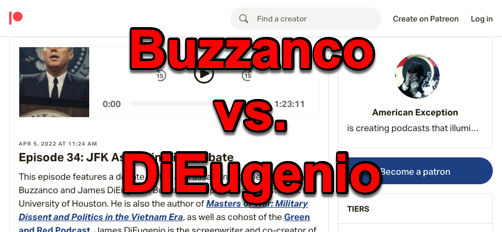
Cleaning up after My Debate with Buzzanco
As our readers know, I wrote a column not long ago on Noam Chomsky’s appearance on a podcast called Green and Red. Chomsky and the podcast co-host, Bob Buzzanco, were fulminating about how Oliver Stone’s recent media appearances were misleading the left about both President Kennedy and the whole issue of what America’s role was in Vietnam. I replied to both of them. (Click here for that column) When Buzzanco later challenged the people behind JFK Revisited to a debate, I decided to oblige him. I would not do so on his show, since it would help him raise his audience, which I had moral reservations about. I said I would do so on Aaron Good’s American Exception podcast, a neutral site.
That debate did take place. (Click here for that debate) When Oliver Stone heard it, he immediately called me, as he was excited about the result. The problem with debates, of course, is trying to balance out the positive points you wish to make with the necessity of playing defense, that is negating the charges being made by the other side. Therefore, in addition to doing a follow up show with Aaron on this, I would like to make some comments on that score here.
First of all, to dispose of the last part of the debate, Buzzanco had said that there was little discovered about Oswald’s intelligence ties since the days of the House Select Committee (HSCA), which is an utterly false statement. John Newman wrote a whole book about this area which, contrary to what Buzzanco tried to imply, was not directly explored by the HSCA. In Oswald and the CIA, Newman discovered that both the CIA and FBI had anti Fair Play for Cuba Committee campaigns ongoing in the summer of 1963, which, of course, Oswald’s activities in New Orleans would seem to fit neatly into both. In addition to missing this, there was no place in those volumes where Oswald’s relationship with either the CIA or FBI was examined in any formal way. It turns out that the work of the HSCA’s Betsy Wolf, who was studying Oswald’s relationship with the CIA, was not declassified into the new millennium. To put it mildly, her work created a new plateau in this field. (Click here for details)
In the last part of the debate, it is hard to comprehend how someone who likes to pontificate about the impact of JFK’s murder could declare he knows little or nothing about the actual circumstances of his assassination, but like Noam Chomsky, such is the case. Suffice it to say that what happened during Kennedy’s autopsy—both the main one and the supplementary—would appear to indicate just what Chomsky says did not occur: a high-level plot. In the film JFK: Destiny Betrayed, we show that:
-
The photos of Kennedy’s brain cannot be of Kennedy’s brain, simply not possible.
-
In all probability, General Curtis LeMay was in attendance that night and tried to disguise how he got there.
Buzzanco is apparently ignorant of all this, as is Chomsky, which is no surprise really. What they lack in knowledge, they make up for in arrogance and snark.
Like so many leftist critics of Kennedy, Buzzanco said that somehow I should watch myself in talking about JFK’s civil rights program. This shows that, in addition to swallowing Chomsky, he has bought into the almost incessant and deceptive MSM campaign to bury what Kennedy did on civil rights. I made it a purpose of mine to go back into the record and find out what the truth was about this issue. Why? Because a while back, someone said to me words to the effect: Jim what you did with Kennedy’s foreign policy, you could probably do with all the other aspects of his presidency.
That turned out to be accurate. After a long four-part analysis, which surveyed literally dozens of books on the subject, I concluded that President Kennedy had done more for civil rights in less than three years than Presidents Roosevelt, Truman, and Eisenhower did in three decades. In fact, it was not even close. Kennedy went to work on the issue the night of his inauguration. He was disappointed that there were no African Americans in the Coast Guard parade that day. He called up Secretary of the Treasury Douglas Dillon and asked him about it. When Dillon said he had no idea why that was, Kennedy told him: Well, find out what the problem is.
The result of this was two affirmative action orders within a year. The first taking place in March, just two months after his inauguration. That first order dealt with employees in the federal government. There was a second one about purchases by the federal government, that is any contracting, with say the Pentagon or State Department, by a private vendor made that company also responsible for affirmative action guidelines.
What had happened was this: Kennedy was disappointed with the Civil Rights Commission set up by Senate Majority Leader Lyndon Johnson while he was in the senate. Although Kennedy voted for it, he thought it was toothless. So, he decided to enlist the Commission’s lawyer, Harris Wofford, as a campaign advisor in 1960. After Kennedy was elected, he instructed Wofford to write out a program for civil rights. Wofford specifically wrote that the president should not even think of trying to pass an overall bill in the first or even the second year since it would be stymied by the southern filibuster. Wofford advised Kennedy to try and get some momentum through executive orders, the Justice Department and perhaps the courts.
And that is what Kennedy did. For example, differing with Dwight Eisenhower and Richard Nixon, Attorney General Robert Kennedy said the administration would support the Brown vs. Board decision. Bobby Kennedy then indicted the Secretary of Education in Louisiana for resisting that ruling. In Prince Edward County Virginia, the state would not support an integrated school system. The Kennedys collected contributions from wealthy donors and William Vanden Huevel actually built a new school system from scratch—superintendent, principal, counselors, teachers, and buildings—so that the local children could register for classes. (Click here for that story)
I could go on and on, for example funding voting drives, integrating both state and private universities in the south, filing suits against voting rights violations. No previous president went as far on as many fronts than JFK did. It’s not even close. And this was before he submitted his omnibus civil rights bill to congress in February of 1963. (For all the details, click here) As with Indochina, Buzzanco drank the Kool-Aid on this one.
Buzzanco also said that in my claim that Kennedy was much more reformist than what is made out to be, all I had to back me was Richard Mahoney’s book JFK: Ordeal in Africa, which shows that Buzzanco has not read this site very often. On the concept of President Kennedy’s reformist foreign policy, Robert Rakove’s book, Kennedy, Johnson and the Non-Aligned World is one of the best. That was published in 2013, decades after Mahoney’s 1989 book. On just the area of Africa, there is Philip Muehlenbeck’s fine work, Betting on the Africans. That volume was published in 2012, again decades after Mahoney. Decades prior to Mahoney, there was Roger Hilsman’s book To Move A Nation, which was astute on Kennedy’s foreign policy ideas, particularly about Indonesia. About the 1965 Indonesian upheaval, there is Bradley Simpson’s book Economists with Guns. Simpson says in that 2010 book, as he did for Oliver Stone in JFK: Destiny Betrayed, the epochal overthrow of Sukarno would not have happened if Kennedy had lived. Greg Poulgrain says the same thing in his book, JFK vs Allen Dulles: Battleground Indonesia, which was published in 2020.
As far as Indochina goes, it is just as bad for Buzzanco. Since the film JFK came out, there have been books by Howard Jones, David Kaiser, James Blight, and Gordon Goldstein which all agree with the views of that film: that Kennedy was withdrawing from Vietnam at the time of his death. There is also John Newman’s second edition of his milestone work JFK and VIetnam. In my view, that version is even better than the 1992 edition. There is also Richard Parker’s biographical work on John K. Galbraith. Galbraith was one of the strongest influences advising Kennedy on this issue, and the president took his advice to begin his withdrawal plan. (Click here for details)
Considering all this new scholarship, what is hard to understand is this: Why is Buzzanco still abiding by Noam Chomsky’s badly dated and intellectually shabby 1993 book? Because in the face of over 800 pages of new information declassified by the ARRB, no one else is. Need I add that since Chomsky’s book came out, both Secretary of Defense Robert McNamara and National Security Advisor McGeorge Bundy (posthumously) published scholarly tomes in which they said the same thing: Kennedy was not going into Vietnam. Just how much evidence, how many witnesses, and how many scholars does one need in this regard?
Like the late Alexander Cockburn, Buzzanco wants us to think that somehow President Kennedy was involved in the Ramadan Revolution of February 1963. This was the overthrow of the Iraq leader Karim Qasim and his (temporary) replacement by the Baath party. Since I found Cockburn about as convincing as Chomsky on the issue of Kennedy’s foreign policy, I did some research on this. I read three works on the issue—one book and two Ph. D. dissertations—and none of them agreed with either Cockburn or later the work of Vincent Bevins on this score. All three writers stated that, unlike Eisenhower, the Kennedy administration was not all that interested in Qasim. For instance, the interagency committee Eisenhower had on Iraq was more or less dropped under Kennedy. And by late 1961, Qasim had turned on the communists, so there was no Cold War motive to dethroning him.
Where Qasim got into trouble was with the British and the Kurds. The former was over an oil rights dispute, the latter was over a territorial rebellion in the north. After the Kurds inflicted some defeats on the army, the Baath Party infiltrated the military and negotiated with the Kurds. And that is what set the stage for the overthrow in February of 1963. There is no credible evidence that the CIA or State Department commandeered the plot. (Peter Hahn, Missions Accomplished? p. 48) And unlike what Cockburn tried to imply, Saddam Hussein was not even in the country at that time. (For a longer treatment click here and scroll to part 6)
Buzzanco also brought up the overthrow in Brazil. It is true that Kennedy was worried about Brazil, but this is due to the horrible advice he was getting from Lincoln Gordon, who he should never have approved as ambassador. But it’s also true that he sent Bobby Kennedy to Brazil to advise Joao Goulart to moderate his government to avoid any conflict. Gordon had actually told JFK that Brazil was in danger of becoming a new Red China. (See Merco Press, April 8, 2022) We do not know what Kennedy would have eventually done in Brazil, but it was President Johnson and Warren Commissioner John McCloy who actually arranged for the overthrow in 1964. The Brazilian military was given aid by Vernon Walthers of the CIA. Operation Brother Sam was done hand-in-glove with the Rockefeller interests in Brazil, which is why McCloy was the front man for it. (The Chairman, by Kai Bird, pp. 550–53) I would like to add that, in reference to Latin America, Kennedy did not recognize rightwing takeovers in either Dominican Republic or Honduras. Also, unlike what Buzzanco said, the American embargo of Cuba did not start under Kennedy. Its initial stages began first in 1958, under Eisenhower. Ike extended it in 1960 to include most exports. Kennedy expanded it again in 1962. It’s quite surprising that a history professor could be inaccurate about something as simple as this.
My last point would be about the concept of what Rakove called “engagement.” This was his word for how Kennedy approached the concept of neutrality. Kennedy felt that if a country wanted to remain neutral in the Cold War, that was their decision. We could still send them aid and, in fact, we should send them as much as possible in order to keep them away from the communists. As Rakove notes, this was a large jump from John Foster Dulles, who did not want to deal with the concept of neutrality at all. With him, there was no neutral ground in the Cold War: you were either for the USA or against the USA. (See Rakove, pp. 6–11). A good example of this would be Kennedy’s attitude toward Nasser in Egypt versus Foster Dulles’ and, later, Johnson’s stance toward the charismatic pan-Arab leader. Any history scholar should be able to discern this wide difference. Nasser certainly did, as did most of the leaders in Africa. (Muehlenbeck, pp 227–228) For Buzzanco to say I agreed with him on this issue shows a combination of political spin and his lack of knowledge on who Foster Dulles was.
I would like to append one last point about how leftist ideology clouds the picture of who Kennedy was. Peter Scott wrote an essay for the Gravel Edition of the Pentagon Papers back in 1971. That essay was one of the earliest efforts to detect that Kennedy was withdrawing from Vietnam at the time of his death. The editors of that series were Chomsky and Howard Zinn. They did not want to print that essay, because to them it would indicate that whoever is president makes a difference. I do not know any clearer way of showing that Chomsky’s concept amounts to writing history according to ideology. And to me, that is not writing history. Its polemics.
John F. Kennedy was not a perfect president. We have never had a perfect president and there never will be one, but the best brief characterization of Kennedy was made by Richard Mahoney. He used Edward Gibbon’s description of the Byzantine general Belisarius as a point of comparison: “His imperfections flowed from the contagion of the times; his virtues were his own.”
-
-

CNN’s Apologia for LBJ, Part Two
see Part 1
Early on in Joe Califano’s book, he writes the following about LBJ and Vietnam: “He certainly thought he was doing what John Kennedy would have done…” (p. 28). Califano’s book was published in 1991. The best one can say about that statement is that, even for that time, it was ill informed, because even back then, there was evidence that this was not even close to being the case. For example, Ken O’Donnell and Dave Powers had written that Johnson had actually broken with what JFK was doing. As they stated, Kennedy was going to withdraw a thousand advisors before the end of 1963. (The authors here were referring to Kennedy’s NSAM 263 without naming it.) Kennedy then told Defense Secretary Robert McNamara to announce this to the press in October of 1963. (Johnny, We Hardly Knew Ye, p. 17) Based on the paper trail in the Pentagon Papers, Peter Scott also wrote about this withdrawal plan. (Government by Gunplay, edited by Sidney Blumenthal and Harvey Yazijian, pp. 152–187)
CNN more or less adapts the Califano stance for this all-important issue. Why is it so important? If one is trying to salvage Lyndon Johnson’s presidency, it is imperative to somehow show that his radical escalation of the Vietnam War was really not his idea. There are two underlying reasons for doing this. First, Johnson’s escalation was not one of degree—it was an escalation in kind. LBJ would end up sending 500,000 combat troops into Vietnam. On the day Kennedy was killed, there were none there; only advisors. (The program tries to alchemize this by saying Kennedy had 16,00 troops in theater—utterly wrong.) Secondly, LBJ began Operation Rolling Thunder, the largest air bombing campaign since World War II, over both parts of the country. Even Califano admits that these American strikes extended to targets in and around Hanoi and Haiphong and close to the Chinese border. (Califano, p. 293) Kennedy never did anything like this—let alone to the extent of bomb tonnage that Johnson dropped.
So what does the film do to relieve this heavy cross on Johnson’s back? To anyone who knows what really happened, it attempts something kind of shocking. Through Andrew Young, the film tries to say that, in December of 1964, it was McNamara, National Security Advisor McGeorge Bundy, and Secretary of State Dean Rusk who were trying to convince Johnson to go to war in Vietnam. How on earth the film makers from Bat Bridge Entertainment got Young—usually a smart guy in public—to say this is a mystery worthy of Sherlock Holmes. How they ignored all the evidence declassified by the Assassination Records Review Board which contradicts it, is even more mystifying. Let me explain why.
II
Two of the most important pieces of evidence in Oliver Stone’s documentary JFK Revisited: Through the Looking Glass concern the Vietnam War. Back in December of 1997, the Assassination Records Review Board declassified the records of the May 1963, SecDef meeting in Hawaii. These were regular meetings held by Secretary of Defense Robert McNamara on the progress of the war. Representatives of branches of the American government stationed in Saigon, for example CIA, Pentagon, and State, were in attendance. Those May 1963 documents were so direct and powerful that they convinced the New York Times and Philadelphia Inquirer that, at the time of his death, Kennedy was getting out of Vietnam. (Probe Magazine, Vol. 5 No. 3, p. 19) They showed that McNamara had given the order to begin a withdrawal program previously. And at this meeting various parties were submitting these schedules. To which McNamara replied: they were too slow. This supplied powerful corroboration for what O’Donnell, Powers, Scott and John Newman had written about—Newman in the 1992 edition of his breakthrough book JFK and Vietnam.
The other important piece of evidence in this regard is a taped phone call that President Johnson had with McNamara on February 20, 1964:
LBJ: I always thought it was foolish for you to make any statements about withdrawing. I thought it was bad psychologically. But you and the president thought otherwise, and I just silently.
RSN: The problem is—
LBJ: Then come the questions: how in the hell does McNamara think, when he’s losing a war, he can pull men out of there?
That tape is played loud and clear in the film, which has been out since November of last year, but Stone could have gone even further in this regard. Because in another phone call on March 2, 1964, Johnson tried to convince McNamara to revise his prior statements about withdrawing from Vietnam. (James Blight, Virtual JFK, p. 310) Further, in a January 1965 phone call, Johnson has learned that some of Kennedy’s hires now felt the new president was trying to shift the blame for the escalation of the war from himself to his dead predecessor, which was quite a logical deduction. (ibid, p. 306)
After his attempt to turn around McNamara on the war, Johnson set up an interagency committee headed by State Department employee William Sullivan. That committee was to plan the possible expansion of the war. (Eugene Windchy, Tonkin Gulf, p. 309) In six weeks, Sullivan concluded that nothing but direct intervention by America would stop the eventual triumph of the Viet Cong. (Joseph Goulden, Truth is the First Casualty, pp. 77–88).
In light of that conclusion, there is a telling point to be made about the choice of Sullivan to lead this committee. In October of 1963, Sullivan was one of the strongest opponents of Kennedy’s withdrawal plan. (John Newman, JFK and Vietnam, Second Edition, p. 410) To put it mildly, Johnson likely knew the result he was going to get from Sullivan.
Taken as a whole, what this accumulation of evidence shows is not just that Johnson reversed Kennedy’s policy in Vietnam, but he knew he was reversing it and then tried to camouflage that reversal. It also indicates that Johnson’s intent in this regard was established fairly early. The usual point of no return is considered to be the signing of NSAM 288 in March of 1964. That document mapped out a large-scale air war over North Vietnam, which Johnson invited the Joint Chiefs to design for him. (Fredrik Logevall, Choosing War, p. 129) As one commentator wrote about it: “Henceforth the United States would be committed not merely to advising the Saigon government, but to maintaining it.” (ibid) At that time, Max Frankel of the New York Times wrote that the administration had now rejected “all thought of a graceful withdrawal.” (March 21, 1964) As Gordon Goldstein has noted, Johnson was now working hand in glove with the Joint Chiefs on these future plans. (Lessons in Disaster, pp. 108–09)
This last is another marked difference with Kennedy. As former undersecretary Roger Hilsman wrote to the New York Times, JFK did not want any member of the Joint Chiefs to even visit South Vietnam, so the idea of him inviting them into the Oval Office to plan a massive air war there was simply a non-starter. (Letter of January 20, 1992) In other words, what Kennedy did not do for three years, Johnson did in three months.
Make no mistake, this was a key step in Johnson’s escalation. It was the document that would supply the working thesis for future air operations Pierce Arrow—retaliation for the alleged Tonkin Gulf incident—and Flaming Dart—retaliation for the Viet Cong attack at Pleiku—and those would evolve into Rolling Thunder. All of this counters Califano’s excuse for escalation in his book: that somehow the Joint Chiefs pressured LBJ into escalating. (Chapter 2, pp. 50ff) This is made possible by Califano not mentioning or describing NSAM 288, or how that process differed from JFK.
Why do I indicate that LBJ had all but certainly decided on a war against North Vietnam by the spring of 1964? Because one of his objectives was to get the Washington Post in his corner on this decision; so he enlisted their support in advance. In April of 1964, Johnson invited the executives of that paper, plus Kay Graham, the owner, to the White House. In the family dining room, he asked for their support for this planned expansion of the war in Vietnam. (Carol Felsenthal, Power, Privilege, and the Post, p. 234)
III
If that is not enough to convince the reader that the program and Andrew Young are wrong about the December 1964 date, how about this: the Gulf of Tonkin Resolution was drafted three months before it was submitted to congress. (Edwin Moise, Tonkin Gulf and the Escalation of the Vietnam War, p. 27) In other words, in May, one month after Johnson told the Washington Post he wanted their support for a future war, he had an attorney sketch a rough draft of a declaration of war in Vietnam. Like the other steps on the way to intervention, I could not find this event mentioned in either CNN’s film or Califano’s book. It would seem to me to be a quite important revelation as to intent. But let us go a step beyond it: What made Johnson rather certain that the war resolution would be used? Because Johnson’s planning even spoke of a “dramatic event” that could occur to cause the White House to go for a congressional resolution. (Moise, p. 30)
Johnson had approved a covert action plan after Kennedy’s death. General Maxwell Taylor had drawn up designs for fast hit-and-run sea operations against North Vietnam in September of 1963, but that plan was not submitted to McNamara until November 20, 1963. (Newman, p. 385) These attacks were eventually titled OPLAN 34A. Originally, the draft of NSAM 273 limited naval forces to those of the government of South Vietnam. On November 26, 1963, Johnson altered McGeorge Bundy’s draft. When OPLAN 34A was submitted to the White House, it now allowed direct American military attacks against North Vietnam. (Newman, p. 463) As Edwin Moise shows, these PT boat operations owed just about everything to the USA and were completely controlled by Americans. (Moise, pp. 12–17) They likely could not have been done by Saigon alone.
It was the combination of OPLAN 34A with the already-in-practice DeSoto patrols that all but guaranteed an exchange between Hanoi and the Pentagon in the Gulf of Tonkin. The PT boats were designed and equipped with armaments that could be used to attack Hanoi’s military installations near the shore, which they did. The idea was for the OPLAN 34A missions to create a disturbance and then the destroyers in the gulf could theoretically gain some kind of intelligence from the reaction. The problem was that both the boats and the ships violated the territorial waters of North Vietnam. (Moise, pp. 50–51) The PT boats attacked the islands of Hon Me and Hon Ngu off the coast of North Vietnam on the night of July 30–31. The latter was 4 kilometers off the coast, the former about 12. Hanoi was claiming their waters ended at 12 miles, therefore both islands would be within their boundaries. When the PT boats retreated, they were within sight of one of the destroyers on a DeSoto mission, the Maddox, which had just entered the gulf. (Moise, p. 56)
Therefore all the elements were in place for a confrontation. On the night of August 2nd, Hanoi sent out three torpedo boats to counter the raiders. They were all severely damaged by American fire and four North Vietnamese sailors were killed. The Maddox endured one bullet hole from a machine gun round. In spite of this engagement, President Johnson continued the patrols and the Navy added a second destroyer, the Turner Joy, to the mission. What made it even worse is that the PT boats attacked another North Vietnamese base on the evening of the 3rd of August. (Moise, p. 97) This is why many, including George Ball of State, considered the missions to be clear provocations. (Moise, p. 100)
Needless to say, the alleged Hanoi attack on the two destroyers on the night of August 4th never really occurred. Yet Johnson used this false reporting to launch the first American air strikes against the north, based on the NSAM 288 target list, and also to pass the Tonkin Gulf Resolution which has been penned three months earlier. (Moise, p. 212) But all of the above is not the worst. The worst is this: Johnson realized the second attack did not occur about one week after he ordered the air strikes. (Moise, p. 210)
In light of all the above, to say that Johnson was being talked into a war by Bundy, McNamara, and Rusk in December is simply hogwash. And to say, as the program does, that Johnson was not a war monger is equally wrong. The total debate time on the Tonkin Gulf Resolution was about 8 hours. (Goulden, p. 75) And everyone sent up by the White House to testify for the resolution denied there was any connection between the DeSoto missions and the OPLAN 34A operations—which was false. (Goulden, p. 76)
But there were two grand benefits garnered from the provocations:
-
LBJ’s approval ratings on the war skyrocketed. As one commentator noted, he had turned his one weakness against GOP candidate Barry Goldwater into a strength.
-
He got his declaration through. (Goulden, p. 77) The very fact he did the latter undermines what Tom Johnson says about the war: that the SEATO Treaty alone necessitated our involvement.
IV
Califano deals with the case of William Fulbright in one desultory page near the end of his book. (Califano, p. 360) CNN and Bat Bridge do not really deal with him at all. The Arkansas senator and Johnson had been friends prior to 1965. In fact, Johnson used Fulbright to get his Tonkin Gulf resolution through the Senate; the unsuspecting Fulbright trusted him. He ended up regretting it.
The CNN series does not mention the 1965 invasion of the Dominican Republic either. Yet the two subjects are related, because Fulbright’s relationship with LBJ collapsed over the lies Johnson had told him about that 25,000 man Marine invasion in the Caribbean in 1965. Fulbright was the chairman of the Foreign Relations Committee. He had helped expedite both the Latin American invasion and the Tonkin Gulf resolution. Ironically, it was Fulbright’s reinvestigation of the former that led to his doubts about Tonkin Gulf and ultimately wrecked the relationship. One can even argue this was the main engine for Johnson’s capsized approval ratings, which resulted in his abdication.
In June of 1965, Fulbright’s staff had begun to examine the reasons Johnson had given for the April 28, 1965, invasion of the island. At every opportunity, the reasons for the invasion were escalated and sensationalized. This culminated in June with the excuse that 1,500 people were killed, heads were cut off, the American ambassador called while hiding under a desk with bullets flying through windows, and Americans were huddled in a hotel screaming for protection. (Goulden, p. 166) The staff found out that this was mostly nonsense and Fulbright decided to give a scathing speech in which he said that there was simply no evidence to back up what Johnson had told him about decapitations and bullets flying through embassy windows. The democratically elected leader, Juan Bosch—who the Marine invasion fatally crushed—had been favored by President Kennedy. (Donald Gibson, Battling Wall Street, pp. 78–79) Therefore, Johnson’s reversal of JFK’s policy “lent credence to the idea that the United States is the enemy of social revolution in Latin America…” (Goulden, p. 167)
Fulbright now suspected that maybe the White House had also lied about the Tonkin Gulf Resolution. In November and December of 1965, he and his staff now prepared for full-blown hearings on the Vietnam War. Fulbright called up administration official after official and quizzed them on both what the real purpose of the Tonkin Gulf resolution was, and if the administration had been candid about its provenance. The hearings themselves were damaging enough to Johnson, but when CBS and NBC decided to run them at full length for days on end, they began to really hurt him politically. For the first time, administration officials had to defend the remarkable escalation of the Indochina conflict and reply to questions about if the Gulf of Tonkin resolution was justified. There had been nothing like it since the Army/McCarthy hearings and there would be nothing like it again until the Watergate hearings.
Average Americans now began to be informed about how America got into an open-ended conflict that had seemingly escalated beyond what anyone had ever thought it could be. But perhaps most importantly, the hearings dramatically illustrated the formula for the following:
…what had happened to turn the liberal supporters of President Kennedy into opponents of the policies of President Johnson…and the right-wing opponents of Eisenhower and Kennedy into supporters of the present administration… (Goulden, p. 166)
In other words, how Johnson had fragmented the Democratic Party beyond saving.
Neither Califano’s book nor the CNN series figuratively lifts up the hood to show the audience just how Johnson was finally convinced to get out of Indochina. Since they will not, the present reviewer shall. After the Tet offensive, and during the siege of Khe Sanh, several foreign policy luminaries were asked to attend a Pentagon briefing at the White House—after which LBJ ranted and raved for about 45 minutes. This compelled former Secretary of State Dean Acheson to walk out. A White House staffer called him and asked him why he left. Being blunt, Acheson told him to “Shove Vietnam up your ass!” Johnson got on the phone and Acheson told him he would no longer listen to “canned briefings.” He only wanted to hear from people on the scene in Vietnam and would only accept raw data, not finished reports. About a month after this, Johnson sent his new Secretary of Defense over to the Pentagon. Clark Clifford went over the data and then quizzed the Joint Chiefs on the overall situation on the ground. He concluded that the only way to win the war was to expand it into Cambodia and Laos. Clifford reported back to Johnson that he should get out; Vietnam was a hopeless mess. (Walter Isaacson and Evan Thomas, The Wise Men, pp. 683–89; see also Clifford in the documentary film Hearts and Minds.)
That is apparently too strong a truth for CNN and Bat Bridge Entertainment, which tells the reader a lot about the value and candor of this disappointing production. The program ends with the Richard Nixon/Anna Chennault subterfuge of Johnson’s attempt at a truce in Vietnam—which was about four years too late. (Click here for details)
In sum, this is a disappointing and less-than-candid four-part series about Johnson and his presidency. These kinds of programs make it difficult to understand the past, and therefore stifle our attempts to deal with the present.
-
-

CNN’s Apologia for LBJ, Part One
Joseph Califano graduated from Harvard Law School in 1955. After serving in the Navy, he worked in private practice as an attorney in New York City until 1961. He then went to the Pentagon and rose to General Counsel of the Army. In 1964, he represented the USA during international hearings involving riots in Panama. After that, he became a liaison between the Defense Secretary and President Johnson. From that position, he monitored the Selma protest. In July of 1965, he became Johnson’s chief domestic advisor. He stayed in that job until LBJ left office.
While in private practice, he was appointed by Jimmy Carter as Secretary of Health, Education, and Welfare. In 1980, he returned to private practice, rising to senior partner at Dewey Ballantine in Washington DC. He has penned many newspaper columns and magazine articles and served on corporate boards. He has also written 14 books. In 1991, he wrote one about his service with LBJ. It was titled The Triumph and Tragedy of Lyndon Johnson: The White House Years.
CNN has now made a four-part series that adapts the title of Califano’s book, LBJ: Triumph and Tragedy. As we shall see, it is very much in keeping with the thematic structure of Califano’s book. It debuted over President’s Day and I was informed by a frequenter of KennedysAndKing about it. I watched all four segments, which was difficult. Like other members of Johnson’s administration, for example the late Jack Valenti and news executive Tom Johnson—who is interviewed here—Califano expended some effort trying to salvage what was, by any honest accounting, a disastrous presidency. The problem was all the more difficult because Johnson ascended to the White House after John Kennedy’s presidency, one which was marked with much hope and optimism. But the net effect of Johnson’s policies was so polarizing that he split asunder the Democratic coalition. This led to the election of Richard Nixon in 1968. Many historians consider that year to be one of the most crucial, most tumultuous years in post war history. It marked a transformation in the power politics of America. We were now completing a transition from a country led by the Kennedys, King, and Malcolm X to one led by Nixon, Henry Kissinger, John Mitchell, and Gerald Ford. Those pernicious reverberations are being felt to this day.
What is surprising about this program is that, in its Califano style, tone, and assembly, it does what it can to camouflage just how that milestone happened. What it leaves out—and what it uses sleight of hand to transfigure—are things that cannot be ignored or dodged in any responsible critique.
II
Anyone can read the updated introduction to Califano’s book at Amazon. Just from that, one can see that the author is intent on rehabilitating President Johnson in the public square. He writes that “Perhaps Johnson’s path will one day serve as a road map for current and future leaders.” (p. 6, all references to the eBook version) Califano specifically says that Vietnam has clouded the things Johnson did domestically. (p. 7) He adds that Johnson should be ranked with the finest progressive presidents, like the Roosevelts. (ibid) He then starts listing some of the things Johnson achieved.
The problem I have with his list is that Califano implies sole credit should go to Johnson for everything on it, but that is not the whole story. President Kennedy began the program for federal aid to education. (Irving Bernstein, Promises Kept, Chapter 7) It was Kennedy who first tried to pass a Medicare program and he was bringing it back at the time of his death. (ibid, p. 258) The Civil Rights Act was originated by President Kennedy and, as Clay Risen shows, the three main personages involved in passing it were Bobby Kennedy, Hubert Humphrey, and Thomas Kuchel. (The New Republic, “The Shrinking of Lyndon Johnson,” 2/9/2014) For Califano to insinuate that it was Lyndon Johnson who originated affirmative action is, again, not accurate. John Kennedy signed the first affirmative action order on March 6, 1961. It’s true that Johnson’s staff worked on it, but that is because Kennedy appointed Johnson to supervise much of this program. And Robert Kennedy was critical of Johnson’s supervision. (Bernstein, p. 60)
Contrary to conventional—and Califano’s—wisdom, the War on Poverty was the brainchild of Kennedy and his chief economic advisor Walter Heller. (Thurston Clarke, JFK’s Last Hundred Days, pp. 242–43) Heller suggested an “attack on poverty” and Kennedy told him he was going to make this an election issue. At his final meeting with his cabinet, JFK mentioned the word “poverty” six times. After his assassination, his widow took the notes of that meeting to Robert Kennedy. RFK framed them and put them up on his wall, but even that only reveals part of the story. (Edward Schmitt, President of the Other America, pp. 92, 96) Bobby Kennedy had appointed a lifelong friend, David Hackett, to come up with ideas and plans to ameliorate the problems of poverty and juvenile delinquency in blighted areas. President Kennedy had given Hackett millions of dollars to run experiments with his ideas. (Allen Matusow, The Unraveling of America, pp. 111–12)
One last point in this regard. It was Bobby Kennedy who first suggested Head Start and Upward Bound, perhaps the two most successful programs of the War on Poverty. (Schmitt, p. 114) This is just a sample of the problems I have with Califano’s book, but the issue of accreditation is integral to this review, since it is clear that the mini-series pretty much takes the same approach to Johnson as Califano did. (When I tried to find out who wrote the script, I could not get a clear answer. The closest I got was that the team at the production company—Bat Bridge Entertainment—did it. March 24th email from Anne Wheeler of the LBJ Foundation.)
The fact that JFK started affirmative action and began to move an omnibus civil rights bill and also was working on poverty contradicts another tenet of the show, made by Professor Kevin Gaines, namely that Kennedy was reluctant to support civil rights and that it was LBJ who took up that cause. As I have demonstrated at length, this is balderdash. (Click here for details)
Let me add a key point not addressed by the film or by Califano. As noted above, no one did more work on the ways to cure poverty and delinquency than David Hackett did. He had been toiling on the problem and perfecting ideas to ameliorate it for over two years. (Schmitt, p. 92) Yet when Johnson took over the program, Hackett was retired. In all my reading on the subject, which includes many books, I have never been able to find a good answer as to why.
But that is not the worst part of the transfer of the program. The worst part was that Johnson chose Sargent Shriver, JFK’s brother-in-law, as the new manager. The problem with this choice was simple: Shriver already had a job. He was managing the Peace Corps. It was a job he liked and was good at. Bobby Kennedy protested, but Johnson ignored him. (Matusow, p. 123) The third mistake LBJ made was that he turned the Hackett/Kennedy outline into a sort of New Deal program. He announced it during his State of the Union address in early 1964. In other words, what JFK was going to campaign on that fall and give Hackett time to perfect, LBJ was announcing before he even ran for election. In fact, before he had even been nominated! This may have been one reason Walter Heller resigned. He saw the writing on the wall.
Once it was passed, Johnson did not speak much or spend any amount of time on the program’s oversight or administration. (Bruce Schulman, Lyndon B. Johnson and American Liberalism, p. 95) Therefore, since there was no quality control, Hackett’s program fell victim to those on the left and the right. As to the latter, people like Richard Daley wanted to take the money for themselves and give it to the city or school boards. (Matusow, p. 125, Schmitt, pp. 115–16) People on the left, like Livingston Wingate of Harlem, decided to use the money to put on plays. And much of that—mounting into the millions—disappeared without a trace. (Matusow p. 260)
As many have pointed out, The Great Society programs benefited middle class people, for example the PBS network and arts programs. Many of them benefited everyone: like environmental laws. The problem was that much more money and effort went into those kinds of programs than did the War on Poverty.
There is another important factor about The Great Society and the ultimate failure of the War on Poverty that the film does not address. That would be the 1966 mid-term elections. In 1964, running on his slogans of “let us continue” what Kennedy had done, “we seek no wider war” in Asia and “I will not send American boys to do what Asian boys should be doing,” LBJ won a smashing victory both for himself and in Congress. It was the biggest such win since Franklin Roosevelt’s 1936 re-election. Johnson actually had a veto proof majority in the Senate and a more than 2–1 advantage in the House.
But the fact that Johnson reneged on all of those promises made a large difference in 1966. The GOP won 47 seats in the House and 3 in the Senate. As a result, Johnson lost his veto proof advantage in the upper house and a filibuster along party lines was possible. Make no mistake about this. The Republican Party was literally on the ropes after 1964. Some Republicans feared extinction; that they would go the way of the Whigs and disappear from the scene. Not only did Johnson let them off the ropes—as we shall see—what he did in 1967–68 let them fully revivify themselves.
III
This four-part TV series discusses Johnson’s reaction to the Watts riots in 1965. RFK predicted that riots would break out in the North unless something was done. (Schmitt, p. 86) Kennedy actually said this to a Senate committee in February of 1963, and in the strongest terms. In his view, America was:
…racing the clock against disaster…We must give the members of this new lost generation some real hope in order to prevent a shattering explosion of social problems in the years to come. (ibid)
Bobby Kennedy understood that the problems in the North were different than those in the South. He and Hackett were trying to find solutions to problems that could not be cured with an accommodations bill or a voting rights act. Sure enough, two years later, when Martin Luther King visited Watts after the riots, that was the message he gave to Johnson. (See the film King in the Wilderness) Through the work of Hackett, the AG understood the problems were different in the North and they could be even more incendiary. After the nighttime riot at the University of Mississippi in 1962, he warned Arthur Schlesinger about this possibility. He said, if you think this is bad, wait until you see what awaits us in the North. (Ellen B. Meacham, Delta Epiphany, Chapter 3)
As Hackett told Bobby Kennedy, the problem of poverty in the North could not be cured by constructing a New Deal program and throwing money at it. Therefore, President Kennedy had given Hackett more time and funding to conduct his experiments in the field to see what would work. But Lyndon Johnson came of political age in the New Deal, his idol was Franklin Roosevelt. He ran the National Youth Administration in Texas. Therefore, that was the kind of program and politics he felt comfortable with. In fact, he told Heller that John Kennedy was a bit too conservative for his taste. (Schmitt, p. 96) When Heller informed the new president about Hackett’s demonstration projects, Johnson almost eliminated the entire program. That was simply not the way Johnson was going to proceed. In his eyes, you had to have a big, bold program in order to pass it through congress. (Schulman, p. 71; Matusow, p. 123) And so Johnson announced the project on national television just six weeks after his first meeting with Heller:
This administration, today, here and now, declares unconditional war on poverty in America…It will not be a short or easy struggle, no single weapon or strategy will suffice, but we shall not rest until that war is won. The richest nation on earth can afford to win it. We cannot afford to lose it.
To say that this was a bit over the top on a rather untested program is being mild, but it was pure Lyndon Johnson from his New Deal days back in Texas.
IV
As Harris Wofford has pointed out, within months of declaring “unconditional war on poverty,” the presidential backing for it was weakening. (Harris Wofford, Of Kennedys and Kings, p. 319) By 1965, LBJ barely mentioned the War on Poverty. And now he did not call it “my war”; it went by the name “poverty program”. Johnson himself was silent during the congressional debates on the program. And in its second year, it was Shriver who was sent up to the Hill to argue for the funding package—with virtually no White House back up. By fiscal year 1966–67, the budget for Johnson’s War on Poverty had been almost cut in half, both by him and the congress.
As many have noted, the outburst in Watts happened a week after Johnson had signed the Voting Rights Act of 1965. The President was shocked. He would not even take calls from commanders in the National Guard to fly troops in to restore order. (Wofford, p. 321) As he later told author Doris Kearns:
It simply wasn’t fair for a few irresponsible agitators to spoil it for me and for all the rest of the Negroes, who are basically peace-loving and nice…spoiling all the progress I’ve made in these last few years. (Wofford, p. 321)
What is wrong with this documentary is that it takes Watts—like Johnson did—as an isolated incident. In fact, Watts was just the beginning. Although it was a huge riot with 977 buildings damaged, it would later be surpassed by Newark and Detroit. In fact, unnoted in the film, for three straight summers—1966, ’67, ‘68—America went up in flames. There was a grand total of over 300 riots. In 1967 alone, there were eight American cities occupied by the National Guard. (Matusow, p. 362) In Detroit, at the request of the governor, Johnson had to send in the army to quell the insurrection. Detroit ended up with 43 dead, 7000 arrested, 1,300 buildings burned, and 2,700 businesses looted. (Matusow, p. 363)
Johnson had been warned about this probability by labor leader Walter Reuther. He made fun of both the warning and the man. (Califano, p. 88) By ignoring or discounting all of this, the documentary can bypass a serious result that ensued: the creation of white backlash. In 1964, only 34% of the citizenry thought African Americans were trying to move too fast; two years later, 85% had that view. (Wofford, p. 322) The coalition that Bobby Kennedy and Martin Luther King wanted to mold, one made up of people of color, poor whites, students, college educated suburban liberals, and the labor movement was being torn up. By 1966, King had split from Johnson, a fact that, again, this film underplays. (Randall Woods, LBJ: Architect of American Ambition, p. 699) Students despised LBJ for his escalation of the Vietnam War and this latter phenomenon coupled the rightwing backlash with a leftwing militancy, for example Stokely Carmichael, H. Rap Brown, and the Weathermen group of the SDS.
V
This leftwing militant movement provoked Johnson to do something that the film does not even mention. The president first asked the CIA to set up Operation MH/CHAOS; then for the FBI to reactivate COINTELPRO operations. (Schulman, p. 146) Not only did this constitute a set of extralegal spying operations, it was also used for subversive projects utilizing agent provocateurs for purposes of destabilization of certain groups, for example the Black Panthers. By 1967, Johnson decided discretion was the better part of valor. That fall, he made an appearance in Kansas City for the International Association of Chiefs of Police. (Matusow, p. 215)
That strophe by Johnson indicated what was ahead for America. So did another odd move. After Newark and Detroit, LBJ had appointed what he termed the National Advisory Commission on Civil Disorders. It was chaired by Illinois governor Otto Kerner and was labeled the Kerner Commission. On February 29, 1968, they handed in their report, which today is regarded as one of the most honest and insightful government reports written in that era. Johnson did not show up for the photo op to receive it. (Joseph Palermo, In His Own Right, p. 161)
As stated, the Democratic coalition was splitting apart. This allowed men like Richard Nixon and Ronald Reagan to borrow from Alabama Governor George Wallace and grab his “Law and Order” slogan. The year 1968 was the maelstrom from which the Democratic party never fully recovered. Realizing he had little or no chance of winning the nomination, Johnson withdrew from the race on the last day of March. First King and then RFK were assassinated. This meant having no anti-war candidate at the presidential nominating convention in Chicago. Weirdly, Johnson wanted the convention to symbolically offer him the nomination in order to justify his presidency. Mayor Richard Daley actually told Johnson he could have the nomination if he wanted it. (Califano, p. 372) This is at the convention where LBJ had a peace plank for Vietnam defeated. (Califano, p. 376)
More of Johnson and more of the war was not what the SDS and other protest groups wanted to hear. They had come to Chicago by the busload to try and find a peace candidate and they planned on protesting if none emerged. This led to Daley staging a vicious police blood bath for the cameras and the convention. Chicago turned into an ugly debacle, sometimes spilling over into the convention hall. No other convention before or since has ever come close to duplicating its ferocity. (The linked short film gives the reader a precis of what that brutal and chaotic scene was like.)
The fact that this took place on TV, plus what LBJ had done to defeat a peace plank, this severely crippled nominee Hubert Humphrey’s campaign. Only when later in the campaign he decided to move toward a dovish position did he start to make up ground, but it was too big of a gap. Chicago gave the presidency to Richard Nixon. It’s hard to vote for a party who cannot even peacefully organize their own convention and where one of the main speakers, Senator Abe Ribicoff, equates the mayor of the host city to the gestapo. As the reader can see, in 1966 and ’68, Johnson had not just let the GOP off the mat, he had placed them on a path to power. None of this is depicted in CNN’s film.
But the film does show LBJ in retirement and being honored for the Great Society and Voting Rights Act. In accepting the honor, he says something like: I just regret I did not do more. My question to the film-makers is this: How the heck could he have done more? Between the demonstrations by students against the war and the annual incinerations of scores of cities, just where was the political capital for Johnson to do more? He had lost King. He had lost RFK. He almost lost to Gene McCarthy in the New Hampshire primary in 1968. According to Jules Witcover in his book 85 Days, Johnson was being told that in Wisconsin, the next state to hold a primary that year, he was about to be trounced. In fact, his campaign was actually folding there.
But as unsatisfactory as the film is on the domestic front, in this reviewer’s opinion, it is even worse on Johnson’s foreign policy. We will address this issue in Part 2.
see Part 2
-

Bob Buzzanco: Chomsky’s “Useful Idiot”
Robert Buzzanco is a history professor at the University of Houston. He is also a co-host—along with Scott Parkin—of a podcast called Green and Red. On January 12, 2022, Buzzanco had the 94-year-old Noam Chomsky—looking every year of his age—on his show to reply to the treatment of Vietnam in Oliver Stone’s documentary JFK Revisited: Through the Looking Glass. Chomsky could not help but make some general comments about Kennedy. In this regard, the linguist was his usual pompous and somewhat ludicrous self. At one point, he compared President Kennedy to Ronald Reagan and Donald Trump. If Chomsky can show us where either of the latter supported Medicare, universal healthcare, and equal rights for African Americans in the sixties, I would be curious to read about it, because Kennedy did all three. The program then slipped into Rocky Horror Picture Show low camp: Chomsky tried to parallel Kennedy’s success to the conditions existing in Germany in the twenties. I wish I was kidding, but I’m not. The only way there is any resemblance is that the assassinations of that decade—JFK, Malcolm X, King and Robert Kennedy—led to the election of Richard Nixon, the premature end of an era of hope and aspiration, and a continuance of the war in Vietnam. I wish I could add that Buzzanco pointed out these absurd exaggerations. He didn’t. (For more on Chomsky, click here and here)
As the program went on, it became clear that Chomsky and Buzzanco had done zero research on the new evidence about the subject of Vietnam adduced by the Assassination Records Review Board (ARRB) and presented in JFK Revisited. The pair was largely relying on what Chomsky had written, if you can believe it, back in the nineties in response to Stone’s film JFK. The pair actually ended up being worse than the MSM on the subject.
How? Because back in December of 1997, the Board declassified the records of the May 1963, SecDef meeting in Hawaii. This was a regular meeting that Secretary of Defense Robert McNamara had with representatives of each branch of the American government in Saigon: State, CIA, Pentagon, etc. Those declassified documents were so direct and compelling they convinced the New York Times and Philadelphia Inquirer that, at the time of his death, Kennedy was getting out of Vietnam. (Probe Magazine, Vol. 5 No. 3, p. 19) It should be noted that the NY Times story was written by MSM stalwart Tim Wiener. But yet, Chomsky was still using his old excuse that Kennedy was only getting out if Saigon was winning. This was ridiculously illogical back in the nineties, because, as John Newman pointed out in his book JFK and Vietnam, Kennedy understood that the Pentagon was rigging their numbers in order to make it appear Saigon was winning. Newman demonstrates this awareness in the book. He even named the two men who cooked the books: General Paul Harkins and Air Force Colonel Joseph Winterbottom. (pp. 185–245, 2017 edition)
The thesis of Newman’s book is that Kennedy was going to use this optimistic information to hoist the Pentagon on their own petard. Revealing on this point is that Kennedy told McGeorge Bundy’s assistant Michael Forrestal that America had about a hundred to one chance of winning in Vietnam. He then said that when he returned from Dallas:
I want to start a complete and very profound review of how we got into this country, what we thought we were doing, and what we now think we can do. I even want to think about whether or not we should be there. (James Douglass, JFK and the Unspeakable, p. 183)
The other point that is important in this regard is that, after it became clear what JFK was doing—and also what the new president wanted—the intelligence reports began to change. They now became pessimistic and also backdated to early November, and even before. (Click here; see also The Third Decade Vol. 9 No. 6 pp. 8–10; Newman, 2017 edition, p. 438)
Is not the point made with those two pieces of data? In fact, as historian Aaron Good has stated, when one combines the evidence, this “profound review” suggests the genesis of the Pentagon Papers. By 1967, it was fairly clear that President Johnson’s escalation and direct intervention was not going to work. Robert McNamara was still Secretary of Defense. Realizing that Johnson’s strategy of air and infantry escalation had failed, he had become quite emotionally disturbed. In 1966, fearing he was going to be attacked at Harvard, he escaped a hostile crowd through a tunnel. His son had draped a Viet Cong flag across his bedroom. He would rage against the war’s futility and then turn to the window and literally cry into the curtains. As his secretary said, that happened frequently. (Steve Sheinkin, Most Dangerous, p. 98, p. 121, p. 126) It’s a logical deduction that McNamara realized what had happened between Kennedy and Johnson and he was now expiating his guilt by exposing the secret history of the war through the Pentagon Papers, which is likely why he kept this 18-month effort a secret from Johnson. And he had no objection to Daniel Ellsberg giving the papers to, first, the New York Times and, then, the Washington Post.
In fact, in JFK Revisited: Through the Looking Glass, Stone plays a tape from February of 1964 in which Johnson admits that Secretary of Defense Robert McNamara was implementing Kennedy’s withdrawal policy. Johnson states that he knew this and he stewed in silence, because as Vice President he could not do anything about it, at least at that time. Somehow both Chomsky and Buzzanco missed this.
But that is not what I really wish to address here. On that podcast, near the end, Buzzanco implies that somehow, there was no information in the documentary about Lee Harvey Oswald that was not in the House Select Committee on Assassinations (HSCA) volumes. I could barely believe what I was hearing, but I really think he meant it. If that is so, then Buzzanco:
- Could not have read the HSCA volumes
- Did not pay any attention at all to the documentary.
This from a man who pontificates to the listener that he knows what he is talking about and can be trusted to set the record straight.
One will search in vain through the 12 volumes of the HSCA for any annex on Oswald’s relationship with the CIA and/or FBI at any time in his career. In the film, we have John Newman and Jeff Morley talking about this issue. To mention just four things they brought up that are not in those volumes:
- That the liaison for the HSCA with the CIA also secretly handled the Cuban exile who tried to frame Oswald after the assassination for killing Kennedy for Cuba.
- That the FBI scraped off the address of 544 Camp Street from the Oswald flyers before they were sent to HQ. That address housed the offices of Guy Banister and also the CIA-backed Cuban Revolutionary Council.
- The FBI took Oswald’s flash warning off his file in the first week of October 1963. This meant the Secret Service was unlikely to remove him from the motorcade route. That warning had been on the file for 4 years prior.
- A similar thing occurred at CIA, in order to lower Oswald’s profile in advance of the assassination.
In fact, one will only see the last point in the so called Lopez Report. This was the HSCA’s classified report on Oswald and Mexico City, which was only released by the ARRB, a body which Buzzanco refers to only in passing, discounting it as he does. The middle two points were also only discovered as a result of that Board’s work. So just what is Buzzanco talking about in regards to the HSCA? He clearly has not done his homework on the subject.
In fact, the only systematic, direct work done on Oswald and the CIA by the HSCA was not declassified until after the Board went out of existence. This was in 2005. I am referring to the scintillating work of HSCA researcher Betsy Wolf and it was discovered by British researcher Malcolm Blunt. (I would like Buzzanco to prove to me he knew of either person before he opened up his mouth on the subject.) Back in 1977–78, Wolf was the main HSCA researcher on the Oswald file at CIA. She discovered that there were two odd things about this file. First, there was no 201 file opened on Oswald for 13 months after his defection, even though the CIA knew about the defection within days, and had accumulated many papers on the man in just one month.
The second thing she discovered was that the documents on Oswald did not go to the place where they should have gone, namely the Soviet Russia Division. Instead, they went to the Office of Security, which, as Malcolm found out, almost guaranteed there would be no 201 file opened on him.
These anomalies disturbed Wolf. She decided to interview officers in the CIA who would know about such matters. She discovered that there was an unofficial Agency rule which said, once there were five documents on a subject, a 201 file should be opened. This was clearly and blatantly disregarded in the Oswald case. But it was not until late in 1978, when the HSCA was about to close down, that she found her Holy Grail about the Oswald file and its weird path. At that time, she interviewed Robert Gambino, who was the present Chief of Security at CIA. He told her that it did not matter how many documents came in on a subject or if they were stamped to a certain division. If someone had already arranged with the Office of Mail Logistics, those papers would go to the agreed upon destination. (Click here for that information) I would like for Buzzanco to show me where Gambino’s information is located in the HSCA volumes. I think I will have a very long wait, since, from what I can see, Wolf’s memos were not typed into memoranda form.
When one combines the above information with what JFK: Destiny Betrayed reveals about another ARRB discovery, then we learn much, much more about who Oswald was. The four-hour version of the film, released this month, has an interview with ARRB Military Records Analyst Doug Horne. He revealed to Stone that in Oswald’s last quarter in the Marines, he was not being paid by that organization, but likely by someone else. The combination of these two new important pieces of information—the bizarre file routing, and the source of funds—would all but clinch the fact that Oswald was an intelligence project before he left for Russia. Buzzanco will not find that information in the HSCA volumes.
I won’t go into all the incredibly important data that Oliver Stone unveiled to millions of people around the world in his film and which directly impacts on the facts of Kennedy’s death. How else does one explain that CE 399, the Magic Bullet, got to FBI HQ before it was delivered there. But on top of that, the FBI declared that the agent who dropped it off placed his initials on that bullet. The film proves they are not there.
The film all but proves that CE 399 was never fired in Dealey Plaza that day and would never be admitted into a court of law since, as Stone said on the Joe Rogan Show—in front of 2.5 million people—it has no chain of custody. Buzzanco and Chomsky ignored this key evidentiary issue, because, as David Mantik states in the film, in all previous inquiries CE 399 was foundational to the case against Oswald.
As Doug Horne says in the two-hour version of the film, the official autopsy photographer John Stringer denied under oath that he took the pictures of Kennedy’s brain at the Archives. He did this on at least five grounds. The first two being that he never used the type of film utilized in the photos. Second, he never used the optical processing method to produce the photos, which was a press pack. (For more details see Horne’s Inside the ARRB Vol. 3, p. 810) With Stringer’s denial, these official autopsy photographs would not be admitted into court. And they also indicate, as we show in the film, that the brain in evidence today cannot be Kennedy’s. The fact this subterfuge took place at a military controlled medical center, with many generals and admirals in control, betrays a high-level conspiracy—without even dealing with the mysterious flight plan of General Curtis Le May that day, which is also described in the recently released long version of the film.
How can men who attest to be leading intellectuals of the left do such incredibly sloppy and irresponsible work? This critique could have easily been twice as long as it is. And it would have been just as pungent and pointed. Buzzanco and Chomsky remind me of what psychologists term a folie a’ deux. It spiraled into a collapsing domino effect, since neither man made any attempt to check the other. There was never one ounce of effort placed on fact checking on matters they knew nothing about, which was a lot.
This has always been my problem with what I call the doctrinaire/structuralist left. In an odd way, their aims meet the MSM; and the underpinnings of both are exposed as being built on quicksand, because they both value expedience over facts, but for different aims.
Addendum: In another program one week later, Buzzanco apparently could not get anyone to interview him, so he had Parkin act as his line reader for what amounted to an Orwellian “60 Minutes Hate” against President Kennedy. Like Buzzanco with Chomsky, Parkin did not cross check his colleague once. Buzzanco did issue a debate challenge, which I accept, but not on his program, since that would help aid his viewership. He can contact me and we can arrange an agreed upon venue with an agreed upon agenda that follows the subject lines of JFK Revisited.
I await his response.
-

JFK: Case Not Closed
Dave O’Brien wrote a book in 2017 entitled Through the Oswald Window. Unfortunately, for whatever reason, I missed that book and have not read it, but O’Brien brings up some of the points that he likely made in that book in his new effort entitled JFK: Case Not Closed. Four chapters of his new book were written by Johnny Cairns, who I consider one of the best of the new generation of JFK researchers.
Early in this book, O’Brien brings up one of the points he likely made in his earlier book—and it’s a cogent one. Dave was once allowed access to the infamous “sniper’s window” at the Texas School Book Depository. Reflecting back on that visit, he asks two questions. If Oswald had really been at that window, why did he not shoot Kennedy as the president came down Houston Street? (p. 21) That was an unobstructed shot with the target right below him.
He then goes onto a second issue. That particular window is at the southeast corner of the sixth floor. If we are to believe that Oswald was the lone assassin, was on that floor, and committed a premeditated murder, then there is another question that should be asked by anyone was has been on that floor. Why didn’t Oswald use the southwest window, at the opposite end. This would have solved more than one problem for the alleged killer:
- The oak tree would be removed as an obstruction.
- Kennedy would have been right below him.
- He would have had clear access to the target the whole time.
- He had a more direct and quicker escape from that floor.
If one buys into the Warren Report, the alleged murderer had days to plan his crime. But he never figured on any of these circumstances? In spite of all these mitigating factors, as O’Brien writes:
Yet, he chose the southeast corner window and allowed the left-hand turn onto Elm Street knowing that the fully-blossomed Oak Tree protected his target for valuable seconds, and that once clear of the foliage, his target was mere seconds from safety under the bridge just yards away. Why? (p. 21)
As O’Brien writes, it is inexplicable that the Warren Commission never even considered this as part of their inquiry into Kennedy’s assassination. But any new formal inquiry should do so. Because it strongly indicates that Oswald was not what the Warren Report said he was. The idea of a reopening of the Kennedy case is a strong theme featured in the book. (p. 22)
II
From here, O’Brien notes another oddity. At Zapruder frame 312, right before the fatal headshot, JFK’s head is right next to Jackie’s. In fact, in the photo he shows on page 42, she is leaning so far over to his side of the seat that their heads are almost touching. But as the author notes, in the next split second, three things will happen that seriously undermine the official story which says Oswald shot Kennedy from behind. First, Kennedy’s head and body go backward, crashing off the back seat. Second, Jackie Kennedy reaches onto the trunk of the car attempting to retrieve a part of her husband’s skull, which is visible there. Third, motorcycle officer Billy Hargis, riding to the left and behind Kennedy’s limousine, is splattered with blood and tissue—and with such force that he momentarily thought he was hit. (pp. 42–45; 187–93). How could all three of these events occur in that short of an interval if the official story was correct? Do they not all betray a shot from the front? (And in arguing for a front shot, O’Brien mounts one more telling argument against the so-called neuromuscular reaction, see p. 46)
Chapters 4–7 of the book were composed by Johnny Cairns. As anyone who has been exposed to his writing will automatically understand, they are first-class. They strike the Warren Report at the points where it is supposed to be strongest: the physical evidence against Oswald.
In taking up the case of Oswald ordering the rifle, Johnny asks: if the FBI was monitoring the publications Oswald was getting through the post office—and they were—how could they not know he was also in receipt of a rifle and handgun? (pp. 60–66) Also, how could Oswald have sent a money order to Chicago on March 12th by 10:30am when his timecards from his place of employment say he was at work? And he did not have a lunch break until almost two hours later. (p. 67) He also brings up this point: if Oswald knew he was going to order a murder weapon delivered to a post office box, why utilize a box which he had signed for? Why not take out a box in the name of the alias he used to order the rifle, namely Hidell? (pp. 72–73)
Johnny then goes through all the mechanical problems that the authorities had with the particular rifle found on the sixth floor of the Texas School Book Depository. They had to fit the weapon with two shims, since the sighting was off both in elevation and azimuth. Then there was a difficulty in opening the bolt, plus the trigger was a two stage operation: at first it was easy, then it required more an exertion of pressure to pull. (p. 76) Any of these, of course, would have pretty much eliminated that rifle as the murder weapon. What makes it worse is that the men who worked with the rifle once the Warren Commission got it were far more skilled with weapons than Oswald. These were FBI agents and master marksmen from the military. Johnny bases this evidence on the testimony of FBI expert Robert Frazier and weapons evaluation expert Ronald Simmons of the army. In addition, Frazier admitted that the actual scope mechanism was off. As they fired consecutive shots, the impact point got further and further away from the target. (p. 77; see also Michael Benson, Who’s Who in the JFK Assassination, p. 420; Mark Lane, Rush to Judgment, p. 127)
From here, Cairns goes on to the question of assembling the rifle. As most of us know, even if we grant the Commission’s thesis that Oswald carried the rifle to work that day in a bag, that particular bag was too short to accommodate a fully assembled Mannlicher Carcano 6.5 mm rifle. There was no screwdriver found on the sixth floor of the depository. The FBI said that they could assemble the rifle with a coin in six minutes. The late British police inspector Ian Griggs said this was poppycock. He said, in a hopeless endeavor, he ended up with blood blisters and a cut on his right thumb before he gave up. In his opinion, one had to use a screwdriver and with that it would take about two minutes. A screwdriver was needed for the simple reason that there are 16 parts to the rifle and the Warren Commission tried to conceal this with their pictorial Commission Exhibit 1304. (Click here for how)
All this leaves this important question: When and where did Oswald assemble the rifle?
Cairns asks the logical questions about the ammunition: Why could the FBI find no evidence that Oswald purchased it? (p. 87) Also, using as his authority Henry Hurt, Cairns shows that Oswald’s Marine buddies thought he was a joke as a marksman. And Hurt talked to fifty servicemen who knew Oswald. (pp. 93–94) Further, using sniper Craig Roberts as his correspondent, the great Carlos Hathcock said that his SWAT team—replicating the true conditions in Dealey Plaza—could not duplicate what Oswald did, and they tried more than once. To this reviewer that, in and of itself, would eliminate Oswald as a suspect, because Hathcock was the greatest American sniper of the Vietnam War. (p. 96) And contrary to what some Commission zealots say, to this day, Roberts stands by what he wrote about Hathcock.
In this same rigorous and systematic manner, Cairns then proceeds through the fingerprint evidence, the case that the alleged bag Oswald carried was fabricated after the assassination, the dubious police line ups Oswald was picked out of, the horrendous chain of custody for the shells found on the sixth floor—including the evidence that one of them could not have been fired that day—and probably the biggest liability in the entire Warren Report, namely the sorry, sorry case of Commission Exhibit 399, the infamous Magic Bullet. Cairns does a convincing and praiseworthy job on all of these topics and more, for example the PSE examination done on Oswald by author George O’Toole in his valuable book The Assassination Tapes.
III
Like Josiah Thompson in Last Second in Dallas, O’Brien writes that the pathologists did not know about Kennedy’s anterior neck wound the night of the autopsy. (p. 202) As the film JFK Revisited shows through nurse Audrey Bell, this is not accurate. But due to some nice detective work by Rob Couteau, we know this is false from Dr. Malcolm Perry himself. (Click here for details)
O’Brien is on more solid ground when he writes that Dr. Jim Humes burned his notes (he could have added the first draft of his autopsy report also). And this perhaps allowed him to move up the posterior back wound, which at autopsy was determined to come in about six inches below the collar and not exited. Now, through some manufactured evidence, the Warren Report made it negotiable with what was depicted as an exit wound through the throat. (p. 203) But that was not all. As forensic pathologist Cyril Wecht notes in JFK Revisited, by the spring of 1964, attorney Arlen Specter had now enlivened that wound track to include five wounds in Governor John Connally also.
O’Brien notes that medical illustrator Harold Rydberg was the artist who illustrated Commission Exhibit 385. Rydberg was essentially snookered by Humes and Dr. Boswell into drawing a trajectory through Kennedy’s body that would fit this alteration. (p. 208) And here, the book brings in a telling piece of testimony. Secret Service agent Clint Hill did not just see the rear skull wound in Kennedy. He also testified to Commissioner Hale Boggs, “I saw an opening in the back about six inches below the neckline to the right hand side of the spinal column.” (p. 209) Hill’s testimony corresponded with the holes in Kennedy’s shirt and jacket. As Vince Palamara shows with pictures from the front of Kennedy’s suit jacket, the jacket was likely not bunched up, since the bullet exit inside the back of the jacket matches up with the bullet entrance on the outside. (Palamara, Honest Answers, p. 21) This evidence corresponds to what was the likely first conclusion by the pathologists: the back wound did not transit Kennedy’s body.
O’Brien makes another controversial statement in Chapter 11. He says that if the Altgens photo is located at Zapruder film 225–230, then Kennedy could not have been hit by that time. He did an experiment which showed that the projectile would have had to have been fired through the branches of the oak tree. (O’Brien, p. 220) This may or may not be true. But it would seem to disagree with the pictures in the Warren Report which show the line of sight through the tree and how it is completely clear of the branches by frame 225. (WR, p. 103) This issue is also touched upon by Josiah Thompson in his first book on the Kennedy case, Six Seconds in Dallas. (p. 35) I wish O’Brien had made reference to these seemingly contradictory views and attempted to reconcile them.
In Chapters 12–14, O’Brien returns to the subject of Kennedy’s autopsy. He again notes that Humes did not call Parkland during the night. (p. 234) And he also notes how the Sibert/O’Neill report differs from the official autopsy report. For instance, the FBI report does not have the back wound transiting the body. (p. 239)
He next deals with the House Select Committee on Assassinations (HSCA) medical report which covered up the evidence for a baseball sized hole in the back of Kennedy’s head. He further notes that this evidence—largely from the witnesses at Bethesda, but matching many of the witnesses from Parkland—appears to have been concealed from the experts on the HSCA medical panel, for example Cyril Wecht and Michael Baden. Those two men both denied looking at such reports when confronted with this declassified evidence by Dr. Gary Aguilar. (p. 258) This evidence matches what the earliest witnesses, like Clint Hill, said he saw about the hole in the rear of Kennedy’s skull. (p. 263)
IV
O’Brien makes a telling observation about Harold Rydberg and Ida Dox. Dox was the professional illustrator for the HSCA. She was largely guided by Dr. Michael Baden in what she was drawing, which roughly parallels what Humes and Boswell did with Rydberg. (p. 271) Consequently, the Dox drawings fail to show the blow out to the back of the skull that over 40 witnesses saw in Dallas and at Bethesda. But not only that, Dox was told by Baden to exaggerate the cratering effect at the cowlick area of Kennedy’s skull in order to make it look more like a wound of entry. This partly allowed the HSCA to raise the fatal head wound form low to high in the rear skull. Baden actually left declassified notes about this which were discovered by Dr. Randy Robertson. (pp. 274–75). There will be much more about this illicit relationship between Dox and Baden in Tim Smith’s upcoming book about the HSCA.
O’Brien closes out the book by pointing out some of the familiar problems with the Commission’s chief witness to Oswald being on the sixth floor, namely Howard Brennan. And he opposes that sighting with witnesses like Carolyn Arnold who said she saw Oswald on the first floor mere minutes before the assassination. (p. 281) Twenty-one police officers heard shots from in front of the limousine. Several saw smoke arising from the knoll area. He then notes how the FBI and the Commission cajoled witnesses they considered helpful to their case and argued with those they considered problematic to their verdict. Carolyn Walther and Ruby Henderson were two witnesses who said they saw two men on one of the upper floors of the Depository, and one of them was armed. (p. 285) Neither of these witnesses testified before the Commission. In fact, Walther said:
The FBI tried to make me think that what I saw were boxes. They were going to set out to prove me a liar and I had no intention of arguing with them and being harassed. (p. 285)
The book ends with the hope for how new technology can open up areas of the Kennedy case that have been closed before. O’Brien discusses the optical densitometry readings of Dr. David Mantik and their use in showing the problems with Kennedy’s x-rays. He also suggests full body CT scans. (p. 315) He concludes with the long awaited 3D imaging attempts of John Orr and Larry Schnapf, which I understand are finally getting close to fruition. (pp. 318–19)
The last part of the book includes an appendix in which well respected writers on the case suggest ways that it could be reinvestigated, for example Robert Kennedy Jr., Pat Speer, and Cyril Wecht. Some methods brought forth are by using a special prosecutor or a large panel of forensic experts or an ARRB type panel except with investigative powers.
I could point out other areas of disagreement—as with Geraldine Reid—but all in all, Doug and Johnny have written a creditable book that is worth reading.
-

How the MSM Blew the JFK Case, Part Two
Joseph McBride is an experienced and successful author who has written many, many books. Most of them have been about the cinema. He teaches film at San Francisco State University. He wrote and published a book on the murder of Patrolman J.D. Tippit in 2013, called Into the Nightmare. In this reviewer’s opinion, that book constitutes the best and most expansive inquiry into that much ignored case in the JFK assassination literature. He begins his new book, Political Truth, with a pungent anecdote. While he was writing Into the Nightmare, he had an email exchange with an old friend. She was dismayed at the subject of Joe’s book. She asked, “Are you interested in any contemporary political issues.” He replied with, “This is a contemporary political issue.” (McBride, Political Truth, p. 3)
The book takes its title from a term used by Edward Epstein in describing what he deduced as the real aim of the Warren Commission. This was Epstein’s conclusion when he published his 1966 analysis entitled Inquest. (McBride, pp. 192–193). As Epstein writes:
If the Commission had made it clear that very substantial evidence indicated the presence of a second assassin, it would have opened a Pandora’s box of doubts and suspicions. In establishing its version of the truth, the Warren Commission acted to reassure the nation and protect the national interest.
As McBride notes, it’s fairly clear that—at least in 1966—Epstein knew “full well that the assassination was covered up.” But yet, the young writer was at work trying “to justify the reason for the cover-up.”
McBride spends some time at the start showing that what Epstein understood in 1966 was at least suspected by some people in the MSM in 1963. For instance, reporter Richard Dudman asked how Kennedy could be shot in the front if Oswald was behind him? Tom Wicker also posed that question, but it did not seem to bother Tom as much as it did Dudman. (Ibid, p. 14) The author then goes on to show some of the machinations the Warren Commission performed in order to make their (unconvincing) conclusions stick, for example, Gerald Ford moving Kennedy’s back wound up to his neck. (Ibid, p. 16)
As Jim DeBrosse noted, when the Warren Report first appeared, it was accepted by about 56% of the public. Surprisingly, this included that leftist icon of investigative journalism, I. F . Stone. Stone actually termed it “a first-rate job…” (McBride, p. 20) Even though The Nation had printed at least one story raising questions about the official verdict, when the Warren Report was published, they endorsed it.
Why did this occur, since, in fact, there were several problems with the official story that were expressed as early as 1964? McBride uses a revealing quote by the late TV newsman David Brinkley that gets to the heart of the matter:
It was our responsibility to calm the public—to explain to them the president had been shot, yes: perfectly horrible, yes: but the country lives. And there’s not going to be any crisis. And I think in doing that, we performed a real service in which we can take some pride…I was very proud of all of us. (Ibid, p. 22)
Of course, one can then look at it the other way. As Senator Richard Schweiker later said in the seventies, a great cover up took place at the time and the American people were fed a pile of pablum, for reasons yet unknown. By the time Schweiker said that, things like the CIA/Mafia plots to kill Castro and the Dwight Eisenhower/Allen Dulles attempts to murder Patrice Lumumba in Congo had been exposed by the Church Committee, which Schweiker served on. And the 56% belief in the Warren Commission had been reversed to a disbelief factor of 81%. (McBride, p. 25) But yet, in 1975, Dan Rather and CBS were still airing broadcasts supporting the Warren Commission.
Just how bad was the media on the JFK case? Jim Lehrer wrote a story about how well the Secret Service was doing its job that appeared before the assassination. That article was on the front page of the Dallas Times Herald on November 22nd. It assured the citizenry of the city that “Secret Service Sure all Secure.” (Ibid, p. 40) The reader should hold in mind that, for sheer absurdity, this should be juxtaposed not just to the complete failure that was to occur that day, but also what had already happened that month in Chicago and Tampa. (See Paul Bleau’s commentary in JFK Revisited: Through the Looking Glass.) In addition to Lehrer, the MSM reporters in Dallas that day included Wicker, Dan Rather, Bob Schieffer, Robert MacNeil, Jim Lehrer, Hugh Aynseworth, and Peter Jennings. Excepting perhaps MacNeil, none of them would ever waiver from the official story.
II
As both DeBrosse and McBride note, one of the things the Church Committee uncovered was Operation Mockingbird. But even though they knew about it, as did the Pike Committee in the House, both bodies underplayed the extent of the relationship between journalism and the government. It was not until the publication of Carl Bernstein’s watershed article in 1977 that this unseemly cooperative venture was fully exposed to the light of day. (McBride, p. 34) Bernstein noted that there were at least 400 media assets who could be relied upon to print what their tutors in the government wanted them to write. Bernstein added that three of the most cooperative centers in the media were the New York Times, CBS, and Time-Life. Needless to say, these three organizations were quite instrumental in pushing the Warren Report on the public. In fact, on November 24th, James Reston of the Times wrote:
Policy under the new president…will probably remain very much as it was under Kennedy…and there is no urgent need for the new president to take new policy initiatives in the field of foreign affairs. (Ibid, p. 90)
To say that Reston’s forecast was wrong is being much too kind to both him and to others who amplified LBJ’s theme of “Let us continue!” Unlike that mantra, Johnson was going to make more than one course correction in Kennedy’s foreign policy. DeBrosse focused on the Middle East. McBride is going to center on what Johnson was doing—on that very day —with Indochina. (For the specifics of what happened on 11/24, see John Newman, JFK and Vietnam, 2017 edition, pp. 458–62) As McBride terms it, on that day Kennedy’s withdrawal plan in Vietnam was reversed: “That crucial change in policy was one of the reasons the coup d’état occurred in the United States.” (McBride, p. 91)
The media missed this story with a completeness that, in retrospect, is almost astonishing. On November 24th, The New York Times reported that LBJ was going to maintain Kennedy’s policy of withdrawing advisors and “the new administration meant no change in policy.” Tom Wicker wrote, “President Johnson moved swiftly today to reassure the nation and the world that he had taken charge of a government whose policies would continue essentially unchanged.” (Ibid, pp. 99–100) As McBride notes, this claim of continuity was part of what later became a “credibility gap” for LBJ on the war. And this would grow into an ever widening chasm. Kennedy only had advisors in Indochina and he was withdrawing them at the time of his assassination. About three months after the Warren Commission volumes were released, LBJ sent the first combat troops into Vietnam. By the end of that year, there were 170,000 of them in theater. Under Kennedy, there were none.
But it’s worse than that. President Johnson knew he was going to reverse Kennedy and dramatically escalate the war, at the very least, by March of 1964. This was when he signed NSAM 288, which laid the foundation for doing just that. (Fredrik Logevall, Choosing War, p. 129) McBride writes that the lack of knowledge about this reversal is owed in part to the fact it was done in secret. (McBride, p. 93) This is not entirely true. In April, LBJ invited publisher Kate Graham and the executives of the Washington Post to the White House for dinner. There, he asked for their support in his planned expansion of the war. (Carol Felsenthal, Power, Privilege, and the Post, p. 234) Recall, this is months before the Tonkin Gulf resolution had been passed. In other words, Graham and the upper management of the Washington Post knew that Johnson was lying during the 1964 campaign when he painted Barry Goldwater as a hawk and himself as a dove on the war. (Logevall, p. 242) They went along with the deception and continued their support even in the face of the continuing disastrous results. This information poses an appropriate question: How good a friend, really, was Post executive editor Ben Bradlee to John Kennedy? For in the Gravel Edition of the Pentagon Papers, there is a chapter heading entitled “Phased Withdrawal 1962–64.” (See Volume 2, Chapter 3)
McBride traces the exposure of the disruption in policy to the early work by Peter Dale Scott, which accompanied the Gravel edition of the Pentagon Papers in 1971. Scott then wrote an essay for Ramparts in 1973 that was reprinted, with appendixes, in the anthology Government by Gunplay in 1976. (pp. 152–87) But I would like to note an earlier work that is not nearly as well known in the critical community, perhaps because it is by a conservative author who writes for the Washington Times and Texas Monthly. In 1969, Joseph Goulden wrote the following:
By early June 1964, Washington faced political collapse in Saigon, international pressures for a negotiated end to the war, and physical imbalance on the battlefield. From the testimony of his subordinates, it is clear that the President did not wish to escalate the United States role in the war until after the November election, although contingency plans put before him early in 1964 said that massive intervention eventually would be necessary to stem the Viet Cong. (Truth is the First Casualty, p. 20)
Those two sentences sum up what later authors like John Newman have often stated: Johnson was designing his escalation plan around his election. LBJ also had designated a secret inter-agency group inside the White House to plan for a massive intervention in Vietnam. (Goulden, pp. 87–91) State Department official William Sullivan, who disagreed with Kennedy’s withdrawal plan, was one of the most important officials in this planning group. (Newman, p. 412) Scott elucidated and added the Kennedy withdrawal plan and its reversal, something that perhaps Goulden could not politically address. But Goulden did have the LBJ escalation plan part down. All the while, the new president was saying in public he was continuing Kennedy’s policies and he would not send American boys to fight a war Asian boys should be fighting. (McBride, p. 89; Logevall, p. 377)
McBride notes that Sen. Richard Russell was advising Johnson not to intervene. (McBride, pp. 105–07) But Johnson owned a lot of stock in Halliburton and McBride writes that this was a debt he had to pay to the powerful group that had placed him in power. (Ibid, p. 107) But there is another angle to note, LBJ was ideologically of a different stripe than Kennedy and this goes back to the 1954 siege of Dien Bien Phu. As John Prados notes in his book on the subject, Johnson was in favor of Operation Vulture at first—the air armada including atomic weapons—to save the doomed French siege there. His biographers have rewritten history to make it seem he was not (Operation Vulture, Chapter 6, eBook edition) Kennedy made it clear he was against it, wondering what the point of using atomic weapons were in a guerilla war. (Richard Mahoney, JFK: Ordeal in Africa, p. 16) In 1961, Vice President Johnson extended an offer of American combat troops to President Ngo Dinh Diem, even though he knew Kennedy was against such a policy. (Newman, p. 77) Through his trusted military aide Howard Burris, Vice President Johnson was getting accurate measures of how poorly the war was going in Vietnam. (Newman, pp. 223–52) It was these reports that Johnson would use to confront Defense Secretary Robert McNamara with and convince him to change policies. When this aim became clear, in February of 1964, McBride accurately states that McNamara should have resigned. (McBride, p. 105) As historian David Welch has stated, that Johnson could equate the loss of South Vietnam with the loss of China as a geo-political event, which he later did, shows he was a dyed in the wool Cold Warrior. (Virtual JFK, p. 211) President Kennedy did not see it that way. South Vietnam was not worth America going to war over.
This breakage in policy is not just a matter of academic and historical interest. As this reviewer has noted elsewhere, the result eventually took the lives of about six million people—including the Cambodia genocide—in Indochina. The escalations and expansions of Johnson and Nixon also caused a virtual civil war at home. The entire lie was not fully exposed until John Newman wrote JFK and Vietnam in 1992. (Click here for a review) The inability, the near pathological refusal, to accept what has now become a grim historical fact is a massive failure of the journalistic profession and McBride is right in addressing it as such.
III
McBride next addresses the distinct possibility that people in the press suspected the Warren Commission might have been wrong. For instance, in 1967 Rather expressed his doubts about who Oswald really was and also about the Magic Bullet, but those doubts were not enough for him to alter his conclusions. (McBride, p. 134) In 1966, Life magazine ran an article entitled “A Matter of Reasonable Doubt,” which focused on the testimony of Governor John Connally and his disagreement that the same bullet which hit Kennedy, hit him. Warren Commissioner John McCloy told Epstein that the function of the Commission was to “show the world that America was not a banana republic, where a government can be changed by a conspiracy.” (Ibid, p. 137)
In fact, there were some witnesses that the Commission seems to have purposely avoided deposing, like Kennedy’s personal physician George Burkley. McBride, due to his background in the Tippit case, also notes just how skimpy the Commission’s inquiry was into that murder. Yet Captain Fritz told Jim Leavelle of the Dallas police to concentrate on the Tippit case, because their JFK case was even weaker. (Ibid, p. 145)
One reason this curtailment may have happened is that Allen Dulles brought Dr. Alfred Goldberg on board. (Ibid, p. 155) He was chief historian at the Defense Department. He said that the rest of the staff lacked perspective on the national security dimension. This is likely why the Warren Report has almost no historical perspective in it, for example, how Kennedy had reformed Eisenhower’s policies and how Dulles hid the CIA/Mafia plots to kill Castro for which he had no presidential approval. (CIA Inspector General Report, pp. 132–33) In fact, Warren Report attorney Wesley Liebeler called the Commission, “Snow White and the Seven Dwarfs.” Marina Oswald was Snow White and he singled out Warren specifically as Dopey. (McBride, p. 156)
As the author points out, the MSM aggressively pushed the Warren Report on the public. (Ibid, pp. 172–73) After Oswald was killed by Jack Ruby, Turner Catledge of the Times said they would not refer to Oswald as the assassin. But they did. (Ibid, p. 167) Jim Hagerty, vice president at ABC at the time, voiced the same concern that Brinkley did: “There was the danger that some people might think this was a subversive conspiracy and part of a plot to…take over the federal government.” (Ibid, p. 168) Ignoring the possibility that, if such was the goal, the MSM was helping the plotters.
The author notes a huge turning point in the media at this time. The JFK murder marked a switch from newspapers to TV as the leading way for the public to collect news. (Ibid, p. 170) Perhaps the key point in this transfer was the live murder of Oswald by Ruby on November 24th, which electrified the country. But even after that, there were some holdouts like Richard Dudman of the St Louis Post Dispatch, New York gossip columnist Dorothy Kilgallen, and Murry Kempton in The New Republic. Kempton wrote that the Kennedy case badly needed an unimpeachable eyewitness, something which the Commission sorely lacked. (Ibid, p. 180) But as far as the methodical and systematic examination of the Commission’s 26 volumes, that function was left to the critical community that arose during 1964. There were questions raised by high profile attorneys like Percy Foreman as to whether Oswald could have gotten a fair trial due to the lopsided media coverage of the case. (Ibid, p. 186) The one publication at that time that actually allowed a platform for wide criticism of the Commission was M. S. Arnoni’s The Minority of One. But as time went on, the critics became objects of derision, even for I. F. Stone, who referred to Joachim Joesten’s books with, “People who believe such things belong in the booby hatch.” (Ibid, p. 201) Thus characterized, it now became easier to avoid the evidence the critics advanced. Polarization set in, as well as a loss of faith in government.
McBride says that this polarization and loss of faith eventually ended up being summarized by the infamous GOP advisor quote to journalist Ron Suskind, “We’re an empire now, and when we act, we create our own reality.”
IV
The reader should note that what McBride is writing about here is contrary to what MSM historians like Steve Gillon have maintained. (Click here for details) It was the refusal of the MSM to respond to the true facts of the JFK case that eventually led to a state that McBride describes in these terms:
Facts, data, and science have become so dubious or malleable in many minds that merely subjective personal belief has been enshrined as the standard for public behavior, and the concept of trust in the ideas of others had been discredited. In the process, the very question of whether “reality” exists had been blurred and rejected by many people, while being replaced by irrationally based feelings. (McBride, p. 215)
Or as Norman Mailer said to Tom Wicker, “I get the feeling you think a lot of things would be lost if you crossed the line to conspiracy.” (Ibid, p. 292) Mailer was correct, Wicker would have lost his credibility and reputation. This ignoring of facts and data allows men like Donald Trump to label any story he does not like as “fake news,” going as far as to stage an attack on the Capitol when he did not like the results of the 2020 election. And the proliferation of cable has allowed what McBride calls a “silo effect,” by which he means certain networks cater to certain political persuasions. Or quoting novelist Don DeLillo from a 1983 article: “The sense of coherent reality most of us shared” has “become unraveled since that afternoon in Dallas.” The result being that, today, “the simplest facts elude authentication.” (Ibid, p. 221) The author traces this back to Commission lawyer Norman Redlich, as quoted by Epstein: “To say that they [Kennedy and Connally] were hit by separate bullets is synonymous with saying that there were two assassins.” It is that insistence on denying what happened in Dealey Plaza that ultimately led the major networks to sponsor things like Dale Myers and his fruity computer simulation, which they then used to pronounce Arlen Specter’s Rube Goldberg contraption as the “Single Bullet Fact.” It is Myers’ contraption which is Fake News. (Click here for details)
As the author notes, both Wicker and Rather got promotions after Dallas. Rather became CBS White House reporter. Wicker became the Washington bureau chief for the Times. (Ibid, pp. 291, 301) At a period when the Commission was coming under attack by many critics, Rather co-hosted the four-night 1967 CBS special. Clearly, the purpose behind this program was to bolster the faltering Warren Commission. Commissioner John McCloy had an inordinate amount of influence on this production, an influence which CBS President Richard Salant tried to keep secret. (Ibid, pp. 304–05)
Rather did the same in 1975 during the hearings of the Church Committee. (Click here for that special) For example, on that special, he used the inveterate Commission zealot Dr. John Lattimer as his medical specialist.
This almost reflexive reaction was in full bloom when Oliver Stone’s 1991 film, JFK debuted. Jack Valenti of the Motion Picture Association of America compared the film to the Nazi propaganda classic Triumph of the Will. The assaults came from all angles. In fact, the New York Times published 30 articles during the first month the film was shown. (Ibid, p. 334) This act of denial was then repeated at the 50th anniversary, where Dealey Plaza was roped off at all exits, 200 policemen were there to keep order, many on horseback, and one had to submit one’s name through Homeland Security to gain entry. The official speaker was David McCullough, who had never written anything of substance on John Kennedy. This sickening exercise harked back to David Brinkley’s pronouncement on national TV that Kennedy was killed by a “punk with a mail order rifle.” (Ibid, p. 351)
It is this almost schizoid, pseudo certainty by the MSM that has provided many Americans with a window into what the reality of their government really is. Any true analysis of the Warren Report would render it a useless farce, especially today with the releases of the Assassination Records Review Board. As the late Vince Salandria noted:
The assassination revealed, as a giant sun would, shining into the depths of the US power structure, the deep and dark corruption of our entire society. (Ibid, p. 342)
As Joe McBride proves, that corruption was never more malodorous than inside the media, as is proven by Rather’s confession to attorney Bob Tanenbaum one day in Dallas in 1992. CBS was filming another special on the case, in reply to Stone’s hit movie. Rather had brought Commission lawyer Belin and HSCSA Deputy Chief Counsel Tanenbaum to Dealey Plaza. After listening to both speak, Rather was clearly more impressed with the latter, who said that, according to his long prosecutorial experience, Belin and the Commission were simply wrong. After the camera stopped, Rather dropped his microphone and said, “You know, we really blew it on the JFK case.”
As both these books prove, “Yes, you did Dan.”
-

How the MSM Blew the JFK Case, Part One
The way the mainstream media (MSM) reacted to the assassination of President Kennedy is one of the largest issues in the field of JFK assassination studies. One of the earliest books on the subject was Mark Lane’s A Citizen’s Dissent published in 1968. The late journalist Jerry Policoff was one of the leading writers on the topic. (Click here for an example of his early work) In 1992, scholar Barbie Zelizer wrote a valuable but rather unfocused book on the issue titled Covering the Body. That same year, Robert Hennelly and Policoff co-authored a long article for the The Village Voice addressing the troublesome topic. (Click here for details) In 2019, Mal Hyman wrote Burying the Lead, a creditable effort in the field, containing much new material. (Click here for our review)
There are two other volumes of recent vintage about this immense subject that should be noted. One was published in 2018 by Dr. Jim DeBrosse, a lifelong journalist from Ohio. His book is called See No Evil. The more recent tome, published this year, is entitled Political Truth: The Media and the Assassination of President Kennedy by Joseph McBride. McBride is the author of over twenty books, mainly on films, but he followed the JFK case for decades and, in 2013, wrote Into the Nightmare, which broke new ground in the murder of policeman J. D. Tippit. Since See No Evil came first, we will deal with the DeBrosse tome before McBride’s.
When Jim DeBrosse was eleven years old, he watched Jack Ruby murder Lee Oswald live on network television. This shocking event prompted his father to say that Oswald’s murder was a sign of someone silencing him in order to cover up the Kennedy assassination. The author never forgot that warning about the case.
Jim assumed a professional life as a newspaper reporter. He ended up spending over thirty years in the field. In 1991, he watched Oliver Stone’s film JFK. The film struck him as being both courageous and thought provoking. (DeBrosse, p. 1, all references to e book version of the book.) In retrospect, he noted something odd: in nearly 30 years, virtually no other working American reporter had yet done what Stone did. That is expose all the problems with the Warren Commission Report. The only exceptions would be Jim Marrs and Earl Golz. (Jerry Policoff did not make his living as a journalist, but as an advertising salesman.) But yet, Stone would cause at least two journalists, David Talbot and Jeff Morley, to make full scale inquiries into the JFK case. And even in the face of all the new evidence declassified by the Assassination Records Review Board, which Stone’s film helped create, the MSM has still not adjusted its paradigm on the case. (DeBrosse, p. 49) For example, Doug Horne’s milestone essay on two Kennedy brain examinations got only a couple of stories in the media. (Ibid, p. 39)
About two decades after Stone debuted his film, DeBrosse retired from the Dayton Daily News in order to attain a doctoral degree in journalism. Taking the advice of a friend, he eventually decided to write his thesis on this topic: how the media reacted, and continues to react, to the JFK case. The result ended up being the book under discussion, See No Evil.
In this critic’s view, there are three main parts to the work. The first is termed by the author a content analysis of things like book reviews, news stories, and broadcasts dealing with the JFK assassination. The second deals with the rather extreme measures that establishment journalists—of both left, middle and right—have gone to shove the JFK case off the table. The third subject the author deals with is Kennedy’s Middle East policy and how it was irrevocably altered by Lyndon Johnson—and others who came after him.
I have never seen the first subject, content analysis, done with the rigor and precision as DeBrosse does it. The author sectioned off the years 1988–2013 and then searched Lexis/Nexis in order to find rubrics like book reviews of the JFK case. One of the things he discovered was that pro-Warren Commission books are five times more likely to be reviewed than anti-Commission books. (DeBrosse, pp. 50–51) And of those reviews, about 65% of the former were positive, while over 90% of the latter were negative. That does not sound like a random pattern, does it? To give one example of why it doesn’t: Jeff Morley was an MSM journalist for over 20 years, writing for publications like The New Republic, The Nation, and The Washington Post. Yet the author could not find an MSM review of his Our Man in Mexico, the only biography about Winston Scott, the CIA station chief in Mexico City in 1963. (Ibid, p. 52)
Under every rubric the author searched for, published news stories, TV broadcasts, TV stories on JFK theories etc., this statistic held strongly. For example, the ratio in news stories was 3–1 in favor of pro Commission stories. (Ibid, p. 53) In TV news broadcasts, it was 2–1. DeBrosse also notes that the major networks were worse than the cable channels.
Addressing the two-week period in 2017, when President Donald Trump tweeted about releasing the last of the classified JFK documents, the author notes who the main televised interview subjects were. Philip Shenon made 23 appearances, Larry Sabato did 17, and Gerald Posner did 16. There was simply no balance, as Jeff Morley did 4 and John Newman did 1. (Ibid, p. 66)
With this kind of media bias, why does most of the public still think Kennedy was killed in a conspiracy? One of the most common techniques used to explain that divergence is the mantra that the reason the public does not buy the Warren Report is because Americans cannot accept the notion that someone as inconsequential as Oswald could end the life of someone as glamourous and powerful as President Kennedy. DeBrosse found this idea cited over 20 times in his studied time frame. (Ibid, p. 69)
The other main concept used to dismiss the critics was proffered by the late Peter Jennings in his 2003 ABC special: “In all these years there hasn’t been a single piece of credible evidence to prove a conspiracy.” (Ibid) Bob Schieffer of CBS did the same, when he declared unilaterally that the evidence is overwhelming that Oswald acted alone. Schieffer was one of the first to introduce Philip Shenon to a large broadcast audience. (Ibid, pp. 64–65). How extreme is this bias? Larry Sabato’s book, The Kennedy Half Century—which upholds the orthodoxy on the case—was attacked by The Washington Post for simply acknowledging the fact that many people do believe there was a conspiracy and explaining some of the reasons for that belief. (Ibid, p. 59) That is how strict the gatekeeping is on the subject. Perhaps the best quote in the book on this innate bias is from the late Tom Wicker of The New York Times. He once said that he declined to accept evidence of a second gunman, but he admitted he had not studied the exhibits and testimony in the Commission volumes. Why had he not done so? “It would have taken too long and I had a deadline.” (Ibid, p. 75) Dan Rather actually changed his location in Dallas in order to double endorse the Warren Report. First, he said he heard no shots even though he was 30 yards from the grassy Knoll. On the 50th anniversary, he now said he actually ran up the Grassy Knoll and did not see anyone there. How he could forget doing something like the first time around is sort of inexplicable. (Ibid, p. 55)
DeBrosse also notes that the books backing the Commission usually have much more established publishers than those attacking it. But even when a medium sized house like Bloomsbury Press published Russ Baker’s Family of Secrets, they found the large market interviews they had lined up disappeared once hosts learned that the book was not just about the Bush family, but about George H. W. Bush’s possible role in the JFK assassination. (Ibid, pp. 58–59)
The author uses an astute observation from the late Jerry Policoff in order to sum up why the cards in the JFK deck are rigged:
When you talk about the Kennedy assassination, you’re talking about America’s basic institutions. And the fact is, the U.S. corporate media sees its role as protecting American institutions, and that’s what this case is all about. (Ibid, p. 76)
The last part of the book deals with a subject that this reviewer has been exploring for several years, that is, Kennedy’s foreign policy in places outside of Vietnam and Cuba. In this instance, DeBrosse brings up the Middle East. It is notable in this regard that the author relates a communication made to him by Noam Chomsky.
There is a significant question about the JFK assassination: was it a high level plot with policy implications? That’s quite important, and very much worth investigating. I’ve written about it extensively, reviewing all of the relevant documentation. The conclusion is clear, unusually clear for a historical event: No. (Ibid, p. 15)
The year of this communication was 2014. Note the implication: Chomsky read all of the 2 million declassified pages of documents declassified by the ARRB. Besides that obvious shortcoming, he ignored the books by other scholars on this very subject. For example, the work by Robert Rakove in Kennedy, Johnson and the Nonaligned World (2013), by Philip Muehlenbeck in Betting on the Africans (2014), Bradley Simpson in Economists with Guns (2010), not to mention the previous work of Richard Mahoney in JFK: Ordeal in Africa (1989). They all strongly disagreed with him and they proved that such policy changes did occur.
Concerning the Middle East, what happened there under Kennedy, versus what occurred both before and after, is easily discernible to real historians like Rakove and Muehlenbeck and they address it at length. I have used their work to write about this important topic. (Click here for details) Plain and simple: Kennedy was trying to forge a relationship with Gamal Abdel Nasser of Egypt. Nasser was the single most important Arab leader, a man who believed in pan-Arabism and also that the oil in the Middle East belonged to all the Arabs. Nasser had been cut off by John Foster Dulles after the Suez Crisis. In fact, Foster Dulles tried to court Saudi Arabia in order to counter Nasser, who he feared as becoming too powerful, as did the Israelis.
But Kennedy saw Nasser as a bridge to modernize and Westernize the Arab countries and pull them away from Islamic fundamentalism and the Muslim Brotherhood. (Click here to understand this point) The Israelis feared the possibility that Nasser could actually forge a Middle East confederation which would literally surround their country. Saudi Arabia feared that Nasser could overthrow their monarchy and nationalize their oil wells.
There were two other complicating factors: the Israeli covert project to build an atomic reactor at Dimona and Kennedy’s insistence on bringing back the United Nations plan to give Palestinians the right of return and repatriation after the Nakba. The Israelis lied to Kennedy about Dimona, saying it was designed for peaceful purposes. It was not. And when Kennedy discovered this, he became the first and only president to threaten to pull funding for Israel unless he got biannual inspections of the reactor. (DeBrosse, p. 141) This standoff likely led to the resignation of Prime Minister David Ben Gurion in late June of 1963.
The two issues were unresolved at the time of JFK’s death, but as DeBrosse notes, Kennedy’s policy was clearly reversed by Lyndon Johnson, who obviously favored Israel and did not at all care for Nasser. Thus, the balance in the area that Kennedy had sought was lost. To give one example, from 1949–64, America gave Israel 27.4 million in military aid. From 1964–68 that number quintupled to 134.9 million and it changed to include offensive weaponry. (Ibid, p. 146) I don’t go as far as the author does in his appraisal of this issue. For example, I give little credence to the work of Michael Collins Piper, but DeBrosse at least brings up the important topic of Kennedy’s Middle East policy, which has been all but ignored in the critical community. It should be brought up since Kennedy’s policy there had nothing to do with anti-Semitism. It had everything to do with nuclear non-proliferation, the search for rights for the Palestinians, and the attempt to mitigate the movement toward Islamic fundamentalism. In this author’s view—and the view of many others—what has happened in the Middle East since has been pretty much a debacle.
In sum, this is an interesting and, in some ways, a unique book. It’s a coruscating look at an unsightly problem, namely the refusal of the MSM to address the assassination of President Kennedy in any honest way. And to acknowledge what occurred as a result of his murder.