Author: James DiEugenio

  • The Kennedy Withdrawal, by Marc Selverstone

    The Kennedy Withdrawal, by Marc Selverstone


    Marc Selverstone begins his book The Kennedy Withdrawal with a curious, self-serving statement. He says that Kennedy’s withdrawal plan has not previously been treated in an extensively scholarly way. Is the author saying that somehow the works of John Newman, James Galbraith, David Kaiser, Jim Douglass, Gordon Goldstein, Howard Jones and James Blight do not matter? Its clear from his references that he has read virtually all of these works. But he barely refers, for example, to John Newman.

    In 1992, the combination of John’s book, plus Oliver Stone’s film JFK—which utilized his data—had a powerful public impact, since much new information was conveyed to the audience. It eventually caused the formation of the Assassination Record Review Board which, among 60,000 documents, declassified hundreds of pages on Vietnam. John’s work, and those newly declassified pages, showed how, with very few exceptions, the prior work in this field had relied on false premises and ongoing empty cliches. Many of them owing to none other than Lyndon Johnson. This might be the reason Selverstone wants to ignore John.

    II

    The first thing that one notices about this book is that there is little background to the years under question: 1961-64. That is, there is not much detailed information about how America got caught in such a predicament in Indochina. And further, what Kennedy’s views on colonial matters were, as opposed to his predecessors: President Eisenhower, Vice President Nixon and the Dulles brothers, i.e. John Foster at State, and Allen at CIA. Not only is this dealt with rather briefly, the small portion offered is delivered in a sweeping, synoptic manner. But, even worse, Selverstone distorts the little he does offer.

    For example, he tries to imply that somehow, Kennedy never considered a neutralist solution in Vietnam. (p. 18) Not only did Kennedy consider it, he even tried for one. But he was betrayed on this by Averill Harriman. (James Douglass, JFK and the Unspeakable, p. 119) In his comments on the general subject of neutralism, Selverstone uses Robert Rakove’s Kennedy, Johnson, and the Nonaligned World. But he uses it in an argument to turn Kennedy into a Cold Warrior. (Selverstone, p. 18)

    Yet, the whole point of Rakove’s book is to demonstrate how JFK did battle with the Dulles brothers and Eisenhower in the fifties. And to show how, once in the White House, his policies broke with the Cold War ethos they had created. Rakove illustrates this in places like the Middle East and Africa. In fact, Kennedy was clear about this in conversations with Harris Wofford prior to the 1960 primary season. He said, “The key thing for the country is a new foreign policy that will break out of the confines of the Cold War.” He then continued by saying, if LBJ or Stu Symington won the 1960 nomination, “we might as well elect Dulles or Acheson, it would be the same cold war foreign policy all over again.” (Wofford, Of Kennedys and Kings, pp 36-37)

    But that is not all Selverstone is up to. He is determined to portray Kennedy as not just a Cold Warrior, but something like a conservative Democrat. So he says that Kennedy had a halting pursuit of civil rights as president. (p. 52) Again, this is simply wrong. As I have proven, Kennedy did more for civil rights in 3 years than Roosevelt, Truman and Eisenhower did in three decades. That is simply a fact. (Click here) Yet, this is how comprehensive the author is in his attempt to caricature JFK.

    Selverstone mentions, like others, that in 1961 Kennedy would break certain aspects of the 1954 Geneva Accords. (p. 48) I have always thought this to be patent nonsense. Those peace accords were shattered in 1956 when Eisenhower refused to conduct the national elections which were to unify Vietnam, after a division that was only temporary. But also, neither side was to form any foreign military alliances. Not only did Eisenhower and Foster Dulles do that, they placed in power a whole new government through Colonel Edward Lansdale. It was through Lansdale that South Vietnam had Ngo Dinh Diem installed as fiat leader. Further, in late 1955, France let America set up a Military Assistance Advisory Group in Saigon, superseding and dispelling their own. That cinched a new military alliance. For this, and other reasons—like Hanoi’s infiltrations into the south—the Accords were a dead letter as far back as 1955. Selverstone is using transparent camouflage.

    For example, he writes that Kennedy set up a task force for Vietnam. He leaves out the fact that that this was part of Kennedy’s wholesale revision of Eisenhower’s approach. JFK also did this for other trouble spots like Congo and Laos. (Kaiser, American Tragedy, p. 38) It was done so he would not be imprisoned by prior Eisenhower and Dulles policies— to halt the bureaucratic momentum Ike had set in motion. Laos is a good example of this. The day before Kennedy was inaugurated, Eisenhower told him that Laos was the key to all Southeast Asia. If Laos fell, America would have to write off the entire area. (Newman, JFK and Vietnam, 2017 edition, p.9)

    With respect to Laos it took about five months to bring the government around to JFK’s views. (Kaiser, p. 39). This included Paul Nitze, Dean Rusk and Walt Rostow. They agreed with Eisenhower, who favored intervention. As did the Pentagon who wanted to mass 60,000 men, use air power, and, atomic weapons in case China intervened. As David Kaiser wrote, the joint chiefs had “thoroughly absorbed the Eisenhower-Dulles doctrine of treating nuclear weapons as conventional weapons.” (Kaiser, p. 43) Kennedy disarmed the hawks by estimates of how many men the Chinese and Hanoi could get into Laos for a war. He also talked in private with Ambassador Winthrop Brown and steered him to a neutralist approach. (Kaiser, pp. 40-41) As Kennedy told Arthur Schlesinger, referring to the Joint Chiefs on the Bay of Pigs and Laos: “If it weren’t for Cuba, I might have taken this advice seriously.” (Mike Swanson, Why the Vietnam War? p. 284)

    To most prior writers on the subject, Kennedy’s handling of Laos is an important precedent.

    III

    If Kennedy was a prototypical Cold Warrior on Southeast Asia, why was he promoting the book and film The Ugly American from 1958 through 1962? That book was one of the most trenchant, bitterest indictments of American Indochina foreign policy in all literature. It essentially says that if all America had to offer in the Third World was anti-communism, then she might as well close shop and go home. Kennedy bought a copy for all 100 senators and helped purchase a full page ad for the book in The New York Times. He then helped get the film made in Thailand. (See, the film JFK : Destiny Betrayed or click here) The imaginary country the action takes place in, Sarkhan, is meant to symbolize Vietnam.

    Continuing in this vein, Selverstone also wants to display the image of JFK abiding by the Domino Theory. (See p. 148). Even if he has to use the unmitigated hawk Walt Rostow to do so. (p.230) Again, Selverstone is not telling the whole story. In 1961, Kennedy told journalist and family friend Arthur Krock that he had serious doubts about the Domino Theory, and did not think the USA should get into a land war in Asia. (Swanson, p. 335)

    McGeorge Bundy also commented on this whole “falling dominoes” concept, which allegedly would have trapped Kennedy in Saigon. Bundy once said that, although Kennedy was not prepared to be an anti-domino theorist, “he certainly was not in the sort of straightforward way, ‘you lost this and all is gone’ kind of fellow….” (Goldstein, p. 230). Bundy then said something very important about Vietnam: “He was deeply aware of the fact that this place was in fact ‘X’ thousand miles away in terms both of American interest and American politics.” (ibid)

    In short: Was Vietnam an inherent part of America’s national security? Kennedy famously asked General Lyman Lemnitzer in November of 1961, words to the effect: If we did not go into Cuba, which is so close, why should we go into Vietnam, which is so far away? Lemnitzer replied, that the Joint Chiefs still felt we should go into Cuba. (Newman, pp. 139-40). This crystalizes Kennedy’s dispute with the vast majority of his advisors. And it shows that Selverstone’s attempts at diminishing that dispute and foreshortening Kennedy’s attempts to break out of the Cold War paradigm are persiflage. As we shall see, those two traits did not apply to Lyndon Johnson.

    The November 1961 epochal debates over combat troops and what we should do in Vietnam is given rather short shrift by Selverstone. More importantly, the mission given to John Kenneth Galbraith right after is also discounted. (Selverstone, pp. 43-45) To me, those two events, plus the November 27th meeting of Kennedy with his advisors, are crucial to understanding what happened in 1963 and how JFK’s policies were reversed by LBJ.

    The November meetings are key since they show Kennedy disarming the hawks just as he did with Laos—by asking a series of probing questions. (Howard Jones, Death of a Generation, p. 126) Upon General Maxwell Taylor’s return from Saigon, Kennedy was shocked by his combat troops request. Because he had advised Taylor in advance not to do so. He was so taken aback “that he recalled copies of the final report.” Kennedy also planted stories in the press that Taylor had not really recommended combat troops. (Newman, pp. 137-38).

    IV

    One reason Kennedy was adamantly opposed was the simple reason that he had been in Vietnam during the imperial war in the early fifties and saw what had happened to France. Therefore, to Kennedy, the war was Saigon’s to win or lose. If it became a “white man’s war” America would be defeated, just as the French had been. (Jones, pp. 125-26). Selverstone leaves out that part of Kennedy’s quote and he (shockingly) writes that, whether Kennedy was going to make a 300,000 man combat troop deployment is unclear. (Selverstone, p. 42) As many have written—including Newman, Jones, Goldstein and James Galbraith—such a thing is pretty much unimaginable. Because the line Kennedy drew on the “no combat troops” issue in 1961 was indelible. In fact, U. Alexis Johnson, Dean Rusk’s Deputy, said for the record that “the line has clearly been drawn in Vietnam.” (Richard Parker, John Kenneth Galbraith, p. 371)

    As per John Kenneth Galbraith’s journey to Saigon, Selverstone has this happening almost out of nowhere: somehow Galbraith decided to take a sight-seeing tour of Saigon on his way back to India. (p. 45) The record shows that Galbraith had been in Washington during a part of these November debates. He had stolen a copy of the Taylor/Rostow report off of Walt Rostow’s desk. He took it back to his hotel room and was horrified. (Parker, pp. 367-68) Kennedy asked him to write a memo to counter it, and JFK used some of these points in his warding off the hawks. On the day Galbraith was going to leave Washington, Kennedy gave his instructions to the Ambassador for India: he was to visit Saigon as quickly as possible and report back to him personally and to no one else. He wanted Galbraith’s advice as to what should be done next. (Parker, p. 372)

    The third critical point, the November 27, 1961 meeting, is not even noted by Selverstone. Yet this event is of maximum importance. This White House meeting was attended by Secretary of State Dean Rusk, Defense Secretary Robert McNamara, National Security Advisor McGeorge Bundy, Joint Chiefs Chairman Lyman Lemnitzer and Max Taylor among others. Although he called the meeting, Kennedy was the last to arrive. After making a bit of small talk, the president forcefully unloaded on the reason for the meeting. He was clearly frustrated by how hard he had to fight to get NSAM 111 approved, which denied combat troops but raised aid and advisors to Saigon. Kennedy said as clearly as possible, “When policy is decided on, people on the spot must support it or get out.” He demanded whole hearted support for his decisions. He then asked: Who was going to implement his Vietnam policy. McNamara said he would. (Newman, p. 145-46)

    Why is this so important? And why is it inexplicable that Selverstone left it out? Because, in April, Galbraith would be in Washington again. And what Selverstone does with this trip is once more, just strange. He seems to want to make Galbraith the MC running the whole agenda. But the record does not support that. Galbraith had written another report in early April arguing against any further involvement with the Ngo Dinh Diem regime. He even warned of the possibility of an escalation to a Korean War conflagration. (Letter to Kennedy of April 4, 1962). Kennedy was very taken by this communication. And he read it to diplomat Averill Harriman and NSC assistant Mike Forrestal. Galbraith was then directed by Kennedy to talk to McNamara about the memo. (Newman, p. 235) According to Galbraith McNamara got the message. (James Blight, Virtual JFK, p. 129; Pentagon Papers, Vol. 2, pp 669-671)

    So in a very real way, after the November 27th meeting, Kennedy directed Galbraith to his man on Vietnam policy, McNamara, and this begat the origins of the withdrawal program. This is double sourced through McNamara’s deputy Roswell Gilpatric, who said the withdrawal “was part of a plan the president asked him [McNamara] to develop to unwind this whole thing.” He also added, that Kennedy:

    …made it clear to McNamara and me that he wanted to not only hold the level of US military presence in Vietnam down, but he wanted to reverse the flow and that’s when this question of bringing back some of the US military personnel came up. But it was in keeping with his general reluctance to see us sucked in militarily to Southeast Asia. (Jones, pp. 381-82)

    The reason I think that Selverstone does this curtailing is because he wants to suggest that somehow the withdrawal plan was really McNamara’s doing. (See p. 71 for an example)

    But not only does the above record not indicate this, but to buy into it one has to explain how McNamara, on his own, did a 180 degree pirouette on the issue. During the November debates, he advised Kennedy to commit six combat divisions to Indochina. (Goldstein, p. 60) I have shown above how McNamara’s reversal was caused by JFK. The last certifying event is when McNamara attended the Sec/Def meeting of 5/8/62. He told Commanding General Harkins, along with General Lyman Lemnitzer, to stay after. Reciting Kennedy, McNamara said Vietnam was not America’s war. The American function was to help train the ARVN, the army of South Vietnam. He then asked Harkins when the ARVN could take over completely. After the shock wore off, the Defense Secretary said he wanted plans for how the American military structure was going to be dismantled. (Jim Douglass, JFK and the Unspeakable, p. 120)

    It is clear how this May 1962 order came about; and it was not McNamara’s doing.

    V

    Before getting to Selverstone’s off the wall denouement, let me point out four other absurdities.

    At times, the author actually tries to suggest that, somehow, the withdrawal was done to curry favor with the media. (p. 122, p. 135) I had to go back to Daniel Hallin’s book, The Uncensored War to look this one up. Hallin’s fine study concluded that up until the Tet offensive, the media embraced the war and had no strong objections to escalation. (Hallin, p. 174) The best example of this was what they did to Governor George Romney of Michigan. When Romney went against that grain on Vietnam in 1967, suggesting America should not be there, he was literally destroyed as a viable presidential candidate for 1968. In fact, as he often does, Selverstone later admits that the press supported a firm commitment to remain in Vietnam. So the author contradicts his thesis.(p. 149)

    But JFK understood this. This is why he tried to keep his decision to begin the withdrawal low key. So low key that some historians had a problem locating it for decades on end. There was no political upside in withdrawal at that time. Kennedy was doing it since he felt it was the right thing to do. Newman notes in his book that it was Kennedy’s enemies—the military in Saigon— who actually publicized his decision and forced him to formulate it into NSAM 263. (Newman, p. 435)

    Selverstone also tries to repeat a Chomskyite strophe which I thought was long ago obsolete. That somehow Kennedy’s withdrawal plan was based on the course of the war. (p. 128) Way back in 1997, the release of hundreds of pages of documents more or less put an end to that maneuver. (See Probe Vol. 5 No. 3, pp. 19-21) As I wrote back then, after reading these documents, everyone in the loop seemed aware that Kennedy would begin his pullout in December of 1963 and end it at the end of 1965. Even General Earle Wheeler observed that any proposal for overt action invited a negative presidential decision. And the specific transition plans are laid out in black and white.

    As James Galbraith and Howard Jones wrote, Kennedy’s withdrawal was unconditional and did not rely on victory. (Boston Review, “Exit Strategy” September 1, 2003) Newman made this issue deader than a doornail when he listened to McNamara’s debrief from the Pentagon. McNamara said that once the training period was over, he and Kennedy had decided the effort was complete. They could not fight the war for Saigon. They were leaving. (Vietnam: The Early Decisions, edited by Lloyd C Gardner and Ted GIttinger, pp. 166-67)

    Third, Selverstone has no mention of the circumstances of the writing of the Taylor/McNamara Report of October 1963. Once the plans for turning the war over to Saigon were handed in, Kennedy sent those two men to Saigon in order to pen a report that would certify his decision to begin his withdrawal. Realizing what Taylor had done back in 1961, he was taking no chances. It was written before the party departed. (Jones, p. 370) But still, on the return, people like William Sullivan forced the removal of the section on withdrawal. Selverstone has Taylor putting it back in. (p. 167) Newman writes that Kennedy called Taylor and McNamara into his office. When they emerged, McNamara had the section put back in the report. (Newman, p. 411) As the reader can see, as with the origins of the withdrawal plan, Selverstone is trying to keep Kennedy’s hands off its result.

    The book moves toward the famous last words of Kennedy to Mike Forrestal before JFK went to Dallas. Forrestal said in 1971 that before the president departed Washington he told him that there would be a review of Indochina policy when he got back, Selverstone writes that, since in an earlier interview Forrestal did not mention that, then somehow Forrestal was embellishing. Since Forrestal had long passed, that is easy to say. He then writes that this typifies the ‘expansion of claims about Kennedy’s intentions” at a time when they seemed most laudable and prophetic. Meaning, by 1971, the war was a mess.

    When I read that, I realized that this was what the book was really about. But, like any zealot, Selverstone is not aware that he has set himself up to have the plank sawed off beneath him. Because, as Peter Scott has noted, way back in 1967 Charles Bartlett and Edward Weintal wrote a book called Facing the Brink. It has a chapter dealing with the transition between Kennedy and Johnson on Vietnam. They confirmed what Forrestal said: That shortly before he was assassinated, JFK had ordered a complete review of American policy in Southeast Asia. (p. 71). That book was released in 1967, so it was likely being written in 1965-66. Which was before the war had gone south, before the media had altered course, and while Johnson was still rallying public opinion to save South Vietnam. Therefore, far from indicating any “expansion” of Kennedy’s intentions, what Selverstone has shown is his insistence on ignoring what the president was actually doing.

    That insistence extends much further than Forrestal. In my review of Newman’s 2017 revision of JFK and Vietnam, I listed 19 people who Kennedy had revealed his intent to withdraw from Vietnam. This included senators, generals, ambassadors and journalists. Were all these people being deceitful? Or was Kennedy a pathological liar? If you do not deal with this evidence in any real way, then you can simply—and, as we have seen, wrongly—chalk it up as an “expansion of claims about Kennedy’s intentions”.

    VI

    The subtitle of Selverstone’s book is “Camelot and the Commitment to Vietnam”. The reader might ask himself, is not the full title somewhat of an oxymoron? The McNamara/Taylor report states three times that the American forces would be out by 1965. But agreeing with Howard Jones, Selverstone states that it allowed for a small amount of advisors to be left for further training. In either case, it would have been 1,500 at the most.

    So here is my question: If that would have been the case—and Johnson had not first stopped and then reversed Kennedy’s policies—what would have happened? I can tell you what would have happened. The same thing that occurred in 1975, when Hanoi overran South Vietnam in two months. In 1965, Hanoi had a total armed force, including reservists, of about 750,000 men. (Some estimates go beyond that into seven figures.) That does not include about 80,000 Viet Cong in the south. That army was being supplied with munitions by both the USSR and China. The idea that a thousand or so American advisors, plus the ARVN, was going to stop that force from taking Saigon is so ridiculous that it almost seems satirical. To use another example, Hanoi’s Easter Offensive of 1972 would have succeeded except for extreme American bombing, some of it laser guided, by the Air Force and off of aircraft carriers of the Seventh Fleet. Hanoi had defeated France, but been robbed by the cancellation of the Geneva Accords. They understood that to unify their country they would need a military victory over Saigon and that is what they were prepared to do. And eventually did do. For Selverstone to compare this situation to Afghanistan is ridiculous.

    As we all know, instead of America being out by the end of 1965, Johnson sent 170,000 combat troops to Vietnam. Thus breaking a line that Kennedy had drawn back in 1961. How does the author explain this? He says that the withdrawal plan was flexible and conditions changed. (Selverstone, p. 244) As John Newman explained to me, the only way it was flexible is that Kennedy did not want Saigon to fall before the election. So the outflow of advisors could be adjusted to prevent that. (2020 Interview for Oliver Stone’s film JFK Revisited)

    But that is not at all what happened. And conditions do not change over a space of four days. Which was the space between Forrestal’s talk with JFK and the first meeting Johnson had on Vietnam. One example of the latter: Henry Cabot Lodge had been recalled to Washington for the purpose of Kennedy firing him. (Douglass, p. 374) Not only did that not happen, but the people at that meeting understood that a new martial tone was now being installed. How else does one explain this: “I am not going to lose Vietnam. I am not going to be the President who saw Southeast Asia go the way China went.” (ibid, p. 375)

    As Scott wrote many years ago, this kind of talk in relation to Vietnam was pretty much not part of Kennedy’s lexicon. For New Year’s, a month later, Johnson wrote a letter to the new leader of Vietnam, Duong Van Minh. In that letter LBJ proclaimed “…the fullest measure of support…in achieving victory.” (NY Times, January 4, 1964) Achieving victory? Even the Times admitted that this communication appeared to cancel any deadline for removing American forces by 1965. Clearly, McNamara understood that Johnson was enacting a sea change in policy. For as Scott also adds, McNamara and CIA Director John McCone went to Saigon in mid-December and announced the change to Minh. McNamara told him that America was ready to help “as long as aid was needed.” How could the alteration of JFK’s policy be any more clear? (Government by Gunplay, edited by Sid Blumenthal and Harvey Yazijian, p. 183)

    These almost immediate changes could not be due to a sudden reversal of military conditions. Which is what Selverstone wants us to think. This was simply the difference between Johnson and Kennedy. And Johnson was explicit about this: “…the only way to subdue the Viet Cong was to kill them and not to bring the New Frontier to South Vietnam.” (Ibid, p. 155). Again, can anyone imagine Kennedy saying this?

    As delineated by Newman, Selverstone tries to get around Johnson’s alterations to NSAM 273. For instance, he says that any changes Johnson would have made to the draft of the document would likely have been made by Kennedy anyway. (p. 208) This ignores two key points: McGeorge Bundy drew up the draft in anticipation of what he thought JFK would want. Secondly, one of the major changes allowed the CIA and military to actually use US forces in hit and run raids in the north. Bundy knew Kennedy was against that from the start. Which is why he did not include it. LBJ had no such compunctions and altered it. (Newman, pp. 456-57)

    In regards to that overall issue, Selverstone actually writes that “Johnson’s determination to prevail flowed in part from his understanding that it was Kennedy’s as well.” (Selverstone, pp. 205-06) The idea that Johnson did not know that Kennedy was withdrawing in a losing situation, and he was now reversing that policy is undermined by Johnson’s own communications with McNamara. In fact, one reason that, one by one, Kennedy’s advisors left was because they now felt that Johnson was blaming his escalation on JFK. (Blight pp. 306, 309-10)

    The ultimate proof of that difference is NSAM 288. As most commentators agree, this was the beginning of planning for a total war against Hanoi, including massive air power and bombing. It had been urged on and commented on by the Joint Chiefs. (Kaiser, pp. 302-305) , Kennedy did not even want military men visiting Vietnam, let alone drawing up his policy. (America’s Last President, by Monika Wiesak, p. 133) But what JFK refused to countenance in three years, Johnson was now doing in three months.

    For this book, that, and many other things, are not really difference makers. Marc Selverstone’s The Kennedy Withdrawal is so agenda driven, so littered with dubious assumptions, so averse to logic and common sense, that its less a book than a curiosity piece.

  • Arun Starkey Strikes the first Blow for the Sixtieth

    Arun Starkey Strikes the first Blow for the Sixtieth


    As many of us noted a long time ago, the so called online revolution in journalism did not pan out the way we hoped. And we are being constantly reminded of that fact. The latest example is from an online culture ‘zine from London. Founded in 2010, Far Out is supposed to be a cultural journal: music, films and the arts. It was founded in 2010 by a then student Lee Thomas-Mason, who had been a sports reporter. Their contributing reporter, Arun Starkey, is also London based and according to his billing, he tries “to find the political angle in music or cinema whenever possible.”

    It is not very difficult to find a political angle with Oliver Stone’s 2021 documentary JFK Revisited. That film is generally about three things:

    1. John F. Kennedy’s foreign policy ideas and how they differed from those who came before him.
    2. The truly atrocious performance by the Warren Commission in investigating the murky circumstances of his assassination.
    3. The disastrous results of Kennedy’s assassination in both Africa, and Indochina.

    There are other areas one could note, like Kennedy’s showdowns with southern racist governors in Mississippi and Alabama. But for any objective writer looking for a “political angle” in the film, this was it. Those themes are presented with plentiful evidence both in the film and in the book accompanying the documentary, JFK Revisited: Through the Looking Glass. Evidently reporter Arun Starkey never bothered to read the book, which contains over 500 footnotes to the statements in the documentary.

    On March 4th he penned an article that, to this writer, looks forward to the upcoming 60th anniversary of JFK’s murder. Why do I say that? Because his ostensible subject, Oliver Stone’s film JFK Revisited, was released in 2021. We are much closer to the 60th anniversary than the release date of the film. And the documentary played in England on the Sky Network.

    Arun begins his piece by saying Oliver Stone has a way of dividing people due to conspiracy theories. He quite naturally mentions the 1991 film JFK, which Stone directed. Are we to really understand that Starkey does not know why JFK was divisive? It is because the entire Establishment jumped on board the Warren Report before it was even published. He then jumps to the 2021 documentary and mentions that Stone stated in that documentary that he was trying to find out what happened on November 22, 1963. What he leaves out is that the film shows how the media swallowed the Warren Report in advance.

    At this point, Starkey performs a neat sleight of hand trick. One would think any fair minded reporter would now go through some of the new evidence Stone presented in the 2021 documentary. For instance, on the Kennedy autopsy, or the ballistics evidence, or Oswald’s activities in New Orleans in the summer of 1963. And how this contradicted or was ignored by the Warren Commission.

    Starkey does not mention one single evidentiary point from the film. This is incredible, because that is what the film is about. It is clearly focused on the creation and the discoveries of the Assassination Records Review Board (ARRB). That body worked from 1994-98 declassifying a new database of information about the circumstances of a high-level plot which took Kennedy’s life and how several foreign policy reversals followed.

    Incredibly, Starkey never once mentions the ARRB: what it was, who was on it, or what it did. That is quite a negative achievement since the film features three prominent members of that body: Chairman John Tunheim, his deputy Tom Samoluk and Military Records analyst Doug Horne. Can one imagine covering a baseball game and never describing the pitching, hitting, scoring or who won the game?

    Like many who wish to avoid the matter of who killed President Kennedy and why, Starkey now leaps to a conclusion. And, while leaping, he jumps into the arms of the Rolling Stone’s Tim Weiner. Weiner wrote his non-review of the documentary back in November of 2021. So again, this is old news. But Starkey wants to deflect the contents of the documentary and onto why Stone wanted to film Jim Garrison’s book On the Trail of the Assassins back in 1991. This is so off kilter that its almost ludicrous. Why? Because JFK Revisited has next to nothing to do with Jim Garrison. There might be five minutes in the film about that aspect of the Kennedy case. So what is Starkey’s end game?

    He wants to play the same violin solo that Weiner did. But before he does that musical concerto, he admits that what Weiner wrote “has holes”. He has to admit that since both Oliver Stone and myself replied in no uncertain terms to Weiner’s piece of junk review. What Weiner tried to say is that somehow 1.) Oliver Stone fell for a disinformation story out of Moscow about Allen Dulles supporting an overthrow of French president Charles DeGaulle and 2.) Jim Garrison did the same in his indictment of Clay Shaw.

    As Stone and myself both stated, this is double barreled malarkey. On December 2, 2021 Stone posted his reply on his Facebook page. He noted that neither the film, nor its writer, namely me, referred to any such Moscow related sources—specifically the Italian newspaper Paese Sera—for the Dulles/DeGaulle accusations. Stone then listed the sources we did use, like author David Talbot, and The London Observer and the New York Times, among others. This was a grave error for Weiner to make back then. It is even worse for Starkey today because of the publication of the book. Our sources are described in detail on pages 99-100 of the book JFK Revisited: Through the Looking Glass. And we also note there how Weiner fell on his face by claiming we did something that we clearly did not. If Starkey can show how any of those 5 references were Moscow oriented stories or sources, please do. If he cannot then he, like Weiner, has committed a schoolboy howler. Weiner’s article, like Starkey’s, should have been fact checked.

    As Stone further replied, it’s just as ignorant to state that Jim Garrison based his case about the JFK murder on that same Italian newspaper. He based his inquiry on Oswald’s activities in New Orleans that summer, plus the people he discovered Oswald associated with. None of this key information was covered in the Warren Report. Stone’s film discusses this material through authors like John Newman and Jeff Morley. Starkey, like Weiner, does not mention these facts or those two men.

    Garrison had been investigating Clay Shaw since December of 1966! (William Davy, Let Justice be Done, p. 63). And this was because of his relationships with Lee Oswald and Dave Ferrie. Shaw was indicted before any story about him in Paese Sera appeared. I will wait for Starkey to prove that Garrison had a relationship with the reporters working on that story in Italy before that time. I will have a long wait, since none existed. So the idea that Garrison fell for some Russian disinformation to indict Shaw is simply wrong. In fact, in the longest and most widely read interview the DA gave, in Playboy in October of 1967, he never even brought that subject up. (Click here for that interview) Just like he never brought it up at Shaw’s trial.

    Starkey then does something utterly goofy. Relying on Weiner, he writes that Shaw was not a CIA operative. I have to wonder, did Starkey see the documentary? Or did he just blindly crib Weiner? We show the documents in the film that the ARRB declassified on Shaw. Shaw was a longstanding, well paid, contract agent, and he had a covert security clearance. Again, the accompanying book to the film goes into this at more length. But Starkey apparently thought that the referenced facts were irrelevant. (See JFK Revisited, pgs. 64-65; 197-98)

    Mr. Starkey then goes even further with this baloney. Neither he nor Weiner apparently knew that the book publisher who picked up Garrison’s On the Trail of the Assassins, Sheridan Square Press, did so because the managers—Bill Schaap, and especially Ellen Ray— were longtime friends of the DA. Even on these kinds of simple matters, Starkey slips on a couple of more banana peels. There is no cover up of how Oliver Stone got hold of the book. Ellen gave it to him at a film festival in Havana. That was revealed back in 1991. And it had nothing to do with Stone being an assassination freak, because-at the time— he was not. Ellen thought that since he made some political films, one about Vietnam—Platoon—that the subject would interest him.

    Starkey’s conclusion is absurd. Neither JFK nor JFK Revisited are based on Jim Garrison’s “delusions”. Stone hired a staff of researchers for the first film and they contributed new material that is not in Garrison’s book e.g. like all the Vietnam scenes. (See, 1992’s JFK: The Book of the Film.) As stated above, the 2021 film is not based at all on Garrison’s book. I should know since I wrote the script. It is based on the discoveries of the ARRB—which Starkey does not wish to discuss or even mention. If he had done so, he would not have been able to write his penultimate statement: namely that everything dealing with the JFK murder is “so oblique” and “blurred by subjective readings”.

    No they are not Mr. Starkey. Which is why you did not mention things like autopsy photographer John Stringer denying he took the pictures of JFK’s brain, and the denial by FBI agent Bardwell Odum that he ever showed CE 399—the Magic Bullet,— to the two men who found it at Parkland Hospital. There is nothing oblique or subjective about those facts. What is oblique is the inability and unwillingness of an alleged alternative journal to inform the public about them. If Starkey thinks I am kidding, I will gladly debate him about those facts he chose to avoid. I predict in advance that like James Kirchick and Gerald Posner he will not accept this offer.

  • Sy Hersh Falls On His Face Again, and Again, and Again

    Sy Hersh Falls On His Face Again, and Again, and Again


    Seymour Hersh likes to file what he considers scoops about highly controversial subjects. The doctrinaire left buys him as an investigative journalist so he manages to get air time for his “scoops” on their programs e.g. Democracy Now! The problem with this is simple: as time has gone on, intelligent people who have researched his “scoops” have found them to be rather problematic. In fact, in a few quarters, Hersh has become something of a punching bag.

    His latest is on the Nord Stream pipeline explosions of September 26, 2022. Hersh posted this on his Substack site, where people pay a monthly fee to read his stories. Almost immediately, a partner of mine, Rahul Arya, began to send me a series of e-mails pointing out errors in this so-called expose of how the USA and Norway exploded Nord Stream. For instance, Hersh claimed that the “supreme commander of NATO”, Jens Stoltenberg, was all for it since he “…had cooperated with the American intelligence community since the Vietnam War.”

    Rahul commented on this as such: Stoltenberg was born in March of 1959. President Johnson committed the first American combat troops to Indochina in 1965. President Nixon withdrew the last of the American forces in March of 1973. Are we to believe that Stoltenberg was an informant from the time he was 6 until the time he was 14? Kind of young, no?

    Rahul also pointed out that Hersh said that Norway’s navy “was quick to find the right spot”. Which made it sound like all the detonations took place in close vicinity to each other. When, in fact, the distance between where Nord Stream 1 and 2 were exploded was about 77 kilometers.

    Rahul also listened to Hersh on the accommodating Democracy Now! program for February 15, 2023. He pointed out some problems with that talk. Hersh said there were 19 signers to the 1949 NATO treaty. There were actually 12. In fact, even when the USSR dissolved in 1991 there were still just 16 nations in NATO. It was not until 1999 that the alliance would have 19 members. Hersh only missed it by a half century!

    On that program Hersh said the BALTOPs NATO naval exercises—the key to Hersh’s story—had been conducted for the last 22 years. One can go to a number of sources, including Wikipedia, and see that it began in 1971 and there have been over 50 of these. The Russians have been known to shadow the ships involved.

    So this is what makes, in Hersh’s terms, a beautiful cover story? Hersh also said that mine clearing and detection had not been part of the exercise before. Again, one can go to a number of sources and see that mine detection has been a part of BALTOPS before. Would it not be a giveaway to add that to the recent exercise if one was covering a covert operation involving deep diving?

    I am not going to go into all the other critiques of Hersh’s latest. As Aaron Good emailed me, it might be correct that America had a role in all this. But I will refer the reader to Oliver Alexander’s “Blowing Holes in Seymour Hersh’s Pipe Dream”, Russ Baker’s Nord Stream Explosion: Plenty of Gas, Not Much Light and Rene Tebel’s “Seymour Hersh’s Nord Stream Theory: Fact or Fiction”. After reading through these, the best one can say is that if the USA and Norway did explode Nord Stream, Hersh’s story was a good way to disguise it. And, in fact, the newest explanation is that it was Ukraine who did the subterfuge.

    II

    Democracy Now!, Ralph Nader and others would have been wise to think back to Hersh’s last big “scoop”. This one was about the assassination of Osama bin Laden, the man accused of masterminding the 9-11 attacks. The reader will recall that bin Laden, the founder of Al-Qaeda, was killed as part of a raid by the Navy Seals of Seal Team 6. The operation was called Operation Neptune Spear. It was largely a CIA mission but had significant support from the military.

    The assault took place in Abbottabad, Pakistan on May 2, 2011. After the mission, the American forces returned to Afghanistan, identified the body, and then flew hundreds of miles to deposit the corpse in the Arabian Sea, since this was part of Islamic tradition. The Pakistani government was quite disturbed over what they considered a violation of their territory, since President Obama had decided not to consult with them for fear of a leak. The Pakistanis were so disturbed that they initiated a commission to investigate the episode. The result was called the Abbottabad Commission Report.

    There have been two popular accountings of the operation. Both of them released in 2012. There was a book called No Easy Day written by a Seal participant under the pen name Mark Owen (Matt Bissonnette). That book made the New York Times best seller list. There was also a film directed by Katherine Bigelow titled Zero Dark Thirty. That picture grossed well over a hundred million dollars.

    Hersh’s version of what happened first appeared in The London Review of Books; it was then published in a brief book version. His main thesis is that Obama’s refusal to inform Pakistan, and the bad relations between the two countries afterwards- e.g. the forming of the commission, well this was all a pose, something of a cover. Hersh postulated that, in reality, Pakistani intelligence captured bin Laden in 2006, and kept him prisoner with help from Saudi Arabia. He was their leverage against Al-Qaeda. In 2010, the Pakistanis agreed to sell their prisoner to America for increased military aid and a freer hand in Afghanistan. And they agreed to the staging of the elaborate raid by helicopter with Pakistani support. (See Vox, May 11, 2015, story by Max Fisher) In fact, forget about a fire fight, the Seals were escorted to bin Laden’s bedroom by an ISI officer.

    Hersh then adds two kickers. First, the intelligence materials discovered in the compound were manufactured to provide evidence after the fact. Secondly, there was no actual at-sea burial. The body was so decimated by rifle fire that pieces of the corpse were thrown out over the Hindu Kush mountains during the return flight. (ibid)

    Max Fisher notes that all of this is based upon two main sources. One was in Pakistan’s military intelligence from 1990-92. The other was a retired American intelligence officer who knew about the early information on bin Laden in Abbottabad. There are no supporting documents.

    The motivating force for Pakistan to cooperate was undermined by two facts. There was no increase in military aid to Pakistan, and the cooperation in Afghanistan plummeted because of the raid. (ibid).

    Peter Bergen of CNN also chimed in on this supposed trailblazing scoop. He asked: Why on earth would Saudi Arabia pay to upkeep bin Laden while living in Pakistan? One of his key aims was the overthrow of the Saudi family, which is why they revoked his citizenship back in 1994. (Bergen, CNN, May 20, 2015) Bergen asked, if he really was a prisoner of Pakistan, why would the Saudis not pay their allies to look the other way while they sent a hit team in to finish him off. We all remember Jamal Khashoggi, right?

    Bergen also undermined Hersh’s claim that the only shots fired that night were the ones that killed Bin Laden. Bergen blasted this, since he actually visited the compound before the Pakistanis leveled it. He said that, far from no evidence of a fire fight:

    The compound was trashed, littered almost everywhere with broken glass, and several areas of it were sprayed with bullet holes where the SEALS had fired at members of bin Laden’s entourage and family, or in one case exchanged fire with one of his bodyguards.

    Both Fisher and Bergen also questioned Hersh’s idea that the Pakistanis were in reality holding bin Laden, and the raid was really all a set up between them and America. Bergen, who wrote a book on the subject, said that American officials monitored Pakistan’s ISI communications the night of the raid. The top ISI officials were bewildered, since they had not a clue about bin Laden’s presence there.

    Fisher asked: Why would the Pakistanis allow a fake raid that would humiliate their country? If bin Laden was truly a prisoner there had to be other ways to get rid of him without such a spectacular violation of air and territorial space. In fact, when he was trying to sell the story to editor David Remnick at The New Yorker, Hersh was offering a drone strike outside of the compound. (Vox, ibid) As for the fake intel files, bin Laden’s second in command said they were real. (ibid) Was Ayman al-Zawahiri lying? Was he part of the cover-up?

    III

    Max Fisher ended his critique of Hersh’s theory by noting some of the other outlandish ideas Hersh had reported:

    1. An American prospective attack on Iran, perhaps with a nuclear warhead.
    2. In January 2011, Hersh said that top military and special forces leaders were all members or supporters of Knights of Malta, many of them were also Opus Dei. Vice President Cheney’s idea was to bring Christianity to the Middle East.
    3. In 2012, he reported in The New Yorker that the Bush administration was training members of the anti-Iran group MEK in Nevada. Although this was not discredited, it was also never confirmed.

    The above may be why Hersh had to publish his other ‘scoops” in England or on Substack.

    But for those in the JFK field, the reckoning for Sy Hersh came before all these stories. It was back in the nineties. At that time Hersh was working on what turned out to be one of the worst books ever written on John F. Kennedy or his assassination. That was 1997’s The Dark Side of Camelot. That book got into trouble even before it was published. For those knowledgeable about the JFK field and Hersh it was possible to see the origins of the volume.

    As we know from the late Jim Marrs, Random House editor Bob Loomis had convinced Gerald Posner to write a book on the JFK case in time for the 30th anniversary. Posner accommodated Loomis, his boss Harold Evans, and Random House with Case Closed in 1993. (The Assassinations, edited by James DiEugenio and Lisa Pease, p. 369). Well, Loomis also backed Sy Hersh in the early part of his career. (ibid) If one looks at the intent of the two books, they are complementary: one was to restore the Warren Report verdict, the other was to smear the image of JFK. Both men got massive media tours with no significant opponent to contest their message.

    But Hersh stumbled out of the starting gate. He encountered a man named Lex Cusack, who was a paralegal in a New York office firm founded by his father. A few years prior to their meeting, a woman named Nancy Greene (aka Maniscalco, aka Cusamano) had approached Lex at the New York firm of Cusack and Stiles. Lex’s father, Lawrence, had been appointed supervisor of the trust fund Marilyn Monroe had set up for her mother, Gladys Baker: “Nancy Greene laid out a tangled claim to the Monroe estate…” David Samuels in The New Yorker theorized that this may have been the germinating idea for Cusack to launch a huge hoax which Hersh fell for: headfirst. (Don McGovern, Murder Orthodoxies, pp. 220-26; New Yorker, Nov. 3, 1997) As Samuels wrote, Cusack now searched his father’s files, and this led to the discovery of what was later called the Monroe/JFK trust. Cusack then sold these documents to collectors for a dollar amount well into the seven figures.

    The documents purported to portray a trust agreement between the Kennedys, Monroe and her lawyer Aaron Frosch. The deal was for 600K, to be paid for Monroe’s mother’s upkeeping. In return Monroe would keep quiet about her relationship with JFK, and any Mob figures she observed in his presence. (The Assassinations, edited by James DiEugenio and Lisa Pease, p. 365). From reports by Robert Sam Anson, Hersh was overjoyed when he found the papers. He waved them over his head at a restaurant shouting, “The Kennedys were…the worst people!” (ibid, p. 366)

    Hersh had sold the TV rights to his book to ABC. And they had given him more money based on the documents. But when they began to run them by experts, the hoax collapsed. It is hard to understand why and how Hersh could have missed all the problems with the Cusack papers. For instance, Greg Schreiner, a Marilyn authority in North Hollywood, told me the first time he saw the Monroe signature he knew it was not hers. But its even worse than that. Janet DeRosiers was the last living signee to the “trust”. Hersh showed the papers to her and she said that was not her signature, and she never met Monroe. She warned Hersh and his publisher: they were dealing with forgeries. Hersh did what many of the Monroe zealots do: he termed her a Kennedy apologist. (McGovern, p. 224; Newsweek, 10/ 5/97, story by Mark Hosenball)

    But perhaps the worst aspect was this: typing corrections were made in a liftoff ribbon. This is so clear it was visible in the copies for the Samuels article. That ribbon was not available in 1960. And it was not sold until the seventies. How could Hersh, a man who made his living out of his typewriter, have missed something like that? (DiEugenio and Pease, p. 366)

    ABC’s Peter Jennings took the fiasco personally. After all, ABC had paid Hersh and his publisher before any forensic examination. Jennings hosted the Cusack expose program on 20/20 and did what he could to minimize Hersh’s failures in this regard. Jennings actually said that the idea that ABC saved Hersh on this was not really fair.(LA Times, 9/26/97, story by Eleanor Randolph) But if one adds in the above information, especially by DeRosiers, that appears to be what happened. The supposed “crack” reporter was taken for a ride.

    But Jennings and ABC went through with the program based on Hersh’s book. Sure enough, there was another Hersh styled custard pie awaiting on the program. Predictably, Hersh had fallen for the ever mutating stories of Judith Exner. Exner was someone who, by 1997, many in the know suspected of being another prevaricator in an ever expanding field of them. (DiEugenio and Pease, pp.329-38) Since her story about carrying messages between JFK and Chicago don Sam Giancana surfaced so late—well over a decade after her first questioning by the Church Committee—many observers raised their eyebrows at how Exner had radically changed her story for People magazine in 1988, who reportedly paid her the equivalent of well over $100,000 today. Turns out, she was one of those who told so many BS stories she could not keep them straight.

    For Hersh she indeed said that she carried messages back and forth between Kennedy and Giancana. She added that Bobby Kennedy was in on these secret communications. In fact Bobby would tap her on the shoulder and ask, “Are you still comfortable doing this? We want you to let us know if you don’t want to.” (Hersh, pp. 307-08)

    Apparently, ABC and Hersh knew how weak this would look with no corroborating witness: RFK, the Mafia’s living nightmare, sending messages to his number one target, Sam Giancana, who he had surveillance on! So Hersh got a man named Martin Underwood to back stop the tale. (Hersh, pp. 304-05) And Underwood was to appear on the Jennings program. He backed out. The story as to why he backed out did not emerge until the next year, 1998, with the Final Report of the Assassination Records Review Board. (ARRB) When confronted with a legal body with subpoena power, Underwood, ”denied that he followed Judith Campbell Exner on a train and that he had no knowledge about her alleged role as a courier.” It turned out Underwood was involved in more than one instance of storytelling, used by both Hersh and Gus Russo. To be kind, they turned out to be flatulent. (ARRB Final Report, pgs. 112, 135, 136) Further—and this is really shocking—Hersh did not realize that on February 4, 1992, Exner appeared on Larry King’s show. When King asked her about any relationship with RFK, she replied with one word, “None.” King asked her to clarify that and she said she probably met him once or twice at a political fundraiser or a party in Los Angeles. That was it. So you had Hersh attaching one fairy tale (Underwood’s) to another fairy tale (Exner’s). Question: How bad is bad?

    IV

    Just because Hersh fell on his face with the Cusack documents, that did not mean he was going to leave the subject of JFK and Monroe alone. Nope, not by a long shot. As anyone can garner, Hersh was writing a hatchet job and the Monroe field is full of that material. But even for a hatchet job, Hersh was so extreme as to be sci-fi.

    Hersh wrote that there were accounts of Monroe being impregnated by Kennedy and having an abortion in Mexico. (Hersh, p. 103) Any hack can report ‘accounts’; but it was trashy so Hersh printed it. The problem is that according to Monroe’s gynecologist, Dr. Leon Krohn, Marilyn suffered two miscarriages and one ectopic pregnancy, which she had to terminate. She never submitted to an abortion. (Email communication with Marilyn author Don McGovern, 3/4/2023)

    Hersh also reported that Monroe was at Hyannis Port. (p. 103). Again, today we have both the president’s daily calendar and two Monroe day-to-day books, one by April VeVea and one by Carl Rollyson. That story is not credible either. (op. cit. McGovern) Finally, there is this humdinger: Monroe would call President Kennedy at the White House, with much explicit talk of a sexual nature. (Hersh, p. 454). Kennedy installed the taping system in July of 1962, and the first tapings are from July 30th. Monroe passed away on August 4th, 1962. (ibid). When I ran these by Gary Vitacco Robles, author of a three volume biography of Monroe, he replied that this all struck him as fantasy. (Email of March 4, 2023) It appears that Hersh never double checked anything.

    Why did Hersh insist on using Exner and her phony Washington/Chicago “courier” tall tales? Because he was intent on implicating the Kennedys in the CIA/Mafia plots to assassinate Castro. What Hersh does in this aspect of his book is a bit astonishing. The Church Committee had investigated this for months on end. They could not come up with any credible evidence that any president was aware of these plots. So Hersh decided to rely on someone the committee simply did not believe: Richard Bissell, CIA Director of Plans. When I say the committee did not buy Bissell, it was bipartisan, both Democrats and Republicans. (DiEugenio and Pease, p. 351) For one thing, he was asked six times who called him from the White House to develop such a deadly mechanism. Six times he could not recall. Someone at the White House calls you about a Castro termination project and you cannot recall who it was? (John Newman, Into the Storm, p. 182)

    So why did Bissell prevaricate before the committee? Because in the CIA’s internal report on the matter, it indicates that it was Bissell who initiated the project—before Kennedy was elected! (Inspector General Report, p. 14; Newman, p. 187) In other words, there would be no need for any such call, since Bissell had enacted it already; which was a question the Church Committee posed to Bissell. Hersh has to know this since he refers to the Inspector General report more than once. In other words, Bissell was practicing a CYA exercise, and the committee did not buy it since they knew he was lying. And Hersh keeps this all hush hush. Again, how bad is bad?

    But Hersh also wants to sell the reader on CIA officer Sam Halpern. Halpern was, even more than Bissell, the CIA’s most prolific cover-up artist on the Castro plots. Probably because he was assistant to William Harvey, and Harvey continued the second phase of the plots with help from Ted Shackley. To neutralize those facts, Halpern did something pretty despicable. He used one dead man, Charles Ford, to blame the plots on another dead man, Bobby Kennedy. Again, Hersh had no problem with that. (Hersh, pp. 286-292)

    He should have. For both David Talbot and John Newman have shown this to be another lie. Due to the ARRB—an agency that Hersh never mentions or writes about—we found out what Ford said about this Halpern accusation. When he was asked by the Church Committee to comment he said he had utterly nothing to do with contacting the Mob for any kind of Castro murder plots. He said that, as far as RFK went, his work for him was to try and organize Cuban exile groups in America and to retrieve prisoners from the Bay of Pigs operation. (Talbot, Brothers, pp. 122-23; Newman, pp. 260-67) As Newman shows, we have this information from both sides, RFK and Ford.

    Halpern knew he was lying to Hersh because he signed off on one of Ford’s memos, since Ford was working under Bill Harvey and Halpern in 1961 at CIA. So how could he have been working for RFK? One of the worst lies Halpern told Hersh was that Bobby was using Ford because Harvey could not find someone to help him kill Castro. Bobby was not doing any such thing, and Harvey had found someone, namely John Roselli. And the CIA had lied to Bobby about the existence of that plot. (Newman, p. 279)

    V

    As stated above, the Church Committee had access to the CIA’s IG Report on the Mafia plots to kill Castro. That 145 page document concludes that the CIA conducted the plots with no presidential approval. (pp. 132-33). If anyone can find where Hersh quotes that part of the report, please let me know.

    But Hersh performed a similar stunt with the milestone article “The Confessions of Allen Dulles” (Diplomatic History, Fall 1984). He placed it in an on page footnote, very vaguely described it, and said that the author buried the lead, namely that the Castro plots happened to be going on at the time of the Bay of Pigs invasion. (Hersh, pp. 203-04) That was old news since it had emerged with the Church Committee back in 1975. What Hersh did not tell the reader is what was startlingly new for 1984. In papers discovered at the Princeton library Dulles admitted that he knew the Bay of Pigs invasion would likely fail. Which was not what he was telling the president. In fact, the CIA kept this secret from Kennedy. (James Douglass, JFK and the Unspeakable, p. 14) Why? Because they thought that once Kennedy saw the invasion was lost “…any action required for success would be authorized rather than permit the enterprise to fail.” (Vandenbroucke, Diplomatic History.)

    In other words, it was Hersh who buried the lead. And by doing so, he kept hidden the reason that JFK fired Dulles, Bissell and Deputy Director Charles Cabell. Kennedy had been deliberately mislead about the prospects of Operation Zapata all along. And as the CIA internal review of the operation makes clear, assassination was not part of the actual invasion agenda. (James DiEugenio and Robert Parry, iF Magazine, May-June 1998, p. 5) Larry Hancock has informed me that it was never even orally discussed with the covert ops oversight group. (Hancock email of March 4th) . So when Hersh sources Robert Maheu that it was, he is using someone who was never part of the Bay of Pigs planning. (ibid) Again, with Hersh its one piece of malarkey stacked atop another.

    Hersh of course fell for the whole mythology of the Mob, especially Sam Giancana, helping secure the 1960 election for Kennedy. This idea was put to bed once and for all with a microanalysis by John Binder. (Click here) The raw numbers proved the opposite of what was needed for it to be true. There was no evidence in the Mob-oriented wards that Giancana delivered any advantage to Kennedy in 1960. In fact, the final numbers were below the average, which indicates that, if anything, the advice was to stop Kennedy.

    What about West Virginia? Well, the deal was to send Skinny D’Amato to West Virginia to help Kennedy win the primary there. (Giancana, Double Cross, p. 284; Hersh pp. 100-01) Attorney Dan Fleming searched high and low for any trace of D’Amato in West Virginia. He interviewed over 80 people, and went to some rather unsavory locales to find any evidence of his whereabouts. There were none. But further, there were three formal inquiries into that election. The last by Barry Goldwater who hired an FBI agent to conduct the inquiry. Nothing came up. I wonder why. Further, I wonder why Hersh does not mention any of this. (Fleming, Kennedy vs Humphrey, West Virginia, 1960, pp. 107-12; 170-71)

    Let me make one last comment about this whole Giancana Double Cross fable. As Garry Wills noted in his blistering review of The Dark Side of Camelot: Why can no one get their story straight about it? In Double Cross, the agreement was set up by Joe Kennedy calling Giancana directly. (Giancana pp. 267-69) As noted previously, according to Exner, it was she who was the messenger. As Wills pointed out, for Hersh it was done through a mob lawyer, Robert McDonnell, who set up a meeting with a since deceased judge named William Tuohy. But as Wills also pointed out, according to Tina Sinatra, the connection was through her father. Rummaging through all this, Wills noted: Was there anyone in America who was not involved in this alleged connection? (The New York Review of Books, 12/18/97)

    The reason no one can get it right is because, as with Underwood and Exner, it did not happen. Double Cross is a novel. The idea that Joe Kennedy needed help to win the election in as poor a state as West Virginia is ludicrous. Or that Richard Daley would not be enough to secure Chicago? It’s all as absurd as the multi-millionaire Joe Kennedy wanting to be a bootlegger. When in fact he made tens of millions in the movie business, real estate and stocks. So much that be bought the Merchandise Mart in Chicago. (Click here for details)

    As Wills summed up the book and Hersh:

    It is an astonishing spectacle, this book. In his mad zeal to destroy Camelot, to raze it down, dance on the rubble, and sow salt on the ground where it stood, Hersh has, with precision and method, disassembled and obliterated his own career and reputation.

    ADDENDUM

    On February 22nd, Hersh tried to paste his Nord Stream theorem back together in a rather outlandish way. On his Substack site he posed the question of: why Norway? And he replied that it was because that country had a “long and murky history of cooperation with American intelligence.” He then brings up the Gulf of Tonkin incident in relation to that “cooperation”.

    Cooperation? America purchased several Nasty class ships from Norway for one reason. They were larger than what the USA had and could therefore accommodate more men to perform the raids against the north. (Edwin Moise, Tonkin Gulf and the Escalation of the Vietnam War, p. 12) There were some sailors also recruited from Norway, but these were just one nation out of a rotating cast in order to keep Americans out of the direct line of fire. As Edwin Moise notes, one other country’s mercenaries were from Germany, another was China. Did China have a long history of cooperation with American intelligence?

    People who understand just what a bad reporter Hersh is have informed me of something that is startling. At his Substack site, Hersh is still writing about President Kennedy. And he is still trying to sustain his (proven) malarkey.

    On March 1st, Hersh wrote a column about Kennedy and Vietnam. Hersh writes that in 1962 Kennedy decided he had to take a stand in Indochina and “confront the spread of communism there.” He also writes that Kennedy increased the number of troops in Vietnam. Sy, there were no troops in Vietnam, only advisors.

    So what was really happening?

    In late 1961, Kennedy had sent John Kenneth Galbraith to Saigon to write a report countering the vociferous hawks who wanted him to send combat troops to Indochina. Galbraith wrote the report. When the ambassador to India was in Washington in April, Kennedy sent him to brief Defense Secretary Robert McNamara. (John Newman, JFK and Vietnam, 2017 edition, pp. 234-36) Kennedy and Galbraith got the message through and the next month McNamara met with General Harkins, the supreme commander in Vietnam. He called him aside after a meeting and told him to devise a plan to dismantle the American role in Vietnam. Reportedly, Harkins chin hit the table. This was the beginning of Kennedy’s withdrawal plan. (James Douglass, JFK and The Unspeakable, pp. 119-22)

    Can someone tell Hersh: This was in 1962.

    Hersh also tries to say that the strategic hamlet program was started by the Kennedy administration, specifically Roger Hilsman. It was actually begun by General Lionel McGarr and President Ngo Dinh Diem. (Newman, p. 179)

    The second column concerns his relationship with Dan Ellsberg. Ellsberg talks about his duty in Vietnam with Ed Lansdale. Hersh uses this to bring up the investigation of the Church Committee and Operation Mongoose. Hersh again writes that the orders to assassinate Fidel Castro “clearly came from Jack and Bobby Kennedy.” As we have proven this is utter cow dung. And the CIA admitted it in its own review of the matter. (IG Report, pp. 132-33)

    Further, as anyone who has read the declassified record on Mongoose knows, Castro’s assassination was never part of the program. In fact, when Senator George Smathers tried to bring the subject up with him, Kennedy exploded and smashed a dinner plate over the table. He then said he never wanted to hear that talk again. (Alleged Assassination Plots, p. 124)

    None of the above will stop shows like Democracy Now! from having Hersh on again. And they will not question him about any of the above.


    Go to Part 2

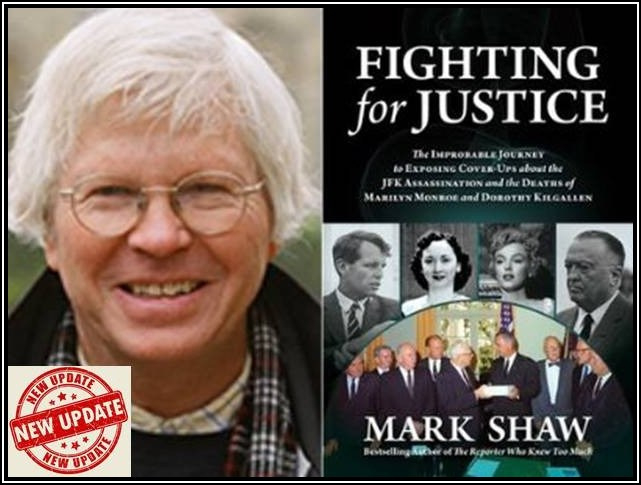
  • Mark Shaw’s Fighting for Justice

    Mark Shaw’s Fighting for Justice


    Mark Shaw has (ostensibly) written six books about the assassination of John F. Kennedy. Four of those have been published in the last seven years. Which means his current output is one book on an average of less than two years. This reviewer has written, or co-written, four books on the case in thirty years. If Shaw wrote books based on the newly declassified documents that have been dripping out due to the strictures of the 1992 JFK Records Collection Act, then fine. But as we shall see, such is not the case.

    When I reviewed Shaw’s Denial of Justice, I noted that for all that was new in that book, Shaw could have simply written a long blog post on his website. (Click here for that review) To expand his parameters what Shaw has done is added another subject—which was hinted at in that book. So instead of Dorothy Kilgallen and John Kennedy, Shaw opened up a new area of inspection in his next book, Collateral Damage. That new area was Marilyn Monroe. As Don McGovern showed in his two part review, Shaw’s writing was remarkably unconvincing about the late film star. (Click here for that review) As Don demonstrated at length, not only did Shaw reveal a lack of analytical insight, he could not even interpret photographs accurately. His excuse for glomming on to Monroe was that she was allegedly a close friend of Kilgallen. As McGovern explained, among many others Shaw made, that statement was inaccurate.

    In his new book, inaptly named Fighting for Justice, Shaw now says he has gotten literally hundreds of letters asking if there was any connection between the deaths of JFK, Kilgallen and Monroe. (Shaw, p. 149) Which is an odd statement. For example, this reviewer has been researching the JFK case full time for the last three decades. I never got one such question, let alone a letter, asking me about that topic. I have attended literally dozens of conferences, and I never heard anyone from the audience ask anything like that. I have been a semi-regular on Len Osanic’s Black Op Radio program for over ten years, and have fielded hundreds of questions from the audience—but never that one. As we shall see—and as McGovern hinted—there appears to be another reason for Shaw’s insistence on now including the Monroe case in his writing.

    Some people like to hear themselves talk. Shaw apparently likes to type. But typing is not writing. About the first fifty pages of this book have little or nothing to do with the alleged subject matter. It is purely autobiographical. So if you want to hear about why Mark Shaw moved from Indiana to Colorado to California, this is your book. Since I was not interested, to me this was just filler.  

    The last part of the book, Chapters 20 and 21—where Shaw excerpts a long phone call between President Johnson and FBI Director J. Edgar Hoover—could have been cut at least in half. And that is not all that should have been cut. For Shaw repeats much of his prior biographical work on Dorothy Kilgallen. He also recycles his half-baked—if that—ideas on the JFK assassination. For instance, he praises the HSCA for examining every nuance of the Kennedy and Oswald killings. (p. 65) Many would disagree. He then writes that there were three shots fired, with the second and third bullets hitting Kennedy. (p. 66) Yet everyone knows the HSCA concluded there were four shots, based upon the acoustics evidence. He now repeats an allegation he made in Denial of Justice that the HSCA report said the Kennedys went after organized crime because mobsters impinged on the success of their father’s bootlegging.(p. 66) I read the HSCA volumes on organized crime, Books 5 and 9, and found no such thing. Let me quote myself:

    If one goes through those volumes, especially volumes 5 and 9, where this Mafia angle is explored, the reader will find no mention of Joe Kennedy’s alleged bootlegging. But in book five, it is noted that, by 1963, the Mafia was falling apart due to Bobby Kennedy’s unrelenting pressure tactics. (HSCA, Vol. 5, p. 455) And make no mistake, the House Select Committee pulled out all the stops in investigating this Mob-did-it angle. They used all kinds of official records, not just in Washington, but also from various local police departments. Again, did no one do any editing of this book?

    So Shaw wanted to write another book. And apparently it did not matter how he filled in the pages. So how does he do it? He prints and then replies to questions and comments from people who read his books, or watched his online presentations. And from what I could discern, the quality of the comments did not matter. There is a letter from a man whose father knew Joe Cody, a former police officer in Dallas. It turns out that Cody bought Jack Ruby the revolver he used to kill Oswald. After relating this information, Shaw pats himself on the back for uncovering “an historical piece of evidence”. (p. 125)

    It would have been natural of Shaw to have clicked his search bar. If so he would have found out that this “historical’ piece of evidence has been around since at least 2008. Since it was described in two obituaries for Cody, one in the Dallas Morning News of July 7th and one at the TV site for KTBS on July 3rd.

    I don’t even want to talk about another one which features Carlos Marcello, Mac Wallace, and Jack Ruby in the same restaurant in Dallas in the summer of 1963. It then gets better. A show girl with Marcello calls Shaw’s witness later in 1977. She says she has a picture of the real JFK assassin emerging from a sewer. Uh, OK. (pp. 119-20).

    But it’s not just stuff like this that Shaw uses to fill in pages of what is supposed to be a book. He now goes back to older books and describes them. One of them is from 1973 and is called The Kennedy Neurosis by Nancy Clinch. If a negative book on the Kennedys gets blasted by The New York Times well, that is notable. (See review by Robert Claiborne of 2/25/73) The book is what Clinch called psychohistory. As Claiborne wrote, this is tough to do even when one has the credentials to do so. Clinch majored in Political Science and did studies of housing in South Korea while in Army intelligence. She tried to explain the Bay of Pigs fiasco by saying it was due to “psychic dynamics” and “unconscious motivations” were “a typically American overconfidence and a typically American indifference toward the responses of the enemy.”

    Claiborne properly labels this as nonsense. But we know what happened with the Bay of Pigs today. It had nothing to do with a “Kennedy neurosis”. It had everything to do with the president being deliberately lied to by the CIA, namely Director Allen Dulles and Director of Plans Dick Bissell. (Destiny Betrayed, second edition, by James DiEugenio, pp. 34-56)

    But strangely, this is something that is almost off limits to Shaw. You will see very little, if anything, about Kennedy’s disputes with the Pentagon or the CIA in any of his books. Even though this particular deception by the CIA caused Kennedy to fire Dulles, Bissell and Charles Cabell, the Deputy Director. I would personally think that would be more important than an ancient story about Joe Cody. Especially when its combined with the fact that the CIA also betrayed Kennedy by assassinating Patrice Lumumba, and backing an overthrow of Charles DeGaulle in 1961. (See David Talbot, The Devil’s Chessboard, pp. 382-89; pp 412-24) This all gets the back of Shaw’s hand, rendered unimportant. Even though when Dulles was appointed to the Warren Commission, at their first executive session meeting, he passed out a book saying that all American presidential assassinations were the work of one man. (David Lifton, Document Addendum to the Warren Report, pp. 89-90)

    What is important to Shaw? Not the new documents. He sloughs those off in a couple of pages. And when I say slough, I mean it. He finds credible a CIA document saying that Sam Giancana was still running the Chicago outfit in December of 1977. Uh Mark, Giancana was killed in 1975. That is almost as bad as him buying into a CIA document from 1998 negating any connection of Oswald to the Agency’s “Office of Operations.” (pp. 106-07) Apparently Shaw is ignorant of what Malcolm Blount did with the papers of the HSCA’s Betsy Wolf. And how her work resulted in CIA officer Pete Bagley declaring that Oswald was a witting false defector in 1959. (Click here, and see John Newman’s speaking of Bagley in Oliver Stone’s JFK : Destiny Betrayed)

    As the reader can see, Shaw is not an astute or prolific researcher on the newly declassified documents. So what does he build his book around? Two things. First, what he broadcasts as an utterly momentous, earthquake type of discovery. It is this: he thinks that Warren Commissioner John Sherman Cooper gave Dorothy Kilgallen the Commission’s Ruby testimony in advance, which she printed in her newspaper. Shaw spends about a dozen pages on this toward the end. He has no direct source, its an inference and a circumstantial case through a man named Morris Wolff. He then uses this as some kind of springboard that Cooper did not buy the Warren Commission from the start.

    Mark we kind of knew that. And the work has been done through more than one person on Cooper’s cohort Senator Richard Russell. Russell, Cooper and Hale Boggs made up the southern wing of the Commission, as opposed to the Wall St./Washington troika of Dulles, Jerry Ford and John McCloy. I wrote about this at length many years ago. (DiEugenio, The JFK Assassination: The Evidence Today, pp. 315-320). This is why there was no stenographer at the last meeting of the Commission to record the southern wing’s dissent. And why Cooper said in a British documentary, way back in 1978, that he did not buy the Single Bullet Theory. Cooper as dissenter is not hot news. And I am still trying to figure out what the impact was of printing Ruby’s testimony early? As I am still trying to figure out how Kilgallen cracked the case if no one knows what she had in her files?

    Let us go to the other key point that Shaw insists on writing about. His new point of interest, which is really quite old: the alleged cover-up around the death of Marilyn Monroe. As Don McGovern showed in his review of Collateral Damage, Shaw went as far as misinterpreting photos implicating Bobby Kennedy in the death of Monroe. McGovern and Donna Morel pretty much wrecked Shaw’s new witness on the Monroe case: actor Gianni Russo. Russo had a hard time getting his age straight as to when he began his alleged relationship with Monroe—at first it was when he was about 12. This did not seem to bother Shaw. And neither did the problem of where Russo said Marilyn was living in 1959, Russo said it was the Waldorf Astoria. It was not.

    To put it mildly, Russo presented some problems for Collateral Damage. So now Shaw brings in writers like Sy Hersh and Frank Capell. But he does not give the reader the proper information about these two men. Hersh fell for a fraudulent legal document that was supposed to be signed by Marilyn and the Kennedys. More than one person said the signatures attached to the document were questionable. Hersh went forward with it anyway until it was shown that zip codes did not exist when the document was executed. (Click here)

    Frank Capell was brought up on charges, along with two other men, in a conspiracy to commit libel against Republican Senator Thomas Kuchel. Prior to that, Capell had been arrested twice for accepting bribes as a government employee. (Click here) I don’t recall Shaw writing about any of these compromising incidents in relation to Capell or Hersh. I find it hard to comprehend he would not know of them.

    But alas, Shaw uses the testimony of LAPD officer Jack Clemmons to say there was no drinking glass in Monroe’s room the night she overdosed. (Shaw, p. 156) As McGovern has proven there was such a glass in her room. (Click here for proof)

    Clemmons was an accomplice in the libel conspiracy charges that Capell was charged with and had to settle. As part of the settlement, Clemmons left the force. Again, this seems to me to be important information and Shaw should have revealed it before committing the factual error with the glass.

    But that is not all. Shaw continues to use a CIA memorandum allegedly signed off on by James Angleton concerning Marilyn, JFK and UFO’s. Many years ago, John Newman, a former intelligence officer, showed how that memo had to be a fake. (The Assassinations, edited by James DiEugenio and Lisa Pease, pp. 360-61). In his devastating critique of Collateral Damage, McGovern brought in another source, Nick Redfern, who also shows the document to be a forgery. So why is Shaw still using it? Or Russo for that matter?

    Another problem: Shaw says that years after Monroe’s death, when her dwelling was purchased by actress Veronica Hamel, it was discovered that the FBI had installed a listening system in the roof of the home. ( Shaw, p. 171) Don McGovern told me that Monroe’s home had no attic, so was the wiring in the walls? How could Marilyn have not known about it then? (Email of 2/24/23) I got in contact with Gary Vitacco Robles, one of the most credible biographers of Monroe. He informed me that in the third volume of his book Icon, which is coming out soon, he will show that this really was a rewiring of the home, due to the fact that the phone wires were antiquated. After all the house was built in the twenties. (Email communication with Gary, 2/24/23)

    I am not going into the scenario that Shaw puts together as to how Robert Kennedy was actually in Los Angeles the day Marilyn passed on. He was not, and this is provable. (Susan Bernard, Marilyn: Intimate Exposures, pp. 186-87) Neither will I critique his scenario about a rectal enema theory, which McGovern showed was simply not plausible. Or the accompanying “spillage” that Eunice Murray was busy machine washing when the police arrived. As McGovern showed, there was no washer/dryer in the home; Monroe sent everything out to be dry cleaned and pressed. (McGovern, Murder Orthodoxies, p. 550) When an author continually makes these kinds of factual errors, and then trusts unreliable sources and documents—I won’t even talk about the book by June DiMaggio that Shaw uses—one begins to wonder about what his true agenda is. Its pretty clear that Shaw has gone around the bend on the MM imbroglio. He has joined the ranks of Milo Speriglio, Robert Slatzer, and Jeanne Carmen.

    And for him to say that somehow Monroe would not have taken her life or not have died from an accidental overdose, this is more Slatzer-like fruitiness. (Shaw, pp. 280-83) As every serious biographer of Monroe has admitted, she tried to take her life at least four prior times. (McGovern, pp. 8-9) She was, plain and simple, a barbiturate abuser. In the less than 2 months before she died, she had gone through about 790 pills. (McGovern, p. 533) Including, among others, Seconal, Tuinal and Nembutal. Tuinal is not available in the USA today; and Nembutal is used for euthanasia by veterinarians. She had a blank check at Schwab’s so to speak. Monroe had been married and divorced three times before she was 35. She had been through three psychoanalysts in about five years. To put it mildly, she did not have an idyllic childhood: she never met her half-sister until she was 18, she likely never met her father, her mother was institutionalized. And she did not like Hollywood. Which is one reason she and her third husband, Arthur Miller, moved to the east coast. I fail to see how any of the above was due to Robert Kennedy.

    What one feels at the end of this book is not Shaw fighting for justice. If so, why did he leave out the above in lieu of a likely forged UFO document, Clemmons and Gianni Russo? An informed reader is disturbed at the almost boundless and unwarranted vitriol aimed at John and Robert Kennedy. Who cannot reply. But Shaw’s publisher at Post Hill, Anthony Ziccardi, was part of Newsmax Media. So Shaw has now found a home for his venom, and his all too frequent—and quite dubious—books.

    Update

    Mark Shaw’s latest is such a hapless effort that it made me go back and look at his career from the beginning. As we all know he has taken on the cause of Dorothy Kilgallen with all the fervor of a jihadic warrior. Exalting her to a degree so extreme that, at times, he seems just silly.

    But what is odd about all this sound and fury is this: Mark Shaw did nothing of the kind in his first two books, which, in their latest editions, amount to about 700 pages. In his first book, a biography of Melvin Belli, he hardly mentions her. (see page 148) What makes that unusual is that there, since Belli was his defense counsel, Shaw writes five chapters about the trial of Jack Ruby. Kilgallen attended that trial and met with Ruby twice privately. Yet Shaw could only muster 49 words on his (later) Joan of Arc journalist.

    In his next book on the case, there was a slight uptick. He devotes a bit more than two pages to Kilgallen—all of it from Lee Israel’s biography.

    This begs the question: What happened in Shaw’s writing career that made him, literally, alter course? The best and most logical answer I can come up with is this: the reprint of Sara Jordan’s long article on Kilgallen’s death in Midwest Today. That fine piece originally ran in 2007. But it was reprinted with a much more graphic, illustrative format in 2015 for the anniversary of Kilgallen’s death. (Click here for that essay) Jordan was assisted by investigator Kathryn Fauble in that version. By the end of the next year, Shaw began his four book series on the reporter. And in that first effort, The Reporter Who Knew Too Much, he gave Jordan and Fauble credit. As time has gone on, he does that less and less.

    With all this in mind, an incident of Shaw’s self-righteousness about Kilgallen stands out even more. Before his book came out, he appeared at a JFK Lancer Conference which I attended. I recall him saying how he thought Kilgallen had been ignored by the critics and he took a personal blast at Jim Douglass for not writing about her in his book. With what we know today, we could ask Mark: if not for Jordan and Fauble, would you have written books on Kilgallen? Your first two volumes do not indicate that.

    The problem with that subject though is this: Once you get outside the parameters of Kilgallen’s mysterious death, there just is not very much there. Shaw likes to say that when she went to New Orleans it was to investigate Carlos Marcello. This is just guesswork on his part. At the trial of Jack Ruby, Kilgallen wanted to know why there was so little being presented on Oswald. She complained about that in one of her columns. Since Oswald lived in New Orleans that summer of 1963, she could just have easily have been inquiring about what he was doing there.

    Realizing that he was at a cul de sac with Kilgallen, Shaw decided to add Marilyn Monroe to his mix. His excuse, that they were friends, has been undermined by Don McGovern and biographer Gary VItacco Robles. As McGovern noted at length, there are so many holes in Shaw’s work on Monroe that you could drive several 16 wheeled semis though it. (Click here) As I pointed out in my article on Sy Hersh, the whole Giancana election rigging scenario from Double Cross—which Shaw relies on– is so faulty that no one could keep their story straight about it. Plus it does not hold up by its own numbers.(Click here) If you add in what McGovern noted what was wrong about Monroe in that book—the Mob never owned her contract—Double Cross has been reduced to a novel.

    Between his reliance on that fairy tale book, his running out of gas on Kilgallen, and his appalling work on Monroe, what does Mark Shaw have to offer to the critical community? How can he say he is fighting for justice? That Coast to Coast maintains him as their semi regular guest on the JFK case is inexplicable. I, for one, think their 3 million listener audience deserves better. A lot better.

  • JFK Medical Betrayal: Where The Evidence Lies by Russell Kent

    JFK Medical Betrayal: Where The Evidence Lies by Russell Kent


    Russell Kent graduated from the University of London with a degree in physiology, which means he studied how anatomy and systems of the body function. He then went to work at a hospital laboratory started publishing. He has now written a book on the medical evidence in the assassination of President John F. Kennedy. It is called JFK Medical Betrayal. It approaches the subject in an unusual manner, one that ends up garnering some valuable insights into the case.

    I

    Kent begins his book by writing that the Warren Commission essentially discounted the Parkland doctors’ observations in lieu of the pathologists at Bethesda morgue, where Kennedy’s body ended up the night he was killed. There were two serious problems in doing this. First, the pathologists at Bethesda—Jim Humes, Thornton Boswell, and Pierre Finck—were not really qualified to be practicing forensic pathologists. And second, for whatever reason, they did not do a complete autopsy. If the law had not been broken, the autopsy would have been done in Dallas, by a respected medical examiner, Earl Rose. But as a result of these shortcomings—amazingly—no one really knows the specifics of how Kennedy was killed.

    From here, Kent focuses on what happened at Parkland after Kennedy’s body arrived. Dr. Charles Carrico directed the gurney be sent to Trauma Room One. (Kent, p. 19) There, Carrico discovered a very small wound in the anterior neck. He also observed a right posterior wound of the head, down low, “about 50-70 mm in diameter and with the skull sprung outwards.” Carrico saw both cerebrum and cerebellum. (p. 19) Malcolm Perry called for a tracheotomy tube. But by 1:00 PM, Dr. Kemp Clark, the team leader, pronounced Kennedy dead. (p. 20) Nurses Diana Bowron and Margaret Henchliffe undressed Kennedy and washed the body. Clark and Perry went on to write about this large, avulsive wound in the rear of Kennedy’s skull. (p. 21) In addition to Perry, Carrico also believed the anterior neck wound was one of entrance, as did Henchliffe. (p. 22)

    According to the author, since LBJ feared further attacks, the new president ordered everyone back to Washington. (pp. 24-25) This led to some rather poorly qualified doctors performing this very important autopsy. Jim Humes had taken a one week course in forensic pathology 10 years prior. (p. 26) But since 1960, Humes was essentially an administrative desk jockey. And he stayed one until his retirement. (pp. 26-27)

    Another indication of these doctors’ lack of experience is that on the autopsy face sheet, Thornton Boswell did not affix his name, or that of Kennedy as a patient. (pp. 27-28) Boswell described the back wound as measuring 7 x 4mm, but he located it in relation to two movable parts of the anatomy, the mastoid process and the right acromion. The proper manner is to measure down from the top of head and then left or right of the spine. (p. 29)

    Pierre Finck was also an administrative desk jockey who may never have performed a gunshot wound autopsy. He was not certified in forensic pathology until 1961, at which time he was not performing post-mortem examinations. The most logical time for Finck to have done a gunshot wound autopsy was when he was stationed in Frankfurt, Germany. But, at that time, he was not board certified. So its logical that he likely assisted in such exams. (p. 30) Finally, Finck got there well after the autopsy had begun.

    As many have noted, a lot of the facts in the autopsy report are not backed up by written data. Humes burned his notes and the first draft of his report. This happened around the time he heard Oswald had been killed. (p. 31). Further, the pathologists did not consult the photos in preparation of their report. According to the author, Humes did talk to Perry that night and learned of the anterior neck wound. (p. 32). And this was the basis for the idea that the back wound exited the neck wound.

    The author poses a cogent question at this time. Namely, why did Dr. George Burkley—who was Kennedy’s personal physician—not inform the pathologists about all that had happened at Parkland? After all, he was the only physician at both locations. (p. 33)

    II

    From here, Kent delves into the creation of the Single Bullet Theory. The FBI concluded that there were 3 shots, and 3 hits: one to Kennedy’s back, one to his head and one to Governor Connally’s back. They discounted the bullet strike to James Tague on Commerce Street and Kennedy’s anterior neck wound.(p. 39) J. Edgar Hoover never bought the Single Bullet Theory.

    The Warren Commission did not agree. With them, the hole in the front of Kennedy’s neck—which was smaller than the back wound—now became an exit wound. These Commissioners were supported by a team of alleged experts at Edgewood Arsenal testing grounds: including doctors Joseph Dolce, Alfred Olivier, Arthur Dziemian and Frederick Light. The Commission eventually concluded that the back wound, which was 7 x 4mm, was the entrance wound and its exit was the anterior throat wound which was about 3-5 mm wide. In other words, the exit was smaller than the entrance. (p. 45)

    As the author notes, there is no evidence that any tests were done on trajectory analysis of the bullet though the back, i.e. whether or not it would hit bones in the spinal cord. Even worse, Olivier stated that their experiments, “…disclosed that the type of head wounds that the president received could be done by this type of bullet.” (p. 51) As Kent notes, this is not accurate. Because their experiments showed that this type of skull wound would result in a blow out of the right side of the face. That is not what happened to Kennedy. Another point about these experiments: in wrist simulations, the entrance was always smaller than the exit. Yet the reverse was true about Connally’s wound. (p. 53)

    According to Kent, there was disagreement about the Magic Bullet concept. Some of it based on the fact that experimentation showed that such a projectile would not emerge so intact. But it was Arlen Specter who decided to ride out the storm. Beyond that, Light and Dolce thought Connally was hit by two bullets. (p. 55). Dr. Robert Shaw, who worked on Connally at Parkland, testified twice. He could not buy one bullet in Connally, he also was reluctant to accept CE 399, the Magic Bullet.(p. 57) Kent notes that Dolce did not testify before the Commission. One wonders if this was one of Specter’s censoring assignments, like Burkley and his death certificate and the two FBI agents at the autopsy.

    III

    By 1967, a strong undercurrent had developed opposing the Warren Commission. Several critical books and essays had gained popularity, and DA Jim Garrison had opened an inquiry in New Orleans. Therefore, the Department of Justice decided to begin a counter attack based on the medical evidence. (p. 68). They first gathered Humes, Boswell, autopsy photographer John Stringer, and radiologist John Ebersole in Washington to review the pictures and x-rays. They signed a false statement about the collection being intact, with nothing missing. (p. 69). A second review then took place by the three pathologists. They said the materials agreed with their original report. (p. 69)

    But this was just the beginning of the DOJ maneuver. Deputy Attorney General Carl Eardley now asked Thornton Boswell to write a letter sanctioning an independent panel. Eardley tried to create an illusion that this was Boswell’s idea, but the evidence indicates the letter was written by the DOJ and sent to Boswell to sign. (p. 70). This was the beginning of the creation of the Clark Panel: a panel of four men allegedly independently appointed from academia to review the autopsy at Bethesda. But as with the letter, Kent advances a case that this was not really accurate. That it was really Attorney General Ramsey Clark who appointed this panel.

    The four men chosen, likely by Ramsey Clark, were: Doctors William Carnes (pathologist), Russell Morgan (radiologist), Alan Moritz and, most importantly, Russell Fisher (the last two qualified as forensic pathologists). A high point of the book is Kent’s analysis of the backgrounds of these four men, indicating that Clark did not want an honest review, which is why he chose them. (pp. 72-76) This section seemed to me to be original and well-reasoned. For instance, Moritz taught Fisher at Harvard, Fisher was very reliant on government funding, and Fisher knew both Humes and Boswell. Also, Fisher had written a text book that was used by pathologists around the world. (To cavil on this section, I think it would have been helpful if Kent had mentioned Fisher’s role in the investigation of the alleged suicide of CIA officer John Paisley. Click here for that)

    The Clark Panel met for two days and the second day was not a whole day. (p. 77) Boswell and Humes appeared before the panel. Kent gives us a good summary of the materials they reviewed. He then mentions that the panel raised the rear skull wound upward by four inches and he supplies reasons for why they did so. Kent also adds that their report on damage to JFK’s brain differs from what the original autopsy report depicts. First, the panel reported significant damage on the left side of the brain which the original report did not, and second was that the corpus callosum was widely torn down the midline. (p. 83) As the author notes, were the pictures the Panel looking at not of Kennedy’s brain? In fact, eventually Fisher admitted that Kennedy’s brain was not sectioned, which he characterized was really a crucial step. (p. 84)

    In their description of the now infamous 6.5 mm fragment on the x-rays of the skull, there is no mention that this measurement matches the caliber of the alleged bullet fired at Kennedy. Neither do they say that the dust like particles in the front of Kennedy’s skull are above the posterior entrance wound. This would suggest an entrance wound. Further, the fact that the larger particles are located near the back of the skull would also suggest this origin, as Dr. Vincent DiMaio wrote. (p. 91)

    Another deception was that the report described “a track between two cutaneous wounds”, presumably between JFK’s back and neck. But as Kent notes this was an imputation: there was no proven track. (p. 92) The main reason being that this wound—as well as the skull wound—was not dissected.

    All four doctors signed by April 9, 1968. Yet, it was not released to the public until January 16, 1969. This was just before jury selection began in the trial of Clay Shaw. Kent’s discussion of the Clark Panel is one of the best—if not the best—I have seen in the literature.

    IV

    The next inquiry into the JFK autopsy was in 1975 under the Rockefeller Commission, headed by President Gerald Ford’s Vice-President, Nelson Rockefeller. Incredibly, Warren Commission lawyer David Belin was appointed the chief counsel to this body. He tried to neutralize the issue of bias by having Robert B. Olson run the JFK inquiry. But as Kent writes, Belin showed up during the medical review and took the testimony of two doctors.

    A large amount of evidence was made available to the doctors. It would take weeks to absorb the material. They were left alone with it for one day and then sent out to produce reports which Belin wanted in about 7-10 days. (p. 104) But Belin and Olsen also asked questions about the case that were clearly suggestive. Things like, “How many bullets struck the president?” And “From which direction did each bullet come?” Kent goes through these questions and gives us examples of what the replies were.

    For me the most revealing exchange was to a question that asked, if the sectioning of Kennedy’s brain was necessary to arrive at reliable information concerning the number of shots or angles that hit Kennedy? Anyone familiar with the process would have to reply in the affirmative. How else could one conclude how many bullets hit JFK’s head and what path they followed? Well, consider this answer:

    Although as a routine matter dissection of the brain in gunshot wounds of the head is desirable, it is not an essential element in this case. I do not believe that further examination of the brain would contribute significant additional information relating the angles from which the shots were fired. (p. 111)

    But yet Belin loaded up even more by adding questions about whether the skin tissue slides were necessary as were pictures of the chest. Of course, both were missing in the JFK case. But again, the good doctors tell us that, like the brain, they really were not necessary for additional information. Can one imagine a cross examination of that reply under oath in a courtroom? I certainly can.

    Making it worse was that one of the doctors, Richard Lindenberg, worked with Finck at the Armed Forces Institute of Pathology. He was also an odd choice in that most of his papers dealt with aviation accidents. Perhaps this was because he was in the medical corps for the Luftwaffe and came to the USA as part of Operation Paperclip. (p. 114) Needless to say, he later wrote a paper with Fisher. Werner Spitz was also on the panel, and he worked with Fisher for a number of years from the late fifties and during the sixties.(p. 123). Another dubious choice on the panel was Alfred G. Olivier, since he worked for the Warren Commission. As the author notes, all the doctors were from the DC/Baltimore area except for Spitz, who moved to Michigan after living in Baltimore for 13 years. (pp. 134-35)

    The Rockefeller Commission continued with the raised rear skull wound, 10 cm about the external occipital protuberance. But as Kent ably points out with photos, although one can make a (weak) case for a wound near that spot in the color photo, that case all but evaporates in the black and white shots. (pp. 120-21)

    Finally, the Rockefeller Commission misrepresented Dr. Cyril Wecht’s testimony. He was asked to testify and he did so for five hours in May of 1975. He was critical of the autopsy and the Magic Bullet. His testimony was reduced to three paragraphs in the report and one would never know how critical he was. Misrepresenting his testimony, it looked like Wecht supported the Rockefeller conclusions. This dispute reached the pages of the New York Times. Wecht asked to see his transcript. He was denied. (p. 135)

    V

    From the Rockefeller Commission, Kent quite naturally leads into the House Select Committee on Assassinations (HSCA). As the author notes, during the first phase of the HSCA, Deputy Chief Counsel Robert Tanenbaum only wanted two forensic pathologists: Cyril Wecht of Pittsburgh and Michael Baden of New York City. Attorney Tanenbaum had worked with the latter often since he was in the Manhattan DA’s office and was in charge of the Homicide division for about seven years.

    This approach was drastically altered under the second Chief Counsel, Robert Blakey. Blakey added seven doctors, and this now made for a nine person panel. Baden had just finished a book he co-wrote with Fisher and Charles Petty, who would be on the panel and was the new medical examiner in Dallas. In fact, Baden wanted Fisher on his panel, but he wisely declined the invitation. Petty had trained in Fisher’s facilities and said that Fisher was the best forensic pathologist he knew. (p. 153) Baden also chose Werner Spitz who had been on the Rockefeller Commission Panel and was a friend of Humes, and had been Fisher’s deputy in Baltimore.

    Kent, after describing briefly the other panelists—Davis, Coe, Weston, Loquvam and Rose—concludes that Wecht was the lone independent doctor. He had not published with any of the others and had no personal relationship with Fisher. Plus, he was familiar with other aspects of the JFK case.

    There was an overwhelming amount of material to learn and absorb, and again this could not be done in just the four days the panel met together. But yet, miraculously, at the end of the fourth day, “it became apparent that the members were in substantial agreement with respect to the interpretation of the evidence.” But further, for whatever reason, Wecht was in a sub group and therefore was not allowed to question two of the original autopsy doctors: Boswell and Finck. (pp. 156-57)

    Andy Purdy was the HSCA writer/researcher for the medical panel. He wrote that one of the panel’s functions was to override the idea that the original autopsy doctors’ views should be given greater weight.(p. 163) But Humes would not give in easily to the panel’s desire to raise the rear skull wound upward. In fact, this part of the HSCA discussion provoked Loquvam to say there should have been no recording made of it. The original radiologist, Ebersole, now admitted there were x-rays missing. (p. 165)

    The HSCA panel ended up supporting the Clark Panel on the elevated rear skull wound. Why? The author thinks this was for two reasons. First, in reverence to Fisher. The second was to escape any possibility of extensive damage to the cerebellum, which about seven witnesses saw at Parkland. (pp. 189-90) And Kent comments that the panel largely ignored the Parkland witnesses and their observations.

    In fact, Kent concludes that Baden misrepresented Dr. Robert Shaw’s reasons for doubting the Magic Bullet. Baden said it was because of John Connally’s testimony. But Shaw did not buy it because “he did not think the bullet was tumbling or had struck anything before hitting the governor.” (p. 191) He therefore doubted any bullet could have emerged like CE 399.

    Wecht ended up being the sole dissenter. He criticized the panel for seeming to accept the work of urologist Dr. John Lattimer and ignoring the pioneering work of pathologist Dr. John Nichols, who had testified at the Clay Shaw trial. When Wecht testified before the committee he raised some very cogent and consequential objections to the Single Bullet Theory. These were ignored by the medical panel. The committee then questioned Wecht in a hostile manner.

    The Single Bullet Theory was going to be honored again. But it would not live long as the Assassination Records Review Board (ARRB) did their own inquiry. Partly at the request of the final chairman of the HSCA, Louis Stokes. As Doug Horne related to this reviewer, Stokes told the ARRB that no one was satisfied with what the HSCA did with the medical evidence.

    In his chapter on the ARRB, Kent focuses on what their outside experts wrote after they were brought in to view the evidence. That is people like forensic radiologist John Fitzpatrick. He was an acquaintance of Executive Director David Marwell. But he specialized in broken bones in children, not bullet wounds. (p. 236). Forensic pathologist Robert Kirschner said the raised entrance in the skull was likely the proper head wound, but he could not match it to the x-rays. He asked to see CE 399 but was skeptical of it. He thought there should have been a large wound track and a gaping exit wound in JFK’s throat. Such was not the case. (p. 241)

    Kent concludes that a completely independent forensic pathology team should have been called in. One that was free of any establishment American influence. (p. 247) In fact he suggests a team from the United Kingdom’s Guy’s Hospital Medical School. He specifically names three men: Francis Camps, Donald Teure, and Keith Simpson. Together, they investigated many unlawful deaths in the London area. For instance, all three were involved in solving the Rillington Place murders. These men could and should have been brought in, for example, to the HSCA panel, but they were not. Whatever they would have concluded they would not have been accused—quite rightfully as was the case—of bias.

    This is an unusual book in its approach. To my knowledge, the medical evidence has never been studied in the new manner that Kent utilizes. It’s almost like a C. Wright Mills approach to the case. For just that he should be appreciated. But beyond that, he studied several medical archives to actually garner the connections between the men who were tasked with examining the forensic facts of Kennedy’s death. With a surfeit of evidence, he proves they were the wrong choices. Which is why their work has not stood the test of time.

  • Gus Russo: There is Nothing in those Damn Files!

    Gus Russo: There is Nothing in those Damn Files!


    Last year and this year, Gus Russo did columns on the John Kennedy assassination for Spy Talk. I would hope these two nothingburger pieces would get him eliminated for the 60th anniversary next year. But, realistically, they look like auditions to the MSM for that target date. The overall theme of his 2021 piece was that there was nothing in–not just the newly declassified documents President Biden had released–but really, there was nothing in any of the JFK material ever released. Not just by the Assassination Records Review Board (ARRB). Even though Russo admitted he only had time to scan the declassified pages Biden released in 2021, he assured us that there was nothing in them of any merit or value. Therefore, the media was making Much Ado about Nothing.

    Gus then leaned back in his chair and looked up at his bookshelf. He now added his punch line. Look you dummies, back in 1964, the Warren Commission issued 26 volumes of evidence and testimony, added to their 888 page report. In 1966 President Johnson released thousands of pages of material from the National Archives. In 1979, the House Select Committee on Assassinations issued 12 volumes of testimony, interviews and evidence. In 1998 Gus says the Assassination Records Review Board (ARRB) declassified 5 million pages. His (unsubtle) implication was that the whole expanse of those documents contains simply more of “Oswald did it”.

    The last statement about the ARRB is in error. The Board declassified 2 million pages, and they did not do it all at once. They did it over four years. It is this material that Russo has avoided when serving as reporter for the late Mike Sullivan at PBS in 1993, for the late Peter Jennings at ABC in 2003, and for Tom Brokaw at NBC in 2013. If anyone can show me where Russo interviewed anyone on the ARRB for any of those programs, please do. I (painfully) watched all three of them; I do not recall him doing such an interview, or even mentioning the Board. In fact, the first two programs were so loaded up with compromised sources that the roster guaranteed nothing from the Board could be mentioned, let alone discussed. Consider some of the following talking heads:

    • Carlos Bringuier
    • Ed Butler
    • Edward Epstein
    • Richard Helms
    • Priscilla Johnson
    • Ruth Paine
    • Gerald Posner
    • David Slawson
    • Larry Sturdivan
    • Sal Panzeca
    • Nicholas Katzenbach
    • Hugh Aynseworth
    • Jack Valenti
    • Robert Oswald
    • Michael Paine
    • Sam Halpern
    • Milton Brener
    • Rosemary James
    • John Lattimer
    • Robert Dallek

    I would argue that some of the more interesting disclosures of the Board concern some of these very persons e.g. Bringuier, Butler, Johnson, Halpern, to name just four. So how could Russo go that route? He would be impeaching his own program.

    Nothing in those ARRB files: really Gus? Let us turn back the clock to the time frame of 1994-98, plus some years beyond, since the Board placed a timed release stamp on some of their documents. Now let us list some of the things that the ARRB managed to both declassify and discover through both their inquiries and through the acquisition of files from both federal sources, and other personages, like J. Lee Rankin Jr. and Jim Garrison.

    • In Volume 7 p. 37, the HSCA wrote that witnesses at Bethesda morgue disagreed with those at Parkland Hospital since they did not see a baseball sized hole in the rear of JFK’s skull. False, The ARRB proved they did see it. (James DiEugenio, JFK Revisited, pp. 127-28)
    • Warren Commissioner Gerry Ford altered the draft of the Warren Report by moving Kennedy’s back wound into his neck, thereby making the Single Bullet Theory more palatable. (NY Times, 7/3/1997)
    • John Stringer, the official autopsy photographer, told the ARRB that he did not use the kind of film or photographic process used in the photos of Kennedy’s brain, so he could not say under oath he took them. (Doug Horne, Inside the ARRB, pp. 806-07)
    • White House photographer Robert Knudsen told the HSCA that he also took autopsy photos, and his pictures—including one with a cavity in the rear of the skull– had now disappeared. (Horne, pp.266-67)
    • Sandy Spencer was a photo technician who also saw autopsy photos of JFK that weekend which differed from the extant ones. His body was cleaned up but there was a neat hole in the back of his skull. Again, that hole is not present in the extant photos.(Horne, pp. 314-15)
    • Due to work by Doug Horne of the ARRB, one can now make the case—through three lines of evidence– that the brain photos at NARA can’t be Kennedy’s. (DiEugenio, The JFK Assassination: The Evidence Today, pp. 160-65; Oliver Stone’s film JFK: Destiny Betrayed)
    • FBI agents at the autopsy both said the wound to JFK was in his back, not his neck, and it did not perforate the body. They swore that Commission lawyer Arlen Specter lied about their testimony.(Horne, pp. 699-705)
    • ARRB declassified documents of 1997 prove that Kennedy was getting out of Vietnam at the time of his death. (Records of the May 1963 Sec Def Conference; DiEugenio, JFK Revisited, p. 78)
    • The ARRB declassified the CIA’s IG Report in which they themselves say they never had any presidential approval for the plots to kill Castro. (DiEugenio, JFK Revisited, p. 75)
    • In 1962, Kennedy turned down a Joint Chiefs plan to create a false flag operation, called Northwoods, in order to invade Cuba. (DiEugenio, JFK Revisited, pp. 180-81)
    • HSCA researcher Betsy Wolf discovered that the CIA had rigged entry and distribution of Lee Oswald’s file in 1959; when CIA officer Peter Bagley saw this altered routing system, he said Oswald was a witting defector. (See “Creating the Oswald Legend Pt.4” by Vasilios Vazakas)
    • The FBI had several sources who informed them that Clay Shaw was Clay Bertrand. And they were given his name as part of their JFK inquiry back in 1963. (William Davy, Let Justice be Done, pp. 192-93)
    • Under oath for the HSCA in 1978, Sheriff John Manchester identified Clay Shaw as the driver of a car in the Clinton/Jackson area in late summer of 1963. His passengers were Oswald and David Ferrie. (Davy, pp. 105-6)
    • Hugh Aynseworth offered a bribe to Manchester to leave the state so he could not testify for Jim Garrison. Manchester replied with this comment: “I advise you to leave the area. Otherwise Ill cut you a new asshole.” (Joan Mellen, A Farewell to Justice, p. 235)
    • In September 1967. the CIA assembled a Garrison Group to obstruct the DA’s inquiry. They thought if they didn’t Shaw would be convicted. This activity went on before, during and after Shaw’s trial. (DiEugenio, Destiny Betrayed, 2nd edition pp. 270-71)
    • CIA lied to HSCA Chief Counsel Robert Blakey about George Joannides, who had funded and supervised the Cuban exiles Oswald interacted with in the summer of 1963. With that hidden, Joannides served as a liaison to the HSCA.. (DiEugenio, JFK Revisited, pp. 233-35)
    • Priscilla Johnson, had tried to join the CIA in 1949 and was later classified as a witting collaborator. She then tied up Marina Oswald with a book contract for over a decade. That book was issued during the HSCA. (See Max Good’s film The Assassination and Mrs. Paine.)
    • If Oswald had spoken with KGB agent Valery Kostikov in Mexico City, why did it take seven days for that cable to get to CIA headquarters? This was so suspicious that David Phillips lied about it. (DiEugenio, The JFK Assassination: The Evidence Today, p. 290)
    • The FBI had a flash warning on the Oswald file since 1959. Why did they remove it on October 9, 1963 right after Oswald allegedly got back from Mexico City. That removal enabled Oswald to be on the motorcade route on 11/22/63. (DiEugenio, ibid, p. 301)
    • In 1963, Earle Cabell was mayor of Dallas. He was the brother of Deputy Director of CIA Charles Cabell, fired by Kennedy over the Bay of Pigs. It turns out Earle was a CIA asset. (Click here)

    I could easily add another 20 items of either equal or similar importance. But the point about Russo’s implication is made. Because these disclosures, in and of themselves, alter the contours of the JFK case. And, as one can see, they do so on different planes: in forensic evidence, with Kennedy’s foreign policy, with Oswald’s associations, and his connections to the intelligence community. In that regard the information by Betsy Wolf and Pete Bagley is of the greatest interest. Unless, of course, you are part of the MSM.

    Gus Russo had three opportunities to disclose at least some of this material. As far as I can see, he never did. But someone will say, in 1993, during the making of the PBS program, the ARRB was not appointed yet. My reply is that there were still files being disclosed, at least in part, at the time. Some of them en toto. I know since I had two friends who were there looking through them.

    Bur Russo was not just implying nothing important existed, he was finding ways around their import.

    A good example of this avoidance is that, although the 1993 PBS program dealt with Mexico City, the authors of the legendary Lopez Report, Dan Hardway and Ed Lopez, were absent. What did the show give us instead? For starters, how about Robert Blakey and Dick Helms. After mentioning that there was no picture available of Oswald entering either the Russian or Cuban consulate, Blakey assured us that Oswald was in Mexico City since he was photographed for and filled out a visa application.

    PBS and Mike Sullivan left out something about that application and the picture. And it’s important. The FBI did a door to door search for any photographic studio in the area Oswald was abiding at. There were none. When they searched for such studios around the Cuban and Soviet embassies the results were that no one had any evidence that Oswald had his picture taken there. (John Armstrong, Harvey and Lee, p. 638). And although Blakey said the signature was Oswald’s, David Josephs found the two copies. Not only do the documents not match, the signatures don’t either. (Click here) This might have been the reason that, as Josephs wrote, the Commission did not show receptionist Silvia Duran the application.

    The PBS show also relied on two Australian girls allegedly on the bus with Oswald headed down to Mexico City: Patricia Winston and Pamela Mumford. But as has been delineated by John Armstrong and Josephs, the two girls don’t appear to have been on the same bus line as Oswald. And further “they said the Russian passport he showed them was stamped; but Oswald had applied for a new one in 1963 and it was not stamped.” (James DiEugenio, The JFK Assassination: The Evidence Today, p. 282)

    Throughout the appearance of Cuban consulate receptionist Silvia Duran, there is no mention of her discrepancy in identifying Oswald or her arrest and alleged torture at the hands of the Mexican authorities. (Mark Lane, Plausible Denial, p. 59; Armstrong pp. 673-74) But the following is key. She told Anthony Summers that she originally identified Oswald by reading his name in the papers and assuming he was the same person she met. But when Summers sent her a film of Oswald from New Orleans leafleting, she said she now doubted it was him. And in her notes she wrote down that the man she saw in Mexico was short, no more than 5’6”, and blonde. Oswald was neither. (Anthony Summers, Conspiracy, p. 350-51) She then repeated this identification to the HSCA, as did diplomat Eusebio Azcue. In 1967, student Oscar Contreras related a similar description about a man named Oswald to an American diplomat. (DiEugenio, The JFK Assassination: The Evidence Today, p. 293) You will not see any of this in the Sullivan/Russo PBS Frontline Special. So the whole assumption made in Frontline, that Oswald was really there is only possible by neutralizing such key facts.

    The PBS show also says that there actually might have been pictures of Oswald entering the Cuban consulate. In the declassified files, we now have the inventory report from the photography station, which reads negative for Oswald. We also have CIA reports from the Agency plants in the Cuban consulate. They were interviewed twice, and both times, they said Oswald was not there. (DiEugenio, ibid, p. 294)

    The PBS program relied heavily on three KGB agents under diplomatic cover at the Russian consulate. PBS did so without ever asking them some key questions. Like, why is there no picture of the guy you say Is Oswald either entering or leaving your building? There should be four of those shots. (DiEugenio, ibid, pp. 287-88) They also never posed the question of why did the man the CIA said was Oswald spoke terrible Russian on calls to that consulate. (DiEugenio, p. 288) When in fact, four witnesses who conversed with Oswald said he spoke Russian proficiently: Marina Oswald, George DeMohrenschildt, Ernst Titovets and Rosaleen Quinn.

    I could go on about this, but the reader can see my point: PBS and Sullivan constructed a slick edifice that seemed to explore the mysteries of Mexico City, but really did not.

    And yet, this was not the worst part of what Sullivan and Russo did. In retrospect the worst part was the game they played with the “Rusty Livingston prints”. I will not go into all this at length since it kind of nauseates me. But specifically, what PBS did with FBI fingerprint expert Sebastian Latona was inexcusable. PBS was determined to have the viewer think that what they produced for them was a new set of fingerprints which incriminated Oswald. For instance, in their 2003 rerun, the PBS narrator said, “The FBI says it never looked at the Dallas police photograph of the fingerprints…”

    Yet, in his Warren Commission testimony, Latona said the contrary. He stated that he did examine photos of the trigger guard area sent by the DPD. (WCH, Vol. IV, p. 21) And it was this print that PBS concentrated on as being some kind of revolutionary discovery. But not only was it not new, it is dubious that this was a separate set. For as Pat Speer has written, when one separates the blow ups from the originals it is likely that the number of Livingston photos was really two. And according to Speer, PBS was wrong not only about Latona, but these prints had been examined by both the FBI and HSCA. In each case they were categorized as lacking forensic value. I really do not want to go any further with this because of what it says about two men who have passed on, Sullivan and his print “analyst” Vincent Scalice. I will just advise the reader to click here and scroll down to “The Prints that Got Away” and please read it all the way through.

    In his most recent Spy Talk essay, Russo has come out in full-fledged support of Paul Gregory’s new book The Oswalds. But before getting to that, Russo takes a blast at the CAPA Conference in Dallas this last November. What is so odd about this is that he describes it as if he was there. For instance, he states that panels denounced all of the government’s evidence as fake news. He then writes, with pugilistic vehemence, that there was a reverence for New Orleans DA Jim Garrison.

    I would like to inform Mr. Russo that there was only one panel during this conference. It did not analyze any evidence. It discussed how the JFK case was treated in schools and colleges. Jim Garrison was not the focus of any panel. Former investigator Steve Jaffe discussed what he did as part of that inquiry for the DA, and he did that via Zoom. In other words, of the 18 speakers, only one talked about Garrison. Which leads one to ask: Was Russo even at the conference? According to the secretary of CAPA he did not register, and if he was there as a walk in, I did not see him. I consulted with two other attendees and they did not see him either. As for his other complaint, again, according to the secretary, Mr. Paul Gregory did not ask to address the conference about his book, The Oswalds.

    Russo has fulsome praise for Gregory’s book, The Oswalds. Why does Russo think this rather incomplete book is so worthy? Well, let us take a look at his Spy Talk discussion, in which he previews the book with the following:

    1. Oswald fired a shot at General Edwin Walker
    2. Oswald was going to do away with Vice President Nixon
    3. Oswald killed patrolman J. D. Tippit
    4. Oswald tried to kill Officer McDonald in the Texas Theater

    When a writer goes beyond what the Warren Commission accused Oswald of, that should be a huge warning sign. For not even the Commission bought Marina Oswald’s story about having to lock Oswald in the bathroom to stop him from killing Nixon. According to them, the bath locked from the inside, and Nixon was nowhere near Dallas or even announced to be there in the near future. (Jim Marrs, Crossfire, 1st edition, p. 272; Sylvia Meagher, Accessories After the Fact, pp. 240-41).

    As Sylvia Meagher noted, this should have shed doubt on Marina’s other claim: about Oswald shooting at Walker. Because the bullet found at the Walker home was not the type of projectile fired from Oswald’s alleged rifle. It was different in caliber and hue. (DiEugenio, The JFK Assassination: The Evidence Today, p. 101) Further, the best witness, Kirk Coleman, said he saw two men leaving the scene, and neither was Oswald. And they drove separate cars; Oswald supposedly did not have a car, and had no driver’s license. Oswald was never considered a suspect in the Walker shooting while the DPD was inspecting the case. Only when the FBI took over and Robert Frazier now said the projectile fired was a 6.5 mm copper jacketed bullet, only now, seven months later, did Oswald become the chief suspect. (Gerald McKnight, Breach of Trust, p. 49)

    As per officer Nick McDonald’s story about Oswald attempting to kill him, I could do no better than refer the reader to Hasan Yusuf’s article, which I believe to be the best exposure of Nick and that issue.

    As per the Tippit case, that was dubious since 1967, when writers like Mark Lane and Sylvia Meagher began to poke holes in it. In 2013, Joe McBride published a book length study, Into the Nightmare, that redefined the outlines of that case–I believe forever. Far from Oswald accosting TIppit, the Dallas Police were looking for Oswald. (Please refer especially to Chapters 11-13)

    As the reader can see, Russo’s attempts to turn Oswald into something like a cold blooded serial killer–thus establishing his guilt in the Kennedy case—betrays an almost rabid, convict at any cost mentality. And it does not matter to Gus, that he leads with his chin. It is this bombastic bias that allows him to embrace Gregory’s book with both arms, all the while patting Paul on the head.

    Gregory does not write about any battering of Marina Oswald by Lee that he himself witnessed. The author relies on reports from the White Russian community. As both James Norwood and Robert Charles Dunne have shown, these are dubious since many of these witnesses were reciting hearsay evidence.(Click here and also here for Dunne’s excellent work)

    One thing that Russo does not mention that is relevant to the case perhaps more than anything else is this: Oswald liked Kennedy. (HSCA Vol. 2, pp. 209-10, p. 217. P. 279) In fact, when and if David Lifton’s Oswald biography is posthumously published, we will learn that Oswald actually had a picture of JFK in his Dallas apartment. Everything else Russo writes in order to demean Oswald would be strongly challenged in court if Oswald would have had an attorney. This point would not have.

    For reasons explained above, Gus Russo lost his way back in 1993 over seeing something that Sebastian Latona did not. I leave it to the reader to decide who was correct on that score.

    Coda:

    To see just how bad Russo has become, we need to make a reference to the book he co-wrote with Harry Moses for the Tom Brokaw special in 2013. In his interview with journalist Richard Reeves, Reeves said that it was Kennedy who got the US into Vietnam, not Johnson, and not Nixon. (Where Were You? American Remembers the JFK Assassination, E book version, p. 174)

    This is patent nonsense. On the day Kennedy was inaugurated there was not one combat troop in theater. On the day he was killed there still was not one combat troop in theater. That all changed under President Johnson. Within a year of Johnson’s election there were 170,000 combat troops in Vietnam. And the figure went up from there. Peaking under Nixon at 540,000 troops. And Nixon dropped more bomb tonnage in Indochina that Johnson. As many historians have uncovered, for example David Kaiser, Kennedy was getting out at the time of his death, and LBJ reversed that process. (See Kaiser’s book American Tragedy, Chapters 10-14)

    Gene Kelly alerted me to an article Gus wrote for the MobMusem.com blog in November of 2021. In this piece of nonsense, Russo goes whole hog for the Cuban/Russian angle manipulating both Lee Oswald in Mexico City and also the critical community e.g. Mark Lane.

    He then goes after Oliver Stone, saying that he initially consulted for Stone’s film JFK, but withdrew after he read the script. This clashes with what he told me in Dallas in 1992. In a conversation with witness Al Maddox, Russo said he was a consultant on the film. And Jane Rusconi told me that Russo also helped with the Book of the Film. (Click here)

    Let us leave Russo with the following sentence he wrote: Oswald was “a serial murderer wannabe and a violent sociopath….that’s what he was.” A serial murderer about whom Bob Tanenbaum, a proficient trial prosecutor, said in JFK Revisited that no jury in the country could convict. I would like to ask Gus: How many homicide cases have you tried to verdict? But I know the answer: Zero.

    UPDATE:

    One of the listeners to Black Op Radio surfaced a video copy of the 2013 NBC special hosted by Tom Brokaw called Where were You? The Day JFK Died.

    It was very difficult to locate as I could not find a copy in any library in America, or for sale on Amazon or Ebay. It is almost like NBC wanted it to disappear.

    The reason I wanted to see it again was simple. I had a distinct memory about one of the interview subjects, the late journalist Richard Reeves. Reeves wrote a book about John Kennedy called President Kennedy: Profile of Power. The book had a major publisher, Simon and Schuster, and it was published in 1993. I could not finish the book since, as Donald Gibson said to me, “It is a piece of junk.” And there is no doubt it was and is. With what Reeves left out, one could have written another, and much better, book.

    Now, why did Brokaw and his reporter Gus Russo want to interview Reeves, and not say, Arthur Schlesinger or Ted Sorenson or Pierre Salinger. These men all knew Kennedy and wrote much better books about the man. This is the likely reason. John Newman’s milestone book, JFK and Vietnam had been integrated into Oliver Stone’s film JFK. And this aspect, Kennedy’s withdrawal plan from Indochina, had a huge impact on a national scale. The message being: If Kennedy had not been killed, there would have been no Vietnam War.

    Well, Reeves was there to say the opposite. As the reader can see in the main article above Reeves said that Kennedy got America into Vietnam. How he kept a straight face saying this is remarkable. But on the show he added something to this. Apparently wishing to counteract the import of the October 1963 NSAM 263, in which Kennedy ordered the withdrawal of a thousand troops, Reeves said something that is truly shocking. He said that this order only referred to support staff like cooks etc. This is why I wanted to see the program again. Because I needed to know if I recalled correctly. I did. The quote is utterly false on its face.

    For example when Kennedy first instructed Secretary of Defense Robert McNamara to brief the press on the order, he told him to tell them it would include helicopter pilots also. (John Newman, JFK and Vietnam, p. 415) If that is not enough, here is a link to NSAM 263. Does military personnel mean cooks to anyone? Finally, one can read the entire McNamara-Taylor report and not find anything close to what Reeves said on the program.

    This was really one of the all-time lows ever for the MSM and the JFK case. Which is saying something. But what does one expect from a combination of Russo and Reeves and Brokaw. John Barbour tried to talk to Brokaw when he heard he was producing the program. He told Tom that he had hours of interviews with the late Jim Garrison to show him. Brokaw simply replied, “No Garrison John.”

    No Garrison. Instead cooks being withdrawn with NSAM 263 right Tom?

  • David Lifton Has Passed On 2

    David Lifton Has Passed On 2


    David Lifton passed away in Las Vegas at a hospice center on December 6, 2022. There was no official notice until a sister of his penned an obituary for the New York Times. He was 83.

    Lifton was born in New York and attended college at Cornell. At the time of JFK’s death, he was in a graduate program at UCLA. His major was engineering physics. He is known in the John Kennedy critical community for a long early essay on the JFK assassination, two books on the subject, and his belief that the Zapruder film had been altered.

    The long essay was printed in Ramparts magazine in June of 1966 and was called “The Case for Three Assassins”. Co-authored with David Welsh, it was a lengthy—22 pages of text—and profusely annotated essay on the medical and ballistics evidence in the assassination that indicated a hit team had taken Kennedy’s life in Dealey Plaza. (Ramparts article)

    The first book, published in 1968, was Document Addendum to the Warren Report. That volume is a compendium of important documents that were not printed by the Warren Commission. It contains the famous Liebeler Memorandum. This was named after Warren Commission lawyer Wesley Liebeler and it contains his Devil’s Advocate criticisms of an early draft of the Warren Report. This volume was limited in audience appeal since it was aimed at the critical community, but it was a valuable work.

    The above two contributions were made when Lifton was—more or less-considered as one of the first generation critics of the Kennedy case. In his book Best Evidence he owes his initial interest in the assassination to a trio of first generation critics, namely Mark Lane , Vince Salandria and Ray Marcus. (pp. 3-11).

    One can say the same about his approach during his confrontation with former CIA Director Allen Dulles. This meeting occurred in late 1965 on the UCLA campus. Dulles had been retired by President Kennedy from the Agency and was now taking a guest lecture spot at the college. LIfton termed it as being a Regents Scholar. As he explained, “He was paid a princely sum for giving a few speeches and meeting students, informally, in a coffee-klatch atmosphere.” (Best Evidence, p. 33) As Lifton noted, Dulles’ appointment to the Warren Commission by Lyndon Johnson was his first return to any kind of public service.

    Lifton first asked for a personal audience with the veteran spymaster. Dulles turned this request down but said he would be glad to answer his questions in front of a small audience. So Lifton joined a gathering of about 50 people in the Sierra Lounge of Hedrick Hall, a UCLA dormitory. LIfton brought a couple of volumes of the Warren Commission with him. This debate is described in Best Evidence on pages 34-37. But since John Kelin sent the author a copy of Lifton’s memorandum on the meeting, we will use that as a reference for this rather memorable confrontation.

    Lifton started off by challenging Dulles on the direction of the shots, with still frames he had enlarged from the Commission volumes of the Zapruder film. Dulles imply denied this evidence. When Lifton said there was smoke atop the Grassy Knoll, Dules said, “Now what are you saying, that someone was smoking up there?” Lifton then quoted Harold Feldman who listed many witnesses hearing shots from two directions. When Dulles asked about Feldman LIfton said he wrote for The Nation. Dulles had a huge belly laugh and said, “The Nation, The Nation.” Dulles also shrugged off the testimony of Governor John Connally, by saying, ”Its utterly ridiculous! A man can’t tell in a situation like that which bullet hit him.” Dulles then said there was not an iota of evidence of a frontal shot. Lifton then argued that eye and ear witness testimony coupled with the Zapruder film indicated there was. Dulles insisted he could not see a thing in the blow up presentation. After Dulles left, many students huddled around Lifton to look at the pictures. This went on for two hours. The graduate student felt he had won the debate.

    But about this time, 1965-67, Lifton began to change his approach to the JFK case. In Best Evidence, he denotes the cause of this as being a phrase in the FBI report on the autopsy; a report made by agents Jim Sibert and Frank ONeill:. The phrase went like this: “…it was also apparent that a tracheotomy had been performed as well as surgery of the head area, namely in the top of the skull.” (Best Evidence, p. 172)

    In his book LIfton describes this phrase as being a defining moment in his research on the case. He says, “I was exhilarated, terrified. I wanted to vomit.” He then described himself as follows, “I arose on Sunday morning convinced I had discovered the darkest secret of the crime of the century.” (Best Evidence, p. 181) It was this feeling that now moved him out of the camp of Commission critics and into what he would later call a radical reconstruction of the Kennedy case. He came to call this “pre-autopsy surgery” He phrased it like this in Best Evidence,

    If someone had altered the head, the configuration of the wounds at Dallas was not the same as at Bethesda. The head was thrust backward by the impact of a bullet from the front, yet the autopsy performed at Bethesda showed an impact from behind. Someone had altered the head! (ibid, p. 172)

    He then concluded that, “Somewhere between Dallas and Bethesda the President’s body had been altered.” Lifton also used this to explain why there were no bullets in the body. (Best Evidence, p. 175) In his arguments with Commission lawyer Wesley Liebeler—a professor at UCLA at the time—he would ask Lifton: if there were other assassins, where are the other bullets? This would portend to be a reply to that query.

    From here, Lifton went on to assemble his whole complex theorem of the crime, based upon an alteration of Kennedy’s body somewhere between Dallas and the Bethesda morgue. And he now used this to explain in his view, “…how many different officials and investigative agencies…could be foiled.” In his concept,

    The secret removal of bullets before the body reached the autopsy room would have severed the ballistic connection between the shooting and the gun of other assassins—before the investigation began. The entire investigative apparatus of the U. S. government could have been misled. (ibid)

    As noted above, Best Evidence was backed by a large publishing house and was guided by a front rank agent, Peter Shepherd. It became a Book of the Month Club selection, and a national best seller. But it also created a rather large controversy both in the MSM—Dan Rather obviously did not buy it—but people like Sylvia Meagher and Harold Weisberg also disapproved. This is not the place to outline this rather rigorous debate, but just to note it.

    The book was quite long, and it went through more than one reprint by different publishers. Lifton also issued a video production based on his research for that book–Best Evidence: The Research Video–and that also sold well. (“Click here for that presentation.


    In his research for Best Evidence, Lifton stumbled across another nebulous and controversial area. This was the provenance and possible alteration of the Zapruder film. On page 555 of the Carroll and Graf version of Best Evidence, Lifton begins a very long on-page footnote in which he describes how he became interested in the subject. That note goes on for three pages. In brief he states that when he saw a very good copy of the film, he noted that he did not see a posterior skull cavity as was described by the Dallas doctors in the Parkland ER. He also discovered evidence that the film had been in the custody of the CIA. Finally, he notes that the doctors in Dallas did not see an exit wound in the upper right side of JFK’s head above and to the right of his ear. Yet, this was supposed to be the exit for the rear shot as depicted in the film.

    At the time of his death, Lifton had been working for a very long time—decades actually– on a biography of Lee Harvey Oswald. That book was entitled Final Charade. This was to be part of a trilogy of Best EvIdence, Final Charade and a volume on the Zapruder film. In the anthology The Great Zapruder Film Hoax, Lifton submitted an essay called “Pig on a Leash” about his theories of Z film alteration.

    We should all hope that the manuscript of Final Charade will eventually be published. LIfton spent so many years on it, so much money, and so much effort, that it needs to be printed. Only then can it be judged as part of the LIfton canon.


  • David Lifton Has Passed On

    David Lifton Has Passed On

    David Lifton passed away in Las Vegas at a hospice center on December 6, 2022. There was no official notice until a sister of his penned an obituary for the New York Times. He was 83.

    Lifton was born in New York and attended college at Cornell. At the time of JFK’s death, he was in a graduate program at UCLA. His major was engineering physics. He is known in the John Kennedy critical community for a long early essay on the JFK assassination, two books on the subject, and his belief that the Zapruder film had been altered.

    The long essay was printed in Ramparts magazine in June of 1966 and was called “The Case for Three Assassins”. Co-authored with David Welsh, it was a lengthy—22 pages of text—and profusely annotated essay on the medical and ballistics evidence in the assassination that indicated a hit team had taken Kennedy’s life in Dealey Plaza.

    The first book, published in 1968, was Document Addendum to the Warren Report. That volume is a compendium of important documents that were not printed by the Warren Commission. It contains the famous Liebeler Memorandum. This was named after Warren Commission lawyer Wesley Liebeler and it contains his Devil’s Advocate criticisms of an early draft of the Warren Report. This volume was limited in audience appeal since it was aimed at the critical community, but it was a valuable work.

    The above two contributions were made when Lifton was—more or less-considered as one of the first generation critics of the Kennedy case. In his book Best Evidence he owes his initial interest in the assassination to a trio of first generation critics, namely Mark Lane , Vince Salandria and Ray Marcus. (pp. 3-11).

    One can say the same about his approach during his confrontation with former CIA Director Allen Dulles. This meeting occurred in late 1965 on the UCLA campus. Dulles had been retired by President Kennedy from the Agency and was now taking a guest lecture spot at the college. Lifton termed it as being a Regents Scholar. As he explained, “He was paid a princely sum for giving a few speeches and meeting students, informally, in a coffee-klatch atmosphere.” (Best Evidence, p. 33) As Lifton noted, Dulles’ appointment to the Warren Commission by Lyndon Johnson was his first return to any kind of public service.

    Lifton first asked for a personal audience with the veteran spymaster. Dulles turned this request down but said he would be glad to answer his questions in front of a small audience. So Lifton joined a gathering of about 50 people in the Sierra Lounge of Hedrick Hall, a UCLA dormitory. Lifton brought a couple of volumes of the Warren Commission with him. This debate is described in Best Evidence on pages 34-37. But since John Kelin sent the author a copy of Lifton’s memorandum on the meeting, we will use that as a reference for this rather memorable confrontation.

    Lifton started off by challenging Dulles on the direction of the shots, with still frames he had enlarged from the Commission volumes of the Zapruder film. Dulles simply denied this evidence. When Lifton said there was smoke atop the Grassy Knoll, Dulles said, “Now what are you saying, that someone was smoking up there?” Lifton then quoted Harold Feldman who listed many witnesses hearing shots from two directions. When Dulles asked about Feldman Lifton said he wrote for The Nation. Dulles had a huge belly laugh and said, “The Nation, The Nation.” Dulles also shrugged off the testimony of Governor John Connally, by saying, ”Its utterly ridiculous! A man can’t tell in a situation like that which bullet hit him.” Dulles then said there was not an iota of evidence of a frontal shot. Lifton then argued that eye and ear witness testimony coupled with the Zapruder film indicated there was. Dulles insisted he could not see a thing in the blow up presentation. After Dulles left, many students huddled around Lifton to look at the pictures. This went on for two hours. The graduate student felt he had won the debate.

    But about this time, 1965-67, Lifton began to change his approach to the JFK case. In Best Evidence, he denotes the cause of this as being a phrase in the FBI report on the autopsy; a report made by agents Jim Sibert and Frank ONeill:. The phrase went like this: “…it was also apparent that a tracheotomy had been performed as well as surgery of the head area, namely in the top of the skull.” (Best Evidence, p. 172)

    In his book Lifton describes this phrase as being a defining moment in his research on the case. He says, “I was exhilarated, terrified. I wanted to vomit.” He then described himself as follows, “I arose on Sunday morning convinced I had discovered the darkest secret of the crime of the century.” (Best Evidence, p. 181) It was this feeling that now moved him out of the camp of Commission critics and into what he would later call a radical reconstruction of the Kennedy case. He came to call this “pre-autopsy surgery” He phrased it like this in Best Evidence:

    If someone had altered the head, the configuration of the wounds at Dallas was not the same as at Bethesda. The head was thrust backward by the impact of a bullet from the front, yet the autopsy performed at Bethesda showed an impact from behind. Someone had altered the head! (ibid, p. 172)

    He then concluded that, “Somewhere between Dallas and Bethesda the President’s body had been altered.” Lifton also used this to explain why there were no bullets in the body. (Best Evidence, p. 175) In his arguments with Commission lawyer Wesley Liebeler—a professor at UCLA at the time—he would ask Lifton: if there were other assassins, where are the other bullets? This would portend to be a reply to that query.

    From here, Lifton went on to assemble his whole complex theorem of the crime, based upon an alteration of Kennedy’s body somewhere between Dallas and the Bethesda morgue. And he now used this to explain in his view, “…how many different officials and investigative agencies…could be foiled.” In his concept,

    The secret removal of bullets before the body reached the autopsy room would have severed the ballistic connection between the shooting and the gun of other assassins—before the investigation began. The entire investigative apparatus of the U. S. government could have been misled. (ibid)

    As noted above, Best Evidence was backed by a large publishing house and was guided by a front rank agent, Peter Shepherd. It became a Book of the Month Club selection, and a national best seller. But it also created a rather large controversy both in the MSM—Dan Rather obviously did not buy it—but people like Sylvia Meagher and Harold Weisberg also disapproved. This is not the place to outline this rather rigorous debate, but just to note it.

    The book was quite long, and it went through more than one reprint by different publishers. Lifton also issued a video production based on his research for that book–Best Evidence: The Research Video–and that also sold well.

    In his research for Best Evidence, Lifton stumbled across another nebulous and controversial area. This was the provenance and possible alteration of the Zapruder film. On page 555 of the Carroll and Graf version of Best Evidence, Lifton begins a very long on-page footnote in which he describes how he became interested in the subject. That note goes on for three pages. In brief he states that when he saw a very good copy of the film, he noted that he did not see a posterior skull cavity as was described by the Dallas doctors in the Parkland ER. He also discovered evidence that the film had been in the custody of the CIA. Finally, he notes that the doctors in Dallas did not see an exit wound in the upper right side of JFK’s head above and to the right of his ear. Yet, this was supposed to be the exit for the rear shot as depicted in the film.

    At the time of his death, Lifton had been working for a very long time—decades actually– on a biography of Lee Harvey Oswald. That book was entitled Final Charade. This was to be part of a trilogy of Best Evidence, Final Charade and a volume on the Zapruder film. In the anthology The Great Zapruder Film Hoax, Lifton submitted an essay called “Pig on a Leash” about his theories of Z film alteration.

    We should all hope that the manuscript of Final Charade will eventually be published. Lifton spent so many years on it, so much money, and so much effort, that it needs to be printed. Only then can it be judged as part of the Lifton canon.


  • Mel Ayton’s The Kennedy Assassinations: A Review

    Mel Ayton’s The Kennedy Assassinations: A Review


    The Kennedy Assassinations: JFK and Bobby Kennedy

    By Mel Ayton

    Say this about Mel Ayton, he will not give up. Seven years ago, Martin Hay reviewed his book Beyond Reasonable Doubt—co-written with David Von Pein. Martin left the authors without a leg to stand on and made a mockery of their bombastic title. (Click here for that review)

    The subtitle of his new book is “Debunking the Conspiracy Theories.” In his preface, Ayton says that the bogus revelations in the John F. Kennedy case were put to rest by the late Vincent Bugliosi in Reclaiming History and the late John McAdams in JFK Assassination Logic.

    This author spent 458 pages of analysis and evaluation in taking apart Bugliosi’s mammoth book. There is no other way to say this: Bugliosi lied in his introduction when he said he would present the critics’ arguments the way they wanted them presented. He then doubled down on this by saying “I will not knowingly omit or distort anything.” (James DiEugenio, The JFK Assassination: The Evidence Today, pp XII-XIII)

    What was so shocking about the former prosecutor’s initial claim was how easy it was to show it was utterly and, in fact, knowingly false. For a prime example, see how Bugliosi dealt with Jack Ruby’s polygraph. (DiEugenio, pp. 267-70) It seemed to me that, with that book, Bugliosi was simply playing to the crowd. In this case, the MSM. A perfect example of this was his treatment of Doug Horne on the paradox of Kennedy’s brain, which had disappeared. Horne tried to prove that the surviving pictures of Kennedy’s brain cannot really be his. And in Oliver Stone’s documentary, JFK: Destiny Betrayed, we proved this along three evidentiary lines. Horne was on camera elucidating one of those lines: the testimony of autopsy photographer John Stringer. (DiEugenio, pp.160-65)

    The book by John McAdams was reviewed by four different authors: Pat Speer, Gary Aguilar, Frank Cassano and David Mantik. The last three were on this site. (Click here to read them.) The remarkable thing about those four critiques is that there is very little overlap between them. Which confirms there was a lot of objectionable material in the book.


    II

    This book is an anthology of essays Ayton has written and published, many of them updated. Before the five essays on the JFK case and six on the RFK case, Mel leads off with his Introduction, entitled “Conspiracy Thinking”. This is his way of branding any author who disagrees with him as a heretic who does not abide by the rules of evidence and logic. To any knowledgeable person, its quite the opposite. Let us just take a few examples.

    Ayton says that the guilt of James Earl Ray in the Martin Luther King case is overwhelming (p. 8). Then why did Bill Pepper win the very accurate and detailed mock trial for Ray? Why did he also win the civil suit in Memphis against Lloyd Jowers for his culpability in the conspiracy. (The Assassinations, Edited by James DiEugenio and Lisa Pease, pp. 492-509)

    He then adds this: “The post-Watergate United States became intensely susceptible to conspiracy arguments.” (p. 2) Well that would happen, if the American public was to finally see the evidence in the Zapruder film, as it was allowed to do in 1975—for the first time, after 12 years. The shocking sight of President Kennedy’s body rocketing backwards with terrific force, when Lee Harvey Oswald was supposed to be behind him—well that might do the trick Mel. Especially after trusted newsman Dan Rather misrepresented what happened in the film back in 1963.

    One last example: Ayton quotes historian Henry Steele Commager as saying in the new millennium, that ”There has come in recent years something that might be called a conspiracy psychology: a feeling that great events can’t be explained by ordinary processes.” (p. 11) That old Priscilla Johnson, recycled by Michael Shermer, chestnut. The idea that Oswald did not shoot Kennedy was propagated way back in 1967 by the first wave of Warren Commission critics: works by Mark Lane, Sylvia Meagher, Edward Epstein, and Harold Weisberg, among others. In December of 1967, Josiah Thompson’s book, Six Seconds in Dallas, actually made the cover of a large circulation magazine, Saturday Evening Post. Lane’s book Rush To Judgment was a number one bestseller.

    These books did what the MSM did not do. As Barry Ernest says in Oliver Stone’s documentary, they compared the Commission’s 26 volumes of evidence and testimony with the original 888 page Warren Report. They found, quite often, the evidence did not line up with the conclusions in that report. The Commisioners were banking on the premise that no one would ever read those 26 volumes. Not only did some intelligent people read them, they were so outraged they felt compelled to write about the difference, at length.

    But in spite of that, Ayton titles his first essay, originally published in 2004, “The Warren Commission Report: 40 Years later, it Still Stands Up.” Could anyone truly think such was the case? One of his opening sentences is that Oswald was a self-appointed champion of Castro. (p. 18) If there is one thing we know about Oswald today is that he was not in any way under the influence of Castro. As Jeff Morley has shown, that was simply the first cover story put out by the Cuban exiles in New Orleans, and paid for by the CIA. (Click here for more.) Ayton does not mention this important essay at any point in his book.

    On the next page, Ayton writes something even worse. He says that if the FBI and CIA had been more forthcoming with the HSCA, some of the mysteries about Oswald would have been cleared up. (p. 19) This is ridiculous. It was the CIA that would not allow the HSCA’s report on Oswald in Mexico City to be released to the public back in 1979. Commonly called the Lopez Report, Mr. Ed Lopez—a co-author–told this writer that the CIA made so many objections to the report that it took them 6 hours to get through the first two pages. That report strongly suggests that someone impersonated Oswald in Mexico City. (DiEugenio, pp.284-300) Also, the HSCA did not include, and the ARRB did not declassify during their active years, the work of Betsy Wolf. That work indicates that someone at CIA rigged Oswald’s file from the time he defected to Moscow in 1959.(Read more.) Why would that happen? And why would Oswald be impersonated in Mexico City? And did the Warren Commission report on these events? No, they did not. Further, as Jeff Morley has written-and stated in Oliver Stone’s film JFK Revisited— HSCA Chief Counsel Bob Blakey did not know the CIA lied to him about what George Johannides was doing in 1963 with the Cuban exiles in New Orleans. Blakey did not know that Johannides was supervising those exiles before he accepted him as a liaison to the committee. Why did the CIA lie about this?

    III

    His next essay tries to say that the mystery of the assassination can be solved by exploring the life of Lee Oswald. It would have been a breath of fresh air if Ayton had written something outside of the Warren Commission tripe. Nope. According to Mel, nothing new has been discovered about Oswald since 1964. He was a misfit, embraced by radical ideology and he took a shot at General Edwin Walker.

    I hate to tell Mel, but Oswald did not take a shot at Walker. (DiEugenio, pp. 100-102) Not unless bullets can change their color and caliber. And if Oswald wanted to be an important political figure, why did he never take credit for killing Kennedy? (Ayton, p. 43)

    Next up is an essay on Jack Ruby. More of the same. In this chapter there is no mention of Dr. Louis J. West and his treatment of Ruby in prison. If you don’t mention West then you do not have to reveal he worked for the CIA in their MK/Ultra program. (Tom O’Neill, Chaos, pp. 377-88)

    He also writes that Ruby left his apartment at 11 AM on Sunday morning and walked down the Main Street ramp. (Ayton, pp. 48-49) First, there is plentiful evidence that Ruby left his apartment earlier that morning and was seen at the DPD headquarters. In fact, he asked three witnesses, “Has Oswald been brought down yet?” (DiEugenio, p. 224) In addition a church minister said he was on an elevator with Ruby at 9:30 AM. Further, when his cleaning lady called Ruby early that morning, she did not think it was him who answered the phone. (Ibid)

    As per Ruby walking down the Main Street ramp as the Warren Commission held, that was seriously vitiated by the House Select Committee on Assassinations. Sgt. Don Flusche did not testify before the Commission. But he told the HSCA that he was in perfect position to view the ramp at that time. Because he had parked his car diagonally across the street and was leaning on it. Flusche knew Ruby and watched the entire episode; before and after the shooting. He said, “There was no doubt in his mind that Ruby did not walk down the ramp; and further, did not walk down Main Street anywhere near the ramp.” (DiEugenio, pp. 227-28). This is one of the reasons why the HSCA differed on this point with the Warren Commission. They thought it was more likely that Ruby came in through an unsecured door thought an alley. (HSCA Vol. 9, p. 139)

    Now that he has—unjustifiably– denied any kind of plot through Ruby, he goes after Mark Lane and the possibility of a CIA conspiracy. I wish I had a dollar for every time someone like Ayton says that the reason Lane prospered was because the public could not accept a misfit like Oswald could change the course of history alone. (Ayton, p. 66)

    Utter nonsense. The reason Lane was successful was because he mounted powerful arguments in his book Rush to Judgment, debated his opponents in public venues, and secured both radio and TV time since he was a cogent speaker who worked tirelessly to get his message out. (Click here for more.)

    Incredibly, in discussing Lane’s trial against Howard Hunt in Florida, he does not mention the Hunt memorandum. (Ayton, pp. 72-73) This was a document written by James Angleton which reporter Joseph Trento saw. Its intent was to provide a cover story for Hunt being in Dallas on the day JFK was assassinated. It was shown to Trento by Angleton himself. (DiEugenio and Pease, p. 195) Ayton implies that the whole story began with someone thinking Hunt was one of the 3 tramps. The legal proceedings began when former CIA officer Victor Marchetti wrote about the document, but he had not seen it, just heard of it. Angleton told Trento that Hunt was in Dallas that day. But further, Trento came to understand the following: “Angleton was trying to protect his own connections to Hunt’s being in Dallas.” And further, that, “It was Angleton himself who sent Hunt to Dallas because he didn’t want to use anybody from his own shop. Hunt was still considered a hand-holder for the Cuban exiles, sort of [Richard] Helms’ ‘unbroken pet.’” (ibid, p. 196). Can one imagine leaving all of the above out in any discussion of that civil trial?

    His last chapter in the JFK section is entitled, “Did Castro Kill JFK?” The premise is so goofy, its not worth reviewing this part. But I must point out a school boy whopper by Ayton. He writes that Joan Mellen relies on the testimony of Madeleine Brown in her book A Farewell to Justice. (Ayton, p. 77) If one checks the detailed index of Mellen’s book, Brown’s name does not appear. How can a writer rely on a witness that he or she does not mention?

    IV

    As bad as Ayton’s work on JFK is, his section on the Bobby Kennedy case might be worse. What can one say about a man who writes over 100 pages on that case and somehow leaves out the name of Dr. Thomas Noguchi? A man who, in those hundred pages, mentions the name of DeWayne Wolfer only in passing–and that is while he is quoting someone else. An author who does not describe the discoveries of Judge Robert Wenke’s Panel, which almost broke open the case. To anyone who knows the case, this is all simply inexcusable. There is no logical or evidentiary reason for these kinds of scholarly lacunae. Because those two men and that proceeding are central to the RFK case.

    What does Ayton give us instead? He uses authors like Godfrey Jansen, Robert Blair Kaiser, Ron Kessler, and men like Michael McCowan and LAPD Detective Chief Bob Houghton to both smear Sirhan’s character and simplistically skew the facts of the shooting. Back in 1970, Jansen wrote a book called Why Robert Kennedy was Killed: The Story of Two Victims. Anyone who picks up the book, as I did many years ago, can easily see what kind of volume it is. It is not in any way a study or examination of the assassination. It is, plain and simple, a political tract. Jansen had lived for years in the Middle East. He was pro-Arab and anti-Israel and he built the book around those two poles. Even the New York Times could not stomach the book. The late Anthony Lukas concluded that Jansen had turned “Sirhan’s act into an object lesson in Middle East politics. Perhaps that makes good politics; it makes a bad book.” (NY Times, May 2, 1971.) If an official story book will not pass muster for the NY Times, who will it satisfy? Well, maybe Mel Ayton?

    I thought no author in the RFK field would ever use McCowan again after I wrote a long review of Dan Moldea’s RFK book in the anthology The Assassinations. (Edited by James DiEugenio and Lisa Pease, pp. 610-31) Moldea did not inform the reader of very much about McCowan, except he was a member of Sirhan’s defense team. To describe that team as inept, does not begin to describe how bad they were. Suffice it to say that they never considered the possibility that their client was innocent. Which, in light of Noguchi’s autopsy—which we will get to later–is almost incredible. And for Moldea and Ayton to not sketch in the background of McCowen is, again, inexcusable.

    McCowan had been drawn up on charges of theft and mail fraud. According to a girlfriend of his, he was also possibly dealing in the black market of arms. Because of all this, he was suspended from LAPD. At the time of his entrance into the case he was on probation and had appealed his sentence. (DiEugenio and Pease, p. 629) A bit fishy perhaps? Important for the reader to know? Obviously.

    Then there was the fact that he offered to work without compensation. Plus the distinct possibility he had recruited an informant into the camp of leftist writer Don Freed when he was entrapped by the police on a phony explosives charge. (ibid) He tried once to categorize Sirhan as a communist. He told Sirhan he had to follow his lawyers’ disastrous trial strategy, or he was finished. This is the same McCowan who wrote a memo discouraging his legal team from calling Sandy Serrano as a witness for the defense. Serrano had seen a young woman and man running down the exterior stairs after the shooting; and the girl was shouting “We shot him! We shot him!” When asked by Serrano who they shot, the girl replied, “We shot Senator Kennedy.” (ibid, p. 586) Is this not a bit exculpatory? But McCowan’s reports were pretty much like this one: reliant on LAPD spin and lacking in insight and context. Despite all this, Moldea–and now Ayton—refuse to even consider the fact the man could have been a plant. And they do not want the reader to suspect that, so they dim the lights around him.

    It is easy to see why. Moldea wrote that SIrhan confessed to McCowan. He told him that as he was looking right at him, RFK turned his head. And that is when he shot him. Neither Moldea nor Ayton explain the problems with this scenario. Noguchi’s autopsy report states that all the projectiles that hit RFK came in at close range, from behind, and at extreme upward angles. The witness reports say that Sirhan’s arm was extended horizontally. Did Sirhan stoop down and then jump forward to shoot RFK? No one saw that. Also, what about the bullets that hit RFK in the back? After shooting him in the head, did Sirhan run around the senator and then fire his Iver Johnson 3 times into Robert Kennedy’s back? No one saw that either.

    V

    In backing McCowan and Moldea, Ayton does not disclose that Moldea broke an agreement which he prints in his book. He said that he would give everyone a chance to see what he would print about them beforehand. The McCowan exchange was not tendered to either Sirhan or his late brother Adel prior to publication. (ibid, p. 630) Ayton does not inform the reader about that important piece of information. Or that Moldea wrote a letter to RFK investigator Lynn Mangan saying he would take that quote out of the paperback version due to this problem. But he didn’t. Nor does he disclose that Sirhan vehemently denies the exchange ever took place. Or that the story McCowan told to Moldea about the shooting was at odds with what Moldea had earlier said in his book was his solution to how the crime actually happened. (ibid, p. 631) How and why Ayton could not detect this—it was quite obvious—is a bit surprising. And why, without revealing any of this, he would want to introduce new materials by McCowan, praised by Moldea, is a bit startling.

    Thomas Noguchi’s autopsy of Robert Kennedy has been praised by no less than Dr. Cyril Wecht as one of the finest medicolegal examinations he has read. As authors like Philip Melanson have written, that study states that all the bullets that came into Kennedy entered from behind, at very close range, and came in at rather extreme upward angles. Since Sirhan was in front of Kennedy, this has led witnesses like maître d Karl Uecker to declare that “There’s no way that the shots described in the autopsy could have come from Sirhan’s gun…Sirhan never got close enough for a point bank shot. Never!” (Philip Melanson, The Robert F. Kennedy Assassination, p. 33; see also Lisa Pease, A Lie too Big to Fail, pp. 275-76) In fact, before the grand jury, Noguchi said the fatal shot, behind the right ear, was at most no more than 2-3 inches from the skull. (Pease, p. 68)

    This creates a problem for Ayton, in both distance and direction. So he employs Vince DiPierro to say that, yes I saw Sirhan and he was that close to RFK. As this writer discovered years ago, there was pressure placed on DiPierro to amend his story. If one compares Vince’s early statements to those which Ayton uses, one can make that argument. (Pease,p. 49, pp. 72-74) Before the grand jury, Vince had said that Sirhan was somewhere between 4-6 feet in front of Kennedy. And he was behind Uecker, who was a large, thick man. Ayton also tries to use photographer Boris Yaro to deny this spatial fact. But as Pease wrote years earlier, Yaro was looking through a camera viewfinder in a foreshortened sightline, and told the FBI that Sirhan and Kennedy were “little more than silhouettes.” (LAPD Case Summary, p. 25).

    There are two other evidentiary arguments which Ayton either slights or simply avoids. Those deal with the number of bullet holes in the walls and ceiling of the Ambassador Hotel pantry—the crime scene—and the chain of custody issues dealing with both the handgun allegedly used and the bullets in evidence today. Concerning the former, Pease did a sterling job illustrating this serious problem, and she did it with documents and photos. She concluded there were 13 bullet holes. (Pease, pp. 257-64) As per DeWayne Wolfer’s handling of the gun and the projectiles, well the fact that, in 100 pages, Ayton pretty much avoids the man and this issue tells you all you need to know about Wolfer’s actions. (For the prurient reader I suggest Pease’s book pp. 81-84 and 91-97)

    Ayton goes beyond the norm in trying to discredit the idea of Sirhan as a programmed Manchurian Candidate. Yet he leaves out the name of Dr. Eduard Simson-Kallas. Kallas was one of Sirhan’s psychologists while imprisoned. He came to the conclusion that Sirhan was not mentally afflicted, but that he may have been hypnotized into committing the crime. And he attacked Sirhan’s defense team for their pleadings on this issue. He also criticized them by saying it was not possible for a person to hypnotize himself into such a deep trance. There must have been an external programmer. He was so disgusted with Sirhan’s defense that he called it the “psychiatric blunder of the century.” (Pease pp. 381-82)

    Ayton also tries to neutralize the famous Bjorn Neilson/Palle Hardrup Danish Manchurian Candidate case by saying that Hardrup later said that when the police suggested he may have been hypnotized, he used that excuse as a way of escaping liability for his crimes. (Ayton, p. 165) Again, this is dubious. Because all one has to do is read Wikipedia to see that Hardrup told several witnesses that Neilson hypnotized him several times in prison, before the crimes had been committed. (See also Pease, p. 392) Secondly, Lisa Pease traces a case in her book from Sebenico, Yugoslavia in 1923. A hypnotist placed a policeman in a trance and gave him a block of wood. He told him to fire into the crowd. Once the wood did not work, the cop pulled out his gun. He killed three people. The hypnotist was jailed, the policeman was placed in an asylum. (Pease, p. 394)

    In his endless attempt to discredit Sirhan, Ayton even uses Carmen Falzone. And he bills him as a friend of Sirhan’s at California’s Soledad Prison. (Ayton, pp. 196). Falzone said that Sirhan was in a waking state during the shooting of RFK and he killed Bobby Kennedy for the Arab cause. This one is really beyond the pale. As Lisa Pease and myself wrote, Falzone was first an informant on Sirhan and then was used by the DA’s office to spy on Sirhan’s family. (DiEugenio and Pease, p. 630) He was supposed to implicate Sirhan and his family in a plot that was allegedly being run by Muammar Qaddafi of Libya. But Falzone got details of his story screwed up, like the hand which SIrhan used to fire the gun. (For the whole tawdry episode about Falzone, see Melanson, pp. 116-26)

    This is an aspect of the story that Ayton wants to avoid. That is the extent which the authorities went to in order to smear, manipulate and convict Sirhan. For example, he leaves out the roles of Hank Hernandez and Manny Pena on the initial Special Unit Senator inquiry into the RFK murder. What Hernandez did to witness Sandy Serrano has become infamous in the RFK literature. She saw the Girl in the Polka Dot Dress running down the stairs after the shooting. DiPierro had seen that girl inside the pantry next to Sirhan. Serrano had to be negated since she told her story on TV with newsman Sandy Vanocur. I should not have to tell the reader how Hernandez broke every protocol in the book in conducting Serrano’s polygraph examination. (Pease, pp. 104-16). And as hostile as Hernandez was to witnesses who tended to exonerate SIrhan, he played softball with those people who should have been suspects in the case e.g. Michael Wayne. When Hernandez asked if he had been arrested, Wayne said yes. Hernandez said he could say not since he was a youth at the time.

    As I have seen for myself, Pena actually wrote on lead sheets about the Girl in the Polka Dot Dress, “Do not follow.” In my opinion, there was no more important lead to follow in the RFK case. The fact that it was not shows us that LAPD was not interested in solving the case. That this goes unreported and uncommented on in this book tells us all we need to know about it.

  • Dale Myers and his World of Illusion

    Dale Myers and his World of Illusion


    Dale Myers has made a career out of giving the MSM what it wants concerning the assassination of President John F. Kennedy. This includes proffering a truly dubious witness, Jack Tatum, to incriminate Lee Oswald as the murderer of J. D. Tippit. Jack Myers exposed the man Myers foisted on the public via PBS in 1993. (Click here for details).

    But that was not enough for Myers. Not by a long shot. On the 40th anniversary of JFK’s murder ABC’s Peter Jennings wanted to do a program supporting the Warren Report. Somehow, he knew where to go. Jennings hired Myers’ buddy Gus Russo as lead reporter. Russo turned to his PBS chum Dale. Myers went to work on two main areas. These were the acoustics evidence, and his Rube Goldberg “computer simulation” of the Zapruder film: an animation that is supposed to reveal the forensic truth about the last few seconds of Kennedy’s life as it was extinguished in Dealey Plaza.

    The problem with both of these is that they turned out to be about as reliable as Myers’ PBS work on the murder of Tippit. Concerning the acoustics evidence, Myers tried to proffer that by relating the movement of the DPD motorcycle driven by H. B McLain in the Hughes film, and then drawing a parallel with the same rider in the famous Zapruder film, he could discredit the acoustics evidence as being inaccurate about the shot sequence in Dealey Plaza. Myers attested that by his mathematical comparison, McLain would have had to have been riding at 200 mph to be in the correct spot to capture the sounds of the bullets in Dealey Plaza on his radio. (Donald Thomas, Hear No Evil, p. 676).

    The problem with Myer’s statement was that the general public only saw the computations it was based on three years later. When informed people finally did, it turned out that Dale had done some MSM like slicing and dicing in order to come out with that 200 mph number, e. g. the timing of the first shot, assuming the grassy knoll shot missed, the placement of Robert Hughes etc. (Thomas, pp 677-680). After a long and detailed analysis, Don Thomas concluded that not only was Myers wrong, but “The ABC documentary’s “concrete evidence” had feet of clay. The producers had relied on an expert whose only credential was a bias against conspiracy theories.” (ibid, p. 684; we will go into the Myers “simulation” shortly.)

    On July 24th, Myers wrote a piece that was his way of getting back at Oliver Stone’s two new documentaries JFK Revisited and JFK: Destiny Betrayed. He bases this critique on his viewing of the two films in the DVD package plus the release of the accompanying book JFK Revisited: Through the Looking Glass, which contains the annotated scripts, and interview excerpts.

    He starts off on the wrong foot by saying the DVD package contains almost ten hours of material. Since the long version of the film is four hours and the short version is two hours, and there is overlap between the two, I guess we will have to wait about another three years to figure out how Dale came to that number. (Even if one throws in the commentary track version, it is not ten hours.)

    Myers now slips up again. He wants to criticize the film for something that it does not include. Namely the murder of Tippit. He then acknowledges that some might think this is not fair, but he brushes this off with another of his patently bombastic pronouncements: “I think this is the heart of why the film comes off like a stacked-deck.”

    This is the guy who used Jack Tatum as his chief witness in the Tippit case, and who then based his 200 mph motorcycle speed on invisible calculations. He now works his way into the mind of Oliver Stone and his screenwriter—namely me—and says imperiously, ”Oliver Stone and James DiEugenio won’t deal with the Tippit murder because it is the snare that entrapped Lee Harvey Oswald. It was Tippit’s murder that made Oswald a prime suspect in the JFK assassination.” Now that is a rhetorical trick worthy of a card sharp. For the simple matter that the film shows that Oswald not only did not shoot Kennedy, he could not have shot Kennedy. Therefore why would he be involved in the Tippit murder? As Bob Tanenbaum, who Stone and I met with numerous times while planning the film, says on screen: With the Warren Report’s evidence you could not convict Oswald in any court in the country. As an Assistant New York County District Attorney in Manhattan Tanenbaum never lost a murder case in seven years. I think those credentials outdo Myers’. Don’t you?

    The book accompanying the DVD contains annotated scripts to both films: the short and long version. It also has excerpts from interviews that largely did not make it into the film due to time issues. Myers refers to that over four hundred page book as being “semi-annotated”. In reality, the pages dealing with the film scripts contain over 500 footnotes. Every statement of factual evidence is sourced.

    Interestingly, Stone’s lawyer actually started that process when, upon seeing the rough cut of the film, she wanted us to prove the things we were saying about the pathologists in the film. She thought they were quite startling and might be hard to comprehend to a general audience. Much of that evidence was produced by the Assassination Records Review Board (ARRB), and this is why we enlisted three members of the Board to appear on the program. The reader may want to ask Myers if, in any of the shows he has worked on, he talked about the existence of that body or revealed any of the new or declassified results of its work. One example: that autopsy photographer John Stringer denied he took the pictures of Kennedy’s brain in the National Archives. After all, JFK Revisited has ARRB employee Doug Horne relating this evidence. He was in the room when Stringer said it under oath. That disturbing testimony leaves us with these questions:

    • Who did take the pictures?
    • Why did someone else have to shoot them?

    This evidence, as presented in the film, is the kind of material that one could have taken into a court room to adjudicate an acquittal for Oswald. Because the presentation of fraudulent evidence in a felony case can be grounds for having the proceeding thrown out. Stone’s film actually has a practicing neurologist, Michael Chesser, talking about this evidentiary issue.

    JFK Revisited, the film and the book, attempted to gather professionals in the field of legal procedure and forensics. I have named two, Tanenbaum and Chesser, and I wish to introduce a third, namely Dr. Henry Lee. Why? Because Myers said that our film included an animated reconstruction of the shooting. No it does not. If we had done so, we would have had to include scale models of the figures in the car, close ups of where the bullets struck the two bodies, and some kind of time sequence also. We chose not to do that. And this is where Dr. Lee comes in to play.

    As screenwriter, I did a pre-interview with Lee when he was in Los Angeles testifying in a case. I asked him about this whole issue of doing computer reconstructions for trajectory analysis purposes in the JFK case. He said simply and pointedly: You cannot do that in the Kennedy case. He added that this is due to the basic reason that neither wound in the president was dissected. Therefore, any trajectory analysis amounts to guesswork. Unless a wound track is dissected, you cannot present a trajectory with any real authority. This from the man who many consider the best crime scene reconstruction professional in the business. I decided he was, in all probability, correct and we did not do that sort of thing.

    Why did I conclude that? Because Lee has worked on 8,000 felony cases, and about 1,000 of them have been death by gunshot. He has written over 30 books about true crime cases and some of those are used as textbooks in forensic science classes. He has been approved to testify in almost every state of the union, and also 42 countries. As with Bob Tanenbaum, I would like to ask Mr. Myers: “How many states have you been approved in to testify as a forensic crime scene reconstruction expert? How many countries?”

    Concerning Lee’s statement, in Myers’ ABC “simulation’ I don’t recall him telling the audience that there was no dissection of the back wound in President Kennedy. Or explaining why. He surely has to know that Kennedy pathologist Pierre Finck admitted under oath at the Clay Shaw trial that there was military brass in the morgue that night and they would not allow the wound to be tracked. (James DiEugenio, Destiny Betrayed, second edition, p. 302). This was rather important information. But I don’t think that Russo or Jennings would have allowed that in the show; for obvious reasons.

    Myers tries to neutralize the attacks on his “computer simulation” by saying the critiques I named of it, that somehow, he had crushed them all. This really makes me wonder about good ole Dale. According to Bob Harris, Myers asked You Tube to remove his critique of Myers’ simulation. To my knowledge, he never replied to Milicent Cranor. Myers said he called David Mantik, but Dave said he never got the call or any message. As for Pat Speer’s, well the reader can see how this exchange turned out himself.

    Anyone who watches JFK Revisited can see that what we did was to present evidence that 1.) It is highly unlikely that a bullet could do the damage that CE 399 did and emerge in such intact condition. 2.) The chain of custody of this bullet is rather suspect. For the former we had forensic pathologist Cyril Wecht on camera along with battlefield surgeon Dr. Joseph Dolce, who worked for the Warren Commission. For the latter we had Dr. Gary Aguilar, Dr. Henry Lee, and former police investigator Brian Edwards as witnesses. In the film, Aguilar proved that the FBI lied when they wrote that Bardwell Odum showed CE 399 to original Parkland identification witnesses O. P. Wright and Darrell Tomlinson. Odum said he never did any such thing. (The Assassinations, edited by James DIEugenio and Lisa Pease, pp.282-84) To repeat: this is the kind of fraud that can get a case thrown out of court. Again, I do not recall Myers discussing this for his ABC “reconstruction”. I think it would be relevant to that presentation. After all, if the bullet was not CE 399, what bullet trajectory was Dale “simulating”?

    Myers objects to my references to the Tippit case in the book, JFK Revisited. He says the essay I wrote and reference is a mélange of work by Bill Simpich, Farris Rookstool and John Armstrong. Anyone who reads that piece can see that there are about 7 references to those three in that profusely annotated work. (Click here.) The two most often used sources are, by far, the Warren Commission volumes and the book by Joe McBride, Into the Nightmare. Myers does not want to acknowledge this, perhaps because it indicates 1.) There is material in the volumes he chose not to use and 2.) McBride’s book showed that Myers’ work on the Tippit case was, to be kind, not as comprehensive as he tried to advertise it.

    For instance, it turns out that– in all the decades he says he worked on the Tippit case–he never interviewed the murdered policeman’s father. If Joe McBride found him, why couldn’t Dale? When McBride quoted Edgar Lee Tippit as stating things that would contradict the Myers/Warren Report version of the Tippit shooting, Dale did a funny thing. He now wrote that Edgar Lee was somehow mentally afflicted. As McBride points out, that information was garnered from a sister of J. D. ten days after Myers ordered McBride’s book. In other words, Myers somehow could not locate the man in some 35 years, but now—oh so conveniently– he finds out it did not matter.

    Anyone can read McBride’s reply to Myers. (Click here.) Myers wants to belatedly discredit Edgar because he brings out evidence that indicates Tippit, and another officer, “Had been assigned by the police to hunt down Oswald in Oak Cliff.” Edgar then added that the other policeman did not make it to the scene since he stopped for an accident. As McBride also reveals, former DA Henry Wade seemed to corroborate Edgar. He told Joe: “Somebody reported to me that the police already knew who he [Oswald] was, and they were looking for him.” McBride goes further and states, with convincing evidence, that the other officer, who did not get to the scene, was William Duane Mentzel.

    In sum, if Oliver Stone had decided to explore the Tippit case, I would have scripted that also. And I would have brought in the work of McBride, as well as authors like Henry Hurt, Jack Myers and myself. I would have chosen what I thought was the best from each of these sources and arranged it as astutely as I could. To put it mildly, it would not have comported with the Warren Report version.

    Myers closes his diatribe by making some of his usual sociologically absurd comments. He first says that there is a movement to silence in America. Really Dale? In the age of Donald Trump? He then gets to his point: Somehow Oliver Stone and myself were ignoring and obfuscating what happened on the day Kennedy was killed. No we were not. We were doing what he never did. We were analyzing the newest evidence in the case with persons who are, unlike him, credentialed professionals. That is why we used people like Dr. Cyril Wecht, criminalist Henry Lee, Dr. Gary Aguilar, physicist David Mantik, neurologist Mike Chesser, former police investigator Brian Edwards, journalist Barry Ernest, ARRB investigator Douglas Horne, surgeon Donald Miller and radiologist Randy Robertson. We easily had more accredited professionals on screen than appeared in all of the programs Myers has worked on combined. In fact, the comparison is so one sided as to be kind of laughable.

    This unprecedented gathering of authorities gave the public some new, evidence-backed insights into the actual circumstances concerning what happened to President Kennedy in Dallas. One example: Chesser, Mantik and Aguilar proffered a case– with House Select Committee on Assassinations advisor Larry Sturdivan’s own evidence—that a shot came from the front. Those same three, plus Horne, also showed that the brain photos, accepted by the HSCA as President Kennedy’s, cannot be his. And, as anyone can see—except Dale Myers—they did this on three evidentiary grounds. I could go on in this vein e.g. about demonstrating Oswald’s alibi, but the point is made. Questions like: What does the autopsy reveal about the true circumstances and the actual cause of death? Does the defendant have an alibi? These are what a criminal investigation of a gunshot homicide are about.

    But that is what Myers, Russo, the late PBS producer Mike Sullivan, and Peter Jennings, were not going to do. It was they who were the masters of silence about really happened to JFK. And this new work helps show Dale Myers for what he was and is: a designer of sand castles in the air.