Author: James DiEugenio

  • Nelson, Hall and Graff: The Review Board’s Public Comments


    From the January-February, 1997 issue (Vol. 4 No. 2) of Probe


    Although Probe has attempted to keep its readers informed of the actions of the Review Board, it has been awhile – Vols. 1 & 2 to be exact – since we chronicled some of the comments made for public consumption by the Board members. In 1995 and 1996, enough has seeped into the record for us to issue another report on this important aspect of the Board’s public function.

    At the recent Review Board hearing held in Los Angeles, there was an interesting colloquy between Eric Hamburg and Board member Anna Kasten Nelson. Before commenting on this interesting aside, let us review how both people came to be involved in this hearing. As no less than Kermit Hall has stated, the ARRB is a direct result of Oliver Stone’s 1992 film JFK. At the time of the film, Hamburg was working as a Democratic staff member on Capitol Hill. One of the last things he did was to work on the completion of the 1992 JFK Act, which George Bush originally agreed to and then had second thoughts about. Bush sandbagged the process by not appointing a Review Board. When Clinton took over, the Board apparently was not a top priority with him. He waited until September of 1993 to appoint a Board which was not sworn in until April of 1994. The law stated that Clinton’s choices had to be considered from lists recommended by the Organization of American Historians, the American Historical Association, the Society of American Archivists, and the American Bar Association. It is important to note that although Clinton was supposed to consider appointments form these lists, he was not bound by them completely. For instance, Henry Graff (about whom we will comment shortly) was not on any of the lists. Stone submitted a list to the Chief Executive that was totally ignored in the selection process. Nelson was chosen from a list compiled by the ABA, as was Chairman John Tunheim. Since the creation of the Review Board, Hamburg has left Washington to become, first an attorney for Stone and then the co-producer of Nixon and editor of the book that accompanied the film. Nelson is an occasional contributor to the periodical Chronicle of Higher Education. In the uproar that ensued over the release of Stone’s film, Nelson wrote an article for that publication entitled “Open the Nixon Papers”. Much of the piece is fine and well-intentioned. She basically chronicles the disputes over the collection of Nixon’s papers that have not been made available to the public and pleads the case for full disclosure.

    But in her opening two paragraphs, Ms. Nelson seemed to join in the reflexive, and as we shall see, uncalled for mugging of Stone and his film. Let us consider some of her comments. She first states that “Stone’s version” of Nixon is a “paranoid, foul-mouthed alcoholic”. By labeling this portrait as “Stone’s version”, she implies that Stone took liberties with the record to create this portrayal. This is not so. To call Nixon “paranoid” is fully justified in almost any sense of that word. Nixon called himself a “basket case” over leaks in the White House. This is, of course, what led to the creation of the so-called “plumbers”. In recently declassified tapes, the Los Angeles Times (12/8/96) has shown that Nixon pushed for tax audits of wealthy Jewish contributors to his Democratic rivals in preparation for the 1972 election. Another reveals his participation in the planned but not executed plot to firebomb the Brookings Institute in order to get files on the authors of the Pentagon Papers. As for Nixon’s drinking, this was revealed in Ehrlichman’s Witness to Power back in 1982. What Stone implies is that the drinking was intensified under the pressure of the Watergate scandal. This is backed up completely by the release of the tape of Nixon’s call to Bob Haldeman after his April 30, 1973 speech in which Nixon announced both his and Ehrlichman’s resignations. The first line of the story in the L.A. Times (11/30/96) analyzing this tape reads: “The president seemed to be sloshed”. Later the story states, “It was plain from his slurred syllables that he’d been drinking.”

    In the same paragraph, Nelson writes that “Stone wears the mantle of the historian in this movie”. This is not so. The first frame of the film reads as follows, “This film is a dramatic interpretation of events and characters based on public sources and an incomplete historical record. Some scenes and events are presented as composites or have been hypothesized or condensed.” At the end of the film, Stone’s voice-over makes the same complaint that Nelson does in the body of her piece, namely that the historical record is incomplete since very few of the Watergate tapes have been declassified. We should add here, that the debate over this film, as with JFK, helped in that process.

    Nelson also repeats a charge that many in the media unleashed at the time, when she talks about “Mr. Stone’s obsession with the idea that a government conspiracy linked Nixon to the Kennedy assassination.” Let us examine this charge as it relates to the completed film that Nelson saw. The viewer will note that at about 47 minutes into the film, Nixon is in Dallas the day before the assassination. This is a matter of historical record. At the gathering that follows, with Nixon’s political plans being discussed, there is a hint that the wealthy people there know what will happen the next day. There is no hint that Nixon knows. About two hours and twenty minutes into the film, there is a quick scene in which Haldeman and Ehrlichman discuss this “Bay of Pigs” thing that Nixon has brought up. Haldeman offers to explain it by saying that it is an encoded reference to the fact that “We went after Castro and in some crazy way it got turned back on Kennedy.” Note that this is Haldeman speaking and not Nixon. Haldeman’s words in the film are completely backed up by his passage in The Ends of Power (pp.37-40) where he discusses this idea in depth. About 18 minutes after this, Nixon is listening to a tape in which the CIA’s Castro assassination plots are being discussed. On tape, he says “Those guys went after Castro 7-10 times.” Then, in replaying the tape, he hears the words “Whoever killed Kennedy came from this thing…” This is the only clear reference to what Nelson is inferring. But the whole point of this scene is to show that Nixon, about to resign under threat of sure impeachment, is mentally deteriorating, almost delusional. This is indicated by his seeing the ghost of his mother twice in the room, and his shouting, “Go away!” Then he talks back to the tape and says, “I never said this stuff.” Stone also inserts subliminal shots, of his brother dying for example, that are run in reverse to indicate Nixon’s instability at this moment. To say that Nixon was not a divided man at this time, that his basic insecurity – which even Haldeman notes in his book – was not magnified under pressure is, I think, illogical. But for those who need proof, on another recently released tape from May 1, 1973 (Newsday 11/19/96) Nixon is heard to be seriously contemplating resigning but is talked back into staying by Alexander Haig. This is one year before he actually quit. Again, Stone was on solid ground with both the portrayal of Nixon and Haig.

    To be fair to Nelson, in the last 20 years of his life Nixon relentlessly attempted to rehabilitate his public image. After initially resisting, the media, and a large part of the public acquiesced in that campaign. This included a series of gassy and fatuous books like The Real War, The Real Peace, and Leaders, which no matter how unenlightening, sold well with the public. By the time of his death in 1994, it had succeeded to such an extent that even Bill Clinton, who worked for McGovern in 1972, spoke rather glowingly at his funeral. But in our view, there was enough in Nixon’s career before 1960 to mark him as a complete opportunist, a firm believer in polarization, and a man without enough principle to rein in his large dark side. So the 20 years of rehab didn’t take with us.

    The year before Nelson’s remarks appeared, Kermit Hall spoke for the record in Ohio State Alumni Magazine, of March 1995. Apparently, Hall’s view of the assassination had modified very little since his March 1994 remarks to Randy Krehbiel in the Tulsa World. Hall does give Stone credit for the JFK Act by saying that the law might as well have been called the Oliver Stone Law. He also adds that the Board’s mission is to make the record as full as possible, thereby giving it credibility. But he also adds comments like “Americans have a penchant for conspiracy.” He goes after the Kennedys by saying they were “playing fast and loose” with foreign governments, and that “They were engaged in doing things out of hubris.” This, of course, paves the way for him to postulate that because of the CIA’s efforts to get rid of Castro, Oswald may have seen himself as helping Fidel by killing JFK. (Interestingly, this is along the lines of what Haldeman outlines in his book in the aforementioned passage.) He furthers this argument by adding that if the government had been more open about Operation MONGOOSE, people would have had a better understanding of the assassination long ago.

    Hall goes on to give a false presentation of what the polls have said about the public’s belief in the lone gunman theory. He implies that it was Stone’s film that turned the tide in favor of a conspiracy. The tide had turned long before Stone’s film. But he adds, “I think we’re at the end of the age of secrets.” He says that the Freedom of Information Act and the ARRB will allow greater disclosure and therefore better government. He also states that the lone gunman theory is “satisfactory”.

    In the current edition of Penthouse (January 1997), Nelson, William Joyce, and Henry Graff all get on the record. In a long article by John Wallach these three plus numerous unnamed sources inside the ARRB give comments for the record about the progress of the ARRB. Much of the gist, or spin of the piece can be summed up in a quote by Nelson:

    The sense you get in reading all of these documents is that the CIA and FBI were primarily concerned with covering up other kinds of operations. Hoover helped damage the credibility of the Warren Commission to protect these operations and their [the FBI’s] general modus vivendi when the CIA and FBI operated together. It was part of the Cold War culture.

    Wallach himself says early on:

    The major reason for the cover-up was to protect the FBI’s own clandestine connections to potential suspects in the Kennedy assassination who were involved in plots to assassinate Cuban leader Fidel Castro.

    Again, these comments remind the reader of Bob Haldeman. They also remind us of the articles written by Walter Pincus and George Lardner in the Washington Post, and Newsweek, at the time of the 30th anniversary in 1993 that basically tried to say that Oswald’s links to Cuba and Russia may have set off a holocaust in the context of the Cold War climate. This theme is underscored by a penultimate comment by Graff:

    I have found nothing to suggest there was anything but a single gunman. What put him up to it and whether this was just one of those random acts of history, I don’t think we’ll ever know.

    Wallach didn’t ask Nelson or Graff why, if the FBI tried to cover up something, does the FBI autopsy report show that the bullet that hit Kennedy in the back – not the neck – didn’t penetrate? This fact so puzzled FBI agent James Sibert that at the time of the autopsy, he called FBI HQ to ask if these bullets were “fragmenting” type bullets (Harold Weisberg, Never Again p. 485) Why did the Warren Commission, which relied on those reports, change that finding in order to create the single-bullet theory? One may also ask, as Lisa Pease shows elsewhere (p. 27), if Oswald was a KGB or Cuban agent, why did he have a CIA file in James Angleton’s mole-hunting unit at the time of his defection to Russia? Why was the file classified “restricted” and why are there indications that the date it was opened was misleading? (See John Newman Oswald and the CIA pp. 48-51, 57-59). These hard questions go to the heart of the patent assumptions made in this article.

    We still back the ARRB. We also understand from our sources there that Kermit Hall is one of the most vociferous voices for full disclosure on the Board. We should also note that Anna Kasten Nelson wrote a good article for Chronicle of Higher Education in March of 1995, asking for further openness on the part of the CIA and more participation in that process by people other than intelligence community alumni. But as Eric Hamburg appropriately noted to Judge Tunheim, there are strictures that one should follow when one is sitting in judgment of a proceeding case so as not to indicate one’s bias. But there is also something else the members should consider. If, after disclosing all these documents and in their official garb, they make these pronouncements to the public, the underlying message is that they have read all these secret documents and it doesn’t matter. Oswald still did it. As we have noted above, that judgment does not fit the facts, or their own experience. As one familiar with the process knows, thousands of pages of documents have been declassified without Board review, i.e. voluntarily. We doubt very much that the Board has read all of these pages. Finally, Probe knows that at least some of the ARRB staff, as opposed to the Board itself, do not share their views. The ones who have voiced opinions, always off the record, are unanimous in thinking that the official versions are fiction.

    We hope the Board, like its much less lucratively paid staff, will exercise more professional discretion in the future. That can only help their standing in the research community’s mind after the Board’s mission is completed. It is that community which will be writing in judgment about the Board’s performance – and public utterances – long after the Board is gone.

    ~ Jim DiEugenio
  • The Left and the Death of Kennedy

    The Left and the Death of Kennedy


    From the January-February, 1997 issue (Vol. 4 No. 2) of Probe


    In this issue we are glad to be able to excerpt parts of a new book by Dr. Martin Schotz. This new work, History Will Not Absolve Us, is an anthology of essays on varying aspects of the Kennedy case. In that regard it resembles previous anthologies like Government by Gunplay, and The Assassinations. This new collection compares favorably with those two. One of the glories of the book is that it includes Vincent Salandria’s early, epochal essays published in 1964 and 1965 on the medical and ballistics evidence. These essays were written in direct response to comments given by another Philadelphia lawyer, Arlen Specter, at the conclusion of the Warren Commission’s work. Working only from evidence available to the Commission and in the public record, Salandria shatters the case against Oswald almost as soon as it was issued. It is a shame that we have had to wait so long to see Salandria’s wonderful work collected in book form.

    There is more. Schotz has included a speech made by Fidel Castro, in which, from just reading the press reports off the wire services, he 1) exposes the murder as a conspiracy, 2) shows Oswald for what he was, 3) points towards the elements in American society from where the plot emanated, and 4) indicates the reasons for the murder. All this within twenty hours of the assassination. Shotz’s opening essay furthers his ideas used in Gaeton Fonzi’s book, The Last Investigation, dealing with concepts of belief versus knowledge and what that means for the mass psychology of American society. This fascinating, intuitive essay gives the book both its tone and its title – a play on a phrase used more than once by Castro.

    There is much more to recommend the book. We choose to excerpt here two particular selections: one in whole, the other in part. They both deal with the response of the left, or as Ray Marcus terms it the “liberal establishment”, to the Kennedy assassination. The first excerpt is an analysis by Schotz of the early editorial policy of The Nation to the assassination. The second section is from Ray Marcus’ monograph Addendum B, originally published in 1995. We chose to excerpt these for three reasons. It shows both Schotz and Marcus at their best. Both the people and institutions they discuss are still around. And finally, what they deal with here is an emblematic problem that is so large and painful – the response of liberals to high-level assassination as a political tool – that no one left of center wishes to confront it.

    Concerning the second point,The Nation repeated its pitiful performance when the film JFK was released by giving much space to writers like Alexander Cockburn and Max Holland. Neither of these men could find any evidence of conspiracy in the Kennedy case, any value to Kennedy’s presidency, or any validity to the scholarship within the critical community. In other words, a leading “liberal” magazine was acting like Ben Bradlee and the Washington Post. As far as The Nation is concerned, their editorial policy has been quite consistent throughout a 33 year period. Their article policy, with very few exceptions, has also been uniform.

    Ray Marcus extends this analysis. Marcus is one of the original, “first generation” group of researchers. In 1995 he privately published his Addendum B, which is a personal and moving chronicle of his attempts to get people in high places interested in advocating the Kennedy assassination as a cause. Ray has allowed Schotz to include sections of that important work in the book. Probe has excerpted the parts of Ray’s work which touch on the reaction of the left, both old and new, to the assassination. We feel that the section entitled “Five Professors” is especially relevant. For in this section, Ray reveals his personal encounters with some of the leading intellectuals of that ’60’s and ’70’s movement called the “New Left”, namely Howard Zinn, Gar Alperovitz, Martin Peretz, and Noam Chomsky. He shows how each of them rejected his plea. The instances of Peretz and Chomsky are both important and enlightening. For Peretz, in 1974, purchased The New Republic, another supposedly liberal publication. He owned it during the period of the House Select Committee on Assassinations. Except for excerpting declassified executive session transcripts of the Warren Commission in the mid-seventies, I can remember no important article in that publication dealing with the JFK case during his tenure. In fact, at the end of that investigation, The New Republic let none other than Tom Bethell have the last word on that investigation. Ray shows why Peretz allowed this bizarre, irresponsible choice. Bethell’s 1979 article tried to bury Kennedy’s death. Five years later, his periodical tried to bury his life. It actually made a feature article out of a review of the tawdry Horowitz-Collier family biography The Kennedys. Who did that publication find suitable to review this National Enquirer version of the Kennedy clan? None other than Midge Decter, wife of neo-conservative godfather Norman Podhoretz, mother-in-law of Elliot Abrams. Decter, presumably with the Peretz blessing, canonized this Kitty Kelley antecedent.

    Ray’s encounter with Chomsky is especially revealing and will be disturbing to adherents of the MIT professor. In his book, Looking For the Enemy, Michael Morrisey includes parts of a 1992 letter from Chomsky. In discussing a government conspiracy to murder and cover-up the assassination, the esteemed professor writes:

    That would be an interesting question if there were any reason to believe that it happened. Since I see no credible evidence for that belief, I can’t accept that the issue is as you pose it. (p.6)

    Apparently, Chomsky never thought that Marcus would include their three hour session over just three pieces of evidence. This exposes the above statement, and Chomsky’s public stance since Stone’s film, as a deception.

    Chomsky and his good friend and soulmate on the JFK case, Alexander Cockburn went on an (orchestrated?) campaign at the time of Stone’s JFK to convince whatever passes for the left in this country that the murder of Kennedy was 1) not the result of a conspiracy, and 2) didn’t matter even if it was. They were given unlimited space in magazines like The Nation and Z Magazine. But, as Howard Zinn implied in a recent letter to Schotz defending Chomsky, these stances are not based on facts or evidence, but on a political choice. They choose not to fight this battle. They would rather spend their time and effort on other matters. When cornered themselves, Chomsky and Cockburn resort to rhetorical devices like exaggeration, sarcasm, and ridicule. In other words, they resort to propaganda and evasion.

    CTKA believes that this is perhaps the most obvious and destructive example of Schotz’s “denial.” For if we take Chomsky and Cockburn as being genuine in their crusades – no matter how unattractive their tactics – their myopia about politics is breathtaking. For if the assassinations of the ’60’s did not matter – and Morrisey notes that these are Chomsky’s sentiments – then why has the crowd the left plays to shrunk and why has the field of play tilted so far to the right? Anyone today who was around in the ’60’s will tell you that the Kennedys, King, and Malcolm X electrified the political debate, not so much because of their (considerable) oratorical powers, but because they were winning. On the issues of economic justice, withdrawal from Southeast Asia, civil rights, a more reasonable approach to the Third World, and a tougher approach to the power elite within the U.S., they and the left were making considerable headway. The very grounds of the debate had shifted to the center and leftward on these and other issues. As one commentator has written, today the bright young Harvard lawyers go to work on Wall Street, in the sixties they went to work for Ralph Nader.

    deathlft

    The promise of the Kennedys or King speaking on these issues could galvanize huge crowds in the streets. But even more importantly, these men had convinced a large part of both the white middle class, and the younger generation that their shared interests were not with the wealthy and powerful elites, but with the oppressed and minorities. Today, that tendency has been pretty much reversed. Most of the general public and the media have retreated into a reactionary pose. And some of the most reactionary people are now esteemed public figures e.g. Rush Limbaugh, Newt Gingrich, Howard Stern, people who would have been mocked or ridiculed in the ’60’s. And the Washington Post and Los Angeles Times, under no pressure to disguise their real sympathies, can call Limbaugh a mainstream conservative (12/2/96).

    What remains of the left in this country today can be roughly epitomized by the nexus of The Nation, the Pacifica Radio network (in six major cities), and the media group FAIR (Fairness and Accuracy in Reporting). We won’t include The New Republic in this equation since Peretz has now moved so far to the right he can’t be called a liberal anymore. The Nation has a circulation of about 98,000. Except for its New York outlet, WBAI, Pacifica is nowhere near the force it was in the sixties and seventies. The FAIR publication EXTRA has a circulation of about 17,000. To use just one comparison, the rightwing American Spectator reaches over 500,000. To use another point of comparison, the truly liberal Ramparts, which had no compunctions taking on the assassinations, reached over 300,000. As recently declassified CIA documents reveal, Ramparts became so dangerous that it was targeted by James Angleton.

    One of this besieged enclave’s main support groups is the New York/Hollywood theater and film crowd, which was recently instrumental in bailing out The Nation. As more than one humorous commentator has pointed out, for them a big cause is something like animal rights. Speaking less satirically, they did recently pull in $680,000 in one night for the Dalai Lama and Tibet. Whatever the merits of that cause, and it has some, we don’t think it will galvanize youth or the middle class or provoke much of a revolution in political consciousness. On the other hand, knowing, that our last progressive president was killed in a blatant conspiracy; that a presidentially appointed inquest then consciously covered it up; that the mainstream media like the Post and the Times acquiesced in that effort; that this assassination led to the death of 58,000 Americans and two million Vietnamese; to us that’s quite a consciousness raiser. Chomsky, Cockburn and most of their acolytes don’t seem to think so.

    In the ’80’s, Bill Moyers questioned Chomsky on this point, that the political activism of the ’60’s had receded and that Martin Luther King had been an integral part of that scene. Chomsky refused to acknowledge this obvious fact. He said it really wasn’t so. His evidence: he gets more speaking invitations today (A World of Ideas, p. 48). The man who disingenuously avoids a conspiracy in the JFK case now tells us to ignore Reagan, Bush, Gingrich, Limbaugh, Stern and the rest. It doesn’t matter. He just spoke to 300 people at NYU. Schotz and Marcus have given us a textbook case of denial.

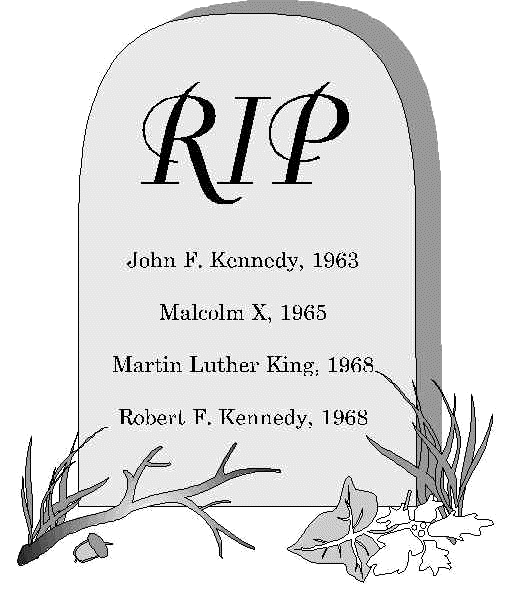
    With the help of Marty and Ray, what Probe is trying to do here is not so much explain the reaction, or non-reaction, of the Left to the death of John Kennedy. What we are really saying is that, in the face of that non-reaction, the murder of Kennedy was the first step that led to the death of the Left. That’s the terrible truth that most of these men and organizations can’t bring themselves to state. If they did, they would have to admit their complicity in that result.


    (Click here if your browser is having trouble loading the above.)

  • Sylvia Odio vs. Liebeler & the La Fontaines


    From the September-October, 1996 issue (Vol. 3 No. 6) of Probe


    Just declassified at the National Archives is the record of Gaeton Fonzi’s interview with Silvia Odio for the Church Committee. We choose to reprint it here in full for two reasons. First, because it is interesting to note the actions of one Wesley Liebeler, UCLA law professor, in his apparent attempt to discredit her. There are still some who believe today that the Warren Commission was actually a fairly neutral body that was just tricked and lied to by the FBI and CIA. We find this an untenable position. We think the Commission, from top to bottom, was prejudiced against Oswald from its inception.

    Wesley Liebeler is a good example of this. Liebeler was one of the strongest voices against the critics in their early days. As noted elsewhere (see page19), he spoke out against Jim Garrison early and often. The day after David Ferrie’s untimely and mysterious death, the New York Times and Associated Press quoted him to the effect that there was nothing of consequence to Ferrie’s role, the man was uninvolved and that was the reason for his name not appearing in the Warren Report. After that, it is apparent from one of his talks at UCLA, that he had been in contact with James Phelan and was preaching that FBI informant’s line on the “circus atmosphere” of the Garrison investigation. According to a memo from Sylvia Meagher’s 1965 files, when David Lifton was speaking to Liebeler about an upcoming private critics’ conference in New York, Liebeler corrected Lifton on the date of the meeting. Perhaps most revealing of all, before the HSCA, Liebeler had the following colloquy:

    Q: Had you prior to going to work for the Warren Commission had any prior experience with any of the federal agencies, investigative agencies, FBI, CIA?

    A: I was interviewed by a CIA agent once when I was younger.

    Q: Did you form any impressions about them?

    A: I was favorably impressed.

    The second reason we have decided to print the document is because of the treatment of the Odio incident in the recent La Fontaine book, Oswald Talked. In our last issue, Carol Hewett pointed out some serious errors that the La Fontaines made in their assessment and treatment of the John Elrod story. There are some other questionable aspects to this rather curious book. In some ways it attempts to take us back to 1964. Relying on Gerald Posner’s new variation, the book contains support for the single-bullet theory (p. 376). Ignoring the work of John Newman, John Armstrong, and the now indisputable evidence of Oswald’s Minox camera, they conclude that Oswald was a true Marxist (p. 161). Concerning David Ferrie, they take the rather breathless stance that he was an unwitting dupe hired to create a phoney trail that would unwittingly link him to the assassination (p. 189). Consider this logic: we are to believe that cagey Guy Banister decked Jack Martin because he knew that Martin would spill the beans about Ferrie and lead Garrison back to Banister himself.

    All of the above are reminiscient of those two veteran researchers Paul Hoch and Peter Dale Scott. The pair figure prominently in the book’s acknowledgements. Scott wrote a rave review about this book for the current issue of Prevailing Winds. Since Scott and Hoch have seen many of the new file releases, we find it odd that they would back a book that claims, in its very subtitle, to be based on the “New Evidence in the JFK Assassination.” For the truly new evidence completely contradicts the above deductions. For instance, it now appears that the cover-up about Ferrie and Clay Shaw goes all the way up to Allen Dulles’ old friend and protégé; McGeorge Bundy. In a recently declassified FBI memorandum of 5/10/67, the following paragraph is included:

    Branigan advised all information concerning investigation by SA Kennedy had been forwarded to the Department and to the Warren Commission, that certain of this information was sealed and this decision had been made by GEORGE McBUNDY [sic], Presidential Advisor, and members of the Warren Commission, and principally pertained to information showing certain people were homosexuals, etc., was not germane to the investigation, and McBUNDY [sic] and the Commission decided this should be sealed…

    (“SA Kennedy” refers to New Orleans FBI agent Regis Kennedy. )

    Since Bundy and Dulles had worked together since the Dewey campaign of 1948, and Bundy, according to “the new evidence,” was the point man in the White House delivering propaganda briefings on the Warren Report two months before it was issued, we find it hard to believe that the above is all completely innocent. Especially since both Shaw and Ferrie worked for the CIA when Dulles was chief.

    The above also belies another underlying tenet of the La Fontaines, namely that only the FBI was employing the Marxist Oswald while this brilliant Marxist manipulator was infiltrating all those unsuspecting, naive CIA agents and assets in New Orleans and finally Dallas. To do this, they ignore the fact of Oswald’s CIA files being shepherded by Counterintelligence Chief James Angleton through the darkest sections of the Agency; the highly suspicious roles of Ruth and Michael Paine; the fact that the FPCC was the subject of a CIA operation launched by David Phillips and James McCord; that Phillips then followed Oswald to Mexico City in October to prepare the false and incriminating transcripts in the Cuban embassy that Hoover was in the dark about on November 23rd!

    But the most disturbing aspect of the book is the chapter on the Odio episode. It is quite simply – in tone, method, and intent – a hatchet job that would bring smiles to the faces of Walter Sheridan and, of course, Liebeler. The method of personal ridicule extends down to comparing Odio to a delusionary victim of a UFO sighting and portraying her sister Annie as a dim-witted, weak-willed accomplice. In a case like this, no witness is above question, as long as the questioner plays fair and square. We won’t go into the La Fontaines’ specious methodology of carefully selecting certain aspects of the Odio record. Like Carol Hewett, Steve Bochan does a good expose of their incomplete presentation in the current Summer issue of Assassination Chronicles. Suffice it to say that we have problems with any researcher who chooses to trust and use the likes of Burt Griffin and Liebeler over Gaeton Fonzi and Sylvia Meagher.

    We would like to make one additional comment on the document below. This may further elucidate Odio quoting Liebeler about Earl Warren in regard to covering “this thing up” (see the callout on this page). When Probe interviewed an HSCA staffer about Odio, he told us that the reason Warren did not believe the “Odio incident” was because Liebeler told him that Odio was a “loose woman.” The reader will understand the import of that remark by reading the report below.


    REPRODUCED AT THE NATIONAL ARCHIVES

    RELEASED PER P. L. 102-526 (JFK ACT) 5-2-96

    Notes – Silvia Odio interviewed 1/16/76


    She first heard of the Kennedy assassination on the radio while on the way back from lunch and she immediately thought of the visit of the three men to her apartment and the conversation she had with them. It produced a tremendous amount of fear in her and she later passed out. (She had been under mental strain of marital problems and the responsibility of caring for her four children after her husband deserted her.) The next thing she remembered was watching television with her sister and seeing Oswald and both recognizing him as one of the men who came to the apartment. “We were just so scared because we both recognized him immediately.” They both were extremely frightened and very anxious about the welfare of their eight brothers and sister (10 children in the family) and their mother and father in prison in Cuba and, since they didn’t know what was going on or whether or not there had been a conspiracy of many involved in the assassination, they both decided not to bring their experience to the attention of the authorities. (“I never wanted to go to them, I was afraid. I was young at the time, I was recently divorced, I had young children, I was going through hell. Besides, it was such a responsibility to get involved because who is going to believe you, who is going to believe that I had Oswald in my house? I was scared and my sister Annie was very scared at the time, she was only 14.)

    She recalls when she was interviewed by Hosty that he kept pressing her to remember the specific day that the three men came to her apartment and she couldn’t specifically remember. Still they kept pushing her for the exact date. (I kept telling them that I don’t remember the date but I know that it was in the last days of September because we were moving at the time and that we had boxes all over the living room and that in order to open the door we had to jump all over the boxes. But I could swear I don’t remember the day, but when I read the Report I found they had set a day and that they had done it for me.”) (“I only remember it must have been the last days of September because we had already a lease for another apartment and that it was the middle of the week, not a Saturday or Sunday.”)

    She says she doesn’t specifically remember being asked about Loran Hall, Lawrence Howard or William Seymour but she was shown numerous photographs, many even after she had moved to Miami in September of 1964, but was never told the names of anyone whose photograph she was shown. She recognized no one but Oswald. (I showed her photographs of Hall, Howard and Seymour which were in Tattler, Sept. ‘75, and she recognized none of them.) I asked her about the possibility that it might have been someone who looked identical to Oswald. She said, “When you see someone as close as I’m seeing you now, even closer because we were standing by my door for about 15 minutes and the light was just coming down upon their faces, when I saw him on television I recognized him immediately. And this guy had a special grin, a kind of funny smile. He kept smiling most of the time, he kept trying to be pleasant, but the other guys did all the talking.”

    “Well, you know if we do find out that this is a conspiracy you know that we have orders from Chief Justice Warren to cover this thing up.”

    She remembers specifically that he was introduced to her as “Leon Oswald,” and he himself said, “My name is Leon Oswald.”

    She says the thing she remembers most about one of the guys is that he had a “funny kind of forehead. It just sort of went back, with no hair on the side. It was peculiar and it’s hard to explain.”

    She has the feeling, also, that the three men wanted her to know that they were going on a trip, that they specifically mentioned that they were going on a trip.

    She wrote her father and told him of the men but he said he didn’t know them and not to trust anyone.

    She also told her psychiatrist, a Dr. Einspruch, then at Southwestern Medical School, of the incident.

    She wonders why, after she was questioned by the FBI, they waited so long to call her back. It wasn’t until the middle of the summer that Liebeler came to Dallas to question her.

    She asked how candid she could be with me and I said I wished she would be totally candid. She said she could say something but she’s afraid she could get in trouble because it would be only her word, although she would swear to it. She said she hasn’t told this to anyone except a Mr. Martin Phillips who came to talk to her about putting her on Dan Rather’s CBS assassination special television show. She refused to [go] on the show but she did talk to Phillips. She said she told part of this story to Phillips but has never mentioned it to anyone else.

    She said that after Liebeler questioned her for the second time that day (the first interrogation started at 9 a.m.; the second at 6:30 p.m.) he asked her out to dinner. “That surprised me, but I was afraid and I went. We didn’t go out alone. We went out with someone who was supposed to be Marina Oswald’s lawyer. I don’t remember his name, but Mr. Phillips from CBS knew. We went to the Sheraton to eat dinner. I thought perhaps there was something behind it and there was a kind of double talk at the table between the lawyer and him. I wasn’t sure they wanted me to hear the conversation or they wanted to convince me of something or wanted me to volunteer something. He (Liebeler) kept threatening me with a lie detector test also, even though he knew I was under tremendous stress at the time. But one thing he said, and this has always bothered me, he said to this other gentleman, I don’t remember his name, he said, “Well, you know if we do find out that this is a conspiracy you know that we have orders from Chief Justice Warren to cover this thing up.” (I asked: Liebeler said that?) “Yes, sir, I could swear on that.” At the time, she said she thought that maybe it was a bait for her because she had the feeling that they thought she was hiding something more, that she was involved with other Cuban groups perhaps or that she knew more than she was saying. “That was the feeling that I got by the time that they took me to dinner, that maybe if I had a few drinks and the conversation became very casual, I would go ahead and volunteer information he thought I was hiding. I wasn’t hiding anything. But what he said struck me. I remember I had a Bloody Mary and thinking to myself, “My God, I’m not that drunk.” I had one Bloody Mary and that’s all I was having. If it was for my sake that he was saying that, it if it was a little game they were playing with me, I don’t know. That’s when I said to myself, “Silvia, the time has come for you to keep quiet. They don’t want to know the truth.”

    “But that made me angry. Not only that, he invited me to his room upstairs to see some pictures. I did go, I went to his room. I wanted to see how far a government investigator would go and what they were trying to do to a witness. Of course nothing happened because I was right in my right senses. He showed me pictures, he made advances, yes, but I told him he was crazy. He even mentioned that they had seen my picture and that they had even joked about it at the Warren Commission, saying like what a pretty girl you are going to see, Jim, and things like that. To me that was all so, I don’t know, anti-professional. I wasn’t used to this sort of thing and I was expecting the highest respect, you know, and I wasn’t expecting any jokes in the investigation of the assassination of a president. So that’s why I’m telling you why my feelings changed because I saw something I wasn’t expecting to see. I wanted to see someone who was carrying on an investigation who was serious about it but somehow I had the feeling it was a game to them and that I was being used in this game.”

    The fellow who Liebeler identified as Marina Oswald’s attorney had not been at her questioning but they picked him up on the way to dinner. He left after dinner and did not go up to Liebeler’s room with them.

    (Showed her all the photographs I had with me and she could identify only Oswald in any of them. Except for one photo which I believe was taken of individuals coming out of courtroom following hearing in New Orleans concerning the Bringuier-Oswald fracas.) She identified the man in the background (center left) as her uncle and said she didn’t know her uncle was involved with Bringuier. I told her that according to an FBI report, her uncle, Dr. Augustin Guitart, admitted to being at that court hearing. She said her uncle never mentioned his involvement with Bringuier but that she knew he was a “fierce” anticommunist. (She herself, she earlier said, was associated with the more liberal element of Manolo Ray’s party and had always been a Kennedy fan.)

    She said she has always wondered who the other two men who came with Oswald were and has always looked for photographs of them. She says she is pretty sure that one of them was a Mexican. Again she mentioned the “weird forehead.”

    “…he invited me to his room upstairs to see some pictures. I did go, I went to his room. I wanted to see how far a government investigator would go and what they were trying to do to a witness. Of course nothing happened because I was right in my right senses. He showed me pictures, he made advances, yes, but I told him he was crazy.”

    I asked her why she thought she was selected for the visit. She said probably because her father was well known. He was a millionaire who helped Fidel in the mountains. He transported all the arms that went into the Sierra Maestras. He supplied arms and medical supplies. There was hardly anyone in the underground, she said, who didn’t know who her father was. The family was exiled for three years when Batista was in power because her father refused to sell his transportation business. He was described in Time magazine as the “transport tycoon” of Latin America. She says he had a tremendous number of enemies, both business and political. He supplied the truck for the assault on the palace on the 13th of March. He went into exile after that in Miami. (I asked if she knew Pawley. She said she didn’t but that her father knew almost everyone.) “We were very strong supporters of Castro until we felt betrayed by him.”

    She said she was surprised at the details of her father’s life that was known by the three men who came to her apartment, the fact that they knew where her father was in prison. They mentioned the movements that her father had been in politically and called him Amador-Odio. They said they belonged to the JURE movement and knew she belonged to the JURE Movement, as did her father. (That was Manolo Ray’s movement.)

    But she also says that when she thought about it later it wasn’t that difficult for anyone to know of her and her involvement with JURE because the Cuban community in Dallas wasn’t that large and they all lived in about the same section of town. Also, there had been a big rally in a park on a liberation day (she didn’t remember which day) and she delivered the invocation. That was covered by the newspapers and the television stations and she said the FBI later told her that it thought that Oswald could have been there mingling with the Cubans.

    Also it was possible, she later thought, that the three men knew of her because when her father had been sentenced to prison it was a big story in the Dallas newspapers. It had all the information about a millionaire and his family and it also carried her sister Serita’s picture. (Serita had come to Dallas before Silvia and was attending the Univ. of Dallas.) At first her father was sentenced to die and that’s why it was such a big story. Silvia was still in Puerto Rico at the time. (Serita is now in Mexico.)

    She says that when the three men came to the door they first asked for Serita and that they seemed confused, but when she told them she was Silvia and that she was the oldest they said it was she they wanted to talk with.

    That reminded her of Johnny Martin. “Johnny Martin came out of the blue,” she said. “That was a very strange thing. I don’t know how he got involved with my sister Serita, how he was introduced to her. The strange thing about him was that his family lived somewhere in a Latin American country and he had this laundry, this coin laundry he operated. He would tell Serita to being (sic) her clothes there and he wouldn’t charge her. And then Serita brought him to our house and we started talking about a lot of things. He was very clever and we were very young and soon he was telling us he could get arms for our movement. I got in contact with Eugenio (Rogelio Cisneros) and he told Ray he was coming to Dallas to meet Martin.” Martin she says always seemed to be broke yet he said he had a lot fo (sic) contacts in Latin American governments. Nothing came of the meeting between Martin and Cisneros because Cisneros didn’t trust him.

    Re: Lucille Connell. She was a Protestant who got involved in the Catholic Welfare Bureau. She came on very strong with Silvia as soon as she arrived in Dallas and, in fact, had sponsored her trip from Puerto Rico. Connell had known her sister Serita first. “She struck me as the most fantastic, the most kind and considerate person I ever met,” says Silvia. “She was just so generous, and I had tremendous admiration for her.”

    “She was very involved with a lot of different groups and talked to me about them. She was very intense about the John Birch Society. She was also involved with the Rosicrusians. And also with the Mental Health Association in Dallas.”

    She was a very wealthy women (sic), married to a wealthy man but she divorced him and is now living in Long Island, remarried. (Name now Lucille Light

    50 Wynn Court-Muttontown

    Syoset, Long Island 516-921-3519

    Her husband (Connell) had a large CPA firm in Dallas. J. B. Connell?)

    Connell had even gotten her psychiatrist, Dr. Einspruch (who later went to Philadelphia Naval Hospital.) (She later visited him there; he was wearing a uniform.)

    She described Mrs. Connell as a person who knew all the key people in Dallas.

    “She was a very strong person. She tried to use the fact that I was ill in order to control me, my thoughts, my friends, my goings and comings, the way I raised my children. It came to a point when she called me every night to get a report on what I had done for the day, who I had seen, where I had been. She had a tremendous memory, a very tremendous memory. She could recall something, something she had seen or heard right away. I remember I mentioned the fact of the men’s visit just once to her and she never forgot.

    “You have to remember that I arrived in Dallas under tremendous pressure, I had just suffered the trauma of divorce, I had four children, I had all this responsibility of my brothers and sisters, it was a tremendous burden. And Lucille took me under her wing, took me to the country club, wanted to buy me dresses, wanted to introduce me in certain circles. I always had the feeling she was getting me ready for something.”

    “Then came this Father McChann. Father McChann and I became very close friends and he was going through his own crisis in his life. Lucille used him, managed him, handled him. I don’t know how to say it. Lucille tried to get us together and then tried to get us apart and got jealous of our relationship in the meantime. People are very complex. She was very moody and enjoyed playing with our lives. There was a time when I couldn’t say no to her for anything, She would call me at two o’clock in the morning and say, “I don’t want to sleep now, would you talk to me? and I felt I had to even though I didn’t want to and had to go to work the next morning.” Only with Dr. Einspruch’s help that she got strong enough to pull herself away from Mrs. Connell.

    “This is why she was angry with me and maybe why she called the FBI. She was very angry with me because I was pulling away from her and getting stronger.” She had also developed a relationship with a wealthy couple named Rodgers and Mrs. Connell was very jealous of that, also. (John Rodgers was the president of Texas Cement.)

    (I asked her about her knowledge of Reinaldo Gonzales and Alpha 66 founder Antonio Veciana.) She knew of them and of her father’s role in hiding Gonzales. She had never met Veciana and did not know what he looked like.

    She said she also knew Jorge Salazar (mentioned in O’Toole-Hoch piece as Dallas Alpha 66 leader whose home at 3126 Hollandale was meeting place where Oswald was seen), but was never at that address and was never involved with Alpha 66. Actually, she only knew of Salazar and doesn’t actually know what he looks like.

    (I had her review her testimony and she recalled certain details:)

    • That Leon Oswald’s name had been repeated. One guy said, “I’d like you to meet Leon Oswald.” Then he said, “My name is Leon Oswald.”
    • That Oswald had a slight beard and more of an indication of a moustache, as if he hadn’t shaved in a day or so or (as they said) had just come from a trip.
    • That he (Oswald) had on a green shirt.
    • That one of the men was very hairy and showed a lot of hair on his chest above his shirt.
    • Leopoldo, the tall one, was driving.
    • One of them called the day after and, more likely she thinks, the day after that.
    • That one of them had pockmarks on his face and a very bad complexion. He also had a “funny kind of head,” a lot of hair but “big entrance on the side.

    (re Mrs. Connell again: I asked her about Connell’s report to FBI re Gen. Walker and Col. Castorr) “Mrs. Connell was apparently involved in more than she pretended. Whenever she wanted to find out some information she would take me out to lunch. I wasn’t aware at the time she was using me. I knew she was involved with key people in Dallas and she was continually getting phone calls where she would lock herself in her library when she answered them. She was always mysterious, and always very careful not to mention information, she always asked. She did mention Gen. Walker, we talked about Walker. I knew she was involved with his movement and with the John Birch Society. I think that’s why she was involved with the Cubans, because we were very usable people, and expendable. (Did she ever mention Conservatives of the USA?) “Yes, she did. We discussed that, I remember the name.” (Re Connell-cont.) “And then all of a sudden one summer she decided to become a Rosicrusian, and she started traveling, was it Oklahoma or someplace where the Rosicrusians have a headquarters? She traveled quite a bit on that, I remember because she showed me a card, they issued her a card.

    She married a guy who takes tours to Europe and has a lot of money…

    Another association she recalled was the name of Russo, which she heard mentioned as part of Garrison’s investigation. She says the name rang a bell and she finds it interesting that he knew Oswald by the name of Leon Oswald also.

    Connell was not only involved with the Mental Health Association but very interested in psychology, mind control and brainwashing. She had a lot of books on the subject.

    That’s when I said to myself, “Silvia, the time has come for you to keep quiet. They don’t want to know the truth.”

    Silvia specifically remembers that when Leopoldo called her back on the telephone and told her about Oswald talking about killing Kennedy, it was not a weekend day (Sat. the 28th or Sunday the 29th) because she remembers working that day and getting the call after she came home from work, about 7:30 p.m. She is pretty sure it was not the day after their visit, but the following day (which would make it Friday the 27th at the latest; because Monday was the 30th and she was moving by then.)


    Big thanks to Steve Bochan for forwarding us this document. -Eds.

  • CTKA’s Presidential Endorsement (1996)


    Pity a populace that must choose between Bob Dole and Bill Clinton as the chief executive of their government. Or even Dole, Clinton, and Ross Perot. In good conscience, CTKA cannot endorse any of them. There is someone we do support. But before we explain why, we will explain why not.

    For us, Bob Dole is, in political parlance, a “non-starter”. Many have recently pointed out Dole’s support for the tobacco companies as indicative of the kind of politician he is. We say the indications go back much further and deeper than just the tobacco companies. Dole was a fond admirer of the great divider of the American political system, Richard Nixon. And Dole staunchly supported Nixon through both the escalation of the Vietnam War and the paralyzing Watergate scandal. Dole has rarely found a corporate cause or thiet he didn’t like. When two multimillionaire oil entrepreneurs were hauled before a Senate committee for stealing 30 million in oil from Indian reservations, Dole used the old chestnut of launching diversionary attacks against witnesses in order to disrupt the proceedings. The Koch brothers then became major contributors to Dole and the Republican party (for a complete report on this, see The Nation of 8/26/96). Like husband, like wife. Liddy Dole is supposed to be his better half. Not true. When Ms. Dole ran the Red Cross in the early 90’s, her chief adviser was Mari Will, wife of Washington Post pundit, Oswald did it stalwart, and CIA defender George Will. Any candidate close to the Wills is an enemy of the research community, and consequently, good government.

    Most revealing about Bob Dole was his behavior during the Iran-Contra scandal. As the mainstream media tried to make Jim Garrison the criminal when he probed the Kennedy case, Dole tried to make Lawrence Walsh the culprit of that later scandal. According to Robert Parry, Dole detracted attention from the allegations against Reagan-Bush officials by hectoring Walsh over issues like where he paid his local taxes and his first class airfares. In other words, Dole was part of the Washington “insider” effort to defuse and defund Walsh’s investigation. After Bush stopped Walsh’s probe by pardoning his suspects, Dole boasted in public about his role in derailing Walsh. If one is looking for someone to fund and extend the Review Board, and later appoint an independent consul, Dole would be a hapless choice. Ross Perot is to be credited for offering an alternative to the two party system. He wants to clean the lobbyists and special interests out of Washington. He campaigned against NAFTA. But Perot has an erratic and dictatorial streak in him, as exemplified by the controversy in the nominating process of his Reform Party. Although people in the research community offered him material on Gerald Posner, he has not used it even though Citizen Perot is a hit piece timed for the presidential race. Also, like Dole, Perot was a strong supporter of Richard Nixon as is attested to in John Ehrlichmann’s bookWitness to Power. Reportedly, Perot also contributed to the candidacy of Oliver North in his run for the Senate. Recently another of North’s criminal activities was brought to light: the selling of cocaine for distribution to gangs in Los Angeles. So although Perot is better on some issues, he seems a bit myopic about the overall picture.

    Which brings us to the incumbent. Most of us at CTKA voted for Bill Clinton in ’92. George Bush, former DCI, had fought the JFK Act. During the campaign, Clinton made some overtures our way. He stated in McKeesport, Pennsylvania that he realized many people had lingering questions about the JFK case and they deserved answers. The centerpiece of his nominating convention was the famous film of himself at the White House in 1963 shaking hands with President Kennedy. After his election, he made a grand photo opportunity out of his visit to Kennedy’s grave at Arlington. After a slow start, he did finally get the Review Board nominated. But then in 1993, on the 30th anniversary of the assassination, he blindsided us. In response to a question by a CNN reporter Clinton said that, after reading Case Closed , he was now satisfied with the official verdict in the case. Since then, as noted in our last issue, he has yet to make a positive decision in favor of the Review Board in any of its disputes with the FBI over redactions in released documents. To our knowledge, he has made only one mention of the Board in public since Mr. Marwell was instated, and that was a passing notice. On the Robert Kennedy case, Clinton wrote the foreword to the recent book The Last Campaign, by Time-Life photographer Bill Eppridge and writer Hays Gorey. The book states that Sirhan killed RFK. Clinton implies the same in his unqualified opening endorsement. In retrospect, we should have known better about Clinton in 1992.

    With our knowledge of the media, painfully culled from its treatment of the JFK case, we should have known something was up with the Arkansas governor. Back in 1988, when Clinton blew his nationally televised nominating speech for Michael Dukakis, he was invited onto The Tonight Show where he was allowed to kid himself over his longwindedness thereby redeeming his national image. When he finished second in the New Hampshire primary in 1992, he was allowed the guest spot on Nightline and, unchallenged by Ted Koppel, he announced himself the “real” winner since he finished a closer second than expected. When the Gennifer Flowers sex scandal brimmed over, he got a spot on Sixty Minutes with Hillary as his Tammy Wynettish wife that patched up his “family man” image. Later in the campaign, when the Whitewater and Mena stories started to leak out of Arkansas, Time did its turn with a remarkably deceptive cover story. Entitled “The Doubts About Bill Clinton”, it masqueraded as an inquisition of his tenure as governor. In reality it ended up giving him the benefit of the doubt on every accusation. In other words, it was designed to put the rumors to rest.

    How does a candidate get the red carpet treatment into the White House? Why would NBC, ABC, CBS, and Time-Life smooth the rails to get a Democrat into power? Those are the questions we should have been asking ourselves amid these odd maneuverings. The answers are in Roger Morris’ new book on the Clintons, Partners in Power. In our Jan/Feb issue, we recommended the Morris biography of Richard Nixon as the best in that crowded field. He has repeated that feat with his work on the Clintons. Some of the things revealed in this book confirm the suspicions many people have had about the Clintons and explain the remarkable orchestrations to get him into office. Consider:

    1. Clinton lied to the University of Arkansas to escape the draft and used a crony of former governor Winthrop Rockefeller to stall his local draft board into delaying their decision on his case. These delay tactics were enough to get him out of serving in the Vietnam War since Nixon instituted a draft lottery in 1969. Clinton has orchestrated a cover-up of these facts since his first run for office in 1974.
    2. Morris cites three confidential sources in making his case that Clinton was a CIA informant at Oxford reporting on radicals in the anti-war movement abroad.
    3. The Rose Law Firm was the Sullivan and Cromwell of Arkansas. If Allen and John Foster Dulles had been attorneys in Little Rock instead of New York City, they would have felt at home there. It was a lawyers’ school for scandal that fits right into the contemporary–and well-deserved–caricature of attorneys who, as long as they are paid $300 an hour, will cover up any kind of corporate malfeasance. Clinton got Hillary her the job there. It is at this time that Hillary Clinton took part in her patently rigged commodities deal, which Morris exposes as a thinly disguised political bribe. If Hillary Clinton had any ideals, and Morris indicates she had some, they were lost when she went to work at Rose in 1976.
    4. If Clinton had any ideals–and the case is weaker for him–he lost them after his failed reelection bid for governor in 1980. Contrary to popular belief, that loss did not change him from a dewy-eyed idealist into a pragmatist. It put him even more solidly in the camp of the powerful and wealthy interests who had backed him from the start.
    5. If the drugs for weapons transfer site at Mena, Arkansas is ever honestly examined by the major media or a legislative body, it will destroy Clinton and put Oliver North and George Bush in jail. Which, of course, is where they should have been if Dole had not obstructed Walsh.

    The amazing thing about all of the above points is that they were all evident to Arkansas observers before Clinton ran in the Democratic primaries. Yet the American people were not allowed to know the full truth about Bill Clinton. The fact that the media provided interference for him should have alerted us like a flare in the night. So the failures of his administration, not just on the JFK Act, should have been no surprise or provided little disappointment. As Robert Parry has pointed out, Clinton was in a great position to reopen the “October Surprise” investigation since the Russians offered him new evidence that it had actually happened. Clinton has had opportunities to expose the sordidness of the Reagan-Bush years on the horrors of the El Mozote massacre, on Iraqgate, on the GOP tampering with his mother’s State Department files. On all these, as well as the JFK case, he has remained silent. In many ways he has actually endorsed two political tendencies that CTKA most deplores and anyone who still values in the legacy of John Kennedy holds dear: the excesses of the national security state, and the wild maldistribution of wealth that has ravaged America since 1980. Clinton has doubled the number of FBI authorized wiretaps that Bush allowed. As exposed by the Los Angeles Times, he secretly authorized arms shipments into Bosnia through Iranian allies. Now that historians like Gar Alperovitz have exposed the myth of the “necessity” of dropping the atomic bomb, Clinton tries to reinflate it by saying he would have made the same choice as Truman did.

    On the economy, unlike JFK, Clinton does anything except battle Wall Street. Giant investment house Goldman Sachs was one of the major contributors to his ’92 campaign, so they are well represented with Robert Rubin at Treasury. The same Rubin who defended the FBI’s incineration of 96 people at Waco. Late Commerce Secretary Ron Brown was a partner of Tommy Boggs, a $500 per hour Washington lobbyist. Boggs is the son of Hale Boggs and brother of Cokie Roberts, George Will’s partner in bashing Stone’s JFK and Nixon in front of millions on TV. Clinton had an opportunity to replace Federal Reserve Chairman Allen Greenspan, that darling of Rockefeller-Morgan interests on Wall Street. He didn’t and this keeps Wall Street and other wealthy interests happy; happy enough to give Clinton twelve million on his recent August 19th birthday, a sum that smashes all records for Democratic, and possibly GOP, fundraisers.

    There must be a hitch to all this. Nobody shells out 12 million for nothing. There is. Far from reversing, or even halting the Reagan-Bush upward redistribution of wealth, Clinton has aided it. In a report issued in July, the standard of living for the poor is revealed as bad or worse in 1994 than in any year since 1967. The frightening pace of corporate mergers, especially in the media, has not abated. Pentagon and CIA budgets have not been seriously curtailed by the collapse of the “Red Menace”. Wall Street has been so cheered by Clinton’s policies that a headline in the Los Angeles Times of August 3rd actually reads, “Job Rate Growth Slows, Cheering Wall Street”. The defeat of Kennedy’s economic policies (so aptly portrayed by Donald Gibson), is so complete that Kennedy adviser Dick Goodwin can write an editorial lamenting the fact that Kennedy’s struggle for economic justice is now over; the rich have won out. Goodwin should have ended with the quote, “Bill, you’re no JFK.”

    This is unfortunate for both Clinton and the Democrats. It is also, in an American way, short-sighted on sheer political terms. First, as Kevin Phillips has pointed out, since the issue of the Warren Report the average American’s cynicism about government has grown to epidemic proportions. This has now spread to the GOP, i.e. there seems to be a dealignment of both parties marked by large defections to third parties or independent status. In a July poll, an astonishing 60% of the public favors the rise of a third party. One of the main reasons quoted was that: People have such an incredibly poor view of politics and politicians, and such incredibly low expectations that it takes very little to make them convinced that what they are seeing is the same “old stuff”.

    Concomitant with this is the voters’ knowledge that things weren’t always this bad on the economic front; there was a president we used to trust. This was demonstrated in a July New York Times /CBS poll. When the respondents were asked which former president they would like to have running the country today, the winner in a landslide was John Kennedy. He received double the votes of Reagan and triple the amount of Truman, Lincoln, or FDR. This is even more remarkable in light of the myriad attempts to defame both the man and his presidency in every kind of media. An attempt which, we feel, has demonstrably increased in recent years. When a respondent was asked specifically why she voted for Kenendy, the reply was because he was “for the poor people, while today everyone seems to be more for the rich.” In other words, he wasn’t part of the Washington crowd which Morris calls, “the culture of complicity”. For us there is very little difference between Clinton, Dole, and Perot. Or between those three and the corporate lobbyists and media pundits with whom they cavort. Kennedy wasn’t part of that Washington crowd. He felt they distorted his message. As he told Ben Bradlee, “I always said, when we don’t have to go through you bastards, we can really get our story to the American public.” Kennedy’s willingness to stand up for the public and against these money interests was never more vividly illustrated than in Executive Order 11110 of June 7th, 1963. This instructed Treasury to bypass the Rockefeller-Morgan Federal Reserve Board and begin minting its own silver dollars and silver certificates. Wall Street denizen Douglas Dillon pressed Johnson to reverse that decision. He did three weeks after the assassination.

    There is one candidate running for president this year that we can endorse. In fact as this is being written I am listening to his acceptance speech given at UCLA’s McGowan Hall. His name is Ralph Nader and he is the candidate of the Green Party. Some of our younger readers may not know who he is. As a young lawyer in Hartford, he noticed that many of his personal injury clients had been crippled as a result of automobile accidents. Upon investigation he discovered that the automobiles could have been manufactured more safely to minimize many of the injuries. In 1965 he wrote a book that exposed Detroit’s culpability: Unsafe at Any Speed. It became a bestseller and vaulted him to Capitol Hill where his Senate testimony forced Congress to pass the Motor Vehicle Safety Act of 1966. The next year he was instrumental in getting Congress to pass a law for more stringent inspection of slaughterhouses and meat processing plants. It was Nader who convinced Jock Yablonski to run against corrupt UMW leader Tony Boyle. When GM launched a secret investigation of Nader, he sued and won. With this money he set up Public Citizen Inc., the umbrella group for his investigations of misleading advertising, abuses in nursing homes, and yes, a sick political system that ignores citizens yet is all to quick to respond to corporate and Pentagon wishes. Nader’s example caused a whole slew of idealistic young people–Nader’s Raiders–to join him. Compared to Dole, Clinton, and Perot on a moral and political plane, Nader has the stature of Nelson Mandela. In fact, next to Mandela, he still looks OK. Recently, his name was enough to stop what he calls “tort deformation” in California, i.e. the limiting of malpractice awards in civil cases. Reportedly, James Carville, Clinton’s chief political adviser fears a well-funded, media exposed Nader candidacy more than any other. In other words, if Nader had Perot’s money, Carville would be having sleepless nights.

    To quote Malcolm X, what we are seeing now is the “chickens coming home to roost.” The beginning of the breakdown of the traditional two party system in America. To which Probe says “Good riddance”; but more in sorrow than in anger. The party of FDR and JFK was a good one. But a party that won’t demand the truth about the murder of its most popular leader, or the man who would have saved us from Nixon, Robert Kennedy, or its equivalent of Gandhi, Martin Luther King, does not deserve to persist. In Nader’s acceptance speech of August 19th, he talked about U. S. support of foreign dictatorships that exploit cheap labor; the debasement of democracy by giant corporations; the maldisribution of wealth in America and how to correct it; the bloated Pentagon budget in the wake of the Cold War; a revival of citizenship and democracy among in schools. In short, he sounded a bit like young John Kennedy. If he gets on the national debates, Carville might have some difficulty sleeping. Even if he doesn’t, we’re for him. We’d rather cast a vote for a new beginning, no matter how far off, than be a sucker for false hope, even if it comes cynically gift-wrapped in the mantle of JFK.

  • Robert Tanenbaum interviewed by Probe


    From the July-August, 1996 issue (Vol. 3 No. 5) of Probe


    Robert K. Tanenbaum was chosen by Richard Sprague to be the House Select Committee’s first Deputy Counsel in charge of the John Kennedy murder investigation. Last year he wrote a fictionalized account of that experience entitled Corruption of Blood.The book was released as a mass market paperback this year in a million copy print run, the first highly successful release in the field since Case Closed. He was recently the keynote speaker at the 1995 COPA Conference in Washington.

    Bob attained his law degree at UC Berkeley’s distinguished Boalt Hall in 1968. In New York he served under legendary DA Frank Hogan where he rose to Deputy Chief of the Homicide Bureau, garnering an unbeatable record: he never lost a murder case.

    Bob felt morally resigned to leave the HSCA after Sprague’s forced departure. He has stated, “at that time I had a three year old daughter. . .and I didn’t want her to read about American history that I knew to be absolutely false, that her father may have participated in.”

    In Los Angeles, he has had a multi-faceted career. Although he is still in private practice, he recently served as Mayor of Beverly Hills. He has also written several books based on his legal career. Two of them were non-fiction, The Piano Teacher and Badge of the Assassin. The latter became a film starring James Woods and includes two detectives Tanenbaum used on the HSCA: Cliff Fenton and L. J. Delsa. Bob has written six fictional books based on his Butch Karp character, a New York City Assistant District Attorney. Bob kindly granted Probe’s Jim DiEugenio an interview at his home in Beverly Hills, which he shares with his wife of 29 years and two children. The following are only excerpts from a candid 85 minute talk that can be obtained in the current catalog.


    JD: In the book, you describe this meeting with a guy named Crane, who we guess is probably Dick Sprague. Is that how it actually happened? Did Dick Sprague call you to come down to Washington?

    BT: Well, keep in mind the book is all fiction. But the way I went to Washington was that Dick Sprague, who was then in private practice in Philadelphia was named Chief Counsel and he asked me if I wanted to come down as Deputy Chief and take over the Kennedy side of the investigation, because the House Select Committee was investigating the assassinations of both Martin Luther King and President Kennedy.

    JD: So, how did you know Sprague?

    BT: I didn’t know him. I never knew him, I never met him, I never spoke to him. I’d heard about him as a top-notch D.A. in Philadelphia. He was chief assistant and he’d been in that office about seventeen years or so. And of course he’d tried the Tony Boyle case, the United Mine Workers, so he was a great D.A. and a terrific trial lawyer.

    JD: If you take a look at the structure of the first phase of the House Select Committee as opposed to what is generally considered to be the second phase, when Blakey came in, you guys had a lot of first-class investigators, attorneys, etc. and it really appeared for the first time that it was going to be a real murder investigation.

    BT: That’s what we expected. That’s the only reason we went down there. After all, we were coming out of the homicide bureau of the New York County D.A.’s office and we had tried scores and scores and scores of murder cases. And Sprague was going down there for the same reason. When I met the committee members that’s what they said this was all about, before I said I was going to go down there. So, that’s what we expected. And if the evidence was that Oswald did it and did it alone, we were going to say that. But if he didn’t and the evidence said he didn’t, then we were going to say that. That is what the committment was.

    JD: Did you actually know much about the case before you got into it?

    BT: No, I knew nothing about the case. I had read none of the books, I didn’t follow any of it, I had read all of the negative publicity about Garrison and really had no understanding of what was going on other than the fact that the Warren Commission had concluded that Oswald did it and did it alone.

    JD: So, you really didn’t have an opinion, one way or the other?

    BT: I had no opinion.

    JD: I interviewed a friend of yours down in New Orleans, L.J. Delsa. He said that he felt that one of the reasons the Congress turned against the Committee was, because of Sprague’s approach. It could have set a precedent in Washington to have really serious investigations instead of fact-finding commissions. Did you get any feeling about that?

    BT: In my opinion, Congress never wanted to go forward with these investigations at all. That’s just based upon my having spoken with a lot of the membership of the House as I was asked to do by the Committee, in order to get funding. That’s something I never thought would be an issue before I went down there. They sort of politicized into it with some very distinguished members of Congress who were retiring in 1976, requesting that the Kennedy portion be investigated because they had seen Groden’s presentation of the Zapruder film and were very persuaded by it. Then the Black Caucus got involved and said well, investigate the murder of Dr. King. It was an election year and they said, “Ok, why not? We’ll do that.” But there was no commitment to really do it, unfortunately, which regrettably we found out while we were in the midst of investigating the case. They pulled our budget, they pulled our long-distance phone privileges, our franking privileges, we couldn’t even send out mail. And all of this was happening at a time when we were making some significant headway. So, L. J. may be right with respect to his perception, but at the same time I don’t believe they were ever committed to it. Tip O’Neill, who was the Speaker, was never committed to it. Only many, many years later did he realize that he’d made a tragic mistake.

    JD: When you mentioned retiring members of Congress, was one of the persons you were referring to Downing?

    BT: Yes. Downing from Virginia, right.

    JD: Was his leaving a blow to the Committee?

    BT: Absolutely, because of his prestige. As you know, teaching Civics 101 to a certain extent as you do, it all matters who you are and the power and friendships and the debts that are owed you in Washington, as far as things happening positively. The nature of Congress is, everything is political and they move forward by way of compromise. There was no way to compromise on the investigation of a murder case. There is no Democrat or Republican way to evaluate evidence. You can’t compromise on truth. That’s why the Congress should not be investigating these kinds of cases, particularly if they are going to short circuit an investigation when they realize they’re really doing what they’re supposed to be doing.

    JD: So, by implication you’re saying Gonzalez didn’t have the kind of stature that Downing had?

    BT: From what we learned in Washington there’s no question that that was the case. Gonzalez had never been the chairman of a committee before. But, the answer is basically that he was removed, which was unprecedented.

    JD: One of the problems you mentioned in the book and you’ve mentioned in the talks I’ve heard you give, is that the special status of the Committee made money a real problem.

    BT: Like everything in Washington, you can’t get the engine running without dollars. They didn’t fund us. The Committee started its work in late ’76 and then had to be reestablished, reconstituted and funded in ’77. That didn’t happen until the end of March, 1977. That affected us as far as our ability to have investigators and do the kinds of things you have to do, like travel. This case was not going to be solved in Washington, it happened in Dallas. So, you can’t just stay in Washington, obviously. Although, a lot of things happened in Washington, unfortunately, which resulted in the assassination in Dallas.

    JD: It was a Special Committee, right?

    BT: It was a Select Committee instead of a standing committee, exactly. Standing committees automatically reconstitute after the congress convenes, select committees have to be reestablished. And that should have happened the first or second week in January, pro forma. There shouldn’t have had to be a debate.

    JD: So, basically you were being a lobbyist.

    BT: Unfortunately, I was asked by the Committee to go and speak to the entire membership of the House to try and get them to vote for this Committee. And if I’d known that going down, I never would have gone down there, for all the obvious reasons. We weren’t going down there to conduct a political investigation or to be part of a political action committee, or anything else. We were apolitical. The Republicans could have asked us, the Democrats could have asked us. The issue was, were we going to focus on what the evidence was in the investigation, which is what we were trained to do. So, in order to get funding, I was asked by the Committee to go around and speak to the membership, individually and in groups. I met with some individually.

    JD: Go ahead and describe your meeting with Jim Wright.

    BT: I met with Jim Wright, obviously as one of the individuals with whom I had to meet at the time. He was the House Majority Leader. And fortunately, with staff people present, I was sitting at the edge of his desk in front of his desk and he was leaning back in his chair with his foot pressed against his desk drawer, listening. And I was explaining to him that the anti-Castro Cuban connection to the case was substantial. And thrusting forward in his chair from his relaxed position, his eyebrows shooting up all over the place, he said, “You mean to tell me that Sirhan Sirhan was involved with anti-Castro Cubans?!” And I said, “Mr. Wright, this may be part of the problem we’re having getting funding for this Committee, because we’re investigating the murder of President Kennedy not Senator Kennedy.” He sort of realized he had blundered and said, “Oh yes, of course, of course!” Keep in mind this conversation took place some time in March, is my recollection, and this had been a front-page story and there had been hit-pieces done on Sprague since his selection, which were outrageous. Various newspapers had hired people just to do negative reporting on him.

    JD: You’ve singled out some members of the Committee, particularly Richardson Preyer and Stew McKinney, as being people with whom you enjoyed working and who were very sincere in their efforts to progress with the case. Weren’t there actually some members of the Committee who voted against it?

    BT: There were some less than honorable people on the Committee, yes.

    JD: Did that give you pause at the outset?

    BT: When I say less than honorable, I was somewhat surprised that these Committee members were making comments about the cooperation of the executive intelligence agencies with the Committee, which was non-existent. That is to say, the executive intelligence agencies gave us no cooperation. And at public meetings, these members would simply go out of their way, as if we were watching a scene out of The Godfather where the senator from Utah gets up and makes some silly, gratuitous comment about the Al Pacino character, while he’s being called before the Congress. Out of the clear blue a couple of these members, in a non-sequitur fashion, make comments on how great the CIA and the FBI are in helping the Committee. So, I’m saying to them, they must be working for a different Committee because they’re certainly not helping us! They’re not giving us any information, they’re thwarting us in every aspect of what we’re trying to do and we had to deal with them in court, which was probably the only way we were going to successfully deal with them.

    JD: That’s what you had planned on doing with them?

    BT: Absolutely. We were not interested in receiving documents that were redacted. We were only interested in seeing who questioned a witness, what evidence they received and what they did. Period. We’re not interested in their little sources and methods. We’re not interested in “Mission Impossible” here. We’re interested in who investigated the murder cases, what did they find out, who they found it out from and what did they do if anything in follow-up. That’s what we wanted to find out. This is the Congress. It’s a tripartheid, co-equal branch of government. Why couldn’t the Congress get that material from the executive branch? There is no reason for executive branch intelligence agencies to “clear” members of Congress. That’s preposterous! Particularly, when you are investigating aspects of what they did or didn’t do, not for the purposes of any indictments, but for the purpose of trying to find out what happened.

    JD: It was you who originally invited Dr. Michael Baden down to Washington, right?

    BT: Oh, yeah. Dr. Baden along with Cyril Wecht, is the finest forensic pathologist in the country. I knew Mike because he was deputy chief medical examiner in New York and we had worked on scores and scores of murder cases, together. And he is a brilliant, wonderful person. When Mike was with me and the Committee, using the Z film, we demonstrated that Kennedy did not turn his head at the time of impact, which would have suggested that the shot came from the right front. Mike Baden was satisfied with this conclusion at that time. But, after I left Baden changed his opinion. He didn’t change it in bad faith, in my opinion.

    JD: You’ve mentioned previously the photographs taken of the sixth floor window at the time and the problem of how someone could be at the window and then disappear from the window in 3 or 4 seconds.

    BT: Well, even if it were 15 to 30 seconds, what we see there is a window open maybe 12″ and an opaque wall of maybe 4′ from where the window starts. It’s not a window from floor to ceiling. At best, you could see just a partial of a shooter’s face, if in fact someone was shooting. Because what we know is, as you look at the photographs, whoever shot from that window, if anyone, did not wait around and say, “I just murdered the President! Thank you very much!” There was this covert operation. The person who shot from there immediately left. Now, that being the case, the question is how did the Dallas police, at 12:48pm, just about 18 minutes after the assassination, get the description of someone who was in that window?

    JD: One of the more interesting subjects you’ve mentioned in some of your talks, is this meeting you had with Senator Schweiker which, I’m assuming, you give a lot of weight to, because of the evidence and because of who it was coming from.

    BT: Well, it was shocking! I went up there with Cliff Fenton and Schweiker told me in his opinion the CIA was responsible for the assassination. That’s a heck of a statement to come from a United States Senator and one who had even been Ronald Reagan’s running mate in 1976, even though they didn’t make it.

    JD: Was it just you in the room when he told you that?

    BT: Yeah, it was just the two of us. I was stunned! He had asked Cliff to leave and he had his own staff people leave. I had that material he had given us which contained all that information about Veciana and the Alpha 66 group and this Bishop character.

    JD: When I interviewed Schweiker, one of the last questions I asked him was if he had been on the oversight committee, for which he had not been nominated, which avenue would he have pursued. And he said, “I would have gone after Maurice Bishop.”

    BT: Well, as I said, I was stunned. Even after investigating this case, I’m not going to say that the CIA did it. He was saying it definitively. What the evidence suggested when we were in Washington was there were certain rogue elements who were involved with Bishop and others, the “plumber” types in the Nixon White House, who were involved with Oswald, who were substantially involved with anti-Castro Cubans who, the evidence suggests, were involved in the assassination. I keep saying that the evidence suggested it because we weren’t there long enough to make the case. So, there was a short-circuiting that occurred. But, that’s the area we were moving, inexorably toward. And then I spoke with Gaeton Fonzi and Gaeton would corroborate this to the extent that he worked with Schweiker, he knew what Schweiker’s feelings were and he knew all about that file on Veciana. And that’s when we asked Gaeton to come on board, because he had worked on the Church senate oversight committee and he had a lot of connections that would be very helpful. And he’s a very honest guy.

    JD: You actually invited him on board?

    BT: Yeah. With Sprague. I basically staffed the Committee and Dick basically rubberstamped everything I wanted to see happen, after explanation, of course. But, Gaeton turned out to be what I expected he was: a very honest, hardworking, serious person. And a good person.

    JD: Another thing you’ve discussed and it’s featured in your book, is this incredible movie of the Cuban exile training camp.

    BT: To the best of my recollection, we found that movie somewhere in the Georgetown library archives. The movie was shocking to me because it demonstrated the notion that the CIA was training, in America, a separate army. It was shocking to me because I’m a true believer in the system and yet there are notorious characters in the system, who are being funded by the system, who are absolutely un-American! And who knows what they would do, eventually. What if we send people to Washington who they can’t deal with? Out comes their secret army? So, I find that to be as contrary to the constitution as you can get.

    JD: Was it really as you described in the book, with all the people in that film? Bishop was in the film?

    BT: Oh, yeah. Absolutely! They’re all in the film. They’re all there. But, the fact of the matter is the Committee began to balk at a series of events. The most significant one was when [David Atlee] Phillips came up before the Committee and then had to be recalled because it was clear that he hadn’t told the truth. That had to do with the phony commentary he made about Oswald going to Mexico City on or about October 1st, 1963.

    JD: Would you describe that whole sequence, because I feel that is one of the real highlights of your book.

    BT: As I said, I had never followed the sequence of these events and I wasn’t aware of any of this, before I went to Washington. If you had told me all this before I went, I would have said, “This is madness. Talk to me about reality!” So, Phillips was saying that an individual went to Mexico City on or about October 1st and the CIA was claiming this was Lee Harvey Oswald, just as the Warren Commission claimed. However, the following occurred: “Oswald” goes to the Russian Embassy and identifies himself as Lee Henry Oswald. He wants to fake everybody out by changing his middle name. There were tapes of what he said because the CIA was bugging the Embassy the same as they were doing to the U.S. Embassy, according to Phillips. And the CIA was photographing people going in and out of the Embassy, the same as they were doing to the U.S. (We found out, from our own sources that the CIA had a contract employee named Lee Henry Oswald, in their files.) Phillips testimony was that there was no photograph of “Oswald” because the camera equipment had broken down that day and there was no audio tape of “Oswald’s” voice because they recycled their tapes every six or seven days. The problem with his story was, we had obtained a document, it was from the desk of J. Edgar Hoover, it was dated November 23rd, 1963, the very next day after the assassination. This document was a memo to all FBI supervisorial staff stating, in substance, that FBI agents who have questioned Oswald for the past 17 hours approximately, have listened to the tape made on October 1st, by an individual identifying himself as Lee Henry Oswald inside the Russian Embassy, calling on the phone to someone inside the Cuban Embassy and the agents can state unequivocally that the voice on the tape is not the voice of Lee Harvey Oswald, who is in custody.

    JD: Did you have this document while you were questioning Phillips?

    BT: No. It was a whole separate sequence of events that occurred. But, I wanted to get him back before the Committee so we could confront him with this evidence, because we were in a position to demonstrate that that whole aspect of the Warren Report, and what he had testified to, was untrue. And of course, the Committee was not interested in doing that.

    JD: You guys actually did get Trafficante before the Committee, because I’ve read the transcript and I remember the first question that Sprague asked him was, ” Mr. Trafficante, have you ever been a contract employee of the CIA?” So, you were on to the whole CIA-Mafia connection at a very early date, weren’t you?

    BT: Oh, absolutely. Once we got down to Washington, we were trying to play catch up early on, trying to get as much material as we could. If there had been a connection between organized crime and the assassination, we would have said so. But, based upon what our information was, that wasn’t the case. We clearly wanted to question Trafficante but he wasn’t going to answer anything.

    JD: You’ve said that you’ve actually seen a CIA document that says they were monitoring and harrassing Jim Garrison’s witnesses.

    BT: Right. We had that information. I was shocked to read that because I remember discounting everything Garrison had said. I had a negative point of view about Garrison based upon all the reportage that had gone on. And then I read all this material that had come out of Helm’s office, that in fact what Garrison had said was true. They were harrassing his witnesses, they were intimidating his witnesses. The documents exist. Where they are now, God only knows. It’s a sad commentary on the lack of oversight on the executive intelligence agencies.

    JD: I read something about you to the effect that during the brief period you ran the Committee, after Sprague left, one of the areas that really interested you was New Orleans and its connection to JM/Wave and Miami. Also, Delsa told me, as far as he was concerned, that was one of the most productive areas they were working.

    BT: That’s correct. The meeting in Clinton and the Clay Shaw connection and the fact that the government was lying about Clay Shaw and the aliases and so on. That the fact that the government and the executive intelligence agencies, not Garrison, were lying about that, was definitely an area to probe to find out what the justification for that was. Why were they involved in all this, if in fact, nothing had occurred? If it was meaningless, why get involved in creating a perjurious situation for a prosecutor in New Orleans? What was he really on to?

    JD: How long did you stay on after Sprague left? BT: Until about mid-summer I guess. About three months.

    JD: What’s interesting about the day that Sprague resigns, is that’s the day De Mohrenschildt is found dead.

    BT: Right. The night before the Committee vote, we had sent an investigator to serve him a subpoena. The night of the day he received the subpoena from the Committee is when he was found dead.

    JD: I guess the Committee was so crippled at that time, that it couldn’t really pursue whatever investigation there may have been into his murder. And he was a key witness, right?

    BT: Right. We desperately wanted to find out what happened. He was someone who had not been subpoenaed before, certainly not by the Warren Commission. [CTKA note: he was questioned, but not subpoenaed.] And you’re right, he was a key player.

    JD: Another thing you guys were on to that Blakey never seemed to be on to, was the connection between the people in the background of the assassination and the scandal that had just happened in Washington – namely, Watergate.

    BT: Right. E. Howard Hunt, Frank Sturgis. Interestingly, some of them had been with Castro in the Sierra Maestra during the revolution and became players after the revolution. And then wound up in the Nixon White House as the “plumbers.”

    JD: You’ve stated that the Committee never got any cooperation from the Kennedys.

    BT: We called Senator Kennedy 20-30 times. He never responded once to an inquiry. I found that to be astounding, because after all, he is a member of this legislative branch of government. He conducts probes, he engages in fact-finding missions. How could he stonewall from his brethren in the other chamber? He could have just simply acknowledged a phone call. How could he know what information we wanted? The fact of the matter was, as a matter of courtesy, we wanted to let him know we knew he was around and we wanted to discuss with him areas that he felt we should look into and get his opinions. We certainly felt that they would be valid. So, we were very disappointed in that regard. Frank Mankiewicz came by as a representative of the Kennedy family, wanted to see whether or not Sprague and I had two or three heads. He told us, interestingly, Bobby Kennedy couldn’t put a sentence together about the assassination, he couldn’t even think about it, he couldn’t focus on it. Which explains, in large measure why the Kennedy family was willing to accept what the Warren Commission said, without concern. The event was so horrific, in and of itself, they really weren’t concerned with bringing someone to justice other than what the Warren Commission had said. In their minds, from what Mankiewicz said, if it wasn’t Oswald-some nonperson-then it was some other nonperson. What difference would it make?

    JD: When the attacks on Sprague began, most notably in the New York Times and a few other newspapers, did you begin to see a parallel between what was happening to Sprague and what had happened to Jim Garrison?

    BT: Of course. But, I didn’t pay much attention to it because it didn’t mean anything to me. I’m not moved to any great extent, by what people write in newspapers. They were trying to cause controversy. But, we were on a mission to do a job and nothing some dope in the New York Times or any other newspaper was going to write, that was blatantly untrue, was going to interfere with what we were doing. Whether it was a positive article or a negative article, it didn’t matter.

    JD: Did anybody ever call you for an interview?

    BT: All the time. I just summarily rejected them all.

    JD: Oh, you never did any? Was that just a matter of policy?

    BT: No. I was there to do the job, I wasn’t interested in being interviewed. Dick was being interviewed left and right, by everybody.

    JD: Was that a strategy, Dick would talk to the press and you would do most of the work behind the scenes?

    BT: Basically, right. Exactly.

    JD: If you had to do all over again, would you go down and try to do it again?

    BT: Only if we had the authority, the backing and if we had the ability to convene a grand jury. In essence, be a special prosecutor, accountable to the courts, who, I believe, would be a lot more independently directed and focused than any political organization in Washington.

    JD: Bob, thank you very much. It was very entertaining and most informative.

    BT: My pleasure. Thank you.

  • James Phelan


    From the January-February, 1996 issue (Vol. 3 No. 2) of Probe


    James Phelan was a nationally known and distributed reporter for over 20 years, from about the mid-50’s to the late 70’s. He semi-retired in the early 80’s and today is fully retired and living in Temecula, California. At the peak years of his career, Phelan wrote for True, Time, Fortune, The Reporter, Saturday Evening Post, and New York Times Magazine. Although Phelan liked to refer to himself as a free-lancer, he was a staff writer for the Saturday Evening Post for about seven years in the 1960’s. In the seventies, he was writing almost exclusively for New York Times Magazine.

    As anyone with knowledge of the CIA and the media will know, those two publications, as well as the Luce press Phelan contributed to, have been exposed as having ties to the intelligence community. For example, they are prominently mentioned in Carl Bernstein’s famous Rolling Stone article entitled “The CIA and the Media.” It should also be noted that Saturday Evening Post has had ties to the FBI. For instance, correspondent Harold Martin was used by the Bureau as a friendly conduit for favorable stories to be passed to.

    Because of his writings on the Kennedy assassination in the Post, New York Times, and his book Scandals, Scamps, and Scoundrels, many have harbored suspicions about Phelan’s independence as a writer. What makes him even more suspicious is the company he has kept throughout the years. For instance, his editor at Random House was the infamous Bob Loomis. According to Jim Marrs, Loomis is formerly CIA, and he edited the recent Norman Mailer and Gerald Posner books depicting Oswald as a lone gunman (Phelan was a source for Posner). Tom Wicker, longtime Warren Commission defender, wrote the introduction for Phelan’s 1982 book. While reporting on Garrison over a period of years, Phelan indiscriminately chummed around with people like Hugh Aynesworth, Walter Sheridan, Rick Townley, and David Chandler. Yet if one questions his bona fides, Phelan vehemently denies that he is tied to the FBI, CIA or any government agency. He often intimates possible lawsuits in the face of these suggestions.

    With the release of new documents under the JFK Act, Phelan will now have a hard time using these tactics. So far, two full documents and a partial one have been released revealing that Phelan was informing to the FBI and turning over documents to them as a result of his interviews with Garrison in early 1967. The most interesting contact sheet is the one uncovered by Anna Marie Kuhns-Walko and included in CTKA’s collection of her work. In this April 3, 1967 memo by R. E. Wick to Cartha DeLoach, Wick writes that he agreed to see Phelan reluctantly: “Although we have stayed away from [Phelan’s name crossed out] it was felt we should hear what he had to say and Leinbaugh in my office talked to him.” Phelan seems to have tried to pump Garrison for details about his New Orleans investigation and been disappointed when Garrison would not stay on that topic but would return to the faults of the Warren Report.

    Phelan has also written much on Howard Hughes. In fact, his first piece for the Post was about Hughes. In 1962, Phelan wrote a story detailing a “loan” from Hughes to Nixon’s brother Donald. This story hurt Nixon in his losing race against Pat Brown for governor. But Phelan’s most famous work on Hughes was his 1976 “instant book” on the eccentric, invisible billionaire, Howard Hughes: The Hidden Years. To say the least, it is a curious work. It came out within months of Hughes reputed death. Phelan states that two lower level members of Hughes entourage, spilled out the story of the reclusive loner’s last years to Phelan in an apartment he rented for them near Long Beach, Phelan’s home at the time. Phelan’s editor was again, Loomis and it was a top secret project of Random House. Only Loomis and one other person there knew about it. All dealings between New York and California were done either in person or by hand delivery, no mail or phone contact.

    The result is a book out of Dickens. It is a picaresque observation of an eccentric slowly slipping into dementia with touches of humor slipped in occasionally. Phelan seems to have bought everything the two assistants told him and relied on it en toto. The book has no footnotes or bibliography. Not even an index. Phelan begins by decrying the “cult of conspiracy” that had grown up around Hughes and, ironically, chides Norman Mailer who in a recent essay had noted Hughes’ close ties to the CIA. This was a point that many had commented on at the time. Peter Scott had written that it is difficult to delineate where Hughes’ companies ended and the CIA began. Robert Maheu, a friend and source for Phelan, had gone from the Company to Hughes. But, incredibly, in the entire book, after the Foreword, the CIA is mentioned in only two passages. The first is when Maheu’s role as Hughes CEO is introduced and then again when the Glomar Explorer episode is sketched in. In an interview he did in Penthouse in 1977 Phelan was asked about Woodward and Bernstein and the possibility that Robert Bennett-Mullen Company executive, Hughes employee, CIA asset throughout the Watergate affair-was “Deep Throat.” Phelan discounted this. He said that Bennett “inherited E. Howard Hunt” and Mullen served as a “cover for two CIA agents working abroad.” He said he had interviewed Bennett “and found him to be very forthcoming.”

    As the CIA documents presented in this issue reveal, Phelan didn’t do his homework in regard to any of these subjects. In that same interview, Phelan praises the work of Woodward and Bernstein, who were being deliberately led off the trail of the CIA by Agency asset Bennett. In Scandals, Scamps, and Scoundrels, Phelan chalks up Watergate solely to Nixon’s obsessive and quirky personality. This was well after the publication of Fred Thompson’s book (see page 29) which details the role played by the Mullen Company and Bennett in the Watergate affair.

    As with his 1967 caricaturing of Garrison, those interested in what really happened at Watergate and what really transpired between the CIA and Hughes had to settle for personality sketches, vague generalities, and Phelan’s own cleverly disguised biases. On the two great traumatic shocks to the system-Watergate and the JFK conspiracy-Phelan has been anything but what Random House billed him as: an investigative reporter.

  • On Company Business: Light in the Darkness


    […] every once in awhile something good manages to slip through. The Blockbuster video rental chain is another example of a behemoth targeting and then wiping out the corner merchant. Wayne Huzienga now has the biggest video chain in the country. He now sponsors college football bowl games and owns the Miami Dolphins. But at some of his stores, you can actually rent the best film ever made about the CIA. This splendid documentary is called “On Company Business”, and from its opening scenes with Senator Frank Church confronting Bill Colby with a flechette pistol designed for assassination, one knows that this will be an unflinching look at what the Company’s business has wreaked. We won’t detail the many jewels of this program. Trust us and run, don’t walk, to get it. We would like to describe some of the travails of the film’s director, Allan Francovich, and how he encountered two of the research community’s more familiar characters.

    When Francovich completed “On Company Business” in 1980, he had a predictably tough time getting it shown in America. Finally, it got shown on WNET in New York. The CIA insisted on debating the merits of the program afterwards since they realized the show would create a public sensation, which it did. The man chosen to debate Allan was David Phillips. Since “On Company Business” candidly deals with the Agency’s use of assassination as a tool, the moderator asked Phillips how he could condone such acts. Phillips reportedly replied “Murder is such a harsh word. Can’t you use something else?”

    Francovich has recently done another documentary, this one on the downing of Pan Am 103 over Scotland in 1988. The CIA originally stated that Syria and the Iranians were responsible. Later, they changed the official story to blame the Libyans. Why? Because Syria became an ally against Hussein in the Gulf War. The Francovich film blames the original perpetrators. So when it was scheduled to be shown in London, again a debate had to take place. Who spoke for the official U.S. “Libya did it” line? Oliver “Buck” Revell, FBI point man on, among other things, the Kennedy assassination. When Francovich’s film then showed in Australia, who showed up to debate him via satellite? Again, it was Revell. The same man, who, as revealed in last month’s Probe, insists there was no relation between Oswald and the FBI. It should be noted that, while in the Navy, Revell became their liaison to the Warren Commission. It is here where he became acquainted with the FBI. He liked the organization and decided to join up when he got out. To this day, he defends the official Warren Report line he helped formulate.

  • The Life & Death of Richard Case Nagell


    From the November-December, 1995 issue (Vol. 3 No. 1) of Probe


    The buzz on the Internet began about the middle of the first week of November. “The Man who Knew too Much” – Richard Case Nagell – was rumored to be dead. The original story said that his body was found in a Los Angeles park.

    The Sad Truth

    On the main point, Nagell’s death, the rumor was correct, although officially he had passed away at his home near the Echo Park area of Los Angeles. The coroner’s office has stated to Probe that Nagell died of heart disease on November 1st at age 65 at his apartment in Silver Lake. Once the staff heard this, they arrived on the scene to survey what was left behind of one of the most important witnesses to the assassination of John Kennedy. It was a melancholy sight. Nagell passed away in a rundown triplex in the lower class area of Silver Lake, near Hollywood. The triplex was on a dead end street right next to an overpass to a busy L. A. freeway. Amazingly, the inside door to the apartment was open and one could look inside. By November 4th, the place appeared to be barren. If Nagell left anything of importance behind, it doesn’t seem to have been there. The landlord had already placed a sign up to lease the apartment.

    Nagell, who in the last two decades of his life, abhorred publicity, certainly seems to have had his wishes fulfilled. The obituary for his death did not appear in the Los Angeles Times until November 10th. Even then, it was the last in a series of four listings on page 34. The writer spent more time discussing Dick Russell’s 1992 book – the paper had done a feature on it when it appeared – than in explaining to its readership the probable significance of Nagell’s life and death.

    The Most Important Witness

    In 1975, on the eve of the HSCA, Jim Garrison stated quite succinctly, “Richard Nagell is the most important witness there is.” Nagell occupies a prominent place in Garrison’s memoir On the Trail of the Assassins. Bud Fensterwald, after the HSCA, in 1981, stated pretty much the same: “Nagell is probably the only vital individual who knew the details of the assassination and is still alive.” Amazingly, there is no record of the Warren Commission ever having interviewed Nagell. This in spite of the fact that there is a December 1963 FBI memo stating that he had met Oswald in Texas and Mexico City. This in spite of the fact that Nagell wrote at least two letters to the Commission telling them he had knowledge of both Oswald and the conspiracy well in advance of the assassination. There are conflicting reports of how Robert Blakey and the HSCA approached Nagell. Although Russell, his biographer, stated on a radio interview program in 1992 that the Committee had ignored Nagell, researcher Gus Russo has stated that there is a tape in the HSCA collection containing a call from an HSCA staffer to Nagell. According to Russo, Nagell hangs up quite quickly. Anna Marie Kuhns-Walko states that the tape is longer but seems to have been altered. To our knowledge, no HSCA records of contacts with Nagell have been declassified by the ARRB or National Archives. They should be made available in transcript form and the ARRB should verify the transcript against the existing tape. Needless to say, now that Nagell is dead, every agency’s files on him should be reviewed by the Board and then released.

    Nagell’s Background

    Nagell’s story is well-known to the research community. He was a longtime intelligence operative who seems to have been working for the CIA in the 1960’s. He had maintained that some in the more moderate part of the Agency had gotten wind of a plot to kill Kennedy. He was assigned to find out if this was true. He did so and found out there was a conspiracy afoot and Oswald was to be the man set up for the assassination. Nagell was then told to foil the plot, even if that included terminating Oswald. Nagell backed out of this assignment, mistimed the plot and ended up getting himself purposefully arrested in El Paso in September of 1963. He tried to inform the authorities of the conspiracy but all of his warnings were ignored.

    Nagell and Garrison

    Nagell’s significance was first revealed in more detail during the Garrison investigation. Nagell managed to get a letter to the DA in early 1967 conveying the kind of information he possessed. Unfortunately for both parties, Garrison could not bring Nagell to New Orleans and was too busy to go to the Medical Center for Federal Prisoners in Springfield, Missouri where Nagell was being held. In April of 1967, Garrison sent an assistant, William Martin to conduct an interview with Nagell. This proved to be a mistake by the unwitting Garrison. Martin had an office in the International Trade Mart and, as documents uncovered by Bill Davy reveal, was a former employee of the Central Intelligence Agency. In a memo dated April 18th, 1967, Martin details his contacts with Nagell. At first, they were promising. Nagell actually confirmed that Garrison was on the right track and revealed the existence of a tape of a conversation he had among some Cuban exiles which would affirm this. But very soon Nagell discovered Martin’s duplicity, and by April 25th refused any more interviews with him. Later, there was an exchange of nasty letters between them. Although he did meet personally with Garrison later, for reasons advanced in his and Russell’s book, Garrison decided not to use him at the trial of Clay Shaw.

    A Question of Credibility

    In the wake of Russell’s book and the revelation of a plane accident Nagell had previous to the assassination, commentators like Mark Zaid and Paul Hoch have questioned Nagell’s utility on the basis of his possible mental instability. Probe has decided not to engage in telepathic psychiatry. We print here, in its entirety, and for the first time, a letter Nagell wrote in his prison days, during the Garrison investigation. We provide a bit of decoding (see the sidebar on page 6) to those unfamiliar with the field and with Nagell’s cynical and biting sense of humor (common among spies.) Let the reader decide if Nagell is in control of his faculties and is in possession of rare and inside information. After reading it, we think the same figure of speech once applied to T. E. Lawrence can also be used with Richard Case Nagell: the poor devil rode the whirlwind. The letter begins on page 5 of this issue. CTKA will soon offer a Richard Case Nagell file in its catalog.

    ~ Jim DiEugenio

  • BPR, eh?


    Some have questioned the value of Nagell’s knowledge on grounds of mental stability, or on grounds of credibility. How much of an insider was he? We direct the reader to the acronym “BPR” which appears on page 5, column 2. This is part of Nagell’s sometimes mysterious and often humorous code. Yet it goes to the heart of this issue. In 1966, the New York Times did a five part series on the Agency which the CIA tried to suppress and was partly successful in doing so. The “BPR” shorthand is illuminated by this excerpt from the 4/26/66 installment:

    While the whitish-gray building is undoubtedly as secure as fences, guards, safes and elaborate electronic devices can make it, the location is hardly a secret. A large sign on the George Washington Parkway pointing to “Central Intelligence Agency” has been removed, but thousands of people know you can still get to the same building by turning off on the same road, now marked by the sign “BPR”-Bureau of Public Roads.

    Most of the ‘code’ Nagell uses is readily apparent to any who know this case. The Young Regent of Yanquis Land is obviously John F. Kennedy, President of the United States. Isle of Cuber is of course Cuba; Big Mother Busher is Castro. You’ve got to hand it to Nagell-he had a keen sense of humor. Cochina Bay is the Bay of Pigs, and Bravo is Alpha 66. Our favorite pseudonym of all time, however, has to be the one he chose for David Ferrie: “Hairy De Fairy.” Runner-up: “Dirty Dick” for Richard Helms. But the big question that remains is important:

    Who is Abe Greenbaum?


    Editor’s note: in the following issue, we revealed that “Bravo” was actually code for Manuel Artime’s MRR group. Artime himself closely connects to E. Howard Hunt. In addition, the name of the actual correspondent to whom Nagell is writing is not the playful Arturo Verdestein, but a person named Arthur Greenstein.

  • ARRB: Behind the Curtain

    ARRB: Behind the Curtain


    From the November-December, 1995 issue (Vol. 3 No. 1) of Probe


    arrb

    In our attempt to make our coverage the most current and complete on the Review Board, we are presenting this organizational structure chart sent to us by Board spokesman Tom Samoluk. It reveals who is working with the board, and how the Board is operating below the layer of the five appointed members who make the actual decisions on what and how much will be declassified. We should also note here that the teams denoted at the bottom are the people who first see the incoming records. Each new batch is assigned to a team for preliminary review. Samoluk noted that the newest batch under review are from the HSCA. He also specified that so many records are under review that teams do not have exclusive assignments. There is a crossover.

    Some other ARRB updates: 1) During the federal shutdown, the Board staff still worked due to a technicality in their funding. 2) Although no decision has been made yet on 5 of the fifteen documents the FBI disputed (Probe 7/22 and 9/22), the Bureau seems to have gotten the message. On November 3rd, the Bureau voluntarily released 11,380 pages of documents previously reviewed by the HSCA. These will have to be reviewed further by the Board since some were redacted, but at least they are now in the Archives at College Park. Four of the more interesting files concern Orlando Bosch, Howard Hunt, Carlos Marcello, and Robert Webster. 3) As predicted in our last issue, the Board has increased its pace. At the 10/24 meeting over 400 documents were voted for release. Samoluk states that he expects even more to be voted on at the upcoming December 12-13th meetings. We applaud this new urgency. The Board will stay in business until 9/30/97. We hope and urge and advise readers to help them fulfill their complete mandate. One thing you can do is write your congressman to get increased funding for next year so more investigators can be hired. In that regard, reader Cathy Brown sent us word that the Board has requested some Mob records from an Illinois inquiry that the HSCA reviewed. Even if undermanned, the Board is doing its best in locating obscure and previously unrevealed files. They also designated all post 1/1/60 FBI records on Sam Giancana as “assassination records.”