Author: James DiEugenio

  • Barnes vs. Casey and ABC


    CIA Murder?

    Although most of the matters in the accompanying article have not been investigated by the “news” media or by government bodies, they have been noted elsewhere. A lawsuit, Scott Barnes vs. William Casey, alleges financial misdeeds by William Casey and by Capital Cities Communications.

    Scott Barnes is the man who claimed the CIA asked him to murder Ronald Ray Rewald in the Oahu Community Correctional Center in Honolulu. ABC investigated Barnes’ allegations and aired them on September 19 and 20, 1984, and said that the network believed them. This caused the CIA to ask the FCC to strip ABC of the licenses to its “owned and operated” stations (TV and radio). After much formal and informal heat from the CIA, on November21, 1984, ABC retracted the story in a manner Barnes felt w3as libelous and otherwise injurious. Barnes filed suit on July 29, 1985, with pro bono assistance from the Southern California Americans for Democratic Action (ADA) Foundation and its member-attorney, Ralph D. Fertig of West L.A. Unless otherwise noted, what follows comes out of the actual lawsuit documents or from an interview I had with Fertig on February 11, 1987.

    The Participants

    Scott Barnes, age 33 — Barnes claims to have been a free-lance professional intelligence specialist — or “contract agent” — for the CIA and others, as well as a former police officer and corrections official and counselor. In a December 13, 1984 L.A. Times article by David Crook, CIA officials were cited as denying ever dealing with Barnes and, on another occasion, having admitted to working with him. A Freedom of Information Act file convinced Fertig that Barnes had in fact worked for the CIA.

    According to both Fertig and Crook, Barnes was a source for ABC even before the Rewald affair. Barnes claimed to have been on a secret 1982 mission in Laos led by retired Green Beret Lt. Col. James (Bo) Gritz to locate American MIAs. The movie Rambo was based on this mission, but inaccuracies and exaggerations in the movie angered Barnes. He told ABC News about this. To check out his story, ABC had him tested by a polygraph expert, Christopher Gugas, who had formerly plied the lie-detection trade for the CIA. Gugas pronounced that Barnes was telling the truth about the Gritz mission and about two CIA-ordered murders in Laos. ABC felt that a genuine psychopath could fool a lie detector, so it had Barnes examined by Beverly Hills psychoanalyst Frederick Hacker, who, Fertig says, was formerly Patty Hearst’s therapist. Fertig says Hacker told him he was convinced Barnes was not a psychopath.

    The Defendants — besides Casey, Barnes also included as defendants Caspar Weinberger, Secretary of the Navy John Lehman, Capital Cities Communications, ABC Chairman Leonard Goldenson, Peter Jennings and five other ABC News employees, and four alleged CIA agents. Casey, Weinberger and Lehman were sued as government agents and private citizens.

    The Judge — Federal Judge Richard Gadbois, a Reagan appointee. Fertig calls him “very Republican but fair-minded.”

    The Suit

    Barnes vs. Casey is a complicated spinoff from the equally complicated Rewald affair. The labyrinthine financial and CIA-affiliated affairs of Ronald Ray Rewald would require an article of their own for adequate explanation. All the CIA-related material brought up and then sealed by the judge in Rewald’s fraud trial would make for a book. Suffice it to say that while awaiting trial in an Oahu slammer, Rewald was uttering stories that showed the CIA in a very bad light.

    Barnes’ story is as follows: In September 1983 in Torrance, Barnes claims to have been approached by CIA operatives who hired him to snoop on Rewald. When barnes arrived in Honolulu, he was given false IDs by the spooks and was promptly hired as a chaplain at the prison. This gave him only limited exposure to Rewald, so his CIA contacts told him to apply for a guard job. It was granted immediately. For four weeks, Barnes left reports on Rewald at a CIA “drop” in Honolulu. In mid-November 1983, Barnes met with his CIA contact and two men claiming to be from U.S. Naval Intelligence. They told him to kill Rewald. According to Fertig, Barnes, despite his other assassination work, refused because he would not “kill an American on American soil.”

    The next day, Barnes says, he was told to visit the Oahu County DA to answer unspecified charges. He decided instead to leave for the mainland. While driving to the airport, he heard a radio news report that the CIA had claimed that Barnes had broken the law in getting his jobs in Hawaii.

    A year later, when ABC issued its retraction of Barnes’ story, it questioned his credibility and reported that he had refused to take a polygraph test. Barnes insists he had frequently offered to take the test. Along with libel, his suit charged ABC with infringement of free speech, defamation of character, mental anguish (from fear of being killed himself) and other causes of action. The suit attributed all this to pressure brought on ABC by Casey in his dual role as CIA director and Capital Cities stockholder. He asked for more than $75 million in damages.

    He didn’t get it. What he got was harassment in the form of CIA-linked badmouthing to prospective employers. He also got his phone tapped, he says. Fertig alleges that his own phone was also tapped, as was that of an MGM lawyer, Harris Tolchin, who helped Fertig on the case.

    The substance of the complaint and its factuality were never ruled on. The defendants never replied to the substance of the charges. Judge Gadbois threw out the suit on several procedural grounds. As private citizens, he ruled, the government officials could only be sued in Washington. As agents of the Reagan administration, they had “governmental immunity.” Gadbois said it was conceivable that they acted in the security interests of the nation.

    As for the other defendants, Gadbois ruled that all complaints against them centered around the libel charge. Under a California law, which the judge applied in his federal court, plaintiffs suing for libel must seek a retraction within 20 days of learning about the slander. Barnes didn’t meet the 20-day deadline. Thus the judge said, it was a moot charge.

    For his efforts, Fertig was sued by the Meese Justice Department, and the government threatened to ask the state bar to disbar him. These vengeful steps, reminiscent of Casey’s action at the FCC against ABC, centered around the Justice Department’s assertion that Fertig had filed a frivolous suit devoid of merit. Gadbois threw out the countersuit, and apparently this discouraged the government from complaining to the state bar.

  • ABC Lies

    ABC Lies


    aaf 9


    lho

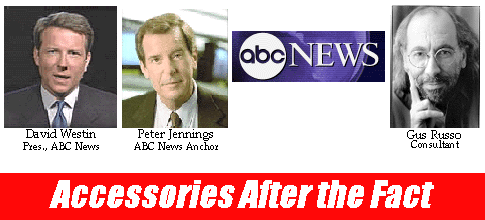
     Why did David Westin and Peter Jennings hook up with Gus Russo for November 22, 2003? In order to keep the myth alive about this man:


    Introduction

    The following articles are meant to examine and explore the relationship between the three men above and the 40th anniversary of the Kennedy assassination. How did it come to pass that ABC President David Westin, the late Peter Jennings, and writer and researcher Gus Russo met, approved and then decided to concoct a huge deception that is meant to recycle and resuscitate a forty year old lie that very few people believe? We try to do that here in order for the reader to fully understand what and why ABC did on November 20, 2003.

    We trace and describe some previous network specials on the subject and how they were influenced and controlled by high officials inside and outside the government. Former Warren Commissoner John McCloy exerted enormous influence over a four-part 1967 CBS special on the assassination itself, and the CIA and Sarnoff family (owners of NBC at the time) had direct ties to a 1967 NBC special on Jim Garrison. We also trace the recent history of ABC, especially the momentous event that Andy Boehm and Jim DiEugenio describe in the 2003 Introduction and original 1987 article entitled “The Seizing of the American Broadcasting Company.” This piece describes in detail an example of how the government can influence what is shown — and not shown — on the broadcast airwaves that are theoretically controlled by the citizens of this country. We suggest the reader examine this bloc of articles first.

    We then move on and show as directly as we can how ABC came to the lamentable decision to produce a documentary that is simply insupportable by the facts, circumstances, and evidence. This bloc of articles includes a profile of ABC News President David Westin — how he came to power and how his regime has differed markedly from his legendary predecessor Roone Arledge. We then describe the career of a reporter who sets a paradigm and precedent for ABC’s actions on this case, reporter John Stossel who, although billed originally as a consumer advocate, is something short of that. We then examine aspects of the career of the chief consultant on this special, Gus Russo: his career in the Kennedy research field, his differing beliefs at times, and his dubious claim of a Pulitzer nomination. We then connect Russo to the main players behind the November 20th special, Jennings and Mark Obenhaus. We do this through the previous production of theirs based upon the controversial and specious book by Seymour Hersh, The Dark Side of Camelot.

    Finally, we begin to dissect some of the work of Russo and his friend Dale Myers, upon whom ABC has relied. We especially try to examine the work of Myers on the computer simulation he has had for sale for many years, and Russo’s work on the most important aspect of any murder case, the medical and autopsy evidence. These are the most important aspects of any serious inquiry into a murder case. If those conclusions are faulty, everything that follows from it must be wrong.

    The questions we ask here are two quite serious ones. Did ABC, through Westin, Jennings, and Obenhaus rig the deck to arrive at a preconceived conclusion? And if they did, why did they?

    But also, through this detailed inquiry we hope to posit some wider, broader, more universal queries about the media itself. Is it possible for any huge network which works so closely with the government to be expected to tell the truth about any highly controversial and influential event in which it plays a controlling role? Who do people at the top of the network ladder serve today? And if they do not serve the public, what alternative does the public have in pursuing factual truth about these events? And does this pursuit of facts not available through the mainstream media, automatically place them in opposition to the media and the government? The exploration of those questions based on accurate information are meant to encourage a democratic debate about the state of our media today.

    Articles

    The Networks and the Politics of the JFK Case This link leads to several articles demonstrating the media’s shoddy history in covering the JFK case:

    JFK: How the Media Assassinated the Real Story exposes the media’s shameful performance in the decades since President Kennedy’s assassination.

    Shoot Him Down: NBC, the CIA and Jim Garrison examines NBC’s hatchet job on then-Orleans Parish District Attorney Garrison when the DA’s assassination investigation was in full swing.

    Why ABC? A group of articles examinating ABC and some of those associated with the ABC News special.

    Gus Russo Articles examining ABC’s chief consultant, and a surprising turn by Arlen Specter.

    These Are Your Witnesses? An analysis of Peter Jennings and his witnessess, and what ABC did not disclose about them and why.

    The “irrefutable” Mr. Myers Critiques of Dale Myers’ “irrefutable” computer simulation.

  • Oliver Stone vs. The Historical Establishment


    From the July-August 2000 issue (Vol. 7 No. 5) of Probe


    Nearly a decade later, the vibrations and echoes of Oliver Stone’s film on the Kennedy assassination are still being heard and felt. When JFK first came out in late 1991, the media had prepared the public with a six-month propaganda barrage to doubt the factual accuracy of the film. That barrage began in both the Chicago Tribune and the Washington Post with articles by Jon Margolis and George Lardner respectively. The attacks on the film kept up throughout its tenure in the theaters and into the Academy Awards ceremonies where, as researcher Richard Goad revealed, David Belin took out an ad in Variety to deliberately hurt the film’s chances at Oscar time. Looked at in retrospect, this campaign was clearly unprecedented in the history of movies. And Stone himself has admitted that the first attacks totally surprised him. Perhaps they should not have. In his film, Stone took up two issues that the establishment media does not wish to be touched upon in any serious or truthful way, i.e. the Kennedy assassination, and the investigation into that murder by the late Jim Garrison, District Attorney of New Orleans who, four years later, launched the only criminal prosecution ever into the murder of President Kennedy. Stone’s film advocated a conspiracy, and a high level one, into the JFK murder. His film portrayed Jim Garrison and his inquiry in a favorable light. Therefore, the big guns of the media pummeled him for months. The barrage was designed to assassinate both Stone, and the film’s message. The week the film opened both Time and Newsweek featured the film as a major story, the latter placed it on the cover. The idea was to massage the collective public mentality into not accepting the film’s message, or at least to create doubts about both the message and the messenger. Many people in the general public, although convinced the official story was not correct, had doubts about the film’s accuracy and total content.

    The debate over Stone’s film went on for about a year in public. Not everything about it was negative. There were many programs on television that featured a measured debate about the facts of the film and the case in a careful and balanced way. Unfortunately, these programs were not the widely seen ones like a 48 Hours Dan Rather special, which was an awful one-sided attack on Stone and the critics. The following year, in 1993, the media brought out its savior. In the year of the 30th anniversary of the JFK assassination, Gerald Posner jumped out at the public on the newsstands and their TV sets. The man became the darling of the media. It didn’t matter that his book was unbelievably shallow, and in some cases absolutely ersatz. Posner can be considered the second wave of the propaganda blitz against Oliver Stone and his heretic film. Another attempt at playing to the crowd, creating seeds of doubt about Stone and his movie. Posner’s appearance also signaled the beginning of the simplistic, cheap labeling of Stone and his companions as the “conspiracy cabal.” On national television, Posner called Stone’s scenario the “everything but the kitchen sink theory” to the JFK assassination. Thus began the canard that Stone’s movie postulated a conspiracy to kill Kennedy that included the FBI, the CIA, the Secret Service, the Mob, the Pentagon, Lyndon Johnson etc. This, of course, is a wild exaggeration of what the movie actually says, but it tells us a lot about what Posner’s mission was and what his devotion to the truth really consisted of. Ever since, Stone and the critics have been saddled with the rubric that they are paranoid fantasists who see conspiracies in every major crime ever committed. Or when used even more cheaply by people like Noam Chomsky, the critics can be grouped with those who believe in space aliens and Elvis sightings.

    Now comes the third wave. This one is for posterity. As the mass media continues to grow in size, concentration, and power, its outreach into the academic establishment has slowly become more marked. That is, the number of academics and/or historians featured on television has gotten more select and familiar. Also, the publishing industry has gotten to be monopolized also. Today, according to Publisher’s Weekly, approximately 70% of all new books are published by ten houses. This is an amazing shrinkage of the number of outlets and a great increase in control of the number of publishers who can give a book a serious launch in the marketplace. In fact, the original publisher of Jim Garrison’s original hardcover book which Stone based his film on, no longer exists.

    The above information is a way of explaining the response of the historical and academic establishment to Stone and his films. For the debate about those subjects has now reached into that arena. For not only the media, but also academia has generally bought into the Warren Commission myth about the lone gunman scenario as a solution to the Kennedy assassination. There are very few textbooks or historical books in general which give a balanced view of any of the assassinations of the sixties. And most “talking head” historians who pop up on television won’t delve into any conspiracy scenarios in any of these historically significant murders, e.g. David Garrow on the Martin Luther King case. What this says about America is that the rather unexamined world of academia can be seen to serve as an adjunct to the Establishment. Any cursory examination of the rosters of organizations like the Council on Foreign Relations will show a large amount of memberships devoted to two rather surprising institutions: the media and academia.

    As both Michael Kurtz and Robert Toplin write in an interesting new book, Stone lobbed a bomb at this establishment. And it has had an extraordinarily long reaction time. Toplin has edited a new book of essays on both Stone and his films entitled Oliver Stone’s USA. In it nine of his films are examined. Also, Toplin has allowed Stone to respond to the critiques in three long sections. The book is well worth reading for both the controversy and some new information it contains. For example, how many readers knew that Stone was born and raised a conservative Republican and that he backed Barry Goldwater in 1964. Also, Stone reveals here that his proposed film on Martin Luther King was turned down by the studios based in part on the criticism it got in the press when word of the proposal leaked out.

    The general plan of the book is to introduce the topic of Stone’s historical films in general first. So the first part of the book features overviews of Stone and his films by Robert Toplin, Robert Rosenstone, and a co-authored essay by Randy Roberts and David Welky. Stone then responds to these three essays on his image. In the second part of the book, there are nine essays on individual films: Salvador, Platoon, Wall Street, Born on the Fourth of July, The Doors, JFK, Heaven and Earth, Natural Born Killers, Nixon. The final section of the book gives Stone an opportunity to respond to these critiques which he does in two parts. The first one is entitled “On Seven Films” and the last essay is devoted to the two most controversial, JFK and Nixon.

    Before getting on to a discussion of the book, let me make a few cogent points first. The entire discipline of history is under debate itself. This debate is raging in the confines of those ivory towers today. That debate is going on with two issues. First, on methodology. Up until this century, most historians believed in the, let’s call it, top-down method of historical reportage. That is, if you told the story of an epoch with what happened at the top levels – presidents, governors, the rich etc. – that would neatly sum up an era and tell you the important events which occurred. With the advent of the so-called New History of the 1950’s, that has changed. Many younger historians are trying to be sociologists too in order to try and depict what life was like for the average American. To bring about that more inclusive picture, the historian has had to avail himself of more tools also. He has had to delve into economics, demographics, statistics etc. And with this new digging has come a second debate: synthesizers versus data-crunchers. Or, is it more important to tell what you can with a limited amount of material or is crucial to concentrate on a small area and dump out every last drop of data you can possibly muster. Some argue for the former by saying that history without any trends or curves becomes formless, meaningless. Historians who side with the latter group say that it is of utmost importance to marshal as many relevant facts as possible before denoting a curve or trend. At the same time these debates are going on, the debate over whether or not history should be studied as an undergraduate requirement at all is also ongoing.

    This is the background that Stone lobbed his bomb into. And with it, whether he knew it or not, he was entering the above debate. Stone clearly entered on the side of the data-collectors against the synthesizers. Few aspects of American history had been so generalized about – erroneously – as the JFK murder. In fact, as many have stated, it is an absolute disgrace what the historians have done with this crucial event. When the debate was raging in the media, Stone would always argue that the problem with the JFK murder is that no one wants to argue the evidence. Which was true since very few journalists or historians had looked at it. That is probably even more true today since the Assassination Records Review Board has now declassified millions of pages of new documents which have been relatively ignored by the press. Nearly all of this new material backs up the contentions of Stone’s film. And in this new book, the only discussion of this new record is by Stone and Professor Michael Kurtz. Clearly, by getting the Review Board created Stone was trying to do the work that historians have always complained about, solving the problem of declassification.

    By making more records available, the historian can now be more accurate in his judgments about the Kennedy assassination. Unfortunately, to be kind, and with the exceptions noted above, that does not happen here. In theory, facts are supposed to be like sunshine, the more there are the brighter the picture. Yet it tells us something about the Kennedy assassination when most of these historians continue to work in the dark.

    Finally, there is one other historical notion that needs to be addressed as background and that is the so-called “mystique of conspiracy”. Excepting for the rare luminary like Carroll Quigley of Georgetown – Bill Clinton’s favorite professor – very few illustrious historians have dealt with the question of conspiracy in history. For instance, even where conspiracy is an accomplished fact e.g. the Lincoln assassination, few mainstream historians address that important event with honesty or thoroughness. In fact, many ignore it completely. So even before Oliver Stone got labeled a conspiracy nut, the academic community was predisposed against him. Of course, if one grants the omnipresence of conspiracies in American history, one could not synthesize very easily at all. One would have to explain deep, dark forces lurking in the shadows which every so often sprung forward and captured an important moment for its own purpose. It would take a lot of work and effort to thoroughly explain these phenomena. It would also then ipso facto be a confession that much of what had been written previously in both the media and in history books about certain events was wrong. This was another bomb lobbed by Stone at the cozy nest of historians’ societies.

    Having said all of this, I think Stone was treated fairly well in this book. The very fact that the editor, Toplin, allowed him ample room to respond is evidence of that. Also, some of the discussions of Stone’s films are appreciative. For example, the esteemed Walter LaFeber – who has written the best overview of American foreign policy in Central America – does a fair and informative job on Stone’s Salvador. David Halberstam is enthusiastic about Platoon. Toplin even let the writer of the book Heaven and Earth do the discussion of that film. David Courtwright writes an interesting essay on that fascinating, extraordinary, towering film Natural Born Killers, perhaps the finest satirical look at a serious American subject since Stanley Kubrick’s great Dr. Strangelove. There is an essay by Randy Roberts and David Welky entitled “A Sacred Mission: Oliver Stone and Vietnam” which is quite interesting. In it, the authors trace Stone’s childhood and young adulthood and seemingly try to portray him as some kind of malcontent. They then describe his tours of duty in Vietnam and his early attempts at getting Platoon made. They then discuss Born of the Fourth of July and Heaven and Earth then conclude with a discussion of JFK focusing on the film’s thesis of Kennedy’s intent to withdraw from Vietnam. They cogently write, “JFK was a mortar lobbed at the establishment, and it set off a firestorm of controversy.” They then add that the thesis, Kennedy’s intent to withdraw from Vietnam, “though passionately and eloquently argued … does not stand up to scrutiny.” They argue the rather ancient banality that there was no real difference between NSAMs 263 and 273 and that 263 was only meant as a warning to President Ngo Dinh Diem to shape up and allow for more democracy in South Vietnam or Kennedy would weaken U.S. commitment. This brings one of the issues about the historical debate mentioned above into the forefront. If one is supposed to be writing a scholarly and serious review of a controversial artist and his films for the purpose of examining the historical record he has highlighted, one would think that the writers would acquaint themselves with the latest declassified records on the subject. The documents that the Review Board has declassified on this subject are now definitive. Just two issues ago in this publication, I discussed at length the record of the May, 1963 SECDEF Conference in Hawaii. That record seems to me as definitive as one can get about this subject and it is absolutely clear on this point. (The Review Board tried to get the record of the November, 1963 Honolulu conference, which would have been just as valuable if not more so, but they could not.) So, on this issue, Stone actually comes out looking better than the supposed scholars.

    But, of course, for our audience and this publication, the discussions of JFK and Nixon must take center stage. As they do in the book. Michael Kurtz wrote the discussion of the former film. There are three critiques of the latter. They are by Stephen Ambrose, George McGovern, and Arthur Schlesinger. In a separate concluding section, Stone takes almost 50 pages to respond to these writers. Michael Kurtz is one of the few historians who has actually studied the JFK assassination and he has published a decent book on the subject, Crime of the Century. Kurtz notes the storm of controversy Stone’s film provoked and he adds that many commentators had no qualifications to discuss the Kennedy murder. Which is correct. But yet, Kurtz then seems to repeat the Vietnam canard when he writes that Stone remains vulnerable to criticism on the thesis that “an unidentified cabal of military-industrial-intelligence movers and shakers ordered Kennedy’s assassination because he intended to withdraw all American troops from Vietnam.” Kurtz may be right about the first part of the dual-edged sentence – the identity of the conspirators – but on the withdrawal part Stone was right on. On this part of the film, Kurtz attaches another familiar distortion that the “film intimates that [Lyndon] Johnson himself was in on the plot to kill the president.” Only if one is not watching too closely.

    Kurtz has never been a fan of Jim Garrison, and he continues his attack in this volume. Like most Garrison-bashers, Kurtz deflates the DA at the same time he exonerates Clay Shaw. But Kurtz goes further. He writes, “The movie’s implication that Shaw indeed participated in a conspiracy to assassinate President Kennedy simply has no substantial evidence to support it.” Kurtz now seems to be going beyond the confines of the film into the newly declassified record. There have been thousands of pages of new documents pertaining to Shaw that the Review Board has released. Much of that record has been put together into an invaluable book by Bill Davy, Let Justice Be Done. Kurtz knows of the book since he mentions it in his footnotes (along with my book which he mistitles). Whether he read it is another matter of course. But if he did, he must discount the information in it since Davy makes a fine case for Shaw’s complicity in the New Orleans part of the conspiracy. Also, Kurtz says that Stone “branded” Shaw a CIA-collaborator when Davy has now unearthed documents which clinch the idea that he was much more than that.

    Kurtz also states that Stone’s portrayal of JFK himself is too one-sided and saintly. Granted that Stone’s portrait of Kennedy is not full dimensional, but he is not a main character in the story. He is only referred to. As the editors of this journal have mentioned, we realize the legion of Kennedy bashers out there and between the bashers and Oliver Stone’s version, we think Stone’s is closer to the truth. Also, Kurtz faults Stone for presenting the conspiracy-side of the debate only and not giving the Warren Commission defenders their due. This is silly. How can one make a film of the Garrison story without accenting the DA’s beliefs first? Also, the Warren Commission defenders have their way all the time in the mainstream press (and thanks to people like Alec Cockburn, in the alternative press too). Why not give the critics a well-deserved platform? Also, Kurtz states that no witness who heard shots from the Texas School Book Depository is portrayed, yet there is a witness who points there early in the film.

    Kurtz is the only writer in the volume to give any attention to the discoveries made by the Review Board. Yet, he states that no smoking gun has emerged from these records. This is a matter of interpretation and we beg to disagree. There is a lot in the medical investigation by former Chief Counsel Jeremy Gunn that can be classified as such. Also, Noel Twyman’s book shows that there is powerful evidence that the Dallas Police only found two shells at the crime scene and not three. That is a smoking gun if true.

    Kurtz does make some nice comments about the film. He writes that, in the field of historical drama, only Harriet Beecher Stowe’s Uncle Tom’s Cabin has had a greater impact on the public imagination. And he concludes with the following statement, “For all of JFK’s faults and shortcomings, few producers and directors can claim such an impact from their movies, and few historians can claim such an impact from their works.” Yet at the beginning of the essay, he states that Oliver Stone “crossed the line between artist and scholar by combining film with history, by projecting onto the silver screen his highly subjective version of actual persons and events … ” Kurtz would have been on safer ground if he would have added that all artists do this when depicting an historical event. From Sergei Eisenstein in Potemkin to Arthur Penn in Bonnie and Clyde to Brian dePalma in The Untouchables to James Cameron in Titanic artists take liberties with the documentary record. This is called dramatic license. Yet none of these directors was attacked with anywhere near the force that Stone was. As we know, historians and investigators also do the same or academics and journalists would not have backed that great piece of dramatic fiction called the Warren Commission Report. Since Stone is an artist working in a tradition, his liberties are much more excusable than a team of professional investigators supposedly searching without restraint for the truth to be presented as such to the American public. No writer in this volume brought out this important point.

    The two other essays which will be of most interest to our readers are those by Stephen Ambrose and Arthur Schlesinger. Ambrose is the current conservative anchorman for the academic and journalistic establishment. Schlesinger is his liberal counterpart. It is not odd that both agree on the subject of Stone and his two films JFK and Nixon. Ambrose is slightly more virulent than Schlesinger, although not by much. In his opening crescendo words like “fraudulent” and “lies” spill off his pen easily. He even discounts the fact that in Nixon, Stone prefaced the film with a disclaimer which noted that some scenes were “conjectured”. What more clear device could Stone use to show that he was using dramatic license? Yet Ambrose ignores this issue almost completely and hones in on Stone because he is not “factually accurate” throughout. What is surprising about Ambrose is that he then begins his assault on the film with issues that most would consider minor and arguable. Namely the depiction of Nixon as a drinker and pill-popper during the height of the Watergate crisis. The problem with this assault, as even Bob Woodward noted to Ambrose long ago, is that Stone can mount evidence for it from Nixon’s own camp. For instance, in his memoir about his years with Nixon, John Ehrlichman noted that Nixon had a drinking problem in two senses. First he liked the stuff and second, he could not handle it. Before he agreed to work on his campaign, he made Nixon promise to lay off the booze. So to say that Nixon would relapse into an old bad habit under the tremendous pressures of Watergate is eminently probable. As to the pills, in their book The Final Days, Woodward and Carl Bernstein interviewed Alexander Haig, Nixon’s Chief of Staff during Watergate. He told them, during Watergate, he was so worried about Nixon’s mental balance that he gave orders to clear the White House of pills and other things that Nixon could use in a potentially rash act. Again Woodward reminded Ambrose of this fact on national television and asked why such an order would be given if the pills were not there. Ambrose either forgot the exchange or ignored it.

    From here, Ambrose moves on to another rather mild and arguable point: Nixon’s use of profanity. When the film first broke, Ambrose tried to argue that the whole issue of profanity was exaggerated and abused by the film. He was reminded that if that was so, then why were so many words deleted from the Watergate tapes under the rubric of “expletive deleted”? Furthermore, Stanley Kutler’s book Abuse of Power, featuring more declassified tapes, shows this point in more detail. It also shows that Nixon had a penchant for using ethnic slurs. So today Ambrose has resorted to the fallback position of arguing exactly what words Nixon used in his swearing. He also argues that whatever the profanities, they were the same or less than other presidents like Truman, Kennedy, and Johnson. As anyone who has read the Kennedy transcripts knows, he is wrong on at least that president.

    Ambrose then admits that these might be minor character points. He calls them peccadilloes. He quickly adds that: “The central piece of fiction is not. It is the creation of a Nixon-Fidel Castro-Kennedy connection. Stone has Nixon involved in a CIA assassination plot against Castro, which somehow played a part in the Kennedy assassination and left Nixon with a terrible secret and guilt about Kennedy’s death.” Ambrose then goes on to argue against almost every contention Stone makes in postulating this scenario. To do so, he ignores, discounts, or misreports evidence. And, of course, he allows for no extension for what has not been revealed yet.

    First, let us note the jumping off point for this thesis and Ambrose’s disagreement. It is the Bay of Pigs operation. Today, with the release of two important reports by the Assassination Records Review Board and other organizations, it can now be stated with certainty that almost every examination of that operation has been incomplete. It can now be stated that at least part of the agenda for the Bay of Pigs was hidden or, at least, not written down. John Newman’s upcoming book, Kennedy and Cuba, will be the most accurate portrait to date on the subject. It will make all previous depictions obsolete and from what Newman has told me it will make all of Ambrose’s writing on the subject seem elementary at best and will do a lot to bolster Stone. Richard Bissell himself, who commanded the operation at CIA, admitted that assassination had been a part of the operation. Howard Hunt has written that Nixon was the officer in charge at the White House. The operation was planned during the Eisenhower administration (and Newman’s work will show that a similar operation was tried at that time). Newman’s previous work has shown that it was Nixon himself who suggested the use of the Mob as agents for the CIA in the Castro murder plots. And when Ambrose writes that no attempts were made on Castro during Eisenhower’s tenure, he is artfully phrasing a nebulous point. Because the CIA report on those Castro murder attempts shows that they began at least in August of 1960 and probably before then. As for actual “attempts” that is something that can never be fully shown. For example, the CIA says they made eight attempts on Castro’s life. Castro’s security forces say it is much higher than that.

    But to continue with the main point of Stone’s credibility and Ambrose’s scholarship, the above mentioned declassified CIA reports on both the Bay of Pigs and the Castro plots reveal that Kennedy was deliberately kept in the dark about both the plots and large parts of the invasion plan. Is it a coincidence that both were in operation at the same time during Eisenhower’s administration and that both went into a kind of remission during JFK’s administration? Bissell admitted in the 1980’s that he had hoped that the Mob assassination plots would make the Bay of Pigs invasion easier for the CIA. Now, if Nixon suggested the use of the Mob at the outset, and those plots were shielded from JFK, this already backs up much of what Stone is theorizing. Trying to prove that the CIA-Mob plots “blew back” and killed Kennedy is more difficult of course. But even Robert Blakey’s House Select Committee wrote that their construction placed all the elements in place for an assassination plot against JFK. And that includes a motive. For as most students of the Bay of Pigs conclude – including me – the operation, as planned, was virtually hopeless. Lyman Kirkpatrick who reviewed the operation at CIA thought this also. Even if the second bombing run had gone off perfectly as CIA wished, Castro had managed to get too much artillery and armor to the beach too fast. This is because there was no surprise, a platoon was in training near the bay, and the bridges to the beach had not been blown. When one adds in simple arithmetic, namely, as Kirkpatrick notes, how the invasion force could surmount being outnumbered by a margin of over fifty to one, one wonders what Bissell was really thinking. Kennedy wondered about it also. He came to the conclusion, as others have, that the CIA thought Kennedy would send in American forces to save the mission, which is precisely what Nixon told Kennedy he would have done. The CIA tried to cloud the fact that the invasion was ruinously planned and to shift the blame to Kennedy himself for his alleged cancellation of the second air strike as the reason for failure. Certainly many Cuban exiles believed this canard and it may have encouraged a role in his murder on their part. It’s hard to imagine that Nixon who – according to Ehrlichman – was trying to get the secret report of the Bay of Pigs, was not aware of a good deal of this.

    Ambrose rejects all of the above. But yet it is Ambrose who also condemns Stone for suggesting that Kennedy was killed for his attempt to remove the U.S. from Vietnam. Yet, that removal, as the Review Board has shown is now not open to debate. As Stone notes, one of Ambrose’s functions, like his journalistic counterpart Chris Mathews, seems to be to elevate and whitewash Nixon and to denigrate and deflate Kennedy. Ambrose, that supposed careful scholar, actually said on a biography show about Nixon, that the late president was quite fair to Alger Hiss. Yet, as Robert Parry discovered, on the newly declassified tapes, Nixon admits that he deliberately leaked all sorts of hazy material on that case to the press so that Hiss would be sure to be indicted by a grand jury in New York and have to stand trial. When the first trial ended with no verdict rendered, Nixon took to the stump and railed against the judge in the case to get him removed from a second trial. How could Ambrose ignore these facts? They are not in doubt and not arguable.

    Schlesinger blasts the “high cabal” thesis of Stone’s film on the assassination. Like so many others, he deliberately distorts it by expanding it beyond the facts of the film. According to Arthur Schlesinger, the conspiracy included the Joint Chiefs, the CIA, the FBI, the military-industrial complex, anti-Castro Cubans, homosexuals, and the Mafia. As I have argued before, this is not what the film depicts. He then goes in for character assassination. He smears Fletcher Prouty as a fantasist. This is poppycock. Prouty’s two published books, as well as his essays, have contributed as much or more to the secret history of this country as almost any author I can think of. There are many things in his work about the Kennedy administration that do not appear in Schlesinger’s book and are invaluable to any accurate portrait of his presidency and his murder. Jim Garrison is termed a “con man”. Some con artist. A man who blows his career in pursuit of justice – with no help from Kennedy’s pals, of which Schlesinger is supposed to be one.

    Schlesinger concludes his discussion of JFK with a puzzling sentence, “Still, except for supreme artists like Shakespeare, Tolstoy, Verdi, and Delacroix, dramatic license should not be corrupted by ideology, as it certainly has been in JFK.” My question is this: Where is the ideology? People of the left, right, and center can all agree that a high-level plot killed Kennedy and that plot was probably based on policy disputes. For many reasons, all the blanks can’t be filled in (but both Prouty and Garrison were trying to do so.) This very fact justifies and necessitates the use of dramatic license. And the importance of the issue as a historical puzzle further justifies that usage. The public deserves to know everything our government did and did not do about and before this murder. Stone’s film helped in that area to an immense degree. I wish Ambrose and Schlesinger had read the Review Board’s declassified files. Further, that they had used them for their work in this volume. Until they do, Stone is completely justified in making these films and therefore keeping the historical establishment honest. Let’s hope, in that regard, the King project is completed and it helps release the government files on that murder.

  • The Media Buries the Conspiracy Verdict in the King Case


    From the January-February 2000 issue (Vol. 7 No. 2) of Probe

    (Click here if your browser is having trouble loading the above.)

  • The Sins of Robert Blakey, Part 2


    From the November-December 1999 issue (Vol. 6 No. 1) of Probe


    Blakey told him, “You guys are thinking too big. You’ve got to get your conspiracy smaller.” Sprague replied, “Well, how small Bob?” The professor replied, “Five or six people.” HSCA investigator Eddie Lopez vouched for this rendition of Blakey’s view of how large a conspiracy could be.


    In an interesting segment from Gaeton Fonzi’s wonderful 1993 book The Last Investigation, the author recalls his first meeting with and impressions of the man who replaced Richard Sprague as chief counsel and staff director of the House Select Committee on Assassinations. At that time, the summer of 1977, Deputy Counsel Robert Tanenbaum was supervising the JFK side of the House Select Committee while awaiting a replacement. Tanenbaum had called Fonzi and told him that he wanted him to meet the incoming chief counsel, Cornell law professor G. Robert Blakey. Fonzi describes his first thoughts about Blakey thusly:

    Among my first impressions of Bob Blakey was that he was very knowledgeable in the ways of the Washington bureaucracy. It was obvious that he knew how to take over an operation because the first thing he did when he arrived was nothing. That, as they tell you in the military, is exactly what a new commander should do when he is assigned a unit: Do nothing but walk around, look around, listen carefully and ask questions. Then you’ll know how to move for control quickly and firmly…. Blakey turned out to be a very cunning intellectual strategist who seemed to take quiet pride in his ability to manipulate both people and situations. (pp. 208-209)

    Blakey’s Small Conspiracy

    Clearly, during the brief transition period in July of 1977, Blakey had decided that the open-ended investigation that his predecessors had launched was, for his purposes, much too broad and also too reliant on the literature critical of the Warren Commission. When I talked to photoanalyst Richard E. Sprague in 1993, he related a personal conversation that he had with Blakey shortly after the professor had taken over. Blakey told him, “You guys are thinking too big. You’ve got to get your conspiracy smaller.” Sprague replied, “Well, how small Bob?” The professor replied, “Five or six people.” HSCA investigator Eddie Lopez vouched for this rendition of Blakey’s view of how large a conspiracy could be. He said that in his lecture classes on criminal conspiracy, Blakey would describe such an entity as spokes on a wheel. It was necessary to keep these human spokes small in number to minimize the possibility of one breaking i.e. talking.

    To limit the conspiracy and deliberate cover-up in the John F. Kennedy case to five or six people is quite a tall order. But the cunning strategist Blakey knew where to strike first. Bob Tanenbaum had brought Michael Baden into the House Select Committee on Assassinations because he had worked with him many times in New York City where Tanenbaum worked homicide cases and Baden was Chief Medical Examiner. Tanenbaum had much admiration for Baden’s skills as a forensic pathologist, i.e. a doctor whose specialty is determining the cause of death in cases that need full autopsies. Tanenbaum told me that as long as he was there, Baden backed the basic idea that the Kennedy murder was the result of a conspiracy. In other words, the single bullet theory was not tenable. But something happened to Baden when Blakey took the helm, because shortly thereafter he switched positions. He became a vociferous backer of Oswald as the only assassin. In other words, the single bullet theory was now not only viable, it was the only way to go. And according to Jerry Policoff, people inside the committee have said Baden began to ride herd on the medical panel, actively encouraging the thesis on his cohorts

    Purdy Switches Sides

    Once Baden had switched his position, Andy Purdy was the next to go. As I wrote in the first part of this piece, Purdy was a friend of Representative Tom Downing’s son at the University of Virginia. Purdy had seen Robert Groden’s enhanced version of the Zapruder film and encouraged the son to have his father see it. Downing then wrote his bill authorizing congress to investigate the Kennedy case based on that viewing of the Z-film. Through his connections to Downing, Purdy secured a position on the committee. By all accounts, and like Baden, while Sprague and Tanenbaum were in command Purdy was all for finding the real conspirators in the Kennedy case. But Eddie Lopez said that one day shortly after the transition, young Purdy went into a meeting with Blakey and Baden. When he came out he announced, “We’re going with the single bullet theory.” Lopez was shocked. He began arguing with Purdy in a demonstrative way. He sat himself down in a chair to demonstrate the trajectory of the single bullet through Kennedy’s back. He then raised his arms over his head to show Purdy that it would be impossible for a bullet entering at the level shown in Kennedy’s shirt (about four inches below the collar) to exit at his throat. He raised his arms as high as they would go trying to show Purdy that no matter what he did, the bullet hole in the shirt would never rise up to neck level: “See, you can’t do it Andy!” It was to no avail. As Gaeton Fonzi later said, it was like the epiphany of St. Paul. Purdy now had gotten religion.

    What happened to Baden and Purdy? No one can know for sure. It would certainly seem that the facts of the case did not change. It would be very illuminating for all of us if Purdy would divulge what was discussed behind closed doors at the meeting which caused his conversion. But whatever was discussed, the 180 degree swerves of Baden and Purdy were very helpful in resuscitating the “Oswald as lone assassin” story. Because Baden would now lead the medical panel arranged by Blakey and Purdy would end up being the chief medical investigator for that panel. As long as both maintained the figleaf of the single bullet theory, it would be possible to posit a small conspiracy.

    Kennedy’s Wounds Shift Positions

    The problem with Purdy and Baden’s work though is that it does not hold up under scrutiny. In fact, it is not even consistent with its own assumptions. For a startling illustration of this, one only has to look at Baden’s own testimony in Volume 1 of the House Select Committee published set. On pages 186-192 Baden discusses the wound in Kennedy’s back with an illustration provided by medical artist Ida Dox. Her renditions are based on the actual autopsy photos. Baden and his panel moved the wound in Kennedy’s back lower than the Warren Commission had placed it. But even more importantly, he discusses something called an “abrasion collar”. This is the ring made around a bullet hole in the skin that can sometimes reveal directionality i.e. the angle at which the bullet perforated the body. The Warren Commission drawing of this angle placed that bullet at a downward trajectory from the sixth floor and this HSCA volume has that drawing in it (p. 232). Yet the two drawings prepared by Dox for the HSCA do not maintain that angle. They depict, respectively, a flat trajectory of entrance and an upward trajectory. (pp. 190-191) Both Baden and his questioners danced all around this issue. Clearly it was not to be openly stated at the public hearings. Unfortunately, Cyril Wecht let the cat out of the bag right after Baden left. In discussing the horizontal and vertical trajectories of the new HSCA version of the single bullet theory he stated the following:

    The panel, to the best of my recollection, was in unanimous agreement that there was a slight upward trajectory of the bullet through President John F. Kennedy, that is to say, that the bullet wound of entrance on the President’s back, lined up with the bullet wound of exit in the front of the President’s neck, drawing a straight line, showed that vertically the bullet had moved slightly upward. . . . (p. 344)

    In other words, in this regard, the HSCA had actually outdone the Warren Commission. Not even the Commission could postulate that a bullet fired from above could enter Kennedy’s back at an upward angle – and then actually reverse its trajectory inside the body without hitting bone. Yet by admitting one thing that was true – that the bullet did not hit Kennedy in the neck but in the back – they had to create an even larger fiction to cover an even greater deception. For as Wecht put it so vividly:

    How in the world can a bullet be fired from the sixth floor window, strike the President in the back, and yet have a slightly upward direction? There was nothing there to cause it to change its course. And then with the slightly upward direction, outside the President’s neck, that bullet then embarked upon a rollercoaster ride with a major dip, because it then proceeded; under the single bullet theory, through Gov. John Connally at a 25 degree angle of declination.. . . How does a bullet that is moving slightly upward in the President proceed then to move downward 25 degrees in John Connally? This is what I cannot understand. (Ibid)

    Stated in those clear, stark terms no wonder Baden and the committee wanted to tap-dance around the issue.

    Humes Does Baden’s Bidding

    There was another strange piece of alchemy done with the Warren Commission autopsy evidence on September 7, 1978, the second day of the HSCA public hearings. Sandwiched between Baden and Wecht was none other than Captain James J. Humes. Humes, of course, was the titular head of the autopsy team that examined President Kennedy’s body when it was shipped into Bethesda Maryland upon its return from Dallas. If one is discussing medical questions about perhaps the most important and dubious autopsy in contemporary American history, could there be a more important witness? Imagine the breadth and depth of questioning that could and should have been done with Humes. For instance, about any phone calls he may have received from the time he knew he was doing the autopsy until the time he entered the autopsy room. Or if he asked to look at the autopsy photos or x-rays before he wrote his report. Or if the doctors reconstructed the back of Kennedy’s skull with bones from Dallas to make the present photographs possible. One fine example the panel could have asked: Was there a probe done of the back wound to see if it penetrated all the way through the body? At the very least, the examination of Humes should have been as rigorous as that of his colleague Pierre Finck in 1969 at the trial of Clay Shaw. But if one examines the transcript of that September 9th hearing, a curious phenomenon is observed. Baden, who was not in Bethesda, talks on and on for about 53 pages. When he is finished, there are many questions. Wecht, who was not in Bethesda, goes on for about 39 pages. When he is finished, there are many questions. Humes talks for nine pages. Even more startling, when he is opened up for questioning to the committee, this is what appears in the transcript:

    Chairman Stokes: Thank you counsel. Are there any members of the committee that would seek recognition?

    [No response.] p. 331

    At this point in the radio broadcast of the hearings, medical researcher Wallace Milamstarted to cry.

    So what exactly was Humes called on stage to do? Under Tanenbaum’s replacement, Deputy Counsel Gary Cornwell, Humes was basically depicted as a bungling nincompoop who could not tell the top of the head from the bottom, a person’s back from his neck, and someone so sensitive to the memory of JFK that he threw out his original autopsy notes because they “were stained with the blood of our late President”. (Ibid. p.330) In other words, he got the location of the wounds wrong and burned the first draft of his autopsy notes. I will excerpt two parts of Humes’ comments to show what his Galileo-like recantation was like: “We made certain physical observations and measurements of these wounds. I state now those measurements we recorded then were accurate to the best of our ability to discern what we had before our eyes.” (p. 327) Four pages later, this follows:

    Having heard most of what Dr. Baden said, and the findings of his committee on forensic pathologists, I think the committee was very well advised to gather such a distinguished group. I wish I had had the availability of that many people and that much time to reach the conclusions that I and my associates were forced to reach in approximately 36 hours.

    Humes played the good soldier and simulated the humble, bumbling dolt for the HSCA.

    Humes Behind the Scenes

    Unfortunately for the public, we were not allowed to see what had gone on behind the scenes leading up to this dog and pony show. At their private conference with select members of Baden’s medical panel, all three autopsy doctors – Humes, Pierre Finck, and J. Thornton Boswell – mightily resisted this new location for the head wound: four inches up from where they had originally placed Kennedy’s fatal head shot. In the newly declassified HSCA files, Finck argues that he had the body right in front of him and that should be the strongest evidence. Humes also argues that what the HSCA is now calling a bullet hole does not even look like a wound to him. Humes said about the small red dot that the HSCA called an entrance wound, “I just don’t know what it is, but it certainly was not any wound of entrance.” This argument went on until one of the HSCA pathologists interjected. “We have no business recording this,” said Dr. Loquvam. “This is for us to decide between ourselves; I don’t think this belongs on this record. . . . You guys are nuts. You guys are nuts writing this stuff. It doesn’t belong in that damn record.” (Vol. 7 p. 255) ( Loquvam ended up writing the draft report of the medical panel.) But six pages later, Humes made an even more vigorous dissent and a telling point about the difference between the black and white vs. the color autopsy photos. Humes was being grilled about why, if the wound was in the lower part of the head, the photos depicting that “wound” are not centered on that particular part of the skull; the photographer’s camera lens is centered toward the middle of the head. Humes said that they were not trying to get just a picture of the wound in that shot. He then further replied with this: ” I submit to you that, despite the fact that this upper point that has been the source of some discussion here this afternoon is excessively obvious in the color photograph, I almost defy you to find it in that magnification in the black and white.” Baden did not directly respond to what was a not too subtle rejoinder that Humes himself could argue that there were signs of alteration in the photographs. (One has to wonder if this was the unspoken deal between the HSCA and Humes: He would take the fall as long as no questions were asked. If they were, he would bring up this weird discrepancy about the photos in public.) Suffice it to say, what the HSCA presented to the public was not an accurate portrayal of the dispute between Humes and the medical panel. Humes himself dramatized this years later when after Oliver Stone’s JFK came out, he reverted back to his original position for the head wound, four inches downward on the skull, for the publication Journal of the American Medical Association.

    But Baden had to do what he did.. Why? Because he decided that he had to stay true to the most recent version of the autopsy, which was not the Humes version. On the eve of the Clay Shaw trial, Attorney General Ramsey Clark had appointed a panel headed by forensic pathologist Russell Fisher of Maryland to again look at the autopsy materials in the JFK case. They had raised this rear head wound themselves. The elevation was clearly based on the presence of a large 6.5 mm. fragment apparent on the x-rays very close to the rear of the skull. As Dr. David Mantik has pointed out, this fragment was not mentioned by the three original autopsy doctors, which is hard to believe since its dimensions exactly fit the bullet size of Oswald’s alleged rifle. Mantik, not wed to the single bullet theory, went on to enact a tour-de-force demonstration of how this artifact was very likely inserted into the x-rays to cinch the case against Oswald. (See his long essay in the book Assassination Science, excerpted in Probe Vol. 5 No.. 2 .) Baden and Blakey would not touch this subject.. It could have indicated a larger conspiracy, at the very least, in the act of cover-up. So Humes did his temporary disappearing act. According to Jerry Policoff, it lasted until Humes left his microphone. As he left, he muttered, “They had their chance and they blew it.”(Gallery, July 1979)

    The Misreported Findings

    Did the HSCA “blow” its findings on the crucial aspect of the placement of the head wound? Or was something more sinister at work? In November of 1995, Gary Aguilar collated hundreds of pages of newly declassified documents of the HSCA by the Assassination Records Review Board. A crucial aspect of the medical evidence has always been whether or not a huge gaping hole existed in the back of Kennedy’s head after the murder. If this were so, it would give strong indication of a shot from the front since wounds of entrance generally make small puncture wounds while wounds of exit leave large, rough-edged holes. The doctors at Parkland Hospital in Dallas who had an opportunity to survey Kennedy’s head are almost uniform in their memories that just such an exit-type wound existed. To name just a few: Kemp Clark, Robert McClelland, Charles Carrico, Paul Peters, and Ronald C. Jones. Baden, basing his observations on the photos and x-rays, seemed to place this wound closer to the top of the head and nearer the right side, except that Baden called it a fracture caused by the entrance wound. The HSCA addressed this problem straight on in Volume 7 (pp. 37-39). The anonymous author of this section noted that Warren Commission critics had noted this discrepancy of the wound placement and had sided with the Parkland doctors believing that physicians who were accustomed to bullet wounds could hardly make such a mistake and all be so consistent in their recollections. The report then noted that, in opposition to the Parkland doctors, there were 26 people at Bethesda who watched the autopsy and they all corroborated the photos and x-rays. This statement is supported by a reference to “Staff interviews with persons present at the autopsy.” If this were so, it would be one more blow against the critics and for the HSCA’s strong belief in “scientific” evidence.

    The problem, as Aguilar so ably pointed out, is that the statement is not only false, but the opposite is true. Rather than contradicting the Parkland doctors, the 26 witnesses at Bethesda corroborated them. The Bethesda witnesses not only described a wound in the right rear of Kennedy’s head, they also drew diagrams illustrating that location. Further, when Aguilar presented the witness interviews on slides so that Cyril Wecht and Baden (who were both on hand) could see them, he asked both men if the had seen these corroborating reports while on the HSCA. Both answered that they had not. And who had conducted most of the interviews and was in a position to know the truth? Andy Purdy was the HSCA’s investigator whose name was on most of the documents. When Aguilar asked Purdy who wrote that (false) part of the report, Purdy said he did not recall. Aguilar wrote Blakey and got the same answer. Needless to say, when over forty witnesses in two different places describe the same type of wound in the same location and that wound does not show up on the photos or x-rays, it strongly suggests that something is wrong with those representations. And as I mentioned in the first part of this article, the fact that this uniformity of observation was not correctly noted by the HSCA seems to be at least part of the reason that David Lifton’s book Best Evidence seems a bit dated now. (See for example p. 172 and the drawings on p. 310).

    Baden and Russell Fisher

    After the HSCA September hearings, at a conference in December of 1978, Dr. Wecht reflected on what he felt to be some inherent bias in the composition of the medical panel. For instance, at the long interview with Humes (quoted above), Wecht was absent, and he was not made aware of that meeting until after the fact. Another one of the doctors on the panel, Dr. Weston, was a friend of Humes, who had worked for CBS on one of its JFK assassination documentaries. Wecht further added at that conference:

    It was not a surprise to me, nor do I believe it was circumstantial, that many of the pathologists who were selected [to the HSCA panel] are from the forensic pathology clique of Russell Fisher who headed the 1967 Ramsey Clark Panel and has a vested interest in having the questionable work of that panel endorsed.

    A perfect example of this was the choice of Werner Spitz, Chief Medical Examiner of Wayne County, which houses the city of Detroit. Prior to taking that position, Spitz served as assistant to Russell Fisher. Spitz was also a longtime friend of Humes and when Humes retired from the Navy, it was Spitz who threw a party for him. He then reportedly helped him find a job in the Detroit area. In 1975, Spitz was selected by the Rockefeller Commission and its Executive Director, former Warren Commission counsel David Belin, to examine the Kennedy autopsy photos and x-rays. Needless to say, that investigation ended up endorsing Russell Fisher’s findings.

    Vincent Guinn convicts Oswald

    Another expert employed by the Committee who would seem to have a less than objective attitude would be Vincent Guinn. Guinn was contracted to do the neutron activation analysis (NAA) on the one nearly intact bullet in evidence (the infamous Commission Exhibit 399), and for several other fragments recovered from either Kennedy or Connally’s body or from parts of the presidential limousine. This test breaks down pieces of evidence in a nuclear reactor to compare their smallest parts in elemental composition. In this case, Guinn was trying to show that the trace elements in these bullets and fragments were close enough in composition as to come from the Mannlicher-Carcano bullets allegedly used by Oswald. (Where Oswald got these bullets is another story.) Before describing and discussing Guinn’s conclusions, it is important to note how Blakey introduced him at the September 8, 1978 public hearing. During his opening narration, Blakey described Guinn as a professor of chemistry at the University of California at Irvine who “had no relation to the Warren Commission” (Vol. 1 p. 490). When asked later about this himself, Guinn replied in those same terms (p. 556). Unfortunately, if the reader turns to pages 152-153 of Mark Lane’s Rush to Judgment, he will see that this claim is apparently false. Lane wrote that although Guinn worked with the FBI on behalf of the Commission on the paraffin casts done for the nitrate tests about Oswald, and submitted a report on his findings, his name did not appear in the Warren Commission Report. Guinn himself admitted as much in a story in the New York World Telegram and Sun of August 28, 1964. At that time he worked for the big Pentagon contractor General Dynamics. In that story he is quoted as saying, “I cannot say what we found out about Oswald because it is secret until the publication of the Warren Report.” If Guinn was working on the paraffin casts of Oswald’s hands and cheeks in August of 1964, he had to have been in close contact with the FBI since they were the primary agent in these experiments for the Warren Commission. But yet Guinn’s direct quote on this subject was “…I never did anything for the Warren Commission, and although I know people in the FBI, I have never done any work for them.” (p. 556) This is extraordinary on two counts. First, could Blakey really not have known about this association if it was reported in Lane’s book? Could Guinn have forgotten he did work for the FBI on one of the biggest murder cases of the century? Secondly, the fact they both men appear to have been disingenuous about the subject shows another serious failing about the HSCA. Blakey and Gary Cornwell, Blakey’s closest associate, knew that one of the reasons that the Warren Report had fallen into disrepute was that many of its analysts had concluded that its findings were false because the “experts” used, especially by the FBI, were highly biased in favor of Oswald’s guilt. J. Edgar Hoover had essentially closed the investigation within about 72 hours after the crime. Since Hoover’s authority at that time was unchallenged, his subordinates did what they could to go along with that verdict. Blakey and Cornwell had to have been aware of this failing of the first investigation. It would seem to any sensible and objective observer that they were obligated to find the most independent and objective experts possible to retest some of this evidence. If necessary they would have been wholly within their mandate to go outside the country for them. But to go with someone like Guinn who not only did work for the Commission, but was then associated with General Dynamics, was inexcusable. (Larry Sturdivan, Blakey’s ballistics expert was also associated with the Warren Commission. See Vol. 1, p. 385; and his findings were just as dubious as those discussed here.)

    Guinn’s Fallacies Exposed

    Guinn’s findings were very important to Blakey. He leaked them to the press early in 1978 as the final nail in the HSCA’s verdict against Oswald. It was the rigorous scientific analysis that he so much admired and enthroned. And it showed that the single bullet theory was not just possible but that it actually happened. Unfortunately for Blakey, Guinn’s vaunted scientific rigor, like Baden’s, does not stand up to scrutiny. Guinn made two spectacularly erroneous general statements about the Mannlicher-Carcano bullets to the HSCA. First that, “[Y]ou simply do not find a wide variation in composition within individual WCC [Western Cartridge Company] Mannlicher-Carcano bullets. . . “(Vol. 1, p. 505). Yet Guinn’s own analysis in his report in the same volume undercuts this statement. Guinn performed tests on these WCC bullets from 1973-1975 for Dr. John Nichols of the University of Kansas, who was greatly interested in the Kennedy assassination. He took bullets from three production runs from WCC and then cut each bullet into four fragments. He then did NAA tests to find trace element compositions e.g. of antimony, silver, and copper in the bullet. Wallace Milam in his paper “The Testimony of Dr. Guinn: Some Troubling Questions” examined the results which appear in the HSCA (Vol. 1, p. 549). The four fragments from one bullet showed wildly varying amounts of antimony ranging from 358 PPM (parts per million) to 983 PPM. That is a variation of about 250% in one bullet. The four fragments from a different lot run varied to a lesser degree, but the PPM of antimony fell right within the same range of the bullet from the first lot! This means that by Guinn’s own matching standard, he could have concluded that a Carcano bullet from a completely different production run than CE 399 could have had the same amount of antimony as CE 399. And antimony was the trace element Guinn considered most important. (Guinn’s chart and this criticism of it is also exhibited on p. 43 of Stewart Galanor’s new book Cover-Up excerpted in this edition of Probe.)

    Guinn also seems to have been wrong in his interpretation of the copper content linking CE 399 to some wrist fragments taken from Connally. The PPM in copper from the bullet was 58. Milam notes the PPM for the fragments was 994. Yet these fragments had to have come from the copper base of the same bullet and therefore were in close proximity to each other. In fact, going through all of Guinn’s findings in this regard, Milam concluded, “. . the stretcher bullet [CE 399] matches the wrist fragments most closely in only one of seven elements.”

    Researcher Ed Tatro also examined Guinn’s work with help from John Nichols. Tatro found some very disturbing discrepancies between the samples tested by Guinn for the HSCA and those tested by the FBI in 1964. Of the samples received by Guinn from the FBI, one turned out to be only a copper jacket, one was devoid of any testable metal and was only cement particles. Further, Tatro wrote in The Continuing Inquiry, Guinn’s tested fragments in 1978 do not match the tested fragments of 1964 in either weight, size or number. And as Milam notes, Guinn testified that the FBI tests would not have destroyed or altered the samples. (Vol. 1, pp. 561-562)

    As Milam further notes in his important paper delivered at the 1994 COPA Conference in Washington, in taped comments to several people after his testimony (one of whom was George Lardner of the Washington Post), Guinn made some of the following startling statements:

    1. It was not until he received the evidence from the National Archives that he discovered he was testing fragments different from those previously tested by the FBI.
    2. None of the specimen weights matched those of the 1964 test fragments. Some of the fragments given to Guinn actually weighed more in 1978.
    3. Guinn himself admitted that it would be easy to deliberately falsify evidence to be tested: “Possibly they would take a bullet, take out a few pieces and put it in the container, and say, ‘This is what came out of Connally’s wrist.’ And, naturally, if you compare it with 399, it will look alike. . . . I have no control over such things.”

    Concerning the last sinister implication, we don’t really have to seriously consider it since, as shown, above, Guinn’s tests for Mannlicher-Carcano bullets, to put it kindly, are not probative. But one more comment on Guinn’s tests is in order. As early researchers like Ray Marcus have shown, the chain of evidence for CE 399 is very questionable. It is not probable, in fact is highly doubtful, that the bullet came from Kennedy’s stretcher. In a court of law, a defense lawyer for Oswald would have argued vehemently against admitting it into evidence, and he would have probably prevailed. Blakey and Cornwell were lawyers. Were they not cognizant of this? Would they not be aware that since the chain of possession of their most important exhibit in this regard was dubious, it would legally eliminate all of Guinn’s vaunted findings? In light of this, why go through Guinn’s tests at all? In the final analysis, they prove nothing.

    Canning and the Flight Path

    On September 12, 1978, Thomas Canning was called to testify before the HSCA. Canning was another government employee, this time the agency was NASA. Canning had worked on the Mercury, Gemini, and Apollo space missions during his 23 years there. Canning seemed an odd choice for the assignment he was given, namely testing the flight paths of the two bullets that hit Kennedy. In figuring out bullet trajectories, one would naturally think first of hiring a surveyor to figure out the angle in degrees from the so-called sniper’s nest to the point where the first shot hit. But, incredibly, in the nearly fifty pages of testimony given by Canning, there is never any expression of that angle in degrees! ( Volume 2, pp. 154-203) Canning took a rather unique and unexpected track in this assignment. Instead of plotting an angle from the sixth floor window through Kennedy’s body, and then Connally’s back, wrist, and left thigh, he did the reverse. He found a point on Kennedy and then plotted backwards into space to see where he would end up. One would think that this would have spelled the end of Oswald as the lone assassin since, as described before by Dr. Wecht, Baden’s forensic panel had said Kennedy’s back wound went through the body at an upward angle. But Canning found a way around that difficulty. If one looks at his schematic tracing the wound from back to front in Kennedy, that point of entry is now elevated back into the neck i.e. where the Warren Commission placed it in 1964. (Vol. 2, p. 170) And in tracing the line connecting the entry with the exit point, the reader can see that the angle is now flattened with no slope either up or down. When Canning was asked how he plotted these points he gave differing answers. Some of the time he said he relied on the HSCA’s medical panel for the entrance and exit points. But once he replied with this: “It was determined from photographs that were taken during the autopsy and by measurements and notes that were taken at that time.” (p. 170) If Canning actually saw the autopsy photos then he saw something different than Ida Dox or Baden saw as anyone can see from his placement of the non-fatal wound.

    Amazingly, no one mentioned this rather glaring and serious discrepancy until near the end of Canning’s comments. Representative Floyd Fithian said, “. . . someone . . . has made the statement that when the bullet exited the President’s throat it was rising.” (p. 200) When Canning answered this question he tried to explain away one part of this problem by saying JFK’s head was tilted forward. But he then added that he based this on a photo which was timed with frame 161 of the Zapruder film. The problem with this, as we shall see, is that the HSCA placed the first hit of Kennedy at frame 189! (Vol. 6 pp. 27-28)

    Further, in backing the single-bullet theory, Canning stopped his tracing of the flight path at Connally’s back. In his public testimony at least, he never got to the myriad problems with the rest of the flight path i.e. out Connally’s chest and to his wrist, and then off the wrist and over to his thigh. Also, Canning revealed in a colloquy with Fithian that if his calculations were off on points of entry and exit by as little as one inch, he would miss the originating firing point by anywhere from thirty to forty feet. (Vol. 2, p. 196) In other words by as many as four floors in the Texas School Book Depository building, where Oswald was supposed to be firing from the sixth floor. This is very important for in calculating the entrance point in Kennedy’s skull, he did use Baden’s positioning of that wound. In other words, he placed it up high in the cowlick area. But if Humes was telling the truth on this point, Canning would be off by about 160 feet! That would mean not only a sniper on a different floor, but in an entirely different building on another block.

    Canning and the Sixth Floor

    What is amazing about Canning’s work is that, even without plotting angles at which bullets entered or exited, or using such integrals as degrees, and even using Baden’s positioning of the head wound, when asked to pinpoint a firing point for the fatal head shot by drawing a circle on the TSBD, this is what Canning came up with:

    Michael Goldsmith: Essentially that circle covers the top four floors of that building, is that correct?

    Mr. Canning: Yes; it includes one, two, three, four floors and the roof of the building. It extends slightly beyond the building at the southeast corner and extends over to the edge of the photograph here. (Vol. 2, p. 169)

    The photo accompanying this “pinpointing” of the firing point depicts an area about forty feet high and fifty feet wide or about 2,000 square feet. To top it off, when Canning was asked which of the two Kennedy wounds he had the best photographic evidence to assist him, he replied it was the head wound. (p. 157) Further, when Wecht described the general firing angle from the sixth floor, he described it as going from right to left. (Vol. 1, p. 344) In Canning’s skull diagram, he depicts the bullet direction inside the brain as going from left to right. (Vol. 2, p. 159)

    Canning was another witness whose performance was apparently arranged, perhaps even choreographed. In recently declassified documents we learn from a contact report by HSCA staffer Mark Flanagan that there were “two schools of thought” on the location of the exit wound in Kennedy’s head – Baden’s and Canning’s. (Report of 7/24/78) Not only that, in a report by Jane Downey of May 2, 1978, she revealed that Canning disagreed with the entrance wound placement as well. What was an aerospace engineer doing arguing with a forensic pathologist about wound placement? Further revealing this back stage disagreement, Andy Purdy wrote on May 23, 1978 that Canning and Baden so disagreed that the trajectory analyst opened up a back channel to two other doctors on the forensic panel, Dr. Loquvam and Dr. Weston. This is notable because as described above, Weston had worked previously for CBS, and Loquvam wanted to keep the dispute over the placement of the rear head wound off the record.

    Canning Writes Blakey

    In spite of all this maneuvering, the apparently desired end result was not achieved. Important in this regard, is a letter Canning wrote to Blakey in January of 1978 revealing his unhappiness with his work:

    When I was asked to participate in analysis of the physical evidence regarding the assassination of John Kennedy, I welcomed the opportunity to help set the record straight. I did not anticipate that study of the photographic record of itself would reveal major discrepancies in the Warren Commission findings. Such has turned out to be the case.

    I have not set out to write this note to comment on results; my report does that. What I do wish to convey is my judgment of how the parts of the overall investigation which I could observe were conducted. The compartmentalization which you either fostered or permitted to develop in the technical investigations made it nearly impossible to do good work in reasonable time and at reasonable cost.

    The staff lawyers clearly were working in the tradition of adversaries; this would be acceptable if the adversary were ignorance or deception. The adversaries I perceived were the staff lawyers themselves. Each seemed to “protect” his own assigned group at the expense of getting to the heart of the matter by encouraging – or even demanding cooperation with the other participants. The most frustrating problem for me was to get quantitative data – and even consistent descriptions – from the forensic pathologists.

    Canning ended this letter to Blakey with a comment that never got into his public testimony:

    Permit me to end my not altogether complimentary letter by saying that it was for me the most part an interesting and enjoyable experience. On balance, the entire effort would be justified solely by the strong indication of conspiracy at the Plaza.

    Blakey and Stokes Alter the Report

    Despite all of the above, Blakey was determined to go with Oswald as the lone gunman until he got tripped up by the acoustics evidence. Although Blakey and Chairman Louis Stokes (incorrectly called Carl Stokes in the first part of this article) deny this today and say they were already leaning toward conspiracy before, this is not consistent with the record. As Josiah Thompson points out in the galley proofs of Beyond Conspiracy, the draft report of the HSCA dated 12/12/78 states; “The Committee finds that the available scientific evidence is insufficient to find there was a conspiracy to assassinate President Kennedy.” (Thompson et. al., p. 11) When the two sound technicians conducted experiments on a dictabelt police tape allegedly recorded during the assassination, they concluded there was a 95% chance of a second gunman from the front of JFK in the grassy knoll area. This was submitted two weeks later and the report was changed. The HSCA decided to go with this analysis by Mark Weiss and Ernest Aschkenasy. But they still tried to limit the damage as much as possible i.e. keep the conspiracy small. Since Baden had ruled that there were only two hits and both came from behind, Blakey could now say that if there was a second gunman in front, he took one shot and missed.

    But this new acoustical evidence left Blakey with another problem. The shots on the tape appeared to be bunched too close together. The timing of the first two shots left only 1.6 seconds between them. The interval between the third and fourth was only .6 of a second. But that could be handled by the assassin in front. Oswald had to be firing from behind. And when the FBI had tested the rifle for the Warren Commission, they had concluded that it took 2.3 seconds to complete the firing of one round with the manual bolt action rifle. This timing problem between the 1.6 and 2.3 seconds was called inside the committee “Blakey’s Problem”. He and Cornwell wanted to preserve both Oswald as the sole killer and the single bullet theory. They both finally found a way to get around the FBI tests. On March 22, 1979 Blakey, Cornwell and four marksmen from the Washington D. C. Police Department went to a rifle range to find a way to beat the earlier times. The solution was not to use the scope on the rifle. They aimed by using only the iron sights on the barrel. No magnification of the target; no crosshairs to line it up. Recall that the alleged rifle used by Oswald did have a scope that was not easily retractable. It had to be screwed off to remove it. Also, are we now to believe that Oswald, a rather poor shot, would not even need a scope to hit a target over 200 feet away? But still, the policemen could not get their times down fast enough and still maintain accuracy. Finally, two inexperienced riflemen, namely Blakey and Cornwell, fired two consecutive shots within 1.5 and 1.2 seconds respectively. How did they do what no one else in history did before? By something called “point aiming”. I assume this means not even using the iron sights to line up the target and just pointing the barrel in its direction. The accuracy of the results were not specified. Needless to say, in no way did the HSCA try to simulate Oswald’s feat. Shades of the Warren Commission, they fired at stationary targets from 20 feet up instead of a moving one at sixty feet up. (The episode is recorded in Vol. 8, pp. 183-185)

    It is especially painful to read the memorandum of this “experiment”. Early on, these two sentences appear:

    From knowledge of the difficulty involved in so shooting, it may be possible indirectly to infer something about the probability, as opposed to the possibility that Oswald did so. Nevertheless even the most improbable event may have occurred.”

    This is the science the HSCA was devoted to? This is proof? Two pages later, this is topped:

    It is apparently difficult, but not impossible. . . to fire 3 shots, at least two of which score “kills”, with an elapsed time of 1.7 seconds or less between any two shots, even though in the limited testing conducted, no shooter achieved this degree of proficiency.

    In other words, because they could not do it, does not mean Oswald couldn’t have if he would have practiced more. Unfortunately for the HSCA, no one saw Oswald firing from the 6th floor at moving targets in front of any building in preparation for the assassination.

    The SBT: 1979

    As the reader can see, the HSCA has descended into the hazy nonsensical netherworld previously mapped out by the Warren Commission. Their reconstruction of the single bullet theory and the shooting sequence strongly reminds one of their discredited predecessor’s. The Committee placed the first shot at around frames 157-161. This is earlier than almost anyone previous. No one had tried this because there were virtually no visible reactions to either a hit or a sound at that time. But the Committee says Oswald fired and missed here. If so, this had to be the hit on James Tague, since Oswald hit his next two shots and they allow for only four bullets. Yet, if so, Oswald missed when the car was closest to him, when he was tracking it unobstructed by any foliage, and when there was no recoil from his rifle since it was the first shot. In spite of all these advantages, he missed the whole car by 200 feet hitting somewhere near another street. Oswald fires again in the vicinity of frames 188-191. This is the shot that composes the single bullet theory, passing through Kennedy and Connally. Now, with the car further away, obscured by the foliage of an oak tree, and after the rifle has been fired and therefore is vibrating in his hands, Oswald worked the bolt faster than any FBI agent could, did not use the scope, and “point-aimed” at Kennedy scoring a clean hit through both men. At around frame 297, whoever was firing from the front, with the car coming toward him on a front plane, with an unobstructed view, at a range much closer than Oswald, this other assassin missed the entire car. Less than a second after this, Oswald scored his second hit at a range of over 200 feet, the fatal shot in the rear of Kennedy’s head. And as with the Warren Commission, this is a direct hit in the skull from behind. A medium to high speed bullet smashes Kennedy toward the shooter, lifting him up and back out of his seat. (For a different, intricate critique of this version of the single bullet theory and the firing sequence, see Ray Marcus’ monograph, The HSCA, the Zapruder Film and the Single Bullet Theory, available through the Last Hurrah Bookstore.)

    The HSCA Conspiracy

    Once Blakey gave in to the acoustics evidence (which has also since been brought into question), he went to work attempting to put in place the small conspiracy he had mentioned to Richard E. Sprague. In the March 29, 1979 HSCA Report, the main authors, presumably Blakey and Richard Billings, admitted they could not identify who the second sniper was. But clearly, the authors are out to attack any notion of a broad, sophisticated governmental role in either the conspiracy itself or the cover-up. Consider just one chapter heading: “The Secret Service, Federal Bureau of Investigation, and Central Intelligence Agency were not involved in the assassination of President Kennedy.” (p. 181) This report hints cautiously at some kind of kitchen conspiracy between a mobster or two and a renegade Cuban exile. Caution was tossed to the wind when Blakey and Billings left the HSCA and wrote their book, The Plot to Kill the President. There, the authors are clearly of the opinion that the Mafia killed Kennedy. The HSCA Report and Blakey’s book and appearances had a strong effect on much of the literature published in that time period and since. David Scheim and John Davis based both of their books on much of the material and findings of Blakey’s HSCA. Tony Summers’ book Conspiracy proposes a triangular conspiracy between the CIA, the Mafia and the Cuban exiles. Noel Twyman’s recent Bloody Treason also gives the Mafia role considerable attention. Twyman expresses surprise that many other researchers do not.

    As Bill Davy pointed out in his important article on John Davis, one of the things that both Davis and Blakey placed a lot of weight on was the so-called BRILAB tapes, the secret tape recording the FBI had on Carlos Marcello in the late seventies that helped convict him. As Davy wrote, “Davis and others have implied that Marcello incriminates himself in these tapes and the government is covering it up.” (Probe Vol. 5 No. 1) As long as we had only leaks from Blakey, Davis, and people like Gus Russo (who also trumpeted these tapes as evidence), the imputation of some role to Marcello had some hazy, mysterious efficacy. The Assassination Records Review Board has now declassified the pertinent parts of these ballyhooed tapes. They found 13 instances of conversations in which Marcello discussed the Kennedy assassination. They transcribed all 13 instances. There is not one scintilla of evidence to incriminate Marcello in the crime. In fact, virtually every instance in which the topic is brought up is in direct relation to the accusations made against Marcello in the HSCA Report, which was leaked in advance of its publication. In other words, if Blakey and Billings had not hinted at him in their own work, there would be no mention of the Kennedy assassination at all in the BRILAB tapes. Talk about the tail wagging the dog. Which leaves us the question: Who started the phony BRILAB rumors in the first place? And why?

    According to staffers, Blakey spent an enormous amount of time, money and effort trying to develop leads and evidence to connect Oswald to the Mob. The most viable area of investigation in that regard was New Orleans. The HSCA Report admits that some kind of association existed between David Ferrie and Oswald. There was so much evidence developed on this point that it could not be denied. But yet, since for them Oswald is still an anti-social Marxist, there is little shape or direction given to this relationship. In this aspect – setting up some nexus point for a Ferrie-Oswald friendship – the HSCA Report on Ferrie himself is also a curious document to read. With footnotes, it runs to 14 pages. It traces Ferrie from his birth in Cleveland, Ohio up until the assassination. Yet there is not one mention in the entire report of the Central Intelligence Agency. This is quite a feat since Ferrie was involved in Operation MONGOOSE, the preparations for the Bay of Pigs, and myriad other operations against Cuba. The report even mentions the miniature submarine Ferrie had built for a possible attack against the island. (Vol. 10, p. 109) Yet not only does this report not mention Ferrie’s own admitted association with the CIA, which the HSCA files contain in abundance, it actually states the opposite: “. . . there is no evidence. . . that Ferrie was connected in any way with the U. S. Government.” (Ibid) This is pure fiction.

    Blakey in New Orleans

    When Peter Vea and myself interviewed L. J. Delsa in New Orleans in 1993, he helped explain how this all came about. One of the last things Bob Tanenbaum did before leaving was to authorize a new investigation of New Orleans. Delsa lived in the area and had worked with Tanenbaum on a previous murder case. Delsa and his partner, Bob Buras, discovered a witness who knew Ferrie well and had been in Guy Banister’s offices at 544 Camp Street. Further, he connected Clay Shaw with Jack Ruby. Delsa wanted to test his veracity with a polygraph examination. It turned out that the polygraph results indicated he was telling the truth. When Blakey found out about this, he completely altered the shape and individuals involved in the New Orleans phase of the HSCA. Supervising attorney, Jonathan Blackmer was pulled off that assignment. Buras and Delsa were informally suspended. New people, who had little familiarity with the milieu were brought in. In fact, Blakey even assigned staffers from the King side of the HSCA to interview witnesses. On one of these reports, MLK staffer Joseph Thomas writes, that he “is not familiar with the JFK investigation” but he does not feel the witness he is talking to is telling the truth. (Report of 3/18/78) The revealed archival record bears out an indelible comment Delsa made to me over lunch in New Orleans. I asked him how productive Garrison’s leads were. He replied to me, “Garrison’s leads were so productive that Blakey shut down the New Orleans investigation.”

    As we have seen with its report on David Ferrie, the HSCA did all it could to exonerate the CIA of any involvement in the Kennedy killing. There are many other strong indications of this throughout the report and volumes. But perhaps the best example can be indicated by looking at the item in the report entitled “Oswald in Mexico City” which is on p. 225. The actual HSCA work on this aspect of Oswald’s last few weeks on earth is dealt with at voluminous and detailed length in the report of over 300 pages by Dan Hardway and Eddie Lopez. That volume brings up the most provocative questions possible about Oswald’s alleged trip and activities in Mexico just seven weeks before the assassination. For some authors, like Mark Lane and John Newman, Oswald’s alleged activities there, and the CIA’s reaction to them, are strong indications of a scenario attempting to ensnare Oswald in a trap in advance of the murder. How does the HSCA report deal with the 300 pages of compelling and documented findings by Hardway and Lopez? In three sentences. Need I add that those 3 sentences are completely exculpatory of any Agency involvement with Oswald in Mexico.

    The Blahut Affair

    One of Blakey’s most controversial statements was leaked to the media and reported by Jerry Policoff, among others. When some of the staffers felt that the new Chief Counsel was being too accommodating and trusting of some of the intelligence agencies, Blakey reportedly said, “You don’t think they’d lie to me do you? I’ve been working with these people for twenty years.” Blakey’s bond to the intelligence community was never more amply demonstrated than in the Regis Blahut incident. Blahut was a CIA liaison with the Committee. In late June of 1978, one of the security officers for the Committee discovered that some of the autopsy materials stored in the safe had been taken out, looked at, and one of the color photos had been removed from its plastic sleeve. The Committee conducted an internal inquiry and found through fingerprint matches on the safe that the culprit was Blahut. Blakey conducted three separate interviews with him. The first two were taped. Blakey concluded that in both interviews, Blahut’s responses conflicted with the facts. Yet both times, according to declassified CIA documents, Blahut consulted with the Agency after the interviews. For the third interview, Blahut refused to be taped. Blahut’s story was that the photos had been left out on a window sill, he had just happened to wander in, and he browsed through them. Yet, the facts appear to be these:

    1. Blahut’s prints were on the photos themselves, so he could not have just been leafing through the notebook they were bound in.
    2. The access entry log showed that the notebook had not been removed prior to the time Blahut was in the room looking at the photos.
    3. Blahut’s prints were inside the safe indicating he himself had removed the notebook.
    4. One version of the story had Blahut fleeing the room when he heard someone approaching, not bothering to replace the notebook in the safe.

    Blakey had the CIA in a tough corner. If this story, in all its suspicious detail, had been leaked to the media at the time, imagine the firestorm it could have caused. Blakey’s meeting at CIA Headquarters in Langley, Virginia reflected the gravity with which the Agency viewed the situation. At one meeting, he and Gary Cornwell met with Stansfield Turner himself, CIA Director at the time. But when Blakey demanded Blahut’s Office of Security file, the Director of Security, Robert Gambino handed him his personnel file instead. This was a crucial distinction. As Jim Hougan has explained in Secret Agenda, one of the functions of the Office of Security (OS), is to keep tabs on potential enemies of the Agency. It tracks potential threats by surveillance and other means and does its best to neutralize them. If Blahut had an OS file, it could reveal if his function was to monitor the HSCA and ward off any destabilizing acts the Committee would take against the CIA. The fact that Gambino refused to give Blakey that file suggested the worst (as would evidence revealed later).

    It went downhill from there. Blakey asked for an investigation to find out if Blahut was part of an operation against the Committee and/or if he was reporting back to control agents at CIA as part of that operation. The Agency offered four alternatives for a probe. Blakey could use the local D.C. police, the FBI, the HSCA itself, or the CIA. Blakey chose the CIA. The Agency did three polygraph examinations of Blahut. He flunked aspects of all three. Yet according to a CIA memo on this, about ten days after looking at the polygraph results, Blakey told the Agency that the matter was not a “high priority” with him. (Memo of 7/28/78) There is another notable aspect of Blakey’s dealings with the Agency about this affair. When he was offered the four alternatives for the investigation, a CIA officer on hand, Haviland Smith, actually encouraged him not to pick the CIA to investigate itself. He wanted Blakey to chose a “more objective investigating body.” (Memo of 7/17/78) Smith then predicted that if Blakey picked the CIA probe, the Agency would give itself a “clean bill of health.” Smith then asked Blakey if he was willing to accept that verdict if the Agency found no other accomplices in Blahut’s violations. Blakey said yes. Smith concluded his 7/17/78 memo with the only deduction he could make from these responses:

    My interpretation of what Mr. Blakey said was that he wishes CIA to go ahead with the investigation of Blahut and that he expects us to come up with a clean bill of health for the CIA.

    And they did. By August 21st, CIA was circulating an internal memorandum which read, “I believe Mr. Blakey’s original concerns have been laid to rest.”

    The CIA and Blahut

    The Blahut incident was not revealed to the public until nearly one year after it happened. Inside the Committee, Blakey told the Agency, only he, Louis Stokes, Cornwell and two security officers knew about it. When it was leaked to George Lardner of the Washington Post in May of 1979, Richardson Preyer, who ran the JFK side of the Committee, told the press that he was not aware of it, “Blakey and Lou Stokes were handling the CIA stuff. . . . . Talk to Lou.” (Washington Post 6/18/79) Lardner’s story provoked a flurry of media attention and a House Intelligence Committee inquiry. This body discovered that Blahut was part of a CIA program which was code-named MH/Child. ( Ibid 6/28/79) But even more interesting are the CIA documents generated by Lardner’s inquiry one year later. Blakey called the CIA after Lardner’s first calls to him, presumably after the reporter learned of it from one of the security officers. The CIA memo of this calls records the following message: “Blakey and Cornwell. . . will “no comment” all inquiries but they could not speak for Chairman Stokes.” Another memo on the same day, 5/10/79 states that, Blakey’s “observation is that Lardner has only pieces of the full story. He allowed as how the full story is known by DCI, DDCI, Chairman Stokes, Gary Cornwell. . .and himself.” In other words, Blakey had become a CIA informant helping to control the media for the Agency.

    But Lardner’s story generated some other activity at CIA HQ in Langley. As did the House inquiry and other press stories. It turns out that Blahut actually left the room with at least one photo and then returned. (Washington Post 6/28/79) A CIA memo in response to these stories at the time admits that the Inspector General did not do the internal investigation of Blahut. It was done by Gambino’s Office of Security, the man who refused to give Blakey Blahut’s OS file. In previous CIA memos of 1978, Scott Breckinridge, another CIA liaison with the HSCA had said that when he encountered Blahut at the HSCA offices when his violation first surfaced, he was waiting for a call from the Office of Security. (Memo of 7/17/78)

    Elegy for the HSCA

    The sad results achieved by the second big federal investigation of the murder of President Kennedy is really a parable that is quite relevant to our present day. It is a morality tale about leadership and values. If one talks to Bob Tanenbaum, one of his favorite words is ‘integrity’. One of the frequent phrases he reiterates when speaking about criminal investigations is “the truth-telling process.” One of the frequent words used to describe Richard A. Sprague is ‘professionalism’. When one talks to his colleagues, they describe the man as someone who has no qualms about putting in 12-14 hour days at the job. In investigating the Kennedy case, these two men were leading by example and they set a standard of devotion without compromise for those around them. That included Andy Purdy and Michael Baden. When they left, a vacuum was created, never to be filled. The House Select Committee on Assassinations was then sucked into the same whirlpool that engulfed the Warren Commission. The only difference being, the boat they went down in was a bit more decoratively disguised. In reflecting back on those days, Gary Shaw once told me that his impression was that Blakey looked into the deep abyss of the Kennedy assassination and decided to rear his head back. He then recalled the Sprague-Tanenbaum days and said, “Tanenbaum really wanted to know the truth. He’d be in that office until ten or eleven o’clock at night. Then he’d offer anyone still around a ride home.”

    How soon did Blakey rear his head from the abyss? We can only speculate. But the following letters, given to me by Ed Tatro, give us indications that it wasn’t very long. About the time that Blakey was telling Ed Lopez that their function was not to do a real investigation but to only write a report, he had already been in contact with Larry Strawderman who controlled access to files at CIA. In a letter to Blakey dated July 27, 1977, Strawderman wrote to the new Chief Counsel:

    In response to your letter of inquiry dated July 24, 1977, it is the Agency’s considered opinion that the areas of inquiry relating to the assassination of John F. Kennedy which were pursued by your predecessor, Richard A. Sprague . . . should be entirely disregarded based upon our contention that they are without any merit or corroboration.

    Please feel free to consult the Agency at any time should you feel indecisive regarding anything that will come into your possession during your investigation. The Agency will be only too happy to correctly advise you on “substance and procedure” of your probe.

    On October 10, 1978, in reply to a long series of objections to an interrogation of Richard Helms – the man who, as revealed in part one, Sprague wanted to “go at” – Blakey assured the main CIA liaison to the HSCA, Scott Breckinridge, that his fears should be allayed:

    As I have assured the Agency on many occasions, you will be given an opportunity to review, prior to public disclosure, those aspects of the Committee’s report which pertain to the CIA. If, at that time, you feel that the report is based upon an improper or misleading construction of the evidence, it would then be appropriate to discuss such problems. [Emphasis added.]

    Can anyone imagine Dick Sprague giving a prime suspect in a homicide case the opportunity to discuss rearranging the evidence in his prosecutor’s brief on the eve of trial?

    In the wee hours of April 1, 1977, when Dick Sprague left Washington to return to Philadelphia, the sounds of corks popping from champagne bottles must have echoed throughout the halls of Langley. The celebration hasn’t stopped since.

  • Jesse Ventura Takes On the Establishment re JFK Case


    From the November-December 1999 issue (Vol. 7 No. 1) of Probe


    Word starting leaking out in Washington in early October. Well-connected Washington lawyer Dan Alcorn called Probe and told us what the town was abuzz about. The word was that Gov. Jesse Ventura of Minnesota had made some controversial remarks in the upcoming November issue of Playboy. Alcorn told me that Ventura’s comments on organized religion and gun control would be talked about. But he added that his comments on the JFK case were really something.

    I picked up a copy of that issue at the newsstand. As I read the interview I immediately could see that the governor was no blow-dried, Madison Avenue fashioned slick politician. Whatever one feels about the content of the interview, Ventura was quite candid and unguarded about his thoughts on important issues. Consider:

    On gun control: “You want to know my definition of gun control? Being able to stand there at 25 meters and put two rounds in the same hole. That’s gun control.”

    On the Christian Coalition: “Organized religion is a sham and a crutch for weak-minded people who need strength in numbers. It tells people to go out and stick their noses in other people’s business. I live by the golden rule: Treat others as you’d want them to treat you. The religious right wants to tell people how to live.”

    On the press: “They need [to be attacked]. Nobody holds them accountable. No one holds their feet to the fire.”

    On prostitution: “Prostitution is criminal, and bad things happen because it’s run illegally by dirtbags who are criminals. If it’s legal, then the girls could have health checks, unions, benefits, anything any other worker gets, and it would be for the better.”

    On the crime issue: “That’s a local issue and I don’t believe in micromanagement. Sure I’m concerned about it, but it’s not the governor’s job to handle it. That’s for mayors, city councils. I’m not going to sit here and be a typical politician [bangs his desk] and say ‘I’m going to fight crime.’ Half these guys wouldn’t know crime if it bit them on the ass.”

    On the 2nd Amendment: “Our forefathers put it in there so the general citizenry has the ability to combat an oppressive government. It’s not in there to make sure I can go hunting on weekends.”

    On cynicism about political leaders: “The answer is that people are searching for the truth, for someone they can truly believe in. The truth may not be what they want to hear, but they at least know they’re getting it.”

    These statements, to say the least, are not the pre-recorded stock answers that advisers beat into their bosses. Whatever one thinks of them, they show that, at least for right now, Ventura is his own man. And only that type could have made the remarks he did – to an audience of 3.4 million readers – on the murder of President Kennedy. Ventura led off with this blast at the Warren Commission:

    Name me one person who can verify that the Warren Commission is factual. You’re talking to an ex-Navy Seal here. Oswald had seven seconds to get three rounds off. He’s got a bolt action weapon, and he’s going to miss the first shot and hit the next two?

    He then went on to the issues of Oswald and the classification process:

    If Oswald was indeed who they say he was – a disgruntled little Marine who got angry and became pro-Marxist and decided to shoot the president – please explain why everything would be locked in the archives until 2029 and put under national security? How could he affect national security?

    Ventura even went on to outline who he thought was behind the murder and what the motive was. He believed the actual assassins were hired guns, maybe Cubans, maybe Europeans. He added that they were hired by agents of the military-industrial complex. He then added their motive was to prevent Kennedy’s impending withdrawal from Vietnam. Ventura then went on to explain the reason the media hasn’t told the truth about the case:

    That’s because every bit of real evidence is ridiculed. The method is to dismiss it by saying: “Oh that’s just those conspiracy nuts.”

    With these outspoken, bare-knuckled remarks on a political murder that will not disappear, as well as continuing remarks made since, Ventura has become the highest-level politician to launch a virulent and sustained attack on the official story. Jim Garrison was only a local District Attorney. Representative Tom Downing was a Congressman. And Senator Richard Schweiker was not this blunt in his public comments.

    Of course, the interview made Ventura a lightning rod in Washington. Admirably, the governor did not shirk the battle. Shortly afterwards, Ventura appeared on This Week, the Sunday news program with Cokie Roberts, Sam Donaldson and George Will. Ventura talked about his role in getting Donald Trump to run for the Reform Party’s presidential nomination. He also said that he was not as enamored of Ross Perot as he had been earlier because Perot offered him no help in his race for the governorship. Roberts, Donaldson, and Will went on to question him at length on some of his previous magazine comments. Ventura did well in fending off the three-headed buzzsaw. Consider the following exchange:

    Roberts: The polls in the newspaper saying that instead of your attitude being refreshing that it’s embarrassing. There’s a recall petition out there …

    Ventura: Oh, come on. That guy – that’s a joke. Don’t even bring up the recall. This guy has brought four or five lawsuits against me that have been tossed out. He – he’s, you know, he’s meaningless.

    Roberts: But what about the – what about the general public?

    Ventura: Well, you know, the general public – remember, I like to quote my friend Jack Nicholson sometimes: “You can’t handle the truth.” And there’s points where if you do tell the truth, and it makes people personally uncomfortable, they get irritated, not being able to face the truth and have it put in front of them. You know, a lot of people don’t like that … I can only be me, and I’m not going to change who I am.

    George Will, the establishment’s rightwing policeman, then zeroed in on Ventura’s previous comments on the JFK assassination. Will compared Ventura to Oliver Stone and compared their beliefs about the military-industrial complex and the notion that Oswald could have done what he was officially supposed to do. Ventura responded, “I don’t believe he could.” Will said, without naming names, that there were forensic and firearms experts who said he could. He then asked, in predictable terms, “Were they part of the conspiracy?”

    Ventura: No

    Will: They were just …

    Ventura: They were just offering an opinion. Let me – if you want to get into that, we could do the whole hour. I can throw things at you, right back at you, that – that would do the same thing, that you couldn’t answer either. I do not have the answer of who did it. But don’t sit and tell me I have to accept the Warren Commission.

    Ventura then went on to add why he and Stone were probably in agreement on the Warren Commission:

    Maybe it comes with the fact, George, that Oliver Stone and I are both Vietnam veterans, and somehow maybe we feel we got deceived a little bit by our own country as to why we were sent to that war…

    That zinger was in the last speech that Ventura was allowed. Sam Donaldson cut him off to go to Secretary of State Albright.

    Four days before this appearance, Ventura was interviewed by self-proclaimed “gonzo journalist” Chris Matthews, but in reality closer to Darth Vader, opposed to honesty about past crimes of state. This particular show took place at Harvard’s John F. Kennedy School of Government. Over 800 people were turned away at the door. Illustrious former professor Alan Dershowitz had to pull strings in order to get in. When Ventura stepped onto the set, he got a standing ovation that went on for about 15 seconds. Matthews opened the show by saying he had been asked to do a Playboy interview. He asked Ventura if he should. Ventura disarmed the audience and the host by replying, “Do that before you do the foldout.”

    Later, Matthews began his attack on Jesse Ventura and John F. Kennedy by asking the governor what he thought about Vietnam. Ventura responded in a very sober, thoughtful and historically accurate overview of the roots of American involvement in that war. He said that it went back to the French intervention which created a civil war within the nation. America, misguidedly, sided with the French and began providing lots of logistical support to France. Clearly and implicitly, Ventura was saying that if we would not have sided with the French, we would not have begun the tragic spiral which led to having 550,000 combat troops in country by 1967, with the military asking for more.

    This sound and sensible synopsis was shunted aside by Matthews who tried to press the notion that it was Kennedy who started the build-up there. Matthews completely left out what happened between 1954 and January of 1961. By 1954, the last year of French involvement in Vietnam, not only was America doing much of the logistical support for France, but also it was funding about 80% of their war effort. That prior to the climactic defeat at Dien Bien Phu, the French wired President Eisenhower to use atomic weapons against the Vietnamese nationalists. To his everlasting shame, Eisenhower seriously entertained this idea and had discussions about it in is cabinet. The point man lobbying for it was his Vice President Richard Nixon. Second year Senator John F. Kennedy called it an act of lunacy. As both John Prados and Fletcher Prouty describe, at one time the bombs were on the runway waiting for the order to be loaded. Eisenhower finally rejected the option, which Secretary of State John F. Dulles also pushed. Upon the rejection, his brother Allen Dulles then got Eisenhower to approve a giant CIA operation headed by Air Force Colonel Edward Lansdale. It was Dulles and Lansdale who actually partitioned the country and placed the Americanized Ngo Dinh Diem in charge of the south. Lansdale then began building an ersatz army for Diem and imported over one million Catholics from the north into the south to try and westernize the south. Lansdale also provided CIA case officers for both Diem and his wife Madame Nhu and her brother, the head of the secret police. Eisenhower fiercely supported the CIA involvement in Vietnam by invoking the “domino theory,” the belief that if Vietnam fell it would set off a string of collapses in that area.

    All this and more was done before Kennedy’s inauguration. In 1961, Kennedy was being pushed by his advisors, the military, and Lansdale to send in combat troops to save the day. Kennedy refused. But he did let in more advisors. When Kennedy was killed, not a single combat troop was in country. Kennedy had also arranged for his withdrawal program to commence by Christmas of 1963 and to be completed by early 1965.

    Matthews, predictably, ignored all of this well-documented record and tried to pin the blame for U.S. involvement on Kennedy! In reality, that involvement was cemented years before he came to office; JFK was trying to extricate us from that quagmire; it was Johnson and Nixon who spun that involvement out of control into a huge military expedition that ended in horror and dual epic tragedy for both nations.

    When Ventura commented that there were factions in our nation who advocated war for economic reasons, namely the military-industrial complex, Matthews said that it was JFK who presided over that build-up for them in 1961-1963. Ventura didn’t think fast enough to say that the military-industrial complex can only make large profits if the Pentagon is directly involved in a war. Since there were no military troops there in 1963, no profiteering could occur.

    Matthews next turned to the assassination itself. He asked about Ventura’s remark in Playboy that “We killed Kennedy.” Ventura responded that he “cannot buy the fact that Oswald acted alone.” To this he got a large round of applause. Matthews, like Will, tried to ridicule Ventura over the “big conspiracy” idea by saying that if you believe in that then you have to believe that too many people and institutions were involved. To which Ventura replied that if an institution, like the Dallas Police, was involved, it was because of their negligent handling of the case, not necessarily because of their before-the-fact planning of a conspiracy.

    Then a humorously incongruous exchange occurred. Ventura tried to ask Matthews a question. The host interrupted and said the he was asking the questions on the show. Ventura, to large laughs from the crowd, said “I’m a talk-show host too.” He then scored the Warren Commission again for ignoring witnesses who smelled gunpowder on the grassy knoll. Matthews then did a strange thing. He called the Warren Commission a “rush job” and later said that he agreed with Ventura’s critique of their work and added “You’re safe on that one.” This is strange because in the host’s awful book, Kennedy and Nixon, he endorses the verdict of the Commission by saying that Oswald shot Kennedy! It seems that the author wants to have it both ways, especially since the crowd was clearly on the governor’s side.

    Matthews concluded with two incredible remarks. First, he said that Stone’s film portrayed Nixon as being involved in the assassination, Johnson being involved, and Hoover knocking off Bobby Kennedy. I have seen the film over 12 times, and I recall none of this in it. In fact, Nixon, except for the opening montage, is not in the film. Except for still photos, Hoover is not either. The film does depict the FBI being involved in the cover-up, a fact which is quite clear today. It also depicts Johnson as endorsing a phony Warren Report, which is a fact we have in his own words today. Even if we expand our focus to Stone’s later film on Richard Nixon, this is still a bizarre and untenable position.

    Matthews gave away his role in all this late in the show. He vilified Stone for portraying Kennedy as a “peacenik” and called JFK a Cold Warrior. He then went on to say that there was no one in his administration who endorsed the view that Kennedy was trying to get out of Vietnam. These are provably false presumptions. Apparently, Matthews never talked or read works by Roger Hilsman, Army Chief Earle Wheeler, Chief of Staff Maxwell Taylor, advisor Ted Sorenson, assistants Ken O’Donnell and Dave Powers, or read Defense Secretary’s Bob McNamara’s book on this subject. Not a record to be proud of for a serious writer on a subject that is quite important to modern history.

    In light of these fallacies and his self-proclaimed stance that Kennedy was a Cold Warrior, it is time to cast even more light on his “dual biography” Kennedy and Nixon. Newly declassified documents illuminate just who one of Matthews’ major sources for the book was. One of his main sources for Kennedy’s attitude toward covert action and Cuba was former Senator George Smathers. And whenever Matthews tried to dodge the documentary record on this subject he trotted out an interview he did with Smathers. Matthews left out the serious qualification that Smathers had changed his story for him, that he told a different one about the Castro plots by the CIA to the Church Committee. But there is even more material that causes us to question Smathers today, released through the work of the Assassination Records Review Board.

    Among the new documents declassified by the Board are two of special interest about JFK’s old drinking buddy Smathers. It seems that Smathers had a CIA contact to which he agreed to convey information about the new president (CIA memo of 11/18/60). The contact said he “had established a new … channel to President Kennedy through George Smathers.” According to the memo:

    Smathers’ conversations with the President Elect have led [him] now to take the position that he [Kennedy] should not go along with the Department of State and have the Dictator step down. It appears that Mr. Kennedy may take a considerably more conservative position than many people in the Department and “the fun house.”

    “The fun house” is CIA jargon for the covert side of the CIA. And it appears that the man Smathers is reporting to is Bill Pawley, the wealthy anti-Communist fanatic who supported many anti-Castro exile groups. So Smathers is telling Pawley and the CIA that Kennedy’s approach to Cuba will not be as militant as the State Department’s and the CIA’s.

    The second declassified document was written right about the same time, 11/2/60. The second one contains a letter requesting the CIA support one Eladio Del Valle. This letter appears to have been passed on to the CIA by Pawley. One line says, “If we can offer help for him, his sacrifices will bring better results than allowing him to work by himself.” Del Valle seems to have ideas about opening up a multi-front attack against Cuba. The letter reveals that Del Valle had discussed with both Pawley “and our mutual friend Senator Smathers” those plans. Toward the end, the letter notes that the Cuban “was ready to invade Cuba last week, but on my suggestion he postponed it.”

    Of course, today we know that Del Valle was a close associate of prime Garrison suspect David Ferrie, and that he was murdered on the same day as Ferrie under quite suspicious circumstances. In a memo to Garrison, investigator Lou Ivon (2/26/67) writes that Del Valle, “was shot in the chest and it appears to be ‘gang-land style’ and his body was left in the vicinity of Bernardo Torres’ apartment.” Torres was a high-level infiltrator sent into Garrison’s camp in the late part of 1966. So we now know that Matthews’ source Smathers took advantage of his “friendship” with Kennedy and became a CIA informant in his camp. Smathers was also an ally of a Cuban exile who was a close friend of a man who remains a top suspect in the conspiracy to kill the president. None of this is revealed to the reader by Matthews.

    Ventura’s candid approach and his bravery in taking of the Kennedy case are admirable. We do not agree with all he has said, but just on his honesty about the events of November of 1963 he warrants inspection as a serious man and a forthright one. In fact, Ventura may be able to put the questions of that mystery on the political map if he keeps pressing it. In fact, it may be an issue if he ever becomes his party’s candidate for the presidency.

    One comment that the governor made to Matthews worries us. One of the early questions that Matthews asked Ventura was what he would do on the first day he was elected. Ventura replied, “I’d call you Chris, I’d call you in for an interview.” Ventura was responding tongue-in-cheek. But from what we know about Matthews and what he stands for, this is not a joking matter. There could be no hope for reform in this country, or truth about past crimes of state, with a man like Chris Matthews anywhere near the White House.

  • Edward Epstein: Warren Commission Critic?


    UPDATE

    In this review, The Nation exposes Edward Epstein as a trickster journalist, but Probe Magazine knew that decades ago, as the following article demonstrates.

    From the November-December 1999 issue (Vol. 7 No. 1) of Probe


    Edward Epstein was an early critic of the Warren Commission who has written three books on the Kennedy assassination and several articles on the same subject. Epstein went to Cornell where he majored in political science and was planning on becoming a teacher. But for his master’s thesis he hit upon the idea of writing about the internal problems of the Warren Commission on its way to their problematic conclusions about the Kennedy case. The book proposal was submitted to a publisher and six months later, in early 1966, it hit the bookstores and became a best-seller. Epstein then went on to Harvard and got his Ph. D. He taught for a short time at MIT and then later at UCLA before becoming a full-time writer. Since then he has served as a contributing editor to The New Yorker and written several books, most of them related to various aspects of intelligence work.

    In the mid-sixties, while working on Inquest, Epstein got acquainted with the fledgling research community on the Kennedy case. At that time, it was quite small, consisting of perhaps 20-25 serious people who formed an internal network of meetings, phone calls, and correspondence. One of the prominent members of this network was Sylvia Meagher who lived in New York. Another was Vince Salandria who lived in Philadelphia. Epstein came into contact with both, especially Meagher. In fact, the late great critic actually helped index Inquest.

    But it didn’t take long for both critics and the community itself, to become disenchanted with Epstein. It happened shortly after the publication of Inquest. For that project, Epstein had somehow obtained access to some important people involved with the Commission. As he described it in a radio interview with Larry King (2/28/79):

    So I started by writing letters to the different people on the Warren Commission which included Gerald Ford … Allen Dulles, the former director of the CIA; Chief Justice Warren; senators, congressmen – and everyone, to my amazement, agreed to see me.

    This is curious in itself. But on that same show Epstein expressed his intent in writing the book:

    My book Inquest was really on a single problem – that the Warren Commission failed to find the truth, and there were two main reasons for that. One: they were acting under pressure … . And secondly, they had to rely on other agencies … . And these agencies had themselves things to hide. So it was not a question of the Warren Commission being dishonest: it was a question that the way the investigation was organized, it would have been impossible for it to find an exhaustive truth.

    Later, Epstein was asked by King:

    King: First, should we have appointed a commission like the Warren Commission?

    Epstein: Well, – yes – I believe that the men who served on the Warren Commission served in good faith.

    Epstein has been consistent with this attitude ever since. That the Warren Commission did an unsatisfactory job, not because of any wrongdoing of its own, but because of the time constraints placed on them and because of secrets about Oswald that were hidden from them. Yet, Epstein insists they did get it right:

    King: Did Oswald kill John Kennedy

    Epstein: Yes, I believe he did.

    King: Acting alone …in Dealey Plaza that day?

    Epstein: I think he was the only rifleman … .

    What Epstein is saying is that although the Warren Commission was not an in-depth, exhaustive investigation, its ultimate conclusion – that Oswald shot JFK – was on the money. Secondly, as he stated on the King program, if there was a cover-up, it was a benign one. That is, the FBI and CIA should have known Oswald was a dangerous character from his recent activities. In reality, Epstein in Inquest was the first advocate of the thesis that the “errors” of the Warren Commission were done to cover up mistakes by the intelligence agencies in their surveillance of the dangerous Marxist Lee Oswald. This was the track taken decades later on the thirtieth anniversary of Kennedy’s death by journals like Newsweek and CIA related writers like Walter Pincus. This was done just before the Assassination Records and Review Board was about to disclose millions of pages of new documents that completely undermine this whole concept.

    Best-Seller vs. Best Book

    It is interesting to compare Epstein’s book with Mark Lane’s Rush to Judgment. Lane’s book came out two months after Epstein’s. Although Epstein’s book sold well, Lane’s quickly and greatly surpassed it on the charts. As Epstein told King:

    Well, my book, I was actually published …in April and Lane’s book was published in June, and Lane’s book became a sort of number one best-seller and Lane was on TV – and my book was a best-seller too, but it sort of faded away, and Lane’s book is remembered by everyone.

    There is a likely reason for this. Lane’s book showed that the Commission could not have been working in good faith. He did this in two related ways. First, he brought into the gravest doubt every major conclusion of the Commission. Second, he showed that the Commission had in its hands evidence that contradicted their conclusions. (Sylvia Meagher did the same in her wonderful Accessories After the Fact, published in 1967.) And Meagher was quite disappointed in Epstein’s performance when it came to debating the opposition. In a letter she circulated in 1966, Meagher expressed her chagrin over a debate televised in New York between Epstein and Commission counsel Wesley Liebeler. She wrote privately that “Epstein was absolutely disastrous. I really let him have it the next morning and haven’t heard from him since. I learned later that at least three other people afterwards gave him a tongue-lashing for his extremely weak position, his capitulating and almost apologizing to Liebeler. (Letter of 8/30/66) On the other hand, when Lane debated Liebeler at UCLA on January 25, 1967, by most accounts he obliterated him.

    The questions about Epstein deepened around the time of the Garrison investigation. First, Epstein’s voice appeared on a record album that accompanied the book The Scavengers and Critics of the Warren Report. This should not be passed over lightly, for this 1967 book was the first one to go after the critics on a personal and demeaning level, making them out to be a bunch of kooks and eccentrics who did what they did out of some psychological or other weirdness. Schiller was later exposed by declassified documents as being a chronic FBI informant on the Kennedy case. On the album, entitled The Controversy, Epstein joins in the ridicule of the critics. Around this same time period, Epstein appeared in a debate with Salandria, arguing the case against Oswald. Salandria was so outraged that after the debate, he asked if Epstein had gone over to the other side.


    Read the full article in its original form below.

    (Click here if your browser is having trouble loading the above.)


    See also:

    “Focus on the Media: Edward J. Epstein”

    “The Abstract Reality of Edward Epstein”

  • Rose Cheramie: How She Predicted the JFK Assassination


    From the July-August 1999 issue (Vol. 6 No. 5) of Probe


    On November 20, 1963, Lt. Francis Fruge of the Louisiana State Police received a phone call from Moosa Memorial Hospital in Eunice. A Mrs. Louise Guillory, the hospital administrator told him that there was an accident victim in the emergency ward. Guillory knew that Fruge worked the narcotics detail and she felt that the woman was under the influence of drugs.

    Fruge immediately left for the hospital. When he got there he encountered a middle-aged white female sitting down in the waiting room outside emergency. There were no serious injuries; only bruises and abrasions. She was only partly coherent. But Moosa was a private hospital and since the woman seemed bereft of funds, Guillory had called Fruge to see what he could do to help. The woman identified herself to Fruge as Rose Cheramie.

    Fruge had no choice at the time except to place Cheramie in the Eunice City Jail. He then went out to attend the Eunice Police Department’s Annual Ball. About an hour later a police officer came over to the function and told Fruge that Cheramie was undergoing withdrawal symptoms. Fruge came back and, after recognizing the condition, called a local doctor, Dr. Derouin, from the coroner’s office. Derouin administered a sedative via syringe to calm her down. The doctor then suggested that she be removed from the jail and taken to the state facility in Jackson. After Fruge agreed, Derouin called the facility at about midnight on the 20th and made arrangements for her delivery there. Afterwards, Fruge called Charity Hospital in Lafayette and ordered an ambulance for the transport to the hospital.

    Fruge accompanied Cheramie to the hospital. And, according to his House Select Committee deposition, it was at this point that Rose began to relate her fascinating and astonishing tale. Calmed by the sedative, and according to Fruge, quite lucid, she began to respond to some routine questions with some quite unusual answers. She told him that she was en route from Florida to Dallas with two men who looked Cuban or Italian. The men told her that they were going to kill the president in Dallas in just a few days. Cheramie herself was not part of the plot but apparently the men were also part of a large dope ring with Rose since Cheramie’s function was as a courier of funds for heroin which was to be dropped off to her by a seaman coming into the port of Galveston. She was to pick up the money for the drugs from a man who was holding her child. It seemed a quite intricate dope ring since she was then to transport the heroin to Mexico. The two men were supposed to accompany her to Mexico but the whole transaction got short-circuited on Highway 190 near Eunice. In the confines of a seedy bar called the Silver Slipper Lounge, Cheramie’s two friends were met by a third party. Rose left with the two men she came with. But a short distance away from the bar, an argument apparently ensued. And although some have written that she was thrown out of the vehicle and hit by an oncoming car, according to Fruge, Rose said that the argument took place inside the Silver Slipper, and that the two men and the manager, Mac Manual, threw her out. While hitchhiking on the 190, she was hit by a car driven by one Frank Odom. It was Odom who then delivered her to Moosa. As Fruge so memorably recalled to Jonathan Blackmer of the HSCA, Cheramie summed up her itinerary in Dallas in the following manner: “She said she was going to, number one, pick up some money, pick up her baby, and to kill Kennedy.” (p. 9 of Fruge’s 4/18/78 deposition)

    At the hospital, Cheramie again predicted the assassination. On November 22nd, several nurses were watching television with Cheramie. According to these witnesses, “…during the telecast moments before Kennedy was shot Rose Cheramie stated to them, ‘This is when it is going to happen’ and at that moment Kennedy was assassinated. The nurses, in turn, told others of Cheramie’s prognostication.” (Memo of Frank Meloche to Louis Ivon, 5/22/67. Although the Dallas motorcade was not broadcast live on the major networks, the nurses were likely referring to the spot reports that circulated through local channels in the vicinity of the trip. Of course, the assassination itself was reported on by network television almost immediately after it happened.) Further, according to a psychiatrist there, Dr. Victor Weiss, Rose “…told him that she knew both Ruby and Oswald and had seen them sitting together on occasions at Ruby’s club.” (Ibid., 3/13/67) In fact, Fruge later confirmed the fact that she had worked as a stripper for Ruby. (Louisiana State Police report of 4/4/67.)

    Fruge had discounted Cheramie’s earlier comments to him as drug-induced delusions. Or, as he said to Blackmer, “When she came out with the Kennedy business, I just said, wait a minute, wait a minute, something wrong here somewhere.” (Fruge, HSCA deposition, p. 9) He further described her in this manner:

    Now, bear in mind that she talked: she’d talk for awhile, looks like the shots would have effect on her again and she’d go in, you know, she’d just get numb, and after awhile she’d just start talking again. (Ibid.)

    But apparently, at the time of the assassination Cheramie appeared fine. The word spread throughout the hospital that she had predicted Kennedy’s murder in advance. Dr. Wayne Owen, who had been interning from LSU at the time, later told the Madison Capital Times that he and other interns were told of the plot in advance of the assassination. Amazingly, Cheramie even predicted the role of her former boss Jack Ruby because Owen was quoted as saying that one of the interns was told “…that one of the men involved in the plot was a man named Jack Rubinstein.” (2/11/68) Owen said that they shrugged it off at the time. But when they learned that Rubinstein was Ruby they grew quite concerned. “We were all assured that something would be done about it by the FBI or someone. Yet we never heard anything.” (Ibid.) In fact, Cheramie’s association with Ruby was also revealed to Dr. Weiss. For in an interview with him after the assassination, Rose revealed that she had worked as a drug courier for Jack Ruby. (Memo of Frank Meloche to Jim Garrison, 2/23/67) In the same memo, there is further elaboration on this important point:

    I believe she also mentioned that she worked in the night club for Ruby and that she was forced to go to Florida with another man whom she did not name to pick up a shipment of dope to take back to Dallas, that she didn’t want to do this thing but she had a young child and that they would hurt her child if she didn’t.

    These comments are, of course, very revealing about Ruby’s role in both an intricate drug smuggling scheme and, at the least, his probable acquaintance with men who either had knowledge of, or were actually involved in, the assassination. This is a major point in this story which we will return to later.

    Although Fruge had discounted the Cheramie story on November 20th, the events of the 22nd made him a believer. Right after JFK’s murder, Fruge “…called that hospital up in Jackson and told them by no way in the world to turn her loose until I could get my hands on her.” (Fruge’s HSCA deposition, p. 12.) So on November 25th, Fruge journeyed up to Jackson again to talk to Cheramie. This time he conducted a much more in-depth interview. Fruge found out that Cheramie had been traveling with the two men from Miami. He also found that the men seemed to be a part of the conspiracy rather than to be just aware of it. After the assassination, they were supposed to stop by a home in Dallas to pick up both around eight thousand dollars plus Rose’s baby. From there Cheramie was supposed to check into the Rice Hotel in Houston under an assumed name. Houston is in close proximity to Galveston, the town from which the drugs were coming in from. From Houston, once the transaction was completed, the trio were headed for Mexico.

    How reliable a witness was Cheramie? Extermely. Fruge decided to have the drug deal aspect of her story checked out by the state troopers and U. S. Customs. The officers confirmed the name of the seaman on board the correct ship coming into Galveston. The Customs people checked the Rice Hotel and the reservations had been made for her under an assumed name. The contact who had the money and her baby was checked and his name showed that he was an underworld, suspected narcotics dealer. Fruge checked Cheramie’s baggage and found that one box had baby clothes and shoes inside.

    Fruge flew Cheramie from Louisiana to Houston on Tuesday, the 26th. In the back seat of the small Sesna 180, a newspaper was lying between them. One of the headlines read to the effect that “investigators or something had not been able to establish a relationship between Jack Ruby and Lee Harvey Oswald.” (Fruge’s HSCA deposition p. 19) When Cheramie read this headline, she started to giggle. She then added, “Them two queer sons-of-a-bitches. They’ve been shacking up for years.” (Ibid.) She added that she knew this to be true from her experience of working for Ruby. Fruge then had his superior call up Captain Will Fritz of the Dallas Police to relay what an important witness Cheramie could be in his investigation. Fruge related what followed next:

    Colonel Morgan called Captain Fritz up from Dallas and told him what we had, the information that we had, that we had a person that had given us this information. And of course there again it was an old friend, and there was a little conversation. But anyway, when Colonel Morgan hung up, he turned around and told us they don’t want her. They’re not interested.

    Fruge then asked Cheramie if she wished to try telling her tale to the FBI. She declined. She did not wish to involve herself further. With this, the Cheramie investigation was now halted. Rose was released and Fruge went back to Louisiana. So, just four days after the assassination, with an extremely and provably credible witness alive, with her potentially explosive testimony able to be checked out, the Cheramie testimony was now escorted out to pasture. Eyewitness testimony that Ruby knew Oswald, that Ruby was somehow involved in an international drug circle, that two Latins were aware of and perhaps involved in a plot to kill Kennedy, and that Ruby probably knew the men; this incredible lead – ;the type investigators pine for – ;was being shunted aside by Fritz. It would stay offstage until Jim Garrison began to poke into the Kennedy case years later.

    The rest of this article can be found in The Assassinations, edited by Jim DiEugenio and Lisa Pease.

  • Patricia Lambert, False Witness


    False Witness: Aptly Titled

    By Jim DiEugenio and Bill Davy

    From the May-June 1999 issue (Vol. 6 No. 4) of Probe


    Following on the heels of Gus Russo’s Live By the Sword, another propaganda tract has been published. False Witness, by Patricia Lambert, is a hit piece on Jim Garrison and Oliver Stone. Curiously, Lambert formerly went under the name Patricia Billings. We can’t help but wonder if she was related in some manner to Dick Billings, the Time-LIFE journalist who actively worked to undermine Garrison’s case, and who had strong ties to the CIA.

    Patricia Lambert has basically taken a stale track and updated it with extremely selective sections from new documents to perform the same function that authors and journalists like Milton Brener, James Kirkwood, James Phelan, and Hugh Aynesworth have performed in the past. Once again, she attempts to portray Garrison’s investigation as a complete fraud from start to finish. Her thesis: every person under suspicion by Garrison was either put upon or persecuted by the deluded DA. This includes David Ferrie and especially Clay Shaw. Therefore, Stone built his film on a foundation of quicksand. Consequently the attacks on the movie were justified as the picture, by necessity, was a false portrait of the JFK case. When one compares the documentation in the book to the bulk of the record, the book’s title takes on new meaning, describing its author instead of its subject.

    Lambert’s caustic attack on Garrison paints him as a child molester and compares him to cult leader David Koresh. This last comparison is key to Lambert’s characterization of Garrison. Otherwise how could Garrison control the likes of Bill Alford, Andrew Sciambra, Numa Bertel, Al Oser, Lou Ivon, John Volz, Richard Burnes, D’alton Williams, Frank Meloche, Lynn Loisel, James Alcock, George Eckert, Sal Scalia, Bill Boxley, William Martin, et. al – all of whom assisted Garrison in his investigation and must have come under his spell. According to Lambert, the answer is simple of course. Garrison was also a Svengali. Oliver Stone is not spared Lambert’s vitriol either. By quoting an out of context interview, he is likened to Adolf Hitler’s documentarian, Leni Riefenstahl. When an author deals in this kind of hyperbole, it only serves to detract from the credibility of the writing. Absent the hyperbolic treatment however, this work is still less than credible. A recent Baltimore Sun review describes it as having “scant historical merit.”

    Patricia Lambert is a longtime friend and colleague of David Lifton who helped him on his manuscript for Best Evidence. Predictably, Lambert begins the book by saying that she was a believer in Garrison at the start of his probe who gradually grew disenchanted with him as his probe expanded and unraveled and finally ended with the failure of the Clay Shaw trial. This approach always leaves us a bit suspicious since, as with Sylvia Meagher, it always leaves out the overpowering attack on Garrison that took pains to ensure his failure. Lambert, working from a stacked deck, ignores that attack and its origins and motive. Therefore, the picture drawn is already skewed and distorted.

    Lambert loads the book with sources who have an agenda. She uses people like Aaron Kohn, David Chandler, Milton Brener, James Phelan, and Shaw’s lawyers without hesitation or qualification. And, of course, she sterilizes the sources by not informing the reader why and how they are compromised. For example, today there are literally dozens of FBI cables between Kohn in New Orleans and FBI HQ in Washington. Most of them explicitly discuss ways to sidetrack or smear Garrison. Lambert uses Kohn, but mentions none of this. David Chandler lived in an apartment owned by Shaw in New Orleans, so how neutral would one expect him to be? Chandler also admitted knowing Kerry Thornley, a character to which we will return at length, as well as to having met Oswald on several occasions before the assassination. Milton Brener represented Layton Martens, a Shaw associate and friend of David Ferrie’s, as well as Walter Sheridan, a man who went to dishonest lengths to attack Garrison. And of course, Shaw’s lawyers can hardly be considered an unbiased source.

    The dodging of this new evidence to whitewash Garrison’s attackers reaches almost humorous dimensions in the case of Phelan. Lambert knows she has a serious problem here since Phelan, with the new file releases, has been revealed to be a longtime FBI informant who informed to the Bureau about Garrison and dropped off documents in Washington which he had gotten from the DA. Further, this is something that Phelan always denied doing, in the apparent hope that these records would never be declassified. This new record on Phelan is either ignored or cavalierly dismissed.

    A perfect example of Lambert’s method appears in a footnote on the subject of Phelan. In a reference to Probe, she writes that an article relating Phelan’s career to former ONI operative Bob Woodward’s, was “so obscure it was incomprehensible.” Attesting to Woodward’s suspicious background, the article’s author, Lisa Pease, quoted a writer who noted that Woodward had attended Yale where the CIA was “encouraged to recruit.” To characterize a four-page article as incomprehensible based upon selectively quoting one sentence is fundamentally dishonest. The evidence that Lisa Pease mounted in her article to show that Woodward was in bed with the intelligence community and that he lied in his book, All the President’s Men, is simply and utterly forceful. And it parallels Phelan’s long career of FBI contacts, his relationship with longtime CIA asset Bob Maheu, and his (and Gerald Posner’s) mentor at Random House, the infamous Bob Loomis. Lambert ignores both the evidence and the parallel. Only an author with a clear agenda could do so. (Anyone interested can read both the Phelan and Woodward articles on the Internet at www.webcom.com/ctka/pr196-starrep.html. Decide for yourself whether it is the article’s comprehensibility, or Lambert’s comprehension, that is the problem.)

    Ferrie the Liberal!

    Like Gus Russo before her, Lambert goes out of her way to whitewash the true record and roles of David Ferrie and Clay Shaw. Her defense of Ferrie is, again, almost humorous. Like Russo, Lambert makes the impossible claim that Ferrie really didn’t hate Kennedy all that much. According to Lambert (no one else is cited), he actually liked JFK’s civil rights and fiscal program. She adds that there is no evidence of Ferrie’s participation in the Bay of Pigs operation. Oops. Newly declassified documents show that Ferrie helped prepare underwater diving teams for that episode, trained anti-Castro Cubans at CIA training camps and then watched films of the debacle with Cuban exile heavy Sergio Arcacha Smith. She even tries to minimize the importance of the discovery in 1993 of the photograph of Ferrie together with Oswald at a Civil Air Patrol barbecue. To quote Lambert, “it established only an overlap of association with that organization, which from the outset was a possibility David Ferrie never denied but didn’t recall.” What does “an overlap of association with that organization” mean? Either Ferrie and Oswald were in the CAP together or they were not. The photo and witness testimony prove this. And are we really to believe that Ferrie would not later remember this previous association? Then why was he at Oswald’s landlord’s the night of the assassination looking for his library card?

    God Bless Clay Shaw!

    Given the preceding, Lambert’s treatment of Clay Shaw is quite predictable. Although it may come as a surprise to the Vatican, any reader of False Witness will find that the Catholic faith has a new addition. In this book, Lambert beatifies Shaw, describing him as “almost saintly.” She even prints the long-exposed canard that Ferrie never knew Shaw (p. 4). Even New Orleans-based reporter and Life magazine stringer David Chandler knew this to be false. Recently, his son told us through the Internet that Shaw had told his father that he did know Ferrie through the homosexual underground, but that Shaw could not admit this since it would be tossing Garrison too big a bone. In addition, there are at least eight other affidavits in Garrison’s files which attest to this fact. Ferrie himself admitted he knew Shaw to his pal Raymond Broshears. Ferrie also admitted this to Garrison investigator Lou Ivon. So Lambert’s attempt to push the clock back on this score is fatuous.

    Incredibly, Lambert also expects us to believe the old deception that Shaw was a liberal who actually liked Kennedy. Again, the evidence shows the opposite. Ferrie told Ivon that Shaw hated JFK. Shaw’s associations with the aging upper class monarchy of Europe would also belie this claim. His ties to the rightwing in New Orleans e.g. to the conservative Dr. Alton Ochsner, and to anti-Castro Cuban exiles, would also indicate otherwise. As Donald Gibson has noted, Shaw’s goal with the International Trade Mart, to open up Latin America to American capitalism, would also seem opposed to Kennedy’s idea of building strong and independent economies there.

    Davis was Bertrand!

    Lambert misses again when she attempts to explain away that ever-so-interesting call Dean Andrews received from a “Clay Bertrand” asking him to represent Oswald after the assassination. As most researchers know, Andrews was in the hospital at the time of the call. Garrison’s detractors like to claim Andrews was on medication at the time and made the whole thing up. However, as Bill Davy proves in his book, Let Justice Be Done, the FBI’s own reports show that Andrews was not given medication until some four hours after he received the Bertrand call.

    Later, after Andrews got himself in hot water with the DA’s office for retracting his original statements, he claimed that he made up the name, Clay Bertrand. Later still, however, he named the “real” Clay Bertrand: Eugene Davis. A New Orleans bar owner and manager who was working two jobs just to stay afloat, the hapless Davis was hardly the cultured and refined Bertrand that Andrews had originally described. Under oath, before the New Orleans Grand Jury and in a sworn statement, a shocked Davis denied ever using the Bertrand alias.

    Also, if Davis were Bertrand, why would Andrews be fearful of his life? When Mark Lane wanted to interview him, Andrews begged off, saying he had been warned by “Washington, D.C.” that he would “have a hole blown in his head if he talked.” Many years later when Anthony Summers interviewed Andrews, the normally loquacious lawyer was still reticent on the subject of Bertrand. Summers wrote, “he [Andrews] has since said that to reveal the truth about his caller would endanger his life, and my own brief contact with Andrews confirmed that the fear is still with him today.” Again, if the lowly Davis were Bertrand, why would “Washington” be threatening Andrews? As the readers of Probe have seen, “Washington” was providing extensive “help” to Clay Shaw.

    Unsurprisingly, Lambert swallows the Davis nonsense hook, line and sinker. Lambert, however, offers one small twist – Andrews was a publicity hound eager to jump on a perceived gravy train by offering to represent Oswald. The Bertrand story would be his entrÈe.

    No one (other than Andrews) ever came forward to claim Davis was Bertrand. Yet the FBI, the DA’s office, investigative reporter Lawrence Schiller, journalist Bill Turner and the New Orleans Police Department all uncovered witnesses who knew of Shaw’s use of the Bertrand alias. In fact, the number of witnesses in the files who are now on record as stating that Shaw used the alias of Clay Bertrand is well into the double digits. To illustrate just how common this knowledge was in New Orleans at the time, consider this anecdote from Ed Tatro.

    Tatro was a young college student who decided to go down to New Orleans to watch the Shaw trial in person. One night he visited one of the bistros in the French Quarter. The New Orleans residents noted his Boston accent and asked him what he was there for. When he told them, the residents started giggling. He asked them what was so humorous. The reply was, “Look, everybody down here knows that Shaw uses the name Bertrand. But that poor devil Garrison can’t prove it to save his soul.”

    Shaw’s lawyers also get kid gloves treatment from Lambert. Irvin Dymond, Bill and Ed Wegmann, and Sal Panzeca are all portrayed as working class heroes who did what they did for very little money. Yet Lambert does not realize that by saying they made a small amount of money – about $30,000 total for three years work – she knocks out another pillar of Shaw’s superficial edifice. For how could Shaw now plead he was bankrupted by Garrison? Shaw made at least this much money on his French Quarter house renovations let alone his salary from the ITM and whatever his funds may have been from the Central Intelligence Agency. If Lambert wants to say the private investigator expenses broke him, what are we to make of that? That finding evidence of his innocence was so difficult that it became a significant financial burden?

    But further, Lambert can actually write that Shaw’s attorneys got no help from the FBI, let alone the CIA. This is a blatant untruth, exposed by dozens of newly declassified documents. Jim DiEugenio used these documents to write a long two-part article on Shaw’s lawyers in Probe (Volume 4 #s 4 and 5) back in the summer of 1997. DiEugenio showed that the Wegmanns were already hooked in with Banister’s apparatus previous to the Shaw prosecution through ONI operative and prominent New Orleans lawyer Guy Johnson. Then, during the two year wait for Shaw’s trial to begin, Shaw’s lawyers got help not only from members of the FBI, who interviewed witnesses for them on the eve of trial, but also from people in the CIA, who actually appear to have talked witnesses out of their stories. This does not even mention the role of former Justice Department heavy Herbert Miller who seems to have worked with both Walter Sheridan and the CIA as a conduit between people like Gordon Novel (infiltrator in the Garrison office) and the Agency. This aspect of the case is expanded upon in Davy’s new book.

    Klansmen and Klan Targets, Working Together!

    As with Andrews, Lambert’s swipe at the Clinton/Jackson witnesses is equally as vapid. In Anthony Summers’ third and latest reprint of Conspiracy, now titled, Not In Your Lifetime, he has added a disclaimer to his Clinton, Louisiana section. The note advises that new research has come to light that will reportedly cast doubt on the Clinton evidence. (This after Summers makes a strong case for the veracity of the Clinton/Jackson people). Since Summers maintains contact with researcher, Paul Hoch and Hoch is generously acknowledged in False Witness, Summers is obviously referring to Lambert’s “evidence.” Note to Tony Summers: Should you decide to reprint Conspiracy for yet a fourth time, you can remove the disclaimer. It isn’t needed.

    In summary, the Clinton incident refers to a sighting of Oswald in the company of David Ferrie and Clay Shaw. Shaw was identified when the town marshall approached him and asked to see his driver’s license. The car was registered to the Trade Mart, and the town marshal later testified that the name given by the man matched the one on his driver’s license: Clay Shaw. Several of the people who saw Oswald in Clinton testified during Shaw’s trial, and were collectively referred to as “the Clinton witnesses.”

    Lambert leads off her Clinton chapter, titled “The Clinton Scenario and the House Select Committee,” with quotes from Shaw’s lawyers that sets the tone for what follows. Sal Panzeca states, rather disingenuously, “I was told that we could discredit these witnesses because Garrison’s men ‘did it wrong.’ That the witnesses were told what to say and they said it.” Yet under cross-examination at the Shaw trial, the defense didn’t even come close to discrediting them. On the contrary, even the usually biased James Kirkwood reported that “the Clinton people had a strong effect on the press and spectators and, one presumed, the jury at the opening of the trial.” Another of Shaw’s attorneys, William Wegmann, is also quoted: “Clinton, that’s Klan country.” And in that quote lies the dark tactic of this chapter – smear the Clinton folk as racist Klansmen to destroy their credibility. (Lambert also says the left-wing Italian journals that divulged Shaw’s PERMINDEX connections are not credible either. Apparently in Lambert’s world only middle-of-the-roaders are to be believed. Or should we say only those who are pro-Shaw?) According to Lambert’s theory (and it is just a theory), town marshal John Manchester and fellow Klansman, registrar Henry Earl Palmer, concocted this conspiracy. Additionally, they brought in non-Klan participants, Reeves Morgan, Lea McGehee, Maxine Kemp and Bobbie Dedon from 10 miles away in Jackson. But incredibly, added to this nest of racist conspirators were two African Americans, Corrie Collins and William Dunn!

    Even Lambert seems confused by this strange mix, writing “Four of those in warring camps that summer (Manchester and Palmer on one side, Collins and Dunn the other) presented a strangely unified front six years later, testifying for Garrison.” Nevertheless, this doesn’t stop Lambert from speculating wildly that the black witnesses were coerced by the Klansmen. Later, she switches gears and again speculates that the silver-tongued Garrison caused their cooperation, suggesting “that susceptibility to Garrison’s rhetoric among Clinton’s black community may have been a factor in their cooperation with him.” These last two statements are literally dripping with racism. In the narrow view of False Witness black folk are too feeble-minded to think on their own, allowing themselves to be manipulated by Garrison’s eloquence and charisma, and are easily bullied by the KKK. This, despite the fact that these African Americans were taking great risks by participating in the Clinton voting drive, asserting the very independence Lambert would deny them. She goes even further by quoting Clinton District Attorney, Richard Kilbourne, who pooh-poohs the whole notion of the Clinton scenario. However, nowhere in Lambert’s “analysis” do we find any mention of Kilbourne’s own racist views, which are quite adequately on display in the documentary work-in-progress, Rough Side of the Mountain. Since Lambert sources the film, we have to assume she’s seen it.

    More wild speculation is thrown into the mix as Lambert quotes a rumor that Garrison was going to run for the Vice-Presidency on the ticket with racist Alabama Governor, George Wallace. Later, Lambert writes that no one heard about Oswald being in Clinton until after Garrison began his investigation. According to witness Lea McGehee, this is false. Not only was he aware of it from his own personal experience, but word of the incident was printed in the Councilor periodical before the Garrison probe started.

    But the centerpiece of Lambert’s chapter are the “shocking revelations” contained in the notes of an investigator named Anne Dischler. First, we are treated to such illuminating and relevant facts that Dischler “has 27 grandchildren, has her own ministry, owns and operates a retail fabric store, is an expert seamstress, bakes her own bread, and can shoot with the best of them.” The “shockers” in Dischler’s notes are anything but – with one exception. According to Dischler she had seen a 3×5 black and white photograph of the black Cadillac taken while the car was parked across from the registrar’s office. Dischler revealed to Lambert, “‘Clay Shaw was in the driver’s seat – it looked like him to me … I remember the white-haired man in the picture and the small face of Oswald. It seems like Oswald was on the passenger side of the front seat but I’m not sure’ … This picture came from the district attorney’s office, she said, perhaps from Sciambra.” Of course since the picture has long since disappeared, this allows Lambert to further speculate that Garrison had expertly manufactured a doctored, composite photograph. At least Lambert gives Garrison credit for being multi-talented!

    Other revelations from Dischler’s notes include a possible additional Caucasian male who was registering that day, Winslow Foster. It has long been known that another white male, Estus Morgan, was in town that day. According to Lambert, someone – she doesn’t know who, of course – just overlaid Oswald’s identity onto the actions of Morgan. There is no credible evidence to back any of this up, as even Lambert concedes: “Who conceived this story is unknown, and precisely how they implemented it is unclear.” According to Lambert, once Garrison got wind that the Clinton story was getting out of hand and that Dischler was getting too close to the truth, he pulled her and Francis Fruge off the case and sent up his evil henchman, Andrew Sciambra, to keep the lid on things. Of course this doesn’t explain what Garrison investigators Frank Ruiz and Kent Simms were doing up there. Again, in a chapter rife with speculation and theorizing, this is yet another absurd hypothesis.

    Lambert’s assault on the HSCA is mercifully short, but still long on speculation. Once again, Garrison just poured on the charm and charisma “winning converts among the [HSCA] staff.”

    Lambert ends her Clinton follies by segueing into her next chapter, an attack on Garrison’s book, On The Trail of the Assassins, calling it one of the “strangest” in the history of American letters. Apparently she has never read her friend David Lifton’s writings. Garrison’s rather quaint notion of a coup d’Ètat pales in comparison to Lifton’s theories about papier mache trees on, and underground excavations below, the grassy knoll, casket swapping and body alteration.

    Lambert, Lifton and Thornley

    We should not be surprised at this point to find that Lambert presents a superficial and deceptive treatment of the Kerry Thornley controversy. She devotes one paragraph to this rather interesting and important aspect of Garrison’s investigation.

    Allow us to fill in what she left out.

    Thornley was a Marine Corps buddy of Oswald’s whose testimony to the Warren Commission was used to portray Oswald as a Communist loner. As Garrison noted in his book, Thornley’s testimony is at odds with other service friends of the alleged assassin, who do not recall him as a committed Marxist. Another important fact about Thornley is that he wrote two books about Oswald, one before and one after the assassination: The Idle Warriors (unpublished until 1991), and Oswald (published in 1965). Both books accomplish the same end as Thornley’s Warren Commission testimony. The 1965 work is a non-fiction tome that reads something like Warren Commission witness Dr. Renatus Hartogs profile of Oswald. Consider this line:

    I’m certain that in his own eyes Oswald was the most important man in the [Marine] unit. To him the mark of destiny was clearly visible on his forehead and that some were blind to it was his eternal source of aggravation (p.19).

    Later in the book, Thornley writes, “Frankly, I agree that the man was sick, but I further think his sickness was, in the long run, self induced in the manner previously outlined.”(p. 69) In the last three chapters of the book, Thornley basically traces the Warren Commission version of the last few days of Oswald’s life. In the last chapter he lays all the blame for the murder at Oswald’s feet, i.e., there was no conspiracy, large or small. In fact, Thornley’s early writings on the case are pretty much indistinguishable from what the Warren Commission pumped out. They are so similar that one wonders if the Commission borrowed its profile of Oswald from Thornley in the first place.

    According to both Thornley and Jim Garrison, the Secret Service swept down on Thornley on November 23rd, and in short order he was on a plane to Washington with his manuscript of The Idle Warriors. Thornley reveals in his later, non-fiction book that he talked to Warren Commission counsel Albert Jenner on a number of occasions about his testimony. According to Garrison, Thornley stayed in the Washington D. C. area for almost a year. He then moved out to California where his parents resided. Ironically he worked at an apartment complex which housed, of all people, CIA-Mafia-Castro assassination plots intermediary Johnny Roselli. Around this time, David Lifton was going through the Warren Commission volumes and noted Thornley’s testimony. He looked him up in person and they became friends. During the early part of Garrison’s investigation, Lifton popped in to help out, and introduced Thornley to the DA. It was this event which marked the beginning of the falling out between Garrison and Lifton. For, from the evidence adduced by the new file releases – all ignored by Lambert – Thornley was a much more suspicious character than the one Lifton has always presented. We think it’s time people find out what the files reveal, and what is not to be found in False Witness.

    First, as should have been apparent from the beginning, Thornley was an extreme right-winger who had an almost pathological hatred of Kennedy. This could have provided a reason for him to do the number he did on Oswald for the Commission. Thornley worked briefly for rightwing publisher Kent Courtney in New Orleans and was a friend of New Orleans-based CIA journalist Clint Bolton. According to an article in New Orleans Magazine, Thornley was also once employed by Alton Ochsner’s INCA outfit, the CIA-related radio and audiotape outfit which sponsored Oswald’s famous debate with Cuban exile leader Carlos Bringuier. According to former Guy Banister employee Dan Campbell, Thornley was one of the young fanatics who frequented 544 Camp Street. Additional facts make the above acquaintances even more interesting. Thornley tried to deny that he knew Bringuier, yet his girlfriend Jeanne Hack described an encounter between Thornley and a man who fit Bringuier’s description to Bill Turner in January of 1968. And as Thornley notes in his introduction to the 1991 issue of The Idle Warriors, he showed his manuscript to Banister before the assassination back in 1961.

    This last point brings up one of the most important issues concerning the whole Thornley episode: his early denials and later reversals. Two memos written by Andrew Sciambra in February of 1968 reveal that Thornley denied knowing Banister, Dave Ferrie , Clay Shaw, and Shaw’s friend Time-Life journalist David Chandler. Garrison, however, had evidence that revealed the opposite to be the case. And years later, on the eve of the House Select Committee investigation, Thornley admitted to knowing all of these shady characters. Then, of course, there was the issue of Thornley’s association with Oswald himself in the summer of 1963. Thornley denied before the New Orleans grand jury that he associated with Oswald in New Orleans in 1963. This seemed improbable on its face since, as noted above, both men knew each other previously and both men frequented some of the same places in 1963.

    But further, consider Thornley’s rather equivocal denial on the witness stand:

    Q: Did she [Barbara Reid] see you with Oswald?

    A: I don’t think she did because the next day I started asking people…

    Q: You don’t think so?

    A: I don’t know whether it was Oswald, I can’t remember who was sitting there with me….

    The above statements earned Thornley a perjury indictment from Garrison. But there was much more. Garrison had no less than eight witnesses who said they had seen Oswald and Thornley together in New Orleans in 1963. And some of them went beyond just noting the association between the two. Two of these witnesses, Bernard Goldsmith and Doris Dowell, both said that Thornley told them Oswald was not a communist. This is amazing since, as noted earlier, the Warren Commission featured Thornley as its key witness to Oswald’s alleged commie sympathies. This indicates that Thornley himself 1) knew the truth about Oswald’s intelligence ties and 2) was probably involved in creating a false cover – a “legend,” in intelligence parlance – for the alleged assassin. On top of these devastating admissions, there is the information from Mrs. Myrtle LaSavia, who lived within a block of Oswald in New Orleans. She stated that she, “her husband and a number of people who live in that neighborhood saw Thornley at the Oswald residence a number of times – in fact they saw him there so much they did not know which was the husband, Oswald or Thornley.” A few weeks ago at the National Archives, Oswald researcher John Armstrong discovered FBI documents which show that other neighbors of Oswald picked out photos of Thornley as a frequent visitor to the Oswald apartment. According to a radio interview Garrison did in 1968, the DA had witnesses who saw Thornley shopping with Marina Oswald. If this is so, not only did Oswald encounter Thornley in New Orleans in 1963, but the two were quite close.

    This apparent closeness may have had a purpose beyond the framing of Oswald as a leftist in the public mind. There are two indications of this. The first is noted by Harold Weisberg in his book Never Again:

    When the New Orleans Secret Service investigation led it to the Jones Printing Co., the printer of the Fair Play for Cuba Committee handbills, and the Secret Service was on the verge of learning, as I later learned, that it was not Oswald who picked up those handbills, the New Orleans FBI at once contacted FBI HQ. The FBI immediately leaned on the Secret Service HQ and immediately the Secret Service was ordered to desist. For all practical purposes, that ended the Secret Service probe – the moment it was about to explode the myth of the “loner” who had an associate who picked up a print job for him. (p. 18)

    What Weisberg does not reveal in this passage is that the guy who picked up the flyers was identified as Kerry Thornley. In an interview with journalist Earl Golz in 1979, Weisberg stated that two employees at the print shop picked out photos of Thornley, not Oswald, when he questioned them about the “Hands off Cuba” flyers. Weisberg secretly taped one of the interviews with the employees. When Weisberg informed Garrison investigator Lou Ivon of this new development, Bill Boxley – a CIA plant in Garrison’s office – tried to distort what had happened. Weisberg pulled out the tape, quieting Boxley. But later, the tape disappeared.

    The other 1963 incident that makes Thornley even more fascinating was his trip to Mexico in July/August. As Jeanne Hack noted in an interview, Thornley was usually a quite talkative individual, but when it came to this Mexico trip, he was quite reluctant to speak about it. According to his 11/25/63 FBI statement, Thornley said “that he made this trip by himself and emphatically denied that Oswald had accompanied him from New Orleans to California or from California to Mexico.” Doth Thornley protest too much? In another FBI memo written the same day Thornley was interviewed, the following statement appears: “Thornley is presently employed as a waiter in New Orleans and has recently been in Mexico and California with Oswald. Secret Service has been notified.” Again, if this is so it is very interesting to say the least. But even if it were so, the Secret Service probably followed up about as vigorously as it did the Jones Print Shop incident.

    Thornley’s behavior during the ongoing Garrison probe was strange, to say the least. As noted above, he told the DA’s representative he never met Shaw, Ferrie, Chandler or Oswald, at least not Oswald in New Orleans. He was a bit hazy on Banister saying that he “may have met Banister somewhere around Camp Street” but he was not sure. His equivocations on Oswald are even more striking. He told Andrew Sciambra the following:

    He also admits that there are some coincidences which have taken place which make it appear that he and Oswald were in contact with each other but he declares that these are only coincidences and that he has never seen Oswald since the days in the Marine Corps together.

    In a later interview with Sciambra, Thornley also denied knowing Bringuier and Ed Butler of INCA, even though he applied for a job at the latter. Every one of these denials turned out to be false and Thornley admitted to them later. But on top of this, there is the apparent element of the protection of Thornley when he became a hot item in New Orleans in 1968. For instance, according to Mort Sahl, Thornley insisted on meeting Sciambra at a curious location for one of their interviews: NASA. Sciambra recalled thinking as he entered the place that if someone like Thornley could command access to such a place then Garrison really didn’t have a snowball’s chance in Hades. Several of Oswald’s cohorts from Reily Coffee had gone to NASA before the assassination. It seems odd that a coffee company would be a training ground for such a scientifically oriented facility. Garrison camp infiltrator Gordon Novel also went there while on the lam from Garrison.

    And then there was the problem of locating Thornley. Garrison investigator and former CIA agent Jim Rose took on that assignment. Through his network of Agency contacts he found Thornley was living in Tampa. The supposedly working class Thornley had two homes in Florida, one in Tampa and one in Miami. He lived at the Tampa residence which, according to Rose’s notes, was a large white frame house on a one acre lot. In addition, he owned two cars at the time. All this from a man who had only been a waiter and doorman up to that time.

    After the Garrison investigation, Thornley slipped into obscurity. But he resurfaced in the late seventies around the time of the House Select Committee on Assassinations. He reappeared as a kind of stoned hippie who had a rather eccentric interest in aliens, Nazis, and the occult. He assembled a long narrative in which he now stated that, “I did not realize I was involved in the JFK murder conspiracy until 1975, when the Watergate revelations made it rather obvious.” The reason it became obvious was that he recognized Howard Hunt as one of the men who recruited him into the plot. In this new mode he even admitted that Oswald had been framed for the crime. Quite an admission from the author of the 1965 book which concluded the opposite.

    At around this same time, Thornley sent Garrison a long manuscript outlining the Kennedy plot as he saw it. This document is in the form of a long affidavit executed while Thornley was living in Atlanta. To anyone familiar with the true facts of the case and Thornley’s suspicious activities, it is a long and involved and deliberate piece of disinformation. In it, Thornley admits that he had met both Ferrie and Banister by the summer of 1962. But yet, they are not the true conspirators. The real ones are people named Slim, Clint, Brother-in-Law, and one Gary Kirstein i.e. nameless, faceless non-entities. (Later, Thornley named one as Jerry M. Brooks, former rightwing Minuteman turned informant to Bill Turner.) Thornley’s communications with the HSCA were frequent as he tried to rivet their attention on his new and improved JFK plot.

    When Oliver Stone’s JFK came out, Thornley was paid to make an appearance on the tabloid program A Current Affair (broadcast on 2/25/92). Some of what Thornley said on camera is worth quoting:

    I wanted to shoot him. I wanted to assassinate him very much. . . . I wanted him dead. I would have shot him myself. I would have stood there with a rifle and pulled the trigger if I would have had the chance.

    Clearly, Thornley’s hatred of Kennedy is virulent. Thornley also had some interesting comments about Garrison. Concerning the DA’s indicting him for perjury, Thornley commented, “Garrison, you should have gone after me for conspiracy to commit murder.” Of course, the conspiracy Thornley is hinting at is the later manufactured one with Slim, and Brother-in-Law etc. He also insisted in 1992 that he had not betrayed his friend Oswald, even though he now thought the case was a conspiracy. Thornley was apparently doing his distracting limited hang-out number for bucks this time around. Thornley died in 1997 of a kidney ailment.

    What is the sum total of the reliable evidence about Thornley available in the new files and ignored by Lambert? First, Thornley lied about his relationship with the intelligence network surrounding Oswald. He knew all of these players. He also lied about not knowing Oswald in New Orleans in the summer of 1963. The question of course is: Why did he lie? And the answer seems to point to some deeper involvement. This seems to imply that the Weisberg investigation of the flyers at Jones print shop and the FBI telex about Oswald accompanying Thornley to California and Mexico have some validity to them. It also suggests that Thornley’s admission about knowing Oswald was not a communist has some weight. That is, Thornley may have known the truth about Oswald all along and may have helped him construct his cover. Garrison went so far as to suspect that it was Oswald’s head imposed on Thornley’s body in the famous backyard photograph. Whatever the truth about Thornley’s possible role in the setting up of a patsy, Lambert’s writing about him – cribbed from Lifton – is too brief, too superficial and ultimately dishonest in what it leaves out. In other words, it is propaganda that deliberately avoids the new evidence. It would also appear that Lifton looked at Thornley with a much too gullible and trusting eye.

    The worst thing about Lambert’s book is that it shows that an old adage by Robert Blakey about the Kennedy assassination seems to be true. Blakey said that after his experience with the House Select Committee, it was his opinion that the JFK case was like a Rorschach test, people saw in it what they wished to see. Lambert’s book is proof positive of this. With all the new material now available at the National Archives on the Garrison investigation, Lambert still decided that she had an agenda to fulfill. And she had to have been aware of this, since she uses only bits to mold it. But, in the main, she ignores the record. Thus her book is hopelessly biased. And her book also bodes ill for Lifton’s long-awaited biography of Oswald. Will Lifton report on the new evidence truthfully and fully? Will he claim his version of the events is more accurate than more primary evidence, as he did with Palmer McBride (see the exchange of letters, pp. 26-27)? Or will he, too, be a false witness to the record?

  • Dodd and Dulles vs. Kennedy in Africa


    Introduction

    The following essay by Jim DiEugenio appeared in the January-February 1999 issue of Probe (Vol. 6 No. 2).  It is largely based on a much and sorrowfully overlooked book by Richard Mahoney entitled JFK: Ordeal in Africa. That book contains probably the best look at President Kennedy’s views of foreign policy, especially in the Third World. It concentrates on the Congo crisis of the late fifties and early sixties, following it from Eisenhower, to Kennedy, to Johnson. Mahoney really did use the declassified record, as he visited the Kennedy library for weeks to attain documents to fill in the record. In examining this record, there can be no doubt about the facts, the actions, and the conclusions. In relation to his predecessor, and his successor, Kennedy was not a Cold Warrior, and he did not buy the Domino Theory. And he was in conflict with those who did, hence the title of the essay.

    But this essay, and Mahoney’s book, go beyond just the Congo crisis and Kennedy’s sympathy for Lumumba. It explains why he held those beliefs about the Third World, and why they extended to Vietnam. As Mahoney notes, Kennedy was in Saigon when the French colonial empire there was crumbling. And it is there where he met Edmund Gullion, the man who would be his teacher on the subject of European colonialism. After learning his lessons, Kennedy returned home, where he tried to break the logjam of anti-communist boilerplate in the debate between the Dean Acheson Democrats and John Foster Dulles Republicans. His 1957 speech on the floor of the Senate about Algeria is still thrilling to read today–but it was a bombshell at the time. It is that speech we have to keep in mind in explaining the things he did not do as president: no Navy forces at the Bay of Pigs, no invasion during the Missile Crisis, and no combat troops into Vietnam. By the end of this essay we then see why Kennedy had those ingrained sympathies. In his revealing conversation with Nehru, we see that he never forgot where he came from i.e. Ireland had been subjugated by Britain for 800 years.

    The following is not polemics. It is actually history. It tells the truth about an important event. But as it does so, it reveals the true character of the men who helped mold it: Eisenhower, Allen Dulles, Lumumba, Thomas Dodd, Joseph Mobutu, Hammarskjold, Moise Tshombe, Cyrille Adoula, Johnson and, primarily, JFK. In doing that, it becomes larger than its subject, as it magnifies the moment and the people molding it. It therefore elucidates a complex episode, and by doing so, it empowers the reader with real information. Which is what good history usually does.


    “In assessing the central character …
    Gibbon’s description of the Byzantine general
    Belisarius may suggest a comparison:
    ‘His imperfections flowed from the contagion of the times;
    his virtues were his own.’”
    ~
    Richard Mahoney on President Kennedy

    As Probe has noted elsewhere (especially in last year’s discussion of Sy Hersh’s anti-Kennedy screed, The Dark Side of Camelot), a clear strategy of those who wish to smother any search for the truth about President Kennedy’s assassination is to distort and deny his achievements in office. Hersh and his ilk have toiled to distort who Kennedy really was, where he was going, what the world would have been like if he had lived, and who and what he represented. As with the assassination, the goal of these people is to distort, exaggerate, and sometimes just outright fabricate in order to obfuscate specific Kennedy tactics, strategies, and outcomes.

    This blackening of the record – disguised as historical revisionism – has been practiced on the left, but it is especially prevalent on the right. Political spy and propagandist Lucianna Goldberg – such a prominent figure in the current Clinton sex scandal – was tutored early on by the godfather of the anti-Kennedy books, that triple-distilled rightwinger and CIA crony Victor Lasky. In fact, at the time of Kennedy’s death, Lasky’s negative biography of Kennedy was on the best-seller lists. Lately, Christopher Matthews seemed to be the designated hitter on some of these issues (see the article on page 26). Curiously, his detractors ignore Kennedy’s efforts in a part of the world far from America, where Kennedy’s character, who and what he stood for, and how the world may have been different had he lived are clearly revealed. But to understand what Kennedy was promoting in Africa, we must first explore his activities a decade earlier.

    The Self-Education of John F. Kennedy

    During Kennedy’s six years in the House, 1947-1952, he concentrated on domestic affairs, bread and butter issues that helped his middle class Massachusetts constituents. As Henry Gonzalez noted in his blurb for Donald Gibson’s Battling Wall Street, he met Kennedy at a housing conference in 1951 and got the impression that young Kennedy was genuinely interested in the role that government could play in helping most Americans. But when Kennedy, his father, and his advisers decided to run for the upper house in 1952, they knew that young Jack would have to educate himself in the field of foreign affairs and gain a higher cosmopolitan profile. After all, he was running against that effete, urbane, Boston Brahmin Henry Cabot Lodge. So Kennedy decided to take two seven-week-long trips. The first was to Europe. The second was a little unusual in that his itinerary consisted of places like the Middle East, India, and Indochina. (While in India, he made the acquaintance of Prime Minister Nehru who would end up being a lifelong friend and adviser.)

    Another unusual thing about the second trip was his schedule after he got to his stops. In Saigon, he ditched his French military guides and sought out the names of the best reporters and State Department officials so he would not get the standard boilerplate on the French colonial predicament in Indochina. After finding these sources, he would show up at their homes and apartments unannounced. His hosts were often surprised that such a youthful looking young man could be a congressman. Kennedy would then pick their minds at length as to the true political conditions in that country.

    If there is a real turning point in Kennedy’s political career it is this trip. There is little doubt that what he saw and learned deeply affected and altered his world view and he expressed his developing new ideas in a speech he made upon his return on November 14, 1951. Speaking of French Indochina he said: “This is an area of human conflict between civilizations striving to be born and those desperately trying to retain what they have held for so long.” He later added that “the fires of nationalism so long dormant have been kindled and are now ablaze….Here colonialism is not a topic for tea-talk discussion; it is the daily fare of millions of men.” He then criticized the U. S. State Department for its laid back and lackadaisical approach to this problem:

    One finds too many of our representatives toadying to the shorter aims of other Western nations with no eagerness to understand the real hopes and desires of the people to which they are accredited.

    The basic idea that Kennedy brought back from this trip was that, in the Third World, the colonial or imperial powers were bound to lose in the long run since the force of nationalism in those nascent countries was so powerful, so volcanic, that no extended empire could contain it indefinitely. This did not mean that Kennedy would back any revolutionary force fighting an imperial power. Although he understood the appeal of communism to the revolutionaries, he was against it. He wanted to establish relations and cooperate with leaders of the developing world who wished to find a “third way,” one that was neither Marxist nor necessarily pro-Western. He was trying to evolve a policy that considered the particular history and circumstances of the nations now trying to break the shackles of poverty and ignorance inflicted upon them by the attachments of empire. Kennedy understood and sympathized with the temperaments of those leaders of the Third World who wished to be nonaligned with either the Russians or the Americans and this explains his relationships with men like Nehru and Sukarno of Indonesia. So, for Kennedy, Nixon’s opposition toward Ho Chi Minh’s upcoming victory over the French in Vietnam was not so much a matter of Cold War ideology, but one of cool and measured pragmatism. As he stated in 1953, the year before the French fell:

    The war would never be successful … unless large numbers of the people of Vietnam were won over from their sullen neutrality and open hostility. This could never be done … unless they were assured beyond doubt that complete independence would be theirs at the conclusion of the war.

    To say the least, this is not what the Dulles brothers John Foster and Allen had in mind. Once the French empire fell, they tried to urge upon Eisenhower an overt American intervention in the area. When Eisenhower said no, Allen Dulles sent in a massive CIA covert operation headed by Air Force officer Edward Lansdale. In other words, the French form of foreign domination was replaced by the American version.

    Kennedy and Africa

    Needless to say, the Eisenhower-Nixon-Dulles decision on Indochina had an epochal ring that can be heard down to the present day. But there was another developing area of the world where Kennedy differed with these men. In fact it is in the news today because it still suffers from the parallel pattern of both Indochina and Indonesia, i.e. European colonialism followed by American intervention. In 1997, after years of attempted rebellion, Laurent Kabila finally ousted longtime dictator Joseph Mobutu in the huge African state of Congo. But Kabila’s government has proven quite weak and this year, other African states have had to come to his aid to prop him up. In late November, the new warring factions in that state tentatively agreed to a cease-fire in Paris brokered by both France and the United Nations. The agreement is to be formally signed in late December. If not, this second war in two years may continue. As commentators Nelson Kasfir and Scott Straus wrote in the Los Angeles Times of October 19th,

    What Congo so desperately needs and never has enjoyed is a democratic assembly, one that can establish a constitution that will allow the country’s next president to enjoy sufficient legitimacy to get started on a long overdue development agenda.

    There was a Congolese leader who once could have united the factions inside that country and who wanted to develop its immense internal resources for the Congolese themselves: Patrice Lumumba. As with Achmed Sukarno of Indonesia, Lumumba is not talked about very much today. At the time, he was viewed as such a threat that the Central Intelligence Agency, on the orders of Allen Dulles, planned his assassination. Lumumba was killed just before President Kennedy was inaugurated.

    Yet, in the media commentaries on the current crisis, the epochal changes before and after Kennedy’s presidency that took place in the Congo are not mentioned. As with Indonesia, few commentators seem cognizant of the breaks in policy there that paved the way for three decades of dictatorship and the current chaos. One thing nobody has noted was that Mobutu came to absolute power after Kennedy’s death in a policy decision made by the Johnson administration. This decision directly contradicted what Kennedy had been doing while in office. Kennedy’s Congo effort was a major preoccupation of his presidency in which many of his evolving ideas that originated in 1951 were put to the test and dramatized in a complex, whirring cauldron. The cauldron featured Third World nationalism, the inevitable pull of Marxism, Kennedy’s sympathy for nonaligned leaders, his antipathy for European colonialism, and the domestic opposition to his policies both inside the government and without. This time the domestic opposition was at least partly represented by Senator Thomas Dodd and CIA Director Allen Dulles. This tortured three-year saga features intrigue, power politics, poetic idealism, a magnetic African revolutionary leader, and murder for political reasons. How did it all begin?

    Kennedy Defines Himself

    In 1956, the Democrats, always sensitive to the charge of being “soft on communism”, did very little to attack the Eisenhower-Nixon-Dulles foreign policy line. When they did, it was with someone like Dean Acheson who, at times, tried to out-Dulles John Foster Dulles. Kennedy was disturbed by this opportunistic crowd-pleasing boilerplate. To him it did not relate to the reality he had seen and heard firsthand in 1951. For him, the nationalistic yearning for independence was not to be so quickly linked to the “international Communist conspiracy.” Kennedy attempted to make some speeches for Adlai Stevenson in his race for the presidency that year. In them he attempted to attack the Manichean world view of the Republican administration, i.e. that either a nation was allied with America or she was leaning toward the Communist camp:

    the Afro-Asian revolution of nationalism, the revolt against colonialism, the determination of people to control their national destinies….In my opinion, the tragic failure of both Republican and Democratic administrations since World War II to comprehend the nature of this revolution, and its potentialities for good and evil, has reaped a bitter harvest today – and it is by rights and by necessity a major foreign policy campaign issue that has nothing to do with anti-communism. (Speech in Los Angeles 9/21/56)

    This was too much even for the liberal Stevenson. According to author Richard Mahoney, “Stevenson’s office specifically requested that the senator make no more foreign policy statements in any way associated with the campaign.” (JFK: Ordeal in Africa p. 18)

    Kennedy objected to the “for us or against us” attitude that, in Africa, had pushed Egypt’s Gamel Abdul Nasser into the arms of the Russians. He also objected to the self-righteousness with which people like Dulles and Nixon expressed this policy. John Foster Dulles’ string of bromides on the subject e.g. “godless Communism”, and the “Soviet master plan”, met with this response from Senator Kennedy: “Public thinking is still being bullied by slogans which are either false in context or irrelevant to the new phase of competitive coexistence in which we live.” (Mahoney p. 18)

    Kennedy on Algeria

    Kennedy bided his time for the most fortuitous moment to make a major oratorical broadside against both political parties’ orthodoxies on the subject of Third World nationalism. He found that opportunity with France’s colonial crisis of the late 1950’s: the struggle of the African colony of Algeria to be set free. By 1957, the French had a military force of 500,000 men in Algeria committed to putting down this ferocious rebellion. The war degenerated at times into torture, atrocities, and unmitigated horror, which when exposed, split the French nation in two. It eventually caused the fall of the French government and the rise to power of Charles De Gaulle.

    On July 2, 1957, Senator Kennedy rose to speak in the Senate chamber and delivered what the New York Times was to call “the most comprehensive and outspoken arraignment of Western policy toward Algeria yet presented by an American in public office.” (7/3/57) As historian Allan Nevins wrote later, “No speech on foreign affairs by Mr. Kennedy attracted more attention at home and abroad.” (The Strategy of Peace, p. 67) It was the mature fruition of all the ideas that Kennedy had been collecting and refining since his 1951 trip into the nooks and corners of Saigon. It was passionate yet sophisticated, hard-hitting but controlled, idealistic yet, in a fresh and unique way, also pragmatic. Kennedy assailed the administration, especially Nixon and Dulles, for not urging France into a non-military solution to the bloody crisis. He even offered some diplomatic alternatives. He attacked both the United States and France for not seeing in Algeria a reprise of the 1954 Indochina crisis:

    Yet, did we not learn in Indochina … that we might have served both the French and our own causes infinitely better had we taken a more firm stand much earlier than we did? Did that tragic episode not teach us that, whether France likes it or not, admits it or not, or has our support or not, their overseas territories are sooner or later, one by one, inevitably going to break free and look with suspicion on the Western nations who impeded their steps to independence. (Ibid p. 72)

    The speech ignited howls of protest, especially from its targets, i.e. Eisenhower, John Foster Dulles, Acheson, and Nixon. The latter called it “a brashly political” move to embarrass the administration. He further added that, “Ike and his staff held a full-fledged policy meeting to pool their thinking on the whys underlying Kennedy’s damaging fishing in troubled waters.” (Los Angeles Herald-Express 7/5/57) Mahoney noted that, of the 138 editorials clipped by Kennedy’s office, 90 opposed the speech. (p. 21) Again, Stevenson was one of Kennedy’s critics. Jackie Kennedy was so angry with Acheson’s disparaging remarks about the speech that she berated him in public while they were both waiting for a train at New York’s Penn Central.

    But abroad the reaction was different. Newspapers in England and, surprisingly, in France realized what the narrowly constricted foreign policy establishment did not: Kennedy knew what he was talking about. The speech was a mature, comprehensive, and penetrating analysis of a painful and complicated topic. As one French commentator wrote at the time:

    Strangely enough, as a Frenchman I feel that, on the whole, Mr. Kennedy is more to be commended than blamed for his forthright, frank and provocative speech…. The most striking point of the speech … is the important documentation it revealed and his thorough knowledge of the French milieu.

    As a result, Kennedy now became the man to see in Washington for incoming African dignitaries. More than one commented that they were thrilled reading the speech and noted the impact it had on young African intellectuals studying abroad at the time. The Algerian guerrillas hiding in the hills were amazed at its breadth of understanding. On election night of 1960 they listened to their wireless radios and were alternately depressed and elated as Nixon and Kennedy traded the lead.

    Ike and the Congo

    Once in office, Kennedy had very little time to prepare for his first African crisis. It had been developing during the latter stages of the Eisenhower administration and like Laos, Vietnam, and Cuba it was a mess at the time Kennedy inherited it. With John Foster Dulles dead and Eisenhower embittered over the U-2 incident and what it had done for his hopes for dÈtente, Allen Dulles and, to a lesser extent, Nixon had an increasingly stronger pull over National Security Council meetings. This was even more true about subject areas which Eisenhower had little interest in or knowledge about.

    In June of 1960, Belgium had made a deliberately abrupt withdrawal from the Congo. The idea was that the harder the shock of colonial disengagement, the easier it would be to establish an informal yet de facto control afterward. Before leaving, one Belgian commander had written on a chalkboard:

    Before Independence = After Independence

    As hoped for, the heady rush of freedom proved too much for the new Congolese army. They attacked the Europeans left behind and pillaged their property. The Belgians used this as a pretext to drop paratroops into the country. In response, the democratically elected premier, Patrice Lumumba and President Joseph Kasavubu asked United Nations Secretary General Dag Hammarskjold for help. At his request, the United Nations asked Belgium to leave and voted to send a peacekeeping mission to the Congo.

    At this point, the Belgians made a crucial and insidious move. Realizing Hammarskjold would back the newly elected government against the foreign invaders, Belgium began to financially and militarily abet the secession of the Congo’s richest province, Katanga, in the southeast corner of the state. There was a primitive tribal rivalry that served as a figleaf for this split. But the real reason the Belgians promoted the break was the immense mineral wealth in Katanga. They found a native leader who would support them and they decided to pay Moise Tshombe a multimillion dollar monthly bounty to head the secessionist rebellion. As Jonathan Kwitny has noted, some of the major media e.g. Time and the New York Times actually backed the Belgians in this act. Yet, as Kwitny also notes:

    Western industrial interests had been egging Tshombe on toward succession, hoping to guarantee continued Western ownership of the mines. They promised to supply mercenaries to defend the province against whatever ragtag army Lumumba might assemble to reclaim it. (Endless Enemies, p. 55)

    In spite of the Belgian plotting and Tshombe’s opportunistic betrayal, Allen Dulles blamed Lumumba for the impending chaos. His familiar plaint to the National Security Council was that Lumumba had now enlisted in the Communist cause. This, even though the American embassy in Leopoldville cabled Washington that the Belgian troops were the real root of the problem. The embassy further stated that if the UN did not get the Belgians out, the Congo would turn to someone who would: the Russians. Further, as Kwitny and others have noted, Lumumba was not a Communist:

    Looking at the outsiders whom Lumumba chose to consult in times of trouble, it seems clear that his main socialist influence in terms of ideas … wasn’t from Eastern Europe at all, but from the more left-leaning of the new African heads of state, particularly, Kwame Nkrumah of Ghana. (p. 53)

    As Mahoney makes clear in his study, Nkrumah was a favorite of Kennedy’s who the new president backed his entire time in office.

    Eisenhower Turns on Lumumba

    At this inopportune moment, July of 1960, Lumumba visited Washington for three days. Eisenhower deliberately avoided him by escaping to Rhode Island. Lumumba asked both Secretary of State Christian Herter and his assistant Douglas Dillon for help in kicking out the Belgians. The response was purposefully noncommittal. Meanwhile, the Soviets helped Lumumba by flying in food and medical supplies. Rebuffed by Washington, Lumumba then asked the Russians for planes, pilots, and technicians to use against Katanga. This was a major step in sealing his fate in the eyes of Allen Dulles. Larry Devlin, the CIA station chief in Leopoldville (then the capital of the Congo), wired CIA headquarters that the Congo was now experiencing “a classic Communist effort” to subjugate the government. Within 24 hours, Dulles, apparently with Eisenhower’s approval, set in motion a series of assassination plots that would eventually result in Lumumba’s death. Ironically, on the day the plots originated, Lumumba made the following radio address to his citizens:

    We know that the US understands us and we are pleased to see the US position in bringing about international peace…. If the Congolese place their confidence in the US, which is a good friend, they will find themselves rewarded. (Mahoney, p. 44)

    What the unsuspecting Lumumba did not know was that Eisenhower’s advisers had already made up their mind about him. As Douglas Dillon told the Church Committee, the National Security Council believed that Lumumba was a “very difficult, if not impossible person to deal with, and was dangerous to the peace and safety of the world.” (Kwitny, p. 57) Imagine, the newly elected premier of an undeveloped nation whose army could not even stop an internal secession was now threatening the safety of the world. But, to reiterate, there is little evidence of Lumumba even being a Communist. As Kwitny notes, “all through his brief career … he had publicly pledged to respect private property and even foreign investment” (p. 72). (Kwitny also could have noted that Dillon was hardly an unbiased source. As revealed in the book Thy Will be Done, Dillon was a co-investor with his friend Nelson Rockefeller in properties inside the Belgian Congo and therefore had an interest in it remaining a puppet state.)

    Lumumba wanted the UN to invade Katanga. Hammarskjold refused. At this point Lumumba made his final, fatal error in the eyes of the Eisenhower establishment. He invited the Russians into the Congo so they could expel the Belgians from Katanga. Simultaneously, the Belgians began to work on Kasavubu to split him off from, and therefore isolate, Lumumba. The CIA now begin to go at Lumumba full bore. The CIA station, led by Devlin, began to supersede the State Department policy-making apparatus. Allen Dulles began to funnel large amounts of money to Devlin in a mad rush to covertly get rid of Lumumba. At the same time, Devlin began to work with the Belgians by recruiting and paying off possible rivals to Lumumba i.e. Kasavubu and Joseph Mobutu. This tactic proved successful. On September 5, 1960 Devlin got Kasavubu to dismiss Lumumba as premier. But the dynamic and resourceful Lumumba got the legislative branch of government to reinstate him. When it appeared Lumumba would reassert himself, Dulles redoubled his efforts to have him liquidated. (The story of these plots, with new document releases plus the questions surrounding the mysterious death of Hammarskjold will be related in the second part of this article.)

    With a split in the government, Hammarskjold was in a difficult position. He decided to call a special session of the UN to discuss the matter. At around this time, presidential candidate Kennedy wired foreign policy insider Averill Harriman a query asking him if Harriman felt Kennedy should openly back Lumumba. Harriman advised him not to. Since he felt that there was little the US could do unilaterally, he told the candidate to just stay behind the United Nations. (Interestingly, Harriman would later switch sides and back Tshombe and Katanga’s secession.) Kennedy, whose sympathies were with Lumumba, took the advice and backed an undecided UN. In public, Eisenhower backed Hammarskjold, but secretly the CIA had united with the Belgians to topple Lumumba’s government, eliminate Lumumba, and break off Katanga. Lumumba’s chief African ally, Kwame Nkrumah of Ghana, made a speech at the UN in September of 1960 attacking Western policy in the Congo. Kennedy now made references in his speeches to Nkrumah which – not so subtly – underlined his split with Eisenhower over the Congo.

    The Death of Lumumba

    As of late 1960, the situation in the Congo was a chaotic flux. Hammarskjold’s deputy on the scene, Rajeshwar Dayal of India, refused to recognize the Kasavubu-Mobutu regime. Dayal went further and decided to protect Lumumba and his second in command, Antoine Gizenga, from arrest warrants made out for them by this new government. The American ambassador on the scene, Clare Timberlake, was now openly supporting the pretenders, Kasavubu and Mobutu. His cables to Washington refer to Lumumba as a Communist with ties to Moscow. With Timberlake’s sympathies now clear, and the Belgians pumping in more war supplies to Katanga, Lumumba’s followers decided to set up their own separatist state in the northwest Congo, the province of Orientale with a capital at Stanleyville.

    In November of 1960, Dayal rejected the Kasavubu-Mobutu government and blamed them for playing a role in murder plots against Lumumba. Following this declaration – and exposure of covert action – the US openly broke with Hammarskjold on Congo policy. The State Department issued a press release stating (incredibly) that it had “every confidence in the good faith of Belgium.” (Mahoney, p. 55) The White House further warned the UN that if Hammarskjold tried any compromise that would restore Lumumba to power, the U. S. would make “drastic revision” of its Congo policy. As Kwitny notes, this clearly implied that the US would take unilateral military action to stop a return to power by Lumumba.

    Dayal had tried to save Lumumba’s life against Devlin’s plots by placing him under house arrest, surrounded by UN troops in Leopoldville. On November 27th, Lumumba tried to flee Congo territory and escape to his followers in Stanleyville. Devlin, working with the Belgians, blocked his escape routes. He was captured on December 1st and returned to Leopoldville. (There is a famous film of this return featuring Lumumba bloody and beaten inside a cage, being hoisted by a crane, which Timberlake tried to suppress at the time.) Enraged, Lumumba’s followers in Stanleyville started a civil war by invading nearby Kivu province and arresting the governor who had been allied with the Leopoldville government.

    At this juncture, with his followers waging civil war, the Congolese government not recognized by the UN, and Lumumba still alive, the possibility existed that he could return to power. On January 17th, Lumumba was shipped to Kasai province which was under the control of Albert Kalonji, a hated enemy of Lumumba. There he was killed, reportedly on orders of Katangese authorities, probably Tshombe, but surely with the help of the CIA. As author John Morton Blum writes in his Years of Discord, the CIA cable traffic suggests that Dulles and Devlin feared what Kennedy would do if he took office before Lumumba was gone (p. 23). Kwitny also notes that the new regime may have suspected Kennedy would be less partial to them than Eisenhower was (p. 69). He further notes that Kasavubu tried a last minute deal to get Lumumba to take a subordinate role in the government. Lumumba refused. He was then killed three days before JFK’s inauguration.

    Although he was murdered on January 17th, the news of his death did not reach Washington until February 13, 1961.

    Kennedy’s new Policy

    Unaware of Lumumba’s death, Kennedy requested a full-scale policy review on the Congo his first week in office. Kennedy had made an oblique reference to the Congo situation in his inaugural address. He had called the UN, “our last best hope” and pledged to support “its shield of the new and the weak”. Once in office he made clear and forceful those vague insinuations. On his own, and behind the scenes, he relayed the Russians a message that he was ready to negotiate a truce in the Congo. Ambassador Timberlake got wind of this and other JFK moves and he phoned Allen Dulles and Pentagon Chief Lyman Lemnitzer to alert them that Kennedy was breaking with Eisenhower’s policy. Timberlake called this switch a “sell-out” to the Russians. Upon hearing of the new policy formation, Hammarskjold told Dayal that he should expect in short order an organized backlash to oppose Kennedy.

    On February 2nd, Kennedy approved a new Congo policy which was pretty much a brisk departure from the previous administration. The new policy consisted of close cooperation with the UN to bring all opposing armies, including the Belgians, under control. In addition, the recommendation was to have the country neutralized and not subject to any East-West competition. Thirdly, all political prisoners should be freed. (Not knowing Lumumba was dead, this recommendation was aimed at him without naming him specifically.) Fourth, the secession of Katanga should be opposed. To further dramatize his split with Eisenhower and Nixon, Kennedy invited Lumumba’s staunch friend Nkrumah to Washington for an official visit. Even further, when Nehru of India asked Kennedy to promise to commit US forces to the UN military effort and to use diplomatic pressure to expel the Belgians, Kennedy agreed. But although his policies were an improvement, Kennedy made a tactical error in keeping Timberlake in place.

    The Republican Timberlake now teamed with Devlin and both ignored the new administration’s diplomatic thrust. They continued their efforts to back the increasingly rightwing Kasavubu-Mobutu government with Devlin also helping Tshombe in Katanga. When Congo government troops fired on the newly strengthened and JFK-backed UN forces, Timberlake stepped over the line. In early March of 1961 he ordered a US naval task force to float up the Congo River. This military deployment, with its accompanying threat of American intervention, was not authorized by the Joint Chiefs of Staff, let alone Kennedy. Coupled with this was another unauthorized act by Devlin. The CIA, through a friendly “cut-out” corporation, flew three French jet trainers into Katanga. Kennedy was enraged when he heard of these acts. He apologized to Nkrumah and recalled Timberlake. He then issued a written warning that the prime American authority in countries abroad was the ambassador. This included authority over the CIA station.

    Enter Thomas Dodd

    At this point, another figure emerged in opposition to Kennedy and his Congo policy. Clearly, Kennedy’s new Congo policy had been a break from Eisenhower’s. It ran contra to the covert policy that Dulles and Devlin had fashioned. To replace the Eisenhower-Nixon political line, the Belgian government, through the offices of public relations man Michael Struelens, created a new political counterweight to Kennedy. He was Senator Thomas Dodd of Connecticut. As Mahoney notes, Dodd began to schedule hearings in the senate on the “loss” of the Congo to communism, a preposterous notion considering who was really running the Congo in 1961. Dodd also wrote to Kennedy’s United Nations ambassador Adlai Stevenson that the State Department’s “blind ambition” to back the UN in Katanga could only end in tragedy. He then released the letter to the press before Stevenson ever got it.

    One of the allies that Dodd had in his defense of the Katanga “freedom fighters”, was the urbane, supposedly independent journalist William F. Buckley. As Kwitny wittily notes, Buckley saw the spirit of Edmund Burke in the face of Moise Tshombe. Dodd was a not infrequent guest on Buckley’s television show which was then syndicated by Metromedia. Buckley’s supposed “independence” was brought into question two decades ago by the exposure of his employment by the CIA. But newly declassified documents by the Assassination Records Review Board go even further in this regard. When House Select Committee investigator Dan Hardway was going through Howard Hunt’s Office of Security file, he discovered an interesting vein of documents concerning Buckley. First, Buckley was not a CIA “agent” per se. He was actually a CIA officer who was stationed for at least a part of his term in Mexico City. Second, and dependent on Buckley’s fictional “agent” status, it appears that both Hunt and Buckley tried to disguise Buckley’s real status to make it appear that Buckley worked for and under Hunt when it now appears that both men were actually upper level types. Third, when Buckley “left” the Agency to start the rightwing journal National Review, his professional relationship with propaganda expert Hunt continued. These documents reveal that some reviews and articles for that journal were actually written by Hunt, e. g. a review of the book The Invisible Government.

    In other words, the CIA was using Buckley’s journal as a propaganda outlet. This does much to explain that journal’s, and Buckley’s, stand on many controversial issues, including the Congo crisis and the Kennedy assassination. It also helps to explain the Republican William F. Buckley allying himself with Democrat Tom Dodd in defending the Katanga “freedom-fighters.”

    The Death of Hammarskjold

    In September of 1961, while trying to find a way to reintegrate Katanga into the Congo, Hammarskjold was killed in a suspicious plane accident (to be discussed in part two of this article). At this point, with Hammarskjold gone, Timberlake recalled, and Dodd carrying the propaganda battle to him, Kennedy made a significant choice for his new ambassador to replace Timberlake in the Congo. He chose Edmund Gullion for the job. As Mahoney writes:

    Kennedy’s selection of Edmund Gullion as ambassador was of singular consequence to Congo policy. In the President’s view, Gullion was sans pareil among his Third World ambassadors – his best and brightest. There was no ambassador in the New Frontier whose access to the Oval Office was more secure than his. (p. 108)

    Gullion had been one of Kennedy’s early tutors on foreign policy issues and the pair had actually first met in 1948. Later, Gullion was one of the State Department officials Kennedy sought out in his 1951 visit to Saigon. He had been important in convincing Kennedy that the French position in Vietnam was a hopeless one. In 1954, when Kennedy began attacking the Eisenhower administration’s policy in Indochina, he had drawn on Gullion as a source. The White House retaliated by pulling Gullion off the Vietnam desk. As Mahoney states about the importance of Gullion’s appointment by Kennedy:

    In a very real sense, the Congo became a testing ground of the views shared by Kennedy and Gullion on the purpose of American power in the Third World.… Both Kennedy and Gullion believed that the United States had to have a larger purpose in the Third World than the containment of communism. If the US did not, it would fall into the trap of resisting change…. By resisting change, the US would concede the strategic advantage to the Soviet Union. (p. 108)

    What Gullion and Kennedy tried to do in the Congo was to neutralize the appeal of the extremes i.e. fascism and communism, and attempt to forge a left-right ranging coalition around a broad center. This policy, and Kennedy’s reluctance to let Katanga break away, was not popular with traditional American allies. When British Prime Minister Harold Macmillan questioned Kennedy’s intransigence on Katanga, Kennedy wrote back:

    In our own national history, our experience with non-federalism and federalism demonstrates that if a compact of government is to endure, it must provide the central authority with at least the power to tax, and the exclusive power to raise armies, We could not argue with the Congolese to the contrary. (Ibid. p. 109)

    This precarious situation, with both domestic and foreign opposition mounting against him, seemed to galvanize the usually cool and flexible Kennedy. He went to New York to pay tribute to Hammarskjold’s memory. He then moved to supplement Gullion inside the White House. George Ball was appointed as special adviser on the Congo. Even in 1961, Ball had a reputation as a maverick who was strongly opposed to US intervention in Vietnam. Ball agreed with Kennedy and Gullion that a political center had to be found in the Congo. The administration concentrated their efforts on the appointment of Cyrille Adoula as the new premier. Adoula was a moderate labor leader who, unfortunately, had little of the dynamism and charisma of Lumumba. By the end of 1961 he had moved into the premier’s residence in Leopoldville.

    But there was one difference between Ball and Gullion on American Congo policy post-Hammarskjold. Ball seemed willing to compromise on the issue of Katanga’s autonomy; perhaps even willing to negotiate it away for a withdrawal of all mercenary forces from the Congo. But it seems that Kennedy’s visit to New York for Hammarskjold’s wake at the UN stiffened his resolve on this issue. Before the General Assembly, Kennedy had stated: “Let us here resolve that Dag Hammarskjold did not live or die in vain.” He then backed this up by allowing Stevenson to vote for a UN resolution allowing the use of force to deport the mercenaries and advisory personnel out of Katanga.

    Dodd in Katanga

    One week after the November 24, 1961 UN resolution, Senator Dodd was in Katanga. Moise Tshombe had already labeled the resolution an act of war and had announced he would fight the deployment of the UN force. Dodd was at Tshombe’s side when he toured the main mining centers of Katanga attempting to drum up support for the anticipated conflict. Dodd later did all he could to intimidate Kennedy into withdrawing U. S. support for the mission by telling him that Tshombe’s tour had elicited a “tremendous” popular response amid “delirious throngs” of both blacks and whites.

    While in Katanga, a curious event occurred in the presence of Thomas Dodd. Dodd was being feted at a private home in Elizabethville when Katangese paratroopers broke into the house. They took hostage two UN representatives, Brian Urquhart and George Ivan Smith. A State Department employee, Lewis Hoffacker, bravely attempted to stop the kidnapping and managed to get Smith away from his abductors. But he couldn’t get Urquhart away. Under heavy threats from the UN military commander, Colonel S. S. Maitro, Urquhart was released shortly afterwards, albeit in badly beaten condition. The event is curious because it poses some lingering questions: 1) How did the paratroopers know about the location of the private party? 2) Dodd was not molested. Were the soldiers advised not to touch him? 3) Unlike Hoffacker, it does not appear that Dodd used his influence to intervene in the abduction. If so, why not?

    Whatever the odd circumstances surrounding this event, and whatever Dodd’s actions in it were, it proved to be the causus belli in the war for Katanga. Shortly afterwards, Katangese tanks blockaded the road from the UN headquarters to the airport. The UN troops attacked the roadblocks and heavy fighting now broke out. Supplemented by U. S. transport planes, the UN effort was logistically sound. So the Katangese had to resort to terrorist tactics to stay even. They used civilian homes, churches, and even hospitals to direct fire at UN troops. The troops had no alternative except to shell these targets. Kennedy and the UN began to take a lot of criticism for the civilian casualties. But when the new Secretary General, U Thant, began to waiver ever so slightly, Kennedy gave him the green light to expand the war without consulting with the other Western allies who were not directly involved with the military effort. When Secretary of State Dean Rusk relayed the allies’ complaints over the expansion of the war, Kennedy replied that “some of our friends should use their influence on Tshombe.” (Mahoney p. 117) He further told Rusk that there would be no consideration of a cease-fire until Tshombe agreed to talk to Adoula.

    The Propaganda War over Katanga

    Once the shooting started in earnest, the propaganda war also began to heat up. A full page ad appeared in the New York Times. It compared Katanga to the Soviet client state of Hungary in its 1956 crisis. One of the signers for the ad was Buckley’s young conservative group, the Young Americans for Freedom. Time magazine placed Tshombe on its cover. Kennedy fought back by getting Eisenhower to issue a statement in support of his policies. He also sent an emissary to break up any attempted alliance between Dodd and southern senator Richard Russell of Georgia. When the same State Department officer tried to get in contact with Nixon, the former vice-president told him not to waste his time.

    In December of 1961, Tshombe sent word to Kennedy that he wanted to negotiate. Tshombe was in a weak position as fighter jets were strafing his palace. Kennedy sent Gullion and former UN official Ralph Bunche to mediate the talks. The session did not go well. Tshombe, in the middle of the talks wished to leave to consult with other dignitaries from his government. Gullion would not allow it but he did get Tshombe to recognize the Congo’s constitution and place his soldiers under Kasavubu’s authority. He would then be allowed to run for the Congolese parliament. This would have been enough for Ball to agree to a cease-fire. But immediately upon his return to Katanga, Tshombe denounced the bargain and the violence was renewed.

    Tshombe’s ploy almost worked. Adoula’s leftist followers lost faith in him and began to leave for Stanleyville. Britain and France defected from the mission. Congress did not want to refinance the UN effort to put down the revolt. Even Ball advised Kennedy to cut his losses and leave. It appears that it was Gullion who decided to press on in the effort to break Katanga and it seems it was his advice, and his special relationship with Kennedy, that kept the president from losing faith.

    Kennedy’s Economic Warfare

    In 1962, Kennedy decided to hit Tshombe where it hurt. A joint British-Belgian company named Union Miniere had been bankrolling the Katangan war effort in return for mineral rights there. Kennedy, through some British contacts now attempted to get the company to stop paying those fees to Tshombe. Union Miniere refused. They replied that they had billions wrapped up in Katanga and could not afford to risk the loss. Kennedy now went through the American ambassador in England to the Belgian representatives of the company. He told them that unless a good part of the stipend to Katanga was curtailed, he would unleash a terrific attack on Katanga and then give all of Union Miniere over to Adoula when the Congo was reunified. This did the trick. The revenues going to Tshombe were significantly curtailed. The cutback came at an important time since Tshombe had already run up a multimillion dollar debt in resisting the UN effort.

    To counter these moves, Dodd forged an alliance with Senator Barry Goldwater, the ultraconservative senator from Arizona. Their clear message to Tshombe was that he should hold out until the 1964 presidential election in which Goldwater had already expressed an interest in running. Kennedy countered by bringing Adoula to both New York and Washington. In his speech at the United Nations, Adoula paid tribute to “our national hero Patrice Lumumba” and also criticized Belgium. (Mahoney, p. 134) At his visit to the White House, Adoula pointed to a portrait of Andrew Jackson and told Kennedy how much he admired Old Hickory. Remembering his history, and clearly referring to Tshombe and Katanga, Kennedy made a toast to Adoula quoting Jackson’s famous reply to secessionist John Calhoun, “Our federal union; it must be preserved.” Two months after the visit, Kennedy wrote a letter to Adoula:

    These three months have been trying for us. I am searching for an agreement to end the armaments race and you are searching for an agreement to reunite your country…. You may be assured that we will spare no effort in bringing about this end. (Ibid p. 135)

    The supporters of Tshombe needed to retaliate for the success of the Adoula visit. Tshombe’s press agent, Michel Struelens arranged for him to appear on a segment of Meet the Press, a rally at Madison Square Garden, and a press conference at the National Press Club in Washington. Dodd invited Tshombe to testify before his subcommittee. In the face of all this advance fanfare, Kennedy made it clear that he was considering not granting Tshombe a visa into the country. Gullion and Stevenson argued that it was not a legal necessity since Tshombe was not a real representative of the Congolese government. Kennedy’s legal adviser, Abram Chayes argued against the denial. In the end, Kennedy again sided with Gullion and denied the visa. Again, Kennedy took a barrage of criticism for this maneuver. His father’s old friend, Arthur Krock, accused the administration of evasion and of denying Tshombe his right to be heard. The John Birch Society now formally entered on Katanga’s side. Even Herbert Hoover lent his name to pro-Katanga statements.

    The Last Round

    Denied access to the US, Tshombe now set about rearming his military. Kennedy decided to push for economic sanctions followed by a blockade. But Kennedy tried one last time to open negotiations with Tshombe. But by October of 1962 these had proved futile. Moreover, Adoula misinterpreted Kennedy’s negotiation attempt as backing out on his commitment to the Congo. Adoula now turned to the UN and the Russians in hopes of one last knockout blow against Tshombe. On November 2, 1962 the first clashes began. Gullion worked overtime to get Adoula to stop courting the Russians. Kennedy then wrote to Rusk and Ball that he wanted both men to come to a conclusion on what the American role should be in the renewed hostilities. Finally, Ball decided on the use of force, even if it meant the direct use of American air power.

    On December 24, 1962 Katangese forces fired on a UN helicopter and outpost. The UN now moved with a combined land and air strike code-named Operation Grand Slam. By December 29th, Elisabethville, the capital of Katanga was under heavy siege. By the second week of January, the UN advance was proceeding on all fronts. By January 22nd, Katanga’s secession effort was over. As Stevenson said later, it was the UN’s finest hour. Kennedy wrote congratulatory notes to all those involved. To George McGhee, special State Department emissary on the Congo, Kennedy wrote that the task had been “extraordinarily difficult” but now they were entitled to “a little sense of pride.” (Mahoney p. 156)

    The Congo: 1963

    A few months after Katanga had capitulated and Tshombe had fled to Rhodesia, the UN, because of the huge expense of the expedition, was ready to withdraw. Kennedy urged U Thant to keep the force in the Congo; he even offered to finance part of the mission if it was held over. But the UN wanted its forces out, even though it looked like Adoula’s position was weakening and the Congolese army itself was not stable or reliable. Kennedy had a difficult choice: he could quit the Congo along with the UN, or the US could try to stay and assume some responsibility for the mess it was at least partly responsible for. Kennedy chose to stay. But not before he did all he could to try to keep the UN there longer. This even included going to the UN himself on September 20, 1963 to address the General Assembly on this very subject:

    a project undertaken in the excitement of crisis begins to lose its appeal as the problems drag on and the bills pile up…. I believe that this Assembly should do whatever is necessary to preserve the gains already made and to protect the new nation in its struggle for progress. Let us complete what we have started.

    The personal appearance and the speech were enough to turn the UN around. The body voted to keep the peacekeeping mission in place another year. Adoula wired Kennedy his sincere gratitude.

    But in October and November things began to collapse. President Kasavubu decided to disband Parliament and this ignited an already simmering leftist rebellion. Gizenga’s followers called for strikes and army mutinies. They tried to assassinate Mobutu. Kennedy followed the new crisis and wanted a retraining of the Congolese army in order to avert a new civil war. But there was a difference between what Kennedy wanted and what the Pentagon delivered. By October of 1963, Mobutu had already become a favorite of the Fort Benning crowd in the Army, the group that would eventually charter at that military site the School of the Americas, an institution that would spawn a whole generation of rightwing Third World dictators. Kennedy had wanted the retraining carried out by Colonel Michael Greene, an African expert who wanted the retraining to be implemented not just by the US but by five other western countries. Kennedy also agreed with U Thant that there should be African representation in the leadership of that program. Yet Mobutu, with the backing of his Pentagon allies, including Army Chief Earle Wheeler, managed to resist both of these White House wishes. In November, Kennedy ordered a progress report on the retraining issue. The Pentagon had done little and blamed the paltry effort on the UN.

    1964: LBJ reverses Kennedy’s policies

    In 1964, the leftist rebellion picked up strength and began taking whole provinces. President Johnson and National Security Adviser McGeorge Bundy decided that a weakened Adoula had to be strengthened with a show of American help. The CIA sent Cuban exile pilots to fly sorties against the rebels. When the UN finally withdrew, the US now became an ally of Belgium and intervened with arms, airplanes and advisors. Incredibly, as Jonathan Kwitny notes, Mobutu now invited Tshombe back into the Congo government (p. 79). Further, Tshombe now blamed the revolts on China! To quote Kwitny:

    In a move suspiciously reminiscent of a standard US intelligence agency ploy, Tshombe produced what he said were some captured military documents, and a Chinese defector who announced that China was attempting to take over the Congo as part of a plot to conquer all of Africa. (p. 79)

    With this, the Mobutu-Tshombe alliance now lost all semblance of a Gullion-Kennedy styled moderate coalition. Now, rightwing South Africans and Rhodesians were allowed to join the Congolese army in the war on the “Chinese-inspired left”. Further, as Kwitny also notes, this dramatic reversal was done under the auspices of the United States. The UN had now been dropped as a stabilizing, multilateral force. This meant, of course, that the tilt to the right would now go unabated. By 1965, the new American and Belgian supplemented force had put down the major part of the rebellion. General Mobutu then got rid of President Kasavubu. (Adoula had already been replaced by Tshombe.) In 1966, Mobutu installed himself as military dictator. The rest is a familiar story. Mobutu, like Suharto in Indonesia, allowed his country to be opened up to loads of outside investment. The riches of the Congo, like those of Indonesia, were mined by huge western corporations, whose owners and officers grew wealthy while Mobutu’s subjects were mired in abject poverty. As with the economy, Mobutu stifled political dissent as well. And, like Suharto, Mobutu grew into one of the richest men in the world. His holdings in Belgian real estate alone topped one hundred million dollars (Kwitny p. 87). Just one Swiss bank account was worth $143 million. And like Suharto, Mobutu fell after three decades of a corrupt dictatorship, leaving most of his citizenry in an anarchic, post-colonial state similar to where they had been at the beginning of his reign.

    The policies before and after Kennedy’s in this tale help explain much about the chaos and confusion going on in Congo today. It’s a story you won’t read in many papers or see on television. In itself, the events which occurred there from 1959 to 1966 form a milestone. As Kwitny writes:

    The democratic experiment had no example in Africa, and badly needed one. So perhaps the sorriest, and the most unnecessary, blight on the record of this new era, is that the precedent for it all, the very first coup in post-colonial African history, the very first political assassination, and the very first junking of a legally constituted democratic system, all took place in a major country, and were all instigated by the United States of America. (p. 75)

    Whatever Kennedy’s failures as a tactician, whatever his equivocations were on taking quick and decisive action, he realized that nationalism would have to have its place in American foreign policy. As Mahoney concludes, Kennedy did what no other president before or after him had done. He established “a common ground between African ideals and American self-interest in the midst of the Cold War.” (p. 248) As Kwitny notes, this was the basis of Lumumba’s (undying) appeal:

    Lumumba is a hero to Africans not because he promoted socialism, which he didn’t, but because he resisted foreign intervention. He stood up to outsiders, if only by getting himself killed. Most Africans … would say that the principal outsider he stood up to was the United States. (p. 72)

    Mahoney relates an anecdote which helps explain why Kennedy understood the appeal of Lumumba. It has little to do with his 1951 trip to Saigon, although it may help explain why he sought out the people he did while he was there. The vignette illuminates a lot about the Kennedy mystery, i.e. why the son of a multimillionaire ended up being on the side of African black nationalism abroad and integration at home. In January of 1962, in the midst of the Congo crisis, Kennedy was talking to Nehru of India when, presumably, the great Indian leader was lecturing him on the subject of colonialism. Kennedy replied:

    I grew up in a community where the people were hardly a generation away from colonial rule. And I can claim the company of many historians in saying that the colonialism to which my immediate ancestors were subject was more sterile, oppressive and even cruel than that of India.

    Kennedy, of course, was referring to the conquest and subjugation of Ireland by the British. A colonization that has now lasted for 800 years. Clearly, Kennedy never forgot where his family came from.

    It is also clear that in his brief intervention in the politics of the newly liberated continent of Africa, its new progressive leaders realized Kennedy’s sensitivity to their painful and precarious position. They also seem to have realized what Kennedy the politician was up against, and what may have caused his death.

    Kwame Nkrumah of Ghana – a clear leftist who Kennedy had backed against heavy odds and who was perhaps the greatest of that period’s African leaders – was overcome with sadness upon hearing of the young American president’s death. In a speech at that time, he told his citizens that Africa would forever remember Kennedy’s great sensitivity to that continent’s special problems. (Mahoney, p. 235) Later, when the American ambassador handed Nkrumah a copy of the Warren Report, he thumbed through it and pointed to the name of Allen Dulles as a member of the Warren Commission. He handed it back abruptly, muttering simply, “Whitewash.”


    In part two, Lisa Pease explores the covert action underlying the plots against Lumumba and new evidence which has surfaced regarding the mysterious death of Dag Hammarskjold.