Author: James DiEugenio

  • Posner in New Orleans: Gerry in Wonderland


    Listening to the media accompaniment surrounding the release of Gerald Posner’s 600 page volume Case Closed, one was reminded of the trumpet blare which sounded when the Warren Report was released 29 years ago. Reading US News and World Report, a usually staid and reserved publication, one would have expected an investigatory effort worthy of Scotland Yard or the Mossad. What emerges after all the sound and fury is an effort more comparable to the Dallas or Los Angeles Police Departments.

    Before getting to the main focus of this essay, one needs to comment on some general matters regarding Mr. Posner and his book. Reportedly, like John McCloy and Allen Dulles, Mr. Posner is a Wall Street lawyer. Based on three interviews with sources who read his previous book on Mengele, Posner whitewashed that notorious Nazi’s ties to the Hitler regime before his McCloy-aided escape to South America after World War II. This may help explain Posner’s quite questionable use of sources.

    About the first half of Case Closed deals exclusively with the life and careers of Lee Oswald. Like the Warren Commission and the five volume FBI report on the assassination, Posner’s focus is on Oswald and it is in extreme close-up since it is always easier to portray a man as a lone nut if you draw him in a virtual vacuum.

    But to rig the apparatus even further, Posner uses the most specious witnesses imaginable in his single-minded prosecutorial proceeding. Scanning his footnotes for the first ten chapters, a rough approximation would estimate that about 75% of them originate from the Warren Commission volumes. In turn, many of these citings come from the testimony of Marina Oswald who, as lawyer Posner must know, could not have testified at Oswald’s trial. Also, Posner never reveals to the reader how Marina was abducted and then stowed away at the Inn of the Six Flags Hotel and how she was virtually quarantined while she was being threatened with deportation. Posner never points out any of the problems and inconsistencies with her Warren Commission testimony, which even some of the Commission members had reservations about, and which a skillful defense lawyer would be able to exploit to great advantage.

    If that were not enough, Posner quotes liberally from the testimony of both Ruth Paine and George DeMohrenschildt, two people who — to say the least — have questionable motives in this case and both of whom have direct and indirect ties to the CIA. Again, Posner ignores those ties and actually states that DeMohrenschildt had no connection to American intelligence (p. 86), when the CIA admitted those connections over 15 years ago. Posner also uses Oswald’s “Historic Diary” against him when everyone, even Edward Epstein, admits that it was not a “diary” at all, but was composed in 2 or 3 installments, probably as part of Oswald’s cover as an espionage agent.

    Finally, Posner quotes liberally from the work of Priscilla Johnson McMillan, the newspaper correspondent who interviewed Oswald in Russia, then helped the Warren Commission find Oswald’s tickets to Mexico after the FBI could not. She then locked up Marina Oswald for 13 years with a book contract until Marina and Lee, the mother of all “Oswald-did-it” books, appeared in 1977. The working papers of staff lawyer David Slawson reveal that even the Warren Commission suspected Ms. McMillan had ties to the CIA.

    This is all prelude to what the author does when his book reaches the locale of New Orleans. Posner seems all too aware that the city and Oswald’s actions there in the summer of 1963 pose a serious threat to the main thesis of his book. Perhaps this is why his bibliography lists all of Harold Weisberg’s books except Oswald in New Orleans. For to admit that Oswald was associating with clandestine operatives like Clay Shaw, David Ferrie and Guy Banister poses a big problem for a man intent on painting Oswald as a demented communist zealot. Consequently, Posner shifts into a denial mode and sustains it by any means necessary.

    For instance, Posner begins Chapter 7 by stating that, according to Marina, Oswald was home early every evening for the couple’s entire stay in New Orleans. Posner has often stated that he had access to the late Jim Garrison’s files. If he did he would have found out that Oswald stayed overnight on more than one occasion in a room adjacent to the French Quarter restaurant, “The Court of the Two Sisters.” The room was arranged by a mutual friend of Shaw and Ferrie. Posner mentions that Oswald worked at Reily Coffee Company while in New Orleans but leaves out the facts of the Reily family’s connections to Cuban exile groups and the peculiar coincidence of Oswald’s colleagues being transferred from Reily to the NASA complex at nearby Michaud Air Force Base. Posner states that Oswald’s expenditures of nearly $23.00 on pro-Castro leaflets was not exorbitant even though it was about one-sixth of what he was making per month, or the equivalent of a man making $3,000 per month spending about $500 on political flyers.

    On page 157, Posner writes that the altercation between Carlos Bringuier and Oswald on Canal Street in August of ’63, which resulted in Oswald’s conspicuous arrest, was not staged. Yet he never asks the logical followup question: if it was not staged then why did Oswald write about it days in advance? Of William Gaudet, one of the CIA agents who escorted Oswald on his strange tour of Mexico, Posner writes that he had no relation to the case outside of being next to Oswald when in line to buy a tourist card for south of the border. He adds that Gaudet was a “newspaper editor.” Posner does not write that the newspaper Gaudet edited was a right wing propaganda sheet about South American politics, that one of his reporting duties was supplying infomation to the CIA, that one of the men he worked for earIy in his career was a business associate of Shaw’s, and that Gaudet had a virtually rent-free office in the International Trade Mart which was provided to him by Shaw.

    Posner frequently uses character assassination when he finds testimony contrary to his thesis. Orest Pena had stated to Harold Weisberg that he had seen Oswald at his bar, the Habana. That tavern was a frequent watering hole for Ferrie, Bringuier, Shaw, and other militant Cuban exiles. Posner states (p. 167), that Pena recanted his story at his first FBI interview and vacillated before the Warren Commission. Posner does not state that Pena was visited by both Bringuier and FBI agent Warren DeBrueys and warned about his official testimony. Posner tries to finish off Pena by adding that he was later charged with managing prostitutes out of his establishment and was aided in his legal defense by “leading conspiracy buff Mark Lane.” What he faiIs to add is that his legal problems came about after his testimony before the Warren Commission and that the charges were so weak they never came to trial.

    Posner’s most breathtaking balancing act relates to Oswald’s relationship with Ferrie and Banister. On page 143, he states that the many Civil Air Patrol cadets who testified to Oswald being in Ferrie’s CAP before he joined the Marines must be either mistaken or lying since Ferrie was thrown out of the CAP in the mid-fifties when Oswald was supposed to be in his unit. Posner’s blinders keep him from telling the reader that, at this time, Ferrie formed his own CAP unit in Metairie and it was this unit that Oswald was a member of. This information is available in the invaluable Southern Research Company investigation of Ferrie commissioned by Eastern Airlines during his dismissal hearings. These papers are on file at the AARC. Posner states he spent many hours there. Did he skip the Ferrie file? On page 428, Posner states that “there was no evidence that connected Ferrie and Oswald.” In Garrison’s files it is revealed that Ferrie stated this himself to two people — Ray Broshears and Lou Ivon. He also told them he worked for the CIA. If Posner needs further evidence of the Ferrie-Oswald friendship he should ask Gus Russo, whom he credits in his acknowledgments. Russo found a photo of the two together from a friend who knew the pair in Ferrie’s CAP.

    Posner’s efforts to keep Oswald away from 544 Camp Street have a touch of the ludicrous about them. He tries to discredit the reliability of every witness that places Oswald there: Delphine Roberts and her daughter, David Lewis, Jack Martin, Oswald himself and the HSCA. He portrays Roberts as off her rocker and says she now states she lied to Tony Summers in the late 70’s about Oswald being in Banister’s office. She says today that Summers gave her some money to appear on camera for a TV special and this is why she said what she did. Posner ignores the following: 1) Roberts told her story to Summers before he even mentioned anything about a payment; 2) on her own and without any promise of money, Roberts told essentially the same story to Earl Golz of the Dallas Morning News in a story that ran in December of 1978; and 3) her story about seeing a “communist” outside the office leafletting the area, telling Banister, and him laughing and saying that he was one of them is partly corroborated by an interview with a third party in Banister’s office at the time. Again this is in the Garrison files that Posner says he had access to.

    In his desperation to discredit anyone associated with either the Garrison or the HSCA investigation of the New Orleans part of the conspiracy, Posner occasionaly winds up swinging at air. On page 138, he writes that Gaeton Fonzi was the HSCA investigator on the issues of Banister, 544 Camp Street, and David Ferrie. He smears Fonzi and the validity of these reports by saying “he was a committed believer in a conspiracy.” Fonzi’s name does appear on the reports in Volume X of the House Select Committee appendices. But in those reports related to the New Orleans part of the investigation his name appears along with the names of Pat Orr and Liz Palmer. If Posner would have talked to any of these people before smearing Fonzi, he would have found out that Fonzi only edited the New Orleans reports. Orr and Palmer did the actual field investigations and original writing in these sections, something that Fonzi has no problem telling anyone. I know of no books, articles or interviews by Orr or Palmer which would show them to be a “committed believer in a conspiracy.” In fact, both have reputations for reserved judgment and objectivity.

    Posner’s depiction of the Clinton episode in the late summer of 1963 and which connects Shaw, Ferrie and Oswald epitomizes his stilted, fundamentally dishonest approach. He obtained some of the original memorandums made by the Garrison probe into the incident and attempts to show that since the eyewitness testimony does not jibe, then the witnesses are lying and therefore Garrison coached them into telling a coherent story at the trial. First, let us note that it is Posner in his section on Dealey Plaza who writes that eyewitness testimony to the same event often differs (funny how his standards constantly shift). Second, I would like to know if Mr. Posner asked Shaw’s attorneys — lrvin Dymond and Bill Wegmann — how they got these memos. But more to the point, Posner either doesn’t know or doesn’t think it important to inform the reader that the incident under discussion took place in two different towns. Oswald was first seen in Jackson, about 15 miles east of Clinton. Two of the witnesses who testified at the Shaw trial saw Oswald, or a double, in Jackson and in a different car than the one that appeared in Clinton later. Henry Palmer, one of the witnesses who talked to Oswald in Clinton — and it was Oswald there — interviewed him away from the voter ralIy, and did not get a good look at the car which contained Shaw and Ferrie. Oswald’s last appearance in the area was at the hospital back in Jackson where two personnel secretaries took his application for a job.

    What Posner does with all this is worthy of a cardsharp. By implying that all the elements — the car, the passengers, the rally, the witnesses — are in one place at one time, he tries to cast doubt on the witnesses and aspersions on Garrison’s use of them. It would be the equivalent of having a couple drive a different car into a service station, having a different car leave and go to another station, and then the original car returns with only the husband driving. Would we expect the two sets of witnesses to see the same thing? On the contrary, if they did we would have doubts about them. If this tactic would have seemed effective, wouldn’t Dymond and Wegmann have used it at the trial? Posner lists the transcript of the Shaw trial in his bibliography. If he really read it he would say that Dymond’s cross-examination of these people was quite gentle, he barely touched them. And when he tried to get tough, it backfired.

    Posner writes of Clay Shaw that no one knew him as Bertrand (pp. 430, 437). I have been about half way through Garrison’s files and related FBI files. There are 11 different references to Shaw as Bertrand. Posner passes out the old chestnut about Shaw being only a lowly “contract” agent who “like thousands of other Americans” was interviewed by the Agency about his foreign travels (p. 448). Posner does not state that Shaw filed 30 reports with the CIA over a six year period, that this relationship likely extended beyond the time period recognized by the CIA; that Shaw’s connections to the European front organizations Permindex and Centro Mondiale Commerciale are, to say the least, suspect, that in the August 1993 CIA release made available at the National Archives, a document reveals that Shaw had a covert clearance for a top secret CIA project codenamed QKENCHANT.

    This is too long to explore other related matters that Posner mangles. But let me briefly mention three of the “mysterious deaths” that Posner tries to set us straight on. On page 496, Posner insinuates that the death of Mary Sherman was neither mysterious nor relevant and that “she was killed in an accidental fire.” Like John Davis, he lists the year of her death as 1967. Mary Sherman died on July 21, 1964, the same day that the Warren Commission began taking testimony in New Orleans. Posner could have checked the local newspapers on this because her death made headline news for days after. To this day her case is listed as an unsolved murder by the New Orleans police. There was a small fire in her apartment and some smoke, but they were certainly not the cause of death. Her severed arm probably had more to do with it; along with her discarded yet blood-drenched gloves (think about that one), and also the hack marks made from a butcher knife on her torso.

    In the same section, Posner writes that there is no source for the claim that Gary Underhill was a former CIA agent, and “no corroboration that he ever said there was CIA complicity in the assassination.” I hate to plug my own work, but in Destiny Betrayed, Posner would have learned there are several sources for Underhill’s wartime OSS career and his later CIA consulting status, including Underhill himself. As for his accusations about the CIA and the murder of JFK, he related them quite vividly to his friend Charlene Fitsimmons within 24 hours of the shooting. She then forwarded a letter to Jim Garrison relating the incident in detail.

    On the same page in which he discusses the Underhill case, Posner describes the murder of Mary Meyer in two sentences: “Mary Meyer (murdered) was allegedly one of JFK’s mistresses. Except for her reported liaison with the President, she was not associated with any aspect of the case.” Posner does not include Katherine the Great by Deborah Davis in his bibliography. If he would have read it he would have learned that Mary Meyer had been married to former CIA counterintelligence officer Cord Meyer. That several acquaintances stated that Kennedy was quite taken with the pretty and bright Meyer. And that since she had been married to a CIA officer, he confided in her about his plans to reorganize the Agency in his second term. Needless to say, the poor wretch accused of her murder was acquitted on weak evidence.

    I have only dealt with a small part of Posner’s work. I am sure if other specialists critiqued it they could come up with similar summaries in other fields of evidence. Suffice it to say that when an author evinces these kinds of tendencies, all exculpative of the CIA, all incriminating of Oswald, one has the right to question his bona fides. Posner is this year’s version of the Breo and Lundberg show. And again the media has heralded him without a critical eye. Upon scrutiny, his work, like JAMA’s is revealed to be a sham, maybe worse. And as with JAMA, two people are contemplating lawsuits against Random House and Mr. Posner. No doubt, the press will ignore the progress and revelations of those lawsuits.

    For the rest of us, the ones who care enough to be serious, the struggle to reopen this case continues. No matter how many Moores, Breos, and Posners come down the trail, we must never lose sight of that aim. Perhaps then we can swear in Mr. Posner and ask him who exactly were the CIA confidential sources he consulted and why — 30 years after the fact — they still demand anonymity?
  • He’s Baaack! The Return of Gerald Posner


    This past March, April and May, Gerald Posner did a mini-version rerun of what he had done in 1993. Five years ago, Posner wrote one of the most one-sided, monomaniacal books ever on the assassination of John F. Kennedy. Case Closed was given a huge publicity build-up and, when released, Posner was allotted more public appearances on major media outlets than any author in recent memory, save Seymour Hersh in 1997. In the meantime, Posner has become a regular name at publications like the New York Times and Time magazine. In the latter publication, early last year, the first announcements came that Posner was at work on a book on the King assassination. No surprise, it was timed to appear at the time of the thirtieth anniversary of King’s murder. Although Posner did not get quite as big a launch this time as before, he still appeared with Dan Rather on 48 Hours (3/24/98), and had a large spread in Newsweek (4/6/98). The latter was interesting in that it coupled an excerpt from Posner’s book with rather unenthusiastic articles about King’s legacy and the lives and characters of his children. The phenomenon that Probe detailed about the JFK assassination – a posthumous character attack to go with a cover-up about the original murder – was now transmuted and crystallized in the MLK case.

    Killing the Dream is pretty much drawn from the same mold as Case Closed.

    Posner shows the same type of “convict at any cost” attitude, the same quoting of clearly biased resources, the same use of character assassination on the supposed perpetrator, the same heavy-handed maneuvering of the evidence to rig the deck. For instance, in his public appearances, Posner’s version of candor is admitting that certain government agencies had surveillance on King. Sending King a note with a thinly veiled threat to commit suicide or be sexually blackmailed – which is what the FBI did to King – qualifies as a bit more than intelligence surveillance. Yet, no commentator I listened to challenged Posner on this point. This included the supposedly liberal Marc Cooper of the Los Angeles Pacifica outlet, KPFK. Shockingly, or not, two of the featured voices on National Public Radio on the thirtieth anniversary of King’s death were Posner and Robert Blakey.

    How single-minded is single-minded? In an interview in the San Jose Mercury News (4/26/98), reporter Jeff Guinn asked Posner if Ray had actually killed King. Posner’s answer was, to put it lightly, untouched with ambiguity: “There is no question. Ray was the shooter. That’s how I see the evidence, how anybody objective has to see the evidence.” Posner went on to use Robert Blakey’s HSCA version of a motive, the Ray brothers were after a $50,000 bounty put up by a St. Louis racist. As Bill Pepper and others have noted it is odd that, if this was the motive, there exists no evidence to indicate that Ray or his brothers tried to collect the money. Another oddity here is that one of the people who Posner thanks in his book is none other than David Lifton. Back in 1977, Lifton, with Jeff Cohen, wrote an article for New Times. It (rather weakly) postulated Ray as a racist and his brother Jerry Ray as a co-conspirator in a rightwing plot. This article caught the eye of Blakey and the HSCA and Lifton’s ideas ended up influencing the final product of their Final Report. Posner acknowledges that his debt to Lifton is a bit odd, but makes no more of it than that. We wonder what Lifton would think of another comment from that interview which is a pure Posnerism:

    The murders of Martin Luther King and John Kennedy did not do justice to the status of the victims. Many people want something meatier to lend extra weight to how they died. In each case, a conspiracy does that nicely. Look, the facts are that King and Kennedy were killed by sociopathic losers … There were no intricate assassination plots. None.

    Such metaphysical certainty from a man who writes about scouring the Toronto Sun newspaper for mentions of Ray in 1967 when that newspaper did not exist until 1971. Ditto for research Posner did at the so-called Canadian Bureau of Vital Statistics, which also is non-existent.

    No surprise, the symphony of praise also included the New York Times and the Memphis Commercial Appeal. The former review was written by Anthony Lewis, their liberal commentator who also praised the Warren Commission Report when it was first issued. The latter’s review was penned by Marc Perrusquia who was that newspaper’s point man on the effort by Bill Pepper to revive the King case. The praise for Posner extends through the major media to major political figures. In June of last year, Governor Frank Keating of Oklahoma praised Posner’s earlier work on the JFK case as “masterful”.

    Masterful? Let us never forget the sworn affidavit of Roger McCarthy of Failure Analysis Associates. His company did work for the ABA when they did their mock trial of Oswald in San Francisco in 1992. McCarthy’s firm provided experts and analysis for both the defense and prosecution. In his affidavit, McCarthy writes: “There was not a conclusion reached by FaAA as a company concerning the issues of the assassination. Each of our teams did its best within the factual, time, and resource constraints to assist the two eminent trial lawyer teams to resolve the key issues for their respective sides.” Significantly, he also added, “..there are gaps in the factual record that our analysis was unable to bridge.”

    Finally, the affidavit concludes:

    Subsequent to our presentation one Gerald Posner contacted Dr. Robert Piziali, the leader of the prosecution team, and requested copies of the prosecution material, but not defense material, which we provided. Eventually Random House published a book by Mr. Posner entitled Case Closed. While Mr. Posner acknowledges in the book the material from Failure Analysis Associates he does not mention or acknowledge the ABA, or mention or acknowledge that there was additional material prepared by FaAA for the defense. Incredibly, Mr. Posner makes no mention of the fact that the mock jury that heard and saw the technical material that he believes is so persuasive and “closed” the case, but which also saw the FaAA material prepared for the defense, could not reach a verdict.

    In early televised interviews of Mr. Posner that were witnessed by FaAA staff, Mr. Posner made no attempt to correct any supposition by a questioner that the FaAA analytical work was performed at his request for him, and certainly left quite the opposite impression.

    Another point, reviewers of Posner’s recent whitewash do not mention is that in the earlier work, Posner used Professor David Wrone as an historian who is aghast at some of the more irresponsible efforts of the critical community. What Posner, nor any of his reviewers, add is that Wrone was also aghast at Posner’s book when it originally came out. Wrone wrote a merciless review for The Journal of Southern History (Vol. 6 #1). In the first paragraph, Wrone stated, “…[Posner’s] book is so theory driven, so rife with speculation, and so frequently unable to conform his text with the factual content in his sources that it stands as one of the stellar instances of irresponsible publishing on this subject.”

    He later added, “Massive numbers of factual errors suffuse the book, which make it a veritable minefield….Posner often presents the opposite of what the evidence says.”

    None of the reviewers mentioned another problem with Case Closed: the interview denials. Some of the people who Posner sources in his footnotes deny ever talking to him. For instance, when Peter Scott phoned Carlos Bringuier in New Orleans to confirm that he told Posner what Posner quoted him as saying, Bringuier said he didn’t recall ever talking to the author. Gary Aguilar wrote a letter to the Federal Bar News & Journal noting this phenomenon (Vol. 41 #5): “I called [James] Tague on April 30, 1994, and he told me … that he has never spoken with Posner, though the implication of three references in Case Closed is that Posner did speak with him on two successive days…”

    Then there is the possibility that Posner may have deceived Congress. To quote Aguilar’s letter again:

    On November 17, 1993 before the House Committee on Government Operations, Posner reported that he had interviewed two of Kennedy’s pathologists, James Humes, M.D. and J. Thornton Boswell, M.D. Posner testified that they confirmed to him that they had changed their minds about the original location they had given for Kennedy’s skull wound….Posner informed the U.S. Congress that the pathologists told him that they had erred [in their original autopsy report] – the [head]wound was 10 centimeters higher, at the top rear of the skull. On March 30, 1994, I called both Drs. Humes and Boswell. Both physicians told me that they had not changed their minds about Kennedy’s wounds at all. They stood by their statements…which contradicted Posner. Startlingly, Dr. Boswell told me that he has never spoken with Posner.

    As John Newman has noted, one of the most incredible things about Posner’s book was its bombastic title. How could anyone write a book so pretentiously titled when the millions of documents sealed for decades were just about to be released? Couldn’t there be just a few interesting morsels in there that could have some effect on the Warren Commission’s conclusions? (Vincent Bugliosi’s upcoming Oswald-did-it whitewash has a similar title, Final Verdict.) One notorious presumption made by Posner was the statement that Oswald did not know David Ferrie. This, of course, is a real problem for the Oswald-did-it crowd since it opens up a Pandora’s box of weird associations for that supposed Marxist loner Oswald. It was a box Posner did not want to lift the top off of. Very shortly after the book’s publication, Posner had to eat those words when PBS and Frontline produced a photo of the two in the Civil Air Patrol. The bumbling Posner had to recover some face, so he told another whopper. In response to a negative review of his book which used the photo, Posner replied that the picture could be a fake since two such photos secured by Jim Garrison depicting Oswald with Ferrie had proved to be fakes also. First of all, there is no evidence that Garrison ever had photos of Oswald and Ferrie in the CAP. Secondly, the photos which he did have appear to show Ferrie with Shaw, not Ferrie with Oswald. Third, no one has ever produced evidence to demonstrate that those particular photos are forgeries.

    But Posner did not have to go photograph hunting to know that what he had said about Ferrie and Oswald was false. He just had to go to New Orleans and talk to some of Ferrie’s old CAP cadets. Or, he could have talked to some of the HSCA New Orleans investigators still living in New Orleans like L. J. Delsa and Bob Buras (see the accompanying excerpted document). They could have told him that the presumption was patently false. Or he could have just waited to publish his book in 1994 when some of the following documents were released. But then of course, the book would have appeared too late to dominate the broadcast waves on the thirtieth anniversary of JFK’s murder. Which was probably the real point all along. What makes this above assertion quite tenable is that on March 28, 1998 The New York Times allowed the masterful Posner to write an editorial for the 30th anniversary of King’s death. In it, Posner asked for the release of the government’s King assassination files. Is Posner now an advocate of the free flow of information? Does he really want to spend years going through millions of documents and cull out the wheat from the chaff? Does he wish to vigorously challenge the official version of some of our history? Of course not. After saying that the JFK Act of 1992 has released plenty of pages of new files, Posner’s New York Times column continued:

    While nothing has contradicted the original Warren Commission finding that Lee Harvey Oswald was the sole gunman, the files have filled in many details for historians and eliminated much of the suspicion that the government was hiding something nefarious.

    Are we to conclude that Posner has read the 4 million pages now declassified at the National Archives? From the record adduced above, could we trust him if he had read them? But further, since publishing Case Closed in 1993, Posner has written two other non-fiction books. Besides the King book, he did a biography of Ross Perot timed for the 1996 election. Assuming he worked on the Perot book at least through 1995 and 1996, and the King book in 1997 and early 1998, just when did he have the time to go through the millions of newly declassified pages? I think we all know the answer to that question. Unfortunately, so does The New York Times.

  • 2003 Introduction to “The Seizing of the American Broadcasting Company”

    2003 Introduction to “The Seizing of the American Broadcasting Company”


    casey 2
    William Casey

    At the time it appeared, Andy Boehm’s article was the most thoughtful analysis of William Casey’s maneuvering to take over ABC. In fact, it was the only article we were aware of to consider the serious questions that this leveraged buyout posed. At the time it occurred, it was the most blatant attempt yet at controlling the broadcast media by an intelligence officer who was also a friend, ally, and investor in corporate sponsored media; in this specific case, Cap Cities, the entity Casey used to orchestrate the buyout. Of course, Casey’s 1985 maneuvering foreshadowed a creeping control by corporate-CIA friendly investors that later broke into a full gallop. Two present day examples would be the Fox Network controlled by rightwing GOP crony Rupert Murdoch, and the Clear Channel radio network whose Texas owners are friendly with President Bush and reportedly sponsored the pro-Iraq war demonstrations to blunt the effect of the huge anti-war demonstrations held last year. Perhaps if more reporters would have examined the Cap Cities/ABC buyout, the warning sounds of what was to come to pass in American media would have been clearer and louder.

    Boehm’s article was generally overlooked at the time. Although today, in light of the above, it has even more relevancy than when it was published. But the article has one serious shortcoming that necessitates this introduction. It does not spell out clearly enough why CIA Director Casey was so angry with ABC and so determined to get his friends and fellow investors at Cap Cities to move in on it. Boehm refers to this in a brief section of his essay as follows: ” The CIA was ostensibly upset because on Sept. 19-20, 1984, ABC News had aired allegations that the agency had contracted for the murder of Ron Rewald, a Honolulu swindler who claimed that his scams were directed by the CIA, of which he claimed to be a secret agent.” (Italics added)

    The added emphasis in the sentence should pose an obvious question: If Rewald’s story was so shaky and conditional, why was Casey so angry that he became the first CIA Director to move for control of a TV network in history? And why are the actual “scams” of Rewald not noted? We can think of two reasons for this. Rewald’s trial had ended in his conviction on fraud charges and the judge had sealed much of the court record. So Boehm did not have that much to go on. Also, Casey’s actions, and the growing hostility of the Establishment to independent journalism, might also have intimidated Boehm’s publishers. Whatever the case, it is possible today to tell a more complete story about Ron Rewald, his role in the investment bank Bishop, Baldwin, Rewald, Dillingham and Wong, Casey’s outrage and how it facilitated the Cap Cities takeover.

    Ron Rewald was recruited to spy on the student radical movement in America in the 1960’s. Some of his spying took place at the University of Wisconsin. In the 1970’s as a result of the exposure of this illegal activity by the Church Committee in the Senate, Rewald revisited his CIA connection. They assured him he would not be exposed or held liable for his past acts. In fact, they offered him an even better assignment. Since he was moving to Hawaii, and he was already running a small investment firm of his own, they asked him to move the firm to Hawaii and later to expand it into an investment bank. There was one qualification. Although Rewald could still do his investment consulting, the major part of the bank’s activities would be for CIA activities that needed to be sheltered from both public and Congressional oversight. Thinking these would be small activities that would not take up a large part of the firm’s time or funds, Rewald agreed.

    And for the first two years of Rewald’s reenlistment with the CIA, this was approximately true. But in 1980, something happened that changed the assignment, altered Rewald’s life, and ultimately provoked Casey to act as he did toward ABC. In January of that year, the dead body of Francis John Nugan was found in his Mercedes on the Great Western Highway in Lithgow, Australia. Thus began the unraveling of the Nugan Hand Bank. Years later, after five official reports and investigations it can logically be concluded that Nugan Hand was a proprietary of the Central Intelligence Agency. That it was on the brink of failure when Nugan either committed suicide or was murdered. The other partner, Jon Hand fled or was spirited out of the country. Nugan’s death and Hand’s flight blew the CIA cover off Nugan Hand and necessitated a displacement of its covert activities in the South Pacific to Hawaii and Bishop Baldwin. (For a good summary of the rise and fall of Nugan Hand see Jonathan Kwitny’s 1987 volume The Crimes of Patriots.)

    Now Bishop Baldwin expanded its operations greatly. Satellite offices opened up in more than a dozen cities worldwide. It now employed a staff of nearly 200 people. Rewald lived in a Hawaiian estate near Diamond Head valued at over a million dollars in 1980. Bishop Baldwin had a fleet of cars and a chauffeur to drive around Rewald and Bishop Baldwin’s clients. The company which had four accounts at its incorporation in 1979, had 110 by 1983. And in such exotic places as Hong Kong and the Cayman Islands. Rewald was now meeting with people like the Sultan of Brunei and Vice-President George Bush, and arranging secret arms deals with Rajiv Gandhi of India. In fact, this last seems to have been the major CIA use of the company i.e. to spirit weapons and arms of all types into Pacific Rim countries. Bishop Baldwin also used businessmen to collect intelligence and to direct the flow of capital into American companies. It also was used as a cover for more sinister assignments like the assassinations of leftist leaders and sympathizers.

    This all ended in July of 1983. At that time a local reporter who was mysteriously tipped off began to expose Bishop Baldwin as the shell company it was. The local report spread quickly enough to major media. The CIA went into a denial mode, cutting off all ties to Rewald and letting him take the fall for the collapsed company. Rewald attempted suicide in a Honolulu hotel but recovered. The CIA considered him dangerous and unstable so they hired an assassin, Scott Barnes, to liquidate him. They gave him the cover of a minister and placed him inside the prison Rewald was being held in on fraud charges. Barnes backed out of the assignment when he was questioned by local law enforcement authorities.

    Having decided to cut ties to Rewald, the CIA began to cover up its clear and important ties to Bishop Baldwin. The three leaders of the cover up were Casey, CIA Counsel Stanley Sporkin, and former Chief of Litigation John Peyton. The court placed a ten million dollar bail bond on Rewald which he could not possibly raise in the wake of the scandal. In addition a gag order barred Rewald’s attorney from repeating in public what he told them. Case records which are normally public records, were held from view.

    The trial was a farce. Of the four prosecuting attorneys, two were from the CIA. One was Peyton who claimed it was an utter coincidence that he ended up in Hawaii on the Rewald case. The judge forced Rewald to drop his attorney of choice, Melvin Belli. He had to employ a young lawyer from the Public Defender’s office who had not tried a case yet. Rewald was not allowed to be present when classified documents were being cleared for use during the trial. Jurors were not screened in the court but in judge’s chambers. Rewald’s lawyer was cited twice for contempt and tried to withdraw from the case when he saw the judge would not let him present a full defense of his client. The prosecution actually presented imposters in court so as not to have CIA personnel questioned about Rewald. Yet even after being convicted, Rewald testified as an expert witness at another CIA agent’s trial who also used Bishop Baldwin as a cover. Richard C. Smith was acquitted.

    What is relevant to our subject occurred in September of 1984 while Rewald was awaiting trial and after Barnes had pulled out of his assassination mission. ABC reporter Gary Shepard put together a two part report for the ABC nightly newscast hosted by Peter Jennings. It featured interviews with both Barnes and Rewald. And it told the story from their point of view. Barnes was allowed to reveal how the CIA had hired him to kill Rewald and Shepard related the fact that there was evidence to indicate Bishop Baldwin was a CIA front company. As Boehm relates in his article, Casey and the CIA began to attack ABC. But a week later, Jennings said on the air that ABC stood by its story. Then Casey began to shift his efforts into high gear with the result that Boehm describes. But Boehm does not relate that after Cap Cities completed its purchase of ABC in 1985, Jennings then went on the air and related again the CIA denial of its attempt to kill Rewald. He then stated that ABC had no reason to question the denial. (This information, as well as much of the above, can be gleaned in the Kwitny book, pgs 365-377, and in the book Disavow published in 1995 and authored by Rodney Stich and T. Conan Russell.)

    The exposure of myriad illegal activities taken part in by Rewald and Bishop Baldwin–up to and including murder-form the backdrop for the Casey-Cap Cities buyout of ABC. It also helps explain who owns and controls the major media in this country and why. And through that fact it helps give an appropriate background to why ABC is prolonging a lie about the murder of President Kennedy forty years after the fact. And why that particular lie is also publicly shared by the Central Intelligence Agency.

    Go to “The Seizing of the American Broadcasting Company

  • Capital Cities Before it Bought ABC

    Capital Cities Before it Bought ABC


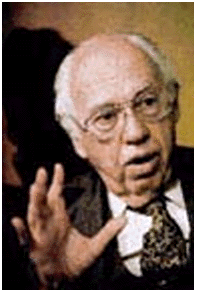
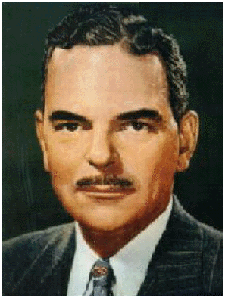
    dewey
    Thomas E. Dewey

    The communications company Capital Cities was born in 1954 with the purchase by CEO Frank Smith of a UHF TV channel and a small radio station in Albany, New York. And until it purchased ABC in 1985, Cap Cities repeated that paradigm over and over: it bought stations that were performing below par due to management ineptitude and managed to change the management style by keeping operating and labor costs low and turn the station into a profitable asset.

    Another important factor in Cap Cities growth chart — as Andy Boehm points out — was its ties to government insiders and the information they could provide. For instance, when Smith bought WROW in Albany, he realized that the FCC was about to approve a VHF station in the area, the frequency to which he later switched WROW to, thus making it much more profitable and attractive to investors. Smith’s most famous partner at the time was Lowell Thomas, the famous journalistic figure who the Arthur Kennedy character in Lawrence of Arabia is modeled upon. Thomas was a member, with William Casey, in the Bohemian Grove, a kind of Trilateral Commission of the West Coast. He was also a member of the Creel Committee, the infamous propaganda camp set up by President Wilson to psychologically motivate the U.S. to take part in World War I. Meanwhile, Frank Smith, while in graduate school, had been a friend and classmate of Allen Dulles. Dulles first became the father of the Central Intelligence Agency, and then it’s Director until he was fired by President Kennedy over the Bay of Pigs fiasco. As Boehm also points out, Dulles was very friendly with another investor in Cap Cities, Thomas Dewey, to the point of serving as a manager of his presidential campaign in 1948 (both Earl Warren and McGeorge Bundy worked with Dulles on that campaign.)

    There was another important intelligence-related partner with Capital Cities in 1954, namely William Casey. Casey’s legal advice on how to reply minimally to tax, investment and FCC laws allowed the company to proceed quickly with its acquisitions strategy. One of the milestones in Capital Cities growth was securing the rights to broadcast the Adolf Eichmann trial, a gem of an acquisition that must have been aided by Casey or Dulles, or both. Even though Cap Cities owned only a small number of stations it was chosen over many larger and more appropriate networks to become the world producer and broadcaster of this event by the government of Israel. The incredible publicity given to the trial of the former Nazi gave the young company credibility and recognition.

    Two future leaders of Capital Cities, Thomas Murphy and Dan Burke, furthered the original paradigm of Frank Smith: a decentralized management plan and connections in high places. In the former regard, this means a bottom to top organizational plan which stresses cost-cutting and decision making at a lower level and rewards employees for achieving those ends. Murphy once said that his company, “doesn’t like to have more personnel than it needs. Too many people with too little to do lead to office politicking and other behavior that’s destructive for an organization.” Consequently, Cap Cities developed a ‘lean and mean’ corporate image. This meant that performance was tied to rewards in stocks and bonuses. The performance of the company was very good to its executives. In 1983, Murphy made six million dollars and Burke 4.3 million. An easy way to achieve low-cost programming — and increased profits — is to concentrate on local cop stories and shoot-em-ups. Cap Cities pioneered the genre.

    To ensure that Capital Cities would acquire more stations, the company almost never paid a dividend to stockholders. Instead it plowed all profits into more purchases. By 1970, Cap Cities had become a mini-major, owning VHF stations in Philadelphia, New Haven and Fresno. When it reached the then limit on the number of stations it held, it began to sell its stations in smaller markets. It also began to expand its holdings into print media through the purchase of Fairchild Publications. By 1977, Cap Cities also had bought a few important newspaper holdings e.g. The Fort Worth Star Telegram and The Kansas City Star. It also bought into cable companies in the seventies. And through these latter two acquisitions, it began another popular modern practice: cross-platforming of the news. That is, having its print companies provide copy for its cable news outlets. This of course rapidly accelerated to the point that today many stories, across many media platforms — cable news, newspapers, Internet — differ very little in content and phrasing.

    One of the most revealing acquisitions of Capital Cities was its purchase of The Wilkes Barre Times Leader in 1978. This episode in the company’s history is described in detail in the book by Thomas J. Keil entitled On Strike! Capital Cities and the Wilkes Barre Newspaper Unions. Like many major media companies, although Cap Cities had little difficulty paying executives like Burke and Murphy millions, it repeatedly denied union requests for higher wages, benefits, and better working conditions. Yet, it managed to keep negative publicity of these denials to a minimum. Except in the Wilkes Barre case.

    As Keil writes, the newspaper had to “control costs, increase productivity, improve the quality of the paper, and expand its market” in order to justify the Cap Cities expenditure. But the union in this small Pennsylvania town saw a secret agenda at work. They felt that by moving the paper’s editorial policy and news agenda in a more conservative direction, Cap Cities was attempting to lower wages and working conditions in the entire area, which was heavily unionized. (One of the company’s demands was for more “objective” journalistic practices.) Since the area had been historically involved in serious industrial strikes in coal and steel, it recognized a past corporate parallel in this case. From the conflict that followed, they seem to have been correct.

    During the contract struggle, Cap Cities hired security guards, used surveillance cameras, tried to get local authorities involved on their side, and built a 12 foot high fence around the newspaper building. Predictably, it hired the infamous Wackenhut Corporation as its security and investigative arm. (Wackenhut is so tied into the national security state that it is sometimes called The CIA’s CIA.) Casey played a large role in this conflict by serving as the Cap Cities counsel and the former counsel for Wackenhut. Therefore Casey was probably key in implementing one of the more controversial practices Wackenhut used leading up to the strike: the employment of virtually all African-American guards over the nearly all-white union ranks. This, of course, tended to foment racial tensions and exacerbate labor-management problems. In addition, Cap Cities wanted to hire part-time workers and install a merit system, thereby weakening the hold the union had in the workplace and increasing their own.

    When the strike escalated, and the inevitable violence broke out, Cap Cities grew angry that the local authorities did not help it end the strike by interceding on their side. So they used the newspaper to print a story that there was an FBI investigation pending of the local police for its failure to protect the replacement workers the company had hired. (Wackenhut employed many former employees of the Bureau.) The FBI looked into the matter yet ultimately took no action on the printed charge.

    When Keil interviewed some executives on the scene they admitted that the company had badly mishandled the strike. They learned a valuable lesson though. Namely to use more clandestine surveillance in order to remove popular union leaders before the strike reached a crisis stage. This, of course, is what the CIA does for major American corporations abroad.

  • Gus Russo’s Phantom Pulitzer Nomination

    Gus Russo’s Phantom Pulitzer Nomination


    pulitzer

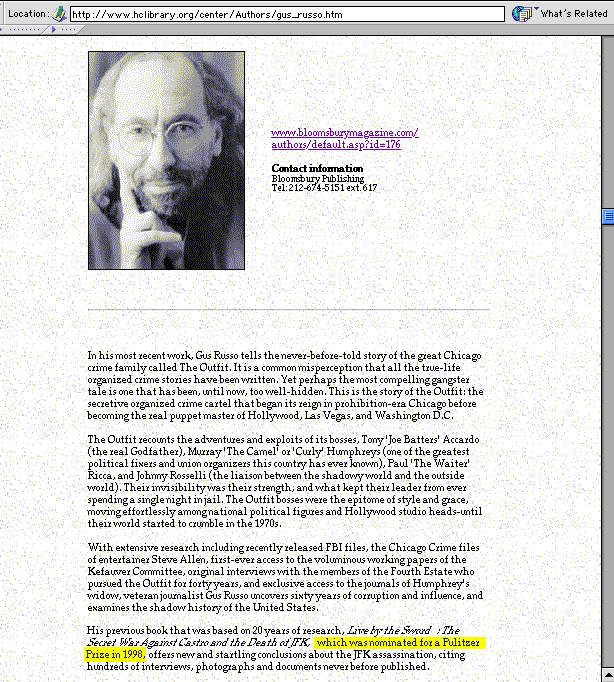
    In three places on the Internet plus the jacket of his second book, it is proclaimed that Live by the Sword was nominated for a Pulitzer Prize. There is a problem with this alleged fact. The people who hand out the Pulitzer nominations aren’t aware of it.

    If you go to their site, you will see that no book by Gus Russo has ever been officially nominated for a Pulitzer. If you call up the people at Columbia University School of Journalism, who administer and maintain the Pulitzer Prize nominations, they aren’t aware of it.

    If you ask them about the process, they will tell you they have a board that hands out nominations in certain categories. That is an official nomination. They will also tell you that many authors and publishers will submit a book for a nomination. This is not a nomination to them. It is a submission. By the same logic, if a film is submitted for an Oscar nomination and is turned down, one cannot say then that it was nominated, no matter how ardently the nomination was pursued.

    Many, many people brought this misrepresentation to the attention of David Westin and Peter Jennings at ABC. They had to have known about it. They have yet to acknowledge it.

    Everyone else can see the irony of hiring a man to investigate the crime of the century who is mendacious about his own book and credentials. Would it have been hard to predict the result of his investigation?

    russo pulitz 2

  • ABC and the Rise of Rush Limbaugh

    ABC and the Rise of Rush Limbaugh


    limbaugh
    Rush Limbaugh

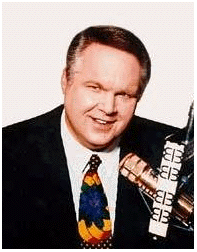
    With little doubt, the two most revolutionary developments in radio in the last 40 years — since the ascension of rock music — have been the talk radio format, and then the conversion of that format to a politically conservative tone. No single personality is more responsible or representative of that explosive movement than Rush Limbaugh. If you ask the average informed person: “Who sponsored Limbaugh?” the answer you would probably hear would either be Clear Channel or Fox. The real and correct answer though would be ABC.

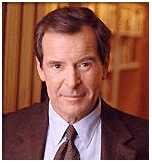
    Once the Cap Cities takeover of ABC was complete, the move by ABC television to a more politically friendly stance was not abrupt or dramatic. For instance, it took until 1993 for Peter Jennings to announce in an interview with TV Guide that his nightly news show would now be paying more attention to conservatives because in his view their ideas were “more provocative and less predictable on some issues.” But there was one front on which CC/ABC could move suddenly and potently and that was radio.

    Why? Because CC/ABC had a huge advantage in ownership outlets that it could capitalize on. Of the 11,000 radio stations in America, CC/ABC either owned or rented space to about half of them — an extraordinary advantage that the FCC did not challenge at the time of the purchase. Since the Fairness Doctrine had been disposed of in 1987, CC/ABC could now begin to broadcast a more conservative brand of radio without fear of being petitioned for equal time.

    Edward McLaughlin, President of ABC Radio began searching for a talk show host to lead ABC’s new direction. He found him in Sacramento. Limbaugh was doing an AM talk show there at the time and he was defending the actions of people like Oliver North and William Casey during the Iran-Contra scandal. McLaughlin noticed him and brought him to New York City for a one-month broadcast trial at CC/ABC’s flagship station WABC. McLaughlin liked what he heard and ABC promoted him by placing him on their fast track, handling all his marketing, advertising and promotion. To provide a fig leaf for ABC, Limbaugh formed his own media company, Excellence in Broadcasting. But Limbaugh broadcast out of ABC stations for decades. And for a long time, the man who followed Limbaugh on WABC was Bob Grant who continued the tirade against “bleeding heart” liberals and once called New York’s black mayor David Dinkins a “washroom attendant”.

    McLaughlin promoted Limbaugh initially by arranging appearances for him on other talk shows like Ted Koppel’s Nightline, Donahue, MacNeil/Lehrer and a primetime, and rather fawning, interview with ABC’s Barbara Walters. These appearances were all meant to give Limbaugh more mainstream exposure and publicize his show.

    When Limbaugh tried to branch out into television in September of 1992, his producer was Roger Ailes, the longtime Republican strategist who specialized in attack ads, most notably in the 1988 Bush-Dukakis race. Of course, the timing of the show was on the eve of the 1992 election so many people complained that Limbaugh’s show was clearly fronting for the Bush campaign and demanded equal time. Limbaugh replied “I am equal time.” Of course, he is not. Limbaugh featured guests who were from his point of view, blocked out all opposing views, screened callers and their questions in advance, labeled feminists, “femiNazis” and blamed all of America’s problems on “big-spending Democrats, the lazy poor and trouble-making minority rabble-rousers.” He was so offensive that the show was pulled because major advertisers did not want to be a part of it. Signifcantly, the ill-fated television show was distributed by one of CC/ABC’s partners, Multimedia. Recently, when Limbaugh made his comments about Donovan McNabb of the Philadelphia Eagles being overrated and a beneficiary of racial sympathy, it was on another subsidiary of ABC, ESPN.

    Clearly CC/ABC meant to chart a sea change in the concept of talk radio with Limbaugh’s launch. This in turn made it possible for Jennings to make his 1993 comments. If one recalls the days of talk radio before the Limbaugh Revolution, it was actually a rather interesting, exploratory and sedate domain with people like Ira Fistell and Michael Jackson in Los Angeles. Limbaugh and CC/ABC made them obsolete and paved the way for the likes of Michael Savage, another talk show host so offensive that he had to be yanked from television.

    We would like to add here that because a radio show is conservative in its orientation, this does not mean it is to be equated with Limbaugh or his clones. There are many conservative shows that do not have his agenda or practices. One example would be the Joyce Riley show out of St. Louis. This is a conservative show that is truly conservative — that is, it upholds traditional American values like the Constitution, open debate, and international law. So on her show — syndicated through 187 stations — you will hear open debate on such issues as why the CIA and FBI could not prevent 9/11, the questions surrounding Jeb Bush and Katherine Harris and the Florida election, the use of depleted uranium by Clinton in Kosovo and Bush in Iraq, and, of course, the assassinations of both Kennedys, King and Malcolm X. We admire and salute her conservative tradition and aims. We should add that there is some of this non-debate problem with stalwarts of the left also i.e. David Barsamian, Noam Chomsky, and Alexander Cockburn. Their friends and followers have tried to eliminate or minimize this kind of open debate on the Pacifica network.

    And some of their friends — like Marc Cooper — cross over into that other no-conspiracy zone in that other liberal outpost The Nation where Max Holland assures us that Oswald acted alone, and David Corn gives us limited hangouts on horrific scandals like the CIA and drugs. This “see no evil, hear no evil, say no evil” attitude about huge conspiratorial and covered up crimes leaves the public confused and angry about the media and the government at the same time that our doctrinaire “right and left” media tell us that conspiracy theories are eroding the public’s belief in the government. The obvious truth that neither wishes to establish or state is this: there is no “left or right” when it comes to the truth about these crimes. Therefore both sides choose not to tell the truth about, for example, what happened to President Kennedy, in order to please their masters and to stay part of the so-called “mainstream debate.” Which, of course, is why more and more people a) don’t believe our government, and b) don’t believe the media, and choose to listen to people like Riley on the right and Cynthia McKinney on the left. They know they are being lied to and want to find someone who is at least searching for the truth.

    Pity the nation that has to choose, thanks to ABC, between such a polarized atmosphere.


    Mr. DiEugenio would like to credit Dennis Mazzocco and his book Networks of Power for most of the material that appears in this article.

  • “Peter, Meet my friend and assistant Gus Russo”

    “Peter, Meet my friend and assistant Gus Russo”


    jennings
    Peter Jennings

    Why did ABC, Peter Jennings, and executive producer Tom Yellin use Gus Russo as their chief consultant on this program and how did Russo originally come to their attention? Why did they then allow Russo to bring in his pal Dale Myers and his already discredited computer simulation?

    The answer to that question appears to be: Seymour Hersh.

    As many recall, about seven years ago ABC bought the TV broadcast rights to Hersh’s book on John Kennedy entitled, The Dark Side of Camelot. From most reports, the main reason they purchased the book was because of a supposed sensational document which showed a secret deal involving Marilyn Monroe, mobster Sam Giancana, and members of the Kennedy clan including JFK.

    Upon release, the book was nearly universally panned, most notably by Gary Wills in The New York Review of Books. Only two reviews were in any way positive. After panning the book in an initial review, The New York Times brought in longtime CIA flack Thomas Powers to do a more sympathetic review which concluded that Kennedy deserved to get his head blown off in Dealey Plaza. The New Yorker, which also has a history of obfuscating the facts about the assassination, brought in Gore Vidal. Vidal has been a Kennedy basher since Bobby Kennedy banned him from the White House for reportedly drunken behavior and lewd language. That was about it for the reviewing accolades.

    There was a good reason for the mostly negative reception. Hersh used an array of questionable tactics in his research and reporting to perform what any objective reviewer would have to call a hatchet job. These were exposed prior to the book’s publication by Robert Sam Anson in the November 1997 issue of Vanity Fair. Others were discovered by various reviewers like Dr. David Wrone. To use some new examples (Hersh’s shoddy work provides endless opportunities for this sort of thing) in his book (pgs 426-428) Hersh writes that Kennedy asked Air Force General Ed Lansdale to go to Saigon to arrange the assassination of Premier Ngo Dinh Diem. There is no evidence of this in the Church Committee Report on this subject or in any serious examination of the last few months of Diem’s regime by any noted scholar of the subject. Hersh got this info secondhand with almost no corroboration so he knew he was fishing. He called up David Kaiser who was working on a monumental history of American involvement in Vietnam from 1960-65 eventually called American Tragedy. In the footnotes of this fine book, Kaiser notes Hersh’s call to him about this piece of gossip. Kaiser wrote that he informed Hersh that he had seen nothing to support it in his research. In fact the White House calendar demonstrated that Lansdale never met with Kennedy in 1963. (Kaiser p. 531)

    Hersh trotted out Judith Exner for another appearance before she died. Hersh never informs the reader of any of the problems that Exner presented as a witness. As was his style in the book, he simply listed in his notes that he interviewed her and refers the reader to other articles on her. Exner’s credibility problems are there for anyone to see and they were listed in Probe Magazine (Vol. 4 No. 6), and in the books Questions of Controversy by Mel Ayton, and The Assassinations edited by James DiEugenio and Lisa Pease. Hersh ignored all of her contradictions and deceptions. He actually added more to the long and winding list. He used a man named Martin Underwood to backstop a story about her delivering payoffs between Giancana and Kennedy. In the ABC special based on the book, Jennings told the audience Underwood would not appear on the show. He did not tell why. The Assassinations Records Review Board did tell us why in their Final Report. Chief Counsel Jeremy Gunn heard of this story and called Underwood in to testify. He said he knew nothing about these Exner trips as to Chicago and Giancana. Another part of Exner’s story had serous problems. She told Hersh that Bobby Kennedy was “very much a part of all of this.” She is referring to the money transfers from JFK to Giancana. She adds, “Bobby would come in and bring the information in a manila envelope to Jack. And they would discuss a little bit about it. And Bobby often would put his hand on my shoulder and ask, `Are you still comfortable doing this? We want you to let us know if you don’t want to.’ Hersh then further quotes Exner as saying the Kennedys “were very smart in the way they handled this …. I was this little bauble.” She goes on to add that they seemed at ease as they discussed the contents of the papers and the envelope in front of her. (Pgs. 307-308)

    Hersh should have been more careful with Exner. Or her handlers should have coached her more. Evidently she could not recall all the different stories she told over the last 25 years of her life on this subject. She couldn’t keep them all straight. It is hard to believe that Hersh was not aware of Exner’s appearance on Larry King on February 4, 1992. When King asked her about any relationship she had with RFK, she replied very succinctly with the word, “None.” King was surprised at this response, so he asked her to clarify it. She stated that she probably met him once or twice at a political fundraiser or a party in Los Angeles. That was it. Hersh’s book came out five years later and he says he researched it with various assistants for five years. Yet he was not was not aware of this blatant contradiction noted by Mr. Ayton (p. 158). Or if he was he chose not to reveal it.

    But the biggest pratfall made by Hersh was with the above mentioned Monroe/Kennedy documents which he obtained from a man named Lex Cusack whose father supposedly had the documents. When ABC bought the rights for the book they did something that Hersh, incredibly, did not do. They brought them to forensic experts who tested both the typing and the writing. They found they could not have been made when Cusack said they were or with the instruments available at that time. So why did Hersh not hire his own experts? He has replied at various times that a) It was expensive to hire these experts, and b) the tests take a long time to perform (See Eric Alterman in Salon in October of 1997). Concerning the first, Hersh got a huge advance for the book, well into the six figures by a major publisher, Little Brown and Company. He hired several assistants to help him. He could not afford the rather small amount of money the testing would have entailed? Little, Brown could not afford it either? As for the time factor, it is even weaker. As noted, Hersh said he took five years to complete the book. CBS tested the documents after ABC did and it took them a matter of just a few weeks. Researcher John Armstrong got in contact with one of the ABC experts and asked him to do a test for him on another matter. He said he could do it in about a month.

    But there is more to it. In a story in The New York Times (9/27/97), reporter Bill Carter revealed that Hersh had previously tried to peddle the documentary rights to his book to NBC. And this sale was based on the sensational, ersatz Monroe documents. NBC sent some experts to look at the documents also and Warren Littlefield, an NBC executive, told Hersh that in their opinion, the documents were questionable. This was in the summer of 1996. Littlefield added that NBC’s lawyers were more specific about the questions in talks with Hersh’s attorneys. So Hersh could hire attorneys for the sale of the documents, yet he could not hire experts to test the documents.

    When ABC did a 20/20 segment (9/25/97) exposing the documents Hersh appeared on camera for very, very little time. The segment focused on the forensic debunking of the documents and Cusack’s role in it. The previous testing of the documents by NBC was not mentioned at all. David Westin had approved a million dollar budget for Hersh’s longtime friend Mark Obenhaus to produce a special based on the book. It was left to Anson and Charles Samuels in an article in The New Yorker (11/3/97) to detail that Hersh had planned to cut in Cusack after the sale of the book for the use of the documents, upon which the sale apparently relied. So the possibility was that Hersh did not want the documents exposed and did not tell ABC about the previous testing. And since Obenhaus and Hersh have been friends awhile, it may be that Obenhaus and Jennings were protecting Hersh on this score to, in turn, protect Westin’s unwise investment.

    The seeds of the Russo-Jennings meeting come from this rather inauspicious origin. For when Debra Conway called ABC they said that two of the producers on the assassination special are Obenhaus and Edward Gray who were the producers of the Hersh special. Russo helped Hersh on his book as he is mentioned on page 476 of the Acknowledgements. According to Anson, Obenahus had wanted to make a special on the JFK assassination in 1993 but it fell through. So now ABC did do the actual assassination special and they went back to some of their original team that produced this less than stellar-to say the least -previous one.

    Some people do not learn from past errors. The whole thing reminds me of the press angle as represented by the Danny DeVito character in the film LA Confidential. This time, the corpse in the hotel room is Kennedy’s.

  • David Westin: It’s Tough Following an Icon

    David Westin: It’s Tough Following an Icon


    westin

    David Westin came to ABC from the field of law. He was a law professor at both Harvard and Georgetown teaching international civil law and litigation. In 1979 he joined the firm Wilmer, Cutler and Pickering. He worked his way up to partner by 1985. He joined Cap Cities/ABC (now ABC Inc.) as general counsel in 1991; among his duties were labor relations and government relations. He became president, production in 1993. From 1994 until 1997 he served as president of the ABC Television Network. In that position he oversaw all divisions and program units at ABC including news and sports. He was named president of ABC News in 1997 succeeding the legendary Roone Arledge.

    Arledge was the man who, first, took ABC Sports and made the then last place network a force to be reckoned with by making Wide World of Sports and Monday Night Football into regular parts of American life. He then moved over to the news division and performed the same magic there by building both a newsmagazine and nightly news slot that could more than hold its own with the more established and familiar NBC and CBS. Arledge was dynamic, original, daring, imaginative, intuitive, and he was all of that with a touch of class. No one can say that he was a major force in driving news and sports programming down to the remarkable level of tawdriness, slickness, vacuosness, and sensationalism that are the earmarks of the networks, and their cable outlets, today.

    One cannot say the same about Westin. In public, Westin likes to make salutary and flattering remarks about his position and the duty of the news reporter. For instance, in March of 2003 he told a group of journalism students at Knox College that reporters should focus on “providing the most truthful information available to allow the viewing public to make up their own minds about major events” (The Knox Student, 4/9/03). He went on to say that newsmen should first provide the historical and political connections to develop an overall context around what is occurring. (Ibid) In October of 2001 at Columbia School of Journalism — the equivalent in stature of Harvard Law School — he made similar remarks, like “Our job is to determine what is, not what ought to be and when we get into the job of what ought to be I think we’re not doing a service to the American people.” (Media Research Center, Cyber Alert 10/31/01). He went on in this vein by referring specifically to the 9/11 attack, “I can say that the Pentagon got hit. I can say this is what their position is, this is what our position is, but for me to take a position this was right or wrong … I feel strongly that’s something that I should not be taking a position on.” He did add that it was OK for journalists to do so in their private lives.

    Westin’s laudatory ideals lasted about 48 hours. Or as long as it took the likes of Matt Drudge and Rush Limbaugh to start whacking him around on the web and on rightwing attack radio. After the Drudge-Limbaugh wedge tactic, Westin beat a hasty retreat. He backtracked and said he was wrong to make those remarks and said he was only illustrating a broad, academic principle and he apologized “for any harm that my misstatement may have caused.”

    Why did Westin genuflect to the likes of Drudge and Limbaugh? Two reasons surface when one takes a look at his tenure as news division chief. Unlike Arledge, and contrary to his public pronouncements, Westin does not like to take risks, and secondly his public posing is really posturing. There is a lot of evidence to indicate he doesn’t mean what he says.

    Significantly, according to television insider Danny Schechter, Westin represented Capital Cities when CC/ABC merged with Disney (Toward Freedom Magazine 1/99). Michael Eisner of Disney apparently liked Westin’s negotiating skills and made him ABC’s general counsel. It is under Westin that the antics of John Stossel have been given almost free rein. Under Westin, ABC reporter Jackie Judd reported many of the leads given to her by then Independent Counsel Ken Starr. As Steven Brill pointed out, Starr’s leaking was in violation of the legal code. Yet lawyer Westin was apparently not bothered by this. According to the LA Weekly (11/22/02) Westin once killed a story reporter Brian Ross worked on showing how Disney’s practice of not running criminal background checks at its theme parks allowed for the hiring of convicted pedophiles. When Ross defended his four month investigation and insisted it run, Westin replied with, “Are you crazy?” It was Westin who allowed the ABC News Division to leak all kinds of stories to the press in order to kill Kristina Borjesson’s thoroughly researched story about TWA Flight 800, thereby sinking Oliver Stone’s daring new concept for newsmagazines called “Declassified” (See Borjesson’s Into the Buzzsaw, pgs. 133-36)

    Then there was the Leonardo DiCaprio Earth Day interview in April of 2000. Teen idol DiCaprio is an environmentalist who had a friend at ABC’s 20/20. They put together an idea about a walk through the White House with then President Clinton where Clinton could show how he put in several environmental improvements like new insulation etc. What happened was quite different: the young actor did a sit-down interview with Clinton. This of course, is the kind of stuff that Entertainment Channel or Access Hollywood would propose and hope for: a celebrity pushing his agenda by doing a softball interview on a serious subject with the most important politician in America. When word got out on what had happened, Westin went into a denial mode saying that it was the White House who proposed the interview format. But once Westin’s denial hit the fan, the White House replied that they were not the ones who sent DiCaprio over to interview the President. It was ABC’s idea from the start.

    On the strength of Schechter’s inside information, it would be wise to believe the White House and not Westin. In the above mentioned Schechter article, he describes a meeting of ABC producers which a friend of his attended. At this meeting, which was called and chaired by Westin not long after he took over for Arledge, Westin gave his soldiers their new marching orders. He stated that from then on their stories should integrate the “3 C’s” as much as possible. What were Westin’s three C’s? According to Westin they were Celebrity, Calamity, and Censation [Sic]. Schechter protested that the last word begins with an “S”. His friend replied with, “That’s what he said.”

    With this kind of banal simplification and Westin’s seeming enjoyment of skewering the alphabet to his troops it becomes pretty clear why he has overseen the double assassination of John F. Kennedy. He first chose to produce a documentary based upon Seymour Hersh’s trashy and factually indefensible book The Dark Side of Camelot, and now he has allowed Peter Jennings to employ Hersh’s assistant Gus Russo to assassinate not just Kennedy but Lee Harvey Oswald. This recycling of the Warren Report deception when the new evidence is now insurmountable that Oswald was an innocent man. As another attorney, Chief Counsel of the Assassination Records Review Board said, “I would rather be defending Oswald than prosecuting him.” If Westin were to look at the evidence, his lawyerly background would probably make him come to the same conclusion.

    But sadly, he is not an attorney anymore. And sadly, Arledge, who vetoed a similar report to Hersh’s back in the eighties, isn’t around anymore to supply ABC with both a vison and a conscience.

  • ABC’s Russo/Myers Paradigm: John Stossel

    ABC’s Russo/Myers Paradigm: John Stossel


    stossel

    Remember when it used to be a sacrilege to get a news story wrong? At ABC, it’s more like a venial sin these days. The man who is most important in breaking down that standard — in fact at destroying the whole concept of a Standards and Practices doctrine, forget an office — is John Stossel.

    Stossel is supposed to be ABC’s consumer reporter. But to really understand who he is and how far ABC has fallen, one has to understand that, in the traditional sense, Stossel is not actually a consumer advocate at all. That is if one imagines that term to mean a serious reporter who is interested in protecting the public from corporate abuses in production and sale of goods and services. Quite the contrary. Stossel is a cheerleader for corporations in their pursuit of mass markets. That is, he tries to convince the public that, really, those ideas about corporate abuses and the need for protection for the public against them is all wrong. Its scaremongering actually. At one time he actually tried to argue that dioxins were harmful to animals but not necessarily to people. At the same time, producers of dioxins were in court trying to convince a judge of the same thing (Natural Food Merchandiser, 11/2000).

    Stossel is actually an evangelist for 80’s style greed. In fact in a program called just that, Greed, Stossel spent a full hour trying to reverse the verdict of the great muckrakers of the past like Ida Tarbell. He tried to say that the Robber Barons of the Gilded Age were actually doing us all a favor in their pursuit of monopolies and their thefts from the public and government. Stossel removed the horns from figures like John Rockefeller and Jay Gould and tried to plant haloes on their heads. Like Ivan Boesky’s famous commencement speech (mimicked by Oliver Stone in his film Wall Street), Stossel concluded that “Greed is good.”

    In his own words, “I started out by viewing the marketplace as a cruel place, where you need intervention by government and lawyers to protect people. But after watching the regulators work, I have come to believe that markets are magical and the best protectors of the consumer. It is my job to explain the beauties of the free market.” (Stossel in The Oregonian, 10/26/94). As one commentator has stated, he could start by explaining that doctrine to the shareholders in Enron, or better yet the employees who had 401K’s in the company. But, of course, he ignores and deflects such criticism by characterizing it as aleftist plot to destroy him (David Podvin, Podvin on the Media, 1/22/02).

    But actually the “plot” is really inside ABC. And it was exposed by a rather mainstream periodical, The Los Angeles Times. But first, let us explain how the LA Times expose by Liz Jensen was possible.

    After Stossel was caught in a blatant deception on the show 20/20 in the year 2000, his profile went up in a negative way. There, in a segment entitled “The Food you Eat”, Stossel tried to argue that organic foods were not really better than conventional ones, since pesticide levels were not higher on conventional produce than they were on organic produce. But there was a big problem: the experiments Stossel relied on were non-existent. (New York Times, 7/31/2000) This fits a pattern because prior to this, in 1994, two producers hired by ABC to work on another Stossel report, “Are We Scaring Ourselves to Death”, resigned when their research was dismissed because it did not conform to the slant that Stossel desired. (Extra! Update 6/94)

    So by 2001, Stossel was being recognized as a bad egg by people who really cared about things like consumer protection, healthy foods, and the environment. In 2001, ABC was preparing a report for Earth Day. They went to Santa Monica’s Canyon Charter School and they sought permission to use some of the kids in a televised spot questioning them on their ideas about the environment. Brad Neal was one of the parents who gave ABC permission to question his child for the spot. Neal realized something was up when Stossel turned out to be the anchor of the show. This is something that ABC did not reveal to him. And when the questioning began, the questions were not open-ended but they clearly were aimed at manipulating the students into reciting the mantra that public schools were drumming into them an anti-corporate, leftist, environmental message. Neal said that at one point Stossel tried to lead the children in a chant to the effect that “All scientists agree that there is a greenhouse effect.” Neal said that what bothered him the most about the show’s agenda was ABC’s effort to hide Stossel’s participation since he would have not granted the permission if he would have known about it.

    But there is more about Stossel, who once tried to equate the rise in CEO pay in the 90’s with labor’s, that ABC is not forthcoming with. Stossel’s message is clearly in tune with those corporations and advocacy groups whose virtues he extols. In a quite unusual move, ABC allows him to speak for fees before ideologically in tune organizations like the Young America’s Foundation, a famous conservative group. In a report in Brill’s Content (March of 2000), it was revealed that Stossel had made 27 such speeches in two years which generated income for him well into the six digits. Most TV and newsprint journalists are not allowed such engagements because making as much money outside one’s reporting position as in it could compromise one’s viewpoint. But there is more to this lucrative side business. ABC itself also benefits because Stossel’s rightwing hucksterism sells videos of his reports to educators through a conservative foundation called the Palmer R. Chitester Fund. This earns ABC a licensing fee.

    After a thorough and coruscating analysis, David Podvin has concluded, “John Stossel is the gauge of integrity at ABC News. His presence on the network, after he has been caught lying repeatedly, is a devastating indictment of the entire organization’s credibility. As long as a man who treats facts as though they have leprosy is allowed to appear in the guise of a journalist, Disney’s news operation will continue to be nothing more than the disinformation arm of a major conglomerate that has replaced journalism with corporate propaganda.”

    As one can logically deduce, after years of Stossel, David Westin and Peter Jennings would feel comfortable with “researchers” like Gus Russo and Dale Myers. Especially since they could be relied on to deliver the spin the producers clearly planned on in advance.

  • Gus, Will You Please Make Up Your Mind?


    Gus Russo has been at work on the JFK case for the past 15 years. To those around him, he has jumped around in his conclusions quite frequently and violently. So much so, that it is hard to measure what he really believes about this case and why or why not. This is particularly puzzling because since 1998 there have been approximately 2 million pages of new files that have been released by the Assassination Records Review Board. Many of these new documents have been very important in resolving disputes that have existed for a long time. For example, Chief Counsel Jeremy Gunn’s investigation of the medical evidence — that is, the interviews he conducted with some very important people at President Kennedy’s autopsy in Bethesda, Maryland — are extraordinarily illuminating to anyone seriously investigating a homicide. Yet, if one examines Russo’s book there is not a mention of them in the entire text. This is important for what it tells us about the book and Russo, but also because it tells us why Russo arrived at where he did on his long and digressive and interesting journey.

    In the late 1980’s Russo was friendly with Boston area researcher Edgar Tatro. (This relationship would be sustained up until the issuance of JFK: The Book of the Film. Russo worked on this book with Oliver Stone’s chief researcher, Jane Rusconi. He promised Tatro he would be credited prominently in the book since he called him many times for information. Tatro was not mentioned as often as he should have been and this began their split.) As anyone who knows him will attest, Tatro is a prime proponent of the school that Lyndon Johnson was behind the John Kennedy assassination. At this time, Russo befriended Tatro and asked if he would be willing to take a sabbatical from his educator’s position to serve as the consultant to a documentary film he was proposing to several financial backers. According to Tatro, Russo actually got as far as presenting the idea to these backers, but for some reason the proposal fell through. So, one could assume that since Russo was pushing this idea he probably believed it. But wait.

    In the early 1990’s the word got out that Oliver Stone was producing a big-budget film based on Jim Garrison’s book, On the Trail of the Assassins. Now anyone who knew Garrison, or his publisher, Sheridan Square Press, would know that the book had to propose that the Central Intelligence Agency —especially the so-called Old Boys Network within it — was the main perpetrator behind the Kennedy assassination. At this time, Russo was investigating the shadowy European trade company PERMINDEX, of which Clay Shaw was a member. He was also extolling the fact that he had outfoxed a clerk at the National Archives and had listened to a previously classified tape of the so-called Fenton Report. This referred to a suspect in the Garrison investigation who had been tracked down by House Select Committee investigators Cliff Fenton, Bob Buras, and L. J. Delsa and had discussed his role in an apparent meeting, and other actions, at which the murder of JFK had been discussed. As mentioned above, Stone later hired Russo to help Rusconi produce the book which contained much of the backup material for the screenplay. So many deduced from all this that Russo believed the CIA was the prime force behind the killing of Kennedy. But wait.

    At a conference in Dallas in 1992, Russo discussed the story of Delk Simpson, a military officer who had been mentioned by writer Robert Morrow and had been pursued reportedly by attorney Bernard Fensterwald. He actually made a presentation with former military intelligence analyst John Newman. Newman’s book JFK and Vietnam mainly blamed the military for the intelligence deception that Kennedy had seen through when he decided that the U.S. would have to withdraw from Vietnam. So now people assumed that Russo had shifted gears and thought the assassination was led by the military with perhaps a hand from the CIA. But wait.

    A year later, at a conference in Chicago, Russo now ridiculed the idea that Oswald could have been an intelligence operative. This basically knocked out the idea of a military-intelligence type of conspiracy. He now said that the research community should be following leads that pertained to the Mafia and the Cuban exile community. Sort of what people like Robert Blakey — Chief Counsel of the House Select Committee on Assassinations — may have proposed today. Yet, at the same time, someone read him his blurb for Robert Morrow’s final book on the case, First Hand Knowledge. Russo essentially said that he stood by the positive blurb. The problem here was that Morrow’s book included a conspiracy of the Mafia, the Cubans and the CIA, which was led on the ground by Clay Shaw. So perhaps now Russo was advocating a kind of “grand conspiracy” theory crossing through two or three different structures. But wait.

    In the same year, Russo was one of the two reporters on the PBS Frontline special, “Who Was Lee Harvey Oswald?” This show was erratic and unfocused yet by the end it clearly went along with the verdict of the Warren Commission, i.e. that Oswald did it alone. Was Russo now throwing all his years of hunting for an antidote to the Warren Commission away? Was he now embracing the thoroughly discredited Warren Commission? It appeared that way. But wait.

    In 1998 Russo penned his book which was supposedly based on the declassified files of the ARRB. Now he twisted the Warren Commission thesis a bit. He now seemed to be saying that Oswald was not really a demented sociopath, which is what the Warren Commission leans on. He now seemed to be saying that he was manipulated by agents of Fidel Castro into believing that Kennedy felt that Castro’s regime had to be removed. The pro-Castro Oswald could not stomach that thought and he did what he did in Dealey Plaza.

    If you have been counting, depending on what you make of Russo’s performance at the Chicago Conference, that is either six or seven camps that Russo has been in. Yet he discounts each step of his Pilgrim’s Progress. He forgets his previous beliefs as quickly as a good cornerback forgets the 70 yard touchdown completed over his head. This is OK for football, but it is not OK for investigative journalism which tries to build an edifice that recognizes and tries to reconcile into an understandable paradigm all the evidence about a complex and important event. There is no sign of this in Russo’s work. Or else he would not have ignored the vital medical evidence mentioned above. What makes it even worse is that Russo does not even mention his previous beliefs today. For instance, it is difficult to find anywhere where he mentions that he worked on the Stone book with Rusconi. The only way one can find out about the LBJ phase is through Tatro. No one can recall him mentioning it at any talk he gave at a national researcher’s conference in the nineties.

    The natural question is: Did he believe any of these himself? Or when he found he could not find a foolproof theory did he then decide that it was easier and more lucrative to side with the Establishment and the Warren Commission, knowing that people like Peter Jennings and David Westin would never divulge his past conspiracy delvings, or maybe not even ask about them?

    Unfortunately for Jennings and Westin, some people knew Russo way back when he was a musician, before Jennings and Westin started flying him around the country first class for their “exhaustive” and “irrefutable” investigation.