Author: James DiEugenio

  • Kamala Harris : Our Accidental Candidate

    Kamala Harris : Our Accidental Candidate


    The rather unprecedented events of the last two months have elevated Vice-President Kamala Harris to be the presidential nominee of the Democratic Party in the November election. After President Biden’s disastrous performance in his June 28th CNN debate against Donald Trump, former Speaker Nancy Pelosi led the charge to have him step down as president. Her argument was that he would likely lose to Donald Trump and also place control of the House and Senate in GOP hands. Many commentators agreed with that analysis and the MSM became an echo chamber for their concerns.

    About one month later, July 21st, Biden decided to take the advice. This was the first time since Lyndon Johnson dropped his re-election bid in mid-stream in 1968 that such a thing had happened. Biden now endorsed his Vice-President Harris to replace him. Yet at this time, there was less than one month until the convention. Reportedly, only Marianne Williamson even tried to explore contesting Harris. But since there was an early ballot roll call two weeks before the convention, this made it even harder to rally any kind of challenge. So there was no state by state delegation pitch by alternative candidates. There was simply no time. Kamala Harris became the appointed candidate. There was no debate, no opposition, no public interview by the media and no questions asked why the DNC accepted such a will-nilly process which allowed no opposition. After all, in 1968, both Robert Kennedy and Eugene McCarthy ran against Vice-President Hubert Humphrey.

    Because of the memory of the violence in Chicago in 1968, the DNC arranged a huge police force outside the convention floor so protestors could not become visible on camera. They also allowed no Palestinian/American to address the huge congregation on the Israeli invasion of Gaza with its thousands of civilian casualties. Perhaps that would have been a flashback to the Vietnam protests at the Chicago 1968 convention. Meanwhile, Harris has tried to track left on domestic issues, like housing.   But she seems to be more or less another Biden or Hillary Clinton on foreign policy. There is no urgency to end the wars in Ukraine or the Middle East. One could create a lot of housing with the tens of billions America is supplying for those wars. And let us not forget: it was Harris as Attorney General of California who opposed a retrial for Sirhan Sirhan in the death of Robert Kennedy.

    Years ago, when she first ran for president, this author did a review of her record at the time, which included the RFK case. We reprint these here as a reminder of who she was and is.

    Read Part One

    Read Part Two

  • Maureen Callahan Goes over the Edge-Along with Megyn Kelly Pt 3

    Maureen Callahan Goes over the Edge-Along with Megyn Kelly Pt 3

    As I have shown in Part One, Maureen Callahan’s three sets of eyes on her cover—Marilyn Monroe, Jackie Kennedy and Carolyn Bessetteare really a portentous charade. In Part Two, I explained why Mimi Alford is not credible; Leo Damore is not reliable on Chappaquiddick and third, how she turns the innocent into the guilty in the cases of Michael Skakel and William Kennedy Smith. She manages this by consistently using very questionable and biased sources. She is so consistent on this that it suggests a lack of objectivity from the start.

    But even after all of the above, we are still not done scrubbing Callahan. There is the case of Arabella Kennedy. This was a child who Jackie Kennedy delivered stillborn in 1955. It’s true that John Kennedy was not there for his wife, but it is also true that the child was born prematurely by about five weeks. And, unlike Callahan, I do not trust George Smathers as a source about John F. Kennedy in this case. (Callahan, p. 37; for Smathers, see Don McGovern, Murder Orthodoxies, 193-218) In fact, I could not find any notes to this episode in her references section. Yet, in spite of this, she actually rebuilds dialogue.

    Then there is Diana DeVegh. This is a woman who revealed she had an affair with John Kennedy rather late in life. She first wrote about it sixty years after it happened. I have no doubt if she had waited 15 more years, Callahan still would have printed it.

    There was no way Callahan was going to leave alone the tragedy of Rosemary Kennedy. She was the first daughter to Joe and Rose Kennedy. No one knows what the real problem with Rosemary was. It may have begun with Rose’s difficult birth of her, done without her normal doctor. But most observers think that this uncertainty was the beginning of the spiraling road downward.

    Whatever the basis of the problem, her rages and tantrums grew worse and worse upon her return from England in 1940. She became uncontrollable. As one writer described it, Rosemary would pace “up and down the halls of her home…like a wild animal, given to screaming, cursing, and thrashing out at anyone who tried to thwart her will.” She even physically assaulted her 78 year old grandfather, to the point she had to be restrained. (Dr. Jeffrey Lieberman, “The Miracle Cure” at The Literary Hub)

    Joseph Kennedy—the less we write about what Callahan says about him the better—finally became desperate. He consulted with two doctors at George Washington University Hospital. They recommended what was then called a leucotomy, something being sold as a cure all for violent anti-social behavior. We know this today as a prefrontal lobotomy. And it was a terrible mistake for all involved, most of all Rosemary. She became an invalid and was sent to a convent in Wisconsin. There she lived in a private home and had full time care. (ibid, Lieberman)

    II

    But as noted above, a serious problem with Callahan is her selectivity. For example, if the Kennedys were so pathological in their relations with the opposite sex, then a couple of obvious questions are: 1.) Why was Ted Kennedy’s second marriage to Victoria Anne, ambassador to Austria, so successful? 2.) Why was Bobby Kennedy’s marriage to Ethel so enduring? (As I have shown, the stuff she writes about Bobby through Jeanne Carmen is rubbish) And if one is going to use Kick Kennedy as a strike against the mother Rose Kennedy, then why not bring up the facts of the very successful and lengthy marriages of say Eunice Shriver and Jean Kennedy Smith? I think to most objective people this pattern betrays an agenda.

    But none of the above bothered Megyn Kelly. And before Kelly gave her so much time, as far as I can see, the book was not doing very well. But not only did Kelly give her a lot of time, she whole heartedly endorsed all that is in the book. But, beyond that, on her YouTube channel she actually labeled what Callahan wrote about Jackie as “Shocking new reporting”. Having read through all Callahan wrote about Jackie Kennedy, and taken many notes, I am still wondering how any of it is new. And if any of it is new, as I noted, I failed to see references.

    On that same channel Kelly actually said that Mary Jo Kopechne was killed by Ted Kennedy. As I explained in Part 2, this is simply not the case. It was an accident pure and simple and Ted Kennedy tried to save her. But since Callahan was working an agenda through the flawed author Leo Damore, like a ringmaster, Kelly follows it word by word.

    Here is the very serious professional problem with this. Kelly started her career as a lawyer, with a degree from Albany Law School. She then worked as a practicing attorney for ten years. So she understands the rules of evidence and testimony. Any good lawyer would have sliced and diced this book into pieces.

    Now here is something else that the reader should understand about these Kelly/Callahan You Tube interviews. Kelly is worth tens of millions. She was very well paid at Fox for 13 years. She then jumped to NBC News where she was again very well paid for two years, reportedly at about 15 million per year. When NBC terminated her she collected about 30 million. (The question should have been: why did NBC ever hire her?)

    Now, let us give Kelly the benefit of the doubt. Maybe she did not know anything about this material. But if Kelly was not cognizant of any of the problems I have sorted through, what was to stop the millionairess from hiring a fact checker? Callahan’s book is less than four hundred pages.   So it would have taken a fact checker maybe a month to hand in a thorough and annotated report. Total cost would have been maybe 12-15 thousand dollars; a proverbial drop in the bucket for Kelly.

    Was there a reason for that lack? There are indications there were. Because if you were looking for some balance, some questioning, some kind of cross examination from the former lawyer, forget it. Kelly pretty much accepts everything in the book and then leads Callahan on from point to point, with nothing asked or overturned.

    For anyone in the know, their interview on the Marilyn Monroe mirage is actually ludicrous. As many Jackie Kennedy biographers have noted, the reason she was not at the 1962 Madison Square Garden birthday/fundraiser is that she did not like doing those kinds of events. That fundraiser featured 17 entertainers, one of which was Monroe The reason Jackie went to Dallas/Fort Worth is because her husband had allowed her to take a cruise with her sister after her miscarriage with Patrick. When Callahan starts talking about some kind of ultimatum that Jackie gave JFK over Monroe, we are in sci fi land. Except Kelly doesn’t realize it.

    But wait, wait, then it gets worse. Callahan says that this “ultimatum” then caused JFK to cut off his “relationship” with Monroe. Still more. It was this alleged curtailment that caused Monroe’s death. And Callahan can’t help herself. She adds this for the road: the Kennedys probably had a hand in her passing.

    What does lawyer Kelly say in reply to all this? She actually says that Bobby Kennedy was in LA on the day Marilyn died. As I noted in Part One, this is provably false. (Susan Bernard, Marilyn: Intimate Exposures, pp. 184-87). And Callahan’s so called evidence would be demolished by the photographic proof in Susan Bernard’s book. But then Kelly adds something that is probably just as bad. That somehow, even if Bobby did not kill her, it was the Kennedys who somehow ruined Monroe. Well, ringmaster Kelly has just cued up Callahan. Callahan says the brothers tossed her around like a sexual plaything. As Don McGovern and Gary Vitacco Robles have shown, there is no evidence at all that Bobby Kennedy ever had any kind of romantic or sexual relationship with Monroe. (Don McGovern, Murder Orthodoxies, pp. 177-87; pp. 236-37) There is evidence of perhaps one encounter with JFK, but Vitacco Robles even disputes that. So this is more mythology, which Kelly encourages and then let slide. Some lawyer.

    Now let us get out of sci fi land to the facts. The LA suicide prevention squad that investigated Monroe’s death —made up of Dr. Norman Farberow, Dr. Edwin Shneidman and Dr Robert Litman—reported that she had tried to take her life on four prior occasions. Since 1955 she had been through three different psychoanalysts: Margaret Hohenberg, Marianne Kris and Ralph Greenson. Kris had her institutionalized in 1961 since she felt she was suicidal.(The Marilyn Report, 2/11/2002) She had been married and divorced three times by the time she was 35. There is no doubt that Monroe was a pill freak, and this was before she ever met Bobby Kennedy. She suffered from insomnia, depression and many commentators understand it today as bipolar disorder. This caused her to escape via alcohol and chemical abuse. (Dr. Howard Markel, PBS News, 8/5/2016)

    To leave all of that out, and more, is simply irresponsible writing and journalism. And Kelly’s interview with Callahan was for me at the level of tabloidism. Whatever credibility Kelly had as a journalist—and for me it was not much—has now dissolved into cheap grandstanding.

    III

    If one looks at her references, these are some of the sources Callahan uses.

    Sy Hersh

    Hustler

    National Enquirer

    Dominick Dunne

    Peter Collier

    David Horowitz

    Leo Damore

    David Heymann

    Kitty Kelley

    Richard Burke

    Ron Kessler

    Thomas Reeves

    James Spada

    To go through and analyze what is wrong with these sources would, in and of itself, take another essay. But the fact that she uses them without qualification, I believe, suggests what her intent was.

    When one reads the book, there are indications that, as with Hersh, this is partly a political book. Some of the things that Hersh tried to do were so off the wall wrong—like involving the Kennedys in the assassination plots against Castro—that the only way one could explain them was through a political agenda. Well, there are indications of that with Callahan.

    This begins quite early when she says that somehow John Kennedy Jr. was wrong to insist that his father was not going to escalate in Vietnam. (Callahan, p. 6). She actually calls the idea that President Kennedy was going to disengage a “post assassination myth”. Can the woman be for real?

    The declassifications of the Assassination Records Review Board (ARRB) proved beyond a doubt that Kennedy was getting out of Vietnam at the time of his assassination. The records of the May 1963 Sec/Def meeting proved definitively that Kennedy had ordered Secretary of Defense Robert McNamara to request schedules for withdrawal from all major agencies: CIA, Pentagon, and State Department. When McNamara was in receipt of them he replied that they were too slow. (Probe Magazine, Vol. 5 No. 3 pp. 18-21) These documents were so convincing that even the New York Times and Philadelphia Inquirer ran stories about them, billed as Kennedy’s plan to get out of Vietnam.

    So the question becomes: If that meeting took place five months before the assassination, how could this be a “post assassination myth”? And one should add that McNamara’s initial request for this withdrawal action took place in May of 1962. Which is 18 months before Kennedy was killed. (James Douglass, JFK and the Unspeakable, pp. 119-21). When McNamara made this original request the Vietnam commanding general’s chin figuratively hit the floor. General Paul Harkins was shocked. This, and more, all culminated of course in National Security Action Memorandum 263 in October of 1963. That was the order for an initial withdrawal of a thousand advisors, and a complete withdrawal by 1965. (Douglass, p. 180). Again, I hate to tell Callahan, but that is about six weeks before Kennedy’s assassination. So, again, how could it be a ”post-assassination myth”?

    This was all reversed by Lyndon Johnson in the space of about three months. Culminating in National Security Action Memorandum 288 in March of 1964, which mapped out an air war against North Vietnam. The Gulf of Tonkin Resolution in August was essentially a declaration of war. (JFK Revisited, James DiEugenio, pp. 216-217) So what Kennedy did not do in three years, LBJ accomplished in nine months. It is hard to ignore something as sweeping as that. But Callahan manages to do so.

    But then there is this: somehow the Missile Crisis was a catastrophe of Kennedy’s own making. (Callahan, p. 289) Again, this is simple nonsense.

    To anyone who knows anything about that much studied event, it was not Kennedy who caused it. Kennedy had made it clear to the Soviets that he would allow defensive weapons in Cuba but not offensive ones. (The Kennedys Tapes, edited by Ernest May and Philip Zelikow, p. 35) And, in a letter, Nikita Khrushchev had told Kennedy:

    We have stated on many occasions, and I now state again, that our government does not seek any advantages or privileges in Cuba. We have no bases in Cuba, and we do not intend to establish any. (Ibid, p. 34)

    This might have been the case in the spring of 1961. But it was not the case a year later. In March of 1962, Khrushchev began haranguing Kennedy about Berlin becoming a demilitarized free city. (ibid, p. 35) Which the Russian leader knew was a sensitive spot with JFK, as he saw it as the nexus of the Atlantic Alliance. In July there were reports of “Soviet freighters steaming for Cuba with what appeared to be military cargo on board.” There were accompanying reports of military equipment arriving at Cuban ports and moving to the interior under Soviet escort. (ibid). CIA Director John McCone was the first to suggest that the Soviets were sending in offensive medium range ballistic missiles. And as early as August, Kennedy “raised the question of what we should do in Cuba if Soviets participated a Berlin crisis.” (ibid, p. 36)

    This was in all likelihood correct. Because the size and scope of the atomic armada betrayed any kind of defense against a Cuban exile invasion. There were 40 land based missile launchers, with 60 missiles in five missile regiments. There were both medium and long range missiles, the long range missiles could fly a distance of 2,400 miles. There were also 140 air defense sites to protect the launchers. In addition to this there were 40 nuclear armed IL-28 bombers. The third leg of the triad was a nuclear armed submarine pen consisting of seven atomic launching subs with one megaton payloads. That would be five times the power of the Nagasaki bomb. But further, the Russians provided a wing of MIG-21’s, and 45,000 men in motorized divisions. In other words, the Soviets had a protected first strike that could hit over 100 American cities with ferocious atomic power. (James DiEugenio, Destiny Betrayed, second edition, p. 66)

    It was Kennedy who was confronted with this out of the blue. And when he called in the Soviet foreign minister, Andei Gromyko, he was lied to. (May and Zelikow, p. 169) Kennedy now felt he had to take some kind of action to remove the threat. He decided on the least aggressive act, the blockade. And this worked toward a settlement for which he went around his advisors, sending his brother Robert to negotiate with the Russian ambassador. One reason he did this was because most everyone else wanted either an invasion or a bombing run on the missile siloes. (DiEugenio, p. 64) And this included not just military men but congressmen. Because of the Russian forces on the island either of those options would have created many casualties. And if there was an invasion it very well might have resulted in atomic holocaust since the Russians had given Castro two varieties of tactical nuclear weapons, short and long range.

    How Callahan can say that Kennedy created that first strike armada is beyond me. But there can be little doubt that Kennedy was the most important person on the American side in avoiding atomic war. For whatever reason, Callahan wants to reverse that.

    IV

    We have seen how Callahan distorts two important Cold War military issues, one in Cuba and one in Vietnam. Many commentators think those areas loom large in the violent fate of the brothers. Since, as for example, John Bohrer proves, Bobby Kennedy was even more liberal in 1967-68 than his brother was in ‘62-63. (See his fine book, The Revolution of Robert Kennedy)

    In my opinion one can draw a dotted line between her treatment of those two huge issues and the assassinations of Bobby and John. The first is explicit and the second is indirect. In dealing with the assassination of Robert Kennedy, she writes that there were 3 gunshots. (p. 113) And that Sirhan shot Bobby Kennedy by himself. (ibid)

    Any amateur investigator in that case rushes straight into the problem that there was much solid evidence to betray many more than three shots being fired that night at the Ambassador Hotel. Lisa Pease perhaps has the best study on that case, and through some very detailed and revealing work from the UCLA archives, she believes that there more like 14 bullets fired. (Pease, A Lie too Big to Fail. p.265) She furnishes prolific evidence for those findings including pictures and illustrations of the walls and the swinging door opening into the pantry where Kennedy was shot. In addition to this there were injuries to other victims. (See for example, pp. 258-63) She has also unearthed other suspects like Michael Wayne (Pease, p. 313-14) and Thane Eugene Cesar. They were in much better positions to shoot Kennedy than Sirhan was. Sirhan was in front of the senator, slightly off at an angle, yet all the bullets that struck RFK came from behind, at extreme upward angles, and fairly close range. in fact the fatal shot to the skull was at contact range 2-3 inches. (Pease pp.68-69) Sirhan was never that close. Cesar was. But further, although Cesar said he had a gun similar to the one used in the assassination, he said he had sold it prior to that event. This was later proven false. He had sold it after the assassination.(Bill Turner and Jonn Christian, The Assassination of Robert F. Kennedy, p. 166)

    So what Callahan says about the murder of RFK is wrong on all counts.

    In her reference section, Callahan lists the Warren Report. (p. 337). I assume she read it. Therefore she knows that the Commission concluded that Oswald fired all the shots that struck President Kennedy, Governor John Connally and bystander James Tague. And since Oswald was allegedly inside a building behind the limousine, all the shots came from that direction. This is the major conclusion from the Warren Report. No one who reads it can miss it.

    Yet early in the book, in describing the Dallas assassination scene, Callahan first tells us about Jackie leaning out the back of the car after the fusillade in order to retrieve a part of her husband’s skull. (p. 25). She then tells us that, as Secret Service agent Clint Hill jumped on the car from the trunk, he saw through the back of Kennedy’s skull. (ibid). Yet she never comments on this paradox with the Warren Report. If the Commission was correct, then how could Kennedy’s skull eject backwards out of the car. Secondly, how could there be a large hole in the rear of his skull. Entrance holes are usually small and neat, it is exit holes that look like what Hill saw. In other words, Callahan has just shown the Warren Report is dubious. But she does not want to dwell on that, so she passes it over like its not important. When in fact it is crucial.

    V

    In her prologue, when Callahan says her book is not ideological or partisan, these claims ring hollow due to the evidence adduced above. Further, in her stream of consciousness style, she says that Jackie Kennedy realized that all the claims made about JFK at the tenth anniversary were lies, among them being he was a good man who would have been a great president, (Callahan, p. 227). Again, can she be serious?

    This is undermined by her interview with Theodore White for Life magazine, and blasted into orbit by the book Jacqueline Kennedy: Historic Conversations on Life with John F. Kennedy. That volume was so valuable in its insights about her husband’s policies that Monika Wiesak used it in her fine analysis of Kennedy’s presidency, America’s Last President.

    After writing this 3 part analysis, one that Megyn Kelly was averse to doing, contrary to Callanan’s plea, I think the book is ideological and partisan. No one could have so consistently used the sources she did as a haphazard decision. By chance, no one could have been as selective as she is in her use of evidence. No one could have been so eager to rush to such questionable conclusions in each case if they were at all trying to be objective.

    In fact, right at the beginning, she makes this clear by going after Robert Kennedy Jr. and his presidential candidacy. She calls him “a prominent conspiracy theorist and anti vaxxer who has made racist and antisemitic comments…” (p. xii) She prefaces this by saying that “The Kennedys remain a powerful and frequently destructive force, both in our politics and our culture.” Well if you leave out JFK’s withdrawal from Vietnam, and his masterful handling of the Cuban Missile Crisis, you can say that.

    But beyond that, this completely clashes with historical fact. Because in Larry Sabato’s book, The Kennedy Half Century, the author did interviews with focus groups on this subject. The public came to a contrary conclusion. The vast majority thought that Kennedy’s assassination changed the country. It took away America’s innocence and it was, in retrospect, an unthinkable act.

    Those alive at the time can attest to the deep depression that set in across the country, as the optimism that had mainly prevailed since the end of World War II seemed to evaporate. …Kennedy’s murder, marked the end of an era of peace and prosperity.. (p. 416)

    It seem to me that Callahan’s agenda, like Sy Hersh and Thomas Reeves before him, is to do what she can to somehow alter that public consciousness. In fact, its pretty clear from her prologue that this is her intent. Which is probably why Megyn Kelly and then Fox have supported her. And Kelly has had her on more, this time to go after Kamala Harris. Which kind of gives the game away. A pseudo journalist, teaming with a pseudo historian to attack the woman who endangers the GOP nominee.

    Especially in light of the following. Donald Trump has been in court twice over a sexual assault charge from advice columnist E. Jean Carroll. And he lost both of those cases. In the second one he defamed her and was ordered to pay over 80 million. Trump had an affair with Karen McDougal, a former Playboy model, while he was married to his current wife Melania. In an interview with Anderson Cooper, McDougal said that Trump tried to pay her after sex, their relationship lasted ten months and she saw him dozens of times. She was paid $150,000 by the National Enquirer in order to kill that story for political purposes. Trump also has been adjudicated as to paying to have sex with Stormy Daniels, a porn star—while his wife was pregnant–and then trying to conceal that act, again for political purposes. He also began an affair with Marla Maples-his future wife– while he was married to his first wife Ivana.

    For someone like Kelly, and for Fox, Callahan’s book creates a nice diversion from their man’s serious character problems. Which, unlike say Marilyn Monroe, are real and actually adjudicated as true.

    Read Part One

    Read Part Two

  • Maureen Callahan Goes over the Edge–Along with Megyn Kelly Pt. 2

    Maureen Callahan Goes over the Edge–Along with Megyn Kelly Pt. 2

    There was no way that someone like Maureen Callahan was not going to use Mimi Alford. And Callahan used her in two different sections of her book. Even though she presents a myriad of problems.  Greg Parker did a nice job outlining the origin problems with Robert Dallek’s surfacing of the story. (Article by Parker at reopenkennedy case.net of 2/7/2012) As he points out there was no ‘intern” program being run out the White House by press officer Barbara Gamarekian–who was Dallek’s original source for Alford. This was likely a term Dallek wanted to use to make a parallel with Monica Lewinsky. Secondly, at first no one recalled Alford, even when Dallek first brought her name up. As Parker notes, after Dallek’s book came out, reporters pieced together a story of her being at the Bermuda summit with British Prime Minister Harold Macmillan. (Time magazine, May 26, 2003) How do you piece together something from 1961 in 2003? Especially when no one recalled her at first?

    Plus the Alford claim is she did not start at the White House until 1962. (NY Times 2/11/62)

    But the story is actually worse than that. And Callahan knows it but she just discounts it. Mimi claimed she was in the White House during the Missile Crisis. (Callahan, p. 289) And also that JFK sent his wife and kids away so he could be with her. (Sunday Times, 2/12/12) 

    As biographer Randy Taraborrelli shows, this is more malarkey. Jackie Kennedy refused Secret Service agent Clint Hill’s request for her to go to a bomb shelter in the East Wing. (Taraborrelli, Jackie: Public, Private, Secret, p. 100) She refused to relocate elsewhere. The reason she gave was that average American citizens did not have that opportunity so she should not either. During the entire two week episode, she was gone for only two days.  And this coincided to times when her husband was also gone.  And when this happened, it was JFK who called her and said he was returning, so she should also come back. (ibid, pp. 101-02) Jackie clearly stated that if she was going to perish in an atomic war she would do so with her husband and kids. (ibid, p. 104)

    But the most jocular part of the Alford story is her statement that not only was she there during the Missile Crisis, but Kennedy told her “I’d rather my children be red than dead.” (The Guardian, 2/10/12)

    How can any informed person keep a straight face while reading such rubbish? Kennedy went on national TV and warned the Russians that any missile launched from Cuba would be considered an attack from Russia.  He considered the secret installation of a first strike force in Cuba to be a Russian ploy in order for Moscow to make a play for Berlin.  And that is where Kennedy had drawn a line in the sand. And any historian can tell that from the preceding year’s Berlin Crisis. Furthering that line in the sand was OPLAN 316, a huge joint Pentagon operation that was designed for land, sea and air operations against Cuba. Thank heaven that did not occur since the Russians had given Castro tactical nuclear weapons with which to incinerate any incoming invasion.

    Kennedy’s open determination to go to the brink was part of his masterful diplomacy that saved us from incineration. It has always been part of the conservative agenda to somehow demean Kennedy’s stellar achievement.

    II

    Callahan’s approach was not going to spare Ted Kennedy.  Even though many Republicans called him the most effective Democratic senator of the era.  Who can forget his attack on Judge Robert Bork? Kennedy’s call in the night was a warning against that The Federalist Society was hijacking our judiciary system in broad daylight, something that Donald Trump completed, with loathsome results.  Equally memorable was his eloquent, unforgettable concession speech at the 1980 Democratic Convention, which seemed to sum up the whole reason d’etre of the party.

    Well Callahan can. And she  does her usual rigging of the schema. She discounts credible and objective biographies of Kennedy by accomplished biographers like Neal Gabler and John Farrell. Instead she references and uses a book about him by a guy named Richard E. Burke. (p. 361) I strongly recommend the reader go to Amazon and compare the number of books and biographies published by Gabler and Farrell and the number by Burke. You will see many by the first two, I could only find one by the last: the Kennedy book.  With likely good reason.

    As reviewer Theo Lippman, who wrote a book about Kennedy,  said, he got all of Teddy’s staff to talk to him except Burke.  Lippmann learned that Burke was a gofer.  And he made up stuff like Kennedy sharing cocaine with his children. But what some journalists dug up was that what caused Burke to write the book was a combination of personal bankruptcy, drug dependence and serious emotional problems. (Greensboro News and Record, 10/24/92). It was a sizeable bankruptcy, $875, 230.00.  According to another report , numerous people’s names in the book were changed, and composites were used. (Sharon Isaak, Entertainment Weekly, 10/30/92)

    Is this the way to write biography? Well, I guess its okay for Callahan.

    In addition to Burke, she also says that the late Leo Damore’s book about the Chappaquiddick tragedy is the best on the subject. (Callahan, p. 348)  Yet Senatorial Privilege was rejected by its original publisher, Random House. Even though they had given Damore  a $150,000 advance. This ended up in a court action since Random House wanted their money back. Damore said this was all caused by pressure from the Kennedy family. The judge in the case stated that that there were no extenuating circumstances: that is, the Kennedy family exerted no pressure. He also said the publisher had acted in good faith rejecting the manuscript. Another problem was that Damore was accused of practicing “checkbook journalism” paying off a witness, i.e. Bernie Flynn. (Read Lisa Pease’s discussion of Damore.)

    So what happened to Damore’s book after this? Rightwing literary agent Lucianna Goldberg came to the rescue.  She found him a home at the conservative house Regnery.   One of the most bizarre aspects of Damore’s book is that he suggests that the drowning victim, Mary Jo Kopechne, survived for hours after the crash due to an air pocket in the car. And she appears to borrow this. (Callahan, p. 106) This is utter nonsense. Because three of the windows in the car were open when the car hit the water. (Chappaquiddick: The Real Story,  by James Lange and Katherine DeWitt, p.41) Also, Damore all but dismissed the effect of hypothermia in this case.

    Another problem with Damore is his use of Joe Gargan, a Kennedy cousin, as a witness.  Gargan had a falling out with Ted Kennedy in the early eighties.  As Pease notes, even the NY Times took issue with this: “What undermines Mr. Damore’s account is that these accusations, while seeming to come from a firsthand source, are not direct quotes from Mr. Gargan, nor are they attributed directly to the 1983 interviews.”  The accusation is that Kennedy wanted Gargan to say that it was him driving the car.  The problem is that there is no evidence in the original record that Kennedy ever said or even implied such a thing. (op. cit. Pease)

    But the worst part of Damore’s book was its title.  Because as James Lange and Katherine DeWitt point out, Ted Kennedy did not get any special treatment as a result of this case. Lange was a personal injury lawyer, and he concluded that Kennedy got what any other person who could afford a good lawyer would. He had to pay a combined indemnity to the Kopechne family of in what is today well over a million dollars, he got his license suspended, and a two month suspended sentence for leaving the scene of an accident.  (Lange, p. 151, pp. 160-62)

    Callahan, I think borrowing from the cheapjack film that was made of this tragic episode, tries to say that Ted Kennedy really did not need the neck brace he was wearing . (Callahan, p. 121) Again, this is malarkey. Both doctors who examined Kennedy told him to wear that brace due to cervical strain. That would be Dr. Watt, a trauma specialist, and Dr. Broughan, a neurosurgeon. (Lange, p. 51, p. 120) I think they know something more about such injuries than Callahan.

    In fact they both concluded that, among other injuries, Kennedy suffered a concussion so severe that he had both retrograde amnesia and post traumatic amnesia. (ibid, pp. 120-21) In fact Brougham wanted to do a lumbar puncture, popularly called a spinal tap.  This was a dangerous operation at the time; but he suspected there was blood leaking into Kennedy’s brain. (ibid, p. 51, p. 72)

    Kennedy had almost always used a driver to get him around.  That night was about a one in a hundred exception.(Lange, p.195)  And this was the first time he had even been on the Chappaquiddick Island.(Lange, p. 191)  In fact, he had been driven to the cottage where the Robert Kennedy memorial cookout was taking place.(Lange, p. 201)  In his original statement given to the police it is revealed just how unfamiliar he was with Mary Jo. (p. 100) He could not spell her name correctly. (Callahan notes Mary Jo was not wearing panties;  she should have noted that she was wearing slacks. Lange, p. 42).

    Callahan also tries to imply that Kennedy was drunk and speeding at the time. She says he had four coke and rums.  He had two all evening. (Lange, p. 138, p. 205) As for speeding he was driving around 20 miles per hour upon entry to the main road and slowed down to about 7-8 MPH as he took the right turn onto Dyke Bridge, which was the wrong turn and on a bridge with no lights and no  guard rails. (Lange, p. 201)

    Kennedy made numerous efforts to save Mary Jo.  But the current was so powerful he was unsuccessful. (Lange, p. 87, p. 208-10)  The same thing happened when he enlisted Gargan and Paul Markham to help.

    The third book that Callahan uses is a biography of Ted Kennedy’s first wife Joan.  The book was written by Joan’s administrative assistant for three years, Marcia Chellis.  What I thought was interesting in this book is that although Callahan criticizes Ted for being a cheater, its pretty clear from Chellis’ descriptions that Joan cheated on Ted also. (Living with the Kennedys, p. 47).  What is also interesting is that Ted supplied Joan with a lot of help in the house, maid, cook etc.  And somehow, that is supposed to be a bad thing? (Ibid, p. 38)

    Finally, that book closes with Joan’s recovery from alcoholism and her return to normality after the finalization of her divorce from Ted Kennedy.  The implication being that it was all Ted’s fault and Joan would now go on to fulfill her potential both personally and professionally.

    Chellis spoke too soon. That is not what happened. In 1988 her car crashed into a fence on Cape Cod. This earned a 45 day license suspension, with an order to go to meetings about her alcoholism. Three years later, she was arrested for drinking vodka straight out of a bottle while weaving her car along an expressway. She was later sent for rehabs at McLean Hospital and also at St Luke’s in New York.  The latter specializes in celebrity treatments. She said she finally felt free around this point. (Boston.com, “The Fall of Joan”, 5/15/2006)

    Then in 2006 she was found with blood on her face trying to get up after a fall on a Beacon Street sidewalk. Someone called for an ambulance.  She sustained a concussion and a broken shoulder. Her blood alcohol was above the legal limit. This episode eventually led to her three children setting up the equivalent of a conservatorship over her affairs and assets.  For one thing, she was hiding her addictions from her own caretaker. (ibid)

    Just recall, 2006 was well over 20  years after her divorce from  Ted Kennedy.

    III

    Maureen Callahan’s book is so imbalanced, so agenda driven, that even if you are a Kennedy relative who is  innocent, you are guilty.  A good example of this is the William Kennedy Smith/Patricia Bowman incident from 1991 . Callahan touches on this case in passing three times. (p. 180, pp. 268-69, pp. 313-14)  And she clearly sides with the accuser Bowman without describing any of the evidence that caused the jury to acquit Smith. In March of 1991, the two met at a bar in Palm Beach, Florida and  according to Smith, Bowman offered to drive him home. Smith was the nephew of Senator Ted Kennedy, the son of Jean Kennedy Smith who was appointed ambassador to Ireland in 1993. What happened after they arrived at home was a subject of dispute. It was finally decided in court over a broadcast by the Courtroom Television Network, their first jury trial. Bowman’s claim was that Smith sexually assaulted her; Smith insisted that it was consensual sex.  Smith said this happened on the beach. Bowman said it happened near the pool closer to the house; there he tackled and assaulted her. Smith called her story an outrageous lie. (Miami Herald, 5/12/91)

    At first it was believed that there would be no trial since Bowman’s case largely  consisted of her word against Smith’s. But prosecutor Moira Lasch decided  to file charges. This did not occur until May 12, almost six weeks later. (ibid) Smith told his cousin Patrick Kennedy that he felt he was being set up.  And the fact that the woman took an urn and framed photograph out of the house suggested to Patrick that such might have been the case. (Miami Herald, 5/15/91)

    The problem with Lasch’s case was simple.  Defense attorney Roy Black took apart Bowman’s key corroborating witness. Anne Mercer met  Bowman at the Kennedy estate that following morning. Mercer’s story was shown to be a bit inconsistent. For example, in prior statements Mercer said that the victim told her she had been assaulted twice, on the beach and inside the estate. She also said that Ted Kennedy had been watching the first time. (ibid) It came out on Black’s cross examination that she had sold her story to A Current Affair for 40,000 dollars and, with that money, she had taken a trip to Mexico with her live in in boyfriend. This was after she was in receipt of a subpoena for the trial, and after the jury had been selected. Some observers felt this was a turning point in the proceedings. Another fascinating factor Black brought out was this: the accuser was able to find her way to Mercer’s home afterwards–even though this was the first time Mercer said she had ever been there. Black’s cross-examination of Mercer was so effective that legal commentators ended up calling her “his witness”.

    Forensically, Black called  Charles M. Sieger, an architect who examined the house for acoustic properties. He concluded that noises would travel far inside the confines of the home. But the accuser previously said that she screamed that night about 15-20 feet from the property. But none of the dozen people inside heard her. Sieger said, on the contrary, he heard a conversation from the second floor coming from the beach area.(Miami Herald, December 8, 1991) Forensic scientist Henry Lee testified that he could find no grass, or  mud stains or major damage on the accuser’s clothes, which he expected to be there from a struggle on the lawn. He even used a microscope. (Chicago Tribune, 12/8/91).

    In fact, and a point which Black accentuated,  when Mercer arrived to pick her up, the accuser was in the house at the top of a stairs.  She had not run away, or locked herself in her car.

    But here was the real problem with Lasch’s case.  Bowman had removed both her shoes and pantyhose before she entered the house. Black effectively used this fact during his cross examination of both Mercer and Bowman: the suggestion being that she intended to have relations with Smith from the start. We will never know if, as Smith told his cousin Patrick Kennedy, he was being set up. But Black managed to put the possibility out there.

     In a bit over an hour, the jury acquitted Smith.  Needless to say none of this is mentioned by Callahan.

    IV

    The problem with the Smith acquittal can be explained in two words: Dominick Dunne. Dunne was writing  for Vanity Fair and editor Tina Brown at that time. She allowed him to write a story in the March 1992 edition of that magazine saying that Smith was acquitted because of the Kennedys’ “pageant of piety in Palm Beach”.  It was this belief that formed part of the motive for his years long crusade to convict Michael Skakel in the cold case of Martha Moxley’s 1975 murder in Greenwich, Connecticut. Skakel was a nephew to Ethel Kennedy, the widow of murdered Senator Robert Kennedy. Callahan spends about 17 pages on the Moxley case.  But she does not even begin to describe the true roles of Dunne and LAPD detective Mark Fuhrman. (Callahan, pp. 180-196). To anyone familiar with that massive and prolonged media event, this is startling.  Because without those two men, in all probability, there would have been no trial of Michael Skakel

    Callahan suggests that somehow the leaders of Greenwich had little interest in the wake of 15 year old Martha Moxley’s bloody murder during Hell Night in 1975. She also implies that one of the elite was involved.(Callahan, p. 186)   There is an evidentiary problem with that implication.  There was no hard evidence in the case to convict anyone: no matching blood samples, no DNA, no fingerprints, no eyewitnesses, no shoeprints. Therefore, prosecutor Donald Browne did not file charges. But he did commission inquiries.  The two main suspects were Ken Littleton–the Skakel family tutor—and Michael’s older brother, Tom Skakel.  Tom was allegedly having some kind of an affair with Martha and was the last known person to see her alive. But—and it’s a big but– on Hell Night, Halloween Eve, there was and is a large influx of youngsters on the streets and in alleys who party, imbibe in liquor, and smoke dope. (Robert Kennedy Jr, Framed, p. 19).  

    Dunne would have none of this. How bad was Dunne in both cases, i.e. the Smith and Moxley cases?  During the former case, he dropped a rumor that William Kennedy Smith had been in Greenwich the night Moxley was killed, and that Browne wanted to do forensic tests on him. This was false, but it indicates the jihad that Dunne had against the Kennedys. (Vanity Fair, October, 2000)

    Another point that Callahan leaves out: in 1993 Dunne wrote a novel, A Season in Purgatory, based on the Moxley case.  It featured a cover up by the police caused by a wealthy family’s power. Incredibly, the killer is a camouflaged John Kennedy Jr.  Between the rubbish about Smith and this incendiary novel, could Dunne make his intention any more clear?  Also ignored by Callahan: the novel was then made into a mini-series in 1996, and this gave Dunne an even larger platform on the Moxley case.

    In addition to downplaying Dunne’s rabid crusade and erasing Fuhrman, Callahan does not mention Tom Sheridan.  Yet it was through Sheridan that Michael now became a suspect.  It was attorney Sheridan who talked Michael’s father Rushton into doing “purposely prejudicial” inquiries into Tommy, Michael and Littleton on the Moxley case. Sheridan edited those files to spin them against Michael. (Kennedy, pp. 145-46) It was Sheridan who requested that, after a DUI and accident, that his father place Michael in a kind of bootcamp reform school called Elan. Michael was regularly beaten up there, and he tried to escape more than once. He ended up suffering from PTSD because of this house of horrors. Not noted by Callahan: That school was eventually closed down, partly due to the efforts of former students. (Ibid, p. 138)

    Dunne- with help from the late rightwing literary agent Lucianna Goldberg–was rehabbing Fuhrman after his calamity in the O. J. Simpson trial.  The pair convinced the former detective to write a book on the Moxley case. Fuhrman visited this school and he found some of the people who said they knew Skakel. No surprise, they said he confessed to the Moxley killing.  Two of them testified at Skakel’s trial. Michael’s defense was so bereft that the school  administrators were not summoned. One of them, Mr. Ricci, called this testimony preposterous. He never heard about it and he should have. He then would have called in the attorneys. (p. 193) One of the trial witnesses named a corroborator.  When this person was finally found, he said it was all invented.  He then called the two trial witnesses liars. (ibid, pp. 199-200) Callahan uses these witnesses. (Callahan, p. 192)

    The inquiries paid for by Rushton eventually got out to at least three people.  This included Dunne, and he gave them to Fuhrman to write his book, Murder in Greenwich. Dunne also wrote a long article based on them for the October 2000 issue of  Vanity Fair. If you are counting, that is a novel, a mini-series, a non-fiction book, a major magazine article and –we should not leave it out– there was also a broadcast film made out of Fuhrman’s book. Plus both Dunne and Fuhrman made TV appearances. Finally, Dunne gave the files to the investigator on the case, Frank Garr.

    Under this unremitting pressure from outside forces the local authorities succumbed. (Hartford Courant, November 14, 2002, article by Roger Catilin) They indicted Michael using a one man grand jury, they rewrote the statute of limitations, and they tried him as an adult, even though he was a juvenile when the crime occurred.  To top it all off, Michael had a defense attorney, Mickey Sherman, who was somewhat less than zealous, yet he charged Rushton 200,000 dollars for media appearances. (Kennedy, p. 222) Surprisingly, although charging a 2.5 million overall fee, Sherman did not hire a jury selection expert. With this kind of defense, with Dunne and Fuhrman infesting the new DA’s office, and the media arrayed against him, in 2002 Michael was railroaded to conviction.

    In an appeal for a new trial, Skakel was paroled in 2013. His conviction was overturned in 2018 on the grounds that Sherman did not provide an adequate defense. In the appeals process an alibi witness was found for Michael who proved he was not at the scene of the crime. Callahan spends one sentence on this witness. (Callahan, p. 195) The DA could have retried the case. They declined.  Again, Callahan left that out.

    She also does not mention the following: Michael Skakel has filed a lawsuit against both the town of Greenwich and lead investigator Frank Garr.  The primary grounds are malicious prosecution and violation of legal rights. Part of that lawsuit states that  Garr threatened witnesses, hid evidence, and was attempting to profit from a book and movie deal. (CNN report of January 4, 2024 by Syllla and Sabrina Souza) Michael’s lawyer termed what happened to his client a “railroad job”. He called Michael an innocent man who never committed the crime.  (News 12 Connecticut, January 3, 2024)

    For Callahan to not fully reveal this side of the story is inexplicable.  Perhaps because if one does, in tandem with the Smith case, it counters her thesis. The indications are the two men were prosecuted because they were Kennedy related.

    In baseball, there is a term called “taking the collar”.  That means a batter goes zero for four in a nine inning game. That is  he got no hits or walks in four trips to the plate.  As the reader can see, from parts 1 and 2, Callahan has gone zero for seven. Which is more like  the equivalent of taking the collar in a double header. Quite a negative achievement.

     In Part 3:  Former lawyer Megyn Kelly cheerleads Callahan’s trashy book.

    Read Part One

    Read Part Three

  • Maureen Callahan Goes over the Edge—Along with Megyn Kelly Pt 1

    Maureen Callahan Goes over the Edge—Along with Megyn Kelly Pt 1


    Many years ago, at the end of 1997 to be exact, I wrote a two part essay for Probe Magazine entitled “The Posthumous Assassination of John F. Kennedy.” This was done in reaction to the publication of Sy Hersh’s horrendous book on Kennedy, entitled the Dark Side of Camelot. That book was so bad, so intellectually problematic that it was almost universally panned; even in the MSM. The most notable instance was by Garry Wills in the New York Review of Books. And Wills was no fan of JFK.

    In that essay, I went through a collection of books that had arisen in what I called the anti-Kennedy category; thus tracing the origins of Hersh’s debacle. This included works by authors like, among others, John Davis, Thomas Reeves, and the writing duo of Peter Collier and David Horowitz. I stated that by the time of the Reeves book, A Question of Character, in 1991, the field had become voluminous enough that an author could just rely on the accumulated secondary sources to do a compendium styled book. Which is what Reeves did. Even to the point of including the utterly fatuous Kitty Kelley article in People magazine in 1988. In that piece, bylined by Kelley, Judith Exner said that she had been a messenger between the White House and Chicago Don Sam Giancana in the plots to kill Castro. For Hersh she said that Bobby Kennedy was cognizant of this and commented on it to her. (Hersh, pp. 307-08). Somehow Hersh missed the fact that on a 1992 program with Larry King, the fraudulent Exner said she never even talked to Bobby Kennedy, at the most she ran into him at a rally in LA. In other words, Exner uttered so many fabrications she could not keep track of them. This is just an inkling of the quicksand one can fall into by implicitly trusting the rabid anti-Kennedy literature.

    II

    Maureen Callahan had no inkling and no trepidations about what had happened to Hersh. After all, as she later reveals, her mother urged her on. Also perhaps because she worked for Rupert Murdoch at the New York Post for two decades. In fact, Callahan just leaped into the morass—headfirst. She has now pretty much done what Reeves did. And, unembarrassed, she includes both Reeves and Hersh in her bibliography. But, her volume more accurately resembles the Collier/Horowitz book, The Kennedys: An American Drama. Why? Because that book did not just focus on John Kennedy. It covered, in large part, the entire Kennedy clan. As I pointed out in my essay, Collier and Horowitz were migrating from the left—they had both worked at Ramparts in upper level positions—to the right. And their Kennedy book was so bad—in every way—that it seemed to provide their golden key to the conservative kingdom. And from all appearances, it did. In other words, theirs was really a political book. Which is why the two former journalists and scholars decided to use Kelley as a source. As we shall see, one can conclude the same for Callahan, who also uses Kelley.

    The title of Callahan’s book is Ask Not. And on the cover there is a set of three eye shots, easily discernible as Marilyn Monroe, Jackie Kennedy and Carolyn Bessette. I think this is supposed to do two things. First to suggest a “deer in the headlights” pose and second, of course, to mock Kennedy’s famous inaugural address. Since Bessette never knew JFK, and as we shall see, there is very little evidence for any kind of an affair between Monroe and JFK, that heavily suggestive cover and title is pretty much bombast. Let us take the three cases up in order.

    I would have thought that any serious author today would have known better than to jump into the Monroe mess using writers like Tony Summers and Donald Wolfe. Yet Callahan sources them, uses them and does not issue the unsuspecting reader any qualifications. Today that alone should put her book on the reject list. Why? Because both men not just trusted the proven liar Robert Slatzer but, according to Monroe scholar Don McGovern, both referenced Slatzer literally scores of times in their books. (McGovern, Murder Orthodoxies, p. 76) Why is that important in understanding Callahan?

    Because in order to sell a book Slatzer made up a story about being married to Monroe in Mexico. That story is so full of holes that it is hard to keep a straight face while reciting it. But McGovern spends 18 pages taking it apart piece by piece. (McGovern, pp. 48-66). Other writers, like April VeVea, have also shown that Monroe could not have been in Mexico at that time since it is proven through photographic and handwriting evidence that she was in Los Angeles. (McGovern, p. 48, p. 100) This fake marriage is just one of several inventions by Slatzer. Which includes bribing someone to lie for him about his manufactured wedding, namely boxer/actor Noble Kid Chissell. Slatzer then welshed on the bribe. Summers used Chissell to validate Slatzer. (McGovern, pp. 98-99)

    In addition, those books also utilized other dubious witnesses like the late wiretapper Bernie Spindel, detective Fred Otash, policeman Gary Wean, and trick golfer Jeanne Carmen. Like Spindel, Callahan says that Monroe’s house was bugged. (Callahan, p. 209; all references to E book version) This issue has been negated twice. The first time was by the 1982 Los Angeles DA Ron Carroll inquiry. (McGovern, p.445) The second source was author Gary Vitacco Robles who got access to the records from the phone company and devoted a whole chapter to this mythology, concluding there was no evidence of such tapping. (Icon, Chapter 24)

    Callahan uses the oft repeated cliché that Monroe’s phone records were somehow concealed. (Callahan, p. 208, p. 319, p. 353) Again, Vitacco Robles shows this was not true. The original LAPD inquiry had the Monroe records. And the Carroll inquiry in 1982 went even further by trying to find every phone Monroe could have possibly used in the last months of her life. (Icon, Chapter 24) All her calls to Bobby Kennedy went through the main switchboard at the Justice Department and were brief. As Gary points out, she was very likely seeking help for her termination by the studio at that time over her last film, Something’s Got to Give. RFK knew the chairman of the Board of Directors at Fox. There are documents and credible testimony from Monroe’s publicist, Rupert Allan, that indicate this point. (Icon, Pt 2 pp. 535-36)

    As one would suspect by now, Callahan also uses two other pernicious myths in her writing on Monroe and the Kennedys. The first is the idea of some kind of diary that went missing after her death.(Callahan, p. 320) Like the discredited wiretapping, this has also been exposed as a Robert Slatzer hoax. (McGovern, p. 558) Monroe did have an address book that was on a table next to her bed when she died. But it was Slatzer who invented the diary myth for his first book, The Life and Curious Death of Marilyn Monroe. There he has Monroe reading to him from it. Slatzer actually wrote that RFK was running the Bay of Pigs operation for his brother. Anyone can investigate—through authors like Peter Kornbluh– and find out that Bobby Kennedy had nothing to do with the execution of that operation. It was a CIA project from first to last, and the two men running it were Director of Plans Dick Bissell and Deputy Director Charles Cabell. As Don McGovern notes, and was proven later, what Monroe kept was not a diary but more like a set of notebooks that was found years after her death. It was published as a book called Fragments. And it does not at all resemble what Slatzer and others, like Lionel Grandison, describe. (Grandison is too ridiculous to even note, but for the curious reader see McGovern, p. 359, p. 560)

    As Don McGovern notes, President Kennedy and Monroe met, at the most four times.(McGovern, Murder Orthodoxies, pp 176-183) In only one instance is there any evidence of a dalliance, and Gary VItacco Robles has even brought that into question. Need I add that Callahan writes that Monroe had an abortion about a month before she died. (p. 319) Unbelievably, she even suggests it was Bobby Kennedy’s child. (Which, as we shall see, is impossible.) This is more mythology. Monroe pathologist Thomas Noguchi found no evidence of any recent abortion. And her gynecologist Leon Krohn said she never had one. (McGovern, pp. 523-24)

    One of the tawdriest aspects of this tawdry book is its use of Jeanne Carmen. And the use of her pretty much gives Callahan’s Machiavellian game away. Today, no rational, objective commentator can believe the deceased Carmen. She has been taken apart piece by piece by so many writers—April VeVea, Don McGovern, Gary VItacco Robles—that anyone who uses her today renders themselves the gravity of a SNL sketch. But this is how hellbent Callahan is to involve both Robert Kennedy and Peter Lawford in the death of Monroe, or to at least for them to be at her home on the day she died, manhandling her. (Callahan, pp. 209)

    Which is all provably false. Bobby Kennedy, a few members of his family, and several other people were all about 350 miles north, in the San Francisco area on the day Monroe died. This is proven by a series of pictures. The ten photographs cover the entire day. (Susan Bernard, Marilyn: Intimate Exposures, pp. 184-88). Those pictures, plus the matching testimony, are the kinds of evidence one can submit in court. Thus exposing Carmen as a liar. And blowing up Callahan’s credibility in the process.

    As per Lawford: again, the evidence is probative that he was not at Monroe’s home the day she died. He was trying to get her out of her house and to a dinner party at his Santa Monica home. The guests were talent manager George Durgom, and TV producer Joe Naar and his wife Dolores. She declined. (Vitacco Robles, Icon, Pt. 1, p. 394) But Lawford was worried because of her speech pattern, plus he was aware of her serious drug problem. Lawford called back but could not get through. He phoned his agent Milton Ebbins and told him to call Monroe’s lawyer Milton Rudin. This got through to Eunice Murray, Marilyn’s housekeeper who—not knowing about her slurred speech to Lawford—said Monroe was alright. (Ibid p. 398, p. 403) Lawford still wanted to go over and get her. But Ebbins told him not to, since Murray would say the same thing. Ebbins later revealed he had a secret agenda: he knew about Monroe’s drug problem and how bad it would look if the president’s brother in law, his client, was at her home when the paramedics arrived. Ebbins told Tony Summers that Lawford never mentioned Bobby Kennedy that evening or even after he told him she was dead. (ibid, p. 413)

    Randy Taraborrelli, a biographer of Marilyn Monroe, has written that the evidence indicates that the relationship between RFK and Monroe was platonic. In his work he found only three instances where they even met in person. And each time was in public. (McGovern, p. 237). Predictably, Callahan uses a very dubious witness, the late Jeanne Martin—Dean Martin’s former wife– to dispute this. Without saying what a wild outlier she is. None of the witnesses at the Lawford dinner parties corroborate her and its not even proven she was there when RFK was. And at one of those dinners, Bobby brought his wife. (McGovern, p. 181)

    Finally, as both San Francisco pathologist Boyd Stephens and the late Pittsburgh forensic pathologist Cyril Wecht agree, Marilyn Monroe was not murdered. The drugs she took were ingested, not injected. (Vitacco Robles, Icon Pt.2, pp 351-61; McGovern, pp. 494-95). Again, this blows Callahan’s ersatz witness Jeanne Carmen off the stand and into the Pacific Ocean. Which is where she belongs. (Carmen once said that Johnny Roselli killed Sam Giancana over Marilyn; 13 years later while Johnny was in retirement in Florida?)

    I could go on since I have rarely seen so much junk on Monroe piled into a relatively compact space. But I think the above is enough to show that, as far as the portentous shot of Marilyn’s eyes on the cover, Callahan has zero to back it up. In fact I would call it less than zero, since what she fails to reveal demolishes her own sources and statements.

    III

    The second set of eyes belongs to Jackie Kennedy, and this really puzzled me. Why? Because to anyone who reads any reputable biography of the woman, marrying John Kennedy was probably the best thing that ever happened to Jacqueline Bouvier. Before she married Kennedy she was working for $42.50 per week–about 650 dollars today–at a newspaper called the Washington Times Herald. She was doing man on the street interviews as a photojournalist. Questions being things like “Is your marriage a 50-50 partnership?” and “Would you like to crash high society?” (Donald Spoto, Jacqueline Bouvier Kennedy Onasis, p. 81). That newspaper was purchased in 1954 by the Washington Post and was then discontinued.

    After her husband was killed in 1963, Jackie had a trust fund that, in today’s dollars, was worth about two million per year. She then borrowed money from Robert Kennedy to buy a home in Georgetown. She then leveraged that into a New York City, 14 room townhouse on Fifth Avenue, and according to Bobby, she did not pay him back. (Randy Taraborrelli, Jackie: Public, Private Secret, p. 196).

    In 2006 that townhouse sold for 30 million.

    She deserved it all. Why? Because Jackie Kennedy revolutionized the office of First Lady. She took it to a point that, in my view, went even beyond Eleanor Roosevelt. As her stepbrother said about her, “Being the First Lady wasn’t just her job. It was who she was.” (Taraborrelli, p. 178) The woman spoke five languages. So when President Kennedy would visit Italy, France or South America, she would be voicing his message in those foreign tongues. In her own right, she was well read and intelligent. So she helped Senator Kennedy in the making of what I still think is his greatest speech: his 1957 Algeria address on Third World nationalism, which put him on the map for the 1960 election. (Spoto, p. 112) She, along with David Ormsby Gore of England, convinced Senator Kennedy that “tactical nuclear war was an illusion and that disarmament was the only sane road to lasting peace.” This was another policy that Kennedy then pursued in the White House. (ibid) After her husband’s death, Jackie took the notes of his last meeting, where he mentioned poverty six times, to Bobby Kennedy. RFK had them framed and put on his wall. (Edward R. Schmitt, President of the Other America, p.92, p. 96)

    The First Lady was well aware of the influence that Edmund Gullion, ambassador to Congo, had on her husband. It was Gullion who JFK tasked with stopping the secession of the breakaway Katanga state and keeping Congo one nation against the forces of European imperialism. (Monika Wiesak, America’s Last President, p. 40) She also understood what Kennedy was trying to do with his Alliance for Progress in Latin America. When the newspapers pictured her visit to an orphanage in Venezuela and wrote how she allowed the children to kiss her when she departed, both Kennedys despised the reporting. Since it indicated what an inferiority complex American policy had bestowed on the area. (ibid, pp. 63-64) When she visited Cambodia in 1967, Prince Sihanouk had written a speech to greet her which, in its original form, said the Vietnam War would not have happened if her husband had lived.

    And we know what happened when Secretary of Defense Robert McNamara had dinner with her in New York. He notes how Jackie had become depressed and critical over the fact that Lyndon Johnson had altered Kennedy’s Indochina policy. In fact, she visited wounded Vietnam vets in hospitals. (Spoto p. 252) When discussing a poem by Gabriela Mistral–which reminded Jackie of her husband–she grew very tense and could barely speak. She suddenly exploded in rage. She then began to pound him across the chest “demanding that I do something to stop the slaughter.” (McNamara, In Retrospect, pp. 257-58). All of this, and more, indicates that the First Lady knew a lot about what her husband’s policies were, and how they were changed later.

    If any reader can find any of the above in Callahan’s book, please let me know.

    So what does Callahan give us instead? Well, what does one expect from a writer who relies on the likes of Sy Hersh and Jeanne Carmen? She uses the late David Heymann and Peter Evans. After the multiple exposes that have been done on the former this is simply fruity. As Donna Morel and David Cay Johnston have shown, Heymann was a pathological liar. He not only made up quotes, he made up people. And this was proven about one of the Heymann books she uses as a source. But further, in order to libel Bobby Kennedy, Heymann even made up police departments. (Click here).

    In Bobby and Jackie, a book Callahan sources in her bibliography, Morel discovered that Heymann likely made up Secret Service reports. (ibid) Lisa Pease did a coruscating review of that same book, in which the author claimed to have been nominated for a Pulitzer three times. He was never once nominated. He also claimed to have had a ten year long relationship with John Kennedy Jr. As Pease shows, this is another falsehood. Lisa also shows that, as Heymann was apt to do, he fabricated witness testimony after the witness was dead. Heymann had Mary Harrington, a neighbor, watch from above as Bobby had his hand on Jackie’s breast at the Kennedy Palm Beach estate. As a local real estate agent noted this was not possible as the entire estate was walled. (Click here).

    I won’t even go into the other book Callahan uses on Jackie. Suffice it to say that Lisa thinks that Nemesis may be a black book, inspired by Robert Maheu. (Click here).

    She even uses the Kitty Kelley story that somehow JFK’s affairs drove her to seek shock treatments in a sanitarium. (Callahan, p. 144) Which is ludicrous. As both Spoto and Taraborrelli note, Jackie did not seek any such counseling until after the assassination. And that was due to the fact that she was clearly suffering from PTSD. She also sent her daughter Caroline for counseling. (Spoto, p. 217, Taraborrelli, pp. 384-85)

    But Kitty Kelley is not the worst concerning Callahan and Jackie Kennedy. The author is intent on somehow demeaning Jackie’s admirable behavior after the assassination, both at Parkland Hospital and the return to Washington. So she has her performing fellatio on his corpse at Parkland. (p. 42) I actually wrote “WTF” in my notebook when I saw this. I could not find any reference to it in her notes section, which is very loose and would not pass muster in any history department. Not only is this not in either Spoto or Taraborrelli, but its not in the hour by hour chronicles of the assassination by either William Manchester or Jim Bishop. The Bishop book is actually a minute by minute account of the day of the murder, and he spends several pages on this Parkland episode in his chapter entitled “The Afternoon Hours”. And in his introduction, called “For the Record”, one can see that he is no big fan of either President Kennedy or his wife. In fact, Jackie did not want him to write the book.

    When I saw this, I dialed back to Callahan’s introductory notes. There she said that her subjectivity is no less or more than that of any other historian. (p. xi) She then said that she had taken some creative license in the book.(p. xv) Can the woman be real? As we shall see, the last thing anyone should characterize Callahan is as historian. Not with this kind of referencing. And historians do not use creative license.

    In sum, and in the real world, Jackie Kennedy became the most famous First Lady in history, a worldwide political symbol, a fashion icon, and ultimately a millionairess due to her wedding to John Kennedy.

    Second dud for Callahan

    IV

    In 1968, after Bobby Kennedy’s murder, which frightened and sickened her, Jackie agreed to marry Aristotle Onassis. He was a Greek shipping magnate who had his own island off the coast of Greece with a security detail. (Spoto, p. 236). But the problem was she wanted her children raised in New York. So she ended up splitting time between the two places.

    John Jr. understood his mother’s PTSD so he covered up pictures of her in Dallas before she could see them. (Taraborrelli, p. 401). He attended Brown University for his undergraduate degree and while there organized seminars on South African apartheid, a situation which horrified him. (Elaine Landau, John F. Kennedy Jr, p. 78). He then worked a year at the Office of Business Development in New York, becoming the deputy director of the 42nd Street Development Corporation in 1986. He was interacting with developers and city agencies. (Michael Gross, New York, 3/20/89) He did this for $20,000 a year. After this, he headed up a nonprofit group called Reaching Up which, among other things, provided education and other opportunities for workers who aided disabled persons. (Click here.) This last clearly reflects the things his father, his Aunt Eunice and his Uncle Robert were attempting to do. Which is probably why Callahan brushes it aside.

    He attended NYU Law school and passed the BAR on his third try. He was in the Manhattan DA’s office for four years. And according to those he worked with, he took cases no one else wanted, and then won them in court. (Michael Gross, in the A and E Biography, John F Kennedy Jr: The Death of an American Prince; Taraborrelli, p. 421). Contrary to what Callahan implies, his mother was not all that excited about JFK Jr starting George, his political/cultural magazine. She thought he should continue in his law career in which she saw him carving an estimable niche. (Taraborrelli, p. 421)

    In no uncertain terms Callahan tries to demean John’s work at George. Really? At its inception, in 1995, George was a startling success, achieving about a 500,000 circulation. What makes that even more remarkable is that this was when the online revolution in publishing was taking place. Yet George was a print magazine. For a point of comparison, David Talbot started Salon online that same year. It peaked at about 100,000 subscribers, 1/5 the circulation.

    So in light of all the above, for her to say that John Kennedy Jr was a middle aged man with no accomplishments, this says much more about Callahan and her agenda than it does Kennedy Jr. But that’s not all. Callahan is so monomaniacal, so freight train in her intent, she even trashes John’s wedding to Carolyn Bessette on Cumberland Island off the coast of Georgia. Callahan throws in a line criticizing Carolyn’s wedding gown and adds that the metaphoric picture of John kissing her gloved hand was a lie. (Callahan, p. 273, p. 275)

    Again, there are pictures and films of this wedding, and in her book Once Upon A Time, Elizabeth Beller spends ten pages describing what a joyous event this was and how exuberant everyone felt afterwards. (pp. 139-148) In honor of JFK’s and RFK’s work on civil rights it took place at the First African Baptist Church. The guest list was small and the couple tricked the media by saying they were going to Ireland. They did not want the paparazzi there, and they succeeded. In fact, there was only one phone at the inn they rented. People were dancing, singing and reciting poetry.

    But that is not the worst part. Apparently, Callahan wants to attack John Jr from beyond the grave. She writes that somehow Carolyn was going to be buried separately from John. This allows her to close a chapter with this: “In death, as in life, they never considered Carolyn Bessette a real Kennedy.” (p. 284 )Stunned, I wrote, “Look this up!’ Any junior high school student can google “ burial of John\ Kennedy Jr.” You will see that all three people who died in the plane crash of July 1999, that is John, his wife and his wife’s sister Lauren, were buried at sea.(Beller, p. 280). There was a very nice memorial service on July 23rd, no cameras allowed, and 315 people were invited. Then there was another the next day for all three in Greenwich. (Beller, p. 284) Can she really not have known about all of this? I find that very hard to believe.

    There was an incredible outpouring of grief exhibited by the enormous number of mourners who assembled outside the townhouse the couple lived in, with the flowers and gifts they brought to the curb. Maybe there was a subconscious reason for this remarkable display. As some writers have noted, and as revealed in JFK Jr. The Final Year, John was going to run for governor in 2002. But even further, as researcher Don Jeffries has written, John Jr, was an avid reader of books about his father’s murder. (Hidden History, Chapter 7)

    In fact, according to a high school girlfriend, Meg Azzoni, “His heartfelt quest was to expose and bring to trial those who killed his father and who covered it up.” Jeffries got corroboration for this from a second source who wished to remain anonymous. The message was that John “was keenly interested in and knowledgeable about his father’s assassination, and often talked about it privately.” According to Steven Gillon, John told him that Bobby knew everything. (People Weekly, 7/3/19, article by Liz McNeil)

    If so this may shed light on an enigma about the night of the crash. Although the story was that the weather was hazy, according to Jeffries, the last message that John conveyed about the conditions was that all was well. And the man assigned to write the FAA report, Edward Meyer, strongly disagreed with the weather conditions being depicted as hazy. (See Jeffries Substack of 7/18/24)

    Those people gathered outside the townhouse understood something that Callahan’s country mile agenda cannot bring herself to address. This tragedy deprived them of their hope for another JFK and Jackie.

    Read Part Two

    Read Part Three

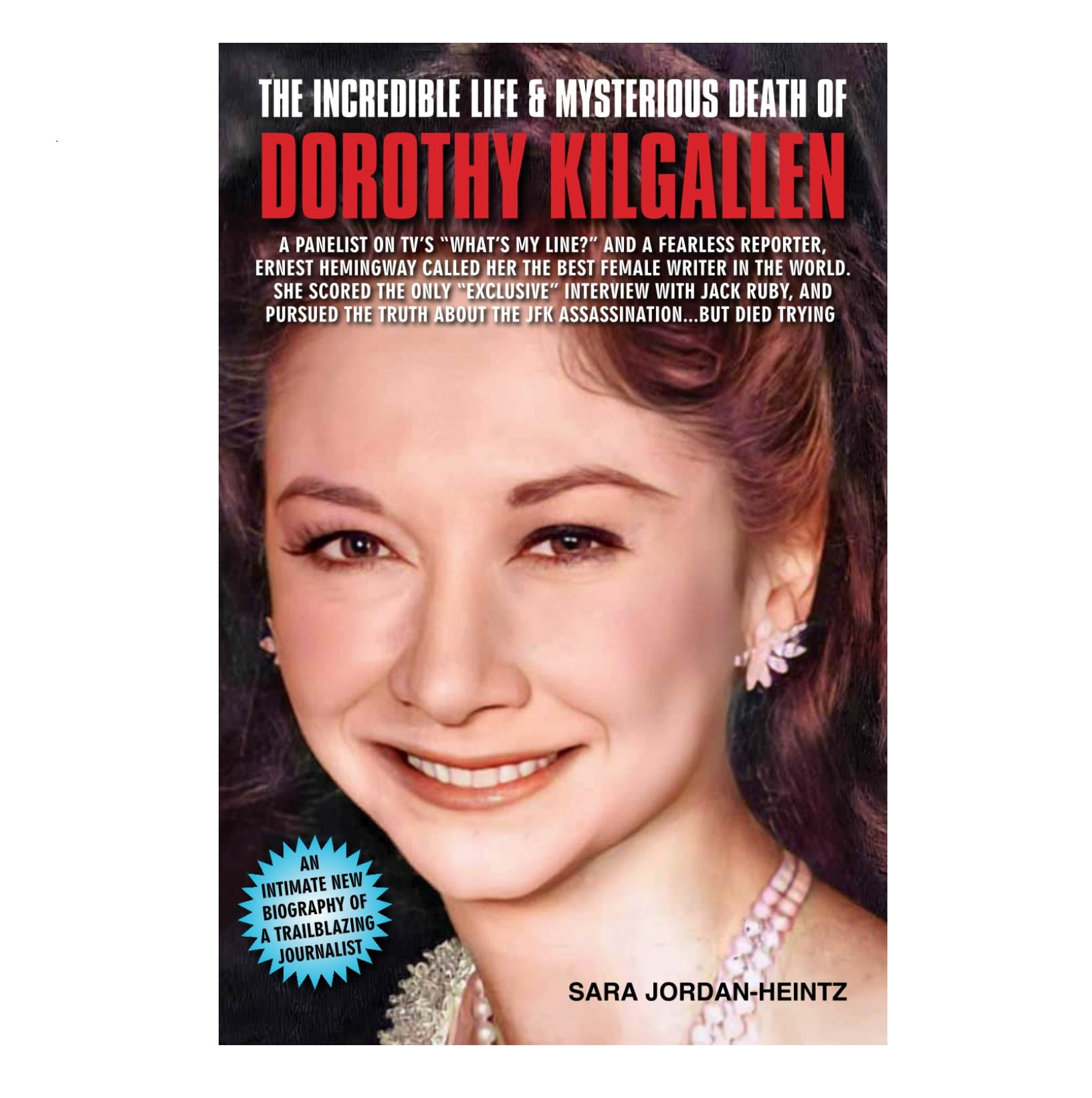
  • The Incredible Life and Mysterious Death of Dorothy Kilgallen

    The Incredible Life and Mysterious Death of Dorothy Kilgallen


    The Incredible Life and Mysterious Death of Dorothy Kilgallen

    by Sara Jordan-Heintz

    Let us first give the author her past due.  In 2007, Sara Jordan wrote a fine article about the demise of journalist and TV personality Dorothy Killgallen for Midwest Today. This was then reprinted in a color online version in 2015, at the 50th anniversary of Kilgallen’s death. (Click here for that version.) That original article was a milestone in the literature on this subject. In this new book, Jordan reveals that she was all of 17 years old when the article appeared (Jordan-Heintz, p. 384) Which makes it the most precocious piece of writing on the Kennedy case since Howard Roffman published his book Presumed Guilty at the age of 22.

    The author has now expanded her distinguished essay into a book.  At the start, she tries to explain why she did so, strongly indicating the works of author Mark Shaw which followed. She says that although she was glad about the article’s popularity she was:

    …dismayed to see Dorothy’s story turn into a cottage industry for one author in particular, whose book, in my opinion, contains reams of repetition, wild theories  and self-aggrandizement.  Much of his original information came from my article, after he contacted me several years ago requesting an interview.  Not all of this is appropriately credited. (p. 1)

    If anything this is mild. As I noted in one of my reviews of Shaw’s “cottage industry” books, not only has Shaw tended to discount Jordan-Heintz’ work, but also the woman who Sara got in contact with for her essay, namely Kathryn Fauble.  But her (understandable) frustration with Shaw is one of the reasons she decided to write this book.

    II

    On the night of November 7, 1965 journalist Kilgallen performed as a panelist in her last What’s My Line program. In a belated revelation, her butler and maid, said she came home that night with a man, and they heard the back door closing. This is a bit hard to comprehend since in addition to the Clements couple, James and Evelyn, there were three other men at the townhouse: her husband Richard Kollmar, her son Kerry, and his tutor Ibne Hassan. (Ibid, pp. 4-5) The following morning she was found dead in her home, the cause was a drug and alcohol overdose. Complicating matters was this: her papers for a later book proposal on the JFK case were gone.  She had made at least one trip to New Orleans,  a second more secretive one, and one to Miami. Charles Simpson, one of her hairdressers—the other being Marc Sinclaire—quoted her as saying the following:

    I used to share things with you guys—but after I have found out now what I know, if the wrong people knew what I know, it would cost me my life.  And she was dead about nine months later. (Ibid, p. 5)

    In addition to a file, and her journeys, she had two interviews with Jack Ruby in person during his trial. She also was in receipt of Ruby’s Warren Commission testimony and she printed this in her newspaper, the Journal American. It was printed over three days and Kilgallen provided a critical commentary (pp. 223-25)

    Since this book is a biography, it details Kilgallen’s life from her birth in Chicago in 1913, and the influence of her journalist father in starting her in a career in the newspaper business.  A big career boost was the 1936 “race around the world” against fellow reporters Leo Kieran and H. R. Ekins. She lost to Ekins but—at age 23– it was a great publicity machine for her. She became the second woman, after Nellie Bly,  to circle the globe. (Ibid, p. 11) It gave her a brief visit to Hollywood, where she acted in a film and sold a concept picture based on the contest, it was entitled Fly Away Baby.

    In 1938 she started her famous column, “The Voice of Broadway”. Three years later, based on its success, CBS gave her a radio show of the same name.  She did another later radio show with her husband, Richard Kollmar, who was a Broadway producer and actor. After marrying Richard, Dorothy quickly had two children, Richard Jr in 1941 and Jill, in 1943. (ibid, pp. 16-19, she had a third child in 1964 named Kerry.) In 1950 she became a regular on the popular TV show What’s My Line? That game show was broadcast live on Sunday nights. Because she was a triple threat—radio, TV, newspapers– she made a lot of money each year.  In 1953 the couple purchased a 13,000 square foot townhouse at 46 E. 68th Street, a block away from Central Park. To demonstrate the kind of money she was making, that  townhouse sold for 17 million in 2021. (Ibid, p. 30)

    The story that really gave Kilgallen’s career a rocket boost was her coverage of the Sam Sheppard murder case (ibid, pp. 34-35). Sheppard was a doctor in Cleveland who was accused of killing his wife in the summer of 1954. Sheppard insisted he had fallen asleep downstairs and she was killed upstairs by an intruder who knocked him unconscious when he tried to rescue her. Due, in part, to a highly prejudiced press, he was convicted. Lee Bailey eventually took over the appeal process. In a first rate performance Bailey had the conviction overturned, partly because the judge had told Kilgallen, “Well, he’s guilty as hell.  There’s no question about it.” And also because the jury was not sequestered as it clearly should have been. The retrial took place in 1966, after Kilgallen’s death. Bailey represented Sheppard at trial and had him acquitted.

    Another famous murder she covered was the Tregoff/Finch case of 1959.  Dr. Raymond Finch was having an affair with a woman named Carole Tregoff.  He wanted to divorce his wife Barbara and marry Carole, but the California community property laws discouraged him from doing so—his wife would have taken too much money and property. Therefore, the couple plotted to kill Barbara. They first tried to hire someone to do it, but he backed out. So they then did the deed themselves at Finch’s West Covina home. Even though the evidence against them was very convincing, there was a mistrial. They were tried again, and inexplicably, there was another mistrial. On the third go round, they were finally convicted. (ibid, pp. 56-57)

    Both of these sensational cases are covered in Kilgallen’s posthumously published book, Murder One.

    III

    A serious difference between the Jordan-Heintz book and Mark Shaw’s first volume The Reporter Who Knew Too Much, is that this new book spends a lot more time and space on the actual assassination of President Kennedy than Shaw did. And that might be understating things. I would estimate that there is almost as much material on the death of JFK as there is on the mystery of Kilgallen’s demise. But further the author uses much material that is not from the Warren Commission volumes or the Warren Report.  It’s an open question as to how much of the 26 volumes that Kilgallen read.  But, of course, it would have been impossible for her to have read what did not surface until after her death in 1965.  And we can only speculate what she had filed away, since that disappeared after her demise.  And no one really knows about her two short interviews with Jack Ruby, since she never revealed to anyone what Oswald’s killer told her. 

    But, for whatever reason, Sara Jordan-Heintz has decided to place in her book a lot of JFK murder information that did not come out until many years, actually, decades later.  To me, it’s fine for her to detail things the doctors saw at Parkland Hospital about the baseball sized hole in the rear of Kennedy’s skull. (p. 90). It’s also fine to quote local reporters Mary Woodward and Connie Kritzberg as to how their work was altered or parts were pulled. (pp. 94-95)  Because these were things that happened right then and there, and Kilgallen could have at least theoretically found out about them.  But then when the writer states that photos were faked and “it also became shockingly clear there had been alterations to JFK’s corpse by the time the formal autopsy began at Bethesda Naval Hospital that night” we are now getting into areas that it is unlikely that Kilgallen could have even speculated about back in 1965.  And I beg to disagree but it is not “shockingly clear” that Kennedy’s body had been altered before the autopsy began. (p. 92). She even goes further than this—shades of Sean Fetter– suggesting that the body was transferred to another casket before Air Force One left Dallas. (p. 98)

    This ignores the interview that the late Harrison Livingstone did with Nurse Diana Bowron who actually helped place the corpse into the casket at Dallas. (See the end of the first part of my review of Fetter’s book https://www.kennedysandking.com/john-f-kennedy-articles/under-cover-of-night-by-sean-fetter) For her rather wild concept–and like Fetter–she also relies on the Boyajian Report, although she does not name it, for an early arrival of Kennedy’s casket at 6:35 PM at Bethesda Medical Center.

    I don’t know how many times I have to repeat this, but I will keep on doing so as long as I have to. Roger Boyajian and his so called report are not reliable evidence in this case. I have demonstrated this twice before and I now have to do it again. That report does not state that the casket picked up by Roger Boyajian’s detail was Kennedy’s casket.  It only refers to it as “the casket”.  The obvious question is this: if Boyajian knew it was Kennedy’s casket, would he not have acknowledged that?

    Secondly, the report was not signed by Boyajian, and there is no hint as to why he did not sign it. To make matters worse, there is a second page to the report that lists the 10 others in the detail—and none of them signed it either. But even that is not the end of it. For when the Assassination Records Review Board (ARRB) interviewed Boyajian about the matter, that is picking up Kennedy’s casket, he could not recall doing so. In fact, he could not recall much about that day–period. Finally, the document the Board had does not appear to be the original.  This makes one wonder if it was ever filed with the military. (Harrison Livingtsone,  Kaleidoscope pp. 140-46)

    To make it even worse she writes that:

    There is general agreement among most JFK assassination researchers that the two casket scenario took place and that Kennedy’s body was probed for bullets (which were presumably removed) and surgical procedures done to conceal that he was fired upon by more than one shooter.(ibid, p. 99)

    There was and is no such general agreement.  In fact, the late Cyril Wecht—a forensic pathologist—never thought such was the case.  Neither does Dr. Randy Robertson, neither does Pat Speer, or Dr. Gary Aguilar.  At no JFK seminar I have ever attended—from 1991 to 2023—have I ever seen any panel devoted to this subject. The writer who formulated this scenario and wrote a popular book about it —David Lifton—could never make any real headway with it inside the critical community, and he himself admitted that.  Its not that he didn’t try, he did. But these attempts failed with rancorous feelings between those involved.

    This angle is made worse when she brings in the tall tales about embalmer John Liggett that were first broadcast by the discredited  Nigel Turner. (p. 106) Liggett’s brother filed a legal action against The History Channel over these ersatz claims and forced a settlement. (South Florida Sun Sentinel, 3/19/2005) It appears that this  bizarre Liggett angle might have been turned up by Billy Sol Estes, a man who sold more baloney on the JFK case than the Hormel company. (See the 2004 book Billie Sol Estes, pp. 155-57)

    As I have said many times about the JFK case, we must follow the Sagan rule: Extraordinary claims demand extraordinary evidence. The above does not, in any way, constitute extraordinary evidence. Kilgallen could not have known about them and I doubt if she would have bought into any of them.

    IV

    I don’t wish to leave the impression that all the many pages Jordan-Heintz devotes to the JFK case itself should be dismissed.  That would not be fair or accurate. She does bring in credible evidence of extra bullets being discovered e.g. Randy Robertson’s evidence about Dr. James Young. (See the film  JFK: Destiny Betrayed.) She also notes that there are photographic images missing from the autopsy collection, which there are. And her use of FBI agents, Jim Sibert and Frank O’Neill is appropriate. (Jordan-Heintz, p. 119) As is the memo written by Deputy Attorney General Nick Katzenbach. (ibid, p. 121)  Her description of the murder of Oswald by Ruby with Captain Fritz breaking formation to allow it is apropos and she mentions the editing out of the horn sounds. (pp. 137-38)

    She adroitly shifts to a column written by Kilgallen after the shooting of Oswald. In that piece the reporter said that Kennedy’s assassination was bad enough but now, after the murder of Oswald, people who have never been there feel like they have just witnessed a Texas lynching. (p. 143) She assailed the fact that Ruby was allowed to walk in and out of the Dallas police headquarters, which was supposed to be keeping a security guard around Oswald. She poignantly wrote that the murder of the suspect prevented due process: “When that right is taken away  from any man by the incredible combination of Jack Ruby and insufficient security, we feel chilled.” She added, “That is why so many people are saying there is ‘something queer’ about the killing of Oswald, something strange about the way his case was handled, and a great deal ‘missing’ in the official account of his crime” (p. 144) In a mid-December 1963 article she said Ruby may have been allowed access since members of the police force “partied at Ruby’s strip club.” She added that “there were jam sessions at which Dallas cops joined in the fun, some playing musical instruments others doing turns as singers and comedians….” (pp. 164-65)

    About a week later, on December 23, she wrote about the upcoming film Seven Days in May.

    The producers of the forthcoming film Seven Days in May have every right to think that life imitates art in the most tragic way. Long before President Kennedy was assassinated in Dallas, they finished their picture about a military group hatching plans to overthrow the President of the United States.  In the movie, the ‘secret base” where the plot against the Chief Executive reaches its climax is a place in Texas.(p. 166)

    She gives coverage to the Parkland Hospital press conference on the day of the assassination with Malcolm Perry and Kemp Clark.  She adds that this conference, added to PR man Malcolm Kilduff’s gesture that the fatal bullet struck Kennedy in the right temple, these undermined the future cover up. She notes that Perry said the anterior neck wound appeared to be one of entrance. Which would eliminate Oswald. (p. 145). Then, apparently based on Barbara Shearer’s documentary, What the Doctors Saw, she writes “that after the news conference, the doctor was accosted by a man in a suit and tie who grabbed his arm and warned him menacingly, “Don’t you ever way that again!” She then adds that this agent was Elmer Moore of the Dallas Secret Service. (ibid)

    This appears to be incorrect.  From the information that several writers have accumulated—Gary Aguilar, and Pat Speer among them—Moore was on the West Coast on the day of the assassination. On the same day, he was then shifted to Washington for what appears to be a briefing.  He was then detailed to Dallas on November 29th. (James DiEugenio, The JFK Assassination: The Evidence Today, pp. 166-67) She is correct about Moore’s assignment being to get the Parkland doctors to change their accounts, and about Moore being a rabid Kennedy hater. She then reinforces this point with the belated revelation by journalist Martin Steadman, namely that Perry revealed to him that he was getting calls during the evening of the assassination to change his statement about a front shot to the neck.

    She notes that JFK was trying to forge a rapprochement with Fidel Castro in 1963. But she then adds that Bobby Kennedy had approved a partnership with the Mob to furnish assassins to murder Castro. (p. 151). The CIA Inspector General report on the plots to kill Castro was finally declassified by the Assassination Records Review Board in the mid -nineties. It remains the most definitive and complete accounting of those plots. Right in that report the authors declare that no administration had any knowledge of the plots from their inception to their ending.  Which means from 1959-65. (See CIA-IG Report, pp. 132-33) This is why Director Richard Helms kept exactly one copy, the ribbon copy, in his safe. And when President Johnson read it, he concluded that the CIA had a role in Kennedy’s assassination. (Washington Post, December 12, 1977)

    V

    After many, many pages on the JFK murder, Dorothy Kilgallen finally arrives in Dallas in February of 1964 to cover the trial of Jack Ruby. She wrote a column on February 22.It began like this:

    One of the best kept secrets of the Jack Ruby trial is the extent  to which  the federal government is cooperating with the defense.  The unprecedented alliance between Ruby’s lawyers and the Department of Justice in Washington may provide the case with the one dramatic element it has lacked: MYSTERY. (p. 189)

    She then adds a rhetorical question:  why has the government decided to supply Ruby’s defense with all sorts of information as long as they do not request anything on Oswald?  She continues in this vein:

    Why is Oswald being kept in the shadows, as dim a figure as they can make him, while the defense tries to rescue his killer with the help of information from the FBI?  Who was Oswald, anyway? (p. 191)  

    The book then goes into several pages of an Oswald biography. We then refer back to Kilgallen’s comments on his absence at the trial, which the reporter thought was unusual in her experience of criminal trials:

    It appears that Washington knows or suspects something about Oswald that it does not want Dallas and the rest of the world to know or suspect….That Lee Harvey Oswald has passed on not only to his  shuddery reward, but to the mysterious realm of classified persons whose whole story is known only to a few government agents. (p. 200)

    In returning to the trial itself, one of  Ruby’s lawyers, Joe Tonahill, told the reporter that Ruby wanted to speak to her. (p. 203) Therefore a brief exchange took place at the defense table.  About a month later, Kilgallen asked to speak to Ruby again without the court appointed bodyguards around.  The judge granted the request.  So Tonahill, Ruby and Kilgallen walked into a small office during the noon recess.  Although Tonahill was interviewed about this many years later, he did not offer any specifics, besides saying it was an agreeable conversation. (p. 205) Kilgallen never told anyone about this conversation either.

    At the end of the trial, with Ruby convicted, Kilgallen wrote that the whole truth was not told.  And that neither the state nor the defense placed all the evidence before the jury.  (p. 207). That verdict was later vacated and Jordan-Heintz describes how Ruby passed on before his retrial in Wichita Falls and she does a nice job describing the character and career of Louis J. West, a CIA affiliated doctor who was, inexplicably, allowed to visit Ruby before he passed away in January of 1967. (p. 208)

    In July of 1964 Kilgallen published Ruby’s testimony, four months before it would appear in the Commission volumes. Readers were struck by Ruby’s ignored pleas to go to Washington for the interview. She also asked in her commentary: how could Tippit not know Ruby? In another column published in August, she got hold of an internal Dallas Police report and used it to strongly criticize the performance of the police both in the immediate aftermath of the JFK murder and in the transfer of Oswald.(p. 228)

    VI

    The book closes with the death of Kilgallen.  Jordan-Heintz, like Mark Shaw, focuses on the strongest possible suspect, namely the late Ron Pataky, who died in 2022. Lee Israel, the reporter’s first biographer, revealed the affair Kilgallen was having with the much younger journalist from Ohio. Israel did not name him but referred to him as the “Out of Towner”. (p. 242) Jordan -Heintz was the first writer to name him in her Midwest Today article back in 2007.

    What follows in the book  is a concise biography of Pataky as a Naval ROTC officer at Stanford who was, either kicked out or dropped out, of the university in April of 1955. (p. 243) He was using fake ID cards and was arrested. He then transferred to Ohio State and graduated in 1958. He eventually got a job as an entertainment writer for the Scripps Howard chain, at the Columbus Citizen Journal until it folded in December of 1985. Pataky was also a poet and songwriter.

    By the time Pataky met Dorothy he was married and divorced. He appears to have been quite the ladies man.  The book features pictures of him with actresses Sandy Dennis and Alexis Smith.  He also had an affair with singer Anna Maria Alberghetti. He and Kilgallen met while on a film press junket to Europe. (pp. 247-48) Although Pataky maintained that their relationship was Platonic and not sexual, there is evidence that such was not the case. (p. 251) The author juxtaposes his budding relationship with Kilgallen and her doing more work on the JFK case. For instance, in late September of 1964, she revealed that witnesses who did not identify Oswald at the scene of the murder of Patrolman J. D. Tippit were told to be quiet.

    The author notes that Kilgallen did report on the kindly Quaker couple, Ruth and Michael Paine and their incriminating comments about Oswald.  She also notes a fascinating piece of information I had never encountered before. In commenting on the Roger Craig testimony about Oswald jumping into a Rambler station wagon after the assassination, she says that Ruth Paine’s station wagon was a Chevy. But that someone who did own a four door Rambler station wagon was New Orleans businessman/CIA agent Clay Shaw.

    He insured the Dallas-based vehicle (buying only the required liability policy) through an out-of-town agency for his “son” (though he didn’t have one), then canceled the policy after the assassination and presumably disposed of the vehicle.  Correspondence from the insurance agent confirms all this. (p. 261)

    Quite intriguing if its accurate.

    During the last year of her life, the reporter made few if any newspaper references to the JFK assassination. But according to more than one source, she was still at work on the Kennedy case. And she was arranging a second visit to New Orleans. She was going to meet with a source that she did not know, but would recognize. Ron Pataky said that the man she met with was Jim Garrison. (pp. 317-18) But further, Pataky said that he had met with Garrison, two weeks after he had previously met with Mark Lane. And, according to Pataky, he met with Lane before the reporter did. The author suggests that this shows that Pataky was likely on assignment during his days with Kilgallen.

    On the evening of her death, Kilgallen was seen at the Regency, her favorite hotel bar, after midnight with a male companion. Pataky says it was not him and that he only talked to her by phone in that 24 hour period. (p. 329) One of the weirdest dichotomies about her death is that the butler, James Clement, maintains that he found her body in the bathroom. (p. 333) But hairdresser Mark Sinclaire said he first found her body in the third floor bedroom, where she never slept. Jordan-Heintz tries to address this paradox in the evidence. She asks, just what happened between the hours when Clement says he saw the body and when Sinclaire discovered it in the bedroom. Clement also said that men in suits carted off her files. (p. 338)

    Lee Israel noted that the police did next to nothing about this case. They should have interviewed everyone she talked to the night before, but there is no evidence they did so. But Pataky said he actually was interviewed. (p. 339)

    The book closes with the very odd circumstances of Kilgallen’s autopsy. The official version was she died of “acute barbiturate and alcohol intoxication, circumstances undetermined.” (p. 350) But the man who did the autopsy, did not sign the death certificate.  And the person who signed was not even stationed in Manhattan, where she died, but in Brooklyn. It also turned out that there was evidence  of Nembutal on her drinking glass, a drug which she had not been prescribed (she had only been prescribed Seconal). There was also evidence of a third drug in her system: Tuinal. The chemist who did the drug testing said he was told by his superior to keep the case under his hat because it was big.(pp. 351-52)

    The book tries to place Pataky in New York on the night Kilgallen died. The author bases this on the fact that his paper ran his review of the film The Pawnbroker two days later.  But according to IMDB, that films was released in April, six months prior.  So although this is suggestive, it is not probative of Pataky being in New York at that time.

    The mystery of Kilgallen’s death continues. The incompetence, or indifference, of the authorities was simply astounding.

  • Under Cover of Night, by Sean Fetter, Part 2

    Under Cover of Night, by Sean Fetter, Part 2


    In the first part of this review of Sean Fetter’s very long book, Under Cover of Night, I concentrated on his rather radical ideas about how the medical cover up about the JFK murder was executed. By self-acknowledgement, his book is in the line of the 1974 volume Murder from Within. I also indicated that although the book is full of scorn and bile against the late David Lifton, it is also reminiscent of Best Evidence. For reasons stated there I did not find his case convincing in that aspect. As I noted there, the second person Fetter had extreme scorn for is Lyndon Johnson.

    Considering the length of the two volume set, it does not take long for Fetter to get to his point about Johnson. Relatively early he calls Johnson the “plotter-in-chief”. (Fetter, p. 134) What is rather startling about that rubric is the man who Fetter names as Johnson’s accomplice in the plan to kill Kennedy. It’s a name that I had never previously heard of in that regard. Fetter says that the man who was Johnson’s cohort was House speaker Sam Rayburn. (See Chapter 27 throughout, e.g. pp. 596-97). One reason the reader may never have heard of Rayburn as a co-plotter to kill Kennedy is rather simple: He died on November 16, 1961. That is two years before Kennedy was killed. So the logical question would be: How could a man be part of a plot to kill JFK if he died two years before it happened? After all, most critics think that the plan to kill Kennedy was intricately plotted in advance and very cleverly designed. Further, many think today that there were also precursors to what happened in Dallas, namely attempts on Kennedy’s life in Chicago and in Tampa in the weeks before Dallas. So how could someone like Sam Rayburn, dead in November of 1961, have been part of something like that?

    This is where the author now gets into another dispute with other critics. And Fetter is very clear about this:

    The JFK assassination plot did not occur because of fierce intragovernmental disputes over Vietnam, or Communism in general, or nuclear war, or Cuba, or Berlin, or civil rights, or the Federal Reserve, or the CIA—nor because of President Kennedy’s words, policies, actions or inaction on any subject. Period. (Fetter, p. 593)

    Therefore, in the space of one paragraph, Fetter disposes of the work of authors like John Newman on Vietnam, Larry Hancock on Cuba, Donald Gibson on the economy, Mark Lane and Jim Garrison on the CIA, and Peter Kuznick on Russia and atomic weapons. The work that these men did is plentifully documented. These policy disputes did occur, and they are proven.

    But as mentioned above, with Fetter, that is rather irrelevant to the cause at hand.   I mean, did Sam Rayburn fight any battles with Kennedy over Vietnam? How could he if Rayburn was dead within months of Kennedy’s inauguration? What Rayburn was known for was his incorruptibility. For instance, while being in the state legislature he was also part of a law firm. Yet he would not take fees from railroad companies that his firm represented. As many, including Robert Caro have noted, Rayburn was immune to lobbyists, turned down honorariums for speeches, and even refused to take travel expenses that he was legally entitled to. When hosts would try and extend him funds, he would reply “I’m not for sale” and then walk away. Rayburn died with cash assets of $35,000 while being $18, 000 in debt. (The Salt Lake Tribune, 2/25/2006, story by Mark Eddington)

    From the above, one could say that Rayburn had a common touch about him. As his friend Cecil Dickson once said:

    Rayburn is always watching out for what he calls ‘the real people’—those who come into life without many advantages and try to make a living and raise their families. The other people, well-born and with advantages, can get just about everything they want without government help, but ‘the real people’ need the protection of the government. (Patrick Cox at Constituting America web site)

    Rayburn was born in Tennessee and moved to Texas at age 5. He spent about a half century representing people in the Lone Star state. But he did not sign the Southern Manifesto in 1956, as about 100 Washington southern politicians did, thus declaring their resistance to civil rights. He supported the creation of a civil rights commission and the Civil Rights Act of 1957. (ibid). In 1961 Rayburn was clearly and seriously ill. That summer he lost consciousness twice while in the Speaker’s chair. He was told he had cancer. He decided to return home to pass on and was quoted as saying, “I am one man in public life who is satisfied, who has achieved every ambition of his youth.” (Ray Hill in The Knoxville Focus, 4/8/2024) When Rayburn died, about 30,000 people showed up in his hometown of Bonham for his funeral. Among them were three presidents: Eisenhower, Truman and Kennedy. JFK was an honorary pallbearer.

    So, if Rayburn had gained every ambition of his youth, how does Fetter make him into a post-humous co-planner of Kennedy’s murder? Well, according to our trusted historian and investigative journalist, Rayburn and Johnson were planning Kennedy’s death as far back as 1956. (Fetter, p. 594, pp. 611-13). How and why would they do that? Fetter’s reasoning is as follows: it was the only way to get someone from the south onto a national ticket. (He does not count the fact that Eisenhower was born in Texas, since he only lived there for two years, plus he was a Republican. Go figure.)

    Does anyone really think this could be the reason to overthrow a government and murder the president in broad daylight while doing so? I have a hard time swallowing such a discussion taking place. Especially since John Nance Garner, a Texan, would have been president had he not resigned as Franklin Roosevelt’s VP in 1941. Further, Rayburn was a serious contender for that same office in 1944 as the movement to oust Henry Wallace gained steam. Finally, most people thought that since Johnson had proven to be such an effective leader in the senate he would naturally run in 1960, and he would be among the favorites.

    So what evidence does Fetter advance for this nefarious plot taking place in 1956? As far as I can see he advances no direct evidence to such a plan being hatched. Neither did I denote any direct quote by Rayburn saying that having a southerner or Texan in the White House was a burning lifelong ambition for him. When Fetter does say that, the statement is not in quotes, and when one reads the footnote it is one of his usual “Author’s exclusive original discovery”. (See p. 622). When he tries to map out the thought process that Rayburn took in coming to that macabre conclusion, the footnotes are all attributed to the author, not the subject (See pgs.625-26).

    I also have to add that President Woodrow Wilson was from Virginia, the home of the Confederacy. So when Fetter writes that no white southerner could win his party’s nomination for president, how did he miss that one? (p. 622)


    II

    But, in spite of the above, Fetter is wedded to this White Southerner Pledge by Rayburn and Johnson. How wedded to it is he? He actually writes that it did not matter who was the presidential nominee in 1960, Kennedy or anyone else. Because Rayburn and Johnson were so hell-bent they would have targeted, blackmailed and liquidated whoever it was. (Fetter, p. 626) He is quite explicit about this when he writes that if anyone else had beaten Kennedy in 1960, that person—whether it be Hubert Humphrey or Adlai Stevenson—would also have been killed.

    At this point, probably earlier, one has to inject a bit of documented history into this rather closed end equation. Did not Lyndon Johnson run for the presidency in 1960? And was he not Kennedy’s closest and most feared rival that year? The answer to both of those questions is yes. In fact, Kennedy was so worried about Johnson running against him that he sent his brother to Texas to ask LBJ about his intentions. This was in 1959. (Jeff Shesol, Mutual Contempt, p. 10)

    But here is the capper: Rayburn encouraged Johnson to hurry up and formally get in the race! (Shesol, p. 28). So in light of those public facts, what are we to make of Fetter’s 1956 stealth plan by Rayburn and Johnson?

    What happened in 1960 was that Bobby Kennedy, representing a new style politician, outmaneuvered Johnson—an old style one. In examining that race, Jeff Shesol believes that Johnson thought Humphrey would stop Kennedy’s ascent in West Virginia, and LBJ would then enter the race at that time, once JFK’s momentum was broken. In fact, Johnson encouraged Humphrey to run in that state. (Shesol, p. 33). But backed by his father’s money, Bobby Kennedy ran a masterful campaign, closing with a statewide TV infomercial on the eve of the election. Therefore it was Humphrey who was broken. Seeing his strategy upset, LBJ started a Stop Kennedy crusade, using all kinds of attacks–his Catholicism, his youth, the “rich kid” smear. He even exposed Kennedy’s Addison’s disease. (Shesol, p. 35). Finally, about ten days before nomination night, he formally declared his candidacy, what Rayburn wanted him to do months previous. In fact, what is surprising is how well Johnson did in spite of his hesitancy and miscalculations. He finished second, far ahead of Humphrey, Stu Symington and Adlai Stevenson. Kennedy did not clinch his first ballot victory until the last state of Wyoming was called. (NY Times, 7/14/1960, story by W. H Lawrence) And Bobby Kennedy was worried about going to a second ballot.

    The next step in Fetter’s Rayburn/Johnson stratagem is right out of Seymour Hersh. The Dark Side of Camelot is a book that I would think no serious JFK researcher would ever use. It has been exposed so many times in so many different areas, and Hersh has fallen into such disrepute, that the man is something of a joke today. (Click here as to why.) His book has been so strongly criticized on so many levels by not just me, but the MSM, that today it is almost a parody. (Click here.)

    But yet, Fetter uses one of the worst parts of Hersh’s hatchet job in order to advance his Rayburn/Johnson precept. In The Dark Side of Camelot, Hersh said that the way Kennedy nominated Lyndon Johnson as Vice President was through a confrontation with LBJ and Rayburn. (Hersh, pp. 123-25). But yet, there is no witness to this in Hersh’s version. Hersh used a man named Hyman Raskin, and combined him with Kennedy’s secretary Evelyn Lincoln to arrive at an unwarranted conclusion. Raskin worked in the Kennedy campaign in 1960, primarily as an organizer for the western states. In the mid-nineties he told Hersh that he firmly expected that Senator Stu Symington was going to be the nominee for Vice President at the LA convention. And that both he and Bobby Kennedy were startled when it turned out to be Johnson. Hersh then pasted this together with an interview that Tony Summers did with Evelyn Lincoln for his book on J. Edgar Hoover, Official and Confidential, published in 1993. What Lincoln says is that Johnson had been using information that had been supplied to him by Hoover during the campaign. Its actually Hersh who then surmises a conclusion:

    …the world may never know what threats Lyndon Johnson made to gain the vice presidency. Kennedy knew how much Hoover knew, and he knew that the information was more than enough to give Johnson whatever he needed as leverage. Kennedy’s womanizing came at a great cost.(Hersh, p. 129)

    This is an example of paralipsis: the implication of something happening when much of significance is being omitted.

    To say what Fetter does with this is ‘over the top’ is much too mild.   Fetter uses a newspaper story by columnist John Knight about how LBJ was nominated, a story that was denounced as false by everyone involved. (Shesol, p. 57) He then adds one of his “Author’s exclusive original discoveries” to make it sound as if Johnson and Rayburn had mutual confrontations with, respectively, Bobby Kennedy and John Kennedy. He then tops this with Rayburn and Johnson facing off with JFK in private and presenting him with photographic evidence of his philandering provided by Hoover. As the reader can see, Fetter has taken Hersh’s paralipsis and launched it into Saturn 5 orbit; apparently in order to fit his theory.

    What really happened was this: Ted Sorenson put together a VP list for Kennedy. That list was assembled about two weeks before the LA convention, on June 29th. After being winnowed down, it had six men. This included Senator Hubert Humphrey, Governor Orville Freeman, Senator Symington, and Senator Henry Jackson. At the top of Sorenson’s list was Lyndon Johnson. Kennedy was aware of this list prior to LA. (Shesol, p. 42, Sorenson, Kennedy, p. 184). Kennedy liked Humphrey and Symington, since they were both liberals and had run clean races against him. But Clark Clifford, Symington’s manager, told JFK that Symington was going to gamble on a deadlocked convention. The problem with Humphrey was that he was still backing Adlai Stevenson, and if that failed, he would go to his home state’s governor, Freeman.(Arthur Schlesinger, A Thousand Days, p. 40)

    There were many politicos in LA who felt that Kennedy needed to balance the ticket geographically. Because quite early, in 1956 and ‘57, he had made two speeches, one in NYC and one in Jackson, Mississippi, both saying that his party had to back civil rights. Since then, he had been hemorrhaging support in the south. (NY Times, 2/8/56; Harry Golden, Mr. Kennedy and the Negroes, p. 95) Two who understood this problem were Mayor Richard Daley of Chicago and the powerful Washington lobbyist Tommy Corcoran. While in an elevator with JFK, Corcoran told Kennedy he had to pick Johnson in order to win. (Shesol, p. 44). Tip O’Neill said the same to Kennedy on the same day, July 12th. He further added that LBJ would accept if asked. Kennedy replied “If I can ever get him on the ticket, no way can we lose.” (Shesol, p. 45).

    But two who were also very influential were newspaper men Phil Graham of the Washington Post and columnist Joseph Alsop. And they made their case for Johnson directly to JFK in his suite. (Sorenson, p. 186; Schlesinger, p. 42) After they did so, Kennedy accepted the idea rather easily, commenting on Johnson’s strength in the south. From there, Kennedy made a phone call to Johnson at 8:45 am on Thursday July 14th. Rayburn did not want Johnson to take the offer and told him so. (Schlesinger, p. 46) But rather reluctantly, and after talking to many people, Johnson accepted. (ibid, p. 49).

    To try to counter all of this with the 30 year old memory of a man who was not even in on the negotiations, and a secretary who was reduced to tears after being fired by Johnson within 24 hours after he became president, to me that is simply balderdash. Which is what Hersh’s book was. But alas, Fetter also accepts a Hershian view of the Kennedys and Marilyn Monroe. He says that Bobby Kennedy was secretly meeting with Marilyn Monroe, and was at her home on the day and evening of what he terms ”her murder”. (Fetter, p. 213) Bobby Kennedy was nowhere near Monroe’s home in Brentwood on that day. He was 350 miles north in Gilroy and this is provable beyond any doubt through pictures and eyewitness testimony. (Susan Bernard, Marilyn: Intimate Exposures, pp. 184-88) Secondly, Monroe was not murdered. Forensic pathologist Dr. Boyd Stephens stated categorically for the record that she died due to an ingested drug overdose, either taken purposefully or by accident. (Donald McGovern, Murder Orthodoxies, p. 494)


    III

    But in the face of all these problems, Fetter plunges on. The next step in his plot takes place on Air Force One as the shocked presidential entourage is readying to leave Dallas after the assassination. What the author does with this scene is, to my knowledge, unprecedented in the literature. There is no official record of the calls Johnson made to Washington to talk to Bobby Kennedy about taking the oath in Dallas. The recording device only worked while the plane was in flight. (William Manchester, The Death of a President, p. 268) I have read some of the accounts of the calls back and forth in several books: William Manchester’s The Death of a President, Jim Bishop’s The Day Kennedy was Shot, Jeff Shesol’s Mutual Contempt, and Johnson’s own account in his memoir The Vantage Point, among others.

    The issue of whether or not Johnson should take the oath of office immediately came up at the Parkland press conference after Kennedy was pronounced dead. It was addressed to Malcolm Kilduff, the acting PR man for the White House. (Manchester p. 221) Others brought it up. So Johnson called the Attorney General about who should administer the oath. RFK deferred the question to Deputy AG Nicholas Katzenbach and he called the Office of Legal Counsel. The message was relayed back to LBJ that any federal judge could do it and Katzenbach suggested a Johnson appointee, who ended up being Sarah Hughes. (Shesol, pp.114-115)

    As with his Hershian moment at the 1960 Democratic convention, Fetter says all the above is really a cover story. The real point was that the focus of their conversation was a “problem of special urgency” which would result in “security measures”. He then adds on to this alleged RFK/LBJ conversation, specifically with LBJ mentioning things like security measures being needed to keep everything together. He further adds that Johnson said Castro could be mixed up in all this; that we have to contain an uncertain situation; we have early word of a possible Cuban involvement; and we need to prevent unhealthy speculation and wild rumors. (Fetter, pp. 212-13). The closest that Fetter comes to a footnote in all this is when he quotes p. 269 of Manchester’s book. That reference leads us to Johnson’s statement to the Warren commission in July of 1964. (WC Vol. 5, pp. 561-64). The only even remote reference that Johnson makes to any of these remarks that Fetter attributes to him is when he says that they discussed “problems of special urgency because we did not at that time have any information as to the motivation of the assassination or its possible implications.” Johnson then says that RFK then looked into the matter of the oath of office being administered to him and would call back. Which he did.

    I have no idea where Fetter got the rest of this material. Or who he imputes it to, Kennedy or Johnson. And I have no idea as to how it relates so portentously to what actually happened due to the calls. Johnson had been told that he should go back to Washington by, among others, McGeorge Bundy. (Manchester, p. 271). The question of the oath was something that no one knew anything about. And it was also Bundy’s idea to get advice from the Justice Department on that. Which made perfect sense. (ibid)

    But Fetter is not done with Air Force One and Love Field on November 22, 1963. He also writes that LBJ told Secret Service agent Jerry Kivett ”not to file a flight plan—that is, not to give the Air Force One crew a destination, and not to tell them where the presidential plane was actually headed.” (Fetter, p.184) I listened to this interview, which one can find at the Sixth Floor Museum web site. What Kivett says is he was told by LBJ to tell the flight crew not to file a flight plan, but to do so just ahead of the take off. Right before this, Kivett says that he was actually worried about Johnson being shot at the hospital. That is how high the fear and tension was at that time. He was also told by his superior Rufus Youngblood not to let anyone on Air Force One unless he knew them. With his blinkers on, Fetter cannot put these two pieces of information together to understand why Johnson told Kivett what he did: until they got back to Washington, there was a continuous threat.

    But my other question about this was: The crew really had to be informed of that? I mean with politicians, Kennedy’s staff, and Mrs. Kennedy on board? Where else were they headed?

    Fetter’s answer to that question is this: Mexico. (Fetter, p. 185) Fetter again has “exclusive original discoveries” on hand that no one ever realized. Or imagined. (Perhaps for good reason?) According to him, Johnson somehow knew that his plot to kill Kennedy was failing and was “in danger of total implosion.” Oh really? With the Dallas Police apprehending Oswald, and finding the rifle with three shells on the 6th floor? With supervisor Roy Truly supplying Oswald’s name to Will Fritz? And with the Texas School Book Depository now being sealed off as the setting for the crime? With cops like Ken Croy, W. R. Westbrook and Jerry Hill at work? I mean who could ask for much more?

    Fetter defers from this. He wants us to think that Johnson so feared the skill, precision and dedication of the Dallas Police that the Vice-President was going to hijack the plane and fly to Mexico to escape justice. Yep, its right there in black and white on page 185. And he was going to stay there, perhaps for the rest of his life. Fetter does not say anything about how the rest of the people on board would have reacted to that, especially Jackie. (‘Are we going to bury Jack in Yucatan?”) Or anything about the willingness of the crew to go along with it. Or about any countervailing messages that would come in from Washington. Nope he doesn’t have to since, this is another of his “Author’s exclusive original discoveries”.


    IV

    To go through this entire book, as I have in the instances above, and point out all of its leaps of evidence and logic in regard to historical fact and evidentiary analysis would take an essay bordering on a pamphlet in length. So let me deal with some other points more briefly:

    1. The author calls the Warren Commission the Johnson Commission, and he actually tries to insinuate that somehow LBJ created and controlled that body. (See p. 502, 801) Anyone who has read Donald Gibson’s excellent essay on the subject knows that Johnson did not even want any blue ribbon Commission. Two men were instrumental in forcing it on the White House: Eugene Rostow and Joe Alsop. Johnson resisted these initial overtures but eventually gave in. (The Assassinations, edited by James DiEugenio and Lisa Pease, pp. 3-16) Once established, it was controlled by Allen Dulles, John McCloy, Jerry Ford and J. Edgar Hoover. (See Walt Brown’s The Warren Omission.)
    2. In addition to John Kennedy, our trusted historian and investigative journalist says that Johnson also killed Bobby Kennedy. (Fetter, p. 855). No serious author of that case even insinuates such a thing. No one who studies it, as I have, can find any evidence for such a conclusion. See, for example, Lisa Pease’s fine work, A Lie Too Big to Fail.
    3. In his obsession to make Johnson into a mass murderer the equal of Hitler and Stalin, Fetter says that LBJ killed 9 million people. (Fetter, p. 750) He then lists several countries but without any references to death lists for them. For example, the deaths in Vietnam after Kennedy’s death should not be all attributed to LBJ. Because Nixon thwarted Johnson’s peace proposals, and then continued that war throughout his first administration: dropping more bomb tonnage on Indochina than Johnson.
    4. Fetter says that Johnson confessed to the murder of JFK through notes left behind after a meeting with Clark Clifford and Dean Rusk. He sources this to a book by Lloyd Gardner called Pay Any Price. He says that during a meeting in March 1968, Johnson jotted down the word “murderer”, Fetter says this was a confession. That section of the book deals with Johnson’s ideas about Vietnam after the Tet offensive. Clifford was advising him to get a truce and start negotiating a peace. Johnson left a note behind after on which there were three lines: “Murderer-Hitler”, “Stop the War” “Escalate the Peace”. Its very clear from this and Gardner’s context that LBJ was persuaded by Clifford’s argument, and that is the reason he made those notes. How do we know? Because, after this meeting , Johnson then made his famous abdication speech, saying he was not going to run and he would push for peace. How could anyone leave all that out? (Gardner, pp. 455-57)
    5. Fetter also says that LBJ confessed in his memoir called The Vantage Point. I first wondered how the tens of thousands of readers, perhaps hundreds of thousands, could have missed it. I then looked up the pages he referred to (pgs. 12, 18, 27) Its pretty obvious from reading the first two passages that Johnson was referring to reassuring the public that there was not going to be any paralysis in the transfer of government from Kennedy to him. This is one reason why he was advised to get back to Washington, the other being to escape any kind of wide ranging murder plot. The final reference, p. 27, which Fetter does not distinguish, referred to convincing Earl Warren to head the Warren Commission. Yet, Fetter does not note this in his text or describe how Johnson convinced him to do so!
    6. Fetter writes that Robert Kennedy actually knew that Lyndon Johnson had murdered his brother, and this is why he went into a period of depression afterwards.(Fetter, p. 793) The best volume on RFK’s investigation of John Kennedy’s death is clearly David Talbot’s book Brothers, which features scholarship Fetter cannot touch. In the interviews Talbot did for the book, the three suspects RFK had were the CIA, organized crime and the Cuban exiles. Johnson was not mentioned.


    V

    Let me close with Fetter’s section on Robert Kennedy, Mongoose and the CIA/Mafia plots to kill Castro. Fetter makes it sound as if Bobby Kennedy was ignoring his Attorney General job to oversee Mongoose, the secret war against Castro in 1962. (Fetter, p. 783) According to Arthur Schlesinger’s definitive biography, this is not the case. RFK would devote one afternoon per week to serve as ombudsman over proposed operations. In other words he wanted them in written, detailed plan before he would approve them. (Arthur Schlesinger, Robert Kennedy and His Times, p. 497). How on earth could it be otherwise? AG Kennedy was supervising a massive war against organized crime and the most forward looking civil rights program in history at the DOJ.

    Beyond that Fetter implies that somehow Bobby Kennedy was aware of at least the last phase of the CIA plots to kill Fidel Castro. The Inspector General report makes it clear that the CIA deliberately ran these operations on their own and never had any kind of presidential approval for them. (See IG Report pgs. 132-33). But Fetter wants the reader to think something different, and we will soon see why.

    Fetter begins his paradigm on November 23rd with the CIA requesting information about Valery Kostikov from Mexico City. (Fetter, p. 785) He skips over how Kostikov’s name came up in the first place. As John Newman points out in Oswald and the CIA, James Angleton released his name on the day of the assassination as having allegedly met with Oswald in Mexico City seven weeks prior. This was incredibly interesting since Oswald was a former defector to the USSR and Kostikov was reportedly involved with Department 13 of the KGB–and one of their assignments was liquidation. Therefore, was the communist Oswald acting as an agent of Kostikov when he supposedly shot Kennedy?

    But Fetter downplays this “virus effect” by Angleton, which Newman has talked about at various public appearances. Fetter wants to go to two days later when the Mexico City station brought up the name of Rolando Cubela. (Fetter, p. 786) Now we see why Fetter moves RFK to almost sitting supervisor of Mongoose, and wants to implicate him with the CIA plots to kill Castro. His idea is that this info somehow “froze” RFK in place about his brother’s death. (Fetter, p. 788). He then goes further and says that this effect was the actual reason for Oswald’s journey to Mexico City. Again, I have never seen this view anywhere.

    The problems with it are obvious. As stated above, it was made clear in the IG Report that no president ever knew about the plots. Secondly, there was an effort by the CIA to lie to Bobby Kennedy about them. (IG Report pp. 62-64) Finally, the report spends over 30 pages on the Cubela phase of the plots to kill Castro. Its obvious that again, this was hidden from the White House. For example, Cubela wanted assurances from Bobby Kennedy about the plots. He never got them and Richard Helms forbade any acknowledgement of the CIA meetings with Cubela to RFK. (ibid, p. 89). So how would RFK be frozen by the name of Cubela if that name was being kept from him? What is the evidence that he saw that CIA cable anyway? As Newman has stated, the name of Kostikov and the visits to the Soviet and Cuban embassies threatened an atomic war, which is what Johnson used to intimidate Earl Warren into heading the Warren Commission. The question then becomes did Johnson really believe these visits, which Hoover had doubts about. Again, this issue is ignored by the author.

    Despite all the lacunae I have shown in this book–and they are large and many–that does not give the author pause. In fact, one of the most disturbing aspects of Fetter’s narrative voice is its conceit. He writes for example that, “I have proven for the first time anywhere the true origins, the true chronology, and the true reasons for the JFK assassination plot.” (p. 881)

    No he has not. Not even close. In fact, for this reader, the book is both so agenda driven, so solipsistic and at the same time so diaphanous in every aspect, that it shows, after almost 61 years, what little case there is against Lyndon Johnson in the conspiracy to kill Kennedy. And let us leave Rayburn out of this from now on.

  • Under Cover of Night, by Sean Fetter, Part 1

    Under Cover of Night, by Sean Fetter, Part 1


    Sean Fetter’s two volume set on the JFK case, Under Cover of Night, runs over 1000 pages. And in this reviewer’s experienced opinion, there was no reason for that length, none at all. There is so much repetition, so many unnecessary and redundant sentences—Fetter thinks that if he says something often enough the reader will believe it—and so much carrying out personal vendettas by the author, that the book cries out—screams– for a wise and strong editorial hand.

    When I use the phrase “personal vendettas”, I refer to four targets that Mr. Fetter has. They are, in order of intensity of antipathy:

    1. David Lifton
    2. Lyndon Johnson
    3. The MSM

    The fourth target, which Fetter treats more lightly, is the critical community. I would not term his feelings about this last group as antipathy, let us just call it disdain. The reason I point this out at the start is that these extreme feelings color, to a serious degree, what Fetter writes in his book. It is not just a matter of personal invective and insults. It’s literally scores of them peppered throughout both books. To the point that this reviewer came to question the judgment and temperament of a writer who needs to consume so much time and ink in striking out at his perceived enemies.

    In the case of Lifton, what complicates this was, to me, a seeming paradox. Because Fetter’s theory of the crime, at least in the immediate aftermath of the shooting, does not differ that much in overall plan from Lifton. Like Lifton, Fetter says that Kennedy’s corpse was hijacked, bullets extracted, and then the body was altered to disguise shots from the front. Like Lifton, he also states that the Zapruder film was altered in a very serious way. Where he differs from the author of Best Evidence is in how and where all this high level subterfuge occurred.

    I

    As Lifton himself once noted, Best Evidence did not have a lot of support within the critical community. But at least at one time, Fetter, and the man who wrote his Foreword, the late Peter David Rupay, worked for and with Lifton. This was revealed in an online review by Mr. Rupay of the book Bloody Treason. So, most probably, this is why the overall models are similar. But make no mistake, there was clearly a falling out among the three parties. And Rupay ended up disliking Lifton almost as much as Fetter does. In fact, Rupay put Lifton’s name in quotes in the Foreword. Why? Both men say that his real first name was Sam, not David. (I would have thought that sending away for his birth certificate would have settled the matter, which both men seem to think was of paramount importance.)

    Very soon after this, we get a strong hint of what Fetter’s style and format is going to be. Fetter does not place his footnotes at the end of the chapter or at the end of the book. They are all on-page references. Many of them are not really footnotes at all in the academic sense. Because the majority of them refer to either “personal insights” or ‘personal discovery by the author.” There are not scores of these, not hundreds of them, but over a thousand. Some pages contain as many as five of them.(For example, see pages 268 and 270)

    And this is where he places a majority of his personal attacks on Lifton. For instance, in the references on page 28, he says that 1.) His name was actually an alias, and 2.) He had a co -author on Best Evidence, and that was the late Patricia Lambert. He attributes both of these statements to Lifton himself which, perhaps inadvertently, attests to the fact of how close they were at one time.

    Fetter now says that the proper model for his work was not Best Evidence but its precursor Murder from Within. (pp. 26-27) The author calls this the best book on the case in 50 years. (Fetter, p. 57) I have to add here: how many members of the critical community would agree with that declaration? Are we to forget people like Sylvia Meagher, Jim Douglass, and Gerald McKnight, among others? I would venture to say, not many would rate Murder from Within with the works of those others. If anyone would. (But, in one sentence, Fetter does give McKnight the back of his hand.)

    Murder from Within began as a manuscript written in 1974 by Fred Newcomb and Perry Adams. It was later published as a book, which the reader can purchase online. Lifton and Newcomb had been friends and working partners. As Roger Feinman noted in his classic critique of Lifton’s book, Between the Signal and the Noise, the Newcomb/Adams volume resembles Best Evidence to a significant degree. For instance, it advocates a strong criminal role for the Secret Service, and also advocates for both wound alteration and Zapruder film alteration.

    In Part One of Under Cover of Night it is revealed that in his architectural design, Fetter relies on the so called Boyajian Report for an alleged early arrival of Kennedy’s body at Bethesda Medical Center. This took place in the rear. (Fetter, p. 41). This was at 6:35 PM about 20-25 minutes prior to the official arrival. In my review of Harry Livingstone’s book Kaleidoscope, I discussed the use of this document as evidence. First, the actual report does not state the casket picked up by Roger Boyajian’s detail was President Kennedy’s casket, it only refers to it as “the casket”. If Boyajian knew it was Kennedy’s casket, would he not acknowledge that?

    Secondly, the report was not signed by Boyajian and there is no hint as to why he did not sign it. There is a second page to the report that lists the 10 others in the detail, and none of them signed it either. Making it all a bit worse is that when the Assassination Records Review Board questioned Boyajian about whether he recalled picking up Kennedy’s casket, he could not recall doing so. In fact, he could not recall much about that day. Finally, the document the Board had does not appear to be the original. Which makes one wonder if it was ever filed with the military. Needless to say, this is not a good way to begin a radical interpretation of the Kennedy murder. As Carl Sagan noted, remarkable claims require remarkable evidence.

    Fetter then says that something like 25 people observed or directly participated in that covert early arrival at Bethesda. If he includes the people in the Boyajian Report–for reasons noted above–they are dubious. He then lists some other witnesses. The problem with these other listings is going to be one that recurs in Fetter’s sourcing. Namely his aversion to proper footnote style. There is no way from the footnote to locate where and when these witnesses said they saw an early entry since he provides no proper sourcing for their testimony. And I don’t just mean page numbers. I mean the agency they testified to is also absent. (Fetter, p. 42)

    But he also writes that when the corpse arrived people gasped, since what remained of Kennedy’s head was simply a vast, open crater and the skull had already been hacked open and the brain had been deliberately and violently removed from the skull cavity prior to the body’s initial arrival at 6:35 at the morgue. (p. 43) As many observers and commentators have written, there was a brain there; it was not a complete brain but there was a part of the brain present. Witnesses at Bethesda who have testified to this are people like FBI agents Jim Sibert and Frank O’Neill, mortician Tom Robinson, Dr. Thornton Boswell, Dr. James Humes, photographic technician Floyd Riebe and assistant Jim Jenkins. (The JFK Assassination: The Evidence Today, by James DiEugenio, p. 161) In fact Jenkins suffused the brain in solution after it was removed.

    II

    But in the face of this Fetter insists that there was pre autopsy surgery done to the body and that the bodies were switched—an issue I will get to later– and Bobby Kennedy and Jackie Kennedy did not know how Kennedy’s body had actually been transferred to Bethesda from Texas. (Fetter, p. 44). In other words, the altered body was delivered at 6:35 in the rear. Kennedy’s body was not in the bronze coffin coming in from the front. And upwards of 25 people knew about it.

    Again, as per Lifton, Fetter says this was necessary because all the shots in Dealey Plaza came from the front. (Fetter, p. 55) Disagreeing with the majority of critics, Fetter states there was no triangulation of gunfire. (Ibid, p. 56) As many commentators on Best Evidence have stated: If all the shots came from the front, how does this explain Kennedy’s back wound, or the wounds in Governor John Connally– who was sitting in front of JFK? If one cannot make a good case for the fusillade being solely from the front, then does that not make the need for body alteration rather superfluous? For instance, due to the discoveries of the ARRB we now know that there was a hole in the rear of Kennedy’s skull at both Parkland Hospital and Bethesda. So why would there be a need to alter that wound? As Milicent Cranor has written, the doctors at Parkland did do horizontal tracheotomies. But let us give Fetter the benefit of the doubt on this one. What would it have taken to widen the wound in Kennedy’s neck? Would it have taken a bloody, macabre covert operation as the author notes and I will hence describe?

    Let me be clear about it. Fetter is postulating not one, but two instances of body alteration. He is saying that Roy Kellerman took a first hack at the body while it was returning to Washington from Dallas. Kellerman was about 6’ 3” tall but he took a crash axe to Kennedy’s body in a 44 inch high cargo slot. (Fetter, pp. 355-60). As Doug Horne noted in his review of Fetter, the author did not provide an eyewitness to this dastardly deed, nor did he produce anyone who said that Kellerman even asked someone for a crash axe. Fetter makes much of the blood on Kellerman as evidence for this. Yet Kellerman helped take Kennedy’s body out of the limousine and onto a gurney at Parkland. (Harry Livingstone, Kaleidoscope, p. 185, 404)

    But Fetter is stuck with his crash axe in Kellerman’s hands. So he has to state that the use of this produced hundreds of fragments in the skull. (p. 366) He estimates the number at between 500-1000. He largely relies on Humes’s testimony for this. But Humes was describing the condition of the skull from outside, how it broke apart easily. Humes, Boswell, Dr. Pierre Finck and the FBI agents all looked at the skull x rays that night. None of them described this 500-1000 dispersal of fragments in the skull. Not even close.

    But now, Fetter—stuck with his crash axe– leaps to a remarkable conclusion: These x rays do not depict Kennedy’s actual skull. In his words, they are falsified images. He then criticizes other JFK researchers for trying to examine the x rays. They are wasting their time by trying to find the truth through criminally falsified imagery. (Fetter, p. 366)

    So Fetter now gives another back of his hand to a radiologist like Dr. David Mantik who has been to the Archives 9 times to examine these exhibits and is a professionally trained radiologist who makes his living by examining such evidence. I would like to ask Fetter, 1.) How many times have you been to NARA? and 2.) What is your special training in radiology? And if you have no training and have never been there, how could you have detected something that Mantik could not? Fetter does not even attempt to counter the tests done by the HSCA that matched the sinuses and teeth in the post mortem x rays to Kennedy.

    III

    But Kellerman is only stage one of Fetter’s body alteration plot. Stage 2 is something called EORDO. This is an acronym for the End of the Runway Dropoff. (p. 410) What is remarkable about this idea is that Fetter admits he has no specific evidence for the event happening. He just adds that it must have occurred since there are no other options. (Fetter, p. 410) Well, Sean, if someone does not buy body alteration, there certainly are.

    Let us get to the point: Fetter says Stage 2 took place at a place called Malcolm Grow Medical Clinic. This was an Air Force Hospital that opened in 1958 adjacent to Andrews Airfield. This is where Fetter says Kennedy’s corpse was offloaded and additional mutilation, searching for bullets, and photography took place. (Fetter p. 430). The author says this took about 20 minutes—I’m not kidding—and then helicopters arrived to pick up the body and deliver it behind Bethesda. (p. 436)

    In the entire chapter during which Fetter deals with this wild concept–Chapter 21–he produces not one witness to either EORDO or Kennedy’s body being at Malcolm Grow. And that chapter is almost 40 pages long. What was precisely done there as far as the body alteration plot went is not specifically dealt with. It should have been since the author says Secret Service agents already removed bullets from Kennedy’s chest and skull on the plane. (Fetter, p. 310) Without explaining how they knew the projectiles were there.

    I forgot to add, Fetter has a reply to those who do not buy body alteration. Blunt and simple: It happened and he says so. And he then adds as a rejoinder to those who disagree: “The only people who deny this fact today are fundamentally ignorant, fundamentally dishonest, fundamentally cowardly, or fundamentally damaged intellectually. Quite frankly some exhibit all four of those characteristics.” (p. 326). These kinds of insults for those who disagree with his tenets are not at all uncommon in the book. In fact, they occur with rather alarming frequency. Charming fellow.

    But I have gotten a bit ahead of myself and left out some of the even wilder parts of Under Cover of Night. Let us address some of these in chronological order as to when they happened. Let us first deal with the actual shooting of President Kennedy and wounding of Governor Connally in Dealey Plaza. Fetter says that, for instance, Josiah Thompson was completely wrong when he titled his 1967 classic Six Seconds in Dallas. He was also wrong when he titled his next book on the case Last Second in Dallas. (p. 202). Why? Because there was a wholesale alteration of the Zapruder film that someone like Thompson could not somehow detect. After all, “Some people just never learn.” What Thompson did not realize—but what Fetter knows for sure– is that the Zapruder film at NARA does not even depict the actual shooting of President Kennedy. (Fetter, p. 393) Fetter then adds something that I found rather startling, even for him. He writes that somewhere between 20-30 seconds were eliminated from the original film” and this is where the action is.” In a recurring motif, he now adds a plug for an upcoming book: He will reveal what he knows about this “in stunning detail in my second major book…which is well under way.”

    Oh, and because Fetter is making the Air Force a perpetrator in the crime, he knows where the alteration of the film took place. Please brace yourself: It took place in California. At a USAF facility called Lookout Mountain in Los Angeles. (Fetter, p. 578). In the 14 pages of the book that deal with this location, this reader could not find any evidence that places the Zapruder film there. And I can recall no other author who writes about this subject saying anything like this. For example, Doug Horne spends many, many pages on this issue in Volume 4 of his book Inside the ARRB, but I don’t recall a mention of the film going to California.

    IV

    In some respects, this book goes even beyond Best Evidence and Murder from Within. For instance, Fetter says that the body of John F. Kennedy was switched, not on the flight back to Washington, but right there at Parkland Hospital. (Fetter, p. 275). But he actually goes even beyond that. He writes that Jackie Kennedy knew the body had been switched! (p. 267, p.272) There is no explanation that I could find as to why Jackie Kennedy would accept something like this happening to her now deceased husband. But since Fetter has committed himself to this diversion, he has to postulate that Jackie would have to know.

    Why? Because of Jim Bishop. According to Fetter, Bishop described a moment when Jackie left Trauma Room One at Parkland to get a smoke. (Fetter, p. 264) He says that somehow this information is owed to Mr. Bishop, but Bishop did not know what he had discovered. Well, I looked up the sources that Fetter used on this page in Bishop’s book The Day Kennedy Was Shot. Fetter refers to p. 180 and page 208 in Bishop’s book. On neither of those pages in the hardcover edition does Bishop write about Jackie leaving the side of the corpse of her husband at Parkland. If Fetter was referencing a different edition of the book, he should have noted that in his notes. But I should add that Fetter says that he deduced this from information supplied by Bishop. (See Footnote 585 on page 264)

    A problem with Fetter’s dramatic scenario is Nurse Diana Bowron. She was one of the last medical persons to handle Kennedy’s corpse at Parkland. In the Commission volumes, in Bowron Exhibit 4, she describes Jackie’s last actions with the body and that she helped lift the corpse into a bronze casket. (See WC Vol. 19, p. 170) It later turned out that these quotes were relayed to the press not by her but through her mother. But, much later, she repeated them in an interview she did with Harry Livingstone. Bowron actually helped shear off Kennedy’s clothes and then washed Kennedy’s hair after he died to prepare him for the casket. She did this with nurse Margaret Hinchliffe. (Michael Benson, Who’s Who in the JFK Assassination, pp. 190-91) She told Livingstone that she loaded the body into the same bronze coffin she saw it offloaded from Air Force One at Andrews AFB. (Click here.)

    But none of the above reservations and qualifications stop the rather immodest Sean Fetter from writing that he is the first and only person to determine what actually happened to JFK that day. (Fetter, p. 275) In light of the above, I would have to reply, “Oh really?”

    (Go to Part 2 of my review for the political aspects of Fetter’s work.)

    Go to Part 2

  • New book on the HSCA by Tim Smith

    New book on the HSCA by Tim Smith


    Tim Smith begins his book on the House Select Committee on Assassinations (HSCA)—titled Hidden in Plain Sight—with two pertinent facts about the John Kennedy murder. First, the FBI found that the alleged rifle used in the case fired high and to the right of the target. Yet, the trajectory from the window which the Warren Commission said the alleged assassin fired from was a slight right to left angle. (Smith, p. 6). He then points out that President Kennedy is reacting to being hit before he disappears behind the Stemmons Freeway sign. And the projectile is rising 11 degrees out of his throat. (Smith p. 13) He follows this by saying, this indicates there was no delayed reaction by Governor Connally, but the Commission said there was. (Smith, pp. 15-16)

    Also, the governor is holding his hat at Zapruder frame 230, when the Warren Commission says that his wrist has been shattered. Agreeing with Josiah Thompson, the author says that Connally was likely hit at Zapruder frame 237. And further decimating the Single Bullet Theory, Connally always insisted that he heard the first shot. (Smith, pp. 16-17) He concludes his opening chapter by saying that the HSCA hinted at a later shot at Zapruder 327, after the alleged final shot at 313—which further blows up the official story. Today this last concept has become almost an accepted idea on the part of the critical community. (Smith, pp. 30-31)

    What Smith’s book does is chronicle and analyze the testimony of all the witnesses who testified in public before the HSCA. In that respect it is unusual, since I know of no other book that has dedicated itself to such a task. That chronicle begins with John Connally and ends with acoustics expert Dr. James Barger.

    I

    As Smith goes through the testimony in order, he tries to show that, even with their own witnesses, the HSCA was suggesting the contrary of what would be their conclusions. Although the HSCA ended up maintaining the Magic Bullet and three shot scenario, the testimony of people like Nellie Connally and Robert Groden undermined the ersatz concepts. Smith goes into related areas to show that the cover up about the Zapruder film was a desperate one at Life magazine. He points out the infamous breaking of the plates for the press run of the October 2, 1964 issue in order to cloud the head explosion and Kennedy’s fast rearward movement at Zapruder frame 313. (p. 51)

    He returns to the FBI test showing that the alleged rifle fired high and to the right; therefore, at a distance of 60 yards, the shot would have missed by several feet—at least. (p. 65) He also brings in problems with chain of custody, for example the important Warren Commission testimony of Troy West: the man who dispensed paper at the Texas School Book Depository and said Oswald never asked him for any. Undermining the Commission myth that Oswald wrapped the rifle in the Depository paper. (p. 65)

    One of the highlights of the book is Smith’s review of the testimony of Ida Dox, the professional medical illustrator who rendered drawings of the medical photos for the HSCA. One of the most startling revelations in the book is that Dox—real name Ida Meloni—said she never saw a picture of JFK’s brain. (p. 80) Smith then deduces that what we may have in the HSCA volumes is a tracing of a tracing. If that; since when Tim asked her if she drew the brain she said she could not recall. (p. 90) But Dr. Michael Baden, chief of the HSCA pathology panel, said she did so.

    Smith also delves into the problem that Dr. Randy Robertson first discovered: Baden had her alter the illustration of the back of Kennedy’s skull in order to transform what appears to be a drop of blood in the original, into a bullet wound in the drawing. The book also makes clear, with memoranda, that medical researchers Andy Purdy and Mark Flanagan were aware of this alteration. But when Tim asked her about seeing other illustrations from other books, which the evidence indicates she was supplied with, she did not want to answer the question. (Smith, p. 91) But it is clear that Purdy was the chief researcher on the medical side, and Flanagan was his assistant. (pp. 82-86) And they were securing materials for her. Make no mistake, this was an important strophe by the HSCA. Because it was part of their crucial decision to raise the posterior skull wound from the base of the head to the cowlick area.

    Smith writes that Baden’s elevation of the rear skull wound may have been presaged by his association with the Clark Panel doctors. While he was Attorney General, Ramsey Clark had appointed a medical panel to review the JFK autopsy and they had filed a report in which they raised the posterior head wound. Baden made a contribution to an anthology they wrote, and for which Clark wrote the foreword. (Smith, p. 88) As most know, the Clark Panel report first raising the posterior skull wound upward by four inches, was released on the eve of jury selection in the Clay Shaw trial. This made the trajectory of the fatal head shot more credible from back to front, since it now aligned with the nearly straight on positioning of JFK’s head in the Zapruder film, and not the false anteflexed position in the Warren Commission illustrations by Harold Rydberg. (Click here for background on this)

    The point being that the HSCA medical panel was gearing up for a Galileo moment for the original Bethesda pathologist, Jim Humes the Kennedy pathologist who had originally written that the wound was at the lower spot. According to Smith, Humes complied by moving both wounds—the head and the back—by about ten centimeters or four inches. Never addressing the question of how wounds move in dead people over time. (p.94)

    II

    The next group of witnesses also tended to concentrate on the medical evidence in the case. These were Dr. Lowell Levine, Calvin McCamy and Dr. Michael Baden. Levine was a DDS from NYU and was summoned to recognize if the teeth and fillings in the x-rays were President Kennedy’s, which he did. (p. 99) But as the author notes, this does not guarantee that the rest of the x-ray areas could not have been tampered with.

    McCamy had degrees in chemical engineering and physics and was a fellow of the Society of Photographic Scientists and Engineers. One of his missions was to verify the legitimacy of the backyard photographs. As the author notes, when McCamy was testifying about the line across the chin observed by many in the photos, and how the chin appears different in the BYP than in other pictures, things got a bit silly. The alleged expert actually said the following:

    This photograph is quite remarkable. This was taken by the Dallas police. It shows that it isn’t the picture that has a line across the chin. It is the man that has a line across the chin. He actually has an indentation right here, and that does show up in these photographs, right in the center and right here. (Smith, p. 108)

    As the author notes, McCamy was also allowed to make assumptions based on his reading of the Zapruder film. Smith scores him for being allowed to do this and calls some of his observations “beyond silly” for someone who is supposed to be interpreting the autopsy photographs. (Smith, p. 107)

    Next up was Michael Baden. Smith notes that according to the HSCA, the rear back wound was rising at about 11 degrees. (p. 113) He also observes that the HSCA did marginally consider a shot beyond Z 313 at about Z 328—which we will deal with later. (p. 116) Smith also scores the Baden idea that the holes in both Kennedy’s jacket and shirt line up with a bullet wound at the first thoracic vertebrae. (p. 119) Tim Smith disagrees and sides with Admiral George Burkley who signed the death certificate with the damage being lower, more aligned with the third thoracic vertebrae.

    Smith goes on to say that Baden bought into the magic bullet idea in defiance of Dr. Robert Shaw’s evidence that there was no fabric deposited in Governor Connally’s back, or any found on the magic bullet, CE 399. He asks: how could this be if the bullet theoretically went through 15 layers of clothing? (Smith, p. 121) Smith also contests a posterior headshot at Z 312. He believes, that this ever so slight bob forward is a smear on the film. Josiah Thompson, Gary Aguilar and Paul Chambers think it is also a result of the braking of the car, as Kennedy, who was already hit, drifts forward. (Smith, p. 115, p. 137)

    Baden depicted the wound in the cowlick area as a “typical gunshot wound of entrance”. Which on the original pictures, before the Ida Dox artistry, is simply not true. (Smith, p. 122) Smith also contests Baden on the issue of whether or not the pictures and illustrations of Kennedy’s brain are genuine.

    In sum, about Baden, who he spends 31 pages on, the author simply says, “He lied and knew he was lying.” (p. 126)

    III

    Continuing with the autopsy, Smith now takes up the evidence of Kennedy pathologist James Humes, and HSCA forensic pathology consultants Cyril Wecht and Charles Petty.

    The author reminds us about Warren Commission attorney Arlen Specter and his questioning of James Humes:

    Specter then asked if it would have helped to have the photos and x-rays, to which Humes responded that it might be helpful. Specter follows this up with a rather memorable observation: “Is taking photos and x-rays routine or something out of the ordinary?” (Smith, p. 147)

    Only in the JFK case could such questions be raised with a straight face. The author reminds us that Humes did not see the pictures until November of 1966. Which is why Specter asked the question. The big point of Humes’ HSCA testimony is his persuasion by the pathology panel to move the posterior head shot into the cowlick area. (Smith, p. 153). For the Warren Commission, he and his two partners—Thornton Boswell and Pierre Finck—had the entering head shot coming in near the bottom of the skull, four inches lower. Which is a lot of area on the rear of the skull. And, as Smith notes, in their private consultations with the HSCA panel, Humes and Boswell disagreed with that higher placement. (Smith, p.154) But in public, Humes did his Galileo turn.

    Under questioning, Humes admitted he did not know who some of the personnel working that night at Bethesda were e.g. photographer John Stringer. Smith adds, this is because he did not do autopsies. (Smith, p. 157) When asked why he did not weigh the brain that evening, he said, “I don’t know.” Humes also said that he did not understand why Admiral Burkley signed the autopsy report, since he did not remember him doing so. (ibid) Smith also comments that Humes only had one HSCA questioner, Gary Cornwell. (Smith, p. 155) Which seems odd considering his importance to the case.

    Cyril Wecht is noted for his quite vigorous and effective public dissent from the conclusions of the HSCA pathology panel. He disagreed with them, particularly about the Single Bullet Theory. Wecht wanted certain experiments done, and he did not think that Governor Connally could still he holding his Stetson hat in his hand after his wrist had been shattered. (pp. 167-69). Wecht also objected to the upward and then downward trajectory of the Magic Bullet. (Smith, p. 170). The forensic pathologist also brought up the mysterious problems with locating John Kennedy’s brain, which was missing from the National Archives. Chief Counsel Robert Blakey then indicated that the HSCA had done a study of this and tried to center on the role of Robert Kennedy. Yet the Assassination Records Review Board found out some rather jarring and opposing information about this quite troubling matter. Their information, from two sources, is the brain ended up at the Armed Forces Institute of Pathology. (Click here)

    Charles Petty is an interesting witness. He replaced Dr. Earl Rose as the coroner in Dallas in 1969. He told CNN in 2003 that he thought Kennedy’s autopsy was done well. A remarkable statement which even the HSCA’s Michael Baden did not agree with; in fact, Baden said it was the exemplar of bungled autopsies. (The JFK Assassination: The Evidence Today, p. 61) When once asked if it would be important to examine the brain if the victim died from a head shot, Petty said “It would be nice if the brain were available.” But he then added that it would not be essential since in the JFK case we had the photos and x rays. (Ibid, p. 62). We have now found out of course, that the official photographer in the JFK case admitted to the ARRB that he did not take the pictures in evidence. Which begs the question: who then did and why? (See Doug Horne’s testimony in the film JFK Revisited.)

    In his HSCA testimony, Petty brought up Wecht ten times. He said that there was no evidence that CE 399 shattered the rib. (HSCA Vol. 1, p. 377) But then how did John Connally’s rib get smashed? Petty then When asked if it was accurate to say that the bullet went through wrist bone, he replied it was a tangential shot. (Ibid, p. 378) You can read this for yourself, try not to arch your eyebrows. Charles Petty made Baden look a bit decent.

    IV

    From here, the HSCA public hearings went onward and downward. About the testimony of an HSCA witness who worked for the Warren Commission, Larry Sturdivan, Smith writes, “It was sad to read, sadder to watch on video and pathetic to read in their Final Report.” ( p. 181). Strudivan’s educational background is a B. S. in physics from Oklahoma State, and an M. S. in statistics from the University of Delaware. But yet the HSCA relied on him for some of its most controversial scientific conclusions, like the infamous neuromuscular reaction to explain the fast and powerful backwards motion to JFK getting hit from a shot from behind. (Smith, p. 189) That ersatz doctrine and its application to the Kennedy case had been thoroughly discredited by the work of Gary Aguilar and Wecht. (Click here)

    As Smith notes, there is also another thoroughly discredited piece of evidence that the HSCA accepted as fact. That is the key testimony Blakey used to bolster the Magic Bullet, namely the testimony of chemist Vincent Guinn and his so- called Neutron Activation Analysis testing which linked CE 399 to bullet fragments in Connally. After describing the discrediting work of James Tobin, the late Cliff Spiegelman, Eric Randich and Pat Grant, Smith in the field that is now called Comparative Bullet Lead Analysis, Smith writes:

    There is now no reason to believe that the bullet fragments retrieved from Governor Connally’s wrist have any connection with CE 399, the magic bullet. (Smith, p. 209)

    There were other facts about the HSCA which tended to work against the Warren Commission. For example their expert could not link the projectile fired at General Walker to the rifle in evidence. (p. 197). They also could not link CE 399 to the rifle. The excuse for the latter was that, due to the repeated firing of that rifle, there was a build-up of particles in the barrel of the weapon. (Smith, p. 198) Also, one of their experts, astronomer William Hartman, said he detected a blur in the Z film at around frame 331 which could have indicated a shot after the alleged final hit at frame 313. (Smith p. 220) They were also hearing testimony from a photographic expert that the boxes in the so-called sniper’s nest had been moved between the Dillard photo taken just seconds after the last shot, and the Powell photo taken several seconds later. (p. 426) Marina Oswald told the committee that Lee Oswald liked John Kennedy and spoke well about him. (p. 249). She also said she did not think Oswald was a true communist. (p. 270) James Rowley, Secret Service chief in 1963, did all he could to conceal the fact that there were prior plots against JFK in 1963. (p. 361)

    Some of the testimony from people like J. Lee Rankin is hard to take. About the FBI, Rankin said that, “Well, as to their cooperation with us, I thought it was good.” Rankin said that later, after the investigations of the Church Committee, especially concerning the fact that J. Edgar Hoover knew about the CIA plots to murder Castro and did not tell the Commission about it, his opinion about their character changed. I guess we should be thankful for that. (Smith, p. 394). Rankin also said there was no pressure against finding a foreign conspiracy. Odd, considering the fact that they never even interviewed Sylvia Duran of the Cuban embassy in Mexico City. In fact, Luis Echeverria, the Secretary of the Interior at the time, more or less stopped any Commission inquiry into Mexico City. It is hard to comprehend how Rankin, Chief Counsel to the Commission, could not have known about this. By the way, Echeverria went on to serve as president of Mexico from 1970-76.

    Rivaling Rankin was the testimony of Deputy Attorney General Nicholas Katzenbach. Katzenbach was pressed as to why it was so important for him to write a memo 72 hours after the assassination saying the public should be satisfied that Oswald was the assassin. His reply was, “I don’t think that is artistically phrased. Perhaps you have never written anything you would like to write better….” It was also later revealed that Katzenbach did not believe the CIA was involved in any assassination plots. He says be based this on assurances that CIA Director Dick Helms gave to President Johnson in his presence in 1965. (Smith, p. 405)

    No comment.

    V

    Some of the questioning by the HSCA, to be kind, did not seem complete, well-prepared or vigorous. To point out some examples, there was Louis Witt, the Umbrella Man. He claimed he did not know the Latin looking man standing next to him on Elm Street as they stood, and then sat on the curb as the limousine drove by them. (p. 432) He claimed he did not even realize the president had been fatally shot. And he did not know this for sure until after he returned to work that day. (p. 437) He said he was not aware of the path of the motorcade route on November 22nd. (Smith, p. 429)

    As most know the HSCA tried to insinuate that if there was a conspiracy to kill JFK it was likely done by the Mob. Therefore they called people like Lewis McWillie, Jose Aleman and Santos Trafficante. McWillie disagreed with the committee as to when he was in Cuba and when he returned to Texas, and also that Jack Ruby was only in Cuba for six days and not a month as the Cuban records show. (pp. 444-45) Aleman claimed he heard Trafficante say that Kennedy would not be re-elected, he was going to be hit. (p. 459)

    Trafficante was in a denial mode. He said he never carried poison pills in order to kill Fidel Castro. In fact, he said that all he did was act as an interpreter in the plots because the U. S. government asked him to. He denied the Aleman claim. And he said he never knew Jack Ruby and Ruby never visited him while he was in detention in Cuba. (pp. 463-68)

    I will not deal with all the witness that Smith describes and analyzes. But I will say that he goes through every witness involved with the controversial acoustics tape, with which the committee decided that there was a shooter from in front of the limousine. (pp. 487-518) And which, in 2021, Josiah Thompson used as the cornerstone of his book Last Second in Dallas.

    So, this is clearly the most complete and in-depth compendium with which to measure the quality and comprehensiveness of the HSCA public hearings. On top of that the author includes four appendices, one on Howard Brennan, one on Sylvia Odio—neither of whom testified in public for the HSCA—one on the photographic puzzle called Black Dog Man and the last is on Life’s three versions—during which they broke the presses at great expense—of its photo essay for their October 2, 1964 issue. The last two pieces were written by Martin Shackleford and John Kelin.

    As per Brennan, he simply refused to testify before the committee. Under any circumstances. (Honest Answers by Vince Palamara, pp. 186-89) And Tim is at pains to show why he would not, even under subpoena. Why the HSCA would even want him to appear is kind of puzzling.

    According to Gaeton Fonzi, Odio was willing to testify about the visit to her Dallas apartment by Oswald, or his double, just a few weeks before the assassination. But she was eliminated from the agenda at the last minute for nebulous reasons. (Fonzi, The Last Investigation, pp. 258-59) Gaeton ends his fine book by saying she was now willing to testify in public and on TV—after being reluctant for many years—because she was frustrated. She was angry because the truth had been bottled up by forces she could not understand, yet she felt powerless to counteract. When Fonzi told her the HSCA would not call her for televised public testimony, she replied with, “We lost. We all lost.”

    Smith has written a worthy and unique book that continues the excavation of why the House Select Committee—which Fonzi called the last investigation—ended up as disappointing as it was.

  • Brad Pitt, Joyce Carol Oates and the Road to Blonde: Part 2/2

    Brad Pitt, Joyce Carol Oates and the Road to Blonde: Part 2/2


    As noted in Part 1, although Robert Slatzer was an utter and provable fraud, he clearly had an influence in the Marilyn Monroe field. People like Anthony Summers and Donald Wolfe used him quite often in their tomes. He influenced Fred Guiles also. In the revised version of his first book on Monroe—entitled Legend and published in 1984—he now seems to abide by the Slatzerian myth that Bobby Kennedy was having an affair with Monroe which President Kennedy encouraged. (pp. 24-25, reference on p. 479) This angle is absent from his first Monroe biography, Norma Jean, published in 1969. But it’s Guiles’ second book that Oates references in her notation section for Blonde. Summers also accents this RFK angle. And he uses a woman that Slatzer also used in his second book, The Marilyn FIles (1992). That woman was the late arriving Jeanne Carmen —who was nowhere to be seen prior to the eighties.

    I

    As Don McGovern astutely points out, it is quite revealing that Slatzer does not mention Carmen in his first book, published back in 1974. What makes this odd is that Slatzer claimed a years-on-end relationship with Monroe as her best male friend. Carmen claimed the same as her best female friend. Yet they never crossed paths? (McGovern, p. 131). This is a key point because as both Sarah Churchwell and McGovern comment, Carmen created most, if not all, the wild stories about Monroe’s alleged affair with the Attorney General. (McGovern, p. 132; Churchwell, The Many Lives of Marilyn Monroe, p. 293) Carmen also was influential in bringing the Mob into the Monroe field i.e. Johnny Roselli and Sam Giancana.

    But from the very beginning of her story, Carmen presents a plethora of problems that recall Slatzer. But, like Slatzer, she got a lot of exposure—31 TV appearances —for a very problematic witness. For instance, she says in her posthumously published book that she met Monroe at a bar near the Actor’s Studio in New York in the early fifties. But yet, as April VeVea points out, the first time Monroe met anyone connected to the Actor’s Studio was in late August of 1954 on the set of There’s No Business Like Show Business. Monroe then met stage producer Cheryl Crawford who introduced her to Actor’s Studio impresario Lee Strasberg. But this was in 1955 and that is when she enrolled in the famous school. Up until that point, Monroe relied on acting coach Natasha Lytess. (VeVea, “Classic Blondes”, 4/9/18)

    In the tabloid, Globe Carmen said she and Marilyn attended a pool party at Peter Lawford’s during the Democratic Convention of 1960 in LA. (1/17/95) Again, quite dubious, since Monroe was in New York at the time. (McGovern, p. 148)

    But the wildest, nuttiest stories that Carmen was responsible for were the associations between Monroe and the Mob. As VeVea noted in her posting, Carmen actually said that Sam Giancana was murdered by Roselli—over Marilyn! According to Carmen, right before he shot him Johnny said, “Sam, this is for Marilyn.” Which is preposterous. No responsible author on the Giancana case has ever intimated any such thing e.g. William Brashler or Bill Roemer. (Click here for an overview of Giancana) As VeVea notes there is no photographic evidence of any such Mafia association by Marilyn, no evidence of this in her address or phone logs, and no credible biography has ever had Monroe associated with any mobsters. But not only did Carmen know that Marilyn and Giancana were intimate, she even knew how Giancana fornicated with her. (For the prurient reader it was “doggie style”.)

    But if you can comprehend it, Carmen then got even wilder. She later told David Heymann that she herself had an affair with President Kennedy. (Icon, Part 1, p. 64) She also said that her apartment was ransacked the evening of Monroe’s death. Fred Otash then walked in and threw her to the floor. He pointed a gun at her and pulled the trigger, but it did not go off. He told her Giancana had Marilyn murdered by a team of assassins. They wanted to kill Carmen also, but he persuaded them not to do so. And, by the way, one of Sam’s four man hit team anally raped Eunice Murray. (McGovern, pp. 498-99).

    It is difficult to even write these things without suppressing a combination of laughter and disbelief at the circus the field had become. Yet these are the kinds of people who occupy the pages of Goddess (p. 238), and Slatzer’s The Marilyn FIles (pp. 30-33). For the record, Gary Vitacco Robles, Randy Taraborrelli and Don McGovern all agree that there was no romantic or sexual relationship between Monroe and RFK.

    II

    Before getting to the novelization of Monroe by Joyce Carol Oates, I would like to deal with two more stories about her death which many people also find dubious. First from a man named Jack Clemmons who was the first responding officer to arrive at Monroe’s home the night she passed. As April VeVea shows on her site, Clemmons was, to be frank, a dirty cop. (See Marilyn: A Day in the Life, “Jack Clemmons”.) Clemmons was another rightwing fanatic who let his ideology color his duties, or as his supervisor said, “His outside political interests distracted from his job interest.” (Icon, Vol. 2, p. 189) Predictably, he was close to the other rightwing extremist Frank Capell. As VeVea notes, Clemmons told Summers that Eunice Murray was using the washer/dryer on the sheets when he arrived. This was his first whopper. Because as Gary Vitacco Robles and Don McGovern show, and VeVea notes, Monroe did not have this unit, she sent everything out. He also said that he thought Monroe’s dead body was posed since drug overdose deaths usually end in convulsive spasms. (Slatzer, The Marilyn Files, p. 5) This is also not true, as pathologist Dr. Boyd Stephens told assistant DA Ron Carroll’s threshold inquiry in 1982. (Icon, Vol. 2, p.320) Clemmons told Slatzer that there was no drinking glass in Monroe’s bedroom. This was another whopper, as police photos from the scene showed there was one at the base of the nightstand. (McGovern, p. 547). Anyone can figure what Clemmons was doing by painting this false scenario. As McGovern notes, Clemmons had little problem corrupting the truth, and as Don points out, he did it in more than once instance.

    Finally, there is a former wife of Lawford. She said that Lawford went to Monroe’s house after her death to remove evidence of her association with the Kennedy family. (Icon, Part 1, p. 401; Summers pp. 361-62)

    The reason many people find this wanting is that the story did not surface until decades after Monroe’s death, from a wife who was not married to Lawford until 1976. And, according to Vitacco-Robles, they separated after 2-3 months of marriage. (Ibid) Yet all the witness testimony and evidence from the time—that is in 1962—conflicts with this visit happening. In fact, when one follows that testimony a quite different picture emerges.

    On the day she died, Lawford had invited Monroe to a dinner party at his home in Santa Monica. The guests there were talent manager George Durgom, and TV producer Joe Naar and his wife Dolores. (Icon, Pt. 1, p. 394). Lawford invited Monroe to this gathering but she ended up declining since she said she was tired. Lawford was worried because of the tone of her voice: she sounded despondent, her voice was slurred and he knew she had a drug problem. He tried to call back but could not get through. He then called his agent Milton Ebbins and told him to call Monroe’s attorney Milton Rudin. This resulted in a call to Eunice Murray who—not knowing about Monroe’s slurred tone to Lawford — said Monroe was alright. (Icon, Part 1, p. 398, p. 403) Even after he was notified of this, Lawford still wanted to check on Monroe himself; but Ebbins said Murray would tell him the same thing. Reluctantly, and arguing with Ebbins in still a later call, Lawford did not go. According to Ebbins, Lawford felt horrible about not trusting his instincts. It turns out that Ebbins had a hidden agenda. He knew that Monroe was a pill addict and therefore how bad it would look if his client, the president’s brother-in-law, was at her home when paramedics had to be called.

    There are about six corroborating witnesses to this, and Vitacco-Robles uses them all. Ebbins said that later, since he felt guilty, Lawford talked to Dr. Greenson about it. Greenson told the actor that this was just the most recent of five attempts by Monroe. No one could help the woman. (ibid, p. 408). Ebbins told Tony Summers that Lawford never mentioned the Attorney General during that evening, or after he told him she was dead. He concluded with: “If anyone thinks Marilyn killed herself over either one of the Kennedys, they’re crazy, they are absolutely insane.” In a long and comprehensive analysis which he ends by quoting this dialogue, Vitacco-Robles points out that Summers did not include this interview in his 2022 Netflix special about Monroe’s death. (ibid, p. 413)

    III

    With a menagerie like the above, the Summers/Slatzer/Wolfe axis resorted to cries of an official cover up in the Monroe case. For instance, Summers once wrote that the Ronald Carroll inquiry of 1982 did not even interview the first detective at the scene. According to Vitacco-Robles, they did interview Det. Byron who was the detective in charge. One of the things he told them was that there was no credible evidence that RFK was in LA that day. (Icon, Pt. 1, p. 393) If Summers means Clemmons, they talked to him also. (Icon Part 2, p. 184). In fact, they also talked to the con artist Slatzer, who Summers found so bracing. (ibid, p. 108) The difference being that questioners like attorney Carroll, and professional investigators Clayton Anderson and Al Tomich knew what standards meant in these types of investigations. And they understood how worthless witnesses like Slatzer and Clemmons would be before a grand jury. With people like Lionel Grandson one would be edging into the area of comedy. Grandison was a clerk in the coroner’s office who was fired for forgery and stealing credit cards from corpses. (Ibid, p. 211) This ended up being part of a ring to buy auto parts and he was later found guilty in court. It turned out that his eventual story about discovering Monroe’s diary was influenced by a meeting with Robert Slatzer. (ibid, p. 208) When asked to take a polygraph exam by Tomich he initially agreed but then backed out. He needed a lawyer’s advice.(ibid) As I have noted, Monroe did not have a diary. It was a notebook, which was not discovered until much later.

    Another aspect of the “cover-up” was the story that Police Chief William Parker seized the Monroe phone records and hid them since Bobby Kennedy had promised to make him head of the FBI. It turns out that the LAPD did have her phone records and they investigated them, and so did the Carroll inquiry. The calls made to the Justice Department went through the main switchboard. (Icon, Part 2, p. 592) The reason for these calls was very likely Monroe wanting Bobby Kennedy to help her in her dispute with Fox studios which had fired her over her absence from the set of Something’s Got to Give. There are both documents and credible testimony—from publicist Rupert Allan—on this point. (Ibid, p. 535)

    But Robert Slatzer never stopped crying cover up. Not happy with the results of the Carroll probe—which could find no reason for a new inquiry —he now tried to manipulate a grand jury into reopening the Monroe case. To put it mildly, the other jurors did not agree. They requested that Sam Cordova—the juror who Slatzer was working through—be removed. Superior Court Judge Robert Devich agreed to the request. (UPI story of October 29, 1985, by Michael Harris.). Then there was Roone Arledge at ABC News. He vetoed a 20/20 story that Geraldo Rivera and Sylvia Chase were promoting based on Summers’ book with Slatzer as a consultant. Arledge said it was “gossip column” stuff. (ibid) He was correct but maybe too kind. April VeVea has been more frank and calls Goddess an atrocious book. (VeVea, op. cit.). In his acknowledgements, Summers praised attorney Jim Lesar for attaining valuable FBI documents. But Randy Taraborrelli, who wrote a later biography, said the contrary. He said that the FBI files on Monroe were fascinating because they are just so untrue; they do not hold up to modern journalistic analysis. He concluded that J. Edgar Hoover had such animus against the Kennedys “that I think that he allowed a lot of information to be put into those files that just was not true.” (McGovern, p. 351)

    The above was what Joyce Carol Oates was working with when she arrived on the scene. She was going to do a roman a clef novel based on five books about Monroe. Three of them were Guiles’ Legend, Summers’ Goddess, and Marilyn, by Norman Mailer. But after reading Blonde, she seems to have gone to even further extremes than these men.

    IV

    Blonde has been filmed twice. The first version was aired by CBS in 2001, just a year after the book’s publication. That two-parter was directed by Joyce Chopra, and starred Poppy Montgomery as Marilyn. It landed a cover story for TV Guide. Chopra once made a good film, Smooth Talk in 1985. The picture was produced by Robert Greenwald, who is supposed to be an intelligent and discerning man and who I once talked to. The combination of the two make the dull and disappointing result a bit surprising.

    But considering the source material, perhaps that was inescapable. As Sarah Churchwell noted in her study of the field:

    As we shall see, biographies about Marilyn Monroe have a very problematic relationship to fiction. Although biography depends upon an implicit contract with the reader that documented fact is being accurately represented, in Monroe’s case this obligation is rarely, if ever met. (Churchwell, p. 69)

    Well, what happens if one takes it a step further and one makes a novelization of some of these books? As Churchwell notes about Oates: there are no entirely fictional major characters in the book. For example, The Playwright is obviously Arthur Miller, her third husband; Bucky Glazer is James Dougherty, her first husband. As she also observes, the portrait of Monroe drawn by Oates is so one dimensional that its artificial. Instead of an archetype we get a stereotype. She specifically writes about Oates, “Someone who skims across the surface of a life should not be surprised to find superficiality.” (Churchwell, pp. 120-21). Or as reviewer Michiko Kakutani wrote about the book:

    Now comes along Joyce Carol Oates to turn Marilyn’s life into the book equivalent of a tacky television mini-series…Playing the reader’s voyeuristic interest into a real-life story while using the liberties of a novel to tart up the facts. (ibid)

    In fact, one cannot fully blame the excesses of the more recent version of Blonde

    on Dominik and Pitt. Because, as Churchwell notes: 1.) the book depicts Daryl Zanuck sodomizing Monroe in his office 2.) a year’s long menage a trois affair between Monroe and the sons of Charlie Chaplin and Edward G Robinson and 3.) her sexual tryst with President Kennedy at the Carlyle Hotel in New York via Secret Service agents. (Churchwell, pp. 120-23; Oates, pp. 699-708)

    And she continues:

    Oates’ Blonde is one of the most gratuitously conspiratorial of all the Monroe texts, positing as it does a voyeuristic sniper/spy/spook who is at once an aberrant acting alone and the puppet of a governmental plot: the more fictional the take, the more it can toy with the pleasure of a conspiratorial ‘solution” to the mystery. (Churchwell, pp. 317-18)

    What Oates does here is to call this assassin a sharpshooter but he actually kills Monroe via hypodermic. (Oates, p. 737) As Churchwell points out, titling him a sharpshooter is clearly meant to recall the murder of John Kennedy.

    But even before that, Oates actually suggests that Monroe had a secret tryst with Achmed Sukarno of Indonesia for the Agency. (p. 735). With this kind of junk as part of the source material, what chance did these two films have? Not much, but they really did not try very hard to counter the excesses of Oates.

    The first version is not quite as offensive. Since it was a network broadcast it could not be as explicit as the Pitt/Dominik version. But still, overall, it’s a quite mediocre effort, both as written and as directed. The one exceptional aspect of the film is Ann Margaret’s performance as Marilyn’s grandmother. Everything else is pretty prosaic, and this includes the acting of Montgomery as Monroe and Griffin Dunne as Arthur Miller.

    Because of the lowbrow nature of the book, both films deal with the three-sided relationship that allegedly went on for years between Monroe, Chaplin III and Robinson Jr. Monroe authority Don McGovern read both of their books. Chaplin said he only went out with Norma Jean Baker (Monroe’s real name) early in her career. The relationship did not last once she ascended into the film world. (My Father, Charlie, Chaplin, p. 250) In Robinson’s book he never notes that he was romantically involved with Monroe. (My Father, My Son, Chapter 29) McGovern asks just how did this all materialize then? Because, according to Summers, Chaplin actually impregnated Monroe back in 1947 and she got an abortion. (Email of 2/11/23) The problem with this is that, according to her gynecologist, Leon Krohn, Marilyn never had an abortion. Yet both films, borrowing from Oates, play this threesome up to the hilt—and beyond. And both films show Monroe getting an abortion. In the Dominik version the CGI fetus actually talks to Monroe and blames her for getting past abortions! Talk about a cartoon.

    Both films begin with Monroe’s childhood relationship with her mentally unbalanced mother. How Gladys was so unstable that she had to be institutionalized and young Norma Jean was taken to an orphanage. (I should note here, the one exceptional aspect of the Dominik film is Lily Fisher’s convincing performance as the child Baker.). One major difference between the two is that Dominik’s film cuts almost everything that happened afterwards out — until Monroe started her Blue Book modeling career under Emmeline Snively. It then jumps to producer Daryl Zanuck and agent Johnny Hyde and we are rather quickly in the movie business.

    Both films use the Chaplin/Robinson nexus, and the Dominik film is pretty explicit about it. In both films her “abortion” causes her great psychic pain which the directors use as fantasy scenes to recall painful memories from her childhood, like sleeping in a dresser drawer. In both films the marriage to Joe DiMaggio is dealt with briefly and both include the passing of nude pictures of Marilyn to the athlete, and this precipitates serious problems—physical violence — in the ten-month marriage.

    Both films shift to Marilyn in New York trying to get away from Hollywood. Which leads to her meeting with Arthur Miller and taking classes at the Actor’s Studio. The Dominik film is much more explicit about her drug, pill and alcohol excesses. And her erratic behavior on film sets, the latter actually has her driving into a tree.

    The first film has her mentioning her “talks” with President Kennedy, if you can believe it, about Fidel Castro. The second film follows Oates in that it has her taking a plane ride back east, and she is escorted into a hotel room with JFK laying down in bed talking to J. Edgar Hoover, who is relaying him information about rumors of his affairs. There, after walking by a dozen people, she performs fellaltio on Kennedy while he is on the phone. To say this scene did not occur is putting it too mildly—it’s out of an Arthur Clarke novel.

    The first film ends with her singing performance of Happy Birthday to Kennedy at Madison Square Garden, leaving out the fact that there were 17 other performers there that night. The second film ends quite differently. It has Monroe being transported back to California after saying words to the effect, it was not just sexual. Alone in her home, Eddie Robinson calls to tell her Chaplin is dead. She gets a package that tells her that it was Chaplin writing letters from her father, who many think she never met. She starts taking pills, and the last scenes we see are the phone off the hook and her having a fantasy about her father. The camera pulls back from the bed and her dead body; fade to black.

    I should add, the Dominik film transitions from color to black and white quite often. And, for this viewer, I could not really figure any kind of logical or aesthetic scheme for it. Perhaps Mr. Dominik will call me and explain it.

    V

    The reaction to the Pitt/Dominik version was rather strongly negative. In fact, some called the film “unwatchable”. They could not view it for even 20 minutes. Critic Jessie Thompson called it degrading, exploitative and boring, while adding it had no idea as to what it was trying to say. Some commentators called it a “hate letter” to Monroe. Another begged: please leave Marilyn alone. (9/30/22, story by Louis Chilton, The Independent.)

    This is all quite justifiable about both films, but especially the second one. One has to wonder, did Pitt even read the script? I actually hope he did not. Since I think he is a brighter guy than to agree to such a ridiculously reductive film that is simply a caricature of both Monroe’s life and the woman herself. As Sarah Churchwell wrote, Dominik promoted his picture by saying that Monroe’s films are not worth watching. (The Atlantic, 10/21/22). Which is very odd since most critics consider Some Like It Hot to be one of the best American comedies of the sound era. About her modeling career, Emmeline Snively said:

    She started out with less than any girl I ever knew. But she worked the hardest. She wanted to learn, wanted to be somebody, more than anybody I ever saw before in my life. (ibid)

    As Churchwell adds, Monroe studied literature at UCLA at night, she really wanted to be a good actress, she supported racial and sexual equality, she despised McCarthyism and protested the House Un-American Activities Committee. Further, she disliked Richard Nixon who she called cowardly, and did not like Mailer because he was too impressed by power; she added you could not fool her about him. She admired the Kennedys because of their progressive agenda. She once even asked Robert Kennedy about his civil rights program vs Hoover. (Icon, Pt. 2, p. 565). But it is this Monroe who is now forgotten due to the likes of Oates and Dominik.

    The first film of Oates does not really deal with the circumstances of her death, while the second tries to say her house was being monitored for sound at that time. This is another urban legend which VItacco Robles has cast severe doubt upon. (Ibid, Chapter 24). With the work of Don McGovern and Gary VItacco Robles we can now see her tragic demise a lot more clearly. All of the sound and fury created by Slatzer and his followers served to disguise the fact that her death was really a harbinger. One that looked forward to the Elvis Presley and Michael Jackson cases.

    Slatzer did not give one iota about the true facts of her death. To him she was a meal ticket. The amount of drugs that were available to her in the last two months of her life are simply staggering. (ibid, pp. 452-457). And it’s clear that she had additional suppliers besides her own doctors e.g. Lee Siegel for one. The total amount is well over 800 pills. Which comes to over 13 pills per day. The combination of Nembutal (47) and Chloral hydrate (17) is what killed her, and these were ingested not injected, as pathologist Dr. Boyd Stephens described to Ronald Carroll. (McGovern, pp. 494-95, see also Icon Part 2, p. 620) As mentioned, she had tried to end her life 4-5 times previously. The most recent attempt being about ten months prior to August of 1962. (Icon, pt. 2, p. 443)

    As seems clear from the evidence, Dr. Engelberg lied about his prescriptions to Monroe, perhaps to cover up his own culpability. And Siegel’s prescriptions were not covered by the coroner’s office. (ibid, p. 458) Another illustrious pathologist, Cyril Wecht, agreed with all this. He dispelled certain disinformation about the autopsy spewed by Slatzer; saying for example that no, Nembutal does not leave a dye color, and that drugs dissolve much faster than food in the stomach, so the lack of dye and the stomach being empty was not at all odd. (Icon, Part 2, p. 351)

    But he further added that the amount of drugs Engelberg supplied were simply “out of the ballpark”. He also ridiculed the statement by Engelberg that he was weaning her off drugs. He then delivered the capper:

    I believe that he well could have been charged. It would be manslaughter. It could rise to third degree murder. But certainly manslaughter. Think about Conrad Murray in the Michael Jackson case….That is feeding an addiction…If it occurred today, a district attorney would make a move due to a celebrity involved and quantity of drugs involved. (ibid, p. 361)

    Wecht also disagreed with the combination of Nembutal and chloral hydrate. He did not think she should have been given both. When asked why her doctors were not charged, Wecht replied it was a different world back then and the media was much more quiet. He concluded by saying that he agrees with Thomas Noguchi’s finding, and the 1982 Ronald Carroll review: “I see no credible evidence to support a murder theory.” (Ibid, p. 367) When one has three pathologists the stature of Noguchi, Stephens and Wecht, with that much experience, I will take them any day over the likes of Slatzer, Mark Shaw and their ilk.

    Let me end with two quotes that sum up the Marilyn Monroe case and its aftermath. The first is by the estimable Don McGovern:

    While the initial motivation to engage in The Kennedys-Murdered-Marilyn farrago was a political one, it quickly transmogrified into a financial one, most certainly influenced, arguably even fomented by the financial success of Norman Mailer and Lawrence Schiller. There is little doubt that money motivated Robert Slatzer and Jeanne Carmen along with the obvious fact that both were camera and fame whores. (Icon, Vol. 2, p. 32)

    I don’t think one can get more accurate than that about what has become a continuous cesspool of character assassination. Therefore, let us give Marilyn, the victim of this constant calumny, the last word; since the public seems to prefer the voices of Oates and Slatzer to the real person.

    What I really want to say: that what the world really needs is a new feeling of kinship. Everybody: stars, laborers, Negroes, Jews, Arabs. We are all brothers…Please don’t make me a joke. End the interview with what I believe. (Marilyn Monroe, Graham McCann, p. 219)

    Maybe that quote is how we should remember her.


    Go to Part 1 of 2

  • Brad Pitt, Joyce Carol Oates and the Road to Blonde: Part 1/2

    Brad Pitt, Joyce Carol Oates and the Road to Blonde: Part 1/2


    How did the recent movie version of the Joyce Carol Oates novel Blonde ever materialize? A big part of the answer is Brad Pitt. The actor/producer had worked with film director Andrew Dominik on the 2007 western The Assassination of Jesse James by the Coward Robert Ford and again on the 2012 neo noir crime film, Killing Them Softly. It was around the time of the latter production that actor/producer Pitt decided to back Dominik in his attempt to make a film about Marilyn Monroe, based upon the best-selling Blonde, published in 2000. (LA Times, 6/3/2012). Pitt also showed up at the film’s premiere at the Venice Film Festival in September of 2022 to support the picture.

    Blonde is the first film with an NC-17 rating to be streamed by Netflix. No film submitted to the Motion Picture Association of America had received such a rating since 2013. (Time, September 9, 2022, story by Moises Mendez) After watching the film I can understand why, and its surprising that Netflix even financed the picture. Some commentators believe it was through the powerful status of Pitt that the film ultimately got distributed. But before we get to just how poor the picture is, I think it necessary to understand how the American cultural scene gave birth to a production that is not just an unmitigated piece of rubbish but is, in many ways, a warning signal as to what that culture has become.

    I

    By the time Oates came to write her novel, the field of Marilyn Monroe books and biographies was quite heavily populated. After Monroe’s death in 1962, the first substantial biography of Monroe was by Fred Lawrence Guiles entitled Norma Jean, published in 1969. Norman Mailer borrowed profusely from Guiles for his picture book, Marilyn, released in 1973. Originally, Mailer was supposed to write an introductory essay for a book of photos packaged by Lawrence Schiller. But the intro turned into a 90,000 word essay. Mailer included an additional chapter, a piece of cheap sensationalism which he later admitted he had appended for money. In that section he posited a diaphanous plot to murder Monroe by agents of the FBI and CIA due to her alleged affair with Attorney General Bobby Kennedy. (Sixty Minutes, July 13, 1973). Because the book became a huge best-seller, as John Gilmore pungently noted, it was Mailer who “originated the let’s trash Marilyn for a fast buck profit scenario.” (Don McGovern, Murder Orthodoxies, p. 36)

    Mailer inherited his flatulent RFK idea from a man named Frank Capell. Capell was a rightwing fruitcake who could have easily played General Ripper in Dr. Strangelove. In August of 1964, Capell published a pamphlet entitled The Strange Death of Marilyn Monroe. It was pure McCarthyite nonsense written solely with a propaganda purpose: to hurt Bobby Kennedy’s chances in his race for the senate in New York. Capell was later drawn up on charges for conspiracy to commit libel against California Senator Thomas Kuchel. (Chicago Tribune, February 25, 1965) This was not his first offense, as he had been indicted twice during World War 2 for accepting bribes while on the War Production Board. (NY Times, September 22, 1943). Capell did not like Kuchel since he was a moderate Republican who was backing Bobby Kennedy’s attempt to get his late brother’s civil rights bill through congress. Which tells the reader a lot about Capell and his poisonous pamphlet.

    The next step downward involves Mailer, overtly, and Capell, secretly. I am referring to the materialization of a figure who resembled the Antichrist in the Monroe field, the infamous Robert Slatzer. Slatzer originally had an idea to do an article about Monroe’s death from a conspiratorial angle before Mailer’s 1973 success. He approached a writer named Will Fowler who was unimpressed by the effort. He told Slatzer: Now had he been married to Monroe that would make a real story. Shortly after, Slatzer got in contact with Fowler again. He said he forgot to tell him, but he had been married to Monroe. (The Assassinations, edited by James DiEugenio and Lisa Pease, p. 362)

    The quite conservative Fowler then cooperated with Slatzer through Pinnacle Publishing Company out of New York. Capell was also brought in, but due to his past legal convictions, his cooperation was to be secret. (Notarized agreement of February 16, 1973). The best that can be deciphered through the discovery of the Fowler Papers at Cal State Northridge is this: Capell would contribute material on the RFK angle through his files; Slatzer would gather and deliver his Monroe personal letters, mementoes, and marriage license; and Fowler would write the first draft, with corrections and revisions by the other two. (McGovern, pp. 90-91)

    But in addition to Capell’s past offenses, another problem surfaced: Fowler soon concluded that Slatzer was a fraud, so he withdrew from the project. (LA Times, 9/20/91, article by Howard Rosenberg). The main reason Fowler withdrew is that Slatzer could not come up with anything tangible to prove any of his claims about his 15-year-long relationship, or his three day marriage, to Monroe. Several times in the Fowler Papers it is noted that Slatzer’s tales changed over time “as they also veered into implausibility”. As a result, Fowler started to question his writing partner’s honesty. (McGovern, p. 79) Consequently, other writers were called in to replace Fowler, like George Carpozi.

    II

    The subsequent book released in 1974 was entitled The Life and Curious Death of Marilyn Monroe. To my knowledge, it was the first book published by an alleged acquaintance of Monroe to question the coroner’s official verdict that Monroe’s death was a “probable suicide”.

    Whatever unjustified liberties Capell and Mailer took with the factual record, Slatzer left them in the dust. In addition to his –as we shall see– fictional wedding to Monroe, Slatzer also fabricated tales about forged autopsy reports, 700 pages of top-secret LAPD files, hidden Monroe diaries, inside informants, and perhaps the wildest whopper of all: a secret deposition by Attorney General Robert Kennedy. If ever there was a book that violated all the standards of both biography and nonfiction literature it was The Life and Curious Death of Marilyn Monroe. It was a no holds barred slander fest of both Monroe and Robert Kennedy.

    Slatzer claimed that he and Marilyn went to Tijuana, Mexico on October 3, 1952 and were married there on October 4th. After returning to LA, they had second thoughts about it, and they went back and got the proceeding annulled; actually the attorney who did the service just burned his certification document on October 6th. This tall tale has been demolished by two salient facts. First, there is documented proof produced by author April VeVea that Monroe was at a party for Photoplay Magazine on October 3rd. (See VeVea’s blog for April 10, 2018, “Classic Blondes”.) Secondly, Monroe wrote and signed a check while on a Beverly Hills shopping spree on October 4th. The address on the check is 2393 Castilian Dr., the location in Hollywood where she was living with Joe DiMaggio at the time. Monroe authority Don McGovern has literally torn to pieces every single aspect of Slatzer’s entire Mexican wedding confection. (McGovern, pp. 49-67, see also p. 100)

    Just how far would Slatzer go to string others along on his literary frauds? How about paying witnesses to lie for him? Noble “Kid” Chissell was a boxer and actor. According to Slatzer, he happened to be in Tijuana and acted as a witness to his Monroe wedding. Years later, when asked about it, Chissell recanted the whole affair to Marilyn photographer Joseph Jasgur. He said that there was no wedding between Slatzer and Marilyn. He went further and said he did not even think Slatzer knew Monroe. But Slatzer wanted Chissell as a back-up to his phony playlet and promised to pay him to go along. Which, by the way, he never did. Which makes him both a liar and a welsher. (McGovern, pp. 98-99). It also appears likely that Slatzer forged a letter saying that Fowler had actually seen the Slatzer/Monroe marriage license and Fowler met Monroe while with him. Fowler denied ever seeing such a document or having met Monroe. (McGovern, p. 81)

    III

    One would think that The Life and Curious Death of Marilyn Monroe could hardly get any worse. But it does. To add a layer of official intrigue inside the LAPD, Slatzer created a figure named “Jack Quinn”. Quinn had been an employee of LA County and he got in contact with Slatzer and informed him of a malignant cover up about the Monroe case inside City Hall, particularly the LAPD. (Slatzer, pp. 249-53) The enigmatic Mr. Quinn described a secret 723 page study of the Monroe case. That study stated that the original autopsy report had been deep sixed. Further, that Bobby Kennedy had been in LA at an official opening of a soccer field on August 4, 1962 and he had given a deposition in the case. In that deposition he said that he and his brother-in-law, Peter Lawford, had been at Marilyn’s house and they had a violent argument, to the point he had to bring in a doctor to inject her to calm her down.

    The above is why I and others consider Slatzer’s work a milestone in trashy tabloidism: the forerunner to the manufactures of David Heymann. The only thing worse than writing that RFK would submit to such a legal proceeding is postulating that the LAPD would have any reason to question him. In their official reporting, the first three people at Monroe’s home all said that Monroe was alone in her bedroom when she passed. This included her housekeeper Eunice Murray, her psychiatrist Robert Greenson, and her physician Hyman Engelberg. Engelberg made the call to the LAPD saying that she had taken her own life. (LA Times, 12/21/2005, story by Myrna Oliver) Later in this essay, I will explain why, if anyone should have known the cause of death, it was Engelberg.

    But complementary to this, Robert Kennedy was nowhere near Brentwood–where Monroe lived–at this time. Sue Bernard’s book, Marilyn: Intimate Exposures proves this beyond doubt, with hour by hour photographs and witness testimony. (pp. 184-87; see also, Gary Vitacco-Robles’ Icon, Pt. 2, p. 82) In fact, in his book Icon, VItacco Robles documents Bobby Kennedy’s four days in the Gilroy/San Francisco area from August 3-6th. (See Icon Part 2, pp. 82-83). Therefore, at both geographic ends, Slatzer’s “secret RFK deposition” is pure hogwash, an invention out of Capell.

    In 1982 Slatzer opined in public at the Greater Los Angeles Press Club that the Monroe case should be reopened. The DA’s office began a threshold type inquiry to see if there was just cause to do a full reopening. That inquiry was run by assistant DA Ron Carroll with investigators Clayton Anderson and Al Tomich (Icon Pt. 2, p. 108) They interviewed Slatzer about his “Quinn” angle. Very soon, problems emerged with his story. Allegedly, Quinn called Slatzer in 1972, saying he worked in the Hall of Records building and he had the entire 723 page original record of the case. He said he was leaving his position to move to San Mateo for a new job. Slatzer said he met Quinn, who had a badge on with his name, at Houston’s Barbeque Restaurant. Slatzer gave him 30 dollars to copy the file. Quinn said he would meet him at the Smokehouse Restaurant in Studio City for delivery. Quinn added that he lived in the Fair Oaks area of Glendale.

    Quinn did not show up. Slatzer went to the Hall of Records and found no employee by the name of Quinn, which should have been predictable to Carroll because The Smoke House is not in Studio City, it’s in Burbank. And Fair Oaks is a popular boulevard going from Altadena through Pasadena to South Pasadena, but not Glendale. Slatzer now added something just as sensational. Ed Davis, LA Chief of Police, flew to Washington a month later to ask questions about RFK’s relationship with Monroe. (Was this the secret deposition?) Davis replied that no such thing happened. (Icon, Pt. 2, p. 110) When Carroll began to go through databases of City Hall employees from 1914-82, he could find no Jack Quinn. He also found out that the files of the LAPD would, in all likelihood, not be stored at the Hall of Records. Like his Tijuana wedding, Slatzer’s “Jack Quinn” was another fictional creation from a con artist.

    With Carroll, Slatzer also tried to insert two other phony “clues”. First, that there was a three hour gap between when Monroe’s doctors were summoned and when the call to the police was made. Carroll discovered that the original LAPD inquiry by Sgt. Byron revealed that it was really more like a 45 minute delay. Eunice Murray did not call the doctors until about 3:30 AM. (Icon, Pt. 2, p. 110)

    Slatzer also tried to question the basis of Murray’s initial suspicions of something being wrong with Marilyn. In the original investigation, Murray told Byron that what puzzled her was the light being on in Monroe’s room through the night. She noticed this at about midnight but was not able to awaken Monroe. She then noticed it again at about 3:30 AM and this is when she made a call to Dr. Greenson. (Icon. Vol. 1, p. 278) Slatzer said this was wrong since the high pile carpeting prevented light being seen under the door. It turned out—no surprise– that this was another of Slatzer’s whoppers. With photos and witness testimony, Vitacco-Robles proves that one could see light under the door, and further there were locking mechanisms on the doors. (Icon, Pt. 1, p. 255, p. 380) Slatzer wanted to disguise this fact because it indicates that Monroe ingested the pills, 47 Nembutals and 17 chloral hydrates, and then slowly lost consciousness and slipped into a coma, in spite of the light being on—which normally she was quite sensitive to.

    I could go on and on about Slatzer’s malarkey. For instance, both Vitacco-Robles and Slatzer’s former wife clearly think that the whole years long Monroe relationship Slatzer writes about in his book is balderdash. Gary advances evidence that from 1947-57, Slatzer was not cavorting around LA with Monroe but lived in Ohio. (Icon, Vol. 2, p. 119) Slatzer’s Ohio wife, Kay Eicher, said Slatzer met Monroe exactly once, on a film set in Niagara Falls where Monroe—always kind to her fans- posed with him for impromptu pictures. She added about her former husband, “He’s been fooling people too long.” (ibid, p. 123) Which Slatzer also did with Allan Snyder, Monroe’s makeup artist. This again was supposed to show he knew Monroe. But Snyder later said he never heard of the man while Marilyn was alive. Slatzer just approached him to write up an intro and paid him for it. (ibid, p. 126)

    The reason I have spent a bit of time and space on slime like Slatzer is simple. If a figure like Slatzer had surfaced in the JFK critical community, his reputation would have been blasted to pieces in a week. But back in 1974, there was no such quality control in the Monroe field. Therefore, not only was his book a commercial success, he then went on to write another book, and marketed two TV films on the subject. But beyond that—and I wish I was kidding about this–Slatzer had a wide influence on the later literature. It was not until much later, with the arrival of people like Don McGovern, Gary Vitacco-Robles, April VeVea and Nina Boski that any kind of respectable quality control developed in the field.

    IV

    In the October, 1975 issue of Oui magazine, Tony Sciacca, real name Anthony Scaduto, wrote an essay called “Who Killed Marilyn Monroe.” That article was expanded into a book the next year, Who Killed Marilyn? This book owes much to Slatzer. Including lines and scenes seemingly pulled right out of his book. For example Monroe says that Bobby Kennedy had promised to marry her. ( p. 13). Another steal is Monroe’s red book diary. Where she wrote that RFK was running the Bay of Pigs invasion for his brother. (pp. 65-69). The idea that Bobby Kennedy was going to divorce his longtime wife Ethel, leave his eight children, resign his Attorney General’s position, and forego his future chance at the presidency—all for a woman he met socially four times—is, quite frankly, preposterous. Further, as the declassified record shows, Bobby Kennedy had nothing to do with managing the Bay of Pigs operation. That was being run by CIA Director of Plans Dick Bissell, along with Deputy Director Charles Cabell. (See, for example, Peter Kornbluh’s Bay of Pigs Declassified.) And it turns out that Monroe had no red book diary. What she kept were more properly called journals or notebooks which were found among her belongings decades after she died. These were then published under the title Fragments. And they contain nothing like what people like Slatzer, Scaduto, and later Lionel Grandison, said was in them. (McGovern, pp. 268-71)

    But incredibly, Slatzer lived on in the writings of Donald Wolfe, Milo Speriglio and Anthony Summers. Summers’ 1985 book Goddess became a best-seller. In the introductory notes to the Oates’ novel, she names Goddess as one of the references for her roman a clef. As Don McGovern observes, Summers references Slatzer early, by page 26—and then refers to him scores of times in Goddess, even using Chissell. But yet, Slatzer’s name, address and phone number never appeared in Monroe’s phone or address books. Would not someone so close to Monroe be in there? (McGovern, p. 102)

    But the belief in Slatzer is not unusual for Goddess. In fact, after reading the book a second time and taking plentiful notes, I would say it is more like par for the course. Let us take the case of Gary Wean. Because its largely with Wean that the book begins its character assault on both John Kennedy and Peter Lawford. (For example, see pgs. 221-224). The idea is that Lawford arranged wild parties with call girls, John Kennedy was there and Monroe was at one of them. Summers characterizes Lawford like this: “It was this sad Sybarite who played host to the Kennedy brothers when they sought relaxation in California…”. Geez, I thought JFK and RFK knew Lawford because he was married to their sister.

    These rather bizarre accusations made me curious. Who was Gary Wean and how credible was he? So I sent away for his book There’s a Fish in the Courthouse. Wean was a law enforcement officer in both Los Angeles and Ventura counties; he later became a small businessman. His book has two frames of focus. The first is on local corruption in Ventura County, California. Apparently realizing that this would have little broad appeal, Wean expands the frame to a national level with not just Monroe and Lawford, but also, get this, the JFK assassination! According to Wean, Sheriff Bill Decker and Senator John Tower explained the whole plot to his friend actor Audie Murphy. I don’t even want to go any further. But I will say that Wean’s tale says it was Jack Ruby who was going to kill Oswald, but when J. D. Tippit’s car pulled up, Ruby killed the policeman instead. (Wean, p. 588) Mobster Mickey Cohen got Ruby to now also kill Oswald, and somehow reporter Seth Kantor was tied in to the conspiracy since he could place Ruby at Parkland Hospital and he knew Cohen.

    The primacy of Cohen in this theory can be explained by the fact that Cohen was Jewish and Wean’s book is extremely anti-Semitic. In fact, he later called the JFK murder a Jewish plot. (Wean, p. 593) As we shall see, this directly relates to the accusations about Lawford and John Kennedy. Wean says that these wild parties were at Lawford’s Malibu beach house. (Wean, p. 567) This puzzled me since, from what I could find, Lawford owned homes in Santa Monica and Palm Springs, and no Southern Californian could confuse those places with Malibu. Wean also says that Monroe met JFK at such a party during the Democratic Convention in 1960. But Monroe was not in Los Angeles for the convention. She was in New York City with her then husband Arthur Miller and her friend and masseuse Ralph Roberts. She was working on preparations for the upcoming film The Misfits. (McGovern, pp. 147-48)

    But this is just the beginning of the problems with using Wean as a witness. Because in his book Wean says that it was really Joey Bishop who set up the wild call girl gatherings through Lawford. Why? Because Bishop, who was Jewish, was working with Cohen to get info on how Kennedy felt about Israel–through Monroe. (Wean, p. 567, p. 617). If that isn’t enough for you, how about this: Cohen was meeting with Menachem Begin at the Beverly Hills Hotel and there was plentiful talk about Cuba, military operations and the Kennedys. (Wean, p. 575). Further, Cohen had one of his mob associates at Marilyn’s home the night she died, at some time between 10-11 PM. (Wean p. 617) Wean calls this all part of the Jewish Mishpucka Plot. I could go even further with Wean, but I don’t think the reader would believe it.

    The capper to this is that Wean writes that Summers called Bishop and the comedian admitted the arrangements he made. (Wean, ibid). At this point I thought two things: 1.) Wean was so rightwing he was a bit off his rocker. 2.) Was there anyone Summers would not believe in his Ahab type pursuit of a Monroe/Kennedy plot? Because according to Wean, Summers wanted him to go on TV.

    But there is another Summers’ witness who was pushing the whole Lawford/Kennedy fable about call girl parties at the beach. This was Fred Otash. Otash was a former policeman turned detective who also worked for Confidential magazine, which was little more than a scandal sheet. He was once convicted for rigging horse races. After interviewing him for Sixty Minutes in 1973, Mike Wallace said he was the most amoral man he ever met. He once had his detective license indefinitely suspended.

    In 1960 the FBI found out something rather revealing about Otash. In July of 1960, while JFK was running for president, a high-priced LA call girl was contacted by Otash. He requested information on her participation in sex parties involving JFK and Lawford, plus Frank Sinatra and Sammy Davis. The woman said she could not comply since she had no such knowledge. Otash then asked if she knew any girls who perhaps were there. She said she knew of no one. Otash then asked if she could be introduced to Kennedy, and if so, he could equip her with a tape recorder to take down any “indiscreet statements’ the senator might make. She refused to do so. (FBI Report of 7/26/60)

    The hooker had a higher moral code than the pimp. By those standards who could rely on Otash for anything?


    Go to Part 2 of 2