Author: James DiEugenio

  • Noam Chomsky’s Sickness unto Death

    Noam Chomsky’s Sickness unto Death


    ChomskyNoam Chomsky’s attempt to obfuscate President Kennedy’s policy to withdraw from Vietnam turned out to be rather unsuccessful. If one recalls, at the time that Oliver Stone’s JFK was released, Chomsky wrote an article for Z Magazine and then published a book called Rethinking Camelot. Beneath all the excess verbiage, Chomsky was saying the following:

    1. That NSAM 263, issued in October 1963, did not actually mean what it said. Namely that Kennedy was planning on removing all American advisors from Vietnam.
    2. NSAM 273, signed by LBJ after Kennedy’s death, did not actually impact or alter NSAM 263.
    3. All the witnesses that John Newman, Fletcher Prouty and Peter Scott adduced to bolster the fact that Kennedy was withdrawing from Vietnam, these men were all either biased or wrong.
    4. Vice-President Johnson was not really all that bad of a guy. And there was no real break in Vietnam policy when he took over. After all, he and Kennedy were essentially the same man in the sphere of foreign policy.

    To put it mildy, Chomsky’s attempt to promulgate this line was not effective. Especially when the Assassination Records and Review Board unearthed even more documents supporting Kennedy’s plan. These were enough to influence even the mainstream media into writing news articles about Kennedy’s plan to withdraw from Vietnam. (Probe Vol. 5 No. 3 pgs. 19-21) These new documents were released by the ARRB on December 22, 1997. Within days, the New York Times headlined a story with, “Kennedy Had a Plan for Early Exit in Vietnam.” The Associated Press story read, “New Documents Hint that JFK Wanted U.S. out of Vietnam.” The Philadelphia Inquirer story was bannered, “Papers support theory that Kennedy had plans for a Vietnam pullout.”

    The work of the ARRB on the Vietnam issue also influenced academia. Scholars like Howard Jones, David Kaiser and Gordon Goldstein wrote a number of new books. Each of them ignored Chomsky and endorsed the Newman/Prouty/Scott view as expressed in the Stone film. This culminated in a milestone event. In 2005 a group of nearly 20 authorities on the subject met at St. Simons Island off the coast of Georgia. After two days of reviewing documents and debating the subject, a vote was taken. Half the attendees said Kennedy would not have escalated in Vietnam as Johnson did. (Virtual JFK, edited by James Blight, p. 210) This conference resulted in both a book and film, Virtual JFK, which argued that President Kennedy and Vice-President Johnson had different views on the war. Wisely, and pointedly, Chomsky was not invited to this conference.

    Soundly defeated on this issue, Chomsky did not retreat with his tail between his legs. Instead, he has now navigated to a different aspect of Kennedy’s foreign policy: Cuba.

    JFK

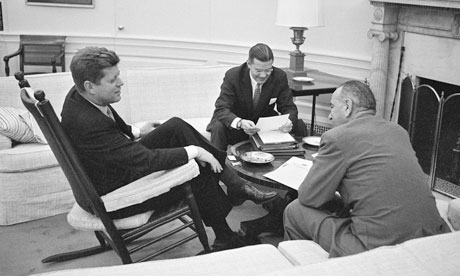
    President John F Kennedy in his office during a meeting with Secretary of Defense Robert McNamara and Vice-president Lyndon B Johnson, at the White House in Washington, DC, 1961.

    Photograph: Henry Burroughs/AP

    This year is the fiftieth anniversary of the Cuban Missile Crisis. Chomsky has chimed in with an article for The Guardian of London. (It can be read here). This article confirms what has been clear to many for a long time. Chomsky is not a historian. And when he gets anywhere near having to deal with the Kennedy assassination, or Kennedy’s presidency, his work is so bad as to be embarrassing. In that regard, he is really a polemicist. Polemicists, by definition, can’t write good or accurate history. And for anyone who did not understand that, this useless article proves it once more.

    Today, there have been at least three books published based upon the actual transcripts of the deliberations of the so-called ExComm. That is, the committee of Kennedy’s advisers assembled to discuss paths of action during the thirteen days that constituted the crisis. The first was The Kennedy Tapes by Ernest May and Philip Zelikow. The second, Averting ‘The Final Failure’ is by Kennedy archivist Sheldon Stern. The third is called The Presidential Recordings, edited by May, Zelikow and Tim Naftali.

    These books are absolutely essential to understanding who President Kennedy really was. Because in this instance, you actually do not have to rely upon memoirs, or memoranda written later. You actually have the words of the participants as spoken right in front of you. And for any objective person, these discussions show just how different Kennedy was from the vast majority of his advisors. This includes Vice-President Johnson, National Security Advisor McGeorge Bundy, and Secretary of State Dean Rusk. At one stage or another these three men all advocated armed intervention to resolve the crisis. And Johnson did not even like the ultimate resolution to the crisis: withdrawal of the American Jupiter missiles from Turkey in exchange for the Russian withdrawal of the missiles from Cuba. He talks about it as leaving the impression “that we’re having to retreat. We’re backing down.” (May and Zelikow, p. 586) Johnson said this even though the Polaris missiles–which were to later serve the same purpose as the Jupiters–were much more modern in both range and accuracy. And since they were submarine launched, they were more difficult to detect and preemptively target. Towards the end of the crisis, Johnson was actually using Kennedy’s nationally televised speech of October 22nd–in which he alerted the pubic to the danger of the Russian installed missiles–against him. The vice-president was saying that the public was going to be disappointed in Kennedy’s performance when compared to his words: “The president made a fine speech. What else have you done?” Even Johnson’s rather friendly biographer, Bob Caro, points out in The Passage of Power that, compared to JFK, during these discussions, Johnson was much more militant in tone and confrontational in approach.

    What does Chomsky say about this most important Kennedy/Johnson juxtaposition? Not a word. Which is about what he said in comparing the policies carried out by President Johnson in Vietnam after Kennedy was killed. In the game of poker, this is called a ‘tell’. Or as Peter Scott terms it, it’s a negative template. Chomsky won’t touch this evidence since it pretty much disintegrates his argument that there was no difference between Kennedy and Johnson in foreign policy.

    So Chomsky now devises another way to attempt to explain why Kennedy sounded so much more dovish during these debates than nearly anyone else in the room. He says that since Kennedy had ordered the installation of the taping system, he knew they were being recorded while the others did not. Again, Chomsky leaves out two important points here. The first is the reason Kennedy ordered the recording devices installed in the first place. As professor Ernest May has stated more than once–for example on ABC’s Nightline–he installed the system because he was upset about how many participants had misrepresented what they said during the discussions leading up to the Bay of Pigs invasion. With the taping system, there could be no argument about who said what and when. Secondly, these tapings were not made public for nearly four decades after Kennedy’s death. If there was some kind of plan to get them out sooner–and show how statesmanlike JFK was compared to everyone else–it was not very effective.

    But the point which Chomsky again avoids is this: Kennedy sounds dovish and level-headed here just as he did during the debates in November of 1961 over whether or not to send combat troops into Vietnam. (See the notes of military attaché Howard Burris dated 11/15/61 in the book Virtual JFK, pgs. 281-83) In other words, it is all of a piece, because it’s the same man. And the taping system is irrelevant to the issue. Why? Because it was not installed in 1961. In that instance, as he was during the Missile Crisis, Kennedy was virtually alone in holding out against the commitment of combat troops to Southeast Asia. And almost every commentator has noted this point, from David Kaiser to Gordon Goldstein. For his own personal, polemical reasons, Chomsky cannot.

    Another piece of flapdoodle that Chomsky tries to peddle here is the actual cause of the crisis. He says that the Russians moved the missiles onto the island in reaction to Operation Mongoose, the secret war against Cuba. To preserve this mythology, Chomsky ignores two pieces of evidence. First, the subterfuge Khrushchev practiced in transporting the weapons across the Atlantic, and second the size and scale of the deployment. Concerning the latter, the eventual arsenal was to consist of the following: 40 land based ballistic missile launchers and sixty missiles. The missiles were of both the medium (1,200 miles) and long–range variety (2,400 miles). These missiles were much more powerful than those used against Hiroshima and Nagasaki. The 9 missile sites were to be protected by 140 air-defense missile launchers. In addition there were to be 40 IL-28 bombers, each capable of carrying a nuclear weapon. This air arm would be supplemented by a submarine pen made up of 11 subs, 7 of them capable of launching nuclear missiles. In other words, the Russians could now threaten America with a nuclear missile arsenal capable of hitting the 100 largest American cities by land, sea and air.

    In addition to this, there was to be a Russian army of 45, 000 troops, with 250 tanks, supplemented by a wing of the latest Russian fighter aircraft, the MiG 21. There were also 80 nuclear-capable cruise missiles for coastal defense. Each of these had the explosive capability of the bombs dropped on Japan in 1945. (May and Zelikow, pgs. 676-77) And, as Kennedy later discovered through U2 photography, the Russians had even given the Cubans a number of Luna ground to ground rockets with a 30 mile range and 2 kiloton warheads. Because of their short range these were termed tactical nukes since they could be used in battlefield circumstances. (ibid, p. 475)

    With these facts on the table, here is my question to the former MIT professor: What use would these nuclear weapons be against a speedboat full of Cuban exiles with rifles, grenades and dynamite sent in to blow up a power plant? Would this not be equivalent to the antique analogy of using a cannon to kill a fly in your house? Why blow up your house trying to kill a fly? Could the Russians and Cubans be this stupid?

    Which relates to the subterfuge. What made Kennedy so suspicious about the deployment was the secrecy surrounding it. Multiplying that was the Russians lying about it. For instance, to choose just one instance, Russian Foreign Minister Andrei Gromyko lied to Kennedy on October 17th by saying that this was only a defensive deployment. If the aim was simply to try and neutralize Mongoose, then all that was needed was the conventional forces. And Khrushchev would have won a great international propaganda victory by announcing a Cuban-Russian military alliance in public, for instance at the United Nations. He could have claimed the diplomatic high ground by saying that this was purely a defensive alliance to defend Cuba from external aggression. If the idea was to fend off a possible invasion then the tactical nukes would have done the trick. And again, an alliance made in public would have been sympathetic to most of the world.

    But he did not. There is no evidence he even contemplated such a public announcement. Why? Because the real motive behind the massive deployment was much wider in scope. It was a way for the Russians to close the missile gap. At the time, only twenty of the Soviet long-range missiles could hit the USA from Russian territory. With what was going into Cuba, the Russians now had a formidable first-strike effort stationed 90 miles away from Miami. And anyone who understands the nuclear terminology of that day will understand how important a credible first strike force was. Secondly, once the secret installation was complete, Khrushchev could then announce it and ask for the thorn in his side to be removed: namely West Berlin. (See Slate, “What the Cuban Missile Crisis Should Teach Us”, by Fred Kaplan. See also May and Zelikow, pgs. 678-79, 691)

    This had been something that had seriously bothered the Russians since the days of the Berlin Airlift of 1948-49. And, more recently, Khrushchev had hectored Kennedy about it at their summit meeting in Vienna in 1961. This would be a significant change in the political calculus of Europe. What Chomsky does by covering up these key facts is to falsely blame President Kennedy while excusing some very irresponsible and reckless gambling by Nikita Khrushchev.

    Chomsky continues in this jingoistic mode when he then names what he thinks should be called the most dangerous moments of the crisis. One of them is on October 27th, when the U. S. Navy, trying to enforce Kennedy’s blockade, had orders to make the Russian submarines surface before they violated the quarantine line. Each Russian submarine carried a nuclear tipped torpedo. American destroyers were to drop depth charges to make the subs surface. Naturally, Chomsky does not reveal the actual instructions given to the American destroyers. They first were to drop “four or five harmless explosive sound signals”, after which the subs should emerge and proceed due east. And, in fact, the State Department told European governments about this technique, including the Russians, in advance. (National Security Archive, Briefing Book No. 399) The problem was that the Russian subs were not getting much information from Moscow and never got this message. They were monitoring Miami stations instead, which of course were carrying much more militant messages. (New York Times, 10/22/12)

    The other moment that Chomsky details is the round the clock B 52 bombers holding their fail safe points in the sky in case of an attack. He states that one pilot, Don Clawson, revealed that there was little control over these flights from Strategic Air Command, and that a rogue pilot could have easily started nuclear war. Chomsky does not say that his source for this is an almost do it yourself book published nine years ago by Clawson himself. The book is a rollicking memoir written 40 years after the fact. In other words, there was no formal input from SAC HQ about what measures really were in place in case this occurred. And Chomsky did not crosscheck his source to see if there was. (This last is a recurrent polemical practice of Chomsky’s.)

    If anyone were to list the most dangerous moments of the crisis, they would have to include three events that need no cross checking. For they have been in the record for decades. The first would be the episode that caused the only fatality by enemy fire during the entire 13-day crisis. That would be the death of Rudolf Anderson. Anderson was America’s top U-2 pilot in 1962. The plane he was flying was clearly marked with Air Force insignia. Khrushchev had assured Kennedy that the Russians would only fire if fired upon. (May and Zelikow, p. 571) The U-2 was a surveillance plane. It was not furnished with missiles or machine guns, only cameras under its wings. And everyone knew that. But, apparently, the Cubans decided to use their Russian furnished surface to air missile sites (SAM’s) near Banes, Cuba to knock the plane down and kill Anderson.

    The information about Anderson’s death was turned over to President Kennedy during an ExComm meeting at 4 PM on October 27th, the day before the crisis ended. (ibid) It gave needed ballast to the hawks in attendance, e.g. General Maxwell Taylor and Assistant Secretary of Defense, Paul Nitze. (ibid, pgs. 571-73) It also seems to have been one of the reasons why Defense Secretary Robert McNamara became more militant during the last two days of the crisis. (The other factor influencing McNamara seems to be Johnson’s not very subtle war mongering.) Following the news of Anderson’s death, there were pleas by Taylor, Bundy and Nitze to immediately take out the SAM sites. (ibid, pgs. 571-72) McNamara moved to take out the Banes SAM site and begin a much larger air attack against the island on the 31st. (ibid, pgs. 571, 575) Kennedy dutifully listened to these proposed courses of action due to this provocation. He then skillfully bent the discussion around to formulating a reply to Khrushchev’s letter requesting a deal for the Jupiters. (ibid, p. 576) There ended up being no retaliation to this reckless shoot down of an unprotected surveillance pilot. (Which, one could argue, was really tantamount to murder.) In fact, there was actually a contingency plan in place which necessitated an agreed upon retaliation. Kennedy overruled that plan and held back the air strike. (ibid, p. 695)

    Another dangerous moment came when Castro actually wanted to launch nuclear missiles against the USA. (ibid, p. 688) In other words to strike first, therefore surely starting a chain reaction leading to nuclear Armageddon. Or as Fidel Castro put it none too subtly to the Russian representative, he was ready to launch against the USA and risk incinerating Cuba in a counter attack. Alexander Alekseev was shocked. But he dutifully relayed the message to Moscow. (The Armageddon Letters, edited by James Blight and Janet Lang, p. 116) At the conclusion of the crisis, Khrushchev chastised Castro for even proposing such an act under these circumstances. He characterized such a proposal to carry out a nuclear first strike against enemy territory as “very alarming”. He continued with: “Naturally you understand where that would lead us. It would not be a simple strike, but the start of thermonuclear world war.” (May and Zelikow, op cit.)) Apparently, since Castro was and is a Marxist, in Chomsky’s book, these kind of inexcusable acts are to be ignored. To dramatize the polemicist’s double standard: Imagine what Chomsky would say if President Kennedy was on record uttering such a thing. But not only does Chomsky not comment on this nutty request by Castro, he does something even worse. He does not tell the reader about it. That act of censorship tells you all you need to know about Chomsky’s fairness and honesty in this article.

    There was another nominee for most dangerous moment. And again, you will not find it in Chomsky’s article. During the crisis, CIA officer William Harvey—a man who despised the Kennedys—secretly dispatched several teams of Cuban exile paratroopers onto the island. (Larry Hancock, Nexus, p. 80) Harvey never fully revealed what the mission of these men actually was. But since he constantly assailed the Kennedys for not having the guts to get rid of Castro once and for all, one can imagine what he had in mind. Furthering this thesis was the fact that these men were on a secret radio frequency, so that when Bobby Kennedy found out about it, he could not recall them directly. (ibid, p. 70) RFK was enraged when he found out what Harvey had done. And this was the beginning of the end for Harvey’s storied CIA career. The reason Chomsky will not touch this incident is that it violates another aspect of his special and peculiar ideology. Namely, his belief that the CIA only performs functions requested by the president. Yet, under Kennedy, the CIA often enacted autonomous actions.. (And there are many examples in both Hancock’s book and Jim Douglass’ JFK and the Unspeakable.) But Chomsky cannot admit this, no matter how foolish it makes him look. Because it would indicate that, 1.) The CIA and President Kennedy had different aims, and 2.) The Agency did not just enact policy. At times, it made its own.

    Let us continue with just how bad the Marxist leadership was leading up to and during the crisis. On September 4th, after getting preliminary intelligence reports about construction on Cuba, Kennedy had specifically warned the Russians about using the island as a forward base in the Americas. And he told Russian ambassador Anatoly Dobrynin that he would not tolerate purely offensive weapons in Cuba. He then said the same in public. (Blight and Yang, pgs. 58-59) In his reply to Kennedy’s warning, Khrushchev again lied. He said the only nuclear missiles he had trained on the USA were based in Russia. (ibid, p. 62) In July of 1962, Castro asked him: What would happen if the USA discovered the installation in progress before it was completed? Khrushchev responded with a reply so ridiculous that it must have disheartened Fidel. The Russian premier said he would send out the Baltic fleet as a show of support. (May and Zelikow, p. 677) This silly response, from a man who held the fate of the world in his hands, showed that Khrushchev had not thought through all the possibilities the dangerous installation entailed. To top it all off, the premier tried to end game the worst scenario. That is the Americans launching a counterforce attack on the Cuban missiles. The premier felt that even if this was 90% effective, “even if one or two big ones were left—we could still hit New York, and there wouldn’t be much of New York left.” When Khrushchev was ousted from office in 1964, his irresponsible actions before and during the crisis were named as prime reasons for his removal. (May and Zelikow, p. 690) Again, none of this is deemed worth mentioning by Chomsky. Probably because in his world no Marxist can do anything wrong.

    Chomsky also tries to imply that the resolution to the crisis was done by the Russians alone. He mentions the arrival of Khrushchev’s letter of October 26th at the State Department. This letter outlined a deal that would entail the removal of the Russian missiles in return for a pledge by Kennedy not to invade Cuba. The Russians later added that they also wanted the Jupiter missiles removed. Kennedy agreed to both parts of the deal. But what Chomsky leaves out is that Kennedy himself proposed the Jupiter swap more than a week before. At an ExComm morning meeting of October 18th he specifically proposed a direct trade of the Jupiters in Turkey for the Russian missiles in Cuba. (May and Zelikow, p. 137) On October 23rd he authorized his brother Robert to create a back channel to Russian Ambassador Dobrynin through Russian representative Georgi Bolshakov. (ibid, pgs. 343-46) This culminated in a formalization of the Jupiter deal as an adjunct to the no-invasion pledge. Chomsky criticizes Kennedy for not announcing this at the time. He leaves out the fact that JFK anticipated that Castro would create problems with verifying the removal of all arms of the nuclear triad from Cuba. And therefore it would take awhile for the Russians to complete their part of the deal. He was correct about this. It took over a month to complete the negotiations for verification. (May and Zelikow, pgs. 664-66)

    Chomsky’s failings as a historian are nowhere more obvious then in his discussion of Cuban-American relations in 1962-63. For instance, he writes that a plot to assassinate Castro was apparently initiated on the day of Kennedy’s murder. Chomsky is referring to the so-called AM/LASH plot. This maneuvering of the CIA with disenchanted Cuban national Rolando Cubela was not initiated in November of 1963. It had been going on for many months. And it had nothing to do with the Kennedys. (James DiEugenio, Destiny Betrayed, Second Edition, p. 73) The CIA deliberately kept it secret from JFK since they knew he would not approve it. Chomsky cannot admit this, even though it’s true, because it again shows the CIA and Kennedy at cross-purposes. He follows this by saying Mongoose was terminated in 1965. Wrong again. Mongoose was ended on November 29, 1962 at an NSC meeting of that day. (See Volume XI of Foreign Relations of the United States, Document 217) Chomsky mentions an attack on Cuba of November 8th. What he does not say is this was a response to a devastating Cuban attack in Venezuela that “had reportedly destroyed or disrupted one-sixth of the [oil] refining capacity of Venezuela….” (May and Zelikow, p. 639. Chomsky adds a reference to a contemplated invasion of Venezuela here. This appears to be fabricated since there is no such mention of any such event in the transcripts.)

    But the real point is that Kennedy began to dismantle Mongoose almost immediately after the Russian removal was verified. Cuban exile operations were severely curtailed, stipends were withdrawn, and groups were disbanded. By mid-1963, for all intents and purposes,Mongoose had been all but eliminated. As CIA official Desmond Fitzgerald wrote to President Johnson in 1964, in the second half of 1963 there were all of five raids against Cuba. The entire commando force consisted of fifty men. (Op, cit. DiEugenio, p. 70) Kennedy had clearly decided to pursue back channel negotiations with Castro with the goal of achieving normalization of relations with Cuba. The goal appeared to be in sight when Castro got the news of Kennedy’s death. He then turned to Kennedy’s representative Jean Daniel and said, “Everything is changed. Everything is going to change.” Castro was correct. Johnson showed no interest in continuing Kennedy’s goal of détente with Cuba. (ibid, pgs. 73-75) When Chomsky writes that the majority of Americans favor normalization of relations with Cuba, yet our leaders dismiss this opinion, one does not know whether to laugh or cry. Johnson cut off Kennedy’s eleven months of negotiations to achieve just that. And no American president since has ever come as close as JFK did to doing just that. And Castro himself admitted this at the time.

    The silliest part of this all too silly article is toward the end. Chomsky writes that war was avoided in 1962 “by Khrushchev’s willingness to accept Kennedy’s hegemonic demands.” When he writes something like that, one wonders if, unawares, Chomsky has Alzheimer’s disease. It was Khrushchev’s attempt to establish hegemony over West Berlin that originated the crisis. It was his insistent ignoring of Kennedy’s warnings over this first strike capability that brought the crisis to fruition. It was the premier’s lies about his intent that exacerbated it all. It was Castro’s orders to kill an American pilot that almost escalated the crisis beyond saving. And it was Castro who wanted to launch a first strike that would have led to Armageddon. The deal that Kennedy had contemplated all along was a good one for the Russians. Cuba stayed protected as a Marxist bastion, as it has to this day. After negotiations with NATO ally Turkey the Jupiters were removed. All that the USA got was the removal of a first strike threat—one which should have never been installed. And needless to say the Russians eventually caught up and actually surpassed America as a nuclear power. Gaining no real advantage at a great financial cost.

    Chomsky has now been proven both wrong and misleading on both Kennedy and Vietnam, and the Missile Crisis. But it’s worse than that. Chomsky simply has no regard for facts or evidence in the two cases. The mark of a good historian is that he provides balance and proper context first. He then produces the totality of the evidence, or close to it. His conclusion then follows inductively from the evidence. Chomsky violates each one of these strictures. Which is why his conclusion is so easily reduced to absurdity. In fact, his performance here is so bad, that when linked to his record in defending Pol Pot, his friendly ties to Holocaust deniers, and his flip-flop on the question of Kennedy’s assassination, the best thing his friends and colleagues can do is advise him to retire. The man is 84 years old. And his mental faculties seem to be failing him. Rather than embarrass himself further, it would be better if he spent the twilight of his life fishing off the Massachusetts coast. That would be better for him, the historical record, and us.

  • Peter Janney, Mary’s Mosaic (Part 2)

    Peter Janney, Mary’s Mosaic (Part 2)


    Mary’s Mosaic, Part 2: Entering Peter Janney’s World of Fantasy
    Part One by Lisa Pease


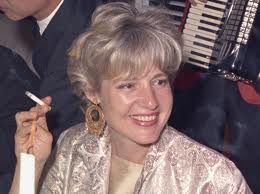
    Mary Meyer
    Mary Meyer

    The first two people to inform me of Peter Janney’s upcoming book on Mary Meyer were Lisa Pease and John Simkin. Many years ago I wrote a two-part essay for Probe called “The Posthumous Assassination of John F. Kennedy” (This was later excerpted in The Assassinations.) The first part of that essay focused on the cases of Judith Exner and Mary Meyer giving me a background and mild interest in the subject. Consequently, when Lisa Pease told me about Peter Janney I wondered what kind of book he was going to write. After Lisa exchanged e-mails with him she told me not to expect much, since Janney had bought into Timothy Leary hook, line and sinker.

    JFK forum owner John Simkin’s backing was a real warning bell. For two reasons: first, Simkin is an inveterate Kennedy basher. He once wrote that Senator Kennedy was the choice of the so-called “Georgetown crowd” for the 1960 presidential election. Most accurately described as Georgetown, which seemed to house half the hierarchy of the State Department and the CIA and the journalistic establishment, many of whom gathered for argumentative high-policy dinner parties on Sunday nights (‘The Sunday Night Drunk,’ as one regular called it.” Smithsonian magazine, December 2008) This shows that Simkin is the worst kind of Kennedy basher: the kind that knows next to nothing about Kennedy. If Simkin was backing Janney’s book then I naturally figured the plan would be to aggrandize Meyer and diminish Kennedy. (Which, as we shall see, is what happened.) Second, Simkin said that Janney would be taking up the late Leo Damore’s work on Meyer. The dropping of Damore’s name and work really raised my antennae. Although Simkin praised Damore with Truman Capote type accolades, I discounted all of them. Why? Because I had read Senatorial Privilege, Damore’s book about Ted Kennedy and the Chappaquiddick tragedy. (Senatorial Privilege: the Chappaquiddick Cover-Up, Regnery Gateway 1988) I knew about the controversy surrounding that book. In addition to being sued by his original publisher to get their advance back, Damore was also sued by one of his interview subjects, Lt. Bernard Flynn. Flynn declared that Damore had an agreement with him in which he was promised $50,000 for his cooperation in writing the book. (Sarasota Herald Tribune, 7/10/89) Checkbook journalism was almost to be expected for that book and so was Damore’s excuse for why Random House had declined his manuscript, namely that the Kennedys were behind it. (A premise, as Lisa Pease noted, which the judge did not accept.)

    Rejected by Random House, Damore was then picked up by rightwing political operative Lucianne Goldberg. With her leading the way, Damore signed with the conservative oriented publishing house Regnery. This move showed that Random House was correct in divorcing themselves from Damore because, unlike Random House, Regnery did not review the book’s facts or interpretations. As James Lange and Katherine DeWitt show, Damore distorted his book so much that its main theses were not supportable. (Chappaquiddick the Real Story by James Lange and Katherine Dewitt, July 1994)
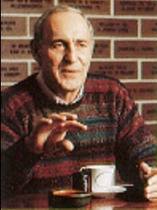
    Damore
    Leo Damore

    Damore picked up John Farrar’s unlikely theory that the drowned Mary Jo Kopechne could have survived for hours in the overturned car by means of an “air pocket”. The problem is that Farrar was not in any way a forensic pathologist or experienced crime scene investigator. He was the manager of the local Turf ‘N Tackle Shop and supervisor of the local Fire and Rescue unit where he did have experience with scuba searches and rescues. For as Lange and DeWitt show, three of the four windows in the car were either blown out or open as the car drifted underwater. (ibid, p. 89) Since Kopechne was in the front seat, the current was raging, and water pouring in, how could she have survived in an air pocket? Second, Farrar and Damore ignored the danger of hypothermia, which is the cooling of body temperature from water that can lead to death. (ibid, p. 83) Further, as Lange and DeWitt show, there was no collusion by the Kennedys to gain favorable treatment. Damore misquoted the laws of Pennsylvania where Kopechne was buried in order to make that faulty impression. (ibid, p. 156) Relying on an estranged and embittered Kennedy cousin Joe Gargan, Damore tried to say that Ted Kennedy wanted him to state that someone else drove the car. (ibid, p. 81) As more than one commentator has written, the problem with this is that Ted Kennedy never made this request at any time. It comes from Gargan and Gargan himself did not say it until 14 years after the fact. Damore bought it whole.

    The worst part of Senatorial Privilege is the title. Because, as Lange and DeWitt demonstrate, Ted Kennedy did not get preferential treatment. He got what any other citizen would have gotten back in 1969 if he could afford a good lawyer. Lange was an attorney who specialized in these types of cases, personal injury and car accidents. On the criminal side, Kennedy was liable for the charges of leaving the scene of an accident and reckless driving. On the civil side, he and his insurance company paid out $140,000 to settle with the Kopechne family for wrongful death. (About a half million today.) And that was what anyone else could expect under these circumstances. Keep in mind this incident preceded the formation of Mothers Against Drunk Drivers and the escalating penalties for DUI’s. There simply was no other credible evidence to sustain any other charges. Consider what Joseph Kopechne, father of Mary Jo, said in this regard, “I can understand shock, but I cannot understand Mr. Gargan and Mr. Markham. They weren’t in shock. Why didn’t they get help? That’s where my questions start.” (ibid, frontispiece)

    This comment cuts to the heart of the matter. Gargan and Markham were the two people who Kennedy went to after he tried repeatedly to rescue Kopechne from the car. There is no doubt that Kennedy was suffering from a concussion. It was so bad that his doctors were thinking of doing a lumbar puncture (spinal tap) to see if there was brain damage. (ibid, pgs. 47, 72) This explains his shock, disassociated state, and his retrograde amnesia. And this is where Gargan and Markham should have stepped into the breach and gotten Kennedy to a hospital, or called the Coast Guard or police. They did neither.

    For me, the Lange and DeWitt volume is the best book on that subject and they, not surprisingly, had some unkind words for Damore as an author. They said the problem with Damore was that he believed anyone. Without checking up on what they said – even when it was easy to do so. They were also specific about two serious background defects Damore had as a writer. He was very weak on the legal research side and his knowledge and skill in forensic science left much to be desired. (ibid, p. 269)

    As stated, Damore was working on a book about Mary Meyer when he died. The late Kennedy researcher and author John H. Davis was briefly associated with the project, but he did not proceed. Peter Janney then decided to pick up where Damore left off. A major problem with Janney is this: He never questioned anything that Damore did previously even though Senatorial Privilege tended to show that Damore was an agenda driven kind of an author who did not do his necessary homework. Further toward the end of his life Damore was suffering from some serious psychological problems that were manifesting themselves in visible ways. Both areas should have been addressed by Janney.

    Before leaving Damore for now, let me note one more important fact about both him and Janney. The text of Janney’s book runs for almost 400 pages yet you will not see the quote that Damore gave to The New York Post about where his book was headed: “She (Meyer) had access to the highest levels. She was involved in illegal drug activity. What do you think it would do to the beatification of Kennedy if this woman said, ‘It wasn’t Camelot, it was Caligula’s court.’” (Damore biography at Spartacus Educational site.) Caligula was the ancient Roman Emperor who was said to have had incest with all three of his sisters, opened a brothel in a wing of the imperial palace and wanted to make his horse into a consul. This revealing statement illustrates the complaints that Lange and Dewitt had about Damore as an author. That is, he believed anyone without doing any checking or homework because, as we will see, there is virtually no credible evidence to support any of that statement.

    II

    There are two reasons I spent some time on Leo Damore. First, as stated, much of what Janney writes derives from Damore. Second, the portrait drawn of Damore as an author is seriously skewed by both Janney and his promoter Simkin. (Simkin actually pushed Janney’s work on writer David Talbot, and he included it in his book Brothers: The Hidden History of the Kennedy Years. A segment that seriously flawed a fairly good book.) This skewing of Damore is echoed throughout Mary’s Mosaic. Janney’s book is so preconceived, so agenda-driven, so monomaniacal, that the character portraits the author draws can kindly be called, stilted. Unkindly, one could say they are distorted, almost grotesque. Before getting into this baroque gallery of caricature, let me briefly summarize the story that Janney is at pains to portray.

    Mary Pinchot was the sister of Antoinette Pinchot. Antoinette was the wife of Ben Bradlee, future editor of the Washington Post. Mary Pinchot married Cord Meyer, a rising star in the World Federalist movement who eventually joined the CIA and rose to an officer’s status. The Meyers divorced in the late fifties after having three sons. Mary then began to cultivate what appears to have been a hidden but real talent for painting. Due to the fact that her sister was friends with the First Lady, and Ben Bradlee was friends with President Kennedy, she was often invited to the White House. Less than a year after Kennedy was assassinated, Mary Meyer was killed while jogging. The accused assailant, for whom there was plentiful probable cause, was Ray Crump. Crump was acquitted due to the services of a bright and skillful lawyer named Dovey Roundtree. It is important to note that, up to this point, 1964-65, there was nothing more to this story. Mary Meyer was killed, the only suspect was acquitted and that was that. It was not until 12 years later that the story began to mastasize itself. Through former Washington Post/Newsweek reporter James Truitt, The National Enquirer now wrote that Mary was having an affair with JFK and this included a claim of them smoking grass in the White House. This revelation was not enough for Timothy Leary. Several years after the National Enquirer story surfaced, Leary then added to it by saying that Meyer and Kennedy were not just toking weed, but dropping LSD. And that he supplied it to Mary. Although according to Leary, Mary never named JFK, Leary adduced that Kennedy was killed because Mary had given him LSD and this had turned a cold warrior into a peace seeker.

    This was the tale that Damore picked up and Janney then completed. They add to it that Mary had somehow become disenchanted with the national security state, and had become some kind of foreign policy maven. She was therefore advising former cold warrior Kennedy in 1963. After Kennedy was killed, she suspected that it was a high level plot. She also figured out that the Warren Report was a cover up. The CIA learned about this and decided to have her eliminated in an elaborate, commando type of plot in which Ray Crump was an innocent bystander.

    The reader is familiar with the old saying that extraordinary claims demand extraordinary evidence. If not, they are reduced to empty bombast. This book is filled with claims and revisionism that are so extraordinary that they are startling. The problem is that there is a paucity of evidence for them that is simply appalling. It is so appalling that, for the experienced and knowledgeable reader, one has to wonder why Janney wrote the book. After reading it, and taking 15 pages of notes, I think I figured it out. And it relates to the problem of his skewed portrayal of Damore.

    Peter Janney
    Peter Janney
    marysmosaic.net

    When the Meyers were married and Cord worked for the CIA, their family became friends with the Janney family. Peter Janney’s father was a CIA analyst. The Janney children therefore knew the children of Cord and Mary Meyer. It is fairly clear from his description of her that young Peter Janney became enamored with Mary Meyer early in life. While playing baseball at her house he raced around to retrieve the ball and discovered her sunbathing nude. This is how he describes the scene: “She lay completely naked, her backside to the sun. I was breathless… and I stood there for what seemed to me a very long time, gawking. At the time, I had no words for the vision that I beheld….” (Janney, p. 12) If this is not enough, he then adds to it by saying this experience had left him “somehow irrevocably altered, even blessed.” (ibid) So, for Janney, seeing Mary Meyer’s nude backside was a quasi-religious experience that altered him permanently. To make this point even more clear, it is echoed when Janney learns that Mary Meyer is dead. He says he crawled up into bed in a fetal position. He adds that his sleep was fitful that night as he wrestled with the fact of her death. (p. 14) The problem with this early infatuation is that Janney kept and nurtured it his entire life. Anyone can see that by the way he approaches her. He doesn’t write about the woman. He caresses her in print. This is not a good attribute for an author. For it causes the loss of critical distance. As Dwight MacDonald once wrote about James Agee, a far superior writer to Janney, “The lover sees many interesting aspects of his love that others do not. But he also sees many interesting ones that aren’t there.” This is clearly the case here. For the aggrandizement of Mary Meyer in this book is both unprecedented and stupefying. If Janney could back it up with credible evidence, it would be one thing. He doesn’t. Therefore it gets to be offensive since it says more about Janney’s childhood wish fulfillment than it does about Mary Meyer.

    But there is something even worse at work here. Since Mary Meyer is to be the exalted center of the book’s universe, this means that all the other personages rotating around her will be defined by Janney’s blinding portrait of Mary. Cord Meyer is insensitive, brooding, and worst of all, no fun. James Truitt, Mary’s friend who started it all off, has been maligned. Ron Rosenbaum and Philip Nobile, who wrote an extended essay on the search for Mary’s “diary”, are independent, and searching authors wedded to the truth. Ray Crump is an innocent naïf who just happened to be at the scene of a CIA hit. And, worst of all, John Kennedy was an empty playboy who needed to be guided to his vision of world peace by Mary Meyer and, of all people, Timothy Leary.

    The problem with all the above is not so much that its wrong – it is. But that, as with his portrait of Damore, Janney tries to juggle and curtail and borrow from certain sources in order to make it seem correct to the novice reader. Most readers, of course, are not aware of the juggling, curtailment, and borrowing, or the reliability of the sources. To demonstrate, let us start with the two most important people in the book: Meyer and Kennedy. As I noted, Janney tries to portray the young Mary Meyer as something like a supernatural being who is not so much headed for Vassar as Valhalla. Consider this: “Was it encoded in Mary Meyer’s DNA to be so independent, strong-willed, even courageous? Quite possibly yes.” (Janney, p. 145) Or this: “For her life’s mosaic only begins to reveal the complexity and uniqueness of a woman…. This remarkable odyssey… reveals a glimpse of a strikingly rare and exceptional woman….” (Ibid, p. 144) Oh my aching back. After reading this I wrote in my notes: “Is he serious? The reason we are talking about Mary Meyer is twofold: her brother-in-law was Ben Bradlee and her husband was Cord Meyer.” That might seem cold, but it’s a lot closer to the truth than the hot air Janney spews.

    Why do I say that? Because there is no credible evidence to show that Mary Meyer was the foreign policy maven that Janney wants – needs – her to be. The closest that anyone can come is to say that she once worked as a reporter for both NANA and UPI. (Janney, p. 159) She also freelanced articles to Mademoiselle on things like sex education and venereal disease. (New Times, July 9, 1976) This was in the early to mid forties. So what does Janney do to fill in the breach of the intervening years? He tries to say that Mary, the housewife and mother, furthered this interest while married to Cord Meyer while he was president of United World Federalists (UFW). So I went to Cord Meyer’s book Facing Reality to see if there was any proof of this. There isn’t. For example, while on a working holiday, Mary was not helping him write, she was fishing. (Meyer, p. 39) In fact, Cord Meyer actually writes that his position in UWF had created a distance between him and his family and this is one reason he resigned. (Meyer, pgs. 56-57) Cord then went to Harvard on a fellowship in 1949-50. If Mary had any special interest in foreign affairs, this was the place to develop it. Yes, she did take classes, but they were in design. And this is where she first discovered her painting ability. In 1951, Cord Meyer is about to join the CIA. If Mary had really been helping Cord in his UFW work, wouldn’t she have said “No, that is not what we believe in.” Again, the opposite happened. Mary was all in favor of him joining the CIA. (Ibid, p. 65) But further, Cord Meyer kept a journal. In his book, when he is discussing their decision to divorce, the split in not over the nature of his work. Its simply because he spends too much time on it and therefore is not a good husband since he doesn’t take enough interest in her. (ibid, p. 142) This, of course, is a common complaint among housewives.

    After this, when the two separated and then divorced in the late fifties, Mary got custody of the two sons. Therefore, she raised them and worked on her painting. She was under the instruction of one Ken Noland. Noland was not just her instructor, she also slept with him and their relationship went on for a while. But he was not the only one for Mary Meyer was involved with several men after her divorce. (ibid, New Times) So, as unconventional as Mary’s life seemed to be, where did she get the time and knowledge to become, in Janney’s terms, Kennedy’s “visionary for world peace”? While Meyer was quite intelligent and studied, the evidence for this is simply not there. This is the price a writer pays when he idealizes his subject beyond recognition.

    But it’s worse than that. As I said, Mary is Janney’s sun, everything else in the book revolves in a direct relationship around her. Therefore to fulfill his childhood dream of Mary as JFK’s muse, not only does Janney exalt Mary, he must then diminish Kennedy beyond recognition. I was a bit surprised as to how he accomplished this. In this book, any kind of CIA source, including Janney’s father, is suspect in regards to Mary, as is the Washington Post. But yet, this standard is reversed with Kennedy. For Janney now uses authors like Post favorites Peter Collier and David Horowitz to characterize the young Kennedy as the empty young playboy who first encounters Mary Meyer when he was a college freshman. He also trots out, of all people, CIA asset Priscilla Johnson. But that’s just the beginning. Janney is so intent on reducing Kennedy to Hugh Hefner that he then hauls in books like Kitty Kelley’s biography of Jackie Kennedy, and even Edward Klein, who has been convincingly accused of manufacturing quotes. Seeing this pattern, I waited for Janney to drop the neutron bomb. That is, Seymour Hersh’s piece of discredited tripe, The Dark Side of Camelot. He didn’t disappoint me. It’s there at the end of Chapter 8, with all the other rubbish.

    Janney has to do this because he simply will not let anything – like facts or evidence – counter his agenda. For if he did try to present the true facts about young John Kennedy it would undermine the picture he is laboring so hard to etch. For instance, Janney writes, “Jack Kennedy entered his presidency as an avowed Cold Warrior.” (Janney, p. 234) He says this because he needs to portray Mary as Kennedy’s guide to a different world. There’s a big problem with this: It’s a lie.

    John Kennedy did not need a Mary Meyer to tell him anything about what his foreign policy vision was. As anyone who has read good books about Kennedy knows, his unusual ideas about the United States, Russia, the Cold War and communism did not begin with the Truitt/Leary fantasy about drugs in the White House. Kennedy’s education went back over a decade earlier. This was when young congressman Kennedy visited Saigon in 1951 to find out what the French colonial war there was actually about. There he discovered a man named Edmund Gullion. Gullion worked in the State Department and understood what was really happening in Indochina. He told Kennedy that the conflict was not about communism versus democracy. It was about national liberation versus European imperialism. And the French could never win that struggle since Ho Chi Minh had galvanized the populace so much around the issue that thousands of young men would rather die than stay under French rule. (Richard Mahoney, JFK: Ordeal in Africa, pgs. 14-15.) This visit was the key to turning Kennedy’s views around on this issue. Kennedy never forgot Gullion, who was his real tutor on the subject. Once he became president, Gullion came into the White House. Predictably, you will not find Gullion’s name in this book.

    Now, if Janney were really interested in finding out the truth about Kennedy, after establishing this fact, he would have then done two things. First, he would have asked: Why did the congressman do what he did in Saigon? He didn’t have to go off the beaten track like that. He could have just swallowed the hokum about communism, the domino theory and the Red Scare. How do you explain what he did as he was now about to embark on a race for the Senate? Secondly, the author then would have traced the speeches Senator Kennedy gave pummeling the Dulles brothers, Eisenhower, Nixon and the Establishment’s view of the Cold War. These speeches are plentiful and easy to find. One can locate them in the Mahoney book or in Allan Nevins’ The Strategy of Peace. Kennedy continually railed against John Foster Dulles’ hackneyed and Manichean view of the Cold War. In 1957 Kennedy said, “Public thinking is still being bullied by slogans which are either false in context or irrelevant to the new phase of competitive coexistence in which we live.” (Mahoney, p. 19) In 1956, he made speeches for Adlai Stevenson in this same vein. Stevenson, the darling of the liberal intelligentsia, thought they were too radical and told him to stop. (ibid, p. 18) Then, in 1957, Kennedy rose in the Senate to make his boldest attack yet on the White House and it’s backing of European colonialism. This was his blistering speech concerning the administration’s inability to talk France out of a second colonial civil war, this time in their North African colony of Algeria. (ibid, pgs. 20-21)

    Janney cannot present Kennedy honestly – even though this information is crucial to understanding the man – because that would make him too interesting and attractive to the reader. For the enduring attraction of John F. Kennedy is this: How did the son of a Boston multi millionaire sympathize so strongly with the Third World by the age of 40? For that is how old Kennedy was when he made his great speech about Algeria. That seeming paradox seems to me much more important and interesting than any aspect of Mary Meyer’s life. But beyond that, it would show that Kennedy was anything but a Cold Warrior when he entered office in 1961. This is all demonstrable because it was this decade long education that made Kennedy break so quickly with Eisenhower/Dulles in 1961 and on so many fronts e.g. Congo, Indonesia, Laos, Vietnam, and Iran.

    So this whole idea that Janney is peddling, that somehow a single mom and fledgling painter like Mary Meyer was going to teach the sophisticated John Kennedy what the likes of Gullion, John K. Galbraith or Chester Bowles could not, this is simply not tenable. It can only exist in utter ignorance of who Kennedy really was, way before he got to the White House. So when Janney tries to pull off a rather cheap trick, as he attempts to do on pages 259-74, for anyone who knows Kennedy, it’s transparent. What he does here is set up Jim Douglass’ JFK and the Unspeakable on one side of the table. On the other he has a calendar of when Mary was at certain presidential functions in 1963. He then tries to argue that, somehow, if she was there when such a thing happened, then she had advised JFK to do it. Once you understand the method, it gets kind of humorous to watch. For instance, when Kennedy goes to the Milford, Pennsylvania Pinchot estate for a family dedication in September of 1963, he is about to announce NSAM 263, the withdrawal order from Vietnam. Also, the back channel with Fidel Castro is heating up with Cuban diplomat Carlos Lechuga, ABC reporter Lisa Howard and American diplomat Bill Attwood. Presto, Mary is again responsible. (By the same logic, Kennedy’s limo driver could have been advising him also, since he was there too.) What Janney doesn’t tell you is that Kennedy’s withdrawal plan began two years earlier, in the fall of 1961. That’s when he sent John K. Galbraith to Saigon in order to present a report to Secretary of Defense Bob McNamara recommending a draw down in American forces. (James Blight, Virtual JFK, pgs. 72-73) The back channel actually began in late 1962 and early 1963, when New York lawyer James Donovan was negotiating the release of the Bay of Pigs prisoners. (See Cigar Aficionado, “JFK and Castro”, September/October 1999.) An author should not deprive the reader of important information like that. But this is how intent Janney is to abide by his Mary Meyer social calendar so he can make something out of nothing. Its also how intent he is on diminishing Kennedy. In reality, this information proves the Timothy Leary part of this fairy tale is an utter fabrication and that Janney and Damore were suckers to buy into it. Kennedy needed nothing from Leary’s psychology or mind enhancing to achieve his goals.

    First, Leary had written literally dozens of books prior to his 1983 opus Flashbacks. (In Flashbacks, Leary said he slept with Marilyn Monroe. I have little doubt Janney buys that also.) For my earlier essay, I waded through the previous books one by one trying to find any mention of the episode that – mirabile dictu – first appeared there. For it was in 1983 when Leary first wrote about a scene in which this striking looking woman comes to see him back in the early sixties. Her goal is to turn on some powerful people in Washington. So Leary supplies Mary with mind-altering drugs. Then, in early 1964, she comes in looking sad. She says words to the effect: “he was changing too fast”. The implication being that somehow the combination of Mary’s (phantom) knowledge and Leary’s drugs made JFK see the light. Leary was so desperate to sell his book Flashbacks that he didn’t do his homework. He didn’t notice that even though he had written over 20 books previously, and had 21 years to do so, he never once mentioned this unforgettable and crucial incident in the thousands of pages he had already published. Somehow it slipped his mind. Maybe because it didn’t happen?

    Second, Kennedy did not need either him or Mary Meyer to construct a vision of how he was going to alter American foreign policy. As I have shown above, he had been preparing for that well in advance and immediately got to work on it in 1961. The exposure of Leary as a fabricator, along with the facts about Kennedy’s real foreign policy ideas, this combination obliterates one of the book’s main theses and with it, two entire chapters: 9 and 10.

    III

    Janney needs to have a reason for Meyer to be killed by someone besides Crump. So what did he and Damore dream up as a motive for a precision commando team to do away with the single mom who was trying to be a painter? According to the two sleuths it was this: Mary doubted the Warren Report. (Janney, p. 329) Yep, that’s it. We are supposed to believe that the CIA so feared the single mom’s Vincent Salandria-like forensic skills that they decided to kill her. The problem with this is that there isn’t any credible evidence for it. But that’s no problem for Janney and Damore. They find a way around it. According to Janney, Mary must have read Mark Lane’s critical essay about the Commission in The Guardian in December of 1963. She must have read the New Republic piece called Seeds of Doubt by Staughton Lynd and Jack Miniss also. And, of course, Mary had to have read the article by Harry Truman in the Washington Post, which really is not about Kennedy’s assassination, but about how Truman felt the CIA had strayed from its original mission. I think this is what Janney is saying. Since he spends six otherwise unnecessary pages describing these 3 essays. (pgs. 297-302) The problem is there is no evidence, let alone proof, she did any of this, or was even interested in it. Just as there is no proof that Mary discussed the assassination with William Walton. Even though, if you can believe it, Janney spends five pages on that possibility. (pgs. 302-06) Janney apparently thinks that if he describes something long enough we will be convinced that Mary read it. Not so. For anyone who sees through that tactic, this material is empty filler.

    But then comes something that had me agog. It was bold, even for Janney. Janney writes that, when the Warren Report was published, Mary rushed out and bought it. She read it carefully and she became fully enraged by the cover up taking place. She even had notes in the margins, with many pages dog-eared for future reference. Now, let us step back from this construct for a moment. The report was issued on September 28, 1964. Meyer was killed on October 14th, about two weeks later. Janney wants us to believe that the fledgling painter with two kids and a number of boyfriends read the 888 page Warren Report, fully digested it, and thoroughly deconstructed it in two weeks. As someone who has actually studied the Warren Report, I found this quite far-fetched. So much so that it made me wonder if Janney had actually even read that volume. I really don’t think he has. Because the Warren Report has over 6,000 footnotes to it. Almost all of them are to the accompanying 26 volumes of hearings and exhibits. And those were not issued until after Mary was killed! It would have been difficult for anyone to understand the report enough to be “enraged at the cover up” without seeing the back up evidence. The first person to actually do this was Vince Salandria, an experienced lawyer, and it took Salandria months to assemble and break down the evidence in the volumes. Unless there were evidence showing she was in communication with someone who was following the government’s investigation closely, are we really to believe that painter Mary could do in a flash what it took lawyer Salandria months to achieve? Please.

    But let us grant Janney his miracle. Maybe Mary took Evelyn Wood classes in speed-reading. Maybe she made secret trips to Dallas. Maybe, through her ex-husband, she got Warren Commissioner Allen Dulles to give her an advance copy of the Warren Report and the volumes. Let us grant Janney any or all of these necessary illusions. How was this single mom, this private citizen with no official position anywhere, going to do anything about the media’s embrace of the Commission? If we are old enough, let us think back to the release of the Warren Report. Every single arm of the mainstream media was broadcasting how great the report was, and in the most thunderous and unqualified terms. It was a coordinated propaganda operation run out of the White House, with help from the United States Information Agency. Was Mary going to march into the local CBS affiliate and demand airtime? Was she going to fly to New York and request a coast-to-coast hook up from NBC? While there, would she demand a front-page article in the New York Times? That was not going to happen in 1964 or 1965. Not with people like Bill Paley (CBS) and David Sarnoff (NBC) in charge. Was she then going to go to her brother-in-law, Ben Bradlee, then of Newsweek, later the Washington Post? Because Bradlee obviously didn’t publish anything suspicious of the Warren Report regardless of his relationship with JFK, for he knew it would endanger his power base. (David Talbot, Brothers, p. 393) And if this is not the point, then what is? That Mary was going to talk about her doubts with her sons, or her friends? What would that achieve? Especially with the mass media smothering all attempts to raise any doubts. And again, where is the proof of this? Once we realize that Janney has built on a base of unfounded assumption, then the reason d’être for the book evaporates. There simply was no motive for the CIA to kill Mary Meyer. And they didn’t.

    IV

    When Dovey Roundtree was first approached about the case of Ray Crump she was an accomplished attorney who was one of the few females to graduate from Howard University Law School. Quite naturally, the whole issue of race formed a big part of her life. Consider this passage from her book Justice Older than the Law where she describes her feelings about going to Spelman College in Atlanta: “I was nearly paralyzed by my pain in those years. Decades would pass before I finally let go of the seething rage I harbored toward every white person who had ever wronged me, toward the whole faceless mass of white humanity who might someday wrong me for the mere fact of my blackness.” (p. 30, Roundtree and Katie McCabe) This is why, after she became a lawyer, she then became an ordained minister at Allen Chapel African Methodist Church in Washington D.C. I note this because, although Crump was black, even Roundtree was hesitant to take his case at first. As she writes, “I was dubious about his innocence, so persuasive were the facts the government had arrayed against him.” (ibid, p. 190) What then pushed her into taking on his cause? Through her own minister, Crump’s mother decided to make a personal plea to Roundtree. Predictably, she said her son was a “good boy.” And, of course, he would never do anything like what he was accused of doing here. With her background, this plea emotionally resounded with Roundtree. As she writes, “I compared her, consciously, to my grandmother, fighting ever so ferociously for Tom and Pete and all us “chillun” against onslaughts of every sort.” (ibid, p. 191) Since her grandmother had just died, this vaulted her to defend Crump “with a force I would not have thought possible.” (ibid, p. 194)

    The prosecutor, Alan Hantman, made two tactical errors which allowed Roundtree to raise the issue of reasonable doubt. Since the police arrived within minutes of the attack, and sealed the publicly known egresses, there was no exit from the towpath area where Mary was killed. Therefore, Hantman deduced that Crump, who had been hiding in the undergrowth next to a culvert, had to be the assailant. The problem is that the mapmaker, Joseph Ronsivale, had never actually walked the area himself. The well-prepared Roundtree had. On cross-examination, she indicated there were possible areas of exit not on the map. (Nina Burleigh, A Very Private Woman, p. 263) Secondly, there appeared to be a discrepancy in the chief witness’ estimate of the height of the assailant. (Although, as Lisa Pease noted, jut about everything else in his identification was spot on.) Roundtree harped on the point to establish reasonable doubt. It was not until the end of the trial that Hantman was alerted to the fact that Crump had worn shoes with two-inch heels that day. Therefore, the prosecutor only brought this up in his summation and could not restore Henry Wiggins while he was on the stand. (Ibid, pgs. 272-73) But Wiggins saw the assailant slip something dark into his jacket pocket as he stood over the fallen body. And the moment he saw the apprehended Crump he exclaimed, “That’s him!” (New Times, 7/9/76)
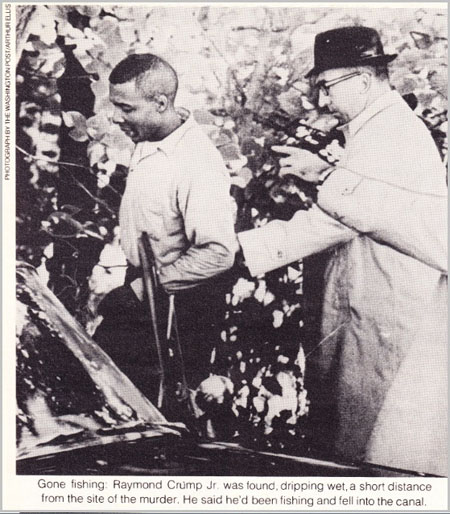
    Crump
    Ray Crump

    Hantman also made a strategic error. He thought Crump would testify on his own behalf. When Crump was apprehended, he was soaking wet. He was wearing a t-shirt with torn black pants. He was covered with bits of weed. He had a bloody hand and a cut over his eye. The police later discovered a jacket near the scene. Along with his cap, Crump had ditched it, and his wife confirmed it was his. (Burleigh, p. 234) There was no one else in the area in this condition. Hantman looked forward to cross-examining Crump, not just about his condition at the time, but all the lies he had told to explain his incriminating state away. For example, he said he was in the area to go fishing. Except he didn’t bring his pole. He said he cut his hand on a bait hook – which he also left at home. How did he explain having his fly down? An officer did it. Why was he soaking wet? Crump first tried to explain this by saying that he had slipped into the river from his fishing spot. When that lie was exposed, he said he had fallen into the river while asleep. (ibid, p. 265) Did his hat and jacket fall off his body as he slipped? Once these lies were exposed for what they were, Hantman would then be able to show that Crump’s condition had all the earmarks of a man who had been involved in a sexual attack. It had been resisted, and Crump had then tried to wipe away the nitrates in the water, and bury the weapon in the soft dirt. Once he was under cross-examination, Crump would wither and weep and say, as he did to the police, “Looks like you got a stacked deck.” (ibid, p. 234) Justice would be done.

    Hantman never got his opportunity to expose Crump. Roundtree was too smart and experienced for that. She knew Hantman would demolish her client. (Ibid, New Times.) So she declined to put him on the stand. Roundtree did what a good defense lawyer does. She raised the specter of reasonable doubt. Crump was acquitted.

    And that is a shame. For Crump had serious problems prior to Meyer’s murder. He had been arrested for larceny. And he had a bad drinking problem. He suffered from excruciating headaches and even blackouts. His first wife despised his drinking problem. When drunk, he became violent toward the women around him. (ibid, p. 243) And there was evidence Crump had been drinking that day. As Nina Burleigh demonstrated in abundance, Crump went on to become a chronic criminal, a real menace to society. He committed a series of violent crimes, many of them against women. Roundtree and Janney understand what a serious problem this is for them. No lawyer wants to admit they helped a guilty man go free. So she came to say that it was Crump’s incarceration while under arrest, and the pressure of the trial, that did this to Crump. This ignores his record prior to the arrest. And it begs the question: If Crump was really the put upon naïf they make him out to be, he would not have been arrested 22 times afterwards. The record indicates the opposite: a budding sociopath was now free to terrorize many more innocent people

    Lisa Pease did a neat job rendering absurd the scenario Janney tries to conjure for his version of what happened on the towpath. We are supposed to believe that this was a precision commando team plot:

    1. One of the trial witnesses who identified Crump, William Mitchell, was actually a deep cover CIA hit man, the actual assassin. As Lisa points out, in Janney’s world, Crump was picked out that morning.
    2. Apparently one of the platoon was stationed outside of Sears or Penney’s with a walkie-talkie. (Janney actually says they were delivered by CIA technical services.)
    3. When Crump was located near the scene, his clothes description was relayed to this person via radio.
    4. The person bought clothes that perfectly fit Crump.
    5. The clothes were then delivered to Mitchell. And Mitchell actually killed Meyer.

    The reader should note: this James Bond scenario has two problems with it. First, it is so precise and intricate it makes the Mossad look like Keystone Cops. Why go through all of in the first place? Why not just kill Mary from any of the concealed areas nearby with a sniper, a silenced rifle and sabot? This would take care of any witness contingencies, or any possible friends joining Mary for her jog. And, in fact, Helen Stern had arranged to meet Mary that day for a run. (Burleigh p. 230. You won’t find Stern’s name in Janney’s book.) Secondly, would not such a precise commando team realize that there was a big problem somewhere along the way? Namely that Crump was black and Mitchell was white? So I imagine that after all the clothes were ordered, then delivered to the crime scene, some Navy Seal put on his color corrected glasses, looked up and said: “Oh shit! The guy’s black!” We are supposed to believe that with its enormous reach, and realizing this was Washington D.C., the CIA could not find one black covert operator in all of its worldwide operations.

    As is his bent, Janney shoves that lacuna under the rug. What he does to paper it over is startling. I had to read this section over twice to make sure I did not misread it the first time. Mary was shot twice. There is evidence her body was also dragged about 20 feet. Janney writes that this was done in order to be sure there was a witness! (Janney, p. 335) But why would you do that if Mitchell was white and Crump was black? Well see, the CIA had ways to alter skin pigmentation. (ibid, p. 332) Apparently the chemical process could be done on the scene and was effective instantaneously. In a matter of minutes, Mitchell went from Caucasian to African-American. It must have been an amazing sight to watch. (And Michael Jackson’s doctor was way behind the times.) But Janney’s pen cannot keep up with the constant convolutions of his imagination. Because three pages later he now says that Mitchell escaped after the killing and was replaced by a stand-in for Crump. (ibid, p. 335) Janney never asks himself: “Why would the CIA do that?” Why not just have the African-American stand in kill Mary in the first place? Maybe because someone just wanted to see if Mitchell could transform himself from a white guy to a black guy in front of your eyes?

    As the reader can see, in his unremitting effort to fit a square peg into a round hole, Janney has ascended into the heights of dreadfulness. And he spared himself no embarrassment in getting there.

    V

    If I did not mention the reports about Mary’s “diary”, I would be remiss. In 1976, James Truitt was the source for an article in The National Enquirer. The article said that Meyer had been having an affair with JFK in 1962 and 1963 but that wasn’t enough for Truitt. He added that Kennedy and Meyer smoked weed in the White House, but Kennedy had told Mary she should try cocaine. Truitt actually said he supplied the joints and that Mary had kept a diary about the affair. The original article supplied almost nothing about why Truitt should reveal this at the time about two people who had been dead for over a decade. But there were some strong indications as to why. And the Enquirer was not at all forthcoming about them. Ben Bradlee was promoted to executive editor of the Post in 1968. One year later he fired Truitt. According to Nina Burleigh, Truitt had developed a drinking problem by this time and had also begun to show signs of mental instability, perhaps a nervous breakdown. (Burleigh, p. 284; Washington Post 2/23/76) Therefore, Bradlee forced him out with a settlement of $35,000. (Burleigh, p. 299) Truitt’s problems now grew worse. It got so bad that his wife Anne sought a conservatorship for him based on a physician’s affidavit that he was suffering from mental impairment. (ibid, p. 284) The actual words used in the affidavit were that he was incapacitated to a degree “such as to impair his judgment and cause him to be irresponsible.” (ibid, italics added) In 1971, Anne divorced him. A year later, so did the conservator. All this left Truitt in a sorry state with nowhere to turn. He wrote to Cord Meyer and asked for a job with the CIA. When the job did not materialize he moved to Mexico. He remarried and lived with a group of expatriates, which included many former CIA agents. And he now began to experiment with psychotropic drugs. (ibid) If this was your source for a front-page story, I can understand not revealing the man’s background.

    The upshot of The National Enquirer story was that Ron Rosenbaum and Philip Nobile later wrote an article for New Times in which they tried to trace what happened to Mary’s incriminating “diary”. It is hard to decipher this story because you have to understand the personal relationships at work. Ben Bradlee was at loggerheads with CIA counter-intelligence chief James Angleton. Angleton thought that Bradlee had blown his cover when writing a review of a book by Kim Philby, a high-ranking member of British intelligence who was exposed as a double agent. (Burleigh, p. 283)

    As we have seen, Truitt had serious problems, was doing psychotropic drugs, was involved in a CIA expatriate community, and was clearly closer to Angleton than he was to Bradlee. Truitt also seems to have had an anti-Kennedy bias from the beginning. (See Bradlee’s Conversations with Kennedy, pgs. 43-49) I won’t go through the whole morass of testimony on the “diary” issue. I already did that in my previous article. (For those interested, see The Assassinations, edited by James DiEugenio and Lisa Pease, pgs. 339-44) Further, contrary to what Janney tries to imply, the two people who wrote the 1976 New Times essay, Ron Rosenbaum and Philip Nobile, were not paragons of honest and indefatigable reporting. In fact, one could argue they were much too close to both the CIA and the Post. I once wrote a short article about Rosenbaum for Probe revealing what a CIA lackey Rosenbaum went on to be. (Probe, Vol. 4 No. 6, p. 28) And further, how he had been co-opted by Angleton and his acolyte Edward Epstein. To the point that Rosenbaum actually argued that Kim Philby had not snookered Angleton. Instead Angleton had let Philby escape to Russia so that he could relay back to him secrets of the KGB! Rosenbaum’s sources for this one? Epstein and Howard Hunt. Need I add, that along with his pro-Angleton tendencies, a clear anti-JFK coloring also marked his work. (ibid) In other words, if Angleton could have picked a writer to follow up on the Truitt tale, he could hardly have done better than Rosenbaum.

    But the bottom line is this: Even considering all the relationships and biases, there is no credible evidence that any diary, in the normal sense of that term, was found. What was found was a sketchbook that had traces of Mary’s relationship with Kennedy in it. (ibid, p. 343) Toni Bradlee, Mary’s sister, destroyed it, which was the natural choice.

    After sifting through this whole “diary” imbroglio, I came to a conclusion in this regard as far as Angleton went. If the diary had depicted what Truitt told The National Enquirer, wouldn’t Angleton have found a way to get it into the press? With his connections? But he never did that, did he? And he had 23 years to do so. So he did the next best thing. Recall, Angleton had been fired at the time of The National Enquirer story’s appearance. In regards to Kennedy’s assassination he was now becoming “a person of interest” to both the Church Committee and the House Select Committee on Assassinations. Realizing this, he was starting to map out defenses. One of these, apparently worked out with Dick Helms, was a veiled threat to discredit and smear JFK personally. (Dick Russell, On the Trail of the JFK Assassins, p. 57) What I believe happened is that after Angleton was ousted he contacted his friend Truitt. Due to his social and emotional state, and his animus toward Bradlee, Truitt was now easy prey. Angleton got the poor guy to say things Angleton wished the “diary” had said, but it didn’t. (But, in fact, Truitt was now actually doing those things himself.) It is also important to note that, at this point in time, Angleton told these kinds of bizarre stories to anyone who would listen to them. He once told reporter Scott Armstrong that Truitt was not just doing peyote and mescaline in Mexico but that he had done LSD in America. Who was his acid trip partner? Phil Graham, previously the publisher of the Post. He also told Armstrong that Mary Meyer had had an affair with Graham, among several other men. (Burleigh, p. 299) Of course, these posthumous libels never got into print. But, the Enquirer was a different story as far as evidence and credibility went.

    Let me touch on one more method that Janney uses to further his unremitting agenda. As noted by Lisa Pease, like Truitt, Leo Damore was a very troubled man towards the end of his life. But knowing that, the indiscriminate Janney still sources many of his footnotes to “Interview with Leo Damore”. No documents, no exhibits, no independent corroboration. Just Janney talked to Damore. In the echelons of academia, this technique is called the self-reinforcing reference. And Janney does not just use the technique with Damore. For instance, I have pointed out why Timothy Leary is a dubious witness. To bolster Leary’s credibility, who does Janney use? More Leary. Maybe Janney thinks if he makes a walking, talking hologram of Leary that will make him believable.

    Well, Janney’s piece de resistance in this regard is a set of notes made by Damore’s lawyer, Jim Smith, about a phone call Damore had with him in 1993. Damore called Smith and said he solved the Meyer case. Damore said he sent a letter to a CIA safe house to one William Mitchell. Recall, this is the guy who used a chemical process to turn himself from white to black to fake out Wiggins in the murder. Well, if you can believe it, Mitchell replied to Damore’s letter.

    Again, it is necessary to step back from the construct. I have been doing field research in this case for a long time. I have encountered CIA safe houses. The reason they are called that is that they are run, monitored, and controlled by the Agency. The idea that a journalist like Damore would write a letter to one, it would get through, the hit man would reply, and they then would talk for hours on the phone, this is all quite foreign to my experience. But that is what Janney wants us to believe happened. (Janney p. 407) Janney even writes that Damore supposedly met the man in person. (ibid, pgs. 378, 404) Now, just this would be enough for me to arch my eyebrows and close my eyes. But further, there are no tapes or transcripts of any part of the call. Even though Damore said he taped the whole thing. (ibid, p. 408) Even though Damore said he was up most of the night talking to the man. (ibid, p. 404) Further, none were produced either at the time of the call in 1993, after Damore’s death two years later, or in the intervening 17 years. Any writer worth his salt who had been working on a project as long as Damore had would have:

    1. Taped the call
    2. Had it transcribed almost immediately
    3. He would then have had the tape and transcripts duplicated.
    4. The originals would have been placed either in a personal safe or in a safe deposit box at a bank. Not just to prevent them from being purloined. But because they were worth money. They would be instrumental in negotiating a large book contract from a major publishing house.

    What does Janney say in this regard? That Damore’s book agent told him “he thought he remembered Damore talking about certain aspects of this call.” (ibid, p. 412, italics added) Under normal conditions, once Damore told the agent about every aspect of the call, the agent would have requested the copies be sent to him special delivery. He then would have begun working the phones. Within a week or so, he would have had a substantial contract for Damore to sign. Yet, none of this happened, or even came close to happening. Damore had two years to come up with this proof, or to meet with Mitchell, attain his photo, and ascertain his precise living conditions. Yet none of this information exists.

    But Janney now goes further in using Damore. The notes say that Damore talked to Fletcher Prouty. Prouty helped Damore put some pieces of the puzzle together and identified Mitchell as an assassin. (ibid, p. 420) This jarred me. Knowing the life and work of Prouty as I do, it was out of character for him. Fletcher never identified a black operator unless he had a high public profile e.g. Ed Lansdale, Alexander Butterfield. I knew this not just from his work but also from the patron of his work, Len Osanic. So I talked to Len about this point: Did you ever know Fletcher to expose an undercover black operator? He replied in the negative. In fact, he even sent me a radio show in which a host was badgering Prouty to do just that. Fletcher would not. I then asked him if Fletcher had ever mentioned Damore, Janney, or Mary Meyer to him. He said no. I asked if, since Fletcher’s death in 2001, Janney had called him to confirm anything? He said no he had not. I then asked him when Fletcher had resigned his position in the Pentagon. Len said it was in January of 1964. (E-mail communication with Osanic of 6/22/12) I now started to scratch my head. Mary Meyer was killed in October of 1964. How could Fletcher have known about the Damore/Janney “operation” if he wasn’t in the Pentagon anymore?

    But that’s not the worst about Damore. For Damore, his most obstinate obsession was his protean attempt to turn Mary Meyer into a combination of Sylvia Meagher and Madeleine Albright. And the key for that was the existence of a “diary”. One that would say more than what the Bradlees said it did. Well, for that poor soul Damore, this became his equivalent of the Holy Grail of Arthurian legend. And according to those notes Janney finds so bracing, Damore found it. But I think the notes overdo it. Because he didn’t find it just once. Not even just twice. But three times. (See pgs. 325, 328, 349) Even Mitchell had a diary. Did he break into her apartment after killing her? (What skin pigment did he use this time? Maybe Native American?) But guess what? None of these are around today. As the reader can see by this sorry trail, Lange and DeWitt were correct. Damore’s problem is that he believed anyone – without doing any checking. But Janney then multiplied this problem. Because, in turn, he believed anything Damore told him. And as shown above, he also didn’t check it. Even, it appears, when Damore was in a questionable mental state.

    VI

    From the above analysis, it is difficult to find a credible source that Janney uses to further his rather leaky conspiratorial construct. Or a credible document. And this brings us to a man whose name I thought I would never again have to type: Gregory Douglas. As Lisa Pease pointed out, Douglas has many names he goes under e.g. Peter Stahl and Walter Storch. And in fact, it appears his son might us one of them. He also has a proven record of being involved in past forgeries, including Rodin statuettes. But Janney is going to minimize the past history of this scoundrel. In fact, he actually begins his section on the man by praising his knowledge of the Third Reich and his book Gestapo Chief: The 1948 Interrogation of Heinrich Muller. (Janney, p. 352) Again, this is disturbing because that book is certainly a forgery. In it, it is claimed that the wedding between Hitler and Eva Braun in the Berlin bunker was a staged production. The real Hitler was planning to escape so he poured through Berlin to find a stand-in for himself. (Reminds one of Janney’s Crump stand-in.) Hitler staged this bit of theater and then had the stand-in killed to mislead the Russians. Hitler then escaped Germany in April of 1945 for Spain. In other words, the stand-in, who, apparently, even talked like Hitler, fooled all the seven – actually even more – witnesses who were in the bunker. Another giveaway is that Douglas claimed to have the original interrogations of Muller. Yet he needed to get these translated into German for German publication. The problem is that, according to the American version of the book, these already were in German. (When you lie as often as Douglas, it’s hard to keep track of them all.) Douglas also has been known to modify bad forgeries. In other words, after the first run through, someone will point out that, say, the heading on the letterhead is wrong. He will then correct that technical error. But he keeps the fabricated information the same. Douglas also tried to pass off a letter to David Irving and Gitta Sereny showing that Hitler knew nothing about the Holocaust. (http://www.fpp.co.uk/Legal/Observer/Sereny/Independent291191.html)

    Why is a discredited person with no credibility important to Janney? Because of the so-called Zipper Documents. These were part of a group of papers that Douglas alleges were left to him by former CIA officer Robert Crowley. Crowley knew Angleton. If one believes Douglas, Crowley likely had foreknowledge of the JFK assassination and Angleton left him a set of papers, which depicted his planning of the murder. This is ridiculous in and of itself. The idea that a man like Angleton would keep such a record in his possession is laughable. That Crowley would be left a copy is even more so. But the worst thing about the Douglas dubbed “Zipper Documents” is that, like the Muller book, they have been demonstrated to be near certain forgeries. (Click here for one demonstration http://www.ctka.net/djm.html). In 2002, when Douglas used these to publish his book Regicide, more than one person began to examine them. Finding serious problems with them – like Lyman Lemnitzer being Chairman of the Joint Chiefs in 1963, when he was not – they began to do some background work on the author. They discovered his long and sorry history of flim-flammery. But Janney wants to minimize this key fact. Why does he want us to do such a thing? Because Douglas included a couple of paragraphs about Mary Meyer in his faked book.

    But it’s even worse than that. Because Janney seems to have developed a friendly relationship with the forger. As noted in the above referenced article I wrote about Douglas, journalist Joseph Trento and Douglas got into a dispute about Crowley’s papers. To the point that Trento and Crowley’s surviving family thought of filing legal action against Douglas/Stahl/Storch. (This seems to have stopped Douglas from setting up a web site based on his phony documents.) Janney seems intent on making this confidence man credible. So he allows Douglas to produce an email exchange between him and Trento in which Trento asks Douglas to produce some documents from the Crowley papers. (Janney, p. 360) Janney then says that this email reveals that Douglas actually had the actual Crowley papers. What can one say about such logic? Except that Janney never asked himself this question: If a man is going to forge a four volume set about Hitler’s Gestapo chief Muller, then what does it take to fake a one paragraph email? And when I called Trento, and read him this e-mail he stopped me about four lines into it and said, “No, I never sent him an email like that at all. And anyone who believes I did is a fool.” (Phone interview with Trento, 7/3/12. Also, there are web sites devoted to the subject of faking e mails.)

    Let me close this section by addressing another significant point in this rather sorry excuse for a book. In Janney’s obsession, he is willing to actually say that his father, Wistar Janney, was somehow part of a conspiracy involving Mary Meyer. Wistar’s crime: He was listening to the radio at work and heard about a murder in the towpath area which Mary frequented. From the description, the victim was likely Mary. So Wistar called his friends Cord Meyer and Ben Bradlee and told them about it. Let us see how this is dealt with by the man on the other end of the line, Bradlee: “My friend Wistar Janney called to ask if I had been listening to the radio. It was just after lunch, and of course I had not. Next he asked if I knew where Mary was, and of course I didn’t. Someone had been murdered on the towpath, he said, and from the radio description it sounded like Mary. I raced home.” (Bradlee, A Good Life, p. 266) What could be suspicious in that? Further, if one believes Rosenbaum and Nobile, this is how Angleton also first heard about the possibility that Mary may have been the victim. His wife called him after listening to the radio. But not taking it seriously, he shrugged it off and went back to a meeting. (Ibid, New Times.) Further, Cord Meyer writes about the call he got from Wistar in his book also. (Facing Reality, p. 143) Some conspiracy. But further, why would the plotters need Wistar to be listening to the radio and make the calls if this was some kind of ultra precision CIA elimination? According to Janney there were about a half dozen people involved in the crack commando team right there on the scene. Shouldn’t one of them have contacted a relay center? Makes a heck of a lot more sense than a desk guy listening to his radio.

    But further, in most states, the definition of a criminal conspiracy is this: two or more people agree to perform a crime and there is one overt act committed in furtherance of the enterprise. Mary was already dead at the time of this call. So what was the overt act Wistar committed? But beyond that, what was the crime in Wistar alerting Mary’s brother-in-law and former husband that she may have been the victim of an attack? Wouldn’t her sister and children be the most impacted people if it was her on the towpath? Therefore, weren’t Ben Bradlee and Cord Meyer the right people to call? But let us consider this also: What if Wistar had not made the contact? Would not the two men have found out about it later that day anyway? Yes they would have. In fact, Bradlee’s home was notified by the police to identify the body. So if Wistar had not made the call, what would have ended up differently? The Bradlees still would have been at Mary’s apartment that night, and so would the Angletons, since they had a previous engagement with Mary that night. (Ibid, New Times)

    VII

    After long and careful textual and source analysis, what does this book rely on to advance its theses? It relies on people like Damore and Truitt who, as shown here, simply were not reliable in the state they were in. It relies on a chimerical “diary” that does not exist, and which the best evidence says was really a sketchbook. It relies on so-called CIA documents that are demonstrative fakes originating from a proven forger. It relies on a man like Leary whose story only surfaced 21 years later after he had somehow missed 25 opportunities to tell it.

    Like a contemporary Procrustes, the author then distorts the major characters to fit into his agenda. If one recalls from Greek mythology, Procrustes was a bandit from Attica who would abduct people and then either stretch them or crush them to make them fit into an iron bed. This book stretches Mary Meyer beyond recognition, and crushes JFK beyond recognition. It elongates Crump and then crushes Mitchell to fit into that iron bed. The combination of its dubious information plus the distorted character portraits makes the volume look less like a book than a 17th century phantasmorgia.

    But as bad as the book is, it might have been worse. Because in its original form, Janney’s book was not just going to be Mary leading the neophyte Kennedy to worldwide détente. But she also was leading him to the hidden secrets about UFO’s! (Was this is one of the versions of the “diary” Damore found?) Therefore, Kennedy and the USA were not just going to achieve world peace, but Spielberg-like, Mary would also help him make peace with the creatures from the outer space. Although, as Seamus Coogan points out on this site, this whole UFO thing appears to be another Douglas like hoax. (Click here as to why http://www.ctka.net/2011/MJ-12_Preamble_I.html)

    And further, Janney was going to use another spurious major source, namely the late David Heymann. In fact, Janney and Simkin talked about spending hours on end talking with Heymann years ago. It was not until Lisa Pease and myself exposed Heymann as the serial fabricator he was that they realized he was a liability and separated themselves from him.

    The worst part about this whole sorry spectacle is that, as with David Talbot, Janney has somehow convinced some people they should take him and his book at face value. What can one say when Doug Horne jumps on Amazon.com to praise Mary’s Mosaic? Or when Dick Russell writes an introduction for the book? Or Jim Marrs gives Janney a blurb? Because someone knows the JFK case, or thinks they know it, does not mean they know the Meyer case, and this is one of the very worst things about this book. Janney often navigates back and forth between the really fine work done in the JFK case and people like Leary and Douglas and Damore. Unlike what Janney tries to imply, these are two distinct and separate entities. They contain two separate databases of evidence, two separate lists of source literature, and, for the most part, two separate casts of dramatis personae. To say that if one is familiar with JFK, that you then have the credentials to pronounce judgment on a book about Mary Meyer, that is simply a fallacy. And what is worse, it appears that none of these people did their homework. They just rushed out to create unwarranted accolades and now are left with custard pie on their faces.

    If we actually place any value in Mary’s Mosaic, then we simply become a reverse mirror of the MSM. They think almost no history-altering event is a conspiracy. Our side replies, “Well look, if you are imaginative enough, dedicated enough, and work long enough, anything can be a conspiracy. And a high level, dastardly one too.” As long as you don’t scratch it too much. After nearly 49 years, we have to be better than that. The fact that Janney’s book has been accepted by some in the critical community indicates to me the continuing ascendancy of the Alex Jones, “anything goes” school. That is, an alternative media with no standards; one which accepts any conspiracy theory as long as its contra the official story. To me, as the USA declines further and further, this is just another form of distraction to entertain the masses in the coliseum. Pity the country that has to choose between Jones and say Chris Matthews. If that’s the choice, to paraphrase W. C. Fields, I’d rather be in Costa Rica.

  • The Lost Bullet: Max Holland Gets Lost In Space


    Max Holland first surfaced in the JFK case when John McAdams did, after the release of Oliver Stone’s film JFK. His first writings appeared in academic historical journals and he took aim at writers on the Kennedy case like Peter Dale Scott. For some strange and unfathomable reason, The Nation then hired him and he wrote about the Kennedy case there for a number of years. He was housed at this time at the Miller Research Center at the University of Virginia. This is supposed to be a sort of scholarly base where academics can do research through grants in aid. One of the directors there was Philip Zelikow; the executive consul of the much criticized 9-11 Commission. After writing for The Nation, he then set up his own web site called Washington Decoded. (For a very good overview of the man’s career concerning this case, click here) But some of his pieces have been turned down by more mainstream organs. So he goes where they will not be refused: the CIA’s own web site.

    Robert Stone is a long time documentary filmmaker who has made many films since his first, which was called Radio Bikini in 1988. From 1988 to 2010 he worked for PBS and The American Experience program. While there, in late 2007, he produced and directed a film about the JFK case called Oswald’s Ghost. Although the film was skillfully done, the skill covered up a rather blatant propaganda piece that ignored much of the new evidence and relied on discredited talking heads to pin the Kennedy assassination on Lee Harvey Oswald. (See my review here)

    Well, on November 20, 2011, for the 48th anniversary of JFK’s murder, these two teamed up to create another propaganda piece. Presented on the National Geographic cable outlet, it was called The Lost Bullet. The concept for this program goes way back to 2007. At that time Holland and Johan Rush wrote an article for the web site of the History Channel and postulated that the first shot fired in the Kennedy assassination actually came much earlier than anyone had previously supposed. In fact, it occurred even before Abraham Zapruder started filming! If you can believe it, the authors theorized that the first shot came just after the presidential limousine turned from Houston Street onto Elm.

    How ‘out there’ was this idea? Way out there. The Warren Commission placed the firing sequence at around Zapruder frame 210 on to about frame 313. The House Select Committee placed the first shot at about Zapruder frame 189. Holland and Rush placed the first shot before Zapruder’s camera rolled so it’s hard to apply a Zapruder frame to it. It may go back to a (theoretical) frame 107. A few months after the first installment of this bizarre theory appeared, it was then repeated in an op-ed piece for the New York Times. How bad was the piece? It was so bad that it was criticized by the likes of Gary Mack and Dale Myers. And in no uncertain terms. They made it clear they thought it was poppycock: both unfounded and sloppily researched. The Holland article went through still another transformation in 2008. This time Holland received help from Seattle attorney and JFK assassination student Kenneth R. Scearce. It was again harshly criticized from the same quarters.

    None of this seemed to matter to Holland. Or to his producer Mr. Stone. Why? Because they were on a mission. What was that mission? Well, it is pretty transparent. See, the more you push back the time for the first shot, the more time you give the (lone) assassin to fire the entire shooting sequence. This has been a consistent objective of the Warren Commission advocates from the start. Why? Because to them, it gives their fall guy Oswald the necessary time to fire the proverbial three shots from sixth floor window with a manual bolt action rifle. Holland’s thesis, as we shall see, is so weak that it’s this point that is the actual purpose of the show. (The other problem is the rapidity of the final two shots: according to ear witnesses, almost back to back, which is difficult to imagine with that Mannlicher-Carcano bolt-action rifle. Talking head Holland mentions this but does not deal with it.)

    II

    Because this is a Robert Stone production it begins with people crowding around in Dealey Plaza and shots of Robert Groden selling his literature there. As shown in his previous film, Oswald’s Ghost, Stone likes these kinds of shots. It gives him an opportunity to do four things:

    1. Show that this is an ongoing mystery that confuses the public
    2. Blame this confusion on the Warren Commission critics
    3. Show at least one critic selling his products in Dealey Plaza
    4. Ending with his recurrent theme that the real reason for the confusion is that people just cannot accept a socially maladjusted loser like Oswald killed an exalted leader like John Kennedy. (This last refrain originated with CIA asset Priscilla Johnson at the 15th anniversary. Stone actually featured this Agency shill in his previous film, without telling the viewer who she was.)

    The narration then continues with a huge whopper. The voice says something like Max Holland will now lead a team of researchers in re-opening the Kennedy case to see if Oswald could really have gotten off three shots the Warren Commission said he did. We are supposed to believe that somehow Robert Stone does not know who Max Holland really is. That he does not know that Holland has been a shameless cheerleader for the official story since at least 1994. That he has spared no time or energy in smearing the critics. Stone doesn’t know that this particular piece of flotsam he is about to demonstrate has been around (and gotten roasted) since 2007? Sorry Robert. You do know. And you are trying to sell the public that you are taking an objective approach, when you are not. Stone’s advocacy will be further demonstrated when he trots out his ballistics expert. If you can believe it, it is Larry Sturdivan. A guy who actually worked for the Warren Commission. And whom Robert Blakey actually used for the House Select Committee on Assassinations (HSCA), to prop up the ludicrous single bullet theory. With this deception, the show is not off to a good start. And it gets worse.

    The narrator now intones that this show will now tell the truth about what happened to each bullet’s trajectory that day in November 1963. But guess what? It’s the Warren Commission’s scenario: three shots, from that familiar sixth floor window; Kennedy hit twice and Connally once. If you can believe it, the narrator says something like there is a general agreement on this formula. There is none on this either with the general public or with specialists in the case. Especially when a detailed examination of the condition of the Magic Bullet i.e. CE 399, its provenance, and it flight path is provided. As we shall see, this does not happen here. Stone, Holland and Sturdivan are good con artists. They knew better than to go into this matter.

    The program now proceeds and Holland says he will work backwards with his three Warren Commission bullets. Therefore, he begins with Zapruder frame 313, the fatal headshot to Kennedy. And with this segment, the program now descends into the purest advocacy. To use one example: Stone and Holland do not even mention the fact that the entry point for this bullet was switched from where the Warren Commission originally placed it. They had it at the base of the skull, right above the neck. Both the Ramsey Clark panel and the HSCA moved this entry point upward by nearly four inches! Which means it went from the bottom of the skull to the top, at the cowlick area. Why do they ignore this problem? Because by ignoring it they do not have to explain that if the bullet came in at the base of the skull, Z frame 313 shows that the bullet could not exit at the Warren Commission’s point at the right temple, above and to the right of the ear. This problem was pointedly illustrated way back in 1967 by Josiah Thompson in his book Six Seconds in Dallas. (See page 111) Thompson also demonstrated that the Warren Commission lied about this issue in their illustrations to cover up this fact. By glossing it over, Holland and Stone continue that cover up.

    There is another issue here that the Dynamic Duo conceal. That is the mystery of the 6.5 mm fragment. The Clark Panel saw something on the x-rays that apparently the original autopsy team missed. Namely the existence of a bullet fragment near the rear of the skull. This fragment was also agreed to by the HSCA. The problem is that if that is what it is, it creates another huge problem for the official story. Because the two fragments recovered of this head shot bullet constituted the front and tail of the bullet. Therefore, this fragment must come from the middle of the bullet. So we are to believe that the bullet broke into thirds upon immediate entrance and the rear of the bullet somehow elevated itself over the center of the bullet—which was left behind—and proceeded forward and out with the front of the bullet. The show’s own expert, Sturdivan, has said this is not possible. In the words of Henry Lee, “Something is wrong here.” And neither Stone nor Holland wants to deal with it. Which shows the reader how honest they are. To the program’s credit, during this segment they show high definition scans of the Zapruder film to demonstrate that the driver, Secret Service agent Bill Greer, did turn around, but he did not shoot Kennedy. This was always a nutty theory that no serous critic of the official story advocated. But I am glad they addressed it here.

    But then the mendaciousness picks up again. They admit that Time-Life held the Zapruder film in their vaults for years without making it public. Which is true. But they then say the reason was to keep the graphic images of the headshot away from the public. Most informed people would disagree. They would say that Time-Life, with all of its ties to the intelligence community, kept this from the public because this part of the film—with its unforgettable image of Kennedy being hurtled backwards with incredible force and speed against the car seat—betrays a shot from the front. And Oswald was behind Kennedy.

    Holland does address this issue. He screen captures a frame from the Zapruder film that shows the blood mist exiting from Kennedy’s skull. It appears to be exiting slightly forward. Because of this, we are to forget about Kennedy being hit so hard from the front that his whole body rockets backward. What Holland does not say is this: When a projectile hits the skull, it creates a medical phenomenon called cavitation. This is, roughly speaking, a pressure center in the brain. This pressure center then finds a means of escape. And often, this comes from a weak point in the skull. Which happens to be near the front. In other words, the exit point has nothing to do with the directionality of the shot.

    I could hardly believe what Holland and Stone did next. Using their high definition scans from other films, not the Zapruder film, they panned across the grassy knoll. They then announced that they could not find a man with a rifle there. So they concluded the shot could not have come from the front. Uh, Bob, Max. You could just have shown a close up of the Moorman photograph and given the audience a hint of the Badge Man image. And there are others images in the canon that reveal something funny happening behind the picket fence—not on the knoll. And you then could have related that to the testimony of people like Lee Bowers and Sam Holland to close that argument. Stone and Holland did not. Which reveals this is a propaganda tract.

    III

    The show now introduces Mr. Sturdivan formally. It then proceeds to a discussion of some of the evidence against Oswald. It deals with it in about the same way it deals with the headshot. Meaning it does not at all go into the myriad problems the critics have demonstrated with it. For instance, the show mentions something called a “handprint” on the rifle. I think this word invention is to get around the fact that it was not a fingerprint but a palmprint. And of course, the show does not discuss the fact that the FBI expert, Sebastian LaTona, saw no such print when the rifle went to FBI headquarters that night. Neither does the show mention that FBI agent Vince Drain was the man who picked up the rifle from the Dallas Police to ship it to the FBI. No policeman told him at that time there was such a print on the rifle. The palmprint only appeared after the rifle was returned to the Dallas Police and after the FBI found no Oswald prints at FBI headquarters. (Henry Hurt, Reasonable Doubt, pgs. 107-09)

    This deceptive technique is fitting for what is about to happen next. Which, even for Stone and Holland, is a bit wild. Using none other than Larry Sturdivan—the inveterate Warren Commission sycophant—they now try to demonstrate that the Single Bullet Theory actually occurred. Before getting to that though, let me mention what Sturdivan had just done for the producers previously. When assaying the headshot, Sturdivan took a page from Gary Mack and his hideous Inside the Target Car. He lined up his marksman from the middle of the picket fence. Not the end. Again, as with Mack, this is deceptive. Anyone who goes to Dealey Plaza will see that the shot from the end of the picket fence is where most people think the fatal shot came from. But Mack wanted to use the other location because then he could lie to the American public and say that a shot from that location would have hit Jackie Kennedy. Which it would not have. And Mack knew that before he said it. So it was a premeditated lie. (See for yourself here)

    Well, Sturdivan repeated that same lie here. He only said it in passing, and he framed it with a conditional. But he did say it. So even after this lie has been exposed for what it is, Stone and Holland still feel fit to repeat it. This tells you all you need to know about this program. If only it had stopped there. But it does not.

    Sturdivan now trots out to Dealey Plaza, lines up the models in the car, fires a laser at them and presto! He now says that the Single Bullet Theory actually happened. Again, I wish I was kidding but I’m not. Needless to say: Garbage In, Garbage Out. First, Sturdivan lined up the models as Vince Bugliosi did in his book Reclaiming History. Using false dimensions for the car, he has Kennedy way outside of Connally. As Robert Groden will show with photographs in his upcoming book, this was not the case. Secondly, and shockingly, there was no discussion of the flight path through either man. All the program showed was two green dots on the rear of the bodies. And it appeared that Sturdivan showed the rear wound of JFK to be at the HSCA location, down the back. The obvious question here is: Then why did Jerry Ford move that location upwards from the back for the Warren Commission? Holland does not ask this question. Probably because he would then have to admit that this location makes it hard to believe that the bullet would then exit through the neck. There is then no discussion of why the cervical vertebrae in Kennedy were not cracked. Which they would have to be if the bullet exited at the neck. Neither does the show address the curious trajectory through Connally. That is, through the chest, rightward to hit his wrist and then left to hit his thigh.

    And obviously, the program does not even mention two very salient facts. First, the overwhelming evidence that the Magic Bullet, CE 399, was switched. (See here for that evidence) And second, the compelling evidence that Connally was hit by a separate bullet. Further, that the FBI knew both of these facts and was complicit in the cover up. By themselves, these two brief articles shatter the cheap dog and pony show that Sturdivan is selling here.

    Before leaving this (gaseous) segment of this phony program, let me add one more ersatz announcement in it. Like Inside the Target Car, Stone and Holland hired a military marksman. They actually say that Oswald had the same training in rifle fire that their marksman had. This is so ridiculous as to be ludicrous. Oswald had no special training at all in marksmanship. His training was the same as that of the scores of Marines he took rifle practice with. And in fact, when Henry Hurt interviewed some of Oswald’s military cohorts, they were aghast at the Warren Commission contention that Oswald could have pulled off what happened in Dealey Plaza by himself. He was that poor on the rifle range. (See Hurt, pgs. 99-100) Again, this is a fact that this agenda driven show tries to cover up.

    IV

    Before proceeding to the program’s fraudulent finale, let us remind ourselves of two main points. The show has not done what it said it would do, that is trace the bullets in the Kennedy case. It has not done this in any real way, or even come close. Further, it has not searched for evidence of any other bullets fired that day, besides the Warren Commission exhibits. Second, it has not in any real sense done a new investigation, or reopened the case. I mean, how could it with Larry Sturdivan there, the man who was involved in the original Warren Commission inquiry? (How Robert Stone missed inviting Arlen Specter escapes me.)

    But now the show is about to proceed to its closing summation. The program says there has been generally two schools of thought abut the firing sequence. The Warren Commission allowed six seconds for the shots to be spaced. This began with the president disappearing behind the freeway sign, and then ended with Z frame 313. The HSCA said the shots were begun slightly earlier than that. At about frame 189, which would allow for about seven seconds. Yet this longer time clearly allowed for a conspiracy since the first shot had to be fired through the branches of an oak tree. And almost no one would be able to believe that any marksman could have hit the target with that obstruction there. (Let us not ever forget, the greatest sniper of the Vietnam era, Carlos Hathcock, said that he repeatedly tried to do what the Commission says Oswald did. He failed every time.)

    Obviously, Holland is disturbed by these results, which eliminate Oswald as the lone gunman. So what does he do? He says that the first shot happened even before Zapruder started filming! The problem with this is that if one watches the opening frames of Zapruder’s film as the car has entered Elm Street, there is nothing to indicate anyone has fired a shot. And when Vince Bugliosi tried to move the first shot up a bit more than the HSCA did, Pat Speer showed that he embroidered some witness testimony with the liberal use of ellipsis to accomplish that goal. (See here)

    Holland first takes out a high definition scan to show what he says is someone or something in the Hughes film in the sixth floor window. Being as objective as I could be, I could not determine if it was a person or boxes. It was that obscure. And for the show to trumpet this as a “new discovery” is more pretentious gas. At the end of Josiah Thompson’s 1967 book Six Seconds in Dallas, he uses the exact same film and frames to make the argument that there are two men in that window. (See pgs. 244-46) Except Thompson brings in supplementary evidence that supports his idea—and it’s credible. To show you just how strained this film is, Holland and Stone are so biased that they go beyond saying that this rather indeterminate frame represents a single person. Holland actually said it was Oswald! For pure arrogant zealotry this might match Dale Myers going on national TV in 2003 and lying his eyes out by saying his phony computer simulation had just proven something called the “Single Bullet Fact”.

    Holland then says that the positioning of the shells at the scene proves there was an early shot and then two close together. On its face, this is silly. One might ask Stone and Holland: Did you do any experiments to prove this? But really it’s worse than that. Tom Alyea was a local TV photographer who entered the Texas School Book Depository before the building was sealed off. He was one of the very first to see the three shells lying on the sixth floor. (Michael Benson, Who’s Who in the JFK Assassination, p. 12) He had trouble filming the shells because of the boxes. Captain Will Fritz then picked them up for him to better shoot a picture. Fritz then threw the shells back on the floor! Which means, of course, that the photos of the shells we have now in the Commission volumes are not of the original crime scene. But Alyea went even further. He told certain researchers than when he first saw the shells they were not scattered as they appear in the volumes today. He stated you could span the three shells with your hand. (Interview with Larry Hancock, 11/19/11)

    I now make a further challenge to Stone and Holland: please fire a Mannlicher Carcano rifle and eject three shells from it. Do it one hundred times. Call me when you get three shells ejected perfectly within a hand span. I will tell the reader right now: I will never get that phone call.

    Holland also uses the testimony of the three depository workers below the sixth floor who later said that they heard a rifle bolt working and shells falling to the floor above them. What he does not say is that this was not their original testimony in their first Secret Service report. Patricia Lambert long ago wrote about this in a long two-part article. (See here)

    Holland also uses witnesses Tina Towner and Amos Euins for this earlier shot. But if one clicks through to the article by Dale Myers I linked to at the start, one can see that he is not faithful to what they originally said. Further, he has selectively used Euins’ testimony in two ways. First, he has cut out the parts that seem to eliminate Oswald as the assassin e.g. seeing a bald spot on the back of his head. (Rodger Remington, Biting the Elephant, pgs. 116-18) Second, he does not detail all the problems with Euins as a witness. For instance Euins told the Secret Service he was not sure if the assassin was black or white. When asked definitively, he told the Secret Service he was black. He then told the police he was white. (ibid, p. 126) When he was asked if he could recognize the man if he saw him again, he said he could not. (Ibid, p. 127) He also said he heard four shots. (Ibid p. 115)

    As the reader can see, Holland has shamelessly cherry picked the testimony of a 15-year-old boy.

    V

    Holland and Stone now proceed to the climax of their tedious opus. Holland asks: If the shot came that early, with the car that much closer to the window, how did the shot miss? This rhetorical question leaves out two key points. First, Holland and Stone have not come close to proving the shot came that early. Second, they ignore an obvious adjunct question. Namely, if the assassin was going to fire that early on Elm, why did he not fire when the car was right below him on Houston? With a telescopic site, this is close to a can’t miss shot.

    Well, this is what Holland and Stone give us as their answer to this question. They say that this shot missed because it hit a traffic light on a metal pole first. Now one has to ask another obvious question: If that were the case, when the assassin went to line up the shot, would he not see the pole and light in his cross hairs?

    But further, as Holland states, this has to be the shot that then went forward to hit near James Tague standing on a concrete island beneath the overpass near Commerce Street (and a piece of the curb cut his face). Now this Tague/curb hit had always been very difficult to explain for those maintaining the official fiction of three shots. In fact, the FBI simply decided to cut it out of their report. This eliminated the Magic Bullet fantasy from their version. And this is one reason the Warren Commission did not place that report in the volumes. But yet, the people in Dallas would not let it go away. And finally, the local U. S. attorney wrote a letter to the Warren Commission about it. The Commission then had to include the Tague/curb hit in their report. And this is one of the main reasons that the Single Bullet Theory—or as Robert Groden calls it, the Single Bullshit Theory—exists today. If one bullet hit the curb near Tague and one killed JFK, there is only one bullet left to do the rest of the damage to Connally and Kennedy.

    For Holland and Stone to include the Tague hit on the trajectory of this traffic light hit shows just how much they have migrated into outer space. Consider this: they now have a bullet smashing into a traffic light right out of the gate. But then this bullet has the torque left to fly something like 400 feet further—one and a third football fields—and then smash into a curb sending out shards of concrete, cutting open Tague’s cheek.

    Again, did Holland and Stone do any experiments on this? For the traffic light is still there. I would have liked to have seen them. I think it would have resembled a Buster Keaton movie.

    But it’s even worse than that. As Harold Weisberg found out during a protracted battle with the FBI, the Bureau did some metal testing of the curbstone after they were forced to acknowledge the Tague hit. They found something very odd. There were no copper traces in the concrete sample. (Hurt, p. 136) If one looks at the ammunition allegedly used in the shooting, this would seem impossible. The bullets are literally coated in copper metal. Therefore, as Henry Hurt concludes, this in itself proves, at a minimum, that Oswald did not act alone. (ibid, p. 138) You probably know by now what Stone and Holland do with this key information. That’s right. They don’t mention it. I wonder why.

    If you can believe it, it is even worse than that. Because it turns out the producers did do experiments with the traffic light. But only to see if a shot hitting it would leave a hole or not. Holland first reported that there was a hole in the traffic light. But it was later revealed that this was a separation in the metal that was part of the design. And in fact, on the show, Holland admits there is no hole or even a visible dent in the light today. So how does he conclude what he does, that the bullet ricocheted off the light? He says that there is a “white spot” on the light. How this proves a bullet hit it is not discussed in any way. But as Pat Speer notes, the company that did the experiments reported for the program concluded that if a shot hit the light there would have been very visible damage to it; and from street level. So much so that it would have been reported on the day of the assassination. (Follow this link to post 11)

    In other words, Stone and Holland likely knew that the reason d’être for their show was wrong–before they went on the air. Does it get much worse than that?

    This farce of a program proves that, as with the three old main networks, the cable TV channels are almost pathologically incapable of telling anything close to the truth about Kennedy’s assassination. All the rules of journalism are now thrown out the window. And farceurs like Gary Mack, Robert Stone, and Max Holland are allowed to take center stage carte blanche; with no one exercising any kind of fact checking or standards review. As discussed here, four of the last five cable programs on this case have been abysmal in every way. The only exception was National Geographic’s own The Lost JFK Tapes. But now it appears that that channel has joined up with Discovery Channel to produce a show that actually ranks with the works of Gary Mack/Larry Dunkel. Which I actually thought was not possible. But here it is.

    All that Stone and Holland proved is that documentary films can lie as much as fiction films do. In fact, they can lie even more.

  • James W. Douglass, JFK and the Unspeakable

    James W. Douglass, JFK and the Unspeakable

    This book is the first volume of a projected trilogy. Orbis Books has commissioned James W. Douglass to write three books on the assassinations of the 1960’s. The second will be on the murders of Malcolm X and Martin Luther King, while the third will be on the assassination of Bobby Kennedy.

    This is one of the few books on the Kennedy case that I actually wished was longer. In the purest sense, Jim Douglass is not a natural writer. But it seems to me he has labored meticulously to fashion a well organized, thoroughly documented, and felicitously composed piece of workmanship that is both comprehensible and easy to read. These attributes do not extend from simplicity of design or lack of ambition. This book takes in quite a lot of territory. In some ways it actually extends the frontier. In others it actually opens new paths. To achieve that kind of scope with a relative economy of means, and to make the experience both fast and pleasant, is quite an achievement.

    I should inform the reader at the outset: this is not just a book about JFK’s assassination. I would estimate that the book is 2/3 about Kennedy’s presidency and 1/3 about his assassination. And I didn’t mind that at all, because Douglass almost seamlessly knits together descriptions of several of Kennedy’s policies with an analysis of how those policies were both monitored and resisted, most significantly in Cuba and Vietnam. This is one of the things that makes the book enlightening and worthy of understanding.

    One point of worthwhile comparison would be to David Talbot’s previous volume Brothers. In my view, Douglass’ book is better. One of my criticisms of Talbot’s book was that I didn’t think his analysis of certain foreign policy areas was rigorous or comprehensive enough. You can’t say that about Douglass. I also criticized Talbot for using questionable witnesses like Angelo Murgado and Timothy Leary to further certain dubious episodes about Kennedy’s life and/or programs. Douglass avoided that pitfall.

    One way that Douglass achieves this textured effect is in his quest for new sources. One of the problems I had with many Kennedy assassination books for a long time is their insularity. That is, they all relied on pretty much the same general established bibliography. In my first book, Destiny Betrayed, I tried to break out of that mildewed and restrictive mold. I wanted to widen the lens in order to place the man and the crime in a larger perspective. Douglass picks up that ball and runs with it. There are sources he utilizes here that have been terribly underused, and some that haven’t been used before. For instance, unlike Talbot, Douglass sources Richard Mahoney’s extraordinary JFK:Ordeal in Africa, one of the finest books ever written on President Kennedy’s foreign policy. To fill in the Kennedy-Castro back channel of 1963 he uses In the Eye of the Storm by Carlos Lechuga and William Attwood’s The Twilight Struggle. On Kennedy and Vietnam the author utilizes Anne Blair’s Lodge in Vietnam, Ellen Hammer’s A Death in November, and Zalin Grant’s Facing the Phoenix. And these works allow Douglass to show us how men like Henry Cabot Lodge and Lucien Conein did not just obstruct, but actually subverted President Kennedy’s wishes in Saigon. On the assassination side, Douglass makes good use of that extraordinary feat of research Harvey and Lee by John Armstrong, the difficult to get manuscript by Roger Craig, When They Kill a President, plus the work of little known authors in the field like Bruce Adamson and hard to get manuscripts like Edwin Black’s exceptional essay on the Chicago plot. Further, he interviewed relatively new witnesses like Butch Burroughs and the survivors of deceased witnesses like Thomas Vallee, Bill Pitzer and Ralph Yates. In the use of these persons and sources, Douglass has pushed the envelope forward.

    But it’s not just what is in the book. It is how it is molded together that deserves attention. For instance, in the first chapter, Douglass is describing the Cuban Missile Crisis at length (using the newest transcription of the secretly recorded tapes by Sheldon Stern.) He then segues to Kennedy’s American University speech. At this point, Douglass then introduces the figure of Lee Harvey Oswald and his relation to the U-2 (p. 37). This is beautifully done because he has been specifically discussing the U-2 flights over Cuba during the Missile Crisis, and he subliminally matches both Kennedy and Oswald in their most extreme Cold War backdrops. He then switches back to the American University speech, contrasting its rather non-descript reception in the New York Times with its joyous welcome in Russia, thus showing that Kennedy’s efforts for dÈtente were more appreciated by his presumed enemy than by the domestic pundit class.

    These artful movements would be good enough. But the design of the book goes further. As mentioned above, in his first introduction of Oswald Douglass mentions the Nags Head, North Carolina military program which launched American soldiers into Russia as infiltrators. Near the end of the book (p. 365), with Oswald in jail about to be killed by Jack Ruby, Douglass returns to that military program with Oswald’s famous thwarted phone call to Raleigh, North Carolina: the spy left out in the cold attempting to contact his handlers for information as how to proceed. But not realizing that his attempted call will now guarantee his execution. Thus the author closes a previously prepared arc. It isn’t easy to do things like that. And it doesn’t really take talent. One just has to be something of a literary craftsman: bending over the table, honing and refining. But it’s the kind of detail work that pays off. It maintains the reader’s attention along the way and increases his understanding by the end.

    II

    One of the book’s most notable achievements is the 3-D picture of the Castro-Kennedy back channel of 1963. Douglass’ work on this episode is detailed, complete, and illuminating in more ways than one. From a multiplicity of books, periodicals, and interviews, the author produces not opinions or spin on what happened. And not after the fact, wishy-washy post-mortems. But actual first-hand knowledge of the negotiations by the people involved in them.

    It started in January of 1963. Attorney John Donovan had been negotiating the release of the Bay of Pigs prisoners when Castro’s physician and aide Rene Vallejo broached the subject of normalizing relations with the USA (p. 56). Right here, Douglass subtly tells us something important. For Vallejo would not have broached such a subject without Castro’s permission. In approaching these talks, Dean Rusk and the State Department wanted to establish preconditions. Namely that Cuba would have to break its Sino/Soviet ties. Kennedy overruled this qualification with the following: “We don’t want to present Castro with a condition that he obviously cannot fulfill.” NSC assistant Gordon Chase explained Kennedy’s intercession, “The President himself is very interested in this one.” (pgs. 57-58)

    Because the State Department was cut in at the start, the CIA got wind of the opening. Douglass makes the case that David Phillips and the Cuban exiles reacted by having the militant group Alpha 66 begin to raid Russian ships sailing toward Cuba. Antonio Veciana later stated that Phillips had arranged the raids because, “Kennedy would have to be forced to make a decision and the only way was to put him up against the wall.” (p. 57) The initial raid was followed by another a week later.

    Phillips did indeed force Kennedy into making a decision. At the end of March, the Justice Department began to stop Cuban exiles from performing these raids off of American territory. This resulted in crackdowns and arrests in Florida and Louisiana. And it was this crackdown that provoked a bitter falling out between the leaders of the CIA created Cuban Revolutionary Council and President Kennedy. Dr. Jose Miro Cardona stated that the “struggle for Cuba was in the process of being liquidated” for “every refugee has received his last allotment this month, forcing them to relocate.” (p. 59) The CRC had been a special project of both Phillips and Howard Hunt. As the Associated Press further reported in April, “The dispute between the Cuban exile leaders and the Kennedy administration was symbolized here today by black crepe hung from the doors of exiles’ homes.” (Ibid)

    Clearly, Kennedy was changing both speeds and direction. At this time, Donovan visited Castro and raised the point of Kennedy clamping down on the exile groups. Castro replied to this with the provocative statement that his “ideal government was not to be Soviet oriented.” (p. 60) When newscaster Lisa Howard visited Castro in late April, she asked how a rapprochement between the USA and Cuba could be achieved. Castro replied that the “Steps were already being taken” and Kennedy’s limitations on the exile raids was the first one. (p. 61)

    As Douglass observes, every Castro overture for normalization up to that point had been noted by the CIA. And CIA Director John McCone urged “that no active steps be taken on the rapprochement matter at this time.” (p. 61) Deftly, the author points out that– almost simultaneous with this–Oswald inexplicably moves from Dallas to New Orleans to begin his high profile pro-Castro activities. And later that summer, CIA case officers will secretly meet with Rolando Cubela to begin another attempt on Castro’s life.

    Oblivious to this, the back channel was now picked up and furthered by Howard and William Attwood. Howard reported that Castro was even more explicit now about dealing with Kennedy over the Russian influence in Cuba. He was willing to discuss Soviet personnel and military hardware on the island and even compensation for American lands and investments. The article she wrote at this time concluded with a request that a government official be sent to negotiate these matters with Fidel. (p. 70) This is where former journalist and then diplomat Attwood stepped in. Knowing that Attwood had talked with Castro before, Kennedy instructed him to make contact with Carlos Lechuga. Lechuga was Cuba’s ambassador at the United Nations, and Kennedy felt this would be a logical next step to continue the dialogue and perhaps set some kind of agenda and parameters. Howard arranged the meeting between the two opposing diplomats. Attwood told Lechuga that Kennedy felt relations could not be changed overnight, but something “had to be done about it and a start had to be made.” (p. 71) Lechuga replied that Castro had liked Kennedy’s American University speech and he felt that Castro might OK a visit by Attwood to Cuba. This, of course, would have been a significant milestone.

    A funny and revealing thing happened next. Both sides alerted the other that they would be making boilerplate anti-Cuba and anti-America speeches. (Adlai Stevenson would be doing the anti-Cuba one at the UN.) This clearly implies that the players understood that while relations were warming in private, motions had to be gone through in public to please the pundit class.

    Howard then requested that Vallejo ask Castro if Fidel would approve a visit by Attwood in the near future. Attwood believed this message never got through to Castro. So Kennedy decided to get the message to Castro via Attwood’s friend, French journalist Jean Daniel. (p. 72) What Kennedy told Daniel is somewhat stunning. Thankfully, and I believe for the first time in such a book, Douglass quotes it at length. I will summarize it here.

    Kennedy wanted Daniel to tell Castro that he understood the horrible exploitation, colonization, and humiliation the history of Cuba represented and that the people of Cuba had endured. He even painfully understood that the USA had been part of this during the Batista regime. Startlingly, he said he approved of Castro’s declarations made in the Sierra Maestra Mountains. He added, “In the matter of the Batista regime, I am in agreement with the first Cuban revolutionaries. That is perfectly clear.” Daniel was somewhat taken aback by these sentiments. But, Kennedy continued, the dilemma now was that Cuba — because of its Soviet ties — had become part of the Cold War. And this had led to the Missile Crisis. Kennedy felt that Khrushchev understood all these ramifications now, after that terrible thirteen days.

    The president concluded with this, “…but so far as Fidel Castro is concerned, I must say I don’t know whether he realizes this, or even if he cares about it.” Kennedy smiled and then ended Daniel’s instructions with this: “You can tell me whether he does when you come back.”

    Daniel then went to Havana. On November 19th Castro walked into his hotel. Fidel was fully aware of the Attwood/Lechuga meetings. He was also aware of Kennedy’s briefing of Daniel. He had found out about this through Howard. In fact, he had told her he did not think it would be a good idea for him to meet Attwood in New York. He suggested that the meeting could be arranged by picking up Attwood in Mexico and flying him to Cuba. Castro also agreed that Che Guevara should be left out of the talks since he opposed their ultimate aim. Attwood said that Lechuga and he should meet to discuss a full agenda for a later meeting between himself and Castro. This was done per Kennedy’s instructions, and JFK wanted to brief Attwood beforehand on what the agenda should be. Things were heading into a higher gear.

    Daniel was unaware of the above when Castro walked into his room for a six-hour talk about Kennedy. (pgs. 85-89) I won’t even attempt to summarize this conversation. I will only quote Castro thusly, “Suddenly a president arrives on the scene who tries to support the interest of another class … ” Clearly elated by Daniel’s message, Castro and the journalist spent a large part of the next three days together. Castro even stated that JFK could now become the greatest president since Lincoln.

    On the third day, Daniel was having lunch with Fidel when the phone rang. The news about Kennedy being shot in Dallas had arrived. Stunned, Castro hung up the phone, sat down and then repeated over and over, “This is bad news … This is bad news … This is bad news.” (p. 89) A few moments later when the radio broadcast the report stating that Kennedy was now dead, Castro stood up and said, “Everything is changed. Everything is going to change.” (p. 90)

    To say he was prophetic is putting it mildly. Attwood would later write that what it took 11 months to build was gone in about three weeks. By December 17th it was clear that President Johnson was brushing it all aside. Retroactively, Attwood came to conclude that it had all really ended in Dealey Plaza. He finalized his thoughts about the excellent progress made up to that point with this: “There is no doubt in my mind. If there had been no assassination we probably would have moved into negotiations leading toward normalization of relations with Cuba.” (p. 177)

    Douglass has done a real service here. Gus Russo will now have an even more difficult time in defending the thesis of his nonsensical book. No one can now say, as the authors of Ultimate Sacrifice do that these negotiations were “headed nowhere.” And if they do, we will now know what to think of them.

    III

    Equally as good as the above is Douglass’ work on Kennedy and Vietnam. Especially in regards to the events leading up to the November coup against Ngo Dinh Diem and the eventual murder of both he and his brother Ngo Dinh Nhu.

    Taking a helpful cue from David Kaiser’s American Tragedy, Douglass begins his discourse by analyzing Kennedy’s single-minded pursuit of a neutralization policy in neighboring Laos. (pgs. 98-101) Douglass exemplifies just how single-minded JFK was on this by excerpting a phone call the president had with his point man on the 1962 Laos negotiations, Averill Harriman: “Did you understand? I want a negotiated settlement in Laos. I don’t want to put troops in.” (p. 104)

    Unfortunately, no one felt the same way about Vietnam. Except President Kennedy. The Pentagon, the CIA, Lyndon Johnson and the Nhu brothers all looked askance at Laos as a model for Vietnam. (p. 106) Even the one general that JFK favored, Maxwell Taylor, told him to send in combat troops as early as 1961. (Ibid) After Taylor’s visit there, Ambassador Frederick Nolting wired Kennedy that “conversations over the past ten days with Vietnamese in various walks of life” showed a “virtually unanimous desire for introduction US forces in Viet Nam.” (p. 107) In other words, his own ambassador was trying to sell him on the idea that the general populace wanted the American army introduced there. Finally, both Secretary of Defense Bob McNamara and his assistant Ros Gilpatric also joined the chorus. As Taylor later recalled, no one was actually against it except President Kennedy “The president just didn’t want to be convinced … . It was really the President’s personal conviction that U.S. ground troops shouldn’t go in.” (Ibid) But in 1961, Kennedy was not yet ready to withdraw. So he threw a sop to the hawks and approved a new influx of 15, 000 advisers.

    In April of 1962, John K. Galbraith sent a memo to Kennedy proposing a negotiated settlement with the North Vietnamese. The Joint Chiefs, State Department, and Harriman vigorously opposed the idea. It was too much like Laos. (pgs 118-119) But Kennedy liked the proposal. And in the spring of 1962 he instructed McNamara to initiate a plan to withdraw American forces from South Vietnam. In May of 1962, McNamara told the commanders on the scene to begin to plan for this as the president wanted to see the blueprint as soon as it was ready.

    To put it mildly, the military dragged its heels. It took them a year to prepare the outline. In the meantime Kennedy was telling a number of friends and acquaintances that he was getting out of Vietnam. Douglass assembles quite an impressive list of witnesses to this fact: White House aide Malcolm Kilduff, journalist Larry Newman, Sen. Wayne Morse, Marine Corps Chief David Shoup, Canadian Prime Minister Lester Pearson, Asst. Sec. of State Roger Hilsman, Sen. Mike Mansfield, Congressman Tip O’Neill, and newspaper editor Charles Bartlett, among others. Mansfield, for one, wrote that Kennedy had become unequivocal on the subject of withdrawal by the end of 1962. (p. 124)

    In May of 1963, at the so-called SecDef meeting in Honolulu, the generals in Vietnam finally presented their withdrawal plan. McNamara said it was too slow. He wanted it revised and speeded up. In September, Kennedy and McNamara announced the order — NSAM 263 — to begin the withdrawal. It consisted of the first thousand troops to be out by the end of the year. Which, of course, would be reversed almost immediately after his death. (See Probe, Vol. 5 No. 3 p. 18.)

    The parallel story that Douglass tells — with grim skill and painful detail — is of the tragic demise of the Nhu brothers. It is the clearest and most moving synopsis of that sad tale that I can recall. It begins in May of 1963 with the famous bombing of the Hue radio station during a Buddhist holiday. A Buddhist rally was in progress there to protest another discriminatory edict passed by the Catholic Diem. The importance of this bombing, and the subsequent firing into the crowd–which left seven dead and fifteen wounded–cannot be minimized. As many commentators have noted, this localized incident mushroomed into a full-blown political crisis, spawning huge strikes and large street demonstrations. The twin explosions that shook the building were first blamed on the Viet Cong. Then on the South Vietnamese police. Which enraged the Buddhist population against Diem even further since his brother Nhu was in charge of the security forces. It was a milestone in the collapse of faith by the State Department in Diem. And it eventually led them to back the coup of the generals against the Nhu brothers.

    What Douglass does here is introduce a new analysis based on evidence developed at the scene. Because of the particular pattern of destruction on both the building and the victims, the local doctors and authorities came to the conclusion that it had to have been caused by a certain plastic explosive — which only the CIA possessed at the time. A further investigation by a Vietnamese newspaper located the American agent who admitted to the bombing. (p. 131) This puts the event in a new context. Douglass then builds on this in a most interesting and compelling manner.

    As mentioned above, the Hue atrocity caused even the liberals in the State Department to abandon Diem. So now Harriman and Hilsman united with the conservative hawks in an effort to oust him. In late August, they manipulated Kennedy into approving a cable that gave the go-ahead to a group of South Vietnamese generals to explore the possibility of a coup. (Afterwards, at least one high staffer offered to resign over misleading Kennedy about McNamara’s previous approval of the cable.) The leading conservative mounting the effort to dethrone Diem was Henry Cabot Lodge. Kennedy had planned to recall Ambassador Nolting and appoint Edmund Gullion to the position. And, as readers of the Mahoney book will know, Gullion was much more in tune with Kennedy’s thinking on Third World nationalism. He had actually tutored him on the subject in 1951 when Congressman Kennedy first visited Saigon. But Secretary of State Dean Rusk overruled this appointment, and suggested Lodge for the job. Lodge lobbied hard for the position because he wanted to use it as a springboard for a run for the presidency in 1964.

    Many, including myself, have maintained that if there was a black-hatted villain in the drama of Saigon and the Nhu brothers in 1963, it was Lodge. Douglass makes an excellent case for that thesis here. Before moving to Saigon, Lodge consulted with, of all people, Time-Life publisher Henry Luce. He went to him for advice on what his approach to Diem should be. (p. 163) Kennedy’s foe Luce advised Lodge not to negotiate with Diem. Referring him to the work of a journalist in his employ, he told Lodge to engage Diem in a “game of chicken”. What this meant was that unless Diem capitulated on every point of contention between the two governments, support would be withdrawn. The ultimate endgame would be that there would be nothing to prop up his rule. And this is what Lodge did. With disastrous results.

    From the time of the August cable, Lodge plotted with CIA officer Lucien Conein to encourage the coup and to undermine Diem by ignoring him. Even though, as Douglass makes clear, this is contrary to what JFK wanted. Kennedy grew so frustrated with Lodge that he sent his friend Torby McDonald on a secret mission to tell Diem that he must get rid of his brother Nhu. (p. 167)

    It was Lodge who got John McCone to withdraw CIA station chief John Richardson who was sympathetic to Diem. Lodge wanted McCone to replace him with Ed Lansdale. Why? Because Lansdale was more experienced in changing governments. Richardson was withdrawn but no immediate replacement was named. So in September of 1963, this essentially left Lodge and Conein in charge of the CIA’s interaction with the generals. And it was Conein who had been handling this assignment from the beginning, even before Lodge got on the scene. Around this time, stories began to emanate from Saigon by journalists Richard Starnes and Arthur Krock about the CIA being a power that was accountable to no one.

    It was Lodge, along with establishment journalist Joe Alsop — who would later help convince Johnson to create the Warren Commission — who began the stories about Diem negotiating a secret treaty with Ho Chi Minh. (p. 191) This disclosure — looked upon as capitulation– further encouraged the efforts by the military for a coup. In September, Kennedy accidentally discovered that the CIA had cut off the Commodity Import Program for South Vietnam. He was taken aback. He knew this would do two things: 1.) It would send the South Vietnamese economy into a tailspin, and 2.) It would further encourage the generals because it would convey the message the USA was abandoning Diem. (p. 195)

    On October 24th, the conspirators told Conein the coup was imminent. JFK told Lodge he wanted to be able to stop the coup at the last minute. (Conein later testified that he was getting conflicting cables from Washington: the State Department was telling him to proceed, the Kennedys were telling him to stop.) At this time Diem told Lodge he wanted Kennedy to know he was ready to carry out his wishes. (p. 202) But Lodge did not relay this crucial message to Kennedy until after the coup began.

    The rest of Douglass’ work here confirms what was only suggested in the Church Committee Report. Clearly, Conein and Lodge had sided with the generals to the ultimate degree. And, like Lenin with the Romanov family, the generals had decided that Diem and his brother had to be terminated. Lodge and Conein helped the coup plotters to facilitate the final bloody outcome. In turn, by using the Alsop-Lodge story about the Diem/Ho negotiations, the CIA egged on the murderous denouement. (p. 209) Not knowing Lodge was subverting Kennedy’s actual wishes, Diem kept calling the ambassador even after the coup began. This allowed Lodge to supply his true location to Conein after the brothers had fled the bombed presidential castle. So when the brothers walked out of the Catholic Church they had taken refuge in, they thought the truck that awaited them was escorting them to the airport. But with the help of their two American allies, the generals had arranged for the truck themselves. And the unsuspecting Nhu brothers walked into the hands of their murderers.

    Kennedy was so distraught by this outcome he decided to recall Lodge and fire him. He had arranged to do this on November 24th. Instead, President Johnson called the ambassador back with a different message: the US must not lose in Vietnam. (p. 375)

    These are the best twin summaries on Kennedy’s 1963 Vietnam and Cuba policies that I have seen between the covers of one book. After his death, the negotiations with Cuba would disappear forever. And, with even more alacrity, Lyndon Johnson now embarked on an escalation into a disastrous war in Southeast Asia whose price, even today, is incalculable. Douglass makes a convincing case that neither would have occurred if JFK had lived. I leave it to the reader to decide whether those two irrevocable alterations directly and negatively impacted the lives of tens of millions in America, Cuba, and Southeast Asia.

    IV

    Generally speaking, Douglass has done a good job of choosing some of the better evidence that has appeared of late to indicate a conspiracy. What he does with Ruth and Michael Paine, especially the former, is salutary.

    Michael Paine did not just work at Bell Helicopter. He did not just have a security clearance there. His stepfather, Arthur Young, invented the Bell helicopter. His mother, Ruth Forbes Paine Young, was descended from the Boston Brahmin Forbes family — one of the oldest in America. She was a close friend of Mary Bancroft. Mary Bancroft worked with Allen Dulles as a spy during World War II in Switzerland. This is where Dulles got many of his ideas on espionage, which he would incorporate as CIA Director under Eisenhower. Bancroft also became Dulles’ friend and lover. She herself called Ruth Forbes, “a very good friend of mine.” (p. 169) This may explain why, according to Walt Brown, the Paines were the most oft-questioned witnesses to appear before the Commission.

    Ruth Paine’s father was William Avery Hyde. Ruth described him before the Warren Commission as an insurance underwriter. (p. 170) But there was more to it than that. Just one month after the Warren Report was issued, Mr. Hyde received a three-year government contract from the Agency for International Development (AID). He became their regional adviser for all of Latin America. As was revealed in the seventies, AID was riddled with CIA operatives. To the point that some called it an extension of the Agency. Hyde’s reports were forwarded both to the State Department and the CIA. (Ibid)

    Ruth Paine’s older sister was Sylvia Hyde Hoke. Sylvia was living in Falls Church, Virginia in 1963. Ruth stayed with Sylvia in September of 1963 while traveling across country. (p. 170) Falls Church adjoins Langley, which was then the new headquarters of the Central Intelligence Agency, a prized project of Allen Dulles. It was from Falls Church that Ruth Paine journeyed to New Orleans to pick up Marina Oswald, who she had been introduced to by George DeMohrenschildt. After she picked Marina up, she deposited her in her home in Irving, Texas. Thereby separating Marina from Lee at the time of the assassination.

    Some later discoveries made Ruth’s itinerary in September quite interesting. It turned out that John Hoke, Sylvia’s husband, also worked for AID. And her sister Sylvia worked directly for the CIA itself. By the time of Ruth’s visit, Sylvia had been employed by the Agency for eight years. In regards to this interestingly timed visit to her sister, Jim Garrison asked Ruth some pointed questions when she appeared before a grand jury in 1968. He first asked her if she knew her sister had a file that was classified at that time in the National Archives. Ruth replied she did not. In fact, she was not aware of any classification matter at all. When the DA asked her if she had any idea why it was being kept secret, Ruth replied that she didn’t. Then Garrison asked Ruth if she knew which government agency Sylvia worked for. The uninquiring Ruth said she did not know. (p. 171) This is the same woman who was seen at the National Archives pouring through her files in 1976, when the House Select Committee was gearing up.

    When Marina Oswald was called before the same grand jury, a citizen asked her if she still associated with Ruth Paine. Marina replied that she didn’t. When asked why not, Marina stated that it was upon the advice of the Secret Service. She then elaborated on this by explaining that they had told her it would look bad if the public found out the “connection between me and Ruth and CIA.” An assistant DA then asked, “In other words, you were left with the distinct impression that she was in some way connected with the CIA?” Marina replied simply, “Yes.” (p. 173)

    Douglass interpolates the above with the why and how of Oswald ending up on the motorcade route on 11/22/63. Robert Adams of the Texas Employment Commission testified to having called the Paine household at about the time Oswald was referred by Ruth — via a neighbor– to the Texas School Book Depository (TSBD) for a position. He called and was told Oswald was not there. He left a message for Oswald to come down and see him since he had a position available as a cargo handler at a regional cargo airline. Interestingly, this job paid about 1/3 more than the job Oswald ended up with at the TSBD. He called again the next day to inquire about Oswald and the position again. He was now told that Lee had already taken a job. Ruth was questioned about the Adams call by the Warren Commission’s Albert Jenner. At first she denied ever hearing of such a job offer. She said, “I do not recall that.” (p. 172) She then backtracked, in a tactical way. She now said that she may have heard of the offer from Lee. This, of course, would seem to contradict both the Adams testimony and common sense. If Oswald was cognizant of the better offer, why would he take the lower paying job?

    In addition to his work on the true background of the Paines, which I will return to later, Douglass’ section on the aborted plot against Kennedy in Chicago is also exceptional. The difference between what Douglass does here and what was done in Ultimate Sacrifice is the difference between confusion and comprehension. After they were informed of a plot, the police arrested Thomas Vallee on a pretext. Interestingly Dan Groth, the suspicious officer in on the arrest of Vallee, was later part of the SWAT team that assassinated Black Panthers Fred Hampton and Mark Clark in 1969. (p. 204) Groth took several lengthy leaves from Chicago to Washington for special training under the auspices of the FBI and CIA. Groth never had a regular police assignment, but always worked counter-intelligence, with an early focus on the Fair Play for Cuba Committee. (Ibid)

    Thomas Vallee, the presumed patsy, is just as interesting. The Chicago version of Oswald had suffered a severe concussion during the Korean War. It was so debilitating, he was discharged and then collected disability payments. When he got home he was in a bad car crash and suffered serious head injuries, which caused him to slip into a two-month coma. (p. 205) He was later diagnosed as mentally disturbed with elements of schizophrenia and paranoia. The CIA later recruited him to train Cuban exiles to assassinate Castro. It was these connections which probably helped maneuver him to be in a warehouse overlooking President Kennedy’s parade route for a scheduled visit to the Windy City. After his arrest, and the cancellation of the early November visit, the police tried to track down his license plate. They found out they couldn’t. (p. 203) The information was “locked”. Only the FBI could “unlock” it.

    I should also note the author’s probing of the enduring mystery of Carl Mather and Collins Radio. This originates from the sighting of an Oswald double about ten minutes and eight blocks from his arrest at the Texas Theater. Around 2:00 PM, auto mechanic T. F. White noticed a Ford Falcon that first drove past, and then parked oddly in the lot of El Chico Restaurant. Which was across the street from White’s garage. He told his boss about the man in the car who seemed to be hiding. White walked over to get a closer look. About ten yards away from the car, he stopped as the man in the white T-shirt looked right at him. (p. 295) Before he left the lot, he wrote down the license plate number of the car. When he went home that night and saw Oswald’s face on TV, he told his wife that this was the man he saw in the Falcon.

    Local Dallas broadcaster and future mayor Wes Wise heard about White’s experience. When he interviewed him, White gave him the license number. Wise called the FBI. The Bureau traced the license to one Carl Mather of Garland, Texas. But the license number was on Mather’s Plymouth, not a Falcon.

    Mather did high-security communications work for Collins Radio, a major contractor for the CIA. How major and sensitive? Collins had outfitted raider ships for sabotage missions off the coast of Cuba. They also installed communication towers in Vietnam. Further, Mather had installed electronics equipment on Air Force Two. (p. 297) After Wise’s call, the Bureau wanted to talk to Mather. But Mather didn’t want to talk to the Bureau. So they talked to his wife Barbara. She surprised the G-men by saying her husband had been a close friend of J. D. Tippit. How close? When Tippit was shot, his wife phoned them. Many years later, the HSCA also wanted to talk to Mather. He didn’t want to talk to them either. They persisted. He relented upon one condition: he wanted a grant of immunity from prosecution. But he still had no explanation for how his license ended up on a car with an Oswald double in it right after Oswald’s arrest. This is all interesting, even engrossing, on its own. But the author takes it further. Citing the valuable work of John Armstrong, he then builds a case that there were two Oswalds at the Texas Theater on November 22, 1963. One was arrested and taken out the front door. The second Oswald was hiding in the balcony and later escorted out the back by the police. Before anyone gets too dismissive, there are two Dallas Police Department reports that refer to Oswald being in the balcony of the theater. (p. 293) And there are two witnesses who saw an Oswald lookalike escorted out the rear: Butch Burroughs and Bernard Haire. (I should add here, in a 4/8/08 interview I did with Armstrong for this review, he said there was a sheriff’s officer who also saw this second Oswald on the stairs between the mezzanine and the first floor.) The author postulates that the man who exited the rear is the man who ended up in the Falcon. He then wraps this up by saying that this double was ultimately flown out of Dallas on a military transport plane. This is based on the testimony of retired Air Force officer Robert Vinson. It is contained in a 52-page affidavit given to his attorney James P. Johnston of Wichita, Kansas.

    I would like to conclude this section by noting Douglass’ attention to the pain and suffering inflicted upon those who have tried to tell the truth as they knew it about the JFK case. Their only misfortune being that what they saw and knew was not conducive to the Warren Commission’s mythology.

    Most of us are aware of what happened to Richard Case Nagell. How he was railroaded and incarcerated after he was arrested in El Paso, Texas on September 20, 1963. (pgs. 152-158) But Douglass sheds light on what happened to three other important witnesses. Jim Wilcott and his wife worked for the Agency out of the Tokyo station. On the day of the assassination, Wilcott pulled a 24-hour security shift. That evening, more than one employee told him that the CIA had to have been involved in Kennedy’s killing. When Wilcott asked how they knew this, the response was that they had handled disbursements for him under a cryptonym. Also, he had been trained by the Agency as a double agent at Atsugi. (pgs. 146-147) Later, both Jim and his wife quit the Agency. They then went public with their knowledge. Jim lost his private sector job, started receiving threatening phone calls, and had the tires on his car slashed.

    Abraham Bolden was a Secret Service agent who had asked to leave the White House in 1961. He did not care for the lackadaisical practices of the White House detail. (p. 200) On October 30, 1963 Bolden was in Chicago when the local agents were briefed on what they knew about an attempt being planned on JFK’s life there. After Vallee’s arrest and the foiling of the plot, Bolden felt a foreboding about Kennedy’s upcoming trip to Dallas. When Kennedy was killed, Bolden noted the similarities between what had occurred in Dallas and what almost occurred in Chicago. In May of 1964 he was in Washington for a Secret Service training program. (p. 215) He tried to contact the Warren Commission about what he knew. The day after his call to J. Lee Rankin, he was sent back to Chicago. Upon his arrival he was arrested. The pretense was that he was trying to sell Secret Service files to a counterfeiter. Upon his arraignment he was formally charged with fraud, obstruction of justice, and conspiracy. (Ibid) Needless to say, Bolden was convicted based upon perjured testimony. (The phony witness later admitted this himself.) He was imprisoned at Springfield where he was placed in a psychiatric unit. (p. 216) He was given mind-numbing drugs. But other inmates alerted him to the nature of the drugs in advance. So he knew how to fake taking the pills. While in prison, his family endured a bombing of their home, setting fire to their garage, and a sniper shooting through their window. Mark Lane, while working for Garrison, visited him in 1967. Lane then wrote about Bolden’s knowledge of the plot in Chicago. When the prison authorities learned about this, they placed Bolden in solitary confinement. He was finally released in 1969.

    Compared to the fate of Ralph Yates, Bolden did all right. On November 20, 1963 Yates was making his rounds as a refrigerator mechanic for the Texas Butcher Supply Company in Dallas. That morning he picked up a hitchhiker on the R. L. Thornton Expressway. The man had a package with him that was wrapped in brown paper. When Yates asked him if he would prefer to place it in the back of the pickup, the passenger said no. They were curtain rods and he would rather keep them in the cab. (p. 351) The conversation rolled around to the subject of Kennedy’s upcoming visit. The man asked Yates if he thought it was possible to kill Kennedy while he was there. Yates said that yes, it was possible. The hitchhiker then asked if Yates knew the motorcade route. Yates said he did not, but it had been in the paper. The man asked if he thought it would now be changed. Yates said that he doubted it. The passenger asked to be let off at a stoplight near Elm and Houston. Yates then returned to his shop and told his colleague Dempsey Jones about the strange conversation. (p. 352)

    After the assassination, Yates noted the hitchhiker’s resemblance to Oswald. So he volunteered his experience with him to the FBI. They brought him back for a total of four interviews. It became clear they did not want to believe him. The reason being that Oswald was not supposed to be on the expressway at that time. They finally gave him a polygraph test. The agents then told Yates’ wife that, according to the machine, her husband was telling the truth. But, they concluded, the reason was that “he had convinced himself that he was telling the truth. So that’s how it came out.” (p. 354) The FBI told Yates that he needed help. So they sent him to Woodlawn Hospital, where he was admitted as a psychiatric patient. To quote the author, “From that point on, he spent the remaining eleven years of his life as a patient in and out of mental health hospitals. ” (Ibid) Such was the price for disturbing the equilibrium of the official story.

    V

    In this last section, I want to tie together four strands Douglass deals with. I also want to suggest how they fit together not just in a conspiratorial design, but a design against this particular president.

    In addition to his elucidation of the Castro/Kennedy back channel, Douglass also deals with Kennedy’s back channel to Khrushchev. Kennedy had gotten off to a rocky start with the Russians because of the Bay of Pigs debacle and the roughness of the 1961 Vienna summit. But toward the end of 1961, he and the Russian premier had established a secret correspondence. The first letter was delivered by Georgi Bolshakov to Pierre Salinger wrapped in a newspaper. (p. 23) Khrushchev seemed to be trying to tell Kennedy that although he may have seemed unreasonable in Vienna, he was dead set against going down a path to war that would lead to the death of millions. The letter was 26 pages long, and Khrushchev mentioned hot spots on the globe like Laos and Berlin. Kennedy dutifully responded. And the correspondence went on for a year. It was then supplemented by two unlikely cohorts: Pope John XXIII, and Saturday Review editor Norman Cousins. Cousins had been the intermediary between John and the premier. When Kennedy heard of this, he decided to have Cousins carry messages to Khrushchev for him also. In fact, it seems that it was actually Cousins who provided the impetus for Kennedy to make his remarkable American University speech of June 10, 1963. (p. 346)

    This speech is one of the centerpieces of the book. Douglass prints it in its entirety as an appendix. (pgs. 382-388) He also analyzes it at length in the text. (pgs. 41-45) Khrushchev was ecstatic about the speech. He called it, “the greatest speech by any American president since Roosevelt.” (p. 45) So inspired was he that he countered the speech and the renewed correspondence in multiple terms: 1.) A limited test ban treaty 2.) A non-aggression treaty between NATO and the Warsaw Pact, and 3.) He encouraged Castro in his back channel with Kennedy. Douglass places much importance on the last and he uses Russian sources, including Khrushchev’s son, to bolster it. (pgs 68-69)

    There was another person at the time tiring of the Cold War and his role in it. Except he had a much lower profile than the four luminaries depicted above. His name was Lee Harvey Oswald. As Marina once said, Oswald “liked and approved of the President and he believed that for the United States in 1963, John F. Kennedy was the best president the country could hope to have.” (p. 331) At the New Orleans Public Library, he checked out William Manchester’s profile of JFK, Portrait of a President, Kennedy’s own Profiles in Courage, and a book called The White Nile. The last he read only because Manchester noted that Kennedy had read it recently. (Ibid) When Kennedy spoke on the radio about the test ban treaty, Lee listened intently and told Marina that he was making an appeal for disarmament. Curiously, he also informed his wife that Kennedy would actually like to pursue a more gentle policy with Cuba. But unfortunately he was not free to do so at the time. Doesn’t sound like the Krazy Kid planning on murdering JFK does it?

    The night after Kennedy’s test ban speech, Oswald gave a speech of his own at Spring Hill College in Mobile, Alabama. His cousin, Eugene Murret was a seminarian there and he invited him to talk about his experiences in the Russian system. Douglass uses Oswald’s notes on the speech to inform us what he was thinking at the time. And, for the man depicted by the Warren Commission, its extraordinary. Away from New Orleans, away from his handlers, away from scripted situations arranged by others, Oswald said some surprising things. He first chided his audience. Sounding like JFK, the man he admired, he warned them that military coups are not a far away thing in some banana republic in South America. It could happen here, in the USA, their own country. (Ibid) Which organization could do such a thing? He said it could not come from the army, because of its many conscripts, its large and cumbersome structure, its huge network of bases. Amazingly, he specifically mentioned Kennedy relieving Edwin Walker of his command as evidence it would not come from there. Walker, the man he derisively dismisses here, is the man he was already supposed to have tried to shoot!

    He then said that from his experience in both Russia and America, “Capitalism doesn’t work, communism doesn’t work. In the middle is socialism and that doesn’t work either.” (p. 473) He concluded that by returning to the USA, he was choosing the lesser of two evils. This does not remotely suggest the ideological zealot debating Ed Butler about the merits of Marxism, who was passing out flyers begging for fair treatment for Cuba, who got into street fights with anti-Castro Cubans who perceived him as a defender of Fidel. Here, in a secluded place, many miles away from Clay Shaw, David Ferrie, and Guy Banister, he sounds like a spy ready to come in from the cold. Ready to retire to a desk job under the president he admired.

    But his handlers weren’t ready to retire him just yet. As Ruth Paine left her stay in Falls Church to head south to pick up Marina, Oswald allegedly embarked on what Philip Melanson called his Magical Mystery Tour to Mexico. The object of this final charade of course was to depict Oswald as trying to obtain visas for Cuba and the Soviet Union. As Douglass describes it, this utterly intriguing journey is multi-layered. What Oswald seems to think he is doing is the final act of what he did in New Orleans: discrediting the FPCC. Which had been an operation the CIA had that was ongoing. As John Newman has pointed out, David Phillips and James McCord were in on it. But there was also something else going on here. After the fact, the CIA seems to have tried to create a questionable trail, one that would suggest Oswald was trying to get into contact with Valery Kostikov. Kostikov worked at the Soviet consulate but was also a KGB agent who the FBI had discovered was involved in assassination plots. (p. 76) But as the author demonstrates here, the record of this trip is so fraught with inconsistencies, improbabilities, conflicting testimony and outright deception that it “inadvertently revealed more about the CIA” than about Oswald. (p. 75)

    The author notes the witnesses at the Cuban embassy who could not identify the man they saw as Oswald. Using the fine work of Newman, Douglass shows that at least some of the calls attributed to Oswald are dubious. (p. 76) He also adroitly notes that, prior to the assassination, the CIA held this alleged Kostikov/Oswald association close to its vest. If they had not, then it is highly probable that Oswald would not have been on the president’s motorcade route on 11/22. Which, shortly after his return, was insured by the Paines not telling Oswald about the other job offer. Douglass astutely relates the final way his presence there was ultimately clinched. A man at the Bureau, Marvin Gheesling, deactivated Oswald’s FLASH warning on 10/9/63. This meant that Oswald was not placed on the Security Index in Dallas. Again, if he would have been on this list, it is very likely the Secret Service would have had him under surveillance prior to November 22nd. Hoover was furious when he found out what Gheesling had done. He had him censured and placed on probation. On the documents censuring him he wrote, “Yes, send this guy to Siberia!” (p. 178) Later, on the marginalia of another document, he wrote that the Bureau should not trust the CIA again because of the phony story the Agency had given them about Oswald in Mexico City. (Ibid)

    As others have noted, the combination of Oswald moving around so much plus the late-breaking, dubious, but explosive details of the Mexico City trip, all caused the system to overload in the wake of the JFK assassination. On November 23rd, after talking to Hoover by phone and John McCone in person, Johnson was quite clear about his fear of nuclear war. He told his friend Richard Russell that the question of Kennedy’s murder had to be removed from the Mexico City arena. Why? Because “they’re testifying that Khrushchev and Castro did this and did that and kicking us into a war that can kill forty million Americans in an hour.” (p. 231) The manufactured trail in Mexico helped freeze any real attempt to search for the actual facts of this case. It was too dangerous. And there was a second built-in element that curtailed any real investigation. The fact that the FBI was short changed on information about Oswald — by the files not getting from New Orleans to Dallas quickly enough, and by the CIA withholding crucial information about Oswald in Mexico City — this helped pitch the Bureau into a CYA mode. For clearly, their surveillance of Oswald had been faulty. His activities in New Orleans, his alleged attempts to contact Kostikov in Mexico, his threatening message left at the Dallas FBI office, all of these should have put him on the Security Index.

    But as Donald Gibson has noted, the safety valve to all this soon emerged. First, Jock Whitney’s New York Herald Tribune put out the cover story about a disturbed Oswald being a “crazed individual” with “homicidal fantasies”. (Probe, Vol. 7 No. 1 p. 19) This, of course, began to detract from the Oswald as the Marxist-motivated, Kostikov-employed assassin. It created a new profile for Oswald. He was now the lonely and disturbed sociopath. As Gibson further showed, a day after this, the lobbying effort of Eugene Rostow, Dean Acheson, and Joe Alsop would convince Johnson to create the Warren Commission. (Probe, Vol. 3 No. 4 p. 8) And at one of its very early meetings, Allen Dulles passed out a book promoting this particular view of American assassinations.

    If all Douglass had written about the technique of the cover-up was the above, he would have done a salutary and exceptional job. But he has gone further. And this makes his writing on the subject both new and even more valuable. Carol Hewett once wrote a quite interesting article (Probe, Vol. 4 No. 3) about how Ruth Paine “discovered” Oswald’s alleged letter to the Russian embassy in Washington. The date of this letter is November 9th. In the letter Oswald writes about “recent events” in Mexico with a man he calls Comrade Kostin. (This has usually been taken to mean Kostikov, although Hewett pointed out that there actually was a Soviet agent named Kostin.) Oswald went on to write, “I had not planned to contact the Soviet embassy in Mexico so they were unprepared, had I been able to reach the Soviet embassy in Havana as planned, the embassy there would have had time to complete our business.” (p. 228, Douglass’ italics.) The author comments, “here the letter deepens the Soviet involvement in the plot and extends the complicity to Cuba.” In other words, “the business” would have been part of a co-conspiracy between the two communist countries. Further, Oswald betrayed knowledge in the letter that Eusebio Azcue, an employee at the Cuban consulate, had been replaced. But this did not happen until November 18 –the day the letter arrived at the Soviet embassy. How Oswald knew this would happen in advance has never been adequately explained.

    In his call to Johnson on November 23rd, Hoover mentioned the letter. But he played down its more explosive and conspiratorial elements. (p. 229) But it was not until 1999, when Boris Yeltsin turned over long-secret documents to President Clinton, that we got the contemporaneous Soviet reaction to the arrival of this letter. The Soviet diplomats considered it a clear provocation against them. (p. 230) They also considered it a deception, since they had no such ties to Oswald. They also noted it was typed yet other letters that he wrote to them were handwritten. They thus concluded it was a forgery. Or perhaps someone had dictated it to him–perhaps as a completion of the FPCC counter-intelligence operation. But most significantly, the Soviets felt the letter was “concocted by those … involved in the President’s assassination.” (p. 230) To disown it, they turned it over to the State Department on November 26th.

    But, by then, the FBI already had two copies of the letter. One from a mail intercept program and one via Ruth Paine. Ruth Paine gave FBI agent Jim Hosty her handwritten copy of the letter on November 23rd. As Hewett pointed out, how and why she copied this letter was a matter of a long colloquy spread over three days between her and the Warren Commission. Altogether, she gave three different reasons as to why she copied the letter. She finally decided on this: since Oswald left it on her secretary desk, he must have wanted her to read it! The shifting and unconvincing excuses all seem a way to disguise and obfuscate one simple but revealing fact: she was spying on Oswald. And this spying went as far as copying his private correspondence without his permission. (For who she is spying and why is, of course, never broached.) Further, her copy of the letter differs in some interesting ways from the typewritten one. As the author notes, it de-emphasizes Oswald’s contacts with the communist embassies. Instead, it emphasizes his differences with the FBI. It also replaces the pregnant phrase “time to complete our business” with phrases like “time to assist me” referring to a travel process. (p. 233) Amazingly, it was this Ruth Paine version of the letter — not the one Oswald allegedly typed and mailed — that the Warren Commission used in its analysis of what the correspondence meant. The Commission then returned Oswald’s rough draft, the one Ruth copied, not to Marina, but to Ruth. According to Carol Hewett, Ruth’s handwritten copy is nowhere to be found today. (Hewett interview, 4/8/08)

    There are many fascinating aspects to Ruth Paine’s role with this letter. So many that one could write a lengthy essay about it. One thing I wish to point out here. The FBI could not make their version of the letter public since it would have revealed their intercept program. Clearly, the State Department did not want to reveal their version. Because by November 26th, Johnson had decided to bury the allegations about Oswald in Mexico City to avoid the threat of conflagration. But by Ruth Paine’s spying on Oswald, it was possible to circulate a softer version of the letter, thus further labeling him a communist who had problems with American authority. Douglass has finally brought this episode, and Ruth Paine’s role in it, into bold relief.

    I do have some reservations about the book. Let me note them briefly. Douglass, like several others before him, couldn’t resist mentioning and misinterpreting David Morales’ remarks as quoted by Gaeton Fonzi in The Last Investigation. (p. 57) Second, he places more faith in some assassination witnesses than I do, e.g. Ed Hoffmann. And I disagree with his characterization of JFK as a ‘cold warrior” who “turned” during the Missile Crisis. If Kennedy was actually a cold warrior when he entered office, he would have sent in the Navy and Marines to complete the job at the Bay of Pigs. Which is what a real cold warrior, Richard Nixon, told him to do. He also would have sent combat troops into Vietnam in 1961, when all of his advisers said it was necessary.

    But overall, and overwhelmingly, this is a rich, rewarding, and reverberating book. One that does two things that very few volumes in the field do: it both illuminates and empowers the reader. I strongly recommend purchasing it. It is the best book in the field since Breach of Trust.

  • The Second Dallas


    The Second Dallas is a DVD documentary produced, written and directed by Massimo Mazzucco. It begins with Robert Kennedy on the campaign trail in Indianapolis making the famous announcement that Martin Luther King had been assassinated. It then proceeds to the Ambassador Hotel in Los Angeles. Senator Kennedy made his final victory speech after winning the California primary in the early hours of June 5, 1968. He proceeded from the ballroom and into the kitchen pantry. There, the shooting began. Senator Kennedy was shot and five others were wounded. RFK was taken to two hospitals. At Good Samaritan Hospital, after unsuccessful brain surgery, spokesman Frank Mankiewicz announced Kennedy dead on June 6th. Since Sirhan had stepped forward and been firing at RFK, he was immediately apprehended and taken into custody.

    From the beginning, as the film states, Sirhan could not recall anything about the actual shooting sequence. His last memory was having coffee at a table with a girl, the famous “Girl in the Polka Dot Dress”. One of the interviewees, the late Philip Melanson, comes on to say that this seeming mental block appears to be genuine. At least, both the defense and the prosecution psychiatrists deemed it so. At his home the police found notebooks which say things like ‘RFK Must Die” in them. Sirhan also stated that although these appear to be in his handwriting, he did not recall writing them. He also added that they did not reflect his real personality. And in fact, Sirhan had no previous past record of violence. And his friends and neighbors concurred that he seemed to be a quiet, almost introverted young man.

    At Sirhan’s trial, his defense team—headed by Grant Cooper—did not challenge any of the forensic evidence: the recovered bullets, the shooting scenario, the gun used, the eyewitness testimony etc. Cooper accepted it all at face value. Instead, he tried to use a psychiatric defense. This did not work. Sirhan was sentenced to death in the gas chamber. The California Supreme Court struck down the death penalty afterwards, so Sirhan’s sentence was then commuted to life in prison. Which is where he is today.

    But as the film notes, after the trial, many independent researchers began to uncover problems with the Los Angeles Police Department’s case against Sirhan. The film now goes into a series of segments, which depict these areas of conflict. The first area discussed is the number of bullets that were fired that night. One must consider the fact that Sirhan’s handgun carried, at a maximum, eight bullets. Yet, in addition to the bullets in the victims, there was also reliable testimony and evidence that bullets were extracted from a doorjamb and in the walls. Further, the LAPD expert, DeWayne Wolfer, had to make three of the bullets he charted do rather wild things in the air to make sure they accounted for all the shots into both RFK, and th remaining victims. Since four shots hit RFK, and there were five other victims hit, one can see, that those eight bullets had to do some real work. The film deduces that from this evidence alone, there were at least 11 shots fired.

    The next area shown supports this additional strong evidence: the Stanislav Pruszyynski audiotape. Pruszynski was a young reporter on leave to write a book about the 1968 race for the presidency. He had an audio tape recorder with him as he followed RFK leaving the podium. Sound technician Philip Van Praag analyzed this audiotape for bullet sounds. He came to the conclusion there were 13 such shots on the tape. He also concluded there were a couple of instances where the shots were spaced too closely for one person to be firing them (for a more full discussion of this issue, click here). This piece of evidence is a key element in the current appeal motion by Willliam Pepper and Laurie Dusek, Sirhan’ s new lawyers (click here for that story).

    The third aspect of the case the film explores is the famous “Girl in the Polka Dot Dress”. This was a young girl seen that night with Sirhan by several witnesses like reporter Booker Griffin and realtor George Green. After the shooting, the girl fled down the rear stairs and was seen by Sandra Serrano. As she ran down the stairs she shouted, “We shot him, we shot him!” Serrano asked, “Who did you shoot?” She said, “Senator Kennedy.” Officer Paul Sharaga heard the same. But in his report, the words “We shot him” were changed to “They shot him.”

    The fourth aspect of the crime presented is the strange case of Scott Enyart. Enyart was a high school press photographer who was in the pantry during the shooting. He says he took photos before and during and after the actual shooting. He was arrested afterwards and his photos were confiscated. Later on some of his photos were returned. But none of these were the ones taken during the firing sequence. When he asked for the rest of the photos, the police said they were classified. So Enyart waited for 20 years. He then asked the California Archives for the rest of his pictures. They said that these had been destroyed three weeks before the Sirhan trial.

    The fifth area the film visits is the topic of the destruction of evidence. Here the film centers on the disappeared ceiling panels and doorjambs, which reportedly contained evidence of bullet holes. Police Chief Daryl Gates says that since the case went to court and the man was convicted, well then, “You can’t keep junk around forever.” Gates ignores the fact that Sirhan’s appeals process was ongoing at the time these items were destroyed. He later adds, also on camera, that these items did not have evidentiary value. To which one can reply, “We are glad you are not a judge. So stop acting like one.” The film also adds in the point that DeWayne Wolfer test fired several bullets from what he said was the revolver in evidence in the case, namely Sirhan’s. But yet the folder in which he kept those test bullets did not bear the serial number of that revolver, which was H53725. It actually bore the serial number of H18602. Which actually belonged to a petty criminal named Jake Williams. And it was the same Iver Johnson Cadet model as the one in evidence. Amazingly, this folder was actually submitted at Sirhan’s trial and never challenged by defense lawyer Grant Cooper. Wolfer later tried to excuse this as a “clerical error”.

    The sixth area explored is the autopsy of RFK performed by Dr. Thomas Noguchi. The narrator now intones some familiar facts: Noguchi found that all the bullets that hit Kennedy came from behind; they came in at an upward angle, and they were fired from close range. The fatal shot entered behind the right ear had to have been between 1-3 inches away, or a point blank shot. No witness placed Sirhan either behind Kennedy or that close to the senator. Further, as Philip Melanson notes, no witness recalled a gun placed behind Kennedy’s head. Which would have been an unforgettable image. This evidence, in and of itself, eliminates Sirhan as the man who killed RFK.

    The seventh point of controversy examined is related to the above, it is the testimony of hotel maitre d’ Karl Uecker. Uecker was the man escorting Kennedy through the hotel pantry. When Sirhan jumped forward and began firing, Uecker jumped on him and pinned his gun hand down to a steam table. Uecker is a central witness for more than one reason. First, as he says here, he was always between Sirhan and Kennedy. Therefore, Sirhan could not have shot Kennedy from behind. Second, he leaped upon Sirhan right after the first shot. He had him in a headlock with one arm and his other hand was on the handgun. At the most Sirhan could have delivered two accurate shots. Every other shot was fired blindly, with his hand pinned and body down. As Uecker says, “He didn’t see anything…I had him completely covered.”

    The last point evidentiary point is a discussion of Thane Eugene Cesar. Cesar, of course, is the hired security guard who was stationed at the door leading into the kitchen. Unlike Sirhan, Cesar was behind RFK, and therefore was in perfect position to deliver the shots into Senator Kennedy. And although Cesar denies firing his handgun that night, there is a witness who says he did so fire. That is a man named Don Schulman, who worked for a TV station at the time. Schulman said the guard behind RFK fired three times. When he tried to offer this information to the authorities, his account was ignored. And although Cesar said he did not own a .22 handgun like the one in evidence at the time, it turned out that he actually had owned one at the time. The film concludes that Cesar is the most likely suspect as the actual assassin.

    The film concludes with a discussion of the idea of hypnoprogramming. Melanson states that he believed that Sirhan was programmed to fire that night and then to not recall that he had. There are clips from the 1962 film The Manchurian Candidate. There are then interviews with Herb Spiegel, an expert on hypnosis and the late Larry Teeter, Sirhan’s former defense lawyer. They both discuss how easy a subject Sirhan was for hypnosis. There is then a concluding interview with Professor Alan Scheflin of Santa Clara University about the history of CIA mind control experiments with a programmed assassin.

    Aesthetically and intellectually, I would put this film at about the level of Shane O’Sullivan’s, RFK Must Die. It does not approach the standard in this field, The Assassination of Robert Kennedy, 1992, done for British television. Unlike that film, this one is put together in a rather rudimentary way. Although there are some graphic simulations in the film, little else that has developed in the way of computer software in the last few years seems to have had an effect on this production. There is nothing very slick or imaginative about the way director Massimo Mazzucco has done his job. As noted above, the film makes a rather familiar series of points about the RFK case. But further, these points are only sketched out; none of them are gone into in any depth. Therefore, no one familiar with this case could come away from this film in any way enlightened by it. The film is then limited in its intellectual value to the entering student of the case. It is also marred by some rather amateurish errors that should have been picked up by anyone viewing the film in a rough cut. If you can believe it, in a title card near the beginning, Sirhan’s name is misspelled as “Shiran”. Later on, Thane Eugene Cesar is named Eugene Thane Cesar. A clip labeled from the original version of The Manchurian Candidate, is not. It appears to be from a Sherlock Holmes film. DeWayne Wolfer’s first name is spelled “Dwayne”. And although the film says that Sirhan was not called to testify at his trial, he actually did testify.

    Mazzucco at least tried to make a documentary on the RFK case to bring to the public some troubling facts. But today, that really is not good enough. We need films that are much more slickly and technically proficient than either this one or RFK Must Die. And we need them to be error free, or as close to that as possible. The facts of this case are so compelling that they cry out for that kind of presentation.

  • Will Sirhan be Retried? Pepper and Dusek  Advance  the RFK Case

    Will Sirhan be Retried? Pepper and Dusek Advance the RFK Case


    In 2005, the effort to reopen the Robert Kennedy murder case suffered a severe blow. In that year, accused assassin Sirhan Sirhan’s lawyer, Larry Teeter unexpectedly passed away. He had gone to Mexico to seek alternative treatment for lymphona. Very few people knew about his sickness or his attempt to seek treatment. So when he died unexpectedly, Sirhan and his case were left in the lurch. Larry Teeter had been Sirhan’s lawyer for about eleven years at the time of his passing. He had filed many petitions in both federal and state courts to try and get a new trial for his client. Many of these motions were pending at the time of his death. But since he had arranged for no other attorney to take over his files, and since he had no partner, the California Bar took control of his files. What made this even worse was that prior to his death, there had been a falling out between Teeter and Sirhan’s chief investigator, Lynn Mangan. So the RFK case now seemed stalled.

    Two things happened to change things and make this a live case today. First, as readers of this site know, in 2007, Philip Van Praag did some very important work on an audiotape discovered in the RFK Archives. This was analyzed by the audio technician and revealed to hold the sounds of as many as 13 shots. Around this time, famous attorney William Pepper also decided to take over for Teeter. Assisted by New York attorney Laurie Dusek, they have now made a pair of court filings that significantly advance the RFK case.

    As most people know, Pepper became famous for his work on the Martin Luther King case. In that particular case, he did three things. First, he served as attorney on a British TV production of a mock trial. This was sold to over 25 foreign markets, including the USA. Pepper managed to convince a jury that James Earl Ray did not kill King.

    Pepper then tried to reopen the King case in Memphis on criminal grounds. To everyone’s surprise, with the help of Judge Joe Brown, he almost did it. But when it seemed that Brown was going to approve rifle tests that would prove once and for all that the bullet that killed King did not come from the rifle in evidence, Brown was removed from the case.

    When this effort was stopped, Pepper then got the King family to file a civil claim against tavern owner Loyd Jowers, who had confessed to a role in the murder on national television. This trial went on for about three weeks in 1999. The national media boycotted it. In fact, the only reporter there each day was Jim Douglass for Probe Magazine. In a tour de force performance, Pepper prevailed for his clients. We now had an adjudicated jury verdict that the King case was a conspiracy. (See the book, The 13th Juror for a transcript of the trial.)

    Pepper and Dusek have now filed papers in federal court in hopes of reopening the Robert Kennedy case in a criminal proceeding. They are being opposed by the district attorney’s office in Los Angeles. There have been two filings so far, one in October of last year and a supplementary one in April of this year.

    The first filing is quite an interesting document. In one of the headings on the “Contents” page it actually states that one of the grounds for reopening the case is that “new evidence demonstrates it is more probable than not petitioner is actually innocent.” This, of course, refers to the audiotape analysis by Van Praag. His analysis not only demonstrates that there were too many shots fired for Sirhan to be the sole assassin but that there were two instances of “double shots”, that is when the shots were bunched too close together to be executed by one person. (Click here, for a thorough discussion of this tape evidence)

    Another section of the court filing states that Sirhan deserves a new hearing because the prosecution failed to disclose exculpatory ballistics and autopsy evidence in a timely manner to the defense. In this section, Pepper and Dusek use the Supreme Court ruling called the “Brady Rule.” It states that “the suppression by the prosecution of evidence favorable to an accused upon request violates due process where the evidence is material either to guilt or to punishment, irrespective of the good faith or bad faith of the prosecution.” (Filing, p. 28) They go on to say that evidence is deemed material if there is a reasonable probability that, had it been disclosed to the defense, the result of the proceeding would have been different. (ibid)
    The document then goes on to mention three specific instances where this occurred:

    “First, the state failed to disclose a bullet recovered from Senator Kennedy’s neck during the autopsy; second, the state had evidence of bullets at the scene that it did not disclose to defense counsel; and third, the state violated Brady in delaying its disclosure of the autopsy report.” (Ibid, pgs. 28-29)

    This first instance relates to the work of Lynn Mangan and discussed by Lisa Pease in her milestone essay on the RFK case. (Click here for that article.) In a nutshell what Mangan and Pease were arguing was that at the new inquiry set up by Judge Wenke in 1975, there was a question concerning one of the bullets entered into evidence. Originally, the bullet was recorded with the markings ‘TN 31’ on the base. Yet that bullet was not entered into the Wenke hearings. Another bullet marked ‘DN TN” was so entered. Where was the other bullet that allegedly was removed from Kennedy’s neck? This is a crucial issue in the RFK case. For it touches on the credibility of the state’s firearms witness DeWayne Wolfer. Wolfer testified twice that this bullet was the one taken from RFK’s neck and that he matched it to the handgun in evidence. (ibid, p. 30) If it can be shown that either the state held back on the actual bullet, or even switched bullets, this would be enough under Brady to reopen the case.

    The second instance pertains to the fact that there were more bullets found and seen in the pantry than could have been fired by the handgun in evidence, which held 8 bullets in the cylinder. The Pepper/Dusek filing begins with the testimony of FBI agent William Bailey in that regard. (p. 31) He signed an affidavit in 1976 saying that “I…noted at least two small caliber bullet holes in the center post of the two doors leading from the preparation room. There was no question…that they were bullet holes and not caused by food carts or other equipment in the preparation room.” (ibid) The lawyers then advance this argument by saying that there is evidence in FBI photos that these bullets were in fact removed. (ibid, p. 32) They then mention two witnesses who saw the same holes in the center post. (ibid) This evidence of extra bullets, strongly indicative of a second gunman, was never disclosed to Sirhan’s defense.

    The third instance of non-disclosure by the prosecution was with Dr. Thomas Noguchi’s autopsy report. Noguchi was the coroner in LA at the time. Since he was a friend of Dr. Cyril Wecht’s, he understood all of the problems with the autopsy of President John Kennedy. He therefore consulted with Wecht before he began the examination. The result was an autopsy that has been praised in several quarters as being one of the most thorough and painstaking ever written. And Pepper and Dusek include a copy in the filing.

    It is quite interesting to compare this document with the autopsy report in the JFK case. (Click here for that report.) The JFK report is about six pages long. Noguchi’s report is over ten times that length, with sub sections that in themselves are longer than the JFK autopsy report. Unlike the JFK case, Noguchi actually listed all the exhibits that he studied in order to reach his conclusions. For example he actually listed all the photographs he studied, both of the crime scene and of the autopsy. He then listed all of the personnel involved with the autopsy, from the pathologists, to the assistants, to the photographers to the observers. Whereas one could easily read the JFK autopsy report in a matter of minutes, Noguchi’s report takes at least two hours to read and properly understand.

    Sirhan’s trial began jury selection on January 7, 1969. There is no formal receipt or message indicating the prosecution ever turned over Noguchi’s report. There is a defense memo by Robert Kaiser saying that the autopsy defined the muzzle distance to RFK as being between one and two inches. (ibid, p. 33) But this was dated February 22, 1969 — well after the trial started and two days before Noguchi’s testimony. The Brady Rule requires that disclosure “be made at a time when disclosure would be of value to the accused.” (ibid)

    There is little doubt that Noguchi’s autopsy contained material evidence that was exculpatory to the defendant. Because he concluded that all the shots came from behind RFK, at very close range—a matter of inches—and at extreme upward angles. As the attorneys note, each interviewed close witness stated that Sirhan was always in front of RFK, at least a foot away, and had his arm extended out straight.

    Now this would seem to be very important evidence for Sirhan’s defense. That is, if it had arrived in time. But there is a question of competency. And this relates to the third ground for reopening the case: Sirhan was denied effective assistance of counsel. (p. 34) It is very clear that as Pepper and Dusek write, Sirhan’s legal team failed to investigate other legal defenses Sirhan could have had before settling on diminished capacity. Like perhaps, Sirhan was actually innocent because he was set up. Sirhan’s team also agreed to stipulate to the evidence presented against him, that is they did not argue its provenance or authenticity. And finally, they never asked for a continuance before Noguchi testified in order to completely assimilate his report. (ibid, p. 34)

    In fact, the most serious problem in this regard is that Sirhan’s lawyers made their strategic choice of a defense without any real investigation. (ibid, p. 36) Also, attached to the filing is a letter by Sirhan saying that his attorneys always assumed he was guilty and they drummed this into him. This came about because of the stipulation to the state’s evidence and the lack of any real inquiry. Or as the filing states,

    “…counsel also was ineffective in failing to investigate alternative defenses. Defense counsel in this case conducted zero investigation into the facts surrounding it, taking at face value everything that the state asserted.” (p. 39)

    Even when he was offered the professional help of criminalist William Harper, who had real doubts about whether the bullets in evidence matched Sirhan’s handgun (ibid, p. 40), lead lawyer Grant Cooper admitted that he never retained an independent ballistics expert to analyze the bullet evidence. (p. 40) This then allowed Wolfer to get away with his highly questionable testimony about the provenance of the neck bullet and the slugs matching the weapon. In fact, as Pepper and Dusek argue, Cooper did not “proffer any cross-examination of the state’s presentation of the ballistics evidence.” (p. 41)

    The attorneys summarize that the cumulative effect of the new evidence, the suppressed evidence and the ineffective counsel not only attest that the outcome of Sirhan’s trial would have been different, but that “no reasonable juror would have convicted him in the light of the new evidence.” (p. 44) They further argue that the totality of the new and suppressed evidence “unequivocally shows that there was in fact a second gunman.” (p. 45) And they then write, based on Noguchi’s autopsy, that not only was there a second gunman, but that Sirhan could not have fired the shots that killed RFK. (p. 48)

    They conclude with the evidence that Van Praag has adduced which shows that 13 shots were fired that night which “conclusively demonstrates the existence of a second shooter.” (p. 50) They then say that when a court considers an actual innocence claim, they should “consider the probative force of relevant evidence that was either excluded or unavailable at trial.” (p. 53) They then ask for a writ to reopen the case. (p. 56)

    In April, Pepper and Dusek submitted a supplement to this filing. The defense hired Harvard professor Daniel Brown, an expert in trauma memory and hypnosis, to interview Sirhan for over 30 hours. Brown got Sirhan to go further in his memory of that night then anyone has. One of the keys to the RFK case has always been the famous “Girl in the Polka Dot Dress,” the girl seen with Sirhan on the night of the murder. Witness Sandy Serrano said that she saw the girl going up the stairs that night with two men, one taller and one shorter than the girl. Sandy said she later recognized the shorter one as Sirhan. After the murder, Serrano saw the girl leave with only the taller man. Sirhan had previously stated that his last memory of the night was having coffee with the girl and then being led to the pantry, where RFK was killed. He was later seen in the pantry standing next to the girl before he pulled his handgun and started shooting.

    The question has always been this: If in fact, the girl was the accomplice who was supposed to guide Sirhan into position for a post hypnotic suggestion to trigger his firing, why on earth would she wear such an unforgettable white dress with black polka dots to do so?

    It seems that Brown may have solved this mystery. Like many others, Sirhan liked to go target shooting with his handgun. And he had done so quite recently. In these papers he said that the girl’s dress sent him into “range mode” believing he was at the firing range seeing circles in front of his eyes. Under hypnosis Sirhan recalled the girl pinching him on the shoulder and spinning him around to see the RFK entourage entering the pantry just before he fired.

    It’s an impressive filing. As Pepper has said elsewhere, in comparing the King and Kennedy cases, the RFK case would be even easier to win in open court. Let us hope he and Dusek finally get that opportunity. If they do, and with Brown’s help, we may all learn what really happened at the Ambassador Hotel in June of 1968.

    – Jim DiEugenio

    Sirhan filing 2011
  • David Halberstam, The Best and the Brightest, Part 2

    David Halberstam, The Best and the Brightest, Part 2


    David Halberstam and The Second Biggest Lie Ever Told:

    A Look Back at The Best and the Brightest

    Part Two: Halberstam and Johnson


    dh vn
    Halberstam in Vietnam
    L B Johnson Model Khe Sanh
    LBJ with Vietnam model

    As I noted in Part 1 of this retrospective review of The Best and the Brightest, one of the most surprising lacunae in this celebrated book is that David Halberstam never mentions or references National Security Action Memorandum 263. This was President Kennedy’s directive that ordered the beginning of the US military withdrawal from Vietnam. This was to begin in December of 1963 with the removal of a thousand troops, and then continue in a phased way until 1965, when it would be completed i.e. all American troops would be back home. It is quite odd that in a book that spends over 300 pages discussing Kennedy’s policy on Vietnam, Halberstam could not find the space to mention this important directive. Especially in light of the fact that it had been in the works for quite awhile. Halberstam does mention that Kennedy had told John K. Galbraith to give him a report about Vietnam. But he confines this report to the dustbin by saying that Galbraith was mere window dressing and was on the periphery of Kennedy’s administration. (Halberstam, p. 152) When in fact, as mentioned in Part 1, the opposite was true about Galbraith’s report. It was the origin point for Kennedy’s instructions to Bob McNamara to begin a withdrawal plan.

    But there is something equally surprising about what Halberstam leaves out of his discussion of President Johnson’s conduct of the war. Except this lacuna comes at the beginning of his review of LBJ’s policy, not at the end. And because of that, it makes it even more significant. That is this: Halberstam never mentions or references National Security Action Memorandum 273. This is very surprising since as many writers have noted, NSAM 273 altered NSAM 263, at the same time it tried to state that it was not doing so. In his milestone book on the subject, John Newman spends over four pages discussing just how significant a change in policy Johnson’s new directive was. (JFK and Vietnam, pgs. 445-449) To name three of the most significant alterations:

    1. It allowed for direct US Navy involvement in OPLAN 34 patrols off the coast of North Vietnam. This would result in the Tonkin Gulf incident.
    2. It allowed for expanded American operations into Laos and Cambodia.
    3. While saying it would honor the troop reductions in NSAM 263, it did not. They were not carried out and the number of American advisers actually rose in the months after Kennedy’s murder.

    For an author to write nearly 700 pages on Kennedy, Johnson and Vietnam, and to never even mention NSAM’s 263 and 273–let alone discuss them–this is so bizarre as to be inexplicable. Again, it is censorship of such an extreme degree that it distorts history.

    But it is indicative of what Halberstam does to cloud the break in policy that occurred after Kennedy’s death. Take another instance: the first Vietnam meeting after Kennedy’s death. This happened just 48 hours after the assassination, on November 24th. (Newman pgs. 442-45) It is very difficult to locate this meeting in Halberstam’s book. In fact, you will not find it where you would expect to, in Chapter 16, the first one dealing with LBJ’s presidency. Where you will find a mention of it is at the end of Chapter 15, on pages 298-99. Where, ostensibly, Halberstam is wrapping up his view of Kennedy and Vietnam. By placing it there, Halberstam connotes some kind of continuity between the two men. What he does with the meeting constitutes even more censorship and distortion.

    He clearly tries to imply that this meeting was between only Johnson and Saigon ambassador Henry Cabot Lodge. (Halberstam, p. 298) And that Lodge had returned to Washington to give a report on deteriorating conditions in Vietnam. Not so. Kennedy brought Lodge back to Washington for the express purpose of firing him. (James Douglass, JFK and the Unspeakable, pgs. 374-75) Part of the reason for the termination was Lodge’s role in the demise of Ngo Dinh Diem and his brother Nhu. This is a continuation of Halberstam’s misrepresentations about Lodge. For he also says that Kennedy appointed him ambassador so as to involve the GOP in what could end up as a disaster. (Halberstam, p. 260) False. Kennedy didn’t want to appoint Lodge at all. He wanted his old friend Edmund Gullion as Saigon ambassador. This was vetoed by Dean Rusk who wanted Lodge appointed. (Douglass, pgs. 150-52)

    The point is that with Kennedy now dead, Lodge was not fired. He delivered his message to Johnson about how bad things were in Saigon. He then took part in a larger meeting—one that is completely absent from The Best and the Brightest. As John Newman notes, this meeting was attended by Secretary of State Dean Rusk, Defense Secretary Robert McNamara, Under Secretary of State George Ball, National Security Advisor McGeorge Bundy, and CIA Director John McCone. It was led by Johnson. (Newman, p. 442) In other words, the entire national security apparatus was on hand to hear a new tone and attitude on the subject of Vietnam. Phrases that JFK would never have uttered. LBJ said things like, “I am not going to lose in Vietnam”, “I am not going to be the president who saw Southeast Asia go the way that China went” , “Tell those generals in Saigon that Lyndon Johnson intends to stand by our word”. (ibid) The change was so clear that McCone wrote in his notes: “I received in this meeting the first “President Johnson tone” for action as contrasted with the “Kennedy tone”. (ibid, p. 443) Demarcating a break with the past, LBJ also said that he had “never been happy with our operations in Vietnam” (ibid) In his book, In Retrospect, McNamara said that Johnson’s intent was clear at this meeting. Instead of beginning to withdraw, LBJ was going to win the war. (p. 102) This message then filtered downward into each department. Which was a reversal of the message Kennedy had been giving after the May 1963 SecDef meeting in Hawaii. Back then, the generals and everyone else understood that any proposal for overt action would invite a negative Presidential decision. (Probe Vol. 5 No. 3)

    Question: Are we to believe that Halberstam, in his 500 interviews, did not interview any of these men about this meeting?

    Now, Johnson understood that McNamara was the key to securing his desired change in policy. Since McNamara had been the point man behind the scenes and to the media about Kennedy’s intent to withdraw. So in February of 1964, LBJ made sure McNamara would be on board the new train. In a declassified tape that is transcribed in the James Blight book, Virtual JFK, LBJ told McNamara, “I always thought it was foolish for you to make any statements about withdrawing. I thought it was bad psychologically. But you and the president thought otherwise, and I just sat silent.” (Blight, p. 310) For those who have heard this tape, one of the most shocking things about it is McNamara’s near-silent bewilderment as to what is happening. And in another conversation two weeks later, LBJ actually wants McNamara to take back or rephrase what he said in 1963 about the initial thousand man withdrawal. (ibid)

    These conversations completely vitiate another argument that Halberstam likes to make throughout the book. Namely that Johnson was somehow subservient to the advisors left over from Kennedy’s cabinet. In one of the most dubious passages in the book, Halberstam says that LBJ was in awe of these men and judged them by their labels. (Halberstam, p. 303) As he usually does, he then tops this silliness by saying that McNamara was the most forceful figure on Vietnam policy in early 1964. (p. 347) The strong implication being that somehow LBJ bowed to his advisers in making decisions on Vietnam. The evidence adduced above—avoided by Halberstam—completely undermines that thesis. Clearly, by the evidence of this first meeting, and the taped talks with McNamara, Johnson is the one commandeering them. In fact, as we shall see, LBJ often decided to proceed with steps in his escalation plan without their advice at all. And this was one thing that led to the exodus from the White House by McCone, Ball, Bundy and McNamara.

    Virtually all of the above, clearly indicating a break in policy, is notably absent from The Best and the Brightest. In Halberstam’s defense, one can argue that some of these taped conversations had not yet been declassified. But on the other hand, the man said he did 500 interviews. He had to have talked to someone at that November 24th meeting besides Lodge. Did he not even talk to Ken O’Donnell and Dave Powers? They had both been with Kennedy for years, from the beginning of his political career. They were in the White House for these decisions on Vietnam under both Kennedy and Johnson. They could have told Halberstam about NSAM 263, McNamara’s announcement about the thousand-troop withdrawal, and the plans for complete withdrawal by 1965. They also would have told him that Johnson changed all this within days of taking office. How do we know they would have told him so? Because they wrote about all this in their book about Kennedy, Johnny We Hardly Knew Ye. Which was published in 1972, the same year that The Best and the Brightest was published. (O’Donnell and Powers, pgs. 13-18)

    Halberstam covered his tracks well. By not listing the interviews he did, the author prevented anyone from checking on 1.) Whom he actually talked to, and 2.) What they told him.

    II

    As noted above, Halberstam eliminates Kennedy’s NSAM 263, the discussion and announcement about it, and NSAM 273, which LBJ used to partially subvert it. He also, for all intents and purposes, virtually discounts the November 24th first Vietnam meeting held by President Johnson–which also signaled a drastic change in policy. A change that was later noted by McGeorge Bundy: “The President has expressed his deep concern that our effort in Vietnam be stepped up to highest pitch.” (Gordon Goldstein, Lessons in Disaster, p. 105) As Goldstein astutely notes, the changes in tone, attitude, and emphasis were not just rhetorical. Within a little over three months, Kennedy’s withdrawal plan would be more than assigned to oblivion. A whole new plan for waging war would be put in its place.

    Goldstein does a nice job summarizing the steps that Johnson took to get there. He first sent McNamara to Saigon to render a report on the conditions in country. Since McNamara got the message at the 11/24 meeting, and since the intelligence reports had now been altered to reflect true conditions, at Christmas 1963, McNamara brought back a negative report. (ibid, p. 107) One month later, after McNamara relayed this report, the Joint Chiefs sent a proposal to Johnson on how to save the day: bombing of the north and insertion of combat troops. (ibid, p. 108) As Goldstein writes, “Exactly two months after Kennedy’s death, the chiefs were proposing air strikes against Hanoi and the deployment of US troops, not just in an advisory role, but in offensive operations against the North. The Joint Chiefs of Staff were proposing…the initial steps to Americanize the Vietnam War.” (ibid, p. 108) LBJ turned down this proposal. Not for the reasons Kennedy had years before. But because he did not have congress on board as a partner. At least not yet. (ibid, p. 109) But he did order the preparation of NSAM 288.

    First proposed in early March during a discussion between the Joint Chiefs and Johnson, NSAM 288 included both air and naval elements, to directly participate in the targeting of up to 94 military and industrial sites. In addition, it proposed the mining of harbors, imposition of a naval blockade, and in case China intervened, the use of nuclear weapons. (ibid, p. 108) In other words, it was a full order of battle. Thus, LBJ had achieved in a bit over three short months what Kennedy had resisted for three years.

    It takes Goldstein about ten pages to proceed from Kennedy’s assassination to the construction of NSAM 288. It takes Halberstam over fifty pages to do the same. How does he delay this for so long?

    With a very disturbing and recurring characteristic of the book: the insertion of the mini-biography. Often, whether its apropos or not, Halberstam completely stops the narrative flow of the book to insert a biography of someone. Whether or not that person is relevant to the story at that time, or really had any influence over events is not important. Chapter 16 is where the author begins his discussion of Johnson’s presidency. But NSAM 288, even though it was proposed a bit over three months after LBJ took the oath, is not in that chapter. What does Halberstam deem as being more important than LBJ’s plan for American forces to directly attack North Vietnam? Well, for starters, how about a biography of Dean Rusk. This goes on for about fifteen pages. (Halberstam pgs. 307-322) He actually calls Rusk a liberal. (p. 309) He then praises him at Kennedy’s expense. (p. 322) This is a man who JFK was actually going to fire. But then, as he often does, Halberstam tops himself. After this, he segues into a biography of, if you can believe it, Dean Acheson! I yawned and sighed through these biographical pages. To me it was nothing but pointless filler. And it accents a real weakness in Halberstam: He loved hearing himself talk. Whether what he was saying was relevant or not. In reality, what these two mini-biographies do is slow down the impact of Johnson’s fast reversal of policy. Because what LBJ is now planning—direct US attacks on North Vietnam—is something that Kennedy never even contemplated.

    Let me add two points here as to what Halberstam actually does with all this filler and obfuscation. By giving us all this irrelevant biography, he seems to be saying that knowing that Dean Rusk admired George Marshall is somehow more important than describing to the reader NSAM 273. Or showing how this directive impacted NSAM 263. In other words, when writing history, most documents do not matter. Which is the opposite of what most historians think: the documented historical record supersedes an oral recall.

    For two reasons. First, memory can always be faulty. Second, depending on who is doing the remembering, memory can be selective. But by leaving out so many important documents, and by not describing key events, like LBJ’s first meeting on Vietnam, Halberstam can foster absurd tenets. One of the most absurd comes at the very end of Chapter 16, which is supposed to be about LBJ’s early handling of the war. It is not. But the author ends the chapter by saying that 1964 was a lost year, and much of the loss was the fault of Dean Rusk. (p. 346)

    Both of these proclamations—that 1964 was a lost year, and it was attributable to Rusk—are just plain false. Many authors—like Fredrik Logevall– would argue that 1964 was the key year of the war. Johnson was not just stopping Kennedy’s withdrawal, but he was mapping out plans to use American forces in theater. Which amounts to a sea change. Second, Rusk had little to do with this. It was done by Johnson in cooperation with the Pentagon. After LBJ had turned McNamara around.

    As we have seen, and will see, Rusk was not even a major player in what was happening that year. The major player was Johnson. And far from being lost, LBJ was putting his plans together for the Americanization of the Vietnam War.

    III

    Another way that Halberstam camouflages the difference on Vietnam between Kennedy and Johnson is by using another preposterous proclamation. At the beginning of Chapter 16 he writes the following: “The decision in those early months was to hold the line on Vietnam. To hold it down and delay decisions.” (p. 303) Question for Mr. Halberstam: You yourself say that NSAM 288 was constructed in March of 1964. How was that holding the line on Vietnam? It completely broke with Kennedy’s previous policy. How could you not notice that?

    Actually, it is worse than that. NSAM 288 is only half the story. What LBJ did with it afterwards is the other half. This is another part of the story that Halberstam both misrepresents and underplays.

    After NSAM 288 was orally accepted by Johnson from the Chiefs, he then called McGeorge Bundy. (Goldstein pgs. 108-09. In itself that sequence of events tells us something.) Although he had accepted NSAM 288 in principle, he saw two impediments to utilizing it. First, he did not have a congressional resolution on his side. Therefore he had no legislative partner to go to war with. Secondly, he told Bundy, “And for nine months I’m just an inherited—I’m a trustee. I’ve got to win an election. “ (ibid, p. 109) This, of course, is what happened—in that order. Johnson got his resolution. He won his election by campaigning as a moderate peace candidate . After lying to the public about his intentions, he then went to war.

    In reading The Best and the Brightest, these steps all seem haphazard, coincidental, willy-nilly. This impression is achieved because the author never makes clear one of the most important aspects of Johnson’s alterations to NSAM 273. As John Newman points out, when LBJ was presented with the rough draft of the directive, he altered it in more ways than one. Paragraph seven had originally stated that South Vietnam should begin to build a maritime war apparatus . Johnson’s alterations now allowed for the USA to plan and execute its own maritime operations against the North. (Newman, JFK and Vietnam, p. 446) This alteration, specifically requested by Johnson, now paved the way for direct American attacks via a covert action plan called OPLAN 34 A. This was submitted to the White House one month later.. (ibid) This plan included a joint CIA/Pentagon action that allowed for American destroyers to patrol the coast of North Vietnam accompanied by small attack boats piloted by South Vietnamese sailors. The idea was that the smaller boats would fire on the north and the American destroyers would then record the North Vietnamese response to figure out what capabilities the enemy had.

    Clearly, the concept of the idea was a provocation to the North. It was inviting them to attack us in retaliation. As Edwin Moise points out, LBJ approved it because he had already made the decision that NSAM 288 would be carried out in the near future. This was his way of negating any attacks from hawkish GOP presidential contenders like Barry Goldwater or Richard Nixon. (Moise, Tonkin Gulf and the Escalation of the Vietnam War, p. 26) As Moise delineates, LBJ then further refined NSAM 288’s planning to include war campaign time intervals and the passage of a congressional resolution. (Moise, p. 27)

    This was all finalized in May and June of 1964, with the finishing touches placed on it by William Bundy. In June, Johnson began to lobby certain key members of congress for its passage. (Moise, p. 26) It is important to recall, this is almost two months before the Tonkin Gulf incident. In fact, on June 10th, McNamara said, “that in the event of a dramatic event in Southeast Asia we would go promptly for a congressional resolution.” (ibid) But since LBJ had to play the moderate in order to get re-elected, Bill Bundy added that the actual decision to expand the war would not be made until after the election. (Moise p. 44) This, of course, was a lie. With the writing of NSAM 288—something unthinkable under Kennedy–the decision to expand the war was already made. But since it was classified, the lie had wings. The actual campaign to fight the war was delayed only for political reasons. As Newman pointed out, Johnson was concealing his escalation plan so as not to lose his 1964 electoral base in the Democratic Party.

    Just about all of this is either absent from, or seriously discounted by Halberstam. Clearly, these events were not haphazard. They were connected in a straight line: the alterations to NSAM 273 led to OPLAN 34A; the drafting of NSAM 288 led to the lobbying for passage of a congressional resolution. All that was needed now was for the provocation strategy to succeed. That is for the “dramatic event” to take place so the resolution could be pushed through congress.

    This all renders ridiculous Halberstam’s idea that “the decision in those early months” was to hold the line on Vietnam. It also renders superfluous Halberstam’s insistence on giving us biographies of Dean Acheson and John Paton Davies in lieu of what the Johnson administration was really working on in the three months after Kennedy was murdered i.e. planning for America’s entry into the war.

    IV

    As noted previously, with all the above in place, what was needed was a “dramatic event”. Halberstam says that the Gulf of Tonkin incident traces back to January of 1964., when the plans for OPLAN 34A were being worked out. (p. 408) As noted above, this is false. Because those January plans would not have been contemplated under President Kennedy. They actually originated in the alterations Johnson made to the draft of NSAM 273 in November of 1963. Bundy told Newman that these alterations were directed by Johnson since LBJ “held stronger views on the war than Kennedy did.” (Newman, p. 445)

    Halberstam also mischaracterizes the purpose of these covert operations. He writes that they were meant to “make Hanoi pay a little for its pressure on the South, to hit back at the enemy, to raise morale in the South….” (Halberstam p. 408) Again, this is wrong. As Edwin Moise writes, outside of the South Vietnamese sailors on the fast attack speedboats, everything about these so-called DESOTO patrols was American. An important part of the mission was to “show the flag.” (Moise, p. 55) The North Vietnamese knew that the South Vietnamese did not have destroyer ships. Further, the destroyers violated the territorial waters of North Vietnam. Thus, as many authors have written, the design and action of these missions was a provocation. It was a way for the USA to get directly involved in a civil war. (Moise,p. 68) Even people in Johnson’s administration, like John McCone and Jim Forrestal, later admitted they were such. (Goldstein, p. 125)

    Halberstam then completely screws up the tandem nature of the missions. The destroyers and the speedboats worked together. The speedboats made the attacks. The destroyers were then meant to monitor the reactions in order to locate things like radar capability. Halberstam tries to separate the two from each other and he even tries to say the destroyers actually simulated attacks. (Halberstam, p. 411)

    To finish off his poor representation of what happened at Tonkin, he actually tries to insinuate that Johnson wanted to wait for more accurate information about what happened. (Halberstam, p. 412-13) In fact, after taking the August 2nd incident quite lightly, Johnson ordered a second mission the next day, which included violating territorial waters. (Moise, 105) He then marched down to Bundy’s office before he even knew what happened on the second patrol. (Goldstein, p. 126) He told Bundy to take out the draft resolution prepared by his brother William. Bundy told him, “Mr. President, we ought to think about this.” Johnson replied, “I didn’t ask you what you thought, I told you what to do.” (ibid)

    Now, there is another aspect of Tonkin Gulf that demonstrates just how intent Johnson was on protecting his right flank during an election year. Johnson took out the target list from NSAM 288 and picked out what he wanted to hit. It was late at night. But since he wanted to get on national television, he made the announcement on live TV anyway. This announcement alerted North Vietnam to the incoming planes, so they prepared their anti-aircraft batteries. Because of Johnson’s desire to announce the attacks on TV before they took place, two pilots were shot down. (Moise, p. 219) After the air sorties, a jubilant Johnson said, “I didn’t just screw Ho Chi Minh, I cut his pecker off.” (Logevall, p. 205)

    Johnson then lied to Sen. Bill Fulbright of the Senate Foreign Relations Committee. Fulbright was running the hearings on the Gulf of Tonkin Resolution. Johnson told him that OPLAN 34A was a South Vietnam operation. (Moise, p. 227) This did the trick. The resolution sailed through both houses almost without a nay vote. Johnson’s plan to get congress on board as his war partner had worked. LBJ proudly proclaimed about his congressional resolution that it was like grandma’s nightie. It covered everything. (Logevall, p. 205)

    What was the total destruction caused by the North Vietnamese attacks? One bullet through one hull. And the second attack, the one LBJ would not wait to hear about, did not occur. In other words, over one bullet in a hull, Johnson was ready to go to war. This was the man who proclaimed repeatedly that “We seek no wider war.” (Logevall, p. 199)

    How dim is Halberstam on this whole scenario for war? He quotes Walt Rostow as saying that things could not have turned out better if they had been planned that way. (Halberstam, p. 414) The author does not note the irony. They had been planned that way.

    Keeping all this in mind, let us recall what Halberstam wrote in introducing the Johnson administration and their attitude toward Vietnam. He wrote that they decided not to deal with Vietnam in 1964 but to keep their options open. (p. 307)

    He apparently wrote that with a straight face.

    V

    Now, as both Logevall and Goldstein note, Johnson had opportunities to begin negotiations throughout 1964. Goldstein concisely points out that there were other views being expressed at this time about Vietnam. Luminaries like journalist Walter Lippmann, French Premier Charles DeGaulle, and Senator Richard Russell were all pushing for a neutralization plan, something like Kennedy had done in Laos. DeGaulle specifically warned George Ball that the longer the USA stayed in Vietnam, the more painful and humiliating their exit would be. Not only did Johnson ignore their entreaties, as time went on he began to feel personal hostility towards journalists and heads of state who tried to press him on this issue. (Logevall, Choosing War, pgs. 143, 176) He even ostracized people inside the White House who advised him against escalation e.g. Vice President Hubert Humphrey. (ibid, p. 170) All this, even though the North made it clear that it was willing to talk. They actually offered a cease-fire in return for negotiations, which included the NLF—the political arm of the Viet Cong—at the table. (ibid, p. 163) Other countries, like Canada, asked to broker a meeting. Leaders like U Thant at the UN tried to get talks going. Johnson would not seriously entertain these. (Logevall, p. 211)

    As Logevall makes clear in his book, Johnson was so intent on getting America directly involved in Vietnam, he seriously contemplated attacking the North in May of 1964. (ibid, p. 147) But national opinion did not favor such an attack at the time. So Johnson did something that Halberstam either does not know about, or he deliberately ignored. He ordered a propaganda campaign to change attitudes on a US war in Vietnam. Run out of the State Department, it was two pronged. One axis was aimed at domestic opinion, and the other at foreign opinion. It was actually memorialized in NSAM 308. (ibid, p. 152) In other words, the administration was now trying to psychologically indoctrinate the public, and international opinion, into accepting a war climate with Hanoi. In fact, when Halberstam’s liberal, Dean Rusk, visited Williams College in June, he called South Vietnam as important to America and the free world as West Berlin. (Logevall, p. 168) Rusk also tried to pick up international allies for the coming conflict he understood was around the corner. He was remarkably unsuccessful.

    As Logevall makes clear, LBJ and Bill Bundy had already targeted a date for the direct American intervention in Vietnam. It was in January of 1964. (Logevall, p. 217) This, of course, was after the election. Yet, by the summer of 1964, Johnson had reports on his desk telling him just how difficult the war would be. And this is actually something Halberstam does a good job at. There was one report which told him that a bombing campaign would have little effect on the North since there were few industrial centers to hit. ( Halberstam, p. 356) There were two studies concerning the effect of combat troops in country. They both said it would take over 500, 000 men 5-10 years to subdue the enemy. (pgs. 370, 462) In the face of all this, Johnson still refused to contemplate negotiations or withdrawal. And he pressed forward with his propaganda campaign and his plans for war. Being advised in advance, what it would cost and that American air power would not have a deciding impact. And as Logevall acutely notes, Johnson kept all of this from the public so it would not become an election issue. Goldwater became the war candidate and LBJ the peace candidate. In the last days of his campaign Johnson said he wanted to “stay out of a shooting war” and that he was working for a peaceful solution. (Logevall, p. 250) On the campaign trail he also repeated the axiom that he was not going to “send American boys to fight a war Asian boys should fight for themselves.” (ibid, p. 253)

    Of course, the opposite was the case. But Halberstam cannot bring himself to admit that LBJ lied his head off about his true intentions in Vietnam. He makes excuses for him, saying that he misremembered certain details in his book The Vantage Point. Halberstam also says that the changes that took place in 1964 took place “very subtly”. (Halberstam p. 361) There is nothing subtle about lying a country into a war. Logevall manages an honesty that Halberstam cannot match: “If an American president had ever promised anything to the American people, then Lyndon Johnson had promised to keep the United States out of the war in Vietnam.” (Logevall, p. 253)

    The exact opposite happened. In another key event that Halberstam could not find with his 500 interviews, on the day of the election, Johnson’s war planning committee met to begin debating how to implement the plans for an expanded American war in Vietnam. (Logevall, p. 258) This from the candidate who had just said that he was seeking no wider war.

    The truly incredible thing about this is that as late as November of 1964, LBJ could still have gotten out. He had huge Democratic majorities in both houses of congress that would have covered him on this. Many popular and influential senators did not favor American entry e.g. Mike Mansfield, Frank Church, Gaylord Nelson, Bill Fulbright, Richard Russell etc. Lippmann was still advising him from his newspaper column not to attack the North. Knowing LBJ was preparing for war, both England and France advised him not to. Only 24% of the public favored sending in combat troops, while over half favored withdrawal. Most of the major newspapers favored not going to war, including the New York Times and Washington Post. (Logevall, pgs. 277-284) Later on even Bill Bundy admitted that Johnson could have gotten out at this point without taking a huge hit in popularity. (ibid, p. 288) Again, in patching together his phony “inevitable tragedy” scenario, Halberstam ignores all this. The apparent reason being that it does not support his thesis of inevitability.

    What it really tells us is that Vietnam was inevitable because Lyndon Johnson made it so.

    VI

    Halberstam takes every opportunity he can to disguise and obfuscate what was really happening in 1964. In addition to the instances written about above, in a passage describing 1964 as it progressed and ended, he actually begins the paragraph with this: “In the country and in the government, however, there was no clear sense of going to war.” (p. 399) From his 500 interviews, the author still did not understand that yes, most of the country did not understand we were going to war. That’s because President Johnson understood he had to be elected in order to go to war. But Johnson, and his upper echelon, sure as heck knew we were going to war.

    On this same page, Halberstam makes one of the most dubious parallels in this entire book. He says that the planning for Vietnam was derived from the Cuban Missile Crisis. (Halberstam, p. 399. He actually says this more than once.) This makes me wonder if he ever read anything about the Missile Crisis. Because there was no planning for the Missile Crisis. It was an emergency, impromptu thirteen-day crisis situation. And it could have immediately triggered an exchange of nuclear weapons. For as we know today, if Kennedy had decided to invade, the Russians had given Castro tactical atomic weapons. And these were under the control of the Cubans, not the Russians.

    On the other hand, American entry into Vietnam had been talked about by three administrations since 1954 and the Battle of Dien Bien Phu. There was no compelling crisis since Vietnam posed no immediate threat to the USA. For the simple reason that it was so distant and Hanoi had no nuclear weapons. Further, during the Missile Crisis, from the beginning, Kennedy asked for the input of all his advisers about the issue. Realizing that the vast majority of them—most of all the Pentagon—wanted to attack Cuba in some way, he decided on the least provocative action, the naval blockade. He then decided to go around his Cabinet, including Johnson, and arrange a back channel to the Russians to reach a settlement. All in less than two weeks.

    This is almost a negative template of what happened with LBJ and Vietnam. As seen above, from the first meeting, Johnson was not soliciting input. He was dictating what his advisers would do. He then, for thirteen months, exhibited no real desire to negotiate. Instead, he put together a battle plan. And he then tried to indoctrinate the country to it. At the first and slightest provocation, in the Tonkin Gulf, he then used American air power. And in Johnson’s case, the provocation was made by the USA. Kennedy had two opportunities during the Missile Crisis to do this: a U-2 shoot down and a Russian ship firing at an American ship. He did not. Even though the Russians had created the provocation by moving in the missiles. And, of course, there was no American attack, and it all ended peacefully. In fact, many believe it inaugurated a new attempt at détente between Russia, Cuba and the USA.

    Again, Halberstam ignores all these salient points to argue something that seems contrary to the actual facts. I think he does this to imply that somehow there was continuity between Kennedy and Johnson here. In other words, LBJ had not just Kennedy’s advisers, he used his model. Even though he did not.

    Now, as discussed above, the administration had already planned to begin the war in January of 1965. Yet even in January, Sen. Russell made a speech asking for a third country mediator to arrange a settlement. (Logevall, p. 300) At this time, Johnson was actually cabling Ambassador Maxwell Taylor to start getting Americans out of South Vietnam since the war was impending. (ibid) Finally realizing that LBJ was about to begin direct and sustained American offensives, several senators requested open hearings: George McGovern, Mike Mansfield, Richard Russell, Fulbright, Everett Dirksen, Albert Gore, Wayne Morse, Ernest Gruening, Gaylord Nelson etc. (Logevall, p. 305) Johnson sent Rusk to talk to Fulbright in order to stifle any open debate in the Senate. Johnson could not begin his long planned for war with open hearings attracting the attention of the national media. And it was this delay that probably made Johnson miss his January target date by a month.

    Halberstam leaves the above out of his narrative and instead describes the McGeorge Bundy visit to South Vietnam and the famous attack at Pleiku in early February while Bundy was there. (Halberstam, p. 520) This attack by the Viet Cong injured and killed several American advisers, and wounded scores more. (Goldstein, p. 155) Bundy sent back a memo on this incident that recommended air strikes as retaliation. Halberstam makes this Bundy memo into a huge milestone of American involvement in the war. He actually calls it one of the most memorable and important documents on the road to American commitment in Vietnam. In a startling passage, he writes that the paper trail on Vietnam was really not all that important because Johnson liked to use the phone. He essentially discounts use of the Pentagon Papers. (Halberstam, p. 524) But he says the Bundy/Pleiku memo was an exception, and of paramount importance.

    This is simply not true. For two reasons. First, as we have seen, American direct involvement in Vietnam had been decided on months before. Chester Cooper worked on the NSC staff and then under Averill Harriman under both Kennedy and Johnson. He said about this trip, “The problem was Johnson had already made up his mind. For all practical purposes, he had dismissed the option of de-escalating and getting out, but he didn’t want to say that he had, so the rationale for [Bundy’s] trip was this was going to be decisive.” Cooper then adds, but Johnson had “damn well decided already what he was going to do.” (Logevall, p. 319)

    The second problem with Halberstam giving the Pleiku memo so much weight is that Bundy had been a hawk from the beginning. Back in 1961, during Kennedy’s two-week debate over sending in combat troops, Bundy had drafted his “swimming pool memo” to the president. It is called that because Bundy began with this: “But the other day at the swimming pool you asked me what I thought and here it is. We should now agree to send about one division when needed for military action inside Vietnam…I would not put in a division for morale purposes.” (Goldstein, p. 62) Bundy then went on to make an utterly astonishing statement: “Laos was never really ours after 1954. South Vietnam is and wants to be.” (ibid) He then continued by saying that most everyone else, including Johnson, wanted to insert ground troops. Therefore Kennedy’s reluctance puzzled him: “I am troubled by your most natural desire to act on other items now, without taking the troop decision. Whatever the reasons, this has now become a sort of touchstone of our will.” (ibid, p. 63)

    There is little doubt that this memo convinced Kennedy that he had to go around Bundy to accomplish his goal of withdrawing from Vietnam. Which he did. I could not locate this memo in Halberstam’s book. Neither could I find the fact that Bundy had sent a rough draft to Johnson of the February 1964 Pleiku Memo on the second day of his trip. Yet, the attack on Pleiku occurred on the fourth and last day. (Logevall, p. 320) Finally, when Bundy got back to Washington, Johnson had his memo recommending retaliation in his hand. He looked up from his bed at his National Security Advisor and said, ”Well, isn’t that all decided?” (Goldstein, p. 158)

    Goldstein then adds something important that Halberstam completely misses. Johnson recalled all copies of Bundy’s Pleiku report. He in fact told Bundy to lie about its existence. (ibid) Why? Because what Bundy was actually proposing was an air campaign. Johnson did not believe in a war that was based from the sky. As Goldstein writes, Johnson used to say that “Ol’ Ho isn’t gonna give in to any airplanes.” (Goldstein, p. 159) But Saigon Ambassador Maxwell Taylor was opposed to ground troops. (ibid)

    The way Johnson finessed this was to go ahead and begin the bombing campaign in February. He knew two things would follow. First, the air campaign would not be effective. Second, that theater commander Gen. Westmoreland would then request ground troops for air base security. And this is what happened. Therefore, amid great fanfare, the first American ground troops arrived at Da Nang air base in March. Incredibly, as late as February 7th, the day before he approved Flaming Dart, the air retaliation for Pleiku, and a week before he approved the massive air barrage called Rolling Thunder, Johnson said in a speech that he was still not seeking a wider war. (Logevall, p. 346)

    It therefore took just eight months from the Tonkin Gulf incident to begin a full-scale war against North Vietnam. And the only reason it took that long is because Johnson had to lie around the election campaign. How does Halberstam slow this incredible galloping pace into slow motion? His usual technique. The insertion of the biography. Between Tonkin and Flaming Dart come two long biographies. The first is of Lyndon Johnson and takes up almost all of Chapter 20, or nearly thirty pages. The second biography is of Max Taylor and it subsumes almost all of Chapter 21, or nearly 15 pages. (If you can believe it, the biography of Taylor is just about twice as long as Halberstam’s discussion of the key Gulf of Tonkin incident.) With 45 pages of mostly filler, you can sure slow down things. Everything necessary to the narrative about these men could have been told in about five pages.

    After Da Nang the insertion of more combat troops came with amazing speed. Three weeks later Westmoreland requested 20,000 more men. And the mission was altered from base protection to offensive operations. Westmoreland then asked for 82,000 more men. By the end of 1965, less than one year after LBJ’s election, there were 175,000 combat troops in country. Under Kennedy there were none. Incredibly, Halberstam never notes the difference.

    There is another key part of Johnson’s escalation that Halberstam leaves out. It is this: Eisenhower backed him. (Goldstein p. 161) Ike informed Johnson that “he would use any weapons required, adding that if we were to use tactical nuclear weapons, such use would not in itself add to the chance of escalation.” (ibid) As McGeorge Bundy later said, because Johnson was a Cold Warrior and believer in the Domino Theory, he genuinely thought it was crucial to guard South Vietnam for the greater security purposes of Southeast Asia. The two people from whom he gained the most ballast and support from for this mission were Eisenhower and Dean Rusk. (Bundy referred to Rusk as Johnson’s “totally discreet and loyal cultural cousin”. Ibid) But Eisenhower was even more important than Rusk. Johnson felt that with Ike behind him, the dissidents were harmless. And further, Eisenhower stood by Westmoreland’s recommendations from the field. Because Eisenhower was also a believer in the Domino Theory LBJ considered him his most important single political ally. (ibid, p. 162) This is an important part of Johnson’s psychology as he went to war. I think Halberstam leaves it out in order to make it more of a purely Democratic Party affair.

    And there is another key point that Halberstam leaves out. See, 1965 was only the beginning. Because Johnson believed in a land war, he granted the Pentagon each troop request. And as the number began to soar way beyond 175,000 the exodus of former Kennedy staffers began: McCone, Bundy, Ball, and McNamara. This is a phenomenon that Halberstam barely notes. Because it completely undermines one of his theses: That LBJ was in awe of these men and listened to them. (Halberstam, p. 435) This is simply not the case. For instance, even in February of 1964, McNamara questioned a further commitment. (Logevall, p. 127) This is why he had to be talked around by LBJ. As Logevall writes, contrary to what Halberstam postulates, Johnson was not at all intimidated by Bundy, McNamara, and certainly not his pal Rusk. He either overrode them or simply ignored them. For example, Bundy wanted Johnson to be more candid with the public about the true circumstances of the war. Johnson refused. But further, after 1965, when LBJ continued to commit tens of thousands of combat troops, it became clear that Johnson was not listening to his Cabinet. The meetings were pro forma. Because Westmoreland had a secret telegram channel to LBJ. (Goldstein, pgs 214-15) It was through this channel that Westmoreland would make a request, Johnson would grant it, and then he would call a meeting on it. It was all designed to give his advisors the illusion of being heard when they really were not. And this is a main reason why they left one by one.

    VII

    One of the main motifs of The Best and the Brightest is the idea that the collapse of China in 1949 stigmatized the Cold War to such a degree that the USA could not risk losing another Far Eastern country. And the fact that this occurred under President Truman made it a special problem for the Democratic Party. There is little doubt that this is the case for President Johnson. (See Logevall pgs. 76-77) But try and find a quote like this from President Kennedy. Having read several books on the specific subject, that is Kennedy and Vietnam, I cannot recall one by JFK that relates Vietnam to the fall of China. But you can find a slew of quotes that show that Johnson was a dyed in the wool Cold Warrior. For example: “Lyndon Johnson is not going to go down as the president who lost in Vietnam. Don’t you forget that.” (Logevall, p. 77) On February 3, 1964, before Pleiku and Flaming Dart, Johnson told a newspaper reporter that if he chose to withdraw the dominoes would start falling over. “And God Almighty, what they said about us leaving China would just be warming up compared to what they’d say now.” (James Blight, Virtual JFK, p. 211)

    But the great quote on this is what Johnson said in the book Lyndon Johnson and the American Dream. (by Doris Kearns, p. 264) He compared withdrawal in Vietnam to what Neville Chamberlain did at Munich. In other words it would have been appeasement. He then said that, “And I knew that if we let Communist aggression succeed in taking over South Vietnam, there would follow in this country a national debate…that would shatter my presidency, kill my administration, and damage our democracy.” This quite naturally led to a comparison with China and the rise of McCarthyism. And after comparing them LBJ said the loss of Vietnam would have been worse. Kennedy would never have said any such thing. And this is the main reason that Johnson did what he did in Vietnam. But if you discount Kennedy’s early foreign policy views on Algeria, the Congo and Third World nationalism (which I showed Halberstam did in Part 1), and you downplay just what a Cold Warrior LBJ was, then you can further disguise the split in policy.

    In fact, Halberstam glides over an example of this without commenting on it. In 1965, Johnson sent troops to the Dominican Republic to thwart a leftist rebellion against a military junta that had displaced the liberal Juan Bosch. He threatened the rebel leader thusly, “Tell that son of a bitch that unlike the young man who came before me, I am not afraid to use what’s on my hip.” (Halberstam, p. 531) The author makes no comparison comment on this quote. Yet it tells us something about both LBJ and Halberstam. For Kennedy did intercede in the Dominican Republic. It was through diplomatic means and economic sanctions. But it was for Juan Bosch. And it was Kennedy’s actions which, in part, started the rebellion. (Donald Gibson, Battling Wall Street, pgs. 78-79) Johnson sent troops in to back the military junta that Kennedy was against, thereby reversing his policy. Can Halberstam really be ignorant of this? Or does he understand that it undermines his thesis, and this is why he makes no note of it?

    At the end of the book Halberstam tells us that after narrowly beating Gene McCarthy in the New Hampshire primary in 1968, Johnson got the news that he would do even worse in Wisconsin. He then decided to withdraw his candidacy. (Halberstam p. 654) The author then ends the main text of the book by summing up what happened to Max Taylor, Bob McNamara, and McGeorge Bundy. That is, how Vietnam scarred their careers. What he does not say is that none of it would have happened had Kennedy not been assassinated. In fact, that is what all three said later, that Kennedy would not have committed combat troops to Vietnam.

    So as expressed by Mary McCarthy in her January 1973 New York Review of Books critique, the thesis of the book is simply wrong. That is that somehow the Eastern Elitism of the Bundy brothers, combined with the whiz kid can-do mentality of McNamara produced the debacle of Vietnam. The declassified record shows something else. That Kennedy understood that McGeorge Bundy was too hawkish on Vietnam and he decided to go around him. And he had given McNamara the assignment of implementing his withdrawal plan. After he was killed, Johnson then stopped all this and brought in hawks like Walt Rostow and Bill Bundy. By eliminating the primacy of Kennedy and Johnson, what Halberstam is proposing here is sort of like saying that Oliver North ran the Iran/Contra enterprise.

    That was a cover story of course. And what Halberstam does here is essentially a cover story. But it’s a dual cover story. In his book, Halberstam describes a public debate over Vietnam that McGeorge Bundy participated in against LBJ’s wishes. Bundy, the man who Halberstam praises as being so brilliant and perceptive, did not do very well. (Halberstam, p. 620) That is because he really did not understand what was going on in Vietnam. In fact, from the Eisenhower to Nixon administrations, very few men in the whole saga did understand it. There were other people out there who understood what was really happening in Vietnam at a much earlier date. But they were not heard from.

    This fact would have told us something quite telling about the power structure in America and how the Eastern Establishment controlled it. Namely, that many of these men were not nearly as wise, insightful, or perceptive as their sales image said they were. And in fact, they could not be even if they wanted to since this would not advance their careers. In a real way, the Eastern Establishment wanted the Cold War to persist. Even if it produced something as monstrous as Vietnam. And they wanted Vietnam to persist. After all, there were billions to be made.

    President Kennedy, since he had been there as early as 1951, understood what was really happening. Which is why he wanted to get out. Halberstam’s book covers up both these truths: that the cabal entrusted to lead is entirely overrated, and that Kennedy was not one of them. He does so because it’s a truth too radical for someone like Halberstam. Who was never the kind of writer who pushed the envelope. What makes it worse is this: He never tried to amend it. Even after the declassified documents showed that Kennedy was going to withdraw and Johnson stopped it. This, I think, speaks to his intent.

    Michael Morrissey once wrote an essay on this subject which he titled, “The Second Biggest Lie Ever Told”. He explained this as the idea that what Johnson did in Vietnam was a continuation of what Kennedy had done. Morrissey then explained that the biggest lie ever told was that Oswald shot Kennedy. Clearly, the two are inextricably linked.

    The Best and the Brightest played a large role in cementing that second biggest lie. And in my view, as I showed in Part One, the deception was purposeful. Therefore this is not just an obsolete book. It is an intentionally misleading one.


    Back to part One

  • David Halberstam, The Best and the Brightest, Part 1

    David Halberstam, The Best and the Brightest, Part 1


    David Halberstam and The Second Biggest Lie Ever Told:

    A Look Back at The Best and the Brightest

    Part One: Halberstam and Kennedy


    dh ny
    David Halberstam works at his office
    in New York City on May 14, 1993

    David Halberstam died in April of 2007 in Menlo Park, California. He was killed in a three car accident on his way to interview former NFL quarterback Y. A. Tittle for a book he was writing on the famous 1958 NFL Championship game. He was also there to deliver a speech at UC Berkeley about what “it means to turn reporting into a work of history.” (San Francisco Chronicle, 4/23/07)

    Halberstam wrote several books about the sports world, seven to be exact, or about a third of his total output. But he also wrote a number of books that were concerned with contemporary history. For instance, he wrote The Fifties, an examination of that decade, The Children, a chronicle of the Nashville Student Movement of 1959-62, and The Coldest Winter, about America in the Korean War.

    Halberstam won a Pulitzer Prize in 1964 for his reporting on Vietnam. And he wrote two books on that subject: The Making of a Quagmire (1965), and The Best and the Brightest (1972). To read the two books today is a bit schizophrenic. In the first book, the author criticizes the Kennedy administration for, as Bernard Fall wrote, not getting in early enough, fighting smarter, being more aggressive, and therefore making the other side practice self deception. (NY Times, 5/16/65) A major source for that book was Lt. Col. John Paul Vann. Vann had argued very early for the introduction of American combat troops. He had also argued that unless this was done soon, the war was lost since the military was concealing just how bad the Army of South Vietnam (ARVN) really was. For that book, Halberstam was so much in Vann’s camp that he actually seemed to think that the introduction of American forces would actually win the war. (See the Introduction to the 2008 edition by Daniel Singal, p. xi) But in his second book on the subject, he argued the contrary: that America should have never gotten involved in Vietnam, Kennedy should have never sent in advisers, and President Johnson should have never made his huge military commitment.

    The Best and the Brightest clearly made Halberstam’s career. Previewed in two national magazines, between hardcover and paperback sales the book sold nearly 1.8 million copies. When it was first published, with one notable exception, it was met with nearly universal critical acclaim from every quarter. For about two decades, this book served as the standard popular reference work on American involvement in Vietnam. It had such a large impact on the American psyche that it created the way that many Americans saw the war and forged a paradigm through which other authors wrote about it. It would not be much of an exaggeration to say that The Best and the Brightest created a sort of Jungian cyclorama which America stood in front of and visualized the tale of American involvement in Vietnam, which the author wrote was the greatest national tragedy since the Civil War. (Halberstam, p. 667. Unless otherwise noted, all references to the book will be from the original hardcover edition.)

    So how did Halberstam begin writing the book, and how did his perceptions change from 1965 to 1972? In 1967 Halberstam left the New York Times, and went to work at Harper’s. There he wrote a profile of National Security Adviser McGeorge Bundy. In his 2001 preface to the Modern Library edition of this book, the author wrote that it was this article that gave him the idea to do a book about how and why America had gone to war in Vietnam and also about the architects of that involvement. Securing an advance from Random House, he spent the next four years writing the book. In other words, he started his book at the time that Lyndon Johnson’s massive military escalation program was failing in a spectacular way. It was a time when Johnson’s war policies were being criticized by both houses of congress, much of the news media, and by a whole generation of young Americans. The latter were taking to the streets to protest the thousands of young Americans being slaughtered in the rice paddies of Vietnam, before they were even allowed to vote at home.

    Clearly, John Paul Vann’s advice to Halberstam, and those who would listen to him in the Pentagon, was not followed correctly. Obviously, Halberstam took notice, and he altered his viewpoint. Because of that new viewpoint, plus the promotion by Random House, plus the length of the book – well over 600 pages – and its scope, stretching back to the late 1940’s, the book’s publication was a matter of perfect timing. Americans wanted to read about how their country got involved in an epic foreign disaster. And they wanted more than their newspaper’s day-by-day accounts, more than 400 word editorials, more than just grandstanding by ideologues of the left or right.

    Halberstam gave that to them – and more. In its original hardcover printing the book runs to 672 pages of text. It has a six-page bibliography, which is divided up chronologically. But the heart and soul of The Best and the Brightest is the legwork the author did in securing scores of interviews which pepper the book. (The author notes the final tally as 500. Halberstam, p. 669)

    And here emerges one of the first and most serious problems with the volume. The book is not footnoted. Therefore, one does not know where the information one is reading comes from. Does it emerge from a book, magazine article, or an interview? One does not really know. But even worse, Halberstam decided not to even list the names of the people he talked to. Which is really kind of surprising. Especially in light of the fact that so much of the book’s material is based on those sources. This is an important point since Vietnam had become such a controversial subject by the time of the book’s writing. It would have been instructive to know where the author was getting his information, since, in the wake of an epic foreign policy disaster, many people had a lot at stake in covering their tracks.

    Halberstam tried to explain away this curious decision in his Author’s Note at the end of the volume. He first writes that because of the political sensitivity of the subject, a writer’s relation to his source was under challenge. Secondly, he had talked to Daniel Ellsberg, and been subpoenaed by a grand jury in the Pentagon Papers case. What he does not say is that the Pentagon Papers had already been published in book form by the time his work appeared. In other words, the court challenge had failed. Further, from what I can see, there is nothing in his book that came from classified documents. (As we shall see, this is a serious failing of the volume.) Therefore, in any academic discussion of this book, one must weigh Halberstam’s decision to conceal sources against the value of full disclosure. That is, would the reader have benefited from knowing where certain information came from more than the source would have benefited from anonymity. As we shall see, because of the overall thesis of the book, it necessitated full disclosure.

    What is that thesis? As I wrote above, there was one review of the book that was thoroughly and scintillatingly negative.

    This was by Mary McCarthy in the New York Review of Books. (Sons of the Morning, 1/25/73) Let me quote her and then give my refinement to it: “If a clear idea can be imputed to the text, though, it is that an elitist strain in our democracy, represented by the “patrician” Bundy brothers, once implanted in Washington and crossed with the “can-do” mentality represented by McNamara, bred the monster of Vietnam.” As she notes later, what Halberstam was trying to do with his book was to create the image that Vietnam was an inevitable tragedy that America walked into. And by 1966, there was no turning back, since by then the trap had been sprung. LBJ had overcommitted, and he would continue to do so until he had 540,000 combat troops in country. And that huge army would be completely undermined by the shocking effectiveness of the Tet offensive, which some have called the greatest American intelligence failure of the 20th century.

    As we begin to analyze this book, it is important to keep McCarthy’s review in mind. There is no doubt that Halberstam was stung by it. Since he brought it up in his author’s note for the 2001 edition. The key word to remember here is “inevitable.” There can be little doubt that the ultimate effect of the Vietnam War was tragic for both America and Vietnam. But was it inevitable? McCarthy did not think so. Further, she felt that Halberstam had rigged the deck to make it seem that way. She felt that Johnson could have gotten out before he escalated, but that withdrawal for LBJ was never a serious option. She was absolutely right on this point as Fredrick Logevall proved in his fine examination of Johnson’s conduct of the war in 1964-65, Choosing War: The Lost Chance for Peace and the Escalation of War in Vietnam.

    We must note here that McCarthy wrote her withering review in January of 1973. This was after the publication of the Pentagon Papers, but many years before any serious declassification of further documents on the war. That declassification process was accelerated by the release of Oliver Stone’s film JFK. This declassification process has cemented McCarthy’s view of LBJ in regards to Vietnam – he never seriously contemplated withdrawal or a negotiated settlement until 1968. But this declassified record, plus the works built upon that record, shed much light on Halberstam’s discussion of Johnson’s predecessor, President Kennedy, and his conduct of the war. As we shall see, Halberstam’s discussion of Kennedy is as lacking in detail, perspective, and honesty as is his portrayal of Johnson.

    II

    One of the oddest things about The Best and the Brightest is its historical imbalance. The book deals with American involvement in Vietnam from its origins – the aid given to the French in the first Indochina War – up to the Nixon administration, when the book was published. So the book spans a time period of 22 years, from 1950 to 1972. But when one examines its actual contents, the overwhelming majority of pages deal with American involvement under Presidents Kennedy and Johnson. And when I say overwhelming majority, it is literally that. In this entire nearly seven-hundred-page book, the author spends 19 pages on what happened in Vietnam before Kennedy took over; he spends all of three pages on what Nixon did after the election of 1968. (Check for yourself if you don’t believe me: the pages are 79-85, 136-49, 662-65) If you do the arithmetic, this comes to less than three per cent of the book. Yet, as I said, this period amounts to 15 years, twice as long as the Kennedy and Johnson presidencies. And the years before and after contain key parts of the story. It is quite surprising to me that no review of this book that I have seen has ever brought up this important point – not even Mary McCarthy’s. To me, there is really not an excuse for this. The book was published in the middle of 1972. So the author had four years of looking at and reading about what Nixon had done.

    And make no mistake, Nixon had done a lot. The figure of 540,000 combat troops in country came under Nixon, in February of 1969. To aid his Vietnamization program – the turning over of land combat operations to the ARVN – Nixon ordered the expansion of the war with the bombing of Cambodia. He and Henry Kissinger then sent combat troops into that country. This caused the collapse of Prince Sihanouk’s government. And as authors like William Shawcross have shown, it was this overthrow that eventually led to the coming of the Khmer Rouge and the horrible atrocities of Pol Pot. Nixon also sent ARVN ground troops into Laos in 1971. As Jimmy Carter said in his famous Playboy interview, more bombs were dropped on Cambodia and Vietnam under Nixon than under LBJ.

    Further, it was the Nixon administration that did all it could to cover up the fact that the My Lai massacre was part of the huge CIA program of civilian assassination secretly known as Operation Phoenix. This was done by rigging both the military investigation into the atrocity, and by commuting Lt. William Calley’s sentence from life in prison to house arrest. This was done by Nixon himself.

    Finally, as Tony Summers proves in his biography of Nixon, it was Nixon and his backers who deliberately scuttled any kind of peace agreement that Johnson was attempting before he left office. As Jon Weiner notes, this was done for two reasons: 1.) It increased Nixon’s chances of winning a very close election, and 2.) It kept the proxy government alive in South Vietnam, with the contingent promise that they would get a better deal under Nixon. As Professor Weiner notes, this bit of realpolitik treachery probably allowed the war to drag on for years and led to the deaths of around 20,000 Americans and about a million Vietnamese.

    This is some of what Halberstam left out at one end. What about the other end? That is what came before Kennedy and Johnson? This crucial period of early American involvement covers a continuum of eleven years prior to Kennedy’s inauguration. How can one possibly deal with that initial investment in an adequate way in 19 pages? I don’t think any scholar in this field would say that you could. There have been entire books written on just that subject: early American involvement in Vietnam prior to the Kennedy administration. In fact, the entire first volume of the Pentagon Papers, the Gravel Edition, deals with precisely that. It is over 300 pages long.

    The initial American involvement is usually traced from the decision by President Truman and Secretary of State Dean Acheson to recognize the newly propped up French proxy government in Vietnam led by their stand-in Bao Dai. This was done by a letter in February of 1950 which contained both their signatures. (And it also recognized French hegemony in Laos and Cambodia.) As Halberstam points out, this was done in response to the fall of China the year before to Mao Zedong’s communists. With the outbreak in Korea, the commitment was accelerated into a relatively small amount of aid to the French military. As the rebellion against the French, led by Ho Chi Minh and his military chief Vo Nguyen Giap, picked up steam, President Eisenhower and his Secretary of State John Foster Dulles greatly ramped this aid upwards. It is common knowledge today that by 1953, the USA was paying about 75 per cent of the bill to fight the French Indochina War. It was Eisenhower and Dulles who actually gave the French direct aid in air cover in both 1953 and 1954. In fact, at the climactic battle of Dien Bien Phu, 24 CIA pilots flew American planes under French insignia. This mission was a much smaller version of what the French had actually requested from Dulles, and which Vice President Richard Nixon agreed to. As John Prados outlines in his two books The Sky Would Fall, and Operation Vulture, the proposed American plan was to have the Seventh Fleet use 150 fighters to cover the bombing mission of 60 B-29s. The bombing included a contingency plan to use three tactical atomic weapons. How close did it come to happening? Reconnaissance flights were done by the Air Force over the proposed bombing site. President Eisenhower decided he needed approval from London to go ahead with the mission. This was not forthcoming. So, at the last minute, Ike vetoed it.

    From here, it was John Foster Dulles who actually controlled the Geneva Agreements, which ended the First Indochina War in 1954. Dulles coordinated what was essentially a damage control operation. The USA did not sign these agreements, which gave them a fig leaf to violate them. The key point was that the country was to be temporarily divided at the seventeenth parallel and free elections were to be held in 1956 to unify the country under one leader. Dulles knew that the North Vietnamese communist Ho Chi Minh would win these elections in a landslide. So even though Dulles’ representative at the conference read a statement saying that the USA would honor the agreement, and that America would not use force to upset the agreement, this was all a sham. (See Vietnam Documents: American and Vietnamese Views of the War, edited by George Katsiaficas, pgs. 25, 42, 78) Within weeks of the peace conference, Dulles and his CIA Director brother Allen had begun a massive covert operation to guarantee that Ho Chi Minh would not unify the country under communist rule. (ibid, pgs. 26, 73, 132 )They began a colossal propaganda program to scare a million Catholics in the north into fleeing to the south. Why? Because the man the Dulles brothers put in charge of that operation, master black operator Ed Lansdale, decided that the French stand-in, Bao Dai, had to go. Lansdale searched for an American stand-in. He found him at Michigan State. His name was Ngo Dinh Diem and he was a Catholic. He had also been a French sympathizer. Lansdale rigged a plebiscite vote in 1955 to get Diem and his brother Ngo Dinh Nhu into power. As predicted, and instructed, Diem then cancelled the unification election of 1956.

    All of this is absolutely central in understanding what was to come later. For it was these events – Dulles’ play-acting at Geneva, the almost immediate covert operation by Lansdale, the choice of Diem, Lansdale’s fraudulent election that brought him to power – these are what formed the basis of the original direct American commitment. Without them, there very likely would have been no further American involvement in Vietnam. Or if there were, it would have been of a radically different character and degree.

    To say that Halberstam gives these crucial events short shrift is an understatement. And a huge one. If you can believe it, he deals with them in less than two pages. (See pgs. 148-49) Recall, this is a book of almost 700 pages. Yet it grossly discounts what was probably the most important series of events in the growing American commitment to South Vietnam. Why do I say that it was so important? Because Lansdale and Dulles chose a poor long-term candidate for leadership in Diem. Especially when one contrasts him with Ho Chi Minh.

    Many, many writers have described the myriad failures of Diem’s rule: He was a dictator who put thousands of people to death and imprisoned thousands more. He was a blatant nepotist who placed unqualified family members in positions of power. These members then proved to be totally corrupt and enriched themselves at the government trough. As opposed to Ho Chi Minh, he and his family dressed, acted, and worshipped like Westerners. So in addition to the above practices, they could never win over the mass of peasants in the countryside. What antagonized the peasantry even more is that Diem put a halt to the redistribution of land, which had begun after 1954.

    Diem’s unpopularity resulted in two assassination attempts and a coup attempt by 1962. Consequently, with such a leader in place, the American commitment had to mushroom. For the simple reason that Diem inspired very little allegiance to his cause. Mainly since his cause was the perpetuation of his, and his family’s power. This was exhibited by the many cases of election fraud that took place under his aegis.

    By 1960, Diem’s rule posed so many serious problems – for both him and America – that even the American ambassador in Saigon was asking him to make fundamental changes in order to survive. (David Kaiser, American Tragedy: Kennedy, Johnson, and the Origins of the Vietnam War, p.64) For Diem was so unpopular in the countryside that an insurgency was growing against him. The insurgency was called the Viet Cong. In fact, in 1960 the CIA predicted that unless Diem made reforms away from one man rule, secret police forces, and corruption in high places, the Viet Cong insurgency would grow and “almost certainly in time cause the collapse of the Diem regime”, perhaps in as soon as a year or so. (ibid) It got so bad that in October of 1960 Ambassador Durbrow requested permission to speak to Diem about retiring his brother Nhu abroad, and even suggesting that the USA needed new leadership in Saigon. Diem resisted the entreaty and blamed all of his problems on the communists. (ibid, pgs. 64-65) But Durbrow did not relent. He angrily confronted Diem again in December. (ibid, p. 65)

    At this point, the ARVN consisted of about 150, 000 men and the USA had about 700 advisers in country. Yet, even with all that, and as early as October of 1960, the CIA was saying that Diem could not survive much longer. He had to make democratic reforms. Which he resisted.

    Halberstam knew all of this. Because he won his Pulitzer Prize largely based on his early reporting from Saigon, which included much material on how poorly Diem and his family were running the government. In fact, he devoted much of his first book to this subject. But surprisingly, this part of the story – the conditions produced by Diem’s rule in South Vietnam prior to 1961 – is largely absent from The Best and the Brightest. This makes for another instance of imbalance. For one cannot understand the situation the Kennedy administration encountered upon entering office without that information.

    III

    There is a third curious imbalance in The Best and the Brightest. John F. Kennedy served as president for less than three years before he was assassinated in Dallas in 1963. Lyndon Johnson served as president for over five years, from November of 1963 until January of 1969. Further, as everyone who knows anything understands, it was Johnson who oversaw the enormous, almost staggering, military escalations: the rocket and bombing barrages, the buildup of the Republic of South Vietnam Air Force until it was the seventh largest in the world, the digging out of Cam Ranh Bay so it could become a huge Navy and Air Force base, the placement of over 500, 000 combat troops in South Vietnam, and the killing of hundreds of thousands of Vietnamese civilians and soldiers, as well as over thirty thousand American troops. Nothing even resembling this happened while Kennedy was in office, and there is no record of his ever contemplating any of these things. Yet Halberstam’s discussion of Kennedy’s Vietnam policy is 301 pages long. His discussion of Johnson’s policy is 356 pages long. Again, in light of the above, this is inexplicable. Clearly, there was very much more to write about in Vietnam under Johnson, and in every way imaginable. Yet Halberstam chose not to. In fact, after page 588 – after Johnson makes the first big troop commitments – there is very little description of the many further escalations LBJ made. For example, of the bombing campaign that made South Vietnam look like the surface of the moon by 1967. Again, this is a curious editorial decision made by Halberstam.

    In fact, in rereading the book for the second time, I began to take notes on all these rather odd and quirky Halberstam decisions: virtually ignoring the circumstances of the initial commitment, ignoring what Richard Nixon did later, greatly minimizing the deficiencies of the Diem regime, and granting almost equal space to both the Kennedy and Johnson policies. The net effect of all this is to:

    1. Make Vietnam a Democratic Party war, and
    2. To give American involvement under Kennedy almost the same weight as involvement under Johnson.

    The problem with this of course is that it is a complete distortion of history. As detailed above, the original commitment was made under President Eisenhower, and it was engineered by John Foster Dulles. And when President Kennedy was killed, there was not one more combat troop in Vietnam than when he was inaugurated. Johnson reversed that with remarkable speed – in a bit more than one year. And by 1968, LBJ had a half million combat troops in country. Which is something that, as we shall see, Kennedy refused to do at all.

    But this is just the beginning of what Halberstam leaves out in order to make his thesis work, namely that Vietnam was a peculiarly tragic American inevitability. For instance, John Newman begins his masterly book JFK and Vietnam: Deception, Intrigue, and the Struggle for Power, with a memorable scene. Just six days after his inauguration, Assistant National Security Adviser, Walt Rostow hands President Kennedy a pessimistic report on Vietnam. The report was commissioned by the Eisenhower administration but not acted upon by them. It was written by Ed Lansdale, the man who John Foster Dulles sent to Vietnam to prop up Diem. Quite understandably, Lansdale did not see the problems in Vietnam as Elbridge Durbrow did. He saw them as Diem did: it was the Communists fault, and to resist them he needed more American help. (Newman, p. 3) Lansdale agreed with the CIA: If there were not fast and large American intervention, Vietnam would be lost within a year or so. Since he was a total Cold Warrior, Lansdale’s report then added that if Vietnam fell, Southeast Asia “would be easy picking for our enemy.” (ibid, p. 4) So the Ugly American was now invoking the dreaded Domino Theory in order to get Kennedy to act. It is only suitable that it was Rostow who showed the report personally to Kennedy. Because as many commentators have shown, on Vietnam, Rostow and Lansdale were two peas in a pod: They both wanted direct American intervention in Saigon.

    Halberstam also includes this episode in his book. But it appears on page 128. Newman understands its true significance, and since he is interested in demonstrating Kennedy’s true actions on Vietnam, it serves for him as a perfect jumping off point. The young president is confronted with imminent collapse in South Vietnam. The two people pushing this emergency angle on him are trying to get him to eventually commit American forces to the theater. What happens to them? By November of 1961, Kennedy understood what an unmitigated hawk Rostow was and shipped him out of the White House to the Policy Planning Office at State. (Virtual JFK, by James Blight, p. 181) Ed Lansdale, who was covetous of the ambassadorship to South Vietnam, did not get it. (Newman, p. 3) In fact, like Rostow, Kennedy shipped him out of the Vietnam sphere altogether and into running anti-Cuba operations.

    But further, and a point that is almost completely missed by Halberstam, this was the first request in the White House to send combat troops to South Vietnam. In his book Lessons in Disaster: McGeorge Bundy and the Path to War in Vietnam, Gordon Goldstein counts it as the first such request. He then lists seven more such requests for combat troops in the next nine months. Each one was turned down. (Goldstein, pgs. 52-58) This is significant of course for what it tells us about Kennedy. Try and find this information in Halberstam’s book.

    Now, another highlight of Newman’s book is Kennedy’s receiving of the Taylor/Rostow report and the discussion that ensued afterwards. All the 1961 requests for combat troops caused Kennedy to send Rostow and military adviser Max Taylor to Vietnam to report back on the conditions there. As authors Newman and Blight note, this report started a two-week debate in the White House over the issuance of combat troops to save Diem and South Vietnam. Almost everyone in the room wanted to send combat troops. But Kennedy was adamantly opposed to it. So opposed that he recalled copies of the Final Report and then leaked reports to the press that Taylor had not recommended any such thing – even though he had. (Newman, p. 136) Further, Air Force Colonel Howard Burris took notes on this debate. They are contained in the James Blight book. (pgs. 282-83) They are worth summarizing in this discussion of Halberstam.

    Kennedy argued that the Vietnamese situation was not a clear-cut case of aggression as was Korea. He stated that it was “more obscure and less flagrant.” Therefore America would need its Allies since she would be subject to intense criticism from abroad. Kennedy then brought up how the Vietnamese had resisted the French who had spent millions fighting them with no success. He then compared Vietnam with Berlin. Whereas in Berlin you had a well-defined conflict that anyone could understand, Vietnam was a case that was so obscure that even Democrats would be hard to convince on the subject. What made it worse, is that you would be fighting a guerilla force, and “sometimes in phantom-like fashion.” Because of this, the base of operations for US troops would be insecure. Toward the end of the discussion, Kennedy turned the conversation to what would be done next in Vietnam, “rather than whether or not the US would become involved.” And Burris notes that during the debate, Kennedy turned aside attempts by Dean Rusk, Robert McNamara, McGeorge Bundy, and Lyman Lemnitzer to derail his thought process.

    The Burris memo is a pretty strong declaration of Kennedy’s intent not to introduce combat troops into Vietnam. Either Halberstam never interviewed Burris or, if he did, he chose not to include the memo in the book. Whatever the reason, this impressive and defining speech is not in The Best and the Brightest.

    John Newman examined this debate and came to a rather logical and forceful conclusion about it: “Kennedy turned down combat troops, not when the decision was clouded by ambiguities and contradictions…but when the battle was unequivocally desperate, when all concerned agreed that Vietnam’s fate hung in the balance and when his principal advisers told him that vital US interests in the region and the world were at stake.” (Newman, p. 138) As Newman notes, it does not get much more clear than that.

    But Halberstam discounts this certitude. What he tends to concentrate on is the issuance of NSAM 111 on November 22, 1961. Kennedy had turned down the hawks’ request for troops. But he did grant them around 15, 000 more advisers on the ground to see if this would fend off the growing insurgency.

    IV

    At the end of the debate Kennedy did something else that, again, Halberstam completely missed, or chose to ignore. Because it is not in his book. Realizing that his advisers and he were in opposition to each other over Vietnam, he decided to go around them on the issue. He first sent John K. Galbraith to Vietnam to put together a report that he knew would be different than the one that Taylor and Rostow had assembled. (Blight p. 129) He then gave this report to Defense Secretary Robert McNamara in private. The instructions were to begin to put together a plan for American withdrawal from Vietnam. (ibid) The evidence about this is simply undeniable today. In addition to Galbraith, we also have this from Roswell Gilpatric, McNamara’s deputy, who in an oral history, talked about Kennedy telling his boss to put together a plan “to unwind this whole thing.” (ibid, p. 371) In addition to Gilpatric and Galbraith, Roger Hilsman also knew about the plan since another McNamara employee, John McNaughton, told him about it. (NY Times, 1/20/92) It’s clear that McNamara did tell the Pentagon to put together this plan since it was presented to him finally at the May 1963 SecDef conference in Honolulu. (Jim Douglass, JFK and the Unspeakable, pgs. 288-91) He criticized it as being too slow.

    Now, the record of that particular meeting in Hawaii was not declassified until the ARRB did so in 1997. But today it’s there for all to see in black and white. When it was released, even the NY Times and Philadelphia Inquirer had to acknowledge it. So we cannot hold it against Halberstam that he did not have this plan or the records of this meeting. On the other hand, the man says he did 500 interviews. Are we really to believe that he did not talk to Galbraith, Hilsman, or Gilpatric? And that if he did, they all forgot to tell him about this?

    Now, with McNamara finally formulating a withdrawal plan, and the situation in Vietnam getting worse in 1963, Kennedy decided to activate the plan. In late September of 1963, he sent McNamara and Taylor to Saigon in order to make another report to him about the progress of the war. McNamara, of course, understood what Kennedy wanted. In keeping with Kennedy’s wishes, he asked several military advisers if their mission would be substantially reduced by 1965. (Newman p. 402) And as he also knew, Kennedy would have to keep Taylor under guard. And he did. As Newman and Fletcher Prouty (JFK: The CIA, Vietnam, and the Plot to Assassinate John F. Kennedy, pgs. 260-265) have demonstrated, the Taylor-McNamara Report was not really written by them. It was a complete back-channel operation from Washington. And the final arbiter of what went in the report was President Kennedy. One can pretty much say that instead of the two travelers presenting Kennedy with their report, the president presented his report to them. (ibid, p. 401) Consequently, the report delivered a rosy picture of what was going on in Vietnam and stated that because of this, American forces could be withdrawn by the end of 1965. It also said that this withdrawal would begin in December of 1963 with the removal of a thousand American advisers. (Newman p. 402)

    Now, Taylor did not want to include the thousand-man withdrawal in the report. Kennedy insisted on it. (ibid, p. 403) The Bundy brothers objected to completing the withdrawal by the end of 1965. Kennedy, through McNamara, insisted on that also. (ibid, p. 404) In his discussion of this meeting over the report, Newman makes clear that it was Kennedy who applied the pressure to sign on to it to his mostly reluctant cabinet. Predictably, he then sent McNamara to announce the withdrawal plan to the awaiting press. As McNamara proceeded outside to address the media, Kennedy opened his door and yelled at him, “And tell them that means all of the helicopter pilots too!” (Ibid, p. 407) This, of course, became the basis for National Security Action Memorandum 263, Kennedy’s order for the withdrawal to begin.

    What Halberstam does with this crucial information is nothing less than shocking. Here is how he explains McNamara’s escalating role in 1962-63, “He became the principal desk officer on Vietnam in 1962 because he felt that the President needed his help.” (Halberstam p. 214) This is bizarre on its face. But in light of what we know today, it is faintly ludicrous. But Halberstam, as was his characteristic, then doubled down on this unfounded stretch. On the very next page, the author says that McNamara had no different assumptions than the Pentagon did. And further “that he wanted no different sources of information. For all his idealism, he was no better and perhaps in his hubris a little worse than the institution he headed. But to say this in 1963 would have been heresy….” (Halberstam p. 215)

    What McNamara would have said in 1963 was that he was not working for the Pentagon. He was working for President Kennedy and Kennedy had told him to start winding down the war and have us out in 1965. In fact, McNamara did say this to the people mentioned above, he said it to the press in October of 1963 on Kennedy’s orders, and he said it during a meeting with Kennedy and McGeorge Bundy. (Blight, pgs. 100, 124) As noted above, Halberstam missed all of these.

    Or did he? For besides misrepresenting McNamara, the author does something even worse. There is no mention of NSAM 263 to be found in his culminating chapter on the Kennedy administration. Halberstam does mention the debate over the mention of withdrawal in the actual report. (p. 285) But he does not say that the report was the basis for the NSAM ordering withdrawal. And he does not say that the report was supervised by President Kennedy and presented as a fait accompli to Taylor and McNamara. Further, he never mentions that it was Kennedy who got the recalcitrant members of his staff to sign on to the report.

    And Halberstam misses the whole point about the rosy estimate of the American war effort in Vietnam. He tries to write it off as all wishful thinking so Kennedy can put off decisions into the indefinite future. (p. 286) As Newman makes clear in his book, Kennedy understood that the intelligence reports were wrong. But he was using them to hoist the military on its own petard. The military understood this too late, and they tried to change their reports and even backdated them. (Newman, pgs. 425. 441) But there was enough left of them for Kennedy to pull off his bit of subterfuge. In fact, McNamara understood this and asked certain agencies in the State Department to give him more optimistic estimates, which he could use to figure the withdrawal plan around. (Blight, p. 117) Halberstam mentions that the intelligence figures changed in November 1963, but he never makes the connection as to why. (p. 297)

    How does Halberstam sum up Kennedy’s stewardship of Vietnam? He writes that it “was largely one of timidity.” (p. 301) Well, if one eliminates Kennedy’s withdrawal plan and NSAM 263, if one misrepresents what McNamara was doing, if one cuts out the SecDef Conference of May 1963, and the fact that Kennedy stage-managed the Taylor-McNamara Report to announce his withdrawal plan – if one does all that, then I guess you can use the word “timid” to describe Kenendy’s Vietnam policy. But that is also practicing censorship of the worst kind: it is spinning facts in order to arrive at a preconceived conclusion. The one Mary McCarthy characterized as Vietnam being an inevitable American tragedy.

    If it appears that I am being tough on Halberstam here, I’m really not. Because there is no giving him the benefit of the doubt on this one. Halberstam says he read the Pentagon Papers. He writes that, “…they confirmed the direction in which I was going….” (p. 669) Yet in Volume 2, Chapter 3, of the Gravel Edition of the Pentagon Papers, the following sentences appear:

    Noting that “tremendous progress” had been made in South Vietnam and that it might be difficult to retain operations in Vietnam indefinitely, Mr. McNamara directed that a comprehensive long range program be developed for building up SVN military capability and for phasing out the U.S. role. He asked that the planners assume that it would require approximately three years, that is, the end of 1965, for the RVNAD to be trained to the point that it could cope with the VC. On July 26, the JCS formally directed CINPAC to develop a Comprehensive Plan for South Vietnam in accordance with the Secretary’s directive.

    Does it get much more clear than that? These sentences appear right at the beginning of the volume. But they are part of a chapter entitled, “Phased Withdrawal of US Forces, 1962-64.” This chapter goes on for forty pages of the volume, 160-200. The best assumption one can make here is to say Halberstam was just plain lying about reading the Pentagon Papers. On the other hand, if he did read them, he could not have missed this. He had to cut it out precisely for the opposite reason he gives: they did not confirm the direction in which he was going. In fact, they actually contradicted it. Kennedy did have a withdrawal plan going in late 1963, one that Halberstam does not spell out or even seriously mention. And if he had not been assassinated, he may have completed it after his reelection.

    But this would have completely messed up the thesis of the book. And it would have rendered pointless all those boring mini-biographies of the men involved in Vietnam decision-making. (The one on McNamara goes on for 25 pages, 215-240) But this perhaps explains why Halberstam very much soft-peddles – or does not mention at all – Kennedy’s actions in the Congo, where he favored leftist rebel leader Patrice Lumumba; or his speeches going back as far as 1951 assailing the boilerplate Cold War platitudes of both Acheson and John Foster Dulles; or his attacks on French colonialism in both Vietnam and Algeria. If he had not short-changed these, or eliminated them, then Kennedy’s withdrawal plan would make even more sense to the reader.

    But then the epic American tragedy of Vietnam would not have been “inevitable.” And Halberstam would have had to have written another book. One in which he had to give credit to Kennedy for his wisdom and foresight in knowing when to run around his cabinet. In fact, in the taped conversation noted above between Kennedy, McNamara, and Bundy, this point is dramatically illustrated. For when McNamara mentions the withdrawal plan, Bundy reveals that he does not know anything about it. Yet, recall, Halberstam started his book based on a profile of McGeorge Bundy and his influence on the Vietnam War. When, in fact, the truth was that Kennedy understood that Bundy was too hawkish and decided to go around his National Security Advisor. Bundy did not realize what Kennedy had done until he heard the conversation played back to him three decades later. (Blight, p. 125)

    Yet Bundy is the man that Halberstam felt controlled the decisions on Vietnam. This is how flawed The Best and the Brightest was at its inception. The author proceeded anyway. Even when the Pentagon Papers ruined his thesis.


    In Part Two, we will study Halberstam’s treatment of Johnson’s helming of the war.

  • The Real Wikipedia? The Wikipedia Fraud Pt. 3: Wales Covers Up for the Warren Commission

    The Real Wikipedia? The Wikipedia Fraud Pt. 3: Wales Covers Up for the Warren Commission


    Part 1

    Part 2

    Addendum


    As with many aspects of John F. Kennedy’s assassination, when one enters the term “Warren Commission” into Yahoo, the first site that comes up is the citation on Wikipedia. This is unfortunate.

    For as JP Mroz has delineated in detail in two previous articles, Jimmy Wales invention of the so-called “People’s Encyclopedia” has not worked out quite as one would expect. In fact, to those interested in the assassination of President Kennedy, it has pretty much been an echo of the MSM. That is, it has been protective of the Warren Commission, selective in its source material, and as Mroz proved in his first article, it even used false evidence to connect Oswald to the alleged murder weapon.1 When Wikipedia was exposed on this, they then tried to cover their tracks.2

    There are two things quite odd about this stance. First, it does not at all accord with being a “People’s Encyclopedia”. Because the great majority of citizens do not believe the Warren Commission, it does not accurately reflect public opinion.3 Second, it does not accurately reflect the most recently declassified material on the Commission either. For with the work of the Assassination Records Review Board, the criticism of the Commission has become even more heated.4 For instance, Commissioner Gerald Ford arbitrarily moved up the position of the wound in Kennedy’s back5 to align with the Commission’s most controversial invention: the Single Bullet Theory. As recent books have shown, the Commission’s performance in accurately recording witness testimony has been shown to be even more problematic than most thought.6

    Because of all this, Wikipedia has resorted to censorship in order to keep up its show of deference for the Warren Commission and its now thoroughly discredited 888-page report. As Mroz pointed out in his first article, the man in charge of the censorship office at Wikipedia on the JFK case is Robert Fernandez of Tampa, Florida. (Screen name of Gamaliel.) Fernandez is most proud of his (disgraceful) Lee Harvey Oswald page—a page that seems to have been composed with the cooperation of the infamous John McAdams.7 As Mroz further pointed out, the censorship at Wikipedia on this subject is pretty much total. And it is conducted in three ways.

    First, the sources used in the footnoting are severely limited in their scope. The vast majority of the footnotes come from either official sources, or those who support the official story e.g. Vincent Bugliosi’s book “Reclaiming History.”8 This of course severely impacts the contents of the articles.

    Second, the “Back Talk” pages (where people try to comment and edit articles) are patrolled by the staffers who work for Wikipedia. Since the organization is a hierarchy, these staffers ultimately enforce Gamaliel’s line. In his articles on Wiki, Mroz detailed his interaction with one of these staffers, which very much illustrated this point. John McAdams is perhaps the most frequent party involved in these discussions.9 The fact that his site is often used in the final articles contributes to the traffic flow at his (abominable) web page.

    Third, although the actual “References” or “Further Reading” category at the bottom of the article may contain certain books critical of the official story, this is, for all intents and purposes, simply a fig leaf to disguise the actual control of the contents. For, as we shall see here, there is very little relationship between the titles listed in the Reference section and the actual sources in the material, as none of the reference book’s information seems to be utilized on the page, perhaps this section should be labeled “Find-the-Relation-Yourself Reading.” Additionally, there are valuable sources that you will simply never see listed even in the Reference/Further Reading section e.g. John Armstrong’s “Harvey and Lee,” or articles from “Probe Magazine.”10

    As the reader can see, far from being a “People’s Encyclopedia,” regarding the John F. Kennedy assassination, Wikipedia is nothing but a tightly controlled, one-sided, and unrelenting psy-op. Jimmy Wales might as well have turned the editorship of these pages over to say, former Warren Commission counsel Arlen Specter, who must be quite pleased with Wales and Wikipedia, who have done little more than cover up for him.

    I

    All of JP Mroz’ work in this field provides good background for the Wikipedia entry on the Warren Commission. The best thing that one can say about it is that it is relatively short. But in every other aspect it is a typical Wales/Gamaliel production.

    It begins with the actual appointment of the Commission by President Johnson.11 It deals with this very important decision in—get this—one sentence! So in other words, one never understands a key point about Johnson’s decision: He originally did not want to appoint a so-called “blue-ribbon panel.” This decision was imparted on the White House by forces that were not even in the government at this time. As Donald Gibson exposed so magnificently for “Probe Magazine”12 there were two men who were responsible for suggesting the idea on the White House staff: Eugene Rostow and Joe Alsop.13 They began their siege right after Jack Ruby killed Oswald.

    rostow
    Eugene Rostow
    stew joe alsop
    Joseph Alsop, standing
    Stewart Alsop, seated


    What we know as a fact is that Johnson initially planned to resolve the matter of an investigation into the assassination by turning over the FBI report to a Texas Committee of Inquiry. That was one reason that he sent his private attorney to meet with the Texas Attorney General. Johnson floated that idea with Stewart Alsop on the evening of Nov. 25, telling him he had spent most of the day putting together how it was going to work, implying he had met with Texas AG Carr. But after a long and forceful call from Joe Alsop, his allegiance to the Texas inquiry was loosened.14 Alsop’s advice to the President to expand a plan for a Texas “inquiry” to include at least two non-Texas jurists and to leave the Attorney General’s office out of the Texas group all together.

    25 two non Texas jurists


    Alsop also assured LBJ, “I’m not talking about an investigative body, I am talking about a body which will take all evidence the FBI has amassed when they have completed their inquiry and produce a report…” This is ultimately what the Warren Commission accomplished.15

    not talking about an investigative body

    This points out how effective the Wales/Gamaliel policy of limiting sourcing material is. So to imply, as this entry does, that the Warren Commission was Johnson’s original idea is not really accurate. The declassified phone calls by the Assassination Records Review Board show that it was not that simple.16

    As I exposed in my discussion of “Reclaiming History,” this whole issue of Johnson being maneuvered and cajoled into creating something he did not originate is mostly cut out of Bugliosi’s book.17 Although Bugliosi clearly had read Gibson’s article, which was excerpted in the book “The Assassinations,”18 he completely eliminated the call to LBJ by Alsop. Yet, anyone who reads the transcript of that call will understand this was a most important step in changing President Johnson’s mind on the issue. Needless to say, this article uses Bugliosi’s book as an important source.

    This is a crucial point. Why? Because the process had been covered up before. Since the House Select Committee on Assassinations had not declassified the phone calls (that Gibson used in his article), the actual circumstances of the Commission’s creation were shrouded in secrecy for decades—not only the creation, but also the purpose.

    What Wiki is leaving out of its story is that the Warren commissioners later said they didn’t agree with what they handed to the President and the American people, but they were convinced they stopped World War III by going along with the FBI’s investigation. Eventually, even the HSCA agreed with this in their final report, that they were convinced they stopped WW3. As we all know even the HSCA “concluded in their final report that the Commission was reasonably thorough and acted in good faith, but failed to adequately address the possibility of conspiracy.”19

    Therefore, the Commission idea had been credited to other persons previously e.g. Abe Fortas, Nicolas Katzenbach.20 Some even attributed it to Johnson himself, but it was actually instigated by people outside the government who were accurately labeled as members of the Eastern Establishment.

    lyndond johnson and abe fortas
    LBJ with Abe Fortas

    The next Wiki paragraph contains a rather amusing piece of understatement. It says that “some major officials were opposed to forming such a commission, and several commission members took part only with extreme reluctance.” This most likely refers to Chief Justice Earl Warren’s resistance to head the commission that would eventually take his name.21 Again, by leaving out certain important details, Wikipedia disguises a dark but very significant truth.

    Warren was reluctant to chair such a commission because he did not think it appropriate to give it the imprimatur of the Supreme Court. In fact, in an interview Warren gave to the LBJ Library, he specifically cited this as a reason for turning down Katzenbach’s first overture on the subject.22 Warren continued by saying that Johnson then called him in personally. The president said he was greatly disturbed by the rumors going around the world about a conspiracy, perhaps involving Castro or the Russians. And that if these continued to grow, it could catapult the world into a nuclear war. Johnson then told Warren that he had just talked to Secretary of Defense Bob McNamara, and if such a thing occurred, a first strike by the Soviets would cost the USA as many as sixty million lives. Johnson then said that he had all the members of the Commission now set up. But there was one thing missing: “I think this thing is of such great importance that the world is entitled to have the thing presided over by the highest judicial officer of the United States. You’ve worn a uniform; you were in the Army in World War I. This job is more important than anything you ever did in the uniform.”23 According to some sources, Warren left the meeting so emotionally distraught that he had tears in his eyes.24

    In a transcribed conversation that Johnson had with Senator Richard Russell, he went into a bit more detail about the process.25 He said that once Warren was in his office, he refused the offer two more times. Johnson then decided to play his ace card. He said he pulled out a piece of information given to him by FBI chief J. Edgar Hoover. This concerned Oswald in Mexico City. Johnson said, “Now, I don’t want Mr. Khrushchev to be told tomorrow and be testifying before a camera that he killed this fellow…and that Castro killed him.” Johnson then confirmed that Warren did start to weep.26

    Johnson then used the same technique on Russell. He said, “…we’ve got to take this out of the arena where they’re testifying that Khrushchev and Castro did this and did that and check us into a war that can kill 40 million Americans in an hour….”27

    The important point to note here is the material Johnson used to seal the deal with Warren. Clearly, this was the information about Oswald’s visits to the Russian and Cuban consulates in Mexico City and his alleged talk with Valery Kostikov at the Soviet consulate. Kostikov would be revealed to be a secret KGB agent in charge of assassinations in the Western Hemisphere.

    Incredibly, Wikipedia leaves all of the above out. Yet it is of utmost importance in relation to what will happen inside the Commission, because Johnson’s intimidation tactics worked all too well with Warren. At the very first Warren Commission executive session meeting of December 5th, the former District Attorney of Alameda County, California came out as meek as a kitten. In his opening remarks this is what he said:

    1. He did not want the Commission to employ any of their own investigators.
    2. He did not want the Commission to gather evidence. Instead he wished for them to rely on reports made by other agencies like the FBI and Secret Service.
    3. He did not want their hearings to be public. He did not want to employ the power of subpoena.
    4. Incredibly, he did not even want to call any witnesses! He wanted to rely on interviews done by other agencies.
    5. He then made a very curious comment, “Meetings where witnesses would be brought in would retard rather than help our investigation.”28

    What Warren meant by this and why he said it seems to be of the utmost importance in figuring out what he did and what his role was on the Commission.

    But whatever his ultimate meaning, it is clear that Warren had been neutered by Johnson’s warning of impending nuclear doom. Here is the Chief Justice of the United States saying that his fact finding commission on the murder of President Kennedy should not have any of its own investigators, should not hold public hearings, should not have subpoena power, and should not even call any witnesses! Because these things would “retard rather than help our investigation.” Just what kind of murder investigation could one have without these elements?

    Now, it is true that two of these strictures were taken back later. That is, the Commission did eventually have subpoena power and they did call witnesses. But the reason this was done was because the FBI report submitted by Hoover a few days later was incredibly shabby in every way. The Commission members knew it would never fly, even with the MSM. But yet, the FBI report is the kind of thing Warren was willing to tolerate at the start. This is how cowed he was. By leaving out these details, Wikipedia conceals the truth of how bad the Commission was, what its intentions really were, and why.

    But it’s actually even worse than that. Recall what Johnson used to intimidate Warren into his cover up stance of doing no investigation. It was information given to him by Hoover about Oswald’s alleged activities in Mexico City. Again, the ARRB went further in this regard. As John Newman discovered in the released documents, Hoover later realized he had been gulled by the CIA about this subject, that is, Oswald’s activities in Mexico. Seven weeks later, in the margin of a document describing CIA operations in the USA, Hoover wrote “OK, but I hope you are not being taken in. I can’t forget the CIA withholding the French espionage activities in the USA, nor the false story re Oswald’s trip to Mexico only to mention two instances of their double dealing.”29 (italics added) After all, Hoover’s agents discovered that the tapes sent by the CIA to Dallas supposedly recording Oswald’s consulate visits did not contain Oswald’s voice on them.30

    So if properly informed, most readers would understand that Johnson used false information to neutralize Warren. Whether LBJ did this knowingly, or whether like Hoover, he did not understand at the time, that is a secondary question to this discussion. The point is that any reader of Wikipedia would not be aware of any of it. They would only know that some members of the Commission were “extremely reluctant” to take part, without understanding who they were, why they were reluctant, and how they were then coerced into joining up and most of all, how that coercion, the threat of nuclear war, compromised the Commission from the very start. After all, Warren was told that if he probed too deeply, thermonuclear war was in the wings.

    So on the two key points in how the Commission was started—whose idea it was, and how certain members were convinced to join—Wikipedia has told us literally nothing. When, in fact, there is a lot to tell.

    II

    From here, the Wikipedia entry now lists the seven members of the Commission, General Counsel, J. Lee Rankin, the assistant counsels and then the staff positions. They do not differentiate between the senior and junior counsel members. Nor do they indicate that the two sets of counsels worked in tandem with each other in certain areas of inquiry. For instance, Leon Hubert was a senior counsel who worked with junior counsel Burt Griffin on the case of Jack Ruby. The entry also does not define what certain staff members did, like Alfredda Scobey, or who interfaced with the working members and the actual Commission members.

    The next section is rather nebulously entitled “Method.” This could refer to any number of things like how the inner workings of the Commission were structured, or how the staff members prepared to interview a witness. It refers to neither. In a long direct quote from Bugliosi’s “Reclaiming History,” the entry seeks to defend against the closed nature of the proceedings. Bugliosi makes the distinction between “closed” and “secret” hearings. The Warren Commission was the former not the latter. In other words, if a witness wanted to talk about his testimony with others he could, and the transcripts were eventually published.

    Talk about damning with faint praise. President Johnson announced the appointment of the Warren Commission to the public. There was much publicity about this appointment, photo opportunities, personal profiles, etc. It was announced that by law that the Commission would issue a report. Everyone knew they were conducting closed hearings. How on earth could a fact-finding inquiry about President Kennedy’s death then be held in secret? Who would have believed such a proceeding? Especially after Ruby shot Oswald on national TV.

    What would have been much more interesting, honest, and relevant was to reveal here what Howard Roffman did in his fine book, “Presumed Guilty.”31 Roffman discovered that by January 11, 1964 Rankin had put together an outline for investigation that had some rather revealing headings:

    • Lee Harvey Oswald as the Assassin of President Kennedy.
    • Lee Harvey Oswald: Background and Possible Motives
    • Murder of Tippit
    • Evidence Demonstrating Oswald’s Guilt

    In dealing with the charges of conspiracy, which were already floating around, Rankin wrote the following rubric: Refutation of Allegations.32 In reality this outline was all too revealing about the actual methodology behind the Commission. For the simple reason that at this point in time Rankin had just assembled a staff and not a single witness had been heard. Yet, clearly, the Commission had made up its mind as to who the chief—and only—suspect was. In other words, the evidence would now be fit into a scenario of Oswald’s guilt. And no matter how ridiculous that scenario got, Rankin and the Commission would stick with it.

    And it got pretty ridiculous. Oswald getting off three shots from a manual bolt-action rifle in six seconds, no problem. A single bullet going through both Kennedy and Governor John Connally, making seven wounds and shattering two bones yet emerging almost unscathed and discovered on the wrong stretcher at Parkland Hospital. No problem. No employee of the Texas School Book Depository placing Oswald on the 6th floor near the time of the shooting, no problem. We can just get Mr. Givens to change his story and, in all probability, lie to us.33

    I could go on and on. But this was the real methodology of the Warren Commission—to fit a square peg into a round hole. If the evidence did not fit, it did not really matter. The question then becomes: How did such a thing occur? Wikipedia does not have to answer that since they never describe the bizarre evidentiary details. But one thing they could have done under the rubric “method” is to note that the Commission never provided a defense counsel for the dead Oswald. In most fact-finding committees in Washington for example, each side gets a counsel: majority and minority. That did not happen here. In fact, it was explicitly refused. When Marguerite Oswald requested Mark Lane to represent her son’s interests before the Commission, the request was denied.34

    Now, as any attorney or judge will tell you, if there is no adversary procedure, any kind of legal hearing becomes a phony sideshow. Why? Because there is no real check on what the prosecution can do. This is why rules of procedure and evidence have evolved over time—to make sure that a modicum of fairness presides over the proceedings. The method of the Warren Commission from a legal standpoint was so bizarre as to be unrecognizable. Not only were Oswald’s interests not represented by a lawyer, there actually was no judge to control the questioning and decide on the legality and admissibility of exhibits. And since there was no defense, there was no cross examination of so-called expert testimony.

    In sum, as former HSCA photographic analyst Chris Sharrett has said, the Nazis at Nuremburg got more justice than Oswald. And as anyone who surveys the Nuremburg trial proceedings can see, this is certainly true. But in not describing the actual circumstances of the Warren Commission’s method, Wikipedia can avoid that accurate comparison.

    Another point that the entry avoids is in describing the personalities who made up the Commission. There is no mention that Allen Dulles was fired by President Kennedy as CIA Director because Kennedy felt Dulles had deceived him about the Bay of Pigs operation. There is no mention of John McCloy’s national security background or his part in the illegal Japanese internment during World War II. Nor is there mention of how he helped Klaus Barbie escape from Europe to South America. Or how as High Commissioner of Germany, he and Dulles cooperated in placing former Nazi Reinhard Gehlen in charge of West Germany’s intelligence apparatus. And, of course, there is no mention in the entry about Gerald Ford’s role as an FBI informant on the Commission for Cartha De Loach. These are all common knowledge today. Yet somehow, with Wikipedia, they do not exist.

    There is one other point about “method’ that should be noted. As most informed people realize today, the idea that the Warren Commission was a solid bloc, united on each and every question concerning Oswald and the evidence, this is a myth. Sen. Richard Russell was so disappointed by the proceedings that not only did he stop coming to hearings, he started his own private investigation.35 By the end he had the two other southern commissioners, Sen. Cooper and Rep. Boggs, halfway convinced that the whole thing was a dog and pony show. And in fact, Russell refused to sign the Commission report since he did not buy the Single Bullet Theory. Rankin tricked him into signing onto somewhat modified language penned by McCloy on condition that his reservations were recorded. They were not recorded.36

    For Fernandez and Jimmy Wales, that trenchant fact of deception, which tells us so much about the Commission’s ‘method’, is not worth elucidating the reader about.

    I wonder why?

    III

    The entry then goes to a large heading which will contain five subheads. The large heading is titled ‘Aftermath’. The five small headings grouped underneath it are: Secret Service, Commission Records, Criticisms, Witness testimony, and Other Investigations.

    Wikipedia’s first and only sentence dealing with the Secret Service reads as follows: “The specific findings prompted the Secret Service to make numerous modifications to their security procedures.” This is accurate, but again an understatement. The first part of the Warren Report, titled Summary and Conclusions, ends with a list of 12 Commission recommendations. Of the 12, eight are squarely aimed at the Secret Service.37 These are expanded upon at greater length later on in the volume.38 The most obvious and famous one was to make the assassination of a president a federal crime.

    What is interesting about these recommendations is this: The Commission named virtually no specific failures by the Secret Service in its report. For instance, although tacitly admitting that the FBI should have relayed information about Oswald so he would have been on the Secret Service Watch List, the Commission goes out of its way not to assign blame for this thundering failure.39 What Wikipedia does not tell the reader is that Hoover actually did blame someone. He secretly suspended 17 agents for this precise reason: the failure to monitor and relay proper information about Oswald to other authorities. But further, the Commission did not take time to explain the circumstances of several agents drinking liquor at Pat Kirkwood’s bar early on the morning of the 22nd.40 Nor did they say anything about the Secret Service altering the protection in the motorcade by lessening the number of side motorcycles and dropping men from the rear bumper of the Kennedy limo.41 Third, there was no criticism of the very questionable decision by Winston Lawson to maintain the almost insane dogleg through Dealey Plaza, which constituted a virtual assassin’s dream of an ambush. And fourth, the Commission never comes close to mentioning the most serious Secret Service lapse of all: the failure to relay the evidence of a plot to kill Kennedy in Chicago to the advance detail in Dallas. Because of the marked similarities of Chicago to Dallas—riflemen firing from tall buildings after the limo has exited an expressway—this would have made the Secret Service alter the parade route. Additionally, they probably would even have picked up Oswald since his profile was so similar to the patsy in the Chicago plot, Thomas Vallee42.

    We can understand why the Commission never went into any explanation of the above. It’s harder to understand why Wikipedia did not.

    The entry then describes the release of documents that had been previously classified by the Commission. It is true that the Commission published 26 volumes of testimony and exhibits. But it is also true that nowhere to be found in those volumes were any of the internal working papers of the Commission or any transcript of their executive session hearings. Therefore, one could gain no insight into how these men came to their rather strange conclusions. What actually began the declassification process was when author Edward Epstein revealed in his 1966 book Inquest, that the FBI report on Kennedy’s death did not utilize the “Single Bullet Theory,” and did not account for the hit to James Tague. In that same year, the Freedom of Information Act was passed. And since it was aimed at declassifying executive branch documents, the interested public now began to see how the inner workings of the Commission were navigated.

    The next heading is titled “Criticisms.” This is how it begins: “In the years following the release of its report and 26 investigatory evidence volumes in 1964, the Warren Commission has been frequently criticized for some of its methods, omissions, and conclusion.” Well, yep, I guess you could say that. It would be sort of like saying that George W. Bush sustained some criticism for invading Iraq. The criticism has been so overwhelming that every major thesis of the Commission has been rendered dubious. And the Commission’s methodology has been shown to be so unfair and agenda driven as to be an insult to any kind of true fact-finding mission. Since it had no true investigative staff of its own, it was largely reliant on the FBI. And since J. Edgar Hoover had decided upon Oswald’s guilt within 48 hours, there was no way he would reverse field.

    The next heading is ‘Witness Testimony’. Let me quote the entirety of the contents under this: “There were many criticisms about the witnesses and their testimonies. One is that many testimonies were heard by less than half of the commission and that only one of 94 testimonies was heard by everyone on the commission.”

    It’s true that the attendance record for the Commission to be sitting en toto and hearing a witness was sparse. But this is rather a minor failing. Since, for example, commission lawyers interviewing people in say Dallas or New Orleans heard the majority of live testimony. In fact, as Walt Brown has pointed out, the actual Commission itself heard about twenty per cent of the testimony.43

    The far more serious criticisms of the testimony are:

    1.  As Barry Ernest shows in his “The Girl on the Stairs,” a book about Texas School Book Depository employee Victoria Adams, witness testimony was manipulated in more than one way. It was falsely discredited, some of it was altered, and some of it was ‘off the record’.

    2.  The Commission, e.g. Adams’ friend Sandra Styles, never called certain witnesses.

    3.  Key witnesses are never even mentioned in the Warren Report, e.g. O. P. Wright, the man who co-discovered a bullet at Parkland Hospital, which later became CE 399, the Magic Bullet.

    4.  Key witnesses were never interviewed at all, e.g. Guy Banister, the man who employed Oswald in the summer of 1963 from his 544 Camp Street office.

    5. Important witnesses were asked far too few questions e.g. Thornton Boswell, one of the three pathologists who examined President Kennedy’s body for autopsy was asked only 14 questions.[44]

    6.  Important witnesses were never asked crucial questions, e.g. pathologist James Humes was never asked why he did not dissect the track of the back wound in President Kennedy.

    These failures all seem to indicate an investigative body that did not really want to find all the facts, or even the most important ones. Further they reveal a commission that had its mind made up early, and then tapered their inquiry in a dishonest way to shore up that very early decision.

    The last heading is called “Other Investigations.” What happens here is a recurrent ploy by Fernandez/Gamaliel. He tries to imply that somehow the Commission was correct by adding that other investigations of the case “agreed” with the original one. Yet, he cannot bring himself to say that not even the FBI agreed with the Commission since it did not buy the “Single Bullet Theory.” The Ramsey Clark Panel is mentioned, but this was not even an inquiry but was a review of the medical evidence, and it changed the location of the head wound in JFK by raising it up four inches on the skull thereby forming a second “Magic Bullet.” Because according to this panel, the head and tail of this projectile were found in the front of the car and the middle was left in the rear of Kennedy’s skull. The Rockefeller Commission was run by Warren Commission counsel David Belin and investigated only a very few elements of the crime. The House Select Committee on Assassinations was altered in midstream by the fact that its original Chief and Deputy Counsel were replaced when it was clear they were going to run a full and honest inquiry into the case.

    But further, this entry does not even mention the Schweiker-Hart report for the Church Committee. This report reviewed the performance of the FBI and CIA for the Warren Commission and found it clearly lacking to the point that, what the two bodies left out had a negative effect on the performance of the Commission. Also not mentioned by Wikipedia is the investigation of New Orleans DA Jim Garrison, which surely differed in conclusions from the Commission. Finally and inexplicably, Wiki does not mention the Assassination Records Review Board that declassified tens of thousands of documents and conducted its own inquiry into the medical evidence. This inquiry concluded that the original autopsy performance left many unanswered questions about Kennedy’s death, including whether or not the photos taken now in the National Archives actually depict Kennedy’s brain.45 By deliberately leaving out these three bodies, Wikipedia/Gamaliel can falsely imply that each and every official inquiry that followed agreed or backed up the Commission.

    In the hands of Mr. Fernandez, Wikipedia has shown itself to be as bad, if not worse, than the “New York Times” on the subject of President Kennedy’s death. And it does this by using the same shameful techniques of censorship that the “Times” used.

    CTKA will continue to expose Fernandez and Wikipedia as long as they continue to misinform the public and to censor key facts about the murder of President Kennedy. We hope our readership spreads the word far and wide about these troubling practices. If Wiki cannot be trusted with the JFK case, what controversial subject in contemporary history can it be trusted with? And should it be taken seriously at all?

    Notes


    3 Wiki’s own page on the Kennedy assassination links to a 2003 Gallup poll reporting that 75% of Americans do not believe that Lee Harvey Oswald acted alone. http://en.wikipedia.org/wiki/John_F._Kennedy_assassination#cite_note-132

    5 “Gerald Ford’s Terrible Fiction” http://www.jfklancer.com/Ford-Rankin.html

    6 See Barry Ernest’s book, The Girl on the Stairs, CreateSpace, 2011, for the most recent example.

    8 Bugliosi, Vincent. Reclaiming History: The Assassination of President John F. Kennedy. Norton, 2007, 1632 p. ISBN 0393045250.

    10 Armstrong’s Harvey and Lee, or articles from Probe Magazine.

    11 LBJ did ultimately become involved with selecting the members and coerced most of them to join. http://www.maryferrell.org/wiki/index.php/Walkthrough_-_Formation_of_the_Warren_Commission

    12 Gibson, Donald. “The Creation of the Warren Commission,” Probe Vol. 3 No. 4, “The Creation of the Warren Commission”

    13 Vol. 3 No. 4 p. 27).  Rostow actually proposed ‘a commission of seven or nine people … to look into the whole affair of the murder of the President.’ (Ibid)  That fall, in a staff shuffle, he went to the State Department as chairman of the Policy Planning Council at the State Department. In 1964, President Johnson gave him the additional duty of U.S. member of the Inter-American Committee on the Alliance for Progress, with the rank of ambassador.

    “[Joseph and Stewart] were columnists with a huge reach. They were in 200 newspapers with a combined circulation of 25 million, and they wrote consistently for the “Saturday Evening Post,” and the “Washington Post.” So they had an immense reach in a country that had 170 million people, maybe 180 million people.” From a review by Eric Alterman of “I’ve Seen The Best Of It” by Joseph W. Alsop with Adam Platt, in the Columbia Journalism Review, May/June 1992.

    15] The FBI took over the case from the Dallas authorities and conducted a brief investigation; the Warren Commission subsequently relied upon the FBI as its primary investigative arm. http://www.maryferrell.org/wiki/index.php/JFK_Documents_-_FBI

    16 See Mary Ferrell Foundation for audio and transcripts of the calls with LBJ and others. http://www.maryferrell.org/wiki/index.php/Walkthrough_-_Formation_of_the_Warren_Commission

    17 Part 9 of my Bugliosi review, Part 9, now in Reclaiming Parkland.

    18 DiEugenio, James, Lisa Pease and Judge Joe Brown The Assassinations: Probe Magazine on JFK, MLK, RFK, and Malcolm X, 2003, Feral House pp. 3-17.

    19“ The Warren Commission failed to investigate adequately the possibility of a conspiracy to assassinate the President. This deficiency was attributable in part to the failure of the commission to receive all the relevant information that was in the possession of other agencies and departments of the Government.” HSCA Report, p. 256. Read more here: http://michaelgriffith1.tripod.com/failed.htm

    20 Fortas, Washington attorney and LBJ confidant since the 1930s. Mary Ferrell Foundation, Nov 29, 1:15PMPhone call between President Johnson and Abe Fortas http://www.history-matters.com/archive/jfk/lbjlib/phone_calls/Nov_1963/html/LBJ-Nov-1963_0231a.htm
    LBJ and advisor Fortas bandy about several names as possible Commissioners. After mentioning some possibilities include General Norstadt and James Eastland, at the end of the call LBJ selects the seven Commissioners named later that day to serve on the President’s Commission.

    21 Member Cooper initially refused to serve also. See History Matters http://www.history-matters.com/archive/jfk/lbjlib/phone_calls/Nov_1963/html/LBJ-Nov-1963_0309a.htm Cooper’s Wiki page has a limited mention of his serving on the Warren Commission, listing only, “He was a member of the Warren Commission, which investigated the assassination of John F. Kennedy,” and at the very bottom of the page under a hidden link that simply takes the reader back to the Wiki Warren Commission page with a listing of members, etc. http://en.wikipedia.org/wiki/Richard_Russell,_Jr.

    22Transcript, Earl Warren Oral History Interview I, 9/21/71, by Joe B. Frantz, Internet Copy, LBJ Library, pg. 11. http://www.lbjlib.utexas.edu/johnson/archives.hom/oralhistory.hom/Warren-E/Warren-e.PDF

    23 ibid., p. 11

    24 Lane, Mark, Plausible Denial, p. 42.

    25 Transcript of phone call of 11/29/3 between the President and Senator Richard Russell. History Matters http://www.history-matters.com/archive/jfk/lbjlib/phone_calls/Nov_1963/html/LBJ-Nov-1963_0308a.htm

    26 Transcript of phone call of 11/29/63 between President Johnson and Joe Alsop. Mary Ferrell Foundation http://www.maryferrell.org/mffweb/archive/viewer/showDoc.do?docId=838

    27 ibid.

    28 ibid., pp. 1, 2.

    29 The Assassinations, op cit, p. 224.

    30 ibid.

    31 Rothman, Howard, Presumed Guilty: Lee Harvey Oswald in the Assassination of President Kennedy, 1975. http://www.american-buddha.com/presumeguiltyintro.htm

    32 DiEugenio, James, Destiny Betrayed, pp. 96-97

    33 Meagher, Sylvia, Accessories After the Fact, pp. 65-69.

    34 Lane, Mark,Rush to Judgment, p. 9.

    35 Russell, Dick, On the Trail of the JFK Assassins, pp. 126-27

    36 McKnight, Gerald, Breach of Trust, p. 295.

    37 Warren Report, titled Summary and Conclusions pp. 25-26

    38 ibid., pp. 454-69.

    39 ibid., p. 458.

    40 Marrs, Jim, Crossfire, p. 246.

    41 Horne, Doug, Inside the ARRB, Vol. V, pp. 1403-1409.

    42 “The allegation, as outlined by James Douglass in ‘JFK the Unspeakable,’ Thomas Arthur Vallee was being set up and framed as a possible patsy, had JFK been assassinated in Chicago Nov. 1, 1963. The former USMC had a basic covert operational background similar to Oswald, and appears to have been set up in a similar fashion.” Bill Kelly on the Education Forum.

    43 Brown, Walt, The Warren Omission, p. 79.

    44 Ibid, p. 260.

    45 See Washington Post 11/10/98. Also, “Investigations” Mary Ferrell Foundation http://www.maryferrell.org/wiki/index.php/Investigations

  • The Real Wikipedia? Part Two Addendum: Fernandez and the .38 Smith and Wesson


    Part 1

    Part 2

    Part 3


    Rob Fernandez, aka Gamaliel, is about as ignorant – and arrogant – on the JFK case as other JFK Wikipedia contributors. He has apparently implicitly trusted the likes of disinformationist extraordinaire John McAdams on several matters dealing with this very complex murder. As shown above, this trust backfired on him with the mail order dealings about the rifle allegedly used to murder President Kennedy. What is ironic though is that Fernandez seems to think that he is skating on solid ice when dealing with the weapon used to allegedly kill Officer J. D. Tippit. This is the result of pure ignorance on his part. For the issue of how and if this .38 Smith and Wesson revolver got to Oswald’s post office box is fraught with problems. Let us educate Gamaliel with information he will not find on John McAdams’ web site.

    On October 19, 1962 George Rose and Company of Los Angeles (aka Seaport Traders), ordered 500 of this type of revolver from Empire Wholesale Sporting Goods in Montreal. These were shipped to Century Arms in Vermont and then to Los Angles on January 3, 1963. (WC Vol. 7, pgs. 373-75) Once in LA, Seaport sent the weapons to be modified in Van Nuys by gunsmith M. L. Johnson. (ibid, p. 375)

    The Warren Commission states that Seaport Traders was sent a coupon along with a ten-dollar cash deposit from one A. J. Hidell at PO box 2915 in Dallas to order one of these revolvers. (WC Exhibit 790) According to the Commission, one Emma Vaughn at Seaport filled the order on March 20, 1963. The order was sent via Railway Express Agency (REA) to Mr. Hidell. (John Armstrong, Harvey and Lee, p. 482)

    This is where the story gets quite interesting. For REA was the forerunner to the modern private mail services United Parcel Service and Federal Express. So the first question then becomes: Why would you ship through a private mail company to a USPS post office box? Because, for example, both UPS and FedEx are considered competitors, the USPS will not accept their mail. And both companies have policies not to ship to government post office boxes.

    Now, just like the USPS, REA had regulations about shipping firearms. Their Vice-President, Robert C. Hendon, told the Dodd Committee: “We have always required that shipments of small arms be handled through our moneys departments and each employee handling such shipments sign a receipt for same.” (ibid) If one looks in the Warren Report for such documents on this transaction, one will not see any such signed receipt from any REA employee. (p. 173)

    According to a copy of an REA invoice from Seaport, they allegedly shipped the revolver to Hidell at his post office box. (ibid) The FBI never obtained the original of this document. (Armstrong, p. 482) Now, Texas state law required that the consumer of firearms have an affidavit from a legal magistrate testifying to his good character on hand. This should have been forwarded with the order. There is no evidence it was. Further, REA had strict rules in place about identifying the receiver of firearms to make sure the man who ordered the weapon was the man REA was giving it to. There is no evidence in the record that this was ever done: no signed affidavit, no copy of an ID, not even a signed receipt by Hidell or Oswald. In other words, as with the rifle, there is no extant evidence that Oswald ever picked up this revolver.

    Contrary to what the careless Mr. Fernandez placed on the Lee Harvey Oswald page at Wikipedia, the actual package with the handgun could not possibly have been sent to Oswald’s box. Only the USPS delivers packages to its boxes. When the package arrived in the REA office at 515 South Houston in Dallas, a postcard should have been sent to Hidell at his box. And the date of this mailing should have been noted in their documentary record of the transaction. Again, this record is not in evidence. REA possessed no documents to certify the identity of the individual who picked up the package or the date of the pickup.

    Something is wrong here. And it appears the FBI understood that. For they never tried to certify the transaction, as they did with the rifle, by checking the bank records of REA for a remittance to Seaport. Or the Seaport records for a receipt from REA. But even more surprising, there is no evidence in the record that the FBI ever visited the REA office at South Houston. Which is very surprising. In any normal investigation, agents should have been sent there immediately to find the clerk who performed the transaction, and to pick up the documents REA had in support of the transaction. Without that evidence in any form, what is the proof that 1.) Oswald ever picked up a postcard at his box notifying him that REA had the revolver, or 2.) That Oswald picked up the weapon at REA?

    The world awaits Mr. Fernandez’ answers to those queries. In light of the above facts and evidence, his statement that the revolver had been sent to Oswald’s PO Box in Dallas is nothing but ignorant mythology. That is the price one pays for trusting unreliable sources and not doing any actual research.