Author: James DiEugenio

  • Elegy for Roger Feinman

    Elegy for Roger Feinman


    feinman
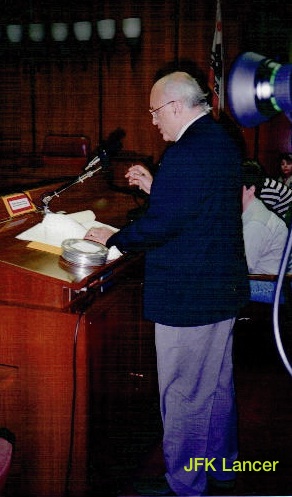
    Roger Feinman

    Roger Feinman Esq. passed away in New York City in mid-October of a heart condition. I did not meet Roger until 1993 at an ASK Symposium in Dallas. I was standing outside the main hall with John Newman when Roger approached us both and congratulated us on our recent books, Destiny Betrayed and JFK and Vietnam. He congratulated John without qualification and me with some qualification. When I got to know Jerry Policoff a bit better, I found out why mine was qualified.

    Both men had studied at the foot of the illustrious Sylvia Meagher. And as most people know, Sylvia had little time or affection for Jim Garrison. Since my book centered on Garrison, Roger had reservations about it. (Although I also learned from Jerry that Sylvia’s attitude toward Garrison changed slightly later in life.) Since Roger, like Sylvia, lived in New York, he was even closer to her than Policoff was. Having Sylvia as a mentor had its (plentiful) attributes and its drawbacks. On one hand, Sylvia had a strong devotion to core texts in the field. Consequently, one had to study the Warren Commission and House Select Committee volumes, and the supporting documents, at length and in depth. And very few people anywhere knew those volumes as well as she did. As is proven by the fact that she indexed them both. She was also a stickler for pure academic form. That is, one had to follow standard footnote and sourcing guidelines. And these should be attached to only credible sources. Finally, one should be analytical in one’s approach to the evidence in the case. For the authorities had decided much too early that Lee Harvey Oswald, and he alone, was guilty. Therefore, they had deprived the man of any kind of proper defense. One of the functions of the critical community was to balance the scales of justice in that regard.

    One of Sylvia’s drawbacks was that she rarely wanted to go beyond the core volumes. That is, she confined her approach to weighing the evidence in them and deciding the Warren Commission had not solved the crime–but actually helped cover it up. Hence the title of her excellent book Accessories After the Fact. She did not actually get out in the field and find other sources. Also, she tended to accept certain things in the Warren Report that to her, and to other first generation critics, just seemed too outlandish to question. For instance, Oswald’s possession of both the rifle and handgun as depicted in the famous backyard photographs. Consequently, when Jim Garrison began to go beyond the Warren Commission volumes in his inquiry—and to be tripped up by hidden forces both within and outside the mainstream press—she parted ways with him. She actually became one of his harsher critics. Hence Roger’s reservations about my first book. (I should note here, Sylvia was not alone in this attitude toward Garrison. Other first generation critics, like Paul Hoch and Josiah Thompson, felt the same way toward the DA.)

    As Roger began to make his own way in the field, he began to concentrate on two areas. His first area of interest was the media. He later developed a strong interest in the medical evidence. Concerning the first, Roger probably developed an interest in the media because he worked for CBS News. He was lucky enough to have secured a job there at a relatively young age as a news writer. And he had a promising future in a (then) thriving corporation. His idols there were the illustrious Edward R. Murrow, and the less famous Joe Wershba, who, ironically, died just a few months before Roger did. (http://www.cbsnews.com/stories/2011/05/16/national/main20063216.shtml)

    Wershba had assisted Murrow on his famous See it Now series, including the two segments that attacked Senator Joseph McCarthy, and helped end his demagogic and pernicious career. But Roger also noted what CBS had done to Murrow after that famous interlude. They essentially had bought him off and placed him in a gilded cage by giving him a lot of money to do innocuous celebrity interviews with people like Liberace. As Roger had deduced, William Paley and the top brass at CBS decided that no journalist, especially a crusader like Murrow, should ever have that kind of power again.

    Which makes what he did later at CBS even more admirable. Roger thoroughly understood that his company was up to its neck in the cover up of President Kennedy’s assassination. In fact, one could cogently argue that, from 1963-75, no other broadcast outlet did more to prop up the Warren Commission farce than did CBS. They prepared three news specials in that time period to support the Commission. These all came at crucial times in that time period. The first one was in 1964 to accompany the release of the Warren Report. The second was in 1967 to calm a public that was becoming anxious about what Jim Garrison was doing in New Orleans. The third was in 1975 at the time of the Church Committee exposure of the crimes of the CIA and FBI, and the Schweiker-Hart subcommittee report on the failure of those two agencies to properly relay information to the Commission.

    Instead of being quiet, playing along, and watching his bank account grow and his life prosper, Roger did something that very few of us would do. He began to write internal memoranda exposing how the practices used in the assembling of the multi–part 1967 series clearly violated the written journalistic standards of the network. As an employee, Roger had access to both the people involved in the making of that series, and through them, the documents used in its preparation. To say that these sources cinched his case is an understatement. They showed how the show’s producer, Les Midgley, had succumbed to pressure from above in his original conception of the show.

    His first idea was to show the viewer some of the points of controversy that the critics had developed. Then open up the program to a scholarly debate between some of the more prominent critics and the actual staffers on the Warren Commission. Wouldn’t it have been lovely to see Arlen Specter defend the “Single Bullet Theory” against Mark Lane? Or to listen to David Belin explain to Sylvia Meagher how the original rifle reportedly found, the Mauser, became a Mannlicher Carcano? Or to have Wesley Liebeler explain to Richard Popkin how all those reported sightings of a Second Oswald were either mistaken or didn’t matter? Even the one at Sylvia Odio’s apartment in Dallas. And to hear all this knowing that tens of millions were watching? What a great exercise in democracy: to have a thorough airing in public about the suspicious circumstances surrounding the death of President Kennedy. Especially while his successor, Lyndon Johnson, was escalating the Vietnam War to absurd and frightening heights.

    It was not to be. There was virtually no debate at all on this series. It was essentially a multi-part and one-sided endorsement of the Commission; the main talking heads being Walter Cronkite and Dan Rather. In his memoranda, Roger showed, with specific examples arranged in time sequence, how Midgley’s original conception was completely altered. Further, he named names all the way up the ladder. This included Dick Salant, president of CBS News. He then showed just how badly CBS had compromised itself to the Warren Commission forces. Midgley actually had Commissioner John McCloy act as a consultant to the program. Except this was done outside of normal channels, through his daughter, who worked at CBS and who functioned as a go-between between Midgley and McCloy. To conceal how badly CBS had compromised its own journalistic standards, Midgley then kept McCloy’s name off the program. In other words, the public never knew that CBS had consulted with a Warren Commissioner on a show that was actually supposed to judge the quality of work the Commission did. Of course, this would have been admitting to a national audience that the program was an extension of the Commission itself. And therefore was a cover up of a cover up.

    Midgley’s career was not at all hurt by his caving into pressure. In fact, it prospered. (http://articles.latimes.com/2002/jun/29/local/me-midgley29) He spent 34 years at CBS, retiring in 1980 after winning several awards. On the other hand, Roger’s was hurt. Fatally. He was first warned to stop composing and forwarding his critical memoranda about the Kennedy coverage. Unlike Midgley, Roger would not compromise. So CBS now began termination procedures against him. The procedures turned out to be successful. Roger lost his job, career, and future at CBS over his desire for them to tell the truth about the Kennedy assassination. To me, this episode is an object lesson which illustrates the fact that journalism is compromised by its managers being too close to centers of power. So much so that the Power Elite—in the person of John McCloy– then actually dictates what the truth about an epochal event is. Roger resisted the hypocrisy. He was shown the door.

    Roger then decided to go to law school. He graduated from Benjamin N. Cardozo School of Law in New York. He was a practicing lawyer for a number of years until, again, his career got caught up in the Kennedy case. The Power Elite deeply resented the impact that Oliver Stone’s 1991 film JFK had on the public. It created exactly what Midgley had been directed not to do: a public debate about Kennedy’s assassination. And the debate was everywhere, and it went on for months on end.

    Finally, Random House and Bob Loomis had had enough. Loomis, a Random House executive, now played the role of Dick Salant. He decided to orchestrate a quelling of the debate. He did this by hiring Gerald Posner to write a cover up book on the Kennedy case. Entitled Case Closed, the book was ridiculous on its face. Because Congress had not yet released 2 million pages on the Kennedy assassination. These were going to be declassified as a result of passage of the JFK Act, which was a direct result of the Stone film. So how could Posner close the case without this important information? Further, if Posner had closed the case, why was this information still being withheld?

    Loomis, and his friends in Washington and New York, helped arrange an extravaganza of a book tour for Posner the likes of which had rarely, if ever, been seen. He was featured on ABC in primetime, his book was excerpted with a cover story in US News and World Report. This was meant, of course, to distract attention from what was going to be released in those files. In order to cut off another debate. How intent was Random House to crush the critics and drown out their message? Loomis and Harold Evans, then president of Random House, decided to take out a large ad in the New York Times. It was in two parts and it was meant to deride the critics and exalt Posner and his book. The first part took the pictures of some prominent critics, like Bob Groden and Jim Garrison, and excerpted quotes from them out of context. At the top of the ad in large letters were the words: “Guilty of Misleading the American Public”. For Roger, this was one more example of corporate arrogance and the irresponsible use of power in the face of a complex and crucial event like the Kennedy case.

    So when Groden came to Roger and said he felt like his name and work had been smeared by the ad, Roger agreed to take on his case. If he had known what was in store for him, and the relationship between the judge in the case and Random House’s lawyer, he may not have done so. Because the judge clearly favored Random House, since he had been a clerk for Earl Warren. On just that basis, he should have recused himself. But he did not. When Roger protested the perceived bias, and the resultant favoritism that he felt short circuited the process and robbed his client of his day in court, he lost another career. He was disbarred.

    Roger spent the last quarter of his life in his small New York apartment working off and on as a computer programmer. He never lost his interest in the case, which had actually brought him much personal sorrow and grief. And he never lost his interest in the medical evidence. He supported the work of Dr. Randy Robertson, which he felt proved a conspiracy in the JFK case. And he criticized the work of David Lifton with a very long essay—Between the Signal and the Noise— criticizing his book Best Evidence. I had the privilege of communicating with Roger in those years via an e-mail chain set up between Milicent Cranor, Gary Schoener, Jerry Policoff, and myself. Roger never lost his spirit about what had happened to the USA as a result of the assassinations of the sixties, and he was a keen student of how the political system had evolved and declined since then. I got to see him at several conferences. It was always a pleasure to talk to him about CBS and what he had learned there through the documents he had spirited out when he left.

    One definition of the heroic is someone who sacrifices his own personal well being for a cause outside himself. Knowing full well that the odds against him triumphing are very high. Roger took that heroic gamble. Not once, but twice. He lost both times. Few of us, maybe no one, could display that kind of courage for a cause.

    For that, he should be saluted on his passing.


    (The following are links to some of Roger’s work)

    Between the Signal and the Noise (http://www.kenrahn.com/JFK/The_critics/Feinman/Between_the_signal/Preface.html)

    When Sonia Sotomayor’s Honesty, Independence and Integrity were Tested”. This article describes how Roger was disbarred over the Groden vs Random House case

    “CBS News and the Lone Assassin Story”, this is the script for Roger’s excellent visual essay on how Les Midgley’s CBS series covered up for the Warren Commission in 1967. Use this link.

    See now also “How CBS Aided the JFK Cover-up” by Jim DiEugenio.


  • Ron Rosenbaum Fires the First Salvo, Part 2


    Rosenbaum Whitewashes Angleton


    In Part 1 of this article we detailed the rather systematic way in which, in 1983, MSM journalist Ron Rosenbaum did all he could to demean the Warren Commission critics and cheapen any real investigation into the JFK case. That article, “Still on the Case’ was penned for Texas Monthly, which, for decades, has provided a welcome outlet for writers who cover-up the JFK case.

    Just a month before that, in October of 1983, Rosenbaum did a rather curious, actually bizarre essay about James Angleton. On April 10, 2013, from his perch in Slate, he more or less recycled his 1983 essay and coupled it with a cover story about Lee Harvey Oswald. One written by a former intelligence analyst that blamed JFK’s murder on Oswald and indirectly, Fidel Castro. A tall tale that would bring a wink and a nod from Angleton’s ghost. Which seems to be something Rosenbaum is very interested in doing. But which today, with what we know about the fruity Angleton, simply will not fly. And it is very hard to think that Rosenbaum is not aware of it. Which makes it even more puzzling as to why he tries to get away with it.

    I

    Before trying to answer the question about Rosenbaum’s bona fides, let us do two things. Let us review who Jim Angleton was, and then review Rosenbaum’s writings about him. That will provide the scaffolding to properly approach his 2013 essay.

    During World War II, Hugh Angleton pulled some strings and got his son out of the infantry and into counter-intelligence work in the OSS. This division was called X-2. Stationed in London, Jim rose to man the Italy desk for the OSS. (Tom Mangold, Cold Warrior, p. 38) Late in 1944, he was transferred to Rome, and became the top counter-intelligence chief for Italy. He had a high clearance and shared in the Ultra Secret, the breaking of the German spy code. Angleton stayed in Italy after the war. He developed connections with other spy services. And because he has met Allen Dulles there, he helped Dulles rig the 1948 Italian elections to prevent a likely communist victory. As Christopher Simpson noted in his book Blowback, this was done from the offices of the Dulles brothers law firm Sullivan and Cromwell. Angleton worked with the Dulles brothers, Foster and Allen, plus Frank Wisner, and Bill Colby. (Simpson, p. 90)

    Allen Dulles and Angleton had become great friends in Italy. Therefore, when the CIA was formed in 1947, Allen used his considerable influence to make sure Angleton was part of it. And Angleton brought in another friend he met in Italy, Ray Rocca. (Mangold, p. 45) Rocca would serve as Jim’s close assistant until the end of his career in 1975. Angleton was responsible for collection of foreign intelligence and liaisoning with other intelligence agencies. He eventually took over the CIA’s Israeli desk. And he became involved in Wisner’s attempt to roll back Soviet domination in East Europe.

    It was when Dulles became Deputy Director in 1953, and then Director in 1954, that Angleton began to carve out his Counter-Intelligence domain. As Tom Mangold notes in his book, it is not really possible to exaggerate the impact Dulles had on Angleton”s career. As he writes, “his sponsorship of Angleton and his staff was the key factor in the untrammeled growth of Angleton’s internal authority.” (ibid, p. 50) In fact, after the war Angleton was thinking of taking a job under his father with NCR. But it was Dulles who insisted he stick with intelligence work. (Ibid) It was the freedom that Dulles gave Angleton that allowed the CI chief to essentially build his own arm of the Agency. A branch that would eventually number close to 200 persons. But more importantly, it would allow him to work both outside of anyone’s purview and outside any legal restrictions. When Dulles was fired by President Kennedy, Angleton’s power was now protected by Richard Helms who was Director of Operations, then Deputy Director, and then DCI from 1962-1973. In other words, Angleton worked without regulation or review for two decades. (Ibid, pgs. 51-52) As we shall see, this was a blunder of titanic proportions. One which the public was not made fully aware of until 1991. Four years after Angleton had passed away.

    II

    After Britain’s intervention in the Russian Civil War, the NKVD (precursor to the KGB) decided to begin a long-term internal subversion project against England. One which had tremendous potential for long term profits.

    The idea was to recruit spies at the upper class, elite institute of higher learning, Cambridge. The most famous group recruited was later termed the Cambridge Five. This consisted of Anthony Blunt, Guy Burgess, Donald McLean, John Cairncross, and, most importantly to our story, Kim Philby. All five of these men ended up in high positions in the British government, serving in either MI5 or MI6; the former corresponds to the FBI, the latter to the CIA. The five men were all in position throughout World War II and beyond, well into the beginning of the Cold War. (The film Another Country is based on the origins of this ring and focuses on Burgess.)

    At Cambridge, Philby was a member of the outspoken left which critiqued the Labor Party, a group called the Cambridge University Socialist Society. After a trip to Berlin, where he saw the Nazi persecution of communists, he then navigated over to the Comintern. Further, Philby’s first wife, Litzi Friedman, was certainly a socialist, probably a communist. He met her in Austria where he was trying to help the country resist the German Anschluss, and also aiding the Comintern in enabling communists to escape Hitler. From there on in, Philby did all he could to conceal his leftist sympathies and replace them with a conservative veneer.

    In 1937, as a journalist, he went to Spain and was actually decorated by the fascist General Francisco Franco. On his return to London, he finally became what the NKVD hoped he would: a member of the Secret Intelligence Service, MI6. He worked there along with Burgess.

    Philby was quite good at climbing the ladder. For in 1944 he became chief of the Soviet and communist division. In other words, he could tell Stalin everything the British knew about him. Plus, he was in position to mislead MI6 about Stalin’s plans. He was even in position to know about NKVD defectors who could expose him. Which prospective defector Konstantin Volkov tried to do, but which Philby was in perfect position to stop. And he did. In fact, in 1945, Philby received the Order of the British Empire (OBE) for his intelligence work during the war. The Queen did not know that, at around the same time, the NKVD was secretly honoring Philby for what he was doing for them.

    In 1949, Philby was transferred to Washington. He became the British liaison to the CIA and FBI. Burgess also joined him, and they worked out of the British Embassy. It was there that both of the deep cover spies met James Angleton and William Harvey.

    III

    FBI code breaking analyst Robert Lamphere said about Philby’s position in Washington that he was in “as perfect a spot for the Soviets as they could possibly get a man.” (David Martin, Wilderness of Mirrors, p. 44) For instance, Philby was knowledgeable about the hunt for the spy ring that gave away the secret of the atom bomb. Kim Philby “was aware of the results of the … investigation of Klaus Fuchs.” (ibid) Philby even knew about the upcoming arrests of the Rosenbergs and Morton Sobell. But in spite of that knowledge, the Russians chose to sacrifice the trio rather than run the risk of exposing Philby.

    At this time, 1949-51, one of Angleton’s duties was to be formal liaison to high-ranking foreign intelligence officers. This coincided with Philby’s tour of duty in Washington. Philby later said that the two men would lunch about three times every two weeks and speak on the phone 3-4 times per week. (Mangold,p. 64) Angleton’s secretary would escort Philby into his office and she would then type up the oral dictation Jim made of those meetings into memoranda. (Ibid, p. 65) As Philby said, he cultivated Angleton socially since he thought that, “the greater the trust between us overtly, the less he would suspect covert action.” He then added that he was not sure who gained the most from this complex game-playing: “But I had one big advantage. I knew what he was doing for CIA and he knew what I was doing for SIS. But the real nature of my business he did not know.” (ibid, p. 65)

    What brought it all down was that the FBI found out the Soviets had intercepted a telegram from Winston Churchill to President Truman. They didn’t know who did it, but they knew he worked from inside the British Embassy. (Martin, p. 44) The inquiry then worked its way from the bottom upward. FBI analyst Robert Lamphere was one of the men who had access to the Venona crypts. This was the FBI’s deciphering of the Soviet secret code. The Bureau now began to center on a man named HOMER in the Venona codes. Philby knew who this man was. And he thought he would crack if the CIA or FBI got to him and questioned him. And if he did, that could expose Burgess and himself.

    Guy Burgess had gone from MI6 to the BBC to the Foreign Service. He was living as a lodger in Philby’s Washington home at this time. One night, Philby had a dinner party for Lamphere, Angelton, Harvey and their wives. Libby Harvey got a little tipsy. Burgess was fond of drawing caricatures of people. He drew an obscene one of Libby. Bill Harvey didn’t think it was funny and took a swing at him. Angleton jumped between them. And Philby tried to usher the guests out before any more violence took place. (Martin, p . 48)

    It turned out that the HOMER in Venona was McLean. With that knowledge, Philby knew he had to get McLean out of London before MI5 could act on that information. But it could not appear that he was the one warning him. Therefore, he had put Burgess up to acting outrageously e.g. with Libby. Burgess also pulled the stunt of getting three traffic tickets in one day. And he mouthed off to the officers in all three instances. The combination of these acts finally did the trick. Burgess was recalled to London. McLean had been scheduled to be questioned by MI5 on Monday, May 28, 1951. On Thursday, May 24th, Burgess arrived in England. Once he landed, he told a fellow passenger that, “A young friend of mine in the Foreign Office is in serious trouble. I am the only one who can help him.” (ibid, p. 50) He then rented a car and drove to McLean’s home. Burgess now drove his fellow Cambridge spy to Southampton, where they boarded a cross-channel ship to Saint-Malo. From there they went to Rennes and caught a train to Paris. Neither man was seen in public again until they held a joint press conference in Moscow in 1956. (ibid)

    To this day, no one knows why Burgess left England with McLean. Those were not Philby’s instructions. Until the end of his life, Philby never forgave Burgess for disobeying him. For the fact is that Philby knew about Venona and HOMER. Burgess had been Philby’s lodger, and now Burgess had fled also. This now did what nothing had ever done before: it cast suspicion on Philby himself. Was he The Third Man who had tipped off his two spy friends?

    CIA Director Walter Bedell Smith asked Harvey and Angleton to write up reports of what they knew about Burgess, his ties to Philby, and who they thought Philby was. (Mangold, p. 65) Harvey’s five-pager was an accusatory masterpiece. It was full of hard facts that built a strong circumstantial case that Philby had sent Burgess to aid his fellow Cambridge spy. But it went further. It declared that Philby had also been the one to derail the Volkov defection in order to save himself. Which was true. (Martin, p. 54)

    On the other hand, Angleton’s memo was fuzzy and impressionistic. It noted some oddities about Burgess, but seemed to excuse Philby on the grounds he was unwise in his choice of friends. A CIA officer who saw the report described it as, “a rambling, inchoate, and incredibly sloppy note.” Angleton even told Smith not to tell the British Philby might be a spy since it would damage CIA-MI6 relations. (Mangold, p. 66) Wisely, Smith forwarded SIS the Harvey memo. They used it to, at first, examine and then suspend Philby. But after years of inquiry, Philby did not confess. And they could not find any hard evidence to expose him. Cleared in public by Prime Minister Harold Macmillan, he was later brought back as a low level British agent in Lebanon, where he also served as a reporter. In 1963, MI6 finally put together a substantial case against him. An agent was sent to induce Philby to confess in return for immunity. Philby agreed and asked for time to set his affairs in order. This ended up being an excuse to arrange for his passage to Moscow. It was now certain that Philby was perhaps the highest level Soviet agent to ever operate in London and Washington. And it was also clear that Angleton could not have been more wrong about his friend.

    IV

    That Angleton was tricked by Philby could not really be held against him. Because Philby had done that to many people on both sides of the Atlantic. But the fact that Angleton was still in the dark afterwards, when Burgess and McLean had escaped, that should have been a tell-tale sign to everyone involved. Especially in comparison to the fact that Harvey had been uncannily accurate about Philby and his career. Making the comparison even worse was that, “No one had known Philby better or spent more time with him than Angleton.” (Martin, p. 55) In fact, up to the moment he was recalled to London, Philby was still chumming around with Angleton. Harvey was shocked at this. To the point that he actually thought that Angleton might be a Soviet agent. (Ibid, p. 57) In fact, even in 1952, when Philby was in the process of being thoroughly examined and then suspended, Angleton was still in his camp. He actually told another British intelligence officer that Philby would one day lead MI6. (Mangold, p. 66)

    In 1963, when the master spy had escaped to Moscow, Angleton finally got around to issuing a damage report on Philby. And even that was sketchy and incomplete. (Ibid, p. 67) But further, the real data upon which any accurate damage report would be based was the record contained in the memos of the Philby/Angleton meetings. As we have seen, these had been dictated by Angleton after each instance. These should have been examined by a team of analysts. But Angleton never volunteered those memos to any higher authority. After he was forced into retirement, there was a thorough search of his office. Not a single memo was found. There was evidence, a sign in sheet, of 36 meetings in his office (Ibid) There should have been 36 memoranda discovered. None were available.

    When Angleton became Chief of Counter-Intelligence, he controlled the Philby file. It was locked in a vault next to his office. No one could have stopped him from pilfering from it. Peter Wright of MI5 told biographer Tom Mangold that Angleton burned the memos of those meetings. Wright knew this because Angleton told him about it. Wright wanted them produced for his own investigation. When he asked for them, Jim A. said, “They’re gone Peter. I had them burned. It was all very embarrassing.” (ibid, p. 68)

    Leonard McCoy, who became Deputy Chief of Counter-Intelligence after Angleton left, said that the CIA had all kinds of operations going on at the time in areas like Albania, the Baltics, Ukraine, Turkey and southern Russia. They also had “stay behind” projects in East Europe. Almost all of them were rolled up by the Russians and their allies. McCoy said it was unfair to blame it all on Angleton’s closeness to Philby. But it would also be unfair to say that none of it was caused by that friendship. (ibid) McCoy said that this was a most difficult episode for Angleton to assimilate. Both the personal betrayal and the damage done to the CIA and the USA were owed in part to a man Angleton completely trusted. Consequently, he very seldom talked about it.

    But he did say some words to Wright. Wright said, “Jim was obsessed by Kim’s betrayal … .Can you imagine how much information he had to trade in those booze-ups?” Wright said that Angleton talked about killing Philby. (Ibid, pgs. 68-69) He concluded that, “Jim developed an awful trauma about British spies. Kim did a lot of damage to Jim. A lot of damage.” Cicely Angleton said that Philby’s betrayal hurt her husband, “terribly deeply-it was a bitter blow he never forgot.” In fact, after Philby went to Russia, Angleton thought that Philby was still “maintaining the campaign against Western intelligence from Moscow.” Walter Elder, special assistant to CIA Director John McCone from 1961-65, said that Philby’s betrayal was a very important event in Angleton’s life: “The Philby affair had a deep and profound effect on Jim. He just couldn’t let the Philby thing go. Philby was eventually to fit neatly into Jim’s perception of a Soviet “master plan” to deceive the entire West.” Elder continued in this vein thusly: “Long after Philby’s defection in 1963, Jim just continued to think that Philby was a key actor in the KGB grand plan. Philby remained very prominent in Jim’s philosophy about how the KGB orchestrated the “master plan” scenario.”

    As we shall see, Elder is talking about Angleton’s reception to Major Anatoli Golitsyn of the KGB. A defector whom Angleton-to put it mildly-placed too much trust in. And that misguided trust originated in the paranoia of the Philby betrayal. Angleton bought into Golitsyn’s wild and lurid portrayals of a KGB ‘monster plot’ because it fit the state of mind he was in after Philby’s personal treachery. As we shall see, this does appear to be one way to explain the incredible scenarios that Angleton fell for at the hands of Golitsyn.

    V

    According to Rosenbaum’s 1983 article in Harper’s, all the above is wrong. Why? Sit down please. Because Ron tells us that it was Angleton who was playing Philby. Therefore, all the above was a beautiful act by Jim A. The lamentations to his wife, to Peter Wright, his reluctance to turn over the memoranda which would have shown the information Angleton and Philby shared. According to Ron, Angleton even let all those operations in East Europe, and other places in Central Europe be rolled up. In other words, he got people killed because he was playing up to Philby to get his confidence.

    Then what is one to make of all the honors bestowed upon Philby when he finally fled to the USSR? Continuing and up to his burial with full honors, and a posthumous stamp issued with his name on it. Was that all unearned? Because, according to Ron, Philby was really informing to Angleton all the time he was in the USSR. Even though Angleton, as we have seen, told others at the time that Philby was still leading the KGB “master plan” from Moscow.

    It should be added, the above is just the beginning of the honors Philby won in the USSR. Before his death, he received the Order of Lenin, one of the highest honors a civilian could attain in the USSR. The KGB actually protected him from assassination. At his wake, several KGB agents made commemorative speeches as to his importance. He was then buried in the exclusive Kuntsevo Cemetery, a place where former premier Georgy Malenkov was buried. After his death, he had his plaque placed at the current Russian spy service center, and his portrait is in the Hall of Heroes.

    But according to Ron, those Russkies are just plain stupid. What is Ron’s evidence for the Russians being so dang dumb and honoring a guy who was just a tool of Angleton? If you read Ron’s article in the 1983 Harper’s, as collected in his anthology Travels with Dr. Death, its actually two sources: William Corson and Teddy Kollek. Both say that Angleton was informed of the Cambridge group at the time he knew Philby in Washington. (See Rosenbaum, Travels with Dr. Death, pgs. 23-25.)

    Now, from just the mention of the two names, this is strained even for Rosenbaum. Why? Because Corson was part of a circle of intelligence officers and reporters who worked with Angleton! After he left the CIA, that particular circle also included former Agency officer Robert Trumbull Crowley, and journalist Joseph Trento. Corson was a Marine in Vietnam who worked with the Southeast Asia Intelligence Force. There he became close with the CIA. Crowley and Angleton were friends and colleagues in the Agency. Corson wrote a book with Crowley called The New KGB. This book clearly showed the influence of Angleton’s thinking. Because it really was more of a history of the KGB rather than a current dossier on who they were. But further, it said that the Communist Party was not really in charge of the USSR anymore, the KGB was. Therefore, there was no real hope for detente. And “Soviet professions of reasonableness are pretense, a smokescreen behind which Russia under its new KGB masters reverts to harshest Stalinism.” With that in mind, there was little left to do but hold the USSR at “arm’s length and proceed with President Reagan’s Strategic Defense Initiative or “Star Wars” program. (New York Times, July 7, 1985)

    What is incredible about this is that the book was published the year Mikhail Gorbachev came to power! In fact, it was published four months after he became General Secretary. This is how wrong the authors were. And Angleton was right there with them since he was still saying similar things about the USSR at that time. (Mangold, p. 356) Now, in itself, that is something interesting that Rosenbaum does not inform the reader about. For if Philby was really Angleton’s tool, and he was now stationed in Moscow, why would Angleton and his circle still be so wrong about who Gorbachev was? And this was just two years before Angleton’s death. If any such communication existed-and there is no evidence it did-then it indicates Philby was still tricking Angleton.

    What about Kollek? Kollek was a long time Zionist who became the Mayor of Jerusalem in 1965. Angleton took over the Israeli desk in 1949 and was criticized by many for being too favorable to Israel during his tenure. Therefore, when Kollek says in a 1977 book on Anthony Blunt that he passed on the identity of the fifth member of the Cambridge spy ring to Angleton, one has to raise an eyebrow. (Rosenbaum, p. 25) Besides the fact that the “Fifth Man” was not who Kollek says he was, there is the problem that this “revelation” came in 1977 from a friend of Angleton’s. (Just as the “revelation” from Corson came out in 1977.) In other words, just two years after Angleton was fired, his friends now came out with these glimmers that Angleton was really aware of what Philby was doing all along.

    How weak are these excuses? Even Rosenbaum and Angleton have to acknowledge their transparent flimsiness. When Rosenbaum calls Jim A. for a comment on these newly discovered secrets–which arrive about 26 years too late–Angleton replies: “My Israeli friends have always been among the most loyal I’ve had. Perhaps the only ones to remain loyal.” (Ibid) For once Angleton and the author agree on something: His friends are trying to (unjustifiably) redeem him. In fact, Rosenbaum himself admits this may be true. In one moment he writes that, “Needless to say, there will be those among Angleton’s many critics who would say that the whole notion … was carefully planted by Angleton and his allies in an attempt to turn his most mortifying failure-the Philby case-into a clandestine success.” (ibid, p. 26)

    It is reassuring that even Rosenbaum is sometimes able to discern the obvious.

    VI

    Except there is even falsity in that above admission. Because Philby was not Angleton’s “most mortifying failure”. Most people would easily hand that honor to Anatoli Golitsyn. But in his writing on Angleton, Rosenabum has always been reluctant to fully describe just how blind Angleton was to Golitsyn’s fantasies. Or that Anatoli was manipulating Angleton for his own personal gain. Which he was. Golitsin was an ordinary KGB analyst who defected in December of 1961. When asked if he knew of any KGB double agents in Washington, he said he knew none. But he did know one of them in Europe who was codenamed SASHA. (Mangold p. 75)

    Very quickly, Golitsyn showed signs of megalomania. After a few weeks in America, he said he was tired of dealing with low level case officers like Dick Helms. (Who happened to be the number three guy in the CIA at the time.) He wanted to see President Kennedy and Attorney General Robert Kennedy. (Ibid, pgs. 76-77) He also wanted 15 million dollars to direct an organization to begin his plan to overthrow the USSR.

    Golitsyn did not get to see President Kennedy, but he did meet with Director John McCone–more than once. When he was asked to place his ideas about defeating the KGB in writing, he would not. McCone’s assistant concluded that, “Golitsyn was basically a technician. He had no knowledge of Soviet policy or decision-making processes at the high levels.” (Ibid, p. 77) But further, Angleton then got him a meeting with Allen Dulles. When Dulles asked him if he knew of any KGB penetration agent within the CIA, Golitsyn said he did not. (Ibid, p. 78)

    What these two episodes prove is that other people saw through Golitsyn rather quickly and easily. And second, Golitsyn later changed his story about a KGB mole inside the CIA. Yet, in spite of all this, Angleton continued to buy into him for 12 more years.

    Angleton did more than buy into him. He helped create and aggrandize Golitsyn. He violated a cardinal rule about defectors. He gave Golitsyn access to top secret Soviet Division files. He then laid down rules for how other agencies could interview him. This had the effect of letting Anatoli now create his own espionage tales, at the same time he was being at least partially protected by Angleton. But further, in the middle of a military debrief, Angleton arranged for Golitsyn to have an expenses paid two-week vacation to Disneyland. (Ibid, p. 81) But when he returned for the debrief, he was caught dead to rights creating a false story about how the KGB had gained access to a sensitive portion of the US Embassy in Moscow. (ibid) When confronted with this lie, Golitsyn walked out of the debrief. And he did not return.

    This pattern was repeated time after time during Golitsyn’s first year in America. He would be caught making something up, Angleton would ignore it, and he would demand, and get, more access to secret files. Sometimes he would even get access to the files of other agencies, like the FBI.

    But then Golitsyn made a claim that sealed Angleton’s fate. And his eventual disgrace. Anatoli told Jim that he should not listen to any defectors who followed him. Because they would all be fakes sent by the KGB for the purpose of discrediting him. This was part of the Soviet master plan, which also included secret messages in newspaper clippings. (Mangold, p. 87)

    Angleton was not content with allowing Golitsyn to only foul the intelligence networks in America. He then allowed him to do the same in England and France. He then would charge handsome fees for doing so. After seeing their files, he then would finger certain operatives. In England it was Roger Hollis and Graham Mitchell. But he also claimed that Labor candidate for prime minister, Hugh Gaitskell, was killed in order to allow Harold Wilson to take office. Therefore, the natural assumption was that Wilson was really a KGB asset. (Mangold, p. 95) Thus began a whisper campaign against Wilson.

    Armed with files from the CIA, FBI, MI5 and MI6, Golitsyn now pronounced any attempt at detente with the Russians to be useless. He also said that the idea of a Sino-Soviet split was part of the “master plan” to deceive the West. (It had actually begun in 1960 and was in full bloom by 1962) He also said that the idea that Eastern Europe wanted to be free from the USSR, that was also a deception and part of the master plan. And now he reversed himself on a key issue: the KGB had planted domestic agents inside the CIA.

    The more extreme Golitsyn got, the more Angleton liked it. When he returned from England, Anatoli got three gifts from his benefactor. He lent him his own lawyer-accountant, Mario Brod. He gave him a cash reward of 200,000 dollars. (Which would be about a million dollars today.) He then introduced him to a first-class stockbroker, James Dudley. In other words, as Golitsyn began to foul up the CIA’s operations here and abroad, Angleton began to personally reward him in ways that the middle level analyst had never dreamed of. The defector now bought a New York City townhouse and a farm in upstate New York. So the question then becomes: If you were Golitsyn, wouldn’t you also tell your benefactor not to trust any other defectors? If he did, they could endanger Golitsyn’s new status and prestige.

    Which is what happened with Yuri Nosenko.

    VII

    It is difficult to talk about the Nosenko case without referring to Edward Epstein. And it’s difficult to talk about Rosenbaum without mentioning Epstein. For the simple reason that Rosenbaum once wrote that Epstein’s Legend was a groundbreaking piece of work. (Rosenbaum, p. 37) Today, with later, more honest books about Angleton, most would disagree with that assessment. Most people would say that, like what Corson and Kollek did, Legend was a propaganda piece for Angleton. It was published around the same time, and it was a way for Angleton to press his case that William Colby had fired him unjustly.

    In the wake of all the information we have today, Angleton’s complaint against Colby is simply not credible. The truth is Nosenko was one of the most valuable defectors the CIA ever had. His information was much more valuable than Golitsyn’s. And it had very few, if any of the liabilities. Further, he had a much higher batting average. That is, his leads panned out at a much higher rate than Anatoli’s did. (Mangold, pgs. 333-34) But the point is that, by buying into the KGB ‘master plan’, that all other defectors would be fakes, Angleton ignored defectors who had an even higher batting average than Nosenko.

    Just how badly was Angleton tied into Golitsyn’s creed? He tried to discredit Nosenko to others months before he ever appeared in America. (Mangold, p. 169) This is an important fact that Epstein does not reveal in Legend. And neither does Rosenbaum. How did Angleton do this? He showed Golitsyn the record of Nosenko’s first debrief. This was done in Europe with CIA officer Peter Bagley. Bagley was at first impressed with Nosenko. But now the two men targeted Bagley and turned his opinion around on Nosenko. Epstein later admitted that Bagley had been a major source for him when he wrote Legend. (The Assassination Chronicles, p. 552) But as noted above, Epstein never reveals this plotting by Angleton in his book.

    That is a crucial point in the story. Because, as most know today, when Nosenko arrived in America, he was immediately imprisoned. He was then made to undergo intense hostile questioning and a rigged polygraph test. Undoubtedly, part of this was due to the fact that Nosenko actually defected two months after Kennedy’s murder. And he told the CIA that Oswald was not a Russian agent, and the KGB had only routinely surveilled him while he was in Russia. (Mangold, p. 174) This was more poison to Angleton. Because he was the CIA’s liaison to the Warren Commission at the time. And its clear he was pushing the line that Oswald was a Russian agent and the USSR had been behind the plot to kill Kennedy. In other words, Nosenko endangered both Angelton and Golitsyn.

    The basic facts about Nosenko’s imprisonment and torture were presented by Epstein. But Mangold’s book went much further in detail. Suffice it say, his imprisonment went on for five years. It got so bad that Nosenko went on a hunger strike. When he did, the CIA threatened to feed him intravenously. (Mangold, p. 188) For three years, he was not given anything to read. He did not see a dentist. Therefore, his teeth rotted. His second polygraph was also rigged. (Ibid, p. 189) Bagley wanted him to sign a fake confession for purposes of “disposing” of him.

    It wasn’t until Nosenko was imprisoned for three years that the tide began to turn against Angleton. Nosenko was finally given over to CIA officers who were not so influenced by Angleton and Golitsyn, and were not so biased against the man. When Bruce Solie of the Office of Security took over the case he was shocked at what he found. He quickly saw that Nosenko’s replies had often been mistranslated and the polygraph tests had been gamed against him. He also found out that at least six leads given to Bagley by Nosenko had been ignored. When Solie discovered them and passed them on, they all panned out. Some of them led to arrests. (ibid, p. 198) All of this important information was omitted by both Epstein and Rosenbaum.

    But further, Solie found that the reasons given by Bagley for suspecting Nosenko was a false defector were illogical. Nosenko had exaggerated his position in the KGB and lied about certain recall orders. Solie concluded that these kinds of things were commonplace with defectors. The former was used in order to make them more attractive to the CIA, and the latter was done to hurry his exfiltration to the West. (Mangold, p. 197) Solie now gave Nosenko a third polygraph. One that was not done under hostile conditions, nor was it rigged. Nosenko passed. Solie issued a 283 page report saying that Nosenko was a genuine KGB defector. The FBI now took up nine more of his leads. In 1969, Nosenko was finally set free and became a CIA consultant. Every CIA Director after Richard Helms agreed with Solie about Nosenko. In fact, Bill Colby was repelled by what Angleton had done to the man: “The idea that the CIA could put a guy in jail without habeas corpus just scared the living daylights out of me. That kind of intelligence service is a threat to its own people.” (Ibid, p. 203)

    But what is incredible about the Golitsyn/Angleton folie a deux is that it did not stop with Nosenko. It was repeated in the Yuri Loginov scandal. And again, neither Epstein nor Rosenbaum tell their readers about that. Loginov was also a prospective KGB defector. He was problematic to Angleton because, first, he said Nosenko was genuine, and second he said the Sino-Soviet split was real. But, probably even worse, he said that the exposure of a CIA double agent in Russia, Pyotr Popov, was not done by Golitsyn’s alleged mole, but by a mistake in tradecraft the KGB picked up on. (Mangold, pgs. 213-17) Because of this, Loginov was marked as a fake defector. But what Angleton did to Loginov was even worse than what he did to Nosenko. He turned him over to BOSS, the South African intelligence service, as a KGB agent. Without telling them Loginov was working as a double agent for the CIA. But like Nosenko, Loginov would not crack under interrogation. So he was handed over to West Germany and used by them in a spy trade with the Russians. To this day, no one knows for certain what happened to Loginov. There are some reports that he was simply dismissed. There are some reports that he was shot. But Angleton certainly knew that his execution was a probability once he was turned over to BOSS.

    In all, Angleton bragged that he turned back 22 defectors as fakes. The CIA later found that every single one of them was genuine. (Mangold, p. 231) Angleton’s pathological obsession with Golitsyn had paralyzed the CIA’s main mission in the Cold War: to collect reliable human intelligence on what was going on inside the Kremlin.

    The ultimate end game of the Angleton/Golitsyn marriage was codenamed HONETOL. This was the formal search for the mole inside the CIA. The mole which, in 1962, Golitsyn told Dulles did not exist. This search never bore any fruit: the mole was never found. But it ended up damaging, in some cases, wrecking the lives of those who came under suspicion. This occurred when Angleton gave Golitsyn their files. By the time it was finished, over 100 people were investigated. It got so bad that, after Colby fired Angleton, an act of congress was passed so that his victims could seek redress for having their careers stalled or destroyed. (Mangold, p. 277) Those were the lucky ones. Because there were victims overseas who could not seek redress from congress. Again, this tragic facet of the Angleton/Golitsyn union is not noted by either Epstein or Rosenbaum.

    For the truth about Angleton is easy to apprehend today. Books by Mangold, David Wise, and Michael Holzman were not one-sided mouthpieces for Angleton and his pals, as Legend was. Because toward the end, when Angleton and Golitsyn could not find their invisible mole, they turned inward. They now said a former ally against Nosenko, David Murphy, was the mole. Angleton actually flew to Paris, where Murphy was stationed, to warn the SDECE that Murphy was a double agent. (Mangold, p. 299) By the time Angleton was removed from office, he had investigated Prime Minister Harold Wilson of England, Prime Minister Olof Palme of Sweden, Chancellor Willy Brandt of West Germany, industrialist Armand Hammer, diplomat Averill Harriman, Prime Minister Lester Pearson of Canada, and National Security Advisor Henry Kissinger. These were all elements of Golitsyn’s ‘Monster Plot’.

    When Bill Colby took over, he did something unusual with Angleton. He began to review his performance as Counter Intelligence Chief. He later commented, “I couldn’t find that we caught a spy under Jim. That really bothered me.” (Mangold, p. 313) The further he looked the more obvious it became to Colby, “He was not a good CI Chief.” (ibid) For example, Colby could not find one productive operation Angleton was running in the USSR. Angleton’s division was on its own, cut off from the CIA. So much so that it had almost nothing to do with the rest of the Agency. When Colby found out that Angleton had routed all Israeli communications to himself, not to be shared with other Mideast stations, he took him off the Israeli desk. For this had prevented effective communications during the Yom Kippur War. (Ibid, p. 314) Colby also found out that Angleton was actually running agents through a private person, his lawyer Mario Brod.

    That was it for Colby. He called Angleton into his office and gave him three options. He could take another job in the Agency, take early retirement or become a consultant. When Angleton declined all three, Colby cooperated with CIA asset Sy Hersh to expose Angleton’s roles in an illegal mail intercept project and MH Chaos, a huge domestic surveillance program. Finally, in 1975, Angleton was forced out. At least 13 years too late. Unfortunately, Colby allowed Angleton several weeks to clean out his office. Still, when George Kalaris took over, he was surprised at what he discovered. There were dozens of letters from the illegal mail intercept program that had never been opened. (Ibid, p. 327) Angleton had not left behind the combinations to several safes. Kalaris had to have them blown open. To just recover all the hidden files took several weeks. It took three years to integrate them into the Agency’s central filing system.

    When Kalaris got to the HONETOL files on Wilson, Roger Hollis, Armand Hammer and Kissinger he was so ashamed at what was in them he had them incinerated. Kalaris commissioned a complete review of Golitsyn’s record. He found out that less than 1% of his leads had panned out. (Mangold, pgs. 333-34) Meanwhile, Kalaris discovered another source Angleton had ignored. A Russian military officer from the GRU. Kalaris decided to investigate those ignored leads which had been buried by Angleton. This source, code named NICK NACK, scored a perfect 20 for 20. (Ibid, p. 344)

    Kalaris now decided to retire Golitsyn. But he had to get all the files Angleton had given him back. It turned out that Angleton had allowed Anatoli to take FBI files and CIA personnel files to his home! Former CIA analyst Cleveland Cram was brought in to write the history of the CI division. It ended up being 12 volumes long. Cram concluded that Angleton had had a detrimental impact on the CIA. And the Golitsyn years had been a nightmare. (Ibid, p. 345) He also reviewed the literature of the period. He said that Epstein’s book Legend was part of a disinformation campaign. And it gave Angleton and his supporters an advantage by placing their argument forward first, adroitly but dishonestly.

    Angleton never gave up. He told CIA officer Walter Elder that the Church Committee was a KGB plot run by Philby out of Moscow. He was endorsing Goltisyn’s pronouncements into the eighties. Even though each of six predictions he made in 1984 turned out to be wrong. This was the true and sorry record of the man praised by Epstein and Rosenbaum. As a spy chief, Angleton was horrid.

    VIII

    Which brings us to Rosenbaum’s 2013 piece in Slate. Like Angleton, Ron just can’t give up. His New York Times July 10, 1994 essay on Philby was so confused and unwieldy that Rosenbaum seemed to say it was Philby who planted the idea of a mole in the CIA on Angleton. In fact, it was Golitsyn who did so. In that same 1994 piece, he seemed to drop the whole ‘Angleton played Philby’ nonsense. He said Philby had only one master, the Soviet Union. He added that only “die-hard supporters of James Angleton” would persist down the Angleton played Philby path.

    Well, I guess Ron is a die-hard Angleton supporter. He now tries to bring back the idea he discarded in 1994. In an article called “Philby and Oswald” he is ready to revive the old disinfo. His basis is an Epilogue to a recent novel called Young Philby. And what is Ron’s basis for this: an interview the novelist did with Teddy Kollek! Oh my aching back. Let us refer to the wise word of Daniel Wick in his discussion of two books on Philby published back in 1995:

    The evidence overwhelmingly demonstrates that Philby did great harm to the interests of the West and none whatsoever to Soviet interests, and that his treachery caused the deaths of dozens of Western agents while he did nothing that harmed a single Soviet. In the end, pop romantic speculation aside, he was Moscow’s man. (LA Times, January 1, 1995)

    In this same article, Ron tries to push the terrible book by CIA analyst Brian Latell, Castro’s Secrets. I would refer the reader to the ctka review of that book by Arnaldo M. Fernandez. (Castro’s Secrets) Once one does that, one will see that Ron is up to his old tricks again. His major endeavor in all this Angleton and Kennedy stuff is to confuse matters. Here is a guy who can write about the JFK case, “every once in a while something new turns up, a new twist, a declassified document an overlooked defector, a forgotten witness.” I guess Ron missed those 2 million pages of ARRB declassified documents. He sure missed the declassified Inspector General Report on the CIA-Mafia plots to kill Castro. Because Rosenbaum can write in his 2013 article that Castro was under threat from “assassination plots orchestrated by JFK and his brother Bobby.” If Rosenbaum had read the IG report he would have seen that these plots were deliberately kept from the Kennedys by the CIA.

    Would that have made any difference to him? Probably not. Rosenbaum is incorrigible. To the author, he represents all that is wrong with the MSM on both Jim Angleton and the JFK case. He can actually write that Angleton had a “mythic reputation within the intel community as the Master of the Game.” Whatever reputation Angleton had in the intelligence community has been destroyed with the release of new information about himself and his relationship with Oswald. As we have seen, Angleton was a disaster as a CI Chief. He was taken by not just by Philby but by Golitsyn. And as John Newman shows in his book Oswald and the CIA, he was very likely Oswald’s ultimate control agent. (Click here for a review.)

    If Rosenbaum is not aware of any of this, then he is irresponsible. If he is aware of it, then he is executing a whitewash. Either way, the man is irrelevant to the matters he is writing about on this the 50th anniversary of the JFK case.

    Go to Part 1

  • Ron Rosenbaum Fires the First Salvo, Part 1


    Rosenbaum and The Critics


    For all intents and purposes, on April 10th , Ron Rosenbaum kicked off the 50th anniversary battle over the JFK case in the media. He did it from his friendly perch at Slate Magazine. In his article entitled “Philby and Oswald,” he clearly connotes two things. First, he understands that the JFK community is coming very close to a unanimous vote about who Lee Harvey Oswald actually was. And second, a consensus is also gathering about who controlled Oswald, namely James Angleton. These developments – which owe much to the writing of John Newman and Lisa Pease – are very important in the JFK case. With them one can now discard the obsolete portrait of Oswald as painted by the deceitful Warren Commission. Secondly, one can now begin to indicate with authority who had control of Oswald’s files at Langley and the dance that was done with them in October and November of 1963. A dance that now seems all too deliberate. Knowing how crucial this information would be in any coming public debate, Rosenbaum decided to try for a preemptive strike about both Angleton and Oswald.

    To understand why he would do this one needs to know a bit about the history of journalist Ron Rosenbaum.

    I

    After graduating from Yale, Rosenbaum first secured a reporting job at The Village Voice. He left in 1975 and then began regularly contributing to Esquire, Harper’s, High Times, and Vanity Fair. Most recently he has written for New York Times Magazine and Slate. He has also published several books. Some of these have been anthologies of his previously published work. His most celebrated book is probably 1998’s Explaining Hitler. There the author interviewed several authorities trying to explain Hitler’s bizarre psychology.

    After he left The Village Voice, Rosenbaum first entered the JFK field. In July of 1976 he co-wrote an article about the death of Mary Meyer. Meyer was the divorced wife of CIA officer Cord Meyer who was murdered in 1964. This long article showed the hallmarks of what his later writing would be in the field. This included a trust for highly placed sources, a sneering cynicism about President Kennedy and those who thought there was something important about his presidency, and third, a strange, symbiotic relationship with and trust in James Angleton. Concerning the last, it is important to understand that this article appeared about two years after Angleton had been forced out of the CIA – in essence he was fired – by Director William Colby. Further, Angleton had been a person of interest in the Kennedy assassination to the Church Committee and, very soon, would be the same to the House Select Committee on Assassinations. But in spite of this, Rosenbaum and Nobile accepted just about all he said about the death of family friend Mary Meyer at face value. One does not have to abide by the wild schemes of Peter Janney to note that the authors should have been more circumspect about the canned counter-intelligence chief.

    But the 1976 article was really just a dress rehearsal. In November of 1983 Rosenbaum had his opening night gala. And what a bash it was. Texas Monthly has always been out to denigrate the critics of the Warren Commission. Realizing their mutuality of interests, for the 20th anniversary of President Kennedy’s assassination, Rosenbaum stepped up to the plate and smacked it out of the park for them. He penned a long article called “Still on the Case”. Rosenbaum’s essay was a slightly diluted, more concise version of the 1967 Lawrence Schiller/Richard Lewis volume, The Scavengers and Critics of the Warren Report. Except, in some ways, it was even more dishonest than that book. At the beginning of the piece, he appointed himself as the public’s tour guide, nicknaming himself El Exigente: the Demanding One from coffee taster lore. In other words, since he was a “real journalist”, he would be able to tell us what the critical community had actually developed in the 20 years since President Kennedy had been killed.

    The problem with so pompously appointing himself was simple: this was a disguise. Rosenbaum was not out in any way to fairly judge what the developments in the critical community had been for 20 years. He was not really interested in presenting any new information to the public. This is made obvious from the very opening of the article. The first two words in the subhead after the title are “Conspiracy Buffs”. Rosenbaum deliberately does not use the term “critics of the Warren Commission.” Therefore, in a stroke, he elevates the status of the Commission and lowers the status of the critics. He repeats this technique throughout the article. Consider the following usages of the term:

    buff books
    the buff grapevine
    buff biz
    ascendant buff
    buff trend
    buff factionalism
    buff fever
    technobuff
    buff theorists
    buff faith
    buff fratricide
    buff literature
    buff contacts
    second-body buffs
    Dallas buffs

    And I may have missed a couple of other turns. Clearly, from the very start, Rosenbaum was out to belittle any effort to find out the truth about the Kennedy case; but he was also out to caricature those who thought the cause worth pursuing. He jams this message home by using this term, “other assassins”, which he deliberately puts in quotes. Presumably meaning it’s a thought too nebulous to consider. As to other suspects in the case, he refers to them as The People Behind it All. That’s right, all in capital letters.

    II

    Rosenbaum opens the essay with a scene of him with Penn Jones in Dealey Plaza. Penn was demonstrating to Rosenbaum if a shot could be aimed at Kennedy from a manhole cover. This is how The Demanding One begins his search for truth and justice. It further reveals Rosenbaum’s agenda. If one were to ask ten writers to outline the shooting scenario in Dealey Plaza, I would guess that, at the most, perhaps one would say a shot came from a sewer or storm drain. More likely, none would propose that idea. But this is how Rosenbaum achieved his goal for his editors. He took the most extreme ideas in the research community and implied they were representative of that community. Which they were not. Another example Rosenbaum used as being representative was Michael Eddowes’ exhumation of Oswald’s corpse and his attempt to show that somehow the KGB had substituted an agent for Oswald while he was in the USSR. Still another example: Ron Ranftel’s published essay on the Psychedelic Oswald. This article was based on an FBI interview with a New Orleans lawyer who said a man named Oswald asked him about a book he had read by Aldous Huxley concerning the use of psychedelic drugs. If you can believe it, Rosenbaum goes on with this silly angle for two pages. (Rosenbaum, Travels with Dr. Death, pgs. 74-76) This article was so ephemeral that if you Google Ranftel’s name today you will only find it in relation to Rosenbaum’s book. But yet The Demanding One actually wrote that “The Psychedelic Oswald hypothesis offers an explanation, a way of reconciling some of the intractable contradictions he left behind.” No Ron. No one ever believed that. It was a way for you to fulfill your agenda of Reducing It All to Trivia.

    This is further exposed elsewhere by his equating of the critics with the term “deconstruction”. (ibid, p. xv) For those outside the realm of literary criticism, deconstruction refers to the 1960’s theory of criticism related to semiotics. It generally held that an author’s meaning could be divined more from the differences between words than from their reference to things they actually stood for. And that different meanings could be discovered by taking apart the structure of the language used, thereby exposing the assumption that words have a fixed reference beyond themselves. Having dealt in criticism for decades, I have never found this concept very useful. Although I could see how someone could use it in the realm of say films or novels. But in a murder case? Balderdash. The first generation of critics attacked the Warren Commission on two major grounds:

    1. Its main conclusions were not upheld by its own evidence. In other words, the Commission did not prove Oswald was guilty of killing President Kennedy or that Ruby had no help in killing Oswald.
    2. The amount of exculpatory evidence the Warren Report ignored about Oswald was shocking.

    In other words, the critics were not deconstructing text or film images. They were taking apart a criminal case piece by piece. Just as a defense lawyer for Oswald would have if the accused had not been killed by Jack Ruby. But to show just how biased Rosenbaum is, consider this passage from the essay. In describing a plaque outside the Texas School Book Depository set up by the Texas Historical Commission, he says it “still astonishes with its frank rejection of Warren Commission certainty.” Why? Because it refers to Oswald as the alleged killer of President Kennedy. To Ron, this is “astonishing” (ibid. p. 67). To anyone else, it is simply natural since Oswald never had a lawyer, let alone a trial.

    And then there are the howlers in the piece. In the acknowledgements to his anthology book, Travels with Dr. Death, Rosenbaum thanks the dozens of fact checkers at the magazines which published his essays. Including this one. (Which he retitled for its inclusion as “Oswald’s Ghost”.) Well, I don’t know what on earth Rosenbaum is thanking them for, since they allowed him to get away with some incredible errors. Which reveal that the man was either a dilettante or a fabricator.

    One of the methods Rosenbaum uses to ridicule the critics is to refer to certain recurring phenomena in the case with a rubric. The rather see-through intent behind this is to imply: “See that particular thing happened before, years ago, so why is it important now?” So when someone tells him about Carolyn Arnold, and her buried testimony about seeing Oswald downstairs during lunch after he was seen upstairs working, he writes “It isn’t the greatest missing-witness story I’ve heard. Nothing like the classic Earlene Roberts rooming house story.” (ibid, p. 63) Let us examine this passage to see just how gaseous Rosenbaum really is.

    First of all, the main point about Carolyn Arnold’s submerged story is not that it was apparently never given to the Warren Commission. Its not even that it tends to be exculpatory of Oswald. Rosenbaum notes those aspects. The key point about Arnold is this: The FBI changed her statement. In other words, they altered evidence in a murder case. When Anthony Summers interviewed Arnold in 1978, five years before Rosenbaum’s article appeared, she was immediately taken aback by what the report said. The FBI had written that, from outside the depository, she “thought she caught a fleeting glimpse of Lee Harvey Oswald standing in the hallway”. (Summers, Conspiracy, p. 77) Before Summers could even describe why her statement was important, the witness insisted this was not what she told the Bureau. First, she knew Oswald since he had come to her more than once for change. Secondly, she did not catch a glimpse of him from outside. At about 12:15 or later, she went into the lunchroom on the second floor and saw Oswald sitting in one of the booth seats on the right side of the room. Pretty nonchalant behavior for a murderer planning to be upstairs on the sixth floor in about five minutes setting up his boxes as a barricade, piecing together his rifle, loading a magazine, and lining up his target.

    The FBI altered a witness’s testimony in order to strengthen its case against Oswald. That is what is left out by Rosenbaum. And it is crucial. Because it suggests that the main investigative arm of the Warren Commission, J. Edgar Hoover’s FBI, was out to rig the case by making Carolyn Arnold’s identification much less certain than it was. Rosenbaum, striving so hard to be part of the MSM choir, wasn’t going to risk raising the ire of his editors by putting that key point in there. Even if the public needed to be made aware of it in order to understand the whole story behind the Warren Commission debacle.

    But if that’s not bad enough, Rosenbaum now screws up the Earlene Roberts aspect of his passage. Roberts, of course, was Oswald’s landlady at the rooming house at 1026 Beckley in Dallas. Rosenbaum recounts her story about Oswald coming into his room at about 1:00 PM on the 22nd, a police car pulling up and honking, and Oswald then leaving. Rosenbaum says that J. D. Tippit was then shot. He then assumes it might have been Tippit honking at Beckley. (Rosenbaum, p. 65)

    As we shall see, Ron didn’t do his homework on this issue. Roberts said there were two men in the car. Tippit was alone, so it was unlikely to have been him. (Mark Lane, Rush to Judgment, p. 169) But Rosenbaum also leaves out another key point. Roberts said that the last time she saw Oswald he was waiting at a bus stop outside her house. Rosenbaum fails to tell his readers that. Or this: the bus that stopped at that corner was headed the opposite way of the Tippit shooting. (ibid, p. 171)

    But here is Ron’s real howler. Rosenbaum says that Roberts died mysteriously before she was able to give her testimony. (Rosenbaum, p. 66) This is what I mean about thanking his non-existent fact checkers. Because Roberts testified to the Warren Commission on April 8, 1964 at the post office building at Bryan and Ervay Streets before Commission attorneys Joe Ball and Sam Stern. (WC Vol. VI, pgs 434-44) That same year, she appeared on a nationally televised CBS special. Her testimony appears prominently in several early books on the case, including Mark Lane’s best-selling Rush to Judgment. (See pgs. 168-71) Could Ron and his Thankful Fact Checkers really have missed all this? Some Demanding One.

    But El Exigente is not done spilling coffee on himself. Because then there is Ron and his 544 Camp Street Claim. In 1983, the address of 544 Camp Street, and all it conveyed, had been circulated fairly far and wide. First by the Jim Garrison investigation in the sixties. Then by the House Select Committee on Assassinations in the seventies. And then by Anthony Summers in his popular book entitled Conspiracy. That book was first published in 1980, and reprinted in 1981. It was reviewed in the Philadelphia Daily News, New York Post, Cosmopolitan, New York Review of Books, The Village Voice and the LA Times, among others. Summers begins his chapter on New Orleans with the famous Corliss Lamont pamphlet, “The Crime Against Cuba.” He describes it as an evidentiary “time bomb”. Because Oswald had stupidly stamped the address on it as follows: FPCC, 544 Camp St., New Orleans, LA. (Summers, pgs. 286-87) Summers then dutifully describes the problem with this address stamped by Oswald. Namely that there was no Fair Play for Cuba Committee office at that address. But there was an office for Guy Banister there. And plenty of witnesses saw Oswald in that office that summer. (James DiEugenio, Destiny Betrayed, 2nd edition, pgs. 111-113) Therefore, to do an article in 1983 about the state of the research in the JFK case, it would have been difficult not to address this issue about Oswald and Banister.

    Rosenbaum did address it. But in a truly weird way. A way that reveals how deep his commitment was to minimizing the Warren Commission’s perfidy. He writes that the Commission was fully aware of this issue and what it represented. (Rosenbaum, p. 81) According to Ron, the commission staffers were actually writing memos about 544 Camp Street. And when they presented their memos about it “to the harried chief counsel of the Warren Commission, it came back with these words scrawled on it: “At this stage we are supposed to be closing doors, not opening them.” (ibid)

    If the above paragraph about the Warren Commission, Guy Banister, and 544 Camp Street sounds like a fairy tale to the reader, that’s because it is. There is simply no evidence–even at this late date–after the declassification of 2 million pages of documents by the Assassination Records Review Board, that such an internal debate ever happened. And it is hard to think Rosenbaum didn’t understand that in 1983. Why? Because of his usage of the infamous line, “At this stage we are supposed to be closing doors, not opening them.” Everyone who knows anything about this case recognizes that this reply, by Chief Consul J. Lee Rankin to junior counsel Wesley Liebeler, was not made in relation to 544 Camp Street. It was made in reply to questions about the testimony of Sylvia Odio. (Edward Epstein, The Assassination Chronicles, p. 114) Again, where were Ron’s Thankful Fact Checkers? How demanding was El Exigente? The answer in regards to the Warren Commission is: Not Very.

    III

    As we know today, the FBI was very conscious of Oswald being at 544 Camp Street. That’s because some FBI agents, like Regis Kennedy, were actually at the place. (DiEugenio, p. 342) Hoover understood that to fully expose the paradox of a supposedly communist Oswald in the presence of rabid right-wingers in league with the CIA, this paradox would create a colossal problem for the Commission, the media, and the public. Therefore, as both John Newman and Anthony Summers have written, Hoover tried to cover up the fact that there was powerful evidence Oswald was indeed there. For instance, a message from New Orleans agent Harry Maynor to FBI HQ was lined out but still visible. It said, “Several Fair Play for Cuba pamphlets contained address 544 Camp Street.” (DiEugenio, p. 102) Also, when the FBI forwarded its few reports to the Warren Commission on Banister, they used the alternative address of 531 Lafayette Street. (ibid) Again, by leaving this out, Rosenbaum deprives the reader of the important knowledge that the FBI was furnishing duplicitous reports to the Commission. And the reason for that was because Hoover was not at all interested in finding out who the real killers of Kennedy actually were. If Rosenbaum had admitted this, it would have shown what a parody of justice and law enforcement the Commission actually was. And The Demanding One did not want to do that. It would have made the people he was busy caricaturing into real critics. And his editors unhappy.

    The ending section of the essay is in keeping with what has come before it. Rosenbaum makes a couple of contacts with people he esteems as the Wise Men of “buffdom”. They are Paul Hoch and Josiah Thompson. Paul Hoch, as everyone knows, is about as conservative on this case as one can get. And at the time of this article, he really wasn’t a researcher anymore. He was more or less an archivist who put out a rather undistinguished newsletter called Echoes of Conspiracy. Which was just that: a newsletter. It was not a research journal at all. In the sense that he didn’t commission articles on certain subjects in the field. Well, realizing that, Ron gets exactly what he wants from Hoch. After looking over Echoes of Conspiracy, the author writes, “Clippings. There seemed to be no edge, no direction, no sense that any of this was leading to anything.” (Rosenbaum, p. 85) Well, looking at that publication, yes you could say that. You could not say that about say, Probe Magazine in the nineties. That publication was geared to the ARRB and featured many cutting edge pieces based on the declassified materials that Rosenbaum never saw or even mentions.

    He then calls Hoch and tells him, “I get the impression that you’re shifting from being an assassination investigator to something more like a commentator.” Hoch replies, “I think that’s true.” Rosenbaum asks, “But what about solving the case?” And the response is, “I just don’t know. I just don’t know if it’s too late now.”

    If anyone can show me an instance when Paul Hoch was ever trying to crack open the Kennedy case, I would be interested in hearing about it. This is a man who once recommended that Lisa Pease read Carlos Bringuier’s book Red Friday since it had some good information in it. He also once said that he felt that the HSCA was actually improved once Richard Sprague was ousted as Chief Counsel. After a speaking panel in Chicago, which featured Commission counsel Burt Griffin and HSCA Deputy Counsel Robert Tanenbaum, Hoch said he preferred Griffin. This is the man to whom El Exigente asks the question: “What about solving the case?”

    The last interview Rosenbaum does is with Josiah Thompson. Rosenbaum writes that Thompson was a former philosophy professor of his at Yale. What results from this conversation is, again, more or less predictable. Thompson’s book Six Seconds in Dallas had been published back in 1967, sixteen years previous. The only book he had worked on in the meantime was an unpublished anthology with Peter Dale Scott and Hoch called Beyond Conspiracy. Having seen the manuscript, thank God it was never published. It largely bought into the findings of the HSCA. Therefore, as with Hoch, if Thompson did not have any edge, or direction, it was because he was not still on the case. That is clear from one of the first things he tells The Not So Demanding One. Incredibly, Thompson says that the NAA testing done by Vincent Guinn for the HSCA is “very powerful evidence that the single-bullet theory is correct. It absolutely astonishes me, but you gotta look at what the evidence is.” (ibid, p. 88. To be fair to Thompson, he does bring up a question about he provenance of CE 399)

    Of course today we know what others had long suspected. Vincent Guinn’s NAA as applied to bullet lead analysis was a sham. Or as some luminaries call it today, junk science. It has been so badly discredited by two academic teams that the FBI will not use it in court anymore. (Click here for a review.) Rosenbaum then closes the piece with this opinion: If there was any conspiracy, it was probably a Mafia hit. Which, if Rosenbaum was accurate, Thompson himself was leaning toward at the time. (ibid, pgs. 88-89) Rosenbaum confirms this in an update to his essay. Written in 1991, those four paragraphs praise the work of the late John Davis in Mafia Kingfish. He calls this the best conspiracy concept we are ever likely to get. But he finally adds that he is suspicious of conspiracy theories that make Oswald a pawn. He still feels that Oswald was more of a manipulator than a pawn, “if only of his own impersonations.” (ibid, p.91) So for Ron, it was either a Mafia did it or Oswald did it scenario. Although I am a bit confused by the last quoted six words. Does this mean that Oswald had actually tricked Marcello and Trafficante into taking the blame for what he actually did himself?

    IV

    By essentially leaving out authors like Tony Summers, George Michael Evica and their more current efforts, El Exigente had reduced the two decades of research into the JFK case into a morass of eccentricity and confusion. But even more, he had made it so unattractive, so bizarre, and so pointless, that his article would discourage anyone else from entering the field. Which, of course, is what the Texas Monthly has always wanted to do.

    But there were another lacunae in The Demanding One’s work. In his introduction to Travels with Dr. Death, the author writes about the JFK case as such: “And so investigation begets investigation begets re-investigation, and still the ghost of Oswald lurks in the static with that inscrutable smirk on his face…” What he is referring to is the sequence of first, the Warren Commission, then the Church Committee, and finally the HSCA. What he leaves out is what anyone who is familiar with those inquiries knows. The Warren Commission was not an investigation at all. It was controlled by the information given to it by the FBI and the CIA. And since the Commission had no independent investigators, it really had no choice but to go along with those two bodies. Even, as we have just noted, when they were being lied to. There is no better example of this than the Commission’s non-investigation of Oswald’s alleged journey to Mexico City. If El Exigente had interviewed either Eddie Lopez or Dan Hardway-the co-authors of the HSCA’s classified report on that subject-he would have understood that. But there is no trace that he did, or even considered doing so.

    The Church Committee was not an investigation of Kennedy’s murder. It was an investigation of the performance of the intelligence agencies in service to the Warren Commission. And it was quite negative about that performance. Scoring both the Bureau and the Agency for not being fully candid or timely with important information. Like, for instance, keeping the CIA’s Castro assassination plots secret from both the Kennedys and the Commission. In fact, the 1975 Church Committee was the first time that the plots were fully revealed. This was 11 years after the Warren Commission. But as far as the actual facts of the assassination, the Church Committee did not really investigate that aspect. But if El Exigente had talked to the co-chair of that committee, Sen. Richard Schweiker, he would have gotten an earful about 1.) How bad the Warren Commission really was 2.) Oswald’s status as a U. S. intelligence agent, and 3.) A guy named Maurice Bishop who he learned was CIA officer David Phillips, and who had been seen with Oswald in late August of 1963 in Dallas by a prominent Cuban exile official. Again, there is no evidence in the article that The Demanding One interviewed Schweiker, or even considered doing so. And, if you can believe it, after Summers, Evica and the HSCA, there is no mention of Phillips in the entire essay.

    Concerning what he refers to as the “re-investigation”, Rosenbaum is actually referring to the House Select Committee on Assassinations. What’s kind of startling, even for someone as undemanding as Rosenbaum, is that there is no notice in the essay about the split in leadership in that committee. That is, Rosenbaum does not at all describe how the first Chief Counsel, celebrated Philadelphia prosecutor Richard Sprague, was replaced by Cornell law professor Robert Blakey. Most commentators would agree that this was a very important part of the tale. Some would say it was the key part of what happened to the Committee. Or, as Bernard Fensterwald once said, “The House Select Committee sure went all to hell in a hand basket” after this. (The Assassinations, edited by James DiEugenio and Lisa Pease, p. 69) And most chroniclers would agree with that assessment.

    Why? Because Sprague was going to conduct an all out, full court, homicide investigation. Using his own professional investigators, his own experts, with no agreements with the FBI or CIA about what could be withheld from the committee or what was considered out of bounds for investigation or publication. In other words, for the first time, the Kennedy case was really going to be investigated at a federal level. We all know what happened to Sprague. Much like Jim Garrison, he was vilified in the press and infiltrators were sent in to the committee to foul his relationship with Committee chairman Henry Gonzalez. (DiEugenio and Pease, pgs. 59-61)

    What came from Blakey’s leadership was something quite different. As Cyril Wecht has stated, it was a much more controlled operation. It was much more friendly and cooperative with the FBI and CIA. And it was also much more interested in upholding the main findings of the Warren Commission. As we have just seen, the main way Blakey did this was through the now discredited bullet lead testing of Vincent Guinn. Also, there was never any real examination of the three shells at the so-called “sniper’s nest”. Something that has been now brought into serious question. (DiEugenio, Destiny Betrayed, 2nd edition, pgs. 343-44) So when Rosenbaum calls the HSCA a “reinvestigation” he is using that word much more liberally than the facts allow. And, perhaps more importantly, Rosenbaum is not telling the reader why it turned out so poorly. Or that Blakey’s “Mob did It” hypothesis was never accepted by most of the critical community. In fact, it was his fig leaf for disguising what the real findings of his committee were. Which he then tried to classify for fifty years. Until the creation of the ARRB. (For a fuller discussion of why this happened, see DiEugenio, pgs. 325-45, and DiEugenio and Pease, pgs. 51-89)

    In other words, what El Exigente leaves out of his long essay is this rather important fact: There has never been a genuine investigation of the murder of President Kennedy by the federal government. And that is why so many questions abound and why private citizens spend so much time on it. But his editors at Texas Monthly wouldn’t have liked that. Because it would have given away Ron’s game and exposed his El Exigente posturing as a cheap and transparent Wizard of Oz facade.

    But the above is only half the story about Ron Rosenbaum. And one has to understand the other half if one is to fully grasp his opening salvo on the coming November War for America’s historical consciousness. The other half is this: Rosenbaum is one of a vanishing breed. In fact, it’s almost an extinct breed. For he is one of the very few men in America who still admires former CIA Counter-Intelligence Chief James Angleton. In fact, way back in October of 1983, just one month before he wrote his hit piece for Texas Monthly, he penned an all too kind article about the defrocked officer for Harper’s. Right before the 20th anniversary of President Kennedy’s death. Was this just a coincidence? Perhaps. Perhaps not.

    But as we shall see, El Exigente does the same thing with Angleton as he does with the critics. Except in reverse. He hides the worst aspects, softens the weak spots, and covers up the man’s disasters. And, most necessary of all, he completely censors Angleton’s associations with Oswald. In other words, he repeats today in 2013, what he started back in 1983.

    We shall detail how Rosenbaum recycled what he did for 20th anniversary in preparation for the 50th anniversary in Part 2.

  • Harrison E. Livingstone, Kaleidoscope

    Harrison E. Livingstone, Kaleidoscope


    Kaleidoscope: A Review of Douglas Horne’s “Inside the Assassination Records Review Board”.[1] The word ‘kaleidoscope’ refers to a cylinder that reflects colorful patterns reflected off of mirrors. That word derives from three ancient Greek words which, when combined translate as: looking at things of beauty. That title is a misnomer for there is nothing very pretty, let alone beautiful, about this book. There are some valid criticisms in the book and Livingstone is to be properly praised for them. He certainly straightens out certain issues that needed to be elucidated in Horne’s very long five volume series. But when one adds up the ratio of good criticism to everything else in the volume, it is not a very good batting average.

    I. The Ugly

    On page 1 of Kaleiodoscope, Livingstone writes, “I’m not used to writing like this….” And its clear from there on that Livingstone never did the preparation that proper criticism entails. Especially if it’s a book length endeavor. It’s not like he didn’t have the time. After all, Horne’s series came out in 2009. Granted, the entire series comes to about 1,800 pages, but between reading, taking notes and filing, that still left him enough time to study exactly what it was he was supposed to be doing.

    Generally speaking, criticism should be formal in its approach, not personal. And this is a big problem with this book. There is no one in the world who despises David Lifton, or his book Best Evidence, more than Livingstone. No one can read Horne’s series without seeing how influential Best Evidence was on Horne. Therefore, Livingstone peppers his book with accusations about Lifton and his association with Horne that, to put it lightly, are not really criticism. Consider some of the following:

    “I’m sorry, but I’d have to vote for a court martial for Douglas Horne. Hanging is too good for Lifton.”[2]

    “Woe onto the JFK research community being led down the garden path by a charlatan, a four-flusher, a flatterer, an intelligence operator, a Pied Pipe [sic] of the children of America and the world with his false presumptions, false evidence and lies.”[3]

    “Horne might possibly, however, find work as a carnival shill and shell game operator.”[4]

    “He [Lifton] can’t stand competition. So we need to put him in a straight (sic) jacket and behind bars to see if that helps him….”[5]

    “The pattern of fraud, alteration of documents, falsification of evidence and deceit in Horne’s book are so large and pervasive that one can speculate on almost any motive.”[6]

    “…Adolph Hitler spelled out in his autobiography the usage and importance of what he called “The Big Lie”. I feel that the usage of this technique is replete throughout Horne’s books….”[7]

    “This was just a small embellishment Lifton added which acquired a life of its own and kept growing until it became a monster like so much else he has done to us.”[8]

    “Had Doug not been bought and paid for by David Lifton, the arch saboteur of the research community, none of this would have happened.”[9]

    “I have never in my life seen so many lies as there are in the first 27 or so pages.“[10]

    “I believe Horne consciously fabricated a hoax, and it is one of the biggest and most destructive in literary history.”[11]

    I could easily have added a dozen more examples. I do not recall seeing anything like this vituperative display since reviews of Vincent Bugliosi’s Reclaiming History. There is nothing wrong in evaluating a book negatively, or in evaluating it and deductively saying something about the author’s ’s intent or personality. But what Livingstone does here can be fairly called self-indulgent. It is so far outside the realms of criticism that it becomes strange and bewildering. In the end, it vitiates the things of value in his book.

    II. The Bad

    Horne
    Doug Horne in Dealey Plaza 

    If Livingstone had limited his personal attacks to just Horne and Lifton, that would be one thing, but he doesn’t.

    As long as I have known Livingstone he has always believed in a Texas based type of conspiracy. As time went on, and he had trouble convincing people of his theory, he decided to resort to unusual measures. So in 1993 he published Killing the Truth: Deceit and Deception in the JFK Case, which was a rather curious effort. As the estimable Martin Hay has stated, this volume qualifies as one of the ten worst books ever written on the JFK case. Up until then, Livingstone had gained some stature through his first two efforts, High Treason: The Assassination of JFK & the Case for Conspiracy and High Treason 2: The Great Cover-Up The Assassination of President John F. Kennedy. (The first was a co-venture with Bob Groden.) But Killing the Truth was an over-the top pastiche. Livingstone did two things to sell his “Texas Plot”. First, he used an unnamed personage who told him just how the Texans had done it. Livingstone called this person “The Source”. If you are going to make an invisible entity the basis for the spine of the book – your inside story on how the assassination happened – then what worth is it to have he or she remain nameless?

    The second thing Livingstone did in this tome was to go after the late Mary Ferrell. He named her as a kind of Texas inspired saboteur in the research community. His basis for this accusation was largely because she was quite conservative politically and worked for a politically connected law firm – facts which there really were no secret about at that time. This is why the acute Martin Hay summed up the book as, “A pathetic waste of time, effort, and paper.”

    Well, though Mary Ferrell is dead, her ghost survives for Livingstone. Today, her pernicious influence lives on through the Mary Ferrell Foundation. The problem with this is that, the MFF is an online entity and has nothing to do with Texas politics, then or now. Before she died, a venture capitalist entrepreneur in the high tech field purchased her book and file collection. He then enlisted Rex Bradford to create a database for thousands of scanned materials to be stored on a Foundation website, accessible to anyone. The MFF, through Rex and several Directors, created the website and realized a goal for Ferrell. As of today the MFF has also digitized the HSCA volumes, the Warren Commission volumes and documents, and files from the Garrison investigation. The Foundation owner was to use some of this high tech equipment to find patterns and leads in the case but it is not known if this was accomplished.

    Why do I bring this up?Because, according to Livingstone, somehow the Mary Ferrell Foundation was a sinister influence on Horne and his work.[12] Livingstone frowns on “anyone having anything to do with anything connected to Mary Ferrell” who “although dead, remains a great threat to the rest of us….”[13] Now, if Mary is dead, and her files, among with many, many others are digitized so they can be readily available to anyone, then how is this a bad thing? Further, how does this have anything to do with Horne’s Inside the ARRB, which is supposed to be what Kaleidoscope is about?

    According to Livingstone, either Mary Ferrell or the MFF has given tens of thousands of dollars to David Lifton. It’s hard to decipher which one. It may be both.[14] Livingstone goes even further by claiming Lifton was probably then loan sharking money to Horne.[15] And, this is how, I guess, the ghost of Mary Ferrell somehow negatively influenced Horne’s series of books.

    Lifton
    David Lifton at the Los Angeles ARRB meeting.

    When I read these accusations I decided to get in contact with Rex Bradford. Rex runs the day-to-day operations of the foundation. He is essentially the Director there and has been for the last few years. I asked Rex what he did for Horne as far as his books went. He replied that he helped Doug with some technical aspects of getting files ready for printing; he aided him in setting up an account at a print on demand book publisher; MFF offers the book for sale (as he does other books); and he has some of Doug’s exhibits for the book at the site. He stressed that, bottom line, Horne self-published the book and that Doug sells it at other venues, like Amazon. Rex also added that the assistance he gave to Horne was at no cost.[16]

    So after listing all this information, which you will not find in Livingstone’s book, where is the influence on Horne of Mary Ferrell and her rightwing cronies – the Dallas money people – who hated Kennedy so much?[17] Especially since it is now nine years after her death, and the foundation is headquartered today in Massachusetts, home of the Kennedy clan.

    I also got in contact with David Lifton about this issue. He assured me that he never got any funds from Mary Ferrell for the writing of Best Evidence In fact, prior to that book’s publication, he had only met Mary once. This meeting was in Los Angeles, not Dallas, and she was with the New York based writer-researcher Sylvia Meagher. Mary and Sylvia both gave him a rather small amount of money since he was going to Washington to copy some documents from the National Archives. The money was to secure copies of what he was getting for them. This was in the mid sixties. He did not meet Mary again until after his book was published.[18]

    Lifton states that his parents supported him in his literary efforts until a contract was awarded to him in late 1978. His manuscript was tendered in 1980. He then met Mary Ferrell for the second time in 1981, after the publication date. All of this leaves Livingstone’s accusations about Lifton being able to “plant the craziness of Dallas via the Mary Ferrell circle of dangerous lunatics…to co-opt us and the nation with their Right Wing dogma – and cover-up or ruin the conspiracy evidence….” through “his minion” Horne, it leaves this all a bit, well, tenuous.[19] If Lifton met Ferrell once before the book was published – and this was in California with Sylvia Meagher – how then could she have exercised such sinister Texan influence on him? How could Ferrell’s “influence” then be transferred to Horne?

    Ferrell
    Mary Ferrell
    (Photo courtesy JFK Lancer)

    Ferrell was known for her great attention to detail and her collection of early government documents on the assassination. It is more probable that Lifton would have stayed in contact with her (and her resources) to enhance his own studies as he has been writing a new book on Lee Oswald for decades. Surely, later in the 1990’s, while working for the Assassination Records Review Board, Horne was guided on where to look for possible records to push for release. After all, that was his job with the ARRB.

    Several times in the book Livingstone states that the financial support for Horne was granted through monies supplied by the MFF to Lifton, who then recycled it to Horne.[20] In another communication from Bradford, he wrote that the Mary Ferrell Foundation is not in the habit of granting subsidies or loans to authors and to his knowledge, which extends back to 2005, none was given to Lifton.[21]

    But despite all of these denials, Livingstone writes later on near the end of the book that one of Horne’s serious problems is the “bad company” he fell in with. He then writes that, “He needs to accept that the JFK “Research Community” is corrupt and that he was corrupted by it.”How did this happen? “Lifton’s task was to catch this fish and reel him in and turn him over to the tender mercies of the Ferrell/Conway crowd, the corrupt and betraying Gary Mack and Jim Marrs set and most of the rest of the Dallas people whose hands he is in now.”[22] Again, this is puzzling, on several counts. “Conway”, I assume is Debra Conway, who owns and manages JFK Lancer. I asked Debra if she had anything to do with Horne’s book. She replied she did not. Besides Horne speaking at her Dallas conference twice, she has had little or nothing to do with Horne’s career in the research community.[23] In a later conversation, Conway stated Ferrell had no control over any MFF funds and could not have directed a loan be given to anyone.

    Also, I don’t understand how Livingstone could call something in Dallas the “Gary Mack and Jim Marrs set”. Many years ago, Marrs used to be friends with Gary Mack. But once Mack flipped sides and started working for the Sixth Floor, their relationship faded away. Today, Jim is a fierce critic of both Gary Mack and his employer The Sixth Floor Museum.

    Finally, Mary has been dead for a decade, with her book and file collection long transferred to Massachusetts. During her time in the research community, Ferrell readily admitted she first began researching the JFK assassination because, as she would say, “Somebody I know [in Dallas] might be involved!”. This was no secret or avoidance of a Dallas plot. So, after all this review, just where is the Dallas influence on Horne that Livingstone finds so repugnant and bracing?

    I spend some time on this because, first of all, I think its necessary to show Livingstone’s failings as a critic. If one is going to be negative and personal in the discussion, then one had better be doing so on solid, relevant grounds. As the reader can see, this part of the book is, to be gentle, a misfire in that regard. But secondly, I think it is important in order to show how untidy Livingstone’s mental discipline is in his building a conspiratorial construct. It would appear to me that the author has reasoned here deductively. He buys into this Texas based plot. Therefore all the perceived evil in the research community must also emanate from Texas. The details are not important; the postulate must be upheld. As we will see, this untidiness also is present in his model of the JFK conspiracy. And I should add, if a writer/investigator cannot put together a rather small group of accessible people, of average means and position into a credible conspiracy model, then why should we trust him to construct a larger network of largely inaccessible people of much greater wealth and power with the ability to conceal their acts?

    Before leaving Livingstone’s peculiar take on Horne, and his place in the research community, its necessary to note the complement to the author’s rather derogatory and demeaning portrait of that small, investigatory circle. (And without detailing all of it. Other people are also dealt with rather coarsely e.g. Gary Aguilar, Harold Weisberg, Chuck Marler and Jim Marrs.) The complement to this rather unseemly picture is the author’s penchant at self-levitation. That is, to elevate his position in the field. He does this in more than one way. He says, for example, that a distinguished ad hoc committee of professors first asked him to work on the case. This included a dean from Harvard and a professor from MIT.[24] These men all knew the author and thought he could crack the case.

    Groden
    Robert Groden

    So I decided to talk to Bob Groden about this point. Groden was the co-author of Livingstone’s first book High Treason. When I emailed Groden about this point, he told me that during the whole time they worked on High Treason together, Livingstone never said a word about such a committee enlisting him into such an endeavor.[25] Livingstone then implies – it’s hard to decipher his grammar at times – that he was elevated to the faculty at Harvard, without a degree.[26] Livingstone does something odd in this particular discussion. After saying that he was “elevated to the faculty without a degree” he compares himself to Henry Kissinger in that distinction.[27] But Kissinger first graduated from Harvard in 1950. He later graduated with a Ph. D. in 1954. It was then that Kissinger joined the Harvard faculty.

    Livingstone also says that another reason he began his JFK studies was from personal communications with Jackie Kennedy and Ted Kennedy. In his words, “Jackie messaged me through her assistant at Doubleday that the photos were false, as did Senator Edward Kennedy through his Secret Service guard, John Libonati”.[28] It would be nice to see some certification of this. Because, as most people know, the Kennedy family was very tight lipped about their feelings in this area. That is, until Robert Kennedy Jr. broke the silence in an interview with Charlie Rose.

    According to Livingstone, “I was completely responsible for drawing Dr. [David] Mantik into the entire issue.[29] David Mantik, M.D., Ph.D., who has made many valuable contributions to the JFK case, especially in the medical field, received his doctorate in physics and practices medicine as a Radiation Oncologist, Since his day job is to examine X-rays, he has done some very important work in that specific area. When I emailed Mantik about this claim he said that what first interested him in the JFK case was watching Oliver Stone’s film back in 1991. After that he picked up Best Evidence, and High Treason and Dr. Charles Crenshaw’s book, since those volumes contained visual depictions and lengthy discussions of the medical evidence. From there he was on his way.[30]

    Nurse Diana Bowron was at Parkland Hospital when President Kennedy was brought there after he was shot. No writer interviewed her for many, many years afterward. To my knowledge Livingstone was the first. According to him, this was not accomplished by simple location work by him and Bowron’s consent. According to the author, “the British government and police chose me and no one else to talk to her. It was a surprise when they called me out of the blue.”[31] It would be nice to see some corroboration for this claim. For instance, a letter, a fax perhaps, a diary entry from across the pond, as to why it was Livingstone who was deemed so worthy.

    Sharing more, Harrison writes, “I had an entire radiology department somewhat at my disposal for years….”[32] He claims that the Baltimore City Police Department donated a team of five men to him.[33] He writes that this happened because major cities in the USA had no trust in Dallas “after the assassination and were running operations on the filthy town.”[34] According to Livingstone, millions of people have read his books on the case. He got so famous, that the fame began to wreck him so he had to leave the country.[35] Then, at the end, he writes that, at times, he has had an investigative team numbering nearly a hundred people ”spanning the nation.”[36] Then, on the very last page, the crescendo is reached: “He is considered by many the principal researcher, investigator and writer in the case.” Well, as we have seen, Martin Hay does not think so.[38] And if Livingstone was considered as such, would he not have been invited to speak at conferences held by Doug Carlson in Chicago, John Judge and COPA in Washington, Debra Conway and Lancer in Dallas, or Cyril Wecht at Duquesne in Pittsburgh?To my knowledge, he has been invited to speak at none of them.

    This marked characteristic of Livingstone’s, the tendency to elevate himself, and to denigrate others is one I cannot recall in any other writer in the field. Certainly not to the extent exhibited by him.

    III. The Questionable

    And some of the work that Livingstone tries to promote in the pages of Kaleidoscope would certainly seem to detract from that claim. For instance, he writes early on that Governor John Connally was hit in the back at Zapruder film frames 285-86. He adds that this is quite clear in the slides made from the film at Life magazine.[39] I do not recall anyone postulating such a late hit on Connally. Most people I know think it took place much earlier. But further, Livingstone states “he was also hit by a shooter in front of the car.”[40] In looking at still frames from the film, this does not seem possible. Since Connally is rotated to the right at these frames, a shot from the knoll area would have hit Connally in the chest. And we know that he was hit in the back. A shot in the back at this point – with Connally turned around at perhaps more than ninety degrees to his right – would seem to originate from the other side of Dealey Plaza. And it appears that Nellie Connally would have been in the line of fire.

    Livingstone also says that he has found the “secret FBI reports” based on the so-called film of the “Babushka Lady”.[41] This was the young woman in a light coat and headscarf filming the motorcade in Dealey Plaza. The Abraham Zapruder film shows she is holding some kind of camera as she is positioned on the grass opposite and across Elm Street from Zapruder. Her film has never been adduced. So for Livingstone to say that he found a reference to it in “secret FBI reports” is an odd claim. In an earlier book of his, Killing Kennedy, Livingstone sourced his “secret FBI reports” to Commission Document 298.[42] I don’t understand how an FBI report can be secret if it appears in a Warren Commission appendix. When one finds the CD, one will see a reference to a film by Orville Nix. Livingstone says that since this film is not represented accurately by the FBI, then the Bureau switched the Nix film with the Babushka Lady’s film. Yet, in this same CD the FBI also misrepresents the Zapruder film. So this seems to me to be something of a stretch. Especially since there is nothing in the FBI reference he uses that would necessitate not producing the film or the name of its owner.

    Oliver
    The Babushka Lady

    Some of Livingstone’s other claims also seem like a stretch. He writes that Jackie Kennedy seems to be painted into the Zapruder film.[43] I assume he means her entire body. But he does not elaborate on this at all, as to the why or how. Dealing more with his suspicions about Zapruder film alteration, he writes that the presidential limousine was fired upon while it turned from Houston to Elm Street. No one I know of, besides perhaps Max Holland, thinks a shot occurred this early. Livingstone writes that there was only “some” military control at the autopsy.[44] This would seem to be contradicted by Kennedy pathologist Pierre Finck’s landmark testimony at the Clay Shaw trial.[45] There, Finck seemed to indicate a lot of direct control by the military. So much so that the Justice Department panicked and wanted to bring down fellow Kennedy pathologist Thornton Boswell to discredit Finck.

    To this day, Livingstone insists that, because the anterior and right lateral x rays are extremely dark on the right, frontside of JFK’s skull, this indicates a blow out to the right side of Kennedy’s face. And since the photos don’t show this, then something drastic is wrong with the pictures.[46] This reveals that Livingstone is not all that familiar with Mantik’s work. In 2003, Mantik cooperated with Cyril Wecht on a long, profusely illustrated essay about the x rays. This fascinating essay partly addressed this specific issue.[47] Both doctors came to the conclusion that although laymen could deduce that the darkness indicated a lack of skull bone, physicians understood this actually indicated a lack of brain tissue.[48] This essay was written and published ten years ago.It’s hard to believe that, in the ensuing decade, Livingstone was never made aware of its existence. Especially since it concerns a pet interest of his.

    There is another relatively recent development in the field the author does not seem aware of. And again, it relates to an area of his special interest. In this case, his suspicion that the Zapruder film has been seriously altered. This is the so-called Full Flush Left (ffl) argument. This was the idea that since picture frames of the Zapruder film spilled over into the intersprocket area of the film, that this somehow indicated the actual original film had been copied, or else it would not align that way. This idea had always been disputed by even those who thought the film was altered, e.g. John Costella.

    In my review of Horne’s series, I addressed this specific issue at length. I noted that Bob Groden wrote to me that using the proper optical printing equipment, doing one frame at a time, this would not happen anyway. Secondly, Josiah Thompson posted at Spartacus Educational back in 2009 that Kodak expert Roland Zavada did produce frames where this effect did appear. Further, researcher Rick Janowitz conducted an experiment with the same type of camera that Zapruder used that day. In his experiment he discovered that you could attain continuous ffl alignment with that camera. Frames from this experiment were placed online at Spartacus by Craig Lamson in January of 2010, at least two years before Kaleidoscope was published. So for Livingstone to argue here, as he does, that Horne did not give him enough credit for the discovery of ffl is weird. One wonders why Livingstone would want to criticize Horne about not crediting him with a now specious argument concerning Zapruder film forgery. Again, this discovery has been online for years, and I dealt with it in my own critique of Horne’s book.[49] It is hard to comprehend why Livingstone would not read a previous lengthy review of Horne before he went ahead and wrote his own. This would indicate a fault in his preparation for this assignment.

    IV. The Careless

    If criticism entails anything, it entails the practice of being fastidious. That is showing a demanding and excessive delicacy about facts, being meticulous in one’s standards of scholarship. The reason for this is obvious. If you do not display this quality in your own work, how can you be trusted to do so in relation to the work of others?

    Late in the book, when discussing Horne’s last volume which deals with a macroscopic view of Kennedy’s assassination, Livingstone writes about Eisenhower’s famous Farewell Address where he warned about the evolving threat of the military industrial complex. Apparently, in his attempt to insinuate Texas into the speech, he writes there that, “It was Texas oil men who bought President Eisenhower’s farm for him near Gettysburg, a good place for Ike to retire, but he knew what they were trying to do to him.”[50] It would be nice to see something like this footnoted, because to anyone who knows anything about Eisenhower it makes no sense. Eisenhower and his wife purchased their Gettysburg property in 1950, while he was president of Columbia University. He was earning a fairly good salary there. Since the purchase price was only $40,000, I don’t think he needed any personal favors from Texas oil men. Especially in light of the fact that two years earlier, Eisenhower had published his military memoir, Crusade in Europe[51]. Just the advance on this book was worth well over a half million dollars. So why would he need to borrow less than a tenth of that for his home? Further, as Blanche Wiesen Cook notes in The Declassified Eisenhower,[52] it was while he was at Columbia that Eisenhower began his studies within the Council on Foreign Relations. He especially studied in economics, and how America could influence Europe through the Marshall Plan. Therefore it would appear that it was the CFR who influenced his worldview, not H. L. Hunt.

    This is a good lead into Livingstone’s direct criticism of Horne. As mentioned, in the last volume of his series, Horne tried to put together a “Big Picture” view of the Kennedy assassination. Generally speaking, this meant why was Kennedy killed and who did it. In my review, I found this part of Inside the ARRB to be rather disappointing. For the specific reasons that I did not think Horne’s view of Kennedy was very sophisticated, and I also thought that some of the sources Horne used for his ideas on who killed JFK were not really sound or credible.

    Livingstone disagrees with me. He thinks that this is the best part of the series. In reading what he says, I think it’s because first, Horne allows for a Texas-based component as part of the plot; and second, Livingstone’s view of Kennedy is as superficial and unenlightening as Horne’s.

    JFK-RFK

    February 28, 1962. At around 5:50 PM JFK met with RFK, Dean Rusk, and LBJ in the Oval Office after RFK returned from a trip to Asia.

    (photo courtesy JFK Library)

    For instance, Livingstone, quoting Horne, agrees that the Kennedy who was killed in 1963 was a substantially different man than the one who entered office in 1961.[53] It’s not exactly clear, but the source for this seems to be former Senator Gary Hart. I like Hart, and voted for him. But I never regarded him as a foremost expert on President Kennedy. And I don’t know why Horne or Livingstone do. There is no doubt that the Bay of Pigs made Kennedy more antagonistic toward the CIA. And the Missile Crisis made him more anxious to hasten a détente with Cuba and the USSR. But to say that the Kennedy who entered office in 1961 was somehow a “Cold Warrior”, this is simply wrong. Because it does not explain why he did what he did his first year in office in places like Congo, Vietnam, Indonesia and Laos.[54] And why, when the Bay of Pigs was failing, he refused to authorize the use of American naval power. Which is what Allen Dulles thought he would do. And, in fact, Dulles was banking on that happening.[55]

    Further, if one is not aware of Kennedy’s evolving view of colonialism in the Third World, then one cannot understand why Kennedy refused to authorize the issuance of combat troops into Vietnam in the fall of 1961. Or why, after the Bay of Pigs failed, Kennedy authorized a White House inquiry into what actually happened. Nor can one understand why and how the Henry Luce controlled Fortune magazine, then hit back at Kennedy for firing Allen Dulles with a ghost written article penned by Howard Hunt.[56] A man’s character and judgment is not molded once he reaches the White House. In large part, it is forged years before he passes through those doors.

    But in addition to this less than complete examination of who Kennedy was, Livingstone then goes along with some of Horne’s most dubious sources in his final book. For instance, Horne relied on the now infamous party at the Murchisons the night before the assassination. And it appeared that Horne used Killing the Truth for some of this.[57] So Horne had to, at least partly, rely on Madeleine Brown. Well, Livingstone is not going to score Horne for using his own book of course. And further since he edited and published Brown’s book, she is fine with him also.[58]

    Because Brown backed the idea of an LBJ plot, Livingstone backed the idea that she was the mother of Johnson’s illegitimate son.[59] In fact, Steven Brown filed a 10 million dollar lawsuit against Lady Bird Johnson in 1987, which was 14 years after LBJ had died. The lawsuit was dismissed about two years after it was filed because of Steven Brown’s failure to appear in court. Why did he fail to appear in court? Probably because he had filed another lawsuit seven years earlier saying that attorney Jerome Ragsdale, not LBJ, was his father!Its not a very good paternity case when you and your mother cannot decide whom the real father is. Yet, both Livingstone and Horne backed this woman.

    Needless to say, Livingstone goes along with Horne’s use of the flaky fraudster Billy Sol Estes also. I won’t detail any more of the problems with these two witnesses. Just click through to this article for a good review of the problems with the ‘Johnson did it’ case. [60]

    As with Estes and author Barr McClellan, Livingstone claims that Johnson was a serial killer. When you use sources like Barr McClellan and Estes, yes you can make fantastic claims of homicide. But then you have to come clean with the problems with those two witnesses. Which, neither Horne nor Livingstone do. And when Livingstone writes on page 415 that “There is strong evidence that Johnson actually ordered Kennedy’s killing….”, that bombastic claim is not footnoted. Then, a paragraph later, he uses Billy Sol Estes to seem to back this up. But then how solid can the indictment be?The answer is: not very.

    What is Livingstone’s ultimate solution to who killed Kennedy?He says it was a consortium of elements from the power structure of America. He actually names the Texas oilmen, LBJ, the CIA, the Pentagon, the Wall Street bankers. This group then hired Secret Service agents and the FBI.[61] Sounds a bit like that famous fantasy the Torbitt Document. Unfortunately, assassination plots are not Agatha Christie novels, e.g. Murder on The Orient Express.As I have always maintained, if everyone killed Kennedy, then no one did. We might as well say that Oswald did it because that “everybody did it claim” is as credible as the Warren Commission.

    Livingstone himself comes close to admitting this when he mentions Secret Service agent Abraham Bolden’s Chicago Plot. He writes that, in light of this, “it would appear that some of the planners could operate on a national level.”[62] But if the Chicago plot had succeeded, would writers like Livingstone then have posited an “Illinois Conspiracy”?

    Livingstone endorses Horne’s use of a questionable declassified document. On page 1492 of Volume 5 of Inside the ARRB, Horne prints a subheading, “The KGB Fingers LBJ: The Ultimate ‘Smoking Gun’ document.”Horne implies the ultimate source is a KGB document. Again, Livingstone says that he also deserves credit for this document since he noted it in High Treason.

    In my review of Horne, I did not mention this alleged KGB report which he declared was such a bombshell. Why? First of all, it’s not a report, and second, the KGB did not write it. This is an FBI memorandum and the title is “Reaction of Soviet and Communist Party Officials to the Assassination of President John F. Kennedy.”[63] The memo is a compilation of Russian and communist sources about the reaction to Kennedy’s murder. Some of the information compiled is actually from the Soviet press. Some of it is not even from Russian sources. It is from Marxist sources in the USA, like Gus Hall and The Worker. The document does source Yuri Nosenko, the KGB defector, but his information is simply about Oswald’s time in the USSR. The closest the memo comes to saying what Livingstone and Horne says it does is that “now” the FBI has a source that says the KGB has information that indicates LBJ was responsible for the assassination of Kennedy. The “now” is December 1, 1966, since the memo was written then. The memo does not name the source of the information, or what the information actually was, what it specifically says, or how the Russians got it. Therefore what is its forensic worth? Realizing this is a problem, Horne and Livingstone say that the document was sent to LBJ as a threat to help Hoover keep his job. In other words, it was one of Hoover’s methods of wielding power over Johnson. The problem with this is that most people understand that since LBJ and Hoover were pals, there really was not much of a threat of Hoover being fired. Allowing for that,in December of 1966, the first wave of critical books and articles were now making an impact in America. This memo appears to be a way to keep tabs on what the communist world abroad was thinking on the subject. Since it was now an issue that could not be avoided. Anyone who can call this memo a smoking gun has questionable powers of textual analysis and evidence evaluation.[64]

    V. The Valuable

    There is another document which Horne very much played up in his book as being another smoking gun. This one was used to back the idea that Kennedy’s body was not really being transferred to Bethesda Medical Center by Bobby and Jackie Kennedy as millions watched on television as they drove across Washington. That particular casket was empty. The body was actually entered into Bethesda at 6:35 PM, not at the later, official time of seven o’clock. Horne referred to this document more than once throughout the book, and each time it was referenced as backing up David Lifton’s theory of body swiping and wound alteration.[65]

    Horne referred to it as the Boyajian report. Roger Boyajian was a Marine Sgt. on duty at Bethesda on the 22nd. He led a small detail of men that day called the Honor Guard.[66] According to Horne, Boyajian wrote a report the next day that proves that it was his detail that actually brought in Kennedy’s casket at the earlier time of 6:35. Therefore Lifton and his body switching idea are upheld. In my review of Horne’s series, I did not mention Boyajian or his report. This was supposed to be dealt with by Gary Aguilar in another review of Horne’s series. Unfortunately Aguilar was going through a long and complicated divorce process that entailed him having to relocate. So he never got around to writing his review.

    Well, Livingstone deals with the issue at length here, and in my opinion he does a good job with it. It would appear that Horne oversold the document and Livingstone uses the opportunity to really pile onto Horne with a lot of invective. I wouldn’t go as far as he does in that regard but let us spell out some of the problems that the document has and that Horne did not elucidate very well.

    First, the actual report does not say that the casket picked up by Boyajian’s men was President Kennedy’s.[67] In the one sentence that deals with the issue it is referred to only as “the casket”. As Livingstone properly notes, this is a serious fault with Horne’s claim. It is hard to believe that if Boyajian knew he was handling JFK’s casket, would he not write that down and specifically note that fact?

    Further, there is a real problem of authentication as this report is not signed by Boyajian and there is no trace in the record as to why he did not sign it. There is a second page to the report that lists the ten men in the detail – none of which signed the document either. What makes it all a bit worse is that when the ARRB questioned Boyajian about whether he recalled picking up Kennedy’s casket, Boyajian couldn’t recall doing so.[68] In fact, he could not recall much at all about that day. And importantly, it does not appear that the report the ARRB had was the original document leading us to question as to whether or not that original was ever filed with the military.[69] All of this seems strange if the casket really was Kennedy’s.

    Additionally, Livingstone shows, if one lives in the area, as he did, it is very hard to understand how Horne could buy into this idea without questions. After all, Horne did live in Washington while working for the ARRB. As Livingstone describes it, the route through downtown Washington from Andrews AFB to Bethesda is about 18 miles.[70] But yet for the Boyajian report to say what Horne declares it says, somehow this transport traversed the 18 miles in about 20 minutes.[71] Unless the driver was proceeding at a continuous 60 MPH on city streets, this does not seem possible.

    AF1

    There was no trap door near where the coffin was located on the return trip from Dallas on November 22, 1963. The square grille in the near foreground was directly under the bathroom in the Presidential suite in 1963. The space where a trapdoor was claimed to have been would have been all the way at the rear of the cargo hold in the middle. In addition, according to Boeing diagrams and blueprints, there are any number of control cables and wires running through the floor down the center aisle which would have precluded any kind of trap door being in that area. Boeing’s diagrams from 1962 (when the plane was placed into service (in October, 1962)) do not show any trap door in the rear of the plane leading to the rear cargo hold. (Photo Courtesy Jamie Sawa)

    As Livingstone explains, Boyajian did not pick up Kennedy’s casket. Bethesda is also a morgue. It did not stop being so just because Kennedy was being transported there that day. Other military men died that day. After all, America was involved in a war. Livingstone interviewed several people who identified another person’s body being delivered to the morgue that day. There was no autopsy done and his body was being stored in the “Cold Room” for burial at Arlington.[72] The weight of the evidence seems to dictate that it was this person’s body that Boyajian’s detail picked up.

    There are other good points that Livingstone develops to counter some of the excesses in Horne’s books. For instance, the issue of Roy Kellerman having blood on his shirt aboard Air Force One does not mean that Kellerman was somehow performing surgery on JFK’s body in a secret compartment. Kellerman helped get Kennedy’s body out of the limousine and onto a gurney at Parkland. [73] And concerning the alleged secret compartment, Livingstone supplies some good photos illustrating the work of James Sawa showing that there was “no trap door leading from the rear baggage compartment up to the rear of the aircraft.” This vitiates one of the earlier theories Lifton had about secret surgery on board Air Force One.[74]

    When I reviewed Horne’s series, I concluded that he needed a tough-minded editor to reduce the size and scope of the book to highlight the good things he had done. Livingstone says the same about Horne.[75] Yet he does not note the irony that this same criticism could be easily applied to Kaleidoscope. This book could effortlessly have been reduced in size by at least one half. Probably even more. And it would have been much more valuable and pointed. What is worse is Livingstone had a valuable model in front of him that he knew about – one that avoided all the conspiracy bantering about the JFK research community. The late Roger Feinman wrote The Signal and the Noise, a long critique of Best Evidence, back in the nineties. [76] It was much shorter than Kaleidoscope. But Feinman avoided most of the pitfalls that Livingstone did not. Livingstone, who much admired Feinman’s work, seemed to forget what made Roger’s critique valuable when he wrote Kaleidoscope.

    Note: The author informs us that there is a newer edition of this book, however, it is not available as we put this article online. When a second edition is available, and if there are any substantive changes, we will do an update to this review. But the first edition has been out for five months and as of this writing is the only version available.

    Update: Since this review appeared, I have been alerted by researcher Martin Shackelford that there were three five figure loans for a total of $165,000 made to David Lifton by the Mary Ferrell Foundation. He saw these listed on the site. And they appeared before Rex Bradford became the director. Mr. Lifton has not replied to my queries about this subject, so I cannot pursue it further.


    [3] ibid. p. 107

    [4] idid. p. 141

    [5] ibid. p. 158

    [6] ibid. p. 181

    [7] ibid, p. 186

    [8] ibid.

    [9] ibid. p. 244

    [10] ibid. p. 377

    [11] ibid. p. 412

    [12] Livingstone, p. 103, for just one example of this accusation; Mary Ferrell Foundation

    [13] ibid.

    [14] ibid, p. 201

    [15] ibid, p. 137

    [16] Email communication from Bradford, 3/29/13

    [17] Livingstone, pgs. 24, 277, 347

    [18] Email communication from Lifton, 3/30/13

    [19] Livingstone, p. 277

    [20] ibid, p. 137

    [21] Email communication from Bradford, 3/30/13

    [22] Livingstone, p. 452

    [23] Email communication from Conway, 3/29/13

    [24] Livingstone, p. 262

    [25] Email communication from Groden, 4/1/13

    [26] ibid, p. 262

    [27] ibid.

    [28] ibid, p. 313

    [29] ibid, p. 360

    [30] Email communication from Mantik, 3/29/2013

    [31] Livingstone, p. 391

    [32] ibid.

    [33] ibid.

    [35] ibid.

    [36] ibid, p. 461

    [37] ibid, p. 462

    [39] ibid, p. 82

    [40] ibid.

    [41] ibid, p. 242

    [43] Livingstone, p. 95

    [44] ibid, p. 258

    [45] DiEugenio, James Destiny Betrayed: JFK, Cuba, and the Garrison Case, 2nd Edition, pgs. 299-306

    [46] Livingstone, p. 360

    [47] Edited by James DiEugenio and Lisa Pease, The Assassinations: Probe Magazine on JFK, MLK, RFK and Malcolm X , pgs. 250-71

    [48] Livingstone, p. 259

    [50] Livingstone, p. 414

    [51] Eisenhower, Dwight D. Crusade in Europe, 1997

    [52] Cook, Blanche Wiesen, The Declassified Eisenhower, 1984

    [53] DiEugenio, p. 431

    [54] ibid, pgs. 28-33

    [55] ibid, p. 47

    [56] ibid, p. 54

    [57] Horne, Volume V, p. 1430

    [59] ibid, p. 264

    [61] Livingstone, p. 433

    [62] ibid, p. 417

    [64] You can read this memo at MFF, Appendix 77 to Inside the ARRB

    [65] Livingstone, pgs. 144-45

    [66] ibid, p. 140

    [67] Document reproduced p. 132; Livingstone’s website.

    [68] Livingstone, p.143

    [69] ibid, p. 144

    [70] ibid, p. 146

    [71] ibid, p. 164

    [72] Livingstone, p. 147

    [73] Livingstone, p. 185, 404

    [74] Livingstone p. 405

    [75] ibid, p. 449

    [76] Roger Feinman, Between The Signal and the Noise: The Best Evidence Hoax and David Lifton’s War Against the Critics of the Warren Commission. http://karws.gso.uri.edu/JFK/the_critics/feinman/between_the_signal/Preface.html

  • Citizen Wilcke Dissents

    Citizen Wilcke Dissents


    Back in 1968, Mark Lane wrote a book called A Citizen’s Dissent. That book chronicled his attempts to publicly contest the findings of the Warren Report—on both radio and television—both in America and abroad. Last year, Frank Cassano wrote a fine review of Michael Shermer’s abominable and lamentable documentary “Conspiracy Rising“. That review was one of the best things Frank has written for CTKA and should be read by anyone who has not yet done so.

    No one has done more good work on Shermer, and the threat he poses to truth and democracy, than Frank has. Apparently, Shermer has been able to get his disgraceful documentary syndicated in Europe, at least in Germany. A faithful follower of CTKA watched it. Brigitte Wilcke then did what a responsible and free thinking citizen would and should. She protested the broadcasting of this show on the public airwaves.

    But Brigitte actually went even beyond that. She did a moment-by-moment critique of the entire show! That analysis extends out to 18 pages. That was too difficult to translate into English. So Brigitte translated the exchange of letters between herself and the station chief; in which she, as a citizen of her country, vociferously protested the pollution of her airwaves by Shermer’s propaganda. The executive replied, and we include that reply here, and her rebuttal also.

    We post it not just because of the fine points she makes. But because this is the kind of thing we hope we can convince everyone to do in the future. Let the gatekeepers know how fed up you are with this cheap propaganda. That can only happen if we follow Brigitte’s excellent example and make it multiply by the thousands.

    ~ Jim DiEugenio


    From a fellow reader:

    I want to thank you for taking the time to post Brigitte’s letters and the responses from the news station. It is very encouraging to see someone take a stand against this documentary, especially someone as far away as Germany! I nearly spit out my freshly ground coffee when I read the station’s response, which basically seemed like it could be summed up as Dr. Bellut saying the documentary wasn’t really about the Kennedy assassination and was instead about conspiracies in general and thus any inaccuracies in facts about the incident didn’t really matter. I was also quite surprised to see him say that there was no proof to any of the theories and that it “persistently disrupt[s] public trust in the government.” I would have expected Dr. Bellut to keep his personal opinions to himself on the matter and respond more objectively. Again, thank you Brigitte for your resolve and determination and Jim for making public this information.


    Conspiracy Rising Title

    CLICK ON IMAGES TO ENGLARGE

    page 1 page 2 Bellut page 1 page 2
    Letter to TV Board 1
    Letter to TV Board 2
    Response from TV Board
    Response to TV Board 1
    Response to TV Board 2
  • Open Letter to Rachel Maddow re Show on Gun Control


    March 29, 2013

    Dear Rachel:

    Many of us, including me, have admired much of your work on radio and television since 2004, when you were perhaps the very best show on Air America. We then followed you as you became a regular guest on MSNBC’s Keith Olbermann’s show and CNN’s Paula Zahn show. Therefore, we were glad when Keith pushed for you to have your own show on MSNBC. You deserved it. You were a great advocate for progressive causes and puncturing MSM shibboleths and sacred cows.

    Which makes it disturbing that you would do what you did on your March 13th program. A common joke among the vast majority who understand the truth about President Kennedy’s assassination is this:

    “You know 85% of the public doesn’t buy the Warren Commission hogwash about Lee Oswald being the lone assassin of President Kennedy. Unfortunately, the 15% who do all work at the New York Times, Washington Post, LA Times, NBC, CBS, ABC, and Fox.” Should we add now, MSNBC?

    Everyone knows that Chris Mathews made his career by attacking Oliver Stone’s films JFK and Nixon. And he spares no opportunity to say that he believes the Oswald myth and to knock anyone who does not. (But he wisely has no one on his show to present the other side as he does so.) We also know that Bill O’Reilly got his position at Fox by agreeing with Roger Ailes that he would drop his JFK investigatory reports he had done for Inside Edition. (Which were actually pretty good.) He now literally lies about the case in his book Killing Kennedy and on his show.

    Most of us thought that we would never see you do something like that. But yet you did use the whole Warren Commission lie about Oswald to promote gun control on March 13th. Many of us agree with the gun control cause especially after Sandy Hook and Aurora. But we would never promote something as bad as the Warren Commission to promote a common good. Especially when it’s not at all necessary.

    We all understand that there is an unwritten agreement when you make it big on TV that you cannot touch things like the JFK case. In other words you can have an open debate with anyone, no matter how far out about anything under the sun. But not the JFK assassination. Fine. Maybe you are uninformed about the facts. Maybe you like your newfound fame and fortune. That is all understandable. But is there an unwritten clause in your contract that you have to go out of your way to promote a lie as big as the Warren Commission? I doubt it.

    As you mentioned on your ill-advised show, this is the fiftieth anniversary of President Kennedy’s death. He was probably the last real Democrat to occupy that office. And he actually proclaimed he was a liberal. A word the right has successfully stamped out of the political lexicon, along with the word conspiracy. If you do visit this topic again later on, let it be in the spirit of free and open inquiry. Tell your bosses that is what you are really about—all the time, on any subject. There are many people who are articulate and convincing about how bad the Commission really was and what happened to this country afterwards. And the thing is, many people want to hear this side of the story: 85% of us.

    Sincerely,

    Jim DiEugenio, CTKA

    {aridoc engine=”iframe”}https://www.youtube.com/embed/prtUkzyO0I0?autoplay=0{/aridoc}

  • Gary Mack Strikes Again

    Gary Mack Strikes Again


    Many people expected that Gary Mack (real name Larry Dunkel) would begin to raise his profile as the 50th anniversary of President John Kennedy’s assassination began to approach. Well, no surprise, he has. In two recent articles in the Dallas Morning News, Mack/Dunkel has again inserted himself both into the JFK assassination debate and the continuing struggle over who will be allowed in Dealey Plaza for the 50th anniversary this fall. Let us take up the latter issue first.

    On March 1st, the Dallas Morning News ran an article by staff writer David Flick. The article was headlined, “Blue Angels flyover at Dallas, JFK commemoration threatened by budget impasse”. The article began with the federal budget impasse and its possible impact on what Mayor Mike Rawlings and Ruth Altshuler have planned for their Dealey Plaza ceremony. The legendary Navy jet flying team the Blue Angels might not be able to perform because of the ongoing sequester process. Altshuler, appointed by Mayor Rawlings to head the committee running the event, presented this news to a local civic group at the Crescent Hotel.

    Gary Mack, photographer unknown

    Gary Mack of The Sixth Floor Museum was also at the Crescent. Mack, who continues to go by his radio name even though he is not in radio for well over a decade, admitted that he had once been a critic of the Warren Commission. He also said that he still has questions about the murder although the case against Oswald was quite convincing. He then added what has become a continuing refrain of his, namely that there is not any hard evidence that the assassin was anyone but Oswald. To which one should add, if CE 399, the infamous “Magic Bullet”, is not hard evidence Gary, then please tell us, what is?

    The article then closes with Mack trying to address the continuing controversy about the attempt by Rawlings and Altshuler to close off Dealey Plaza on the 22nd and only to allow certain VIP ticketed persons into the Plaza. This will be an important time since, obviously, the klieg lights of the international mass media will be employed in Dallas for the event. Mack, of course, now works for the “Power Elite” in Dallas, now being represented by Rawlings and Altshuler. In fact, the newspaper that this article appeared in, the Dallas Morning News, is owned by Belo Corporation, which in large part is financing the restoration of Dealey Plaza for the fiftieth. So Mack ended the piece by saying that although there were some legitimate questions about the assassination, “. . . there is a time and place to ask them. The November event is not that time and place.”

    The reporter, Mr. Flick, apparently did not think it appropriate to ask Mr. Mack, “Well, if on November 22nd in Dealey Plaza is not the time and place, where is? Maybe Times Square in New York City on New Year’s Eve?” Clearly, the three-headed hydra—the Sixth Floor Museum, Belo Corporation, Rawlings’ administration—that set up this whole cordoning off of the Plaza at the appointed hour is feeling the heat of both the local and national exposure of their ill-conceived scheme. For instance, the Wall Street Journal ran an article on the controversy (Wall Street Journal, December 25, 2012) where Rawlings said he would be glad to meet with members of the critical community. (He later did so, meeting with Jefferson Morley and John Judge). But according to our sources, there has not been any movement off the main issue: the failure to grant access to the Plaza for any other group for that day. Therefore, leaving the critical community no choice, legal remedies are being prepared for if they are necessary. So, in addition to the bad publicity already accumulated, more may be on the way as a result of court proceedings. (Dallas Morning News, December 7, 2012).

    Dallas Morning News, Photographer unknown

    If there is a lawsuit enacted, one of the most interesting things to be found out in the discovery process is this: Who’s idea was it to file for a week long permit in order to preempt anyone else from getting one? According to information we have, this petition was originally submitted by the Sixth Floor. Who, I should add, Robert Groden thinks is also behind his continual ticketing and arrests in Dealey Plaza for selling literature critical of the Warren Commission’s findings. As Dallas reporter Jim Schutze has noted, Groden’s civil suit against the city is ongoing for City Hall has not been able to make any trespassing charge against Groden stick. Groden has since filed a counterclaim for harassment charges. (Dallas Observer, February 25, 2013). Somehow Mack, Altshuler and the Morning News could not see fit to address any of these important issues at the panel meeting at the Crescent Hotel. Since they deal with the fundamental issues of freedom of speech and assembly, that is quite puzzling. What makes it moreso is that it now appears that the Rawlings/Altshuler strategy of preemption is not coming off as cleanly as expected.

    But, in one sense, this March 1st article was really just a warm up for Mack/Dunkel. Because the next day he was the exclusive focus of another article in the Morning News. Written by another staff writer, Michael Young, the banner on this piece was, “Gary Mack and the evolution of a JFK conspiracy Theorist”. In this story, Mack tried to address exactly what caused him to turn from being a strong critic of the Warren Commission’s verdict to actually supporting that verdict. To understand this paradox, one must be informed about Mack’s history in the critical community. For a long time, in fact, well over a decade, Mack/Dunkel was part of the Dallas based critical community. For example, he wrote articles for publication in journals like Penn Jones’ The Continuing Inquiry. He met at research meetings in the area that were instituted by Mary Ferrell. When the House Select Committee on Assassinations was convened he helped surface the Dallas Police radio dictabelt recorded on the Dealey Plaza route of the motorcade on November 22nd. This recording was the basis for the acoustical testing which led to the government’s House Select Committee on Assassinations finding of at least four shots fired in the plaza, and therefore, a crossfire and conspiracy. In the eighties, along with Bob Groden, he was a main commentator on British documentary director Nigel Turner’s first installment of The Men Who Killed Kennedy documentary series.

    Today, of course, he has pretty much reversed field. Not only does he work for a museum that completely enshrines the Warren Commission, he has, by far, the highest profile of any person at The Sixth Floor. No one, repeat: NO ONE at that venue appears on TV, quoted in the media, or hosts as many cable TV specials on the case as Mack/Dunkel. And when he so appears he almost always states that the Warren Commission somehow got it right.

    In fact, Mack has hosted two of the very worst specials in TV history dealing with the Kennedy case. (Which, considering that history, is really saying something.) Specifically those would be, Inside the Target Car, and The Ruby Connection. (For just how bad those shows were, click here and here) One only has to consider the following about both presentations: Although the first show dealt with the issue of blood spatter pattern in and on the limousine, neither Sherry Fiester, a legal expert and recent author on that forensic issue, nor Pamela M. Brown, an authority on the limousine itself, were on the program. In the show on Ruby, not one authority or biographer of Ruby appeared e.g. author David Scheim. This is how much of a Baryshnikov pirouette Mack/Dunkel has performed. Not only does he now advocate—through specious methods—the now unsupportable conclusions of the Commission; he goes beyond that. He will not allow any other viewpoint to oppose him on the air or at The Sixth Floor Museum. Since, as any visitor can see, there are no books critical of the government’s findings on the assassintion on sale there. One will not see, for example, recent works by authors like Warren Commission expert Gerald McKnight or Jim Douglass on the bookstore shelves.

    So now, after many years of public silence, Mack/Dunkel how comes forward in his medium of choice to explain how he went from A to Z. Few informed people will buy his pretext. He is actually quoted in the article as saying that it was the case of Ricky White that caused his about face. For those unaware of the White case: White stated at a press conference in Dallas in July of 1990 that his father, deceased Dallas policeman Roscoe White, was part of the conspiracy to kill Kennedy and also eliminate contrary witnesses. To make a long story short, this turned out to be, at best, a false story. At worst, it was a contrived hoax. (Click here for details as to how it fell apart.)

    To me there seems to be a couple of problems with Mack’s claim. First, the Roscoe White fairy tale does not—at all— impact on the evidence in the Kennedy case. That evidence is the same as when Mack/Dunkel appeared on The Men Who Killed Kennedy. In fact, there is even more evidence of conspiracy today since the JFK Act of 1992’s Assassination Records Review Board declassified 2 million pages of documents related to Kennedy’s assassination thereby doubling the previous page count. Much of that evidence vitiates the Warren Commission even further. What those 2 million pages have to do with Ricky White is rather elusive, but since the Sixth Floor avoids it all, perhaps it’s not all that elusive for the simple matter that they don’t want to deal with it. Therefore, they censor this newly declassified evidence from their shelves.

    The second problem with this rather superfluous Roscoe White excuse is the timing of it. After the horrendous Inside the Target Car special appeared, I did an article on Gary Mack to try and explain this very question: What motivated his reversal? (Click here for that article.) From the interviews and research that I did, Gary Mack began to migrate to the other side before the exposures of the Roscoe White affair were fully aired. In fact, according to my sources, Mack’s transformation began with a notable event: his growing friendship with Dave Perry. Perry moved to the Dallas/Fort Worth area in the eighties. Through his former friend, the infamous Gus Russo, he tried to ingratiate himself with the local Kennedy research community. The problem was that few bought into the all too slick Perry as a Warren Commission critic. But one of the few who did was Gary Mack. In fact, they became fast friends. Some would say they were bonded at the hip. This friendship predated the Roscoe White affair. And, in fact, the two reportedly worked on that case together. To some of the people I talked to, it was this friendship that was central to Mack’s transformation. In fact, to one source, Perry admitted that he was Mack’s “handler”, and helped get him his job at the Museum. What makes this association even more curious is that once Perry moved into town, he also became fast friends with the CIA and FBI associated media asset Hugh Aynesworth. When “lone-nut” author Gerald Posner visited Dallas to research his now discredited book Case Closed, he reportedly stayed with Perry.

    Mack, Aynesworth and Perry clearly did not like my article. Because, first, it concentrates on this issue of the friendship and influence of Perry on Mack. Secondly, because it shows the very important relationship between Perry and Aynesworth. Today, Aynesworth is so well documented as being a government asset on this case that it’s embarrassing. Well, to everyone except Perry, Mack and the Dallas Morning News. That Perry developed this close alliance and friendship with the exposed cover up artist Aynesworth says all we need to know about him.

    Predictably, the article ends with a real schoolboy howler which is par for the course with Mack. If one recalls, in Inside the Target Car, Mack attempted to argue that no shot came from the front of the limousine, since if that were so, Jackie Kennedy would have also been injured. In looking at stills from the Zapruder film, it’s obvious that Jackie was not in the line of fire. Robert Groden was in Dealey Plaza the day of the Target Car filming and told the producer that the actors playing President and Mrs. Kennedy were seated incorrectly. But yet, on the first telecasts of the show, Mack actually broadcast this canard, that Mrs. Kennedy would be shot, which he later retracted.

    Well, here we go again. Near the end of this article Mack claims that when Oswald woke up on November 22nd, he left behind on the dresser bureau, money, “his wedding ring and written instructions on what to do if he was arrested . . . . When a man does that, he’s made a major life changing decision. He’s decided to do something drastic and dramatic.” Except, Oswald didn’t leave any written instructions that morning for his wife to find. According to the Warren Commission, this alleged note was left behind back in April, 1963—seven months previously.  It was after the assassination when Ruth Paine, the owner of the house where Marina Oswald had been staying (and where the Oswald possessions were stored), told the police to give Marina Oswald two books left at the Paine home. Ruth claimed Marina needed them since she used them every day. Tucked in one of the books was this note— supposedly written by Oswald though his latent fingerprints were not on it. Even more curious, the FBI took “seven latent fingerprints off the note; yet none of them matched Lee or Marina.” (James DiEugenio, Destiny Betrayed, Second Edition, p. 201) This was just part of the near endless stream of dubious evidence that Ruth Paine produced in the wake of the assassination. Mack made his argument for Oswald’s “life changing decision” by including evidence that didn’t exist that day.

    One wonders: do they have fact checkers at the Morning News? If so, how could a whopper like that escape them? Or maybe its just part of their mutual attempt to rewrite history.

  • The MSM and RFK Jr.: Only 45 years late this time

    The MSM and RFK Jr.: Only 45 years late this time


    The evidence at this point I think is very,
    very convincing that it was not a lone gunman.

    Robert F. Kennedy Jr.
    Jan. 11, 2013


    On the evening of January 11th, Charlie Rose interviewed Robert Kennedy Jr. and his sister Rory in Dallas at the Winspear Opera House. This was part of Mayor Mike Rawlings hand chosen committee’s year long program of celebrating the life and presidency of John F. Kennedy. In fact, Rawlings introduced the program. He probably did not like how it turned out, for during this interview Kennedy Jr. said that his father thought the Warren Report was a “shoddy piece of craftsmanship” and he was “fairly convinced” that others were involved. Robert Jr. himself thought that the evidence in the JFK case, “…at this point I think is very, very convincing that it was not a lone gunman.”

    To my knowledge, this is the first time that a member of the Kennedy family has stated these sentiments in public. Kennedy Jr. went further and backed up the idea, widely held by many that RFK “publicly supported the Warren Commission report but privately he was dismissive of it.” He added “He was a very meticulous attorney. He had gone over reports. He was an expert at examining issues and searching for the truth.”

    RFK, JR. Charlie Rose
    The Associated Press

    Once this story hit the wires, it created a mini-sensation. Cable and network news programs did segments on it; hundreds of Internet outlets and newspapers carried the story. This really sums up how cloistered and controlled our news media is even today, with cable channels and the Internet now on the scene. The only thing new about this story is what I mentioned above: the fact that a member of the Kennedy family was saying it in public. As of this writing, there is no official transcript available of this interview, nor is there an audio or videotape which seems odd since it was recorded in front of cameras. Since Dallas Mayor Rawlings was there as the taboo subject was mentioned maybe it is not so odd. But clearly, people should contact Rawlings’ office and ask that this interview be placed on the web immediately. Therefore, people can write articles based upon the actual exchange instead of reporters’ stories about the exchange.

    The fact that RFK did not buy into the Warren Report, and he only endorsed it in public for political reasons, this has been established for quite some time. In 2007 David Talbot, in his book Brothers, clearly showed that Bobby Kennedy never bought into the Oswald-did-it line. That from the moment he learned of his brother’s death he suspected a plot had been behind it. (Click for a review)

    He “publicly supported the Warren Commission report but privately he was dismissive of it.” He added “He was a very meticulous attorney. He had gone over reports. He was an expert at examining issues and searching for the truth.

    RFK, Jr. about his father Robert Kennedy

    A decade previous to Talbot, in 1997, Tim Naftali and Aleksandr Fursenko published the fine book, One Hell of a Gamble,a study of the Missile Crisis from the Russian point of view. In that volume, the authors first wrote about William Walton’s now famous mission to Moscow in 1964. Walton was ostensibly going as a goodwill ambassador for cultural exchanges, but his real objective was to carry a message to Nikita Khrushchev from Robert and Jackie Kennedy. That message was that, although the American media had jumped on this lone gunman idea, they thought that President Kennedy had been killed by a domestic conspiracy… one that was politically motivated from the rightwing. That because of this assassination, the attempts at détente that Kennedy and Khrushchev had made would now have to be placed on hiatus. Johnson was much too pro-big business to pursue that ideal. Therefore, RFK would soon resign. When he became president, the effort at reconciliation would then continue. (Talbot, p. 12)

    However, way before that book, there had been instances during Jim Garrison’s inquiry into the Kennedy assassination that indicated Robert Kennedy was quite interested in what the New Orleans DA was uncovering. In this author’s current book, Destiny Betrayed (Second Edition) I note an instance where RFK was in California staying at a friend’s house in 1968. Family friend Mort Sahl was also there. That night, Sahl had to leave for a performance. When he got back, his then wife told him that RFK peppered her with questions about what Garrison was digging up. (Sahl was working for Garrison.) Richard Lubic, a campaign worker for Bobby Kennedy in 1968 told another Garrison investigator, Bill Turner, that RFK said that if he were elected president, he would like to reopen the Warren Commission inquiry. (Talbot, p. 359) In Harold Weisberg’s original manuscript of Oswald in New Orleans, he wrote about being in contact with someone in Bobby Kennedy’s 1968 campaign. He communicated to Weisberg that RFK had real doubts about the Warren Commission. Weisberg told his contact if this were the case RFK should voice his concerns in public, making sure he would not be assassinated because of his belief. After Bobby was killed, Weisberg wrote that never was a seer less happy with the fulfillment of his prophecy.

    In other words, anyone looking for evidence of this could have found it many years previous. Only in our media, especially in the MSM, could any such story be considered news. From a sociological point of view it is interesting to note two factors that figured in the reaction.

    Charlie Rose has built a career out of being the alleged thinking man’s talk show host and he actually began hosting such programs on Dallas’ KXAS-TV in the seventies. He then worked for CBS News in the eighties and began the present version of his talk show on PBS in the nineties. But while doing his show he also worked for the CBS program Sixty Minutes II from 1999 until 2005. Therefore Rose was the perfect choice from the Dallas power elite point of view. All this would indicate that he is pretty much a canned establishment figure. How much of an establishment figure is he? Well, he has attended several Bilderberg Conferences of late. His second wife is the stepdaughter of CBS founder Bill Paley. It will be a cold day in Hades if one ever catches anything on his snooze fest that seriously counters the established American Conventional Wisdom. Therefore Rose was the perfect choice from the Dallas power elite point of view.

    Consequently, when his guest began uttering such heresies in public, Rose automatically kicked into damage control mode. When the son mentioned that his father went into a long funk after JFK was killed, Rose (understanding his next ticket to a Bilderger Conference depended upon his stemming this tide) quickly suggested if this was because RFK felt “some guilt because he thought there might have been a link between his very agressive efforts against Organized Crime?”. This question was, of course, an attempt to simultaneously:

    1. Turn the crime inward on the Kennedy clan by focusing on RFK’s ambitious drive against the Mafia, and
    2. Pin the assassination on an acceptable culprit. One made acceptable by the likes of Robert Blakey, namely the Cosa Nostra.

    Rose’s response was unwarranted. There are any number, or even combination of reasons RFK may have sunk into emotional quicksand. As indicated above, he clearly understood that his brother’s large and looming foreign policy agenda would now go unfulfilled. RFK may also have come to an understanding, realizing the enormous pressure now placed upon him, to become something he was not: a political candidate. He also had to have realized that, in fact, he had no choice but to do so because his power base had now been pretty much circumscribed by President Johnson and J. Edgar Hoover. In fact, this idea was mentioned by the son when he said, “As soon as Jack died, he lost all his power.” Further, after this point, Hoover “never spoke to him again.”

    But RFK Jr. then returned to this Mafia theme when he said one of the things that pricked his father’s curiosity was the phone records of Oswald and Ruby. These contained many calls to organized crime figures. Therefore, his father “was fairly convinced at the end of that there had been involvement by somebody.” Again, Rose jumped in and did his bit: “Organized crime, Cubans.” To which, RFK Jr. (thankfully) replied, “Or rogue CIA.”

    Rose’s initial reaction was the first attempt to channel the story down a certain acceptable path. Rawlings’ decision not to release a recording is another. But the third is the reaction of the Dallas Morning News to it. In about one week they wrote three articles based on the interview. In these articles, dating from January 11th to the 14th, the paper consulted with their official propaganda mouthpiece Gary Mack. Mack tried to cast aspersions on the credibility of RFK Jr. by saying that there really could not be any Oswald phone calls since there is no record of him having a personal phone service. Bill Kelly quickly and effectively countered this deliberate obfuscation. (http://jfkcountercoup.blogspot.com/2013/01/oswald-and-ruby-phone-records-rfk-jr.html) One of the Morning News writers, Rodger Jones, then tried to confuse things even further by saying that, well, RFK Jr. said that Bobby’s interest first began during the Garrison inquiry. Yet, according to David Talbot, Bobby Kennedy actually started his inquiry back in 1963. This spin control ignores two things: 1.) According to Garrison volunteers, like Mort Sahl, the Attorney General clearly did have an interest in Garrison’s investigation, and 2.) Since RFK Jr. was still something of a child in 1963, it is much more likely that four years later, as an adolescent, he would more clearly recall such a matter.

    In further comments, Mack said that it appears that some members of the Kennedy clan have decided to say one thing in public, “But apparently, privately, some members. . . have raised questions about areas of the assassination.” Well, from the material I have presented here, its pretty clear that the Kennedy family did have doubts from a very early date. In fact, we can go back even further, to Arthur Schlesinger’s massive biography of the Attorney General, Robert Kennedy and His Times. In that biography, published back in 1978, Schlesinger made clear that Kennedy thought the Warren Report was a subpar and unsatisfactory effort. And further that CIA Director John McCone told him that two assassins were involved in the shooting. (pgs. 643-44)

    Further demonstrating how only in the MSM can the fairy tale exist that RFK and the Kennedy family abided by the Warren Commission, consider the words of Kennedy cousin Kerry McCarthy to Debra Conway in 1997. McCarthy was a speaker at Lancer’s November in Dallas conference. She told Conway that, whatever the Kennedys say in public about the JFK murder, when you visit their homes, you will see several of the JFK assassination books lining their shelves.

    Chris Lawford, son of Peter Lawford and Pat Kennedy, more or less explained why this was so. In his book, Symptoms of Withdrawal, he wrote that the day after the assassination, “I woke up [and] found my father sitting at the flagpole where I used to raise the presidential flag when Uncle Jack came to visit. He was crying like a baby. Strangers held a vigil on the beach outside my parents’ house for days after the assassination.” Pat Kennedy now started drinking with a new seriousness, and the couple was divorced shortly afterwards.

    It takes a long time to come to grips with that kind of pain. And who wants to deal with it in public? At this talk, Robert Jr. finally did. He also praised one of the books the clan had on their shelves, JFK and the Unspeakable by James Douglass. This is one of the few books on the case that has managed to make its way out of the JFK assassination niche. It has sold well now for four years, and there are now over 100,000 copies of it for sale in various formats, including audio book. Bobby Kennedy Jr. liked this book so much that, after he read it, he called Douglass and congratulated him on a job well done. Maybe that was the first sign of recovering from a family trauma that has lasted for well over four decades. And maybe now the MSM can wake up and say, well, if the Attorney General thought the Warren Report was shot full of holes, maybe it was. Thanks to his son for making that moment possible.

    As mentioned above, the fact that this interview is not on the Internet is a disgrace. Please contact Mayor Mike Rawlings and tell him that, in the interest of democracy, history, and proper journalism, it should be posted immediately.

    Phone: 214-670-4054

    Fax: 214-670-0646

    Address: Dallas City Hall, 1500 Marilla Street, Room 5EN, Dallas Texas, 75201

    or send an email to Chris Heinbaugh, Vice President of External Affairs | AT&T Performing Arts Center

    ~Jim DiEugenio


    Articles online:


  • Dead Men Talking: An Update


    Pat Speer alerted me to the fact that I might have made an error in my review of Dead Men Talking. He said that I had misinterpreted the fingerprint evidence that was given to Nathan Darby for analysis. He further added that Vincent Bugliosi had not been accurate in how he represented this evidence and episode. So for me to use him to criticize Dean Hartwell was rather imprudent.

    Taking Speer’s advice, I went back and reconsidered the data about this issue of Bugliosi vs. Darby on the Warren Commission’s fingerprint evidence. It appears Speer was right. I came to two unrelated conclusions after my review of this evidence.

    First, Barr McClellan’s book Blood, Money and Power, where Darby’s work appears, is still a piece of pulp. McClellan has Oswald killing Tippit, shooting at Walker, and on the sixth floor with Mac Wallace firing two shots.(pgs. 211, 268, 205) Wallace casually approached Oswald in 1962 outside a print shop. (pgs. 264-65) Why Oswald would be frequenting such a place far before his New Orleans undercover assignment is not asked or explained. McClellan has Lyndon Johnson’s attorney Ed Clark in attendance at the ever evolving Murchison gathering the night before Kennedy’s murder. Clark announces to cheers and applause that there would be a change in government the next day. (p. 270)

    My opinion of McClellan as an empty confidence man is the same.

    But part of my mistake was I let my impression of McClellan color my judgment about Darby’s work in the appendix. The other thing that led to this error was this: because I had gone after Bugliosi for so long on so many different angles, I felt I had to give him credit for something. I shouldn’t have felt that way.

    Let me summarize the problem. On August 27, 1964 Wesley Liebeler alerted Warren Commission senior counsels Howard Willens and Norman Redlich that, although Oswald’s prints had been identified, there were still over 20 unidentified finger and palmprints from the sixth floor. (HSCA Vol. XI, p. 213) On September 18th, the FBI reported back that of those leftover markings, all but one palmprint had been identified as belonging to Dallas Policeman Robert L. Studebaker or FBI clerk Forest Lucy. And this was noted in the Warren Report. (p. 566) Yet the actual data used in the comparisons was not available. (McClellan,p. 324) Though the Bureau stated a palmprint was left unidentified, if you read this page closely, you will see the Bureau is equivocating. They are leaving out what seems to be one identified fingerprint. I should add that there are three other prints, which they disguise by labeling “not identifiable” or having “indistinct characteristics”. (See Richard Bartholomew’s monograph “Conflicts in Officials Accounts of the Cardboard Carton Prints”). As Bartholomew notes, another trick the Commission used in disguising the actual information about the prints was using reporting numbers that differed from those on official itemized lists.

    Some of these prints are in Warren Commission Volume XVII. (See especially CE 656) The late Jay Harrison, a former Dallas police officer, ordered copies of all of these from the National Archives. He also discovered that either the FBI or the Commission hid one print exhibit with another. In other words, two prints were under one exhibit number. (Print 22, Box B).

    What Bugliosi tried to say was that all Darby worked with is the one unidentified palmprint mentioned in the WR. (p. 566) This is clearly the impression given in his book as to his conversation with Darby. (Reclaiming History, pgs. 922-23) Bugliosi tries to state that Darby mistook a palmprint for a fingerprint. Or that he was only supplied with a palmprint and didn’t know the difference in that he was comparing it with a Mac Wallace fingerprint.

    It is clear now that 1.) Numerous unidentified prints were given to Darby. 2.) He did not mistake a palmprint for a fingerprint. 3.) No one tried to trick him that one was the other. Darby matched a fingerprint the FBI attributed to Studebaker to Wallace. (McClellan p. 327) After talking to both Richard Bartholomew and Dawn Meredith, who knew Darby and Harrison well, Darby was not duped, neither was he a dunce. And in fact, Harrison obtained exhibits on this matter that are not even in the Commission volumes. (Like Arthur Mandella’s original inventory of the prints.) All of this seems evident in rereading the long appendix and exhibit section in the McClellan book. So evident that it is hard to believe Bugliosi could not have understood it correctly.

    Whatever one thinks of the value of Darby’s work here in identifying both previously identified and unidentified prints to Wallace, the problems are not the ones that Bugliosi represents in his book.

    Bugliosi’s work on this aspect was so circumspect I wanted to call Darby to ask him about the call the author describes in his book. (op cit) Unfortunately, Darby has since passed away.

    My apologies to Darby, Dean Hartwell, and the late Jay Harrison.

  • The Power Elite in Dallas Takes Charge

    The Power Elite in Dallas Takes Charge


    dallas skyline


    On November 18th, Hugh Aynesworth clocked in with his annual Kennedy assassination cover up article in the only daily circulation paper in Dallas, The Dallas Morning News. In this article the longtime CIA-FBI asset did two things. He first took his usual slam at the critics of the Warren Commission. Secondly, with help from Larry Dunkel aka Gary Mack, he did protective cover for his protégé and apparent successor in the local cover up, Dave Perry.

    To understand who Perry is–and how bad he is–one needs to refer to the fine Bob Fox article on this web site. (Click here for that article) By reading that essay one can see that Perry is not to be trusted in his research. As Fox concluded, his work in the instance of the Mary Bledsoe arrest report was “so incomplete, so one-sided, so agenda-driven as to be misleading.” And this is a very important instance. Why? Because a hidden part of Perry’s agenda in this piece was to conceal just how bad a witness Mary Bledsoe really was. Bledsoe was the person that the Warren Commission relied upon in order to place Oswald on a bus after the assassination. In her masterly book, Accessories After the Fact, Sylvia Meagher first began to point out a few of the many problems with her testimony about Oswald being on the bus. In 2012, through the additional work of Joe Backes, Rodger Remington, Pat Speer, and Lee Farley, the nagging stream of doubt about Bledsoe has now turned into a raging river. To the point that today, when presented with all the problems with her testimony, most objective people have serious doubts that Oswald was ever on that bus—or that Bledsoe was on it when she said she was. In other words, with all the evidence we have today, it looks like Bledsoe was suborned, perhaps by Secret Service agent Forrest Sorrels. (Sorrels advised her to bring notes to her Warren Commission appearance. See James Folliard’s, “The Bledsoe Bust”, The Fourth Decade, Vol. 2, No. 1, p. 32.)

    For what reason would such an act occur? As Fox states in his piece, to discredit the testimony of Roger Craig. Craig testified that, after the assassination, he saw a man running down the embankment on Elm Street. As he did so, there was a light green Rambler station wagon driving slowly west on Elm. The driver was dark complected in appearance. He was leaning to his right and looking at this man who was running down the embankment. The running man jumped into the Rambler and the car sped away from the scene. Later, when Oswald was arrested and placed in custody at the police station, Craig saw him. He told Captain Fritz that he was the man who jumped into the Rambler. (WC Vol. 19, p. 524) Marvin Robinson, who said he saw the same thing, corroborated Craig’s testimony very closely. (Josiah Thompson, Six Seconds in Dallas, p. 242)

    The Commission could not tolerate this testimony. At the least, it seemed to indicate that there was an Oswald double at the scene. And that would have been impossible to explain unless there was a plot unfolding. As Fox noted in his important essay, as the years have gone on and the Commission cover up has been torn to tatters, the Craig-Robinson version has been bolstered by researchers like John Armstrong and Anna Marie Kuhns Walko. While Bledsoe’s story has been shot so full of holes that she now stands with the likes of Commission witnesses Helen Markham and Howard Brennan as models of untrustworthy testimony. As Fox also notes, somehow, in all of his writing related to Bledsoe, Perry managed to ignore all of the many problems with her testimony. Which, with all we know today, seems impossible. But it’s true.

    It’s natural that Aynesworth would write this article about Perry since he set the standard for carrying water for the Commission. (Click here to see how.) And everyone who knows anything about the Kennedy case understands that fact. Only the editors at the Morning News can act as if they do not know that Aynesworth has was long ago exposed as an FBI asset and an applicant for the CIA. Therefore, only Hugh Aynesworth could call Perry a ‘One-man truth squad’. In fact, as Fox notes, Perry much more resembles Lt. Frank Drebin from The Naked Gun, telling spectators at an exploding warehouse, “Nothing to see here.” All we need to know about Perry is the he associates himself with a sell out like Aynesworth to the point of letting him write something about him. For the last thing that interests Perry or Aynesworth about the JFK case is the truth. And this extends way back to 1964. For that is when Aynesworth actually began his career of upholding the Warren Commission. Even before the Warren Report was published. In 1964, he wanted the Commission to portray Oswald as trying to shoot Richard Nixon. Even when Nixon was not in Dallas! (James DiEugenio, Destiny Betrayed, Second Edition, p. 250) Aynesworth got this story from Marina Oswald, who he was clearly manipulating at the time. Aynesworth also was actively involved in helping Kennedy murder suspect Sergio Arcacha Smith avoid questioning by Jim Garrison’s assistant, Jim Alcock. (ibid, p. 253)

    On the other hand, Aynesworth has never admitted in public as to what the declassified record reveals: That he was in bed with both the FBI and the CIA while dealing with the Kennedy case. Like the late Jim Phelan, he has actually tried to deny this fact. Further, he has never written anything derogatory about the Commission itself. Even about the preposterous Magic Bullet. So when someone like Aynesworth praises someone like Perry, that tells you all one needs to know about Dave Perry.

    What does Aynesworth praise Perry for? If you can believe it, for going after the likes of Judy Baker and Ricky White. The article also spends many pages on Madeleine Brown. Who has also been critiqued on this site. (See here ) The author then lets Perry add that such trickery proves a “disservice to those who wish to get to the truth of this tragic event.” Wisely, Aynesworth does not add the following fact: for him the truth is that Oswald killed Kennedy. This would mean he would then have to explain the Magic Bullet. Which he does not want to do. Or even admit to.

    Towards the end Aynesworth takes a stab at Oliver Stone’s film, JFK by referencing a list by Perry called “Rashomon to the Extreme.” Yet, the list has little or nothing to do with that film. It is supposed to be a compendium of all the accused assassins of Kennedy. Except its not. For instance Perry includes Joseph Milteer and attributes his name to Bob Groden. But Groden has not said Milteer was a shooter. He has just said he thinks Milteer was in Dealey Plaza. And from his alleged position, along Houston Street in a large throng, he could not have fired without being 1.) Caught on camera, and 2.) Apprehended.

    The real role of Dave Perry has been to obfuscate the true facts of the Kennedy assassination. Namely that President Kennedy was killed by a conspiracy and the Commission used some dubious witnesses to conceal that fact. Two of them being Bledsoe and Wesley Frazier. The latter has been a special assignment for, first Aynesworth, and now Perry. Today, Perry has become Frazier’s chaperone.

    II

    At the very end of the article, Aynesworth predictably brings up Gary Mack and the Sixth Floor Museum. And that brings us to the larger focus of this pitiful piece of reportage. And make no mistake, the Dallas Morning News is an integral part what is going on in Dallas. Or why else would they allow the silly and irrelevant meanderings of Aynesworth to appear in this day and age. In my article “How Gary Mack Became Dan Rather”, I outlined the relationship between these three men in detail. (Click here for that piece) But I also outlined the origins behind The Sixth Floor Museum. Namely that it was a creation of the Dallas power structure who, at one time, wanted to raze the building in order to wipe out the memory of JFK’s assassination altogether.

    Instead, they created a monument to the Warren Commission. In the two bookstores the Sixth Floor maintains, one will not see any critiques of the Commission. In fact, among the many books and films sold within, one will only see two that can be considered contra the official story: the DVD version of JFK, and John Kelin’s Praise from a Future Generation. (The latter is not really a critique of the Commission. It traces the relationships that began the critical movement against the Warren Report.) This is in keeping with the wishes of the upper classes, which helped raise the money to finance the institution in the first place. For them, it was embarrassing to try and explain how President Kennedy, Officer J. D. Tippit , and then Lee Harvey Oswald were all killed in the space of 48 hours. The last while he was literally in the arms of the Dallas Police. And how could one explain how Jack Ruby got into the basement of the Dallas Police headquarters in order to kill Oswald? Did he have help getting there? The House Select Committee on Assassinations seemed to think so. And if that was the case, was it the police themselves who helped set up the alleged assassin to be killed? That was a truth too terrible for the upper crust to take. The Sixth Floor Museum is their attempt to conceal all that. And Gary Mack, with his buddy Dave Perry, are now the two most active citizens in Dallas plying the roots of the cover up.

    This year, on the 30th of May, Aynesworth’s flagship, The Dallas Morning News, announced the formation of a “high-powered committee of Dallas philanthropists and community leaders” to begin “the sensitive job of planning events to commemorate the 50th anniversary of President John F. Kennedy’s assassination.” Mayor Mike Rawlings was the man who formed this committee. Rawlings is virtually a lifelong corporate denizen who has been the CEO of three companies, including Pizza Hut. On a radio interview he did recently for Lite FM 103.7 in Dallas, he said that since the 50th anniversary was going to be a huge international event, Dallas had to get out in front of the curve to be sure the city is represented in the right way. The world would be looking at Dallas, and the city had to be careful in order to control the face of Dallas and present it in the right way. Therefore, they had to be careful to celebrate only the life and achievements of John F. Kennedy. He then went on to praise the work of The Sixth Floor Museum as setting the right example in this regard. He described Dallas as a city of opportunity and growth. Incredibly, he then tried to equate this with Kennedy’s vision of a New Frontier. That previously mentioned May article also contained a revealing sentence about the formation of the committee, “In the immediate aftermath of the assassination, much of the world appeared to be looking for a scapegoat. Civic leaders believed the city of Dallas was miscast in the role of villain.” The article then says that city leaders “historically avoided planning any events around the anniversaries because of the lingering stain on the city. The committee’s formation indicates that the 50th anniversary…will be different.”

    Rawlings was sure to appoint people to the committee like Lindalyn Adams, who was also involved with the creation of The Sixth Floor Museum. Another revealing choice is that of Ken Menges, an attorney and board chairman of The Sixth Floor Museum. The article went on to say that the committee’s makeup promised multi-ethnic events, spiritual observations, and artistic presentations. This crossover seems to suggest that the permit that The Sixth Floor was granted to take hold of Dealey Plaza for one week—from November 18-24– was not done on its own. To pull off a permit that all encompassing, one would seem to need help. It now appears that City Hall was a part of that help.

    On that radio interview, Rawlings stated some of his ideas for the November 22, 2013 commemoration. At 12:30 he said there would be a U.S. Navy flyover, a choir singing, and historian David McCullough speaking. The choice of the last is also revealing. As McCullough is Tom Hanks favorite historian. Hanks made a mini-series out of his book on John Adams. And McCullough has now succeeded the late Stephen Ambrose as the preeminent Establishment Historian. In other words, he can be relied upon not to rock any boats or disturb anyone’s sensibilities. Rawlings also said that this would be a ticketed event. Apparently, if you have no tickets, you will not get to attend. Further, that it would definitely be in Dealey Plaza.

    All of this is a bit disturbing to anyone who is actually interested in not just the life, but also the puzzling circumstances surrounding the death of President Kennedy. First of all, why was it necessary to place a memorial to his life and achievements in Dealey Plaza? Dallas constructed a memorial to Kennedy a few blocks away from Dealey Plaza, near the Adolphus Hotel decades ago. If there was to be no discussion of his death, why not hold this event there? Second, why is this a ticketed event? And how will the tickets be allotted? Will one have to pay to get to see the Establishment Historian pontificate on something he knows little about? That is, the career and presidency of John F. Kennedy. Finally, if this is the main event, why was it necessary for them—through The Sixth Floor—to get a permit that lasts a week? What Rawlings is describing will last maybe an hour or two. In other words, not even the whole day, let alone the night, or the previous evening. In a democratic form of government, about an issue that is important to so many people, these kinds of questions are not ignored. If only to dispel the idea that Rawlings, his committee, and The Sixth Floor, have some kind of hidden agenda at work.

    Many people, including myself, suspect that this may well be the case. Especially considering the length of the permit. If no one else is allowed to attain such a permit, then the conclusion would be that this was a preemptive move. One that was done in an effort at prior restraint. The objective being to cut off anyone else from being in Dealey Plaza to bring up questions about the one thing these people do not want discussed. Namely, the bizarre circumstances surrounding the murder of President Kennedy. And also why Dallas, the state of Texas and the government of the USA have never been able to deal with them in an honest way.

    III

    On November 19th the Dallas Morning News again chimed in on this issue. David Flick wrote that attendance to the event will be restricted to VIPs. Considering the make up of this committee one can imagine who those people will be. Robert Groden will not be on the list. And his article goes on to explain why he won’t be. Flick writes that because there had been no official program in other years, the plaza was “dominated by conspiracy theorists, and sometimes simply by attention seekers….” Flick then goes on to state that both city and museum officials had been concerned for months about the image of Dallas to be presented next year, when it will likely get international attention. Rawlings said, “Dallas has been somewhat defined by the events of that day. We will have a chance to present what Dallas is.” Flick then writes that, “Last year, museum officials secured a permit for Dealey Plaza during the anniversary week, a permit since taken over by city leaders.” So it appears that The Sixth Floor’s action was simply done as an appendage to Rawlings and the Power Elite. Which, of course, is what the Sixth Floor has been since its creation.

    Which brings us to Judith Garrett Segura. As Joe Backes pointed out to me, the so-called restoration of Dealey Plaza now seems a part of this overall plan. As The Dallas Morning News reported in October 2012, all the rather expensive repairs to the plaza should be completed by the summer of next year. Well before the 50th anniversary of Kennedy’s death. That article then said the following: “Judith Garrett Segura, a historian and former president of the Belo Foundation, has led the effort to raise funds to restore the plaza.” The article then went on to say that 350,00 dollars of the 2 million dollar cost of the restoration came from the descendants and legacy companies of the plaza’s namesake, George Bannerman Dealey. The legacy companies include the A. H. Belo Corporation.

    What is the Belo Corporation that Segura once wrote a book about? The Belo Corporation is the parent company of the Dallas Morning News. A. H. Belo was born in North Carolina and fought for the confederacy in the Civil War. He then moved to Texas and was part owner in a couple of Houston area newspapers. After his partner died, he became sole owner and named his business A. H. Belo and Co. Looking to expand, Belo sent George Bannerman Dealey to Dallas to try and establish a paper in that city. Thus the efforts of Belo and Dealey gave birth to the Dallas Morning News. Which became part of Belo’s growing newspaper dominion. After Belo died, Dealey became president of the company. He renamed it A. H. Belo Corporation. Dealey was once publisher of the newspaper and Dealey Plaza is named after him. Dealey began an expansion of Belo. In the 1930’s the Belo owned radio station WFAA-AM boosted its power to 50,000 watts, becoming the first “super station” in the southwest. In 1950, after Dealey’s death, Belo purchased Dallas TV station KBTV and renamed it WFAA-TV. Today the ABC affiliate is the leading station in Dallas, and the flagship of Belo’s TV group. As Segura wrote in her 2008 book, simply titled Belo, at the turn of the century, Belo owned four daily newspapers, twenty-six television and cable stations, and over thirty interactive web sites. In fact, on this project, Segura now appears to be working for the Belo Foundation out of the Belo Building in Dallas. Belo’s flagship newspaper is still the Dallas Morning News.

    From Hugh Aynesworth, to Gary Mack and the Sixth Floor, to Rawlings and Belo, we have now come full circle in our exposure of how the Power Elite in Dallas plan on putting a lid on the 50th anniversary of John F. Kennedy’s death. At the 30th anniversary, CTKA secured a permit rather easily for the evening of the 21st. Reverend Steve Jones began with a religious invocation. Speakers like John Newman, Marina Oswald, Gaeton Fonzi and Cyril Wecht all gave powerful and dignified speeches commemorating the murder of President Kennedy. At midnight, four hundred listeners assembled in front of the speakers with candles held in front of them. It was a memorable, incandescent moment that showed just what was missing from The Sixth Floor Museum. And it is this kind of thing, under the klieg lights of the national media, that Rawlings has been told to avoid at all costs.

    In fact, the Dallas Morning News and Belo Corporation gave him their official imprimatur with an editorial on November 20th. They blessed his plan as having the “right ingredients”. They even praised his exclusive list of VIPs to be in attendance. They should, since Rawlings said people started asking him about this subject almost two years ago. Therefore it appears these same people gave him the exclusive and anti-democratic idea in the first place. After all they endorsed him for mayor. Its hard to win a mayor’s race in a one newspaper town without that one newspaper on your side. Rawlings wasn’t going to risk running again without Belo behind him.

    ~Jim DiEugenio