Author: James DiEugenio

  • Mark Lane Part III: The Ryder/Russo Graveyard Smear

    Mark Lane Part III: The Ryder/Russo Graveyard Smear


    Dale Myers

    The Dark Syde did not let Mark Lane’s passing go unnoticed or uncommented upon.  At his web site, Dale Myers, also known as Mr. Single Bullet Fact, printed Keith Schneider’s New York Times obituary of May 12.  Which, surprisingly, was relatively fair to the deceased. Schneider’s obituary was incomplete about Lane’s rather remarkable life.  But when one is trying to do things on a deadline, such things happen.  In retrospect, I would say that even my eulogy for Lane was incomplete, mainly because I tried to get it out there fast in anticipation of what I thought would be some rather negative notices.  But I have to say, considering who Lane was and what he represented, the MSM really did not treat his passing that badly.

    It was the Dark Syde denizens who could not present his death as objectively as Keith Schneider did.  Within one day of Myer’s posting Schneider’s obituary, a non-entity named Barry Ryder jumped on the comments thread.  To this person’s knowledge, Ryder has no published track record or literary trail in the JFK field.  What he does is troll around amazon.com to criticize any book advocating a conspiracy in the JFK field.  And he does so with saliva dripping venom and viciousness.

    Without dealing with one iota of the totality of Lane’s career—Wounded Knee, the Vietnam War, the Wassaic prison scandal, James Richardson—Ryder started in with the usual Krazy Kid Oswald ranting about Lane. He actually wrote that Lane’s writings on the JFK case “have done irreparable harm to the general understanding of the murder.”  In other words, writing and speaking throughout the country in 1964 and telling the public that 1)  The official story was dubious; and 2) The real killers may have gotten away with the murder of the president constitutes “irreparable harm” to the public on the JFK case.  Talk about Eric Blair aka George Orwell.

    Then, channeling David Belin, Ryder now states that Lane made “big money” off the JFK case.  As Lane revealed more than once, he made exactly $100 dollars from his original National Guardian essay published in December of 1963. He tried to sell the piece to larger venues but every single outlet turned him down.  For the next three years he largely abandoned his promising and growing legal practice to live a hand to mouth existence trying to alert the public, both here and abroad, that there was a distinct probability that Oswald was not guilty.  Most of the money he did make was funneled into his Citizens Commission of Inquiry.

    I would like to ask a question to Mr. Ryder:  Did Arlen Specter ever make that kind of sacrifice for the JFK case?  Did David Slawson?  Did William Coleman?  Did Wesley Liebeler?  Not to my knowledge. For that matter, did anyone on the Warren Commission? In comparison, the senior counsel on the Commission only worked part time even though they were being paid.  Many of them left by the summer of 1964 when the job was incomplete and they had only been there for about six months.  Six months of paid part-time work was too much of a sacrifice for them. After all, it was only the murder of the president. These are the kinds of men that Howard Willens of the Justice Department chose to solve the murder of President Kennedy.  And the comment troll Ryder has no problem with that.

    Ryder then says that Lane “showboated” before the Warren Commission.  Let us be simple: Lane was treated as a hostile witness by the Commission.  Anyone who reads the testimony can understand that. As Marcus Raskin wrote in 1967 in the Yale Law Journal, “Reading through the Commission Report and its record gives one the impression that Lane was put on continuous trial.”  (see Volume 74, p. 583)  And he was, because, as Raskin also disclosed, the FBI reports on Lane were forwarded to the Commission.

    How hostile was the Commission towards Lane?  Chief Counsel Lee Rankin requested that the local BAR in New York begin deliberations to discipline him. (Mark Lane, Citizen Lane, p. 155) Lane had to hire an attorney to represent him in the proceedings. 

    Beyond that, FBI agents followed him around almost everywhere he went.  At times, they were waiting for him outside his house. (Mark Lane, A Citizen’s Dissent, p. 21) They talked to radio and TV hosts, attempting to cut Lane off the airwaves.  They talked to publishers, trying to prevent anyone in America from publishing his book.  It got so bad that Lane had to find a publisher in England.  But even then, the CIA sent an agent there to try and sandbag the editing of the manuscript.  (Citizen Lane, pgs. 164-165)  Then, when the British publisher found an American outlet, the CIA tried to talk Arthur Cohen of Holt, Rinehart and Winston out of signing a contract with Lane.  (ibid, p. 357)  Does Mr. Ryder think that, say, David Belin had any of these problems publishing his books proselytizing for the Warren Report? No, Belin had help from the New York Times.

    But it wasn’t just his profession that was at stake, it was his life. Lane had a number of death threats made against him, especially when he went on tour for his book. In other words, it was not enough for the Power Elite to illegally surveil him, to try and deprive him of his ability to earn a living. Now the man had to undergo the mental duress of death threats, with at least one attempt apparently Agency sanctioned. (ibid, pgs. 168-70)

    Of course, much of  this could have been prevented if the Commission had simply abided by the request of the murdered defendant’s mother, Marguerite Oswald.  She wanted Lane to represent her deceased son’s interests before the Warren Commission.  Rankin replied that it would not be appropriate for Lane to see the investigative files of the Commission or participate in the hearings.  (CE 2033, p. 445, Vol. 24 of the WC)  Then, almost risibly in retrospect, Rankin assured Lane that the Commission would pursue the case concerning Oswald as accurately and fairly as possible. (ibid)  

    Question for Mr. Ryder:  How could that be done if Oswald had no counsel during the proceedings? 

    But beyond that, as everyone knows today, the Commission, during the entire time it was in session, worked in secret. The only information known about their proceedings was largely that which was leaked to the press by men like FBI Director J. Edgar Hoover, and Warren Commissioners Allen Dulles and Gerald Ford.  In other words, only that which incriminated Oswald.  Further, the only hearings that were open to the public were the two with Lane.  And that was because he insisted they be open!

    Why? Because if the case against Oswald was really an open and shut one, why not let the public see and hear the proceedings?  Why not let members of the press sit in on and even record the hearings?  If for no other reason than to preserve them for history.  This was a point that Lane vigorously protested: the American people should be allowed to witness the investigation of their murdered president, especially since the alleged assassin had been killed while in the custody of the very police that had arrested him.  But further, why was it necessary to lock up so much of the evidence for over 30 years? In fact, it took an act of Congress to declassify some of the Commission records; that act of Congresss became the JFK Act of 1994.  Yet, even today, over 50 years later, there is still material being withheld. (See (http://whowhatwhy.org/2016/02/04/breaking-news-list-of-withheld-jfk-assassination-documents/)

    Why Mr. Ryder?

    The obvious answer to that question is that, contrary to what Ryder wants you to think, the JFK murder was not an open and shut case. Far from it.  And, as we know today, the Warren Commission understood that. Commissioners Russell, Cooper, and Boggs did not buy the Magic Bullet fantasy. (James DiEugenio, Reclaiming Parkland, pgs. 258-60)  Later on, Gerald Ford admitted to the French president that the Commission understood there was more to the case than Oswald. (“The Kennedy Assassination: «The dream was assassinated along with the man», Giscard says.”) Junior counsel Wesley Liebeler told Sylvia Odio that the Commission had instructions to bury any leads indicating a conspiracy. (DiEugenio, Reclaiming Parkland, p. 254)  This is obviously a reflection of Warren’s first staff meeting, recorded by Commission counsel Melvin Eisenberg. (ibid, pgs. 253-54)  During that initial meeting, Warren alerted the working staff about his meeting with President Johnson in which LBJ intimidated him into taking the leadership job on the Commission.  How? By saying that if  he did not, a nuclear war would result.  In other words, the fix was in and the Commission was not going to let any defense counsel for Oswald reverse that decision. Whether it be Mark Lane or anyone else.  Somehow, none of this is worth mentioning for Ryder as well as other lone-nut supporters.

    Yet, Ryder does say that Dealey Plaza witness Charles Brehm was misrepresented by Lane in his book. Ryder mentions this and immediately drops it.  This issue first surfaced publicly in 1967.  In his book, Rush to Judgment, Lane had quoted Brehm as saying that he saw something that appeared to be part of Kennedy’s head go back and to the left as the second bullet struck him.  (Lane, Rush to Judgment, p. 56)  That is as far as he quotes Brehm.  In fact, that is the only page of the book on which Brehm’s name appears.

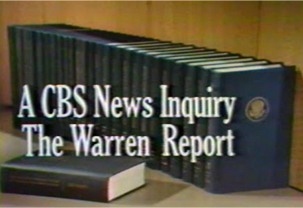
    Title card from 1967 CBS Special. Instead of being an honest critique of the Warren Report, the program became a one-sided account that Krazy Kid Oswald did it all by himself.

    In 1967, CBS was preparing its four-night special in support of the Warren Commission.  As the documents attained by former CBS employee Roger Feinman proved, this program began as an honest attempt to question the worth and value of the Warren Report.  Through various decisions made by the executives at CBS, especially by president Dick Salant, it turned out to be nothing but a rather sickening four-hour panegyric for the Warren Report.  This was due in large part because CBS let former Warren Commissioner John McCloy be one of the clandestine advisors—without telling the public about it. (https://consortiumnews.com/2016/04/22/how-cbs-news-aided-the-jfk-cover-up/)  Lane was one of the critics that CBS targeted.  They brought Brehm on the show to say that he never told Lane the shots came from the right and front of Kennedy, the grassy knoll area.

    This is a non-sequitur because Lane never quotes Brehm as saying that in his book.  Therefore, Brehm was not misquoted.  CBS was desperate for something to throw at Lane.  So they created this non-issue.  And when Lane asked for time to reply to this smear, CBS declined his request.  (Letter from General Counsel Leon Brooks of CBS to Lane of July 6, 1967)

    Ryder then says that Lane made up an interview with Mary Woodward.  Mary was another Dealey Plaza witness Lane used in his book to indicate the directionality of the shots. Again, Woodward is mentioned on just one page of Lane’s book. There, on page 41, Lane quotes her as saying she thought the shots came from behind her, which would indicate the picket fence.  But if one looks at the footnote, one will see that the information  does not come from an interview.   It comes from a newspaper report of November 23, 1963.  One really has to wonder: in his incontinent compulsion to urinate on Lane, did Ryder even read Rush to Judgment before he jumped on the web to trash his memory?

    Ryder then brings up the interview Lane did with Helen Markham. Markham was a witness to the murder of police officer J. D. Tippit.  The Warren Report famously gave her testimony “probative value.”  Yet, as many of the Commission counsel, including Joseph Ball, argued, she was an “utterly unreliable” witness. (Edward Epstein, The Assassination Chronicles, p. 142)  Ball said that her testimony was “full of mistakes.”  She said she leaned into Tippit’s car, yet photos showed the windows to be closed.  Markham said she talked to Tippit as he lay bleeding on the street.  Yet, the autopsy showed that the policeman died instantly.  She said she was the only person on the street, yet there were others on the scene.  Ball did not want to use her at all. (ibid, pgs. 142-43)  In fact, at a public engagement, he once famously called her an “utter screwball.”

    Wesley Liebeler, a colleague of Ball’s, felt the same way and he had also examined Markham.  He called her testimony “contradictory” and “worthless.”  (ibid, p. 143) In the famous Libeler memorandum,  he wrote that using her in the Warren Report would eventually backfire on the Commission, that no matter how the Report tried to hide her, its critics would find her and make hay with her testimony.

    Which is what happened.  And, as can be seen from the above, the Commission knew this in advance. Liebeler even mentioned Mark Lane as a person who would capitalize on Markham’s liabilities as a witness.

    Now, anyone can read Lane’s conversation with Helen Markham.  He taped it and then turned it over to the Commission and they printed it in the volumes. (See Volume 20, p. 571 ff)  Since the late Vincent Bugliosi’s bloated and empty book on the JFK case was published, it has become standard fare for Commission backers to use this tape to discredit Lane. So Ryder calls this conversation “disgraceful.”  Again, one has to wonder, did Ryder read the transcript in the Warren Commission?   Or did he just rely on Bugliosi’s boilerplate?  For instance, Bugliosi writes that Markham agreed to talk to Lane because he introduced himself as Captain Will Fritz of the Dallas Police. (Bugliosi, p. 1006)  That would be pretty bad.  But when one turns to the actual transcript in the Commission volumes, one can see that he introduces himself with this: “My name is Mr. Lane.”  (Op cit, p. 572)

    Bugliosi then goes on to write that somehow Lane did not want to give up the tape because it showed that he was unduly leading the witness.  Anyone can read the transcript. First of all, this was not a legal proceeding.  It was simply a private interview for an investigation Lane was doing for Marguerite Oswald.  Whenever Lane suggests something to Markham from newspaper interviews she gave, he lets her dispute what the report says.  And he does not then discard her revisions. In reading the transcript, one sees that the way he summarized her description of the killer of Tippit does contradict the description of Oswald.  Markham said he was short, a bit heavy, and his hair was a bit bushy.

    Witness Helen Markham: Perhaps one of the worst witnesses in the JFK case where both Warren Report apologists and conspiracy supporters agree was unreliable at best.

    Markham went on to say to Lane that no one indicated to her who she should pick out of the police lineup as the suspect she thought had killed Tippit.  How can one reply to this without being needlessly cruel?  Anyone, except perhaps Ryder, can read the examination by Ball of Markham on this point.  Ball asked her if she recognized any of the men in the line up.  She replied in the negative. Ball then asked if she recognized anyone’s face.  She again replied in the negative.  She then said she did not recognize any of these men in the line up.  Ball then replied with this leading question: “Was there a number two man in there?”  Markham, obviously cued about the number, now replied with “Number two is the one I picked.  When I saw this man I wasn’t sure, but I had cold chills just run over me.”  (WC Vol. 3, pgs. 310-11)

    Bugliosi, somehow, found no fault with Ball’s leading of the witness here.  And neither did his acolyte, Ryder. But they both found fault with Lane.

    Next up for Ryder is Lane’s treatment of the testimony of Jack Ruby. To be clear, this is another Krazy Kid Oswald shibboleth. Writers like Jean Davison and John McAdams have gone out of their way to criticize Lane’s discussion of Ruby’s testimony in Rush to Judgment.  For instance, Davison begins her (atrocious) book, Oswald’s Game, by saying that Lane shortened the context of Ruby’s testimony as to why he wanted to leave Dallas, which Ruby requested to do more than once.  Ruby even added that his life was in danger in Dallas.  (See WC Vol. 5, p. 196)  Which considering the way he died, with CIA MK/Ultra doctor Louis West attending him, may likely have been true. Davison says that the reason Ruby wanted to leave Dallas was not to tell his story further but simply to take a polygraph test, and this was going to show that Ruby was not part of a conspiracy. (Davison, p. 18)  Davison never addresses the issue of why a polygraph could not be done in Dallas if that was all Ruby wanted. Then Davison, like Ryder does in other regards, inserts her foot into her mouth. She writes that the test, taken in Dallas, proved he was telling the truth. 

    Like Ryder, this was how desperate Davison was to nail Mark Lane.  Even though she was writing almost five years after the HSCA volumes had been published, she failed to note their report on this polygraph test.  Their distinguished panel of experts reversed the Warren Report.  They determined that Ruby was not telling the truth. Because the whole test, conducted by the FBI, was a sham. It violated at least ten standard practices in the field, including the fact that the Dallas DA’s office representative was in the room for the test—and he talked to Ruby.  But further, the FBI turned down one of the biological indicators for deception on the test; it was called the GSR, Galvanic Skin Response. (For a review of this tawdry episode, which both the Commission and Davison accepted, see DiEugenio, Reclaiming Parkland, pgs. 244-46.  And the reader will see there how Bugliosi covered this up.)

    Without the Ryder/Davison censorship of the facts, the questions then become quite interesting.  First, why did the FBI rig the test?  Did J. Edgar Hoover know that Ruby was going to lie?  (I mention Hoover since it is hard to think that the operator would have done this on his own.) Second, if Ruby had gone to Washington, would he have been more truthful once away from his prosecutors?  Third, with an honest investigation, which the Warren Commission was not even close to being, could the results of the test have been used to try and break Ruby?  After all, as Jim Marrs points out, Ruby later indicated—more than once—that there were higher forces in the country that had placed him in this position.  (Marrs, Crossfire, pgs. 430-33.  See also Anthony Summers, Conspiracy, p. 472) 

    The other reason that Commission apologists give to cloud Ruby’s testimony is that he wanted to go to Washington to discuss the issue with President Johnson. John McAdams uses this one.  The problem is that Ruby brought up the Washington angle at least four times in his testimony. (See WC Vol. 5, pgs. 190, 195, 196, 210) Only near the end does he bring up Johnson’s name. Since the other requests had been turned down, Ruby may have thought if he dropped the president’s name it may have changed things.  It did not.

    In other words, Lane quoted Ruby accurately. He did say some provocative things and it turned out that he was lying during his polygraph test.  Further, from what we know today, the Warren Commission’s description of Ruby—having no significant ties to organized crime and knowing perhaps fifty Dallas policemen—is a sick joke.

    Gus Russo

    On the Myers blog, Gus Russo later joined Ryder. They both criticized the use of Marita Lorenz by Lane in his libel case against Howard Hunt.  Whatever one thinks of Lorenz, it’s pretty obvious that Lane believed her. (See Lane’s Plausible Denial, pgs. 291-303)   He also said he later talked to Gerry Hemming who backed up her story about Howard Hunt leading an assassination team to Dallas.  Is the story true?  Maybe, maybe not.  But it was not the heart of his case against Hunt.  The heart of his case was 1) There really was a CIA memo written by counter –intelligence chief  James Angleton saying that Hunt needed an alibi for 11/22/63 since he was in Dallas that day (ibid, p. 167); and 2) Lane destroyed Hunt’s purported alibi on the stand.  (ibid pgs. 272-283)  Which leaves most objective observers with the clear implication that Hunt was in Dallas on 11/22/63. If so, why? And one may add, what was David Phillips doing there? Since he himself admitted late in life he was there. (Destiny Betrayed, Second Edition, by James DiEugenio, p. 364) And, as David Talbot reveals in The Devil’s Chessboard, why was William Harvey there in November? And is it just a coincidence  that all three of those men were there along with Allen Dulles? (ibid, pgs. 197-98)

    Russo has a simple reason for going after Lane: because Lane, and to a greater extent Oliver Stone, were his entrée into the MSM.  As I revealed in an article for Probe magazine,Russo had been ostensibly in the Warren Commission critics’ camp for a while.  But right after Stone’s film JFK came out, he began to flip sides.  (Who is Gus Russo?) He first began to work with Dan Rather on his 1993 CBS special.  For Newsweek, he attacked Lane and his book Plausible Denial, specifically going after Marita Lorenz.  From there, it was onward and upward.  In addition to Rather, Russo then worked for PBS in 1993, for the late Peter Jennings at ABC in 2003, and Tom Brokaw at NBC in 2013.  In those instances, he has been well compensated. In his own words, he was flying around first class, all done in order to revivify the rotten corpse of the Warren Report. One way a media hack’s MSM ticket gets punched on the Kennedy case is by attacking Mark Lane. Russo’s career included, of course, the Dale Myers public atrocity: his computer concoction about the Single Bullet Fact for Jennings.  No one who was associated with that blatant and shameless deception should attack someone like Mark Lane regarding his work with Marita Lorenz or anything else. (Click here for a course on Myersvision, as sponsored by Russo: Dale Myers: An Introduction)

    Before closing out my comments on this tawdry instance of posthumous character assassination (actually more like urination),  I should address one more  instance of this Lane posthumous mania.  One of the witnesses that Mark Lane interviewed in Dallas was Lee Bowers.  Lane had read his Warren Commission testimony. It intrigued him since it looked to him as if Bowers was about to describe something he saw from his vantage point in the railroad yard behind the picket fence, up and above the grassy knoll. The subject was then changed.  In his Commission testimony he described three cars coming into the area behind the fence.  He then described what he called a “commotion,” one that  that he was unable to describe, except that it was out of the ordinary.  So much so that it attracted his eye.  (WC Vol. 6, p. 288)  When Lane interviewed Bowers in 1966, Bowers elaborated on this issue.  He said that he saw something like a flash of light, or smoke, “in the immediate  area on the embankment.”  (Lane, Rush to Judgment, p. 32)

    As one can see, Mark Lane was such an effective critic of the Warren Report that his ghost is haunted by its shameless defenders even in death.

    Decades later, when this interview transcript was given over to a university, it became a bone of contention between the late Gary Mack and Myers because Lane left a bit of ambiguity over exactly where on the embankment Bowers was referring. It became part of a feud concerning Mack’s concept of Badge Man and Myers’ attempt to discredit it. Which side of the fence was Bowers referring to – the inside, toward the railroad yard, or the outside toward the street? Years later, Debra Conway settled the dispute.  She interviewed Lee Bowers’ supervisor.  He said that not even Lane got the whole story from his employee, because Bowers told him he saw one of the two men throw something metallic to the other and the second man then threw it in the car.  This settled the matter, since such a thing could only have happened behind the picket fence.  (E-mail communication with Conway, 6/11/16)

    As one can see, Mark Lane was such an effective critic of the Warren Report that his ghost is haunted by its shameless defenders even in death.  But yet, it is they who are guilty of what they say he was: namely, presenting the facts in a one-sided, polemical way.  Russo did what he did because Lane was instrumental in advancing his MSM career.  So there was no way he was going to let Lane’s ghost alone.  But Barry Ryder is truly a bizarre and offensive piece of work.  We should all be on the lookout for this strange personage in the future, a personage who does not even check the database before he unleashes his baseless invective.

    Meanwhile, this will close out CTKA’s tribute to a fine lawyer, an admirable advocate for progressive causes, and a man who tried to use his skills and education to correct what was wrong around him. As the old saying goes, nobody’s perfect.  But the record of Mark Lane was far above those who opposed him. So much so that he renders the attempts by the likes of Ryder and Russo to belittle him as little more than bitter flapdoodle.


    UPDATE: The estimable British Warren Commission critic and CTKA contributor, Martin Hay, lends us some more info on Mr. Ryder. A while back, Ryder was doing his trolling at amazon.uk. This time about Jim Garrison’s On the Trail of the Assassins. He was posting the usual anti-Garrison sludge. Martin jumped on and began to counter each and every charge–eventually demolishing it all. A couple months later, when Martin checked back, he saw that Ryder had erased both his review and all of the comments by both himself and Martin. This is the kind of man that Mr. Single Bullet Fact aka Dale Myers, and Gus Russo cavort around with.

    Unfortunately for Ryder, he will not be able to erase what I wrote here at CTKA.

  • Mark Lane, Part II: Citizen Lane

    Mark Lane, Part II: Citizen Lane


    When Mark Lane’s autobiography was published in 2012, I was working on my rewrite of Destiny Betrayed.  Right after that, I started in on Reclaiming Parkland. I tried to get someone else to review Citizen Lane, but there were no takers.  In retrospect, I am sorry that I could not get anyone interested. And I also understand why no one in the MSM reviewed the book.  It is, in quite simple terms, both a marvelous read and an inspiring story.

    Too often in the JFK field, we focus solely on the work of the author or essayist on the assassination itself.  In my view, this is mistaken.  It’s important to me to know who an author is outside of the field.  To give one example, Robert Tanenbaum—who wrote the thinly disguised roman a clef about the HSCA, Corruption of Blood—was a graduate of Boalt Hall School of Law. He then became a prosecutor under the legendary New York DA Frank Hogan.  He rose to become head of the homicide division. Tanenbaum never lost a felony case in his nearly decade long career in that office. Therefore, he cannot be dismissed as a tin foil capped conspiracy theorist.  The late Philip Melanson rose to become the head of the political science department at the University of Massachusetts-Dartmouth.  He then built an RFK archives at his university, the best such repository on the east coast.  He wrote 12 non-fiction books, including an excellent one on the Secret Service.
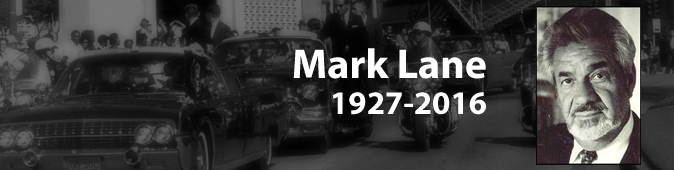
    In my elegy for the recently deceased Mark Lane, I alluded to some of the things he had accomplished outside the Kennedy assassination field: his work for the alleged killer of Martin Luther King, James Earl Ray; his book on the fey, chaotic Chicago Democratic Convention of 1968; and his prime role in freeing an innocent man from death row, James Richardson.  Little did I know how much I was still leaving out. I, and many others, clearly shortchanged the career of a truly remarkable attorney. 

    I have belatedly read Lane’s autobiography, Citizen Lane.  Let me say two things at the outset.  Everyone should read this book.  It is the testament of a man who dedicated his legal career to a lifelong crusade for the causes he believed in.  And, as we will see, Lane did this almost right at the beginning of his career. It is clear that no obituary of Lane came close to doing him justice, because there seemed to be a unified MSM  boycott about this book.  Without reading it, no one can come close to fairly summarizing his career. 

    Lane was born in New York in 1927, two years before the stock market crash.  His father was a CPA, and his mother was a secretary to a theatrical producer.  All three of their children went to college and graduated, which is quite an achievement for that time period.  Lane’s older brother became a high school mathematics teacher and a leader of the teachers union in New York. His younger sister became a history professor who eventually took over the Women’s Studies Department at the University of Virginia. She built it from virtually nothing to the point where it had fifty majors, and the areas of concentration were expanded.  (See here https://news.virginia.edu/content/ann-j-lane-first-director-women-s-studies-uva-has-died)

    After serving in the army in Europe during World War II, Mark Lane returned home and decided to become an attorney.  He attended Brooklyn School of Law. It was founded in 1901, and is highly rated today by the National Law Journal.  That particular publication rates law schools by return on investment.  That is: how many of the graduates sign on with the top law firms in the United States.  According to that rubric, Lane’s alma mater is in the top 15% of law academies.  But Lane did not intend on cashing in on his law degree. 

    Lane decided that what he wanted to do was to offer legal services to those who did not have access to them but, in fact, really needed them.  So he began as a member of the leftist National Lawyers Guild, and working in an office with the later congressional representative Bella Abzug.  Lane started out as little more than a researcher and court stand-in for his boss when he was behind schedule.  But one day he happened to walk by a court in session while the great Carol Weiss King, founder of the National Lawyers Guild, was defending a client.  Lane heard her say, “Just who does this government think it is that it can violate the law with impunity, that it can traduce the rights of ordinary people, that it can tell us that the law doesn’t count because these are extraordinary times? ” (p. 27) 

    From that propitious moment on Lane decided he was not going to be a gopher for anyone anymore.

    II

    He now set up an office on the second level of an apartment building in Spanish Harlem. Because few other attorneys were there, people began to come to him with their most dire needs.  Prior to Lane’s arrival, when there was a gang shooting, the young Latin accused of the crime almost automatically was executed or got life imprisonment.  With Lane there this all changed, even in instances when the victim was white and the assailant was Puerto Rican.  Lane was one of the first to assail what was called the Special Jury System.  (pgs. 43-44)  In New York, under these circumstances, the jury master could choose a jury, instead of having one picked at random.  Therefore, the accused was not judged by a jury of his peers. Later, Lane was instrumental in getting this system abolished.

    Once he developed a higher profile, Lane would set up legal clinics for the public in high school auditoriums. One of his specialties was advising local renters on how to set up tenant councils and, if necessary, conduct rent strikes. (p. 48) He even arranged to have a legal clinic at the offices of the local Hispanic newspaper. With their help, Lane helped save the concept of rent control in New York City. (p. 49)

    Lane was also an active member of the National Lawyers Guild. Like many young lawyers in the late forties and fifties, Lane thought the ABA did not take a strong enough stand against Richard Nixon and the House Un-American Activities Committee or the demagogue Joe McCarthy.  He volunteered to organize a benefit show for the Guild.  When the main targeted performer refused to sign on, Lane went to the blacklisted folk singer Pete Seeger.  Seeger invited the jazz artist Sonny Terry.  Lane also invited female folk singer Martha Schlamme.  Every ticket was sold, with scores of people paying for standing room only. Lane went on to do two more of these shows for Seeger.  They went over so well that the young attorney briefly thought of becoming a musical impresario. (p. 36)  But, lucky for us, he did not. Lane married the talented and attractive Schlamme, who unfortunately, died of a stroke in 1985.

    By this time, the mid fifties, Lane had been in practice for just six years.  But yet, his reputation as a champion of lost causes was so prevalent that a young man named Graciliano Acevedo walked into his office one day. He was an escapee from a young adult prison.  Except it was not called a prison.  It was called Wassaic State School for Mental Defectives. Acevedo began to recite a virtual horror story to the young lawyer.  He told him that Wassaic was not really a school.  It was a prison camouflaged as a school.  Acevedo had been committed there without access to an attorney and not given a hearing or a trial.  He did not want to return. He said there was no real schooling going on there, and that the guards were incompetent and sadistic and would beat up some of the prisoners.  In fact, one guard actually killed an 18-year-old prisoner. (p. 58)

    Lane took Acevedo to a psychiatrist.  When his IQ was tested it turned out to be 115.  So much for him being a mental defective. Lane decided he was not going to turn him over.  He now enlisted two local reporters to his side: Fern Marja and Peter Khiss.  Marja ran a three-day series on the abuses of this “school,” which culminated with an editorial plea for it to be cleaned up.  Which it was.  There was no more solitary confinement, books were now made available, academic tests were now given in Spanish, guards were fired (some were prosecuted), and hundreds of the inmates were released.

    It is hard to believe, but at this time, Lane was just 28 years old.

    III

    Lane was interested in improving the community he worked in, as were some other talented people.  So, through his defense of a parishioner, he met with the famous reverend, Eugene St. Clair Callender.  After getting the young man off, he and Callender decided to work on creating a drug treatment center at the Mid-Harlem  Community Parish. (p. 79)  Once the two men got the center up and running, they passed its management on to one of the former patients. That center ended up treating 25,000 patients.  After a meeting with baseball star Jackie Robinson, a company he was affiliated with agreed to hire some of the rehabilitated drug addicts.  To culminate their success story, Lane and Callender invited a young rising star of the civil rights movement to come north and speak in Harlem. Martin Luther King spoke in front of the Hotel Theresa in 1957.  Lane supplied the power for the sound system through a nearby nightclub run by boxing great Sugar Ray Robinson. (pgs. 86-87)

    From social problems, Lane now turned toward the political field. The young attorney did not think the Democratic Party of New York was representing Spanish Harlem anywhere near as well as it should.  So Lane decided to organize his own version of the party.  He got the backing of Eleanor Roosevelt in this effort. At the beginning, he said that if he won his race for the state legislature, he would only serve one term.  He then wanted to pass the seat on to a local Hispanic.  With the help of his sister, brother and Eleanor Roosevelt, the Lane campaign registered over four thousand new voters. At the same time he was running for office, he was managing the local campaign of Senator John Kennedy for president.

    On Election Day, his backers patrolled the ballot boxes to make sure no one from outside the district tried to vote.  Lane won and celebrations broke out. As promised, after he served one term, he passed the seat on to a local Latino community organizer he knew.

    At around this time, the early sixties, the struggle for civil rights was heating up to a fever pitch. The election of John Kennedy and the appointment of his brother Robert F. Kennedy as Attorney General, inspired long delayed public demonstrations to attain equality for black Americans.  Callender decided to join in one of these actions, the Freedom Riders movement, by sending Lane and local black activist/lawyer Percy Sutton south to join in them. (p. 138)

    In Jackson, Mississippi, before they could even participate in the protest, both  men were arrested for sitting next to each other at an airport terminal. The charge was disorderly conduct. They were convicted without trial and sentenced to four months in prison.  They were released on bail and promptly interviewed by the New York Times and New York Post. (p. 144)  After the bad publicity, the two men returned south to stand trial. Wisely, the prosecutor moved for a directed verdict of not guilty.

    IV

    We now come to a part of Citizen Lane that most of our readership will be partly familiar with.  That is, Lane’s writing of his famous National Guardian essay proclaiming doubt about the guilt of Lee Harvey Oswald for the murder of President Kennedy.  What inspired Lane to write his essay were the pronouncements of Dallas DA Henry Wade after Oswald had been killed.  This was suspicious in itself, since Jack Ruby killed Oswald live on national TV in the basement of City Hall. In spite of that, perhaps because of it, Wade held a press conference and stated that, even though he was dead, and would not have an attorney, or a trial, Oswald was still guilty. (p. 150)  Lane studied the charges levied by Wade. He now decided to respond to the DA’s bill of indictment.  Although he offered his work to several outlets e.g. The Nation, Look, Life, the Saturday Evening Post, none of them would publish it.  Finally, James Aronson of the left leaning National Guardian called. He had heard of the essay through the publishing grapevine.  Lane told him he could have it for now, but not to publish it yet.  In the meantime, he went to Jimmy Weschler of the New York Post.  The Post had helped him with the Wassaic scandal, and covered his political campaign fairly.  Weschler turned it down. After final approval for Aronson, it became a mini-sensation.  Aronson had to publish several reprints.  Weschler never spoke to Lane again.  (p. 152)

    This essay was not just hugely popular in America, it also began to circulate through Europe and even Japan. Therefore, with the money Aronson made through the $100 dollar sale of the rights from Lane, he arranged a speaking tour abroad for the author.  With Lane’s dissident profile rising, the head of the ABA and future Supreme Court Justice Lewis Powell wanted him disciplined because of his defense of Oswald.  (p. 155)  But Marguerite Oswald had read Lane’s work and wanted him to defend her deceased son, which Lane agreed to do.  But the Warren Commission would not tolerate anything like that, by Lane or anyone else.  In fact, following through on Powell’s suggestion, Commission Chief Counsel J. Lee Rankin filed a complaint with the New York City bar.  Lane had to get an attorney to represent him and the complaint was dismissed.  (p. 157)

    Even though Rankin would not tolerate a formal defense of Oswald before the Warren Commission, Lane now established his Citizens Commission of Inquiry (CCI) to informally investigate the Kennedy case through a wide network of volunteers.  Through his lecture tours he raised enough  money to fly to Dallas and talk to witnesses. He also rented a theater in New York and began to appear on college campuses.  When he was invited to travel to Europe, the American embassies abroad tracked his appearances and tried to talk his backers out of their sponsorships.  At one appearance in Vienna, they planted a translator who deliberately misspoke what he was saying.  When the crowd started objecting, an American living there took over the duties. (p. 159)

    When Lane returned to the States, he tried to get a book published based upon the Warren Report and the accompanying 26 volumes of evidence.  But the FBI visited some of the prospective publishers and talked them out of working with Lane.  They also visited local talk radio hosts and tried to discourage them from having him on the air.  The Bureau then tapped the phones of the CCI so they would know when and where Lane would be traveling in order to investigate the case.  He was also placed on the “lookout list” so that when he arrived back from a foreign speaking tour, the FBI would know he had returned.
    Because he was working for nothing but expenses, and he had neglected his private law practice for the Kennedy case, Lane was extremely low on funds at this time.  Finally, a British publishing house, the Bodley Head, decided to publish his manuscript called Rush to Judgment. A man named Ben Sonnenberg went to the company and volunteered his services to edit the book. When Lane saw his suggestions, he thought they were weird.  It later turned out that Sonnenberg was a CIA agent who was relaying information to the Agency about what was in the book.  (p. 165)

    The book did well in England and the Bodley Head began to look for an American publisher.  They contacted Arthur Cohen of Holt, Rinehart and Winston.  Cohen was very interested but, probably through Sonnenberg, the CIA found out how explosive the book was. Although it did not implicate them, they tried to talk Cohen out of publishing the book anyway.  Cohen told them if they did not leave him alone, he would double the advertising budget.  (p. 165)  Norman Mailer did a good review of the book in the New York Herald Tribune and the volume became a smashing best seller in America.

    Lane began to tour the country from coast to coast as the book caught on like wildfire.  In St. Louis, he got a phone caller on a talk show who said he wanted to talk to him offline.  He then told him that he needed to talk to him out of the studio.  So he directed him to a phone booth nearby.  When Lane got there, he now instructed him to go to another phone booth a few miles away.  Lane, who had received numerous death threats before was now getting worried.  But it turned out that the caller was alerting him to an assassination attempt on his life.  He told Lane that this would take place in Chicago, outside of a hotel room he would be staying in and he actually gave him the room number he would be at.  He then added that there would be a studio across the street.  Lane would cross the street to get there at a precise time, and then there would be an attempt to run him over with a truck.  (p. 169)  Lane asked him how he knew all of these details.  The man said that he had been hired to drive the truck, but he refused to kill an American on American soil.  He then added that he would now send a taxi to pick Lane up and return him to his hotel, which he knew the name of.  When Lane got to Chicago, all the details the assassin told him were accurate.  So he changed his room number, and then arrived at the interview via a circuitous route.


    {aridoc engine=”iframe” width=”560″ height=”315″}https://www.youtube.com/embed/3XoAg-FeU9I?rel=0&showinfo=0{/aridoc} 
    Mark Lane appears on Firing Line with William F. Buckley Jr. Although many people had been
    skeptical of the Warren Report’s conclusion that Lee Harvey Oswald acted alone in
    the assassination of President Kennedy, Lane’s book Rush to Judgment was the first to
    lay out the argument seriously. He defends himself ably in this spirited exchange.

    After Rush to Judgment became a national bestseller, documentary film director Emile De Antonio got in contact with him to a do a film based upon the book.  So the two traveled to Dallas to interview some witnesses.  One of them, Sam Holland, told them that he had been alerted in advance about them coming.  And he had also been told by the police not to talk to them. Further, he had been threatened with the loss of his job if he did so. When Lane asked him if those were the circumstances, then why he was talking to him, Holland replied with words that have become hallowed in the annals of JFK assassination literature:  “When the time comes that an American sees his president being killed and he can’t tell the truth about it, that’s the time to give the country back to the Indians—if they’ll take it.”  As Lane reports, Holland had tears in his eyes as he said this.

    I should add one more detail about their work on this film, one that does not come from this book, but from Lane’s 1968 volume A Citizen’s Dissent. While at work on the film, the two struck a deal with CBS to look at their outtakes from their 1964 two-hour special on the Warren Report.  The first night they watched five hours of film.  They understood it would eventually run to 70 hours—for a two-hour documentary?  Lane and De Antonio found something shocking that first night.  CBS was, as Lane put it, filming from a script.  If any witness diverted from that scenario, the interviewer yelled cut. The witness was then instructed with new information so as to alter their answer for the camera.  The witness then gave the revised answer. Only the rehearsed parts were shown to the public.  Needless to say, after their first night, CBS called the librarian and said the agreement they had was null and void.  (Mark Lane, A Citizen’s Dissent, pgs. 75-79)

    V

    While on a speaking tour in northern California in 1968, Lane picked up a magazine and read the story of James Joseph Richardson.  Richardson was a resident of  Arcadia, Florida, who was charged with killing his seven children with poison.  (Citizen Lane, p. 187)  Lane happened to have another speaking engagement upcoming in Florida. While there, he found that Richardson had been convicted.  Lane got in contact with Richardson’s attorney and then with Richardson.  After this he and three of his friends and working associates—Carolyn Mugar, Steve Jaffe and Dick Gregory—conducted an eight-month investigation, after which he published a book about the case called, appropriately, Arcadia.  This managed to attract some attention to the case and place some pressure on local officials. 

    The book strongly suggested that Richardson had been framed and that the local police chief and the DA had cooperated in manufacturing evidence. This turned out to be the case.  Lane got TV host David Frost interested in the case and he did a jailhouse interview with Richardson.  Dick Gregory got a story in Newsweek.  Lane called a press conference on the steps of the state capital after he had acquired a copy of the master case file.  These documents proved the accusations he had made in his book.  The governor now ordered a special hearing into the case and the new facts were now entered into the record.  Janet Reno had been assigned the case as a special prosecutor.  Lane was allowed to make his case to vacate the previous judgment.  Reno made a short presentation which, in essence, agreed with all the facts Lane had presented.  She also agreed the verdict should be vacated.  The judge agreed also and Richardson was set free. (pgs. 206-07)  Lane later called the day Richardson was freed after 21 years of incarceration the greatest day of his professional life.

    Mark Lane (left) with Jane Fonda

    It would seem almost destined that an attorney like Lane would get involved with the long and arduous attempt to end the Vietnam War.  Lane did. With actress Jane Fonda and actor Donald Sutherland, he helped arrange the famous Winter Soldier Investigation.  This was a three-day conference in Detroit in 1971. It was designed to publicize the atrocities and crimes that the Pentagon had committed in its futile attempt to defeat the Viet Cong and the regular army of North Vietnam.  A documentary film was made of the event and the transcript was entered into the Congressional Record by Sen. Mark Hatfield. 

    Both President Richard Nixon and his assistant Charles Colson despised the conference, as did the Pentagon and the FBI. They therefore began counter measures to neutralize its impact. Lane wrote a book about the subject called Conversations with Americans. Consulting with the Pentagon, New York Times reporter Neil Sheehan wrote an article saying that since some of Lane’s interviewees were not listed in Pentagon records, then the persons must be ersatz.  When Lane tried to call Sheehan and enlighten him on this issue, Sheehan never returned his calls.  Lane understood that some of the soldiers would not want their actual names entered into the book for fear of retaliation.  Therefore, he had entered the real information about the subjects on a chart and given this information to a former lawyer for the Justice Department.  (See pages 219-221) Sheehan apparently never wanted this information.  And neither does former professor John McAdams because he still runs a link to Sheehan’s false article to discredit Lane. 

    Neil Sheehan was a former acolyte of Col. John Paul Vann. Vann had been part of the American advisory group that President Kennedy had sent to Vietnam to assist the ARVN. Vann became convinced the war could not be won unless direct American intervention was applied.  In this, he was in agreement with New York Times reporter in Vietnam, David Halberstam.  Kennedy disliked them both since he had no intention of inserting American combat troops in Indochina.  Somehow, 42 years after the fall of Saigon, McAdams still does not understand what made it such a disaster. It was partly because of writers like Sheehan and military men like Vann.

    But that is not all Lane did to try and stop the war.  He also read up on the laws concerning conscientious objectors and provided counseling to scores of young men who wanted to use that aspect of the law to either avoid service or leave the service.  (p. 236)  In addition to that, because Lane had achieved a high profile on the war, one day a Vietnamese pilot training in Texas got in contact with him.  He said he did not want to be part of these Vietnamese Air Force missions, since most of them targeted civilians. So he asked Lane if he could be granted political asylum in America so as not to go back and do bombing runs.  Lane did some work on the issue.  He told him that he did not think he would be successful petitioning for asylum in America, but he thought he could do so in Canada.  Therefore, along with his lifelong friend Carolyn Mugar, the two set up a kind of underground railroad into Canada. Carolyn would stop her station wagon before the border checkpoint. Lane and the man he calls Tran (along with two other trainees) jumped out of the car and circled around into a snowy, thin forest.  After Carolyn passed the border, she then drove along a narrow road to pick up the pair on the Canadian side. Because of its success, Lane duplicated this along with Mugar several times.  He later talked to a Royal Canadian Mounted Policeman who said that they were on to what he was doing. but they actually were in agreement with him.  (p. 283)

    VI

    One of the most gripping chapters in the book is Lane’s description of his participation in the defense of Russell Means and Dennis Banks of the American Indian Movement (AIM) during the siege at Wounded Knee, South Dakota, in 1973.  AIM had organized an effort to impeach tribal president Richard Wilson who they felt was a totally corrupt pawn who was actually abusing the tribe. The area was cordoned off with FBI agents and US Marshals. During the siege, several people were shot and at least one disappeared.  After the siege was lifted, Banks and Means went on trial for conspiracy and assault.  They were defended respectively by Lane and William Kunstler.

    The trial began in January of 1974.  Lane motioned for a change of venue to St. Paul, Minnesota, which the court granted.  It became very obvious early on that the FBI had illegally wiretapped the phone at the reservation and that they had suborned perjury from their star witness. (p. 267)  Although one of the jurors became ill before a final verdict was voted on, the judge accepted an acquittal to one charge and threw out the other because of prosecutorial misconduct. That ruling was accepted on appeal.

    Most of us know about Lane’s participation in the Martin Luther King case.  He and Dick Gregory wrote a good book about the murder of King.  It was originally titled Code Name Zorro and then reissued as Murder In Memphis.  In this volume, Lane only discusses his work with Grace Stephens.  Stephens was at Bessie’s Boarding House with her common law husband, Charlie Stephens, when King was shot.  She saw a man run out of the communal bathroom.  Yet, she would not say it was James Earl Ray, the accused assassin, even though she was sober and got a good look at him.  Charlie was stone drunk at the time and was not a witness to the man running out. He did not even have his glasses on. (p. 290) But since he would say it was Ray, he was used as a witness to extradite the alleged assassin from England.

    When Lane started investigating the case, he asked around for Grace.  No one knew where she was or why she was never called as a witness.  Finally, Lane got some information that she was squirreled away in a sanitarium.  He went there and looked for her. When he found her, he sat down next to her, took out a tape recorder, and asked her about the man she saw.  She said she did get a good look at him.  And when she was shown pictures of Ray, it was not him.  Lane left the place and then played the tape on local Memphis radio.  He then got a hearing called in order to free Grace Stephens. (p. 294)

    In the fall of 1978, Lane was asked by his friend Donald Freed to go to Jonestown in Guyana.  James Jones wanted Freed to lecture there on the King case.  Freed figured that since Lane knew much more about it than he did, he would let him do the talking.  Lane was well received and he was invited back in November.  Before he left, he got a call from a congressional lawyer in Washington. He inquired about how many news media would be there, and if the congressional delegations of Leo Ryan and Ed Derwinski would be small. He was assured that there would be no media and that just one assistant would accompany both congressmen. (p. 305)  He had inquired about this because he felt that if everything was kept small scale, he could serve as a mediator if Jones got too paranoid about being investigated.  Lane was either misinformed or he was lied to on both points.

    Jones did feel threatened by the rather large delegation and Lane could not control things.  After watching and intervening in a murder attempt on congressman Ryan, Lane advised the representative from northern California  to leave the scene. Jones had seen Ryan bloodied and the newsmen were trying to take photos. (p. 310)  Lane convinced Ryan to go. He told him he would interview the people his constituents were inquiring about.

    After Ryan left for the airport—where he and others would be killed on the tarmac—Lane and the People’s Temple lawyer Charles Garry were placed in a cell.  Lane talked to one of his guards and convinced him that he would be the perfect author to tell the truth about the colony. Miraculously, the two lawyers made it through the jungle to Port Kaituma where they were rescued by the military.  They then sought refuge in the American Embassy.  Lane concludes this chapter by agreeing with most authors:  Jonestown was not a mass suicide.  It was at least partly a mass murder.  (Please read Jim Hougan’s three-part series on Jones to gain some understanding of what really happened at Jonestown http://jimhougan.com/JimJones.html)

    As shown in the video clip above, many people know that Mark Lane opposed William F. Buckley on his show Firing Line about the JFK case.  What very few people knew, including me, was that Lane also opposed him in court on four counts of defamation.  Buckley had sued Willis Carto for libel because he had called him a neo-fascist and a racist.  Carto’s first lawyer took a powder on him and so he turned to Lane in desperation: Buckley was requesting $16 million dollars in damages.  Even though the judge was clearly biased towards Buckley, Lane did very well.  He simply used words that Buckley had written in his own magazine, National Review  to show that Buckley had clearly sided with the forces of segregation in the south way past the time when King and Rosa Parks began their campaign to integrate the area.  He also showed that Buckley encouraged the prosecution of African American congressman Adam Clayton Powell, and that he was also in favor of the poll tax.  The $16 million was reduced to $1,001.00.  (pgs. 321-28)

    It is also instructive to compare the work Lane did in life with what the counsels of the Warren commission did. Did David Belin ever take on a case of abusive landlords? Did Wesley Liebeler ever hold free legal clinics on how to organize rent strikes? Not to my knowledge.

    Two other things I did not know about Lane that are in this book.   He successfully argued a case before the Supreme Court against Jack Anderson.  This again involved a libel case in which Anderson had libeled Carto.  The district judge had thrown the case out.  Lane argued it should be reinstated.  He won the case and Carto settled for a withdrawal of the charges and a token payment to a charitable cause.  (p. 336) 

    Second, Lane had a radio show. He made an appearance on a radio program in New Jersey in 2004 to talk about the JFK case.  He did so well that he was invited back.  He was then offered a job five days a week, which he declined. But he agreed to do the show once  a week with a co–host.   The show was called Lane’s Law and I really wish I had known about it since it sounds very funny. Lane had a great time making fun of pompous fools like Sen. Bill Frist. (p. 346)

    When Lane’s sister Anne became ill and had to resign her Department Chair at Virginia, Lane moved to Charlottesville to be close to her. She later recovered and moved to New York to attend her children and grandchildren.  Mark decided to stay in Virginia.  Coincidentally, all three siblings passed away in a period of four years, from 2012-16.

    Unlike what Bob Katz once wrote about him, Mark Lane was not an ambulance chaser.  In each high profile case he entered, he was requested to do so: from the JFK case to the Buckley case, and all of them in between, including Wounded Knee and the King case. It is also instructive to compare the work Lane did in life with what the counsels of the Warren commission did.  Did David Belin ever take on a case of abusive landlords?  Did Wesley Liebeler ever hold free legal clinics on how to organize rent strikes?  Not to my knowledge.

    Mark Lane was such an effective defense lawyer he could have made millions a la Dick DeGuerin defending the likes of Robert Durst.  Instead, he decided to be an attorney for the wretched and the damned.  A counsel for the downtrodden and the lost. But they happened to be, like Wounded Knee and the JFK case, just causes.  And Lane acquitted himself well, considering the forces arrayed against him.  I know of very few lawyers who could have written a book like this one.  Lane’s life stands out as a man who did what he could to correct the evil and injustice in the world around him, with no target being too small or too large in that regard. This book stands out like a beacon in the night. It shows both what a citizen should be, and what an attorney can be. Buy it today.

  • 11/22/63: Stephen King and J. J. Abrams Lay an Egg

    11/22/63: Stephen King and J. J. Abrams Lay an Egg


    I actually talked to Stephen King on the phone once from his home in Maine.  This was when Stanley Kubrick was making a movie out of his book, The Shining.  I was trying to put together a feature magazine article on that picture. But I could not secure an interview with Jack Nicholson until it was too late for the magazine’s publication date. I decided not to go through with the project. When I actually saw the film, I was not terribly agonized over my failed attempt.  From what I have read, King did not like the movie either.  So much so that he made his own TV version of that book.

    King is now part of the production team that has made another TV movie from a more recent book of his.  Except it’s actually a mini-series.  Quite a long one.  It plays over eight installments. And since the first installment is two hours long, it clocks in at nine hours. From what I have been able to garner, producer-director J. J. Abrams was the man in Hollywood who decided to take King’s book under his wing.  But, as is the usual case with the big names in Movieland, Abrams then turned over the project to what is called a line producer, or developer.  In this case her name was Bridget Carpenter. Carpenter has written over ten plays, and worked on several TV series, most notably, Parenthood and Friday Night Lights.

    At almost 900 pages, King’s book was quite long. Apparently, once you attain King’s stature in the publishing business, no one dares edit your work.  It was that original length which necessitated the nine-hour mini-series format. Because of that length, this series was clearly a team effort. It had five directors and four writers working on it.  Carpenter, by far, wrote the most installments.  She either wrote or co-wrote five of them.  No director helmed more than two installments.

    In virtually every other instance of my (long) reviewing career, I have always read the source material for any adaptation.  Offhand, I really can think of perhaps only one or two exception to that practice. But, for two reasons, I just could not bring myself to read King’s book. First, I don’t care for novels about the Kennedy assassination. Because the original inquiry, the Warren Report, already fictionalized what really happened in Dallas on November 22, 1963.  Secondly, why would any intelligent, interested person read a book that, in its central tenets, was more or less a restatement of that original fiction?   Which King’s book is. In other words, why pile one fiction on top of another?  Especially concerning such a crucial event in American history.  So in this one case, I declined to read the book on which this mini-series is based.  I hope the reader understands that decision.

    After more than one preview, King’s novel was published in November of 2011. In what I have been able to dig up about its genesis, one of his main influences in the writing and research for the book was the Dallas museum about the JFK case, The Sixth Floor. He specifically consulted with the late Gary Mack, who passed away in 2015. We all know that, for about the last 20 years of his life, under the influence of Dave Perry, Gary Mack had done a backflip on the case. He migrated over to the Warren Commission camp.  (Click here for info on Perry). Whether King entered the creation of his book with an open mind on the JFK case, and was then influenced by Gary Mack, or whether he was in the Krazy Kid Oswald camp all along, that is an issue I have not been able to definitively discern. 

    II

    King decided to make his book a science fiction thriller.  The gimmick behind it all is a good old sci-fi staple: time travel.  Jake Epping (played by James Franco) is a high school English teacher who also teaches adult education GED preparatory classes.  At the beginning of the series two things happen, back to back, which set the plot in motion.

    In the opening scene, in his GED class, Jake is listening to his adult students orally present papers about the most important day in their lives. The first person we see is an elderly student named Harry Dunning.  He is standing in front of the class presenting his (rather shocking) paper. Harry is telling the story of the night his father Frank came home drunk and killed his mother, sister and brother with a long-handled hammer.  (Which, I think Mr. King, is plenty life-changing.)  Jake is very impressed with this presentation and gives Harry an A+. 

    Right after this we see Jake in a diner. The owner Al Templeton (played by Chris Cooper), emerges from the back coughing and wheezing; he then collapses on the floor.  Jake takes him home to recover. The next day, Al tells him to walk into a closet behind the front of the diner. This ends up being the time tunnel portal. Ever so briefly, Jake gets transported back to October of 1960.  He then returns. Al tells him he is too old and sick to use the time tunnel for what he wants to utilize it for: To stop the assassination of President Kennedy. Jake replies, you cannot change the past.  Al tells Jake to go back again. This time, he gives him a knife and tells him to carve something into a nearby tree.  Jake does so, he returns, and they go outside. They see that the initials of JFK are still there. 

    At this point the film, through Al, sets some terms and conditions of King’s version of the fourth dimension.  Whenever one gets sent back in time, he will always arrive in October of 1960.   Second, no matter how long one spends back there, upon returning, only two minutes will have elapsed.  If one changes something, but then goes back again, everything resets to the way it was before.  Finally, the past is obdurate:  it resists changes.  Some of these changes end up in what King calls tributaries, sort of like alternate universes. 

    Actor James Franco, Stephen King, and J.J. Abrams

    For this viewer, these three scenes did not make for an auspicious beginning. First, I had a hard time believing Harry would make a speech like that in front of a class.  I was involved in the education system as a student, teacher and adult education instructor for over thirty years.  I never heard any student reveal anything that traumatic or horrible.  And no teaching colleague ever told me about something comparable occurring in his or her class.

    Secondly, although theories of time travel have progressed by leaps and bounds since H. G. Wells’ classic book The Time Machine, King makes no explanation at all about the science aspect of his fiction.  At least Wells, working with much less information, tried a bit.  In this case, it’s a time portal in a restaurant—and that is it. Then there’s those terms and conditions!  They all seemed designed to make it easy for the author to construct his story the way he wished.  The protagonist would not age, changes would not be permanent, and the scope of time dealt with was narrow.

    So, at the very beginning, with the shocking story told in class, and all these rules –with no real explanation–this viewer understood that the story we were about to see would rely a lot on plottiness. Let us make a distinction: There is a difference between a well-constructed story and plottiness.  For instance, the Robert Towne/Roman Polanski film Chinatown has a wonderfully structured story that is so cohesive and subtly carpentered that one is never aware of the engine of the plot turning over. That is, the plot machinations are so dramatically ingrained with the film’s other elements that the audience is not fully aware of being carried along by the current of the story until the end. That is good story structure.  And that is why the screenplay of Chinatown is actually taught in screen writing classes at universities.

    I don’t think King, Abrams and Carpenter will be paid that educational compliment. Because here, the characters, the plot device, even the dialogue, are at the mercy of a heavy-handed plot. Almost nothing seems natural. It all seems set up: reminiscent of the standardized TV series writing of the fifties and sixties, where high points in the plot were timed for commercial breaks (which actually happens here).  For instance, when Harry told his story in front of the class, I immediately said to myself: This is so bizarre, so much of a reach, I think its going to be used as part of the plot.  Which it was.  And there is another plot strand—to be discussed later– that is almost as violent and bizarre as that one.

    III

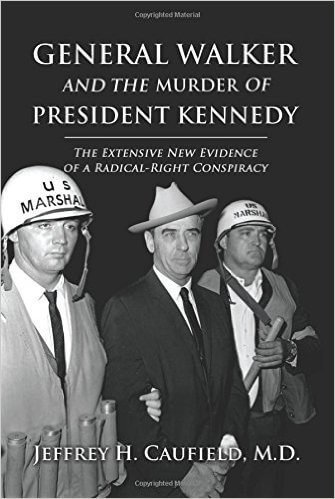
    But the main plot line concerns the assassination of President Kennedy. To get that going, when he returns to the diner, Al tells Jake about his obsession with the JFK case. He then convinces him to go back in time to try and stop the murder. Al says that the bullet that was fired at General Edwin Walker in April of 1963 was the same bullet that was fired at JFK in Dealey Plaza.  (Which it was not. See Reclaiming Parkland, by James DiEugenio, pgs. 79-80) Al tells Jake to go back in the portal and see if Lee Harvey Oswald did shoot at Walker in Dallas.  If that happened, then Oswald probably killed Kennedy. But if it didn’t, then someone else likely killed him. Al then tells Jake he would do so himself, but he is afflicted with cancer.  He then packs a briefcase for Jake, including his JFK collection of newspapers and essays, plus a false identity package. He adds a small notebook with summaries of sporting events for him to bet on if he needs money e.g. boxing matches. And with that, Al is now off on a three-year voyage backward in time. One that will actually take two minutes.

    Back in 1960, Jake buys a car.  Which leaves him a bit low on funds.  So, utilizing the previously planted bookie device, Jake asks the car dealer where the nearest betting parlor is.  Jake makes a bet on a championship fight, actually picking the round the knock out will occur.  The bookie suspects something fishy and sends a goon to get his money back.  But Jake anticipates this, gets the jump on his assailant, and escapes from his rented room.  He then drives to Dallas, rents a room at a bed and breakfast, and begins studying the JFK case through Al’s files. 

    Informed by Al,–who appears in flashback throughout–Jake follows George DeMohrenschildt around.  First to a Kennedy speaking engagement, then to a high-class restaurant.  At the restaurant, Jake secures a table next to George, who is sitting with two other well-dressed gentlemen.  The film uses every cheap trick under the sun to prevent Jake from clearly hearing the discussion:  a blender goes off next to him, the table on the other side is quite loud, a waiter spills a tray of drinks.  But he does hear George mention Oswald’s name.  On his return to his rooming house, the building is on fire. Since his belongings were left in the room he goes inside to try and recover what was left of them.

    Jake decides to leave Dallas.  He gets lost on the way out of town. He realizes he is close to Kentucky.  Which, of course, is where Harry Dunning grew up. Jake decides to visit the town in order to prevent the triple murder.  He rents a room and befriends a bartender named Bill Turcotte (George MacKay). Frank Dunning then walks in and he and Jake begin to talk and become acquaintances. After an altercation with Frank at his butcher shop, Jake buys a gun and is casing the Dunning house on Halloween night, which is the night that his student Harry said the killings occurred.  He is accosted in the bushes by the bartender Bill.  (Why Bill would find Jake suspicious enough to follow him around town for two days is not explained.)  The two have a rather unusual conversation: Bill tells Jake that Frank was married to his sister and killed her.  Jake tells Bill that he is from the future. Jake pulls a gun on Bill to subdue him, and then runs into the house where Frank is in the process of beating and killing his family.  Jake intervenes and kills Frank. He then leaves town.  Bill joins him (it’s not clear, but it appears he was hiding in his car). Jake now tells him the story of why he is there.  Bill decides to join him on his trip back to Dallas. Bill agrees to help Jake in his mission.  Jake informs Bill of his strategy: if Oswald shot at Walker, then he probably shot at JFK.  So if he can find out about the former, he can feel justified in killing Oswald.

    Jake gets a teaching job in the fictional town of Jodie, Texas.  He is hired by Principal Deke Simmons (played by Nick Searcy). To celebrate, Bill and Jake go out to a strip club. At this point came one of the most surprising scenes in the series. Not for what happened; but because of what did not happen. For the club they go to is owned by Jack Ruby.  The two have decided on a cover story of being brothers. They introduce themselves to Ruby as such. There is a very brief discussion of John Kennedy. I mean very brief.  The entire scene lasts for one minute and twenty seconds.  But the shocking part is this: We never see Ruby again! The film-makers may justify this because, as we will see, in King’s version, Ruby does not kill Oswald.

    IV

    We have come to 1962.  Tipped off by Al, Jake is at Love Field when Lee Oswald arrives in town from his overseas stay in the USSR.  The first appearance of Oswald (played by Daniel Webber) in the film is notable.  First, he seems to be speaking with a mild Russian accent.  Second, he asks his mother Marguerite (played by Cherry Jones) why there is no cadre of press awaiting him.  This tells us that the film will use the Warren Commission version of Oswald as the basis for their character portrayal.  Oswald is a publicity hound who thinks he is a great man going unrecognized. Which is pretty much what Warren Commission lawyer Wesley Liebeler decided upon when he could not think of any other reason why Oswald shot Kennedy. In fact, as we will see, in its attempts at caricaturing Oswald, the series goes even beyond the Warren Report.  Which is a bit stunning since there has been a quantum leap since 1964 in our knowledge and understanding of Oswald.

    Jake and Bill then find the apartment Lee and Marina are staying at.  They rent the downstairs unit and hire a surveillance technician to sell them equipment so they can hear the couple speaking upstairs.  They discover a lot of Russian being spoken by the Oswalds. Jake surmounts the translation obstacle by obtaining a Russian-English dictionary from his school. (I’m not kidding, though I wish I were.)

    The caricature of Oswald is furthered as we see him attending a rally for rightwing activist General Edwin Walker. Oswald is there with George DeMohrenschildt.  Afterward, outside the building, Oswald starts screaming at Walker.  He then attempts a violent confrontation with him. Security guards restrain him. But he still tries to physically attack Walker. The scene ends with Oswald throwing a rock at Walker and threatening to kill him. The outdated portrait of Oswald as an unstable sociopath is now cinched.  

    In the next scene, Oswald has the rifle the Warren Commission alleges he used to kill Kennedy. We watch him assemble and dissemble it.  He then goes outside with Marina and DeMohrenschildt.  The infamous backyard photograph is now snapped. Except for one rhetorical question by Bill, the script makes no attempt to explain why Oswald’s anger at a neo-fascist like Walker would spill over into the murder of the most liberal president since Franklin Roosevelt.

    The attempt on Walker’s life now approaches.  Bill and Jake begin to case out the Walker home.  But again, the heavy breathing of the screenwriters manipulates the story—this time in two ways.  First, Jake’s romance with Sadie Dunhill, the school librarian (played by Sarah Gadon) intervenes.  Sadie’s husband chooses the day of the Walker shooting to kidnap his wife who is in the process of divorcing him. So before saving Sadie, Jake calls Bill and tells him he alone has to find out if it was Oswald at Walker’s.

    But that convenient piece of carpentry is not enough.  While at Walker’s house, Bill watches some people come out of the nearby church.  He thinks one is his long lost sister!  So he runs over to confront her and, of course, it is not her. (This was really weak, since Bill told Jake that his sister had been killed by Frank Dunning.)  But the shot goes off while he is preoccupied.  So Bill cannot tell for sure if the sniper who shot at Walker was Oswald.  So now the option of just killing Oswald is conveniently gone. And while going through this crisis with his girlfriend, Jake also tells her about his secret mission to stop the JFK assassination.

    This takes us to October of 1963. Oswald is applying for his position at the Texas School Book Depository. Which will put him on the Kennedy motorcade route on November 22nd.  Ruth Paine, with whom Marina Oswald was staying in October and November of 1963, arranged that job for Oswald.  The script cuts out Ruth Paine’s role in this. And Ruth Paine is portrayed—ever so briefly—as the kindly Quaker lady from the Warren Report.  When I saw how this was ignored, I then thought back and realized that, in the nine-hour series, there is no portrayal of Oswald in Mexico City, or Oswald in New Orleans that summer. This could have easily been accomplished if the two subplots about the murderous husbands in Kentucky and Dallas had been dropped. After all, those two long segments have little or nothing to do with the JFK case.  But New Orleans in the summer of 1963 has a lot to do with the Kennedy case.  As does Oswald’s alleged journey to Mexico City in the fall of 1963, right before he returned to Dallas.  But evidently King, Abrams and Carpenter didn’t think so.


    {aridoc engine=”iframe” width=”560″ height=”315″}https://www.youtube.com/embed/HErDQT35h-M{/aridoc} 
    Although 11/22/63 is a fictional account of the JFK assassination, one of the film’s moreinaccurate, and downright bizarre, scenes is a poorly executed reenactment of the assassination itself as seen above.

    V

    There was something else just as odd in the script.  Even though it is October of 1963, George DeMohrenschildt is still on the scene in Dallas.  This is really kind of inexplicable.  I know King wrote a novel. But it is based upon history.  George left Dallas in April of 1963 for Haiti.  So the events depicted here with DeMohrenschildt simply could not have happened—they are an impossibility.

    In what to me was a rather wild twist—wild even for this plot—Bill falls in love with Marina Oswald.  Which causes a lot of friction between Bill and Jake.  In fact, they come to blows, and Bill pulls a gun on Jake.  Jake then plots to get rid of Bill. He tells Bill that Marina is in Parkland Hospital delivering her child.  This is a pretext to have Bill committed to the mental ward since Jake thinks he is a liability to his mission.  How Jake could arrange this is glossed over.  Because the two are not blood relatives, and just a modicum of standard questions by the administrators—like asking for ID– would have brought that out.  But the story is now headed for its climax and the trifecta of King/Abrams/Carpenter wanted to add a dash of romance to the ending. So they dumped Bill.  Jake will now team up with Sadie on his mission to stop Oswald.

    But again, there is still more to the story.  Jake makes another sure bet with a bookie.  Again, with uncommon accuracy about how long a prizefight will last.  But this time the bookie and his goons track him down and give him a serious beating.  So much so that he sustains a concussion and loses his memory.  The film now shows us Sadie wheeling him around in a wheelchair.  And in standard movie cliché, Jake asks himself things like, “Who is LBJ?” and “When is my birthday?”  Therefore, this twist allows him to lose track of Oswald as Oswald goes to the FBI office to leave a note for FBI agent Jim Hosty (who figures in the story for two brief windows.)

    Finally, after about a half hour of this, there are headlines in the papers of Kennedy’s upcoming visit to Dallas.  The film now shows us Jake and Sadie talking about the newspaper notice. After a pep talk by Sadie, Jake then flushes his memory pills down the sink. We then cut to Oswald sitting on a park bench looking at the JFK newspaper notice.  He then discards the paper and starts whistling the tune “Soldier Boy.” (Subtlety is not one of this script’s strengths.)

    Now that he is recovered from memory loss, Jake and Sadie first go to Oswald’s apartment, and Jake is going to kill him with a knife.  But Oswald comes out of the back room with his newborn child in his arms.  They then go to Ruth Paine’s to try and find the rifle that was allegedly used in the assassination.  But it is not there.

    Jake and Sadie now end up in Dealey Plaza in the very wee hours of the morning of the 22nd.  Then the script adds in, actually caps, a Twilight Zone motif that has been used throughout.   A man who King calls the “yellow card man” (he has such a card in his hat) now appears in Jake’s car, replacing Sadie.  This figure has been seen several times throughout the film.  He usually says, “You’re not supposed to be here.” This time, he tells a story about having to watch his baby daughter die, drowning in a stream. This fantastic touch was to me, both pretentious and bombastic: An attempt to add depth and meaning to a script that has neither. 

    The script now gets even wilder.  We see Oswald—with his long package–walking right next to Wesley Frazier as they cross the street and enter the Texas School Book Depository. Oswald then goes right up to the sixth floor!  He is, of course, whistling “Soldier Boy.”  He then walks to the window, starts setting up the boxes for the so-called “sniper’s nest.  And then, incredibly, he just sits there, waiting for the motorcade to pass.  This is as impossible as having George DeMohrenschildt in Dallas in October.  I mean do the writers really expect the audience to be so stupid as to think Oswald would sit at a window with a rifle for three and a half hours waiting to kill Kennedy?  With witnesses both inside and outside to see him?  This is just plain silliness.

    We now see Jake and Sadie on a high-speed chase to get near Dealey Plaza.   (Even though they were supposed to be there already.  But like I said, anything goes with this script.)  When they do get near, guess who they see?  Jake sees Frank Dunning, and Sadie sees her ex-husband.  Both of whom have been killed by Jake. What this means is anyone’s guess.  And at this point, who cares?

    When they get to the Depository building, it’s locked. (Which is another reversal of reality, as it was not.)  So Jake breaks in at gunpoint and the couple flies up the stairs.  As they do, Oswald is muttering, “They will know your name.” After they get to the sixth floor, Oswald fires one shot.  Jake starts screaming  “Lee, stop!” Oswald now turns and fires on the couple.  As he does, the door they came in through somehow slides back shut, so they are caught inside. Oswald then says, “I came here to do something important!”  A combination physical fight and shoot out follow.  Lee kills Sadie and Jake kills Lee.  Of course, the police do not arrive until after Sadie dies.

    The best I can say for this ending is that, thankfully, the film was finally over. As the reader can see, the story does not respect itself.

    The rest of the Dealey Plaza story is just as dumb.  Jake is accused of trying to kill Kennedy.  He is booked and fingerprinted.  Captain Will Fritz and FBI agent Jim Hosty question him.  Fritz accuses Jake of actually being Oswald’s alias, Alek Hidell. Fritz then leaves and Hosty and Jake play a game of blind man’s bluff, trying to see who has more information on whom.  (How Hosty got so much information about Jake in about five minutes is another puzzler.)  But then a call comes in from President Kennedy.  He and Jackie thank Jake for saving their lives.  Jake is now freed.

    VI

    Jake now returns to Lisbon, Maine.  He goes to Al’s diner, but it’s gone.  But just standing there, near the portal, now transports him to what King calls a “time tributary,” or in plainer parlance, an alternative universe.  A world that looks desolate and abandoned.  He meets up with Harry Dunning who is being attacked by a pack of thugs.  Jake helps run them off. Harry takes him back to his home, which is inside what looks like a deserted factory. 

    There he tells him that he knows that Jake saved his family from his father.  Jake asks him about history.  Harry tells him that Kennedy was re-elected and then George Wallace won in 1968, since RFK did not run.  He then tells Jake that Kennedy set up camps throughout the country.  His mother had to go to one.  (Why and how this happened is not explained.)

    Jake now tries to “reset” the past.  He goes back to the time portal and is transported again.  This time he goes to Lisbon.  And—in this script surprises never cease– he sees Sadie in the back seat of a car. She looks just exactly like she did before she died. He runs after her and she does not recognize him.  He then goes to Al’s diner.  It is empty, but he walks though it even though Al is not there.  At his teaching job, he runs into Harry Dunning.  That night, he goes online and searches for Sadie.  She is being honored for her years of service as a librarian down in Jodie, Texas.  He goes down to see her at her banquet. She looks about 65 years old.   They share a dance even though she doesn’t know who he is.

    The best I can say for this ending is that, thankfully,  the film was finally over.  As the reader can see, the story does not respect itself. Science fiction follows certain rules that are internally consistent.  This script did not want to do that.  So it now interjects elements of fantasy.  Which makes it even more meretricious and pretentious.

    I have concentrated here mostly on the actual story.  Because both King and the scenarists will defend their work on the basis that it is a historical novel.  In this reviewer’s opinion, for reasons stated above, it fails even as a superficial entertainment.

    The rather large cast is uneven.  The two best performances are by Annette O’Toole as one of Jake’s landladies, and Cherry Jones as Marguerite Oswald.  O’Toole began her career as a kind of glamorous sexpot. She is 64 years old now, so those days are gone.  She nicely underplays this crusty, odd, rightwing fundamentalist. It’s a sharply etched minimalist type of performance.  Jones uses the opposite technique. She envelops her characters with every fiber of her being: voice, imagination, emotion, and body control. But none of that is Cherry Jones. She uses what she has to create someone else. She makes Marguerite Oswald–who has been caricatured for decades–into a real, living person.

    The rest of the cast ranges from OK, to adequate, to inadequate. Which simply isn’t good enough for this long of a film.  Jonny Coyne as George DeMohrenschildt is miscast from the start.  He doesn’t resemble the upper class Russian émigré either facially or in physique.  And his acting does not conjure any of the old world charm that made him so attractive to such a wide variety of upper class figures.  Chris Cooper as the crusty old diner owner Al Templeton is adequate.  If you can imagine what say Walter Huston could have done with the part, Cooper gives you about 80% of that.  In a hopeless part, Daniel Webber is lost as Oswald.  As Jake’s sidekick Bill Turcotte, George Mackay is simple and nervy, and not much else. Sarah Gadon as Sadie Dunhill is attractive enough and sweet.  James Franco as Jake is pretty much James Franco. It was clear to this viewer that he never found a model for his character.  And none of the directors could help him.  So in addition to a cheap, nonsensical story, you have a main character who is pretty much a zero.

    Let me close with why the film cannot be taken seriously–even as a fictional comment on important historical events. In speaking of his novel, Stephen King has said that from his research the probability that Oswald killed Kennedy is at about 98-99%.  He has actually called Oswald a dangerous little fame-junkie who happened to be in the right place at the right time.

    Those two comments really make you wonder about the “research” King did.  Concerning the former, every lawyer who has taken a look at the JFK case in an official capacity since the issuance of the Warren Report in 1964, has disagreed with its conclusions. The last one being Jeremy Gunn of the Assassination Records Review Board. Who looked at the most declassified documents.  In light of that, King’s comment is so eccentric as to be bizarre.  Secondly, if Oswald was a fame junkie, why did he never take credit for killing Kennedy?  In fact, he did the opposite.  He called himself a patsy.  Then he was gunned down while in the arms of the Dallas police.  But since the film arranges things so as we do not see that, and Jack Ruby is in the film for about 70 seconds, that can be ignored.

    King more or less spilled the beans when he stated what books were most important to him in his research phase.  He named Gerald Posner’s Case Closed, Legend by Edward Epstein, Oswald’s Tale by Norman Mailer, and Mrs. Paine’s Garage by Thomas Mallon.   He actually said that Mallon offered a brilliant portrait of the “conspiracy theorists.” And he termed those who disbelieve the Warren Report as those needing to find order in what was a random event.

    Well, if the final film leaves out Jack Ruby’s murdering Oswald as he comes in the basement door of the Dallas city hall; if you leave out Oswald’s call to former military intelligence officer John Hurt the night before; if one does not tell the viewer that the rifle the Warren Report says killed Kennedy is not the same rifle that Oswald allegedly ordered; if one does not mention 544 Camp Street in New Orleans and Guy Banister, David  Ferrie and Clay Shaw; if one does not mention Oswald with Shaw and Ferrie in the Clinton-Jackson area in the summer of 1963; if one does not show all the problems with Oswald allegedly being in Mexico City, while he is supposed to be at Sylvia Odio’s door in Dallas with two Cubans—well yeah Stephen, then you can tell us all about randomness and Occam’s Razor and, oh my aching back.  Those events I mentioned are not theories, Mr. King. They are facts. 

    My advice about this heavily weighted apparatus which produces next to nothing is to avoid it at all costs. All it really produces is more money for King and J. J. Abrams, like they need it.  It is nothing more than a stupid, demeaning waste of time.  Abrams should stick to Star Wars, and King should stick to teenage female wallflowers with telekinetic powers.

  • Bridge of Spies: Spielberg and the Coen Brothers Punch Up History

    Bridge of Spies: Spielberg and the Coen Brothers Punch Up History


    The mythology about Rudolf Abel survived for decades on end.  It began when he was captured and then tried as a Russian espionage agent in a New York City court in 1957. The legend was furthered by not one, but two hearings before the Supreme Court concerning whether or not the arrest of Abel was done within the boundaries of a legal search and seizure.  It reached its apogee when President Kennedy approved an exchange of Abel for captured U-2 pilot Francis Gary Powers in 1962.  Abel’s American lawyer, a man named James B. Donovan, carried out that exchange in Germany.  In 1964, Donovan wrote a book on the Abel case and the later prisoner exchange.  Strangers on a Bridge became a national best seller. Now even more people were exposed to the Abel myth.

    What do I mean by the “Abel mythology?”  First off, there was no such Russian spy born with that name.  He borrowed that name from a deceased Russian colonel.  Abel’s real name was Willie Fisher.  And as one can guess by that moniker, he wasn’t Russian.  He was born in 1903 in Benwell, Newcastle upon Tyne, in the north of England.  When his family moved to Russia in the twenties, Fisher became a translator since he had an aptitude for language acquisition.  He later developed an affinity for electronics and radio operation.  And this was what the NKVD, precursor to the KGB, used him for during World War II.

    Another myth is that the FBI uncovered Fisher and then cracked the case. This is not at all accurate. Fisher was caught through the betrayal of his assistant. That assistant was named Reino Hayhanen.  Moscow had sent Hayhanen to help Fisher.  But Reino turned out to be a very bad assistant.  He was both a drunkard and a womanizer—he squandered some of the money given to him by Fisher on prostitutes.  When Fisher had had his fill of him, he sent Reino back to Russia.  Sensing that he would be disciplined upon his return, Hayhanen stopped at the American Embassy in Paris.  There he turned himself in as a Soviet spy.   And this is how Fisher was uncovered.

    A third myth is that he was a master spy, somewhat on the level of Kim Philby.  As several latter day commentators who have studied the Fisher case have concluded, there is simply nothing to even approximate such a lofty comparison. To use just one example: there is no evidence that, in the entire nine year period that Fisher was in America, he even recruited one agent, or source, on his own.  But further, once the KGB got the news of Hayhanen’s betrayal, Fisher had an opportunity to dispose of much of the incriminating evidence in his flat.  He did not.  But further, although he had used a false name with Hayhanen, he had taken him to his home. By casing the building, by following some of the residents who fit Reino’s description, and then snapping a picture of the man Hayhanen knew as “Mark,” this is how Fisher was caught.  Through his own carelessness and errors in tradecraft.

    Fisher’s cover while in the United States was that of a painter/photographer.  Steven Spielberg begins his film Bridge of Spies with a clever and adroit composition. The spy is painting a self-portrait in his studio.  Shooting from behind, we see then a dual image of the man: one in a mirror, and the other on the canvas–with the real subject in between, his back to us.  This makes not just for an interesting composition, but it’s a nice symbolic précis of who the man is.  We then watch as the FBI begins to follow Fisher around New York as he paints and takes photos.  They then break into his hotel room.  Fisher asks for permission to secure his palette of colors, and as he does he hides a coded message he had just secured from a drop point.

    From here, the film now cuts to the man who will be the main character, attorney James Donovan. Once Fisher was caught, the FBI had planned on deporting him, since he was in the country illegally under various aliases, and had not registered as a foreign national. Which is why the INS was in on the raid. They shipped him to a detention center in Texas.  There, they tried to turn him into a double agent.  (Donovan, Strangers on a Bridge, pgs. 16, 45)  Fisher turned down the offer.  Since the Bureau discovered so much incriminating material in both his hotel room and his apartment, they switched strategies.  Instead of deporting him, they now decided to place him on trial.  Which was a rather unusual decision.  Because, as Donovan wrote, there was no case he could find of a foreign spy being convicted of peacetime espionage. (Donovan, p. 19) The actual indictment contained three charges: 1.) Conspiracy to transmit atomic and military secrets to Russia; 2.) Conspiracy to gather classified government information; and 3.) Illegal residency in the U.S. as a foreign agent. (ibid, p. 20)

    The Brooklyn BAR association decided to ask Donovan to represent the defendant. (ibid, p. 9) Donovan was at this time, 1957, mainly an insurance lawyer. But he had worked for the OSS during the war, and was one of the lawyers at the Nuremburg trials.  Although the film only shows Donovan with one assistant, he actually had two. (Donovan, pgs. 34, 54) Some affluent law firms through the BAR furnished these.  To his and their credit, the local legal establishment was determined to give the spy a decent defense team.  (In a rather odd departure, the film does not portray Reino Hayhanen on screen.)

    Rather early in the case, Donovan discovered that his best hope in defending Fisher were problems with the original search and seizure.  Donovan concluded that this process was legally faulty due to the fact that the original strategy was to use the threat of deportation to turn Fisher.  In other words, the FBI wanted to keep the profile of the raid low, so that the KGB would not understand that they had turned Fisher into a double agent.  Therefore, they had not secured the properly designated warrants. But once they failed to turn the man, they now wished to prosecute him as if they had the proper warrants.   (Donovan, pgs. 109-110)

    The original trial judge would not accept Donovan’s motion to suppress evidence based on this issue.  If he had, the prosecution’s case would have been gravely weakened.  So once Fisher was convicted, Donovan raised the motion in an appeals court hearing. Once it was denied there, he went to the U.S. Supreme Court.   That court heard the case twice.  They eventually denied the appeal on a 5-4 vote.  The film does not include the original appeals court case. It then collapses the two Supreme Court hearings into one.

    Spielberg apparently wanted to cut down on these legal procedures to add more about Donovan’s family life, specifically under the pressures applied during the case; and also to make more screen time for the Gary Powers aspect of the story.  The assumptions being that the former will add more human interest for the audience; the latter more action and opportunity for visual imagery. But there ends up being a problem here.  For me, it’s at about these points that the film starts to slide off the rails as far as dramatic license goes.  For example, in his book, Donovan does note that he got some crank calls because of his defense of Fisher.  He then changed his phone number.  (Donovan, p. 50)  That wasn’t enough for Spielberg.  This gets changed to an actual shooting attempt on Donovan’s daughter as she is quietly watching television alone in the living room.  Now, I am sure if this had actually happened, Donovan would have written about it.  It probably would have been front-page news in New York. 

    This is paralleled by what Spielberg does with the shoot down of Powers over Russia in the U-2.  As Philip Kaufman proved  so memorably in his fine film, The Right Stuff, high altitude aviation can be viscerally exciting; it’s an excellent subject for cinematography.  But again, that in and of itself was apparently not enough for Spielberg.  After Powers ejects from his plane, we actually see him hanging onto the tail and working himself around to try and push the “Destruct” button on the front control panel. Which, of course, he fails to do.  Then as he parachutes downward, we watch as the plane actually brushes alongside his chute.  In no account I have read of this incident have I seen any of this mentioned.  Why was it necessary?  Powers had serious trouble ejecting anyway because he couldn’t separate from his oxygen tank. Secondly, one of the pursuing planes was shot down by friendly fire.

    I was kind of taken aback—again.  First, the CIA director does not represent the “highest levels” of government, at least not overtly.  But second, Dulles had left the CIA in November of 1961.  The new director was John McCone.

    But beyond that, there are two other aspects that the director and writers could have used for dramatic effect.  First, Lee Harvey Oswald was in the USSR at the time of the Powers shoot down. There are even some writers who think he may have been in the gallery during Powers’s trial.  Secondly, it was this incident that scuttled the Paris summit conference scheduled for just two weeks later. President Eisenhower tried to deny it happened.  But the Russians kept Powers confined and hid the wreckage that they found of the plane.  So Eisenhower was blindsided.

    From what I have been able to garner about the screenplay, it was originally written by Matt Charman.  Spielberg then brought in the Coen brothers  (Joel and Ethan) to, as they say, “punch it up.” To put it mildly, if I was doing an historical film, about the last writers I would bring in to “punch it up” would be the Coen brothers. 

    Because what I have mentioned above is just the beginning of the pushing the limits of dramatic license.  After the Supreme Court ruling went against Donovan, and Fisher started serving his sentence, the White House decided to seriously move for a prisoner exchange between the Russian spy and Powers.  Donovan writes about it in his book’s last chapter.  But he prefaces it with a warning that it was secret and he cannot reveal all of its elements.  (Donovan, p. 371)  But he does reveal two important things about the mission.  First, it began on January 11, 1962 when he attended a meeting in Washington with several other persons, including a Justice Department lawyer. (ibid, pgs. 373-75) Secondly, at this meeting, he was told that this prisoner exchange had been approved at the highest levels of the government.  Is that not kind of unambiguous?  The highest level of the government would be the White House, right?

    Again, this was not enough for Spielberg and the Coen brothers.  In the film, Donovan (played by Tom Hanks) goes to Washington to meet CIA Director Allen Dulles.  I was kind of taken aback—again.  First, the CIA director does not represent the “highest levels” of government, at least not overtly.  But second, Dulles had left the CIA in November of 1961.  The new director was John McCone.  As I said, Donovan’s book places this meeting two months after Kennedy had forced Dulles to resign.  Again, I don’t see what was gained by this.

    But during this meeting, Dulles tries to tell Donovan that he will be getting very little support on this mission.  He will be largely on his own.  This is not true even in the film’s terms.  But it is certainly not true according to Donovan’s book.  In the film, we watch as Hanks is escorted around West Germany by various American agents.  They give him a safe house and a phone number to call.  (The film actually has Donovan memorize this phone number when, in reality, he kept it on a card as he went to East Germany.) 

    In fact, in every step of Donovan’s trip—including the flight over on a MATS plane—he was escorted and assisted by American agents. The only part of his mission where he was alone was when he crossed over into East Germany. And that, of course, was pretty much unavoidable.  Again, in this aspect, we see Donovan spending  time in a holding cell at the hands of those brutal East Germans.  Not only did that not occur, but also the incident that causes it did not happen either (e.g., the Abel family lawyer Wolfgang Vogel, speeding at over a hundred miles per hour in his sports car).

    Let us close with three more points of divergence. The film makes much of the dealings between Donovan and the Russian Embassy official Ivan Schischkin, and the family lawyer, Vogel.  This is because Donovan wants to release both Abel and an American economics student imprisoned in East Germany, Frederic Pryor.  This led to a much longer mission than planned.  Two days stretched into over a week.   But this is not really accurate either.  For Donovan actually was trying to release three prisoners.  In addition to Pryor and Abel, he tried to release a man named Marvin Makinen.  At this he did not succeed.  But he did extract a promise that the Soviets would let him go later if super power relations improved.  They did, and in October of 1963, Makinen was freed.

    The film shows Donovan having his coat stolen from him under threat from a small gang of East German thugs.  Again, this is not in Donovan’s book.   The arrest of Frederic Pryor is made while the Berlin Wall is being constructed.  As Pryor later revealed, he was not even in Berlin when the wall was going up. (Click here for more from Pryor).

    I could go on further, but here is my question: Where are the history defiler zealots?  You know, those screaming  fanatics who come out of the woodwork whenever Oliver Stone makes a history film and uses elements of dramatic license?  This highly praised film got very little of that kind of criticism as far as I could see.  The Washington Post did allow David Talbot a brief column pointing out the Dulles fallacy and the actual primacy of President Kennedy over the mission. (See 10/28/15) But that was about it as far as I could tell.  I made this same distinction in my review of Clint Eastwood’s poor film J. Edgar. There really does seem to be a double standard for people in the club, and those not in the club—that is the Washington/Hollywood nexus.  It is a slice of pernicious hypocrisy that seems ingrained into our society.

    But let me add something here. In Oliver Stone’s case, he is working in fields in which there are many unknowns (e.g., the JFK assassination, Nixon and Watergate). In other words, he is pushing the envelope. I don’t think that applies in this case.

    As per the aesthetic elements of the film, Spielberg had a very long apprentice period as a director.  It was over ten years from when he began making his amateur films in Arizona until he made his first really well directed feature film, Close Encounter of the Third Kind. Since then, his films have generally been quite well made.  As noted above, he has a good pictorial eye, knows what he wants lighting wise, and his films are acutely edited.  As he himself has said, he doesn’t really have a directorial style.  He tries to serve the material at hand as well  as possible. And, most of the time, he does.  (Who can forget the disasters of Hook and 1941?)

    I have always thought Tom Hanks was a gifted comic actor. He proved that on television in Bosom Buddies, and then furthered that reputation in Splash. In comedy he has energy, timing, and technical command.  I have never been very much enamored of him outside of comedy.  And when he tried to really stretch himself in Road to Perdition, playing a heavy, he fell on his face. (Whereas Michael Caine, who also is good in comedy, pulled off a similar role quite well in Get Carter.)  Hanks is passable here.  He doesn’t really act.  He flexes certain aspects of his personality to fit the moment.  Sort of what someone like Gary Cooper would have done in the fifties, before the Actor’s Studio revolution took hold.

    On the other hand, British actor Mark Rylance as Fisher/Abel really does act.  It’s a subtle, understated performance.  One that is full of delicate secrets untold hidden inside the character.  From the start, Rylance is in that very low emotional register and he not only sustains it throughout, he manages to articulate the character without ever breaking out of that key.  It’s a union of both the British tradition of technical surety, combined with the American revolution of method acting.

    As I noted in my book Reclaiming Parkland, Hanks and Spielberg have definite ambitions in doing historical subjects.  They both fancy themselves amateur historians.  Their idol in the field was the late Stephen Ambrose.  Bridge of Spies is a well-made film.  I just wish it had dispensed with a lot of the dramatic license, which I do not think was really necessary. It would also be nice to see these two men do something a little gutsy concerning American history. Like what Jeremy Renner did with his film about Gary Webb, Kill the Messenger. But as I also showed in my book, because of personal reasons, that doesn’t seem possible. At least not right now.

  • Why CBS Covered Up the JFK Assassination, Part 1

    Why CBS Covered Up the JFK Assassination, Part 1


    Part One

    When Warren Commission critic Roger Feinman passed away in the fall of 2011, he was freelancing as a computer programmer. That was not his original choice for a profession. Roger started out in life as a journalist. In fact, while in college, he actually submitted reports on campus anti-war disturbances to local radio stations. When he graduated, he got a job at the local New York City independent television station WPIX. In 1972, at the rather young age of 24, he began working for CBS News in New York. There, among other things, he assisted in producing “The CBS World News Roundup with Dallas Townsend.” Under normal circumstances, Roger could have expected a long career at CBS, a few promotions, a nice salary, a munificent benefits package, and a generous pension. He never got any of that. In fact, he was terminated by his employers in the fall of 1976.

    Roger Feinman

    Why? Because in 1975, Roger saw the CBS News Department preparing for another multi-part special defending the Warren Report. The reader should be aware that this was the third time in 11 years that CBS had used its immense media influence to propagandize the public into thinking all was right with the official version of President Kennedy’s assassination. Back in 1964, upon the Warren Report’s initial release—actually the evening of the day it was published—CBS preempted regular programming. Walter Cronkite, assisted by Dan Rather, devoted two commercial-free hours to endorsing the main tenets of that report.

    But something happened right after Cronkite and Rather did their public commemoration. Other people, who were not in the employ of the MSM, also looked at the report and the accompanying 26 volumes. Some of them were lawyers, some were professors, e.g., Vincent Salandria and Richard Popkin. They came to the conclusion that CBS had been less than rigorous in its review. By 1967, the analyses opposing the conclusions of both CBS and the Warren Report had become numerous and widespread. Books by Edward Epstein, Mark Lane, Sylvia Meagher and Josiah Thompson had now entered into public debate. Some of them became best sellers. Thompson’s book, Six Seconds in Dallas, was excerpted and placed on the cover of the wide circulation magazine Saturday Evening Post. Lane was actually appearing on popular talk shows. Jim Garrison had announced a reopening of the JFK case in New Orleans. The dam was threatening to break.

    Therefore, in the summer of 1967, CBS again came to the aid of the official story. They now prepared a four-hour, four night, extravaganza to, again, endorse the findings of the Warren Commission. As in 1964, Cronkite manned the anchor desk and Rather was the main field reporter. And again, CBS could find no serious problems with the Warren Report. The critics were misguided, CBS said. Walter and Dan had done a seven-month inquiry. At the time of broadcast, it was the most expensive documentary CBS ever had produced. And they found the following: Acting alone, Oswald killed President Kennedy and police officer J. D. Tippit. Acting alone, Jack Ruby killed Oswald. And Oswald and Ruby did not know each other. All the controversy was Much Ado about Nothing. Cronkite was going to “shed light” on these questions for those in the public who were confused.

    To show how much “light” Cronkite was going to shed, he began the first installment by saying that there was no question that Oswald ordered the rifle in evidence. Yet, as John Armstrong and others have shown, there are many doubts about whether or not Oswald ordered this rifle. Apparently, among other things, Walter and Dan didn’t notice that the money order allegedly used to pay for the rifle never went through the Federal Reserve system.

    Eight years after this broadcast, in 1975, two events occurred to raise interest in the JFK case again. First, the Church Committee was formed to explore the crimes of the CIA and FBI. The committee revealed that, way before Kennedy was killed, the CIA had farmed out the assassination of Fidel Castro to the Mafia. Yet, the Warren Commission was never told about this. Even though Allen Dulles—the CIA Director when these plots were formulated—was on the Commission. Secondly, in the summer of 1975, in primetime, ABC broadcast the Zapruder film. This was the first time that the American public had seen the shocking image of President Kennedy being hurled back and to the left by what appeared to be a shot from his front and right. A shot Oswald could not have fired. The confluence of these two events caused a furor in Washington. A congressional resolution was passed to form the House Select Committee on Assassinations (HSCA), a reopening of the JFK case.

    CBS decided they were going to try and influence the outcome of the HSCA in advance. So they now prepared still another special about the JFK case. (And since the congressional resolution forming the HSCA sanctioned an inquiry into the Martin Luther King case also, CBS was going to a do a special on that assassination too.)

    Richard Salant, former president of CBS
    William J. Small, former president of NBC News and executive with CBS for 17 years

    There was a small problem. Roger Feinman had become a friend and follower of the estimable Warren Commission critic Sylvia Meagher. Therefore, he knew that 1) The Warren Commission produced a deeply flawed report, and 2) CBS had employed some questionable methods in the 1967 special in order to conceal those flaws. Since Roger was working there in 1975, he began to write some memoranda to those in charge warning them that they had repeated their poor 1967 performance in November of 1975. His first memo went to CBS president Dick Salant. Many of the other memos were directed to the Office of Standards and Practices.

    In preparing these memos Roger had researched some of the rather odd methodologies that CBS used in 1967, and again in 1975. Since, in 1975, he had been there for three years, he got to know some of the people who had worked on that series. They supplied him with documents and information which revealed that what Cronkite and Rather were telling the audience had been arrived at through a process that was as flawed as the one the Warren Commission had used. Roger requested a formal review of the process by which CBS had arrived at its forensic conclusions. He felt the documentary had violated company guidelines in doing so.

    As Roger’s memos began to circulate through the executive and management suites—including Salant’s and Vice-President Bill Small’s—it was made clear to him that he should cease and desist from his one-man campaign. But he would not let up. CBS now moved to terminate their dissident employee.

    On September 7, 1976, CBS succeeded in terminating Roger Feinman. But the collection of documents he secured through his sources was, to my knowledge, absolutely unprecedented. This remarkable evidence allowed us, for the first time, to see how the 1967 series was conceived and executed. But further, it takes us into the group psychology of a large media corporation when it collides with controversial matters of national security.

    Daniel Schorr

    One of the most remarkable discoveries Roger made was this: the initial proposal for the special was made from certain employees inside CBS. The proposal was originally sent to Salant by CBS Vice-President at the time, Gordon Manning. Two men who had relayed the idea to him were Daniel Schorr and Bill Small. Later on, Les Midgley would join the effort.

    Gordon Manning, executive at CBS, NBC and Newsweek

    Small was the CBS Washington Bureau Chief from 1962-74 who was now vice-president. Schorr had joined CBS in 1953 and worked under the legendary Edward R. Murrow as a reporter. Manning was hired away from Newsweek to CBS by executive Fred Friendly in 1964. By 1967 he had also become a vice-president. Midgley had also started in print media. But by 1963, he had become a top prime time news producer at CBS.

    The first proposal was sent to Salant by Manning in August of 1966. It was declined. Manning tried again in October. This time he suggested an open debate between the critics of the Warren Report and former Commission counsels. It would be moderated by a law school dean or the president of the ABA.

    One month after Manning’s debate proposal, Life Magazine published a front-page story in which they questioned the Warren Commission verdict with photographic evidence from the Zapruder film (which they owned). They also interviewed Texas Governor John Connally who disagreed that he and Kennedy had been hit by the same shot. That idea, the Single Bullet Theory, was the fulcrum of the Warren Report. Without it, the Commission’s verdict was rendered spurious. The story ended with a call to reopen the case. In fact, Life had actually put together a small journalistic team to do their own internal investigation.

    Les Midgley, CBS producer

    A few days after this issue appeared, Manning again pressed for a CBS special. This time he suggested the title, “The Trial of Lee Harvey Oswald”. Here, a panel of law school deans would review the evidence against Oswald in a mock trial setting. Including evidence that the Warren Commission had not included.

    At this time, Manning was joined by producer Les Midgley. Midgley had produced the two-hour 1964 CBS special. His suggestion differed from Manning’s. He wanted to title the show “The Warren Report on Trial”. Midgley suggested a three night, three-hour series. One night would be given over to the commission defenders, one night would include all the witnesses the commission overlooked or discounted. The last night would include a verdict conducted by legal experts. On December 1, 1966, Salant wrote a memo to John Schneider, president of CBS Broadcast Group. He told him that he might refer the proposal to the CNEC. That acronym stood for CBS News Executive Committee. According to information Roger gained through discovering secret memos, plus through secondary sources, CNEC was a secretive group that was created in the wake of Edward R. Murrow’s departure from CBS.

    Edward R. Murrow

    Murrow was a true investigative reporter who became famous through his reports on Senator Joe McCarthy and the treatment of migrant farm workers. The upper management at CBS did not like the controversy that these reports attracted from certain segments of the American power structure. After all, they were part of that structure. Salant went to Exeter Academy, Harvard, and then Harvard Law School. He had been handpicked from the network’s Manhattan legal firm by CBS President Frank Stanton to join his management team. From 1961-67, Stanton was chairman of Rand Corporation, a CIA associated think tank. During World War 2, Stanton worked in the Office of War Information, the psychological warfare branch. President Eisenhower had appointed Stanton to a small committee to organize how the USA would survive in case of nuclear attack. The other two members of CNEC were Sig Mickelson and founder Bill Paley. Mickelson had preceded Salant as president of CBS News. He then became director of Time-Life Broadcasting. Mickelson said nothing when founder Bill Paley—who had also served in the psywar branch of the Office of War Information, in World War 2—met with CIA Director Allen Dulles and agreed to have CBS overseas correspondents informally debriefed by the Agency.

    Frank Stanton, former CBS president and chairman of the Rand Corporation from 1961-67

    When Salant had reached his crossroads with CNEC, the writing was on the wall for any fair minded, objective treatment of the JFK case at CBS. For as Roger wrote, “The establishment of CNEC effectively curtailed the news division’s independence.” Further, Salant had no journalistic experience and was in almost daily communication with Stanton. As Roger further wrote, Salant “frequently exercised editorial supervision over CBS news broadcasts.” And further, his memoirs did not mention the supervision of CNEC. Or the Warren Commission documentaries made under his watch. These hidden facts “belied Salant’s frequent public assertions of CBS News’ independence from corporate influence.”

    Sig Mickelson, former president of CBS News and director of Time-Life Broadcasting

    The day after Salant informed the CNEC about the proposal, he told Manning that he was wavering on the mock trial concept. Salant’s next move was even more ominous. He sent both Manning and Midgley to California to talk to two lawyers about the project. One of the attorneys was Edwin Huddleson, a partner in the San Francisco firm of Cooley, Godward, Castro and Huddleson. Huddleson attended Harvard Law with Salant. Like Stanton he was on the board of Rand Corporation. The other lawyer the men saw was Bayless Manning, Dean of Stanford Law School. Both men told the CBS representatives that they were against the network undertaking the project on the grounds of “the national interest” and because of “political implications”. Gordon Manning reported that both attorneys advised them to ignore the critics of the Warren Commission, or to even appoint a panel to critique their books. Huddleson even recommended having scientist Luis Alvarez as a consultant to counter the critics. Which CBS actually did.

    On his return to CBS headquarters, Gordon Manning realized what was happening. He suggested a new title for the series, “In Defense of the Warren Report”. He now wrote that CBS should dismiss “the inane, irresponsible, and hare-brained challenges of Mark Lane and others of that stripe.” Gordon Manning’s defection left Midgley out on a limb. Salant, with the help of the White House, was about to cut it off.  (Bayless Manning had played a significant role in reversing the aim of the program.  It is perhaps of interest here to note that in 1971, David Rockefeller made Bayless Manning first president of the Council on Foreign Relations.)

    Unaware of what Salant was up to, on December 14, 1966, Midgley circulated a memo about how he planned on approaching the Warren Report project. He proposed running experiments that were more scientific than “the ridiculous ones run by the FBI.” He still wanted a mock trial to show how the operation of the Commission was “almost incredibly inadequate.”

    William S. Paley, creator of CBS television, and founder of CNEC

    In response, Salant now circulated an anonymous, undated, paragraph-by-paragraph rebuttal to Midgley’s attack. The secret author of that memo was none other than Warren Commissioner John McCloy—then Chairman of the Council on Foreign Relations. Ellen McCloy, his daughter, was Salant’s administrative assistant. In this memo, McCloy wrote that “the chief evidence that Oswald acted alone and shot alone is not to be found in the ballistics and pathology of the assassination, but in the fact of his loner life.” [emphasis added] As most Warren Commission critics had written, it was this approach—discounting or ignoring the medical and ballistics evidence, but concentrating on Oswald’s alleged social life—that was the fatal flaw of the Warren Report. From this point on, Ellen McCloy would be on the distribution list for almost all memos related to the Kennedy assassination project. She would now serve as the secret back channel between CBS and her father in regards to the production and substance of the project.

    John J. McCloy. His daughter, Ellen, who was Salant’s administrative assistant, admitted to acting as his clandestine liason with CBS during the production of the 1967 Warren Report special.

    Clearly, the tide had turned and Salant was now in McCloy’s corner. For Salant then asks producer Midgley, “Is the question whether Oswald was a CIA or FBI informant really so substantial that we have to deal with it?” Midgley, still alone out on the limb, replies, “Yes, we must treat it.”

    This clandestine relationship between Salant and McCloy was known to very few people in 1967. In fact, as Feinman later deduced, it was likely known only to the very small circle in the memo distribution chain. That Salant deliberately wished to keep it hidden is indicated by the fact that he allowed McCloy to write these early memos anonymously. For as Feinman also concluded, McCloy’s influence on the program was almost certainly a violation of the network’s own guidelines. Which is probably another reason Salant kept it hidden. In fact, as we will see, Salant was actually in denial about the relationship.

    After Feinman was terminated he briefly thought of publicizing the whole affair (which he eventually decided against doing). So he wrote McCloy in March of 1977 about the CFR chair’s clandestine role in the four night special. McCloy declined to be interviewed on the subject. He also added that he did not recall any contribution he made to the special.

    But Feinman persisted. About three weeks later, on April 4, 1977, he wrote McCloy again. This time he revealed that he had written evidence that McCloy had participated extensively in the production of the four night series. Very quickly, McCloy now got in contact with Salant. McCloy wrote that he did not recall any such back channel relationship. Salant then contacted Midgley. He told the producer to check his files to see if there was any evidence that would reveal the CBS secret collaboration with McCloy. Salant wrote back to McCloy saying that at no time did Ellen McCloy ever act as a conduit between CBS News and McCloy.

    This, of course, was false. And in 1992, in an article for The Village Voice, both Ellen McCloy and Salant were confronted with memos that revealed Salant was lying in 1977. McCloy’s daughter admitted to the clandestine courier relationship. Salant finally admitted it also, but he tried to say there was nothing unusual about it. Which leaves the obvious question: If that were the case then why was it kept secret from almost everyone? Including the public. (See further “JFK: How the Media Assassinated the Real Story”)

    Betty Furness doing a Westinghouse ad

    As alluded to previously, there was still work to be done with the last holdout, producer Les Midgley. While the four-night special was in production, Midgley became engaged to one Betty Furness. Furness was a former actress turned television commercial spokesperson. At this time, President Lyndon Johnson now appointed her his special assistant for consumer affairs. Even though her only experience in the field had been selling Westinghouse appliances for eleven years on television. She was sworn in on April 27, 1967, about two months before the CBS production first aired. Two weeks after it was broadcast, Midgley and Furness were married. We should note here, as Kai Bird’s biography of McCloy, The Chairman, makes clear, Johnson and McCloy were both friends and colleagues.

    But there is another point to be made about how Midgley was convinced to go along with McCloy’s view of the Warren Commission. Around the same time he was married to Furness, he received a significant promotion. He was now made the executive editor of the network’s flagship news program, “The CBS Evening News with Walter Cronkite”. This made him, in essence, the number one news editor at CBS. Such a decision could not have been made without consultation between Salant, Cronkite and Stanton. And very likely the CNEC.

    We have now seen—in unprecedented detail—how the executive level of CBS completely altered a proposal to present a fair and balanced program about the murder of President Kennedy to the public, and at a very sensitive time in history. Consulting with their lawyers, they decided such a program would not be in “the national interest” and would have “political implications”. We have also seen how the president of CBS News secretly brought in a consultant, John McCloy, whose participation was a violation of the standards and practices of the network. We have seen how both McCloy and Salant then lied about this secret back channel, which was never revealed to the public. We have also seen how Gordon Manning and Les Midgley, through a combination of the carrot and stick treatment, were made to go along with the Salant/McCloy, CNEC agenda.

    We should now look at the impact this secret relationship would have on what CBS was going to broadcast to an unsuspecting public. For their widely trumpeted “examination” of the Warren Report was anything but.


    Go to Part 2

  • Why CBS Covered Up the JFK Assassination, Part 2

    Why CBS Covered Up the JFK Assassination, Part 2


    Part Two

    In the first part of this article we saw that, as the controversy over the JFK assassination rose in 1966, some employees at CBS News wanted to deal with the subject in a fair and objective way. Specifically, in either a debate or mock trial format, with both sides—both critics and advocates of the Warren Report—represented equally. But CBS President Richard Salant, in consultation with the CNEC—the secret executive committee at CBS—took control of this proposal, and more or less hijacked it. Salant and the CNEC brought in his own consultant to the proposal. One who would not abide by the critics being allowed a fair and equal voice in this debate. Former Warren Commissioner John McCloy would now have a powerful voice about the upcoming special. His back channel to the show would be through his daughter, Ellen McCloy, who worked for Salant. Not only would this be kept under wraps, but also when CBS moved to terminate Roger Feinman in 1975, Salant would deny any such relationship.

    Once McCloy was brought on board, the complexion of both CBS and their programs—both in 1967 and 1975—were altered. The amount of time given over to the critics of the Warren Report would be severely curtailed. But beyond that, CBS would now employ other consultants, besides McCloy, for both their 1967 and 1975 programs. Men who would be rabidly pro-Warren Report. Some of them would appear on the shows as guest speakers. Some would be hidden in the shadows. But in no case would CBS make clear just how biased these men were. In addition to the clandestine role of McCloy, some of these consultants included Dallas police officer Gerald Hill, reporter Lawrence Schiller, physicist Luis Alvarez, and urologist John Lattimer.

    Gerald Hill

    Gerald Hill was just about everywhere in Dallas on November 22, 1963. He was at the Texas School Book Depository, he was at the murder scene of Officer J. D. Tippit, and he was at the Texas Theater—the place where Lee Harvey Oswald was arrested. Hill appears on the 1967 show as a speaker. But Roger Feinman found out that Hill was paid for six weeks work on the 1967 show as a consultant. During his consulting, Hill revealed that the police did a “fast frisk” on Oswald while in the theater. They found nothing in his pockets at the time. Which poses the question as to where the bullets the police said they found in his pockets later at the station came from. That question did not arise during the program, since CBS never revealed that statement. (Click here and go to page 20 of the transcript.)

    John Lattimer

    During World War II, John Lattimer traveled with Patton’s Third Army across France. He treated the wounded during the D-Day invasion. At the end of the war, he was the court-appointed doctor for the Nazis accused of war crimes at Nuremburg. As researcher Milicent Cranor discovered, Lattimer was J. Edgar Hoover’s physician. Fittingly then, he had been defending the Commission since at least 1966 in the pages of the Journal of the American Medical Association. In 1972, he became the first doctor allowed to enter the National Archives and inspect the autopsy evidence in the JFK case. He reaffirmed the Warren Commission verdict without telling the public that Kennedy’s brain was missing from the archives. In 1975, Dr. James Weston was the on-camera witness for the medical evidence. Lattimer consulted with Weston and prepared some visual aids for him. Lattimer spent a large part of his career writing articles and performing dubious experiments propping up the Warren Report. (Click here, and here)

    Luis Alvarez

    Luis Alvarez worked on refinements in radar detection during World War II. He then had a role on the Manhattan Project. He actually witnessed the destruction of Hiroshima from an observation plane, the B-29 The Great Artiste. In 1953, Alvarez was on a CIA-appointed study group for UFO’s called the Robertson Panel. In the sixties, he was part of the JASON Advisory Group; this was a powerful organization of top-level scientists that advised the military on things like fighting the Vietnam War. Along with people like Henry Kissinger, Ronald Reagan and George Schultz, he was a member of the secretive and quite conservative Republican private club, the Bohemian Grove. Alvarez was part of the Ruina Panel, which was put together to conceal evidence of Israel exploding nuclear devices. (Click here) Like Lattimer, Alvarez spent a considerable amount of time lending his name to articles and questionable experiments supporting the Warren Report. In fact, as demonstrated by authors like Josiah Thompson (in 2013) and Gary Aguilar (in 2014), Alvarez actually misrepresented his data in some of his JFK experiments. (Click here and go to the 37:00 mark for Aguilar’s presentation.)

    Lawrence Schiller

    The same year of the 1967 CBS broadcast, Lawrence Schiller had co-written a book entitled The Scavengers and Critics of the Warren Report. This was a picaresque journey through America where Schiller interviewed some of the prominent—and not so prominent—critics of the report and caricatured them hideously. The book was simultaneously published in hardcover and softcover, and was also accompanied by an LP record album. But this constituted only Schiller’s overt actions on the JFK case. Secretly, he had been an informant for the FBI for many years on people like Mark Lane and Jim Garrison. These documents were not declassified until the Assassination Records and Reviews Board was set up in the nineties. (See Destiny Betrayed, Second Edition, by James DiEugenio, p. 388) How bad was Schiller? He attacked New Orleans DA Jim Garrison even though he himself had discovered witnesses who attested that Garrison’s suspect, Clay Shaw, actually used the alias of Clay Bertrand. Which was a major part of Garrison’s case against the man. (ibid)

    As the reader can see, with this cast of consultants, the 1967 CBS Special was wrongly titled as “A CBS News Inquiry: The Warren Report”. For the last thing these four men, plus McCloy, wanted to do was to unearth the methodology and process by which the Warren Commission had come to its conclusions. For if that had been done, the results would have shown just how superficial, how haphazard, how agenda-driven the Commission really was. What CBS was going to do was—come hell or high water—endorse the Warren Report. And this became obvious right at the start of the program in the summer of 1967.

    Walter Cronkite

    For instance, Walter Cronkite intoned that, as a crowd of people rejoiced at the sight of President Kennedy approaching Dealey Plaza, “another waited”. Cronkite then said that, faced with dangerous conditions, President Johnson appointed the Warren Commission. Yet, Johnson never wanted a blue ribbon panel from Washington. He wanted a Texas-based investigation founded upon an FBI report. People outside the White House, like Yale Law School Dean Eugene Rostow and columnist Joseph Alsop, foisted the idea of the Warren Commission upon him. (see The Assassinations, edited by James DiEugenio and Lisa Pease, pp. 7-16) Cronkite then names the men on the Warren Commission while showing their pictures on screen, affirming that this inquiry would be made “by men of unimpeachable credentials”. Needless to say, Cronkite does not mention the fact that President Kennedy had fired Commissioner Allen Dulles in 1961 for lying to him about the Bay of Pigs.

    Cronkite then got to the crux of the program. After stating that the Warren Report assured the public the most searching investigation in history had taken place, he now began to show books and articles that were critical of the Commission. He then revealed certain polling results that demonstrated a majority of Americans had lost faith in the Warren Report. This signalled what the program had now become. It was the first network special that took aim at the work of those critical of the Warren Commission. Its raison d’être was to take on the work of the critics and reassure the public that these people could not be trusted. They had given the Warren Report a bum rap.

    Cronkite then went through a list of points that the critics had surfaced after reading the report and its 26 volumes of evidence. These were:

    1. Did Oswald own a rifle?
    2. Did Oswald take a rifle to the book depository building?
    3. Where was Oswald when the shots were fired?
    4. Was Oswald’s rifle fired from the building?
    5. How many shots were fired?
    6. How fast could Oswald’s rifle be fired?
    7. What was the time span of the shots?

    To shorten a four-hour story: CBS sided with the Warren Report on each point. Oswald fired three shots from the sixth floor with the rifle attributed to him by the Warren Commission. Two of three were direct hits—to the head and shoulder area—within six seconds. Not only that, but using men like Alvarez they came up with novel new ways to endorse the Warren Report. But as we shall see, and as Feinman discovered, CBS was not candid about these newly modified methods.

    One way that CBS fortified the case for just three shots was Alvarez’ examination of the Zapruder film—which the program did not actually show. This was Abraham Zapruder’s 26-second film of Kennedy’s assassination taken from his position in Dealey Plaza. Alvarez proclaimed for CBS that by doing something called a “jiggle analysis”, he computed that there were three shots fired during the film. What this amounted to was a blurring of frames on the film.

    Dan Rather

    Dan Rather took this Alvarez idea to a Mr. Charles Wyckoff, a professional photo analyst in Massachusetts. Agreeing with Alvarez, at least on camera, Wyckoff mapped out the three areas of “jiggles”. The Alvarez/Wyckoff formula was simple: three jiggles, three shots. But as Feinman found out through unearthed memos, there was a big problem with this declaration. Wyckoff had actually discovered four jiggles, not three. Therefore, by the Alvarez formula, there was a second gunman, and a conspiracy. But as the entire executive management level of CBS had committed to McCloy and the Warren Report, this could not be disclosed to the public. Therefore Wyckoff’s on-camera discussion of this was cut out and not included in the official transcript. It is interesting to note just how committed Wyckoff was to the CBS agenda, for he tried to explain the fourth jiggle as Zapruder’s reaction to a siren. As Feinman noted, how Wyckoff could determine this from a silent 8 mm film is rather puzzling. Even more damning is the fact that, as Life Magazine had deduced, there were actually six “jiggles” in the Zapruder film, and they only allotted one to a “startle reaction”. (See Josiah Thompson, Six Seconds in Dallas, Appendix F) But the point is, this (censored) analysis did not actually support the Commission. It undermined it.

    And in more than one way. For Wyckoff and Alvarez placed the first jiggle at around Zapruder frame 190, or a few frames previous to that. As most people who have studied the case know, this would have meant that Oswald would have had to be firing through the branches of an oak tree—which is why the Commission moved this shot up to frame 210. But CBS left themselves an out here. They actually said there was an opening in the tree branches at frame 186, and Oswald could have fired at that point. This is patently ridiculous. The opening at frame 186 lasted for 1/18th of a second. To say that Oswald anticipated a less than split second opening, and then steeled himself in a flash to align the target, aim, and fire—this is all stuff from the realm of comic-book super heroes. Yet, in its blind obeisance to the Warren Report, this is what CBS had reduced itself to.

    Another way that CBS tried to aid the Commission was through Wyckoff purchasing five other Bell and Howell movie cameras. (CBS was not allowed to handle the actual Zapruder camera.) The aim was to cast doubt on the accepted speed of the Zapruder camera, and suggest it might have been running slow (so that there would have been more time to get off three shots). The problem was that both the FBI and Bell and Howell had tested the speed of Zapruder’s actual camera, and they both decreed it ran at 18.3 frames per second. Wyckoff proceeded to time these other cameras using the same process that Lyndal Shaneyfelt and Bell and Howell did: by aiming the cameras at a large clock with a second sweep hand, and running them for a determinate number of frames. Wycoff announced the results for these timings as 6.90, 7.30, 6.70, 8.35, and 6.16 seconds. Rather concludes this interview by asking, “So, under this theory, the shooter, or shooters, of the shots could have had up to how many seconds to fire?” And Wyckoff replies, “They could have had, according to this, up [to] as much as eight and thirty-five hundreds [sic] of a second–which is a pretty long time.” (CBS Transcript, Part 1, p. 19) Thompson points out that CBS did not clarify here that they had computed these timings from a run of 128 frames, not 103. In other words, they begged the question concerning frame 186. If they had not played fast and loose with the public, they would have told them that at 18.3 fps, Zapruder’s camera would have run through 128 frames in 6.9 seconds (as opposed to 5.6 for 103 frames), thus making the difference between Zapruder’s camera and the slowest running of the other five considerably less remarkable with respect to the total running time for the supposed three-shot sequence. In fact, Zapruder’s camera seems to be running at an average speed, if one combines the other cameras’ running speeds and divides by five (op. cit., pp. 293-294). As Thompson states, the whole experiment really proves nothing about whether the camera was running slow. Even Dick Salant commented that it was “logically inconclusive and unpersuasive.” But it stayed in the program.

    Why did Rather and Wyckoff have to stoop this low? Because of the results of their rifle firing tests. As the critics of the Warren Report had pointed out, the Commission had used two tests to see if Oswald could have gotten off three shots in the allotted 5.6 seconds revealed in the Warren Commission, through the indications on the Zapruder film. These tests ended up failing to prove Oswald could have performed this feat of marksmanship. What made it worse is that the Commission had used very proficient rifleman to try to duplicate what the Commission said Oswald had done. (See Sylvia Meagher, Accessories After the Fact, p. 108)

    So CBS tried again. This time they set up a track with a sled on it to simulate the back of Kennedy’s head. They then elevated a firing point to simulate the sixth floor “sniper’s nest”, released the target on its sled and had a marksman fire his three shots.

    In watching the program, a question most naturally arises. CBS had permission to enter the depository building for a significant length of time, because Rather was running around on the sixth floor and down the stairs. In the exterior shots of Rather, it appears that the traffic in Dealey Plaza was roped off. So why didn’t CBS just do the tests right then and there under the exact same circumstances? It would appear to be for two reasons. First, the oak tree would have created an initial obstruction for the first shot. Second, there was a rise on Elm Street that curved the pavement. This was not simulated by CBS.

    CBS first tried their experiment in January of 1967. They used a man named Ed Crossman. Crossman had written several books on the subject and many articles. He had a considerable reputation in the field. But his results were not up to snuff—even though CBS had enlarged the target size! And even though they gave him a week to practice with their version of the Mannlicher Carcano rifle. (Again, CBS could not get the actual rifle the Warren Report said was used by Oswald.) In a report filed by Midgley, he related that Crossman never broke 6.25 seconds, and even with the enlarged target, he only got 2 of 3 hits in about 50% of his attempts. Crossman stated that the rifle had a sticky bolt action, and a faulty viewing scope. What the professional sniper did not know is that the actual rifle in evidence was even harder to work. Crossman said that to perform such a feat on the first time out would require a lot of luck.

    Since this did not fit the show’s agenda, it was discarded: both the test and the comments. To solve the problem, CBS now decided to call upon an actual football team full of expert riflemen—that is, 11 professional marksmen—who were first allowed to go to an indoor firing range and practice to their heart’s content. Again, this was a major discrepancy with the Warren Report, since there is no such practice time that the Commission could find for Oswald.

    The eleven men then took 37 runs at duplicating what Oswald was supposed to have done. There were three instances where 2 out of 3 hits were recorded in 5.6 seconds. The best time was achieved by Howard Donahue—on his third attempt. His first two attempts were complete failures. It is hard to believe, but CBS claimed that their average recorded time was 5.6 seconds. But this did not include the 17 attempts CBS had to throw out because of mechanical failure. And they did not tell the public the surviving average was 1.2 hits out of 3, and with an enlarged target. The truly striking characteristic of these trials was the number of instances where the shooter could not get any result at all. More often than not, once the clip was loaded, the bolt action jammed. The sniper had to realign the target and fire again. According to the Warren Report, that could not have happened with Oswald.

    There is one more point about this experiment. Neither at this stage, nor any other, was there any mention of the hit to James Tague. On his one miss, the Warren Commission said that Oswald’s shot hit the curb beneath bystander James Tague. This then bounced up off his face, drawing blood. Perhaps they avoided this because Tague was on a different street than Kennedy and about 260 feet away from the limousine. How could Oswald have missed by that much if he was so accurate on his other two shots? Further, the FBI found no copper on the curb where Tague was hit. This defies credulity, because the ammunition used in the alleged rifle is copper coated. (James DiEugenio, Reclaiming Parkland, pp. 228-29) Again, this was surgical-style censorship by CBS.

    Related to the ballistics evidence is what CBS did with the medical evidence. The two chief medical witnesses on the program were Dr. Malcolm Perry from Parkland Hospital in Dallas, where Kennedy was taken after he was hit; and James Humes, the chief pathologist at the autopsy examination at Bethesda Medical Center that evening.

    In their research for the series, CBS had discovered a document that the Warren Commission did not have. The afternoon of the assassination, Perry had given a press conference along with Dr. Kemp Clark. Although it was filmed, when the Commission asked for a copy or a transcript, the Secret Service said they could not locate either. (Doug Horne, Inside the ARRB, Vol. 2, p. 647) This was a lie. The Secret Service did have such a transcript. It was delivered to them on November 26, 1963. The ARRB found the time-stamped envelope.

    Robert Pierpont

    But Feinman discovered that CBS had found a copy of this transcript years before. White House correspondent Robert Pierpont found a transcript through the White House press office. One reason it was hard to find was that it should not have been at the White House; it should have been at the Kennedy Library. But as Roger Feinman found out, it had been relabeled. It was not a Kennedy administration press conference anymore; but the first press conference of the Johnson administration. So it ended up at the Johnson Library.

    None of this was revealed on the program by either Cronkite or Rather. And neither the tape nor transcript was presented during the series. In fact, Cronkite did his best to camouflage what Perry said during this November 22nd press conference, specifically about the anterior neck wound. Perry clearly said that it had the appearance to him of being an entrance wound. And he said this three times. Cronkite tried to characterize the conference as Perry being rushed out to the press and badgered. Not true, since the press conference was about two hours after Perry had done a tracheotomy over the front neck wound. The performance of that incision had given Perry the closest and most deliberate look at that wound. Perry therefore had the time to recover from the pressure of the operation. And there was no badgering of Perry. Newsmen were simply asking Perry and Clark questions about the wounds they saw. Perry had the opportunity to answer the questions on his own terms. Again, CBS seemed intent on concealing evidence of a second assassin. For Oswald could not have fired at Kennedy from the front.

    Commander James Humes did not want to appear on the program. He actually turned down the original CBS request to be interviewed. But Attorney General Ramsey Clark pressured him to appear on the show. (This may have been done with McCloy’s assistance.) As Feinman discovered, the preliminary talks with Humes were done through a friend of his at the church he attended. There were two things that Humes said in these early discussions that were bracing. First, he said that he recalled an x-ray of the president which showed a malleable probe connecting the rear back wound with the front neck wound. Second, he said that he had orders not to do a complete autopsy. He would not reveal who gave him these orders, except to say that it was not Robert Kennedy. (Charles Crenshaw, Trauma Room One, p. 182)

    Like the Perry transcript, this was exceedingly interesting information. Concerning the malleable probe, the problem is that no such x-ray depiction exists today. As CBS stated, Humes had been allowed to visit the National Archives and look at the x-rays and photos prior to his appearance. Needless to say, the fact that this x-ray was missing is not mentioned on the program. Because of that, the pubic would have to wait almost 30 years—until the creation of the Assassination Records Review Board—to find out that other witnesses also saw a malleable probe go through Kennedy’s back. But neither pictures nor x-rays of this are in the National Archives today. The difference is that these other witnesses said that the probe did not go through the body, since the wounds did not connect. This may be the reason they are missing today. (DiEugenio, Reclaiming Parkland, pp. 116-18)

    On camera, Humes also said that the posterior body wound was at the base of the neck. Dan Rather then showed Humes the drawings made of the wound in the back as depicted by medical illustrator Harold Rydberg for the Warren Commission. This also depicts that wound as being in the neck. Humes agreed with this on camera. And he added that they had reviewed the photos and referred to measurements and this all indicated the wound was in the neck.

    Even for CBS, and John McCloy, this is surprising. In the first place, the autopsy photos do not reveal the wound to be at the base of the neck. It is clearly in the back. (Click here and scroll down) The best that one can say for CBS is that, apparently, they did not send anyone with Humes to visit the archives. Which is kind of puzzling, since good journalistic practice would necessitate two witnesses to such an important assertion. And beyond that, CBS should have sent its own independent expert, because Humes clearly had a vested interest in seeing his autopsy report bolstered, especially since it was under attack by more than one critic.

    The second point that makes Humes’ interview surprising is his comments on the Rydberg drawings’ accuracy. These do not coincide with what Mr. Rydberg said later. To this day, Rydberg does not understand why he was chosen to make these drawings for the Commission. Rydberg was only 22 at the time, and had been drawing for only one year. There were many other veteran illustrators in the area whom the Commission could have called upon. But Rydberg came to believe that it was his very inexperience that caused the Commission to direct the doctors to him. For when Humes and Dr. Thornton Boswell appeared before him, they had nothing with them: no photos, no x-rays, no official measurements. Everything they told him was from memory. And this was nearly four months after the autopsy. (DiEugenio, Reclaiming Parkland, pp. 119-22) The Rydberg drawings have become almost infamous for not corresponding to the pictures, measurements, or the Zapruder film. For Humes to endorse these on national television, and for CBS to allow this without any fact checking—this shows what a National Security project the special had become. In fact, the Justice Department had scripted the Humes/Rather interview in advance. (ibid, pp. 125-26)

    As noted, CBS also knew that Humes said that he had been limited in his autopsy pathology for the Kennedy autopsy. This would have been another powerful scoop if CBS had followed it up. Since they did not, the public had to wait another two years for the story to surface. This time it was at the trial of Clay Shaw in New Orleans, when autopsy doctor Pierre Finck took the stand in Shaw’s defense. Finck said the same thing: that Dr. Humes was limited in what autopsy procedures he was permitted to follow on Kennedy (ibid, p. 115). This story would have had much more exposure and vibrancy if CBS had broken it, because the press bias against Garrison was very restrictive and controlling. But, as we have seen, the Justice Department control over Humes and CBS was also restrictive—the difference being that CBS was a much more powerful institutional entity than the rather small DA’s office of a medium sized city.

    What CBS did with the Humes/RFK story should be followed up on to show just how badly CBS was willing to mangle the truth.

    In early 1975, when the JFK case was heating up again, Sixty Minutes decided to do a story on whether or not Jack Ruby and Lee Oswald knew each other. After several months of research, Salant killed the project. Those investigative files were turned over to Les Midgley, and became the basis for the 1975 CBS special, which was entitled The American Assassins. Originally this was planned as a four-night special: one night each on the JFK, RFK, Martin Luther King and the George Wallace shootings. But at the last moment, in a very late press release, CBS announced that the first two nights would be devoted to the JFK case. Midgley was the producer, but this time Cronkite was absent. Rather took his place behind the desk.

    Franklin Lindsay

    In general terms, it was more of the same. The photographic consultant was Itek Corporation, a company that was very close to the CIA. In fact, they helped build the CORONA spy satellite system. Their CEO in the mid-Sixties, Franklin Lindsay, was actually a former CIA officer. With Itek’s help, CBS did everything they could to move up their Magic Bullet shot from about frame 190 to about frames 223-226. Yet Josiah Thompson, who appeared on the show, had written there was no evidence Governor Connally was hit before frames 230-236. Moreover, there are indications that President Kennedy is clearly hit as he disappears behind the Stemmons Freeway sign at about frame 190: his head seems to collapse both sideways and forward in a buckling motion. But with Itek in hand, this now became the scenario for the CBS version of the Single Bullet Theory. It differed from the Warren Commission’s in that it did not rely upon a “delayed reaction” on Connally’s part to the same bullet.

    Milton Helpern

    CBS also employed Alfred Olivier. Olivier was a research veterinarian who worked for the Army wound ballistics branch and did tests with the alleged rifle used in the assassination. He was a chief witness for junior counsel Arlen Specter before the Warren Commission. (See Warren Commission, Volume V, pp. 74ff.) For CBS in 1975, Olivier said that the Magic Bullet, CE399 was not actually “pristine”. For CBS and Dan Rather, this makes the Single Bullet Theory not impossible but just hard to believe. Therefore, it could have happened. Apparently, no one explained to Rather that the only deformation on the bullet is a slight flattening at the base, which would occur as the bullet is blasted through the barrel of a rifle. There is no deformation at its tip. And there is only a tiny amount of mass missing from the bullet. In other words, as more than one author has written, it has all the indications of being fired into a carton of water or a bale of cotton. And if CBS had interviewed the legendary medical examiner Milton Helpern of New York, that is pretty much what they would have heard. (Henry Hurt, Reasonable Doubt, p. 69) It is odd they did not do so, since CBS Headquarters is in New York, and Helpern was still alive in 1975.

    James Weston

    As we have seen, Dr. James Weston would be the on camera medical witness in 1975. Both Weston and Lattimer had seen the medical exhibits before the show was filmed. Taking that into consideration, what they said is not surprising; it is what they left out that is. Predictably, Weston said that there were only two shots, both from the rear. Yet Weston makes no mention of the brain being missing, a fact that both he and Lattimer had to know. Without that exhibit, there was no proof of the brain being sectioned, which is the standard procedure for tracking bullets inside the skull. If this was not done, there is no proof of directionality. Further, there was no mention of the new feature to the x-rays that was found in a Justice Department review in 1968: this was a disk-shaped 6.5 mm fragment in the rear of the skull. Its size fits perfectly the ammunition caliber of the Mannlicher Carcano rifle. It was not seen the night of the autopsy by any of the pathologists. Third, in that same Justice Department review, particle fragments Humes described in his report as going upward from the entry wound, low in the back of the skull, had disappeared on the x-ray. Weston mentioned none of these changes in the evidence. One wonders if he actually read the autopsy report, or just relied on his briefing by Lattimer.

    George Burkley

    Finally, Rather realizes, without being explicit, that something was wrong with Kennedy’s autopsy. He actually said to the audience that the autopsy was below par. And he also reversed field on his opinion of Humes. After praising his experience in 1967, Rather now says that neither Humes nor Boswell were actually qualified to perform Kennedy’s autopsy, and that certain things were actually botched. In other words, what Humes told CBS through a third party in 1967 was accurate. But, in contradiction to Humes’ denial that it was Bobby Kennedy who did so, Rather claims that it was Kennedy physician George Burkley who actually controlled the autopsy. Burkley could not have done any such thing unless it was approved by RFK. And Robert Kennedy had given orders to do a full autopsy. That same order was co-signed by Burkley. (Crenshaw, ibid, p. 182) In this author’s opinion, this piece of disinformation sounds like it was created by Lattimer.

    In its perniciousness, in its “blame the victims” theme, Rather’s comment echoes what John McCloy said to Cronkite on camera in 1967. McCloy said that if the Commission made a mistake, it was in not demanding the autopsy materials for their examination, adding that these were under the control of the Kennedy family. If anything shows how “in the tank” CBS and Cronkite were to McCloy, this exchange does. First of all, the medical exhibits were not in control of the Kennedys in 1964. They were under control of the Secret Service that year. Secondly, the Commission did have these exhibits. And McCloy had to have known that. (Gerald McKnight, Breach of Trust, p. 171)

    Let us make no mistake about what CBS was up to here. The entire corporate upper structure—Salant, Stanton, Paley—had completely overrun the lower management types like Midgley, Manning and Schorr. And the lower managers decided not to utter a peep to the outside world about what had happened. There was only one recorded instance where CBS let on to how they had fixed their proceedings. In 1993, CBS did another special endorsing the Warren Report. This time, as in 1975, Rather was the host. He called both Bob Tanenbaum of the HSCA, and David Belin of the Warren Commission, to Dealey Plaza. They both discussed their differing views of the case. But Tanenbaum stated that, unlike, Belin, he had tried well over a hundred felony cases through to verdict. Evidently, Rather was impressed with Tanenbaum’s honesty and experience. When the camera was off, Rather stated quietly to the former prosecutor: “We really blew it on the JFK case.”

    Not only Cronkite and Rather participated in this appalling exercise; so too did Eric Sevareid. He appeared at the end of the last show and said that there are always those who believe in conspiracies, whether it be about Yalta, China, or Pearl Harbor. He then poured it on and said some of these people still think Hitler is alive. He concluded by sneering that, anyway, it would be utterly impossible to cover up such a thing. (Watch it here)

    No it would not Eric. You, your network, and your cohorts just gave us an object lesson in how to do it. Only Roger Feinman, who was not at the top, or anywhere near it, had the guts to try and get to the bottom of the whole internal scandal. And he got thrown under the bus for trying. In that valiant but doomed effort, he showed what hypocrites the top dogs at CBS were, how easily they were cowed and cajoled by their bosses. Everyone then took the Mafia vow of silence about what they had done. Which is despicable, but considering the magnitude of the crime they committed, also understandable.


    (This essay is largely based on the script for the documentary film Roger Feinman was in the process of re-editing at the time of his death in 2011. The reader can view that here)


    Addenda

    A.  The CBS rifle tests

    The author has been informed by Josiah Thompson that the deception by CBS went even further than Roger Feinman knew. CBS line producer Bob Richter revealed some fascinating information to author Thompson after the 1967 special was broadcast.  CBS stated for the internal record that many of their rifle attempts were faulty since the weapon jammed or malfunctioned. Thus was not the case.  This misreporting deliberately concealed the fact that in the majority of those instances, the marksman just could not duplicate what the Commission said Oswald did. CBS simply did not want to admit those failures, and add them to the ones they did admit to.  (04/26/2017)


    B.  Documents

    Thanks to the efforts of Pat Speer, some of Roger’s documentation can again be examined. The hard-to-find reproductions can be found at Pat’s’ website. These are screenshots taken from a copy of Roger’s original PowerPoint presentation. For this reason, a few of them are unfortunately legible only with difficulty. But the reader will see that they represent in substance the story recounted here. We are grateful to Pat for making these available.


    Back to Part 1

  • The Death of Mark Lane

    The Death of Mark Lane


    I finally understood the influence and reputation that the late Mark Lane had in America when I arrived in Pittsburgh for the Cyril Wecht Symposium at Duquesne in the fall of 2013. At the airport, I was picked up in a private car and driven to my hotel. The driver asked me what I was in town for. I replied a JFK conference on the 50th Anniversary at Duquesne. He asked me if Mark Lane was going to be there. I said yes he was. He replied that he wrote his first research paper back in college many years ago on the JFK case, and he used a lot of the work of Lane in doing it. He asked me to thank Lane for that inspiration. When I arrived at the hotel, I did see Mark and I conveyed the debt of gratitude from my driver.

    After I did so I went up to my room and thought: Geez, there must be literally tens, maybe hundreds of thousands of people across America who feel that way about Lane. For the simple reason that Lane was literally the prime mover in the dissent movement against the official version of the Kennedy assassination. Within just three weeks of Kennedy’s death, Lane had issued the first legal arguments against the public stampede to condemn the memory of the accused assassin, Lee Harvey Oswald, who had been shot and killed by Jack Ruby while in the custody of the Dallas police. Lane wanted to publish his defendant’s brief in The Nation. But that liberal journal—and several other periodicals– would not accept it. So he went to the even more leftist journal The National Guardian.

    At that conference in Pittsburgh, there were a few copies of that original essay on a coffee table. Lane picked one up and said to me, “They had to print several reprints of this issue. They eventually sold a hundred thousand of them.” This was in mid-December of 1963, two weeks after the first meeting of the Warren Commission, when every major media outlet in America was accommodating leaks from people like Jerry Ford, J. Edgar Hoover and Allen Dulles about how compelling the case against Oswald was. But there was Mark Lane, the one attorney standing up for a dead man who was being walked over by every public and private institution in America.


    Mark Lane Through the Years

    {aridoc engine=”iframe” height=”320″}images/ctka/public/2016/marklane/slide-show/deep-minified.html{/aridoc}


    Marguerite Oswald, mother of the murdered suspect, heard about Lane’s polemic. She wanted him to act as her murdered son’s defense advocate. But the Warren Commission would not allow it. When Lane forwarded his request to the Commission, Chief Counsel J. Lee Rankin wired back to him the following message: “The Commission does not believe that it would be useful or desirable to permit an attorney representing Lee Harvey Oswald to have access to the investigative materials within the possession of the Commission or to participate in any hearings to be conducted by the Commission.” (See Lane’s A Citizen’s Dissent, e-book version, Part 2, “The Great Silence.”)

    In fact, one of the many travesties of the Commission was that Oswald was not granted counsel throughout the ten-month legal procedure. In that respect, the proceeding was a runaway prosecution. Lane was allowed to appear before the Commission twice, once in March and once in July. These were clearly token, adversarial appearances. In fact, it is hard to find another witness who the Commission treated with such hostility. (Walt Brown, The Warren Omission, pgs. 243-45)

    At around this time in 1964, Lane began to be surveilled by the FBI. Because he was doing JFK lectures abroad, he was also placed on the federal government’s “lookout list” for international air travel. Whenever Lane returned from abroad, the FBI was alerted he was back. (See Lane, op. cit) But beyond that, the FBI now began to interview certain radio hosts who had chosen to place Lane on the air. These Bureau visits resulted in Lane being banned from certain media outlets. And the buzz about those visits discouraged other outlets from having him on.

    In spite of his other considerable achievements, Mark Lane will be forever linked to the JFK assassination. He was, quite literally, a pioneer, a trailblazer in the wilderness.

    But Lane would not let up in his defense of Oswald. He then rented a theater in New York City and began to lecture there regularly, taking apart the evidence presented by the developing official story. With the funds attained by these talks, and his various lectures at home and abroad, Lane set up a Citizens’ Commission of Inquiry to collect evidence ignored by the FBI and the Warren Commission. Lane actually managed to appear on some rather widely distributed talk programs, like the one hosted by Merv Griffin.

    He then began writing a book based upon the Warren Report and its accompanying 26 volumes of evidence. He could not find a publisher for his book in America. Therefore, Rush to Judgment was first published in England in 1966. It became so successful that it was later published in the U.S. and became a smashing bestseller. At a lecture at the 40th anniversary of Kennedy’s death, Lane said he later found out that the reason he could not find a domestic publisher was that the FBI was visiting publishing houses and discouraging them from publishing his work.

    In 1967, Lane followed Rush to Judgment with a documentary film of the same title. This production was shot by famous film-maker Emile de Antonio. De Antonio made films on several controversial subjects like the demagogue Joseph McCarthy and the Vietnam War. He later said that in his entire career, he never met as many witnesses who were literally afraid for their lives to go on camera. Lane literally had to plead with and cajole people to come out of their homes. A few years after this documentary film, Lane worked on the story for a fictional film about the JFK case called “Executive Action.” That film was released in 1973. It was directed by the veteran David Miller and featured some famous leading actors like Burt Lancaster, Robert Ryan, and Will Geer.

    In 1967, Lane had worked for New Orleans District Attorney Jim Garrison during his two-year inquiry into the JFK case. Around 1975, after both the revelations of the Church Committee and the ABC showing of the Zapruder film had ignited outrage favoring a new investigation, Lane did two things to further that interest. First, he released a new documentary on the JFK case called “Two Men in Dallas,” featuring local sheriff’s officer Roger Craig. Second, he restarted his grass roots Citizens’ Commission of Inquiry. He used that committee to lobby Congress to pass a resolution to reopen the Kennedy murder case. To put it mildly, Lane did not get along very well with the final Chief Counsel to the House Select Committee on Assassinations Robert Blakey.

    In the 1980’s, Lane decided to take on the appeal of a libel verdict against publisher Willis Carto, the Liberty Lobby and their controversial publication Spotlight. In 1981, Liberty Lobby had lost a $650,000 case judgment when Victor Marchetti had written in Spotlight that the CIA had to devise an alibi for their agent Howard Hunt being in Dallas on November 22, 1963. (Lane, Plausible Denial, pgs. 129-32) Through the help of his volunteer network and some fine sleuthing, Lane discovered that such a memo did exist. It had been prepared by CIA counter-intelligence chief James Angleton, and had been seen by journalist Joe Trento. And Trento had actually written about it. (ibid, pgs. 152-55) By his aggressive defense, Lane not only reversed the judgment, he actually convinced some of the jurors that the CIA was involved in the Kennedy assassination. (ibid, pgs. 320-323)

    Lane wrote a book on the Howard Hunt case that was published in 1991. Called Plausible Denial, that book also became a best seller. It gave us harsh insights into CIA officers Hunt, Angleton, Richard Helms and David Phillips. Concerning the last, during a debate with Lane, Phillips actually said that when the entire record was declassified, there would be no evidence that Oswald was ever at the Soviet Embassy in Mexico City. (ibid, pgs. 75-87)

    But that still wasn’t enough for Lane. In the new millennium, Lane published his final book on the JFK case called, eponymously, Last Word. In this book, Lane brought out another aspect of the case: the possible complicity of the Secret Service in the assassination. That book was promoted by various video trailers, during which Lane interviewed luminaries like former HSCA Deputy Counsel Robert Tanenbaum, film director Oliver Stone, and former Secret Service agent Abraham Bolden.

    But the amazing thing about Lane is that there were still other aspects of his legal career, outside of the JFK case, that I have not even mentioned. For instance, for a time in the seventies, Lane served as attorney for the accused assassin of Martin Luther King, James Earl Ray. He also co-wrote a book on the King case with Dick Gregory called Code Name Zorro. Lane also took on the case of James Richardson. Richardson was a black man in the south who was indicted and convicted of killing his seven children. Through some extraordinary detective work—and with help from Gregory and Garrison assistant Steve Jaffe—Lane had Richardson freed after 21 years of unjust incarceration. He then wrote a book on that case called Arcadia. His book about the riotous—and ruinous—Chicago Democratic convention, called Chicago Eyewitness, makes for an interesting journal. Lane’s reports on this shocking event make it the ultimate crushing of youthful dissent in America and a turning point in history—which it was. In 2012 he summed up his tumultuous career with an autobiography called Citizen Lane. (Visit Lane’s website for information on how to get Lane’s books.)

    In spite of his other considerable achievements, Mark Lane will be forever linked to the JFK assassination. He was, quite literally, a pioneer, a trailblazer in the wilderness. In that dark year of 1964 when the Warren Commission was trying to keep everything quiet, while men like FBI Director J. Edgar Hoover were leaking rigged and false evidence to the papers, there was Mark Lane, speaking from his podium each night, to anyone who would listen.. He did this not just because it was his vocation, but because he had personally met President Kennedy when he was running for office in New York. Therefore, he kept up that crusade for the truth about Kennedy’s murder at a very high cost to himself.

    As he wrote in his 1968 book A Citizen’s Dissent, he lost his one corporate client over the JFK case. He was then vilified by his opponents who seemed to have easy access to the press, which Lane did not come close to having. Warren Commission junior counsel Wesley Liebeler was actually going to run against him for his state legislative seat. Through it all, through his over more than five decades of dissent against the folly of the Warren Commission, Mark Lane never lost his fighting spirit or his dedication to his cause. He liked to say that the folly of the Commission had led to a national tragedy. Which it did. For both him and all of us.

    Lane died at age 89 at his home in Charlottesville, Virginia, May 10. 2016. We are all a bit poorer for his passing. It signifies a milestone. Taps at Reveille.

    ~ Jim DiEugenio


    For more remembrances of Mark Lane from Cyril Wecht, Bob Tanenbaum, Don Freed, Steve Jaffe, David Lifton, Joan Mellen, Joe McBride and John Barbour, listen to the BlackOp Radio installment below:

  • Donald Trump, JFK, Oswald and the 2016 Presidential Election

    Donald Trump, JFK, Oswald and the 2016 Presidential Election

    Many of the serious people in the JFK community wish that the Kennedy assassination would figure more prominently in our political elections. Especially those for president. For example, back in 1992, both Bill Clinton and Vice-Presidential candidate Al Gore said they felt there were unanswered questions about the JFK assassination and the public had the right to know what was in the declassified files. In 2008, Hillary Clinton said she would open declassified files on the JFK case.

    Unexpectedly, the JFK case has been injected into the presidential race this year. Although not the way most of us would like to have seen it done. The subject has not surfaced in relation to the final 2017 release date on the JFK Act. That would have been most welcome. Instead the controversy is about something that no one could have imagined in advance. The question being posed by Republican candidate Donald Trump is about the father of GOP presidential candidate Ted Cruz, Rafael Cruz. On May 3rd, Trump was on the TV interview show “Fox and Friends.” He said this about candidate Cruz:


    “His father was with Lee Harvey Oswald prior to Oswald’s being, you know, shot! I mean the whole thing is ridiculous. What—what is this right, prior to his being shot. And nobody even brings it up. I mean they don’t even talk about that, that was reported and nobody talks about it. But I think it’s horrible. I think its absolutely horrible, that a man can go and do that….I mean what was he doing with Lee Harvey Oswald, shortly before the death—before the shooting? It’s horrible.”


    Ted Cruz called these accusations “nuts,” “kooky,” and characterized the source material as “tabloid trash.” He then went on to call Trump a “pathological liar,” a “narcissist.” a “bully” and “amoral.” It’s not often that this publication agrees with Ted Cruz on anything. But we do on this one.

    The 1963 photo allegedly showing Lee Harvey Oswald (left) with Ted Cruz’s father Rafael Cruz

    Cruz got one thing wrong about the sourcing. Although the National Enquirer did carry an article on the Cruz/Trump controversy, the original story did not actually begin there. It actually started with Wayne Madsen. Madsen published a story in the April 7th issue of his online journal called the Wayne Madsen Report. In that report, Madsen showed a famous photo of Lee Oswald passing out pro-Cuba handbills outside of Clay Shaw’s International Trade Mart in New Orleans. This incident occurred on August 16, 1963. There are some fascinating facts about this incident. But Madsen ignored those to center on a sensational, unsubstantiated accusation. He centered on a Latin looking man standing to Oswald’s left with a tie on, and what appears to be a white, short sleeved shirt. Although he is not the only man who is unidentified, Madsen used him to make a wild claim. He wrote that this was the father of Ted Cruz, Rafael Cruz.

    As far as this author can tell, this claim is about as well established as Bill O’Reilly saying he heard the gunshot crack that killed George DeMohrenschildt in Florida, since he was standing on the doorstep when it happened. From what I could see in this story, Madsen had two pieces of evidence to make the claim with. Cruz was in New Orleans that summer, and he produced a photo of Rafael for comparison purposes. Neither of which comes close to proving the charge.

    As this site has complained many times before, with very few exceptions, photographic comparisons are not reliable. We went through this a few years ago with Shane O’Sullivan getting on the BBC and saying there were three CIA operatives at the Ambassador Hotel the night Robert Kennedy was killed. This turned out to be wrong. And it appears to be wrong again here. Gus Russo has surfaced a clear photo of Rafael in his younger days, and it does not look like the man in Madsen’s story. He also found an identification card for Rafael, which states he was six feet tall in 1967. The man in the photo appears to be shorter than Oswald, who was 5 feet 9 inches. (See JFK Files blogspot of May 3, 2016) Finally, in the May 3rd issue of The Hill, Rafael Cruz denied he was in the Crescent City on that day.

    As the late Mike Ruppert used to point out, Madsen was not the most accurate or factually addicted reporter to arise during the Internet revolution. In many instances, as Mike showed, Madsen’s reach exceeded his database of facts. Which appears to have been the case here. In other words, because of the questionable source, and the lack of substantiation, the story should have had no legs.

    But it did. The National Enquirer then picked it up. This was interesting, for two reasons. The owner and publisher of the Enquirer is David J. Pecker, CEO of American Media. According to New York, and several other sources, Pecker and Trump are friends. In fact, Trump tried to push his friend for the editorship of Time magazine in 2013. (See New York issue of 10/30/2015). Once the Republican primary season got started, the Enquirer served as a journalistic surrogate for the Trump campaign. They did this by running timely hatchet jobs on both Carly Fiorina and Ben Carson.

    When the ridiculously large Republican field finally narrowed to a trio of candidates—Trump, Cruz and John Kasich—something really weird happened which involved another character recently involved with the JFK field.

    Author and political operative Roger Stone

    Roger Stone had been a GOP operative specializing in what has been (kindly) called “dirty tricks.” He has been at it for a long time. He started off with the master of the genre Richard (Dirty Dick) Nixon. His last famous op was his alleged role in the so-called “Brooks Brothers Riot” in Florida during the 2000 Bush vs. Gore recount. This was when a cadre of congressional GOP aides masqueraded as Dade County citizens to protest a recount being held there. A recount that showed that Al Gore was gaining fast on George W. Bush. On top of this phony “grass roots” protest, Stone allegedly spread rumors that scores of Cubans were also coming to the recount location to protest. Along with the perverse ruling by the late Supreme Court Justice Antonin Scalia to stop the recount, this helped shut down a legitimate and legal voter tally that almost surely would have reversed the election result.

    Stone and Scalia helped present us with one of the worst presidents in history. A man who, among other things, gave us the invasion of Iraq and the real estate/stock market crash of 2007-08. The latter was the worst economic crisis since the Great Depression. The former was the worst foreign policy disaster since the Vietnam War. (Although, to be fair, Stone has had second thoughts about his role in that sordid affair and its horrific results).

    Roger Stone has been friends with Trump for a long time. He actually consulted with him in 1999 when Trump was first considering an entry into the White House race. In this election cycle, Stone was actually on Trump’s advisory staff. He allegedly departed over the Trump dispute with Fox host Megyn Kelly.

    I say “allegedly.” Why? Because Trump and Stone are both very knowledgeable about how to manipulate the media without their knowing it. I mean the “Brooks Brothers Riot” was not exposed until many months after its tumultuous effects had taken hold. In late March, the Enquirer ran a story about Ted Cruz and his five “extramarital affairs.” The only on-the-record source for that story was Roger Stone. As reported by “Real Clear Politics,” Stone then took to talk radio to promote the story himself, challenging Cruz to file a lawsuit if the story was false. He then added smears about the senator’s wife, alleging she had a mental breakdown. (See Slate, March 24, 2016, story by Michelle Goldberg.)

    David Pecker, publisher of The National Enquirer and good friend of Donald Trump

    Interestingly, it appears that Madsen knew about the “Five Mistresses” story in advance. Madsen then surfaced the equally dubious Rafael Cruz story. Which Pecker and the Enquirer then picked up. What makes this interesting is that Roger Stone has of late developed another career, this time as an author. He has written or co-written a few books dealing with, among other things, the JFK assassination. Because of his high profile with the media, his books have attained some notoriety.

    In a radio interview with AM 970 “The Answer,” hosted by former actor Joe Piscopo, Roger Stone was pushing this equally dubious story. Who did he use as a source? Who else but Judy Baker. He also said he talked to a guy who did computer facial recognition and he said it was Rafael Cruz. To put it lightly, whoever could say such a thing about a facial comparison is either a Trump operative, half blind, or both.

    But this is what politics has become in America today: a three-ring circus. And in all these stories, Oswald is presumed to be the assassin of President Kennedy. Try and find the word “alleged” anywhere. Did I say “three ring circus?” With Trump and Stone it’s more like a five ring P. T Barnum special. And recall the famous line (falsely) attributed to Barnum: “There’s a sucker born every minute.” In a sensible world, with a responsible press, the people to go to for an affirmation of the Rafael Cruz story would be writers who have studied the New Orleans aspect of the case for decades. And to use one reputable source, William Davy, according to the files of the late Jim Garrison, there was never any credible evidence that Cruz was in that photo. And since the present author also had access to those files, he can affirm Davy’s studied opinion. But in our upside down media universe, an authority like Davy gets ignored while someone like Roger Stone becomes the source of record.

    Whatever the merit of his books on the JFK case, Stone surely has no expertise in New Orleans. Yet he is allowed to pontificate about the matter. After which one has to ask: If Stone was still working for Trump, could he have done any better for the man? Because it appears that these two stories—which our pitiful mainstream media actually picked up on—were part of the fatal fusillade that eliminated Cruz from the race and pushed Trump over the top.

    Which all seems part of a rather unusual, perhaps unique, presidential election cycle of 2016. It is unique in the sense that both insurgent candidates—Trump and Senator Bernie Sanders—decided to run within the two party system. There was no serious consideration of a third party candidacy, as was the case with previous insurgents like Ross Perot or George Wallace. Surprisingly, both present candidates were quite successful. In lieu of a bitter fight at the convention, Trump appears to have won the GOP nomination. If it were not for the Gillis Long/DLC inspired and created “superdelegate” convention class, Sanders would be able to make a powerful convention challenge in Philadelphia. In fact, the main difference in the success factor was probably the fact that the MSM, in its worship of celebrity, was addicted to Trump. The man had more free publicity than any presidential candidate in modern American history.

    With Stone’s help, Trump managed to do two things that supercharged his campaign. First, in a protean makeover worthy of Laurence Olivier, he altered his political profile. Trump first contemplated running for president back in 1999. At that time, he was encouraged by Jessie Ventura to run as the Reform Party candidate. Trump set up an exploratory committee helmed by—who else: Roger Stone. His ideas back then appeared to be moderate to liberal. They included universal healthcare, doing away with NAFTA, and higher taxes on the rich. He eventually dropped out of the race in February of 2000. He thought the Reform Party could not sustain a national campaign. In retrospect he was correct on that. He also objected to the entry into the party of people like Pat Buchanan and David Duke. As everyone knows this year, when Duke seemed to endorse him, Trump said he did not know what Duke was about.

    Rush Limbaugh (top) and Glenn Beck

    To say the least, Trump has transformed his public image since then. When he and Stone decided to run in the GOP field, they performed a bit of jiu jitsu magic right out of the gate. Since the presidency of Ronald Reagan, the GOP has existed along two super highways that, schematically, run parallel to each other. On the lower highway, close to the ground, highly paid shills like Rush Limbaugh and Glenn Beck mobilize and anger the Republican base. The red meat issues they use are things like immigration, nationalism, thinly disguised racism, and anti-abortion rights. Meanwhile, the real movers and shakers in the GOP have structured a higher, less visible highway made up of foundations, think tanks, and lobbyists that promote a much more broad and business minded agenda. This includes things like economic globalization, attacks on environmentalism, anti-unionism, and anti-healthcare. They also seek to destroy the public education system and limit upward social mobility through education. In other words, the agenda of this upper class drastically and negatively impacts the daily lives of the beer drinking proletariat that Limbaugh and Beck manipulate. Limbaugh and Beck use emotional pleas and shell games to divert from that fact.

    What Trump did was to co-opt the Limbaugh/Beck arm of the party by being even more extreme than they were. By advocating for things like the construction of a wall on the Mexican/American border, and mass deportations of illegal aliens, Trump was actually out clowning Limbaugh for the Archie Bunker vote.

    Trump in pursuit of the Archie Bunker vote (above)

    Trump is too smart not to realize how unrealistic these things are, how susceptible they are to legal challenges. So he says them knowing that they will very likely never come close to fruition. But it inoculates him in the rightwing world of talk radio. He then tries to portray himself as a job creator who will make America Great Again, thereby outflanking the upper highway of the GOP. Tactically, Trump ran a very smart race. And the fact that the MSM never tried to really expose him helped a lot.

    The problem with Trump’s candidacy is this: with his Proteus like switches and his bombastic promises, it is very hard to figure just what Trump would be like if he won the White House. And that is really bad. Because we know what happened between another well-disguised presidential candidate and his handler. In 2000, Karl Rove sold George W. Bush as a compassionate conservative. Which, to put it mildly, he did not turn out to be. With Trump, who has said just about anything about himself and everyone else to get elected—including accusing his opponent’s father of being involved with Oswald in New Orleans—you have a very large joker as a wild card.

    He should not remain so. It is way overdue for someone in the media to do the real digging and exploring about who Trump really is today and what his presidency would actually be like.


    Update:  In the above, I left out two other factors that would seem to support the idea that Roger Stone’s late-arriving writing vocation was at least partly done in the aid of Donald Trump. Stone has written or co-written four books in less than four years. Two of them directly figure in his work for Trump. In 2015, Stone co-wrote The Clintons’ War on Women. In this effort he shared billing with one Robert Morrow. Morrow is a Texas-based researcher who is also a rather late arrival on the JFK scene. But in addition to his Kennedy efforts, Morrow reportedly has a library of over one hundred books on the Clintons. This weekend, Trump was speaking about this very issue from the podium. That is, his treatment of women versus the Clintons. Clearly, the candidate is trying to overcome the gender advantage Hillary Clinton enjoys. One wonders if Roger Stone anticipated this months earlier.

    Before Stone co-wrote a book with Morrow, he did the same with Saint John Hunt. This one was titled Jeb! And the Bush Crime Family. That book was published in October of 2015; in other words, about three months before the primary season began. At that time Jeb Bush was perceived as being one of the strongest candidates in the race – if for no other reason than he was the most well-funded. The GOP establishment had funneled over 100 million dollars into his war chest.

    So when one adds it all up, one has to wonder if Stone had this planned out in advance. That is how his newfound writing career would help his friend Donald Trump. In regard to his support for these two National Enquirer stories described above, was the alleged divorce between Stone and Trump really genuine? One has to ask: Isn’t it better for a man with Stone’s reputation to perform his tasks while not being directly affiliated with the candidate? It is a bit startling that no MSM reporter has written about this subject.

    One last point should be amplified. The unprecedented success of Trump and Sanders reveals much about how tired the public is with the status quo of our political parties. It would be the equivalent of two third party candidates getting more votes than all but one of 23 Republicans or Democrats in a primary season. This is how much unrest and frustration there is after eight years of Oprah Winfrey’s “Change” candidate, Barack Obama.

  • Robert Scheer can’t help himself


    Back in 1997, Seymour Hersh released his horrendous hatchet job of a book on John F. Kennedy, The Dark Side of Camelot. In discussing the book back then, I wrote that it was best perceived as the follow-up reaction to Oliver Stone’s film about the Kennedy murder case, JFK. The first part of the Establishment’s reaction to Stone’s film had been Gerald Posner’s 1993 book Case Closed. That error-riddled propaganda manifesto was meant to confuse the public as to how President Kennedy was killed. Maybe Oswald did it after all? Hersh’s book was the right cross to Posner’s left hook. It was meant to deflate the image of Kennedy as presented by Stone. He really was not all he was cracked up to be. So, go back to sleep Mr. John Q. Public, nothing was lost with Kennedy’s death anyway.

    But there was a problem with Hersh’s pile of rubbish. Namely, it was so bad that even much of the MSM would not approve it. The book got many more negative reviews than it did positive ones, e.g. Newsweek. Some commentators even wrote that Hersh had stooped so low that the volume would be better titled “The Dark Side of Seymour Hersh”.

    Up until that time, Hersh had been praised by much of the Left as being some kind of journalistic paragon. He had made his name as one of the men who had publicized the My Lai Massacre in Vietnam. And he had written an expose about Henry Kissinger called The Price of Power. Because of this inflated record, some on the Left decided that Hersh needed to be protected from the pummeling he was taking over his Kennedy book. Bob Scheer was one of those who came to his aid.

    Scheer, who had previously worked at Ramparts, was now working for the Los Angeles Times. The column he wrote back in 1997 for his former employer has now been recycled and reprinted at his web site “truthdig”. (click here)

    In that column he writes that the CIA had recruited Chicago Mafia chief Sam Giancana to help eliminate Fidel Castro. That is true and is contained in his source, the 1967 CIA Inspector General Report on the plots. Scheer then writes that Attorney General Robert Kennedy knew all about this attempt with Giancana since he was briefed on it in May of 1962 by the Agency.

    To read something like that makes me think of the famous response by attorney Joseph Welch to the demagogue Senator Joe McCarthy in 1954, “Have you no sense of decency, sir?” It is true that Kennedy was briefed in May of 1962. But Scheer jerks it out of context so jarringly that the whole affair is denied its true meaning.

    The truth is that the CIA had to brief Kennedy about the first phase of the plots. Not because he was in on them, but for the precise reason he was not. What had happened to cause this reluctant briefing is all in the IG Report. In the first phase of the CIA-Mafia plots, CIA asset Robert Maheu had recruited mobsters Giancana, Johnny Roselli and Santo Trafficante. That recruitment had begun in August of 1960, before John Kennedy’s inauguration, under Eisenhower. (IG Report, p. 16) The idea was that the CIA wished to know if the Mafia still had any associates on the island that could get close enough to Castro to slip him some form of poisonous toxins. These would be supplied in more than one possible form, as dreamed up by the CIA’s technical division. (ibid, p. 23) Giancana actually opposed the use of firearms since it would be hard to find someone to volunteer for such an assignment since the escape would be difficult. (ibid) These plots, which featured things like poison pills and exploding cigars, all failed.

    In the IG Report, these were termed the first phase of the Gambling Syndicate plots. They seem to have been closed down around April or May of 1961. This was after the failure at the Bay of Pigs. In their report, the authors make an inventory about who was knowledgeable about this phase of the plots. The Kennedys are not on that list. (ibid, p. 35) So why did RFK have to be briefed about it?

    Because in late 1961, or early 1962, Giancana called in a favor from Maheu. The windy city mobster was having an affair with singer Phyllis McGuire. But he suspected that she was two-timing him with comedian Dan Rowan. So he requested Maheu arrange to wiretap her room. Maheu was reluctant, but Giancana reminded him that he owed him one for the outreach on the Castro plots. (ibid, p. 57) Maheu then complied. But the local police in Las Vegas discovered the attempt in process. The actual wiretapper then called Maheu in the presence of the authorities. And this information was now relayed to the FBI. (ibid, p. 59) In late March of 1962, his former employers at the FBI called Maheu for clarification as to why they should not prosecute the perpetrator. Maheu referred the Bureau to the CIA.

    Since the FBI worked under the Justice Department, a lawyer from Justice, Herbert Miller, got in contact with the Agency. So now, the Attorney General had to be formally briefed on the whole affair, one of the reasons being that Giancana was one of the mobsters that Robert Kennedy was pursuing by all legal means at his disposal.

    In early May of 1962, RFK was briefed on how Maheu got involved with the wiretapping, and why Giancana felt he could call on him. (IG Report, pp. 62-63) The obvious question Scheer avoids is this: Why would RFK have to be briefed on the matter if he had known about it in advance?

    But that’s not the worst part of what Scheer leaves out. RFK made it clear to both the CIA and FBI Director J. Edgar Hoover that he was very upset that the Agency would deal with these kinds of people at all. And that this now endangered the case he had against Giancana. He made it clear that he wanted to hear no more about the CIA reaching out to the Mafia. In fact, as the Church Committee noted, one of the CIA briefers said: ”If you have seen Mr. Kennedy’s eyes get steely and his jaw set and his voice get low and precise, you get a definite feeling of unhappiness.” (Probe, Volume 4, No. 6, p. 7) According to John Siegenthaler, as noted in Ronald Goldfarb’s book Perfect Villains, Imperfect Heroes, RFK called CIA Deputy Director Richard Helms into his office and reamed him over this.

    But none of this mattered. For, as the report makes clear, CIA officer William Harvey was already working on Phase 2 of the plots with John Roselli. And Kennedy’s briefers did not tell him about it. (IG Report, p. 64) In fact, Harvey and CIA Officer Sheffield Edwards agreed to falsify the internal record by saying CIA Director John McCone—Kennedy’s appointee—had authorized Phase 2, when he had not. (op. cit., Probe) Why and how Scheer could discard all of this is kind of puzzling. But there is still more Scheer leaves out.

    When the Harvey-Roselli plots also came to naught, the CIA then recruited a Cuban national named Rolando Cubela to continue the plots. They gave him the code name AM/LASH. This phase of the Castro murder attempts went on from 1963-65; in other words, well into the Johnson administration. When Cubela asked for proof of high-level authorization inside the government, Richard Helms advised against telling Robert Kennedy about it. (ibid, pp. 88-89) But he decided to send CIA Officer Desmond Fitzgerald to see Cubela under a false name and say he was representing Kennedy. To make this plain: At every major step of the CIA plots to kill Castro, the Agency decided not just to keep RFK in the dark about them; but to lie to him, and then misrepresent him.

    In 1967, when the IG Report was commissioned, the reason was that newspaper columnist Drew Pearson had gotten wind of the plots and was publishing a much-mangled version of them. It was clear he did not have all the information that the CIA did. And the IG Report speculates that either Maheu or Roselli was leaking. (ibid, p. 122) Near the end of that report, in summarizing the Pearson stories, the authors of the IG Report declare that it is simply not true that Robert Kennedy may have approved of the plots. (p. 130) To make it even more obvious: the authors then postulate, in a limited hangout mode, if it were possible for the Agency to say it was “merely an instrument of policy?” Their own reply, in black and white, is: “Not in this case” (p. 131) In the report, that question is underlined and is typed all the way across the page, in spite of margins. How the heck Scheer could have missed it is simply stunning.

    Scheer also relies on a State Department meeting that General Ed Lansdale had convened about Operation Mongoose. The report makes clear that Robert Kennedy was not at the meeting. (IG Report, p. 112) There was some kind of general talk about eliminating Castro, which John McCone quickly neutered, later telling the authors of the IG Report that those terms were used in the context of overthrowing Castro’s government, not assassinating him. Afterwards, Lansdale inquired to Harvey about it. But Harvey did not want to disclose anything about his association with Roselli at the time. (ibid, pp. 114-15) But further, the records of Mongoose have been largely declassified today, and there is no mention of any such assassination plots in them, just as there is no mention of such plots in any of the Bay of Pigs declassifications. Scheer also left out the fact that every administration official the Church Committee interviewed said that JFK never knew about any such ongoing plots. (Alleged Assassination Plots, pp. 154-161) This included National Security Advisor McGeorge Bundy. If that isn’t enough, then how about Helms and Harvey also saying it? (ibid, pp. 148-52, 153-54)

    Could it get any worse for Scheer? Yes. As noted, this incredibly shallow and slanted column first appeared in the LA Times back in 1997. Probe Magazine replied to it back then. The LA Times printed that reply in its correspondence section. Did Scheer miss a correction to his own column? Or did he just ignore it?

    The occasion for Scheer recycling his worthless column is the visit by President Obama to Cuba. Needless to say, Scheer leaves out the diplomatic back channel to Castro that President Kennedy had set up in 1963 after the resolution of the Missile Crisis. As Jim Douglass so thoroughly described in JFK and The Unspeakable, that back channel—conducted through proxies like journalists Lisa Howard, Jean Daniel and diplomat William Attwood—likely would have resulted in diplomatic relations being restored between Cuba and the USA.

    In fact, Castro was jubilant about that possibility after Daniel’s visit in November of 1963. He then got the news of Kennedy’s assassination. He said first, “This is bad news … this is bad news … this is bad news.” He then turned to Daniel and said that everything was going to change now. Which it did. For over fifty years.

    Barack Obama is doing what John Kennedy would have done in a second term—had he not been assassinated. And the authority for that is Fidel Castro. In fact, Castro was so sold on this cooperation that he told Jean Daniel that, if need be, he would endorse Barry Goldwater in 1964 to guarantee Kennedy’s re-election. (Jim Douglass, JFK and The Unspeakable, pp. 84-90)

    Someone go tell Bob Scheer about all this—before he plants another custard pie on his face again.


    Addendum: Jim DiEugenio’s letter to the LA Times from November 11, 1997

    Letters to the Editor
    Los Angeles Times
    Times Mirror Square
    Los Angeles, CA 90053

    Dear Editors:

    In his column of November 11, 1997, Robert Scheer wrote that there is no question that Sy Hersh was correct in writing that John Kennedy ordered Castro’s assassination. Scheer cites as support the CIA’s 1967 Inspector General report on the Castro Assassination Plots.

    Unfortunately for Mr. Scheer, he is not the only person in LA with a copy of the CIA’s Inspector General report on the Castro Assassination Plots. The report states the opposite of what Mssrs. Scheer and Hersh proclaim. I have attached copies of the pages from which the following quotes are taken so there can be no doubt as to their authenticity. In the report, we find the following explicit, unequivocal statement:

    Former Attorney General Robert Kennedy was fully briefed by Houston and Edwards on 7 May 1962. A memorandum confirming the oral briefing was forwarded to Kennedy on 14 May 1962. The memorandum does not use the word “assassinate,” but there is little room for misinterpretation of what was meant. Presumably the original of that memorandum is still in the files of the Justice Department. It should be noted that the briefing of Kennedy was restricted to Phase One of the operation, which had ended a year earlier. Phase Two was already under way at the time of the briefing, but Kennedy was not told of it. [CIA IG Report, p. 130, emphasis added.]

    Phase One and Two refer to separate prongs of the assassination attempts against Castro. In other words, Robert Kennedy was told only after such plots, which had been ongoing during President John Kennedy’s tenure, had ended. Why would he need to be briefed on these plots after they had ended if he was aware of them while they were taking place? Note too that RFK was not told that new efforts were underway to kill Castro. Two pages after this admission, we find the next interesting and quite explicit question asked and answered by the CIA itself:

    Can CIA state or imply that it was merely an instrument of policy?

    Not in this case.

    [CIA IG Report, p. 132]

    The CIA has admitted flatly, for the record, in their own report, that they had no authorization for these plots; that they were not following any expressed policy. I hope you can express this correction in your paper.

    Sincerely,

    James DiEugenio
    Chairman, Citizens for Truth about the Kennedy Assassination
    Author of Destiny Betrayed: JFK, Cuba and the Garrison Case (New York: Sheridan Square Press, 1992)

  • Jeffrey H. Caufield, M. D., General Walker and the Murder of President Kennedy

    Jeffrey H. Caufield, M. D., General Walker and the Murder of President Kennedy


    Part One

    Before I begin reviewing Jeffrey Caufield’s very long book about General Edwin Walker and the Kennedy assassination, I think it’s necessary to make some general introductory comments about the volume. Not just because they are relevant to the book itself, but because they accent general tendencies in current JFK assassination tomes as a whole. I don’t consider any of these tendencies beneficial to the field. Therefore, it’s time to sound a warning alarm about them, before they become an incurable epidemic.

    1. Bigger does not mean better. In any field. Look what happened to the Titanic. How about the notorious movie bomb Heaven’s Gate? Do I even have to mention Vincent Bugliosi’s Reclaiming History? On the other hand, Jim Douglass’ book JFK and the Unspeakable contains less than four hundred pages of text. Caufield’s book is about twice as long. For what the author has to say about the JFK case, there is no way this book should have been anywhere near that verbose. Why Caufield did not hire a professional editor escapes me. The idea seems to be that if you make your book longer, somehow it’s better. Wrong. In this case, and many others, heading back to Lamar Waldron and Thom Hartmann, longer is not better: it’s just longer. And length for length’s sake translates into tedium for the reader. To make it even worse, Caufield is not a very good writer. So the tedium is accented further.
    2. Caufield also suffers from Philip Nelson Syndrome. As I mentioned in Part 2 of my discussion of James Fetzer, Nelson had a repeated pattern of trumpeting an upcoming section of his book as being startlingly significant, even mind-boggling. But upon examination, this did not turn out to be the case. Well, Caufield makes Nelson look like an amateur at self-inflation. No less than four times—probably more—Caufield trots out his cannon, lights it up, and screams about a bombshell that is about to explode. The problem is that, in each case, Caufield ends up resembling Charlie Chaplin. Recall the Tramp with his ears covered, when the cannon does not explode, and the cannonball only rolls out of the mouth of the cannon a few inches in front. Because the author had cried “Wolf!” so often, near the end of the book, I just started ignoring these advance warnings and yawned.
    3. Perhaps most importantly, either by accident or by design, Caufield worked in a cocoon. That is, he seemed to be unaware of many other developments in the field pertinent to the material in his inflated book. At times, this had a very serious impact – to the point that it rendered his own tenets and beliefs dubious. I really don’t understand how this happened. Did Caufield feel that what he was doing was more important than what anyone else was doing, and thus he could ignore it? Or did he just think that the state of the case did not merit checking in on any new discoveries? Whatever the excuse, it does not reflect well on the author.

    I

    Like several authors before him, including the late Harry Livingstone, Caufield’s book propagates a JFK conspiracy that was brought about by the Radical Right. In 2006, Livingstone published a book that has a similar title to this one: The Radical Right and the Murder of John F. Kennedy: Stunning Evidence in the Assassination of the President. (The subtitle to Caufield’s book is The Extensive New Evidence of a Radical-Right Conspiracy.) But this is not at all a recent concept. In fact, way back in1964, Thomas Buchanan’s Who Killed Kennedy? discussed such a scenario. And a few years later, James Hepburn’s mysterious tome Farewell America did the same. In the nineties, Jerry Rose, the former editor and publisher of The Third Decade, was also in this camp.

    The scenario has been revisited so often that, in his book Reclaiming History, Vincent Bugliosi set aside a separate section to discuss the topic. (see pp. 1260-72) And in that survey, he mentions many of the major groups and personages that Caufield talks about in his volume: the John Birch Society, the Klan, the H. L. Hunt network, General Walker and his sidekick Robert Surrey, and Georgia extremist Joseph Milteer. As we will see, Caufield is especially focused on Walker and Milteer.

    Caufield’s effort in the Radical Right field is distinguished by two characteristics. An obvious one is its length. He surpasses the long Livingstone book quite easily. Which, as noted, has little or nothing to do with quality. But secondly, and rather disturbingly, there is clearly a not-well-hidden agenda to the book. One that needs a bit of explaining to understand.

    Since about the late eighties, there has been a growing consensus in JFK critical studies that, of all the suspects in the case—the Mob, the military, the Secret Service, LBJ, the Radical Right, Cuban exiles—the one suspect that seemed necessary to include in any theory was the Central Intelligence Agency, for the simple reason that, the more one looked at Lee Harvey Oswald, the more his intelligence connections tended to stick out all over the place. Way back in the mid-seventies, Senator Richard Schweiker of the Church Committee said that Oswald had the fingerprints of intelligence all about him. (Henry Hurt, Reasonable Doubt, p. 192) In 1990, Philip Melanson published his revolutionary biography of Oswald, Spy Saga. This was the first full-scale portrait of Oswald’s role as a probable CIA agent provocateur.

    In 1991, when Oliver Stone’s film JFK was released, and the book on which it was based—Jim Garrison’s On the Trail of the Assassins—became a number one national best-seller, that consensus opinion became even more pronounced. In fact, at the conferences being held around this time, most of the attendees, and many of the panels, discussed the role of the CIA in the assassination.

    Caufield’s book, like Livingstone’s, and like Philip Nelson’s on LBJ, is a conscious reaction to this. He is out to demean and denigrate those who hold the opinion of CIA primacy in the Kennedy case; e.g., Jim Garrison or Oliver Stone. He does this almost right out of the chute. How? Caufield is going to argue that Oswald had no connection to Washington intelligence, or the CIA. He is going to argue something that, literally, I have never heard anyone seriously argue previously at any real length or depth. Please sit down. Caufield is going to argue that Oswald was a Nazi. (see pp. 75 ff.)

    Now, before we begin to analyze this unique and fantastic theorem, let us keep in mind the evidentiary axiom that applies in this type of situation: extraordinary claims require extraordinary evidence. If one is going to be a revisionist, one has to have the ammunition to do so. As far as I could see, Caufield provides three pieces of evidence for his “Oswald as a Nazi” hypothesis.

    The first is that Oswald had the name of Daniel Burros in his notebook. As labeled in Oswald’s notes, Burros was a member of the American Nazi Party. (p. 75) Please take note, because the following is going to be a constant refrain in Caufield’s book. The author will now write about four extraneous pages about Burros, which have no impact on whether or not Oswald actually knew him, or, more importantly, if Oswald was a Nazi. And, in fact, Caufield never demonstrates how, or if, the two men actually knew each other. There are many notations in Oswald’s 45 page notebook—both from Russia and the USA—for which, as Diane Holloway shows, there exists no evidence that Oswald ever knew the person or the agency, or firm. (see Appendix 3 of her book, The Mind of Oswald.)

    The second piece of evidence is a 12/16/63 FBI report. That report states that a bus driver named Muncy Perkins had observed people waiting in the morning for another bus driver named Ray Leahart at the Carrolton Avenue Station. Perkins “thought that possibly Lee Harvey Oswald may have been among” those people. (p. 79, italics added.) Need I even comment on this one? I italicized the two conditional qualifiers in the report. But as most of us know, Oswald did not have a car. He allegedly had a bus pass on him when he was apprehended. So what is the significance of Oswald possibly waiting in a crowd for a bus driver in the morning at the station? Especially if it may not even be Oswald?

    Do I need to add that Caufield now goes on for four pages on the ties of bus driver Leahart to the Nazi Party? Without ever demonstrating that Oswald actually knew the man?

    The third piece of evidence that the author advances in this regard is that Oswald demonstrated anti-Semitic and anti-Black attitudes. The evidence for this? Oswald used the term “nigger” in an interview with reporter Aline Mosby in Moscow. Secondly, he told Marina he did not want to name their child Rachel because it sounded too Jewish. (pp. 88-89) In Caufield’s judgment, this qualifies Oswald as a Nazi. I guess I was also since I used the “n” word as a youth growing up in Pennsylvania. By Caufield’s standard, one can imagine how many millions of prospective Nazis there were in the south in the fifties. So much for the author’s revisionist revolution.

    The above, in itself, is bad enough. But it is only half the story. Actually it’s less than that. The larger part is what Caufield leaves out of his portrait of Oswald. And this refers us to point number three from my introductory remarks: Caufield seems to be working in a cocoon, because the new material we have on Oswald since Melanson’s book was published makes for some of the most interesting and important information that has surfaced since the creation of the Assassination Records Review Board. With that information, the study of Oswald has bounced a quantum leap forward. For the author to leave all this information out, and then to write that a major problem with any CIA concept of the assassination is that Oswald had no demonstrable ties to the Agency – this is either written out of pure ignorance, or Caufield was deliberately rigging the deck to shortchange the reader. (see p. 47) And I actually don’t know which is worse.

    This reviewer incorporated much of this fascinating new Oswald information into the second edition of Destiny Betrayed. It takes up two lengthy chapters in that book, and many have stated it is one of the best parts of that volume. (see pp. 117-166) Those fifty pages constitute a mini-biography of Oswald, one that ends approximately at the time he returned to Dallas from his alleged trip to Mexico City. I won’t compare Caufield’s treatment of Oswald with mine in any systematic way. But I do wish to bring out certain key points that he either minimizes or eliminates.

    Caufield deals with Oswald in three major places in his book. In Chapter 1, entitled “Lee Harvey Oswald and Guy Banister”, he describes Oswald joining the military, serving in the Marines, and then defecting to Russia—an interval of about five years—in three sentences! This in a book that has 790 pages of text. Then, Caufield spends less than a paragraph on Oswald in Russia. (p. 33) In an astonishing exemption, at no point in the book does Caufield deal with the false defector program that Philip Melanson first outlined back in Spy Saga back in 1990. (Melanson, p. 25) Nor does he mention the name of Robert Webster, the suspected false defector that Marina Prusakova also met in Russia right before she met Oswald. (DiEugenio, pp. 139-40) By not mentioning Webster, he can ignore the incredible coincidence this represents.

    At this point in the book, Caufield also fails to mention the Russian test that Oswald took while in the military. He therefore avoids another compelling indication that Oswald was being groomed by the Office of Naval Intelligence for a CIA assignment as a false defector to Russia. Later on, when Caufield does mention this test, he deals with it in a remarkable manner. In his ongoing vendetta against Jim Garrison, he tries to weaken the former DA’s argument about Oswald getting training in the Russian language in the Marines. (see p. 227)

    He states that Garrison held that Oswald was being schooled in the Russian language in the service, but there is no evidence of this. Again, this is either symptomatic of Caufield working in a cocoon, or it is a deliberate omission, because over 25 years ago Melanson discussed in detail the report that the Warren Commission had about Oswald being instructed in language acquisition at the Monterey School of Languages while he was in the Marines. (Melanson, p. 12) Caufield then writes that although Oswald did take a Russian test, he did not do well on it. As Garrison noted in his book, this is what the Warren Commission witness said about it. (On the Trail of the Assassins, p. 23) To which Garrison replied: it would be like saying your dog is not very bright since you can beat him three games out of five in chess. But it also ignores the report of Rosaleen Quinn. Quinn was being tutored in Russian for a State Department position. She met with Oswald after his Russian test, and said that he now spoke excellent Russian. (DiEugenio, p. 131)

    The author then continues in his hopeless jihad by saying that once he arrived in Russia, Oswald did not speak the language very well. Which, from Quinn, we know is wrong. But it is further vitiated by author Ernst Titovets. In 2010, Titovets wrote a book called Oswald: Russian Episode. By all accounts, Titovets was Oswald’s closest friend in Russia. When I interviewed him in Washington at the AARC Conference in 2014, I asked him about Oswald’s Russian language skills. He told me that Oswald spoke Russian fluently. In the face of all this evidence, only someone with an agenda would argue the contrary.

    It will not surprise the reader to know that the names of John Hurt and Otto Otepka do not appear in this book. Hurt was the former military intelligence officer Oswald tried to call from jail on Saturday night, hours before he was shot by Jack Ruby. Otepka was the State Department employee who wrote a request to the CIA asking whether or not Oswald was a false defector. By not presenting any of this—and much more—or by distorting the parts you do present, then yep, one can say that Oswald was not connected to the CIA.

    Let me conclude this section of the review by noting a memo that Caufield repeats at least three times throughout the volume. (Repetition, and inclusion of extraneous material, are two methods by which Caufield inflates his page count.) The memo is from Hubert Badeaux, a New Orleans police intelligence officer, to state senator William Rainach (p. 273, 791) In this letter, the following two sentences appear in paragraph five:

    “I have been in contact with an out-of-town person whom I have been grooming to come here to take over the establishment of infiltration into the university and intellectual groups. I will tell you in detail about this when I see you in person.”

    Caufield actually tries to make the argument that Badeaux here is referring to Oswald. But Oswald was not out of town at the time, April of 1957. He was out of the state. He was in Jacksonville, Florida, being trained in avionics to become a radar operator. Five months later he would be out of the country and on another continent. He was shipped to the Far East, stationed at the giant CIA base at Atsugi, Japan, home of the U-2. Are we to think that both Badeaux—and Caufield—were unaware of this? Or that Badeaux did not know that Oswald had contracted with the service until December of 1959? Was Badeaux going to tell Rainach when he saw him that he had a prospect they had to wait for until 1960, over two and half years in the future, to cultivate? And then, in 1960, he would presumably tell the senator, well we have to wait another two and half years, since he’s going to Russia. But, hey Mr. Senator, that’s OK, because his fluency in Russian is going to help him infiltrate those integrationist groups in Louisiana, which used that language.

    This all strikes me as nonsense. It shows how desperate the author is to place Oswald in this rightwing milieu as an operative. Which parallels his desperation to make Oswald into a Nazi. But that doesn’t stop Caufield from going even further in this regard. He actually tries to say that state senator Rainach took his own life in January of 1978 because he may have feared having to testify before the HSCA! (Caufield, p. 697) If anyone can show me where there was any imminent move inside the HSCA to call Rainach as a witness, I would love to see it. I would be willing to wager that almost no one on the committee even knew who he was. And for good reason.

    To show just how confusing and muddled the plan of the book is, consider the following. On page 90 the author says that Oswald’s pose as a communist was not related to the murder of JFK, but to a segregationist plot, which was separate and distinct from the assassination plot. But by the end of the book, he switches this around. At the end, he now says that it was decided to use Oswald in the Dallas plot and eliminate him from the raid on the offices of the integrationist Southern Conference Educational Fund in New Orleans in October of 1963. (see pp. 778-79) And this dichotomy is not explained, or even acknowledged.

    II

    As bad as this book is in its portrayal of Oswald, it is almost as bad in its portrait of Jack Ruby. In fact, I actually think Caufield’s section on Ruby is one of the worst in the literature. Granted, there has not been the crush of new material on Ruby through the declassification process as there has been on Oswald. But still, Caufield makes do with what he has to foreshorten and distort matters.

    There is little or nothing in the book about Ruby’s extensive ties to the Dallas Police. Instead, at one point, Caufield recites the Warren Report version—via Police Chief Curry—that Ruby only knew perhaps 25-50 Dallas cops. (see p. 497) As Sylvia Meagher noted way back in 1967, this was a preposterous statement. Because, of the approximately 75 policemen who were in the police basement when Oswald was killed, Ruby knew at least forty of them. Applying that ratio to the entire force of 1,175 men, Ruby likely knew over 500 cops. And even that was conservative. Because as Ruby’s friend, boxer Reagan Turman noted to the FBI, “Ruby was acquainted with at least 75%, and probably 80% of the police officers on the Dallas Police Department.” (Meagher, Accessories After the Fact, p. 423) Caufield does cite a contradictory source on this, but his total dealings on the subject of Ruby and the DPD amount to one paragraph.

    Why is that important to note? It’s not just because of the extensive and deep ties to the force that Ruby had, but how these were used on the weekend of the assassination. Caufield all but eliminates the stalking of Oswald by Ruby – how Ruby almost staked out the station that weekend – that is, the visits by Ruby to the station in the late afternoon on Friday, and then on Saturday, and then early Sunday morning. (Meagher, pp. 435-41)

    This might be part of an architectural design. Such is suggested by the fact that, on Sunday morning, before the murder of Oswald, Caufield has Ruby walking up to Main Street from the Western Union office and then entering the police basement from that ramp. (Caufield, p. 508) In other words, it happened just like in the Warren Report.

    If there is one thing we know today about Jack Ruby’s wild weekend, it is this: He did not enter the police basement through the Main Street ramp. The Dallas Police had tried to conceal a prime witness to this event from the Warren Commission. His name was Sgt. Don Flusche. Flusche was standing diagonally across from the Main Street ramp, leaning against his car to watch the transfer of Oswald to the county jail. Flusche knew Ruby. He told the House Select Committee on Assassinations (HSCA) there was no doubt in his mind “that Ruby did not walk down the ramp, and further, did not walk down Main Street anywhere near the ramp.” (James DiEugenio, Reclaiming Parkland, pp. 203-04)

    What makes this even more convincing is that policeman Roy Vaughn, who stood guard over the ramp, also said Ruby did not come in that way. He passed his polygraph test. (Meagher, p. 407) Yet the two policemen, who many suspect—including the HSCA—of helping Ruby into the building from a rear door, did not do well on their tests. William Harrison, who Ruby can be seen hiding behind before Oswald entered the corridor to the parking lot, took tranquilizers to disguise his reactions to the polygraph. Consequently, his test turned out inconclusive. Patrick Dean, the officer in charge of security for the Oswald transfer, failed his test—even though he wrote his own questions! (DiEugenio, Reclaiming Parkland, p. 205) During the HSCA investigation, Dean repeatedly failed to respond to a summons for a deposition or to even reply to written questions. (ibid) Remarkably, none of this key information is in this book. Rather, Caufield uses Dean as a witness against Ruby (see pp. 508-09) – without adding that the HSCA felt that Dean was a key figure in the shooting. (op. cit. DiEugenio, p. 205)

    What about Ruby’s links to organized crime? Whereas some authors have spent large parts of entire books on the subject, Caufield deals with these in about a page. (see pp. 498-99) In his hands, they mean little or nothing. In fact, what he does with this is say that if New Orleans mobster Carlos Marcello had anything to do with the assassination, because he was a racist, it was probably by association with rightwing extremists. And herein lies one of the most unbelievable tales in this unbelievable book.

    Caufield states Jim Braden had an office in the Pere Marquette Building in New Orleans. G. Wray Gill, an attorney who David Ferrie did some work for, also had an office in that building. Braden was a former east coast criminal who was out on parole and was now in the oil business. Gill was one of several lawyers that Marcello employed. Caufield tries to make something out of the Pere Marquette connection. And the fact that Braden had a visit with Lamar Hunt scheduled while he was in Dallas the weekend of the assassination.

    To a leaping exegete like Caufield, “this is evidence of conspiracy between the Hunts, Braden, and Milteer…” (Caufield, p. 303) To the not-so-leaping, as with the Badeaux memo, it was another Chaplinesque cannon moment. Recall, the tramp loads up the cannon, he lights the fuse, he plugs his ears: but the cannon does not go off, while the cannonball rolls out a few inches from the mouth of the cannon.

    First of all, if Caufield had read Bill Kelly’s fine work on Braden, he would know that Braden did not actually have an office at the Pere Marquette Building. A man he worked with, oil geologist Vernon Main, had an office in that rather large office building. (Kelly, JFK Countercoup, post of 12/19/09) Braden had a legitimate reason to be in Dallas and talking to Hunt. He owned two oil companies, and his partner, Roger Bowman, lived in Dallas. Braden told his parole officer about his business trip and checked in with the probation office in Dallas on November 21st. He was actually part of a group of five men who were proceeding to Houston on more oil business after they met with Hunt. (ibid) As Kelly notes, Braden said he did not know Gill.

    How does Caufield fit Milteer into his Pere Marquette circle of conspiracy? He says that the business card of G. Wray Gill’s son was in Milteer’s belongings when he died. I’m not kidding; this is what he says constitutes “evidence of conspiracy”. (Caufield, pp. 302-04)

    As the reader can see, there is no connection between Milteer and Ruby. Therefore, Caulfield has to double down on anything connecting Walker and Ruby. And now comes a very odd dichotomy in this chapter. The sole witness that Caufield produces as to a Ruby/Walker nexus is a man named William Duff, a temporary personal employee of Walker. As the author notes, Duff’s testimony on this point is erratic. In his first interview with the FBI, in January of 1964, Duff said he was certain that he had never seen Ruby before the murder of Oswald. Ten weeks later, in April, he reversed field. He now said that he had seen Ruby at Walker’s 3-4 times, from December of 1962 to March of 1963. (Caufield, p. 394) But then one month later, in June of 1964, Duff reverted back to his original story: he had never seen Ruby before the murder of Oswald. (Caufield, p. 396; see also Michael Benson, Who’s Who in the JFK Assassination, p. 118)

    In addition to the inconsistency, the other problem is that there is no corroboration for Duff’s seeing Ruby at Walker’s home. Walker was not exactly a private person, and he lived next door to a church. If Ruby had been at his home 3-4 times, why would no one else have recalled it?

    The other way that Caufield tries to connect Ruby with Walker is through Ruby’s visiting the “Impeach Earl Warren” sign and taking a photograph of it. This was on the weekend of the assassination. Finally, Ruby also had copies of the “Welcome Mr. Kennedy” newspaper ad, and a copy of a transcript of one of H. L. Hunt’s Life Line radio scripts in his trunk. He picked up the former at the newspaper office he ran ads at, and the latter was picked up at a Texas Products convention Ruby attended weeks previously.

    So Caufield has a problem. He hasn’t successfully connected Ruby with Milteer or Walker. What he is left with is the stuff in Ruby’s trunk at the time of the assassination. Remember the old saying? If you have a lemon, make lemonade. So the ever inventive author now writes that the stuff in the trunk indicates that Ruby knew who was behind the plot to kill Kennedy and he was trying to point in that direction. You can read this for yourself on page 503. The obvious question is: Why would he do that if he was part of a Radical Right conspiracy? Straddling a giant crevice with both legs, Caufield never explains the mystery.

    But none of the lacunae, pretentiousness, and utter vapidity described above stops Caufield from plunging even further into the wilderness. In the autumn of 1966, Jack Ruby was granted a new trial, in a new venue. Before being transferred to the new locale, it was noted by the outside authorities that Ruby was clearly ill. The transfer was postponed, and Ruby was transported to Parkland Hospital. He was diagnosed with pneumonia, and cancer in both lungs. After Ruby was hospitalized, Walker wrote a letter to Billy James Hargis of the Christian Crusade, with whom he had done various speaking engagements. In this letter he said that Ruby was allegedly dying of cancer and might talk, and he would probably not leave the hospital alive. (Caufield, p. 538)

    This gives the author a pretense for another cannonball moment. He calls this letter “astonishing”. He then shifts into fourth gear: “It is inconceivable that Walker meant anything in the message to Hargis other than he would murder Ruby before he allowed him to leave the hospital… .” (ibid)

    Even for Caufield, this one was the equivalent of self-herniation. What person would not suspect that, with cancer in both lungs and pneumonia, Ruby was in very bad shape? Did Caufield never hear of Dr. Louis J. West? The infamous CIA MK/Ultra doctor who once killed an elephant with an overdose of LSD? (Benson, p. 475) He was treating Ruby in jail. Does Caufield think he was giving him vitamin C and B complex? Many authors have concluded that Ruby’s case was likely one of induced cancer. (Which, after a review of the scientific literature, author Ed Haslam has said was possible at that time.) As for fearing Ruby would talk, well Ruby did talk. FBI asset Lawrence Schiller did an interview with Ruby before he died. During which Ruby denied being part of a conspiracy. I would say that there must have been literally scores—maybe hundreds—of people who were movers and shakers in Dallas-Fort Worth who predicted that Ruby would die in the hospital and could talk before that. But since Jolly had treated him extensively, and by all accounts, Ruby was becoming delusional, there was really not much to fear. Needless to say, because of his cocoon, West’s name is not in the book.

    III

    As the reader can see, in regards to Oswald and Ruby, this book is pretty much empty. But before we get to the actual genesis of the volume, we should deal a bit more with Caufield’s treatment of the alleged assassin, for the simple reason that the author makes some rather extraordinary claims about Oswald and the Walker shooting, and Oswald’s role in the assassination.

    Concerning the former, Caufield pretty much buys the Warren Commission case about Oswald firing a shot at Walker. He says that Marina Oswald took the notorious Backyard Photographs of Oswald with rifle and handgun. (see p. 382) He writes that the shooting was done with a Mannlicher Carcano rifle ordered by Oswald. He says that Oswald took photos of the outside of Walker’s house on March 10, 1963. (ibid) He even writes that Oswald sent a backyard photo to the staff of The Militant. (Caufield, p. 386) He then adds that it is unfortunate that the left-leaning publication disposed of it, because had they not, then Oswald probably would have been caught and the case against him in the Walker shooting would have been air-tight. His thesis is that Oswald did this as part of a publicity stunt for Walker (even though he has not established any credible connection between Oswald and Walker).

    This last reference, about Oswald sending the backyard photo to The Militant, is footnoted to Dick Russell’s book, The Man Who Knew too Much. But I could not find the information there. And Caufield does not supply a page number to that reference. The usual source for that information about The Militant is to Gus Russo and his book Live by the Sword. Fortunately for us—unfortunately for Caufield—Jeff Carter exploded this myth in his masterful treatment of the Backyard Photographs for CTKA. In Part Four of that series, at footnote 25, Carter notes that the publisher of The Militant brought all exhibits concerning communications between Oswald and the SWP [Socialist Workers’ Party], the paper’s close affiliate, to his Warren Commission appearance. These exhibits were then placed in evidence. He did not bring that photo.

    As per Oswald ordering the rifle used in the Walker shooting, this whole issue has been pretty much torn asunder by the latest work on the subject by John Armstrong. To put it lightly: with the state of the evidence today, it is highly unlikely that Oswald ever ordered that rifle. Each link in the transaction’s chain—both in the mailing of the coupon and the retrieving of the rifle—has been rendered dubious.

    Caufield also writes that when the Warren Commission tested the bullet fragments from Walker’s house, they matched the physical characteristics of the bullets used in the Kennedy assassination. (Caufield, p. 392) I have no idea what the author is talking about here. And he does not footnote that sentence. If he is talking about any spectrographic or neutron activation analysis done for the Commission by the FBI, that whole chemical process has been forensically discredited. If he is talking about the lands, grooves and twists to the bullet markings, then he appears to have fallen for another crock delivered by the FBI. For the great majority of rifles have a four groove, right-hand twist. (Jim DiEugenio, Reclaiming Parkland, p. 80)

    Then there is the problem of the actual caliber and color of the bullet recovered from the Walker home. As anyone who knows anything about this case understands, the alleged rifle in this case used Western Cartridge Company’s copper jacketed military style ammunition. The evidence states that this was not the bullet fired into the Walker residence. As Gerald McKnight notes in his fine section on the Walker shooting in Breach of Trust, the police always referred to the Walker bullet as being a steel-jacketed, 30.06 projectile. (McKnight, p. 49) And in the report filed by the investigating officers they refer to the bullet as being steel-jacketed. (John Armstrong, Harvey and Lee, p. 507) Both local papers and an Associated Press story referred to the bullet as being a 30.06. (Reclaiming Parkland, p. 76) It was only after the assassination—almost 8 months later—that the Walker projectile was changed to match Oswald’s alleged rifle. Yet none of the officers who originally identified the slug were called to testify before the Warren Commission. (ibid)

    But further, as has since been discovered, in a March 27, 1964 FBI memo, the Bureau admitted that the lead alloy of the bullet recovered from the Walker shooting was different from the lead alloy of a large fragment recovered from the Kennedy limousine. Two FBI agents, Henry Heilberger and John Gallagher, did the tests on the bullets for the FBI. The Commission never called Heilberger, and Gallagher was not asked about this matter. (ibid, p. 77) Based upon these fundamental forensic matters, which he ignores, I don’t know how on earth Caufield can write that “The evidence presented here overwhelmingly suggests that Walker and Oswald were working together.” (p. 398) To put it mildly: unless Oswald had another 30.06 rifle, no it does not.

    Let us now turn to Caufield’s portrait of Oswald in the Kennedy assassination. Even though he has not proven his thesis about the Walker shooting, Caufield tries to use the same paradigm for Oswald and the Kennedy assassination, namely, that Oswald was some kind of willing participant. Consider this statement: “Oswald expected to be arrested after the assassination, just as he had in the Walker shooting incident.” (see pp. 467-68) He then writes this howler: “Oswald ran for his life when he discerned from those around him that the president had been shot.” (ibid, p. 468)

    The Warren Report—which Caufield trusts more than he does not—states that when Oswald first learned of the assassination, instead of running toward the closer back door, he used the more distant and dangerous exit: the main door on Elm Street. This is where the police and the public had mostly gathered. But he first dispensed a bottle of soda and then walked across the second floor. He then walked down the stairs and out the front exit, but stopping to give some directions to a pay phone to two reporters. (op. cit. Reclaiming Parkland, p. 99) Oswald then walked down Elm Street to catch a bus, which was headed in the wrong direction from his rooming house. So he had to get off the bus. He then walked back to the Greyhound Bus Terminal and tried to find a cab. All of this took at least ten minutes. (WR, p. 160) He then hailed a taxi and got in. However, when an elderly lady peered in the window, and asked for a ride, Oswald was ready to get out. But she said it was all right, she could get another taxi. (ibid, p. 162)

    As Sylvia Meagher later wrote—perhaps tongue in cheek: “It is increasingly difficult to reconcile Oswald’s demeanor with what the Commission calls ‘escape’. Whaley [the taxi driver], testified to the ‘slow way’ Oswald had walked up to the taxi, saying, ‘he didn’t talk. He wasn’t in any hurry. He wasn’t nervous or anything.’” (Meagher, p. 83) So how do his acts and demeanor constitute “running for your life”?

    In a smugly self-fulfilling way, Caufield then writes that the only scenario which explains Oswald’s behavior that day was that he was supposed to shoot but miss. Hence, that someone else would actually kill Kennedy. And Oswald would only go to jail for just a few days. He says that since both weapons used—the handgun for the Tippit slaying and the rifle for the assassination—had been rechambered, it would have been hard to convict Oswald. (He is wrong about the latter point. Mannlicher Carcano expert Robert Prudhomme informed me by e-mail that both versions of the MC rifle, the 6.5 and 7.35 mm, had the same chamber, but the larger caliber rifle used a modified type of ammunition.)

    He then writes something that is a bit shocking: “Oswald deliberately left his own traceable rifle on the sixth floor for it to be discovered and traced to him, which was another scripted act that supports the postulated shoot-and—miss scenario.” (Caufield p. 469) To go into all the arguments that undermine this would take an essay in itself. But just to mention one: in addition to the strong indications he did not order the rifle, there is also the evidence that the disassembled rifle could not fit into the bag that Oswald carried to work that day. (Meagher, pp. 54-57)

    Just when I thought this whole wild and woolly tangent could not get any worse, it did. Like the Warren Commission, Caufield actually uses the testimony of Charles Givens to place Oswald on the sixth floor. Let us be candid: Givens was a damned liar. His WR testimony about coming down the elevator to the first floor, realizing he left his cigarettes on the sixth floor, then going back up and seeing Oswald there at about 11:55, having a brief conversation with him in which Oswald said he was not going down right now—this is all perjury. Givens never went back upstairs, and Oswald was downstairs before 11:55. It has been proven false by writers like Sylvia Meagher, Pat Speer, and Gil Jesus. With the Commission’s own sworn testimony from Givens, Gil shows that, in his first story to the FBI, Givens himself said that he saw Oswald downstairs reading a newspaper in the domino room at 11:50. The Commission let Givens deny this under oath. In other words, they suborned perjury.

    Can Caufield really not be aware of this? I mean, Meagher’s classic essay, “The Curious Testimony of Mr. Givens“, has been around for 45 years. It was published in The Texas Observer, it has been collected in anthologies, and anyone with a computer can find it online. Again, I don’t know what is worse; for if Caufield did not know about this issue, that is a bit scary for someone who says he has been on the case for over 20 years. The other alternative is that he did know, but this is how much he is wedded to his bizarre theory. If it’s the latter, then a legitimate question arises: How does his handling of evidence significantly differ from that of the Warren Commission?

    Caufield then tops this off by saying that, after Givens’ phony sighting, Oswald was not seen on the lower floors until after the assassination. (Caufield, p. 473) He therefore writes off Carolyn Arnold, who says she saw him on the second floor at about 12:15, maybe even later. (op. cit. Benson, p. 17) Like the Warren Report, Caufield’s index shares the dubious distinction of not containing an entry for Carolyn Arnold’s name.

    Neither does it have one for Victoria Adams. Recall, Barry Ernest’s book on Adams—The Girl on the Stairs—has been out since at least 2011. She and her friend Sandy Styles ran down the depository stairs just seconds after the last shot. They neither heard nor saw Oswald. Which, in Caufield’s case, they would have had to, because the author also buys into the Patrolman Marrion Baker/Oswald meeting at the second floor soda machine right after the assassination. (Caufield, p. 474) Oblivious to new developments in the case, Caufield never mentions the differences between the Warren Report version of this incident and Baker’s first day affidavit, where the whole thing goes unmentioned. (DiEugenio, Reclaiming Parkland, pp. 192-96)

    The scary thing is I could go on further in this regard; but I will stop there for a brief evaluation. For if one demonstrates all the lies in Givens’ testimony; if one then includes Carolyn Arnold’s FBI report; the evidence of both Adams and Styles; and finally Baker’s first day affidavit, then how is Oswald on the sixth floor at 12:30? The unexpurgated facts will simply not support Caufield’s bizarre thesis.

    By now, the reader will not at all be surprised when I note that Caufield writes that Oswald likely murdered J. D. Tippit—who probably had it coming to him since he was one of the assassins in Dealey Plaza—and he was going to kill Officer Nick McDonald at the Texas Theater. (see pp. 479, 481, 483) That’s quite a sentence is it not? But this is what happens when one is religiously wedded to a theory, has no real editor to advise him, and apparently feels like he does not have to keep up on the recent discoveries in the case.

    Since Caufield’s book is almost 800 pages long, it necessitates a second part to this review.


    Part Two

    IV

    Caufield’s book would likely not exist if it were not for the well-known, and often written about, Somersett/Milteer tape. (click here for a transcript) William Somersett was a local police informant from Miami. He was then used for a while by the FBI. In November of 1963 he was visited by the peripatetic Joseph Milteer. Milteer was a rightwing extremist who was part of the National States Rights party, the Congress of Freedom, and the White Citizen’s Council of Atlanta. This tape has been written about for years by many authors; e.g., Robert Groden, Anthony Summers, Henry Hurt. Among other mainstream media reports, the tape was extensively excerpted and discussed in an article by reporter Dan Christensen in the September 1976 issue of Miami Magazine.

    Caufield presents this as a central part of his rightwing plot: that Milteer was saying these things because he had a hand in setting up Kennedy’s assassination. (Caufield, p. 108) Let us first make this comment: as many have observed, Kennedy’s murder was probably the most predicted large event in modern American history. There were many persons—both men and women—who seemed to have had advance knowledge it would occur. There have been essays written about that particular subject, and seminar talks delivered on it. To mention just one example: Mark North wrote a whole book about it, Act of Treason, based upon such a prediction from the Mafia angle. Todd Elliot wrote a small book on the Rose Cheramie case, A Rose by Many other Names. In David Scheim’s book, Contract on America, he makes much of the Jose Aleman quote about Santo Trafficante saying words to the effect: Kennedy is going to be hit, he is going to get what’s coming to him. This only scratches the surface; there are several more of course.

    Caufield reprints the Milteer/Somersett transcript at great length. Rereading it, I noted some things that I had overlooked previously. First, Milteer offers the information about killing Kennedy from an office building with a high-powered rifle only after Somersett actually solicits it from him. (Caufield, p. 103) Milteer then says Kennedy has as many as fifteen doubles on duty to mask where he really is. (ibid) No information has ever been revealed about this in the last 53 years, so it is evidently not the case.

    Milteer then offers up an actual assassin, Jack Brown, a Klansman from Tennessee. Again, in 53 years, no one has ever even mentioned Brown as a suspect in the JFK case, let alone an assassin. (And, as we shall see, Brown differs from the assassins named by Somersett himself in a different rightwing milieu.) Also, when Milteer talks about the assassin carrying a broken down weapon to avoid the Secret Service, he is talking about the shooting taking place from a hotel room across the street from a White House veranda in Washington. (ibid, p.104) Caufield actually argues for the accuracy of this by saying that the Warren Commission deduced that Oswald had broken down the rifle used in the assassination before he brought it into the depository. (ibid, p. 108)

    Somersett also said that when he saw Milteer afterwards, he told him that the patriots had outsmarted the communists because they had infiltrated Oswald’s group, the FPCC. (Caufield, p. 114) This statement creates problems for the author, because 1) Oswald was the only member of the Fair Play for Cuba Committee in New Orleans, so there was no group to infiltrate; and 2) How could Milteer have outsmarted the communists if Oswald was not a communist? Caufield himself has argued that Oswald was not a real communist. Realizing this reveals that Milteer really did not know what was going on, and was garnering information from the newspapers, he claims that Somersett must have misconstrued what Milteer had said to him.

    Caufield wants the reader to believe that Milteer was in Dallas on the day of the assassination. That is putting it too lightly. Caufield demands the reader buy into this—almost as if his life depends on it. I cannot help but wonder, thinking logically, why this would be the case, if he was a central part of a conspiracy. Wouldn’t it make more sense for him to avoid being there, knowing there would be many Kodaks, Polaroids, and movie cameras on hand? The House Select Committee on Assassinations (HSCA) looked into this. In a photo taken by James Altgens, as Kennedy’s limousine heads down Houston Street, Robert Groden pointed to a man whom he thought resembled Milteer. The height analysis done by the HSCA is problematic. But the other two comments they make seem genuine. Milteer had a remarkably full head of hair in 1963. This was not at all the case with the man in the photo. Second, Milteer had a thin upper lip; the man in the photo had a full, thick upper lip. (HSCA, Vol. 6, p. 247)

    The other main point Caufield makes about Milteer being in Dallas is that Somersett said he told him about this afterwards. But the problem here is that this was not on tape. It was simply stated by Somersett that Milteer had called him from Dallas. (Caufield, p. 127) It was first presented years after the fact. Somersett first said it to reporter Bill Barry of the Miami News, and then attorney Bud Fensterwald, who was moonlighting for New Orleans DA Jim Garrison. (Caufield, p. 126, Garrison memo of 6/5/68) Yet, opposed to this is a report given to the Miami Police on November 26, 1963. There, Somersett makes no mention of such a call from Dallas, even though he was asked if Milteer had been there recently.

    This brings up the issue of Somersett’s reliability. And whether or not Milteer knew that Somersett was an informant. These are important issues that Caufield does not really deal with in any substantive way. For the FBI eventually dropped Somersett from its informant rolls. Chapter six of this book is entitled, “Joseph Milteer and the Congress of Freedom, New Orleans, 1963”. Somersett reported that at this conference, held in April, there was a large—and I mean large—assassination plot discussed. Targets included Averill Harriman, wealthy Jews at Wall Street firms like Lehman Brothers, Goldman Sachs, and Kuhn and Loeb. Others on the list were the heads of major American corporations like GE, Kroger, and Boeing. Also targeted was the Business Advisory Council, the Bilderberger Group and the Council on Foreign Relations. Caufield writes that President Kennedy was a member of the last. (p. 143)

    At this point, any reader should have some real trepidation about not just Somersett, but Caufield. First, Kennedy was never part of the CFR. And all one has to do is read the best book ever written on the subject to know that. It is called Imperial Brain Trust, by Laurence Shoup and William Minter. (see p. 247) But beyond that, does Caufield know how many people such a plot would entail? One would need a calculator to add up the number. It would be well into the thousands. Way beyond even what Hitler did during the Night of the Long Knives. Further, how could one find out who was Jewish and who was not in all those Wall Street firms? Were they going to line them up against a wall, pull out their wallets, and if the name sounded Jewish, shoot them firing squad style? And after several hours of this, going from building to building, neither the police nor FBI would be aware of all the noise, blood and dead bodies piling up on the street?

    Even the Miami Police had a hard time with this one. They asked Somersett if he really believed they were going to kill all those people. The informer stood by what he said. (Caufield, p. 144) (In my notes I wrote, “Caufield is destroying Somersett’s credibility.)

    And it was here that Somersett first said that a man named Ted Jackman was also an assassin in Dealey Plaza. (In addition to the aforementioned J. D. Tippit.) He later added a man named R. E. Davis. Davis was 73 years old in 1963. Back then the life expectancy for a male was 66. If we translated Davis’ age to today, with life expectancy much longer, he would be 80 in 1963. Hopefully Milteer was giving him his arthritis pills regularly.

    As author Larry Hancock conveyed to me, and as various FBI and Secret Service memos relate, from about 1962 onward, Somersett’s reliability became more and more questionable. Hancock co-wrote a book with Stu Wexler on the rightwing in relation to the Martin Luther King case. So they looked at various documents concerning Somersett. Hancock said that, at first, when Somersett was informing on local rightwing bomb throwers in Miami, he was well regarded. But as time went on, he began to spread himself out and attend many conventions. At this point, he started reporting “literally all the gossip he heard anywhere.” As a result, the FBI got tired of following up bad leads. Also, as time went on, his information was mostly in the form of hearsay not directly tied to an original source.

    Later, he was found out as an informant. In 1962, National States Rights Party Chairman J. B. Stoner wrote to some of his cohorts that Somersett was a likely snitch. Somersett now became a channel to supply false leads through and he eventually became a liability. By 1964, Somersett was being used as a conduit for a combination of good info mixed with bad. As Hancock noted to me, Milteer and Stoner were close associates. (e-mails from Hancock to the reviewer dated 2/25 and 2/26/16)

    V

    Loran Hall is notorious for, among other things, his alleged association with the Sylvia Odio episode. As everyone recalls, Odio was the daughter of Amador Odio, a Castro foe who was imprisoned on the Isle of Pines off the coast of Cuba. She was living in the Dallas/Fort Worth area at the time of the assassination. Three men visited her in late September of 1963. She said one was a caucasian who was called Leon Oswald. The other two appeared to be Cubans, who used the war names of Angelo and Leopoldo. They came from New Orleans for the ostensible reason that they wanted information about raising money for the Cuban exile cause. Since Odio did not recognize them as members of her exile group JURE, she did not cooperate.

    But two days later Leopoldo called back and made some memorable comments about Leon Oswald. In fact, he first asked Odio what she thought of him. She said, since he said so little, she really did not know. Leopoldo then took the lead in making an indelible impression on Odio about who Oswald was. He said that Oswald felt the Cubans should have knocked off Kennedy after the Bay of Pigs, but they did not have the guts; that Oswald was an ex-Marine sharpshooter and a little crazy, so they were going to cut off ties to him. (James DiEugenio, Destiny Betrayed, Second Edition, p. 351)

    As is depicted in the record, Odio’s story was so credible, and had so much corroboration, that the FBI did its best to ignore it. But once the Warren Commission found out about it, they felt they had to deal with it. So her deposition was taken in Dallas by junior counsel Wesley Liebeler. Odio stuck by her original story. Chief Counsel J. Lee Rankin now became worried about the significant impact of Odio’s compelling testimony. After all, it looked like some element of the Cuban exile community was traveling with Oswald seven weeks before the assassination. And they were trying to make an impression on Odio that Oswald was going to kill Kennedy. And that she would then be a witness to this when it happened. So Rankin sent a memo to FBI Director J. Edgar Hoover saying that Odio’s allegations had to be proved or disproved. Consequently, Hoover concocted a completely false scenario about Hall, William Seymour and Laurence Howard being at Odio’s door. (ibid, p. 352)

    Before we look at what Caufield does with this, let us take note of something that is important to his allegations about it, but which he does not mention. Writers like Jim Douglass have noted that, after the Cuban Missile Crisis, President Kennedy began to cut back significantly on the funds he allowed the CIA to tender to the exile groups, to the point that if they did not find alternative funding elsewhere, many of them would have folded. (ibid, pp. 69-76) Therefore, former Agency affiliated soldiers of fortune, like Hall and Howard—who were part of the CIA associated group Interpen with Frank Sturgis and Gerry Hemming—began to solicit funds from people who would be interested in keeping the battle against Castro in play. Some of these sources were from California, like members of the Minutemen; some were from Texas, like oil man Lester Logue, who Hall later said was interested in funding a plot against Kennedy, an offer which Hall turned down. (see Caufield, pp. 445, 46)

    Since Hall said he met with Walker once, and because some of the Texas people he met with knew Walker, this gives Caufield another “Chaplin’s cannon” opportunity. He now says that, because of his meetings with these Texas people, Hall’s false claim of being at Odio’s was given at the request of Walker’s group in order to conceal the validity of Odio’s allegations. (p. 446)

    Again, I have never seen this anywhere. Let us examine it. Caufield says that there is no evidentiary trail to trace how the FBI got to Hall, Seymour and Howard in the first place. That might be true, but it is fairly obvious that Hoover was looking for someone in the anti-Castro underground who was traveling in Texas at around the time of the Odio incident, which was late September of 1963. Both Hall and Howard were Hispanic, and Seymour was Caucasian, so there was a superficial match to the Odio story. In addition, Hall had been to Dallas twice that fall. He had been arrested for possession of drugs (actually pep pills). And he had met with both an FBI agent, and a CIA agent while he was incarcerated. (Hall’s HSCA deposition of 10/5/77, pp. 123-24) He had also been involved with the preparations for the infamous Bayo-Pawley raid into Cuba which had CIA support. (ibid, pp. 114-119) Therefore, it is rather easy to see how the FBI would have known about him.

    Very significantly, Caufield also ignores the above-cited HSCA executive session testimony of Hall on the subject. (HSCA Vol. 10, p. 19) Dated October 5, 1977, it is quite revealing of what actually happened in this whole affair. Hall said that the FBI visited him in the autumn of 1964. The agent asked him if he recalled a Mrs. Odio. Hall said he did not. He did recall a male professor with the last name of Odio. Hall said it was possible he may have visited the woman but he did not recall it. He further said that he asked the agent for a photo of Sylvia Odio, but he did not have one! Further, when he was in Dallas in September of 1963, he was with Howard, but not Seymour. Hall testified under oath that he never told the FBI that he was in Dallas with Howard and Seymour. He then said the FBI report that the HSCA gave to him was simply false and contradictory as to what happened when he was interviewed in 1964.

    In other words, the idea that Caufield is conveying, about somehow Walker’s group being involved in Hall’s perjury for the FBI, is simply not supported by the record. For if one looks at the testimony by Howard and Seymour, they back up Hall. What becomes clear from Gaeton Fonzi’s fine work on this topic—both for the Church Committee and the HSCA—is that the Warren Commission and the FBI cooperated in an effort to try to undermine Odio’s fascinating evidence. And we have this from the direct testimony of the people involved: Odio, Hall, Seymour, and Howard. This effort went as far as Wesley Liebeler telling Odio that he had orders from Chief Justice Earl Warren to cover up any leads indicating a conspiracy, and then trying to seduce the woman in his hotel room. (DiEugenio, p. 352) Again, why Caufield would ignore all of this direct evidence, and instead make another of his unjustified and unsound leaps is quite puzzling.

    VI

    Another unusual treatment of a Cuban exile figure by the author is the case of Carlos Bringuier. Bringuier was a member of the DRE, clearly a CIA-backed Cuban exile organization that, as John Newman discovered, actually originated in Cuba. Once transferred to America, it gained a CIA subsidy, and was also a tool of conservative activist Clare Booth Luce, wife of magazine magnate Henry Luce. As author Jefferson Morley has shown, there seems to have been an attempt made to conceal from the HSCA how close the DRE was involved in the cover-up of President Kennedy’s death. Because in the last year of that investigation, the CIA liaison for this aspect of their inquiry—and also Mexico City—was one George Joannides. Joannides was a specialist in CIA psywar operations. And he was the funding officer in 1963 for Bringuier’s DRE branch in New Orleans, as well as other branches. The amount he disbursed was 51,000 dollars per month. This program was codenamed AMSPELL. The DRE had relations with Oswald in the summer of 1963 in New Orleans. As most of us know, this resulted in a confrontation on Canal Street, where Bringuier threw some punches at Oswald.

    Immediately after the assassination, the DRE circulated stories throughout the media saying that Oswald was a supporter of Fidel Castro. These stories got into major newspapers like the Washington Post. Castro denounced these reports as being the work of the CIA. It appears he was correct, since Bringuier and the DRE were being paid by the CIA at the time. When the HSCA inquired into the DRE, the CIA’s liaison, Joannides, never revealed that he was their handler in 1963. (click here for more on this) This is a live story since author Jefferson Morley has a lawsuit ongoing against the CIA to find out more about Joannides and his secret association with the DRE. The Agency is mightily resisting this attempt at full disclosure.

    By now, the reader will not be surprised when I tell him that Caufield does not mention Luce, AMSPELL, Joannides or Morley in his discussion of Bringuier and the DRE. As with Hall, and others, he tries to divorce Bringuier and the DRE as much as possible from the CIA. He does the same with Ed Butler, who along with Bringuier, also participated in a debate with Oswald that came about as a result of the Canal Street altercation, and the subsequent arrest, detention, and fine lowered on Oswald. According to Caufield, Bringuier is connected to rightwing publisher Kent Courtney and Butler to private investigator Guy Bannister. As shown above, with Bringuier, this is simply not at all the full story.

    As per Butler, by about 1960, he was friends with CIA agent Clay Shaw and wealthy conservative New Orleans doctor Alton Ochsner, who was a cleared CIA source since 1955. (click here for the evidence of that)

    In that year, Butler dropped out of public relations and became a Cold War propagandist in New Orleans. He had the backing of people like Ochsner and Shaw. In fact, one of the groups he was associated with, the Free Voice of Latin America, was housed in Shaw’s International Trade Mart. His association with Ochsner led to the formation of INCA, a propaganda mill that distributed something called Truth Tapes throughout the Western Hemisphere. As New Orleans scholar and historian Arthur Carpenter wrote, at this time, Butler established relations with Deputy CIA Director Charles Cabell, and legendary CIA covert officer Ed Lansdale. (see Carpenter’s essay, “Social Origins of anti-Communism: The Information Council of the Americas”, in Louisiana History, Spring 1989) Lansdale helped him get access to Cuban refugees who were featured on these tapes. The CIA circulated these tapes to about 50 stations throughout South America, with the help of Miami CIA station chief Ted Shackley and also Howard Hunt—working under an assumed name. (click here for a bio of Butler)

    William Stuckey, host of the Oswald debate, called Washington and got information from the FBI about Oswald’s earlier defection and return to America. Stuckey, Butler and Bringuier then used this information to ambush Oswald during the debate. After the assassination, tapes of the studio confrontation were televised by CBS before Oswald was even charged with the murder of Kennedy. Like the DRE, Butler and INCA now churned out press releases the night of the assassination to blame the murder of Kennedy on Oswald and the communists.

    Butler then got in contact with Senator Thomas Dodd, a conservative Democrat who opposed Kennedy. Dodd invited Butler to testify before his Senate Internal Security Subcommittee about Oswald. A couple of days later Butler turned over his Oswald tapes to the then number three man in the FBI, William Sullivan. (e-mail communication with Bill Simpich) As the CIA admitted in a 1966 memo uncovered by Simpich, Butler was a very cooperative source for them through their New Orleans field office. Butler also informed on Jim Garrison to the Agency with information garnered from Bringuier through his friend Alberto Fowler.

    Virtually none of this information on Butler is in Caufield’s book. I could easily do the same with the author’s treatments of both Guy Bannister and Gordon Novel. But I should mention one other (lesser known) person in this regard. On page 642 of Caufield’s book, he describes a memo written to Banister from one Edward Hunter. It is relevant to mention the subject of the memo. Hunter told Banister he was interested in finding out what kind of literature a college student would pick up in a library if he were interested in learning about communism. Hunter was writing a book on the subject and wanted to do an experiment.

    Garrison commented on this memo by writing in the margin that Hunter was probably an agent. Caufield uses this to unload on Garrison by denying this was the case; and that Hunter was associated with those on the radical right; and that this shows how contrived Garrison’s case against the CIA really was.

    Recall, Hunter wanted to do an experiment. Does that not suggest that he was involved with some type of social science endeavors? So although Hunter knew some members of the radical right, all one has to do is look at Chapter 8 of John Marks’ classic book on MK/Ultra, The Search for the Manchurian Candidate. There, one will read that Edward Hunter was “a CIA propaganda operator who worked under cover as a journalist…” Marks interviewed Hunter a few times before he passed away. Hunter wrote articles and books on mind control. (see Marks, chapter 8) Are we really to believe that Caufield never bothered to look that up before he wrote his arrogant insult about Garrison?

    VII

    That provides for a neat segue into some of the matters dealing with both Garrison and New Orleans, and also Caufield’s treatment of where Walker was during the assassination.

    To show the reader how careless Caufield is, and how in need of an editor he was, he writes that Garrison’s 1979 book on the case was called On the Trail of the Assassins. (see p. 203) Garrison did not write a book in 1979. His first non-fiction book was A Heritage of Stone, which was published in 1970. His second book was a novel called The Star Spangled Contract, which was released in 1976. He then wrote his memoir about his JFK inquiry, On the Trail of the Assassins, in 1988. This mistake is symptomatic of the author’s entire treatment of the DA.

    The author titles this section of his book, “Three Versions of the Jim Garrison Case”. For his purposes, these are represented by: 1) Garrison’s case against Clay Shaw; 2) the DA’s 1967 Playboy interview, and his book On the Trail of the Assassins; and 3) the evidence as presented in Garrison’s files. Let us deal with these in order.

    In his discussion of Shaw’s trial, Caufield literally sounds like James Phelan or Paul Hoch. He says that it soon unraveled and ended in complete disgrace. (p. 199) A few pages later he then adds that Garrison’s case was poor and the DA was thoroughly discredited. (p. 203) He then throws this in: “It is entirely possible that Clay Shaw may have been set up as a straw man to deflect attention away from the significant evidence of Oswald’s ties to the Bannister operation.” (ibid)

    To anyone familiar with the Garrison inquiry, this is simply ridiculous. Garrison began his field investigation of the JFK case with his discovery of the address of 544 Camp Street on one of Oswald’s pamphlets. That led him to Guy Bannister’s office housed at that address. He then started to interview anyone he could find to give him information about who was at that address in the summer of 1963. On his memos, when he discovers that, say, Kerry Thornley was there, he writes things like, “part of the Bannister menagerie”. It took him months to tease out all the ramifications of this important find. For example, when Jack Martin told him that Sergio Arcacha Smith was at the address, Garrison asked him, “Who was that?” So the idea that Garrison ignored the Bannister operation is simply malarkey. It was the first important stepping-stone he crossed. The problem was that, when Garrison discovered this in 1966, both Oswald and Bannister were dead, and this seriously hindered the presentation of any of this evidence at the trial of Clay Shaw.

    Secondly, it is obviously true that the DA lost the case against Shaw in court. But Caufield leaves out two important matters here that have been elucidated by dozens of ARRB releases. First, that Shaw clearly committed perjury numerous times at his trial, and that Shaw’s lawyers cooperated in an extraordinary ex parte scheme to get Garrison’s subsequent perjury case into the court of Judge Herbert Christenberry, a dear friend of Shaw’s. (DiEugenio, pp. 313-15) And, contra to the spirit of the law, that case was switched to Christenberry’s federal court. In an extraordinary hearing, at which Christenberry made Garrison the defendant, the case was thrown out without being decided on its merits. For during a three day hearing, none of Garrison’s perjury witnesses testified. (ibid, pp. 315-16)

    But further, in his discussion of the Shaw case, Caufield does not address the issue of blatant and extensive CIA interference with Garrison’s prosecution—and to a lesser extent, the role of the FBI and Justice Department. Of course, this would attenuate his polemical theses that Garrison had no case against the Agency. For if he didn’t, why would they go to such enormous lengths to short-circuit him? That effort included Allen Dulles recruiting Gordon Novel to wire Garrison’s office, (ibid, pp. 232-33) and the CIA paying Novel’s attorneys so he would not have to be returned to New Orleans after Garrison discovered he was an Agency plant in his midst. (ibid, pp. 262-64)

    The revelations of the ARRB have been extremely powerful in this regard. The CIA sent infiltrators into Garrison’s office in 1966, almost as soon as he started his inquiry. (ibid, pp. 226-35) They then cooperated with Walter Sheridan, a former National Security Agency officer, to bribe and threaten witnesses not to testify for Garrison. (ibid, pp. 237-43) When Garrison still struggled on, the CIA set up a Garrison Group at Langley at the request of Richard Helms because, as officer Ray Rocca stated, if they did not, Shaw would likely be convicted. (ibid, pp. 269-71) Part of that effort included interfering with the legal process by working with judges and DA’s to prevent witnesses from being served by Garrison’s subpoenas, and also to talk witnesses out of their stories. (ibid, pp. 271-78)

    In the face of all this, for Caufield to simply say that Garrison’s case was discredited, a disgrace, and so forth—this simply doesn’t cut it anymore. There was way more to it than that. In many ways, the disgrace was what happened to Garrison both during the trial and after. Caufield deals with none of this in his 790-page book. Not one sentence.

    Quite the contrary. Caufield even echoes the cover story the CIA furnished about Clay Shaw to the HSCA: namely, that Shaw was simply a businessman informing about his travels abroad to the Agency’s Domestic Contacts Service, just like tens of thousands of other businessmen. Again, this reflects Caufield hibernating in his cocoon. (p. 579) Bill Davy first exploded this cover-up in 1999, in his book Let Justice Be Done. Declassified documents of the ARRB had revealed that Shaw had a covert security clearance. (Davy, p. 195) As former CIA employee Victor Marchetti told Davy, one doesn’t need such a clearance for the Domestic Contacts Service. Davy also discovered that Shaw’s Y file had been destroyed. (ibid, p. 200)

    Joan Mellen then dug deeper into the Agency cover-up about this issue. She discovered a document from the CIA’s Historical Review program that named Shaw as a highly compensated contract agent. According to Mellen, that historical review operation was eliminated after this document was released. The document was reprinted in her book about George DeMohrenschildt, Our Man In Haiti. That book was published back in 2012. In other words, Shaw lied about this issue, his employment by the CIA, at his trial. The HSCA covered up for him, and Caufield repeats that camouflage, years after it has been exposed as such.

    Caufield then discusses the version of Garrison’s case as presented in his Playboy interview and in his book On the Trail of the Assassins. He says what Garrison was portraying here was a multi-agency theory of the crime which included the Office of Naval Intelligence, the FBI, the CIA, the Secret Service and NASA. Since this was unwieldy, Garrison later winnowed it down to the CIA. Caufield then concludes that, contrary to this theory, none “of the proposed key members of the plot were affiliated with the government or the CIA.” (p. 203) As I have just demonstrated, he makes this argument work by eliminating declassified information about Clay Shaw and the CIA. Another way he makes it work is by maintaining his peculiar myth that Guy Banister was not involved with the Agency. Even though there is evidence that CIA officer and prime suspect in the JFK murder David Phillips was in his office trying to promote a TV telethon to benefit local Cuban exiles. (Davy, pp. 22-24) Even though David Ferrie’s raid on an arms bunker in Houma, Louisiana, transported weapons back to Banister’s office, and those weapons were then used at the Bay of Pigs. (ibid, pp. 25-26) Caufield actually depicts Garrison saying that this arms bunker raid was the most patriotic burglary in history. Except Garrison did not say this. Gordon Novel, who was there, said it. (James DiEugenio, Destiny Betrayed, First Edition, p. 136) Moreover, Novel said he was told to participate in the arms transfer by his CIA handler. (ibid)

    In further relation to Banister and the CIA, Joe Newbrough, who worked in Banister’s office, said that his boss was a conduit for Agency funds to the Cuban training camps. (Davy, p. 20) As HSCA Deputy Counsel Bob Tanenbaum recalled, he saw a film of Banister, Phillips and Oswald at one of these camps. (ibid, p. 30) David Ferrie was a trainer at a Bay of Pigs preparation camp at Belle Chasse Naval Station. And that camp was completely Agency operated. We know this because, in a CIA review, David Phillips admitted to it in his own handwriting. (Davy, p. 31) We also know that Ferrie participated in Operation Mongoose, because he told a business associate about it. Ferrie tried to get his godson Morris Brownlee to join the Agency. Ferrie recommended it because of his own long association with the enterprise. (ibid, p. 28)

    In other words, contrary to what Caufield writes, all three of Garrison’s chief suspects—Shaw, Banister, Ferrie—had definite ties to the Central Intelligence Agency.

    VIII

    Let us now turn to Caufield’s so-called “third version” of Garrison’s case, the one that is revealed in the DA’s files. Caufield writes that those files reveal virtually no evidence of U. S. government involvement, but they are filled with evidence of a radical right plot. (Caufield, p. 203) Let me reveal my involvement with how the author came to write that sentence. Back in the nineties, I visited with Caufield at his home on the outskirts of Cleveland. I had met him at a JFK conference, and he had subscribed to Probe. Later, Lyon Garrison, Jim Garrison’s son, wrote me a letter saying he was going to let me copy what he had left of his father’s files. I told Caufield about it, and he joined a few of us in the Crescent City as we copied as many of the files we could at a Kinko’s center. We couldn’t copy them all. So Caufield took some of these home with him and then mailed them back. I was the only one who had all of what Lyon gave to us.

    But that does not constitute all of what was left of Garrison’s files. As this reviewer told the ARRB, the HSCA found out that Harry Connick, the then DA of New Orleans, had one cabinet of Garrison’s files sitting in his office. The ARRB got into a legal struggle with Connick, which they eventually won and they secured those files. (James DiEugenio, Reclaiming Parkland, p. 147) In addition to that, there are files that Garrison left with his driver, Steve Bordelon, when he left the DA’s office. As Garrison wrote his book editor Zach Sklar, these were somehow misplaced and lost. There were also files Garrison left at the AARC that also went missing. Harry Connick admitted to incinerating some files, and there were files that were stolen by infiltrators in Garrison’s office, e.g., Bill Boxley aka William Wood. (ibid, p. 149)

    So here is my question: How in God’s name can Caufield make any kind of judgment on what was in Garrison’s files from his tiny sample? I would say that what we have today is maybe 40-45% of what an intact collection of those files would be. And that figure is being liberal. What Caufield had would be perhaps 10 per cent of that, and that is probably too high an estimate.

    Now, there is no doubt that there was evidence of rightwing involvement in some of Garrisons’ files. But to write that 1) Garrison ignored this, and 2) there was no evidence of U. S. government involvement, this is simply not supportable. Let us begin with the latter.

    Bill Davy’s fine book about Jim Garrison, which postulates a CIA conspiracy, literally has dozens of source notes attributed to Garrison’s files. My book, the second edition of Destiny Betrayed—which also agrees that thesis—has even more. There are whole areas of the JFK case that began with material dug up by Jim Garrison’s investigators and indicate a CIA connection. For example, Oswald’s function as a low level intelligence agent, the Rose Cheramie angle, the remarkable Freeport Sulphur connection, Gary Underhill’s death, the startling evidence of Richard Case Nagell (who Garrison once referred to as the best witness in the case), Sergio Arcacha Smith and his alleged maps of Dealey Plaza left in his apartment in Dallas, Bernardo DeTorres and his pictures taken in Dealey Plaza during Kennedy’s assassination.

    I could go on and on, but let us just mention a May 24, 1967, Garrison memo that focuses on the connections of the CIA station in New Orleans to the local law firm of Monroe and Lemann. The DA discovered that Monte Lemann, a former partner in the firm, was a CIA counsel who exercised control over who the local station chief would be. Steve Lemann, another partner, handled certain clandestine payments by the CIA locally. This included funds to certain defendants and witnesses in the Clay Shaw case. Which—to anyone but Caufield—would be a CIA connection to the case. But that is not the capper. In the memo, it is stated that Monte Lemann had approval over the appointment of the former chief of the New Orleans station, one William Burke. With an arrow pointing to Burke’s name, Garrison scrawled across the margin of the memo the following: “Had lunch reportedly with Andy Anderson recently.” This is startling. Why? Because if it’s the same Andy Anderson, he was the CIA officer who, according to John Newman, first debriefed Oswald upon his return from Russia. But that was not revealed until Newman found the memo in 1993 for the PBS documentary Who was Lee Harvey Oswald? How on earth did Garrison know about Anderson 27 years earlier?

    To me, there is more solid evidence concerning a conspiracy in just the few areas I have mentioned above than there is in all 790 pages of Caufield’s text, with its recurrent “Chaplin’s cannon” syndrome. But again, if you don’t tell the reader about it, then you can claim there is nothing there.

    IX

    Contrary to what Caufield writes, Garrison did not stop investigating leads that pertained to the radical right in the Kennedy assassination in February of 1967. The quandary he had was the same one Caufield has in his book: ultimately, they did not pan out. And also, in the case of Farewell America—which propagates such a scenario—that 1968 volume turned out to be a “black book”, i.e., an Agency creation. (DiEugenio, Destiny Betrayed, Second Edition, pp. 281-84)

    Then there was the whole Edgar Eugene Bradley fiasco. Bradley was a member of the radical right, working for Carl McIntire, the president of the American Council of Christian Churches. Caufield writes about this episode as if it were something that Garrison did not investigate enough, some kind of blown opportunity. Thus was not the case. Since Bradley lived in California, the case was worked on by the late William Turner and, strangely enough, Bill Boxley, who was supposedly renting an apartment in New Orleans. During one of Garrison’s trips to California, these two men had convinced the DA to sign an arrest warrant for Bradley—which, unfortunately, Garrison did. But Governor Ronald Reagan had refused to sign the extradition papers.

    In February of 1968, with the controversy in the papers, members of the DA’s legal staff finally interviewed Bill Turner about the Bradley case. It turned out that they really did not have any legal jurisdiction to bring a case against the man. Whatever case there was against him was based in California. As revealed by his files, Garrison extensively interviewed Bradley after this review. (Probe, Vol. 3, No. 6, p. 19) And he came to the same conclusion. As researcher Larry Haapenen told this reviewer, the witnesses in the Bradley affair were simply not very good. In fact, one can make a case that this was fueled by some internecine rivalry in the ranks of the radical right. The ultimate effect of the Bradley episode is that it gave Garrison another black eye in the press, and it began to create dissension inside the volunteer ranks of those in Garrison’s office. Some people now became suspicious of Boxley, and to a lesser degree Turner. The former merited such suspicion since he was undoubtedly a CIA agent in Garrison’s office. Which does not stop Caufield from actually using him in his book as if he were a credible investigator. (Jim DiEugenio, Destiny Betrayed, Second Edition, pp. 280-85)

    What Caufield does with the whole Clinton-Jackson incident is, even for him, a bit surprising. These witnesses were first presented to the public at Clay Shaw’s trial in early 1969. There has been an unfinished documentary made about them called Rough Side of the Mountain (which this reviewer has seen twice). They were interviewed by the HSCA, and one of them, Sheriff John Manchester, testified in executive session. Jim Garrison depicted the incident concisely in his book, On the Trail of the Assassins. (see pages 105-09) But since the declassification process of the ARRB, there has been much more documentation available on the episode; both the Garrison memoranda, and the HSCA interviews are now available. Plus, William Davy, myself, and Joan Mellen all went to the area and interviewed the surviving witnesses and some of their offspring.

    Briefly, this is what happened. Shaw and Ferrie drove with Oswald to East Feliciana Parish, a bit over a hundred miles northeast of New Orleans. Oswald first appeared in Jackson, which is a few miles east of Clinton, the county seat. He struck up a conversation with local barber, Ed McGehee. Oswald seemed to be looking for a job at the state hospital in Jackson. So McGehee referred him to Reeves Morgan, the state representative. Oswald saw Morgan at his home and he told Oswald he would have a better chance if he was registered to vote. The next day Oswald appeared in Clinton with Shaw and Ferrie to register. Unbeknownst to them, the civil rights group CORE had arranged a voter rally that day. Therefore, literally scores of African-Americans were signing up to vote. Oswald, Shaw and Ferrie stood out like sore thumbs. But when Oswald talked to voter registrar Henry Palmer, he was told he did not have to register to apply for a job at Jackson. So the trio left and Oswald went to the hospital to file an application.

    Caufield wants to make the whole episode an instance of Oswald “infiltrating” CORE. But why would they have to travel that far away to do such a thing? And, in the process, risk exposing Shaw and Ferrie? For in New Orleans—contrary to what Caufield writes on page 676—there was a CORE boycott action going on in the fall of 1963. (click here for the proof)

    Ignoring that, the author ridicules the idea that the visit ended up at the hospital. Yet, upon Oswald’s first appearance, he was asking McGehee about a job at the hospital. (Davy, p. 102) This is how he ended up at Reeves Morgan’s. And it was Morgan who referred him to the voter registrar’s office in order to sign up so he could have a better chance for a job there. (ibid) If Oswald had not gotten that (incorrect) advice, he would not have been at the CORE rally. The idea that Shaw, Ferrie and Oswald wanted to be seen by scores of people during a civil rights voter registration drive in the summer of 1963 does not make a lot of sense to me—or to anyone, I think. Also, I don’t know how one can say that standing in line for a voter sign-up constitutes a case of “infiltration” of the Congress of Racial Equality. At one point, Caufield even describes Garrison’s idea that the aim of the excursion was to get Oswald’s files into the mental hospital as “ludicrous”.

    The problem with these cheap polemics is that they amount to nothing but empty rhetoric. Because whatever argumentative technique Caufield wants to use—and he avails himself of several—Oswald did end up at the hospital. There are four witnesses who saw him there. And Maxine Kemp—who worked in the personnel department—actually saw Oswald’s application. (Davy, p. 104) Furthermore, contrary to what the author maintains, the FBI did know about Oswald’s presence there, and sent an agent to the hospital. (Joan Mellen, A Farewell to Justice, p. 234)

    In an evidentiary point completely distorted by Caufield, Oswald knew the names of at least one—perhaps two—of the doctors at the hospital. Caufield writes that Palmer forgot the name of the doctor Oswald named. (Caufield, p. 661) Not accurate. When Palmer asked him where he lived, Oswald lied and said he lived at or near the hospital. Palmer tested him and asked him to name a doctor there. Obviously prepared for this question, Oswald did know the name of a doctor there. And Palmer recalled it as Dr. Person. (DiEugenio, Destiny Betrayed, Second Edition, p. 91; Davy, p. 106) When the HSCA got a list of doctors residing at the hospital at that time, Person’s name was on it. In the face of these facts, it is both perverse and nonsensical to deny that the ultimate destination of the excursion was the hospital.

    Caufield also writes that Palmer asked someone to check the ID on the driver of the Cadillac. (see page 661) Again, this is not accurate. Palmer specifically asked Sheriff John Manchester to check the ID of the driver of the car. (Davy, p. 105) Manchester did do that. And in an executive session of the HSCA, Manchester testified that the driver’s name was Clay Shaw, which matched his driver’s license. Caufield then writes that when Manchester reported back to Palmer, and Palmer asked him what the car was doing there, Manchester replied, “Trying to sell bananas I guess.” (ibid, p. 106) That is true, but Caufield tries to make this into a racial slur on the voter drive. Not the case. Manchester got the info that Shaw worked at the International Trade Mart when he talked to him. And that is very likely what he was referring to.

    But Caufield is still not satisfied. He repeats the charge—more than once—that these witnesses were lying. I awaited his attempt to demonstrate how this was so. But he simply does not lay a glove on the actual activities that were reported in the (probable) two day visit by the trio. In fact, he even adds a witness to the episode, storeowner Thomas Williams. (p. 661) Since he cannot mount a frontal attack, he questions some of the background material. He says that, unlike what he maintained, Henry Palmer could not have known Banister in the service because Banister did not serve during the war. Which might be technically true. But it is obvious that the Bureau was shifting Banister around the country during the war years. In his mini-biographical sketch, Banister mentions at least three different cities that he served in at that time. So why would it not be possible for Palmer to run into him during one of those temporary intelligence assignments? (DiEugenio, Destiny Betrayed, Second Edition, p. 103)

    Caufield also says that Palmer initially told Garrison that, after seeing Banister in the service, he did not see him again. But later, he recalled seeing him at the state legislature in Baton Rouge. Incredibly, Caufield uses this to call Palmer a liar. If we disposed of any and all witnesses who recalled something about a person (or incident) after their first interview, how many people could we have testify in court? Especially when it is something as minor as that. (Caufield, p. 663)

    But the author is still not done with his rhetorical barrage. He now says McGehee was lying when he said local Judge John Rarick asked him about the incident in 1964 or ’65. The reason for this? According to Caufield, it is because Rarick had seen the black Cadillac himself during the drive. Thus he need not have asked. (I’m not kidding, that is what he says.) But according to Joan Mellen, that is not the way it happened. She writes that, in his shop, McGehee is the one who volunteered the information to Rarick. Furthermore, it is clear that Rarick was helping publisher Ned Touchstone put together an article on the subject. So why would he not ask, especially since McGehee was not one of the voter registration witnesses? (Mellen, pp. 211-14)

    To put it simply: Caufield’s discussion of Clinton-Jackson is worthless.

    X

    Let us now go to what Caufield maintains was really important about New Orleans. Actually there are two points to review here. First, there is Walker’s visit there from November 20-22nd. Like several matters in the book, the author trumpets this in advance as being of great evidentiary importance. In fact, he writes in his usual over-the-top manner that his presence there is, in and of itself, inescapable evidence of conspiracy. (p. 465)

    By this time, I was aware of the author’s bloviating techniques and his undying efforts to inflate little or nothing into “bombshell evidence”; for instance, his Pere Marquette Building conspiracy. Well, the same thing happens here. Walker was in New Orleans attending a meeting of the woman’s auxiliary of the Chamber of Commerce. (Caufield, p. 458) This was followed up by a series of meetings with some of his financial backers, including Leander Perez. With one exception—the meeting with Perez—all of them took place in public places, with dozens of people present. Banister was not there. But Caufield tries to make up for this by presaging that Jack Martin and Joe Newbrough were. Yet, when he produces the informant report on this, it turns out that Martin is only mentioned as an appendix to the report, not as being at any of the hotel or bank meetings Walker held. And further, there is no mention of Newbrough meeting directly with Walker; he is one among anywhere from 35-90 persons in attendance. (see pp. 460-61)

    The other New Orleans aspect of what Caufield labels his conspiracy is the raid on the Southern Conference Education Fund (SCEF) office in New Orleans, which was run by the liberal integrationist James Dombrowski. As noted, earlier in the book, Caufield writes as if this were the culmination of Oswald’s undercover activities. But he then switches it around to say that, no, Walker decided to use him in the Dallas plot. (As I showed in part one, his ideas on this are patently absurd.) When I read Caufield’s chapter on the SCEF raid, I understood why he switched it around. Let me explain.

    The segregationist forces in Louisiana had passed what was called a Communist Control Law. This was aimed at limiting communist influence in pubic affairs. The law said that if the state could prove an organization was directly related to a known communist, then the group could be fined and its officers placed in jail. Caufield ratchets up his rhetoric again and says the successful prosecution of this law could have ended any hopes for integration in the state, and the south. (Caufield, p. 754) The idea was to show that integration—like water fluoridation—was some kind of communist-inspired plot.

    In his usual hyperbolic treatment, the author leaves out a couple of important points. First, there was such an act on the federal books since 1954. No one had tried to enforce it since almost all lawyers suspected it was unconstitutional. In Joan Mellen’s treatment of the subject, she writes that, far from being some kind of solution to integration, the Louisiana version of the act—and the Dombrowski case—was nothing but a delaying action against the inevitable destruction of the segregation system. (Mellen, Jim Garrison, His Life and Times, p. 169) And in fact, Senator James Eastland of Mississippi, who was part of the effort to raid SCEF, admitted in a letter that, “The staff has nothing on these people.” (ibid) As Mellen makes clear, and Caufield does not, Jim Garrison took on the role of the prosecution to avoid the state Attorney General having to do it, since he would have prosecuted the case in a much more vigorous, aggressive manner. As she details, Garrison did only the absolute minimum necessary, since he thought the raid was unconstitutional. On appeal to the Supreme Court of the Untied States, that was the verdict. (ibid, pp. 168-69)

    But more notably, in neither treatment of the case—Mellen’s nor Caufield’s—does it appear that the activities of Oswald and the FPCC were brought up during any court hearing or petition. Perhaps this is why Caufield switched horses later on in the book as to Oswald’s role in his muddled mess of a plot.

    I could go further in my critique of this pipe dream of a book. I could mention Caufield’s use of Harry Dean as an insider to his “plot”. But I would be doing more of the same—unveiling more nonsensical and seriously flawed claims. Instead I refer the reader to Ernie Lazar’s excellent site on Dean, which features most of the declassified documents in existence on Harry and his story. Yet Caufield prefers this treatment of Mexico City to the magnificent Lopez Report, which I could not find a reference to in his index.

    Let me make one more critical point about the book before concluding. In more than one place, and in his earlier mentions of the SCEF raid, the author states that the main motive of his plotters was to stop Kennedy from implementing his civil rights agenda. If that were the case, killing JFK would be completely and utterly stupid, since Vice-President Lyndon Johnson would then have had an even greater opportunity to pass civil rights legislation than Kennedy did, due to the national grief over Kennedy’s death. Which is what happened. This is a fact that Caufield never confronts.

    This is a book that fails to prove any of its main theses as far as an assassination plot goes. As I noted in part one, there is no credible evidence produced as far as Ruby or Oswald’s connections to Walker or Milteer. The idea of Oswald being a Nazi, or a willing distraction on the sixth floor is simply nonsense; as is Ruby’s pointing toward the plotters with the literature in his car trunk. The idea that Loran Hall was mucking up the Odio story for Walker can only live without reference to the actual testimony that is in his HSCA deposition. The smears of Jim Garrison are made possible only through a very limited view of what was actually in his files. The author’s portrayal of the Clinton-Jackson incident if so slanted as to be useless. And as detailed throughout, in all the instances where Caufield trumpets some powerful new evidence, upon examination it turns out to be, at best, anemic, at worst, non-existent.

    Maybe something will turn up someday to reveal that either Walker or Milteer had some kind of role in the JFK murder. But Caufield has not come even close to proving it, what with his equivalent of an 80-year-old assassin, and his plotters wiping out all the Jews on Wall Street. In fact, after reading what I have written here, and looking back through my notes, I am certain that it is mild compared to what someone equally knowledgeable would have written. (The author takes cheap shots at Fletcher Prouty, and Victor Marchetti as being disinformationists. See pp. 577-81.)

    If the reader is interested in knowledge about the inner workings of the radical right back in the fifties or sixties, then this is a useful book. But as far as relating that group to the murder of JFK, it is simply a dud. And a pretentious, bombastic, overlong and tedious dud at that. In this reviewer’s opinion, it is the worst book on the JFK case since Ultimate Sacrifice.