Author: James DiEugenio

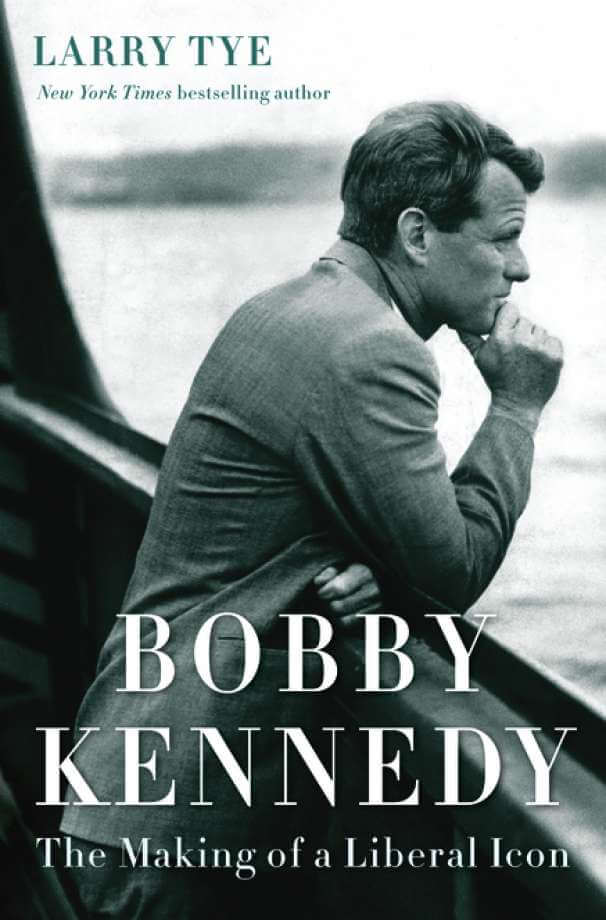
  • Larry Tye, Bobby Kennedy: The Making of a Liberal Icon

    Larry Tye, Bobby Kennedy: The Making of a Liberal Icon


    Before opening Larry Tye’s biography of Robert Kennedy, I had some qualms about it. Why? Because when I turned to the back cover I saw that none other than Henry Kissinger had given the book his endorsement. The man many commentators think should be tried as a war criminal, who, for instance, supervised Richard Nixon’s expansion of the Vietnam War into Cambodia and Laos, was praising a book about Robert Kennedy. I then noted another blurb by journalist Marvin Kalb. In 1974, Kalb, along with his brother Bernard, wrote one of the first biographies of Kissinger. (Historian Theodore Draper called it a hagiography.) The Kalbs compared the validity of Kissinger’s diplomacy to George Washington’s likeness on a dollar bill. A judgment which, to say the least, does not hold up today. These endorsements, quite naturally, gave me pause.

    After reading the book, that pause was justified. Approximately the last 75 pages of Tye’s work are adequate and, in one or two places, actually moving. The problem with that observation is simple arithmetic: the book contains 447 pages of text. Therefore, those last 75 pages comprise about 1/6 of the volume. The rest of the book is not just below average; in many places it is worse than that, and in more ways than one.

    Tye tips us off to his agenda quite early. In his preface, he calls Robert F. Kennedy a commie baiter who was egged on by his father and Joe McCarthy. He adds that Kennedy practiced Machiavellian tactics to win his brother the presidency. He then says that he was also part of the plots to eliminate Fidel Castro. He tops this off by writing that “an assassin halted his campaign of conciliation.” (p. xi) I wrote in my notes: “Tye is off to a bad start.” I was correct.

    I

    Tye titles his first chapter “Cold Warrior”. In order to make this stick, he employs what military experts would call a pincers movement. He wants to envelop young Robert within the grasp of his father Joseph Kennedy, and his first legislative boss, Senator Joseph McCarthy. How anyone today could compare RFK with his father is really kind of inexplicable. But this is one of Tye’s unrepentant and recurrent proclamations. (Tye, p. 5) In this reviewer’s experience and knowledge there can be no better witness to this issue than Jackie Kennedy, since she was close to Joe Kennedy, and was even more familiar with his three surviving sons. She told Arthur Schlesinger that RFK was the son who was least like his father. (See Robert Kennedy and His Times, p. 102) For instance, RFK did not have any interest in or aptitude for business. In fact, by 1957, he was a pro-labor advocate. Also, unlike his father, he was a devoted family man. Again, unlike his father, and more like President Kennedy, he was not an isolationist in his foreign policy outlook. Another point: RFK was quite aware of and sensitive to the plight of both the poor and minority groups. So where Tye gets this comparison is rather puzzling. After reading and taking notes on his book, in my view he does not come close to proving it. Jackie Kennedy appears correct on this point.

    It is interesting to note how Tye shoehorns RFK into this Cold Warrior box. One way he does so is by leaving out the name of Edmund Gullion. In 1951, in preparing for his run for the Senate a year later, congressman John Kennedy took a trip to the Far East. One of the places he visited was Saigon, South Vietnam. He was determined to find out the true status of the colonial war there between the Viet Minh and Ho Chi Minh on one side, and the colonial government of France on the other. After all, the USA was bankrolling a large part of the French war effort. One of the men that John Kennedy consulted with was a man he had formed a glancing relationship with in Washington a few years before. Gullion met with the 34-year-old John Kennedy at a rooftop restaurant. He told him that France would never win the war. Ho Chi Minh had fired up the young Viet Minh to such a degree that they would rather die than go back under French colonialism. France could not win a war of attrition. The home front would not support it.

    In 1983, when it was first reported at length in Richard Mahoney’s book JFK: Ordeal in Africa, this meeting had a jarring effect on the reader, for the simple reason that about 99% of President Kennedy biographers had left it out. But since that time, several other authors—like this reviewer—have not just mentioned it, but detailed it. So it is hard to imagine that Tye is not aware of it. The reason that it should be important to him is simple: Robert Kennedy was there. (James DiEugenio, Destiny Betrayed, Second edition, p. 21) RFK later said that Gullion’s words had had a profound impact. As Arthur Schlesinger writes, when JFK opposed American intervention at Dien Bien Phu in 1954, RFK agreed. (ibid, p. 125) And on the issue of anti-communism and its relationship with anti-colonialism, RFK pretty much mirrored his brother: You could not consider anti-communism in the Third World without considering the impact of colonialism. (ibid, p. 133) RFK wrote in the pages of New York Times Magazine “… because we think that the uppermost thought in all people’s minds is Communism …. We are still too often doing too little too late to recognize and assist the irresistible movements for independence that are sweeping one dependent territory after another.” In his visit to Russia in 1955 with Justice William O. Douglas, which Tye mentions, RFK saw a different side of Russian life and became rather sympathetic with its citizens. He even wrote down some of the good things about the USSR. (Schlesinger, p. 134)

    But the main way Tye tries to turn Robert Kennedy into a Cold Warrior is through his service as assistant counsel under McCarthy on his Senate investigative committee. He partly does this by using some rather questionable and controversial sources, like M. Stanton Evans and Ralph de Toledano. The former was present at William F. Buckley’s estate when Buckley founded the Young Americans For Freedom. Evans actually wrote the charter for that right-wing group. He then went on to work for Buckley’s National Review for 13 years. Just a few years before Evans died in 2015, he wrote an apologia for Joe McCarthy. De Toledano was so anti-communist that OSS chief Bill Donovan would not include him in covert operations in Europe during World War II. He then became a close friend of Richard Nixon during the Alger Hiss trials, and later was a co-founder of National Review. He wrote a quite negative book about Robert Kennedy in 1967, in anticipation of his run for the presidency. (In this regard it is important to note that Tye also uses two other dubious sources in this section: conservative hit-man Victor Lasky’s Robert F. Kennedy: The Myth and the Man and Burton Hersh’s absolutely atrocious Bobby and J. Edgar.)

    Robert Kennedy served as assistant counsel on McCarthy’s committee for about six months. According to most observers, he composed one of the very few reports that had any value to it. This was a documented study of how some American allies—like Greece and England—extensively traded with China during the Korean War, consequently being part of the effort against the USA in that conflict. Even McCarthy’s liberal critics described the report as being factually accurate and soberly written. (Schlesinger, p. 108) Unlike most of Chief Counsel Roy Cohn’s work, it did not accuse people of being traitors. And Robert did not take part in the hunting down of alleged subversives in the State Department. (ibid, p. 106)

    In fact, RFK and Cohn bumped heads at this time over the way the chief counsel was conducting the committee. Bobby also complained to McCarthy that although Cohn’s recklessness was attracting a lot of press, it would eventually collapse the committee. He likened what Cohn was doing to a toboggan ride down a slope ending with a crash into a tree. (ibid, p. 110) But McCarthy decided to stick with Cohn. So, in the summer of 1953, RFK resigned.

    About six months later, he returned. He wrote a letter to a friend at this time, saying, “I think I will enjoy my new job.” (ibid, p. 115) This time he was chief counsel to the Democratic minority. He spent about three times longer in this role as he did as assistant counsel to Cohn. Therefore, some dramatizations of this episode use his role as minority chief counsel and discount his prior work. (See the HBO film Citizen Cohn) He went head to head with Cohn, and more often than not, he came out in front. In fact, the two became such bitter rivals that, on one occasion, they almost came to blows. (ibid, pp. 117-18) Even a local newspaper, The Boston Post, went after RFK for his determined and public opposition to Cohn.

    As RFK predicted, McCarthy imploded. One cause was Cohn’s close friendship with David Schine, a draftee who Cohn tried to get special privileges for in the army. Bobby Kennedy wrote the questions for each Democratic senator on this issue. (ibid) The second cause was McCarthy’s fatal showdown with attorney Joseph Welch, who had been hired to specifically defend the army against the McCarthy/Cohn assault. Welch’s famous “Have you no decency sir” riposte punctured McCarthy in front of 20 million spectators.

    When the Army-McCarthy hearings ended in June of 1954, Bobby Kennedy wrote the minority report. It was highly critical of McCarthy’s leadership. Parts of it were so extreme that the committee would not sign off on the whole report. RFK wrote that there was no excuse for McCarthy’s failure to rein in Cohn. Or how irresponsible many of Cohn’s charges turned out to be. He then concluded with: “The Senate should take action to correct this situation.” (ibid, p. 118) For all intents and purposes, this was the beginning of the movement to censure McCarthy. That motion arose on the Senate floor a month later. It was passed on December 2, 1954.

    Under the new leadership of Sen. Karl Mundt, Robert Kennedy had even more power. He used it mainly to wrap up what was left of Cohn’s charges: the Irving Peress, and Annie Lee Moss cases and the accusation of communist infiltration of defense plants. No charges were ever filed.

    From the above synopsis it’s fairly easy to deduce that RFK was stuck in a bad situation and he tried to make the best of it. When he could not, he resigned. Given the opportunity to return under more propitious circumstances, he atoned for his earlier errors. Based upon that, it’s not justified to call Bobby a Cold Warrior, or to have the episode cast a shadow over his entire career.

    II

    The next major section of the book deals with RFK’s confrontation with Teamsters’ leader Jimmy Hoffa. In 1956, the Democrats took control of the Senate and with that, the leadership of the sub-committee on investigations passed to Senator John McClellan. Because he appeared to be eminently fair in wrapping up the McCarthy/Cohn fracas, a few journalists got in contact with Robert Kennedy, trying to interest him to use his chief counsel’s office to go after a real danger: organized crime influence on labor unions. Kennedy and McClellan went in that direction and this resulted in RFK’s four-year long pursuit of Hoffa. Tye seems to have no serious problems with this episode in young Kennedy’s career. The worst he can say about it is that it was used to boost Senator John Kennedy’s profile in his attempt to attain the White House.

    JFK & RFK on the McClellan committee

    Which is kind of ridiculous. The reason JFK ended up on the committee was because of complaints by Teamster leaders Dave Beck and Hoffa. They protested that McClellan’s committee was the wrong place for these hearings; they should be held before the Labor Committee. McClellan resisted this since he thought that committee was too friendly with labor and would not pursue the complaints vigorously. Because they did have a valid point, the solution was to form a special committee, half from McClellan’s committee and half from the Labor Committee. Since JFK was on the latter, that is how he got on the special committee. Is Tye saying that Beck and Hoffa brought up this objection at the request of RFK to get his brother on the committee?

    What is odd about this section is that the reviewer could find few, if any, questions or comments by Tye about some of the techniques used by RFK to finally imprison Hoffa. Some distinguished authors, e.g., Victor Navasky and especially Fred Cook, have raised some serious questions about the methods used by Kennedy’s office to enlist witnesses to testify against Hoffa. Many of these methods were employed by Kennedy’s investigator Walter Sheridan, who remains pretty much untouched by Tye. (For a look at these charges, see Cook’s multi-part series in The Nation which culminated in his article “The Hoffa Trial” on 4/27/64.)

    Another oddity about this section is that much of the political background of the issue goes unexplored. The Republicans on the special committee, for instance archconservative Barry Goldwater, wanted RFK to delve into the Teamsters so they could use that issue to tar labor unions in general. But once they saw how RFK was bringing in organized crime as an influence on Hoffa, they actually began to side with Hoffa, since this would detract from their real aim. (See review of James Neff’s Vendetta, by Alex Lichtenstein, Washington Post July 17, 2015.) When John Kennedy tried to pass legislation aimed at this particular influence in order to sanitize union elections, the Republicans hijacked his legislation and turned it into the union weakening Landrum-Griffin bill. That act was such a twisting of JFK’s original intent that he took his name off of it. (Schlesinger, pp. 188-92)

    Walter Reuther & RFK

    Another fascinating aspect of RFK’s service on this committee was the Kohler company investigation. And again, Tye pretty much discounts the episode. The Republicans on the committee, especially Goldwater, wanted RFK to inquire into this long running UAW strike against Kohler plumbing in order to investigate UAW leader Walter Reuther. Goldwater did not foresee the consequences. First, Reuther turned out to be a forceful witness for the rights of labor and abuses by corporations. Secondly, Bobby Kennedy actually visited the home of Kohler in Sheboygan, Wisconsin. He was appalled at some of the working conditions there, and at what the company called a “lunch break”, which lasted about five minutes. (ibid, pp. 183-87) This had two effects. First, it resulted in a strong personal and professional relationship between RFK and Reuther. For example, Kennedy later called on Reuther to bus in as much of his membership as possible to attend Martin Luther King’s 1963 March On Washington. Second, it ended in the largest fine ever awarded over a strike. Kohler was ordered to pay three million dollars in back wages to the strikers and to give their pension fund another 1.5 million.

    RFK’s focus on Hoffa’s ties with organized crime caused his interest to spread into a general inquiry into the workings of what had become known as the Cosa Nostra in America. As a result, in 1959, the McClellan Committee was nicknamed the Rackets Committee. For the first time the American public was exposed to organized crime figures like Anthony Provenzano and Sam Giancana. Many authors have concluded that it was this part of RFK’s congressional service, his exposure of Mob influence in labor unions and on the national scene, which really made him into a national figure.

    III

    From here, Tye segues into the 1960 presidential election and RFK’s role as his brother’s campaign manager. At the beginning of the chapter he writes that what Bobby did in this campaign would later embolden the likes of Richard Nixon and Lyndon Johnson. (Tye, p. 87) That theme is repeated later on. (see pp. 106, 121) One has to wonder: What in God’s name is Tye up to with those comparisons? Does he really think that no one remembers what Richard Nixon and his political hatchet man Murray Chotiner did to, first Jerry Voorhis in the 1946 congressional race, and then Helen Douglas in the 1950 senatorial race? These have become famous today because of the new low they hit in creating red baiting campaign tactics. Tye also seems to trust the reader not being aware of revelations about how Allen Dulles helped finance Nixon’s run against Voorhis, a man who was opposed to both big banking and big oil, which Dulles represented at his law firm Sullivan and Cromwell. (David Talbot, The Devil’s Chessboard, pp.162-63) Or how Nixon was on the take from private companies in 1946 because he would not run for office at a financial sacrifice to himself. (ibid, p. 165) Chotiner portrayed the anti-communist Voorhis as a tool and fellow traveler of the Kremlin. This included voters getting anonymous phone calls during the last week saying that they should know Voorhis was a communist before they voted for him. (ibid, p. 166)

    What made it all the worse was that Nixon knew it was all a fabrication. When a Voorhis backer later confronted him with those last minute phone calls Nixon took the opportunity to give him an education in realpolitik. He coolly replied, “Of course I knew Jerry Voorhis wasn’t a communist. I had to win. That’s the thing you don’t understand. The important thing is to win. You’re just being naïve.” (ibid) I could continue on with Nixon’s run against Douglas which was, in some ways, even worse than the Voorhis campaign. But the point is obvious: What could someone as corrupt and feckless as Nixon learn from Robert Kennedy?

    The comparison with Johnson is just as bad. Maybe worse. One just has to conjure up the lawlessness of Texas politics in the thirties and forties, which is when LBJ got his start. Through the efforts of several Johnson biographers, we know about the associations of LBJ with such unsavory characters as Herman and George Brown of Brown and Root, the giant construction firm that eventually evolved into Halliburton. In return for steering contracts their way, the brothers financed Johnson’s congressional and senatorial campaigns. (Joan Mellen, Faustian Bargains, pp. 7-9) When a government accountant tried to expose the illicit relations between LBJ and Brown and Root, he was framed for soliciting contributions from his staff. He was acquitted, but decided to leave government service. Johnson also used extortion tactics to gain newspaper endorsements. (ibid, p. 9) There is also circumstantial evidence that the Brown and Root connection helped finance Johnson’s purchase of KTBC radio in Austin, which was the beginning of Johnson’s personal fortune in media.

    But this is all prelude to Johnson’s infamous 1948 race for the senate against Coke Stevenson. The results of that race shifted back and forth for a solid week after the election was over. Johnson actually wiretapped Stevenson’s phone lines. Johnson had made a deal with south Texas political boss George Parr to rig the vote. This culminated in the notorious Box 13. This was a late arriving vote tally—five days after the polls closed—in which 203 ballots were “discovered”. Those results tilted the election to Johnson. Of the 203, a miraculous 202 were votes for Johnson. Which was even worse than the Parr controlled Duval county results, which were 94% for Johnson. Curiously, those 203 names were assembled in alphabetical order. When eleven of the 203 voters in Box 13 were interviewed, they said they had not even voted. Journalist Ronnie Dugger later found precinct official Luis Salas, who admitted he had performed the fraud for Parr and Johnson. Salas had a picture of the smiling officials who held the ballot box in their hands. The capper to all this is that when Dugger interviewed LBJ for his biography, Johnson had the very same picture. (Click here for Jason Matteson’s essay on this subject)

    Are we really to believe that Tye is not aware of this whole tawdry affair? It has been written about extensively since at least 1982, when Dugger’s book on Johnson, The Politician, was first published. Are we also to think that Tye is not aware of Johnson’s later associations with the likes of Billy Sol Estes and Bobby Baker and his bribery actions with Don Reynolds? (For the last, see Mellen, pp. 160-64)

    But in practical terms, in his book, does Tye excavate anything like the above to make his bombastic comparison stick? He mentions some dirty tricks in the primary campaign against Hubert Humphrey, but he admits he cannot trace these through to Bobby Kennedy. And his prime attempt at doing the same in the general election smacks of desperation. In 2011, over a half-century after the election, the Washington Post published an article by Mark Feldstein. (1/14/2011) This was yet another reworking of a story that was published in 1962. Since then it has been reported several times, for instance in the book Empire, a long biography of Howard Hughes by Donald Bartlett and James B. Steele. Somehow, Tye ignores all the previous reporting and accepts this one at face value (Tye, p. 123), even though in serious ways it contradicts the others.

    Back in 1956, Howard Hughes made a loan of $205,000 to Donald Nixon, Richard Nixon’s brother. Donald’s business enterprise, named Nixon burgers, was a kind of fast food place mixed in with a grocery store. It was about to go under unless it got a fast infusion of cash. Hughes was always attuned to these situations since he was all too intent on compromising politicians or their next of kin. After Nixon and Eisenhower won re-election in November, Hughes supplied the loan in December of 1956. Up until that time, the IRS was resisting granting Hughes a large tax exemption for Hughes Medical Center. They recognized it as a scam that was simply a way for Hughes to dodge taxes on profits from his other divisions. But, lo and behold, one month after Hughes notified the Vice-President that all was in place with the loan, the IRS reversed itself. Hughes got the phony exemption, which allowed him to save millions. The loan was supposed to be mortgaged by a plot of land in Whittier—except the land value was estimated at only 50,000 dollars. By most measures one would have to conclude that Hughes was buying influence, not making a business transaction. (Bartlett and Steele, p. 204)

    Through Drew Pearson, the story got out in a fragmentary way in the waning days of the 1960 election. Very few newspapers picked it up and Nixon dismissed it as a last-minute smear unworthy of comment. In 1962, Nixon lied about the loan in his book Six Crises, saying that the Whittier property more than covered the amount of the loan. That year, Nixon decided to return to politics by running for governor of California. This time, the Hughes loan would be a much larger story since now editors were ready for it. The Long Beach Press Telegram decided to run a long story on the loan since they had editorialized about it back in 1960. That story was published in that newspaper and in the magazine The Reporter in April of 1962. James Phelan, who many people in the JFK field have qualms about—including me— wrote it. But in this instance, Phelan did not seem to have a dog in the fight. And there were adequate records to back up what he wrote. And later reporting by, for example, Hughes manager Noah Dietrich, has also borne out the basic facts as he presented them.

    Hughes tried to cover up the loan by using two layers of disguise. The first was a lobbyist by the name of John Waters. But since Waters had done some work for Hughes, the trustee of the mortgage was changed to an accountant named Philip Reiner. Complicating the matter was that, after Donald Nixon eventually went bankrupt, a gas station was built over the Whittier lot. Reiner was sent the rent checks by the station, which amounted to $800 per month. When Reiner surrendered the check to Nadine Henley at Hughes headquarters in Hollywood, it was returned to him. Hughes wanted no paper trail linking him to the lot. So Reiner spent the money. But later, an accountant at Hughes Tool Company in Houston began raising a ruckus about what had happened to the loan for $205,000, well over a million dollars today. Reiner’s cut-out, a lawyer named Frank Arditto, now asked him what happened to the payments, knowing full well that he had given Reiner permission to cash the checks. Realizing he was being made the fall guy, Reiner hired an attorney. With an election coming up, the consul realized that his client would make a good asset for the Democrats, who would protect him. He got in contact with Robert Kennedy, who turned him over to an assistant named Jim McInerney. McInerney decided to subsidize Reiner for the money Arditto was demanding, sixteen thousand dollars. McInerney then put together a package of documents, affidavits, trust deeds, and receipts. He gave them to three outlets: St Louis Post Dispatch, Time magazine, and Drew Pearson. No one would run with it since it was so late in the campaign.

    But Nixon then made a mistake. Hearing about McInerney’s report, he launched a preemptive cover story to conceal the actual circumstances of the loan and the role of Hughes. These lies infuriated Pearson. He now decided to publish the story. (These details are in Phelan’s 1982 book, Scandals, Scamps and Scoundrels. Reiner later sued Hughes and won a $150,000 out of court settlement. See The Desert Sun, 2/22/72)

    When one compares this with the Post version, as adapted by Tye, it is unsettling. That version opens with Nixon complaining that the 1960 election had been stolen from him. It then says that the document package was picked up at McInerney’s office, not sent out. In a completely unprecedented twist—with no evidence advanced—it states that the Hughes cash was given to Dick Nixon to purchase a home in the Washington area. The wildest part then states that RFK acquired the story for money, and then a burglary was arranged at Reiner’s office to get the documents. In his text, Tye never mentions the earlier version of this story; therefore, he does not point out the differences between the two, which means he does not have to attempt to reconcile them. In his footnotes he does not even alert the reader to the other version. But the worst part of the improbable tale, and its innate spin, is that all culpability by Nixon is now gone. That poor Red-baiter Nixon is reduced to a helpless victim pondering what happened to him at the hands of Kennedy power. In this new version, there is not even a note of irony about how Voorhis and Douglas must have felt. Talk about (multi-leveled) historical revisionism.

    IV

    In this review, I will not divert much from the main topic in order to critique at any length or detail some of the comments that Tye makes about John F. Kennedy. If I did, the review would be about 50% longer. I will simply note that some of the things the author says about John Kennedy are rather obtuse, and not supported by the record. For instance, at the beginning of Chapter Four, dealing with JFK ‘s entry to the White House, the author writes that neither Eisenhower nor Wilson had been as brazen as Jack in running for President as an untested leader. I don’t understand what this means. The only elected political office Woodrow Wilson held prior to winning the presidency was a two-year stint as governor of New Jersey. Which is two years longer in office than Eisenhower. In comparison, John Kennedy had served in Congress and the Senate in Washington for 14 years prior to the 1960 election. About the 1960 race, Tye also writes that the politics of Nixon and Kennedy did not differ much. (p. 121) This is a Chris Mathews style blurring of the record. To use just two examples which occurred while JFK was in the Senate and Nixon was vice-president: 1) Kennedy opposed 1954’s Operation Vulture, the White House plan to use atomic weapons to aid the French at Dien Bien Phu; (op. cit Talbot, p. 361) 2) Kennedy’s monumental 1957 speech about why the USA should not support the doomed French colonial war in Algeria provoked barbed and snide remarks from Nixon in the White House. (Richard Mahoney, JFK: Ordeal in Africa, p. 29)

    Tye’s depiction of Robert Kennedy running the Justice Department is, to be kind, equally myopic. The author is adequate in describing the new Attorney General’s war against organized crime. (Tye, pp. 142-45) He describes Kennedy’s attempts at fairness in going after Democratic politicians who had broken the law. (ibid, pp. 145-47) He also briefly describes RFK’s final neutering of the Smith Act by having the sentence of CPUSA member Junius Scales commuted. (p. 157) Again, when it comes to the complexities of the Hoffa case, he seems to have little problem accepting the prosecution’s dubious witness Ed Partin. In fact, he actually adds on to Partin’s sensational charges of Hoffa’s intent to kill RFK by adding the late arriving and dubious Frank Ragano story about Hoffa trying to choke Bobby to death at the Justice Department. (Tye, p. 152) To be fair, he does say that RFK’s pursuit of Hoffa was so unrelenting, so single-minded, that it created sympathy for the Teamster leader.
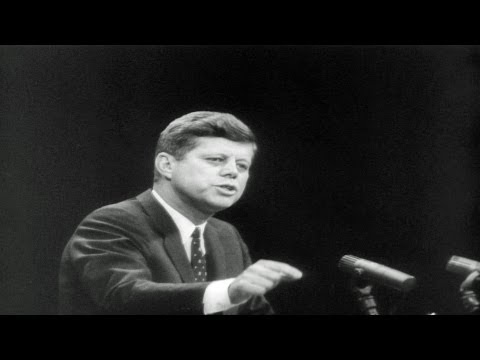
    JFK responds to U.S. Steel’s defiance
    (click image for YouTube video)

    Tye deals with the 1962 steel crisis in about one page (pp. 163-64). His account is so skeletal, so skimpy, that one would think all the commotion was about whether or not FBI agents should phone business executives late at night. To get my bearings back on this momentous event, I reviewed what is perhaps the best account: Donald Gibson’s chapter-long treatment in Battling Wall Street. Gibson begins his discussion by quoting the late, illustrious economist John Blair, who called the episode, “The most dramatic confrontation in history between a President and a corporate management.” (Gibson, p. 9) The only other instance that rivals it was Harry Truman’s intervention in a steel strike ten years before, but that was during a full-blown war in Korea. President Kennedy had worked on an industry-wide labor agreement for a year, mainly through Secretary of Labor Arthur Goldberg. In late March, he thought he had one. But it was broken via a personal visit to the White House by US Steel chairman Roger Blough. He told JFK he would announce a price increase in 30 minutes, which is what the President and Goldberg had been promised would not occur. The President then uttered his famous quote, “My father always told me that all businessmen were sons-of-bitches, but I never believed it until now.” (Irving Bernstein, Promises Kept, p. 143) Within 24 hours JFK went on national television to condemn the steel companies. He said that Americans would find it hard to accept that “a tiny handful of steel executives … can show such utter contempt for the interests of 185,000,000 Americans.” (Gibson, p. 13)

    One day later, RFK announced formation of a grand jury and the delivery of subpoenas. Records, both personal and corporate, were seized. The aim was to establish if criminal conspiracy laws had been violated. The Attorney General also had the FBI march into executive offices for interviews. (Schlesinger, p. 421) Within 72 hours the crisis was over and the price increase rescinded. There can be little doubt that the Attorney General’s actions hurried the settlement. Especially in light of the fact that, in 1961, as a continuation of an investigation under the Eisenhower administration of price-fixing by electric companies, RFK had actually placed seven business executives in prison. Five were from General Electric and Westinghouse. (See The Great Price Conspiracy by John Herling.) And contrary to popular belief, and what Tye implies, based on information from the 1962 steel inquiry, RFK began new actions against US Steel in late 1963. (Gibson, p. 13)

    V

    This same pattern, shrinking a large achievement, is followed with respect to the Attorney General’s actions in the civil rights arena.  In this instance, however, Tye’s writing is even more problematic, since RFK’s achievements there are clearly epochal, no prior Attorney General coming even close to them.

    Harris Wofford & JFK

    Tye does something with the subject that I don’t recall seeing before. He begins his discussion of the Kennedy program in 1963, at a meeting RFK had with some militant black leaders like James Baldwin. Most accounts of the Kennedy civil rights program begin with a review of what had been done by the Eisenhower-Nixon administration and then segues into the memo written by Harris Wofford. After campaigning for Kennedy, Wofford was appointed JFK’s special assistant on civil rights. In late December of 1960, before the inauguration, Wofford wrote a memo that outlined a program for achieving equal rights for black Americans. He then recommended his friend and colleague, attorney Burke Marshall, to be the Justice Department lawyer in charge of the issue. (Bernstein pp. 42-43)

    Just the information above counters two observations Tye makes. First, that the Kennedy administration had no plan to attain civil rights, and second, that RFK took on issues willy-nilly. (Tye, p. 205) Wofford, a central figure by anyone’s estimation, is discounted by Tye. Surprisingly, he is only mentioned once in his chapter on the subject. Yet his memo was both acute and realistic, and it was more or less followed by the administration. He wrote that the only branch of government that had achieved anything so far was the judiciary. He then wrote that the administration would have to press the issue through executive actions in order to put pressure on Congress to pass legislation, something that, for political reasons, Congress would not be ready to do in the first year or two. Wofford also mapped out the country geographically and recommended what actions needed to be taken and where. For example, he recommended legal assaults on states that restricted voting rights, and strictures in contracting to open up corporations to black employment. (Bernstein, pp. 47-48) As historian Irving Bernstein notes in his book, once Robert Kennedy became Attorney General, he followed this program. (See Promises Kept, Chapter 2)

    When the Kennedy administration took office, it was evident that the Brown vs. Board decision, and the Civil Rights Acts of 1957 and 1960 were not having any kind of real impact. One reason for this was the Eisenhower administration’s lack of rigor in enforcing them. Senator John Kennedy, during the debate on the Civil Rights Act of 1957, said he championed Title 3 of that proposed act because it allowed the Attorney General to enter into individual states to attack cases of voting discrimination and school segregation. And this is what Robert Kennedy was doing once he became Attorney General. On May 6, 1961, at the University of Georgia’s Law Day, RFK announced that, unlike his predecessor, he would strongly enforce the Brown vs. Board decision. And RFK also began filing lawsuits in southern states based upon the low rates of voter turnout there. In his first year in office, RFK filed more than twice as many cases than Eisenhower had in his entire second administration. As writers like Harry Golden have pointed out, this plan was not just recommended by Wofford’s memo. Candidate Kennedy had approved it in no uncertain terms during the campaign in a meeting with his civil rights advisory board. (Harry Golden, Mr. Kennedy and the Negroes, pp. 105, 139)

    In the face of all this, how does the author actually begin his chronicle of the administration’s civil rights campaign? He ignores much of what I have noted above. He begins his actual chronicle with the Freedom Riders campaign, which started in May of 1961. He uses this for two reasons. He wants to show that 1) RFK was behind the curve, and 2) He uses the incident to call the AG a liar. He achieves the first in part by ignoring the comment that Senator James Eastland made to RFK after his confirmation. He told Kennedy that his predecessor had never filed a voting rights case against his home state of Mississippi. The next day President Kennedy wrote a note to his brother telling him to begin filing cases. (Golden, p. 100) This, of course, preceded the Freedom Riders campaign.

    The second objective is achieved by saying that RFK was alerted to the incident in advance. Yet the AG said he was not aware of the demonstration. To use one example, as an FBI informant later revealed, J. Edgar Hoover was well aware of the planned violence against the Freedom Riders. That information was not passed to Hoover’s boss, the Attorney General. (Schlesinger, p. 307) A letter that the demonstration organizer had sent to the Attorney General was routed to Burke Marshall instead. He either never got it or he did not inform Kennedy about it. (Bernstein, p. 63)

    But beyond that, is Tye implying what I think he is implying? That somehow, even if he had known about it, RFK would not have anticipated the violence the Freedom Riders would encounter? That is: vicious racists attacking the buses with baseball bats, lead pipes and bicycle chains. With people being pulled off the buses, thrown to the ground and then beaten and bloodied. All this while both the police and FBI did nothing. In this regard, I should note the following. At his meeting with President Kennedy about taking the job, both men understood there were going to be battles in the civil rights area right off the bat. (Ronald Goldfarb, Perfect Villains, Imperfect Heroes, p. 10) But also, I could find no mention by the author of the protest RFK made as a member of the Harvard football team when a southern opponent refused to let a black member of the team stay in the same hotel. That was in 1947. (Schlesinger, p. 71) Secondly, Tye seriously underplays the actions Kennedy took as leader of the Legal Forum at the University of Virginia in 1951. RFK invited black diplomat Ralph Bunche to speak there. He knew it would raise a ruckus, since UV was the team that did not want to play Harvard back in 1947. What made it more problematic was that Bunche wrote Kennedy a letter saying that he did not wish to appear before an audience that featured segregated seating. Yet, state law required this. More or less on his own, Kennedy took the case through four levels of campus government saying that he would not give up, since he thought disallowing Bunche would be morally indefensible. (Schlesinger, p. 90) Bunche ended up speaking to an integrated audience that was about 1/3 black. But beyond those personal experiences, the Greensboro lunch-counter sit-ins had taken place in North Carolina during the presidential campaign of 1960. And further, RFK was already supervising the New Orleans school desegregation crisis against the likes of Leander Perez in early 1961. (Robert Kennedy in His own Words, edited by Edwin Guthman and Jeffery Schulman, p.81)

    What really happened with the revolution in civil rights that took place under Bobby Kennedy is fairly simple to understand. First, the failure of the Eisenhower administration to use any of the judicial and legislative achievements attained in the fifties built up large amounts of pent up frustration. For example, from 1955 to 1960, the courts had made a series of rulings that segregation in busing was not constitutional. If those rulings had been enforced, there would have been no need for the Freedom Riders. (Bernstein, pp. 62-63) But John F. Kennedy’s candidacy represented something different to black Americans. From his speeches on European colonialism in Africa back in 1957, to his speech in Jackson, Mississippi that year, telling southerners they must abide by Brown vs. Board, to his comments in New York during the 1960 primary that he would risk losing the south since this was a moral issue to him, and his later call during the general election to Coretta King while her husband was in jail, all these and more, caused that frustration to unleash itself once Kennedy won the election. Finally, someone was in the White House who was ready to do something about civil rights. For instance, it was John Kennedy’s election that inspired James Meredith to apply to the University of Mississippi. (Bernstein, p. 76)

    And they were correct. By the summer of 1963, in less than three years, that synergy had turned the tide. With John Kennedy’s landmark speech in June of 1963 on the issue, and Robert Kennedy’s stewardship of King’s March on Washington, the battle was essentially won. Kennedy’s civil rights act was going to pass. As Wofford predicted, it could not have passed earlier. But I must note, even with this—the reversal of a century of Jim Crow and segregation in less than three years—Tye is still not satisfied. About President Kennedy’s nationally televised speech he writes that Kennedy had wanted to redefine America’s place in the world, but he had not come close before. (Tye, p. 229) To say the least, many would disagree. For example, President Kennedy reversed the Eisenhower agenda in Third World nations like Congo, Indonesia, and Laos in 1961. Tye also states that Robert Kennedy’s confrontation with Governor George Wallace at the University of Alabama was “scripted”. If one watches the classic documentary about this showdown at Tuscaloosa, Crisis, the viewer will see that all the way through, the AG did not know what Wallace was going to do. Wallace had deliberately decided not to talk to RFK to settle the matter in advance. So at the White House, the AG suggested that the students might have to be forced through one of the furthest doors Wallace was standing in front of. If the episode had been scripted, RFK would never have suggested such a dangerous alternative. After all, Wallace had 900 state troopers there, and Bobby Kennedy had brought in 3000 guardsmen.

    But in the long run Wallace and his henchman, Mississippi governor Ross Barnett, had won. By creating these dramatic confrontations at Tuscaloosa and Oxford, they had made it appear that Bobby Kennedy was invading the state. Which conjured up images of President Lincoln and General Grant marching on Richmond in 1865. So even though Wallace lost on integration, he won the larger political stake: the South was lost to the Democrats after 1964. And this followed from the fact that, unlike Hoover, Attorney General Herbert Brownell, Eisenhower and Nixon, Bobby Kennedy viewed this as something that had to be done. Indeed, at times RFK sounded like Malcolm X on the issue: “We’ll have to do whatever is necessary.” And what made it even worse is that RFK was fully aware of what was happening in the political arena. He was writing off state after state for his brother’s re-election in 1964. (Guthman and Shulman, pp. 76, 82) This whole tragic dimension—the moral plane losing out to the political factors—is lost on Tye.

    But it wasn’t lost on Martin Luther King. In 1967, it was Bobby Kennedy who suggested King lead his Poor People’s March to Washington. (Schlesinger, p. 911) And for the 1968 primary election, King made it clear to his advisors that he was backing Kennedy over Lyndon Johnson and Eugene McCarthy, and there was no real question about it. (Martin Luther King: The FBI File, p. 572)

    VI

    I began to lose a lot of faith in the author when, about halfway through the book, he began to insert the work of the late David Heymann. (pp. 191-92) And while we are at it, Tye also sources writers like Kitty Kelley, Chuck Giancana, and Ron Kessler. To be clear, towards the end, he doesn’t actually endorse Heymann; he throws his work out there for discussion. The problem is that Heymann has been discredited about as far as an author can be discredited. And since that discreditation has been well publicized, it is hard to believe that Tye doesn’t know about it. He even gives play to Heymann’s book, saying that RFK and Jackie Kennedy had an affair after JFK was killed. That book, and Heymann’s reputation, was thoroughly savaged by Lisa Pease. And today, it has been shown beyond any doubt that Heymann was a professional confabulator, one who not only made up interviews he did not do, but even created interview subjects who did not exist. Beyond that, he even manufactured a fictional police department so he could refer to their reports. (See this Newsweek story) Tye uses a story about RFK making out with Candy Bergen that was vehemently denied by a furious Bergen in 2014 in an article for Newsweek. That Newsweek story was published two years before the author’s book. Can he really have missed it? Meanwhile, Tye does not quote what the late FBI officer in charge of domestic intelligence for Hoover said about Kennedy’s party life. In his book The Bureau, William Sullivan wrote that Hoover would send agents out to follow Kennedy around at night. They could never find him in any compromising situations. He would nurse one drink all night and then leave the party.

    This is all apropos of Tye’s chapter on RFK and Cuba, and also other foreign affairs. That chapter is surely one of the worst in the book. In order to discuss it, we must briefly mention President Kennedy’s policy, since Tye does so. Near the beginning of the chapter, Tye writes, in relation to Operation Zapata, the code name for the Bay of Pigs invasion, that “The new president was determined to act.” (Tye, p. 242) This is contrary to just about everything that has been written about Zapata. Even Allen Dulles, the progenitor of the operation, has stated that the project was a kind of orphan child that Kennedy had adopted, but he had no real love or affection for. (Trumbull Higgins, The Perfect Failure, p. 103) When Arthur Schlesinger asked him what he thought about the concept, JFK replied he thought about it as little as possible. (ibid, p. 102) Contrary to what Tye states, the CIA had to entice the new president into going along with it. They did this in a variety of ways. This included presenting him with false estimates of the resistance to Castro on the island, having Dulles wildly overstate the possibilities of the project’s success, and actually predicting that once the invasion landed, much of the Cuban militia would defect. (Peter Kornbluh, Bay of Pigs Declassified, pp. 294-95) But beyond that, Tye persists in the idea that President Kennedy cancelled D-Day air strikes. (Tye, p. 242) Thanks to the declassification of Lyman Kirkpatrick’s Inspector General report, and the availability of General Maxwell Taylor’s White House report, this has been exposed as a myth propagated by the CIA.

    Now, what did Robert Kennedy have to do with Zapata? Just about nothing. He was briefed on the operation four days before the invasion force was launched from Central America. (ibid, p. 301) The importance of RFK in regards to Zapata is his role afterwards in serving as President Kennedy’s watchdog on the Taylor review board. This was a panel set up by President Kennedy to delve into the CIA’s creation and launching of the invasion. Tye seriously underplays RFK’s role on Maxwell Taylor’s board. For instance, he does not mention RFK’s cross-examination of Allen Dulles; or Joseph Kennedy’s aid in helping uncover the Bruce-Lovett report, which had previously been critical of Dulles; nor does he mention the termination of director Dulles, Deputy Director Charles Cabell, or operations supervisor Dick Bissell. (Tye, p. 245) JFK did this because he came to the conclusion he had been lied to about every aspect of the operation. Why? Because Dulles knew the plan would not succeed. The director had banked on Kennedy sending in American forces when he saw it failing. Kennedy did not. With the declassification process on Zapata, several respected authors, including Jim Douglass in JFK and the Unspeakable, have demonstrated this was the case. It is questionable whether the president could have understood all this without his brother’s role on the Taylor panel. As far as I can see, this is all left out by Tye.

    As Tye recognizes, it was largely RFK’s part on the Taylor board that convinced the president not to trust the CIA or the Pentagon. Thus Robert Kennedy assumed a larger presence in foreign policy matters. When Operation Mongoose—the secret war against Cuba—was formulated, RFK served as a kind of ombudsman over that project. As David Corn wrote in Blonde Ghost—his biography of the project’s administrator Ted Shackley—the CIA greatly resented this. For now they had to present detailed plans to RFK for every raid into Cuba.

    This gives Tye the opportunity to do what I thought he would. He tries to say that Mongoose included the elimination of Fidel Castro and since RFK knew all about the project, he had to have known about the plots to kill Fidel. (p. 253) This is wrong on two scores. First, it is clear from the declassified record on Mongoose that assassination plots were not a part of the program. The CIA had arranged plans to liquidate Castro, but these were apart from official plans. Secondly, the CIA Inspector General report on the plots specifically states that they were kept from the Kennedys. This includes the phase of the plots that CIA officer William Harvey was supervising with mobster John Roselli during Mongoose. (The Assassinations, edited by James DiEugenio and Lisa Pease, p. 327) When RFK found out about them he called in Director John McCone and Director of Operations Richard Helms and he made it clear that this kind of thing was disgraceful and had to be stopped. (Goldfarb, p. 273) But the CIA deliberately deceived RFK and continued in them. In fact, when JFK was assassinated, they had a representative meeting with a Cuban national codenamed AM/LASH, delivering him murder weapons. Again, the CIA lied about this and said it had been authorized by Robert Kennedy. It was not. (David Talbot, Brothers, pp. 229-30)

    After all this rather flawed history—about Zapata, about Mongoose, about the CIA plots to assassinate Fidel Castro—Tye concludes with a remarkable reverie. (p. 254) I actually had to read it twice. He says that the clandestine operations against Cuba were the inspiration for things like Ronald Reagan’s war against the Sandinistas in Nicaragua, and Richard Nixon’s CIA overthrow of Salvador Allende in Chile. Somehow, Tye leaves out the fact that the CIA had been doing this kind of thing long before the Kennedys came to power. Can Tye really not be aware of the CIA overthrow of Mossadegh in Iran in 1953? The Agency overthrow of Arbenz in Guatemala the year after? Or their attempt to militarily overthrow Sukarno in Indonesia in 1958? Or the backing by Eisenhower and Allen Dulles of the murder plots against Patrice Lumumba of the Congo in 1960? The idea that this kind of thing was all new in 1961 is a little ludicrous. And as more than one author—for example, Jim Douglass—has shown, the Kennedys were attempting to both halt and reverse these regressive actions in the Third World.

    But the main focus of this dubious chapter is the 1962 Missile Crisis. As is his consistent tendency, Tye’s goal seems twofold: 1) He wants to label Robert Kennedy a liar, and 2) He wants to blame RFK for the crisis in the first place. He does this by saying that the reason for the Russian placement of the atomic armada in Cuba was because of Mongoose, and the possibility of a second invasion. Therefore, he concludes that RFK was not forthcoming about the real cause of the crisis in his book on the subject, Thirteen Days. (Tye, p. 239)

    Again, to say this is flawed history is understating it. One way Tye achieves this is by not revealing the full expanse of the nuclear arsenal the USSR had secretly moved into Cuba. That arsenal included 40 missile launchers and 60 medium- and long-range nuclear tipped rockets. The former could fly 1,200 miles; the latter 2,400 miles. Consequently, the long-range missiles could reach almost any major city in the USA, excepting the Pacific Northwest. There were 140 surface to air missile defense launchers to protect the launching sites. Those batteries would be accompanied by a wing of the latest Soviet jet fighter, the MIG-21, plus a detachment of 45,000 Soviet combat troops. That troop detachment included four motorized rifle regiments and over 250 units of armor. To finish off the nuclear launch triad, the Russians had sent in 40 IL-28s, an armed nuclear bomber which had a speed of 560 MPH and a range of 4,500 miles. Finally, they had constructed a submarine pen with 11 subs, 7 of them with 1-megaton nuclear weapons. That explosive power is about 80 times the torque of the Hiroshima blast. (Probe Magazine, May-June 1998, p. 17)

    That array made it possible to hit every major city in America. One would use the bombers and subs for the southeast quadrant, targeting cities like Houston, New Orleans and Miami. The missiles could be used for targets in the northeast, Mideast, Midwest and southern California. With that revealed, here is my question: How was this designed to thwart a Cuban exile boat raid into say Varadero on the Cuban north coast? Do you incinerate 200,000 people in Atlanta in response to an eight-man raid that sabotaged an electricity plant? As many commentators have noted, it would be like killing a fly with a cannon—you would blow up your house in the process. To stop another invasion, all one would have needed to do was to give Castro tactical nuclear weapons, which the Russians did, and/or the SAM missiles and MIG jets. But such was not the case, not by a long shot.

    As scholars who have studied the crisis for decades have concluded, what Nikita Khrushchev was assembling in Cuba was a first strike capability. Something that the USSR did not have at the time, and would not attain for about four more years. In the nuclear planning policy of deterrence, this capability was considered necessary to stop your opponent from executing their first strike. In fact, in a meeting in July of 1961, Allen Dulles had asked President Kennedy to do just that: to launch a first strike against Russia. Kennedy not only refused, he walked out of the meeting. (James Douglass, JFK and the Unspeakable, p. 235)

    The most respected scholar in the field, Harvard’s Graham Allison, has concluded that with this first strike capability, Khrushchev was going to maneuver Kennedy into surrendering West Berlin. (Essence of Decision, p. 105) In their Vienna Summit in the summer of 1961, Khrushchev had made the question of Berlin a real bone of contention with Kennedy: since West Berlin was within East Germany, it should be a part of that Russian dominated country. Kennedy did not see it that way. He felt that if he surrendered Berlin, it could unravel the whole American/European alliance. Something he was not willing to do. In fact, during the meetings in the White House on this subject, Kennedy repeatedly referred to Berlin as the reason for the crisis. (op. cit. Probe, p. 18)

    Another point that Tye scores his subject on is that RFK pondered whether an air strike would be enough to get the missiles out, or if there needed to be an invasion. At this first meeting President Kennedy had just listed four options his advisors had mapped out for him. Robert Kennedy then chimes in:

    We have the fifth one really, which is the invasion [which was already raised by Maxwell Taylor]. I would say that you’re dropping bombs all over Cuba if you do the second, air and the airports, knocking out their planes, dropping it on all their missiles. You’re covering most of Cuba. You’re going to kill an awful lot of people, and we’re going to take an awful lot of heat on this. And then—you know the heat. You’re going to announce the reason that you’re doing it is because they’re sending in these kinds of missiles.

    Well, I would think it’s almost incumbent upon the Russians then, to say, Well we’re going to send them in again. And if you do it again, we’re going to do the same thing in Turkey” or “we’re going to so the same thing to Iran.” (The Kennedy Tapes, edited by Ernest May and Philip Zelikow, p. 66)

    Does this sound like RFK is pushing for an invasion? He is making an overall air strike, which is what Secretary of Defense Robert McNamara had described, sound very unappealing. As Steven Schneider writes, Bobby Kennedy was against even the air strike option, comparing it to what the Japanese did to America at Pearl Harbor. So how could he have been for an invasion? (Robert F. Kennedy, pp. 56-57) In fact, after an unsettling meeting with congressional leaders who thought the agreed upon blockade of Cuba was too weak, the brothers were shaken by the sabre rattling. They both agreed that the blockade was the least JFK could do without being impeached. (op. cit. Probe, p. 16)

    The crisis was resolved by the blockade, meetings between newsman John Scali and KGB agent Alex Feklisov, Khrushchev’s annoyance with Castro’s recklessness, and a meeting between Robert Kennedy and Russian ambassador Anatoly Dobrynin. The arrangement was that the Russians would remove the atomic arsenal from Cuba, in return for a no invasion pledge on Cuba from Kennedy, and the later removal of American missiles from Turkey. Kennedy wanted the last to be kept under wraps since he thought it would hurt American standing in Europe. But Robert Kennedy had assured Dobrynin that this would be part of the deal at his meeting with him. Needless to day, Tye scores both RFK and Ted Sorenson—who edited Thirteen Days after Kennedy’s death—for not making the deal more explicit in the final version of the book. This is really kind of penny ante even for this book. Bobby Kennedy’s diaries made the deal explicit. Sorenson edited them to make it less so, since that is the way his boss, John Kennedy—for reasons stated above—wished it to be. (See “Anatomy of a Controversy”, by Jim Hershberg at the online National Security Archive.)

    This is largely what Tye uses to call RFK a liar and accuse him of being a hawk during the Missile Crisis. But then he goes beyond that. He actually writes that the stance taken in Thirteen Days is what influenced Lyndon Johnson to do what he did in Vietnam! (p. 273) This is wild even for Tye. First, LBJ was at most of the meetings during the Missile Crisis. When you read those transcripts you will see that he was more hawkish than the Kennedys. (See especially the meeting of 10/27/62, Probe, op. cit. p. 23) Secondly, Johnson was against Kennedy’s policy of no American combat troops in Vietnam from 1961! Against Kennedy’s wishes, on his trip there in May of 1961, he suggested that Premier Diem of South Vietnam request combat troops from Washington. (John Newman, JFK and Vietnam, p. 72) Later, after John Kennedy was killed, Johnson told Defense Secretary Robert McNamara how he had been against withdrawing from Vietnam, as Kennedy was planning to do; but he kept his mouth shut since he was only Vice-President. (Virtual JFK, by James Blight, p. 310) Does it get any clearer than that? But in the end the claim is actually nonsensical, for what reasonable person could even compare the two situations? In one you had a superpower secretly moving a first strike nuclear capability 90 miles from Florida, thereby upsetting the balance of power; in the other, you had a years-long, anti-colonial, peasant rebellion 9,000 miles away—one that had no direct impact on America’s national security. Not even Johnson could possibly equate the two. If I didn’t know better, I would say that Tye is trying to blame Johnson’s epochal disaster in Indochina—which was expanded and completed by Nixon and Kissinger—on Bobby Kennedy’s book. Which, in view of the record, is absurd.

    As the reader can see, most of the book is like this. Is it worth reading? No, because of all the textual problems mentioned above. Is it worth buying? No, since I can see no real value for it as a reference work. Which leaves the final question: Why did the author write the book? Only Larry Tye can answer that question.
  • Jackie

    Jackie


    A few years ago a friend of mine associated with the movie business sent me a very early draft of the film Jackie. Noah Oppenheim’s script was first scheduled as an HBO miniseries, with Steve Spielberg set to produce. But Spielberg then left the project. At the time I read the screenplay, Darren Aronofsky was attached to it as director. And at that time, his girlfriend Rachel Weisz was supposed to play Jacqueline Kennedy. When I got done reading the script my friend asked me what I thought of it. I said, not very much, it seemed kind of dull to me. But I told him I thought it would get made because an A list actress would do it just to get an Academy Award nomination.

    In the six-year journey from first draft to completed film, Wiesz and Aronofksy split up and she dropped out as lead actress. Aronofsky eventually dropped out as director. But he stayed on as a producer. And it is probably through him that Natalie Portman was brought in to play the lead. They were quite familiar with each other since he directed her in her Oscar winning role in Black Swan.

    The film essentially deals with the four days from November 22-25, 1963. John Reed called his book about the Russian Revolution Ten Days that Shook the World. This film depicts four days that shook the world. But since the picture is so narrowly focused on seeing those events through President Kennedy’s widow’s eyes, the full impact of those tumultuous days is never approximated, let alone felt. For instance, we get scenes with Jackie Kennedy talking to an expert on the Lincoln assassination memorial service since she wants to model her husband’s funeral on that event.

    WHTour1962
    Jackie Kennedy during filming
    of White House tour (1962)

    To my knowledge, Jackie Kennedy did three long interviews after the assassination concerning that event and her marriage. The interviewing authors were Arthur Schlesinger, William Manchester, and Teddy White. This film’s overall structure is based upon the long interview Jackie did with Teddy White for Life magazine after the assassination. (Although, to the best of my memory, in the draft of the script I saw, the interview was with Arthur Schlesinger.) There are numerous flashbacks from this interview, which takes place in Hyannis Port. The main flashback is to Jackie’s famous tour of the White House. This was a TV special, initially broadcast on CBS, and NBC on Valentine’s Day of 1962. The program was a milestone in that no First Lady had ever done anything like this before. Also, it was the first time America ever got a long look at the interior of the White House, which JFK solicited two million dollars in private donations for restoration in 1961. The CBS correspondent for the program was Charles Collingwood. The show was viewed by a domestic audience of 80 million, and was eventually broadcast in 50 countries.

    There are other flashbacks; for instance to the actual assassination of President Kennedy, the swearing in of Lyndon Johnson, and some Kennedy cultural/musical programs in the White House. But besides the White House tour, the other main flashback frame consists of the preparations for Kennedy’s funeral.

    LBJ at JFK casket
    LBJ at JFK casket
    in Capitol Rotunda

    After Kennedy’s body was placed in the East Room of the White House, his funeral became a two part public event, taking place on November 24 and 25. On Sunday the 24th, the casket was placed in the rotunda of the Capitol building. Hundreds of thousands lined up to pay their respects. This viewing was scheduled to close at 9 PM, but because of the huge lines of people waiting outside, it was extended into, first, the wee hours of the morning, and then well past dawn of the next day. The actual state funeral was held on the 25th. Over ninety heads of state flew in for the mass at St. Matthew’s Cathedral and then the final procession to Arlington National Cemetery. The heads of state included French president Charles DeGaulle, Canadian Prime Minister Lester Pearson and Ethiopian Emperor Haile Selassie. President Lyndon Johnson also attended, even though many in government worried about a possible assassination attempt. Approximately a million spectators lined this route.

    A bit more than a week later, on December 5, 1963 the two deceased Kennedy children were reburied with their father. These were Patrick, who had predeceased JFK by 15 weeks, and an unnamed stillborn daughter. The film specifically mentions this fact. The picture ends with Jackie and her children on the beach, and her remembrances of dancing with Bobby and Jack at the White House.

    As I recall that early draft by Oppenheim, it suffered from a lack of any real gripping drama. Depicting an interview with a journalist and then recalling a funeral and a White House tour does not make for a lot of wide-screen drama or visual dynamics.  Especially when millions of us have already seen both the funeral and the White House tour. Further, both are available on YouTube. The main conflict the early draft depicted was between the widow and LBJ’s assistant Jack Valenti and Lyndon Johnson himself. These concerned her control over the funeral and also how long she was going to stay at the White House after it was over. Although Oppenheim has said he did not change the screenplay very much in the ensuing drafts, I am not sure this is accurate. It appears to me that the final director, Pablo Lorrain, wanted to jab up interest in what was intended as and was better suited for a small screen TV project.

    To use one example, in watching the film, one would think that, out of the blue, in a moment of divine inspiration, it was Jackie Kennedy who was responsible for choosing the eventual burial site for JFK at Arlington National Cemetery. It is true that she made the decision to not bury John Kennedy in his home city of Brookline, Massachusetts. But first, Sargent Shriver, Kennedy’s brother–in-law and Peace Corps Director, and then both Secretary of Defense Robert McNamara and Attorney General Bobby Kennedy had much more to do with the choice of the ultimate burial site at Arlington than the film depicts. (Click here for details.)

    And although Jackie did have a lot to do with the funeral arrangements, she was not by any means the only person involved in them. Again, RFK and McNamara, and the Pentagon were involved with these arrangements – the last since there were enormous security worries about another assassination attempt, the two most considered targets being LBJ and, as the film, depicts, Charles DeGaulle. But in watching this film, all Bobby Kennedy does is recall certain things about this brother and his legacy, and tries to keep the murder of Oswald from the grieving widow.

    JackieClintRavello
    Jackie Kennedy & Clint Hill
    Ravello, Italy (1962)
    (credit: Lisa McCubbin)

    But if that were not enough, there is also a scene where Jackie calls in Secret Service agent Clint Hill to see her, to congratulate him for his attempt to protect her during the fusillade. And she tells him she wants to talk to the accused assassin Oswald. In all the years I had researched the JFK case, I had never read anything like this scene happening. But I was not an expert on the Clint Hill/Jackie Kennedy relationship. So I consulted with Secret Service authority Vince Palamara. After exchanging emails with him, he said he did not recall this scene being related in any of the books Hill has written or co-written. And certainly not a request to talk to Oswald. Also, since Hill had been assigned to the First Lady from right after the 1961 inauguration, the formality and rigid cordiality shown in this scene would very likely not have existed. Further, the film tries to convey the impression that Hill rode on the trunk of the limousine all the way to Parkland. Again, according to Palamara, this is not accurate. He eventually snuggled into the back seat. And beyond that, there is even a scene where Jackie tries to walk into the autopsy room but she is turned away. My understanding was that the Kennedy entourage waited in a room on one of the upper floors of the Bethesda Medical Center. But again, I decided to consult with Palamara, and he said this did not happen.

    There are further jarring lapses with the record. Near the beginning of the film, when LBJ is about to be sworn in on Air Force One after the assassination, Jackie is depicted in the bathroom, wiping oodles of blood off of her face before the ceremony. Again, I can remember no photo or witness testimony to this happening. Just as I can recall no photo or film depicting her with lots of blood on her face due to the assassination. And in case that particular blood motif is not enough for you, there is a scene when she arrives back at the White House and takes a shower. Director Lorrain shoots it from behind, and we see water tinged in pink pouring down her back. Does this mean her hair was also saturated with her husband’s blood?

    Towards the end Jackie makes a comment to the interviewer that JFK was not really with her the night before the assassination in Fort Worth. Again, this puzzled me. According to William Manchester’s book, The Death of a President, the couple was in their suite by about 9 PM that evening. And that information had to have been at least partly provided by Jackie Kennedy. (Manchester, p. 87)

    So again, as I asked with Steven Spielberg’s Bridge of Spies about the Rudolf Abel/Gary Powers spy exchange: Where are the History Idolators? That is, those commentators who jump out of their chairs and onto the newspaper pages whenever Oliver Stone makes a controversial historical film. Their sole purpose is to bash him for using an excess of dramatic license. Yet again, in this particular case, I have seen next to no objections about the Oppenheim/Lorrain use of the same devices. Why? I will keep on posing this question until someone gives me a formal answer. (Click here for the Bridge of Spies review.)

    As for the film itself, the first thing we see is a tracking shot of Jackie walking back from outside to the house in Hyannis Port as the interviewer arrives. From that instant I had doubts about Lorrain’s ability to control the material. That kind of Kurosawa/Bergman camera strophe was too heavy for an opening shot of a film like this, or for the simple movement of Jackie walking back to begin an interview. Lorrain then slams close up after close up at us during the actual interview itself. Which made the scene play like an inquisition, when, in fact, the content of the interview is not like that at all.

    But even more surprising was the lack of rigor Lorrain showed with his cast. Billy Crudup plays White. It is an uphill part since it is all done in reaction. It has to be worked out in patterns of facial response, and through the eyes. It’s the kind of subtlety that the late Oskar Werner excelled at. Crudup is nothing more than adequate. Peter Sarsgaard is Bobby Kennedy. Sarsgaard has given some interesting performances in the past, for example in Shattered Glass and The Dying Gaul. Which makes it hard to comprehend how undistinguished, how pallid he is as RFK. If you can recall how memorable and precise Donald Moffat was as Lyndon Johnson in Philip Kaufman’s The Right Stuff, then you will see how much is missing from John Carrol Lynch’s rendition of LBJ here. Even good British actors like John Hurt as a priest Jackie confides in and Richard Grant as William Walton do little more than read their lines and collect their paychecks.  The one qualitative exception in the supporting cast is Casper Phillipson.  This Danish actor is spot-on as President Kennedy.  So much so that I wish he had been in the film more.  He gives his rare and brief scenes some much needed vitality.
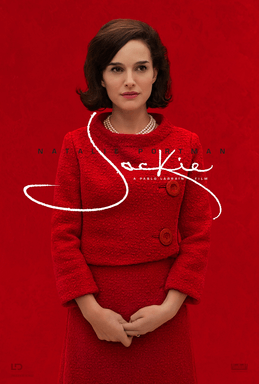
    There has been a kind of combination media/industry networking effort to promote the idea that Natalie Portman should rank with Betty Davis and Greta Garbo for her acting in the title role. To me, it was a pretty monochromatic performance. Portman looked at a lot of film in order to capture the subject’s voice. And she noticed that there was a difference between the one that Jackie used for the White House tour and that which she used in more personal interviews. She then grieves and weeps a lot throughout. The part, as perceived by the writer, is so limited that the performance seems to be pretty much technical in nature. Portman spends so much effort in perfecting the surface, that there is not much left to actually articulate a character. There isn’t anything here that a dozen other actresses could not have done, either as well or better.

    All in all, it was a flat and disappointing film. Whoever decided that this script needed to be played out on the wide screen of a darkened theater was simply wrong. It seems that the writer and director realized that mistake on the way to production. As noted above, they then tried to justify that decision. In this reviewer’s opinion, it did not work. What is left is little more than an Oscar vehicle for Portman. And considering the subject, that should not have been the case.

  • Jackie

    Jackie


    A few years ago a friend of mine associated with the movie business sent me a very early draft of the film Jackie. Noah Oppenheim’s script was first scheduled as an HBO miniseries, with Steve Spielberg set to produce. But Spielberg then left the project. At the time I read the screenplay, Darren Aronofsky was attached to it as director. And at that time, his girlfriend Rachel Weisz was supposed to play Jacqueline Kennedy. When I got done reading the script my friend asked me what I thought of it. I said, not very much, it seemed kind of dull to me. But I told him I thought it would get made because an A list actress would do it just to get an Academy Award nomination.

    In the six-year journey from first draft to completed film, Wiesz and Aronofksy split up and she dropped out as lead actress. Aronofsky eventually dropped out as director. But he stayed on as a producer. And it is probably through him that Natalie Portman was brought in to play the lead. They were quite familiar with each other since he directed her in her Oscar winning role in Black Swan.

    The film essentially deals with the four days from November 22-25, 1963. John Reed called his book about the Russian Revolution Ten Days that Shook the World. This film depicts four days that shook the world. But since the picture is so narrowly focused on seeing those events through President Kennedy’s widow’s eyes, the full impact of those tumultuous days is never approximated, let alone felt. For instance, we get scenes with Jackie Kennedy talking to an expert on the Lincoln assassination memorial service since she wants to model her husband’s funeral on that event.

    WHTour1962
    Jackie Kennedy during filming
    of White House tour (1962)

    To my knowledge, Jackie Kennedy did three long interviews after the assassination concerning that event and her marriage. The interviewing authors were Arthur Schlesinger, William Manchester, and Teddy White. This film’s overall structure is based upon the long interview Jackie did with Teddy White for Life magazine after the assassination. (Although, to the best of my memory, in the draft of the script I saw, the interview was with Arthur Schlesinger.) There are numerous flashbacks from this interview, which takes place in Hyannis Port. The main flashback is to Jackie’s famous tour of the White House. This was a TV special, initially broadcast on CBS, and NBC on Valentine’s Day of 1962. The program was a milestone in that no First Lady had ever done anything like this before. Also, it was the first time America ever got a long look at the interior of the White House, which JFK solicited two million dollars in private donations for restoration in 1961. The CBS correspondent for the program was Charles Collingwood. The show was viewed by a domestic audience of 80 million, and was eventually broadcast in 50 countries.

    There are other flashbacks; for instance to the actual assassination of President Kennedy, the swearing in of Lyndon Johnson, and some Kennedy cultural/musical programs in the White House. But besides the White House tour, the other main flashback frame consists of the preparations for Kennedy’s funeral.

    LBJ at JFK casket
    LBJ at JFK casket
    in Capitol Rotunda

    After Kennedy’s body was placed in the East Room of the White House, his funeral became a two part public event, taking place on November 24 and 25. On Sunday the 24th, the casket was placed in the rotunda of the Capitol building. Hundreds of thousands lined up to pay their respects. This viewing was scheduled to close at 9 PM, but because of the huge lines of people waiting outside, it was extended into, first, the wee hours of the morning, and then well past dawn of the next day. The actual state funeral was held on the 25th. Over ninety heads of state flew in for the mass at St. Matthew’s Cathedral and then the final procession to Arlington National Cemetery. The heads of state included French president Charles DeGaulle, Canadian Prime Minister Lester Pearson and Ethiopian Emperor Haile Selassie. President Lyndon Johnson also attended, even though many in government worried about a possible assassination attempt. Approximately a million spectators lined this route.

    A bit more than a week later, on December 5, 1963 the two deceased Kennedy children were reburied with their father. These were Patrick, who had predeceased JFK by 15 weeks, and an unnamed stillborn daughter. The film specifically mentions this fact. The picture ends with Jackie and her children on the beach, and her remembrances of dancing with Bobby and Jack at the White House.

    As I recall that early draft by Oppenheim, it suffered from a lack of any real gripping drama. Depicting an interview with a journalist and then recalling a funeral and a White House tour does not make for a lot of wide-screen drama or visual dynamics.  Especially when millions of us have already seen both the funeral and the White House tour. Further, both are available on YouTube. The main conflict the early draft depicted was between the widow and LBJ’s assistant Jack Valenti and Lyndon Johnson himself. These concerned her control over the funeral and also how long she was going to stay at the White House after it was over. Although Oppenheim has said he did not change the screenplay very much in the ensuing drafts, I am not sure this is accurate. It appears to me that the final director, Pablo Lorrain, wanted to jab up interest in what was intended as and was better suited for a small screen TV project.

    To use one example, in watching the film, one would think that, out of the blue, in a moment of divine inspiration, it was Jackie Kennedy who was responsible for choosing the eventual burial site for JFK at Arlington National Cemetery. It is true that she made the decision to not bury John Kennedy in his home city of Brookline, Massachusetts. But first, Sargent Shriver, Kennedy’s brother–in-law and Peace Corps Director, and then both Secretary of Defense Robert McNamara and Attorney General Bobby Kennedy had much more to do with the choice of the ultimate burial site at Arlington than the film depicts. (Click here for details.)

    And although Jackie did have a lot to do with the funeral arrangements, she was not by any means the only person involved in them. Again, RFK and McNamara, and the Pentagon were involved with these arrangements – the last since there were enormous security worries about another assassination attempt, the two most considered targets being LBJ and, as the film, depicts, Charles DeGaulle. But in watching this film, all Bobby Kennedy does is recall certain things about this brother and his legacy, and tries to keep the murder of Oswald from the grieving widow.

    JackieClintRavello
    Jackie Kennedy & Clint Hill
    Ravello, Italy (1962)
    (credit: Lisa McCubbin)

    But if that were not enough, there is also a scene where Jackie calls in Secret Service agent Clint Hill to see her, to congratulate him for his attempt to protect her during the fusillade. And she tells him she wants to talk to the accused assassin Oswald. In all the years I had researched the JFK case, I had never read anything like this scene happening. But I was not an expert on the Clint Hill/Jackie Kennedy relationship. So I consulted with Secret Service authority Vince Palamara. After exchanging emails with him, he said he did not recall this scene being related in any of the books Hill has written or co-written. And certainly not a request to talk to Oswald. Also, since Hill had been assigned to the First Lady from right after the 1961 inauguration, the formality and rigid cordiality shown in this scene would very likely not have existed. Further, the film tries to convey the impression that Hill rode on the trunk of the limousine all the way to Parkland. Again, according to Palamara, this is not accurate. He eventually snuggled into the back seat. And beyond that, there is even a scene where Jackie tries to walk into the autopsy room but she is turned away. My understanding was that the Kennedy entourage waited in a room on one of the upper floors of the Bethesda Medical Center. But again, I decided to consult with Palamara, and he said this did not happen.

    There are further jarring lapses with the record. Near the beginning of the film, when LBJ is about to be sworn in on Air Force One after the assassination, Jackie is depicted in the bathroom, wiping oodles of blood off of her face before the ceremony. Again, I can remember no photo or witness testimony to this happening. Just as I can recall no photo or film depicting her with lots of blood on her face due to the assassination. And in case that particular blood motif is not enough for you, there is a scene when she arrives back at the White House and takes a shower. Director Lorrain shoots it from behind, and we see water tinged in pink pouring down her back. Does this mean her hair was also saturated with her husband’s blood?

    Towards the end Jackie makes a comment to the interviewer that JFK was not really with her the night before the assassination in Fort Worth. Again, this puzzled me. According to William Manchester’s book, The Death of a President, the couple was in their suite by about 9 PM that evening. And that information had to have been at least partly provided by Jackie Kennedy. (Manchester, p. 87)

    So again, as I asked with Steven Spielberg’s Bridge of Spies about the Rudolf Abel/Gary Powers spy exchange: Where are the History Idolators? That is, those commentators who jump out of their chairs and onto the newspaper pages whenever Oliver Stone makes a controversial historical film. Their sole purpose is to bash him for using an excess of dramatic license. Yet again, in this particular case, I have seen next to no objections about the Oppenheim/Lorrain use of the same devices. Why? I will keep on posing this question until someone gives me a formal answer. (Click here for the Bridge of Spies review.)

    As for the film itself, the first thing we see is a tracking shot of Jackie walking back from outside to the house in Hyannis Port as the interviewer arrives. From that instant I had doubts about Lorrain’s ability to control the material. That kind of Kurosawa/Bergman camera strophe was too heavy for an opening shot of a film like this, or for the simple movement of Jackie walking back to begin an interview. Lorrain then slams close up after close up at us during the actual interview itself. Which made the scene play like an inquisition, when, in fact, the content of the interview is not like that at all.

    But even more surprising was the lack of rigor Lorrain showed with his cast. Billy Crudup plays White. It is an uphill part since it is all done in reaction. It has to be worked out in patterns of facial response, and through the eyes. It’s the kind of subtlety that the late Oskar Werner excelled at. Crudup is nothing more than adequate. Peter Sarsgaard is Bobby Kennedy. Sarsgaard has given some interesting performances in the past, for example in Shattered Glass and The Dying Gaul. Which makes it hard to comprehend how undistinguished, how pallid he is as RFK. If you can recall how memorable and precise Donald Moffat was as Lyndon Johnson in Philip Kaufman’s The Right Stuff, then you will see how much is missing from John Carrol Lynch’s rendition of LBJ here. Even good British actors like John Hurt as a priest Jackie confides in and Richard Grant as William Walton do little more than read their lines and collect their paychecks.  The one qualitative exception in the supporting cast is Casper Phillipson.  This Danish actor is spot-on as President Kennedy.  So much so that I wish he had been in the film more.  He gives his rare and brief scenes some much needed vitality.

    There has been a kind of combination media/industry networking effort to promote the idea that Natalie Portman should rank with Betty Davis and Greta Garbo for her acting in the title role. To me, it was a pretty monochromatic performance. Portman looked at a lot of film in order to capture the subject’s voice. And she noticed that there was a difference between the one that Jackie used for the White House tour and that which she used in more personal interviews. She then grieves and weeps a lot throughout. The part, as perceived by the writer, is so limited that the performance seems to be pretty much technical in nature. Portman spends so much effort in perfecting the surface, that there is not much left to actually articulate a character. There isn’t anything here that a dozen other actresses could not have done, either as well or better.

    All in all, it was a flat and disappointing film. Whoever decided that this script needed to be played out on the wide screen of a darkened theater was simply wrong. It seems that the writer and director realized that mistake on the way to production. As noted above, they then tried to justify that decision. In this reviewer’s opinion, it did not work. What is left is little more than an Oscar vehicle for Portman. And considering the subject, that should not have been the case.

  • Gerald Posner vs. Roger Stone in Coral Gables

    Gerald Posner vs. Roger Stone in Coral Gables

    On the 54th anniversary of President Kennedy’s assassination, at a bookstore in Coral Gables, Florida two famous authors convened. They were Gerald Posner and Roger Stone. The subject was a debate over the circumstances of Kennedy’s assassination. Obviously, because of the orientation of their books on the subject, Posner defended the Warren Commission verdict while Stone argued for a conspiracy.

    Robert Loomis

    Posner was trained as a lawyer. At age 23, he became one of the youngest attorneys ever employed by Cravath, Swaine and Moore, John McCloy’s old law firm. In 1980, he left that firm and opened a private practice with a partner. In 1986, he left that practice and became an author. In a relatively short period of time, he wrote three non-fiction books and one novel. In 1991, he was enlisted by Robert Loomis of Random House to write a response to Oliver Stone’s movie about the Kennedy assassination, JFK. The very plugged-in Loomis promised Posner that the CIA would cooperate with him on the project. (The Assassinations, edited by James DiEugenio and Lisa Pease, p. 369) And they did. Without their help, how else could an author gain access to high level defector Yuri Nosenko?

    Harold Evans

    As was exposed in a later lawsuit by the late Roger Feinman, Random House put a major effort into selling Posner’s Case Closed. One that was personally supervised by Harold Evans, who was president of the publishing house at the time. According to information Feinman discovered in his lawsuit, it was Evans who personally approved the infamous NY Times ads for the book. This was a four-phase campaign. It began with two teaser ads that promised to name the guilty parties in the JFK assassination. It culminated with two more ads. These featured the faces of Oliver Stone, David Lifton, Robert Groden, Jim Marrs, Mark Lane and Jim Garrison under a title which boldly accused them of the charge: “Guilty of Misleading the American Public”. If the reader knows anything about advertising costs in major newspapers, he can guess what those four ads cost. (Click here for Feinman’s essay about his lawsuit against Random House.)

    But that was not all. Apparently because Evans had previously served as a director of US News and World Report, that magazine gave Posner’s book a cover story. The book became such a cause celebre that other authors have successfully used it as a way to curry favor with the MSM, e.g., Jeff Toobin and Robert Dallek.

    The problem with all this hoopla, which was designed to coincide with the 30th anniversary of the assassination, is that it was completely unwarranted. There were several reviews that showed just how flawed Case Closed was: for instance, David Wrone’s. (See also this index of items on this site.) In fact, there were so many problems with Posner’s book that activist Dave Starks put together a compendium page of articles to show that, not only was Case Closed a very bad piece of scholarship, but it might have been worse than that. In his haste to do a hatchet job on the critics, Posner may have created interviews he did not actually do. For instance, Peter Scott talked to Carlos Bringuier after Case Closed came out. Contrary to the book’s claims, Bringuier said he never talked to Posner. (Author interview with Scott in San Francisco in 1994) Same with Dealey Plaza witness James Tague, who the author clearly states he talked to on two successive days. (See Posner, paperback edition, p. 546) When Gary Aguilar talked to Tague, he said he never spoke to Posner. To use another example, although the author said he interviewed JFK’s forensic pathologist Thornton Boswell, Boswell told Aguilar he never spoke to him. (Click here for Starks’ devastating page on Posner.)

    David Ferrie & Lee Oswald,
    Civil Air Patrol (1955)

    Posner also committed some outright howlers in his much-ballyhooed book. For example, in his schematic drawings of the assassin at the Texas School Book Depository window, he has him posed as firing from an extreme left to right angle. So much so that these “Posner shots” would have ended up in the railroad yards behind the picket fence. (See Appendix A of Case Closed, paperback edition.) This makes one wonder if Posner was ever in Dallas. Because to anyone who has been to the building and peered out the sixth floor window—which was possible back then—it presents a slight right to left angle. Posner also wrote that there was no evidence to connect David Ferrie with Oswald. (Posner, p. 425) This was utterly ridiculous on many counts. But to name just one, when the book came out PBS did a special which featured a photo of Oswald and Ferrie together at a Civil Air Patrol (CAP) barbecue. They found it by questioning some other members of the CAP. Which means Posner could have done the same if he had knocked on some doors in the Crescent City. Posner also writes that there was no such personage as Clay Bertrand in New Orleans. When the JFK Act declassified both the Jim Garrison files and the papers of the HSCA, Posner again ended up with custard pie on his face. Those documents reveal that the number of witnesses who stated that Clay Shaw used the alias of Clay Bertrand was in the double digits. (Destiny Betrayed, Second Edition, by James DiEugenio, pp. 211, 387, 388)

    Posner’s book showed us in excelsis just how schizoid America is on the murder of President Kennedy. It did not matter to the Powers That Be just how error-strewn Posner’s book was. It did not matter to them that he was more or less acting as a hired gun for Loomis and Evans. It did not matter to them that the book was obviously a rush job for the 30th anniversary. Or that the title was preposterous since the declassification process of the JFK Act had not even gone into effect yet. In other words, the book was saying the case was closed when, in fact, two million pages of documents were about to be declassified in the next four years.

    Clearly, as representatives of the Anglo-American Establishment, the important thing for Loomis and Evans was this: They wanted to create a tangible cultural artifact to rally around at the 30th anniversary. Why? In order to beat back the tsunami effect of Oliver Stone’s JFK, which had blindsided them. Posner’s book was a concocted historical event. Today the book has been retired to the (rather large) ash heap of useless volumes on the JFK case. It has no intrinsic factual merit to it at all. It is simply an exemplar of a two-part cultural/historical phenomenon. I say two parts, because the second phase of this Jungian neurotic outbreak occurred four years later, with another Loomis client. This time the collective seizure was over Sy Hersh’s equally horrendous book. This one was a biography of John Kennedy, The Dark Side of Camelot. That bookend volume was as bad in its own way as Posner’s tome. But Oliver Stone had not just said that JFK was killed by a conspiracy. His film also stated that Kennedy was a foreign policy iconoclast who was changing things in that realm. This was true and has been proven even more accurate by recent scholarship. But that did not matter with Hersh, whose book was so bad that some critics said it should have been titled, The Dark Side of Seymour Hersh.

    II

    Roger Stone was born in Lewisboro, New York to a reporter mother and a father who drilled oil wells. Stone got hooked on politics when he read Conscience of a Conservative by Barry Goldwater. Although he admired Goldwater’s ideas he could not comprehend the tactics of his 1964 campaign. To put it mildly, he thought they were rather quixotic. As he told writer Matt Labash, “It’s like he was trying to lose. Going to Tennessee and coming out against the Tennessee Valley Authority? These were suicidal acts.” (Weekly Standard, November 5, 2007)

    Roger Stone & Nixon

    Because of this, Roger Stone became more enamored with Richard Nixon as his conservative standard bearer. He deduced that Nixon was “more pragmatic, more interested in winning than proving a point.” He took a pithy aphorism from RMN: “Losers don’t legislate.” (ibid) Stone liked Nixon so much that he decided that his newly found idol had not really lost the 1960 election. He had been robbed of the presidency through electoral fraud. So he wrote Nixon a letter at his New York law firm encouraging him to run again. Nixon replied that he did not plan on doing so, but if he did, he would be in touch with young Stone. (Stone is such a Nixon fan he had his face tattooed on his back.)

    Jeb Magruder testifies
    during the Watergate hearings

    While a student at George Washington University in Washington D.C., Stone invited Jeb Magruder, deputy director of the Committee to Reelect the President, to speak at the college’s Young Republican Club. After the speaking engagement Stone asked Magruder for a job with CREEP. At age 19, Stone decided to forsake his studies and joined right in with the antics of the infamous CREEP. For instance, he planted a mole in the camp of Democratic rival Hubert Humphrey. Magruder and his cohorts were obsessed with intelligence and skullduggery, and Stone had a natural affinity for them. He once wrote a check to Nixon rival Pete McCloskey from an account inscribed as the Young Socialists Alliance. Once he got the receipt he leaked it to the reactionary newspaper Manchester Union-Leader. (ibid)

    Against Senator George McGovern in the general election, Stone hired another spy he termed Sedan Chair II. But according to Stone, he did not understand the mentality of CREEP. To him it did not make any sense to take the kinds of risks they were taking when the Democratic candidate, McGovern, had so little chance of winning. After Watergate, which spelled the end of Nixon’s political career, he went to work for Bob Dole, and then for the (failed) Ronald Reagan campaign of 1976. During this period, he co-founded the National Conservative Political Action committee, which was designed to execute a GOP takeover of the Senate. Which, by recruiting men like Dan Quayle and Chuck Grassley, it did. As he noted to Jeffrey Toobin, “The Democrats were weak, we were strong.” (The New Yorker, June 2, 2008)

    Donald Trump & Roy Cohn
    JohnAnderson9 16 80
    John Anderson (Sept. 16, 1980)

    In 1980, he again worked for Reagan. In that election, he joined forces with the notorious attorney Roy Cohn, sworn enemy of the late Bobby Kennedy. They decided that the best way for Reagan to beat incumbent president Jimmy Carter in New York was to help Democratic congressman John Anderson get on the ballot. This way, the Democratic Party vote would be split and therefore weakened. According to Stone, Cohn told him to get in contact with a lawyer friend he had. Once in contact, he was to ask him how much it would cost to get Anderson the Liberal party nomination in New York. Stone reported back that the price was $125,000. A couple of days later, Stone was told by Cohn to pick up a suitcase and deliver it to the lawyer. He did so, and Anderson won the Liberal Party nomination. Reagan won New York with 46% of the vote. (ibid, Labash)

    Reagan’s victory in 1980 allowed Stone to enter the upper stratosphere of political campaign managing and lobbying. He now set up an office with two other GOP stalwarts, Charles Black and Paul Manafort. They would later be joined by none other than the late Lee Atwater, the man usually given credit for the Willie Horton TV ads, which helped defeat Democrat Michael Dukakis in 1988. The firm was lobbying on behalf of such people as Ferdinand Marcos, dictator of the Philippines, as well as conservative causes like the Nicaraguan Contras, and Angola’s UNITA rebels. And they advised several presidential candidates, even when they opposed each other.

    Stone’s primacy in the higher circles of the GOP came to an end in 1996. He was serving as an unaccredited adviser to Bob Dole’s presidential campaign when scandal struck. And it struck through the National Enquirer. They billed the story as “Top Dole Aide Caught in Group-Sex Ring.” (op. cit., Toobin) He and his second wife had run ads for swinging partners to participate in bedroom games. (op. cit., Labash) The tabloids even got hold of the advertising photos. Stone tried his usual “Deny, deny, deny” tactics. But they did not succeed.

    But in 2000, James Baker, who was running the GOP recount effort in Florida against Al Gore, brought Stone back to perform one last piece of political subterfuge. That act would have a momentous impact on America for decades into the future. It has come to be known as the “Brooks Brothers riot”.

    When the Florida Supreme Court ruled that Gore could have a recount in four counties, Stone and Baker decided this had to be thwarted. Scores of Republican congressional aides—the Brooks Brothers suits—had been flown to Miami to simulate grass roots, Floridian protest against the recount. Stone stationed himself in a Winnebago outside the building where the Miami-Dade County recount was taking place. Outfitted with walkie-talkies and cell phones, he went to work using these aides to create the illusion of an indigenous attack on the building. He did this by having the congressional aides actually enter the building and demand the recount be halted. According to the New York Times, some people were struck or kicked. (11/23/2000) This scene inside the building was coupled with Stone inspired Spanish language radio warnings about carloads of Cuban exiles driving to the scene. (op. cit., Toobin) In its broad outlines, the operation resembled the CIA coup in Guatemala in 1954. Between the Brooks Brothers demonstrators and the “imminent Cuban exile assault”, the recount was discontinued. The episode likely stopped Gore from actually taking the lead for the first time. This—plus the later Antonin Scalia order granting emergency relief due to the “irreparable damage” of counting votes—ultimately led to the US Supreme Court decision stopping the recount. And that brought us George W. Bush, perhaps the worst president in history.

    III

    After his work for Random House on the JFK case, in 1998 Posner wrote a book on the 30th anniversary of the Martin Luther King assassination. To no one’s surprise, Killing the Dream came to the same conclusion as Case Closed—the official story was correct. One year later of course, William Pepper demonstrated in court that Posner was wrong. The jury in a civil case brought by the King family ruled that King was killed as a result of a conspiracy.

    David Marwell

    Because of his establishment-pleasing writings, Posner became a TV and MSM presence. And he continued to write more non-fiction books. He appeared on many TV programs and also as an editorial writer for some major newspapers. According to Doug Horne in his book Inside the ARRB, the first director of the Assassination Records Review Board, David Marwell, said he found much of value in Case Closed. Consequently, he had lunch with Posner more than once. Harold Evans’ wife, Tina Brown, hired Posner as an investigative journalist for the online magazine Daily Beast. But he was forced to step down from that position in 2010 over several accusations that demonstrated that Posner was a serial plagiarist. He not only plagiarized for his articles at Daily Beast, but also in at least three of his books, e.g., Miami Babylon. (See Slate, “The Posner Plagiarism Perplex”, 2/11/2010, also Miami New Times, March 30, 2010)

    Tina Brown
    Harper Lee

    Three years later, the late Harper Lee filed a lawsuit claiming that her literary agent’s son-in-law had directed Posner to set up a corporation to defraud Lee of her royalties from her colossal best-seller To Kill a Mockingbird. In her court filing she said that she had faulty hearing and eyesight and these had been used by Samuel Pinkus to snooker her into signing over her book copyright. Pinkus assigned the copyright to a company incorporated by Posner. (NY Post, May 4, 2013) Four months later, Posner settled the suit and was dismissed from the legal action.

    After his work for James Baker in Miami, Roger Stone tended to concentrate on two new subjects. First, there was his friendship with Donald Trump. Stone was sold on the idea of Trump making a run for the presidency on the Reform Party ticket, the party created by Ross Perot. Although Trump made some overtures to run in the 2000 election, he ultimately decided against it. Stone also began to develop an avocation as an author. To say that his output has been prolific does not do him justice. In the space of about three years, beginning in late 2013, Stone has written or co-written—at last count—seven books. At least three of them rely on his relationship with Richard Nixon, who he still holds in high regard. If one looks closely, three of them rely on his relationship with Trump, who he had worked for in Trump’s 2015-16 campaign before they (allegedly) parted ways. His book about Jeb Bush, Jeb and the Bush Crime Family, was clearly meant as a broadside against the candidate most perceived as the favorite in the GOP primary campaign. His book about the Clintons, The Clintons’ War on Women, was meant as a preemptive strike against the attacks against Trump’s philandering with females.

    But Roger Stone/author first came to prominence at the 50th anniversary of the JFK assassination. At that time he co-wrote a book entitled The Man Who Killed Kennedy: The Case Against LBJ. That book became a New York Times bestseller. In fact, of all the books released at the 50th, it likely sold the most copies. Since then he has stayed involved in the field. In fact, his co-writers on the two previously mentioned books come from the JFK field. They are, respectively, Saint John Hunt and Robert Morrow.

    Why has Stone done this? It likely does not pay him the fees he commanded as a Washington lobbyist working in a very powerful PR firm. In a profile written by Jeff Toobin for The New Yorker, some hints for this career move are tossed out—almost inadvertently. One of the reasons Stone gives for being so enamored of Nixon is his anti-elitism. He adds Nixon was class conscious. And he identified with average people who ate TV dinners and watched Lawrence Welk. To Stone, Nixon “recognized the effectiveness of anti-elitism—a staple of American campaigns even today—as a core message.” In comparing Nixon with Reagan, Stone states that although many Republicans give Reagan credit for the defections of the working class from the Democrats, it was really Nixon who started it. Stone then zeroes in on the whole polarization concept:

    Nixon figured out how to win. We had a non-elitist message. We were the party of the workingman! We wanted lower taxes for everyone across the board. They were the part of the Hollywood elite. … The point that the Democrats missed was that the people who weren’t rich wanted to be rich.

    There is little doubt that Nixon, with his appeals to the Silent Majority in order to expand and lengthen the Vietnam War, did use these kinds of techniques. It’s obvious from the declassified tapes at the Nixon Library that he did not mean any of it. This was amply exposed by author Ken Hughes, among others, in his fine book Fatal Politics. And this exposure helps explain why Nixon and his family fought so long and hard not to have those tapes declassified. That book reveals that Nixon knew the war was lost in 1969. But he did not want to have South Vietnam fall on his watch. Therefore, he lied to Nguyen Van Thieu of South Vietnam to keep him in his corner while he negotiated an agreement with the north. The whole time he slaughtered tens of thousands of innocent civilians in an expanded air war over all of Indochina. The only reason for this was to announce a peace agreement on the eve of the 1972 election to make sure he had a landslide victory. This is all admitted to on these tapes in the Hughes book, and in letters he sent to Thieu in the book The Palace File.

    But the relevant point for today’s scene is that this cultural anti-elite aspect was well used by both Stone and Trump during the latter’s successful presidential campaign. Trump decided to leapfrog most of the MSM, and he did this with Stone’s help. In addition to the two books mentioned above, Stone helped promote the whole mythology of Ted Cruz’s father being seen in New Orleans with Lee Oswald in the summer of 1963. Stone used the word of Judyth Baker to promote this bizarre story. And Trump went on national TV with it. (Click here for our reaction.) The Morrow/Stone book about Clinton helped Trump alleviate the impact of the compelling Access Hollywood videotape. And this whole anti-cultural-elite concept helped avoid the question of how in the heck do the interests of a billionaire real estate investor coincide with America’s shrinking middle class? With the announcement of Trump’s cabinet, we can see that, as with Nixon, the whole idea is little more than window dressing. The policies that this cabinet and the Republican Party will try to enact will gut the middle class even more.

    IV

    All of the above about these two men is more than relevant to their debate in Coral Gables. Because it informs us of the state of the JFK case in America today. This author would not walk across the street to see Posner speak about either the JFK or King case. Simply because he is a lawyer who is in the employ of the official story. Therefore, it does not matter if what he is saying is incomplete, dubious or just specious. This reviewer has never read any of Stone’s books for the simple reason that I have a hard time thinking that Stone could master something as complex and multi-layered as the JFK case in just a matter of 3-4 years. I am also skeptical of the case that he and others have made against Lyndon Johnson. In watching this confrontation it appears I was correct about these suspicions.

    Roger Stone presented first. He led off with remarks about the avulsed rear skull wound that, for him, disappeared from the back of Kennedy’s head after he left Parkland Hospital. (This is not accurate. Gary Aguilar has shown it did not disappear, it was apparent at both the emergency room at Parkland and Bethesda Medical Center, where Kennedy’s body underwent an autopsy.) Stone later added the confusing point that the House Select Committee on Assassinations (HSCA) was convened because of Oliver Stone’s film JFK. I think Roger meant the Assassination Records Review Board (ARRB) was convened.

    But he then confuses this issue even more by saying that the HSCA revealed more of Ruby’s Mafia ties, which led them to conclude organized crime involvement in the JFK case. This is not really accurate, as the HSCA did not deduce this as one of their conclusions. Chief Counsel Robert Blakey did that in his later book on the JFK case, The Plot to Kill the President (which was co-written with Dick Billings).

    Stone also talked about his relationship with Senator Arlen Specter and how Specter did not have access to the autopsy materials during the Warren Commission proceedings. This needed to be qualified. As revealed by the declassified transcripts of the their executive hearings, the Warren Commission did have the autopsy materials. (Gerald McKnight, Breach of Trust, p. 171) And as Pat Speer has shown on his web site, Specter did see at least one of the autopsy photos. (See Chapter 10, “Examining the Examinations”.)

    Stone also said that the alleged rifle used by Oswald was purchased for $75.00 and that no marksman was able to duplicate what he did, that is get 2 of 3 direct hits in six seconds. The latter part of this is correct, the former sum is about three times what the rifle actually cost. Stone then concluded with the Jay Harrison/Barr McClellan sponsored Mac Wallace fingerprint found on the sixth floor. He also even mentioned one Loy Factor’s involvement with Wallace and the LBJ plot.

    Posner then replied. He criticized Stone’s book for having so many footnotes to other books. He therefore termed the book outdated. This is bizarre since Posner’s book is overwhelmingly reliant on the Warren Report and the accompanying volumes of evidence. He then said there was no evidence on the autopsy x-rays and photos that revealed anyone firing from anywhere except from behind and the general vicinity of the sixth floor.

    Apparently, Posner was not aware of the ARRB interview with Tom Robinson who worked out of Gawler’s funeral parlor. He said there was a wound near the right temple of the president that he filled in with wax. He said it was so close to the hairline it was difficult to see. (Murder in Dealey Plaza, p. 250, edited by James Fetzer.) Author Don Thomas has also done good work with the autopsy photos, which makes this wound easier to discern. Posner also ignores the fact that, as many have indicated, if the autopsy doctors are correct and the entrance wound in the skull came in near the base, then there is no trajectory of bullet particles on the X-rays to match it up with.

    Since Stone gave Posner an opening about only the Parkland doctors seeing the hole in the back of the skull, lawyer Posner took advantage of it. He said that since Kennedy’s body was not turned over at Parkland, they really didn’t see it. This is ridiculous on more than one count. First, as Gary Aguilar has shown, this avulsed wound did not “disappear” after Dallas. It was clearly observed at Bethesda, except the HSCA hid these interviews from the public. Therefore they were only declassified with the advent of the ARRB. (ibid, p. 199) And Posner talks about using dated information.

    Secondly, Parkland nurse Diana Bowron actually saw this wound as she was aiding the entourage bringing Kennedy’s body into the emergency room, and she saw it again as she was prepping Kennedy’s corpse to depart. (ibid, pp. 60, 199) Neurosurgeon Kemp Clark examined Kennedy’s skull as the tracheotomy was being performed and he stated that he saw this wound. (ibid, p. 193) Nurse Audrey Bell told the ARRB that Malcolm Perry showed her this wound by turning Kennedy’s head slightly. (Interview of 4/1/97) Then, of course, there is the testimony of Secret Service agent Clint Hill who said he saw this wound in the limousine on the way to Parkland. (op. cit., Fetzer, pp. 198-99) Stone should have literally harpooned Posner for citing such specious information.

    The bloviating Posner then added something just as dubious. He said that in order to argue conspiracy one must state that the X-rays and photos are altered. More baloney. Stone should have asked Posner on rebuttal, “How did the 6.5 mm fragment get on the X-rays if it’s not in the autopsy report and none of the autopsy doctors saw it that night?” He then should have asked the prosecutor, “What happened to the trail of fragments that lead pathologist Jim Humes wrote about in his report which goes from the bottom rear of the skull to the top? Those do not exist today. Why Gerald?” (Reclaiming Parkland, by James DiEugenio, pp. 152-54) Stone should also have asked the attorney, “Gerald, if all the shots came from the rear, including the head shot, why is there no blowout in the front of Kennedy’s face?”

    Further, the brain was never sectioned. Therefore we do not know the path of the bullet through the skull, or if there was only one bullet.  That would have been the best evidence of exactly what killed President Kennedy.  But it  was not done. Why?

    Finally, the back wound was not dissected.  So we do not know if this wound was a through and through wound–did it transit the body?  If it did not, then the Single Bullet Theory Posner upholds is kaput.  And according to pathologist Pierre Finck’s testimony at the Clay Shaw trial, the reason it was not tracked is that the doctors were prevented from doing so by the military brass at Bethesda.

    These all indicate a cover up, if not a conspiracy.  And they all would have been better evidence than the photos and X-rays. After all, one cannot photograph autopsy practices that were never performed.

    Posner then said it is wrong to say that no marksman ever duplicated Oswald’s shooting feat. He said the Commission did, CBS did, and the HSCA did.

    Concerning the first, I don’t know what Posner is talking about. Mark Lane and Sylvia Meagher have discussed the rifle experiments of the Warren Commission.  (Meagher, Accessories After the Fact,  pp. 108-10; Lane, Rush to Judgment,  pp. 126-30)  The FBI tried to get off three shots in six seconds, scoring two of three direct hits in the head and shoulder area. They failed. Therefore, the Commission had three military snipers try it. These tests were rigged. They were done from about twenty feet up, not sixty, as would have been the case with Oswald.  The three riflemen were given as much time as they wanted to gauge the first shot, again not the case for Oswald.  Third, they were firing at stationary and not moving targets.  And even at that, the targets were grouped much closer together than what the Commission said was the firing series in Dealey Plaza. Fifth, these were some of the vey best marksmen in the military. They were so good they were above the best in the Marine Corps, and could qualify for the Olympics. To put it mildly, Oswald was nowhere near this quality.  But even at that only one of them got the shots off in the required time.  And none were able to get two of three direct hits.

    Concerning CBS, apparently Posner has not read my essay based on CBS internal memoranda adduced by their employee Roger Feinman. Unlike what Posner stated, their first marksman, a famous military sniper, using a model of the 6.5 Mannlicher Carcano, could not do what Oswald did. They then brought in a team of riflemen, and let them practice for a week—which Oswald did not do in any way, shape or form. They then set up a target that eliminated the oak tree from the sixth floor, eliminated the curve in the street, and instead set up a moving sled to fire at. This last was the most important factor. Why? Because the sled posed an enlarged target, as Feinman notes, it at least doubled the target area. In other words, CBS cheated after their first marksman failed. (Click here for that information.)

    Stooping to the HSCA for evidence on this subject is really hard to understand. Even for Posner. Because the HSCA did no rifle tests during its actual duration. They did not do them until after the HSCA ceased operation. Wallace Milam sent me the full memo on this episode. It turns out that Chief Counsel Robert Blakey, his assistant Gary Cornwell, and some Washington policemen went out to a rifle range. There they tried to do what the Commission said Oswald did. In their overweening ambition, at first they decided not to use the telescopic site. Which is ridiculous since the Commission said Oswald did use it. After all, why would it be attached to the rifle if it were not used? As I can inform the reader, that scope makes a huge difference. To say Oswald did what he did without it is simply preposterous. But when the policemen used only the iron sights on the rifle, they had the same problem that the Commission did. They could not maintain accuracy within the six second time interval of the Warren Commission. So what did Blakey and Cornwell do? They used something called “point aiming”. Which means not using any site at all, just pointing the rifle. When they got off two shots in under two seconds that was enough. They then deduced it was possible to do what Oswald allegedly did even though they were only 20 feet up instead of 60 feet and their accuracy results were not recorded. (The Assassinations, edited by James DiEugenio and Lisa Pease, p. 83)

    Marine sniper
    Carlos Hathcock

    Stone should have replied that, yes, you can do what the Commission said Oswald did. But you have to cheat. And then not tell the public about the cheating. I would have then added that Carlos Hathcock, the greatest sniper of the Vietnam War, actually did try and duplicate accurately what the Commission said Oswald did. He told author Craig Roberts that he could not do it, even though he tried more than once.

    Posner actually used the fingerprint evidence on the alleged Oswald rifle to try and convict Oswald. Without telling the public that this so-called evidence was presented only after the FBI found there were no prints found on the rifle when Sebastian LaTona examined it that night. (Meagher, op. cit., pp. 120-27) Prints only showed up about a week later, and then thirty years later for a PBS special. Stone rightly pointed out that the FBI was inexplicably at the Oswald funeral parlor trying to get fingerprints off of his corpse. (Henry Hurt, Reasonable Doubt, pp. 107-09) Which is weird, since the Dallas Police already had Oswald’s fingerprints.

    Posner concluded by rebutting the use of the Mac Wallace fingerprint with the work of FBI authority Robert Garrett, as is featured in Joan Mellen’s book, Faustian Bargains.

    I won’t go on with my analysis since it would just be more of the same. Posner making more and more dubious claims and Stone replying with populist type experts, e.g., Judyth Baker on Cruz, and Richard Bartholomew on the Wallace print. (Yet, to my knowledge, Richard is not a fingerprint expert.) Posner actually tried to impeach Victoria Adams not seeing Oswald running down the stairs after the shooting by saying she did not see officer Marrion Baker or supervisor Roy Truly either. Again, Posner seems unaware that Miss Garner, Victoria’s supervisor, did see those two men come up the stairs after Adams and co-worker Sandy Styles went down. Further, the Warren Commission had this document in their hands, since it was dated June 2, 1964. While they were in session.

    Now, obviously, if Garner saw Baker and Truly after Victoria and Sandy went down the stairs, then the two women left within seconds of the shooting, as they said they did. Yet the Warren Report says they left much later, minutes afterwards. In other words, the Commission covered up the true facts of what had occurred. Because Adams and Styles give Oswald a rock solid alibi for not being on the sixth floor when they needed him to be so. (DiEugenio, op. cit., pp. 115-20)

    The most important thing that was said during this debate was that Stone would try and talk to Mr. Trump about the declassification of the final documents being held at the National Archives by the JFK Act. They are supposed to be finally disposed of in October of this year. Let us hope Mr. Stone uses his influence to see that through. It would be in keeping with his and Mr. Trump’s obeisance to conservative populism.

    (The debate video is embedded below, or the reader can watch it by clicking here.)

  • Gerald Posner vs. Roger Stone in Coral Gables

    Gerald Posner vs. Roger Stone in Coral Gables

    On the 54th anniversary of President Kennedy’s assassination, at a bookstore in Coral Gables, Florida two famous authors convened. They were Gerald Posner and Roger Stone. The subject was a debate over the circumstances of Kennedy’s assassination. Obviously, because of the orientation of their books on the subject, Posner defended the Warren Commission verdict while Stone argued for a conspiracy.

    Robert Loomis

    Posner was trained as a lawyer. At age 23, he became one of the youngest attorneys ever employed by Cravath, Swaine and Moore, John McCloy’s old law firm. In 1980, he left that firm and opened a private practice with a partner. In 1986, he left that practice and became an author. In a relatively short period of time, he wrote three non-fiction books and one novel. In 1991, he was enlisted by Robert Loomis of Random House to write a response to Oliver Stone’s movie about the Kennedy assassination, JFK. The very plugged-in Loomis promised Posner that the CIA would cooperate with him on the project. (The Assassinations, edited by James DiEugenio and Lisa Pease, p. 369) And they did. Without their help, how else could an author gain access to high level defector Yuri Nosenko?

    Harold Evans

    As was exposed in a later lawsuit by the late Roger Feinman, Random House put a major effort into selling Posner’s Case Closed. One that was personally supervised by Harold Evans, who was president of the publishing house at the time. According to information Feinman discovered in his lawsuit, it was Evans who personally approved the infamous NY Times ads for the book. This was a four-phase campaign. It began with two teaser ads that promised to name the guilty parties in the JFK assassination. It culminated with two more ads. These featured the faces of Oliver Stone, David Lifton, Robert Groden, Jim Marrs, Mark Lane and Jim Garrison under a title which boldly accused them of the charge: “Guilty of Misleading the American Public”. If the reader knows anything about advertising costs in major newspapers, he can guess what those four ads cost. (Click here for Feinman’s essay about his lawsuit against Random House.)

    But that was not all. Apparently because Evans had previously served as a director of US News and World Report, that magazine gave Posner’s book a cover story. The book became such a cause celebre that other authors have successfully used it as a way to curry favor with the MSM, e.g., Jeff Toobin and Robert Dallek.

    The problem with all this hoopla, which was designed to coincide with the 30th anniversary of the assassination, is that it was completely unwarranted. There were several reviews that showed just how flawed Case Closed was: for instance, David Wrone’s. (See also this index of items on this site.) In fact, there were so many problems with Posner’s book that activist Dave Starks put together a compendium page of articles to show that, not only was Case Closed a very bad piece of scholarship, but it might have been worse than that. In his haste to do a hatchet job on the critics, Posner may have created interviews he did not actually do. For instance, Peter Scott talked to Carlos Bringuier after Case Closed came out. Contrary to the book’s claims, Bringuier said he never talked to Posner. (Author interview with Scott in San Francisco in 1994) Same with Dealey Plaza witness James Tague, who the author clearly states he talked to on two successive days. (See Posner, paperback edition, p. 546) When Gary Aguilar talked to Tague, he said he never spoke to Posner. To use another example, although the author said he interviewed JFK’s forensic pathologist Thornton Boswell, Boswell told Aguilar he never spoke to him. (Click here for Starks’ devastating page on Posner.)

    David Ferrie & Lee Oswald,
    Civil Air Patrol (1955)

    Posner also committed some outright howlers in his much-ballyhooed book. For example, in his schematic drawings of the assassin at the Texas School Book Depository window, he has him posed as firing from an extreme left to right angle. So much so that these “Posner shots” would have ended up in the railroad yards behind the picket fence. (See Appendix A of Case Closed, paperback edition.) This makes one wonder if Posner was ever in Dallas. Because to anyone who has been to the building and peered out the sixth floor window—which was possible back then—it presents a slight right to left angle. Posner also wrote that there was no evidence to connect David Ferrie with Oswald. (Posner, p. 425) This was utterly ridiculous on many counts. But to name just one, when the book came out PBS did a special which featured a photo of Oswald and Ferrie together at a Civil Air Patrol (CAP) barbecue. They found it by questioning some other members of the CAP. Which means Posner could have done the same if he had knocked on some doors in the Crescent City. Posner also writes that there was no such personage as Clay Bertrand in New Orleans. When the JFK Act declassified both the Jim Garrison files and the papers of the HSCA, Posner again ended up with custard pie on his face. Those documents reveal that the number of witnesses who stated that Clay Shaw used the alias of Clay Bertrand was in the double digits. (Destiny Betrayed, Second Edition, by James DiEugenio, pp. 211, 387, 388)

    Posner’s book showed us in excelsis just how schizoid America is on the murder of President Kennedy. It did not matter to the Powers That Be just how error-strewn Posner’s book was. It did not matter to them that he was more or less acting as a hired gun for Loomis and Evans. It did not matter to them that the book was obviously a rush job for the 30th anniversary. Or that the title was preposterous since the declassification process of the JFK Act had not even gone into effect yet. In other words, the book was saying the case was closed when, in fact, two million pages of documents were about to be declassified in the next four years.

    Clearly, as representatives of the Anglo-American Establishment, the important thing for Loomis and Evans was this: They wanted to create a tangible cultural artifact to rally around at the 30th anniversary. Why? In order to beat back the tsunami effect of Oliver Stone’s JFK, which had blindsided them. Posner’s book was a concocted historical event. Today the book has been retired to the (rather large) ash heap of useless volumes on the JFK case. It has no intrinsic factual merit to it at all. It is simply an exemplar of a two-part cultural/historical phenomenon. I say two parts, because the second phase of this Jungian neurotic outbreak occurred four years later, with another Loomis client. This time the collective seizure was over Sy Hersh’s equally horrendous book. This one was a biography of John Kennedy, The Dark Side of Camelot. That bookend volume was as bad in its own way as Posner’s tome. But Oliver Stone had not just said that JFK was killed by a conspiracy. His film also stated that Kennedy was a foreign policy iconoclast who was changing things in that realm. This was true and has been proven even more accurate by recent scholarship. But that did not matter with Hersh, whose book was so bad that some critics said it should have been titled, The Dark Side of Seymour Hersh.

    II

    Roger Stone was born in Lewisboro, New York to a reporter mother and a father who drilled oil wells. Stone got hooked on politics when he read Conscience of a Conservative by Barry Goldwater. Although he admired Goldwater’s ideas he could not comprehend the tactics of his 1964 campaign. To put it mildly, he thought they were rather quixotic. As he told writer Matt Labash, “It’s like he was trying to lose. Going to Tennessee and coming out against the Tennessee Valley Authority? These were suicidal acts.” (Weekly Standard, November 5, 2007)

    Roger Stone & Nixon

    Because of this, Roger Stone became more enamored with Richard Nixon as his conservative standard bearer. He deduced that Nixon was “more pragmatic, more interested in winning than proving a point.” He took a pithy aphorism from RMN: “Losers don’t legislate.” (ibid) Stone liked Nixon so much that he decided that his newly found idol had not really lost the 1960 election. He had been robbed of the presidency through electoral fraud. So he wrote Nixon a letter at his New York law firm encouraging him to run again. Nixon replied that he did not plan on doing so, but if he did, he would be in touch with young Stone. (Stone is such a Nixon fan he had his face tattooed on his back.)

    Jeb Magruder testifies
    during the Watergate hearings

    While a student at George Washington University in Washington D.C., Stone invited Jeb Magruder, deputy director of the Committee to Reelect the President, to speak at the college’s Young Republican Club. After the speaking engagement Stone asked Magruder for a job with CREEP. At age 19, Stone decided to forsake his studies and joined right in with the antics of the infamous CREEP. For instance, he planted a mole in the camp of Democratic rival Hubert Humphrey. Magruder and his cohorts were obsessed with intelligence and skullduggery, and Stone had a natural affinity for them. He once wrote a check to Nixon rival Pete McCloskey from an account inscribed as the Young Socialists Alliance. Once he got the receipt he leaked it to the reactionary newspaper Manchester Union-Leader. (ibid)

    Against Senator George McGovern in the general election, Stone hired another spy he termed Sedan Chair II. But according to Stone, he did not understand the mentality of CREEP. To him it did not make any sense to take the kinds of risks they were taking when the Democratic candidate, McGovern, had so little chance of winning. After Watergate, which spelled the end of Nixon’s political career, he went to work for Bob Dole, and then for the (failed) Ronald Reagan campaign of 1976. During this period, he co-founded the National Conservative Political Action committee, which was designed to execute a GOP takeover of the Senate. Which, by recruiting men like Dan Quayle and Chuck Grassley, it did. As he noted to Jeffrey Toobin, “The Democrats were weak, we were strong.” (The New Yorker, June 2, 2008)

    Donald Trump & Roy Cohn
    JohnAnderson9 16 80
    John Anderson (Sept. 16, 1980)

    In 1980, he again worked for Reagan. In that election, he joined forces with the notorious attorney Roy Cohn, sworn enemy of the late Bobby Kennedy. They decided that the best way for Reagan to beat incumbent president Jimmy Carter in New York was to help Democratic congressman John Anderson get on the ballot. This way, the Democratic Party vote would be split and therefore weakened. According to Stone, Cohn told him to get in contact with a lawyer friend he had. Once in contact, he was to ask him how much it would cost to get Anderson the Liberal party nomination in New York. Stone reported back that the price was $125,000. A couple of days later, Stone was told by Cohn to pick up a suitcase and deliver it to the lawyer. He did so, and Anderson won the Liberal Party nomination. Reagan won New York with 46% of the vote. (ibid, Labash)

    Reagan’s victory in 1980 allowed Stone to enter the upper stratosphere of political campaign managing and lobbying. He now set up an office with two other GOP stalwarts, Charles Black and Paul Manafort. They would later be joined by none other than the late Lee Atwater, the man usually given credit for the Willie Horton TV ads, which helped defeat Democrat Michael Dukakis in 1988. The firm was lobbying on behalf of such people as Ferdinand Marcos, dictator of the Philippines, as well as conservative causes like the Nicaraguan Contras, and Angola’s UNITA rebels. And they advised several presidential candidates, even when they opposed each other.

    Stone’s primacy in the higher circles of the GOP came to an end in 1996. He was serving as an unaccredited adviser to Bob Dole’s presidential campaign when scandal struck. And it struck through the National Enquirer. They billed the story as “Top Dole Aide Caught in Group-Sex Ring.” (op. cit., Toobin) He and his second wife had run ads for swinging partners to participate in bedroom games. (op. cit., Labash) The tabloids even got hold of the advertising photos. Stone tried his usual “Deny, deny, deny” tactics. But they did not succeed.

    But in 2000, James Baker, who was running the GOP recount effort in Florida against Al Gore, brought Stone back to perform one last piece of political subterfuge. That act would have a momentous impact on America for decades into the future. It has come to be known as the “Brooks Brothers riot”.

    When the Florida Supreme Court ruled that Gore could have a recount in four counties, Stone and Baker decided this had to be thwarted. Scores of Republican congressional aides—the Brooks Brothers suits—had been flown to Miami to simulate grass roots, Floridian protest against the recount. Stone stationed himself in a Winnebago outside the building where the Miami-Dade County recount was taking place. Outfitted with walkie-talkies and cell phones, he went to work using these aides to create the illusion of an indigenous attack on the building. He did this by having the congressional aides actually enter the building and demand the recount be halted. According to the New York Times, some people were struck or kicked. (11/23/2000) This scene inside the building was coupled with Stone inspired Spanish language radio warnings about carloads of Cuban exiles driving to the scene. (op. cit., Toobin) In its broad outlines, the operation resembled the CIA coup in Guatemala in 1954. Between the Brooks Brothers demonstrators and the “imminent Cuban exile assault”, the recount was discontinued. The episode likely stopped Gore from actually taking the lead for the first time. This—plus the later Antonin Scalia order granting emergency relief due to the “irreparable damage” of counting votes—ultimately led to the US Supreme Court decision stopping the recount. And that brought us George W. Bush, perhaps the worst president in history.

    III

    After his work for Random House on the JFK case, in 1998 Posner wrote a book on the 30th anniversary of the Martin Luther King assassination. To no one’s surprise, Killing the Dream came to the same conclusion as Case Closed—the official story was correct. One year later of course, William Pepper demonstrated in court that Posner was wrong. The jury in a civil case brought by the King family ruled that King was killed as a result of a conspiracy.

    David Marwell

    Because of his establishment-pleasing writings, Posner became a TV and MSM presence. And he continued to write more non-fiction books. He appeared on many TV programs and also as an editorial writer for some major newspapers. According to Doug Horne in his book Inside the ARRB, the first director of the Assassination Records Review Board, David Marwell, said he found much of value in Case Closed. Consequently, he had lunch with Posner more than once. Harold Evans’ wife, Tina Brown, hired Posner as an investigative journalist for the online magazine Daily Beast. But he was forced to step down from that position in 2010 over several accusations that demonstrated that Posner was a serial plagiarist. He not only plagiarized for his articles at Daily Beast, but also in at least three of his books, e.g., Miami Babylon. (See Slate, “The Posner Plagiarism Perplex”, 2/11/2010, also Miami New Times, March 30, 2010)

    Tina Brown
    Harper Lee

    Three years later, the late Harper Lee filed a lawsuit claiming that her literary agent’s son-in-law had directed Posner to set up a corporation to defraud Lee of her royalties from her colossal best-seller To Kill a Mockingbird. In her court filing she said that she had faulty hearing and eyesight and these had been used by Samuel Pinkus to snooker her into signing over her book copyright. Pinkus assigned the copyright to a company incorporated by Posner. (NY Post, May 4, 2013) Four months later, Posner settled the suit and was dismissed from the legal action.

    After his work for James Baker in Miami, Roger Stone tended to concentrate on two new subjects. First, there was his friendship with Donald Trump. Stone was sold on the idea of Trump making a run for the presidency on the Reform Party ticket, the party created by Ross Perot. Although Trump made some overtures to run in the 2000 election, he ultimately decided against it. Stone also began to develop an avocation as an author. To say that his output has been prolific does not do him justice. In the space of about three years, beginning in late 2013, Stone has written or co-written—at last count—seven books. At least three of them rely on his relationship with Richard Nixon, who he still holds in high regard. If one looks closely, three of them rely on his relationship with Trump, who he had worked for in Trump’s 2015-16 campaign before they (allegedly) parted ways. His book about Jeb Bush, Jeb and the Bush Crime Family, was clearly meant as a broadside against the candidate most perceived as the favorite in the GOP primary campaign. His book about the Clintons, The Clintons’ War on Women, was meant as a preemptive strike against the attacks against Trump’s philandering with females.

    But Roger Stone/author first came to prominence at the 50th anniversary of the JFK assassination. At that time he co-wrote a book entitled The Man Who Killed Kennedy: The Case Against LBJ. That book became a New York Times bestseller. In fact, of all the books released at the 50th, it likely sold the most copies. Since then he has stayed involved in the field. In fact, his co-writers on the two previously mentioned books come from the JFK field. They are, respectively, Saint John Hunt and Robert Morrow.

    Why has Stone done this? It likely does not pay him the fees he commanded as a Washington lobbyist working in a very powerful PR firm. In a profile written by Jeff Toobin for The New Yorker, some hints for this career move are tossed out—almost inadvertently. One of the reasons Stone gives for being so enamored of Nixon is his anti-elitism. He adds Nixon was class conscious. And he identified with average people who ate TV dinners and watched Lawrence Welk. To Stone, Nixon “recognized the effectiveness of anti-elitism—a staple of American campaigns even today—as a core message.” In comparing Nixon with Reagan, Stone states that although many Republicans give Reagan credit for the defections of the working class from the Democrats, it was really Nixon who started it. Stone then zeroes in on the whole polarization concept:

    Nixon figured out how to win. We had a non-elitist message. We were the party of the workingman! We wanted lower taxes for everyone across the board. They were the part of the Hollywood elite. … The point that the Democrats missed was that the people who weren’t rich wanted to be rich.

    There is little doubt that Nixon, with his appeals to the Silent Majority in order to expand and lengthen the Vietnam War, did use these kinds of techniques. It’s obvious from the declassified tapes at the Nixon Library that he did not mean any of it. This was amply exposed by author Ken Hughes, among others, in his fine book Fatal Politics. And this exposure helps explain why Nixon and his family fought so long and hard not to have those tapes declassified. That book reveals that Nixon knew the war was lost in 1969. But he did not want to have South Vietnam fall on his watch. Therefore, he lied to Nguyen Van Thieu of South Vietnam to keep him in his corner while he negotiated an agreement with the north. The whole time he slaughtered tens of thousands of innocent civilians in an expanded air war over all of Indochina. The only reason for this was to announce a peace agreement on the eve of the 1972 election to make sure he had a landslide victory. This is all admitted to on these tapes in the Hughes book, and in letters he sent to Thieu in the book The Palace File.

    But the relevant point for today’s scene is that this cultural anti-elite aspect was well used by both Stone and Trump during the latter’s successful presidential campaign. Trump decided to leapfrog most of the MSM, and he did this with Stone’s help. In addition to the two books mentioned above, Stone helped promote the whole mythology of Ted Cruz’s father being seen in New Orleans with Lee Oswald in the summer of 1963. Stone used the word of Judyth Baker to promote this bizarre story. And Trump went on national TV with it. (Click here for our reaction.) The Morrow/Stone book about Clinton helped Trump alleviate the impact of the compelling Access Hollywood videotape. And this whole anti-cultural-elite concept helped avoid the question of how in the heck do the interests of a billionaire real estate investor coincide with America’s shrinking middle class? With the announcement of Trump’s cabinet, we can see that, as with Nixon, the whole idea is little more than window dressing. The policies that this cabinet and the Republican Party will try to enact will gut the middle class even more.

    IV

    All of the above about these two men is more than relevant to their debate in Coral Gables. Because it informs us of the state of the JFK case in America today. This author would not walk across the street to see Posner speak about either the JFK or King case. Simply because he is a lawyer who is in the employ of the official story. Therefore, it does not matter if what he is saying is incomplete, dubious or just specious. This reviewer has never read any of Stone’s books for the simple reason that I have a hard time thinking that Stone could master something as complex and multi-layered as the JFK case in just a matter of 3-4 years. I am also skeptical of the case that he and others have made against Lyndon Johnson. In watching this confrontation it appears I was correct about these suspicions.

    Roger Stone presented first. He led off with remarks about the avulsed rear skull wound that, for him, disappeared from the back of Kennedy’s head after he left Parkland Hospital. (This is not accurate. Gary Aguilar has shown it did not disappear, it was apparent at both the emergency room at Parkland and Bethesda Medical Center, where Kennedy’s body underwent an autopsy.) Stone later added the confusing point that the House Select Committee on Assassinations (HSCA) was convened because of Oliver Stone’s film JFK. I think Roger meant the Assassination Records Review Board (ARRB) was convened.

    But he then confuses this issue even more by saying that the HSCA revealed more of Ruby’s Mafia ties, which led them to conclude organized crime involvement in the JFK case. This is not really accurate, as the HSCA did not deduce this as one of their conclusions. Chief Counsel Robert Blakey did that in his later book on the JFK case, The Plot to Kill the President (which was co-written with Dick Billings).

    Stone also talked about his relationship with Senator Arlen Specter and how Specter did not have access to the autopsy materials during the Warren Commission proceedings. This needed to be qualified. As revealed by the declassified transcripts of the their executive hearings, the Warren Commission did have the autopsy materials. (Gerald McKnight, Breach of Trust, p. 171) And as Pat Speer has shown on his web site, Specter did see at least one of the autopsy photos. (See Chapter 10, “Examining the Examinations”.)

    Stone also said that the alleged rifle used by Oswald was purchased for $75.00 and that no marksman was able to duplicate what he did, that is get 2 of 3 direct hits in six seconds. The latter part of this is correct, the former sum is about three times what the rifle actually cost. Stone then concluded with the Jay Harrison/Barr McClellan sponsored Mac Wallace fingerprint found on the sixth floor. He also even mentioned one Loy Factor’s involvement with Wallace and the LBJ plot.

    Posner then replied. He criticized Stone’s book for having so many footnotes to other books. He therefore termed the book outdated. This is bizarre since Posner’s book is overwhelmingly reliant on the Warren Report and the accompanying volumes of evidence. He then said there was no evidence on the autopsy x-rays and photos that revealed anyone firing from anywhere except from behind and the general vicinity of the sixth floor.

    Apparently, Posner was not aware of the ARRB interview with Tom Robinson who worked out of Gawler’s funeral parlor. He said there was a wound near the right temple of the president that he filled in with wax. He said it was so close to the hairline it was difficult to see. (Murder in Dealey Plaza, p. 250, edited by James Fetzer.) Author Don Thomas has also done good work with the autopsy photos, which makes this wound easier to discern. Posner also ignores the fact that, as many have indicated, if the autopsy doctors are correct and the entrance wound in the skull came in near the base, then there is no trajectory of bullet particles on the X-rays to match it up with.

    Since Stone gave Posner an opening about only the Parkland doctors seeing the hole in the back of the skull, lawyer Posner took advantage of it. He said that since Kennedy’s body was not turned over at Parkland, they really didn’t see it. This is ridiculous on more than one count. First, as Gary Aguilar has shown, this avulsed wound did not “disappear” after Dallas. It was clearly observed at Bethesda, except the HSCA hid these interviews from the public. Therefore they were only declassified with the advent of the ARRB. (ibid, p. 199) And Posner talks about using dated information.

    Secondly, Parkland nurse Diana Bowron actually saw this wound as she was aiding the entourage bringing Kennedy’s body into the emergency room, and she saw it again as she was prepping Kennedy’s corpse to depart. (ibid, pp. 60, 199) Neurosurgeon Kemp Clark examined Kennedy’s skull as the tracheotomy was being performed and he stated that he saw this wound. (ibid, p. 193) Nurse Audrey Bell told the ARRB that Malcolm Perry showed her this wound by turning Kennedy’s head slightly. (Interview of 4/1/97) Then, of course, there is the testimony of Secret Service agent Clint Hill who said he saw this wound in the limousine on the way to Parkland. (op. cit., Fetzer, pp. 198-99) Stone should have literally harpooned Posner for citing such specious information.

    The bloviating Posner then added something just as dubious. He said that in order to argue conspiracy one must state that the X-rays and photos are altered. More baloney. Stone should have asked Posner on rebuttal, “How did the 6.5 mm fragment get on the X-rays if it’s not in the autopsy report and none of the autopsy doctors saw it that night?” He then should have asked the prosecutor, “What happened to the trail of fragments that lead pathologist Jim Humes wrote about in his report which goes from the bottom rear of the skull to the top? Those do not exist today. Why Gerald?” (Reclaiming Parkland, by James DiEugenio, pp. 152-54) Stone should also have asked the attorney, “Gerald, if all the shots came from the rear, including the head shot, why is there no blowout in the front of Kennedy’s face?”

    Further, the brain was never sectioned. Therefore we do not know the path of the bullet through the skull, or if there was only one bullet.  That would have been the best evidence of exactly what killed President Kennedy.  But it  was not done. Why?

    Finally, the back wound was not dissected.  So we do not know if this wound was a through and through wound–did it transit the body?  If it did not, then the Single Bullet Theory Posner upholds is kaput.  And according to pathologist Pierre Finck’s testimony at the Clay Shaw trial, the reason it was not tracked is that the doctors were prevented from doing so by the military brass at Bethesda.

    These all indicate a cover up, if not a conspiracy.  And they all would have been better evidence than the photos and X-rays. After all, one cannot photograph autopsy practices that were never performed.

    Posner then said it is wrong to say that no marksman ever duplicated Oswald’s shooting feat. He said the Commission did, CBS did, and the HSCA did.

    Concerning the first, I don’t know what Posner is talking about. Mark Lane and Sylvia Meagher have discussed the rifle experiments of the Warren Commission.  (Meagher, Accessories After the Fact,  pp. 108-10; Lane, Rush to Judgment,  pp. 126-30)  The FBI tried to get off three shots in six seconds, scoring two of three direct hits in the head and shoulder area. They failed. Therefore, the Commission had three military snipers try it. These tests were rigged. They were done from about twenty feet up, not sixty, as would have been the case with Oswald.  The three riflemen were given as much time as they wanted to gauge the first shot, again not the case for Oswald.  Third, they were firing at stationary and not moving targets.  And even at that, the targets were grouped much closer together than what the Commission said was the firing series in Dealey Plaza. Fifth, these were some of the vey best marksmen in the military. They were so good they were above the best in the Marine Corps, and could qualify for the Olympics. To put it mildly, Oswald was nowhere near this quality.  But even at that only one of them got the shots off in the required time.  And none were able to get two of three direct hits.

    Concerning CBS, apparently Posner has not read my essay based on CBS internal memoranda adduced by their employee Roger Feinman. Unlike what Posner stated, their first marksman, a famous military sniper, using a model of the 6.5 Mannlicher Carcano, could not do what Oswald did. They then brought in a team of riflemen, and let them practice for a week—which Oswald did not do in any way, shape or form. They then set up a target that eliminated the oak tree from the sixth floor, eliminated the curve in the street, and instead set up a moving sled to fire at. This last was the most important factor. Why? Because the sled posed an enlarged target, as Feinman notes, it at least doubled the target area. In other words, CBS cheated after their first marksman failed. (Click here for that information.)

    Stooping to the HSCA for evidence on this subject is really hard to understand. Even for Posner. Because the HSCA did no rifle tests during its actual duration. They did not do them until after the HSCA ceased operation. Wallace Milam sent me the full memo on this episode. It turns out that Chief Counsel Robert Blakey, his assistant Gary Cornwell, and some Washington policemen went out to a rifle range. There they tried to do what the Commission said Oswald did. In their overweening ambition, at first they decided not to use the telescopic site. Which is ridiculous since the Commission said Oswald did use it. After all, why would it be attached to the rifle if it were not used? As I can inform the reader, that scope makes a huge difference. To say Oswald did what he did without it is simply preposterous. But when the policemen used only the iron sights on the rifle, they had the same problem that the Commission did. They could not maintain accuracy within the six second time interval of the Warren Commission. So what did Blakey and Cornwell do? They used something called “point aiming”. Which means not using any site at all, just pointing the rifle. When they got off two shots in under two seconds that was enough. They then deduced it was possible to do what Oswald allegedly did even though they were only 20 feet up instead of 60 feet and their accuracy results were not recorded. (The Assassinations, edited by James DiEugenio and Lisa Pease, p. 83)

    Marine sniper
    Carlos Hathcock

    Stone should have replied that, yes, you can do what the Commission said Oswald did. But you have to cheat. And then not tell the public about the cheating. I would have then added that Carlos Hathcock, the greatest sniper of the Vietnam War, actually did try and duplicate accurately what the Commission said Oswald did. He told author Craig Roberts that he could not do it, even though he tried more than once.

    Posner actually used the fingerprint evidence on the alleged Oswald rifle to try and convict Oswald. Without telling the public that this so-called evidence was presented only after the FBI found there were no prints found on the rifle when Sebastian LaTona examined it that night. (Meagher, op. cit., pp. 120-27) Prints only showed up about a week later, and then thirty years later for a PBS special. Stone rightly pointed out that the FBI was inexplicably at the Oswald funeral parlor trying to get fingerprints off of his corpse. (Henry Hurt, Reasonable Doubt, pp. 107-09) Which is weird, since the Dallas Police already had Oswald’s fingerprints.

    Posner concluded by rebutting the use of the Mac Wallace fingerprint with the work of FBI authority Robert Garrett, as is featured in Joan Mellen’s book, Faustian Bargains.

    I won’t go on with my analysis since it would just be more of the same. Posner making more and more dubious claims and Stone replying with populist type experts, e.g., Judyth Baker on Cruz, and Richard Bartholomew on the Wallace print. (Yet, to my knowledge, Richard is not a fingerprint expert.) Posner actually tried to impeach Victoria Adams not seeing Oswald running down the stairs after the shooting by saying she did not see officer Marrion Baker or supervisor Roy Truly either. Again, Posner seems unaware that Miss Garner, Victoria’s supervisor, did see those two men come up the stairs after Adams and co-worker Sandy Styles went down. Further, the Warren Commission had this document in their hands, since it was dated June 2, 1964. While they were in session.

    Now, obviously, if Garner saw Baker and Truly after Victoria and Sandy went down the stairs, then the two women left within seconds of the shooting, as they said they did. Yet the Warren Report says they left much later, minutes afterwards. In other words, the Commission covered up the true facts of what had occurred. Because Adams and Styles give Oswald a rock solid alibi for not being on the sixth floor when they needed him to be so. (DiEugenio, op. cit., pp. 115-20)

    The most important thing that was said during this debate was that Stone would try and talk to Mr. Trump about the declassification of the final documents being held at the National Archives by the JFK Act. They are supposed to be finally disposed of in October of this year. Let us hope Mr. Stone uses his influence to see that through. It would be in keeping with his and Mr. Trump’s obeisance to conservative populism.

    (The debate video is embedded below, or the reader can watch it by clicking here.)

  • Rules Don’t Apply

    Rules Don’t Apply


    For many years Warren Beatty had wanted to do a movie about Howard Hughes. According to various reports, he had dallied with the idea since the seventies. Because Beatty has produced and directed some distinguished films, most of us who heard about this project had some high expectations for it. An accomplished and intelligent Hollywood film-maker was going to take on a fascinating and complex American historical figure, about whom much mystery and fascination have existed. In fact, one could argue that Hughes was the most famous and controversial American billionaire before Donald Trump. Except he was much richer than Trump. To give one example: when Hughes Aircraft was auctioned off in 1985—about a decade after Hughes’s death—it sold for $5.2 billion.

    Trump, early in his career, actually thought of going into the movie business. He then optioned for real estate. Hughes actually did go into the movie business for about a twenty-year period. After that, he became a major real estate investor in the Las Vegas area. As Trump did in Atlantic City, Hughes purchased several hotel-casinos.

    CIA counterintel tsar
    James Angleton

    But in many ways, Hughes’ life and career is much more interesting, complex, and puzzling than Trump’s. In fact, the last part of Hughes’ life is so mysterious that, to this day—over forty years after his death—writers are still trying to figure out the last ten years of it. All one needs to know as to why the mystery exists is this little known fact: Although there is no evidence that Hughes actually met James Angleton, the legendary CIA counter-intelligence chief attended Hughes’ funeral.

    Robert Maheu in Las Vegas

    CIA agent Robert Maheu—who ran Hughes’ Nevada holdings for four years—once said about him that Hughes wanted to “set himself into an alliance with the CIA that would protect him from investigation by government agencies.” (Playboy, September , 1976, “The Puppet and the Puppetmasters”, by Laurence Gonzales and Larry DuBois) After Maheu was unceremoniously expelled from his position as Hughes’ manager in Nevada at the end of 1970, the CIA found a way to mitigate Hughes’ fear about government inquiries. They secretly contracted out with Hughes for something called Project Jennifer. This was a top secret operation that was budgeted at about $350 million. The idea was to build a huge salvage ship that would surface a sunken Russian submarine in the Pacific about 700 miles from Hawaii. At that time, it was one of the largest contracts for a single national security item the CIA had ever extended. This, of course, allowed the Agency to plant agents inside the company.

    But this was only a rather small part of the cross-pollination of Hughes companies with the CIA. On April 1, 1975, The Washington Post reported that “Hughes Aircraft had been mentioned as a potential hotbed of interrelationships with the CIA.” For the simple reason that “Hughes gravitated into areas that other people refused to go into or didn’t believe in.” (op. cit. DuBois and Gonzales) This allowed the CIA to negotiate with Hughes for many of their black budget items. Time magazine once reported that, in the last ten years of his life, the CIA had contracted out about six billion dollars worth of this kind of work to Hughes. This is why, as more than one investigator has noted, at times it was difficult to know where the Hughes empire ended and the CIA began.

    This problem did not just exist with Hughes Aircraft, but also with Hughes Tool Company, whose chief asset was an oil drill bit which cracked through rock in record time. This device was invented by Hughes’ father, but he refused to market it, preferring to patent and then lease it. It was a sensational success, both nationally and internationally. As one source revealed, the information garnered from these leases became an important part of the Hughes/CIA relationship because of the Agency’s interest in resource-recovery information. Other countries could not keep the true value of their petroleum resources secret anymore. (ibid)

    Bebe Rebozo with Nixon

    Even Hughes Medical Institute was not immune to this melding of interests. HMI was originally set up in 1953 in Florida with much fanfare. Hughes announced it would be a great research institute that would benefit all mankind. In reality, it was a tax dodge scheme. Much of the profits from Hughes Aircraft were funneled through HMI. Now Hughes would not have to pay taxes on them since HMI was designed as a tax exempt charity, with Hughes as the sole trustee. But by the late sixties, as Hughes became more eccentric, incapacitated, and cut off from the outside world, and as his interests became entwined with the Agency, there were reports that HMI became a CIA front. One Pentagon official told Time words to that effect. When, on instructions from Hughes, employee John Meier went on a visit to HMI in 1969, he learned the same thing from HMI president Ken Wright. He also learned that Wright was siphoning off money to Richard Nixon’s close friend Bebe Rebozo. (Lisa Pease, “Howard Hughes, John Meier, Don Nixon and the CIA”, Probe Magazine, January-February 1996) All these instances, and more, explain why Angleton was quite appreciative of the opportunities Hughes gave the Agency to extend its reach and power.  In fact, the role of Hughes with the Agency was joked about in the halls of Langley. There, they referred to Hughes as “The Stockholder”. (Jim Hougan, Spooks, p. 259)

    We should add one more notable point about this particular issue. Most commentators seem to agree that a central crossroads in Hughes’ life and career was a mysterious journey that he made to Boston in 1966. While in Boston, he stayed at the Ritz-Carlton. But he also visited a hospital whose physician in chief was George Thorn, a director of Hughes Medical Institute. (Howard Hughes: His Life and Madness, by Donald Bartlett and James Steele, p. 276) To this day, no one knows the purpose of this trip, why Hughes was in the hospital, or what was done to him there. But in addition to Thorn’s presence, the security for the Boston journey was arranged by CIA agent Robert Maheu. (ibid, p. 275) It was after this that Hughes made the decision to move his empire to Nevada, and he also went into a state of near hibernation. He moved into the top floor of the Desert Inn hotel and began to inject himself with large liquid doses of codeine and Valium.

    Hughes parade after his
    around-the-world flight (1938)

    In addition to all the above intrigue, Hughes was a movie producer and director for a period of about twenty years. After he lost interest in films, he still ran the RKO studio as a kind of absentee owner until the fifties, when he sold it. He was a record-breaking airplane pilot. In 1935, piloting a plane he himself commissioned, he easily smashed the prevailing air speed record. In 1936 and 1937, he set four consecutive records for transcontinental flight times. (Bartlett and Steele, pp. 82-87) In 1938 Hughes cut Charles Lindbergh’s flight time from New York to Paris in half. That same year, as part of the same flight, Hughes did the same with the late Wally Post’s round the world flight. (ibid, pp. 94-97) For that achievement Hughes and his four-man crew received a ticker tape parade down Broadway that rivaled Lindbergh’s.

    Donald Nixon’s diner

    Then there was Hughes’ relationship with Richard Nixon. The Internal Revenue Service recognized that Hughes had set up a tax scam with HMI, and refused to give the so-called medical center the necessary tax exemption. So Hughes did what he became famous for: he found a way to grease a politician’s palm. Except, in this case, it was the politician’s brother. Donald Nixon was having problems with a business enterprise called Nixonburgers—a combination fast food venture and shopping center. He was tendered a loan for over two hundred thousand dollars—well over a million today. The loan came from Hughes. It was extended in December of 1956, a month after the presidential election in which President Dwight Eisenhower and Vice-President Richard Nixon were re-elected. The loan was secured by a plot of land in Whittier, California—except the lot was worth, at most, about $50,000. Once the transaction was completed, Hughes headquarters in Hollywood notified the Vice-President all was in place for his brother Donald. (ibid, p. 204) That phone call was made in February of 1957. On March 1st, the IRS reversed its decision about Hughes Medical Center: the tax dodge scheme was now made legal.


    Actress Jean Peters
    Hughes & Noah Dietrich

    In the late fifties, Hughes began to struggle with his personal demons and galloping eccentricities. One of America’s richest and most powerful men called an old friend in Texas and told him he had ruined his life beyond repair. (ibid, p. 225) For instance, his marriage to actress Jean Peters in 1957 seems to have been a marriage of convenience. Hughes thought that his long time employee, Noah Dietrich, was plotting to have him declared incompetent so as to appoint a conservator over his affairs. Once married, this could not be done unless Peters approved it. (Beatty refers to this aspect more than once in his film) So, after 32 years, Hughes ended up firing Dietrich. There was reason for Hughes to fear such a coup. For example, when once facing a financial crisis with TWA, he lived and worked out of a screening room in West Hollywood for months. (ibid, p. 231) Unlike the depiction in the Martin Scorsese/Leonardo DiCaprio film, The Aviator, it appears it was at this time that he began to act bizarrely: walking around nude, spending hours in the bathroom, refusing to touch doorknobs etc. He also became addicted to drugs, e.g., painkillers like codeine and sedatives like Valium.

    The TWA Constellation,
    which Hughes requested
    Lockheed to build

    After losing control of TWA in 1965, Hughes decided to sell his stock in that company. That transaction, worth well over a half billion dollars, was one of the largest single stock sales in history up to that time. To lower his taxes, he then decided to move to Las Vegas. He promptly purchased both the Desert Inn and the Sands hotel casinos in 1967. Shortly after, he purchased the Castaways, the Landmark, and the Frontier hotels plus the Silver Slipper casino. He also bought a local TV station. As with his Nixon bribe, he then assigned a lawyer on his staff to run envelopes full of cash to scores of politicians in the state, both Democrats and Republicans. (ibid, p. 344) Hughes had designs on buying every major hotel-casino on the Las Vegas Strip, and then extending his empire north to Reno and Lake Tahoe. For all intents and purposes, he was going to own Nevada.

    The Desert Inn (1967)

    He made one mistake. He had moved too far too fast. He had Nevada pretty much sewn up; even Governor Paul Laxalt was in his corner. (ibid, p. 307) But after the TWA stock sale he was now billed as the richest man in America. And he now seemed intent on using that money to buy Las Vegas. When word leaked out he was going to buy the Stardust, the Justice Department stepped in: If that sale was announced they would file suit on anti-monopoly grounds. This was anathema to Hughes, because it would necessitate him appearing in court—which he would never do.

    Once his plans to take over the state were neutralized, Hughes’ life entered its final, almost surreal chapter. It is so strange, so fantastic, that it has generated a surfeit of controversy. In 1970, Jean Peters began divorce proceedings against Hughes. His behavior now began to get even more bizarre: for instance, he began to urinate into glass bottles and then cap them. (ibid, p. 426) Rumors of a palace coup based on declaring Hughes incompetent again began to swirl. This time they were spread by Maheu about Bill Gay, the head of Hughes operations in Los Angeles. Hughes now moved out of his penthouse at the Desert Inn and, for no apparent reason, relocated to Paradise Island in the Bahamas. He then moved from the Bahamas to Nicaragua, to London, to Vancouver, to Acapulco. Hughes reportedly passed away in Mexico and his body was flown to his hometown of Houston in April of 1976.

    With the size, scope and drama of this kind of life and career, the subject of Hughes has provoked dozens of essays, books, and even novels; for example, Harold Robbins’ pulp novel, The Carpetbaggers, which was later made into a movie. Much of this output was generated after he passed away. In addition to more than one full length biography, there have been books devoted solely to Hughes’ actions in Hollywood, or in Las Vegas. There have been four films I know of that have dealt with Hughes either as the major character or a supporting figure. Jonathan Demme’s 1980 film Melvin and Howard deals with the much questioned incident between Hughes and one Melvin Dummar, who claimed to have picked up Hughes on a highway in Nevada and driven him to the Desert Inn. Years later, a Hughes will was discovered in a Mormon church in Salt Lake City. It left Dummar $150 million. But in 1978, a jury declared that the will was invalid.

    To my knowledge, there have been two films made strictly about Hughes. In 1977 Tommy Lee Jones starred in a four-hour television mini-series entitled The Amazing Howard Hughes, which was based upon Noah Dietrich’s 1972 book. This is the only film I know that tries to trace the entire arc of Hughes’ adult life. In 2004, Martin Scorsese directed The Aviator starring Leonardo DiCaprio as Hughes. This film was a hundred million dollar super production that concentrated on Hughes in Hollywood. It made liberal use of dramatic license. Especially near the end where it portrayed the extreme symptoms of Hughes’ dementia about ten years earlier than they actually occurred—and impacting events they did not impact.

    The Hoax (2006)

    In 2006, Lasse Hallstrom directed Richard Gere as author Clifford Irving in The Hoax. That film depicts the episode where Irving attempts to pass off a manuscript he wrote about Hughes as being based upon hundreds of hours of private interviews he did with the reclusive billionaire. Irving sold the book to McGraw-Hill for over $700,000. The publisher did not go far enough in testing Irving or the manuscript, for Irving had never even met Hughes, let alone interviewed him. He had procured the manuscript of the Dietrich book and used that for much of his work. The caper later unraveled when it was discovered that Irving’s wife had deposited checks the publisher made out for Hughes into her personal bank account in Switzerland.

    Warren Beatty’s current Hughes film begins with a fictionalized version of the Irving affair. In reality, Hughes made his famous phone call contesting the book from the Bahamas to a Hollywood sound stage at Universal Studios. The much ballyhooed event was televised live. Hughes had issued a press release saying he had nothing to do with the Irving manuscript, which had generated significant publicity well before it was printed. Therefore seven reporters had gathered on stage, along with an eighth person who was a Hughes PR official. The reporters—like James Bacon and Vernon Scott—had all covered Hughes extensively. They were there to hear the man’s voice and ask him questions about his past that he should have been able to recall. And they would use these to see if it was really Hughes on the line and to measure his denials about the book. Considering the fact he was under the high dosages of Valium and codeine injected into his body via syringe, Hughes did fairly well. But there were still certain questions that he could not answer, and these left malingering questions about the book. Those were later dashed by the discovery of the spouse’s foreign bank deposits.

    Beatty’s film, entitled Rules Don’t Apply, fictionalizes the phone call. It treats it as a complete triumph. It subtitles the scene as taking place in 1964 and the call being from Acapulco. Also, the purported autobiography has now become a novel which claims Hughes has amnesia and cannot recall the last five years of his life. From here, the film flashes backwards in time to the very end of Hughes’ film career to pick up the main body of the story. Towards the end of that part of his life—and for a few years after—Hughes had a curious habit. He had made stars out of relative unknowns Jean Harlow and Jane Russell in, respectively, Hell’s Angels and The Outlaw. From these promotions Hughes apparently thought he had the Midas touch with young starlets. For even though he was not really active in the movie business, he would send employees of his, like Maheu, out as talent scouts to say, a Miss America contest. They would sign up one or two young ladies and Hughes would pay for certain dancing, singing, and drama classes.

    This was a very minor part of Hughes’ career, and most serious biographers deal with it in, perhaps, a page or so. But Beatty has made it the fulcrum of his film. After the movie’s prelude, with Hughes preparing for the live phone call about the ersatz book, he begins the film proper with a mother and daughter arriving in Los Angeles after being signed by a Hughes agent. The mother gets tired of waiting around and tells the daughter Hughes is playing around with her. The mother (played by Beatty’s wife Annette Bening) then leaves.

    Gail Ganley

    The girl that the story concentrates on is named Maria Mabrey. I assume, because of the use of alliteration in the name, that this character was based upon a woman named Gail Ganley. Ganley was a promising singer who was signed by Hughes, given acting classes, and told to keep her deal with Hughes a secret. She was promised $450 a week, plus expenses, and a future contract with Hughes. A driver transported her to her lessons each day in a Hughes auto. She was to keep the arrangement secret from everyone except those in her immediate family. And she was also to hold herself ready for a meeting with Hughes about her career. But as weeks dragged into months, none of what she was promised—the weekly salary, or the Hughes contract—actually materialized. When she complained about the delay she was put off by being told that Hughes was simply too busy at this time to deal with her—but he would in the future. She finally raised such a ruckus that she was told to drive to the Hughes headquarters at 7000 Romaine in Hollywood. She did and, as instructed, she honked her horn three times. On cue, a window flew open from the second floor. A man lowered an envelope with money in it by a string. This action was repeated a couple of times, but Ganley never got her contract. She later sued and received an out of court settlement. This weird ritual then ended. (Bartlett and Steele, pp. 243-44)

    The “Spruce Goose”

    The story progresses through a relationship developed between Mabrey (played by Lily Collins) and her driver, a character named Frank Forbes (Alden Ehrenreich).   Like Ganley, Mabrey begins to complain about the lack of progress with her career. Frank tells her about a plot of land he wants to develop with another Hughes employee named Levar Mathis (Matthew Broderick). Frank , who is engaged, begins to lose interest in his fiancée and gets entangled emotionally with Mabrey. Frank hopes to interest Hughes in his land deal. One night he drives Hughes to see the infamous Spruce Goose in Long Beach. On the way Hughes reminds him that his employees should not be having relationships with each other (hence the film’s title).

    Noah Dietrich (Martin Sheen) tells Hughes that he is beginning to act eccentrically—he is forgetful and repeating phrases. Hughes suspects Dietrich is plotting against him in order to have him declared incompetent. So he fires him and promotes Forbes. Mabrey then meets with Hughes, and in a rather odd scene, she starts crying and drinking, and he then proposes to her. The two get carried away and have sex. This happens while a Wall Street banker is calling Hughes, trying to see him about saving his investment in TWA.

    Mabrey gets pregnant and tells Hughes, who does not believe her and thinks she is out for his money. She and Frank have an argument about Hughes with her saying that her mother was right about him using people. Hughes then says he wants to travel the world, so the film actually does a flash-forward. We see Hughes with Frank and Levar in Nicaragua, and then London—where Hughes pilots a plane. (This really happened and is one of the very last times anyone in the outside world saw Hughes.) While in Nicaragua, Hughes is informed the U.S. government is suing him for $645 million. He is then advised by one of his attorneys that he must sell Hughes Tool Company—founded by his father—to pay for it.

    The film then returns to the phone call. Maria arrives with her son, who wanders around the suite and into Hughes’ bedroom. Hughes does not recognize him. On the phone he tells the reporters he has never met or seen the author of the book. Frank now decides to quit his job. He runs after Maria and the two, including Hughes’ son, leave the eccentric billionaire forever.


    As noted previously, Beatty had contemplated doing a film about Hughes for a long time. Because of that, plus the fact that Beatty has made some distinguished historical films, many had high hopes for this film. Consider his track record in this regard. In 1967 he produced and acted in Bonnie and Clyde, which is both a classic and a milestone in American film history. In 1981 he produced, co-wrote, starred in and directed Reds, a moving chronicle about the life of American journalist John Reed. In 1991, he co-produced and starred in Bugsy, an entertaining and well-acted film about gangster Benjamin Siegel and the creation of Las Vegas. He also starred in The Parallax View in 1974, a tense, taut thriller about the assassinations of the sixties.

    But in the last thirty years, Beatty has only appeared in six films prior to Rules Don’t Apply. And excepting Bugsy, those films have been, at best, non-distinctive—Dick Tracy, Love Affair, Bulworth; at worst, disasters—Ishtar, Town and Country. That record makes one wonder just how interested Beatty is, at age 79, in making films at this stage in his life. Because Rules Don’t Apply seems to me to be rather uninspired for a film that Beatty has contemplated doing for so long. One can excuse all of the rather excessive use of dramatic license if it adds up to something justifiable on its own. But the best one can say about the film’s meaning is that it shows us how two young people finally see that Howard Hughes is an irresponsible scoundrel who, for all his money, is someone they would be better off without. Which is the same message one can get from, say, the film of The Devil Wears Prada.

    As a film, the best one can say is that it is competently made. There was one memorable shot in it. At night, Hughes and Frank are having hamburgers at the Long Beach airport, the camera at a high angle looking down on them. We then reverse the angle and see that they are staring at the colossal Spruce Goose in its hangar. But that’s about it as far as visual creativity and drama go. And I hate to say it, but that lack of creativity extends to Beatty’s performance. Twelve years ago I was not enamored with Leonardo DiCaprio’s performance as Hughes in The Aviator, but at least he tried for the basic outline and design of the man. In Rules Don’t Apply, Hughes does not appear until about twenty minutes into the film. But from the outset, this reviewer was surprised at how superficial Beatty’s acting was. There are several films that survive of Hughes today. Watching those films would be a starting point for any actor. But there seems to me to be very little effort by Beatty to capture any of the vocal inflections or speech patterns of Hughes. And beyond that, there was even less attempt to delineate any of the inner turmoil within the man that finally broke out into dementia in the latter part of the sixties. For me it was a pallid, barely subcutaneous performance from a talented actor who was both vivid and memorable in Bonnie and Clyde, Reds and Bugsy.

    As I said, Beatty has been quite liberal in his use of dramatic license in this film. Even in the past, he has had a tendency to romanticize and glamourize his main characters. As Hughes is waiting for his opening phone call, the subtitle appears that this is taking place in 1964. As I said, the actual phone call took place in 1972. But as I walked out of the theater contemplating the mystery of Beatty’s lackluster performance, I wondered if the date of the call had something to do with his acting. For if Beatty had not fictionalized the call or its timing, then he would have had to present Hughes in a much more extreme state of dementia and emaciation. Evidently, as actor-star, he didn’t want to do that. I can’t really blame him for it. Except for someone as dedicated and meticulous as Robert DeNiro, most major American stars don’t like to present themselves as being that distasteful and unattractive.

    And that seems to me to be a major problem with the film. As outlined above, there are all sorts of intriguing angles about Hughes’ career that can be explored without using dramatic license. With the grand scope of his life, one could actually make a case that Hughes was a tragic character who, as he himself said, screwed up his life at a rather early age. Rules Don’t Apply avoids virtually all those aspects and turns Hughes into your weird Uncle Willie, the relative who got shoved off into a separate room at Christmas. And his film is really a light romantic comedy.

    As I have outlined above, Hughes was a heck of a lot more than that. And the nightmare he lived—touching on the movie business, air travel, the growth of Las Vegas, and the CIA—was a large and fascinating canvas to draw on. Perhaps such a story could only be told through the auspices of a cable channel like HBO, which would give the tale its full airing. Beatty probably should have gone that route. Then he would not have had to reduce this large-scale saga to the status of a fairy tale for adults.

  • Rules Don’t Apply

    Rules Don’t Apply


    For many years Warren Beatty had wanted to do a movie about Howard Hughes. According to various reports, he had dallied with the idea since the seventies. Because Beatty has produced and directed some distinguished films, most of us who heard about this project had some high expectations for it. An accomplished and intelligent Hollywood film-maker was going to take on a fascinating and complex American historical figure, about whom much mystery and fascination have existed. In fact, one could argue that Hughes was the most famous and controversial American billionaire before Donald Trump. Except he was much richer than Trump. To give one example: when Hughes Aircraft was auctioned off in 1985—about a decade after Hughes’s death—it sold for $5.2 billion.

    Trump, early in his career, actually thought of going into the movie business. He then optioned for real estate. Hughes actually did go into the movie business for about a twenty-year period. After that, he became a major real estate investor in the Las Vegas area. As Trump did in Atlantic City, Hughes purchased several hotel-casinos.

    CIA counterintel tsar
    James Angleton

    But in many ways, Hughes’ life and career is much more interesting, complex, and puzzling than Trump’s. In fact, the last part of Hughes’ life is so mysterious that, to this day—over forty years after his death—writers are still trying to figure out the last ten years of it. All one needs to know as to why the mystery exists is this little known fact: Although there is no evidence that Hughes actually met James Angleton, the legendary CIA counter-intelligence chief attended Hughes’ funeral.

    Robert Maheu in Las Vegas

    CIA agent Robert Maheu—who ran Hughes’ Nevada holdings for four years—once said about him that Hughes wanted to “set himself into an alliance with the CIA that would protect him from investigation by government agencies.” (Playboy, September , 1976, “The Puppet and the Puppetmasters”, by Laurence Gonzales and Larry DuBois) After Maheu was unceremoniously expelled from his position as Hughes’ manager in Nevada at the end of 1970, the CIA found a way to mitigate Hughes’ fear about government inquiries. They secretly contracted out with Hughes for something called Project Jennifer. This was a top secret operation that was budgeted at about $350 million. The idea was to build a huge salvage ship that would surface a sunken Russian submarine in the Pacific about 700 miles from Hawaii. At that time, it was one of the largest contracts for a single national security item the CIA had ever extended. This, of course, allowed the Agency to plant agents inside the company.

    But this was only a rather small part of the cross-pollination of Hughes companies with the CIA. On April 1, 1975, The Washington Post reported that “Hughes Aircraft had been mentioned as a potential hotbed of interrelationships with the CIA.” For the simple reason that “Hughes gravitated into areas that other people refused to go into or didn’t believe in.” (op. cit. DuBois and Gonzales) This allowed the CIA to negotiate with Hughes for many of their black budget items. Time magazine once reported that, in the last ten years of his life, the CIA had contracted out about six billion dollars worth of this kind of work to Hughes. This is why, as more than one investigator has noted, at times it was difficult to know where the Hughes empire ended and the CIA began.

    This problem did not just exist with Hughes Aircraft, but also with Hughes Tool Company, whose chief asset was an oil drill bit which cracked through rock in record time. This device was invented by Hughes’ father, but he refused to market it, preferring to patent and then lease it. It was a sensational success, both nationally and internationally. As one source revealed, the information garnered from these leases became an important part of the Hughes/CIA relationship because of the Agency’s interest in resource-recovery information. Other countries could not keep the true value of their petroleum resources secret anymore. (ibid)

    Bebe Rebozo with Nixon

    Even Hughes Medical Institute was not immune to this melding of interests. HMI was originally set up in 1953 in Florida with much fanfare. Hughes announced it would be a great research institute that would benefit all mankind. In reality, it was a tax dodge scheme. Much of the profits from Hughes Aircraft were funneled through HMI. Now Hughes would not have to pay taxes on them since HMI was designed as a tax exempt charity, with Hughes as the sole trustee. But by the late sixties, as Hughes became more eccentric, incapacitated, and cut off from the outside world, and as his interests became entwined with the Agency, there were reports that HMI became a CIA front. One Pentagon official told Time words to that effect. When, on instructions from Hughes, employee John Meier went on a visit to HMI in 1969, he learned the same thing from HMI president Ken Wright. He also learned that Wright was siphoning off money to Richard Nixon’s close friend Bebe Rebozo. (Lisa Pease, “Howard Hughes, John Meier, Don Nixon and the CIA”, Probe Magazine, January-February 1996) All these instances, and more, explain why Angleton was quite appreciative of the opportunities Hughes gave the Agency to extend its reach and power.  In fact, the role of Hughes with the Agency was joked about in the halls of Langley. There, they referred to Hughes as “The Stockholder”. (Jim Hougan, Spooks, p. 259)

    We should add one more notable point about this particular issue. Most commentators seem to agree that a central crossroads in Hughes’ life and career was a mysterious journey that he made to Boston in 1966. While in Boston, he stayed at the Ritz-Carlton. But he also visited a hospital whose physician in chief was George Thorn, a director of Hughes Medical Institute. (Howard Hughes: His Life and Madness, by Donald Bartlett and James Steele, p. 276) To this day, no one knows the purpose of this trip, why Hughes was in the hospital, or what was done to him there. But in addition to Thorn’s presence, the security for the Boston journey was arranged by CIA agent Robert Maheu. (ibid, p. 275) It was after this that Hughes made the decision to move his empire to Nevada, and he also went into a state of near hibernation. He moved into the top floor of the Desert Inn hotel and began to inject himself with large liquid doses of codeine and Valium.

    Hughes parade after his
    around-the-world flight (1938)

    In addition to all the above intrigue, Hughes was a movie producer and director for a period of about twenty years. After he lost interest in films, he still ran the RKO studio as a kind of absentee owner until the fifties, when he sold it. He was a record-breaking airplane pilot. In 1935, piloting a plane he himself commissioned, he easily smashed the prevailing air speed record. In 1936 and 1937, he set four consecutive records for transcontinental flight times. (Bartlett and Steele, pp. 82-87) In 1938 Hughes cut Charles Lindbergh’s flight time from New York to Paris in half. That same year, as part of the same flight, Hughes did the same with the late Wally Post’s round the world flight. (ibid, pp. 94-97) For that achievement Hughes and his four-man crew received a ticker tape parade down Broadway that rivaled Lindbergh’s.

    Donald Nixon’s diner

    Then there was Hughes’ relationship with Richard Nixon. The Internal Revenue Service recognized that Hughes had set up a tax scam with HMI, and refused to give the so-called medical center the necessary tax exemption. So Hughes did what he became famous for: he found a way to grease a politician’s palm. Except, in this case, it was the politician’s brother. Donald Nixon was having problems with a business enterprise called Nixonburgers—a combination fast food venture and shopping center. He was tendered a loan for over two hundred thousand dollars—well over a million today. The loan came from Hughes. It was extended in December of 1956, a month after the presidential election in which President Dwight Eisenhower and Vice-President Richard Nixon were re-elected. The loan was secured by a plot of land in Whittier, California—except the lot was worth, at most, about $50,000. Once the transaction was completed, Hughes headquarters in Hollywood notified the Vice-President all was in place for his brother Donald. (ibid, p. 204) That phone call was made in February of 1957. On March 1st, the IRS reversed its decision about Hughes Medical Center: the tax dodge scheme was now made legal.


    Actress Jean Peters
    Hughes & Noah Dietrich

    In the late fifties, Hughes began to struggle with his personal demons and galloping eccentricities. One of America’s richest and most powerful men called an old friend in Texas and told him he had ruined his life beyond repair. (ibid, p. 225) For instance, his marriage to actress Jean Peters in 1957 seems to have been a marriage of convenience. Hughes thought that his long time employee, Noah Dietrich, was plotting to have him declared incompetent so as to appoint a conservator over his affairs. Once married, this could not be done unless Peters approved it. (Beatty refers to this aspect more than once in his film) So, after 32 years, Hughes ended up firing Dietrich. There was reason for Hughes to fear such a coup. For example, when once facing a financial crisis with TWA, he lived and worked out of a screening room in West Hollywood for months. (ibid, p. 231) Unlike the depiction in the Martin Scorsese/Leonardo DiCaprio film, The Aviator, it appears it was at this time that he began to act bizarrely: walking around nude, spending hours in the bathroom, refusing to touch doorknobs etc. He also became addicted to drugs, e.g., painkillers like codeine and sedatives like Valium.

    The TWA Constellation,
    which Hughes requested
    Lockheed to build

    After losing control of TWA in 1965, Hughes decided to sell his stock in that company. That transaction, worth well over a half billion dollars, was one of the largest single stock sales in history up to that time. To lower his taxes, he then decided to move to Las Vegas. He promptly purchased both the Desert Inn and the Sands hotel casinos in 1967. Shortly after, he purchased the Castaways, the Landmark, and the Frontier hotels plus the Silver Slipper casino. He also bought a local TV station. As with his Nixon bribe, he then assigned a lawyer on his staff to run envelopes full of cash to scores of politicians in the state, both Democrats and Republicans. (ibid, p. 344) Hughes had designs on buying every major hotel-casino on the Las Vegas Strip, and then extending his empire north to Reno and Lake Tahoe. For all intents and purposes, he was going to own Nevada.

    The Desert Inn (1967)

    He made one mistake. He had moved too far too fast. He had Nevada pretty much sewn up; even Governor Paul Laxalt was in his corner. (ibid, p. 307) But after the TWA stock sale he was now billed as the richest man in America. And he now seemed intent on using that money to buy Las Vegas. When word leaked out he was going to buy the Stardust, the Justice Department stepped in: If that sale was announced they would file suit on anti-monopoly grounds. This was anathema to Hughes, because it would necessitate him appearing in court—which he would never do.

    Once his plans to take over the state were neutralized, Hughes’ life entered its final, almost surreal chapter. It is so strange, so fantastic, that it has generated a surfeit of controversy. In 1970, Jean Peters began divorce proceedings against Hughes. His behavior now began to get even more bizarre: for instance, he began to urinate into glass bottles and then cap them. (ibid, p. 426) Rumors of a palace coup based on declaring Hughes incompetent again began to swirl. This time they were spread by Maheu about Bill Gay, the head of Hughes operations in Los Angeles. Hughes now moved out of his penthouse at the Desert Inn and, for no apparent reason, relocated to Paradise Island in the Bahamas. He then moved from the Bahamas to Nicaragua, to London, to Vancouver, to Acapulco. Hughes reportedly passed away in Mexico and his body was flown to his hometown of Houston in April of 1976.

    With the size, scope and drama of this kind of life and career, the subject of Hughes has provoked dozens of essays, books, and even novels; for example, Harold Robbins’ pulp novel, The Carpetbaggers, which was later made into a movie. Much of this output was generated after he passed away. In addition to more than one full length biography, there have been books devoted solely to Hughes’ actions in Hollywood, or in Las Vegas. There have been four films I know of that have dealt with Hughes either as the major character or a supporting figure. Jonathan Demme’s 1980 film Melvin and Howard deals with the much questioned incident between Hughes and one Melvin Dummar, who claimed to have picked up Hughes on a highway in Nevada and driven him to the Desert Inn. Years later, a Hughes will was discovered in a Mormon church in Salt Lake City. It left Dummar $150 million. But in 1978, a jury declared that the will was invalid.

    To my knowledge, there have been two films made strictly about Hughes. In 1977 Tommy Lee Jones starred in a four-hour television mini-series entitled The Amazing Howard Hughes, which was based upon Noah Dietrich’s 1972 book. This is the only film I know that tries to trace the entire arc of Hughes’ adult life. In 2004, Martin Scorsese directed The Aviator starring Leonardo DiCaprio as Hughes. This film was a hundred million dollar super production that concentrated on Hughes in Hollywood. It made liberal use of dramatic license. Especially near the end where it portrayed the extreme symptoms of Hughes’ dementia about ten years earlier than they actually occurred—and impacting events they did not impact.

    The Hoax (2006)

    In 2006, Lasse Hallstrom directed Richard Gere as author Clifford Irving in The Hoax. That film depicts the episode where Irving attempts to pass off a manuscript he wrote about Hughes as being based upon hundreds of hours of private interviews he did with the reclusive billionaire. Irving sold the book to McGraw-Hill for over $700,000. The publisher did not go far enough in testing Irving or the manuscript, for Irving had never even met Hughes, let alone interviewed him. He had procured the manuscript of the Dietrich book and used that for much of his work. The caper later unraveled when it was discovered that Irving’s wife had deposited checks the publisher made out for Hughes into her personal bank account in Switzerland.

    Warren Beatty’s current Hughes film begins with a fictionalized version of the Irving affair. In reality, Hughes made his famous phone call contesting the book from the Bahamas to a Hollywood sound stage at Universal Studios. The much ballyhooed event was televised live. Hughes had issued a press release saying he had nothing to do with the Irving manuscript, which had generated significant publicity well before it was printed. Therefore seven reporters had gathered on stage, along with an eighth person who was a Hughes PR official. The reporters—like James Bacon and Vernon Scott—had all covered Hughes extensively. They were there to hear the man’s voice and ask him questions about his past that he should have been able to recall. And they would use these to see if it was really Hughes on the line and to measure his denials about the book. Considering the fact he was under the high dosages of Valium and codeine injected into his body via syringe, Hughes did fairly well. But there were still certain questions that he could not answer, and these left malingering questions about the book. Those were later dashed by the discovery of the spouse’s foreign bank deposits.

    Beatty’s film, entitled Rules Don’t Apply, fictionalizes the phone call. It treats it as a complete triumph. It subtitles the scene as taking place in 1964 and the call being from Acapulco. Also, the purported autobiography has now become a novel which claims Hughes has amnesia and cannot recall the last five years of his life. From here, the film flashes backwards in time to the very end of Hughes’ film career to pick up the main body of the story. Towards the end of that part of his life—and for a few years after—Hughes had a curious habit. He had made stars out of relative unknowns Jean Harlow and Jane Russell in, respectively, Hell’s Angels and The Outlaw. From these promotions Hughes apparently thought he had the Midas touch with young starlets. For even though he was not really active in the movie business, he would send employees of his, like Maheu, out as talent scouts to say, a Miss America contest. They would sign up one or two young ladies and Hughes would pay for certain dancing, singing, and drama classes.

    This was a very minor part of Hughes’ career, and most serious biographers deal with it in, perhaps, a page or so. But Beatty has made it the fulcrum of his film. After the movie’s prelude, with Hughes preparing for the live phone call about the ersatz book, he begins the film proper with a mother and daughter arriving in Los Angeles after being signed by a Hughes agent. The mother gets tired of waiting around and tells the daughter Hughes is playing around with her. The mother (played by Beatty’s wife Annette Bening) then leaves.

    Gail Ganley

    The girl that the story concentrates on is named Maria Mabrey. I assume, because of the use of alliteration in the name, that this character was based upon a woman named Gail Ganley. Ganley was a promising singer who was signed by Hughes, given acting classes, and told to keep her deal with Hughes a secret. She was promised $450 a week, plus expenses, and a future contract with Hughes. A driver transported her to her lessons each day in a Hughes auto. She was to keep the arrangement secret from everyone except those in her immediate family. And she was also to hold herself ready for a meeting with Hughes about her career. But as weeks dragged into months, none of what she was promised—the weekly salary, or the Hughes contract—actually materialized. When she complained about the delay she was put off by being told that Hughes was simply too busy at this time to deal with her—but he would in the future. She finally raised such a ruckus that she was told to drive to the Hughes headquarters at 7000 Romaine in Hollywood. She did and, as instructed, she honked her horn three times. On cue, a window flew open from the second floor. A man lowered an envelope with money in it by a string. This action was repeated a couple of times, but Ganley never got her contract. She later sued and received an out of court settlement. This weird ritual then ended. (Bartlett and Steele, pp. 243-44)

    The “Spruce Goose”

    The story progresses through a relationship developed between Mabrey (played by Lily Collins) and her driver, a character named Frank Forbes (Alden Ehrenreich).   Like Ganley, Mabrey begins to complain about the lack of progress with her career. Frank tells her about a plot of land he wants to develop with another Hughes employee named Levar Mathis (Matthew Broderick). Frank , who is engaged, begins to lose interest in his fiancée and gets entangled emotionally with Mabrey. Frank hopes to interest Hughes in his land deal. One night he drives Hughes to see the infamous Spruce Goose in Long Beach. On the way Hughes reminds him that his employees should not be having relationships with each other (hence the film’s title).

    Noah Dietrich (Martin Sheen) tells Hughes that he is beginning to act eccentrically—he is forgetful and repeating phrases. Hughes suspects Dietrich is plotting against him in order to have him declared incompetent. So he fires him and promotes Forbes. Mabrey then meets with Hughes, and in a rather odd scene, she starts crying and drinking, and he then proposes to her. The two get carried away and have sex. This happens while a Wall Street banker is calling Hughes, trying to see him about saving his investment in TWA.

    Mabrey gets pregnant and tells Hughes, who does not believe her and thinks she is out for his money. She and Frank have an argument about Hughes with her saying that her mother was right about him using people. Hughes then says he wants to travel the world, so the film actually does a flash-forward. We see Hughes with Frank and Levar in Nicaragua, and then London—where Hughes pilots a plane. (This really happened and is one of the very last times anyone in the outside world saw Hughes.) While in Nicaragua, Hughes is informed the U.S. government is suing him for $645 million. He is then advised by one of his attorneys that he must sell Hughes Tool Company—founded by his father—to pay for it.

    The film then returns to the phone call. Maria arrives with her son, who wanders around the suite and into Hughes’ bedroom. Hughes does not recognize him. On the phone he tells the reporters he has never met or seen the author of the book. Frank now decides to quit his job. He runs after Maria and the two, including Hughes’ son, leave the eccentric billionaire forever.


    As noted previously, Beatty had contemplated doing a film about Hughes for a long time. Because of that, plus the fact that Beatty has made some distinguished historical films, many had high hopes for this film. Consider his track record in this regard. In 1967 he produced and acted in Bonnie and Clyde, which is both a classic and a milestone in American film history. In 1981 he produced, co-wrote, starred in and directed Reds, a moving chronicle about the life of American journalist John Reed. In 1991, he co-produced and starred in Bugsy, an entertaining and well-acted film about gangster Benjamin Siegel and the creation of Las Vegas. He also starred in The Parallax View in 1974, a tense, taut thriller about the assassinations of the sixties.

    But in the last thirty years, Beatty has only appeared in six films prior to Rules Don’t Apply. And excepting Bugsy, those films have been, at best, non-distinctive—Dick Tracy, Love Affair, Bulworth; at worst, disasters—Ishtar, Town and Country. That record makes one wonder just how interested Beatty is, at age 79, in making films at this stage in his life. Because Rules Don’t Apply seems to me to be rather uninspired for a film that Beatty has contemplated doing for so long. One can excuse all of the rather excessive use of dramatic license if it adds up to something justifiable on its own. But the best one can say about the film’s meaning is that it shows us how two young people finally see that Howard Hughes is an irresponsible scoundrel who, for all his money, is someone they would be better off without. Which is the same message one can get from, say, the film of The Devil Wears Prada.

    As a film, the best one can say is that it is competently made. There was one memorable shot in it. At night, Hughes and Frank are having hamburgers at the Long Beach airport, the camera at a high angle looking down on them. We then reverse the angle and see that they are staring at the colossal Spruce Goose in its hangar. But that’s about it as far as visual creativity and drama go. And I hate to say it, but that lack of creativity extends to Beatty’s performance. Twelve years ago I was not enamored with Leonardo DiCaprio’s performance as Hughes in The Aviator, but at least he tried for the basic outline and design of the man. In Rules Don’t Apply, Hughes does not appear until about twenty minutes into the film. But from the outset, this reviewer was surprised at how superficial Beatty’s acting was. There are several films that survive of Hughes today. Watching those films would be a starting point for any actor. But there seems to me to be very little effort by Beatty to capture any of the vocal inflections or speech patterns of Hughes. And beyond that, there was even less attempt to delineate any of the inner turmoil within the man that finally broke out into dementia in the latter part of the sixties. For me it was a pallid, barely subcutaneous performance from a talented actor who was both vivid and memorable in Bonnie and Clyde, Reds and Bugsy.

    As I said, Beatty has been quite liberal in his use of dramatic license in this film. Even in the past, he has had a tendency to romanticize and glamourize his main characters. As Hughes is waiting for his opening phone call, the subtitle appears that this is taking place in 1964. As I said, the actual phone call took place in 1972. But as I walked out of the theater contemplating the mystery of Beatty’s lackluster performance, I wondered if the date of the call had something to do with his acting. For if Beatty had not fictionalized the call or its timing, then he would have had to present Hughes in a much more extreme state of dementia and emaciation. Evidently, as actor-star, he didn’t want to do that. I can’t really blame him for it. Except for someone as dedicated and meticulous as Robert DeNiro, most major American stars don’t like to present themselves as being that distasteful and unattractive.

    And that seems to me to be a major problem with the film. As outlined above, there are all sorts of intriguing angles about Hughes’ career that can be explored without using dramatic license. With the grand scope of his life, one could actually make a case that Hughes was a tragic character who, as he himself said, screwed up his life at a rather early age. Rules Don’t Apply avoids virtually all those aspects and turns Hughes into your weird Uncle Willie, the relative who got shoved off into a separate room at Christmas. And his film is really a light romantic comedy.

    As I have outlined above, Hughes was a heck of a lot more than that. And the nightmare he lived—touching on the movie business, air travel, the growth of Las Vegas, and the CIA—was a large and fascinating canvas to draw on. Perhaps such a story could only be told through the auspices of a cable channel like HBO, which would give the tale its full airing. Beatty probably should have gone that route. Then he would not have had to reduce this large-scale saga to the status of a fairy tale for adults.

  • Bruce Riedel, JFK’s Forgotten Crisis

    Bruce Riedel, JFK’s Forgotten Crisis


    As a young child back in Erie, Pennsylvania I remember spinning a globe at my grandmother’s house and seeing a purple shaded country west of China named Tibet. I thought that was a really ethereal, forbidding name for a nation. As time went on, and I proceeded onto junior high school, high school and college, I saw the name of Tibet less and less frequently on maps and globes. It then seemed to disappear. Instead we got occasional public appearances, usually with celebrities like Richard Gere, by the Dalai Lama, who was billed as the spiritual leader of Tibet. This was accompanied by vague pleas about the independent Tibet movement. Like millions of others, I was never able to put it all together.china tibet

    The full title of Bruce Riedel’s book is JFK’s Forgotten Crisis: Tibet, the CIA and the Sino-India War. After reading it, I was able to understand what this was all about—at least in a fundamental way. Also, my respect for President John F. Kennedy, which was already estimable, increased a bit more.

    To understand the book, one has to fill in some background about the history of Tibet, that is, why it once existed on maps, and why it does not today. After the collapse of the Tibetan Empire in the eighth century, both the Chinese and the Mongols would occupy parts of it. After the fall of the last Chinese dynasty, the Qings, Tibet expelled Chinese troops and then declared itself independent in 1913. Its capital was located at the city of Lhasa, which was recognized by the British Raj in India. The British also signed a formal treaty as to an India/Tibet border. But the Chinese did not recognize that claim. (Riedel, p. 21)

    After the communist takeover of China, and after the Chinese role in thwarting General Douglas MacArthur’s invasion of North Korea and his threat to cross the Yalu River, Mao Zedong decided to take a much more belligerent stance toward Tibet. (ibid, pgs. 14-19) As Riedel notes, at this time, Tibet was really not much more than an impoverished theocracy. It was landlocked, extremely mountainous, and run by Buddhist monks who had little access to the outside world.

    Realizing that Tibet posed little problem for the Chinese military to overcome, talks were arranged between the two sides in India, at Delhi. In September of 1950 China proposed a three-stage plan to re-incorporate Tibet into China. While these negotiations were in process, China crossed the Tibetan border with 20,000 troops. The Tibetans were soundly defeated at the Battle of Chamdo in October. India protested the use of force but did not send aid to Lhasa. (p. 23)

    dalailama
    The Dalai Lama in 1962

    In November, the 15-year-old Dalai Lama—the same man who holds that title today—had just ascended to power. He left for a sanctuary near India at a Buddhist monastery. The American Embassy in Calcutta now opened communications with the Tibetan resistance in Lhasa. The CIA transported the Dalai Lama’s brother to San Francisco to meet with a committee advocating Tibetan independence. But China succeeded in its military operation the next year, and Tibet signed a 17-point agreement making the former country a protectorate of China. (p. 24) The agreement preserved the institution of the Dalai Lama, which was both spiritual and temporal. Therefore, he returned to Lhasa to preside over what amounted to a puppet regime. Nehru, the leader of India, had to accept the arrangement. For China was now the military strongman of Asia, and India was in no position to challenge that supremacy. In a 1954 treaty, Nehru formally accepted China as her new northern neighbor. Nehru’s intelligence chief, B. N. Mullik, did not like the arrangement. The reason being that it replaced a weak and docile northeast neighbor with a strong and truculent one. But, like Nehru, he understood that it was the only solution that was militarily feasible. (ibid, p. 25)

    In 1956, the Dalai Lama visited New Delhi. Chinese foreign minister Zhou Enlai asked Nehru to send him back, promising respect for the 17-point agreement. Nehru and the Dalai Lama parted ways amicably. But the Chinese now made it obvious they intended to transform Tibet from a protectorate into a province. (Ibid, p. 26) A rebellion began in the Kham and Amdo regions. It would eventually spread to Lhasa.

    In 1957 CIA Director Allen Dulles decided to begin covert aid to the Tibetan resistance. (p. 31) He began to recruit some of the rebel force, train them in the USA, and then parachute them back into Tibet. In addition to that, the CIA dropped 18,000 pounds of supplies into Tibet that year.

    By 1958, Mao and Zhou became aware of this covert effort. They both assumed that Nehru and India were a part of it, which was incorrect. That year, China sent in tens of thousands of troops to halt the rebellion. Tibet asked India for help, but for reasons stated previously, Nehru declined. The Chinese army attacked Lhasa and killed over 4,000 Tibetans. (ibid, p. 32) The army now began to shell the city. Two artillery hits struck near the Dalai Lama’s residence. Suspecting the Chinese were going to imprison him, and with the help of the CIA, in March of 1959 he decided to leave Tibet for India. On the international scene, he now represented what was left of the nation of Tibet.

    II

    Complicating Dulles’ plan to lend aid to the rebels still fighting for their country was the fact Ayub Khan had taken over Pakistan in a bloodless coup in 1958. Eager to gain favor with America, he joined both SEATO and CENTO, treaty organizations set up by Secretary of State John Foster Dulles. He also allowed the CIA to set up an air base in Peshawar for U-2 flights throughout Eurasia. (ibid, p. 35)

    khan
    Ayub Khan

    Adding to this balancing of interests and aims, China had disputed the Sino/India border in the northeast, an area called Aksai Chin. Nehru considered it part of Indian Kashmir; Mao considered it part of China. Zhou suggested he would trade part of the Chinese Kashmir for Aksai Chin but Nehru declined the offer. Against this tense triangular backdrop, the Dalai Lama was allowed to set up an office and meet foreign dignitaries in the town of Dharamsala. (p. 38) There he met with representatives of the media and decried the Chinese occupation of Tibet.

    Nehru began to greatly expand his outposts on the northern border with China. At the same time, the U-2 was used to monitor Chinese military arrangements. In fact, the U-2 Gary Powers was shot down in flew out of Peshawar. Ayub Khan also allowed the CIA to use an airfield at Kurmitola in East Pakistan (now Bangladesh) as a staging point for infiltration into Tibet. (p. 41)

    The rivalry between Pakistan and India was almost inherent, since they both originated with the departure of the British from India. One became the Hindu state and the other the Moslem state. President Kennedy visited India in 1951. His former tutor at Harvard, John Kenneth Galbraith visited India twice in the decade. After the second visit, he briefed Kennedy about the country.

    In the 1960 presidential race, Richard Nixon favored Pakistan and disparaged Nehru. The reason for this was simplistic. Ayub Khan was doing all he could to curry favor with America. Whereas Nehru was a central player in the non-aligned movement— that is, the rather large delegation of nations that wished to stay out of the Cold War, wanting to be free to trade and negotiate with either side without any stigma attached by the other. As historian Robert Rakove noted, that formal organization began with the Bandung Conference in 1955 called by Achmed Sukarno of Indonesia. Along with Sukarno, both Nehru and Nasser of Egypt were there. As were Mao Zedong and Zhou Enlai. As many have noted, John Foster Dulles disdained this organization, which today includes 120 nations. Because, in his Manichean view, a Third World nation was either with the USA or against it. Kennedy had little problem with the movement or with Nehru since he understood that the health and future of their nations was the major preoccupation of these leaders. Kennedy felt that he could compete with the USSR in this arena by extending aid packages to these countries. Nixon, after his service with the Dulles brothers, thought otherwise. Riedel understands this point. To his credit, he elucidates it by referring to Kennedy’s great 1957 speech in the senate about Algeria. There, he specifically criticized Eisenhower and Nixon over their support for the French colonial empire against the desire of Algeria to be free. (pgs. 47-48)

    jfkgalbraithnehru
    Kennedy, Galbraith and Nehru

    Because of the influence of Galbraith, plus his tolerance of Nehru’s neutrality, Kennedy made a speech in 1959 about the tension between India and China in the Far East. (ibid, p. 50) Galbraith actually had a hand in writing an early draft. He said that China was ahead in this rivalry because of all the financial aid given to it by the USSR. This is why its economy was accelerating faster. He recommended more loans be given to India and also direct foreign investment in order to boost growth. During the speech, he did mention the unfortunate circumstances that had overtaken Tibet, which he referred to as part of the desire of men everywhere to be free. But he did not recommend any path for America to follow in that struggle.

    Once Kennedy became president, Dulles briefed him on the covert operations the CIA was running in Tibet. The president decided to continue the action. (p. 57) By 1961, the CIA had performed over 30 drops into Tibet, which amounted to 250 tons of equipment. The drops were getting so large that pilots now used C-130 cargo planes. But since the actual resistance movement was failing to gain traction, the CIA wanted to shift the infiltration point to Nepal. This area housed many more Tibetans who had fled the Chinese onslaught. After consulting with Senators Hubert Humphrey and William Fulbright, Kennedy OK’d the creation of the enclave, codenamed Mustang.

    III

    In March of 1961, Galbraith had been granted a two-year sabbatical from Harvard. Kennedy quickly appointed him as his ambassador to India. Once approved by the senate, he had to be briefed on the covert operation concerning Tibet. (p. 59) Galbraith did not like it at all. In his view, the aim was hopeless to achieve, and it endangered India. Kennedy kept the program up anyway.

    But then Kennedy’s pro-India policy rubbed Pakistan the wrong way. He and Galbraith proposed a billion dollar aid package for Nehru. (p. 62) Khan decided to shut down the East Pakistan part of the Tibetan operation. But after a visit to Washington and a weekend with Kennedy on an excursion arranged by Jackie Kennedy to Mount Vernon, Khan changed his mind. In December of 1961, Kennedy got a resolution through the United Nations in favor of self-determination for Tibet. ( p. 65)

    Once Galbraith got to India, he and Nehru became good friends. The ambassador even got India to commit troops to the Congo struggle in Africa. It was the ambassador who convinced Kennedy to propose the billion-dollar aid program Khan objected to. (ibid, p. 69)

    In November of 1961, both Nehru and Galbraith visited America. This was to hammer out the details of the aid package. Riedel mentions that during the visit, Galbraith mentioned his objection to the Max Taylor—Walt Rostow report recommending American ground troops being injected into Vietnam. The ambassador grabbed a copy of the report and took it to his hotel room where he penned a blistering rebuttal. (ibid, p. 72) Kennedy read the critique and instructed him to return to India via Honolulu and then Vietnam to prepare his own trip report on conditions in the war theater. Perhaps nothing shows just how confident Kennedy was in Galbraith’s judgment than this mission.

    During Nehru’s visit, Jackie Kennedy said she would journey to India the next year. She did so in March of 1962. She spent nine days in the country and then left for Pakistan. After this, and Riedel makes no claim to cause and effect, Nehru began his fateful Forward Policy. This was an attempt to move his border outposts beyond positions held by Chinese troops in the disputed areas. This was provocative, in the sense that violent outbursts now became frequent. But beyond that, Indian troops were outnumbered by a margin of 5-1 in Aksai Chin. And the Chinese had superior weaponry also. (pgs. 87-88)

    Riedel believes the Chinese invasion of India in October of 1962 was provoked by 1.) the issue of who controlled Tibet and 2.) Nehru’s Forward Policy. (p. 97) With the former, the Chinese greatly exaggerated Nehru’s aims in Tibet. They thought India wanted to create some kind of neutral buffer zone there. There is no evidence for that idea. But in July of 1962, Mao gave orders to forcefully resist the Forward Policy. The next month the Soviets sold India 12 MIG-21 jets. (p. 102)

    News paper headlines during 1962 Indo china war

    The invasion began on October 20th. Which places it just four days after the Cuban Missile Crisis began. Which means that for about nine days, President Kennedy was dealing with both of his major superpower opponents: one in his own backyard so to speak, and one on the other side of the world. Because of the very real fear of nuclear conflagration with Cuba, Kennedy gave Galbraith much leeway in handling the India crisis. Which again shows how much trust JFK had in the man versus the little trust he had with the majority of advisors guiding him on the Missile Crisis. China attacked India on both the west and east borders. At first the invasion was highly successful. After the first week, and with the Missile Crisis declining in tension, Kennedy wrote Nehru to assure him he would back India against China. And his support would be both moral and tangible. Nehru told the ambassador that he would need such support since Russia had backed out of the MIG-21 deal. (pgs. 119-20)

    When Kennedy heard this, he decided to get Great Britain to help also. Within a week of this decision, Kennedy was sending eight flights a day across the globe, each loaded with 20 tons of supplies and arms into Calcutta. These shipments got so great that they were eventually boarded on C-130 Hercules cargo planes. The British then got Australia, New Zealand and Canada to also send supplies and arms. (p. 121)

    Meanwhile, Kennedy and Galbraith busied themselves with making sure Pakistan did not enter the war on China’s behalf. Kennedy sent messages to Khan advising him to stay neutral during the attack. Nehru also kept much of his army on the Pakistan border to discourage another front from opening. (p. 130)

    nehru mao

    India tried a counterattack on November 14th. It was not successful. India took heavy casualties, especially along the Aksai Chin border. In addition to that, the Chinese were advancing the border outward by thousands of square miles. (p. 133) On November 19th, Nehru wrote Kennedy two letters. He requested air transport for his troops, and jet fighters with radar support. He feared that all of Eastern India would now collapse without the American aid. The ambassador asked Kennedy to instead send both the Seventh Fleet and an aircraft carrier convoy to the area. Kennedy agreed with Galbraith. He sent Nehru a message on November 20th that he would increase the airlift even further, send the Seventh Fleet into the Bay of Bengal and an aircraft carrier to Madras province. Both the ambassador and Kennedy felt this threat would check the Chinese advance.

    The next day the Chinese government announced a unilateral cease-fire along the Sino/India border. (p. 140) In the east, they would withdraw from conquered territory, but they would keep Aksai Chin. The Chinese also asked that Nehru stop his Forward Policy and withdraw his troops from the border. India lost over 3,000 men either dead or MIA. Almost 4,000 were captured. (p. 141)

    Why did Mao halt the advance? Riedel thinks that China had done enough to humiliate Nehru and teach him a lesson about his Forward Policy. But China did not want to risk bringing American military might into the conflict. (p. 142) Nehru later said that the truce was called because of Kennedy’s decisive action. China may have ended up fighting India, America and England.

    IV

    After the truce, both Kennedy and Harold McMillan of England sent delegations to India. This combined mission focused on three aims. The first was to increase modern military aid to India. The second was to encourage a solution to the territorial dispute about Kashmir, which was jointly occupied by India, China and Pakistan. The third was to increase the size and scope of the Tibet covert action. (pgs. 150-53)

    Kennedy had decided to massively increase military aid to Nehru. The president was so intent on this that he actually wrote out a National Security Action Memorandum. This included creation of six army divisions to guard the Himalayas, funding for increasing munitions creation, and a joint US/UK air defense program. The last included an American/British air exercise over India. (pgs. 151-52)

    Concerning the third aim, India now agreed to back the CIA’s Tibet project. In fact, India created its own special force of Tibetans. The CIA agreed to support this militia with its own air force. stationed in the eastern part of India. (p. 158) These rebels were trained by the CIA in Colorado and then shifted to a revitalized operation Mustang in Nepal. Finally, Nehru agreed to let America fly U-2 missions over Tibet. This garnered very good information about the Chinese army occupying the country. All in all, the mission was a boost for both America and India and created a high point for the Kennedy/Nehru relationship.

    Unfortunately, Galbraith left India in the summer of 1963. Kennedy did all he could to try and keep him in his administration. But Galbraith really preferred the freedom of tenured academic life over the hierarchical games of the State Department. In fact, he later wrote a satirical novel about his experiences at Foggy Bottom.

    jfk-bowles
    Chester Bowles sworn in
    as JFK’s Special Adviser on African,
    Asian, and Latin-American Affairs

    Chester Bowles replaced Galbraith. As Riedel notes, after Kennedy’s death, the relationship between the two countries cooled. For instance, the massive arms deal Kennedy wanted was delayed twice. Nehru actually died waiting for it to go through. When it did not, his successor went to Moscow to arrange an arms deal. Many Indian officers were now trained in Russia. Bowles was upset about this lost opportunity. (pgs. 162-63)

    In 1965, another part of Kennedy’s program was short-circuited. Since there was no movement on the Kashmir problem, Pakistan attacked India over this issue. (p. 164) The largest tank battles since World War II now took place. China did not intervene. Russia negotiated a truce. In 1971, another war broke out between the two rivals. This time, Nixon and Kissinger tilted toward Pakistan. They even urged China to help Pakistan. Partly because they hated the new ruler of India, Indira Gandhi. (p. 169) Ted Kennedy assailed the Nixon/Kissinger favoring of Pakistan in public. India defeated Pakistan and, again, China did not intervene.

    Today, India is the largest arms purchaser in the world. China helped Pakistan develop atomic weapons and both India and Pakistan have them today. America’s natural tilt back toward India did not really begin until the presidency of Bill Clinton and then it was accelerated by Barack Obama. The Tibet operation never met with any real success. But since they would have tried it anyway, America decided to help them gain back their country.

    I conclude this review with a long quote from the author: “JFK proved to be the ultimate crisis manager in 1962. His deft handling of two global crises simultaneously involving the two great communist adversaries of the United States was a tour de force of policymaking at the highest level. America, India and the world were lucky to have JFK and Ken in 1962.”

  • Bruce Riedel, JFK’s Forgotten Crisis

    Bruce Riedel, JFK’s Forgotten Crisis


    As a young child back in Erie, Pennsylvania I remember spinning a globe at my grandmother’s house and seeing a purple shaded country west of China named Tibet. I thought that was a really ethereal, forbidding name for a nation. As time went on, and I proceeded onto junior high school, high school and college, I saw the name of Tibet less and less frequently on maps and globes. It then seemed to disappear. Instead we got occasional public appearances, usually with celebrities like Richard Gere, by the Dalai Lama, who was billed as the spiritual leader of Tibet. This was accompanied by vague pleas about the independent Tibet movement. Like millions of others, I was never able to put it all together.china tibet

    The full title of Bruce Riedel’s book is JFK’s Forgotten Crisis: Tibet, the CIA and the Sino-India War. After reading it, I was able to understand what this was all about—at least in a fundamental way. Also, my respect for President John F. Kennedy, which was already estimable, increased a bit more.

    To understand the book, one has to fill in some background about the history of Tibet, that is, why it once existed on maps, and why it does not today. After the collapse of the Tibetan Empire in the eighth century, both the Chinese and the Mongols would occupy parts of it. After the fall of the last Chinese dynasty, the Qings, Tibet expelled Chinese troops and then declared itself independent in 1913. Its capital was located at the city of Lhasa, which was recognized by the British Raj in India. The British also signed a formal treaty as to an India/Tibet border. But the Chinese did not recognize that claim. (Riedel, p. 21)

    After the communist takeover of China, and after the Chinese role in thwarting General Douglas MacArthur’s invasion of North Korea and his threat to cross the Yalu River, Mao Zedong decided to take a much more belligerent stance toward Tibet. (ibid, pgs. 14-19) As Riedel notes, at this time, Tibet was really not much more than an impoverished theocracy. It was landlocked, extremely mountainous, and run by Buddhist monks who had little access to the outside world.

    Realizing that Tibet posed little problem for the Chinese military to overcome, talks were arranged between the two sides in India, at Delhi. In September of 1950 China proposed a three-stage plan to re-incorporate Tibet into China. While these negotiations were in process, China crossed the Tibetan border with 20,000 troops. The Tibetans were soundly defeated at the Battle of Chamdo in October. India protested the use of force but did not send aid to Lhasa. (p. 23)

    dalailama
    The Dalai Lama in 1962

    In November, the 15-year-old Dalai Lama—the same man who holds that title today—had just ascended to power. He left for a sanctuary near India at a Buddhist monastery. The American Embassy in Calcutta now opened communications with the Tibetan resistance in Lhasa. The CIA transported the Dalai Lama’s brother to San Francisco to meet with a committee advocating Tibetan independence. But China succeeded in its military operation the next year, and Tibet signed a 17-point agreement making the former country a protectorate of China. (p. 24) The agreement preserved the institution of the Dalai Lama, which was both spiritual and temporal. Therefore, he returned to Lhasa to preside over what amounted to a puppet regime. Nehru, the leader of India, had to accept the arrangement. For China was now the military strongman of Asia, and India was in no position to challenge that supremacy. In a 1954 treaty, Nehru formally accepted China as her new northern neighbor. Nehru’s intelligence chief, B. N. Mullik, did not like the arrangement. The reason being that it replaced a weak and docile northeast neighbor with a strong and truculent one. But, like Nehru, he understood that it was the only solution that was militarily feasible. (ibid, p. 25)

    In 1956, the Dalai Lama visited New Delhi. Chinese foreign minister Zhou Enlai asked Nehru to send him back, promising respect for the 17-point agreement. Nehru and the Dalai Lama parted ways amicably. But the Chinese now made it obvious they intended to transform Tibet from a protectorate into a province. (Ibid, p. 26) A rebellion began in the Kham and Amdo regions. It would eventually spread to Lhasa.

    In 1957 CIA Director Allen Dulles decided to begin covert aid to the Tibetan resistance. (p. 31) He began to recruit some of the rebel force, train them in the USA, and then parachute them back into Tibet. In addition to that, the CIA dropped 18,000 pounds of supplies into Tibet that year.

    By 1958, Mao and Zhou became aware of this covert effort. They both assumed that Nehru and India were a part of it, which was incorrect. That year, China sent in tens of thousands of troops to halt the rebellion. Tibet asked India for help, but for reasons stated previously, Nehru declined. The Chinese army attacked Lhasa and killed over 4,000 Tibetans. (ibid, p. 32) The army now began to shell the city. Two artillery hits struck near the Dalai Lama’s residence. Suspecting the Chinese were going to imprison him, and with the help of the CIA, in March of 1959 he decided to leave Tibet for India. On the international scene, he now represented what was left of the nation of Tibet.

    II

    Complicating Dulles’ plan to lend aid to the rebels still fighting for their country was the fact Ayub Khan had taken over Pakistan in a bloodless coup in 1958. Eager to gain favor with America, he joined both SEATO and CENTO, treaty organizations set up by Secretary of State John Foster Dulles. He also allowed the CIA to set up an air base in Peshawar for U-2 flights throughout Eurasia. (ibid, p. 35)

    khan
    Ayub Khan

    Adding to this balancing of interests and aims, China had disputed the Sino/India border in the northeast, an area called Aksai Chin. Nehru considered it part of Indian Kashmir; Mao considered it part of China. Zhou suggested he would trade part of the Chinese Kashmir for Aksai Chin but Nehru declined the offer. Against this tense triangular backdrop, the Dalai Lama was allowed to set up an office and meet foreign dignitaries in the town of Dharamsala. (p. 38) There he met with representatives of the media and decried the Chinese occupation of Tibet.

    Nehru began to greatly expand his outposts on the northern border with China. At the same time, the U-2 was used to monitor Chinese military arrangements. In fact, the U-2 Gary Powers was shot down in flew out of Peshawar. Ayub Khan also allowed the CIA to use an airfield at Kurmitola in East Pakistan (now Bangladesh) as a staging point for infiltration into Tibet. (p. 41)

    The rivalry between Pakistan and India was almost inherent, since they both originated with the departure of the British from India. One became the Hindu state and the other the Moslem state. President Kennedy visited India in 1951. His former tutor at Harvard, John Kenneth Galbraith visited India twice in the decade. After the second visit, he briefed Kennedy about the country.

    In the 1960 presidential race, Richard Nixon favored Pakistan and disparaged Nehru. The reason for this was simplistic. Ayub Khan was doing all he could to curry favor with America. Whereas Nehru was a central player in the non-aligned movement— that is, the rather large delegation of nations that wished to stay out of the Cold War, wanting to be free to trade and negotiate with either side without any stigma attached by the other. As historian Robert Rakove noted, that formal organization began with the Bandung Conference in 1955 called by Achmed Sukarno of Indonesia. Along with Sukarno, both Nehru and Nasser of Egypt were there. As were Mao Zedong and Zhou Enlai. As many have noted, John Foster Dulles disdained this organization, which today includes 120 nations. Because, in his Manichean view, a Third World nation was either with the USA or against it. Kennedy had little problem with the movement or with Nehru since he understood that the health and future of their nations was the major preoccupation of these leaders. Kennedy felt that he could compete with the USSR in this arena by extending aid packages to these countries. Nixon, after his service with the Dulles brothers, thought otherwise. Riedel understands this point. To his credit, he elucidates it by referring to Kennedy’s great 1957 speech in the senate about Algeria. There, he specifically criticized Eisenhower and Nixon over their support for the French colonial empire against the desire of Algeria to be free. (pgs. 47-48)

    jfkgalbraithnehru
    Kennedy, Galbraith and Nehru

    Because of the influence of Galbraith, plus his tolerance of Nehru’s neutrality, Kennedy made a speech in 1959 about the tension between India and China in the Far East. (ibid, p. 50) Galbraith actually had a hand in writing an early draft. He said that China was ahead in this rivalry because of all the financial aid given to it by the USSR. This is why its economy was accelerating faster. He recommended more loans be given to India and also direct foreign investment in order to boost growth. During the speech, he did mention the unfortunate circumstances that had overtaken Tibet, which he referred to as part of the desire of men everywhere to be free. But he did not recommend any path for America to follow in that struggle.

    Once Kennedy became president, Dulles briefed him on the covert operations the CIA was running in Tibet. The president decided to continue the action. (p. 57) By 1961, the CIA had performed over 30 drops into Tibet, which amounted to 250 tons of equipment. The drops were getting so large that pilots now used C-130 cargo planes. But since the actual resistance movement was failing to gain traction, the CIA wanted to shift the infiltration point to Nepal. This area housed many more Tibetans who had fled the Chinese onslaught. After consulting with Senators Hubert Humphrey and William Fulbright, Kennedy OK’d the creation of the enclave, codenamed Mustang.

    III

    In March of 1961, Galbraith had been granted a two-year sabbatical from Harvard. Kennedy quickly appointed him as his ambassador to India. Once approved by the senate, he had to be briefed on the covert operation concerning Tibet. (p. 59) Galbraith did not like it at all. In his view, the aim was hopeless to achieve, and it endangered India. Kennedy kept the program up anyway.

    But then Kennedy’s pro-India policy rubbed Pakistan the wrong way. He and Galbraith proposed a billion dollar aid package for Nehru. (p. 62) Khan decided to shut down the East Pakistan part of the Tibetan operation. But after a visit to Washington and a weekend with Kennedy on an excursion arranged by Jackie Kennedy to Mount Vernon, Khan changed his mind. In December of 1961, Kennedy got a resolution through the United Nations in favor of self-determination for Tibet. ( p. 65)

    Once Galbraith got to India, he and Nehru became good friends. The ambassador even got India to commit troops to the Congo struggle in Africa. It was the ambassador who convinced Kennedy to propose the billion-dollar aid program Khan objected to. (ibid, p. 69)

    In November of 1961, both Nehru and Galbraith visited America. This was to hammer out the details of the aid package. Riedel mentions that during the visit, Galbraith mentioned his objection to the Max Taylor—Walt Rostow report recommending American ground troops being injected into Vietnam. The ambassador grabbed a copy of the report and took it to his hotel room where he penned a blistering rebuttal. (ibid, p. 72) Kennedy read the critique and instructed him to return to India via Honolulu and then Vietnam to prepare his own trip report on conditions in the war theater. Perhaps nothing shows just how confident Kennedy was in Galbraith’s judgment than this mission.

    During Nehru’s visit, Jackie Kennedy said she would journey to India the next year. She did so in March of 1962. She spent nine days in the country and then left for Pakistan. After this, and Riedel makes no claim to cause and effect, Nehru began his fateful Forward Policy. This was an attempt to move his border outposts beyond positions held by Chinese troops in the disputed areas. This was provocative, in the sense that violent outbursts now became frequent. But beyond that, Indian troops were outnumbered by a margin of 5-1 in Aksai Chin. And the Chinese had superior weaponry also. (pgs. 87-88)

    Riedel believes the Chinese invasion of India in October of 1962 was provoked by 1.) the issue of who controlled Tibet and 2.) Nehru’s Forward Policy. (p. 97) With the former, the Chinese greatly exaggerated Nehru’s aims in Tibet. They thought India wanted to create some kind of neutral buffer zone there. There is no evidence for that idea. But in July of 1962, Mao gave orders to forcefully resist the Forward Policy. The next month the Soviets sold India 12 MIG-21 jets. (p. 102)

    News paper headlines during 1962 Indo china war

    The invasion began on October 20th. Which places it just four days after the Cuban Missile Crisis began. Which means that for about nine days, President Kennedy was dealing with both of his major superpower opponents: one in his own backyard so to speak, and one on the other side of the world. Because of the very real fear of nuclear conflagration with Cuba, Kennedy gave Galbraith much leeway in handling the India crisis. Which again shows how much trust JFK had in the man versus the little trust he had with the majority of advisors guiding him on the Missile Crisis. China attacked India on both the west and east borders. At first the invasion was highly successful. After the first week, and with the Missile Crisis declining in tension, Kennedy wrote Nehru to assure him he would back India against China. And his support would be both moral and tangible. Nehru told the ambassador that he would need such support since Russia had backed out of the MIG-21 deal. (pgs. 119-20)

    When Kennedy heard this, he decided to get Great Britain to help also. Within a week of this decision, Kennedy was sending eight flights a day across the globe, each loaded with 20 tons of supplies and arms into Calcutta. These shipments got so great that they were eventually boarded on C-130 Hercules cargo planes. The British then got Australia, New Zealand and Canada to also send supplies and arms. (p. 121)

    Meanwhile, Kennedy and Galbraith busied themselves with making sure Pakistan did not enter the war on China’s behalf. Kennedy sent messages to Khan advising him to stay neutral during the attack. Nehru also kept much of his army on the Pakistan border to discourage another front from opening. (p. 130)

    nehru mao

    India tried a counterattack on November 14th. It was not successful. India took heavy casualties, especially along the Aksai Chin border. In addition to that, the Chinese were advancing the border outward by thousands of square miles. (p. 133) On November 19th, Nehru wrote Kennedy two letters. He requested air transport for his troops, and jet fighters with radar support. He feared that all of Eastern India would now collapse without the American aid. The ambassador asked Kennedy to instead send both the Seventh Fleet and an aircraft carrier convoy to the area. Kennedy agreed with Galbraith. He sent Nehru a message on November 20th that he would increase the airlift even further, send the Seventh Fleet into the Bay of Bengal and an aircraft carrier to Madras province. Both the ambassador and Kennedy felt this threat would check the Chinese advance.

    The next day the Chinese government announced a unilateral cease-fire along the Sino/India border. (p. 140) In the east, they would withdraw from conquered territory, but they would keep Aksai Chin. The Chinese also asked that Nehru stop his Forward Policy and withdraw his troops from the border. India lost over 3,000 men either dead or MIA. Almost 4,000 were captured. (p. 141)

    Why did Mao halt the advance? Riedel thinks that China had done enough to humiliate Nehru and teach him a lesson about his Forward Policy. But China did not want to risk bringing American military might into the conflict. (p. 142) Nehru later said that the truce was called because of Kennedy’s decisive action. China may have ended up fighting India, America and England.

    IV

    After the truce, both Kennedy and Harold McMillan of England sent delegations to India. This combined mission focused on three aims. The first was to increase modern military aid to India. The second was to encourage a solution to the territorial dispute about Kashmir, which was jointly occupied by India, China and Pakistan. The third was to increase the size and scope of the Tibet covert action. (pgs. 150-53)

    Kennedy had decided to massively increase military aid to Nehru. The president was so intent on this that he actually wrote out a National Security Action Memorandum. This included creation of six army divisions to guard the Himalayas, funding for increasing munitions creation, and a joint US/UK air defense program. The last included an American/British air exercise over India. (pgs. 151-52)

    Concerning the third aim, India now agreed to back the CIA’s Tibet project. In fact, India created its own special force of Tibetans. The CIA agreed to support this militia with its own air force. stationed in the eastern part of India. (p. 158) These rebels were trained by the CIA in Colorado and then shifted to a revitalized operation Mustang in Nepal. Finally, Nehru agreed to let America fly U-2 missions over Tibet. This garnered very good information about the Chinese army occupying the country. All in all, the mission was a boost for both America and India and created a high point for the Kennedy/Nehru relationship.

    Unfortunately, Galbraith left India in the summer of 1963. Kennedy did all he could to try and keep him in his administration. But Galbraith really preferred the freedom of tenured academic life over the hierarchical games of the State Department. In fact, he later wrote a satirical novel about his experiences at Foggy Bottom.

    jfk-bowles
    Chester Bowles sworn in
    as JFK’s Special Adviser on African,
    Asian, and Latin-American Affairs

    Chester Bowles replaced Galbraith. As Riedel notes, after Kennedy’s death, the relationship between the two countries cooled. For instance, the massive arms deal Kennedy wanted was delayed twice. Nehru actually died waiting for it to go through. When it did not, his successor went to Moscow to arrange an arms deal. Many Indian officers were now trained in Russia. Bowles was upset about this lost opportunity. (pgs. 162-63)

    In 1965, another part of Kennedy’s program was short-circuited. Since there was no movement on the Kashmir problem, Pakistan attacked India over this issue. (p. 164) The largest tank battles since World War II now took place. China did not intervene. Russia negotiated a truce. In 1971, another war broke out between the two rivals. This time, Nixon and Kissinger tilted toward Pakistan. They even urged China to help Pakistan. Partly because they hated the new ruler of India, Indira Gandhi. (p. 169) Ted Kennedy assailed the Nixon/Kissinger favoring of Pakistan in public. India defeated Pakistan and, again, China did not intervene.

    Today, India is the largest arms purchaser in the world. China helped Pakistan develop atomic weapons and both India and Pakistan have them today. America’s natural tilt back toward India did not really begin until the presidency of Bill Clinton and then it was accelerated by Barack Obama. The Tibet operation never met with any real success. But since they would have tried it anyway, America decided to help them gain back their country.

    I conclude this review with a long quote from the author: “JFK proved to be the ultimate crisis manager in 1962. His deft handling of two global crises simultaneously involving the two great communist adversaries of the United States was a tour de force of policymaking at the highest level. America, India and the world were lucky to have JFK and Ken in 1962.”

  • Welcoming Remarks from the Editor

    Welcoming Remarks from the Editor


    As you can see, the new site is pretty much a complete modern overhaul. I have always felt that, although most of our colleagues do good work, we never had the professionally styled format to match that intellectual achievement. We now have that format.

    To go along with that new presentation, we have a new name. What we wanted to do is to recall an entire era of near history. One that contrasts dramatically with what we have today. When I was growing up back in Pennsylvania, the leaders I read about and saw on television were Martin Luther King, Malcolm X, and John and Robert Kennedy. It was an exciting and progressive era full of sensational oratory, sweeping changes, and streets being set on fire with the power of protest and dissent. To put it mildly, Mike Pence, Donald Trump, Hillary Clinton, and Tim Kaine do not come close to those leaders—in any way, shape or form.   That difference in leadership is reflected in the different country we live in today. One that goes to war all too often on fraudulent and unnecessary grounds; one that is being beaten down economically by China, Korea, and Japan; one that has mortgaged the future to the tune of 18 trillion, while the gap between rich and poor has widened to a point unmatched since the Gilded Age. These macro trends are reflected in the life of our citizenry. To use one example: I graduated from college without ever seeing a tuition bill. The state paid my way in grants. Today, to graduate from a good private college, you will likely be in debt at least $100,000. Not a good way to start one’s career.

    What this site wishes to do is to try to explain how we got from that exciting era to the dreariness of today’s political scene. Not just by examining those four assassinations, but also exploring the foreign policy and domestic policies those men represented. We are well equipped to do so. We have a battery of contributing writers that is second to none on the scene. (http://kennedysandking.com/author-bios) This fleet of authors writes both reviews and research articles, the quality of which is unmatched anywhere on the web. We offer an archive that is a combination of the best of Probe Magazine, which published for seven years, and the best of CTKA, which published for thirteen years. We will feature those in, respectively, our From the Archive regular piece, and in our CTKA Classics section. We also have an AV section of interviews you can actually watch and/or listen to and features such luminaries as Jim Garrison, Mort Sahl, Jim Douglass and Bill Pepper. Finally, we also have a news section that keeps the reader informed on continuing developments in the field. You can bet there will be some this year with the final date for declassification of the JFK Act coming up in October of 2017.

    I could not have even contemplated creating such a site as this without the help of Albert Rossi. He has devoted countless hours to its construction. I cannot thank him enough. Mike Walton will be our outreach liaison to social media. With a site like this, we need to spread the word. The dying MSM will not.

    You can help us by spreading the news about kennedysandkings.com also. You can contribute articles we can consider. Finally, CTKA never asked for donations in its entire life span. But in this case, K2K will. There is a donate button on the left of every page. We want to spread the word even wider; we wish to display even more videos; we would like to update the site even more – e.g., with email alerts through Constant Contact. To do that we need funding from our constituency. Which means you. Please help if you can.

    Meanwhile enjoy, even luxuriate, in our new presentation. And come back often.


    A bit of nostalgia …