Author: James DiEugenio

  • Soledad O’Brien meets Mary Meyer

    Soledad O’Brien meets Mary Meyer


    Back in 2008, on the anniversary of the assassination of Martin Luther King, Soledad O’Brien hosted a 2-hour special on the King case. As I recall, it was the only such new programming that year, which was rather predictable, but still disappointing. Considering the quality and investigatory attitude of O’Brien’s program, one was more than enough. In fact, we would have been better off without it.

    CNN broadcast her program the evening before the actual anniversary. Recall, at this time, a jury verdict in a civil lawsuit had already been adjudicated in favor of the King family. They had concluded that King was killed as a result of a conspiracy. The media had done all they could to ignore that trial in Memphis. With almost no one reporting on it, except Chuck Marler for Probe Magazine, the MSM sent Gerald Posner out to tour the media in order to denounce the verdict as being irresponsible and not to be taken seriously.

    The 40th anniversary would have been a good opportunity to revisit that trial and interview people like Chuck Marler, among others. O’Brien did not do that. Her show was, at best, a limited hangout. And as one reads the review below, even that is being too kind.

    O’Brien left CNN after ten years. Prior to that, she worked for NBC for over a decade. She now has her own production company called Starfish Media Group. Incredibly, of late she has made a name for herself as a media critic by going after, of all people, Brit Hume and Chris Cillizza. We will take Robert Parry any day of the week. He aimed much higher, but he also paid a price that she has not.

    Looking at her background, it’s fair to say that her upcoming 8 part podcast on the Mary Meyer case will be, at best, a superficial look at the whole Ray Crump/Dovey Roundtree/Mary Meyer affair. Even the likes of Christopher Dickey could not help ponder that case early this year. (The JFK Mistress Gunned Down in Cold Blood) If there was anything new to offer on the case, that would be one thing. But there has been nothing new, except a cheapjack romantic novel by, of all people, Jesse Kornbluth. Before that, there was Peter Janney’s thunderously disappointing Mary’s Mosaic, which the reader will hear about in our upcoming series.

    O’Brien’s podcast will stretch over eight weeks. We will match it and then sum it up at the end. If you do not know anything about that case, it’s safe to say that the reader will learn more about it from us than he or she will from Soledad.

  • The Marilyn Monroe/Kennedys Hoax – Part 2:  The Mythology Soars into Outer Space

    The Marilyn Monroe/Kennedys Hoax – Part 2: The Mythology Soars into Outer Space


    VI

    Robert Slatzer first brought up the idea of Marilyn’s Red Diary of Secrets and that Bobby Kennedy was involved with Murder Incorporated. (DiEugenio and Pease, p. 362) This was ludicrous on its face. Murder Incorporated—Mob contracted killings—began in New York and first operated in the thirties and forties under Bugsy Siegel and Meyer Lansky. It was passed on to Louis Lepke and Albert Anastasia. It was exposed by prosecutor Thomas Dewey and was effectively finished by the mid-forties. In 1940, Bobby Kennedy was 15 years old, he enlisted in the Navy in 1943, he attended Harvard and then the University of Virginia for his law degree. This is more Slatzerian junk. Especially in light of what we know about RFK’s feelings about the Mob.

    But what of the diary? As McGovern notes, no one ever heard of this red diary until years after Marilyn was dead. Neither Mailer nor Capell used it. But Robert Slatzer says that Marilyn allowed him to read parts of it. It was from that diary that Slatzer heard things like references to Murder Incorporated; that Bobby had promised to marry Marilyn; and even references to the Bay of Pigs. Slatzer has Marilyn saying that, since the president’s back was bothering him that day, Bobby was handling the Cuban invasion. (DiEugenio and Pease, p. 362)

    Again, I wish that was a joke. But it’s not. Even back in 1974, one could easily discover that Bobby Kennedy had little at all to do with the Bay of Pigs. That operation was run by the CIA, much to President Kennedy’s chagrin. It was not until after that debacle that Bobby Kennedy became involved with President Kennedy’s foreign policy management and also in supervising the CIA.

    But then what of another diary Marilyn allegedly kept? The one that Ted Jordan saw. Jordan was mostly a TV actor who, like Slatzer, claimed he knew Monroe over a number of years. But like many in the field, he did not write about the relationship until much later, twenty-seven years after her death. There are as many problems with Jordan’s story as there are with Slatzer’s.

    As McGovern notes, Jordan could not have met Marilyn as he says he did, through the Blue Book Modeling Agency in 1943. She did not work there until 1945. (McGovern, pp. 105-110) In 1943, Monroe was a housewife in Van Nuys married to Jimmy Dougherty. And Jordan could not have picked her up at her Aunt Gracie’s home, since her aunt was living in West Virginia at that time. (McGovern, p. 109) I could go on in this vein for pages, since McGovern slices and dices Jordan’s work like a Veg-o-matic.

    Jordan’s book is also heavy on character assault. Grandison turns Marilyn into Mata Hari. Jordan turns Marilyn into a low life barroom prostitute, who is also addicted to drugs and alcohol. (McGovern, p. 113) Jordan married the stripper Lili St. Cyr in 1955. Jordan writes that Marilyn joined the couple in a three way bed romp. (ibid)

    After Jordan was divorced, he was living off of Doheny Drive. One night, in the summer of 1962, Marilyn showed up at his apartment. Jordan characterizes her as looking awful and living in a fantasy world. She walked to his place from Brentwood—a distance of several miles—in a kimono with a bottle of champagne in her hand. And she dropped off her diary. (McGovern, pp. 117-19) The question then becomes, if her diary was with Jordan—as he says it was, since he did not give it to the authorities—then what was Grandison reading? Because, according to Jordan, the contents of the diary he read were much more prosaic than what Grandison said it was.

    As noted, Robert Slatzer began this whole diary farrago. But as was often the case, he changed his story about it. In his first book, published in 1974, he said that Marilyn told him he was the only one she allowed to look at her diary. But then, in 1992, in The Marilyn Files, he accommodated a newcomer to the follies, a woman named Jeanne Carmen. (McGovern, p. 254) What is weird about this is that Carmen is not mentioned in Slatzer’s first book. One may also wonder:  if Slatzer was her male best friend and Carmen her best female friend, should they not have run into each other? Yet she is not in Slatzer’s 1974 book and he is not in her 2006 book. (McGovern, p. 131)

    In her first descriptions of the diary, it was not the little Red Book of Secrets as described by Slatzer. It was more like a notebook. But then, in 2006, in her memoir, she reverted to the Slatzer version of what it looked like. And now she said she had seen it laying around Marilyn’s place many times. Her version of what was in the diary went beyond Slatzer’s and approached Grandison in sheer bombast. Carmen noticed references to the Mob, Sam Giancana, John Roselli, J. Edgar Hoover, and Jimmy Hoffa. For the same reasons I faulted Grandison, I consider Carmen’s version a fabrication also. Needless to add, Summers used Carmen’s name over 60 times in Goddess. Incredibly, with all the holes we have exposed in Slatzer’s pile of bird droppings, Summers was also vouching for Slatzer as late as 2006. (McGovern, p. 348)

    But the diary tale is actually worse than all the above. Because it turned out that Marilyn did have a diary. It was recovered in one of her storage boxes years after a dispute was resolved over her estate. It was nothing like Grandison, Slatzer, or Carmen said it was. The bulk of her estate was given over to the Strasberg family, since Monroe greatly appreciated what her acting coach, Lee Strasberg, had done for her. Those notebooks were compiled in a book called Fragments in 2010. There is no mention of Giancana, Roselli, Hoover, or Tony Accardo. Frank Sinatra is not in there and neither is Castro. Nothing about any romance with the Kennedy brothers or her desire to be First Lady. The only mention of the Kennedys was in notes she made for an interview, in which she said she admired them, as she did Eleanor Roosevelt, because they represented hope for young people. (McGovern, pp. 264-71)

    But to show the reader just how off the cliff our culture is on this matter, Grandison’s book was published in 2012. Two years after Fragments. We have now entered the world of high camp.

    VII

    As the reader can see, the whole charade about the diary was really about a necessary stage prop, one that fit in with the original 1964 scenario concerning Capell’s baseless story about Robert Kennedy being exposed by Monroe. The two playwrights, Capell and Slatzer, refined it as a fictional device in 1974 for the latter’s book.

    Grandison then surpassed himself. Not only did he find the diary, but there was also a publicity release in her purse. The release said that there would be a press conference at the LA Press Club. Marilyn would answer questions based upon her Diary of Secrets. I am not kidding. That is what it said and McGovern reproduces it in his book. (p. 557) Of course, no one ever saw it except Grandison. One wonders, since there was no such Diary of Secrets, what was the conference going to be about? Her failed marriages? Her thoughts on her acting career? Because, as one can see, that is what she wrote about in her diary, her real one, not the Slatzerian creation.

    The diary was a dramatic necessity, because it would provide ammo for the press conference. But in addition to there being no such diary, according to Mike Selsman, there was no such press conference scheduled for Monday August 6th. Selsman worked for Arthur Jacobs and his firm ran Marilyn’s public relations. Selsman said that if any such press conference would have been called, he or Jacobs, who were handling her account, would have heard about it. Either through a typed up press release or through one of the big name Hollywood reporters, like Vernon Scott of UPI or Jim Bacon of the AP. (McGovern, p. 564) Selsman knew Pat Newcomb, who was Monroe’s press contact, so if there was a press release, she would have given it to him.

    And what about Newcomb? When one of Marilyn’s photographers, Bruno Bernard, phoned her years later for an article he was writing, he asked her if she knew anything about Robert Slatzer, supposedly her ex-husband. Newcomb said she never heard of him. Bruno went on to detail Slatzer’s ideas about a murder plot involving a cover up by the LAPD, Robert Kennedy and the FBI. A stony silence now ensued for about 2 minutes. Bernard asked if she was still there. Newcomb replied: “Bruno, if I hadn’t known you for such a long time, I would have hung up long ago listening to that trash.” Bernard then described what happened next:  “She banged down her receiver with a discernible thud.” (Susan Bernard, Marilyn: Intimate Exposures, pp. 180-81)

    But then what about assistant DA John Miner and his “tapes”? Miner had a veneer of respectability to him and his story was heavily promoted by the LA Times. In 1962, Miner was part of the Los Angeles District Attorney’s office medico-legal division. He observed Monroe’s autopsy and allegedly interviewed Dr. Greenson. Greenson revealed to Miner that Marilyn had made two streams of consciousness type tapes for him in the weeks before her death. Miner asked the doctor to play them for him. Before he did, Greenson made Miner promise never to reveal their contents. Miner so complied and the lawyer said he made extensive notes on them. (McGovern, pp. 458-59)

    There were two things that were odd about his story. First, in the summer of 1962, Greenson was talking to Monroe every day, sometimes twice a day. So why would she need to make stream of consciousness tapes for him?

    In 2005, Miner released the notes to the LA Times. They treated it as a major feature story—posing no serious questions to the attorney. It was done so credulously that even someone as smart and experienced as Debra Conway of JFK Lancer bought it.

    If one reads that story, one would believe that Miner presented tapes or documents; the latter would be a transcript of the tapes that could be checked. This was not the case. All Miner had were notes. And the point here is that Miner told three stories about when he composed them. And here is the second problem inherent with Greenson:  if the doctor made Miner promise not to reveal their contents, why would he let him take contemporaneous notes? That would indicate Miner intended to make them public, which would be a violation of doctor/patient privilege. So Miner switched to, well, he did not make them in Greenson’s presence, but later that day. He then changed it to he made them many years after. But then, how could one recall them that closely? (McGovern, p. 461)

    It turned out—as it almost always does—there was a cash motive behind Miner’s late arrival on the Monroe scene. In 1995, Miner had attempted to sell his notes to Vanity Fair. But in that version, he had only a few pages on a legal pad, which implies he made no contemporaneous notes and it is unlikely that he did them the same day. (Lois Banner, Marilyn, eBook edition, p. 419; McGovern, pp. 463-64) Even at that, Miner tried to incite a bidding war by saying he had been offered six figures by a competitor. This was obviously not true. But it’s even worse than that. Miner had fallen on hard times. He had been terminated from the DA’s office, had his license suspended—for more than one reason—and declared bankruptcy (McGovern, p. 465; Banner, p. 419) This is why he needed payment for the notes. Further, although he told others he had interviewed Greenson, he likely had not. (Banner, p. 419) After further discussion, and further revelations about his history of sexual harassment and obsession with enemas, Lois Banner concluded Miner had created the notes. (ibid, p. 422) Are we to believe that the LA Times did not know any of this in 2005? When even on their face, there were real problems with the Miner notes? (Click here for details)

    But let me add one other point about Miner. He was also involved in the inquiry—rather the cover up—of the Robert Kennedy assassination. As anyone who reads Lisa Pease’s book on that case, A Lie Too Big to Fail, the alleged assassin of Robert Kennedy, Sirhan Sirhan, could not have killed the senator. Further, Sirhan showed signs of being hypno-programmed that night. The man who all but admitted to hypnotizing Sirhan was William Joseph Bryan. It turned out that when Bryan died, the attorney for his estate turned out to be none other than John Miner. The night of Bryan’s death, Miner sealed Bryan’s home. (Pease, pp. 67-69, 446)

    VIII

    One of the most telling parts of Murder Orthodoxies is when McGovern uses the calendars of President Kennedy and Attorney General Kennedy and matches them with the two Monroe day-by-day books previously mentioned. (pp. 176-86) Monroe met Robert Kennedy four times, each time was in public with other people around. President Kennedy met with Monroe on three occasions. At one of those, in March of 1962 at Bing Crosby’s desert estate, there is evidence they had some kind of dalliance. And that is it. Biographers Randy Taraborrelli and Gary Vitacco-Robles agree with this record.

    What this means is that for any other encounter—in which the time and geographic calendars don’t match—the evidence must originate with anecdotal sources. To accept anecdotal evidence as superseding the black and white record is usually not an acceptable practice. But further, to accept the most problematic testimony, by “witnesses” who 1.) Clearly have an agenda, and 2.) Pose very serious evidentiary problems, and to expect that to surmount the above record, to me that is a practice that should be looked upon with strong skepticism.

    Jeanne Carmen first appeared in the Monroe literature due to Summers’ 1985 book, Goddess. (McGovern, p. 120) She then made even more prominent appearances in books by Donald Wolfe and David Heymann. As McGovern notes, right off the bat, she poses problems for the discerning reader, since she posited two different places where she met Marilyn. In one version, she met her in Los Angeles; in another, she met her on the opposite coast in New York. What makes it worse is that there is no supporting evidence for either meeting. (Ibid, pp. 124-26) Since the latter meeting was at the The Actor’s Studio, where many people were friends with Marilyn, that makes it even more puzzling.

    Carmen says she knew Monroe for a decade and they became the best of friends, yet she was never able to produce a photo of them together. (McGovern, p. 128) If Monroe had just been an ordinary person, this could be excused. But Monroe was a major movie star during the last ten years of her life. People take pictures on celebrity occasions. I have framed photos of myself with Oliver Stone in my apartment. I have taken photos of people who wanted a picture with Stone. The above factors all raise suspicions about Carmen’s story—and we have not even gotten to that story yet.

    In her memoir, Carmen said that Marilyn had a sexual encounter with John Kennedy at the Democratic convention in Los Angeles in 1960. As the author demonstrates through the method reviewed above, Monroe was not in LA at that time. (McGovern, pp. 146-47) Carmen also had her version of what happened between the president and Monroe after the famous 1962 rally in Madison Square Garden, where Monroe sang Happy Birthday to the president. As McGovern shows, this is also wrong since Monroe’s time before, during, and afterwards is all accounted for by neutral witnesses. She was escorted to the event by her former father-in-law and she kindly met with her New York fan club after the fund raiser. Randy Taraborrelli agrees that no such encounter happened. (McGovern, pp. 217-18)

    Carmen claimed that she once observed Marilyn partaking in sexual activity with Joe DiMaggio and she added that Marilyn liked having witnesses to these types of affairs. This goes against everything we know about how demure Monroe was about her personal life. Carmen also said she used Valium to subdue DiMaggio on one occasion. This was a decade before the FDA approved the drug and it became commercially available. (McGovern, p. 131) I could go on, but the credibility of Carmen is, to say the least, quite questionable.

    Another witness who Summers used was Senator George Smathers. Smathers had been a friend of JFK during his days in the senate. Again, his first appearance in a Monroe biography is in Summers’ Goddess. Smathers told Summers a lot and he was then used by Donald Wolfe, Randy Taraborrelli, David Heymann, and others. According to Summers, he used the Florida senator, because no one else in Kennedy’s circle would talk to him about Monroe. Smathers ended up being the kind of witness no one should use.

    On pages 204-05, McGovern makes out a list of almost 20 Smathers generated quotes, which are risible in their contradictions and/or falsity. For instance, Smathers said that it was really RFK who had an affair with Marilyn first and then JFK. But he later said that RFK and Monroe did not engage in an affair. Like Carmen, he said that Monroe had an illicit assignation with JFK at the Democratic Convention in LA in 1960., something which, as we have seen, could not have happened. Smathers also once said that JFK ended his affair with Monroe after the encounter at Bing Crosby’s estate. But he then said that Kennedy spent the night with Monroe after the Madison Square Garden fundraiser! As noted above, no such thing happened. One could deduce that Smathers told so many whoppers he couldn’t keep track of them.

    But perhaps the biggest howler Smathers ever uttered was that Monroe would often visit the White House and sometimes she would show up unannounced. (McGovern, p. 204) He even said that Monroe visited Washington and took a ride on a presidential yacht with Kennedy and Senator Hubert Humphrey. In rebuttal, I can do no better than quote the author on this point:

    In fact, Marilyn never visited the White House and, in fact, she never appeared there unexpectedly and unannounced, like a waif with her suitcases, night gowns, and tooth brushing gear; and to assert that she did so is, and was, absolutely ridiculous on its face. (p. 217)

    McGovern writes several pages on why Smathers may have told so many BS stories about his alleged former friend. Although Smathers was a Democrat, he was much more conservative than John Kennedy. While Kennedy was endorsing the Brown vs. Board decision in public in 1956 and 1957, Smathers was signing the segregationist Southern Manifesto. Smathers then resisted the civil rights program that JFK started through congress. In 1960, Smathers entered the Florida presidential primary as a favorite son candidate. And he stayed in even after Kennedy requested he withdraw. (McGovern, p. 194) Like Ben Bradlee, Smathers turned out to be Kennedy’s false friend.

    Just how far out into the world of the X-Files do these fantasies go? Well, according to Dr. Donald Burleson, they ascend into outer space. In his 2003 book UFO’s and the Murder of Marilyn Monroe, he offers the theory that President Kennedy had revealed to Marilyn the secrets of space aliens and UFO’s and, like everything else she never knew, Monroe was going to go public with the knowledge. (McGovern, pp. 18-19) How did the plotters know of her plan? Her house was bugged. As McGovern notes, Monroe’s home must have had more wiretaps and surveillance microphones than an NSA listening base, since everyone was bugging her house. Yet, consistent with the diaphanous nature of this case, there are no tapes to be heard. And the two men most often mentioned as doing the bugging—Bernard Spindel and Fred Otash—failed to mention any such thing in their books about their careers. (McGovern, p. 439, 443) Further, intelligence analyst John Newman has shown that certain documents that allege to reveal such ET knowledge by Monroe are forgeries. (DiEugenio and Pease, pp. 360-61)

    IX

    Let us close with the last week of Monroe’s life. As anyone familiar with the tall tale understands, this involves Monroe going through a hellish weekend at the Cal-Neva Lodge in Lake Tahoe. This wild, unbelievable weekend has evolved over time into a veritable phantasmagoria. In the ultimate Heymann/Chuck Giancana form, we have Peter Lawford, Frank Sinatra (who owned the club at the time), and Sam Giancana doing everything they could to stop Monroe from holding the press conference she was not going to hold with the Secret Diary that did not exist. This weekend featured drugs, alcohol, and all kinds of sexual abuse—in some versions, lesbianism. (McGovern pp. 414-19) How and why was Giancana there? Well, he was a major sponsor of Monroe’s career, which is another myth that McGovern exposes as utterly false. (McGovern, pp. 397-408) Why Sam would want to stop Monroe from hurting the Kennedys is part of the illogic that prevails in these fantasies. By 1963, Bobby Kennedy was making Giancana’s life a painful endeavor. The AG had surveillance on the Chicago mobster, both electronic and human, everywhere he went—including the golf course. The idea that Giancana would want to help the Kennedys could only live in the pages of the trashy book Double Cross.

    Marilyn went to Cal-Neva with Joe DiMaggio at the invitation of Dean Martin. She wanted to thank Martin for his support during her struggle with the studio over her last film, Something’s Got to Give. They also discussed a future project. Martin also wanted Monroe to marry DiMaggio again, which reportedly she agreed to do. (ibid, p. 417) But, of course, that won’t sell a lot of books or get you a spot on tabloid TV, which brings us full circle to the day of Monroe’s death again. Summers, Wolfe, Heymann, Matt Smith, and an array of other writers, like Milo Speriglio, have worked triple overtime trying to get Robert Kennedy into Brentwood on August 4th. The problem is that there was compelling evidence that Bobby was in Gilroy, near San Jose at a ranch owned by John Bates, a prominent attorney in San Francisco. But not only did these authors persist in the belief that RFK was at Monroe’s, some writers said he was there twice that day. The solution, as first proposed by Norman Mailer, was that somehow Bobby Kennedy got there by helicopter and landed near Lawford’s home. (McGovern, p. 273) As this book shows, there was no helipad near Lawford’s home.

    What McGovern does with this helicopter tale, as refined by later authors, is worth the price of the book. He gives us a short history of the development of the chopper and summarizes the available models at that time. The average cruising speed of possible 1962 helicopters would be about 105 MPH. Therefore, it would take over three hours to make the journey one way. And you might have to stop for gas outside of Los Angeles. No helicopter could have landed near the Bates ranch, due to the topography and high-tension wires. (McGovern, pp. 288-89) Therefore, a car must have taken Bobby to the San Jose airport. And since there was no helipad at Lawford’s, nor one in Brentwood at that time, Kennedy must have landed perhaps at Fox studio. And someone drove him to Brentwood. As we will see, this could have only happened at night, for the idea that RFK was there in the afternoon is impossible. Yet to fly over the Santa Cruz mountains in darkness in 1962, would be foolhardy. For one thing, the Venturi Effect could cause an altimeter malfunction and a crash. But authors like Heymann need a great dramatic scene in Brentwood with Monroe coming at RFK with a knife, so they insist—against all the evidence and logic—that Kennedy was there. (McGovern, p. 151)

    Bobby Kennedy was going to make a speech in San Francisco on Monday for the ABA. Bates invited him to spend the weekend at his ranch, while he was in the area. (Bernard, p. 185) The FBI liaison to the AG made out two reports covering his itinerary for that weekend. (McGovern, pp. 281-82) Bobby was picked up at the San Francisco airport by Bates and driven to Gilroy late on August 3rd.

    McGovern’s book referenced Susan Bernard’s 2011 volume of photographs, Marilyn: Intimate Exposures. When I turned to pages 186-87, a wave of shock went through me, which quickly changed to disgust. On those two pages, Bernard features ten pictures of Bobby Kennedy at the Bates Ranch on August 4th. He was taking his kids horseback riding, swimming in the pool, a hike up a hill, and partaking in a touch football game. These pictures had existed since 1962. And no one in nearly fifty years ever saw them, or chose to print them? I don’t believe that. It is more likely that they have been suppressed. With these pictures, the nearly dozen witnesses at the ranch, the FBI reports, the article in the local paper on the following Monday about Bobby Kennedy being in church the day before, with that kind of evidence, all the reports about RFK being in Los Angeles that day are tossed into the trash bin. (McGovern, p. 273)

    But, again, let us be fair. After both families arranged dinner for the kids, and then for themselves, Bobby worked on his speech and then retired:  could the helicopter scenario be enacted then? There were two gates to the ranch. Bobby Kennedy would have had to wait for his wife to fall asleep first, therefore it would be about 10:45. One of the men in the arriving car would have had to somehow crash both gates. If we then allow for the drive to the airport, the flight to some kind of landing field in LA, and then the drive to Brentwood, there is a problem, and it’s a big one:  Monroe is already dead. Or at least beyond saving.

    Perhaps the only part of the book better than McGovern’s review of Robert Kennedy in Gilroy is his examination of the Monroe autopsy. After a 21-page analysis, he concludes that the latest time she could have died would have been at 2:30 AM on August 5th. Dr. Cyril Wecht places that time earlier, at 2:00 AM. And she would have been in a comatose state at least an hour earlier. (McGovern, pp. 488-89) Bobby Kennedy would have arrived at about 2:45, and that is making good time.

    In that chapter, the author addresses the questions that people like Slatzer and Wolfe have posed about the autopsy. It was not uncommon to have ingested the pills Monroe did and not have them show up as residue in the stomach. Simply because Monroe’s stomach was empty and the organ keeps on working until the subject has passed on. (McGovern, p. 483). Also, the manufacturer of Nembutal used a color dye that did not bleed from the gelatin capsules once swallowed, which explains why no dyes were found in her stomach. (ibid, p. 482) Not only did Wecht agree with Thomas Noguchi’s autopsy, so did Dr. Boyd Stevens for the DA’s office review of the case in 1982. McGovern also proves through the barbiturate levels in Monroe’s liver and blood that she was not injected or given a “hot shot”. Later on in the book, he also shows that it is highly unlikely that Marilyn was killed through a rectal suppository, as was proposed in Chuck Giancana’s clownish book Double Cross. (McGovern, pp. 514-15)

    Today, after the Elvis Presley and Michael Jackson cases, Monroe’s doctors would have been placed on trial for their irresponsible overprescribing of pills and also for the dangerous combination the prescriptions created:  Nembutal, Chloral Hydrate, Librium, Phenergan, and (most likely) Triavil. The two drugs that killed her are the first two.

    Don McGovern has written a quite commendable book. One that swims against some sick cultural tides. As he shows, no one was “protecting the Kennedys.” Those who used that rubric were engaging in the most outrageous practices of evidence manipulation and character assassination; not just of the Kennedys, but of Marilyn Monroe. Monroe was not a Mafia moll, nor was she a high level intelligence agent. McGovern has shown these to be part of a ludicrous and unfounded sideshow. There is a standard in writing nonfiction: sensational charges necessitate sensational evidence. That rule was completely discarded in this field a long time ago, specifically by Norman Mailer. This opened the door to the likes of Slatzer, Grandison, Carmen, and Smathers. Supporting and aggrandizing each other, they created a three ring Ringling Brothers circus.

    Don McGovern’s book applies the torch to their circus tent.

  • The Marilyn Monroe/Kennedys Hoax – Part 1:  The Mythology is Launched

    The Marilyn Monroe/Kennedys Hoax – Part 1: The Mythology is Launched


    I

    Back in 1997, I wrote an essay for Probe Magazine concerning the Sy Hersh/Lex Cusack affair. This involved an alleged extortion racket, run by Marilyn Monroe to force the Kennedy family to arrange a trust for Monroe’s mother. Lex Cusack’s father had been involved with part of Monroe’s estate and Lex said he found the documents in his father’s papers. Hersh fell for them hook, line, and sinker. The documents were later exposed as forgeries. I found the attendant controversy fascinating and decided to write about it. (Click here for details)

    One of the reasons I did so was that many people within the JFK critical community had taken this MSM meme seriously, e.g. Larry Hancock, Peter Scott, and Paul Hoch. In its totality, that meme went: Monroe had affairs with John Kennedy and Bobby Kennedy; she was more or less a Sam Giancana/John Roselli moll; and to top it off, J. Edgar Hoover actually helped cover up the Kennedy/Mafia role in Monroe’s death! (I’m not kidding.) I found all this to be rather wild. My essay made the argument that is was based on quite dubious grounds. Yet, Medusa-like, this idea persisted in the critical community, even after I wrote my essay—which was one of the most popular articles Probe ever published.

    I am moved to write about the topic again, because of the appearance of a new book on the subject: Murder Orthodoxies: A Non-Conspiracist’s View of Marilyn Monroe’s Death. The book was written by Donald R. McGovern with a foreword by Gary Vitacco-Robles—the latter is one of the better biographers of Monroe. McGovern’s book is salutary in its intent. I say that because, having been exposed to what passes for literature on the subject, I understand just how toxic the waters in the field are. I once compared it to swimming in a sewer and having to be fumigated afterwards.

    That was back in 1997. Since then, with the likes of Donald Burleson, Christopher Anderson, David Heymann, John William Tuohy, and Donald Wolfe, it actually got worse. We are now in the realm of Marilyn and space aliens and Marilyn and the KGB. I wish I was kidding. But, as Don McGovern proves, it’s no joke. Egged on by the expansion of cable television, talk radio, and the rise of self-publishing, the field has now literally reached the Outer Limits.

    McGovern begins his book in a simple, but pointed, way. He describes Marilyn Monroe’s last day, August 4, 1962, at her home in Brentwood. He follows what she did and who was there. This included, Pat Newcomb her assistant and publicist; Larry Schiller a photographer; Eunice Murray, her housekeeper; Norman Jefferies, Murray’s son-in-law who was a handy man; and her psychiatrist Dr. Ralph Greenson, who arrived in the early afternoon. There was a disagreement between Schiller and Newcomb over whether Monroe should pose for pictures for Playboy Magazine and Newcomb left. (McGovern, pp. 3-4) Monroe was also involved in a dispute with 20th Century Fox over her behavior during the production of the film Something’s Got to Give. But this had been resolved on terms favorable to her.

    McGovern describes certain other events of that day: attempted calls by her former stepson Joe DiMaggio Jr, a walk on Santa Monica beach, Murray taking Marilyn shopping, a second visit by Greenson, a phone invitation to Monroe for a dinner gathering by Peter Lawford at his Santa Monica home. Her stepson finally did talk to her, Greenson left at about 7:15, Monroe turned down two Lawford invitations, and Greenson had asked Murray to stay the night with Marilyn due to his concerns about her mental state. (McGovern, pp. 7-8)

    Murray later suspected something was wrong with Marilyn when she woke up past midnight and saw a light on in Marilyn’s bedroom beneath the door. (McGovern, p. 545) She called her name, but there was no reply. This worried her, since it was unlikely she was asleep with the light on. She then knocked on the door, but there was no answer.

    She called Greenson who advised her to look into the bedroom from outside. She did so and then called him back to tell him Marilyn was nude on her stomach, but her body looked strange and unnatural. Greenson dressed and drove over. He pounded on her bedroom door with no answer. He took a fireplace poker outside and broke a pane in the window and then rolled open the sash. He slid through, approached the body and when he saw the hue, he knew she was dead. (ibid)

    As the author notes, this is really all we know that happened that day and night. We cannot, of course, know what happened behind Marilyn’s closed bedroom door. The problem, as the author notes, is simple: some people—like Schiller and Murray—have altered their stories. (McGovern, pp. 7-8, pp. 538-39) The other problem is that many people would not accept the official verdict in the case, which was one of “probable suicide”. But more important to the development of the cottage industry of books on Monroe was the constant expansion of a growing legerdemain about the facts of her life and death. This aggrandizement was performed by people who either greatly exaggerated, or completely invented, their roles in both.

    We can begin by noting two examples dealing directly with the crime scene. Sgt. Jack Clemmons was the first police officer to arrive at Marilyn’s home. When Robert Slatzer talked to him for his book on Monroe in the early seventies, Clemmons was no longer a policeman. He had been forced to resign due to his role in a libel conspiracy case. The target of that plot was California Senator Thomas Kuchel. The idea was to smear Kuchel in a homosexual tryst. Why would Clemmons take part in such an enterprise? Because, as Clay Risen reveals in his book The Bill of the Century, Kuchel had been the strongest Republican ally to Attorney General Robert Kennedy and Senator Hubert Humphrey in their struggle to get John Kennedy’s civil rights bill through the senate in 1964. Obviously, Clemmons was no friend of Kennedy liberalism. And, as the author writes, “Jack Clemmons did not have a problem corrupting the truth.” (McGovern, p. 546)

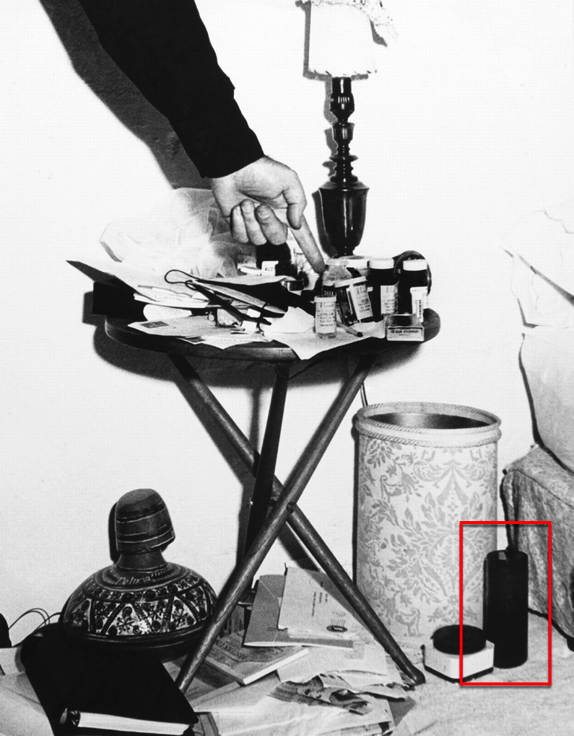
    Glass is usually cropped in books and on TV shows

    Clemmons was accommodating to Slatzer. The policeman told him that the bedroom scene at Marilyn’s looked staged to him. For example, he said a “drinking vessel was not on Marilyn’s night stand or near her bed.” Further, he could not find a glass in the nearby bathroom either. (ibid, p. 547)

    Clemmons was up to his old tricks, because:

    Police photographs snapped that morning revealed that Marilyn…had a glass at her bedside. One of these photographs depicted a policeman’s hand pointing at Marilyn’s cluttered bedside table, indicating the many prescription bottles resting thereon, and that photograph clearly revealed a glass… (p. 547)

    I do not like policemen who manufacture evidence or deceive the public about key facts in a high-profile case. Being familiar with the RFK assassination, I am fully aware of this type of behavior by the LAPD in 1968. And the Slatzer/Clemmons interview took place after that event.

    But this was not the only alteration that Robert Slatzer elicited about the crime scene at Marilyn’s home. As mentioned previously, Eunice Murray said that what had her worried about Marilyn was being able to see a sliver of light underneath her door after midnight. This indicated to her that the actress—who suffered from insomnia—was not able to sleep. Years later, Murray changed her story. It was not a sliver of light she saw. That was changed into a phone cord. Who helped her change her story? Robert Slatzer again. Twelve years after the tragedy in Brentwood, Slatzer convinced Murray that she could not see anything under the door, because of new carpeting being installed. As the author notes, the idea of having carpeting so thick that it blocked any door clearance is rather dubious. To prevent any light passage usually requires specially designed seals. (McGovern, p. 552)

    Don McGovern will reveal much more about just how pernicious Robert Slatzer was in the Monroe case. In so doing, he achieves something I would not have thought possible. He proves Slatzer was even worse than I thought he was.

    II

    How did the Marilyn mythology begin? And why? As hinted at above with the Clemmons/Kuchel plot, it was politically motivated. No president did more to tear down the walls of segregation in the South than John Kennedy. No one was more instrumental in that destruction than Attorney General Robert Kennedy. (Click here for details). In fact, as Clay Risen notes in his book, The Bill of the Century, the main reason RFK stayed on as Attorney General into 1964 was to make sure his brother’s bill passed through congress. After that happened, the Attorney General resigned and ran for the senate in New York. As he said, his goal was to represent the Kennedy wing of the Democratic Party in the senate.

    There were some conservatives who did not wish RFK to succeed in that race. For the senate seat was perceived as a springboard to the White House. They did not want one Kennedy replaced by another Kennedy, who—because of his epochal stewardship of civil rights—was even more liberal than his brother. They were aided in their cause by journalist Dorothy Kilgallen who, in a column written the day before Monroe died, hinted at some kind of affair between Bobby Kennedy and the movie star. As the author notes, there was no basis for this insinuation. (McGovern, p. 21) Her alleged source was a person, Howard Rothberg, who had no connection to Monroe’s circle. But with the help of this tinder, three arsonists set a fire.

    Maurice Reis ran the Motion Picture Alliance for the Preservation of American Ideals. This group was a leftover from the McCarthy era and it terrorized the movie business in the fifties. (See the film Trumbo.). Reis kept files on anyone in Hollywood suspected of being a communist or a sympathizer. Because Monroe had been married to playwright Arthur Miller—pegged as a sympathizer—Reis had files on her. Sgt. Jack Clemmons, who we have already met, was part of the Fire and Police Research Organization, a similar anti-Communist group. Frank Capell started his Red hunting career in Westchester New York as an officer in the Subversive Activities Department. The three men knew each other and, in the autumn of 1962, Reis informed the other two about his files on Monroe. He then spun a tale: Marilyn thought Bobby Kennedy was going to marry her, but the Attorney General backed out of the proposal. Monroe was angered and threatened to reveal the affair; thus, the Kennedys had her eliminated. As McGovern notes, there was no evidence to back this up. But Clemmons and Capell wrote summaries of this wild theory and forwarded them to J. Edgar Hoover’s pal, columnist Walter Winchell, who printed much of it. (McGovern, pp. 24-25)

    In August of 1964, Capell wrote a pamphlet titled The Strange Death of Marilyn Monroe, the publication of which coincided with RFK’s entry into the New York senate race. It was essentially the Reis concept, padded out with filler: Bobby Kennedy had Monroe killed by communist agents, because he romantically betrayed her and she was going to expose that betrayal. (James DiEugenio and Lisa Pease editors, The Assassinations, p. 360) As more than one biographer has noted, the anti-Kennedy forces circulated this fruity screed in New York to hurt his candidacy. In order to make his spurious thesis credible, Capell criticized both the investigation into Monroe’s death and the autopsy, in order to suggest her death was a murder disguised as a suicide. Capell’s pamphlet did not gain any real traction, but it was the intellectual basis for a similar effort that did gain wide currency. And, as we shall see, Capell also cooperated on a similar effort beyond that.

    Like many American males, Norman Mailer had a liking for Marilyn Monroe. He tried to meet her once but, for whatever reason, she did not want to meet him. (McGovern, p. 31). In 1973, nine years after Capell’s political hit job was issued, Mailer published his own piece of hackery, Marilyn: A Biography. It was a coffee table book, featuring photos by several photographers, including Larry Schiller. Mailer’s accompanying essay suggested that somehow Marilyn’s death was actually a murder. He at least partly formulated this idea through Capell—even though Capell had surrendered on charges in the same libel action against Kuchel that Clemmons had resigned over.

    But Mailer had a different reason for continuing the baseless smear. He admitted to Mike Wallace on Sixty Minutes that he needed the money. Unsaid were his alimony and child support payments. (McGovern, p. 33). What Mailer did was, as McGovern describes it, a use of paralipsis. That is, implying something could be true while knowing you have no basis for postulating it. Mailer even tried out the idea that maybe, if Bobby did not kill her, agents of the FBI or CIA did, in order to make it look like she had killed herself over unrequited love. Mailer could get away with this nutty speculation since JFK, RFK, and Monroe were all dead, so there were no legal consequences involved. The book made the cover of four magazines and became a huge bestseller. (See Norman Mailer: A Double Life, by J. Michael Lennon, pp. 467-68) But as author John Gilmore notes, it might be the worst of the lot. Because Mailer “originated the let’s trash Marilyn for a fast buck profit scenario.” Gilmore continued in his description of the genre:  “There are many others in the line; in fact, most every biography on Marilyn is part baloney sandwich peppered gingerly with so-called invention.” (McGovern, p. 36)

    That description is probably too kind to apply to the next writer to follow in the Mailer/Capell fiction as non-fiction line. He is the previously mentioned Robert Slatzer. Slatzer’s The Life and Curious Death of Marilyn Monroe was published just a year after Mailer’s yarn, so it is hard not to conclude that the publishing company at least partly shaped and modeled their product on the success of Marilyn: A Biography. Especially since, as Michael Lennon points out, Mailer’s book had a combined hard cover and paperback sale of one million copies.

    It turns out that Slatzer knew Kilgallen and, in fact, he wrote her column at times when she was on vacation. (McGovern, p. 38). In that column, he once wrote that he met Monroe in 1947 at Fox. In his book, he changed this to the summer of 1946. But this would only be a minor contradiction in a Slatzerian sea of them.

    Slatzer was born in Ohio in 1927. He worked in the D movie business as a writer and director e.g. Bigfoot. In the seventies, he turned more to writing celebrity biographies: two on Monroe and one each on Bing Crosby and John Wayne. In his books on Marilyn, he depicts himself as her closest confidante. In fact, he maintained that he married her. It was a brief marriage. It lasted about 48 hours on the first weekend in October, 1952, the ceremony being performed in Mexico. (McGovern, p. 42) As the author notes, this poses an obvious question: Why would Slatzer wait until 12 years after Monroe’s death, and 22 years after their wedding, to reveal he had been married to her? This is where McGovern hits a double off the wall in left field. Nobody who reads this book will ever believe Slatzer again. (Perhaps excepting, as we shall see, Tony Summers)

    III

    According to Slatzer, after spending much of the previous day together, he and Marilyn left for Mexico on the morning of October 4, 1952. The couple booked a room at the Rosarita Beach Hotel. They then went to the Foreign Club for dinner and ran into the world-famous matador Carlos Arruza. Arruza happened to be an acquaintance of Slatzer and they shared a drink. At 8:30 that night, they took a cab and went to see a barrister in Tijuana. He informed them he could do the ceremony, but they needed two witnesses. The barrister could supply one, but he would only furnish another for a fee. Slatzer and Monroe happened to stumble upon still another friend of the writer: boxer and actor Noble “Kid” Chissell. The ceremony was performed and the couple then returned to the Foreign Club. They encountered Arruza again, with whom they shared a wedding night dinner. (McGovern, p. 46)

    On the drive back, Marilyn seemed distracted by Joe DiMaggio’s voice announcing the World Series. When they arrived in LA, DiMaggio called Marilyn. Slatzer understood that, even though he was her husband, Marilyn was in love with the Yankee Clipper. Like Sir Galahad, he decided to be noble. On Monday night they returned to Mexico to have their marriage annulled. The same barrister said he could not do so that quickly, since it hadn’t been processed. But for a price he pulled the certification from a pile and burned it in front of the couple. When they returned to Los Angeles, Monroe promised never to say anything about their wedding. (p. 47)

    McGovern slices this story open with a precision and mastery of fact that is riveting. There are two recent calendar type books on Monroe’s day-to-day life in Hollywood; one by Carl Rollyson and one by April VeVea. According to those two books, it is highly unlikely that Monroe was with Slatzer beginning on Friday night as he says he was. (McGovern, p. 49). Further, with the kind of money Marilyn was making at the time, would one not think the couple would buy wedding bands in LA and hire a photographer to shoot pictures of the ceremony? If you were going to marry one of the most famous film stars in Hollywood, would you not wish to have a picture of the ceremony? Slatzer never mentions a photographer and, according to him, they had to buy wedding bands in Tijuana. Need I add that no one ever saw those bands again.

    The retired Carlos Arruza wrote an autobiography in 1955, which was translated into English in 1956. Since Arruza was in some films in his career, one would think that he would have mentioned having dinner with Marilyn Monroe on her wedding night. If only because, by 1955, Monroe was one of the biggest names in Hollywood. Apparently, Arruza did not think that dinner was notable. And somehow, Marilyn forgot all about meeting the great matador twice in one weekend. (McGovern, pp. 63-64)

    Two of the most amazing things about this fairy tale concern Joe DiMaggio. McGovern tried his best to locate the broadcasts of the 1952 World Series. He found out that DiMaggio was not part of the broadcast team. Either on radio or television. (ibid, p. 54) The other utterly baffling part of this DiMaggio story is this: Marilyn was living with DiMaggio at the time. The house was located on Castilian Drive in Hollywood Hills. (Click here for a look) Does anyone believe that the powerful, six foot DiMaggio would let the short, portly Slatzer come over to his house and depart with his live-in girlfriend for a Tijuana weekend?

    But what of Kid Chissell? He was a witness, right? No he wasn’t. The boxer was questioned by Marilyn photographer Joseph Jasgur about the subject. He admitted that, “No, there wasn’t a wedding between Bob Slatzer and Marilyn…I don’t think Bob ever knew Marilyn.” (McGovern, p. 99). Then why did he go along with the charade? Because, like a true con man, Slatzer offered him money for the backup baloney. And like any amoral hustler, Slatzer did not come across with the funds.

    But further, Marilyn could not have been in Mexico on October 4, 1952, because she was on a shopping spree in Beverly Hills that day. She wrote a check for $313, about three grand in today’s currency. (Ibid, p. 100) And the address on the check is the house she rented with DiMaggio. How does it get worse than all this?

    I usually try to give people the benefit of the doubt. But in this instance, there is no doubt. Robert Slatzer was a damned liar. His book took Mailer’s paralipsis and Capell’s suggestions further than either had. It was from Slatzer’s phony book that all the elements of a pseudo conspiracy to kill Monroe emanated: the Red Diary of Secrets; a Monroe milieu of not just Kennedys, but mobsters; Monroe’s inside knowledge of what was going on at the White House etc. But Don McGovern has unearthed information that goes beyond the above.

    IV

    For decades, Will Fowler was a fairly celebrated journalist, news director, and publicist in Los Angeles. His career extended back to the Black Dahlia case. Fowler said that Slatzer approached him in 1972 with an article proposal about the death of Marilyn Monroe. Fowler declined saying that if he had been married to her, now that would make an interesting proposal. Shortly after, Slatzer returned and told Fowler that, he forgot to tell him, but he had been married to her. (Click here for details)

    This much had been known through a 1991 memoir that Fowler wrote about his reporting career. It turns out that it was not the whole story. Apparently, upon his death, Fowler donated his papers to California State University Northridge. In those papers, it was discovered that Fowler did not just walk away from Slatzer after their second meeting. On the promise that Slatzer would provide notes and tapes proving his relationship with Monroe, Fowler agreed to be part of a writing enterprise to produce a book on the Monroe case. (Click here for some of the documents)

    As one can see from the linked documents, the third party to this literary enterprise was none other than Frank Capell. Capell was to produce evidence to ostensibly demonstrate the true character of Bobby Kennedy. This included supplying a pamphlet he had written about the deceased senator originally titled Robert F. Kennedy: Emerging American Dictator. (McGovern, p. 74) The reason I adduce for Fowler’s initial cooperation was his own innate conservativism—he worked on the Goldwater campaign of 1964—combined with the promise that Slatzer would produce tangible evidence of his relationship with Monroe. When such evidence was not forthcoming, Fowler began to have his doubts about Slatzer’s honesty. For if Slatzer did not have any real relationship with Monroe, then what was the point of the book?

    One of the reasons that Fowler left the project is the fact that he was promised by Slatzer full notebooks proving his relationship with Monroe. These were to include letters exchanged between the two. Slatzer also said he had tapes of interviews he did with her. He never came up with either; thus Fowler departed. After he left, the end result was a cooperative writing venture by Pinnacle Books, with some of the writers being paid on a work for hire basis.

    As McGovern points out, it is hard to exaggerate the impact of Slatzer’s business enterprise on the Monroe field. For example, Tony Summers invoked Slatzer’s name 179 times in his 1985 book Goddess. Donald Wolfe went beyond that. In his 1998 book, The Last Days of Marilyn Monroe, he found cause to mention Slatzer 266 times. (McGovern, p. 76). Wolfe did not mention Fowler but Summers did, and in an odd way. In his footnotes, he suggests he did a joint interview with the two and, in his text, he indicates that Fowler was backing up Slatzer as to a long relationship with Monroe extending as far back as 1947. He even has Fowler looking at Slatzer’s marriage certificate in 1952, which no one else has ever seen. Yet in Fowler’s 1991 memoir, he stated flatly that Slatzer was never married to Monroe. (Reporters: Memoirs of a Young Newspaperman, pp. 287-88)

    One way to explain this apparent dichotomy is that Pinnacle and Slatzer threatened litigation against Fowler for voicing his disagreements with the enterprise after he left the project. (McGovern, p. 78). It turns out that the evidence in the Fowler archives strongly suggests that Slatzer forged a letter to Summers which he tried to pass off as Fowler’s. In a letter to TV critic Howard Rosenberg, Fowler said he only recalled one phone interview with Summers. In that call, he clarified that episodes like a description of a marriage certificate and Marilyn dancing nude, these were only anecdotes that were related to him by Slatzer. (Letter of August 7, 1991). In a memo to his file, Fowler recalled this experience further. He wrote that he told Summers that:

    Slatzer informed me about the marriage license and that I had not seen it. And also, that in 1946 or 1947, Slatzer had seen Marilyn walk around at a party in the nude. This became the last interview I would have about Marilyn Monroe, because Mr. Summers, in his book, quoted me as having seen the marriage license and been at the party in the 40’s with Robert Slatzer. Not true. I never even met Marilyn Monroe. (McGovern, p. 81)

    When contacted about this discrepancy, Summers said that he stood by what he wrote in his book. As McGovern notes, that might be fine for him, but it does not explain the material differences. (ibid, p. 85)

    The letter to Rosenberg concerned a TV movie that was made largely out of Slatzer’s first book about the actress, The Life and Curious Death of Marilyn Monroe. The movie was 1991’s Marilyn and Me. If the reader can believe it, and you probably can by now, that production went even further than the book. For instance, there is a scene in Mexico with Marilyn having an abortion of Slatzer’s child on a kitchen table in Tijuana. Which would mean that while she was living with DiMaggio, she was carrying Slatzer’s baby. There were other additions to the film that are also not in the book. McGovern makes a strong case that these were all further deceptions. (McGovern, pp. 87-88)

    V

    The fact that Slatzer made a career—and considerable cash—out of his exercise in literary fraud was a signal to others that there were no boundaries anymore in the field. The fact that ABC made a film of his trashy fabrication and that talk show hosts and documentary film makers featured him on television, this clearly designated that the MSM would not perform due diligence on the subject. Therefore, it now became standard practice to posthumously libel Marilyn Monroe, President Kennedy, and Senator Kennedy. This meant one could construct a meme by utilizing one of the most unreliable—almost ludicrous—stable of witnesses ever gathered in one case. By using this methodology, the MSM allowed tall tales to sprout unchecked and then rise to heights (or sink to depths) of dreadfulness, to the point that they approach a kind of collective cultural dementia. If the reader thinks I exaggerate, let me demonstrate with three examples from McGovern’s book.

    Most readers of this site will recall the whole Lex Cusack/Sy Hersh debacle. In 1997, ABC had purchased the TV rights for Hersh’s book The Dark Side of Camelot. Reportedly, Hersh had spurred interest in his hatchet job by claiming he had documents that proved a legal settlement between Monroe and the Kennedy family. In return for payments well into the six figures to her mother, Monroe would stay silent about an affair she had with John Kennedy and her seeing him associating with known gangsters, i.e. Sam Giancana. This agreement was made in 1960 and was signed by John Kennedy, Robert Kennedy, Marilyn Monroe, Janet DeRosiers (Joe Kennedy’s assistant), and Monroe’s lawyer, Aaron Frosch (DiEugenio and Pease, pp. 365-66). After noticing some problems with the documents, like using zip codes before they existed, ABC had them tested. They were forensically proven to be forgeries. That part of the story was written about at length. For example, by David Samuels in The New Yorker (November 3, 1997)

    In the Samuels article, there was a passage that almost everyone overlooked. But it is important, because Samuels thought it may have given Cusack the idea to create the forgeries. In 1986, Cusack met a woman named Nancy Greene. She conveyed to him a bizarre claim to the Monroe estate, which his attorney father had partly represented. Lex concluded she was not in a well state of mind so he dismissed her.

    The Samuels article upset Nancy to the point that she filed a legal action for defamation. The court found no merit in her claim and dismissed the lawsuit. Nancy later published a book in 2013. In that book, she claimed to be the illegitimate daughter of Monroe and JFK. Her last name was Greene by marriage. She later legally changed her last name to Miracle. But she was born with the last name Maniscalco. How do we know that? Because in the Cusack files there was a note from Jennie Maniscalco. The note said Marilyn Monroe could not be Nancy’s mother, “Because I’m her mother.” (McGovern, p. 230)

    To go through Maniscalco’s story is to be amazed that anyone could listen to it with a straight face. To use just one example: she says Monroe was not born in California, but in Illinois. And the movie star’s name was not Norma Jeane Mortenson, but Nancy Cusamano. I cannot possibly explain how one became the other, but I will just say that mobster Vito Genovese was involved. (McGovern, p. 221). I don’t even think Nigel Turner would have touched that one.

    But Donald Wolfe did. (McGovern, p. 227) He actually tried to prove the story was true. And that Monroe was really Nancy’s mother. This is what passes for investigatory literature in that field. Wolfe is a writer who believes both Robert Slatzer and Nancy Maniscalco. As Sarah Churchwell wrote about Wolfe, “There isn’t a conspiracy theory that Wolfe doesn’t endorse…If someone said it, that seems to be proof enough.” (The Many Lives of Marilyn Monroe, eBook edition, p. 96)

    By now, the reader should understand that the money angle is a recurring theme in the Marilyn industry. We are about to encounter it again.

    In 1982, as the Los Angeles District Attorney’s office was conducting a threshold investigation on the Monroe case, the man supervising that inquiry, Ronald Carroll, received an odd phone call. The caller said his name was Rick Stone and he told Carroll he had a story to tell about the Monroe case. (As we shall see, it was a story he intended to sell also.) He said he had been dispatched, along with his partner, to the Monroe home between the hours of 4-6 AM. When he got there, the body was in the guest house. Further, Monroe was not quite dead yet. He and his partner tried to revive her. But then a doctor arrived with a black bag. He pulled out a hypodermic and plunged it into her heart and that is what killed her. (McGovern, p. 515)

    Stone’s real name was James Hall. He ended up selling his story to The Globe. Which is significantly below the National Enquirer as far as credibility goes. (ibid, p. 516) This story has been used, in one form or another, by various authors, including Slatzer in his 1992 book and Donald Wolfe. Why it would be used is the real question.

    Monroe’s guest house was even more sparsely furnished than her home. As McGovern notes, it contained only a card table and chairs. (McGovern, p. 518) The concept seems to be to build on Sgt. Clemmons’ attempt to make the crime scene into something suspicious. But this story makes Clemmons look conservative in that regard, since not even he said the body was in the guest house. In fact, the first four witnesses at the scene—Murray, Greenson, her internist Dr. Engleberg and Clemmons—said Monroe’s body was in her bedroom. In fact, that Monroe was still alive at the 4-6 AM time frame also clashes with Greenson, Engelberg, and Clemmons. Her body showed signs of fixed lividity and advanced rigor mortis by the time Clemmons got there at 4:35 AM. (McGovern, p. 521) Finally, the idea that the medical examination—done just a few hours later—would not reveal the trail of a hypodermic into the heart, that seems beyond comprehension.

    If one thinks the above two stories are bizarre, the one by Lionel Grandison might take the trophy. By 2012, Grandison had changed his religious affiliation, so his book about the Monroe case was issued under the name Samir Muqaddin. But since we are talking about the 1962 time frame, I will use the surname Grandison. Grandison wrote that, as a member of the coroner’s office, he came across Monroe’s diary in a purse that was retrieved from her home. He read it over two nights, took some notes, and tried to commit it all to memory. But after the second night, it disappeared from a safe he placed it in.

    According to Grandison, we all had the wrong idea about Marilyn Monroe. Like Chuck Barris, she was actually a secret agent. She was originally recruited by the FBI to spy on her husband Arthur Miller. She then became closely associated with John and Robert Kennedy—although the dates he says she met them do not coincide with the actual calendar dates writers have adduced. (McGovern, p. 252) She had to divorce Miller, because her espionage work now advanced to a higher level in the Kennedy White House. She now began to attend high level intelligence briefings with FBI and CIA officers. She also met up with mobsters like John Roselli and Sam Giancana due to her knowledge about the CIA/Mafia plots to kill Castro—and the president was at those meetings. According to Grandison’s notes, one Mafiosi plan proposed shoving a poison pill into Castro’s rectum.

    I really cannot go any further with this—although McGovern does. I have a hard time thinking anyone could dream up, let alone write down this malarkey. One of the biggest film stars in the world at a high-level briefing and no one mentions it—ever? J. Edgar Hoover would have had it in the papers within a half hour. John Kennedy was never at a meeting where the CIA/Mafia plots were discussed, since the CIA deliberately kept them secret from him. (1967 CIA Inspector General Report, pp. 62, 64, 118, 130-32) But beyond that, the CIA emissaries to the Mafia for those plots donned false identities as businessmen and met the mobsters on their home turf: those meetings did not take place in Washington, but in Miami and New York City at private establishments. And finally, Kennedy was not even president when they occurred. (Inspector General report, pp. 16, 18)

    There is no excuse for this kind of publishing irresponsibility. The CIA Inspector General Report on the plots was declassified by the Assassination Records Review Board about 15 years prior to the publication of Grandison’s book. Therefore, this smacks of cheap sensationalism.

    see The Marilyn Monroe/Kennedys Hoax – Part 2: The Mythology Soars into Outer Space

  • Counterpunch, JFK , and Vietnam

    Counterpunch, JFK , and Vietnam

    As readers of this site will understand, Counterpunch has consistently been one of the far left’s bastions of ideological purity. They do some good work from that vantage point. But one of the problems with that point of view is that it tends to sweep up all of history into a sanctimonious vacuum. And one of the things that gets swept up and homogenized is the issue of John Kennedy and Vietnam. (Here is a previous example.)

    Their latest in this vein was posted on April 30, 2020. It is another of their “Letters from Vietnam” series. This one is from an American living in Vietnam named Mark Ashwill. Ashwill is an educational entrepreneur. The occasion for him writing his letter is the 45th anniversary of America leaving Indochina in 1975. This was due to the agreements that were negotiated by Henry Kissinger and Alexander Haig under Richard Nixon’s supervision in Paris.

    Ashwill writes the letter as if he were a citizen of Vietnam (which he may well be) and is preaching to his former countrymen about the evil that they visited on his new nation. I would like to inform the editors of Counterpunch and also Mr. Ashwill that this history lesson is not exactly new. It has been going on at least since the rise of Students for a Democratic Society early in the sixties. It was given popular voice in the pages of Ramparts magazine, and was in book form during that decade through the work of men like William Appleman Williams and historians influenced by him who created New Left studies.

    In fact to go through his rather antique complaint today is kind of boring. Most of us know that Ho Chi Minh declared Vietnam free from French domination at the end of World War II. That he used American historical documents like the Declaration of Independence to do so. Many, many years ago Williams produced the letter that Ho sent to Harry Truman in 1945 asking the American president to cooperate with his cause against France. We also know how that letter was ignored and Harry Truman and his later Secretary of State Dean Acheson decided to side with France. And America ended up bankrolling about 80% of the French war effort. We also know the rest of Ashwill’s litany: how the defeat at Dien Bien Phu led to the Geneva Accords, and how President Eisenhower and Secretary of State John Foster Dulles sabotaged that agreement by not holding elections in 1956. And that this key event inevitably led to the USA getting involved in a second war against North Vietnam. This would have been prevented if the Geneva Accords had been honored.

    Ashwill now makes a large leap to 1961 and President John F. Kennedy. The reason I say this is a large leap is because by leaving out 1956-60, in his own David Halberstam-ish way, the author eliminates a central point. John Foster Dulles clearly ran the American participation at Geneva. The attorney realized that his oral agreement with the Accords could easily be broken if he did not sign them and this is what he advised the president to do. (William Blum, The CIA: A Forgotten History, p. 137)

    Within days of the end of the conference, Foster Dulles and his brother Allen, director of the CIA, began a long series of clandestine actions in order to create a new country called South Vietnam. These actions were supervised by General Edward Lansdale, who was in reality a high-level CIA action officer. It included a psychological terror war in the north to convince the Catholics that they would be persecuted by Ho Chi Minh and they should flee to the south. This helped prop up America’s chosen leader of this new country, the Catholic Ngo Dinh Diem. Once this creation was completed, Foster Dulles made the infamous assertion, “We have a clean base there now, without a taint of colonialism. Dien Bien Phu was a blessing in disguise.” (Blum, p. 139). Leaving out Lansdale and the Dulles brothers is not just reminiscent of Halberstam, it is also what Ken Burns and Lynn Novick did more recently in their long dud of a documentary series called The Vietnam War.

    There was no South Vietnam before this. Eisenhower, the Dulles brothers and Vice President Richard Nixon created it. Once it was created, the USA was committed to propping it up any way it could. It was through Diem that America formally cancelled the scheduled unification elections. (Blum, p. 139) This also meant using the fig leaf of communist infiltration from the north as a pretext to invoke the Southeast Asia Treaty Organization (SEATO) as a mutual defense doctrine. Omitting these details thus ignores the fact that those four men had split the country in half and then fabricated a civil war for their own purposes. It was this threat that gave Ho Chi Minh pause about enforcing the Geneva Accords and forcibly holding the elections––which could have easily been achieved. ((Blum, p. 139)

    The USA now began to send new military advisory units to Saigon in further defiance of the Geneva Accords. Lansdale began to rig elections to keep Diem in power. The Dulles brothers were not furthering democracy. They had installed and now supported a dictator. And they trained his security forces at Michigan State University. (Blum, p. 140) These techniques included torture and imprisonment in the infamous “tiger cages”.

    To skip over all this, plus the large amounts of aid we were giving Diem, is to paper over why it was not easy to get out. The Saigon government was a creation of Washington. And, to say the least, Diem was not a good choice for its leadership. But in doing all this, it created a tactical and strategic commitment that had not existed in 1952. In my opinion, it is not something that can be discounted or ignored, since in historical terms, it is crucial. To make this Bob Beamon leap to President Kennedy and 1961 is bad history, even for an informal letter.

    What makes it all worse is the fact that the editors at Counterpunch then placed a picture of President Kennedy at the top of the article next to a map of a divided Vietnam. As if, somehow, Kennedy was involved in the decision to split up the country. This is misleading not just because he was not involved, but because Kennedy was one of the very few voices in Washington to oppose the Dulles/Eisenhower policy not just in Vietnam, but throughout the Third World. This conflict between the senator and the White House was documented by Richard Mahoney back in 1983 in his important book, JFK: Ordeal in Africa. In that book, Mahoney specifically noted Kennedy’s 1957 landmark speech about the ongoing French colonial war in Algeria. During that speech Kennedy harked back to Dien Bien Phu and said what happened in Indochina will happen in Algeria, and that it would thus behoove America to be on the right side of history this time. (The Strategy of Peace, edited by Allan Nevins, pp. 66-80)

    So there is ample evidence that Kennedy understood the appeal of nationalism in Third World countries emerging from the shackles of colonialism. (For more current scholarship describing Kennedy’s familiarity with the issue, please read Betting on the Africans, by Philip Muehlenbeck, and Kennedy, Johnson and the Nonaligned World, by Robert Rakove.) But further, what Ashwill does with Kennedy’s presidency in relation to Vietnam is, well, the best word I have for it is “minimalist”.

    Ashwill describes a meeting between Kennedy and French President DeGaulle in May of 1961 in Paris where the former French resistance leader warned Kennedy about the quagmire he would be getting into if America intervened in Indochina, that it would be an endless entanglement America could not win. He then quotes DeGaulle as later saying that Kennedy listened to him but that events proved he had not convinced him.

    First of all, this discussion between Kennedy and DeGaulle is again an antique bit of news. To cite just one source, it was already described back in 1972 by Dave Powers and Ken O’Donnell in Johnny We hardly Knew Ye. (p. 13) But Kennedy was not just getting this kind of advice from DeGaulle. He also got it from General Douglas MacArthur. The retired general warned him that even if he placed a million men in Asia, it would not work. (Powers & O’Donnell, pp. 13-14). He also got the same advice from Senator Mike Mansfield. (p. 15) And most importantly, he heard the same thing from his ambassador to India, John Kenneth Galbraith.

    This is why during the debates in the oval office in November of 1961, Kennedy refused to commit combat troops into the theater. And that was a line that he never crossed. (John Newman, JFK and Vietnam, pp. 136-39). But, as Galbraith biographer Richard Parker demonstrates in the above link, Kennedy went further than this. He sent Galbraith to Saigon and asked him to write a report, knowing that the ambassador would advise against any further involvement. (Virtual JFK, edited by James Blight, pp. 72-73). Galbraith did write such a report, and when the ambassador returned to Washington in April of 1962, Kennedy had him hand deliver it to Secretary of Defense Robert McNamara. (Newman, pp. 236-37). One month later, McNamara arranged to meet with all the inter-agency chiefs of all American forces in Vietnam. After going through the regular agenda items and adjourning the meeting, he called aside General Paul Harkins, the overall commander of American forces in Indochina. He told Harkins that it was time to switch responsibility for the war over to the ARVN, the Army of South Vietnam, and he wanted to begin the planning on the reduction of American advisors as soon as possible. This was the beginning of Kennedy’s withdrawal plan. (Newman, p. 254)

    As anyone familiar with the newly declassified record should know, in May of 1963, McNamara called another such meeting, this time in Hawaii. At this meeting the withdrawal schedules were submitted to the Secretary. He said that they needed to be accelerated. He wanted a thousand advisors withdrawn by the end of the calendar year. He directed that those plans be drawn up. (James Douglass, JFK the Unspeakable, p. 126). In October of 1963, Kennedy signed National Security Action Memorandum 263 ordering the first thousand advisors to be withdrawn by the end of the year and the rest by 1965. (Douglass, p. 188). In other words, there was not one more combat troop in Vietnam at the time of Kennedy’s death than there was when he took office. And he was in the process of removing all advisors.

    Somehow, Mark Ashwill missed all of this with a completeness that is astonishing. But the Vietnamese educator also missed a chance to have this confirmed by a source in his adopted country, namely, the son of the late North Vietnamese General Vo Nguyen Giap. If someone visiting Vietnam from the USA could do this, then why couldn’t Mr. Ashwill?

    From here, Ashwill takes another leap forward. This time to 1966. By the end of that year, Lyndon Johnson had committed 385,000 combat troops, with 60,000 sailors stationed offshore. In just that one year, 6,000 Americans would perish and 30,000 would be wounded. Ashwill discusses a speech by Ho Chi Minh in which the North Vietnamese leader says America took “the wrong fork in the road”. Ashwill never explains how America went from having no combat troops in Indochina to having nearly 400,000. The man who took the wrong fork in the road was Lyndon Johnson. And if any president’s picture should be at the top of the article, it should be his.

    As any serious study of the Vietnam War reveals, there were three events that took place––a meeting and two specific orders issued––that overturned Kennedy’s withdrawal plan and replaced it with an escalation plan that was quite apparent by 1966. These were the first Lyndon Johnson meeting on the war on November 24, 1963; the last draft of NSAM 273 signed on November 26th; and NSAM 288 finalized in March of 1964.

    At the November 24th meeting, the principals realized that Johnson’s attitude and style about Vietnam were both quite different from Kennedy’s. He said things that Kennedy never did. For instance: “I am not going to lose Vietnam. I am not going to be the President who saw Southeast Asia go the way that China went.” (Newman, p. 442) Kennedy never expressed these kinds of Cold War sentiments about Indochina. He simply did not think Vietnam was imperative to American security. National Security Advisor McGeorge Bundy agreed with this evaluation in comparing the two presidents. And he expressed those characterizations in discussions with both James Blight and his biographer Gordon Goldstein. (Goldstein, Lessons in Disaster, p. 231)

    NSAM 273 was altered to allow direct American naval involvement in patrols against the North Vietnamese coast. According to Bundy, it was altered by Johnson. (Newman, pp. 445-49) This allowed for the OPLAN 34 A plans and the so called DE SOTO patrols. The former were hit-and-run attacks by speedboats, the latter were American destroyers meant to decipher where return fire from North Vietnamese bases was coming from. In December, Johnson requested these types of covert actions against the North, with the help of Americans forces if need be. The operations ended up being largely American. (Edwin Moise, Tonkin Gulf and the Escalation of the Vietnam War, pp. 5, 7-8, 14) As many commentators agreed , including those inside the White House, these patrols were, in fact, provocations. (Moise p. 68; Goldstein, p. 125)

    NSAM 288 was Johnson’s specific preliminary design to escalate the war, including an air war against North Vietnam. This included 94 bombing targets. In three years Kennedy had never even contemplated this. The combination of the DESOTO patrols with NSAM 288 resulted in the casus belli the White House sought in order to escalate the war. (Moise, pp. 26-28) This was of course the Tonkin Gulf incident. And this is what Ashwill skips over to get to 1966.

    The rest of the article is a listing of all the damage inflicted on Vietnam, in bombs, land mines, defoliants, and so forth. Which, of course, any interested party already is cognizant of. Are we supposed to believe that the editors at Counterpunch do not know that 99% of all this happened after Kennedy’s death? And if his plan had been left intact, we would not be having this discussion? That is not speculation. Today, with the declassified documents of the Assassination Records Review Board, it can be proven.

    Near the end, Ashwill says that the American leaders did not understand what the war was really about. As I have labored to show, President Kennedy did know what it was about. That is why he was getting out. Just ask General Giap’s son.

  • The House of Kennedy, by James Patterson and Cynthia Fagen

    The House of Kennedy, by James Patterson and Cynthia Fagen


    There is no reason for anyone to read this book. On the other hand, there are a lot of reasons not to read it. In its own way, the James Patterson/Cynthia Fagen book, The House of Kennedy, redefines the rubric “hatchet job.”

    This volume portrays itself as telling the entire story of the Kennedy clan from two generations before Joseph P. Kennedy, to the death of John Kennedy Jr. in a plane accident in 1999. It is hard to believe that Patterson, who at least started his career as a detective novelist and has written dozens of those kinds of books, actually wrote and researched it, or even designed it. I write that for two reasons. As many people know, Patterson has become so incredibly successful as a writer that he really does not have to write anything anymore. He sells more books than Stephen King, John Grisham and Dan Brown combined. In fact, the inside joke in the industry is that Patterson can write two novels in 12 hours. Based on that kind of information, I would be willing to guess that the TV producer and print journalist Fagen probably did most of the work on the book. From what I could garner, she worked on Inside Edition, Bill O’Reilly’s old program, and she wrote for the New York Post. The Post is owned by Rupert Murdoch and it is a tabloid. If one recalls, during the Jeff Bezos divorce scandal, it ran the infamous front-page headline “Bezos Exposes Pecker”. Referring, of course, to The National Enquirer’s David Pecker’s role in catching Bezos cheating on his wife.

    The House of Kennedy is written at about the New York Post tabloid level. When an author writes a non-fiction group biography that is supposed to tell the story of an entire clan, each chapter needs to be guided architecturally, in order to create some kind of narrative arc. To be mild, that does not happen here. For all the planning and design in The House of Kennedy,,it might have been clipped from a series of New York Post articles. And that does not include the clumsy composition and graceless writing.

    Yet that is only the beginning of the problems with this weak excuse for a book. Although it spends time on the assassinations of both President John Kennedy and Senator Robert Kennedy, you will learn next to nothing about how each of those two men died. And, in fact, what you will read about those matters is sometimes false in its own terms. That is, Fagen and Patterson abide by the official stories in both cases, but at times they go beyond that, in order to hammer home their verdicts that both Lee Oswald and Sirhan Sirhan acted alone.

    But before we get to that part of the book’s utter failure, let us deal with the three main biographies contained within the covers of the book. Those would be Joseph P. Kennedy and his two sons, John F. Kennedy and Robert F. Kennedy. If you want to learn anything about those three men, you won’t in this book. For the simple reason that I could find no original research in it. For example, in David Nasaw’s biography of Joseph Kennedy, The Patriarch, one will learn—in extraordinary detail—how Joe Kennedy built his enormous fortune, especially how he made millions in the film business through distribution deals and the fact that his success made him much in demand as an executive. He was an executive who could request and receive both a large salary and stock options. Nasaw was very specific about which companies hired Kennedy and what his salary and option plans were. Also, he was allowed to run one company, while investing in other film companies. There is next to none of that in The House of Kennedy. Nasaw also found evidence that countered the recurrent charge that Joe Kennedy was some kind of rabid anti-Semite. Well, you won’t find that here either. This book does not deal in the creation of three-dimensional character portraits. Not even two dimensional. Every person described comes out like a cardboard cut out used as a stage prop.

    But Joe Kennedy is just where this book gets started. The section on John Kennedy is the longest and, in my view, probably the worst. How can anyone today write any kind of sustained narrative about John F. Kennedy without bringing up the topic of Vietnam? I would have thought that impossible. Even Ken Burns and Lynn Novick had to deal with the subject in their crushingly disappointing PBS mini-series on the subject. They had to for the simple reason that Congressman Kennedy visited Vietnam in 1951 and that visit had a strong impact on not just his view of the French Indochina conflict, but his perspective on the Third World in general.

    The House of Kennedy does something I would have thought no writer, or team of writers, could possibly do in 2020. In the long section dealing with JFK, I detected not even the mention of the Vietnam conflict. This is astonishing—for two reasons. First, there have been many important documents released by the National Archives that help define President Kennedy’s intentions and policies in Vietnam. If the authors did not want to read those documents—and it’s pretty clear whoever the team was behind this product did not—then there were books based on those documents that one could consult. Patterson and Fagen did not do that either.

    Here is my question: how on earth can anyone write any kind of biography of John Kennedy, or description of his presidency, and leave that subject out? That leads to my second reason as to why this is hard to fathom, because under Kennedy’s successors—Lyndon Johnson and Richard Nixon—that war escalated beyond recognition and it expanded from Vietnam into Laos and Cambodia. And if one goes by the most current estimates, that Johnson/Nixon escalation and expansion took the lives of close to 6 million people—about 3.8 million in Vietnam, and about 2 million in Cambodia. (See the June, 2008 British Medical Journal study by Zaid Obermeyer for the former, see this link for the latter). The fact that this book ignores all this, I believe that tells us a lot about what its agenda was from the start.

    But what is remarkable about The House of Kennedy is this: except for the appearance of Senator John Kennedy with his brother Robert on the McClellan Committee—commonly referred to as the Rackets Committee—you will not learn anything about what Jack Kennedy did in his 14-year congressional career in this book. That is quite a negative achievement, because author John T. Shaw wrote an entire book about that subject. Although Shaw’s book is called JFK in the Senate, the book covers his house years also. Shaw came to the conclusion that Kennedy’s most important achievement on Capitol Hill was his forging of a new foreign policy toward countries emerging from the bonds of European colonialism. This policy grew directly out of Kennedy’s opposition to what had come before him in the form of both the administrations of Harry Truman and Dean Acheson and that of Dwight Eisenhower and John Foster Dulles. (See Shaw’s book, page 110)

    As everyone who studies that record comprehends, the great schism between Senator Kennedy and Eisenhower/Dulles came in the form of Kennedy’s famous Algeria speech of 1957. In that speech, the senator denounced the Eisenhower administration’s inability to break away from loyalty to France in the colonial war then taking place on the north coast of Africa. (Shaw, p. 101) Kennedy said that the White House did not seem to understand that what was going to happen in Algeria was a reprise of what had just happened in 1954 at the siege of Dien Bien Phu in Vietnam. That is a resounding French defeat, with the USA on the wrong side of history again. Senator Kennedy said that the American objective should be to free Africa and save the French nation, which was coming apart over this war. (See, The Strategy of Peace, edited by Allan Nevins, pp. 66-80) Are we to presume that Patterson and Fagen never heard of the most famous speech Kennedy ever gave in the senate, one that provoked comment—most of it negative—from literally scores of newspapers throughout the country? (For a review of the Shaw book, click here)

    If the reader can believe it, this methodology continues into JFK’s presidency. There is very little discussion of what President Kennedy tried to achieve or what he did achieve. You will not read anything about Kennedy’s stand against the steel companies, his attempt to get Medicare through congress, the signing of the Manpower Training Act, the forging of affirmative action, or Kennedy’s Aid to Education Act. (For a description of what Kennedy did achieve in office, click here). Again, are we to believe that a writer who has sold 300 million books and a publisher as large at Little, Brown could not perform the most perfunctory kind of research as this?

    And when Patterson and Fagen do try to describe one of President Kennedy’s policies, as with Cuba, they get it wrong. In fact, their description of the Bay of Pigs invasion is so bad its risible. They say that the master plan was to attack Castro while he was lounging at a beach, follow this with an air strike, and then culminate with an amphibious invasion. (Patterson and Fagen, p. 95) To be kind, this is not what the final plan entailed. As anyone can figure through any number of books that have been published on the subject, the final plan consisted of preliminary air strikes against Castro’s Air Force, followed by a diversionary amphibious attack, culminating with a real landing at the Bay of Pigs. And contrary to what this book says, it did not all end in one day. (ibid, p. 97) The actual conflagration went on for three days, but the back of the invasion was defeated in about 36 hours. (Peter Kornbluh, Bay of Pigs Declassified, pp. 307-19)

    Our Dynamic Duo of Patterson and Fagen want to include President Kennedy in some kind of plot to kill Castro as part of the invasion. This was not part of the invasion plan and nothing has ever been declassified that says it was. Patterson and Fagen also want to include the myth of the cancelled D-Day air strikes—that is an air attack on the morning of the invasion—as part of the book. (op. cit. p. 97) Again, the declassified files reveal this to be false. Kennedy only permitted these strikes from a strip secured on the island. Since no beachhead ever secured that strip, this is why they did not occur. (Kornbluh, pp. 125-27)

    By now, the reader understands what kind of book this is. So, predictably, it also includes the Judith Exner tall tale story from People Weekly in 1988. That, somehow, Exner was a go between for President Kennedy and Mafia Don Sam Giancana to arrange both the Castro assassination plots and to swing elections, e.g. the 1960 West Virginia primary. That particular story has been discredited in so many different ways that its inclusion contributes to the unintentional humor of this book. First of all, although the references in the book attribute that Exner article in People to Kitty Kelley, this is not accurate. According to author George Caprozi in his biography of Kelley called Poison Pen, she did not write the article. The editors at Time/Life did. Kelly and Exner did not get along, so in order to salvage their sizeable monetary investment, the story was manufactured in New York. Second, most authors—except Patterson and Fagen—realize today that Exner should not be taken seriously. By the time of her death in 1999, she had simply told too many different versions of her ever expanding tall tales, all of which differed from her original book, My Story. (Click here, for a good summary of her credibility problems)

    Third, the Assassination Records Review Board (ARRB) declassified the CIA’s Internal Inspector General Report on the plots to kill Castro. That report dealt with whether or not the Agency had White House or Department of Justice approval for their outreach to the Mafia to kill the Cuban leader. That report concluded, in several places, that such was not the case. In fact, the report concluded that there was a deliberate attempt inside the CIA not to inform the White House or the Attorney General—Robert Kennedy—about the plots. (See pages 62, 64, 118, 130-32) Therefore, the factual basis for what the book is conveying is impugned.

    The authors are so desperate to involve the Kennedys with unsavory characters, that they actually go ahead and use another discredited source: the novel produced by the late Chuck Giancana back in 1992. It was entitled Double Cross. (Patterson and Fagen, p. 85) The idea behind that earlier fabrication was that, somehow, Joe Kennedy was in the bootlegging business and he had Mob contacts, because of that past partnership. Therefore, in order to arrange for Jack Kennedy’s victory in 1960 over Richard Nixon, he had a meeting with Sam Giancana, the Chicago Boss. In return for the Mob stealing votes in the 1960 election—in both the West Virginia primary and the Illinois general election—Joe would get his other son Robert to lay off the Mafia when he became Attorney General. Later, Sy Hersh tried to fill in this design with his hatchet job of a biography of John Kennedy, The Dark Side of Camelot. Predictably, Patterson and Fagen, use the Hersh book as a source, perhaps because it was also published by Little, Brown.

    Hersh’s book was so bad, and used so many dubious sources, that even Garry Wills—no fan of the Kennedys—went after it on those grounds in his long review in The New York Review of Books. (See the article entitled The SecondAssassination in the 12/18/1997 issue.) For example, Hersh relied on a disbarred lawyer, one who was also an ex-alcoholic and who had been convicted of both bribery and forging money orders, as his source for the meeting between Joe Kennedy and Giancana.

    But beyond that, as both Daniel Okrent in Last Call his definitive book on Prohibition and David Nasaw in his previously mentioned biography of Joe Kennedy show, there was never any credible evidence that Joe Kennedy was ever mixed up in bootlegging or knew any mobsters. How do we know this? Because as Okrent demonstrated, every time Joe Kennedy was appointed to a government position—as he was six times in his life—he had to undergo an investigation. Each one of those inquiries occurred after Prohibition was lifted, therefore there was ample opportunity for anyone to reveal Joe Kennedy’s illicit activity. In hundreds of declassified pages that Okrent secured, there is nothing about any such Mob relationship. (Okrent, p. 369)

    If either Patterson or Fagen had read the CIA Inspector General Report I mentioned above, they would have realized another problem with Chuck Giancana’s novel. At a 1959 meeting with the Kennedys, including Jack, Sam Giancana revealed to the senator that he was working with the CIA to kill Castro. (Double Cross, p. 279) This poses a large time continuum problem for that Chuck Giancana novel. For the Inspector General report reveals that the CIA/Mafia plots did not begin until the next year, 1960. (See IG Report, p. 3) With these two facts, furnished by Okrent and the declassified IG report, Double Cross is exposed for what it is: deceitful rubbish. And the question now becomes: Why on earth would Patterson and Fagen use Giancana’s discredited book?

    And this is a serious problem for The House of Kennedy. I detected only one mention of any use of declassified files by the ARRB in the book, which speaks reams in and of itself. The overwhelming number of sources that the authors use are books by the likes of Ron Kessler, Sy Hersh, Edward Klein, John Davis, and Thomas Reeves, among others of dubious merit. As I and others have shown, these books all have serious critical problems. If one relies on this kind of problematic sourcing, one naturally ends up with a problematic book, one that no one should rely upon for factual data or conclusions.

    But there is another point that needs to be made about using this kind of sourcing. One definition of a hatchet job is when a work goes beyond even the official flawed record in order to present a slanted view of the subject. This book does not just wish to present a completely distorted view of the Kennedys. It wants the reader to believe that there is really no question about the assassinations of either John Kennedy or Robert Kennedy. That proposition, on its face, is ludicrous in light of what we know today about those two murders. But to indicate the quality of this book consider what it says about the alleged assassin in the JFK case, Lee Harvey Oswald. The authors say that Oswald was fully aware of the routing and timing of the Kennedy motorcade through Dallas on 11/22/63. Therefore, Oswald was primed and ready to kill JFK that day. (Patterson and Fagen, p. 111) Their ostensible source for this is a general reference to Chapter Four of the Warren Report. In perusing that chapter, I can inform the reader that there is no information at all there about what this book has presented as a fact.

    The same stunt is pulled with Sirhan Sirhan and the Robert Kennedy assassination. Patterson and Fagen say that Sirhan concealed his handgun in a rolled-up poster, while waiting for Bobby Kennedy in the pantry of the Ambassador Hotel. Again, this is not true. Sirhan had no poster to conceal the weapon with. I consulted on this issue with Lisa Pease, who wrote the most recent and best book on the RFK assassination, A Lie Too Big to Fail. (E-mail communication with Lisa Pease on April 20th) Secondly, Patterson and Fagen use the testimony of garbageman Alvin Clark to say that Sirhan had told him in advance he would shoot Robert Kennedy. Again, Patterson and Fagen should have read A Lie Too Big to Fail before including Clark. As Lisa notes in her book, the FBI recruited Clark to testify against his will. But further, the Los Angeles DA’s office worked on Clark, who claimed he was being harassed. But the LAPD found out about certain problems Clark had with the law, including burglary and child molesting which could explain his reluctance to testify. And, as Pease notes, this may have provided some leverage for the police to overcome his reluctance. (Pease, pp. 168-69) Can one imagine using Clark against Sirhan and not providing this important context?

    Since this is a tabloid type of book, Patterson and Fagen write that both John Kennedy and Robert Kennedy were having affairs with Marilyn Monroe up to the time of her death in 1962. Again, this can only be concluded if one ignores the best work in that case, which, predictably, our Dynamic Duo does. In 2018 and 2019, author Don McGovern wrote the first and second editions of his outstanding book on the Marilyn Monroe case entitled Murder Orthodoxies. In that fine piece of objective scholarship, one will see all the Monroe mythology that The House of Kennedy wants to impose of its readers—Fred Otash, Jack Clemmons, George Smathers, Robert Slatzer—disposed of quite cogently.

    There is one other key point about this poor book. As most biographers of Robert Kennedy note, he was the first Attorney General to enforce the milestone Brown vs. Board decision, which banned school segregation. This is saying something, because that case was decided in 1954. This means that President Eisenhower and Vice President Richard Nixon, who were in power for eight years and had two Attorney Generals who could have enforced that law, did next to nothing about it. In a speech Robert Kennedy made at the University of Georgia in 1961, he made it clear that this would not be the case under him. In all the chapters on Bobby Kennedy, you will not see any mention of that important speech in this book. And you will not read anything about Robert Kennedy’s face-off with governors Ross Barnett of Mississippi or George Wallace of Alabama in order to get Ole Miss and the University of Alabama integrated. Nor, as with his duel with the steel companies, do the authors write about John Kennedy’s June 11, 1963 watershed national speech on civil rights. One which many historians agree was the most important speech on the subject since Abraham Lincoln.

    This almost monomaniacal one-sided approach extends to what the authors call “the Kennedy cousins”. This includes the Michael Skakel/Martha Moxley case, about which Robert Kennedy Jr. wrote a book exposing that for the fraud it was. (Click here for a review of that book)

    I could go on and on. Paragraph by paragraph, chapter by its many chapters, this is a worthless book. The agenda behind it is pretty clear. The idea is to present the Kennedy clan as a bunch of useless wastrels, whose two most prominent political representatives were murdered by lone nuts. Therefore, those murders have no political or historic importance. The problem for the authors is that one can only come to that conclusion if one does major alterations in the historical record:  censoring important material, depriving the reader of information he has to know in order to make an informed judgment. When one does those kinds of things, one is not writing history. He or she is producing a dramatic construct, without labeling it as such. And that is really one of the last things this country needs at this time.

  • The Dylan/Kennedy Sensation

    The Dylan/Kennedy Sensation


    As everyone who reads this site must know by now, Bob Dylan’s newly released song Murder Most Foul has created nothing less than a cultural and popular mini earthquake. (Click here) As of this writing, the song, his first in about 8 years, has registered 2.4 million views on You Tube. Over two million in 96 hours! The song is themed around the murder of President Kennedy, but I hesitate to call Murder Most Foul a song. Because, as most people understand, Dylan is one of the finest lyricists in the modern history of music. At his best—in classics like Blowin’ in the Wind and Like a Rolling Stone—he does not really write song lyrics, not in the normal sense. He writes poems. And to anyone who knows anything about the Kennedy assassination, this song is really a poem. It is an intricately designed, multi-leveled, cleverly-referenced poem about both the Kennedy assassination and what happened to America after that cataclysmic event. (Click here for a written lyric version of the song)

    For people who have studied the Kennedy case, Dylan has centered the lyrics around a conspiracy to kill JFK in Dallas. Consider these three lines: “We’re gonna kill you with hatred, without any respect/We’ll mock you and shock you and we’ll put it in your face/We’ve already got someone here to take your place”. (Click here for the official lyrics themselves) But, then, this theme gets hammered home a few lines later:

    Thousands were watching, no one saw a thing

    It happened so quickly, so quick, by surprise

    Right there in front of everyone’s eyes

    Greatest magic trick ever under the sun

    Perfectly executed, skillfully done

    Many writers on the JFK case, including our own Milicent Cranor, have referred to the murder of JFK as a “magic trick”. One that was planned and designed in advance. Dylan captures this by saying that although the event took place right in front of all the spectator’s eyes, no one saw how it was really done due to the intricate trickery involved.

    The writer then shows how well he knows the literature on the Kennedy case. And beyond that, how well he has hidden his references and mixed them in with the historical period. He writes: “Slide down the banister, go get your coat/Ferry cross the Mersey and go for the throat/There’s three bums comin’ all dressed in rags/Pick up the pieces and lower the flags.” Vince Palamara had to point out to me and others that Dylan is likely referencing in the first line, Guy Banister, and in the second, David Ferrie. He then posits in more scenery from the assassination with the Three Tramps. He has covered this in a movement referencing the British rock invasion and a song by Gerry and the Pacemakers from 1965, Ferry Across the Mersey. This reference is intermixed with one to “The Beatles are comin’, they’re gonna hold your hand.” The Beatles first big hit in the USA, as opposed to England, occurred in December of 1963. It was the single, I Want to Hold Your Hand. This sub-theme of escape into music is accentuated with “Pick up the pieces and lower the flags/I’m goin’to Woodstock, it’s the Aquarian Age/Then I’ll go to Altamont and sit near the stage.” Altamont was a free music festival held in California four months after Woodstock, featuring The Rolling Stones. Altamont was marked by the heavy usage of drugs and alcohol, which resulted in numerous fistfights. Four people died during the event, and one of them was killed near the stage. (See the documentary film Gimme Shelter)

    This is where the elegiac part of the poem begins to assert itself. Dylan tops off the Altamont reference and links it to the JFK murder adroitly and pungently. Right after the mention of Altamont, he writes “Put your head out the window, let the good times roll/There’s a party going on behind the Grassy Knoll.” Does it get much better than this kind of historical allusion per cause and effect? America was escaping into the drugs and hard rock music exemplified by Woodstock and Altamont. This is not Taylor Swift.

    II

    The entire 17-minute song is chock full of these kinds of references, including to the late disc jockey Wolfman Jack. The Wolfman became famous in movie history through his appearance in George Lucas’ 1973 film American Graffiti. That picture had an elegiac tone to it. In fact, its ad campaign featured the question, “Where were you in’62?” That bubbly film about Camelot America, the early sixties, ended with a punch in the gut. At the end of the picture, it tracked its male protagonists past 1962: with one of them dying in Vietnam and another living in exile in Canada to escape the draft. As one critic described it, the film’s lighthearted tone was extinguished by a ten-foot wave showing an Ozzie and Harriet like American youth being thrown headlong into disaster. That awful fate was amplified even more by the 1991 film JFK and its accompanying book: John Newman’s JFK and Vietnam. Bob Dylan gets it.

    The title Murder Most Foul is a reference to Shakespeare’s Hamlet. In Act One of that play, during the famous ghost scene, an apparition of his father tells Prince Hamlet that he, the former king, was murdered. The ghost then refers to his killing as, “Murder Most Foul”. He tells his son that he was done away with by the new king: his brother Claudius. His brother then married his widow to become Hamlet’s stepfather. This surreal revelation is what sets the action of the play in motion: a drama of crime detection and ultimate revenge. It all becomes a tragedy when, at the end, the stage is littered with the corpses of not just Claudius, but also Hamlet, his mother Gertrude, and the son of Polonius, Laertes. But beyond that, and cut from most film versions of the play, these deaths make possible the entry of an army from nearby Norway, led by the character Fortinbras. As Dylan notes: “We’ve already got someone here to take your place.”

    Front cover of Murder Most Foul by Stanley Marks

    But Kennedys and King contributor Rob Couteau has alerted us that the title may go even further than that. For there is a little-known book with that same Shakespearean title in the Kennedy canon. In 1967, writer Stanley J. Marks wrote a short volume on the case. He entitled it Murder Most Foul. From its appearance—Couteau actually has a copy of the book—it did not appear to be printer typeset. The volume looks like it might be self-published and, therefore, did not get much distribution. If so, that is understandable. The contents of the book and its political views on the assassination, especially those at the end, are far ahead of the intellectual arguments in classic texts like Accessories After the Fact and Six Seconds in Dallas, both published in 1967.

    The approach to the case taken by Stanley Marks is that of a magisterial judge out of the British system. During the course of the book, this judge (Marks) relentlessly asks question after question of the prosecution. By the book’s finish, the question count tallies to 975. Quite accurately, through his questioning, Marks concludes that the Commission suppressed important evidence and neglected to question certain important witnesses. His penultimate chapter is called “The Rape of the American Conscience”. There, one of his first conclusions is that the Warren Commission, contrary to what it wrote, discovered a conspiracy. Marks is utterly disdainful of both the efforts of the Commission and its aides. In that penultimate chapter, he accuses them of abusing legal procedure and the rights of witnesses. He calls the performance by the Commission both negligent and slothful. He says that the report deserves all the criticism it has gotten, for it could not even withstand exposure by the noon day sun.

    Marks then sounds a note that no other critic of that time voiced, but which is appropriate to Dylan. He says that because of the disbelief in the Warren Report, a cynicism has gathered in the public and this bodes ill for the future of the nation. For a nation whose moral fiber has been torn and shattered cannot long live.

    Marks expounds on this idea by writing on page 139 that the Constitution contains the American Creed in the preamble. The Warren Report violated that creed. Because the United States, “…was not born on the idea that its president could be shot like a dog on the street and his murderers be shielded from that day on, because it would be ‘against the national interests’.” He concludes his penultimate chapter with what could be called an ode: “How long O how long, Americans, will we permit our silence to perpetuate the evil in the Warren Report?” This condemnation is a far cry from say Josiah Thompson who, at the end of his book, said he was not really sure that the evidence he adduced justified a conspiracy. (Six Seconds in Dallas, p. 246)

    In his final chapter, Marks again does something that neither Meagher nor Thompson did—quite the contrary. He praises and appreciates the efforts of New Orleans DA Jim Garrison. He compares Garrison’s ordeal against the media to St. George galloping forth to duel with the dragon. He also says something quite prescient for the time: he accuses some of Garrison’s attackers of being in bed with the CIA. Which, we now know, is an accurate assessment. Again, if Bob Dylan knew about this obscure book, even more praise to him.

    The poem never lets up on the impact of November 22, 1963. It mentions the Zapruder film and also the deeply flawed autopsy—“They mutilated his body and they took out his brain”—and even the magic bullet and Oswald’s pronouncement that he was just a patsy. Dylan even seems to reference some of the work done by authors like myself on the attempt to smear Kennedy’s reputation posthumously. This is suggested when he writes in verse 3, “They killed him once and they killed him twice.”

    The elegiac part really picks up at the end of verse 3 when, right after mentioning “they killed him twice”, Dylan writes:

    The day they killed him, someone said to me, “Son

    The age of the Antichrist has just only begun”

    Air Force One comin’ in through the gate

    Johnson sworn in at 2:38

    Let me know when you decide to throw in the towel

    It is what it is, and it’s murder most foul

    I really don’t see how the lines about the Antichrist, Johnson, and throwing in the towel could be any clearer in their meaning.

    As they should, with the mention of the Antichrist, in verse four, the elegiac tones become more pronounced. Dylan begins that verse with a reference to the forgettable 1965 film written by Woody Allen, What’s New Pussycat? He then juxtaposes the frivolity of that piece of ephemera with the following lines: “I said the soul of a nation has been torn away/And its beginning to go into a slow decay”. He then lists some songs Wolfman Jack could turn, pointedly including Only the Good Die Young and saying Wolfman should also play a song “for that strip club owner named Jack.”

    In the last verse, verse five, the author asks the Wolfman to play a song for Jackie Kennedy, since she “aint’t feeling very good”. He then lists a whole slew of songs, some with suggestive titles like In God We Trust and Another One Bites the Dust. He then begins to turn to his main theme when he writes:

    Don’t worry Mr. President, help’s on the way

    Your brothers are comin’, there’ll be hell to pay

    Brothers? What brothers? What’s this about hell?

    Tell them, “We’re waiting, keep coming” we’ll get them as well

    Love Field is where his plane touched down

    But it never did get back up off the ground

    Was a hard act to follow, second to none

    As we know, they did get JFK’s brother, Bobby, through another murder and Ted was blocked from the White House through the tragedy of Chappaquiddick. (Or as Pamela Brown has suggested the other brother could be, figuratively, Martin Luther King.) And evidently, like most of the American public, Dylan thinks that the following presidents were not up to Kennedy’s standard. (Dylan wrote the song several years ago, the occasion of President Trump’s epic fail on the novel corona virus may be the reason he released it at this time.) After listing some other evocative song and film titles like Lonely are the Brave and Lonely at the Top Dylan concludes with this:

    Play darkness and death will come when it comes

    Play “Love Me Or Leave Me” by the great Bud Powell

    Play “The Blood-stained Banner”, Play “Murder most Foul”

    Bud Powell was a great American pianist and Love Me or Leave Me was the name of both a famous song and much later, a lesser known film. But The Blood-Stained Banner is a name given to the confederate flag. And we know where the line Murder Most Foul comes from, it happens to be the title of the song everyone is listening to. I believe the reference to the confederate flag works in three ways: the predominant color in the flag is red, Kennedy died in the south, and JFK—as Dylan well knows—had all kinds of problems in his struggle against Jim Crow at places like the University of Alabama and Ole Miss. In other words, the ugly side of America, as represented by the confederacy, eventually won out. Dylan is to lyric composition what Frank Lloyd Wright was to designing home architecture.

    III

    The reaction to this evocative and moving piece of poetry and song writing has been both troubling and predictable. I can do no better than to quote David Talbot at length to illustrate it:

    Idiot Wind. This is how pathetic and cowardly and willfully ignorant that our media is. Bob Dylan, America’s greatest living songwriter, has just released a profoundly disturbing song about the powerful conspiracy that killed President Kennedy and the subsequent loss of our nation’s soul. Stop the presses! There’s your story, quarantined media hacks with nothing better to do—call up Dylan and ask him why he released this stunning song now, his most politically charged work in decades. Or call assassination researchers who actually have investigated Kennedy’s “murder most foul”—authors whose work probably informed Dylan.

    Instead, what do NPR’s intrepid culture reporters—Bob Boilen and Ann Powers—do? They put together a playlist of the songs that Dylan references in his epic ballad. Likewise, the New York Times’s Jon Pareles also can’t bring himself to explore the meaning of Dylan’s haunting lyrics. He’s obviously read the memo from the Times front office—don’t go there if you value your job. All of these music critics are old enough and wise enough to know the huge import of this new Dylan song. And none of them has the guts to wade into these dark waters.

    What sniveling and cowering “journalists.” This is why America’s Fourth Estate has been complicit with the Kennedy assassination conspiracy for over five decades. While American democracy was riddled with bullets and buried so deep we now have a mad clown as president, our press “watchdogs” licked the hands of the conspirators and snarled at anyone brave enough to question the official story.

    But hey, instead of pondering the light in Dylan’s darkness, we can all listen to this fun NPR playlist!

    The New Yorker compared some of the lyrics to QAnon, which shows that one can only understand this poem if you know or care anything about the JFK case. (Kevin Dettmar, 3/28/2020) Ty Burr, in the Boston Globe, said that the musical arrangement should have been stronger and more pronounced. (March 28, 2020) Mr. Burr does not understand that this work is really meant as a poem; therefore, the music is in the background. If one can believe it, the Rolling Stone said that the song is about how music can comfort us through troubled times. (3/27/20, by Simon Voznick Levinson). As I pointed out, in the work’s overtones, what Dylan is showing is how the shallowness of American culture could not deal with an event the size, scope and trauma of the Kennedy assassination. Our cultural and media gatekeepers just wanted to bypass it as quickly and as easily as possible.

    In that aspect, Dylan has come a long way on the subject. Accepting an award in 1964, in an allegedly drunken state, he said he could see how some people could relate to what Oswald did. Like most of us today, he understands Oswald did not do anything that day. Like the alleged assassin said of himself, he was just a patsy. The damage was done by assailants unknown to America.

    There are few poems, and even fewer songs today, that can be called folk epics. Perhaps in remembrance of his boyhood idol Woody Guthrie, this one lays claim to that rubric.


    Additional materials provided by Rob Couteau:

    Rear cover of Murder Most Foul by Stanley Marks

    Stanley Marks indexed by the HSCA Volumes 11-12 page 695

  • Goodbye and Good Riddance to Chris Matthews

    Goodbye and Good Riddance to Chris Matthews


    On Monday March 2nd, Chris Matthews, host of the MSNBC program Hardball, announced on the air that he was resigning after 20 years. That resignation was effective immediately. Therefore, he would not be around for the next day’s Super Tuesday primary elections. Which suggests that this was not his idea and he was forced out. Furthering this idea was how he announced his leaving, which he said was not due to his lack of interest in politics. (For the brief sign-off, click here)

    To put it mildly, Matthews has had a pretty bad last couple of weeks. Even for a dyed-in-the-wool MSM zealot, he has made some real bonehead comments. When Bernie Sanders won the Nevada caucuses, Matthews compared that victory to the Third Reich’s successful invasion of France in 1940. After the New Hampshire debate between Democratic candidates, Matthews indulged himself in a diatribe against socialists. During that tirade, in John Birch society mode, he confused socialism with communism and said that if Fidel Castro had won the Cold War, there would have been executions in Central Park and he would have been killed while others were cheering. He then added, “I don’t know who Bernie supports over these years, I don’t know what he means by socialism.” This reveals either extreme bias or a feigned ignorance, since Sanders has held political office for about 35 years.

    In another blunder, last week Matthews confused Jaime Harrison, an African American candidate for the Senate in South Carolina, with another black politician, Tim Scott, who is the GOP incumbent senator from that state. After Harrison corrected him, Chris apologized for the “mistaken identity”. Perhaps the last nail in the coffin was a column by writer Laura Bassett appearing on Saturday in the magazine GQ. In that column she complained about some sexist comments Matthews had made to her while she was in the makeup chair.

    Jimmy Carter
    Jimmy Carter
    Jimmy Carter
    Tip O’Neill

    Matthews began in Washington as an officer with the United States Capitol Police. He then became an aide for four Democratic members of Congress before he failed in an attempt to win a congressional seat in Pennsylvania. After this, he became a speechwriter for President Jimmy Carter. When Carter failed to win reelection in 1980, Matthews signed up with House Speaker Tip O’Neill. Matthews then switched over to print journalism for 15 years.

    Jimmy Carter
    H.R. Haldeman
    Jimmy Carter
    Richard Helms

    It was in his position as a columnist that Matthews now emerged as a rabid, mocking conservative member of the Washington establishment. After Oliver Stone released his film Nixon, Matthews criticized that picture for its use of a passage from H. R. Haldeman’s book The Ends of Power. In that passage, Haldeman had described a meeting with CIA Director Richard Helms in which the Bay of Pigs invasion was discussed. Helms’ reaction was so extreme that Haldeman concluded that Nixon’s use of the incident had been code for the Kennedy assassination. In a December of 1995 column, Matthews said this was all strained interpretation by Stone that Haldeman had blamed on his co-author Joe DiMona. Matthews could write this since he did not visit with DiMona. Dr. Gary Aguilar did so, and he learned why Matthews had not. DiMona told Aguilar that the book had gone through five drafts and Haldeman made many changes, but he never altered that passage. Clearly, Matthews had realized that after his films JFK and Nixon, Stone had become a lightning rod for the MSM. And if he was going to advance up the ladder, he had to join in the assault.

    Therefore in 1996, Matthews published his book entitled Kennedy and Nixon. This was supposed to be a dual biography of these two central political characters. But to anyone who knew who Matthews was, and understood the two men, there was a not so subtle subtext to the volume. Matthews was actually trying to say that, contrary to popular belief, Richard Nixon and John Kennedy had more in common than they had differences. Oliver Stone agreed that this was an unjustified interpretation. The LA Times allowed him to review the book in June of 1996. He took the author to task for his unwarranted assumption that the two were somehow chums and comrades in arms. Two weeks later, on June 30, 1996, the Times allowed Matthews to reply. The columnist said he had nothing but contempt for Stone and all but called him a liar.

    This got his ticket punched and Matthews now made the transfer into television. He first became a commentator for ABC’s Good Morning America, and then he got his own CNBC show titled Politics with Chris Matthews. That program eventually morphed into Hardball and was then placed on MSNBC.

    While the host of this program, Matthews made good on his promise to be one of the foremost bastions of the MSM. How bad could Matthews get? He even visited the disgraced Tom DeLay at his home in Sugarland, Texas after he forcibly left Washington. The alleged Democrat admitted to voting for George W. Bush in 2000. He later defended this admission by saying that he thought Al Gore was kind of strange. Is it only a coincidence that Gore was one of the high-level politicians who had no problem admitting that he thought John F. Kennedy was killed by a conspiracy?

    For, as Doug Horne writes on his blog in the wake of Matthews’s resignation, the Hardball host was one of the foremost defenders of the Warren Commission during his 20-year span. In all of those years, this writer can only recall one small exception to the rigor with which Matthews took pains to mock and ridicule those who held a different view of the JFK assassination than the Warren Report did. This was after Jesse Ventura did an interview for Playboy back in 1999.

    Jimmy Carter
    Jesse Ventura

    At that time, Governor Ventura was making the rounds of talk shows after the controversy caused by his rather bold pronouncements during that interview. One of the interviews he did was with Matthews at Harvard. (Probe, November/December 1999) When Matthews asked Ventura about his opinion of Vietnam, Ventura very soberly said that the United States should have never sided with France in that conflict. This was a mistake that prefigured our own involvement in Indochina. Matthews replied by saying the American buildup actually started under Kennedy. When Ventura stated that there were certain elements in the country that favored us going to war in Indochina, Matthews said that it was Kennedy who was giving them what they wanted from 1961-63. Ventura did not think fast enough to say, “Chris, there was not one more combat troop in Vietnam after Kennedy’s death than when he took office. So please show me the huge expenditures made by Kennedy?”

    Matthews then shifted to the assassination itself. He tried the old chestnut about having to believe in a large conspiracy if one advocated for a plot. Ventura replied that if one thinks the Dallas Police were involved, then their negligence does not denote a wide conspiracy. Ventura turned the tables and asked a question of Matthews: Why didn’t the Commission call all the witnesses who smelled smoke on the grassy knoll? To which Chris finally made his minor exception. He beat a tactical retreat by saying that he would admit the Warren Report was a rush job and he agreed with Ventura’s critique of their work. But this author has to note that Matthews’ retreat was very limited. In his book Kennedy and Nixon, he endorsed the verdict of the Commission and said that Oswald shot Kennedy.

    Towards the end of the interview, Matthews went completely off the rails. He characterized Oliver Stone’s film JFK in a completely nutty, wild manner by saying that somehow Nixon was involved in the plot depicted in the film. Since Nixon does not appear in the film except for the introduction over the credits, this is simply a smear. In fact, even if we expand this to the film Nixon, it is still not true. But Matthews really showed who he was when, near the end of the interview, he said that Stone tried to portray Kennedy as a peacenik when, in fact, he was a Cold Warrior. He then added that no one in JFK’s administration said he was trying to get out of Vietnam. Which is astonishing. For even at that time one had people like Roger Hilsman of the State Department, and Robert McNamara, Secretary of Defense, who both said such was the case. One can also add in Joint Chiefs of Staff Chairman Max Taylor, advisor Ted Sorensen, and assistants Dave Powers and Ken O’Donnell. All of these men said that Kennedy would never have gone into Vietnam with combat troops and direct American military intervention. So what was Matthews talking about?jfk no vietnam

    But this nonsense is consistent with Matthews’ book on Kennedy, titled Jack Kennedy: Elusive Hero. In that book, Matthews never mentioned NSAM 263. This was the order issued by Kennedy in October of 1963 which began a formal withdrawal from Vietnam of a thousand advisors by the end of the year and the rest of the advisors by early in 1965. If one does not mention that document, then one can say the things Matthews does. And I do not for one moment believe that Matthews did not know about it, since it was featured so prominently in Oliver Stone’s film. Matthews chose to ignore it due to his own bias against Stone.

    He is now gone, from at least MSNBC. I cannot help but wonder who will replace him, and if that person will be any kind of an improvement. I would think he or she could not be much worse.


    Link to Jim DiEugenio’s review of Jack Kennedy: Elusive Hero : https://consortiumnews.com/2012/01/03/why-mr-hardball-found-jfk-elusive/

    Link to Jim DiEugenio’s review of Bobby Kennedy: A Raging Spirit: https://consortiumnews.com/2018/06/04/distorting-the-life-of-bobby-kennedy/

  • Was the TFX Case a Scandal?

    Was the TFX Case a Scandal?


    The first time I ever heard of the TFX affair—as we shall see, it should not be called a scandal—was in doing work on my first book about the JFK assassination. That was the first edition of Destiny Betrayed back in 1991-92. I was assisted in writing the footnotes for that book by Bob Spiegelman. Bob had worked as a researcher on the film JFK. He had access to an unpublished manuscript by Peter Scott called The Dallas Conspiracy, issued in 1971. Therefore, in the notes section to the first edition of Destiny Betrayed, one will see a mention of “the TFX scandal” in relation to Navy Secretary Fred Korth and also to Lyndon Johnson. That passage states that President Kennedy forced Korth to resign in October of 1963 over the TFX affair. Bob also added that the episode had the potential to destroy Lyndon Johnson. (See footnote 2 on page 340)

    I don’t stand by that information today. I have found no credible evidence that Korth was asked by Kennedy to resign and neither is there credible evidence showing his resignation was related to the dispute over the tactical experimental fighter/bomber plane (TFX), eventually called the F-111. (Boston Globe, October 15, 1963, article by Robert Thompson) But the fact that these accusations were made shows just how wild the misinformation got about this defense project procurement episode. There are, of course, several other mentions of the TFX affair in other Kennedy assassination volumes, e.g. Seth Kantor’s The Ruby Cover-Up (p. 51). But, to my knowledge, in those volumes there has been little detailed discussion of the TFX dispute in historical and factual terms. As President Kennedy complained, there had been nothing more than innuendo. (See aforementioned Thompson article)

    But yet, despite this rather barren database of information, partly made up of newspaper stories by people like Drew Pearson, the F-111 affair lives on. In fact, a bit over a year ago, a protégé of Scott’s, Jonathan Marshall, made an entire speech about the episode. Many years ago, Marshall contributed to a journal Scott put out called Parapolitics and he has co-authored two books with Scott. I expected to hear something new and scholarly on the subject at such a late date. I was disappointed when I didn’t. What Marshall spoke about was pretty much what he had written about back in 1996 and what Scott had written about back in 1971. (Click here for a sample)

    This was jarring, because the affair was as old as Kennedy’s assassination, of which there has been much new information released. And several speakers addressed that information at the informal, Gary Aguilar sponsored seminar Marshall spoke at. Because of this critical lapse, much of what follows will be new to the reader.


    I

    The TFX plane, that would eventually become the F-111, was not a product of the Kennedy administration. It was presented for production during the Eisenhower administration. In the period of 1959-60, General Frank Everest was commander over the Tactical Air Command and also a commander of U. S. Air Forces in Europe. (Robert T. Art, The TFX Decision, p. 15) Everest had decided that the current fighter/bomber in use for Europe, the F-105, was outdated. He envisioned a new plane to replace it. To say that his vision was ambitious is too modest a characterization. Everest wanted the new fighter/bomber to be able to:

    1. Participate in air to air combat over the battlefield
    2. Be able to impose effective interdiction of supply routes behind enemy lines
    3. Supply air to ground cover for combat troops
    4. Be able to take off from and land on short sod runways

    This last requirement was formed to counter what the Air Force saw as a problem in their role as part of the nuclear triad (i.e. missiles, submarines, and bombers). Namely, that when the F-105 was stationed in Europe on a long 11,000-foot runway, it would be easily detectable and, therefore, easy to knock out. Therefore, it would not be a factor in an atomic exchange. (Robert Coulam, Illusions of Choice, p. 93) So this design requirement was made to neutralize that criticism and maintain an Air Force role in the atomic triad. But Everest went further in this aspect. He also wanted the plane to be able to cross the Atlantic nonstop, without refueling in the air. The point was to further safeguard the TFX from being knocked out on the ground. (Coulam, p. 37)

    What made the upcoming decision on Everest’s plane more complicated was the fact that the Navy also wanted a new fighter. This was called the F-6D Missileer. Eisenhower’s Secretary of Defense Thomas Gates stopped development of both planes before leaving office. But further, the Eisenhower administration cancelled the F-6D.

    So, from the beginning, the reader can see two important problems with Everest’s vision. First, the aim was to preserve a role for his branch of the service in an evolving Cold War scenario that would be dominated by missiles and submarines. Second, Everest’s ambition for the F-111 was unprecedented. As authors Robert Coulam and Robert T. Art have stated, Everest wanted a plane that was not just a combination fighter/bomber. He wanted a plane that would operate and perform missions at both high and low altitude. And when the design stage was over, the requirement was it had to do these things at supersonic speed. (Art pgs. 17-19; Coulam, pp. 94-95)

    It is necessary to explain what made Everest’s design so difficult to achieve. The prime mission of the plane for the Air Force was that it be able to fly at extremely low altitude at a considerable distance in order to evade radar and drop its atomic payload without being shot down. (Coulam, p. 94). The performance requirements that it had to be able to take off on short runways, yet achieve high speeds for tactical combat above the battlefield, complicated the wing structure of the plane. On short takeoffs, the plane would need long, unswept wings; for high speed air combat at Mach 2.5, it would need short, sharply swept wings. (Coulam, p. 380) The many missions that Everest imagined for the plane created complex technical problems. To name just one: the differing wing necessities eventually caused the creation of the variable wing configuration. In other words, the plane’s wings could be altered. This had never been done successfully on a military plane before. But with the help of NASA engineer John Stack, it worked for the F-111. This was a significant design and development achievement. (Art, pp. 21-22) As Peter Davies notes in his detailed examination of the plane’s features and performance, that variable wing design was imitated later in at least seven different Air Force planes. (Davies, General Dynamic’s F-111 Aardvark, see Introduction)

    Davies’ analysis goes on to mention the fact that, to fulfill its many functions, the F-111 was the first fighter plane to have afterburning turbofan engines along with supersonic performance. As opposed to turbojets, this allowed the plane to increase its flying time by using less fuel. (Davies, Introduction) Finally, and again in following with the plane’s multi-missions, Davies also shows how the F-111’s excellent avionics allowed the aircraft to fly at night, in bad weather, and over all types of terrains. (ibid)

    But even that does not do justice to what the F-111 was supposed to ultimately do. To explain why the plane’s mission got even more complicated, we must turn to the career and character of the incoming Secretary of Defense, Robert McNamara.


    II

    To begin with a truism: McNamara was a brilliant student in mathematics and economics. He had an impressive ability to quantify both problems and solutions. After graduating from Berkley, he attended Harvard Business School. With a Harvard MBA in 1939, he took an accounting job at Price Waterhouse in San Francisco. But, in a year, he was invited back to Harvard to become their youngest professor. When the war broke out, Harvard helped the Defense Department form a production team to turn out aircraft. (Robert McNamara, In Retrospect, p. 8) McNamara was on that management team. By all accounts, McNamara was a good professor—but he was an even better manager. His talent for mathematical quantification, statistics, and computations, plus his ability to articulate his ideas, all became the stuff of legend. He attained the Legion of Merit by the time he left the service in 1946.

    After the war, through his friend and military colleague Tex Thornton, McNamara attained a management position at Ford Motor Company. At Ford, McNamara furthered his already formidable reputation for managerial analysis and problem solving. When McNamara and his colleagues came into Dearborn Michigan, the company was ailing. Henry Ford II knew he needed a young, energetic team to turn Ford around. Before Ford even met McNamara and his service cohorts, he had decided to hire them. (McNamara, p. 11) For what McNamara and his team achieved at Ford, they earned the nickname the Whiz Kids. McNamara began in planning and financial analysis; he soon rose to senior executive levels. He became known for his “scientific management” techniques (e.g. his uses of computers and spreadsheets, which were pioneering). He eventually became president of Ford, as he had brought them from a sickly state into striking distance of General Motors. His presidency lasted ever so briefly, since he soon got a phone call from Bobby Kennedy. His president elect brother wanted McNamara to be his Secretary of Defense.

    This is the point where John Kennedy’s ideas about reforming defense programs set up by Dwight Eisenhower and John Foster Dulles meets up with Robert McNamara’s managerial skills. From his senate seat, Kennedy had criticized President Eisenhower and Secretary of State Dulles quite often and on a wide variety of issues. Among them were their defense strategies of brinksmanship, the New Look, massive retaliation, and—closest to our subject—the duplication of weapons systems. Kennedy was referring to things like Intermediate Range Ballistic Missiles (IRBM’s), cruise missiles, and anti-aircraft missiles. (Coulam, p. 46) Kennedy planned on overhauling all of these ideas, because he felt that they forced America into dangerous, atomic-threatening scenarios much too quickly, thus depriving the president of different registers of response to perceived security threats. This is where JFK’s concepts like flexible response and counterinsurgency came into play. Kennedy also felt that there was too much service rivalry to build exclusive weapons systems that, in reality, could be interchanged with other branches, in order to save money through economies of scale. The intelligent, experienced, imaginative Robert McNamara was going to be Kennedy’s agent of change in these matters.

    But there was one factor involved in all this which made the concept of what became the F-111 even more difficult to achieve—even for someone as highly skilled in these affairs as McNamara. As previously mentioned, Eisenhower had cancelled the F6-D. When McNamara entered office, he now cancelled the F-105, but approved continued production of the F-4, which was originally designed as a Navy fighter without a nuclear mission. (Coulam, p. 49) The importance of these decisions was that the Air Force now needed the F-111 for atomic bombing missions to replace the F-105. McNamara liked the versatility of the F-111 and he decided to do something rather daring. He wanted it to be an inter-service project from its inception. In other words, both the Air Force and the Navy would cooperate in the planning and development of the plane from the start. The Navy was meant to use the plane for fleet protection and infantry (Marine) support. But since the plane’s primary mission was going to be the atomic delivery angle, the Air Force would have the lead in the design stage.

    The Navy did not like the subordinate idea and they were not shy about voicing their disagreement. (Coulam, pp. 52-53) But McNamara was intent upon beginning a successful inter-service program, that he thought would reform weapons procurement. In fact, at the start, McNamara actually wanted the F-111 to be used by every branch of the military. (Art, p. 29) But he scaled that back to both the Navy and Air Force before the bidding process began.

    Before we get to that stage of the story, it should be stressed that—because of the plane’s many missions—the project was going to be a very difficult one from the start. To use just one example: no plane had ever been required to do a low-level mission combined with a transoceanic ferry mission before. (Art, p. 20) To only make Air Force General Everest’s dream a reality was going to be an uphill task. Versatility is a laudable aim, but one can have so much of it that, in achieving the different aims, they begin to erode the others. To use one example: the Air Force wanted the atomic delivery mission performed at supersonic speed. This required more fuel, which made the plane heavier. The Navy argued that the heavier weight would decrease the time the plane could stay in the air above ships for fleet protection. (Coulam, pp. 241-44) To have just succeeded as an Air Force plane, the multi-missioned F-111 would have required all of McNamara’s managerial skills and experience. His attempt to turn it into an inter-service plane went beyond even his abilities.


    III

    F-111 Aardvark

    In almost any discussion of the F-111 controversy, the process of the source allocation and bidding by manufacturers is made into a matter of intrigue and mystery. The reason being that, when the four bidding rounds were completed, the Pentagon unanimously endorsed the offer by the Boeing company. Because of the plane’s grand ambition and technical problems, this process went on for 14 months, until November of 1962. (Art, p. 55) The competition began with six competitors. There were three bids by single companies and three dual bids. In the last two rounds, the two competitors were Boeing and a dual bid by General Dynamics/Grumman. The Pentagon had worked out a complex multi-stage evaluation process that was point scored over four major areas.

    Almost every commentator notes that McNamara ended up overriding the Pentagon’s decision and awarding the contract to General Dynamics/Grumman. What no one notes is, that based on the Pentagon’s own points evaluation system, General Dynamics/Grumman won the competition! (Art, pp. 112-115) In other words, the Pentagon overruled its own evaluation. McNamara was restoring the original scored decision. It’s true that the scores were quite close. But in some areas, like the Technical and Management categories, General Dynamics/Grumman won by large margins. The Pentagon preferred the Boeing bid, because the company promised higher performance in certain areas. But as Robert Art points out, the Boeing bid was based upon an engine that was only in the planning stages. It had yet to be built or tested. And it would probably not be perfected and ready for the assembly line until 1967. (Art, p. 64) Whereas the General Dynamics/Grumman plane was scheduled to fly in 1965.

    The other factor that is usually used in adding intrigue to the episode is the fact that the Boeing bid was lower in price. As any experienced author in the field of weapons procurement understands, this issue is a tempest in a teapot, for the simple reason that it is a rarity when a weapons system comes in on time and on budget. For this reason, very few participants believe the original estimates anyway. By 1968, the average weapons procurement contract was 220% over budget and 36% over schedule. (Art, p. 86) Most everyone understood that many of these estimates were unrealistic for a purpose: they wanted the Pentagon to buy into the project on the promise of higher performance. By nature and experience manufacturers knew the Pentagon liked things like higher speed and more explosive power. Therefore, contractors would deliberately lower the price of their projects to make it easier for the generals to sell the contract to the Defense Secretary. A good example of this corrupt process occurred with the F-111. During congressional hearings, it was discovered that one of the evaluators, Admiral Frederick Ashworth, had not even read the final evaluation report. (Art, pp. 162-63) The practice that had become routine was this: the Pentagon would decide on the weapon it wanted, the company would fudge the figures to make it attractive, and all that would be required was an oral briefing so each evaluator would get the same canned message. (ibid) This was the system that McNamara and Kennedy were trying to challenge.

    Coming from his background, McNamara’s disagreement with all this was not just that the system was rigged and bloated—which it was. But that the Pentagon was a sucker for performance that went beyond the contract requirement. McNamara was specific about this in an interview he did with the Government Accounting Office. The Pentagon’s penchant for high performance caused decisions which misallocated scarce resources. And the Pentagon did this understanding that “greater incremental costs were inevitable because of the greater development risks…”. (GAO interview with McNamara of April 16, 1963) In other words, the promised performance would only be achieved after the contract was awarded in the form of additional, unawarded but substantial cost overruns.

    Which was another area that McNamara and Kennedy were trying to reform. As one observer wrote of him, “It has been said of Robert McNamara that he was the first Secretary of Defense to read the description of his job and to take it seriously.” (Coulam, p. 45) Prior to McNamara, almost all Pentagon contracts had been figured on cost plus terms. Which loosely meant that whatever the overrun was, it would be covered by the original contract. This had led to increases in the research and development phase of contracting of 300 % from 1953-63. (Art, p. 89) McNamara wanted to change this also. He wanted to alter the system by adding a ceiling price and also incentives for coming in ahead of schedule. In the case of the TFX, McNamara wanted more realistic estimates from both companies, since he understood the Pentagon’s past habit of buying into a false contract. His goal was to achieve high quality at the most economical price.

    Which leads into an important point that Jonathan Marshall misconstrued in his presentation about the TFX. Marshall said that when going through the final estimates McNamara did not present written reports before he made his decision, which ignores the fact that everyone was working from the same estimates that the Air Force had prepared. (Art, p. 134) McNamara thought both sets of estimates were unrealistic, but he thought Boeing’s was worse in that aspect. And he was specific in his analysis about the areas where he felt they had fudged the numbers, thereby showing that the price difference was a mirage (ibid, pp. 139-142) But McNamara also felt that he had to do this, because the Pentagon had performed a lousy job in their analysis of costs. During the entire long evaluation process, only 1% of their time had been spent on this important area. (ibid, p. 137)

    Another point missed in this regard is quite relevant: the Secretary of Defense did not have a systems analysis department in 1962. If the reader can comprehend it, for 14 years, the Defense Secretary was in essence rubber stamping what the Pentagon placed on his desk. It was McNamara who began systems analysis and it was a direct result of the TFX episode. (ibid, pp. 139-140)

    But the truth is that McNamara did have written reports at his disposal. He had a secret study made by a private consulting firm. Understandably, he did not wish to reveal this at the time. (Coulam, p. 59) Based on this private analysis, McNamara concluded that the Boeing estimate and plan was too risky technically, overindulgent in cost estimates, and almost ignored the interchangeable parts formula the secretary wanted between the Navy and Air Force version of the planes. (ibid, p. 58)

    In that last, crucial regard, the numbers were overwhelmingly against Boeing. By measurement against structural weight of the Air Force and Navy versions, the General Dynamics/Grumman model had a ratio of 92% interchangeable parts; Boeing’s rate was 34%. (Art, p. 150) The Defense Secretary noted that the General Dynamics/Grumman design has “a very high degree of identical structure for the Air Force and Navy versions. In the Boeing version, less than half of the structural components were the same.” (Davies, section on Design and Development.) McNamara justifiably concluded that, in reality, Boeing was going to produce two different planes. Yet, they were going to charge the Defense Department less for this? As Robert Art points out, this factor would greatly increase costs in the development of the plane. Yet it is one reason the Pentagon preferred Boeing. They preferred two separate planes. (Art, pp. 151-53)

    As McNamara stated early in his tenure during an interview with NBC News:

    I think that the role of public manager is very similar to the role of a private manager; in each case he has the option of following one of two major alternative courses of action. He can either act as judge or a leader. In the former case, he sits and waits until subordinates bring to him problems for solution or alternatives for choice. In the latter case, he immerses himself in the operations of the business or governmental activity, examines the problems, the objectives, the alternative courses of action, chooses among them, and leads the organization to their accomplishment. In the one case, it’s a passive role, in the other case an active role. I have always believed in and endeavored to follow the active leadership role, as opposed to the passive judicial role.


    IV

    As the reader can see, when presented with the true elements of the TFX case, McNamara and Kennedy were trying to reform a well-entrenched system that needed reforming. For whatever reason, the journalists working the story did not want to reveal that fact. Particularly poor in this regard was the work of Drew Pearson and Jack Anderson, who knew no boundaries in writing up unfounded rumors and gossip about the TFX, even if it came from the likes of Bobby Baker. But even more important in manufacturing the tidal wave of misinformation about the conflict was a figure who Marshall did not mention. This was Senator Henry Jackson from Washington. Jackson is important to this saga, because his nickname was “the senator from Boeing”. To leave Jackson out of the TFX affair is like not revealing that Jim McCord had worked for the CIA prior to his role in Watergate. As Joe Baugher notes at his web site, it was Jackson who instigated the initial congressional hearings on the subject, which went on for the better part of a year. (Art, p. 4) As Peter Davies observes, the many trials it took to perfect all of the plane’s technical achievements—variable wings, turbofan engines, the avionics—these all provided fodder for its congressional critics. (Davies, Introduction)

    Jackson’s investigation, chaired by Senator John McClellan of Arkansas, was created to prove that somehow McNamara’s supervision of the process was corrupted and this was why he rejected Boeing. By doing this, it managed to fudge the fact that the Pentagon did not stand by its own scoring system. For the many months that the congressional inquiry went on, nothing stuck to either McNamara, Johnson, or Kennedy. But since the inquiry was politically motivated—so that Jackson could stay on indefinitely as the senator from Boeing—the committee was forced to come up with something, anything. If they did not, then it would have exposed the fact that Jackson was running a political vendetta for his backers.

    What did they come up with? That Fred Korth, the Secretary of the Navy in 1962 and 1963, had been the president of a bank which had once loaned money to General Dynamics. The fact that this was what banks are supposed to do and that the loan occurred years prior to the TFX being bid on did not matter. The other point that the committee harped on was that Roswell Gilpatric, a deputy of McNamara’s, had done some work for General Dynamics at the law firm of Cravath, Swaine, and Moore. The fact that his firm had also worked for Boeing did not matter, since the work they did for General Dynamics was more expensive. The fact that Gilpatric had next to nothing to do with the decision to award the contract was also not important to Jackson. (Art, pp. 4-5) As Robert Coulam points out in his book on the matter, not only could the committee not prove any impropriety, but they could not disprove that McNamara had awarded the contract on the merits. This made their failed attempts to show untoward influence even weaker. (Coulam, p. 64) Since the Jackson effort was political, Senator McClellan ended up being an ally of the Navy and their objective had always been to kill the plane. As Coulam notes in his book, during the evaluation process, at a flight demonstration, a Navy admiral told an Air Force officer, words to the effect: You will never see this airplane fly off the deck of an aircraft carrier.

    That prediction ended up being correct. Yet, in one of the most revealing sections of his book, Robert Coulam demonstrates in detail that every objection the Navy made to the F-111 could also have been made to the F-14 Tomcat—called the VFX in its development stage. But because it was originally designed as a Navy plane and they were in the driver’s seat throughout, failures the Navy would not accept in price and performance with the TFX, they would accept with the VFX. (Coulam, pp. 247-51) And he also shows that the much-storied expense of the F-111 was easily surpassed by the F-14. Yet, that plane was only a fighter, not a fighter/bomber. Thus, he proves the ingrained bias that McNamara was trying to overcome. And this is the bias and narrowness that Jackson and McClellan took advantage of to keep a corrupt and wasteful process intact. In fact, the moment the Navy learned about McNamara’s intent to resign in 1967, they began to go around him in order to cancel their version of the plane. (Coulam, p. 76) If the reader can believe it, around this time, congressional hearings resumed, led by Armed Services chairman John Stennis. The admiral mentioned above was quite prescient about what the Navy would do to stop the plane.

    Marshall ended his presentation with the usual Jackson/Pentagon talking points: the F-111 was an utter failure once it was used by the Air Force. Therefore, backward reasoning would dictate that this was owed to the corrupt process condoned by Kennedy and McNamara and influenced by those (unproven) criminals Korth and Gilpatric.

    The problem with this is simple: it’s not true. The F-111 stayed in use in America for 30 years and in Australia ten years longer, which is about an average to slightly above average run for such a plane. As Joe Baugher explains at his web site, the F-111 “turned out to be one of the most effective all-weather interdiction aircraft in the world” with a very good safety record. The reason it stayed in use for so long is that there was no other aircraft the Air Force had which could carry out its mission “…of precise air strikes over such long ranges in all-weather conditions.” Baugher continues, the amazing thing about the F-111 was that it could be fitted with up to as many as 50 750-pound bombs and it could carry a large payload over a range of 1,725 miles. Thus, although it was not designed for that conflict, it was often used during the Vietnam War. (It would later be used in Libya in 1986 and Desert Storm in Iraq.) As William Vassallo notes at history.net, one of the best things about the F-111 was its ability to fly at almost tree-top level, thus avoiding obstacles and radar. And, therefore, making bomb runs more accurate. Vassallo quotes Colonel Ivan Dethman, who commanded a detachment of the planes in Indochina: “That…was the best plane I had ever flown.” He even quotes a Navy pilot who flew the F-111B, the prototype made for that service: “There’s no aircraft now flying that can match it in the sky.” It also fulfilled its design mission of being able to land on runways less than 3,000 feet long. As Vassallo notes, “…even today this is unparalleled in most fighter aircraft.”

    But, as Vassallo also writes, the most impressive aspect of the F-111 was its overall ordnance carrying ability: “Never before had a fighter been as capable of carrying and launching such a mix.” This included conventional bombs ranging from 500-3,000 pounds, napalm, long range rockets, nuclear weapons, cluster bomb units, and even a Gatling gun. For a large plane, it could zoom to 60,000 feet at 1,750 mph. Finally, the plane had a terrain following radar and this allowed the navigator to see not just down and ahead, but also to each side. In addition to this, the plane could fly at well above MACH 2, because of its innovative afterburning turbofan engines. (Robert Bernier, Air and Space Magazine, 9/18) Because of this unusual speed and size combination, maintenance supervisor Mike Glenn, who worked on both planes, said that the later versions of the F-111 could fly circles around the early F 14s. Finally, one of the Navy’s prime objections was that they did not think the plane could land smoothly on a carrier deck. The Navy guaranteed that this criticism would stay alive, since they never landed the plane on a carrier until after it was cancelled. But in the summer of 1968, it did attempt such a landing. It was achieved without problems on the USS Coral Sea. (See Bernier)

    Major Jim Icenhour said, it was:

    …a hell of an airplane! It had an ordnance carrying capacity and internal fuel load that far exceeded any other fighter of the time. It was superb at low level. That faster it went, the better it handled. (Davies, ibid)

    As Peter Davies writes in his book about the plane, the F-111 was so good as an interdiction aircraft that, after production was halted in 1978, the Air Force had a hard time finding a replacement that could match it. In fact, the Air Force Study Group on the subject recommended bringing it back instead of buying into its successor, the F-15E Strike Eagle. In the interim, that service went ahead and rebuilt 13 F-111’s, because there was a shortage of them in use. The Air Force then planned on updating the plane and keeping it in use until 2015, which would have meant the plane would have been flying for a remarkable half century. But the budget cuts introduced under President Clinton ended up ruling this out. (Davies, see Conclusion) Davies closed his detailed study of the plane with the following:

    The F-111 overcame unrealistic design goals, muddled management, inter-service conflict, and ill-informed press criticism to become one of the most successful combat aircraft of the 20th century and the progenitor of an international generation of “swing-wing” designs.

    He also paid it the highest compliment, writing that the plane “…was in a class of its own…Its demise has left a gap in tactical strike capability that has not yet been filled”. The idea that the F-111 was a failure is a necessary part of a misleading myth.


    V

    In theory, I have no objections to the Deep Politics/Parapolitics approach to complex and officially unsolved political crimes. At times, in those instances, one has to resort to such oblique techniques, because of the deliberate cover ups employed. But, in practice, it should not be used in the place of real scholarship and genuine, relevant data collection. In his book, Deep Politics and the Death of JFK, Scott wrote that what he described there is a system of accommodations featuring alliances and symbiosis between lawless forces which the system is supposed to eradicate. (p. 312) But with the TFX, that kind of analysis resulted in errors and omissions that somehow missed the main culprit—the Pentagon’s corrupt practices—and mischaracterized the man who was trying to eradicate the practices, Robert McNamara. At the end of Marshall’s speech, he gave the impression that he had read at least some of the books written on the subject. To be kind, I hope he was bluffing. Because if he did read those books and he recycled the Pearson/Jackson talking points instead, it does not speak well for him.

    As a result of these lacunae, in all the instances where the subject was discussed in relation to the JFK case, it has been largely mischaracterized, and in just about every way. I have little problem in saying that what entered into the assassination literature was a diversion from what really happened. As I have stated elsewhere, one can make the argument that Henry Jackson was one of the fathers of the neoconservative movement. Like Ronald Reagan, he was ready to give the Treasury over to the Pentagon in his pursuit of a hawkish foreign policy. I never considered Drew Pearson a genuine journalist. But yet, using those kinds of sources, one can conceal what the true conflict really was in the TFX affair. It was not about the Chicago Outfit, financier Henry Crown, Fred Korth, or Roswell Gilpatric. It was about McNamara’s and Kennedy’s desire to reform the military and specifically the process of weapons procurement. As Robert Art has written, McNamara had done something no prior Secretary of Defense had done: “He developed the ability to make informed decisions on which of the choices before him would contribute the most to integrating and balancing military instruments of force.” (Art, p. 158) The military did not like McNamara’s integrating and balancing act. But McNamara understood how the procurement process in place would resist that kind of reform. As a result, in addition to setting up a systems analysis unit, he reversed the source allocation process from one of recommendation to one of advisement. (ibid, p. 164) By ignoring all of this (quite) relevant data, the Deep Politics/Parapolitics approach to the TFX episode has proven to be superficial at best and misleading at worst. And it does not appear to have been done as a last resort but as a first resort—and a repeating resort lasting about 50 years. It is not easy to read congressional hearings and Pentagon reports or to interview important people—some who wish to remain anonymous—but yet this is what primary sourcing is all about. And this is what good historical analysis is made from.

    Because of the flaws inherent in that approach and methodology, many people will only now have a (long-delayed) knowledge of what the whole TFX mélange really concerned, what the real battle was about—and how Jackson guaranteed McNamara would end up losing. Contrary to what many have wrongly conveyed, the F-111 was an exceptional plane. But the Navy was never going to admit that. As McNamara said, they sabotaged the aircraft rather than let it fly off their carrier decks.

  • Vince Foster, JFK and the Rise of Chris Ruddy

    Vince Foster, JFK and the Rise of Chris Ruddy


    One of the most nauseating characteristics of the New Right is its hypocrisy. For instance, the GOP has historically been the party of sound money and banking. Yet, in their devotion to supply-side/trickle-down economics, it was their party which ran up the national debt to heights no Democrat ever dreamed of doing. And it was a Republican administration which oversaw the worst banking/real estate crisis and economic downturn since 1929. Another example: for all of their pontificating about religion and family values, most of the GOP evangelist preachers endorse a president who had to pay off two former girlfriends to keep quiet during his election campaign.

    Which brings us to the subject of this article. On December 17th, a week before Christmas, a man named Paul F. deLespinasse wrote an article for the conservative website Newsmax. It was titled: “Conspiracy Theories Merit Only Undivided Suspicion”. Mr. deLespinasse began by saying that such theories are meant to confuse the public, “often for political purposes.” As most conservative shills do, he tried to belittle this kind of thinking with a ludicrous example. He said that Nicholas II of Russia faked his overthrow and ruled from the back room. Obviously, he concedes, he made that up out of whole cloth. But the author said since it made sense to his students, he went on and “concocted new conspiracy theories about the Kennedy assassination.” He goes on to mention two truly ridiculous ones about the JFK case. The first was that Joe Kennedy wanted to have Jackie killed so she would not divorce his son while in office. So the father hired Lee Oswald, but Oswald missed. He then writes, well maybe JFK learned that his medical problems would kill him within months. Therefore he staged his own assassination to become a martyr in order to increase the chance his brothers would follow him into office. (In both of these examples, it is still Oswald as the killer.)

    As was his intention, the author then goes on to ridicule any and all other kinds of alternate ways of thinking about certain momentous events: the 9-11 attacks, Pearl Harbor, the death of Franklin Roosevelt, the idea that America never went to the moon. Note the way he has deliberately mixed in events of genuine interest and scholarship with those that amount to piffling: JFK and the moon landings, for instance. Consequently, he concludes that the best way to remain of sound mind is just to ignore “conspiracy theories and regard their propagators as probable cranks.” Which, of course, is what the Power Elite would like the general public to think, so they can continue on their rampage, killing whatever hopes we have of recovering our democratic processes.

    The reason I mention this piece of claptrap is because it was run in Newsmax. For anyone who knows something about that business entity, the irony of the posting of this article is too rich to be ignored. It underscores the hypocrisy I just pointed out. How so? Because the CEO and founder of Newsmax is Chris Ruddy. And Newsmax would not exist if not for Ruddy’s propagation of one of the wildest and most rudderless conspiracy theories of recent decades––namely, that Vince Foster was murdered by sinister forces employed by Bill and Hillary Clinton. Why would the Clintons murder their close friend and legal colleague? Well, for any number of reasons. These would include that he was having an affair with Hillary Clinton or he was about to give away the secrets of the Whitewater scandal to Congress. But since there were no secrets to that manufactured scandal, then it must have been the first reason. Even though there was no credible evidence of that either. Note that deLespinasse did not mention the Foster case in his long listing, probably because he was aware that it was Ruddy’s hand that was feeding him.


    II

    Vince Foster was a legal and political colleague of Bill and Hillary Clinton in Arkansas. He worked with her there at the Rose Law Firm. By all accounts, he was an effective and successful lawyer. After the 1992 presidential election, the Clintons invited Foster to move to Washington and work for the Clinton administration. He did so, and this turned out to be a serious mistake on his part. Foster was a sensitive soul who was not cut out for what author James Stewart later termed the “blood sport” of Washington DC during the Clinton years.

    It is important to recall an ignored historical milestone at this point. Late in the presidency of Ronald Reagan, the Republicans had managed to achieve one of their longtime goals. They negated the Fairness Doctrine and the Equal Time provisions of FCC law. This was quickly followed by ABC moving Rush Limbaugh from Sacramento to New York and channeling him nationwide. Rupert Murdoch had now become an American citizen. His purchase of Metromedia TV and a share of 20th Century Fox around this time would be the kernel that would launch Fox TV. In other words, what David Brock termed “The Republican Noise Machine”—a huge propaganda network––was now in place, well-positioned to amplify and aggrandize the so-called Clinton Scandals.

    The first two out of the box were the Travel Office affair and the Whitewater real estate imbroglio. Foster worked as Deputy White House counsel. He was involved in the first, and tangentially in the second––which was even more of a pseudo-scandal than the first. Foster was also involved in vetting candidates for positions in the administration; for example, the Nannygate episode over the nomination of Zoe Baird for attorney general. Because of the controversy over these instances, in June and July of 1993 Foster came under political attack in the Wall Street Journal. By several different accounts, Foster was now suffering from depression and anxiety over these attacks. (Dan Moldea, A Washington Tragedy, pp. 203-12). His sister recommended he see a psychiatrist, and he called one to set up an appointment. In the meantime, his personal doctor gave him prescriptions for anti-depressants. Foster was so distraught that he thought of leaving Washington and going back to Little Rock. But he felt that this would be admitting defeat. (Moldea, p. 215). On July 20, 1993 Foster shot himself at Fort Marcy Park in Virginia with a handgun given to him by his father many years previous.

    The first investigation of his death was submitted by the U.S. Park Police on August 10, 1993. The police had been supplemented by the FBI and Justice Department. Relying on that investigation and the medical examiner’s findings, they concluded that Foster had taken his own life. But now something absolutely remarkable began to occur. And for this author, it was the first manifestation of the awesome power of the advancing rightwing media.

    To fully understand the spectacle, worthy of the Roman Colosseum, that was about to be unleashed on the national stage, one needs to outline the metamorphosis that the Republican Party had undergone. To do that, one must delve into a brief––but appropriate––historical synopsis.


    III

    Prior to the election of 1960, the two leaders of the Republican Party had been Senator Robert Taft and President Dwight Eisenhower. In 1952, those two had fought a close and bitter battle all the way to the convention for the Republican nomination for president. It was only through a questionable ploy at the convention that Eisenhower managed to win the nomination.

    There are two points that should be drawn about these men in order to understand the subject at hand. First, Taft was a non-interventionist in foreign policy, to the extent that he was opposed to American involvement in World War II, the Nuremburg Trials and the formation of NATO. Second, Eisenhower more than once said that he was not about to repeal FDR’s New Deal. When Eisenhower left office after eight years, the income tax rate was 91 per cent for the highest income earners.

    One last point needs to be made in order to delineate the dichotomy that was to come. Around this time—early to middle sixties––there was actually a moderate wing to the Republican Party. People like Senator Mark Hatfield, Governor George Romney, Senator Charles Percy, Senator Jacob Javits, Governor Raymond Shafer, Senator Charles Mathias, Governor William Scranton, Senator Margaret Chase Smith, Congressman Pete McCloskey, these and others constituted a minority, but an influential one, within the GOP. As many have noted, what began to alter the Republican Party, and eventually made its moderate wing extinct, was the Barry Goldwater campaign of 1964. That nomination brought to the forefront the extreme rightwing elements of the party—the John Birch Society types—who declared war on the moderate elements in the party. Although the Goldwater forces lost, they succeeded in establishing a beachhead in the GOP. Senator Goldwater had voted against the Civil Rights Act of 1964, was against the high taxation rate, and felt President Johnson was soft on communism. He became the first Republican nominee to consciously run on a Southern Strategy, one which was designed to break up the Democratic majority in the south by employing racist symbology. That strategy, plus the fact that Goldwater was from Arizona, began to rebuild the Republican party on a Southern/Western axis.

    This included California Governor Ronald Reagan. Reagan made a last-minute televised appeal for Goldwater in 1964. And that appeal first put him on the national political map. At that time, the highest political office Reagan had attained was president of the Screen Actors Guild.

    It was not just Reagan who supported Goldwater; it was also William F. Buckley Jr. Buckley’s Young Americans For Freedom supplied the shock troops for the Goldwater campaign. Goldwater was trounced, but Buckley and Reagan now started to pull the Republican party to the far right. In a blatant effort to exterminate them, Buckley began to defame and run against those from the moderate wing of the party: for instance, Charles Goodell and John Lindsay. The very threat of a Reagan run in 1976 provoked President Gerald Ford to perform the Halloween Massacre. That panic-stricken move, for all intents and purposes empowered the neoconservative movement and triggered the rise of Dick Cheney.

    Once Reagan won the White House in 1980, he began to meet with representatives of the Religious Right in order to incorporate them into the GOP. But as writers like Sidney Blumenthal have noted, this was really a kind of flirtation that never made it to the altar. Reagan never gave people like Jerry Falwell what they really wanted, things like prayer in school or a bill banning abortion. But allowing them tea time was enough incentive to make them attack dogs against the Democratic Party. They therefore were useful politically. (Salon, 10/24/15, article by Neil J. Young.)

    Because of all this, by the nineties, the Republican Party had undergone a stunning metamorphosis. Its philosophy had become the antithesis of Taft’s non-interventionism. The GOP now went looking for wars, such as against the Sandinistas in Nicaragua. Reagan assailed the War on Poverty by saying that the result of it was that poverty had won. This kind of talk eventually allowed his acolytes like Newt Gingrich and Paul Ryan to begin the effort to privatize Social Security. Reagan had called Medicare “socialism”. His success allowed the new GOP to do what Eisenhower said he would not: assault the New Deal. (LA Times, 12/8/2017, article by Michael Hiltzik) With the cooperation of Bill Clinton, they almost succeeded at this. (See US News and World Report, 5/29/2008, “The Pact Between Bill Clinton and Newt Gingrich”)

    The new Republican Party had cultivated a more reactionary base. Through Limbaugh-led talk radio, and people like Falwell, it traded on social conservatism, Christian fundamentalism, so-called family values, xenophobia, veiled racism and hostility toward immigrants (the anchor baby syndrome). The new GOP had no problem in depriving minority groups of their right to vote by scrubbing election rolls, which gave George W. Bush his win over Al Gore in the 2000 election heist in Florida. All of this was amplified and channeled into the Limbaugh/Fox sound machine. It was designed to appeal to what many have called “the angry white man vote.” This propaganda formula was so powerful that it managed to convince millions of working-class Americans that their interests coincided with those of billionaires like Richard Mellon Scaife and later the Koch brothers.


    IV

    The staggering force of this new apparatus broke dramatically into the open during the rightwing war against Bill Clinton.

    After the first verdict in the Foster case was rendered by the Park Police, unfounded rumors now began to circulate, like the claim Foster’s body had been moved while wrapped in a carpet and there was no exit wound, even though Foster had shot himself through the mouth. As we shall see, these were both false. In fact, the autopsy report described the exit wound at the rear of the skull. But at that time, Richard Mellon Scaife was also in the process of forming the so-called Arkansas Project—hiring people to dig up dirt on the Clintons from their Arkansas days—through the conservative magazine American Spectator, and Limbaugh was now pushing that journal on his radio show. The Foster case and Whitewater were an early instance of the powerful rightwing propaganda outlets bleeding over into the mainstream media. The first book on the Foster case was published in February of 1994, entitled, The Murder of Vince Foster. It concluded that the Clintons had Foster killed. (Moldea, p. 286)

    More importantly, Chris Ruddy was about to leave Murdoch’s New York Post, where he had already written some stories on the Foster case, for the Pittsburgh Tribune Review. That newspaper was owned by Scaife. With the creator of the Arkansas Project now his boss, Ruddy had free reign to go after the Clintons and the Foster case. After 12 years of Republicans in the White House, the conservative media barons were intent on bringing down the new Democratic president––and it did not matter how they did it. The incessant work of people like Ruddy resulted in enough buzz for the appointment of a special prosecutor. Attorney General Janet Reno appointed a respected Republican lawyer named Robert Fiske to helm that inquiry. Opening an office in Little Rock, Fiske employed 15 lawyers and 25 FBI agents. (New York Times, “Muddy Water”, March 24, 1996) After a careful inquiry, during which he interviewed 125 people, Fiske concluded that the Clintons had not wielded undue influence in the Whitewater matter and that the original police inquiry was correct about Vince Foster’s death.

    On the day that Fiske issued his report, President Clinton signed the reauthorization of the Independent Counsel law, with the difference that instead of being chosen by the Attorney General, a special prosecutor would now be picked by a panel of federal judges. The panel was led by Judge David Sentelle. Sentelle was elevated to the federal court upon the request of Senator Jesse Helms. Under the influence of Helms, Ronald Reagan duly appointed Sentelle in 1985. Reno requested Fiske be reappointed. Under the influence of Helms and fellow reactionary senator Lauch Faircloth, Sentelle and his two cohorts declined to do so. (Washington Post, 8/12/94, article by Howard Schneider). In August of 1994, they replaced Fiske with the even more conservative Ken Starr.

    The Foster case was one of the most bizarre and, at the same time, most assiduous instances of a national political paroxysm this writer can remember. The entire effort to manufacture the case was backed by the late Jerry Falwell, the late billionaire Scaife, with people like reporter Ruddy and west coast political hatchet-man Pat Matrisciana. Matrisciana produced the dubious videotape The Clinton Chronicles. That infamous video began the whole fairy tale about the “Clinton body count”. This quartet perfected a combination business/political model that rose to a grand scale, prefiguring the rise of Alex Jones. Falwell raised money for Matrisciana and Ruddy by selling their productions, which then helped produce more films. Scaife paid for the ad campaigns for Ruddy’s pamphlets on the Foster case. By 1997, Matrisciana and Ruddy had a shared bank account worth over 3 million dollars.

    Some of this massive haul was spent on paying off “witnesses” to talk about the alleged crimes of the Clintons. In other words, it was checkbook journalism. This included signing up Arkansas State Troopers Roger Perry and Larry Patterson. Their contract was designed to pay them to make statements saying that Vince Foster had not died in Fort Marcy Park in Virginia. Foster had actually died in the White House parking lot. This concoction quickly collapsed when the person who was supposed to have made a phone call revealing this––White House aide Helen Dickey––testified and proved that she did not learn of Foster’s death until late in the evening, not in the afternoon, which was when Foster’s body was discovered. As reported by Robert Parry, Starr concluded that Dickey was telling the truth and the troopers were not. (The Consortium, March 30, 1998; see also New York Review of Books, August 8, 1996, reply by Gene Lyons to Ambrose Evans Pritchard)

    Just how far would these deceptive practices go? During an infomercial, Falwell interviewed a witness in silhouetted background he labeled an investigative reporter. The mystery witness said that he knew his life was in danger because not one, but two insider witnesses had been killed before he got their stories. They both died in plane crashes. (Note, the idea of neutralized witnesses was apparently borrowed from the JFK case.) The silhouetted “investigative reporter” then asked: “Jerry, are these coincidences? I don’t think so.” It was later revealed by journalist Murray Waas that the mysterious investigative reporter was Matrisciana himself. When the scheme was later exposed, Matrisciana tried to blame the idea on Falwell. (See again Parry, cited above) With this in mind, again note the hypocrisy: the name of Matrisciana’s business outfit was Citizens for Honest Government.

    What troubled me about this outbreak of rightwing profiteering designed to increase political dementia was this: When I once mentioned it in Probe Magazine, I got a letter saying that somehow I was wrong to belittle the efforts of Ruddy and Matrisciana. The author then equated the death of Vince Foster to what had happened to President Kennedy. And that somehow, the “cover-up” around Foster’s death equated to what the Warren Commission did to JFK’s murder. I was disheartened by the letter. If one of our readers could not tell the difference between the political flackery around Foster’s death and the real criminality and cover-up around President Kennedy’s demise, then I was not doing a very good job as a writer or researcher. Either that, or the forces arrayed against me were simply too awesome to contemplate.


    V

    At around this time (1994-95), another Scaife-funded journalistic entity, Western Journalism Center (WJC), began to issue pamphlets based on Ruddy’s writings on the Foster case. These were supported by full-page ads in numerous newspapers throughout the nation, including the Washington Times, Chicago Tribune and New York Times. This writer was given one of Ruddy’s WJC reports by a friend. I immediately began to note even further that the techniques Ruddy was using were reminiscent of what the early critics of the Warren Commission had done. Ruddy was questioning the forensic basis of the prior pronouncements on the case by trying to find errors, misstatements or inconsistencies in those judgments. For example, Ruddy said that, although Foster’s body was found with the gun in his right hand, Foster was actually left-handed. Like so many other Scaife-sponsored “facts”, this turned out to be false. (Sixty Minutes, October 8, 1995). But this did remind me of the strange circumstances in the death of Gary Underhill, one of the earliest witnesses to proclaim a conspiracy in the death of President Kennedy. (Destiny Betrayed, Second Edition, p. 100) So Ruddy seemed to be imitating the early Warren Commission critics. The problem as I saw it was that there was simply no comparison between the circumstances of the two cases—in any manner. And by 1995, two more judgments had been rendered on the Foster case. One by the Senate Banking Committee and one by Congressman Bill Clinger of the Government Operations Committee. Both concluded that the original police investigation was correct. What I found striking about this was Clinger was a Republican and the Senate investigation was completed under the co-leadership of the highly partisan Republican Al D’Amato. (Starr Report on Foster, Section 2, part C)

    This point was rammed home when, once Starr replaced Fiske, Brett Kavanaugh found a way to reopen the Foster case. (See article by Charles Pierce, Esquire, August 3, 2018). As any objective observer can conclude, Ken Starr had a rather unethical reign as independent counsel. More plainly: Starr had an agenda. He also utilized questionable methods in order to fulfill that agenda. (For a rather harrowing look at those methods, see Susan McDougal’s book The Woman Who Wouldn’t Talk.) Yet, in spite of this, Starr came to the same conclusion everyone else did. (Although he delayed announcing it for well over a year to keep the controversy brewing.) But he did employ the man who many consider to be the finest criminalist in America, Henry Lee. Lee is noted for his independence. He has bucked the establishment in the OJ Simpson case and the JFK case. Lee teamed up with two other experts, Dr. Brain Blackbourne and Dr. Alan Berman, to certify that Starr agreed with Fiske.

    The beginning of Starr’s Report relies upon the work of two doctors: James Beyer and Donald Haut. Dr. Haut was at the crime scene and Dr. Beyer did the autopsy. Unlike with the JFK case, the doctors identified the wound path with no ambiguities. (Moldea, p. 30) And there was an alignment between the entrance and exit wounds. In other words, there was no impossible Single Bullet Theory to contend with. Nor, as with Kennedy’s head wound, did the bullet come in from one angle and then veer 90 degrees to the right for its exit. (Read it here)

    The Office of Independent Counsel traced the purchase of the .38 handgun as far back as 1913. Henry Lee actually determined how Foster carried the weapon that day. Lee also detected blood stains on nearby vegetation. These investigators, along with the FBI lab, also determined where the carpet fibers on Foster’s clothes came from, which was Foster’s home in Washington and the White House. These two evidentiary conclusions effectively countered Ruddy’s suppositions that, first, the weapon was not traceable, and therefore was not Foster’s; second, that Foster was killed elsewhere––or took his own life elsewhere––and then his body was transported to the park; and third, contrary to what Fiske’s critics reported, that there was a considerable amount of blood at the Fort Marcy Park scene (Moldea, p. 203), thus neutralizing reports saying there was not very much there and consequently Foster must have been killed elsewhere. (See section 6 of the report, part B; see also Moldea, pp. 312-17)

    The work of Henry Lee and forensic pathologist Brian Blackbourne was devastating to the likes of Ruddy and conservative media attack dog Reed Irvine. In addition to the above, Foster’s DNA was found on the barrel of the handgun. There was a bone chip on a nearby piece of brown paper, and through DNA testing it was proven that the chip was part of Foster’s skull. Contrary to another myth, Lee found that Foster’s shoes did contain soil materials and vegetative matter. (See again Moldea, cited above)

    The findings by Lee and Blackbourne were so compelling that when Ruddy issued his book on the Foster case—The Strange Death of Vincent Foster—even critics of conservative orientation, like Byron York and Jacob Cohen, panned the book. The American Spectator, home of the Arkansas Project, also filed a negative review of Ruddy’s volume. (Moldea, p. 320). When Scaife heard about the latter, he pulled his funding for the magazine, which indicated what the whole sorry episode was really about. Because of that, the journal went into a financial tailspin and was later sold to George Gilder. (Washington Post, May 2, 1999, “Arkansas Project Led to Turmoil and Rifts”)

    As the reader can see, the Foster case and Kennedy case are not at all forensically equivalent. Virtually every forensic aspect of the JFK case is genuinely susceptible to challenge. These are challenges that, when followed through on, prove the opposite of what the Warren Commission concluded; this is especially the case with the medical and ballistics evidence, including Oswald’s alleged possession of the rifle and handgun.

    Neither was there any credible evidence that the Foster autopsy was obstructed by officials on the scene. Or that notes were burned and the autopsy was rewritten once or twice. In the JFK case, both David Mantik and Doug Horne have argued that the autopsy we have in the JFK case is likely the third version. (See Doug Horne, Inside the ARRB, Volume 3, pp. 851-878) And this change occurred the morning of Sunday the 24th, when Jack Ruby killed Oswald, a murder which guaranteed there would be no trial for the defendant. I won’t even detail the wholesale revisions made in the Kennedy autopsy by the Ramsey Clark Panel in 1968. But the record shows there has never been a true official forensic inquiry into the JFK case. What Arlen Specter and the Warren Commission did was pretty much a pathetic disgrace. The forensic examination by the House Select Committee on Assassinations was flawed beyond recognition by its use of the junk science of Thomas Canning and the late Vincent Guinn. (The Assassinations, edited by James DiEugenio and Lisa Pease, pp. 76-82) On top of that, the HSCA concealed much of their evidence, and then misrepresented the evidence that was concealed. (Essay by Gary Aguilar in Trauma Room One, pp. 208-11) This is why, in the upcoming Oliver Stone documentary, JFK: Destiny Betrayed, the public will––for the first time, fifty-seven years after the fact––see a real forensic review of the evidence in the JFK case.


    VI

    I would like to close the crime detection part of this essay with a direct comparison of the findings of a so-called expert in forensics who participated in both the Foster and JFK cases. That man is the late Vincent Scalice. Like many who worked for the House Select Committee, Scalice came out of the New York City Police Department. He was hailed as a fingerprint expert.

    As both Sylvia Meagher and Henry Hurt have noted, there was a timing problem with the discovery of Lee Harvey Oswald’s palmprint on the barrel of the Mannlicher Carcano rifle found at the Texas School Book Depository. On the night of the assassination, there was no print announced by the Dallas Police. (Sylvia Meagher, Accessories After the Fact, p. 124) Their identification expert, Carl Day, was supposed to have been working on the rifle at the time it was taken from the police and sent to the FBI. Vincent Drain was the FBI agent who picked up the rifle from Day that evening and shipped it to Washington. Drain told author Henry Hurt that no such print was pointed out to him by Day when he picked up the rifle on the evening of the assassination. (Henry Hurt, Reasonable Doubt, p. 109)

    What makes Drain’s statement compelling is that when the rifle was examined by FBI expert Sebastian Latona, he said that there were no prints of value he could discern on the weapon. (Hurt, p. 107) Latona was probably the foremost authority on the subject at that time. In conversations with Chief of Homicide in New York, Robert Tanenbaum, he told this writer that every DA in America wanted Latona for his case, for the simple reason that his pamphlet on fingerprint analysis was used by most local police departments as an instruction guide.

    What happened after Latona came up with a negative verdict on the prints shows why the Dallas Police Department was later exposed as the single most corrupt police force in the country. (James DiEugenio, The JFK Assassination: The Evidence Today, pp. 196-98) After the rifle was returned to Dallas, DA Henry Wade announced that, presto, they now had a print on the rifle. What made the late arriving print even more suspect was this: After Oswald was killed by Jack Ruby on the 24th, his body was taken to Miller’s Funeral Home in Fort Worth. In 1978, agent Richard Harrison told Gary Mack that he had driven another agent to the funeral parlor with the alleged “Oswald rifle”. His understanding was that this other agent was to get a palm print off the corpse for “comparison purposes”. This makes no sense since Oswald had been fingerprinted three times while in detention. (Jim Marrs, Crossfire, 1989 edition, p. 444) The owner of the parlor, Paul Groody, later said it took a long time to remove all of the “black gook” from the hand of the corpse. And that convinced him the agents were there to retrieve a palm print. (Hurt, p. 107) When the Warren Commission wanted Day to sign an affidavit to the effect he had identified the print before the rifle was turned over to the FBI, Day refused to execute the document. (Marrs, p. 445) Because of these rather suspicious circumstances, no serious author on the JFK case believed the palmprint was legitimate.

    Then, in 1991, a man named Rusty Livingston entered the scene. Livingston had worked for the Dallas Police, and his nephew Gary Savage later produced a book, called First Day Evidence, based on his uncle’s remembrances and souvenirs. Livingston claimed that, in addition to the palm print, there was a fingerprint Day developed on the trigger guard. He had pictures to prove such was the case. When the late Mike Sullivan of PBS heard about this, he and his crew—which included Gus Russo and Scott Malone––hurried to talk to Rusty and Gary. And this new evidence turned out to be the final sequence for their (quite flatulent) 1993 Frontline special entitled Who Was Lee Harvey Oswald?

    Savage had tried to get a confirmation that the trigger guard prints were Oswald’s from an examiner named Jerry Powdrill. Powdrill’s examination was quite weak; he only said he could match three points. This number is four times less than the usual standard in US courts, and five times less than in British courts. (Savage, p. 109)

    Sullivan was undeterred. PBS then brought in a former FBI examiner, George Bonebrake. He said the prints were not clear enough for identification purposes. But that still did not discourage Sullivan and PBS. They now brought in Vincent Scalice. As Pat Speer notes in his fine article, “Un-smoking the Gun”, back in 1978, when working for the House Select Committee on Assassinations, Scalice said these trigger guard pictures were not defined enough for identification purposes (Volume 8, p. 248). But now, Mr. Scalice determined the prints were Oswald’s. He explained this switch by saying that he now had more and better pictures to work from.

    As Speer notes, Scalice and Savage were wrong about the new and better photos which allowed the new determination. After separating out blow-ups from originals, Speer determined that Scalice worked from all of two photos––not as PBS said, “a set”. Scalice was also wrong when he said he had only seen one photo of the trigger guard prints while with the HSCA. He had seen more than one while working for that committee. (HSCA Admin Folder M-3, pp. 5-6, at Mary Ferrell Foundation Archives.) PBS was also wrong when they said that the trigger guard prints had been ignored prior to 1993. They had been examined by the HSCA and the FBI. (See preceding link)

    But as Speer points out, although the misrepresentations above were pretty bad, they were not the worst part of the dog and pony show that Sullivan and PBS had produced. Sullivan realized PBS had a problem with the FBI work on the rifle which occurred the very evening of the assassination. So when PBS presented the program for the 40th anniversary of Kennedy’s murder in 2003, they wrote the following piece of narration: “The FBI says it never looked at the Dallas police photographs of the fingerprints ….” This statement strongly implies that when Latona examined the rifle for the Warren Commission, he did not have the DPD photos.

    Again, this is false. In his Warren Commission testimony, Latona is quite clear on this point. He states that he did examine photos of the trigger guard area that were sent by the Dallas Police. (WC Vol. IV, p. 21). And he went beyond that. He says that he examined the area with a magnifying glass. (WC Vol IV, p. 20). He then adds that he called in a photographer and took his own photos. He states that they tried everything, “highlighting, side-lighting, every type of lighting that we could conceivably think of ….” Latona also said that he then processed the entire rifle, to the point of dismantling the weapon and breaking down all its parts. He concluded that there were no prints of value on the rifle. (WC Vol IV, p. 23)

    It’s one thing to make a mistake. We all do that. But when you state as fact the opposite of what happened, then the audience has a right to suspect that the producer of the program––in this case Mr. Sullivan––has an agenda. I simply do not believe that every person involved with this program had failed to read Latona’s sworn testimony. Not when this issue was the concluding segment of the show. They had to have read it. But they were so eager to pronounce Oswald guilty that they ignored it. They did not want to explain why the best fingerprint expert the FBI had––using every technique he could muster––could not find a print on the weapon while Oswald was alive; but the most corrupt police department in America did find it after he was dead. If the case had been presented that way, then the audience would have been thinking: “Where did Day’s prints come from?” And they would have been justified in asking that question. As they would have been in asking these questions: What the heck is PBS up to? Didn’t this used to be a reputable network? And also this one: Why is Scalice going along with this cheap charade? (I strongly advise the reader to peruse the rest of Speer’s article, because, if you can believe it, the smelly evidentiary trail of this print gets even worse.)

    After retiring from the NYPD Scalice had become a forensic examiner in the private field. In other words, he was for hire. And, yes sir, after his work for PBS and Sullivan, he later took part in the Foster case. And he joined it with a vengeance. In April of 1995, he issued a report through the WJC agreeing with the idea that Foster’s body had been transported to Fort Marcy Park from an outside location. (Moldea, pp. 249-50). Part of this “analysis” was based on the phony tenet that there was not any soil found on Foster’s shoes. (Associated Press Report of 4/28/95) The problem with this, as we have seen, is that Henry Lee proved it was wrong.

    But Scalice now plunged further into the Foster mire. A few months later, he switched hats and became a document examiner, one specializing in handwriting analysis. Investment advisor James Davidson was friendly with both Ruddy and Republican stalwart Grover Norquist. He also later became a board member of Newsmax. In 1995, Davidson called a press conference. Vince Foster had written a note prior to his death. He had ripped it up and thrown it into his briefcase. It expressed his discouragement with the Washington scene and his disdain for the unfair attacks on him. It was found four days after his body was discovered. Both the Fiske and the Starr inquiries had employed authorities who determined the note was written in Foster’s hand. (See Final Report of Independent Counsel, Volume 3, Part 3, p. 278, published in 2001 and finalized by attorney Robert Ray)

    Well, to counter this, Davidson put Scalice on a panel with two other men, including one Reginald Alton from England. (Alton seems to have been a bit biased against the Clintons; see Moldea, p. 373.) Their analysis differed from the prior ones and said the note was a forgery. That analysis was vitiated by Marcel Matley in the Volume 21 No.1, Spring 1998 issue of the Journal of the National Association of Document Examiners.

    After reading the above analysis, this author is compelled to note that when Scalice offered up his confirmation statement of the Oswald fingerprint for PBS, he did not furnish any comparison charts. This would have been standard procedure for any legal proceeding. As Pat Speer wrote, this should have been easy for him to do, as exemplars of Oswald’s prints were in the record going all the way back to his Marine Corps days. Because of that, and the other points mentioned above, it is safe to suggest that, by the nineties, Scalice was pretty much planning for his retirement. Masquerading as a versatile forensic expert, he was the equivalent of a think-tank academic for hire. With the confirmation bias agreed upon during the signing.


    VII

    As the reader can see, unlike the first generation of critics in the JFK case, people like Chris Ruddy and Reed Irvine had a sugar daddy who was supplying them with bucketloads of cash. This patronage both furthered their endeavors and allowed them to be publicized via full page ads in large newspapers, thus ensuring their information would be available to millions of readers. This is almost the opposite of what happened with writers like Harold Weisberg, Mark Lane, Vincent Salandria and Sylvia Meagher. Weisberg was reduced to self-publishing his books after his first. The FBI stopped Lane from publishing Rush to Judgment in the USA, leading to its first being published in England. (Mark Lane, Citizen Lane, pp. 160-61) Whatever that first generation of critics achieved was largely due to the quality of their work, not to any promotion by wealthy rightwing backers.

    But it was that rightwing backing that kept on advancing further inquiries into the Foster case. And these further official inquiries were all done by those who would be politically in line with the likes of Ruddy and misaligned with the Clintons. Again, this is contrary to the Kennedy case. The Warren Commission was clearly politically biased from the start to attain a no-conspiracy verdict. (See James DiEugenio, The JFK Assassination: The Evidence Today, Chapter 11) Once Dick Sprague and Bob Tanenbaum left the the House Select Committee on Assassinations, Robert Blakey attempted to convict Oswald, using a lot of the same dubious evidence the Warren Commission did. (See The Assassinations, edited by James DiEugenio and Lisa Pease, pp. 63-89). Because of this innate bias, there has never been anywhere close to a real examination of the true circumstances of Kennedy’s death. This bias is furthermore why both of those inquiries proffered the ridiculous Single Bullet Fantasy as the sine qua non of their verdicts against Oswald.

    But forensics was not what the Foster case was about. It was a political crusade. So––as we have seen––facts were not important. When needed, they could simply be made up. (For some further examples of this, see the Salon 12/23/97 article by Gene Lyons.) The idea, as future Solicitor General Ted Olsen told his then ally David Brock, was to publish speculation that even they understood was false, so that it would preoccupy the White House until a new scandal came along. (Washington Monthly, article by Martin Longman, 5/24/16). Can anyone in their right senses say that this stands in any comparison to what authors and activists in the Kennedy case were doing? But the underlying results in the Clinton case seem fairly obvious: it was effective. And it clearly drove Bill Clinton to the right. Which is why he hired the likes of Dick Morris to run his political office and his 1996 campaign.

    The Clinton Wars brought some of the worst political hacks into the MSM. In addition to those I have mentioned, there were Ann Coulter, Laura Ingraham, Floyd Brown, and David Bossie. And it was these characters who further decimated the Republican Party of any political beliefs it previously held under Taft and Eisenhower. They are and were simply shock troops. As congressman Trey Gowdy recently said upon leaving congress, the GOP is about one thing: winning. And since that party has been reduced to the level of Coulter and Bossie, it is about winning through a scorched earth policy, as in the case of Donald Trump Jr. trying to revive the Foster case in 2017. (CNN Report of May 11, 2017 by Andrew Kaczynski) Along with this, there was the constant refrain from the Right that the MSM was too liberal. This, of course, was preposterous. The Power Elite, which has owned the media in America for eons, was never liberal––which is why they cooperated so completely with the cover-ups of the assassinations of the sixties. As Eric Alterman has noted, this refrain about being too liberal was the equivalent of “working the refs” in sports. You softened up the gatekeepers in order to get your message on the field. And it worked. It also caused writers who had formerly been on the left to move right in order to to gain access, one example being the late Christopher Hitchens.

    The Republican Party has become so bereft, so craven by this continuing devolution that it all but ignores the real scandals that have taken place in order to distract the public with these ersatz ones. The heist of the 2000 election, the probable stealing of the 2004 election, the Iran/Contra scandal, the importation of drugs into the USA by the CIA, these all are minimized or ignored by the GOP. In fact, during the Brett Kavanaugh confirmation hearings, Senator Lindsay Graham said the fact that the Senate allowed a sexual assault accuser to testify against Kavanaugh was one of the worst things he saw in his political career. Evidently, the Supreme Court and Roger Stone stealing the 2000 election––thus allowing the deaths of 600,000 Iraqis in a phony war––this did not count for anything to Graham. That is how bonkers that party has become. Their aim is to be constantly riling up the base, which does not really understand they are being used as lemmings to ensure policies that will make their lives worse.

    To be clear: I never voted for either of the Clintons. Since I live in the safe state of California, I could vote Green in the general election. I never voted for either one in the primaries. As Robert Reich later noted, the Clintons were really Eisenhower Republicans. I mean, can anyone imagine Bobby Kennedy attending H. L. Hunt’s funeral, like Bill Clinton did Scaife’s? (CBS News, August 3, 2014, report by Jake Miller) My point here is that the political antics that surrounded them was nothing but a cheap and tawdry circus, one which, without Scaife’s money, likely would have never existed. And when all the investigations were done, what real charges were there? Monica Lewinsky. Talk about hypocrisy, as Larry Flynt later showed: the GOP was full of similar instances. (See SF Weekly, 9/15/99, article entitled “Inside Flynt”) To take the hypocrisy of the Lewinsky matter even further: Scaife himself carried on a long affair with a call girl, one which his wife found out about and exposed. (Vanity Fair, 1/2/08, article by Michael Joseph Gross) There were two good books written on the stupidity of all this. First, there is Blood Sport by James Stewart from 1997; and then The Hunting of the President by Joe Conason and Gene Lyons, which came out in 2001. The latter was made into a documentary film in 2004.

    Chris Ruddy rode the tidal wave of ridiculousness. He was well rewarded by his backers for his incessant efforts to aggrandize nonsense and create an aura of mystery where none actually existed: to suggest there was some kind of kill squad employed by the Clintons; that Vince Foster had to have been murdered and then, James Angleton style, the murder was made to look like a suicide; and that this was all over the Whitewater real estate deal in which the Clintons lost money. Today he runs Newsmax, which employs people like Mr. deLespinasse, who ridicules all ideas about conspiracies, but conveniently passes over the Foster mythology in silence. But when Ruddy does run a story and documentary on a possible JFK conspiracy, who is it about? The poseur James Files. (Report on Newsmax by Jim Myers, August 29, 2016). Ruddy has us nailed both ways.

    Donald Trump has complained that he is the most attacked president in decades. Mr. Trump has a short memory. Bill Clinton was. Just ask Chris Ruddy how he did it. And how he benefited so much from it.

  • Cold Case Hammarskjold

    Cold Case Hammarskjold


    On the night of September 17, 1961, Secretary General of the United Nations Dag Hammarskjold boarded his plane, the Albertina, in Leopoldville. He had authorized a mission that was unprecedented in UN history. The UN had committed troops to put down a rebellion against the new African nation of Congo by a breakaway state called Katanga.

    Hammarskjold was trying to arrange a cease fire between the UN forces and the Katangese mercenaries. He was to land at the Ndola airport in Northern Rhodesia, a British protectorate. His plane crashed several miles from the airport. In addition to the Secretary General, 14 other people perished. There was a survivor who died six days later. Although the first local inquiry, done by British colonial authorities, blamed the crash on pilot error, there have always been suspicions of foul play. A number of witnesses saw a large fireball explode in the sky around the airport. The survivor, Harold Julien, said the plane was in flames before it crashed. More than one witness said they had seen a smaller plane behind and above the Albertina. But in spite of these observations, the UN’s inquiry was inconclusive.

    In 2011, English scholar Susan Williams wrote a book entitled Who Killed Hammarskjold? It contained both the older evidence combined with new evidence, which she had traveled the world tracking down. This included two servicemen, one Swedish and one American, who heard recorded messages saying that the second plane was in hot and hostile pursuit of the Albertina. She also wrote that witnesses saw land rovers driving to the scene of the crash within an hour; other witnesses said they had reported the crash much earlier than the official time of discovery, which was 3 PM the next day. These would be indications that:

    1. There was an attempt to shoot down the Albertina
    2. That there was a group of men on the ground who got to the crime scene before its official discovery
    3. There was a deliberate delay in getting rescuers to the scene

    But, perhaps, the most memorable detail revealed about the crime scene in the Williams book was this: photos showed an unidentifiable playing card stuffed into the dead Hammarskjold’s ruffled tie. A witness said it was the ace of spades. The ramifications of that picture are quite malevolent.

    Williams’ book was so well sourced and provocative that it caused a new UN investigation. That inquiry has stretched on over several years, because it has been stymied by the lack of cooperation from countries like South Africa, England and the USA. But the renewed interest in Hammarskjold’s death has also inspired a new film titled Cold Case Hammarskjold. The documentary was made by Danish director Mads Brugger in consultation with Swedish investigator Goran Bjorkdahl.

    Brugger begins his film with an animated depiction of the crash. He then cuts to a hotel room, where he is dressed in white dictating the story of his search. Through that narrative device, plus the use of chapter headings, he filters his six-year search for the facts. After giving us some background on Hammarskjold’s struggle to make the UN an effective advocate for nations emerging from colonialism, we join in Bjorkdahl’s field investigation. Not only did the witnesses see the plane in flames before it hit the ground, but they said the lights outside the airport went dim after the crash. Further, the air traffic controller’s notes were lost and then reconstructed two days later. In an interview with the first civilian photographer on the scene, he describes an oddity that Williams also noted: all the bodies were burned and charred—except Hammarskjold’s. Was Hammarskjold thrown from the plane on impact? We also learn that the Albertina was unguarded for two hours before it took off for Ndola. This had fostered suspicion that a bomb could have been planted on board.

    The other suspected method of murder was fire from the following plane. The film investigates this aspect and focuses on the Belgian mercenary pilot Jan Van Risseghem, nicknamed the Lone Ranger. Through declassified documents, we learn he had been suspected of causing the crash by the American ambassador to Congo, Edmund Gullion. But the film ends up ruling this out when they learn through scientific testing of a metal plate from the Albertina that the holes were not made by bullets.

    This leads Brugger and Bjorkdahl to investigate a fascinating lead that was first uncovered by the South African Truth and Reconciliation Committee (TRC) in 1998. These were documents outlining a plot to kill Hammarskjold codenamed Operation Celeste. The film shows the press conference at which these documents were first announced to the public by Bishop Desmond Tutu. For her book, Susan Williams wrote two chapters about the documents. The papers originated in 1961 from an agency called the South African Institute for Maritime Research (SAIMR). The TRC revealed that they were discovered in a file related to the 1993 assassination of Chris Hani, the leader of the South African Communist Party. The TRC did not do any extensive investigation or forensic testing to affirm the validity of the documents. But to say they were explosive is understating what was in them. In sum, they described a plot in which Hammarskjold would be removed by means of some kind of air accident, which SAIMR would be free to devise on its own. The sanction for the SAIMR operation was through both British intelligence and Director Allen Dulles of the CIA. The directions call for SAIMR to infiltrate the airport and that Hammarskjold’s assassination be pulled off more efficiently than the murder of revolutionary Congo leader Patrice Lumumba—which the CIA also had a significant role in. Operation Celeste consisted of two main techniques: planting a bomb on the Albertina and having a fighter plane follow as a fallback, if the bomb did not explode. The SAIMR after-action report stated that the bomb did not go off upon takeoff, therefore the fighter plane followed. But the bomb did go off before the landing. The fighter pilot is not necessarily Van Risseghem. Williams thought it could refer to Hubert F. Julian, an African-American mercenary pilot. Julian appears to have been in the employ of Moise Tshombe, leader of the breakaway state of Katanga, which the UN had been trying to reincorporate back into Congo.

    At the time of their exposure, the SAIMR documents were attacked by both British intelligence and the CIA as being planted forgeries, perhaps by the KGB. This film takes the exploration of SAIMR further than Williams did. Williams had an unnamed source talk about the group. Brugger has two sources who agreed to be filmed. In addition, he found the family of a former member of SAIMR who was murdered. The chief witness in the film is a former SAIMR operative named Alexander Jones. Jones said that, while he was employed by SAIMR, he saw three pictures from the Hammarskjold crash site. One of the men he saw in the photo was Keith Maxwell, an action operative of SAIMR. The other person he recognized was an agent codenamed Congo Red, also involved in the group. Were these men in the land rovers that the witnesses saw driving toward the crash site? Were they driving to the scene to see if anyone survived the crash? And was their function to do away with the survivors?

    Maxwell later revealed a roman-à-clef manuscript to the mother of the young girl, Dagmar Fiels, that Jones believes SAIMR assassinated. In that manuscript, he disguises the name of the supervisor of the plot as a man named “Wagman”. Both Williams and Brugger understand this to be a nom de plume for SAIMR operative Bob Wagner. The information in the SAIMR documents closely aligns with the manuscript. The film reveals the only picture ever discovered of Maxwell.

    Although Cold Case Hammarskjold does attempt to place the murder of Hammarskjold in a wider political context, my one serious reservation about the picture is that I wish it would have done more in that aspect. The political struggle in Congo went on for approximately five years, beginning with the Eisenhower administration, going through the Kennedy administration and concluding with LBJ. It was no less than an epochal conflict that impacted the entire continent. The film does not deal, at all, with the murder of Patrice Lumumba, yet that is why Hammarskjold was there. Lumumba had asked the UN to help him get the Belgian imperialists out of his newly independent country. Belgium had brutally colonized Congo for decades. They had promised to set the country free. But they had now returned by dropping paratroopers back in country on the pretext of restoring order. Hammarskjold was trying to keep the country independent from a recurrence of European colonialism or imperialism. President John Kennedy was also quite sympathetic to what Hammarskjold was attempting to do. The murders of these three men—Lumumba, Hammarskjold, and Kennedy—caused the reversion of Congo back to European imperialism. Jonathan Kwitny commented on this in his book Endless Enemies:

    The democratic experiment had no example in Africa and badly needed one. So perhaps the sorriest, and the most unnecessary, blight on the record of this new era, is that the precedent for it all, the very first coup in post-colonial African history, the very first political assassination, and the very first junking of a legally constituted democratic system, all took place in a major country and were all instigated by the United States of America. (p. 75)

    The death of Lumumba had been ordered by Dwight Eisenhower at an NSC meeting and then initiated by Allen Dulles. (John Newman, Countdown to Darkness, p. 227) Therefore, in that aspect, the SAIMR documents concerning Dulles’ putative role in Hammarskjold’s death are consistent with the discoveries of the Church Committee. Hammarskjold’s vision of the UN was as a world congress where the poor, nascent and weaker nations would have a platform to speak out against the rich, powerful and established ones. What SAIMR seems to have been was a kind of paramilitary, off the shelf, secret commando group. One which had covert support and sanction from not just South Africa, but also the USA and England. In other words, SAIMR was doing dirty work for both colonial and white supremacy interests. Once Hammarskjold was killed, Kennedy did his best to carry out what he perceived as the UN Secretary General’s aims. It was a creditable effort. But after Kennedy’s assassination, the whole enterprise went south in a hurry. Seeing the writing on the wall, the United Nations pulled out. Then President Johnson and the CIA decided to neutralize the last of Lumumba’s followers. This resulted in Josef Mobutu becoming the strong man backed by imperial interests, which is what Hammarskjold was trying to prevent.

    As President Kennedy said of him, “Dag Hammarskjold was the greatest statesman of the 20th century.” As the film states, the history of modern Africa might have been different had he survived. Thanks to Williams, and now Brugger, we are a lot closer to what actually happened to this admirable statesman. With their work, no one can call his death a plane accident again.