Author: James DiEugenio

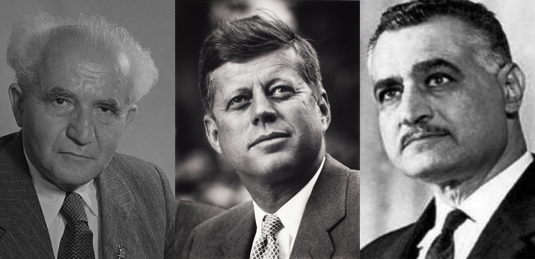
  • Nasser, Kennedy, the Middle East, and Israel

    Nasser, Kennedy, the Middle East, and Israel


    For decades, the critical community overlooked areas of Kennedy’s foreign policy outside of Vietnam and Cuba. KennedysandKing has attempted to correct that oversight in recent years. We have tried to educate our readers on issues like Kennedy’s policies in Congo, Indonesia, Dominican Republic, and Laos. We have also tried to show how, after his murder, those policies—as well as his policy toward Vietnam and his attempts at detente with Moscow and Havana—were also altered.

    But there is still another area of the world about which Kennedy’s reformist foreign policy is overlooked. That area is the Middle East. This is odd since many commentators justifiably perceive that the Middle East is one of the most important areas on the globe. It is a geographic sector which, for decades, has been looked upon as something like a tinder box. A tinder box that has gotten even more potentially explosive, because, after Kennedy’s assassination, both Israel and Pakistan acquired atomic weapons. As we shall see, Kennedy was greatly opposed to any more countries acquiring these devices. This was not the policy of the presidents who followed.

    Perhaps the best way to approach this subject is to define the phrase used above: reformist foreign policy. That phrase can only be rendered into practical form by showing what preceded Kennedy and to then demonstrate how he attempted to alter that which preceded him. Under President Eisenhower, Secretary of State John Foster Dulles was pretty much allowed to steward foreign policy. (A difference with Kennedy, since JFK largely ran his own foreign policy.) Dulles followed Truman’s Secretary of State, Dean Acheson. As strong a cold warrior as Acheson was, John Foster Dulles was probably even worse.

    For example, as discussed in my four-part review of the Ken Burns/Lynn Novick 18-hour mediocrity, The Vietnam War, it was Acheson who made the initial American commitment to the French in their struggle to retake Vietnam after World War II. (Click here for that critique) From 1948–50, the United States had more or less a neutralist policy towards Indochina. If anything, we were trying to persuade France to grant Vietnam independence under a nationalist leader. The State Department also found that there was no compelling evidence of the Soviets influencing Ho Chi Minh, the man who was then leading the struggle for independence in Vietnam. (Pentagon Papers, Vol. 1, p. A-6)

    American policy changed in 1950. It was caused by the fact that France now transferred administrative functions not to a nationalist leader, but to Bao Dai, the veteran French puppet in Indochina. This angered Ho Chi Minh, as he knew what was coming next. And at this point Ho’s Democratic Republic of Vietnam was formally recognized by China and Russia. (Ibid, p. A-7) In reaction to that recognition, Acheson decided to alter America’s neutralist policy. In May of 1950, Acheson agreed to the first French request for American financial aid to Bao Dai. Later that year, America stationed a Military Assistance Advisory Group in Saigon to provide support to the French effort to salvage their colonial empire. (ibid, p. A-8) In other words, knowing what the true facts were, Acheson decided that standing by a European ally during the Cold War was more important than siding with Third World nationalism. Even though, as I noted in my Burns/Novick critique, Franklin Roosevelt wanted former colonies to be able to choose their form of government after World War II. Roosevelt was a Democrat and Acheson was serving a Democratic president, Harry Truman.

    John Foster Dulles’ Cold War attitudes were even more extreme, since they were amplified by an almost mystical religiosity. And unlike Acheson, Foster Dulles would not even seriously consider a doctrine of neutrality towards the Third World. (Robert Rakove, Kennedy, Johnson, and the Nonaligned World, pp. 5–8) Under Foster Dulles and Dwight Eisenhower, the aid to France increased exponentially. It is common knowledge that by the last year of the French civil war, that is 1954, America was supplying nearly 80% of France’s military costs. In fact, as John Prados has noted in his book Operation Vulture, Dulles put together a plan to save the French garrison at Dien Bien Phu by way of a huge air armada and the planned use of atomic weapons. When Eisenhower backed out of the operation due to his failure to get British cooperation, Foster Dulles himself offered the atomic bombs to the French foreign minister, who respectfully declined. (David Talbot, The Devil’s Chessboard, p. 245) As the reader knows, after Dien Bien Phu fell, Eisenhower and Foster Dulles decided to split Vietnam in two. This move necessitated Allen Dulles inserting the CIA into Vietnam, in large part at the employ of General Edward Lansdale.

    America now assumed the role the French had played previously. And the American-educated Catholic, Ngo DInh Diem, became America’s version of Bao Dai: our puppet run by the CIA and Lansdale. To show what a dyed-in-the-wool Cold Warrior Foster Dulles was, around this point, in 1957, he made this startling statement: “We have a clean base there now, without a taint of colonialism. Dien Bien Phu was a blessing in disguise.” (Emmett John Hughes, The Ordeal of Power, p. 208)

    II

    As Acheson and Dulles were paving the way for an epic tragedy through their Cold War maneuvering in Indochina, Senator John Kennedy was doing something different. He was trying to find an alternative way to navigate the troubled Cold War straits, one that resisted the spread of communism, but encouraged the flow of nationalist decolonization movements. In 1951, on a visit to Saigon, he began questioning America’s growing involvement in Indochina as an exemplar of the mushrooming Cold War. At that point, while still a congressman, he began to doubt whether France was going to win the war. Also, if France lost, was the United States going to replace her as the imperial power on the scene. (Click here for an excellent precis of Kennedy’s attitudes on the subject)

    After much thought and analysis, Kennedy concluded that what Acheson and Dulles had designed in Indochina—and what Foster Dulles had extended throughout the globe with his string of foreign treaties such as SEATO, CENTO etc.—was flawed and short-sighted. This is why, when the book The Ugly American became a best seller, Kennedy purchased a hundred copies and sent one to each of his colleagues in the senate. That 1958 novel was a thinly disguised portrayal of America’s growing crisis in Vietnam. It depicted the main cause of the crisis as the incompetence and insensitivity of the State Department to the desires and aspirations of the native population. In fact, the publishing company used the advertising line that the book was an expose of how America was losing the Cold War. (Rakove, p. 23) Kennedy thought the book was aimed at the misguided, overweening anti-communism of Foster Dulles and Eisenhower. As the book’s authors tried to show, there was a way to fight the Cold War without resorting to atomic threats or backing brutal dictators. And if that was all the United States had to offer, she might as well just stay home. (ibid)

    Many of the leaders of these Third World countries were upset and apprehensive at what the Eisenhower administration had done in the name of anti-communism in Iran in 1953 and Guatemala in 1954. To put it mildly, the citizens of those two countries were not better off after Foster Dulles and Eisenhower decided to have CIA Director Allen Dulles covertly overthrow their popularly elected leaders. In fact, in direct response to those two actions, some of the leaders of these independent nations decided to call a conference and start a movement. This took place in April of 1955 at the city of Bandung in Indonesia. The two key organizers were Sukarno of Indonesia and Nehru of India. The general idea for the conference was that human rights should be honored throughout the world and the sovereignty and territorial integrity of all nations should be obeyed. Thirdly, that new nations had the right to trade with and have dealings with any other country they chose. Finally, if international disputes arise they should be dealt with peacefully and in conformity with the charter of the United Nations. This was the beginning of what was called the Nonaligned Movement.

    As author Robert Rakove has noted, neither John Foster Dulles, nor Dean Rusk looked upon the conference with affection or sympathy. In fact, Foster Dulles thought of staging his own conference to counter Bandung. Rusk, then at the Ford Foundation, looked at this idea with favor. Rusk said of the leaders at Bandung, “Some of these fellows were just plain rascals.” (Rakove, p. 52) Kennedy disagreed. He looked at these leaders as the wave of the future. (Philip Muehlenbeck, Betting on the Africans, p. xviii) Once he got to the White House, he wanted to deal with them and he did. One of the leaders at that conference was Gamal Abdel Nasser of Egypt. In fact, Egypt hosted what many historians see as the follow-up to Bandung: the Cairo Conference of 1957.

    Nasser did this after telling John Foster Dulles he would not join the Baghdad Pact (which eventually became CENTO). He told Dulles he could not join any organization that included the United Kingdom as a silent partner, since they were the largest colonial empire in the world. If he did such a thing, he would lose his stature in both Egypt and the Arab world. Philip Muehlenbeck wrote, “Clearly Nasser feared losing domestic popular support and being labeled as a ‘sellout’ or ‘western stooge’ unless he took a strong anti-British line.” (Muehlenbeck, p. 11)

    III

    Kennedy consciously rejected the similar paths taken by Acheson and Foster Dulles. For example, he told Harris Wofford prior to his nomination for the presidency that they had to win in Los Angeles, because if either Stuart Symington or Lyndon Johnson took the nomination it would just be more of Dulles/Acheson. He went on as follows:

    The key thing for the country is a new foreign policy that will break out of the confines of the Cold War. Then we can build a decent relationship with developing nations and begin to respond to their needs. We can stop the vicious circle of the arms race and promote diversity and peaceful change within the Soviet Bloc. (Muehlenbeck, p. 37)

    As the reader can see from above, Kennedy did not limit his approach to the African/Asian countries emerging from colonialism. He also wanted to promote American aid to those nations in the Eastern Bloc. (The Strategy of Peace, by John F. Kennedy, pp. 82–98) As George Ball, a Kennedy advisor in the State Department said, JFK wanted to alter the dynamic of American foreign policy. He thought that what Foster Dulles had done was to cede the decolonization issue to the Soviets. And by doing that, America had given an advantage to Moscow because they were now perceived as being for independence and nationalism. (Muehlenbeck, p. xiv)

    Nasser fit into Kennedy’s new calculus in a basic, but visionary, manner. In 1957, Kennedy gave his milestone speech on Algeria in front of a (virtually) empty senate. It did not matter that almost no one was there. That speech was so compelling, far-sighted, and harshly critical of the White House that it still created a mini-sensation in Washington and throughout the country. It essentially said that the administration was dead wrong in standing by France in its attempt to stop the secession of Algeria from the French commonwealth. We were on the wrong side of history. And what was going to happen in Algeria was the same thing that had just occurred three years prior in Vietnam.

    But there is a small section of that speech that has been overlooked. In fact, I myself had missed it until I read the speech for the third time back in 2013. Kennedy stated that the USA, instead of aiding France in its doomed war, should be starting exchange programs in Algeria in different fields, including education. That would help Algeria build up a civil servant class. And also tradesman and professionals and this could lead to “progress, stability, and good will.” He then followed that passage with this:

    In these days, we can help fulfill a great and promising opportunity to show the world that a new nation, with an Arab heritage, can establish itself in the Western tradition and successfully withstand both the pull towards Arab feudalism and fanaticism and the pull toward Communist authoritarianism. (Kennedy, p. 75, italics added)

    Kennedy had studied for this speech and knew Algeria was a predominantly Muslim country. The work he did is revealed by the follow up article published on the subject in Foreign Affairs magazine. (October, 1957, pp. 44–59) He understood that there was something of a tug of war going on in the Middle East. To Kennedy, John Foster Dulles had miscalculated the dynamics of that struggle.

    Nasser was a secularist leader who led a republic and had developed many socialist policies in Egypt, including land reform. He was also the most popular and charismatic leader in the Middle East and Arab world. This is remarkable since Nasser was not a fundamentalist. (Click here for a video)

    In fact, as he noted in the speech above, Nasser had tried to deal with the extremist Muslim Brotherhood in Egypt, but he found them unreasonable to the point that they had planned several assassination plots against his government. Therefore, in 1954, he decided to go to war with that group. The Egyptian legal authorities arrested several leaders, raided their mosques, and stripped some of them of citizenship. This culminated in an assassination attempt by the Brotherhood against Nasser in October. That caused a fatal reprisal by Nasser. Thousands of members were arrested, many got long prison terms, and several were hanged. (Robert Dreyfuss, Devil’s Game, pp. 103–04)

    But there was a complicating factor behind Nasser’s war with those who advocated Muslim states and Sharia Law in the Arab world. First, the Muslim Brotherhood in Egypt owed its start to the British, through a grant from the Suez Canal Company. And the British would use the Brotherhood as a counter to nationalists and communists in Egypt. (Dreyfuss, p.47) Second, the Brotherhood was later financed by Saudi Arabia. As Robert Dreyfuss has written, what Nasser opposed—a pan Islamic state—was begun by the cleric Jamal Eddine al-Afghani. He proposed it to the British and they helped sponsor his movement, turning him into a 19th century Islamic version of Pat Robertson. (Dreyfuss, p. 20) As Dreyfuss also noted, it was Afghani’s ideas which gave rise to Hasan al-Banna, who formally began the Muslim Brotherhood in Egypt in 1928. This was years after Afghani had offered to go to Egypt as a British intelligence agent. (Dreyfuss, p. 20)

    The reader might ask: why would the British do such a thing in the Middle East? First, because at that time—through its financing of the Suez Canal—Egypt was an imperial appendage of England. And, therefore, England believed that the Islamists would work as a counterweight to nationalistic and revolutionary movements, both in Egypt and throughout the Middle East. (Dreyfuss, pp. 27–28) As Dreyfuss also notes, and it’s a key point, this fundamentalist messaging was new at the time. As he writes in Devil’s Game, “Not in centuries had Muslims heard a challenge to renew their societies according to the methods of the early caliphs.” (p. 30)

    The other reason that developed to favor British support was monetary. They began to realize that there was a wealth of petroleum lying under Middle East sand. (Dreyfuss, pp. 35–36). They then reasoned that it would be easier to deal with the states that had oil if they stayed Islamic monarchies than if they were transformed into secular, nationalist, republics. The United Kingdom was willing to do this even if it meant actually allying itself with the extreme form of Islam practiced in Arabia called Wahhabism. These Muslims were almost demonic zealots pledged to their belief in Islamic fundamentalism. And the Muslim Brotherhood had roots in Ibn Saud’s organization of the most militant wing of his followers. The first formal treaty between England and Saudi Arabia was signed in 1915. (Dreyfuss, pp. 38–39)

    IV

    With this background, the reader can see how someone like Nasser could pose a threat to England. Because he did turn Egypt into a secular, nationalist republic. He then became a hero throughout the Middle East, when he nationalized the Suez Canal. But beyond that, what the British and the USA really feared was that Nasser could create a pan Arab league which would then utilize the massive amounts of oil and cash to turn the Middle East into an area of productivity, education, and republics. That is how insanely appealing Nasser was to the Arab world. To use one example, Prince Talal of Saudi Arabia defected to Egypt and demanded a republic be established in Arabia. (Dreyfuss, pp. 97–99)

    On July 26, 1956, Nasser announced he was nationalizing the Suez Canal. This triggered meetings at the United Nations in order to stave off desperate measures by the co-builders and operators of the canal, England and France. Foster Dulles tried to arrange a deal within the Security Council. Prime Minister Anthony Eden of England was particularly virulent in his hatred of Nasser and discounted any UN conciliation. Eden now joined France and Israel—which looked upon Nasser as a formidable Arab nemesis—to stage an assault on Egypt. This was called the Suez Crisis. It began on October 28, 1956, with Israel crossing the Sinai to take the canal. President Eisenhower was not informed of this attack. (Leonard Mosley, Dulles, pp. 412–15) Eisenhower then got confirmation that the Israeli land invasion had been complemented by a British air strike on Nasser’s air force. Foster Dulles subsequently informed the president that both the British and French had sent battleships and troop carriers across the Mediterranean toward Egypt. (Mosley, pp. 418–19)

    Eisenhower was quite upset about all this being done behind his back. And Eden later said it was a mistake to launch the assault without directly consulting with Ike. (Mosley, p. 412) Foster Dulles now flew to New York to address the General Assembly, bypassing the Security Council where France or England could veto the resolution. He condemned the invasion of Egypt in the harshest terms and demanded a resolution demanding it be halted. This passed overwhelmingly. (Mosley, p. 423)

    During the crisis, Nasser had blocked the canal by sinking the ships in the waterway. (Mosley, p. 424). He emerged from this crisis more wildly popular than ever.

    But Foster Dulles had an erratic posture toward Nasser. The Secretary of State did not like Nasser’s support for Algerian independence or his recognition of China. And just before the Suez Crisis began, Foster Dulles pulled American support for the Aswan Dam to be built on the Nile. Some commentators think this is what caused the crisis, since Nasser now needed another source of income to build the dam. (Rakove, p. 11)

    As many commentators have noted, the end of the Suez Crisis was a golden opportunity to make amends with Nasser. That did not happen. And Nasser now turned to the USSR for aid in building Aswan. Also, in January of 1957, the White House announced the Eisenhower Doctrine. This allowed foreign countries to ask not for aid, but for American direct intervention in the face of a Soviet threat. It was motivated by growing influence in Syria and Egypt by Russia following the Suez Crisis and, also, because Nasser was now the undisputed leader of pan-Arab sentiments in the Middle East. (Muehlenbeck, pp. 13–16) Dulles’ policy was so schizoid toward Nasser in 1956 that some authors have concluded that he had tricked Eden. And this was the real reason America had done what it did during Suez. In a personal visit with the British prime minister, Eden had clearly hinted to Dulles an intervention was coming in Egypt. But Dulles told him he did not want to hear the specifics. By not telling Ike about the unnamed impending action, Dulles was able to take advantage of the president’s anger. And this allowed him to teach England a lesson: America was now in the driver’s seat and England was a passenger. (Mosley, pp. 424–25)

    But then Foster Dulles and Eisenhower did something even more inexplicable. Foster Dulles once told the National Security Council, “Although Nasser is not as dangerous as Hitler was, he relies on the same hero myth and we must try to deflate that myth.”  Vice President Nixon, as he usually did, warned the NSC that Nasser’s influence could facilitate communist influence in Africa.

    Eisenhower later wrote that he feared Nasser becoming “an Arab dictator controlling the Mediterranean”. (Muehlenbeck, p. 14) In order to counteract Nasser’s appeal to secular nationalism, they now turned to King Saud of Saudi Arabia. Eisenhower wrote to Foster Dulles: “If we could build Saud up as the individual to capture the imagination of the Arab world, Nasser would not last long.”  When Saud visited Washington in 1957, Eisenhower got him to agree to the principles of the Eisenhower Doctrine, which Nasser would not go along with. (Muehlenbeck, p. 15)

    In fact, one reason for the formulation of the doctrine was to try and curb Nasser’s influence in places like Jordan and Lebanon. Nasser understood this also. He said it was an attempt to isolate Egypt, thereby, “Accomplishing the aims of the Suez aggression by peaceful means.” (ibid) But if the goal was to distract from Nasser, the choice of Saud was as unwise as backing Ngo Dinh Diem against Ho Chi Minh. A longtime diplomat in the area characterized Saud as “weak, stupid and corrupt” and surrounded by Levantine courtiers. On top of his lack of understanding of the modern world, Saud was also personally dissolute: a drunk and a sex addict. He had countless children from a string of wives and concubines. So not only did he not appeal to those who advocated Arab nationalism and republicanism, he could not really appeal to the religious fundamentalists. (Dreyfuss, p. 122) But yet, that is what Eisenhower and Dulles were trying to do, to the point of conducting talks with close advisors to Saud. One of whom plotted to assassinate Nasser. But we must also note the following: Saudi Arabia was actively using its immense wealth to spread and sanction the Muslim Brotherhood worldwide. In other words, a terrorist fundamentalist group which advocated for Sharia law. (Dreyfuss, pp. 124–25) In a page right out of The Ugly American, America was ready to jump in bed with anyone who opposed nationalism, republicanism, and socialism.

    V

    As he did in most areas, John Kennedy devised much of his policy in opposition to what Eisenhower and Foster Dulles advocated for and acted upon. He was opposed to the landing of Marines in Lebanon in 1958 and the USA essentially allowing a military takeover there. (Click here for details) He and his brother also did not like what had happened in Iran, with the Shah essentially running a royalist dictatorship. The Kennedy administration held an internal debate over whether or not to try and help a nationalist government displace Shah Reza Pahlavi. (Dreyfuss, p. 225)

    But where Kennedy thought Foster Dulles had really screwed up was with Nasser. In his opinion, Foster Dulles had left Nasser with little choice but to go to the Soviets for partial funding of Aswan. During the 1960 campaign, Kennedy explicitly criticized Eisenhower on this issue. He said that Washington had to find a way to “recognize the force of Arab nationalism” and to “channel it along constructive lines.” (Muehlenbeck, p. 124). He also added this:

    But if we can learn from the lessons of the past—if we can refrain from pressing our case so hard that the Arabs feel their neutrality and nationalism are threatened, the Middle East can become an area of strength and hope. (ibid)

    As with other areas of the globe, Kennedy felt he could compete with the USSR in the Middle East. But he could only do so by working with Nasser rather than ostracizing him. Kennedy immediately set out to mend fences with the Pan Arabist. First, he appointed Dr. John Badeau as the American ambassador to Egypt. Badeau spoke Arabic, had been the head of the Near East Foundation, and probably knew more about Egypt than any other American. Kennedy then appointed Robert Komer to the NSC and made him a specialist in Middle East affairs. Komer was an efficient and loquacious bureaucrat who advocated for furthering a relationship with Nasser and was not beholden to Israel in disputes between the two. Finally, Kennedy told National Security Advisor McGeorge Bundy that he should put the question of better relations with Egypt near the top of the foreign policy agenda of the New Frontier. (Muehlenbeck, pp, 124–25).

    As the reader can see, as with another country in Africa, Congo, Kennedy pretty much broke with what had come before him. The president now began to exchange correspondence with Nasser on controversial areas of the world, like Cuba, Congo, and Palestine. As Badeau later wrote, “…the success of President Kennedy’s dealings with Arab leaders was the clarity and frankness with which he spoke and wrote to them…always in a spirit of respect and equality.” (ibid, p. 127)

    In September of 1961, the new relationship underwent its first crisis. The United Arab Republic, Egypt’s union with Syria, was broken up by the military. Nasser suspected this was done at the instigation of the CIA, which had previously plotted against him. Badeau tried to assure him that the USA was not involved. And Kennedy swiftly went to work to make the break up less jarring. He refused to recognize the new government in Syria until Nasser was ready to do so. Secondly, he requested both more aid and a large loan to Egypt to cushion the impact of the split. (Muehlenbeck, pp. 127–28). These two moves were effective in establishing a further rapport with Nasser. In fact, by late 1962, when Kennedy decided to sell surface to air missiles to Israel, he told Nasser about it in advance of any public notice. Nasser did not like the sale, but his respect for Kennedy and his appreciation of the heads up, stopped any formal or public protests against it.

    Kennedy also made it clear that he did not like having to deal with the dissolute Saud and his extremist monarchy. For him, Nasser represented the hopes and aspirations of Arab nationalism. He was the reformer who could lead into a new and different future. Consequently, JFK wanted to disconnect America from the relic of the past, namely the Saud family. This was demonstrated in the fall of 1962, when the monarch was in a Boston hospital.  Kennedy deliberately did not go to Hyannnis Port at this time. After the king was released, he rented a home in Palm Beach, fifteen minutes from the Kennedy compound in Florida. Still, Kennedy did not want to visit the man. Finally, the State Department insisted Kennedy visit the ruler of Saudi Arabia. Even at that, on the way over, he kept on telling his driver, “What am I doing calling on this guy?” (Muehlenbeck, pp. 133–34)

    By late 1962, the State Department had agreed that Kennedy’s effort to heal the rift with Nasser had largely succeeded. This policy had forestalled Soviet gains in Egypt and Syria, he had reoriented trade in both places toward the West, and Nasser had agreed to keep the Palestine issue from gumming up relations. (Muelhenbeck, p. 134)

    But something had now erupted in the area, which was about to disrupt the growing friendship. Similar to today, there was a war in Yemen. Today, the opponents are really Saudi Arabia and Iran and the war is fought through their proxies. In 1962, the war broke out because of the overthrow of the royal monarchy by a republican force. Quite naturally, Saudi Arabia supported the former and Nasser supported the latter. Egypt even sent ground troops. In addition to Saudi Arabia, the royalists were supported by Jordan (a monarchy), England, and significant for this essay, Israel. In defiance of London’s specific request, Kennedy declared he was backing Nasser and his desire to turn Yemen into a republic. (Muehlenbeck, p. 135) This was another example of Kennedy forsaking a European ally in order to forge a bond in the Third World.

    The problem was that Saudi Arabia saw this as an opportunity to drive a wedge between Kennedy and Nasser, who they despised. Therefore, they had no intention of negotiating for a truce, much less a peace settlement. Both British Prime Minister Harold Macmillan and Israel’s foreign minister, Golda Meir, tried to influence Kennedy to withdraw his backing of Nasser in Yemen. Kennedy decided to send Ellsworth Bunker to start negotiations. Bunker had a personal letter from Kennedy with him which he gave to Nasser. He reminded the Egyptian leader of how much he had withstood in order to back him and how much was now on the line. Kennedy was clearly frustrated by the failure to secure a truce either by Bunker or through the UN. (Muehlenbeck, p. 137)

    VI

    The other problem Kennedy had in his pro-Nasser approach was with Israel. Perhaps the only group of people who disliked Nasser more than the Muslim Brotherhood were the leaders of Israel. In 1954, Israel had commissioned a false flag bombing operation against Nasser, which is today called the Lavon Affair, after Israel’s then Minister of Defense Pinhas Lavon. In 1956, prior to the Suez Crisis, then Prime Minister David Ben Gurion was open about what he wanted Israel to get from the defeat of Nasser: the elimination of Jordan as a state, the East Bank would go to Iraq as the home for the Palestinians, the West Bank would be annexed by Israel, expansion of Israeli borders into south Lebanon, and annexation of parts of the Sinai (Patrick Tyler, Fortress Israel, pp. 82–83) But after the failure of the operation, UN Secretary General Dag Hammarskjold brought in a large peacekeeping force, in order to maintain the previous borders. In one of his first disagreements with Ben Gurion, Kennedy wanted this peacekeeping force strengthened,and he wanted no intervention by Israel in Jordan. (NSC memo by Robert Komer to JFK of 12/22/62; Samuel Belk memo to McGeorge Bundy of 8/23/63; Kennedy memo to Tel Aviv of 5/1/63)

    It is very clear from the cable traffic that the Israelis knew about Kennedy’s communications with Nasser. It is also clear that they did not like it and took every opportunity to demonize the Egyptian leader to Kennedy. This went as far as comparing Nasser with Adolf Hitler and saying that if Egypt were to win a war with Israel, Nasser would do to the Jews what the Third Reich did to them in Eastern Europe. (5/12/63 letter from Ben Gurion to Kennedy; memo of meeting between Kennedy and Ben Gurion of 5/5/30/61)

    From the partly declassified record secured by researcher Malcolm Blunt, Kennedy took this in stride and considered it to be boilerplate. In fact, at a press conference on May 8, 1963, Kennedy encouraged progress in the region as a whole,and this included acceptance of the aspirations of the Arab population for unity. (State Department cable of May 9, 1963) Kennedy then wrote a letter to Nasser and acknowledged the problems he was having with Israel. But added that this would not deter him from pursuing his relationship with Egypt. He then wrote that he would not oppose Nasser’s attempt to form a Pan Arab union. He closed by saying that Nasser could be reassured against any Israeli expansionism in the region. (Letter sent to Badeau in May of 1963)

    But not only were the Israeli leaders anti-Nasser per se, they looked askance at the idea of Pan Arabism. In a two for one sale, they tried to smear the movement by labeling it “Nasserism”. (State Department meeting with Israeli Minister of Education Abba Eban of 5/7/63) This is a key point for the future and the reader should keep it in mind as we progress.

    As anyone who followed the career of Prime Minister David Ben Gurion and his foreign minister Golda Meir would know, fundamentally they were opposed to negotiating with the Palestinians or with a third party representing the Palestinians. This was over the Palestinian homeland issue, in general, and the refugee dilemma, in particular. For instance, when asked during the 1948 war what should be done with the Palestinian population, Ben Gurion looked at his military commander Yitzhak Rabin and waved his hand in the air. (New York Times, October 23, 1979, story by David Shipler) In 1937, in a letter to his son, Ben Gurion had written, “We must expel Arabs and take their place.” (Journal of Palestine Studies, Vol. 41 No.2, pp. 245–50) Once he was in power, in 1948 during the Nakba, as quoted in Michael Bar Zohar’s biography, Ben Gurion had written in his diary that the Palestinian refugees should never return to Israel. (p. 148)

    Kennedy had a problem with this. He did want the refugees to return—and he even went beyond that. As a special envoy for the United Nations, Joseph Johnson had devised a plan in this regard. The United Nations would sponsor a program which would give the refugees a three-sided choice:

    1. They could stay where they were
    2. They could move elsewhere outside of Israel
    3. They could return to their homes in Israel prior to the Nakba

    The United Nations would pay the bill if they chose the last two options. Kennedy had backed this option plan even before it was officially stated by the UN. But it had been rejected by Ben Gurion in a cable to Secretary of State Dean Rusk. (January 24, 1963) What is remarkable about Kennedy in this regard is that, through his ambassador to Israel, Kennedy was still fighting for it into May of 1963. And at that May meeting, both Ben Gurion and Meir were in attendance.

    VII

    The other major issue Kennedy had with Israel was, of course, over the atomic reactor at Dimona. Again, when one studies the life and career of Ben Gurion, one can see that he wanted atomic weapons for Israel for decades on end. He once said that, “What Einstein, Oppenheimer, and Teller—the three of them are Jews—made for the United States, could also be done in Israel for their own people.” (Jeffrey Goldberg, The Atlantic, September, 2010) He felt that this was necessary especially in the case of the rise to power of someone like Nasser. As Zachary Keck wrote in The National Interest, this dated back to the founding of Israel in 1948:

    Ben Gurion viewed nuclear weapons as a last resort for ensuring the survival of the Jewish state in case its enemies used their much larger populations and economies to build conventionally superior militaries. (4/4/2018)

    Ben Gurion and the other Israeli leaders were so devoted to this aim that they resorted to two illicit means in order to secure the goal. First—there is no other way to say this—they involved themselves in a government-wide conspiracy to deceive Kennedy about the true nature of the Dimona reactor. Israel already had a small reactor in place at Soreq in the Negev Desert. This was legitimately used for research purposes and for energy in 1956 under the auspices of the Israel Atomic Energy Commission. It could not produce weapons grade plutonium.

    But, in 1958, Israel began building a much larger reactor nearby. At the beginning of construction, they were aided by France. This was seen as a favor by the French in return for Israeli cooperation in the plot to invade Egypt and dethrone Nasser during the Suez Crisis. Eventually the French pulled out when they concluded that the aim of the reactor was to produce weapons grade plutonium. After this, France discovered that Ben Gurion was trying to buy uranium from both Gabon and the Union of South Africa. (Cable from State in Paris to Dean Rusk, 8/14/63)

    Once Kennedy began receiving information like this—and from more than one source—he suspected he was being lied to. He was correct. In the cables and correspondence secured by Malcolm Blunt, this author noted six different instances where Kennedy, or his direct representative, was assured by Ben Gurion, Meir, or Abba Eban that Dimona was not designed to produce atomic weapons.

    I should note something for the record here before proceeding. Kennedy had been harshly opposed to Foster Dulles attempting to use atomic weapons in 1954 at Dien Bien Phu. He had tried to attain a test ban treaty with the Soviets and succeeded in 1963. Roger Mattson, an authority on DImona, has written that no president—before or since—was more opposed to nuclear proliferation than Kennedy. (Mattson, Stealing the Atom Bomb, pp. 38–40, 256) Therefore, Kennedy was not singling out Israel. He was simply and strongly against the spread of atomic weapons. Period. Consequently, he requested inspections of Dimona.

    To say that Israel was slow to respond and rather reluctant to allow full inspections is severely understating the case. Israel allowed two visits under Kennedy, one in 1961 and one in 1962. Each was about forty minutes in length and the inspectors were not given full access to the plant. (Memo from Robert Komer to Kennedy, 12/12/62) What made this worse was the fact that the State Department had told Nasser that Dimona was being built for peaceful purposes. (Cable from State in Cairo to Rusk, 4/25/63)

    In early summer of 1963, National Security Advisor McGeorge Bundy and Under Secretary of State George Ball joined Komer in his disdain for the mendacity and unfairness of what Israel was doing. On May 10, 1963, Kennedy sent a letter to Ben Gurion expressing his frustration at the state of affairs. He said Tel Aviv had not responded to a request for regular inspections. This puzzled him, since no other country in the Middle East was even close to being able to produce highly enriched uranium or weapons grade plutonium. He closed the letter with something no other president, before or since, had done with Israel: he threatened to pull American funding for Israel if no regular inspections were forthcoming.

    Ben Gurion called for a cabinet meeting before preparing a reply. The Ben Gurion letter was the usual boilerplate Kennedy had seen many times before. He again compared Nasser to Hitler and requested a bilateral defense treaty with America. (Letter of 5/12/63 from Ben Gurion to Kennedy) On May 27th, he replied a bit more rationally, but there was still no proposal about regular inspections.

    On June 15, 1963, Kennedy replied to Ben Gurion. And there was a supplementary note sent by Dean Rusk to the American ambassador in Tel Aviv. Kennedy repeated his warning: either there would be full and regular inspections or Ben Gurion would be placing future American aid in limbo. Rusk’s note said that these inspections had to be arranged before the reactor reached criticality.

    One day after Tel Aviv was in receipt of this letter, David Ben Gurion resigned his post as prime minister. He had held that office for a combined 14 years. To this day, there is a controversy about whether or not his retirement was caused by his conflict with Kennedy. Levi Eshkol now assumed office. About two weeks after Ben Gurion’s resignation, Kennedy wrote the following to Eshkol:

    This government’s commitment to and support of Israel could be seriously jeopardized if it should be thought that we were unable to obtain reliable information on a subject as vital to peace as the question of Israel’s effort in the nuclear field. (Letter of July 4, 1963)

    At the time of Kennedy’s assassination, Bundy was negotiating with Eshkol the terms of biannual inspections of Dimona. One sticking point was that Eshkol did not want Nasser to know about the visits. Whereas for Kennedy, this was one of the predicates for the inspections. (Bundy memorandum to Kennedy, 8/23/63)

    VIII

    A familiar pattern took place with American policy in the Middle East after Kennedy’s assassination—a pattern which has lasted until today. As with, for example, Sukarno in Indonesia, Lyndon Johnson did not see the point in keeping up the relationship with Nasser. Slowly but surely, President Johnson slipped back to the Eisenhower/Dulles policy in the Middle East. One problem between the two men was the new president’s escalation of the war in Vietnam. Quite naturally, Nasser was opposed to this new militaristic policy. When this difference came out into the open, Johnson retaliated by cutting aid to Egypt and shipping more arms to Israel. As could have been predicted, and as what happened under Eisenhower, this gravitated Nasser toward the USSR (Rakove, pp. 241–42)

    To make the split with Kennedy even more marked, Johnson now grew closer to Saudi Arabia. In fact, he began to set up what was essentially a military alliance with this fundamentalist monarchy. First, he equipped them with a 400-million-dollar air defense system. Then, he designed plans for military bases and also a 100-million-dollar grant for trucks and other transport vehicles. (Dreyfuss, p. 142) Saudi Arabia later declared Nasser an infidel. To this day, that brutal monarchy spends millions smearing Nasser’s legacy. (Consortium News, 10/15/2020, “In Defense of Nasser”)

    American policy toward Israel also changed under LBJ. As Roger Mattson notes in his book on the subject, when the CIA alerted the new president that it appeared that Israel had now developed the atomic bomb, Johnson barely reacted. (Mattson, p. 97) There was no official investigation launched. In fact, Johnson told the CIA not to alert either State or Defense about the discovery. Through Mattson, and also author Grant Smith, we know today that Israel had stolen hundreds of pounds of highly enriched uranium out of what was essentially their shell plant in Apollo, Pennsylvania, called NUMEC.

    During the Six Day War in 1967, Johnson clearly favored Israel. The ultimate proof of this is the infamous Liberty Incident. Israeli jets attacked an American communications vessel for hours. This resulted in 34 dead and 171 wounded. Johnson did not break relations with Israel. And there were no trials held over this atrocity. As the late Peter Novick noted in his controversial book, The Holocaust in American Life, it was after this war and this incident that the Holocaust seemed to loom ever larger in American culture. (Click here for a Novick lecture)

    Although it was praised at the time, the Carter/Anwar Sadat Camp David Accords were largely bilateral, that is between Egypt and Israel. Unlike with Kennedy, there was no address made to the Palestinian right of return. This is why the agreements were not accepted by the United Nations. In fact, as a result, Egypt was expelled from the Arab League for the next ten years. Most commentators believe that Nasser, who had died in 1970, would not have accepted such an agreement. As historian Jergen Jensehaugen wrote about the Accords in his book Arab-Israeli Diplomacy under Carter, the president was left,

    …in an odd position—he had attempted to break with traditional US policy but ended up fulfilling the goals of that tradition, which had been to break up the Arab alliance, sideline the Palestinians, build an alliance with Egypt, weaken the Soviet Union and secure Israel. (p. 178)

    This policy was accelerated and perhaps epitomized by Secretary of State Hillary Clinton’s disastrous war on Libya under President Obama. Again, Muammar Gaddafi was an Arab nationalist and socialist. He deposed a monarchy in 1969, attempted to turn his country into a republic, and allied himself with Nasser. A problem he had in Western eyes was his support of revolutionary movements elsewhere. And as John Ashton shows in his 2012 book on the case, it is much more likely that the Lockerbie bombing was done by Iran than Libya. Nevertheless, Hillary Clinton convinced Obama to go to war with Libya through NATO. This resulted in a disaster as it turned the country over to fundamentalists who sponsored terrorism. One would have thought that Obama would have learned the lesson of George W. Bush’s invasion of Iraq and the rise of ISIS. (Click here for details)

    Which brings us to Donald Trump and his son-in-law Jared Kushner. Kushner had no foreign policy experience prior to entering the White House. Apparently his qualifications in this area were that he was married to Trump’s daughter Ivanka. Yet Trump placed him in charge of an overall Middle East peace plan. The Palestinians were dead set against Kushner’s role for the simple reason that he had a longstanding, friendly relationship with Israeli’s rightwing Prime Minister Benjamin Netanyahu. Trump also seemed oblivious to the cross purposes Kushner’s actions would have in regards to Secretary of State Rex Tillerson’s ideas. Tillerson thought Kushner’s Middle East plans were short on historical perspective and relied on money grants to function. Tillerson also thought that Kushner’s actions with Netanyahu were “nauseating to watch. It was stomach churning.” (Bob Woodward, Rage, pp. 64–65)

    Like Obama, Trump came into office talking about fairness for the ignored Palestinian interests. It appears that this disappeared under Kushner’s influence. In May of 2017, Trump was in Tel Aviv meeting with Netanyahu. Kushner called Tillerson into the meeting—which tells you something right there. When Tillerson got inside, Trump told him to watch a video that Netanyahu had just showed him. Tillerson deduced that the Israelis had spliced together a falsely edited presentation of Palestinian Authority leader Mahmoud Abbas. Abbas was supposed to be Israel’s partner in Kushner’s plan, yet here he was ordering the murder of children. Netanyahu played the tape again and then said, “And that’s the guy you want to help?” He then left.

    Tillerson tried to inform Trump that what he just saw was a piece of fabricated propaganda. Trump ignored this. He now turned on Abbas and the Palestinians. He closed the office of the Palestinian Liberation Organization in Washington, cancelled nearly all US aid to the West Bank and Gaza, as well as 360 million in annual funds for the UN plan to aid Palestinian refugees. (Woodward, p. 67) This story is important, since it illustrates how easily Trump was deceived by propaganda and how resolute Kennedy was in the face of it.

    Netanyahu was the leader of Likud during the campaign of 1995, which resulted in the assassination of Labor’s Rabin. That race was marked by a definite attempt by Likud to polarize the voting populace into two opposing camps. If one had a conciliatory attitude toward the Palestinian problem, one was smeared as an appeaser. Rabin was campaigning on an anti-violence platform, in support of the Oslo peace process. Netanyahu characterized the land for peace program as not being in the Jewish tradition or maintaining Jewish values. This rhetoric inspired the worst aspects of the Likud to draw posters of Rabin in a Nazi uniform in the crosshairs of a gun. Netanyahu even led a mock funeral procession featuring a coffin and a hangman’s noose at an anti-Rabin rally. (Ben Caspit, The Netanyahu Years, p. 123) Urging his crowds on, they began to shout “Rabin is a traitor” and “Death to Rabin.” Even when he was alerted to a plot against Rabin and was asked to tone down his rhetoric, Netanyahu declined. (Charles Smith, Palestine and the Arab-Israel Conflict, pp. 464, 466) Netanyahu never accepted responsibility for building the polarization that resulted in Rabin’s murder. In the face of this, one has to wonder about Jared Kushner and Trump accepting a falsified video from a character like him. One is also reminded of Trump’s refusal to condemn White Supremacy and his characterization of Charlottesville as featuring fine people on both sides. As in the case of Rabin, these public pronouncements likely contributed to the kidnapping plot against governor Gretchen Whitmer.

    As the reader can see, the breakage in Kennedy’s policy in the Middle East has now led us to just about a reversal of his policy. Kennedy wanted to appeal to the Arab forces he considered moderates, in hope of spreading the elements of moderation—republics, socialism, free education—throughout the Middle East. He then could move on a solution to the Palestine problem. What has happened there today is that American policy now attempts to accent the extremes. This includes Trump saying that he helped save Saudi Crown Prince Mohammed bin Salman’s “ass”, in the murder of author Jamal Khashoggi. ((Woodward, pp. 226–27) Make no mistake, this also extended to Hillary Clinton’s attempt to overthrow Syria’s President Bashar al-Assad via Operation Timber Sycamore. Assad is another secularist Middle East leader who does not wear a hajib. Evidently, President Obama saw the results in Libya and decided one disaster was enough on his watch.

    But after Iraq, Libya, and Syria, who could not see the pattern? As Kennedy warned in 1957, all of this unleashed Muslim fundamentalism. By simultaneously supporting Likud and the Saudis, the policy of polarization stays intact. It preserves Likud, as it retards any modernization and progress for the Arab citizenry. By doing so, it constitutes the posthumous triumph of the neocon philosophy over Kennedy’s attempt to befriend the last great leader of the Arab world.


    Jim extends his personal thanks to Malcolm Blunt for unearthing the research documents used in this article from the JFK library.

  • Sylvia Meagher and Clay Shaw vs. Jim Garrison

    Sylvia Meagher and Clay Shaw vs. Jim Garrison


    In writing my elegy for Vincent Salandria, I reviewed his career in the JFK field, cataloguing his achievements and his characteristics as a critic—the first critic—of the Warren Report.

    In reviewing that impressive record, I was again struck by his personal relationship and his lifelong fairness to New Orleans DA Jim Garrison. What made this aspect more salient was something I may have underplayed in my article: Salandria spent decades as a practicing attorney in Philadelphia. In my article, I noted that Vince was a high school teacher in 1964 when he encountered Arlen Specter talking about the Warren Report at a Philadelphia bar association event. That was true, but Salandria taught part time. He practiced law in the afternoons, and after he retired as a teacher, he worked for the Philadelphia school system as an attorney.

    Salandria had attended law school at the University of Pennsylvania in Philadelphia. That university is a member of the Ivy League and their law school is habitually rated in the top ten of the US News and World Report rankings in the field. (For 2021, they are rated number 7). Therefore, Salandria was one of the few early critics who was also a lawyer. In fact, in the early critical period of 1964–66, aside from Mark Lane, he may have been the only one. (They would later be joined by attorney Stanley Marks of Los Angeles.) This placed him in a position to not only understand more precisely what the Warren Commission had done with the evidence, but also to understand what Jim Garrison was up against when he began his criminal investigation in New Orleans. As I noted in my requiem, Salandria told me that at his first personal meeting with Garrison he told him he probably would not succeed in his attempt to flush out the conspiracy by beginning at the lower level and leveraging them against the upper level. But he would be able to learn something about the plot by the acts of those who would try and interfere with his inquiry.

    With what the Assassination Records and Review Board declassified about New Orleans in this regard, Salandria—as he usually was—proved to be prescient in that prediction. For as we now know, very soon after Garrison’s investigation was made public, the CIA was recruiting local attorneys in New Orleans to defend certain suspects and defendants (e.g. lawyers like James Quaid, Edward Baldwin, and Steve Plotkin). In September, at the request of Director Richard Helms, the Agency assembled its first meeting of the Garrison Group. At that meeting, Ray Rocca, James Angleton’s first assistant, declared that if things were to proceed as they were, Clay Shaw would be convicted. (James DiEugenio, Destiny Betrayed, second edition, p. 270) The meeting was convened by Helms in order to consider the implications of Garrison’s actions before during and after the trial of Clay Shaw. From the declassified record, the result was that certain counter measures were now taken to obstruct, cripple, and negate Garrison’s inquiry (e.g. blocking service of subpoenas, flipping witnesses, recruiting infiltrators). (Ibid, pp. 271–85)

    I should add here another key action taken by the Agency around this time. In April of 1967, they issued worldwide a memorandum which was titled “Countering Criticism of the Warren Report”. This memo was essentially a call to action to all station chiefs to use their assets in order to attack the critics of the Commission. It even outlined techniques to use in the attacks, for instance:  accuse them of being interested in monetary gain, of having been biased from the start, or of having leftist political orientation. As author Lance deHaven Smith has noted, it was around this time that the New York Times began to use the phrase “conspiracy theorist” in a much more profuse and pernicious manner than before.

    Later—in July of 1968—the CIA distributed an attack article on Jim Garrison which had been written by Edward Epstein and published in The New Yorker. The memo advised all station chiefs to use the article in order to brief any political leaders; or assign it to assets in order to counter any attacks. This important memo, and the article’s author, should be kept in mind as we progress.

    Since Salandria predicted that things like the above would occur, and since he visited Garrison in New Orleans and served as an advisor for the Shaw trial, he appreciated what Garrison was doing in the face of the forces arrayed against him. Some others who did so were Mark Lane, Penn Jones, Maggie Field, Ray Marcus, and, at the time, Harold Weisberg. (Lane and Weisberg were actually working with the DA.)

    But there was a prominent Commission critic who, quite early, did not appreciate the warnings Salandria had issued about what Garrison was doing or the countermeasures taken against him. That critic was Sylvia Meagher of New York. At a rather early date, she staked out a position that separated her from the above writers and researchers. She also fostered a counter-movement in the critical community against Garrison. That movement would eventually include Josiah Thompson, Peter Scott, Paul Hoch, and, later, Anthony Summers.

    I am going to say some adverse things about Meagher in this regard, but I want to make it clear at the outset that none of this should detract from her achievements in the field. Her subject indexes to both the Warren Commission and the House Select Committee volumes were and are valuable assets to the research community. Her critique of the Warren Commission, Accessories After the Fact, is still one of the signal achievements in the literature on the case.

    It is one thing to expose a patently phony murder investigation, especially one that furnished the critic with 26 volumes of testimony and exhibits in order to dismantle itself—since so much of the 26 volumes contradicted, or at least compromised, the conclusions in the report. It’s quite another to try and find out what actually happened in a complex political assassination and what the smoke and mirrors were all about. As Vincent Salandria once said, the Warren Report was just too easy to tear apart. To the point that he came to think that it was designed to collapse.

    II

    Sylvia Meagher was born in New York City in 1921. Her maiden name was Sylvia Orenstein. She grew up in a rigidly orthodox Jewish home in Brooklyn. (Praise from a Future Generation, by John Kelin, p. 148) She dropped out of college and took a job as an analyst at the World Health Organization (WHO), which was directly associated with the United Nations. She briefly married her college instructor, James Meagher. He turned out to be an alcoholic, so she divorced him. (Kelin, p. 147)

    Although Gerald Posner called her a radical leftist, this was not accurate. What angered Meagher about the fifties was McCarthyism. She greatly resented President Truman’s obeisance to the Red Scare by his creation of Loyalty Boards. She was also resentful that the first Secretary General of the UN, Trgve Lie of Norway, allowed American officials to question employees of the UN and WHO in that regard. (Kelin, p. 114) He allowed the FBI to fingerprint his employees and to set up an office inside the Secretariat. As a result, many employees went before Senator Pat McCarran’s Senate Subcommittee on Internal Security and 47 went before a New York grand jury. There was a case where a woman did not take the fifth and admitted to attending a communist meeting some years prior; she was terminated. Several had to file a lawsuit for a monetary settlement, since not even Secretary General Dag Hammarskjold would rehire them. (Kelin, p. 115)

    Meagher insisted that if she was loyal enough to hire in the first place, she should not be called before a board. There was no reason in the record for her to reply to questions about who she was or what party she was loyal to. She was not fired, even though when she did appear before a board she refused to answer any questions. (Kelin, p. 118)

    Within an hour of the assassination—and perhaps because of this experience—Sylvia Meagher predicted that either a leftist or pro-Castro suspect would be arrested for the crime. But even she was surprised when it happened within 90 minutes of the assassination. (Kelin, p. 145) Unaware of how Earl Warren was coerced by President Johnson to serve as chairman of the Warren Commission, she wrote to the Chief Justice. She said, “I have no doubt whatever that you personally will do everything humanly possible to determine the truth.” (ibid)

    As we all know today, such was not even close to what Warren was about to do. Let us grant the lack of knowledge about Johnson intimidating Warren with the threat of atomic annihilation. (See Mark Lane, Plausible Denial, p. 51) One should have been able to figure out something was wrong with Warren from two early matters. First was his famous utterance that some of the material given to the Commission might not be seen in the lifetime of current reporters. (Lane, p. 53) The second giveaway was Warren’s failure to grant representation for Oswald’s interests before the Commission. The excuse for this was, again, secrecy. (See WC Volume 24, Commission Exhibit 2033) While in session, no outside attorney was going to get to see even a small percentage of the documents that the executive intelligence agencies had given the Commission.

    That second reason should have been a very clear “tell,” because of the Gideon vs. Wainwright case which Warren had just presided over in early 1963. In that case, his Supreme Court stated that a guilty verdict against Clarence Gideon had to be overturned, since the defendant had no lawyer. As a result, Gideon was granted a new trial with an attorney and he was acquitted. (James DiEugenio, The JFK Assassination: The Evidence Today, p. 309) But now, with the JFK case, Warren was willing to toss that decision aside. In other words, while in session, the proceedings would be virtually secret and Oswald would have no representation. In other words, Warren was presiding over what was pretty much a star chamber.

    After attending a lecture by Mark Lane in New York, Meagher’s interest in the case grew. Within two months of reading the Warren Report, she composed a 15,000 word critique. (Kelin, p. 146) She complained about the lack of “objective criticism” of the report. That critique was not published. In 1965, she composed her own index to the 26 volumes of testimony and exhibits that were issued about two months after the Warren Report. When this was finished, she then expanded her original critique into a book entitled Accessories After the Fact. It was published late in 1967 by Bobbs Merrill of Indianapolis.

    During this period, there was a debate in the media about the Warren Report. Surprisingly, some luminaries on the left sided with Earl Warren, for example prominent attorney and author A. L. Wirin, maverick journalist I. F. Stone, and The Nation magazine. (Kelin, p. 196; pp. 179–82; p. 195) The fact that the MSM and some of the left was arrayed against the critics made it difficult for them to get their writings out to the public. It was made all the worse by the newspaper of record in Meagher’s hometown.

    III

    Meagher lived at 299 West 12th Street, an apartment building in Greenwich Village. She was well acquainted with the New York Times. On November 25th, the headline of the self-proclaimed paper of record read as follows: “President’s Assassin Shot to Death in Jail Corridor by a Dallas Citizen.” In other words, the day after Oswald was killed, he became the assassin of President Kennedy. Not the accused assassin, or the alleged assassin, just plain the “President’s Assassin.” The man who did not even know he had been charged with Kennedy’s death, who never had an attorney, who talked for hours and always maintained his innocence while in detention. In spite of all that, the Grey Lady maintains its November 25th rubric about Oswald until today.

    But as the late Jerry Policoff proved in his milestone article about the Times coverage, that is really too mild a characterization, because the Times did not just back the Commission. It worked assiduously to promote the Warren Report. While the Commission was in session, it reported leaks denying there was evidence of a conspiracy in the case. (March 30, 1964) When the report was released in late September, the Times composed an accompanying editorial which stated that the report destroyed any basis for a conspiracy theory. (September 27, 1964) That was on the day the 888 page report was made public. In other words, the praise was already composed and in place the night before. But consider this fact: it was still almost two months prior to the 26 volumes of testimony and exhibits being published. Since the report had over 6,000 footnotes—almost all of them to those 26 volumes—how could anyone make any kind of binding analysis and evaluation of the report before they saw the testimony and exhibits It was based upon?

    But in spite of all this, in 1966, criticism of the Commission produced best-selling books by writers like Edward Epstein (Inquest) and Mark Lane (Rush to Judgment). On November 25, 1966, Life magazine ran a cover story based upon frames from the Zapruder film entitled, “Did Oswald Act Alone? A Matter of Reasonable Doubt.” Therefore, in late 1966, Times reporter Tom Wicker wrote a column in which he said that a number of impressive books had opened up questions about the Commission’s “procedures, its objectivity, and its members’ diligence.” (September 25, 1966) In the November 1966 issue of The Progressive, Times editor Harrison Salisbury admitted that some authors had produced “serious, thoughtful examinations” and convinced him that questions of major importance had gone unanswered.

    At about that time, November of 1966, the Times quietly undertook a new inquiry into the Kennedy case. It was under Salisbury’s direction. He told Newsweek, “We will go over all the areas of doubt and hope to eliminate them” (Newsweek, December 12, 1966) About a month into the inquiry, Salisbury was sent to Hanoi at the invitations of the North Vietnamese. Reporter Gene Roberts told Policoff that there really was no relation between Salisbury’s journey and the end of the quiet inquiry.

    But such was likely not the case. In 2017, the JFK Act declassified an informant’s message to them about the Salisbury investigation. The CIA had passed it on to the FBI and this version was released fifty years after the fact. Peter Kihss, who actually knew Meagher, was one of the reporters assigned to the Kennedy investigation. He told an informant that the Times was working on “a full scale expose of the Warren Report, which will find that the Warren Commission’s original findings were not as reliable as first believed.” (CIA to FBI 1/23/67, based on original report of 12/22/66) This tends to undermine both the removal of Salisbury—why not send another editor?—and what Times reporter Roberts said to Policoff.

    With the “full scale expose” squelched, the Times now went back to its “see no evil” posture. On February 28, 1968, the Grey Lady reviewed both Meagher’s Accessories After the Fact and Thompson’s Six Seconds in Dallas. The writer they used for the assignment was the man they usually utilized, Supreme Court correspondent Fred Graham. He found the Meagher book, “a bore” and he thought Thompson’s scientific approach ignored “the larger logic of the Warren Report.”

    It is important to go a bit beyond this early time frame. For on April 20, 1969, The New York Times Magazine published an article entitled, “The Final Chapter in the Assassination Controversy?” It was written by Edward Epstein, the author of the article carried in the aforementioned CIA memo from 1968. Written in the wake of Clay Shaw’s acquittal, it was a harsh attack on the critics as being politically motivated. Epstein had no problem using the word “demonologist” in this regard. In regards to Meagher and Thompson, he wrote that they brought up only two major issues: The Single Bullet Theory and the backward recoil of Kennedy’s head in the Zapruder film. Epstein replied that CBS News in their 1967 special had noted, on the observances of scientist Luis Alvarez, that there were only three “jiggles” in the Zapruder film and this confirmed the Commission’s three shot analysis. In other words, Abraham Zapruder was reacting to the sounds of the three shots and his camera shook slightly.

    There was a serious problem with Epstein’s reasoning. For as had leaked out by this time, and as CBS employee Roger Feinman later revealed, there were more than three jiggles in the film. And Epstein knew this, since he had written Meagher a letter concerning the issue. In that letter, he condemned CBS and told Meagher that she had shown that it was “extremely unlikely, even inconceivable, that a single assassin was responsible.” Meagher wrote a letter to the Times about Epstein’s deception and asked them to print it, “in the interests of fair play and of undoing a disservice to your readers that was surely unintended.” Needless to say, it was not printed.

    But as the reader can see from this analysis, it is clear that by 1968 Edward Epstein had gone from being a critic to being the MSM’s spokesman for the official story. The idea that this conversion happened in the seventies, while he was working on his book Legend, is not accurate. As we will show, there was even more in this regard.

    IV

    Sylvia Meagher worked on the index for Epstein’s book Inquest. (Kelin, p. 283) When it was published in May of 1966, she praised it in M. S. Arnoni’s journal A Minority Of One. On this, she disagreed with both Harold Weisberg and Salandria. Salandria explained what was wrong with Inquest. Epstein had conjured up his concept of “political truth,” in order to explain why the Commission did what it did. That creation now defined a spectrum on the issue. Anyone who still agreed with the Commission could be labeled as followers from “blind faith.” Anyone who specifically attacked, not the politics of what the Commission did, but the underlying forensic fraud it had assembled, these people could now be labeled “demonologists”. (Which, as we saw, Epstein did for the Times in 1969.) This would include those who understood that the Commission had fabricated a case against Oswald. Because of this jerry-built spectrum, Epstein now represented the “respectable” center of the debate. (Kelin, p. 294)

    In fact, the term “demonologist” was actually coined by Epstein. And he used it in the author’s preface to Inquest. (p. xvii) How could one decide at an early date in 1966 as to how fraudulent the Warren Report really was? Or how limited was the cooperation it received from agencies like the FBI, the CIA, the State Department, and the National Security Agency? Especially when one’s main interview subjects were the Commissioners and their working lawyers? (Epstein, p. xviii)

    We know today, and can prove, that the Warren Commission, and the agencies who served it, did do what Epstein says they did not. To use just one example, the FBI lied about the chain of possession concerning Commission Exhibit 399, perhaps the key exhibit in the case. And the Commission accepted that lie. (See The Assassinaons, edited by James DiEugenio and Lisa Pease, pp. 272–86)

    In December of 1966, Epstein was the main author of a special section of Esquire magazine, which was apparently composed for the third anniversary of Kennedy’s murder. It contained rubrics like “Who’s Afraid of the Warren Report” and “A Primer of Assassination Theories.” It was written and designed to reduce the growing public debate to the level of a satirical board game. Apparently, still enamored by Epstein at that time, Meagher contributed a brief journalistic outline called “Notes for a New Investigation”.

    Shortly after, Richard Warren Lewis and FBI informant on the JFK case, Larry Schiller, combined to write the book The Scavengers and Critics of the Warren Report. In its almost manic attempt to smear every consequential critic of the Commission—Field, Lane, Weisberg, etc.—this book might have followed the 1967 CIA memorandum. It was clearly a hatchet job all the way. It was excerpted in The New York World Journal Tribune magazine. But what is interesting is that there was an accompanying LP album to the book called “The Controversy.” (Kelin, p. 355) On that album, one can hear Epstein briefly joining in some digs at the critics. If there was one volume that attempted to “demonize” the critical community, this was it. But even months before that release, Salandria had suspected Epstein was a plant. (Letter from Meagher to Field, June 30, 1966)

    In retrospect, there was always something off balance about Epstein. For instance, he did not want to do any publicity tour for his book. (Kelin, p. 319) But when he did do a radio show in New York, it was a debate with Commission junior counsel Wesley Liebeler, who many suspect supplied much of the material for Inquest. As Meagher noted, Epstein was routed in this debate, which supplies an interesting fugue to our next point about Epstein.

    Between Thanksgiving and Christmas of 1966, there was a debate arranged in Boston about the Warren Report. Epstein was invited to be a participant, but he declined the invitation. Vince Salandria did participate and his main opponent was a young scholar named Jacob Cohen. Cohen had presented an article defending the Commission in the July 11, 1966 issue of The Nation. To say this was an interesting event does not begin to describe its importance. John Kelin does a nice job summarizing its aspects in his fine book. I will only focus on this odd fact: although Epstein declined to participate, he did show up. During a break, he approached the stage and addressed Salandria. (Kelin, p. 334) The following exchange took place:

    Epstein: What are you doing in Boston?

    Salandria: I’m telling the truth to the people. What are you up to Ed?

    E: I’ve changed Vince.

    S: You mean you made a deal? That’s OK Ed. You made a deal, that’s alright. But if you get up before a TV camera again and pretend you’re a critic, I’ll tell all about you, Ed Epstein.

    E: You know what happened.

    After that, Epstein went over to the other side of the stage and talked to Salandria’s opponents. Less than two months later, a young journalist named Joe McGinnis came to a lecture that Salandria gave in Philadelphia. Afterwards, he interviewed him at his home. He then published a smear job on Salandria in The Philadelphia Inquirer. (Kelin, pp. 336-39)

    I leave it up to the reader to decide if the two events were related.

    V

    As the reader can see, what Salandria said would happen to Jim Garrison, was actually happening to the critics already, before the exposure of Garrison’s inquiry in February of 1967. Forces were being arrayed against them, pressure was being applied to make them turn, the MSM was out to do them in. (See my discussion of the “Rita Rollins” affair in my obituary for Vince Salandria for another example.) Because Jim Garrison was a DA of a medium sized city and therefore had certain powers prosecutors have, these pressures were ratcheted upwards. I have already mentioned Helms’ formation of the Garrison Group at CIA; the Countering the Critics Memo; the Cleared Attorneys panel in New Orleans. I also believe that, when Garrison’s inquiry was made public, the decision was made at NBC to attack him through their 1967 special and certain aspects of the CBS four-night special were modified to include the DA. I will not review those two programs here, since I have dealt with them at length previously. (See Destiny Betrayed, Second Edition, by James DiEugenio, pp. 237–58; click here for the CBS essay)

    As Paris Flammonde once noted, the specific attack on Garrison began with an article by James Phelan in the Saturday Evening Post, followed by another smear by Hugh Aynesworth in Newsweek, capped off by the NBC special produced by Walter Sheridan. But I should add one detail about the last, which was sent to me recently by ace researcher Malcolm Blunt. When the Review Board was being formed in 1993, Sheridan requested his personal papers on the Garrison NBC special housed at the JFK Library be returned to him. This was made up of 13 file folders. According to my sources on the ARRB, the Board was not able to secure these papers. After Sheridan passed on in 1995, his family gave them to NBC which refused to surrender them. This would seem to indicate that, as I pointed out in Destiny Betrayed, Sheridan and NBC had a lot to hide about the techniques they used in their special in order to produce what any objective reviewer would have to consider a hatchet job.

    One of the odd things about Meagher’s reaction to Garrison’s probe is she never noted any of this. And when I write “never,” I mean never. Until the day she died, she never acknowledged these attacks as an extension, an expansion, and diversification of the techniques that had been used against the critical community already. For a person noted as being careful in her research and objective in her analysis, this makes for a jarring dissonance in any examination of her record in this regard. Because, as has been demonstrated convincingly, what Sheridan and NBC were doing was interfering with and obstructing a state sanctioned murder inquiry. And they were using a variety of illicit methods to do so, up to and including bribery and physical intimidation. (For a brief description, click here)

    As authors like Ray Marcus noted, in all of her writings and letters on the JFK case, Meagher wrote not a single sentence on any of these disruptive techniques. (Letter from Marcus to Meagher of January 18, 1968) This included physical attacks on Garrison’s witnesses. And these attacks went all the way up to and took place during the trial of Clay Shaw. (DiEugenio, Destiny Betrayed, p. 294)

    As we shall see, what makes Meagher’s reaction even more odd is that she was warned in advance of what was about to happen. Author Philip Labro told her that he thought Garrison would come up with new evidence. But he also predicted there would be an effort made to destroy the DA. (Meagher’s notes to phone call by Labro 2/25/67). Another indication of just how loaded the dice had become was Wesley Liebeler’s announcement about Garrison’s chief suspect David Ferrie. One week after the exposure of Garrison’s probe, in the New York Times of February 23, 1967, Liebeler said, “It was so clear that he was not involved that we didn’t mention it in the report.” (p. 372) Oh really? Liebeler was saying this about David Ferrie, a man who, right after the assassination, was trying to scoop up all evidence that connected him to his friend Oswald. This included a photo of the two in the Civil Air Patrol. (DiEugenio, Destiny Betrayed, p. 81) Also, Ferrie had lied his head off to the FBI during their interview with him in 1963. (ibid, p. 177) The third indication that Salandria was correct in his ominous warnings was a story seen by Ray Marcus in the Boston Herald Traveler of April 19, 1967. Reporter Eleanor Roberts wrote that a television series about the Warren Report was in production at CBS. But her sources revealed it may never be broadcast unless the producers could develop information that weakened the arguments of the Commission’s critics.

    But in the face of these formidable forces out to mutilate the facts of the JFK case, Meagher decided that it was really Jim Garrison who was the problem. In fact, as we shall see, she even compared his efforts to the Commission’s. Even though when Garrison went on Mort Sahl’s radio show in Los Angeles, the DA complained that a serious problem he was having is that witnesses did not want to come forward to speak on the record. (Kelin, p. 384)

    Meagher sent Garrison an advance section of her book entitled “The Proof of the Plot.” (ibid) It was the part of Accessories After the Fact which would focus on the Sylvia Odio incident. (See pp. 376–87). This was all well and good, but as the reader can see, virtually everything there is sourced to the Warren Report or its accompanying volumes. Garrison had ordered three sets of the Commission volumes. He had one at home, one in his office, and one in his car. And as anyone who worked with Garrison, understood—and as investigator Lou Ivon attested to—he knew the volumes quite well.

    VI

    The first thing, that Meagher went after Garrison over, was the alleged postal code found in Shaw’s address book. This contained a name and address as follows: Lee Odom, P. O. Box 19106, Dallas, Tex. Garrison noted that same numeral in Oswald’s notebook. But there the numbers were preceded by certain letters of the Cyrillic alphabet. So Garrison decided there had to be some kind of code that connected the two and that this code led one to Jack Ruby’s telephone number of WHitehall 1-5601. Meagher investigated this issue and concluded that Garrison was wrong about the matter—which he was. On May 16, 1967, she sent him a registered letter stating why this was so.

    In John Kelin’s book, he spends approximately 100 pages chronicling in detail the disputes between the critics over the New Orleans investigation. It’s pretty clear that Meagher never forgave Garrison for this error. Whereas someone like Maggie Field felt it was excusable as a mistake, Meagher went on a crusade about the issue. Instead of just discarding it and never using it again—which he did—Meagher wanted Garrison to call a press conference and explain the whole mistake. By this time, in late May, both the James Phelan and Hugh Aynesworth smear articles had been published. Millions of people had read them in the Saturday Evening Post and Newsweek. And amid all of this, Meagher wanted Garrison to join in on his own scrum.

    In fact, she said this to Harold Weisberg in a letter. And unless Garrison did this, her position was final and non-negotiable about him and his investigation. (Kelin, pp. 403-04) This ended up being the case. Without ever visiting New Orleans, without ever looking at any of Garrison’s files, without ever doing any ground work of her own in the Crescent City, Meagher had closed the book on anything and everything that would ever come out of Garrison’s inquiry. The date of that letter to Weisberg was June 1, 1967. Garrison’s investigation would continue for over a year and a half. His investigatory files would fill several four-drawer filing cabinets. Garrison would discover things that the Warren Commission either lied about, covered up, or never contemplated. But as far as Sylvia Meagher was concerned, as of June 1, 1967, Jim Garrison was now the Anti-Christ.

    And she made good on her word. She now joined the scrum. Following the lead of FBI informant James Phelan, she now wrote that Perry Russo’s testimony was “enhanced at Garrison’s suggestion.” James Phelan and Shaw’s lawyers had fouled this issue to the point that only someone who was willing to look at the original record and talk to corroborating witness Matt Herron could penetrate their camouflage. The idea that the name of Bertrand was suggested to Russo is vitiated by looking at the original transcript. If one looks at that document in the original order it was taken, one will see that Russo came up with the name and description on his own. Shaw’s lawyers reversed the order to make it appear to be something it was not. Secondly, unlike what James Phelan contended, Russo told him that he had talked to Garrison’s assistant Andrew Sciambra about that matter at his home in Baton Rouge, before he ever got to New Orleans. Phelan was accompanied to Baton Rouge by photographer Matt Herron. Phelan never wanted anyone to talk to Herron, so he misrepresented his position. This author did talk to Herron. Not only did he back up Russo, Herron said that his testimony was stronger in 1967 than it was at the trial of Clay Shaw in 1969, which would suggest that Russo had at least partly succumbed to the media battering he had gotten in the interim, much of it due to Phelan. (DiEugenio, Destiny Betrayed, pp. 246–47)

    Meagher also did not accept Vernon Bundy. (Kelin, p. 413) Bundy was the drug addict who said he saw a man who fit Shaw’s description giving a man he identified as Oswald some money at the seawall on Lake Pontchartrain in the summer of 1963. He also added that as the younger man placed the money in his pocket some leaflets fell out. After they both departed, Bundy went out and looked at the leaflets, which concerned Cuba.

    John Volz was the assistant who handled Bundy for Jim Garrison at the start of the legal proceedings against Shaw. Bill Davy and this author interviewed Volz in his law office back in 1994. It was clear that Volz was not enthusiastic about pursing the Kennedy case after the death of David Ferrie. In fact, he left Garrison’s office during the inquiry and went to work elsewhere, before returning later. But with those qualifiers, Volz was struck by two things that Bundy said. When Bundy first saw Shaw at city hall, he said that he knew this was the guy because of his slight limp. One could argue that, since this identification took place in the second week of March, 1967, Bundy could have seen Shaw in a picture after he was charged on March 1. But the picture would not reveal the limp. The experienced criminal prosecutor Volz pressed Bundy further. Since the witness said he saw flyers fall out of Oswald’s pocket and he looked at them afterwards, he asked the witness: What color were they? Bundy replied with an odd answer. He said they were yellow. When Volz checked up on this, he found out that Oswald did distribute flyers of that color that summer. (Memorandum from Volz to Garrison, March 16, 1967) And when this author visited the Historic New Orleans Collection after interviewing Volz, he saw these yellow flyers in a glass case. If one was bluffing, why use that offbeat color? The other alternative would be that Bundy somehow studied the actual exhibits in the case at NARA.

    In spite of all the above information, which Meagher did not know about and never bothered to seek out, she compared these two witnesses with the likes of the Commission’s Helen Markham and Howard Brennan. (Kelin, p. 413). To go into all the reasons as to why this is wildly unfounded would take another essay in and of itself. But to say just one thing about each:

    1. Markham was clearly an hysterical witness who actually said she talked to J. D. Tippit after he was dead for about 20 minutes. (See Mark Lane, Last Word, pp. 146–54)
    2. The best case one can make for Brennan is he was perhaps looking at the wrong building when he said he saw someone on an upper floor, but he certainly did not see Oswald.

    I believe this shows the bias Meagher had developed at a rather early stage. And it worked in two directions. It would be one thing to question certain witnesses, but Meagher—like the MSM—found any case and any accuser against Garrison to be credible. In an argument with Penn Jones, she actually referred to William Gurvich as Garrison’s chief investigator, which, for a few reasons, is utterly ridiculous. (Kelin, p. 414) It’s clear today that Gurvich was a plant inside Garrison’s office and, when Garrison suspected who he was, he “defected” to Shaw’s defense team and worked for them. But only after he stole many sets of files. He then served as a witness for CBS against Garrison during their special. He also asked to appear before the grand jury to testify against Garrison. But they had a problem with him. After making all kinds of charges against the DA, Gurvich could not produce any evidence to back them up. (DiEugenio, Destiny Betrayed, pp. 229–31) Yet somehow, Meagher found this guy credible enough to invoke in an argument?

    VII

    To show just how self-righteously far out Sylvia Meagher got in her jihad, it’s not just that she was out to attack Garrison—which she did at almost every opportunity, including radio appearances. She was also intent on defending Clay Shaw. Weisberg’s book, Oswald in New Orleans, featured an introduction by Jim Garrison. Weisberg wrote that Dean Andrews knew Clay Shaw under the alias of Bertrand. (p. 107) Meagher hammered at Weisberg for having found Shaw guilty of using the alias of Clay (or Clem) Bertrand. She concluded her blast with this: “You assertion has no foundation in fact or in law.” (Kelin, p. 424)

    Perhaps nothing else shows Meagher’s near mania about Garrison. Weisberg replied to her that, in that same book, he related how Attorney General Ramsey Clark had said that Shaw was previously investigated by the FBI at the time of the assassination and later, a Justice Department source admitted to the New York Times that Shaw and Bertrand were the same person. (Weisberg, p. 212; Davy, pp. 191–92)

    But Meagher was even more wrong than that. As Weisberg later admitted in an unpublished manuscript entitled Mailer’s Tales of the JFK Assassination, New Orleans attorney Dean Andrews had admitted to him that Shaw was Bertrand. (See Chapter 5, p. 13) But Andrews swore him to secrecy on this point, since, as he told both Garrison and Mark Lane, he feared for his life. But consider the following in relation to both The Times and Meagher’s position. Three months later, on June 2nd, the Justice Department now backtracked on their original New York Times attribution about Shaw being Bertrand. They now said that Clark had been in error and Shaw was not investigated back at the time of the assassination. (New York Times, June 3, 1967)

    Living in Greenwich Village, and with her interest in the Kennedy case, Meagher had to have been aware of both stories. How could one reconcile the differing information? Anyone with any sense would have to interpret it as Clark, not being a part of the FBI brotherhood, had blurted out something the Bureau thought he should not have said. And now, the FBI was attempting to fix that hole in their story, especially since J. Edgar Hoover did not like what Garrison was turning up on the Kennedy case. That is what a logical, objective person would conclude.

    As I have noted, in relation to Jim Garrison and Clay Shaw, Sylvia Meagher was neither logical nor objective. And she was dead wrong on this point, because the FBI did investigate Shaw back in December of 1963 in their original Kennedy assassination investigation. They did this because “several parties” had furnished them “information concerning Shaw.” (FBI memo from Cartha Deloach to Clyde Tolson of March 2, 1967) And the FBI had several sources who told them that Shaw used the alias of Bertrand. (See FBI memos of February 24, 1967 and March 22, 1967) Besides these sources, Jim Garrison had several other sources he uncovered who said that Shaw was Bertrand. (DiEugenio, Destiny Betrayed, pp. 387–88) For Meagher to tell Weisberg that this claim had no foundation is, and was, ludicrous. Its ultimate benefactor was Clay Shaw. Since he did not have to answer the rather intriguing question: Why did you call Andrews and ask him to go to Dallas and defend Oswald after he had been apprehended?

    But even beyond that, the FBI inquiry verified many of the discoveries that Garrison had made concerning both Shaw and Ferrie and the many lies they told to keep themselves out of jail. (Click this PowerPoint presentation for that evidence) I am not going to go through all the material we now know Garrison had. William Davy, Joan Mellen, and myself have all written entire books based on these newly recovered files. But just to mention a few of these subject areas: Rose Cheramie, Sergio Arcacha Smith, Freeport Sulphur, Richard Case Nagell, the Clinton/Jackson incident, and Kerry Thornley—who author Joe Biles thinks Garrison had a better case against than he did Shaw. And in all these areas, unlike what Meagher wrote to Weisberg, the evidence Garrison developed had strong foundations in both fact and law. As I noted previously, the information about these subjects were either concealed, camouflaged, or not noted by the Commission.

    The late Jerry Policoff was a friend and follower of Sylvia Meagher. He attended her funeral in New York in 1989, but even he had to admit that Meagher was simply “irrational” about Jim Garrison. He told me that she actually donated money to Shaw’s defense. On top of that, she even offered him unsolicited legal advice. In an exchange of letters they had in July of 1968, she advised Shaw that his lawyers should not introduce the Warren Report into evidence. He replied on July 8th defending the report. She promptly replied to this two days later. I think it’s necessary to cite the closing of her letter:

    You, more than any man in this country, know that it is possible for a wholly innocent man to be accused by high officials of conspiracy to murder the President. Perhaps in time and with tranquility, you will come to agree that Oswald too, was falsely accused. In closing, I should like to reiterate my confidence in your complete exoneration and my good wishes.

    Shaw must have had a good chuckle over this. Because as he knew, ten months earlier, his attorneys had arranged a deal in Washington. In meetings with the Justice Department, they had made a loose agreement to support the Commission. In return, they eventually got voluminous aid and support from Justice, the FBI, and the CIA. What makes this even worse is that, as noted above in the PowerPoint presentation, the FBI knew Shaw was lying his head off. (DiEugenio, Destiny Betrayed, p. 269ff)

    Let me close with some new information as to why Shaw was probably grinning while reading Meagher’s letters. Doug Caddy is an attorney in Houston. He has a strong interest in the JFK case. He noted online that he had a friend who lives in Houston who had told him for years about a meeting he had with Shaw. His name is Phil Dyer, and at that time—late 1972—he would regularly visit an acquaintance of his in New Orleans who was an interior designer. It was usually on weekends. The reader must comprehend that, at this time, Garrison’s case had been thrown out of court. Shaw had now gone on the offensive and filed a civil suit against Garrison. Therefore, Shaw was in the clear as far as any legal liability went. Because of the two (phony) tax cases the Justice Department had filed against him, Garrison was not going to be DA much longer. In fact, in several months, he would be voted out of office.

    Phil and his friend had a mutual female companion, who was a gynecologist. On the weekend under discussion, they were staying with her. Phil planned on leaving on Sunday after they had brunch. His friend had arranged for them to meet an acquaintance of his named Clay Shaw for that brunch. Since at this stage of his life Shaw was restoring homes and turning them over for nice profits, that relationship would make sense.

    Shaw was impeccably dressed and had sharp blue eyes. He was accompanied by an older woman. Phil recalled the Shaw trial and he came from a family who practiced hunting. So, during the conversation, and over some drinks, he asked Shaw if he knew Lee Harvey Oswald. Shaw replied that yes he did, he knew him fairly well. Phil asked him what kind of a person he was. Shaw said that he knew him to be pretty active in the French Quarter, but he was always kind of quiet around him. Phil now asked his last question about Oswald. He told Shaw that he did not think that Oswald could have done what the Warren Commission said he did, getting off those precise shots in that time sequence. Shaw said quite coolly that Phil had to understand. Oswald was just a patsy. He was also a double agent. When I told Phil that Shaw had denied knowing Oswald on the witness stand, he replied with words to the effect: if you were in his position would you have admitted knowing him? In other words, everything Shaw’s defense presented in court was false. And Shaw knew it was false. (Interview with the author on August 8, 2020)

    In retrospect, how Sylvia Meagher could equate Oswald with Clay Shaw is both baffling and shocking.

    (The notes for this essay from John Kelin’s book were from the E-book version of Praise from a Future Generation)

    (Sylvia Meagher was much better at breaking down the Warren Report and she should be remembered for that contribution. Please click here for a radio interview with her from April of 1967.)

  • Vincent Salandria: In Memorial

    Vincent Salandria: In Memorial


    In October of 1964, Arlen Specter was invited to speak at the Philadelphia Bar Association about his work on the Warren Commission. Since Specter was assigned by the Commission to work on the medical and ballistics evidence, that is what they wanted him to speak about. There were about 150 spectators in a City Hall courtroom.

    After Specter was done with his address, a high school history teacher stood up and said he had some questions, except they were not really questions. The teacher essentially declared that every point Specter made that night was wrong. He especially reserved his ire for the Commission’s sine qua non, the Single Bullet Theory. He said it was a forensic fraud. He also added that if such a thing did occur then the Commission should have done a live demonstration with Oswald’s alleged rifle on moving targets, which they had not done. (Philadelphia Magazine, 2/27/14, article by Robert Huber)

    That high school teacher was Vincent Salandria. Salandria was also an attorney who had graduated from the University of Pennsylvania law school, an Ivy League member. Unlike every other person in the audience, he had read the entire Warren Report in about two weeks. But prior to that, he had visited Dallas that summer to do his own inquiry. So he was ready for Specter.

    After the event ended some people approached him and said he should write up his critique into an essay. Salandria did so. That first article was published in Philadelphia’s Legal Intelligencer about two weeks later. It appeared in their November 2, 1964 issue. (Almost of all Salandria’s work is available online here)

    From there, he went on to compose two landmark pieces. These appeared in the magazine Liberation, in January and March of 1965. They were entitled, “A Philadelphia Lawyer Analyzes the Shots, Trajectories and Wounds.” The difference between this and his first article was that the Commission volumes had been published in the interim. Therefore, Salandria had more material to analyze and impugn the Commissions’ record with.

    There had been critiques of the Commission before this one. For example, Mark Lane in The Guardian in December of 1963 and “Seeds of Doubt” by Staughton Lynd and Jack Miniss on December 21, 1963 in The New Republic. In early 1964, Salandria’s brother in law, Harold Feldman, had done a piece in The Nation on Oswald’s possible relationship with the FBI. But Salandria’s effort was singular in the sense that it took on what was supposed to be the strength of the Warren Report, that is, the forensic case in medical and ballistic terms against Oswald as the killer. In rather stark terms, Salandria was saying that the Warren Report was a charade. The only essay that even came close to it at that time was Leo Sauvage’s “The Oswald Affair” in Commentary in March of 1964.

    I still recall reading the Liberation articles today. At the time, I was writing my first book, the first edition of Destiny Betrayed. (Please don’t buy it, as the second edition is much better.) Salandria’s work was not easy to find. I had to drive over to UCLA from my San Fernando Valley apartment at night. And even at that, they had the magazines archived. I had to wait about 20 minutes for their retrieval from a storage area. It was worth it. Even in 1992, the articles had an impact. They were well-written and cut to the quick of the Commission’s case against the lone assassin. What made them even more remarkable was that they were almost completely composed from the Commission’s own evidence. In other words, Salandria had sliced and diced the Warren Report using its own evidence. At that time, no one had rendered the alarming illogic of the Single Bullet Theory—to the point of rendering it a comedy—as Salandria had done.

    He went on to repeat that performance for Minority of One in March and April of 1966. This time he used frames from the Zapruder film to illustrate the Commission’s violation of Newton’s Laws of Motion. He also pointed out that it was hard to accept that the bullet that proceeded through Connally’s chest then hit his wrist on the dorsal side and proceeded through to his palm side. He concluded with the absurdity that Commission Exhibit 399 could have done all the damage it did—slicing through two people, smashing two bones, and bursting seven layers of skin—and emerged with almost none of its mass missing and in almost perfect condition. In the second part of the essay, he persuasively argued that Governor John Connally must have been hit by a second bullet. In other words, there was no Magic Bullet. It was a myth created by the Commission for political expediency.

    Again, one must note that virtually all of his information came from the Commission itself. Yet Salandria wrote that, not only did the Warren Commission ignore its own evidence, they frequently misrepresented their own evidence—by writing that it agreed with their conclusions, when it patently did not.

    Another Philadelphian, Gaeton Fonzi, had noticed Salandria’s work. After reading it, he wanted to interview Specter. Before he did that, he talked to Salandria. (Click here for details) In this discussion, Salandria was either the first, or one of the first, to note that Life magazine broke its presses twice in order to conceal the true impact of Z 313, the violent back and to the left movement of Kennedy’s body. (Click here for details) As the reader can see, after viewing the Zapruder film at NARA, Salandria became adamant on this point. He was sure that Specter and the Commission were aware of what the Zapruder film showed, as was Life, and everyone involved deliberately chose to ignore it. As the reader can also see, he is sure there was an assassin on the Grassy Knoll and he uses Feldman’s other essay, “51 Witnesses: The Grassy Knoll”, to support his case. (Click here for details) He also uses the Moorman film to locate where an assassin could have been. It was this discussion with Salandria that Fonzi used to disarm Specter in his meetings with him in 1966. (Gaeton Fonzi, The Last Investigation, pp. 18-27; or click here for the Specter-Fonzi tapes themselves)

    At this time, 1966, Edward Epstein’s book Inquest had been published, so Salandria understood there was a difference between what the FBI thought about the case and the Warren Commission version of the bullet strikes. The Bureau did not buy the Single Bullet Theory. By visiting Dallas for two summers in a row now, he also understood how the James Tague bullet strike created all kinds of problems for both the FBI and the Warren Commission. It also appears that, through Marguerite Oswald, he discovered Acquilla Clemmons, a crucial witness to the murder of Dallas policeman J. D. Tippit. Vince also tried to talk to Helen Markham, the Commission’s key witness on the Tippit case, except that after speaking to the FBI, the Secret Service, and Dallas Police, she would not be interviewed. When Vince tried to go back to her home, it was cordoned off by a fleet of Dallas Police cars. He said elsewhere that he felt he had to visit Dallas, since the Commission’s hearings were closed in 1964.

    Salandria also revealed his knowledge of history during this conversation with Fonzi. He compared the assassination of JFK with the murder of Italian socialist Giacomo Matteotti back in 1924. He added that Mussolini did everything but admit his complicity in the murder and then defied the authorities to prosecute him. When they did not, he went on to declare himself dictator.

    Salandria was involved with the JFK inquiry by New Orleans DA Jim Garrison. He had two major achievements as Garrison’s consultant. He had heard Bill Boxley—the alias of William Wood—speak to the staff. He immediately asked to see his work product. After reviewing it, he asked for a meeting with Garrison in his office. He told him to read a section of a small book he had brought on the issue of double agents against Lenin and Trotsky during the Russian civil war. Garrison did so. Salandria then gave him several examples from Boxley’s work. Vince chose these to point out that, in each example, Boxley would conclude that the assassination came from a different direction: the Minutemen, Naval Intelligence, the Texas oil barons. In other words, Boxley was serving up his version of the disinformation tract, the Torbitt Document, before it was actually written. As I wrote in the second edition of Destiny Betrayed, Salandria was correct on this. Boxley did not show up when Garrison called him that night. He then, apparently, left town. When Garrison visited his alleged apartment, it was empty except for one shirt hanging in the closet. (pp. 283-84)

    Vince had some practice on the issue of infiltrators. In my first discussion with him, back in February of 1992, he told me about a woman named Rita Rollins. In late 1966, she had approached him and told him she was a nurse for a wealthy family in Texas and New Orleans. She said that on their ranch in Texas, they had practiced “dry runs” of the Kennedy assassination. She had read his work and she wanted him to accompany her to Canada, where she would produce witnesses to what she saw. Vince called in another prominent critic, Sylvia Meagher. They both questioned her about her experience and the JFK case. She had answers for all their questions. As she was getting ready to leave, Sylvia said that they should ask her questions about her alleged occupation, nursing. They did and she was stymied. Her cover was blown.

    Six months later, Vince discovered her real name was Lulu Belle Holmes. She was an FBI agent who had infiltrated the peace movement. Vince told me that the story she was trying to sell him and Sylvia was that Lyndon Johnson and J. Edgar Hoover had arranged for the assassination through their Texas friends. After Salandria visited Canada, the idea was that the “witnesses” would then recant leaving the critics looking like suckers.

    There was another achievement Salandria had with Garrison in New Orleans. He was the principal advisor at the Clay Shaw trial to Alvin Oser. At the trial, Assistant DA Oser had responsibility for the examination of Kennedy pathologist Pierre Finck. Finck was a witness for the defense. He had been called by Shaw’s lawyers because Dr. John Nichols, a pathologist at the University of Kansas, had been such an effective witness for the prosecution as to the existence of an ambush in Dealey Plaza. The defense thought they could counter Nichols with Finck. But Salandria had worked with Oser, coaching him on the key points he should ask the doctor about. Therefore, the cross examination of Finck turned out to be a debacle for not just the defense, but for the Warren Commission and the Department of Justice, which was monitoring the trial in real time through their local attorney Harry Connick.

    It is almost impossible to underestimate the legal and forensic importance of Finck’s two days on the stand. In its simplest terms, it showed just what an illicit cover up Arlen Specter had achieved with the Warren Commission. He had avoided all the relevant issues that Oser and Salandria had brought up in court. It also showed how much Specter had coopted the pathologists. For the first time, Finck admitted that the autopsy was not controlled by chief pathologist James Humes. It was being controlled by the military brass in attendance. To the point that Humes had to ask, “Who’s in charge here?” He also admitted that the doctors had been stopped from dissecting Kennedy’s back wound. Finck’s testimony turned out to be such a disaster that the Justice Department sent fellow pathologist Thornton Boswell to New Orleans to try and discredit him, but at the last minute they decided he should not. (For a complete chronicle of this crucial episode see Destiny Betrayed, second edition, pp. 299-306)

    During one of their first meetings, Salandria had told Garrison that he did not think he would achieve what he was attempting to do. That is, the flushing out of the lower level of the conspiracy and then building a pyramid of trials leading to the top level of the plot. He thought that the significance of his effort would lie in the efforts of certain groups to obstruct and to halt his efforts, which, of course, is what happened.

    It was during this futile effort that Salandria now began to turn his endeavor into elucidating the Big Picture of Kennedy’s murder. One of this first efforts at this was a speech he gave in Central Park on June 9, 1968. He did this on the occasion of Bobby Kennedy’s death and the mad escalation of the Vietnam War. During this speech, he pointed out some of the foreign policy reversals that occurred after Kennedy’s murder. In fact, he said that the Pentagon had fired President Kennedy. Therefore, it was not at all surprising that the enemies of JFK likely killed RFK. In private, he once told me that he suspected that if Bobby won the California primary he would be assassinated.

    After the Shaw trial, Salandria did not do much more of the micro analysis that had made him a pioneer. In fact, he actually ridiculed researchers, like Harold Weisberg, who did. During one of my meetings with him at his home in Philadelphia, he took out a copy of Josiah Thompson’s Six Seconds in Dallas. By rote, he immediately turned to page 246. He then pointed to the underlined passage there which said that what the previous pages had done was not prove there was a conspiracy. Vince said words to the effect that this was preposterous. Yes, they had. He had known Thompson since he had him released from jail one night after the then Haverford professor had been part of a demonstration against the Vietnam War. The ACLU had contacted him and he had Thompson and some cohorts discharged. The two struck up a friendship. In fact, in the introduction and acknowledgements to Six Seconds in Dallas, Thompson profusely thanks Salandria for his groundbreaking work. Therefore, that page 246 quotation stung Vince, as it did Ray Marcus. Having spoken with both men, they considered it the equivalent of a Sandy Koufax curveball, except it was thrown at Sandy’s teammates. In fact, in 1977 Vince wrote an essay entitled “The Design of the Warren Report: To Fall to Pieces.”

    As I said, Salandria centered on the Big Picture for the rest of his life. As Fonzi notes in his fine book, Salandria was not encouraged by Gaeton’s decision to work for the Church Committee in 1975. He thought he would just be spinning his wheels. (The Last Investigation, pp. 28-29) This attitude was epitomized by his speech at the COPA Conference in 1998, which began with the USA acquiring an empire after the Spanish American War. Vince was so wound up in this view, that he had a tendency to look askance at new work e.g. John Newman’s Oswald and the CIA. Many years later though he wrote a letter to John in which he said he was wrong to write what he did about him. That endeared me to him even more.

    Perhaps his last significant achievement was his cooperation with John Kelin on that fine book Praise from a Future Generation. Kelin’s book began when Vince gave him a couple of boxes of letters between the early Commission critics (e.g. Sylvia Meagher, Shirley Martin, Ray Marcus, Marjorie Field, and Vince, among others). Kelin supplemented that source material and then fashioned it into an utterly fascinating and memorable volume. That book was published in 2007 and, if the reader has not read it, then he or she should at least look at this You Tube series on it.

    As I wrote about John’s book, it showed in detail a David and Goliath confrontation. It described how a small circle of friends and colleagues, with almost no power or assets, toppled a terrific fraud constructed by the CIA, the FBI, and a select group of lawyers and then promoted by the media and Washington D.C.

    And that is, perhaps, a fitting way to give a final salute to Vince Salandria. In one of his later essays, he compared himself to Mark Lane. He thought Lane was standing up for civil liberties and the rule of law, whereas he was trying to expose the overthrow of the government. Lane was more popular than he was back in the 1963–66 period, since Vince did not think that the public was ready to digest his underlying message. He told me that it was only after the end of the Cold War that Americans would be ready to see that Kennedy’s murder was not really an assassination but a coup d’état. In that judgment, like many things in this case, he was correct and prophetic.

    Note: Almost all of Salandria’s work can be accessed at Dave Ratcliffe’s web site, just click here.

  • Murder on the Towpath: Soledad O’Brien’s Mess of a Podcast

    Murder on the Towpath: Soledad O’Brien’s Mess of a Podcast


    I listened to all 8 parts of Murder on the Towpath. This was Soledad O’Brien’s four hour podcast about the death of Mary Meyer. It was a difficult experience for someone familiar with that case and does not have blinders on about what happened.

    O’Brien did something that no independent journalist should do, but which I knew she would do when I read the interviews she was giving to drum up publicity for her project. She decided to turn Mary Meyer into something she was not, that is, an advocate for world peace along with her former husband Cord Meyer during his days as a world federalist movement advocate. To be specific, Cord was president of United World Federalists. In his book, Facing Reality, there is no evidence that Mary shared his interests on the subject. (Cord Meyer, Facing Reality, p. 39) As I noted previously, in that book Cord wrote that his position in the group actually created a distance between him and his family, so he resigned and went to Harvard on a fellowship. (ibid, pp. 56-57) While he was there, Mary did take classes, but in Design rather than in Political Science. This is where she discovered her aptitude for painting. Further, in 1951, when Cord was about to join the CIA, she did not object to this. She encouraged him to do so. (ibid, p. 65) Their divorce was not over the nature of his work, but the fact that he spent too much time on it. (ibid, p. 142)

    In the first part of this podcast, none of this is presented. In fact, O’Brien actually tells us the contrary was the case:  Mary and Cord came together over the subject of world federalism. The problem is that this deduction is made, not from the evidentiary record, but in spite of it. Not only is there no evidence of Mary’s interest in the subject while she was married, there is no evidence of it before or after. After Harvard and their divorce, Mary got custody of the children. She had an affair with art instructor Ken Noland. She was interested in painting. Before she was married, she did some freelance writing for UPI and Mademoiselle. She wrote on things like sex education and venereal disease. (New Times, July 9, 1976) So where is the evidence for her powerful belief in a world governmental organization, a supranational one, one more powerful than the United Nations? In the more than half century since her death, nothing of any substance or credibility has surfaced to fill in this lacuna. So, the idea of Mary Meyer being some kind of a non-conformist, in either her informed political ideas or some kind of women’s liberation model like Betty Friedan, this simply lacks foundation. Yet, in that first segment, O’Brien does mention Friedan in relation to Mary. To me, this whole opening segment which attempted to aggrandize Mary Meyer was mostly bombast. It served as a warning about what was to come.

    In the second segment, the warning lights began flashing red. Here, O’Brien introduced her co-heroine, Dovey Roundtree. Roundtree was the African-American female attorney who chose to defend Ray Crump. Crump was the African-American day laborer who was accused of shooting Mary Meyer on October 14, 1964. As with Mary and Betty Friedan, O’Brien now attempts to aggrandize the Crump case: she mentions it in regards to the murder of 14-year-old Emmett Till.

    O’Brien actually said this and tried to place the Meyer case in the same context, on the rather simplistic grounds that Crump was African-American and he was accused of killing a Caucasian woman, while Till had allegedly been flirting with a Caucasian woman.

    Emmett Till was killed in 1955 on a visit to relatives in Mississippi. He was beaten to the point that his face could not be recognized by his mother, who made the identification by a ring on the corpse’s finger. Even though everyone knew who the two kidnappers and killers were, they were acquitted by an all-white jury in one hour. Till’s mother demanded an open casket funeral at their home in Chicago. In five days over 100,000 people paid their respects. Pictures of the funeral and the corpse were picked up by the magazine Jet. This, plus the fact that the two killers confessed in Look magazine for money, turned the case into a national scandal and a milestone in the civil rights movement. (Click here for more details)

    Anyone can see the difference in these two cases. There is and was no question as to who killed Till. They were identified as the kidnappers and they later confessed. There was also no question about the motive: it was simply white supremacy. There was no question about why the killers got away with the crime: it was 1955, Mississippi, and an all-white jury. The Meyer case was ten eventful years later; after the passage of John Kennedy’s epochal civil rights bill in congress, during the era of Martin Luther King and Malcolm X. In the Crump case, the murder scene was not deep south Mississippi, but cosmopolitan, upscale Georgetown. Because of all this, the jury in the Crump case was not all white, it was mixed. (New York Times, May 21, 2018, obituary for Roundtree by Margalit Fox)

    As the reader can see, by relating Mary Meyer to both idealistic world peace and government advocates, and as an equivalent to Betty Friedan, and doing the same to the case of Ray Crump and the milestone murder of Till, O’Brien is inflating her subject beyond any legitimate boundaries. To me, someone who is familiar with the Meyer case, that inflation is so overdrawn that it amounts to sensationalism.

    II

    In part 2 of the series, O’Brien got to Roundtree and her advocacy for Crump. On the day of the Meyer murder, the case had been called in by witness Henry Wiggins. The official exits to the crime scene, the C&O towpath and park area, were sealed off within five minutes. Crump was found dripping wet, without his shirt and cap, hiding in the spillway near the canal and the Potomac. He was also covered with grass and twigs. When he pulled out his wallet for identification, that was dripping water also. (op. cit. New Times)

    Crump said that he was there because he was fishing. He had fallen asleep on the river bank and woke up when he slid down the bank and into the river. At the scene, while Crump was showing the arresting officer where he was fishing, Wiggins shouted at the officer, “That’s him!” And he pointed at Crump. (ibid)

    When the suspect was brought to Detective Crooke, the supervising officer on the scene, he asked him why his fly was open. Crump accused the police of unzipping it. This was enough for Crump to be brought back to the station for questioning. While there, an officer brought in a windbreaker jacket found at the park. It fit Crump perfectly. A witness had seen Crump leave his house that day with no fishing pole, but with a cap and windbreaker. As Lisa Pease has noted, the description of these articles of clothing was similar to what Wiggins said he saw the assailant wearing. And Crump’s fishing bait and pole were later found at his home. (Click here for details) Yet Crump had told his arresting officer that he had not been wearing these articles of clothing. (Nina Burleigh, A Very Private Woman, p. 234)

    O’Brien understands the import of the above, so she skips over some of it and then brings up the subject of “Vivian.” I have dealt with this angle in a previous installment posted last month. Vivian was supposed to be the person who was with Crump at the time of the shooting of Mary Meyer. (Click here for details) I was not surprised that O’Brien brought this whole issue up, simply because of the enormous spin she was putting on the whole story. In its simplest terms, it gives Crump an alibi. But even with a small amount of research, O’Brien’s fact checker could have discovered that the whole Vivian story makes Roundtree look worse, not better. It shows she had overcommitted herself—as lawyers often do—to her client. If one reads the above brief link, the phantasm of Vivian contains so many holes, so many inconsistencies—not just by Crump, but by Roundtree—that it smacks of being a fabrication (e.g. Roundtree couldn’t keep her story straight about if she knew where Vivian lived). Further, as one reads that linked synopsis, there are indications that Roundtree cooperated in the creation of “Vivian”.

    In sum, there was no fishing pole or tackle, and in all likelihood, there was no alibi. With the disintegration of the fishing pretext, it made it harder for Crump to explain his bloody hand, which he said he had cut on a fishhook. (Burleigh p. 265) In other words, there was plentiful probable cause to arrest Crump for the crime. The questions become: What was Crump doing there? And why was he lying about it? In fact, when the clothing was produced, Crump started weeping and muttered, “Looks like you got a stacked deck.” (Burleigh, p. 234) O’Brien does not really have to explain much of this because of “Vivian.”

    III

    In court, Dovey Roundtree did not present an affirmative defense. There was no opening statement and she called only three witnesses in the eight-day trial. She got an acquittal for her client due to three major issues in the case. As Roundtree stressed in her summation, even though there was an extensive search, which included draining the canal, the .38 handgun used in the shooting was never recovered. She asked the jury, “Where is the gun?” (Washington Daily News, July 29, 1965, story by J. T. Maxwell) Secondly, the prosecution presented huge photographs of the park to stress that the killer could not have escaped due to the quick closing off of all the entries and exits. But Roundtree stated that in visiting the park she had found other ways out of the area. Also, when measured by the police, Crump was 5’ 5 ½”. Wiggins said the man he saw attacking Meyer was 5’ 8”.

    The prosecutor, Alfred Hantman, tried to counter the last two points in his summation. Concerning the former, he said that in order to escape, the assailant would have had to swim across a sixty foot canal and then scale an eight foot embankment. To counter the second, Hantman produced the shoes Crump was wearing the day of the shooting. They were elevated, meaning they added as much as two inches to his height. He implored the jury during his rebuttal, “Do we quibble over a half inch?” (ibid)

    Roundtree had raised a reasonable doubt with the jury. After several hours, they told the judge they were deadlocked. He insisted that they continue to deliberate. After a total of eleven hours, they came in with a verdict of not guilty. (New Times)

    O’Brien uses this verdict to go into the whole reputed relationship between Mary Meyer and President John F. Kennedy. Here she grabs onto just about every piece of flotsam and jetsam that has ever been floated in the Meyer case. She even brings up Kennedy’s alleged “affair” with Marilyn Monroe. A notion that Don McGovern has virtually demolished. (Click here for details) And like the ludicrous notion that Monroe was part of some key decisions in JFK’s administration—when McGovern shows she was never at the White House—O’Brien says in segment five that Meyer was a part of the Oval Office furniture.

    This is utterly farcical. No cabinet officer or advisor has ever said any such thing in any kind of memoir or essay that I have ever encountered. Why would Kennedy be so stupid as to do such a thing? What would she be there for anyway? Was she doing a portrait? O’Brien actually says that Kennedy wanted her there intellectually. As I have explained previously, there is no way in the world that Kennedy ever needed Mary Meyer to make any kind of serious political decision, especially in the foreign policy area. This is as silly as O’Brien saying that she came across a mash letter that Kennedy sent Meyer. And it was written on White House stationery! I guess JFK just couldn’t help himself. The chain of possession on this note is non-existent. But someone was stupid enough to pay five figures for this at an auction and so O’Brien reads it during the podcast. I guess no one ever told our unsuspecting host about the Lex Cusack forgeries. (Click here for details)

    In part five, our hostess continues with her incurable inflation. This time it is about Mary’s paintings. Meyer now becomes a very accomplished painter. What does our hostess base this upon? Largely on Mary’s painting entitled “Half Light”. (Click here for details)  To me, this painting is, at best, clever. It’s something that a college junior could think up and then execute. To my knowledge, Meyer only had one showing of her work. Yet, towards the end, in part 8, O’Brien talks about Mary’s “artistic legacy”. Jackson Pollock had an artistic legacy. Edward Hopper had an artistic legacy. Has anyone ever read a book about modern American painting in which the author described Mary Meyer’s artistic legacy? If so, I would like to read it.

    IV

    Given the above approach to the Meyer case, I waited for O’Brien to bring up the accusations of Timothy Leary and James Truitt. In episode five, she did. As I have previously noted, in his book Flashbacks, Tim Leary wrote that he had supplied Mary Meyer with tabs of LSD. Although Leary never named Kennedy as someone she passed on the acid to, it was pretty obvious that this is what the author was implying. If one can believe it, this allegation was actually accepted and then repeated in some Kennedy biographies. It was also accepted by Paul Hoch and printed in his journal, Echoes of Conspiracy. (No surprise there, since Hoch actually took Tony Summers’ diaphanous book about Marilyn Monroe seriously.)

    Flashbacks was published in 1983. The scene that Leary drew in that book between himself and Meyer was both mysterious and indelible. Meyer appears to him and says she and a small circle of friends in Georgetown were turning on. She consulted him about how to conduct such sessions and also how to obtain LSD. She mentioned one other “important person” she wanted to turn on. After Kennedy’s assassination, she appeared to Leary again. She tells Leary that “They couldn’t control him anymore. He was changing too fast. He was learning too much.” Leary said that after he learned about Meyer’s death he put the story together. (The Assassinations, edited by James DiEugenio and Lisa Pease, p. 341)

    I have to confess that I actually accepted this story myself, when I first heard about it. Someone sent me the section of Flashbacks dealing with Mary Meyer when it was issued as a magazine reprint. To my present embarrassment, I actually talked about it at a gathering in San Francisco. But the more I learned about Leary—especially from the book Acid Dreams—the more suspicious I became about him. So one day in a large college library, I collected almost all the books Leary had written from 1964 to 1982, which was not easy. Somehow, Leary published about forty books in his life, about 25 of them before Flashbacks. In none of those 25 books—which I eventually all found—was there any mention of Mary Meyer. In other words, from the time of her death in 1964 until 1983—a period of 20 years—Leary passed up over a score of opportunities to mention this episode, which, if it were true, clearly had to be the high point of his drug distribution career. And some of those books, like High Priest, were almost day-to-day diaries.

    But, as I have proven elsewhere, the idea that somehow Kennedy was altering his foreign policy views in a basic way in 1962 is simply not accurate. As I have noted elsewhere, JFK’s overall foreign policy was formed by the time he was inaugurated. The only serous alteration in 1962 was through the Missile Crisis. (See Chapters 2 and 3 of Destiny Betrayed, second edition by James DiEugenio.)

    What makes the story even more improbable is that Flashbacks was published at the 20th anniversary of Kennedy’s death. Was that a coincidence? I don’t think so. Further, in that book, Leary also said he slept with Marilyn Monroe. In all probability, Leary was using Meyer, Kennedy, and Monroe in an effort at salesmanship. This is the conclusion that biographer Robert Greenfield also came to in his book about Leary. Mark O’Blazney, who we will encounter later, knew both Leary and his colleague Richard Alpert, who worked with the drug guru at Harvard. When Mark asked Alpert if he had ever seen Mary either with Leary or on the grounds, he said no. He then added that Tim had a penchant for pitching malarkey about himself. (O’Blazney interview with author, 8/17/20)

    James Truitt was the first person to ever say anything for broad publication about the relationship between Meyer and Kennedy. He did this in 1976 for the National Enquirer He said that in 1962–63 Mary and Kennedy were having an affair. He also added that they smoked weed together in the White House. In fact, Truitt said he rolled the joints they smoked! Further, Kennedy said that she should try cocaine.

    As I noted in my review of Peter Janney’s Mary’s Mosaic, when the Enquirer published this story they gave very little background on Truitt. After all, a logical question would be: Why did Truitt wait over ten years to reveal this story? There was a personal reason behind the timing. And the Enquirer was wise not to reveal it.

    Ben Bradlee’s second wife, Toni, was Mary Meyer’s sister. Toni was his wife while Kennedy was in the White House. Bradlee was one of the closest contacts JFK had in the media. In addition to that, he was also a personal friend. So, when the Bradlees were invited to the White House for certain social or political functions—which was not infrequent—Mary would come along.

    In 1968, Ben Bradlee was promoted to executive editor of the Washington Post. A year later, he fired Truitt. According to author Nina Burleigh, Truitt had a serious alcohol problem at the time. Further, he was showing signs of mental instability and perhaps even a nervous breakdown. (Burleigh, p. 284; Washington Post 2/23/76) Bradlee forced Truitt out with a settlement of $35,000. (Burleigh, p. 299) Truitt’s problems now grew worse. It got so bad that that his wife, Anne Truitt, tried to get a legal conservatorship assigned to him. This was based on a doctor’s declaration that Jim Truitt was suffering from a mental affliction (Burleigh, p. 284) The doctor wrote that Truitt had become incapacitated to a point “such as to impair his judgment and cause him to be irresponsible.” (ibid, italics added.) As a result, in 1971, his wife divorced him. In 1972, the conservator assigned to him also left.

    This left Truitt in a forlorn state. He now wrote to Cord Meyer and requested he secure him a position at the CIA. When that did not occur, he moved to Mexico. He remarried and lived with a group of former Americans, many of whom were former CIA agents. And he now began to experiment with psychotropic drugs. (Burleigh, p. 284) If all this was not bad enough, the motive behind the article was for Truitt to revenge himself on Bradlee for firing him. Specifically to show that the reputation that Bradlee had garnered for himself during the Watergate affair was not really warranted. Somehow, Bradlee knew all about these goings on in the White House and not revealed it.

    What kind of witnesses are these? I mean a guy doing psychotropic drugs in Mexico in the midst of a bunch of CIA agents? And who is now trying to extract revenge on the guy who fired him almost ten years earlier? Another witness who had two decades and 25 opportunities to tell us he was supplying LSD to Mary Meyer, but never breathed a word of it? But he does on the 20th anniversary of Kennedy’s death? And whose colleague calls him a BS peddler? As the reader can predict, O’Brien did not say anything to her listeners about the problems with Leary and Truitt. Not a word.

    V

    The worst part of Murder on the Towpath was episode seven. This constituted O’Brien’s attempt to get in all the stuff that Leo Damore and Peter Janney had worked on for years. Damore was the published author researching the Meyer case. When he died by his own hand in 1995, his acquaintance Peter Janney now picked up the work he had done. O’Brien wants to use this, as we shall see, dubious material. But she does not want to be labeled a conspiracy theorist. So what does she do? She places a lot of it in this, her longest episode. But she frames it with an interview with a social scientist who tries to explain why, psychologically, certain people need to believe in conspiracy theories. She also does not actually interview Janney; she plays a brief tape of him speaking. Talk about playing both ends against the middle.

    To repeat and update all the problems with the work of Damore and Janney would take a long and coruscating essay in and of itself. I have already referenced Lisa Pease’s review of Janney’s Mary’s Mosaic. If the reader needs more evidence of how seriously flawed that book is, please look at my review also. (Click here for details)

    Before turning to what O’Brien actually says in this segment, let me comment on her practice of playing both ends against the middle. There are certain homicide cases of high-profile persons that are provable conspiracies. And this site is dedicated to showing the public that such was the case. We don’t need some kind of counseling by an academic to explain why we think what we do about, for example, the assassination of Robert Kennedy. We can prove, rather easily, why his murder could not have been performed by one man. In the Mary Meyer case, the circumstances do not come close to approaching that level of clarity. For example, there was not an institutional cover up afterwards, the defendant did not have incompetent counsel, there was not another suspect at the scene of the crime, and it was not a case of the suspect not having a sociopathic personality.

    To take just the last, Nina Burleigh did an unprecedented inquiry into the life of Ray Crump. After being emotionally appealed to by Crump’s mother, Roundtree tried to present him in court as being a rather innocent waif caught up in a miscarriage of justice. (Justice Older than the Law by Roundtree with Katie McCabe, pp. 190-94) But smartly, she never put Crump on the stand. As Burleigh found out, Crump had an alcohol problem prior to his arrest in the Meyer case. He suffered from severe headaches and even blackouts. His first wife detested his drinking, because, when intoxicated, he would become violent toward the women around him. (Burleigh, p. 243) And there was evidence, by Crump himself, that he had been drinking that day. After his acquittal, this tendency magnified itself exponentially. Crump became a chronic criminal. He was arrested 22 times. The most recurrent charges were arson and assault with a deadly weapon. (ibid, p. 278) His first wife left him during the trial and she fled the Washington area. Meyer biographer Burleigh could not find her in 1998.

    Crump remarried. In 1974, he doused his home with gasoline, with his family inside. He then set the dwelling afire. From 1972–79, Crump was charged with assault, grand larceny, and arson. His second wife left him. In 1978, he set fire to an apartment building where his new girlfriend was living. He had previously threatened to kill her. He later raped a 17-year-old girl. He spent four years in prison on the arson charge. (Burleigh, p. 280)

    When Crump was released in 1983, he set fire to a neighbor’s car. He was jailed again. When he got out in 1989, he lived in North Carolina. In a dispute with an auto mechanic, he tossed a gasoline bomb into the man’s house. He went back to prison. (Burleigh, p. 280) This long and violent record is probably the reason that, when Burleigh tracked him down, Crump would not agree to an interview. To my knowledge, he never talked to any writer on the Meyer case. Burleigh today is convinced to a 90% certainty that Crump killed Meyer.

    As with the curtailment of Burleigh, the many problems with Leo Damore’s credibility are never addressed, even though O’Brien extensively uses Damore as a source in segment seven. Damore said that somehow he found the address of the actual killer of Mary Meyer. He wrote to him. And the killer replied to Damore’s letter! But even more bizarre, Damore said that he met with him. (Janney, pp. 378, 404) Damore said he talked to him extensively on the phone and taped the phone calls. This man confessed to being a CIA hit man and that Meyer’s death was a black operation. This is all very hard to buy into. Damore discovers his Holy Grail; the key to the book he was working on. That guy talks to him for hours on end, on the phone and in person. Yet there is no tape of the call that exists. And none has surfaced in the intervening decades after Damore’s death. As I previously wrote, this smells to high heaven. Any experienced writer would have taped the calls, had them transcribed, and then placed the originals in a safe deposit box. There is no evidence that any of that was done, even though Damore was an experienced writer who had written five books. And according to Damore, he had a time frame of two years to do this in.

    Damore also said that Fletcher Prouty revealed to him the name of the assassin. Len Osanic, the keeper of the Prouty files, said Fletcher almost never did this kind of thing (i.e. expose someone’s cover). The only exceptions were when the person under suspicion had a high-level profile (e. g. Alexander Butterfield). But further, Prouty was out of the service at the time of Meyer’s death, so how he could he know about that case?

    The most bizarre claim that Damore ever made is actually repeated by O’Brien, namely that Damore found a “diary” that Mary had kept. But what O’Brien does not reveal is this: Damore said he found the diary three times! (Janney, pp. 325, 328, 349) Damore even claimed that the alleged confessed assassin he interviewed had a version of it. But again, somehow, some way, Damore never thought of copying it.

    No objective journalist, attorney, or author could or should accept these claims. In the field of non-fiction authorship, there is a famous dictum: Extraordinary claims necessitate extraordinary evidence. What is there to back any of the above up? There is nothing that I can detect except hearsay from Damore, who, on the adduced record, is not the most credible witness. As they say in the trade, the references here are circular: they begin with him and end with him. And there is more she left out.

    One of the most surprising things about O’Brien’s podcast is that she never talked to Mark O’Blazney. This is weird, because Mark worked for Damore during the three years up to his death. He was introduced to him by Leary, who told him Damore was writing a book about the Mary Meyer case. At the start of the assignment, Damore promised to pay Mark for his work, and he did.

    But as time went on, this changed. Two things happened to upset the relationship and the prospective book that Damore was writing on the Meyer case. Damore and his research assistant visited the National Archives extensively, in order to find something new on the case besides the trial transcript. They came up empty. That was a large disappointment. Secondly, Damore’s wife left him.

    According to Mark, Damore never had a book, at least one that was even close to being completed. At one time, he even wailed, “I’m not finishing the book. I don’t have it.” (Question: if he talked to the admitted killer for hours, how could he not have a book?) Though he admittedly had no book, Damore would get angry at Mark for talking to other interested parties, like Deborah Davis, author of Katherine the Great. Damore was also consulting with the likes of the late professional prevaricator David Heymann. (Click here for details)

    Towards the end, Damore stopped paying Mark. At the time of his death, he owed his researcher about twelve thousand dollars. He could not afford to pay him, since Damore now had substantial debts of his own. At this time, Damore would phone Mark in a troubled, barely coherent state and ask him for small amounts of money. As Lisa Pease noted, it turned out that Damore had a tumor in his brain.

    Several years after Damore’s death, Peter Janney got in contact with Mark. He visited him personally. Janney spent about 3 hours interviewing Mark and paid him five thousand dollars for that and his research materials. What puzzled Mark was that toward the end of their talk, Janney started going on about space aliens. As if this had something to do with the Mary Meyer case. (Author interview with O’Blazney, 8/17/20)

    VI

    This background on Damore—all left out by O’Brien—brings us to William L. Mitchell. One of Damore’s claims was that the man who replied to his letter to the safehouse, and who he talked to for hours on the phone and then in person, and who also saw the Meyer “diary” was Mitchell. (Janney, p. 407) Mitchell happened to be a witness at Crump’s trial. Mitchell said he was jogging on the towpath the day Mary was killed and saw an African American male in the area. His description was similar to the other witness, Mr. Wiggins.

    Janney picked up this lead. In his book, he tried to say that he could not find Mitchell. Even though Damore had talked to him on the phone and in person. Janney then questioned if Mitchell really was, as he stated to the police, a mathematics professor. The impression Janney left was that somehow Mitchell had fallen off the face of the earth a short time after the trial. The implication being he was a black operator who stayed in a safehouse and was now being protected by the CIA. But then something occurred that rocked that scenario. Researcher Tom Scully did find Mitchell. He traced him through several different sources, including academic papers he published. Tom discovered his whole collegiate history, which was pretty distinguished, ending with a Ph.D. in mathematics. This information included the fact that in his registration for certain mathematical societies, he listed his so called “safehouse” address: 1500 Arlington Blvd. Apt. 1022 in Washington DC.

    When Tom Scully discovered this allegedly missing information, Janney now said that Mitchell had gone into deep cover and eluded everyone by “changing” his name to Bill Mitchell. Does this mean that if I use the name Jim DiEugenio, instead of James DiEugenio, that I am using an alias and have gone into seclusion? Of course not. But Janney was trying to save face because Scully had found that one of the tenets of the first edition of his book was rather unsound. If you can believe it—and by now you can—O’Brien parrots this silliness about “aliases,” which is further disproven by the fact that, as Scully noted, at times Mitchell did use the proper first name of William. (The Berkeley Engineering Alumni Directors of 1987, p. 225)

    But it’s worse than that, because Damore said that, when he met Mitchell back in 1993, the man was 74 years old, which would mean that William Mitchell today would have to be 101. Well, when Scully found Mitchell and Janney attempted to call upon him in early 2013, it turned out he was living in Northern California and was born in 1939. In other words, the man that Damore said he talked to was not the William L. Mitchell that Scully had found for Janney. Yet, Janney admitted that the man Scully found for him was the witness at Crump’s trial. (Click here for details)

    All the matters dug up by Scully and revealed by Mark O’Blazney bring up the gravest questions about what on earth Damore was doing towards the end of his life. Just what was the factual basis of his research into the Meyer case? CIA hit men do not return letters to them. They also do not print the address of the “safehouse” they have been assigned to in academic journals. And they surely do not meet with authors and confess about their black operations. If they did so they would not live long. Yet, Damore said these things occurred.

    And, apparently, O’Brien believes him, because in segment 7, she even quotes Damore as saying that he talked to Ken O’Donnell. According to the deceased author, O’Donnell said that JFK was losing interest in politics because of his affair with Mary. (Janney p. 230) This is ridiculous. Kennedy was planning his campaign for 1964 in 1963. And he was also mapping out future policies, like a withdrawal from Vietnam, and the passage of his civil rights bill. How does that indicate he was losing interest? But, as Lisa Pease noted, that is not the worst of it. O’Donnell also said that Kennedy was going to leave office, divorce Jackie Kennedy and move in with Mary Meyer! What was the source for this rather shattering information? It was Janney’s interview with Damore. According to O’Blazney, about one third of the interviews that Damore did were with Janney. (Op. Cit, O’Blazney interview)

    Need I add: O’Brien does not include any of this important qualifying information about Damore.

    VII

    O’Brien includes in her segment seven a long section on the so-called diary that Truitt alluded to back in the seventies. To me, this whole issue is almost as much a cul-de-sac as the Marilyn Monroe “diary”. (See Section 6 here for details)

    In my essay on the Meyer case, which I originally wrote for Probe Magazine, I examined every version of this diary story that was then existent. I concluded that it was quite odd that none of the participants who searched for it—Ben Bradlee, Toni Bradlee, Anne Truitt, Jim Truitt, Jim Angleton, Cicely Angleton—told a cohesive, consistent story. At times, they actually seemed at odds with each other. (Probe, September/October 1997, pp. 29-34) I concluded that what was found was probably a sketch book with some traces of Mary’s relationship with Kennedy, where he was not mentioned by name. Janney then made this angle all the worse. He wrote that Damore actually found the diary not once, but three times. (Janney, pgs. 325, 328. 349) And even Mitchell had the diary. (How a witness at the trial who did not know Mary Meyer could end up with a copy of her diary was left unexplained by both Damore and Janney.) As I said, this whole diary issue has become so evanescent that it is now a non sequitur. I concluded in 1997 that if it had all the information Truitt said it had—details about the affair and the pot smoking etc.—Angleton, who had some access to it, would have found a way to get it into the press. He never did.

    Yet O’Brien is not done stooping. She actually includes the information about Wistar Janney’s phone call to Ben Bradlee. After Wiggins phoned the police, the story of Meyer’s death got out into the local radio. Cicely Angleton heard about it that way and called her husband Jim. (New Times) Lance Morrow, a local reporter, was at the police station when the call came in. He called his newspaper and told them about it. (Smithsonian Magazine, December 2008) Wistar Janney, who was a CIA officer at the time, called Ben Bradlee and told him of the report he had just heard. (Bradlee, A Good Life, p. 266) From the description, Wistar thought it might be Mary. As Peter Janney made clear in his book, the two families knew each other well. Wistar Janney also called Cord Meyer when he heard the report. (Meyer, Facing Reality, p. 143)

    O’Brien puts this call together with something that is, again, completely unsubstantiated: Mary was putting together pieces of the JFK assassination puzzle. The implication, borrowed from Janney, is that this is why she was killed. Wistar Janney knew both Cord Meyer and Bradlee, who was married to Mary’s sister. Who better to call than Toni’s husband and Mary’s former husband? If the news was already out, then what was conspiratorial about the call? But secondly, as I noted in my review of Janney’s book, there is nothing in the record that indicates Mary Meyer was investigating the JFK case. How could she if the Warren Report had just been published two weeks earlier? It was 888 pages long with 6,000 footnotes. The testimony and evidence to those footnotes had not been issued at the time of her death, so how could she cross-reference them?  O’Brien is so hard up to give some kind of reason d’etre for her debacle of a podcast that she will reach for just about anything. Leaving the information that neuters it unsaid.

    In fact, Nina Burleigh, Ron Rosenbaum, Lance Morrow, and lawyer Bob Bennett all think that Crump was guilty. Only Rosenbaum gets to voice that on the podcast. Yet, if one adds up all the time the four are on the air, it’s about a third of the show. Also, if O’Brien would have admitted the mythology about “Vivian” and Mitchell, it would have left her with a real problem: Crump has no alibi and there is no other suspect. But the problem is, that leaves the public with “witnesses” like Jim Truitt, Tim Leary, and Damore, about which she conceals all the serious liabilities they have, while turning Meyer and Roundtree into artistic and legal icons.

    In 2008, when O’Brien did her special on the death of Martin Luther King, she took the opposite approach. Like Gerald Posner, she was out to discredit the idea that there was a conspiracy to kill King. (Click here for details) She concluded that people just need to think that a small time burglar like James Earl Ray could kill someone as important as King. Now, she takes the other approach: no matter how dubious the evidence, there likely was some kind of a plot to kill Mary Meyer. In both cases, she chose the expedient path. She was so eager to do so in the latter case she was unaware that she hit a new low in journalism.

  • Oliver Stone amid the Trolls:  Tom Fordy and The Telegraph

    Oliver Stone amid the Trolls: Tom Fordy and The Telegraph


    Unless you are aware of the timely release of Oliver Stone’s autobiography, Chasing the Light, then you will be blindsided by the most recent attack article on the famous film director.

    The Telegraph is a notoriously hard right newspaper, so much so that it is sometimes called The Torygraph. From 2018 to 2019, its popularity declined to the point that it withdrew from newspaper circulation audits. From 1980 to 2019, it has been estimated that the publication lost about 80% of its readership. It was fined in 2015 for emailing readers and urging them to vote conservative. The reason for this is, perhaps, because the publication has been owned by Conrad Black from 1986–2004 and the Barclay Brothers since 2004. Business has been so poor of late that the billionaire brothers have reportedly been looking for a buyer.

    On July 15th, The Telegraph featured an article by one Tom Fordy. Fordy is essentially a writer on films. Yet The Telegraph billed his piece, “Why Oliver Stone’s JFK in the greatest lie Hollywood ever told.” The problem with that pompous and self-righteous title is this: Fordy has no grasp of the facts he is about to address. As we shall see, he is a Warren Commission shill who might as well be writing in 1967.

    Yet in some cases, he is even worse than that. As everyone knows, the 1991 film JFK was based largely on Jim Garrison’s 1988 book On the Trail of the Assassins. That book was essentially Garrison’s memoir of his investigation into the murder of President Kennedy which he conducted through his position as DA of New Orleans Parish. Stone’s film was so cinematically powerful and its intellectual effect so shocking that it provoked the creation of a new agency of government: The Assassination Records Review Board. That board was in session from 1994–98 and declassified 2 million pages of previously redacted papers; 60,000 documents in all. It then declassified, on a timed-release schedule, thousands more.

    How uninformed is Tom Fordy? He actually writes the following:

    1. George Bush established the Assassination Records Review Board (ARRB)
    2. Which led to the release of more than 3,000 documents
    3. In 2017
    4. Though there were no major revelations

    When you can write a sentence packed with four errors in it, that tells you how trustworthy Fordy is. Plus, this: The Telegraph has little or no fact checking apparatus.

    George H. W. Bush did not establish the Board. He tried to sandbag that establishment. He let the clock run out on his appointments, so they could not be approved by Congress and begin their work of declassification. When Bill Clinton took office, he had to start the process all over. Therefore, it was he who actually established the Board and it began work in 1994.

    As mentioned, the ARRB released about 60,000 documents containing 2 million pages in four years. In other words, about 20 times more than the number Fordy lists. But it’s even more than that, since there was a “timed-release” program that allowed other documents to be declassified after 1998.

    The significance of the year 2017 is that this was when all the JFK documents were supposed to be finally declassified en toto. This meant no redactions at all. Fordy is so uninformed that he does not even understand the significance of what happened that year. Because, as he could have figured out from journalist Jeff Morley or archivist Rex Bradford, today there are still 15,000 pages still being withheld in whole or in part—in defiance of the JFK Act. That law stated that if there were any withholdings in place in 2017, there had to be a presidential explanation for doing so. Well, the government is withholding a lot of pages. There has been, to my knowledge, no presidential explanation for doing so. What is worse is that with hapless writers like Fordy, the public will never know that this is happening.

    The idea that, amid all of those hundreds of thousands of pages of documents, none of them offered any major revelations, this is either pure ignorance or pigheaded bias. And it implies that either Fordy or one of his authorities actually read all those pages. To show just how false that assumption is and how misleading Fordy’s instantly obsolete article is, consider this: the author is apparently not familiar with the Lopez Report. This was the 300 page report prepared by Dan Hardway and Ed Lopez for the House Select Committee on Assassinations. That report had access to documents and CIA officials that no one ever had access to before. Clearly, Fordy never read it. In fact, from what he writes, he never even heard of it. It had been secret up to the coming of the ARRB. It was one of their prime objectives to have it declassified.

    The so-called experts that Fordy summons on this issue are just as ignorant about that landmark report as he is. In fact, if one has read the Lopez Report, it is almost embarrassing to read what they say. Two non-entities in the field, Tom Stone and Michel Gagne, say that Oswald made mysterious visits to the Cuban and Soviet Embassies in Mexico City. They then add that perhaps someone he talked to while at those places influenced Oswald’s later actions. Tom Stone actually says, “If we could ever know who said what to Oswald in Mexico City, we’d have a solution to the case.” Stone teaches a class on the JFK case at SMU. Evidently, part of that curriculum does not consist of the Lopez Report. Because the main question one is left with after reading that report is this: Was Oswald ever in Mexico City? Why do we ask?

    1. The CIA had a number of cameras outside the Soviet and Cuban consulates. They should have captured Oswald entering and exiting those places ten times. In 57 years, the Agency has yet to produce even one picture of Oswald doing so.
    2. The Mexico City tapes capturing Oswald speaking, these are not his voice. The FBI agents in Dallas heard these CIA tapes. They were talking to Oswald at the time, they knew his voice, these tapes were not him.
    3. Virtually none of the people in the Cuban consulate who should have been able to ID Oswald were able to do so. This includes receptionist Sylvia Duran and diplomat Eusebio Azcue. Outside the consulate, student organizer Oscar Contreras also failed to identify him.
    4. The CIA had two undercover agents in the Cuban consulate. After the assassination, the CIA asked them if they had seen Oswald there. They said not they had not. This information was declassified in 2017.

    Somehow Fordy did not read any of these declassified documents and neither did any of his “experts”. They do not indicate any kind of “solution to the case”. They create a puzzle about Mexico City that Fordy wants to avoid telling his readers about.

    Ken Drinkwater has an advanced degree in philosophy. He is another of the “experts’ Fordy consulted. Drinkwater is also passing Fordy howlers, which he then prints. Drinkwater’s foot in mouth moment is when he says that Kennedy signed off on an attempted assassination of Fidel Castro. Again, this shows that neither Fordy nor Drinkwater ever read the declassified documents of the ARRB, because, in 1995, the Board issued an unredacted version of the CIA’s Inspector General Report on the plots to kill Fidel Castro. On several pages of that report, one will see the issue of presidential authorization of the Agency plots addressed. In every instance, the reply comes back in the negative. In other words, the CIA had no such presidential authorization from Kennedy or any other president, i. e. Dwight Eisenhower or Lyndon Johnson.

    As noted, Fordy writes that there were no major revelations declassified by the Review Board. I would say that the two matters I mentioned above qualify as “major revelations”. And he and his “authorities” got them both wrong. You can have little doubt about why this is so. In a November 20, 2003, article at CNN.com, Tom Stone revealed he was in the Warren Report camp. At that time at least, he thought Oswald had shot Kennedy.

    But that is in keeping with all the authorities that Fordy uses for his propaganda piece. For instance, he called up Don Carpenter for his views on Jim Garrison and Clay Shaw. Again, in writing his book on Shaw, Carpenter managed to avoid the ARRB documents on the subject. (Click here for details) His other authority on New Orleans is the late Patricia Lambert. Malcolm Blunt has recently discovered letters from Lambert to the CIA saying she was going to do all she could to explode Jim Garrison. And she needed their help on Shaw’s covert background. If she got any, it did not aid her book. (Click here for details)

    But perhaps the worst example of Fordy stooping to a source in order to attack Stone’s film is his use of the late Vincent Bugliosi. Fordy actually writes that, in his chapter on JFK, Bugliosi dismantled the film’s claims “with convincing ferocity”. One doesn’t know whether to laugh or cry at that statement. Although, with Fordy, I tend towards laughter.

    This author wrote a book length review of Bugliosi’s elephantine Reclaiming History. Elephantine is putting it mildly. For when one adds in the material on the attached CD, that book clocks in at over 2,600 pages. I was one of the very few people who read all of them and took notes. One of the worst chapters in Bugliosi’s door stop of a book is the one on New Orleans and Jim Garrison. And that chapter is even worse in light of the declassified records of the ARRB. In my volume, I minutely examined the opening third of Stone’s film in light of that newly released record. Bugliosi questioned it all. Like Fordy, he takes a carpet-bombing approach to the film. In my book, I went through the first 16 scenes in the film. I described the action in each of those scenes. I then commented on the evidence we have today for what was presented. (See The JFK Assassination: The Evidence Today, pp. 190–93) As I concluded in my scene by scene by scene analysis, there is nothing in those first 16 tableaux that one can term an excessive use of dramatic license. In fact, in a couple of instances, in light of what we know today, Stone understated the case.

    Bugliosi indulged himself in so much hyperbole and grandstanding that it is almost embarrassing to read his book today. Reclaiming History is an argument by length and invective. What Fordy used from Bugliosi is simply not supported by the factual record, for instance, on Oswald’s marksmanship. By the time Lee Harvey Oswald left the Marine Corps, he was not a good marksman. In fact, he was something of a joke at that time. This information comes from eyewitnesses who saw Oswald shoot. For example, Sherman Cooley said there was no way Oswald could have pulled off what the Commission said he did. (Henry Hurt, Reasonable Doubt, pp. 99–100)

    Fordy then says that one of the marksmen that the Commission used actually improved on what the Warren Report says Oswald did. Again, do you laugh or cry? As has been exposed since the days of Sylvia Meagher and Mark Lane, the Commission knew that duplicating the shooting sequence in Dealey Plaza was going to be quite difficult. Therefore, they cheated on their tests. Their marksmen—and, unlike Oswald, they really were expert shots—did not fire from sixty feet up, but thirty feet. And they did not fire at a moving target, but at stationary targets. Therefore, the so-called tests were invalid from the beginning. (See Sylvia Meagher, Accessories After the Fact, pp.106–09; Mark Lane Rush to Judgment pp. 125–27)

    When it comes to the presentation of Vietnam in the film, again the English professor chimes in. Tom Stone says he does not think it’s possible to know what Kennedy was going to do about Vietnam. At the beginning, Fordy writes about the long sequence with Donald Sutherland as Mr. X depicting the withdrawal from Vietnam as a piece of “hokum”. Again, Fordy has a big problem here. He is either ignorant of the ARRB work on this or he is ignoring it.

    In 1997, the Review Board declassified the records of the May 1963 Sec/Def Conference. That meeting was one of a series that Secretary of Defense Robert McNamara held on progress in Vietnam. This one was in Hawaii and all the representatives of departments from Saigon were in attendance: State, CIA, Pentagon etc. At that meeting, McNamara had alerted the attendees in advance to bring withdrawal schedules with them. McNamara then collected them and read them. He then turned around and said that the schedules were too slow. (See Probe Magazine, Volume 5 No. 3, p. 19) That batch of documents was so compelling that even the MSM was forced to admit that Kennedy had an early exit plan for Vietnam (e.g. The New York Times and Philadelphia Inquirer). From the document release, it was clear that everyone in attendance knew that Kennedy was getting out of Indochina. That withdrawal would begin in December of 1963 with a pullout of a thousand men and be completed in 1965, when all advisors would be out. (ibid)

    But Fordy, as he usually does, now gets worse. He writes that NSAM 273, which the film claims would give the military its war, by reversing Kennedy, was actually drafted before Kennedy’s assassination. What Fordy leaves out, and it is hard for him to claim ignorance, is this: NSAM 273 was not drafted by Kennedy. He never even saw it. It was drafted by National Security Advisor McGeorge Bundy and it was then modified by President Johnson. (John Newman, JFK and Vietnam, 1992 edition, pp. 445–49) It was those modifications which allowed for direct American intervention and cross border raids, allowing for expansion into Cambodia and Laos. (DiEugenio, The JFK Assassination, p. 188, op. cit. Probe Magazine, p. 19)

    But further, Fordy never mentions NSAM 288. That memorandum was signed in March of 1964. It contained a bombing list of sites in North Vietnam that numbered over 90 targets. That document was really a plan to carry the war to Hanoi, it was the design for a full scale war in Indochina. In other words, what Kennedy never even contemplated in three years, Johnson was now planning for in just three months. (DiEugenio, p. 189) Those plans were first activated five months later, after the Gulf of Tonkin incident.

    Fordy then continues by saying that Kennedy was late to civil rights. As I explained, in detail, in my four-part essay on this subject, this is a myth that the MSM has created to disguise the fact that JFK did more for civil rights in three years than FDR, Truman and Eisenhower did in nearly three decades. The truth is that Kennedy went to work on civil rights his first day in office. And the Kennedy program went down several paths until they were reasonably certain they could pass an omnibus bill. (Click here for details) He then says that Kennedy had ties with mobsters. This is another piece of malarkey that has come down the pike mainly through the horrendous book Double Cross. This has also been exposed. (Click here for details)

    Gagne then adds that, unlike what is presented in the film, if one reads the Warren Report one can see that the Single Bullet Theory trajectory is really a straight line.  How Gagne can say this is so, based upon the Warren Report, is baffling, because that report misrepresents Kennedy’s back wound by placing it in neck. Like most of the stuff in this article, this is incomprehensible, because one of the major releases of the ARRB was the final draft of the report. That draft showed that Commissioner Gerald Ford had moved up the wound in Kennedy’s back to his neck. (Click here for details) Again, this made the Associated Press and NY Times. How could a bullet fired right to left, at a downward angle, into Kennedy’s back move up through soft tissue to exit his throat? And then move right to hit Connally on the extreme right of his scapula?  Ford himself knew that the Single Bullet Theory—that one bullet went through Kennedy and Connally making seven wounds and smashing two bones—was simply not tenable. So, he altered it. Because he knew it betrayed more than one sniper.

    But perhaps the silliest part of this article is Gagne’s complaint that Oliver Stone did not “consult mainstream historians”. Thank God. If Oliver Stone had not found John Newman, he might never have known about Kennedy’s withdrawal plan. And if he had not depicted it in his film, the world might never have known about Johnson’s treachery. What is so impressive about what Newman and Stone did is that it influenced a whole fleet of modern historians who unearthed more about the withdrawal plan and other aspects of Kennedy’s reformist foreign policy (e.g. David Kaiser, Howard Jones, Robert Rakove, and Philip Muehlenbeck).

    When one encounters a point of censorship this extreme, one is not practicing journalism. This is just plain hackery, performed to bamboozle the reader.


    Addendum

    There was an equally nutty article written a bit before Fordy’s fiasco. This was by rightwing talk radio shill Howie Carr. His column was printed on July 4th in The Boston Herald.

    As everyone knows, as a result of the George Floyd murder in Minneapolis, a series of monuments and statues were torn down to reflect the public’s rage at the state of the race issue in America. Statues of historical figures like Columbus, Albert Pike, Stonewall Jackson, Jefferson Davis, and Robert E. Lee were defaced, toppled, or removed by government action. The vast majority of these were monuments to the Confederacy or their representatives. Most of the monuments were constructed during the Gilded Age. They accompanied the rise of Jim Crow in the south. And most all of them are located in the south. (Click here for details)

    In other words, as many historians have written, they were constructed as a reminder to African Americans that, although the Confederacy had lost the war, they had won the peace. Which was true. The system that was allowed to spring up in the South—Jim Crow and tenant farming—was as close as the southern plantation owners could get to slavery after the Civil War amendments were passed.

    As I, and many others, have written, this replacement system owed itself to the utter failure of Reconstruction. (Click here for details) The Republican Party controlled Reconstruction. The GOP had sprung up as an anti-slavery reaction, but generally their attitude toward the defeated Confederacy at the presidential level was grievously weak. Let us be plain:  The Confederate States of America had decided to split off from the USA and create its own nation, with its own government. Robert E. Lee made a conscious decision to stay loyal to the slave state of Virginia. Let us be plain again:  the war was about the slavery issue. The economy of the South, and its Power Elite, knew how valuable the peculiar institution was to them. The Vice President of the Confederacy, Alexander Stephens, had stated this in his famous Cornerstone Speech. He made that speech in March of 1861 in Savannah. He said “that the Negro is not equal to the white man; that slavery—subordination to the superior race—is his natural and normal condition,” to which the crowd applauded. He then went on to say that this was a scientifically proven fact. (Click here for details)

    I could go on and on, but contrary to any kind of Lost Cause mythology, this is what the Civil War was about. That Ken Burns allowed the late Shelby Foote, a southern apologist if there ever was one, by far the most talking head time on his PBS series The Civil War was a disgrace. But it was this kind of cinematic blurring of history (e.g. Gone with the Wind), that has allowed—with few exceptions—the real horror of what the South was to escape both our media and our history books. The most remarkable example being the fact that Woodrow Wilson supplied the captions for D.W. Griffith’s smash hit cinema consecration of both the South and the Klan in Birth of a Nation.

    In this author’s opinion, what should have happened after the Civil War was the following:

    1. The entire upper level of the Confederacy should have been arrested and placed on trial for treason and insurrection.
    2. The large plantations should have been divided up and given to the former slaves.
    3. An occupying army of at least 100,000 men should have been sent into the south and stayed there for 30–40 years.

    These are not at all drastic, not considering what the Confederacy had done, which resulted in about 700,000 dead. (Click here for details) As it was, during Reconstruction, the Union never had more than 20,000 troops in the South. This is what allowed the former Confederate soldiers to organize the Klan, which then turned into the Redeemer Movement. When the Compromise of 1876 occurred, the last soldiers left the South. The Redeemers were in control. They won out, through terror and lynchings and other forms of intimidation and murder. If the three steps above had been taken, that would not have happened.

    Carr is a leading rightwing author and talk radio host operating out of the New England area. Conservative talk has somehow convinced a vast stretch of Middle America and working-class America that their interests coincide with the Power Elite—the connecting point being the GOP. This is the same GOP that has practiced voter suppression to keep themselves in power by constricting the minority vote.

    Howie’s column on the leveling of Confederate monuments pulled a neat trick. It managed not to mention one single Confederate. Not Lee. Not Jackson. Not Jeff Davis. Not Stephens. No Cornerstone Speech. I am not kidding. Don’t ask me how he did it, he did it. He also never mentioned Mr. Floyd. He also never mentioned all the demonstrations or the military deployed against the peaceful demonstrators in Lafayette Park. (Click here for details)

    But then what was Howie’s column about? Are you sitting down? Good. Howie said that in all this anger and fury at tearing down remnants of the past evils of American history, somebody forgot something: the Kennedys. Yep, this is how bad conservative talk radio has become. The first president and attorney general to take real action for the civil rights of African Americans should somehow be grouped with Robert E. Lee.

    What does he base this upon? It’s the usual MSM, and rightwing BS bandied about by the likes of Sy Hersh—who he actually names in his article as a reference point.  Against all the recent scholarship in the field, he calls Kennedy a Cold Warrior and says he attempted to kill Fidel Castro, a deception I just dealt with.  He then repeats the Timothy Leary baloney about Mary Meyer giving JFK acid in the White House. This is more rubbish and I exposed it as such years ago. (The Assassinations, edited by James DiEugenio and Lisa Pease, pp. 341–42) In other words, Howie’s column is a litany of the conservative and politically motivated vendetta that is trotted out every time the reactionaries think: “Hey, things have gotten so bad that the public might be reminded of how much progress was made during the Kennedy presidency.” If you can believe it, Howie never mentions James Meredith at Ole Miss or Vivian Blaine at the University of Alabama. When Blaine was asked why she risked integrating that college with George Wallace and 900 state lawmen standing in her way, she said that she knew the Kennedys would protect her. Right after that event, JFK want on TV to deliver what many considered the greatest civil rights speech since Lincoln. Somehow Howie forgot that speech and the fact that Bobby Kennedy suggested his brother do it that night.

    Sorry Howie, not buying your baloney. Most of us do remember. With sorrow and regret. (Click here for a video of that speech)

  • Matt Stevenson, Counterpunch, and Double Cross

    Matt Stevenson, Counterpunch, and Double Cross


    If the reader recalls, the last time we visited Matt Stevenson it was to comment on his so called “Letter from Vietnam”, a semi-regular installment in his ‘zine CounterPunch. In 2018, I replied to his fact-fudged and data-barren “letter” in these pages. (Click here for the article)

    Well, Matt is at it again. But this time, mercifully, it’s not a sustained machine gun attack on the record. This time it’s a brief drive-by sniping. On June 17, 2020, Stevenson wrote in CounterPunch that in contemplating the upcoming choice of Donald Trump vs Joe Biden, this drove him to question whether we should just replace the whole institution of the presidency. In getting to the point of his essay, he traces how he came to this conclusion. This is how he begins, “For some time now, but maybe since the Kennedy administration (which ended in a hail of voter-suppressed gunfire) …”

    This seems to me to be referring to the mythological rigging of the election of 1960 in Illinois. It seems to refer to that whole sorry thesis from the 1992 fiction written by Chuck and Sam Giancana, Double Cross. If one recalls it, somehow the Mob had gotten votes for Kennedy, they then felt screwed over by the policies of Bobby Kennedy, so they decided to revenge themselves “in a hail of voter-suppressed gunfire,” although Matt himself seems confused about what he is talking about. Later in the piece, he goes back to this point by saying that Mayor Daley had dead men voting in Cook County. Matt, do you want us to think Mayor Daley arranged the shooting in Dallas? But this is a sample of the kind of thinking one gets on the left about both President Kennedy and his assassination.

    I don’t think that even Matt Stevenson thinks that Daley was involved. The only way this makes a modicum of sense at all is with the Giancanas’ meme, except Matt misses a major point in the argument, one that defeats the thesis. Even if Richard Nixon had won in Illinois, the vice-president still would have lost the election. As Matt knows, the Electoral College rules in presidential elections. When one does the arithmetic, even without Illinois, Kennedy cleared the 270-elector bar one needs to win. So, his particular argument is flapdoodle at its base.

    But I should address the Chuck/Sam Giancana meme, since it’s a popular one on the left. I have only addressed it as part of another review before. But since, in addition to Stevenson’s rather confused instance, I have heard it expressed by the late Gore Vidal and also the late Christopher Hitchens, I will make Double Cross the main point of this essay. It appears that, somehow, one cannot carry any status on the doctrinaire left unless one takes shots at the Kennedys. Even if they are false, they make you look chic: which is kind of puzzling.

    As most of us understand, what the left is supposed to stand for is rigor of academic analysis and a consequent moral and intellectual honesty, as opposed to the kind of analysis that proliferates on the right, which usually ignores this kind of vigorous digging into the record, preferring to come to a conclusion first. A good example of this was the infamous Trish Regan screed that somehow COVID-19 was part of a Democratic hoax to derail President Trump.

    This is the problem that someone like myself has with the mindless voicing of the Stevenson claims without any analysis. And I must also note the inconsistency involved. Stevenson referred to all the evidence adduced for the Vietnam withdrawal as, in his terms, often heard speculation. When, in fact, as James Galbraith shows us above, much of this is in black and white declassified documents. One of them was the declassified record of the May 1963 Sec/Def conference in Hawaii, with Secretary of Defense Robert McNamara requesting withdrawal schedules from each agency convened there from Vietnam, e.g. CIA, Pentagon, State Department. To use just that example: this is not speculation. It is one fact in a chain of facts.

    What is speculation—I would call it a fairy tale—is the Vidal/Hitchens endorsed novel, Double Cross. If one recalls, in the wake of the sensation caused by the release of Oliver Stone’s film JFK, scores of books were either released or republished in order to capitalize on that publicity wave. Many of these were utterly worthless, but that did not matter to the MSM. Since Chuck Giancana had a famous last name, he got exposure. Chuck was the half-brother of “Momo” Giancana, the Chicago don. Sam was his half-nephew and they co-authored the book. Therefore, these two collaborators were taken at their word, without any due diligence done by the media or any consultation with experts in the field who could give them such analysis.

    I read Double Cross twice. Once when it came out and more recently in preparing a book review for this site. I had little regard for it when I first read it; I have less for it now. In fact, today, not only do I think it is mythological, I think it is scatological. It has the historical value of a Harold Robbins novel.

    The underlying idea for the Giancanas’ tall tale is this: Joseph P. Kennedy was in the bootlegging business with the Mob. There is a serious problem with stating this as a ground level thesis, from which all else arises. Because he was appointed to six government agencies, Joe Kennedy underwent six investigations into his background under three presidents, both Republican and Democratic. Each one of these appointments occurred after Prohibition was both enacted and repealed. Therefore, if the Double Cross concept were true, there should have been plentiful evidence uncovered about Joe’s ties to organized crime and bootlegging. Yet, as both Daniel Okrent and David Nasaw have written, there was nothing uncovered. Joe Kennedy’s first three appointments occurred right after Prohibition had been repealed. Therefore, if what the Giancanas were selling was kosher, there should have been a lot of people just waiting to rat out Kennedy. Where were they? Okrent, for example, looked at literally hundreds of pages of documents and found nothing. (Okrent, Last Call, p. 369)

    But in addition to that, there were many journalists operating in the forties and fifties who did not like Joe Kennedy. None of them, like Drew Pearson, wrote anything about this and, recall, both John and Robert Kennedy were establishing high profile names in the fifties.

    So when did this story about Joe Kennedy first appear? In October of 1960 in the St. Louis Post Dispatch. (Ibid) For anyone in the know, what happened is pretty obvious. Realizing he was in an unexpectedly close race, one of Nixon’s hatchet men got this story into the press late in the race to hurt Kennedy. As Okrent traces the mythology, it was from this point that mobsters publishing books now began to finally remember, oh yeah, oh yeah, we dealt with Joe Kennedy in his bootlegging, e.g. Joe Bonanno and Frank Costello. As anyone can understand, these unfounded accusations are clearly a way for these men to get back at the Kennedy administration, especially at Bobby Kennedy’s ruthless and almost obsessional attack on the Mafia. For by 1963, there was evidence that the American Mob was on the ropes due to RFK’s full court press. (HSCA Vol, 5, p. 455)

    Joe Kennedy did get into the liquor business, but it was only after Prohibition was repealed. Therefore, his business was not bootlegging at all. It was legal. (Okrent, p. 367)

    But here is my question to all of this, especially the MSM which reported it as true back in 1992:  why would Joe Kennedy ever think of doing such a thing? David Nasaw did the most extensive survey of how Joe Kennedy attained his wealth. It goes beyond any previous biography of the man, including Richard Whelan’s The Founding Father. Joe Kennedy got into the world of high finance after graduating from Harvard with a degree in economics. His first job was a bank examiner. Now familiar with their internal workings, he borrowed the money to buy a controlling interest in Columbia Bank Trust. He quickly became the president of the bank at age 25. He then got into real estate. In 1919, he joined Hayden/Stone, the largest stock brokerage house in New England. Recall, 1919 is when Prohibition was passed. Does anyone think that Hayden/Stone would have allowed its members to moonlight in bootlegging? Does anyone think it would have been a wise thing for Joe to do so?

    As Nasaw writes, in reality, Joe Kennedy was investing in the stock market and distressed properties at this time. He then decided to get into the movie business. He constructed a distribution and exhibition company and he purchased theaters in the northeast. (Nasaw, The Patriarch, pp. 59-76) Joe Kennedy made so much money on a booming stock market that he reinvested it into the film business. And Nasaw makes a key point: insider trading was legal at that time. (Ibid, p. 78)

    How well was Joe Kennedy doing by 1922? He resigned Hayden/Stone and opened his own banking business. He made tons of money in the film business and he moved to New York—and then bought a second place in Beverly Hills on Rodeo Drive, which is like Fifth Avenue in NYC. Both estates had chauffeurs and servants. Joe Kennedy needed one, since he had purchased a Rolls Royce. (Nasaw, pp. 87-89) But here is the key revelation about how well Joe Kennedy was doing in films. In just one year, Kennedy’s company distributed 51 pictures. (Ibid, p. 107) In the twenties, there were over 20,000 movie theaters in America, as opposed to less than 6,000 today.

    If you know anything about the film business, you will understand how important that is. It’s the reason that, when the studios had to divest themselves of one aspect of the business, it was exhibition, not distribution. In the movie business, distribution is where the cash money is. What happens is that the theater owner signs a contract with the distributor to exhibit his film. Most of the time, there is a descending split on the gross. It begins highly in favor of the distributor and then goes down after a few weeks to say 50-50 and then it goes in favor of the theater to 40-60, 30-70, etc. But Kennedy also profited in two other ways from the film business. First, through his insider knowledge, he purchased stocks in other movie companies. Second, he was in demand as an executive:  he eventually ran three companies. As an executive he got a sizeable salary—today in the millions—but more importantly, he was allowed to purchase stock options. This meant he could choose when to sell them or even sell short. (Nasaw, pp. 119-27)

    The idea that he would jeopardize all the legal millions he was making to get into criminal bootlegging—and make less—is too ridiculous to even consider—except for perhaps the MSM. Especially when we throw in the fact that one reason he worked so hard at making hundreds of millions is so his offspring could pursue political careers without having to worry about money. It worked out fairly well with John Kennedy. So, with the evidence advanced above, the reader can see that the whole basis of Double Cross is nothing but patent nonsense.

    Let us briefly deal with three other tendrils from the book.

    Joe Kennedy decided to request help from Momo Giancana for the upcoming election of 1960. At a meeting in Florida in 1959, the mobster tells Senator Kennedy he is working for the CIA. (Giancana, p. 279) Does anyone do fact checking anymore? Because the CIA/Mafia plots to kill Castro did not begin until August of 1960. (CIA Inspector General Report, p. 3) But the authors of Double Cross simply cannot help themselves. In their insatiable hunger for trash, they now add the lying Judith Exner into the mix. And they say that Exner was actually carrying messages about the plots to Kennedy! (Giancana, p. 283) This is:

    1. Before the plots have even begun
    2. Three years before the Kennedy White House was even alerted to their unauthorized existence.

    There have been two exposures of the chronically fabricating Exner. One by Michael O’Brien in The Washington Monthly (December, 1999) and one by this author as part one of the essay, “The Posthumous Assassination of John F Kennedy.”

    And now the alleged vote heisting begins. Double Cross and, previously, Exner had both said that the Mob helped Jack Kennedy win the primary in West Virginia. And in all of these tales, that state is deemed crucial to Kennedy winning the nomination, even though there had been ten primaries up until that one and JFK had won seven of them—the only ones he had not won are the ones he had not entered. There was a deal for the Chicago Don to send his agent Skinny D’Amato to West Virginia to help JFK win the state. (Giancana, p. 284) Dan Fleming wrote a good book on the West Virginia primary of 1960. He interviewed over 80 people. He looked high and low for anyone who recalled D’Amato doing anything, anywhere. No one recalled the man, even though Fleming went to some rather unsavory places looking for the information. (Kennedy vs Humphrey, West Virginia, 1960 pp. 170-71)

    As Fleming wrote in his exhaustive book on the subject: no subsequent inquiry by the FBI or the state Attorney General ever revealed anything illegal about the race. Nothing was found, even when Barry Goldwater hired a former FBI agent to do the same thing. (Fleming, pp. 107-112) Consequently, this is why the Nixon campaign did what it did in planting a false story. As a former Humphrey advisor later told Fleming, Bobby Kennedy ran a smart race, “and if we had the money they had, we would have spent it too.” (Fleming, p. 151)

    “I help Jack get elected, and in return, he calls off the heat.” (Giancana pp. 279-80) As we have seen, there was no evidence for this in West Virginia. And the same deduction applies to Chicago. Because as author John Binder has shown at length, there is no evidence in the Mob-oriented wards that Giancana delivered any advantage to Kennedy in 1960. From his statistical study, Binder determined that the numbers did not indicate any kind of decisive influence in the allegedly Giancana-controlled wards. Let us make no mistake, according to Double Cross, Momo and his Mob allies did a lot: fraudulent voting (perhaps this was what Stevenson meant about dead men) and goons placed inside polls to intimidate voters, to the point of making naked threats. (Giancana, pp. 289-90) Gus Russo, in his book The Outfit, backs up Giancana, but goes further. He says that from information passed indirectly through a Chicago mobster, Murray Humphreys, the word was supposed to have gotten out nationally to all mob infiltrated unions. (Russo, p 379, 401)

    But as Binder writes, Len O’Connor, an expert on Chicago voting, notes that, in at least three Mob-controlled wards, the results for Kennedy in 1960 were below what was to be expected. He concluded the Outfit was wary of Kennedy and especially displeased with Bobby Kennedy. (Binder, p. 5) In fact, O’Connor found evidence to contradict Russo. Charlie Weber, a ward alderman, told him that his pal Humphreys advised Weber to oppose Kennedy’s candidacy. (ibid)

    This is important, because, as Binder notes, the Mob controlled the practical machinery in only five of the fifty wards in Chicago. Binder also writes that it is highly implausible that Momo Giancana could have influenced other American Dons to back this idea, especially with Jimmy Hoffa publicly endorsing Richard Nixon. As per Chicago, Binder concluded that the Mob did little or nothing for Kennedy in 1960. (Binder, p. 15) It’s not like they could not have done so if they tried, because, as Binder shows, the Mob really did want to defeat a Republican Cook County state attorney and they achieved that. Since his opponent was a Democrat, whatever impact JFK got was a bleed over from that vote. (Binder, p. 16) As per the claims of Giancana and Russo, after his analysis, Binder wrote that they “appear to have no basis in fact.” (Binder, p. 18) (Click here for that study)

    Double Cross also stated that the Outfit owned the contract of Marilyn Monroe. As the esteemed Don McGovern notes in his book on the subject, this is more bunk. On pages 394-427 of his fine volume Murder Orthodoxies, the reader will learn that Giancana had nothing to do with Monroe’s career. The two influential men who did help her were producer Joe Schenck and agent Johnny Hyde. McGovern actually renders the Double Cross version of Outfit influence on Monroe to be utterly ridiculous, because it would have extended all the way back to before her acting career began, when she was married to Jim Dougherty and lived as a housewife in Van Nuys. (See especially, pp. 410-13) McGovern goes on to demonstrate how Double Cross libels Schenck and Monroe about both their personal reputations and professional careers. As McGovern also notes, if the Outfit had anything to do with Monroe’s career they would have had an interest in her eventual production company. (McGovern, p. 414. Monroe was the second woman, after Mary Pickford. to have one.) Certainly, if Double Cross was right about this, they would have at least mentioned that company. The book does not.

    If that is not goofy enough for you, how about this. The book claims that Giancana had Monroe killed on orders of the CIA. The Don sent four assassins to her house and they killed her with a rectal suppository. As McGovern notes, Momo Giancana must have had some great chemist working for him, because the type of suppository described in the book was not invented at the time of Marilyn’s death in 1962. (McGovern, pp. 511-14) I won’t even go into the issues of why the CIA would want Monroe killed or why, of all people, they would contract that assignment out to Giancana. I will say, though, that when Double Cross came out in 1992, there were multi-segment specials about it on the programs ET and Hard Copy. They accepted the book at virtually face value. This while people like Oliver Stone, Fletcher Prouty and John Newman were being attacked nearly non-stop. Thus is the culture we inhabit.

    Sorrowful Addendum: Martin Scorsese included this Joe Kennedy/Giancana Double Cross rubbish in his film The Irishman. (Click here for a review) That film was made from another piece of legerdemain, Charles Brandt’s I Heard You Paint Houses. Scorsese later related that Brandt is now working on a book about the JFK case. Mercy on us all.

  • Dovey Roundtree Spins her Search for Vivian

    Dovey Roundtree Spins her Search for Vivian


    One of the aims of Soledad O’Brien’s series is to picture Dovey Roundtree as some kind of female Clarence Darrow. There is no doubt that Roundtree was an accomplished attorney who threw herself into the case of her defendant Ray Crump.

    The question is, did she throw herself into the case a bit too hard?

    Every lawyer knows that having an alibi witness is important in a homicide case. Without one, the question would resound:  what was Crump doing on the towpath at the time Mary Meyer was jogging there? Crump’s first excuse was that he was fishing in the nearby river. But there was no fishing pole to be found. Roundtree then maintained that Crump was really there because he had been with a female friend named Vivian. In her book written by Katie McCabe, Justice Older Than the Law, she said that Crump only made up the fishing pole tale because he was afraid his wife would find out he had been with another woman. (Roundtree, p. 195). Crump then said that he did not want to give that woman’s name away, because the police would go after the woman in some pernicious way. Roundtree tried to explain to Crump that this woman would be potentially necessary to his defense and, as a lawyer, she would protect her any way she could.

    So Crump told Roundtree that Vivian picked him up early that morning. This was on the corner that he usually caught a ride to for his day construction job. (ibid) They then headed for the area of the canal where he sometimes fished. On their way there, the two stopped at a liquor store to buy some cigarettes, chips, and whiskey. In the wooded area, they did some drinking, “fooled around,” and then he fell asleep on the rocks at the water’s edge. He slipped into the river and climbed out to see that Vivian was gone. He looked for her and then walked in the direction headed for a bus stop. At this point, he encountered a policeman approaching him. Afraid he was under some kind of suspicion, he told the man he had been fishing.

    In her book, Roundtree said that she and her assistant Purcell Moore spent much time and energy tracking down this woman. They finally reached her by phone and, because of the ensuing conversation, the attorney was convinced the alibi was true, since Vivian said that what Crump had told Roundtree was the case. And indeed the police had found a liquor bottle and bag of chips at the scene. Roundtree said the woman’s voice was full of fear though and, therefore, she did not want to tell her story to a judge. The woman was also angry that Ray had told her about what they did and, further, that the lawyer had called her at home.

    In 2011, former Time reporter Zalin Grant wrote an article about the Meyer case. He had done some earlier research on the matter, but decided not to publish it at that time. He said he had interviewed Roundtree about the alibi aspect back in 1993. Roundtree had told him then that she did not buy the fishing story and she had to pull the truth out of her client. So Crump told her that he had missed the truck that took him to work and he had decided to stop by the home of a girlfriend to see if she wanted to do something.

    The girl had a car, so they bought a six pack of beer and a bottle of gin and went to the park and “fooled around”. This had happened previously between the two and, since they had imbibed too much, he fell asleep. The girl left on her own. Dovey knew this was a good alibi, but it would greatly pain Crump’s mother. So, when the defendant told her he did not want to involve Vivian, she pushed it no farther.

    Please note the differences in the two versions and please note they come from the same source, Dovey Roundtree. In the first version, Crump got picked up by the girl on a corner. In the second one, he went to her house, which means that Crump knew where she lived, negating the whole tale about Roundtree and her assistant turning over the town to find her. And in this earlier Zalin Grant story, Roundtree did not talk to Vivian.

    Nina Burleigh interviewed Roundtree in 1996 for her book about Meyer called A Very Private Woman (1998). This time around Roundtree said she could not find the alibi witness, which implies they looked for her and failed to find her. But further, in Burleigh’s notes, she indicates that Crump only told Roundtree this story near the end of the trial! The reader should also note that Roundtree had told author Leo Damore in 1990 that Crump had heard an explosion like the backfire of a car. But in 2009, Roundtree said that Crump did not hear anything.

    Obviously not all of these stories can be true.  But if we take the worst case scenario, it appears that Roundtree understood that Crump’s story about being near the towpath fishing without  a pole, this was simply not credible. And that dumping his cap and jacket in the river could be construed as making it more difficult for witnesses to identify him after the fact. If that was the case, it appears that she helped Crump fashion this so-called “alibi witness”.

    Roundtree, however, could not maintain a straight story about “Vivian”. When something like that occurs, it is almost always a giveaway that the tale is simply a tale and not what actually happened. Roundtree considered the Crump case very important to her and her career. The idea that she somehow could not recall significant details about a crucial witness in that case is just not credible. For example, if Crump knew where “Vivian” lived and if Roundtree had talked to the woman.

    It would appear from this adduced record, that Roundtree did something that lawyers sometimes do:  she spun a story beyond recognition to defend her client. Then what alibi did Crump have? The fishing story without a pole? That is something which, from the evidence above, even his lawyer did not believe.


    Jim would like to credit the above discoveries and inconsistencies about Roundtree to JFK researcher Tom Scully and a poster at Let’s Roll Forums who calls himself Culto.

  • Trump and Kennedy? Is Politico for Real?

    Trump and Kennedy? Is Politico for Real?


    Politico was started back in 2007 by two veterans of the Washington Post, John F. Harris and Jim VandeHei. It was reported at the time that Post management, including Ben Bradlee, did not wish to fund an online venture. Therefore, the partners went to Albritton Communications, specifically Robert L. Albritton, for startup costs. The Albritton family had consolidated and salvaged what was left of the Washington Star conglomerate. With the millions on hand, Politico began hiring MSM fellows like Mike Allen from Time, and commentators like Mike Kinsley and Joe Scarborough. Due to sites like Politico, what promised to be an online revolution in journalism was stillborn. Considering what Politico turned out to be, it’s hard to see what people like Bradlee could have objected to.

    An example would be the book published in 2008 by Harris and ABC correspondent Mark Halperin. It was titled The Way to Win: Taking the White House in 2008. That book focused on the Bush and Clinton families, father and son, husband and wife, and how they had won election sometimes using each other’s techniques. It also spent time on Karl Rove, in appreciative aspects, as being a smart presidential campaign manager. After the election, Harris and Halperin had custard pie all over their faces, because Barack Obama had won both the primary and the election, with a team not at all owed to either the Bush or Clinton camp. And Rove, since he was forcefully retired due to the Valerie Plame scandal, has not run a presidential campaign since. If nothing else, the book showed just how much Harris had invested in the status quo, i.e. in a very conservative GOP and a centrist/right Democratic Party.

    Bernie Sanders campaigning with Alexandria Ocasio-Cortez

    From the above example, one could predict that Politico, like much of the MSM it represents, was intent on being critical of the Bernie Sanders candidacy. This was both before and after he dropped out of the race this year. (Click here and here)

    In fact, in surveying the way they headline certain events, it is hard not to write that they almost celebrate the losses of progressive candidates. (Click here for an example) They are also eager to cast many topics, issues, and political races as left vs. right, or center vs. right. (Click here for an example) In other words, the idea is to keep America divided, as Harris tried to do in his 2008 book. Consequently, there is almost no vision, insight, and too little in-depth reporting as to what the underlying truth (or truths) of these matters may be. Media Matters, for example, has frequently been critical of Politico. (Click here for details)

    Of course, this quite naturally means that Politico cannot be fair, objective, or honest about the Kennedys. Because JFK, RFK, and Ted Kennedy were trying to get at the underlying truths of many of the problems with America (e.g. race, economic inequality, education, and health care). A good example of this targeting occurred in April of 2018, when the film Chappaquiddick was released. Politico could not just review the film. They used the picture’s release to fill a huge top headline on their site, for two days. Peter Cannelos’ long essay was so negatively tilted that, in reference to the concurrent documentary mini-series The Kennedys, he implied that the series was complimentary to the family. (Click here for a more realistic view) In another example, consider their take on Robert Kennedy. On the 50th anniversary of his assassination, they ran an article entitled “The Bobby Kennedy Myth.” (Click here for the article)

    They are at it again; this time concerning John Kennedy. On June 13th, they printed an article by someone named Peter Keating. They billed Keating as an “investigative reporter”. In establishing that credential, they did not say what he investigated. It turns out that Keating is a sports writer. He writes mainly for ESPN, and his central beat is something called sabermetrics. (Click here for an example) If one does not know what that term means, please watch the Brad Pitt film Moneyball. How this area of study made Keating an authority on John Kennedy’s political career escapes this author—as it does probably many others. In fact, it shows that Politico does not mind who authors their Kennedy hit piece articles. They will bend over to cloud the author’s lack of established credentials.

    The title of Keating’s essay is “How JFK Paved the Way for Donald Trump.” I am not kidding. Just when one thinks American journalism cannot get any worse, you can rely on Politico to give us a further piece of flapdoodle. What is the point of the article? Keating is trying to insinuate that, somehow, Kennedy’s 1960 campaign for the presidency had something to do with the election of Donald Trump in 2016. To say that this is far fetched is not accurate. To anyone familiar with Kennedy’s career it’s a bunch of horse feathers. The idea is to suggest that somehow Kennedy’s campaign in 1960, particularly the primary, exemplified how Trump could win the presidency in 2020.

    The primary system had been around since the early 1900’s. It had been a reform of the Progressive Era to give the public more of a say in the nominating process, instead of exclusively being the role of the state party leaders. They were not as widespread as they are today, so they were not as definitive. But to say they had no impact at all is simply wrong. For instance, William McAdoo swept the Democratic primaries in 1924 and almost won the nomination. He had to be stopped at the convention, because he was backed by the Klan. It took 99 ballots to get rid of him.

    Amazingly, but predictably, the sportswriter completely passes over the 1952 GOP primary. There were four major candidates that year:  Earl Warren, Harold Stassen, Robert Taft, and Dwight Eisenhower. The battle winnowed down to Taft and Eisenhower and it was quite close. But Thomas Dewey, who many thought was going to run, did not. And he ended up supporting Eisenhower through his influence in New York which did not have a primary. To show how far American has come, at that time, many people in the Republican Party thought that Taft was simply too conservative to win. (Richard Bain and Judith Parris, Convention Decisions and Voting Records, pp. 280-86) In 1956, in the Democratic primary race, Governor Adlai Stevenson won out in the primary season over Senator Estes Kefauver. So to somehow say that Senator John F. Kennedy suddenly discovered the primary season as a way to the White House is simply tapering history.

    And that’s not all Keating does to fulfill his agenda. In 1956, there ended up being an intrastate battle in Massachusetts for control of the Democratic machinery for the upcoming nominating convention. Kennedy sensed, correctly, that the state pols—Congressman John McCormack and local hack William Burke—were going to try and block the nomination of Stevenson. Kennedy had supported Stevenson, would end up speaking at the 1956 nominating convention, and then placed him in his administration as representative to the United Nations. McCormack had opposed Stevenson in the primary and actually won by a write-in vote. Mr. Burke boasted about this victory and even personally insulted Kennedy for supporting the losing Stevenson. After that, JFK had no choice but to go after the duo, for both Stevenson’s sake and the personal insult. So, Kennedy, through his proxies, fought this move and, as Dave Powers and Ken O’Donnell have written, it ended up being a “Boston Irish political brawl.” Kennedy was outnumbered on the state committee, but there were enough uncommitted for him to lobby them and turn them to his side. He told Powers and O’Donnell he would call them and even ring doorbells if he had to and he did. At the end, Burke was out. (For a complete chronicle of this episode, see Johnny We Hardly Knew Ye, by O’Donnell and Powers, pp. 124-32)

    The idea that this episode taught Kennedy how to control his own delegation is undermined by the facts that Kennedy allowed McCormick to run as a favorite son at the convention and, contrary to what Keating/Sabermetrics writes, Kennedy did not appoint his own man to the state chairmanship. Pat Lynch was so unknown to him that he needed a personal audience with him to remember who he was. (ibid, p. 127) And even then, he still did not accept him. It was O’Donnell and Powers who pushed his candidacy on him.

    This was all part of Kennedy staying true to Stevenson, who was the national leader of the party. The idea that the state party, without this, would not have supported him in 1960 when he ran is a bit silly—even for sabermetrics. But Kennedy first really made a name for himself on the national level when Stevenson threw open the vice-presidential nomination to the convention that year. (ibid, p. 134) Although he did not win, most attendees were surprised at how strongly JFK ran.

    That is because, unlike Trump, the senator had already been around for ten years. In his valuable book, JFK: In the Senate, John T. Shaw chronicles his entire congressional career. (Click here for a review) And the very next year, Kennedy was going to indelibly imprint himself on the national consciousness with his famous, powerful Algeria speech, which he had been headed for ever since his visit to Saigon in 1951. (See Shaw, p. 101) If you did not know who Kennedy was before that speech, you sure as heck knew who he was afterwards. As Richard Mahoney wrote, there were 138 newspaper editorials printed over that highly controversial speech. The vast majority were negative. (Mahoney, JFK: Ordeal in Africa, p. 21) As both Mahoney and Shaw write, this speech made Kennedy the titular leader on foreign policy in his party. (Shaw, p. 110) Partly because he had deliberately singled out and criticized President Eisenhower, Secretary of State John Foster Dulles, and Vice-President Nixon in his speech and said there had to be a different approach to Third World nationalism rather than supporting European colonialism. In fact, Kennedy now made the cover of Time Magazine for December 2, 1957. The story’s title was “Man out Front.” (Mahoney, p. 29)

    As the British commentator Alistair Cooke had stated, by his purposeful attack on the White House, Kennedy had positioned himself as the man the Republicans now had to do something about. The presidential hopeful that the GOP now had to scorn: “It is a form of running martyrdom that Senators Humphrey and Johnson may come to envy.” (Mahoney, p. 29) None of this is in Keating’s article. Yet this is the way JFK had now become a national figure.

    I don’t see how much more of a contrast with Donald Trump that could be. By the time of the 1960 primary, Kennedy had been in office for 14 years. He was a prominent member of the senate not just through his high profile in foreign affairs, but also because of his service with his brother Robert on the Senate rackets committee and their opposition to Teamsters leader Jimmy Hoffa. And there was no real brilliance, Keating’s word for it, to his 1960 primary campaign. It was pretty fundamental in its planning. Kennedy got in early, had a good manager in his brother Robert, and spent a lot of money in defeating Senator Hubert Humphrey. But even here, Keating gets it wrong. As everyone but Keating knows, the man Kennedy was worried about was Lyndon Johnson. He wasn’t quite sure he could beat the Senate Majority Leader. So, he sent RFK to Texas to sound him out. Johnson told Bobby he was not going to run. This is something that even Chris Matthews knows. (See Bobby Kennedy, pp. 162-63) This assured JFK, since he thought that if either Stu Symington or LBJ won, it was going to be the same old Acheson/Dulles Cold War foreign policy all over again. (Harris Wofford, Of Kennedys and Kings, p. 37) As we have seen, Kennedy had charted out a different course that had put him near the forefront of the leadership in his party. This, as we have seen, was an important motivation for his running that year.

    But for whatever reason, Johnson did get in the race. He announced on July 5th, which was a week before the convention opened. To this day, no one knows why Johnson waited so long to announce his candidacy. But the amazing thing about it is this:  entering just one week before, he amassed more delegates than every other competing candidate combined. And it was not really close. In fact, Johnson’s late candidacy was so strong that Bobby Kennedy now had to switch tactics. He now had to pull out all the stops in order to make sure his brother won on the first ballot. He placed his agents on the floor to make sure no one was going to switch their votes to LBJ. Since if it went beyond a first ballot, there was a real danger that Johnson would outlast Kennedy. (Arthur Schlesinger, Robert Kennedy and his Times, pp. 213-15) Again, how does this resemble the Trump coronation in Cleveland? Who is to say that if Johnson had gotten in early, with all of his Texas backers, he might not have won?

    President Trump’s photo-op in front of the historic St. John’s Church

    In comparison to this, Trump never held any political office before his run for the presidency. And, in large part, that is the issue that he ran on. The public in 2016 was so sick of the political establishment on both sides that they voted for Trump and almost voted in Bernie Sanders. It was a different political universe in 2016. But further, as anyone with any knowledge of recent political history understands, the primacy of the political primaries was not forged in steel until after 1968, due to the famous McGovern-Fraser reforms. (Click here for details)

    Johnson could not have done what he did after those reforms. They were established partly as a result of what happened to RFK’s constituency after his assassination. Those changes eventually ended up mandating that each state have a primary or a caucus. The man who commandeered this new system, thus setting an example which has been mimicked by many, was Jimmy Carter in 1976. I, for one, am not convinced Trump would have made it without McGovern-Fraser, for the simple reason that almost all of the GOP establishment was opposed to his candidacy.

    Military presence in Washington, D.C.

    As the reader can see, there is no real efficacy to Keating’s article. It is just a part of the Harris agenda. And it’s not possible to fail to take note of the timing. As everyone knows, the Trump presidency, to put it mildly, has now confronted some tough times. Between COVID-19 and the George Floyd shooting in Minneapolis, things have gotten quite rocky. And between his denial of the first and his rather inept staging of a Bible pledge in Lafayette Park, he has not reacted well to either one. The Trump ally, Senator Tom Cotton, has tweeted that the Floyd protesters should not just face combat troops, but death from the skies: “Let’s see how tough these Antifa terrorists are when they’re facing off with the 101st Airborne Division.” And if that were not enough, Cotton then drew up his own battle order: “And, if necessary, the 10th Mountain, 82nd Airborne, 1st Cav, 3rd Infantry—whatever it takes to restore order. No quarter for insurrectionists, anarchists, rioters, and looters.” We all know what “no quarter” means do we not? (Fintan O’toole, NY Review of Books, 7/23/20)

    Deputy Attorney General Nicholas Katzenbach confronting Governor George C. Wallace

    As O’toole continued, that was not just bombast, because seven hundred soldiers from the 82nd Airborne did go to Washington. They were in the streets of the capitol, as were the low-flying helicopters and sand-colored Humvees. (ibid) And recall, the demonstrators in Lafayette Park who got tear gassed and clubbed were peaceful protesters. This makes for a vivid and continuing comparison with President Kennedy—which Keating does not mention. During the days of the civil rights demonstrations, Kennedy never wanted to call out troops. If needed, his graduated policy was to go from federal marshals, to the National Guard, with federal troops only called in as a last resort. And this was in aid of the civil rights cause and against the right-wing forces opposing them. For example, when governors Ross Barnett and George Wallace refused to uphold court orders to integrate, respectively, Ole Miss and the University of Alabama, Kennedy relied on federal marshals, only calling in troops—at Ole Miss—when the organized rightwing demonstration to stop James Meredith from registering grew violent. At Alabama, in addition to the National Guard, he had 3000 troops in reserve to oppose the 900 state troopers and police that Wallace had summoned to the scene. Kennedy had the National Guard handle the Alabama conflict.

    John F. Kennedy’s historic civil rights speech

    As I have demonstrated with facts, President Kennedy did more for civil rights for African Americans than any president since Lincoln. And it was not even close. He did more than Roosevelt, Eisenhower, and Truman combined in about one tenth the time. As O’toole writes, for Trump to say that he has done more in that cause than anyone since Lincoln, completely overlooking Kennedy, that is just self-promotion as well as being ahistorical. (For the evidence, click here and scroll to the chart at the end) It is startling that Trump could somehow miss Kennedy’s 1963 civil rights speech, which JFK made right after his confrontation with Wallace. But alas, Trump is the president who said there were good people on both sides at Charlottesville. In a phone conversation with Dick Gregory during the Birmingham crisis, Kennedy referred to the rightwing racists as “bastards”. In fact, some make the argument that Trump’s policies have exacerbated the impact of COVID-19 on the African American community. (Click here for details)

    It’s even more shocking that Trump can say this at a time when, as Alan Mcleod has written in MintPress, “A record 36 million Americans have filed for unemployment insurance, with millions losing their employer based healthcare plans and around a third of the country not paying its rent.” In the midst of this, working class Americans get a $1,200 check, while the Federal Reserve has given about $4.25 billion to big banks and corporate America. As Mcleod further wrote, the fact that the very upper class has risen in riches so rapidly signifies that their wealth “is barely connected to productive forces anymore and has more to do with how much wealth one can take from public coffers.”

    In reaction to all this, the man who President Trump is starting to resemble is Richard Nixon. As O’toole notes, on June 2nd, Trump issued one of his sparsely worded tweets: “SILENT MAJORITY!” If the reader recalls, with hundreds of thousands of demonstrators in the streets against the Vietnam War, Nixon used that phrase in a November 1969 speech. It was specifically about the war. Nixon was appealing to “the great silent majority of my fellow Americans” to stand with him against the demonstrators. That brief message echoes Trump’s earlier tweets in which he requested that his followers “LIBERATE MICHIGAN,” “LIBERATE VIRGINIA,” and then save your great 2nd amendment. It is under siege.” (Click here for details) How can anyone not interpret this as a call to the rightwing militias to bear arms, if they have to, in order to stop the COVID-19 lockdowns? That appeal to armed extremists has also provoked confrontations with George Floyd protestors. (Click here and here for details)

    August 28, 1963 – 300,000 people peacefully demonstrating for justice and jobs

    Richard Nixon was expert at dividing Americans along political fault lines:  Vietnam and his Southern Strategy on race. JFK tried to unite those of different races and classes. One great example being his sponsorship of the March on Washington. (See Irving Bernstein, Promises Kept, pp. 113-17) Kennedy was the first white politician to approve of this rally, on July 17, 1963. He then assigned his brother to make sure it came off perfectly and no extremists would upset it in any way. The Kennedys then got UAW chief Walter Reuther to bus in union workers, so the attendance would be both large and diverse. As many have said, that demonstration was probably the high point of post-World war II liberalism. It followed by two months, what many consider the greatest presidential civil rights speech since Lincoln.

    Make no mistake; none at all. Politico wants us to forget all about an example, so long ago, when a president and his brother were actually leading the country on civil rights. For me, it’s pretty transparent:  that is what the publication of this piece of malarkey is really about. It’s to throw sand in your eyes in hopes the public doesn’t notice how far we have fallen.

    Peter Keating should be ashamed of himself.


    Addendum:

    Click here or on the image below to see just how far Trump will go to polarize the racial issue:

  • Kerry Thornley:  A New Look (Part 2)

    Kerry Thornley: A New Look (Part 2)


    VII

    Thornley was associated with some of the more reactionary characters in the Crescent City:  Courtney, Bolton, Butler, and Bringuier. On the day of Kennedy’s murder, he told Allen Campbell, “It could not have happened to a nicer guy.” (Caufield, p. 229) On that day, he asked Bernard Goldsmith, “Did you hear the good news?” (ibid) But as David Lifton said, this was all beside the point. This author does not agree.

    One of the reasons Thornley gave for his incontinent antipathy for Kennedy—and he gave it more than once—was what he called the civil war and massacre in Katanga. (Gorightly, p. 53) As readers of this site understand, Katanga was part of the immense Congo Crisis, one that lasted from 1960-65. It began with the election of Patrice Lumumba in June of 1960. Lumumba wanted Congo to be free from Belgian and European colonialism. In fact, there was a constitution written and Lumumba won an election. As Jonathan Kwitny noted, Congo was going to be the first democratically-elected, constitutionally-constructed republic in sub-Sahara Africa. (Kwitny, Endless Enemies, p. 75) The mother country had other designs. Belgium deliberately pulled out early and almost completely. This was done in order to leave Lumumba on his own—with little money, means or machinery. As John Newman has noted, the Belgians even took the Congo’s gold reserves with them. (John Newman, Countdown to Darkness, p. 155)

    They did leave behind part of their army. A key aspect of the Belgian plan to retake Congo was for Katanga—by far its richest province—to break away and create its own state. This would deprive Lumumba of another source of funding—while keeping Katanga under imperial reins. As Newman notes, CIA Director Allen Dulles was aware of this Katanga scheme two months before Lumumba came to power. (Countdown to Darkness, p. 153) As both Kwitny and Newman make manifest, without Belgium and England, there likely would have been no Katanga breakaway. Therefore, to call this a civil war would be like calling the Vietnam War a civil War. There would have been no South Vietnam if not for Dwight Eisenhower, Richard Nixon, and the Dulles brothers. The creation of Katanga was an extension of an imperial war. When the secession crisis started, the Belgians sent in paratroopers to fire on Lumumba’s men. Belgium, England, and France now sent thousands of mercenaries to boost Katanga.

    Because Allen Dulles was in on the plan, the White House denied any aid to Lumumba when he visited Washington. (Countdown to Darkness, p. 220) The idea was to make Lumumba go to the Russians. Realizing Moscow would extend help, that aid became Washington’s pretext to declare that Congo was undergoing a Castro like communist transformation. That CIA cable was written and distributed on August 18, 1960. As both Kwitny and Newman write, this declaration was complete hyperbole; Lumumba was not a communist. The cable was clearly designed as a provocation to begin covert action against Lumumba, which it did. (Countdown to Darkness, p. 223) The Agency began to devise a series of plots to murder Lumumba. Depending on what sources one uses and who is counting, there were as many as five of them. These were not rogue conspiracies. They were approved by both President Eisenhower and CIA Director Allen Dulles. (Countdown to Darkness, p. 227) The CIA even bribed Josef Mobutu, chief of the army, to assassinate Lumumba. (Kwitny, p. 67) Cooperating with the Belgians, the plots succeeded. Lumumba was killed by firing squad on January 17, 1961, in Katanga. His body was then soaked in sulphuric acid. When the acid ran out, his corpse was set afire. (Countdown to Darkness, p. 296)

    There is evidence that the CIA’s multiple plots to do away with Lumumba were caused by their suspicions of what Kennedy would do when he was inaugurated, which may be why he was shot three days before the inauguration. (Kwitny, p. 69; John Morton Blum, Years of Discord, p. 23) The suspicions were justified. Not only was Kennedy planning on backing Lumumba, he also backed UN Secretary Dag Hammarskjold, who also opposed the European created Katanga state. As we know, Hammarskjold was also murdered in September of 1961. The evidence for this is convincing today, so I will not use the word “killed” in reference to it anymore. Between Susan Williams’ book Who Killed Hammarskjold? and the film Cold Case Hammarskjold, there is little or no doubt about it. (Click here for the evidence)

    With those two men dead, Kennedy essentially took charge of the UN operation. The idea was to create an independent state under labor leader Cyrille Adoula and to restore the mercenary state of Katanga to Congo. Working through the UN, which he visited twice, Kennedy succeeded in attaining Hammarskjold’s aims. Like many things he achieved, this was undone after his death by a combination of the CIA and Lyndon Johnson. Thus, Congo became an imperial vassal state under long term dictator Josef Mobutu. For selling out Lumumba, Adoula and his new nation, Mobutu became an incredibly wealthy puppet. (Kwitny, p. 87)

    Why is that important to this story? In order to ask this question: What kind of person would celebrate the murder of Kennedy and the victory of colonial forces seeking to exploit both the native population and vast mineral wealth of Congo? Forces which were willing to twice resort to assassination to achieve their aims? I would call those kinds of people fascists. Katanga fit the strictures of a fascist state: a paramilitary enforcement army, one man rule (by Moise Tshombe), beatings, and summary executions of its enemies, like Lumumba. And according to FOIA attorney Jim Lesar, the CIA paid former Nazi commando Otto Skorzeny to work for Tshombe. (Personal conversation with Lesar in November of 2013) With the assassination of Kennedy, all of those tendencies now triumphed. Mobutu ruled for three decades. Today the wealth of Congo has been dissipated to an oligarchy at home and abroad; while 80% of its people live in poverty. This is what Thornley was celebrating. There is no crying ignorance either. Any interested party could find out the general outlines of the story, since it attracted so much attention. The fact that Thornley was a rightwing nut was known to Garrison, through people he interviewed like Bernard Goldsmith. Goldsmith called Thornley so far right he did not even want to talk politics with him. (Biles, p. 57) Thornley’s idol Ayn Rand thought Congo was a communist state.

    What is “inspiring” about this? What is “countercultural” about it? Kennedy was opposed on the issue by the likes of William F. Buckley. Buckley is the guy who sponsored James Kilpatrick’s screeds for Jim Crow well into the sixties, and, in 1963, Kilpatrick submitted an article to the Saturday Evening Post (ultimately rejected) that argued that African Americans were inherently inferior to whites. This policy was also opposed by Kennedy. (Click here for details)

    VIII

    The above information about Thornley should have been interesting enough to make him what investigators call “a person of interest”. Why was almost all of it, and even more, lost? In fact, actually buried, after the Shaw acquittal.

    There are two related reasons. David Lifton decided that his friendship with Thornley was more important than Jim Garrison’s investigation. Therefore, he decided to battle Garrison on both Thornley and other fronts, doing what he could to damage his reputation and credibility. He worked with Edward Epstein, and as the MSM buried Garrison—CBS, NBC, Saturday Evening Post, Newsweek—so did the leading lights of the critical community.

    I won’t go into all the details of the toxic assault that Lifton began on Garrison over what he perceived as the DA’s betrayal of a man he somehow, some way, considered a fine person and a valuable witness. For who? Albert Jenner? As Harold Weisberg wrote in a letter mentioned below, Lifton said Thornley appeared in New Orleans voluntarily since he had nothing to hide. According to Weisberg, Thornley was hauled into a Tampa court where the judge ordered him to appear in New Orleans. Lifton penned a two part attack article for an alternative weekly Open City that, for all its insight and subtlety, might have been written by Hugh Aynseworth. In his book Best Evidence, he termed the Garrison inquiry “a farce” (p. 717); and then when James Phelan died, he called Lisa Pease to let her know he had spoken at the funeral of the FBI informant; and she would like him if she knew him. Today, Phelan has been unveiled as nothing but a despicable character. (The Assassinations, edited by James DiEugenio and Lisa Pease, pp. 313-18)

    Like Clay Shaw with the MSM, Kerry Thornley himself was the origin of many of the stories used to attack Garrison on this particular issue. (Letter from Harold Weisberg to Open City, June 17, 1968) In his Open City article, Lifton tried to insinuate that it was Garrison and his methodology which generated a case against Heindel. Again, I refer the reader to the above referenced grand jury examination of Heindel as the litmus test on this issue. No one who has read that testimony could come to the conclusion expressed in The Prankster andthe Conspiracy about using Heindel in a massive plot to finger Shaw. And that testimony has been available since the nineties, when the ARRB secured many of those files. (Click here for the grand jury testimony of Heindel and others)

    As shown above, it’s not safe or scholarly to consistently use people like Lifton, Dave Reitzes, and Thornley to smear Jim Garrison. Due to their unrestrained virulence, one will run into ditches. In the last issue of the paper magazine garrison, editor S. T. Patrick had Adam Gorightly run an article saying that Harold Weisberg had sent Lifton’s then friend and working colleague, Fred Newcomb, pictures of Thornley which Harold wanted commercial artist Newcomb to make up to look like Oswald. This had been around since the sixties, when Lifton’s working pal Newcomb had sent letters presumably presenting that case to Thornley’s Florida attorney, who then got the charges in the Tampa Times. Like Lifton, Newcomb, and Thornley, Gorightly configures this to mean that somehow Jim Garrison was using unethical means to incriminate Thornley as an Oswald double.

    Harold Weisberg passed away in 2002. Gorightly’s book, The Prankster and the Conspiracy, was published in 2003. In that book, I saw no attempt by the author to interview Harold about this issue. Yet he does mention and utilize it for negative propaganda effect in the book. (p. 128) In fact, Gorightly plays this theme of photo alteration with Garrison as often as Jimi Hendrix playing power chords at Woodstock. To him, it is the ultimate proof of the dastardly Weisberg/Garrison plotting against his cultural/generational hero Thornley/Kesey.

    I learned about this episode back in the nineties. I have never been one to take Lifton at face value on anything he says about Garrison or Weisberg. In my view, Weisberg had done some good work on the JFK case. I did not always agree with him, but I thought that someone who had pretty much devoted his life to the case should be given the opportunity for a reply. Especially when people were attempting to defame him in public and portray Thornley as a put upon male version of Joan of Arc. After all, in all my research, neither Garrison nor Weisberg had been accused of these things—except by the hapless and not very credible MSM clown Jerry Posner.

    So, I called Harold and when I read back the accusation, he instantly said: “Jim, that is the kind of spin that someone like Lifton would put on it.” I said, “Spin?” Weisberg replied “Yes, spin.” He then explained to me that what he was trying to do with commercial artist Newcomb was to show that, even if you tried, you could not make Thornley resemble Oswald to the point that someone would mistake him for the alleged assassin. Of course, he could not tell Newcomb that or it would defeat the whole purpose of the exercise. If one looks in the declassified files, the associated identification of Thornley took place in late 1967. (Mellen, p. 273) The Weisberg letter to Newcomb was sent about four months later, in March of 1968. Therefore, the circumstances would bear out what Weisberg told this author.

    In this author’s opinion, Harold Weisberg deserved to be heard. If one does not let the accused reply, then one is involved in a slime job.

    But the reader needs a background on this issue. As Weisberg wrote about the identification incident, the owner of a printing company in New Orleans could not identify Oswald to the Secret Service as the man who picked up the handbills that the alleged assassin had ordered for his FPCC chapter. According to Weisberg, the FBI, which apparently had gone through the same experience, now leaned on the Secret Service to drop the inquiry. If this was allowed to continue, the myth of Oswald the loner in New Orleans would have ceased. (Weisberg, Never Again, p. 18) As an honest investigator is supposed to do, Weisberg picked up several photos from Garrison’s collection to create what is called a spread of faces. Among them were Thornley’s. Douglas Jones identified Thornley. (Mellen, p. 273) Weisberg said the same thing about his photo ID methodology to author Jeff Caufield in interviews before he passed away. (Caufield, p. 229) Garrison’s critics say the incident was not possible, because Thornley was not in New Orleans at the time. This may or may not be true. But as the reader will understand by now, for good reason, this author has a justified problem with Thornley’s credibility.

    As most readers understand, in the mid-seventies, through a nationally broadcast screening of the Zapruder film, the Kennedy assassination exploded into the public consciousness again. It was investigated by both the Church Committee and the HSCA. A rather strange thing happened to Garrison at this time. Kerry Thornley started bird dogging him. Garrison made a speech at Georgia State in 1975. Thornley, who happened to be attending the university, sent a go-between to approach the speaker. He wanted to talk with the former DA, specifically about how Garrison had made a mistake about him back in the sixties. (Gaeton Fonzi memo of 9/23/76) Sensing that Thornley was about to dump a pile of dis-info on him, Garrison declined.

    Thornley persisted. He then mailed him two letters. Garrison did not respond. Thornley now decided to send him what he claimed was the basis for the DA’s mistake. This was in the form of a fifty page memoir of Thornley in the sixties. Finally, he now recalled certain details from his past that he had—somehow, some way—forgotten to tell the DA back then. Even though he had all kinds of opportunities to do so—by phone, by letter, before the grand jury. Thornley now realized that he had been a part of a JFK assassination plot. It was so secretive that, in two years of inquiry, Garrison had not been able to uncover it, or how it worked. That is because the major perpetrators went under the pseudonyms Slim Brooks and Gary Kirstein. Who were these men? Well Thornley now claimed they were respectively Jerry Milton Brooks and Howard Hunt. Yes, that Howard Hunt. The man who had just been all over the news for about three years because of the Watergate scandal. Brooks was a former Minuteman who had turned informant for author Bill Turner. (DiEugenio, p. 192)

    I don’t want to spend very much time on Thornley’s piece of pulp fiction. It would embarrass Quentin Tarantino. But the idea that Jerry Milton Brooks had these kinds of connections within the CIA is so far out it should be riding with Elon Musk at NASA. As for Hunt, after working on the Bay of Pigs, he was then detailed to Allen Dulles for 1961 and into 1962, and eventually helped Dulles write his book, The Craft of Intelligence. (DiEugenio, pp. 55-56) He was then transferred to Tracy Barnes where he did commercial covers for his new unit DOD, or Domestic Operations. The idea that Hunt teamed up with Brooks to pull off the JFK murder, that Hunt worked for Mafia Don Joe Comforto, that Hunt spent that much time in New Orleans, that the two consulted with someone like Thornley on where to go to war after, and he suggested Vietnam, and they then tried to frame Thornley—anyone who believes this utter claptrap deserves nothing but unmitigated derision. It cheapens the subject matter and is an extension of the utter contempt Thornley had for President Kennedy. It is nothing but self-serving camouflage designed to protect Thornley with a fallback position for the Church Committee and the HSCA. Thornley understood Garrison might be consulting with a new inquiry and he wanted to get to the DA before the new investigation got to him.

    IX

    In the fall of 1967, Kerry Thornley and his wife Cara decided to leave California. They informed very few people. The reason Thornley gave for leaving the Golden State was an odd one. He needed more privacy in order to study Zenarchy. (Gorightly pp. 86-89) I won’t bother going into that. Just like I will not go into the other fruitcake endeavors, like Principia Discordia, that Kesey/Thornley spent his time on. But I will add that Thornley did admit he was also worried about the FBI talking to him about what he now really believed about the Warren Report.

    Because of this move, Jim Garrison did not have an easy time finding Thornley. (Garrison, On the Trail of the Assassins, p. 71) In fact, according to the DA, it took quite a long time to locate Thornley. In the nineties, I interviewed former Garrison investigator Jim Rose, who had his logs and journals on hand. A former CIA agent, he explained how he had used his Agency resources to locate Thornley. (DiEugenio, p. 191)

    But after spending considerable time, effort, and funds to find the witness, Thornley refused to talk to the DA. Please compare this with the Warren Commission. In that instance, Thornley dropped everything, including about ten days of credit on a rental, in order to hightail it to an easy job in Virginia where he could conveniently be available to cooperate with the Commission in preparations for his testimony. But now, that whole relationship is pretty much reversed. And then some.

    In a memorandum Thornley wrote on October 24, 1967, he expresses trepidations about Garrison. In some way, he feels that the DA is covering up for LBJ, who Lifton thinks is behind the assassination. By letter, he now begins to dictate terms to Garrison. One of those terms ended up being he would only meet assistant DA, Andy Sciambra at NASA, which was the place where many of those who worked with Oswald at Reily Coffee Company had been later transferred. (DiEugenio, p. 191) Apparently, coffee grinders make good aerospace designers. (Garrison, pp. 115-16) As he entered the establishment, Sciambra recalled thinking that, if someone like Thornley could command entry into such a place, then Garrison probably didn’t stand a chance in Hades of winning out. Obviously, Thornley did not just call NASA and say: I need a secure room to meet with an opposing attorney; put me next to a rocket silo, so he gets the message. No, not Thornley. Someone did that for him. Someone involved in protecting him.

    In one of the declassifications revealed by the ARRB, the CIA admitted that it ran something called a Cleared Attorneys Panel in major cities—one of them being New Orleans during the Garrison investigation. The existence of this panel was first exposed in a classified letter by attorney James Quaid to CIA Director Dick Helms on May 13, 1967. In that letter, which was declassified relatively early in the ARRB process, Quaid asked to be placed on the CIA’s preferred list of lawyers in New Orleans. To show the level of deceit involved in this covert operation, when this author, along with Bill Davy, interviewed Clay Shaw’s lead attorney Irvin Dymond in New Orleans in the mid-nineties, he said there was no such panel and the letter must be a fraud.

    At the time of the interview, the further releases on the subject had not yet been declassified. One of them later revealed that Shaw’s partner at the International Trade Mart, Lloyd Cobb, had been accepted and “granted Provisional Security Approval in connection with his use on a Cleared Attorneys’ Panel for the Office of General Counsel.” (Memo of 3/13/68, italics in original) The program went up to the CIA’s Chief Counsel Larry Houston. The idea that Dymond would not know that his client’s partner had been accepted on that panel is too ridiculous to contemplate.

    The reason Dymond lied is because in his Playboy interview, this is what Garrison said was happening. Many of his clients and suspects were being furnished with attorneys paid by the CIA. For example, Gordon Novel had four attorneys being “clandestinely remunerated” by sources unknown to him. One of those lawyers, Herb Miller, was shared by Novel with a man he talked to a lot while Garrison was trying to get Gordon back to New Orleans, namely Allen Dulles. (DiEugenio, pp.262-63)

    How does this relate to Thornley and the issue about NASA explained above? Simple. James Quaid’s law partner was Edward Baldwin. Baldwin ended up being one of Thornley’s lawyers. (See the above referenced Quaid letter, Gorightly, p. 153) Quaid understood that Baldwin had hopped on the gravy train early; Quaid now wanted some of those “clandestinely remunerated” Agency fees too. Baldwin was in the thick of all this agency intrigue. When Garrison was attempting to try Walter Sheridan for bribing and intimidating witnesses, Baldwin was one of the former NSA officer’s two lawyers. Mr. Baldwin also increased his wealth by defending local newsman Ric Townley. This is the reporter who threatened Marlene Mancuso, Novel’s estranged wife, with investigation unless she helped Townley “destroy Jim Garrison.” A few days later, Townley called her and said “If you don’t get out, you could get killed.” (Mellen, p. 192, 93) Nice defendants for Mr. Baldwin. Thornley’s other attorney was Arnold Levine in Florida who, according to Thornley, said words to the effect, pay me when you can. Plus, however and whoever, Thornley had access to NASA.

    When Jim Rose discovered through his Agency sources that Thornley had moved to Florida for Zenarchy purposes, he found he had two places there: one in Miami and one in Tampa. He drove down to look at the place in Tampa. It was a large white-frame house on something like a one acre lot. Many have wondered, how could Thornley afford a place like that? His defenders, like Lifton, constantly rant that he was poor and had no such resources.

    For some possible elucidation, let us flash forward to the days of the HSCA. Thornley had moved west to east at the time of the Garrison investigation. After failing to get his audience with the DA, but sending him his pulp fiction novella, he now moved east to west, back to California. When the HSCA found him, he did not want to speak to them until he lawyered up. (HSCA report of 5/24/78) When tossed a couple of questions, like did he recall with any precision when he moved back to New Orleans in the fall of 1963, Thornley said they could meet the next day for a discussion. The next day, Thornley failed to show up. The LAPD agreed to look for the runaway witness, but the HSCA was winding down and, as with the Warren Commission Chief Counsel Robert Blakey—and his writing assistant Dick Billings—did not want to open any more doors. (Mellen, p. 346) The home where Thornley first met with the two investigators was a large 5-bedroom, 2-bath on a sprawling lot, this time 2 acres. Thornley sure had access to some nice homes while he was under investigation for the JFK case. Just another coincidence.

    In the light of the above revealed record, we can and should establish some things about Thornley that are based on that adduced record. Thornley was perceived to be an important witness by the FBI and Secret Service. About that there can be no doubt. Second, Thornley gave the Warren Commission what they wanted. That one can easily discern that from the forensic analysis of his testimony above. One can also see that not only did he give them what they wanted, they also did what they could to cover certain instances that an objective investigator would have pursued e.g. his true associations with people like Butler and Bringuier, the bizarre height discrepancy, his possible knowledge of Albert Schweitzer College.

    As for his perjury, as shown above, there isn’t much that Thornley was not lying about, or at least equivocating upon. And it’s a shame that we had to wait until the ARRB to get the evidence. Some of it from Thornley himself. All the people he once said he did not know, or was not sure about, he now said he did know. And not only did he do a hit job on Oswald for the Warren Commission, he was doing it in New Orleans right after the assassination: Oswald was a demented communist.

    But yet, Thornley then admitted to both Doris Dowell and Bernard Goldsmith that he knew Oswald was not a communist. How can one explain such behavior? I believe it’s not explainable, unless we allow that Thornley was playing a role, his motivation being his almost pathological hatred of JFK, which David Lifton cannot bring himself to confront. But to hammer it home, in 1992 on the syndicated program A Current Affair, he said, “I would have stood there with a rifle and pulled the trigger if I would have had the chance.” (Program of 2/25/92)

    X

    As mentioned previously, Adam Gorightly uses David Lifton as a frequent source about Jim Garrison in his book, which, to me, is sort of like using Donald Trump as a source on Barack Obama. And he also frequently uses John McAdams’ partner Dave Reitzes and also Thornley himself. And, as we can see from above with the late Harold Weisberg, he allows them to run rampant without allowing voice to the people they run over, even when that person has something relevant to say that changes the equation. To put it mildly, this is what is called doing a smear job.

    But yet, using that dubious paradigm, Gorightly allows Thornley to say that Garrison—not Weisberg, but Garrison—also used photographic deception with a witness at the Mexican embassy in New Orleans and with witnesses who said they saw Thornley at Oswald’s apartment talking with Marina Oswald.

    No one has seen more of Garrison’s extant files than I have. I have shared these with others. In fact, a three man team went through them and filed them with me once we had them in Los Angeles. Jim Garrison never did any of what Thornley is saying. Gorightly also attempts to smear Garrison by saying a copy of an affidavit on Thornley being with Oswald was not signed. I have seen literally scores upon scores of affidavits from Garrison’s office. Some are signed and some are not. The reason some are not signed is the same reason that some people do not keep a copy of a signed will laying around the house. Do I need to explain that? The reason that some are signed is that many came from Garrison’s own archives.

    I mentioned the liberal use of snark to cheapen the subject matter. At the beginning, Gorightly strikes the mantra of I used to be a JFK researcher, but now I realize it’s really a kind of “circle jerk, leading to no ultimate conclusion, just a form of entertainment masquerading as intellectual pursuit.” (Gorightly, p. 17) Spoken like a researcher who writes FOIA’s for HSCA documents, but does not know anything about the true state of the evidence.

    Then there is the LSD meme. The author writes that at Atusgi, or perhaps one of the Tokyo bars, Oswald might have been made an MK/Ultra subject. (p. 186) He then adds on the hoary story about a New Orleans assistant DA who recognized Oswald after the assassination as a man who had quizzed him about importing drugs, perhaps LSD into the USA. He leaves out the fact that the FBI decided not to follow up the story, because the witness had such bad eyesight he was not capable of face-to-face identification. (Rolling Stone, March 3, 1983) The two stories were so asinine that co-author Martin Lee did not even use them in his book Acid Dreams.

    He uses this to connect to, in this same section, the discredited Tim Leary story that he supplied Mary Meyer with LSD and she gave it to President Kennedy. As I have pointed out, this is completely undermined by the fact that Leary never came close to mentioning doing such a thing for nearly 20 years, even though he had written about 20 books in the meantime. Some of them almost daily diaries. But we are to think he forgot to mention that time he met the former wife of a CIA officer, the striking looking Mary Meyer? Please.

    But with Gorightly on Thornley there are no brakes, because he also writes that, in his last weeks in New Orleans, Oswald was at animal ritual killings and blood guzzling sacrifices. No kidding. Forget Jim Garrison and the Clinton/Jackson incident you circle jerker you. It’s really about Loren Coleman? (Gorightly, p. 115)

    But this, I think, is the impression Gorightly wants to leave, that somehow in all those many months, all those pages of files, all those CIA infiltrators—like Gordon Novel, who he seems to know jack about—there really was not anything at all to the Jim Garrison inquiry. And its biggest crime is that it somehow detracted us from the Ken Kesey type talents of Kerry Thornley. My question though is why stop there? If you want to go out the window with hyperbole, why not compare Thornley to the greatest writer in English of the 20th century: How about Joyce?

    On this site, the reader can listen to my 26 hour interview with Dave Emory. He read Destiny Betrayed, took copious notes and went through that amply footnoted volume, which is based largely on the declassified documents of the ARRB. This is what intelligent discourse is made of outside the eccentric versions of New Orleans inhabited by John McAdams and David Lifton.

    Let me list just ten achievements of the deceased DA in comparison to work by Americans that came before him between 1964-67.

    1. Garrison was the first critic to declare that Oswald was an agent provocateur, probably in the employ of the CIA.
    2. The DA was the first critic to find out just what the stamp 544 Camp Street on Oswald’s pamphlet meant.
    3. Garrison was the first person to make a solid connection between Oswald, Ferrie, and Shaw, at the above Clinton/Jackson incident.
    4. The DA was the first critic to understand that Mexico City was a central part of the plot to kill Kennedy.
    5. Garrison was the first critic to comprehend that the escalation of the Vietnam War was a direct result of Kennedy’s murder.
    6. First critic to prove that Clay Bertrand was Clay Shaw (DiEugenio, pp. 387-88)
    7. Garrison’s leads were paralleled and backed up by the FBI (Click here for details)
    8. First critic who said JFK’s murder was a coup d’etat
    9. First critic who said the murder of JFK was designed to roll back JFK’s foreign policy. (Click here for details)
    10. First critic to say the murders of MLK and RFK were related to JFK.

    Please compare this (partial) list to what Richard Popkin, Tink Thompson, Ed Epstein, Sylvia Meagher, and Mark Lane were writing at the time. Ask yourself why Gorightly leaves it all out. And what does this say about the value and the deliberate intent of his work.

    For more, listen to those 26 hours. Adam Gorightly describes himself as a crackpot historian. As far as the JFK case goes, he should call himself Adam Gowrongly.

    see Kerry Thornley: A New Look (Part 1)

  • Kerry Thornley:  A New Look (Part 1)

    Kerry Thornley: A New Look (Part 1)


    I

    At the end of Adam Gorightly’s The Prankster and the Conspiracy, there is a revealing bibliographical reference. In referring to the files of the House Select Committee on Assassinations (HSCA), the author writes that he secured those papers through Freedom of Information Act (FOIA) requests. (Gorightly, p. 274)

    As with many places in the book, my eyebrows arched when I read that passage. I thought: Why would anyone do that? The book was published in 2003. By 1998, five years before its publication, those HSCA files had been declassified by the Assassination Records Review Board (ARRB). All one had to do was call the National Archives—or email them—to make one’s request. Further, the Review Board process had begun in 1994, a full ten years before the book’s publication. Third, anyone familiar with FOIA law—or the JFK case—would know that it would be useless to submit a FOIA for HSCA documents anyway. Because the FOIA law does not apply to congress and, as anyone can note, the HSCA was a congressional committee. So who did Gorightly send his FOIA request to? And how long did it take him to find out that he didn’t know what he was doing?

    What made this even more odd is that I did not recall any reference to the epochal construction of the ARRB in The Prankster and the Conspiracy. Yet, the book is about the John Kennedy assassination. More specifically it is about Kerry Thornley and New Orleans District Attorney Jim Garrison. Not to tell the reader that, beginning in 1994, there were now available millions of pages of declassified files on the JFK case—and by the time the process was completed, still some being withheld—that is a grievous thematic lacunae that is puzzling. Especially since thousands of those newly declassified pages dealt with the Jim Garrison investigation.

    These facts reveal something about the author’s sources. There is a passage at the beginning of the book that reveals the author’s design. On page 19, Gorightly compares Thornley to other “luminaries from the period” like, for example, the trickster/prankster Ken Kesey. That comparison of “luminaries” made me look back at the subtitle on the cover. It reads in part: “How he met Oswald and Inspired the Counterculture”. What? Kerry Thornley inspired the counterculture? Did I miss something in all my decades of reading current American history? Did my graduate professors somehow ignore the powers and influence of a major cultural/literary figure?

    Taken aback, I walked over to my personal library to see if—somehow—I had missed a second Ken Kesey. I looked up two popular histories of that era, Milton Viorst’s Fire in the Streets and Tod Gitlin’s The Sixties. Both authors trace the late fifties cultural rebellion—a lead in to the sixties—to the so called “beat authors”. This would mean writers Jack Kerouac, Allen Ginsberg and William Burroughs. (Viorst, pp. 60-64; Gitlin, pp. 47-54. Gitlin predates this revolt with references to C. Wright Mills and David Reisman.) Kerouac, as most know, met with Kesey in New York, along with Neal Cassady and Allen Ginsberg. This was part of the cross-country bus tour memorialized in Tom Wolfe’s The Electric Kool-Aid Acid Test. When that book was published in 1968, depicting Kesey and Cassidy’s meetings with famous men and their attempts to turn them on to LSD, it made Wolfe a famous writer and forged the New Journalism field. But Ken Kesey had already established a formidable literary name for himself years before.

    In 1962, Kesey wrote One Flew Over the Cuckoo’s Nest. That book was purchased by Kirk Douglas and adapted for the Broadway stage in 1963 by Dale Wasserman. The play has been revived several times in award winning productions, one of them lasting two years. Kirk’s son Michael later made the book into a worldwide, smash hit movie starring Jack Nicholson. That film went on to win all five major Academy Awards: Best Picture, Director, Actor, Actress, and Adapted Screenplay. It ended up being distributor United Artists’ biggest hit.

    But even that is not the whole story about Kesey’s literary career. Some would say—from a purely literary view—it’s not even the best part. Because two years after the publication of Cuckoo’s Nest, Kesey wrote a novel entitled Sometimes A Great Notion. Most critics consider his second, longer book an even better work than his first. Unlike Cuckoo’s Nest, it is not allegorical in design. It is an expansive, episodic, large scale epic about Pacific northwest logging. It touches on the dimensions of national tragedy: contrast and competition between East and West Coast, nature savagely despoiled by industry, conflict between rugged individualism versus communitarianism. Sometimes A Great Notion is on lists of the 100 best American novels of the century. It was called by the late essayist Charles Bowden “one of the few essential books written by an American in the last half century”. It too was also made into a film, this time starring Paul Newman.

    So right at the start of this book a question arises: How can any self-respecting historian or cultural analyst place Kerry Thornley in the midst of Kesey, Kerouac, or Ginsberg? These literary figures are important enough to have feature films and documentaries made about them. (See the films Heart Beat with Nick Nolte and On the Road with Viggo Mortensen.) In historical terms and cultural impact, the attempt by Gorightly to equate Thornley with Kesey strikes me as so bizarre as to be risible. I mean, how did that idiot Charles Bowden miss Thornley’s The Idle Warriors? How did Gitlin pass over Thornley’s writings about weekend nudie/swinger escapades? (Gorightly, pp. 72-73) Were these careful historians somehow unaware of how Thornley “Inspired the Counterculture?”

    This patent absurdity—combined with the earlier observation about Gorightly not even knowing, or ignoring, the ARRB—these factors tip us off as to what this volume is really about. The book will not be any kind of sober, balanced analysis of the subject matter. It will be an exercise in agitprop: a screeching polemic. And it will be a Procrustean polemic. If one recalls the Greek bandit of lore, Procrustes both stretched and amputated his characters beyond recognition in order to fit his immovable bed. Gorightly’s polemic contains three main Procrustean elements:

    1. The simultaneous aggrandizement and concealment of Thornley
    2. The, by now, (yawn) familiar hatchet job on Jim Garrison
    3. Insertions of snark to cheapen the rather serious subject of murder

    If one rigidly follows the above architectural design one achieves the desired result: Thornley is somehow an ignored cultural and artistic lion; Garrison is a demented, hateful, vacuous fraud; and who really cares who killed JFK, what does it matter? The problem is this rigid formula renders the book so eccentric as to be solipsistic. Having dealt with the works of writers like Peter Janney, Lamar Waldron, and Tom Hartmann, I use that word gingerly. But this book is clearly in their league.

    II

    Thornley was born in East Whittier, California in 1938. He met his lifelong friend Greg Hill—who he shared a writing interest with—in high school. He was an actor in school plays and was a big fan of Mad magazine. (Ibid, p. 27) Thornley joined the Marine Corps Reserves in 1956 and attended boot camp that summer. He returned to high school for his senior year. He went to USC to study journalism but dropped out. (p. 29) He then joined the Marines in the spring of 1959.

    It was at El Toro Marine Base, outside of Santa Ana California, where Kerry Thornley met Lee Harvey Oswald. Oswald had already been at Atsugi air base in Japan. Thornley would go there after their meeting. Like Oswald, Thornley was a radar operator. (Ibid, p. 36) It was at Atsugi that Thornley learned of Oswald’s defection to the USSR. Although Gorightly says Oswald renounced his citizenship in Moscow, thanks to the workings of diplomat/CIA agent Richard Snyder, we know that is not accurate. (John Newman, Oswald and the CIA, p. 6) Interestingly, Gary Powers’ ill-fated U2 flight over the USSR occurred while Oswald was in Russia. Gorightly says that Powers’ U2 flight flew out of Atsugi. This is also not true. (Newman, p. 46)

    According to Thornley, it was upon learning about Oswald’s defection that he decided to write a novel about his former colleague. This ended up being called The Idle Warriors. According to his landlord in New Orleans at the time of the assassination, Thornley thought he was going to make a lot of money, because Oswald happened to be the subject of his book. (Jim Garrison, On the Trail of the Assassins, p. 76) Such was not the case. The book was not published until 1991, during the prerelease furor over Oliver Stone’s film JFK.

    On his way back from Japan, Thornley read Ayn Rand’s dystopian novel Atlas Shrugged. According to Thornley, this was a transformative experience for him. It altered his world view. He fell in love with Rand and her radical free enterprise philosophy. (Gorightly, p. 43) After his discharge from the service, Thornley stayed with his parents in East Whittier. He led a rather odd life. He staged a one man reading of The Idle Warriors and apparently thought this would get him work as a lecturer. By who and for what is not specified in Gorightly’s book. After being hassled by the police one night for loitering, Thornley and Hill decided to move to New Orleans. It is not really explained why. After the cop altercation, Thornley said they should move to a place where they could stay up all night. Hill suggested New Orleans. And that was that. (Gorightly, p. 46)

    They arrived in February of 1961, which, of course, was when the preparations in the Crescent City began to shift into high gear over the upcoming Bay of Pigs invasion of Cuba. People like David Ferrie and Guy Banister were involved in these activities out of places like Belle Chase naval air station and Banister’s office at 544 Camp Street. In fact, because of the ARRB, we first found out about the training grounds at Belle Chase from file releases in the nineties about Ferrie. He worked there as a trainer for the CIA, under the auspices of his friend Sergio Arcacha Smith, who worked for the CIA under State Department cover. (Wiliam Davy, Let Justice be Done, pp. 30-31)

    As mentioned, at the time of Thornley’s 2000 mile “loitering harassment” move to New Orleans, he had already met Oswald. And he was writing about him. With the move to the Crescent City, Thornley was now going to run into a group of people who apparently also knew about Oswald and they were associated with this Belle Chase, anti-Castro, CIA associated movement. This group was called the Friends of Democratic Cuba (FDC). It was a shell company created by the CIA and FBI, “which involved the shipment and transportation of individuals and supplies in and out of Cuba.” (Davy, p. 17) The man who was supposed to be the recipient of this merchandise was Sergio Arcacha Smith. Members of the committee were Grady Durham and Bill Dalzell, the latter was a CIA operative and friend of Clay Shaw’s. Both Durham and Dalzell operated, at times, out of Banister’s office at 544 Camp Street, which makes sense since Banister was one of the incorporators of the Friends of Democratic Cuba. The man who was listed as head of the FDC, that is president, was Martin McAuliffe. McAuliffe was a PR man who handled publicity for Smith’s Cuban Revolutionary Council in New Orleans. (Davy, pp. 17-18)

    As most everyone who studies the JFK case knows, due to its timing, the FDC was involved in a rather startling incident. In late January of 1961, actually the day President Kennedy took the oath of office, two men walked into the Bolton Ford Truck Center in New Orleans. They identified themselves as members of the FDC. They wanted to purchase ten Ford Econoline vans. At first, the man who did the talking was one Joseph Moore. But when the bid form was made out, Moore said he wanted his friend’s name on it as co-signer. The second man said this was fine since he was the man with the money. The man signed the form simply “Oswald” and he said his first name was Lee. (Davy, p. 16) This was when the real Oswald was in Russia.

    In other words, Thornley was now in the midst of a group of people who also knew about Oswald and were manipulating his name and impersonating him—in 1961. There can be no doubt about this for the simple reason that McAuliffe knew Thornley and knew about his manuscript. (New Orleans DA memo of 2/20/68) Thornley also showed his manuscript about Oswald to Banister. When the Thornley/Oswald episode was first written about back in the nineties, this Oswald/Banister exchange startled even Mr. Warren Commission Gus Russo. It would be natural for Thornley to do this, since he was among the menagerie at 544 Camp Street. Both Dan and Allen Campbell, who worked for Banister, saw him there. (See Davy, p. 40; James DiEugenio, Destiny Betrayed, second edition, p. 188) In fact, on the day of the assassination, Allen was talking to Thornley. (Gorightly tries to negate Dan’s statement through John McAdams, but the original reference does not say what McAdams says it does. Anthony Summers, Conspiracy, p. 293)

    Why Gorightly should try to dispute the Thornley/Banister association at all is hard to fathom, since Thornley himself admitted showing the manuscript to Banister in his introduction to The Idle Warriors back in 1991. In other words, by a strange and powerful coincidence, Thornley is now united with the only other known group of people in America using Oswald’s name in a fictional setting well in advance of Kennedy’s assassination. There will be more of these coincidences to come.

    III

    It wasn’t just Guy Banister and his staunch anti-communist comrades which Thornley was part and parcel of; and not just McAuliffe of the FDC he happened to run into. During his stay in New Orleans, Thornley worked briefly for rightwing publisher/activist Kent Courtney. (Probe Magazine, Vol. 6 No. 4, “False Witness: Aptly Titled”) But calling Courtney rightwing does not begin to establish who he was. Courtney was a McCarthyite and a John Bircher. In 1960, he ran for governor on the States Rights party ticket. That same year, Courtney organized a ‘draft Goldwater’ movement because he thought Richard Nixon was too liberal. In fact, at times, Courtney thought that Goldwater was not conservative enough for him. Courtney agreed with Robert Welch that Dwight Eisenhower was really an agent of the worldwide communist conspiracy. This reactionary extremism is why Courtney tried to start a political party to the right of the GOP in 1961. Courtney admired Senator Strom Thurmond and backed Governor George Wallace for president in 1968.

    During his two-year New Orleans stay of 1961-63, Thornley also befriended Clint Bolton, an associate of Courtney. (Ibid, Probe Magazine) Bolton wrote publicity copy for the FDC. And Thornley dedicated his 1965 book, entitled simply Oswald, to Bolton. (We will discuss this book later.) According to Garrison’s sources, Bolton was associated with the CIA.

    Thornley also knew Ed Butler through Thornley’s employment by Alton Ochsner’s Information Council for the Americas. (ibid) INCA was another rabid rightwing propaganda mill, managed for the wealthy Ochsner by Butler. (For a profile of Butler, click here.)

    We all know that Butler, along with Carlos Bringuier of the Student Revolutionary Directorate—the DRE, ended up bushwhacking Oswald during an August 1963 broadcast debate in New Orleans. With help from the FBI, they exposed Oswald’s crusading for the Fair Play for Cuba Committee as being colored by his past defection to Russia. According to his girlfriend Jeanne Hack, Thornley once took her to a meeting behind Bringuier’s store. (Joan Mellen, A Farewell to Justice, p. 275) As Jefferson Morley has shown, the first media accusation that Oswald was in cahoots with Fidel Castro in the assassination was made by a DRE broadsheet—which was paid for by the CIA. (Morley, The Ghost, p. 145) Within 24 hours of Kennedy’s murder, Senator Thomas Dodd—who knew Butler before the assassination—had the propagandist shipped up to Washington to testify before congress about Oswald. (Probe Magazine, p. 12, September-October 1996)

    And what was Kerry Thornley doing in the hours immediately following JFK’s murder? He was beside himself with joy. He could not contain himself; he was cheering. He actually referred to Kennedy’s assassination as “good news”. (Mellen, p. 272; Gorightly, p. 53) Within 36 hours, he was being interviewed by the Secret Service, twenty-four hours later, by the FBI. (Gorightly, p. 54)

    Within days of the assassination, Thornley had departed from New Orleans. He left so hastily that he did not even talk to his landlord—even though he had over a week left on his rental. After finding a note, the landlord checked Thornley’s apartment. He found papers torn up all over the floor; but “before being torn up, the paper had been watered down so the ink was blurred, making it unreadable.” (Garrison, p. 76)

    Thornley had hightailed it to Arlington, Virginia. It was almost like he was preparing to be called by the Warren Commission, which he was. He later joked about it. He said there was just cause for the FBI and Secret Service to suspect he had a role in the assassination. But then, for whatever reason, that line of inquiry was quickly dropped. But being where he was, in proximity to Arlington Cemetery, this gave him the opportunity to urinate on Kennedy’s grave. (Garrison, p. 78)

    IV

    To any person who knows anything about who Oswald really was and what the Warren Commission was up to, it is impossible not to take sharp notice of Thornley’s testimony. And, in fact, with his three complete editions of the Commission volumes, this is what first caused Jim Garrison to ponder the case of Kerry Thornley. The Commission wanted Thornley to bring all drafts of his book The Idle Warriors with him, which he did. His main liaison with the Commission was Albert Jenner. Through the FBI and Secret Service reports, Jenner knew about Thornley’s incontinent celebration of Kennedy’s demise and agreed to paper it over by saying the witness was buzzed. (Gorightly, p. 64) Yet, Thornley was working his waiter job when he got the news of Kennedy’s murder. (ibid, p. 53) I am familiar enough with the restaurant business to know that waiters are not allowed to drink on the job. Yet, in spite of that, Thornley actually started singing when he learned Kennedy was shot. (ibid. p. 53) With that nod and wink, any objective reader could see that the Commission was laying down the carpet for Thornley to be a key witness for them. In fact, in what has to be considered an act of concealment, Jenner never mentioned this celebratory aspect of Thornley’s story. Within one page, Jenner began to focus on Thornley’s relations with Oswald in the spring of 1959. (WC, Vol. XI, p. 83)

    Thornley began by saying Oswald had been demoted to doing janitorial work for pouring a beer over an officer’s head. (ibid, p. 84) He then goes on to say that at his first meeting with Oswald, he learned that the man was both a communist and an atheist. (ibid, p. 87) Therefore, within just four pages, Thornley had hit a three-bagger. And this was just for starters. The witness then depicted Oswald as saying with a little grin, “Well, I think the best religion is communism.” Thornley continued that Oswald had concluded Marxist morality was the most rational morality for mankind and Oswald thought “communism was the best system in the world.” (ibid, p. 87) Thornley also revealed that Oswald was studying Russian and subscribing to Russian newspapers. When asked by Jenner if he himself did these things, Thornley replied no, he considered himself presently as an extreme rightist. (ibid, p. 88) Later on, Thornley said Oswald, in the service, was extremely sloppy in his personal habits, would go out of his way to get into trouble, and would pull his hat down over his eyes, so he did not have to look around at anything, “very Beetle Bailey style”. (ibid, p. 90) He then said that on a personal level, Oswald’s relationships with others were “almost nil.” The alleged assassin got along with almost no one. (ibid, p. 94) This would imply that Thornley was his closest pal at the time, therefore he could give the most complete impression of the man.

    Jenner would ask Thornley about aspects of Oswald’s personality and about discussions the two had, since Oswald was an alleged communist and Thornley was not. (Ibid, p. 92) Thornley now described Oswald’s arguments in regards to the Marxian idea of the excess profits corporations derived from labor. (ibid, p. 93) Jenner even pushed Thornley to recall any of Oswald’s comparisons between the USA and the USSR. Thornley stated one could not argue such points, since Oswald said we lived in a state of propaganda and no one had real knowledge of what Russia was like. Again, Jenner pushed Thornley on this point: “Give us some examples and tell us.” (Ibid, p. 94) Thornley used this to say Oswald favored the USSR and it was a part of his personal rebellion against “the present circumstances.”

    Based on a two-sentence verbal exchange with Oswald—after which Oswald allegedly walked off and cut off communications—Thornley later concluded that Oswald was a nut, maybe crazy. Oswald had a “definite tendency toward irrationality at times, an emotional instability.” (ibid, p. 96) Thornley later added that, when he read about Oswald in Moscow, he was surprised. He did not think Oswald’s allegiance to communism was so deep as to defect. Again, Jenner pushed him on this issue of his personal reaction to the defection. Thornley said that Oswald had the idea that the Russians would win the Cold War and he wanted to be on the winning side. He also added that this was part of his “persecution complex…insofar as he has tended to be emotionally unstable.” (ibid, p. 97)

    Later, in explaining the defection, Thornley said:

    He looked upon the eyes of future people as some kind of tribunal, and he wanted to be on the winning side so that 10,000 years from now people would look in the history books and say, ‘Well this man was ahead of his time’…The eyes of the future became what to another man would be the eyes of God, or perhaps to yet another man the eyes of his own conscience. (ibid)

    If the reader can believe it, Thornley went even further. He said that Oswald “wanted to die with the knowledge that, or with the idea that, he was somebody.” (Ibid, p. 98) Later on, Thornley said that Oswald’s Marxism was an irrevocable conviction with the man. (ibid, p. 99) When Jenner asked him for more indications about a persecution complex, Thornley went beyond picturing Oswald as an unstable, glory hungry, irrevocable Marxist. Thornley now added that Oswald had a hint of paranoia about him. Oswald thought “he was being watched and being pushed a little harder than anyone else…I think it was kind of necessary for him to believe that he was being picked on.” (ibid, p. 100)

    Jenner finally admitted what is clear to anyone with any objectivity: what he is pressing Thornley hard for is Oswald’s motivation. (ibid, p. 102) At times, the Q and A gets mildly humorous. Jenner asks Thornley if Oswald felt superior because he was an avid reader. Thornley responds affirmatively. He later tells Jenner that Oswald felt his commanders were too incompetent to give him orders. (ibid, p. 106) So we have a man who had both a persecution complex and superiority complex.

    In going over Thornley’s testimony, I really do not think the Commission could have asked any more of him. There is no arguing this and those who do are in denial. To me, in terms of sheer incrimination and character assassination, Thornley ranks with Ruth and Michael Paine, George DeMohrenschildt, and Carlos Bringuier. He was quite valuable to them in their portrayal of Oswald as a deranged, sociopathic Marxist. And he is duly quoted in the Warren Report in three damaging passages. (See pp. 385-86, 388-89, 686-87)

    But in forensic value, the way a DA would look at it, how much of his testimony could be admitted in a court of law? Paranoia, persecution complex, Beetle Bailey shutting out his environment, wanting the world to know he was somebody? Much of it was surmise, personal opinion, and dime store psychology. From a man who not only was not a psychologist, but was a college dropout. And all the way through, Jenner was pushing him to editorialize. The two were so close that Thornley made sure he had Jenner’s correct phone number at the end. (ibid, p. 115) The fact that this kind of dog and pony show was allowed without objection goes to the heart of how bad the Warren Commission really was. And Thornley was, oh so, eager to cooperate. At a real trial, a defense lawyer would be jumping out of his chair with objections. At a pre-evidentiary hearing, a judge likely would not have allowed it on the grounds that its prejudicial character outweighed its forensic value. To put it plainly, upon lengthy review of his testimony, Kerry Thornley has all the appearances of being a hit man.

    V

    As several authors have written, the Commission featured a whole series of affidavits of servicemen who knew Oswald. These were mostly a bit over a half page each. Although it is clear that these affidavits were externally guided, none of them came close to doing to Oswald what Thornley did. (WC, Volume 8, pp. 315-23) Thornley was allowed the freedom to answer open ended and leading questions for 33 pages.

    But Thornley’s testimony, once we go outside its immediate parameters, deserves even more attention. Minimally, some of the things he said would seem to have merited immediate follow up—if Jenner wanted to get at the underlying facts.

    As we have seen above, Thornley knew both Butler and Bringuier. These were Oswald’s opponents in the August broadcast debate that smeared both the alleged assassin and the FPCC. As we have seen, immediately after the assassination, Butler and Bringuier swung into action to use that incident for psy war purposes: Oswald was guilty and he did it for ideological purposes. Thornley was so eager to please Jenner that, during his testimony, he slipped. He said that he heard these tapes after the assassination. (WC, Volume 11, p. 100) This must have been in the time interval before he left for Virginia. He said he was standing in a TV station as the tape was played. And like every Oswald coincidence Thornley was involved in, he said he just happened to be standing there. Was he waiting for a streetcar? Inside the studio? As we shall see, a newsman would fill this in a bit more. In all probability, Thornley did not just happen to be there.

    The second point a true interlocutor would have focused on was the enduring mystery about Oswald and his application to attend Albert Schweitzer College. Oswald had been a part of a unit at El Toro naval air base called MACS 9 since July of 1958. Kerry Thornley had been a part of MACS 4 since that fall. (Thornley’s 2/8/68 Grand Jury testimony, p. 2) Thornley told Jim Garrison he was not sure when he was transferred to Oswald’s unit. But he thought it was sometime after January or February of 1959. (ibid, p. 3) Again, this is interesting, because, in early March, Oswald sent in an application to Albert Schweitzer College (hereafter ASC). That college was 6000 miles away in Switzerland. It was so obscure that the FBI agents in Europe could not find it. They had to contact the Swiss police to locate it. But even the Swiss police could not find it, because it was not in the official registry at Bern. The police had to undertake an investigation that lasted two months. (Probe Magazine, Vol. 3 No. 3, p. 7) The natural question would be: how did Oswald find out about it at El Toro?

    Make no mistake, the Warren Commission was on to this. And Albert Jenner understood the connection might have been through Thornley. Comprehending how damaging that would be to their star military witness, they had no intention of finding out if such was the case. But George MIchael Evica, not concerned with such matters, thought this might have been what happened. According to Evica, neither the FBI nor the CIA had produced Oswald’s letter for application to the ASC. (A Certain Arrogance, p. 15) This caused Evica to ask: did Oswald’s letter really exist? The ASC episode is of interest, because Oswald’s defection will occur in just six months. When he applied for his passport, he listed ASC as one of his destinations. Three months after his attention in ASC was accented, he applied for a hardship discharge for early release from the service. The reason for this early discharge? At her place of work, his mother had a candy box drop on her head. No kidding. (James DiEugenio, Destiny Betrayed, second edition, p. 135) As many have noted, everything about this hardship discharge was suspect, as was everything about ASC, including the institute’s Director Hans Casparis, who never received any degrees from the colleges he said he attended. (Evica, pp,77-78) Plus the fact that ASC closed down within months after Kennedy’s murder. (DiEugenio, p. 134)

    When the FBI interviewed Thornley after the assassination, they apparently understood this possible connection. As Evica notes, the ASC was promoted and partly administered by the liberal Unitarian Church and the Unitarians had been covertly used by Allen and John Foster Dulles for overseas espionage actions. (Evica, p. 21, pp. 85, 98-99, 123-25) One of the most famous of these Unitarian churches was Stephen Frichtman’s First Unitarian Church in Los Angeles, which sometimes had a thousand attendees. Frichtman had organized the Unitarian Service Committee, once run by Percival Brundage, who was later associated with ASC. (Evica, p. 105) As Evica further notes, Thornley was fully aware of this church and he attended at least several times. The witness also testified that Oswald asked him about this church. (WC, Vol. 11, p. 110) Thornley was also aware that Oswald had visited Los Angeles with his Marine colleague Nelson Delgado. (ibid) The FBI asked Thornley what Oswald’s connection may have been with Frichtman’s church. The witness replied there was none. Quite logically, since Thornley never said he visited LA with Oswald, the FBI had its doubts, because there is a 60 page FBI report on Frichtman’s church in the National Archives. (Evica, p. 21)

    But perhaps even more interesting, the FBI may have found an acquaintance who Thornley had said something contrary to. Because Thornley goes out of his way to deny that his classmate Sylvia Bortin ever knew Oswald. (WC Vol. 11, pp. 110-11) This does not mean that Thornley could not have told her about this upon his return to California in 1963. Clearly, Jenner had rehearsed all of this with the witness in advance. Either during one of their phone calls or their lunch. Both men knew, through the FBI reports, just how close to the edge it came. Evica correctly poses the questions: Did Thornley pick up an ASC brochure from Frichtman and give it to Oswald during one of their discussions about the church; or did he inform Oswald of this available literature and the college?

    Why is that important? Not just because of the upcoming (phony) defection and not just due to the fact of ASC’s obscurity. It is because with all that has come out about the institution, many authors—Evica, John Newman, John Armstrong, and myself—now believe it likely that this alleged higher education institution was a CIA shell or proprietary. Therefore, if Thornley knew about the upcoming defection, it is understandable that he and Jenner would avoid the issue.

    A third matter Jenner should have explored: Thornley made the point that he never saw Oswald after he left El Toro. Jenner then specifically asks about seeing the alleged assassin in New Orleans. Thornley denied it. (WC, Vol. 11, p. 109) He only knew about Oswald’s defection through a published report, probably the military journal Stars and Stripes. He also knew of his return to America, but never talked to him about the book. He says he began the book when he learned of the defection and finished it in February of 1962; Oswald returned in June. He reaffirmed to Jenner there was no contact with Oswald at all after El Toro. (WC Vol. 11, p. 110)

    His father contradicted Kerry. According to an 11/26/63 confidential LA Sheriff’s report, his father Ken said that Oswald had been in letter contact with Thornley. Some of these were of recent vintage. (Mellen, p. 276) Could these possibly be the letters Thornley had ripped up and then watered down in his apartment? Allen Campbell, who worked out of Banister’s office, told Joan Mellen in 2002 that the two had been in contact. (Ibid) That’s just for starters; we will return to the rather important issue of Thornley’s denials on this point later.

    A last area about Thornley’s testimony where Jenner should have challenged the witness, is one which intrigued Jim Garrison. When asked to describe Oswald’s physical stature, Thornley said he wasn’t positive but he thought Oswald stood about 5’ 5” in height. (WC, Vol. 11, p. 89) Now, there is a dispute about how tall Oswald actually was. Some records measure him at 5’ 11”, some at a bit over 5’ 9”, but for Thornley to say Oswald was five inches shorter than he was–when in fact they were around the same height—that was rather notable. The Warren Commission had these records. Jenner had to have been aware of this. As with everything else, he made nothing of it.

    The Commission had allowed Thornley the equivalent of a slalom run at Tahoe.

    VI

    After appearing before the Warren Commission, Thornley published a non-fiction book simply titled Oswald in 1965. As I have written elsewhere, the 1965 book is pretty much a rerun of his planned and patently incriminating Commission testimony. In that book, he says, “Frankly, I agree that the man was sick, but I further think his sickness was…self-induced.” (Thornley, p. 69) How was it self-induced? Because others did not recognize the “mark of destiny clearly visible on his forehead…” (ibid, p. 19) Needless to say, there was no conspiracy to kill JFK. It was all done by his sick acquaintance, Oswald. In addition to the book rights, it was sold for tabloid rights to The National Insider.

    Perhaps for that reason, the book caught the attention of Kennedy researcher David Lifton. Since both were in the LA area, Lifton visited Thornley more than once and—there is no other way to say this—they became friends. Somehow, some way, Lifton was willing to overlook all that Thornley had said for the Warren Commission in smearing and incriminating Oswald. He was also willing to—and this got almost ludicrous—downplay Thornley’s nutty neo-fascist beliefs. For example, In 1964 Thornley attended Robert LeFevre’s Freedom School. LeFevre sued the Girl Scouts for mentioning the United Nations too often in their handbook.

    Consider how Lifton handled this later. He cannot bring himself to accept that Thornley was celebrating Kennedy’s death, so in an article attacking Jim Garrison for a journal called Open City in 1968, this is what he wrote:

    In short, Kerry’s humor, however in bad taste it might be interpreted to have been, had more to do with his own sense of irony and his own ideas about Government, (and the type of man that makes leading other men his life’s work). But this is all really besides the point.

    No one considered Thornley’s comments in jest, including Thornley. And it’s inexplicable for someone who was not there to say such. And how on earth are his fruity extremist beliefs “besides the point”? As examined above, they provide a nexus point for Thornley’s associations with other extremists in New Orleans. We will explore just how extreme—and therefore how important—these beliefs were in a later section.

    Lifton had no subpoena power. He had no detectives to do a field investigation. And there is no evidence that, at the time, he had been to New Orleans. So when Lifton took some signed statements from Thornley and turned them over to Garrison, the combination of Thornley’s previous testimony, and at least one of the signed statements, caused Garrison’s suspicions about Thornley to deepen. For instance, in one of his statements to Lifton, Thornley said he thought he had heard Oswald speaking to another Marine in Russian at Atsugi. He thought his name was John Rene Heindel. In fact, according to a long memorandum Thornley made out on October 24, 1967, that name was given to him by Jenner. According to Thornley, he and Lifton spent hours making out a statement to this effect for Jim Garrison. The information ended up being sent to the DA in a notarized declaration, specifically naming Heindel as the guy who talked to Oswald in Russian. (Grand Jury testimony of Heindel, 10/5/67, pp. 23-24)

    For anyone familiar with the record, this is all confusing. According to Heindel, he was at Atsugi with Oswald. (WC, Vol. 8, p. 318) And he talked to him once briefly in English. But that was the only place he ever talked to him. He never even knew him at El Toro, where he spent most of his time at the helicopter base. He never knew Thornley at all in the service. He only heard of him afterwards. (Heindel, op. cit, p. 4, 24)

    But yet Thornley says he was not at Atsugi at the time Oswald was there. (WC Vol. 11, p. 86) Therefore, if this ever happened, it almost had to be at El Toro. But yet Heindel said he did not speak Russian. (Heindel, op. cit. p. 26) There is a concept put forth by some that, wrapped up in all this, Garrison was trying to lure Heindel into a perjury trap. Based on this Russian language information—and the fact that Oswald supposedly used the name Hidell in ordering the rifle the Commission says was used to kill Kennedy—Garrison was going to implicate Heindel in a huge plot that would somehow lead up to Clay Shaw. (Gorightly, p. 91) When one reads Garrison’s examination of Heindel before the grand jury, the reader can see this is bunk. (Click here for details). In fact, in reading this exchange, it appears that Heindel likely would not have been called without Thornley’s declaration.

    Thornley insisted he never saw Oswald in New Orleans. Yet, there were many witnesses who testified to the contrary:  they either said they saw Oswald with Thornley or Thornley told him he did know Oswald after the service.  Jack Burnside  was  a regular at Ryder Coffee House and said he saw Oswald there. He also knew “Thornley and was with him at Fong’s Restaurant on Decatur Street when Oswald came in and talked with Thornley.” (John Armstrong, Harvey and Lee, p. 591) Peter Deageano told assistant DA Andrew Sciambra of Garrison’s office that while eating a hamburger at the Bourbon House, he saw Thornley with Oswald. He also recalled seeing Oswald leafleting on Canal Street in the summer of 1963. (Interview of October 26, 1967)

    Doris Dowell  knew Thornley from the Shirlington House in Arlington. She said that Thornley told her that he and Oswald had been buddies in New Orleans. (NODA memo of April 2, 1968) L. P. Davis had also seen  Thornley with Oswald at the Bourbon House and he recalled that they had been dressed in a similar manner. (NODA memo of January 30, 1968)

    With this as background, let us dial back to Thornley, the TV station, and the Butler/Oswald tapes being shown after the assassination. Cliff Hall was a program director of WSHO Radio in New Orleans in 1963. He hung out in the French Quarter and got to know Thornley. Shortly after Kennedy’s assassination, he accompanied Kerry to WDSU TV station. There, Thornley was interviewed about Oswald and he rendered the same information he essentially gave the Warren Commission. But then something odd happened. Thornley and Hall went out for a drink. Thornley now admitted that he had seen Oswald since the service. It was in New Orleans. Hall asked him if he knew Oswald well and he said yes he did. (Interview with Richard Burness, January 10, 1968)

    But Thornley did not just visit the TV station to get his message out. He also made the New Orleans States Item, one of the two major papers in the city. On November 27, 1963, they ran an article based on an interview with Thornley. Quoting Thornley, the top headline labeled Oswald a ‘Real Loser’. The article is more qualified than his book. For instance, he says he never saw Oswald doing anything violent. But he calls Oswald schizophrenic and a “little psychotic.” He also adds that the Marines made Oswald a killer. During his testimony with Jenner, Thornley was not asked how the reporter located him or if he located the reporter. (WC Volume 11, p. 112) Whatever the cause, would it not appear to many that Thornley is doing what Butler and Bringuier were doing? Except his twist was character assassination, making Oswald into a pathological case.

    Recall, Thornley had told Jenner that he just happened to be at the studio and very briefly saw parts of the Butler/Oswald debate. That was not credible on its face and it should have been thoroughly examined. Like Thornley taking off to Virginia to await being called by the Warren Commission, here he was doing the same act right after the assassination. And apparently doing it in tandem with his colleagues Butler and Bringuier. To add to this contradictory paradigm, he told both Bernard Goldsmith and Dowell that he knew Oswald was not a communist. (Jeff Caufield, General Walker and the Murder of President Kennedy, p. 229) Yet this was what he was so adamant about for Jenner.

    As with the Commission, Thornley told Garrison in 1968 that he did not see Oswald after the service. (Thornley, Grand Jury Testimony, p. 40) To call his grand jury positions on whether he knew Clay Shaw, Banister, or David Ferrie equivocating, that is simply not accurate. Exaggerating only slightly, they are almost comical to read. (Ibid, respectively, pp 48-50, p. 62, p. 72) To anyone familiar with the JFK case, it’s clear Thornley is trying to avoid being indicted for perjury on those counts also. He did know these men. But if he admitted to that, along with knowing Oswald, along with Bringuier, Butler, and the rest of the CIA subculture around Oswald, what would happen? His carefully constructed Jenner meme, as the guy practicing the piano downstairs in the bordello—or in his case selling aluminum siding—this all would have been brought into question. How do we know this? Because Thornley later positively admitted to knowing all three of these men. (DiEugenio, p. 189) These men also lied about their associations with Oswald in and around New Orleans in the summer of 1963.

    Let us make no mistake, the above is not the accumulation of the evidence Garrison had against Thornley. There were other intriguing witnesses that I have not even mentioned. (See Joan Mellen, A Farewelll to Justice, pp. 271-76;  Joe G. Biles, In History’s Shadow, pp. 56-69)

    The problem was that, by late 1968, Garrison had some serious problems. He was not in good health and his office had undergone a huge blow out over the Bill Boxley affair. (DiEugenio, pp. 283-85 292-93) As has been written by many, Boxley had all the earmarks of being a CIA infiltrator. After this turning point, Garrison had all his volunteer assistants hand in their badges, which cut down on the amount of investigations he could do. And he decided to concentrate on prepping for the upcoming Shaw conspiracy trial with mostly his own office workers. After the huge disappointment of that trial, Garrison filed perjury charges against Shaw. When one follows the memoranda trail, or talks to people in the office, Garrison was revving up for that in a way he should have for the original trial. But in a very unusual move, that trial was moved from state court to federal court. (DiEugenio, pp. 313-15) And in a pre-trial hearing that can only be called surrealistic, the charges were then dismissed.

    After this, it was decided from up above that was it for Garrison and the JFK case. Further, Garrison was going to be made an example of to anyone else who harbored these investigative designs. The Power Elite in both New Orleans and Washington went to work to remove Garrison from office. He underwent two phony trials during which he demonstrated how the local federal attorney’s office had literally fabricated a case against him. (ibid, pp. 316-19) Garrison was acquitted. But the real aim was to mortally wound him in the press and broadcast media, which did occur. And that brought to the DA’s office Harry Connick, a man who has become infamous in legal journals for his rather unusual criminal practices. (Click here for details)

    But, no coincidence, Connick had also been the Justice Department liaison to Shaw’s defense team during his trial. This was discovered by the ARRB. (DiEugenio, pp. 303-05) Therefore, once he took office in 1973, he went to work setting fire to all the JFK files that Garrison had left behind. He literally sent them to the public incinerator. And we only found out about it because of the ARRB. (ibid, p. 320)

    So today, one can only estimate what we have left of Garrison’s files. Considering that this author—through attorney Lyon Garrison—had access to the extant files left over in Garrison’s archives, I would say, that it’s probably about 60%. The rest were incinerated by Connick, stolen by infiltrators like Boxley, or, as Garrison wrote his book editor, Zach Sklar, stolen from the garage of a friend of Garrison’s after he left office. Therefore, as with all witnesses and suspects in the Garrison inquiry, we really do not know the scope and depth of the case against Thornley. The fact that, as Joe Biles has written, Garrison had to concentrate on Shaw before, during, and after his trial detracted from the case against Thornley, who Biles believes would have been a better object of prosecution. (Biles, p. 68) For the reasons elucidated above, that is something we will never know.

    see Kerry Thornley: A New Look (Part 2)